BY
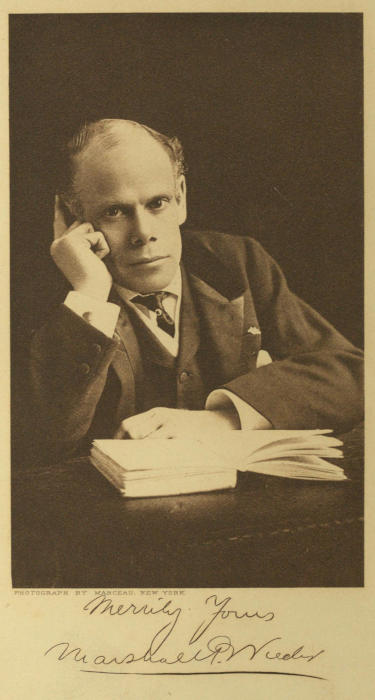
MARSHALL P. WILDER Author of “People I’ve Smiled With”
WITH TEXT ILLUSTRATIONS BY BART HALEY
AND COVER DECORATION BY
CHARLES GRAHAM
FUNK & WAGNALLS COMPANY
NEW YORK AND LONDON
1905
Copyright, 1905, by
FUNK & WAGNALLS COMPANY
[Printed in the United States of America]
Published, June, 1905
Affectionately Dedicated
To
My Father
PREFACE
In this little volume are offered recollections
of the sunny side of many people. I have
plucked blossoms from the gardens of humor and
pathos, which lie side by side, and in weaving
them into a garland, claim only as my own the
string that binds them together.
The Sunny Side of the Street.—Jests and Jesters.—The
Force of a Joke.—Lincoln’s Way.—Kings
and Their Joke-makers.—As They do
It in Persia and Ireland.—“Chestnuts.”—Few
Modern Jesters but no End of Jokers.—Entertainers
and Their Ways.
Richard Croker.—A Good Fellow and Not
Hard to Approach, if One is not in Politics.—Croker
as a Haymaker.—Does not Keep
Opinions on Tap.—He and Chauncey Depew
on New York City Politics.—Croker Bewilders
a London Salesman.—His Greatest Pride.—Recorder
Goff.—Not as Severe as His Acts.—Justice
Tempered With Mercy.—Two Puzzling
Cases.
My Prophecy to “Major” McKinley.—President
McKinley Becomes “One of the Boys” of My
Audience; His Attention to His Wife.—How
He Won a Vermont City.—A Story of the
Spanish War.—My First Meeting with President
Harrison.—A Second and More Pleasing
One.—A Chance Which I Gladly Lost.—Some
of President Harrison’s Stories.—I Led a Parade
Given in His Honor.—Vice-Presidents
Morton and Hobart.
Different Ways of Story-Telling.—The Slow
Story-Teller.—Lincoln’s Stories.—Bad Telling
of Good Stories.—The Right Way to Tell a
Story.—The Humorous, the Comic and the
Witty Story.—Artemus Ward, Robert J. Burdette
and Mark Twain as Story-Tellers.
All of Them Full of Humor at All Times.—“Joe”
Jefferson.—J. K. Emmett.—Fay Templeton.—Willie
Collier.—An Actor’s Portrait
on a Church Wall.—“Gus” Thomas, the Playwright.—Stuart
Robson.—Henry Dixey.—Evans
and Hoey.—Charles Hoyt.—Wilson
Barrett.—W. S. Gilbert.—Henry Irving.
Some Aspects of Philadelphia.—Fun in a Hospital.—“The
Cripple’s Palace.”—An Invalid’s
Success in Making Other Invalids Laugh.—Fights
for the Fun of Fighting.—My Rival
Friends.—Boys Will Be Boys.—Cast Out of
Church.—A Startling Recognition.—Some
Pleasures of Attending Funerals.—How I
Claimed the Protection of the American Flag.
Large Hopes vs. Small Means.—At the Savage
Club.—My First Engagement.—Within an
Ace of Losing It.—Alone in a Crowd.—A
Friendly Face to the Rescue.—The New York
Welcome to a Fine Fellow.—One English Way
With Jokes.—People Who are Slow to Laugh.—Disturbing
Elements.—Cold Audiences.—Following
a Suicide.
Customs and Climate Very Unlike Our Own.—No
Laughter in Restaurants.—Clever Cabbies.—Oddities
in Fire-Fighting.—The “Rogue’s
Gallery.”—In Scotland Yard.—“Petticoat
Lane.”—A Cemetery for Pet Dogs.—“Dogs
Who Are Characters.”—The Professional Toast-Master.—Solemn
After-dinner Speakers.—An
Autograph Table-cloth.—American Brides of
English Husbands.
The Real Difference Between Good Luck and
Bad.—Good Luck with Stories Presupposes a
Well-stored Memory.—Men Who Always Have
the Right Story Ready.—Mr. Depew.—Bandmaster
Sousa’s Darky Stories.—John Wanamaker’s
Sunday-School Stories.—General
Horace Porter’s Tales That go to the Spot.—The
Difference Between Parliament and Congress.
Not all Journalists are Critics, Nor are all
Critics Fault-finders.—The Most Savage
Newspapers not the Most Influential.—The Critic’s
Duty.—Horace Greeley.—Mark Twain’s
First Earnings.—A Great Publisher Approached
by Green Goods Men.—Henry Watterson.—Opie
Reid.—Quimby of the “Free Press.”—Laurence
Hutton, Edwin Booth and I in
Danger Together.
Robert Hilliard and I and a Dog.—Hartford’s
Actors and Playwrights.—A Fit that Caused a
Misfit.—A Large Price to Hear a Small Man.—Jim
Corbett and I.—A Startled Audience.—Captain
Williams and “Red” Leary.—“Joe”
Choate to the Rescue.—Bait for a Dude.—Deadheads.—Within
an Inch of Davy Jones.—Perugini
and Four Fair Adorers.—Scanlon and
Kernell.
On Blackwell’s Island.—Snakes and Snake
Charmers.—Insane People as Audiences.—A
Poorhouse That was a Large House.—I am
Well Known by Another Profession.—Criminals
are Not Fools.—Some Pathetic Experiences.—The
Largest Fee I Ever Received.
He Works Hard But Jokes Harder.—He and
I Stir Up a Section of Paris.—In Peril of a
Mob.—My Indian Friends in the Wild West
Company.—Bartholdi and Cody.—English Bewilderment
Over the “Wild West” People.—Major
“Jack” Burke.—Cody as a Stage
Driver.—Some of His Western Stories.—When
He Had the Laugh on Me.
Not as Easy as It Would Seem.—Scarcity of
Good Stories for the Purpose.—Drawing-room
Audiences are Fastidious.—Noted London
Entertainers.—They are Guests of the People
Who Engage Them.—London Methods and
Fees.—Blunders of a Newly-wed Hostess from
America.—Humor Displaces Sentiment in the
Drawing-room.—My Own Material and Its
Sources.
I am Nicknamed “The Theological Comedian.”—My
Friend, Henry Ward Beecher.—Our
Trip Through Scotland and Ireland.—His
Quickness of Repartee.—He and Ingersoll Exchange
Words.—Ingersoll’s Own Sunshine.—DeWitt
Talmage on the Point of View.—He
Could Even Laugh at Caricatures of His Own
Face.—Dr. Parkhurst on Strict Denominationalism.
The Most Popular Sovereign in Europe.—How
He Saved Me From a Master of Ceremonies.—Promotion
by Name.—He and His Friends
Delight Two American Girls.—His Sons and
Daughters.—An Attentive and Loving Father.—Untiring
at His Many Duties.—Before He
Ascended the Throne.—Unobtrusive Politically,
Yet Influential.
A Model of Courtesy and Kindness.—An Early
Friend Surprised by the Nature of His
Recognition.—His Tender Regard for Members of
His Company.—Hamlet’s Ghost Forgets His
Cue.—Quick to Aid the Needy.—Two Luck
Boys.—Irving as a Joker.—The Story He
Never Told Me.—Generous Offer to a Brother
Actor-manager.—Why He is Not Rich.
Why English and American Plays Do Best at
Home.—The Intelligent Londoner Takes the
Theatre Seriously.—Play-going as a Duty.—The
High-class English Theatre a Costly Luxury.—American
Comedies too Rapid of Action
to Please the English.—Bronson Howard’s
“Henrietta,” not Understood in London.—The
Late Clement Scott’s Influence and Personality.
An Important Factor of Success.—Better Than
Diplomacy.—Some Noted Possessors of Tact.—James
G. Blaine.—King Edward VII.—Queen
Alexandra.—Henry Ward Beecher.—Mme.
Patti.—Mrs. Ronalds.—Mrs. Cleveland.—Mrs.
Langtry.—Colonel Ingersoll.—Mrs. Kendall.—General
Sherman.—Chauncey M. Depew.—Mrs.
James Brown Potter.—Mme. Nordica.
Her Home in Wales.—Some of Her Pets.—An
Ocean Voyage With Her.—The Local Reception
at Her Home-coming.—Mistress of an
Enormous Castle and a Great Retinue of
Servants.—Her Winter Garden and Private
Theatre.—A Most Hospitable and Charming
Hostess.—Her Local Charities are Continuous
and Many.
Cornelius Vanderbilt.—Mrs. Mackey.—The
Rockefellers.—Jay Gould.—George Gould and
Mary Anderson.—Mrs. Minnie Maddern
Fiske.—Augustin Daly.—Nicola Tesla.—Cheiro.
Magnetism and Its Elements.—Every One
Carries the Marks of His Trade.—How Men
Are “Sized Up” at Hotels.—Facial Resemblance
of Some People to Animals.—What the
Eye First Catches.—When Faces Are Masked.—Bathing
in Japan.—The Conventions of
Every Day Life That Hide Us From Our
Fellows.—Genuineness is the One Thing
Needful.
“Joe” Jefferson.—I Take His Life.—His
Absent-Mindedness.—Jefferson and General
Grant.—Nat Goodwin, and How He Helped
Me Make Trouble.—Our Bicycling Mishap.—Goodwin
Pours Oil on Troubled Dramatic
Waters Abroad.—George Leslie.—Wilton
Lackaye.—Burr McIntosh.—Miss Ada Rehan.
Laughter Wanted Everywhere.—Dismal Efforts
at Fun.—English Humor.—The Difference
Between Humor and Wit.—Composite
Merriment.—Carefully Studied “Impromptus.”—National
Types of Humor.—Some Queer
Substitutes for the Real Article.—Humor is
Sometimes “Knocked Out,” Yet Mirth is Medicine
and Laughter Lengthens Life.
A Humorist of the Best Sort.—Not True to His
Own Description of Himself.—Everybody’s
Friend.—His Dog “Entomologist” and the
Dog’s Companions.—A Man With the Right
Word for Every Occasion.—His Pen-name was
His Own.—Often Mistaken for a Distinguished
Clergyman.—Killed by a Published Falsehood.
General Sherman.—His Dramatic Story of a
Trysting-place.—The Battle of Shiloh Fought
Anew.—Sherman and Barney Williams.—General
Russell A. Alger on War.—General
Lew Wallace.—The Room in Which He
Wrote “Ben Hur.”—His Donkey Story.—General
Nelson A. Miles and Some of His
Funny Stories.—A Father Who Wished He
Had Been a Priest.
When I was a Boy.—One Christmas Frolic.—How
I Got on One Theatre’s Free List.—My
First Experience as a Manager.—Strange
Sequel of a Modest Business Effort.—My First
Cigar and How It Undid Me.—The Only
“Drink” I Ever Took.—My First Horse in
Central Park.—I Volunteer as a Fifer in
School Band, with Sad Results to All Concerned.
The People, Stories About Whom Appear in “The Sunny Side of the Street”
The Sunny Side of the Street.—Jests and Jesters.—The Force
of a Joke.—Lincoln’s Way.—Kings and Their Joke-Makers.—As
they do it in Persia and Ireland.—“Chestnuts.”—Few
Modern Jesters but no End of Jokers.—Entertainers
and Their Ways.
I live on the sunny side of the street; shady
folks live on the other. I always preferred
the sunshine, and have tried to put other
people there, if only for an hour or two at a time,
even if I had to do it after sunset from a platform
under the gaslight, with my name billed at
the door as entertainer.
As birds of a feather flock together, it has
been my good fortune to meet thousands of other
people on the sunny side of the street. In this
volume I shall endeavor to distribute some of the
sunshine which these fine fellows unloaded on
me.
Nature has put up many effective brands of
concentrated sunshine in small packages; but the
best of these, according to all men of all countries,
is the merry jest. As far back as history goes
you will find the jest, also the jester. The latter
was so important that kings could not get along
without him. Some kings more powerful than
any European sovereign is to-day are remembered
now only by what their jesters said.
All these jesters are said to have been little
people. I am doubly qualified to claim relationship
with them, for I am only three and a half
feet high, and I have been jester to millions of
sovereigns—that is, to millions of the sovereign
American people, as well as to some foreign
royalties.
The reason for little people taking naturally to
sunshine and good-natured joking is not hard to
find, for it is a simple case of Hobson’s choice.
It is easier to knock a man out with a joke than
with a fist-blow, especially if you haven’t much
height and weight behind your fist. It is the
better way, too, for the joke doesn’t hurt. Instead
of the other man’s going in search of an
arnica bottle or a pistol or a policeman, he generally
hangs about with the hope of getting another
blow of the same sort. One needn’t be
little to try it. Abraham Lincoln had a fist almost
as big as the hand of Providence, and as
long a reach as John L. Sullivan, but he always
used a joke instead, so men who came to growl
remained to laugh. I’m not concerned about the
size of my own hand, for it has been big enough
to get and keep everything that belonged to me.
As to reach, as long as my jests reach their mark
I shan’t take the trouble to measure arms with
any one.
It is a Simple Case of Hobson’s Choice.
There’s always something in a jest—for the
man who hears it. How about the jester? Well,
he is easily satisfied. Most men want the earth,
so they get the bad as well as the good, but the
best that the world affords is good enough for the
jester, so I shan’t try to break the record. It is
often said that the jester swims near the top.
Why shouldn’t he? Isn’t that where the cream
is? And isn’t he generous enough to leave the
skimmed milk for the chaps dismal enough to
prefer to swim at the bottom?
I am often moved to pride when I realize how
ancient is my craft. Adam did not have a jester;
but he did not need one, for he was the only man—except
you and I—who married the only
woman in the world. Neither did old Noah have
or need one, for he had the laugh on everybody
else when the floods fell and he found himself in
out of the rain. But as soon as the world dried
out and got full enough of people to set up kings
in business, the jester appears in history, and the
nations without jesters to keep kings’ minds in
good-working order dropped out of the procession.
The only one of them that survives is Persia,
where John the Jester is, as he always was, in
high favor at court. When trouble is in the air
he merely winks at the Shah and gets off: “Oh,
Pshaw!” or some other bon mot old enough to
be sweet; then the monarch doubles up and
laughs the frown from his face, and the headsman
sheathes his sword and takes a day off.
Speaking of old saws that are always welcome
reminds me to protest against the unthinking
persons who cry “Chestnut!” against every joke
that is not newly coined. In one way it is a
compliment, for the chestnut is the sweetest nut
that grows; but it does not reach perfection until
it has had many soakings and frosts, and has
been kicked about under the dead leaves so many
times that if it was anything except a chestnut it
would have been lost. Good stories are like good
principles: the older they are, the stronger their
pull.
There is not a more popular tale in the world
than that of Cinderella. It is so good that
nations have almost fought for the honor of
originating it. Yet a few years ago some antiquarians
dug some inscribed clay tablets from the
ruins of an Asiatic city that was centuries old
when Noah was a boy. Some sharps at that
sort of thing began to decipher them, and suddenly
they came upon the story of Cinderella—her
golden slipper, fairy godmother, princely
lover and all. But do children say “Chestnut!”
if you give them this, and then tell them the
story of Cinderella? Not they!—unless you
don’t know how to tell it. A story is like food:
it doesn’t matter how familiar it is, if you know
how to serve it well.
Why, the story-teller, of the same old stories,
too, is as busy in Persia to-day as he was thousands
of years ago, and one of the most important
of his duties is the passing of the hat. You
will find him on the street corners of the towns
with a crowd about him. When he reaches the
most interesting part of the story he will stop,
like the newspaper serial with “To be continued
in our next.” Then he passes his fez. The
listeners know well what the remainder of the
story will be; but instead of “Chestnut!” he
hears the melodious clink of coppers.
Not only the Shah, but many a wealthy Persian
keeps a jester for the sole purpose of being
made to laugh when he feels dull. Some of the
antics of these chaps would not seem funny to an
American—such, for instance, as going about on
all fours, knocking people down and dressing in
fantastic attire—but there is no accounting for
tastes, as the old woman said when she kissed the
cow. The Shah’s jester has a great swing—he has
twelve houses, and not a mortgage on one of
them. He also has all the wives he wants. Who
says that talent is not properly appreciated in
Persia?
If you will run over to Europe you will find
the Irish prototype of the Persian story-teller on
the streets of Dublin and Limerick. Many a
time I have seen him on the street corner telling
the thrilling story of how O’Shamus was shot, or
some similarly cheering tale—for fighting seems
the funniest of fun to an Irishman. And just
before first blood is drawn, the story-teller pauses
to pass the hat, into which drop hard-earned
pennies that had been saved for something else.
It is the old Persian act. The manner is the
same, though the coat and hat are different, so I
should not be surprised to learn that the Irish
are direct descendants of the ancient Persians.
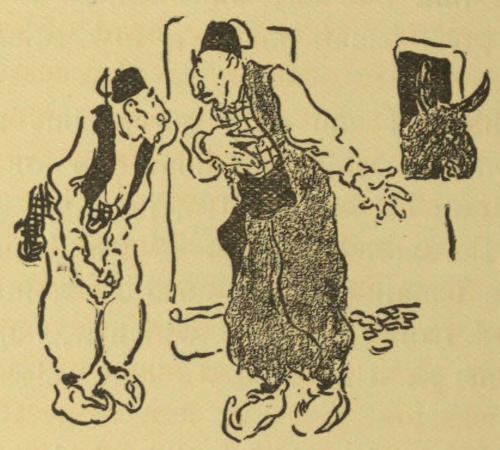
The Irish Prototype of the Persian Story-Teller.
It would be easy to follow the parallel and to
show how from the ancient jester was evolved
the modern comedian; but of the “true-blue”
jesters of to-day—the men who evolve fun from
their own inner consciousness—I am compelled
to quote: “There are only a few of us left.”
Of these “entertainers,” as they are called in
modern parlance, I shall let out a few of the
secrets which admit them to the drawing-room
of England and America to put a frosting, as it
were, on proceedings that otherwise might be too
sweet, perhaps too heavy. The modern jester
comes to the aid of the queen of the drawing-room
just as the ancient one did to the monarch
of old, so he is still an honored guest at the table
of royalty.
II SUNNY MEN OF SERIOUS PRESENCE
Richard Croker.—A Good Fellow and Not Hard to Approach.—If
One is Not in Politics.—Croker as a Haymaker.—Does
Not Keep Opinions on Tap.—He and Chauncey Depew on
New York City Politics.—Croker Bewilders a London
Salesman.—His Greatest Pride.—Recorder Goff.—Not as
Severe as His Acts.—Justice Tempered With Mercy.—Two
Puzzling Cases.
One of the privileges of a cheerful chap
without any axes to grind is that of
seeing behind the mask that some men
of affairs are compelled to wear. Often men
whom half of the world hates and the other half
fears are as companionable as a hearty boy, if
they are approached by a man who doesn’t want
anything he shouldn’t have—wants nothing but
a slice of honest human nature.
Such a man is Richard Croker, for years the
autocrat of Tammany Hall and still believed, by
many, to have the deciding word on any question
of Tammany’s policy. With most men it is
a serious matter, requiring much negotiation, to
get a word with Mr. Croker, and they dare not
expect more than a word in return.
While at Richfield Springs, a few years ago, I
drove out to call on Mr. Croker at his farm. I
met Mrs. Croker on the piazza and was told I
would probably find her husband in the hay-field;
so I went around behind the stables and found
the leader of Tammany Hall in his shirt-sleeves
pitching hay upon a wagon. At that time an
exciting political contest was “on,” and New
York politicians were continually telegraphing
and telephoning their supreme manager,—the
only man who could untangle all the hard knots,—yet
from his fields Richard Croker conducted
the campaign, and with so little trouble to him
that it did not keep him from making sure of his
hay-crop, by putting it in himself.
In later years I saw much more of Mr. Croker,
for I was often his guest at Wantage, his country
home in England, and I could not help studying
him closely, for he was a most interesting man.
In appearance he suggested General Grant; he
was of Grant’s stature and build, his close-cropped
beard and quiet but observant eyes recalled
Grant, and his face, like the great general’s,
suggested bulldog courage and tenacity, as well
as the high sense of self-reliance that makes a
man the leader of his fellow men. Few of his
closest associates know more of him than his face
expresses, for he is possessed of and by the rarest
of all human qualities—that of keeping his
opinions to himself. Most political leaders say
things which bob up later to torment them, but
Croker’s political enemies never have the luck of
giving him his own words to eat. He can and
does talk freely with men whom he likes and
who are not tale-bearers, but he never talks from
the judgment seat. Even about ordinary affairs
he is too modest and sensible to play Sir Oracle.
One day he chanced to be off his guard and gave
me a positive opinion on a certain subject; when
afterward I recalled it to him he exclaimed:
“Marshall, did I tell you that?” It amazed
him that he had expressed an opinion.
During one of my visits to Wantage Mr.
Croker and I were together almost continually
for a week; he not only survived it, but was a
most attentive and companionable host. His son
Bert was fond of getting up early in the morning
to hunt mushrooms, and in order to be awakened
he would set an alarm clock. “Early morning”
in England and at that season of the year was
from three to four o’clock, for dawn comes much
earlier than with us. His father did not wish
him to arise so early, so he would go softly into
Bert’s room and turn off the alarm, to assure a
full night sleep for the boy. The fact that he
could not hear the alarm worried Bert so greatly
that he placed the clock directly over his head,
hanging it to a string from the ceiling. But even
in this position Mr. Croker succeeded in manipulating
it, and he gleefully told me of it at the
time.
One day, in London, Mr. Croker called for me
and took me to see Mr. Depew, who had recently
arrived. We drove to the Savoy and found Mr.
Depew on the steps, just starting for Paris. He
exclaimed:
“Hello? What are you two fellows doing together?—fixing
up the election?”
This was just before Van Wyck was elected
mayor; Mr. Strong’s enforcement of the liquor
law had been so vigorous as to enrage many
bibulous voters. As he bade us good-bye Mr.
Depew found time to say to Mr. Croker,
“All your party will have to do will be to hold
their hats and catch the votes.”
At the time of the Queen’s Jubilee we were invited
to view the procession from Mr. Jefferson
Levy’s apartment in Piccadilly, but Mr. Croker
declined; he told me afterward that he would
have offended many Irish voters in America had
he appeared in any way to honor the Queen.
Before starting from London for Wantage one
day, Mr. Croker asked me to go to a furniture
dealer’s with him; he had some purchases to
make. As we entered the place he said to me,
“We’ve only half an hour in which to catch the
train”—but the way he bought furniture did
not make him lose the train. He would say,
pointing to a dresser,
“How much is that?”
“Six guineas, sir.”
“Give me six of them.”
Pointing to another,
“How much is that one?”
“Five guineas, sir.”
“Well, seven of those”—and so on.
With such rapid fire, even though he expended
more than a thousand dollars, and not at haphazard
either, there was ample time to catch the
train. The incident, though slight in itself, is
indicative of his quickness of decision; but it so
utterly upset the dealers, accustomed to English
deliberation, that he begged permission to wait
until next day to prepare an itemized bill.
Mr. Croker’s quiet unobtrusive manner, which
has so often deceived his political enemies into
believing that he was doing nothing, dates back
a great many years—as far back as his courtship.
The future Mrs. Croker and her sister were
charming girls and their home was the social
rendezvous of all young people of the vicinity.
Their father was a jolly good fellow and as popular
as his daughters; when the latter went to a
dance he was always their chaperon, and a most
discreet one he was for he always went up-stairs
and slept until the time to go home. Mr. Croker
was at the house a great deal but was so quiet
and devoted so much time to chat with the father
that no one suspected that one of the daughters
was the real attraction, but with the quiet persistence
that had always characterized him he
“won out.”
Great soldiers delight in fighting their battles
o’er and no one begrudges them the pleasure.
Mr. Croker has been in some desperate fights and
won some great victories. Hoping for a story or
more about them I one day asked him of what in
his life he was most proud. His reply indicated
the key-note of his nature, for it was:
“That I have never gone back on my word.”
Another man who has kept many thousands
of smart fellows uncomfortably awake and in
fear is Recorder Goff. When he conducted the
inquiries of the Lexow Committee he extracted
so much startling testimony from men whom no
one believed could be made to confess anything,
that a lot of fairly discreet citizens were almost
afraid to look him in the eye, for fear he would
ferret out all their private affairs. I had never
seen him, but I had mentally made a distinct
picture of him as a tall, thin, dark-browed,
austere, cold character, rather on the order of a
Grand Inquisitor, as generally accepted. When
we met it was at a dinner, where I sat beside
him and had to retouch almost every detail of
my picture, for, although tall and thin, he was
blonde and rosy, of sanguine temperament, with
merry eyes, a genial smile and as talkative as
every good fellow ought to be.
The acquaintance begun at that dinner-table
was continued most pleasantly by many meetings
in Central Park, which both of us frequented on
our bicycles. One day, while we were resting in
the shadow of Daniel Webster’s statue, I made
bold to ask him how he came by his marvelous
power of extracting the truth from unwilling
occupants of the witness-box. He murmured
something self-deprecatory, but told me the following
story in illustration of one of his indirect
methods and also of how truth will persist in
muddling the wits of a liar.
“A man was brought before me accused of killing
another man with a bottle. He had a friend
whose mother was on the witness stand and she
tried to save her son’s friend, though she perjured
herself to do so. She swore she had seen the
murderer and could describe him. I was convinced
of the accused’s guilt and the woman’s
perjury, and I determined to surprise her into
confession.
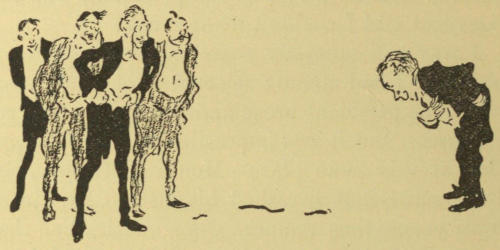
“I got seven men of varying appearance who
were in the court-room to stand up, which they
did, though greatly mystified, for they were
present only as spectators. I asked the woman
if the first man was the murderer. She promptly
answered ‘No,’ to his great relief.
“‘But,’ I said, ‘he resembles the murderer,
doesn’t he? He is the same height?’
“‘Oh, no,’ she answered, ‘he is much taller.’
Motioning the first man to sit down, I pointed to
No. 2, and asked:
“‘This man is the same height as the murderer,
is he not?’
“‘Yes, exactly.’ I asked the man his height,
and he said ‘five feet seven.’ He was told to sit
down, and No. 3, who had a head of most uncompromising
red hair, was brought forward.
“‘You said the murderer had red hair like this
man, didn’t you?’
“‘Oh, no—brown, curly hair.’
“‘Were his eyes like this man’s?’
“‘No, they were brown.’
“Number four, who had fine teeth, was asked
to open his mouth, greatly to his embarrassment.
“‘Were the murderer’s teeth like this man’s?’
“‘No, he had two gold teeth, one on each
side.’
“Number five was rather stout and the woman
thought the murderer about his size; he weighed
one hundred and sixty. Six and seven were
looked at and sent back to their seats, nervous
and perspiring. Then I said:
“‘We find from this woman’s testimony that
the murderer was about five feet seven in height,
weighed one hundred and sixty, had dark curly
hair, brown eyes, two gold teeth and a habit of
keeping his hands in his pockets.’
“By this time the prisoner was white and
shaking, for bit by bit the witness had described
him exactly. When the woman realized what
she had done she broke down and confessed that
the prisoner was the real criminal.”
It was charged that a man brought before
Recorder Goff for theft was an old offender and
had served a term in states prison, but the
accused denied it and no amount of cross-questioning
by the prosecution could shake his
denial. Mr. Goff noticed that he had lost a
thumb; as prisoners are generally given a name
by their comrades, signifying some physical
peculiarity, the Recorder said:
“While in prison you were known as One-Thumbed
Jack.” Taken off his guard, the man
asked:
“How did you know that?”
“Then you are an ex-convict?”
“Well, yes, sir, but I had honest reasons for
not wanting it known and I’d like to speak to
you alone, sir.”
Mr. Goff granted the request and they retired
to a small room where the prisoner after telling
his real name, related a touching story of devotion
to a young sister whom he brought up and educated
with the proceeds of his earlier crimes.
While serving his prison term he had written
her letters which his pals posted for him in different
parts of the world to make her believe he
was traveling so constantly that any letters from
her could not reach him. This sister was now
married and had two children and it would break
her heart to find out that her brother was a convict
or had ever been one. So he wished to be
sentenced under another name. Mr. Goff said:
“I will suspend sentence.”
Later the man’s statements were investigated
and found to be true. So his request to be sentenced
under an assumed name was granted.
Farther, he got but two years, although he would
have been “sent up” for ten years had it not
been for his story—a fact which shows how in
Recorder Goff, the city’s greatest terror to evil-doers,
justice is tempered with mercy.
III AT THE WHITE HOUSE AND NEAR IT
My Prophecy to “Major” McKinley.—President McKinley
Becomes “One of the Boys” of My Audience; His Attention
to His Wife.—How He Won a Vermont City.—A
Story of the Spanish War.—My First Meeting With President
Harrison.—A Second and More Pleasing One.—A
Chance Which I Gladly Lost.—Some of President Harrison’s
Stories.—I Led a Parade Given in His Honor.—Vice-Presidents
Morton and Hobart.
It had been my good fortune to meet several
presidents of the United States, as well as
some gentlemen who would have occupied
the White House had the president died, and I
learned that, in spite of their many torments and
tormentors, they all liked to get into the sunshine
and that they had done it so much that the
sunshine had returned the compliment right
heartily, as is its way “in such case made and
provided.”
Some years ago while entering a New York hotel
to call on Madame Patti I chanced to meet in the
corridor William McKinley, who was then governor
of Ohio, though his New York acquaintances
still called him “Major.” His was one
of the big, broad natures that put all of a
man’s character in full view, and there was a
great lot in McKinley’s face that day,—thoughtfulness,
self-reliance, strength, honesty, as well
as some qualities that seldom combine in one
man—simplicity and shrewdness, modesty and
boldness, serious purpose and cheerfulness, that I
became quite happy in contemplation of him as a
trusty all-around American. He greeted me very
cordially and as I was smiling broadly, he
asked:
“What pleases you, Marshall?”
“The fact that I am shaking hands with the
future president of the United States,” I replied.
Some years afterward, when Mr. McKinley
had fulfilled my prophecy, I was the guest of
D. A. Loring, at Lake Champlain, and the president
and most of his cabinet were at the same
hotel. Besides Mr. and Mrs. McKinley there
were Vice-President and Mrs. Hobart, Secretary
of War Alger and Mrs. Alger, Postmaster General
Geary and Mrs. Geary, Cornelius N. Bliss,
Secretary of the Interior, and others. Every one
at the hotel treated the distinguished guest with
the greatest consideration, by letting him entirely
alone, so that he got the rest he sorely
needed. He walked much about the grounds,
enjoying the bracing atmosphere and peaceful,
beautiful surroundings.
One day I went into the bowling alley to
spend half an hour or more with the boys who
set up the pins; boys are always my friends, and
I was going to do some card and sleight-of-hand
tricks for these little fellows. Just as I had
gathered them about me and started to amuse
them, Mr. McKinley came to the door and looked
in, smiled, came over to us and asked what was
going on. I replied:
“Well, Mr. President, I was just doing some
tricks to amuse the boys.”
“Then I’m one of the boys,” said the president
of the United States. He sat down in the circle
and was one of my most attentive auditors.
When I had finished he walked apart with me
and said:
“Marshall, do you remember meeting me in
the Windsor Hotel, New York, and saying you
were shaking hands with the future president of
the United States?”
“I recall it very distinctly,” I replied.
“I have just been thinking,” he said, “of that—to
me, strange prophecy. You must be
possessed of some clairvoyant power.” There are
some things you can’t tell a man to his face, so I
didn’t explain to him that a man with a character
like his couldn’t help becoming president,
when the whole country had come to know
him.
I shall never forget what I saw of his lover-like
devotion to his invalid wife, nor her evident
gratitude for his every service, nor the sweet
solicitude and pride with which she regarded
him. One day his brother Abner arrived, went
to the portion of the hotel reserved for the president,
met Mrs. McKinley and asked:
“Is William in?”
“Yes,” was the reply, “but I shall not let
you see him for an hour. He is resting.”
A little incident that was described to me by
an eye-witness brought out one of the qualities
which endeared President McKinley to his fellow
countrymen. While on a brief visit across the
lake, in Vermont, he was driving through a small
city, followed by a great procession of people
who had turned out in his honor. While passing
through the main street he noticed an old man
seated on the piazza of a modest dwelling, and
asked the mayor, who was beside him in the carriage,
“Who is that old gentleman?”
“That is Mr. Philip, father of Captain Philip,
of the battleship Texas,” was the reply.
“I thought that must be he,” said the president.
“Will you kindly stop the carriage?”
The carriage stopped and so did the mile or
more of procession, while the president jumped
out, unassisted, ran up the steps, grasped the
hand of the astonished and delighted old man,
and said:
“Mr. Philip, I want to congratulate you on
having such a son as Captain Philip, and I feel
that the thanks of the nation are due you for
having given the world such a brave, patriotic
man.”
The old man, tremulous with gratification,
could scarcely find words with which to thank
the head of the nation for his appreciative attention,
but the president’s simple, friendly manner
quickly put him at his ease and the two men
chatted freely for several minutes, the president
evidently enjoying it keenly. Then after a
hearty invitation to visit him at the White
House, Mr. McKinley got into his carriage and
the procession again started.
Mention of the Texas recalls a visit I made to
her when she was at the New York Navy Yard
for repairs, after the fight with Cervera’s fleet, in
which the Texas was the principal American
sufferer. A young officer took me about the
ship, showed me her honorable wounds, repeated
Captain Philip’s historic remark, made after the
battle,—“Don’t cheer, boys; the poor fellows
are dying,” and told me the following story:
One of our Irish sailors was very active in saving
the Spaniards in the water, throwing them
ropes, boxes and everything floatable he could
find. But there was one Spaniard who missed
everything that was thrown him. Just before
the battle we had had religious service and the
altar was still on deck, so our Irishman grabbed
it, heaved it overboard and yelled:
“There, ye haythen! If that won’t save ye,
nothin’ ever will.”
While Mr. Harrison was president I became
pleasantly acquainted with his son Russell, who,
having read of President Cleveland’s very kind
treatment of me when I went to him with a letter
of introduction from Henry Ward Beecher,
wanted me to meet his father and gave me a letter
to that effect. My visit to the White House
was quite impressive—to me. Soon after I
reached Chamberlain’s, at Washington, a messenger
arrived and informed me that the President
had received my letter of introduction and
desired me to call the next morning at ten
o’clock, which I did.
After passing the sentinels at the door I was
taken into the room of Mr. Private Secretary
“Lije” Halford, who greeted me cordially and
said: “Mr. Wilder, the president will see you.”
I was ushered into Mr. Harrison’s presence, and
the following conversation ensued:
“Mr. President, this is Mr. Wilder.”
“How do you do, Mr. Wilder?”
“How do you do, Mr. President?”
A profound silence followed; it seemed to me
to be several minutes long; then I said:
“Good-day, Mr. President.”
“Good-day, Mr. Wilder.”
After leaving the room I turned to Mr. Halford,
raised my coat-tails and asked:
“Won’t you please kick me?”
Of course I had to refer to the incident in my
monologue that season, for it isn’t every day that
a professional entertainer is invited to call at the
White House. But I did not care to tell exactly
what occurred, so I adopted an old minstrel joke
and said:
“I called on the president the other day. I
walked in, in a familiar way, and said, ‘How do
you do, Mr. President?’ He said, ‘Sir, I cannot
place you.’ ‘Well,’ I replied, ‘that’s what I’m
here for.’”
I afterward heard that President Harrison was
very cold and lacked cordiality; still later I discovered,
with my own eyes and ears, that he had
a kind heart and genial nature. One summer
while I was at Saratoga I was asked by
Mr. W. J. Arkell to Mount McGregor, to meet
President Harrison at dinner and to become a
member of a fishing party. The occasion was
the president’s birthday, and the invitation was
the more welcome when I learned that a list of
the people at the Saratoga hotels had been shown
the president, who had himself selected the guests
for his birthday celebration. At Mount McGregor
I found, as one always finds, wherever the President
of the United States is staying a few days,
thirty or forty newspaper correspondents, all of
whom I knew and most of whom professed to
doubt my ability to make the president laugh.
This did not worry me, for I don’t love trouble
enough to look ahead for it, and dinner time,
when the laughing was to begin, was a few hours
distant.
We all went by carriage to a stream about five
miles away and all helped fill the president’s
basket with fish,—for which he got full credit, in
the next day’s newspapers. My own contributions
were few and small, for I never was a
good fisherman. So I was grateful when Russell
Harrison took me to a little pool where he was
sure we would have great luck. But not a bite
did either of us get. Then I recalled something
that a veteran fisherman played on me when I
was too young to be suspicious; it was to beat
the water to attract the attention of the fish.
Russell kindly assisted me at beating the water,
but the fish beat us both by keeping away.
When we got back to the hotel and to the banquet
it was announced that there were to be no
speeches, but the president would make a few
remarks and I would be called on for a few
stories. Consequently I had no mind or appetite
for dinner, for most of the guests were newspaper
men who had been surfeited with stories ever
since they entered the business, and the most important
listener would be the president, who the
boys had said I couldn’t make laugh.
I was still mentally searching my repertoire,
although I had already selected a lot of richness,
when the president arose and made some general
remarks. But it was impossible for him to forget
that at this same place—Mount McGregor, Ex-President
Grant breathed his last, so Mr. Harrison’s
concluding remarks were on the line that
any other whole-hearted American would have
struck in similar circumstances. As I am a
whole-hearted American myself, they struck me
just where I live, and I am not ashamed to confess
that they knocked me out.
So, when I was called upon, I declined to respond.
Several friends came to my chair and
whispered: “Go ahead, Marsh.” “Don’t lose the
chance of your life; don’t you know whatever is
said at this dinner will be telegraphed all over
the United States?” But I held my tongue—or
it held itself. There is a place for every
thing; a table at which the President of the
United States had just been talking most feelingly
of the pathetic passing of another president
was no place for a joke—much less for a budget
of jokes, so instead of making the president laugh
I allowed the newspaper men to have the laugh
on me. In the circumstances they were welcome
to it.
“I allowed the newspaper men to have a laugh on me.”
Nevertheless I succeeded, for the president
succeeded in breaking the strain upon him, and
later in the day at his own cottage he transfixed
me with a merry twinkle of his eye and said:
“Marshall, what’s this story you’ve been telling
about your visit to the White House?”
I saw I was in for it, so I repeated the minstrel
joke, already recorded. He laughed so heartily
that there wasn’t enough unbroken ice between
us to hold up a dancing mosquito, so I made bold
to tell him that some men insisted that he did
not appreciate humor. Then he laughed again;
I wish I could have photographed that laugh, for
there was enough worldly wisdom in it to lessen
the number of cranks and office seekers at the
White House for years to come. But I hadn’t
much time to think about it, for we began swapping
yarns and kept at it so long that I suddenly
reminded myself, with a sense of guilt, that I
was robbing the ruler of the greatest nation on
earth of some of his invaluable time. Never
mind about my own stories that evening, but
here is one that President Harrison told me, to
illustrate the skill of some men in talking their
way out of a tight place.
There was a man in Indiana who had a way of
taking his own advice, though he generally had
to do things afterward to get even with himself.
He was a hog dealer, and one season he drove a
lot of hogs to Indianapolis, about a hundred
miles distant, though he could get nearly as good
a price at a town much nearer home. Arrived
at Indianapolis, he learned that prices had gone
down, so he held on for a rise, but when offered
a good price he stood out for more, and insisted
that if he did not get it he would drive the hogs
back home, which he finally did, and sold them
for less than was offered him in the city. When
one of his friends asked him why he had acted
so unwisely he replied:
“I wanted to get even with them city hog-buyers.”
“But did you?”
“Well, they didn’t get my hogs.”
“But what did you get out of the transaction?”
“Get? Why, bless your thick skull, I got the
society of the hogs all the way back home.”
I had long been puzzled as to the origin of the
word “jay,” as applied to “easy marks” among
countrymen, and I told the president so. He
modestly admitted that I had come to the right
shop for information; then he told me this story:
“Winter was coming on and a blue jay made
up his mind that he would prepare for it. He
found a vacant hut with a knot-hole in the roof,
and he said to himself, ‘Here’s a good place to
store my winter supplies,’ so he began to collect
provender. His acquaintances who passed by saw
what he was doing; then they laughed and took
a rest, for they knew how to get in by the side
door. Whenever he dropped a nut or a bit of
meat through the knot-hole they would hop in
below and gobble it. So, Marshall, next time
you hear any one called a ‘jay’ I’m sure you’ll
know what it means.”
The next morning, when we all met on the
president’s special train en route to Saratoga, my
newspaper friends twitted me anew on not having
made the president laugh, but I said: “Now,
boys, you wait.” Then I was so impudent as
to approach the president and say:
“Mr. President, I am very glad to have had
you with me on this fishing trip, and I hope
whenever you want to go off on a similar affair
you will let me know it. At the foot of the
mountain a band of music and escort of troops
are waiting for me, and in the hurry I may not be
able to say good-bye to you, so I say it now.”
But not one eyelash of the president quivered as
he shook hands with me and replied: “Glad to
have met you, Mr. Wilder,” so the newspaper
boys certainly did have the laugh on me.
But the day was still young. Arrived at the
Saratoga depot, all hurried into carriages.
Waiting until all were seated and started in
procession, I found an open landau and gave
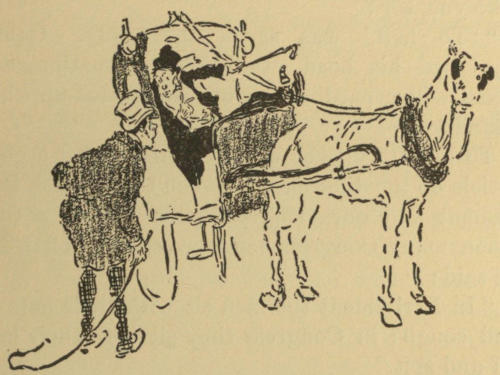
the driver the name of my hotel. “All right,
Mr. Wilder,” was the reply, which did not
startle me, for I am pretty well known in
Saratoga by the cabbies—and the police. I
said:
“Make a short cut, get out of the crowd and
get me to the hotel as soon as possible, so I may
avoid the parade.” He endeavored to get out,
but he got in; and in trying to extricate himself
he succeeded in driving through the band and
past the troops and finally beside the carriages
of the president and his guests. I took advantage
of the occasion; as I passed the president I
stood up (though it made little difference whether
I sat or stood, for not much of me was visible
over the top of the carriage door) and I bowed
my prettiest. The president raised his hat, as
did the other guests, and I led that procession
down Saratoga’s Broadway, the sidewalks of
which were crowded with New York and
Brooklyn people who knew me and to whom
I bowed, right and left, to the end of the route,
where one of the newspaper men said:
“Marsh usually gets there.”
In Mr. McKinley’s first term I fell in conversation
at a hotel with a gentleman of manner so
genial that I never forgot him. We exchanged
a lot of stories, at which I got more than I gave,
but suddenly the gentleman said:
“I can see, Mr. Wilder, that you don’t recognize
me.”
“Well, really, I don’t,” I replied, with an
apologetic laugh. “You must pardon me; I
meet so many. May I ask your name?”
“Certainly. It is Garret A. Hobart.”
“The Vice-president of the United States!
Well, that isn’t anything against you”—for I
had to say something, to keep from collapsing.
He seemed greatly amused, and I could not help
wondering if in any other country of the world
a high official of the government could be picked
up in a hotel corridor, be chatted with, then be
compelled to introduce himself, and throughout
all conduct himself as if he were no one in particular.
Levi P. Morton, ex-vice-president, has been out
of politics for some years, yet he is remembered
as a man who could tell good stories to illustrate
his points. Here is one of them:
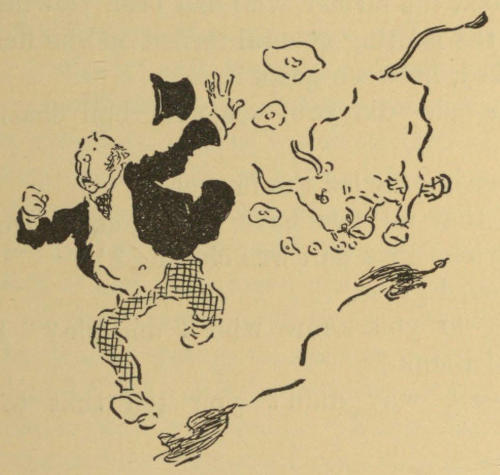
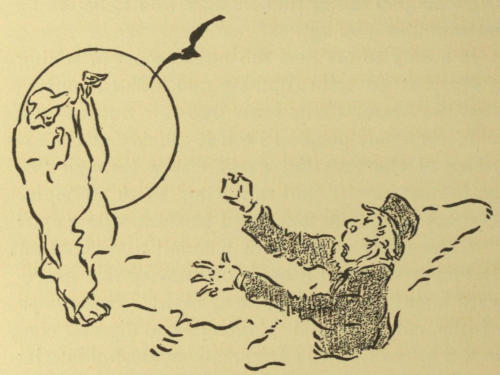
“The General doubled on his tracks.”
“Not far from my country place is a farmer
noted for his fine, large cattle. People come
from everywhere to look at his Durhams and
Alderneys, but they have to be careful how they
venture into the pastures, for some of the bulls
are ferocious. A certain major-general, who
was very proud of his title, was visiting near by,
and one day while walking he cut across the
fields to shorten distance. Before he knew of
his danger a big bull, bellowing and with tossing
head, began to chase him. The general was a
swift runner, and made good time, but the animal
too was lively, so when the general reached
a fence he dared not stop to climb for the bull
was near enough to—well, help him. The general
doubled on his tracks several times, but the
bull kept dangerously near. Suddenly a gate
offered a chance to shut off pursuit. Near the
gate stood the farmer, who had been viewing the
chase; the panting general turned on him fiercely
and asked, between gasps:
“‘Sir—sir—did you—see your bull chasing—me?’
“‘Ya-as,’ drawled the farmer.
“‘Is that all you have to say, sir? Do you
know whom that bull was chasing?’
“‘You, I guess.’
“‘But do you know who I am, sir? I am
General Blank.’”
“‘Wa-all, why didn’t you tell that to the
bull?’”
IV STORY-TELLING AS AN ART
Different Ways of Story-telling.—The Slow Story-teller.—Lincoln’s
Stories.—Bad Telling of Good Stories.—The
Right Way to Tell a Story.—The Humorous, the Comic
and the Witty Story.—Artemus Ward, Robert J. Burdette
and Mark Twain as Story-tellers.
The ways of story-tellers differ almost as
widely and strangely as the ways of
politicians—or women—yet every man’s
way is the best and only one to him. I know
men who consume so much time in unloading a
story that they remind me of a ship-captain who
had just taken a pilot and was anxious to get
into port. The pilot knew all the channels and
shoals of the vicinity, and being a cautious old
chap he wasn’t going to take any risks, so he
backed and filled and crisscrossed so many times
that the captain growled: “Hang him! He
needs the Whole Atlantic Ocean to turn around
in.”
Yet a lot of these long-winded story-tellers
“get there”—and they deserve to, not only because
a hearty laugh follows, but because hard
work deserves its reward. As to that, Abraham
Lincoln, long before he became president, and
when time was of no consequence, had some
stories almost as long as old-fashioned sermons;
but nobody left his seat by the stove at the
country store, or his leaning place at the post-office,
or his chair on the hotel piazza until “Abe”
had reached the point. But there never was
more than one Abraham Lincoln. To-day a long-winded
story-teller can disperse a crowd about
as quickly as a man with a bad case of smallpox.
But it isn’t always length that troubles the
listener—the way in which a tale is told is the
thing, whether the tale itself be good or bad. It
is never safe for some people to repeat a good
story they have heard, for they may tell it in a
fashion that is like being bitten to death by a
duck.
I do not claim originality for my own method
and material. I simply tell a story, using whatever
material comes my way. Often a friend
will tell me of something he has seen or heard;
I will reconstruct his narrative, without tampering
with the facts, yet so that the people of whom
he told it will not recognize it.
There is nothing, except advice, of which the
world is more generous than stories. Everybody
tells them. They mean well; they want to make
you laugh, and they deserve credit for their intention.
Yet when neighbor Smith or Brown
calls you aside, looks as if he was almost bursting
with something good, and then gets off a yarn
that was funny when he heard it, but in which
you can’t discern the ghost of a laugh—why,
you can’t help wondering whether Smith’s or
Brown’s funny-bone hasn’t dropped off somewhere,
without its owner’s knowledge; you also
can’t help wishing that he may find it before he
buttonholes you again.
It seems to me that the supreme art of telling
a story is to tell it quickly and hide the nub so
that the hearer’s wits must find it. But it is possible
for some people to tell it quickly at the expense
of the essential parts, either through forgetfulness
or by not knowing them at sight.
For example, here is a tale I heard not long ago:
“The other night Ezra Kendall told about an
Irishman who had a habit of walking in a graveyard
about twelve o’clock at night. Some boys
of the neighborhood planned to so dig and conceal
a grave that the Irishman would fall into it;
another man was to drape himself in a sheet,
to scare Mike. The night arrived, the Irishman
took his customary walk and fell into the hole
prepared for him. A boy in a white sheet arose,
and said in a sepulchral voice:
“‘What are you doing in my grave?’
“‘What are you doin’ out of it?’ Mike replied.”
Soon afterward an amateur gave me the story
as follows:
“I heard a story the other day by a man
named Kendall about a man who went out in a
graveyard at night to walk, about twelve o’clock.
He fell into a ditch, and another fellow happened
along and said, ‘What are you doing out of
it?’—or something like that. I know I laughed
like the deuce when I heard it.”
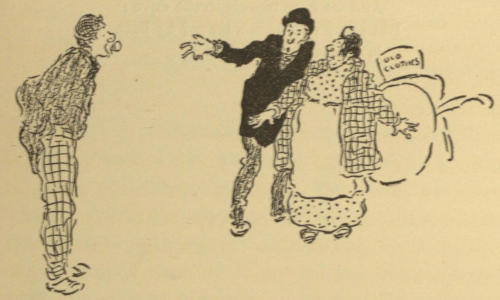
“What are you doing in my grave?”
But even when a story has been committed to
memory or written in shorthand on a shirt-cuff,
to be read off without a word lost or misplaced,
much depends upon the teller. Some people’s
voices are so effective that they can tell a story
in the dark and “make good”; others can’t get
through without calling all their features to help,
with some assistance from their arms and legs.
One man will lead you with his eye alone to the
point of a story; another will drawl and stammer
as if he had nothing to say, yet startle you
into a laugh a minute.
Of course a great deal depends on the story
itself. People are too grateful for a laugh to
look backward and analyze the story that compelled
it; they generally believe that fun is fun,
and that is about as much as any one knows of
it. The truth is that while there are all kinds
of stories there is only one kind of humor.
As a rule, humorous stories are of American
origin, comic stories are English, and witty
stories are French. The humorous story depends
upon the incidents and the manner of
telling; comic and witty stories depend upon the
matter. The humorous story may be spun out
to any length; it may wander about as it pleases,
and arrive at nowhere in particular; but the
comic or witty story must be brief, and end in a
sharp point. The humorous story bubbles along
continually; the other kinds burst. The humorous
tale is entirely a work of art, and only an
artist can tell it; while the witty or comic story—oh,
any one who knows it can tell it.
The act of telling a humorous story—by word
of mouth, understand, not in print—was created
in America, and has remained at home, in spite
of many earnest endeavors to domesticate it
abroad, and even to counterfeit it. It is generally
told gravely, the teller doing his best to
disguise his attempt to inflict anything funny
on his listeners; but the man with a comic story
generally tells you beforehand that it is one of
the funniest things he ever heard, and he is
the first one to laugh—when he reaches the
end.
One of the dreadfulest inflictions that suffering
humanity ever endures is the result of amateur
efforts to transform the humorous into the comic,
or vice versa. It reminds one of Frank Stockton’s
tearful tale of what came of one of the best
things in Pickwick by being translated into classical
Greek and then brought back into English.
The Rev. Robert J. Burdette, who used to write
columns of capital humor for The Burlington
Hawkeye and told scores of stories superbly, made
his first visit to New York about twenty years
ago, and was at once spirited to a notable club
where he told stories leisurely until half the
hearers ached with laughter and the other half
were threatened with apoplexy. Every one present
declared it the red letter night of the club,
and members who had missed it came around and
demanded the stories at second-hand. Some efforts
were made to oblige them, but without avail,
for the tellers had twisted their recollections of
the stories into comic jokes; so they hunted the
town for Burdette to help them out of their
muddle.
The late Artemus Ward, who a generation ago
carried a tidal wave of humor from Maine to California,
with some generous overflows each side
of its course, had a long serious face and a drawling
voice; so when he lectured in churches, as he
frequently did, a late-comer might have mistaken
him for a minister, though not for very long. He
would drawl along without giving the slightest
indication of what was coming. When the joke
was unloaded and the audience got hold of it he
would look up with seemingly innocent wonder
as to what people were laughing at. This expression
of his countenance always brought another
laugh. He could get laughs out of nothing,
by mixing the absurd and the unexpected, and
then backing the combination with a solemn face
and earnest manner. For instance, it was worth
a ten-mile walk after dark on a corduroy road to
hear him say: “I once knew a man in New
Zealand who hadn’t a tooth in his head”—here
he would pause for some time, look reminiscent,
and continue, “And yet he could beat a base-drum
better than any other man I ever knew.”
Mark Twain is another famous humorist who
can use a serious countenance and hesitating
voice with wonderful effect in a story. His tale
of “The Golden Arm” was the best thing of its
kind I ever heard—when told as he himself told
it—but everything depended on suddenness and
unexpectedness of climax. Here it is, as he gave
it:—
“Once ’pon a time dey wuz a mons’us mean
man, en’ he live ’way out in de prairie all ’lone
by himself, ’cep’n he had a wife. En’ bimeby she
died, en’ he took en’ toted her ’way out da’ in de
prairie en’ buried her. Well, she had a golden
arm all solid gold, f’om de shoulder down. He
wuz pow’ful mean—pow’ful; en’ dat night he
couldn’t sleep, ’coze he wanted dat golden arm so
bad.
“When it come midnight he couldn’t stan’ it
no mo’, so he got up, he did, en’ tuk his lantern
en’ shoved out troo de storm en’ dug her up en’
got de golden arm; en’ he bent his head down
’gin de wind, en’ plowed en’ plowed en’ plowed
troo de snow. Den all on a sudden he stop”
(make a considerable pause here, and look startled,
and take a listening attitude) “en’ say:
“My lan’, what’s dat? En’ he listen, en’ listen,
en’ de wind say” (set your teeth together, and
imitate the wailing and wheezing sing-song of
the wind): “‘Buzz-z-zzz!’ en’ den, way back
yonder whah de grave is, he hear a voice—he
hear a voice all mix up in de win’—can’t hardly
tell ’em ’part: ‘Bzzz-zzz—w-h-o—g-o-t—m-y
g-o-l-d-e-n arm?”’ (You must begin to shiver
violently now.)
“She’ll fetch a dear little yelp—”
“En’ he begin to shiver en’ shake, en’ say:
‘Oh, my! Oh, my lan’!’ En’ de win’ blow de
lantern out, en’ de snow en’ de sleet blow in his
face en’ ’most choke him, en’ he start a-plowin’
knee-deep toward home, mos’ dead, he so sk’yeerd,
en’ pooty soon he hear de voice again, en”
(pause) “it ’us comin’ after him: ‘Buzzz-zzz—w-h-o—g-o-t
m-y g-o-l-d-e-n—arm?’
“When he git to de pasture he hear it agin—closter,
now, en’ a comin’ back dab in de dark en’
de storm” (repeat the wind and the voice).
“When he git to de house he rush up-stairs, en’
jump in de bed, en’ kiver up head en’ years, en’
lay dah a-shiverin’ en’ a-shakin’, en’ den ’way out
dah he hear it agin, en’ a-comin’! En’ bimeby
he hear” (pause—awed; listening attitude) “—at—pat—pat—pat—hit’s
a-comin’ up-stairs! Den
he hear de latch, en’ he knows it’s in de
room.
“Den pooty soon he knows it’s—standin’ by
de bed!” (Pause.) “Den he knows it’s
a-bendin’ down over him,—en’ he cain’t sca’cely
git his breaf! Den—den he seem to feel somethin’
c-o-l-d, right down neah agin’ his head!”
(Pause.)
“Den de voice say, right at his year: ‘W-h-o
g-o-t m-y g-o-l-d-e-n arm?’” You must wail it
out plaintively and accusingly; then you stare
steadily and impressively into the face of the
farthest-gone auditor—a girl, preferably—and let
that awe-inspiring pause begin to build itself in
the deep hush. When it has reached exactly the
right length, jump suddenly toward that girl and
yell: “‘You’ve got it!’”
If you have got the pause right, she’ll fetch a
dear little yelp and spring right out of her shoes;
but you must get the pause right, and you will
find it the most troublesome and aggravating
and uncertain thing you ever undertook.
V ACTORS’ JOKES
All of Them Full of Humor at All Times.—“Joe” Jefferson.—J.
K. Emmett.—Fay Templeton.—Willie Collier.—An
Actor’s Portrait on a Church Wall.—“Gus” Thomas, the
Playwright.—Stuart Robson.—Henry Dixey.—Evans and
Hoey.—Charles Hoyt.—Wilson Barrett.—W. S. Gilbert.—Henry
Irving.
Actors are the most incessant jokers
alive. Whether rich or poor, obscure
or prominent, drunk or sober, prosperous
or not knowing where the next meal
is to come from, or whether there will be any
next meal, they have always something funny at
the tips of their tongues, and managers and dramatic
authors as a rule are full of humorous explosives
that clear the dull air and let in the sunshine.
They are masters at repartee, yet as willing
to turn a joke on themselves as on one another,
and they can work a pun most brilliantly.
Joseph Jefferson one day called on President
Cleveland with General Sherman, and carried a
small package with him. All his friends know
that dear old “Joe” is forgetful, so when the
visitors were going the general called attention
to the package and asked: “Jefferson, isn’t this
yours?”
“Great Cæsar, Sherman,” Jefferson replied,
“you have saved my life!” The “life” referred
to was the manuscript of his then uncompleted
biography. Jefferson delights in telling
of a new playmate of one of his sons, who asked
another boy who young Jefferson was, and was
told:
“Oh, his father works in a theatre somewhere.”
“Pete” Dailey, while enjoying a short vacation,
visited a New York theatre when business
was dull. Being asked afterward how large the
audience was, he replied: “I could lick all three
of them.”
On meeting a friend who was “fleshing up,”
he exclaimed: “You are getting so stout that I
thought some one was with you.”
J. K. Emmett tells of a heathenish old farmer
and his wife who strayed into a church and heard
the minister say: “Jesus died for sinners.” The
old man nudged his wife, and whispered:
“Serves us right for not knowin’ it, Marthey.
We hain’t took a newspaper in thirty year.”
Fay Templeton tells of a colored girl, whose
mother shouted: “Mandy, your heel’s on fire!”
and the girl replied: “Which one, mother?”
The girl was so untruthful that her discouraged
mother said: “When you die, dey’s going to
say: ‘Here lies Mandy Hopkins, and de trufe
never came out of her when she was alive.’”
“Actors are the Most Incessant Jokers Alive.”
I have been the subject of some actors’ jokes,
and enjoyed the fun as much as any one. May
Irwin had two sons, who early in life were susceptible
to the seductive cigarette, against which
she cautioned them earnestly. I entered a restaurant
one day where she and her sons were
dining, and she called me over and gave me an
opportunity to become acquainted with the little
fellows. After I left them, one turned to his
mother and asked:
“What makes that little man so short?”
“Smoking cigarettes,” she replied. And they
never smoked again.
He Smokes Cigarettes.
Willie Collier invited me one summer to his
beautiful home at St. James, Long Island. He
was out when I arrived, and when he returned,
Mrs. Collier said to him:
“You’re going to have Marshall P. Wilder for
dinner,” and Willie replied:
“I’d rather have lamb.”
There is a colony of theatrical people near
Collier, and they have a small theatre in which
a dazzling array of talent sometimes appears, although
the performances are impromptu affairs.
On Sundays this theatre serves as a church for
the Catholics of the vicinity. At one side hangs
a large lithograph of Willie Collier, concerning
which the following conversation between the
two Irishmen was overheard:
“I wint into the church this mornin’ airly,
while it was pretty dark, an’ I see a picture
hanging there, an’ thinkin’ it must be one av
the saints I wint down on me knees an’ said
me prayers before it. When I opened me eyes
they’d got used to the dark, an’ if I didn’t see
it was a picture av that actor-man beyant that
they call Willie Collier!”
“An’ what did’ you do?” asked the other
Irishman.
“Sure, I tuk’ back as much av me prayers as
I cud.”
Augustus Thomas, the playwright, who is
always “Gus” except on the back of an envelop
or the bottom of his own check, was
chairman of a Lambs’ Club dinner at which
I was to speak. When I began, he joked me
on my shortness by saying:
“Mr. Wilder will please rise when making a
speech.”
I was able to retort by saying: “I will; but
you won’t believe it.”
When an acquaintance said to him after being
wearied by a play: “That was the slowest performance
I ever saw. Strange, too, for it had a
run of a hundred nights in London!” Thomas
replied:
“That’s the trouble. It’s exhausted its speed.”
He was standing behind the scenes one night
with Miss Georgia Busbey, who while waiting
for her cue, said: “Tell me a story, Mr. Thomas,
before I go on.”
“It must be a quick witty one then, Miss
Busbey.”
“I know it, but I’ve come to the right place
for it.”
Stuart Robson was present at a Lambs’ Club
dinner of which Mr. Thomas was chairman; but
he endeavored to hide when called on for a
speech. Thousands of successful appearances on
the stage never cured him of his constitutional
bashfulness.
Thomas said: “Is Mr. Robson here? If he
has not gone, we should like to hear from him.”
Robson said: “Mr. Thomas, will you kindly
consider that I have gone?”
Thomas replied: “While the drama lasts, Mr.
Robson can never go.”
Robson had been a close neighbor and friend
for many years to Lawrence Barrett. His bosom
friend Marshall Lewis fell in love with Barrett’s
charming daughter Millie, and Robson pretended
to think it was the greatest joke in the
world.
“Why don’t you go in, and win and marry
her, Marshall?” he used to say in the squeaky
voice which was not for the stage alone. “I’ll
tell you what I’ll do—the day you marry Millie
Barrett I’ll give you five thousand dollars.”
This went on for some time, until to Robson’s
astonishment and chagrin Miss Barrett accepted
Lewis.
By the way, when Barrett learned of it he exclaimed:
“My dear boy, you don’t know what
you’re doing. You are robbing me out of my
only remaining daughter.”
“Not at all,” Lewis replied, with a slap on the
back of his father-in-law elect. “I’m merely
giving you another son.”
When the marriage day came Robson did not
attend the ceremony; but he sent his daughter
Alicia in his place, and gave her a check for
five thousand dollars, drawn to Lewis’ order, but
with emphatic orders not to part from it until
Lewis and Miss Barrett were pronounced man
and wife. When Alicia returned her father
asked her if she had given Lewis the check.
The girl replied: “Yes, father.”
“What did he do and say?” Robson inquired
impatiently.
“Why, father, he was so overcome that he
cried for a minute after I gave it to him.”
“Egad!” squeaked Robson, “was that all?
Why, I cried for an hour when I wrote it.”
Henry Dixey is an adept at the leisurely tale,
which is a word picture from start to finish.
Here is a sample:
In one of the country stores, where they sell
everything from a silk dress and a tub of butter
to a hot drink and a cold meal, a lot of farmers
were sitting around the stove one cold winter
day, when in came Farmer Evans, who was
greeted with:
“How d’do, Ezry?”
“How d’do boys?” After awhile he continued:
“Wa-all, I’ve killed my hog.”
“That so? How much did he weigh?”
Farmer Evans stroked his chin whiskers
meditatively and replied: “Wa-all, guess.”
“’Bout three hundred,” said one farmer.
“No.”
“Two seventy-five?” ventured another.
“No.”
“I guess about three twenty-five,” said a third.
“No.”
Then all together demanded: “Well, how
much did he weigh?”
“Dunno. Hain’t weighed him yet.”
Other men kept dropping in and hugging the
stove, for the day was cold and snowy outside.
In came Cy Hopkins, wrapped in a big overcoat,
yet almost frozen to death; but there wasn’t
room enough around that stove to warm his
little finger.
But he didn’t get mad about it; he just said to
Bill Stebbins who kept the store: “Bill, got any
raw oysters?”
“Yes, Cy.”
“Well, just open a dozen and feed ’em to my
hoss.”
Well, Stebbins never was scared by an order
from a man whose credit was good, as Cy’s was,
so he opened the oysters an’ took them out, an’
the whole crowd followed to see a horse eat
oysters. Then Cy picked out the best seat near
the stove and dropped into it as if he had come
to stay, as he had.
Pretty soon the crowd came back, and the
storekeeper said: “Why, Cy, your hoss won’t
eat them oysters.”
When Charley Evans and Bill Hoey traveled
together, they had no end of good-natured banter
between them.
Once when Hoey saw Evans mixing lemon
juice and water for a gargle, he asked: “What
are you doing that for, Charley?”
“Oh, for my singing.”
“Suppose you put some in your ear; then
maybe you’ll be able to find the key.”
While they were crossing the ocean, Evans
came on deck one day dressed in the latest
summer fashion—duck trousers, straw hat, etc.—and
asked Hoey: “How do you like me, Bill?”
“Well, all you need to do now is to have your
ears pierced,” was the reply.
At the ship’s table the waiter asked Hoey what
he would have.
“Roast beef.”
“How shall I cut it, sir?”
“By the ship’s chart.”
Evans always carried the money for both, and
the two men had a fancy for wearing trousers of
the same material, though of different sizes, for
Evans was slighter than his partner. One day
Hoey fell on hard luck. He had been to the
Derby races, where a pickpocket relieved him of
his watch and his money too. They were to
start for America next morning, and Evans had
plenty of money and return tickets also, yet Hoey
was so cut up by his losses that he went to bed
early and tried to drop asleep. This did not
work, so after tossing for several hours, by which
time Evans had retired, he got up and began to
dress himself. But to his horror his figure
seemed to have swelled in the night.
This was the last straw; he woke his partner
and with tears in his eyes and his voice too, he
said: “Charley, beside all my hard luck to-day
I’m getting the dropsy.”
“Bill,” said Evans after a glance, “go into the
other room and take off my pants!”
A certain diamond broker called on the late
Charles Hoyt with a large bill.
While Hoyt was drawing a check the broker
said: “Charley, a dear friend of mine was
robbed yesterday.”
“Is that so? Why, what did you sell him?”
The English stage is as full of jokers as ours.
Wilson Barrett tells that at a “First night” his
play did not seem to suit the pit, so he came
before the curtain at the end of one act and
asked what was the matter. The “Gods” have
great freedom in English theatres, so there was
much talk across the footlights between the stage
and the audience; but it was stopped abruptly by
a voice that said:
“Oh, go on, Wilson! This ain’t no bloomin’
debatin’ society.”
W. S. Gilbert, although not an actor, is a playwright
and extremely critical. A London favorite
had the best part in one of Gilbert’s pieces,
but the author thought him slow. Going behind
the scenes after the performance, Gilbert noted
that the actor’s brow was perspiring, so he said:
“Well, at all events, your skin has been
acting.”
Gilbert can give evasive answers that cut like
a knife. A player of the title part of Hamlet
asked Gilbert’s opinion of the performance.
“You are funny, without being vulgar,” was
the reply.
Forbes Robertson, who essayed the same
part, asked Gilbert: “What do you think of
Hamlet?”
Gilbert answered: “Wonderful play, old man;
most wonderful play ever written.”
E. S. Willard tells the following story of
Charles Glenny, of Irving’s Lyceum Company.
“The Merchant of Venice” was in rehearsal, and
Glenny did not repeat the lines: “Take me to
the gallows, not to the font” to the liking of
Irving, so the latter said in the kindly manner he
always maintained at rehearsals:
“No, no, Mr. Glenny; not that way. Walk
over and touch me, and say: ‘Take me to the
gallows, not to the font.’” The line was rehearsed
several times, but unsuccessfully.
Finally Irving became discouraged and said:
“Ah, well; touch me.”
Irving witnessed Richard Mansfield’s performance
of “Richard III,” in London, and by
invitation went back to see the actor in his
dressing-room. Mansfield had been almost exhausted,
and was fanning himself, but Irving’s
approach revived him, and natural anticipation
of a compliment from so exalted a source was
absolutely stimulating.
But for the time being all Irving did was to
slap Mansfield playfully on the back and exclaim
in the inimitable Irving tone: “Aha? You
sweat!”
“Aha! You Sweat!”
VI A SUNNY OLD CITY
Some Aspects of Philadelphia.—Fun in a Hospital.—“The
Cripple’s Palace.”—An Invalid’s Success in Making Other
Invalids Laugh.—Fights for the Fun of Fighting.—My
Rival Friends.—Boys Will Be Boys.—Cast Out of Church.—A
Startling Recognition.—Some Pleasures of Attending
Funerals.—How I Claimed the Protection of the American
Flag.
A hospital is not a place that any one
would visit if he were in search of jollity,
yet some of the merriest hours of
my life were spent, some years ago, in the National
Surgical Institute of Philadelphia. I was
one of about three hundred people, of all ages,
sizes and dispositions, who were under treatment
for physical defects. Most of us were practically
crippled, a condition which is not generally regarded
to be conductive of hilarity, yet many of
us had lots of fun, and all of it was made by
ourselves. I was one of the luckiest of the lot,
for Mother Nature had endowed me with a
faculty for finding sunshine everywhere.
Yet part of my treatment was to lie in bed,
locked in braces, for hours every day, and each
of these hours seemed to be several thousand
minutes long. So many other boys were under
similar treatment that an attendant, named Joe,
was kept busy in merely taking off our appliances.
These were locked, for between pain and the restiveness
peculiar to boys, we would have removed
them for ourselves or for one another. Joe was
not a beauty, yet I distinctly remember recalling
his appearance was that of an angel of light, for
I best remember him in the act of loosening my
braces. Whenever the surgeon in charge was
absent, we would beg Joe to unlock us for “Just
five minutes—just a minute”—and sometimes he
would yield, after making us promise solemnly
not to tell the doctor. The result recalls the
story of the old darky who was seen to hammer
his thumb at intervals. When asked why he did
it, he replied,
“Kase it feels so good when I stop!”
To keep from thinking of my pain and helplessness,
I kept looking about me for something
to laugh at, and it was a rare day on which I
failed to find it. When there came such a day, I
had only to close my eyes and look backward a
few months or years; I was sure to recall something
funny. Then I would laugh. Some other
sufferer would ask what was amusing me, and
when I told him he would also laugh, some one
would hear him and the story would have to be
repeated. Soon the word got about the building
that there was a little fellow in one of the rooms
who was always laughing to himself, or making
others laugh, so all the boys insisted on being
“let in on the ground floor”—which in my case
was the fourth floor. I made no objection; was
there ever a man so modest that he didn’t like
listeners when he had anything to say? So it
soon became the custom of all the boys who were
not absolutely bound to their beds to congregate
in my room, which would have comfortably held,
not more than a dozen. Yet daily I had fifty or
more around me; the earlier comers filled the
chairs, later arrivals sprawled or curled on my
bed, still later ones sat on the headboard and
footboard, the floor accommodated others until it
was packed, and the belated ones stowed themselves
in the hall, within hearing distance.
’Twas a hard trip for some of them, poor fellows
for there were not enough attendants to
carry them all, and three flights of stairs are a
hard climb for cripples. So, to prevent unnecessary
pain while I was outdoors taking the air, I
hung a small American flag over the stair rail
opposite my door, whenever I was in; this could
be seen from any of the lower halls. I learned
afterward that it was the custom of royalty and
other exalted personages to display a flag when
they were “at home,” but this did not frighten
me; in memory of those hospital days, I always
display a flag at my window when I am able to
see my friends.
Boys are as fond as Irishmen of fighting for
the mere fun of it, so we got a lot of laughing
out of fist fights between some of the patients.
The most popular contestants were Gott Dewey
from Elmira, N. Y., and a son of Sheriff Wright
of Philadelphia. Both were seriously afflicted,
though they seemed not to know it. Wright was
a cross-eyed paralytic, while Dewey had St.
Vitus’s dance and was so badly paralyzed that he
had no control over his natural means of locomotion.
He could not even talk intelligibly, yet he
had an intellect that impressed me deeply, even
at that early day. He could cope with the hardest
mathematical problem that any could offer;
he read much and his taste in literature and
everything else was distinct and refined.
Yet, being still a boy, he enjoyed a fight, and
as he and Wright were naturally antipathetic by
temperament, they were always ready for a set-to.
These affairs were entirely harmless, for neither
could hit straighter than a girl can throw a stone.
The result of their efforts was “the humor of the
unexpected,” and it amused us so greatly that we
never noticed the pathetic side of it.
These two boys did me the honor to become
very fond of me; why they did it, I don’t know,
unless because I never did anything in particular
for Wright, yet he was always teasing Dewey,
who was quite proud and self-reliant, and insisted
upon doing everything for himself. That he
might serve himself at table, a little elevator was
made for his convenience, and I was mischievous
enough to disarrange the machinery so that food
intended for his mouth should reach his ear. Yet
he loved me dearly and dashed at me affectionately
though erratically whenever we met. I
was unable to get about without crutches, so I
frequently fell; if Dewey were in sight, he would
hurry to my assistance, with disastrous results to
both of us; often Wright would offer assistance
at the same time and the two would fall over
each other and me and attempt to “fight it out,”
while I would become helpless with laughter and
the three of us would lie in a heap, until some attendant
would separate the warriors and set me
on my feet and crutches.
One rule of the Institute was that no patients
were to leave the building on Sunday—the day
on which the physicians and attendants got most
liberty. To enforce this rule there was a doorkeeper
named Smith. He was a dwarf, hardly
four feet high, who, on Sunday would curl up in
a box under his desk and wish he could have a
mouthful or more of whiskey, although a little
of it would put him sound asleep and leave the
door unguarded against any one who cared to go
out. How whiskey got into the Institute to be
used upon Smith, I don’t know.
I recall a Sunday when we three, Dewey,
Wright and I, conceived the idea of going to
church. There was a church directly across the
street, so we started for it a few moments after
throwing a sop of whiskey to our Cerberus. We
had several mishaps on the way, due to my
friend’s well-meant but misdirected efforts to assist
me, but passers-by kindly put us on our feet
again. We got into church quite early, and
passed up the aisle and entered the front pew,
under the very droppings of the sanctuary.
Soon after the service began a young lady at our
left compelled our attention by eyeing us intently;
apparently she thought us the newest
thing in “The Three Graces” line. Something
moved me to nudge Dewey and tell him to stop
flirting with that girl. Apparently he thought I
was trying to be funny, for he began laughing in
his peculiar laugh, which was a sputter, with
which no one familiar with it could help being
amused, so Wright laughed too, after which it
was impossible for me to keep quiet. We really
were reverent little chaps, so we tried hard to
suppress ourselves, but—boys will be boys. Suddenly
we three exploded as one; we could hear
tittering around us, the minister stopped in the
middle of an eloquent period, raised his glasses,
and I shall never forget his pained expression of
astonishment as he caught sight of us for the
first time. Suddenly there appeared a platoon
of deacons, two of whom attached themselves to
each of us, and we were conducted down the
aisle, facing an array of hymn-books, behind
which the congregation were trying to hide their
own laughter. The next day the church sent the
Institute a polite but earnest request that no
more cripples be allowed to attend service in that
church.
“There appeared a Platoon of Deacons.”
After leaving the Institute I lost sight of
Dewey, though I never forgot his hearty way of
greeting me whenever he met me, a heartiness
which caused him to tumble all over me and
compel me to put out my arm to save him from
falling. Five years ago on reaching a Philadelphia
church whose members I had been engaged
to “entertain,” the committee of arrangements
met me and said they wished to prepare me for
the unusual appearance of their chairman. He
had endowed the church, they told me, and was
almost idolized by the people for his many noble
qualities of head and heart, yet he was a paralytic
and his visage was shocking at first sight.
Suddenly the chairman himself entered the room
and I saw my old friend Gott Dewey. At the
same instant he recognized me; he dashed at me
in his old way; my arm instinctively caught him
as it had done hundreds of times before; the
committee supposing I was frightened, endeavored
to separate us, but we weren’t easy to
handle, so there was a close mix up, while, in
which, the dear old boy with tears streaming
down his cheeks, endeavored to explain that we
were fast friends. Then he told me he had read
my book “People I’ve Smiled With,” and been
so greatly amused by it that he had suggested
my engagement to entertain his church people,
yet he had never imagined I was the Wilder boy
of “The Cripple’s Palace.”
It took him fifteen minutes to say all this and
conquer his emotion; then he wanted to go on
the platform and tell his people about me and
what old friends we were. I realized that if he
were to do it, I would never reach the platform
myself, so I persuaded him to let me tell them
the story. He consented, but insisted on accompanying
me, and tearfully confirming every
thing I said, so with him beside me, for “local
color,” I got along so well that there was not a
dry eye in the house. It was an inexpressible
relief to me to set everybody laughing afterward,
for I never needed a “bracing up” more than on
that night.
Dewey had always longed to be a lawyer and
I learned that he had succeeded in gratifying
this ambition, in spite of his heavy physical
handicap: he became so able as a counselor that
he gained a large practice and was specially
skilful at preparing briefs for his partner to take
into court. He was held in high honor for his
charitable work and for many years led a successful,
useful and happy life; but not long after
our unexpected meeting he was complained of as
a public nuisance and was actually arrested on
this charge. His appearance and manner were
really terrifying to people that did not know
him, for in trying to avoid collision with
passers-by his lack of control often caused him to
act as if about to strike. The magistrate, before
whom he was arraigned expressed extreme sympathy,
but insisted that he keep out of the streets
except when in a carriage or when properly attended,
and poor Dewey took the affair so deeply
to heart, that afterward he kept himself almost
secluded from the world.
Mention of Philadelphia almost always suggests
graveyards to me, not that the city prides
itself on being “well laid-out,” but because I
have visited all its cemeteries many times.
When I left the Surgical Institute I boarded
with a woman whose husband kept a large
livery stable. I made friends of the drivers, and,
as I was still under treatment and could not get
about much, they would kindly give me an airing,
whenever they were engaged for funerals,
which was almost daily. This often meant an all
day trip; my motherly landlady would put up a
substantial lunch for me and the drivers granted
me special privileges; that is, I was generally
taken on the seat of the driver of the carriage
which followed the hearse. The one that “carried
the criers,” to use the stable parlance. It
would not seem a cheerful way of spending a
day, but I was always very much alive, and the
drivers were as cheerful as if going to a wedding,
and, while the ceremony at the grave was in
progress, I ate my lunch with the hunger sauce
that a long drive always supplies, and in summer
I could generally find some flowers in the path
to take home to my landlady. Besides, some of
the cemeteries were so well kept that they were
as sightly as gardens, which reminds me of a
story that I once inflicted on the Clover Club of
Philadelphia, as follows:
“While dining at my hotel yesterday, I noticed
that the water looked muddy, so I complained to
the waiter. He admitted that it looked bad,
but said it was really very good water.
“He Said it was Very Good Water.”
“‘But,’ I continued, ‘they tell me that the
water here passes through a graveyard (Laurel
Hill Cemetery) before reaching the people.’
“‘That’s right, sir,’ the waiter replied. ‘But
it’s a first-class graveyard; only the best people
are buried there.’”
I have traveled much in foreign countries,
but Philadelphia is the only place in which I
was compelled to beg the protection of the
American flag. I had been engaged by Mr.
John Wanamaker to “say something” to his
great Sunday-school on two consecutive evenings.
Being a New Yorker, I did not care to
spend the intervening hours in Philadelphia, so
after leaving the platform the first evening, I
took the ten o’clock train for home. As haste
was necessary, I merely changed my evening
coat and vest for street clothes. In New York
next day, I changed my black trousers for gray,
attended to so much business that I had to take
a late afternoon train, and did not realize until
it was almost time to go on the platform, in a
“swallow-tail” coat that I had no black trousers.
Worse still my figure was such that I could not
be fitted from any clothing store in the city.
For a moment my invention was at a standstill,
but the people were not, and the hall was filling
rapidly. I consulted the committee hastily, and
though they were greatly amused by my suggestion,
they acted upon it promptly: they
moved a table to the centre of the platform,
draped it with the stars and stripes, and all the
people on the platform arranged themselves, so
that I could be unseen as I passed behind them
to the table, where only my coat and vest could
be seen, the objectionable trousers being hidden
by my country’s flag.
Small wonder that I have a merry remembrance
of Philadelphia.
VII MY FIRST TRIP TO LONDON
Large Hopes vs. Small Means.—At the Savage Club.—My First
Engagement.—Within an Ace of Losing It.—Alone in a
Crowd.—A Friendly Face to the Rescue.—The New York
Welcome to a Fine Fellow.—One English Way With
Jokes.—People Who are Slow to Laugh.—Disturbing Elements.—Cold
Audiences.—Following a Suicide.
When first I visited London I carried
large hopes and a small purse and the
latter became so much smaller in the
course of time, that I had to live on next to nothing;
to be exact, I restricted myself to fifty cents
a day. For seventy-five cents a week I had a
little room in Tottenham Court Road—a very
narrow-minded room indeed, with furnishings to
match. Cold, damp weather was the only guest
or companion I had, and the room’s carpet
served two purposes; it covered the floor by day
and the bed at night. From the tiny window
there was a long vista of chimney-pots, which,
next to an array of ready-made coffins, offer as
disquieting a spectacle as a homesick boy can
gaze upon. The boy Chatterton came to my
mind many times in those days, and although I
hoped his fate would not be mine, I nevertheless
learned at times how annoying hunger may be
when it passes the point of anticipation of “a
square meal.”
One treasure did much to sustain me; it was a
card, given me by an American friend before I
left home, introducing me to the Savage Club,
which is similar to the Lotos Club of New York.
I had the freedom of the Savage at all times, and
was allowed to have my letters addressed there—a
privilege which literally “saved my face,”
for I would never have dared to pose as an entertainer
if my address had been Tottenham Court
Road. I had good clothes and I kept a stiff
upper lip, so no member of the club knew of my
financial straits. I was careful to refrain from
forcing myself upon any of the club members
who had been so kind as to notice me, yet dinner
invitations from some of these good fellows were
all that saved my slender bank balance from
extinction.
Despite my own economy and the hospitality
of others there came a day when Melancholy—with
a large M,—threatened to mark me for her
own, for my sole assets, excepting my clothing,
were six dollars and my return ticket; the latter
I could not convert into cash without burning my
bridge behind me—and the Atlantic is too wide
for a return trip by raft. Just as this crisis had
made me as miserable as any man could be, I
received the following dispatch from a club member
who probably had been present at some of
the volunteer entertainments I had given at the
Savage.
“What are your terms? Come to-night; No. 5
Princess Gate.”
I quickly wired back: “Will come. Terms
ten guineas.”
For the remainder of the day I stayed away
from the club, and tormented myself with fears
that I had named too high a price, though I had
always believed there was wisdom in Emerson’s
advice—“Hitch your wagon to a star.” I resolved
to go that night to 5 Princess Gate; then,
if they had canceled the engagement, I could
honestly say I had not received notice.
In the evening I made a careful toilet, using
my last bit of clean linen, and took a twopenny
’bus to my destination. The powdered footman
who opened the door said he would bring his
Lordship’s secretary to see me. The secretary
came in, much embarrassed, and said he had
wired me that other arrangements had been
made.
“I have been so busy all day,” I replied, “that
I’ve not called at the club; consequently I did
not get your message. What was the trouble?—my
terms?”
“We have engaged a different entertainer,” he
replied evasively.
“But, you see,” I said, with my heart in my
mouth, which had need of something more edible,
“your telegram this morning told me to
come, so my evening is lost. As I am here, suppose
I go up and do what I can. As to my fee—oh,
I’m quite willing to leave that to his lordship.”
“I told him many stories hoping he would not notice
my appetite.”
Just then I heard his lordship’s voice saying,
“Come in, Mr. Wilder.” He seemed to have
grasped the situation, and with the tact and
courtesy which is never lacking in English gentlemen,
he quickly made me feel entirely at ease.
He also offered me refreshments, and as I had
not dined, I gladly accepted. That I might not
be alone at table, he kindly waited with me. I
told him many stories, hoping he would not
notice my appetite, but I noticed it myself so
persistently that I felt that his every glance said
distinctly:
“You poor little devil, how hungry you are!”
But I persisted; I was conscious of a need to
be well fortified, for I had heard all sorts of
stories about entertaining at social functions in
England—stories of arrays of old ladies in low-necked
gowns displaying more bones than beauty,—of
a subdued patter of gloved hands in place of
real applause—of “the stony British stare,”
which, really, is never encountered in society, so
I felt like a soldier about to face fearful odds. I
was so wrought upon by my fears that when I
did appear it seemed to me that there was not in
that great drawing-room a single sympathetic
face at which I might play; all appeared to wear
an expression which said:
“Now, then;—make us laugh if you can.”
I began to feel as if I was looking into the rear
end of an ice wagon, but suddenly my eye found
a man’s face which filled me with courage—a face
full of kindness, humor and sympathy. It seemed
to say:
“My poor boy, you’re in hard luck, and I’m
going to give you all the help I can. If there’s
an excuse for a laugh, you’re going to get it.”
My heart swelled and went out to him;
although I had much to think of at the moment,
business being business and I about to put my
wedge into it for the first time in an English
drawing-room, I mentally vowed that if ever I
met that man again he should know what a
tower of strength he had been to me. I “spread
myself,” I “laid myself out,” and was told afterward
that I had succeeded. My own view-point
of success was reached next morning, when I received
his lordship’s check.
Several weeks afterward, at a dinner given to
Henry Irving, I saw again the kind face that had
been a world of encouragement to me. At the
earliest possible opportunity I went over to him
and said:
“I want to thank you for helping me at a very
trying moment.”
Through forgetfulness or modesty he appeared
not to remember the affair, so I detailed the circumstance
to him. He expressed delight at
having been of any service to me, and confessed
that he was a fellow professional, and could therefore
imagine my feelings when first face to face
with an English audience. I asked him what he
was doing; he replied that he was at the Princess
Theatre with Mr. Wilson Barrett. I begged
him to let me knew his whereabouts whenever
he came to the United States, so that I might renew
my expressions of gratitude and be of any
possible service to him. He promised, but just
as I was taking leave of him it occurred to me
that I did not even know his name, so I asked
for it. He replied:
“My name is Willard—Edward S. Willard.”
We became quite close friends in the course of
years, although Mr. Willard did not come to
America until 1891. Soon after his arrival I
gave a breakfast at Delmonico’s in his honor and
ransacked the city and vicinity for fine fellows
to meet him. Among the guests were Gen.
W. T. Sherman, Col. Robert G. Ingersoll,
George W. Childs, editor of the Philadelphia
Ledger; Whitelaw Reid, editor-in-chief of the
New York Tribune; Hugh J. Grant, Mayor of
New York; Chauncey M. Depew, president of the
New York Central Railway Company and his
secretary Captain Henry Du Val; Hon. Daniel
Dougherty, the most brilliant member of the
Philadelphia bar; theatre managers Augustin
Daly, A. M. Palmer, Frank Sanger, Henry E.
Abbey, and Daniel Frohman; Joseph I. C.
Clarke, editor of the Morning Journal; Foster
Coates, editor of the Mail and Express; St. Clair
McKelway, editor of the Brooklyn Union; J. M.
Stoddart, manager of Lippincott’s Magazine;
Chester A. Lord, managing editor of the New
York Sun; Bradford Merrill, managing editor of
the New York World; Arthur Bowers managing
editor of New York Tribune; Joseph Howard,
Jr., America’s most noted newspaper correspondent;
Col. T. P. Ochiltree, the world’s most
effective impromptu story teller; John Russell
Young, editor, librarian of the congressional
library and ex-minister to China; Major Moses
P. Handy, journalist, club president and United
States Commissioner to the Paris exposition; William
Edgar Nye (Bill Nye, the humorist); Sam
Sothern, brother of E. H. Sothern the actor;
W. J. Arkell, manager of Puck and Leslie’s
Weekly; Harrison Gray Fiske, editor Dramatic
Mirror; Col. W. F. Cody (“Buffalo Bill”);
W. J. Florence, the comedian, Henry Watterson,
editor of the Louisville Courier-Journal and also
the most quoted editor in America, and Joseph
Hatton the noted English author.
Toward the end of the breakfast I said:
“Gentlemen, I should like to tell you the story
of a poor boy and an actor and the kindness the
actor showed the poor boy.” I then related, in
the third person, the story of my first evening
as an entertainer in London, and concluded with:
“Gentleman, I am that poor boy, and the
actor, whose kindness I can never forget, is our
guest, Mr. Edward S. Willard.” And straightway
the entire company rose and let Willard
know what they thought of that sort of chap.
After I had broken the ice in London by Mr.
Willard’s aid, as already described, I got along
quite swimmingly, and felt so at ease that I
imagined I never could find myself unable to
capture whatever audience I might face. But
there is no accounting for audiences; occasionally
they take an entertainer right to their
hearts, read his stories in his face and have
their applause ready for us the instant the point
appears. A day or two later the entertainer
may appear before a lot of men and women of
intelligent appearance without eliciting a smile.
These unaccountable differences are not peculiar
to either England or America. Every summer
when I revisit England, some old acquaintance
is sure to say, “Mr. Wilder, those stories you
told last year are awfully funny.” It has really
taken him about a year to get at the points of
the various tales; he doesn’t lack appreciation
of humor, but he is so accustomed to having it
served in only one way that he is puzzled when
it appears in a new form. One day I told an
English audience about New York’s fire department
and its methods; great interest was manifested,
so I ventured to tell the old story of a
fire in an India rubber factory. This factory
was a large, tall building, and when the alarm
of fire was given one of the employees found himself
on the top floor, with burning stairs under
him. His only chance was to jump, but the
pavement was so far below his windows that
death seemed inevitable. Suddenly
he bethought himself of
the elastic properties of rubber,
of which the room was full;
could he envelop himself with
it he might jump and strike
the sidewalk softly! So he
donned rubber coats, belts, diving
suits and everything
else he could find, until he
made the serious mistake
of putting on
too much, for
when he
jumped he rebounded
from
the pavement
again and
again and continued
to do so, for five
days, when a merciful
police officer
came along and shot
the poor fellow to
save him from starving
to death.
“A merciful police officer came
along and shot the poor fellow.”
About half an hour after I told this veracious
story one of my audience came to me and asked:
“Mr. Wilder, do you think that police officer
was justified?”
He was no worse than the person, to be found
in both England and America, who sees a joke
so slowly that his laugh comes in when there is
nothing to laugh at. I recall a woman of this
kind whose belated laugh was so immense when
it did arrive that I stopped and said:
“Madam, if you will kindly keep that laugh
till a little later, it will do me lots of good.”
Some people who have been of my audience
meet me afterward and proceed to “take the
gilt off of the gingerbread” in an amusing
fashion—if I am sensible enough to take it
that way. Once I encountered one of the
blundering old chaps who mean well, yet invariably
make a break and he said:
“Mr. Wilder, there was one very good thing
among those stories you told.”
I was disconcerted for a moment, but recovering
myself I said:
“Well, that’s better than missing the point of
all of them.”
At one of my private entertainments I was
“making good” and was keeping my audience in
continuous merriment, but my hostess begged me
to cease making them laugh and say something
sad and pathetic, so that they might catch their
breath and rest their aching sides.
“My dear madam,” I replied, “I am never sad
or pathetic—I mean, not intentionally.”
With a properly developed sense of humor one
can sometimes bring a laugh out of disconcerting
surroundings. While I was talking to an audience
at Flint, Mich., one night, the lights suddenly
went out but I succeeded in saying:
“That’s too bad. Now I’m afraid you won’t
be able to see through my jokes.”
One evening in the course of an engagement I
was playing at the Orpheum in Brooklyn; one of
the boxes was occupied by a quartette who had
evidently been drinking “not wisely, but too
well.” They were giving the audience the
benefit of their conversation and even sharing
the honors of the entertainment with the
ladies and gentlemen on the bill, much to the
annoyance of these, for the disturbance was
interfering seriously with good work. I had
been watching from the wings and determined
I would not submit to such distraction, so when
I went on I said:
“Ladies and gentlemen, it is an oft-repeated
remark that it takes all kinds of people to make
a world. Some people in an audience are so sensitive
that they are affected by any unusual conditions
or surroundings. For instance, if they
find themselves among ladies and gentlemen
they are so elated by the fact that their conduct
has every appearance of intoxication—but
it really is not intoxication, though it may look
that way.” My performance, which followed
immediately, was not disturbed, nor was that of
any one who followed me.
Every entertainer knows what terrible up-hill
work it is to stand before a cold audience. Cold
that affects the body is bliss in comparison with
the awful atmosphere that creeps chillingly into
one’s soul and the very marrow of his bones.
How an audience can get into such a condition
and become so appalling an influence passes comprehension,
for not all the men and women present
can have become dyspeptic on the same day,
or had their consciences awakened at the same
hour, or simultaneously “gone broke” or seen
themselves as others saw them. Sometimes I’ve
thought it came of the actual atmosphere of the
house, for there are theatres, halls, churches and
parlors that are never properly aired unless hailstorms
or hoodlums chance to break the windows.
But all such speculation is getting away from
the audience, whereas that is the one thing the
entertainer daren’t do, much though he may wish
to. He is “stuck” for a given period, and he is
reminded of trying to climb slippery mountains
of ice in the fairy tales of childhood’s sunny
hour, and the parallel continues, for the chill—the
reserve, is more often melted by some happy
impromptu than by conscientious work.
I recall a time in Pittsburg when I struck the
afore-mentioned Polar current through no fault
of my own or of the audience. It was the custom
of the house to begin the evening with a
play and follow with a vaudeville performance.
The play on the occasion referred to was “Captain
Swift,” in which the hero was a charming
rascal who always took an audience by the heart,
even when he ended the play by killing himself.
It was my misfortune to follow the play and
find the audience in a very low state of mind
which, in turn, threw a wet blanket upon me and
my work. After laboring a few minutes I said:
“Ladies and gentlemen, I’ve often followed a
prayer, and sometimes followed a hearse, but this
is the first time I ever followed a suicide.” This
touch just tipped the balance—lifted the cloud,
squeezed the water out of the blanket, made the
audience mine and kept it so while I held the
stage.
At the Orpheum in San Francisco I was received
so kindly that my stay was extended to
three weeks. San Francisco audiences are very
responsive, except on Sunday evenings; then, for
some Frisco reason undiscoverable by the eastern
man, they are usually cold and the entertainer
has to cut ice. On my last Sunday evening there
a section of Greenland’s Icy Mountains seemed
to have come in collision with a cold-storage
warehouse just before I appeared, for the audience
was as unresponsive as a cart load of frozen
clams. I worked over them a few moments as
earnestly as a life-saver over a person rescued
from drowning, but to no avail, so I stopped and
said:
“Now I’ve got you nice and quiet, just have a
good long sleep while I go out and leave a call
for you.” Then I tiptoed off of the stage so as not
to rouse the sleepers. This started a current of
warm good nature; they called me back and for
the rest of the performance there was perfect
understanding and sympathy between them and
me.
VIII EXPERIENCES IN LONDON
Customs and Climate Very Unlike Our Own.—No Laughter in
Restaurants.—Clever Cabbies.—Oddities in Fire-fighting.—The
“Rogues’ Gallery” in Scotland Yard.—“Petticoat
Lane.”—A Cemetery for Pet Dogs.—Dogs Who are Characters.—The
Professional Toast-master.—Solemn After-dinner
Speakers.—An Autograph Table-cloth.—American
Brides of English Husbands.
So many London customs seem strange to
an American that I venture to mention a
few experiences of my own by way of
preparation, for no American knows when he
may be nominated for the presidency or get a
chance to go to Europe.
The first thing to impress a person from this
side of the Atlantic is the climate, which is generally
depressing to any one accustomed to the
dazzling sunshine, brilliant skies and champagne
quality of our atmosphere. Everything seems
heavy and solemn by comparison, and life appears
to be a serious matter to all whom one
meets, although the truth is that the English
enjoy life heartily and give ten times as much
attention to sports and amusements as we do.
I went one day into a restaurant where a great
many people were dining, yet absolute silence
prevailed, instead of the buzz of chatter and
laughter of a French or American restaurant. I
asked a waiter,
“Doesn’t any one ever laugh here?”
“Yes, sir,” he replied. “Sometimes we ’ave
complaints, sir.”
But there is so much of interest in even the
ordinary street sights that a visitor soon forgets
smoke, dampness and gloom. The first natives
to accost an American are the “cabbies,” and
they are a never-failing source of amusement to
me. They abound in natural wit, and are past-masters
of sarcasm. One of the sharpest bits I
ever heard was told about an old cabby and one
of his younger fellows. The former was a master
of whip and rein; he boasted that he knew every
foot of London and declared that although he had
been in many tight places he had never failed to
drive out smoothly. One day, however, he lost
control of his horse and ran into a young cabby’s
outfit. The younger man looked him over condescendingly,
contemptuously, and then asked,
“Well? An’ ’ow do you like London?”
A friend of mine once took a cab drawn by an
animal which was bony in the extreme. The
driver was hailed by the Jehu of a passing cab with,
“Oi saiy, Bill, I see yer goin’ to ’ave a new
’orse.”
“’Oo told yer so?”
“W’y, I see y’ve got the framework there.”
Not all the quick-tongued cabbies are professionals.
At one time it was a fad of young
“bloods” in London to drive cabs, apparently
for the purpose of enriching their slang vocabulary
by exchanging remarks with “regulars”
whom they could provoke into freedom of speech.
Sometimes decently born and fairly educated
young men from the rural districts, who have
handled horses at home and know no one in
London whom they would be ashamed to face
from a driver’s seat, try cab-driving as a business.
They can hire a horse and cab for five shillings a
day; London fares are small and some days they
are few, but many men “tip” the drivers, especially
those who say smart things that appear to
be impromptu, so amateur cabbies sometimes
make much more than a living.
London’s fire-fighting service interests an
American by its differences from our own. The
fire-plugs do not resemble old-fashioned cannon,
turned upside down, as ours do; they are so
unnoticeable that their whereabouts must be
indicated by lamp-post signs like this:—“Fire-plug
four feet to the right and three feet to the
rear.” Instead of using whistles, the London
engines have a string of sleigh-bells on one of
the horses, and by way of further warning the
men on the engine keep up a constant shout of
“Hoy! Hoy! Hoy!” The engines do not
respond as quickly to an alarm as ours; it
generally takes them two minutes to get under
way, though the firemen are a “fit” looking lot.
I was told they were selected entirely from ex-sailors
of the naval service. To assist the
engines’ crews there are many auxiliaries, who
sleep and almost live in small red houses on
wheels; these portable houses are numerous in
the more thickly populated portions of the city,
where fires are most likely to occur and extra
firemen be needed.
At convenient corners are kept, also on wheels,
the portable fire-escapes:—mere shafts or chutes
of canvas on wooden framework. In case of fire
in the upper part of an inhabited building, the
top of the escape is pushed to a window, and the
inmates are expected to save themselves by going
head first down the inclined chute, clinging to the
framework of the sides to keep from descending
too rapidly. Of course in a city of lofty apartment
houses and “sky-scraper” office buildings
such a contrivance would be almost useless, but
in London a house of more than three stories is
a rarity. “Running to fires” is as popular with
some Londoners as it was in New York before
fire alarms reached the dozen-a-day mark. The
Duke of Sutherland enjoyed attending fires; he
would have his private carriage follow the
engines, and frequently he was accompanied by
the Prince of Wales.
Scotland Yard, mentioned in every English
detective story, is an interesting place to visit;
it is the London equivalent of our Police Department’s
“Central Office.” I was shown a
“Rogues’ Gallery” there which was quite as
large and appalling as our own. In photographing
a criminal the London police make assurance
doubly sure by placing a mirror to catch his
profile, which is taken, with his front face, by a
single snap. To be still more thorough they
have the sitters spread his hands on his chest,
for hands, being hard to disguise, are useful tell-tales.
Thumb impressions complete a record
which the criminal regards with far more discomfort
than his evil deeds ever give him.
Petticoat Lane is not a section of the police
department, though the officials wish it might
be, for as it is a recognized “stand” of hucksters,
the thieves flock there to sell their ill-gotten
wares, so one may see “Fagins” and “Artful
Dodgers” in plenty. Their best customers are
men of their own kind—thieves with enough business
sense to know where certain kinds of stolen
property can be resold to advantage. Jewelry
is the principal stock-in-trade, and it is carried in
small boxes, resembling cigar-boxes, hung from
the neck. When the coast is clear of policemen,
the thieves lift the lid long enough for a peep at
the contents. I was piloted through “the lane”
by a special officer from Scotland Yard and in
an underground passage we came upon a score
or more of the light-fingered gentry. Unfortunately
the officer was recognized, word was
passed down the line, everything that might
have aroused suspicion was secreted and the
entire crowd gazed at us with an affected innocence
which was transparent enough to be
laughable.
The legitimate trades in Petticoat Lane are
more interesting to an American, for they have
some business ways which are amusing—even
startling. An orange-dealer will drop his fruit
in hot water once in a while; this makes it swell
to almost twice its natural size and look smooth
and glossy. The next wagon to the orange man
may be full of second-hand clothing; the dealer
will not allow a would-be purchaser to “try on”
a coat or vest, for fear he may run away with
it, but he will put the garment on his own wife
for inspection; the result is often a picture funny
enough to print. Theatrical people often go
there for costumes for “character” parts; apparently
some kinds of English clothing last
forever, for in Petticoat Lane may be seen
fabrics and fashions and trimmings that look
antiquated enough to have come over with
William the Conqueror. Some of the hucksters’
carts are decorated with suggestive signs, such
as, “Oh, mother, how cheap these eggs are!”
In a corner of Hyde Park I chanced to see a
little graveyard; everything about it was little.
The mounds were small, the headstones tiny, and
little children were decorating the graves with
flowers. On inquiry I learned that it was a
dogs’ cemetery, but instead of laughing I was
touched by the mental picture of heavy-hearted
boys and girls going there with floral tributes to
departed playfellows. A little girl who was
passing noted that one grave was bare, and I
heard her say to her nurse:
“That must have been a bad doggie buried
there.”
“Why?” the nurse inquired.
“Because he has no flowers on his grave.”
Almost every part of London has its homely
“character.” Near St. Martin’s Lane, off Charing
Cross, can be seen every day a blind sailor
who sits knitting small fishing-nets. In front of
him sits his Irish terrier with a cup in his mouth,
and passers-by amuse themselves by throwing
pennies for the dog to catch in his cup, as he
always does. When he has caught several he
empties the cup into his owner’s hand and returns
to business at the old stand. This goes on
till evening, when the dog guides his owner
home through the crowded streets.
One interesting London dog is called Nelson, because
he accidentally lost a leg at the base of the
Nelson column in Trafalgar Square. He makes his
home in Seven Dials, where he begs for a living,
and gets many pennies from his admirers. Instead
of giving the money to any one he hides it;
whenever he is hungry he goes to his treasury,
gets a coin and takes it to a butcher or baker; he
knows, too, how much he should get in return
and he will not leave the shop till he has received
full value for his money.
The professional toast-master is a London institution
that America has not adopted. His
services are required at the cost of a sovereign, at
every public dinner, and his qualifications are
pomposity and a loud, deep, resonant voice.
Around his neck he wears a big silver chain from
which hangs a silver plate inscribed T. M., and
when he exclaims, “We will drink a bumper to
’Is Gracious Majesty the King,” it is with a voice
that suggests an earthquake announcing its exit
from the bowels of the earth. After the presiding
officer has indulged in the usually introductory
and airy persiflage, it is the duty of the
T. M. to introduce the speaker, which he does with
a sweep of his arm that is expected to subdue any
noisy applause by the guests.
“’Is Gracious Majesty the King!”
English after-dinner speakers have little or no
humor, but they are extremely earnest in their
remarks. They incline more to argument than
amusement. Occasionally one will indulge in a
pun which has the sanctity of long usage—a pun
that an American could not get off without a
blush, and a turn of his face to the wall, but the
hearers like it, so no one else should complain.
The English recognize and admit the American’s
superiority as an after-dinner speaker. I heard
Mr. Beerbohm Tree say, in the course of a speech
at the Clover Club (Philadelphia),
“Englishmen can handle horses and Americans
their tongues.”
But there are exceptions to every rule, even regarding
dinners and after-dinner speaking. London
contains some men as clever and witty as any
in the world, and when these fine fellows dine
together there is no formality about the board
nor any heavy talk.
Mr. Henry Lucy, who has been called the
“Mark Twain of England,” recently visited this
country with Mrs. Lucy, renewing old friendships
and forming new ones. The Lucys give delightful
dinners at their home in Ashley Gardens,
Victoria Street, as I have often had occasion to
know, and the guests they gather about them
would be welcomed by the cleverest men and
women anywhere. For special occasions the
Lucys use a table-cloth profusely ornamented
with the autographs of many brilliant men who
have dined with them, for it is only as a guest
that one may write his name on this sacred bit
of linen. Many of the names are household
words in America, one of which held my eye for
an entire evening; it was that of Charles Dickens.
It was over the Lucy table that Burnand,
editor of Punch, and W. S. Gilbert had their
oft-quoted encounter:
“I suppose you often have good things sent in
by outsiders?” said Gilbert.
“Frequently,” Burnand replied.
“Then why don’t you print them?”
A question frequently asked of late is whether
the marriages of American girls to English husbands
result happily. My own observation has
satisfied me that they generally do. English
girls are educated to be good housewives and
mothers, but their childhood and early girlhood
is usually spent in the nursery, without much association
with adults, so when they are thrust
into society they are likely to be shy, if not awkward,
and have little or nothing to say. But the
American girl is “one of the family” from her
infancy; she is as much a companion of her father
as her brother is, and she knows her brother’s
friends as well as those of her elder sister. She
acquires quickness of thought and speech, vivacity
and cleverness, and can be companionable without
overstepping the bounds of strict propriety.
If an English gentleman longs for a wife who
will also be his “chum,” who will enjoy his sports
with him and be a jolly good fellow, which is
only another name for companion—who is competent
to amuse and entertain, he cannot easily
find her in England except in a class which would
preclude his offering her his name, but if he is so
lucky as to marry an American girl he has not
only a model wife and housekeeper but a companion
as well.
Mill put the garment on his wife.
Just one more mention of London, for the sake
of that touch of nature that makes the whole
world kin. Down by the East India dock is a
hospital on the wall of which appears the following
request, “Will drivers please walk their
horses?” Although heavy traffic passes the
building, much noise is avoided if horses are not
urged beyond a walk. The drivers are a rather
rough lot, like drivers anywhere, but they carefully
comply with the request; their knowledge
of what it means is more effective than a platoon
of police could be. The gratitude of the hospital
authorities and patients is expressed by an inscription
at the other end of the building—“Thank
you, drivers.”
“We cannot chain the eagle;
And we dare not chain the dove;
But every gate that’s barred by hate
Is opened wide by love.”
IX “LUCK” IN STORY-TELLING
The Real Difference Between Good Luck and Bad.—Good
Luck with Stories Presupposes a Well-stored Memory.—Men
Who Always Have the Right Story Ready.—Mr.
Depew.—Bandmaster Sousa’s Darky Stories.—John Wanamaker’s
Sunday-school Stories.—Gen. Horace Porter’s Tales
That go to the Spot.—The Difference Between Parliament
and Congress.
The difference between good luck and
bad luck amounts generally to the
difference between the men who are
said to have the one or the other. Some men
are always waiting for something to turn up:
others make sure of it by taking something—anything—from
a spade to their wits, and digging
it up. Anywhere in the country one may
see holding down chairs in the store, or in the
city lounging at tables in bar-rooms, a knot of
men who were born with average brains, yet
they will drone dismally of successful men whom
they know or have heard of:
“Smith became a preacher at twelve thousand
a year.”
“Jones dropped into a Supreme Court Judgeship.”
“Brown stumbled on a business chance that
made him a millionaire.”
“Well, there’s nothing like luck”—and they
go on sitting still waiting for it, and can’t
imagine why it never comes their way. I once
chanced to mention Chauncey Depew’s name in
the hearing of a crowd of this kind, and a voice
replied:
“There’s a lucky man for you! Why, whenever
he hears of anything, it is just his luck to
have a story that goes to the spot as quick as a
bullet from a gun.”
This sort of “luck,” like the other instances
referred to, is the inevitable outcome of the man
and his ways. There are jokes for every situation,
as there are keys for every lock; but the
man who lets a good joke go in one ear and out
of the other is like him who puts his keys into a
pocket with a hole in it, and then grumbles that
he can’t unlock his doors. Jokes are like
dollars: when you have some that are not
needed at the time, it is better to stow them
away for future use than to drop them where
they can’t be found in case of need.
I can recall from my own experience but one
case of sheer luck in story-telling. While dining
at an Englishman’s magnificent place one summer,
some peaches were served. As the English
climate is too cool to ripen peaches, these had
been grown on the side of a wall and under
glass. They were superb in size and color yet
they had small stones and little flavor. When
my host told me of the care that had been
lavished on them—they must have cost him a
dollar each—my mind went back to the peach
season at home, so I said to him:
“Peaches that would make your mouth water
and send tears of joy chasing one another down
your cheeks are to-day piled high on barges beside
the wharves of New York and selling at a
dollar a basket, with from one to two hundred
peaches in each basket.”
I made this truthful statement in a matter-of-fact
way, which was all it called for; but my
host looked at me in amazement, then laughed
heartily and said:
“Well, you Americans have always been remarkable
for the stories you tell.”
To revert to Mr. Depew, he can tell a new
story every day of the year, and add two or
three by way of good measure; but their newness
is generally in the patness of their application.
He is so able at this sort of thing that he
can turn a story against the man who tells it.
But he confesses gleefully to having been caught
once in the same manner. He was billed to
make a speech somewhere up the state, and
when he arrived the editor of the local paper
called at his hotel to argue politics with him.
The editor quoted newspaper statements frequently
to support his arguments, but Depew
replied:
“Oh, you can’t believe everything the newspapers
say.”
“The editor of the local paper called at his hotel.”
After the speech-making ended, the editor and
Mr. Depew met again, in the centre of a crowd
of listeners.
“Well, my friend,” the genial Chauncey asked,
“what did you think of my speech?”
The editor hesitated a moment before he inquired
solemnly: “Are you the genuine Chauncey
M. Depew?”
“Certainly! Do you doubt it?”
Again the editor hesitated. He regarded
the speaker as if he was sizing him up, and
asked: “Are you the man all the newspapers
have been saying is the finest speaker, the
greatest talker, the sharpest stumper and the
brightest wit before the public?”
Depew modestly blushed at this array of compliments;
but replied: “I guess I am he. But
why do you ask?”
“Oh, because one can’t believe everything the
newspapers say.”
And Depew made haste to shake hands with
the editor and call it square.
Mr. Depew’s humorous speeches read so well
that nobody misses one of them if he can help it;
but it is impossible for cold type to suggest the
inimitable manner with which they are given.
A mature maiden woman once called upon him
at an hour when his time was worth about a
dollar a second and asked his advice about buying
a certain bit of real estate. He evasively
answered that there were two things of which
he knew absolutely nothing: they were women
and real estate.
This amused her so greatly that she lingered
instead of going away, and to prolong her stay
she asked about a mutual acquaintance: “Where
is Mr. Blank, Mr. Depew?”
“He is still in the city.”
“Does he stammer as much as he did?”
“Oh, yes; worse, I believe.”
“Strange he never married.”
“No, it was not strange, my dear madam.
Blank courted a lovely girl—he told me of it
years afterward—and this is the way he proposed.”
Then Mr. Depew looked soulfully at his
visitor and stammered: “‘D-d-d-dear a-a-angel,
I l-l-l-love y-y-you!’ And the woman replied:
‘You need not proceed further, Mr. Blank. I
do not care to be wooed on the instalment plan.’”
But the visitor had fled too rapidly to get the
benefit of the joke.
Bandmaster Sousa is one of the “lucky” story-tellers,
for he can always cap an improbable
story with a bigger one. After listening to an
extraordinary yarn about some man’s appetite,
and another about unquestioning confidence in
another man’s directions, he “covered” both
with the following, which he attributed to a
Southern negro:
“Down on our fahm we’ze got a man by de
name o’ Jim. Now, Jim’s de champion ham-eater
of all de country roun. Unc’ Henry hed
cha’ge o’ de fahm, an’ ev’ybody ’spected Unc’
Henry, an’ when Unc’ Henry tol’ any of us to
do anythin’ we jus’ done it, ’ithout stoppin’ to
ask any questions, ’cause we had conf’dence in
him. We knowed he wouldn’t ever tell us to do
anythin’ dat we hadn’t orter.
“But dat Jim—w’y, folks come f’om all de
country roun’, jes’ to see Jim eat ham, fo’ de way
he could tuck ham away was amazin’; it suttinly
was. How you would laugh to see Jim a-settin’
by de fence one day, a-eatin’ one ham after
another, like ez ef dey was cakes or biscuits!
’Twas ’ez easy to him as pickin’ teeth, an’ he’d
got down eight hams, an’ de ninth was a follerin’,
but I reckon it wuz f’om a middlin’ old hawg, for
some gris’le got in his throat, an’ choked him an’
stopped his breath, so we wuz a-feared dat we
wuz a-goin’ to lose Jim.
“But up got Unc’ Henry sort o’ easy-like, an’
he went over to de fence—dey was a lot o’ slabs
on top o’ de fence—and he tuk a slab, an’ he walk
t’ward Jim, an’ he sez: ‘Jim, git down on all
fours!’ Dat slab looked mighty big, it did, an’
right in front o’ Jim was a big pile o’ stones; but
Jim had conf’dence in Unc’ Henry, like ev’ybody
did, so he got down on all fours an’ waited, an’
de gris’le in his throat, why, dat waited too. An’
Unc’ Henry pahted Jim’s coat-tails, an’ histed de
slab, an’ fetched it down wid a mighty swish, an’
give Jim a hit, an’ Jim went head first onto dat
pile o’ stones; but he had conf’dence in Unc’
Henry so he knowed he wouldn’t be knocked
through de stones, but would stop ez soon ez he
hit ’em—his conf’dence in Unc’ Henry was dat
great. An’ when he struck dem stones dat piece
o’ gris’le ’lowed it had bizness somewhar else.
An’ Jim riz up an’ hollered ‘Gimme anudder
ham!’”
Depew—Porter—Wilder—Sousa—Wanamaker
It will amaze millions of John Wanamaker’s
customers to know that the man who is so busy
that they can never get a glimpse of him unless
they attend his church is an industrious teller of
stories and always has the “luck”—though that
is not his name for it—to have the right story for
any situation. That most of his yarns are spun
in Sunday-school does not make them any the less
good. I wish Sunday-school teachers had told
stories when I was a boy, and I will bet Bibles to
buttons that if teachers were practically instructed
in story-telling, all the Sunday-school rooms would
have to be enlarged to hold the increase of attendants.
But I was speaking of John Wanamaker.
While reproving some of his Sunday-school
pupils for laughing at a deaf boy’s wrong
answers to misunderstood questions, he said:
“Boys, it isn’t right to laugh at any one’s affliction.
Besides, you never know when your
own words may be turned against you. I once
knew a deaf man—let us call him Brown—who
was disposed to stinginess and to getting every
dollar he could out of everybody and everything.
He never married; but he was very fond of society,
so one day he felt compelled to give a
banquet to the many ladies and gentlemen whose
guest he had been.
“They were amazed that his purse-strings had
been unloosed so far, and they thought he deserved
encouragement, so it was arranged that
he should be toasted. One of the most daring
young men of the company was selected, for it
took a lot of nerve to frame and propose a toast
to so unpopular a man as Miser Brown. But the
young man rose, and Brown, who had been notified
of what was to occur, fixed his face in the
customary manner of a man about to be toasted.
And this was what was heard by every one except
Brown, who never heard anything that was
not roared into his ear:
“‘Here’s to you, Miser Brown. You are no
better than a tramp, and it is suspected that you
got most of your money dishonestly. We trust
that you may get your just deserts yet, and land
in the penitentiary.’
“Visible evidences of applause made Brown
smile with gratification. He got upon his feet,
raised his glass to his lips, and said: ‘The same
to you, sir.’”
General Horace Porter is another of the men
whose stories always fit. It is said that he accepted
the post of American Ambassador to
France for the sole purpose of taking a rest from
making after-dinner speeches. He can even use
a pun in a manner to compel admiration, in which
respect he differs from almost every one. On
one occasion he said:
“New England speakers have said that the
Puritans were always missionaries among the
people with whom they came in contact. I saw
recently a newspaper paragraph that indicated
the disposition of the Puritan to busy himself
with the great hereafter, and to get as close to it
as possible. The paragraph announced that the
Puritan had collided in Hell Gate. (The Puritan
last-named was a steamboat.)
“But when the wooden Puritan—the New
Englander, gets a man on the perilous edge, so
that one or other must topple over into the pit,
he takes care that he shall not be the unfortunate.
He is as cautious in this respect as was the night-cab
driver in front of a house where there had
been a bibulous dinner party. A man emerged
from the house, staggered across the sidewalk,
laying out more zigzags than did our patriot sires
at the siege of Yorktown, opened the door of the
cab and threw himself on the seat.
“Where will I go, Sor?”
“The driver asked: ‘Where will I go, sor?’
“‘To hell!’ was the unexpected reply.
“The cabby drove about for some moments to
take a think, for though he had heard of many
sure roads to the torrid destination mentioned he
was not ‘up’ on the conveniences at the entrance,
and he didn’t want to scorch the paint on
his cab. Soon he asked again: ‘Where am I to
take you, sor?’
“‘To hell,’ was again the reply. Cabby
scratched his head, studied the situation, and
asked: ‘Beg pardon, sor, but can I back up when
I land you?’”
To an interviewer who expected to get a good
article on the difference between the English Parliament
and our Congress (this was at a time
when many Congressmen were tobacco-chewers)
he said:
“In Parliament the men sit with their hats on
and cough; in Congress they sit with their hats
off and spit.”
X JOURNALISTS AND AUTHORS
Not All Journalists are Critics, nor are All Critics Fault-finders.—The
Most Savage Newspapers not the Most Influential.—The
Critic’s Duty.—Horace Greeley.—Mark
Twain’s First Earnings.—A Great Publisher “Approached”
by Green Goods Men.—Henry Watterson.—Opie
Reid.—Quimby of the Free Press.—Laurence Hutton,
Edwin Booth and I in Danger Together.
When you say “journalist” to a man of
my profession—or of any other that
devotes its time and wits to the task
of amusing and entertaining people, it is taken
for granted that you mean “critic,” and that
“critic” in turn means faultfinder. This is extremely
unfair to journalists in general and to
critics in particular, for not all journalists are
critics, nor all critics faultfinders. Run over the
names of all the critics you’ve heard of here or in
London or Paris—critics, dramatic, musical and
literary, and you will discover, to your surprise,
that those who are best known and have most influence,
are those who are quickest to praise and
slowest to find fault.
“Trying it on the dog” is the name for
this sort of thing—
As a proof of it, and how it strikes the men
and women most concerned, both in pocket and
pride, is the following:—almost every new play,
concert and entertainment of any kind tries to
give its first real performance in New York. It
may endeavor to get some money out of the
later rehearsals by giving a few performances
out of town:—“Trying it on the dog” is the
name for this sort of thing, but New York
is trusted to set the pace, and this is what follows;—on
the day on which New York newspapers
containing a report of the performance
reaches any city or town where the same attraction
has been booked conditionally, or where
managers or entertainment committees have
heard enough in advance about it to want to hear
more, there is a run on news-stands for certain
New York papers. I won’t indicate them closer
than to say that they are not those sheets which
support the brilliant chaps who skilfully ride
hobbies of their own, or who are most skilled at
vivisecting and eviscerating a playwright and
splitting each particular hair of an actor, singer
or entertainer. The papers for which there is
general demand are those which tell whether
the performance was good of its kind, specify the
kind and tell how the audience regarded it. At
the end of the third act of a new play in New
York a noted critic was buttonholed in the lobby
by a club-man who had a friend in the cast and
asked for his opinion.
“It’s a success—a great success,” was the
reply.
“Good! I’m so glad you like it.”
“Like it? My dear fellow, I never was worse
bored in my life. I’d rather have heard ‘Julius
Cæsar’ done by a lot of high school boys. But
that has nothing to do with it. If pieces were
written and played for me and my kind, they’d
have to charge ten dollars a ticket to get money
enough to pay for the gas and music. Plays are
made for audiences; this audience likes this
play—likes it immensely, so other audiences will
like it too, and if I don’t say so in our newspaper
to-morrow morning I deserve to be bounced and
have this week’s salary docked.”
Of course it is a critic’s business to see defects
and call attention to them. When he does so he
confers a favor upon the performer, who generally
is so absorbed in what he is doing that he doesn’t
know what he is leaving undone or doing badly.
But the faults of stage or platform can’t be
remedied with a sledge-hammer or a double
bladed dagger—not ever if you give the dagger a
turn or two after you have jabbed it in. A prominent
critic said to me:
“I don’t criticise a play according to my own
feelings and tastes. Although I’ve a very good
opinion of my own personal standard of judgment,
I don’t believe the people collectively
would give a snap of the finger for it. I simply
try to ascertain the opinion of the audience and
express it for the benefit of the people of whom
audiences are made. I greatly dislike ⸺ and
⸺ (mentioning a popular actor and actress)
but who cares? It would not be fair to try to
impress my dislikes upon others, unless I chance
upon some one who takes the stage seriously,
and there are only two classes who do this—conceited
critics, and actors who don’t get their pay.
Fortunately I know very few professional people;
if I knew more I would become insane
through trying to dissociate their personality
from their work. It is bad to know too much
about anybody or anything, if you don’t want to
throw the world out of joint. Except in matters
of morals and manners, ‘where ignorance is bliss
’tis folly to be wise.’ Did you ever hear how
Horace Greeley once got cold feet? A friend—one
of the wise, observant, upsetting kind of
friends called on Greeley, one cold winter day, and
found the great journalist with a favorite book in
his hand, a beatific smile on his face and his feet
over the register. The visitor had previously
been through the building and learned that the
furnace had gone wrong and been removed, the
cold air flue could not be closed, and zero air was
coming through all the registers, so he said:
“‘Mr. Greeley, why do you keep your feet
there? There is no heat—only cold air is coming
up!’
“Greeley tumbled out of his chair and in the
childish whine that always came to him when he
was excited, replied,
“‘Why didn’t you let me alone? I was entirely
comfortable; but now, I’m near you, I’m frozen.’”
Mention of Greeley, who was too busy a man
to think of being a humorist, yet was one in
spite of himself, recalls one of Mr. Depew’s
stories about him. A man who was in search
of financial aid for some evangelistic work got
into Mr. Greeley’s sanctum one day, and found
the great editor writing, with his head held sideways
and close to the desk, like a schoolboy, as
was his custom. He waved his hand, to signify
that the man should go away, but Greeley had
the reputation of being an easy-mark, financially,
and the visitor’s mind was fixed on business, so
he asked,
“Mr. Greeley, how much will you give to prevent
your fellow men from going to hell?”
The brilliant chaps who ride
hobbies of their own—
“Not a damn cent!” was the reply, as the
great editor went on writing. “Not enough of
them go there now. I could name hundreds who
ought to have been there long ago——” all
this in a whining drawl that carried conviction
with it.
Speaking of drawls, I wish all my readers
could have heard Mark Twain’s voice as he told
me a tale of juvenile woe. I had asked him if
he could remember the first money he had ever
earned.
“Yes,” he said. “It was at school. All boys
had the habit of going to school in those days,
and they hadn’t any more respect for the desks
than they had for the teachers. There was a
rule in our school that any boy marring his desk,
either with pencil or knife, would be chastised
publicly before the whole school or pay a fine of
five dollars. Besides the rule there was a ruler;
I knew it because I had felt it; it was a darned
hard one, too.
“One day I had to tell my father that I had
broken the rule, and had to pay a fine or take a
public whipping, and he said:
“‘Sam, it would be too bad to have the name
of Clemens disgraced before the whole school, so
I’ll pay the fine. But I don’t want you to lose
anything, so come up-stairs.’ I went up-stairs
with father and he was for-giving me. I came
down-stairs with the feeling in one hand and the
five dollars in the other, and decided that as I’d
been punished once, and got used to it, I wouldn’t
mind taking the other licking at school. So I
did, and I kept the five dollars. That was the
first money I ever earned.”
This unexpected shift of the moral point of
view is peculiar to boys. James Whitcomb
Riley, author of no end of things, humorous
and pathetic, told me of a small boy who astonished
his mother one night by saying his
prayers in German. When reproved, he said:
“Oh, that was a joke.”
“You must not joke with heaven,” said his
mother severely.
“Oh, the joke isn’t on heaven; it’s on you,”
was the reply.
Another small friend of Mr. Riley jumped
quickly into bed one cold night. His mother
said:
“Johnny, haven’t you forgotten something?”
“No, mamma,” was the reply. “I’ve made
up my mind not to say my prayers to-night or
to-morrow night or the night after, and then if I
have luck I won’t say them any more at all.”
My friend Frank Doubleday, a member of a
publishing firm that all authors regard admiringly,
would rather get a laugh on some one
than get a record-breaking novel. He is a fine,
tall, handsome fellow and like many another
handsome man who is really manly, he is careless
of his dress, looking more like a busy farmer than
a successful publisher. Going through Greenwich
Street one day, near the ferries and steamboat
landings, his rural appearance and manner
attracted the attention of one of the “bunco” or
“green goods” gentry, who accosted him with:
“Why, Mr. Brown, I’m very glad to see you.”
“But my name isn’t Brown,” said Doubleday,
in his most innocent manner.
“What? Aren’t you Mr. Brown, of Paterson?”
“No, my name is Marshall P. Wilder.”
“Oh, you go to h⸺ll!” growled the bunco-man
with a glare.
To get back to journalists, with whom I began,
I believe I have said elsewhere that Henry
Watterson is the most quoted editor in the United
States. Yet a lot of his best things do not appear
over his signature; he says so many that
only a phonograph could keep tally of them.
One evening at the Riggs House in Washington
he found his friend Col. Dick Wintersmith, the
poet lobbyist, in a gastronomic quandary, for the
colonel longed for a dinner of beefsteak and onions
but dreaded to carry the perfume of onions in
his breath. Watterson said:
“Colonel Dick, I’ll tell you how to avoid it.”
“Do!”
“Why, go to John Chamberlin’s for your
beefsteak and onions; when you get your bill it
will take your breath entirely away.”
Opie Reid, editor and author, frequently appears
on the platform, to the delight of every
one who listens to him. One night he was
greatly puzzled, for although his audience laughed
heartily no one applauded. He learned afterward
that he had been engaged to entertain the
inmates of a home for disabled railway employees,
and his audience was composed of switchmen,
each of whom had lost an arm, perhaps two. He
got a laugh even on one of the dreadful eating-houses
peculiar to southern railroad stations.
Most of his fellow passengers were commercial
travelers, and knew by experience what to expect
at such places, so they got off of the train
with sullen looks, as if sorry rather than glad
that they were to dine, and their complainings
began before they reached the table. A negro
was walking to and fro on the station platform
ringing a dinner-bell, and near him was a small
dog howling so piteously that the darky stopped
and exclaimed:
“What’s you hollerin’ for? You don’t have
to eat here.”
My friend Quimby of the Detroit Free Press
tells of “meeting up” with two strangers who became
so friendly that soon the three were introducing
themselves.
“I’m from Detroit,” said Quimby to one.
“Where are you from?”
“Boston,” was the reply. The Bostonian
turned enquiringly to the third, who said:
“I’m from Pawtucket. Now, d⸺mn you,
laugh!”
I am indebted to hundreds of critics and other
journalists for kind things they have printed about
me. As to authors, one of them saved my life a
few years ago, and this is how it occurred:—I
had rooms in Thirty-fourth Street, in New York,
next door to the late Laurence Hutton, author
of many well-known books. One night, on returning
home very late, I discovered that I had
neglected to take my keys, so I was practically
locked out. I rang the bell, but no one responded.
Suddenly I noted that lights were still burning
in Mr. Hutton’s house, and I recalled that he had
given a dinner that night to Mr. Edwin Booth,
the tragedian. Hutton was the most obliging
neighbor any one could have had, so I rang him
up, told him of my trouble, and asked permission
to go into his yard and climb the division fence,
after which I would get into my own house
through a rear window.
“All right, Marshall,” Hutton replied, “and
I’ll go with you, and help you over the fence.”
My only fear was of a lodger in my own house—a
nervous man, apprehensive of burglars, and
who kept revolvers and a quick temper ready for
use at any moment he might be aroused. I said
as much to Mr. Hutton, and the affair immediately
changed from a neighborly courtesy to an
adventure with a spice of danger to make it more
attractive. Mr. Booth who had overheard the
conversation, announced that he wasn’t to be left
out of any fun in sight, so we three crept silently
into Hutton’s back yard like three burglars, or
more like three schoolboys out for mischief.
Finding that he could not lift me over, as he had
intended, Hutton got a chair, stood upon it and
helped me to the top of the fence, which was
high. Even there I was no better off, for the
fence was as tall as I was not, so like Mohammed’s
coffin I was poised between heaven and
earth and unable to drop without breaking something.
But Hutton was a man of expedients: he
stood on the extreme top of the chair-back, leaned
over the fence and held my cane, by its crook, as
if it were a dangling rope, down which I slid
safely, thanks to a running fire of tragic stage-whispers,
by Mr. Booth, to the general effect, that
it is always well to keep very tight hold of a good
thing, until you strike a better one.
I reached the ground safely and began the more
dangerous part of my enterprise, which was to
open a window of the main floor without rousing
the lodger who was a light sleeper and kept pistols.
A spectator, had there been any excepting
the blasé man in the moon, might have gazed at
an unusual scene—honest little me apparently
burglarizing a house, while a prominent author
and the greatest living tragedian, both honorable
and law-abiding citizens, standing shakily on the
highest back-bar of a single chair, steadying
themselves by leaning heavily on a fence-top and
giving me all the moral support that could be
signified by heart-throbs and irregular breathings.
Suddenly Hutton whispered hoarsely,
“Look out, Marshall!”
But I looked up, and right into the business
end of a revolver, and I did not at all approve of
what I saw. Had I looked toward the fence I
would have beheld two eminent Americans in
the undignified act of “ducking.” But I was too
busily engaged in flattening myself against the
window to have eyes for anything but fragmentary
visions of the world to come: I shriveled so
utterly that it seemed a million years before I
had lungs enough to shout.
“Don’t shoot! It’s Marshall!”
We never settled it to our mutual satisfaction—Hutton’s,
and Booth’s and mine, by which of us
the world might have lost most had the revolver
been fired and hit one of us. Mr. Booth was the
incarnation of modesty, Hutton could eloquently
praise any one but himself, while I—— But, as
already said, we never agreed as to which would
have been the world’s greatest loss.
XI THE UNEXPECTED
Robert Hilliard and I and a Dog.—Hartford’s Actors and Playwrights.—A
Fit that Caused a Misfit.—A Large Price to
Hear a Small Man.—Jim Corbett and I.—A Startled Audience.—Captain
Williams and “Red” Leary.—“Joe”
Choate to the Rescue.—Bait for a Dude.—Deadheads.—Within
an Inch of Davy Jones.—Perugini and Four Fair
Adorers.—Scanlon and Kernell.
In one respect personal experiences are like
jokes—those least expected cause the most
lasting impression. I may be excused,
therefore, for recording some of both.
Some years ago a party of ladies and gentlemen,
among whom were Mr. Hilliard and myself
visited David’s Island, an important military post
on Long Island Sound. We were handsomely
entertained during the day, so at night we endeavored
to return the compliment. There was
a large gathering in the mess room, the post band
gave a few selections and Mr. Hilliard announced
that he would recite “Christmas Night in the
Workhouse.” Instantly a large Newfoundland
dog who had been quite conspicuous, looked sad,
dropped upon the floor and went to sleep. The
joke was on Bob and every one was obliged to
laugh. But when my turn came and I announced
a few stories about camp life that dog arose,
looked straight and reproachfully into my eyes
and walked out of the door. When the laughter
subsided I felt obliged to say:
“I don’t blame you, old chap.”
As I was a Hartford boy, I have always had a
special liking for the men and women whom that
city has given to the stage and platform. They
make an imposing array, too—William Gillette,
Mark Twain, Otis Skinner, Harry Woodruff, Lew
Dockstader, Francis Carlyle, Musical Dale, Frank
Lawton, C. B. Dillingham and Mesdames Lucille
Saunders and Emma Eames.
I greatly admire Mr. Gillette’s plays; they
contain so wonderful a variety of characters that
it seems to me he must have searched the whole
country for originals. One day he told me of a
pleasant trip he had made on the St. Lawrence
River and said:
“I’m going to live up there.”
“Are you? Where?” I asked, supposing he
would name a hotel where a large lot of human
nature could be studied, but he named a lonely
part of the Thousand Islands, and said he owned
an island there, so I asked:
“Why do you go there? You will be all
alone.”
“I want to be alone,” he replied.
“Will no one live there but yourself?”
“No one but a hen—a little bantam hen.”
“What do you mean by that? What do you
want of a hen?”
“Well, I’ve always had great fondness and
respect for hens, but have been unable to get
acquainted with them, but this is my chance.”
Mark Twain was once asked to write a testimonial
for a map of the world, and this is what
he wrote:
“Before using your wonderful map, my family
were afflicted with fits, but since using it they
have nothing but freckles.”
There was a time when I wished for Mark’s
wonderful map, for I was afflicted by a fit. It
was at an entertainment at Long Branch given
in aid of the Monmouth Hospital. Many actors
and actresses who were stopping at “the Branch”
gave their services, among them Neil Burgess,
Mr. and Mrs. Oliver Dowd Byron, Mr. and Mrs.
Matt Snyder, Mr. and Mrs. Frank Chanfrau, Miss
Maggie Mitchell, Miss Theresa Vaughn and others.
I was to appear, and when I arrived, I saw
Miss Vaughn and Mr. Snyder, who was stage
manager, holding an animated discussion. Snyder
came over to me and said:
“Miss Vaughn has been billed to follow you,
but she doesn’t wish to. She would like to precede
you.”
“All right,” I replied, “I’m perfectly willing.”
She went out and made a great hit. Then my
turn came, and I had just got a recitation under
way when a woman in the audience began to
have a fit, at the most critical part of my number.
I had to stop as it was not a duet, and go
off of the stage. Mr. Snyder asked:
“What’s the matter, Marsh?”
“There’s a woman out there having a fit.”
“Oh, go back and do the best you can,” he replied.
“This is not where I fit,” I answered. But I
went back and told my pianist to play number
seven of my repertoire, which was called “Poor
Thing!”
The audience saw the joke, and helped me out,
but I wish my readers could have been in my
position if they do not believe that fit was an
affliction—one which Miss Vaughn was fortunate
enough to escape.
A great many men have told me they greatly
wanted to hear me recite, and I am convinced
that one in particular meant what he said. I
refer to Bingham the ventriloquist. He chanced
to be in a town where I was to appear before the
Young Men’s Christian Association. He went
to the hall to reserve a good seat, but was told
that no tickets would be sold; the entertainment
would be for members only.
“But I want to hear Mr. Wilder,” he said,
“and this is my only chance within sight. Is
there no way of my getting in?”
“None: unless you join the Association.”
Incredible though it may seem, Bingham did
join the Y. M. C. A. for the sole purpose of listening
to me. He never asked me to refund his
initiation fee on the ground that he didn’t get
the worth of it, either, though I’ve scrupulously
avoided recalling the incident to his memory.
“There’s James J. Corbett!” “Which One?”
Nothing is more unexpected by any one than
to be mistaken for some one else. One day while
I was walking with James J. Corbett, the handsome
actor-pugilist, who is about twice as tall as
I, two young ladies passed us and one exclaimed:
“Why, there’s James J. Corbett.”
“Which one?” the other asked.
Light-weight though I am, there was a time
when I got Corbett badly rattled. He was living
at Asbury Park, training for one of his
fights, and I, while in a railway car with him,
got out some friends—a pack of cards—and did
some tricks for Jim. Soon I got him so puzzled
that he exclaimed:
“Hold on there, Marsh! These tricks get me
nutty.”
It was the unexpected that brought James
Young, the actor, a roar of laughter one evening
when he addressed as follows an audience composed
entirely of his own acquaintances:
“My friends—I cannot call you ladies and
gentlemen, for I know you all.”
It was the unexpected, too, that only severely
jarred Capt. Alex. Williams, a noted ex-police
official in New York. A woman fainted in the
street, the captain caught her by one arm,
and “Red” Leary, a noted criminal by the
other.
“Cap’n,” said “Red” politely, “this is the first
time you and me have ‘worked’ together.”
Minister Choate—“Joe” Choate, has a reserve
fund of the unexpected. Some American dishes
were served up at a breakfast party in England,
one being ham and eggs. A young lady at the
minister’s right was ignorant of the slippery
ways of fried eggs on a dish, so she accidentally
spilled the contents of her plate.
“Oh, Mr. Choate!” she exclaimed, “I don’t
know what to do, for I’ve dropped an egg on the
floor,” and Choate replied:
“If I were you, I’d cackle.”
“Ignorant of the Slippery Ways of Fried Eggs.”
Matt Snyder, the actor, found at his table one
night a young man so elaborately dressed as to
be a startling dude, so he asked his daughter:
“What did you bait your hook with to catch
that?” but he was floored by the sweet reply:
“Cake, papa.”
Sometimes the unexpected will cause a man to
be grievously wounded in the house of his
friends. Here is an illustration, clipped from a
New York newspaper:
“Marshall P. Wilder, the professional humorist,
was in the Lambs’ Club, surrounded by some
spirits, yesterday evening. He looked at his
watch and remarked wearily, ‘I’ve got to run
away, for I’ve got to go up-town to be funny.
It’s an awful bore.’
“Wilton Lackaye, who has been taking up the
rôle of smart cynicism left by poor Maurice Barrymore,
drawled, in his most irritating manner:
‘I wouldn’t do it, then. Why don’t you give
your usual entertainment?’
“‘Cruel boy,’ chirped Wilder, as he made for
the door.”
Lackaye is also the man who gravely suggested
to a patriotic Scotchman that the reason the bagpipes
were put in the rear of a regiment in battle
was that the men would be so anxious to get
away from the music that they would run toward
the enemy.
One of the greatest nuisances of the entertainment
business, the theatre and all other “shows,”
is the persistent “deadhead.” Every good fellow
in the profession likes so much to have his
friends see his performance that he provides free
tickets to the extent of his ability, often paying
cash for them. But people who are not friends—some
who are not even acquaintances, are the
most determined deadheads; to have heard about
their deceased mother-in-law is reason enough—to
them, for a demand for a free ticket. Yet a
man on the stage or platform is sometimes
startled by seeing close personal friends in the
line, cash in hand, at the box-office, and is reminded
of the story Senator Jones of Nevada
tells about crossing a river out west. He reached
the ferry but no boat was there. He saw a man
across the stream chopping wood, so he shouted,
“Hello, there! Where’s the boat?”
The Passengers Consisted of Three Men and a Half.
“No boat, wade across,” was the man’s answer,
“and I will direct you. Walk ten feet to
the right,—five feet to the left. Look out—there’s
a d⸺ big hole there! Now three feet
to the right.” Arriving on the other side of the
stream, the senator asked, “What shall I pay
you?”
“Wa-all,” said the man, “there’s been a dozen
men across this ferry, and you are the first that
ever offered to pay anything, so I guess I’ll let
you dead-head it.”
Occasionally the unexpected is delightful in
the extreme.
Before Charles Frohman became the busiest
man and Napoleon of the dramatic stage, he
used to affiliate frequently with the Lambs’
Club, of which he was a member. One day the
Lambs gave what they call their “washing,”
otherwise their summer treat or picnic, at an
island in the sound owned by Lester Wallack.
At high tide boats could land passengers on the
island, and in the morning the Lambs were safely
landed. But at night the steamer which brought
us was anchored out about a half mile from the
shore. When the entertainment was at an end,
the members had to be rowed in small boats to
the steamer. The oarsman of the boat I was in
was a large, corpulent chap. The passengers
consisted of Charles Frohman, also a heavy
weight, George Fawcett and myself, making
three men and a half. This weighed the boat
down to almost within an inch of the water, and
coupled with the fact that neither Mr. Frohman,
Mr. Fawcett nor myself could swim, I fully expected
it would be our last sail, but we reached
the steamer in safety. One little false move on
the part of either of us would have caused the
head of the Dramatic Syndicate, an excellent
actor and “Merrily Yours” to be busy—for a
moment or two, in “Davy Jones’s Locker.”
Augustus Pitou tells a suggestive story of the
unexpected. Late at night he asked for a barber
at a hotel. It was “after hours,” but after much
delay one appeared and asked as a favor of Mr.
Pitou if he would kindly lie on the lounge and
let him shave him in a horizontal position. Mr.
Pitou consented. The touch was so gentle he
fell asleep. When he awoke and felt of his chin
he said:
“That’s the gentlest shave I have ever had.”
“Well, sir, you are the first live man I have
ever shaved.”
The man was an undertaker’s barber!
Nat Goodwin tells how Billy Mannering, a
brilliant old time negro comedian, sprang the unexpected
on a hotel proprietor. The company
was having hard luck on one night stands.
Country hotels were as bad in those days as now—even
worse. The boys were eating breakfast
one morning when Bill came down late and said:
“Boys, how is it? About the same as all the
rest of the hotels?”
“Yes, Billy.”
In came the proprietor and said: “Good-morning,
gentlemen.”
Billy asked: “Who are you?”
“I’m the proprietor, sir.”
“So you’re the proprietor! Do you know you
are a brave man? If I were you, I would live
out in the woods, and not come near the hotel.
I would be afraid to face my boarders.”
“How’s that? Are not the beds all right?”
“Yes, but we can’t eat our beds. Still, you
have two things here that can’t be improved on.”
“What are they?” asked the proprietor, filling
out his chest.
“Why, your pepper and salt.”
I played the unexpected on several people
aboard a certain ocean steamship, on which my
friend Perugini was a passenger. Several of the
ladies on board became enamored of “Handsome
Jack,” and were very anxious to be introduced
to him. They made me their confidant, but
Perry was not much of a “masher” and did not
care to meet them. At this time, he had an
affliction of which I am glad to say he has been
cured; he was deaf. One morning I rapped on
his stateroom door, and getting no response, I
concluded I would run the risk and go in. There
he lay, sound asleep. His valet had preceded
me, and everything looked as neat and cozy as
could be. Perry did not hear me, no matter
what noise I made. I went on deck, found four
of the young ladies and said:
“Now’s your chance to meet Perugini; just follow
me.” They accompanied me and all four
looked in at the door, but were afraid to go in.
“Oh, don’t he look lovely,” said one.
“Isn’t he charming—I could just hug him!”
said another. I went in; as he did not hear me
they took courage and one by one they stole in
and got near to Perugini. I slipped toward the
door and quickly closed it. The girls were too
frightened even to cry out. Then I took hold of
Jack and gave him a shake that awakened him.
Poor Jack! He was more frightened than the
four girls put together. All I got out of him
when he and I got on deck was,
“Oh, Marsh! How could you?”
Kyrle Bellew was a passenger on the same
steamer. My acquaintance with Mr. Bellew is a
most pleasant one, so I know he will forgive me
if I detail this little joke, which, like all my
jokes, was played in good nature.
On the ship he wore a yachting cap and a full
yachting costume, including a big cord around
his neck, to which was attached a telescope. In
the evening he would walk up to the side of the
steamer, pull out this glass full-length, gaze out
on the ocean at some distant ship, close it and
again walk down the deck, posing in an effective
manner, seemingly unconscious of the amusement
he afforded the other passengers. In a
burlesque spirit I arranged, as best I could, an
imitation of him. I got a seaman’s trousers,
blouse and hat, and extemporized a sort of wig
as like to my friend’s as possible; to a piece of
rope about my neck I attached a Belfast beer
bottle. At a safe distance I walked up and down
the deck and gave the passengers the benefit of
my burlesque. I don’t believe Bellew ever saw
me. If he had, I fear it would have been my
finish; still, I think he would have enjoyed the
practical joke afterward.
Even a book-canvasser can be floored by the
unexpected. James Whitcomb Riley tells of an
insinuating member of this profession who rang
the bell of a handsome residence and when a
specially aggressive looking servant opened the
door he asked politely:
“Is the lady in?”
“What do ye mane?” the girl asked. “I’d
have ye know we’re all ladies in this house!”
In another part of this book I have referred to
entertainments I gave at an insane asylum—a
place where the unexpected should be the rule,
to the performer. But at the Bloomingdale
Asylum I once saw it work the other way, and
to an extent that was pathetic all round. Among
the inmates were Scanlon and Kernell—two men
who had thousands of times delighted great audiences
with song and joke. I knew of their presence
but how they would look or feel I had no
means of imagining.
One of my assistants for the occasion was Miss
Cynthia Rogers of Toledo, Ohio. The programme
was not printed, nor arranged in detail,
so we were in ignorance as to what songs had
been selected. Miss Rogers “went on” dressed
as an Irish lad, beginning in a copy of Scanlon’s
familiar make-up, the most popular song of his
own composition, “Mollie O.”
Everybody looked at Scanlon. His face was
suddenly aglow with interest. His lips followed,
word by word, the course of the melody. He
raised one hand and motioned as if he were directing
the music. At the close of the first
verse, when the building shook with applause, he
smiled happily. He was living his triumphs over
at that minute, oblivious to his surroundings.
He was impatient for the next verse; he followed
the words intently; his face was flushed, the old
inspiration showed in his eyes, and when the applause
broke forth again he laughed and bowed
his head.
“Did you see that man?” Miss Rogers asked
me a second later. “Did you ever see such an
expression? Who is he—that young man yonder,
with his head bowed?”
“Why, I thought you must have known,” I
replied. “That’s Scanlon.”
“Scanlon the actor?”
“Yes. The author of your song.”
Miss Rogers was tearfully uncertain, as she
went on to respond to an encore, whether she
had done right or wrong. She sang “In It” and
the “Latch Key in the Door.” Then Scanlon
was brought back to us and Miss Rogers was introduced
to him.
“I want to thank you,” he said simply. “I
felt as I used to, you know. Some day I will
sing it again. You are very pretty and you sing
well.”
If there was one man in the audience blind to
the pathos of the scene which had just occurred
it was Harry Kernell, the comedian. He had
looked on quietly, his face impassive, his hands
clasped loosely over one knee. He smiled when
Scanlon came back to the seat just in front of
him; then his face became fixed and vacant as
before.
Kernell raised his face again as his wife who
had been sitting beside him, left her seat. He
seemed to have forgotten her, and to be hearing
nothing and seeing nothing, when I announced
the next number on the programme.
“We have a pleasant surprise for you,” I said,
smiling in anticipation. “Mrs. Kernell is here;
she came up to see her husband, my old friend,
and we wouldn’t let her refuse to sing for you.”
But Kernell did not look up until his wife,
Queenie Vassar, began singing. The little woman
watched him tenderly. The poor fellow understood.
After that, no lover could have been
more appreciative than he was. It was the one
voice in all the world that could move him. Scanlon
turned and whispered to him, but Kernell’s
soul was in the song. Quickly he looked ten
years younger than he does ordinarily. He
seemed grateful for the applause, and eager for
another song, and another, so Mrs. Kernell sang
“Peggy Cline,” “Sligo” and “The Bowery.”
After that Kernell sat still and gloomy. The
spell was broken that had made him young. The
deep lines came back on his face, his shoulders
stooped and he was an old man again, listless and
helpless. One could hardly imagine him the man
that scattered sunshine so royally, laughing his
way to fame, building his triumphs on the happiness
he gave to others.
Miss Claude Rogers played a mandolin solo of
her own composing with “Il Trovatore” for an
encore. Later she played again, and was encored
repeatedly. As for me, I had as difficult an audience
as ever confronted a humorist, or any
other sort of speaker, but the success was complete
and the fun was contagious. It was curious
to see how an audience, of so many different
states of mind, could be affected by humor and
music. I have had far less appreciative audiences
among sane people, and have been at my wits’
end to rouse them. Here is a story that tells
how Digby Bell once roused a cold audience
without giving offense; it proved the biggest hit
of his act. He recently had to deal with a particularly
frigid audience, and the best of his jokes
met with but indifferent success. There happened
to be a little flag fastened on one side of the stage,
and the humorist, after delivering his last joke
ineffectually, ran over, gravely pulled the banner
down to half-mast and made his exit. The audience
appreciated the sarcastic proceeding, and
applauded him till he was obliged to give them a
little additional entertainment, and this time he
had no need to complain of their appreciation.
XII SUNSHINE IN SHADY PLACES
On Blackwell’s Island.—Snakes and Snake Charmers.—Insane
People as Audiences.—A Poorhouse That was a Large
House.—I am Well Known by Another Profession.—Criminals
are not Fools.—Some Pathetic Experiences.—The
Largest Fee I Ever Received.
For many years the late Cornelius Vanderbilt
paid me a regular salary to visit a lot
of charitable institutions,—the Almshouse,
the Penitentiary, the Newsboys’ Lodging House
and a number of other places, where laughter
was not part of the regular daily exercises and
was therefore valued most highly. One of the
places frequently visited was the Insane Asylum
on Blackwell’s Island, and I was often invited
to lunch with the Superintendent. A harmless
patient, who was employed as waiter, was at
times quite amusing through her faculty for seeing
people where none existed. She would often
stop and argue indignantly with some one whom
she imagined was in her way, and to see how
with a tray of dishes in her hands she scolded
the empty air, was first very funny and afterward
creepingly uncanny. Once she imagined
that one of these annoying people had climbed
upon the table, and she attacked him so savagely
with a broom that we had to have a new set of
dishes and goblets.
One night a severe storm compelled me to remain
at the Asylum. My friend the house-surgeon
gave me a comfortable room, near the wing
where the more violent patients were confined.
In the middle of the night, one of these began to
rave and scream; his appeals for help were pitiful.
I put my head out of my door and asked an
attendant what was the matter.
“For God’s Sake Come! There’s a Woman
in my Room.”
“He’s seeing snakes,” was the reply, “but he’ll
be all right in a few minutes.” Just then the
man informed the neighborhood of a new misfortune,
by shouting,
“For God’s sake come to me quick. There’s a
woman in my room!” Again he became quiet
and the attendant said,
“It’s all right now.”
“Yes,” I replied: “she must have been a snake
charmer.”
I always found insane audiences very appreciative.
Probably the majority of them were “out
of their head” on one subject only. Certainly
their enjoyment of song and pantomime was very
keen, and their interest in my exhibitions of ventriloquism
was quite pathetic. Whenever I threw
my voice in a certain direction, some of them
would look under chairs and tables, in search of
the supposed person who was talking. The poor
creatures took such hold of my sympathies that I
exerted myself to amuse them optically, for the
eye is the surest route to the wits. I would, while
on the platform, make quickly different articles of
colored paper and give them to the patients,
whose pleasure was as childlike as it was sincere.
On one of my visits I was startled by coming face
to face with a notice which read “Almshouse wagon
reserved for Marshall P. Wilder and party from 12
to 4.” On inquiry I learned that this wagon was
a Pooh Bah among vehicles, serving by turns as
patrol wagon, ambulance and hearse, so it took
some jollying of myself to ward off gruesome
imaginings and keep my risibilities in working
order.
At one of the Almshouse entertainments at
which the room was packed, I said, “This is the first
time I ever knew a poor house to be such a large
house,” and the audience “caught on” as quick
as a flash.
The only painful experience of my years as an
entertainer among the public institutions was at
the Home for Consumptives, at Fordham. The
patients were cheerful and spirited, as consumptives
always are, and they seemed to enjoy my
jokes mightily, but laughter usually brought on
violent fits of coughing, so I would have to wait
from five to ten minutes after a joke, before I
dared venture another.
I always recall with pleasure a visit to Elmira,
where I had the brightest and most responsive
audience of my whole career. It was at the
State Reformatory, and there were three or
four thousand prisoners in the audience. Mr.
Brockway, the Superintendent, said he would
like me to talk about ten minutes, and asked
kindly if that would be too long to talk continuously.
Before I appeared he said to the boys,
“We have with us this evening Mr. Marshall
P. Wilder. How many of you know him?”
Fully three-quarters of that great assemblage
raised their hands. It was quite flattering to be
so well known in a “profession” as cautious and
exclusive as theirs. I found my audience so
quick, appreciative and responsive that instead of
restricting myself to ten minutes, I learned afterward
that I had talked an hour and thirty-five
minutes!
Laughter was not Part of the Daily Exercises.
It may be argued by some skeptics that these
boys and young men, being prisoners, were
grateful for any entertainment that would break
the monotony of their daily routine, but I prefer
to believe their appreciation was due entirely
to their native cleverness. It takes brains to
place and accomplish anything, whether legal or
illegal, and prisoners of the class that is sent to
the Reformatory have proved their ability to
think, or they would not be there. There are
thousands of clever men who are good, and of
good men who are stupid, but among criminals
the rule is not reversible, for I have yet to see a
criminal who is a fool.
I met many interesting and pathetic personalities
while engaged in the institutions. One old
man in the Home for Incurables was so badly
paralyzed, that he could move only his hands,
and these but a few inches. He would lie all day
on his back, with his hands on his chest, holding
a little switch broken from a peach-tree, with
which he would gently scratch his face and head.
This was his only occupation and pleasure; it was
also the limit of his ability to move. Yet this
pitiable old man was always smiling and happy;
he would have repelled the idea that he was unfortunate,
for he was constantly recounting his
blessings and comforts—his bed, his food, his
kindly attention, and not the least of all, his little
peach-twig.
Another interesting case in the same Home was
a feeble minded boy—almost an imbecile. His
physical development was perfect; he was
healthy and very strong, yet his vacant eyes,
dropped jaw and frontal expression of head indicated
plainly a sad lack of wits. He was gentle
and tractable and devoted to the matron, who
by demonstration had taught him how to be useful
in many ways. His strength was utilized in
moving helpless patients from bed to chairs, or
vice versa, and he had been taught to change
the beds and do other work in the men’s ward as
neatly as a woman.
It Takes Brains to Accomplish Anything.
But his chief duty, and one at which he excelled,
was to act as baker for the institution.
The matron had taught him, and he had followed
her method so faithfully that every day he
dropped a little flour on the floor and then wiped
it up; the matron had chanced to this “aside” in
the first lesson, so it was impossible to convince
the boy that this was not a necessary detail of
bread-making. His bread was delicious too; he
made thirty-six loaves every day in a triple oven
holding three pans of twelve loaves each, and
never had a failure. Being exact in every way,
his success was always assured.
One old woman, who might have been admitted
to this admirable home, refused to enter
it; she said she preferred the Almshouse. She
had been wealthy in her youth but, through unbridled
extravagance, had been reduced to
poverty so dire, that for years she had eked out
a miserable existence by selling newspapers.
When she became too ill and feeble to do even
this, it was suggested that she should enter the
Home for Incurables, but she refused, saying that
she would go to no private institution, but to the
poorhouse, which, when she was rich, she had
helped to maintain. A charitable gentleman
who would have helped her, and to whom she expressed
her desire, assured her that she should
have her choice in the matter, foolish though it
was. She asked him if instead of being conveyed
in the almshouse wagon, she might be moved in
some other way; her would-be benefactor assured
her she should go in his own carriage, and he
himself would be her escort. He invited me to
accompany them, I having already met the old
woman and been interested in her. At the appointed
time we called for her and as she stepped
into the carriage she was visibly elated by the
thought of once more going through the streets
in a manner like that of her wealthy days. She
had dressed for the occasion in style truly wonderful.
Her bonnet, though of startling construction,
commanded attention by its antiquity;
a rag of a camel’s hair shawl was pinned tightly
across her narrow chest; a black silk reticule
hung from one thin arm, which was encased in a
long suede glove, boasting the special advantage
of leaving her fingers free while her other hand
was covered with a lace mitt of antique fashion.
She had Dressed in a Style Truly Wonderful.
During the drive she sat stiffly erect, gazed
with scorn at people who were merely walking,
and occasionally dropped a stiff, formal speech,
after the manner of polite conversation in her
youthful days. When we had almost reached
our destination, she said to my friend her escort:
“For your extreme kindness to me, I should
like to bestow upon you a slight remembrance,
something saved from the beautiful things I
once owned.” She put her hand into her reticule
and we expected to see a trinket such as
women prize, but she pulled out a pistol and apparently
leveled it at my friend. We gasped,
instantly convinced that she had lost the tiny bit
of sanity that was left to her, but in a second we
saw that she was presenting it to, not at, him.
It was a pretty toy with a pearl handle and inlaid
with silver, but, like herself, rusty and
dilapidated. It was her last bit of elegance and
all the poor creature had to offer in token of her
gratitude.
A touching feature of this Home was the manner
of furnishing the rooms for the pay patients.
When the wing for this class of inmates was
built it was believed that a long time would
elapse before there would be money enough in
the treasury to furnish the rooms. A kind
hearted woman who visited the house weekly
with donations of snuff, tobacco and candy conceived
a clever plan. She had just lost her
mother, in whose name she presented the entire
furnishings of her mother’s room to the Home.
Word of this got abroad; other people followed
her example and in a short time the entire wing
was furnished in similar manner; so now the
visitor to the home sees a wing of four stories,
the halls lined with doors on each of which is a
brass plate engraved with the name of the person
who furnished the room in memory of parent,
brother, sister or child.
This is an appropriate place in my story to tell
of the largest fee I ever received for entertaining,
for although the giver was not heartily interested
in a public institution, he was en route
for one.
I was traveling in the West and looking about
the railway car for a friend, an acquaintance or
even some one with whom I might scrape acquaintance,
for I don’t enjoy being alone a long
time, when I saw, in one end of the car, an
officer with a prisoner. It did not take long to
see that the prisoner was handcuffed, his feet
were shackled to the bottom of the seat, and behind
him were two guards with revolvers in
hand. Evidently the prisoner was of some consequence,
although he looked like a mere boy.
He sat with bowed head and a hopeless look on
his white face. His eyes, which in so young a
man ought to have been bright and merry, were
downcast and full of gloom.
I ventured over to the party and soon recognized
one of the guards, as a man I had seen in a
similar capacity at the Elmira Reformatory. In
reply to my questions about the prisoner, he told
me that the youth had been brought on extradition
proceedings from England, after evading
capture a long time. His crime had been peculiarly
atrocious and he was now being taken to
Kansas City for trial.
I was sorry for the officer and guards, as well
as for the prisoner, for there can’t be much that’s
cheery in hunting down and manacling a fellow
man, no matter how bad he may be. Besides,
they looked about as uncomfortable as the prisoner,
so I got off a joke or two to brace them
up. Soon the prisoner raised his head and manifested
a trace of interest. Then I asked if I
might try some card tricks on them. Of course
I might; it’s hard to find a man so troubled, that
he won’t forget his misery a moment or two over
a card trick.
All the men in the car were soon looking on,
but I kept my eye and heart on the prisoner; no
matter what he deserved, it was plain to see
what he needed. The poor wretch became thoroughly
aroused from his dejection, so I sandwiched
tricks and stories and saw him “pick up”
a little more after each one. I “played at him,”
and him alone, as actors sometimes do at one
man in a theatre audience. It was a big contract,
and I was a small man, but I was bound
to see it through. It took two hours of hard
work, but at the end of that time the prisoner
was an entirely different man in appearance.
His eyes were bright, the color had come back
to his cheeks, his whole manner had changed;
he had forgotten his past and for the moment he
was a man again. When we were near Kansas
City, he asked me if I wouldn’t shake hands with
him, and he said that I could never know what
my kindness in the past two hours had been to
him. The look he gave me, as I clasped his
manacled hand, was the biggest pay I ever got
in my life.
XIII “BUFFALO BILL”
He Works Hard but Jokes Harder.—He and I Stir up a Section
of Paris.—In Peril of a Mob.—My Indian Friends in the
Wild West Company.—Bartholdi and Cody.—English Bewilderment
Over the “Wild West” People.—Major
“Jack” Burke.—Cody as a Stage-driver.—Some of His
Western Stories.—When He Had the Laugh on Me.
My acquaintance with Col. William F.
Cody—“Buffalo Bill”—dates back to
a time when I was a boy at Hartford
and he was an actor in Ned Buntline’s play “The
Prairie Waif.” His life had been strenuous in
the extreme ever since he was thirteen years of
age, but neither hardship nor danger had ever
suppressed his inherent merriment and his longing
to get a joke out of something or on somebody.
Our acquaintance was renewed at Rochester,
where I had for schoolmate his only son, Kit
Carson Cody, named for a famous scout of fifty
years ago. The death of this boy was a great and
lasting grief to his father, and his memory became
more and more a link to bind the Colonel
and me together, so in time we formed a close
and lasting friendship. Whenever we chanced to
be in the same city we were together so much
that we became nicknamed “The Corsican
Brothers.”
When the “Wild West” Company first went
to Paris I was one of Buffalo Bill’s guests for
several weeks. The Paris shopkeepers and theatre
managers had heard of the enormous success
of the “Wild West” in England and some of
them, who feared it might divert money which
otherwise would find its way into their pockets,
arranged for a powerful “clacque” on the opening
day, not to applaud but to disturb the performance
and discourage Cody, so that he would
leave the city. They did not know their man, so
they had only their expense for their pains. Besides,
even a Paris mob, which is said to be the
meanest in the world, would think twice before
“demonstrating” much in the face of an arena
full of Indians and crack shots. The performance
went on with little or no annoyance, but after it
ended a great crowd burst into the ring and
almost caused a riot. Suddenly another French
peculiarity was manifested; a single gendarme
worked his way to the centre of the crowd and
fired a bullet from his pistol; in an instant the
multitude dispersed. The worst of the French
people respect the majesty of the law—when it
is backed by firearms.
I soon duplicated, as well as I could, the Colonel’s
plains costume, which he always wore in
the streets as an advertisement. I too appeared
in buckskin trousers, fringed leggings, pistol belt
and broad sombrero hat. I must have looked
like an animated mushroom, but the Parisians
were quick to note the resemblance and to dub
me “le petit Buffalo Bill.” Cody himself generally
called me his “stove-in-pard.”
One morning the Colonel went out to be
shaved and asked me to accompany him. As
both were dressed in wild west costume, to which
the colonel had added a pair of pistols and a
knife, a large crowd followed on and lingered
about the shop we entered. A Parisian shopkeeper
generally has his wife with him, to act as
cashier and general manager, and the barber to
whom we had gone had a chic and attractive
wife, regarding whom Cody and I exchanged admiring
remarks in English, at the risk of the barber
understanding us and becoming disagreeable.
Then Cody seated himself and asked the barber:
“Do you speak English?”
“Non, m’sieur,”—with apologetic eyebrows
and shoulders. The colonel thrust his hands
into his long brown curls and said:
“I want you to put a little oil on my hair and
rub it in; compre?”
“Oui, oui, m’sieur.”
Then Bill asked: “Marsh, what is French for
shave?”
My French was as limited as his, so I replied:
“‘Razoo,’ I guess.”
“And I want you to razoo my face, compre?”
“Oui, oui, m’sieur.”
The barber shaved his customer, but he had
mistaken the sign language of Cody’s first order,
for he raised a pair of shears to clip the Colonel’s
long hair—one of his most treasured possessions
and features; in fact, like Samson of Biblical
fame, his hair was the secret of his strength.
Just as the barber lifted a lock and posed the
shears for the first snip Bill saw the situation in
a mirror. With a cowboy yell that would have
made a Comanche Indian green with envy he
sprang from the chair to save his hair. The
barber, who had been working with bated
breath, appalled by the savage appearance of his
customer, dropped his shears and his knees
shook, as, with chattering teeth, he begged for
mercy. The wife’s screams added to the confusion,
the lingering crowd pressed in and was
reinforced by a gendarme who began a rapid fire
of questions in excited French. No explanations
that were offered in either tongue were comprehended
by the parties who spoke the other language
and, as the barber seemed consumed with
a desire to get rid of us, we hurried away in a
cab, the barber’s wife following us with a torrent
of imprecations—and she so pretty, too!
One day, while the show was at Paris, we saw
a distinguished looking man pressing against the
rope stretched around Colonel Cody’s tent.
When he found opportunity he said, in excellent
English:
“We hurried away.”
“Pardon me, Colonel Cody, but I should like
to speak to you. I have many friends in your
great country—a country for which I have a sincere
admiration.”
“I am very glad to see you,” the colonel replied
wearily; he had heard this same speech so
often. “May I ask your name?”
“My name is Bartholdi,” modestly replied the
sculptor whose magnificent statue, “Liberty Enlightening
the World,” has endeared him to
Americans. From the moment he made himself
known to Cody he “owned the show.”
Indians generally manifest extreme suspicion
of white men, but while I was Colonel Cody’s
guest I made friends of some of the chiefs and
braves, especially Red Shirt and Flat Iron. The
former, a famous scout and warrior, has been
called “The Red Napoleon” for his knowledge
of military tactics, his commanding dignity and
reserve. He has a fine physique, and a noble
head, while his bearing is absolutely regal. He
has always been friendly to the whites, and was
a valuable ally of Buffalo Bill in many raids
against his unruly brethren.
I knew Red Shirt was fond of me, but no one
else would have imagined it from his manner
toward me, for your Indian friend does not slap
you on the back or buttonhole you with a joke,
after the manner of white men. Later I learned
of the earnestness of his regard through a story
told me by Bronco Bill, the Wild West Company’s
interpreter. It seems that, after Red
Shirt had left the company for a few months and
returned to his reservation, he found an old illustrated
paper in which was a portrait he thought
was mine. He could not verify it, for he was
unable to read. Although the winter had set in
and snow was deep on the ground he rode twenty
miles to the home of Bronco Bill to ask if the
face was mine. Being assured that it really was
a picture of his friend, he took it back home and
fastened it to the wall of his cabin—an unusual
proceeding, for an Indian regards it beneath his
dignity to indicate emotion, even among his own
people.
When the Wild West was last at Madison
Square Garden, I again met Red Shirt and Flat
Iron. The former was very glad to see me, so
the interpreter told me, and I had reason to believe
it, but no bystander would have imagined
it from his reserved manner and impassive face.
Flat Iron, who is an exception to almost all Indians
in having a twinkling eye and vivacious
manner, rapidly asked me many questions: was
I stronger?—had I a squaw?—etc. The fact
that I was unmarried had worried him so greatly
in the earlier days of our friendship that he offered
to select me a charming squaw from among
his own grandchildren.
“He offered to select me a charming squaw.”
Flat Iron is a shrewd financier, with a money
getting system peculiarly his own, which he had
worked successfully on many whites. In New
York, he sometimes walked alone, in a street full
of people, muttering to himself and staring at the
sky. When he saw that he had excited curiosity—and
an Indian can see out of the back of his
head as well as out of both sides of it, he would
stop, place several nickels,—never pennies, on the
sidewalk, and make solemn “passes” over them,
as if doing an incantation act. Occasionally he
would look aside, and indicate by signs that the
observers should add to the number of nickels.
These additions he would arrange in geometric
figures, which always lacked some point or line.
Bystanders would supply the deficiency, the coins
would be rearranged, still with missing parts, and
the mysterious passes would continue, accompanied
by solemn gazes heavenward. This pantomime
would continue until the crowd had
parted with all its nickels; then suddenly the old
man would pick up the entire collection, stow it
in his pocket and stalk off as jauntily as a broker
who has succeeded in unloading a lot of wild-cat
stocks on a confiding public.
While the Wild West was at Manchester I had
my hundredth laugh—perhaps it was my thousandth,
at the density of intelligent Englishmen’s
ignorance regarding American people and ways.
Colonel Cody, his partner and business manager,
“Nate Salsbury,” were standing together, when
an Englishman approached and asked for Mr.
Salsbury. Nate asked what he could do for him
and the man replied:
“I’m the Greffic.”
“The wha-at?”
“The Greffic—the London Greffic. I make
sketches, don’cher know?”
“Oh! The London Graphic? All right.
Sail right in. You might begin with Cody.”
“And who is Cody?” the artist asked.
“Why, Cody is Buffalo Bill!”—Salsbury almost
screamed, he was so amazed.
“And does he speak English?”
It may be admitted, in explanation, that some
artists are as ignorant as idiots of anything but
their own profession. But list to a tale of an
American lady and an English clergyman who
was an Oxford graduate and a great reader.
He was also of charming manner and conversed
brilliantly. The lady was the first American he
had ever met, and he confessed to her that he
was startled by her complexion, for he had supposed
that all inhabitants of this country were
copper-colored! When she spoke of driving near
her own home the clergyman said:
“Er—may I ask if you drive the native animals?”
“‘The native animals?’” the mystified lady
echoed.
“Yes;—the elk, and moose, and buffalo, you
know.”
A notable “character” of the Wild West organization
was Major Burke. He was so witty
and genial that every one liked him at first
sight. The Indians almost worshiped him and
his authority over them was unquestioned. He
had been made a member of one tribe by the
“blood brotherhood” ceremony, but it had not
needed this to make him regarded as “big
medicine” by all the others. He had been
associated with Buffalo Bill ever since “The
Prairie Waif” days, and, though his nominal
position with the Wild West was that of press-agent,
he was an all-round and indispensable part
of the management. His quick wits have served
on many occasions to put an end to difficulties
which less able men would have endured. For
instance, on one occasion a number of women
were standing on the front benches and obstructing
the view of a hundred or more people behind
them. Burke shouted,—though his voice was
smooth and exquisitely modulated,—
“Will the beautiful young lady in front
please sit down?” And twenty-eight women
dropped as one.
Long before he went on the stage Colonel
Cody had earned several desirable reputations
in the West. One was as a stage-driver, in
which capacity he was so much talked of that
several Englishmen who went West insisted on
riding in his coach. They made so much fuss
about it, even in anticipation, that Bill resolved
to give them a ride they would remember as
long as they lived. His only special preparation
was to fill his pockets with pebbles. The four
mules started at a good pace, at which the passengers
expressed delight. At the first down-grade,
the driver pelted the mules furiously with the
pebbles; their rough hides would have been insensible
to the whip. Soon the pace became
terrific, for the shower of pebbles continued;
Cody looked back, saw the Englishmen huddled
on the front seat, and shouted:
“Sit on the back seat!”
“It’s no use, old chap,” one of the frightened
tourists replied. “We’ve just left there.”
When Cody is not acting or riding or fighting
Indians or ranching or asleep he is likely to be
telling stories, and he has so many that it is hard
for him to tell any story twice, unless by special
request. One that has been frequently called
for is of an Eastern man who was employed by
Colonel Cody out West. The man had not been
out long enough to know the illusive tricks of
the clear atmosphere of the plains and hills. A
picturesque mountain, that seemed only a mile
away, interested him so greatly that he started
early one morning to visit it and return by
breakfast time. He didn’t return for three
days. A few days later the colonel saw him
beside an irrigating ditch, and asked him what
he was going to do, for the man was taking off
his clothes.
“I’m goin’ to swim across this river,” was the
reply.
“Swim? Why don’t you jump it? It’s only
three feet wide.”
“Ye-es; I know it looks that way, but I ain’t
goin’ to be fooled again.”
One evening, at the Hoffman House, he told
this story to two or three friends with whom he
was spending the evenings while he was General
Sheridan’s chief of scouts. There was “a little
affair” in camp at which every one present got
drunk but Cody; he had determined to keep
sober, and succeeded. Toward morning he went
to the cottage where he lived, rapped on the
window, and made himself known, and his wife,
who refused to open the door, said:
“Go away, whoever you are. Colonel Cody
isn’t home yet.” At this point of the story Cody
laughed and continued:
“Boys, I’d gone home sober, and my wife
didn’t know me! I went back to the camp, got
as full as any one else, returned to my house,
approached the door unsteadily, fumbled the
latch, and my wife’s voice greeted me, saying:
“‘Is that you, Willie?’”
When this story ended, we started from the
Hoffman House for the Lambs’ Club, which was
then in Twenty-sixth Street. With Cody and
me were Steele Mackaye and Judge Gildersleeve,
both of whom were tall, strong men. As
we neared the club we met a crowd of very
tough-looking men, and stood aside to let them
pass, which they did, to my great relief. Then
my companions got the laugh on me, for I remarked
with earnest confidence:
“I’d like to see any four men get away with us!”
XIV THE ART OF ENTERTAINING
Not as Easy as it Would Seem.—Scarcity of Good Stories for
the Purpose.—Drawing-room Audiences are Fastidious.—Noted
London Entertainers.—They are Guests of the People
Who Engage Them.—London Methods and Fees.—Blunders
of a Newly-wed Hostess from America.—Humor
Displaces Sentiment in the Drawing-room.—My Own Material
and Its Sources.
An entertainer always leaves a pleasant
impression on other men; otherwise he
is not an entertainer. Sometimes his
gestures and manner are more effective than his
words. Yet he is not necessarily an actor. He
is a sort of half-brother of the man on the stage,
for, like the actor, he must endeavor to please
his entire audience. The humorous paper or
book, if it is not to the reader’s taste, may be
dropped in an instant, but in a crowded hall or
drawing-room one must listen, unless he is deaf.
So the entertainer must be very careful in
selecting his material. Hundreds of jokes that
are good in themselves and decent enough to tell
to one’s wife and children are called vulgar by
some people who aren’t noted for refinement in
other ways. Other stories that are all right to
try on your minister when you invite him to
dinner, are shockingly irreverent to some folks
who never go to church. Every man knows of
honest hearty jokes that he wouldn’t venture
when ladies are present, but entertainers know
of some stories told by good women that would
make all the men in a drawing-room face toward
the wall. Selecting stories for society is almost
as dangerous as umpiring a baseball game.
John Parry was the original entertainer in England,
a country so loyal to whoever amuses it that
it honors its favorites, even after they have lost
the power of pleasing. He wrote many sketches
for use in drawing-rooms and became very popular
and successful. The entertainers most in
vogue in England, until recently, were Corney
Grain, a six-footer, who died about three years
ago and George Grossmith, whom many Americans
remember and who was quite prominent in
connection with D’Oyley Carte productions of
the Gilbert and Sullivan operas. These gentlemen,
both of fine appearance and manner, had
their fill of engagements throughout the London
season, going from one drawing-room to another
and always hailed with delight. Their monologues
never wearied, no matter how oft-repeated,
for it is an amiable characteristic of the Englishman,
that he can never get too much of a good
thing. The American goes so far to the other
extreme that he will stand something awfully
bad if it is only new.
In England, the jester’s arrangements are made
with great ease and simplicity. There are no
annoying business details. His terms of fifteen
or twenty pounds an evening are already known,
so money is not mentioned by him or his host
and there is no attempt at “beating down,” such
as sometimes occurs in bargaining America. He
goes to the house and the table as a guest and is
treated as an equal by the hostess and her company,
when he is making his adieus, which he
does soon after completing his monologue, a
sealed envelope is handed him, or the money
reaches him at his hotel in the morning, and let
me say right here for this custom, that in my
own hundreds of English engagements I never
lost a penny through bad pay.
Some of the more wealthy people do not limit
themselves to the customary prices. For instance,
Baron de Rothschild often pays sixty pounds for
an entertainment not lasting more than ten minutes—a
little matter of thirty dollars a minute,
and by a strange coincidence, he never fails to
get the entertainer he wants; some hosts do.
Most of my own London engagements are in
May and June, up to July when the Goodwood
races end the season. They are made some time
in advance, the only preliminary on my part
being a batch of letters I send off when my
steamer reaches Queenstown. The fast mail
reaches London before me, so by the time I
reach my hotel, some replies are awaiting me.
The receptions usually begin at ten in the evening.
The hostess does not announce me formally,
as if she owned me, body, soul and breeches,
but asks graciously if Mr. Wilder will not kindly
favor the company with some of his interesting
experiences or reflections. Then I mount the
piano, or a chair, if the affair is a dinner party,
and the other guests listen politely, instead of all
beginning to talk on their own account.
Entertainers almost never are subjected to
snubs or other rudeness; when such unpleasantnesses
occur they are promptly resented. An
American woman who had “married into the
nobility” invited me to come to her house at
half past nine in the evening. I naturally assumed
that this meant dinner. When I arrived,
the flunkey took me into the parlor and left me
there, saying Lady So-and-so and her guests were
at dinner. I waited some moments, but as no
one came to relieve me of my embarrassment, I
rang the bell, requested the flunkey to take my
card to his mistress and say I had been invited
at that hour and had arrived. Word came back
that “my lady” would be up in a few minutes.
Then the ladies came into the drawing-room,
leaving the gentlemen to their wine and cigars;
those who knew me, the Princess Mary of Teck
was one of them, greeted me kindly, but my
hostess and countrywoman did not seem to think
me worthy of notice.
Then my American spirit rose to boiling point.
I called my cab and was bowling down the street
when a panting servant overtook me and gasped:
“My cab was bowling down the Street.”
“Lady Blank would like to see you a moment,
sir.”
“Oh, would she?” I replied. When I returned
I found the fair American in great distress.
She wanted to know why I had deserted
her at the critical moment, and when I told her
bluntly that I was not in the habit of going to
houses where I was not welcomed as a guest, she
assured me her rudeness was unintentional, it
was due to her ignorance of the custom, etc., etc.,
and she begged me not to leave her in the lurch.
Of course, I pretended to be pacified, but the
story got around London and did me much good,
which is more than it did for her ladyship.
A peculiar thing about the English sense of
humor is that although it is there and of full size,
one must sometimes search hard to find it. Some
types of American joking are utterly wasted on
the Englishman.
The English greatly prefer burlesques on
American characteristics to those on their own
ways. I can’t call this a peculiarity, although
Americans specially like to see themselves and
their own people “hit off,” even if some one is
hit hard. I am glad to say that although I am
given to personalities, and exaggeration, I try
never to cast ridicule on the people of whom I
talk and I have never knowingly hurt any one’s
feelings by my character sketches.
In London the theatres are almost countless
and are steadily increasing in number, and
comedy, burlesque and farce are the rule—all because
of the demand for fun. The English enjoy
eating and sleeping more than any other people
on earth, but English chops and sleep without
some fun between, are as sounding brass and
a tinkling cymbal, for dyspepsia will knock out
the chops and insomnia will knock out sleep.
But fun takes dyspepsia on one knee and insomnia
on the other and bounces both into forgetfulness.
Since the days when Ward McAllister came
into style, there has been a marked change in the
work of the American jester. Time was, when
here, as in England, any old thing would do for
parlor entertainments, no matter how often it
had been heard before. It did not even have to
be funny, either; who can exaggerate the number
of times he heard “Curfew Shall Not Ring
To-night,” in those good old times? Now,
however, the entertainer must continually supply
something new, or he will fall by the wayside.
It must be something funny too; people used to
crowd lecture rooms, and enjoy serious talks by
great men—the greatest in the land, but whoever
hears a lecture-course now? Fun—fun—fun, is
the demand everywhere, so every entertainer is a
joker.
In fact, to speak with my customary modesty,
this demand for amusement places Mr. Depew
and me on the same footing. Often I get letters
from people who say they expect my friend the
Senator, but, if he cannot come, will want me to
fill the gap. Not long ago Mr. Depew cheated
me out of a famous dinner at Delmonico’s, so I
grumbled a bit when I met him. He got off the
big, hearty laugh, on which he has a life patent,
with no possible infringement in sight, and replied,
“Why, Marsh, why didn’t you tell me? If
I’d known it, I wouldn’t have gone.”
“Enjoying serious talks by great men.”
Ha, ha, pretty good, wasn’t it?
Where do I get the material for my own
sketches? From the originals every time. I
pick it up in the streets, in the cars and restaurants,
get it from the newsboys, from men of all
sorts on the curb-stone, from almost everywhere,
but never from books or newspapers, for the world
is full of fun if one only has the ear to hear it.
When I get hold of a new thing that seems to
be good, I always “try it on the dog”—that is,
on my friends. I take it down to the Lambs’
Club and work it off on some of the good fellows
there. If I escape alive with it, I inveigle a
couple of newsboys into a dark corner and have
them sample it. If it “goes” with them, I am
pretty sure it is good, so I add it to my repertoire;
but if it fails there, I never disagree with
my critics; it is damned—absolutely, no matter
who may think it might be made to work.
Few Americans are busier than the successful
entertainer. His hands are full of the work of
brightening up the heavy parts of the social
affairs that crowd the long winter afternoon and
evenings, so with hurrying between New York,
Boston and Chicago, with occasional moves to
Philadelphia and Baltimore, he is kept “on the
jump.” Yet the public hears little of his work,
for it is not advertised. Why, not long ago I
went to a large party at a house only three
blocks from my apartments, and I am sure thirty
or forty of the guests had never heard my name
before.
Such is fame.
XV IN THE SUNSHINE WITH GREAT PREACHERS
I am Nicknamed “The Theological Comedian.”—My Friend,
Henry Ward Beecher.—Our Trip Through Scotland and
Ireland.—His Quickness of Repartee.—He and Ingersoll
Exchange Words.—Ingersoll’s Own Sunshine.—De Witt
Talmage on the Point of View.—He Could Even Laugh at
Caricatures of His Own Face.—Dr. Parkhurst on Strict
Denominationalism.
Nat Goodwin once nicknamed me
“The Theological Comedian,” because
many of my entertainments were given
in churches. On such occasions a minister would
generally preface the proceedings with prayer—whether
that I, or the people, might be strengthened
for the ordeal I never was able to discover.
But the ministers always laughed at every joke I
cracked, so there is a very warm spot in my heart
for them.
One of the first of the profession I ever met
was Henry Ward Beecher. I became well acquainted
with him and—of far more consequence,
he was always friendly, fatherly and merry when
I met him. I had the pleasure of traveling
through Scotland and Ireland with him, and no
man could have been better company. Yet he
was not traveling merely for pleasure. Wherever
he went and was known the people welcomed
him effusively, insisted on hearing from
him, so whenever he spoke in a church or Sunday-school
he had a crowded house.
“Getting Properly Dismal for Sunday.”
We spent one Sunday together in Glasgow,
and the depression of that city on the holy day
cannot be imagined. I have heard that some
Scotchmen get full of bad whiskey on Saturday
night for the sole purpose of being properly dismal
on Sunday, but perhaps that is not true.
But the street cars do not run; there is no sign
of animation; the very houses look as dull as if
they were untenanted; to a person accustomed to
the cheer and bright faces of Americans on Sunday
the town seemed enveloped in the gloom of
death.
In the morning I awoke very early; I veritably
believe that the appalling silence disturbed
my slumbers. I felt so lonely and dismal that I
instinctively went over to Mr. Beecher’s room;
better a drowsy American than a whole city full
of wide-awake Scotchmen—on a Scotch Sunday.
Mr. Beecher was also awake, though in bed, and
in spite of the morning being quite chilly he lay
with one toe uncovered. I said:
“Mr. Beecher, aren’t you afraid of catching
cold?”
“Oh, no,” he replied, “I always sleep that
way.” I was greatly mystified at this, and asked
him the reason. He laughed—and what a laugh
he had! It was as big and solid and enduring as
the Berkshire hills amid which he was born.
Then he replied:
“Marshall, that toe is the key to the situation.”
In Ireland we went about a good deal together
in jaunting cars and extracted a lot of high-grade
Hibernian wit from the drivers. Although Mr.
Beecher was one of the sensible souls who could
discern the difference between poverty and misery,
he had an American’s innate soft spot in his
heart for a man in rags, so he overpaid our drivers
so enormously that Mrs. Beecher, who was
with us, begged that she might be allowed to do
the disbursing.
One day we were driven to our hotel in Belfast
through a drizzling rain. When I paid the driver
I said:
“Are you wet, Pat?” With a merry twinkle
of his eye he replied:
“Sure, your honor, if I was as wet outside as
I am inside, I’d be as dry as a bone.”
Mr. Beecher’s quickness at repartee, of which
Americans knew well, was entirely equal to Irish
demands upon it. One day in Ireland, after he
had made an address to a Sunday-school, a bewitching
young colleen came up to where we
stood chatting and said:
“Mr. Beecher, you have won my heart.”
“Well,” replied the great man quickly, with a
sunburst of a smile, “you can’t get along without
a heart, so suppose you take mine?”
Which reminds me of the day when he and
Col. “Bob” Ingersoll were on the platform together
at a public meeting and Beecher went
over and shook hands heartily with the great
agnostic, though he knew that the act would
bring a storm of criticism from people with narrow-gauge
souls. Then Ingersoll brought up one
of his daughters and introduced her, saying:
“Mr. Beecher, here is a girl who never read
the Bible.” Bob delighted in shocking ministers,
but he missed his fun that time, for Beecher
quickly replied:
“If all heathen were so charming I am sure
we should all become missionaries.”
Ingersoll himself was as quick as the quickest
at repartee. One day a malignant believer in an
awful time for the wicked after death asked him:
“Are you trying to abolish hell?”
“If all Heathen were as Charming.”
“Yes,” said Ingersoll.
“Well, you can’t do it.”
“You’ll be sorry if I don’t,” the Colonel replied.
Agnostic though he was, Ingersoll is frequently
quoted by preachers, for in one respect
he was very like the best of them; he never
wearied of urging men to right living, not
through fear of eternal punishment, but because
goodness is its own excuse for being. No pastor
was ever more severe than he in condemnation
of everything mean and wicked in human life, so
he was worthy of place among the great teachers
of ethics. Personally he was as kind, sympathetic
and helpful as some ministers are not; whatever
he thought of systematic theology, he was practically
a teacher of the brotherhood of man as
defined by the founder of Christianity. In his
lighter moments he was one of the merriest companions
that any one could meet; no matter what
he had to say, he would always illustrate it with
a story. One day he was talking of people who
have a knack of saying the right thing at the
wrong time, and told the following, as a sample:
A well-to-do merchant out west lived in a town
not remarkable for much but malaria and funerals.
His wives had a way of dying, and whenever he
lost one he went into another county and married
again. A loquacious lady in the healthy county
kindly assisted him in finding young women who
were willing to marry him and take the chances.
About six months after burying his fourth wife
he appeared again in the healthy county, called
on his friend and was greeted with:
“How’s your wife, Mr. Thompson?”
“She’s dead,” he replied sadly.
“What? Dead again?” the woman cried.
Ingersoll was full of stories hinging on the
place he believed did not exist. Here is one of
them:
“His Wives had a Way of Dying.”
A man who wanted to visit hell was advised to
buy an excursion ticket. He did so, and when
the train stopped at a place full of beautiful trees,
warbling birds and bright sunshine he did not get
off. The conductor said:
“I thought you wanted hell?”
“Is this hell?” the passenger asked; “I didn’t
think it looked like this.” Then he walked about
and met a man to whom he said:
“I am surprised to find hell such a beautiful
place.”
“Well,” the man replied, “you must remember
that there have been a great many clever people
here for many years, so the place has greatly
improved. You ought to have seen it when I
came here.”
“Indeed? And who are you?”
“I am Voltaire.”
“I am very glad to meet you, Voltaire, and I
wish you would do me a favor.”
“With pleasure. What is it?”
“Get some one to buy my return ticket,
please.”
Colonel Ingersoll arrived late one evening at a
Clover Club dinner in Philadelphia, to which he
had been invited, and while looking for his seat
he regarded the decorations so admiringly that
Governor Bunn exclaimed:
“You’ve found heaven at last, Colonel, and a
place waiting for you.”
At a Lambs’ Club dinner in New York, of
which the late Steele MacKaye was chairman,
Ingersoll was formally introduced and made a
speech, in the course of which he made so unfortunate
a remark about Deity that he sat
down amid silence so profound as to be painful.
MacKaye arose and with admirable tact brought
the Club and the speaker en rapport by saying:
“Gentlemen, we all know that Colonel Ingersoll
dare not believe in God, but those of us who
know Colonel Ingersoll and do believe in God
know that God believes in him.”
The late T. DeWitt Talmage never lost a
chance to emphasize a point with a good story.
As I knew him to be a good man and a first-rate
fellow, I used to be indignant at newspaper abuse
of him, and particularly with some caricatures
that were made of his expressive features. I
took occasion to tell him of this, but he replied:
“Marshall, I’m as thick-skinned as a rhinoceros,
and I never mind what is said about me. Some
of the caricatures annoy me, but only because
they pain people I love—my wife and family.
You see, my boy, it doesn’t pay to be too sensitive,
for it breaks a man up, and that’s the worst
thing that can happen to him if he has any duties
in the world. Besides, everything depends on
the point of view. Once a German family emigrated
to America and settled in Milwaukee.
The oldest son, in his teens, concluded he would
start out for himself. He ‘fetched up’ in New
York, and without any money, so he wrote home,
‘Dear father, I am sick and lonely and without
a single cent. Send me some money quick.
Your son John.’ The old man couldn’t read, so
he took the letter to a friend—a great strapping
butcher with a loud gruff voice and an arrogant
manner of reading. When the letter was read to
him the father was furious and declared he would
not send his son a cent—not even to keep him
from starving. But on his way home he kept
thinking about the letter and wanting to hear it
again, so he took it to another friend—a consumptive
undertaker who had a gentle voice with
an appealing inflection in it. When this man
read the letter the father burst into tears and
exclaimed, ‘My poor boy! I shall send him all
the money he wants.’ You see, the same thing
viewed from a different point takes on a different
color.”
After the Rev. Dr. Parkhurst visited some
notorious New York “dives” and preached his
famous sermon on New York politics he was the
sensation of the day and also one of the best
abused men in the land. He was besieged by
reporters until he had scarcely time to say his
prayers and came to hate the sight of a newspaper
man. About that time I was making a trip to
Rochester and saw Dr. Parkhurst enter the car I
was in. I said to some friends:
“That is Dr. Parkhurst. Now watch me; I’m
going to have some fun with him.”
His chair was at the other end of the car and
he was having a good time with newspapers and
magazines and far away, as he supposed, from
reporters. I passed and repassed him two or
three times; then, assuming as well as I could
the manner of a newspaper man I stopped and
said:
“Dr. Parkhurst, I believe?”
He looked up with a savage frown, and I saw
that he took me for one of the tormenting fraternity.
I continued in an insinuating, tooth-drawing
manner until he became so chilling that I
could hear the thermometer falling with heavy
thuds. When I felt that I had made him as uncomfortable
as I could I said,
“Pardon me, Doctor, but evidently you don’t
remember me.” Then I handed him my card.
His manner changed like a cloudy day when the
sun breaks through, and he said cordially:
“I am glad to see you, Mr. Wilder. I mistook
you for a reporter.”
“I thought, you would,” I replied, “for that’s
what I was trying to make you believe.”
We laughed together and for the remainder of
the trip we were close companions. He is a delightful
talker, full of anecdotes and reminiscences.
I never met a keener lover of good
stories than he, and, beside being an appreciative
listener, he is so good a raconteur himself that a
listener is willing that he should do all the story
telling. He has no patience with narrow, hide-bound
denominationalists; he defined them by
telling me a story of a minister who preached a
sermon so touching that all his hearers were
melted to tears—all but one man. When asked
how he had succeeded in keeping his eyes dry
the man replied:
“Well, you see, this isn’t my church.”
XVI THE PRINCE OF WALES ( Now King Edward VII )
The Most Popular Sovereign in Europe.—How He Saved Me
From a Master of Ceremonies.—Promotion by Name.—He
and His Friends Delight two American Girls.—His Sons
and Daughters.—An Attentive and Loving Father.—Untiring
at His Many Duties Before He Ascended the Throne.—Unobtrusive
Politically, yet Influential.
If all kings were as competent as the genial
and tactful gentleman who recently ascended
the British throne, it would be a thankless
job to start a new republic anywhere. Personally,
I have strong grounds for this opinion, for
I had the pleasure of meeting His Majesty many
times while he was Prince of Wales, and these
meetings were due entirely to his kindness of
nature and generally were of his own initiative.
I don’t imagine he knew it, but the Prince of
Wales once lifted me out of as uncomfortable a
fix as I ever got into in London. The Ancient
and Honorable Artillery, Boston’s swell military
organization, visited England in 1896, as guests
of the Ancients and Honorables of London, who
entertained them handsomely and had them presented
to Her Majesty the queen. The Boston
company in turn, gave a great dinner to their
hosts. Some Americans then in the city were
invited, and I had the good fortune to be of the
number, through the kindness of Mr. B. F.
Keith, who was one of the Boston Ancient and
Honorables.
The spectacle was brilliant in the extreme,
nine out of every ten men present being in full
dress uniform. The entire assemblage was gathered
informally in two long, glittering rows,
awaiting the Prince of Wales, who was always
the soul of punctuality. I had many acquaintances
in the two uniformed bodies, as well as
among the non-military guests, and was moving
about from one to another. I was in conventional
evening dress, and had a tiny American
flag pinned to the lapel of my coat.
The Master of Ceremonies, whose manner was
more consequential than that of any distinguished
person in the room, seemed annoyed that any
civilians were present, and he did his utmost to
separate them from the soldiers. I had the misfortune
to become his bête noire; whenever he
found me among the military men he gently but
persistently pressed me away, but no sooner did
he eject me in one direction than I reappeared
from another and between two pairs of gaily-appareled
soldiers’ legs, so I made the poor
fellow nervous and fussy to the verge of distraction.
“I had the misfortune to become his bête noire.”
Exactly at eight o’clock the Prince of Wales
was announced and every one came to attention.
He entered with the genial smile which was an
inseparable part of him and shook hands with the
American minister and other dignitaries. Soon
he spied me, came across the room, greeted me
very kindly, and said:
“How are you, little chap?”
“Very well, thank you, sir,” I replied.
“I am to hear you to-morrow night at the
Duke of Devonshire’s, I understand,” he continued.
“Won’t you give us that mother-in-law
pantomime of yours?”
“Certainly, sir,” I answered; as the Prince left
me and ascended the stairs I saw that the Master
of Ceremonies, who had witnessed the meeting,
was visibly disturbed. Soon he literally hovered
about me and displayed a fixed and conciliatory
smile. The guests began to follow the Prince,
and as they passed up the stairs many of them
greeted me. Senator Depew remarked:
“Hello, Marshall, how are you?”
That dear old gentleman and English idol,
John L. Toole, passed, blinked merrily at me
and said:
“Glad to see you again, Marshall. How are
you?”
Presently the Master of Ceremonies turned
nervously to an English officer and asked, with
an aggrieved tone in his voice:
“Who is this little chap, anyway? Everybody
seems to know him.”
The officer did not chance to know me, but
an English Sergeant who was of the attendant
guard and was willing to impart information
said:
“He belongs to the American Army. He’s a
marshal.” The great functionary immediately
regarded me with profound respect, not unmixed
with wonder at the modesty of great American
soldiers, for an officer of my supposedly exalted
rank was entitled to follow close behind His
Royal Highness.
“They regarded me with profound respect.”
At the Duke of Devonshire’s on the following
evening I was assisted by two young Americans—twin
sisters, the Misses Jessie and Bessie Abbot.
Miss Bessie had a wonderful voice, and has
since achieved a great success in Paris in the
title part of the opera “Juliet.” Both girls were
clever and charming and we three maintained a
friendship which was delightful to me and which
they, too, seemed to enjoy. At that time they
were living in London with their mother, and
taking part in private entertainments, but the
evening at the Duke of Devonshire’s was their
first appearance before the Prince of Wales or
any of the Royal family. They charmed the
audience and were loaded with compliments,
some of which were expressed by the Princess
of Wales in person.
While the Princess was conversing with the
sisters she mentioned the Prince, upon which
Miss Jessie said:
“I have not yet met the Prince, but I wish to
very much.”
“Oh, have you not?” the Princess exclaimed,
as she smilingly regarded the pretty girl who was
unconscious that she had committed a breach of
etiquette. “Then I shall arrange it.” Immediately
she walked the entire length of the long
picture gallery in which the entertainment had
been given, found the Prince, came back on his
arm, and Miss Jessie’s request was granted. The
Prince, noting the resemblance of the sisters to
each other, asked if they were really twins.
“Oh, yes,” Miss Jessie replied, and then turning
to me she continued, “Aren’t we, Marshall?
Her ingenuous manner compelled the Prince to
laugh, after which he said to me:
“You seemed to be posted, little chap.”
Among royal children whom I have had the
honor to entertain, none are more widely known,
through their portraits and also by common report,
than the sons and daughters of the present
King and Queen of England. The first time I
ever appeared before them was at an exhibition
given for the benefit of the Gordon home for
boys. It was a social affair of great prominence,
the audience being composed principally of the
royal family and the nobility. The Prince and
Princess of Wales were accompanied by their
children—Prince Albert Victor, who has since
died but was then heir-apparent, Prince George,
who is now Prince of Wales, and the Princesses
Louise, Victoria and Maude. Other members of
the royal family in the audience were the Duke
of Connaught (brother to the Prince), the Duke
and Duchess of Teck and the Princess Louise of
Teck.
I suppose I ought to do the conventional thing
by likening King Edward’s daughters to Washington
Irving’s “Three Beautiful Princesses,” but
my first impression of them has remained clear
that I frequently revert to the day I received it—three
wholesome, pretty, dainty English little girls
of demure manner, with exquisite complexions,
and whose blonde hair was very long and their
simple white frocks rather short. They had
many points of resemblance to one another,
but their brothers were quite dissimilar in one
respect, Victor being slight and delicate while
George was sturdy and robust. All seemed to
enjoy the entertainment, but did not forget and
lose control of themselves, as well-bred American
children sometimes do in public. Princess Louise
of Teck, who is considered the handsomest of the
princesses, was at that time a very beautiful and
attractive child.
I afterward met them all at the Duke of
Devonshire’s and found that in conversation
with their elders their manner was marked by
the simplicity, thoughtfulness and kindness inseparable
from good breeding. They frequently
rode or drove in the park, accompanied by a
lady-in-waiting or a gentleman of the Queen’s
household. The universal respect manifested for
them did not turn their heads in the least; in
acknowledgment of the bared heads about them
they did not bow haughtily, but graciously and
kindly, as if grateful for the attention bestowed
upon them. It seemed impossible, to any one
who had observed the condescending and even
arrogant manner in public of so many English
children whose dress and equipage indicated
parental wealth and station, that the Prince
of Wales’s children could be what they really
were—scions of the most firmly-rooted royal
stock in all Europe and that from among them
would in time come an occupant of the only
throne whose influence is felt entirely around
the world.
But the key to the mystery was not far to find;
one had but to go back to the parents of these
model children—to the Prince of Wales and his
consort, the daughter of a king whose tact and
sense are universally recognized and admired and
who to this day, although past his eighty-sixth
birthday, is a model for rulers everywhere. The
Prince of Wales was, as under his new title of King
Edward he still is, as affectionate and attentive
a father as can be found in the world. Despite
common report, founded on his affable and leisurely
manner in public, he has for many years
been a close student of affairs and a very busy
man, yet there never was a time when his children
had not free access to him, nor when he was
not his children’s industrious teacher and mentor.
For years he has been known as the most tactful
man in England, and without a superior in this
respect in the world. Speaking literally, royalty
is his life business; it is also to be the life-business
of his children, so he has made it a matter
of sense as well as of duty that his sons and
daughters should be prepared to so comport
themselves as to make their royalty secure and
themselves safe. History has taught him that
neither great armies nor well-filled coffers can
maintain a family on the throne, and that the
only security of a ruler is found in the respect
and affection of the people. While his mother
was on the throne he probably heard thousands
of times—indirectly, of course, the common prediction
of “advanced” politicians that he never
would succeed her. Probably this prediction
never caused him to lose a single hour of sleep,
for he never allowed himself to neglect one of
the thousands of duties that devolved upon him
as his mother’s personal representative. Never
obtrusive politically, he nevertheless became a
positive influence in national politics; he appeared
at all public functions that asked royal
sanction, always said and did the right thing,
made himself approachable, always was affable
though never lacking in dignity, and gave to
every man, great or simple, the full measure of
attention and respect that was due him, seasoning
the same so thoroughly with courtesy as to
make a lifelong admirer of the receiver. He imparted
his manner to his sons and daughters and
his consort added to his influence by motherly
training similar to his own. No breath of scandal
has ever touched one of these children; in this
respect the family is almost unique, for black
sheep are prominent in almost all royal families
of Europe, and one such character is enough to
inflict a lasting smirch on the entire house.
The Prince of Wales whom I met is now King
of England and his children are men and women.
His official presence is overshadowing his unofficial
past, almost to the extent of forgetfulness.
But no thoughtful observer will forget that King
Edward and his children as they now appear date
back to many years of His Majesty’s life when
he was Prince of Wales and in apparent likelihood
of being outlived by his mother.
XVII SIR HENRY IRVING
A Model of Courtesy and Kindness.—An Early Friend Surprised
by the Nature of His Recognition.—His Tender Regard
for Members of His Company.—Hamlet’s Ghost
Forgets His Cue.—Quick to Aid the Needy.—Two Lucky
Boys.—Irving as a Joker.—The Story He Never Told Me.—Generous
Offer to a Brother Actor-manager.—Why He is
Not Rich.
The American people at large know
Henry Irving as a great actor, scores of
Americans and hundreds of Englishmen
of his own and related professions know him as
one of the most friendly and great-hearted men
alive. Many volumes could be written about his
thoughtful kindnesses, and at least one of them
could be filled with mention of his goodness to
me, for, in my many visits to England, he never
failed to “look me up” and show me every kindness
in his power—and his power is great. If I
were to go into details regarding myself, I should
offend him, for, like any other genuine man, he
does not like his left hand know what his right
hand does, but it shouldn’t hurt for me to tell
some open secrets about his kindness to others.
Lionel Brough often talks of the time when he
and Irving, both of them young men, were members
of a company in Manchester. In those days
Irving was a dreamer of dreams and had a fondness
for being his own only company, so his associates
made him the butt of many jokes that did
not seem to disturb his self-absorption. He had
no intimates in the company, although he was of
lovable nature. Near the theatre was an upholstery
shop, the owner of which became acquainted
with Irving, understood him and loved him, as
did the family; they called the young actor “Our
Henry,” always had room and a hearty welcome
for him, and in many ways served as balm to his
sensitive nature.
When Irving went to London he did not forget
his Manchester friends—not even after he
became a successful and very busy manager. He
sent them frequent evidences of his regard,
though he had no time to make visits. On coming
into possession of the Lyceum Theatre he determined
to reupholster every part of it. A
large London firm desired the contract and made
estimates but Mr. Irving sent to Manchester for
his old friend, and, as the Irving company was
leaving England for a long American tour, gave
the upholsterer carte blanche.
On Irving’s return from America be inspected
his theatre, was delighted with the renovation,
and asked the upholsterer for the bill. After
looking it over he sent for the London firm that
had offered plans and estimates, and asked them
what they would have charged to do what had
been done. They named a sum five times as
large as the Manchester man had charged;
Irving discovered later that his old friend had
charged only for materials, the work being
“thrown in” for old affection’s sake. But Irving
disregarded the bill entirely and drew a check
for twice the amount of the London firm’s estimate.
But it does not require memories of past kindnesses
to open Mr. Irving’s purse, for he is almost
as susceptible to the influence of old association.
He has always maintained a far larger company
than his productions demanded, and retained old
members long after their services would have
been dispensed with by a manager at all careful
of his pennies. Many Americans have pleasant
remembrances of old “Daddy” Howe, who died
in Cincinnati some years ago while a member of
the Irving company on tour. At a memorable
dinner given Mr. Irving by his professional admirers
in America, Mr. Howe arose and told of
his offering to retire when the company was preparing
to come to this country, and how his suggestion
was received. Although he was eighty
years old at the time, he had been a member of
but three companies, one of which was Mr.
Irving’s. He knew that the expenses of the
American tour would be enormous, and that the
small parts for which he was usually cast would
be well played here for far less than his own salary,
so his conscience compelled him to write Mr.
Irving saying that he comprehended the situation
and would either retire or accept less pay. As
he received no reply, he repeated his suggestion
in person to Mr. Irving.
“Dear me!—Ah! yes!—Well, I’ll let you know
presently,” was the evasive answer from which
Howe assumed that he would be retired, so it
was with trembling hands that he opened a note
from the manager the next day. He read:
“Of course I expect you to go to America, and
I hope the increase of your salary will indicate
my appreciation and good wishes.”
As Howe told this story his eyes filled and
overflowed, but Irving, when all eyes were turned
toward him, looked as if he did not see that there
was anything in the incident to justify the old
actor’s emotion or the applause of every one
around the tables.
I am indebted to my friend, Mr. J. E. Dodson,
who came over with Mrs. Kendall’s company, for
these stories illustrating Mr. Irving’s manner on
the stage in circumstances which would make
almost any manager star drop into rage and profanity.
Here is one of them:
“Old Tom Meade, beloved by all English players,
and the best stock ghost any company ever
had, was much given to reading in the dressing-room
between his cues. “Hamlet” was on one
night, and after his first appearance as the murdered
king, Meade went to his room for the long
“wait” before the closet scene. With his heels
on the table, a black clay pipe in his mouth and
silver spectacles astride his nose he was soon in
the profoundest depths of a philosophical work.
The call boy gave him notice of his cue.
“Uh-yes,” was the reply, but Meade went on
reading. Several minutes later there was feverish
excitement in the wings and messengers from
the stage manager poured into Meade’s room;
the lights had been lowered, the stage was enveloped
in blue haze, but there was no ghost!
Dropping his book, Meade hurried to the stage,
but in his excitement he entered on the wrong
side, and almost behind Hamlet. It was too late
to go around to the other side, so Meade whispered
huskily to Mr. Irving:
“Here, sir, here—just behind you!”
About this time the man who managed the
calcium light succeeded in locating the dilatory
ghost and in throwing the blue haze upon him, as
Hamlet exclaimed:
“See where he goes e’en now, out at the
portal!”
Poor Meade was in agony until he was able to
speak to Mr. Irving.
“Gov’n’r,” he faltered, “reading in my dressing-room—heard
call, but forgot. Rushed to
wrong side of stage, sir. Never happened before—never
will again, sir. And after all, it didn’t
go so bad, sir.” For a moment Mr. Irving looked
him through and through, after which he said
icily:
“Yes, Tom—but I like it better the other
way.”
One day Mr. Irving chanced to meet McIntyre,
with whom he had played in the provinces
in his own struggling days. The two men had
not met in years, and Irving’s eyes—marvelous
eyes they are, beamed with delight, as they
always do when they see an old companion.
“Well, well, McIntyre!” he exclaimed.
“What are you doing here?”—and he led the
way into Haxell’s, where they might have a quiet
chat over cigars and brandy and soda.
“Nothing,” was the comprehensive reply.
“Have you settled on anything?”
McIntyre admitted that he was expecting to
play in something at the Holborn. Before they
parted Irving said: “You must come down and
have seats in the house, so you can tell me what
you think of us.” Next day he sent to the Holborn
a most cordial letter containing tickets for
the two best seats in the lyceum and an urgent
request for another chat. Merely as an afterthought
was this postscript:
“Forgive me for handing you a ten-pound note
as a loan at your convenience. You may need to
get something new for the play.” McIntyre’s
feelings may be imagined when I repeat his confession
that at that moment he did not know
where his next meal was coming from.
Mr. Irving is very fond of children and—as
does not always follow in other men’s fondness
of the same nature, he is very attentive to them.
When he produced “Olivia,” the juvenile part
was played by a nine year old boy who kept himself
very clean and tidy, but his street clothes
were so old that extreme poverty was evident.
One night Mr. Irving asked:
“Where do you live, my lad?”
“Beyond Hammersmith, sir”—a London section
some miles from the theatre.
“And how do you get home?”
“I walk, sir,” the boy replied, surprised by the
inquiry.
“Yes, yes. But after this you must ride”—and
Mr. Irving ordered that the boy should be
supplied with bus fares thereafter. Later Mr.
Irving noticed that the boy had a troubled look
on his face. Asked if he didn’t enjoy riding, he
confessed that he had been walking to save his
’bus fares, for his mother was ill and his father
out of work. An order was given that the boy’s
salary should be raised; throughout the summer,
though the company was not playing, the child
continued to receive his salary, at Irving’s personal
order.
Still more significant of his cherishing regard
for children is a story of how he squandered
time—more carefully guarded on the stage than
anything else,—to make a boy happy. It occurred
in a one-act piece—“Cramond Brig,” in
which there is a supper-scene in a cottage, a
steaming sheep’s head and an oat-cake are
brought in and the cottar’s little son is supposed
to do boyish justice to the feast. The little chap
who played the part did not look as if he had
eaten more than his allowance, which was not to
be wondered at; stage feasts are not prepared by
chefs, and the sheep’s head was indifferently
cooked, the only stage demand being that it
should send up a cloud of steam and look piping
hot. One night, when the meat chanced to be
well cooked, Mr. Irving noted that the boy entered
into the spirit of the scene with extreme
realism, so with a smile at the youngster’s energy
he asked:
“Like it, me boy? Ah, yes; I thought so.
Boys are always hungry.”
No sooner was that hungry boy out of hearing
than Mr. Irving ordered that the sheep’s head
and oat-cake should in future be properly seasoned
and carefully cooked; still more, he informed
the players that the supper-scene was not
to be hurried, but was to be governed by the
boy’s appetite. And how that boy did enjoy the
change!—though Mr. Irving seemed to get as
much pleasure out of the feast as he.
“Old John,” Irving’s personal servant and
dressing-room valet, used to go on a spree about
once a year. With the fatality peculiar to such
men, his weakness took possession of him on a
night of “The Lyon’s Mail”—a play in which
the leading character must make so rapid a
change that quick and sober hands must assist
him. Just as the change was impending poor
John stole into the theatre and stood in the
wings with comb, brush and other necessary
articles hugged to his breast, though he was
plainly incompetent to use them. He cut a ludicrous
figure, though the time was not one for
fun—not for the star. Mr. Irving grasped the
situation; almost any other actor in similar circumstances
would have grasped the valet also
and shaken the life out of him. Irving merely
said mildly—very mildly:
“John, you’re tired. Go home.”
Almost any man possessing a sense of humor
has one and only one way of manifesting it, but
in humor as on the stage Mr. Irving is protean.
In the course of a long chat which he and
Richard Mansfield had one night at the Garrick
Club, Mansfield spoke of his noted Jekyll-and-Hyde
part, which was very long yet called for
but two notes of his voice—a severe physical
strain, and he said:
“John, you’re tired.”
“You know, Mr. Irving, it is longer than your
great speech in Macbeth. I have been advised
by our New York physicians not to do it.”
Irving looked thoughtful for a moment or two,
which is a long period of silence for an eloquent
man. Then he asked:
“My boy, why do you do it?”
Members of the Dramatists’ Club (New York)
still recall with delight a story he once told them
and which promised a brilliant climax that they
could distinctly foresee. The end was quite as
effective as they had imagined, yet it was entirely
different and consisted of but two words.
Irving can turn even his peculiarities to account
in story-telling. Like any other man of
affairs he had sudden and long periods of absent-mindedness—which
means that his mind is for
the time being not only not absent but on the
contrary is entirely present and working at the
rate of an hour a minute. One day while we
were driving together he turned to me and said:
“Marshall, I have a story you can add to your
repertoire—a very quaint one.” Then he went
into deep thought and we had gone fully a block
before he spoke again; then he said:
“And you know——”
Then we went another block, then farther, but
suddenly he asked:
“Now wasn’t that droll?” It certainly was,
no matter what it was, if he said so, but he still
owes me the story, for he had told it only to
himself.
Such details of Irving’s thoughtfulness—almost
fatherly solicitude, for other members of his profession,
as have become generally known are but
a small fraction of what might be told had not
the beneficiaries been begged to hold their
tongues. But here is one that was made public
by my friend, E. S. Willard, an English actor
already referred to and very popular in America.
To realize its significance, one must imagine himself
an American manager with an appreciative
eye for Lyceum successes. At a dinner given at
Delmonico’s by Willard to Irving, Mr. Willard
said:
“When he heard of my first venture into the
United States, Mr. Irving, without telling me of
it, wrote a lot of friends over here that I was not
a bad sort of chap, and they might look after me
a bit. He gathered around me the night before
I left London, a lot of his friends whom he knew
I would like to meet. When I was about to leave
the room he took me aside and said:
“‘If you find when you get to the other side
that your plays don’t carry, or that the American
people don’t take to them, just cable me one
word. Here is my new play at the Lyceum, a
beautiful success, and you shall have it—words,
music and all, as soon as the steamer can get it
to you.’”
“My boy, why do you do it?”
It is not generally known that before being
knighted Sir Henry Irving had twice refused a
title, and accepted only after he had been convinced,
by men prominent in other professions,
that his “elevation,” as the English call it, would
redound to the benefit of the profession at large.
Personally the rank could have placed him no
higher socially than he already was, for ever
since he became known he has been surrounded
by an aristocracy of brains. He will not and
cannot be patronized, and, through the lasting
respect which he has earned, he has done wonders
for the dignity of the actors’ calling. His
title has not changed his manner in any way.
His great dinners on the stage of the Lyceum
and his lunches at the Beefsteak Club are matters
of history. His social engagements are as numerous
as ever; often he does not retire until
three or four o’clock in the morning, generally
to arise in time to conduct a rehearsal at ten, so
his duties require an executive genius equal in
degree to his artistic endowment.
It is strange to many people that a man of Mr.
Irving’s business ability and personal popularity
should be in comparatively poor circumstances
instead of having acquired a fortune. He lives
plainly, in hired rooms, not indulging in the
luxury of a house of his own, with horses, carriages,
etc. He spends money freely for books,
and professionally for anything that may enhance
the effect of his art and that of his theatre.
But the few incidents cited above, are illustrations
of the manner in which thousands of pounds
have leaked from his pockets and show that it is
bigness of heart that keeps Henry Irving from
being a rich man.
XVIII LONDON THEATRES AND THEATRE-GOERS
Why English and American Plays do Best at Home.—The Intelligent
Londoner Takes the Theatre Seriously.—Play-going
as a Duty.—The High-class English Theatre a Costly
Luxury.—American Comedies Too Rapid of Action to
Please the English.—Bronson Howard’s “Henrietta” Not
Understood in London.—The Late Clement Scott’s Influence
and Personality.
I believe I can explain why most English
plays have failed to please American audiences,
and that I have discovered the reason
of the appalling apathy with which Londoners
usually receive an American play.
When I say “Londoners” I refer to the better
class. The common people flock to the comedies,
farces and burlesques, of which London is full;
they laugh at whatever is placed before them and
demand a lot more of the same kind. But the
educated, well-bred Englishman makes a serious
matter of theatre-going. He goes to the play
with the same face that he displays in “the city,”
as the business section of London is called. He
changes his clothes, for it is bad form not to be
in evening dress when one goes to a London
theatre of the better class. But he does not
change his face. Play-going is as much a duty
with him, as business is, and I am inclined to believe
it is quite as much of a bore. However
that may be, it is a matter of his serious daily
routine. He goes to the theatre to think; goes
as solemnly as an American on his way to church.
Indeed, the talk one overhears in the lobby and
stalls of a high class English theatre recall some
church experiences to an American. The play is
analyzed; so are its parts, as if the whole thing
were a matter of conscience or morals, as occasionally
it is. A “problem” play which would
drive Americans out of a theatre, unless in Boston,
where they would doze through the performance,
trusting to the morning papers for
points enough to talk about, will make its way
to the profoundest depths of the English heart
and head.
It must not be inferred that English gentlemen
and ladies do not enjoy good comedies.
They are grateful for anything that is humorous
and witty, but they regard such performances as
mere relishes or dessert; the pièce de rêsistance
must be solid.
The best London audiences are drawn from the
fashionable set—the “smart set,” all members of
which attend the theatre whenever their evenings
are unoccupied by social duties. There are
no matinées—by name; the English say “morning
performance,” which means the same thing;
and of course “morning” means afternoon, for
the fashionable set turn night into day so successfully,
that the old fashioned morning is gone
before they get out of bed.
“He reads what the papers say about it.”
Only a man of good income can afford steady
theatre-going on the English plan. His seat costs
him about $2.75, and his program twenty-five
cents more; to these expenses must be added
cab fares both ways, for your Londoner won’t
walk more than a block after dark, if he can help
it. After he has seen and heard the performance
he talks a lot about it, and thinks it over, and
next day reads what the papers say about it, and
these say as much and say it as seriously as if
the playhouses were of as much importance as
the House of Parliament. Only recently have
American literary weeklies taken up the theatres,
but the Englishman has seen solemn critiques of
plays in the Athenæum and Academy ever since
he began to read those papers.
The well-to-do American wants change, relaxation
and fun when he goes to the theatre. He
is fully as intellectual as his English cousin and
has quite as keen comprehension of the best dramatic
work; this is proved by his enthusiastic
support of all productions of Shakespeare. But
a coldly correct drama with a sad end does not
appeal to him, no matter how good the acting.
American plays are usually too compact and
too rapid of action to succeed on the English
stage. Bronson Howard’s brilliant “Henrietta”
was highly praised by the London press and
Londoners loyally try to like whatever their
newspaper tells them to. Yet “The Henrietta”
did not quite suit. The audience simply could
not understand the character of “Bertie” the
millionaire’s indolent, cheery, stupid son who
pretended to be a devil of a fellow at his club,
but really had no head for liquor and tobacco
nor any heart for the society of chorus girls.
London society has many young men with some
one of Bertie’s peculiarities, but the combination—why,
as one Londoner said: “No chap can be
so many things, don’t you know.”
Even Mr. J. L. Shine, the accomplished actor
who played the part, did not seem to understand
it. Another mistake was with “The little
English Lord,” as he was called in the play—a
lordling whom a rich American girl had married.
Here he was a fussy little fellow, an undersized
dude—a caricature, in fact, and made no end of
fun, but on the London stage he was the real
thing, and taken seriously. The management
seemed to be afraid to travesty so sacred a personage
as a noble lord. I imagine this was a
mistake, for at least a portion of the British people
had been so far emancipated as to appreciate
fun poked at the “hupper classes.”
I have mentioned London’s respect for dramatic
criticism. Let us admit for a moment
that London is the centre of the universe—the
great wheel that sets all the rest in motion, and
that what is successful there ought to succeed
everywhere else—even if it doesn’t. Then, in
logical sequence, let us understand that the
greatest critic of the metropolis can make or
break any “attraction,” and that this commanding
position was held by the late Clement Scott,—poet,
littérateur and playwright, for more
than a quarter of a century and have we not
practically admitted that Mr. Scott was theatrical
dictator of the universe?
Even logic is sometimes at fault. I remember
being taught at school that dry bread was better
than heaven, because dry bread is better
than nothing and nothing is better than heaven—see?
This is not cited to imply that what I
have said of Clement Scott is wrong, but to convince
the skeptical that all men cannot be expected
to reason alike.
There was no doubt of the greatness of the
London Daily Telegraph’s critic, for nothing was
easier of comprehension. He was a master of
word-painting; the grace and truthfulness of his
word-pictures were evident to the most careless
reader. There was nothing vulgar or flippant in
anything he wrote, and irrelevant witticisms,
such as many would-be critics indulge in, were
entirely lacking in his work. Slow to condemn,
when he corrected a player the work was done
with gracious gentleness, although his satire,
when needed, was biting and deep. In the
righting of wrongs he proved himself utterly
fearless, and regardless of consequences to himself.
By this course he made many friends and
more enemies. Indeed, one of his peculiarities
was his readiness to make an enemy, if by so
doing he could win a friend.
Mr. Scott was truly a friend to the friendless,
a helper of the helpless and a clever adviser to
all. Both he and his wife were very active in
charitable work, but his greatest energies seemed
to have been exerted in securing employment
for needy actors and aiding aspiring ones by
word and deed, for he did so much for both
classes that his friends wondered how he found
time for anything else. His kindness knew no
bounds of nation or tongue, and the antagonism
supposed to exist between Englishmen and
Americans found no echo in his big heart.
In appearance Mr. Scott resembled a rugged
oak-tree that has grown so vigorously in all
directions that any part seems fully as strong as
any other. He was rather tall, with broad
shoulders that drooped slightly, and was quite
fleshy although not obese. His ears were set
far back on his head and his face, though intellectual,
was largely modeled—high forehead,
heavy eyebrows, kind and thoughtful gray eyes,
a large nose and mouth and in his later years
a white moustache. His hands, though large,
were so shapely as to command attention.
In manner he was emphatic but never dogmatic,
as some members of his profession are. His
prominence was greater than can be imagined in
the United States, where the people seldom know
the names of the dramatic critics whose work
they most admire, yet he was as modest and unaffected
as any of his admirers. There was
nothing of the ergo ego about him, nor anything
pretentious. Yet there lurked behind his mild,
quiet manner an enthusiasm for work and a
scholarly application to work, that were absolutely
remarkable. At the theatre he was the
last man whom a stranger would suspect of being
a critic, for the bored look and the feigned
weariness that some of the dramatic reviewers
affect were entirely lacking in him. He did
not even make notes on his programme. Men
like Scott do not have to affect wisdom or the
resigned look that is supposed to result from it.
I know a young whipper-snapper with a nice,
fast-black bored look that cost years of effort to
cultivate. He is said to wrap it in a silk handkerchief
and keep it in a bureau drawer when
not in use, but he never forgets to dust it and
have it properly adjusted when he calls on a
lady or attends the theatre.
Clement Scott was not that kind of man. He
had some little peculiarities, like all men of
genius but they were neither affected nor obtrusive.
The most noticeable of these was a habit
of saying “yes, yes,” and “what?” continually.
Some of his gestures were a bit odd and he had
an amusing way of belittling his own work. He
said to me one day,
“I make no money from my books. It is all I
can do to give them away.”
“A nice fast-black bored look that cost
years of effort to cultivate.”
He had the coziest possible little home at
15 Woburn Square, London, and a wife who
would reflect honor on any mansion in the land.
Her portrait hangs before me while I write—the
face of an intelligent, refined, charming English
lady, and on its margin is written “Yours in all
faith, Margaret Clement Scott.” That describes
her perfectly—“in all faith” she was the best
possible helper to her husband, aiding him in his
correspondence, taking proper care of his memoranda,
writing at his dictation and assisting him
in many other ways.
In Mr. Scott’s study were many hundred valuable
books, some of which are very rare, and a
great collection of curios. One of the walls was
hung with old prints of noted theatrical people
of earlier generations; another with fine china.
The room was richly furnished and had an air of
oriental luxury which, combined with picturesque
disorder, was more than charming—it was bewilderingly
bewitching. In one corner was an
interesting souvenir in a frame; his first letter of
credential as dramatic critic, and was given by
the Sunday Times, with which he was first connected;
he went to the Telegraph in 1872.
Mr. Scott was playwright as well as critic and
had several plays successfully produced—“Tears,
Idle Tears,” an adaptation from Marcel; “Peril,”
taken from Sardou’s “Nos Intimes,” “Diplomacy,”
written in collaboration with B. C.
Stephenson; “Sister Mary,” of which Wilson
Barrett was part author; “Jack in the Box”
(with George R. Sims); “The Cape Mail,” “Serge
Panine,” adapted from Georges Ohnet for Mrs.
Langtry, “The Swordsman’s Daughter,” in
which Brandon Thomas had a hand and
“Denise,” in collaboration with Sir Augustus
Harris. Among his published books are “Round
About the Islands”; “Poppyland”; “Pictures
of the World”; “Among the Apple Orchards”;
“Over the Hills and Far away”; “The Land of
Flowers”; “Thirty Years at the Play”; “Dramatic
Table Talk”; “The Wheel of Life”;
“Lays of a Londoner”; “Lays and Lyrics”;
“Theatrical Addresses” and his famous “Patriot
Songs.”
XIX TACT
An Important Factor of Success.—Better than Diplomacy.—Some
Noted Possessors of Tact.—James G. Blaine.—King
Edward VII.—Queen Alexandra.—Henry Ward Beecher.—Mme.
Patti.—Mrs. Ronalds.—Mrs. Cleveland—Mrs.
Langtry.—Colonel Ingersoll.—Mrs. Kendall.—General
Sherman.—Chauncey M. Depew.—Mrs. James Brown
Potter.—Mme. Nordica.
I have had the good fortune to meet a
great many distinguished people, and the
misfortune of hearing many of these talked
of afterward as if human greatness was merely
a machine, which had some peculiar secret of
motion. I don’t like to listen to analyses of my
friends and acquaintances; it is too much like
vivisection; it is unkind to the subject and hardens
whoever conducts the operation.
Besides, I have a theory of my own as to
greatness. It is that tact is generally the secret.
Almost all famous men and women admit that
certain other people are superior to them at their
own special work. They will attribute some of
their success to luck and some to accident, but
the close observer can usually see that tact has
had far more influence than either, for success
depends largely on getting along well with other
people, and nothing but tact can assure this.
Diplomacy alone cannot take the place of tact,
for it comes only from the head; tact is from the
heart. The prominent people to whom I refer
did not lack great qualities of head; they would
have failed without them, but these alone would
have been insufficient without the softer sense—“The
inmost one,” as Hawthorne named it; the
quality to which Oliver Wendell Holmes referred
when he said—“I am getting in by the side
door.” Diplomacy, as distinguished from tact, is
something with a string to it: or playing for a
place; tact is a subtle, timely touch from the
heart.
A few years ago I returned from Europe on
the steamer with Mr. James G. Blaine. Every
one on board wanted to talk with him and learn
of things which taste and prudence forbade his
mentioning. Yet Mr. Blaine was so tactful
throughout this ordeal, that no one suffered a rebuff
and every one became his friend. He went
further by discovering the good but shrinking
people who in a great ship became isolated, and
bringing them into the general company and
conversation. Yet all the while he was a model
to many other married men on board by his
constant and knightly courtesy to his own wife.
I have referred elsewhere to the tact of King
Edward VII of Great Britain, the most popular
sovereign in Europe. This quality is not restricted
to public purposes; his acquaintances
know that it is untiringly exercised for the benefit
of Queen Alexandra, of whose deafness he is
never unmindful. Often, when I had the honor
to entertain the royal family and their friends, it
was my duty to face the King (then Prince of
Wales). Sometimes this placed me—embarrassingly
too, with my back to the greater part of
the audience. But the Prince was regardless of
custom and his own royal prerogative, when his
consort’s enjoyment was endangered; on one occasion
when he saw that the Princess was not
hearing me distinctly, he said softly to me, “Mr.
Wilder, kindly turn your face toward the Princess!”
And Her Royal Highness is as tactful as he.
The audience at a special entertainment given the
Shah of Persia in London included the most distinguished
and wealthy people in the city. I
was among those engaged to entertain the Shah,
beside whom sat the Princess (now Queen Alexandra).
As His Persian Majesty was ignorant of
the English language it was not strange that he
held his programme upside down. This might
have occasioned a laugh and caused the Shah some
mortification had not the Princess deftly turned
her own programme upside down and kept it so
during the performance.
“The Shah held His Program Upside Down.”
One of the “nerviest” illustrations of tact is
to the credit of Henry Ward Beecher. After the
war, he made a lecture tour of the South and appeared
at Mozart Hall, Richmond, with an address
entitled, “The North and The South.” He
was rather doubtful as to the reception he would
have but he knew what he wanted and was determined
to get it. No applause welcomed him
as he appeared on the platform, but a few hisses
were heard in the gallery. In the better rows of
seats were some grim ex-Confederates—General
Fitzhugh Lee, General Rosser, ex-Governor
Smith, Governor Cameron and others. Beecher
fixed his eye directly on Lee and said—(I quote
a newspaper report of the incident):
“I have seen pictures of General Fitzhugh
Lee, sir, and I assume you are the man. Am I
right?”
The General, slightly taken back by this direct
address, nodded stiffly, while the audience bent
forward, breathless with curiosity as to what was
going to follow.
“Then,” said Mr. Beecher, his face lighting up,
“I want to offer you this right hand, which, in
its own way, fought against you and yours,
years ago, but which I would now willingly sacrifice
to make the sunny South prosperous and
happy. Will you take it, General?” There was
a moment’s hesitation, a moment of deathlike
stillness in the hall, and then Fitzhugh Lee was
on his feet, his hand was extended across the
footlights and was quickly met by the warm
grasp of the preacher’s. At first there was a
murmur, half of surprise and half of doubtfulness
from the audience, then there was a hesitating
clapping of hands, and before Beecher had unloosed
the hand of Robert E. Lee’s nephew, there
were cheers such as were never before heard in
old Mozart, though it had been the scene of many
a war and political meeting. But this was only
the beginning of the enthusiasm. When the
noise subsided, Mr. Beecher continued,
“When I go back home, I shall proudly tell
that I have grasped the hand of the nephew of
the great Southern Chieftain; I shall tell my people
that I went to the Confederate capital with a
heart full of love for the people whom my principles
once obliged me to oppose and that I was
met half-way by the brave Southerners, who can
forgive as well as they can fight.”
Five minutes of applause followed, and then,
Mr. Beecher, having gained the hearts of his audience,
began his lecture and was applauded to
the echo. That night, he entered his carriage
and drove to his hotel amid shouts such as have
never greeted a Northern man in Richmond since
the war.
Women who are prominent as hostesses are
always remarkable for tact. No matter how
they may differ in years, beauty, tastes, nationality,
attainments and means, they are classed together
by their tact, in the minds of men who
know them and know also how arduous are the
duties of a successful hostess. I know many
such women,—Madame Patti, Mrs. Ronalds, who
is one of the most distinguished Americans in
London, Mrs. John A. Mackey, the Baroness de
Bazus (Mrs. Frank Leslie), Mrs. Kendal—but I
could fill a chapter with names. The power of
these women in the drawing-room is simply marvelous.
Their consummate tact is something for
civilization in general to be proud of. It matters
not if they are not in their best health and spirits
and mood; everything uncongenial in themselves
is hidden by their gracious welcome, like Hamlet’s
father’s ghost by the rising sun. In a large
company there is likely to be a social knot or
tangle that would appal a well meaning novice
in the rôle of hostess, but the woman who is fit
for the position knows what to ignore and what
to illumine.
“There is Apt to Be a Social Tangle.”
And cleverness at introductions in a large company—what
a world of tact it requires! Small
wonder that introductions are few at most fashionable
affairs. But the tactful hostess keeps
untoward spirits apart and welds congenial souls
together; some of the world’s closest friendships
have come of able hostesses’ introductions of people
who otherwise would never have met.
But what keen watchfulness and knowledge
this presupposes, of the jealousies, petty or large,
whether in politics, literature, art, the drama, of
a large assemblage of representative people! It
requires nothing less than genius to peep into
the nooks and crannies of the hearts about them,
throbbing with varied purposes and passions, but
these women possess it. Hence they are centres
in themselves, about which antipathetic souls
may gather with a common good-will and cordial
good word. It takes all these qualities to be a
leader in society: many women possess them,
but compared with all who should, how few they
are!
I know one woman who possesses them all
supremely. She is a wonder, even among
Americans. Her name is Mrs. Grover Cleveland.
Think of that schoolgirl passing from
books to White House receptions and diplomatic
balls, from the quick but embarrassed flush of
eighteen years, to the sustained, well-poised
position of first lady of the land “all in a twinkling”
and, more’s the wonder, all in a triumph!
She went through her ordeal at Washington, for
it was an ordeal, without having an enemy in
that Babel of bickerings, cunning social plots
and desperate plunges after prestige. The platform
of the politicians was tariff reform, the
people’s was Mr. Cleveland, little Ruth, furnishing
the “Bye Baby Bunting” plank.
The way this remarkable woman earned love
and respect, was illustrated by a little scene, that
came under my eye at Lakewood. The parlor
of the hotel is so large that men can stand at
one end of it with their hats on and escape
criticism. But one day, when Mrs. Cleveland,
unattended, entered at the other end, with
girlish haste and captivating naturalness, all
heads were uncovered in an instant. She
merely wished to find a friend who was dining
at the time, so she walked to the table of her
friend. All eyes were upon her, but she manifested
no consciousness. She with her friend
slipped out of the room and into the elevator,
and probably up-stairs for a cozy chat. She was
not thinking of the admiring glances of hundreds,
but only in a great-hearted, every-day
way of her friend. Such is the woman. She
has won her crown, woven from the blossoms of
the people’s love, and she wears it gracefully.
No woman of my acquaintance has more tact
than Mrs. Langtry. I will guarantee, that her
use of it will win any man who may meet her.
When she was last in New York a certain newspaper
man was “cutting” her savagely. Did
she horsewhip him after the manner of some indignant
actress? Nay, nay! First she learned
who he was, then she determined to meet him.
Her manager invited the young man to dine
with him at Delmonico’s, and the invitation
was accepted. While at dinner the manager
accidentally (?) saw Mrs. Langtry, at another
table, in the same great dining-room and exclaimed,
“By Jove! There’s Mrs. Langtry! Would
you like to meet her?” The scribe hesitated;
then consented. “First, let me ask her permission,”
adroitly continued the manager.
“I shall be delighted to meet him,” was the
lady’s reply. Two moments later the scribe and
the actress were in close conversation; the
young man was invited to Langtry’s hotel; he
walked down Broadway with her to the Hoffman
House, and he knew a thousand men saw
him and envied him. In the following week, his
paper contained a beautiful article on Langtry.
The question may be asked, “Was this tact or
diplomacy?” But every one ought to know
that mere diplomacy could never make a dramatic
critic change his tone so startlingly.
But tact is not confined to incidents in the
world’s eye. Several years ago, when that
clever and beautiful young woman Mrs. James
G. Blaine, Jr. (now Mrs. Dr. Bull), was greatly
afflicted with rheumatism, her friend, Mrs. Kendal,
the well known English actress, advised
massage. Mrs. Blaine objected, she disliked the
idea, but Mrs. Kendal won her over by calling
every day and massaging the sufferer with her
own hands.
Men can do the tactful thing as well as
women, and it is to their credit that they often
do it when they can’t imagine that any one
will ever know of it but the beneficiary. One
rainy day at Broadway and Twenty-third Street,
an ill-clad, shivering fellow stood, probably he
had nowhere in particular to go, and would
rather look at people than think of himself and
his condition. I saw a tall, stout man with an
intellectual, kind face stop, hold his umbrella
over the tramp, and engage him in conversation;
it was a mean place to stand, too, for crowds
were hurrying past the big policeman standing
at the crossing. I dashed in front of the chap
the instant the tall man left him.
“See what that man gave me!” he said,
showing me a two dollar bill.
“It’s no wonder,” I replied; “that was Colonel
Bob Ingersoll!”
“Hully gee!” the man exclaimed. “I’ve
heard o’ him. And here’s what else he gave
me—listen.” The Colonel had told him the story of
“Nobody’s Dog,” as follows:—
“A poor brute of a dog entered a hotel with
three travelers. ‘Walk in, gents,’ said the host
heartily. ‘Fine dog, that; is he yours, sir?’
“‘No,’ said one of the men, and ‘No,’ ‘No,’
repeated the others.
“I Saw Him Hold His Umbrella
Over a Tramp.”
“‘Then he’s nobody’s dog,’ said the host, as he
kicked the cur into the street.
“You’re nobody’s dog, but here you are,” said
the Colonel in conclusion, pressing the money
into his hand and hurrying away.
I have myself been the gainer by the tact of
some men, who would have been excusable for
having their minds full of some one of more importance,
so I am correspondingly grateful. Dear
General Sherman was one of these; his tact was
as effective in civil life as his armies had been on
the battle-field. In the fall of 1899, just after I
had published my book—“The People I Have
Smiled With,” I received the following written
by the General’s private secretary.
“My dear Sir:
“I beg you to accept my hearty thanks for a
copy of your book, the same which, I assure you,
will give me much pleasure in perusing.
“With best wishes, as always, I am,
“Your friend,
(Signed) “W. T. Sherman, General.”
Evidently the General thought a moment after
signing the above, for he wrote at the bottom of
the sheet “Over,” where he added in his own
handwriting:
“Pardon me for this seemingly formal answer
to your bright and cheery volume, which, as yet,
I have merely glanced at, but contemplate much
pleasure and profit in reading. The ‘Introduction,’
by our mutual friend ‘Cockerill,’ is so touching
that it calls for the sympathetic tear, rather
than a smile; so are your opening words in the
first chapter about your acquaintance with
Beecher, etc., etc. But more in the hereafter.
“I am glad you enroll me in your list of
friends, and will be only too happy to smile with
you in person over your types, as occasion may
require.
“Your sincere friend,
“W. T. Sherman.”
I might also call attention to the above as an
illustration of the occasional opaqueness of the
private secretary as a medium between great men
and their personal friends, however humble.
I was at Chicago’s famous hotel, “The Auditorium”
during the dedicatory exercises of the
Columbian Exposition, more popularly known as
“Chicago’s World’s Fair.” A great dinner had
been given the evening before to men distinguished
throughout the world. The affair was
under the direction of the Fellowship Club, prominent
in which was Editor Scott of the Chicago
Herald, and such a gathering of famous men I
had never seen before. Richard Harding Davis
described it graphically in Harper’s Weekly.
Next morning quite naturally, the atmosphere
of the hotel was hazy and dazy. Such of us as
dropped into the café for breakfast were not especially
“noticing.”
I sat alone at the end of the room. In came
Chauncey M. Depew with a handsome young
lady. Before long his quick eye discerned me
in my isolation. He arose, walked the entire
length of that great room, leaned over me and said,
“Marsh, most through your breakfast?”
“Yes.”
“Then come over and be introduced to my
niece. She wants to meet the celebrities of the
day.” Continuing he was kind enough to say
that some of my recently delivered jokes were
new, and he must have been right, for I heard
afterward that he used them himself. But many
men of less importance would have sent a waiter
for me instead of coming in person; many more
would have succeeded in not seeing me at all.
When Mrs. James Brown Potter first visited
London, she was chaperoned by Mrs. Paran
Stevens, whose daughter, Lady Paget, was a member
of the Prince’s set, and had full entrée to all
social circles. On one occasion Mr. Wilson Barrett
set aside a box for Mrs. Stevens, Mrs. Potter,
and their friends, I being among the number invited
to see “Clito” performed.
In London it is the pleasant custom for the
actor-manager to send up refreshments, ices, etc.,
between the acts, and invite his guests down into
his dressing-room. Eccentric Mrs. Stevens hesitated
when asked to join us all in going down-stairs
to visit Mr. Barrett between the acts. It
may have been that she did not wish to incur a
social obligation, but whatever the reason, Mrs.
Potter, with infinite tact, assumed the rôle of
charmed and charming guest, allowing Mrs.
Stevens to remain quietly unobserved and free
from any future embarrassment.
Mme. Nordica displayed her charming tactfulness
one Sunday at a musicale given by Mrs.
Ronalds in London. It was when peace was declared
between England and the Boers. The
news arrived about 4 P. M. Instantly Mme.
Nordica sprang to her feet, and sang “God Save
the King.” It was most inspiring, coming just as
it did, and those who were present will never forget
how the people stood about clapping their
hands and rejoicing over this great event, which
was announced by an American.
XX ADELINA PATTI
Her home in Wales.—Some of Her Pets.—An Ocean Voyage
With Her.—The Local Reception at Her Home-Coming.—Mistress
of an Enormous Castle and a Great Retinue of
Servants.—Her Winter Garden and Private Theatre.—A
Most Hospitable and Charming Hostess.—Her Local Charities
Are Continuous and Many.
Craig-y-Nos (Craig-of-the-Night) in the
Swansea Valley, Ystradgnlais, South
Wales, by river and meadow and mountain,
is the home of Madame Patti.
Among madame’s pets at her castle is one
Jumbo, an American parrot, who carried with him
to Wales his country’s admiration for his mistress.
For when she goes forth into the great world, he
puts on a dejected bearing, and in a voice touched
with tears keeps calling, “Where is Patti? Where
is Patti?” But the parrot only gives word to
what is felt by all the good folks of Swansea Valley;
for the pets and the people, of high and low
degree, miss this wonderful little woman when
she is away, and she in turn longs for her pets
and her peasants, her country roads and princely
retreat, with that whole-hearted longing which
doubtless gives much to the depth of feeling the
world knows in her rendition of “Home, Sweet
Home.” This little song, that makes the whole
world kin, bears to the difficult song work of
Patti some such relation as does her life of artlessness
to her life of art. Her nature undisguised
is childlike and spontaneous.
When I took ship on the City of New York in
May, 1892, in the same party with Madame Patti,
and her husband, Signor Nicolini, she was full of
greetings, and words of parting to those coming
and going just before we sailed.
Nicolini’s devotion to his wife was the remark
of the ship. He was ever thoughtful of her, and
his services were continual, from his first one in
the morning, that of delivering her mail to her.
Previous to sailing, a Boston lady friend had
sent aboard seven or eight letters, with the direction
that one should each morning be delivered
to Madame Patti. What a merrymaking there
was when the usual, or rather, unusual letter
bobbed up every morning! A fresh-cheeked
young country girl could not have been more demonstrative.
But such is her single-mindedness:
her heart is young, and that is no doubt one of
the great causes of the depth of her beauty. An
ocean voyage generally washes out the skin-deep
variety, but when I saw Patti every day, rich
Spanish beauty turned up with her every time.
She was the pet of the people without seeming to
be conscious of it, and went along through the
days like other folks, speaking to friend after
friend in the language of their preference, for it
makes no difference to her—German, French,
Spanish, Italian or English; and with all her
naïvete, she is an adroit and charming diplomat.
“You must visit me,” she said one day on the
steamer to me. “I will not take no for an answer.
I will follow you all over England with telegrams,
if you do not.”
“I will follow you all over England with telegrams.”
I went.
At Paddington station I found that my hostess
was truly a royal one, for there was the private
car of His Royal Highness, the Prince of Wales,
awaiting her. The interior was banked with
flowers, from end to end, and snatching up bunches
here and there, Patti would be all in a glee over
them. As the train moved, three beautiful young
girls ran down the length of the station to get a
last glimpse of Patti. Two of them threw up
their hands, their faces flushed with the race;
but the third sped to the end of the platform. It
was a pretty picture.
In our party were Madame and Monsieur Nicolini,
madame’s companion and two maids, Nicolini’s
attendant and valet. I completed the
group, and with reason was congratulating myself,
knowing the scarcity and luxury of the private
car in England. As we swept by Neath, the
former home of my hostess, then the seat of
Henry M. Stanley, her eyes sparkled, for home
meant so much to her, and she was almost there.
What a lark there was too on our short run, with
Patti singing “On the Bowery,” and snatches
from other “fad” airs, Nicolini joining in, and
now breaking away on his own account into
“Annie Rooney” with the refrain, “Adelina Patti
is my sweetheart.”
We were met at the station by a corps of servants,
a big drag, and equipages for guests, and
were driven in handsome style around the frowning
brow of the great craig, into full view of the
castle, spreading out its arms as if in gladness at
the happy home-coming of its queen.
As we neared the great gate all the household
gathered to meet us, from the head man Heck,
to the stable boys. It seemed to me that I had
been assigned to the choice of the eighty rooms
of the castle, so luxurious were all the appointments
about me.
“The clever bird surprised me by ejaculating Pity Patti.”
I spoke of the pets. There were twenty-five
or thirty varieties of birds, besides donkeys, ponies
and rare dogs, of which Patti is very fond, always
having numbers of them accompany her in
her walks. Ten of these birds were parrots.
Each one of these birds had acquired that peculiar
style of eloquence best suited to his disposition
and temperament. For example, one day when
Patti got a trifling hurt, the clever bird surprised
me by ejaculating, “Pity Patti!” This gushing
bird has ever since maintained a steady sympathy,
spending most of his verbally unhappy life saying
“Pity Patti! Pity Patti!” As you go up to
each parrot, he thus, with some different speech
unburdens his mind to you. They are sociable
birds, spending most of their time together, and
when, new and then, a sewing-society notion
strikes them all at once, it might be called a
unanimous change of subject.
From the moment of arrival, a valet is put at
the service of the guest, and orders are taken by
him at night, for the following morning’s breakfast.
There is no rising time. While Patti is an
early riser, she makes no such demands upon her
guests. The valet appears at the hour ordered,
prepares the bath, and serves breakfast at any
time desired. Patti after her regular morning
bath, takes her breakfast, and reads her daily
mail before going out for the day. The guest is
absolutely free to do as he wishes until half-past
twelve. During my morning strolls I often met
Patti sauntering through the grounds with her
well-beloved dogs.
At half-past twelve all meet at luncheon, and
all must be prompt. At this little déjeuner, which
is by no means a light meal, Patti is a gale of
joyous chat and greeting. The trivial incident is
touched into color by her vitality.
Then comes the famous afternoon drive. As a
rule the homes of the neighborhood are connected
by telephone with the castle, and invitations
come and go. One afternoon we drove to a farmhouse
of a neighbor, where we saw a contest between
three sheep dogs. There were three sheep
to each dog, and that one was proclaimed winner
who most quickly drove his three sheep through
one opening into a corral. It was an intensely interesting
illustration of the instinctive sheep-driving
skill of the dogs. Then again we would
go for a long spin over the hills through the keen
mountain air.
A light English tea at five, after which we had
until half-past seven to rest and dress before appearing
at dinner, the great event of the day.
All, of course, wear full dress, gathering in the
boudoir where one sees pictures and autographs
of famous people the world over. Among the
photographs I noticed those of Mrs. Cleveland,
Christine Nilsson, Nieman, Albani, Scalchi, Hans
Richter, Verdi, and the King and Queen of Italy.
A full length portrait of Mrs. Cleveland appears
beside that of the Princess of Wales. The coloring,
hangings, and wall coverings are all suggestive
of restfulness in their richness.
The first announcement one has of dinner is a
melody of silver bells. The notes seem to cling
to the bells until they are fairly shaken off like
bubbles into the air; then there seem to be two
melodies, one the tender musical shadow of the
other.
Nicolini would go in front of madame, who
quickly took his arm and they would lead the
way into the great conservatory or winter garden,
where flowers are rushing into bloom the
year round. The fragrant air is musical with
singing birds, and the effect is magical under the
effulgence of the electroliers. The windows command
a magnificent view of the country around,
mountain and valley and winding river, spread
just at the feet of the castle; salmon brooks,
stretches of thousands of acres, and hunting
grounds covering nearly ten miles of fine shooting.
With her own fingers Patti puts a boutonnière
on guests here and there, and then we intrust
ourselves to the mercy of one of Britain’s
greatest chefs.
Just here I am reminded of Norris, the Irish
butler, whose sense of humor almost broke up
his self-possession. At the table while I was
telling stories he would hold down his upper lip
with his teeth, like the side of a tent, afraid to
let it go, lest it might be blown away by a
breeze of laughter. As it was, the lip kept
wrinkling. Both Madame Patti and I saw it,
but concealed our knowledge from Norris, for
the poor conventional soul’s heart would have
been broken, had he suspected that we knew of
his having lost the icy calm of a properly conducted
butler. He would “list” his head over
to one side, cough, fly around in unnecessary
ways, and altogether expend a great deal of
energy in keeping down the humorous side of
his nature.
The attachment of Patti’s servants to her is
as constant as that of her friends and her pets.
Norris had been with her thirteen years; one
servant had been with her five years; another,
her Swedish valet, for nine years; then there
were the driver, Joe; George, her courier; and
the general manager, a man of varied accomplishments
and great executive ability, Guillaume
Heck.
Among all those about her, none is so close as
is Caroline Baumeister, an Austrian woman, her
companion, who has been with her nearly forty
years. Constantly at her side with her council
and care, Caroline is Patti’s friend in every sense
of the word. Of excellent family, robust in mind
and body, of that well-balanced, soothing and
serene temperament which has finally made Patti
a child in her dependence upon it. Caroline has
a Mexican girl, Padro, as her assistant.
After dinner we pass into the billiard rooms,
of which there are two, with French and English
and American tables. At the end of one of these
rooms is a monster orchestrion, which cost thirty
thousand dollars, and which furnishes music during
the games. Anything may be played on it,
from Wagner to the latest popular air, by simply
inserting a roll. These rolls, by the way, cost
one hundred dollars each; in truth golden music.
During these little after-dinner billiard games
the sincerity and simplicity of Patti is seen to
great advantage. For instance, imagine the picture
of the great diva catching up a billiard cue,
and marching around the room, followed by all
the guests, to the tune of the Turkish March
played on the orchestrion. Often during the
course of the evening, when she could stand the
buoyant effect of the music no longer, she would
break into song, trilling as naturally as a bird,
and as spontaneously.
After a certain time spent in the billiard rooms,
we would wander through a continuation of the
winter garden, into one of the most cherished
possessions of Patti, her private theatre. This
theatre was erected at a great cost, and with a
care for detail which may be imagined, when it
is known that Mr. Irving sent down his head
carpenter from London, to see that perfection
was reached at every point. Mr. Irving has said
several times that it was the most perfect thing
of its kind he had ever seen. Every property is
complete; there are the traps, the thunder and
lightning, everything metropolitan, even the floor,
which is adjustable either for inclined auditorium
purposes or for the level of a ball-room floor.
There are six dressing-rooms, and the stage, built
for sixty people, has a “run” of eighty feet,
while the auditorium will accommodate three
hundred and fifty and the gallery eighty people.
During the little evenings, the gallery is generally
filled by domestics and peasants. Programmes
are prepared with elegance for each
entertainment. I have one now—the operatic
matinée in honor of His Royal Highness, Prince
Henry of Battenberg, and party:
Overture “Martha,” orchestra. Vocal concert
(artists, Madame Adelina Patti-Nicolini, Madame
Giulia Valda, Signor Vovara), “Faust” Act III,
Garden Scene, in which Signor Nicolini, as Faust,
took part. The conductor was Signor Arditi.
The programme is richly embellished in purple
and scarlet and gold.
One of the ornaments on the walls of this
beautiful little theatre is the armor worn by
Patti in her creation, at the age of nineteen, of
the character of Joan of Arc. She also appears
in a splendid painting on the curtain, as “Semiramis”
in her triumphal car.
During my stay the idea struck Patti of having
a little entertainment in my honor. So
George, the courier, was posted off to Swansea
to get an orchestra, and other parts of the equipment
needed for this hasty-pudding matinée, for
there was only one day in which to get ready.
It took place June 15th, 1892. The programme
was filled by Patti and four or five
friends, including myself in the humorous number.
Patti’s voice can never be heard to such
advantage as under the shadow of her mountains
in this peaceful valley; here she sings from very
gladness because she is free. She is out of the
cage (for Patti is never so caged as when before
the public) in her own home where song is not an
article of merchandise, but the gratuitous offering
of nature. So it is that her trills are more
brilliant and spontaneous than the same flights
for which she receives five thousand dollars a
night.
Every Christmas a thousand children are entertained,
and a charity concert is given, when
presents are distributed by her to the poor of
Swansea and Neath districts, being handed out
by her personally.
Her good offices to the poor are done in numberless
ways, the greater part unknown. I heard
during my visit this story: there was a poor child
born just inside the big gate one evening. The
quivering peasant mother, homeless and alone,
turned instinctively in her agony to the good
mistress of the valley, and had crawled within
the friendly shelter of the lady’s wall. Patti,
returning from a drive found them and took
them to her home and had them cared for. She
named the little tot Craig-y-Nos. When all was
well, the woman offered to work out the debt,
but “No,” said her hostess, “you are my guests.”
There is a standing rule that no poor shall be
turned away from the castle. Each one, no matter
how deserving, is given bread and beer, and
they come in continually from miles around.
“Lady of the Castle,” she is affectionately
called by the plain folk of that country. Can
one wonder then that when she drives out all
greet her with grateful deference, and the little
children curtsey as if to a queen. Whenever I
drove out with her I saw the same demonstration.
Patti has a retinue of sixty domestics while
she is at home, and leaves twenty-five to look
after things when she is away. There is a complete
electric plant with a power-house so far
away as to avoid the noise of the machinery;
also a gas plant, if this light is preferred; a telephone
and telegraph service connect the castle
with the outside world. Let me not forget the
dairy, the steam laundry, and the refrigerating
facilities for the meats. The stables are elegantly
constructed and equipped, there being seven
pairs of carriage horses beside the riding horses,
ponies and donkeys.
One of the ponies had been pensioned after
long and faithful service, and spent most of his
time browsing in the paddock with Jenny, the
little pet donkey of the place. The two were
uncommonly knowing and the fastest of friends,
one running in front of a person trying to catch
the other. This manœuvre they could successfully
carry out, until the one trying to catch
either of them would retire in disgust, to the
great satisfaction of Tom and Jenny, who would
peacefully resume their tête-à-tête meal.
With all the paraphernalia of comfort and convenience,
it remains only for the personality of
Patti to convert the castle into home. What a
hostess! During my stay everything seemed to
be done with special reference to me. Even the
American flag was hoisted on the castle in honor
of my nationality. Thus special guests are always
flatteringly recognized by the sight of their
own country’s flag. The individual tastes of the
guests are studied to the minutest degree by all.
For instance, I have always been very fond of
ice. Imagine this trifling taste of mine being
detected without my knowledge. I found out
that it had been in this way. When I left I
found my lunch providently and daintily put up,
and among the delicacies I discovered a piece of
ice! It had been frozen into a small block specially
for me, and I enjoyed it very much, all the
trip.
Then again, I had expressed an interest in her
jewels, so during my stay she decked herself
every night with different ones, all in my honor,
as she assured me.
Do what she will, this woman, worshiped of
all nations, is the willing slave of a loving heart.
Her old parents, whom she loved and revered
when they were living, she loves and honors now
that they are dead, and not a day passes, without
some fond reference to them.
A friend of Patti’s, a French lady, met with
distressing financial losses. In her need Patti
said to her, “Come and live with me!” and she
did, for many happy years after that.
When Joe was driving me to Penwyllt I
thought of it all as the road lengthened between
me and my friends. I remembered that Patti
had told me that of all American cities, Richmond
and Syracuse were her favorites, but I feel
sure she is the favorite of all our cities.
The world has been made glad by her song,
but not more glad than the mountain district by
her presence. There she lives a queen, crowned
by the love of all about her.
XXI SOME NOTABLE PEOPLE
Cornelius Vanderbilt.—Mrs. Mackey.—The Rockefellers.—Jay
Gould.—George Gould and Mrs. Edith Kingdom Gould.—Mary
Anderson.—Mrs. Minnie Maddern Fiske.—Augustin
Daly.—Nicola Tesla.—Cheiro.
The mass of the people envy most the
men and women who have most money;
my own envy goes out hungrily to
those who are happiest, though I have sometimes
inclined strongly toward the majority. One day
in London, while my mind was full of the good
that a great lot of money would do me, I learned
that Mr. Cornelius Vanderbilt, who was still suffering
from the effects of a paralytic stroke, was
at a hotel in Piccadilly. Besides being one of the
best men in the world, he had been one of my
best friends, so I called on him, hoping I might
cheer his heart in some way and make him forget
his trouble. It was hard to get at him, for his
secretary had been ordered by the physician to
admit no one, but I got my card to him, and he
was kind enough to express a wish to see me and
a belief that my visit would do him good.
From Mr. Vanderbilt’s hotel I went to the
home of Mrs. John A. Mackey, whose son Willie
had recently lost his life by being thrown from
his horse. I had no desire to intrude upon grief,
but Willie and I had been merry friends together,
and I believed remembrance of our acquaintance
would make Mrs. Mackey willing to see me.
Here again I had great difficulty; the butler had
received positive order, and it took me twenty
minutes to persuade him that Mrs. Mackey would
not refuse to receive my card. I was right, for
she was very glad to see me. Her house was a
veritable palace, containing everything valuable
and artistic that money would buy, yet amid all
these evidences of wealth the bereaved mother
sat in deep black, mourning the loss of her beloved
son and, like Rachel, “would not be comforted.”
So my visits to these two good friends
convinced me that money could not do everything.
Probably the most envied man in America is
John D. Rockefeller, for his income alone is believed
to exceed half a million dollars a day.
There are many men and women near Owego,
N. Y., who attended school with John Rockefeller,
in the little schoolhouse on the old river
road. They did not regard him as a prospective
millionaire: he was merely “one of the Rockefeller
boys,” yet they knew him from the first
as the leader of boys of his age. He was the
first to suggest a game of sport, and those who
remember him best assert that unless John had
his own way he would not play. He did not fly
into a rage when opposed and overruled, but he
would watch the play without taking part in it.
And such has been his business policy; it is a
matter of record that he has embarked in no
business ventures not of his own suggestion, nor
in any of which he had not full control.
Like another great financier, Jay Gould, his
personality dominated every undertaking in
which he was interested; neither he nor Gould
allowed any one to think for them. Both men
were alike in another respect; they brought up
their sons in the same self-reliant manner, instead
of allowing them to drop into luxury and self-indulgence,
after the manner of most millionaires’
sons.
Young Mr. Rockefeller is a man of simple and
regular habits, but not at all afraid to enter the
field of labor in competition with great brain-workers.
He is a creditable exponent of his
father’s business creed.
Jay Gould once wrote as follows, in a letter to
a personal friend:
“Man seems to be so constituted that he cannot
comprehend his own situation. To-day he
lends his ear to the charming words of the
deceiver and is led to believe himself a god; to-morrow
he is hissed and laughed at for some
fancied fault, and, rejected and broken-hearted,
he retires to his chamber to spend a night in
tears. These are certainly unwarranted positions:
the first to ingratiate himself or obtain
your notice, and therefore his delusion of greatness
is unwarranted, while the latter is the voice
of the envious—those who look with a war-like
spirit upon the tide of your prosperity, since they
deem themselves equally meritorious. And this
last assumption, over which you have shed your
tears, is the true voice of your praise!”
“Luxury and self-indulgence after the manner of most
millionaire sons.”
Only the man who had thus accurately gauged
the world’s estimate of wealthy men could have
been the example and inspiration of George
Gould, upon whose shoulders was laid a burden
of almost incalculable weight, which he has borne
successfully and without making a public show of
himself and his millions. He is a genuine man,
and has a worthy companion in his wife, who as
a bride went from the stage to the home of one
of the wealthiest young men in the land, yet
whose admirable womanhood has never been
marred by consciousness of great riches. She
has never forgotten her old professional associates
whom she liked, nor, indeed, any mere acquaintance.
Not long ago she happened to see me in
the studio of Marceau, the photographer. Leaving
some friends with whom she had been conversing
she came over to me, greeted me cordially,
and congratulated me heartily on my marriage,
yet with the unstudied simplicity and directness
for which she is noted.
Early in life I became an autograph hunter
and an admirer of stage deities of both sexes, and
one of the first autographs I ever got was that of
Mary Anderson, who gave it very graciously.
Since then she has favored me with others, but
that first one is among my dearest treasures.
The American people were in accord with me in
admiration of Miss Anderson. She was lovingly
referred to as “Our Mary” and her success in
this country was regarded as a guarantee of an
enthusiastic reception abroad.
But the English public is hard to approach; to
please on this side of the water is not an assurance
of success over there, and Miss Anderson’s
appearance did not make an exception to the rule.
For sometimes she had poor audiences at the
Lyceum (London). Efforts were made to have
the Prince of Wales attend a performance, but for
a time they were unsuccessful. One night he entered
the theatre and was so much pleased that
after the first act he sent word to the stage that
he wished to see Miss Anderson. The lady’s
mother, Mrs. Griffen, who received his message,
requested that he would defer the meeting until
the end of the play, as she feared the honor might
“upset” her daughter and mar the performance.
The Prince replied: “Certainly,” like the considerate
gentleman he always is.
Meanwhile Michael Gunn, the manager of the
theatre, with characteristic managerial shrewdness,
saw a great chance for advertising, so he
rushed off by a cable to America a message which
read:
“Mary Anderson refuses to see the Prince of
Wales without the Princess.”
The difference in time—five hours, between the
two countries gave him the advantage he wanted.
The New York papers got it barely in time for
their last editions. Next day they cabled London
papers for particulars, but the day of a great
American morning paper does not begin until
noon or later, by which time, say 6 P. M. on the
other side of the Atlantic, all London is at dinner
or getting ready for it and must not be disturbed.
Besides, the English papers do not exhibit American
taste and enterprise in nosing out news. So
they published the story as a fact, and without
comment. It was too small a matter for either
of the parties to formally deny in print, but it
was large enough to make no end of talk and of
interest in the American actress. From that bit
of advertising shrewdness—some Englishmen
gave it a ruder name, dated Miss Anderson’s
success in London.
Mention of Miss Anderson recalls a reception
in her honor which I attended, at the home of
Mrs. Croly (“Jennie June”). Among the guests
was a young actress who was just coming into
notice—Miss Minnie Maddern, now Mrs. Fiske.
Her beautiful, expressive eyes followed the guest
of honor so wistfully that I said:
“I see you are observing Miss Anderson intently.”
“Yes,” she replied. “What a beautiful woman
she is! And what an actress! What wouldn’t
I give to be able to act as she can!”
Such modesty has its reward. Mrs. Fiske has
not only reached the plane of Mary Anderson’s
ability, but has gone far above it, and stands
to-day upon a pinnacle of art that no other American
actress has ever climbed. One night, at a
performance of “Hedda Gabler,” I asked my
friend Charles Kent, whose high rank as an actor
is admitted by every one, if Mrs. Fiske was not
our greatest actress. He replied:
“Mrs. Fiske is more than our greatest actress
She is the greatest personality in the profession.
She is the Henry Irving of America.”
One of the greatest losses the American stage
ever sustained was through the death of Augustin
Daly. I have heard some of his most determined
rivals call him the greatest stage manager in
America, and since his death they have expressed
doubt that his equal would ever appear. I was
his neighbor for quite a while; I saw him often
and chatted much with him, but I never knew a
man less given to “talking shop.” Apparently he
had no thought for anything but his two sons,
both of whom were then living, and on Sunday
mornings it was a great pleasure to me to see him
walking with his boys to the Catholic Church, of
which he was a devout member. But he lost both
sons in a single week, one dying, broken-hearted,
after the death of the other. The double loss
was one from which Mr. Daly never recovered,
though he sought relief in hard work. I often
met him after midnight on the old green car that
passed through Thirty-fourth Street, yet next
morning saw him leave the house as early as
eight o’clock. Busy though he was, he never forgot
his friends; he was so kind as to keep them
under continual obligations. I recall a complimentary
dinner which Major Handy wished to
give Mr. Daly, but when he approached the
prospective guest, Daly said:
“Oh, you invite your friends, and I’ll give the
dinner.”
New York managers are seldom visible in the
front of the house during a performance, but Mr.
Daly’s eyes seemed to be there as well as on the
stage. At the hundredth performance of “The
Taming of the Shrew” the house was packed;
after endeavoring in vain to buy a seat I stood
at the railing, where Mr. Daly saw me and said:
“Come with me, Marsh.”
We went up-stairs to the balcony where he got
a camp-stool from somewhere and placed it for
me in the middle aisle, whispering me at the same
time to fold it at the end of the performance and
bring it down to him, as he was breaking one of
the ordinances regarding fires in theatres by
allowing me to sit in the aisle.
Dr. Nicola Tesla, the great electrician, is an
oft-seen figure, yet his retiring disposition and
his distaste for society make him personally unknown.
Any one who has visited the Waldorf
in the evening must have seen this interesting
man sitting alone at a table in a corner of the
winter garden, for there he is, night after night,
after his solitary dinner, wrapped in his thoughts.
He has told me that here, in an atmosphere of
bustle and chatter, he can think better than anywhere
else: he is oblivious to the people who stare
curiously at him, for his mind is absorbed in the
details of some wonderful invention. He lives at
the Waldorf; once he thought of leaving, so he
packed his trunks. His departure was postponed
from day to day, so his trunks remained unopened:
rather than unpack them he purchased
new things from time to time according to his
necessities. Finally he decided to remain at the
Waldorf, but for all I know to the contrary the
trunks still remain unpacked.
I have the honor of being numbered among
Dr. Tesla’s friends, so I have often stopped at his
table for a chat, but never without his invitation.
Most sensitive natures are so self-absorbed
as to be utterly selfish, but Dr. Tesla, although
sensitive in the extreme, is always considerate of
the feelings of others. I know of many occasions
on which he displayed this rare quality, and
I may be pardoned for mentioning one which
concerned myself. I sent Dr. Tesla a copy of my
book “People I’ve Smiled With” and received a
polite acknowledgment, which was followed almost
immediately by a long letter, as if he feared
I had been hurt by the shortness of the earlier
communication.
“He was reading a lady’s palm.”
Several of my friends were at the Victoria
Hotel in London while I was also stopping there,
and among them was Miss Loie Fuller, who usually
held an informal reception after theatre
hours—the Thespian’s only “recess.” One evening,
on returning from an entertainment I had
given, I went into Miss Fuller’s parlor and found
the hostess and her friends clustered about a gentleman
whom I did not know. He had dark hair
and eyes and was extremely good looking—a
perfect type of Irish manhood. He was reading
a lady’s palm, and the others were listening with
great interest. Soon Miss Fuller said:
“I want you to read Marshall’s palm.”
“Oh, yes,” said the others; “let’s hear what
Marshall’s luck will be.”
We were introduced; his name was Louis
Warner, and on looking at my hand he began to
tell my characteristics with an accuracy which
was startling. I had no opportunity for conversation
with him that evening, so I invited him to
lunch with me the next day. He came and we
had a very interesting chat about palmistry. I
asked him if he made a business of it and he said
he did not—he was an actor, and playing at the
Princess Theatre.
“Do you ever think of taking up palmistry as
a business?” I asked.
“No,” he answered, “but I may some day.”
I told him I thought there was a great deal of
money in it, to which he assented. During the
conversation he kept calling me Mr. Marshall;
when I corrected his mistake and told him what
my name was, he was much surprised, and asked
my pardon for making the mistake. I told him
I was glad he had, for it showed me more clearly
the truth of his palmistry.
“Of course I know you by reputation,” he
said. “You did a great deal for Heron-Allen in
America, helping him to get acquainted there.”
“Yes,” I replied, “and if you ever come over
there I’ll do what I can to introduce you.”
A year later I was walking through the corridor
of the Imperial Hotel (New York) when I
was stopped by a gentleman, who said:
“You don’t remember me, do you, Mr.
Wilder?”
“Yes,” I answered, “you are Louis Warner of
London.” He laughed and said:
“You have a very good memory, Mr. Wilder,
but I have taken another name. I wish to be
known as Cheiro. I have chosen that name as it
is the Greek word for ‘hand,’ and while appropriate
it is also an attractive one for professional
work. You see, I have followed your advice, and
taken up palmistry as a business.”
I introduced him to a great many of my
friends, and he was most successful in reading
their palms correctly. A little later, a lady
called upon me, asking me to give her topics for
newspaper work. I gave her some letters to
friends of mine,—well known men, asking them
to let her take an impression of their hands.
She visited, among others, Mr. Russell Sage, Mr.
Chauncey Depew and Sir Henry Irving, who was
in town, taking impressions of their hands on
paper with printer’s ink. She also entered the
Tombs and obtained the impression of the hand
of a notorious forger. These she took to Cheiro,
and without knowing whose hands they were he
read each and every one correctly. Among them
was an impression of my own hand. He picked
it up, and said immediately:
“This is the hand of my friend, Marshall
Wilder.” To my mind, this was the greatest test
of his powers.
The story was written up, readily sold to a
newspaper, and was copied many times, widely
read and commented upon. Since then Cheiro’s
work has become known all over the world.
XXII HUMAN NATURE
Magnetism and Its Elements.—Every one Carries the Marks of
His Trade.—How Men are “Sized Up” at Hotels.—Facial
Resemblance of Some People to Animals.—What the Eye
First Catches.—When Faces are Masked.—Bathing in
Japan.—The Conventions in Every-Day Life that Hide
Us from Our Fellows.—Genuineness is the One Thing
Needful.
The oftener a man—any man, from the
beginner at vaudeville to the great actor
or orator—appears before audiences, the
more he is impressed by the many varieties of
human nature and the many ways there are of
comprehending it.
A few people who have to meet large numbers
of their fellow-beings have no trouble on this
score, for they possess something that for lack of
a better name is called magnetism. Some actors
who are full of faults succeed by means of this
quality; twenty times as many who are more intelligent
and thorough fail through lack of it.
The same may be said of Congressmen, lawyers,
preachers and presidents. Magnetism seems to
be a combination of sensitiveness, affection, impulse
and passion, so it is not strange that only a
few people of any profession possess it.
For instance, go into Weber & Fields when
both Lillian Russell and Fay Templeton are on
the bill. The former delights the eye and ear,
for she is beautiful with a charming voice. Yet
Miss Templeton gets beyond the eye and ear to
the heart; she takes possession of the company
as well as of the audience; even the “chorus”—and
the chorus is noted for paying no attention
to anything or anybody but itself and its personal
friends—loves Fay Templeton and manifests
close interest in her work.
But one need not be on the stage to study human
nature. Wherever there is a successful business
organization, there you will find close observers
of human nature. Go into a great hotel—the
Astoria for instance—and even the bell-boys
are adepts to it. Walk down the lobby,
supposing yourself unobserved, and you are
“sized up” at once. If you are a reporter, the
whole house from the bell-boys to the head clerk
know that you are not of a class that can be
“pigeon-holed.” The Southern man, with his
family on a pleasure jaunt, is accurately “tabbed”
at once. So is the public man—not always by
his clothes, but by his manner. The “drummer”
signifies his business by a side-to-side movement,
something like a wheat-hopper in an elevator.
The prominent man betrays himself by using his
legs as if they were intended solely to hold up his
body, which, no matter how well off he may be,
is almost sure to have an empty buttonhole somewhere.
The needy man is likely to be carefully
clad, but his trousers are out of season, a trifle
short and pieced out with gaiters. The hotel
clerk takes in all these signs at a glance, and gives
answers and rooms accordingly.
“The needy man is likely to be carefully clad.”
I believe many men size up people by resemblances
to animals; I know I do, and with uniform
success—when I select the right animal; so
my mind contains a menagerie of acquaintances
and a few strangers not yet identified. It is
almost impossible to see a man with a fox-face
without finding him foxy. Then there are
monkey faces, with eyes close together and
shifty—eyes that seem to look into each other.
Beware of them! I have heard good housekeepers
say that they prefer servants with eyes wide
apart, for the other kind have invariably been
connected with missing silver and other portable
property. Nearly every criminal whose
portrait appears in the “Rogues’ Gallery” has
monkey eyes; the criminal class is recruited from
this type.
The bulldog face may be seen every day among
the never-give-up men in every business. The
late William M. Evarts’ face suggested the eagle,
and he made some great fights side by side with
our national bird. What is the matter with
Joseph H. Choate as the owl, the late Recorder
Smyth as the hawk, Dr. Parkhurst as the wary
tabby on watch for the mouse? We have some
orators who look like pug-dogs; preachers who
resemble fashionably sheared poodles, and I
know one unmistakable Dachshund of the pulpit.
Strong combinations are occasionally seen; Roger
A. Pryor suggests a clean-cut greyhound with
the face of a mastiff. Other men resemble great-hearted
St. Bernards, with intelligent eyes and a
reserve force that is never squandered on trifles
or bickerings. Daily, one may see a man in a carriage
with his dog, and the two look so alike that
you hesitate to say which dog is driving.
The first thing apt to be noticed about a man
is his hat; then his shoes, collar and clothes in
the order named; the face is generally left to the
last, though it should be the first. Nothing is so
significant to me as the eye, especially if it won’t
look straight at me. Some men of great mental
vitality carry so much strength focalized in the
eye that they absolutely absorb. After an earnest
conversation with such a person one feels as
if he had done a day’s work.
“You hesitate to say which dog is driving.”
Men often suggest their business occupations
by their walk. A dentist displays the gait and
bearing he has when he is coming to the side of
your chair to draw a tooth. A printer carries
his arm forward, as if feeling for the “case.”
The preacher you can almost hear saying “Now
we will hear from Brother Hawkins.” The rôles
of stage people stick to them on the outside; the
tragedian I rarely mistake; the “leading man”
can’t get rid of his descriptive look. The villain
and the comedian you will know apart, although,
strange to say, their real characters are generally
diametrically opposite to the parts they play.
Faces are like looking-glasses; they generally
reflect the treatment they receive. Driving in
the park, the wealthy lady wants Mrs. Jones to
know she is on deck—footman, mountings, dog-chairs
and all. You can tell her by the “Oh-have-I-to-go-through-with-this-again?”
sort of
look. The young Wall Street plunger’s face
says, “You thought I wouldn’t be here, eh?
well, here I am.” One man’s face tells you he
is driving with his sweetheart; the simple soft
quietude of one woman’s face tells you that she
is beyond all else a mother.
As a rule, however,—and more’s the pity—a
man’s real nature is obscured when he is in pursuit
of gain—absorbed in business, of any kind.
You would no more know him then, than you
would your own house-cat when the Mr. Hyde
side of his nature crops out on your garden fence
late at night. Two boys were selling newspapers
on a car; the larger in his eagerness for business,
pushed the other off. The little fellow fell,
dropped and scattered his papers and began to
cry. Instantly the big boy was a different being;
he lost all thought of business, hurried to his
disabled rival, put the little chap on his feet and
got his papers together for him.
Some people have a magnetic manner that is
both instant and quelling in its effect. A certain
woman enters a parlor, and for some subtle, indefinable
reason all eyes are fixed upon her. She
may not be brilliant yet she holds the winning
hand; she bears on her face “a royal flush,” yet
let her go out and some inferior will say, “now
that she’s gone, we can talk about her.” Her
quality is generally called instinctive, but probably
it was slowly acquired, for lives are like
lead-pencils—it takes long experience to sharpen
them so they will leave a clear, keen line. Sometimes
this line appears in the profile, which I
have often believed a sure indication of character;
so did Talleyrand.
Human expression is much affected by geographical
location and custom. An American
in Japan asked his host’s servants for a bath,
and was soon informed it was ready. As he
saw nothing to indicate its whereabouts, he
asked,
“Where?”
“Look out into the garden, sir.” He looked
and saw his hostess and host, the latter being
governor of the town, awaiting him, beside an
artificial pool, and entirely nude. He was told
that according to Japanese custom the first
plunge is the right of the guest, so there was no
time to lose, for the good people were shivering
while they waited. The guest went out looking
like Adam before the downfall, and much embarrassed
besides. Stepping into the water he
found it too hot and begged for cold water; the
Japanese take only warm baths, but at once the
pool was emptied and cold water was turned in.
Meanwhile the lord and lady stood as unadorned
as Greek statues, this being Japanese custom
while waiting at a bath. Such a performance in
New York would cause even Tammany to rally
around Dr. Parkhurst, but in Japan it “goes.”
This gentle, courteous, considerate family also
expressed wonder at the straightness of their
guest’s legs, their own being bent through the
habit of sitting on them in tailor-fashion;—Japanese
custom again.
When men do not act in accordance with their
looks, some tradition or custom of their ancestors
or associates will account for it; a man is generally
a Democrat because his father was one,
though it doesn’t invariably follow that because
“the governor” is a total abstainer the “Martigny”
is unknown to his son. Men unconsciously
initiate other men and their ways, because
other men have done it. We dress in
black when some one dear to us dies.
Why, oh men of Athens, do we do these things?
Should any dear relative of mine die, I think I
would go to the theatre that night,—if I felt
like it. I believe, with Mr. Beecher, in rose-colored
funerals; not in those which are gray
and ghostly with ashes. There is too much convention
about these things. Why do we have all
the formal funerals, when the only real sentiment
is attended to by the hearts of the bereaved?
When the body is dead it should be
put away quietly, kindly, reverently, but without
any display of tears—and without the cards
and flowers. They are the style, you know, but—why
cards? Why shouldn’t we send flowers
anonymously, so as to spare the real mourners
the pains of writing an acknowledgment? Let
us steer clear of conventional sorrow when we
can, for there is enough of the real article to go
round. If the night must come, sprinkle it with
stars; if there be the winding sheet of snow,
tinkle sleigh bells over it. The living want your
love far more than the dead want your tears.
But, after all that can and must be said against
it, human nature is kind. Deceit, love of gain,
suspicion and even violence are often mere means
of defense. Get through the joints of any one’s
every-day armor and reach the heart and the
same sweet response of sympathy rings out, the
world over, in tones as mellow as old Trinity’s
chimes on New Year’s eve, and self-disguised
people become genuine. For illustration, let an
old man or old woman enter a streetcar crowded
with men whose faces are hard with business
cares; why every seat is at their disposal; there
is the genuineness of the people.
Yet if we were all and always genuine there
would be no human nature to study, for “Truth
is simple, requiring neither study nor art.”
XXIII SUNNY STAGE PEOPLE
“Joe” Jefferson.—I Take His Life.—His Absent-Mindedness.—Jefferson
and General Grant.—Nat Goodwin and How
He Helped Me Make Trouble.—Our Bicycling Mishap.—Goodwin
Pours Oil on Troubled Dramatic Waters Abroad.—George
Leslie.—Wilton Lackaye.—Burr McIntosh.—Miss
Ada Rehan.
Every class of people on earth contains a
pleasing number of cheery folk, but far
the greatest proportion is found in the
theatrical profession. Get together, if you can,
all the companionable, hospitable souls of all
other classes and the stage people by themselves
can make almost as good a showing. When
talking of them I never know where to begin or
how to stop, for they have loaded me with kindnesses,
and began it when I was on the extreme
outer edge of a profession which they regarded
as a mere side show to their own.
Years ago when I was on the lecture platform
I used to have some cloudy hours, in spite of my
efforts to be sunny, for, unlike theatrical people,
lecturers are usually their own only traveling
companions, the railway runs are long, the engagements
are what the dramatic agents call
“one night stands,” so the stops are so short that
the lecturer has no chance to adapt his digestive
apparatus to the surprises that unknown chefs of
unknown hotels delight in springing upon him.
Years ago—as I said a moment ago, I was thinking
of all these miseries, as I left a train at Utica
on a snowy, stormy afternoon of the Christmas
holidays, when I specially longed to be with some
friends in New York. I had four blank hours
before me, for I was not to appear on the platform
until evening, and it was one of the days
when I was too tired to study or read and too
shaken up to sleep. Suddenly a negro porter in
drawing-room car uniform accosted me with:
“Mr. Wilder, Mr. Jefferson would like to see
you.”
He pointed to the right, and there in the
window of a parlor car, sidetracked for the day
only, stood “Joe” Jefferson. When I got into
the car and looked about me I saw the great
“all-star” cast of “The Rivals”—dear Mme.
Ponisi, Mr. John Drew, Viola Allen, W. J. Florence,
Otis Skinner, Frederic Paulding, Frank
Bangs, George Dunham, Elsie C. Lombard (now
Mrs. John T. Brush), and Mr. Jefferson’s sons,
Tom, Charlie, Joe, Jr., and Willie.
These good people were all seated around the
dining-table of the special car that I entered, and
the cordial greeting I received, combined with
the contrast with “all-outdoors” and all else
that had been depressing me, made me the happiest
man on the continent. I remained there
two or three hours, partly because, when manners
suggested I should go, I was forcibly detained.
I told stories whenever I could, but I
was more entertained than entertaining. The
time came when I was really obliged to go and I
said:
“Mr. Jefferson, I am booked here to-night at a
church, and I must begin my hour-long entertainment
at seven o’clock.”
“Well, Marshall,” was the reply, “that will
give you a chance to see our performance, so
we’ll reserve a box for you.”
I thanked him, seized my bag, hurried to a
hotel and prepared for my work. The church in
which I appeared was crowded—packed, in fact;
I afterward learned that, although I was well
and properly paid, there had been no charge for
admission. When I reached the theatre the
house was only half full, but the performance of
“The Rivals” was of full size. After the curtain
fell I went to my hotel, packed my bag and hurried
to the station; I had almost two hours to
spare, but there are times when the station is
more interesting than the hotel. Soon Charlie
Jefferson stumbled over me and took me back to
the company’s car, where I had supper with the
entire cast.
My train was due about an hour after midnight
and as I rose to make my adieux, Mr. Jefferson
looked kindly down on me, took me by the ear
and said, in his own inimitable plaintive manner,
“I Seized My Bag and Hurried to a Hotel.”
“Friends, I want you to look at this little
scoundrel. He comes up here from New York;
we entertain him; we dine him for three hours,
he queers our house, yet gets a big fee for his
own work. We again entertain him for hours by
giving a “Rival” show, and yet he is not satisfied
without taking my life”—with this he handed
me a beautifully bound book, “Memoirs of Joseph
Jefferson,” with the inscription in the fly-leaf,
“Presented to my little friend, Marshall P.
Wilder.”
Everybody tells stories of Jefferson’s absent-mindedness,
and he sometimes tells them himself.
I can venture to repeat two which he himself has
told. A friend of young Joe was making a long
visit at Mr. Jefferson’s house, so the comedian
saw him at the table every day for a fortnight.
One evening young Joe took his friend to the
Player’s Club, in New York. The elder Jefferson
was there, and on being reminded of the
young man’s presence he said cordially,
“My boy, I’m very glad to meet you. Why
don’t you come up and see us? Do come and
make me a visit.”
But here is Jefferson’s star story against
himself.
“I was in a down-town office building in New
York, a few years ago, and when I entered the
elevator a short stout gentleman with a cigar in
his fingers spoke to me, saying,
“‘How do you do, Mr. Jefferson?’
“‘I am very glad to see you,’ I replied. He
continued,
“‘You don’t know me, do you, Mr. Jefferson?’
“‘Well, really, you must pardon me, but your
face is quite familiar but your name has escaped
my memory.’
“‘My name is Grant,’ he said quietly, with
a twinkle in his eye. I got out at the next
floor; I was so afraid I might ask him if he
had been in the war.”
But there is no accounting for absent-mindedness.
Charles Wyndham, the English comedian,
tells of an enthusiastic hunter, a man who
thought of nothing else. One morning his
wife saw him leaving the house and asked:
“Where are you going?”
“Hunting,” was the reply.
“But where is your gun?”
“Bless me! I was sure I had left something
behind.”
Regarding sunny-hearted actors, it is well to
remember that they too have troubles peculiarly
their own, and one of the worst is to have an
impulse where only solemnity is in order. Nat
Goodwin who has been making audiences laugh
for the last thirty years and I “took” a certain
degree of masonry together, and as all masons
know, the proceedings were quite as solemn as a
church ceremony. Taking the degree with us
was a worthy German, whose hold on the English
language was both weak and spasmodic, as
was manifested when it became our duty to repeat
certain obligations, sentence or sentences
after an officer of the lodge. Both Goodwin
and I were fully impressed by the gravity of
the occasion, yet we could not help hearing that
German; he had a dialectic utterance that would
have driven a Philadelphia vaudeville audience
wild with delight and although he caught the
sense of all the responses required of us, he unconsciously
repeated many of them backward according
to the constructive forms of the German
language.
Goodwin and I knew it would be an unpardonable
breach of decorum, as bad as laughing
aloud in church in prayer time, if we gave
way to our feelings. I bit my lips till they bled.
Nat, less conventional, tried to stow his entire
handkerchief in one side of his mouth, while he
voiced the responses from the other. We had
almost got full control of ourselves; the beautiful
and impressive service was almost over, but
when the oath was required, that engaging German
repeated it backward. I yelled; Goodwin
had a spasm—almost a fit.
To square ourselves, required a dinner for the
entire lodge, and Goodwin and I were the hosts.
This was not the only scrape I was in with
Nat Goodwin. During the bicycle craze of a
few years ago, when wheels were as numerous
at any good road-house as free-ticket beggars at
a theatre, Nat and I met at the Casino, in
McGowan’s Pass, Central Park, and he asked
me to wait for him, so that we might ride home
together. We found many acquaintances about
the tables, remained till after dark and then
started homeward on bicycles without lamps.
We had not expected to be out after sunset.
At that time the law was very stringent and
rightly so, about lights on bicycles, so I urged
haste. Luckily I had many friends among the
Park Police; they knew I was not a “scorcher”
and that I had proper respect for my own life, so
they kindly looked aside as we passed. But Nat—well
they probably had seen him on the stage
again and again and been the better for it, but
actors don’t wear their stage clothes and wigs
and paint when they go bicycling, so none of the
officers recognized him. At a turn of the road
we came upon a policeman who didn’t know me
either, and he shouted—“Here you fellows—stop!”
I don’t believe I am a slippery chap,
but I slipped past that officer before he could
touch my wheel, but alas for poor Nat! he
didn’t. I did not remain to hear the conversation,
for I knew I could not make any useful addition
to it. Goodwin was to play the next
night in Boston, so I expected to see a “scare
head” story in the morning paper about his arrest.
But fortunately while he was reasoning
with the policeman, a friend came along in a carriage
and succeeded in rescuing Nat and his bicycle
from the clutches of the law.
I wish the carriage had been mine for Nat
Goodwin has come to my rescue more than
once. I recall one of the (London) Green-room
Club’s annual dinners, which Nat and I
attended. It was given at the Crystal Palace;
Mr. Bancroft—“Squire” Bancroft, “Squire” being
his name and not a title—Mr. Bancroft was
in the chair. About the middle of the evening
a four cornered discussion between Sir Augustus
Harris, Henry Arthur Jones, Henry Pettit and
Comyns-Carr, all good fellows, became so heated
that something had to be done to restore quiet,
so Chairman Bancroft in a suave, diplomatic manner
of which he has a mastery, arose and said,
“I Slipped Past, But Alas for Poor Nat, He Didn’t!”
“Gentlemen, we’re here to-night for a good
time. Let’s quarrel to-morrow. I take great
pleasure in calling upon our American friend,
Mr. Marshall P. Wilder.”
I arose, but the excitement had got all around
the tables; my job was too big for me, and I
could not raise a laugh.
As I dropped into my chair, the chairman
called upon Mr. Goodwin. Nat got up; he
began gently to spray oil on the troubled
waters; then he drizzled it; showered it and
finally poured it on by the tub full until he
got the entire assemblage laughing and saved
the day. I mean the night.
Some actors produce sunshine, that is, laughter,
by direct means, others indirectly and by inversion.
George Leslie and Wilton Lackaye are to
the point, for Leslie is an optimist and “jollier,”
while Lackaye is sarcastic. One day Lackaye
said to Leslie: “The only difference between you
and me is that you bless people and things and
I damn them—and neither of us is on the level.”
At a dinner at the Lambs’ Club, Lackaye bet
Burr McIntosh that Burr would “make a break”
nine times out of ten in whatever he did, and he
added, “McIntosh, I’ll let you select the times.”
It was amusing to hear Lackaye say, at the beginning
of every dinner,—“Burr, that bet still
goes.” I believe it has not yet been decided.
But Lackaye is best when telling a joke
against himself. While he was a member of the
Daly Company, he said:
“Miss Ada Rehan is a charming lady, and I’ve
always considered her a great comedienne—a
creative one. At rehearsal one day we were
standing aside and chatting, the scene not being
ours and I asked off-hand,
“How Long Would it Take You to Like Me?”
“‘Are you a quick study?’
“‘Oh, yes, very,’ she replied. I looked at
her doubtingly and asked,
“‘How long do you think it would take you to
like me?’
“‘Present?—or absent?’ she asked. That
floored me.”
XXIV SUNSHINE IS IN DEMAND
Laughter Wanted Everywhere.—Dismal Efforts at Fun.—English
Humor.—The Difference Between Humor and Wit.—
Composite Merriment.—Carefully Studied “Impromptus.”—National
Types of Humor.—Some Queer Substitutes for
the Real Article.—Humor is Sometimes “Knocked Out,”
Yet Mirth is Medicine and Laughter Lengthens Life.
Perhaps the reason that the true jester is
always sunny of heart and manner is that
his output is always in demand. Busy
though his wits and tongue may be, the demand
always exceeds the supply. Laughter, like gold,
is never a drug on the market, and, as is true regarding
gold, people will endure some frightful
substitutes rather than go without it. In countries
that have no real fun in them—and there
are such countries, the people insist on having
laughter provided for them, even if they must
depend on the public executioner to do it. It is
said that in some Asiatic countries the people become
wildly mirthful at the contortions of a
criminal’s body from which the head has just
been severed; as to that, there are solemn Americans—men
who would think it sinful to smile at
a comedy, who almost split their sides with
laughter over the floppings of a beheaded
chicken.
“Split their sides with laughter over the
flapping of a beheaded chicken.”
As to that, I assert on my honor that I have
seen Englishmen laugh over the pages of Punch
and Frenchmen roused gleefully by a copy of
Le Petit Journal Pour Rire, though both
papers seem as dismal, to the average American,
as an old-fashioned German on the doom of the
finally impenitent. According to competent
judges the best thing that ever appeared in
Punch was a poem on the death of Abraham
Lincoln, which was not exactly a laughing matter.
Yet the English are a good-natured people,
and full of laughter. Sometimes it takes them a
lot of time to get off a laugh, but, when the
climax is really reached, the sound resembles an
Indian war-whoop tangled up in a thunder-storm.
They don’t take their pleasure sadly, for there
are no more cheery-faced people in the world, but
their joke-makers are not successful when at
work on serious subjects. Punch was never
more popular than during the recent war in
South Africa, when the greatest and best nation
in Europe was being humiliated in plain sight of
all the world by a few thousand Boers, not one
in ten of whom ever fired a shot. It made me
almost wish I could be an Englishman, just to see
where the fun came in, for it was plain to see
that it came.
But, to get back to my subject, every healthy
man likes to laugh; therefore he likes whoever
will make him laugh. Ella Wheeler Wilcox
voiced a great truth when she wrote “Laugh,
and the world laughs with you.” Men are so
fond of laughing that they will endure nine
wormy chestnuts, badly served, if the tenth effort
produces the genuine thing. Much of the best
fun comes by accident; that is, from incongruity.
Two of the few immortal figures of humorous
literature—Don Quixote and Sancho Panza, owe
their existence to this double motif; in the
knight, by idealized chivalry being put down
among pigs and kitchen wenches; while the persistent
coarseness and vulgarity of his squire are
thrown into juxtaposition with the chivalry and
splendor of lords and ladies.
Every soul, man and woman, as well as many
who are not, tries to provoke smiles, but not one
in a thousand succeeds; as for those who actually
create new humor, their name may be called on
the fingers of two hands. Almost all humorists,
whether amateur or professional, get no further
than to evolve variations of old forms and
climaxes, but what does it matter so long as they
compel a laugh? At this sort of thing Americans
beat the world. A cook who can serve a
dozen different soups from one kettle is a bungler
when compared with the American joker.
Mark Twain says there are only seven original
jokes in existence and he ought to know, yet out
of them has come an output that is incomparable,
in proportion, except to the evolution of the entire
English language, by varying the changes on
the twenty-six letters of the alphabet.
The demand for laugh-making gives employment
to many who might otherwise be in far
worse business. These men are the founts of
inspiration for the newspapers and the stage.
The press and the footlights are ever clamoring
for new fun and numberless are the attempts to
supply the demand and incidentally utilize it in
the form of cold cash. This stimulus has produced
the humorist pure and simple, the paragrapher,
the comic versifier, the compounder of
burlesque and the maker of witty dialogue to
spice the works of serious playwrights. There
is also the humorous artist; when there isn’t,
there can always be found half a dozen tipsters
who can’t draw a line unless they have a yardstick
to help them but who have enough funny
concepts on tap (and for sale) to make fame and
money for all the artists in the land.
The clever impromptu you hear in a vaudeville
sketch, the delicious eight line dialogue you
chuckle over in the morning paper, the flashing
contest of wit you enjoy in a society drama
often represent the labor, not of one but of a
half dozen intellects trained to the elaboration
of humorous conceits.
If all the humor which appears daily in print
and on the stage could be clipped and put into
scrap-books, it would fill forty large volumes in a
year, yet nine-tenths of it—yes nine hundred
and ninety-nine one thousandth would consist of
variations of old facts, personalities, situations
and plays upon words.
“The latest jeux d’esprit of Chinatown.”
Besides all these clever fellows and their
works, there are specialists in many other lines.
Even a language serious enough in itself, may be
so twisted as to make people laugh, especially if
the twist can be nicknamed “dialect”; so we
have the purveyor of German humor (so called)
the manufacturer of Irish “bulls,” the sedlac of
French jokes, the broker in Italian bon-mots, and
a few days ago I heard of a cosmopolitan individual
with a high sounding Celt-Iberian name,
who offered to supply a prominent comedian
with the latest humor of Portugal and Brazil. I
don’t doubt that before long some enterprising
Mongolian will be trotting around among vaudeville
managers with a stock of the latest jeux
d’esprit of Chinatown, Canton, and Hong-kong,
or that some one will put them in good enough
shape to make people laugh. Good luck to them,
for after all, the laugh is the thing. No one joke
will be equally amusing to everybody, for each
person has his own ideas of fun. For instance
on a sunny Sunday afternoon in the country, a
lot of good healthy minded folks will munch red
winter apples and gather round the piano and
sing “Happy Day,” and other Sunday-school
songs, and look as full of fun as any comedian’s
audience. And the grab-bag at the church fair!
Around it there is more fun visible in human
faces, than some great men get out of the
cleverest jokes ever cracked. There is no end
to fun, no more than there is to the melodies
that keep rising, like birds from the eight keyed
home of song, that octave that reaches from
“Ta-ra-ra-boom-de-ay” to “Tannhäuser.”
And there is no need of it all, for “mirth is
medicine and laughter lengthens life.” That is
what my good friend Colonel Robert Ingersoll
wrote under his picture which adorns my wall.
The Colonel was one of us entertainers, though
not professionally. Our merry champion he!
The spirit of his tender epigram seems to haunt
the dim twilight ways of men, looking with
cheery solicitude for those who are weary, to
take them by the hand and tell them tales full of
dawn and breaking day, and rush of rosy life
in rising sun. It stands on the side of light
and love along the paths where flowers bloom
and birds are glad in song. And it is needed,
for from the start, there has been a fight between
merriment and misery and the latter has
its stout advocates. The gloomster and the
jester have ever been sparring for paints and
sometimes the jester has gone down under
swinging right-handers; then, something that
its enemies call Puritanism, probably because
it hates all purity not of its own peculiar brand,
has clapped its hands, all smeared with brimstone,
until you could see the blue flames of the
place that Ingersoll said didn’t exist.
XXV “BILL” NYE
A Humorist of the Best Sort.—Not True to His Own Description
of Himself.—Everybody’s Friend.—His Dog “Entomologist”
and the Dog’s Companions.—A Man With the
Right Word for Every Occasion.—His Pen-Name was His
Own.—Often Mistaken for a Distinguished Clergyman.—Killed
by a Published Falsehood.
In one respect entertainers closely resemble
preachers;—they greatly enjoy listening to
the greater members of their own profession.
Consequently, I never lost a chance to listen to
Bill Nye, and I worship the memory of him as he
was—a gentle yet sturdy and persistent humorist
of so good a sort, that he never could help being
humorous, no matter how uncongenial the surroundings.
Although he saw hundreds and thousands
of chances of hitting other men so hard that
the hurt would last forever, he dropped every
one of them and trampled them so hard that they
never dared show their faces again. He was an
apostle of the Golden Rule, which he exemplified
in himself, so there never was a sting in his jokes;
gentle raillery was the sweetest thing he ever attempted,
and even this he did with so genial a
smile and so merry an eye, that a word of his
friendly chaffing was worth more than a cart-load
of formal praise.
I speak what I do know, for he and I were
close friends for many years before his untimely
death, and he was so solicitous for my welfare
and comfort, that after he had played father and
mother to me successfully, he couldn’t help going
on till he had become my grandfather and grandmother,
as well as a number of sisters and cousins
and aunts.
I don’t believe he ever had an enemy but himself,
and he injured himself only by his peculiarities
of self-description. Any one reading his
humorous articles would imagine him an undersized
scrawny backwoods invalid with an irritable
disposition and an unquenchable thirst for
something else than water. In reality he was a
tall, broad-shouldered, deep-chested, healthy, genial
chap so in love with the mere fact of living,
that he took scrupulous care of himself in every
way. He was as abstemious as any clergyman
who is not a total abstainer, and he never lost his
temper except when some deliberate scoundrelism
was inflicted upon him. He would go out of his
way—a whole day’s journey out of his way, with
all the railway fares and other discomforts in
such cases made and provided,—to help a friend
out of a sick bed or other trouble, and he endured
all the torments of a busy entertainer’s season on
the road as cheerfully, as if he were perpetual
holder of the record for patience.
People often wondered how he could go on
year after year digging the same kind of fun out
the same old vein, but the secret was that he
lived right in the centre of that vein and was
merely digging his way out of it. He had a full
assortment of polite commonplaces, and carried
them as gracefully as he did his full-dress clothes,
but as soon as he got well acquainted with a man—and
it didn’t take him long to get inside of any
decent fellow’s waistcoat—he would talk in his
characteristic droll manner all day and seven
days a week, and as much longer as they two
traveled together.
As seriously as if he were talking of audiences
or hotel tables or railway nuisances, he told me
a story of a dog he had owned. It was a
Dachshund, and Nye described him as two and
a-half dogs long by one dog high. He had named
the animal “Entomologist,” because it was a collector
of insects. In fact, the dog lived up to his
name so strenuously that something had to be
done. A friend suggested soaking the dog in
kerosene, saying,
“If it doesn’t rid the dog of fleas, it will rid
you of the dog.”
So kerosene was tried and the dog passed away.
After all was over Bill felt so bad that he went
out for a walk, which did him no good. Returning
home with dejected spirits and a sorrowing
soul, he was smitten afresh with remorse when
he realized that there would be no little dog
awaiting him. But yes, surely there was something
on the steps. Looking closer he saw seven
hundred fleas sitting there, and they all looked
up into his face as if to say,
“He has named the animal ‘Entomologist.’”
“When are you going to get us another dog?”
Few of the great world’s great dispatches contained
so much wisdom in so few words as Nye’s
historic wire from Washington—
“My friends and money gave out at 3 A. M.”
He had an enviable faculty for suppressing annoyances
in the course of an entertainment—something
more dreaded by any entertainer than
a thin house. In the course of one of his
lectures in Minneapolis a late-comer had some
difficulty about his seat, and lingered inside the
inner door to voice some loud protestations. Of
course every head in the audience turned toward
the door;—anything for a change, no matter how
good a thing has been provided.
Lingered inside the inner door to voice some loud protestations.
Nye endured the disturbance for some time;
then he said politely but icily,
“This is a large auditorium, and a difficult one
in which to hear, but fortunately we are provided
with a speaker at each end of the house.” It is
needless to say which speaker received attention
after that.
Mr. Nye was engaged to speak at Columbus,
Ohio, in a newly-finished church with which the
minister and his flock were as well pleased as a
small boy with his first pair of trousers. So, in
a short preliminary and self-congratulatory address
the minister referred to the church edifice,
called attention to its many details of architectural
beauty and convenience, and laid special
stress on its new and improved system of exits.
“Ladies and gentlemen,” drawled Nye a moment
later, “I have appeared in a great many
cities, but this is the first time I have been preceded
by any one instructing the audience how to
get out.”
Every man has his special trouble, but Nye had
two; one was the reluctance of the public to believe
that his pen name was his real name, and
the other was the persistency of some people at
mistaking for another fine fellow in a somewhat
different public position—The Rev. Morgan Dix,
D. D., LL. D., Rector of Trinity Parish, New
York. Mr. Dix’s stories are as good as his sermons,
which is saying a great deal, and Nye’s
face when in repose suggested a man who could
preach a strong sermon of his own. Nevertheless,
it is awkward to be mistaken for any one
but yourself. As to his name, every one who
heard of Bill Nye associated him mentally with
the oft-quoted person of the same name who first
appeared in Bret Harte’s poem “The Heathen
Chinee,” and assumed that the humorist’s professional
name was assumed. The poor chap explained
at length, through a popular magazine,
that he came honestly by his name, having been
christened Edgar William Nye and nicknamed
“Bill” from his cradle, but to his latest days
he was besieged by autograph-hunters who
asked for his signature—“your real name, too,
please.”
This genial man of cleanly life and good habits
was brutally slaughtered by the public to whom
for years he had given laughter and sunshine.
People throughout the country turned against
him when they heard the first breath of calumny.
Without waiting to hear whether the story told
of him was true or false, “The Dear Public”
treated him so meanly that it crushed his spirit,
sturdy, honest man though he was, broke his
heart, and caused his death within a year.
It came about at Paterson, New Jersey, where
he had been engaged to deliver a lecture. He
had been suffering greatly from insomnia, for
which expert medical direction he had taken a
certain anodyne (non-alcoholic). Before his
evening nap preceding the lecture he may have
taken an overdose, or it may have worked slower
than usual. Whatever the medical cause—for he
had taken nothing else, he was drowsy and slow
of speech on the platform. To make matters
worse from the start, he tumbled over a loose
edge of carpet as he came before the audience;
although very near sighted, he had good professional
precedents for disliking to wear glasses
on the platform, otherwise his eyes might have
saved his feet. But the succession of accident
and manner impressed the audience wrongly.
When the lecture was over some rough characters
who had been in the audience followed Nye’s
carriage to the railway, throwing eggs at it and
whooping like demons.
Next morning almost all the New York papers
published the report that Mr. Nye had appeared
before an audience the night before in an outrageously
intoxicated condition, and had been
egged off the platform! Newspapers are entirely
at the mercy of the men whom they employ to
collect news for them; some which used the
Paterson story were honest enough to publish corrections
afterward, but no correction is ever strong
and swift enough to catch up with a lie. What
I have said regarding the causeless cause of the
untimely death of a humorist who can never be
replaced is of my own knowledge; I was very
close to Mr. Nye in the last year of his life and
know what he thought and said.
I also had a strange reminder of the night on
which the story started. Some of the audience
had complained to the lecture committee that
they had not received their money’s worth, so it
was decided to give another lecture without
charge, to make amends for the disappointment.
I chanced to be the man chosen to give the entertainment
which was to apply salve to the
wounded pockets of that audience, though I did
not know it at the time. I did notice however,
that the committee seemed to be “in a state of
mind” and urged me to do my best. It also
seemed to me that, metaphorically speaking, the
entire audience had a chip on its shoulder; still, I
succeeded in pleasing it.
After I had finished I learned that I had been
selected to pacify the very people whose ignorance,
stupidity and folly had caused the death of
a good man who had been my friend. By a sad
coincidence, it was on that very day that dear
Bill Nye was buried!
XXVI SOME SUNNY SOLDIERS
General Sherman.—His Dramatic Story of a Trysting-place.—The
Battle of Shiloh Fought Anew.—Sherman and Barney
Williams.—General Russell A. Alger On War.—General
Lew Wallace.—The Room in Which He Wrote “Ben
Hur.”—His Donkey Story.—General Nelson A. Miles and
Some of His Funny Stories.—A Father Who Wished He
Had Been a Priest.
Soldiers are popularly supposed to be the
grimmest men in the world, but I have
found them a jolly lot, and the more prominent
they were the greater the assortment of fun
in them.
The first of the military profession whom I
came to know well was General Sherman, and I
never had a kindlier or cheerier friend. He had
no end of good stories at his tongue’s end, and no
one cared if they were funny or serious when
Sherman told them, for his manner was so earnest
and animated that it was a treat to listen to
him and look at him. Besides having a fluent
tongue and a voice with no end of modulation, he
talked also with his eyes and all his features, his
head, hands and shoulders. It used to seem to
me that a deaf man could understand all that
Sherman was saying. He was one of the few
talkers who could interest all sorts and conditions
of hearers, from wise men and women, to simple
boys and girls. Speaking of girls, reminds me
of a story that General Sherman told one day at
a dinner I attended with my friend Col. John A.
Cockerill:
“When I was driving one day with General
Grant, I asked him what he was going to have
as a hobby, now that the war was over. He answered
promptly, ‘Horses,’ and continued,
“‘What’s to be yours, Sherman?’ and I replied,
“‘Oh, I’ll take the girls!’ My fondness for the
fair sex seems to be pretty well known, but I’m
not ashamed of it; on the contrary, I’m very
proud of it, for I don’t know of any better company
than nice girls of all ages—say from a hundred
minutes to a hundred years. My fondness
for them began early; why, when I was a mere
boy I had a little sweetheart down South of whom
I was very fond. We used to take long walks in
the scented pine woods, and ride down the white
‘pikes’; but our favorite spot—it became almost
a trysting-place,—was a little hill on her
father’s plantation. No matter where we rode
or walked, we were pretty sure to find our way
to that spot, for it commanded a view of all the
country round, yet it could scarcely be seen from
the lower ground, for some pine-trees screened it.
“But this love idyl of mine came to naught,
like many other boyish affairs. I went to West
Point, the girl married another fellow and the
next time I found myself in that part of the
country was on the day of a desperate battle.
The enemy was pressing us closely, we were contesting
every step, yet losing ground, for lack of
a good position for our batteries. Trees were so
numerous that it seemed impossible to find a
clearing or elevation from which the guns could
be served to advantage.
“Suddenly, in spite of a head full of business
and trouble, for my aides and other men’s
aides were bringing me dismal reports, and things
were looking very dark, I realized where I was
and remembered our beloved knoll. My mind’s
eye informed me that a more perfect position for
field artillery could not have been designed, for
it commanded the surrounding country to the full
range of our guns. Yet for a moment I hesitated.
It seemed desecration, for I had absolute reverence
for the ground which that dear girl’s feet
had often pressed. But—yes, war is hell—my
duty at the moment was to the nation, so I
turned to an aide, described the knoll and told
how the artillery could reach it. The batteries
were soon in position there, and, as most of the
enemy were in the open beyond the trees, they
were quickly checked by a deadly fire, and we
were saved.”
This story was told as simply as I have repeated
it, yet the manner of telling affected all
the listeners noticeably. Colonel Cockerill leaned
over me and whispered,
“I’m going to write that story up some day,
Marshall, so you be careful to let it alone, and
leave it to me.”
I promised, but Cockerill’s untimely death prevented
him doing it. Besides, I have not attempted
to “write it up.”
Sherman’s pen was quite as descriptive as his
tongue, as the following letters to me will attest.
One is on a subject on which he was very sore—the
oft repeated story that on the first day of the
battle of Pittsburg Landing, or Shiloh, our army
was surprised and defeated.
“No. 75 West 71st St., New York, Jan. 1., 1890.
“Dear Marshall:—
“I thank you for sending me the printed
paper containing the observations and experiences
of our friend Cockerill about the battle of Shiloh
or Pittsburg Landing, April 6 or 7, 1862.
Having leisure this New Year’s day, I have read
every word of it, and from his standpoint as a
boy, four miles from the war, where the hard
fighting was done, his account was literally true.
His father (a noble gentleman) and I were fighting
for time because our enemy for the moment
outnumbered us, and we had good reason to expect
momentarily Lew Wallace’s division, only
six miles off, and Buell’s whole army, only
twenty miles away. By contesting every foot of
ground, the enemy was checked till night. Our
reinforcements came on the 7th. We swept our
front and pursued a retreating enemy ten miles,
and afterward followed up to Corinth, Memphis,
Vicksburg, etc., etc., to the end. That bloody
battle was fought April 6 and 7, 1862. After
we had actually driven our assailants back to
Corinth, twenty-six miles, we received the St.
Louis, Cincinnati and Louisville papers, that we
were ‘surprised,’ bayonetted in our beds (blankets
on the ground) and disgracefully routed.
“These reports we heard at the river bank,
and from steamboats under high pressure to get
well away. And such is history.
“In the van of every battle is a train of fugitives.
We had at the time 32,000 men, of which,
say five or six thousand were at the steamboat
landing, but what of the others? A braver,
finer set of men never existed on earth. The
reporters dwelt on the fugitives, because they
were of them, but who is to stand up for the
brave men at the front?
“We had no reporters with us. Like sensible
men they preferred a steamboat bound for
Paducah and Cincinnati, where they could describe
the battle better than we, who were without
pen and ink.
“This to me, is straw already threshed, for we
had fought this battle on paper several times—a
much more agreeable task than to fight with
bullets.
“When in England some years ago, I was
gratified to listen to old veterans fighting Waterloo
and Sebastopol over again. So, I infer, our
children will continue the fight of Shiloh long
after we are dead and gone.
“Wishing you a Happy New Year, I am,
“Sincerely yours,
“W. T. Sherman.”
“Preferred a Steamboat Bound for Paducah.”
“75 W. 71st St., New York, Sept. 20, 1889.
“Marshall P. Wilder, Esq., The Alpine, New York City.
“My dear Marshall:—
“I have now completed the first reading
of the volume entitled, ‘The People I’ve Smiled
With,’ and according to promise, write to assure
you that it has afforded me unusual pleasure. I
feel the better at having smiled with you, with
enjoying many a happy laugh, and moved by its
pathos; and as I infer you will have occasion to
amend and add other volumes in the same strain,
I venture to suggest, as to myself, page 211 should
read, ‘some years ago, down at the little village
of Paducah, Ky., the Seventieth Ohio reported
to me. Cockerill was a drummer boy in the regiment.
His father was the colonel, and had got
his education in Virginia, but was true to the
nation. That regiment was with me at Shiloh,
where we stood a heavy fire, and that is what
made us staunch friends. He went ahead right
straight along, as he has been doing ever since.
As the sins of the father go down to the fourth
generation, as the Bible says, it is a comfort to
realize that the virtues go down one.’
“The stereotype plate can easily be changed to
this, and it would be more accurate and satisfactory
to military readers.
“Your anecdotes of after-dinner speakers,
actors, actresses, etc., etc., are most interesting,
and soon may become historic. I venture to add
one which you can ‘stow away’ and use, or not
according to your pleasure.
“In January, 1872, I was with my two aides,
Colonel Anderson and Fred Grant, at the hotel
Chauerain, Nice, when the servant brought me a
card ‘B. F. Williams, New York.’ I answered
‘show him up.’ He soon entered my room,
where I had a fire on the hearth, and for some
minutes we talked about the weather, New York,
etc.,—when he remarked: ‘General Sherman, I
don’t believe you recognize me. Possibly if I
say I am Barney Williams, you will know me
better.’ Of course I did, and my greeting then
was as hearty as he could have wished. He had
called to invite me to a dinner party at his villa,
which compliment I accepted for the next Sunday,
and agreed upon the guests, including our
minister, Mr. Washburn, then at Nice, James
Watson Webb, Luther M. Kennet of St. Louis,
and others, and a more distinguished or congenial
company never assembled than did at that dinner.
I must not, and will not attempt descriptions,
even as to our witty genial host Barney
Williams; all told stories of their personal experiences,
and the veteran, James Watson Webb, in
his grand and inimitable way, recounted his adventures
when, in 1824, he was a lieutenant at
Fort Dearborn (now Chicago). He traveled by
night with a Sergeant of his Company, concealing
himself by day, to Rock Island, to notify the
Garrison that the Sioux and Foxes contemplated
a surprise on their stockade on an occasion of a
ball play, in which the Indians intended to massacre
the whole garrison, which was prevented by
this notice. But I now come to the real anecdote
of Barney Williams. He narrated in his best
style, his own early life as an actor: that in
Dublin he was very poor, and took his meals at a
cheap restaurant along with some fellows. Habitually
they were waited on by a servant, most
prompt and obliging, but who would periodically
get on a bad spree. This occurred about the
time when the Catholic priest, Father Matthews,
was preaching the crusade against intemperance.
These young actors conspired to cure this servant,
and laid their plot. Paddy was absent several
days, and their meals were served badly. At
last he made his appearance, eyes bunged, face
flushed, and the well-known symptoms of a big
drunk. Whilst arranging the table for breakfast,
Barney Williams read from the morning paper—‘Horrible!
Most Horrible! Last night as
Terence O’Flanagan was lying on his bed, near
which he had brought his candle, which he tried
to blow out, the flames followed the fumes of the
alcohol to his throat, and he died in terrible
agony, etc., etc.’
“‘What is that, sor? Please read it again,’
said Paddy. It was read again with increased
accent and additions. ‘Please send for the
Bible, mark on it the cross, and I will take the
pledge.’ The Bible was sent for and on it
was marked the cross, when Paddy placed his
hand on the book, and pronounced the pledge.
“Never as long as he lived, when on a drunk,
would he attempt to blow out a candle. How
far short of the reality seems the effect of words
spoken or written. Therein comes the part of
the drama, not the thing itself, but the nearest
possible.
“I have seen Dioramas, Cycloramas, Dramas,
Plays, etc., of war and its thousands of incidents.
All fall short of the real thing; but I wish to be
understood as not discouraging any honest effort
to record the past, draw from it the lessons
which make us wise and better, and still more, to
give such as you, who make men, women and
children happy and cheerful, when otherwise
they might be moping and unhappy. God bless
you!
“Sincerely your friend,
“W. T. Sherman.”
A battle story seems natural to follow any
mention of General Sherman, so here is one,
given me one day, by General Russell A. Alger,
Secretary of War in President McKinley’s cabinet
and also one of the best story-tellers in the
Union. I have always been as curious as any
other civilian regarding the feelings of a soldier
going into battle and while he is fighting.
General Alger told me one day that he could not
describe it better than by repeating a little story.
He said:
During a religious conference at Detroit four
ministers were my guests. They, too, had wondered
much about the sensations of the soldier in
battle, and one of them asked me if I did not
think the glory in taking part in great deeds, was
a powerful stimulus causing soldiers to emulate
the great heroes of history. I replied:
“Not at all.”
Then they wanted to know what was the
sentiment that took possession of the soldier
when he was actually fighting. I replied that
three words, only three, were frequently uttered
by all classes of soldiers in the thick of a fight,
and these words fully indicate the soldier’s dominant
sentiment.
In my division was a captain who was noted
for religious life and extreme orthodoxy in belief
and conduct. He was a strong Sabbatarian and
had never been known to utter an oath, or even
a mild word of the “cuss” variety. I regarded
him as a Miss Nancy sort of man and feared he
would be of no use in a battle, unless a quick and
successful retreat might be necessary. But one
day, while a big battle was going on, I saw right
in the thickest of the fight, my mild mannered
Captain waving his sword and urging his men on
in such splendid style that I could not help admiring
him! I rode up to compliment him, but
when I got near him his language made me
smile.
“Give ’em hell! Give ’em hell, boys!” he
would yell after each volley—and he did not
vary his remarks. I couldn’t resist saying,
“Captain, I’m really surprised at such language
from you,—you, our most religious
soldier.”
“Well, General,” he replied, “I’m saying just
what I feel, and just what I mean. Excuse me,
but—business is business.” Then he waved his
sword again and repeated, “Give ’em hell, boys,
give ’em hell—— Give ’em hell—— Give ’em
hell,” and gentlemen, those three words express
the entire sentiment of a soldier while he is in
battle! And, religious though they were, those
three ministers looked as if they felt compelled to
believe me.
One evening I stood at the landing of the
grand staircase of General Alger’s handsome
residence at Detroit, looking down on a great
social gathering on the floor below. Great men
and charming women, elegant attires and animated
faces combined to make a picture that I
would not have missed for anything, but somehow
my thoughts persisted in running in a contemplative
groove, so I was not astonished when
the general tapped me on the shoulder and
rallied me on standing apart and being very
quiet and serious. I replied, there were times
when a professional funny man found it hard to
live up to his reputation when he chanced to find
himself alone and in a reflective mood. He not
only understood me, but spoke most sympathetically
of the necessary fluctuations of a mercurial
temperament, and of the tendency of quicksilver
to fall as quickly as it mounts.
Most truthfully did John G. Saxe, the humorous
poet, write, “It’s a very serious thing to be a
funny man.” Real fun must be spontaneous.
The hostess who pounces upon me suddenly
when the guests begin to yawn and exclaims
imploringly, “Oh, Mr. Wilder! Do say something
funny!” does not realize that she sends the
mercury down with a rush.
Several times I have had the pleasure of meeting
General Lew Wallace, the distinguished
soldier, author and diplomat. He served his
country gallantly in the Mexican War, when he
was but twenty-one years of age, and afterward
did inestimable service in the Civil War; he has
been Governor of New Mexico, and American
minister to Turkey, yet it is as the author of
“Ben Hur” that he is most widely known and
loved by his own country, as well as by Christian
people of all nations, for his book has been translated
into almost every European tongue.
When I was in New Mexico I visited the
Spanish Palace at Santa Fé, which was General
Wallace’s residence during his governorship.
The building was erected in 1598, long before
the Pilgrim Fathers and Captain John Smith
ever set foot on the Western Hemisphere, so it
is one of the show places of the American Continent,
yet the greatest interest of every visitor is
the room in which “Ben Hur” was written.
Like every other real man of affairs, General
Wallace has a large sunny side to his nature, and
a gift for story-telling. I have listened to him
with huge delight. To repeat all his stories good
enough to print would crowd everything else
out of my book, but here is one that I have
often recalled, and with a hearty laugh each
time:
In Stamboul, Turkey, lived a well-to-do native,
named Ismail Hassan. He did not have the
imagination of Rider Haggard or the eloquence
of some Americans I could name, but he had a
ready oriental wit that could always be trusted
to get him out of a tight place. A neighbor
called on him one day and wanted to borrow
his donkey. Ismail made a low salaam and
replied:
“Neighbor, I am very sorry, but my boy
started on the donkey an hour ago for Scutari.
By this time he is gaily trotting over the hills,
far from the sacred precincts of Stamboul.”
Just as Ismail finished speaking a loud bray
was heard from the stable, which was under the
same roof as the house. The neighbor exclaimed:
“How now, friend Ismail? I heard your
donkey bray.”
Ismail protested that the neighbor’s ear had
been deceived, and that the noise was not a
donkey’s bray. But the donkey, who was supposed
to be trotting toward Scutari, brayed again,
brayed twice, and loudly, so the neighbor cried,
“Surely that is your donkey, Ismail. Allah
be praised, I can now borrow him.” But Ismail
replied angrily,
“Which do you believe is lying, the donkey
or I?”
The neighbor could not set up the word of a
donkey against that of Ismail Hassan, so he had
to depart on foot.
“Who Is Lying, the Donkey or I?”
Although it has been my rare luck to meet
many great and prominent men, I am frequently
surprised anew that my first impression is of
their simplicity of manner and their lack of
affectation.
General Nelson A. Miles, until recently General-in-Chief
of our Army, was always of distinguished
appearance. In his earlier days he
was known among the ladies in army circles
as “Beauty Miles,” and his photograph was in
wild demand by young women at every military
post in the west; yet he was always as modest
and approachable as any ordinary mortal, and I
am sure no American ever was more grateful for
it than I, for I never outgrew my boyhood’s adoration
for soldiers.
I gratefully remember Miles calling on me
once when I was in Washington. I ought to
have been overcome by the honor, which certainly
it was, but he disarmed embarrassment
by “droppin’ in” informally, head of the army
though he was, in ordinary civilian costume and
with an old soft hat on his head. On another
occasion, when he chanced to be in New York,
he saw me standing in front of “The Alpine,”
where I lived many years, stopped and chatted
with me for a full half hour. As we were on
Broadway, scores of men passed us every minute,
and it was plain to see that many of them knew
who he was and gazed at him respectfully and
admiringly, yet no crowd collected and no one
“rung in”; he was as little disturbed as if we had
been in the middle of a ten acre lot. I was so
delighted with the incident, with his manner and
that of the people, that I asked him in what
other country of the world the head of the
army could be so unconventional and democratic.
“Well, Marsh,” he replied, with a big smile of
content, “that’s the beauty of this country of
ours—a man doesn’t have to be anything but
himself, or more than he wishes to be.”
General Miles is loaded to the muzzle with
good stories; he has so many that he tells them
in as few words as possible, so as to have time to
tell a lot of them. Here are some that he gave
me one day in quick succession.
One Irishman bet another that he could
drink a bottle of whiskey and not stagger.
The other Irishman covered the bet, and the
first one won, by going to bed and drinking
the whiskey there.
A darky approached a fish stand kept by
another darky and asked:
“Got any fresh fish?”
“’Cose I has. What you tink I’ze sellin’?
Shoes?”
“Oh, I knows you’s sellin’ fish, but is dey
fresh?”
“’Cose dey’s fresh. Hyah!—quit smellin’ o’
dem fish!”
“I ain’t smellin’ ’em.”
“What you doin’, den?”
“I’ze jus’ whisperin’ to ’em: dat’s all.”
“An’ what you whisperin’ to dem fish?”
“Oh, I’ze jus’ askin’ ’em how’s all dey’re relations
dat dey lef’ in de ocean.”
“An’ what dey say?”
“Dey say it’s so long since day seen ’em dat
dey forgits.”
An Irishman said: “Last night at two o’clock
in the marnin’ whin I was walkin’ up and down
the flure wid me bare feet on the oil-cloth wid a
cryin’ child on aich arm, I cuddent help rememberin’
that me father wanted me to be a priest.
But I thought I knew better than he did!”
XXVII SOME FIRST EXPERIENCES
When I was a Boy.—One Christmas Frolic.—How I Got on One
Theatre’s Free List.—My First Experience as a Manager.—Strange
Sequel of a Modest Business Effort.—My First
Cigar and How It Undid Me.—The Only “Drink” I Ever
Took.—My First Horse in Central Park.—I Volunteer as a
Fifer in School Band, with Sad Results to All Concerned.
Senator Jones of Nevada, whose stories
have greater influence than some other
Senator’s speeches, tells of a professional
“repeater” who on election day voted early and
late and often for the candidate of the party
which had employed him, but who, just before
the polls closed, begged permission to vote once
the other ticket, which was that of his own
party. With similar spirit I, who have been filling
a book with mention of other people, want
to record a few of my occasional doings. If
some of these seem insignificant, I can only explain,
in Shakespeare’s words, “A poor thing, but
mine own.”
My memory goes back to the day I was baptized,
but the first Christmas I can recall—and
Christmas is the small boy’s largest day, dawned
when I was seven years old. My father and I
had lived together as bachelors, so two aunts
were the only mothers I ever knew. They lived
at Wolcott, New York; together they owned a
full dozen of children, and every boy and girl
was healthy and full of fun. I always spent
Christmas with them, and the first of these holidays
I recall is still vivid in my mind, for I upset
the whole town. My cousins and I exhausted
our collective repertoires of mischief on the day
before Christmas; children are usually “too
serious.” Suddenly I conceived the idea of disguising
myself and discovering how it would feel
to be somebody else.
So I blacked my face and in other ways hid
my identity until even the family dog failed to
recognize me. Then I practiced on several neighbors,
not one of whom succeeded in seeing more
than skin-deep. Thus encouraged, I called on a
young lady of whom I was very fond—and let
me remind my readers that a seven-year old boy’s
adoration is more whole-hearted, unselfish and
intense than that of chaps who are from ten to
twenty years older.
Well, I knocked at her door, after dark, intending
to ask for something to eat. She herself
opened the door, holding a lamp aloft, to see who
the caller might be. Forgetting my disguise, I
sprang toward her, after the manner of seven-year
old lovers. She shrieked, dropped the lamp—which
fortunately went out, and fled down
several steps to the kitchen. Her cry of alarm
startled a large bulldog, whose existence I had
forgotten, but whose voice I recognized as he said
distinctly, in dog lingo, “I’m after you.” I took
to my heels and ran homeward; he was handicapped
by a door that had to be opened for him
but I had barely got within my room door when
he struck it with the impact of a cart-load of
rocks and a roar which I can recall whenever I
least want to.
“Struck it with the impact of a cart-load of rocks.”
In my fright I confessed all and was sent to
bed in disgrace. But I remained awake, for it
was Christmas eve, and I had resolved to learn
whether Santa Claus was the real thing. I got
up at four o’clock, went down-stairs, but not a
thing did I find. So I went back to bed, overslept,
missed the prologue, and the others had the
laugh on me. But I was round in time for the
distribution of gifts, and as it was a case of
twelve to one, all the cousins giving me presents,
I felt that but for the dog incident I had got even
with this first Christmas I can recall.
While I was a schoolboy at Rochester I was
very fond of the theatre and used to “take in”
every show that came to town. Generally this
cost me nothing, although I was not on the manager’s
complimentary list. I would assist Janitor
William Halloway light up old Corinthian Hall,
where almost all attractions appeared; then after
making a pretense of going home, I would conceal
myself in the darkest part of the house I
could find. This was easy to do, for I was very
short; when the performance was about to begin
I would bob up serenely, and no one would question
me.
My first public appearance on any stage was
back of our old house on North Fitzhugh Street,
in a barn which my father never used. So some
of my schoolmates and I turned the loft into a
theatre. We rigged a stage with scenery and arranged
for the lighting by making an opening in
the roof. Pins were the only kind of currency
accepted at the box-office, and I “in my time
played many parts”; I would sell tickets at the
lower door, keep children waiting to make them
believe a great crowd was up-stairs, then I would
hurry to the upper door, take the tickets and seat
the holders wherever they would see best, if girls,
where they would look best. My duties did not
end here, for I was stage manager and appeared
at every performance in various characters, so I
honestly believe the audience got its money’s
worth.
My first business venture was in the peddling
line; most boys have longings in that direction,
but I was one of the few that persisted in spite
of all opposition at home and elsewhere. I went
from house to house with a basket of things
which I was sure would be desired by housekeepers.
The results were not as satisfactory as I had
expected, housekeepers didn’t really know how
much they needed the articles I displayed and
explained, yet I got some lessons that have made
me a lifelong sympathizer with venders, book
agents, canvassers, etc., for I recall distinctly the
sensation of having doors closed in my face with
some such remark as “Oh, get out of here; we
don’t want any.”
On one occasion I rang the bell of a house on
Thirty-fourth Street, near Park Avenue, New
York. When the maid opened the door two
lovely little girls peeped from the fold of her
dress and exchanged wondering remarks about
“the funny little man.” I offered my wares;
the maid said she would see the mistress. The
little girls remained, we began to “make friends”
and had reached the degree of confidence at
which names and ages are compared. The maid
returned to say that the mistress did not care to
buy, but was sorry for me and had sent me a
nickel. Being proud as well as poor, my impulse
was to refuse the coin, but I put it in my pocket,
saying I would keep it for luck (which it seemed
to bring me). Years afterward at a Lambs’ Club
dinner a prominent judge said to me, “Mr.
Wilder, I want you to meet my wife and daughters.
Will you dine with us next Wednesday
evening?”
I accepted, but when I climbed the steps of the
house something compelled my memory to run
backward and when I entered the drawing-room
and was presented to the wife and charming
daughters of my host it became clear to me that
these were the kind-hearted people of long ago—the
two little girls who had made friends with
“the funny little man,” and the good lady who
was sorry for me and sent me a nickel.
I am not a smoker, but I did try a cigar once,
and this first cigar is one of my lifelong memories.
I encountered this cigar at a dinner given
at the Hotel Astoria by the Aborigines Club.
The decorations were appropriate in the extreme,
the walls being hung with Indian blankets, war
bonnets, bows and arrows and many other reminders
of the noble red man. The central ornament
of the large round table was a small Indian
tepee, or tent, in which I, in the full regalia
of an Indian brave, was stored before the guests
arrived. At a signal given by Col. Tom Ochiltree,
after the club and its guests were seated, I
lighted a cigar; it was necessary for artistic verisimilitude
that smoke could issue from the top of
the tepee, and it would not be proper at the beginning
of a dinner, for the smoke to be from
anything not fragrant. Well, I never hesitated
to try anything new, so the smoke went up, but
soon afterward I went down—and out. The tepee
began to dance; I felt smothered, and without
waiting for the signal for my formal and stately
appearance I threw open the flap, staggered about
the table and saw the forty diners multiply into
a hundred and fifty, all of whom engaged in erratic
and fantastic gyrations. General Miles who
was one of the guests, caught me as I was about
to fall from the table. I was carried to another
room and put to bed in a dejected state of mind
and with a wet towel about my head. It was
literally a case of “Lo, the poor Indian.” Such
is the history of my first, and—heaven help me—my
last cigar.
“I threw open the flap and staggered about the table.”
Although a total abstainer from spirituous
liquors—for I can get as lively on cold water as
any other man can on whiskey, I have to my
credit or discredit, one single “drink.” It was
on a railway train, going from Liverpool to London,
that I was tempted; unlike Adam and many
drunkards, I cannot say “the woman tempted
me,” for it was a party of good fellows with
whom I was traveling. As is generally known,
European sleeping cars are divided into compartments—one
for men and the other for women.
Toward bedtime a flask of something stronger
than water was passed—they called it “a nightcap”;
all but I drank from it; I declined when
invited, but when some one “dared” me to take
a drink it was too much for my pride, so I yielded.
There is a story of an Irishman who said to
another,
“Have a drink, Moike?”
“No, Oi’ve just had wan.”
“Well, have another. Ye can’t fly wid wan
wing.”
I believed this assertion, for I was so exhausted
by what I had swallowed that I soon made flying
leaps from one berth to another and in other
ways so conducted myself as to elicit shouts of
laughter from the other men; our party became
so noisy that the ladies in the next compartment
got into a state of extreme indignation, rapped
angrily on the wall, and sent the guard to us
with frenzied appeals for silence. The effect of
my physical condition was not so disastrous as
that of my first cigar, but I caused as much disturbance
as a man with a “load” which he should
have made two trips for, and I was so grateful
that matters were no worse that I resolved that
my first drink should also be my last.
My first horse was another man’s. On the site
of Hammerstein’s Theatre of Varieties used to
be a stable, whose proprietor was so kind to me,
when I was a New York schoolboy, that I used
to spend much of my spare time there. He
owned a little black mare which he allowed me
to ride in Central Park. Her age and pedigree
were unknown; some men said she had been in
the Civil War; others dated her back to the
Mexican War; she ought to have been in both
for she was full of fighting blood, indicated by
defiant waves of a little flag-like tail. I could
not possibly fall off, for her back sloped into a
natural cradle; her hips and shoulders would
have made fine vantage points for wireless telegraphy.
Her manner was distinguished by severe
dignity, and her walk was slow and stately;
nothing could urge her out of it, but occasionally
of her own free will she would break into a decorous
trot for two or three minutes. She was a
capital illustration of Milton’s idea of the female
will:—
“When she will, she will, you may depend on’t:
And when she won’t she won’t, and there’s the end on’t.”
When she thought she had gone far enough
she would calmly disregard any opinion I
might have on the subject and return to the
stable. I was much like the Irishman who drove
a mule up and down a street, backward and forward,
until a friend asked:
“I say, Moike, where are ye goin’?”
“How should I know? Ask the mule.”
I must have been the cause of much amusement
to beholders as I nestled in the depression
of that animal’s back. A facetious Park policeman
once hailed me with,
“Say, young fellow? Why don’t you get off
and get inside?”
My first appearance as a musician was while I
was in a primary school “annex” in the basement
of a church which stood where the New
Amsterdam Theatre now is. The teachers were
so indulgent to me that I gave loose rein to my
inclination toward practical joking, and I became
an element of mischief which kept that school in
a wild but constant ferment. One of the teachers
planned a juvenile fife-and-drum corps and requested
all boys who could perform on either instrument
to step forward. I improved the opportunity
to join the fifers, although I could not play
a note. In time we made a creditable band; I
stood next a boy who played well, and followed
his motions industrially, though “faking” all the
while. This went on a long time, to the huge
delight of the boys who were in the secret; the
teacher did not suspect me.
But the end came one day, in the presence of
distinguished visitors. The fifers were few; the
one I had imitated had remained at home, so I
shook in my shoes when the corps was called on
for music. The teacher, who was at the piano,
missed the customary volume of sound, and
looked searchingly at me. When she told me to
stand beside her I knew my doom was sealed; I
had never professed to be a soloist anyhow.
But before I became officially dead I would have
some more fun, and play the joke to the end.
My short stature brought my instrument about
to the level of the teacher’s ear, from which
position I let off at intervals a piercing blast
which made that poor woman jump as if a wasp
had stung her. I knew what was coming, after
the visitors went, so beside having fun I was getting
my revenge in advance. It is said that when
Nemesis catches up with a man he feels her hand
on his shoulder, but it was not on my shoulder
that the hand of fate, represented by that teacher,
was felt, for those were the good old days of
corporal punishment in the public schools—the
days when an offended teacher could flog a pupil
as long as her strength lasted.
If these recollections do not please, at least I
am at a safe distance, like the man who sent a
poem in to Eugene Field, entitled, “Why Do I
Live?” Field replied, “Because you sent your
poem by mail.”