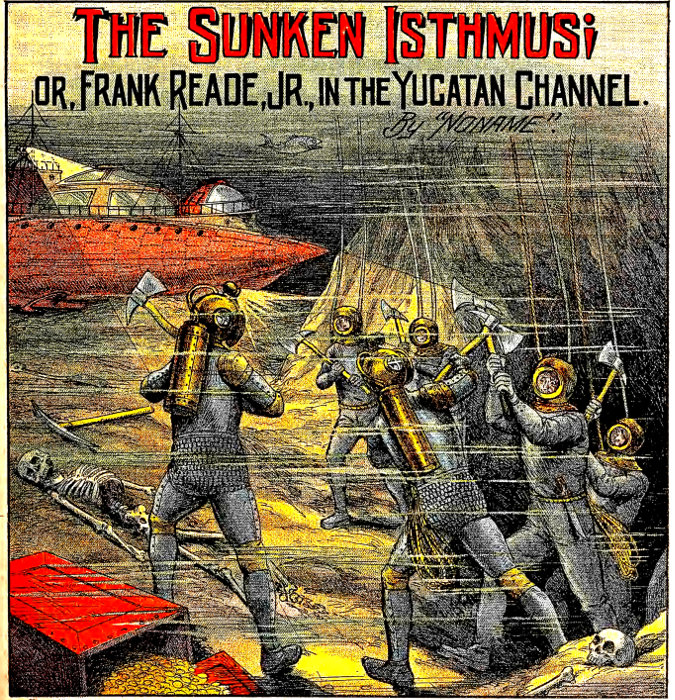
THE SUNKEN ISTHMUS; OR, Frank Reade, Jr., in the Yucatan Channel.
Transcriber’s Note:
The cover image was created by the transcriber and is placed in the public domain.
| Issued Weekly—By Subscription $2.50 per year. Application made for Second-Class Entry at N. Y. Post Office | ||
| No. 92. | NEW YORK, JULY 29, 1904. | Price 5 Cents. |
| No. 92. | NEW YORK, JULY 29, 1904. | Price 5 Cents. |
CONTENTS
| CHAPTER | I. | WHICH IS INTRODUCTORY. |
| CHAPTER | II. | IN WHICH THE PROJECT IS UNDERTAKEN. |
| CHAPTER | III. | AT THE BOTTOM OF THE SEA. |
| CHAPTER | IV. | A WONDERFUL NARRATIVE. |
| CHAPTER | V. | A BOLD ESCAPE. |
| CHAPTER | VI. | THE SUNKEN ISTHMUS. |
| CHAPTER | VII. | A SERIOUS CATASTROPHE. |
| CHAPTER | VIII. | THE VILLAIN OUTWITTED. |
| CHAPTER | IX. | THE SUNKEN CITY. |
| CHAPTER | X. | AT THE TREASURE CAVE. |
| CHAPTER | XI. | POOLE PLAYS A NEW CARD. |
| CHAPTER | XII. | A TURNING OF TABLES—THE END. |
CHAPTER I. WHICH IS INTRODUCTORY.
By looking at any comprehensive map it can be readily seen that upon the western end of the Island of Cuba there is a cape known as San Antonio.
Opposite it and upon the eastern extremity of mystic Yucatan is Cape Catoche. Between these two points of land lies that body of water which connects the Gulf of Mexico with the Caribbean Sea and known as the Yucatan Channel.
Mr. Wilbur Wade, the distinguished archæologist, geologist, naturalist and scientist in general, had startled his associates of the World’s Geographical Society by a positive and unheard-of statement.
“I have made very careful soundings in the Yucatan Channel,” he said; “also I have compared the strata of the two capes, and it is my firm belief that at a period not so very remote there existed no channel between the two points of land. In fact——”
“Then you claim the existence of an isthmus between Cuba and Yucatan at some time?” interrupted Professor Brown.
“Just so,” agreed Mr. Wade.
“What has become of it, I would like to ask?”
There was just a bit of cynicism in this query. But then these two men had never been the warmest of friends. Wade bit his lip.
“What do you suppose has become of it?” he retorted. “Surely you don’t think it has taken wings and flown away?”
“But you were going to prove the matter to us,” returned Professor Brown, with a bit of sarcasm.
“If it is not an impossibility,” said Mr. Wade, ironically, “my opinion is that the isthmus is at present at the bottom of the Yucatan Channel.”
A number of the scientists moved in their seats. Professor Brown smiled broadly.
“A very simple matter to look at,” he said, pointedly. “Of course, it will be easy to furnish absolute evidence?”
Mr. Wade turned a cold stare upon the man who could speak so insultingly. Then he said:
2“Before I allow the fact to go upon record I shall prove it.”
“Then we shall have an isthmus between Labrador and Greenland; another ‘twixt Japan and Corea; still another between Sicily and the Italian Peninsula, and again——”
“One moment,” said Wade, politely. “You must remember that there is nothing improbable in any hypothesis you have named. If I am not able to prove myself right, you are not able to prove that the sunken isthmus never existed. I leave it in all fairness to our fellow-members.”
There was a slight murmur of approval, but there was yet incredulity.
“How do you expect to prove that there was once an isthmus between Cape San Antonio and Cape Catoche, may I ask, Mr. Wade?” spoke the chairman.
Mr. Wade drew himself up.
“By the only possible method,” he replied. “I shall visit it.”
The scientists all looked surprised. Professor Brown actually laughed out loud and slyly tapped his forehead. Finally the chairman said:
“Really, Mr. Wade, you must allow that that is quite a remarkable assertion. In what manner can you expect to visit this—this imaginary sunken isthmus?”
Wade’s eyes flashed.
“Imaginary if you will,” he said; “I shall conduct my investigations with a submarine boat.”
There was a great stir in the assemblage. Even Professor Brown forgot to interject his sarcasm.
“In a submarine boat?” repeated the chairman. “Does such a craft exist?”
“It does!” replied Mr. Wade, suavely. “And a very dear friend of mine is the inventor and owner.”
“His name?”
“Frank Reade, Jr., of Readestown.”
A murmur went through the throng. At once the sentiment began to change. Professor Brown faded from view.
Not one in that distinguished company but had heard of Frank Reade, Jr. His name changed the tide.
“Indeed!” exclaimed the chairman, with interest. “Is not Mr. Reade the inventor of an airship?”
“Yes, sir.”
“And of other wonderful things?”
“Exactly.”
“So he has built a submarine boat?”
“He has, and it is a success. He has kindly consented to assist me in locating the sunken isthmus. This boat is capable of remaining weeks under the sea. The plan cannot fail.”
In a moment dozens of the men were thronging about Wade, congratulating him heartily. Skeptical they were no longer. Foes a moment back, now they were fawning friends. Truly, nothing creates friendship like one’s success.
He was at once the lion of the hour. Scores of requests were showered upon him. Would he procure such a specimen? Would he solve such a marine problem? Was there any room on board the Sea Diver for another savant?
Et cetera, et cetera.
One still incredulous man ventured to ask:
“Will not the sunken isthmus be like all the rest of the bed of the sea? How will you prove it was ever above the surface?”
“If an isthmus did exist in that locality,” said Wade, logically, “there must have been habitations upon it. Probably I shall find ruins of a village, town or city, or remains of forests or craters, or river beds. There will be plenty of evidence if there ever was an isthmus.”
Wade went to New York from Washington on the night train. As he was whirled away upon the fast express he felt that he had really gained a great victory.
“I silenced that old hard-skull, Brown,” he muttered, with keen satisfaction. “And he deserved it.”
I know the reader will agree with Wade in this. That night he consumed in getting back to his Manhattan home.
The next day he packed his effects and started for Readestown.
Deep down in the heart of lovely hills upon a river navigable to the sea was the beautiful little city of Readestown.
A number of generations of Reades had lived there, and all had been inventors. But Frank Reade, Jr., the handsome young scion of the race, had proved the most famous of all.
The fact was, everything he took hold of succeeded.
It was bound to “go,” and with a snap and vim characteristic of the young American.
In undertaking the construction of a submarine boat Frank had hit upon that which had been an enigma to thousands of inventors.
But his marvelous ingenuity won the day and he triumphed.
The Sea Diver was conceived, outlined, charted and built. Then she was tested and proved an unqualified success.
In her outline the Sea Diver was long, slender and cylindrical, 3in the shape of her hull. This rested upon a deep keel to insure steadiness, which was a highly important matter.
The hull of the submarine boat was constructed of plates of steel, closely riveted. Above the cigar-shaped hull there was an open deck, extending from stem to stern.
In the center of the deck rose the dome, with the skylight and great observation window. Under this was the luxuriously-appointed cabin.
Just forward of this dome was the pilot-house, a smaller dome with heavy plate-glass windows. Here the steersman could direct the course of the boat and operate the electric keyboard which directed the vessel’s engines, for the motive power of the Sea Diver was electricity, furnished by a wonderful storage system.
Aft there arose a square structure with bull’s-eye windows, with a railed quarterdeck above it. This was called the after-cabin, and here were the staterooms and living quarters of the submarine travelers.
On this quarter deck there was a powerful searchlight, capable of a reach of fully two miles.
The interior of the Sea Diver lacked nothing in the way of equipment and appointment.
There were supplies of all kinds aboard for a cruise of two years.
Amidships and under the big dome were the wonderful electric engines, by means of which power was furnished for all the mechanism of the boat.
In the pilot-house was the electric keyboard. Here were the various little buttons and brass levers by means of which the doors and windows could be hermetically sealed, the huge tank filled with water instantly for the sinking of the boat, or again for raising it by the expulsion of the water with pneumatic pressure.
Thus the boat could be made to sink or rise at any desired depth; to go forward or back at the pressure of a button.
As wonderful as anything was the system of circulation by means of chemically-made oxygen. Under the pilot-house there was placed a generator which was capable of manufacturing pure oxygen, and also of extracting and destroying the bad air or gases as fast as they were created.
Little pipes and open valves extended to every part of the boat through which the oxygen was continually disseminated, so that the submarine boat might remain an indefinite time under water and the voyagers could be sure of breathing pure air all the time.
In fact, not a detail was lacking to make the Sea Diver a safe vessel, a comfortable home and a symmetrical, beautiful craft.
It was true that Frank Reade, Jr., had done his best to perfect the new submarine boat.
That he had been successful it was easy enough to see. Nobody had more confidence in him than his friend, Mr. Wilbur Wade.
The scientist was ready to embark upon a voyage to any part of the submarine world without considering for a moment the possible perils of such a thing. He was a firm believer in the practicability of submarine navigation, and the seaworthiness of the new boat.
CHAPTER II. IN WHICH THE PROJECT IS UNDERTAKEN.
Mr. Wade reached Readestown in due time. He proceeded at once to a hotel and ate an early breakfast.
Then he called a carriage and rode down to the machine shops of Frank Reade, Jr. At that early hour he did not feel certain of meeting the young inventor.
But at the gate there was a sawed-off, comical little darky, who scraped and bowed and said:
“Yes, sah; I done reckon Marse Frank been lookin’ fo’ yo’ fo’ two days, sah. He am in his office, sah. Show yo’ in, or does yo’ know de way?”
“I know the way, Pomp,” said Wade, alighting from his carriage. “I’ll find him.”
Across the machine shop yard he went rapidly. He was about to enter a small brick building by a half-open door when a man came out.
He was a genuine type of Irishman, with comical mug, dancing blue eyes and a shock of red hair. He stopped at sight of Mr. Wade and exclaimed:
“Begorra, and I belave that is the gintlemin himsilf. Top av the day to ye, sor. Is yer name Misther Wade, sor?”
“It is,” replied the scientist. “And you are Barney?”
“Yis, sor; an’ I was jist on the way to the tillygraph office wid a message from Misther Frank for yez, sor. Shure, there’ll be no use av sindin’ it now.”
“Then he was about to wire me?”
“Yis sor?”
“Well, I must have kept him waiting,” declared Wade. “I will go right in and see him.”
“That’s roight, sor.”
Wade passed through a narrow hallway and entered a 4square, high-ceiled room, hung with curious looking charts and diagrams. A large table was also covered with the same.
At this sat a handsome young man, with a rare type of intellectual features, and the air which belongs to a brainy man.
“Wade!” he exclaimed, putting out his hand. “I was just going to wire you.”
“So I learn,” cried the scientist. “I am more than sorry if I have delayed you.”
“That is all right; you are quite ready for the start?”
“Yes.”
“Good! The Sea Diver is all equipped, and lies out there in the tank. All we have to do is to go aboard, run her down the canal to the river, and be off.”
“For the Sunken Isthmus?”
“Just so.”
“If it exists.”
“At any rate, we shall have a submarine voyage; but there is good reason to believe that it exists.”
“So I believe, though my fellow-members of the World’s Society are a bit incredulous. We had quite an argument at the last session.”
“Ah!”
“But when I informed them that I was going to visit the spot in a real submarine boat, they thought I was daft or gone mad until I mentioned your name. That was like magic.”
Frank laughed.
“Do they know me?” he asked.
“Indeed, yes, as the inventor of the airship. That settled a large measure of doubt in their minds right off. Then there were those who desired to share our fortunes.”
This amused Frank muchly.
“No doubt of it,” he laughed. “They began to see the elements of success in your project. You can afford to snub them well, whether the isthmus is discovered or not.”
“Well,” said Wade, with a thrill of pleasure in his voice, “I look forward with the keenest of pleasure to exploring the waters of the Yucatan Channel. I am in complete readiness to start.”
“Very good,” said Frank; “we will go on board to-night and start with the early morning light. The Sea Diver lies in the tank, all ready. Shall we take a look at her?”
“With pleasure,” replied Wade.
They left the office and crossed the yard to a gate. Passing through this, another and larger yard was seen. In the center of this was a large basin or tank of water.
And in it floated the new submarine boat.
5The tank was connected by a series of locks with a canal which led down to the river. It was thus an easy matter to sail direct from the factory yard for any part of the world.
Frank and Wade went on board the submarine boat. The latter picked out his stateroom and made other necessary arrangements. Then he said:
“I will go back to the hotel, Frank, and get my trunks. Then I will take up my quarters permanently aboard the Sea Diver.”
“Very good,” agreed Frank. “We will sail at an early hour in the morning.”
After Wade had gone, Frank called Barney and Pomp. He told these two servitors of his purpose, and added:
“You must be all in readiness; there must be no delay.”
“All roight,” cried Barney, as he ducked his head and threw a handspring; “it’s mesilf as will be there, sor.”
“Golly, dis chile neber miss de chance, Marse Frank,” cried Pomp, cutting a double-shuffle.
These two comical characters had been associated with all the thrilling experiences of Frank Reade, Jr., in his world-wide travels.
Barney and Pomp were his faithful companions, and he would hardly have been able to fill their places. Barney was an expert engineer and electrician, and Pomp was the prince of cooks and a generally handy man.
They were excellent company, and Frank never felt at a loss for entertainment while in their company. He could ill have spared Barney and Pomp.
Barney and Pomp were the best of friends in all things, but each was as full of fun as a nut is of meat. Consequently there was nothing they enjoyed more than a rough and tumble wrestle or the playing of a practical joke.
If half the things they said to each other could have been taken seriously, there would have been good ground for a duel at most any time. But they knew better.
So there were to be four people in the crew of the Sea Diver. Besides Barney and Pomp, there were Frank Reade, Jr., and Wilbur Wade.
All were on board the boat that night and all was in readiness for the early start. It is safe to say that none in the party slept much that night.
Barney and Pomp were first astir.
As they made things ship-shape and breakfast was announced by Pomp, Frank and Wade came tumbling out. Then, after a light meal, Frank went into the pilot-house.
There were men on hand to open the locks and the 6boat was locked down into the canal. Thence it glided on down into the river.
It was an easy matter for Frank to place his finger upon an electric button and direct the course of the boat where he chose.
When they emerged into the river they were surprised to see a great throng upon the river banks. Thousands of people were there gathered to get a look at the new submarine boat.
They cheered vociferously as the Sea Diver appeared. Down the river the submarine boat glided.
Soon Readestown was left behind. Other towns were passed, and in due course the river widened and the open sea was spread out to their view.
The great submarine cruise was really begun.
Out into the Atlantic the Sea Diver ran. Frank still kept her to the surface.
For he knew that she could travel faster and easier there. There would be enough deep-sea traveling later on.
The course of the Diver was set for the Gulf of Mexico.
Land faded quickly from view and soon only the boundless expanse of the sea was on every hand. The horizon was at times dotted with sails, and once one of the vessels in passing spoke the Sea Diver.
For two days the submarine boat kept her southward course. Then one morning as the voyagers tumbled out on deck Frank noted that the wind was in the east and was beginning to kick up a nasty sea.
The little boat rode the water like a cork. There was no question as to her seaworthiness.
But great, lowering clouds overhung the sky and pattering drops of rain fell. Distant vessels were seen scudding under bare poles.
“It’s my opinion,” said Wade who was something of a sailor, “that we are going to have a big blow.”
“I agree with you,” said Frank.
“However, I reckon the Diver is well able to cope with any such a storm?”
“Indeed, yes,” said Frank. “If it gets too rough on the surface we can take a trip below.”
“Sure enough; we would never feel the storm there.”
“It is hardly likely. Heigho! What is that? On my word, I believe those were signals of distress!”
Frank pointed to a distant vessel which had the appearance of a large schooner-yacht. There was no doubt but that the signal of distress was at her masthead.
“She’s in trouble, surely,” cried Wade. “Can she have struck a leak?”
7“Begorra, she’s carryin’ too much sail fer the loikes av this breeze,” cried Barney. “Shure, it’s crazy they are!”
This was true. The schooner carried every rag of canvas. This was plainly a reckless thing.
It looked as if the crew were panic-stricken, or else ignorant of the proper course of safety. Certainly the yacht was in a dangerous strait.
The submarine voyagers were in a bit of a quandary. What should they do?
Humanity dictated that they go to her assistance. Prudence, however, asserted the policy of keeping away from her.
There was no means of knowing how many were in her crew. They would doubtless have to leave the schooner and would all pile aboard the Sea Diver. This would be a perilous thing for the submarine voyagers. Moreover, what would be done with them?
Frank reflected some moments, then he said, with sudden resolution:
“Humanity demands it. I cannot conscientiously refuse to give them aid.”
“That’s right,” cried Wade. “We ought not to hesitate.”
Frank stepped into the pilot-house, but even as his fingers touched the keyboard a warning cry came from Wade.
“It is too late,” he cried.
CHAPTER III. AT THE BOTTOM OF THE SEA.
This startling announcement of Wade’s caused a chill to traverse Frank’s frame. He shot a hasty glance at the distant vessel.
Then he saw the startling scene which had induced Wade’s declaration.
The storm had swooped down upon the schooner like a foul fiend. One brief glimpse of her fate was had.
She was seen to keel over with the force of the blast. Then her sails were in ribbons and her foremast snapped like a pipestem.
The next moment she was on her beam-ends. Then the black cloud shut her from view.
The next moment the storm struck the Sea Diver. What followed was ever after like a dream.
The hurricane almost blew the staunch little boat out of 8the water. Enormous seas were hurrying and crashing over her deck.
Frank had ordered all into the cabin, and the doors and windows were closed hermetically. But the shock of the storm threatened to dash the little craft to pieces.
Frank saw the possibility of much damage being done, so he cried:
“Stand by the engines, Barney, I am going to send the boat down.”
Frank pressed an electric button. In a moment the Sea Diver sank below the surface.
Down she settled, and for a moment all was darkness aboard her. Then Frank pressed a small button.
In a moment every electric light aboard was in full blast. A wonderful scene was spread to view.
The depth of the sea at this point was not more than one hundred and fifty fathoms, so that the voyagers very quickly came in sight of the bottom.
Unlike the bed of the Pacific or the Indian Oceans, the Atlantic is mostly devoid of coral reefs or reaches of white sand.
There was a vast area of mud and slime, with some few marine plants spread to view. Huge serpent-like eels wriggled through this, and myriads of dark-hued fish scurried away rapidly.
The scene was a sombre and by no means attractive one. Wade was not much impressed.
“Pshaw,” he exclaimed, in sheer disappointment, “so this is the home of the mermaid and the charm of the deep sea, of which we read such alluring accounts? Ugh! What a disillusion!”
“Ah, but this is not a type of deep-sea regions,” replied Frank. “This is a dirty part of the Atlantic, but before we return I think you will see some beautiful sights. We shall find it different in the Caribbean.”
“I hope so,” replied the scientist, with disgust. “Certainly this is a horrible conception of deep-sea life, but I cannot help thinking of that vessel. Do you suppose she is weathering the storm?”
“It is a question,” replied Frank. “She was in very bad shape. However, let us hope that she will.”
“Amen to that. Is there nothing we can do to give her aid?”
“I fear not; at least until the storm abates.”
“She may be at the bottom by that time.”
“That is possible. If afloat, however, she will be crippled and sorely in need of aid.”
The Sea Diver did not rest upon the muddy bottom, but was held in suspension about twenty feet from it. Frank’s 9purpose was to return to the surface as quickly as possible after the abating of the storm.
After an hour had passed it was ventured to ascend. Frank took the wheel of the Diver and held her steady.
Up she went.
Soon she felt the motion of the sea’s surface. It was not rough, and Frank concluded that the hurricane had passed.
So he let the Diver leap up into daylight. The electric lights were shut off at the same moment.
Eagerly the voyagers swept the rolling expanse with their eyes. Not a sign of the schooner or any other vessel could be seen.
“She has gone to the bottom,” gasped Wade; “her fate is sealed!”
So it seemed. Frank procured his glass and scanned the vast expanse. He closed it, finally, saying:
“She has either gone down, or else the storm has blown her beyond our range of vision.”
“Do you believe the latter possible?” asked Wade.
“It is very likely.”
“I don’t know why it is,” said the scientist, “but I am mightily interested in that vessel. I would like to know her fate for a certainty.”
“Indeed!” exclaimed Frank, with some surprise. “Why more interested in her than any other craft we might meet?”
“I can hardly tell,” replied Wade, “but it is a certain fact that I am. I have some sort of a curious feeling that our career is in some manner intertwined with hers.”
Frank could not resist a laugh.
“Moonshine!” he said. “Your imagination is getting the best of you, Mr. Wade.”
The scientist shook his head.
“It may be all nonsense,” he said, “but we shall see.”
The sea was yet a trifle rough. The hurricane had swept away beyond the horizon and was quite out of sight.
The Sea Diver once more stood away on her course. In a little while matters had assumed the usual routine.
Barney was at work slushing the deck to get rid of the accumulation gained by the boat’s submersion. There were heaps of seaweed, great masses of jellyfish and other forms of marine life.
Pomp was in the galley preparing a smoking repast. He had opened a window to admit air, and Barney chanced to pass near it.
It was an ill moment for the Celt.
Pomp had mixed some dough for bread a short while before, and now had discovered that the yeast was unfit 10for use, and the bread as a result, was spoiled. This put the darky out of temper.
“I don’ see wha’ was de mattah wif dat ar yeast,” he grumbled. “Kain’t seem to do nuffin’ wif it. Dere am all dat dough sp’iled. It meks me berry mad. Well, dere’s one fing it can make food fo’, an’ dat am de fishes. So here goes!”
The coon picked up the huge mass of dough and hurled it through the open window. He expected that it would land far out in the water. But it didn’t.
As luck had it, Barney was just passing that way. He came in a line with the window just in time to get that soft, sticky mass full in the side of the head.
The soft dough split around his skull, with such force did it strike him, and stopped his ear, nostrils and eyes. The Celt went down as if struck by a cannonball.
For a second he was unable to realize what had happened. Pomp was for that brief instant aghast.
“Massy Lordy!” he muttered; “I done hit somebody!”
Then he ran to the window and looked out.
When he saw who it was and noted Barney’s comical plight he could not help but roar with laughter.
The Celt scrambled to his feet. His mop was at one end of the deck and his pail of suds at the other.
“Tare an’ ‘ounds!” he roared, as he put up his hands and felt the mass of soft dough, not knowing what it was, “it’s me brains they’ve knocked out av me! Howly murther! It’s kilt I am! It’s kilt I am!”
Then he chanced to uncover one eye and saw Pomp in a paroxysm at the galley window. He glanced down at his hand, which was full of dough.
Well, the transition was brief. A madder Irishman old Neptune never bore upon his heaving bosom.
With angry hands Barney tried to claw the dough from his mop of red hair. Of course, it only clung the worse.
He managed to get his eyes clear and his ear, then he made the air blue about him.
“Howly shmoke, but I’ll have the heart av yez fer that!” he roared, “yez black-skinned ape, yez! Have at yez! I’ll tache ye to insult a gintlemin!”
“Hi—hi—hi! Massy Lordy!” howled Pomp, “dat am de berry funniest fing!”
“Yez think it funny eh?” roared Barney. “Well, yez won’t think that way whin I git done wid yez!”
“Ho—ho—ho! hi—hi—hi!”
“Phwat do yez mane by threating me thot way?” roared Barney, trying to claw the dough out of his hair.
“How yo’ fink I know yo’ was gwine to get hit?” cried Pomp. “Wha’ yo’ git in de way, fo’?”
11“Do yez mane to say yez didn’t throw that on purpose?”
“Course I didn’. I was goin’ to frow it into de sea when yo’ head cum along an’ jes’ got in de way.”
“Arrah, an’ that’ll do very well fer yez to say,” cried the Celt, “but if yez think I belave it——”
“Shuah, it’s de troof,” protested Pomp.
“I’ll tache yez to hit me wid a doughball an’ thin lie about it aftherwards,” roared the Celt. And then he made a dive for the window.
But Pomp clashed it shut in his face. The Celt rushed around to the galley door.
But the darky shut the bolt in this, and for the time was master of the situation. But, though baffled, Barney was not defeated.
He retired, vowing the direst of vengeance. It took an hour’s hard work to get the clinging dough out of his hair.
Nor did he get any sympathy from any one. When Frank and Wade heard the story they laughed heartily. This made Barney only the madder.
“Be me sowl!” he muttered, “I’ll more than aven it up wid that black rascal. Shure, I’ll tache him manners!”
How Barney accomplished his purpose we shall see at a later day.
The Sea Diver kept on its course for the rest of that day.
Night finally shut down, dark and moonless. But with the searchlight it was easy for the Diver to travel, with no fear of a collision.
She was rapidly nearing Key West, and would the next day be in Gulf waters. The air was fresh and delightful, and the voyagers sat out on deck until a late hour.
While thus enjoying themselves, suddenly Barney sprung up.
“Shure, sor!” he cried, motioning to Frank, “there’s a lot of colored loights over there. Phwat do yez make av it?”
“A vessel in distress!” exclaimed Frank, as he scrutinized the distant signals. “Do you suppose it was our schooner?”
CHAPTER IV. A WONDERFUL NARRATIVE.
Perhaps the most startled member of the party was Wilbur Wade. He rushed to the rail, straining his gaze in the direction of the signal lights.
12“I knew it would come!” he cried, excitedly. “I was sure we had not seen the last of that schooner.”
Certainly some vessel, distant but a few miles, was flying signal lights of distress.
The submarine voyagers would have been inhuman, indeed, not to have responded. The Diver’s prow was turned toward the lights.
Rapidly she drew nearer, and the searchlight was focused upon the vessel. Then there was a cry of recognition.
“I told you so!” cried Wade, eagerly; “it is the schooner!”
Nearer the Diver rapidly drew. When within fifty yards of the disabled schooner there came a loud hail:
“Steam yacht ahoy!”
“Ahoy the schooner!” replied Frank.
“What yacht is that?”
“This is not a yacht.”
“Oh, a torpedo cruiser, eh?”
“No,” replied Frank; “this is the submarine boat, the Sea Diver, Captain Frank Reade, Jr., of Readestown, U. S. A.”
There was a moment’s silence.
Then a surprised voice said:
“A submarine boat? Do you mean that literally?”
“I do,” replied Frank.
“Well, that beats me! Where are you bound?”
“Before I answer any more questions,” shouted Frank, “let me ask you a few.”
“All right.”
“What craft are you?”
“This is the schooner-yacht Meta, of the American Yacht Club, Captain Hardy Poole. We are bound for the Yucatan Channel, but this storm has taken away our foreyard, and we want to strike some vessel which carries a spare one.”
“Are you in distress in any other way?” asked Frank.
“No.”
“Well, then, we cannot help you. We wish you success and good-night.”
“Wait!” shouted the captain of the schooner; “don’t leave us yet. I am interested in your statement about your craft. I will send off a boat to bring you aboard. Perhaps I can tell you something of interest.”
Frank was surprised.
“What do you mean?” he asked.
“I will explain later. Look for our boat!”
Frank hesitated a moment. Then he turned to Wilbur Wade.
13“What can he desire to see us about?” he asked. “Is it worth while to wait and ascertain?”
“Oh, by all means!” cried Wade. “Don’t you remember what he said? He is also bound for the Yucatan Channel!”
“That is so,” exclaimed Frank, with sudden recollection.
“I tell you, this schooner is in some way bound to become involved in our project. Some strange presentiment has told me that!”
“It is quite a coincidence,” muttered Frank. “Yet I cannot see how his trip to the channel can in any way affect us.”
“We shall see. I would like to go aboard the schooner with you, Frank.”
“Certainly.”
Frank stepped into the pilot-house and gave Barney orders to lie by and wait for their return. Then he put on a light overcoat, as did Wade, and they were ready for the visit.
Very soon a dark object came bounding over the waves toward them. It was the yacht’s boat.
Presently it reached the gangway of the Diver.
“Ahoy!” came the hail; “this is the Meta’s boat waiting for Captain Reade.”
“All right,” cried Frank, as he slid down into the boat. He was followed by Wade.
A moment later four strong oarsmen were rowing them rapidly over to the yacht.
Once alongside it was an easy matter to mount the gangway and meet the captain of the Meta awaiting them at the rail.
He was a tall, powerfully framed man, and in the glare of the lanterns he was seen to be possessed of a dark, stern cast of features. Frank’s first glance was not exactly a favorable one.
He shook hands.
“This is Mr. Reade, I presume?” asked the captain of the yacht.
“It is,” replied Frank. “And this, I presume, is Captain Poole? I have brought my friend, Mr. Wilbur Wade, with me.”
Poole gave Wade a critical glance.
“You are both welcome,” he said. “Come into the cabin.”
Without further ceremony they followed the schooner’s captain. The cabin of the Meta was richly furnished.
But both Frank and Wade noted one curious fact.
Every man of the schooner’s crew, and even Poole himself 14carried arms. They wore belts and revolver pouches.
In these piping times of peace—and certainly in these seas—this could but be regarded as very strange. To the visitors it even had a sinister look.
On their way to the cabin Wade had an opportunity to whisper to Frank:
“Did you note those pistols?”
“Yes,” replied Frank.
“Are they cranks or pirates?”
Frank could hardly restrain a laugh.
“It is very mysterious!” he said. “Keep your eyes open. We will soon find out what it means.”
As they entered the cabin Poole motioned them to seats at a table. He sat opposite.
He was now plainly revealed in the glare of the cabin lamp. As his visitors thus got a good look at him, each experienced a peculiar sensation.
It seemed almost like a chill.
In all his life Frank thought he had never seen a man of such remarkable appearance.
His features were long and almost cadaverous. His eyes dark and piercing and burning with a strange light. He wore a sharp imperial and pointed mustache, with a saturnine smile which gave a truly Mephistophelian appearance.
In plain terms he was out and out the thorough type of the villain. Such both Frank and Wade adjudged him.
For a moment they sat there facing this strange being, who seemed like a portrait from a piratical past. Poole’s shifty gaze roamed over them, and then he spoke:
“I am honored by this visit, Mr. Reade. It is certainly fate which has thrown us together in this way, for I am very sure that we may be of mutual service to each other.”
“Indeed!” said Frank, with a little surprise; “I shall be pleased to know just how.”
“First I must tell you a story,” said Poole, with a crafty smile. “It concerns my mission and the character of my yacht and crew.”
“Really——”
“That is all right. I know that you have not failed to size up our peculiar appearance. Is it not true that we bear the appearance of latter-day pirates?”
“Why—I—I—had not thought much about that,” stammered Frank.
“Ah, yes, you have. It is not usual for people to go armed in these times. The days of Morgan, the rover, and Kidd, the buccaneer, are long past; yet we are seen emulating them.”
Frank and Wade were speechless. They could do nothing but stare at the speaker.
15He smiled in his saturnine way.
“Fear not,” he said, in his cool, almost impudent way. “I have not entrapped you, nor decoyed you on board this yacht for any nefarious purpose. Your statement that you were the possessor of a submarine boat has interested me, and I have a remarkable proposition to make. But first to my story:
“I am a native of Sicily, though an American by extraction, that is, I was born in that island, of Yankee parents. I was some years ago the possessor of a large fortune, but Monte Carlo and a fast life soon dissipated it.
“I had a half-brother, by name Alfonso, my father having married a Spanish lady. We were never good friends. We quarreled at every available opportunity.
“Despite this, Alfonso came to me when we were both penniless and begging for alms in Naples. He was a rogue, was Alfonso, but had no head for scheming. He assured me that he was on the track of a fortune.
“He produced a tin box, containing an ancient chart which had been an heirloom in his mother’s family. It was a map of an isle in the sea and described the location of a buried treasure upon that isle. Millions in Peruvian gold had been buried there by a buccaneering ancestor. But, alas! the latitude and longitude was so obscurely marked that it could not be deciphered.
“If there was any way to make that out, then the location of the treasure might be established and a fortune reaped. Alfonso had great faith in my sagacity, and deemed it possible that I might accomplish what others had failed to do. So he brought the charts to me.
“And he was right. I puzzled over the figures for a long time. Then I experimented with chemicals. I at length found a certain one which, by soaking the vellum, raised the obliterated figures and made them perceptible to the eye. By studying the map I learned that the gold was buried upon the Isle of Mona, in the Channel of Yucatan.
“We were half insane with our discovery. But for a time it seemed as if it would avail us naught.
“To reach the isle we must have a ship, and a crew of sworn and trusted men. For a long time we were in a quandary. But at length we found Signor Barboni, a merchant of Palermo, who lent us his assistance. A small ship was fitted out secretly and we sailed, nine men of us, Alfonso and Barboni.
“In due course we reached Mona. We landed at once and began to search for the treasure. And here was our grand mistake.
“We had traced our way into a rocky cavern. Digging in 16the sand we had, as we believed, almost reached the gold. A bit of earthen pottery was thrown out and a coin found, when a reverse came.
“Suddenly there descended upon us a hundred or more savage Caribs. A terrible battle ensued.
“We were not effectively armed, and the odds were tremendous. My brother Alfonso was brained by one of the savages. Signor Barboni was the next victim. We fought our way to the surf, and only three of us, covered with wounds, reached the ship.
“We spread sails to get away from the accursed place. A calm was on the sea, however, and there we lay until nightfall. Then a terrible thing happened.”
CHAPTER V. A BOLD ESCAPE.
Poole paused a moment, huskily. He arose and took down a decanter and glasses.
He filled and offered them to his visitors. They sipped the wine. He took a copious draught and then went on:
“Somewhat curiously, the Caribs did not come out to our boat to attack us. If they had we must have yielded easily.
“But we soon learned the reason why. They were treasure-mad. With our picks and shovels they had dug up the gold and were fighting over it like wolves.
“As darkness began to shut down the sea began to experience a strange motion. A dull, cannon-like roar came out of the west. Then we witnessed a terrible phenomenon.
“The waters rose like a mighty flood over the isle. At least that was the way it looked. But instead it was the isle which sank into the sea.”
Frank and Wade each drew a deep breath.
They had been intensely interested.
“Then,” continued Poole, “we had hard work to save the ship, but we made out to live through the vortex, and having fair weather worked the ship into the port of Havana.
“Here we sold her and returned to Paris. I separated from my companions. Monte Carlo drew me into its grip once more, and one night the devil aided me and I broke the bank.
“My first fate was to succumb to the treasure fever. I bought this yacht and fitted it out with a view to making 17a fighting vessel of it. This time I was bound to have means of defense in case of attack.
“My men are picked and trusty. They are all bound to me by the most powerful of oaths. I have every sort of diving apparatus aboard. In this manner I have hoped to recover the treasure. This is my story.”
Neither Frank nor Wade spoke. There was silence for a moment. Then Poole said, in a metallic voice:
“If you have a submarine boat it will be of more service to me than to you. How will you trade it for this yacht? Name your price!”
Frank met the other’s gaze steadily, and replied:
“I do not care to exchange.”
Poole’s face grew livid.
His hand instinctively went to his belt. He said:
“Oh, I can see your game. You will easily recover the treasure yourself of which I have told you. But I may as well tell you now that game will not work. You cannot leave this cabin alive unless you come to terms!”
It was a thrilling moment.
Wade’s face paled.
But Frank was as cool as an icicle.
“That is a strong statement,” he said. “Only a pirate would make it.”
“As you please,” said Poole, carelessly. “I claim the treasure, and it shall be mine!”
“For all of me, you can claim it and recover it,” said Frank. “We are not hunting for treasure.”
It was Poole’s turn now to look utter astonishment.
He sank back in his chair and looked cunningly at his visitors.
“Where are you bound?”
“To the Yucatan Channel,” replied Frank.
“On what errand?”
“A purely scientific one. My friend here, Mr. Wade, is a member of the American Scientific Society and claims that at one time an isthmus existed between the points of Cape San Antonio and Cape Catoche. To prove the matter we propose to explore the deep sea in that vicinity.”
Poole drew a deep breath.
His eyes glittered.
“Mona was upon that parallel,” he said. “You will be sure to locate the treasure that belongs to me; I claim it by right of prior discovery. Of this I warn you!”
“Claim it, and be hanged!” said Wade, with disgust. “Come, Frank, let us go back.”
Both men arose.
But Poole drew a brace of pistols and placed his back against the cabin door. He looked ugly.
18“You shall not leave here until you have given me your oath,” he said.
“You will obstruct us at your peril,” said Frank, very quietly.
“I seem to have the best of the situation just now,” said the villain, showing his white teeth.
“What sort of an oath do you require us to give?” asked Wade.
“You must swear that you will not touch the sunken treasure of Mona,” said the villain, intensely. “You look like men of honor. If you give me your word, you will be likely to keep it.”
“We will give our word,” replied the scientist. “Eh, Frank?”
“Certainly,” replied the young inventor.
Poole studied their faces a moment closely. Then the lines of his face relaxed.
“You will pardon the trouble I have put you to, gentlemen,” he said, “but I am gold-mad. I must have the treasure! I cannot be balked in my purpose!”
“Well,” said Wade, “we have agreed to your terms.”
The villain smiled.
“There are other things,” he said.
Frank’s eyes flashed. He drew his lithe form up.
Wade looked disappointed and not a little alarmed that his temporizing had not been a better success.
Poole fixed his keen gaze upon the two men and continued:
“You have the power to visit the depths of the sea. If Mona is sunk too deep our diving apparatus must fail. Since you will not trade or sell your boat, I must charter it for the purpose of bringing up the gold. I will pay you well for the service—yes, I will give you a fifth of the treasure. Come now, is not that fair?”
For a moment Frank Reade, Jr., was so overwhelmed with scorn that he could not speak. When he did recover his voice it was metallic and raspy.
“My friend,” he said, “you labor under a wrong impression. We are not fools; neither are we to be cajoled or bullied. If you had come to me in an honorable, open manner I would not have refused the favor, but as it stands, I would not grant it to you for any consideration. We are going back to our boat. Be so kind as to unbar that door.”
In spite of his pretended advantage the villain quailed before Frank’s eagle gaze and commanding manner.
He moved uneasily, then took up a whining tone:
“Now, come, my friend, don’t be unreasonable. I didn’t mean those threats. You shall not be sorry.”
19Frank took a step forward. The fellow raised one of his pistols. Quick as lightning Frank grabbed his wrist and then with a downright blow of his other hand, dashed the other pistol from his grip. At the same moment he drew back and hurled the villain from the door. It was done in the twinkling of an eye.
Poole himself was astounded at the ease with which Frank accomplished this. His murderous spirit at once flamed up.
“Curse you!” he hissed. “I’ll have your life for that!”
He wrenched his hand free and raised the pistol left him. But like a flash Wade brought his fist down upon the villain’s hand and dashed the weapon to the floor.
Then the scientist proved that he could fight as well as solve geographical problems. With a leap like a panther he had clutched Poole’s windpipe.
Frank came to his aid, and together they bore the villain to the cabin floor. He could make no outcry, and, furious though he was, could not act.
Could he have made an outcry, or a signal of alarm, in less time than it takes to tell it he would have had assistance which would have turned the tables.
But Frank and Wade were already determined upon their plan of action.
They knew well that if they allowed their prisoner to make an outcry their fate would be sealed. So while Wade held the helpless villain by the throat Frank forced a gag into his mouth.
Then he hastily tied his arms and legs with some cord which he found in the cabin. Thus placed hors-de-combat, the wretch was left.
Frank and Wade very coolly stepped out of the cabin and closed the door behind them. A moment later they were on deck.
Two armed men of the crew stood at the gangway, but neither Frank nor Wade affected to notice them, and descended to the boat.
“Row us back!” said Frank, authoritatively to the oarsmen.
“Ay, ay, sir!” was the reply, and they bent to their work. A few minutes later Frank and Wade were on board the Sea Diver.
They had barely gained the deck when an uproar was heard on board the schooner.
“They have found him!” exclaimed Wade. “What shall we do, Frank?”
“Put on all speed, Barney!” cried Frank. “Steer due west!”
“All roight, sor.”
20The submarine boat shot forward. But just at that moment a jet of flame shot from the side of the schooner, and a heavy boom smote upon the air.
A cannonball just grazed the stern of the Sea Diver.
“Egad!” cried Wade. “That won’t do, Frank! If that had struck us fair we would have gone to the bottom to stay!”
“Right!” cried Frank. “Douse the lights, Barney. Veer to the south.”
All was done in the twinkling of an eye. The Diver was in instant darkness and was running away like a flash on another course.
The piratical schooner kept up a random fire in an opposite direction. But the game had slipped them.
“Hurrah!” cried Wade, jubilantly, “didn’t we give them a good slip! Serves the rascals right!”
“Aye,” replied Frank; “he was more than a rogue, that fellow!”
“We may see him again.”
“If we do, we will not place ourselves in the lion’s mouth again.”
“You are right.”
It was true that their destination was the same—that is, the Yucatan Channel, but forewarned is forearmed, and the voyagers were not to be deceived in the character of Hardy Poole now.
“Begorra, it’s bad luck to the omadhouns,” cried Barney. “Av we only had a dynamite gun wid us now, we’d be able to settle their account foriver!”
CHAPTER VI. THE SUNKEN ISTHMUS.
The submarine boat ran on until the lights of the schooner were lost below the horizon. When daylight came there was naught but a clear sea between them.
“We are in the waters of the Gulf of Mexico,” said Frank, with some satisfaction. “Cuba is on our lee.”
This caused all a thrill of excitement.
It was not a long run to the extremity of the “ever-faithful isle,” and then the Channel of Yucatan would be reached.
Frank reckoned that they would make it easily by the next noon. The Meta would be certainly a day longer covering the same distance.
That the schooner would really visit the locality Frank 21had every reason to believe. But he anticipated no trouble in keeping out of her way.
Steadily onward the Sea Diver ran. At length land was sighted to the southwest.
“The Isle of Cuba!” cried Wade.
“No,” said Frank; “Cuba is farther to the east. Those are some little cays which lay off the coast. We must bear off a little to the west.”
At this moment Barney sighted a sail. It was a coast lugger and carried some trading natives from Honduras.
They signaled the Diver in a careless sort of way and then scurried off to the eastward.
“They are afraid of us,” cried Wade.
Frank laughed.
“Doubtless they think us a government boat or war vessel,” he said. “Their trade may be of an illicit kind.”
However this was, the lugger certainly got out of the way very rapidly. She was soon lost to view.
They were now well into the Yucatan Channel. Wilbur Wade was a very busy man.
He was hurriedly making his reckoning and drawing his lines for exploration. The Sea Diver sailed slowly westward the while.
At length she came to a stop. It was at this point that the quest was to begin.
If there was really such a thing in existence as the Sunken Isthmus this was certainly the locality to look for it.
“I have been thinking about that sunken Isle of Mona,” said Wade. “Why might it not have been a part of the isthmus?”
“Very likely,” agreed Frank. “We may be directly over it now.”
“Eh!” exclaimed Wade, with a start. “And if we should come across the treasure——”
The two men looked at each other.
“I don’t see why it would not be lawfully ours as well as Poole’s,” said Frank. “Yet, I have no hankering for it.”
“Still, we might rescue it from the sea. Certainly if Poole gets it he will make no good use of it. It would be a mercy to cheat him out of it. Yet we have given him our oath——”
“Pshaw!” said Frank. “That does not count. It is not binding after what followed.”
“That is true. However, I don’t believe there is a very great chance of our finding any treasure. Let it stay down there with the drowned Caribs. Doubtless it is accursed gold.”
22“I am agreeable.”
Down settled the boat.
The electric lights flashed forth, and now a remarkable scene was presented to the view of the voyagers.
In that one moment of strained gaze it was seen that the hypothesis of the Sunken Isthmus was a thrilling truth.
It was an exciting fact.
Below them the searchlight showed a deep defile between rocky hills. And upon the sides of those hills there were leafless trees, with arms and branches and trunks as natural as life.
The wonderful chemical action of the water in these seas had doubtless caused a species of petrifaction. Astounded, the voyagers gazed upon the wonderful spectacle.
Wade was right in his element.
His hobby, his pet theory, had found verification. It only needed more extensive research to establish the fact of the complete isthmus.
For there was, of course, always the chance that this might be a part of the sunken Island of Mona. But Wade would not credit this.
“It is the isthmus,” he declared; “of that I am very sure. Now, to locate its coasts and contour. This can only be done by following it.”
So the Diver sailed slowly on, it being an easy matter to trace the line of the sunken shore.
“Which way shall we go first?” asked Frank. “To Cape San Antonio or to Cape Catoche?”
“To the last,” replied Wade; “then we’ll come back and make a sure thing of the lines.”
Over the deep defiles and rocky heights the submarine boat sailed slowly on.
The searchlight was kept at work, flashing hither and thither, and every new object of interest was carefully studied.
Soon the topography of the Sunken Isthmus began to change. The rocky hills sloped gradually away into a plain.
Here the Diver descended very close to the bed of the sea and Wade outlined quite distinctly the original coast.
The sinking of the earth’s crust, which had resulted in this submersion of the isthmus, was not to be easily explained. Some internal revolution was very likely responsible for it.
“Now,” cried Wade, after some careful study, “let us change our course to the south; I would like to know the exact width of the isthmus.”
The Diver’s course was changed accordingly. For four hours it sailed over the deep-sea plain. Then indications 23were plainly seen which told that this was the southern extremity of the isthmus.
“Fifty miles,” announced Frank, as he consulted the gauge; “that is the breadth of the isthmus at this point.”
“It is probably the average breadth,” said Wade, “although it is not impossible that it may have been wider in some other localities.”
The course was now changed to the east. It was not a great distance to the Cuban coast.
Half a day’s steady deep-sea sailing showed the usual signs of the surface, and Frank brought the Diver to a stop just over a jagged reef of coral.
There were great reaches of sand before them which trended upwards. That they ultimately rose above the surface in the form of a beach there was no doubt.
“We have reached the end of the isthmus,” declared Frank, “or at least that end which once joined the Cuban isle.”
“To make sure of it,” said Wade, “suppose we rise to the surface.”
Frank touched the tank-lever and the boat sprung upward. The next moment it was above the surface.
But all was darkness upon the sea. The hour was 4 A. M. and the sun had not yet colored the east.
But Frank turned on the searchlight and showed the cliffs distant not quite a half mile. That it was the Cuban isle there could be little doubt.
However, to make sure, the Diver lay-to off the coast until daybreak. Then bearings were taken. A small pearl-fishing sloop passed near.
Wade hailed it and learned for a fact that the coast was that of Cuba. Then he said:
“Let us go back to the deep sea. I ask only to follow the isthmus to the peninsula of Yucatan. All doubt will then be settled. My friend, Professor Brown, will then be very willing to admit his error.”
“He will if he is not pig-headed,” said Frank.
He was about to touch the tank-lever when Barney from the deck, gave a sudden sharp cry:
“Whurroo, Misther Frank, shure, it’s a sail off to windward!”
“A sail?”
Frank and Wade gazed in that direction. Then both gave a violent start. A small schooner was seen bearing down upon the Diver.
Wade’s eyes dilated.
“It is the Meta!” he exclaimed; “they are making for us!”
24This was the truth. Hardy Poole’s piratical schooner it was, and they had sighted the submarine boat.
She was bearing down rapidly, with all sails set. Frank and his companions watched the schooner with some curiosity.
But Frank knew that it would never do for the schooner to come within cannon shot. One ball striking the submarine boat would be likely to ruin her.
So he ran up a signal flag of defiance. It was seen by Poole, and a cannon was fired in reply.
Then the voyagers skipped into the cabin and Frank sent the Diver to the bottom.
Westward now over the sunken isthmus her prow was turned. For hours she kept on.
Toward night the place where they had first descended was reached. Here a stop was made.
Thus far the trip was a glowing success. No serious mishap had marred the project.
But could the submarine voyagers have read the future they would have experienced not a little of fear and dread apprehension.
Thrilling events were in store.
So far there had been discovered no indication or logical evidence of the possible existence of inhabitants on the isthmus in former days. Wade was not a little disappointed.
But when he remembered that there was yet a goodly distance between them and the Yucatan coast he did not altogether lose faith.
He hoped for the best.
All were somewhat exhausted with the incidents of the past forty-eight hours, so they were glad enough to turn in, Barney being left on guard, to be relieved by Pomp later in the night.
This was the usual arrangement.
Barney was completely exhausted himself, and in spite of his efforts to the contrary fell asleep at his post.
He was far advanced into the mystic Land of Nod when a startling thing happened.
From the gloom of a defile near there appeared a monster black form. It glided once or twice around the Diver as if to size it up.
The creature’s powerful curiosity was aroused and it ventured into the glare of the searchlight.
It was a strange creature.
Had Barney been awake he would have seen a monster specimen of a fish which seemed a cross between a shark and a whale. But he failed to see it at that moment, though he speedily became aware of its proximity.
CHAPTER VII. A SERIOUS CATASTROPHE.
The curious fish passed several times around the Diver. Then it drew off with an apparent air of offended dignity and aroused jealousy.
What right had this unknown creature to venture into these waters? It looked as if this was the reasoning of the huge fish.
Whether it was or not, one thing was certain. The creature had made up its mind to attack the submarine boat.
Steadily it drew back, flopping its huge flukes, until finally it stopped and was motionless a moment.
Then it darted forward.
Barney was in the midst of a beautiful dream of home when suddenly he felt himself flying through space. Then it seemed as if he was coming in contact with a legion of hard objects and sharp corners.
In an instant he was wide awake. It required a moment for him to collect his scattered senses.
Then he realized that the boat was moving. It was flying upward like a rocket and suddenly popped up onto the surface of the sea.
The Celt, astounded beyond measure, rushed into the pilot-house. There he saw that things were thrown all about.
There was a dent in the wall of the structure large enough to force the electric keyboard from its post. The wires were all tangled up or disconnected and the tank-lever had been closed by the shock.
“Mither presarve us!” muttered the Celt. “Phwat the divil happened?”
At that moment Frank and Pomp and Wade came rushing in.
“For mercy’s sake, what struck us, Barney?” cried the young inventor. “What’s the matter?”
“Shure, sor—I—that is—it must have been an airthquake, sor!”
“More likely an avalanche,” declared Wade. “Heigho! how came we on the surface?”
“Golly, look at dat keyb’d!” ejaculated Pomp.
Frank gazed at Barney.
“What was the cause of this, sir?” he asked, sternly. “Why don’t you speak?”
Poor Barney!
Cold sweat stood out upon his brow. He knew that he 26had been guilty of a serious misdemeanor. A culpable act of negligence.
“Shure, sor—I—I—don’t know,” he stammered.
“You don’t know?” exclaimed Frank, severely. “Were you not on guard?”
“Yis, sor.”
“And you don’t know what caused all this wreckage?”
“Well, sor, somethin’ must av sthruck the boat, sor—an’—I didn’t see phwat it was, sor.”
Frank looked keenly at the Celt.
“Tell me truly,” he said; “were you asleep?”
It was against Barney’s principle to lie.
“Yis, sor,” he replied.
Frank turned away.
“That is enough!” he said, reproachfully. “I thought I could trust you.”
With his nerves tingling with shame, Barney slunk away. But Frank uttered no further words of censure, for he knew that the poor fellow was wellnigh warranted in his negligence, for he was extremely exhausted.
Still, he should have kept awake.
The Diver rocked in the rolling waves of the sea. The night was as dark as a pocket.
Frank would have sent the boat to the bottom again, but he soon found that he was unable to do this. The lever was out of order.
In order to locate the break he would be obliged to put hours of hard work into the task. He decided to wait for daylight.
So he put Pomp on watch and then all retired again to their slumbers. The coon was not in danger of sleeping after what had happened to Barney.
He paced the deck of the Diver and kept a close watch of the sea. It was in that interval of darkness just before the dawn that he saw a light off the port bow.
It seemed to come from the masthead of a distant vessel and was a colored light. The coon watched it.
When he saw it was drawing nearer he started to call Frank, but he changed his mind a moment later.
The unknown craft passed to windward and the light suddenly vanished and was not seen again.
Morning came and brought a surprise. The first thing Pomp’s eager eyes rested on was a dark hull off to the southward.
It was a small vessel bearing down toward the Diver.
Pomp gave a sharp look at it and then muttered:
“Fo’ de lan’s sake, I done beliebe dat am dat piratical schooner. Reckon Frank bettah see ‘bout dat.”
But Frank was already coming on deck.
27He met the excited darky, and seeing his trepidation, asked:
“What’s the matter now, Pomp?”
“A heap de mattah, sah. I reckon dat ole schooner am comin’ fo’ us again.”
Frank gave a violent start.
“Is that so?” he ejaculated. “Why, we seem fated to be followed by her. It will hardly be safe to fall in with her in our present condition, either.”
“Yo’ am right, sah.”
Wade was just behind Frank.
“Eh, what’s that?” he asked. “You don’t mean to say that that accursed schooner has overtaken us again?”
“Dat am so, sah,” replied Pomp.
“That is very bad.”
Frank and Wade went to the rail with their glasses. It did not require much of a scrutiny to determine that Pomp was right.
It was the Meta, and she had evidently sighted the Diver. She was coming on with all sails spread.
“By Jove!” exclaimed Frank, “she will be down onto us in a jiffy. We must get out of here right away.”
“For a fact!” agreed Wade. “What shall we do, Frank? We cannot sink the boat, can we?”
“No,” replied the young inventor. “Our only hope is to run away from her until we can get our tank machinery repaired.”
“But is not the other machinery out of order, too? Have you tried the motor-lever yet?”
Frank’s face paled.
“No,” he admitted, “but I think it will be all right. We will soon know the truth now!”
It must be confessed that with some feeling of trepidation and doubt Frank now entered the pilot-house. He tried to adjust the shattered keyboard.
And now he saw that a great peril threatened! The motor-lever would not work. The electric lights even could not be shut off.
There was no way to start the machinery of the boat without restoring the keyboard connection. This would require some hours of hard work.
In the meantime the Meta was rapidly coming down upon them. Frank shivered as he thought of this.
He regretted now that he had not at once set about repairing the machinery the night before. But it was of no use to cry over spilled milk.
Something must be done, and that at once.
Wade came into the pilot-house white as chalk.
“They mean to sink us!” he gasped; “they have just 28fired a shot across our stern. When they get our range they will certainly hit us!”
“Run up a signal,” replied Frank, hastily. “You must temporize with them. Partly accede to their terms. Anything to gain time.”
And Frank began work at once upon the keyboard. Wade took the tip and rushed out on deck.
The Meta was now within easy cannon shot. She was training her gun again when Wade ran up a signal flag.
It implied a parley, and at once the Meta answered it.
“Begorra, I only wish we had our electric gun wid us!” cried Barney. “Shure, we’d jist play wid thim, yez kin be sure!”
But Wade knew well that their only hope was a shrewd game of policy. He went back to the pilot-house.
“How much time do you want, Frank?” he asked.
“At least two hours,” replied the young inventor. “Send Barney here to me.”
Barney came, and together they worked at repairing the keyboard. Wade went back to the deck.
The Meta had signaled again. Wade answered the signal.
Then the schooner drew within hailing distance. Wade had resolved upon a daring and diplomatic move.
“Ahoy, the Diver!” came across the water in Poole’s voice.
“Ahoy, the Meta!” replied Wade.
“You signaled us for a parley?”
“Yes.”
“Well, what is it?”
“We have considered your terms,” replied Wade. “Send a boat over and I’ll come and talk with you.”
There was a thrill of exultation in Poole’s voice as he replied:
“I thought you would reach a sensible decision. I will send a boat.”
A few moments later a boat put off from the schooner. Wade went into the cabin.
His purpose was wholly to gain time. It required fifteen minutes for the boat to cross the intervening distance.
Then Wade kept them waiting at the gangway fifteen minutes. When he appeared he managed to squander some time getting into the boat.
Then it required fully twenty minutes to pull back to the schooner against the strong wind. Nearly an hour was thus consumed.
Mounting to the deck Wade met Poole politely, but he did not fail to see the cunning and treacherous light in the villain’s eye.
29“Where is Mr. Reade?” asked the treasure-hunter, in surprise.
“He is indisposed, and has authorized me to act in his place,” said Wade, wincing a little at this white lie. It seemed to satisfy Poole, however.
“Come into the cabin,” he said.
Wade leisurely followed him. He affected a desire to smoke and proffered Poole a cigar. Some time was thus consumed, and fully a quarter of an hour was passed before Poole was able to say:
“Well, have you decided to come to my terms?”
“We have talked the matter all over,” said Wade, shrewdly; “and we have decided to accept your story as the truth, though you will pardon me if I say that this was not the case when we first heard you tell it.”
The villain looked astonished.