ILLUSTRATED FROM ORIGINAL DRAWINGS BY
LUCY FITCH PERKINS AND
MARION L. MAHONY
FRANK D. BEATTYS AND COMPANY
NEW YORK
Copyright, 1909, by Frank D. Beattys and Company
New York
THE DE VINNE PRESS
ACKNOWLEDGMENTS
Thanks are due to the following publishers and authors for permission to reprint
poems and to adapt stories on which they hold copyright:
Charles Scribner’s Sons:
“Singing”; “Autumn Fires” by Robert Louis Stevenson from
“Poems and Ballads” (copyright 1895, 1896).
Houghton, Mifflin & Company:
“Sir Robin” from “Childhood Songs” by Lucy Larcom; “A Flock
of Doves” from “Poems for Children” by Celia Thaxter; “What
the Winds Bring” by Edmund Clarence Stedman; “Hiawatha”;
“The Children’s Hour”; “Christmas Bells” by Henry Wadsworth
Longfellow; “The Miraculous Pitcher”; “The Pomegranate
Seed” by Nathaniel Hawthorne.
Kindergarten Literature Company:
“The Bluebird” from “Songs from the Nest” by Emily Huntington
Miller.
Little, Brown & Company:
“September” by Helen Hunt Jackson.
Lothrop, Lee & Shepard Company:
“The Caterpillar” from “Finger Plays” by Emilie Poulsson.
The Macmillan Company:
“The Fairy’s Love Song” by Ella Higginson.
Milton Bradley Company:
“Patty’s New Dress” from “More Mother Stories” by Maud
Lindsay; “The Teeter” from “Rhymes for Little Fingers” by
Maud Burnham.
Society for Promoting Christian Knowledge:
“Mary’s Meadow” by Juliana Horatio Ewing.
The Phelps Publishing Company:
“Pop-corn Song” by Sophia T. Newman. From “Good Housekeeping.”
The Youth’s Companion:
“The Calico’s Story”; “The Nixie’s Strain” by Hjalmar Hjorth
Boyesen.
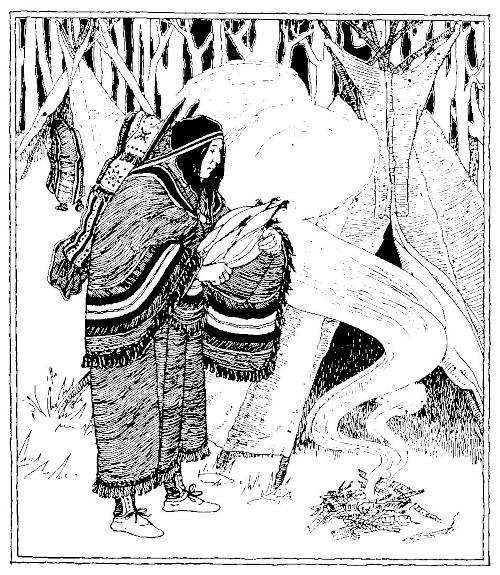
The Indian house was a tent covered with
skins or bark. These tents were called wigwams.
The Indians wore clothes made of deerskin.
Often these were covered with pretty beads.
Indian boys played ball, and swam in the
rivers. Sometimes they went into the woods to
hunt with their bows and arrows.
Indian girls played with dolls made of deerskin.
Sometimes they helped their mothers
plant the corn or cook the food.
The Indian baby’s cradle was a bag made of
skin. It was tied to a board.
The Indian mother carried the baby on her
back in this cradle.
Often she hung the cradle on a branch of a
tree. The wind rocked the little cradle.
Sometimes the Indian father wore feathers in
his hair, and painted his face. This made him
look very fierce.
Indian children never cried. More than anything
else they wanted to be brave.
One day some white people came over the sea
in a ship. They were called Pilgrims.
It was cold, and snow was on the ground.
The Pilgrims sent out some men to walk along
the shore.
They were looking for a good place to build
their log-houses.
They soon came to a pile of sand. They began
to dig, and found a basket full of corn. It
belonged to the Indians.
The Pilgrims did not know that the Indians
could make such large, strong baskets. It took
two men to lift the basket of corn from the ground.
The white men had never seen Indian corn.
“How beautiful it is!” they said.
The Pilgrims took some of the corn to plant
in the spring. The next summer they paid the
Indians for all they had taken.
A kind Indian taught them how to plant the
corn. He also taught them how to cook it.
Indian corn is one of the most useful of all the
plants that grow.
THE COMING OF THE CORN.
Hiawatha, the young
Indian chief, was alone
in the woods.
He was thinking what
he could do to help his
people.
He could not rise
from his bed of leaves, as
he had not eaten anything
for three days.
Then a young man
dressed in green and
yellow came to him.
“Oh, my Hiawatha!”
he said. “I am Mondamin,
the friend of man.
“I have come to tell
you how you can help
your people. Arise from
your bed and wrestle
with me.”
Hiawatha grew stronger and stronger as he
wrestled with Mondamin. Three times Mondamin
came and wrestled with Hiawatha.
Then Mondamin said, “The next time we
wrestle you will win. Take off my green and
yellow clothes. Make a bed for me to lie in
where the sun may come and warm me.
“No one but you must watch beside me, until
I come again with the sunshine.”
Hiawatha made the bed as Mondamin had
told him, and then went home. Every day he
watched the place where Mondamin was lying.
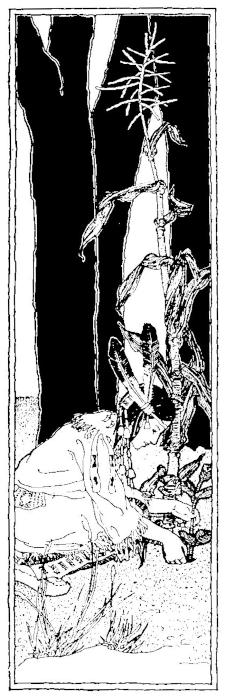
At last he saw a small green feather coming
up from the earth.
Before the summer was over, the corn with its
soft yellow hair stood before him, tall and beautiful.
Then Hiawatha was glad, and cried, “It is
Mondamin, the friend of man!”
He called the Indians and showed them the
corn. Then he said, “It is a gift for you, my
people, and it will always be your food.”
Henry W. Longfellow’s “Hiawatha” (Adapted).
ARABELLA’S PARTY.
“Grandma, Arabella wants a party, and there
are no dolls to come to it,” said Ruth.
“Peter has been lying in my room a great
many years,” said Grandma. “I think he would
like to come to a party.”
Ruth laughed when Grandma gave her the rag
baby. He wore such queer clothes.
“Your father played with Peter when he was
a little boy,” said Grandma. “He liked Sally
Squash, too. Shall we ask her to the party?”
Ruth followed Grandma into the garden. They
soon found a long squash.
Grandma cut a face in the small end, and put
a white paper dress on the squash. Then Sally
was ready for the party.
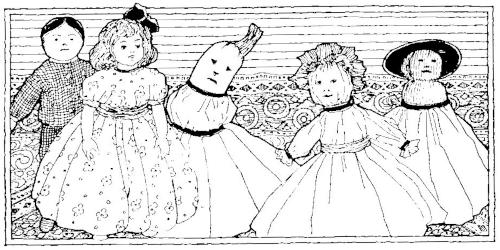
“I should like to ask Patty Corncob,” said
Grandma. “I played with her when I was a little
girl.”
Grandma tied a head and arms made of paper
on a corncob. Then she made a pink paper dress
and cap.
“Oh, how pretty!” said Ruth as she looked at
Patty Corncob. “I like her almost as well as
Arabella.”
Grandma drew a face in the head of a clothespin,
and put on a blue paper dress and hat.
“This is Betty Clothes-pin,” said Grandma.
“She came to my parties long ago.”
Ruth could not tell which she liked the better,
Patty or Betty.
They all sat down under a tree, and ate the
cake that Dinah had baked for the party.
Arabella did not look like the other dolls. She
had blue eyes and yellow hair, and wore a beautiful
silk dress.
But she smiled and seemed to have almost
as good a time as Grandma and Ruth.
THE CATERPILLAR.
Fuzzy little caterpillar,
Crawling, crawling on the ground!
Fuzzy little caterpillar,
Nowhere, nowhere to be found,
Though we’ve looked and looked and hunted
Everywhere around!
When the little caterpillar
Found his fuzzy coat too tight,
Then a snug cocoon he made him,
Spun of silk so soft and light;
Rolled himself away within it,
Slept there day and night.
See how this cocoon is stirring!
Now a little head we spy.
What! Is this our caterpillar
Spreading gorgeous wings to dry?
Soon the free and happy creature
Flutters gaily by.
Emilie Poulsson.
RUMPEL-STILTS-KIN. — II — III
There was once a wicked miller who said to
his king, “I have a beautiful daughter who can
spin straw into gold.”
The king loved gold more than anything else,
so he carried the miller’s daughter away to his
castle.
He filled a large room with straw, and said to
her, “If you do not spin this straw into gold before
morning, you must die.”
Then the king went out and locked the door.
The miller’s daughter sat down and began to
cry. She did not know how to spin straw into
gold.
Soon a brownie came in, and said, “What will
you give me if I spin this straw into gold?”
“My gold chain,” said the miller’s daughter.
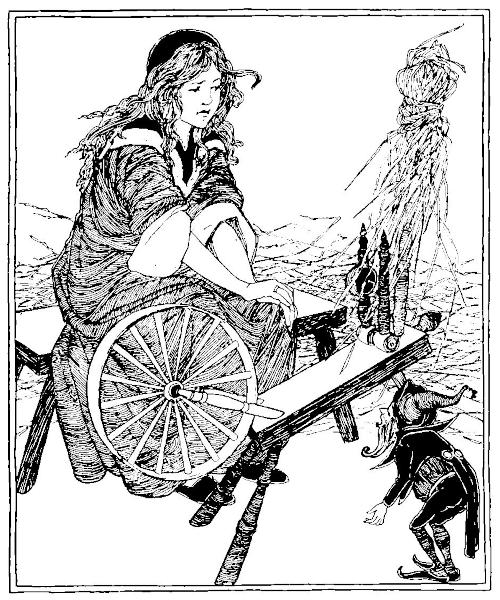
The brownie sat down beside the spinning-wheel,
and sang,
“Round about, round about,
Lo and behold!
Reel away, reel away,
Straw into gold!”
Around went the wheel, and soon all the straw
was spun into gold.
When the king came in the next morning, he
was very glad to see so much gold. But he
wanted more.
So he locked the miller’s daughter into a larger
room filled with straw.
Again the brownie came in, and said, “What
will you give me if I spin this straw into gold?”
The miller’s daughter said, “My gold ring.”
So again he sang,
“Round about, round about,
Lo and behold!
Reel away, reel away,
Straw into gold!”
The king was so glad to see all the gold, that
he filled a much larger room with straw.
“Now,” he said, “if you spin this straw into
gold I will make you my queen.”
When the brownie came that night, the miller’s
daughter said, “I have nothing else to give
you.”
“Will you give me your first little child, when
you are queen?” said the brownie.
“Yes,” said the miller’s daughter.
Once more the brownie sang. The wheel went
round, and soon the room was filled with gold.
The king was so glad that he made the miller’s
daughter his queen.
When she held her first little child in her arms,
she was so happy that she did not think about
the brownie.
But one day he came to take away the baby.
The poor queen was very unhappy.
Then the brownie said, “If in three days you
can find out my name, I will not take away your
child.”
The queen sent all over the land to find out the
queerest names.
The first day passed, and the second day passed,
and she could not tell the brownie his name.
On the third day a man came to the queen and
said, “Last night as I was walking through the
woods, I saw a brownie dancing around a bonfire
and singing,
“To-day I brew, to-morrow I bake,
Next day the queen’s child I shall take.
How glad I am that nobody knows
That my name is Rumpel-Stilts-Kin!”
This made the queen very happy. When the
brownie came in she said,
“Is your name Tom?”
“No, my queen.”
“Is it John?”
“No, my queen.”
“Is it Robert?”
“No, my queen.”
“Can your name be Rumpel-Stilts-Kin?”
“An old fairy has told you! An old fairy has
told you!” he cried. Then he ran away.
The queen laughed and said,
“Good morning to you, Mr. Rumpel-Stilts-Kin.”
Jacob and William Grimm (Adapted).
OCTOBER.
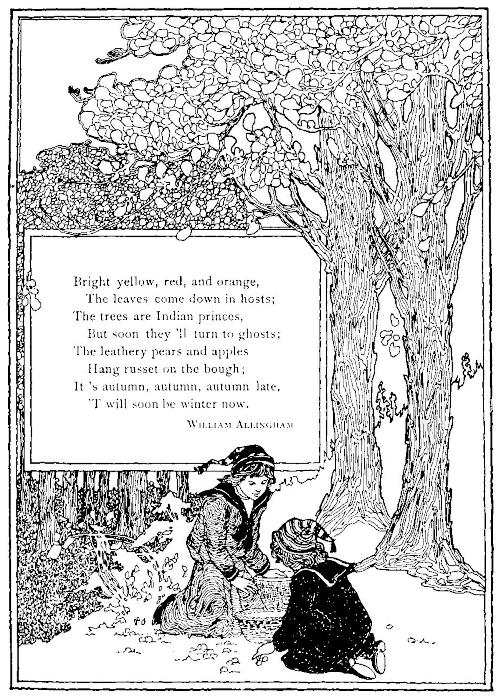
Bright yellow, red, and orange,
The leaves come down in hosts;
The trees are Indian princes,
But soon they’ll turn to ghosts;
The leathery pears and apples
Hang russet on the bough;
It’s autumn, autumn, autumn late,
’Twill soon be winter now.
William Allingham.
HIAWATHA’S CANOE.
Hiawatha, the young Indian chief, lived in the
woods, by the Big Sea Water. He wanted to
make a canoe.
He said to the Birch-tree, “Take off your
white cloak, for the summer is coming, and you
will not need it.”
The Birch-tree waved its branches in the wind
and said, “Take my cloak, O Hiawatha!”
So Hiawatha cut the beautiful white bark from
the tree.
Then he said to the Cedar, “Give me your
branches, so my canoe will be strong.”
There was a cry from the top of the Cedar,
but it said, “Take my branches, O Hiawatha!”
So Hiawatha cut them off and bent them, to
make a frame for his canoe.
“Give me your roots, O Larch-tree,” Hiawatha
said, “to hold the ends of my canoe together.”
The Larch-tree said sadly, “Take them all, O
Hiawatha!”
Hiawatha pulled up the roots of the Larch-tree,
and sewed the bark together. Then he said
to the Fir-tree, “Give me your balm, so that the
water may not come into my canoe.”
And the tall dark Fir-tree said, “Take my
balm, O Hiawatha!”
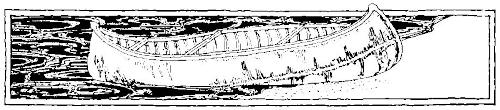
So Hiawatha made his birch canoe. And it
lay upon the water like a yellow leaf in autumn.
Henry W. Longfellow’s “Hiawatha.” (Adapted).
HIAWATHA’S SAILING.
“Give me of your bark, O Birch-Tree!
Of your yellow bark, O Birch-Tree!
Growing by the rushing river,
Tall and stately in the valley!
I a light canoe will build me,
That shall float upon the river
Like a yellow leaf in Autumn,
Like a yellow water-lily!”
Henry Wadsworth Longfellow.
LADY GRAY. — II
One summer Robert and his father and mother
lived in a little house in the woods.
They saw a squirrel running about in the trees.
Robert put some nuts on the ground and hid
behind a tree. Soon the squirrel came and
carried them away.
The next day he put the nuts nearer the house.
The squirrel came again and carried them away.
So it went on for some time. Each day Robert
put the nuts nearer the house.
They named the squirrel Lady Gray.
One day Robert’s mother sat down in a chair
on the porch. She put some nuts on the floor
and kept very still.
After a while Lady Gray came up on the porch.
She looked at Robert’s mother, then she took a
nut and ran away as fast as she could.
By and by Lady Gray became so gentle that
she would hunt for nuts in their pockets.
One morning Father put a nut on his shoulder.
Lady Gray jumped on Father’s shoulder and
ate the nut. How they all laughed.
The next summer Robert went again to the
little house in the woods.
Robert’s father wanted the house to look pretty,
so he painted it white and green.
In the morning Robert called out, “Mother!
Mother! See what the squirrels have done!”
The porch was covered with marks of little
feet.
Lady Gray saw Robert and came up on the
porch. A baby squirrel was with her. They
named it Little Son.
Soon Little Son was as gentle as Lady Gray.
Sometimes he would let them put their hands on
his soft fur.
One day Robert was out walking with his
father. They saw a hole in an old tree.
Robert’s father held him up so that he could
put his hand in the hole. The squirrel’s nest was
almost full of nuts.
All summer Robert had good times, playing
with Lady Gray and Little Son.
THE ELVES AND THE SHOEMAKER.
There was once a kind old shoemaker who was
very poor. He had leather to make only one
pair of shoes.
He cut these out and went to bed. The next
morning the shoes were standing ready upon the
table.
The shoemaker sold them and bought leather
to make two pairs of shoes.
He cut these out, and again found the shoes
made when he got up in the morning.
He sold the shoes and bought leather to make
four pairs. The work he cut out was always
done in the morning.
One evening the shoemaker said to his wife,
“I should like to sit up to-night and see who it is
that makes the shoes.”
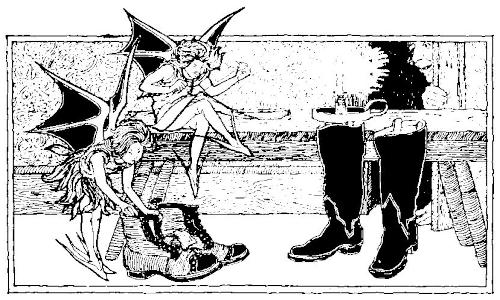
In the night two little elves ran in. They
sewed and rapped and tapped so quickly that the
shoes were made long before morning. Then
the elves ran away.
The next day the shoemaker’s wife said,
“These elves have made us rich. I should like
to do something for them. You make each of
them a little pair of shoes, and I will make them
some clothes.”
On Christmas eve they put the shoes and the
clothes on the table. Then they hid behind the
door to see what the elves would do.
When the elves saw the clothes, they quickly
put them on. They laughed and danced and
jumped about.
At last they danced out of the door and across
the grass and were seen no more. But the kind
shoemaker and his wife lived a long and happy
life.
Jacob and William Grimm (Adapted).
HALLOWE’EN. — II
Big Brother Ben, Sister Polly and little Martha
sat talking together under the old oak-tree.
Father went out to see what the children were
doing.
“Oh, Father,” said Polly, “to-night is Hallowe’en!”
“May we have some pumpkins to make Jack-o’-lanterns?”
asked Ben.
“Yes,” said Father. “Come with me.”
They went down to the corn-field and each
chose a yellow pumpkin.
Brother Ben cut a round piece out of the stem-end
of each pumpkin. The little girls then went
to work to dig out the pumpkins.
After this Brother Ben cut eyes, nose, and
mouth on the outside. The last thing was to
make a little hole in which to set a candle.
“How would you like a bonfire to-night?”
asked Father.
This pleased Brother Ben so much that he
threw his cap in the air and cried,
“Hurrah! Hurrah! Hurrah!”
When evening came Father and Brother Ben
made a large bonfire near the corn-field.
They all sat around the bonfire and ate the
good things which Mother and Sister Polly carried
down in a basket.
Father showed them how to toast apples, pop
corn and roast nuts in the fire.
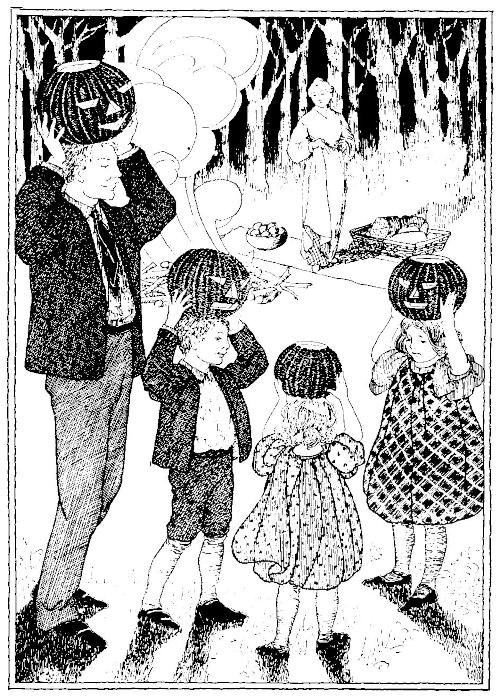
“Now let us march around with the pumpkins
on our heads,” said Brother Ben.
Mother sat on a rug and watched them. After
a while little Martha joined her and soon the rug
held them all.
“Please, Mother, tell us a story,” said little
Martha.
Mother told them about the brownies and elves
who come out on Hallowe’en to help the farmer,
and all the busy people who work for us.
“I know a story about them, Mother,” said
little Martha.
“Let us hear it, dear,” said Mother.
So little Martha told them about the Elves
and the Shoemaker.
“I’ll tell about Cinderella and her Pumpkin
Coach,” said Polly.
Father told them the story of Mondamin and
his gift of corn to the Indians.
“I can say the poem,” said Brother Ben.
“We learned it in school.”
Brother Ben gave the poem so well that they
were all very still for a few moments.
Then Mother said softly, “It is bedtime now.”
As they turned away from the fire Polly said,
“The Jack-o’-lanterns were fun, but I like the
stories best of all.”
POP-CORN SONG.
In they drop with a click, clack, click,
Kernels so hard and yellow;
’Round they whirl with a hop, skip, hop,
Each little dancing fellow.
Up they leap, with a snap, crack, snap,
Tossing so light and airy;
Out they pour with a soft, swift rush,
Snowballs fit for a fairy.
Sophia T. Newman.
PHILEMON AND BAUCIS. — II
A long time ago, on a high hill, lived old Philemon
and his good wife Baucis.
They were poor, but they were two of the kindest
old people that ever lived. Often they went
without their supper to give it to some traveler.
One evening, Philemon and Baucis sat on their
door-step looking at the sunset.
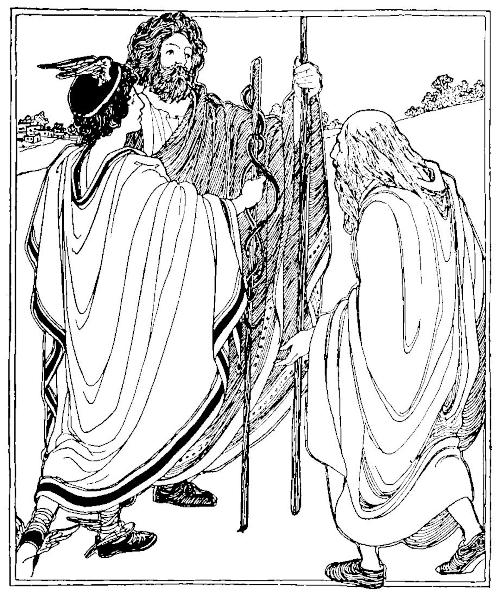
Soon they saw two travelers coming up the hill.
Some children ran after them, shouting and setting
their dogs on them.
“Come, Wife,” said Philemon. “Let us go
and meet these travelers.”
“You go to them,” said Baucis, “while I get
them some bread and milk.”
Philemon went to meet the travelers and said,
“Welcome, strangers! Welcome!”
He asked them to come in to supper. Baucis
gave the travelers bread and milk and honey.
On the table stood a pitcher half full of milk.
The travelers quickly drank the milk.
“What good milk!” said one of them. “May
I have a little more, kind Baucis?”
“I am sorry,” said Baucis, “but there is no
more milk.”
“Why,” said the traveler, “here is more milk!”
He took the pitcher and filled both bowls.
Baucis looked into the pitcher, and saw the
white milk running in from the side. Soon it
was full.
“May I have some bread, Mother Baucis,”
said the traveler, “and a little of that honey?”
Baucis cut him some and found that the bread
was no longer old and hard as it was when she
and Philemon ate of it.
And, oh, the honey! It was better than any
honey they had ever eaten.
“Who are you, wonderful travelers?” said
Philemon.
“Your friends, my good Philemon. After this
the pitcher will always be full of milk for you and
Baucis, and for poor travelers.”
The next morning the travelers asked Philemon
and Baucis to walk with them and show them
the road.
When Philemon and Baucis turned to go back,
the older traveler said, “Good Philemon and
Baucis, you gave us not only milk and bread but
also a kind welcome. Ask for anything you want,
and you shall have it.”
Philemon and Baucis looked at each other and
said, “Grant that we may die together.”
“You shall have your wish,” said the traveler.
“Now look at your home.”
They saw a beautiful white castle standing
where their little house had been.
The old people fell on their knees to give thanks.
When they looked up, the travelers were not there.
Philemon and Baucis lived in the castle a long,
long time. One morning they could not be found.
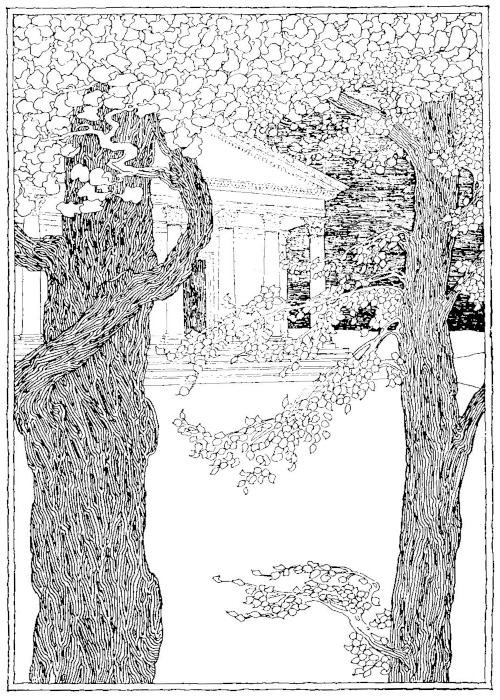
The people looked everywhere for them. At
last they saw two large trees standing in front of
the castle.
One was an oak, the other was a linden-tree.
The people wondered where they came from.
Just then the wind began to blow, and the trees
seemed to be talking.
“I am Philemon,” said the Oak.
“I am Baucis,” said the Linden.
Whenever a traveler rested under the trees, the
leaves seemed to say, “Welcome, dear traveler!
Welcome!”
Nathaniel Hawthorne (Adapted).
NOVEMBER.
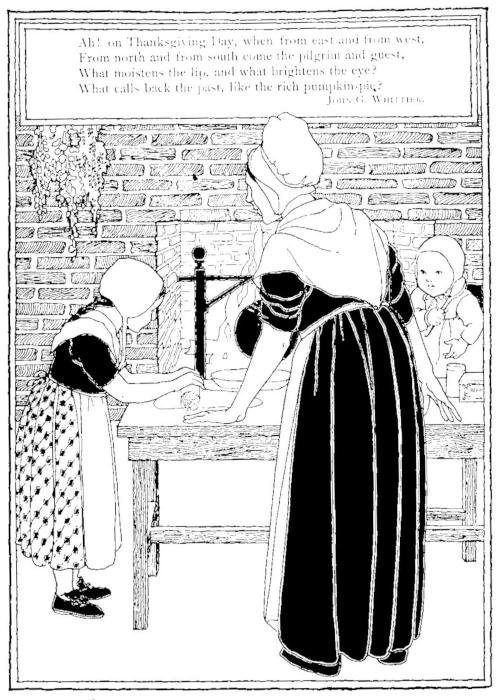
Ah! on Thanksgiving Day, when from east and from west,
From north and from south come the pilgrim and guest,
What moistens the lip, and what brightens the eye?
What calls back the past, like the rich pumpkin-pie?
John G. Whittier.
THE FIRST THANKSGIVING DAY. — II
One spring the Pilgrims planted corn as the
Indians had taught them.
Summer brought the sunshine and the rain to
ripen the corn.
Such a harvest as there was when autumn
came!
“Let us have a day of thanksgiving for this
great blessing,” said the Governor.
“A Thanksgiving Day! A Thanksgiving
Day!” cried the Pilgrims.
“The Indians have been kind to us. We will
ask them to our feast,” said the Governor.
So they began to get ready for the first
Thanksgiving Day.
The Pilgrim fathers went hunting and fishing.
They carried home duck, turkey, and fish.
The Pilgrim mothers made bread and cake
from the corn. They baked plenty of pumpkin-pies.
What a good time the children had getting
ready for the feast!
They gathered the wild plums and grapes.
They put pop-corn in the ashes of the wide
fireplace. Then they watched until the “Snap!
Crack! Snap!” was heard.
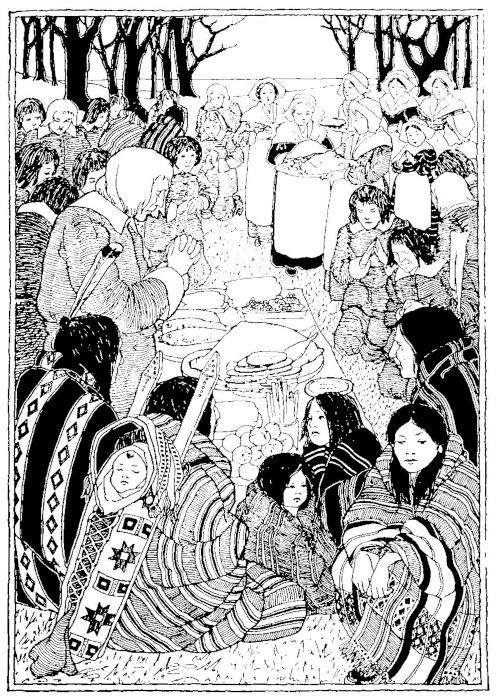
The Indians came, gaily dressed in skins, and
paint, and feathers. They brought five large
deer to the feast.
The Indians came in time for breakfast and
stayed three whole days. So they must have
had a good time. They played games, and
danced, and sang.
Before the feast the Indians and the Pilgrims
thanked God for His goodness to them.
Ever since then the people have kept Thanksgiving
Day.
THANKSGIVING DAY LONG AGO.
The large kitchen was a busy place on Thanksgiving
morning.
A log fire was burning in the fireplace. On
the walls hung strings of dried apples. Long,
yellow squashes hung up above.
A little girl sat beside the spinning-wheel dressing
corncob dolls. She was taking care of the
baby that lay in the queer old cradle.
Mother put the pudding in the kettle that hung
before the fire. Then she said, “Come, Patty!
It is time to set the table.”
Patty looked at the turkey that was roasting
before the fire.
“I wish Thanksgiving came every day,” she
said.
“What hard work that would make for
Mother!” said Grandma, looking at the rows of
pies.
After a while a loud shout made them all run
to the door.
“Here they come! Here they come!” said
Patty, dancing around the room.
Uncle John stopped the sleigh and out jumped
Aunt Mary and the children.
What a good dinner it was! They all said that
the turkey was the best they ever ate. And, oh,
the pudding and the pies!
After dinner the fun began. There were games
and songs, and at last a dance.
Grandma and Grandpa stood at one end. Father
and little Patty stood at the other end. Then up
and down the long kitchen they went, laughing all
the time.
In the evening they sat around the log fire.
They told stories, roasted apples, and ate the nuts
the children had gathered.
At last they said good night. Then Uncle
John put Aunt Mary and the children in the sleigh,
and drove home through the softly falling snow.
Soon every one in the old farm-house was in
bed and asleep.
Pussy sat in the warm firelight, alone, in the
large kitchen.
THANKSGIVING DAY.
Over the river and through the wood,
To Grandfather’s house we go;
The horse knows the way
To carry the sleigh
Through the white and drifted snow.
Over the river and through the wood;
Oh, how the wind does blow!
It stings the toes
And bites the nose,
As over the ground we go.
Over the river and through the wood,
To have a first-rate play.
Hear the bells ring,
“Ting-a-ling-ding!”
Hurrah for Thanksgiving Day!
Over the river and through the wood,
Trot fast, my dapple-gray!
Spring over the ground,
Like a hunting-hound!
For this is Thanksgiving Day!
Over the river and through the wood,
And straight through the barn-yard gate.
We seem to go
Extremely slow,
It is so hard to wait!
Over the river and through the wood;
Now Grandmother’s cap I spy!
Hurrah for the fun!
Is the pudding done?
Hurrah for the pumpkin-pie!
Lydia Maria Child.
WHITTIER. — II
When Whittier was a little boy, he lived on a
farm.
In the summer he ran about with bare feet. He
went swimming and fishing.
His merry whistle could be heard as he hunted
for strawberries.
He knew the songs of the birds. He liked to
watch them make their nests and feed their young.
When he went into the woods, the squirrels
played about him. They let him see where they
hid their nuts.
He watched the bee gather honey from the
flowers. He knew how it made its house.
Often, at night, he sat on the door-step to eat
bread and milk.
Then he could see the clouds and hear the
frogs. Sometimes the fireflies flew about looking
like little lanterns.
He tells of all those happy times in a poem
called “The Barefoot Boy.”
In another poem called “Snow-Bound,”
Whittier tells what he did in the winter.
One morning they looked out to find everything
covered with snow.
“See the well!” said one of the boys. “It
looks like a castle.”
“That pole looks like an old man,” said
another.
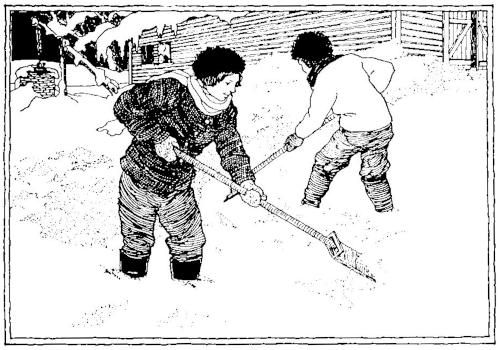
Just then their father called out, “Boys! Make
a path.”
With merry shouts they made a path to the
barn. In one place the snow was so deep that
they played it was a cave.
The old horse heard them and put his head
out of the barn window to see the fun.
The rooster heard them coming and crowed a
good morning.
They fed the farm-yard animals and gave them
straw for their beds.
In the evening they all gathered around the
fireplace.
The dog lay asleep in the warm firelight. The
cat opened and closed her yellow eyes as she
sat beside him.
The boys roasted apples and ate the nuts
which they had gathered.
Then their father told them a story about the
Indians. Mother talked of the days when she
was a little girl.
When bedtime came, they said good night.
The wind roared around the house. The
snow fell through the roof upon their beds. But
the children did not know it, for they were soon
fast asleep.
PATTIE’S NEW DRESS. — II
When Pattie was a little girl, long ago, she
needed a warm new dress.
Grandmother said, “I’ll spin the wool for it.”
“And I’ll weave the cloth,” said Sister Rachel.
“And I’ll make the dress,” said the little girl’s
mother.
The sheep had given the wool from their backs
for Pattie’s new dress.
“It is as soft as down, and as white as milk,
and as beautiful as snow,” said Pattie.
Grandmother carded the wool fine and smooth.
Then she fastened it on her spindle and sent the
spinning-wheel whirling round.
“Zu-m-m-m-m-m-m-m-m-m!” sang the wheel,
as it turned. “Zu-m-m-m-m-m-m-m-m-m!”
Pattie’s brother said it sounded as if there were
bees in the room. “Zu-m-m-m-m-m-m-m-m!”
As Grandmother drew the thread out from the
fleecy wool she said,
“A hum and a whirl,
A twist and a twirl,
This is the way good yarn is spun.”
Pattie stood by to watch her spin. She asked
more questions than Grandmother had time to
answer.
“Will there be a pocket in my new dress,” she
asked, “and buttons down the back?”
“And, oh, Grandmother! What color is it going
to be?”
“I know,” said Brother Joe. He had just come
in from the woods with some walnut bark.
“It will be the color of a—chestnut.”
“Brown, brown, brown!” cried Pattie.
Mother made a dye with the walnut bark. Sure
enough, when she dipped the yarn into the dye it
came out a beautiful brown just as Pattie had
guessed.
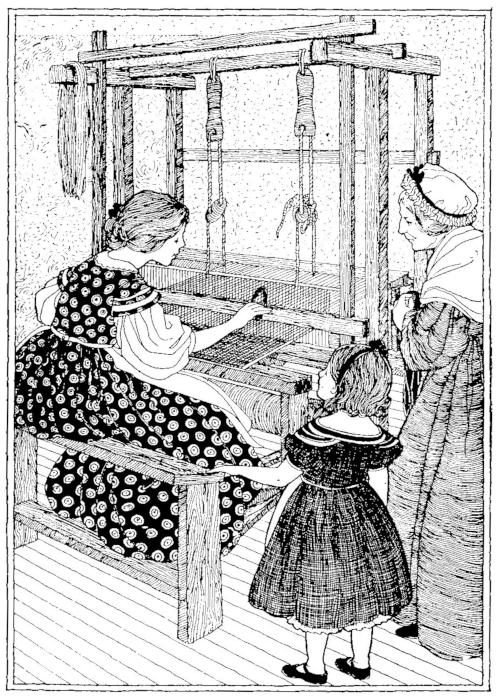
Then Sister Rachel fastened the yarn in the
loom and began to weave.
The treadle went up and the treadle went down
with a click and a clack. Such a merry sound!
Away the shuttle went to carry the thread under
and over, and in and out.
When the cloth was woven Sister Rachel took
it out of the loom. Mother was all ready to begin
the dress.
“Snip, snip, snip!” went her sharp scissors.
“Stitch, stitch, stitch!” flew her shining needle.
Long after Pattie was in bed and fast asleep
that night, Mother was busy sewing.
Grandmother and Rachel helped, too, and the
dress was ready the very next day.
It had pockets, two of them, bound with red.
It had buttons down the back like a row of red
berries.
Jack Frost had come in the night and the cold
winds had begun to blow. But Pattie did not
care.
“I’m warm as toast in my new woolen dress,”
said little Pattie.
Maud Lindsay (Adapted).
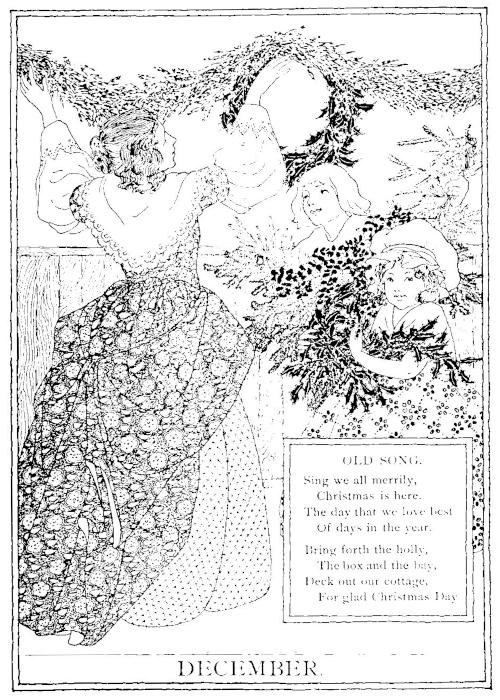
DECEMBER.
OLD SONG.
Sing we all merrily,
Christmas is here.
The day that we love best
Of days in the year.
Bring forth the holly,
The box and the bay,
Deck out our cottage,
For glad Christmas Day.
CHRISTMAS CAROL.
And all the bells on earth shall ring,
On Christmas Day, on Christmas Day,
And all the bells on earth shall ring,
On Christmas Day in the morning.
And all the angels in heaven shall sing,
On Christmas Day, on Christmas Day,
And all the angels in heaven shall sing,
On Christmas Day in the morning.
And all the souls on earth shall sing,
On Christmas Day, on Christmas Day,
And all the souls on earth shall sing,
On Christmas Day in the morning.
Old Song.
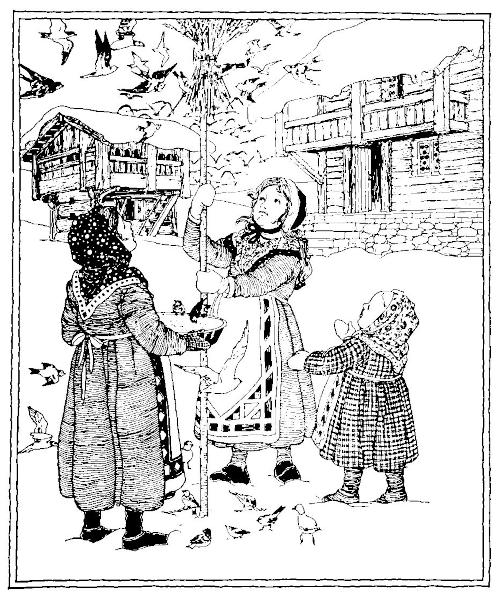
THE BIRDS’ CHRISTMAS FEAST.
Far away across the sea, there is a very cold
country.
The ground is covered with snow almost all
the year, and the birds cannot get enough to eat.
So every Christmas the children are the birds’
Santa Claus.
In the summer the children go into the fields
and gather grain for the birds.
The day before Christmas such a wonderful
thing happens!
Over the snow the birds come from north,
south, east, and west.
They sit upon the porch, upon the roof of the
house, and sometimes look in at the windows.
“Here we are, little friends!” they seem to
say.
On Christmas morning, a tall pole with a bunch
of grain on the top is set before every door.
Then such a twittering is heard from the birds,
and such merry shouts from the children!
It would be hard to tell which has the better
time, the birds or the happy children.
Suggested by Celia Thaxter’s Poem, “The Sparrows.”
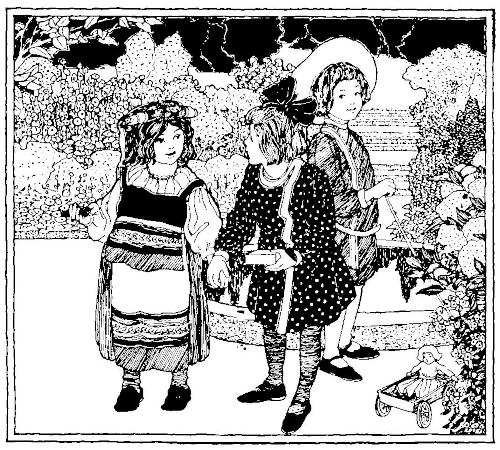
PICCOLA. — II
Fred and May lived one winter in a country
where the sun was always bright and warm.
What good times they had playing in the
garden!
One day they saw a queer little girl watching
them. She did not look like the little girls they
played with at home.
She wore a long red dress. On her feet were
little wooden shoes.
She said that her name was Piccola. She told
them that she was alone all day, because her
mother went out to work.
Fred and May asked her to come and play with
them in the garden.
One day the children were talking about Santa
Claus.
“Who is that?” asked Piccola.
“Why, Piccola!” said May. “Did you never
hear of Christmas?”
“Yes,” said Piccola. “We go to church on
Christmas Day, and hear beautiful singing.”
Then the children told her all about Santa Claus.
“Hang up your stocking on Christmas Eve,”
said May. “He will come down the chimney and
fill it with toys.”
Piccola could hardly wait to tell her mother
about Santa Claus.
“I wonder what he will give me,” she said.
“Do not look for him this year, little daughter,”
said her mother. “I shall be thankful if we have
enough to eat.”
But Piccola knew that Santa Claus would not
forget her.
On Christmas Eve Piccola did not have any
stocking to hang up. So she put her little wooden
shoe in front of the fireplace.
“I’m sure Santa Claus will not care if it is a
shoe,” she said.
The next morning Piccola awoke before it was
light. She ran softly to the fireplace to see what
was in her shoe.
“Oh, Mother, Mother!” cried the happy little
girl. “See what Santa Claus has given me!”
She ran to her mother with the shoe in her hand.
A little bird had come down the chimney. There
it lay in the shoe, looking up at her with its two
bright eyes.
Piccola fed it and warmed it. Then she carried
it into the garden to show it to Fred and May.
They gave her candy, and toys, and a doll.
But Piccola liked the gift of Santa Claus best of all.
Suggested by Celia Thaxter’s Poem, “Piccola.”
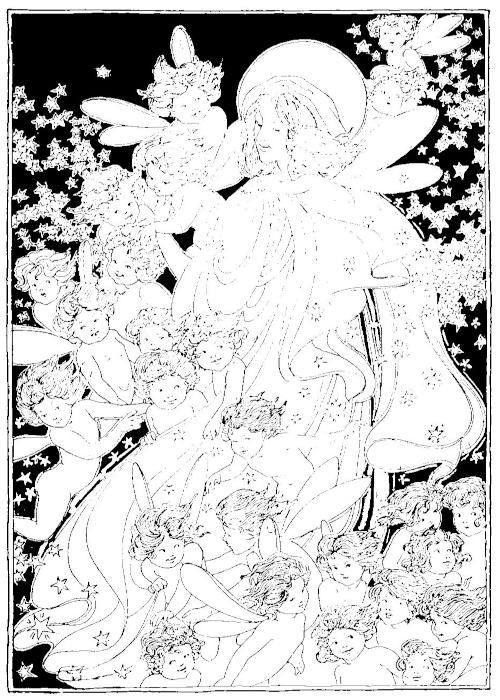
THE STAR-CHILDREN. — II
Queen Sunshine lived in a wonderful red and
blue castle.
She wore a dress of gold. Whenever she
came out from her castle everything became
light.
She had many children whom she loved very
dearly, and they also wore dresses of gold.
Their good servant, the Moon, who followed
after them, wore a dress of shining silver.
In another country across the sea lived Queen
Darkness.
She always wore the same black dress.
Wherever she went all things became dark.
She was alone and unhappy and often wished
that she had children like those of Queen Sunshine.
One day when Queen Sunshine’s children were
playing on the seashore, a little boy fell into the
water.
“Oh, help me! Help me!” he cried.
One of his sisters tried to help him, and she,
too, fell into the sea.
By and by, when the Moon came to take them
home, not one child was on the shore. They had
all fallen into the water.
The Moon looked at the sea, and saw that it
was black.
“Oh!” she cried. “Queen Darkness is there!
She has taken all the dear children.”
The Moon was so sorry for Queen Sunshine
that she would not go home and tell her that
Queen Darkness had taken the children.
She said to Queen Darkness, “Let me go with
the children.”
Queen Darkness gladly carried their good servant,
the Moon, to her dark castle to live with
Queen Sunshine’s children.
She named them the Star-children. Queen
Darkness always keeps the Star-children near
her. The little ones are so close together that
they look like a silver ribbon on her dress.
Ever since, their mother, Queen Sunshine, has
been looking for her children.
Whenever she comes in her golden dress to
the shore of the sea, the water is so bright that
she cannot find them.
Queen Darkness does not let the Star-children
go out when it is light, but once every night she
leads them across the sky.
Their mother always follows after them.
Sometimes she sees one of her children far
away.
The kind old servant, the Moon, sometimes
runs away and comes to Queen Sunshine to tell
her about her children.
From the German of Fraulein Meissner (Adapted).
THE STARS.
Do you know what the little stars do at night?
They play on a deep blue hill.
Mother Moon watches to keep them in sight,
For they’re never, never still.
Do you know what the little stars do at dawn?
They sink in a sun-kissed sea,
And there they sleep till the day is gone,
As still as still can be.
May Moore Jackson.
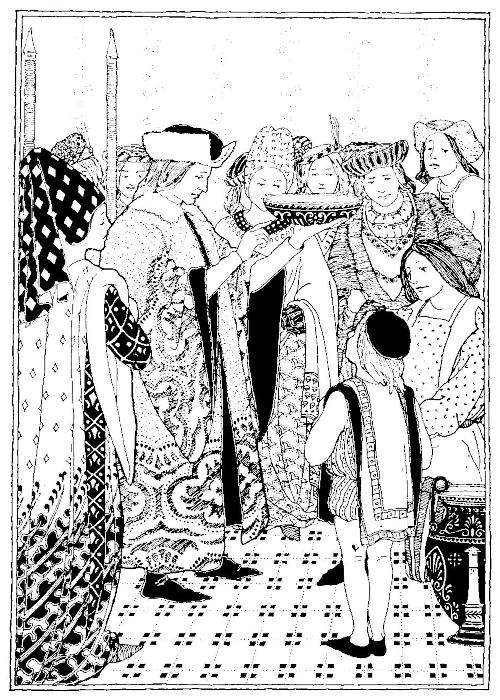
RAPHAEL. — II
Long, long ago, across the sea, there lived a
master artist.
He made, in clay, such beautiful bowls and
vases, that people came from far and near to buy
them.
Some young men lived with him. The master
artist taught them how to make the same beautiful
things.
One summer day, one of these young men was
very sad. A little boy with golden hair ran up
to him and said, “Dear Luca, why are you so
unhappy?”
“Oh, Raphael!” said Luca. “The great
duke wants us to paint him a bowl and a vase.
The master says that the artist who makes
the most beautiful one may live with him
always. He will also have a gift from the
duke.”
“When must the bowl and the vase be ready?”
said Raphael.
“In three months,” answered Luca.
Raphael threw his arms around Luca’s neck.
“Let me try to paint them for you,” said the
little boy with golden hair.
“You dear child!” cried Luca. “You are
only seven years old. You cannot help me.”
Raphael was very sorry for his dear Luca.
“Oh, Luca, I love you so! Please let me try,”
he said again.
Then Luca said, “You may try, Raphael. It
can do no harm. I can never paint the vase and
the bowl.”
Raphael was glad now that his father had
taught him how to draw.
He was glad, too, that the master artist had
taught him how to put the colors on the clay.
All through the long summer days the child
worked alone. He would not let any one see
his painting till it was done.
One day he showed Luca his work.
“Dear Luca, see!” he said. “There are the
vase and the bowl for you to give the duke!”
Luca fell on his knees before the little boy.
“Wonderful child!” he said. “I cannot call
this beautiful work mine. It would not be right.”
The next day the duke came to look at all the
vases and the bowls.
“Here is something very beautiful,” he said,
taking a bowl in his hand. “Who painted this?”
The master artist turned to the young men and
said, “Who did this work?”
But no one answered.
Then a little boy with golden hair went to him.
“I painted it,” he said. “I, Raphael.”
Tears of joy came into the great duke’s eyes.
He took a golden chain from around his neck
and gave it to Raphael.
The little boy said, “But it is Luca’s. I
painted the bowl for him to give to you.”
But Luca did not hear him. He was kneeling
again at the feet of the wonderful child.
Louise de la Ramée’s “The Child of Urbino” (Adapted).
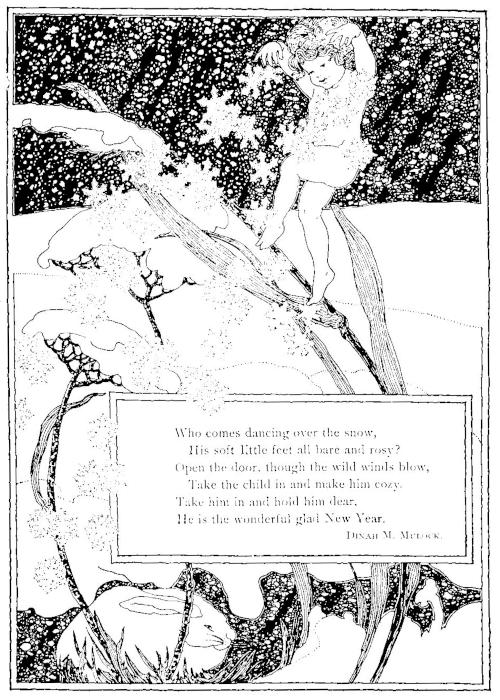
JANUARY.
Who comes dancing over the snow,
His soft little feet all bare and rosy?
Open the door, though the wild winds blow,
Take the child in and make him cozy.
Take him in and hold him dear,
He is the wonderful glad New Year.
Dinah M. Mulock.
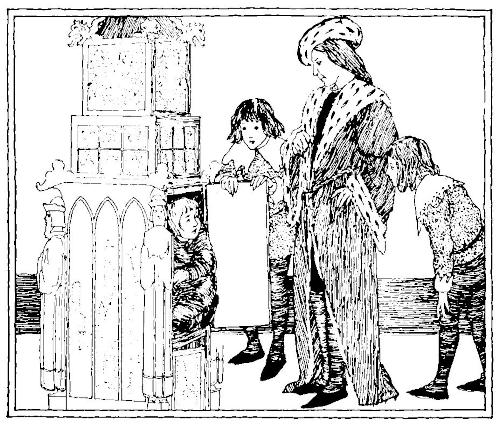
THE GREAT WHITE STOVE. — II — III
Karl had no mother and his father was very
poor.
The only beautiful thing in their little house
was a white stove. It was very large, and it
had wonderful colored pictures all over it.
Karl and his brothers and sisters loved it
dearly. In the summer they covered it with
flowers.
In the winter the children sat around the stove,
while Karl drew them pictures and told them
stories.
One cold winter night the father came home
very late. He could not find work, and the children
had not enough to eat.
By and by the little ones went to bed.
Then the father told Karl and his sister that he
had sold the great white stove.
“Oh, no, Father!” cried Karl. “You will not
send our dear stove away.”
“I must,” said his father. “It is a wonderful
stove. There is a man who will give me a great
deal of gold for it. I must have gold to buy
bread for my little ones.”
“Wait awhile,” said Karl. “I will help. I
am sure there is work I can do.”
Karl’s father shook his head and went away. He
thought such a very little boy could not help him.
All that night Karl lay on the floor beside his
dear white stove.
In the morning the man came and carried the
stove away in a wagon. Karl was so unhappy
that he could do nothing but cry and cry.
“I love it so,” he said. “Better than anything
on earth.”
Then he said, “I will go with it.”
He ran quickly after the wagon and climbed
into it.
By and by when no one was looking, he hid
inside the great white stove. It was very dark,
but it was warm, and soon he was fast asleep.
When Karl opened his eyes, he wondered where
he could be. He lay quite still and listened.
He traveled a long, long time. At last the stove
was set down on a soft rug. Then some one said,
“What a wonderful stove!”
The door was opened, and Karl jumped out.
He fell on his knees before a man who had a very
kind face.
“Oh,” cried he, “please do not send me away!
Let me stay here with my dear white stove.”
“Poor child!” said the man, as he laid his hand
on Karl’s hand. “Why did you hide in the stove?
Tell me for I can help you. I am the king.”
Karl was glad to tell the king all about the great
white stove. He told him how much they all
loved it. He said that they had to send it away
because they had no bread to eat.
“Do let me stay with it,” he said again. “I
will cut wood for it and feed it. The stove loves
to have me feed it, for I have done it so long.”
“But what else do you wish to do?” said the
king.
“I should like to paint pictures, beautiful pictures,
like those on the stove,” said the little boy.
So the king told Karl that he could stay in the
castle with the great white stove.
Karl became a great artist and painted beautiful
pictures. Then the king gave him the stove.
Karl sent it back to the little house where his
father still lived. He often went there to see his
father and the great white stove.
He was thankful that he had traveled so far
inside of the stove that winter day.
Louise de la Ramée’s “The Nurnberg Stove” (Adapted).
THE FLOCK OF DOVES.
The world was like a wilderness
Of soft and downy snow;
The trees were plumed with feathery flakes,
And the ground was white below.
Came the little mother out to the gate
To watch for her children three;
Her hood was red as a poppy-flower,
And rosy and young was she.
She took the snow in her cunning hands,
As waiting she stood alone,
And lo! in a moment, beneath her touch,
A fair white dove had grown.
A flock she wrought, and on the fence
Set them in bright array,
With folded wings, or pinions spread,
Ready to fly away.
And then she hid by the pine-tree tall,
For the children’s tones rang sweet,
As home from school through the drifts so light,
They sped with merry feet.
“O Nannie, Nannie! See the fence
Alive with doves so white!
Oh, hush! don’t frighten them away!”
They whisper with delight.
They crept so soft, they crept so still,
The wondrous sight to see,
The little mother pushed the gate,
And laughed out joyfully.
She clasped them close, she kissed their cheeks,
And lips so sweet and red.
“The birds are only made of snow!
You are my doves,” she said.
Celia Thaxter.
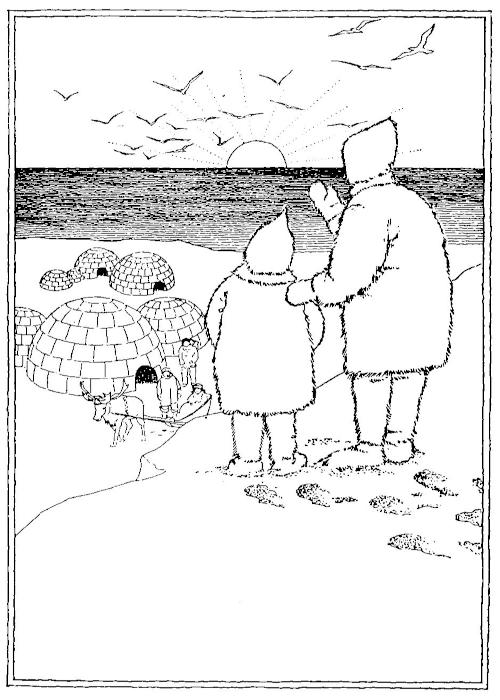
THE MIDNIGHT SUN.
Naka lives where it is very cold. There is
snow and ice nearly all the year.
Naka lives in a queer little round house made
of cakes of snow. The door is so close to the
ground that she has to creep in and out on her
hands and knees.
One day Naka’s mother dressed the little girl
in her warm fur clothes.
She first put on stockings made of bird skins.
The soft feathers kept her feet very warm. Over
the stockings she wore another pair made of bearskin.
Next she put on a white bearskin coat. This
had a hood which she put over Naka’s short,
dark hair.
It was almost noon when they crept out into
the dim light.
They climbed a hill and saw the sun just rising;
the beautiful, bright sun which they had
not seen for so long!
It soon went away, but the next day it came
again and stayed longer. After a while it did not
go away at all.
All day and all night the bright sun was shining
on the earth. Naka had a merry time playing
in the warm sunshine.
She ran about on the soft green grass and
picked the pretty flowers.
She found some berries one day and carried
them home to her mother.
She watched the great white birds that came
to lay their eggs among the rocks.
Best of all, the reindeer came back and gave
her milk to drink.
By and by the sun went slowly away. But
Naka was happy.
In the winter she had no sun. But the moon
and the stars were bright.
Then, too, she saw again the beautiful northern
lights, which are brighter than fireworks.
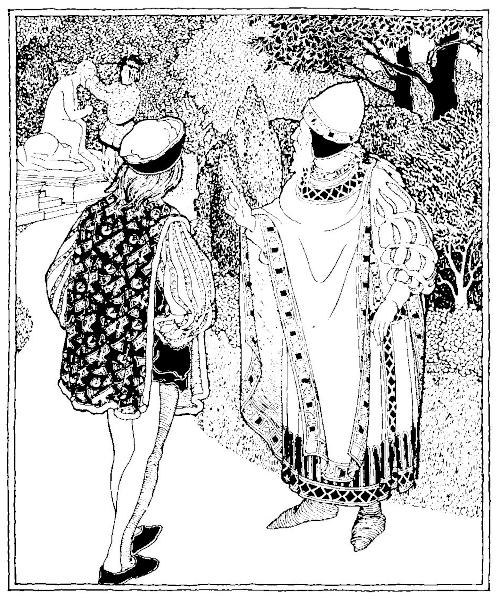
MICHAEL ANGELO.
Long ago in a country over the sea there lived
a Grand Duke.
He had a garden in which he put some beautiful
statues.
A boy artist named Michael Angelo often came
there to study. One day he saw across the garden
the statue of a faun that had no head.
“I will make a head for that statue,” said Angelo.
He made a head of a laughing faun. The
mouth was open so that the teeth could be seen.
About this time the Grand Duke was walking
in his garden. He stopped to look at the statue
made by the boy artist.
“Well done, Angelo!” said the Grand Duke.
“But, see! You have made an old faun. He
should not have all his teeth.”
“That is so,” said Angelo, and he quickly took
out some of the teeth.
This pleased the Grand Duke so much that he
asked Angelo to live with him in his castle.
The years Michael Angelo spent among the
beautiful statues in the Grand Duke’s garden
helped him to become a great artist.
FEBRUARY.
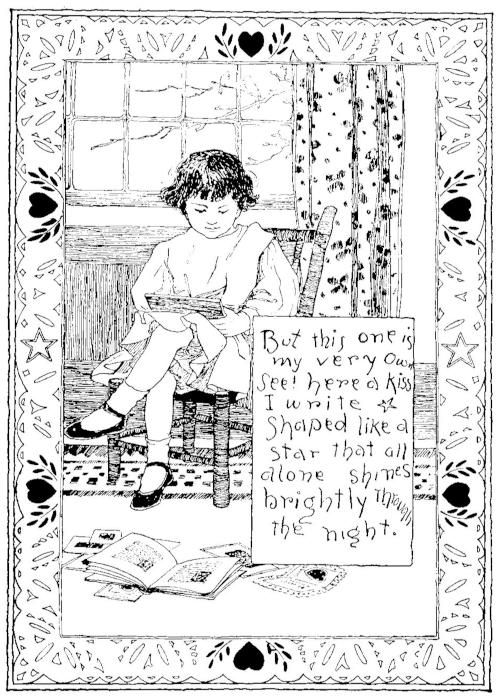
But this one is my very own.
See! here a kiss I write
Shaped like a star that all alone
Shines brightly through the night.
A VALENTINE.
I’m making you a valentine,
At least, I’m going to try,
Because they don’t seem really mine
Those valentines I buy.
But this one is my very own.
See! Here a kiss I write
Shaped like a star that all alone
Shines brightly through the night.
Now something blue, just like the sky.
And this—green like a tree,
And this thing—oh, so very high!—
Is just some love from me!
Eve Brodlique Summers.
ABRAHAM LINCOLN. — II
When Abraham Lincoln was a little boy, he
lived in a log house in the woods.
He could not go to school, for he worked on a
farm with his father. He went to school only one
year.
His mother taught him how to read and write
in the evenings. When everybody had gone to
bed, he would sit and read by the light of a log
fire.
There were only two or three books in the
house. Lincoln read them over and over.
One day a man let him take a book about
George Washington. When he went to bed,
Lincoln put it between the logs of the house.
When he awoke he found that the snow had
fallen upon the book and spoiled it. He took it
back to the man and told him he was very sorry.
The man said, “You must either pay for the
book, or work three days in my corn-field.”
At the end of the three days the man said,
“You are an honest boy, Abe. You may keep
the book.”
Lincoln did not like to see any one unkind to
animals.
Once, when he was a boy, Lincoln was standing
on a log making a speech. The boys were
clapping their hands and shouting.
One of the boys saw a turtle. He picked it up
and threw it down at Lincoln’s feet. The poor
turtle could not crawl away with its broken shell.
Lincoln did not like this. He jumped off the
log and said, “Whoever did that is a coward!”
The boys were sorry for the poor turtle. They
gently picked it up and carried it down to the water.
One day when Lincoln was a man, he saw a
pig trying to get out of the mud.
Lincoln had on some new clothes. He did not
want to get them muddy, so he passed on.
But he could not help thinking about the poor
pig. He turned back and helped the pig out.
Lincoln became a very great man. He was so
wise and kind that the people made him President.
He did so much for his country that we keep
his birthday on the 12th of February.
THE FIRST FLAG.
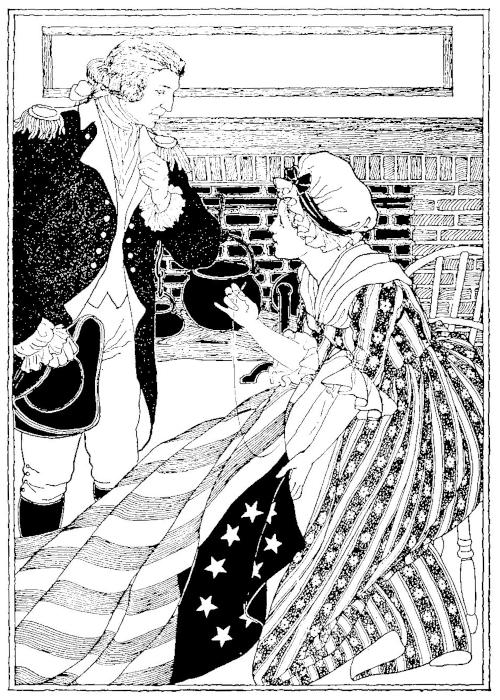
Over one hundred years ago, there lived in
Philadelphia a young woman named Betsy Ross.
From the time she was a little girl she liked to
sew. When her husband died she made money
by her needlework.
One day there came to her little brown house
the great General Washington.
He wanted a new flag for his soldiers to carry
in their war against the King of England.
When he heard of the beautiful needlework of
Betsy Ross, he came to ask her to help him.
Together they planned a flag that had thirteen
stripes and thirteen stars.
A few days later Betsy Ross showed General
Washington the flag. She had cut it and sewed
it with her own hands.
General Washington was so pleased that he
told his soldiers to have their flags made at once.
Soon the beautiful stars and stripes were flying
all over the country.
In Philadelphia, the little house where Betsy
Ross lived is still standing.
LONGFELLOW’S ARM-CHAIR.
Near the poet Longfellow’s home there was a
blacksmith shop. A beautiful chestnut tree grew
beside it and spread its branches over the shop.
Little children often looked in at the open door
on their way home from school. They liked to
see the sparks fly from the anvil.
The poet Longfellow sometimes passed by the
shop. He thought it was such a pretty picture
that he wrote a poem about it. He called the
poem “The Village Blacksmith.”
Longfellow loved the tree and felt sorry when
it was cut down. He and the chestnut tree had
grown old together.
About that time Longfellow had a birthday.
He was an old, white-haired man.
The children wanted to show their love for
him. They had the wood from the tree made
into a chair and gave their pennies to pay for it.
This gift made Longfellow very happy. He
thanked the children by writing a beautiful poem,
called “From My Arm-Chair.”
THE ROAD OF THE LOVING HEART. — II
Robert Louis Stevenson wrote the beautiful
poem called “Singing.” It is in a book which he
named “A Child’s Garden of Verses.”
He was sick much of the time and had to live
in a warm country. His home was far away in
the South Seas on a beautiful island.
Robert Louis Stevenson built his house on a
hillside among the large forest trees. Here the
flying foxes came to rest. At night great bats flew
about.
The house was three miles from the nearest
town. The trees grew close and high along the
path that led to it. They used packhorses to
carry things from the town to the house.
A beautiful stream ran through the ground.
Orange trees grew along the banks. Here Robert
Louis Stevenson came to bathe and swim.
Mrs. Stevenson had a garden in which grew
oranges, lemons, bananas, and breadfruit trees.
She had cows, and pigs, and chickens in the
barn-yard.
Robert Louis Stevenson had a brown pony
named Jack. He and Jack were great friends and
had many fine rides together.
In this warm country Robert Louis Stevenson
grew so much better that he once said,
“It is like a fairy story that I should become
well and strong. I go boating, riding, bathing,
and work hard with my wood-knife in the forest.”
The people on the island do not look as we do.
Their skin is brown. Many bright flowers grow
on the island. The women always wear flowers
in their hair.
The people loved Mr. Stevenson very dearly.
When they learned that he wrote stories, they
named him Tusitala. That means The Story
Writer.
Once some of the chiefs were put in prison.
Robert Louis Stevenson did not think this was
right.
He went to the prison to see the chiefs and was
very kind to them.
At last the chiefs were set free. They wanted
to show their love for Mr. Stevenson, so they
made a road from the town to his house.
It was a hard piece of work. It took many men
a long time to do it.
When the road was made the chiefs gave a
great feast. All the people on the island came to it.
These are some of the words which they put
on a board beside the road,
“To show our great love for Tusitala we have
made this gift. It shall never be muddy. It shall
go on forever, this road that we have dug.”
SINGING.
Of speckled eggs the birdie sings
And nests among the trees;
The sailor sings of ropes and things
In ships upon the seas.
The children sing in far Japan,
The children sing in Spain;
The organ with the organ man
Is singing in the rain.
Robert Louis Stevenson.
MARCH.
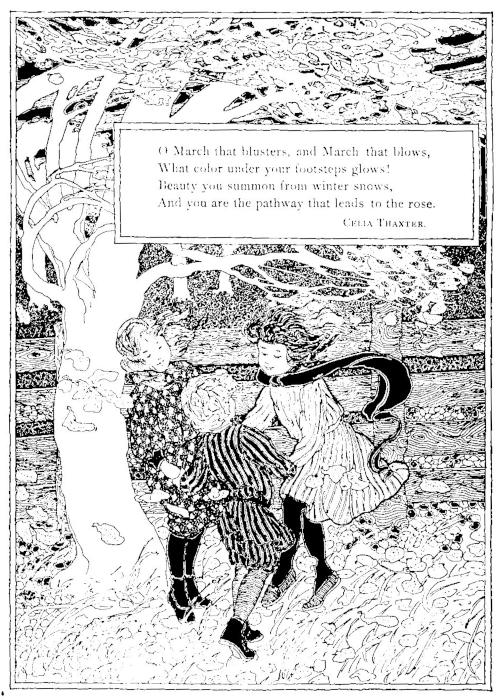
O March that blusters, and March that blows,
What color under your footsteps glows!
Beauty you summon from winter snows,
And you are the pathway that leads to the rose.
Celia Thaxter.
THE FOUR WINDS.
“Which is the wind that brings the cold?”
“The North wind, Freddy, and all the snow;
And the sheep will scamper into the fold,
When the North begins to blow.”
“Which is the wind that brings the heat?”
“The South wind, Katy; and corn will grow,
And peaches redden for you to eat,
When the South begins to blow.”
“Which is the wind that brings the rain?”
“The East wind, Arty; and farmers know
That cows come shivering up the lane,
When the East begins to blow.”
“Which is the wind that brings the flowers?”
“The West wind, Bessie; and soft and low
The birdies sing in the summer hours,
When the West begins to blow.”
Edmund Clarence Stedman.
THE BAG OF WINDS. — II
Long ago there was a man named Ulysses
who had been traveling for many years.
He was sailing toward home one day when he
came to the land where Æolus lived. Æolus
was king of all the winds that blow.
Sometimes he sent soft winds to fill the sails of
the ships at sea. Sometimes he sent winds that
made the waters roar. Then he called them back
and the sea would become quiet again.
Ulysses and his sailors were glad to stay for a
time in the land of Æolus. They were tired of
traveling so long.
When they were ready to go away, King
Æolus filled their boat with food and many gifts.
One of these gifts was a large bag made of skin.
King Æolus said to Ulysses, “In this bag I
have tied all the winds that blow. If you wish
to go more quickly toward home, open the bag
and let one of the winds fly out. Then tie the
bag again.”
Æolus said good-by to Ulysses and sent a soft
wind to carry him from the land.
Day after day Ulysses sailed his boat safely
over the sea. But one night when he was asleep,
his sailors wondered what was in the large bag
made of skin.
“It must be full of gold,” they said. “Let us
take it.”
The sailors opened the bag and at once all the
winds flew out.
How they made the waters roar around the
boat! Even Ulysses could do nothing to quiet
them. For many days the boat was tossed about
by the waves.
At last the sailors saw land. They were very
glad to pull the boat upon the shore, and rest.
They did not know where they were. The
winds had made the boat go far from its path.
The sailors were sorry that they had opened
the bag which King Æolus had given Ulysses.
A long-time afterward the travelers came home.
Ulysses often told the story of his friend, King
Æolus, and his gift of the Bag of Winds.
THE FEAST OF DOLLS.
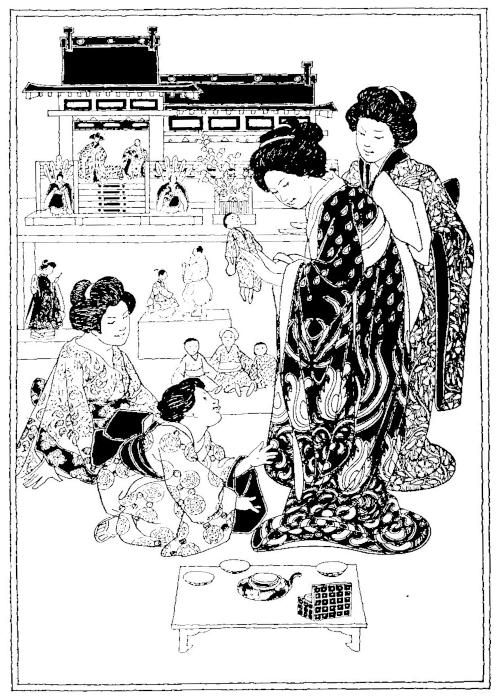
The Feast of Dolls is the happiest day in the
year for the little girls in Japan. It is the third
day of March.
The night before, while the little girls are
asleep, great boxes of dolls are taken from the
store-room.
There are all kinds,—large dolls, small dolls,
girl dolls, and boy dolls.
The mothers and grandmothers of the little
girls played with some of these. Others are very
much older.
On the day of the Feast of Dolls, the little
girls wake up early and run to the feast room.
Each doll must be dressed. This takes a long
time, for some of the little girls have a great
many dolls.
By this time the feast is ready. The dolls cannot
eat the rice cakes and drink the tea, so their
little mothers do this for them.
When the long, happy day is over, the dolls
are undressed. Then they are put away until
the Feast of Dolls comes again.
THE FEAST OF FLAGS.
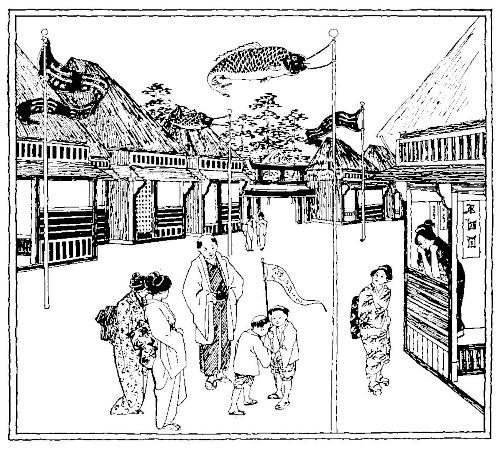
The fifth of May is the great day for boys in
Japan. It is called the Feast of Flags.
Everywhere poles with gold paper balls on the
top may be seen. Paper flags of all colors fly
from these.
The boys get up early on the day of the Feast
of Flags. They go to the room where the dolls
had their feast.
Now the room is filled with flags, toy soldiers,
and the games that boys like. Their grandfathers
and great-grandfathers played with some
of these.
All day long the boys play at war with their
soldiers. Sometimes they go into the garden
and shoot at straw soldiers.
On the morning of the Feast of Flags each
father gives his son a paper fish.
Every one in the house stands near while the
boy ties this to a string. Then they watch him
raise it to the top of the pole which is set before
the house.
The wind fills out the hollow body of the fish.
It pulls at the end of the string as if it were alive.
The name of this fish is the carp. It is so
strong that it can swim very fast and even jump
over waterfalls.
In America, fathers tell their sons to be
brave and strong like the eagle. But in Japan,
they tell them to be brave and strong like the
carp.
FRANKLIN’S KITE.
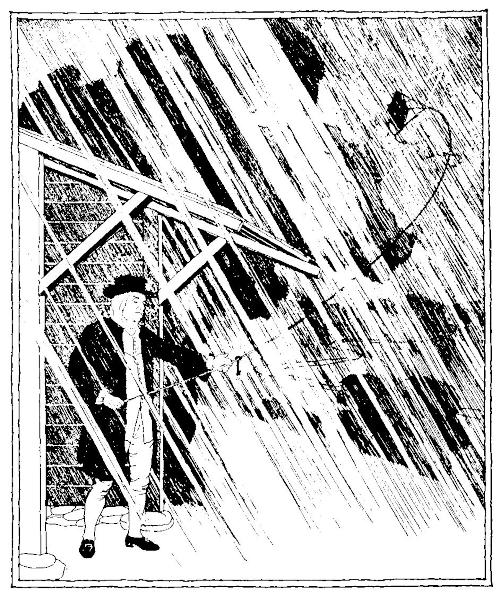
A long time ago there lived a wise man named
Benjamin Franklin.
People did not know much about lightning in
those days. Franklin made a kite to catch some
of it.
He knew that rain would spoil paper, so he
covered his kite with silk. He put a piece of
pointed wire at the top of the kite to draw the
lightning into it.
At the end of the string he tied a key for the
lightning to follow. Then he tied a piece of
ribbon to the string and held it in his hand.
One rainy night when it was lightning he went
out to fly his kite.
After a while he held his hand near the key.
He saw a little spark of lightning go from the
key to his hand.
After that he brought the lightning into his
house on wires. He made it ring bells and do
many strange things.
Other wise men have told us how to make
lightning without drawing it from the skies.
It lights houses, runs street-cars, and does
many other useful things.
It is called electricity.
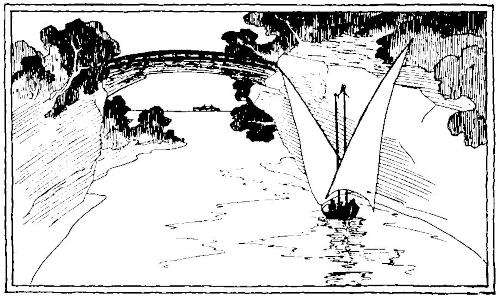
BOATS SAIL ON THE RIVERS.
Boats sail on the rivers,
And ships sail on the seas,
But clouds that sail across the sky
Are prettier far than these.
There are bridges on the rivers,
As pretty as you please;
But the bow that bridges heaven
And overtops the trees,
And builds a road from earth to sky,
Is prettier far than these.
Christina G. Rossetti.
THE STORY OF A WATER-DROP. — II
Once there was a little drop of water. It lived
in the great sea with hundreds of other water-drops.
When the sun shone all the little water-drops
danced up and down. They looked like diamonds
sparkling in the sunshine.
One day something happened. The little water-drop
broke into a great many tiny drops.
At the same time it went up in the air. Other
drops were going up, too. Up, up, they went,
higher, and higher.
At last the water-drops were sailing far above
the sea. A strong wind blew them over the land.
A man looked up at them and said, “See this
big dark cloud. I think it is going to rain.”
As they sailed along, the air grew very cold.
This made the little water-drops creep so close together
that they became a shining raindrop.
Soon all the other little water-drops ran together
and became raindrops.
They were so heavy that they could not float
in the air. So down they all went toward the
earth.
Pitter-patter! Pitter-patter! They fell upon the
grass, the trees, and the fields.
“It is raining!” cried the children as they ran
into the house.
When the rain was over, out came the sun.
Then a wonderful thing happened.
Some of the water-drops were not heavy enough
to fall to the earth. As the sun shone through
them they changed into beautiful colors.
These colors were red, orange, yellow, green,
blue, and violet. They formed a bow across
the sky.
“Oh, look!” cried the children. “Look at the
beautiful rainbow.”
Eva Mayne (Adapted).
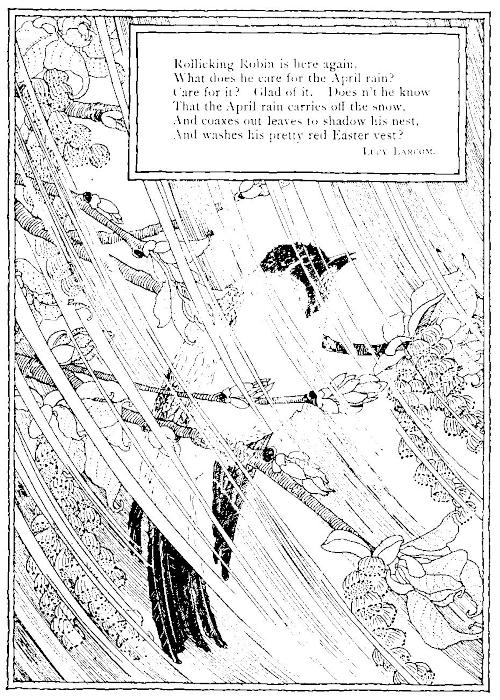
APRIL.
Rollicking Robin is here again.
What does he care for the April rain?
Care for it? Glad of it. Doesn’t he know
That the April rain carries off the snow.
And coaxes out leaves to shadow his nest,
And washes his pretty red Easter vest?
Lucy Larcom.
THE SLEEPING PRINCESS. — II — III
Once upon a time there lived a king and a
queen who had no children.
They were so happy when a little daughter
came that they gave a great feast.
The king asked the fairies to come because he
wished them to be kind and good to the little
princess.
There were thirteen fairies in the land. But
the king had only twelve golden dishes. So one
fairy was not asked to come to the feast. This
made her very angry.
The twelve fairies came and gave all their best
gifts to the little princess.
Just then the door opened and the angry fairy
came into the room.
“When the princess is fifteen years old she
shall prick her finger with a spinning needle and
die,” said the angry fairy.
But there was one kind fairy who had not
made her wish.
“No!” she said. “The princess shall not die.
She shall fall asleep for a hundred years.”
The king and the queen were frightened. So
they said that no spinning-wheel should be used
in all the land.
One day, when the princess was fifteen years
old, she went into a high tower of the castle.
There sat an old woman spinning.
“Good morning,” said the princess. “What
are you doing?”
“I am spinning,” said the old woman.
“Oh,” cried the princess, “how I should like
to spin!”
The old woman gave the needle to the princess.
She pricked her finger and fell back fast
asleep.
The king and the queen and every one in the
castle fell asleep.
The fire in the kitchen stopped burning and
the cook fell asleep.
The horses in the barn went to sleep.
The dogs stopped barking and fell asleep.
The doves on the housetop put their heads
under their wings and went to sleep.
Even the flies on the walls stopped buzzing
and fell asleep.
A hedge of thorns soon grew around the
castle. It was so high and thick that no one
could pass through it.
One hundred years after, a king’s son was
hunting. He saw the towers of a castle far away.
He rode toward the castle and at last came to
the hedge of thorns. As the prince looked he
saw that it was not a hedge of thorns, but a
hedge of beautiful flowers.
The prince passed through the hedge of flowers
and followed a path to the castle.
He went into the castle and saw the king and
the queen fast asleep.
Then he looked in all the rooms. By and by
the prince came to the high tower.
There lay the princess fast asleep. She was
so beautiful that the prince kissed her hand.
The princess opened her eyes and said, “My
prince, I have waited for you here a hundred
years.”
Then the prince and the princess went out of
the high tower together.
At once the king and the queen and every one
in the castle awoke.
The fire in the kitchen burned, and the cook
began to get the dinner.
The horses in the barn awoke, and the dogs
jumped about and barked.
The flies on the wall buzzed, and the doves
flew about the housetop.
That night there was a great feast in the castle.
Ever after the prince and the princess lived
happily together.
Jacob and William Grimm (Adapted).
AN OPEN SECRET.
Pussy Willow had a secret
That the snowdrops whispered her,
And she purred it to the south wind
While it stroked her velvet fur;
And the south wind hummed it softly
To the busy honey-bees,
And they buzzed it to the blossoms
On the scarlet maple-trees.
And these dropped it to the wood brooks
Brimming full of melted snow,
And the brooks told Robin Redbreast
As he chattered to and fro;
Little Robin could not keep it,
So he sang it loud and clear
To the sleepy hills and meadows
“Wake up! Cheer up! Spring is here!”
Unknown.
THE FEAST OF EGGS. — II
There was once a princess who left her beautiful
castle. She went to live in a little house in
the country.
One day she told her servant to go to the village
and buy some eggs for supper.
“Eggs!” said the servant. “There are no
birds’ eggs.”
“I did not ask for birds’ eggs,” said the princess.
“Buy hens’ eggs, of course.”
The servant shook her head and said, “We
have no hens. I do not know what kind of birds
they are.”
The princess thought that she would surprise
the boys and the girls of the village. So she sent
an old man far away.
When he came back the old man carried a
chicken coop on his head.
All the children of the village ran after him.
They wanted to know what he was carrying on
his head.
The old man set the coop down, opened the little
door, and a large rooster stepped out.
The children all cried, “Oh, what a wonderful
bird that is!” They did not know what to call
him.
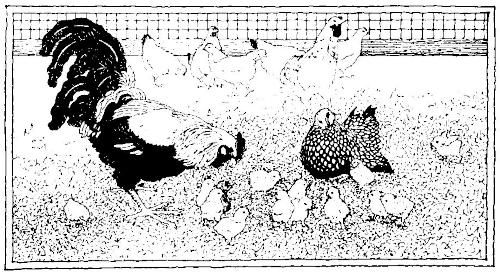
Then out stepped the hens. There was a white
one, and one that was brown, and one that had
tall red combs.
The princess gave the chickens some corn.
When they had eaten it the rooster crowed.
How the children laughed! “Ki-ki-ri-ki!” they
cried, like the rooster.
The children ran home to tell about the wonderful
birds that had come to live in the village.
Not long after, the princess showed the children
one of the hens that was sitting.
“Fifteen eggs!” they cried. “The doves lay
only two, and the other birds only five. How
will the hens feed so many little ones?”
The children watched the chickens when they
came out of the eggs. They were surprised that
the little chickens were covered with yellow down.
“It is wonderful!” they cried. “Other little
birds have no feathers. And see! They know
how to run. Oh, there are no birds like them!”
By and by the princess asked the people of the
village to a feast of eggs. They all sat down at
a long table in the garden.
The eggs were in large baskets on the table.
They were as white as snow.
The princess showed them how to break the
eggs. Then she cooked them in many ways.
The people of the village liked the feast of eggs.
When they went home, the princess gave them
some chickens.
After that the children had merry times hunting
for the white eggs.
From the German of Christoph Schmid (Adapted).
THE EASTER EGG.
On Easter Day, a princess gave a party to the
children of the village.
She had no apples and nuts to give them. So
she colored some eggs red, blue, and yellow.
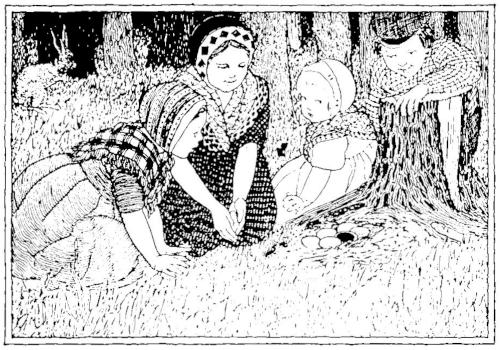
When the children came, the princess took
them into the woods. She told them to make
nests out of the grass and leaves.
They left the nests under the trees. Then
they went into the garden where a feast was
waiting for them.
While they were eating, the princess carried
the colored eggs into the woods. She filled the
nests with them.
Then she went back to the children and said,
“Come, now! Let us look for our nests.”
The children hunted everywhere. When they
found the nests, they clapped their hands for joy.
In each nest lay five colored eggs.
“Red eggs! Red eggs!” cried one. “In my
nest all are red!”
“In mine are blue ones,” cried another. “All
blue like the sky!”
“And mine are as yellow as the butterfly that
is flying around us,” said another.
“Oh,” they all cried, “how we should like to
see the chickens that lay such beautiful eggs!”
“Of course hens do not lay them,” said one
little girl. “Hens’ eggs are white.”
“I saw a rabbit running away from my nest,”
said another. “I believe a little rabbit laid
them.”
All the children laughed and said, “Yes, yes!
The rabbits laid the colored eggs!”
From the German of Christoph Schmid (Adapted).
THE FARMER AND THE BIRDS.
It was springtime. The birds were singing
merrily as they built their nests.
But the farmers were angry. They did not
want the birds to eat the corn in the fields, and the
cherries on the trees.
The farmers said that all the birds must be
killed. But the birds had one friend.
This friend stood up before the farmers and
said, “Think of your woods and fields without
the birds! Who will drive the worms from your
fields and gardens?
“The birds pay you well for the grain and the
cherries that they eat. What will you do without
their sweet music?”
The farmers laughed and would not listen to
the friend.
They sent men and boys into the fields and
the woods to kill the birds. The little ones were
left to die in their nests.
When summer came, there was not a bird to
be seen. Hundreds of worms ate everything that
grew in the gardens and fields.
That autumn there were no red and yellow
leaves on the trees. The branches were dry and
brown.
Then the farmers were sorry. The next spring
they sent a man away to bring the birds from all
the country around.
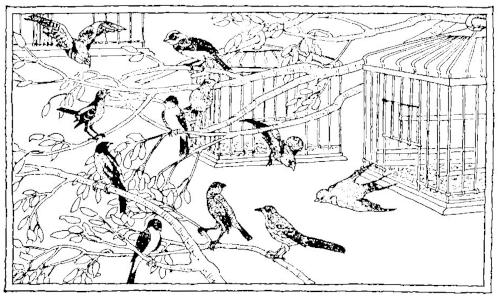
One day the man drove a wagon covered with
green branches into the village. Cages filled with
singing birds hung upon the branches.
The farmers opened the doors, and the birds
flew out.
Once more the woods and the fields were filled
with sweet music.
Suggested by Longfellow’s poem, “The Birds of Killingworth.”
MAY.
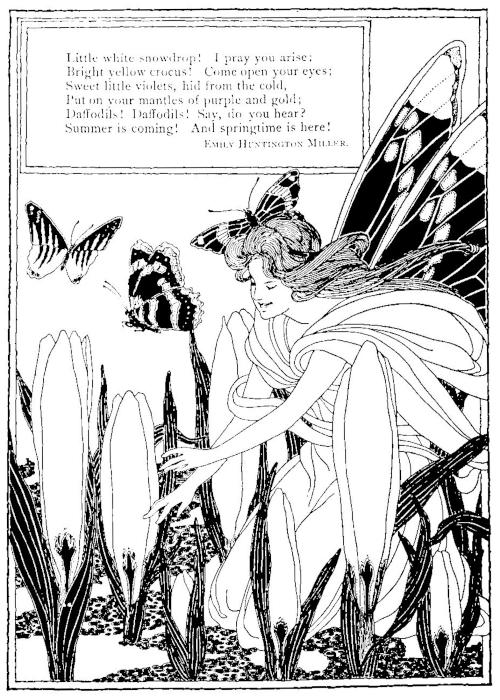
Little white snowdrop! I pray you arise;
Bright yellow crocus! Come open your eyes;
Sweet little violets, hid from the cold,
Put on your mantles of purple and gold;
Daffodils! Daffodils! Say, do you hear?
Summer is coming! And springtime is here!
Emily Huntington Miller.
MARY’S MEADOW. — II
Mary liked to plant flowers beside the road
and in the fields.
She told her father that she wanted to make
people happy who had no gardens. So Father
called her The Traveler’s Joy.
But Mary liked best of all to play in the
Squire’s meadow. It was filled with beautiful
flowers and singing birds.
Mary cried when her father told her that he
and the Squire were no longer friends. He said
she must not play in the meadow with the
Squire’s great dog, Saxon.
One day, the gardener gave Mary some pretty
cowslips. She forgot what her father had told
her, and ran down to the Squire’s meadow to
plant them.
Soon she heard a loud shout. She looked up
and saw the old Squire running toward her.
With one hand he held his dog, Saxon, who was
trying to get away.
Mary was so frightened that she did not hear
what the Squire was saying. She told him that
she was not digging up his cowslips, but planting
them.
Just then Saxon came running toward her.
The Squire stopped shouting to her, and called
to Saxon. He did not know that Mary and
Saxon were such good friends.
Mary threw her arms around Saxon’s neck,
and began to cry. Then she picked up her
basket and ran home as fast as she could.
Every day she thought the old Squire would
come and tell her father. But he never came.
The next spring it was great fun to look for
the flowers which The Traveler’s Joy had
planted.
One day Mary’s father sent for her. When
she came home, she found the old Squire talking
to her father. He held some cowslips in his
hand.
He gave them to Mary, and said, “My dear,
I am sorry that I sent you out of the meadow.”
“But I was not digging up your cowslips,”
Mary said.
The old Squire put his hand on her head. “I
know, my child,” he said. “You are The Traveler’s
Joy.”
“I am glad the cowslips grew,” Mary said.
“I hope they will grow all over your meadow.”
Then the Squire said, “It is not my meadow
now. I have given it away.”
“Oh, please, please, do not give it away!”
cried Mary. “Can’t I play there with Saxon,
and plant flowers?”
The Squire smiled at her father, and said, “Yes,
Mary! You may play, and plant, and do what you
like there.”
Father put his arm around the little girl.
“You do not know what the Squire means. Do
you, dear?” he said. “The Squire has given it
to you. Now we shall always call it Mary’s
Meadow.”
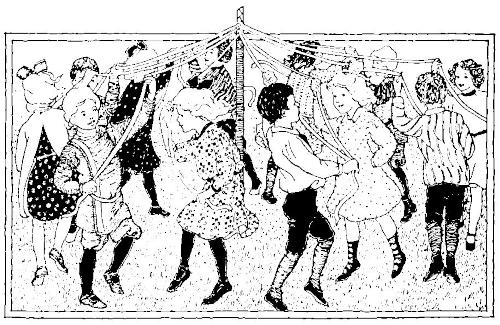
A bright, happy crowd of children marched to
the woods for a May party.
First came two boys carrying a May-pole to
which bright ribbons were tied.
Then came the May Queen with a crown of
flowers on her head, and a long wand in her
hand.
The girls marched behind the May Queen,
carrying the pretty May baskets which they had
made. The boys were waving flags and blowing
horns.
When they came to the woods, the boys set
up the May-pole and all the children danced
around it.
In and out they went weaving the bright
ribbons. The girls went to the left, the boys to
the right. They bowed as they passed each
other, and sang the pretty May-pole song.
Soon the pole was wound with the bright
ribbons.
Then some of the children ran down to the
water to sail boats, and others went up, up, in the
swings.
The older girls set the table. What a beautiful
table it was! There were sandwiches, and
oranges, and cakes, and nuts, and candy.
After the children had eaten all the good things,
they went through the woods gathering flowers.
They filled the pretty baskets with flowers, and
stood them side by side. But the children could
not tell which they liked the best.
That night, when it was dark, each girl and
boy put a basket on the door-step of a friend,
then rang the bell and ran away.
They had such a good time that they wished
May-day came oftener than once a year.
COME, MY DOLLY.
Come, my Dolly, come with me,
Dance beneath the apple-tree.
See the blossoms flying down,
Wings of pink and rosy crown.
Catch them, Dolly, in your gown,
While the sun sees you and me
Dancing ’neath the apple-tree.
Some day, Dolly, you will see
Snow upon the apple-tree;
White wings then will flutter down,
Covering leaves all dry and brown.
But, my Dolly, do not frown;
When spring comes again, you’ll see
Pink wings on the apple-tree.
Lydia Avery Coonley-Ward.
PROSERPINA. — II — III — IV
It was harvest-time and the grain was ready
to be gathered.
Mother Ceres was very busy, for she had the
care of every seed that grows.
She put on her hat made of poppies. Then
she stepped into a chariot drawn by a pair of
winged dragons.
“Dear Mother,” said Proserpina, “may I go
down to the shore and play with the sea-maids?”
“Yes, child,” answered Mother Ceres, “but
you must not go alone into the fields.”
The sea-maids heard Proserpina calling. Soon
she saw them coming up out of the water. They
made a chain of beautiful shells and hung it
around Proserpina’s neck.
“How pretty it is!” said Proserpina. “Wait
for me here while I run into the fields. I want
to make each of you a chain of flowers.”
Proserpina’s hands were soon full of flowers.
She was turning to go back, when she saw a
beautiful plant near her.
“I will put it in my garden,” said Proserpina.
She pulled and pulled. Soon Proserpina held
the plant in her hands. She was surprised
to see the deep hole which its roots left in the
ground.
The hole grew deeper and wider, and Proserpina
heard a loud noise under the ground.
Four black horses jumped out of the hole,
drawing a golden chariot. In it sat a very dark
man, with a crown of diamonds on his head.
The man caught Proserpina in his arms, and
shouted to his horses. They went so fast that
they seemed to fly through the air.
Proserpina was frightened and called out,
“Mother! Mother Ceres! Come quickly and
help me!”
But Mother Ceres was a great way off, and
could not hear her cry.
“I will not harm you,” said the man. “I am
King Pluto. All the gold and silver under the
ground belong to me.
“I will give you a garden full of prettier
flowers than those in your hand. Where I live
all the flowers are made of pearls and rubies.”
Just then Proserpina saw Mother Ceres in a
field far away. She gave a loud cry, but King
Pluto only made the horses go faster.
As they went under the earth it grew darker
and darker. By and by they came to his castle.
It was made of gold and lighted with lanterns
made of diamonds. There was no sunshine in
King Pluto’s country.
“Try to be happy, little Proserpina,” he said.
“You may have my crown to play with. If you
like, you may sit beside me and be my little
queen.”
“I do not want golden castles and crowns,”
sobbed Proserpina. “Please carry me back to
my mother.”
Dinner was ready for them but Proserpina
would eat nothing. She knew that if she ate the
food or drank the water of King Pluto’s country,
she could never see her mother again.
Mother Ceres heard Proserpina’s loud cry. She
looked all around but could not see her. Then
she drove home quickly, but she could not find
her in the house.
She heard the sea-maids singing, and ran down
to ask them about Proserpina.
“She left us this morning to gather flowers,”
said one of them. “We have not seen her since.”
It was now almost dark. Mother Ceres lighted
her torch, and went from house to house asking
every one about her child.
Day and night for six long months she hunted
for her little girl. Her torch burned dimly by day
but at night it lighted her path.
At last some one told her that Proserpina had
been carried off by King Pluto.
Then Mother Ceres said, “The grain shall not
grow, nor the flowers bloom, until my little girl
is given back to me.”
The earth turned brown, and there was no food
for men nor animals. So they asked King Pluto
to make the earth green by sending Proserpina
home.
Proserpina had grown very hungry. She had
just begun to eat some fruit when King Pluto told
her she could go back to her mother.
As she walked along, everything turned green.
Beautiful flowers grew in her path. The cows
and the sheep began to eat the grass and the birds
to sing in the trees.
Mother Ceres was sitting on the door-step when
she heard Proserpina say, “Here I am, Mother
dear.”
How happy Mother Ceres was, to hold her little
girl in her arms once more. Proserpina told her
all about King Pluto’s castle.
“I was so unhappy, Mother dear,” she said,
“that I did not eat anything until to-day. Then
King Pluto gave me some fruit that had grown in
one of your gardens.”
“Oh, my little Proserpina!” said Mother Ceres.
“Why did you eat it?”
“I did not eat all of it,” said the little girl. “I
swallowed only six seeds.”
“My child,” said Mother Ceres sadly, “you
ate those six seeds in King Pluto’s castle. So
you will have to spend six months of every year
under the ground with him. While you are gone
nothing shall grow. But when you come back to
me in the spring, we will make the world beautiful.”
Nathaniel Hawthorne (Adapted).
HAWTHORNE AND HIS CHILDREN.
Nathaniel Hawthorne had three children.
They had great fun together.
In the spring he made them boats to sail on
the lake, and kites to fly in the air.
In the summer he went fishing with them and
took them into the woods to gather flowers.
In the autumn they went nutting.
One day the children were standing at the foot
of a tall walnut tree. Soon they heard a shout.
When they looked up the children saw their
father high up in the top of the tree. Then down
came the nuts! The children put them into bags
and carried them home.
When the snow came, their father took them
coasting. Sometimes as they went down the
hill they fell into the snow.
Then how they shouted and laughed!
Hawthorne liked to take long walks with his
son. The little boy thought that his father was
the best playmate in the world.
Once when they were out walking, they passed
through some tall grass and weeds. They played
these were giants and dragons which had to be
cut down.
Hawthorne struck so hard that he broke his
cane. Then he sat down and watched the little
boy fighting with the giants and dragons.
Hawthorne loved children so much that he
wrote books for them.
His three children loved his stories. They
read his Wonder Book and Tanglewood Tales
so often that they knew them almost by heart.
JUNE.
The lilies ring their tiny bells
From garden-beds in June,
And high and clear their music swells,
A lovely fairy tune.
Selected.
THUMBLING. — II — III — IV — V — VI — VII
There was once a woman who had no little
child. So one day she went to see a Wise
Fairy.
“I wish for a tiny, little child,” she said. “Can
you tell me where I can get one?”
“Here is a grain of corn,” said the Wise
Fairy. “Plant it in a flower-pot. Then you
will see what is to be seen.”
“Thank you,” said the woman.
Then she went home and planted the corn in
a flower-pot.
The next day a large flower came up. It
looked like a tulip bud.
The woman kissed the red and yellow leaves.
As she kissed it the flower opened with a loud
snap.
In the middle of the tulip there was a little tiny
girl. She was only an inch high. So they
named her Thumbling.
“Thumbling must have a cradle,” said the
woman. So she made her one out of a walnut
shell.
Thumbling slept on the blue velvet leaves of
a violet. Her cover was a pink rose leaf.
One night a great Ugly Toad hopped in at
the window.
“What a pretty little girl!” she said. The
Ugly Toad took the walnut shell and hopped
down into the garden. A brook ran through the
garden.
“I will put her out in the brook on a water-lily
leaf,” said the Ugly Toad. “Then she cannot
get away.”
On the largest leaf the Toad laid the walnut
shell. Thumbling was in it fast asleep.
In the morning Thumbling awoke and began
to cry. The Fishes looked up and saw poor
little Thumbling.
“Why are you crying, little girl?” they said.
“I do not want to live with the Ugly Toad,”
said Thumbling.
“Live with the Toads?” said the Fishes. “No,
that must never be.”
They cut the stem of the lily leaf with their
sharp teeth.
The lily leaf floated down the brook and carried
Thumbling away from the Ugly Toads.
By and by a large May-bug came flying along.
He caught Thumbling with his long claws.
Then he flew with her into a tree. How frightened
little Thumbling was!
Soon many other May-bugs came into the
tree, to look at poor frightened little Thumbling.
“Why!” said one. “She has no claws.”
“She has only two legs,” said another. “She
should have six.”
“How ugly she is!” said all the others.
When the May-bug heard this he flew down
with her from the tree. He set her upon a large
daisy and left her there.
All summer Thumbling lived alone in the
great woods.
She wove a bed out of the leaves of grass. She
hung the bed under a large leaf to keep out the rain.
Thumbling ate the honey from the flowers.
She drank the dew that stood every morning
upon the leaves.
Then winter came, and it began to snow.
Poor little Thumbling! She was very cold.
A Field Mouse lived in a corn-field close to
the woods.
“I will ask the Field Mouse for something to
eat,” she said.
Poor Thumbling stood at the door like a little
beggar girl.
“You dear child!” said the Field Mouse.
“Come into my warm house. You may eat
dinner with me.”
“Would you like to stay with me all winter?”
said the Field Mouse.
“You may keep my house clean, and you may
tell me pretty stories.”
The winter was long and cold. But Thumbling
was happy with the kind Field Mouse.
One day Thumbling found a poor bird lying
near the Field Mouse’s door. Thumbling was
very sorry. She thought the bird was dead.
“Poor little Swallow!” she said. “You must
not lie on the cold snow.”
Thumbling wove a mat of hay. Then she laid
it over the Swallow. She found some soft wool
and made a warm bed.
“Good-by, you pretty little Swallow,” she
said.
Then Thumbling laid her head against the bird.
The Swallow moved. It was not dead. It was
only cold.
The Swallow opened its eyes and looked at
Thumbling.
“Thank you, pretty child,” he said. “I am
warm now. Soon I shall fly about in the bright
sunshine.”
“Oh!” said Thumbling. “You cannot live out
of doors. Cold winter is here. You must stay
in the Field Mouse’s home.”
The Field Mouse did not like birds. But she
liked Thumbling and wished to make her happy.
So all winter the Swallow lived in the Field
Mouse’s warm home.
At last spring came.
“I must go now,” said the Swallow. “Will
you go with me, Thumbling? You may sit upon
my back and I will fly out into the bright sunshine.”
“No!” said Thumbling. “The kind Field
Mouse will be sorry to have me leave her.”
“Good-by, then, dear little Thumbling,” said
the Swallow.
“No, no!” said Thumbling. “I will go with
you. I do not like to live in the dark ground
when it is so beautiful above.”
Thumbling sat upon the Swallow’s back. Then
he flew high up into the air.
By and by they came to a warm country.
A large white flower was growing in a garden.
The Swallow flew down and set Thumbling upon
one of its broad leaves.
In the middle of the flower she saw a little tiny
man. He was no larger than Thumbling.
The tiny man was as pure and white as if made
of glass. He had a gold crown on his head and
bright wings on his shoulders.
He was the King of the flower fairies.
“Oh, how beautiful he is!” said Thumbling to
the Swallow.
The fairy King was glad to see Thumbling.
He took off his crown and put it on her head.
“You shall be Queen of all the flower fairies,”
he said.
How happy every one was! Out of every
flower came a tiny flower fairy.
Each one brought the Queen a gift, but the
one she liked best was a pair of golden wings.
When she put these on she could fly from
flower to flower.
“You shall not be called Thumbling,” said the
fairy King. “That is an ugly name. We will
call you Maia.”
Hans Christian Andersen (Adapted).
MIDSUMMER NIGHT.
When the moon shines, and the stars are
bright, and the warm winds blow, the fairies
meet together. They come from everywhere.
The fairy queen, Titania, sends one to hang
pearls of dew on the flowers. She sends another
to kill the worms that are eating the roses. She
sends others to frighten away the birds that cry
at night.
When Titania lies down upon a bed of cowslips,
the fairies sing her to sleep.
Other fairies wait upon Oberon, the king.
The one he likes best is Puck.
Puck is the merriest fairy of all. He plays
all sorts of tricks to make the king laugh.
The fairies dance merrily together in the moonlight.
But when they are frightened they hide
in acorn cups.
The king and the queen and all their fairies
stay in the woods through the summer night. But
when they first see the sunlight, they fly away,
and follow darkness around the world.
His mother told him that the fairies always
liked a Sunday child. They would help him to
be a great and good man.
She said that if he were kind and true, he would
see the Nixie sometime. Then the Nixie would
grant him three wishes.
Nils wanted to see the Nixie more than anything
else. Many a time he sat by the water
where the Nixie lived and listened for her music.
Sometimes on midsummer nights he thought
he could hear it. But he could not see the
Nixie nor tell her his three wishes.
“Perhaps I am not good enough,” thought
Nils. Then he tried to be kind to the birds and
animals. He was also very gentle with his little
sister.
He knew what his three wishes would be, when
he saw the Nixie.
First he wanted to be wise; then he wanted
to be famous. But most of all he wanted a violin,
so that he could play the Nixie’s music.
One day he asked the schoolmaster to let him
take his violin.
The kind old man listened to Nils’s story.
Then he said, “I will teach you to play the violin.”
After a few lessons, Nils tried to play the Nixie’s
music. But though his ears could hear it, his
fingers could not play it.
After a while the old schoolmaster died and
left his violin to Nils.
Nils played on it all the time when he was not
at work in the woods with his father.
The people said that he could play the Nixie’s
music. They came from far and near to hear it.
But Nils knew that he could not play it, although
he could still hear it.
He played at all the feasts. He made more
money with his violin than he did when he worked
in the woods.
When he grew to be a man, he was very gentle
and kind. People came to him when they were
sad and wanted help. They called him Wise Nils.
Once two men were traveling through the
country. They came to hear Nils play.
The travelers had never heard such beautiful
music. They asked Nils to go with them and
play in many countries.
“No!” Nils answered. “I must stay here.
My people need me.”
A few weeks after the men went away, a large
box came to Nils. He opened it and found that
the travelers had sent him a beautiful violin.
As he drew the bow over the strings, Nils
said, “Now I can play the Nixie’s music.”
He ran down to the water, for it was Midsummer
Night. That is the time when Nixie
always plays the loudest.
After a while he heard the soft music. But
when he tried to play it the music was gone.
Sadly he put his violin down.
Should he never see the Nixie and tell her his
three wishes?
Then he said to himself, “But I have my first
wish, for the people call me Wise Nils. And I
might have been famous, if I had gone with the
men.”
Then he thought of his third wish. He picked
up his dear violin, and held it lovingly in his
arms.
Hjalmar Hjorth Boyesen (Adapted).
JULY.
’Tis the star-spangled banner!
Oh, long may it wave!
O’er the land of the free
And the home of the brave!
Francis Scott Key.
AMERICA.
(To be memorized)
My country! ’tis of thee,
Sweet land of liberty,
Of thee I sing;
Land where my Fathers died,
Land of the Pilgrims’ pride,
From ev’ry mountain side
Let freedom ring.
My native country, thee,
Land of the noble free,
Thy name I love;
I love thy rocks and rills,
Thy woods and templed hills,
My heart with rapture thrills,
Like that above.
Let music swell the breeze,
And ring from all the trees
Sweet freedom’s song;
Let mortal tongues awake,
Let all that breathe partake,
Let rocks their silence break,
The sound prolong.
Our Fathers’ God, to thee;
Author of liberty,
To thee we sing;
Long may our land be bright
With freedom’s holy light,
Protect us by thy might,
Great God, our King!
Samuel F. Smith.
THE LIBERTY BELL.
It was the Fourth of July, 1776.
For more than a year America had been at war
with England.
A great and good man had written a paper
saying that America must be free.
On the Fourth of July a number of wise men
met in Philadelphia, to see about signing this
paper.
Many people stood around the house where
they met.
“Will they sign it? Will they sign it?” the
people asked.
An old bell-man was in the tower ready to
ring the bell. His little grandson stood below
to tell him when to ring it.
Hour after hour passed, but still the old man
and the little boy waited.
At last the boy shouted, “Ring, Grandpa!
Ring! Oh, ring for liberty!”
The old bell rang out loud and clear. How
the people shouted! Cheer after cheer went up.
For two hours the old bell-man sent out the
glad news. America was free!
This was the first Fourth of July.
For many years the old bell rang out merrily
on all great days. But at last a sad thing happened.
A large crack was found in it.
The old bell could never ring any more. But
the people loved it better than ever.
They gave it a home in Independence Hall in
Philadelphia, where every year travelers go to
see it.
THE SOLDIER BIRD. — II
One day, Chief Sky, an Indian, found an
eagle’s nest with a baby eagle in it.
The Indian was poor, so he sold the eagle to
a white man for some corn.
The man took it into a village where some
soldiers were getting ready to go to the war.
“Here is a new soldier,” he said.
“An eagle! An eagle!” shouted the soldiers.
“Let us take him to the war.”
They put red, white, and blue ribbons around
his neck, and named him Old Abe. They
covered his perch with the American flag and
marched into camp.
When the eagle heard the people cheer, he
took the flag in his beak and spread his wings.
“The bird of America! The eagle of freedom!”
shouted the soldiers.
Old Abe was carried in front of the soldiers.
Often he would spread his wings and fly far up
into the sky. Then how the men cheered!
Sometimes Old Abe flew away to look for food
and he would be gone for two or three days.
But he always found his soldiers again.
At one time the soldiers’ food was nearly gone.
For two days Old Abe had nothing to eat.
The soldiers of the other army were very near.
No one could leave the camp.
Tom, the man who carried Old Abe, felt very
sorry. He went to his captain and begged him
to let him go out and get food for poor Old Abe.
Soon Tom came back with a good supper for
his pet.
Old Abe was very fond of music, and liked to
drill with the soldiers. He watched the captain
and did as he was told.
At last the war came to an end. The brave
eagle that had been in so many battles was taken
home.
A large house was built for him. The soldier
who had carried him through the war took care
of him.
In this pleasant home Old Abe lived a long and
happy life.
THE CALICO’S STORY. — II — III — IV
Once I was a tiny seed covered over with a
brown coat. I had many brothers and sisters.
We lived in the warm South and were kept in
a strong bag.
One morning the people who lived in the house
were up very early.
I heard the master say, “Tom, you may plant
that cotton seed to-day.”
Cotton Seed was my name. Tom picked me
up and I was soon put into a little bed close to
a great river. I began to feel larger and larger.
One day my coat burst and I came up out of
the ground. Wasn’t I happy then!
I had a green body and two green leaves. I
stretched my head higher and higher.
At last I had three beautiful blossoms. Soon
all my pretty leaves left me, to go with Mr. Wind.
One day the buds left by the blossoms burst
open. I was covered with cotton as white as
snow and as soft as silk.
“Come, children!” I heard some one call.
“We must pick the cotton.”
And the children did come. They had woolly
heads and shining eyes.
One little boy cried out, “Oh! Did you ever
see prettier cotton?”
His little black fingers soon picked all my white
cotton.
Next I was riding in a basket on Tom’s head.
I was sorry to leave the fields, and said, “Good-by,
dear old body and leaves! Good-by, dear
river!”
A machine took away from me many little hard
seeds. They looked just as I did before I went
to sleep in Mother Earth.
After a while I was loaded on a ship which
sailed on a great sea. By and by the ship stopped.
I was carried to a large house where I heard,
“Buzz, buzz, buzz!”
A great many strange things were done to me.
I was cleaned, and twisted, and spun, and woven.
At last I had become white cloth.
Next I went through a printing-machine.
This machine sent me under a roller which left
little red cherries all over me.
Then I went under another roller which put
green stems on the cherries. It left green leaves
close to the stems.
Prettier cherries you never saw!
After I left the roller I was dried, folded, and
sent to a store in a city.
One day a little girl from the country came into
the store. She had a basket of eggs. When she
saw me she gave all of her eggs for me.
Then I was made into a pretty dress. I gave
much joy to the little girl who liked to wear me
to school.
The Youths’ Companion (Adapted).
AUGUST.
Oh, fireflies, fireflies, light all your candles!
Far down, deep down in the sea’s wet bed
The wise little fishes have lighted their lanterns,
And luminous jellyfish tents are spread.
Ella Higginson.
THE SIX LITTLE SEA-MAIDS. — II
Deep down in the sea, there was a beautiful
red and yellow castle. Its roof was made of
shells which opened and shut to let the water in
and out.
There the sea king lived with his six daughters.
They were pretty little girls, with long, golden
hair, and blue eyes. They had no feet, but they
had tails like fishes.
The sea-maids were very happy playing all day
deep down in the water.
Sometimes the fish would swim through the
windows of the castle. They often ate out of the
hands of the little sea-maids.
Outside the castle, the sisters had a garden,
where flowers grew in the blue sand.
On her fifteenth birthday, each of the little sea-maids
went up through the water for the first
time. The sisters promised to tell what they
liked best in the world above.
The oldest sister came down to the castle and
said, “I liked best to watch the lights on the land,
and to hear the bells ring.”
When the second sister was fifteen years old,
she went up through the water at sunset.
“I think the golden clouds are the most beautiful
things in the world,” said the second sister.
The third sister went up a wide river, with
green woods and hills along the shore. “I
watched some children in the water,” said the sea-maid.
“How can they swim? Children have no
fish tails.”
The fourth sister said, “The sea is more beautiful
than the land. There are white ships, and
large fishes, and many strange things to be seen
here.”
The birthday of the fifth sister came in the
winter. The sea was green. There were large
pieces of ice in it, which seemed to frighten the
sailors.
The sea-maid sat down on a piece of ice, and
let the wind play with her long hair.
The youngest sister wanted to see the world
above more than any of her sisters.
When she went up through the water, she saw
a large white ship filled with people.
A young prince was on the ship. It was his
birthday, so there were fireworks, and music, and
dancing.
The little sea-maid had never seen men and
women before. So she rode on the high waves
and watched them.
By and by there was a storm, and the people
on the ship were frightened. Soon the ship
parted, and the sea-maid saw the young prince
fall into the water.
She knew that he could not live in the water.
So the sea-maid went up to him and held his
head above the waves. When the storm was
over, she laid him down on the yellow sand.
Soon the prince opened his eyes. He was very
glad to be on the land once more. He did not
know that he had been saved by a little sea-maid.
Often at evening the six little sisters joined
hands and went up through the water. They
sang to the sailors in the ships.
“Do not be afraid,” sang the sea-maids. “It
is very beautiful far down under the blue water.”
But the sailors could not hear what the sea-maids
were saying. They thought the sweet
music was the sound of the wind.
Hans Christian Andersen’s “A Little Sea-maid” (Adapted).
THE SINGER AND THE CRICKET.
One summer day, long ago, a great many
people came together to listen to a festival of
song. They sat around in bright colored tents,
laughing and feasting.
By and by some one shouted, “The Mastersingers!
The Mastersingers!” The people
cheered them as they passed to their places.
First one and then another of the Mastersingers
came forward and sang.
At last a young man took his lute and stood
before the people. While he was singing a
beautiful song of spring, one of the strings of
his lute broke.
Just then a cricket jumped upon the lute.
Whenever the singer touched the broken string,
the cricket sang.
Those who listened did not know of the broken
string. The song of the cricket was like the
music of the lute.
When the song was ended, the women clapped
their hands. The men waved their hats and
cheered.
No one had ever heard such beautiful music.
The Mastersong had been sung. They crowned
the singer with flowers and hung a gold chain
around his neck.
In the city where he lived there stands a beautiful
statue of the Mastersinger.
In his left hand the Mastersinger holds a lute.
The other hand points to a cricket that stands beside
a broken string.
The statue tells us that the great man did not
forget the little friend that helped him sing the
Mastersong.
Suggested by Robert Browning’s poem, “The Two Poets of Crosie.”
KING SOLOMON AND THE BEES.
King Solomon was the wisest man in the world.
One day a beautiful queen came to his castle.
She had heard that King Solomon was very
wise. But she did not believe that he knew
everything.
The queen gave him a red rose which she had
brought from the garden. She also gave him a
rose that was made of red paper. They looked
just alike.
“King Solomon,” she said, “you are very wise.
Can you tell me at once which rose is made of
paper, and which grew in the garden?”
King Solomon looked at them, but he could
not tell. So he said to his servants, “Open the
windows.”
Some bees flew into the room. They buzzed
around the rose that grew in the garden.
King Solomon pointed to the other one. “That
rose,” said he, “is made of paper.”
Then the queen thought King Solomon the
wisest man in the world.
Suggested by John Saxe’s poem, “King Solomon and the Bees.”
THE LITTLE MAID OF THE LIGHTHOUSE. — II — III
A tall lighthouse stood far out at sea, on a
white rock. Once upon a time a little girl lived
there with her father, mother, and two brothers.
There were no children for her to play with,
and she could not go to school. But she was
never sad and lonely.
She loved her rocky home, with the bright
light above it, and the great sea roaring around
it. She loved the sky, the sun, the moon, the
stars, and the clouds.
On summer mornings, she liked to go out on
the rocks and see the sun rise.
Often she made herself a crown of pink morning-glories.
She put this on her head, and danced
about on the rocks like a flower-fairy.
Sometimes she made chains of gold-colored
shells to hang about her neck.
She liked to run into the green water in her
bare feet. What fun it was!
She laughed, and sang, and danced about in
the waves like a little sea-maid.
The winter seemed very long to the little maid
in the lighthouse.
Often, when the windows were covered with
frost, she put her pennies against them. Then
she blew on the pennies till they were warm.
The warm pennies made holes in the frost, so
that the little maid could look out on the deep
blue sea.
How happy she was if a ship passed by! She
wondered where it came from and where it was
going.
Sometimes a sea-bird flew past, high in the sky.
Then she would call out, “Take me to ride
with you, sea-bird, between your wide wings!”
Every evening she watched the lighting of the
great lantern in the tower of the lighthouse. She
was a proud little girl when she was old enough
to light it.
Best of all she liked the evenings by the fireside
with her books and playthings.
The wind roared, and the waves dashed against
the rocks, but she was safe and warm.
When the first warm days of spring came, she
made her garden.
She could hardly wait for the dry, brown seeds
to grow into the flowers she loved so well.
Sometimes she made boats out of the pieces of
wood on the shore.
Then she cut sailor boys out of sea wood, and
put them in the boats. With merry shouts she
sent them out on the great sea.
Often she sailed shell boats in the pools of
water which she found in the rocks.
These pools were filled with wonderful sea
plants and animals. She called them the gardens
of the sea.
Celia Thaxter was the name of the little maid
of the lighthouse.
When she grew to be a woman she went to
live on the mainland. But the sea was always
singing in her ears like a hollow shell.
She wanted others to know how beautiful it
was, so she wrote many poems about the sea.
GOOD NIGHT AND GOOD MORNING.
A fair little girl sat under a tree
Sewing as long as her eyes could see;
Then she smoothed her work and folded it right,
And said, “Dear work, good night! Good night!”
Such a number of rooks came over her head,
Crying “Caw! Caw!” on their way to bed;
She said as she watched their curious flight,
“Little black things, good night! Good night!”
The horses neighed and the oxen lowed,
The sheep’s “Bleat! Bleat!” came over the road;
All seeming to say, with a quiet delight,
“Good little girl, good night! Good night!”
She did not say to the sun, “Good night!”
Though she saw him there like a ball of light;
For she knew he had God’s time to keep
All over the world, and never could sleep.
The tall pink fox-glove bowed his head,
The violet curtsied and went to bed;
And good little Lucy tied up her hair,
And said on her knees her favorite prayer.
And while on her pillow she softly lay,
She knew nothing more till again it was day;
And all things said to the beautiful sun,
“Good morning! Good morning! Our work is begun.”
Lord Houghton.
WORD LIST
The following is a list of the words used in the Second
Reader, omitting those previously used in the Primer
and First Reader. They are grouped by pages, in the
order in which they first occur.