1.
At dawn a cry through all the tavern shrilled,
«Arise my brethren of the revellers' guild,
That I may fill our measure, full of wine
Or e'er the measure of our days be filled.»
1. Bl. C. L. N. A. I. J. Bl. considers this quatrain Mystical.
2.
Who was it brought thee here at nightfall, who?
Forth from the harem in this manner, who?
To him who in thy absence burns as fire,
And trembles like hot air, who was it, who?
2. Bl. C. L. N. A. I. J. Bl. says the omission of the copulative
wa in line 4 of the original is characteristic of Khayyam.
In line 4 I follow Blochmann's rendering. It may mean,
«when the wind blows.»
3.
'Tis but a day we sojourn here below,
And all the gain we get is grief and woe,
And then, leaving life's riddles all unsolved,
And burdened with regrets, we have to go.
3. N.
4.
Khaja! grant one request, and only one,
Wish me God-speed, and get your preaching done;
I walk aright, 'tis you who see awry;
Go! heal your purblind eyes, leave me alone.
4. Bl. C. L. N. A. I. J.
5.
Arise! and come, and of thy courtesy
Resolve my weary heart's perplexity,
And fill my goblet, so that I may drink,
Or e'er they make their goblets out of me.
5. Bl. C. L. N A. I. J. The heart is supposed to be the seat of
reason. «Or ever» and «or e'er» are both found in Elizabethan
English. Abbot, Shakespearian Grammar, p. 89.
6.
When I am dead, with wine my body lave,
For obit chant a bacchanalian stave,
And, if you need me at the day of doom,
Beneath the tavern threshold seek my grave.
6. Bl. C. L. N. A. I. J.
7.
Since no one can assure thee of the morrow,
Rejoice thy heart to-day, and banish sorrow
With moonbright wine, fair moon, for heaven's moon.
Will look for us in vain on many a morrow.
7. Bl. C. L. N. A. B. I. J. Line 2 is in metre 14.
8.
Let lovers all distraught and frenzied be,
And flown with wine, and reprobates, like me;
When sober, I find everything amiss,
But in my cups cry, «Let what will be, be.»
8. Bl. L. N. Line 3 is in metre 13.
9.
In Allah's name, say, wherefore set the wise
Their hearts upon this house of vanities?
Whene'er they think to rest them from their toils,
Death takes them by the hand, and says, «Arise.»
9. Bl. C. L. N. A. I.
10.
Men say the Koran holds all heavenly lore,
But on its pages seldom care to pore;
The lucid lines engraven on the bowl,—
That is the text they dwell on evermore.
10. Bl. L. N. A. B. I. J. Lines were engraven on the bowl to
measure out the draughts. Bl.
11.
Blame not the drunkards, you who wine eschew,
Had I but grace, I would abstain like you,
And mark me, vaunting zealot, you commit
A hundredfold worse sins than drunkards do.
11. Bl. C. L. N. A. I.
12.
What though 'tis fair to view, this form of man,
I know not why the heavenly Artisan
Hath set these tulip cheeks and cypress forms
To deck the mournful halls of earth's divan.
12. Bl. C. L. N. A. I.
13.
My fire gives forth no smoke-cloud here below,
My stock-in-trade no profit here below,
And you, who call me tavern-haunter, know
There is indeed no tavern here below
13. Bl. C. L. N. A. I. J. The anacoluthon in line 3, and the missing
rhyme before the burden, in line 4, are characteristic
of Khayyam. Bl.
14.
Thus spake an idol to his worshipper,
«Why dost thou worship this dead stone, fair sir?
'Tis because He who gazeth through thine eyes,
Doth some part of His charms on it confer.»
14. L. Meaning, all is of God, even idols.
15.
Whate'er thou doest, never grieve thy brother,
Nor kindle fumes of wrath his peace to smother;
Dost thou desire to taste eternal bliss,
Vex thine own heart, but never vex another!
15. L. b. Line 1 is in metre 14.
16.
O Thou! to please whose love and wrath as well,
Allah created heaven and likewise hell;
Thou hast thy court in heaven, and I have naught,
Why not admit me in thy courts to dwell?
16. Bl. L. The person addressed is the prophet Muhammad. The
Sufis were fond of dwelling on the opposition between the
beautiful and the terrible attributes of Deity.
17.
So many cups of wine will I consume,
Its bouquet shall exhale from out my tomb,
And every one that passes by shall halt,
And reel and stagger with that mighty fume.
17. Bl. C. L. N. A. I. J.
18.
Young wooer, charm all hearts with lover's art,
Glad winner, lead thy paragon apart!
A hundred Ka'bas equal not one heart,
Seek not the Ka'ba, rather seek a heart!
18. Bl. C. L. N. A. I. J. Line 2, «In the presence seize the perfect
heart.»
19.
What time, my cup in hand, its draughts I drain,
And with rapt heart unconsciousness attain,
Behold what wondrous miracles are wrought,
Songs flow as water from my burning brain.
19. L. N.
20.
To-day is but a breathing space, quaff wine!
Thou wilt not see again this life of thine;
So, as the world becomes the spoil of time,
Offer thyself to be the spoil of wine!
20. L. N.
21.
'Tis we who to wine's yoke our necks incline,
And risk our lives to gain the smiles of wine;
The henchman grasps the flagon by its throat
And squeezes out the lifeblood of the vine.
21. L. N. Line 3 is in metre 19.
22.
Here in this tavern haunt I make my lair,
Pawning for wine, heart, soul, and all I wear,
Without a hope of bliss, or fear of bale,
Rapt above water, earth, and fire, and air.
22. Bl. C. L. N. A. B. I. J.
23.
Quoth fish to duck, «Twill be a sad affair,
If this brook leaves its channel dry and bare»;
To whom the duck, «When I am dead and roasted
The brook may run with wine for aught I care.»
23. L. Meaning, «Après nous le déluge».
24.
From doubt to clear assurance is a breath,
A breath from infidelity to faith;
O precious breath! enjoy it while you may,
'Tis all that life can give, and then comes death.
24. Bl. C. L. N. A. I. J.
25.
Ah! wheel of heaven to tyranny inclined,
'Twas e'er your wont to show yourself unkind;
And, cruel earth, if they should cleave your breast,
What store of buried jewels they would find!
25. Bl. C. L. N. A. I. J. «Wheel of heaven,» i.e., destiny, fortune.
Sir Thomas Browne talks of the «wheel of things.»
26.
My life lasts but a day or two, and fast
Sweeps by, like torrent stream or desert blast,
Howbeit, of two days I take no heed,—
The day to come, and that already past.
26. Bl. C. L. N. A. B. I. J.
27.
That pearl is from a mine unknown to thee,
That ruby bears a stamp thou canst not see
The tale of love some other tongue must tell,
All our conjectures are mere phantasy.
27. Meaning, real love of God differs from the popular idea of
it. Bl.
28.
Now with its joyful prime my age is rife,
I quaff enchanting wine, and list to fife;
Chide not at wine for all its bitter taste,
Its bitterness sorts well with human life!
28. Bl. C. L. N. A. B. I. J.
29.
O soul! whose lot it is to bleed with pain,
And daily change of fortune to sustain,
Into this body wherefore didst thou come,
Seeing thou must at last go forth again?
29. Bl. C. L. N. A. I. J.
30.
To-day is thine to spend, but not to-morrow,
Counting on morrows breedeth naught but sorrow;
Oh! squander not this breath that heaven hath lent thee,
Nor make too sure another breath to borrow!
30. Bl. C. N. A. B. I.
31.
'Tis labour lost thus to all doors to crawl,
Take thy good fortune, and thy bad withal;
Know for a surety each must play his game,
As from heaven's dice-box fate's dice chance to fall.
31. Bl. C. L. N. A. I. J. Naksh, the dots on dice.
32.
This jug did once, like me, love's sorrows taste,
And bonds of beauty's tresses once embraced,
This handle, which you see upon its side,
Has many a time twined round a slender waist!
32. Bl. C. L. N. A. B. I. J.
33.
Days changed to nights, ere you were born, or I,
And on its business ever rolled the sky;
See you tread gently on this dust—perchance
'Twas once the apple of some beauty's eye.
33. C. L. N. A. I. J.
34.
Pagodas, just as mosques, are homes of prayer,
'Tis prayer that church-bells chime unto the air,
Yea, Church and Ka'ba, Rosary and Cross
Are all but divers tongues of world-wide prayer.
34. Bl. C. L. N. A. I. J. Meaning, forms of faith are indifferent.
35.
'Twas writ at first, whatever was to be,
By pen, unheeding bliss or misery,
Yea, writ upon the tablet once for all,
To murmur or resist is vanity.
35. C. L. N. A. B. I. J. Meaning, fate is heartless and resistless.
36.
There is a mystery I know full well,
Which to all, good and bad, I cannot tell;
My words are dark, but I cannot unfold
The secrets of the «station» where I dwell.
36. Bl. C. L. N. A. I. J. Hale, a state of ecstasy.
37.
No base or light-weight coins pass current here,
Of such a broom has swept our dwelling clear
Forth from the tavern comes a sage and cries,
«Drink! for ye all must sleep through ages drear»
37. Bl. L. N. Meaning, Mullahs' fables will not go down with us.
38.
With outward seeming we can cheat mankind,
But to God's will we can but be resigned,
The deepest wiles my cunning e'er devised,
To balk resistless fate no way could find.
38. L. N. Meaning, weakness of human rule compared to the
strength of Divine decrees.
39.
Is a friend faithless? spurn him as a foe;
Upon trustworthy foes respect bestow;
Hold healing poison for an antidote,
And baneful sweets for deadly eisel know.
39. L. N. These gnomical epigrams are not common in Khayyam.
40.
No heart is there but bleeds when torn from Thee,
No sight so clear but craves Thy face to see;
And though perchance Thou carest not for them,
No soul is there but pines with care for Thee.
40. C. L. N. A. I. J. Jigar, the liver, was considered to be the
seat of love.
41.
Sobriety doth dry up all delight,
And drunkenness doth drown my sense outright;
There is a middle state, it is my life,
Not altogether drunk, nor sober quite.
41. C. N. I. Masti o: scan mastiyo. The Epicurean golden mean.
See Ecclesiastes, vii, 16, 17.
42.
Behold these cups! Can He who deigned to make them,
In wanton freak let ruin overtake them,
So many shapely feet and hands and heads,—
What love drives Him to make, what wrath to break them?
42. C. N. A. B. I. J. Pryalae, a cup. So Job, «Thy hands have
made me, yet thou dost destroy me.»
43.
Death's terrors spring from baseless phantasy,
Death yields the tree of immortality;
Since 'Isa breathed new life into my soul,
Eternal death has washed its hands of me!
43. L. N. Meaning, the Sufi doctrine of Baka ba'd ul fana. See
Gulshan i Raz, p. 31.
44.
Like tulips in the Spring your cups lift up,
And, with a tulip-cheeked companion, sup
With joy your wine, or e'er this azure wheel
With some unlooked-for blast upset your cup.
44. C. L. N. A. I. J.
45.
Facts will not change to humour man's caprice,
So vaunt not human powers, but hold your peace;
Here must we stay, weighed down with grief for this,
That we were born so late, so soon decease.
45. C. L. N. A. I. J. Meaning, the futility of striving against predestination.
Ank, for anki. Bl., Prosody 13.
46.
Khayyam! why weep you that your life is bad?
What boots it thus to mourn? Rather be glad.
He that sins not can make no claim to mercy,
Mercy was made for sinners—be not sad.
46. C. L. N. A. B. I. See note on No. 130
47.
All mortal ken is bounded by the veil,
To see beyond man's sight is all too frail;
Yea! earth's dark bosom is his only home;—
Alas! 'twere long to tell the doleful tale.
47. C. L. N. A. B. I. J.
48.
This faithless world, my home, I have surveyed,
Yea, and with all my wit deep question made,
But found no moon with face so bright as thine,
No cypress in such stateliness arrayed.
48. L. N.
49.
In synagogue and cloister, mosque and school,
Hell's terrors and heaven's lures men's bosoms rule,
But they who master Allah's mysteries,
Sow not this empty chaff their hearts to fool.
49. C. L. N. A. B. I. J. Meaning, souls re-absorbed in the Divine
essence have no concern with the material heaven and hell.
50.
You see the world, but all you see is naught,
And all you say, and all you hear is naught,
Naught the four quarters of the mighty earth,
The secrets treasured in your chamber naught.
50. L. N. Meaning, all is illusion (Maya).
51.
I dreamt a sage said, «Wherefore life consume
In sleep? Can sleep make pleasure's roses bloom?
For gather not with death's twin-brother sleep,
Thou wilt have sleep enough within thy tomb!»
51. C. L. N. A. B. I. J. So Homer, Kasignetos thanatoio.
52.
If the heart knew life's secrets here below,
At death 'twould know God's secrets too, I trow;
But, if you know naught here, while still yourself,
To-morrow, stripped of self, what can you know?
52. C. L. N. A. I. In line 2 scan Ilahi. Bl., Prosody, p. 7.
53.
On that dread day, when wrath shall rend the sky,
And darkness dim the bright stars' galaxy,
I'll seize the Loved One by His skirt, and cry,
«Why hast Thou doomed these guiltless ones to die?»
53. C. L. N. A. I. J. See Koran, lxxxii. 1. Note the alif i wasls
in lines 1 and 2. In line 4 scan kata lat, transposing the
last vowel. Bl., Prosody, p. ii.
54.
To knaves Thy secret we must not confide,
To comprehend it is to fools denied,
See then to what hard case Thou doomest men,
Our hopes from one and all perforce we hide.
54. C. L. N. A. B. I. There is a variation of this, beginning
Asrar i jahan.
55.
Cupbearer! what though fate's blows here betide us,
And a safe resting-place be here denied us,
So long as the bright wine-cup stands between us,
We have the very Truth at hand to guide us.
55. C. L. N. A. I. In line 3 scan mayast. Bl., Prosody, p. 13, and
note tashdid on hakk dropped. Ibid, p. iv.
56.
Long time in wine and rose I took delight,
But then my business never went aright;
Since wine could not accomplish my desire,
I have abandoned and forsworn it quite.
56. C. L. N. A. I. J.
57.
Bring wine! my heart with dancing spirits teems,
Wake! fortune's waking is as fleeting dreams;
Quicksilver-like our days are swift of foot,
And youthful fire subsides as torrent streams.
57. C. L. N. A. I. J. In line 3 scan bedariyi.
58.
Love's devotees, not Moslems here you see,
Not Solomons, but ants of low degree;
Here are but faces wan and tattered rags,
No store of Cairene cloth or silk have we.
58. L. N. For the story of Solomon and the ants, see Koran,
xxvii., 18. Kasab, linen made in Egypt.
59.
My law it is in pleasure's paths to stray,
My creed to shun the theologic fray;
I wedded Luck, and offered her a dower,
She said, «I want none, so thy heart be gay.»
59. C. L. N. A. I. J.
60.
From mosque an outcast, and to church a foe,
Allah! of what clay didst thou form me so?
Like sceptic monk, or ugly courtesan,
No hopes have I above, no joys below.
60. C. L. N. A. I. J. Ummed has the tashdid ob metrum. Bl.,
Prosody 9. Line 2 is in metre 17. Gil i mara for gil i
man ra, Vullers, pp. 173 and 193.
61.
Men's lusts, like house-dogs, still the house distress
With clamour, barking for mere wantonness;
Foxes are they, and sleep the sleep of hares;
Crafty as wolves, as tigers pitiless.
61. C. L. N. A. I. J. «Sleep of hares,» deceit.
62.
Yon turf, fringing the margent of the stream,
As down upon a cherub's lip might seem,
Or growth from dust of buried tulip cheeks;
Tread not that turf with scorn, or light esteem!
62. C. L. N. A. I. J. Juyiy: the ya of juy is hamzated because
followed by another ya. Vullers, p. 24.
63.
Hearts with the light of love illumined well,
Whether in mosque or synagogue they dwell,
Have their names written in the book of love,
Unvexed by hopes of heaven or fears of hell.
63. C. L. N. A. I. J. Compare Hafiz, Ode 79: «Wherever love is,
there is the light of the Beloved's face.»
64.
One draught of wine outweighs the realm of Tus,
Throne of Kobad and crown of Kai Kawus;
Sweeter are sighs that lovers heave at morn,
Than all the groanings zealot breasts produce.
64. C. L. N. A. I. J. Kawus is the old spelling.
65.
Though Moslems for my sins condemn and chide me,
Like heathens to my idol I confide me;
Yea, when I perish of a drunken bout,
I'll call on wine, whatever doom betide me.
65. L. N.
66.
In drinking thus it is not my design
To riot, or transgress the law divine,
No! to attain unconsciousness of self
Is the sole cause I drink me drunk with wine.
66. C. L. N. A. I. J. Perhaps a hit at the orthodox Sufis.
67.
Drunkards are doomed to hell, so men declare,
Believe it not, 'tis but a foolish scare;
Heaven will be empty as this hand of mine,
If none who love good drink find entrance there.
67. C. L. N. A. I. J. Line 4 is in metre 17.
68.
'Tis wrong, according to the strict Koran,
To drink in Rajah, likewise in Sha'ban,
God and the Prophet claim those months as theirs;
Was Ramazan then made for thirsty man?
68. C. L. N. A. I. J. The point, of course, is that Ramazan is the
Mahammadan Lent.
69.
Now Ramazan is come, no wine must flow,
Our simple pastimes we must now forego,
The wine we have in store we must not drink,
Nor on our mistresses one kiss bestow.
69. L. N. Does Sada mean the winter feast?
70.
What is the world? A caravanserai,
A pied pavilion of night and day;
A feast whereat a thousand Jamshids sat,
A couch whereon a thousand Bahrams lay.
70. Bl. C. L. N. A. I. J. Wamanda, «leavings.»
71.
Now that your roses bloom with flowers of bliss,
To grasp your goblets be not so remiss,
Drink while you may! Time is a treacherous foe,
You may not see another day like this.
71. Bl. C. L. N. A. I. J. Bar bar «blooming, on the branch,» i.e.,
you are still young. Bl.
72.
Here in this palace, where Bahram held sway,
The wild roes drop their young, and tigers stray;
And that great hunter king—ah! well-a-day!
Now to the hunter death is fallen a prey.
72. Bl. C. L. N. A. I. J. Daro: see Bl., Pros. 11.
73.
Down fall the tears from skies enwrapt in gloom,
Without this drink, the flowers could never bloom!
As now these flowerets yield delight to me,
So shall my dust yield flowers,—God knows for whom.
73. Bl. C. L. N. A. I. J. In line 4 ta is the «ta i tajahul,» meaning,
«I do not know whether,» «perhaps.» Bl.
74.
To-day is Friday, as the Moslem says,
Drink then from bowls served up in quick relays;
Suppose on common days you drink one bowl,
To-day drink two, for 'tis the prince of days.
74. Bl. C. L. N. A. I. J. Friday is the day «of assembly,» or Sabbath.
75.
The very wine a myriad forms sustains,
And to take shapes of plants and creatures deigns
But deem not that its essence ever dies,
Its forms may perish, but its self remains.
75. Bl. C. L. N. A. I. J. On this Bl. notes «The Arabic form
hayawan is required by the metre.» And Suwar is the
Arabic plural, used as a singular. Bl., Prosody 5. Wine
means the divine «Noumenon.» Gulshan i Raz, 825.
76.
'Tis naught but smoke this people's fire doth bear,
For my well-being not a soul doth care;
With hands fate makes me lift up in despair,
I grasp men's skirts, but find no succour there.
76. Bl. C. L. N. A. I. J. Scan tayifa.
77.
This bosom friend, on whom you so rely,
Seems to clear wisdom's eyes an enemy;
Choose not your friends from this rude multitude,
Their converse is a plague 'tis best to fly.
77. Bl. C. L. N. A. I. J. The MSS. transpose the lines.
78.
O foolish one! this moulded earth is naught,
This particoloured vault of heaven is naught;
Our sojourn in this seat of life and death
Is but one breath, and what is that but naught?
78. Bl. L. N. Shakl i mujassam, «the earth.» Bl.
79.
Some wine, a Houri (Houris if there be),
A green bank by a stream, with minstrelsy;—
Toil not to find a better Paradise
If other Paradise indeed there be!
79. Bl. C. L. N. A. I. J. Dozakh i farsuda, «an old hell,» i.e.,
vain things which create a hell for you. Bl.
80.
To the wine-house I saw the sage repair,
Bearing a wine-cup, and a mat for prayer;
I said, «O Shaikh, what does this conduct mean?»
Said he, «Go drink! the world is naught but air.»
80. N.
81.
The Bulbul to the garden winged his way,
Viewed lily cups, and roses smiling gay,
Cried in ecstatic notes, «O live your life,
You never will re-live this fleeting day.»
81. N. The MSS. have a variation of this beginning, Bulbul chu.
Jam . ra. See Bl., Prosody, p. 12.
82.
Thy body is a tent, where harbourage
The Sultan spirit takes for one brief age;
When he departs, comes the tent-pitcher death,
Strikes it, and onward moves, another stage.
82. C. L. N. A. I. J. Manzil, in line 2, «lodging»; in line 3, «stage»
Khimaye, a «tent.»
83.
Khayyam, who long time stitched the tents of learning,
Has fallen into a furnace, and lies burning,
Death's shears have cut his thread of life asunder,
Fate's brokers sell him off with scorn and spurning.
83. C. L. N. A. B. I. J.
84.
In the sweet spring a grassy bank I sought,
And thither wine, and a fair Houri brought;
And, though the people called me graceless dog,
Gave not to Paradise another thought!
84. C. L. N. A. B. I. J. Batar, a contraction. See Bl., Prosody, p. 10.
85.
Sweet is rose-ruddy wine in goblets gay,
And sweet are lute and harp and roundelay;
But for the zealot who ignores the cup,
'Tis sweet when he is twenty leagues away!
85. N. The MSS. have a variation of this. Note Khush.
86.
Life, void of wine, and minstrels with their lutes,
And the soft murmurs of Irakian flutes,
Were nothing worth: I scan the world and see:
Save pleasure, life yields only bitter fruits.
86. L. N. See an answer to this in No. 97.
87.
Make haste! soon must you quit this life below,
And pass the veil, and Allah's secrets know,
Make haste to take your pleasure while you may,
You wot not whence you come, nor whither go.
87. C. L. N. A. I. In line 3 scan nidaniyaz.
88.
Depart we must! what boots it then to be,
To walk in vain desires continually?
Nay, but if heaven vouchsafe no place of rest,
What power to cease our wanderings have we?
88. N. In line 3 scan jayiga. Bl., Prosody, p. 15.
89.
To chant wine's praises is my daily task,
I live encompassed by cup, bowl and flask;
Zealot! if reason be thy guide, then know
That guide of me doth ofttimes guidance ask.
89. C. L. N. A. I. J. In line 1 scan maddahiyi; and compare
Horace,
«Edocet artes;
Fecundi calices quem non fecere disertum.»
90.
O men of morals! why do ye defame,
And thus misjudge me? I am not to blame.
Save weakness for the grape, and female charms,
What sins of mine can any of ye name?
90. C. L. N. A. I. J. This change of persons is called Iltifat.
Gladwin, Persian Rhetoric, p. 56.
91.
Who treads in passion's footsteps here below,
A helpless pauper will depart, I trow;
Remember who you are, and whence you come.
Consider what you do, and whither go.
91. C. L. N. A. I. Khabarat: see Bl., Prosody, p. v.
92.
Skies like a zone our weary lives enclose,
And from our tear-stained eyes a Jihun flows;
Hell is a fire enkindled of our griefs;
Heaven but a moment's peace, stolen from our woes.
92. C. L. N. A. B. I. J. This balanced arrangement of similes is
called Tirsi'a. Gladwin, p. 5.
93.
I drown in sin—show me Thy clemency!
My soul is dark—make me Thy light to see!
A heaven that must be earned by painful works,
I call a wage, not a gift fair and free.
93. C. L. N. A. I. J. Arabic words like raza, drop the hamza in
Persian, except with the izafat: (Bl., Prosody 14). For
this hamza, ya is often used, as here.
94.
Did He who made me fashion me for hell,
Or destine me for heaven? I cannot tell.
Yet will I not renounce cup, lute and love,
Nor earthly cash for heavenly credit sell.
94. C. L. N. A. B. I. In line 4 the izafat is dropped after silent
he. Bl., Prosody, p. 15.
95.
From right and left the censors came and stood,
Saying, «Renounce this wine, this foe of good»;
But if wine be the foe of holy faith,
By Allah, right it is to drink its blood!
95. C. L. N. A. B. I. J. See Koran, ii. 187.
96.
The good and evil with man's nature blent,
The weal and woe that heaven's decrees have sent,—
Impute them not to motions of the skies,—
Skies than thyself ten times more impotent.
96. C. L. N. A. I. J. Fate is merely the decree of Allah. For the
distinction between kaza and kadar, see Pocock, «Specimen
Historiae Arabum,» p. 207.
97.
Against death's arrows what are buckles worth?
What all the pomps and riches of the earth?
When I survey the world, I see no good
But goodness, all beside is nothing worth.
97. N. Possibly written on the margin by some pious reader as an
answer to No. 86.
98.
Weak souls, who from the world cannot refrain,
Hold life-long fellowship with rule and pain;
Hearts free from worldly cares have store of bliss,
All others seeds of bitter woe contain.
98. L. N. Tajrid, see Gulshan i Raz, p. 8, n.
99.
He, in whose bosom wisdom's seed is sown,
To waste a single day was never known;
Either he strives to work great Allah's will,
Or else exalts the cup, and works his own.
99. C. L. N. A. B. I. J. Tarabe, query, takhme? giving a line in
metre 23.
100.
When Allah mixed my clay, He knew full well
My future acts, and could each one foretell;
Without His will no act of mine was wrought;
Is it then just to punish me in hell?
100. C. L. N. A. I. Of the Moslem theory of predestination, Khayyam
might truly say, «Ten thousand mortals, drowned in endless
woe, for doing what they were compelled to do.»
101.
Ye, who cease not to drink on common days,
Do not on Friday quit your drinking ways;
Adopt my creed, and count all days the same,
Be worshippers of God, and not of days.
101. L. N. In line 3 scan yakist.
102.
If grace be grace, and Allah gracious be,
Adam from Paradise why banished He?
Grace to poor sinners shown is grace indeed;
In grace hard earned by works no grace I see.
102. N. The tashdid of rabb is dropped. Bl., Prosody, p. iv.
103.
Dame Fortune's smiles are full of guile, beware!
Her scimitar is sharp to smite, take care!
If e'er she drop a sweetmeat in thy mouth,
'Tis poisonous,—to swallow it forbear!
103. C. L. A. B. I. Hush contracted from hosh.
104.
Where'er you see a rose or tulip bed,
Know that a mighty monarch's blood was shed
And where the violet rears her purple tuft,
Be sure a black-moled girl hath laid her head.
104. B. L. The MSS. have a variation of this, beginning Har
khisht ki.
105.
Wine is a melting ruby, cup its mine;
Cup is the body, and the soul is wine;
These crystal goblets smile with ruddy wine
Like tears, that blood of wounded hearts enshrine.
105. L. B.
106.
Drink wine! 'tis life etern, and travail's meed,
Fruitage of youth, and balm of age's need:
'Tis the glad time of roses, wine and friends;
Rejoice thy spirit—that is life indeed.
106. L. B. There being no izafat after yaran, sar i mast must
agree with hangam.
107.
Drink wine! long must you sleep within the tomb,
Without a friend, or wife to cheer your gloom;
Hear what I say, and tell it not again,
«Never again can withered tulips bloom.»
107. C. A. B. I. J. This recalls the chorus in the «Oedipus Coloneus.»
108.
They preach how sweet those Houri brides will be,
But I say wine is sweeter—taste and see!
Hold fast this cash, and let that credit go,
And shun the din of empty drums like me.
108. C. L. A. B. I. J. Sin, «nuptials.» Like me, i.e., as I do.
109.
Once and again my soul did me implore,
To teach her, if I might, the heavenly lore;
I bade her learn the Alif well by heart.
Who knows that letter well need learn no more.
109. B. Alif Kafat, the One (God) is enough. Probably a quotation.
Hafiz (Ode 416) uses the same expression: «He
who knows the One knows all.»
110.
I came not hither of my own free will,
And go against my wish, a puppet still;
Cupbearer! gird thy loins, and fetch some wine;
To purge the world's despite, my goblet fill.
110. C. L. A. B. I. J. 'Azme, ya i tankir, or tans ifi?
111.
How long must I make bricks upon the sea?
Beshrew this vain task of idolatry;
Call not Khayyam a denizen of hell;
One while in heaven, and one in hell is he.
111. C. L. A. B. I. J. Andar-ba, Bl., Prosody 12.
112.
Sweet is the breath of Spring to rose's face,
And thy sweet face adds charm to this fair place;
To-day is sweet, but yesterday is sad,
And sad all mention of its parted grace.
112. C. L. A. B. I. J. Khūsh is pronounced khash or khŭsh.
Bl., Prosody, p. 12. Guyi is generally written with hamza
and ya, but in some MSS. fatha is substituted for the
hamza [?].
113.
To-night pour wine, and sing a dulcet air,
And I upon thy lips will hang, O fair;
Yea, pour some wine as rosy as thy cheeks,
My mind is troubled like thy ruffled hair.
113. B. Roziyyi.
114.
Pen, tablet, heaven and hell I looked to see
Above the skies, from all eternity;
At last the master sage instructed me,
«Pen, tablet, heaven and hell are all in thee.»
114. Allah writes his decrees with the «pen» on the «tablet.»
Koran, lxviii. l. See Gulshan i Raz, 1, n.
115.
The fruit of certitude he cannot pluck,
The path that leads thereto who never struck,
Nor ever shook the bough with strenuous hand;
To-day is lost; hope for to-morrow's luck.
115. L. B. Lit. «Consider to-morrow your first day.»
116.
Now spring-tide showers its foison on the land,
And lively hearts wend forth, a joyous band,
For 'Isa's breath wakes the dead earth to life,
And trees gleam white with flowers, like Musa's hand.
116. B. Alluding to the life-giving breath of Jesus, and the white
hand of Moses. (Exodus, IV. 6.) Bakhushi dastrase (ya i
tankir), «an aid to joy,» i.e., Spring.
117.
Alas for that cold heart, which never glows
With love, nor e'er that charming madness knows;
The days misspent with no redeeming love;—
No days are wasted half as much as those!
117. Bl. L. B.
118.
The zephyrs waft thy fragrance, and it takes
My heart, and me, his master, he forsakes;
Careless of me he pants and leaps to thee,
And thee his pattern and ensample makes!
118. Bl. C. L. A. I. J. Also ascribed to Abu Sa'id bin Abul
Khair. C. writes buyi with two yas, and hamza on the
first. The second ya seems to be ya i batni or tausifi,
though that is usual only before adjectives. Bl., Prosody,
p. 11.
119.
Drink wine! and then as Mahmud thou wilt reign,
And hear a music passing David's strain:
Think not of past or future, seize to-day,
Then all thy life will not be lived in vain.
119. Bl. C. L. A. I. J.
120.
Ten Powers, and nine spheres, eight heavens made He,
And planets seven, of six sides, as we see,
Five senses, and four elements, three souls,
Two worlds, but only one, O man, like thee.
120. L. A summary of the Muhammadan doctrine of «Emanations.»
See Gulshan i Raz, p. 21. Three souls, i.e., vegetive,
animal and human, as in Aristotle's De Anima. Akhtaram
(?), also in Cambridge MS.
121.
Jewry hath seen a thousand prophets die,
Sinai a thousand Musas mount the sky;
How many Cæsars Rome's proud forum crossed!
'Neath Kasra's dome how many monarchs lie!
121. L. J. Time is long and life short.
122.
Gold breeds not wit, but to wit lacking bread
Earth's flowery carpet seems a dungeon bed;
'Tis his full purse that makes the rose to smile,
While empty-handed violets hang the head.
122. L. Alluding to the golden stamens of the rose. I supply tihi
from the Cambridge MS.
123.
Heaven's wheel has made full many a heart to moan,
And many a budding rose to earth has thrown;
Plume thee not on thy youth and lusty strength,
Full many a bud is blasted ere 'tis blown.
123. L.
124.
What lord is fit to rule but «Truth»? Not one.
What beings disobey His rule? Not one.
All things that are, are such as He decrees;
And naught is there beside beneath the sun.
124. C. L. A. I. «The Truth» is a Sufi name for the Deity.
125.
That azure coloured vault and golden tray
Have turned, and will turn yet for many a day;
And just so we, impelled by turns of fate,—
Come here but for a while, then pass away.
125. Bl. L. Guzasht, «It is all over with us.» Bl. «Golden tray,»
the Sun.
126.
The Master did himself these vessels frame,
Why should he cast them out to scorn and shame?
If he has made them well, why should he break them?
Yea, though he marred them, they are not to blame.
126. C. L. A. I. J. In line 4 suwar is an Arabic plural used as a
singular. Bl., Prosody, p. 5.
127.
Kindness to friends and foes 'tis well to show,
No kindly heart can prove unkind, I trow:
Harshness will alienate a bosom friend,
And kindness reconcile a deadly foe.
127. L. In line 2 scan neykiyash.
128.
To lovers true, what matters dark or fair?
Or if the loved one silk or sackcloth wear,
Or lie on down or dust, or rise to heaven?
Yea, though she sink to hell, he'll seek her there.
128. L. Probably Mystical.
129.
Full many a hill and vale I journeyed o'er;
Yea, journeyed through the world's wide quarters four,
But never heard of pilgrim who returned;
When once they go, they go to come no more.
129. C. L. N. (in part) A. I. J.
130.
Wine-houses flourish through this thirst of mine,
Loads of remorse weigh down this back of mine;
Yet, if I sinned not, what would mercy do?
Mercy depends upon these sins of mine.
130. C. Bl. L. A. I. J. Bl. quotes similar sentiments from Nizami
and Hafiz. Mercy is God's highest attribute, and sin is required
to call it forth.
131.
Thy being is the being of Another,
Thy passion is the passion of Another.
Cover thy head, and think, and thou wilt see,
Thy hand is but the cover of Another.
131. Bl. Meaning God is the Fa'il i hakiki, the only real Agent.
132.
From learning to the cup your bridle turn;
All lore of world to come, save Kausar, spurn;
Your turban pawn for wine, or keep a shred
To bind your brow, and all the remnant burn.
132. N. Kausar, the river of wine in Paradise.
133.
See! from the world what profit have I gained?
What fruitage of my life in hand retained?
What use is Jamshid's goblet, once 'tis crushed?
What pleasure's torch, when once its light has waned?
133. L. N. Tarf bar bastan,«to reap advantage.»
134.
When life is spent, what's Balkh or Nishapore?
What sweet or bitter, when the cup runs o'er?
Come drink! full many a moon will wax and wane
In times to come, when we are here no more.
134. C. L. N. A. B. I. J.
135.
O fair! whose cheeks checkmate red eglantine,
And draw the game with those fair maids of Chin,
You played one glance against the king of Babil
And took his pawns, and knights, and rooks, and queen.
135. L. B.
136.
Life's caravan is hastening on its way;
Brood not on troubles of the coming day,
But fill the wine-cup, ere sweet night be gone,
And snatch a pleasant moment, while you may.
136. C. L. N. A. B. I. J. The «rinds» loved a dark night. Bl.
137.
He, who the world's foundations erst did lay,
Doth bruise full many a bosom day by day,
And many a ruby lip and musky tress
Doth coffin in the earth, and shroud with clay.
137. C. L. N. A. I. J. So Job, «Is it good unto thee that thou
shouldest oppress, that thou shouldest despise the work of
thine hands?»
138.
Be not beguiled by world's insidious wiles;
O foolish ones, ye know her tricks and guiles;
Your precious life-time cast not to the winds;
Haste to seek wine, and court a sweetheart's smile.
138. N.
139.
Comrades! I pray you, physic me with wine,
Make this wan amber face like rubies shine,
And, if I die, use wine to wash my corpse,
And frame my coffin out of planks of vine!
139. C. L. N. A. B. I. Kahraba, «amber,» literally «attractor of
straw.»
140.
When Allah yoked the courses of the sun,
And launched the Pleiades their race to run,
My lot was fixed in fate's high chancery;
Then why blame me for wrong that fate has done?
140. C. L. N. A. I. J. Also ascribed to Afzul Kashi.
141.
Ah! seasoned wine oft falls to rawest fools,
And clumsiest workmen own the finest tools;
And Turki maids, fit to delight men's hearts,
Lavish their smiles on beardless boys in school!
141. N. So Hafiz, «If that Turki maid of Shiraz,» etc.
142.
Whilom, ere youth's conceit had waned, methought
Answers to all life's problems I had wrought;
But now, grown old and wise, too late I see
My life is spent, and all my lore is naught.
142. N. C. A. and I. give another version of this.
143.
They who of prayer-mats make such great display
Are fools to bear hypocrisy's hard sway;
Strange! under cover of this saintly show
They live like heathen, and their faith betray.
143. C. L. N A. I. In line 2, note the arrangement of the prepositions.
There is a proverb, «The Devil lives in Mecca
and Medinah.»
144.
To him who would his sins extenuate,
Let pious men this verse reiterate,
«To call God's prescience the cause of sin
In wisdom's purview is but folly's prate.»
144. L. N. Sahl, of «no account.»
145.
He brought me hither, and I felt surprise,
From life I gather but a dark surmise,
I go against my will;—thus, why I come,
Why live, why go, are all dark mysteries.
145. C. L. N. A.
146.
When I recall my grievous sins to mind,
Fire burns my breast, and tears my vision blind;
Yet, when a slave repents, is it not meet
His lord should pardon, and again be kind?
146. L. N. In line 2, az sar guzarad means «drops from the eyes,»
and in line 4, «remits the penalty.» This change of meaning
is called Tajnis.
147.
They at whose lore the whole world stands amazed,
Whose high thoughts, like Borak, to heaven are raised,
Strive to know Thee in vain, and like heaven's wheel
Their heads are turning, and their brains are dazed.
147. C. L. N. A. Borak, or Burak, the steed on which Muhammad
made his famous nocturnal ascent to heaven.
148.
Allah hath promised wine in Paradise,
Why then should wine on earth be deemed a vice?
An Arab in his cups cut Hamzah's girths,—
For that sole cause was drink declared a vice.
148. L. N. Nicolas says this refers to an event which occurred to
Hamzah, a relation of Muhammad.
149.
Now of old joys naught but the name is left,
Of all old friends but wine we are bereft,
And that wine new, but still cleave to the cup,
For save the cup, what single joy is left?
149. L. N. B.
150.
The world will last long after Khayyam's fame
Has passed away, yea, and his very name;
Aforetime we were not, and none did heed.
When we are dead and gone, 'twill be the same.
150. N.
151.
The sages who have compassed sea and land,
Their secret to search out, and understand,—
My mind misgives me if they ever solve
The scheme on which this universe is planned.
151. C. L. N. A. I.
152.
Ah! wealth takes wings, and leaves our hands all bare,
And death's rough hands delight our hearts to tear;
And from the nether world none e'er escapes,
To bring us news of the poor pilgrims there.
152. C. L. N. A. I.
153.
'Tis passing strange, those titled noblemen
Find their own lives a burden sore, but when
They meet with poorer men, not slaves to sense,
They scarcely deign to reckon them as men.
153. C. L. N. A. I.
154.
The wheel on high, still busied with despite,
Will ne'er unloose a wretch from his sad plight;
But when it lights upon a smitten heart,
Straightway essays another blow to smite.
154. C. L. N. A. I. Vullers, Section 207.
155.
Now is the volume of my youth outworn,
And all my spring-tide blossoms rent and torn.
Ah, bird of youth! I marked not when you came,
Nor when you fled, and left me thus forlorn.
155. C. L. N. A. I.
156.
These fools, by dint of ignorance most crass,
Think they in wisdom all mankind surpass;
And glibly do they damn as infidel,
Whoever is not, like themselves, an ass.
156. N. So Job, «Ye are the people, and wisdom shall die with
you.» Probably addressed to the 'Ulama.
157.
Still be the wine-house thronged with its glad choir,
And Pharisaic skirts burnt up with fire,
Still be those tattered frocks and azure robes
Trod under feet of revellers in the mire.
157. C. L. N. A. J. Hafiz (Ode V.) speaks of the blue robes of certain
Dervishes as a mark of hypocrisy.
158.
Why toil ye to ensure illusions vain,
And good or evil of the world attain?
Ye rise like Zamzam, or the fount of life,
And, like them, in earth's bosom sink again.
158. C. L. N. A. I.
159.
Till the Friend pours his wine to glad my heart,
No kisses to my face will heaven impart
They say, «Repent in time»; but how repent,
Ere Allah's grace hath softened my hard heart?
159. C. L. N. A. I. Meaning, man is powerless to mend his ways
without Divine grace.
160.
When I am dead, take me and grind me small,
So that I be a caution unto all,
And knead me into clay with wine, and then
Use me to stop the wine-jar's mouth withal.
160. C. L. N. A. I. J.
161.
What though the sky with its blue canopy
Doth close us in so that we cannot see,
In the etern Cupbearer's wine methinks,
There float a myriad bubbles like to me.
161. N.
162.
Take heart! Long in the weary tomb you'll lie,
While stars keep countless watches in the sky,
And see your ashes moulded into bricks,
To build another's house and turrets high.
162. L. N. C. A. and I. split this into two. In line 1 note izafat
dropped after silent he.
163.
Glad hearts, who seek not notoriety,
Nor flaunt in gold and silken bravery,
Haunt not this ruined earth like gloomy owls,
But wing their way, Simurgh-like, to the sky.
163. C. L. N. A. I.
164.
Wine's power is known to wine-bibbers alone,
To narrow heads and hearts 'tis never shown;
I blame not them who never felt its force,
For, till they feel it, how can it be known.
164. C. N. A. I. J.
165.
Needs must the tavern-hunter bathe in wine,
For none can make a tarnished name to shine;
Go! bring me wine, for none can now restore
Its pristine sheen to this soiled veil of mine.
165. C. L. N. A. B. I. In line 3 scan masturiyi dissolving the letter
of prolongation ya.
166.
I wasted life in hope, yet gathered not
In all my life of happiness one jot;
Now my fear is that life may not endure.
Till I have taken vengeance on my lot!
166. C. L. N. A. I. Rozgare, «some time.» In line 3 note the madd
of An dropped. Bl., Prosody, p. 11.
167.
Be very wary in the soul's domain,
And on the world's affairs your lips refrain;
Be, as it were, sans tongue, sans ear, sans eye,
While tongue, and ears, and eyes you still retain.
167. L. N.
168.
Let him rejoice who has a loaf of bread,
A little nest wherein to lay his head,
Is slave to none, and no man slaves for him,—
In truth his lot is wondrous well bested.
168. C. L. N. A.
169.
What adds my service to Thy majesty?
Or how can sin of mine dishonour Thee?
O pardon, then, and punish not, I know
Thou'rt slow to wrath, and prone to clemency.
169. C. L. N. A. I.
170.
Hands, such as mine, that handle bowls of wine,
'Twere shame to book and pulpit to confine;
Zealot! thou'rt dry, and I am moist with drink,
Yea, far too moist to catch that fire of thine!
170. L. N. I follow Nicolas in taking mani as a possessive pronoun,
«mine,» though such a word is not mentioned in any
grammar or dictionary. It occurs again in No. 478.
171.
Whoso aspires to gain a rose-cheeked fair,
Sharp pricks from fortune's thorns must learn to bear.
See! till this comb was cleft by cruel cuts,
It never dared to touch my lady's hair.
171. C. L. N. A. I. Lyttleton expresses a similar sentiment.
172.
For ever may my hands on wine be stayed.
And my heart pant for some fair Houri maid!
They say, «May Allah aid thee to repent!»
Repent I could not, e'en with Allah's aid!
172. C. L. N. A. B. I. J. Note the conjunctive pronoun separated
from its noun.
173.
Soon shall I go, by time and fate deplored,
Of all my precious pearls not one is bored;
Alas! there die with me a thousand truths
To which these fools fit audience ne'er accord.
173. C. L. N. A. I.
174.
To-day how sweetly breathes the temperate air,
The rains have newly laved the parched parterre;
And Bulbuls cry in notes of ecstasy,
«Thou too, O pallid rose, our wine must share!»
174. L. N. B.
175.
Ere you succumb to shocks of mortal pain,
The rosy grape-juice from your wine-cup drain.
You are not gold, that, hidden in the earth,
Your friends should care to dig you up again!
175. C. L. N. A. B. I. J. Note the old form of the imperative.
176.
My coming brought no profit to the sky,
Nor does my going swell its majesty;
Coming and going put me to a stand,
Ear never heard their wherefore nor their why.
176. C. L. N. A. B. I. J. Voltaire has some similar lines in his poem
on the Lisbon earthquake.
177.
The heavenly Sage, whose wit exceeds compare,
Counteth each vein, and numbereth every hair;
Men you may cheat by hypocritic arts,
But how cheat Him to whom all hearts are bare?
177. C. L. N. A. I. J.
178.
Ah! wine lends wings to many a weary wight,
And beauty spots to ladies' faces bright;
All Ramazan I have not drunk a drop,
Thrice welcome, then, O Bairam's blessed night!
178. Bairam, the feast on the 1st Shawwal, after Ramazan. In
line 2 Khirad seems wrong, the rhyme would suggest
Kharo?
179.
All night in deep bewilderment I fret,
With tear-drops big as pearls my breast is wet;
I cannot fill my cranium with wine,
How can it hold wine, when 'tis thus upset?
179. C. L. N. A. I. Note tashdid of durr dropped.
180.
To prayer and fasting when my heart inclined,
All my desire I surely hoped to find;
Alas! my purity is stained with wine,
My prayers are wasted like a breath of wind.
180. C. L. N. A. I. In line 2 scan Kulliyam. In line 4 note
izafat dropped after silent he.
181.
I worship rose-red cheeks with heart and soul,
I suffer not my hand to quit the bowl,
I make each part of me his function do,
Or e'er my parts be swallowed in the Whole.
181. C. L. N. A. I. Line 4 alludes to reabsorption in the Divine
essence. Note juzwiyam, and tashdid of kull dropped.
182.
This worldly love of yours is counterfeit,
And, like a half-spent blaze, lacks light and heat;
True love is his, who for days, months and years,
Rests not, nor sleeps, nor craves for drink or meat.
182. L. N. B. Line 3 is in metre 17.
183.
Why spend life in vainglorious essay
All Being and Not-being to survey?
Since Death is ever pressing at your heels,
'Tis best to drink or dream your life away.
183. C. L. N. A. I. J. In line 2 scan payi. Being, i.e., the Deity,
the only real existence, and Not-being, the nonentity in
which His attributes are reflected.
184.
Some hanker after that vain phantasy
Of Houris, feigned in Paradise to be,
But, when the veil is lifted, they will find
How far they are from Thee, how far from Thee!
184. C. L. N. A. I.
185.
In Paradise, they tell us, Houris dwell,
And fountains run with wine and oxymel:
If these be lawful in the world to come,
Surely 'tis right to love them here as well.
185. C. L. N. A. I. J.
186.
A draught of wine would make a mountain dance,
Base is the churl who looks at wine askance;
Wine is a soul our bodies to inspire,
A truce to this vain talk of temperance!
186. C. L. N. A. I.
187.
Oft doth my soul her prisoned state bemoan,
Her earth-born co-mate she would fain disown,
And quit, did not the stirrup of the law
Upbear her foot from dashing on the stone.
187. N. Meaning, «I would make away with myself, were it not
for the Almighty's canon 'gainst self-slaughter.»
188.
The moon of Ramazan is risen, see!
Alas, our wine must henceforth banished be;
Well! on Sha'ban's last day I'll drink enough
To keep me drunk till Bairam's jubilee.
188. C. L. N. A. I. Note wa omitted in line 2. Also ascribed to
Jalal 'Asad Bardi.
189.
From life we draw now wine, now dregs to drink,
Now flaunt in silk, and now in tatters shrink;
Such changes wisdom holds of slight account
To those who stand on death's appalling brink!
189. N.
190.
What sage the eternal tangle e'er unravelled,
Or one short step beyond his nature travelled?
From pupils to the masters turn your eyes,
And see, each mother's son alike is gravelled.
190. C. L. N. A. B. I. In line 1 note ra put after the genitive,
following its noun. 'Ijz. ... «impotence is in the
hand of each.» «Beyond his nature,» i.e., beyond the
limit of his own thought.
191.
Crave not of worldly sweets to take your fill,
Nor wait on turns of fortune, good or ill;
Be of light heart, as are the skies above,
They roll a round or two, and then lie still.
191. C. L. N. A. B. I. The skies have their allotted term like you,
yet do not distress themselves.
192.
What eye can pierce the veil of God's decrees,
Or read the riddle of earth's destinies?
Pondered have I for years threescore and ten,
But still am baffled by these mysteries.
192. C. L. N. A. I. So Job, «The thunder of his power who can
understand?»
193.
They say, when the last trump shall sound its knell,
Our Friend will sternly judge, and doom to hell.
Can aught but good from perfect goodness come?
Compose your trembling hearts, 'twill all be well.
193. C. L. N. A. I. J. Juzi, (?) juz az.
194.
Drink wine to root up metaphysic weeds,
And tangle of the two-and-seventy creeds;
Do not forswear that wondrous alchemy,
'Twill turn to gold, and cure a thousand needs.
194. C. L. N. A. B. I. Muhammad said, «My people shall be
divided into seventy-three sects, all of which, save one,
shall have their portion in the fire.» Pocock, Specimen 210.
195.
Though drink is wrong, take care with whom you drink,
And who you are that drink, and what you drink;
And drink at will, for, these three points observed,
Who but the very wise can ever drink?
195. C. L. N. A. B. I. A hit at the casuistry on the subject of wine.
196.
To drain a gallon beaker I design,
Yea, two great beakers, brimmed with richest wine;
Old faith and reason thrice will I divorce,
Then take to wife the daughter of the vine.
196. C. N. A. I. A triple divorce is irrevocable. Koran, ii. 230.
197.
True I drink wine, like every man of sense,
For I know Allah will not take offence;
Before time was, He knew that I should drink,
And who am I to thwart His prescience?
197. C. L. N. A. B. I.
198.
Rich men, who take to drink, the world defy
With shameless riot, and as beggars die;
Place in my ruby pipe some emerald hemp,
'Twill do as well to blind care's serpent eye.
198. C. L. N. A. I. Scan af'ayi. The emerald is supposed to have
the virtue of blinding serpents.
199.
These fools have never burnt the midnight oil
In deep research, nor do they ever toil
To step beyond themselves, but dress them fine,
And plot of credit others to despoil.
199. C. L. N, A. I. Shame chand Vullers (p. 253) takes this ya
to be ya i tankir; and Lumsden (ii. 269) says the presence
of this letter, between a noun and its attribute, dispenses
with the izafat (?). But why not add the izafat, and
scan Shamiyi?
200.
When false dawn streaks the east with cold, grey line,
Pour in your cups the pure blood of the vine;
The truth, they say, tastes bitter in the mouth,
This is a token that the «Truth» is wine.
200. C. L. N. A. I. J. False dawn, the faint light before sunrise.
201.
Now is the time earth decks her greenest bowers,
And trees, like Musa's hand, grow white with flowers!
As 'twere at 'Isa's breath the plants revive,
While clouds brim o'er, like tearful eyes, with showers.
201. C. L. N. A. B. I. Musa and 'Isa are often written without the
alif i maksur. Bl., Prosody 3.
202.
O burden not thyself with drudgery,
Lord of white silver and red gold to be;
But feast with friends, ere this warm breath of thine
Be chilled in death, and earthworms feast on thee.
202. N.
203.
The showers of grape-juice, which cupbearers pour,
Quench fires of grief in many a sad heart's core
Praise be to Allah, who hath sent this balm
To heal sore hearts, and spirits' health restore!
203. C. L. N. A. B. I. In line 1 some MSS. reads bakhak. Didayi
garm, «eyes of anguish.» Scan garm atishi (Alif i wasl).
204.
Can alien Pharisees Thy kindness tell,
Like us, Thy intimates, who nigh Thee dwell?
Thou say'st, «All sinners will I burn with fire.»
Say that to strangers, we know Thee too well.
204. N.
205.
O comrades dear, when hither ye repair
In times to come, communion sweet to share,
While the cupbearer pours your old Magh wine,
Call poor Khayyam to mind, and breathe a prayer.
205. L. N. B. Mayi. The second ya is the ya i batni.
206.
For me heaven's sphere no music ever made,
Nor yet with soothing voice my fears allayed;
If e'er I found brief respite from my woes,
Back to woe's thrall I was at once betrayed.
206. C. L. N. A. I.
207.
Sooner with half a loaf contented be,
And water from a broken crock, like me,
Than lord it over one poor fellow-man,
Or to another bow the vassal knee.
207. C. L. N. A. I. In line 2 note izafat dropped after silent he,
Kam az Khude, «one less than yourself.» Vullers, p. 254.
208.
While Moon and Venus in the sky shall dwell,
None shall see aught red grape-juice to excel:
O foolish publicans, what can you buy
One half so precious as the goods you sell?
208. C. L. N. A. B. I.
209.
They who by genius, and by power of brain,
The rank of man's enlighteners attain,
Not even they emerge from this dark night,
But tell their dreams, and fall asleep again.
209. C. L. N. A. I. J. Fisanaye, ya i tankir.
210.
At dawn, when dews bedeck the tulip's face,
And violets their heavy heads abase,
I love to see the roses' folded buds,
With petals closed against the wind's disgrace.
210. L. B.
211.
Like as the skies rain down sweet jessamine,
And sprinkle all the meads with eglantine,
Right so, from out this jug of violet hue,
I pour in lily cups this rosy wine.
211. B. Here read mayi, with one ya, and kasra, because the
metre requires a word of only two consonants, and two
short vowels, of the wazn mafa.
212.
Ah! thou hast snared this head, though white as snow,
Which oft has vowed the wine-cup to forego;
And wrecked the mansion long resolve did build,
And rent the vesture penitence did sew!
212. B. Nabid is often written nabiz, probably a survival from the
time when dals were dotted. Bl., Prosody 17.
213.
I am not one whom Death doth much dismay,
Life's terrors all Death's terrors far outweigh;
This life, that Heaven hath lent me for a while,
I will pay back, when it is time to pay.
213. C. L. A. B. I. B. reads nim for bim in line 2.
214.
The stars, who dwell on heaven's exalted stage,
Baffle the wise diviners of our age;
Take heed, hold fast the rope of mother wit.
These augurs all distrust their own presage.
214. L. B. A hit at the astrologers.
215.
The people who the heavenly world adorn,
Who come each night, and go away each morn,
Now on Heaven's skirt, and now in earth's deep pouch,
While Allah lives, shall aye anew be born!
215. L. B. Earth's pouch, i.e., «beneath the earth.» Rezaye. L.
reads didaye. Both readings are probably wrong.
216.
Slaves of vain wisdom and philosophy,
Who toil at Being and Nonentity,
Parching your brains till they are like dry grapes,
Be wise in time, and drink grape-juice, like me!
216. B. The vanity of learning.
217.
Sense, seeking happiness, bids us pursue
All present joys, and present griefs eschew;
She says, we are not as the meadow grass,
Which, when they mow it down, springs up anew.
217. C. L. A. B. I. J. Goyid, from goyidan. Ya i maksur followed
by another ya is in Persian words always hamzated
(Lumsden, i. 29; Vullers, p. 24); and this hamza i maksur
is pronounced ye. Ibrahim, Grammar, p. 24.
218.
Now Ramazan is past, Shawwal comes back,
And feast and song and joy no more we lack;
The wine-skin carriers throng the streets and cry,
«Here comes the porter with his precious pack.»
218. B. I incline to read pusht bast for pusht pusht, which I do
not understand.
219.
My comrades all are gone; Death, deadly foe,
Has caught them one by one, and trampled low;
They shared life's feast, and drank its wine with me,
But lost their heads, and dropped a while ago.
219. C. L. A. I. Quoted by Badauni, ii. 159.
220.
Those hypocrites, all know so well, who lurk
In streets to beg their bread, and will not work,
Claim to be saints, like Shibli and Junaid,
No Shiblis are they, though well known in Karkh!
220. C. L. A. I. L. Reads bakahna namad, but the line will not
scan with that reading. Line 4 is in metre 9. A saint
called Ma'ruf i Karkhi, «the famed one of Karkh,» is
mentioned in the Nafahat ul Uns. Karkh was a suburb
of Bagdad.
221.
When the great Founder moulded me of old,
He mixed much baser metal with my gold;
Better or fairer I can never be
Than I first issued from his heavenly mould.
221. C. L. A. I.
222.
The joyous souls who quaff potations deep,
And saints who in the mosques sad vigils keep,
Are lost at sea alike, and find no shore,
ONE only wakes, all others are asleep.
222. L. B. One, i.e., the Deity.
223.
Not-being's water served to mix my clay,
And on my heart grief's fire doth ever prey,
And blown am I like wind about the world,
And last my crumbling earth is swept away.
223. L. This introduction of the four elements in one quatrain is
called Mutazadd. Gladwin, p. 60.
224.
Small gains to learning on this earth accrue,
They pluck life's fruitage, learning who eschew;
Take pattern by the fools who learning shun,
And then perchance shall fortune smile on you.
224. C. L. A. I. Bu contracted from buzad
225.
When the fair soul this mansion doth vacate,
Each element assumes its primal state,
And all the silken furniture of life
Is then dismantled by the blows of fate.
225. C. L. A. I. Abresham tab', like Hatim tab'.
226.
These people string their beads of learned lumber,
And tell of Allah stories without number;
Yet never solve the riddle of the skies,
But wag the chin, and get them back to slumber.
226. Possibly a hit at the Mutakallamin, or scholastic theologians.
227.
These folk are asses, laden with conceit,
And glittering drums, that empty sounds repeat,
And humble slaves are they of name and fame,
Acquire a name, and, lo! they kiss thy feet.
227. C. L. A. I. Ba afsos is an epithet, like ba khabar, and hence
kharan, the noun qualified by it, takes the izafat. Lumsden,
ii. 259. Pur mash'ala, «full of glitter»; compare
pur mae in No. 179.
228.
On the dread day of final scrutiny
Thou wilt be rated by thy quality;
Get wisdom and fair qualities to-day,
For, as thou art, requited wilt thou be.
228. C. L. A. I.
229.
Many fine heads, like bowls, the Brazier made,
And thus his own similitude portrayed;
He set one upside down above our heads,
Which keeps us all continually afraid.
229. C. L. A. I. «One upside down,» i.e., the sky. Kansa is also
spelled kasa.
230.
My true condition I may thus explain
In two short verses which the whole contain:
«From love to Thee I now lay down my life,
In hope Thy love will raise me up again.»
230. C. L. A. I. Scan wakiayi. Here hamza stands for ya i
tankir.
231.
The heart, like tapers, takes at beauty's eyes
A flame, and lives by that whereby it dies;
And beauty is a flame where hearts, like moths,
Offer themselves a burning sacrifice.
231. L. Metre Ramal, No. 50. In line 3 the first syllable is short.
See Bl., Prosody, p. 43. In this form the metre is like
Horace's «Miserarum est,» etc.
232.
To please the righteous life itself I sell,
And, though they tread me down, never rebel;
Men say, «Inform us what and where is hell?»
Ill company will make this earth a hell.
232. C. L. A. I. Also ascribed to Hafiz.
233.
The sun doth smite the roofs with Orient ray
And, Khosrau like, his wine-red sheen display;
Arise, and drink! the herald of the dawn
Uplifts his voice, and cries, «Oh, drink to-day!»
233. C. L. A. I. J.
234.
Comrades! when e'er you meet together here,
Recall your friend to mind, and drop a tear;
And when the circling wine-cups reach his seat,
Pray turn one upside down his dust to cheer.
234. B. A variation of No. 205.
235.
That grace and favour at the first, what meant it?
That lavishing of joy and peace, what meant it?
But now thy purpose is to grieve my heart;
What did I do to cause this change? What meant it?
235. B. So Job, «He multiplieth my wounds without cause.»
236.
These hypocrites who build on saintly show,
Treating the body as the spirit's foe,
If they will shut their mouths with lime, like jars,
My jar of grape-juice I will then forego.
236. L. B. B. reads arra, of which I can make no sense. Bar fark
niham, «I will put aside»; bar fark (line 4), «on their
mouths.»
237.
Many have come, and run their eager race,
Striving for pleasures, luxuries, or place,
And quaffed their wine, and now all silent lie,
Enfolded in their parent earth's embrace.
237. C. L. A. I.
238.
Then, when the good reap fruits of labours past,
My hapless lot with drunkards will be cast;
If good, may I be numbered with the first,
If bad, find grace and mercy with the last.
238. C. L. A. I.
239.
Of happy turns of fortune take your fill,
Seek pleasure's couch, or wine-cup, as you will;
Allah regards not if you sin, or saint it,
So take your pleasure, be it good or ill.
239. C. L. N. A. I. J. Alluding to the Hadis, «These are in
heaven, and Allah regards not their sins, and those in hell,
and Allah regards not their good works.» See Gulshan i'
Raz, p. 55.
240.
Heaven multiplies our sorrows day by day,
And grants no joys it does not take away;
If those unborn could know the ills we bear,
What think you, would they rather come or stay?
240. C. L. N. A. I. J. This recalls Byron's «Stanzas for Music.»
241.
Why ponder thus the future to foresee,
And jade thy brain to vain perplexity?
Cast off thy care, leave Allah's plans to him,
He formed them all without consulting thee.
241. C. L. N. A. I. J.
242.
The tenants of the tombs to dust decay,
Nescient of self, and all beside are they;
Their sundered atoms float about the world,
Like mirage clouds, until the judgment day.
242. C. L. N. A. I. J. In line 4 some MSS. read sharab and
change the order of the lines.
243.
O soul! lay up all earthly goods in store,
Thy mead with pleasure's flowerets spangle o'er;
And know 'tis all as dew, that decks the flowers
For one short night, and then is seen no more!
243. C. L. N. A. I. J. There are several variations of this.
244.
Heed not the Sunna, nor the law divine;
If to the poor his portion you assign,
And never injure one, nor yet abuse,
I guarantee you heaven, and now some wine!
244. C. L. N. A. B. I. J. See Koran, ii. 172: «There is no piety
in turning your faces to the east or west, but he is pious
who believeth in God ... and disburseth his wealth
to the needy,» etc.
245.
Vexed by this wheel of things, that pets the base,
My sorrow-laden life drags on apace;
Like rosebud, from the storm I wrap me close,
And blood-spots on my heart, like tulip, trace.
245. N.
246.
Youth is the time to pay court to the vine,
To quaff the cup, with revellers to recline;
A flood of water once laid waste the earth,
Hence learn to lay you waste with floods of wine.
246. C. N. A. I. J.
247.
The world is baffled in its search for Thee,
Wealth cannot find Thee, no, nor poverty;
Thou'rt very near us, but our ears are deaf,
Our eyes are blinded that we may not see!
247. N. So Hafiz, Ode 355 (Brockhaus): «How can our eyes behold
Thee as Thou art?»
248.
Take care you never hold a drinking-bout
With an ill-tempered, ill-conditioned lout;
He'll make a vile disturbance all night long,
And vile apologies next day, no doubt.
248. C. L. N. A. I. J. In line 3 scan badmastiyo and in line 4
Khwahiyash.
249.
The starry aspects are not all benign;
Why toil then after vain desires, and pine
To lade thyself with load of fortune's boons,
Only to drop it with this life of thine?
249. C. L. N. A. I. J.
250.
O comrades! here is filtered wine, come drink!
Pledge all your charming sweethearts as you drink;
'Tis the grape's blood, and this is what it says,
«To you I dedicate my life-blood! drink!»
250. C. L. N. A. I. J.
251.
Are you depressed? Then take of bhang one grain,
Of rosy grape-juice take one pint or twain;
Sufis, you say, must not take this or that,
Then go and eat the pebbles off the plain!
251. N. In line 1 and 2 scan yakjawaki and manaki, ak being the
diminutive, and ya the ya i tankir, displacing the izafat:
Lumsden, ii, 269. Bhang, a narcotic, made from hemp.
252.
I saw a busy potter by the way
Kneading with might and main a lump of clay;
And, lo! the clay cried, «Use me gently, pray;
I was a man myself but yesterday!»
252. C. L. N. A. B. I. J. Hal, ecstasy.
253.
Oh! wine is richer that the realm of Jam,
More fragrant than the food of Miriam;
Sweeter are sighs that drunkards heave at morn
Than strains of Bu Sa'id and Bin Adham.
253. C. L. N. A. I. J. Abu Sa'id Abu'l Khair and Ibrahim Bin
Adham are both mentioned in the Nafahat ul Uns.
«Miriam's food.» See Koran, xix. 24. Note izafat dropped
after silent he.
254.
Deep in the rondure of the heavenly blue,
There is a cup, concealed from mortals' view,
Which all must drink in turn; Oh, sigh not then,
But drink it boldly, when it comes to you!
254. C. L. A. I. J. Jawr, a «bumper.»
255.
Though you should live to four, or forty score,
Go hence you must, as all have gone before;
Then, be you king, or beggar of the streets,
They'll rate you all the same, no less, no more.
255. L.
256.
If you seek Him, abandon child and wife,
Arise, and sever all these ties to life;
All these are bonds to check you on your course.
Arise, and cut these bonds, as with a knife.
256. L. B. So Gulshan i Raz, l. 944.
257.
O heart! this world is but a fleeting show,
Why should its empty griefs distress thee so?
Bow down, and bear thy fate, the eternal pen
Will not unwrite its roll for thee, I trow!
257. L. N. B. The «pen» is that with which Allah writes his decrees.
258.
Who e'er returned of all that went before,
To tell of that long road they travel o'er?
Leave naught undone of what you have to do,
For when you go, you will return no more.
258. C. N. L. A. I. J. Amadaye, ya i tankir.
259.
Dark wheel! how many lovers thou hast slain,
Like Mahmud and Ayaz, O inhumane!
Come, let us drink, thou grantest not two lives,
When one is spent, we find it not again.
259. L. N. Mahmud, the celebrated king of Ghazni, and Ayaz his
favourite. Scan wayaz (alif i wasl).
260.
Illustrious Prophet! whom all kings obey,
When is our darkness lightened by wine's ray?
On Sunday, Monday, Tuesday, Wednesday, Thursday,
Friday, and Saturday, both night and day!
260. C. L. N. A. I. J. The jim in panjshamba is dropped in scanning.
See Bl., Prosody, p. 10. In line 4 note silent he in
shauba scanned long as well as short.
261.
O turn away those roguish eyes of thine!
Be still! seek not my peace to undermine!
Thou say'st, «Look not.» I might as well essay
To slant my goblet, and not spill my wine.
261. N. Line 4, a proverb denoting an impossibility.
262.
In taverns better far commune with Thee,
Than pray in mosques, and fail Thy face to see!
O first and last of all Thy creatures Thou,
'Tis Thine to burn, and Thine to cherish me!
262. C. L. N. A. B. I. J. This is clearly an address to the Deity.
263.
To wise and worthy men your life devote,
But from the worthless keep your walk remote;
Dare to take poison from a sage's hand,
But from a fool refuse an antidote.
263. L. N. Line 2 is in metre 17.
264.
I flew here, as a bird from the wild, in aim
Up to a higher nest my course to frame,
But, finding here no guide who knows the way,
Fly out by the same door where through I came.
264. C. L. N. A. I. J.
265.
He binds us in resistless Nature's chain,
And yet bids us our natures to restrain;
Between these counter rules we stand perplexed,
«Hold the jar slant, but all the wine retain.»
265. L. N. In line 3 scan nahyash. So Lord Brooke in «Mustapha»;
Ward's English Poets, i. 370.
266.
They go away, and none is seen returning,
To teach that other world's recondite learning;
'Twill not be shown for dull mechanic prayers,
For prayer is naught without true heartfelt yearning.
266. C. L. N. A. I. The formal prayers of Moslems are rather ascriptions
of praise, and repetitions of texts, than petitions.
267.
Go to! Cast dust on those deaf skies, who spurn
Thy orisons and bootless prayers, and learn
To quaff the cup, and hover round the fair;
Of all who go, did ever one return?
267. C. L. N. A. B. I. J. An answer to the last.
268.
Though Khayyam strings no pearls of righteous deeds,
Nor sweeps from off his soul sin's noisome weeds,
Yet will he not despair of heavenly grace,
Seeing that ONE as two he ne'er misreads.
268. C. L. N. A. B. I. J. Tauhid, or Unitarianism, is the central doctrine
of Islam. So Hafiz, Ode 465.
269.
Again to tavern haunts do we repair,
And say «Adieu» to the five hours of prayer;
Where'er we see a long-necked flask of wine,
We elongate our necks that wine to share.
269. C. L. N. A. B. I. J. Takbir, or tekbir the formula «Allah
akbar,» in saying which the mind should be abstracted
from worldly thoughts; hence «renunciation.» See Nicolas.
270.
We are but chessmen, destined, it is plain,
That great chess-player, Heaven, to entertain;
It moves us on life's chess-board to and fro,
And then in death's dark box shuts up again.
270. L. N. B. Hakikati, see Bl., Prosody 3.
271.
You ask what is this life so frail, so vain,
'Tis long to tell, yet will I make it plain;
'Tis but a breath blown from the vasty deeps,
And then blown back to those same deeps again!
271. C. L. N. A. I. J. Some MSS. read naksh. Deeps, i.e., the
ocean of Not-being.
272.
To-day to heights of rapture have I soared,
Yea, and with drunken Maghs pure wine adored;
I am become beside myself, and rest
In that pure temple, «Am not I your Lord?»
272. C. L. N. A. I. J. Alasto birabbikum, Allah's words to Adam's
sons: Koran vii. 171. So in Hafiz, Ode 43 (Brockhaus).
273.
My queen (long may she live to vex her slave!)
To-day a token of affection gave,
Darting a kind glance from her eyes, she passed,
And said, «Do good and cast it on the wave!»
273. L. N. Meaning, hope not for a return to your love. Nekuyey,
«a good act,» ya conjunctive and ya i tankir, Vullers, p. 250.
274.
I put my lips to the cup, for I did yearn
The hidden cause of length of days to learn;
He leaned his lip to mine, and whispered low,
«Drink! for, once gone, you never will return.»
274. C. L. A. B. I. J. Some MSS. give line 4 differently.
275.
We lay in the cloak of Naught, asleep and still,
Thou said'st, «Awake! taste the world's good and ill»;
Here we are puzzled by Thy strange command,
From slanted jars no single drop to spill.
275. L. Naught, i.e., Not-being. See note to No. 183.
276.
O Thou! who know'st the secret thoughts of all,
In time of sorest need who aidest all,
Grant me repentance, and accept my plea,
O Thou who dost accept the pleas of all!
276. C. L. N. A. I. J. Note tashdid on rabb dropped.
277.
I saw a bird perched on the walls of Tus,
Before him lay the skull of Kai Kawus,
And thus he made his moan, «Alas, poor king!
Thy drums are hushed, thy 'larums have rung truce.»
277. C. L. N. A. Tus was near Nishapur.
278.
Ask not the chances of the time to be,
And for the past, 'tis vanished, as you see;
This ready-money breath set down as gain,
Future and past concern not you or me.
278. C. L. N. A. I. J. In line 1 note izafat dropped after silent he.
Compare Horace's Ode to Leuconoe.
279.
What launched that golden orb his course to run,
What wrecks his firm foundations, when 'tis done,
No man of science ever weighed with scales,
Nor made assay with touchstone, no, not one!
279. L. The vanity of science.
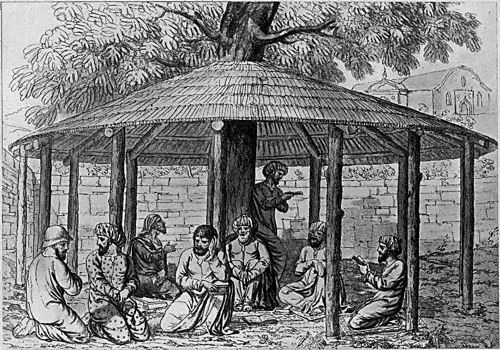 SUFI MYSTICS GATHERED FOR MEDITATION
From an old painting by a Pushtu artist
280.
I pray thee to my counsel lend thine ear,
Cast off this false hypocrisy's veneer;
This life a moment is, the next all time,
Sell not eternity for earthly gear!
280. C. L. N. A. B. I. Note ra separated from its noun, as before.
Vullers, p. 173.
281.
Ofttimes I plead my foolishness to Thee,
My heart contracted with perplexity;
I gird me with the Magian zone, and why?
For shame so poor a Musulman to be.
281. C. L. N. A. I. J. In line 1 scan nadaniyi, dissolving the
long ya.
282.
Khayyam! rejoice that wine you still can pour,
And still the charms of tulip cheeks adore;
You'll soon not be, rejoice then that you are,
Think how 'twould be in case you were no more!
282. C. L. N. A. B. I. J.
283.
Once, in a potter's shop, a company
Of cups in converse did I chance to see,
And lo! one lifted up his voice, and cried,
«Who made, who sells, who buys this crockery?»
283. C. L. N. A. B. I. J. Men's speculations.
284.
Last night, as I reeled from the tavern door,
I saw a sage, who a great wine-jug bore;
I said, «O Shaikh, have you no shame?» Said he,
«Allah hath boundless mercy in his store.»
284. C. L. N. A. I. J. Sar mast, a compound, hence izafat omitted.
Saboyey, hamza (for conjunctive ya) followed by ya i tankir.
See Lumsden, ii. 269.
285.
Life's fount is wine, Khizir its guardian,
I, like Elias, find it where I can,
'Tis sustenance for heart and spirit too,
Allah himself calls wine «a boon to man.»
285. C. L. N. A. I. J. Koran, ii. 216. Elias discovered the water
of life.
286.
Though wine is banned, yet drink, for ever drink!
By day and night, with strains of music drink!
Where'er thou lightest on a cup of wine,
Spill just one drop, and take the rest and drink!
286. C. L. N. A. I. J. To spill a drop is a sign of liberality.—Nicolas.
287.
Although the creeds number some seventy-three,
I hold with none but that of loving Thee;
What matter faith, unfaith, obedience, sin?
Thou'rt all we need, the rest is vanity.
287. N. See note on Quatrain 194. Forms of faith are indifferent.
See Gulshan i Raz, p. 83.
288.
Tell one by one my scanty virtues o'er;
As for my sins, forgive them by the score;
Let not my faults kindle Thy wrath to flame;
By blest Muhammad's tomb, forgive once more!
288. L. N. B. Rasul-ullah: the construction being Arabic, izafat
is needed. Lumsden, ii. p. 251. Also ascribed to Zahir
ud-din Faryabi.
289.
Grieve not at coming ill, you can't defeat it,
And what far-sighted person goes to meet it?
Cheer up! bear not about a world of grief,
Your fate is fixed, and grieving will not cheat it.
289. L. Line 2 is a question.
290.
There is a chalice made with wit profound,
With tokens of the Maker's favour crowned;
Yet the world's Potter takes his masterpiece,
And dashes it to pieces on the ground!
290. C. L. A. I. J. So Job, «Is it good unto Thee that Thou shouldest
despise the labour of Thine hands?»
291.
In truth wine is a spirit thin as air,
A limpid soul in the cup's earthen ware;
No dull, dense person shall be friend of mine
Save wine-cups, which are dense and also rare.
291. L. N. B. Layik . man izafat omitted because of the
intervening words. Lumsden, ii. 250.
292.
O wheel of heaven! no ties of bread you feel,
No ties of salt, you flay me like an eel!
A woman's wheel spins clothes for man and wife,
It does more good than you, O heavenly wheel!
292. C. L. N. A. I. J.
293.
Did no fair rose my paradise adorn,
I would make shift to deck it with a thorn;
And if I lacked my prayer-mats, beads, and Shaikh,
'Those Christian bells and stoles I would not scorn.
293. C. L. N. A. I. (under Te). Line 2 is omitted in the translation.
So Pope, «For forms and creeds let graceless zealots
fight.»
294.
«If heaven deny me peace and fame,» I said,
«Let it be open war and shame instead;
The man who scorns bright wine had best beware,
I'll arm me with a stone, and break his head!»
294. C. L. N. A. I. J.
295.
See! the dawn breaks, and rends night's canopy:
Arise! and drain a morning draught with me!
Away with gloom! full many a dawn will break
Looking for us, and we not here to see!
295. C. L. N A. I. J. Bisyar, «frequently.»
296.
O you who tremble not at fires of hell,
Nor wash in water of remorse's well,
When winds of death shall quench your vital torch,
Beware lest earth your guilty dust expel.
296. L. Possibly written by some pious reader as an answer to
Khayyam's scoffs. See note on Quatrain 223.
297.
This world a hollow pageant you should deem;
All wise men know things are not what they seem;
Be of good cheer, and drink, and so shake off
This vain illusion of a baseless dream.
297. L. N. All earthly existence is «Maya»
298.
With maids stately as cypresses, and fair
As roses newly plucked, your wine-cups share,
Or e'er Death's blasts shall rend your robe of flesh
Like yonder rose leaves, lying scattered there!
298. C. L. N. I. J. The Lucknow commentator says daman i gul
means the maid's cheek.
299.
Cast off dull care, O melancholy brother!
Woo the sweet daughter of the grape, no other;
The daughter is forbidden, it is true,
But she is nicer than her lawful mother!
299. N. «Daughter of the grape,» i.e., wine, a translation of an
Arabic phrase.
300.
My love shone forth, and I was overcome,
My heart was speaking, but my tongue was dumb;
Beside the water-brooks I died of thirst.
Was ever known so strange a martyrdom?
300. N. Dil rubaye, «that well-known charmer.» Lumsden, ii.
142. Pur sukhan. See note on No. 227.
301.
Give me my cup in hand, and sing a glee
In concert with the bulbul's symphony;
Wine would not gurgle as it leaves the flask,
If drinking mute were right for thee and me!
301. C. L. N. A. I. J.
302.
The «Truth» will not be shown to lofty thought,
Nor yet with lavished gold may it be bought;
But, if you yield your life for fifty years,
From words to «states» you may perchance be brought.
302. L. Line 3, literally, «Unless you dig up your soul, and eat
blood for fifty years.» «States» of ecstatic union with the
«Truth,» or Deity of the Mystics.
303.
I solved all problems, down from Saturn's wreath
Unto this lowly sphere of earth beneath,
And leapt out free from bonds of fraud and lies,
Yea, every knot was loosed, save that of death!
303. C. L. A. I. J.
304.
Peace! the eternal «Has been» and «To be»
Pass man's experience, and man's theory;
In joyful seasons naught can vie with wine,
To all these riddles wine supplies the key!
304. C. L. A. B. I. J.
305.
Allah, our Lord, is merciful, though just;
Sinner! despair not, but His mercy trust!
For though to-day you perish in your sins,
To-morrow He'll absolve your crumbling dust.
305. C. L. N. A. I. J. A very Voltairean quatrain.
306.
Your course annoys me, O ye wheeling skies!
Unloose me from your chain of tyrannies!
If none but fools your favours may enjoy,
Then favour me,—I am not very wise!
306. C. L. N. A. I. J.
307.
O City Mufti, you go more astray
Than I do, though to wine I do give way;
I drink the blood of grapes, you that of men:
Which of us is the more bloodthirsty, pray?
307. C. L. N. A. I. J. Alluding to the selling of justice by Muftis.
308.
'Tis well to drink, and leave anxiety
For what is past, and what is yet to be;
Our prisoned spirits, lent us for a day,
A while from season's bondage shall go free!
308. C. L. N. A. I. J. 'Ariyati rawan, «this borrowed soul.»
309.
When Khayyam quittance at Death's hand receives,
And sheds his outworn life, as trees their leaves,
Full gladly will he sift this world away,
Ere dustmen sift his ashes in their sieves.
309. C. L. N. A. I. J.
310.
This wheel of heaven, which makes us all afraid,
I liken to a lamp's revolving shade,
The sun the candlestick, the earth the shade,
And men the trembling forms thereon portrayed.
310. C. L. N. A. B. I. Fanus i khiyal, a magic or Chinese lantern.
311.
Who was it that did mix my clay? Not I.
Who spun my web of silk and wool? Not I.
Who wrote upon my forehead all my good,
And all my evil deeds? In truth not I.
311. C. L. N. A. I. In line 2 rhyme shows the word to be rishtai,
not rushtai.
312.
O let us not forecast to-morrow's fears,
But count to-day as gain, my brave compeers!
To-morrow we shall quit this inn, and march
With comrades who have marched seven thousand years.
312. C. L. N. A. I. J. Badauni (ii. 337) says the creation of Adam
was 7000 years before his time. Compare Hafiz, Ruba'i 10.
313.
Ne'er for one moment leave your cup unused!
Wine keeps heart, faith, and reason too, amused;
Had Iblis swallowed but a single drop,
To worship Adam he had ne'er refused!
313. C. L. (in part) N. A. I. J. See Koran, ii. 31.
314.
Come, dance! while we applaud thee, and adore
Thy sweet Narcissus eyes, and grape-juice pour;
A score of cups is no such great affair,
But 'tis enchanting when we reach three score!
314. N. Narcissus eyes, i.e., languid.
315.
I close the door of hope in my own face,
Nor sue for favours from good men, or base;
I have but ONE to lend a helping hand,
He knows, as well as I, my sorry case.
315. C. L. N. A. I. J. A «Haliya» quatrain, lamenting his own
condition.
316.
Ah! by these heavens, that ever circling run,
And by my own base lusts I am undone,
Without the wit to abandon worldly hopes,
And wanting sense the world's allures to shun!
316. C. L. N. A. I. J.
317.
On earth's green carpet many sleepers lie,
And hid beneath it others I descry,
And others, not yet come, or passed away,
People the desert of Nonentity!
317. C. L. N. A. I. J. The sleepers on the earth are those sunk
in the sleep of superstition and ignorance.
318.
Sure of Thy grace, for sins why need I fear?
How can the pilgrim faint whilst Thou art near?
On the last day Thy grace will wash me white,
And make my «black record» to disappear.
318. C. L. N. A. I. J. Lumsden, ii, 72. See Koran, xiii. 47.
319.
Think not I dread from out the world to hie,
And see my disembodied spirit fly;
I tremble not at death, for death is true,
'Tis my ill life that makes me fear to die!
319. C. L. N. A. I. J. «Death is true,» i.e. a certainty. So Sir
Philip Sidney (after M. Aurelius), «Since Nature's works be
good, and death doth serve as Nature's work, why should
we fear to die?»
320.
Let us shake off dull reason's incubus,
Our tale of days or years cease to discuss,
And take our jugs, and plenish them with wine,
Or e'er grim potters make their jugs of us!
320. C. L. N. A. B. I. J.
321.
How much more wilt thou chide, O raw divine,
For that I drink, and am a libertine?
Thou hast thy weary beads, and saintly show,
Leave me my cheerful sweetheart, and my wine!
321. C. L. N. A. I. J.
322.
Against my lusts I ever war, in vain,
I think on my ill deeds with shame and pain;
I trust Thou wilt assoil me of my sins,
But even so, my shame must still remain.
322. C. L. N. A. B. I.
323.
In these twin compasses, O Love, you see
One body with two heads, like you and me,
Which wander round one centre, circlewise.
But at the last in one same point agree.
323. C. L. N. A. I. Mr. Fitzgerald quotes a similar figure used by
the poet Donne, for which see Ward's «English Poets,» i.
562. The two heads are the points of the compasses.
324.
We shall not stay here long, but while we do,
'Tis folly wine and sweethearts to eschew;
Why ask if earth etern or transient be?
Since you must go, it matters not to you.
324. C. L. N. A. B. I. J.
325.
In reverent sort to mosque I wend my way,
But, by great Allah, it is not to pray;
No! but to steal a prayer-mat! When 'tis worn,
I go again, another to purvey.
325. C. L. N. A. B. I. J. To «steal a prayer-mat» is to pray to be
seen of men.—Nicolas. A satire on some hypocrite, perhaps
himself.
326.
No more let fate's annoys our peace consume,
But let us rather rosy wine consume,
The world our murderer is, and wine its blood,
Shall we not then that murderer's blood consume?
326. L. N. See Koran, ii. 187.
327.
For Thee I vow to cast repute away,
And, if I shrink, the penalty to pay;
Though life might satisfy Thy cruelty,
'Twere naught, I'll bear it till the judgment-day!
327. C. L. N. A. B. I.
328.
In Being's rondure do we stray belated,
Our pride of manhood humbled and abated;
Would we were gone! long since have we been wearied
With this world's griefs, and with its pleasures sated.
328. L. N.
329.
The world is false, so I'll be false as well,
And with bright wine, and gladness ever dwell!
They say, «May Allah grant thee penitence!»
He grants it not, and, did he, I'd rebel!
329. C. L. N. A. B. I. J. A pun in the original.
330.
When Death shall tread me down upon the plain,
And pluck my feathers, and my life-blood drain,
Then mould me to a cup, and fill with wine,
Haply its scent will make me breathe again.
330. C. L. N. A. B. I. J.
331.
So far as this world's dealings I have traced,
I find its favours shamefully misplaced;
Allah be praised! I see myself debarred
From all its boons, and wrongfully disgraced.
331. C. L. N. A. I. Alam hama, etc., «states entirely gratuitous.»
Write baran without a madd. Bl., Prosody, p. 11. Compare
Shakespeare, Sonnet 66.
332.
'Tis dawn! my heart with wine I will recruit,
And dash to bits the glass of good repute;
My long-extending hopes I will renounce,
And grasp long tresses, and the charming lute.
332. L. N. B.
333.
Though I had sinned the sins of all mankind,
I know Thou would'st to mercy be inclined;
Thou sayest, «I will help in time of need»
One needier than I where wilt Thou find?
333. C. L. N. A. I. J. The waw in 'afw is a consonant, and therefore
takes kasra for the izafat, without the intervention of
conjunctive ya.
334.
Am I a wine-bibber? What if I am?
Gueber or infidel? Suppose I am?
Each sect miscalls me, but I heed them not,
I am my own, and, what I am, I am.
334. C. L. N. A. I. J. Zan i khud for azan i khud, «my own
property.»
335.
All my life long from drink I have not ceased,
And drink I will to-night on Kadr's feast;
And throw my arms about the wine-jar's neck,
And kiss its lip, and clasp it to my breast!
335. C. L. N. A. I. J. Kadr the night of power. Koran, xcvi. 1.
336.
I know what is, and what is not, I know
The lore of things above, and things below;
But all this lore will cheerfully renounce,
If one a higher grade than drink can show.
336. L. N. B. Line 1, Being and Not-being, «Grade,» i.e., of learning.
337.
Though I drink wine, I am no libertine,
Nor am I grasping, save of cups of wine;
I scruple to adore myself, like you;
For this cause to wine-worship I incline.
337. C. L. N. A. I. J. A hit at the vain and covetous Mollas. Also
ascribed to Anwari.
338.
To confidants like you I dare to say
What mankind really are—moulded of clay,
Affliction's clay, and kneaded in distress,
They taste the world awhile, then pass away.
338. C. L. N. A. I. J. Note the archaic form.
339.
We make the wine-jar's lip our place of prayer,
And drink in lessons of true manhood there,
And pass our lives in taverns, if perchance
The time mis-spent in mosques we may repair.
339. L. N. This quatrain is probably Mystical.
340.
Man is the whole creation's summary,
The precious apple of great wisdom's eye;
The circle of existence is a ring,
Whereof the signet is humanity.
340. C. L. N. A. I. Man is the microcosm. See Gulshan i Raz, p.
15. «The captain jewel of the carcanet.»
341.
With fancies, as with wine, our heads we turn,
Aspire to heaven, and earth's low trammels spurn;
But, when we drop this fleshly clog, 'tis seen
From dust we came, and back to dust return.
341. L. N.
342.
If so it be that I did break the fast,
Think not I meant it; no! I thought 'twas past;—
That day more weary than a sleepless night,—
And blesséd breakfast-time had come at last!
342. L. N. Roza khwardan, «to avoid fasting.» In line 2, for
bekhabar read bakhabar.
343.
I never drank of joy's sweet cordial,
But grief's fell hand infused a drop of gall;
Nor dipped my bread in pleasure's piquant salt,
But briny sorrow made me smart withal!
343. C. L. N. A. I. Line 4, literally, «eat a roast of my own liver.»
344.
At dawn to tavern haunts I wend my way,
And with distraught Kalendars pass the day;
O Thou! who know'st things secret, and things known,
Grant me Thy grace, that I may learn to pray!
344. C. L. N. A. I. J. Khafiyyat means «manifest,» as well as «concealed.»
Lucknow commentator.
345.
The world's annoys I rate not at one grain,
So I eat once a day I don't complain;
And, since earth's kitchen yields no solid food,
I pester no man with petitions vain.
345. C. L. N. A. I. J. In line 3 the Alif in az is not treated as an
Alif i wasl. Bl., Pros. 10.
346.
Never from worldly toils have I been free,
Never for one short moment glad to be!
I served a long apprenticeship to fate,
But yet of fortune gained no mastery.
346. C. L. N. A. I. J. Ek dam zadan, «For one moment.»
347.
One hand with Koran, one with wine-cup dight,
I half incline to wrong, and half to right;
The azure-marbled sky looks down on me
A sorry Moslem, yet not heathen quite.
347. C. L. N. A. I. J. Khayyam here describes himself as akrates
rather than akolastos, «Video meliora proboque,» etc.
348.
Khayyam's respects to Mustafa convey,
And with due reverence ask him to say,
Why it has pleased him to forbid pure wine,
When he allows his people acid whey?
348 and 349. L. These two quatrains are also found in Whalley's
Morababad edition. Mustafa, i.e., Muhammad. So Avicenna.
See Renan, Averroes, 171.
349.
Tell Khayyam, for a master of the schools,
He strangely misinterprets my plain rules:
Where have I said that wine is wrong for all?
'Tis lawful for the wise, but not for fools.
350.
My critics call me a philosopher,
But Allah knows full well they greatly err;
I know not even what I am, much less
Why on this earth I am a sojourner!
350. C. L. A. I. J. Filsafat meant the Greek philosophy as cultivated
by Persian rationalists, in opposition to theology.
Renan, Averroes, p. 91.
351.
The more I die to self, I live the more,
The more abase myself, the higher soar;
And, strange! the more I drink of Being's wine,
More sane I grow and sober than before.
351. L. Clearly Mystical.
352.
Quoth rose, «I am the Yusuf flower, I swear,
For in my mouth rich golden gems I bear»:
I said, «Show me another proof.» Quoth she,
«Behold this blood-stained vesture that I wear!»
352. B. L. Yusuf is the type of manly beauty. The yellow stamens
are compared to his teeth. So Jami, in Yusuf wa Zulaikha.
353.
I studied with the masters long ago,
And long ago did master all they know;
Here now the end and issue of it all,
From earth I came, and like the wind I go!
353. L. B. Mr. Fitzgerald compares the dying exclamation of
Nizam ul-Mulk, «I am going in the hands of the wind!»
Mantik ut Tair, 1. 4620.
354.
Death finds us soiled, though we were pure at birth,
With grief we go, although we came with mirth;
Watered with tears, and burned with fires of woe,
And, casting life to winds, we rest in earth!
354. C. L. A. I. J.
355.
To find great Jamshid's world-reflecting bowl
I compassed sea and land, and viewed the whole;
But, when I asked the wary sage, I learned
That bowl was my own body, and my soul!
355. L. King Jamshid's cup, which reflected the whole world, is
the Holy Grail of Persian poetry. Meaning «man is the
microcosm.» See note on No. 340. In line 2 scan naghnudem.
356.
Me, cruel Queen! you love to captivate,
And from a knight to a poor pawn translate,
You marshal all your force to tire me out,
You take my rooks with yours, and then checkmate!
356. C. L. A. I. J. The pun on rukh, «cheek,» and rukh, «castle,»
is untranslatable.
357.
If Allah wills me not to will aright,
How can I frame my will to will aright?
Each single act I will must needs be wrong,
Since none but He has power to will aright.
357. C. L. A. I. J.
358.
«For once, while roses are in bloom,» I said,
«I'll break the law, and please myself instead,
With blooming youths, and maidens' tulip cheeks
The plain shall blossom like a tulip-bed.»
358. L. N. Rozi, ya i batni, or tankir (?).
359.
Think not I am existent of myself,
Or walk this blood-stained pathway of myself;
This being is not I, it is of Him.
Pray what, and where, and whence is this «myself»?
359. C. L. A. I. J. In line 3 I omit wa after Lu bud. Meaning,
Man's real existence is not of himself, but of the «Truth,»
the universal Noumenon.
360.
Endure this world without my wine I cannot!
Drag on life's load without my cups I cannot!
I am the slave of that sweet moment, when
They say, «Take one more goblet,» and I cannot!
360. C. L. N. A. I. J.
361.
You, who both day and night the world pursue,
And thoughts of that dread day of doom eschew,
Bethink you of your latter end; be sure
As time has treated others, so 'twill you!
361. C. L. N. A. I.
362.
O man, who art creation's summary,
Getting and spending too much trouble thee!
Arise, and quaff the Etern Cupbearer's wine,
And so from troubles of both worlds be free!
362. C. L. N. A. I. J. So Wordsworth, «The world is too much
with us,» etc. The Sufis rejected talab ud dunya, «worldliness,»
and talab nl ukharat, «other-worldliness,» for
talab nl maula, «disinterested godliness.» So Madame
Guyon taught «Holy Indifference.»
363.
In this eternally revolving zone,
Two lucky species of men are known;
One knows all good and ill that are on earth,
One neither earth's affairs, nor yet his own.
363. C. L. N. A. I. J. Taman, «entirely.» The two classes seem to
be practical men and mystics.
364.
Make light to me the world's oppressive weight,
And hide my failings from the people's hate,
And grant me peace to-day, and on the morrow
Deal with me as Thy mercy may dictate!
364. C. L. N A. I. J. In line 4 scan anchaz.
365.
Souls that are well informed of this world's state,
Its weal and woe with equal mind await:
For, be it weal we meet, or be it woe,
The weal doth pass, and woe too hath its date.
365. C. L. N. A. B. I. J. 'Twill all be one a hundred years hence.
366.
Lament not fortune's want of constancy,
But up! and seize her favours ere they flee;
If fortune always cleaved to other men,
How could a turn of luck have come to thee?
366. C. L. N. A. I. J. This was a saying of Kisra Parviz to his
Sultana. Bicknell's Hafiz, p. 73.
367.
Chief of old friends! hearken to what I say,
Let not heaven's treacherous wheel your heart dismay;
But rest contented in your humble nook,
And watch the games that wheel is wont to play.
367. C. L. N. A. I. J.
368.
Hear now Khayyam's advice, and bear in mind,
Consort with revellers, though they be maligned,
Cast down the gates of abstinence and prayer,
Yea, drink, and even rob, but, oh! be kind!
368. C. L. N. A. B. I. J. A rather violent extension of the doctrine,
Mercy is better than sacrifice.
369.
This world a body is, and God its soul,
And angels are its senses, who control
Its limbs—the creatures, elements, and spheres;
The ONE is the sole basis of the whole.
369. L. N. So Pope, «All are but parts,» etc.
370.
Last night that idol who enchants my heart,
With true desire to elevate my heart,
Gave me his cup to drink; when I refused,
He said, «Oh, drink to gratify my heart!»
370. N.
371.
Would'st thou have fortune bow her neck to thee,
Make it thy care to feed thy soul with glee;
And hold a creed like mine, which is to drain
The cup of wine, not that of misery.
371. So the Ecclesiast, «There is nothing better for a man than that
he should eat, and drink, and make his soul enjoy good in
his labour.»
372.
Though you survey O my enlightened friend,
This world of vanity from end to end,
You will discover there no other good
Than wine and rosy cheeks, you may depend!
372. N. Note izafat dropped after sahib. Bl., Prosody, p. 14.
373.
Last night upon the river bank we lay,
I with my wine-cup, and a maiden gay,
So bright it shone, like pearl within its shell,
The watchman cried, «Behold the break of day!»
373. N. Nigare. Here ya may be ya i tankir, the izafat being
dispensed with (Lumsden, ii. 269) [?], or perhaps ya i
tausifi before the «sifat» marvzum.
374.
Have you no shame for all the sins you do,
Sins of omission and commission too?
Suppose you gain the world, you can but leave it,
You cannot carry it away with you!
374. C. L. N. A. I. J.
375.
In a lone waste I saw a debauchee,
He had no home, no faith, no heresy,
No God, no truth, no law, no certitude;
Where in this world is man so bold as he?
375. L. N. A beshara' or antinomian Sufi.
376.
Some look for truth in creeds, and forms, and rules;
Some grope for doubts or dogmas in the schools;
But from behind the veil a voice proclaims,
«Your road lies neither here nor there, O fools.»
376. C. L. N. A. I. Truth, hidden from theologians and philosophers,
is revealed to mystics. See Gulshan i Raz, p. 11.
377.
In heaven is seen the bull we name Parwin,
Beneath the earth another lurks unseen;
And thus to wisdom's eyes mankind appear
A drove of asses, two great bulls between!
377. L. N. The bulls are the constellation Taurus, and that which
supports the earth.
378.
The people say, «Why not drink somewhat less?
What reasons have you for such great excess?»
First, my Love's face, second, my morning draught;
Can there be clearer reasons, now confess?
378. C. L. N. A. I. J.
379.
Had I the power great Allah to advise,
I'd bid him sweep away this earth and skies,
And build a better, where, unclogged and free,
The clear soul might achieve her high emprise.
379. C. L. N. A. I. J. This recalls the celebrated speech of Alphonso
X., king of Castile.
380.
This silly sorrow-laden heart of mine
Is ever pining for that Love of mine;
When the Cupbearer poured the wine of love,
With my heart's blood he filled this cup of mine!
380. C. L. N. A. I. Meaning, «the wine of life, or existence, poured
by the Deity into all beings at creation.» See Gulshan i
Raz, p. 80.
381.
To drain the cup, to hover round the fair,
Can hypocritic arts with these compare?
If all who love and drink are going wrong,
There's many a wight of heaven may well despair!
381. L. N. B.
382.
'Tis wrong with gloomy thoughts your mirth to drown,—
To let grief's millstone weigh your spirits down;
Since none can tell what is to be, 'tis best
With wine and love your heart's desires to crown.
382. C. L. N. A. B. I. J.
383.
'Tis well in reputation to abide,
'Tis shameful against heaven to rail and chide;
Still, head had better ache with over drink,
Than be puffed up with Pharisaic pride!
383. C. L. N. A. I. J. Compare «Tartufe,» i. 6.
384.
O Lord! pity this prisoned heart, I pray,
Pity this bosom stricken with dismay!
Pardon these hands that ever grasp the cup,
These feet that to the tavern ever stray!
384. N.
385.
O Lord! from self-conceit deliver me,
Sever from self, and occupy with Thee!
This self is captive to earth's good and ill,
Make me beside myself, and set me free!
385. C. L. N. A. I. J. A Mystic's prayer.
386.
Behold the tricks this wheeling dome doth play,
And earth laid bare of old friends torn away!
O live this present moment, which is thine,
Seek not a morrow, mourn not yesterday!
386. L. B. An odd expression.
387.
Since all man's business in this world of woe
Is sorrow's pangs to feel, and grief to know,
Happy are they that never come at all,
And they that, having come, the soonest go!
387. C. L. A. B. I. J. Compare the chorus in the «Œdipus Coloneus.»
388.
By reason's dictates it is right to live,
But of ourselves we know not how to live,
So Fortune, like a master, rod in hand,
Raps our pates well to teach us how to live!
388. L. Fortune's buffets.
389.
Nor you nor I can read the etern decree,
To that enigma we can find no key;
They talk of you and me behind the veil,
But, if that veil be lifted, where are we?
389. C. L. A. I. J. Meaning, We are part of the «veil» of phenomena,
which hides the Divine Noumenon. If that be swept
away what becomes of us?
390.
O Love, for ever doth heaven's wheel design
To take away thy precious life, and mine;
Sit we upon this turf, 'twill not be long
Ere turf shall grow upon my dust, and thine!
390. L. N. B.
391.
When life has fled, and we rest in the tomb,
They'll place a pair of bricks to mark our tomb;
And, a while after, mould our dust to bricks,
To furnish forth some other person's tomb!
391. L. N. A. I.
392.
Yon palace, towering to the welkin blue,
Where kings did bow them down, and homage do,
I saw a ringdove on its arches perched,
And thus she made complaint, «Coo, Coo, Coo, Coo!»
392. C. L. N. A. I. J. Mr. Binning found this quatrain inscribed
on the ruins of Persepolis—Fitzgerald. Coo (Ku) means
«Where are they?»
393.
We come and go, but for the gain, where is it?
And spin life's woof, but for the warp, where is it?
And many a righteous man has burned to dust
In heaven's blue rondure, but their smoke, where is it?
393. C. L. N. A. B. I. J. So Ecclesiastes, «There is no remembrance
of the wise, more than of the fool.» «Smoke,» i.e., trace.
394.
Life's well-spring lurks within that lip of thine!
Let not the cup's lip touch that lip of thine!
Beshrew me, if I fail to drink his blood,
For who is he, to touch that lip of thine?
394. C. L. N. A. I. J. To a sweetheart.
395.
Such as I am, Thy power created me,
Thy care hath kept me for a century!
Through all these years I make experiment,
If my sins or Thy mercy greater be.
395. C. L. N. A. I. J. God's long-suffering.
396.
«Take up thy cup and goblet, Love,» I said,
«Haunt purling river bank, and grassy glade;
Full many a moon-like form has heaven's weel
Oft into cup, oft into goblet, made!»
396. C. L. N. A. B. I. J.
397.
We buy new wine and old, our cups to fill,
And sell for two grains this world's good and ill;
Know you where you will go to after death?
Set wine before me, and go where you will!
397. L. N. and J. give lines 1 and 2 differently.
398.
Was e'er man born who never went astray?
Did ever mortal pass a sinless day?
If I do ill, do not requite with ill!
Evil for evil how can'st Thou repay?
398. L. N. Line 3 and 4 are paraphrased somewhat freely.
399.
Bring forth that ruby gem of Badakhshan,
That heart's delight, that balm of Turkistan;
They say 'tis wrong for Musulmen to drink,
But ah! where can we find a Musulman?
399. C. L. N. A. I. J.
400.
My body's life and strength proceed from Thee!
My soul within and spirit are of Thee!
My being is of Thee, and Thou art mine,
And I am Thine, since I am lost in Thee!
400. L. «In him we live and move, and have our being.»
401.
Man, like a ball, hither and thither goes,
As fate's resistless bat directs the blows;
But He, who gives thee up to this rude sport,
He knows what drives thee, yea, He knows, He knows!
401. C. L. A. I. J. Line 4 is in metre 22, consisting of ten syllables,
all long.
402.
O Thou who givest sight to emmet's eyes,
And strength to puny limbs of feeble flies,
To Thee we will ascribe Almighty power,
And not base, unbecoming qualities.
402. L. An echo of the Asharian's discussions on the Divine attributes.
403.
Let not base avarice enslave thy mind,
Nor vain ambition in its trammels bind;
Be sharp as fire, as running water swift,
Not, like earth's dust, the sport of every wind!
403. L. C. A. I. J.
404.
'Tis best all other blessings to forego
For wine, that charming Turki maids bestow;
Kalendars' raptures pass all things that are,
From moon on high down into fish below!
404. C. L. N. A. B. I. J. For mah L. reads hahk probably a Sufi
gloss. Kalendars, bibulous Sufis. Fish, that whereon the
earth was said to rest.
405.
Friend! trouble not yourself about your lot,
Let futile care and sorrow be forgot;
Since this life's vesture crumbles into dust,
What matters stain of word or deed, or blot?
405. L. N.
406.
O thou who hast done ill, and ill alone,
And thinkest to find mercy at the throne,
Hope not for mercy! for good left undone
Cannot be done, nor evil done undone!
406. N. A. I. This quatrain is by Abu Sa'id Abu'l Khair; and is
an answer to No. 420, which is attributed to Avicenna.
407.
Count not to live beyond your sixtieth year,
To walk in jovial courses persevere;
And ere your skull be turned into a cup,
Let wine-cups ever to your hand adhere!
407. L. N. B.
408.
These heavens resemble an inverted cup,
Whereto the wise with awe keep gazing up;
So stoops the bottle o'er his love, the cup,
Feigning to kiss, and gives her blood to sup!
408. C. L. N. A. B. I. Blood, an emblem of hate.
409.
I sweep the tavern threshold with my hair,
For both world's good and ill I take no care;
Should the two worlds roll to my house, like balls,
When drunk, for one small coin I'd sell the pair!
409. L. N. B.
410.
The drop wept for his severance from the sea,
But the sea smiled, for «I am all,» said he,
«The Truth is all, nothing exists beside,
That one point circling apes plurality.»
410. N. This is in Ramal metre, No. 50. Compare Gulshan i Raz,
line 710.
411.
Shall I still sigh for what I have not got,
Or try with cheerfulness to bear my lot?
Fill up my cup! I know not if the breath
I now am drawing is my last, or not!
411. C. L. N. A. B. I. J. Some MSS. place this quatrain under
Radif ya.
412.
Yield not to grief, though fortune prove unkind,
Nor call sad thoughts of parted friends to mind;
Devote thy heart to sugary lips, and wine,
Cast not thy precious life unto the wind!
412. L. N. B.
413.
Of mosque and prayer and fast preach not to me,
Rather go drink, were it on charity!
Yea, drink, Khayyam, your dust will soon be made
A jug, or pitcher, or a cup, may be!
413. N. «Imperial Cæsar, dead, and turned to clay
Might stop a hole to keep the wind away.»
414.
Bulbuls, doting on roses, oft complain
How forward breezes rend their veils in twain;
Sit we beneath this rose, which many a time
Has sunk to earth, and sprung from earth again.
414. L. N. B. So Moschus on the mallows.
415.
Suppose the world goes well with you, what then?
When life's last page is read and turned, what then?
Suppose you live a hundred years of bliss,
Yea, and a hundred years besides, what then?
415. C. L. N A. I. J. See Vullers, p. 100.
416.
How is it that of all the leafy tribe,
Cypress and lily men as «free» describe?
This has a dozen tongues, yet holds her peace,
That has a hundred hands which take no bribe.
416. L. N. Sa'di in the Gulistan, Book viii., gives another explanation
of this expression. «Tongues, stamens, and hands,
branches.»
417.
Cupbearer, bring my wine-cup, let me grasp it!
Bring that delicious darling, let me grasp it!
That pleasing chain which tangles in its coils
Wise men and fools together, let me grasp it!
417. L. N. Bipechand seems a plural of dignity.
418.
Alas! my wasted life has gone to wrack!
What with forbidden meats, and lusts, alack!
And leaving undone what 'twas right to do,
And doing wrong, my face is very black!
418. C. L. N. A. I. These whimsical outbursts of self-reproach in the
midst of antinomian utterances are characteristic of Khayyam.
419.
I could repent of all, but of wine, never!
I could dispense with all, but with wine, never!
If so be I became a Musulman,
Could I abjure my Magian wine? no, never!
419. L. N. The Magians sold wine.
420.
We rest our hopes on Thy free grace alone,
Nor seek by merits for our sins to atone;
Mercy drops where it lists, and estimates
Ill done as undone, good undone as done.
420. L. N. A. I. This quatrain is also ascribed to the celebrated
philosopher Avicenna. See No. 406.
421.
This is the form Thou gavest me of old,
Wherein Thou workest marvels manifold;
Can I aspire to be a better man,
Or other than I issued from Thy mould?
421. C. L. N. A. I. This is a variation of No. 221.
422.
O Lord! to Thee all creatures worship pay,
To Thee both small and great for ever pray,
Thou takest woe away, and givest weal,
Give then, or, if it please Thee, take away!
422. L. Scan bandagita, omitting fatha before te. Vullers, p. 197.
423.
With going to and fro in this sad vale
Thou art grown double, and thy credit stale,
Thy nails are thickened like a horse's hoof,
Thy beard is ragged as an ass's tail.
423. C. L. A. I. J. A description of old age.
424.
O unenlightened race of humankind,
Ye are a nothing, built on empty wind!
Yea, a mere nothing, hovering in the abyss,
A void before you, and a void behind!
424. C. L. A. I. J. The technical name for existence between two
non-existences is Takwin. Bl. Ain i Akbari, p. 198.
Compare the term «nunc stans,» applied to Time by the
Schoolmen.
425.
Each morn I say, «To-night I will repent
Of wine, and tavern haunts no more frequent»;
But while 'tis spring, and roses are in bloom,
To loose me from my promise, O consent!
425. C. L. A. I. J.
426.
Vain study of philosophy eschew!
Rather let tangled curls attract your view;
And shed the bottle's life-blood in your cup,
Or e'er death shed your blood, and feast on you.
426. C. L. N. A. B. I. J. Bigorezi bi, «better that you should eschew.»
427.
O heart! can'st thou the darksome riddle read,
Where wisest men have failed, wilt thou succeed?
Quaff wine, and make thy heaven here below,
Who knows if heaven above will be thy meed?
427. C. L. N. A. B. I. J.
428.
They that have passed away, and gone before,
Sleep in delusion's dust for evermore;
Go, boy, and fetch some wine, this is the truth,
Their dogmas were but air, and wind their lore!
428. C. L. N. A. B. I. J. So Ecclesiastes, «I gave my heart to
know wisdom ... and perceived that this also is
vanity.»
429.
O heart! when on the Loved One's sweets you feed,
You lose yourself, but find your Self indeed;
And, when you drink of His entrancing cup,
You hasten your escape from quick and dead!
429. C. L. N. A. I. J. Die to self, to live in God, your true self.
See Max Müller, Hibbert Lectures, p. 375.
430.
Though I am wont a wine-bibber to be,
Why should the people rail and chide at me?
Would that all evil actions made men drunk,
For then no sober people should I see!
430. C. N. A. I. J.
431.
Child of four elements and sevenfold heaven,
Who fume and sweat because of these eleven,
Drink! I have told you seventy times and seven,
Once gone, nor hell will send you back, nor heaven.
431. C. L. N. A. I. J.
432.
With many a snare Thou dost beset my way,
And threatenest, if I fall therein, to slay;
Thy rule resistless sways the world, yet Thou
Imputest sin, when I do but obey!
432. B. N. Allah is the Fa'il i hakiki, the only real agent, according
to the Sufi view, Hukmi tu Kuni, «Thou givest
thy order.»
433.
To Thee, whose essence baffles human thought,
Our sins and righteous deeds alike seem naught,
May Thy grace sober me, though drunk with sins,
And pardon all the ill that I have wrought!
433. L. N.
434.
If this life were indeed an empty play,
Each day would be an 'lid of festal day,
And men might conquer all their hearts' desire,
Fearless of after penalties to pay!
434. N. N takes taklid in the sense of «authority,» but I think it
alludes to Koran, xxix. 64. See Gulshan i Raz, p. 50.
435.
O wheel of heaven, you thwart my heart's desire,
And rend to shreds my scanty joy's attire,
The water that I drink you foul with earth,
And turn the very air I breathe to fire!
435. C. L. N. A. I.
436.
O soul! could you but doff this flesh and bone,
You'd soar a sprite about the heavenly throne;
Had you no shame to leave your starry home,
And dwell an alien on this earthly zone?
436. C. L. N. B. A. I.
437.
Ah, potter, stay thine hand' with ruthless art
Put not to such base use man's mortal part!
See, thou art mangling on thy cruel wheel
Faridun's fingers, and Kai Khosrau's heart!
437. C. L. N. A. I. Faridun and Kai Khosrau were ancient kings
of Persia. Kai Khosrau is usually identified with Cyrus.
438.
O rose! all beauties' charms thou dost excel,
As wine excels the pearl within its shell;
O fortune! thou dost ever show thyself
More strange, although I seem to know thee well!
438. N. Mimani, You resemble.
439.
From this world's kitchen crave not to obtain
Those dainties, seeming real, but really vain,
Which greedy worldlings gorge to their own loss;
Renounce that loss, so loss shall prove thy gain!
439. L. N. B.
440.
Plot not of nights, thy fellows' peace to blight,
So that they cry to God the live-long night;
Nor plume thee on thy wealth and might, which thieves
May steal by night, or death, or fortune's might.
440. N. Ta bar nikashand, «Let us abstain from oppressing people,
so that they may not heave a sigh, saying, O Lord.»
441.
This soul of mine was once Thy cherished bride,
What caused Thee to divorce her from Thy side?
Thou didst not use to treat her thus of yore,
Why then now doom her in the world to abide?
441. L. N.
442.
Ah! would there were a place of rest from pain,
Which we, poor pilgrims, might at last attain,
And after many thousand wintry years,
Renew our life, like flowers, and bloom again!
442. C. N. A. I. J.
443.
While in love's book I sought an augury;
An ardent youth cried out in ecstasy,
«Who owns a sweetheart beauteous as the moon,
Might wish his moments long as years to be!»
443. C. L. N. A. I. Compare the «sortes Virgilianæ.» Line 4 is
freely paraphrased.
444.
Winter is past, and spring-tide has begun,
Soon will the pages of life's book be done!
Well saith the sage, «Life is a poison rank,
And antidote, save grape-juice, there is none.»
444. C. L. N. A. I. J.
445.
Beloved, if thou a reverend Molla be,
Quit saintly show, and feigned austerity,
And quaff the wine that Murtaza purveys,
And sport with Houris 'neath some shady tree!
445. N. Note the change from the imperative to the aorist. In line
4 scan Murtazasha. Murtaza (Ali) is the celestial cupbearer.
446.
Last night I dashed my cup against a stone,
In a mad drunken freak, as I must own,
And lo! the cup cries out in agony,
«You too, like me, shall soon be overthrown.»
446. C. L. N. A. B. I. Saboyiy, ya i batni, joined to the noun by
euphonic or conjunctive ya.
447.
My heart is weary of hypocrisy,
Cupbearer, bring some wine, I beg of thee!
This hooded cowl and prayer-mat pawn for wine,
Then will I boast me in security.
447. N.
448.
Audit yourself, your truce account to frame,
See! you go empty, as you empty came;
You say, «I will not drink and peril life,»
But, drink or no, you must die all the same!
448. C. L. N. A. I.
449.
Open the door! O entrance who procurest,
And guide the way, O Thou of guides the surest!
Directors born of men shall not direct me,
Their counsel comes to naught, but Thou endurest!
450.
In slandering and reviling you persist,
Calling me infidel and atheist:
My errors I will not deny, but yet
Does foul abuse become a moralist?
450. C. L. N. A. I. In line 1 scan goyi-yaz, Bl., Prosody, p. 10.
The tashdid of mukin is dropped.
451.
To find a remedy, put up with pain,
Chafe not at woe, and healing thou wilt gain;
Though poor, be ever of a thankful mind,
'Tis the sure method riches to obtain.
451. L. N. Dawayiy. The first ya is the conjunctive ya (Vullers,
p. 16), the second ya i tankir.
452.
Give me a skin of wine, a crust of bread
A pittance bare, a book of verse to read;
With thee, O love, to share my lowly roof,
I would not take the Sultan's realm instead!
452. N. B. Tange, the izafat is displaced by ya i tankir, according
to Lumsden, ii. 269.
453.
Reason not of the five, nor of the four,
Be their dark problems one, or many score;
We are but earth, go, minstrel, bring the lute,
We are but air, bring wine, I ask no more!
453. N. C. L. A. I. J. give only the first line of this. Five senses,
four elements.
454.
Why argue on Yasin and on Barat?
Write me the draft for wine they call Barat!
The day my weariness is drowned in wine
Will seem to me as the great night Barat!
454. C. L. N. A. I. J. Yasin is the 64th, and Barat the 9th, chapter
of the Koran. Barat, the «night of power.»
455.
Whilst thou dost wear this fleshy livery,
Step not beyond the bounds of destiny;
Bear up, though very Rustums be thy foes,
And crave no boon from friends like Hatim Tai!
455. C. L. N. A. I. J.
456.
These ruby lips, and wine, and minstrel boys,
And lute, and harp, your dearly cherished toys,
Are mere redundancies, and you are naught,
Till you renounce the world's delusive joys.
456. L. N. Hashw, mere «stuffing,» leather and prunella.
457.
Bow down, heaven's tyranny to undergo,
Quaff wine to face the world, and all its woe;
Your origin and end are both in earth,
But now you are above earth, not below!
457. C. L. N. A. I. J.
458.
You know all secrets of this earthly sphere,
Why then remain a prey to empty fear?
You cannot bend things to your will, but yet
Cheer up for the few moments you are here!
458. C. L. N. A. I. J. Scan chim wakifiyay.
459.
Behold, where'er we turn our ravished eyes,
Sweet verdure springs, and crystal Kausars rise;
And plains, once bare as hell, now smile as heaven:
Enjoy this heaven with maids of Paradise!
459. C. L. N. A. B. I. J.
460.
Never in this false world on friends rely
(I give this counsel confidentially),
Put up with pain, and seek no antidote,
Endure your grief, and ask no sympathy!
460. N.
461.
Of wisdom's dictates two are principal,
Surpassing all your lore traditional;
Better to fast than eat of every meat,
Better to live alone than mate with all!
461. N. Hadis i na goyayiy. The unwritten revelations, or traditions,
opposed to Qur'an (Koran), the «reading.» So sruti
is opposed to smriti.
462.
Why unripe grapes are sharp, prithee explain,
And then grow sweet, while wine is sharp again?
When one has carved a block into a lute,
Can he from that same block a pipe obtain?
462. L. N.
463.
When dawn doth silver the dark firmament,
Why shrills the bird of dawning his lament?
It is to show in dawn's bright looking-glass
How of thy careless life a night is spent.
463. C. L. N. A. I. J. So Job, «Hast spread the sky as a molten
looking-glass.»
464.
Cupbearer, come! from thy full-throated ewer
Pour blood-red wine, the world's despite to cure!
Where can I find another friend like wine,
So genuine, so solacing, so pure?
464. C. L. N. A. I. J.
465.
Though you should sit in sage Aristo's room,
Or rival Cæsar on his throne of Rūm,
Drain Jemshid's goblet, for your end's the tomb,
Yea, were you Bahram's self, your end's the tomb!
465. N. Jamhur, a name of Buzurjimihr, Wazir of Nushirwan.
Faghfur, the Chinese emperor.
466.
It chanced into a potter's shop I strayed,
He turned his wheel and deftly plied his trade,
And out of monarchs' heads, and beggars' feet,
Fair heads and handles for his pitchers made!
466. C. N. L. A. I. J. Paya, «the treadle.»
467.
If you have sense, true senselessness attain,
And the Etern Cupbearer's goblet drain,
If not, true senselessness is not for you,
Not every fool true senselessness can gain!
467. L. N. Meaning, the «truly Mystical darkness of ignorance.»
See Gulshan i Raz, p. 13.
468.
O Love! before you pass death's portal through,
And potters make their jugs of me and you,
Pour from this jug some wine, of headache void,
And fill your cup, and fill my goblet too!
468. C. L. N. A. I. J. Headache, in allusion to the wine of Paradise,
Koran, lvi. 17.
469.
O Love! while yet you can, with tender art,
Lift sorrow's burden from your lover's heart;
Your wealth of graces will not always last,
But slip from your possession, and depart!
469. C. L. N. A. I. J. Some MSS. read zinhar for zihar, either
will scan.
470.
Bestir thee, ere death's cup for thee shall flow,
And blows of ruthless fortune lay thee low;
Acquire some substance here, there is none there,
For those who thither empty-handed go!
470. L. N. Line 2 is in metre 4. Meaning, «Work while it is day.»
471.
Who framed the lots of quick and dead but Thou?
Who turns the troublous wheel of heaven but Thou?
Though we are sinful slaves, is it for Thee
To blame us? Who created us but Thou?
471. L. N. A. I.
472.
O wine, most limpid, pure, and crystalline,
Would I could drench this silly frame of mine
With thee, that passers by might think 'twas thou,
And cry, «Whence comest thou, fair master wine?»
472. L. N.
473.
A Shaikh beheld a harlot, and quoth he,
«You seem a slave to drink and lechery»;
And she made answer, «What I seem I am,
But, Master, are you all you seem to be?»
473. L. N. The technical name of quatrains like this is suwal o
jawab, or muraja'at. Gladwin, Persian Rhetoric, p. 40.
474.
If, like a ball, earth to my house were borne,
When drunk, I'd rate it at a barley-corn;
Last night they offered me in pawn for wine,
But the rude vintner laughed that pledge to scorn.
474. C. L. N. A. I. J. Note the yas i tankir in Kuye, juye, and
giraye.
475.
Now in thick clouds Thy face Thou dost immerse,
And now display it in this universe;
Thou the spectator, Thou the spectacle,
Sole to Thyself Thy glories dost rehearse.
475. C. L. N. A. I. J. Compare the Vulgate, «ludens in orbe terrarum,»
and Gulshan i Raz, p. 14.
476.
Better to make one soul rejoice with glee,
Than plant a desert with a colony;
Rather one freeman bind with chains of love,
Than set a thousand prisoned captives free!
476. L.N.
477.
O thou who for thy pleasure dost impart
A pang of sorrow to thy fellow's heart,
Go! mourn thy perished wit, and peace of mind,
Thyself hast slain them, like the fool thou art!
477. C. L. N A. I. J.
478.
Wherever you can get two maunds of wine,
Set to, and drink it like a libertine;
Whoso acts thus will set his spirit free
From saintly airs like yours, and grief like mine.
478. C. L. N. A. B. I. J. Chu mane, «of one like me.» So in No.
170 (the note which is wrong). Vullers, p. 254. Literally,
«mustaches and beards.»
479.
So long as I possess two maunds of wine,
Bread of the flower of wheat, and mutton chine,
And you, O Tulip cheek, to share my hut,
Not every Sultan's lot can vie with mine.
479. C. L. N. A. B. I.
480.
They call you wicked, if to fame you're known,
And an intriguer, if you live alone,
Trust me, though you were Khizr or Elias,
'Tis best to know none, and of none be known.
480. C. N. I.
481.
Yes! here am I with wine and feres again!
I did repent, but, ah! 'twas all in vain;
Preach not to me of Noah and his flood,
But pour a flood of wine to drown my pain!
481. C. L. N. A. I. J. Tauba i Nassuh, a repentance not to be repented
of. Nicolas. In line 2 note the izafat dropped
after silent he.
482.
For union with my love I sigh in vain,
The pangs of absence I can scarce sustain,
My grief I dare not tell to any friend;
O trouble strange, sweet passion, bitter pain!
482. N. These quatrains are called firakiya, and are rare in Khayyam.
483.
'Tis dawn! I hear the loud Muezzin's call,
And here am I before the vintner's hall;
This is no time of piety. Be still!
And drop your talk and airs devotional!
483. C. L. N. A. I. J.
484.
Angel of joyful foot! the dawn is nigh;
Pour wine, and lift your tuneful voice on high,
Sing how Jemshids and Khosraus bit the dust,
Whelmed by the rolling months, from Tir to Dai!
484. C. L. N. A. I. Tir and Dai, April and December.
485.
Frown not at revellers, I beg of thee,
For all thou keepest righteous company;
But drink, for, drink or no, 'tis all the same,
If doomed to hell, no heaven thou'lt ever see.
485. C. L. N. A. I. J. Koran, xvi. 38: «Some of them there were,
whom Allah guided, and there were others doomed to err.»
486.
I wish that Allah would rebuild these skies,
And earth, and that at once, before my eyes,
And either raze my name from off his roll,
Or else relieve my dire necessities!
486. N. This rather sins against Horace's canon, «Nec Deus intersit,»
etc.
487.
Lord! make thy bounty's cup for me to flow,
And bread unbegged for day by day bestow;
Yea, with thy wine make me beside myself.
No more to feel the headache of my woe!
487. C. L. N. A. I. J.
488.
Omar! of burning heart, perchance to burn
In hell, and feed its bale-fires in thy turn,
Presume not to teach Allah clemency,
For who art thou to teach, or He to learn?
488. C. L. N. A. I. J. The Persian preface states that, after his
death, Omar appeared to his mother in a dream, and repeated
this quatrain to her. For the last line I am indebted
to Mr. Fitzgerald.
489.
Cheer up! your lot was settled yesterday!
Heedless of all that you might do or say,
Without so much as «By your leave» they fixed
Your lot for all the morrows yesterday!
489. C. L. A. B. I. Predestination.
490.
I never would have come, had I been asked,
I would as lief not go, if I were asked,
And, to be short, I would annihilate
All coming, being, going, were I asked!
490. C. L. N. (in part) A. B. I. J. So the Ecclesiast, «Therefore I
hated life,» etc.
491.
Man is a cup, his soul the wine therein,
Flesh is a pipe, spirit the voice within;
O Khayyam, have you fathomed what man is?
A magic lantern with a light therein!
492.
O skyey wheel, all base men you supply
With baths, mills, and canals that run not dry,
While good men have to pawn their goods for bread:
Pray, who would give a fig for such a sky?
492. B. L. In line 3 I read nih and for nihand, which will not
scan. Line 4 is slightly paraphrased.
493.
A potter at his work I chanced to see,
Pounding some earth and shreds of pottery;
I looked with eyes of insight, and methought
'Twas Adam's dust with which he made so free!
493. C. L. A. I. J. Note the arrangement of the prepositions bar
. . bazer. Bl., Prosody, xiii.
494.
The Saki knows my genus properly,
To all woe's species he holds a key,
Whene'er my mood is sad, he brings me wine,
And that makes all the difference to me!
494. C. L. A. I. A play on terms of Logic.
495.
Dame Fortune! all your acts and deeds confess
That you are foul oppression's votaress;
You cherish bad men, and annoy the good;
Is this from dotage, or sheer foolishness?
495. C. L. A. I. J. Mu'takif, a devotee.
496.
You, who in carnal lusts your time employ,
Wearing your precious spirit with annoy,
Know that these things you set your heart upon
Sooner or later must the soul destroy!
497.
Hear from the spirit world this mystery:
Creation is summed up, O man, in thee;
Angel and demon, man and beast art thou,
Yea, thou art all thou dost appear to be!
497. L. Man, the microcosm. Line 2 is one syllable short.
498.
If popularity you would ensue,
Speak well of Moslem, Christian, and Jew;
So shall you be esteemed of great and small,
And none will venture to speak ill of you.
498. L.
499.
O wheel of heaven, what have I done to you,
That you should thus annoy me? Tell me true;
To get a drink I have to cringe and stoop,
And for my bread you make me beg and sue.
499. L. Abruy, «honour.»
500.
No longer hug your grief and vain despair,
But in this unjust world be just and fair;
And since the issue of the world is naught,
Think you are naught, and so shake off dull care!
500. L. B. In line 3 scan nesatiyast.

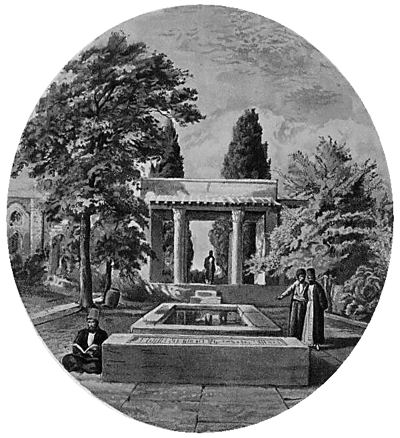 THE TOMB OF OMAR