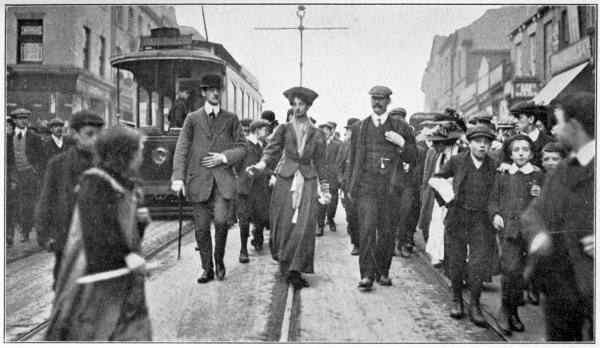
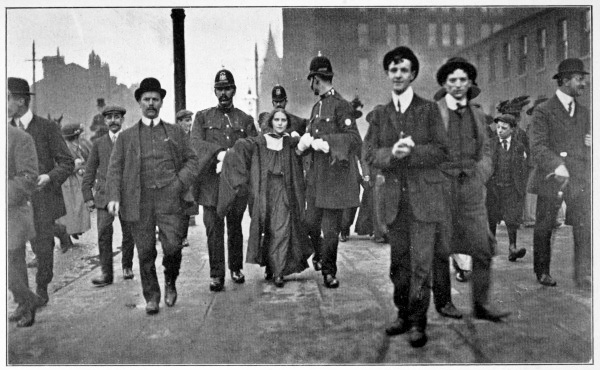
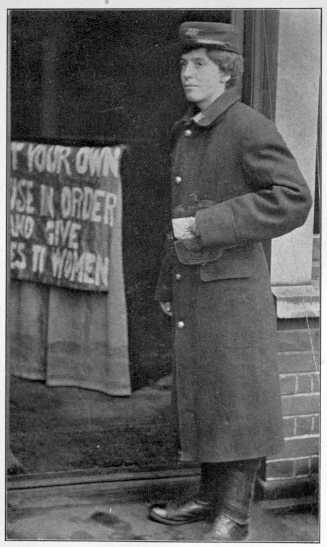
The Trial of the Three Leaders. Mr. Herbert
Gladstone and Mr. Lloyd George in the Witness
Box.
On the morning of October 14th began the trial
both of the three leaders who had been arrested by
warrant and the twenty-one women whom they were
said to have incited to break the peace. Excited
crowds early assembled in Bow Street, and besieged
the doors of the Police Court, begging the unyielding
custodians for admission. In the dark passageways
and lobbies of the Court were numbers of
women, imploring the officials to allow them to pass
into the Court itself. The public enter by a door
at the back of the room and here there is a space
where visitors may stand. This space was now
crowded with women, pressing closely against the
wooden barrier which cut them from off the narrow
rows of equally crowded wooden seats, where the
friends and relatives of the prisoners, who could obtain
the ear of some kindly officer, were allowed to
sit. In front of these seats is the dock itself—a
wooden bench some six feet long, empty as yet, and
surrounded by a heavy iron railing on three sides, the
fourth to be guarded by a policeman when the prisoners
arrive. In front and at one side of the dock
are the benches for the Press, which that morning
contained representatives from all the leading newspapers.
In front of this again, divided by a barrier
and on a lower level so that one sees little more than
the heads of its occupants, was another bench where
Mr. Muskett, the solicitor for the Prosecution who
had so often appeared against the Suffragettes, and
other minions of the law now sat. In front again
and placed at right angles to this bench is the witness
box—a little wooden pen with a foolish
wooden canopy which looks as though it were meant
for keeping out the rain. On the right, opposite
the witness box, are two rows of seats, each entered
by a little wooden door, like church pews, where
counsel and distinguished strangers sit. In the well
between the witness box and these seats sit the recording
clerks and other officials, and opposite to
them, and facing the whole court is the Magistrate's
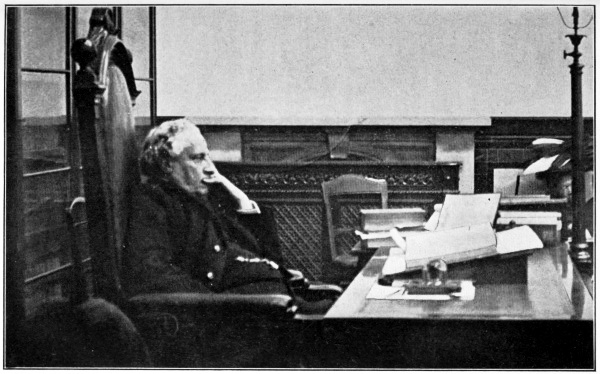
high-backed chair and his table. Mr. Curtis Bennett,
the Magistrate who was to try the case, sat
there now, handsome and dignified, and looking the
picture of a high-bred eighteenth-century squire.
The familiar figures of Mrs. Pankhurst, Christabel
and Mrs. Drummond were soon ushered into
the dock, and then Christabel began by asking the
Magistrate not to deal with the case in that Court,
but to send it for trial by Judge and Jury, her object
being to secure that Suffragette cases should no
longer be decided by a body of Police Court officials,
whom we had every reason to believe were acting
under the direct instructions of the Government
against whom our agitation was directed, but should
instead be submitted to a body of ordinary citizens.
She urged that, under section seventeen of the Summary
Jurisdiction Act of 1879, she and her co-defendants
were entitled to the option of being tried
where they desired, and she wished now to state that
they desired that the case should go before a jury.
Mr. Curtis Bennett bent his head and smiled, saying,
"Yes, yes, but we will go on with the case now."
She pressed him to at once give an answer to the
point which she had raised, but he replied that he
could not do so until he had heard the case.
Mr. Muskett, then rose to prosecute. Speaking
quickly in a low voice and showing considerable irritation,
he began by complaining that the defendants
had failed to obey a summons to appear, firstly on
Monday and secondly on Tuesday morning, to answer
to the charge of having been guilty of conduct
likely to provoke a breach of the peace. Then in
the most fastidious manner and with clearly expressed
disgust, he proceeded to set forth the details
of the case. He explained that, on October 8th, Inspector
Jarvis had visited the offices of the Women's
Social and Political Union and had there seen Mrs.
Drummond with Miss Christabel Pankhurst. Miss
Pankhurst had said, "What about the 13th? Have
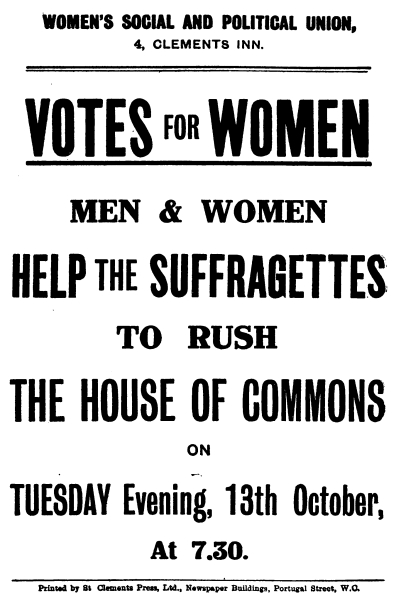
you seen our new bills?" and had produced the
handbill which formed the foundation of the present
charge. It was worded: "Votes for Women.
Men and women help the Suffragettes to rush the
House of Commons on Tuesday, October 13th, at
7:30 P. M." In showing this to Inspector Jarvis,
Miss Pankhurst had said that the words "to rush"
were not in sufficiently large type and that they were
to be made much more distinct.
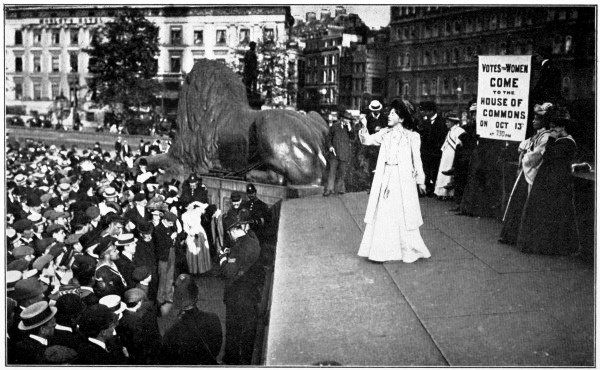
On Sunday, October 11th, the Defendants had
held a meeting in Trafalgar Square, to which Mr.
Muskett objected, because it had caused "an enormous
amount of additional labour to be thrown upon
the shoulders of the police." At this meeting, he
asserted gravely, speeches had been delivered by the
defendants inciting those present to carry out the
programme of rushing the House of Commons.
"You will agree sir," said Mr. Muskett, "that such
conduct as that cannot be tolerated in this country."
Finally he asked on behalf of the Commissioner of
Police that the defendants should be ordered to be
bound over to keep the peace.
Stout, red-faced Superintendent Wells, whom we
usually found most friendly and obliging, now, looking
very cross and uncomfortable, lumbered into the
witness box. After taking the oath he gave evidence
in regard to a visit of his own to the offices at Clement's
Inn. He said that Mrs. Pankhurst had then
shown him a copy of a letter which had been sent by
the Women's Social and Political Union to Mr. Asquith.
This document pointed out that at many
large demonstrations all over the country, resolutions
had been carried, calling upon the Government to
adopt the Women's Enfranchisement Bill and also
that, at a succession of by-elections, the voters had
shown unmistakably their desire that the Government
should deal with the question without further
delay. It concluded by asking the Prime Minister
to inform the Union as to whether the Government
would carry the Bill into law during the autumn session.
After the Superintendent had read the letter, Mrs.
Pankhurst had told him that, if Mr. Asquith returned
a satisfactory reply to it, nothing would take
place on October 13th save a great cheer for the
Government, but that, if he did not, there would be
a demonstration and the women would get into the
House of Commons. "I said, 'You cannot get there
for the police will not let you unless you come with
cannon,'" the Superintendent went on, looking very
imposing, and explained that Mrs. Pankhurst had
then stated that "no lethal weapons" would be used.
She had also said, "Mr. Asquith will be responsible
if there is any disorder and accident."
Superintendent Wells next described the meeting
in Trafalgar Square where he had seen Mrs. Drummond
distributing the "rush" handbills. He said
that he looked upon her as a "very active leader of
the Suffragettes" and that she frequently wore a
"uniform" with the word "general" or "generalissimo"
on the cap. He had told her that she and
Mrs. Pankhurst would be prosecuted. When questioned
by Mr. Muskett as to the happenings of the
previous evenings, Superintendent Wells said that
traffic had been "wholly disorganised" in the vicinity
of the House of Commons for four hours and
that for three hours the streets had been in "great
disorder"; that a very large body of police indeed
had been required to maintain the peace, that ten
persons had been treated at Westminster Hospital
and that seven or eight constables and sergeants had
been more or less injured.
It was now Christabel Pankhurst's turn to cross-examine
the Superintendent and he looked across the
dock at her very nervously. She first questioned
him as to the statement that had been made that she
and her companions in the dock had broken their
promise to appear at the court either on the Monday
or Tuesday morning, and drew from him the admission
that he had not received any undertaking "in
actual words." She then changed the subject and
brightly asked him whether he was in the habit of
reading the official organ of the Union "Votes for
Women," to which he replied in the negative.
"You are not aware, then," she said, "that Mrs.
Pankhurst wrote the following words:"
On October 13th in Parliament Square there will be
many thousands of people to see fair play between the women
and the Government. Let us keep their support and cooperation
by showing them, as we have done before, with
what quiet courage, self-restraint and determination, women
are fighting against tyranny and oppression on the part of
a Government which has been called the strongest of modern
times. It is by the exercise of courage and self-restraint
and persistent effort that we shall win in this unequal contest.
"There is nothing very inflammatory in those
words," she urged. "Does it really occur to you
that those words were circulated to incite a riot?"
But Mr. Wells shrugged his shoulders and answered
gruffly, "I am not complaining of that article, I am
complaining of those bills."
Then she asked whether the crowd in Trafalgar
Square was a disorderly one. He admitted that it
was not, but at the question "are you aware that any
member of the Government was there?" he looked
round at the Magistrate cautiously and said, "I do
not know that I should answer that." "You can
say yes or no," said Mr. Curtis Bennett, and when
the query was repeated the reply came, "I saw one
there." "Was it Mr. Lloyd George?" said Miss
Pankhurst with a smile, and at this there was laughter
in court, and even the Magistrate plainly showed
amusement. Mr. Wells flushed redder still and remained
silent. She next questioned the Superintendent
as to the nature of the speeches in Trafalgar
Square and the exact meaning of the word "rush,"
but he frequently took refuge in silence, and refused
to be drawn. It was plain that Mr. Wells was not
accustomed to being cross-examined by a prisoner in
the dock and that he did not at all like it. Just as
he began to hope that it was nearly over, she suddenly
changed the subject, and asked him whether
he had been present when Mr. John Burns had made
the famous speech which led to his arrest. "I was
not," he answered, and she asked, "Are you aware
that the words he used at that time were very much
more calculated to lead to destruction and damage
to property than anything that we have said?" "I
am not aware of it," said Mr. Wells looking appealingly
across to Mr. Muskett. "You are aware
however that John Burns is a member of the present
Government and is responsible jointly with his colleagues,
for the action which has been taken against
us?" "Yes," he answered, almost without thinking.
"You are aware of that, you are aware that
the law-breaker is now sitting in judgment upon those
who have done far less than he did himself?" she
said, pressing home her advantage. "You are
aware of that?" she repeated after a pause. But
there was no reply.
Next she asked whether the Superintendent had
heard the Trafalgar Square speech of Mr. Will
Thorne, M.P. in which he had advised the people
to rush the bakers' shops? Mr. Wells felt on
safer ground now, for this did not concern a Cabinet
Minister. "I did not hear it," he ventured to answer,
"but it was reported to me." "Well, does
it occur to you that his language was far more dangerous
to the public peace than the language that we
have used?" "I am not complaining of your language,"
he again answered doggedly, "I am complaining
of the bills." "Well, the language that
was used on the bills, he spoke, he used the word
'rush,' moreover he incited people to riot and violence,"
she urged. "Does it occur to you that his
action is more reprehensible than ours?" "It occurs
to me," said Mr. Wells sulkily, "that he might
be prosecuted the same as you are." "You are not
aware whether proceedings will be taken?" she
asked with an air of pleased interest—but Mr.
Curtis Bennett interposed to say that that question
could not be allowed. Then she asked the Superintendent
whether he knew that Mr. Gladstone had
stated in the House of Commons that the proceedings
against herself and her colleagues had not been
instituted by the Government, but by the police.
He tried to evade her, saying, "You have kept me
so busily engaged that I have not had time to look
at the papers this morning," but before he left the
box he had virtually admitted that, in spite of Mr.
Gladstone's denial, the Government was responsible
for the prosecution.
The next witness was our old friend, Inspector
Jarvis with whom we had had negotiations in all
sorts of matters connected both with our peaceful
and militant propaganda ever since our campaign in
London had been started. He is a tall thin man
with a pale, thoughtful face and is not at all like the
typical police officer. As a rule he has the most
kindly and courteous manners, but to-day he seemed
thoroughly ill-tempered and refused to look directly
at any of us. He was called upon by Mr. Muskett
to read the notes which he had taken of Christabel's
speech at the Sunday meeting in Trafalgar Square
and he did so in halting and expressionless tones:
I wish you all to be there on the evening of the 13th and
I hope that this will be the end of this movement. On
June 30th we succeeded in driving Mr. Asquith underground;
he is afraid of us and so are the Government.
Years ago John Bright told the people that it was only by
lining the streets from Charing Cross to Westminster that
they could impress the Government. Well, we are only
taking a leaf out of his book. We want you to help
the women to rush their way into the House of Commons.
You won't get locked up because you have the vote. If you
are afraid, we will take the lead, and you will follow us.
We know we shall win because we are in the right.
Then, just as a child at school who does not understand
the words, he read an extract also from Mrs.
Pankhurst's speech:
On Tuesday evening at Caxton Hall we shall ask those
who support the women to come to Parliament Square.
There will be a deputation of women who have no right
in the House of Commons to a seat[30] there such as men
have. The Government—does not know—its own mind—it—changes—so,
but we do know—that we want the
vote—and mean to have it. When the people in Parliament
Square—
But Mr. Muskett interrupted, he had heard
enough. He went on to ask if it were not a fact
that, on Monday morning, Inspector Jarvis had himself
served a summons upon the defendants to appear
in court on the afternoon of the same day and on
the Inspector assenting, he said, "I want to know
about this question as to whether they promised to
attend here or not." Inspector Jarvis hesitated,
"Well, Miss Christabel," he began, "I saw her
alone, and she said, 'We are not afraid, we shall be
there.'" "Then," said Mr. Muskett, "I believe
they were served with a summons to appear on the
following morning at eleven o'clock." "Yes."
"And as they did not put in an appearance then, a
warrant was issued?" "Yes." "And you had to
wait there for them until they surrendered to you?"
Again the Inspector assented, looking very much
aggrieved.
Christabel Pankhurst began her cross-examination
by closely questioning Mr. Jarvis on this very point
and soon drew from him the admission that no
definite promise had been made. As she was speaking
to him his face cleared visibly and he generously
owned that he had been mistaken. Similar evidence
from a third Inspector closed the case for the prosecution.
Christabel then applied for an adjournment and
the Magistrate agreed to allow the case to stand over
for a week. The three prisoners being released on
bail for the time being.
As soon as this had been decided Mr. Curtis Bennett
said that he would deal with the cases of the
women who had been arrested in Trafalgar Square,
and seven of these were soon ordered to undergo
from one to two months' imprisonment in default
of being bound over for twelve months. As each
woman was asked if she had anything to say for
herself, she replied, "I demand a trial by jury."
This seemed to annoy Mr. Curtis Bennett considerably
and he became more and more irate until the
fifth woman had spoken. Then he laughed and said,
"I see this has evidently been arranged beforehand."
It was unfortunate for the fourth woman that he
had not recovered his temper earlier for, though a
first offender arrested for doing practically nothing,
she received a sentence of two months' imprisonment,
whilst one month only was served out to others of
the same class. Mrs. Leigh, as this was the third
time that she had been charged, received a sentence
of three months. Thirteen of the Suffragettes
pleaded that they wished to obtain legal advice, and
were remanded for a week, at the end of which time
milder methods obtained, for their sentences ranged
merely from three weeks to one month.
Next day, Thursday, October 15th, a summons was
issued against Mr. Will Thorne, M.P. for inciting
the unemployed to rush the bakers' shops, and when
his case came up on the 21st, he expressed the belief
that no summons would have been issued against
him but for the remarks made by Christabel Pankhurst
during the Suffragette trial. He declared that
in speaking as he had done his object had been to
persuade the unemployed not to take part in the
Women's Demonstration in Parliament Square, because
he felt sure that they would get into trouble if
they did so, and urged that his speech had been taken
too literally. Mr. Curtis Bennett, however, ordered
him to be bound over in his own recognisances of
£200 and two sureties of £100 each to be of good
behaviour for twelve months or in default to go to
prison for six months. Mr. Thorne agreed to be
bound over.
On Wednesday, October 21st, the trial of the Suffragette
leaders again came on and, whilst the Court
was just as crowded, the Press seats were even fuller
than before. Mr. Curtis Bennett seemed more than
ever dignified and magisterial. Everyone waited
with impatience and presently there was a stir in the
court, and, with much ceremony, some of the officers
opened the door by which the prisoners usually enter
and ushered in a group of gentlemen, who seated
themselves in the pew-like benches reserved for counsel
and distinguished persons. Then, preceded by a
stout, black-bearded gaoler, and with three or four
police on either side of them, the three Suffragettes
made their way into the dock. As soon as they had
seated themselves, Mr. Muskett rose and said in his
usual rather peevish and very indistinct tones that
the case for the Prosecution had been concluded on
the previous Wednesday.
After a short preliminary argument as to legal
forms between Christabel and the Magistrate and a
pledge that she should be allowed to submit her objections
later, there was a slight scuffling in those
important side benches, the pew doors were opened,
two of the gentlemen who had accompanied him
stepped aside and Mr. Lloyd George, Chancellor of
the Exchequer, came forward and passed across the
court into the witness box.
Seen for the first time, he is totally unlike what
one has been led to expect. Instead of the romantic-looking
Welsh bard, with black and very curly
hair, portrayed by the newspaper cartoons and drawings,
there stood, cooped up in the little witness box,
with its useless-looking wooden canopy, a plain little
man, with a pale face, a long untidy moustache and
hair which, though he wears it somewhat long, as
it is in the pictures, has not the least suspicion of a
curl but lies limp and scanty and is a dull dingy
brown. At first he leant his arm on the front of the
witness box and looked across at the three prisoners
in the dock. He regarded Christabel Pankhurst
curiously, as well he might, for, in her fresh white
muslin dress whose one note of colour was the broad
band of purple white and green stripes around her
waist, with her soft brown hair uncovered, the little
silky curls with just a hint of gold in them clustering
about her neck, and, in this dingy place, her skin
looking even more brilliantly white and those rose
petal cheeks of hers even more exquisitely and vividly
flushed with purest pink than usual, she was as
bright and dainty as a newly opened flower, and with
all her look of perfect health and vigour, appeared
so slender and so delicately knit as to have little
more of substance in her than a briar rose. But
she was to triumph over her opponent in the witness
box, not by her grace and freshness and by the outer
aspect of her vivid glowing personality, but by her
sparkling wit, her biting sarcasm and by the force
and depth of her arguments. And these went home,
not merely as they can be set down here in cold dull
print, but far more truly, because they were enhanced
by the everchanging eloquence of gesture,
voice, and facial expression—by a lift of the
eyebrows, a turn of the head, a heightening of the
lovely rose colour that flooded sometimes as far as
the white throat and as quickly ebbed again, a sweep
of the slender hand or a turn of that slight virile
frame. All these, because so perfectly they echoed
and expressed her thoughts, could lend to even the
baldest and tritest words, a fanciful humour, a delicate
irony, or an inexorable force.
As she rose to examine Mr. Lloyd George, she
began quite formally, but with a cheerful and pleasant
manner asking whether he had been present at
the Trafalgar Square meetings on October 11th?
and whether he had seen a copy of the bills which
were being distributed? "Yes," he replied, with
just the least suspicion of a smile, "a young lady
gave one to me the moment I arrived. It invited
me to rush the House of Commons." "How did
you interpret the invitation conveyed to you as a
member of the audience?" she asked next with a
brisk business-like air. "What did you think we
wanted you to do?" He replied pompously, "I
really should not like to place an interpretation upon
the document. I do not think it is quite my function."
"Well, I am speaking to you as a member
of the general public," she urged, refusing to be put
off. "Imagine you were not at the meeting at all,
but were walking up the Strand, and someone gave
you a copy of this Bill, and you read it—'Help the
Suffragettes to rush the House of Commons.' And
suppose you forgot you were a member of the Government
and regarded yourself just as an ordinary
person like myself—quite unofficial," she added,
smiling, and with a little quick shake of her shoulders.
"What would you think you were called
upon to do?" "Really, I should not like to be
called upon to undertake so difficult a task as to interpret
that document," was the tart reply, but
Christabel went on persuasively, "Now this word
'rush,' which seems to be at the bottom of it all,
what does it mean?" She waited with parted lips
and raised eyebrows for a reply. It came unwillingly.
"I understood the invitation from Mrs.
Pankhurst was to force an entrance to the House of
Commons." "No, no, I want you to keep your
mind concentrated on the bill," she corrected. "Let
us forget what Mrs. Pankhurst said. What did the
Bill say?" "I really forget what the Bill said," he
snapped out sharply. She repeated the phrase to
him graciously—"Help the Suffragettes to rush the
House of Commons." "Yes, that is it," he assented,
and she said, "I want you to define the word
'rush.'" "I cannot undertake to do that." "You
cannot?" she asked incredulously. "No, Miss
Pankhurst, I cannot." "Well," she replied, "I will
suggest some definitions to you. I find that in
'Chambers' English Dictionary' one of the meanings
of the word is 'an eager demand.' Now, what
do you think of that?" "I cannot enter into competition
with 'Chambers' Dictionary.' I am prepared
to accept it," he said stolidly.
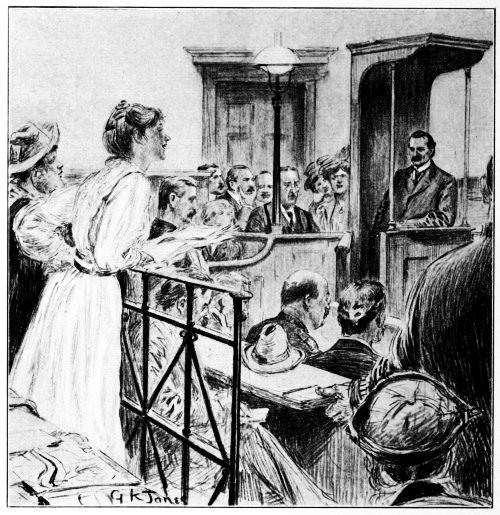
Miss Christabel Pankhurst questioning
Mr. Herbert Gladstone
Mr. Lloyd George was beginning to turn his head
away from her and to show every sign of unwillingness
to continue answering. Her imperturbable
good humour made the situation harder for him to
bear. As Max Beerbohm in the Saturday Review
said, "His Celtic fire burned very low; and the contrast
between the buoyancy of the girl and the depression
of the statesman was almost painful.
Youth and an ideal, on the one hand, and on the
other, middle age and no illusions left over."
But Christabel appeared not to notice his discomfiture:
"'Urgent pressure of business.' That is
another meaning. Now, if you were asked to help
the Suffragettes to make an eager demand to the
House of Commons that they should give votes to
women, would you feel that we were calling upon
you to do an illegal act?" "That is not for me to
say." Here Mr. Curtis Bennett interposed. "The
witness is perfectly right. This is for me to say
on the evidence. I have not interfered so far,"
but Christabel went on unheedingly and continued
gravely reading from her list of definitions.
"There is another sense in which the word 'rush'
is used and I think it will be of some interest to you.
We use it in this connexion, to 'rush' Bills through
Parliament." Mr. Lloyd George smiled in spite of
himself. "Yes, I think I have some experience of
that!" he said. "'On the rush' we are told in another
dictionary means 'in a hurry.' There is nothing
unlawful in being in a hurry." Mr. Lloyd
George shook himself impatiently, and the Magistrate
again interposed; this time with more severity.
"I have already said you must address those remarks
to me afterwards." But quite impassively
she held to her point and with her eyes upon the
witness continued, "Did you understand you were
asked to go in a hurry to the House of Commons to
make this eager demand for enfranchisement? Was
that the meaning which the Bill conveyed to you?"
In spite of his remonstrances Mr. Curtis Bennett
was evidently enjoying the scene, and his eyes twinkled
as he listened to the quickly and pleasantly directed
questions and to the slow, grudging replies.
Mr. George kept glancing at him angrily, and again
looking severe he said at last, "Miss Pankhurst, you
must take my ruling, please."
At this she changed her tack a little, questioning
Mr. Lloyd George as to the speeches he had heard
in Trafalgar Square and the demeanour of the crowd
and always making her inquiries with a polite air
of expectation that valuable information would be
forthcoming. When Mr. Lloyd George admitted
that he had heard some part of Miss Pankhurst's
speech, Christabel gravely inquired whether her
mother had threatened violence to any member of
the Government. "She did not invite the audience
to attack you in any way?" she asked. Then gradually,
through his fear of being made to appear ridiculous,
she brought him to admit that he had thought
that, if the public responded to the invitation to
"rush" the House of Commons, the consequences
would not be formidable and that there had been no
suggestion either that public or private property
should be damaged or that any personal violence
should be done.
Then she suddenly asked, "There were no words
used so likely to incite to violence as the advice you
gave at Swansea, that the women should be ruthlessly
flung out of your meeting?" This was unexpected.
Mr. Lloyd George frowned and remained
silent. Mr. Muskett stood up and appealed to the
Magistrate who interposed as was expected of him.
"This is quite irrelevant. That was a private
meeting, and not of the same character," he said reprovingly.
Christabel shook her head. "It was a
public meeting," she insisted. The Magistrate
waved his hand. "Well, private in a sense."
"They are private nowadays, that is quite true,"
she said pointedly, and obviously referring to the fact
that ticket meetings only were now addressed by
Cabinet Ministers, all women with a few selected exceptions
being rigidly excluded. Then she went on
to question Mr. Lloyd George as to the reason for
which the "rush" had been planned, but he obstinately
refused to answer.
Turning to the events during the so-called "rush"
on October 13th, she elicited the fact that Mr. Lloyd
George had taken his little six-year-old daughter
with him to watch the scene. "She was very
amused," he said with a malicious air. "You
thought it was quite safe for a child of those tender
years to be amongst the crowd?" asked Christabel,
and this time it was her turn to be a little severe.
"I was not amongst the crowd," he snapped, and
later, as if anxious to justify himself, added, "You
see, I only brought her from Downing Street to the
House, and I think that was clear." "The Prosecution
asserts that a serious breach of the peace took
place," was her next question. "Do you agree with
that statement?"
The Magistrate interrupted, "The Chancellor of
the Exchequer would have nothing to do with that,"
he said. "I believe you are a lawyer?" with a
quick change of front, she asked, turning politely to
Mr. Lloyd George. "Well, I hope I am," he answered
with a surly air. "Don't you think the
offence alleged against us would be more properly
described as 'Unlawful Assembly'?" "There
again, I was not put in the witness box to express an
opinion of that sort," he objected and the Magistrate
again supported him. She made another attempt:
"You have seen the form of summons
against us?" but he protested that he had not and
did not know with what offence the prisoners were
charged. She explained to him the form of the
summons and explained that, owing to this, the defendants
were denied the right of trial by jury. He
merely replied, "I take it from you, Miss Pankhurst,
but I do not know."
An awkward question for Mr. Lloyd George was:
"Do you think that coercion is the right way of
dealing with political disorders?" He remained silent,
and the Magistrate tried to help him out, saying,
"It is not for the witness to express an opinion."
Christabel looked full at Mr. Lloyd George, asking,
"You refuse to answer?" "I do not refuse to answer,"
he said, not very honestly, "but I must obey
the decision of the Bench that I cannot express an
opinion about things in the witness box." "Am I
to understand that an answer must not be given to
that?" she appealed to the Magistrate. He replied,
"No." "Not even if the witness would like
to do it?" "No," he said, but she tried again.
"Well, is it likely to be a successful way of dealing
with political disturbances?" But the Magistrate
said, "That again, is not admissible." "But for
these restrictions, your Worship"—she broke out
with some heat, but he waved her aside and she
understood that he was implacable, so she turned
cheerfully to the witness and said, "Can you tell me
whether any interference with public order took
place in connexion with previous movements for
franchise reform?" "I should have thought that
that was an historical fact, Miss Pankhurst," he replied.
Again the Magistrate interposed to save
him. "That is cross-examination. The witness
cannot go into that." "In a sense he is my witness,"
she said, but though Mr. Curtis Bennett
smiled, he replied, "In every sense at present."
Nevertheless he had evidently seen the justice of
the remark and he did not object when a similar
question was now put. It was: "Have we not received
encouragement from you, or if not from you,
from your colleagues to take action of this kind?"
"I should be very much surprised to hear that, Miss
Pankhurst." Mr. George gave his answer pompously.
"You deny that we have been encouraged
by Liberal statesmen to take action of this kind?"
she said eagerly. "I simply express astonishment
at the statement," he said casting up his eyes with an
exaggerated, but not very convincing air of indignation.
"Have you ever heard these words spoken by
us at Trafalgar Square or by any Liberal statesman:"
I am sorry to say that if no instructions had ever been
addressed in political crises to the people of this country
except to remember to hate violence, to love order, and to
exercise patience, the liberties of this country would never
have been attained.
"Have you ever heard those words before?"
"I cannot call them to mind." At this reply there
was a sensation in the court, silent, but clearly felt.
"Those were the words of William Ewart Gladstone,"
said Christabel. "I accept your statement,
Miss Pankhurst," was Mr. Lloyd George's reply,
and when asked whether he was aware that in 1884
Mr. Chamberlain had threatened to march 100,000
men on London, he again replied, "I do not know."
Christabel's next question carried the war further
into the enemy's country. "Is it not a fact that
you yourself have set us an example of revolt?"
she asked, but Mr. Curtis Bennett interposed to say
that the Chancellor need not answer that question,
and that she must not attack her own witness.
Whilst they were arguing, Mr. Lloyd George himself
burst in. "I never incited a crowd to violence,"
he said hotly, as though this form of defence had
only just occurred to him. "Not in the Welsh
Grave Yard case?" she asked. "No!" he said.
"You did not tell them to break down a wall and
disinter a body?" "I gave advice which was
found by the Court of Appeal to be sound legal advice,"
he said snappishly, and again almost turning
his back upon her. "We think that we are giving
sound advice too," she said.
After this Mr. Lloyd George became less and less
ready to give any reply, and his angry eyes were continually
calling for the Magistrate's intervention.
Miss Pankhurst then cited passages from "Taylor
on Evidence," to show that more latitude could be
allowed in questioning a witness who obviously appeared
to be hostile or interested for the other party,
or unwilling to give evidence, but Mr. Curtis Bennett
declared that none of these descriptions could
be applied to Mr. Lloyd George. So, with a gesture
of protest, Christabel said, "I think I need not
trouble him with any further questions."
After some questioning by Mrs. Pankhurst to which
Mr. Lloyd George returned the scantiest and most
surly of replies, Mrs. Drummond said earnestly but
with a touch of humour in her voice.
"I should like to ask Mr. Lloyd George this question;
many times he has refused to answer me.
When do you intend to put a stop to these things by
giving us the vote?" Shrugging his shoulders, Mr.
Lloyd George turned to the Magistrate who gave
the desired reply: "That is not a question for the
witness." Mrs. Drummond added, after a pause,
quietly and reproachfully: "You and your colleagues
are much to blame for this agitation."
"You must not make a statement," said the Magistrate.
"You see, we never get a chance at other
times," said Mrs. Drummond appealingly. At this
Mr. George smiled broadly, but not very pleasantly,
and shaking his head said, "Indeed you do!" as he
left the box.
Mr. Curtis Bennett now told Christabel that he
wished her to call Mr. Herbert Gladstone in order
that the Home Secretary might not be detained
from his duties in the House unnecessarily but she
declared that it was absolutely essential that she
should first call one other witness. Mr. Curtis
Bennett protested and she said, "I have only one
question to put to this lady." "Very well then, one
question," he said smiling as though he scarcely believed
her, and one could plainly see, determining
to hold her to her word. Christabel then called
"Miss Marie Brackenbury," who stepped quietly into
the box. Christabel gently asked her whether it were
true that she had suffered six weeks' imprisonment in
connexion with this agitation and as soon as she had
assented said quickly, but in a clear, penetrating
voice, "Did Mr. Horace Smith tell you in sentencing
you to that term he was doing what he was
told?" "You must not put that question!" almost
shouted the Magistrate. But the witness had
already replied, "He did." "The witness has said
'yes,' upon oath," said Miss Pankhurst triumphantly
turning to the place where the Cabinet Ministers
sat. There was a strange stir in the court, those
present feeling that belief in the inviolability of British
Justice was slipping from their grasp. For a
moment or two there was an unpleasant pause and
Mr. Curtis Bennett sat flushed and angry.
Mr. Herbert Gladstone, the Home Secretary, was
then called and took his place in the witness box.
With his shiny bald forehead, ruddy face, prominent
eyes and corpulent figure, he formed not only a striking
contrast to his colleague who had just been examined,
but was as far removed from the impressive
dignity of his own distinguished father. Altogether
his general appearance was that which the romantic
idealist would associate rather with a comfortable
and prosperous shopkeeper than with a Cabinet
Minister. As soon as he had been sworn, he placed
his elbows on the ledge in front of him and looked
smilingly around the court, as much as to say, "Nothing
of this kind can disturb me, I intend to enjoy
myself."
Miss Pankhurst began by endeavouring to fix upon
him as Home Secretary the responsibility for the
proceedings against herself and her colleagues which
he had denied in the House of Commons. She
succeeded in forcing him to admit, "I am at the
head of the responsible department." But when she
put the questions more plainly, saying, "Did you
not, as a matter of fact, instruct the Commissioner
of Police to take the present proceedings?" and
"Are the Government as a whole responsible for
these proceedings?" Mr. Muskett jumped up, in
each case, shouting, "I object to that!" and the
Magistrate also said that the questions could not be
answered.
They were also determined that no more unpleasant
disclosures were to be made, but she would
not leave the subject. "Did you instruct Mr.
Horace Smith to decide against Miss Brackenbury
and to send her to prison for six weeks?" she asked.
"You cannot put that question either," said Mr.
Curtis Bennett in a slightly raised tone. "It is a
pity that the public interest should suffer on that account,"
was her severe reply, and turning to Mr.
Gladstone, she said, "Did you offer any instructions
to Mr. Horace Smith?" "I object to this; it is
contempt of court to continue putting these questions!"
indignantly cried Mr. Muskett again springing
to his feet, but with a broad sweep of her hand
she declared, "The public will answer them." Then
turning to Mr. Gladstone, whose enjoyment of the
situation had now entirely vanished, she persisted,
"What do you suggest is the meaning of what Mr.
Horace Smith has said?" but again the Magistrate
intervened.
She next asked Mr. Gladstone to define the word
"rush." "I can hardly give any definition of it,
but a rush implies force," he said, growing more
comfortable again. "Do you deny that it involves
speed rather than force?" she asked, and he replied
smiling and putting his head knowingly on one side,
"Speed generally involves force." This argument
continued for some time. Then she asked:
"Were you anticipating that you would be in bodily
danger as a consequence of the issue of this Bill?"
"I did not think of it at all. I did not think
whether the possibility existed or not," he answered,
squaring his shoulders and throwing out his chest.
She waved her hand. "You are like us, above these
considerations. You were not in fear?" "No,
not at all," he answered, looking pleased with himself.
"Did you ever think that public property was
in danger as a consequence of this bill having been
issued?" "I thought it quite possible," he said a
little more seriously, "I thought there would be danger
from the crowds." "Then you were agreeably
disappointed on the morning of the 14th, when you
found no harm had been done?" "No, I was not.
The police measures were sufficient to stop any serious
accident or danger," he said proudly and magisterially.
She kept putting questions of this kind, first in
one form then in another until he began to grow
tired and puzzled, and was evidently in fear of making
some unwise admission. "Did you feel that
but for the line of police protecting you, the crowd
would have rushed upon you and attacked you?"
she asked at last with expressive emphasis. "The
police were not protecting me," he answered with an
air of offended dignity; "I felt no personal fear."
"Did any other person seem in danger of attack?"
"The police gave them very little chance." "What
made you think them a dangerous or hostile crowd?"
"Of course, I am quite accustomed to seeing these
crowds. I know what has happened before."
"What has happened?" "Disorderly scenes."
Mr. Gladstone was standing up now and looking
quite severe. "What harm have they done?"
"Very little, as it happened." "What harm have
they attempted to do?" "That is not for me to
answer." "Have they attempted to do more than
secure an interview with the Prime Minister?"
Mr. Gladstone turned to the Magistrate, who said,
"That is not a question for him to answer."
"We will go back to the 13th," she said. "Do
you think anyone was obstructed in their passage to
the House of Commons?" "I cannot speak for
other people." "You saw no attempt to waylay
Members of Parliament or Cabinet Ministers?"
Her questions continued thick and fast. He admitted
that he had seen no one waylaid or injured
and no harm done, but took refuge in the assertion:
"There was a great crowd." "But a crowd assembles
when the King goes to open Parliament," she
said. He answered crossly, "Presumably, they
were waiting to 'rush' the House of Commons,"
and added later that he had heard that certain police
constables had been injured, and that there had
been thirty-seven arrests and over forty complaints
of losses of purses and watches. "Comparing
that with the net result of a Lord Mayor's Show
crowd or any sort of procession, really less harm resulted?"
she asked, but he gave no reply and her
questioning as to how many policemen were on duty
and what the cost had been to the country were suppressed
by Mr. Curtis Bennett.
Presently Christabel asked, "How do you define
a political offence?" Mr. Gladstone leant over the
edge of the box and smiled again. "I wish you
would give me a good definition," he said, in friendly
confidential tones, "I am often asked that question
in the House of Commons." "Well, with the
Magistrate's permission, I will," she answered.
"A political offence is one committed in connexion
with political disturbances and with a political motive."
"I do not think that a sufficient explanation,"
he said with a challenging air. "If I am at
liberty after this day's proceedings are over, I shall
have pleasure in sending you a fuller account."
Then she asked, "Do you remember that when a
deputation of women went to the House of Commons
to see the Prime Minister, instead of being allowed
to enter, they were arrested?" "I have no
immediate recollection of that, only a general recollection,"
was the Home Secretary's reply given with a
lofty manner. When the question was put again in
a slightly different form, the Magistrate interrupted:
"That does not arise on the issue." "It throws a
light on it though," said Miss Pankhurst. "Please
do obey; otherwise I shall have to stop it altogether,"
said Mr. Curtis Bennett, and one heard a note of
regret in his voice. He evidently enjoyed the discomfort
of the Cabinet Ministers and the spectacle
of their professing blankest ignorance on well-known
points. "I have given you much more licence than
I should give Counsel," he urged.
"In the action we took on the 13th is it within
your knowledge that we were acting on advice given
by yourself?" Christabel asked. "I wish you
would take my advice," Mr. Gladstone answered.
"We are trying to take it," she said quietly.
"What did you mean when you said that men had
used force majeure in demanding the vote?" "If
you hand me the speech, I daresay I can tell you."
She held out a copy of it towards him but Mr.
Curtis Bennett interposed. "How is this material
to what Mr. Gladstone saw? You are cross-examining
your own witness, Miss Pankhurst, and you
must not do that." "May I not ask any explanation
whatsoever as to the counsel given to us?" she
asked with a persuasive air. "No, you may not,"
the Magistrate replied sternly. "We never have
any opportunity. May I ask whether he made certain
statements?" Mr. Curtis Bennett smiled and
pretended not to notice, and Christabel eagerly
turned to Mr. Gladstone, reading from the printed
copy of his speech. "Did you say it was impossible
not to sympathise with the eagerness and passion
which have actuated so many women on this subject?"
"Yes," he replied. "Did you say men
had had to struggle for centuries for their political
rights?" "Yes." "Did you say that they had to
fight from the time of Cromwell and that for the last
130 years the warfare had been perpetual?" His
smile was growing broader and broader. "Yes,"
he said. "Did you say that on this question experience
showed that predominance of argument alone—and
you believed that that had been attained—was
not enough to win the political day? Did you
say that?" "Yes." "Did you say that we are in
the stage of what is called 'academic discussion,'
which serves for the ventilation of pious opinions
and is accompanied, you admit, by no effective action
on the part of the Government, or of political parties
or of voters throughout the country?" "Yes."
"Did you say that members of the House of Commons
reflect the opinion of the country, not only in
regard to the number of people outside, but in regard
to the intensity of the feeling in support of a
movement, and that the Government must necessarily
be a reflex of the party which brought it into
being?" "Yes." "Did you say this: 'There
comes a time when political dynamics are far more
important than political arguments?' You said
that?" "Yes." "And that 'men had learned this
lesson?'" "Yes." "And that they know the
necessity for 'demonstrating that force majeure
which actuates and arms a Government for effective
work'?" "Yes, I think it was a most excellent
speech!" he said nodding his head and smiling up
at the prisoner evidently regarding the whole affair
as a very good joke. The court laughed too, but
for a different reason, and the Magistrate raised no
objection.
"I agree with you," said Christabel, smiling demurely,
"Did you say that this was the task before
the leaders of this great movement?" "Yes."
"Did you speak of people assembled in tens of
thousands in the 'thirties, 'sixties and 'eighties, and
do you know that we have done it in Hyde Park,
and on Woodhouse Moor and other places?"
"Yes." "Why don't you give us the vote then?"
she said with quick emphasis, and the court laughed
again. "Are you aware of the words your distinguished
father spoke on the matter?" she continued.
"I heard the quotation." "Do you assent to the
proposition he laid down?" "Yes." "Then you
cannot condemn our methods any more," she said
triumphantly. "That is hardly a matter for my
opinion," he said, suddenly remembering that he must
preserve his dignity. "It is a very interesting question,
though. I need not trouble you further," she
concluded.
Now Mrs. Pankhurst rose and the witness turned
to her quite cheerfully. "I want to ask Mr. Gladstone,"
she said, "if he is aware that the consequence
of our being ordered to be bound over is that we
cannot consent and that we shall go to prison?"
"That is a matter of law, and not for the witness,"
interposed the Magistrate. "If that happens to us,
if we go to prison, I hope that Mr. Gladstone will
see that we go as political offenders," she said, but
again the Magistrate intervened. "Do you think
we should be likely to break the law if we had the
same means of representation as men?" she then
asked, and Mr. Gladstone replied with pompous
amiability. "I am sure your motive is excellent, but
that is a hypothetical question which I cannot answer."
Mrs. Pankhurst was irritated. "I will ask Mr.
Gladstone," she said, "whether, in his opinion we
should be treated as ordinary criminals, searched,
stripped and put into cells as though we were drunkards
and pickpockets?" "You must not put that
question," said the Magistrate. The case amused
him, but he did not like the unpleasant side of it put
forward.
This concluded the evidence of the Cabinet Ministers,
and as they were about to leave the court,
Christabel graciously said, "May we tender our
warm thanks to these two gentlemen who have done
us the favour of coming forward to give evidence?"
She then called a number of witnesses in support of
her contention that the crowd on the night of the
13th was an orderly one and that no violence was
done. Amongst these were Colonel Massy, formerly
of the Sixth Dragoon Guards, Lady Constance
Lytton, and Mr. Nevinson, a well-known leader-writer,
and war correspondent. Mrs. May, another
witness, said that in her opinion the word "rush"
had been used on the famous handbill in a sense similar
to that conveyed by the expression "A dash to
the North Pole," explaining, that though an attempt
to reach the North Pole is described as a "dash," it
is, in reality, the slowest possible mode of travel. In
the same way she imagined that the public had been
asked to "rush" the House of Commons into passing
a Votes for Women measure.
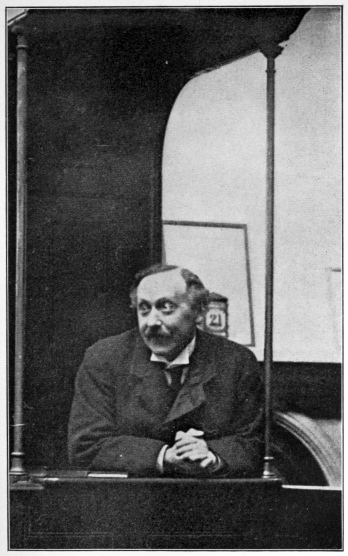
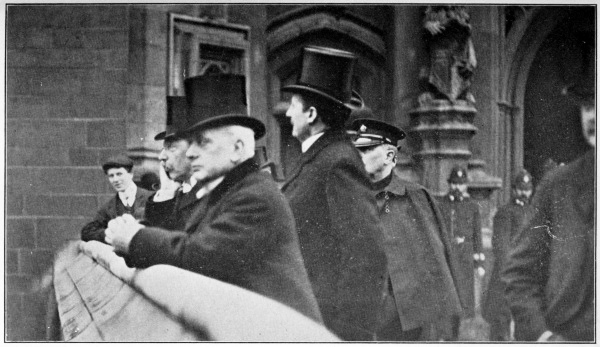
Mr. Herbert Gladstone in the witness-box being
examined by Miss Christabel Pankhurst, October, 1908
Then came Miss Evelyn Sharp, well known as
a writer of delightful stories for children, one of
those frail wan-faced little people, who, whilst looking
always as though a puff of strong wind would
carry them away, yet manage to accomplish such
quantities of work as fill the strongest with amaze,
and at the same time have ever ready a fund of the
brightest and cheeriest good humour. Now she told
in the funniest and most winning way, that she had
taken the fateful handbill as an invitation to go to
the House of Commons and, if possible, not to turn
back, and how, when she had found the police were
determined to bar the way up Victoria Street, she
had stooped and dodged between them in the middle
of a scene which she described as being "like a rush
at hockey."
Miss F. E. Macaulay, an historical student, then
gave several instances of women having gone to the
House of Commons for the purpose of presenting
petitions in ancient days and said she considered that
the Suffragettes were only reviving an ancient custom.
Meanwhile the day had passed; the case had begun
at ten and it was now seven o'clock. Except
for half an hour at lunch time, there had been no interval
and during all these hours, but for an occasional
brief five minutes or so when Mrs. Pankhurst
or Mrs. Drummond had taken a turn, Christabel
had been constantly examining witnesses, remaining
always eager, alert, and full of energy and resource.
Several times she had applied for an adjournment,
but Mr. Curtis Bennett was just as anxious to tire
her out and thus finish the trial, as she was to prolong
it. At last, at half past seven, he asked how
many further witnesses she proposed to put into the
box. She replied, "About fifty. We are sorry to
take up the time of the court, but we are fighting for
our liberty." On hearing this, Mr. Curtis Bennett
decided to adjourn the hearing of the case until the
following Saturday, ordering that the defendants
should be released on bail as before.
So Christabel had won for the time being. Whatever
the final result might be the defendants had
three more days of freedom before them, and the
case which by the long accounts of it that were appearing
in every newspaper was interesting thousands
of people in the Votes for Women movement,
was to be carried on for another day. Criminal
cases, many of them dealing with the foulest and
most sordid crimes, are allowed to drag on for weeks
and even months, whilst public time, public money,
and public interest is lavishly expended upon them;
we felt that we need not scruple then to prolong, as
far as we possibly could, a trial dealing with great
political issues. Moreover, our second Albert Hall
meeting had been fixed for October 29th and we
hoped that the defendants might be free to speak
that night.
When Saturday morning at length came round
and the prisoners again took their places in the dock,
it was at once evident that Mr. Curtis Bennett was
determined to bring the case to an abrupt conclusion.
Speaking in sharper and harsher tones than any
we had heard from him before, he announced that
he had decided only to hear two or three more witnesses
whom the defendants might specially select,
unless there were others who could give evidence
relevant to the case in regard to a set of facts entirely
different from any that had been raised. As
this decision might take the defendants by surprise
he would allow an adjournment of half an hour
in which they might consider which of their witnesses
they would prefer to call. Requests to state what
class of evidence he would consider relevant, both
from Christabel and Mrs. Pankhurst, the Magistrate
met with a curt refusal to say anything further, and
Christabel was not in form to overcome his objections
as she had been on the previous days. Indeed
we now saw with anxiety that the excitement and
extra pressure of work of the last few weeks, coupled
with the constant heavy routine entailed by her position
in the Union and the great strain of conducting
this case, had begun to tell on her and, for the
first time in her life, we began to fear that she might
break down. But even now she would not abandon
the fight to prolong the case. It was impossible in
half an hour to examine individually the hundreds
of persons who had by this time offered to testify
as witnesses, in order to find out which of them
would prove most valuable to our case. The only
thing to be done was to choose a few, almost at random,
who possessed some special position or influence,
and whom we also knew personally to be particularly
sympathetic and observant.
When the half hour had elapsed and the prisoners
had again taken their places, Christabel first called
Mr. James Murray, the Liberal Member of Parliament
for East Aberdeenshire, who had so kindly
come to the rescue when bail had been refused at
Bow Street. He stepped into the box, a huge figure
immaculately dressed and faultlessly groomed, and
turned his big ruddy, good humoured face towards
the three prisoners with a kindly smile. When
asked by Christabel if he were present at the meeting
in Trafalgar Square on Sunday, October 11th,
he replied: "I was going into the National Gallery
and saw a collection of well dressed people in
the Square. I think your mother was speaking, but
I could not hear anything. What struck me was
that the crowd listening to her was composed of exactly
the type of people who go to Church on Sunday
in Scotland." "Then they must have been very
respectable," said Christabel. "Did you get a copy
of the Bill?" "No." "I daresay you saw it in
the papers?" "I saw a statement in the papers."
"How did you understand the word 'rush'?"
"I did not take the matter seriously at all." Here
Mr. Curtis Bennett interrupted curtly, "That really
is for me, Miss Pankhurst, as I have told you."
"Did you resolve to accept the invitation?" Christabel
asked. "I could not very well, you see," said
Mr. Murray smiling broadly, "because I was inside
the citadel." "He has the right of entry," said
Mr. Curtis Bennett with mock solemnity, and for the
first time that morning with a twinkle in his eyes.
"Were you near Westminster on the 13th?" was
the next question. "I was in the House and sitting
down to dinner when I got a telegram from your
mother sent from the neighbourhood of Bow Street,
asking me to go across there." "This cannot be
relevant," said Mr. Curtis Bennett sharply, but Mr.
Murray merely looked amused, and went on: "In
coming here I drove in a hansom up Parliament
Street. The whole place was like a besieged city
except that we had police officers instead of soldiers.
A little beyond Dover House the crowd was held
back by a cordon, but I had not the slightest difficulty
in getting through in a hansom. Afterwards
I returned to the House by the Strand, and the Embankment
and had very little trouble in getting
back." "Was it a disorderly crowd?" "No, I
think you could say an ordinary London crowd."
"Did you come to the conclusion that the persons
who had called the meeting had done so with a desire
to incite the crowd to disorder or damage?" It
was Mrs. Pankhurst who spoke now. "No," answered
Mr. Murray, "I thought that if it were for
any purpose at all it was to advertise the cause."
"You know something of the women who are conducting
this agitation?" was Mrs. Pankhurst's next
question, and Mr. Murray said gallantly: "Yes,
I have the greatest admiration for them; for their
earnestness of purpose, ability, and general management
of the whole scheme." "You know they have
tried every other political method?" "Yes, and if
they had been men instead of women they would not
have been in the dock now—judging by the past."
"Do you agree with Mr. Lloyd George when he
said that if the Government would give us what we
are asking for this agitation would cease?" "I
have no doubt it would. I go further than Mr.
Lloyd George and I say you are entitled to it," said
the witness with fervour, and then, with a genial motion
of farewell to the prisoners he withdrew.
After Dr. Miller Macquire, the well known Army
coach, a stout little man with a black moustache and
a strong Irish brogue, and Miss Agnes Murphy, an
Australian, a quiet-voiced, pale-faced lady had also
given evidence, Mr. Curtis Bennett said that he
would hear no more witnesses. Every attempt to
overcome his decision failed and Christabel then applied
for an adjournment in order that she and her
companions might be in a position to do themselves
full justice when they addressed the court. Everyone
present anxiously hoped that this request would
be granted, for it was evident that the woman who
had hitherto conducted the defence so brilliantly,
was almost worn out. The Magistrate, however,
was determined to bring the case to an end, and he
said, "You have had a long time to take this matter
into consideration, you must either address me now,
or not at all." She protested that the case was being
"rushed" through the court, and at this there
was laughter and applause, for everyone recognised
the play on the word "rush." But Mr. Curtis Bennett
said hotly, "Are you going to address me or
not?" With a gesture of protest, Christabel Pankhurst
then began to speak in her own defence. She
held in her hand a sheaf of type-written notes, containing
dates and quotations, but every word of her
brilliant speech was extemporised. She spoke
quickly, and with a passionate emotion which is usually
foreign to her. When she referred to the nature
of the prosecution and to the conduct of the
Government in having denied the women the trial by
jury to which the nature of their alleged defence entitled
them and in having preferred to hustle their
case through the police court where the drunkards
and pickpockets are tried, it was with a thrill of indignation
that spread through the court.
She began by declaring that these proceedings had
been taken "out of malice and for vexation," and
"in order to lame, in an illegitimate way, a political
enemy." In proof of this she cited the attitude of
the Government towards the present women's movement
from its very beginning three years before.
She drew attention to the fact, which had been sworn
to in the witness box, that Mr. Horace Smith had
allowed himself to be coerced by the Government
into settling, in conjunction with them, whether a
certain lady charged in connection with this agitation,
was guilty, and even the term of imprisonment which
was to be inflicted upon her before the evidence had
been heard.
"Now, this policy of the Government of weighting
the scales against us," Christabel declared, "is
not of interest merely to us, but to the whole community.
In the course of British history we have
seen many struggles for the purification of our judicial
system.... It has been left to the
twentieth century—to these so-called democratic
days—to see our judicial system corrupted for party
ends. I am glad that we have been able to perform
the public duty and service of doing something to
attack this evil while it is in the bud...."
Dealing with the form of the summons, she urged
that, if she and her colleagues were guilty of any
offence, it was that of illegal assembly, but the
Government had not charged them with this offence,
because they had wished to keep their trial in the
police court and to prevent it from coming before a
jury. "They believe, that by this means," she said,
"they will succeed in prejudicing the public against
us. We know perfectly well that up till recently
the general public shunned the police court as a disgraceful
place. Well, I think that by our presence
here we have done something to relieve the police
court of that unenviable reputation. We have done
something to raise its status in the public eye."
"The authorities dare not see this case come before
a jury," she continued, "because they knew perfectly
well that if it were heard before a jury of
our countrymen we should be acquitted, just as John
Burns was acquitted years ago for taking action far
more serious, far more dangerous to the public peace
than anything we have done. Yes, I say they are
afraid of sending us before a jury, and I am quite
sure that this will be obvious to the public, and that
the Government will suffer from the underhand, the
unworthy and the disgraceful subterfuge by which
they have removed this case to what we can only call
a Star Chamber of the twentieth century. Yes, this
is a Star Chamber.... We are deprived of
trial by jury. We are also deprived of the right
of appeal against the magistrate's decision. Very,
very carefully has this procedure been thought out;
very, very cunningly has it been thought to hedge us
in on every side, and to deprive us of our rights in
the matter! Though we are rendered liable to six
months' imprisonment, we are yet denied the privileges
in making our defence that people liable to
three months' imprisonment enjoy. We shall be
told in the House of Commons no doubt—we have
been told the same thing before now—that we are
only bound over, we need not go to prison, if we go
to prison we have only ourselves to thank....
If the case is decided against us, if we are called
upon to be bound over, it must be remembered that
that amounts to imprisoning us, and that therefore
the authorities cannot possibly escape their responsibility
in sending us to prison by saying that we could
be at liberty if we liked. Magna Charta has been
practically torn up by the present Government....
We consider that it is not we who ought
to be in the dock to-day, but the people who are responsible
for such a monstrous state of affairs."
Then she went on to deal with the reasons for
issuing the bill: "We do not deny at all that we
issued this bill; none of us three have wished to deny
responsibility. We did issue the bill; we did cause
it to be circulated; we did put upon it the words
'Come and help the Suffragettes to rush the House of
Commons.' For these words we do not apologise....
It is very well known that we took this
action in order to press forward a claim, which, according
to the British Constitution, we are well entitled
to make. After all, we are seeking only to
enforce the observance of the law of the land that
taxation and representation must go together, and
that one who obeys the laws must have a share in
making them. Therefore, when we claim the Parliamentary
vote, we are asking the Government to
abandon the illegal practice of denying representation
to those who have a perfect right to it."
"I want here to insist," she said, "upon the legality
of the action which we have taken. We have a
perfectly constitutional right to go ourselves in person
to lay our grievances before the House of Commons,
and as one witness—an expert student of
history—pointed out to you, we are but pursuing a
legitimate course which in the old days women pursued
without the smallest interference by the authorities."
In regard to the meaning of the word "rush," she
pointed out that a large number of witnesses had
been examined, and that all these witnesses had testified
that, according to their interpretation of the
word "rush," no violence was counselled.
"The word 'rush,'" Christabel said, "appears to be very
much the rage just now. We find that at a meeting of the
League for the Preservation of Swiss Scenery, Mr. Richard
Whiteing, discussing the question of Swiss railways, suggested
that a general 'rush' to the Italian Alps might induce
the Swiss to listen to reason. Well, I do not think that
anyone here would suggest that Mr. Whiteing meant to
offer any violence to the Swiss in his use of the word 'rush.'
He meant to imply that a speedy advance should be made
to the Italian Alps. Then we have Mr. McKinnon Wood
counselling the electors to 'rush' the County Council, and
get a lady elected to that body."
"I want to submit that 'rush' as a transitive verb cannot
mean 'attack,' 'assail,' 'make a raid upon,' or anything
of that kind."
In support of her contentions, Christabel quoted
the definitions given by many dictionaries, including
The Century Dictionary, Chambers' English Dictionary,
and Farmer and Henley's Dictionary of Slang
which gave amongst other meanings of the word
"rush" "an eager demand," "urgent pressure of
business," "hurry or hasten,—it may be unduly,"
"to go forward over hastily; for example a number
of Bills are 'rushed' through Parliament or a case is
'rushed' through a law court." One of the definitions
ran, "A 'rusher,' a go-ahead person," whilst
"on the rush" was said to mean "in a hurry," and
"with a rush, with spirit or energetically."
Christabel also displayed a little label which had
been sent to her during the progress of the case. It
stated, "Rush by first train leaving," and was used
in America for parcels required to reach their destination
early. She reminded the magistrate of Mrs.
May's comparison of the phrase "rush the House
of Commons" with "a dash for the Pole," saying:
"Everyone knows that you cannot get to the Pole
in a hurry, but you can try to get there in a hurry,
and that is what 'a dash to the Pole' means.
Everyone knows that with a timid Government like
the present, having at its service the entire Metropolitan
Police Force, if one woman says she is going
to rush the House of Commons, there will be an
immense number of police to prevent her doing it.
Nobody, then, having regard to the facts I have
mentioned, thought the women would rush the
House of Commons, but they knew that the women
would be there to show their indignation against the
Government, and I am glad to say that they were
there. It may mean six months' imprisonment, but
I think it is worth it."
"We are anxious to know by what statute it is
illegal to go to the House of Commons, walk up the
steps and make our way to the Strangers' Entrance?
We should like to know whether that is an illegal
thing to do, and, if it is not illegal to go at a slow
pace, we should like to know whether it is illegal to
go at a quick pace, because that is what the word
'rush' means. 'To rush the House of Commons'
is to go with all possible speed inside the House of
Commons, and I hope that we shall be told what
statute we have contravened by doing it ourselves,
or by sending or inviting others to do it."
Miss Pankhurst next referred to the speeches
made in Trafalgar Square on October 11th. She
was glad that the prosecution had raised this point
because it was all in the defendant's favor. The
speeches made at that meeting were made in interpretation
of the famous handbill and all the witnesses
who had heard those speeches, not excepting
Mr. Lloyd George himself, were agreed that they
contained nothing inflammatory and no incitement
to violence whatsoever. Christabel continued:
"It is not because of anything serious that occurred
on October 13th, or was expected to occur,
that we are here; we are here in order that we may
be kept out of the way for some months, and may
cease from troubling the Government for as long a
period as they can find it in them, or for which the
public will allow them, to deprive us of our liberty."
Whilst hosts of witnesses had testified to the
orderly character of the crowd, she pointed out that
two police officers only had been put forward on the
other side. The prosecution had been unable to
bring forward a single impartial person. But police
evidence appeared to be all that was considered in
the Police Court, and she cried out passionately:
It seems to me that the Prosecution, the witnesses, the
authorities, the magistrates, are all on one side, they are all
in the same box, and the prisoner charged with an offence
is absolutely helpless whatever facts he may bring forward.
It is indeed a waste of time to bring evidence. Over the
doors of this court ought to be the motto, "Abandon hope,
all ye who enter here." We do not care for ourselves, because
imprisonment is nothing to us; but when we think of
the thousands of helpless creatures who come into this monstrous
place with nobody to help them, nobody to plead for
them, and we know perfectly well that they are found guilty
before they have a chance of defending themselves, the injustice
that is done in these courts is almost too terrible to
contemplate.
We saw then those helpless creatures, as we had
done so often, and as Christabel called up their image,
her voice broke and there were tears on her face.
"I am thankful to think," she said triumphantly,
"that we have been able, by submitting ourselves to
the absurd proceedings that are conducted here, to
ventilate this fearful wrong."
Christabel next developed the contention that in
the course which they had taken the women had followed
historical precedent and had been encouraged
by statesmen and especially by Liberal statesmen.
The Reform Acts had been obtained by disorder.
Prior to 1832, the Mansion House, the Custom
House, the Bishop's Palace, the Excise Office, three
prisons, four toll-houses, and forty-two private
dwellings and warehouses had been burnt. Amongst
other things, the breaking-down of the Hyde Park
railings won the Reform Act of 1867. In 1884
there were the Aston Park riots. John Bright
threatened to crowd the streets from Westminster
Bridge to Charing Cross. Lord Randolph Churchill
advised the voters of Ulster—and voters have
other means of urging their opinions—to resort
"to the supreme arbitrament of force." He said,
"Ulster will fight and Ulster will be right," and as
a result of his words dangerous riots almost amounting
to warfare occurred, yet he was never prosecuted.
Joseph Chamberlain threatened to march one hundred
thousand men on London, but no proceedings
were taken against him. "The Gladstone of those
days," Christabel declared, "was less absurd, hesitating,
and cowardly than the present Gladstone and
his colleagues, and therefore he took the statesmanlike
action of pressing forward the Reform Bill instead
of taking proceedings against Mr. Chamberlain.
Even a vote of censure moved upon Mr.
Chamberlain in the House of Commons, was defeated."
John Burns, whose language was far more
violent than any that the women had used, was tried
at the Old Bailey and acquitted. He said in his
speech that he was a rebel, because he was an outlaw.
Well, that fact will support us in all we have
done. If we go to far greater lengths than we have
done yet, we shall only be following in the footsteps
of a man who is now a member of the Government.
Following out this line of thought, Christabel went
on:
Mr. Herbert Gladstone has told us in the speech I read
to him that the victory of argument alone is not enough.
As we cannot hope to win by force of argument alone, it is
necessary to overcome the savage resistance of the Government
to our claim for citizenship by other means. He says:
"Go on. Fight as the men did." And then, when we
show our power and get the people to help us, he takes proceedings
against us in a manner which would have been disgraceful
even in the old days of coercion, and which would
be thought disgraceful if it were practised in Russia.
Then there is Mr. Lloyd George, who, if any man has
done so, has set us an example. His whole career has been
a series of revolts.... He has said that if we do not
get the vote—mark these words—we should be justified
in adopting the methods which men had to adopt, namely,
in pulling down the Hyde Park railings.
Then, as a sign of the way in which men politicians deal
with men's interests, we have heard Lord Morley saying:
"We are in India in the presence of a living movement,
and a movement for what? For objects which we ourselves
have taught them to think are desirable objects, and unless
we can somehow reconcile order with satisfaction of those
ideas and aspirations, the fault will not be theirs; it will be
ours—it will mark the breakdown of British statesmanship."
Apply those words to our case. Remember that we
are demanding of Liberal statesmen that which for us
is the greatest boon and the most essential right. Remember
that we are asking for votes, that we are demanding
the franchise, and if the present Government cannot reconcile
order with our demand for the vote without delay, it
will mark the breakdown of their statesmanship. Yes, their
statesmanship has broken down already. They are disgraced.
It is only in this Court that they have the smallest
hope of getting bolstered up.
Turning finally from the Magistrate to the great
world of public opinion outside, she finished on a
defiant note, caring nothing whether the abuse which
she had heaped upon his petty court and its unworthy
procedure should cause him to increase her sentence
ten or even a hundred fold. Mr. Curtis Bennett sat
with brows knit and an angry flush on his face, and
the whole court was wrought up to the most intense
excitement. But now it was Mrs. Pankhurst's turn
to speak and her clear even tones and absolute calm
of manner created if possible an even deeper impression.
Sir, I want to endorse what my daughter has said, that
in my opinion we are proceeded against in this Court by
malice on the part of the Government. [She began quietly
and firmly.] I want to protest as strongly as she has done.
I want to put before you that the very nature of your duties
in this Court—although I wish to say nothing disrespectful
to you—render you unfitted to deal with a question
which is a political question, as a body of jurymen could do.
We are not women who would come into this court as
ordinary law-breakers.
Mrs. Drummond here is a woman of very great public
spirit; she is an admirable wife and mother; she has very
great business ability, and, although a married woman, she
has maintained herself for many years, and has acquired
for herself the admiration and respect of all the people with
whom she has had business relations. I do not think I
need speak about my daughter. Her abilities and earnestness
of purpose are very well known to you. They are
young women. I am not, Sir. You and I are older, and
have both had very great and very wide experience of life
under different conditions. Before you decide what is to
be done with us, I should like you to hear from me a statement
of what has brought me into this dock this morning.
I was brought up by a father who taught me that his
children, boys and girls alike, had a duty towards their country;
they must be good citizens. I married a man, whose
wife I was, but also his comrade in all his public life. He
was, as you know, a distinguished member of your own
profession, but he felt it his duty, in addition, to do political
work, to interest himself in the welfare of his fellow countrymen
and countrywomen. Throughout the whole of my
marriage I was associated with him in his public work. In
addition to that, as soon as my children were of an age to
permit me to leave them, I took to public duties. I was
for many years a Guardian of the Poor. For many years
I was a member of the School Board, and when that was
abolished I was elected to the Educational Committee. My
experience in doing that work brought me in contact with
many of my own sex, who, in my opinion, found themselves
in deplorable positions because of the state of the English
law as it affects women. You in this court must have had
experience of women who would never have come here if
married women were afforded by law that claim for maintenance
by their husbands which I think in justice should
be given them when they give up their economic independence
and are unable to earn a subsistence for themselves.
You know how inadequate are the marriage laws to women.
You must know, Sir, as I have found out in my experience
of public life, how abominable, atrocious, and unjust are
the divorce laws as they affect women. You know very
well that the married woman has no legal right to the
guardianship of her children. Then, too, the illegitimacy
laws; you know that a woman sometimes commits the dreadful
crime of infanticide, while her partner, the man, who
should share her punishment, gets off scot free.
Ever since my girlhood, a period of about thirty years, I
have belonged to organisations to secure for women that
political power which I have felt essential to bringing about
those reforms which women need. We have tried to be
what you call womanly, we have tried to use "feminine influence,"
and we have seen that it is of no use. Men who
have been impatient have invariably got reforms.
I have seen that men are encouraged by law to take advantage
of the helplessness of women. Many women have
thought as I have and for many, many years have tried by
that influence of which we have so often been reminded to
alter these laws, but have found that that influence counts
for nothing. When we went to the House of Commons
we used to be told, when we were persistent, that Members
of Parliament were not responsible to women, they were
responsible only to voters, and that their time was too fully
occupied to reform those laws, although they agreed that
they needed reforming.
We women have presented larger petitions in support of
our enfranchisement than were ever presented for any other
reform, we have succeeded in holding greater public meetings
than men have ever held for any reform, in spite of
the difficulty which women have in throwing off their natural
diffidence, that desire to escape publicity which we have
inherited from generations of our foremothers; we have
broken through that. We have faced hostile mobs at street
corners, because we were told that we could not have that
representation for our taxes which men have won unless we
converted the whole of the country to our side. Because
we have done this, we have been misrepresented, we have
been ridiculed, we have had contempt poured upon us, and
the ignorant mob incited to offer us violence, which we have
faced unarmed and unprotected by the safeguards which
Cabinet Ministers have.
I am here to take upon myself now, Sir, as I wish the
Prosecution had put upon me, the full responsibility for
this agitation in its present phase. I want to address you
as a woman who has performed the duties of a woman,
and, in addition, has performed the duties which ordinary
men have to perform, by earning a living for her children,
and educating them.
I want to make you realise that it is a point of honour
that if you decide—as I hope you will not decide—to
bind us over, that we shall not sign any undertaking, as
the Member of Parliament did who was before you yesterday.
Perhaps his reason for signing that undertaking may
have been that the Prime Minister had given some assurance
to the people he claimed to represent that something should
be done for them. We have had no such assurance. So,
Sir, if you decide against us to-day, to prison we must go,
because we feel that we should be going back to the hopeless
condition this movement was in three years ago if we
consented to be bound over to keep the peace which we have
never broken. If you decide to bind us over, although the
Government have admitted that we are political offenders,
we shall be treated as pickpockets and drunkards and I want
you, if you can, as a man, to realise what that means to
women like us. We are driven to do this, we are determined
to go on with this agitation, because we feel in honour
bound. Just as it was the duty of your forefathers, it is
our duty to make this world a better place for women than
it is to-day.
Now, Sir, we have not wished to waste your time in any
way; we have wished to make you realise that there is another
side to the case than that put before you by the
Prosecution. We want you to use your power—I do not
know what value there is in the legal claims that have been
put before you as to your power to decide this case—but
we want you, Sir, if you will, to send us to be tried in some
place more suitable for the trial of political offenders than
an ordinary police court. You must realise how futile it
is to attempt to settle this question by binding us over to
keep the peace. You have tried it; it has failed. Others
have tried to do it, and have failed. If you had power to
send us to prison, not for six months, but for six years,
for sixteen years, or for the whole of our lives, the Government
must not think that they could stop this agitation. It
would go on.
Lastly, I want to draw your attention to the self-restraint
which was shown by our followers on the night of the 13th,
after we had been arrested. It only shows that our influence
over them is very great, because I think if they had
yielded to their natural impulses, there might have been a
breach of the peace. They were very indignant, but our
words have always been, be patient, exercise self-restraint,
show our so-called superiors that the criticism of women
being hysterical is not true; use no violence, offer yourselves
to the violence of others. We are going to win.
Our women have taken that advice; if we are in prison
they will continue to take that advice.
Well, Sir, that is all I have to say to you. We are here,
not because we are law-breakers; we are here in our efforts
to become law-makers.
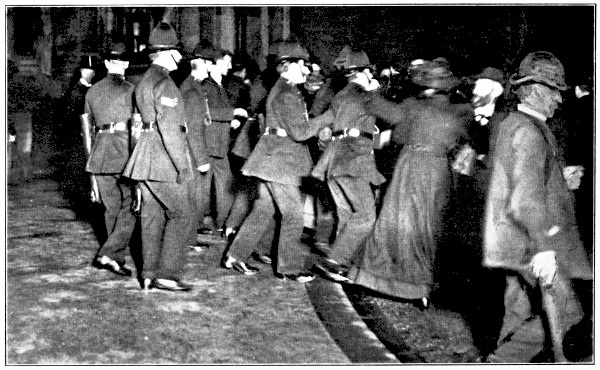
Members of the Women's Freedom League attempting to enter the House
after the taking down of the grille, October 28th, 1908.
The angry red had faded from Mr. Curtis Bennett's
face, and whilst Mrs. Pankhurst was speaking
he kept his hand up to it, and at one point we saw
it quiver and for a moment he hid his eyes. Some
of the big burly policemen whom we knew so well
and who, except in the "raids," when they were
obliged to do their duty, were always so kind and
jovial towards us, were openly in tears. Then Mrs.
Drummond, looking paler and more serious than is
her wont, rose up to speak in her turn. Her voice
was a few notes thinner and higher pitched and like
her words, it seemed to be stripped of all emotion
and to be instinct with the clearest and most logical
commonsense. Not only what she said, but her
whole personality was so honest, sincere and unaffected
that she seemed to add the one thing lacking
to the completeness of that presentment of the
great unanswerable case for Woman's Suffrage.
Her concluding words were an assurance that the
agitation, which was spreading and growing all over
the country, would go on as before. "I can speak
on good authority," she said, "for we have left
everything in working order and we shall find the
movement stronger than when we left it because the
action which the Government have taken has fired
the bosoms of women, who are determined to take
up the flag that we have had to lay down to-day."
When Mrs. Drummond had finished, Mr. Curtis
Bennett began speaking quite cheerfully and as
though the whole affair were an amusing discussion
between friends and had no unpleasant side to it.
During the first part of his speech he reviewed the
arguments on both sides of the case, and as he referred
meanwhile to the pages on which he had taken
his notes he so frequently smiled as though they recalled
amusing and rather pleasant memories to him,
that many people made up their minds that he was
either about to state a case for a higher court, as the
defendants wished, or to discharge them altogether.
All at once, however, his tone changed and he began
to speak hurriedly, with lowered voice and increased
severity of manner, and went on to say that
there could be no doubt that it was for that court
and that court alone to deal with the offence for
which the defendants had been summoned; and that
there could be no doubt but that the handbill which
the defendants circulated was liable to cause something
to occur which might and probably would, end
in a breach of the peace. The Chief Commissioner
of Police was bound to keep Parliament Square and
the vicinity free and open, and the Commissioner of
Police had felt that it would be impossible to do that
if crowds assembled together in order to help and to
see the women "rush" the House of Commons.
Therefore each of the two older defendants would
be bound over in their own recognisances of £100,
and, they must find two sureties in £50 each to keep
the peace for twelve months, or in default must
undergo three months' imprisonment. In the case
of the younger defendant, her own recognisances
would be £50, with two sureties of £25 each, the alternative
being ten weeks' imprisonment.