Reports of the revolt reach San Carlos—American Minister
sends assistance—Chilian Government despatches forces
for the Straits—The Virago—Fears of the inhabitants of
San Carlos—I deliver the Florida to the Chilian authorities—Arrival
of the E. Cornish—The Virago takes the prisoners
and treasure—Passage to Valparaiso—Protest and
claim of salvage—Mr. Duer—Don Antonio Varas—Injustice
done me by the Chilian government—The British
Admiral claims the treasure—I protest again—Compromise—Don
Antonio denies all claim—My claims put into
the hands of the United States Authorities.
Early in January, about a month before
our arrival, the news of the insurrection
in the Straits had spread some alarm
through San Carlos and other southern
Pacific ports. The first report was
brought by two of the soldiers who escaped
from the colony with the governor,
and had not been captured by
Cambiaso. They had witnessed the capture
of the Florida and the Eliza
Cornish, from their hiding place among
the bushes around the cantonment; had
even lurked in the vicinity long enough
to witness the embarkation of the colonists
and the abandonment of the colony;
then, through incredible hardships,
had found their way to the Pacific
coast, been taken off from thence by
some passing vessel, and carried to San
Carlos. Their report was that Cambiaso
had turned pirate, and was coming
to San Carlos to take the port.
The intelligence they brought had been
transmitted to Valparaiso, with a description
of the vessels; both of which
were said to belong to the United
States. Additional forces had been sent
to San Carlos, and an official communication
sent from the commander general
of marines, at Valparaiso, to the American
consul there, and from thence to
colonel Balie Peyton, the American Minister
at Santiago. Col. Peyton immediately
sent orders to Callao that the
U. S. frigate “Raritan” should proceed
in search of the two vessels; and a
request was also sent to the English
Admiral at Valparaiso, that the “Virago”
might be allowed to go again to
the Straits, and render such assistance
to the colonists and vessels as might be
needed. Some French and Swedish vessels
then in port also went out on the
search.
The Chilian authorities despatched two
Chilian men-of-war, and some Chilian
troops under Don Santiago Jorge Bynon.
The troops were put on board the Chilian
men-of-war; the latter on board the
Virago, on the same service. The English
steamer proceeded immediately to
the Straits, and it was to be hoped that
her officers would learn a lesson from
experience, and prove themselves more
sharp sighted than they had done a
month before, in their former visit to
the colony.
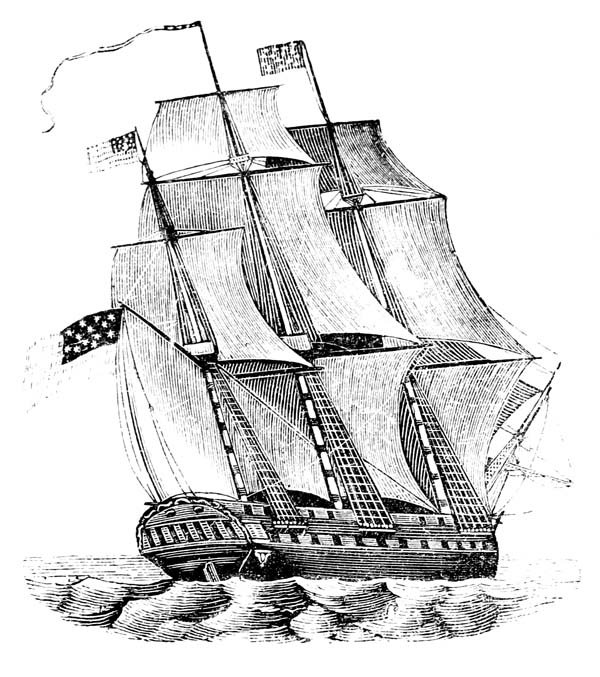
The news that the Florida had arrived
off the entrance of the harbor filled the
people of San Carlos with consternation,
which not even the sight of the American
flag and my signals of distress
served to dissipate entirely. We lay
off the harbor some six or seven miles
from the town, with the wind ahead,
blowing off from the harbor, and the
tide against us.
About sunset, a boat came near us
with six persons in her, and lay on her
oars within hailing distance. Some one
from her hailed us in English, and asked
where we were from. This boat had
in her the captain of the port, who had
put off to reconnoitre, and now seeing
so many people on deck, was afraid to
come nearer. I answered him from the
Florida, saying that I had come into
the port in distress, having Cambiaso a
prisoner on board, and that I was anxious
to go on shore at once to see the Intendente
of the port, and deliver up my
vessel to him; as I was unable to
protect it any longer. This relieved
his fears, and he came alongside. I
had prepared every thing for my leaving
the vessel in safety; knowing that the
prisoners would not dare to make another
outbreak within the harbor, with
the guns of the Chilian war vessels
around them. The captain of the port
left a pilot on board, and took Mr.
Dunn, captain Avalos, and myself into
his boat. We were landed on the quay
at about nine o’clock.
We went immediately to the Intendente,
the captain of the port accompanying
us almost on a run, shouting out
as he passed through the streets, “Cambiaso
is taken!—he is here!—he is a
prisoner!” By the time that we reached
the Intendente’s house we were surrounded
by a crowd of the inhabitants
of San Carlos, asking questions and
shouting out their exultation. Our arrival
had excited such alarm that the
troops had been ordered out. I told
my story to the Intendente, representing
to him the worn out condition of my
crew, and the necessity there was for
sending them immediate aid. He sent
at once for the commander of the forces
on shore, and the captain of the Chilian
vessel of war, “Indefatigable,” then
lying in the harbor. They agreed that
the troops and the Indefatigable should
immediately take possession of the Florida;
and by twelve at night, a guard
of twenty-five soldiers, with their officer,
was placed over the prisoners on my
vessel, while the Indefatigable lay by
her side.
As we left the Intendente’s house, Mr.
Dunn was greeted on every side by
warm friends, all rejoicing to see him
alive once more, and eager to hear our
story and to extend the hospitalities of
their houses to us. Indeed, during the
few days that I remained in San Carlos
I experienced the greatest hospitality
and kindness from the inhabitants of
the place. Every house was thrown
open to me and to my friends; our
immediate wants of clothing and personal
comforts supplied; and every thing
done to make us look back to the time
passed there with grateful remembrance.
I experienced here a singular result
from the great anxiety and excitement
which I had undergone. Instead of
being overcome with fatigue, and enjoying
the rest which I so much needed,
and for which I had so longed, my
state of excitement continued. I scarcely
needed rest, and sleep seemed to have
fled from me entirely. For the first
three nights after leaving the vessel I
could not close my eyes.
My intention before reaching San Carlos
had been to report myself immediately
to the American consul, or to
any one holding authority from the
United States whom I might find there,
and follow his advice in regard to the
steps to be taken to deliver the prisoners,
treasure, and vessel into the
hands of the government of Chili; but
I was told by the captain of the port
that no American consul was in the
place. I then inquired if any vessel of
war belonging to the United States was
in the harbor, intending to claim its
assistance. There was none; and my
next step was to seek the Intendente of
the port. In my conversation with him
I told him that my wish was to deliver
up every thing into the hands of the
Chilian authorities as soon as I could
do it. He told me that no one in San
Carlos had power to take the vessel in
the name of the government; to find
any one authorized to do this. I must
go to Valparaiso. To attempt this without
further aid would be, I felt, to risk
the lives of my crew and passengers;
therefore I accepted the offer of the Intendente
to take the prisoners and treasure
from the Florida and send them to
Valparaiso in some Chilian vessel of
war then in harbor, with the understanding
that on reaching that port, I
was then to deliver every thing into
the hands of the government.
The next morning, while preparations
were making to transfer Cambiaso and
Garcia, together with the treasure, to
the Indefatigable, the Virago and Metero
were reported as coming into the
harbor.
The English steamer had then been
successful in her search for the Eliza
Cornish, and she now seemed inclined
to follow her orders to the letter, and
take the Florida wherever she might find
her; for immediately on entering the
harbor, captain Stewart, with two armed
boats, went alongside my vessel;—then,
not finding me there, he left the boats
lying at the side of the vessel, while
he came on shore and to the house of
the Intendente.
Here I met him; when he told me
that he had orders to take my vessel
wherever he found her. I answered that
he could not take her, as I had her
myself; when with something of what
seemed to me high handed insolence, he
insisted on his right and his orders.
I told him plainly that I gave up the
vessel, treasure, and prisoners to no one
but to the Chilian authorities; that if
he took them it must be by order of
the authorities; and that I should protest,
both here and in Valparaiso, against
his taking possession of the Florida.
This was all I could do; for I found
no disposition on the part of the Intendente
or of any other officials at
San Carlos to back me in my protest.
They all seemed to stand somewhat in
awe of captain Stewart; or, to speak
more properly, of the British lion, whose
might he represented. Captain Stewart
left me for a while, and soon after returned
to the Intendente’s, bringing with
him commander Bynon, who had sailed
with him in search of us, being appointed
by the Chilian authorities chief
of the naval expedition to the Straits
sent for our rescue. To him I repeated
what I had said to captain Stewart.
He heard me with attention and politeness,
and assured me that I should be
satisfied and all my just claims regarded.
After some consultation, it was decided
by the authorities at San Carlos, commander
Bynon, and captain Stewart, that
the ringleaders and the treasure should
be transferred to the Virago, and that
aid should be sent to the Florida, to
guard the prisoners remaining there, and
navigate the vessel to Valparaiso.
I was able to learn but little of the
re-taking of the Eliza Cornish, and the
rescue of the colonists left at Wood’s
Bay, merely having one hurried conversation
with my old fellow prisoner, the
English mate, about the subject. He
told me that the morning after Cambiaso
drove him in shore, at Wood’s
Bay, and forbade him to follow the
Florida, the forty colonists left on the
land hailed him, entreating to be taken
on board; but having already two hundred
crowded into his vessel, he was
afraid to do it, and indeed it was not
allowed by those on board. He therefore
was obliged to abandon them, and,
getting under way, beat to the westward.
After beating west for about
two days he met the English steamers,
which immediately sent two armed boats
to board the E. Cornish, and took her
as a prize. I was told by a sailor
from the Virago, that the moment the
boats came along side, the mate and
crew sprang into her, so glad were they
of any chance of escape.
The leading rebels were taken from
the E. Cornish in irons, and put on
the Virago, while a prize master and
fresh crew were sent to the brig, and
she was anchored in the Straits. The
Virago then proceeded to the eastward,
took up the colonists left at Wood’s
Bay, then went on to Sandy Bay Colony
in search of us; but failing to
find us, returned, took the E. Cornish
in tow, carried her out of the Straits
about three hundred miles, and then let
her go under sail, in company with the
Virago, for Valparaiso. On their way
they had kept a constant look out for
us, searching every harbor, as the impression
was strong with them, that
Cambiaso would attack the South Pacific
ports.
By Tuesday, the 17th, we were ready
for sea; and I must do captain Stuart
the justice to say, that during the
two days of preparation he rendered
me every assistance in his power. Four
seamen, a boatswain, and one officer
were transferred to the Florida from
the Virago, to assist my exhausted crew;
and as both vessels were ready for sea
at the same time, captain Stuart towed
my vessel above forty miles out. In
the evening of the 17th, a fair breeze
springing up, we parted company. During
most of the passage up we had
a fine breeze and pleasant weather.
The steamer was to touch at Valdivia,
and other places on the coast, so
that I got ahead of her; and by Sunday,
the 22d, I was off Caruma head,
just south of Valparaiso. Here we had
light, baffling winds, and were obliged to
lay over till the next morning. About
eight o’clock A. M. on Monday, the
steamer was seen south of us, coming
up the coast, with the Eliza Cornish
in tow.
I then had all my sails clewed up,
set the American ensign at the mizen
top-mast head, and fired two four pounders,
to draw the attention of the
steamer. She soon bore down for us,
took us in tow also, and by two o’clock
in the afternoon, of February 23d, we
anchored in the harbor of Valparaiso.
On my arrival, I immediately went to
the United States Consul, Mr. William
Duer, and through him transmitted to
the Intendente of Valparaiso, commander
Robert Simpson, my abandonment of the
Florida. In reply I was informed by
commander Simpson that he had no
authority to accept the vessel, but that
the subject had been referred by him
to the government at Santiago.
The prisoners were landed from the
Virago, and the ringleaders delivered
into the hands of the law; but the
treasure was transferred to the Eliza
Cornish; and I learned that it was
claimed by the English admiral, and
surrendered to him by the Chilian government;
and that it was to be sent at
once to England, without being landed
at all in Valparaiso.
Upon learning this, I immediately entered
a protest before the American
consul, Mr. Duer, against the seizure of
the Florida, and claimed salvage on the
treasure rescued by me from the hands
of the pirates. On the 28th, Mr. Duer
received a communication from commander
Simpson, under the order of Don
Antonio Varas, the Minister of Foreign
Relations of the Chilian government,
wishing to know fully the reasons on
which I founded the abandonment of my
vessel, in order to determine whether
the government should give orders to
take possession of the vessel in the
name of the State. I then requested Mr.
Duer to call a survey on the Florida,
for the purpose of ascertaining her present
condition and the probable cost of
putting her in sea-worthy condition.
Captains Phineas Leach and Joseph
Carries, with Mr. George K. Stevenson,
master ship carpenter, were directed by
Mr. Duer to proceed to the Florida,
make an examination of her state, and
report to the consulate. They reported,
after a minute calculation, the cost of
putting the vessel in a sea-worthy condition
to be over four thousand dollars.
This report, with my own protest made
before the consul, giving an account of
the seizure of the vessel, Mr. Shaw’s
barbarous murder, my imprisonment, the
forcible detention of our private property,
the re-capture of the vessel, its
arrival in San Carlos, my delivery of it
into the hands of the authorities there,
the transfer of the prisoners and treasure
to the Virago, our passage to Valparaiso,
&c. &c., and claiming salvage
on the treasure and restoration of the
personal property of myself, passengers,
and crew, I transmitted to Don Antonio
Varas, at Santiago.
While waiting for some notice of these
communications from the government authorities,
I found that the Eliza Cornish,
having the treasure on board, was preparing
for sea, under the orders of the
British admiral, and that no steps were
being taken by the Chilian authorities
to claim the treasure. I therefore caused
process to be issued to prevent the sailing
of the vessel, in order to obtain an
adjudication in the courts of Chili for
the salvage to which I was justly entitled,
for the re-capture of the treasure.
But although there was ample time to
execute this process and prevent the
removal of the treasure and though I
did every thing in my power to cause
this to be done, yet the E. Cornish
was permitted to sail for England.
This was either from the gross neglect,
or the wilful default of the officers entrusted
with serving the process; and
I myself firmly believe that the neglect
was wilful, and that it arose from the
unwillingness on the part of the Chilian
government to come into direct collision
with the British admiral. Nay, more:
I have every reason to believe that
many articles of personal property belonging
to myself, my passengers, and
my crew, were also on the E. Cornish;
for the prisoners had in their possession
at the time we came into San Carlos
all our wearing apparel, weapons, and
so forth; all of which were transferred
to the Virago with the prisoners, and
which, I was told at San Carlos, should
be carefully restored to me on reaching
Valparaiso,—but which I never could
trace afterwards. Of my own personal
effects I never received any thing but
one pistol.
It was at this time I made the attempt
to recover the ring taken from
Mr. Shaw’s finger at the time of his
death—offering a reward to any one
who would bring it to me. I had
heard that it was seen on the finger of
one of the women brought to San Carlos
in the E. Cornish.
Finding no disposition on the part of
the government to attend to my written
communications, I went to Santiago on
the 14th of March, accompanied by Mr.
Duer, for the purpose of having a personal
interview with our Minister, colonel
Peyton, and with Don Antonio
Varas.
By the advice of colonel Peyton and
Mr. Duer, I addressed a letter to Don
Antonio, under date of March 19th, recapitulating
the grievances under which
I had labored; submitting my claims,
together with my protest, and appealing
to the honor of the government to see
that I should not suffer from the removal
of the treasure, since it had
arisen from the neglect of their own
officers. I also submitted, that had I
not recovered it, the Chilian government
would have been bound to make the
amount good to the owners; and that
at great hazard to my life, I had rendered
such service to the State as no
great nation permits to pass unrewarded.
In reply to this, an interview was
appointed by Don Antonio Varas, for
the next day, with Mr. Duer and myself.
We went at the time appointed,
and found the Minister unwilling to
allow any claim for damages sustained,
either in person or property, during the
time the Florida was in the hands of
the rebels, or for salvage on the treasure;
but he acknowledged the obligation
of the government to pay for the
use of the vessel for the time she was
in its service. He however postponed
the decision of the case until Monday,
the 22d, at which time he appointed
another interview. Mr. Duer and myself
were at his office at the time appointed,
but were put off again until
the next day. On Tuesday, we held
another conversation with Don Antonio
Varas, if possible, more unsatisfactory
than the first, for not the slightest hope
of relief was held forth.
Despairing of obtaining justice, I
returned to Valparaiso, and, on the
27th of March, advertised for money on
bottomry, to repair the Florida and enable
her to proceed to sea. I was
forced to do this, as I had literally
nothing wherewith to pay the wages of
my crew, much less repair the vessel.
The advertisement for bottomry remained
in the Daily Mercuria, of Valparaiso,
until April 3d, when, no proposals having
been received, I was forced to put
the barque up for sale, and advertised
her on the 7th. The next day, the
8th, Mr. Duer addressed another letter
to the Minister, Don Antonio Varas, in
which he proposed a compromise. This
was done to avoid the necessity for the
sale of the vessel, and in hopes that
an appeal to the sense of honor of the
government might have its effect. Mr.
Duer, at first protesting that in making
this offer he by no means admitted,
either for himself or for me, that my
claims were not in all respects just and
sound, went on to say that the price
paid for the use of the vessel, in taking
the prisoners to Magellan, was much
less than it would have been had not
the Florida been bound to the United
States, via Rio Janeiro, and therefore
could stop on her way at Magellan with
comparatively little loss or expense.
Nevertheless, he offered to accept for
the use of the vessel, from the time of
her arrival at Magellan till she reached
Valparaiso again, a sum per day equal
to that which she received according to
the contract made from Valparaiso to
Magellan, with the addition of ten per
cent. The claim for salvage on the
specie was not waived, nor the compensation
for my personal services. The
personal losses of Mr. Buela, the mate,
and crew, were ascertained by Mr. Duer,
and stated at what he considered a low
and reasonable amount.
I was induced to make the offer of
this compromise, from my desire to do
the best in my power for my owners,
and from my sense of the great sacrifice
to them which the forced sale of
the vessel would cause; and also from
my utter inability to meet any more
delay, or incur any further expense,
destitute as I was of even the necessaries
of life, and dependent as my crew
were upon me.
This letter was dated April 8th; but
no answer was received until the 24th.
In the meantime, proposals for the purchase
of the vessel were made by
Messrs. F. A. Richardson & Co., offering
the sum of two thousand eight hundred
dollars for the barque. The vessel
being advertised for sale on account of
whom it might concern, and this being
the highest offer received, of course it
was accepted.
On the 24th, Mr. Duer received a
letter from Don Antonio Varas, denying
the right to any claim for services rendered
or losses suffered in consequence
of the acts of the revolted colonists,
and proposing that in order to determine
the time during which the Florida
should be considered as employed in the
services of the government, an agent
should be employed to go between me
and the government.
He waives all examination of the estimate
formed in Mr. Duer’s letter, of
the amount to be allowed as claimed
by the Florida; he takes leave to observe
that Mr. Duer takes it for granted
that the Florida was in the service of
the government not only during the
time she was sailing under the orders
of the authorities of Chili, but also the
period she was in the power of the
insurrectionists; and that the personal
losses of the captain, sailors, and passengers
are included in the claim; whereas
they should be considered as resulting
from the acts of the rebels, which the
government is not responsible for.
With an excuse for his delay in answering
Mr. Duer’s letter, founded upon
his absence from the capital for a few
days, and other urgent occupations, he
signs himself, “Your obedient servant,
Antonio Varas.”
On receiving this letter, Mr. Duer
joined me in entering a protest at the
consulate, against the injuries and damages
I had received at the hands of the
Chilian government, and the affair was
put in the hands of our government
authorities, where it now remains.