Among the many submarines which were built previous
to the beginning of the present century, very few taught
lessons of positive value, for the great majority of these
experimental craft were total failures. Knowledge of the
causes of their failures is important, however, because it
teaches us what errors in construction to avoid. Practically
all of these early submarines were built secretly; when failures
resulted the vessels were abandoned and the results
of such trials were not published, consequently the succeeding
designers were very apt to make the same mistakes.
It was not until the past decade that any general description
of many of the early submarines was published and made
available to students of this problem. In looking over the
published plans and descriptions of a number of those early
submarines, I have been convinced that many lives and much
capital could have been saved had the results of the various
experiments been openly disclosed for the guidance of later
designers.
The desire to navigate in the depths of the sea has possessed
the minds of many men since the beginning of history,
and even at very early times several crude submarines were
devised in the attempt to solve the problem. But, as I have
related in the preceding chapter, it was not until the period
of the war between England and her American colonists
that any important progress was made. Bushnell's little
submarine, called the American Turtle, was built at that
time. It took its name from its shape, which resembled the
back shells of two turtles joined together.
From the rather complete description of this vessel contained
in one of Dr. Bushnell's letters, it appears to have
been propelled by a screw propeller to obtain forward or
reverse motion. It was ballasted in such a manner as to
give the vessel great inherent stability. It had water ballast
tanks which could be filled to give the vessel negative buoyancy,
if desired, or to reduce the positive buoyancy so much
that the vessel could be readily drawn under water by another
screw propeller which was operated by a vertical shaft
extending through a stuffing box into the vessel. This
submarine carried a mine on its back, and provision was
made to enable the operator inside the submarine to attach
the mine to the bottom of a ship at anchor. This vessel was
regulated in such a way that the mine could be exploded by a
clockwork mechanism after the submarine had reached a
safe distance from the vessel.
With this submarine a mine was placed under the bottom
of the English frigate Eagle, anchored in New York Bay,
but the mine drifted clear before the clockwork mechanism
caused it to explode, otherwise the frigate would undoubtedly
have been destroyed. General Washington complimented
Dr. Bushnell on having so nearly succeeded in his
attempt to sink the ship.
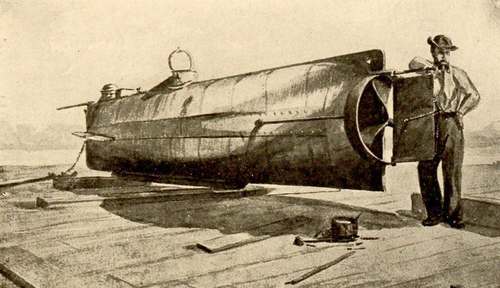
SKETCH OF THE CONFEDERATE SUBMARINE "HUNLEY"
Made after she was recovered and hoisted on the dock years after the war.
(Drawing by R. S. Skerrett.)
This submarine was unquestionably a successful model.
It had one important feature that many designers have
failed to appreciate, and that was great inherent stability.
Great stability in a submarine means the carrying out of the
now popular maxim "Safety First." Sufficient static stability
is a guarantee that during all the manœuvring evolutions
of a submarine she will always remain right side up
and not dive into the bottom unless the hull is punctured or
flooded at one end or the other.
Bushnell's model was not suited to high speed, but high
speed was not essential in the days of the sailing ship. If
this design had been developed further, so that several men
could have been used to operate the propeller, it should have
given a good account of itself.
Robert Fulton's boat, to which I also have made reference
in the foregoing chapter, differed from Bushnell's in
its method of submerged control, which was by vertical and
horizontal rudders at the stern. It also carried a collapsible
mast on which a sail could be spread for surface navigation.
A Bavarian by the name of Bauer built a submarine in
1850. Its method of control was by shifting a weight forward
to dive and aft to rise. It was a flat-sided and flat-decked
vessel with comparatively thin plating and entirely
unsuited to resist the pressure of the water at any considerable
depth. It collapsed in the harbor of Kiel during one of
its trial trips. Bauer kept his presence of mind, however,
and when sufficient water had entered and raised the trapped
air pressure inside of the boat equal to the pressure outside,
he opened the hatch and swam to the surface. This vessel
remained partly buried in the mud into which it had sunk
until 1887, when it was located during the deepening of
Kiel harbor and taken to Berlin, where it is now kept in
the Museum of Oceanography as an exhibit of Germany's
first submarine.
No further important advance was made in the art of
submarine navigation until the period of the Civil War,
when the Confederates built several small submarines, called
"Davids." One of these was called the Hunley, after her
designer. During her brief career she suffocated or drowned
thirty-two men, including her designer.
During my early experiments with the Argonaut in 1898
I received a visit from Col. Charles H. Hasker, of Richmond,
Virginia, who explained in detail the method of operating
the Hunley. She was a cylindrical-shaped craft, about
thirty feet long and six feet in diameter, with both bow and
stern flattened to form a stem and stern-post, respectively.
Water-ballast compartments were located in either end of
the vessel. She was propelled by eight men, who turned
the cranked propeller shaft by hand. These men sat on
benches on either side of the shaft. She had the usual
vertically hung rudder aft, and a diving rudder forward
to incline her bow down for diving, or to raise her bow
to bring her to the surface (see page 150). Unfortunately
she lacked longitudinal stability, and during her experimental
trials twice dove head first into the bottom. Of
her experience I have given an account elsewhere.
The lesson to be learned from the disastrous trials of
this vessel was that sufficient statical stability should
always be secured to prevent the vessel taking on an excessive
inclination due to shifting of water ballast or
movement of crew.
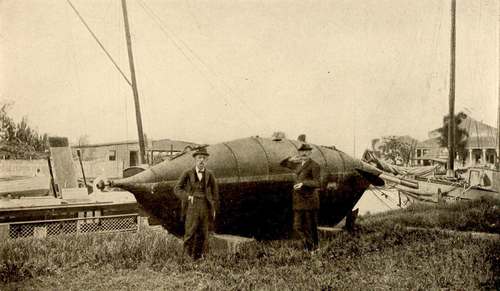
THE NEW ORLEANS SUBMARINE
Built by the Confederates during the Civil War.
Another submarine built by the Confederates shows a
much safer design. It is shown as the New Orleans submarine.
According to the story told by a native of New
Orleans, this vessel was built during the Civil War to
destroy the Northern ships. The story of her launching
has been given in a foregoing chapter.
It is evident that the designer of this vessel miscalculated
and made his boat so much overweight that she could not be
given sufficient buoyancy to bring her to the surface by the
means provided. From a study of the form of this vessel,
she should have been very stable, and I am of the opinion
that she could have been successfully navigated submerged
had she been properly ballasted.
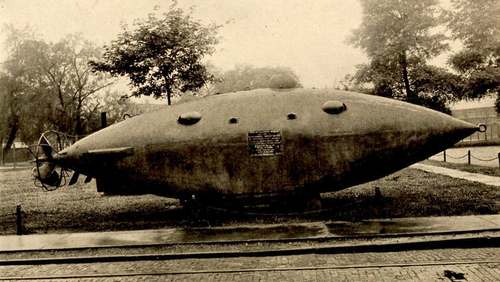
THE "INTELLIGENT WHALE"
Built by O. S. Halstead of Newark, N. J., and sold to the U. S. Government in 1870, now in Brooklyn Navy Yard.
During the years 1863 and 1864, Messrs. Bourgois and
Brun brought out for the French Navy the largest and, in
some respects, the most completely equipped submarine that
was produced during the nineteenth century. This was
Le Plongeur, a vessel about one hundred and forty feet long,
ten feet depth, and twenty feet beam, with a displacement
of over four hundred tons. Her motive power consisted
of compressed-air engines of eighty horsepower. The compressed
air was carried in air tanks at a pressure of one
hundred and eighty pounds per square inch. It is reported
that the capacity of the air tanks exceeded one hundred
and forty cubic metres.
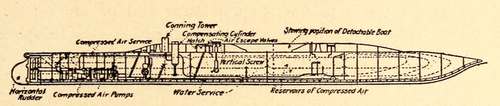
LONGITUDINAL SECTION OF THE FRENCH SUBMARINE "LE PLONGEUR"
This vessel was built by Messrs. Bourgois and Brun in 1864 and was backed
by the French Government. She was the largest and the most costly vessel built
in the attempt to solve the problem of successful submarine navigation up to about
the beginning of the 20th century. (See text.)
Her submerged control system consisted of the usual
water-ballast tanks for reducing the vessel's surface buoyancy
preparatory to submerging. The final adjustment of
displacement was to be effected by means of cylinders which
could be forced out through stuffing boxes to increase her
displacement or withdrawn to reduce her displacement. It
was hoped that by manipulating these cylinders she could be
put in equilibrium with the water she displaced, and that
she could then be steered in any desired direction by the
vertical and horizontal rudders placed at her stern.
Theoretically this is an ideal method for submerged
control, but in practice it works out badly, especially when
a vessel has little stability, for the reason that there are so
many disturbing influences to cause the vessel to take on
dangerous angles in diving. If free surfaces exist in the
water-ballast tanks, the slightest change from a level keel
causes the water to flow to the lower end of the ballast
tank. This is apt to augment the inclination still further,
and cause the vessel to dive, or, vice versa, to broach. The
density of the water also varies, especially where freshwater
rivers empty into salt water. At times quite different
densities are found at various depths. The fresh water
and salt water, instead of rapidly mixing, seem to have a
tendency to remain in strata which extend, in some cases,
considerable distances off shore. Therefore it is practically
impossible to secure and maintain a vessel in perfect equilibrium.
The movement of the crew forward and aft, or the
effect of the sea, which imparts a vertical motion to the
water beneath the surface, all tend to destroy both trim and
equilibrium to such an extent that many failures have
resulted in vessels of this type.
Le Plongeur was no exception to this rule, because it
was found impossible to control her depth when running
submerged, and she would either dive into the bottom or
broach to the surface. One report stated that even in depths
of thirty feet she would make progress "by alternately
striking the bottom and then rebound to the surface like an
elastic india-rubber ball."
One other novel feature introduced in Le Plongeur was
an "escape boat," which was carried on top of the main
hull, to which it was secured by bolts. A double hatch
connected the submarine and the escape boat together. In
case the submarine became disabled or entangled in wreckage
and could not be brought to the surface, the crew could
enter through double hatches into the escape boat, secure the
bottom hatch, and by turning the securing bolts from the
interior release the escape boat and ascend to the surface.
Mr. O. S. Halstead, of Newark, New Jersey, completed,
in 1866, a submarine vessel on which the United States
Government made a partial payment. This vessel is known
as the Intelligent Whale, and is now installed as a permanent
exhibit on the Green at the Brooklyn Navy Yard,
New York. The vessel had a vertical and horizontal rudder
at the stern for submerged control. According to official
reports, she must have functioned fairly well when
submerged.
One of the features of this vessel consisted in its ability
to be converted into a diving bell when resting on the
bottom. A large trap-door was arranged in the bottom of
the vessel. After filling the whole interior of the vessel
with compressed air equal in pressure to the pressure of
the water at the bottom of the vessel, the trap-door could
be opened and the air pressure would keep the water from
rising, the same as in a diving bell.
A study of this vessel shows that she must have been a
very stable craft and not likely to dive at an excessive angle
or to stand on end, as was the tendency of many of the early
diving boats. A report signed by Gen. T. W. Sweeny,
U. S. A., and Col. John Michal, Col. T. R. Tresilian,
and Major R. C. Bocking, engineers, strongly endorsed
this vessel.
On the strength of the above-mentioned reports and endorsements,
the government, through the Navy Department,
appointed a commission composed of Commodore C. M.
Smith, Commodore Augustus L. Chase, Chief of Bureau of
Ordnance, and Edward O. Mathews, Chief of the Torpedo
Board, "to examine, inspect, and report on the merit of
said boat." As the report of this commission confirmed the
capacity and efficiency of the boat for submarine purposes,
the government made a contract for her purchase for the
sum of $50,000 (£10,250).
The contract specified certain conditions which were to
be fulfilled before the final payment was made, one of which
was that Halstead should "write out fully and describe,
without reservation, all the inventions, secrets, and contrivances
necessary to enable any competent person or persons
to operate and manage said boat as contemplated, desired,
or designed, more especially the methods of furnishing,
managing, controlling, purifying, and renewing the air when
and in quantity as needed, so as to enable those in the boat to
descend and ascend or remain under water any reasonable
length of time; also, to open the doors in the bottom of the
boat and keep the water from coming therein at any reasonable
and regulated depth." For this information Halstead
was to receive such further sum as a board of officers might
grant. Halstead was to have the further right to apply to
Congress for additional compensation.
In carrying out the provisions of the contract, the government,
on May 27, 1870, took over the Intelligent Whale
and then paid $12,050 (£2,470) on account of the contract.
Shortly after this Halstead was instantly killed. Differences
then arose between Halstead's heirs and others who
claimed an interest in the contract. It does not appear that
anything further was ever done with the boat to carry out
the terms of the contract. She lay neglected for years on the
old "Cob dock" in the Brooklyn Navy Yard, but was
recently erected as an exhibit on the Green.
Some years later that famous inventor, Mr. J. P. Holland,
brought out a submarine vessel called the Fenian Ram. This
vessel was about thirty feet long and six feet in diameter.
She was navigated, when submerged, by the use of vertical
and horizontal rudders located at the stern. The novel
feature introduced in the vessel was an under-water air-gun
which was designed to fire a shell under water.
Mr. Holland was originally a school teacher in Ireland,
from which country he was exiled because of his political
beliefs. On coming to the United States he became affiliated
with the Fenian movement. Previous to his construction of
the Fenian Ram Mr. Holland built experimentally a small
one-man boat. The money to build the Fenian Ram was subscribed
by the "Clan-na-Gael" and other Irish patriotic
societies, and an associate of Mr. Holland recently informed
me that over $200,000 (£41,000) was subscribed to enable
Mr. Holland to carry on his experiments. After the collapse
of the Fenian movement the Fenian Ram was towed up to
New Haven, Connecticut, and hauled out on the banks of the
Mill River, where it has lain ever since, hidden under a
pile of lumber.
One of the former leaders of the Fenians informed me
that the scheme was to build a number of submarines of
about the size of the Ram. They were to have been carried
across the Atlantic in a special ship with water-tight compartments
extending below the water line, into which the
submarines were to have been floated and a sea door closed.
On arrival on the English coast, this special ship, which was
apparently a harmless merchantman, was to locate the
British war vessels in some one of the harbors, sail in and
anchor near them; then the little submarines were to be
released from their mother ship and proceed to sink as
many of the British ships as they could by firing explosive
shells into them below the water line. The novelty of such
an attack was relied upon to spread consternation among
the British fleet and thus enable the submarines to escape.
In 1878 Mr. G. W. Garrett, of Liverpool, took out a
patent and constructed a small boat whose equilibrium was to
have been maintained by the admission of water into a cylinder
and forcing it out by a piston. In 1879, Mr. Garrett
brought out a larger vessel, called the Resurgam, in which
his means of control were forward diving rudders similar
to those of the Confederate Hunley. The novel feature
of this vessel was the installation of a very large steam boiler
in which sufficient heat could be stored to enable the vessel
to make a submerged run of several miles after the
fires were shut down. This vessel was lost during her
experimental trials.
Mr. Garrett then interested Mr. Nordenfelt, the inventor
of the celebrated Nordenfelt gun, in his boat. Mr. Nordenfelt
improved upon Garrett's boat and built vessels for
Greece, Turkey, and Russia. His first boat was sixty-four
feet in length by nine feet beam, with a displacement of
about sixty tons. The method of submerged control, which
he devised, consisted of the use of two downhaul screws
located in sponsons on either side of the vessel. These
screws were operated by bevel gears and were run at sufficient
speed to overcome the reserve of buoyancy. The
vessel was intended to be always operated with a reserve
of buoyancy. To submerge, therefore, it was necessary to
run the propellers at a speed sufficient to exert a thrust to
overcome this buoyancy and pull her bodily under water.
After reaching the desired depth, forward motion was then
to be given by the usual screw propeller, and she was expected
to make progress on a level keel and in a horizontal
plane. The level keel was to have been maintained by the
use of a horizontal rudder placed in the bow.
This method of submerged control for submarine vessels
of moderate speed seems to me to be an excellent one in
principle. I have been surprised that further development
has not been made along these lines. I think the final
abandonment of the Nordenfelt type of vessel was due to
failure in carrying out the details of design rather than to
faulty basic principles. A former chief engineer of
Mr. Nordenfelt informed me that the heat from the large
amount of hot water stored up in the reservoirs—for submerged
power—made the interior of the vessels almost
unbearable for the crew when the hatches were shut down,
and that he did not believe the submarines ever made any
submerged runs after being delivered. I also judge, from
his description of his experiences with the vessels, that they
lacked longitudinal stability and were difficult to hold in
the horizontal position, which Mr. Nordenfelt claimed was
a sine qua non for a submarine boat. I concur in this claim.
In an article on his boats, Mr. Nordenfelt stated that
they were very sensitive, and that he had purposely made
them so in order that the horizontal rudder might easily
maintain the boat in a horizontal position. My experience
has led me to prefer great statical stability rather than
sensitiveness.
Mr. Nordenfelt's boats had means for discharging the
smoke from the fires under the water. This was done so
as not to betray the submarine's position to surface vessels.
He also seems to have been the first to incorporate
torpedo tubes within his hull for the discharge of the
Whitehead torpedo.
The Spanish Lieut. Isaac Peral built, in 1887, a vessel in
which the motive power was supplied from electric accumulators.
It was operated by the usual vertical and horizontal
rudders. Its submerged control was bad, but its
electric propulsive system worked well.
Mons. Goubet built several small boats during the period
from 1885 to 1890 with a propeller which worked on a universal
joint so arranged that the direction of thrust could
be changed to drive the boat under water or to bring her
to the surface when submerged. This propeller took the
place of the usual vertical and horizontal rudders.
Prof. Josiah L. Tuck built, in 1885, a vessel called
the Peacemaker, the novel feature of which consisted
of a "caustic soda" boiler for generating steam for
submerged work.
In 1886 a Mr. Waddington, of England, brought out a
small electric accumulator boat with downhaul screws
arranged in vertical tubes. He also used side rudders to
assist in control of depth. It is reported that this vessel
functioned quite successfully, but she was abandoned,
and Mr. Waddington does not seem to have developed
anything further.
In 1892 George H. Baker brought out an egg-shaped
vessel which he ran submerged by the use of side propellers
driven by bevel gears. These propellers were carried in
frames so that they could be inclined to exert a thrust downward
or upward, or at any desired angle so as to pull the
boat downward and drive her forward at the same time.
This was an improvement over Nordenfelt's side propellers,
which ran on fixed vertical shafts. This vessel functioned
fairly satisfactorily at slow speeds, but neither the form
nor driving mechanism was suitable for the higher speeds
required by modern practice.
A number of other boats were built, but there does not
appear to be anything new in principle in them.
This brings us up to 1893, when the United States
Government made an appropriation of $200,000 (£41,000)
for a submarine boat and advertised for inventors to submit
designs. This was the first time that it was officially recognized
in this country that there might be possibilities in this
type of boat. Most of the naval officers, however, were very
sceptical of the practicability of such craft, and, from the
conservative point of view, they were perhaps justified, as no
satisfactory boat had been built up to that time.
A program of requirements, which undoubtedly would
produce a weapon valuable for defence, was made up by the
Navy Department, and these requirements were designated
in the following order of importance:
- 1. Safety.
- 2. Facility and certainty of action when submerged.
- 3. Speed when running on the surface.
- 4. Speed when submerged.
- 5. Endurance, both submerged and on the surface.
- 6. Offensive power.
- 7. Stability.
- 8. Visibility of object to be attacked.
This standard of accomplishments is as important to-day
as when it was first promulgated.
This first appropriation was brought about by a recommendation
to Congress, made by Commander Folger, Chief
of Ordnance, who had been much impressed with the possibilities
of submarines after witnessing a test of the Baker
boat in Lake Michigan. Commander G. A. Converse, president
of the Torpedo Board, also made a report certifying
that it was his belief that a larger vessel operating on the
Baker principles would, with some modifications, prove
valuable for defensive and offensive purposes.
France at this date was the only other country which
was giving official encouragement to the development of the
submarine. She was conducting experiments with the
Gymnote, a small vessel of the diving type, and had under
construction a much larger vessel to be operated on the
same principle. This vessel was afterward called the
Gustave Zédé, but she did not go into commission for some
time, as her submerged control was found to be bad. One
report of her trials states that, "with the committee of engineers
on board, her performance in attempting to keep
an even depth line was most erratic, and frequently a
thirty-degree inclination was reached before the boat
could be brought up. On one occasion she hit the bottom
in ten fathoms with sufficient force to unseat the
engineering experts."
The Gymnote was five feet ten inches in diameter amidships
and fifty-nine feet ten inches in length. The Gustave
Zédé was ten feet nine inches in diameter and one hundred
forty-eight feet long. It is very difficult to secure sufficient
metacentric height in a boat of the above proportions,
which probably accounted largely for their erratic behavior
when submerged.
In response to the United States Government's advertisement
for designs of submarine boats, only three inventors
submitted plans and specifications. These were Mr. George
C. Baker, Mr. J. P. Holland, and myself. Mr. Baker submitted
designs of a boat sixty feet in length and of about one
hundred and twenty tons displacement. This vessel was
expected to have a speed of about eight miles per hour. The
method of submerged control and known characteristics
were the same as have already been described in connection
with his boat as built in 1892. Mr. Holland proposed to
build a vessel eighty-five feet in length, eleven and one-half
feet in diameter, of one hundred and sixty-eight tons submerged
displacement, and of one hundred and fifty-four
tons light displacement. This gave a surface "reserve of
buoyancy" of only fourteen tons, or less than ten per cent.
The method of control was by the use of vertical and horizontal
rudders on the same principle as was used in his Fenian
Ram, described above.
In 1897 Mr. Holland published in Cassier's Magazine
an article on submarine navigation, giving some of his experiences
with the Fenian Ram. This article explains very
well the state of the art of submarine navigation in 1893.
One of the early difficulties encountered was how to know
the direction one was going when submerged. Referring
to his experience in the Fenian Ram, Mr. Holland said:
"Experience with submarine boats had been so very
limited up to 1881 that more difficulty in steering a straight
course by compass while submerged than while moving on
the surface was scarcely expected. The writer had no suspicion
that his boat could not be steered perfectly until he
had tried it after making about half a dozen preliminary
dives to adjust the automatic apparatus. Having become
doubtful of the reliability of the compass, he had it carefully
compensated, and then made a trial submerged run in New
York Harbor, heading the vessel toward a point which he
knew was about twelve minutes' run distant.
"The boat dived at an inclination of about fifteen degrees,
and it was noticed that when she again reached a
horizontal position the compass needle swung around a
complete circle and vibrated a good deal before coming to
rest. The boat was then discovered to be about ninety
degrees off her course. It was steered again in the proper
direction, and then inclined upward at a sharp angle to find
whether the action of the compass would be as erratic while
rising as while running downward. One end of the needle
dipped to the bottom of the cup when beginning the ascent,
and remained there during the rise. When the boat approached
a horizontal position, a few feet below the surface,
the needle swung around as violently as it had done during
the boat's descent, and then came to rest again at a point
that indicated the boat to be far off the true course.
"As it appeared quite clear that the run was not made
in the direction intended, and that about one mile must have
been covered from the start, ten minutes having already
passed, the boat was brought to the surface of the water
just in time to prevent her from running on rocks that lay
about twenty yards straight ahead and sixty yards down
from the starting point.
"The boat had been started to run over one mile up
stream, and the mile-run ended sixty yards down stream,
with the boat heading exactly opposite to her original direction.
This erratic action of the compass was discovered
to be due to heeling, or inclining from the horizontal position,
and that it could not be corrected in that boat on account
of the near proximity to the compass needle of considerable
masses of iron that were liable to have their position changed
while the vessel was submerged."
To overcome the above-mentioned difficulties, Mr. Holland
invented a device and was granted a patent (No.
492,960) for a triangular drag, which was expected to keep
the vessel on a true course when under water. This triangular
drag was the novel feature of Mr. Holland's 1893 design,
and was intended automatically to steer the vessel on a
straight course when submerged. It was intended to operate
on the following ingenious principle:
While the vessel was running on the surface the steering
gear was under the control of the steersman. In this
condition the compass could be adjusted, as the vessel
was on a substantially level keel and the masses of
metal remained fixed in their relation to the compass,
but when the vessel was caused to dive the masses of
metal changed their relation to the adjusting magnets
and the compass was thrown out of true. Therefore,
on beginning a dive the vessel was first started on the
surface on the course it was intended to follow submerged
until the triangular drag, being drawn through the
water, assumed a direction parallel to the axial line of the
boat by reason of the rush of water against said drag, and
especially against the rib thereon. As soon as the boat was
on her course the steersman was expected to disconnect his
hand steering gear and allow the drag to control the rudder
to hold her to her original course. Mr. Holland maintained
that any departure from a straight line would cause the drag
to produce swinging motion of a lever, which was expected
to throw the rudder in a reverse direction, thus returning
the ship to her original course.
Another automatic steering device operated by the pressure
of the water was expected to automatically control
the depth of submergence, it being only necessary, theoretically,
to move a control lever to a point on a dial corresponding
to the desired or predetermined depth of submergence,
and the horizontal diving rudder would then be automatically
manipulated to incline the bow of the boat down so as to dive
until the desired depth was reached and then to be manipulated
to throw the bow up or down to maintain that depth.
In further describing his 1893 design for the Plunger,
for which he received the award based on a guarantee of
performance, Mr. Holland describes her as follows:
"The boat now being built for the United States Government
satisfies all the requirements detailed earlier in this
article. It will have a length over all of eighty-five feet,
and diameter of eleven and one-half feet; total displacement,
one hundred and sixty-eight tons, and a light displacement
of one hundred and fifty-four tons. The guaranteed speed
on the surface will be fifteen knots, the speed awash fourteen
knots, and submerged eight knots. At full speed the boat
will have an endurance of twelve hours and a radius of action
of one thousand miles at slower speed. The endurance,
when submerged, will be ten hours at a speed of six knots.
The boat will be propelled by triple screws, operated by three
independent sets of triple-expansion steam engines, capable
of developing 1625 indicated horsepower. There will also
be electric storage batteries and a motor of 70 horsepower
for submerged running. The armament will consist of two
expulsion tubes and five Whitehead torpedoes.
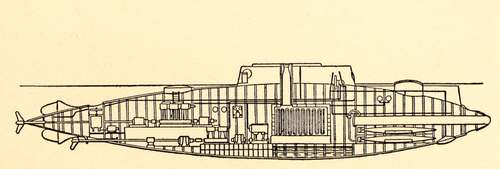
THE PLUNGER (HOLLAND TYPE SUBMARINE), LAUNCHED IN AUGUST, 1897
Machinery not drawn to scale. The engines of 1,600 horse-power, with the necessary auxiliaries, nearly filled the after portion
of the vessel.
"Steering on the horizontal plane while submerged is
accomplished by an automatic apparatus that performed very
well in one of the boat's predecessors. Steering in the vertical
plane is also done automatically, and with considerable
exactness, while submerged. Steering in both planes can
also, at the same time, be controlled manually. There will
be a steel armored turret, four feet high, to protect the pilot
and smokestack, and the hull will be covered by three feet
of water while the vessel runs awash to attack.
"When engaged in harbor defence duty its position will
be outside the outer line of harbor defences; that is, beyond
the reach of the guns defending the entrance. While performing
this duty it will lie awash; that is, with only the
top of its turret over the surface of the water. On the
approach of an enemy's vessel the smokestack will be shipped
and the aperture on top of the turret through which it passed
will be quickly closed watertight. She will then run in a
direction to intercept the enemy's ship, still remaining in the
awash condition, until she comes near enough to be discovered
by the lookouts on the ship, when she will go from
the awash to the entirely submerged condition. The distance
from the ship at which she will dive will depend upon the
weather. In rough weather she can come quite close without
being observed. Having come within a distance that the
operator estimates at two or three hundred yards from the
ship, the diving rudders are manipulated so as to cause the
top of the turret to come for a few seconds above the surface
of the water. During this short exposure of the turret—much
too short to give the enemy a chance to find its distance
and train a gun on it capable of inflicting any injury—the
pilot ascertains the bearing of the enemy's ship, alters his
course or makes another dive if necessary. If he finds that
the submarine boat is within safe striking distance, say one
hundred yards, a Whitehead torpedo is discharged at the
ship. A heavy explosion within six seconds after the torpedo
is expelled will notify the operator that his attack has been
successful, and he may then devote his attention to the next
enemy's ship that may be within reach. When the boat is
running on the surface of the water, with full steam power,
and it becomes necessary to dive quickly, the pilot gives the
order, 'Prepare to dive.' The oil fuel is instantly shut
off from the furnace, the valves are opened to admit water
to the water-ballast tanks, an electric engine draws down
the smokestack and air-shaft into the superstructure, and
moves a large, massive sliding valve over the aperture on the
turret through which the smokestack passes. These operations
will be completed in about thirty seconds, when the
boat is in the awash condition and prepared to dive. In
twenty seconds more it will be running horizontally at a
depth of twenty feet below the surface of the water and
quite beyond reach of the enemy's projectiles."
I submitted designs of a twin-screw vessel eighty feet
long, ten feet beam, and one hundred fifteen tons displacement,
with 400-horsepower steam engines for surface propulsion
and 70-horsepower motors for submerged work.
This design introduced several new and striking features
into the art of submarine navigation which have been the
cause of considerable scientific discussion. The design
called for a double hull vessel, the spaces between the inner
and outer hulls forming water-ballast tanks; the design also
called for twin screws and four torpedo tubes, two firing
forward and two aft.
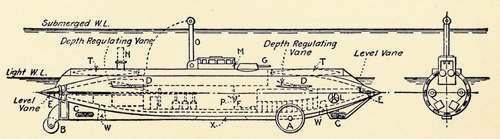
LAKE DESIGN AS SUBMITTED TO THE U. S. NAVY DEPARTMENT IN 1893
Novel features consisted in: (A) wheels for running on the bottom; (B) rudder forming also a steering wheel when navigating on the
bottom; (C-C) propellers for holding vessel to depth when not under way; (D-D) depth regulating vanes or hydroplanes for causing
vessel to change depth while under way and to accomplish the changes of depth on an even keel; (E-E) horizontal rudders or "leveling
vanes" designed to automatically hold the vessel on a level keel when under way; (F) a weight automatically controlled by a pendulum;
(P) mechanism to correct trim; (G) gun arranged in watertight revolving turret for defense purposes or attack on unarmored surface
craft; (L) propeller in tube for swinging vessel at rest to facilitate "pointing" her torpedoes; (M) conning tower; (N) telescoping smokestack;
(O) observing instrument arranged to turn down on deck when under way; (T-T) torpedo tubes, two firing forward and two aft;
(W-W) anchoring weights to hold the vessel at rest at any desired depth between the surface and bottom; (X) an "emergency keel"
which would be automatically released if the vessel reached an unsafe depth. She was a double-hull vessel, water being admitted to the
space between the inner and outer hulls and in trim tanks forward and aft to effect submergence. A diving compartment was also provided
to enable the crew to leave or enter the vessel while submerged.
The novel feature which attracted the most attention and
scepticism regarding this design was—so I was later informed
by a member of the Board—in the claim made that
the vessel could readily navigate over the water-bed itself
and that while navigating on the water-bed a door could be
opened in the bottom of a compartment and the water kept
from entering the vessel by means of compressed air, and
that the crew could, by donning diving suits, readily leave
and enter the vessel while submerged. Another novel feature
was in the method of controlling the depth of submergence
when navigating between the surface and the
water-bed. The vessel was designed always to submerge
and navigate on a level keel rather than to be inclined down
or up by the bow to dive or rise. This maintenance of a
level keel while submerged was provided for by the installation
of four depth-regulating vanes, which I later termed
"hydroplanes" to distinguish them from the forward and
aft levelling vanes or horizontal rudders. These hydroplanes
were located at equal distances forward and aft of the
centre of gravity and buoyancy of the vessel when in the
submerged condition, so as not to disturb the trim of the
vessel when the planes were inclined down or up to cause the
vessel to submerge or rise when under way. I also used,
in conjunction with the hydroplanes, horizontal rudders,
which I called "levelling vanes," as their purpose was just
the opposite from that of the horizontal rudder used in the
diving type of vessel. They were operated by a pendulum-controlling
device to be inclined so as always to maintain
the vessel on a level keel rather than cause her to depart
therefrom. When I came to try this combination out in
practice I found hand control of the horizontal rudders
was sufficient. If vessels with this system of control have
a sufficient amount of stability, they will run for hours and
automatically maintain both a constant depth and a level
keel, without the depth-control man touching either the
hydroplane or horizontal rudder control gear. This automatic
maintenance of depth without manipulating the hydroplanes
or rudders was a performance not anticipated or
claimed in my original patent on the above-mentioned combination,
and what caused these vessels to function in this
manner remained a mystery, which was left unsolved until
I built a model tank in 1905, in Berlin, Germany, and conducted
a series of experiments on models of submarines. I
then learned that the down pull of a hydroplane with a given
degree of inclination varied according to its depth of submergence,
and the deeper the submergence the less down
pull. This works out to give automatic maintenance of
depth so long as the vessel is kept at a constant trim on
a substantially level keel, and I have known of vessels
running for a period of over two hours without variation
of depth of one foot and without once changing the inclination
of either the hydroplanes or the horizontal rudder.
The capability of this arrangement of hydroplanes and
horizontal rudders to control the depth of submergence was
questioned and doubted for many years. As late as 1902,
nearly ten years after I first submitted this method of control
to the United States Navy Department, Naval Constructor
L. Y. Spear, U. S. N., testifying before the
Committee of Naval Affairs, House of Representatives, in
reference to the "Lake even-keel boat" and my use of
hydroplanes, said, "As an expert I do not think he will
make his hydroplanes work"; and strongly contended
that submergence by inclining the vessel itself was the
proper method.
Several years later, in 1908, in Paris, I met Captain
Lauboeuf, the celebrated French naval constructor, who has
perhaps done more toward perfecting the French submarines
than any other designer, and he informed me that after the
French Government had its sad experience in the loss of the
Lutine and Farfadet with their crews, it had changed all
their diving boats into even-keel boats and was now using
substantially my method of even-keel submergence with
hydroplane control. He also informed me that it had, at
that time, thirty-five new boats under construction to operate
on the even-keel principle, eighteen of which were of five
hundred and fifty tons displacement. Captain Lauboeuf was
kind enough to compliment me as having been the first to
introduce this method of submerged control.
Commander Murray F. Sueter, Royal British Navy,
in his most complete work on "The Evolution of the Submarine
Boat, Mine and Torpedo, from the Sixteenth Century
to the Present Time," published in 1907, said:
"After scrutinizing all the information available, I am
certain that several features of the 'Lake' design will be
embodied by most nations in the construction of future boats,
the chief of which, perhaps, are 'the even-keel method of
submergence' in preference to the 'dynamical dive' of the
Holland boats; also the provision of a safety keel and diving
compartment. This latter forms a ready means of communicating
with the surface should the boat, through
some small mishap, find herself on the bottom and
unable to rise."
Sir Trevor Dawson, formerly (R. N.) manager of
"Vickers," in discussing submarine boats before the Institution
of Naval Architects in 1907, said:
"Mr. Lake mentioned the question of the importance of
horizontal stability and the use of hydroplanes. I think
these have been used by the Holland Company in America
in connection with the experiments they made for the
American Government. In one of the boats I saw they
gave me particulars of such experiments. I know, too, that
they have been used considerably in France with satisfactory
results, and I think his contention as to the importance of
horizontal stability, as things exist to-day, is fully justified."
Captain Edgar Lees (R. N.), who was the officer in
charge of the British submarines, said:
"I may say, with regard to the features that Mr. Lake
has brought to our notice—the hydroplane, for instance, and
getting good freeboard and seaworthy boats—the mere fact
that they have been largely copied and that most nations
build these submarine boats is, as Mr. Lake contends, a
conclusive proof that he has been for years on the right
tack. Well, I do not think at the present moment submarine
boats are being built in any country without hydroplanes,
in order to dive, if desired, almost horizontally."
One of the latest contract requirements of the United
States Government, specifying the characteristics of the
new boats to be built under the appropriation for submarines
for the year 1915, stated:
"The vessel shall make also the necessary trials to
demonstrate her ability to effect initial submergence, to
maintain submergence under way, and to change depths
without exceeding an angle of inclination of one degree."
This, in substance, calls for "even-keel submergence" when
one considers that it was common for early boats of the
diving type to take on an inclination of fifteen to twenty
degrees, and inclinations of as much as forty-five degrees
were not unknown.
All governments and submarine builders have at present
in their latest boats adopted the method of even-keel submergence
by the use of hydroplanes, and I am gratified that
this method of control has been finally adopted as the
standard, as I believe none of the latest modern submarine
boats will make the uncontrollable dives to the bottom common
in the boats of the diving type, which have been accompanied
in many cases by the loss of their crews.
I did not make a proposal to build a boat from my
designs as submitted in 1893, but offered to coöperate with
the government in developing submarines under my patents,
which were then pending, on such terms as the government
might desire. Not being fortunate enough, however, to
secure the financial assistance of the government in developing
my inventions for the protection of our country, I
turned my attention for a time to applying my inventions to
commercial purposes and to prove the practicability of
navigating on the bottom.
For this purpose I built, in 1894, the Argonaut, Jr.,
which I mentioned in the preceding chapter, and will now
describe more fully. This vessel was provided with three
wheels, two on either side forward and one aft, the
latter acting as a steering wheel. When on the bottom the
wheels were rotated by hand by one or two men inside the
boat. Her displacement was about seven tons, yet she could
be propelled at a moderate walking gait when on the bottom.
She was also fitted with an air-lock and diver's compartment,
so arranged that by putting an air pressure on the
diver's compartment equal to the water pressure outside
a bottom door could be opened and no water could come into
the vessel. Then by putting on a pair of rubber boots the
operator could walk around on the sea bottom and push the
boat along with him and pick up objects, such as clams,
oysters, etc., from the sea bottom.
Experiments with this vessel on the bottom of Sandy
Hook Bay convinced a sufficient number of people who were
permitted to witness the experiments that submarine navigation
in this manner was practicable, and I succeeded in
raising sufficient capital to build a larger vessel to continue
my experiments on a broader scale. Therefore, in 1895, I
designed the Argonaut.
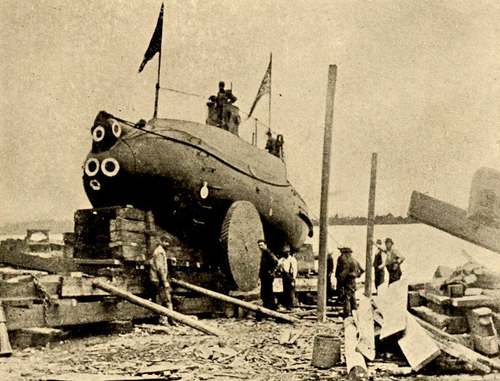
"ARGONAUT" AS ORIGINALLY BUILT. LAUNCHED IN AUGUST, 1897
Built to further demonstrate the possibility of navigation over the waterbed of seas or
the ocean. She covered thousands of miles in her experimental work, testing out the practicability
of the submarine for various kinds of commercial work.
At this time I was living in Baltimore, Md., so I made
a contract with the Columbian Iron Works and Dry Dock
Company, of that city, for her construction. This company
was also building for the Holland Torpedo Boat Company
the Plunger, which was being constructed for the
government under the 1893 appropriation. Both vessels
were completed about the same time. They were launched
in August, 1897, and went into dry dock together.
The Argonaut, as originally built, was thirty-six feet long
and nine feet in diameter. She was the first submarine
to be operated successfully with an internal-combustion
engine. She was propelled with a thirty-horsepower gasolene
(petrol) engine driving a single-screw propeller. She
was fitted with two toothed driving wheels forward, which
were revolved by suitable gearing when navigating on the
water-bed. They could be disconnected from this gearing
and permitted to revolve freely, propulsion being secured
by the screw propeller. A wheel in the rudder enabled her
to be steered in any direction when on the bottom. She
also had a divers' compartment to enable divers to leave
or enter the vessel when submerged, so as to operate on
wrecks or to permit inspection of the bottom or to recover
shellfish. She also had a lookout compartment in the extreme
bow, with a powerful searchlight to light up a pathway
in front of her as she moved along over the water-bed.
This searchlight I later found of little value except for night
work in clear water. In clear water the sunlight would
permit of as good vision without the use of the light as
with it; while, if the water was not clear, no amount
of light would permit of vision through it for any
considerable distance.
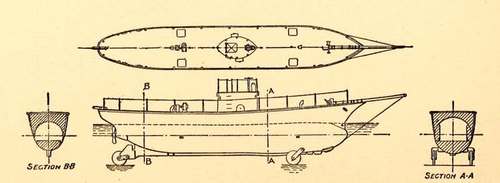
THE "ARGONAUT" AFTER LENGTHENING AND ADDITION OF BUOYANT, SHIP-SHAPED SUPERSTRUCTURE, INCREASING
THE SURFACE BUOYANCY OVER 40 PER CENT
As the Argonaut was principally built in order to further
test out the possibility of navigating on the water-bed in
exploration and commercial work, she was propelled, both
when on the surface and submerged, by her gasolene (petrol)
engines. Storage batteries were carried only for lighting
purposes. The air to run her engines was first drawn into
the vessel through a hose extending to a buoy floating on the
surface. Later she was fitted with pipe masts, which enabled
her to navigate on the bottom in depths up to fifty feet.
She functioned satisfactorily from the start. We found
we could readily navigate over any kind of bottom, soft
or hard, by regulating her buoyancy to suit, and she would,
due to her buoyancy, readily climb over any obstruction
that did not reach higher than her forefoot.
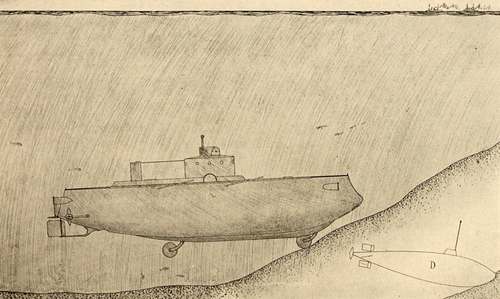
SUBMARINE WITH CUSHIONED BOTTOM WHEELS
Showing how such a vessel will surmount a steep declivity while a boat of the diving type (D) will likely "bury her nose" into it
or strike with sufficient force to disarrange her machinery. If the submarine has sufficient statical stability she will maintain substantially
a level keel even when riding over a steep declivity.
There were three things which caused us to delay her
departure on a submarine exploration trip for a few weeks.
The first was the escape of gasolene (petrol) fumes in the
boat. When first built, fuel tanks were built in the hull
itself and formed an integral part of the vessel. Special
care was given to make these fuel tanks tight. They were
tested under hydraulic pressure and found to be tight, but
the fumes from gasolene (petrol) are very searching, and,
after filling the fuel tanks and keeping them filled over night,
gasolene fumes were found to exist in the boat the next
morning to such an extent that I would not venture to make
a start until a fuel tank had been built outside of the vessel,
where any escape of fumes would not form an explosive
mixture. I followed this practice in all our later gasolene-engined
boats, which largely eliminated the danger from
carrying gasolene as a fuel. A number of explosions have
occurred in other types of gasolene-propelled boats, in some
cases with fatal results, from gasolene fuel being carried in
built-up tanks within the hull itself.
The next cause of delay was due to the escape of and
collection of carbon monoxide within the vessel. This
developed on our first submarine run. After we had been
down about two hours some of us commenced to experience
a dull pain at the base of the brain and a decided feeling of
lassitude. On coming to the surface a couple of our men
collapsed completely, and one was very sick all night. I
could not understand the cause of this, as nothing of the
kind had occurred in my previous hand-propelled vessel,
so we made another submerged run the following day, and
after about the same period of time the pain in the head and
weariness came on again. I then discovered that the engine
would occasionally backfire out into the boat and that gas
was escaping past the piston rings into the base of the engine
and from there into the boat. To overcome this difficulty
I installed what I called an induction tank, which was piped
up to the air intake of the engine and also the engine base.
A check valve admitted air into this induction tank. When
the engine was started the check valve was automatically
lifted and induced a flow of air through the tank, in which
a slight vacuum was maintained, which also served to draw
the gases out from the engine base. In case of a backfire,
the check valve automatically closed and the gases from the
backfire were caught in the induction tank, from which they
were drawn out on the next stroke of the engine. This
solved the difficulty, and thereafter the air was always fresh
and pure when running submerged even after a submergence
of several hours' duration.
Like Mr. Holland, I also had difficulty on our first submergence
in always knowing where we were going. Our
compass was first installed in the boat itself, where it was
surrounded by steel. The compass adjuster had searched
for and found what he considered the most neutral place
in the ship to install the compass, and had adjusted it by
magnets in the usual manner, but it was too "loggy" for
correct navigation and we were forced finally to install
it in a bronze binnacle directly over the conning tower,
where it could be viewed by mirrors from the steersman's
station. This cut out most of the adjusting magnets, and
the compass was nearly accurate on all courses. Submarine
navigation thus became reliable.
On the completion of these changes the Argonaut was
taken down the Chesapeake Bay to Hampton Roads, where
several months were spent in examining the bottom conditions
in the bay and out on the ocean, and in locating and
picking up cables and in examining wrecks. The Spanish-American
War was on at this time, and an effort was made
to interest the government officials in charge of the mines
at Fortress Monroe. I tried to get some of the officers to go
down in the Argonaut and see how easily observation mine
cables could be located and cut if desired, as I was making
almost daily submerged runs in their vicinity. Finally I
received peremptory orders not to submerge within a mile
of the mine fields, as I might accidentally sever one of the
cables, and then, as the officer in charge said, "There would
be the devil to pay in Washington."
It was about this time that Admiral Sampson's fleet was
holding at great expense its long vigil outside of Santiago,
waiting for Cervera's fleet to come out. Our fleet was kept
outside the harbor for fear of the mines, while here in
Hampton Roads all this time was a vessel capable of clearing
away the mine fields, but which was not given serious consideration,
as it was thought that the submarine was impracticable.
Experiments were also made showing the possibility
of establishing submarine telephone stations at known
locations on the bottom of the ocean. In January, 1898,
while the Argonaut was submerged, telephonic conversation
was held from submerged stations with Baltimore, Washington,
and New York. In 1898, also, the Argonaut made
the trip from Norfolk to New York under her own power
and unescorted. In her original form she was a cigar-shaped
craft, with only a small percentage of reserve buoyancy in
her surface cruising condition. We were caught out in the
severe November northeast storm of 1898 in which over two
hundred vessels were lost, and we did not succeed in reaching
a harbor in the "horseshoe" back of Sandy Hook until
three o'clock in the morning. The seas were so rough, and
broke over her conning tower in such masses, that I was
obliged to lash myself fast to prevent being swept overboard.
It was freezing weather, and I was soaked and covered with
ice on reaching harbor.
This experience caused me to apply to the Argonaut
a further improvement, for which I had already applied for
a patent. This was to build around the usual pressure-resisting
body of a submarine a ship-shape form of light
plating which would give greater seaworthiness, better lines
for surface speed, and make the vessel more habitable for
surface navigation. It would, in other words, make a "sea-going
submarine," which the usual form of cigar-shaped
vessel was not, as it did not have sufficient surface buoyancy
to enable it to rise with the seas, and the seas would sweep
over it as they would sweep over a partly submerged rock.
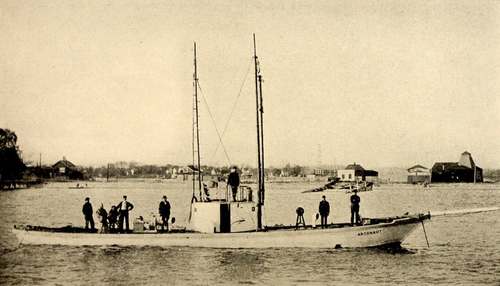
THE "ARGONAUT," AFTER BEING LENGTHENED AND REBUILT, IN 1898, SHOWING SHIP-SHAPED, WATERTIGHT, BUOYANT
SUPERSTRUCTURE
The Argonaut was therefore taken to Brooklyn, twenty
feet added to her length, and a light, watertight, buoyant
superstructure of ship-shape form added. This superstructure
was opened to the sea when it was desired to submerge
the vessel, and water was permitted to enter the space between
the light plating of the ship-shape form and the heavy
plating of the pressure-resisting hull. This equalized the
pressure on the light plates and prevented their becoming
deformed, due to pressure. The superstructure increased her
reserve of buoyancy in the surface cruising condition from
about ten per cent. to over forty per cent., and she would
rise to the seas like any ordinary type of surface vessel,
instead of being buried by them in rough weather.
This feature of construction has been adopted by the
Germans, Italians, Russians, and in all the latest types of
French boats. It is the principal feature which distinguishes
them in their surface appearance from the earlier cigar-shaped
boats of the diving type. This ship-shape form of
hull is only suited to level-keel submergence, and must be
controlled by hydroplanes.
I also departed from the cigar-shaped inner hull and
was granted a patent on a form of pressure-resisting hull
with rising axes. This improvement overcame the tendency
to dive by the head common to the cigar-shaped form, increased
the surface speed on an equivalent displacement,
and gave a considerable increase in metacentric height over
a vessel of equivalent length and beam.
Some incorrectly informed writers of books and magazines
have, through their lack of complete information, given
the credit of inventing and developing this seagoing type of
submersible to the Krupps of Germany, to former Naval
Constructor Lauboeuf, of France, or to former Naval Constructor
Laurenti, of Italy. For the purpose of giving a
correct history of this development, perhaps I may be pardoned
and not considered overconceited if I mention a few
facts in connection with the development of this type of boat
in European countries.
On April 2, 1897, I applied for a patent on a combined
surface and submarine vessel, the specifications of which
began as follows:
"This invention relates to a combined surface and submarine
vessel and may be employed either as a torpedo
boat or for freight and general cruising purposes, or for
submarine work of all kinds. It has for its object, first, to
combine with a submarine vessel cylindrical in cross-section
a superstructure built upon the submarine vessel and affording
a large deck surface, buoyancy, and a high freeboard
for surface navigation, the space between the submarine
vessel and the superstructure adapted to being filled with
water when the vessel is submerged, and thus rendered capable
of resisting the pressure of the water, etc." A patent was
granted in due course with fifty claims, and, according to the
records of patent offices throughout the world, this is the
pioneer patent covering this form of vessel.
When Krupps took up the matter of constructing submarines
for the Russian and German governments, they
decided upon this type of vessel, as they held that it offered
a greater opportunity for development than the diving type.
A contract was drawn with their directors for the construction
of the "Lake" type of boat, which they accepted by
wire. This contract covered the erection of a plant in Russia
for the manufacture of "Lake" submarines on a division
of profits and also the construction of ships in Germany
on a royalty basis. It also covered my employment by
them in an advisory capacity. I was living abroad at the
time, and the papers were sent to my directors in America
for their approval.
In the meantime I had submitted to them various plans
of submarines, copies of my patents, and even my secret
data, including copies of patents pending, all to enable them
to go ahead, as I considered the agreement settled by their
wire of acceptance. I had also advised them how to overcome
certain difficulties in boats which they then had under
construction for the Russian Government at their Kiel plant,
the Germania Werft.
Before I succeeded in getting the power of attorney
from my directors in America authorizing me to sign up the
agreement, the great industrial revolution started in Russia,
immediately after the Russo-Japanese war, and the Krupps
informed me that, owing to that fact, they had reconsidered
their idea of going into Russia and withdrew from the
arrangement. Their attorney in Berlin informed me that
on looking up the patent situation they had found that "I
had not protected myself in Germany and that they were free
to build 'Lake' type boats in Germany and expected to continue
to do so." This was true, for, like most pioneer inventors,
I had not succeeded in securing sufficient capital
to finance and protect my fundamental inventions in all
countries, which would have involved very large amounts in
taking them out and paying the yearly tax.
So much for Germany.
In 1905, while residing in Berlin, Germany, I was called
to Rome and sat three days with a commission appointed by
Admiral Mirabello, at that time Italian Minister of Marine,
regarding their construction of submarines. I then learned
that the Italian Government had started on a plan of building
submarines of substantially my type, that they had several
under construction at their Venice Arsenal after the design
of Major Laurenti, a naval constructor; that certain difficulties
which they explained to me had arisen, and that they
had not succeeded in getting any of their boats to function
satisfactorily submerged. I came to the conclusion that their
trouble was due to lack of longitudinal stability, and advised
the Commission how to increase this. Shortly afterward I
was advised that they had corrected their trouble and that
the boats then worked satisfactorily.
Major Laurenti, at this time, resigned from the Italian
Navy and became affiliated with the Fiat Company, and has
designed quite a large number of successful submarine boats,
all of which have buoyant superstructures and are designed
to operate on a level keel by the use of hydroplanes. These
boats are of the "Lake" type, so far as invention goes.
There is a difference, however, between invention and
design. Invention introduces a new method, a new principle,
or a new form of construction, to accomplish a certain purpose
in a new way. Many modifications of design may be
made which do not involve invention.
As an illustration, on August 14, 1907, Major Laurenti
applied for a United States patent on a submarine or submersible
boat in which the attempt was made to secure a
patent on slight variations of design over the "Lake" type.
The patent office records show that many amendments were
made and hearings held in the endeavor to evade the foundation
patent of Lake, No. 650,758, which was applied for
April 2, 1897, over ten years before Laurenti applied for
a patent. The patent office consistently and persistently held
that the slight difference in design did not involve invention
over "Lake." After arguments and hearings, extending
over a period of over three years, Major Laurenti was finally
obliged to accept a patent restricted to details of construction,
most of which were in themselves not new to me, as they
had already been used in various modifications of my inventions
and consisted in such changes as would naturally be
worked out by any good hull or engine draftsmen while
developing the designs of a vessel.
Our patent laws are too free in allowing the granting
of patents on modifications of design while fundamental
patents are still in force. This works great hardship on
original inventors, forcing them to take out a great many
patents on features of design rather than on invention. I
have taken out nearly one hundred United States patents
with over one thousand one hundred claims covering a few
fundamental inventions, some of which cover details of
construction for which I should not have been forced
to seek protection.
All original inventors complain of this system. I know
of several instances where patents on modifications of design
have been granted, which modifications have been in common
use for several years by others, but were only considered
as a design and not as an invention. Then some designer
hits on the same arrangement and considers he has made
an invention, and applies for and takes out a patent which
has already been in common use but has been looked upon
purely as a design by its originator rather than an invention.
Then the original designer may be hauled up before the
courts and put to great expense to prove that it was in prior
use as a design.
While Captain Lauboeuf and the Krupps have taken out
several patents on detail mechanisms for use on submarine
boats, they have never—so far as I am aware or the patent
records show—attempted to claim to be the original inventors
of the type of submarine with buoyant ship-shaped form
of hull consisting of a pressure-resisting body surmounted
by a watertight, non-pressure-resisting body which gives suitable
form for surface speed and seaworthiness, which is the
principal characteristic of vessels built by them. I feel,
therefore, that certain misinformed authors should, in the
interests of the truth, correct their statements if they issue
new editions of their work or write further on the development
of the submarine.
During the years of practical experimental work with
the Argonaut, Mr. Holland continued in his efforts to get the
Plunger—building under the 1893 appropriation—in shape
for submerged trials, but without success.
The large steam installation, sixteen hundred horsepower,
was largely responsible for this. As I remember, there was
only about eighteen inches between the main engines, with
large steam supply and exhaust pipes overhead and under
foot. These engines were designed to run at over four
hundred revolutions per minute. The boiler was located
nearly in the centre of the vessel and so nearly filled the
ship that there was barely room between the top of the
boiler and ship to creep from "forward to aft."
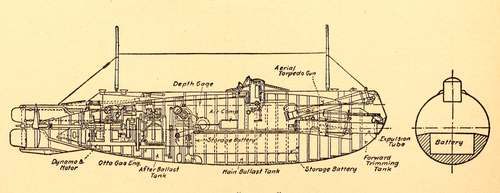
THE "HOLLAND"
This vessel, while holding to the same general principles of construction and method of control as used in the "Plunger," was much better
proportioned and had a much better distribution of weights. It was her performance that led the House Naval Committee in 1900 to authorize
the construction of additional submarines of the Holland type. Her armament consisted of one torpedo tube forward and an aerial torpedo
gun for firing aerial torpedoes, designed to be used somewhat on the same principles as used on the gunboat "Vesuvius."
The heat was so intense that the trial crew found it
impossible to live in the boat, so for their full power dock
trials valve stems were run up through the deck to enable
the engines to be started from there. Arrangements were
made also to take the indicator cards from the deck. She
was also fitted with a heavy armored conning tower, as per
Mr. Holland's description previously quoted. This, combined
with the high position of the boiler and engines, together
with her cigar-shaped form, which gives a diminishing
water plane, reduced her stability almost to zero. I was
informed that when the attempt was first made to start up
one of her engines her stability was so little that the turning
effort on her propeller shaft nearly caused her to "turn
turtle," and that she rolled over on her side to such an extent
that the conning tower struck the dock stringer. The constructor
at the Columbian Iron Works then put heavy chains
on her so that she could not turn over. Every inducement
was made to the Holland Company to enable it to make this
vessel satisfactory, as Congress, in 1896, authorized the
Secretary of the Navy to contract for two more "submarine
torpedo boats of the Holland type, provided that the Holland
boat now being built for the Department shall be accepted
by the Department as fulfilling all the requirements of the
Contract." She was finally abandoned in 1900 without ever
making a submerged run or fulfilling any of her guarantees
of performance under which the award was secured. Mr.
Holland as early as 1897 must have concluded that the
Plunger was destined to failure. In fact, no submarine,
even up to the present day, has ever equalled the performance
guaranteed under the Plunger's contract. He therefore
built a much smaller boat, called the Holland. This
vessel was fitted with internal-combustion engines instead of
steam, and was finally accepted by the United States Government
in lieu of the Plunger, and placed in commission in
1900. She was the first submarine torpedo boat to go into
commission in the United States Navy. Her characteristics
were: Length, fifty-three feet four inches; beam, ten feet
three inches; displacement, sixty-four tons surface, seventy-five
tons submerged; power, internal-combustion engines,
fifty horsepower; surface speed, six to seven knots claimed;
submerged speed, five knots claimed. The only official report
I have seen gave her a surface speed of five and two-thirds
knots. I believe she was purchased by the authority
of the Act of June 7, 1900, which read as follows: "The
Secretary of the Navy is hereby authorized and directed to
contract for five submarine torpedo boats of the 'Holland'
type of the most improved design, at a price not to exceed
one hundred and seventy thousand dollars (£35,000) each:
Provided, That such boats shall be similar in dimensions to
the proposed new 'Holland,' plans and specifications of
which were submitted to the Navy Department by the Holland
Torpedo Boat Company, November twenty-third,
eighteen hundred and ninety-nine."
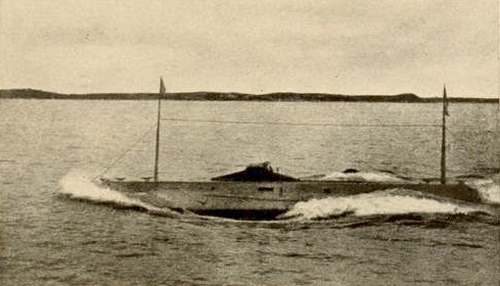
THE "HOLLAND" RUNNING ON THE SURFACE
Courtesy of the Engineering Magazine
The United States was, therefore, at the beginning of
the twentieth century, fairly launched on a policy of submarine
boat construction, and other governments rapidly
followed suit. France had, in the meantime, brought out two
new boats, the Morse, 1898, and the Narval, after the designs
of M. Lauboeuf, launched October 26, 1899. The Gustave
Zédé had also been modified by adding hydroplanes so that
she became controllable submerged.
The Morse was one hundred and eighteen feet long by
eight feet three inches beam, with a displacement of one
hundred and thirty-six tons, of about the same type as the
Gustave Zédé. The Narval was one hundred and eleven
feet six inches in length by twelve feet four inches beam;
one hundred and six tons surface displacement and one
hundred and sixty-eight tons submerged. She was, like
the author's 1893 design, a double hull vessel controlled by
hydroplanes. She was fitted with "Dzrewiecke" apparatus
for carrying and discharging torpedoes, two of which were
carried on either side. The Narval was a successful type and
appears to have been the first French naval vessel to adopt a
ship-shape outer hull of lighter plating. She was also, so far
as my records show, the first French boat to be fitted with
two motive powers—viz., steam for surface work and electricity
for submerged work. To distinguish her in these
particulars from the purely electric boats of cigar-shaped
form, like the Gustave Zédé and Morse, Mr. Lauboeuf
called her a submersible.
Very little was known about the French boats at this
time (1900), as their method of construction and experiments
were kept secret, but enough information leaked out
as to their reported success to cause the British public much
uneasiness, and they began to demand that their Admiralty
should also take up the development of the submarine. No
one had, so far, evolved a satisfactory type in England, so
when the fact became known that the United States Congress
had made an appropriation for five Holland boats, the
British public became still more insistent that they should also
have submarines.
About this time, so I was informed by Sir William
White, who was then chief constructor of the British Navy,
Lord Rothschild brought to him Mr. Isaac L. Rice, president
of the Electric Boat Company, who controlled the Holland
patents and who offered to build duplicates of the United
States boats for England. Sir William thought this gave
the Admiralty the opportunity to satisfy the public demands
and to meet the French, their hereditary enemy—this was
before the establishment of the "Entente Cordiale"—in
their development of the submarine. Consequently an
arrangement was made for the manufacture of this type of
vessel for England by the Vickers Company. An agreement
was drawn, so Sir William informed me, giving "Vickers"
an exclusive monopoly of building submarines for the
British Navy for a period of ten years, the consideration
being that they should have available for the use of the
British Admiralty all the details of the development work
of the Electric Boat Company in America. This, plus their
own experience and development work in England, which
should be kept secret, should enable England to keep on an
equal footing with France.
Sir William informed me that he thought this had been
a mistake in policy, as it had deprived the government of
the opportunity to secure improvements that had been developed
by other inventors and builders who had made
greater progress on independent lines.
England, therefore, started to build her first submarine,
known as the "A" type. These were practically duplicates
of the United States Adder and Moccasin type, now also
designated as "A's" Nos. 1 to 7. England has been particularly
unfortunate with this class of submarine, several
of them having plunged to the bottom with the loss of their
crews during peace-time manœuvres.
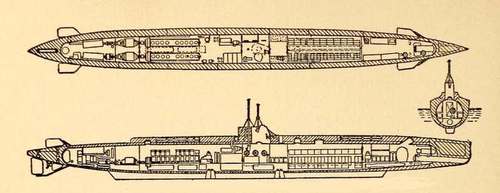
Modern French Submarine of Lauboeuf Design. Constructed by Schneider and Company
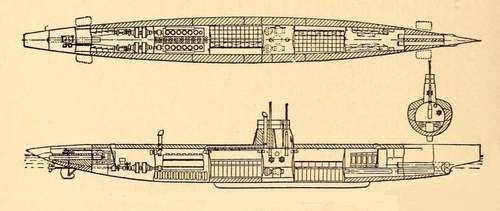
Modern Italian Submarine—Fiat Construction—Laurenti Design. Vessel of the Double Hull Buoyant Superstructure.
Hydroplane Controlled Type
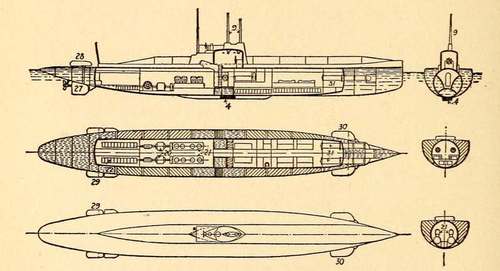
German "U" Boat—Krupp Design
VARIOUS TYPES OF MODERN FOREIGN SUBMARINES
27 and 28, vertical rudders; 29 and 30, hydroplanes for controlling depth of submergence;
9, periscopes; 21, engines; 20, motors; 22, storage batteries; 4, drop keel; 31, torpedo tubes.
The majority of the British and American boats are
developments from the original Holland of Mr. Holland's
design. Increasing the stability, greater subdivision of ballast
compartments, refinements in steering gear, and the addition
of hydroplanes forward have enabled Mr. Holland and
his successors to produce submarines that operate very well.
These boats, however, with only one pair of forward planes,
still require constant manipulation of the horizontal rudder
to control them when submerged. This rudder, controlled
by power gear, is very effective and will, by expert manipulation,
hold the submarine to practically even depth. The only
danger the writer can see is that the diving rudder gear might
fail to function after it is set in the diving position, in which
case the vessel might continue diving until she struck bottom
or reached a depth great enough to cause her to collapse.
The modern submarines, therefore, as built and used in
all the world's navies, owe their final success to principles of
construction and control devices invented and introduced into
the art by two American inventors.


