A TRAGEDY OF THE SOUTH ATLANTIC
The whaling schooner Erin was a modern
vessel. She had a little of the “old
greaser” about her. She had been
built and fitted out at New Bedford, Mass.,
the mother-port of nearly all good whaling
craft, and she was manned by men who had
served their time in whaling ships. Her tonnage
was not over three hundred, but she was so
strongly put together that she looked somewhat
heavier than she really was. Her bow was like
that of a clipper, and her stern had the modern
overhang of a cruising yacht, but her beam was
great and her top-sides bulky, showing a tumble-home
like that of the ancient frigates. Therefore,
she was not considered fast. Her spars
were short and stumpy, and she had no foreboom,
owing to chunky smokestack that arose from
her main deck, over which the foresail passed.
She was flushed fore and aft, save for a heavy-built
superstructure over her engines, through
which the smokestack protruded, and it was evident
that she could stand a great amount of
rough usage. Being built for southern whaling
in the vicinity of Cape Horn, she needed all the
strength that could be put into her, and Captain
Jackson, her commander, always kept her down
to a draught of fifteen feet, even when running
light, to enable her to hold up to the tremendous
rolling seas off the Cape. Forward, she carried
a peculiar sort of cannon on her forecastle, which
fired an exploding harpoon weighing a hundred
pounds, heavy enough to put a quietus upon any
ordinary member of the whale family. Her boats
and other gear were of the usual type; but, as
she was not to carry oil, either in bulk or casks,
her deck was devoid of the ordinary furnace of
the sperm-whaler, and her hold of the odor which
comes from the usual mass of rancid blubber
when packed for a long voyage from the Arctic
Ocean, in vessels hunting the right whale. She
was, in fact, a stanch, trim little vessel. Her
crew of thirty men had been selected and shipped,
and Captain Jackson cleared for his last cruise.
When well off shore, the boiler was cooled and
sails set, for there must be no waste of coal, and
the Erin stood to the southward on her long run
to the Falkland Islands, where she would begin
her hunt for the giants of the southern ocean.
The run south was made without any unusual
experience. On the sixty-first day out she raised
the huge mountains of Patagonia to the westward,
and, shortening sail so as to drift not over
four knots an hour, she hauled on the wind and
stood through the “black water” between the
Falk Islands and Staten Land.
In December and January, the Antarctic summer
months, the air is quite cold as far north
as the fiftieth parallel. The “blow” of a
whale stands out sharply against the sky as the
warm air in the animal’s lungs turns into vapor,
giving the hunter a chance to see it at a distance
of several miles. Objects seem to lift from off
the horizon as in a mirage, only they are not inverted.
Here, in the summer season, the great rorqual,
or finback whale, disports himself in ease and
security, for, until lately, he has had few known
enemies, and has been unmolested by man. Dozens
of these great creatures often follow a huge
bull leader, and they jump and plunge about as
lively as they would if their weight were reckoned
in pounds instead of tons.
The huge, timid creature who led a school
under the shadow of Tierra del Fuego, that season,
was a giant of his kind. One hundred feet
of solid bulk was between the tips of his tremendous
flukes and the end of his hideous head. A
hundred tons of bone and sinew, covered with a
coating of thin blubber, to keep out the cold of
the icy seas.
His head was ugly and flat-looking, and his
mouth a hideous cavern, full of slabs of whalebone,
from which depended masses of horrible
hair to act as a sieve for the whale-food poured
down his gullet. His back slanted away to a
place amidships, where a lumpy knob rose, as if
he were a hunchback, and from there aft he
sloped in long and sinuous lines to the spread of
his tail or flukes, which were fully two fathoms
across. The blades of the Erin’s wheel were not
nearly so large or so powerful as the blades of
bone and cartilage that drove him ahead through
the yielding medium, or raised the tons of flesh
and blood to a height that showed a full fathom
or more of clear sky under his thin belly when
he breached. He was a giant, a descendant
from prehistoric ages when monsters of his kind
were more common than they are to-day. It is
doubtful if ever anything existed in flesh or blood
of greater size.
How old the giant was no one could learn. His
age could hardly have been less than two centuries,
for whales grow slowly. They are like
other warm-blooded animals, and it takes many
years to build up a mass of a hundred tons of
flesh fiber. He was known to Captain Jackson,
who had seen him on former voyages, but as yet
he had not made his acquaintance; for, in spite
of the old whale’s size and age, he was very timid.
He would rush from a pair of fierce “killers,”—the
dreaded sharks who attack toothless whales,—and
only his tremendous size and activity
would prevent them from following him. Consequently,
whenever Jackson lowered his small
boats, with the intention of making him a visit,
the old fellow would wait only long enough to
allow the boats to approach within fifty fathoms
of him. Then he would begin to edge away, and,
before the whale-gun could be brought to bear,
he would be in full flight to windward, his flock
or school following in his wake. Many were the
maledictions cast upon him by the whalemen,
whose tired muscles bore witness to his speed,
and, finally, he was left alone to roam at will in
the “black water.” Where he went to, at the
beginning of winter, it was impossible to tell,
but, at the first easterly blow, he would disappear,
bound for other parts, leaving nothing
behind but a crew of angry sailors, and taking
with him the memory of an undisturbed old
age.
On that December morning, when Captain
Jackson hauled on the wind and stood offshore,
the sun shone brilliantly. The wind was light
and from the southwest, and objects stood up
plainly from the sea. The lookout at the masthead
had just been relieved, when the time-worn
cry of “blo-o-ow” reached the deck. Away to
the southward rose the jets, looking almost as
high as water spouts, as the warm vapor condensed
in the cool air. It was a large school, or,
more properly speaking, herd, for a finback is
no more a fish than is a cow. Jackson came on
deck and watched the blows, counting them over
and over to get the exact number of his game.
Whalebone at so much a ton was within easy distance,
and it looked as if a few thousand dollars’
worth of the substance would find its way
below hatches by dinner time. The forward gun
was overhauled and the line and harpoon cleared,
the latter being charged with a heavy load of
powder. The explosion would open the huge
barbs of the harpoon and drive them deeper into
the monster, expanding in his flesh, making it
absolutely impossible to withdraw them by pulling
on the line. They would not hunt him after
the manner of the tame and harmless sperm
whale, that can be killed with about as much ease
as a cow in a pasture, in spite of all the sailors’
yarns to the contrary.
The whales paid no attention whatever to the
schooner. They played a quiet, frolicsome
game, breaching and sounding, and coming often
to the surface to breathe. There were some
young ones among them, and the huge leader,
the giant bull, seemed to take a special pride in
one whose antics were more pronounced than the
rest. He would come near it and seem almost to
touch it gently with his side flipper, and the little
fellow would make a breach clear out of the
water, apparently with pure joy at the notice
bestowed. Then he would come alongside the big
fellow and snuggle up to him in a most affectionate
manner, and the giant would roll toward him
and put out his great arm or flipper, as if to bestow
a caress. He was a very affectionate old fellow,
and, as the vessel drew nearer, his size and
actions were remarked by the mate, who called
the skipper’s attention to them. Just then the
great whale breached, and the sun, striking
fairly upon his dark side, showed several deep
lines that looked like huge scars. His long, thin
shape and hideous head were plainly outlined
against the sky, and, as he struck, the sea resounded
with the crash. He disappeared, and
the little fellow breached and followed him.
“That’s the big coward, the leader,” said
Jackson. “You kin tell him by them cuts he has
in his sides, an’ there aint nothin’ bigger afloat.
He is an old one and wary. You wouldn’t think
a whale with them scars on him would be scared
at a little boat, hey? Them was cut a long time
ago, mebbe, but they were done in a fight sech as
ye’ve never seen.”
“Mebbe he got licked?” suggested the mate.
“He wouldn’t be here if he had,” said Jackson.
“Howsomever, here he is, and it’s our business
to get him and cut him up, if we kin.”
To stop the leader of the whales was the object,
for, if he was held, the rest would either
scatter or await developments. In either case
they would not get very far away, and could be
reckoned with afterwards. The Erin was held
pointed toward the spot where the whale was
expected to rise, and the mate went forward and
stood behind the gun with the harpoon loaded in
it, and ready for a shot as soon as he should come
within twenty fathoms. The old coward, however,
had seen the approaching ship, and, with a
peculiar movement of his flukes upon the water,
he gave the signal for danger.
Somewhere in that oily brain the memory of
his past life was stored in a strangely simple but
vivid manner. He remembered, although he was
unable to reason it all out like the human being
who hunted him; but, a thousand moons before,
he had gone forth in the ocean from his birthplace
in the South Pacific, and had held his way
proudly and with force. Fiercely he had fought
for everything he took of the world’s belongings,
and the joy of battle had run warm in his blood.
It had surged through his great frame at the
sight of a stranger, and he had striven and conquered
all who had opposed him or refused to do
his will. Many had died, for a sea fight is usually
to the death, and the strangeness of the passion
had gradually worked its way into the old
mind, and he held aloof. The experience of a
hundred years taught him something. The oily
brain learned slowly. The instinct, or feeling,
had gradually come upon him that to fight is a
great waste of energy, for life was more pleasant
in the companionship of his many wives and
young ones, and continual strife was not the
right thing. To avoid it, if possible, was the
thought uppermost in his old head; so, when he
saw the approaching schooner, he gave a warning
stroke upon the sea.
Instantly all the whales sounded.
But Captain Jackson was an old whaleman.
He was after whales, and he had come thousands
of miles to hunt them. The animals must come
up again, soon, and to be near the spot where
they would reappear would probably mean a capture.
With a keen sense of reasoning, the bull
knew that bodies that travel through the air must
necessarily be retarded by the wind. Therefore,
to windward he led the herd, and Jackson
did not underestimate his cunning. With fires
started under the boiler, the Erin held her way
straight into the eye of the breeze, and the mate
leaned over the forecastle rail, gun-lanyard in
hand, peering into the clear depths for the dark
shadow below that would show the presence of a
rising monster. Jackson stood at the wheel with
the signal pull in his hand, waiting to “shake her
up” at the first sign of the game. The wheel
turned slowly below, and the slight jar of machinery
vibrating the hull was the only sound
save the stirred water abaft the rudder from
the thrust of the screw, gurgling and murmuring
in a soft undertone.
The whalemen were gathered about the forecastle
head, or stood near the boat falls, ready
to lower away at a signal, and secure their victim.
The sun shone strongly, and objects were visible
at a great depth below the surface of the sea.
Ten minutes passed, and Jackson was getting
nervous. He had tried to gauge the rapidity of
the old bull’s headway through the water, and
had figured that he would come up somewhere
in the vicinity of the vessel on her course. But
not a sign of a whale had shown, and ten minutes
had passed. They must be badly gallied, indeed,
to stay under much longer. The old bull was
cunning; but he, Jackson, knew a thing or two.
It was pitting the old brain of an animal with
a century or two of experience against that of
an old man with keen intelligence. The skipper
felt confident. He would take a long shot at the
big fellow, and, once fast to him, whalebone
would be plentiful for a few days. While the
mate was leaning over the rail forward, looking
down into the depths, he noticed a sudden darkening
of the water just ahead of the vessel. He
sprang to the cannon and stood ready to fire.
The great shadow rose toward the surface, and
the men saw instantly that it was a huge whale.
Jackson was right, to a hair. The great bull
was coming up under the jib-boom end. A man
raised his hand aloft and gave a low cry, while
the rest stood back from the gun to escape the
shock of the heavy discharge and powder-blast.
Jackson rushed to the rail and leaned over.
But the great shadow did not materialize into
anything more. It remained deep down beneath
the surface, fully twenty feet below, and, as the
schooner forged ahead, it drifted alongside, a
few fathoms distant. The signal was made to
stop the engines, and both the schooner and the
whale lay quietly drifting, the animal deep down
and perfectly safe from a shot.
“It’s the coward, all right,” said Jackson,
coming to the mate’s side; “that big coward bull
what won’t show up for nothin’. I never seen
sech a scary whale. Look at him—sink me, jest
look at him! Blamed if he didn’t wink at me.
Will ye look at that eye?”
The old whale was lying almost motionless,
and his eye could be seen distinctly. He was
watching the vessel carefully, and the rippling
water from the bends actually did give him the
appearance of opening and closing one eye as
the waves of light flashed upon it. He seemed to
be very much absorbed in profound contemplation
of the ship. Perhaps he had not expected
to find her so close aboard when he intended to
breach for a breath of air. However, there was
plenty of time. Breathing was something he
was not obliged to indulge in more than once
every half-hour or two, and he would not come
up until he had put a little more distance between
himself and the vessel. All hands were peering
over the side at him when, suddenly, several
blows sounded close aboard. All about, jets of
spray and vapor shot skyward, and fully a dozen
whales breached and then disappeared again.
The mate rushed for the gun and Jackson
sprang to the engine signal, while the second
and third officers, “bos’n,” harpooners, and the
rest, ran for their gear. When they looked over
the side again the shadow of the giant had disappeared,
and the sea was as quiet as a lake. In
a few minutes a huge form breached about a
quarter of a mile ahead—the bull had breathed,
and was quietly going to windward. The animals
were not badly gallied as the word is applied
to thoroughly frightened whales. They had
gone along at a steady, but not fast, gait, and
had come up together as if at a signal. The
schooner was not troubling them very much, and
the sea was wide. There was room enough for
all.
The high, grim cliffs of Staten Land rose
higher and higher as the morning wore on. The
Erin was heading inshore, still pointing into the
breeze, and now and then a great spurt of foam
and a blow would show where the whales led the
way straight ahead.
“Of all the low-lived critters I ever see, that
cowardly bull air the meanest,” said Jackson,
after seven bells had struck; “but I’ll fix him, if
I chase him clear to ’Frisco. I won’t mind burning
a few tons o’ coal fer him. Put an extra
charge of powder in behind that iron, and loose
off at him when we come within thirty fathom.”
“Looks like he’ll be a-climbing the mounting
ahead thar in a minute,” said the mate, motioning
toward the high and ragged hills which rose
out of the sea.
“We’ll strike ile in half an hour, or I’m a
sojer,” said the skipper decisively. “You tend
ter yer own, and don’t give no advice, an’, if
there’s any climbin’ to be done, I’ll do it.”
The animals still held along inshore, and it
looked as if they would soon be in shallow water.
The leadline was gotten out when the vessel came
within half a mile of the rocks, and a sounding
was taken. No bottom was found at fifty
fathoms, and she was allowed to drift further in,
her engines barely turning fast enough to give
her steering way. The land was very near, and
Jackson was nervous. The heavy snore of the
swell upon the ledges sounded plainly over the
sunlit sea, and every now and then a spurt of
foam showed that, although the ocean was calm,
there were heavy breakers falling upon the shore,
caused by the lift of the offshore heave. That
barren island was not an inviting coast, and to
strike upon a sunken ledge would mean disaster.
Jackson stood upon the poop, with his hand upon
the signal, ready to reverse the engines and
swing clear, when there seemed to be a slowing
down in the movements of the game ahead. Then
the water whitened about the ship, and the cause
became evident. They were running through a
great mass of whale-food, and the tiny gelatinous
bodies were so thick that the color of the sea
was changed by them. Jackson rang off the
engine.
“We’ve got ’em now,” he said quietly, and
watched the surface of the ocean.
The big bull whale had run into the mass of
food, and had slowed down a little to allow quantities
of it to pour down his gullet. There was
no unseemly haste in getting away from the pursuing
stranger. He would suddenly slew to the
southward, when he reached four or five fathoms
of water, and then the pace could be increased
until the following craft would be dropped behind.
He was a cool-headed old bull, and there
was no occasion for nervousness—all would have
gone well with the whole herd, if it had not been
for a willful young cow.
As the Erin slowed down the whales ahead
were swimming upon the surface, taking in the
food in enormous quantities, apparently enjoying
their dinner, and showing no interest in the
vessel that held along, with her sinister purpose,
in their wake. She barely rippled the water, as
she went through it, and Mr. Collins, the mate,
stood behind the gun on the forecastle, with the
lanyard in his hand, ready to fire at any back
that might break water within thirty fathoms.
The rest crowded about the rail and waited, some
standing by the line, ready to snub it as soon
as a stricken animal should become weak enough
to allow them.
The young cow that lagged behind the rest
was not very large, but she had a thousand
pounds or more of good bone in her mouth, and
she had breached dead in front of the vessel, with
her tail toward it. The bull saw the distance
gradually closing between his followers and the
ship, and he gave again that peculiar stroke with
his flukes which meant danger. All save the lagging
whale instantly sounded. She was enjoying
the food, and failed to regard the signal,
and the Erin, going up astern, quietly approached
her.
On account of a whale’s peculiar development,
it is difficult for it to see directly ahead or astern,
and an object approaching exactly in line can
do so quite often without being perceived until
within close range. The schooner came drifting
slowly down upon the animal, and was within
thirty fathoms, when the big bull suddenly
breached a short distance ahead, the little fellow
who had been under his care being with him.
Again he gave the sea a heavy blow with his
flukes and disappeared, and nothing broke the
smooth surface.
But the young cow was obstinate. She enjoyed
the food, and failed to note how close the
ship had approached. Suddenly the mate
straightened himself and looked along the cannon
sights. There was a flash and a loud report,
and the exploding harpoon was launched full at
the broad back that lay drifting almost awash
just ahead. The heavy missile went straight to
its mark.
“Stand by to haul line!” came the order,
while the mate sprang forward and slipped another
charge into the harpoon gun.
The line whizzed out for a few fathoms before
the men could snub it, but there was no need for
a second shot. The missile had done its work,
and the stricken cow began the flurry that ends
in death. Round and round she went in a circle,
convulsively throwing herself clear of the sea
and lashing the water into a lather with her
flukes. Blood dyed the foam and her spiracles
were crimson. Then she slowed down, and, with
a few shudders of her great frame, lay motionless.
The fluke chain was gotten out, and she was
soon fast alongside. A man was sent aloft to
watch, and the operation of removing the whalebone
blades from the mouth began. While this
was going on, the rest of the herd did not run
away or get gallied. The big bull was seen approaching,
after a time; and, for an hour, while
the work of cutting in went on, he came up repeatedly
at a short distance from the vessel.
The men thought little of this, as the whale-food
was thick, but Jackson pondered at the strangeness
of the old fellow’s behavior. He was an old
whaleman, and knew that, at the death of one,
the rest of a school usually get badly gallied, and
seldom wait for a second attack. A sperm whale
will stand, but a finback, never; and, as the old
bull rose again and again close aboard, he
watched him furtively from the corner of his eye
while superintending the work overside. In spite
of the fact that the cow was fat, the blubber was
not stripped. She was cast adrift early in the
afternoon, having yielded a mass of prime
bone, and her carcass floated astern, to be devoured
by the countless sharks and birds that
come, apparently by magic, from the void of sea
and sky.
It was late in the afternoon when the Erin
started ahead again, and the mate took his place
at the gun. No sooner had the carcass floated a
half-mile distant than the old bull was seen to
swim alongside of it. The schooner was turned
slowly around and headed back again.
The old bull had come up to the carcass and
examined it. The cow was quite dead, and the
fact that she had been killed by the stranger
gradually became clear to him. Suspicion became
conviction on his part, and he turned
toward the rest of his charges and led the way
straight out to sea. Away out toward the
Falkland Islands he headed, and reluctantly the
rest followed. The pace was increased to a
rapid gait, and soon the pursuing vessel was
under a full head of steam, plowing through
the heavy swell at a great rate, in an effort to
keep the flying herd in sight. The sun sank
behind the ragged peaks to the westward, and
the darkness soon put a stop to the chase.
Jackson had secured one of the herd, but the
others were gallied and were headed offshore,
where they disappeared in the gathering darkness.
Soon the engine was rung off and the vessel
put under easy canvas for the night, while
Jackson walked the poop and gave forcible expression
to his opinion of the old coward who had
so ignominiously run away.
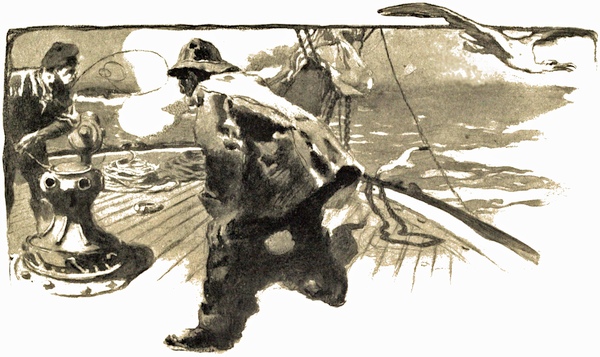
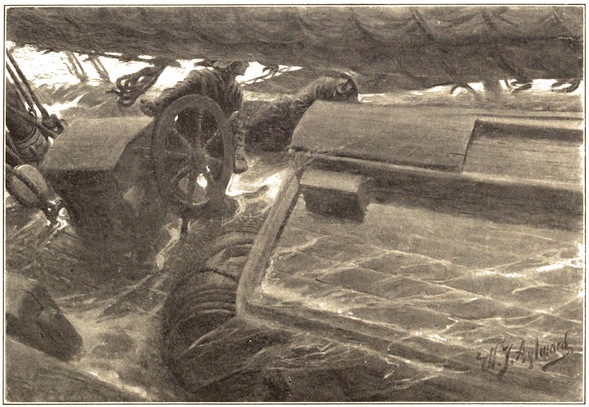
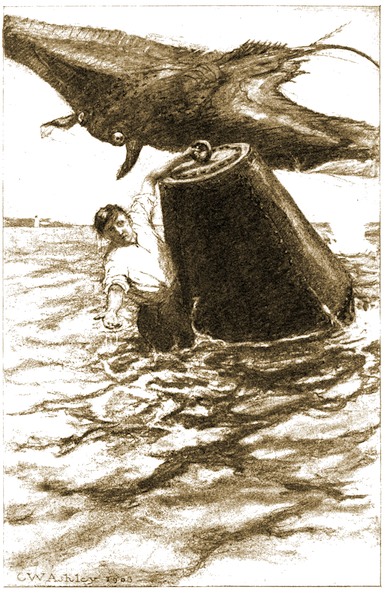
THE LINE WAS WHIZZING OUT.
Away into the vastness of the southern ocean
the old fellow led his charges, always keeping the
little whale he had with him close aboard. He
missed the mate who had been slain, but he knew
that she had disregarded his warning. He had
done all he could. Now he would take the rest
far away to other feeding grounds, and the ocean
would leave no trail to show the stranger whither
he had gone. The young one near him needed
protection, and he would keep him close until
he was large enough to look out for himself. On
the edge of Falkland Channel was plenty of food
at that season of the year, and a few hundred
miles would put the stranger safely out of sight.
The old brain longed for rest and quiet. Strife
was a useless thing, fit only for the young and
unthinking, or those possessed with the killing
spirit.
The morning dawned, and, as the sun rose
slanting from the southern ocean, the old bull
took a look around. Nothing broke the even line
of the horizon, and then, the feeling that the
stranger had been left behind coming upon him,
he slowed the tremendous pace. One hundred
miles of trackless sea had been placed between
him and the rocks of Staten Land.
For many weeks the herd cruised to the northward
of the Falkland Islands, the old bull still
keeping the young whale under his protecting
care. Finally there was born a pretty little baby
whale with rounded lines, weighing, perhaps, a
little more than half a ton. A pair of the fierce
“killer” sharks soon scented the tender little
fellow, and made a concerted rush, one day, to
seize him before the older whales could prevent;
but the bull smote one a blow with his flukes that
crushed him as flat as if a house had fallen upon
him, and the other took flight. He was a watchful
old fellow, and had to keep on the lookout
night and day, for the mother whale was weak,
and would recover slowly.
As the days passed the weather began to
change. The zone of the “variables,” or that of
the “roaring forties,” is not to be depended upon
long for sunshine and pleasant breezes. One day
it started in for a gale from the eastward, and
the sea was white with rolling combers. The
whale-food was driven south, and the animals
were forced to follow. The sun shone only for
a short time each day, being but a few degrees
above the sea line, and the high-rolling sea made
life upon the surface uncomfortable. The bull
headed for the South Orkney Islands, and for
days the little band of giants went along below
the surface, only coming up every now and then
to breathe.
As they made their way southward, the wind
grew less violent. The high black cliffs of the
islands offered no shelter to vessels, but to the
whales the lee of the land was comfortable, and
the sea was swarming with food. There they
would rest a while and take life easy, beyond the
reach of the hurricanes from Cape Horn.
The old bull guided the band among the
sunken peaks, and for weeks they fattened under
his care, when one bleak morning he came to the
surface of the sea and noticed a black shape approaching.
There was something strangely
familiar in the outlines, and, after watching it
for some minutes, he remembered the schooner
Erin.
She was heading straight toward the whales,
and was going slowly, as if in no particular
hurry, and upon her forecastle was the same
murderous gun which had slain the cow near Le
Maire Strait.
The young whale, who was in company,
breached playfully into full view and sounded.
The vessel did not change her course, but headed
straight for the cow with the newborn calf, who
was feeding a mile distant to the southward.
The old bull instantly struck the water with
his flukes and headed for her. The rest of the
herd took notice of the warning, and sank from
view; but, whether the cow failed to notice it, or
her young one was disobedient, it was too late
to find out. The schooner made a sudden spurt
of speed, and, coming close to the mother, fired
the harpoon into her before she fairly realized
what was taking place.
The dull boom of the shot told the old whale
what had happened, before he came up to look.
When he arrived within a hundred fathoms, the
mother was in her last agony, and her little
baby was being towed along with her, being unable
to realize its mother’s death, and still holding
to her with all the tenderness of a child.
The old bull lay watching events, and once
tried to make the little fellow let go by giving
the sea some tremendous slaps with his flukes;
but he was too young to understand, and, while
the bull watched, a boat was lowered and the
sailors began their work of destruction. They
rowed slowly toward the infant, and suddenly
one rose in the bow and hurled a harpoon into his
soft baby side. The little fellow gave a spring
upward in his agony. A man quickly pulled
him alongside the boat and another drove a
lance through him.
Jackson was standing upon the poop, looking
on, and the mate was on the forecastle, loading
the gun for another shot when an opportunity
should offer. The men in the waist were overhauling
the fluke chain to make fast to the dead
mother, while the man at the wheel held the
spokes idly. The skipper turned toward him.
“Seems to me that that’s the old cowardly
bull we fell in with to th’ no’th’ard; aint it?” he
asked.
“Yes, sir; it looks like him fer sure,” answered
the man; “jest see him, sir.”
As they looked, the great whale lay watching
the men in the boat. His old oily brain was
working, and the rapid events of the last few
minutes were gradually making an impression
on his mind. He was wondering at the
slaughter, and could hardly understand how it
was done so quickly. The mother had been a
favorite for many years, yet there she lay, suddenly
dead before him. Would the strange craft
follow him over the seas, and kill off the herd
one by one, until all were gone? The boat approaching
the young whale stirred his attention.
He smote the sea savagely with his flukes to
warn him of the danger. Then the iron went
home, and the little fellow was dead beside his
mother. Something flashed suddenly through
the old brain. The pent-up reserve of years
seemed to give way within him, all thought of
safety fell away, and the old feeling of the conqueror
rose within his heart.
“Good Lord, what’s a-comin’?” gasped Jackson.
His remark was not addressed to anyone in
particular, but was caused by a terrific commotion
in the sea which caused the men to drop
their gear and look out over the side to see what
was taking place.
The coward, the giant bull who had fled so
often from them, was heading straight for the
small boat and was tearing the southern ocean
into foam with his flukes. Straight as a harpoon
from the gun forward, he shot with tremendous
speed, hurling his hundred tons of bone and
sinew like a living avalanche upon the doomed
craft.
“Starn all,” was the hoarse yell from the
third officer, who stood upon the stern-sheets and
swung madly upon the steering oar. Men
strained their necks forward over the schooner’s
rail to see. The unfortunate men at the oars of
the whaleboat struggled wildly. An oar
snapped. There was a wild cry, and some
sprang up to dive over the side into the sea. At
that instant the whale leaped high in the air,
clearing the water fully two fathoms. Then he
crashed down upon the boat, wiping all out in a
tremendous smother of spray. He was close to
the Erin, and the mate stood waiting. There
was a loud report as Collins fired the exploding
harpoon into him, taking him almost “on the
fly,” as it were, and then as he disappeared
beneath the surface there was a heavy jar that
shook the Erin from stem to stern. She had been
rammed.
For an instant not a man aboard moved. Then
Jackson, with a face as white as chalk, came forward
and called below to the engineer.
The line was whizzing out upon the forecastle
head, showing that Collins had made the shot of
his life. He had struck the whale, but just where
he had no idea. He stood watching the line as
it flaked away with the rapidity of lightning, but
said no word to the men to have it snubbed. He
had felt the heavy jar beneath the schooner’s
keel, and knew what it meant as plainly as if he
had seen the stroke.
Two,—three,—four,—five hundred fathoms
went whirling over the side, and silence still
reigned aboard. The sea had smoothed again
where the whaleboat had been a few moments before,
but the only signs of her were a few floating
splinters. Not a man ever appeared again.
Suddenly the strain was broken.
“Water comin’ in fast below, sir,” was the
word passed on deck.
Jackson walked aft as if in a dream. The
mate left the gun, and the last fathom of the line
flaked overboard unheeded. It brought up suddenly,
taut as a bowstring, then snapped. The
mate paid not the least attention to it, but went
slowly aft.
“Shall we provision the boats, sir?” he asked,
as he approached the captain.
Jackson stared at him. “D’ye know what it
means?” asked the old whaleman huskily.
The mate nodded. Half an hour later, four
boats full of men were heading northward for the
Falkland Islands, and the only thing that remained
upon the spot where the Erin had floated
a short time before was the carcass of a mother
whale with her baby alongside, while above them
the birds hovered and screamed as if to mark the
grave of the lost ship.
The next year a Scottish whaleman from the
Falklands fell in with an old bull whale whose
starboard side bore a tremendous wound, partly
healed. He was so wary, however, that he was
soon lost sight of, and the school that followed
him gave no chance for a catch.