A masked dance, which for so long has been out of fashion in the world
that pretends to it, was the experiment selected by Molly Wycherly for
the warming up of her new house on Park Avenue.
The snowy avenue for blocks was a mass of motors and carriages; a
platoon of police took charge of the vehicular mess. Outside of the
storm-coated lines the penniless world of shreds and patches craned a
thousand necks as the glittering costumes passed from brougham and
limousine under the awnings into the great house.
Already in the new ball-room, along the edges of the whirl, masqueraders
in tumultuous throngs were crowding forward to watch the dancers or
drifting into the eddies and set-backs where ranks of overloaded gilt
chairs creaked under jewelled dowagers, and where rickety old beaux
impersonated tinselled courtiers on wavering but devoted legs.
Aloft in their rococo sky gallery a popular orchestra fiddled
frenziedly; the great curtains of living green set with thousands of
gardenias swayed in the air currents like Chinese tapestries; a
harmonious tumult swept the big new ball-room from end to end—a
composite uproar in which were mingled the rushing noise of silk,
clatter of sole and heel, laughter and cries of capering maskers
gathered from the four quarters of fashionable Gath to grace the
opening of the House of Wycherly. They were all there, dowager, matron,
débutante, old beaux, young gallant, dancing, laughing, coquetting,
flirting. Young eyes mocked the masked eyes that wooed them; adolescence
tormented maturity; the toothless ogled the toothsome. Unmasking alone
could set right this topsy-turvy world of carnival.
A sinuous Harlequin, his skin-tight lozenge-patterned dress shimmering
like the red and gold skin of a Malay snake, came weaving his way
through the edges of the maelstrom, his eyes under the black half-mask
glittering maliciously at the victims of his lathe-sword. With it he
recklessly slapped whatever tempted him, patting gently the rounded arms
and shoulders of nymph and shepherdess, using more vigour on the plump
contours of fat and elderly courtiers, spinning on the points of his
pump-toes, his limber lathe-sword curved in both hands above his head,
leaping lithely over a chair here and there, and landing always as
lightly as a cat on silent feet—a wiry, symmetrical figure under the
rakish bi-corne, instinct with mischief and grace infernal.
Encountering a burly masker dressed like one of Cromwell's ponderous
Ironsides, he hit him a resounding whack over his aluminum cuirass, and
whispered:
"That Ironside rig doesn't conceal you: it reveals you, Karl! Out with
your Bible and your Sword and preach the wrath to come!"
"It will come all right," said Westguard. "Do you know how many hundred
thousand dollars are wasted here to-night?... And yesterday a woman died
of hunger in Carmine Street. Don't worry about the wrath of God as long
as people die of cold and hunger in the streets of Ascalon."
"That's not as bad as dying of inanition—which would happen to the
majority here if they didn't have things like this to amuse 'em. For
decency's sake, Karl, pity the perplexities of the rich for a change!"
Westguard grunted something under his casque; then, adjusting his
aluminum mask:
"Are you having a good time, Dicky? I suppose you are."
"Oh, I'm gay enough," returned the Harlequin airily—"but there's
never much genuine gaiety among the overfed." And he slapped a passing
gallant with his wooden sword, spun around on his toes, bent over
gracefully and stood on his hands, legs twinkling above him in the air.
Then, with a bound he was on his nimble feet again, and, linking his arm
in the arm of the Cromwellian trooper, strolled along the ranks of
fanning dowagers, glancing amiably into their masked faces.
"Same old battle-line," he observed to his companion—"their jewels give
them away. Same old tiaras, same old ladies—all fat, all fifty, all
fanning away like the damned. Your aunt has on about a ton of emeralds.
I think she does it for the purpose of banting, don't you, Karl——"
The uproar drowned his voice: Westguard, colossal in his armour, gazed
gloomily around at the gorgeous spectacle for which his cousin Molly
Wycherly was responsible.
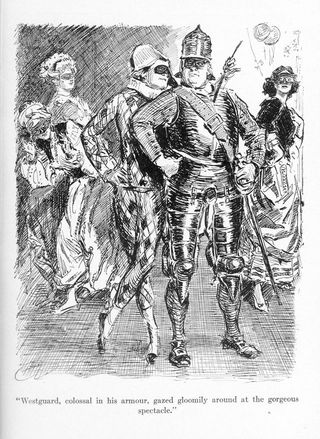 "Westguard, colossal in his armour, gazed gloomily around
at the gorgeous spectacle."
"Westguard, colossal in his armour, gazed gloomily around
at the gorgeous spectacle."
"It's monkey-shines like this that breed anarchists," he growled. "Did
you notice that rubbering crowd outside the police lines in the snow?
Molly and Jim ought to see it."
"Oh, cut it out, Karl," retorted the Harlequin gaily; "there'll be rich
and poor in the world as long as the bally old show runs—there'll be
reserved seats and gallery seats and standing room only, and ninety-nine
percent of the world cooling its shabby heels outside."
"I don't care to discuss the problem with you," observed Westguard.
After a moment he added: "I'm going to dance once or twice and get
out.... I suppose you'll flit about doing the agreeable and fashionable
until daylight."
"I suppose so," said the Harlequin, tranquilly. "Why not? Also you
ought to find material here for one of your novels."
"A man doesn't have to hunt for material. It's in his bedroom when he
wakes; it's all around him all day long. There's no more here than there
is outside in the snow; and no less.... But dancing all night isn't
going to help your business, Ricky."
"It won't hurt any business I'm likely to do."
"Isn't your Tappan-Zee Park panning out?"
"Fizzling out. Nobody's bought any building sites."
"Why not?"
"How the deuce do I know, Karl! I don't want to talk business, here——"
He ceased speaking as three or four white masked Bacchantes in
fluttering raiment came dancing by to the wild music of Philemon and
Baucis. Shaking their be-ribboned tambourines, flowery garlands and
lynx-skins flying from their shoulders, they sped away on fleet little
feet, hotly pursued by adorers.
"Come on," said the Harlequin briskly; "I think one of those skylarkers
ought to prove amusing! Shall I catch you one?"
But he found no encouragement in the swift courtship he attempted; for
the Bacchantes, loudly protesting at his interference, banged him over
his head and shoulders with their resounding tambourines and danced away
unheeding his blandishments.
"Flappers," observed a painted and powdered clown whose voice betrayed
him as O'Hara; "this town is overstocked with fudge-fed broilers.
They're always playin' about under foot, spoilin' your huntin'; and if
you touch 'em they ki-yi no end."
"I suppose you're looking for Mrs. Leeds," said Westguard, smiling.
"I fancy every man here is doin' the same thing," replied the clown.
"What's her costume? Do you know, Ironsides?"
"I wouldn't tell you if I did," said Westguard frankly.
The Harlequin shrugged.
"This world," he remarked, "is principally encumbered with women, and
naturally a man supposes the choice is unlimited. But as you live to
drift from girl to girl you'll discover that there are just two kinds;
the kind you can kiss and the kind you can't. So finally you marry the
latter. Does Mrs. Leeds flirt?"
"Will a fish swim?" rejoined the clown. "You bet she will flirt. Haven't
you met her?"
"I? No," said the Harlequin carelessly. Which secretly amused both
Westguard and O'Hara, for it had been whispered about that the new
beauty not only had taken no pains to meet Quarren, but had pointedly
ignored an opportunity when the choice lay with her, remarking that
dancing men were one of the social necessities which everybody took for
granted—like flowers and champagne. And the comment had been carried
straight to Quarren, who had laughed at the time—and had never
forgotten it, nor the apparently causeless contempt that evidently had
inspired it.
The clown brandished his bunch of toy balloons, and gazed about him:
"Anybody who likes can go and tell Mrs. Leeds that I'm her declared
suitor. I don't care who knows it. I'm foolish about her. She's
different from any woman I ever saw. And if I don't find her pretty soon
I'll smash every balloon over your head, Ricky!"
The Harlequin laughed. "Women," he said, "are cut out in various and
amusing patterns like animal crackers, but the fundamental paste never
varies, and the same pastry cook seasoned it."
"That's a sickly and degenerate sentiment," observed Westguard.
"You might say that about the unfledged," added O'Hara—"like those
kittenish Bacchantes. Winifred Miller and the youngest Vernon girl were
two of those Flappers, I think. But there's no real jollity among the
satiated," he added despondently. "A mask, a hungry stomach, and empty
pockets are the proper ingredients for gaiety—take it from me, Karl."
And he wandered off, beating everybody with his bunch of toy balloons.
Quarren leaped to the seat of a chair and squatted there drawing his
shimmering legs up under him like a great jewelled spider.
"Bet you ten that the voluminous domino yonder envelops my aunt, Mrs.
Sprowl," whispered Westguard.
"You're betting on a certainty and a fat ankle."
"Sure. I've seen her ankles going upstairs too often.... What the devil
is the old lady wearing under that domino?"
"Wait till you see her later," said Quarren, delightedly. "She has come
as Brunhilda."
"I don't want to see three hundred pounds of relative as Brunhilda,"
growled Westguard.
"You will, to-morrow. She's given her photograph to a Herald man."
"What did you let her do it for?" demanded Westguard wrathfully.
"Could I help it?"
"You could have stopped her. She thinks your opinion is the last lisp in
fashionable art problems."
"There are some things you can't tell a woman," said Quarren. "One of
'em concerns her weight."
"Are you afraid of Mrs. Sprowl?"
The Harlequin laughed:
"Where would I be if I incurred your aunt's displeasure, dear friend?"
"Out of the monkey house for good I suppose," admitted Westguard. "Lord,
Ricky, what a lot you have had to swallow for the sake of staying put
among these people!"
Quarren sat meditating under his mask, cross-legged, twirling his
sword, the crash of the floor orchestra dinning in his close-set ears.
"Yes," he said without resentment, "I've endured my share. That's one
reason why I don't want to let several years of humiliation go for
nothing. I've earned whatever place I have. And I mean to keep it."
Westguard turned on him half angrily, hesitated, then remained silent.
What was the use? If Quarren had not been guilty of actually fawning,
toadying, currying favour, he had certainly permitted himself to be
rudely used. He had learned very thoroughly his art in the school of the
courtier—learned how and when to be blind, silent, deaf; how to offer,
how to yield, when and how to demand and exact. Which, to Westguard,
meant the prostitution of intelligence. And he loathed the game like a
man who is free to play it if he cares to. Of those who are denied
participation, few really hate it.
But he said nothing more; and the Harlequin, indolently stretching his
glittering limbs, dropped a light hand on Westguard's cuirassed
shoulder:
"Don't be forever spoiling things for me, Karl. I really do enjoy the
game as it lies."
"It does lie—that is the trouble, Rix."
"I can't afford to criticise it.... Listen; I'm a mediocre man; I'd
never count among real men. I count in the set which I amuse and which
accepts me. Let me enjoy it, can't you?"
An aged dandy, masked, painted, wizened, and dressed like Henri II,
tottered by with a young girl on his arm, his shrill, falsetto giggle
piercing the racket around them.
"Do you wish to live to be like that?" asked Westguard sharply.
"Oh, I'll die long before that," said Quarren cheerfully, and leaped
lightly to his feet. "I shall now accomplish a little dancing," he said,
pointing with his wooden sword at the tossing throng. "Venus send me a
pretty married woman who really loves her husband.... By Bacchus! Those
dancers are going it! Come on, Karl. Leave us foot it!"
Many maskers were throwing confetti now: multi-tinted serpents shot out
across the clamorous gulf; bunches of roses flung high, rising in swift
arcs of flight, crossed and recrossed. All along the edges of the dance,
like froth and autumn leaves cast up from a whirlpool, fluffy feminine
derelicts and gorgeous masculine escorts were flung pell-mell out of the
maelstrom and left stranded or drifting breathless among the eddies
setting in toward the supper-room.
Suddenly, as the Harlequin bent forward to plunge into the crush, the
very centre of the whirlpool parted, and out of it floated a fluttering,
jingling, dazzling figure all gold—slender, bare-armed and bare of
throat and shoulders, auriferous, scintillating from crown to ankle—for
her sleeveless tabard was cloth-of-gold, and her mask was gold; so were
her jewelled shoes and the gemmed fillet that bound her locks; and her
thick hair clustering against her cheeks had the lustre of precious
metal.
Jingling, fluttering, gems clashing musically, the Byzantine dancer,
besieged by adorers, deftly evaded their pressing gallantries—evaded
the Harlequin, too, with laughing mockery, skilfully disengaging herself
from the throng of suitors stumbling around her, crowded and buffeted on
every side.
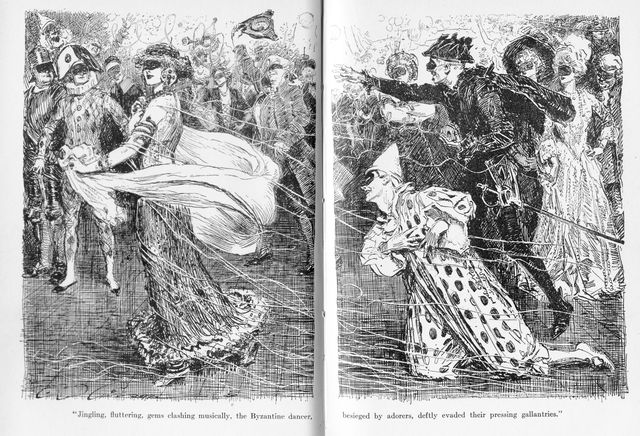 "Jingling, fluttering, gems clashing musically, the
Byzantine dancer, besieged by adorers, deftly evaded their pressing
gallantries."
"Jingling, fluttering, gems clashing musically, the
Byzantine dancer, besieged by adorers, deftly evaded their pressing
gallantries."
After her like a flash sped Harlequin: for an instant, just ahead of
him, she appeared in plain sight, glimmering brightly against the green
and swaying tapestry of living leaves and flowers, then even as her
pursuers looked at her, she vanished before their very eyes.
They ran about distractedly hunting for her, Turk, Drum Major, Indian
Chief, and Charles the First, then reluctantly gave up the quest and
drifted off to seek for another ideal. All women are ideal under the
piquant promise of the mask.
A pretty shepherdess, lingering near, whispered close to Quarren's
shoulder behind her fan:
"Check to you, Harlequin! That golden dancer was the only girl in town
who hasn't taken any pains to meet you!"
He turned his head, warily, divining Molly Wycherly under the disguise,
realising, too, that she recognised him.
"You'll never find her now," laughed the shepherdess. "Besides she does
not care a rap about meeting a mere Harlequin. It's refreshing to see
you so thoroughly snubbed once in a while." And she danced gaily away,
arms akimbo, her garlanded crook over her shoulder; and her taunting
laughter floated back to him where he stood irresolute, wondering how
the golden dancer could have so completely vanished.
Suddenly he recollected going over the house before its completion with
Jim Wycherly, who had been his own architect, and the memory of a
certain peculiarity in the construction of the ball-room flashed into
his mind. The only possible explanation for her disappearance was that
somebody had pointed out to her the low door behind the third pillar,
and she was now in the gilded swallow's-nest aloft.
It was a whim of Wycherly—this concealed stair—he recalled it
perfectly now—and, parting the living tapestry of blossoms, he laid
his hand on the ivory and gilded paneling, pressing the heart of one
carved rose after another, until with a click! a tiny door swung inward,
revealing a narrow spiral of stairs, lighted rosily by electricity.
He stepped inside, closed the door, and listened, then mounted
noiselessly. Half way up he caught the aroma of a cigarette; and, a
second later he stepped out onto a tiny latticed balcony, completely
screened.
The golden dancer, who evidently had been gazing down on the carnival
scene below from behind the lattice, whirled around to confront him in a
little flurry of cigarette smoke.
For a moment they faced each other, then:
"How did you know where to find me, Harlequin?"
"I'd have died if I hadn't found you, fairest, loveliest——"
"That is no answer! Answer me!"
"Why did you flee?" he asked. "Answer that, first."
She glanced at her cigarette and shrugged her shoulders:
"You see why I fled, don't you? Now answer me."
The Harlequin presented the hilt of his sword which was set with a tiny
mirror.
"You see why I fled after you," he said, "don't you?"
"All the same," she insisted, smilingly, "I have been informed on
excellent authority that I am the only one, except the family, who knows
of this balcony. And here comes a Harlequin blundering in! You are not
Mr. Wycherly; and you're certainly not Molly."
"Alas! My ultimate ends are not as shapely."
"Then who are you?" She added, laughing: "They're shapely enough, too."
"I am only a poor wandering, love-smitten Harlequin—" he said,
"scorned, despised, and mocked by beauty——"
"Love-smitten?" she repeated.
"Can you doubt it, now?"
She laughed gaily and leaned back against the balcony's velvet rail:
"You lose no time in declaring yourself, do you, Harlequin?—that is, if
you are hinting that I have smitten you with the pretty passion."
"Through and through, beautiful dancer——"
"How do you know that I am beautiful under this mask?"
"I know many things. That's my compensation for being only a poor
mountebank of a Harlequin—magic penetration—the clairvoyance of
radium."
"Did you expect to find me at the top of those cork-screw stairs?"
"I did."
"Why?"
"Inference. Every toad hides a jewel in its head. So I argued that
somewhere in the ugliness of darkest Philistia a gem must be hidden; and
I've searched for years—up and down throughout the haunts of men from
Gath to Ascalon. And—behold! My quest is ended at your pretty
feet!—Rose-Diamond of the World!"
He sank lithely on one knee; she laughed deliciously, looking down at
his masked face.
"Who are you, Harlequin?—whose wits and legs seem to be equally supple
and symmetrical?"
"Tell it not in Gath; Publish it not in the streets of Ascalon; I am
that man for whom you were destined before either you or I were born.
Are you frightened?"
The Byzantine dancer laughed and shook her head till all the golden
metal on her was set chiming.
He said, still on one knee at her feet:
"Exquisite phantom of an Empire dead, from what emblazoned sarcophagus
have you danced forth across our modern oceans to bewitch the Philistia
of to-day? Who clothed you in scarlet delicately? Who put ornaments of
gold upon your apparel——"
"You court me with Scripture as smoothly as Heaven's great Enemy," she
said—"and to your own ends, as does he. Are you leagued with him, O
agile and intrusive Harlequin, to steal away my peace of mind?"
Lithely, silently he leaped up to the balustrade and, gathering his
ankles under him, squatted there, cross-legged, peering sideways at her
through the slanting eye-holes.
"If that screen behind you gives way," she warned him, "you will have
accomplished your last harlequinade."
He glanced coolly over his shoulder:
"How far is it to the floor below, do you suppose?"
"Far enough to make a good harlequin out of a live one," she said....
"Please be careful; I really mean it."
"Child," he said solemnly, "do you suppose that I mind falling a hundred
feet or so on my head? I've already fallen infinitely farther than that
this evening."
"And it didn't kill you?" she exclaimed, clasping her hands,
dramatically.
"No. Because our destiny must first be accomplished before I die."
"Ours?"
"Yours and mine, pretty dancer! I've already fulfilled my destiny by
falling in love with you at first sight. That was a long fall, wasn't
it?"
"Very. Am I to fulfil mine in a similar manner?"
"You are."
"Will it—kill me, do you think?"
"I don't think so. Try it."
"Will it hurt?—this terrible fall? And how far must I descend to fall
in love with you?"
"Sometimes falling in love does hurt," he said gravely, "when the fall
is a long one."
"Is this to be a long one?"
"You may think so."
"Then I decline to tumble. Please go somewhere about your business,
Master Harlequin. I'm inclined to like you."
"Dancer, my life's business is wherever you happen to be."
"Why are you so sure?"
"Magic," he said seriously. "I deal in it."
"Wonderful! Your accomplishments overwhelm me. Perhaps, through the aid
of magic, you can even tell me who I am!"
"I think I can."
"Is that another threat of magic?"
"It's a bet, too, if you like."
"Are you offering to bet me that, before I unmask, you will be able to
discover who I am?"
"Yes. Will you make it a wager?" She stood, silent, irresolute,
cautious but curious; then:
"Do you mean that you can find out who I am? Now? Here in this
balcony?"
"Certainly."
"That is sheer nonsense," she said with decision. "I'll bet you anything
you like."
"What stakes?"
"Why there's nothing to bet except the usual, is there?"
"You mean flowers, gloves, stockings, bon-bons?"
"Yes."
The Harlequin, smiling at her askance, drew from the hilt of his
lathe-sword a fresh cigarette, lighted it, looked across at the level
chandelier, and sent a ring of smoke toward the twinkling wilderness of
prisms hanging in mid-air.
"Let's be original or perish," he said. "I'll bet you a day out of my
life against a day out of yours that I discover who you are in ten
minutes."
"I won't accept such a silly wager! What would you do with me for a
day?"
The Harlequin bent his masked head. Over his body the lozenges of
scarlet and gold slid crinkling as though with suppressed and serpentine
mirth.
"What are you laughing at?" she demanded half vexed, half amused.
"Your fears, pretty dancer."
"I am not afraid!"
"Very well. Prove it! I have offered to bet you a day out of my life
that I'll tell you who you are. Are you afraid to wager a day out of
yours that I can't do it?"
She shook her head so that the burnished locks clustered against her
cheeks, and all over her slim figure the jingling gold rang melodiously.
"I haven't long to live," she observed. "A day out of life is too much
to risk."
"Why don't you think that you have long to live?"
"I haven't. I know it."
"How do you know?"
"I just know.... Besides, I don't wish to live very long."
"You don't wish to live long?"
"Only as long as I'm young enough to be forgetful. Old age is a
horror—in some cases. I don't desire ever to be forty. After forty they
say one lives on memory. I don't wish to."
Through the slits of his mask his curious eyes watched her steadily.
"You're not yet twenty-four," he said.
"Not quite. That is a good guess, Harlequin."
"And you don't want to live to be old?"
"No, I don't wish to."
"But you are rather keen on living while you're young."
"I've never thought much about it. If I live, it's all right; if I die,
I don't think I'll mind it.... I'm sure I shouldn't."
Her cigarette had gone out. She tossed it aside and daintily consented
to exchange cigarettes with him, offering her little gold case.
"You're carefully inspecting my initials, aren't you?" she observed,
amused. "But that monogram will not help you, Master Harlequin."
"Marriage alters only the final initial. Are you, by any unhappy
chance——"
"That's for you to find out! I didn't say I was! I believe you are
making me tell you things!"
She threw back the lustrous hair that shadowed her cheeks and leaned
forward, her shadowed eyes fixed intently upon him through the apertures
of her golden mask.
"I'm beginning to wonder uneasily who you may be, Monsieur Harlequin!
You alarm me a little."
"Aha!" he said. "I've told you I deal in magic! That you don't know who
I am, even after that confession, makes me reasonably certain who you
are."
"You're trying to scare me," she said, disdainfully.
"I'll do it, yet."
"I wonder."
"You'll wonder more than ever in a few moments.... I'm going to tell you
who you are. But first of all I want you to fix the forfeit——"
"Why—I don't know.... What do you want of me?" she asked, mockingly.
"Whatever you care to risk."
"Then you'll have to name it. Because I don't particularly care to offer
you anything.... And please hasten—I'll be missed presently——"
"Won't you bet one day out of your life?"
"No, I won't. I told you I wouldn't."
"Then—one hour. Just a single hour?"
"An hour?"
"Yes, sixty minutes, payable on demand: If I win, you will place at my
disposal one entire hour out of your life. Will you dare that much,
pretty dancer?"
She laughed, looked up at him; then readjusting her mask, she nodded
disdainfully. "Because," she observed, "it is quite impossible for you
ever to guess who I am. So do your very worst."
He sprang from the balustrade, landing lightly, his left hand spread
over his heart, his bi-corne flourished in the other.
"You are Strelsa Leeds!" he said in a low voice.
The golden dancer straightened up to her full height, astounded, and a
bright flood of colour stained her cheeks under the mask's curved edge.
"It—it is impossible that you should know—" she began, exasperated.
"How could you? Only one person knew what I was to wear to-night! I
came by myself with my maid. It—it is magic! It is
infernal—abominable magic——"
She checked herself, still standing very straight, the gorgeous,
blossom-woven cloth-of-gold rippling; the jewels shooting light from the
fillet that bound her hair.
After a silence:
"How did you know?" she asked, striving to smile through the flushed
chagrin. "It is perfectly horrid of you—anyhow——"
Curiosity checked her again; she stood gazing at him in silence,
striving to pierce the eye-slits of that black skin-mask—trying to
interpret the expression of the mischievous mobile mouth below it—or,
perhaps the malice was all in those slanting slits behind which two
strange eyes sparkled steadily out at her from the shadow.
"Strelsa Leeds," he repeated, and flourished one hand in graceful
emphasis as she coloured hotly again. And he saw the teeth catch at her
under lip.
"It is outrageous," she declared. "Tell me instantly who you are!"
"First," he insisted, mischievously, "I claim the forfeit."
"The—the forfeit!" she faltered.
"Did you not lose your wager?"
She nodded reluctantly, searching the disguised features before her in
vain for a clew to his identity. Then, a trifle uneasily:
"Yes, of course I lost my wager. But—I did not clearly understand what
you meant by an hour out of my life."
"It is to be an hour at my disposal," he explained with another
grotesque bow. "I think that was the wager?"
"Y-yes."
"Unless," he remarked carelessly, "you desire the—ah—privilege and
indisputable prerogative of your delightful sex."
"The privilege of my sex? What is that?" she asked, dangerously polite.
"Why, to change your divine mind—repudiate the obligation——"
"Harlequin!"
"Madame?" with an elaborate and wriggling bow.
"I pay what I owe—always.... Always! Do you understand?"
The Harlequin bowed again in arabesques, very low, yet with a singular
and almost devilish grace:
"Madame concedes that the poor Harlequin has won his wager?"
"Yes, I do—and you don't appear to be particularly humble, either."
"Madame insists on paying?" he inquired suavely.
"Yes, of course I do!" she said, uneasily. "I promised you an hour out
of my life. Am I to pay it now?"
"You pay by the minute—one minute a day for sixty days. I am going to
take the first minute now. Perhaps I may ask for the other fifty-nine,
also."
"How?"
"Shall I show you how?"
"Very well."
"A magic pass or two, first," he said gaily, crooking one spangled knee
and spinning around. Then he whipped out his lathe-sword, held it above
his head, coolly passed a glittering arm around her waist, and looked
down into her flushed face.
"You will have to count out the sixty seconds," he said. "I shall be
otherwise occupied, and I can't trust myself to do two things at once."
"What are you about to do? Sink through a trap-door with me?"
"I am about to salute you with the magic kiss. After that you'll be my
Columbine forever."
"That is not included in the bet! Is it?" she asked in real
consternation.
"I may do as I please with my hour, may I not?"
"Was it the bet that you were to be at liberty to—to kiss me?"
"I control absolutely an hour out of your life, do I not? I may use it
as I please. You had better count out sixty seconds."
She looked down, biting her lip, and touched one hand against her
cheeks, alternately, as though to cool them with the snowy contact.
He waited in silence for her reply.
"Very well," she said resolutely, "if you elect to use the first minute
of your hour as frivolously as that, I must submit, I suppose."
And she began to count aloud, rapidly: "One, two, three, four, five,
six, seven, eight, ni——"
Her face was averted; he could see the tip of one small ear all aflame.
Presently she ventured a swift glance around at him and saw that he was
laughing.
"Ten, eleven, twelve," she counted nervously, still watching him;
"thirteen, fourteen, fifteen—" panic threatened her; she doubled both
hands in the effort of self-control and timed her counting as though the
rapid beating of the tempo could hasten her immunity—"sixteen,
seventeen, eighteen, nineteen, twenty, one, two, three——"
"Play fair!" he exclaimed.
"I am trying to. Can't I say it that way up to ten, and then say
thirty?"
"Oh, certainly. I've still half a minute. You'd better hurry! I may
begin at any moment."
"Four—five—six—seven—m-m-m—thirty!" she cried, and the swift
numbers fled from her lips fairly stumbling over one another, tumbling
the sequence of hurrying numerals into one breathless gasp of: "Forty!"
His arm slid away from her waist; he stepped backward, and stood,
watching her, one finger crooked, supporting his chin, the ironical
smile hovering ever on his lips.
"Fifty!" she counted excitedly, her hands beating time to the counting;
"—fifty-one—two—three—four—m-m-m—sixty!"—and she whirled around
to face him with an impulsively triumphant gesture which terminated in
a swift curtsey, arms flung wide apart.
"Voila!" she said, breathlessly, "I've paid my bet! Am I not a good
sport, Harlequin? Own that I am and I will forgive your outrageous
impudence!"
"You are a most excellent sport, madame!" he conceded, grinning.
Relief from the tension cooled her cheeks; she laughed bewitchingly and
looked at him, exultant, unafraid.
"I frightened you well with my desperate counting, didn't I? You
completely forgot to do—anything, didn't you? Voyons! Admit it!"
"You completely terrorized me," he admitted.
"Besides," she said, "while I was so busily counting the seconds aloud
you couldn't very well have kissed me, could you? That was strategy.
You couldn't have managed it, could you?"
"Not very easily."
"I really did nonplus you, didn't I?" she insisted, aware of his
amusement.
"Oh, entirely," he said. "I became an abject idiot."
She stood breathing more evenly now, the pretty colour coming and going
in her cheeks. Considering him, looking alternately at his masked eyes
and at his expressive lips where a kind of silent and infernal mirth
still flickered, a sudden doubt assailed her. And presently, with a
dainty shrug, she turned and glanced down through the gilt lattice
toward the floor below.
"I suppose," she said, tauntingly, "you hope I'll believe that you
refrained from kissing me out of some belated consideration for decency.
But I know perfectly well that I perplexed you, and confused you and
intimidated you."
"This is, of course, the true solution of my motives in not kissing
you."
She turned toward him:
"What motive?"
"My motive for not kissing you. My only motive was consideration for
you, and for the sacred conventions of Sainte Grundy."
"I believe," she said scornfully, "you are really trying to make me
think that you could have done it, and didn't!"
"You are too clever to believe me a martyr to principle, madame!"
She looked at him, stamped her foot till the bangles clashed.
"Why didn't you kiss me, then?—if you wish to spoil my victory?"
"You yourself have told me why."
"Am I wrong? Could you—didn't I surprise you—in fact, paralyse
you—with astonishment?"
He laughed delighted; and she stamped her ringing foot again.
"I see," she said; "I am supposed to be doubly in your debt, now. I'd
rather you had kissed me and we were quits!"
"It isn't too late you know."
"It is too late. It's all over."
"Madame, I have fifty-nine other minutes in which to meet your kindly
expressed wishes. Did you forget?"
"What!" she exclaimed, aghast.
"One hour less one minute is still coming to me."
"Am I—have I—is this ridiculous performance going to happen again?"
she asked, appalled.
"Fifty-nine times," he laughed, doubling one spangled leg under the
other and whirling on his toe till he resembled a kaleidoscopic
teetotum. Then he drew his sword, cut right and left, slapped it back
into its sheath, and bowed his wriggling bow, one hand over his heart.
"Don't look so troubled, madame," he said. "I release you from your
debt. You need never pay me what you owe me."
Up went her small head, fiercely, under its flashing hair:
"Thank you. I pay my debts!" she said crisply.
"You decline to accept your release?"
"Yes, I do!—from you!"
"You'll see this thing through!—if it takes all winter?"
"Of course;" trying to smile, and not succeeding.
He touched her arm and pointed out across the hot, perfumed gulf to the
gilded clock on high:
"You have seen it through! It is now one minute to midnight. We have
been here exactly one hour, lacking a minute, since our bet was on....
And I've wanted to kiss you all the while."
Confused, she looked at the clock under its elaborate azure and ormolu
foliations, then turned toward him, still uncertain of her immunity.
"Do you mean that you have really used the hour as you saw fit?" she
asked. "Have I done my part honestly?—Like a good sportsman? Have I
really?"
He bowed, laughingly:
"I cheerfully concede it. You are a good sport."
"And—all that time—" she began—"all that time——"
"I had my chances—sixty of them."
"And didn't take them?"
"Only wanted to—but didn't."
"You think that I——"
"A woman never forgets a man who has kissed her. I took the rather
hopeless chance that you might remember me without that. But it's a long
shot. I expect that you'll forget me."
"Do you want me to remember you?" she asked, curiously.
"Yes. But you won't."
"How do you know?"
"I know—from the expression of your mouth, perhaps. You are too pretty,
too popular to remember a poor Harlequin."
"But you never have seen my face? Have you?"
"No."
"Then why do you continually say that I am pretty?"
"I can divine what you must be."
"Then—how—why did you refrain from—" She laughed lightly, and looked
up at him, mockingly. "Really, Harlequin, you are funny. Do you
realise it?"
She laughed again and the slight flush came back into her cheeks.
"But you're nice, anyway.... Perhaps if you had seen my face you might
have let me go unkissed all the quicker.... Masks cover horrible
surprises.... And, then again, if you had seen it, perhaps you might
never have let me go at all!" she added, audaciously.
In the gilded balcony opposite, the orchestra had now ceased playing;
the whirl and noise of the dancers filled the immense momentary quiet.
Then soft chimes from the great clock sounded midnight amid cries of,
"Unmask! masks off, everybody!"
The Harlequin turned and drawing the black vizard from his face, bent
low and saluted her hand; and she, responding gaily with a curtsey,
looked up into the features of an utter stranger.
She stood silent a moment, the surprised smile stamped on her lips;
then, in her turn, she slipped the mask from her eyes.
"Voila!" she cried. "C'est moi!"
After a moment he said, half to himself;
"I knew well enough that you must be unusual. But I hadn't any
idea—any—idea——"
"Then—you are not disappointed in me, monsieur?"
"My only regret is that I had my hour, and wasted it. Those hours never
sound twice for wandering harlequins."
"Poor Harlequin!" she said saucily—"I'm sorry, but even your magic
can't recall a vanished hour! Poor, poor Harlequin! You were too
generous to me!"
"And now you are going to forget me," he said. "That is to be my
reward."
"Why—I don't think—I don't expect to forget you. I suppose I am likely
to know you some day.... Who are you, please? Somebody very grand in
New York?"
"My name is Quarren."
There was a silence; she glanced down at the ball-room floor through
the lattice screen, then slowly turned around to look at him again.
"Have you ever heard of me?" he asked, smiling.
"Yes."
"Are you disappointed?"
"Y-es. Pleasantly.... I supposed you to be—different."
He laughed:
"Has the world been knocking me very dreadfully to you, Mrs. Leeds?"
"No.... One's impressions form without any reason—and
vaguely—from—nothing in particular.—I thought you were a very
different sort of man.—I am glad you are not."
"That is charming of you."
"It's honest. I had no desire to meet the type of man I supposed you to
be. Am I too frank?"
"No, indeed," he said, laughing, "but I'm horribly afraid that I really
am the kind of man you imagined me."
"You are not."
"How do you know?"
"No," she said, shaking her pretty head, "you can't be."
He said, quoting her own words amiably: "I'm merely one of the necessary
incidents of any social environment—like flowers and champagne——"
"Mr. Quarren!"
In her distress she laid an impulsive hand on his sleeve; he lifted it,
laid it across the back of his own hand, and bowing, saluted it lightly,
gaily.
"I am not offended," he said; "—I am what you supposed me."
"Please don't say it! You are not. I didn't know you; I
was—prejudiced——"
"You'll find me out sooner or later," he said laughing, "so I might as
well admit that your cap fitted me."
"It doesn't fit!" she retorted; "I was a perfect fool to say that!"
"As long as you like me," he returned, "does it make any difference what
I am?"
"Of course it does! I'm not likely to find a man agreeable unless he's
worth noticing."
"Am I?"
"Oh, gentle angler, I refuse to nibble. Be content that an hour out of
my life has sped very swiftly in your company!"
She turned and laid her hand on the little gilt door. He opened it for
her.
"You've been very nice to me," she said. "I won't forget you."
"You'll certainly forget me for that very reason. If I hadn't been nice
I'd have been the exception. And you would have remembered."
She said with an odd smile:
"Do you suppose that pleasant things have been so common in my life that
only the unpleasant episode makes any impression on my memory?"
"To really remember me as I want you to, you ought to have had something
unpardonable to forgive me."
"Perhaps I have!" she said, daringly; and slipped past him and down the
narrow stairs, her loup-mask fluttering from her elbow.
At the foot of the stairs she turned, looking back at him over her bare
shoulder:
"I've mortally offended at least three important men by hiding up there
with you. That is conceding something to your attractions, isn't it?"
"Everything. Will you let me find you some supper—and let the mortally
offended suitors sit and whistle a bit longer?"
"Poor suitors—they've probably been performing heel-tattoos for an
hour.... Very well, then—I feel unusually shameless to-night—and I'll
go with you. But don't be disagreeable to me if a neglected and
glowering young man rushes up and drags me away by the back hair."
"Who for example?"
"Barent Van Dyne, for instance."
"Oh, we'll side-step that youthful Knickerbocker," said Quarren, gaily.
"Leave it to me, Mrs. Leeds."
"To behave so outrageously to Mr. Van Dyne is peculiarly horrid and
wicked of me," she said. "But you don't realise that—and—the fact
remains that you did not take your forfeit. And I've a lot to make up
for that, haven't I?" she added so naïvely that they both gave way to
laughter unrestrained.
The light touch of her arm on his, now guiding him amid the noisy,
rollicking throngs, now yielding to his guidance, ceased as he threaded
a way through the crush to a corner, and seated her at a table for two.
In a few moments he came back with all kinds of delectable things; went
for more, returned laden, shamelessly pulled several palms between them
and the noisy outer world, and seated himself beside her.
With napkin and plate on the low table beside her, she permitted him to
serve her. As he filled her champagne glass she lifted it and looked
across it at him:
"How did you discover my identity?" she asked. "I'm devoured by
curiosity."
"Shall I tell you?"
"Please."
"I'll take a tumble in your estimation if I tell you."
"I don't think you will. Try it anyway."
"Very well then. Somebody told me."
"And you let me bet with you! And you bet on a certainty!"
"I did."
"Oh!" she exclaimed reproachfully, "is that good sportsmanship, Mr.
Quarren?"
"No; very bad. And that was why I didn't take the forfeit. Now you
understand."
She sat considering him, the champagne breaking in her glass.
"Yes, I do understand now. A good sportsman couldn't take a forfeit
which he won betting on a certainty.... That wasn't a real wager, was
it?"
"No, it wasn't."
"If it had been, I—I don't suppose you'd have let me go."
"Indeed not!"
They laughed, watching each other, curiously.
"Which ought to teach me never again to make any such highly original
and sporting wagers," she said. "Anyway, you were perfectly nice about
it. Of course you couldn't very well have been otherwise. Tell me, did
you really suppose me to be attractive? You couldn't judge. How could
you—under that mask?"
"Do you think that your mouth could have possibly belonged to any other
kind of a face except your own?" he said coolly.
"Is my mouth unusual?"
"Very."
"How is it unusual?"
"I haven't analysed the matter, but it is somehow so indescribable that
I guessed very easily what the other features must be."
"Oh, flattery! Oh, impudence! Do you remember when Falstaff said that
the lion could always recognise the true prince? Shame on you, Mr.
Quarren. You are not only a very adroit flatterer but a perfectly good
sportsman after all—and the most gifted tormentor I ever knew in all my
life. And I like you fine!" She laughed, and made a quick little
gesture, partly arrested as he met her more than half way, touching the
rim of his glass to hers. "To our friendship," he said.
"Our friendship," she repeated, gaily, "if the gods speed it."
"—And—its consequences," he added. "Don't forget those."
"What are they likely to be?"
"Who knows? That's the gamble! But let us recognise all kinds of
possibilities, and drink to them, too. Shall we?"
"What do you mean by the consequences of friendship?" she repeated,
hesitating.
"That is the interesting thing about a new friendship," he explained.
"Nobody can ever predict what the consequences are to be. Are you afraid
to drink to the sporting chances, hazards, accidents, and possibilities
of our new friendship, Mrs. Leeds? That is a perfectly good sporting
proposition."
She considered him, interested, her eyes full of smiling curiosity,
perfectly conscious of the swift challenge of his lifted glass.
After a few seconds' hesitation she struck the ringing rim of her glass
against his:
"To our new friendship, Monsieur Harlequin!" she said lightly—"with
every sporting chance, worldly hazard, and heavenly possibility in it!"
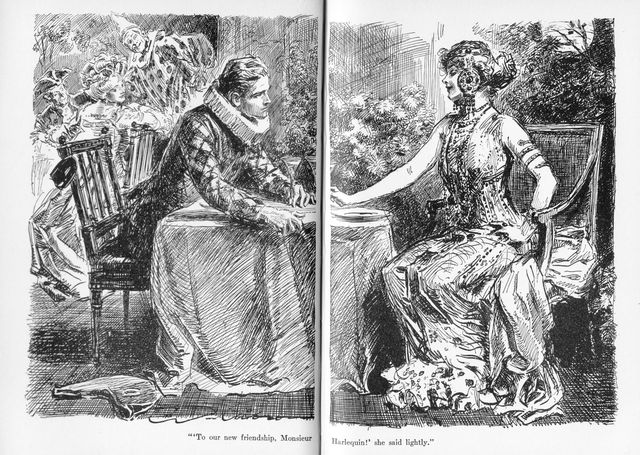 "'To our new friendship, Monsieur Harlequin!' she said
lightly."
"'To our new friendship, Monsieur Harlequin!' she said
lightly."
For the first time the smile faded from his face, and something in his
altered features arrested her glass at her very lips.
"How suddenly serious you seem," she said. "Have I said anything?"
He drained his glass; after a second she tasted hers, looked at him,
finished it, still watching him.
"Really," she said; "you made me feel for a moment as though you and I
were performing a solemn rite. That was a new phase of you to me—that
exceedingly sudden and youthful gravity."
He remained silent. Into his mind, just for a second, and while in the
act of setting the glass to his lips, there had flashed a flicker of
pale clairvoyance. It seemed to illumine something within him which he
had never believed in—another self.
For that single instant he caught a glimpse of it, then it faded like a
spark in a confused dream.
He raised his head and looked gravely across at Strelsa Leeds; and
level-eyed, smiling, inquisitive, she returned his gaze.
Could this brief contact with her have evoked in him a far-buried
something which had never before given sign of existence? And could it
have been anything resembling aspiration that had glimmered so palely
out of an ordered and sordid commonplace personality which, with all
its talent for frivolity, he had accepted as his own?
Without reason a slight flush came into his cheeks.
"Why do you regard me so owlishly?" she asked, amused. "I repeat that
you made me feel as though we were performing a sort of solemn rite when
we drank our toast."
"You couldn't feel that way with such a thoroughly frivolous man as I
am. Could you?"
"I'm rather frivolous myself," she admitted, laughing. "I really can't
imagine why you made me feel so serious—or why you looked as though you
were. I've no talent for solemnity. Have you?"
"I don't think so," he said. "What a terrible din everybody is making!
How hot and stifling it is here—with all those cloying gardenias.... A
man said, this evening, that this sort of thing makes for anarchy....
It's rather beastly of me to sit here criticising my host's
magnificence.... Do you know—it's curious, too—but I wish that, for
the next hour or two, you and I were somewhere alone under a good wide
sky—where there was no noise. It's an odd idea, isn't it, Mrs. Leeds.
And probably you don't share it with me."
She remained silent, thoughtful, her violet-gray eyes humorously
considering him.
"How do you know I don't?" she said at last. "I'm not enamoured of
noise, either."
"There's another thing," he went on, smiling—"it's rather curious,
too—but somehow I've a sort of a vague idea that I've a lot of things
to talk to you about. It's odd, isn't it?"
"Well you know," she reminded him, "you couldn't very well have a lot
of things to talk to me about considering the fact that we've known each
other only an hour or so."
"It doesn't seem logical.... And yet, there's that inexplicable
sensation of being on the verge of fairly bursting into millions of
words for your benefit—words which all my life have been bottled up in
me, accumulating, waiting for this opportunity."
They both were laughing, yet already a slight tension threatened
both—had menaced them, vaguely, from the very first. It seemed to
impend ever so slightly, like a margin of faintest shadow edging
sunlight; yet it was always there.
"I haven't time for millions of words this evening," she said. "Won't
some remain fresh and sparkling and epigrammatic until—until——"
"To-morrow? They'll possibly keep that long."
"I didn't say to-morrow."
"I did."
"I'm perfectly aware of the subtle suggestion and subtler flattery, Mr.
Quarren."
"Then, may I see you to-morrow?"
"Utterly impossible—pitiably hopeless. You see I am frank about the
heart-rending disappointment it is to me—and must be to you. But after
I am awake I am in the hands of Mrs. Lannis. And there's no room for you
in that pretty cradle."
"The next day, then?"
"We're going to Florida for three weeks."
"You?"
"Molly and Jim and I."
"Palm Beach?"
"Ultimately."
"And then?"
"Oh! Have you the effrontery to tell me to my face that you'll be in the
same mind about me three weeks hence?"
"I have."
"Do you expect me to believe you?"
"I don't know—what to expect—of you, of myself," he said so quietly
that she looked up quickly.
"Mr. Quarren! Are you a sentimental man? I had mentally absolved you
from that preconception of mine—among other apparently unmerited
ideas concerning you."
"I suppose you'll arise and flee if I tell you that you're different
from other women," he said.
"You wouldn't be such an idiot as to tell me that, would you?"
"I might be. I'm just beginning to realise my capacity for imbecility.
You're different in this way anyhow; no woman ever before induced me to
pull a solemn countenance."
"I don't induce you! I ask you not to."
"I try not to; but, somehow, there's something so—so real about
you——"
"Are you accustomed to foregather with the disembodied?"
"I'm beginning to think that my world is rather thickly populated with
ghosts—phantoms of a more real world."
He looked at her soberly; she had thought him younger than he now
seemed. A slight irritation silenced her for a moment, then,
impatiently:
"You speak cynically and I dislike it. What reason have you to express
world-weary sentiments?—you who are young, who probably have never
known real sorrow, deep unhappiness! I have little patience with a
morbid view of anything, Mr. Quarren. I merely warn you—in the event of
your ever desiring to obtain my good graces."
"I do desire them."
"Then be yourself."
"I don't know what I am. I thought I knew. Your advent has disorganised
both my complacency and my resignation."
"What do you mean?"
"Must I answer?"
"Of course!" she said, laughing.
"Then—the Harlequin who followed you up those stairs, never came down
again."
"Oh!" she said, unenlightened.
"I'm wondering who it was who came down out of that balcony in the wake
of the golden dancer," he added.
"You and I—you very absurd young man. What are you trying to say?"
"I—wonder," he said, smiling, "what I am trying to say."