Picturesque and Mechanical Theatre.—Filtrating and purifying
Vases.—English Jacobins.—A Farewell.—Messagerie.—Mal Maison.—Forest
of Evreux.—Lower Normandy.—Caen.—Hon. T. Erskine.—A
Ball.—The Keeper of the Sachristy of Notre Dame.—The two
blind Beggars.—Ennui.—St. Lo.—Cherbourg.—England.
I visited, one evening, a very beautiful exhibition, which
I think worthy of being noticed; it was the picturesque and
mechanical theatre. The company present were select and
genteel. The room and stage were upon a small scale; the
former was very elegantly fitted up. The spectacle consisted
of scenery and appropriate little moving figures. The first scene
was a view of a wood in early morning, every object looked
blue, fresh, and dewy. The gradations of light, until the
approach of meridian day, were admirably represented. Serpents
were seen crawling in the grass. A little sportsman entered
with his fowling-piece, and imitated all the movements natural
to his pursuit; a tiny wild duck rose from a lake, and
flew before him. He pointed his gun, changed his situation,
pointed it again, and fired. The bird dropped; he threw it
over his shoulders, fastened to his gun, and retired. Waggons,
drawn by horses about four inches high, passed along; groups
of peasantry followed, exquisitely imitating all the indications
of life. Amongst several other scenes was a beautiful view
of the bay of Naples, and the great bridge; over which little
horses, with their riders, passed in the various paces of walking,
trotting and galloping. All the minutiæ of nature were attended
to. The ear was beguiled with the patting of the horses'
hoofs upon the pavement; and some of the little animals
reared, and ran before the others. There were also some
charming little sea-pieces, in which the vessels sailed with their
heads towards the spectators, and manœuvred in a surprising
manner. The whole concluded with a storm and shipwreck.
Sailors were seen floating in the water, then sinking in the
surge. One of them rose again and reached a rock. Boats
put off to his relief, and perished in the attempt. The little
figure was seen displaying the greatest agonies. The storm
subsided; tiny persons appeared upon the top of a projecting
cliff, near a watch tower, and lowered a rope to the little
sufferer below, which he caught, and, after ascending to some
height by it, overwhelmed with fatigue, lost his hold. After
recovering from the fall, he renewed his efforts, and at length
reached the top in safety, amidst the acclamations of the spectators,
who, moved by this enchanting little illusion, took much
interest in the apparent distress of the scene.
Upon quitting the theatre, we found a real storm without.
The lightning flamed upon us from every quarter, and was
succeeded by loud peals of thunder. Whilst we were contemplating
the tempest from the balcony of Madame S——,
a ball of fire fell very near us, and filled the room with a
sulphureous stench. A servant soon afterwards entered, almost
breathless, to inform his mistress, Madame R——, who was
of the party, that the fire-ball had penetrated her house, which
was close adjoining, without having effected any injury.
Madame R—— laughed heartily, and observed, "Well, it is
very droll that the lightning should make so free with my
house when I am not at home." This little sprightly remark
dispersed the gloom which had overshadowed most of
the ladies present. All the large houses in Paris are well protected
against the perilous effect of electric fluid, by conductors,
which are very judiciously disposed.
An invention has lately made its appearance in Paris, which
is as full of utility as it is of genius. A house has been lately
opened for the sale of filtrating and purifying vases, to which
the ingenious constructor has given the most elegant etruscan
shapes. They are capable of refining the most fetid and corrupt
water, by a process which, in its operation, lasts about four
minutes. The principle is the same as in nature. The foul
water is thrown into the vase, where it passes through various
strata of earth, which are compressed in a series of little apartments,
which retain its offensive particles, and from which it
issues as clear and as sweet as rock water. This discovery
will prove of infinite consequence to families who reside in
the maritime parts of Holland, and to many inland towns in
France, where the water is frequently very bad. I most cordially
hope that the inventor will meet with the remuneration
which is due to his humane philosophy.
After having experienced a most cordial display of kindnesses
and hospitalities, I prepared to return to my own country,
"that precious stone set in the silver sea." I had to part with
those who, in the short space of one fleeting month, had, by
their endearing and flattering attentions, rivetted themselves to
my affections, with the force of a long, and frequent, and
cherished intercourse, who, in a country where I expected
to feel the comfortless sensations of a foreigner, made me forget
that I was even a stranger. Amongst those who excited a considerable
share of my regret upon parting, were the elegant
and charming family of the S——s. As I was preparing to take
my leave, Madame S—— said, "You must not forget us because
a few waves divide our countries."
"If he will lend me his pocket-book," said one of her lovely
daughters, "I will try and see if my pencil will not preserve
us in his memory, at least for a little time."
I presented it to her, and in a few minutes she made an
elegant little sketch, which she called "The affectionate
Mother." Amiable young artist! may Time, propitious to the
happiness of some generous being, who is worthy of such an
associate, hail thee with the blissful appellation! and may the
graceful discharge of those refined and affecting duties which
flow from connubial love, entitle thee, too much esteemed
to be envied, to the name of the modern Cornelia!
Several Englishmen, whilst I was at Paris, met with very
vexatious delays in procuring their passports to enable them
to leave it, from a mistaken course of application. Instead
of applying to M. Fouche, or any other municipal officer,
I would recommend them to procure their passport from their
own embassador, and send it to the office of Mons. Talleyrand
for his endorsement; by which means they will be enabled to
quit the republic in two or three days after their application.
Having previously determined to return by the way of Lower
Normandy, upon the beauty and luxuriance of which I had
heard much eulogy, about half past five o'clock in the morning
of the 21st of Prairial, I left my hotel, and proceeded to the
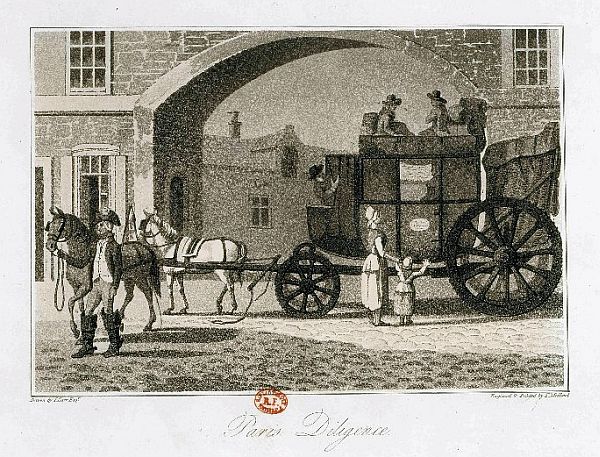
Messagerie, from which the diligences, all of which are under
the control of the nation, set out. The morning was very
beautiful. I was much entertained before I mounted that
cumbrous vehicle, which was to roll me a little nearer to my
own coast, by viewing the numerous groups of travellers and
their friends, who surrounded the different carriages as the
horses were tackling to them. In different directions of my
eye, I saw about thirty men kissing each other. The women
in France never think their prerogatives infringed by this anti-anglo
mode of salutation. Some shed tears at parting; but
the cheek down which they trickled never lost its colour or
vivacity. All were animated; every eye looked bright; there
was a gayety in their very grief. "Bon voyage, bon voyage—Dieu
vous benisse, Dieu vous benisse," reiterated on all sides
from sprightly faces, stretched out of the window frames of the
massy machine, as it rattled through the gates of the yard, to
the incessant crackings of the postilion's long lash. I soon
afterwards found myself seated in the diligence for Cherbourg,
in company with two ladies, and three gentlemen, who were
all polite and pleasing. In the cabriole, forward, was a french
captain in the army, who had been in Tippoo's service at the
time of the surrender of Seringapatam. He looked abominably
dirty in his travelling habiliments; but that, in France, is now
no just indication of inferiority or vulgarity.
We passed by the Place de la Concorde, upon the statues
and buildings of which, and the gardens of the Thuilleries,
the fresh and early sun shone most beautifully. My merry,
but feeling fellow travellers, waving their hands, addressed
a short apostrophe to these suburb objects, and exclaimed,
"adieu ma tres jolie ville—ah! tres jolie ville adieu."
For near three miles after leaving the barrier, we passed
through plantations of roses, which supply the markets of
Paris with that beautiful flower, which, transferred thence,
adorn the toilets, the vases, and the bosoms of the fair
parisians, and form the favourite bouquets of the petite maitres;
on each side of the road were cherry trees, in full bearing,
which presented a very charming appearance. We soon
reached the water works of Marli, which supply the jets d'eau
of Versailles. They are upon a vast scale, and appear to be
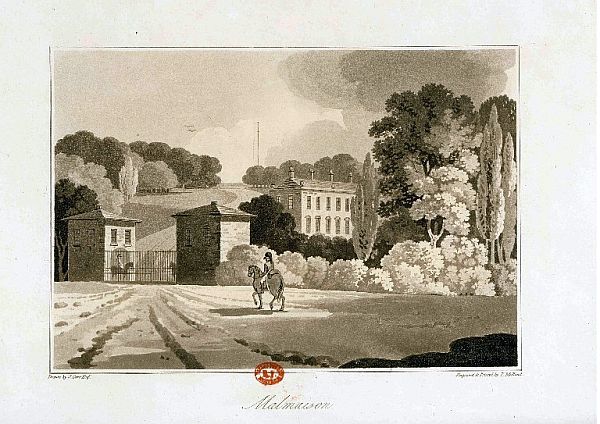
very curious. A little further on we passed Mal Maison, the
country, and chief residence of the first consul and his family.
It is an ancient house, embosomed in beautiful woods and
gardens. At the entrance are large military lodges, for the
accommodation of a squadron of the consular cavalry, who
mount guard when their general is here.
 Malmaison.
At St. Germain's we breakfasted, upon pork cutlets, excellent
bread, wine, and cherries, for twenty sols, or ten pence
english. At Mante we had an excellent dinner, of several
dishes, for thirty sols, or one shilling and three pence english.
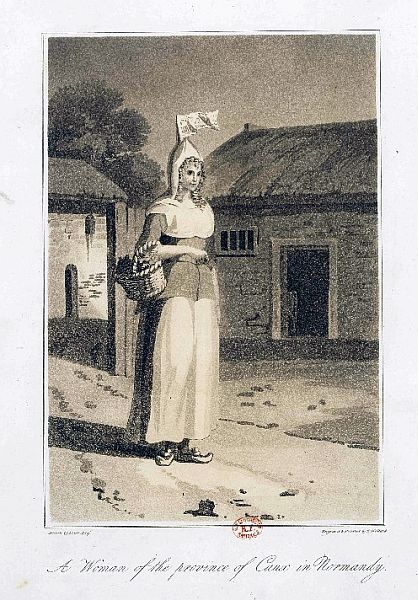
Soon after we had passed Mante, we left the higher norman
road, and entered a country extremely picturesque and rich.
We were conducted through the forest of Evreux, by an escort
of chasseurs. This vast tract of land is infested by an immense
banditti, who live in large excavations in the earth, similar
to the subterranean apartments of the celebrated robbers, in
whose service Gil Blas was rather reluctantly enrolled, and
generally assail the traveller, with a force which would render
common resistance perilous, and unavailing. This forest, in
the course of the year, furnishes considerable employ for the
guillotine of Caen, where the tribunal of justice is seated.
The appearance of our guards was terrific enough to appal
such valiant souls, as once animated the frames of prince Hal,
and his merry friend Ned Poins. They wore roman helmets,
from which descended, to the bottom of their backs, an immense
tail, of thick black horsehair, their uniform was light
green, and looked rather shabby.
We passed the forest without any molestation, and supped
at the town of Evreux, which is very pleasant, where we halted
for about four hours. As we were afterwards proceeding, I
prepared myself to enjoy a little sleep, and as I reclined for
this purpose with my hat over my face, in a corner of the
carriage, I overheard one of my fellow travellers observe to
the other, "the englishman is sleeping," to which he replied,
"no, he is not sleeping, he is only thinking, it is the character
of his nation."
The french cannot bear the least appearance of thought;
they have a saying, "un homme qui rit ne sera jamais dangereux."
The next morning we breakfasted at Lisieux, an ancient
town, in which are the remains of a fine convent, which formerly
belonged to the Order of the Capuchins. For four or
five miles before we approached the town, the laughing and
animated faces of groups of peasantry, all in their jubilee
dresses, the old mounted upon asses, and the young walking
by the sides of them, hastening to the town, announced to us,
that a fair, and merry making was to be held there, on that
day. Lisieux was quite in a bustle. About six o'clock in the
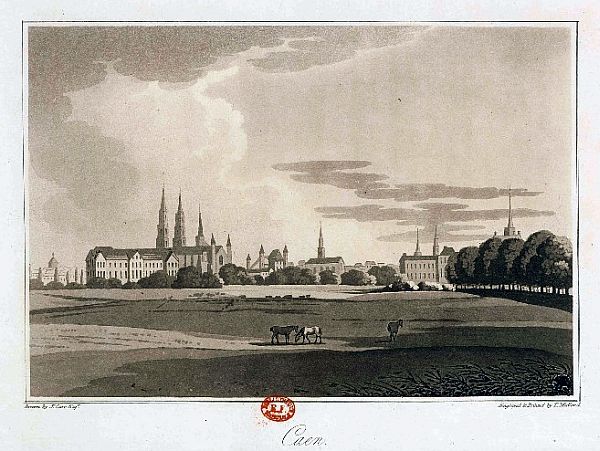
evening of the same day, we arrived at Caen, the capital
of Lower Normandy. My fare to this city from Paris,
amounted to thirty livres, including my luggage. I had not
completed my dinner at the Hôtel de la Place, before an
english servant entered my room, to inform me, that his
mistress, Mrs. P——, who, with her daughters, and another
young lady, had the rooms over mine, presented her compliments
to me, and requested me to take my coffee with
them that evening. I must confess I was at first a little
surprised at the message, for the english are not very remarkable
for politeness and attention to one another in a
foreign country.
 Caen.
Caen.
After I had finished my desert, I made my bow to Mrs.
P——, and her family, who proved to be very pleasant, and
accomplished people, and were making the tour of France
with english servants. They had been in Caen near three
weeks, where they had a large acquaintance of the first respectability.
This unexpected introduction became additionally
agreeable, upon my discovery at the Messagerie, that the diligence
for Cherbourg would not proceed, till three days from
the time of my arrival. The next morning I rambled with
my new friends about the city, which is large, and handsome,
and is watered by the river Orne. It is much celebrated
for its lace trade; on that day I dined with Mrs.
P——, and a french party, and was regaled with an english
dinner, cooked, and served up by her own servants. The
filth of the french kitchen is too well known, to make it
necessary for me to say how delicious such a dinner was.
The french admit themselves that their cooks are destitute of
cleanliness.
The Convent of the Benedictines, which is converted into
the palace of the prefect, is a noble building. The gardens
belonging to it are well arranged. The promenade called de
la Cour is very charming, from which the city is seen to
great advantage. The water of the Orne is rather nauseous,
but is not considered unwholesome. The Palais de Justice
is a fine modern structure. In its courts of law, I had again
an opportunity of hearing the forensic elocution of Normandy.
The gestures, and vehemence of the orators here,
as at Rouen, appeared to me to be tinctured with the extravagance
of frenzy. But perhaps my ears, and eyes have
been rendered somewhat too fastidious by having been frequently
banqueted with the grace, animation, and commanding
eloquence of the unrivalled advocate of the british bar;
who, when he retires from the laborious duties of the
crowded, and admiring forum, where his acute sagacity has
so often unfolded the dark compact involutions of human
obliquity, where his wit and fancy have covered with the
choicest flowers, the dreary barrenness of technical pleading;
will leave behind him that lasting, and honourable respect
and remembrance, which faculties so extensively beneficial,
must ever excite in the minds of men who have been instructed,
delighted, and benefited by their splendid, and prosperous
display.
In this city was pointed out to me, the house in which
the celebrated Charlotte Corday resided, who, by her poniard,
delivered France of the monster, Marat, on Sunday, the
14th of July, 1793. There is some coincidence in the
crimes, and fate of Caligula and Marat, both perished by
the avengers of their country, whilst in the act of approaching
their baths. Posterity will embalm, with its grateful remembrance,
the patriotic heroism of this great, and distinguished
female, and in her own firm, and eloquent language,
will say of her, "that crime begets disgrace, and not
the scaffold."
On the evening after my arrival at Caen, I was invited
to an elegant ball, which was given by the lady of the
paymaster general of the district, in one of the government
houses. I had before witnessed the dancing of the higher
orders of people in Paris, and from this reason was not surprised
in contemplating the exquisite grace which was here
displayed. The party consisted of near eighty persons.
Amongst them were the judges of the district, and the principal
officers quartered in the city, and its neighbourhood,
the latter were attired in superb military dresses. Amongst
the ladies were several beautiful, well dressed young women,
who exhibited their persons to great advantage. The grave,
and elderly part of the company played at buillotte, which
is at present the favourite french game. In France to please
and to be pleased, seem to be the two presiding principles
in all their meetings. An elegant young officer, who had
distinguished himself at the battle of Marengo, observing that
the musicians appeared to be a little fatigued, by the contribution
of their exhilarating services towards the festivity of
the evening, supplied their room, whilst they refreshed themselves,
and struck up an english country dance on one of
the violins. The party attempted to dance it, but to show
how arbitrary habit is, in the attempt, all those powers of
grace, which they had before so beautifully displayed, retired
as if influenced by the magic of some unpropitious spirit.
Amongst the party, was a little girl, about nine years old,
who was dressed in the highest style of fashion, and looked
like a fashionable milliner's doll. This little spoiled child
was accustomed to spend an hour at her toilette every
morning, and to be tricked out in all the ephemeral decoration
of the haut ton. This little coquette already looked
out for admiration, and its foolish mother expressed the
greatest satisfaction, when any one, out of politeness to her,
paid attentions to the pert premature nursling. Our entertainment
concluded with a handsome supper, and we parted,
highly delighted, at the dawn of day. Nothing could be
more flattering, than the attentions which, as an englishman,
I received from every one present.
After a few hours repose, I went with a large party to
the church of Notre Dame; in which there is a very fine
altar piece. The keeper of the sachristy, who was a very
arch-looking little fellow, in spite of the solemnity of the
place in which we were, made us all smile (even a young
lady who was going to be confessed for the first time the
next day, lost a considerable proportion of her gravity) by
informing us, that during the time of terror he had run off
with the Virgin Mary, pointing to the image, and that to
prevent the detection of Robespierre's agents, he had concealed
her in his bed for three years. Nothing could exceed
his joy in having saved her from the hatchet, or the flames,
from which impending fate, she was restored to her former
situation in this church; and was, when we saw her, by
the extravagance of her sprightly, and ardent protector,
dressed in a white muslin gown, spotted with silver; a little
bouquet of artificial flowers graced her bosom, and her wig
was finely curled, and powdered. The figure in her arms,
which was intended to represent the infant Jesus, was dressed
in a style equally unsuitable; his hair was also curled, and
powdered, and a small cocked hat placed upon his head.
Our delighted guide, whose eyes sparkled with self-complacency,
asked us if we had ever seen a prettier Virgin Mary,
or one dressed more handsomely. We were all much amused
by the quaintness of this man's conduct, although I am confident
he had no intention of exciting unbecoming sensations,
for in saving this image, he had exposed his life.
From Notre Dame, we went to the Abbaye aux Hommes,
built by William the Conqueror. It is a large lofty plain
pile of building. The spires are well proportioned, and very
high. The pillars in the choir are, in my humble opinion,
too massy. Preparations were here making for the celebration
of the great festival called the Feast of God. We presented
to one of the priests, who, in the sachristy, was
adorning the cradle of our Saviour's image with flowers,
some very fine moss roses, which in France are very rare,
which he received with great politeness. This festival before
the revolution was always superbly celebrated. It was then
renewed for the first time since the proscription of religion,
during which, all the costly habits of the priests, and rich
vessels used in the ceremonies of the church have been
stolen, sold, or melted down. Near the altar, which has
been shattered by the axe of the revolution, is the vault of
the norman conqueror.
Upon our return to our hotel, we saw a considerable
crowd assembled near the bridge leading to de la Cour.
Upon inquiring into the cause of this assemblage, we
found it was owing to a curious rencounter between two
blind beggars, who, in total darkness, had been waging an
uncertain battle for near six minutes. It appeared that one
of them had for several months, enjoyed quiet possession of
the bridge, which happened to be a great thoroughfare, and
had during that time, by an undisputed display of his calamity,
contrived to pick up a comfortable recompense for
it; that within a few days preceding this novel fracas, another
mendicant, who had equal claims to compassion, allured
by the repute of his success, had deserted a less frequented
part of the city, and had presented himself at the other
corner of the same bridge, where by a more masterly selection
of moving phrases, he soon not only divided, but
monopolized the eleemosynary revenues of this post of wretchedness.
The original possessor naturally grew jealous. Even
beggars "can bear no brother near the throne." Inflamed
with jealousy, he silently moved towards his rival, by the
sound of whose voice, which was then sending forth some
of its most affecting, and purse-drawing strains, he was enabled
to determine whether his arm was within reach of the head
of his competitor, which circumstance, having with due
nicety ascertained, he clenched his fist, which in weight,
size, and firmness, was not much surpassed by the hard,
and ponderous paw of a full-grown tiger, and with all the
force of that propulsion, which a formidable set of muscles
afforded, he felled his rival to the ground, and not knowing
that he was fallen, discharged many other blows, which
only served to disturb the tranquillity of the air. The recumbent
hero, whose head was framed for enterprises of this
nature, soon recovered from the assault, and, after many unavailing
efforts in the dark, at length succeeded in opening
one of the vessels of the broad nose of his brawny assailant,
whose blood, enriched by good living, streamed out most
copiously. In this condition we saw these orbless combatants,
who were speedily separated from each other. Some of the
crowd were endeavouring to form a treaty of pacification
between them, whether they succeeded I know not, for we
were obliged to leave the bridge of battle, before these important
points were arranged, to join a pleasant party at
Mons. St. J——'s, an opulent banker at Caen, to whom I
had letters of introduction from Mons. R——, the banker
of Paris.
After spending the short time, during which I was detained
at Caen, very pleasantly, I resumed my seat in the
diligence for Cherbourg, in which I found a very agreeable
woman, her two daughters, two canary birds, a cat, and
her kitten, who were, I found, to be my companions all
the way. After we left Caen, the roads became very bad.
Our ponderous machine, frequently rolled from one side to
the other, and with many alarming creakings, threatened us
with a heavy, and perilous overthrow. At length we arrived
at Bayeux, where we dined, at the house of a friend
of my fair fellow traveller, to which she invited me with a
tone of welcome, and good wishes, which overpowered all
resistance. We sat down to an excellent dinner, at which
was produced the usual favourite french dish of cold turbot,
and raw artichokes. After our repast, a fine young woman,
the daughter of the lady of the house, in a very obliging,
but rather grave manner, poured out a tumbler full of some
delicious potent liqueur, which, to my no small surprise,
she presented me with; upon my only tasting it, and returning
it, she appeared to be equally surprised, and confused.
Her mother, observing our mutual embarrassment, informed
me, that in France it was understood that the english
were troubled with the ennui, or tristesse de cœur, and
that they drank large draughts of wine and spirits to expel
the gloomy malady. I softened this opinion of our common
character, as well as I could, for, I fear, without offering
considerable outrage to truth, I could not wholly have
denied it.
After dinner, we walked to the cathedral, which is a noble
gothic pile, and, upon our return, found the diligence in
waiting for us. My companions were attended to the door
of the carriage by their hospitable friends, between whom several
kisses were interchanged. I took an opportunity, just before
I mounted the step, of stealing one of these tokens of regard
from the fair young damsel who had so courteously offered me
the liqueur, at the same time telling her, that in England, a kiss
was always considered as the best remedy for the tristesse de
cœur.—Away trotted our little norman steeds; and, notwithstanding
they had come all the way from Caen, they soon carried
us over the hills on this side of Bayeux. The eye communicated
delight to the heart, whilst it contemplated the vast
extent of corn fields, which in this fertile province undulated on
all sides of us, in waves of yellow exuberance, over which, embosomed
in trees, at short distances, peeped the peaceful and
picturesque abode of the prosperous cottage farmer. The prospect
afforded an impressive contrast to the impolitic agricultural
system, which has lately obtained in England, by which cottage
farms are consolidated into ample domains of monopoly, and
a baneful preference is given in favour of the rearing of cattle,
to the vital and bountiful labours of the plough. A celebrated
writer, who well knew in what the real wealth of a nation
consisted, has observed, that he who could make two ears
of corn grow upon a spot of ground, where only one grew
before, would deserve better of mankind than the whole race
of politicians. The high roads of Normandy are unnecessarily
broad; hence considerable portions of land remain uncultivated.
A spacious road, like every thing which is vast, excites an impression
of grandeur; but in this prolific department, the facilities
of travelling, and the dignity of the country, might be
consulted with less waste. This prodigality is perhaps attributable
to the highways in France having shared but little of its
legislative attention; and accommodation appears to have been
sought rather by a lavish allotment of space, than by a judicious
formation, and frequent repair.
The inns along the road are very poor, although over the door
of almost every little cottage is written, in large characters,
"Bon Cidre de Victoire." There are also no regular post-horses
to be met with. The country, on all sides of us, was
very mountainous and luxuriant, and much resembled the
southern parts of Devonshire. About seven o'clock in the
evening of the same day, we arrived at St. Lo, which is, without
exception, the cleanest and most charming, romantic little town,
I saw in France. It is fortified, and stands upon the top of
a mountain, at whose base is expanded a luxuriant scenery of
woods and villages, through which the riviere de Ville winds
in beautiful meanders. The inhabitants of this town appeared
to be rich and genteel. In the evening I supped at the table
d'hôte, where there were several pleasant people. At this town
we slept, and set off, the next morning, very early, for Valogne,
where we dined; and in the evening, after passing a considerable
extent of rich meadow land, and descending a very
steep hill, the freshness of the sea air announced to us our near
approach to Cherbourg, where, at the hôtel d'Angleterre, I was
soon afterwards landed. For my place and luggage to this
place I paid twenty-four livres. My expenses upon the road
were very reasonable. Here I had the good fortune to find
a packet which intended to sail to England in two days, the
master of which asked me only one guinea for my passage in
the cabin, provisions included. However, thinking that the
kitchen of a french vessel might, if possible, be more uncleanly
than the kitchen of a french inn, I resolved upon providing
my own refreshments for the little voyage.
 Cherbourg
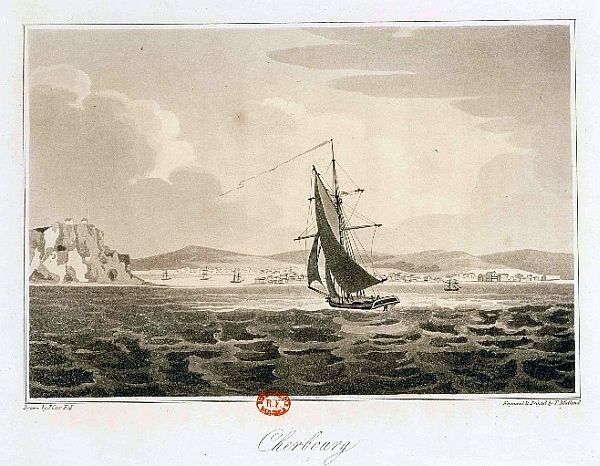
Cherbourg is a poor and dirty town. After having heard so
much of its costly works and fortifications for the protection
of its harbour, my surprise was not little, upon finding the
place so miserable. It is defended by three great forts, which
are erected upon rocks in the sea. The centre one is about
three miles off from shore, and is garrisoned by 1200 men. At
a distance, this fort looks like a vast floating battery. Upon a line
with it, but divided by a distance sufficient for the admission
of shipping, commences the celebrated, stupendous wall, which
has been erected since the failure of the cones. It is just
visible at low water. This surprising work is six miles in
length, and three hundred french feet in breadth, and is composed
of massy stones and masonry, which have been sunk for the
purpose, and which are now cemented, by sea weed, their own
weight and cohesion, into one immense mass of rock. Upon
this wall a chain of forts is intended to be erected, as soon as
the finances of government will admit of it. The expenses
which have already been incurred, in constructing this wonderful
fabric, have, it is said, exceeded two millions sterling.
These costly protective barriers can only be considered as so
many monuments, erected by the french to the superior genius
and prowess of the british navy.
Whilst I was waiting for the packet's sailing, I received
great civilities from Mons. C——, the banker and american
consul at Cherbourg, to whom I had letters from Mons. R——.
I rode, the second evening after my arrival, to his country
house, which was about nine miles from the town. Our road
to it lay over a prolific and mountainous country. From a high
point of land, as we passed along, we saw the islands of
Guernsey, Jersey and Alderney, which made a beautiful appearance
upon the sea. Upon our return, by another road,
I was much pleased with a group of little cottages, which were
embosomed in a beautiful wood, through which there was an
opening to the sea, which the sinking sun had then overspread
with the richest lustre. As we entered this scene of rustic repose,
the angelus bell of the little village church rang; and a short
time afterwards, as we approached it, a number of villagers came
out from the porch, with their mass-books in their hands, their
countenances beaming with happiness and illuminated by
the sinking sun, which shone full upon them. The charms
of this simple scene arrested our progress for a short time.
Under some spreading limes, upon a sloping lawn, the cheerful
cottagers closed the evening with dancing to the sounds of
one of the sweetest flagelets I ever heard, which was alternately
played by several performers, who relieved each other. In
France, every man is a musician. Goldsmith's charming picture
of his Auburn, in its happier times, recurred to me:—
"When toil remitting, lends its turn to play,
And all the village train, from labour free,
Led up their sports beneath the spreading tree."
The cross roads of France are very bad; but, to my surprise,
although we never could have had a worse specimen of them
than what this excursion presented to us, yet the norman hunter
upon which I was mounted, carried me over the deepest ruts,
and abrupt hillocks, without showing the least symptom of
infirmity which so much prevails amongst his brethren of the
Devonshire breed. The norman horses are remarkable for lifting
their feet high, and the safety and ease with which they
carry their riders. In the morning of the day in which the
packet was to sail, a favourable breeze sprung up; and, after
undergoing the usual search of the revenue officers, in the
execution of which they behaved with much civility, I embarked,
and bade adieu to continental ground. The vessel had
the appearance of being freighted with hot bread, with which
the deck was covered from one end to the other. This immense
collection of smoking loaves was intended for the supply
of six men, and one woman, during a passage which we expected
to accomplish in thirty hours, or less!
The faithful associate of our young captain, to whom she had
just been married, either from motives of fondness or distrust,
resolved upon sharing with him the perils of the ocean.
The sea-sufferings of this constant creature, and the resignation
with which she endured them, sufficiently manifested
the strength of her affections; for she was obliged to keep below
all the time, and could afford but very little assistance in reducing
the prodigious depot of bread which we had on board.
Credulous mariners describe a species of the fair sex (I believe
the only one) who appear to much advantage upon the briny
wave; but the nature of our commander's lady not happening
to be amphibious, she gave such unequivocal proofs of being out
of her proper element, that my wishes for shore increased
upon me every minute.
During our passage, I could not help contrasting the habits
of the english with the french sailors. The british tar thinks his
allowance of salt beef scarcely digestible without a copious
libation of ardent spirits, whilst the gallic mariner is satisfied with
a little meagre soup, an immoderate share of bread, and a
beverage of water, poor cider, or spiritless wine.
At length, after a passage of a day and a night, in which
we experienced the vicissitudes of a stiff breeze, and a dead
calm, we beheld
——"That pale, that white-fac'd shore,
Whose foot spurns back the ocean's roaring tides,
And coops from other lands her islanders,
That water-walled bulwark, still secure
And confident from foreign purposes."
After passing another tedious night on board, owing to our
being becalmed within the Needles, I stepped upon the same
landing stone from which I first embarked for a country, where,
in the centre of proscriptions, instability and desolation, those
arts which are said to flourish only in the regions of repose,
have, by their vigour and unrivalled bloom, excited the wonder
and admiration of surrounding nations; where Peace, by her
sudden and cherished reappearance, is calling forth all the
virtues from their hiding places, to aid in effacing the corroding
stains of a barbarous revolution, and in restoring the moral and
social character to its pristine polish, rank and estimation.