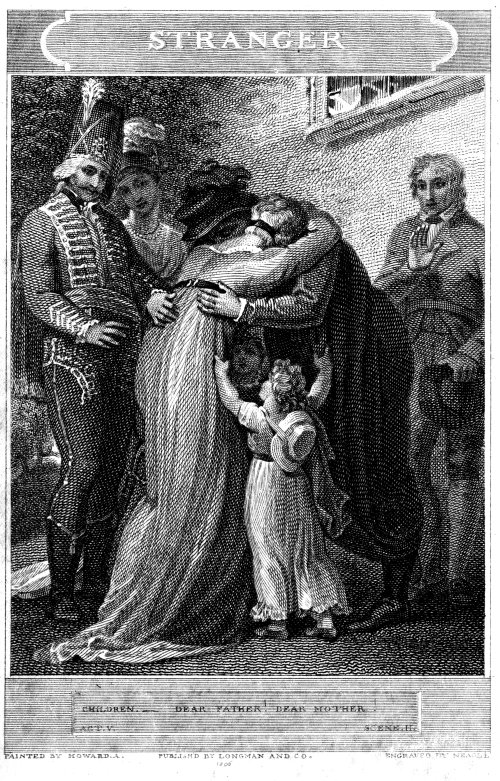
A Drawing Room in the Castle, with a Piano Forte, Harp, Music,
Bookstand, Sofas, Chairs, Tables, &c.
Enter Solomon.
Sol. Well, for once I think I have the advantage of Madam Haller. Such
a dance have I provided to welcome their Excellencies, and she quite out
of the the secret! And such a hornpipe by the little Brunette! I'll have
a rehearsal first though, and then surprise their honours after dinner.
[Flourish of rural music without.
Pet. [Without.] Stop; not yet, not yet: but make way there, make
way, my good friends, tenants, and villagers.—John! George! Frederick!
Good friends, make way.
Sol. It is not the Count: it's only Baron Steinfort. Stand back, I
say; and stop the music!
Enter Baron Steinfort, ushered in by Peter and Footmen. Peter
mimicks and apes his father.
Sol. I have the honour to introduce to your lordship myself, Mr.
Solomon, who blesses the hour in which fortune allows him to become
acquainted with the Honourable Baron Steinfort, brother-in-law of his
Right Honourable Excellency Count Wintersen, my noble master.
Pet. Bless our noble master!
Bar. Old and young, I see they'll allow me no peace. [Aside.]
Enough, enough, good Mr. Solomon. I am a soldier. I pay but few
compliments, and require as few from others.
Sol. I beg, my lord—We do live in the country to be sure, but we are
acquainted with the reverence due to exalted personages.
Pet. Yes—We are acquainted with exalted personages.
Bar. What is to become of me?—Well, well, I hope we shall be better
acquainted. You must know, Mr. Solomon, I intend to assist, for a couple
of months at least, in attacking the well stocked cellars of Wintersen.
Sol. Why not whole years, my lord?—Inexpressible would be the
satisfaction of your humble servant. And, though I say it, well stocked
indeed are our cellars. I have, in every respect, here managed matters
in so frugal and provident a way, that his Right Honourable Excellency
the Count, will be astonished. [Baron yawns.] Extremely sorry it is
not in my power to entertain your lordship.
Pet. Extremely sorry.
Sol. Where can Mrs. Haller have hid herself?
Bar. Mrs. Haller! who is she?
Sol. Why, who she is, I can't exactly tell your lordship.
Pet. No, nor I.
Sol. None of my correspondents give any account of her. She is here in
the capacity of a kind of a superior housekeeper. Methinks, I hear her
silver voice upon the stairs. I will have the honour of sending her to
your lordship in an instant.
Bar. Oh! don't trouble yourself.
Sol. No trouble whatever! I remain, at all times, your honourable
lordship's most obedient, humble, and devoted servant.
[Exit, bowing.
Pet. Devoted servant.
[Exit, bowing.
Bar. Now for a fresh plague. Now am I to be tormented by some
chattering old ugly hag, till I am stunned with her noise and officious
hospitality. Oh, patience! what a virtue art thou!
Enter Mrs. Haller, with a becoming curtsey. Baron rises, and
returns a bow, in confusion.
[Aside.] No, old she is not. [Casts another glance at her.] No, by
Jove, nor ugly.
Mrs. H. I rejoice, my lord, in thus becoming acquainted with the
brother of my benefactress.
Bar. Madam, that title shall be doubly valuable to me, since it gives
me an introduction equally to be rejoiced at.
Mrs. H. [Without attending to the compliment.] This lovely weather,
then, has enticed the Count from the city?
Bar. Not exactly that. You know him. Sunshine or clouds are to him
alike, as long as eternal summer reigns in his own heart and family.
Mrs. H. The Count possesses a most cheerful and amiable philosophy.
Ever in the same happy humour; ever enjoying each minute of his life.
But you must confess, my lord, that he is a favourite child of fortune,
and has much to be grateful to her for. Not merely because she has given
him birth and riches, but for a native sweetness of temper, never to be
acquired; and a graceful suavity of manners, whose school must be the
mind. And, need I enumerate among fortune's favours, the hand and
affections of your accomplished sister?
Bar. [More and more struck as her understanding opens upon him.]
True, madam. My good easy brother, too, seems fully sensible of his
happiness, and is resolved to retain it. He has quitted the service to
live here. I am yet afraid he may soon grow weary of Wintersen and
retirement.
Mrs. H. I should trust not. They, who bear a cheerful and
unreproaching conscience into solitude, surely must increase the measure
of their own enjoyments. They quit the poor, precarious, the dependent
pleasures, which they borrowed from the world, to draw a real bliss from
that exhaustless source of true delight, the fountain of a pure
unsullied heart.
Bar. Has retirement long possessed so lovely an advocate?
Mrs. H. I have lived here three years.
Bar. And never felt a secret wish for the society you left, and must
have adorned?
Mrs. H. Never.
Bar. To feel thus belongs either to a very rough or a very polished
soul. The first sight convinced me in which class I am to place you.
Mrs. H. [With a sigh.] There may, perhaps, be a third class.
Bar. Indeed, madam, I wish not to be thought forward; but women always
seemed to me less calculated for retirement than men. We have a
thousand employments, a thousand amusements, which you have not.
Mrs. H. Dare I ask what they are?
Bar. We ride—we hunt—we play—read—write.—
Mrs. H. The noble employments of the chase, and the still more noble
employment of play, I grant you.
Bar. Nay, but dare I ask what are your employments for a day?
Mrs. H. Oh, my lord! you cannot imagine how quickly time passes when a
certain uniformity guides the minutes of our life. How often do I ask,
"Is Saturday come again so soon?" On a bright cheerful morning, my books
and breakfast are carried out upon the grass plot. Then is the sweet
picture of reviving industry and eager innocence always new to me. The
birds' notes so often heard, still waken new ideas: the herds are led
into the fields: the peasant bends his eye upon his plough. Every thing
lives and moves; and in every creature's mind it seems as it were
morning. Towards evening I begin to roam abroad: from the park into the
meadows. And sometimes, returning, I pause to look at the village boys
and girls as they play. Then do I bless their innocence, and pray to
Heaven, those laughing, thoughtless hours, could be their lot for ever.
Bar. This is excellent!—But these are summer amusements.—The winter!
the winter!
Mrs. H. Why for ever picture winter like old age, torpid, tedious, and
uncheerful? Winter has its own delights: this is the time to instruct
and mend the mind by reading and reflection. At this season, too, I
often take my harp, and amuse myself by playing or singing the little
favourite airs that remind me of the past, or solicit hope for the
future.
Bar. Happy indeed are they who can thus create, and vary their own
pleasures and employments.
Enter Peter.
Pet. Well—well—Pray now—I was ordered—I can keep him back no
longer—He will come in.
Enter Tobias, forcing his way.
Tob. I must, good Heaven, I must!
Mrs. H. [Confused.] I have no time at present—I—I—You see I am
not alone.
Tob. Oh! this good gentleman will forgive me.
Bar. What do you want?
Tob. To return thanks. Even charity is a burden if one may not be
grateful for it.
Mrs. H. To-morrow, good Tobias; to-morrow.
Bar. Nay, no false delicacy, madam. Allow him to vent the feelings of
his heart; and permit me to witness a scene which convinces me, even
more powerfully than your conversation, how nobly you employ your time.
Speak, old man.
Tob. Oh, lady, that each word which drops from my lips, might call
down a blessing on your head! I lay forsaken and dying in my hut: not
even bread nor hope remained. Oh! then you came in the form of an angel,
brought medicines to me; and your sweet consoling voice did more than
those. I am recovered. To-day, for the first time, I have returned
thanks in presence of the sun: and now I come to you, noble lady. Let me
drop my tears upon your charitable hand. For your sake, Heaven has
blessed my latter days. The Stranger too, who lives near me, has given
me a purse of gold to buy my son's release. I am on my way to the city:
I shall purchase my Robert's release. Then I shall have an honest
daughter-in-law. And you, if ever after that you pass our happy cottage,
oh! what must you feel when you say to yourself, "This is my work!"
Mrs. H. [In a tone of entreaty.] Enough, Tobias; enough!
Tob. I beg pardon! I cannot utter what is breathing in my breast.
There is One, who knows it. May His blessing and your own heart reward
you.
[Exit, Peter following. Mrs. Haller casts her eyes upon the
ground, and contends against the confusion of an exalted soul, when
surprised in a good action. The Baron stands opposite to her, and from
time to time casts a glance at her, in which his heart is swimming.
Mrs. H. [Endeavouring to bring about a conversation.] I suppose, my
lord, we may expect the Count and Countess every moment now?
Bar. Not just yet, madam. He travels at his leisure. I am selfish,
perhaps, in not being anxious for his speed: the delay has procured me a
delight which I never shall forget.
Mrs. H. [Smiling.] You satirise mankind, my lord.
Bar. How so?
Mrs. H. In supposing such scenes to be uncommon.
Bar. I confess I was little prepared for such an acquaintance as
yourself: I am extremely surprised. When Solomon told me your name and
situation, how could I suppose that—Pardon my curiosity: You have been,
or are married?
Mrs. H. [Suddenly sinking from her cheerful raillery into mournful
gloom.] I have been married, my lord.
Bar. [Whose enquiries evince his curiosity, yet are restrained within
the bounds of the nicest respect.] A widow, then?
Mrs. H. I beseech you—There are strings in the human heart, which
touched, will sometimes utter dreadful discord—I beseech you—
Bar. I understand you. I see you know how to conceal every thing
except your perfections.
Mrs. H. My perfections, alas!—[Rural music without.] But I hear the
happy tenantry announce the Count's arrival. Your pardon, my lord; I
must attend them.
[Exit.
Bar. Excellent creature!—What is she, and what can be her history? I
must seek my sister instantly. How strong and how sudden is the interest
I feel for her! But it is a feeling I ought to check. And yet, why so?
Whatever are the emotions she has inspired, I am sure they arise from
the perfections of her mind: and never shall they be met with
unworthiness in mine.
[Exit.
The Lawn.
Solomon and Peter are discovered arranging the Tenantry.—Rural
music.
Enter Count and Countess Wintersen, (the latter leading her
Child,) the Baron, Mrs. Haller, Charlotte, and Servants following.
Sol. Welcome, ten thousand welcomes, your Excellencies. Some little
preparation made for welcome too. But that will be seen anon.
Count. Well! here we are! Heaven bless our advance and retreat! Mrs.
Haller, I bring you an invalid, who in future will swear to no flag but
yours.
Mrs. H. Mine flies for retreat and rural happiness.
Count. But not without retreating graces, and retiring cupids too.
Countess. [Who has in the mean time kindly embraced Mrs. Haller,
and by her been welcomed to Wintersen.] My dear Count, you forget that
I am present.
Count. Why, in the name of chivalry, how can I do less than your
gallant brother, the Baron? who has been so kind as nearly to kill my
four greys, in order to be here five minutes before me.
Bar. Had I known all the charms of this place, you should have said so
with justice.
Countess. Don't you think William much grown?
Mrs. H. The sweet boy!
[Stoops to kiss him, and deep melancholy overshadows her countenance.
Count. Well, Solomon, you've provided a good dinner?
Sol. As good as haste would allow, please your Right Honourable
Excellency!
Pet. Yes, as good as—
[Count goes aside with Solomon and Peter.
Bar. Tell me, I conjure you, sister, what jewel you have thus buried
in the country?
Countess. Ha! ha! ha! What, brother, you caught at last?
Bar. Answer me.
Countess. Well, her name is Mrs. Haller.
Bar. That I know; but—
Countess. But!—but I know no more myself.
Bar. Jesting apart, I wish to know.
Countess. And, jesting apart, I wish you would not plague me. I have
at least a hundred thousand important things to do. Heavens! the vicar
may come to pay his respects to me before I have been at my toilet; of
course I must consult my looking-glass on the occasion. Come, William,
will you help to dress me, or stay with your father?
Count. We'll take care of him.
Countess. Come, Mrs. Haller.
[Exit with Mrs. Haller, Charlotte following.
Bar. [Aside, and going.] I am in a very singular humour.
Count. Whither so fast, good brother?
Bar. To my apartment: I have letters to—I—
Count. Pshaw! stay. Let us take a turn in the park together.
Bar. Excuse me. I am not perfectly well. I should be but bad company.
I—
[Exit.—The Tenantry retire.
Count. Well, Solomon, you are as great a fool as ever, I see.
Sol. Ha! ha! At your Right Honourable Excellency's service.
Count. [Points to Peter.] Who is that ape in the corner?
Sol. Ape!—Oh! that is—with respect to your Excellency be it
spoken—the son of my body; by name, Peter.
[Peter bows.
Count. So, so! Well, how goes all on?
Sol. Well and good; well and good. Your Excellency will see how I've
improved the park: You'll not know it again. A hermitage here;
serpentine walks there; an obelisk; a ruin; and all so sparingly, all
done with the most economical economy.
Count. Well, I'll have a peep at your obelisk and ruins, while they
prepare for dinner!
Sol. I have already ordered it, and will have the honour of attending
your Right Honourable Excellency.
Count. Come, lead the way. Peter, attend your young master to the
house; we must not tire him.
[Exit, conducted by Solomon.
Pet. We'll go round this way, your little Excellency, and then we
shall see the bridge as we go by; and the new boat, with all the fine
ribbands and streamers. This way, your little Excellency.
[Exit, leading the Child.
The Antichamber.
Enter Mrs. Haller.
Mrs. H. What has thus alarmed and subdued me? My tears flow; my heart
bleeds. Already had I apparently overcome my chagrin: already had I at
least assumed that easy gaiety once so natural to me, when the sight of
this child in an instant overpowered me. When the Countess called him
William—Oh! she knew not that she plunged a poniard in my heart. I have
a William too, who must be as tall as this, if he be still alive. Ah!
yes, if he be still alive. His little sister too! Why, fancy, dost thou
rack me thus? Why dost thou image my poor children, fainting in
sickness, and crying to their mother? To the mother who has abandoned
them? [Weeps.] What a wretched outcast am I! And that just to-day I
should be doomed to feel these horrible emotions! just to-day, when
disguise was so necessary.
Enter Charlotte.
Char. [Entering.] Very pretty, very pretty indeed; better send me to
the garret at once. Your servant, Mrs. Haller. I beg, madam, I may have
a room fit for a respectable person.
Mrs. H. The chamber into which you have been shown is, I think, a very
neat one.
Char. A very neat one, is it? Up the back stairs, and over the
laundry! I should never be able to close my eyes.
Mrs. H. [Very mildly.] I slept there a whole year.
Char. Did you? Then I advise you to remove into it again, and the
sooner the better. I'd have you to know, madam, there is a material
difference between certain persons and certain persons. Much depends
upon the manner in which one has been educated. I think, madam, it would
only be proper if you resigned your room to me.
Mrs. H. If the Countess desires it, certainly.
Char. The Countess! Very pretty, indeed! Would you have me think of
plaguing her ladyship with such trifles? I shall order my trunk to be
carried where-ever I please.
Mrs. H. Certainly; only not into my chamber.
Char. Provoking creature! But how could I expect to find breeding
among creatures born of one knows not whom, and coming one knows not
whence?
Mrs. H. The remark is very just.
Enter Peter, in haste.
Pet. Oh lud! Oh lud! Oh lud! Oh lud!
Mrs. H. What's the matter?
Pet. The child has fallen into the river! His little Excellency is
drowned!
Mrs. H. Who? What?
Pet. His honour, my young master!
Mrs. H. Drowned?
Pet. Yes.
Mrs. H. Dead?
Pet. No; he's not dead.
Mrs. H. Well, well, then softly;—you will alarm the Countess.
Enter the Baron.
Bar. What is the matter? Why all this noise?
Pet. Noise? why—
Mrs. H. Be not alarmed, my lord. Whatever may have happened, the dear
child is now at least safe. You said so, I think, master Peter?
Pet. Why, to be sure, his little Excellency is not hurt; but he's very
wet though: and the Count is taking him by the garden door to the
house.
Bar. Right, that the countess may not be alarmed. But tell us, young
man, how could it happen?
Pet. From beginning to end?
Mrs. H. Never mind particulars. You attended the dear child?
Pet. True.
Mrs. H. Into the park?
Pet. True.
Mrs. H. And then you went to the river?
Pet. True.—Why, rabbit it, I believe you're a witch.
Mrs. H. Well, and what happened further?
Pet. Why, you see, his dear little Excellency would see the bridge,
that father built out of the old summer house; and the streamers, and
the boat, and all that.—I only turned my head round for a moment, to
look after a magpie—crush! down went the bridge, with his little
Excellency; and oh, how I was scared to see him carried down the river!
Bar. And you drew him out again directly?
Pet. No, I didn't.
Mrs. H. No; your father did?
Pet. No, he didn't.
Mrs. H. Why you did not leave him in the water?
Pet. Yes, we did!—But we bawled as loud as we could; you might have
heard us down to the village.
Mrs. H. Ay—and so the people came immediately to his assistance.
Pet. No, they didn't: but the Stranger came, that lives yonder, close
to old Toby, and never speaks a syllable. Odsbodlikins! what a devil of
a fellow it is! With a single spring bounces he slap into the torrent;
sails and dives about and about like a duck; gets me hold of the little
angel's hair, and, Heaven bless him! pulls him safe and sound to dry
land again.—Ha! ha! ha!
Bar. Is the Stranger with them?
Pet. Oh lud! no. He ran away. His Excellency wanted to thank him, and
all that; but he was off; vanquished like a ghost.
Enter Solomon.
Sol. Oh! thou careless varlet! I disown you! What an accident might
have happened! and how you have terrified his Excellency! But I beg
pardon, [Bows.] His Right Honourable Excellency, the Count, requests
your—
Bar. We come.
[Exit, with Mrs. Haller.
Char. Ha! ha! ha! Why, Mr. Solomon, you seem to have a hopeful pupil.
Sol. Ah! sirrah!
Char. But, Mr. Solomon, why were you not nimble enough to have saved
his young lordship?
Sol. Not in time, my sweet Miss. Besides, mercy on us! I should have
sunk like a lump of lead: and I happened to have a letter of consequence
in my pocket, which would have been made totally illegible; a letter
from Constantinople, written by Chevalier—What's his name? [Draws a
letter from his pocket, and putting it up again directly, drops it.
Peter takes it up, slily and unobserved.] It contains momentous
matter, I assure you. The world will be astonished when it comes to
light; and not a soul will suppose that old Solomon had a finger in the
pye.
Char. No, that I believe.
Sol. But I must go and see to the cellar. Miss, your most obedient
servant.
[Exit.
Char. [With pride.] Your servant, Mr. Solomon.
Pet. Here's the letter from Constantinople. I wonder what it can be
about. Now for it!
[Opens it.
Char. Aye, let us have it.
Pet. [Reads.] If so be you say so, I'll never work for you, never no
more. Considering as how your Sunday waistcoat has been turned three
times, it doesn't look amiss, and I've charged as little as any tailor
of 'em all. You say I must pay for the buckram; but I say, I'll be
damn'd if I do. So no more from your loving nephew,
Timothy Twist.
From Constantinople! Why, cousin Tim writ it.
Char. Cousin Tim! Who is he?
Pet. Good lack! Don't you know cousin Tim? Why, he's one of the best
tailors in all—
Char. A tailor! No, sir, I do not know him. My father was state
coachman, and wore his highness's livery.
[Exit.
Pet. [Mimicking.] "My father was state coachman, and wore his
Highness's livery"—Well, and cousin Tim could have made his Highness's
livery, if you go to that. State coachman, indeed!
[Going.
Enter Solomon.
Sol. Peter, you ninny, stay where you are. Is that chattering girl
gone? Didn't I tell you we would have a practice of our dance? they are
all ready on the lawn. Mark me; I represent the Count, and you the
Baron.
[Exit, with affected dignity. Peter follows, mimicking.
The Lawn.—Seats placed.—Rustic Music.—Dancers are discovered as
ready to perform.
Solomon and Peter enter, and seat themselves.
A Dance, in which the Dancers pay their reverence to Solomon and
Peter as they pass. At the end, Solomon and Peter strut off before
the Dancers.