In the summer of 1859, a party of strangers made their appearance at
Sandy Hook, a small village of Washington county, Maryland, in the
immediate vicinity of Harper's Ferry. With them was an old man of
venerable appearance and austere demeanor who called himself Isaac
Smith. They represented themselves as being prospecting for minerals,
and they took frequent and long rambles, with this ostensible purpose,
over the various peaks of the Blue Ridge Mountains. Since the first
settlement of Harper's Ferry, it has been believed that, in the earth
beneath the wild crags of the Maryland and Loudoun Heights, mines of
different metals and of fabulous value are hidden, awaiting the eye of
science and the hand of industry to discover and develop them. Many of
the citizens of the place, from time to time, have supposed that they
had found them and no small excitement has been aroused on this account
by sanguine explorers. Specimens of different kinds of valuable ore or
what was supposed to be such, were sent to Boston and subjected to
chemical analysis and very favorable reports were returned by the most
eminent chemists and geologists of the Athens of America. No wonder was
felt, therefore, at the appearance of the party, and their expedition
over the tortuous and difficult paths of the mountains excited no
suspicion. At first, they boarded at the house of Mr. Ormond
Butler, where their conduct was unexceptionable. They paid in gold for
whatever they purchased and, as their manners were courteous to all,
they were, on the whole, very much liked by Mr. Butler's family and his
guests. After a week's stay at Sandy Hook, they removed to what is known
as "the Kennedy Farm" about five miles from Harper's Ferry, on the
Maryland side of the Potomac, where they established their headquarters.
While at this place, Smith and his party, of whom three were his sons,
made themselves very agreeable to their neighbors and they were as
popular there as they had been at Sandy Hook. The father was regarded as
a man of stern morality, devoted to church exercises, and the sons, with
the others of the party, as good-natured, amiable, young men. Thus
things continued 'till the night of Sunday, October 16th, 1859. On that
night about 10 o'clock, Mr. William Williams, one of the watchmen on the
railroad bridge, was surprised to find himself taken prisoner by an
armed party, consisting of about twenty men, who suddenly made their
appearance from the Maryland side of the river. Most of the party then
proceeded to the armory enclosure, taking with them their prisoner, and
leaving two men to guard the bridge. They next captured Daniel Whelan,
one of the watchmen at the armory, who was posted at the front gate, and
they took possession of that establishment. The party then separated
into two bodies—one remaining in the armory and the other proceeding to
the rifle factory, half a mile up the Shenandoah, where they captured
Mr. Samuel Williams—father of William Williams before mentioned—an old
and highly respected man, who was in charge of that place as night
watchman. He, too, was conducted to the armory where the other prisoners
were confined, and a detachment of the strangers was left to supply his
place. About 12 o'clock—midnight—Mr. Patrick Higgins, of Sandy Hook,
arrived on the bridge, for the purpose of relieving Mr. William
Williams. They were both in the employment of the Baltimore and Ohio
railroad company as watchmen, and each used to serve twelve hours of the
twenty-four on duty. Higgins found all in darkness on the bridge and,
suspecting that something had gone wrong with Williams, he called loudly
for him. To his astonishment he was ordered to halt and two men
presented guns at his breast, at the same time telling him that he was
their prisoner. One of them undertook to conduct him to the armory, but,
on their arriving at a point near the Virginia end of the bridge, the
hot-blooded Celt struck his captor a stunning blow with his fist, and,
before the stranger could recover from its effects, Higgins had
succeeded in escaping to Fouke's hotel, where he eluded pursuit. Several
shots were fired after him without effect, and he attributes his safety
to the fact that his pursuers, while in the act of firing, stumbled in
the darkness over some cross pieces in the bridge, and had their aim
disconcerted. About this time a party of the invaders went to the houses
of Messrs. Lewis Washington and John Alstadt, living a few miles from
Harper's Ferry, and took them and some of their slaves prisoners,
conducting them to the general rendezvous for themselves and their
captives—the armory enclosure. From the house of the former they took
some relics of the great Washington and the Revolution, which the
proprietor, of course, very highly prized. Among them was a sword, said
to be the same that was sent to the "Father of his Country" by Frederick
the Great, King of Prussia—a present, as a legend inscribed on it said,
"from the oldest General of the time to the best." All through the
night, great excitement existed among such of the citizens as became
cognizant of these facts. There happened to be, at the time, protracted
meetings at nearly all of the Methodist churches in the town and
neighborhood, and the members, returning home late, were taken prisoners
in detail, until the armory enclosure contained a great many captives,
who were unable to communicate to their friends an account of their
situation.
About one o'clock a.m., Monday, the east bound express train, on the
Baltimore and Ohio railroad, arrived in charge of Conductor Phelps. The
train was detained by order of the leader of the band, and the telegraph
wires were cut. The object of these orders was, of course, to prevent
news of the invasion from being spread. The train was allowed to
proceed, however, after a considerable delay. While the train was at
Harper's Ferry, great alarm naturally existed among the passengers who
could not understand these movements. Several shots were exchanged
between the attacking force and a Mr. Throckmorton, clerk at Fouke's
hotel, and some other parties unknown, but no person was injured. Some
time in the course of the night, Heywood Shepherd, a colored porter at
the railroad office, walked to the bridge, impelled, no doubt, by
curiosity to understand the enigma. He was ordered to halt by the guards
at the bridge and being seized with a panic and running back, he was
shot through the body. He succeeded in reaching the railroad office,
where he died next day at 3 o'clock, in great agony.
A little before daylight, some early risers were surprised to find
themselves taken prisoners, as soon as they appeared on the streets.
Among them was James Darrell, aged about sixty-five years, the
bell-ringer at the armory, whose duties, of course, compelled him to be
the first of the hands at his post. It being yet dark, he carried a
lantern. When near the gate, he was halted by an armed negro, one of the
invading party, and, Darrell, not dreaming of what was transpiring and
mistaking his challenger for one of Mr. Fouke's slaves on a "drunk,"
struck the negro with his lantern and consigned his "black soul" to a
climate of much higher temperature than that of Virginia. The negro
presented a Sharp's rifle at Darrell and, no doubt, the situation of
bell-ringer at Harper's Ferry armory would have been very soon vacant
had not a white man of the stranger party who appeared to relish very
highly the joke of the mistake, caught the gun and prevented the negro
from carrying out his intention. Another white man of the party,
however, came up and struck Darrell on the side with the butt of his
gun, injuring him severely. Darrell was then dragged before "the
captain" who, pitying his age and his bodily sufferings, dismissed him
on a sort of parole. Mr. Walter Kemp, an aged, infirm man, bartender at
Fouke's hotel, was taken prisoner about this time and consigned to Limbo
with the others.
It was, now, daylight and the armorers proceeded singly or in parties of
two or three from their various homes to work at the shops. They were
gobbled up in detail and marched to prison, lost in astonishment at the
strange doings and many, perhaps, doubting if they were not yet asleep
and dreaming. Several of the officers of the armory were captured, but
the superintendent not being in the town at the time, the invaders
missed what, no doubt, would have been to them a rich prize. About this
time, Mr. George W. Cutshaw, an old and estimable citizen of the place,
proceeded from his house on High street, towards the Potomac bridge, in
company with a lady who was on her way to Washington City and whom Mr.
Cutshaw was escorting across the river, to the place where the canal
packetboat on which she intended to travel, was tied up. He passed along
unmolested until he disposed of his charge, but, on his return, he
encountered on the bridge several armed apparitions—one of them, an old
man of commanding presence, appearing to be the leader. Mr. Cutshaw, who
was "a man of infinite jest," used to relate in the humorous manner
peculiar to himself, how he, on first seeing them, took up the thought
that a great robbery had been committed somewhere and that the tall,
stern figure before him was some famous detective, employed to discover
and arrest the perpetrators, while the minor personages were his
assistants. He was halted, but, being in a hurry for his breakfast, he
was moving on, when he received another and peremptory challenge. At
last he said impatiently, "let me go on! What do I know about your
robberies?" These were unfortunate words for Cutshaw, as they gave the
chief to understand that his party were suspected of an intention to
plunder—an imputation which the old warrior very highly resented. Mr.
Cutshaw was, therefore, immediately marched off to the armory and placed
among the other prisoners, where "the Captain" kept a close eye on him
until his attention was engrossed by the subsequent skirmish.
A little before 7 o'clock a.m., Mr. Alexander Kelly approached the
corner of High and Shenandoah streets, armed with a shotgun, for the
purpose of discharging it at the invaders. No sooner did he turn the
corner than two shots were fired at him and a bullet was sent through
his hat. Immediately afterwards, Mr. Thomas Boerly
approached the same corner with the same purpose. He was a
man of herculean strength and great personal courage. He discharged his
gun at some of the enemy who were standing at the arsenal gate, when a
shot was fired at him by one of the party who was crouching behind the
arsenal fence. The bullet penetrated his groin, inflicting a ghastly
wound, of which he died in a few hours.
The writer of these annals met with an adventure on this occasion which,
though it partook largely of romance to which he is much addicted, was
anything but agreeable. Sharing in the general curiosity to know what it
was all about, he imprudently walked down High street to Shenandoah
street. At the arsenal gate he encountered four armed men—two white and
two black. Not being conscious of guilt he thought he had no reason to
fear anybody. The four guards saluted him civilly and one of the white
men asked him if he owned any slaves. On his answering in the negative,
the strangers told him that there was a movement on foot that would
benefit him and all persons who did not own such property. The writer
passed on strongly impressed with the thought that, sure
enough, there was something in the wind. He then looked in at the
prisoners, among whom was Mr. Thomas Gallaher, to whom he spoke. The
invaders had ceased some time before from making prisoners, as they
thought they now had as many as they could well manage. This accounts
for the writer's escape from arrest when he first exposed himself to
capture. The leader of the party approached the writer on his speaking
to Gallaher, and ordered him off the street, telling him, that it was
against military law to talk with prisoners. Not conceiving that this
stranger had a right to order him off so unceremoniously and not being
at the best of times of a very patient temper, the historian refused to
comply, when a pistol was presented at his breast by the captain, which
obliged him to duck a little and take shelter behind a brick pillar in
the wall that enclosed the armory grounds. The commander then called out
to the same men whom the writer had encountered at the arsenal gate, on
the opposite side of the street, and who were not thirty yards off when
the encounter with the chief took place. He ordered them to shoot or to
arrest the historian and they at once prepared to obey the order. Not
relishing either alternative of death or imprisonment, the writer dodged
up the alleyway that ran along the sidewall of the armory yard, and, in
order to disconcert their aim, he took a zigzag course which probably
would not have been enough to save him from four bullets shot after him
in a narrow alley by experienced marksmen, had not aid come from an
unexpected source. And, now, for the romance. A colored woman, who was
crouching in a doorway in the alley, rushed out between him and the
guns, and, extending her arms, begged of the men not to shoot. They did
not shoot and the present generation has not lost and posterity will not
be deprived of this history, a calamity which, without the intervention
of a miracle, their shooting would have entailed. Ever since, the writer
has claimed great credit to himself for presence of mind in thinking of
the "zigzag," under these trying circumstances, but his friends
maliciously insinuate that absence of body did more to save him than
presence of mind. He takes consolation, however, by comparing himself to
the great John Smith, the first white explorer of Virginia, who was once
in an equally bad fix and was saved by the timely intervention of
another dusky maiden. The heroine who, in the present case, conferred so
great a blessing on posterity, was Hannah, a slave belonging to Mrs.
Margaret Carroll, of Harper's Ferry, and her name will be embalmed in
history, like that of Pocahontas, and it will be more
gratefully remembered than that of the Indian maiden, by future readers
of this veracious story, who will consider themselves—partly at
least—indebted to her for an unparalleled intellectual treat.
It was now breakfast time and "the captain" sent an order to Fouke's
hotel for refreshments for his men. The state of his exchequer is not
known, but he did not pay for the meals in any usual species of
currency. He released Walter, familiarly called "Watty" Kemp, the
bartender at Fouke's and he announced this as the equivalent he was
willing to pay. It is to be feared that the landlord did not duly
appreciate the advantages he gained by this profitable bargain, and it
may be that "Uncle Watty" himself did not feel much flattered at the
estimate put on him in the terms of the ransom and his being valued at
the price of twenty breakfasts. Be this as it may, the bargain was
struck and the meals furnished. The leader of the raiders invited his
prisoners to partake of the provisions as far as they would go 'round,
but only a few accepted the hospitable offer for fear of the food's
being drugged.
Up to this time no person in the town, except the prisoners, could tell
who the strange party were. To the captives, as was ascertained
afterwards, the strangers confessed their purpose of liberating the
slaves of Virginia, and freedom was offered to any one in durance who
would furnish a negro man as a recruit for the "army of the Lord."
However, as there was little or no communication allowed between the
prisoners and their friends outside, the people, generally, were yet
ignorant of the names and purposes of the invaders and, as may be
believed, Madam Rumor had plenty of employment for her hundred tongues.
Soon, however, they were recognized by some one as the explorers for
minerals and then suspicion at once rested on a young man named John E.
Cook, who had sojourned at Harper's Ferry for some years, in the various
capacities of schoolmaster, book agent and lock-keeper on the Chesapeake
and Ohio canal and who had married into a reputable family at the place.
He had been seen associating with the Smith party and, as he had been
often heard to boast of his exploits in "the Kansas war," on the Free
Soil side, it was instinctively guessed that he and the Smiths were
connected in some project for freeing the slaves and this opinion was
confirmed by the fact of there being negroes in the party. Shortly
after, a new light broke on the people and it was ascertained, in some
way, that "the captain" was no other than the redoubtable John Brown, of
Kansas fame, who had earned the title of "Ossawattomie Brown" from his
exploits in the portion of Kansas along the banks of Ossawattomie
river. The information came from one of the prisoners—Mr. Mills—who
was allowed to communicate with his family.
At the regular hour for commencing work in the morning, Mr. Daniel J.
Young, master machinist at the rifle factory, approached the gate to
these shops, expecting to find Mr. Samuel Williams at his post, as
watchman, and little anticipating to find the place in possession of an
enemy. He was met at the gate by a fierce-looking man, fully armed, who
refused him admittance, claiming that he and his companions—four or
five of whom appeared at the watch house door, on hearing the
conversation—had got possession by authority from the Great Jehovah.
Mr. Young, being naturally astonished at hearing this, asked what the
object of the strangers was and learned that they had come to give
freedom to the slaves of Virginia; that the friends of liberty had tried
all constitutional and peaceable means to accomplish this end and had
failed signally, but that, now the great evil of slavery must be
eradicated at any risk and that there were resources enough ready for
the accomplishment of this purpose. Mr. Young said in reply: "If you
derive your authority from the Almighty I must yield as I get my right
to enter only from an earthly power—the government of the United
States. I warn you, however, that, before this day's sun shall have set,
you and your companions will be corpses." Mr. Young then went back to
stop the mechanics and laborers who were on their way to go to work and
warn them of their danger. It appeared to be no part of the policy of
the strangers to keep prisoners at the rifle works, as no attempt was
made to arrest Mr. Young. This gentleman, it may be remarked, became
conspicuous afterwards for his adhesion to the cause of the Union.
During the war, he was in charge of the ordnance at Harper's Ferry, with
the rank of captain. Soon after the close of hostilities he received a
commission in the regular army with the same rank, and, after having
served the government for a long time, at various points, he was retired
some years ago, and took up his residence at Troy, New York, where he
died in 1893.
About 9 o'clock, a.m., the people had recovered from their amazement and
sought for arms wherever they thought they could find any. It was no
easy matter to find effective weapons, as the arsenal and nearly all the
storehouses were in possession of the enemy. It was remembered, however
that, some time before, a lot of guns had been removed from the place
where they were usually stored, in order to protect them from the river
which, at the time, had overflowed its banks and encroached on the
armory grounds and buildings. The arms were put away in a building
situated far above high water mark and the strangers knew not of their
existence. Enough was procured from this lot to equip a few small
companies of citizens and a desultory skirmish commenced around the
armory buildings and the adjacent streets which continued all day. A
company under Captain Henry Medler crossed the Shenandoah on the bridge
and took post on the Loudoun side of the river, opposite the rifle
works. Another company under Captain Hezekiah Roderick, took position on
the Baltimore and Ohio railroad, northwest of the armory, and a third
body, under Captain William H. Moore, crossed the Potomac about a mile
above Harper's Ferry and marched down on the Maryland side to take
possession of the railroad bridge. Thus Brown's party were hemmed in and
all the citizens who were not enrolled in any of these companies engaged
the invaders wherever they could meet them. The rifle factory was
attacked and the strangers there posted were soon driven into the
Shenandoah where they were met by the fire of Captain Medler's men who
had crossed the river on the bridge, and, between the two fires, they
all perished, except one—a negro named Copeland, who was taken
prisoner. It is said that one of the citizens named James Holt, waded
into the river after one of the enemy who had reached a rock in the
stream, knocked him down with his fist and disarmed him. Whether it was
Copeland or one of those who were afterwards killed that was thus
knocked down the writer is not informed, but that Holt performed this
feat is undoubted.
At the armory proper, however, where Brown commanded in person, a more
determined resistance was made. Brown had told several of his prisoners
in the course of the morning that he expected large re-inforcements and
when, about noon, the company of citizens under Captain Moore, that had
crossed into Maryland, was seen marching down the river road great
excitement prevailed, it being supposed by the prisoners and such of the
other citizens as were not aware of Captain Moore's movements and,
perhaps, by Brown's party, that these were, sure enough, allies of the
invaders. Soon, however, it was ascertained who they were and Brown now
seeing that the fortune of the day was against him sent two of his
prisoners, Archibald M. Kitzmiller and Rezin Cross, under guard of two
of his men, to negotiate in his name with Captain Moore for permission
to vacate the place with his surviving men without molestation. The two
ambassadors proceeded with their guards towards the bridge, but when
they came near the "Gault House" several shots were fired from that
building by which both of the guards were wounded severely and put hors
de combat. One of them contrived to make his way back to the armory, but
the other was unable to move without assistance and Messrs. Kitzmiller
and Cross helped him into Fouke's hotel, where his wounds were dressed.
It will be believed that neither of the envoys was foolish enough, like
Regulus of old, to return to captivity. Brown, finding that his doves
did not come back with the olive branch and now despairing of success,
called in from the streets the survivors of his party and, picking out
nine of the most prominent of his prisoners as hostages, he retreated
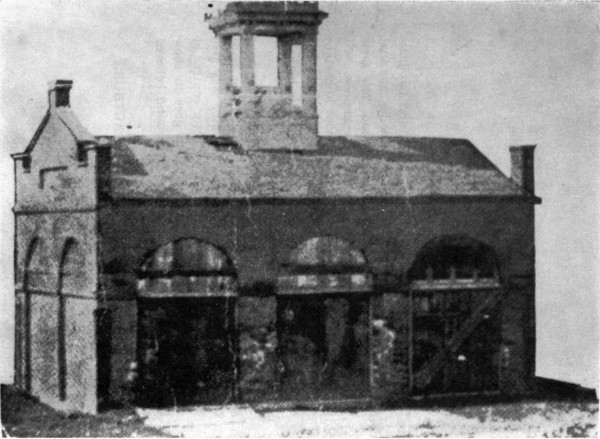
into a small brick building near the armory gate, called "the engine
house," taking with him the nine citizens. This little building was
afterwards famous under the name of "John Brown's Fort," and, from the
time of the invasion until the spring of 1892, it was an object of great
curiosity to strangers visiting the place. It was sold at the time last
mentioned to a company of speculators for exhibition at the World's Fair
in Chicago, and with it much of the glory of Harper's Ferry departed
forever. About the year 1895, it was repurchased and reshipped to
Harper's Ferry by the late Miss Kate Fields, and it is now to be seen
about two miles from its original site on the farm of Mr. Alexander
Murphy. Of course, the bricks are not relaid in their original order and
the death of Miss Fields makes its restoration to anything like its old
self very improbable. About the time when Brown immured himself, a
company of Berkeley county militia arrived from Martinsburg who, with
some citizens of Harper's Ferry and the surrounding country made a rush
on the armory and released the great mass of the prisoners outside of
the engine house, not, however, without suffering some loss from a
galling fire kept up by the enemy from "the fort." Brown's men had
pierced the walls for musketry and through the holes kept up a brisk
fusillade by which they wounded many of the Martinsburg and
Harper's Ferry people and some Charlestown men who, too, had come to
take part in the fray. The sufferers were Messrs. Murphy, Richardson,
Hammond, Dorsey, Hooper and Wollett, of Martinsburg; Mr. Young, of
Charlestown, and Mr. Edward McCabe, of Harper's Ferry. Mr.
Dorsey was wounded very dangerously and several of the others were
injured severely. All got well again, however, except one, whose hand
was disabled permanently.
Before Brown's retreat to the fort, two of his men approached the corner
of High and Shenandoah streets, where Mr. Boerly had been shot in the
morning. It was then about 2 o'clock p.m. and Mr. George Turner a very
respected gentleman of Jefferson county who had come to town on private
business was standing at the door of Captain Moore's house on High
street about seventy-five yards from the corner above mentioned. He had
armed himself with a musket and was in the act of resting it on a board
fence near the door to take aim at one of those men when a bullet from a
Sharp's rifle struck him in the shoulder—the only part of him that was
exposed. The ball after taking an eccentric course entered his neck and
killed him almost instantly. A physician who examined his body
described the wound as having been of the strangest kind the bullet
having taken a course entirely at variance with the laws supposed to
prevail with such projectiles. It was thought by many that the shot was
not aimed at Mr. Turner and that the man who fired it was not aware of
that gentleman's being near. There were two citizens named McClenan and
Stedman in the middle of the street opposite to Captain Moore's house.
They had guns in their hands and at one of them it is supposed was aimed
the shot that proved fatal to Mr. Turner.
After this shooting the two strangers immediately retreated and a
ludicrous occurrence took place if indeed, any event of that ill-omened
day can be supposed to be calculated to excite merriment. Mr. John
McClenan—above mentioned—shot after them and his bullet striking the
cartridge box of one of them, as he was approaching the armory gate, an
explosion of his ammunition took place and he entered the gate amid a
display of fireworks of a novel description. Apparently, he did not
relish the honors paid him and, with accelerated pace, he took refuge
with his company in the engine house.
The strangers continued to fire from their fortress and they now killed
another very valuable citizen—Fountain Beckham, for many years agent of
the Baltimore and Ohio railroad company at Harper's Ferry, and long a
magistrate of Jefferson county. Being a man of nervous temperament he
was naturally much excited by the occurrences of the day. Moreover,
Heywood Shepherd, the negro shot on the railroad bridge on the previous
night, had been his faithful servant and he was much grieved and very
indignant at his death. Against the remonstrances of several friends he
determined to take a close look at the enemy. He crept along the
railroad, under shelter of a watering station, which then
stood there and peeped 'round the corner of the building at the engine
house opposite, when a bullet from one of Brown's men penetrated his
heart and he died instantly. A man named Thompson, said to be Brown's
son-in-law, had been taken prisoner a short time before by the citizens
and confined in Fouke's hotel under a guard. At first it was the
intention of the people to hand him over to the regular authorities for
trial, but the killing of Mr. Beckham so exasperated them that the
current of their feelings was changed. They rushed into the hotel,
seized Thompson and were dragging him out of the house to put him to
death, when Miss Christina Fouke, a sister of the proprietor, with true
feminine instinct, ran into the crowd and besought the infuriated
multitude to spare the prisoner's life. This noble act has elicited the
warmest commendations from every party and it may be considered the one
redeeming incident in the gloomy history of that unfortunate day. Miss
Fouke's entreaties were unheeded, however, and Thompson was hurried to
the railroad bridge, where he was riddled with bullets. He tried to
escape by letting himself drop through the bridge into the river. He had
been left for dead, but he had vitality enough remaining to accomplish
this feat. He was discovered and another shower of bullets was
discharged at him. He was either killed by the shots or drowned and, for
a day or two, his body could be seen lying at the bottom of the river,
with his ghastly face still showing what a fearful death agony he had
experienced.
Another of the invaders, named Lehman, attempted to escape from the
upper end of the armory grounds by swimming or wading the Potomac. He
had been seen shortly before conducting one of the armory watchmen,
named Edward Murphy, towards the engine house. He kept his prisoner
between himself and an armed party of citizens who were stationed on a
hill near the government works. More than a dozen guns were raised to
shoot him by the excited crowd and, no doubt, he and Murphy would have
been killed had not Mr. Zedoc Butt, an old citizen, induced the party
not to fire, in consideration of the danger to the innocent watchman.
Immediately afterwards, Lehman disappeared for a while, but soon he was
seen endeavoring to escape as above mentioned. A volley was fired after
him and he must have been wounded, as he lay down and threw up both his
arms, as if surrendering. A temporary resident of Harper's Ferry waded
through the river to a rock on which Lehman lay, apparently disabled,
and deliberately shot him through the head, killing him instantly. His
body, too, lay for a considerable time where he fell, and it could be
seen plainly from the high ground west of the armory. The slayer now
asserts that Lehman first drew his pistol to shoot at him.
A little before night Brown asked if any of his captives would volunteer
to go out among the citizens and induce them to cease firing on the
fort, as they were endangering the lives of their friends—the
prisoners. He promised on his part that, if there was no more firing on
his men, there should be none by them on the besiegers. Mr.
Israel Russel undertook the dangerous duty—the risk arose from the
excited state of the people who would be likely to fire on anything seen
stirring around the prison house—and the citizens were persuaded to
stop firing in consideration of the danger incurred of injuring the
prisoners. Like Messrs. Kitzmiller and Cross, Mr. Russel, it will be
readily supposed, did not return to captivity. It is certain that the
people of the place would have disposed of Brown and his party in a very
short time, had they not been prevented all along from pushing the siege
vigorously, by a regard for the lives of their fellow townsmen, who were
prisoners. As it was, they had killed, wounded or dispersed more than
three-fourths of the raiders and, consequently, the sneers that were
afterwards thrown out against their bravery, were entirely uncalled for
and were by parties who, in the subsequent war, did not exhibit much of
the reckless courage which they expected from peaceful citizens, taken
by surprise and totally at a loss for information as to the numbers and
resources of their enemies.
It was now dark and the wildest excitement existed in the town,
especially among the friends of the killed, wounded and prisoners of the
citizens' party. It had rained some little all day and the atmosphere
was raw and cold. Now, a cloudy and moonless sky hung like a pall over
the scene of war and, on the whole, a more dismal night cannot be
imagined. Guards were stationed 'round the engine house to prevent
Brown's escape and, as forces were constantly arriving from Winchester,
Frederick City, Baltimore and other places to help the Harper's Ferry
people, the town soon assumed quite a military appearance. The United
States' authorities in Washington had been notified in the meantime,
and, in the course of the night, Colonel Robert E. Lee, afterwards the
famous General Lee of the Southern Confederacy, arrived with a force of
United States' marines, to protect the interests of the government, and
kill or capture the invaders. About 11 o'clock at night Brown again
endeavored to open negotiations for a safe conduct for himself and his
men out of the place. Colonel Shriver and Captain Sinn, of the Frederick
troops, had a conference with him which, however, did not result in
anything satisfactory. About 7 o'clock on Tuesday morning—October
18th—Colonel Lee sent, under a flag of truce, Lieutenant J. E. B.
Stuart, of the 1st Cavalry regiment—afterwards so famous for his
exploits in the service of the confederacy—who had accompanied Colonel
Lee from Washington, to summon the garrison to surrender. Knowing the
character of Brown, Colonel Lee did not hope for any success in trying
to induce him to lay down his arms, and he sent Lieutenant Stuart merely
through solicitude for the prisoners and a desire to use every expedient
in his power before ordering an assault and subjecting them to the
danger of being injured by mistake in the melee. As anticipated, Brown
stubbornly refused to surrender and, therefore, about 8 o'clock, an
attack was made by the marines under Lieutenant Greene. At first, they
tried to break open the door with sledge hammers, but failing in this
they picked up a large ladder that lay near and with that used as a
battering ram they succeeded in making a breach. Through a narrow
opening thus made, Lieutenant Greene squeezed himself, but he found that
the insurgents had barricaded the door with a fire engine and hose that
were in the building. Over these obstructions Lieutenant Green
scrambled, followed by his men and attacked Brown who, with his party,
was fortified behind the engine. It is said that one of Brown's men
offered to surrender and that Brown announced the man's willingness to
do so, but, for some reason, the offer was not accepted. While the
marines were effecting a breach and when they commenced to rush in, the
enemy fired on them and one of the soldiers—Luke Quinn—was mortally
wounded and another, named Rupert, had his upper lip badly lacerated.
The former was shot through the body and, if the latter is still alive,
he certainly has an ugly scar to remind him and the others of John
Brown's raid. The insurgents were all bayoneted or captured, but
fortunately none of the citizen prisoners received any injury. Their
escape, indeed, was almost miraculous, as it was difficult for the
marines to distinguish them from the enemy. Brown himself was wounded
severely by Lieutenant Greene and he was taken to another
building where his injuries were examined by a physician and his wounds
dressed. He received a cut on the head and a sword thrust in the
shoulder. Two or three survivors of his men were kept in the engine
house, under a guard of marines. The bodies of the slain raiders were
collected soon after from the streets and rivers and, with one
exception, buried in a deep pit on the southern bank of the Shenandoah,
about half a mile above Harper's Ferry, and the prisoners—Brown
included—were lodged in Charlestown jail. One body was taken away by
some physicians for dissection, and, no doubt, the skeleton is now in
some doctor's closet. After having lain just forty years in this rude
grave by the Shenandoah, the bodies of the slain raiders were
disinterred about three years ago (1899) and taken to North Elba, New
York, where they now rest close to the grave of their famous leader.
This removal and reinterment were
accomplished through the efforts and under the auspices
of Professor Featherstonhaugh, of Washington, D. C., who has ever taken
a deep interest in everything appertaining to John Brown and famous
raid. Can fiction imagine anything more weird than the reality of the
sad fate of those men?
Some of Brown's men had escaped, however, from the place, in the course
of the skirmish, and Cook had not been noticed at all in the fray or in
the town since an early hour on Monday morning, when he was seen to
cross the Potomac on the bridge into Maryland with a few others, taking
with him two horses and a wagon captured at Colonel Washington's place
on the previous night, and two or three slaves belonging to that
gentleman. There was satisfactory evidence, however, of his being fully
implicated in the outrage and it was ascertained that he, Owen
Brown—one of old John's sons—and others had been detailed to operate
on the Maryland shore and that they had seized a schoolhouse, taken the
Domine—McCurrie—prisoner and driven away the pupils, for the purpose
of establishing at the place a depot for arms convenient to Harper's
Ferry. It was learned, also, that all the day of the 17th, they had kept
up a musketry fire from the Maryland mountain on the people of the town,
and that late in the evening Cook had got supper at the canal lockhouse,
on the Maryland side of the river. Moreover, it was supposed that,
finding the fate of war against them, they had fled towards
Pennsylvania. A large body of men, under Captain Edmund H. Chambers, an
old citizen and a man of well known courage, marched towards the
Schoolhouse and the Kennedy farm and, at each place they found a large
number of Sharp's rifles, pistols, swords, &c., with a corresponding
quantity of powder, percussion caps and equipments of various kinds. A
swivel cannon carrying a one pound ball was discovered, also, in a
position to command the town, although it is not known that it was used
during the skirmish. A large number of pikes of a peculiar form, and
intended for the hands of the negroes, was also found. The blacks were
expected to turn out at the first signal, and this weapon was considered
to be better suited to them than firearms, especially at the
commencement of the campaign. It should have been mentioned before that
Brown had put into the hands of his negro prisoners some of these pikes,
but, up to the time of the discovery of the magazine at the Kennedy
farm, the object of this novel weapon was not fully understood. Captain
Chambers' party found, also, a great number of papers which tended to
throw light on the conspiracy and several hundred copies of a form of
provisional government to be set up by Brown as soon as he had got a
footing in the south.
The Governor of Virginia, Henry A. Wise, had arrived in the meantime. He
immediately took every precaution to secure the prisoners and guard the
state against any attempt from the many allies Brown was thought to have
in the north. Governor Wise indulged in many uncalled for strictures on
the people of Harper's Ferry, for their supposed inefficiency as
soldiers on this occasion, boasting that he could have taken Brown with
a penknife. This he might have done if the handle was long enough to
allow him to keep beyond rifle range while he was punching the old man
through the key hole, but with an ordinary penknife or even with a
minie musket and bayonet, it is doubtful if the governor could
have done more than was performed by many a mechanic of Harper's Ferry
in the skirmish of Monday. In the subsequent war Governor Wise held
quite an important command and history does not record of him any of the
wonderful feats of skill or courage that might be expected from a man so
confident of his own prowess as the governor was when sneering at a
brave people taken by surprise and unarmed, when an unexpected attack
was made on them. To Governor Wise Brown confessed the whole plan for
liberating the slaves and, indeed, he had, all along,
communicated to his prisoners his intentions, but, as
before noted, he kept his captives isolated as much as possible and, in
consequence, the people generally had but a vague suspicion of his
purpose. It is true that the party at the rifle factory had informed Mr.
Young of their objective, but so many wild rumors had been started
before his interview with them, and there was so much general confusion
that "neither head nor tail" could be found for the strange occurrences
of the day. The governor who, although he exhibited a great deal of
petulance on this occasion, was certainly a gallant man himself, could
not refrain from expressing admiration for Brown's undaunted courage,
and it is said that he pronounced the old man honest, truthful and
brave.
The interview between these two men of somewhat similar character,
though of diametrically opposite views on politics, is said to have been
very impressive. It lasted two hours and those who were present reported
that Brown exhibited a high order of uncultivated intellect in his
conversation with the highly educated and polished governor of Virginia.
It is said, also, that in the course of this interview, Brown foretold
the utter destruction of Harper's Ferry to take place in a very short
time—a prophecy which, if uttered at all, has met with a terrible and
literal fulfillment. Brown, Wise and the group surrounding them while
this conversation was in progress, would furnish a fine theme for a
picture. The stern, old Puritan with his bleeding wounds and disordered
dress, his long, gray beard and wild gleaming eyes, like some prophet of
old, threatening the wrath of Heaven on a sinful generation, and the
stately governor of Virginia reminding one of some cavalier of Naseby or
Worcester—each firm and true as the blade he carried and each a type of
the noble though fanatical race from which he sprang, would make an
impressive picture and, perhaps, the scene will exercise, some day, the
genius of a future painter.
On Wednesday night, October 19th, while the fever of excitement was yet
at its height, a gentleman residing in Pleasant Valley, Maryland, about
three miles from Harper's Ferry, heard a rumor that the "abolitionists"
and the slaves were butchering the people around Rohrsville, a few miles
farther up the same valley, and very properly gave notice of what he had
heard, riding furiously through Sandy Hook, towards the centre of the
trouble, the government armory. The people of Sandy Hook, men, women and
children rushed wildly towards the same point for protection at
the hands of the troops there assembled, while the people of Harper's
Ferry were equally wild with this new excitement. The marines who were
yet at the place turned out and marched to the point designated, where
their appearance caused another and more reasonable alarm among the
people there, who had not been disturbed by Brownites, white or black
and who, for a long time, could not be convinced that the soldiers had
come to protect and not molest them. Sandy Hook was totally
deserted by its people on this occasion, and many of them hurried away
whatever of their portable property they deemed most valuable. It is
said that one man shouldered a half-grown hog of a favorite breed and
made tracks to Harper's Ferry, and, as he and his neighbors scoured
along the road, the squeals of the indignant pig blended harmoniously
with the multifarious noises of the flying column. The marines, finding
no enemy, returned to Harper's Ferry, but, for many weeks afterwards,
similar alarms were started by nervous or mischievous people with nearly
the same results.
Harper's Ferry was now patrolled every night by details of citizens
until the execution of Brown, which took place near Charlestown,
December 2d, 1859. Many a midnight tramp did the author take along the
muddy streets that winter with an old Hall's rifle on his shoulder when
his turn came to watch out for prowling abolitionists. The companion of
his watch was a worthy Milesian gentleman named Dan. O'Keefe, from "the
beautiful city called Cork." They made it a point to watch Dan's house
particularly, through a very natural praiseworthy anxiety on the part of
that gentleman for the safety of his better half and several pledges of
love presented from time to time by that excellent lady to her lord and
master, as well as for the sake of a corpulent flask which the
hospitable Hibernian never failed to produce from a cupboard, near the
door, when in their rounds, they came to his house. As the night and the
contents of the flask waned, the courage of the brothers-in-arms arose
and it is fortunate, perhaps, for the fame of Horatius Cocles, Leonidas
and other celebrated defenders of bridges or passes that no
abolitionists attempted to cross to "the sacred soil of Virginia" while
those worthies were on guard and full of patriotic enthusiasm and
whiskey punch. No doubt, their exploits would have eclipsed those of
the above mentioned Roman and Greek and of anybody else who has gained
celebrity by blocking the passage of an enemy. Several companies of
armorers were organized for the defense of the place and, once a week
did they display all "the pride, pomp and circumstance of glorious war"
marching and countermarching along the streets, to the delight of the
ladies, the children and, no doubt, of themselves, as well as to the
terror of any book peddler from the north who might be in the
neighborhood and who might reasonably be suspected of being opposed to
slavery. A force of United States troops under Captain Seth Barton,
afterwards prominent in the service of the confederacy, was stationed at
Harper's Ferry and, gradually, quiet was restored. A Milesian warrior,
named Sergeant McGrath of the above troop was detailed to instruct the
awkward squad of citizens in the manual of arms and his deep Munster
Doric could be heard on parade evenings thundering his commands to
refractory recruits.
Cook and another of Brown's party, named Albert Hazlett, were arrested
in Pennsylvania and brought back to Virginia on requisitions. This
circumstance furnished a lesson to the fanatics who unhappily abounded
on both sides of Mason and Dixon's line. To the southern men it ought to
have proved that the people of the north did not sympathize to any great
extent with the invaders of Virginia and to the northern people who
expressed themselves as being shocked at the want of clemency exhibited
by the state of Virginia on this occasion, it showed that among
themselves were men who were ready to deliver over Brown's party to the
tender mercies of the slave holders for the sake of a few hundred
dollars offered as a reward for this service.
Cook and another white man, named Edwin Coppic, with two negroes, named
Green and Copeland, were executed on the 16th of December, in the same
year and Hazlett and Aaron D. Stevens—both white—met the same fate on
the 16th of March, 1860.
Brown's trial was, of course, a mere matter of form. He took no pains to
extenuate his guilt and openly avowed that he desired no favors from
the state of Virginia. Two young lawyers of Boston, named Hoyt and
Sennott, volunteered to defend him and they acquitted themselves
creditably. The Honorable Samuel Chilton, of Washington City, was
employed for the defense by John A. Andrew, of Massachusetts, afterwards
governor of that state, but, of course nothing could save the prisoner
and he was executed as before stated.
Brown died with unshaken fortitude and, bitter as the animosity against
him was, his courage or rather his stoic indifference elicited the
admiration of even his unrelenting enemies. Indeed it is difficult at
the present time to do justice to the character of this remarkable man,
but, no doubt, the future historian of this country who will write when
the passions that excite us have subsided or, perhaps, are forgotten
will class him with the Scotch Covenanters of the 17th century. It
appears to the writer that in many respects John Brown very closely
resembled John Balfour, of Burly, whose character is so finely portrayed
in Scott's "Old Mortality." The same strong will and iron nerve and the
same fanaticism characterized these two men and it must be said of both,
for Burly's character is taken from life—that, while no sane person can
wholly approve of their actions, their most implacable opponents cannot
deny a tribute of respect to their unflinching courage. The other
prisoners, also, died bravely and, indeed, it was a melancholy thing to
see men of so much strength of character lose their lives in such a
foolish undertaking—foolish, as far as the limited facilities of man
can reach—but wise, perhaps, could men understand the workings of Him
"whose thoughts are not our thoughts and whose ways are not our ways."
In judging of this invasion it is well to remember that everything which
John Brown proposed to do was successfully accomplished within five
years from the day of his execution, and who can tell how much active
providential interference there was in this apparently wild and lawless
enterprise?
An attempt to escape was made by Cook and Coppic on the night before
their execution. By some means they succeeded in eluding the
vigilance of the cell watch and in climbing the outer wall
of the prison when they were challenged by a citizen guard who was
posted outside and their further progress was prevented. The name of the
sentinel who discovered them in their flight was Thomas Guard and many
jokes and puns were perpetrated for months afterwards on the
coincidence. They were taken back immediately to their cell and closely
guarded 'til morning.
A characteristic anecdote was told by the late Mr. James Campbell, who
was sheriff of Jefferson county at the time of the Brown troubles. It
will be remembered that, on the morning of the raid, Brown got breakfast
for his men at Fouke's hotel and that, in liquidation, he restored to
liberty Walter Kemp, the bartender, whom he had taken prisoner. A short
time before Brown's execution Sheriff Campbell sold some property
belonging to Brown which was found at the Kennedy farm and was
accounting to him for it, and naming some claims presented against him
by various parties with whom Brown had had dealings. Among these claims
was one of Mr. Fouke for the refreshments mentioned. Brown was reclining
on his bed, not having yet recovered from his wounds, and, no doubt,
with his spirit darkened by the shadow of his impending fate. He
listened apathetically to the list of debts, until that of Mr. Fouke was
mentioned when he suddenly rose up and protested against this demand.
"Why, Mr. Campbell," said he, "I made a fair exchange with Mr. Fouke; I
restored to him his bartender as pay for the meals referred to, and I do
not think it honorable in him to violate the contract." Mr. Campbell
replied: "Why, Mr. Brown, I wonder at you. I thought you were opposed to
trading in human flesh, but, now, I find that even you will do it, like
other people, when it suits your convenience." A grim smile played for a
moment 'round the old Puritan's firmly compressed mouth. He lay down
again quietly and remarked "Well, there may be something in that, too."
He made no further opposition to the claim. A part of the property
disposed of by Sheriff Campbell was a horse which Brown had bought from
a Harper's Ferry horse trader. In the transaction Brown had been badly
bitten, as the animal was nearly valueless and, on the day of the raid
the old man made particular inquiries about the tricky trader. The
latter was warned of his danger and took care not to encounter his
victim, who, with all the solemn thoughts of a great national uprising,
and the fearful risk of his undertaking, was yet smarting from the petty
deception put on him in the sale and eager to take vengeance for it.
On the morning of his execution he bade an affectionate farewell to his
fellow captives with the exception of Cook whom he charged with having
deceived him, and Hazlett of whom he denied any knowledge. It is said
that he gave to each of them, with the exceptions noted, a silver
quarter of a dollar, as a memento and told them to meet their fate
courageously. His pretense not to know Hazlett was understood to be for
the benefit of the latter whose trial had not yet come off. Hazlett
stoutly denied that he knew anything of Brown or that he was connected
in any way with the raid on Harper's Ferry. It will be remembered that
he was arrested in Pennsylvania, some time after the invasion, and, of
course, his defense, if he had any, was an alibi. A very absurd story
was published about Brown's taking a colored baby from its mother's arms
at the scaffold and kissing it. No colored person of either sex would
dare to approach the scene of the execution. The slaves were frightened
and bewildered so thoroughly at the time that their sole aim was to
avoid the public eye as much as possible but the paragraph promised to
take well and the reporter was not disappointed.
Brown's wife arrived at Harper's Ferry shortly before his execution and,
to her his body was delivered for burial. He was interred at North Elba,
in the State of New York, where he had resided for some years. His wife
was a rather intelligent woman and she did not appear to sympathize with
her husband's wild notions on the subject of slavery. In conversation
with a citizen of Harper's Ferry she expressed an opinion that Brown
had contemplated this or a similar attack for thirty years, although he
had never mentioned the subject to her. The bodies of Cook, Coppic,
Hazlett and Stevens, also, were delivered to friends, and it is said
that the last named two are buried near the residence of a benevolent
lady of the Society of Friends in New Jersey. She had always sympathized
with their cause and she provided their remains with the only thing now
needed—a decent burial.
Many anecdotes of John Brown are told in the neighborhood of the Kennedy
farm where he and his party resided during the greater part of the
summer previous to the attack, and they serve to illustrate the
character of this extraordinary man. Whenever he killed an animal for
his own use and that of his men he invariably sent a portion of it to
some of his neighbors, many of whom were poor and sorely in need of such
attentions. In other respects, also, especially in his love for
children, he exhibited a kindness of heart which made him to be much
liked by all who knew him. He was very regular in his attendance at
church exercises and his piety was undoubtedly genuine, as will appear
from the following: Once, a large crowd had assembled in a log
schoolhouse to listen to an itinerant preacher. The minister made but a
very poor show and his sermon was considered, even in that
unsophisticated region, as far below mediocrity. John Brown or Isaac
Smith, as he was then called, was one of the audience and, all through
the sermon he kept his eyes riveted on the preacher and appeared to be
totally absorbed in attention, as much so, indeed, as if the pulpit was
occupied by Henry Ward Beecher or some other far famed divine. When the
sermon was concluded one of Brown's neighbors in the audience made some
jocular remark about the preacher and the discourse and asked Brown if,
ever before, he had heard such trash from a pulpit. "Sir," said the
stern old man. "When I come to hear the word of God, I do not propose to
criticize the preaching of His minister. I recognize the Master, humble
as the servant may be, and I respect His word, though coming from the
mouth of an obscure and illiterate man."
On the other hand he sometimes savored strongly of blasphemy, whenever
religious dogmas or tenets appeared to clash in any way with his
favorite hobby. After his conviction many preachers of various
denominations offered him the consolation of religion according to their
particular rites. At their introduction to him Brown always asked these
gentlemen: "Do you approve of slavery?" As the answer at that time was
sure to be in the affirmative for not even a minister of the Gospel
dared then to hint at any sin in "the institution"—he refused to
receive their services, preferring to go before his God unshriven to
accepting the ministrations of slavery-loving preachers. One reverend
gentleman remarked to him that Saint Paul himself had sent back a
fugitive slave to his master, when Brown, with his dark eye ablaze said:
"Then Saint Paul was no better than you are." And in this spirit he
entered the great unknown, where it is to be hoped that honest
convictions receive at least as much honor as well conned
creeds, learned by rote, and often wanting in the great essential—an
active charity.
The gallows on which Brown was hung must have been a vast fabric and the
rope used must have been as long as the Equinoctial Line, or, else, both
had some miraculous powers of reproduction. Of the many thousands of
soldiers who were stationed from time to time in Jefferson county, from
the day of Brown's execution till the last regiment disappeared, more
than a year after the war, almost every other man had a portion of
either as a souvenir of his sojourn in Virginia. The writer saw pieces
of wood and fragments of rope purporting to have formed parts of
them—enough to build and rig a large man-of-war. If the soldiers
believed they had genuine relics they were as well contented as they
would be if they had the reality and it would be cruel to undeceive
them. The true history of that scaffold is as follows: It was built by a
carpenter of Charlestown, named David Cockerell, expressly for the
execution of Brown. When this purpose was accomplished the builder took
it to his home, and put it away as a curiosity. When the war broke out
Cockerell joined the confederate army and acted as engineer on the staff
of Stonewall Jackson. Fearing that in his absence from home his family
might be annoyed by soldiers coming to see the relic or, if possible, to
steal it, he ordered it to be built into a porch attached to the house
and the whole structure to be painted in the same color so that no
stranger could guess at anything beyond the common in the ordinary
looking porch. Cockerell died some years after the war, and it is said
that his heirs disposed of the famous scaffold to some Washington City
speculators, who proposed to exhibit it at the World's Fair in Chicago
in 1893. The writer gives this history of the scaffold as he has
received it from trustworthy sources. For several months after the raid
a brisk trade was prosecuted by the boys of Harper's Ferry selling "John
Brown pikes" to railroad passengers who, every day now
stopped at the station from curiosity and, as the number of genuine
pikes was not very large, the stock must have been exhausted in a very
short time. It is said, however, that some ingenious and enterprising
blacksmiths in the neighborhood devoted much of their time and capital
to the manufacture of imitations, and it is certain that the number of
pikes sold to strangers exceeded, by a great many, the number supposed
to have been captured at Brown's headquarters.
The names of the invaders, as well as could be ascertained, were as
follows: John Brown, Watson Brown, Oliver Brown, Owen Brown, Aaron D.
Stevens, Edwin Coppic, Barclay Coppic, Albert Hazlett, John E. Cook,
Stuart Taylor, William Lehman, William Thompson, John Henrie Kagi,
Charles P. Tydd, Oliver Anderson, Jeremiah Anderson, 'Dolph
Thompson, Dangerfield Newby, Shields Greene alias "Emperor," John
Copeland and Lewis Leary, of whom the last four were negroes or
Mulattoes.
John Brown was, at the time of the raid, fifty-nine years old. He was
about five feet and eleven inches in height, large boned and muscular,
but not fleshy, and he gave indications of having possessed in his youth
great physical strength. His hair had been a dark brown, but at this
period it was gray. His beard was very long and, on the day of the
raid, it hung in snowy waves to his breast and helped to give to his
aquiline features a singularly wild appearance. His eyes
were of a dark hazel and burned with a peculiar light that gave promise
of a quick temper and a daring courage. His head, as it appeared to the
writer, was of a conical shape, and, on the whole, his physique well
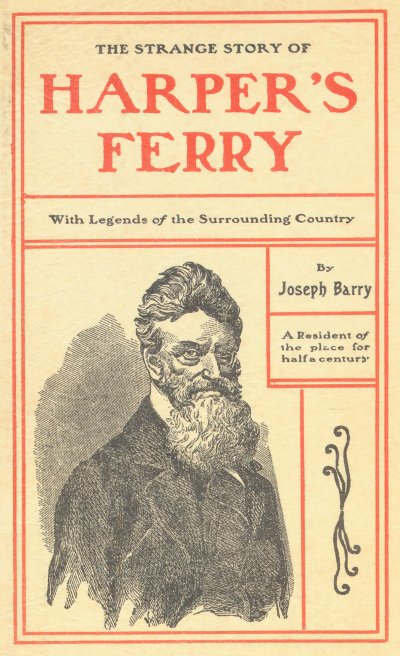
corresponded with the traits of his character. The portrait of him in
this book is an admirable likeness. He was a native of Connecticut, but
he had resided for many years in the states of New York and Ohio where,
it is said, he was a rather extensive and successful wool-grower. He was
twice married and he had a very large family of sons and daughters, the
most of whom were married. He emigrated to Kansas at an early period in
the history of that territory and he was an acknowledged leader in the
civil broils which distracted that region for several years. Of course,
various opinions were entertained concerning him—the Free Soil men
considering him a hero, and the pro-slavery people regarding or
affecting to regard him as a demon incarnate. It is said that, in 1851,
he visited Europe with the ostensible purpose of exhibiting samples of
wool, but in reality to study the science of earth fortifications and
gain military knowledge to be made available in a servile war which he
designed to excite at a suitable opportunity. He certainly suffered a
great deal in Kansas—losing one of his sons, Frederick, and a
considerable amount of property in fighting the southern settlers, and
it is probable that a bitterness of feeling on this account mingled with
his natural hatred of slavery.
There was confusion respecting the identity of his two sons—Watson and
Oliver. They were both mortally wounded on the 17th. One of them,
supposedly, a young man apparently about twenty-three years of age, of
low stature, with fair hair and blue eyes, was shot in the stomach and
died in the course of the night in the engine house, while the party had
still possession of it. It is said that he suffered terrible agony and
that he called on his companions to put him out of pain by shooting him.
His father, however, manifested no feeling on the occasion beyond
remarking to his boy that "he must have patience; that he was dying in a
good cause, and that he should meet his fate like a brave man." The
other was a tall man, about six feet in height, with very black hair.
He, also, as before stated, was wounded in the skirmish of the 17th, and
he died next morning, after the marines got possession of the engine
house. He was one of the two men who were wounded from "the Gault
house." When he died his father was a prisoner and badly wounded. On
learning that one of his men had died a few minutes before, he sent out
to inquire if it was his son and, on being informed that it was, he
manifested the same stoicism and made a remark similar to the one of the
previous night, when the other son was dying—that the cause was good
and that it was glorious to die for its sake. When the news reached him
he was engaged in the interview with Governor Wise. After satisfying
himself as to the identity of the man just deceased, he resumed his
conversation with the governor, as if nothing had happened which was
calculated in the least to discompose him. As before noted, there is a
doubt with the people of Harper's Ferry as to which of these two men was
Oliver and which was Watson, and, indeed, whether or not the fair-haired
youth was his son at all.
Owen Brown was one of those detailed to operate in Maryland. He was not
in the skirmish, and he made his escape and was not seen again in
Virginia or Maryland. The writer has no knowledge of his appearance or age.
Aaron D. Stevens
was a remarkably fine looking young man of about thirty years of age. He
was about five feet and ten inches in height, heavily built and of great
symmetry of form. His hair was black and his eyes of dark hazel had a
very penetrating glance. He was said to be a desperate character and, as
it was reported that he had suggested to Brown the murder of the
prisoners and the firing of the village, there was greater animosity
felt towards him than any of the others, except, perhaps, Captain Brown
himself and Cook. He received several wounds in the skirmish and it was
thought he could not survive them. In consequence of these injuries he
was one of the last put on trial and executed. He was said to be a
believer in spiritualism or spiritism which is, perhaps, the proper
term. He was the one who was so badly wounded from "the Gault house" and
who was taken to Fouke's hotel. Had he not been disabled, it is to be
feared, from what is reported of him, that a massacre of the prisoners
would have been perpetrated on his recommendation. Whatever his crimes
may have been it is certain that he was a man of undaunted courage and
iron nerve. While he lay at Fouke's hotel helpless from his wounds, a
crowd of armed and frenzied citizens gathered 'round him, and it was
with the utmost difficulty that a few of the less excited people
succeeded in saving his life for the present. One man put the muzzle of
his loaded gun to Stevens' head with the expressed determination to kill
him instantly. Stevens was then unable to move a limb, but he fixed his
terrible eyes on the would-be murderer and by the sheer force of the
mysterious influence they possessed, he compelled the man to lower the
weapon and refrain from carrying out his purpose. To this day the
magnetized man avers that he cannot account for the irresistible
fascination that bound him as with a spell.
Edwin Coppic or Coppie was a young man aged about twenty-four years,
about five feet and six inches in height, compactly built and of a
florid complexion. He was a very handsome youth, and for various
reasons, great sympathy was felt for him by many. He was not wounded in
the skirmish, but he was taken prisoner by the marines in the engine
house. He had come from Iowa where resided his widowed mother, a pious
old lady of the Society of Friends. He had been for a long time in the
employ of a Mr. Thomas Gwynn, living near Tipton, Cedar county, in the
above mentioned state. Mr. Gwynn was a farmer and merchant and Coppic
assisted him as a farm laborer and "help" around his store. His employer
was much attached to him and came to Charlestown for his remains, which
he took with him to Iowa. After Coppic's conviction a petition was
forwarded to the governor of Virginia, requesting executive clemency in
his case. It was not successful, however, and he was executed as before
stated. In conversation with a citizen of Harper's Ferry who interviewed
him in his cell, Coppic said that, when he left his home in Iowa, he had
no intention to enter on any expedition like the one against Virginia,
but he confessed that his object was to induce slaves to leave their
masters, and to aid them to escape.
Of Barclay Coppic little is known in Virginia beyond the fact that he
was Edwin's brother and that he was with Brown's party in the raid. He
was with Owen Brown and Cook on the Maryland side of the Potomac while
the skirmish was in progress and he was not captured. It is said that he
was killed some years ago in a railroad accident in Missouri.
Albert Hazlett, of Pennsylvania, was a man of about five feet and eleven
inches in height, raw-boned and muscular. His hair was red and his eyes
were of a muddy brown color and of a very unpleasant expression. He was
very roughly dressed on the day of the raid, and in every sense of the
word he looked like an "ugly customer." He made his escape from Harper's
Ferry on the evening of the 17th, about the time when Brown withdrew his
force into the engine house, but he was afterward captured in
Pennsylvania and executed with Stevens. His age was about thirty-three
years.
John E. Cook was a native of Connecticut and he was a young man of about
twenty-eight years—five feet and eight inches in height, though, as he
stooped a good deal, he did not appear to be so tall. He had fair hair
and bright blue eyes and he was, on the whole, quite an intelligent
looking man. As before stated, he had resided several years at Harper's
Ferry, and he had become acquainted with all the young men of the place,
by whom he was regarded as a pleasant companion. He had married a
respectable young lady of the place, who knew nothing of his former life
or of his plans against the peace of Virginia. He was highly connected
and the governor of Indiana at that time—Willard—was his
brother-in-law, being the husband of Cook's sister. At his trial Daniel
Voorhees, afterward so famous as a politician and criminal lawyer, made
a speech for the defense which is regarded as one of his best efforts.
Little is known of Stuart Taylor. Some contend that he was a man of
medium size and very dark complexion, while others believe that he was a
redhaired young man who was bayoneted by the marines in the engine house
and dragged dead from that building at the same time that Brown was
removed. The writer is inclined to the latter opinion and he thinks that
those who favor the former confound him with a man named Anderson of
whom mention will soon be made at some length.
William Lehman, who was killed on a rock in the Potomac while
endeavoring to escape, was quite a young man, with jet black hair and a
very florid complexion. The killing of this young man was, under all
circumstances of the case, an act of great barbarity, as he had made
signs of a desire to surrender. The man who shot him was, as before
stated, but a temporary resident of Harper's Ferry and, in reality,
belonged to a neighboring county. Nothing can be gained by giving his
name and the concealing of it may save people yet unborn from unmerited
shame. In justice it must be said that he now claims that Lehman drew a
pistol to shoot him, but we did not hear of this until very lately.
William Thompson, who was shot on the bridge, was a man apparently of
about thirty years of age, of medium size, but of a symmetrical and
compact form. His complexion was fair, and he gave indications of being
a man of pleasant disposition. He was well known to many in the
neighborhood of the Kennedy farm and he was very popular with all his
acquaintances there. The killing of this man was unnecessary, also, but
some palliation for it may be found in the excitement caused by Mr.
Beckham's death.
John or, as he was sometimes called, Henrie Kagi, is said to have been a
remarkably fine looking man, with a profusion of black hair and a
flowing beard of the same color. He was about thirty years of age, tall
and portly, and he did not display the same ferocity that many of the
others exhibited. He was "secretary of war" under Brown's provisional
government and he held the rank of captain. He is supposed to have been
a native of Ohio. He was killed in the Shenandoah near the rifle
factory.
Of Charles P. Tydd little is known. It is said that, before the raid, he
used to peddle books through the neighborhood of Harper's Ferry. As far
as ascertained, he did not appear in the fight, but escaped from
Maryland to parts unknown. It is said that he was a native of Maine.
Respecting the identity of Oliver and Jeremiah Anderson there is a
doubt, as in the case of the young Browns. One of them was killed by the
marines, but what became of the other is unknown. The man who was killed
was about thirty years of age, of middle stature, very black hair and
swarthy complexion. He was supposed by some to be a Canadian mulatto. As
before noted, he is confounded by many with Stuart Taylor. He received
three or four bayonet stabs in the breast and stomach and, when he was
dragged out of the engine house to the flagged walk in front of that
building, he was yet alive and vomiting gore from internal hemorrhage.
While he was in this condition a farmer from some part of the
surrounding country came up and viewed him in silence, but with a look
of concentrated bitterness. Not a word did the countryman utter, as he
thought, no doubt, that no amount of cursing could do justice to his
feelings. He passed on to another part of the armory yard and did not
return for a considerable time. When he came back Anderson was yet
breathing and the farmer thus addressed him: "Well, it takes you a h—
of a long time to die." If Anderson had vitality enough left in him to
hear the words this soothing remark must have contributed greatly to
smooth his way to the unknown land of disembodied spirits. The writer
heard from very good authority that another and still greater barbarity
was practised towards this helpless man while he was in the death agony.
Some brute in human shape, it is said, squirted tobacco juice and
dropped his quid into the dying man's eye. The writer did not see the
latter occurrence, but it was related by witnesses of undoubted
veracity. After death, also, this man—Anderson—was picked out for
special attentions. Some physicians of Winchester, Virginia, fancied him
as a subject for dissection and nem. con. they got possession of his
body. In order to take him away handily they procured a barrel and tried
to pack him into it. Head foremost, they rammed him in, but they could
not bend his legs so as to get them into the barrel with the rest of the
body. In their endeavors to accomplish this feat they strained so hard
that the man's bones or sinews fairly cracked. These praiseworthy
exertions of those sons of Galen in the cause of science and humanity
elicited the warmest expressions of approval from the spectators. The
writer does not know, certainly, what final disposition they made of the
subject which the Fates provided for them, without the expense or risk
of robbing a grave.
'Dolph Thompson was quite a boy and he appeared to be an unwilling
participator in the transaction. He was seen by not more than two or
three of the citizens, and it is supposed that he escaped early on the
17th. He had fair hair and a florid complexion.
Dangerfield Newby was a tall and well built mulatto, aged about thirty
years. He had a rather pleasant face and address. He was shot and killed
at the Arsenal gate by somebody in Mrs. Butler's house opposite, about
11 o'clock, a.m., on Monday, and his body lay where it fell until the
afternoon of Tuesday. The bullet struck him in the lower part of the
neck and went down into his body, the person who shot him being in a
position more elevated than the place where Newby was standing. Mr.
Jacob Bajeant, of Harper's Ferry, used to claim the credit of having
fired the fatal shot, and the people generally accorded him the honor. A
near relative and namesake of George Washington disputes Bajeant's claim
and is confident that it was a shot from his rifle that put an end to
Newby's career. Mr. Bajeant is now dead and it is not likely that the
question will be brought up again. From the relative positions of the
parties, the size of the bullet or some other circumstance, the hole in
Newby's neck was very large, and the writer heard a wag remark that he
believed a smoothing iron had been shot into him. The writer has no
intention to make light, as might appear from the following, of what was
a fearful occurrence. He relates the simple truth, as many can attest.
Some fastidious critics have objected to the details of this tragedy in
former editions of this book, but Truth is mighty and ought to prevail.
That Newby's body was torn by hogs at Harper's Ferry is too well known
to require an apology for a relation of the facts, although the details
are undoubtedly disgusting. Shortly after Newby's death a hog came up,
rooted around the spot where the body lay and, at first appeared to be
unconscious that anything extraordinary was in its way. After a while,
the hog paused and looked attentively at the body, then snuffed around
it and put its snout to the dead man's face. Suddenly, the brute was
apparently seized with a panic and, with bristles erect and drooping
tail, it scampered away, as if for dear life. This display of
sensibility did not, however, deter others of the same species from
crowding around the corpse and almost literally devouring it. The writer
saw all this with his own eyes, as the saying is, and, at the risk of
further criticism, he will remark that none of the good people of
Harper's Ferry appeared to be at all squeamish about the quality or
flavor of their pork that winter. Nobody thought on the subject or, if
anybody did recall the episode, it was, no doubt, to give credit to the
hogs for their rough treatment of the invaders.
On Tuesday evening, after Brown's capture, and when the people were
somewhat relieved from the terror of a more extensive and dangerous
invasion, a citizen of Harper's Ferry, who had not had a chance to
distinguish himself in the skirmish of Monday, fired a shot into what
was left of Newby's body, a feat which, it must be supposed, tended to
exalt him, at least, in his own estimation. Like Kirkpatrick at the
murder of the Red Comyn, he thought he would "make sicker" and guard
against any possibility of the dead man's reviving. The citizen referred
to was somewhat under the influence of whiskey when he fired the
superfluous shot, but the writer saw another man who was apparently
sober and who was certainly a person of excellent standing in the
community, kick the dead man in the face and, on the whole, great a
crime as the invasion of the place was and natural as the animosity
towards the raiders should be considered, it must be confessed that the
treatment the lifeless bodies of those wretched men received from some
of the infuriated populace was far from creditable to the actors or to
human nature in general.
Shields Greene alias "Emperor" was a negro of the blackest hue, small in
stature and very active in his movements. He seemed to be very officious
in the early part of Monday, flitting about from place to place, and he
was evidently conscious of his own great importance in the enterprise.
It is supposed that it was he that killed Mr. Boerly. He is said to have
been a resident of the State of New York, but little is known with
certainty about him. He was very insulting to Brown's prisoners,
constantly presenting his rifle and threatening to shoot some of them.
He was aged about thirty years.
John Copeland was a mulatto of medium size, and about twenty-five years
of age. He was a resident of Oberlin, Ohio, where he carried on the
carpenter business for some years.
Lewis Leary, a mulatto, was mortally wounded at the rifle factory in
Monday's skirmish and died in a carpenter's shop on the island. He was a
young man, but his personal appearance cannot be described minutely by
any person not acquainted with him before the raid, as he was suffering
a great deal from wounds when he was captured and, of course, his looks
were not those that were natural to him. He, too, had resided in
Oberlin, and his trade was that of harness making.
A negro man whom Colonel Washington had hired from a neighbor and who
had been taken prisoner with his employer on the previous night was
drowned while endeavoring to escape from his captors. He was an
unwilling participant in the transactions of the day, and no blame was
attached to him by the people.
Heywood Shepherd, the first man killed by Brown's party, was a very
black negro aged about forty-four years. He was uncommonly tall,
measuring six feet and five inches, and he was a man of great physical
strength. He was a free man, but, in order to comply with a law then
existing in Virginia, he acknowledged 'Squire Beckham as his master. The
relations of master and slave, however, existed only in name between
them and "Heywood" accumulated a good deal of money and owned some
property in Winchester. He was a married man and he left a wife and
several children. It is supposed by many that the killing of this man
was the only thing that prevented a general insurrection of the negroes,
for some of the farmers of the neighborhood said that they noticed an
unusual excitement among the slaves on the Sunday before the raid. If it
is true that the negroes knew anything of the intended attack, it is
probable that they were deterred from taking a part in it by seeing one
of their own race the first person sacrificed.
Thomas Boerly, the second man killed, was a native of the County of
Roscommon, in Ireland. As before noticed, he was a man of great physical
strength and he was noted for courage. He measured about six feet in
height and weighed about two hundred pounds. He was a blunt,
straight-forward man in his dealing and he was very popular on account
of his love for fun and from that unreasonable tendency of human nature
to pay respect to the purely accidental quality of personal prowess.
Many years before he encountered at fisticuffs an equally powerful man
named Joseph Graff, who, at that time, resided at Harper's Ferry. The
fight was conducted in the old border style of "rough and tumble,"
including biting and gouging. Night alone terminated the encounter and
the combatants parted with their mutual respect greatly augmented and
with a great accession of glory to both. The admirers of each party
claimed a victory for their champion, but the principals themselves
wisely divided the laurels and never again jeopardized their reputation
by renewing the contest. Mr. Boerly's age was about forty-three years.
He was married and he left three children. His youngest child, Thomas,
junior, still resides at Harper's Ferry and is quite a prominent
citizen. He has inherited the great bodily powers and the many genial
characteristics of his father. The State of Virginia granted a small
pension to the widow but, the war breaking out shortly afterwards, she
received no benefit from the annuity until at the restoration of peace,
her claim was brought to the notice of the state authorities. From that
time, until her death a few years ago, she was paid punctually. Mr.
Boerly kept a grocery store and was in very comfortable circumstances.
Thomas Boerly, junior, was the mayor of Harper's Ferry who arrested and
brought to justice Erwin Ford, the brutal murderer of Elsie Kreglow, of
the District of Columbia, in 1896.
George Turner, the third man killed (of the citizens) was a very fine
looking man, aged about forty years. It is said that he was educated at
West Point and that he was distinguished for great polish and refinement
of manners. He was unmarried and he left a good deal of property. He was
a native of Jefferson county, Virginia—now West Virginia.
Fountain Beckham, the fourth and last of the citizen's party killed, was
like the others, a tall, powerfully built man. His age was about sixty
years. He was a native of Culpeper county, Virginia, and a brother of
Armistead Beckham, heretofore mentioned as master-armorer. As before
stated, he had been for many years a magistrate of the County of
Jefferson and the agent of the Baltimore and Ohio railroad company at
Harper's Ferry. At the time of his death he was mayor of the town. He
was a widower and two sons and a daughter survived him. Mr. Beckham was
in many respects a remarkable man. It was said that he was the best
magistrate that Jefferson county ever had, his decisions being always
given with a view rather to the justice than to the law of the cases
and, in many instances, being marked with great shrewdness and soundness
of judgment. On the other hand he was sometimes very whimsical, and some
amusing scenes used to be enacted between him and "Haywood"—his
factotum. Frequently, the squire would give unreasonable or
contradictory orders to his servant who never hesitated on such
occasions to refuse obedience, and it was no uncommon thing to see
Haywood starting out from the railroad office with a bundle on his back
en route for Winchester, and swearing that he would not serve the squire
another day for any consideration. He never proceeded very far, however,
before he was over-taken by a message from his master conveying
proposals for peace and Haywood never failed to return. Notwithstanding
their frequent rows, a strong attachment existed between these two men
through life; and in death they were not parted. Mr. Beckham was very
respectably connected. His sister was the wife of Mr. Stubblefield, so
long superintendent of the armory, and his niece, Miss Stubblefield, was
married to Andrew Hunter, of Charlestown, one of the most eminent
lawyers of Virginia. Mr. Beckham's wife was the daughter of Colonel
Stevenson, of Harper's Ferry, and, thus, it will be seen that he was
connected with many of the most influential families of the Northern
Neck. Mr. Beckham's death was mourned as a public loss for, with many
oddities of manner, he had all the qualities that go to make a lovable
man and a good citizen.
The nine citizens who were confined as hostages in the engine house were
as follows: Colonel Lewis W. Washington and John Alstadt, planters; John
E. P. Dangerfield, paymaster's clerk; Armistead M. Ball,
master-machinist; Benjamin Mills, master-armorer; John Donohoo,
assistant agent of the Baltimore and Ohio railroad at Harper's Ferry;
Terence O'Byrne, a farmer residing in Washington county, Maryland;
Israel Russell, a merchant of Harper's Ferry, and a Mr. Schoppe, of
Frederick City, Maryland, who happened to be on a business visit that
day at the scene of the trouble.
 JEFFERSON'S ROCK
Colonel Lewis W. Washington was at the time a very fine looking man of
about fifty years of age, with that unmistakable air that always
accompanies a man of true patrician birth and education. He was the soul
of hospitality and Cook used to visit him at his home for the
ostensible purpose of contending with him in pistol shooting, an art in
which both were famous adepts. On these occasions Colonel Washington
used to exhibit the sword and some other relics of his great namesake
and grand-uncle, and, thus it was that Cook and his companions in the
conspiracy gained so intimate a knowledge of Colonel Washington's
household arrangements and were enabled to find at once the place in
which the relics were stored and to capture the owner without
difficulty. Cook was entertained hospitably whenever he visited the
generous Virginian, and the ingratitude manifested towards Colonel
Washington was, perhaps, the worst feature of the whole transaction, and
it is not to be excused for the moral effect that the capture might be
expected to secure. The grand-nephew of the founder of our nation, it is
said, exhibited on this occasion a great deal of the dignity and
calmness which characterized his illustrious kinsman and his fellow
captives used to speak of his great coolness under the trying
circumstances of his situation.
Colonel Washington, in his testimony before the select committee of the
United States Senate, appointed to inquire into the outrage, gave a
graphic description of his capture by the party. He described them as
having consisted of Stevens, Tydd, Taylor and the negro, Shields Greene.
Another, named Merriam, was supposed to be about the premises, but he
was not seen by Colonel Washington. In his recital no mention is made of
Cook's presence at the capture, but it was ascertained afterwards that
though he was not there in person, the captors had got from him all
necessary information and that they acted under his instructions. It may
be remarked that Merriam, although he is known to have been connected
with the enterprise, was not seen in the skirmish at Harper's Ferry, and
what became of him afterwards is unknown to the writer. It was
understood that he was an Englishman by birth and that, in early life,
he was a protege of Lady Byron, widow of the celebrated poet. Colonel
Washington was one of those who disagreed with the author as to the
identity of Stuart Taylor. In the writer's opinion Anderson and not
Taylor accompanied the party to make the seizure. The colonel had
several narrow escapes from death while in the hands of "the
Philistines." About the time when Mr. Beckham was killed, Brown was
sitting on the fire engine near the engine house door, rifle in hand,
apparently watching an opportunity to make a good shot. Colonel
Washington noticed him fingering his gun abstractedly, and like a person
touching the strings of a violin and, being somewhat struck with the
oddity of the idea, he approached Brown, for the purpose of inquiring if
he had learned to play the fiddle. It is easy to imagine the answer the
stern, old Puritan would have returned, had there been time enough to
propound the question. As Colonel Washington came near Brown, a bullet
from the outside whistled immediately over the head of the latter,
penetrated the handle of an axe that was suspended on the engine and
passed through Colonel Washington's beard, striking the wall near him
and sprinkling brick dust all over him. Brown coolly remarked,
"that was near," and Colonel Washington postponed his inquiry, thereby
consigning posterity to ignorance on the momentous question as to
whether John Brown played the fiddle or not. The colonel deeming it
prudent to leave that neighborhood, moved a little to one side, when he
entered into conversation with Mr. Mills, another of the prisoners.
Their faces were not four inches apart, yet through this narrow passage,
another bullet sped and the friends finding one place as safe as another
continued their conversation.
Colonel Washington at that time owned a dog of very eccentric appearance
and habits and apparently of a most unamiable disposition. His name was
"Bob" and he was of the common bull species. With other peculiarities,
he was remarkable for having been born without a tail. Nature, however,
with that tendency to compensation which our common Mother exhibits in
awarding gifts to her children, gave him more than an equivalent for the
caudal deficiency by providing him with an extra allowance of brains. He
made it a point to visit several times every day the laborers on the
plantation and, if there were more than one party of them, he would
inspect each in turn, and eye the negroes suspiciously, after which he
would return to his bed which was in front of the main entrance to the
house. He never made free with any person, not even with his master, who
tried frequently, but in vain, to induce his surly dependant to follow
him 'round the farm. His morose disposition and the jealous eye with
which he always regarded the negroes gave rise to superstitious dread of
the animal among the servants and a belief that in him was the soul of
some defunct plantation overseer who, with the ruling passion strong
after death, continued to exercise his favorite avocation. Pythagoras
himself would, no doubt, have agreed with the negroes, had he known
"Bob" and his peculiarities, and it may be supposed that the philosopher
would have pointed triumphantly to this overwhelming proof of the
Metempsychosis. On the night of Colonel Washington's capture, however,
Bob's whole nature appeared to undergo a change. He accompanied his
master to Harper's Ferry, stuck by him all day on Monday and, when
Colonel Washington was confined in the engine house as a hostage, his
faithful though hitherto undemonstrative dog followed him into close
captivity. Brown and his men tried to eject him and even his master
endeavored to induce him to go out, but in vain. When Colonel Washington
was released, he lost him in the dense crowd, but, on reaching home on
Tuesday night, he found the metamorphosed overseer waiting for him at
the gate and exhibiting signs of the most extravagant joy at his return.
After this, the dog was regarded with more favor and many of the negroes
from that time rejected the former theory of transmigration as a slander
on the faithful animal. Many years ago, at a ripe canine age, poor Bob
was gathered to his fathers, and he sleeps in an honored grave in the
plantation garden, but, as slavery has been abolished in the United
States and bids fairly to disappear from the whole earth, it might
puzzle even Pythagoras himself to find a suitable tenement for the now
unhappy shade of the overseer. Colonel Washington died at his residence
near Harper's Ferry October 1st, 1871, much regretted by all who had the
pleasure of his acquaintance.
Mr. Alstadt was a gentleman then about sixty years of age, of very
unassuming manners and amiable disposition. He, too, was examined before
the Senate committee and gave a lively picture of his adventures while a
prisoner. His son, Thomas, then a little boy, was taken prisoner with
his father or voluntarily accompanied the party to Harper's Ferry to
watch for the old gentleman's safety. Mr. Alstadt, senior, has been dead
for some years, but Thomas yet survives, now a well-matured man, and he
is probably the only one of the prisoners who were confined in the
engine house who survives, with the possible exception of Messrs. Mills
and Schoppe, of whom nothing has been heard at Harper's Ferry for the
last forty years.
John E. P. Dangerfield was then a man of about forty years of age and of
a very delicate constitution. He bore up very well, however, and when he
was released by the marines his physical strength had not given way, as
his friends feared it would. At the breaking out of the war he moved to
North Carolina and there he died suddenly a few years ago while on a
hunt in the woods. It is supposed that his death was caused by too
severe exertion while he was prosecuting a favorite sport.
Armistead M. Ball was at that time a man of about forty-six years of
age. He was very corpulent but, notwithstanding his great bulk, his
health was delicate. He died in June, 1861, of apoplexy. As before said,
he was a man of great mechanical ingenuity. He invented a rifling
machine which was used for several years in the armory, and was regarded
as an excellent piece of mechanism. Many people, however, believed that
Mr. Ball owed much of his reputation to ideas borrowed from a man named
John Wernwag who, at that time and for many years before and afterwards,
lived at Harper's Ferry and whose name will hereafter appear in this
history in connection with a thrilling adventure in the great flood of
1870. Mr. Wernwag was, confessedly, a great genius in mechanics, but,
as he was a man of very retiring habits and taciturn disposition, he
never made any show of his ability and, consequently, only a few were
aware of the wealth of mechanical genius that was possessed by this
unassuming man, but was lost to the world through his unfortunate
bashfulness. He and Mr. Ball used to take long and frequent rambles over
the neighboring heights, and it was supposed that in their conversation
on those excursions the latter got many hints which he improved and
practically elucidated in his mechanical devices.
Benjamin Mills was a man of about fifty years of age at the time of the
Brown raid, low in stature but muscular and active. As before stated, he
soon after returned to Harrodsburg, Kentucky, from which place he had
come to Harper's Ferry. The writer knows not whether he yet survives or
not.
John Donohoo was at the time quite a good looking young man of about
thirty-five years of age. He was a native of Ireland, but a resident of
this country from his childhood. For many years his home was at Harper's
Ferry, where he was highly respected for his integrity and business
qualifications. His life was one of many vicissitudes and he died in the
spring of 1892 at Hagerstown, Maryland.
Terence O'Byrne was at the time of the raid about forty-eight years of
age. He was, as far as is known here, the last survivor of the hostages,
except young Alstadt. As his name indicates, he was of Irish extraction.
He was in comfortable circumstances and resided near the Kennedy farm
where, unfortunately for him, he became well known to Brown and his men.
Mr. O'Byrne was examined before the Senate committee and testified that
the party who captured him was composed of Cook, Tydd and Lehman. They
visited his house early on Monday morning and conducted him a prisoner
to Harper's Ferry. Mr. O'Byrne died about the year 1898.
Israel Russell was then about fifty years of age. He was for many years
a magistrate of Jefferson county, and was very much respected. He died a
few years ago from a disease of the jaw, caused by the extraction of a
defective tooth. It is strange that men will often escape unhurt from
the most appalling dangers to succumb to apparently trivial ailments or
casualties.
Of Mr. Schoppe little is known at Harper's Ferry. As before stated, he
was a resident of Frederick City, Maryland, and his connection with the
raid was due entirely to his accidental presence at the scene of
disturbance on the memorable 17th of October.
Of the Grand Jury that indicted Brown and the Petit Jury that tried and
condemned him there is but one survivor, as far as the writer knows, Mr.
Martin, now of Virginia. Judge Parker, who presided at the trial, and
the lawyers—Hunter and Harding—who prosecuted, have all "crossed the
bar" as have, probably, the strangers who defended. The
sheriff—Campbell—who officiated at the execution, and all his deputies,
have passed away. Lee and Stuart are dead, and it is believed that of
all who figured prominently in this remarkable tragedy the juror above
referred to is the only survivor, with the exceptions before named and
possibly that of Lieutenant Greene of the marines; but John Brown's fame
is on the increase and time enhances it, call him what you will. It is
remarkable that the gentlemen who were Brown's prisoners displayed
little or no vindictiveness towards the man who had subjected them to so
much danger. The writer frequently noticed in conversation with them
that they invariably dwelt on his extraordinary courage
and that the animosity, which it was natural they should feel on account
of his treatment of them, was lost in their admiration for his daring,
though misguided bravery. Mr. Donohoo visited him in prison and, very
much to his credit, exhibited towards his fallen foe a generosity
characteristic of the man himself and the gallant nation of his
birth.
The story of the Brown raid should not close without notice of another
party who figured rather curiously in that memorable transaction. At
that time there lived at Harper's Ferry a half-witted fellow, named John
Malloy, who managed to gain a precarious living by getting scraps of
broken bread and meat from the kitchens of the people, in return for
services rendered in carrying water from the town pump and the river. He
was never known to sleep in a house—a door step answering all the
purposes of a bed, and a store box being regarded by him as a positive
luxury. When drunk—which was as often as he could get whiskey
enough—he had a particular fancy for a sleep on the railroad track and,
in consequence, he was run over several times by the trains, but it
appeared as if nothing could kill him. On one occasion the point of a
"cow catcher" entered his neck and he was pushed by the engine a
considerable distance. Even this did not terminate his charmed life, but
several ugly scars remained as mementos of the adventure.
Like others, he was taken prisoner by Brown and confined in the armory
yard. About 3 o'clock in the afternoon of Monday when the alarm had
spread a long way and people had crowded in from the surrounding
country, armed with every species of weapon they could lay hands on,
John managed to escape by climbing the armory wall. When he was seen
getting over, the country people to whom he was unknown supposed that he
was one of Brown's men, and score of them blazed away at him with their
guns. A shower of bullets whistled 'round him and his clothes, never in
the best of repair, were almost shot off his body. No less than twenty
balls perforated his coat, but, strange to say, he escaped without a
scratch and succeeded in regaining his liberty. When, after
the raid, strangers visited the scene, John always made it a point to be
about, exhibiting the scars which he had received from the cowcatcher
and attributing them to wounds inflicted by Brown's party. Many a dollar
did John receive on the strength of those scars and, no doubt, he has
figured in many a tourist's book as a hero and a martyr to the cause of
the "Divine Institution." His escape from the bullets of his neighbors
was certainly remarkable, and it goes to prove the truth of the old
proverb: "A fool for luck, &c." Notwithstanding his many close calls and
his persistent good fortune, poor John finally succumbed to a combined
assault of smallpox and bad whiskey. He was attacked by the former
disease in the war—the other he was never without and in a delirium,
he wandered away and was found dead in a fence corner.
The foregoing is a succinct account of the so-called "Brown Raid," an
invasion which may be considered as the commencement of our unhappy
civil war. Of course, it created intense excitement all over the land
and the feeling aroused had not subsided when the election of Mr.
Lincoln in November, 1860, renewed the quarrel on a greater scale. As
before noticed, a select committee of the United States Senate was
appointed to investigate the occurrence, and the following
gentlemen testified before it: John Alstadt, A. M. Ball,
George W. Chambers, Lynd F. Currie, Andrew Hunter, A. M. Kitzmiller, Dr.
John D. Starry, John C. Unseld, Lewis W. Washington and Daniel Whelan,
all of Harper's Ferry or its neighborhood. Many gentlemen from the
northern and western states, also, who were supposed to be sympathizers
with Brown were called on to give testimony. Prominent among these were
John A. Andrews, a lawyer of Boston, afterwards governor of
Massachusetts, and Joshua R. Giddings, a leading anti-slavery man of
Ohio and for many years a member of Congress from that state. Nothing,
however, was elicited to prove that any considerable number of the
people of the Free States knew of the contemplated invasion and
unprejudiced minds were convinced that the knowledge of it was confined
mostly to John Brown and the party that accompanied him on the
expedition.
Thus Harper's Ferry enjoys the distinction of having been the scene of
the first act in our fearful drama of civil war, and as will be seen
hereafter, it was the theatre of many another part of the awful
tragedy.