Tito Gil was a poor boy, tall, thin and
sallow, with great black eyes, and a
frank, open face; badly dressed and
awkward, but possessed of a bright happy
disposition.
At the time our story opens, he was
about nineteen years of age; the son, nephew,
grand-nephew, cousin and Heaven knows what
more, to the best of the old Court shoemakers.
His mother, Crispina Lopez, died in giving
him birth, and her husband, Juan Gil, did not
regard the child with much affection until he
learned that he might be left a widower, from
which it may be inferred that the poor shoemaker
and Crispina Lopez were an example of
brief but bad marriages.
Nevertheless, and judging only from appearances
Crispina Lopez deserved to be more sincerely
mourned by her husband; for when she
left the paternal roof, she brought him as
“dot,” an almost exceptional beauty, abundance
of clothes and house-linen and,—a very
wealthy customer, nothing less than a Count,
the Count of Rionuevo, who for some months
had had the extraordinary caprice of covering
his small delicate feet with the good Juan’s
rough work.
This naturally caused gossip, which however
at present has nothing to do with my story;
but what is important for us to know is, that
at the age of fourteen, on discovering Tito to
be a good cobbler, the noble Count of Rionuevo,
either pitying his orphanhood, or attracted
by his winning ways (no one really
understood exactly why), brought him to his
own palace as page after much opposition on
the part of the Countess, who had heard of the
child born to Crispina Lopez.
Tito had received some instruction in reading,
writing, arithmetic and Christian doctrine,
so that he was soon able to commence the
study of Latin under a friar who was a frequent
visitor at the Count’s home.
It may truly be said that these years were
the happiest of his life, not because he lacked
troubles (for the Countess took pains to remind
him constantly of the shoemaker’s awl
and strap), but because he accompanied his
protector every evening to the palace of the
aged Duke of Monteclaro, whose daughter,
sole heiress to all his vast possessions, was
extremely beautiful, although the child of a
very ugly and ungainly father.
Elena had seen but twelve summers when
she first met Tito; and as the poor page passed
for the son of a noble, but ruined family (pitiful
lie of Count Rionuevo), the aristocratic girl
did not disdain to engage in childish games
with him, playfully calling him “fiancé,” and
perhaps sometimes allowing an embrace, when
her twelve years had changed to fourteen, and
his fourteen to sixteen.
So passed three years. The shoemaker’s
son lived in an atmosphere of luxury and
pleasure; went to Court, conversed with the
nobility, acquired an elegant manner, delighted
in a smattering of French (then very fashionable),
and in fact learned to ride, to dance, to
fence, something of chess and a little of necromancy.
Then came death for the third time, but
now with less pity than before, to dash the
poor boy’s future to the ground. The Count
of Rionuevo died intestate, and the widowed
Countess, cordially hating his “protégé,”
hastened to tell him, with tears of feigned sorrow
in her eyes, and hidden venom in her
heart, that he must leave the palace without
delay, as his presence only saddened her by
reminding her of her husband.
Feeling as though waking from a beautiful
dream, or as if the victim of a horrible nightmare,
Tito, weeping bitterly, gathered together
what clothes were left him, and abandoned the
no longer hospitable roof. Poor, without
family, and no home to shelter him, he suddenly
remembered that in a certain alley of
the Vistillas quarter, he owned a cobbler’s
stall, and some shoemaker’s tools, which had
been left in charge of an old woman of the
neighborhood, in whose humble home he had
found a tender welcome and even sweet-meats,
during the life of the virtuous Juan
Gil.
He went there; the old woman still lived;
the tools were in good condition, and during
those years, the rent of the stall had brought
in some seven doubloons: these the good
woman gave him, not without having
previously moistened them with tears of
joy.
Tito decided to remain there, to devote
himself to his trade, to forget completely the
riding, the fencing, the dancing and the
chess, but by no means Elena de Monteclaro.
This last would have been impossible,
although he fully appreciated that he was
dead to her, or that she was to him; but before
drawing the funeral veil of hopelessness
over that inextinguishable love, he wished to
say a last “adieu,” to her who had been for so
long the very soul of his soul. One evening
therefore he dressed himself carefully, and set
out for the Duke’s palace.
A travelling coach, drawn by four mules,
was before the door. Elena, followed by her
father, entered it.
“Tito!”—she exclaimed, sweetly, on seeing
him.
“Drive on!”—shouted the Duke to the
coachman, without hearing Elena, or seeing
Rionuevo’s former page.
The mules dashed off.
The unhappy boy extended his arms
towards his love without having a chance to
even say “good-bye.”
“Good night!” growled the porter—“I
must close the doors!”
“Are they going away?”—asked Tito, recovering
from his bewilderment.
“Yes, sir,—to France,”—replied the porter
dryly, shutting the door in his face.
The ex-page went home, more downhearted
than ever, took off and carefully laid away his
fine clothes, donned the worst he had, cut off
his long curls, and shaved a youthful mustache
that had just commenced to appear.
The next day he took possession of the rickety
chair which Juan Gil had occupied for forty
years, surrounded by lasts, scissors, straps and
wax.
Thus we find him at the beginning of this
tale, which, as I have already said, is called,
“The Strange Friend of Tito Gil.”
CHAPTER II. MORE SERVICES AND REWARDS.
The month of June, 1724, was drawing
to a close. Tito had been a shoemaker
two years; but it must not be
imagined that he was resigned to his
fate. He was obliged to work night
and day to gain a living, and regretted
hourly the consequent injury to his hands.
When he lacked customers, he spent his time
reading, never by any chance throughout the
entire week, crossing the threshold of his
secluded retreat. There he lived alone, taciturn,
hypochondriacal, without other diversion
than that of hearing his old friend praise the
beauty of Crispina Lopez, or the generosity of
the Count of Rionuevo.
On Sundays, however, his life completely
changed. He would then dress in his old
costume of page (carefully laid away during
the rest of the week), and go to the steps of
the cathedral of San Millán, close by the
palace of Monteclaro, where in former days
his loved Elena attended mass.
He persevered in this for two years without
seeing her. Instead, he met students and
pages whom he had known as a child, who
now kept him posted in regard to all affairs of
the higher circles which he no longer frequented.
From them he learned that Elena
was still in France. Of course none of them
suspected that at home Tito was a cobbler.
All believed him to be the beneficiary of a
legacy from the Count of Rionuevo, who had
manifested too much affection for him in life,
for them to suppose that he had neglected to
provide for his future.
So time passed, and one feast day, on the
date mentioned at the beginning of the
chapter, he was waiting at the door of the cathedral.
He saw two elegantly dressed ladies
arrive with a grand retinue of servants, who
passed so close to him, that in one of them he
was able to recognize his bitter enemy, the
Countess of Rionuevo. He was about to conceal
himself in the crowd of spectators, when
her companion raised her veil, and—oh happiness!—he
recognized his beloved Elena, the
sweet cause of his bitter sorrows. The poor
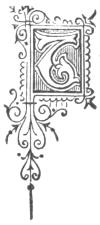
boy approached her, uttering a frantic cry of
joy.
Elena, recognizing him at once, exclaimed
with the same tenderness as of old:
“Tito!”
But the Countess, grasping her arm, turned
toward Tito, and said in a low voice, “I told
you that I was satisfied with my present shoemaker.
Leave me in peace!”
Tito, turning deathly white, fell senseless to
the stone floor, as Elena and the Countess
entered the church.
Two or three students who had witnessed
the scene, laughed uproariously, without thoroughly
understanding it.
He was carried home, there to suffer another
blow; his old friend, who constituted
his entire family, had died of old age during
his absence. He was seized with an attack of
brain fever which brought him to the very
jaws of death. When he returned to consciousness,
he found that a neighbor, poorer
even than himself, had taken entire charge of
him during his long illness; but had been
obliged to sell his furniture, his tools, his
books, his home, and even his holiday attire,
to pay for his medicines and physician.
At the end of two months, covered with
rags, hungry, weakened by illness, penniless,
and without family or friends, without even
that old friend who had loved him as a
mother, and, worse than all, without the hope
of ever approaching his dreamed of and
blessed Elena, Tito abandoned his home (already
the property of another shoemaker), and
took by chance the first road, without knowing
where he was going, what to do, to whom
to apply, how to work or how to live.
It was raining: one of those gloomy afternoons,
when even the sad ringing of bells
seems to give warning of the approach of
death; when the sky is covered with clouds
and the earth with mud; when the damp and
piercing air smothers all hope in the human
breast; when the poor are hungry, the orphans
cold, and the unhappy envious of those
already dead.
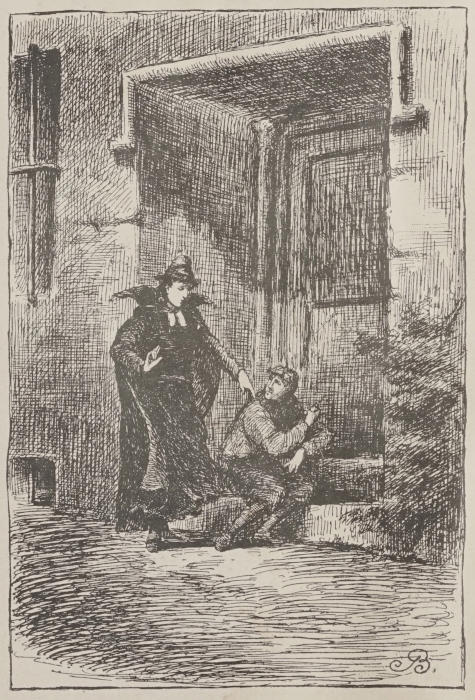
Night fell, and Tito, who still had some
fever, crouched down in the corner of a dark
doorway, giving way to bitter tears....
The idea of death then presented itself to his
fevered imagination, not as a horror or fearful
possibility, but pleasantly, as something welcome
and longed for.
The unfortunate boy folded his arms across
his breast, as if to guard that sweet image
which brought him so much rest, consolation
and happiness; and in making this movement,
his hand touched some hard object in the
pocket of his miserable coat.
The reaction was quick; the idea of life, and
of its preservation, was now uppermost in his
brain; he grasped with all his strength that
unexpected succor which came to him on the
very brink of the grave.
Hope breathed in his ear a thousand seductive
promises, which induced him to wonder if
that hard thing he touched could be money,
an enormous precious stone, or a talisman;
something, in fact, which might bring him life,
fortune, happiness and fame (all of which to
him meant the love of Elena de Monteclaro);
and putting his hand in his pocket he whispered
to death:—“Wait!”
But ah! that hard thing was nothing but a
vial of vitriol with which he had mixed blacking,
the last that remained to him of his shoemaker’s
outfit, which by some inexplicable
accident had found its way to his pocket.
Consequently when he believed that he had
discovered a means of salvation, the unhappy
boy found in his hand a poison, and one of the
most deadly.
“There is no hope!” said he, raising the
vial to his lips. But a hand, cold as ice, was
placed upon his shoulder, and a voice, sweet,
tender and divine, murmured these words:
“Friend! Wait!”
CHAPTER III. HOW TITO ACQUIRED A KNOWLEDGE OF MEDICINE IN ONE HOUR.
No words could have astonished him
more than those he had just
heard.
“Friend! Wait!”
He had no friends.
But what astounded him more was the
horrible feeling of cold that the hand of
that shadow gave him; and even the tone of
its voice chilled him like a polar wind, to the
very marrow of his bones.
The night being dark, the poor orphan
could not distinguish the features of the newly
arrived being, though he did discern his black,
flowing robes, which did not resemble those
worn by either sex.
Full of doubts, mysterious fears and even a
lively curiosity, Tito rose from the doorway
where he had crouched, and murmured in a
faint voice, broken by the chattering of his
teeth:—“What do you wish?”
“That I ask thee!” responded the unknown
being, linking his arm in Tito’s with affectionate
familiarity.
“Who are you?” asked the poor shoemaker,
who felt himself dying from the cold contact
of that arm.
“I am he whom thou seekest.”
“Who?—I?—I seek nobody,” replied Tito,
endeavoring to disengage himself.
“Then why didst thou call me?” replied
the other, grasping his arm with more force.
“Ah! Leave me!”
“Calm thyself, Tito. I mean thee no
harm,” added the mysterious being. “Come!
Thou tremblest with hunger and cold! Yonder
is an open tavern in which I have something
to do to-night. Let us enter and refresh
ourselves.”
“Well! but who are you?” asked Tito
anew, his curiosity commencing to overcome
his other feelings.
“I told thee when we met. We are friends—and
observe that thou art the only one upon
this earth to whom I give this name. Remorse
binds me to thee. I have been the cause of
all thy misfortunes.”
“But I do not know you,” replied the
shoemaker.
“Nevertheless I have entered thy house
many times. Through me thou wert left
motherless the day of thy birth. I was the
cause of the apoplexy that killed Juan
Gil; I hurled thee from the palace of
Rionuevo; removed thy housekeeper, and
finally put this bottle of vitriol within thy
reach.”
Tito shook with fear; his hair stood on end;
he felt as if his contracted muscles were giving
way.
“You are the Devil!” he exclaimed, with
undisguised terror.
“Boy!” answered the black robed stranger
in a tone of gentle reproof, “why dost thou
think that? I am something more and better
than the wretched being thou namest.”
“Who are you then?”
“Let us enter the inn and thou wilt
know.”
Tito entered quickly, and placing the unknown
being before the dim lamp looked at
him with intense earnestness.
He appeared to be about thirty-three years
of age, tall, pale, and beautiful, dressed in a
long tunic, and black, flowing mantle; his
long hair concealed by a peculiarly shaped
black cap. He was beardless, but nevertheless
not effeminate in appearance; and notwithstanding
the strength and vigor of his
countenance, he did not resemble a man. He
appeared to be a human being without sex, a
body without soul, or, more properly speaking,
a soul without visible mortal body. One
would call him a negative personality. His
eyes were without brilliancy. They reminded
one of the darkness of night; they were
ghostly; eyes of sorrow, of death; but so gentle,
so inoffensive, so profound in their dumbness
that one could not withdraw his gaze.
They attracted like the sea; fascinated like a
deep abyss; consoled like forgetfulness.
Scarcely had Tito fixed his eyes on those
inanimate ones, when he felt as though a black
veil enveloped him, that all was turning to
chaos, and that the noise of the world was like
that of a cyclone.
The strange being then uttered these
words:—
“I am Death, my friend—I am Death, and
God has sent me—God, who has reserved for
thee a glorious place in heaven. Five times
I have caused thee misery, but at last, I, the
implacable deity, have had compassion on
thee. When He ordered me to bring thy godless
soul before the Tribunal, I prayed to Him
to confide thy existence to me, and allow me
to remain awhile at thy side, promising in the
end to deliver thy spirit cleansed of sin and
worthy of His glory. Heaven has not been
deaf to my prayer. Thou art then the first
mortal whom I ever approached whose body
did not turn to cold ashes. Thou art my only
friend. Listen, now, and learn the path to
happiness and eternal salvation.”
When Death had finished speaking Tito
murmured an inaudible word.
“I understand thee,” replied Death, “thou
speakest of Elena de Monteclaro.”
“Yes,” answered the boy.
“I swear to thee that no other arm than
thine or mine shall ever enfold her. And, besides,
I promise to give thee the felicity of this
world and of the other. With that thou hast
all. I, my friend, am not the Omnipotent,—my
power is very limited, very sad. I do not
create. My province is to destroy. Nevertheless
it lies in my hands to give thee strength,
power and greater riches than that of princes
and emperors. I will make thee a physician;
but a physician! my friend, who will know,
will see, and be able to speak to me. Dost
thou divine the rest?”
Tito was amazed.
“Can it be possible?” he exclaimed, as
though struggling with a nightmare.
“Yes, and something more which I will tell
thee, but now I need only to advise thee
that thou art not the son of Juan Gil. I
hear the confessions of the dying, and I know
that thou art the natural child of a more noble
parent.”
“Hush!” exclaimed the poor boy, hiding
his face in his hands. Then, inspired by a sudden
idea, he said with indescribable horror:
“With which some day you intend to kill
Elena?”
“Compose thyself,” answered the divinity.
“Thou wilt never cause Elena’s death. Therefore,
answer! Dost thou, or dost thou not,
wish to be my friend?”
Tito answered with another question.
“Will you give me Elena in exchange?”
“I have told thee, yes.”
“Then here is my hand,” said the boy, offering
it to Death. But at that moment a
thought more horrible than the first assailed
him.
“With these hands that clasp mine you
killed my poor mother!”
“’Tis true, thy mother died,” answered
Death. “Understand, however, that I did
not cause her a single pain. I make no one
suffer. He who torments thee to the last,
is my rival Life; that Life that so many
love.”
For answer the boy threw himself into the
arms of Death.
“Come, then,” said the strange being.
“Where?”
“To the Granja palace, to commence thy
practice as a physician.”
“But whom do we go to see there?”
“The ex-king, Philip V.”
“What! Is Philip to die?”
“Not yet; he must return, and reign again;
and thou goest to offer him the crown.”
Tito bowed his head, crushed beneath the
weight of so many new ideas.
Death took his arm and led him from the
inn. They had not reached the door when
they heard cries and lamentations behind
them.
The proprietor of the house was dead.
CHAPTER IV. DIGRESSION, WHICH BEARS LITTLE ON THE STORY.
After leaving the inn, Tito began to
observe such a change in himself,
and in his whole nature, that had it
not been for the support of an arm
as strong as that of Death, he would
undoubtedly have fallen lifeless to the
ground. He felt that which no other man
has ever experienced—the double motion of
the Earth around the Sun, and that about its
own axis! But with all this he did not feel
the beating of his own heart. Any one who
could have examined the young shoemaker’s
countenance, illumined by the Moon’s bright
light, would have seen at a glance that its melancholy
beauty, which had always made him
noticeable, was enhanced to an extraordinary
degree. His eyes, of a velvety blackness,
now reflected that mysterious peace that
reigned in those of the personification of
Death. His long silky locks, black as the
raven’s wing, adorned a physiognomy as pale
as alabaster, at once radiant and opaque, as
though within there burned a funeral light
which glimmered softly through its pores.
His countenance, his bearing, his manner, all
had changed, causing him to assume a peculiarly
statuesque and spiritual air, entirely foreign
to our human nature, and rendering him
superior to the coldest woman, the proudest
potentates, the bravest warriors.
The two friends walked toward the mountains,
sometimes following the road and sometimes
leaving it; and whenever they passed
through towns or villages, the slow, sad tolling
of bells warned the boy that Death lost no opportunities;
that his power was felt on every
side; and not only did he feel it on his own
heart as a mountain of ice, but he also knew
that it was scattering desolation and mourning
over the face of the entire earth.
Death disclosed many strange and wonderful
things to him. The enemy of history, he
took pleasure in uttering sarcasms regarding
his pretended usefulness; and to demonstrate
it, he presented facts as they happened, and
not as monuments and chronicles recount
them.
The mysteries of the past were unfolded before
Tito’s bewildered imagination, revealing
many important truths concerning the fate of
empires, and humanity in general. The great
mystery of the origin of life was unveiled to
him, and the astounding grandeur of the end
to which we mis-named mortals are approaching,
causing him finally to comprehend the
genius of that high philosophy the laws of
which govern the evolution of cosmic matter.
Its multitudinous manifestations in those
ephemerous and transitory forms called minerals,
plants, animals, stars, constellations,
nebulæ and worlds, together with physiology,
geology, chemistry, botany, were all made
clear to the ex-shoemaker’s astonished understanding,
giving him a thorough conception of
the mysterious causes of life, movement, reproduction,
passion, sentiment, idea, conscience,
thought, memory, will, desire. God
alone remained veiled, in the depths of those
seas of knowledge. God alone was stranger
to life and death; independent of the laws of
the universe; the one Supreme Being; alone
in substance, independent, free, and all-powerful
in action!
Death did not attempt to envelop the
Creator in his infinite shadow. He alone was!
His eternity, His immutability, His impenetrability,
dazzled Tito, who bowed his head,
adored and believed, remaining plunged in
more profound ignorance than before descending
into the abyss of death.
CHAPTER V. DOUBT DISPELLED.
It was ten o’clock on the morning of
the thirtieth of August, 1724, when
Tito, thoroughly instructed by that
negative Power, entered the palace
of San Ildefonso, and asked
audience of Philip V., of whose position
at that time we wish to remind the
reader.
First Bourbon of Spain, nephew of Louis
XIV., of France, he accepted the Spanish
crown only when he had found it impossible
to secure that of France. But princes were
dying, uncles and cousins of his, who separated
him from the throne of his native land; therefore,
in order to place himself in readiness to
occupy it, should his nephew, Louis XV., die
(at that time very ill and but fourteen years of
age), he abdicated, in favor of his son Louis
I., and retired to San Ildefonso. At this
stage the health of Louis XV. greatly improved,
and Louis I. was suddenly taken so
ill, that grave fears were entertained for his
life. Couriers were kept in constant service
between the Granja palace and Madrid, bringing
Philip hourly bulletins concerning the
condition of his son. The ambitious father,
incited further by his celebrated second wife,
Isabel Farnesio (much more ambitious than
he), did not know what part to take in this
hopeless and serious conflict. Would the
throne of Spain be vacant before that of
France? Should he declare his intention of
reigning anew in Madrid, preparing himself
to seize the heritage of his son? But should
Louis I. not die? Would it not be a blunder
to expose the depth of his perfidy to all
Europe? Would not such action render useless
his seven months of solitude? And would
it not be to renounce forever the sweet hope
of seating himself on the coveted throne of
Saint Louis? What should he do? To hope,
was only wasting precious time! He was
hated by the Assembly, and denied all influence
in affairs of State. To take but one step,
might compromise his life’s ambition, and his
name to posterity.
False Philip V! The temptations of the
world assailed him in the desert, and he paid
very dearly in those hours of doubt for the
hypocrisy of his abdication!
Such was the condition of affairs when Tito
presented himself before the scheming Philip
as a courier bearing important tidings.
“What do you wish?” asked the king, without
turning, when he heard him enter the
chamber.
“Look at me, your majesty,” answered
Tito, unabashed. “Do not fear that I may
read your thoughts; they are no mystery to
me.”
Philip turned quickly towards that man,
whose voice, dry and cold as the truth it revealed,
had frozen his heart’s blood; but his
anger melted before the funereal smile of the
Friend of Death.
He felt a superstitious terror on fixing his
eyes on Tito’s; and raising a tremulous hand
to the bell beside him, repeated his first question.
“What do you wish?”
“Sire, I am a physician,” answered Tito,
quietly, “and I have such confidence in my
science, that I dare tell your majesty the day,
hour and instant when Louis I. will die.”
Philip looked with more attention at the
ragged boy, whose countenance was as supernatural
as beautiful.
“Speak!” said the king.
“Ah, no!” replied Tito, with a degree of
sarcasm; “we must first arrange the price.”
The king started on hearing these words as
if waking from a dream; he saw the matter in
another light, and was almost ashamed of having
tolerated it.
“Here!” said he, touching the bell, “arrest
this man!”
A captain of guards appeared, and placed
his hand on Tito’s shoulder. The boy remained
perfectly quiet.
The king, returning to his first superstition,
cast a side glance at the strange physician,
then rising with difficulty (for the weakness he
had suffered for some years had lately augmented),
said to the officer: “Leave us alone.”
Planting himself finally in front of Tito, as
if to banish his fear, he asked him with feigned
calmness,
“Well, owl-face! who the devil are you?”
“I am the Friend of Death,” answered Tito,
with a steady, quiet look.
“Who is the friend of all sinners,” gayly
added the king, as if to ward off his puerile
fear. “And what have you to say of our
son?”
“I say,” said Tito, taking a step toward the
king, who involuntarily retreated, “that I
bring you a crown; I do not say whether it is
that of Spain or of France, as that is the secret
for which you must pay me. I also say that
we are losing precious time, and that consequently
I must speak to you soon and clearly.
Listen to me, therefore, with attention.
Louis I. is dying. Nevertheless his sickness
is not incurable. Your Majesty is the dog in
the manger.”
Philip interrupted him.
“Speak! Say what you wish; I desire to
hear it all. In any case I propose to have you
hanged.”
The Friend of Death, shrugging his shoulders,
continued:
“I likened your Majesty to the dog in the
manger. You had the crown of Spain upon
your head: you dropped it, to seize that of
France, and it fell upon the cradle of your
son; Louis XV. secured his own and now you
are left with neither.”
“It is true!” exclaimed Philip, as much in
looks as in words.
“To-day,” continued Tito, observing the
king’s expression, “to-day that you are nearer
to the throne of France than that of Spain,
you are about to expose yourself to the same
disappointment. The two infant kings, Louis
I. and Louis XV., are ill; you might be able to
succeed both; but it is necessary for you to
know a few hours in advance which of the two
will die first. Louis I. is in the greater danger,
but the crown of France is the more beautiful.
Here lies your difficulty. You appreciate the
situation. You dare not stretch your hand
toward the sceptre of Ferdinand, apprehensive
that your son may live, that your French partisans
might abandon you, and that history
would ridicule you. In fact you dare not drop
the bit that you hold between your teeth, fearful
that the other may be a mere shadow or illusion.”
“Speak! speak!” said Philip, eagerly, fearing
that Tito had concluded. “Say what you
have to say, for from here you go direct to a
dungeon, where only the walls will hear you.
Speak! I should like to hear what the world
has to say regarding my thoughts.”
The ex-shoemaker smiled derisively.
“Dungeon! Gallows!” he exclaimed. “I
know all that kings can do, still I am not
alarmed. Listen a little longer; I am about
to conclude. Sire, I must be appointed Physician
to the Court, obtain the title of Duke,
with thirty thousand dollars, this very day.
Your Majesty laughs; but I need all this as
much as your Majesty needs to know whether
Louis I. will succumb to his illness.”
“And you know that?” asked the king in a
low voice, unable to overcome the terror which
the boy caused him.
“I shall know it to-night.”
“How?”
“I have already told you that I am the
Friend of Death.”
“And what is that? Tell me!”
“Of that I was also ignorant; but take me
to the palace in Madrid, let me see the reigning
king, and I will tell you the sentence which
the Eternal One has written upon his brow.”
“And if you mistake?” said Philip of
Anjou, drawing nearer to Tito.
“You may hang me, or hold me prisoner at
your will.”
“You are a wizard then!” exclaimed Philip,
attempting in a measure to justify the faith he
placed in Tito’s words.
“Sire,” he answered, “there are no wizards
nowadays. The last one was Louis XIV.,
and the last bewitched was Charles II. The
crown of Spain that we sent to you in Paris,
twenty-five years ago, wrapped in the will of
an idiot, redeemed us from the captivity of the
Devil, in which we had lived since the abdication
of Charles V. You know that better
than any one.”
“Physician to the Court! Duke! And
thirty thousand dollars,” murmured the king.
“For a crown worth more than you imagine,”
added Tito.
“You have my royal word,” replied Philip,
solemnly, overpowered by that voice, that
face, that mysterious bearing.
“You swear it, your Majesty?”
“I promise it,” responded the king. “I
promise it, if you prove to me beforehand that
you are something more than man.”
“Elena, you will be mine,” murmured Tito.
The king, calling the captain, gave him some
orders.
“Now,” said he, “while they arrange your
trip to Madrid, tell me your history and explain
your science.”
“I desire to please you, Sire, but I fear that
you would understand neither the one nor the
other.”
An hour later the Captain was travelling
post haste to Madrid with our hero, who for
the time being had discarded his rags, and was
dressed in a magnificent costume of black velvet
and lace, a plumed hat, and a sword at his
side.
Philip had supplied him with money and
these clothes, after concluding his strange contract
with Death.
We will follow the good Tito, notwithstanding
his haste, for he may meet his idolized
Elena or the odious Countess of Rionuevo in
the queen’s chamber, and we do not wish to
be ignorant of the slightest details of such interesting
encounters.
CHAPTER VI. PRELIMINARY CONFERENCE.
It was about seven in the evening, when
Tito and the Captain dismounted at
the doors of the palace.
The news of the king’s danger had
spread, and an immense crowd filled the
court-yard.
As our young friend entered, he found himself
face to face with Death, who was hastily
leaving.
“Already?” asked Tito, anxiously.
“Not yet,” answered the sinister deity.
The physician breathed more easily.
“When, then?” he asked, after a pause.
“I cannot tell thee.”
“Oh! speak! If you but knew what Philip
has promised me!”
“I can imagine.”
“But I must know if Louis I. is to die.”
“Thou wilt know it at the proper time.
Pass on. The Captain has already entered
the king’s chamber. He brings instructions
from the royal parent. At this moment thou
art announced as the first physician of the
world. The people crowd the stairway to see
thee arrive. Thou art about to meet Elena
and the Countess of Rionuevo.”
“Oh! what happiness!” exclaimed Tito.
“Quarter past seven!” continued Death,
consulting his pulse, which was his only and
infallible timepiece. “They await thee. I
must go.”
“But tell me—”
“True, I had forgotten! Listen:—If I am
in the chamber when thou seest the king, thou
wilt know that his illness has no cure.”
“And will you be there? Did you not say
you were going away?”
“I do not know yet. I am ubiquitous, and
should I receive Superior orders, there thou
wilt see me, as in any other place where He
may require my presence.”
“What have you been doing here?”
“I have killed a horse.”
Tito recoiled with horror.
“What!” he exclaimed, “you deal also
with irrational beings?”
“What meanest thou by irrational? Has
only man true reason? Reason stands alone;
one does not see it from the earth.”
“But tell me,” said Tito, “animals, brutes,
those which we call irrational, have they
souls?”
“Yes and no. They have a spirit without
free-will, and are irresponsible. But, to the
devil with thee! What a questioner thou art
to-day! Farewell—I go to a noble house to
do thee another favor.”
“A favor! Me? Tell it me! What is its
nature?”
“To prevent a certain wedding.”
“Ah!” exclaimed Tito, overwhelmed by a
horrible suspicion, “is it possible...?”
“I can tell thee nothing more,” answered
Death. “Enter, it grows late.”
“You distract me.”
“Quiet thyself; all will be well. I have
promised thee supreme happiness.”
“Then we are friends? You do not intend
to kill me or Elena?”
“Do not worry,” replied Death, with a sadness
and solemnity, a tenderness and gayety,
with so many and different tones of voice, that
Tito gave up at once the hope of understanding
him.
“Wait!” he said, finally, seeing that the
shrouded being was moving away. “Repeat
the hours, once more, to me, that I may make
no mistake. If you are in the sick chamber,
and do not look at the patient, it signifies that
he will die of the disease.”
“Certainly; but should I face him, he dies
during the day. If I lie in the same bed, he
has three hours of life. If thou seest him in
my arms, only one hour remains; but when
thou seest me kiss his brow, say a prayer for
his soul.”
“And you will not speak one word to me?”
“Not one. I lack permission to reveal in
that manner the intentions of the Eternal One.
Thy advantage over other men, consists only
in thy ability to see me. Good night! Forget
me not!” So saying, he disappeared in
space.
CHAPTER VII. THE ROYAL CHAMBER.
Tito entered the regal abode, neither
regretting nor content with having
established relations with Death.
But as he ascended the stairs of the
palace, and remembered that he was to
see his idolized Elena, all lugubrious
ideas disappeared, like night birds at the break
of day.
With a brilliant escort of courtiers, and other
personages of rank, he passed through galleries
and salons toward the royal bed-chamber,
whilst all admired the wonderful beauty and
tender youth of the famous physician,
whom Philip had sent from the Granja palace,
as the last hope of human aid, to save the life
of his son.
The two Courts were there, that of Louis
and that of Philip. There were, so to speak,
two rival powers, who for a week had lived in
constant warfare: there were the old servants
of the first Bourbon branch, and the new ones
whom the Regent of France (Philip of Orleans,
the Generous), had grouped around the throne
of Spain to prevent the ambitious ex-Duke of
Anjou from seizing that of his grandfather;
there were, in fact, the courtiers of the gentle,
dying child, and those of his beautiful wife, the
powerful daughter of the Regent, the renowned
Duchess of Montpensier. The allies
of Isabella Farnesio, stepmother of Louis I.,
desired his death, in order that the sons of the
second marriage of Philip V. might be nearer
the throne of St. Ferdinand.
The partisans of the young queen wished
the sick monarch to live, not from any love of
the quarrelsome pair, but from hate of Philip
V. whom they did not wish to see again
upon the throne.
The friends of the unfortunate Louis trembled
at the idea of his death; for, having induced
him to shake off the restraint which the
hermit of the Granja exercised over him, they
well knew that if the latter returned to power,
his first act would be to exile or imprison them.
The palace therefore was a labyrinth of opposed
interests, various ambitions, intrigues,
suspicions, hopes and fears.
Tito entered the chamber, searching in all
directions for one face—that of his beloved
Elena. Close to the king’s bed he saw her
father, the Duke of Monteclaro, the close friend
of the late Count of Rionuevo. He was
speaking with the Archbishops of Santiago and
Toledo, the Marquis de Mirabal, and Don
Miguel de Guerra, the four most deadly enemies
of Philip V. The Duke did not recognize
the former page and youthful companion of
his charming daughter. Across the room, and
not without a certain feeling of fear, the Friend
of Death recognized among the ladies who surrounded
the young and beautiful Louisa Isabel
of Orleans, the Countess of Rionuevo, his implacable
and bitter enemy. Although he
almost touched her, as he passed to kiss the
queen’s hand, she did not recognize her husband’s
son. Against a piece of tapestry, behind
this group of ladies, he saw, among two or
three others whom he did not know, a tall,
pale, beautiful woman.
It was Elena de Monteclaro!
Tito gazed at her intently, while the young
girl trembled at the sight of that beautiful and
funereal face, as though looking upon the countenance
of a dead lover; as if she saw, not Tito,
but his ghost enveloped in a shroud; as
if, in fact, she saw a being of the other
world.
Tito in the Court, consoling the queen!
that proud and haughty princess who treated
all with disdain! Tito in that elegant dress,
admired and respected by all the nobility!
Ah! it must be a dream!... thought the
charming Elena.
“Come, Doctor!” said the Marquis of
Mirabal. “His Majesty has awakened.”
Tito made a painful effort to shake off the
ecstasy which seized his whole being, on finding
himself before his loved one, and approached
that bed of disease.
The second Bourbon of Spain was a rickety
youth of seventeen years, tall and thin, like a
plant that grows in the shade.
His countenance (which did not lack a certain
fineness of expression despite its irregularity
of feature), was now frightfully swollen,
and covered with ash-colored pustules. He
appeared a coarse, clay imitation of a sculptured
marble.
He directed an anxious look at the other
youth who was approaching his bed, and encountering
his dull and lustreless eyes, fathomless
as the mystery of eternity, gave a shrill
cry and hid his face beneath the sheets. Tito
in the mean time looked about to discover
Death. But Death was not there!
“Will he live?” asked several courtiers in
a low voice, who believed they read hope in
Tito’s expression.
He was about to say, “Yes,” (forgetting that
his opinion was to be given only to Philip V.),
when he felt someone touch his arm.
Turning, he saw standing near him at the
head of the bed, a person dressed entirely in
black.
It was Death.
“He will die of this illness, but not to-day,”
thought Tito.
“How does he appear to you?” asked the
Archbishop of Toledo, feeling as all did that
involuntary respect inspired by the youth’s
supernatural appearance.
“Pardon me,” replied the ex-shoemaker,
“my opinion is reserved for him who sent
me.”
“But,” added the Marquis of Mirabal, “you
who are so young, cannot have acquired so
much scientific skill; undoubtedly God or the
Devil has inspired you. You may be a saint
who works miracles, or a magician, a friend of
witches.”
“As you please,” responded Tito; “at any
rate, I read the future of the king who lies in
this bed; a secret of value to you, as it would
enable you to solve the doubt whether to-morrow
you will be the favorite of Louis I., or
the prisoner of Philip V.”
“What!” stammered Mirabal, pale with
anger, but smiling blandly.
At this moment Tito observed that Death,
not content with having approached the monarch,
took advantage of his visit to the royal
chamber to seat himself beside a lady, almost
in the same chair, and was regarding her
fixedly.
The doomed victim was the Countess of
Rionuevo.
“Three hours!” thought Tito.
“I must speak to you,” continued Mirabal,
to whom had occurred the idea of purchasing
the young physician’s secret.
But a glance and smile from Tito, who had
divined his thoughts, so disconcerted him that
he drew back.
The look and smile were the same which
that morning had conquered Philip V.
During Mirabal’s confusion, Tito made a
great step in his career, and established his
reputation at Court.
“Sir,” said he to the Archbishop of Toledo,
“the Countess of Rionuevo, whom you see
seated alone in that corner” (we already know
that Death was visible only to Tito), “will die
in the course of three hours. Advise her to
prepare for her last moments.”
The Archbishop recoiled with horror.
“What is it?” asked Don Miguel de
Guerra.
The prelate related Tito’s prophecy to various
persons, and all eyes were at once fixed
upon the Countess, who actually began to
grow deathly pale.
Meanwhile Tito approached Elena, who
was standing in the middle of the room, silent
and immovable as a statue; charmed, overcome,
possessed of a terror and of a happiness
that she could not herself define, she followed
every movement of the friend of her childhood.
“Elena!” murmured the youth, as he
reached her side.
“Tito!” she answered, mechanically, “is
it indeed you?”
“Yes,” replied Tito, fondly, “’tis I; fear
nothing.” And he left the apartment.
The Captain was awaiting him in the antechamber.
Tito wrote some words on paper, and said to
Philip’s faithful retainer: “Take this to the
Granja. Do not lose a moment.”
“And you,” replied the Captain, “I cannot
leave you. You are a prisoner in my custody.”
“I place myself on parole,” proudly replied
Tito, “for I cannot follow you.”
“But—the king!”
“The king will approve your conduct.”
“Impossible!”
“Listen! and you will see that I am right.”
At this moment they heard a great commotion
in the royal chamber.
“The physician! the physician!” cried
several persons, running from the room.
“What has happened?” asked Tito.
“The Countess of Rionuevo is dying,”
said Don Miguel de Guerra. “Come this
way, they have placed her in the queen’s bed-chamber.”
“Go, Captain!” said Tito, “I insist.”
And he accompanied these words with such
a glance and gesture that the soldier departed
without a word. Tito followed De Guerra
into the queen’s chamber.
CHAPTER VIII. REVELATIONS.
“Listen!” said a voice to Tito, as he
was walking toward the bed on
which the Countess lay.
“Ah! ’tis you,” exclaimed the
youth, recognizing Death.
“Has she already expired?”
“Who?”
“The Countess.”
“No.”
“Then, why do you leave her?”
“I do not leave her, my friend; I have
already told thee I am everywhere, at all
times, and under many different forms.”
“Well! what do you wish of me?” asked
Tito, with a certain aversion on hearing these
words.
“I am here to do thee another favor.”
“Well! speak.”
“Dost thou know that thou art lacking in
respect to me?” said Death, with forced
gravity.
“It is natural,” answered Tito. “Our intimacy,
the complicity—”
“What meanest thou by complicity?”
“Nothing. I simply allude to a painting I
saw when a child. It represented Medicine.
Two persons were lying in one bed, or, to
speak more clearly, a man and his illness.
The physician entered the room blindfolded,
and armed with a club. Upon nearing the
bed he commenced beating the patient and
his illness unmercifully. I do not remember
which was the first victim of the punishment,
but I believe it was the invalid.”
“Pleasing allegory! But we must to business!”
“Yes, let us go. All seem astonished to see
me standing here, apparently alone, in the
middle of the room.”
“They will imagine that thou art meditating,
or awaiting inspiration. Listen to me a
moment. Thou knowest that the past is
mine by right, and that I can narrate it to
thee. Not so the future.”
“Proceed.”
“A little patience, please. Thou art about
to speak, for the last time, with the Countess
of Rionuevo, and it is my duty to recount a
certain history to thee.”
“It is useless; I forgive that woman.”
“It concerns Elena,” quietly observed
Death.
“How?”
“It refers to your nobility, and marriage to
her.”
“Noble! I—? It is true, the king has
made me a duke.”
“Monteclaro would not be content with an
adventurer. Thou hast need of ancestors.”
“What do you mean?”
“I come to tell thee that thou art the last
branch of the Rionuevos.”
“Yes, but adulterous.”
“You are mistaken: natural, and very natural.”
“That may be, but who is to prove it?”
“Precisely what I am about to tell thee.”
“Speak!”
“Listen, and do not interrupt me. The
Countess is the stumbling-block in thy existence.”
“I know it.”
“She holds thy happiness in her hands.”
“I know that, also.”
“Well, the time has come to wrest it from
her.”
“How? In what manner?”
“Thou wilt see. As thy father loved thee
so dearly—”
“Ah! he loved me much!” exclaimed Tito.
“I have told thee not to interrupt. As thy
father loved thee so dearly, he did not leave
this world without thinking very seriously of
thy future.”
“What! did the Count not die intestate?”
“Where did’st thou get that idea?”
“It is so understood by everybody.”
“Pure invention of the Countess, to secure
the Count’s money, and make a favorite
nephew her heir.”
“Oh!”
“Calm thyself; all can be arranged. Thy
father had in his possession, a declaration of
Crispina Lopez and Juan Gil, a duly certified
authority, which stated clearly that thou wert
the natural son of the Count of Rionuevo and
Crispina Lopez. This same circumstance thy
father confessed at the hour of his death,
before a priest and a notary, whom I saw there
and whom I know perfectly well. Certainly
the priest ... but hold! this I cannot tell
thee. The fact is, the Count named thee his
sole and only heir; which was all the easier, as
he had not a single relative, near or remote.
Nor did that good father’s solicitude rest here.
He commenced the foundation of thy future
happiness on the very brink of the grave.”
“Oh! my father!” murmured Tito.
“Listen. Thou knowest the great friendship
which united the honored Count and the
Duke of Monteclaro for so many years. They
were companions in arms during the War of
Succession.”
“Yes, I know.”
“Well, then,” continued Death, “thy father,
divining the love thou felt’st for the charming
Elena, addressed a long and tender letter to
the Duke, a few moments before he expired,
in which he told him all, asking the hand of
his daughter for thee, and reminding him of
the many and signal proofs of friendship that
had passed between them.”
“And that letter?” asked Tito, vehemently.
“That letter alone would have convinced
the Duke, and thou would’st have been his son
many years ago.”
“What has become of it?” again asked
Tito, tremulous with love and anger.
“That letter might have prevented thee
from entering into relations with me,” continued
Death.
“Oh! do not be cruel. Tell me that it
exists!”
“That is the truth.”
“What! that it exists?”
“Yes.”
“Who has it?”
“The same person who intercepted it.”
“The Countess?”
“The Countess.”
“Oh!” exclaimed the youth, taking a step
toward the death-bed.
“Wait,” said Death, “I have not finished
yet.”
“The Countess has preserved her husband’s
will, which she almost snatched from my
hands.”
“From yours?”
“I say from mine, because the Count was
already half dead. With regard to the priest
and the notary, I will tell thee where they
live and I believe they will declare the
truth.”
Tito thought a moment; then, looking fixedly
at the funereal personage, exclaimed:—
“That is to say, that if I succeed in getting
possession of these documents....”
“To-morrow thou wilt marry Elena.”
“Oh, God!” murmured the boy, taking
another step toward the bed.
Then he turned again towards Death.
The courtiers did not comprehend what was
passing in Tito’s heart. They all believed
him to be alone, or communing with the
miraculous being to whom he owed his science;
but such was the terror with which he had
already inspired them, that no one dared to
interrupt him.
“Tell me,” added the ex-shoemaker, addressing
his fearful companion, “why it is
that the Countess has not burned those
papers?”
“Because the Countess like all criminals is
superstitious; because she fears some day
she may repent; because she conjectures
that those papers will be, so to speak, her
passport to eternity; for it is a well-known fact
that no sinner blots out the tracks of his
crimes, fearful of forgetting them at the hour
of death, and of not being able to retrace his
steps to find the path of virtue. I tell thee
then, that those papers exist.”
“So, then, by obtaining them, Elena will be
mine,” insisted Tito, still doubting Death’s
ability to procure that happiness for him.
“There would yet be another obstacle to
overcome,” responded Death.
“What?”
“Elena has been promised by her father to
the nephew of the Countess, the Viscount de
Daimiel.”
“What! she loves him?”
“No; but they were betrothed two months
ago.”
“Oh! then all is hopeless!” exclaimed Tito,
in despair.
“It would have been without me,” replied
Death, “but I told thee, at the doors of this
palace, that I was about to prevent a wedding.”
“How! have you killed the Count?”
“I!” exclaimed Death, with sarcasm, “God
forbid! I have not killed him,—he died.”
“Ah!”
“Hush! No one knows it yet. At this
moment his family believe that the poor youth
is simply napping. Therefore ... be careful
how you act! Elena, the Countess and
the Duke are but two steps from thee. Now
or never!” So saying, Death approached the
sick woman’s couch.
Tito followed in his footsteps. Many of the
people who were there in the room, among
them the Duke of Monteclaro, knew of Tito’s
prediction, that the Countess would die within
three hours. They saw it almost fulfilled; the
happy, beautiful woman of a few hours before,
had suddenly become an almost inanimate
body, shaken at intervals by violent convulsions.
Thus it was that all commenced to
regard our hero with superstitious awe and
fanatical reverence. The Countess, for her
part, not well distinguishing Tito, stretched
toward him a tremulous and supplicating hand,
while indicating with the other that they
should be left alone.
All retired, and Tito seated himself beside
the dying woman.
CHAPTER IX. THE SOUL.
Although the Countess of Rionuevo,
Tito’s terrible enemy, plays
so odious a part in our story, she
was not an old and ugly woman, as
many will perhaps have imagined.
Physical nature is also sometimes deceptive.
This illustrious woman was, at this time, but
thirty-five years of age, and in the fulness of
a magnificent beauty—tall, active and well
formed; her eyes, blue and treacherous as the
sea, concealed great depths under a languid
and suave manner. The frankness of her
mouth, the soft tint of her skin, and the
queenly grace of her bearing, proved that
neither sorrow nor passion had perceptibly
diminished her incomparable beauty. Thus it
was that on seeing her now, stricken and suffering,
overcome by terror, and racked with
pain, the least compassionate would have experienced
a peculiar pity, closely akin to horror
or fear. Though Tito thoroughly hated
the woman, he could not avoid this inexplicable
feeling of sympathy and dread, and, mechanically
taking the beautiful hand which
she tendered him he whispered with more sorrow
than resentment,
“Do you know me, Countess?”
“Save me!” replied the dying woman, not
heeding his question.
At this moment another person emerged
noiselessly from behind the curtains, and
joined the two speakers, half reclining on the
pillow and supporting his head on his hand.
It was Death!
“Save me!” repeated the Countess, who
felt intuitively that our hero hated her;
“they say you are a magician, that you commune
with Death. Save me!”
“You fear death greatly, Countess!” responded
the youth with indifference, at the
same time releasing her hand.
That stupid cowardice, that animal terror,
which left no room for any other thought or
sensation, disgusted Tito profoundly, for it
showed him the wretchedly selfish spirit of the
author of all his troubles.
“Countess!” he then exclaimed, “think of
your past and of your future! Think of God
and of your neighbor! Try to save the soul,
since the body is no longer yours.”
“Ah! I am going to die,” exclaimed the
Countess.
“No, you are not.”
“Not to die!” shrieked the poor woman,
with savage joy.
The youth continued with severity:
“No! because you have never lived. On
the contrary, you are to enter the soul-life,
which for you will be endless suffering, as for
the just it is eternal happiness.”
“Ah! then I am to die,” murmured the
patient anew, shedding tears for the first time
in her life.
“Countess, you will not die,” again replied
the physician, with indescribable majesty.
“Have pity on me,” said the poor woman,
regaining hope.
“You will not die,” continued the youth,
“because you weep. The soul never dies, and
repentance can open to us the doors of eternal
life.”
“My God! my God!” cried the Countess,
distracted by that cruel uncertainty.
“You do well to appeal to Him. Save the
soul! I repeat, save the soul! Your beautiful
body (that earthly idol), and your sacrilegious
existence have ended forever. This temporal
life, these earthly joys, that prosperity and
beauty, that luxury and fortune which you
have striven so hard to preserve, the riches you
have usurped, the air, the sun, the world you
have known till now, all are lost to you, they
have even now disappeared. To-morrow
nothing will remain but dust and darkness,
vanity and corruption, solitude and oblivion;
the soul alone survives, Countess. Think of
your soul.”
“Who are you?” softly asked the dying
woman, gazing at him in astonishment. “I
have known you before now. You hate me,
it is you who kill me. Ah!”
At this instant Death placed his white hand
upon her head, and said:—“Finish, Tito, the
last hour approaches.”
“I do not wish her to die,” replied Tito,
“even yet she may amend; even yet remedy
all the evil she has done. Save her body, and
I will answer for her soul.”
“Conclude, Tito! conclude; the last hour is
about to strike.”
“Poor woman!” murmured the youth,
looking at her with compassion.
“You pity me,” said the dying woman
with ineffable tenderness. “I who never
acknowledged you, never loved you. Never
have I felt as now for you. Pity me. Tell
me. My heart softens at the sound of your
sad voice.”
And it was true.
The Countess exalted by the terror of that
supreme moment, suffering remorse, fearing
punishment, and deprived of all that constituted
her pride and pleasure upon earth, commenced
to feel the first breathings of a soul,
which until now had remained lost and silent
in the depths of her iniquity; a soul always
insulted, but full of patience and heroism; a
soul, in fact, to be compared to the sad
daughter of criminal parents, who, quiet and
silent, shrinks from sight and weeps alone,
until one day, when at the first sign of repentance
that she observes, recovers her spirit,
rushes to their arms and lets them hear her
pure, sweet voice—song of the lark, music of
heaven, which appears to welcome the dawn
of virtue after the darkness of sin.
“You ask me who I am?” responded Tito,
comprehending all this. “I scarcely know
myself. I was your mortal enemy, but now I
do not hate you. You have heard the voice
of truth, the voice of death, and you have responded,
God be praised! I came to this bed
of sorrow to ask from you the happiness of my
life; but now I can leave, content without it,
for I believe I have brought about your redemption,
that I have saved your soul.
Heavenly Jesus! in that I have pardoned
my injuries and done good to my enemy, I am
satisfied; I am happy; I ask no more.”
“Who are you, mysterious and sublime
boy? Who are you? so good and so beautiful,
who come like an angel to my death-bed,
to make my last moments so sweet?” asked
the Countess, eagerly, taking Tito’s hand.
“I am the Friend of Death,” replied the
youth; “do not be surprised then that I quiet
your heart. I speak to you in his name, therefore
you have believed me. I am delegated
to come to you by that compassionate divinity
who is the peace of the earth, the truth of
the worlds, the redeemer of the spirit, the
messenger of God; who is all but forgetfulness.
Forgetfulness is in life, Countess, not in
death. Remember, and you will know me.”
“Tito!” exclaimed the Countess, losing
consciousness.
“She is dead?” the physician asked Death.
“No, there still remains a half an hour.”
“But will she speak again?”
“Tito,” sighed the dying woman.
“Finish,” added Death.
The youth bent over the Countess, o’er
whose beautiful countenance there shone a
new and divine beauty; and from those eyes
where the fire of life melted in languishing and
melancholy glances, from that gasping and
half-opened mouth, flushed with fever, from
those soft warm hands, and that white throat
turned toward him in infinite anguish, he met
such an eloquent expression of repentance and
tenderness, such loving caresses and earnest
entreaties, so infinite and solemn a promise,
that without hesitating an instant he left the
bed, called the Duke of Monteclaro, the Archbishop
and three of the other nobles who were
in the apartment, and said to them: “Listen
to the public confession of a soul which returns
to God.” Those persons approached
the dying woman, induced more by his inspired
face than by his words.
“Duke,” murmured the Countess, on seeing
Monteclaro, “my confessor has a key—Sire,”
she continued, turning toward the Archbishop,
“ask him for it—. This boy, this physician,
this angel, is natural and acknowledged son of
the Count of Rionuevo, my late husband, who
when dying, wrote you a letter, Duke, asking
Elena’s hand for him. With this key—in my
bedroom—all the papers—I pray you—I command
you.”
At these words she fell back upon the
pillow, the light gone from her eyes, the
breath from her lips, the color from her
face.
“She is dying!” exclaimed Tito. “Remain
with her, Sire,” he added, addressing the
Archbishop. “And you, Duke, listen to me.”
“Wait,” said Death, as he heard the youth.
“What more?” he replied.
“Thou hast not forgiven her.”
“Tito!—your forgiveness!”—murmured the
dying woman.
“Tito!” exclaimed the Duke of Monteclaro,
“is it you?”
“Countess, may God pardon you as I do.
Die in peace,” said the son of Crispina Lopez,
with religious fervor.
At this moment Death bent over the Countess,
and pressed his lips to her brow.
That kiss resounded in the throat of a corpse.
One cold, tremulous tear coursed down the
dead woman’s cheek.
Tito wiped away his own, and turned to
answer Monteclaro. “Yes, Duke, it is I.”
As the Archbishop read the funeral prayers,
Death disappeared. It was midnight.
CHAPTER X. UNTIL TO-MORROW.
“Search for those papers, Duke,”
said Tito to Monteclaro, “and do
me the kindness to speak to Elena.”
“Come! Doctor, come! The
king is dying!” exclaimed Don Miguel
de Guerra, interrupting him.
“Follow me, Duke,” said the youth,
with great respect, “it has struck twelve, and
I can give you some very important news, I
do not know whether good or bad. It is this;
I can tell you whether or not Louis I. will die
to-day.”
The morning of the thirty-first of August
had dawned, when Louis I. was to deliver up
his spirit to his Creator.
Tito discovered the certainty of it by seeing
Death standing in the middle of the room with
his eyes fixed on the sick king.
“To-day the king dies,” whispered Tito, in
Monteclaro’s ear. “This news is the wedding
present which I make to Elena. If you know
its value, guard it in secret, and let it govern
your conduct toward Philip V.”
“But Elena is promised to another,” replied
the Duke.
“The nephew of the Countess of Rionuevo
died this afternoon,” interrupted Tito.
“Oh! what has befallen us!” exclaimed
the Duke. “Who are you—you whom I
knew as a child, and who now terrify me with
such power and science?”
“The queen calls,” said a lady at this moment
to the Duke of Monteclaro, who seemed
stupefied.
The lady was Elena.
The Duke approached the queen, leaving
the two lovers alone in the middle of the
room. Not alone, for Death was but three
steps off.
The two stood mutely gazing at each other
as if bewildered, and fearful that their mutual
presence might be a dream which would pass
away should they move a hand or utter the
lightest breath.
On meeting, a few hours before in that same
place, both had experienced, mingled with an
ineffable happiness, a certain secret anguish,
like that which two friends feel, after a long
separation, on recognizing each other in a
prison, on the morning of execution, unconscious
accomplices of a fatal crime, and victims
of the same persecution. One might also say
that the sad joy with which Tito and Elena
recognized each other, was equal to the bitter
pleasure which the corpse of a jealous husband
would experience (if corpses feel) in the tomb,
on hearing the door of the cemetery open
at night, knowing that it is his wife whom they
are bringing to inter. “So you are here!”
the poor corpse would say; “it is now four
years that I have been alone, thinking of what
you were doing in the world, you, so beautiful,
so unloving, that you discarded your mourning
the very year of my death. You have
waited long; but you are here, and if love is
no longer possible between us, neither is infidelity
or forgetfulness. We belong to each
other negatively. Although nothing unites
us, we are united, because nothing can separate
us. For the jealousies, uncertainties, anxieties
of life, you have substituted an eternity of
love and remembrance. I pardon you all.”
These impressions, softened in the gentle
characters of Tito and Elena, by her innocence,
by his lofty intelligence, and by the exalted
virtue of both, shone like funeral torches in
the souls of the two lovers, by whose light
they saw an illimitable future of peaceful love,
which nothing could disturb or destroy, unless
all that then passed was but a fugitive dream.
They gazed at each other for a long time
with fervent idolatry. Elena’s blue eyes lost
themselves in the dark orbs of Tito, as the
high heaven her brightness in the utter darkness
of our nights; whilst his melted in the
fathomless transparency of the pure celestial
blue of hers, lost, as are sight, idea, and even
sentiment, when attempting to measure infinite
space.
So, perhaps they would have remained for
eternity, had not Death attracted Tito’s attention.
“What do you wish?” asked the youth.
“That thou lookest upon her no longer.”
“Ah! you love her!” exclaimed Tito,
with indescribable anguish.
“Yes,” answered Death, gently.
“You think of robbing me of her?”
“No! I think of uniting thee.”
“You told me once that no other arms than
yours or mine should ever enfold her,” murmured
Tito, with desperation. “Whose is she
to be first—yours or mine? Tell me!”
“Thou art jealous of me?”
“Horribly so.”
“Thou art wrong,” replied Death.
“Whose is she to be first?” repeated the
youth, seizing the cold hands of his friend.
“I cannot answer thee. God, thou and I
dispute her; but we three are not incompatible.”
“Tell me that you do not intend to kill her.
Tell me that you will unite us in this world.”
“In this world!” repeated Death, ironically.
“Yes, it will be in this world, I promise thee.”
“And afterwards?”
“Afterwards belongs to God.”
“And yours? When?”
“Mine, she has already been.”
“You madden me! Elena lives!”
“As thou dost,” replied Death.
“But, do I live?”
“More than ever.”
“Speak, for pity’s sake!”
“I have nothing to tell thee. Thou wouldst
not be able to understand me yet. What is
death? Perhaps thou knowest. What is
life? Have I ever explained it to thee? If
thou art ignorant of these conditions, why
dost thou ask if thou art dead or alive?”
“Well, shall I comprehend them some day?”
exclaimed Tito, desperately.
“Yes, to-morrow,” answered Death.
“To-morrow! I do not understand you.”
“To-morrow thou wilt be wedded to
Elena.”
“Ah!”
“And I will be thy protector,” continued
Death.
“You! you then intend to kill us?”
“Not at all. To-morrow thou wilt be rich,
noble, powerful, happy. To-morrow also
thou wilt know all.”
“You love me, then!” exclaimed Tito.
“Yes, I love thee,” replied Death. “Ungrateful
boy, why dost thou doubt it?”
“Then good-bye until to-morrow,” said Tito,
giving his hand to the terrible divinity.
Elena continued standing before her lover.
“Until to-morrow,” she responded, as if she
had heard the phrase—as if answering another
secret voice—as if divining the youth’s
thoughts;—and slowly turning she left the
royal chamber.
Tito approached the king’s bed.
The Duke of Monteclaro placed himself
at his side, and said to him in a low voice:—
“If the king dies, you will celebrate your
marriage with my daughter to-morrow; the
queen has just informed me of the death of
the Viscount of Rionuevo. I have announced
your wedding with Elena, and she congratulates
you both with all her heart. To-morrow
you will be the first person of the Court, if
Louis really passes to the tomb to-day.”
“But do not doubt it, Sire,” responded Tito,
with sepulchral accent.
“Then farewell until to-morrow,” said
Monteclaro, solemnly.
CHAPTER XI. IN WHICH TITO IS AGAIN HAPPY, AND THE FIRST PART OF THIS STORY IS COMPLETED.
The following day, the first of September,
1724, at nine in the morning,
Tito was pacing the halls of the palace
of Rionuevo.
That palace belonged to him. He
was now the acknowledged Count, by
virtue of the will and other papers of his
father, which the Duke of Monteclaro and the
Archbishop of Toledo had found in the place
indicated by the Countess. Besides, the night
before, a messenger had delivered to him from
Philip V., who had finally decided to return to
the throne of St. Ferdinand, $30,000 in gold,
and the title of Duke of Verity, Physician
to the Court; and the next day he was to
celebrate his marriage with Elena. With
regard to Death, Tito had completely lost
sight of him since the previous morning,
when he left the palace with the soul of
Louis I.
Nevertheless, the youth remembered that
the implacable deity had promised to protect
him in his marriage; and you will now observe
the reason why he walks so thoughtfully.
“Here am I,” said he, “noble, rich, powerful,
and possessed of the woman I love; still I
am not content. Last night, at sight of Elena,
and again in my last conversation with Death,
I suspected, I know not what terrible mysteries.
I must sever relations with this sinister
deity. It seems ungrateful, but it must be.
He will have occasion in the future to avenge
himself. No, no! I do not wish to see Death
again, I am so happy.”
The new Duke commenced to plan how to
avoid Death, until his last moments should
arrive.
“It is a fact,” thought he, “that I shall not
die until God wills it. Death himself can do
me no harm. It is not in his power to hasten
Elena’s death or mine. The question therefore
is, how not to see, how not to hear him at
all hours. His voice alarms me; his revelations
afflict me; his conversations inspire me
with a disregard for life and all I hold most
dear. What shall I do to prevent his continuing
to be my nightmare? Ah! an idea!
He never appears except when he has something
to kill. Living in the country—never
seeing any one—alone with Elena—my enemy
would leave me in peace, until that time, when
by the decree of the Almighty, he should be
directed to search for one or both of us. In
the mean time, and in order not to see him in
Madrid either, I will live with my eyes blindfolded.”
Encouraged by this last thought, the youth
beamed with happiness, as though, having just
arisen from a long illness, he believed himself
assured of remaining upon earth for all time.
At seven on the following evening, Tito and
Elena were married at a beautiful country-house
belonging to the new Count and Duke,
at the mouth of the Guadarrama River.
At half-past seven the guests returned to
Madrid, and the newly wedded couple were
left alone in the midst of a luxuriant garden.
Tito had not again seen Death, and I might
terminate this history here; but just at this
point it commences to be interesting and lucid.
CHAPTER XII. THE SUN IN THE WEST.
Tito and Elena, loving each other, belonging
to one another, were at last
free and alone.
The remembrances of their infancy,
the desires of their hearts, the will of
their parents, fortune, birth, the blessing
of God, all aided in uniting them; and those
two forever inseparable souls, lost at last, in
this solemn and mystical hour, their sad and
solitary individuality, and merged themselves
into an endless, happy future, as two rivers,
rising in the same mountain, and separated
from each other in their tortuous courses, reunite
and identify themselves in the infinite
solitude of the ocean.
It was evening. It did not seem like the
evening of a single day, but as of that of the
world’s existence, the evening of all Time since
creation. The sun sank slowly in the west, the
splendid lights gilding the front of the villa,
and penetrating through the tender green
foliage of a spreading vine, a sort of canopy
which sheltered the newly wedded pair.
The still, soft air, the last flowers of the
year, the birds, immovable in the branches of
the trees, all nature in fact assisted, mute and
fearful, at the death of that day. It seemed
as if it might be the last that humanity would
see. As if the Astral King might not return
the following day as generous, happy, and as
full of life and youth, as he had presented himself
for so many mornings during so many
thousands of centuries.
One would have said that at that point,
Time had stopped; that the hours, overcome
by their continual dance, had seated themselves
on the grass to rest, and were telling
each other pathetic stories of love and death,
like young school girls, who, fatigued with
play, draw aside in the garden of a convent to
relate to one another their childish adventures
and youthful joys.
One would have said that a period in the
history of the world was drawing to a close;
that all creation was bidding an eternal farewell.
The bird to his nest, the zephyr to the
flowers, the trees to the river, the sun to the
mountain; that the intimate union in which
all had lived, lending mutual color or fragrance,
and losing themselves in the same palpitation
of universal existence, had been broken and interrupted
forever, and that in the future each
one of those elements would be governed by
new laws and influences.
One would have said, in fact, that on that
evening the mysterious association constituting
the unity and harmony of the spheres was
about to dissolve; an association which makes
impossible the loss of the most insignificant of
created things; which transforms and continually
resuscitates matter, and which from nothing,
identifies, renews and embellishes all.
More than any one or anything, possessed of
this supreme intuition, this strange hallucination,
Tito and Elena with clasped hands, immovable
and silent, watched the majestic
tragedy of the death of that day, the last of
their misfortunes. They looked at each
other with deep anxiety, and blind idolatry,
not knowing of what they thought, forgetful
of the entire universe, ecstatic and entranced.
They might have believed themselves alone
upon the earth, abandoned.
After the departure of the wedding guests,
and the sound of the last footsteps had ceased
in the distance, it seemed as though the world
had entirely left them.
Nothing had been said—nothing!—so absorbed
were they in beholding each other.
There they were, seated on a bank of turf,
surrounded with flowers and verdure, an infinite
sky before their eyes, as free and alone
as two sea birds resting in mid ocean on a
wreck rocked by the waves; and with the cup
of happiness in his hand, Tito dared not press
it to his lips, fearful that all might be a
dream, and not coveting greater felicity,
through fear of losing that which they already
possessed.
There they were, as innocent, beautiful and
immortal as Adam and Eve in Paradise before
the Fall. The maiden of nineteen years was
in all the splendor of her wonderful beauty;
in that transitory moment of youthful womanhood,
when, possessed of all her fascinations,
judge of her own nature, full of blessings, and
promises of happiness from Heaven, she is
capable of feeling all, yet has felt nothing;
woman and child in one. As a rose, half-opened
to the generous influence of the sun,
that has already displayed all its leaves, shown
all its charms, and received the caresses of
the zephyr, still preserves that form, color
and perfume that alone adorn the modest
bud.
Elena was tall and statuesque, artistic and
seductive—her lovely head, crowned with
auburn hair, of a golden hue at the temples,
and changing by degrees to chestnut shades,
was poised upon a white throat moulded like
that of Juno. Her blue eyes seemed to reflect
the infinity of uncreated thought. There
was something of heaven in them besides
their color and purity. There was in their
glance a light as of eternity, of pure spirituality,
of immortal passion, that did not belong to
earth. Her complexion, white and pallid as
water at twilight, was transparent as mother
of pearl. It did not reflect the warmth of the
blood; some delicate vein of heavenly blue
alone broke that still, serene whiteness. One
would have said she was of marble. Her
angelic countenance had, however, a woman’s
mouth, vermilion as the blossom of the pomegranate,
moist and brilliant as a bed of pearls.
It was, if one might so say, submerged in the
warm and voluptuous vapor of the sigh which
held it half apart.
One might compare Elena to the statue
carved by Pygmalion, when for the first time
and in order to return the sculptor’s kiss, she
moved those bewitching lips. Her dress was
white, which greatly increased the dazzling
brilliancy of her beauty; but she was one of
those women from whom ornaments do not
detract.
With her, as with the noble pagan Minervas,
one was not left to divine the pure form of
her Olympic beauty, which revealed itself in
all its splendor, though covered by silk and
lace.
It seemed as though the pure beauty of her
exquisite form shone through the folds of her
white gown, as those of the Naiads and sea-nymphs
illumine, with their polished limbs,
the depths of the waves.
Such was Elena on her wedding night, and
such she appeared to Tito.
She was his own!
CHAPTER XIII. THE ECLIPSE OF THE MOON.
Ah! yes: the youth beheld her as
the blind behold the sun, who see
not the luminary planet, but feel its
warmth in their dead pupils.
After so many years of solitude and
trouble, after so many hours of mournful
dreams, he, the Friend of Death, found
himself engulfed in an ocean of life, in a world
of light, of hope, of felicity.
What was he to say, what was he to think,
if he could not believe that he existed; that
that woman was Elena, his wife, that both
had escaped the clutches of death?
“Speak, my Elena, tell me all,” murmured
Tito at last, when the sun had set, and the
birds had broken the silence. “Speak, my
darling.”
Elena then told him of all her thoughts and
feelings during those three last years: her
sorrow when she ceased to see him, her despair
at going to France, how her father had
opposed this love, of which the Countess of
Rionuevo had informed him; how happy she
was at meeting him again in the porch of San
Millán, and how she suffered at seeing him
fall, wounded by the Countess’ harsh words.
She told him all, because it had increased
her love instead of diminishing it.
The night fell and the darkness increased,
but the secret anguish which disturbed Tito’s
happiness was calmed. “Oh!” thought the
youth, pressing Elena to his heart. “Death
has forgotten my face and knows not where to
find me. He will not come here. Ah! no.
Our undying love would be able to put him to
flight. What could he have to do at our side?
Come, come, dark night, and envelop us in
thy black veil! Come, even if thou must remain
forever. Come, even though to-morrow
should never dawn.”
“You tremble, Tito,” murmured Elena,
“you weep.”
“My wife,” murmured the youth, “my
own, my heaven, I weep for joy.”
So saying, he took his young wife’s bewitching
head between his hands and fixed in her
eyes an intense, delirious gaze.
A deep and burning sigh, a cry of wild passion
met between their lips.
“My love!” they murmured in the delirium
of that first kiss, at whose tender sound the
invisible spirits of solitude trembled.
At this moment the moon suddenly rose,
full, splendid, and magnificent.
Its strange, unexpected light startled the
two lovers, who, turning their heads at the
same moment towards the east, separated
from one another through some mysterious
instinct, though still retaining each other’s
trembling, clinging hands, cold at that moment
as the alabaster of the tomb.
“It is the moon,” murmured the two in
hoarse accents, and turning to gaze at one
another ecstatically. Tito extended his arms
towards Elena with indefinable tenderness, and
with as much love as despair.
But Elena was as pale as a ghost.
Tito trembled.
“Elena, what is it?” he whispered.
“Oh! Tito,” responded the girl, “you are
so white.”
At this moment the moon was eclipsed; it
was as if a cloud had interposed itself between
her and the two lovers.
But, ah! it was not a cloud. It was a long
black shadow, that appeared to Tito, from the
bank on which he reclined, as if touching the
skies and the earth, draping the entire horizon
in mourning. It was a colossal figure, but
increased by his imagination; a terrible being
enveloped in a long, dark mantle. It stood
at his side, immovable and silent, covering
them both with its shadow.
Tito knew who it was.
Elena did not see the lugubrious personage.
She continued gazing at the moon.
CHAPTER XIV. PHYSICIAN, AT LAST!
Tito was between love and death, or
rather between death and life. Yes,
because that dismal shadow which
had come between him and the
moon, clouding the splendor of passion
in Elena’s countenance, was the divinity
of darkness, our hero’s faithful companion
ever since his first thought of suicide.
“How art thou, friend?” said he.
“Ah! hush!” murmured Tito, covering his
face with his hands.
“What is it, my love?” questioned Elena,
observing her husband’s anguish.
“Elena! Elena! do not leave me!” exclaimed
the youth in despair, winding his left
arm about her neck.
“I must speak to thee,” added Death, taking
Tito’s right hand and drawing him gently
towards him.
“Come, let us enter,” said the youth to
Elena, retreating from Death toward the
villa.
“No! come with me; we must go,” said
Death, pointing toward the garden gate.
Elena neither saw nor heard him; this sad
privilege was reserved for the Duke of Verity
alone.
“Tito, I await thee,” added the sinister personage.
The unfortunate boy shivered to the marrow
of his bones. Copious tears fell from his
eyes, which Elena gently brushed away. He
disengaged himself from her arms and ran
wildly through the garden, exclaiming between
heart-rending sobs:—
“To die! to die now!”
Elena wished to follow him, but doubtless,
on account of the state into which the condition
of her husband had thrown her, at the
first step she fell senseless to the ground.
“To die! to die!” exclaimed the youth
again with desperation.
“Fear not,” replied Death, approaching him
gently. “It is useless for thee to fly from me.
It has been decreed that we should meet, and
I do not intend to abandon thee as thou
wishest.”
“But why have you come here?” exclaimed
Tito, furiously, wiping away his tears, as if
relinquishing supplication and perhaps prudence,
and addressing Death defiantly. “Why
have you come here? Answer!” and he
glanced about angrily as if seeking some
weapon. Near to him was a large garden axe.
He grasped it convulsively, and raised it in the
air, as if it were a weak reed (for despair had
doubled his strength), and repeated for the
third time and with more fury than ever:—“Why
have you come here?”
Death burst into a loud, cynical laugh, the
echo of which resounded for a long time. It
reverberated in the four corners of the garden,
imitating with its strident sound the rattling
of a skeleton’s bones when knocking against
each other. “Thou wishest to kill me!” exclaimed
the black spectre. “So, Life opposes
itself to Death! This is interesting. Let us
fight, then.” Saying this he threw back his
long black cape, exposing an arm which
grasped a weapon resembling a scythe, and put
himself on guard, in front of Tito.
The moon assumed a yellow, waxy color; a
cold wind blew, which made the fruit-laden
trees groan with sorrow; one heard the distant
barking of many dogs, or they seemed rather
long howls of funereal omen; and one even
seemed to hear, high up in the region of the
clouds, the jangling sound of many bells that
tolled of death.
Tito, noting all these things, fell upon his
knees before his antagonist.
“Pity! pardon!” he cried, with indescribable
anguish.
“Thou art forgiven,” gently responded
Death, hiding his weapon; and as if all that
funereal pomp of nature might have arisen from
the fury of the black divinity, no sooner had
a smile appeared on his lips, than the atmosphere
calmed, the bells ceased, the dogs
stopped howling, and the moon shone as
brightly as at the commencement of the night.
“Thou hast pretended to fight with me,”
exclaimed Death with good humor. “Physician,
at last! Arise unhappy one, and give me
thy hand. I have said that thou hast nothing
to fear for this night.”
“But why do you come here?” repeated the
youth with increasing anxiety. “For what
have you come? Why do I find you in my
house? You enter only where you have someone
to kill. Whom do you seek?”
“I will tell thee all. Let us be seated a
moment,” said Death, caressing Tito’s icy
hands.
“But, Elena!” whispered the youth.
“Let her rest. She is sleeping now. I
watch for her; therefore let us arrange our
affairs. Tito, thou art an ingrate! but thou
art like all others; once upon the summit, they
kick the ladder by which they rose. Oh! thy
conduct towards me deserves no pardon from
God. How much thou hast made me suffer in
these last days! how much! how much!”
“Ah! but I adore her,” cried Tito.
“Thou adorest her, that is it; but thou hadst
lost her forever; thou wert a miserable shoemaker,
and she was about to marry a person of
rank; I intervened, I made thee rich, noble,
famous; I freed thee of thy rival; I reconciled
thee with thine enemy and carried her to the
other world. Finally I gave thee Elena’s
hand; and here, at this moment, thou turnest
thy back upon me, triest to forget me, and
coverest thine eyes so as not to see me. Thou
art as stupid as the rest of men. They who
should always see me in their thoughts, blind
themselves with the vanities of this world, and
live without devoting one thought to me, until
I come to claim them. My lot is a very unfortunate
one. I do not remember of ever
approaching one mortal, without having surprised
and frightened him as though he had
never expected me. Even those of five score
years believe that they can do without me.
Thou, for thy part, who hast the privilege of
actually seeing me, and who art not able to
forget me as thou wouldst, placed before thine
eyes, the other day, a means of forgetfulness, a
bandage of cloth; and to-day thou hidest in a
lonely garden, imagining thyself secure from
me forever. Fool! Ingrate! False friend!
Man!! And that tells all!”
“Well,” stammered Tito, whose confusion
and shame had not quieted his suspicious curiosity,
“for what reason do you come to my
house?”
“I come to complete the mission, which the
Eternal One has charged me with, concerning
thee.”
“But you do not come to kill us?”
“By no means.”
“Ah! Then—,”
“But now that I do see thee, or, rather,
that thou seest me, I must take precaution
to prevent thee from forgetting me
again.”
“And what are these precautions?” said
Tito, trembling more than ever.
“I must also make thee several important
revelations.”
“Ah! return to-morrow.”
“No! impossible; our meeting to-night is
providential.”
“Oh, my friend!” exclaimed the poor
youth.
“And because I am thy friend, thou must
follow me,” responded Death.
“Where?”
“To my house.”
“To your house! Then you have come to
kill me! Ah, cruel! And this is your friendship!
Frightful sarcasm! You give me happiness
and then snatch it from me. Why did
you not let me die that night?”
“Hush, unfortunate boy!” replied Death,
with solemn sadness. “Thou sayest that thou
knowest happiness. How thou dost deceive
thyself! This I ask thee. How dost thou
know it?”
“Elena is my happiness, I renounce all
else.”
“To-morrow thou wilt see more clearly.”
“Kill me, then!” shrieked Tito, with desperation.
“It would be useless.”
“Kill her then! Kill us both!”
“Thou ravest!”
“To go to your house! my God!”
“Tito, compose thyself.”
“Let me at least take leave of her. Let me
bid her farewell!”
“I accede to that. Awake, Elena, awake!
I command thee to come. Behold! she is
there.”
“What shall I say to her? At what hour
to-night may I return?”
“Tell her that at daylight she will see
thee.”
“Oh, no! I do not wish to stay with you
so many hours. To-day I have more fear than
ever.
“Be careful!”
“Do not be angry!” exclaimed the unhappy
bridegroom. “Do not be angry, but
tell me the truth. We will see each other
truly at daybreak, Elena and I?”
Death solemnly raised his right hand, and
looking up to heaven, his sad voice
answered:—
“I swear it!”
“Oh, Tito! what is this?” exclaimed Elena,
advancing through the trees, pale, graceful and
luminous as a mythological personification of
the moon.
Tito, ghastly pale also, his hair dishevelled,
his gaze stern, his heart troubled, kissed
Elena’s forehead, saying with hoarse accent:—
“Farewell until to-morrow. My life! await
me!”
“His life!” repeated Death, with deep compassion.
Elena raised her eyes to heaven, bathed in
sad tears, and overcome with a mysterious anguish,
she clasped her hands, and repeated in a
voice not of this world, “Until to-morrow.”
Tito and Death disappeared, and she was
left standing there among the trees, her hands
clasped in front of her body. Immovable,
magnificent, in the full light of the moon, she
looked like some noble statue without a pedestal,
forgotten, in the midst of the garden.
CHAPTER XV. THE REVERSE OF TIME.
“We have far to go,” said Death to our
friend, as soon as they had left the
villa. “I will order my chariot.”
He tapped the ground with his
foot, and a rumbling noise, like that
which precedes an earthquake resounded
beneath the ground.
The two friends were soon enveloped in an
ash-colored vapor, in the midst of which there
appeared a sort of ivory coach, in the style of
those we see in the bas-reliefs of pagan times.
The most casual observer would have seen at
a glance that the chariot was not of ivory,
but of human bones, cleansed and joined with
exquisite workmanship, but without having
lost their original form.
Death gave his hand to Tito, and they
entered the carriage, which rose in the air
with the lightness of a balloon, the single
difference being that it was guided by the
will of the occupants.
“Although we have far to go,” continued
Death, “we have more than enough time; for
this chariot will fly as rapidly as I desire, and
as quickly as the imagination; we can go alternately
fast and slow, making the circuit of the
globe in the three hours at our disposal. It
is now nine o’clock at night in Madrid. We
will travel toward the northeast, and so avoid
meeting the sunlight immediately.”
Tito remained silent.
“Magnificent! Thou art determined to
maintain silence,” continued Death, “then I
alone must talk. But all that thou art about
to contemplate will distract, and soon make
thee break that silence. Onward!”
The chariot, which had oscillated in the air,
without direction, from the time our travellers
had entered it, then put itself in motion, just
grazing the earth with an indescribable velocity.
Tito saw at his feet, mountains, trees, ruins,
precipices, plains, all in quick succession.
From time to time some bonfire revealed a
simple shepherd’s hut; but more frequently
the carriage passed rather slowly over the tops
of great rocky masses, piled up in rectangular
forms, between which, great shadows crossed,
preceded by a light; and at the same time
they heard the ringing of bells, tolling for
death or striking the hour (which is about the
same), and the song of the watchman who
repeated it. Death then laughed, and the
carriage again flew extremely fast. As they
advanced toward the east, the darkness was
more intense, the quietness of the cities
more profound, and the silence of nature
greater.
The moon flew toward the west like a
frightened dove, while the stars changed their
places in the sky, like a dispersing army.
“Where are we?” asked Tito.
“In France,” responded Death. “We have
already crossed the greater part of the two
bellicose nations which fought so furiously at
the beginning of this century; we have seen
the whole theatre of the War of Succession.
Conquerors and conquered rest at this moment.
My apprentice, Sleep, reigns over those heroes
who did not die in battle, nor afterwards of
sickness or old age.
“I cannot see why all men are not friends
below. The identity of your weaknesses and
misfortunes, the need that you have one for
another, the shortness of your lives, the spectacle
of the infinite greatness of the spheres,
and the comparison of these with your own
littleness, all ought to unite you fraternally, as
voyagers threatened with shipwreck. There—there
is no love, hate, ambition; no one is
creditor or debtor; no one great or small; no
one happy or unhappy. The same danger
surrounds you, and my presence levels you all.
Therefore what is the earth, seen from this
altitude, but a boat that is about to sink, a
city threatened with a pest or conflagration.”
“What fatuous lights are those I see shining
in some parts of the earthly globe, since
the moon has gone down?” asked the youth.
“They are cemeteries. We are over Paris.
At the side of every living city, town, or
hamlet, there is always a dead city or town,
as the shadow is always beside the body.
Geography, therefore, is always double, although
you speak only of that which appears
most agreeable. To make a map of all the
cemeteries upon earth would suffice to explain
the political geography of thy world: nevertheless
it would be an equivocation, for the
dead cities are much more populous than the
living. In the latter, there are hardly three
generations, while in the former, one finds at
times hundreds, accumulated. With regard to
those lights which thou seest shining, they are
phosphorescences of corpses, or, more clearly,
the last sparks of a thousand vanished existences.
They are twilights of love, ambition,
anger, genius, charity. They are, in fact, the
last flashes of the light of the individuality
which disappears—of a being, which returns its
substance to Mother-earth. They are, (and now
I find the true phrase) the froth which the river
forms on meeting the ocean.” Death paused.
At that moment Tito heard a fearful clamor
beneath his feet, like the rolling of a thousand
carriages over a long wooden bridge. He
looked toward the earth but did not see it. In
its place he saw a species of movable sky
which seemed to surround them.
“What is this?” he asked, terrified.
“It is the ocean,” said Death. “We have
just crossed Germany and are entering the
North Sea.”
“Ah, no!” said Tito, overcome with instinctive
terror. “Take me in another direction.
I would like to see the Sun.”
“I will take thee to see the Sun, although
we must go backward for it. Thus thou wilt
see the curious spectacle of time turning backwards.”
He turned the chariot in space, and they
commenced to run to the southwest.
A moment afterward Tito heard the sound
of waves.
“We are in the Mediterranean,” said Death.
“Now we cross the Strait of Gibraltar. Here
is the Atlantic Ocean.”
“The Atlantic!” exclaimed Tito, with respect.
He saw nothing but sky and water, or,
more properly speaking, sky alone.
The chariot appeared to wander about in
space, beyond the terrestrial atmosphere.
The stars shone in every direction round
about him wherever he fixed his gaze.
So passed another moment.
At the end of it he perceived in the distance
a purple line which separated those two
heavens, the one floating the other immovable.
This purple line turned to red, and then to
orange; afterwards it became brilliant as gold,
illuminating the surface of the waters. The
stars disappeared by degrees, and one would
have said that day was about to dawn. All at
once the moon again appeared, but it had
hardly shone a moment when the light of the
horizon eclipsed it in brilliancy.
“It is the dawn,” said Tito.
“On the contrary,” responded Death. “It
is twilight, only that as we travel behind the
sun, and much faster, the west appears to be
the aurora, and the aurora the west. Here are
the beautiful Azores!”
In truth a lovely group of islands appeared
in the midst of the ocean.
The sad, evening light, breaking through
the clouds and penetrating the mist of the
rivers, gave an enchanting aspect to the archipelago.
Tito and Death passed over that oasis in
the marine desert without stopping a moment.
In ten minutes more the sun appeared from
the bosom of the waves, and rose a little on the
horizon.
But Death stopped the chariot and the sun
again sank.
They moved again and the sun rose. There
were two twilights in one.
All this astonished Tito greatly.
They drove further and further, engulfing
themselves in the day and ocean. Nevertheless
Tito’s watch indicated quarter past nine
at night.
A few moments afterward North America
appeared in the seas. Tito saw in passing, the
eagerness of men; how they tilled the fields,
bustled in the streets of cities, and skirted the
coast in vessels.
In one part he distinguished a great cloud
of dust. It was a battle. In another direction,
Death indicated to him a grand religious
ceremony, dedicated to a tree, the idol of that
town. Farther off he showed him two young
savages alone in a wood, gazing with love upon
each other.
Very soon the earth again disappeared, and
they entered the Pacific Ocean.
Thousands of other islands appeared before
their eyes in all directions. In each one of
these were different religions and customs.
And what a variety of costumes, occupations
and ceremonies!
So they reached China where the day was
breaking.
This daylight was twilight for our travellers.
Other stars, different from those which they
had seen before, ornamented the celestial
dome.
The moon commenced to shine in the east,
but soon hid herself.
They continued flying with greater rapidity
than the earth turns upon its axis.
They had crossed Asia when it was night;
to the left was the chain of the Himalayas,
whose eternal snows glistened beneath the
morning stars. They passed the shores of the
Caspian Sea, turned a little toward the left,
and rose above a hill at the side of a certain
city. At that moment the midnight bell
sounded.
“What city is this?” asked Tito.
“We are in Jerusalem,” answered Death.
“Already?”
“Yes, we lack but little of having made the
circuit of the world. I stop here because it is
midnight, at which hour I never fail to bend
the knee.”
“Why?’
“To worship the Creator of the universe;”
whereupon the chariot descended.
“I also desire to see the city of God and
meditate among its ruins,” responded Tito,
kneeling at Death’s side and crossing his
hands with fervent piety.
When both had finished their prayers, Death
recovered his loquacity and joyfulness; and
preceded by Tito again entered the chariot,
saying:—
“That hamlet that thou seest yonder on a
mountain is Gethsemane. There, was the
orchard of olives. On this other side thou
wilt distinguish an eminence, crowned by a
temple which stands out against a field of
stars: that is Golgotha. There I passed the
great day of my life. I thought to have conquered
God; and conquer I did, for many
hours. But, ah! it was in this mountain, one
Sunday morning at daybreak, three days afterwards,
that I saw myself disarmed and powerless.
Jesus had risen! These sites witnessed
also, on that same occasion, my great personal
combat with Nature. Here, our duel took
place: that terrible duel. It was three in the
afternoon, I remember it perfectly, when
Nature, who saw me brandish the sword of
Longinus against the breast of the Redeemer,
commenced to hurl stones at me, to open the
cemeteries and resuscitate the dead. What
could I think? I believed that she had lost
her reason.” Death reflected a moment; then,
raising his head with a more serious expression
of countenance, added:
“It is the hour! Midnight has passed.
We will go to my house and finish what we
have to say.”
“Where do you live?” asked Tito, timidly.
“At the North Pole, amid snows and ice as
old as the world,” responded Death, “where
never has, nor never will tread human foot.”
So saying, Death changed his course to the
north, and the chariot flew more rapidly than
ever. Asia Minor, the Black Sea, Russia and
Spitzbergen, passed like fantastic visions beneath
its wheels.
The horizon was soon illuminated with delicate
flames, reflected by a landscape of rock
crystal. All upon the earth was white and
silent.
The rest of the heaven was of a dark purple
color, dotted with almost imperceptible stars,—the
Aurora Borealis and the ice, all that
there was of life in that wonderful region.
“We have arrived,” said Death. “This is
the Pole.”
CHAPTER XVI. DEATH AGAIN BECOMES SERIOUS.
If Tito had not already seen so much
that was wonderful, during his aerial
voyage; if his remembrance of Elena
had not so completely absorbed his
imagination, and if the desire to know
where Death was taking him had not
disturbed his saddened spirit, the position in
which he found himself, would, at least, have
been a very enviable one in which to study,
and solve, the greatest of geographical problems—the
form and position of the poles of
the earth. The mysterious limits of the continents,
and of the Polar sea, lost in eternal ice;
the protrusion or depression which, according
to different opinions, must mark the position
of the true axis upon which our globe turns;
the appearance of the celestial dome, in which
one could distinguish all the stars that light
the skies of the northern hemisphere; the
fiery centre of the Aurora Borealis, and in fact
so many other phenomena which science has
vainly investigated for centuries at the cost of
thousands of illustrious navigators who have
perished in those perilous regions, would have
been as clear and manifest to our hero as the
light of day, and we would have been able to
explain them to our readers.
But as Tito made no such observations,
neither will we be able to consider anything
which bears no relation to the story. The
human race must remain in its ignorance regarding
the pole, and we will continue this narrative.
In reminding our readers that the season
was that of the first days of September, they
will comprehend that the sun still shone in that
heaven, where there had been no night for five
months.
By its pale and oblique light our travellers
descended from the chariot, and Death, taking
Tito by the hand, said to him with gracious
courtesy:
“This is thy house. Let us enter.”
A colossal mountain of ice rose before his
eyes, in the middle of which, frozen in snows
as old as the world, was a sort of long, narrow
opening which scarcely permitted a man to
pass.
“I will show thee the way,” said Death,
passing before.
The Duke of Verity stopped, not daring to
follow his companion. But what could he
do? Where fly in that infinite desert? What
direction take, in those interminable, icy
plains?
“Tito, art thou not coming?” asked Death.
He cast one last and hopeless glance toward
the pale sun, and entered the ice.
A winding stairway, carved in the same congealed
material, conducted him by tortuous
turns to a vast, square room, without furniture
or ornaments; all of ice. It reminded
one of the great salt mines of Polonia, or the
marble rooms of the baths of Ispahan and
Medina.
Death had muffled himself up and was sitting
down in Oriental fashion in a corner.
“Come hither, sit at my side and we will
talk,” said he to Tito.
The youth obeyed, mechanically.
So profound a silence reigned that one could
have heard the breathing of a microscopical insect,
if in that region there might exist anything
which did not rely upon the protection
of Death.
Words could not express that terrible cold.
Imagine a total absence of heat; a complete
annihilation of life; the absolute cessation of
all motion; death, as a form of being; and
even then you could not conceive an idea of
that dead world, or more than dead, as it
neither corrupted, transformed nor gave pasture
to the worms, manure to the plants, elements
to the minerals, nor gases to the atmosphere.
It was chaos.
It was nothing, under the appearance of
everlasting snows.
Nevertheless, Tito endured it, thanks to the
protection of Death.
“Tito,” exclaimed he, in quiet and majestic
accent, “the hour has arrived in which truth
shines before thine eyes in all its magnificent
nudity: I will review in a few words the history
of our relations and reveal to thee the
mystery of thy destiny.”
“Speak!” murmured Tito, resolutely.
“It is undeniable that thou wishest to live;
that all my power, all my arguments, and all
that I reveal to thee each moment are useless
to extinguish the love of life in thy heart.”
“The love of Elena, you mean,” interrupted
the youth.
“Love! love!” replied Death. “Love is
life and life is love. Do not mistake that.
And if not, think of a thing which thou mayst
have comprehended perfectly in thy glorious
career as a physician, and during the voyage
that we have just made. What is man?
Thou hast seen him sleep from sun to sun, and
dream, sleeping. In the intervals of this
dream he possessed twelve or fourteen hours
of wakefulness which he knew not how to employ.
On one side, thou foundest him in arms
against his fellow-creatures; on the other,
thou hast seen him crossing the seas to exchange
products. There are those who toil to
dress themselves in this or that color; and
those who pierce the earth to extract metals
with which to adorn themselves. Here hanging
one; there blindly obeying another. On
one side, virtue and justice consist in such and
such a thing; while on the other, they consist
in the reverse. These judge as truth, what
those hold to be error. The same beauty will
appear to thee conventional and imaginary, according
as thou art Caucasian, Mongolian,
African or Indian. It will be apparent to thee
also, that science is a shallow experiment to
obtain the nearest results, or an illogical conjecture
of the most recondite causes; and that
glory is an empty name, attached by accident
(nothing but accident) to the name of this or
that corpse.
“Perhaps thou wilt have comprehended that
all which man does is mere child’s-play with
which to pass the time; that his greatness and
his miseries are relative; that his civilization,
social organization and most serious interests,
lack common-sense; that fashions, customs,
hierarchies, are powder, smoke, vanity of
vanities. But what do I say? vanity! less,
even! They are playthings with which thou
entertainest the leisure of life; the deliriums
of fever; the hallucinations of a maniac.
Children, the aged, nobles, plebeians, wise, ignorant,
beautiful, deformed, kings, slaves, rich
and poor, all are the same to me: handfuls of
dust, which dust, my breath unmakes. And
still thou clamorest for life! And still thou
tellest me thou desirest to remain in the world;
still thou lovest that perishable creation.”
“I love Elena,” replied Tito.
“Ah, yes,” continued Death; “life is love,
life is desire. But the ideal of this love, and
of this desire, should not be a thing of mortal
clay. It is the deluded who mistake the near
for the remote. Life is love; life is sentiment;
but the great, the noble, that which reveals
life, is the tear of sadness which courses
down the cheek of the newly born and of the
dying; the melancholy complaint of the human
heart, which feels the desire of life and pain of
existence; and the sweet hope of another life,
or the pathetic remembrance of another world.
The worry and unhappiness, the doubt and the
anxiety of those great souls who are not satisfied
with the vanities of the earth, are but presentiments
of another world, of a higher
mission than that of science and power; of
something, in fact, more infinite than the temporal
greatness of men and the transitory
graces of women. We will confine ourselves,
however, to thee and to thy history, which
thou dost not know. We will enter into the
mystery of thy anomalous existence, and explain
the reasons of our friendship.
“Tito, thou hast said, that of all the supposed
felicities which life offers, thou desirest one
alone—the possession of one woman. I have
therefore gained great victories in thy soul.
Neither power nor riches, honor nor glory,
nothing, tempts thy imagination. Thou art,
then, a consummate philosopher, a perfect
Christian, and to this point I have desired
to lead thee. Now tell me, if this woman
were dead, wouldst thou feel her loss?”
Tito rose, uttering a frightened cry.
“What! Elena?”
“Calm thyself,” continued Death, “thou
wilt find Elena as thou leftst her. We speak
in hypotheses—so answer me.”
“Before killing Elena, take my life! You
have my answer.”
“Magnificent!” replied Death, “and tell
me: if thou knewest that Elena was in heaven
awaiting thee, wouldst thou not die tranquil,
content, blessing God, and dedicating thy soul
to Him?”
“Oh, yes! death would then be resurrection.”
“So, that with Elena at thy side,” continued
the terrible personage, “thou wouldst ask
nothing more?”
“Nothing.”
“Well, then, know all. In the Christian
world this is not the second of September,
1724, as perhaps thou mayst imagine.
Thou and I have been friends many more
years.”
“Heavens! what do you tell me? In what
year am I then?”
“The eighteenth century has passed, the
nineteenth, twentieth and even more. To-day
is the feast of San Antonio, the year 2316.”
“Then I am dead.”
“As thou hast been for nearly six hundred
years.”
“And Elena?”
“Died when thou didst, and thou didst die
the night we met.”
“What? I drank the vitriol?”
“To the last drop, and Elena died of grief
when she heard of thy unhappy end. She and
thou have been in my power for seven centuries.”
“Impossible!” exclaimed Tito.
“Listen,” replied Death, “and thou wilt
know all that I have done in thy favor. Thou
and Elena died on the day I said; Elena,
destined on the Day of Judgment to ascend to
the angels; and thou, meriting all the punishments
of Hell. She, for her innocence and
purity; thou, for having lived forgetful of
God and entertaining vile ambitions. To-morrow
the Day of Judgment commences,
when three in the afternoon shall have struck
at Rome.”
“Oh, my God! It is then the end of the
world,” exclaimed Tito.
“It is time,” replied the formidable being.
“Finally I may rest.”
“The end of the world!” muttered Tito,
with indescribable fear.
“It is of no consequence to thee. Thou
hast nothing to lose. So listen. Knowing
that the Day of Judgment was approaching, I,
who have always cared for thee, as I told thee
the first time we met, and Elena, who loves
thee as much in heaven as she did on earth,
prayed to the Eternal that thy soul might be
saved.”
“I should do nothing for the suicide,”
answered the Creator; “but I will confide his
spirit to thee for one hour. Improve it if thou
canst.”
“Save him,” said Elena to me.
“I promised, and went down into the
sepulchre to find thee, where thou hadst slept
six centuries. I sat there at the head of thy
coffin making thee dream of life. Our meeting,
thy visit to Philip V., thy adventures at
the Court of Louis I., thy marriage with Elena,
all was a dream in the tomb. Thou believedst
that three days of life passed in one hour, as six
centuries of death elapsed in a single instant.”
“Ah, no! it was not a dream!” exclaimed
Tito.
“I understand thy astonishment,” replied
Death. “It appeared as existence to thee....
But such is life, the dreams are realities
and the realities dreams. Elena and I have
triumphed. Science, experience and philosophy
have purified thy heart, have ennobled
thy spirit, have made thee see the magnificence
of earthly grandeur in all its repugnant vanity;
that fleeing from death, as thou didst yesterday,
thou fledst only from the world; and that
begging for eternal love as thou dost to-day,
thou askest for immortality. Thou art redeemed!”
“But Elena,” murmured Tito.
“She prays with God. Think not of her;
she does not nor ever has really existed.
Elena was Beauty! the reflection of immortality.
To-day, when the heavenly light of
truth and justice resumes its splendor, Elena
will be part of Him forever. To Him,
then, thou shouldst address thy supplications!”
“It has been a dream!” exclaimed the
youth with inexpressible anguish.
“And such will be the world in a few hours;
a dream of the Creator.”
So saying, Death rose, uncovered his head
and raised his eyes to heaven.
“Thou wilt awake in Rome!” he murmured.
“The last day begins—Tito, farewell
forever.”
“Oh! do not abandon me!” cried the
unhappy boy.
“‘Do not abandon me!’ thou sayest to
Death, and yesterday thou fledst from me.”
“Do not leave me here alone in this forsaken
region. This is a tomb.”
“What!” said the black divinity, ironically,
“hast thou fared so badly here, these past six
hundred years?”
“What! have I lived here?”
“Lived! call it what thou pleasest. Here
thou hast slept all that time.”
“Then this is my sepulchre?”
“Yes, my friend, and as soon as I disappear
thou wilt be convinced. Then, alone, thou
wilt feel the cold of this house.”
“Oh! I shall die instantly!” exclaimed
Tito; “I am at the North Pole.”
“Thou wilt not die, because thou art
already dead; but thou wilt sleep until three
in the afternoon, then thou wilt wake with all
past generations.”
“My friend!” exclaimed Tito, with indescribable
bitterness, “do not leave me; or
let me continue dreaming. I do not wish to
sleep. This dreaming frightens me. This
sepulchre suffocates me. Return me to the
villa on the Guadarrama, where I imagined I
saw Elena, and let the destruction of the universe
surprise me there. I believe in God.
I revere his justice, and I appeal to his mercy,
but take me back to Elena!”
“What supreme love!” said the deity. “It
has triumphed over life, and it is about to
triumph over death. It scorned the earth
and it will scorn heaven. It shall be as thou
desirest, Tito; but do not forget thy soul.”
“Oh! my friend, I thank you! I see that
you will carry me to Elena’s side.”
“No, I will not carry thee to her. Elena
sleeps in her sepulchre. I will have her come
to thee, that she may sleep the last hours of
death by thy side.”
“We will one day be interred together!
Ah! it is too much happiness! I may see
her; hear her say that she loves me; know
that she will remain forever at my side, on
earth or in heaven, and the darkness of the
tomb will be as nothing to me.”
“Come, then, Elena! I command it!” said
Death, with cavernous accent, tapping on the
floor with his foot.
Elena, to all appearances the same as when
we left her in the garden of Guadarrama
enshrouded in her white robes, but pale as
alabaster, appeared in that room of ice, in
which this scene had occurred.
Tito received her kneeling, his face wet
with tears, his hands clasped. Turning, he
cast a look of profound gratitude on the gentle
countenance of Death.
“Good-bye, my friend,” exclaimed Death.
“Your hand, Elena!” whispered Tito.
“My love!” murmured the maiden, kneeling
at her husband’s side.
And with clasped hands and eyes raised to
heaven they sadly answered Death’s farewell.
Slowly, the black deity retired.
“Forever!” murmured the Friend of Man
in the distance.
“Mine, forever!” exclaimed Elena, clasping
Tito’s hands between her own. “God has
pardoned thee and we may live together in
heaven—”
“Forever,” replied the youth, with ineffable
happiness.
Death disappeared.
A terrible cold invaded the apartment.—Tito
and Elena, on their knees, their hands
clasped, their eyes raised to Heaven, were
instantly petrified, immovable in that religious
attitude, like two magnificent mortuary
statues.
CONCLUSION.
A few hours afterward the earth burst
like a shell. The stars nearest it,
attracted fragments of the destroyed
mass, and assimilated with them, not
however without causing tremendous
cataclysms, such as deluges, and breakings
away from its axis.
The moon, almost intact, became a satellite
of either Venus or Mercury. In the mean time
the Day of Judgment for the family of Adam
and Eve had come to pass, and the souls of
the wicked were transported to other planets,
there to commence a new life.
What greater punishment!
Those who purified themselves in this second
existence obtained the glory of returning to
the bosom of God, when those planets disappeared.
But those who did not so purify themselves
passed on to perhaps a hundred other worlds,
where they wandered as we, in ours.
That afternoon, the spirits of Tito and
Elena entered the Promised Land hand in
hand, free, forever, from sorrow and penitence;
saved and redeemed; reconciled with God,
participants in His beatitude, heirs to his
glory....
For the rest, I can end my story as is the
custom with old people, saying: “I went, and
I came but they told me nothing.”