THE STRANGE ADVENTURES OF A PEBBLE — HALLAM HAWKSWORTH
THE STRANGE ADVENTURES
OF A PEBBLE
STRANGE ADVENTURES IN NATURE'S WONDERLANDS
BY
AUTHOR OF "THE ADVENTURES OF A GRAIN OF DUST"
CHARLES SCRIBNER'S SONS
NEW YORKCHICAGOBOSTON
Copyright, 1921, by
CHARLES SCRIBNER'S SONS
A
THE SCRIBNER PRESS
PREFACE
The purpose of this little book is to present the chief
features in the strange story of the pebbles; and so of the
larger pebble we call the earth. It is hoped that readers
of various ages will be entertained, without suspecting
that they are being taught.
Several things led the author to believe that such a book
might be wanted.
(a) The circumstances under which it was written.
(b) The fact that there seemed to be an opportunity
for improvement not only in the popular presentation of
scientific topics but in the character and method of review
questions and suggestions following such topics in school
texts.
(c) Experience has shown that pictures may be made
to perform a much more vital function in teaching than
is usually assigned to them in the text-books.[1]
[1] On this subject I cannot do better, perhaps, than quote from an
article on "The Picture Book in Education," contributed to the New
York Evening Post:
"We learn more easily by looking at things than by memorizing
words about them. The principle, of course, holds whether the image
which the eye receives comes from the object itself or only from the
picture of the object. Therefore we should learn to read pictures as
well as books.
"New York has long recognized the added efficiency in the teaching
process to be obtained from the use of pictures. The Division of Visual
Instruction, established thirty years ago, has an international reputation
for the extent of its equipment, the simplicity of its methods,
and the excellence of its results."
(d) In the particular field to which this story relates
comparatively little has been written either for reading in
the family circle or for use in the school; although the
relation of physiography, not only to human history and
political and commercial geography but to the whole immense
realm of natural science, is so basic and its great
principles and processes so striking in their appeal to curiosity
and our sense of the grand and the dramatic.[2]
[2] Commenting on the need of popular literature dealing with earth
science, Doctor Shaler says:
"In no other fields are large and important truths so distinctly
related to human interests so readily traced; yet the treatises dealing
with these truths are few in number and generally recondite."
What here appear as chapters were originally little talks
for the evening entertainment of the juvenile members of
a certain family and the neighboring children, who were
attracted by what came to be known as the "pebble parties,"
during the season at Mount Desert Island. They
are here given in substantially the form in which they
first saw the light. While they proved entirely intelligible
to boys and girls of eight and ten they seemed equally
interesting to the older members of the audience, including
a youth of eighteen in his last year of high school, whose
comments, in the language of his caste, deserve to share
the credit for whatever of whimsical humor and colloquial
style the author may have succeeded in incorporating into
the narrative.
The familiar tone, the number and variety of the chapters,
the sub-heads and marginal captions and the character
and treatment of the illustrations have a similar
origin. They represent the variety of aspects under which
it was found necessary to present the facts in order to hold
a capricious audience whose attendance and attention were
wholly voluntary.
The use of unfamiliar words and scientific terms has
been avoided as much as possible, consistent with the educational
purpose of the book. It is to be remembered that
educators do not consider it good practice to omit all words
which children cannot understand at sight; the theory being
that it is by the judicious introduction of words not current
on the playground that the intellectual interests and
capacities of children are enlarged. With regard to scientific
topics (it is further argued) a large proportion of the
classics of science written for the general reader and which
boys and girls of fourteen and upward should be able to
read easily and with pleasure—Shaler, Darwin, and Wallace,
for example—contain quite a few scientific terms; and
these it would be well that young people learn from context
or definition in their previous reading in works of a
more elementary nature.
Moreover, while younger children will read a book the
general character of which interests them, even though
they do not understand every word or get all the thoughts
in it, sophisticated youths of the high-school age will have
none of it, if they suspect that they are being talked down
to. In the story of the pebble the aim, accordingly, has
been not only to make a book that young people will not
outgrow but one that will be of some interest to adults,
particularly to travellers.
Not only in the text is special emphasis laid on the interpretation
of landscape, but the character, treatment, and
arrangement of the illustrations is intended to train the
eye to read the story of the earth drama as recorded in the
forms of valley, mountain, field, and shore. And—since
the earth is not, after all, a mere geological specimen—these
illustrations include reproductions of paintings,
scenery as interpreted by the poet and the artist.
To create an appropriate atmosphere and so add to the
vividness of conception, the twelve chapters each deal
with a seasonable subject.
Relation to the Text-Book
The relation of this book to the formal study of physiography
or geology in the schools will be apparent. The
classified and exhaustive treatment of the text-book, while
so admirably adapted to organize knowledge already
acquired, or reward an appetite already aroused, is not at
all adapted for creating this appetite in the first place; a
thing so essential to true progress in education. For example,
in a text-book, the many aspects of glaciers and their
work, which are here distributed in a number of sections
(as the discovery of these aspects was distributed in time),
are usually dealt with in a single chapter or series of chapters,
whose nature the reader at once gathers from the
title, "The Work of the Glaciers."
The young reader or school pupil is thus deprived of the
element of surprise, of the pleasure of following an unfolding
mystery, which was at once the inspiration and reward
of men of science to whom we owe these discoveries.
If left to the text-book alone, the student acquires his
facts too rapidly and too easily. The result is a loss of
both pleasure and profit. The movements of the glaciers
and the nature of the movement, which gave Agassiz seven
years of keen delight to ascertain, the pupil acquires
through his text-book in something like seven minutes,
and without either the pleasure or the profit of Agassiz'
gradual and inductive acquirement of this knowledge.
In other words, to begin the study of a given science by
means of a text-book, without previously arousing interest
in the subject, is to assume a greater zeal on the part of
school pupils and college students than, it is reasonable
to assume, was possessed by the scientists themselves. It
was the attraction of the unknown rather than the rapid
acquirement of the known that drew them on to their
grand discoveries, their illuminating generalizations.
In recording the pebble's story the endeavor has been
to cause the reader to come upon the data on which these
generalizations were based, piece by piece, here a little and
there a little—as did the scientists themselves.
Interesting as the mere facts of physiographic science
finally become to the trained scientist they make little
appeal either to the average boy or the average adult, if he
must first come in contact with them as they are presented
in the text-book; classified, catalogued, labelled in scientific
terms and laid away (as it seems to him) in chapter, section,
and paragraph, like specimens in a museum.
Since this book is concerned mainly with landscapes and
the story of the forces that helped to shape them it does
not undertake to deal with mineralogy. Within the fields
thus defined it is believed that the larger facts, the great
moving causes of things, have been covered as thoroughly
as they are in the average elementary text-book. In addition,
subjects in great variety are touched upon which do
not come within the province of the text-book, but are
such as naturally suggest themselves in the broader and
richer discussion of such topics in the conversation of
cultivated people.
Hide and Seek in the Library
Since the whole purpose of the school is to prepare for
the larger world of life and books outside the school, special
attention is invited to the department of questions and
suggestions following each chapter. As indicated in the
introduction to the first of the series, an effort has been
made to capitalize the fact that young people enjoy conundrums
and curious quests in the field of books quite as
well as mere passive reading.
The treatment is somewhat discursive, and in this and
other respects is intended to be more like the conversation
of cultivated parents with their children than like the
review questions of a text-book; the review element being
incidental, in recalling the topics out of which these questions
and suggestions grow. The correlations in the most
modern texts lead into equally wide and varied fields.
If he has succeeded in the aim thus indicated, the author
believes this department may easily prove one of the most
interesting as well as educatively useful features of the
work.
In furtherance of the idea referred to in the preface,
that a far more effective use may be made of pictures
in teaching than is usual, a very extended use has been
made of them in "The Strange Adventures of a Pebble,"
and, moreover, these pictures have been made to talk,
as it were, by means of extended analysis and comment
upon their significant features; this for the double purpose
of teaching important facts, as only pictures can teach,
and of stimulating the invaluable habit of observation
and of logical reasoning about things observed.
One of the main purposes of the book, as stated in the
preface, is to stimulate interest in further reading and
study on the many subjects to which it relates.
The author wishes to make special acknowledgment of
the co-operation of the editor of St. Nicholas and the following
publishers in supplying the illustrations on the
pages indicated:
In the beginning the earth was without form and void.
—Genesis 1:1-2.
IN THE BEGINNING
I. How the Worlds and Myself Were Born
I've been through fire and water, I tell you! From my
earliest pebblehood the wildest things you could imagine
have been happening to this world of ours, and I have
been right in the midst of them.
HOW MR. APOLLO TURNED ON THE LIGHT
The first scenes of all in my strange, eventful history
remind me of the old Greek story about Apollo and that
boy of his—Phaeton. Apollo's business, you remember,
was to take the sun through the skies every day in his
golden chariot, so that people could see to get about. It
was a ticklish job, as the horses were fiery. As a rule,
however, things went fairly well. To be sure, there were
overdone days occasionally, just as there are now. Then
the crops would wither and the birds and brooks stop
singing. This, as the little Greek boys and girls believed,
was because Apollo's horses ran too near the earth.
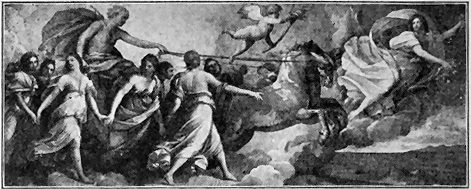
HOW MR. APOLLO TURNED ON THE LIGHT
Behold the sun-god starting on his daily round! Aurora, Goddess of the Dawn,
precedes him scattering flowers, the lovely colors of the morning sky. The other
figures are the early hours.
The Greek poets used to play with these myth stories a good deal, changing
them to suit their poetic fancy. Theocritus, for example, in a beautiful fragment
that has come down to us, paints this picture of the breaking day:
"Dawn, up from the sea to the sky,
By her fleet-footed steeds was drawn."
You see, according to this poet's conception, Miss Dawn had a chariot of her own.
But nothing serious happened until one time Phaeton
persuaded father to let him drive the sun chariot for a
day. The horses, feeling at once a new and weak hand
on the reins, tore out of the regular road and went dashing
right and left. They even got so near the North Pole
that the ice began to melt. They fairly flew down toward
the earth, set the mountains smoking, and dried up all the
springs and most of the rivers.
THEN THINGS BEGAN TO HAPPEN
They dried up a certain great lake, so that there is to
this day the Libyan Desert in Africa, where this lake used
to be. They made the very sea shrink so that there were
"wide naked plains where once its billows rose."
Finally Mother Earth called on Jupiter Pluvius, as god
of thunder, rain, and storms, to stop Phaeton and the runaways
and put out the fire.
Struck by a bolt of lightning poor Phaeton fell headlong
from the skies, and a world-wide rain put out the world-wide
fire.
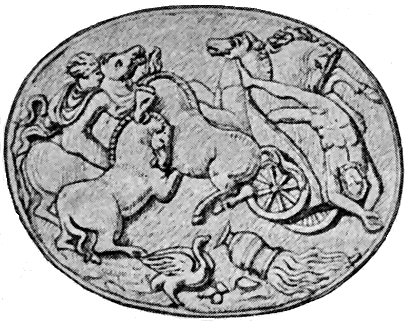
From a cameo by Da Vinci
THE FALL OF PHAETON
(Museum, Florence)
Now, would you believe it, this queer old Old World
story may really be true in its way. Of course there never
was a sun god and no spoiled boy who did just that thing;
although many spoiled boys have tried to set the world
on fire and failed because they thought it would be so easy.
But the earth really has been on fire in a sense; that is,
has melted from the heat. And in parts where you would
least suspect—the rocks. There's where I got into it.
And some of these rocks, not more than ten miles[3] from
where you live, are either still molten, or continue to melt
from time to time; as you can see when lava comes pouring
from volcanoes, such as those of Hawaii.
In the days of the Apollo story most men still thought
the earth was the centre of the universe; that the sun,
moon, and stars moved around it. But Pythagoras, one
of the Greek philosophers, had formed a general notion of
the truth that the earth is only one planet in a great system.
Then, along in the Sixteenth Century, came Copernicus,
and by mathematical calculation—he was a fine
hand at figures—began to find out things that showed
the wise old Greek had made a happy guess. Then
Galileo, Kepler, Newton, and others, each working on
different parts of the problem, finally settled the question.
They found that there are just worlds of worlds, and that
ours is only one of them.
About the time of the American Revolution a great
French mathematician, Laplace, worked out a story of the
origin of the earth which is, briefly, this:
What we know now as the solar system—the sun with
its attendant worlds—was once a single big ball of fiery
gas, a nebula. As this nebula cooled it shrank, and as it
shrank it whirled faster because it had a smaller track in
which to turn, and with an equal amount of force would,
of course, get around oftener. The faster it whirled the
more the outside of it tended to fly off, as water flies off
a whirling grindstone or as a stone flies from a sling.
This centrifugal or "fly-away" force was greatest at the
sun's equator, and it threw off big rings. Afterward,
around some centre of greater density in these rings, the
gaseous particles in the rest of the ring gathered, so forming
spheres. Then some of the spheres themselves threw
off rings in the same way which became what are called
satellites. The moon, which is our satellite, Laplace supposed
to have originated in this way. The ring which
Saturn still wears he thought would some day become a
satellite.
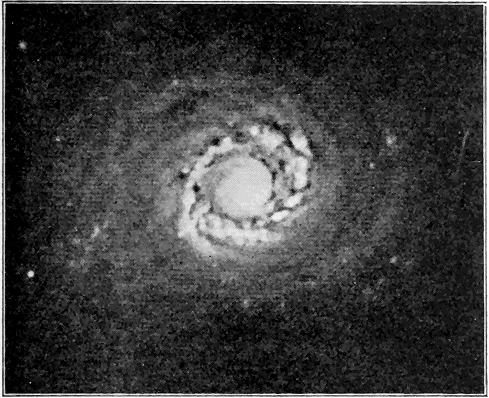
By permission of the Mount Wilson Observatory
WATCHING THE MAKING OF WORLDS
At first you won't see anything very striking about this picture, perhaps; but
doesn't it give you something of a thrill to be told that you are here looking not
only at the making of a world, but of worlds of worlds? A whole solar system! In
the course of unthinkable time that big, round ball in the center will be the sun, and
what appear to be little knots wrapped close around it—they are really far from
each other and from the sun—will become rounded worlds like ours. They will be
forced into roundness by their own gravity, pulling toward their centers. They
don't look any farther apart than the strands in a little sister's braided hair, do
they? But remember how small this picture is compared with what it represents.
What here show as little dark lines, separating the embryo worlds, are in reality
vast spaces, like those you see between the stars at night—millions and millions and
millions of miles!
So, you see, the myth story of Phaeton foreshadowed,
in a way, the science story of Laplace. For, according to
the Laplace theory, the world was on fire; and a big rain
storm, lasting for ages, with plenty of thunder and lightning,
did help put it out.
This theory of Laplace was long accepted as the true
one. Indeed, it was only yesterday, comparatively, that
other explanations were offered as to how we came to
have a world to stand on. The broadest of these new
theories—the one that undertakes to explain the most—is
that of Professor Chamberlin, of the University of
Chicago.
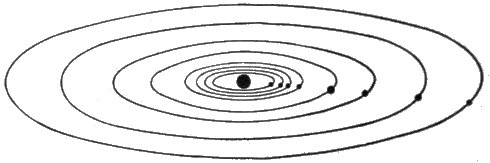
THE SUN AND HIS PEBBLE WORLDS
However the worlds of our solar system may have been made, when they were
done there was the sun in the centre and his worlds travelling around him in their
ordered orbits. Nearest the sun is Mercury. Then Venus, Earth, Mars, Jupiter,
Saturn, Uranus; then, finally, Neptune nearly 3,000,000,000 miles away and with
an orbit so big that Christmas comes only once in 60,000 years!
YOU CAN SEE THESE WORLDS IN THE MAKING
Owing to the more powerful telescopes of to-day, and
the amount of exploring among the worlds that has been
going on since the time of Laplace, several things have
been discovered that have brought his theory into question.
For one thing, many more nebulæ have been found
in space than were known when Laplace worked out his
great conception, and among them all not one has been
found with a central mass surrounded by a ring. Moreover,
our sharp-eyed telescopes show that Saturn's ring,
which Laplace thought was a solid mass, is really made up
of a great number of small satellites: baby worlds. The
greater number of these nebulæ are like the ones you see
in the illustration on page 5. They consist of very bright
centres with spirals streaming out from opposite sides.
Just take a look at the picture. Doesn't the shape of those
spirals suggest that the central mass is whirling? And notice
the little white lumps here and there. The thinner,
veil-like portions of the mass, as well as the "lumps," are
supposed to be made of particles of matter, but the lumps
to be more condensed. All the particles, big and little, are
known to be revolving about the central mass, much as
the earth revolves about the sun. The little white lumps,
or knots, in the filmy skein are supposed to be worlds in
the making. Being larger than the other particles, they
draw the smaller to them, according to the same law of
gravitation which makes every unsupported thing on earth
fall to the ground, because the earth is so much bigger
than anything there is on it. Since these bright little
lumps behave so much like the worlds we know as planets,
and yet are relatively so small, they are called planetessimals,
or "little planets." So Professor Chamberlin's idea
of the origin of worlds is known as the "planetessimal
theory."
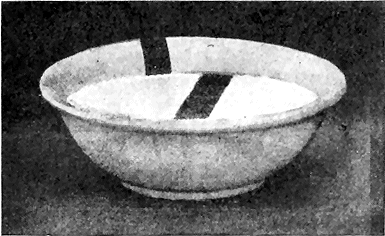
HOW YOU CAN WATCH THE WORLD TURN ROUND
Timepieces, you know, are really machines for keeping track of the apparent
movement of the sun. Here is a device, as simple as a sun-dial and much simpler
than a clock, by which you can record the actual motion of the earth. Sprinkle the
surface of the water in a bowl with chalk dust. On this, sift from a piece of paper
powdered charcoal or pencil dust, so as to make a clean-cut band extending across
the centre and over the edge of the bowl. In the course of several hours you will
find that the black band has swept round from east to west, because the water has
stood still while the bowl has been carried from west to east by the whirling world.
According to this theory the earth was once a mere
baby world like those white lumps, and grew by gathering
in its smaller neighbors from time to time by the power
of gravitation. The larger it grew the more particles of
solid matter it could draw to itself. Then it drew larger
masses, for with increased mass came an increased pull
of gravity. In the same way the earth is still growing,
for it is thought that the shooting stars or meteors we see
at night are little planets being gathered in.
II. How the Continents Came Up Out of the Sea
And before I got to be myself at all, while I was still
only a part of the big pebble called the Earth, your geography
and I lay at the bottom of the sea.
For ages and ages!
This is one of the stories you will find in the literature
of science, of how, along with North America, South
America, Europe, Asia, Africa, and Australia—have I left
out any?—I came to land and brought your geography
with me.
I remember hearing a pretty young lady say, once upon
a time:
"There," said she, "I'm through with geography forever!"
You see, although she had passed with marks around
90, she still had the idea that geography is a book.
You and I know, of course, that the real geography isn't
a book at all. It's the world itself.
PUTTING THE CONTINENTS ON THE GLOBE
But there was a time when there was no land. It was
all water, and the continents were lifted into their places,
much as you model a continent in making a relief map;
they were sketched out and then filled in. North America,
for example. First of all up came that mass in the northeast
in what is now Canada; the Laurentian Highlands,
as they are called in your geography. They rose very,
very slowly, you understand, only a few feet in a thousand
years; for Nature has all the time there is and never
hurries. These highlands (they are really granite mountains
worn down), along with the other rock formations
of our continent, are supposed to be the oldest land on
the earth. The continents of Europe and the rest were
born later. So you see Columbus didn't discover the
New World at all; he really came from the New World
and discovered the Old!
Next after the highlands north of the St. Lawrence up
came the tops of the mountains you see running along
the eastern coast, what we now call the Appalachians.
Then the Rocky Mountains began to raise their heads and
looked eastward toward their brother mountains across a
great mediterranean sea, the bottom of which is now the
Mississippi Valley. Mediterranean means "middle of the
land."
HOW YOUR GEOGRAPHY ROSE OUT OF THE SEA
ADMITTING NEW STATES TO THE MAP
Wisconsin, into which I moved from the Laurentian
Highlands in later years, was on the lower end of a long,
thin tongue of rock reaching out from these highlands to
the southwest. While Wisconsin went on growing, the
Alleghanies came up and brought some Middle Atlantic
geography with them. Up with all these early settler
mountains came, in the course of time, the beginnings of
neighbor States. All these big, barren rocks (as they were
then), rising and ever rising, age after age, spread more
surface to the sun. And the sun, and the wind, and the
frost, followed by the lowest forms of plant life—the Adams
of the vegetable world—gradually worked the surface of
the rock into soil; and so, as we may say, got ready for
the spring plowing.
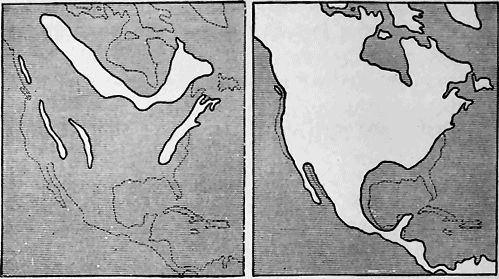
LANDS THE SEA HAS SWALLOWED
Parts of the continents as they used to be but which are now beneath the waters
are here shown. Compare this with the globe map in your geography. It is
estimated that there are 10,000,000 square miles of this land. You'll hear more
about this swallowing habit of the sea in Chagter X; but, as you will learn, there's
nothing to be frightened about.
By this constant rising and building on of the soil the
foundations of our States grew out toward one another in
order, according to the constitution of things, "to form a
more perfect union." The United States, at a time which,
we may say, corresponds to "The Expansion Period" in
your school history, grew southward from Wisconsin and
westward from the Appalachians until they made continuous
land; and there was your Ohio and Indiana and
the rest of the North Central group. Below, toward the
south, were more big stone islands here and there, the
first sketches or blockings out of the Southern States.
Florida seems to have been added later, as a final touch;
an afterthought, as one of my Wisconsin neighbors puts
it. And it was much enlarged by those remarkable little
world builders, the corals. Mexico and Central America,
of course, are a part of the Rocky Mountain system.
From Gilbert and Brigham's "An Introduction to
Physical Geography." By permission of D. Appleton
and Company
BUT WON'T WE GO UNDER AGAIN?
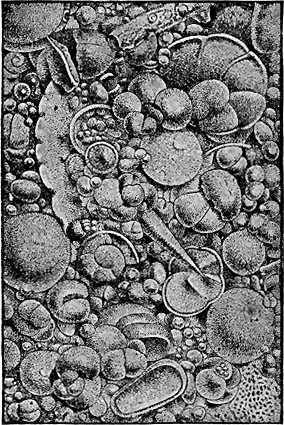
These little people of the sea-floor furnish one of the most assuring evidences we
have that although the continents rose out of the sea, they will never go under the
sea again. These are shell creatures found in the slime dredged from the bottom
of the deepest parts of the sea. The shells of creatures that live near shore are
found in abundance in our rocks, but these types are found only in the deepest seas.
So, since the deep down-wrinklings of the earth that make the sea-basins have
never risen, it is probable they never will; and consequently that the up-wrinkles—the
continents—will continue to stay above the waters.
It's a wonderful old story, isn't it? But more wonderful
still, it always seemed to me, is the story of how they found
all this out.
Who do you suppose first told about it? The last
people you would ever think of, I'm sure—the oysters!
WHAT THE OYSTERS TOLD XENOPHANES
It sounds like a passage from "Alice in Wonderland," or
"Through the Looking-Glass," doesn't it? But it's a fact.
Away back, more than 2,000 years ago, a wise Greek called
Xenophanes, who lived in a place called Colophon, and so
was called Xenophanes of Colophon, said that he thought
the rocks of the mountain sides must once have been
under the sea because of the oyster shells that were found
embedded in many of them.
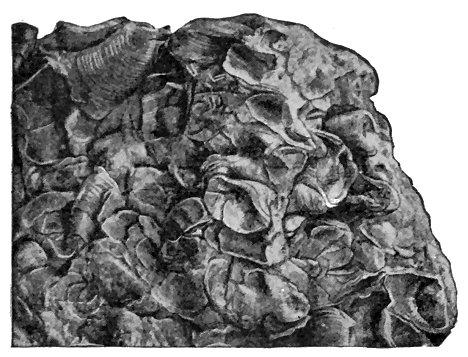
HOW THE OYSTERS TOLD THE GREAT SECRET
Here is a good example of the thing that led wise old Xenophanes of Colophon
to make the startling assertion that the mountains were once at the bottom of the
sea. These are the shells of oysters embedded in limestone—which, by the way,
the shells of the oysters themselves helped make—and this piece of stone is from
the top of a high mountain.
"For," said Xenophanes of Colophon, "how else could
the oyster shells have got there? Who ever heard of
oysters climbing a mountain?"
Another evidence that lands come up out of the sea is
this: Even before the days of Scott and Maryatt and
Fenimore Cooper, men—and, of course, boys—were interested
in caves that face upon the sea. They are such
jolly places for pirates, and for boys playing pirate, and
for mermaids drying their hair. It was plain that down
where the waves in storms could reach them the sea itself
bored out these caves. But how about those caves in the
cliffs high above the waves? The sea must have made
them, too, once upon a time when the land was lower in
the water. Then the land was raised.
Still more striking was the fact that not only caves but
old sea beaches were found on hill and mountain slopes
far from the sea, sometimes hundreds of miles inland.
You can tell the old beaches by their shape and the way
in which the pebbles are sorted by size, just as you find
them on beaches to-day.
THE BAKED APPLE AND THE BULGING WORLD
The causes of the rise and fall of the sea coasts are many,
and there are things about these movements not yet understood.
By what wonderful machinery, then (we might
naturally ask), were the continents themselves lifted out
of the sea? To this, which would seem much the harder
question of the two, the answer is simple; as simple as a
baked apple. You know an apple that goes into the oven
with a smooth, neat skin comes out covered with wrinkles.
Now suppose, instead of a little, hot apple, covered with a
thin skin, you have a big, hot earth covered with a thick
crust of stone, and the inside of the earth shrinking all the
time as the inside of the apple shrank away from its skin.
The rock skin would wrinkle, and the wrinkles, rising out
of the seas that then covered it everywhere, would make
continents.
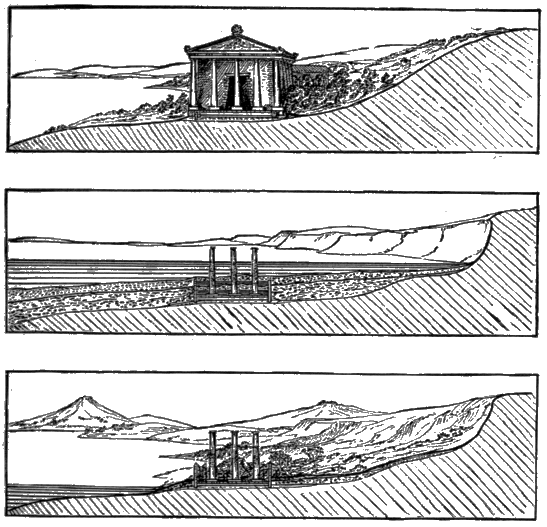
THE RISE AND FALL OF JUPITER SERAPIS
In this account of the ups and downs of land and sea I must tell you the story
of Jupiter Serapis. In the days of the Romans this temple, for his honor, stood
on the seashore near Naples. Of that temple only three pillars remain, but they
answer a very important question. On these pillars, over twenty feet above sea-level,
is a belt of holes bored in the stone by a certain shelled sea-creature, one of
the barnacle family; so evidently these pillars must, at some time, have sunk, as
shown in the second picture, and then risen again, as shown in the third, which represents
them as they stand to-day.
Another interesting thing is that the third picture—observe—shows a volcano
that isn't in the other two. Following a series of earthquake shocks in 1538 the
earth opened and out popped hot stones and ashes and built themselves into a
small volcano right before everybody; for it was all done in a short time, and you
may be sure the frightened people kept their eyes on it, and they named it Monte
Nuovo, which is Italian for "New Mountain."
"And God said, Let the waters under the heaven be gathered
together into one place, and let the dry land appear:
and it was so."
According to the planetessimal theory the way in which
the seas were made was this:
Owing to the collision—the "bang"—of the planetessimals
against the earth, and against each other as they met
at the "terminal station," heat was generated. The compression,
the squeezing together, of the earth from its own
weight—the gravity pull of the whole mass toward the
centre—generated still more heat, and the heat and pressure
drove the gases out of the rock. These gases included
hydrogen and oxygen. These two gases cooling and combining
themselves, in a way they have, became water, and
there were other gases, such as nitrogen and carbon gas,
that helped to make the air.
WHEN THE SEAS WERE ALL IN THE SKY
At first the water was in the form of dense clouds of
overhanging vapor which, growing bigger and bigger,
finally fell in rain. The heat, made by the pressure of the
outside of the earth toward the centre as the earth kept
growing, caused volcanic explosions. But there were far
more volcanoes in those early days when the earth was
settling down, and being "settled up," as it were, by these
energetic pioneers in the fields of space—the planetessimals—and
the surface became pitted with craters. In these
great catch basins the rain was stored, and, as for ages
the rain kept falling faster than the vapor rose from the
earth, many of these bodies of water united, and so formed
the lakes, the river systems, the oceans, and the seas.
THE FOUR GREAT FEATURES OF THE BIBLE STORY
All of which, while it differs so much from the theory of
Laplace, does not affect the Bible outline of the origin of
the earth. For these four great things must still have
been: (1) an earth without form, and void; (2) a great
deep; (3) upon its face darkness from the continuing masses
of black rain-laden clouds which overhung it and shut
out the sun; (4) the final dividing up of supply between the
vapor of the clouds ("the waters above the earth") and
"the waters upon the earth," so that at last the dark
cloud curtain disappeared, and the sun began to rule the
day. "Let there be light."
But good-by to Phaeton and the story of an original
glowing ball which cooled off on the outside. If the earth
grew bit by bit instead of being whirled off in one fiery
mass by the sun it was never any hotter than it is now, if
as hot. It grew hot by being pressed together by its own
weight, and by the blows of additional little worlds as
they fell upon it.
But on one thing everybody agrees, that the rocks, as
you go toward the earth's centre, have been and still are
in a molten state; that this rock, when it cools, becomes
granite, all full of little crystals like a lump of sugar, and
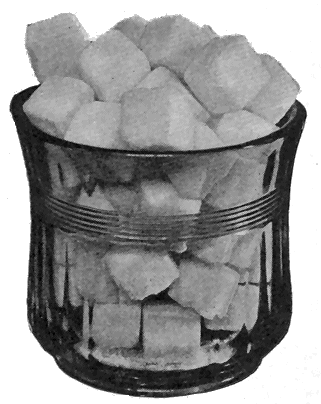
that the Granites are one of the F. F. E.'s.[4]
I, as you see, am a Granite. So, besides going through
fire and water—yes, and ice, as you will learn—and having
many strange and wearing adventures both by land and
sea—I'm "awfully" old. Older than you think. I looked
it up in the family record called the "Geological Column"—just
the other day. That column gives my age as
"80+." This means I'm 80,000,000 years old, going on
81! (The plus sign, in geology language, means "going
on"; or, "and then some," as a certain slangful high
school freshman puts it.)
But I don't think I show my age. Do you?
HIDE AND SEEK IN THE LIBRARY
Who wants to sit and be talked to all the time? When boys and
girls are playing games, the greatest pleasure is in taking part, and
it's the same way in the Wonderland of Books. Books mean most
to those who "get into the game"; who help chase after the answers
to things. This hunting for answers up and down among
the books is one of the interesting games we're going to play; and
those of you who don't come in will miss a lot of fun. That's all
I've got to say! Let's begin like this:
In the Greek myth stories what else was Mr. Apollo supposed
to do for the world and its people besides turning on the light?[5]
[5] Answers to all these questions at the ends of chapters will be found
in books you can easily get hold of—encyclopædias, dictionaries, and
school-books; or books usually found in home, school, or public libraries.
Words in parenthesis or italics indicate the headings where the information
referred to will be found.
Why doesn't the force of the earth, whirling along as it does at
19 miles a second, cause the wind to blow us all away? (Earth.)
What is the difference between a planet and a sun?
How does the earth compare in size with its brother planets of
the sun family?
How often would Christmas come around if we lived on the
moon?
What causes different phases of the moon?
Why may we be said to have eclipses of the moon every month?
"Moon" and "month" sound a good deal alike when you come
to think of it. Don't you wonder why? "Moon" comes from a
word meaning "to measure." You'll find the rest of the word-story
of the moon in any dictionary that is big enough to tell about
the origin of words.
By the way—speaking of the timekeepers in the sky—don't forget
to look up the lives of the great astronomers mentioned in this
chapter. You will find, among other things, how Galileo, when
only eighteen years of age, helped to give us our clocks and watches
by counting his pulse-beats while watching a hanging lamp swing
back and forth in the Cathedral of Pisa; how he found out who
"The Man in the Moon" really is and what the "Milky Way" is
made of; how he invented the wonderful glass for playing hide and
seek among the worlds, and with it found four moons in one night!
Yes, and how do you suppose he found that the sun is going
round and round like a top, just as the earth does? It was the
simplest thing! You'll see!
Old Father Science may be said to be a Santa Claus who keeps
a curiosity-shop. His pack is not only full of curious things but
he is always "springing surprises on us," as our High School Boy
puts it. For example, one of the most curious as well as picturesque
evidences that great stretches of land sink under the sea from time
to time is furnished by the English swallows. Like many other
wealthy people, they spend their winters in Algiers, and they find
their way over the Mediterranean, not by any lands they can see
between coast and coast—for there are none—but by lands that
used to be there, thousands upon thousands of years ago.
But how do the swallows know? They don't. Is it instinct?
No. (Whatever instinct is!) Then why do they do it? Look it
up and you'll see.[6] Yes, and you'll see that we have habits that
we get in the same way; our habits of bowing, for example, because
it's the custom, although few people know how it originated.
It's been just one thing after another with the world
and me ever since we were born. First it was the fire,
then it was the flood, and then it was the winter that
lasted all summer.
Just what started it nobody knows to this day. Some
of the theories have been that this particular winter stayed
so long because the earth wavered on its axis, or that it
flew the track for a while and got too far away from the
sun. From our present knowledge of the machinery of
the heavens it is certain that the earth's motions could
not vary to this extent. One theory that appeals to many
scientists to-day is that when so much of the carbon in
the air went into the making of our coal beds the earth
became unusually cold, and so snows of each successive
winter kept piling up instead of melting away during the
spring and summer. When there is plenty of this gas in
the air the earth's heat does not escape so fast. But with
the great amount of carbon taken up in the growth of the
vast forests that were made into coal, Mother Earth's air
blanket grew thinner, so to speak, hence the long, cold
spell.
From Norton's "Elements of Geology." By permission of Ginn and Company
WHEN THE ICE SHEETS COVERED THE LAND
But whatever caused it one thing is certain; it was a
winter that beat anything the oldest inhabitant ever saw;
for the cave men are known to have been on earth during
this great winter, which is known as the Ice Age or the
Glacial Period. A great big ice cap reached from the
North Pole far down into the Temperate Zone in North
America, Europe, and Asia.
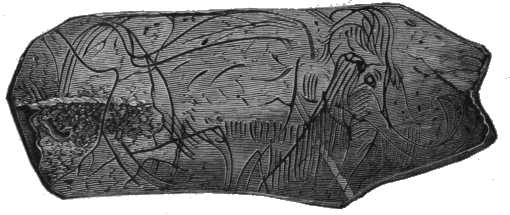
FROM THE CAVEMAN'S DIARY
This is a little note on the Ice Age from the caveman's diary—the picture of a
mammoth scratched with a flint on a mammoth's tusk. You can see how the
artist kept trying for the true form with different lines, as all real artists do. Artists
don't just have a kind of sign that stands for the thing—like a little boy's picture
of a man that he always makes in just one way. Notice the action, the natural
motion of the animal. The artist means to say: "This is the way he came
at me."
I. The Mild Spell and the Menageries
Just before this dreadful winter set in we had a long,
open spell; about a million years or so. It was just like
summer most of the year in the temperate zone, and much
warmer than it is to-day in what is now the land of the
little frosty Eskimo.
There weren't any little Eskimos in those days. In fact,
there wasn't much of anything that was little. Everything
was on a big scale. Think of a mud-turtle twelve
feet long! He was all of that. His skull alone was a yard
long and he must have weighed a couple of tons. He had
for neighbors in the bordering swamps a number of huge
creatures that one wouldn't care to meet.
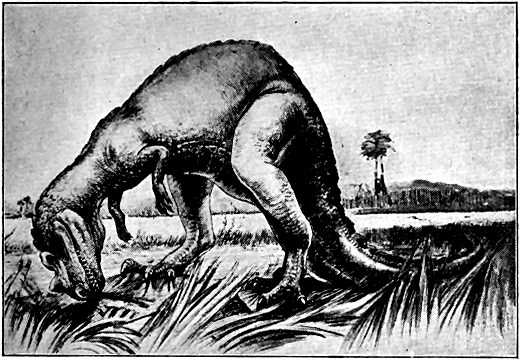
THE KING OF THE DINOSAURS AT LUNCHEON
Contrast the little, almost dainty, fore limbs with the enormous legs. You
can't help thinking of the arms of a human being, can you? In fact, this mixed-up
creature looks as if nature were even then dreaming of man, the quadruped who, as
some Frenchman said, "took to walking on his hind legs that he might conquer
the world."
DREADFULNESS OF MR. DINOSAUR
The Dinosaur, for instance. His name means "terrible
reptile." Some members of the family were, indeed, terrible
creatures. Just see this one at lunch, Mr. Ceratosaurus.
He has the head of a queer horse—"probably a night
mare," says the High School Boy—teeth and tail and belly
scales like a crocodile, a comb that suggests a rooster's,
legs like an ostrich, the talons of an eagle, and the dainty
little arms of a child. What a combination! Those small
fore limbs were used only for grasping. On his hind legs
he stalked about, seeking whom he might eat for dinner.
He was about fifty feet long when he was all there. At
this late day scientists usually find only parts of him scattered
around.
These Dinosaurs came in sizes and differed considerably
as to looks and eating and getting about. Some were as
small as cats, some walked on four legs, some—like the
gentleman at lunch—walked on two. Some were strict
vegetarians, while others would have nothing but meat.
The Big Boys of the whole tribe were called the Sauropoda
or reptile-footed Dinosaurs. One of these, whose bones
were found in Colorado, was sixty-five feet long when
complete, and he must have weighed around twenty tons.
His family nickname was Diplodocus or "Double Beam,"
because of his long, beam-like neck and his long, beam-like
tail.
GENTLE MR. DIPLODOCUS AND HIS WAYS
Considering the reputation some of the other Dinosaurs
had as bad citizens, it is only fair to the Diplodocus to say
that he was really a gentle creature, and never disturbed
anybody—unless somebody disturbed him first. Then he
would give them a switch with that tail of his, and it was
a switching they were not likely to forget. But his great
delight—indeed, his main occupation in life—was to sit
deep in the water, prop himself up with his great long tail,
like a kangaroo, with just his head out, like a turtle in a
pond. Then he would strain little water bugs and similar
things through his teeth. He got his meals in this way,
very much as the whales do now.
And elephants! You ought to have seen some of the
members of the elephant family that arrived after the reptile
age, the mammoths, for instance. These huge creatures
and many other strange animals were all over the place. It
was just like a circus day everywhere all the time. Such
elephants don't travel with circuses now, of course, because
they were all killed during that dreadful winter, but you
can see them in museums, all dressed in their skeletons
and neatly held together with wires.
From the mural painting by Charles R. Knight in the American Museum of Natural History
WHEN ELEPHANTS WORE UNDERCLOTHES
This painting on the walls of the American Museum of Natural History in New
York City shows herds of reindeer and mammoths in the Ice Age. They didn't
mind the cold as elephants do to-day, because of their woolly underclothes. They
fed on the shoots and cones of those firs and pines. The reindeer, then as now,
ate the lichens we call "reindeer moss," first scraping away the snow with their
feet.
HOW THE MAMMOTHS PASSED AWAY
Picture herds of these mammoths huddled together like
sheep in dark ravines, and the blinding snow, swept down
by the winds, burying them deeper and deeper. That
was how they died. You'll notice that they wore their
hair long, while the elephants we see in the circuses or at
the zoo have hardly any hair at all. This long hair was
part of their winter clothing. Under it they wore a close
fleece. But this winter was so severe and it lasted so long
that even their heavy woollen underwear couldn't save
them. Sometimes there would be a thaw, but this was
only on the surface and helped turn the snow into ice.
And winter piled on winter and on the bodies of the mammoths
until they were buried under tons and tons of snow
and ice.
HOW THE SNOW CHANGED ITSELF INTO ICE
You know snow will get solid, like ice, where it is under
pressure, and it will make hard cakes and ice balls under
your shoes. Well, this snow of the long winter just
"packed its own self" (as a small boy might say) into ice.
It did this by piling on and piling on. The weight of the
snow above and behind, in the spaces between the mountains
and in the mountain valleys, pressed with enormous
force on the snow below and in front.
Then what do you think this ice did? It began to
move. And of all the things it did from then on!
II. Marvellous Changes in the Old Home Place
Did you notice those scratches on my face? The ice
did that. But, of course, that's nothing in itself. And,
besides, I'm not one to complain, as you know. I only
speak of it to show what big things may be back of little
ones, how much you can learn from the study of so common
a thing as a little pebble. For the very same ice fields
that scratched the faces of little pebbles like me deepened
the gorges and canyons among the mountains and shaved
the crowns of the old ones—Bald Mountain, in the Adirondacks,
for example. They carried off good farming
soil by the thousands of acres from one place and piled it
in another; they shoved the Mississippi River back and
forth; in fact, turned many streams out of their courses—some
of them the other end to, so that they now flow south
where they used to flow north. They took old river systems
apart, and with the pieces made new ones—the big
Missouri for one. They set Niagara Falls up in business;
got all the waterfalls ready that are now turning the wheels
of New England factories, and even put in great water
storage systems that remind one of the Salt River irrigation
works, with their big Roosevelt dam in Arizona, or
of the reservoirs which England built in the Nile. Lakes
in river systems act as reservoirs, you know, and make
them flow more evenly, thus keeping the power of falls
more uniform, as in the case of Niagara, and making a
uniform depth of water for vessels, as in the case of the
St. Lawrence River. The Great Lakes do both of these
useful things.
From Norton's "Elements of Geology." By permission of
Ginn and Company
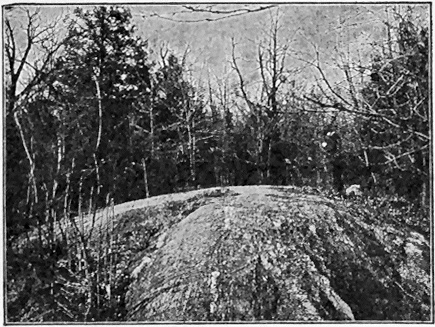
THE LITTLE MOUNTAIN IN THE BIG CITY
In one of the parks in New York City you can see this illustration of how the
glaciers rounded off the mountain-tops.
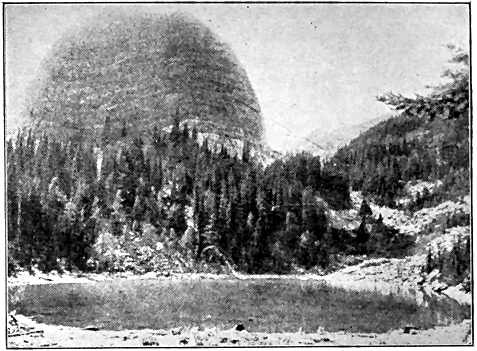
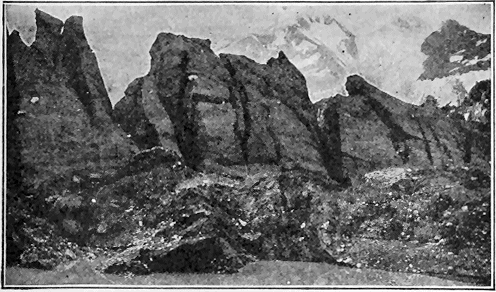
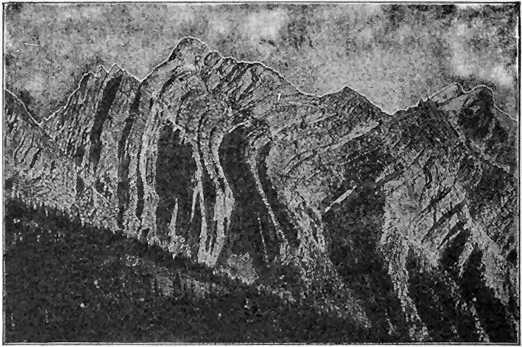
THE BEEHIVE MOUNTAIN
This huge mass in the Canadian Rockies is known as the Beehive Mountain.
Originally a cliff, it was reshaped by the glaciers. Can't you tell from the picture
which was the face of the cliff, and from the information in the text which side the
glacier climbed up and on which side it tobogganed down?
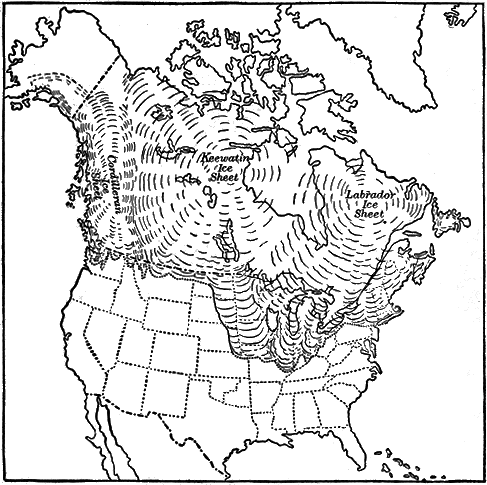
There were three great centres—union stations, we might
call them—from which the ice trains moved out. These
were the points at which the ice gathered to the greatest
depth, the tops of the great snow banks. One, as you see
by our Ice Age map, was away over on the Pacific Coast
of Canada. It is called the Cordilleran Centre, from the
vast mountain system of which it is a part. Over what is
now the province of Keewatin, Canada, was the Keewatin
Centre, while the Labrador Centre stood guard over the
highlands of Labrador. The ice from the Keewatin and
Labrador fields, you notice, flowed farthest to the south.
The Keewatin ice giant travelled away down the Mississippi
Valley as far as the mouth of what is now the Missouri,
while the giant from Labrador got nearly to the
mouth of the Ohio.
THE OLD MEN OF THE MOUNTAIN AT THEIR WORK
Don't you always think of a glacier as a big white thing? So it is when it starts
to work, but after it has ploughed down the mountain valleys and gathered up a
lot of soil—such as the heaps you see in the foreground of the picture—it begins
to look as black as a coal-heaver! It gets cracked up into all sorts of odd shapes,
too. Doesn't that figure near the centre look like some queer kind of old elephant,
with a fierce white eye (it's a big stone) and a snarl on his face?
The reason Old Mr. Labrador didn't reach the mouth
of the Ohio—as you can easily guess—was that he didn't
go far enough, but could you answer a conundrum like
this:
"Why was Mr. Keewatin bound to reach the mouth of
the Missouri and stay there for awhile no matter how far
he went?"
The answer is easy, when you know it. Because he
made the Missouri himself. What we now know as the
Missouri River was made of other rivers that the big ice
sheet turned around as it advanced and of the water from
the ice as the glacier melted its way back home. It was
something like Mary and the little lamb, all the time, so
long as Mr. Keewatin travelled south; for everywhere he
went the Missouri was sure to go, because he kept pushing
it ahead of him.
HOW THE OLD MEN PUSHED THE MISSISSIPPI ABOUT
As the ice sheets pushed into its valleys, now from the
northeast and now from the northwest, the Mississippi
River was pushed back and forth as if it were a—well, as
if it weren't anything! It is known that the Mississippi
was pushed out of bed by this burly guest from the north
because its former channels have been traced along the
old ice fronts.
In one part of its course the Mississippi actually got misplaced,
and hasn't found its way back to its old bed to
this day. This you can see at Fort Snelling, Minnesota.
At that point the Minnesota River flows in the Mississippi's
old valley—which is plainly too big for it—while
above Fort Snelling the Mississippi is forced to squeeze
its way through a stingy little gorge that used to belong to
the Minnesota, and I'm sure would be plenty big enough
for it now. It's like the story of a changeling baby in a
fairy tale, isn't it? Only in the fairy tale the changeling
always gets back to his old home, while the misplaced
Mississippi in Minnesota doesn't.
But the glaciers made it up to the Mississippi, in a way,
for this rude jostling. They not only left it an enormous
extra supply of water as they melted back home—what
would a river be without water?—but they actually took
some smaller rivers away from the St. Lawrence and made
them do their pouring into the Mississippi system. Although
they didn't owe the Ohio any apology for anything,
so far as I know, they did the same thing for it,
just to be good fellows, I suppose. All the rivers that
now empty into the Ohio above Cincinnati used to flow
into Lake Erie, but the glaciers turned them south and
they've gone on obediently flowing that way ever since.
A PLOWMAN WHO PLOWED THE FARMS AWAY
That these giants of the north, although they must
have looked as cold as ice, really had good hearts is shown
by the way Old Mr. Labrador treated New England when
he went Down East. New England was at that time
covered with good, deep, rich soil, the decay of the granite
rocks that had been basking in the sun for ages and growing
early grass and vegetables for the live stock of those
days. Then along came Old Mr. Labrador with his plow,
and set to work. But he plowed so deep that he plowed
all the farms away! Of the gigantic furrows that he
turned a lot of the slices fell over into New York State;
but some, I'm sorry to say, dropped off into the sea. This
left New England in a bad way, so far as prizes for farm
produce at the country fairs a few thousand years later
were concerned.
But then what do you suppose Mr. Labrador did, the
good old soul? He took a lot of streams that had been
flowing north, blocked them up with pebbles and dirt,
making them turn right around and flow south, so that in
climbing down from the rocks in these new unworn beds
they made waterfalls. And it was from the power made
by its waterfalls, you know, as your geography tells you,
that New England grew to be a great "manu-factur-ing"
section.
Courtesy of "The Scientific American."
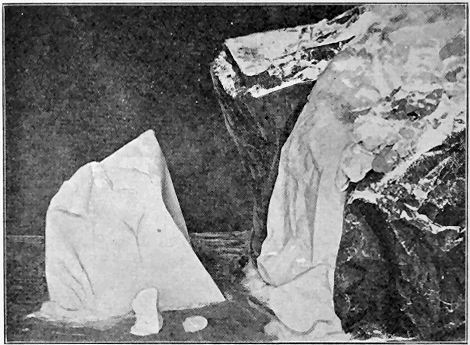
HOW THE OLD MEN OF THE MOUNTAIN COME TO SCHOOL
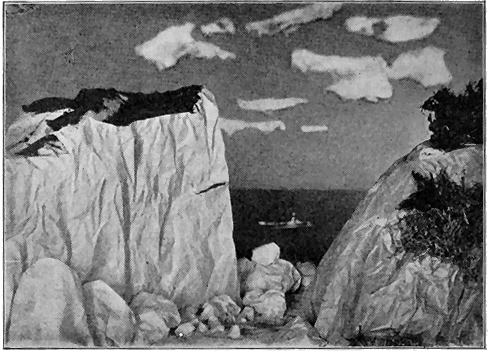
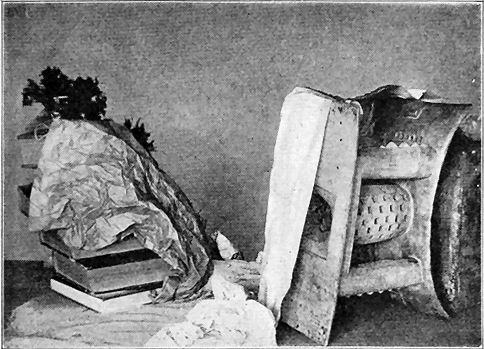
You can have glaciers like this right in the schoolroom, and icebergs, too, by
means of which the Old Men of the Mountain went to sea. Both the iceberg
and its parent, the glacier, are made by the crumpling of white paper around books
or any other support. Cliffs of dark-brown grocery-paper bound the deep gully
through which the glacier has crept down to the sea. The sea-waves are made with
crumpled paper of appropriate colors. (Think what lovely green waves you could
make with a piece of old window-shade!) Pieces of white string make good
breakers, and powdered chalk can easily be made to turn to snow.
Of course I'm only joking when I speak of these glaciers
as if they had minds like the rest of us, but really it almost
seems true, when you come to think of all the things they
did. Take these New England waterfalls, for instance.
The glacier not only made them by turning the rivers
around, but, as the ice melted away toward the north the
land rose again, being relieved of the enormous weight.
And in rising the sloping land not only gave more force
to the new southward flowing streams but made it more
sure that they should go on flowing south. As if the
glaciers said:
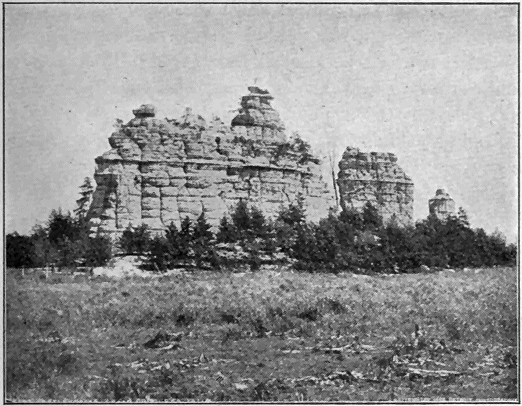
THE GRAY TEMPLE OF THE WINDS
This gray mass of sandstone on the Wisconsin prairies is a piece of architecture
with which man has had nothing whatever to do. It is all the work of the winds
and the rains; of the sea and of rivers; of water and rivers of ice; and the vertical
division of the rock into joints by the shrinking of the earth. The detail, the
rounding of the pillars, and so on, is largely the work of the winds and their helpers,
the frosts, the rains, and the wind-blown sand.
The original mass was carved out of a big rock-bed by flowing rivers that had
their course around it on either side. Then one of these rivers was dammed by
ice in the days of the glaciers and a lake was formed in which this rock mass stood
as an island. The level prairie you now see around it was made by the sand and
gravel deposited in the bottom of this lake. The vertical divisions are cracks in
the earth crust called "joints." The horizontal divisions are due in part to this
cracking process and in part to "stratification," the layer-like arrangement of the
rocks when laid in the bottom of the sea, as explained in Chagter X. The "cornice"
is a layer of harder rock which has yielded less to nature's tools.
"I've turned you around and I want you to stay turned
around. And I want you to go on running south and
dropping over the falls until the people of New England
come down to Lowell and Manchester and those places
and get ready to put you to work."
Anyhow, that's just what happened. You can look at
it any way you want to.
It was in much the same way that Mr. Labrador and his
friend Keewatin did that great piece of engineering at the
Great Lakes. Where the Great Lakes are now there used
to be rivers that were a part of the St. Lawrence system.
Then along came the ice sheets, dammed up these rivers,
just as small boys dam up roadside rivulets after a rain,
and so made big lakes, as the boys make little lakes in
these streamlets. But this wasn't all. The glaciers evidently
wanted these to be nice big lakes that would stay
there for people to ride on in the beautiful summer weather,
and to help haul coal and iron ore and other kinds of
freight—Michigan peaches and everything. For look
what else they did. With pebbles and big stones and dirt
they built the lake walls higher, and dug deep basins for
them out of the solid rock. Then they poured in a lot of
extra water—beautiful blue water, tons and tons of it—and
went back home.
The digging into the rock was done with big chisels—what
a carpenter would call "round-nosed" chisels. These
chisels, of course, were made of ice. They were what are
called the "tongues" or "lobes" of glaciers. As a glacier
flows along—always on some down grade—there are portions
of it—those long lobes or tongues—that move on
ahead of the main mass. This is because those parts of
the ice sheet strike a steeper bit of land than the rest of
it, so how could they help moving faster?
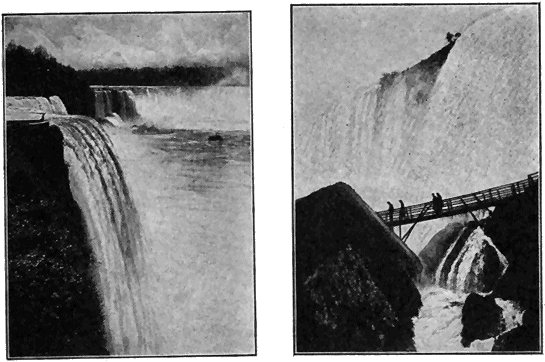
THE THOUSAND-YEAR CLOCK AT NIAGARA
You've heard of eight-day clocks and clocks that have to be wound only once a
year, but here is a clock that was wound up several thousand years ago and is still
going beautifully! In placing the wondrous waterfall in Niagara River the
glaciers also started a kind of water-clock by which to record—for those who would
take the trouble to study it out—how long ago it was the glaciers visited us. Owing
to the constant wearing away of the base of the falls, by the water grinding the
pebbles against it, great blocks like the one here shown (known as "The Rock of
Ages") come tumbling down. So the falls are constantly retreating up-stream,
and the distance from where they once stood to where they are now gives a rough
idea of the time that has passed since the Old Men of the Mountain set them up
in business—about 25,000 years.
The fronts of these lobes are rounded like the waves
flowing up a beach, or syrup travelling over pancakes on
a cold winter morning. The reason of this roundness is
that the centres of these lobes of ice or water travel fastest
because the mass on either side furnishes a kind of ball-bearing
for the central part.
But this wasn't all. At the very same time, by the very
same act, Labrador, Keewatin & Co. set Niagara Falls up
in business. In those days there was a Niagara river but
no Niagara Falls; at least not the one we know to-day.
The ice filled the Ontario Valley so that the streams flowing
into it had to turn around and flow south. The
Niagara River was one of these streams. Then, as the ice
melted, it poured loads of extra water into Lake Erie, so
that it was some 30 feet higher than it is at present and
began draining out through the new Niagara River, over
the rocks that make the falls.
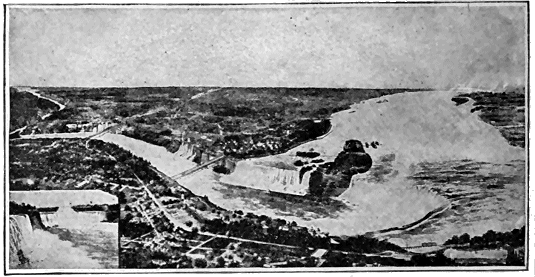
A BIRD'S-EYE VIEW OF NIAGARA
This is a bird's-eye view of the Niagara region. Where the river crosses a bed
of limestone below Buffalo, and again where it crosses another just above the crest
of the falls, some of the rock has been dissolved away, thus making it rougher, so
that slight rapids have formed. Then comes the mighty plunge, after which the
water flows through a gorge for about seven miles. Where the gorge bends abruptly
at right angles is the great eddy called "The Whirlpool."
NATURE IS THE ART OF GOD
"Nature," as Sir Thomas Browne so finely said, "is the
art of God." And nowhere is this art more striking in its
beauty than in the work done by the glaciers. Those
wonderful falls and the blue inland seas we call the Great
Lakes, and thousands of smaller lakes scattered all over
where the glaciers came, are only a part of this art work.
The main ice sheets, you notice, didn't reach down among
the mountains of California, but these mountains had
small glaciers of their own in those days, just as they have
now. Only they were much larger then because, as we
have seen, it was such a snowy time all over the northern
world. Listen to what these home-made glaciers of California
did, and listen to how John Muir tells it:
AND TO THINK WE DID IT ALL!
"It is hard," he says, "without long and loving study,
to realize how great was the work done. Before the glaciers
came, the range"—he is speaking of the Sierras—"was
comparatively simple; one vast wave of stone in
which a thousand mountains, domes, canyons, ridges, and
so forth lay concealed." To carve them out of the stone
"nature chose for a tool, not the earthquake or the lightning,
but the tender snow flowers, noiselessly falling
through unnumbered centuries. The snowflakes said,
'Come, we are feeble; let us help one another. Marching
in close, deep ranks let us roll away the stones from these
mountain sepulchres, and set the landscape free.'"
It is evident that this was all in the Great Plan of things.
For the rocks had to be of a certain kind and laid in a
certain way for the little members of this art society of
the sky to work these landscapes out. And the rocks were
so made and laid when they were at least a mile below the
surface on which the glaciers set to work.
"It was while these features were taking form in the
depths of the range, the particles of the rocks marching
to their appointed places in the dark, that the particles of
icy vapor in the sky, marching to the same music, assembled
to bring them to the light. Then, after their grand
task was done, these bands of snow flowers, the mighty
glaciers, were melted and removed, as if of no more importance
than dew destined to last but an hour."[7]
How do you suppose warm water—of all things!—could have
caused the Ice Age? This theory is one that was offered by a
very eminent geologist, Doctor Shaler, of Harvard.[8]
In the same book he also explains how the old men of the mountain
may have helped to make New York City, although they were
never there in their lives, of course.
When you take up geology as a special study—I hope you will—you
will find that there were five particularly heavy snowfalls
during the long winter. But why not look it up now? If you
can't do it just get somebody else in the family to do it for you.
Where is father's college geology? In the last two of these storms
Mr. Labrador rode all over New England and clear to the sea,
where he amused himself for a long time by setting icebergs drifting
out over the Atlantic.
How do they know about the icebergs? That's one of the interesting
things the books tell.
These books also show how Niagara Falls acts as a great time-clock
that tells how long ago it was since the glaciers visited us.
According to the record on the "dial" it was somewhere between
20,000 and 30,000 years ago. (Of course this isn't what we would
call very close timekeeping; but remember, in the long story of
the earth even a hundred thousand years is a mere tick of the
clock.)
And the way this clock is running down shows we're going to
lose Niagara Falls in the course of time. All falls finally run down
in the same way. This is the rather flippant way my high school
friend put it:
"First, the water falls over the waterfall; then the waterfall
falls, piece by piece, and the water falls no more. It's a sad case."
(You'll see what he meant, quickly enough, when you read up
on waterfalls. Your geography tells, doesn't it? Well, then, of
course you know.)
But here's a question you can answer right out of this chapter.
Which one of the illustrations shows that the mammoths and the
cave men lived on earth at the same time?
That the mammoth was seen in the flesh by those remarkable
artists of the caves is plain, but what do you say to seeing a mammoth
in the flesh in these days? Remember the mammoths have
all been dead for thousands of years. (Elephant, Mammoth,
Siberia.)
What is there about the climate of Siberia that made this strange
thing possible?
How did the mammoth get his name? Was it because he was
so big—such a "mammoth" creature?[9]
[9] Mammoth, you will find, comes from a word meaning "earth."
It didn't mean "big" at all at first. One of the most lovable traits
of a good dictionary, I think, is that it tells so many interesting little
stories like that about the early life of words; of their days of adventure,
so to speak, when there was no telling how they would come out.
How did the mammoths compare in size with the elephants of
to-day?
Which was the bigger, the mastodon or the mammoth?
Did we ever have mastodons in North America? And were
there mammoths, too?
If you want to see more about what the travelling menageries
of the days before the Ice Age looked like hunt up these words:
Archelon, dinosaur, ceratosaurus, diplodocus, stegosaurus, triceratops.
See what the geography says about the manufacturing towns
of New England and how many of them have water power.
In that remarkable little book by Grant Allen[10] already referred
to in the H. & S. at the end of Chapter I, on page 139, you will
find what the Ice Age had to do with the fact that the rabbits of
Canada and our northern border States wear white clothes in
winter, while Br'er Rabbit of our Middle and Southern States keeps
his yellow-brown suit on all the year.
And on page 204 how a little plant, whose old home was in the
Arctics, got stranded on an English hilltop among the mossy
clefts of weathered granite, and how the beautiful lady who has a
little flower named after her slipper (we all know that slipper) is
leaving England because the climate is too mild!
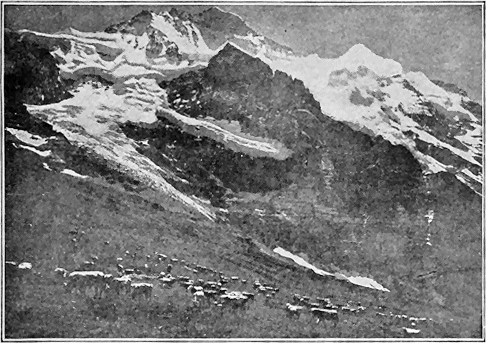
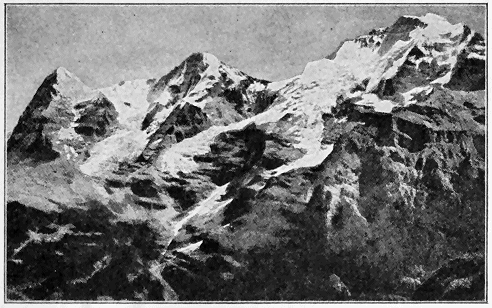
THE SUMMER PASTURES ON THE JUNGFRAU
Here are some of those Swiss cattle in their summer pastures. Doesn't look
much like summer, does it? But there's one thing besides the cattle that tells. See
that stretch of snow all by itself? That's a snow-bank which has escaped the
summer sun because it is protected by the ravine in which it lies. All around it
the ground is bare of snow.
CHAPTER III
(MARCH)
With rushing winds and gloomy skies
The dark and stubborn Winter dies;
Far off, unseen, Spring faintly cries,
Bidding her earliest child arise.
—Bayard Taylor.
THE SOUL OF THE SPRING AND THE LANDS OF ETERNAL SNOW
And that's how the Old Men of the Mountain visited
us in the Ice Age and what they did and how they did it.
But now that they have all been back home so long don't
you think it would be nice and polite to return the call—especially
when you remember all they did for us, making
beautiful lakes and rivers and waterfalls and mountain
scenery?
I. Springtime in the Alps
The best time to do this would be in the spring, because
then the kingdom of the glaciers is most beautiful, and the
spirit of a glorious new world, just waking up, is abroad
everywhere. The glaciers themselves seem to feel so good
about it that they start to sing. And like the birds, their
joyous springtime mood responds to the quick changes of
sun and shade. In our own land when the sky grows
cloudy, even for a short time as you may have noticed,
birds stop singing. Then when the sky clears they start
up again. But, up here in the Alps in the spring when
the birds are singing among the mountain meadows, the
glaciers, at whose feet these meadows lie, do the very same
thing. The songs of the birds are various, and the song of
the same bird will differ at different times of day, but the
song of the glacier is always the same—a pleasant dreamy
tune between the murmur of little voices and the tinkle of
distant bells.
The very rocks that the glacier carries on its back seem
to catch the spirit of the springtime; for, when the weather
is bright, they go strolling. And when they do they remind
us a little of that painting by Franz Hals, "The Laughing
Cavalier," for they apparently wear a big broad-brimmed
hat cocked jauntily on one side.
UP WHERE THE GLACIERS GROW
Here we are, looking down on the roof of the Alps—from a flying-machine, let
us say. The sky-line used to be more like the ridge of a house, straight across.
In the course of the ages the glaciers and the weather have cut down the softer
rock, leaving those peaks. At the top are the snow-fields. Farther down the
glaciers begin to form. Still farther down, where the glaciers have begun to melt,
you can see a stream—its waters have taken white in the picture because of the
foam and the ground-up rock in it called "rock flour"—falling into the woods below,
the "timber line" of your geography. Ruskin has a wonderful word-picture
of these mountain streams in his "Modern Painters." The index of any edition
will tell you where.
THE MAN WHO DISCOVERED THE ICE AGE
The Alps are the most famous of all the homes of the
glaciers, not only because of the great number of the glaciers
and the beauty of the scenery, but because it was in
the Alps that Agassiz, living in a little stone hut among
the mountains, studied the glaciers and their ways and
proved that it was these strange creatures of snow and
ice that had come down during the Ice Age and worked
such marvellous changes on the face of the earth. In the
Alps, just as Muir found them doing among the glaciers of
Alaska, the flowers bloom at the very edge of the snow
line. And they come on much more rapidly than they do
in temperate climates. As fast as the snow melts back
blossoms just cover the meadows thick with the deepest,
richest colors—blue, red, white, yellow, purple, and every
shade of these. Some of these flowers are as pure white as
the snows. The queen of beauty among them all, many
think, is the Alpine rose. In that pure, clear air its color
seems actually to glow like the famous peak, the Jungfrau,
at sunrise.
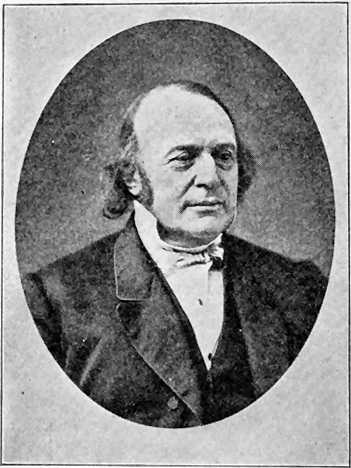
LOUIS AGASSIZ
The great teacher who discovered the Ice Age.
One little flower is in such a hurry, so afraid it will miss
the first May party, that it blooms under the ice and melts
its own way right up through. Then it calls to the bees
and the butterflies, in the way that flowers have:
"Good morning! It's spring, and here I am again and
how do you do? Come and kiss me!"
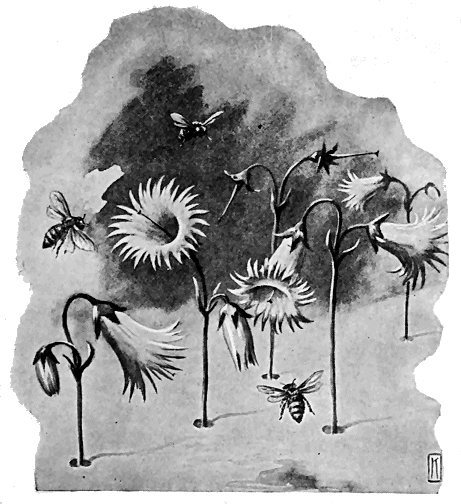
The soldanella grows among the thick pebble beds and
the big boulders right on the edges of the glaciers. It is a
member of the primrose family. It may be pink, white,
or blue. The blue flowers are most common. But blue,
pink, or white, these baby bells are always born twins;
two sisters side by side on the same stalk, showing their
dear fairy faces just above those layers of ice. They are
such delicate little things you wonder how they can ever
stand it. But ice, pshaw, they don't mind it at all.
BLUSHING A WAY THROUGH THE ICE
If you are a bashful boy or girl you can understand how
the Misses Soldanella have been able, in spite of their icy
covering, to get here to greet us on this lovely May morning.
You know how warm your face feels when you blush.
It seems to be somewhat the same way with all flowers
when they blush into bloom. The blossom becomes quite
a little warmer than any other part of the plant. It is the
heat of the growing buds and, still more, the heat of the
blossoms that melts a passage for the Soldanellas through
the ice, for they often blossom before they get above the
ice at all.
The higher we climb the brighter the flowers, and they
grow in thicker masses, and each kind spreads out into
larger fields than they did where we came from down
below—great belts of blue gentians, whole fields of golden
yellow globe flowers. You'd hardly expect this, would
you? And you'll be still more surprised at the reason.
Did you notice, as shown in their pictures, that the Soldanellas
have only the bees for their callers? Just look
if you can see any bees where we are now. Not a bee.
But butterflies everywhere. And that's the answer. The
flowers of the upper meadows are brighter, grow thicker
and spread wider—all on account of the butterflies; to
get the butterfly "trade."
WHY THE BEES GET OUT OF BREATH
Bees can't climb to such heights because the air is very
thin, and, therefore, harder to fly in. Remember their
little bodies are heavy and their wings are small. They
get out of breath, like a fat man with short legs working
his way up Pike's Peak. The butterflies, on the other
hand, have small bodies and large wings, and so have the
meadows of the higher Alps all to themselves. That the
flowers here look so brilliant is partly due to the thinness
and clearness of the air and partly to the disposition of the
butterflies. A bee is all business, because she has so many
mouths to feed at home, and is laying up honey for the
days of the long winter. Mr. and Mrs. Butterfly, on the
other hand, are gay and carefree society people.
"We have no family waiting to be fed, so why worry?"
This is the butterfly philosophy. Only a sip of nectar now
and then for their personal wants; for the rest of the day
the merry air dance, here, there, everywhere! They flit
long distances without lighting. To attract the bee's
attention a blossom need be neither large nor bright, as
the bee goes straight from flower to flower, wasting no
time in aimless flights. But to catch the eye of the butterfly
the flowers must be brilliantly colored and grow in
large masses. So up in the butterfly zone only brilliant
flowers, and those having the habit of growing in groups
produce seed and have descendants. Those that dress
plainly and are not fond of company die out.
HOW THE SOLDANELLA SISTERS GOT TO THE MAY-PARTY
THROUGH THE SNOW
Now didn't it turn out just as I said; that the butterflies
themselves help brighten the flowers that grow among
these ice fields? I have something else quite as curious
to tell you: Both the Alpine butterflies and the flowers were
left over from the Ice Age. Not in the same sense that we
pebbles were, for we are the identical little passengers
who rode in on the ice trains, and the life of a butterfly,
as every one knows, is very short. So is that of a flower.
Yet suppose you found that the only other butterflies and
flowers like these are found, not among the flowers and
butterflies in the lands lower down in the Alps but up
toward the Arctic Zone, in Finland and Lapland; in the
snow regions of mountains in the temperate zone all over
the world? It would look very much as if these flowers
and butterflies, or their ancestors, had been left behind
there some time or other, wouldn't it? This is what the
men of science think, and they reason about it in this way:
HOW THE BUTTERFLIES MISSED THE TRAIN
As the glaciers spread downward from the Far North
in the Ice Age they brought all their home things with
them—climate, plants, insects, animals. Plant and animal
life was driven step by step before the advancing ice.
Then, as the ice melted, flowers, butterflies, and all followed
their natural climate back. But those that lingered
too long in the meadows around the mountain tops could
not cross the hot summer plains that now lay between
them and the retiring ice sheet; for plants and animals
that are used to cold can't stand the heat any more than
those from the tropics can stand the cold. So only the
flowers and butterflies remained in the temperate zone
that found their natural climate among the mountain
peaks and stayed there.
Near the top of Mount Washington, the highest peak
in New Hampshire, is a colony of the descendants of these
butterfly pilgrims from the north who never leave their
high and wind swept meadows. There are no such butterflies
in the hills and plains below, but go into Labrador
and you will see plenty of them.
LEFT-OVER PIECES OF THE ICE AGE
Of course you understood all along that these aren't the
very same butterflies that came with the glaciers, yet in
shady glens in high mountains, where the snow never
melts, people do sometimes find masses of ice, which,
there is every reason to believe, have been there since the
Ice Age. And sometimes thick veins of ice, buried hundreds
of feet under pebbles, boulders and soil, are struck
in sinking wells. These are known as ice wells; huge ice
water tanks that never need filling!
II. A Little Visit with the Glaciers
But if the ice masses in the shady glens and under the
old moraines may be said to be pieces of the Ice Age left
over, the glaciers of to-day are, in a sense, the Ice Age
itself. For these glaciers do, on a smaller scale, what Mr.
Labrador and his partners in northern America, Europe,
and Asia did on a large scale so many centuries ago. Suppose
now, like Agassiz, we trace a glacier to its source. It
will be a long journey, all steep, some of it almost straight
up, and along chasms of slippery ice with sudden storms
that hide the chasms and blind your eyes and take away
your breath. The first part of our journey is over a field
of ice, gray with the dirt of weathered rock from the mountain
sides. Along its borders are those sharp-edged stones
neatly packed in rows, that our geography tells us are
called "lateral moraines." It has another row of these
stones sticking up right in the middle of its back, like the
sharp-pointed vertebræ of the ceratosaurus.
By noon, as often happens in the Alps as elsewhere at
this time of year, a rain comes up and we lunch under the
shelter of a tumbled heap of rocks. Watching the downpour
drift across the desolate wastes we think what jolly
times like this Agassiz and his companions had in their
little hall of science under the big stone. After lunch we
start again, and although it's stiff going, and it takes a lot
of this thin air to make one good breath, we spare a little,
now and then, for shouting, to hear the wonderful play
of the echoes among the mountains. We go through all
kinds of weather—rain, mist, snow. Then suddenly we
burst into blinding light. The sun is so dazzling on the
snow, now no longer covered with dirt and mountain
débris, that we must all put on our colored glasses. In
some places, among bare rocks that absorb the sun's heat,
it is positively sultry.
The fields around us look like an ocean turned to stone.
Waves are formed in the surface ice of the glacier because
surface ice moves faster than the main mass beneath. On
the bordering mountain walls the ice rises into still greater
waves "foaming about the feet of the dark central crests
like the surf of enormous breakers." And this great, still
image of the parent sea, from which the air currents carried
the moisture that made it, has eddies and whirlpools,
and like the troubled sea, "whose waters cast up mire and
dirt," the glacier, where it swirls along its shores, works
pebbles and dirt to the surface. Often this material is
carried into the centre of a whirl, as sea weeds and the
rubbish of the seashore are driven into eddies among the
rocks.
Somebody must have been here just ahead of us. Isn't
that a dark glove over there? We come closer. What
at a distance seems to be a glove proves to be a hole in
the ice so deep it looks dark. Lying flat and carefully
peering over the edge we look into something strangely
beautiful—an ice palace, with icicles in fantastic groups
hanging from the roof. Through this roof the sun comes
in delicate floods of pale green light, the combination of
the yellow rays with the blue of the ice. We drop pebbles
into the hole. They rattle down and down with long,
dull echoes, dying away. We can hear the murmur of
running water. Gusts of cold air come up that bite like
the wind on a sharp winter day.
These underground palaces of art start as great cracks
in the ice, called "crevasses," from a French word meaning
a crevice. They can usually be seen plainly as yawning
chasms, but sometimes are so bridged over by the
snows that a small, dark hole is all you see. And we might
not see that in time. This would be very bad, for these
snow bridges are often quite thin. One might like to go
down in a crevasse and explore about in this beautiful
dream world—but not when one wasn't looking!
Even when one is looking and is as careful as can be it's
dangerous. But still you may be sure that the famous
men who have studied glaciers have done it, for every
true man of science likes to get at the bottom of things.
It was Agassiz who first went down in this way into the
heart of a glacier. It was while he was making his studies
in the Alps, and he came very near being drowned in one
of the streams that always flow at the bottom of a crevasse,
for these crevasses, breaking up the ice, increase
the rate of melting. (You know broken ice will not keep
so well as a big block.)
WHAT TWO BOYS SAW IN THE FAIRYLAND OF ICE
When you have read John Muir's story of how he climbed down into a crevasse
in California in his shirt-sleeves (see H. & S.) you will know that he was the other
of the "two boys" I refer to, one of them being Louis Agassiz, whose adventure in
this fairy iceland down in the glaciers is told in this chapter. Don't look dangerous
at a distance, do they, those crevasses? Remind one of the crimps in a Christmas
pie. But notice the difference when you get up close to one of them in the
next picture.
BUT THESE SCIENTISTS WILL BE BOYS
Agassiz had been lowered by a rope. When his feet
suddenly plunged into the icy stream his shout for help
was misunderstood by his friends and he was lowered still
further. His second cry, which you may be sure promptly
followed the first, showed that something had gone wrong
and he was drawn out. The worst of it was that coming
up he had to steer his course among those huge icicles,
any one of which, being worn away or broken loose by the
friction of the rope and striking his head, would probably
have killed him. But they are always doing things like
that—these men of science. They keep on being as curious
and enthusiastic about the things they are interested
in as any boy.
THOSE LITTLE CURVED LINES WHEN YOU GET UP CLOSE
This is what those little curved lines are—really; great yawning chasms in the
ice. The sun is shining from the left; a morning sun, probably, as those tourists
are out for a walk. This scene must be pretty well down the glacier's course, far
from the upper fields, for you see these people are just in ordinary dress—not in
the dress of mountain-climbers, with ropes and Alpine stocks and everything.
It is perfectly safe to climb glaciers as we are doing—in
a book—but they are really ticklish things to go about on,
as well as down into. To find out all the interesting things
you can so easily get through pictures and the printed page
took years of skillful study, ingenuity, and endless patience
and much courage. What a little further on in this chapter
you will learn about the movements of glaciers in seven
minutes, it took Agassiz seven long years to find out and
make sure of. To Agassiz more than to any other one
man the world owes the tremendous idea of the Ice Age
and its story. His home among the glaciers of these Alps—named
playfully by the devoted scholars who worked
with him the "Hôtel des Neuchatelois"—was a rude
shelter under a projecting rock. The results of this long
study he published in a work in two volumes, and so made
known the great facts he had found and the theory about
an Ice Age which he based upon them and which is now
everywhere accepted. He became professor of geology at
Harvard University and as famous a teacher as he was a
student of nature. After his great and useful life was
ended he was buried in his adopted land with a boulder
from the site of the little stone hut on the glacier for his
monument.
III. The Soul of the Glacier
Many of the fellow-countrymen of Agassiz, the peasants
of the Swiss Alps, believe the glacier is a living thing and
has a soul. In the spring the peasants take their sheep
and cattle into the high meadows called "alps," from
which the mountains get their name, and remain there
until fall with the glaciers all around them. There are
nearly 2,000 glaciers in the Alps, varying from less than
a mile to over ten miles in length, and from a few hundred
feet to a mile in breadth. So the peasants have every
opportunity to get acquainted with their big white neighbors.
"The glacier has a soul," they say, "and a voice, many
voices. Sometimes he groans. This is when he is in
pain. Listen!"
SOUNDS THAT GIVE ONE THE "CREEPS"
We do hear a sound very like a groan. Even experienced
mountain climbers can hardly keep down a "creepy" feeling
when they hear it. This sound is made when the ice
is cracking into a crevasse and while it is enlarging. These
crevasses are formed by various strains in the ice as it
moves along. So long as the strain which caused them
continues the crevasses keep widening. The "groans"
may be said to be "growing pains."
In some places you hear a constant roaring sound. The
peasants are not superstitious about this sound however.
They know it is made by what they call the "moulins" or
mills of the glacier. Water, melting on the surface, makes
streams. These, running together, make a larger stream.
This stream, coming to a crack in the ice where a crevasse
is just beginning, pours down, hollows out a little shaft and
joins streams in the interior of the glacier, like that in
which Agassiz took a bath when he didn't want to. The
noise of the water, striking far below, comes up through
the shaft, as a voice comes up through a speaking tube.
But the crack into which the water falls must be very
narrow, so that the water can melt both walls and thus
form a shaft; otherwise it merely glides down the nearer
wall and makes no sound.
NOISES WE PEBBLES HELP MAKE
Where two ice rivers emptying into a main stream come
together you hear a constant dull rattle and rumble. This
is made by the blocks of stone and trains of pebbles that
have ridden in on the backs of the two glaciers thus going
into partnership, falling between the glaciers at the point
where they come together. The stones that do not fall
over are brought together in the centre of the glacier and
so make that spiny backbone of his, the "medial moraine."
The rows of stones on the two sides of the glacier, called
the "lateral moraines," have fallen piece by piece from
the mountain walls as the glacier moved along between
them.
But the strangest thing about the voices of the glaciers
I have yet to tell. Whenever the sun is shining brightly,
as I have said, and the gentians and the globe flowers open
their petals and the birds start the chorus of the day, the
glacier begins singing, too, humming to itself a pleasant
tune. When the sky grows cloudy, even for a short time,
the birds stop singing, the flowers cover their faces, the
bees and butterflies hurry to shelter, and the glacier's song
gradually dies away. Any cloud may bring rain, as far
as the flowers and the bees and the butterflies know, and,
for the same reason, the winged people hurry to cover
because they don't want to get their wings wet. The
flowers hide their faces to keep the rain from washing their
pollen away, and the birds stop singing because, like the
rest of us, they don't feel so cheerful under gloomy skies.
But the glacier, why does he stop singing too? Because
that murmuring tinkle you heard was made by the water
melting on the glacier and running into rivulets a little
way under its surface. When the sun stops shining the
surface ice stops melting, the water gradually quits running
and the murmur of the song dies away.
ON THE ROOF OF THE ANDES, WHERE IT'S TOO COLD TO
GROW GLACIERS
It is because of these queer human habits of the glacier
and, above all, his sensitive response to the moods of days
and seasons, that many of the mountain people insist he
is not only a living creature, but that he has a soul. We
think of all this now as the western sun drops behind the
snowy summits, the glacier's song grows silent, and we
hear, mingling with the vespers of the birds, voices echoing
from crag to crag the words of the psalm, "Praise ye
the Lord." These are the voices, of the herdsmen speaking
to each other from alp to alp—the evening call to
prayer.
IV. How the Snow Men, the Glaciers, and the
Rocks Go Walking
Now that we have learned how glaciers, wild flowers,
and butterflies get up into this high world, by climbing up
here ourselves in the beautiful springtime, the next thing,
I suppose, is to climb down again. But first just look
over the edge here and you can get some notion of how
high we are, not merely in feet and figures, as we have it
in the table of mountain heights in our geography, but in
actual feeling.
"What are those little blocks, all ruled off like a chessboard,
away down there?"
"Those are the little Swiss farms with the gray roads
between."
"And those small white things among the farms that
look like pieces of grit?"
"Those are the Swiss villages."
"And the black specks on the slopes of the mountain?"
"Those are tourists with their guides, coming up. People,
no doubt, whom we should like to know, but we shall
have an interesting new acquaintance travelling down
with us. You've met some of his family, no doubt, for
he's an ice man. There are several of these ice men
always travelling down on the glaciers."
THE OLD MAN OF BALISTAN
Where would you say, judging from the head-dress of the man in the middle,
this scene is located? Somewhere in Asia, wouldn't you? For in Asia the natives,
particularly the Mahometans, wear turbans, as you would learn by simply
looking up "turban" in a dictionary. And wouldn't those summer helmets lead
you to suppose that this is a hot climate, in spite of the great ice-pillar and the
snow-field? And don't those helmets suggest Englishmen? Now, where in Asia
would you find vast mountains, a hot climate, Mahometans, and Englishmen together?
Yes, to be sure, in the Himalayas of India. And that's just where an
expedition of English scientists came across this grotesque creature of stone and
ice one summer day, on a glacier in Balistan. So I just called him "The Old Man of
Balistan."
You'll know one of them the moment you see him, for
they are queer-looking fellows with only one leg—or
rather one leg at a time—and they wear big stone hats.
They never go walking without them. They can't.
LOOKS LIKE A BROTHER, BUT HE'S NO RELATION
This "old man" is a creature, not of the snows but of the winds. The capstone—apparently
conglomerate, it looks so rough and pebbly—tumbled down from
the mountains once upon a time and found a resting place on a bed of softer rock,
a section of which became separated from the mass on either side by those earth
cracks called "joints." Then the winds and other instruments of weathering got
their fingers in these cracks, wore the neighboring sections away, and left this
pillar standing. It is broader at the bottom because the winds, checked by the obstacles
on the ground, didn't strike with such force as they did higher up.
To the group of boys and girls to whom I first told these
stories of my life and adventures nothing was more interesting
than this account of the ice men who walk. On
that occasion I called them snow men because the boys
had just been making a snow man, and these ice men up
here, like the glaciers on which they always travel, are
made of snow turned to ice. You have heard the expression
"clothes make the man," but in the case of these men
of the snows it is literally true, so far as their hats are concerned,
for it is their hats that make them grow.
"I bite," said the High School Boy, "what's the answer?"
CAN YOU SOLVE THIS PICTURE PUZZLE?
For reply I roughly sketched the picture at the top of
the page. From this hint my audience thought out the
answer for themselves. See if you can do so before you
learn, in the next few paragraphs, what the answer is.
It comes about like this. One day we see a big stone
lying on the glacier, and when we come that way again
several days later this same stone is standing on a tall
pillar of ice. We notice the stone hat is tilted forward a
little, apparently to shade this queer man's face, which is
always turned directly toward the sun. It sits jauntily
on one side—this hat of his—as if he were feeling particularly
contented with himself and the world on this sunny
day and had started for a stroll.
And it really is because the sun is so bright that the
hat is tipped. Moreover it is because of the sunshine that
the man takes a stroll. If, after more days of sunshine,
we return we see the same stone further down the slope
of the glacier and apparently standing on the same leg.
"But does he or it actually walk on that leg?"
(The audience, who at first thought I was joking, had
begun to believe I was in earnest.)
Yes, that leg and others. Before this Alpine tourist
ends his travels down to the valleys below he may have,
all told, as many legs as a centipede, but only one at a
time. Like the legs of the amœba and the claws of the
crab they are renewed as wanted. A big stone falling
from the mountain side upon a glacier protects the ice
beneath from the sun's rays, so, as the ice melts down
around it, the stone is left standing on a pillar. These
"glacier tables" (to use the scientific term) are formed on
the south sides of glaciers where there is the most sun.
Owing to the slant of the rays the rock is heated most on
the south end and so tips in that direction more and more.
Finally it falls off and, in so doing, pitches farther down
the slope. Then a new pillar is formed and the whole
process is gone through again.
(If we should get lost up here any one of these snow
men will tell us the way out. The snow man's hat, for
the reason stated, always tips toward the south.)
The stones of the winter lands are not only like human
beings in the fact that they walk, but like little human
beings in the fact that when they are small they can't.
In one of the pictures I drew for the boys and girls—that
representing the ice pillar from which the stone has slipped—you
may be able to make out a little pebble. It got a
ride because it was hiding under the big stone. Left to
itself "it wouldn't have a leg to stand on," as the saying
goes, for small stones are heated through by the sun and
so sink down into the ice and form no "legs."
From a photograph copyrighted by Merl La Voy
THE RUSH OF THE AVALANCHE
It's seldom you can get a snap-shot at an avalanche—it's so sudden! Then,
when you do get one you must be an expert or your picture will be a blur. This
picture was taken by Merl La Voy. An interesting thing about it is that the
scene is on Mount McKinley, which, as your geography will tell you, is the highest
mountain in North America. The avalanche started near the top, where the
greatest fields of loose snow lie. We see it in the act of plunging into a vast crevasse
several miles below, and sending up clouds of snow. They look like steam.
MR. GLACIER'S CATERPILLAR TRACTOR
"The glaciers," says Reclus, "seem as motionless as the
peaks that tower above them." Nevertheless, as we know,
they do move. While the motion is in so many respects
like that of a river that glaciers are often called "ice
rivers," they have motions and, so to say, "methods" that
curiously suggest the inventions of men. Take, for example,
the way they climb down a steep hill; for all the world
like the "tanks" in the Great War. The tanks, you
remember, made nothing of shell holes, rough country,
ravines, or trenches, but lumbered and crushed their way
along, resistless as the Fates. And, you may also recall,
the tanks moved by laying sections of themselves—the
great cleats on the outside belt—which they picked up
again, as they advanced. This was called the "caterpillar
tractor" system of travelling.
Now watch the glacier when it comes to an incline much
steeper than its ordinary slope. It breaks across in sections
at right angles to its bed, and section after section
drops down. Then the forward sections crowded upon by
those in the rear are pushed up close, freeze together again,
and on goes the glacier as good as new.
As a traveller, however, it is a little slow. It made
faster time in the old days—in the Ice Age—when glaciers
were so much larger, but to-day, at the rate at which
ordinary glaciers travel, it may take a boulder as big as
Plymouth Rock something like a hundred years to be
carried from the upper fields to the heap of stones and
soil which your geography calls a "terminal moraine,"
and where Mr. Glacier says:
"All out! Far as we go."
HIDE AND SEEK IN THE LIBRARY
How would you like to go to school to the pretty Misses Soldanella?
They can teach you a lot about botany. If you learn
what an unusual thing they do with their leaves, for instance, that
will lead you to follow up leaves in general. Leaves are wonderful
things. Indeed, it isn't often you find the leaf of a book that will
tell you half as much as the leaf of a plant, if you only know how
to read it.
In Grant Allen's "Flash Lights on Nature," you will find that
the Soldanella sisters store food in their leaves all winter just as
we put things away in the cellar, and how this helps them get up
so early in the spring; why the fact that the little sisters are not
very tall makes them hurry so; and why if they didn't hurry they
wouldn't get to the party at all!
What other members of the primrose family do you know?
See what you can find about our earliest flowers—hepatica,
bloodroot, dog-toothed violet, jack-in-the-pulpit, Dutchman's
breeches, anemones.
If you will examine closely many early spring buds and flowers—especially
those like the willow and hazel catkins—you will find
that they too keep warm and grow in the early spring, not from
the warmth of the sun alone but from the fuel they have laid up
in their buds.
Did you know that to see the very first flowers of all in the spring
you must look up—away above your head? (Maple.)
Any good book on Alaska will tell a number of striking things
about how rapidly spring comes on in the lands where glaciers
grow.
Get Muir's "Mountains of California" and hear him tell about
how he went down into a crevasse in his shirt-sleeves, and of the
fairy underworld he found there, and how he hated to come away.
Reclus[11] tells how the glaciers not only come down to call on
the farmers, sometimes, but even help them pick cherries!
I suppose the children who go to the excellent Swiss schools take
delight in telling grandmother that Mr. Glacier isn't really a person—as
he is in the tales of the winter fireside—but wouldn't both
grandmother and the children open their eyes if they knew that in
Greenland there is a glacier so big it feeds itself and makes its own
snow and its own storms and everything? Hobb's "The Face of
the Earth" tells all about it.
And the Encyclopædia Britannica and Hobbs together will tell
you how to make a good glacier. There are a half-dozen things
you must remember or your glacier won't turn out right. (1) You
must take plenty of snow; (2) and keep it in a cool place; (3) but
you must warm it a little too, once in a while; (4) your mountain
gorges must not be too steep; (5) you must have your mountains
set just so; (6) and distribute your storms with care. By doing
all these things you get fine, durable glaciers, 100 to 200 feet thick,
sometimes 500 and even 1,000 feet thick. But you must be careful,
and, of course, it takes time.
CHAPTER IV
(APRIL)
Now the noisy winds are still;
April's coming up the hill!
All the spring is in her train,
Led by shining ranks of rain.
—Mary Mapes Dodge.
THE APRIL RAINS AND THE WORK OF THE RIVERS
I always liked the little boy's definition of a river system.
"Rivers that empty into other rivers that empty
into other rivers that empty into the sea."
What is still more interesting, the sea at the same time
is emptying into the rivers; for the waters of all the lands
and the waters of all the seas, are one, and what the rivers
give to the sea the sea returns in the rain clouds that are
blown landward by the winds. The Earth's waters are
thus always in circulation like the blood in our bodies.
In making this endless circuit they do an immense amount
of useful and beautiful work, and have many strange and
curious ways of doing it. It's a great family affair of the
Waters people. Everybody has a hand in it, from the
baby rill that toddles across the country road, the brook
it meets in the meadow, the creek that runs through the
wood, and the river into which it flows, to the greater river
which carries forward these mingled waters to the sea.
THE MISSISSIPPI RIVER SYSTEM
I. What I Brought Back from the Creek
I met a rain-drop once that had followed the thing
through, starting where a little creek began, and got such
a load of information I could hardly carry it, about the
wonderful part the rivers take and have taken in the making
and remaking of the world.
We see the April rains carve fairy canyons in the soft
clay of the roadside or the creek, but it is hard to realize,
as we stand on some pinnacle of the Alps and look out
over the deep and wide valleys, the gorges, the cliffs, and
mountains cut in two, that all are but the handiwork of
the rain-drops banded together as flowing waters. For a
long time this was questioned by scientific men, because the
idea so upset the old theory that great changes in this
world of ours came about all of a sudden and from causes
not at work in these days. Now, however, nobody doubts
that the big things are done by the little people, working
together over long periods of time; little snowflakes, little
rain-drops, little cells in plants. As a result, the Alps, so
far as the expression of their faces is concerned, are as
little like the Alps of the past as the face of the old farm of
to-day is like the farm of those ancient yesterdays, when
the brontosaurus browsed where old Dobbin is nipping
the meadow grass and the mammoth ate the leaves of
trees that stood where White Face is thoughtfully chewing
her cud in the shade.
HOW THEY STUDY GEOGRAPHY IN BOSTON
This is what, in the Boston schools, they call an "umbrella party." "Umbrella
party" sounds much more attractive than "geography lesson," but as a matter of
fact it is a geography lesson and a fine one. As soon as they get off that brick
pavement the boys and girls will see those rain-drops cutting out little Mississippi
River systems, filling little Great Lakes, plunging over Niagaras two inches high!
Right where you sit reading, perhaps, the land used to
be buried two miles deep beneath rocks which have been
worn away by wind and rain and by rivers which vanished
long ago. Everything has been so changed that if the old
scenery should be put back you would be lost right on the
home farm.
WHERE YOU CAN JUMP ACROSS THE MISSISSIPPI
Wrinkles in the earth and in the mountainsides make
the first troughs for the streamlets and the rivers, and
then the running water itself digs these natural channels
deeper. Many rivers begin as streamlets flowing out of
springs. The great Mississippi began as a baby, just like
the rest of us. You can jump across it still if you go up
to its source. Springs not only start rivers in life but go
on feeding them. Most large river systems get secret
gifts in this way, as they flow along, from thousands of
springs that empty into them or their tributaries.
So springs start and feed the rivers. Now what do you
suppose starts the springs? Rain-drops stored away in
big stone "safes," much as a small boy stores away pennies
in his tin bank! The water of rains and melting snows,
passing down through the soil, soaks into the little chambers
or pores in such rocks as sandstone and limestone,
and keeps going on down until it comes to a bed of hard
stone, such as slate or granite, into which it cannot soak.
THE SPRING WHEN EMPTY
THE SPRING WHEN FULL
THIS SPRING PLAYS IT'S A TOWN PUMP
These two pictures show an intermittent spring about five miles from Singer
Glenn, Virginia, and there called the "Tide Spring." You can see where the idea
of the tide comes in, but can you think why the spring seems to have a tide system
all its own? You know what a siphon is. Well, think how a kind of siphon
might be formed in rock, dissolved out by water flowing underground. Then look
at the picture on the next page.
Now rock-beds, as you know, have a slope—some more,
some less—owing to the wrinkling of the earth's crust.
So the water, slowly trickling through the porous rock,
forms a steady stream which runs down along the hard
rock, as rain runs down a roof, and finally gushes out at
some lower level.
HOW THE LITTLE SPRING WORKS ITS PUMP
This is how the pump of an intermittent spring is worked. Some portions of
rock are dissolved by underground waters more readily than others and so cavities
are sometimes formed, as shown. As long as the water in the reservoir is below
the arch of the siphon-shaped outlet no water escapes, but as soon as it rises to
the level of the arch the whole of the water is drawn off. Then the spring ceases
to flow until the reservoir fills up again. You can empty water in the same way
by using a bent tube of any kind. Can you tell why the water flows up-hill in this
way? Remember what you know about air-pressure and then look up "siphon"
in your encyclopædia.
You can be sure these companies of rain-drops, hurrying
back to the light, don't fail to notice any cracks in the
rocks along the way, and at such places they come gushing
up with sparkle and dance; and the greater the dip of the
rock beds the higher they dance, of course.
But it takes any one rain-drop so long to get back into
the sunshine after it starts on its underground journey
that you'd think it would forget how to dance at all! It
isn't just the same rain-drop, to be sure, that goes into the
ground and comes out again, because the rain-drops get all
mixed up with each other as they move along, but just
imagine some one rain-drop that fell, say, on a hilltop on
the day a baby was born in a valley five miles away, where
there was a spring in a shady hollow near the baby's home.
By the time that rain-drop got down to the spring the baby
would be old enough to vote!
Yet this is a very good thing for the rivers and the rest
of us—this slow travel of the underground water, whether
it comes out in springs or simply seeps through the soil as
most of that which supplies the rivers does. Otherwise,
if all the water of the rains went directly into the rivers
we would have floods after every wet spell and empty river
beds between times.
Here's another river rebus. How do rivers grow longer
at the top? All rivers grow at their source because their
headwaters eat back into the rocks and the soil, just as
the rain wears away the head of any gully. Where the
rock is soft they eat back faster. The Mohawk River in
New York State probably wouldn't have amounted to
anything if it hadn't done this very thing. From Albany
westward past Utica runs a belt of shale, a weak stone,
but here so soft that the surface of it crumbles back to
clay in every winter's frost. Into this the Mohawk, which
in past ages was only a little stream, has eaten back its
way until now it is over a hundred miles long.
But sometimes rivers are so big the very first day they
come into the world that you may say they are born half
grown. You find them, among other places, in the mountains
of California. Nearly all the water from the melting
snows on Mount Shasta sinks at once into the porous lava
fields of the mountain slopes, and after wandering about
in the hidden veins comes out, filtered and cool, in the
form of large springs which make rivers that set out on
their life journeys without ever having been babies at all
so far as you can see. The Shasta River is one of these.
The McCloud is another. It gushes forth suddenly from
a lava bluff in a roaring spring seventy-five yards across,
two-thirds of the width of the river in its widest part.
The River Jordan in the Holy Land begins in one of these
great springs at the foot of Mount Hermon.
From Norton's "Elements of Geology." By permission
of Ginn and Company
HOW MOST OF EUROPE'S RIVERS GET THEIR START
Most of the important rivers of Europe start as streams of ice-water, flowing out
of glaciers. Notice the boulders along the side of the stream. They also came
out of the body of the glacier, where, as we shall see when we take up "The Stones
of the Field" in Chagter VII, the boulders that rode south with the glaciers got
most of their roundness.
We know already what a hand the glaciers had in the
Ice Age in shaping the course and conduct of rivers, and
you may be sure they have something to do with the
making of rivers to-day. The under side of a glacier gets
warmed from three sources: (1) its own pressure; (2) the
friction as it moves; and (3) the heat from the inside of
the earth which, on account of this thick ice blanket, can't
get away into the air as it does elsewhere. This heat
melts the ice and, as we know, there is water melting also
on the surface of glaciers and in the crevasses. Beside all
this the water of rains falls upon the glacier so that there
is plenty of water to make rivers, and we always find
streams of water running from a glacier's front. Most of
the rivers of Central Europe start in this way.
THE BEAUTY OF THE BRIDAL VEIL
And, although they didn't make the rivers themselves,
the Ice Age Glaciers are held responsible for the fact that
many little rivers always have to jump to catch the train.
That is to say, they come tumbling over falls to join the
larger streams into which they empty. The reason of
this is that when, in the Ice Age, the glaciers filled the
river valleys the larger glaciers in a main valley dug below
the tributary valleys and so left the mouths of the tributary
rivers high up on the main valley's walls. The
famous "Bridal Veil" in the Yosemite is one of these side
valley falls. The fall—900 feet—is so great that the
water widens to a fleecy foam and waves back and forth
in the wind like a gauzy veil and, instead of a roar like
Niagara, it makes a rustling sound like silk.
While some rivers come hurrying down like that—as if
they really were afraid the larger river would go off and
leave them—others, like the Amazon, roll on as stately as
a Lord Mayor's procession. But the waters of all are on
their way to the sea. The rock layers, owing to the wrinkling
of the earth as it shrinks, are nowhere level, so flowing
water is always on a down grade, sloping toward the
sea or toward other land that does slope toward the sea.
Then remember too as the sea bottom keeps sinking the
continents keep rising, which increases the pitch of the
land.
JUMPING TO CATCH THE TRAIN
See the famous Bridal Veil Falls in the Yosemite Valley hurrying down to reach
the river below. As the stream descends, it broadens into a beautiful, filmy veil.
All very simple, but none the less grand and impressive.
Ruskin, in one of the noblest of his passages, says:
"[All water courses], from the inch-deep streamlet that
crosses the village land in trembling clearness to the massy
and silent march of the Amazon and the Ganges, owe their
play and power to the ordained elevations of the earth;
[to] paths prepared for them by which at some appointed
rate of journey they must evermore descend, sometimes
slow and sometimes swift, but never pausing, the gateways
of guarding mountains opened for them in cleft and
chasm, and from afar off the great heart of the sea calling
them to itself."
That's a poetic way of putting it, but it's a fact nevertheless.
II. The Human Nature in Rivers
There's a lot of human nature in rivers. To begin with,
as we might suppose, they do the most playing and the
least work when they are young. Brooks will be brooks,
you know!
What pretty ways they have in babyhood! Kissing the
pebbles, crooning, bubbling, chattering, playing, they are
big Mississippis or great oceans that, like Homer's ocean
river, flow around the world. Their bubbles are ships,
sometimes wrecked on dreadful headlands along the shores.
THE CHANT OF THE WATERFALLS
Waterfalls are found only in young streams and more
often as you near the source. Older streams have worn
down their beds more nearly to a level and, as we all
know, more rivers begin among the mountains and highlands
than in the lower lands. In the mountain regions
there are plenty of rocks and cliffs to jump from, and the
rivers, you may be sure, make the most of their opportunities.
At such falls as the Bridal Veil they jump so
far they are turned into white cascades, and as you climb
the cliff beside them and feel the wind wafting spray in
your face you hear the music of their songs. The more
or less regular dash of the water as it swings back and
forth in the wind gives that chanting sound described in
waterfall poetry.
"BROOKS WILL BE BROOKS, YOU KNOW!"
Our baby river of the meadow seems to be playing it has a Niagara Falls of its
own, "Rock of Ages" and all! See the "huge mass" of rock at the foot of the
falls; and the rapids?
Like children these dancing, singing rivers love pictures
and color. You see that in the rainbow tints of the
spray as the sunlight strikes the air bubbles the waterfall
"blows"; in the green of its waters turned to gray in the
foam; in the reflections of mountain, sky, and cloud in
the smooth stretches below the falls.
And, like pebbles and other little people, rivers love to
play in the rain. My! What a time! In a storm, with
a gray flood pouring from the sky, you hear, mingled with
the voice of wind and rain, the swash and gurgle of the
eddies as the river goes along in its dance, wild with the
joy of it all. In a mountain stream during a heavy rain,
with wind, you can also hear the waves dashing against
the rocks along the shore or in the stream, and the smothered,
bumping, rumbling made by the boulders on the
bottom knocking against each other.
STORM CHORUS OF THE MOUNTAIN TORRENTS
From any high place during a mountain storm you can
see twenty, yes, often a hundred torrents, and the noise
of the water and the moving stones makes a wonderful
storm chorus. Reclus compares the sound made by the
stones to dull thunder.
WHERE TO LOOK FOR HIDING RIVERS
Rivers, both young and old, play hide and seek. Possibly
the older rivers get to dreaming of their infancy when
they were springs, and want to play they are springs
again; anyhow, they disappear in the ground in one place
and then come out laughing in another as if they really
were springs! And how they must chuckle to themselves
when they fool people into thinking they are brand new
rivers! This happens sometimes, and so the river gets a
different name at the place where it comes out from the
name it bears up to the point where it disappears. Such
hide-and-seek rivers are found in regions where it doesn't
often rain. The Tujunga, which you cross in going from
Los Angeles to San Francisco, is such a river. At one
place in its course it comes out of a canyon, looks around
a minute, and then disappears in the pebbles, sand and
gravel of the plain. Down it goes until it reaches a bed
of hard rock. Along this underground bed it runs until
it gets to a place north of Cahuenga Peak, where it comes
up in springs and flows into the Los Angeles River.
THE LOST RIVERS AND THE THOUSAND SPRINGS
These are the waters of some hidden tributaries of the Snake River gushing out
as springs from its beautiful banks. The group is called "The Thousand Springs,"
and is supposed to be the reappearance of two "Lost Rivers" that disappeared
back in the sand wastes.
Mountain lakes are where the lively little torrents stop
to sleep. "The sea," says Ruskin, "seems only to pause;
the mountain lake to sleep and to dream."
But after this sleep how they laugh and play—those
baby rivers—as they go dancing over the pebbles and
down the falls; for in these lakes they gather themselves
together into a larger volume of water, and so, of course,
flow on with increased energy.
"As soon as a stream is fairly over the lake lip it breaks
into cascades, never for a moment halting, and scarce
abating one jot of its glad energy until it reaches the next
basin. Then swirling and curving drowsily (dropping off
to sleep again!) through meadow and grove it breaks forth
anew into gray rapids and falls, leaping and gliding in
glorious exuberance of wild bound and dance down into
another and yet another lake basin."[12]
Just as it is with human beings, a river seems to grow
more thoughtful and thrifty as it grows older; and, best
of all, this thought and thrift is for others—for the people
of the plant world along its banks and for its old parent,
the sea. With the help of pebbles it puts money in its
savings bank and pays it out from time to time.
In seasons of flood it carries loads and loads of pebbles
along. As the flood goes down these pebbles are dropped
and covered with the sediment that settles along its banks.
Then these pebbles begin to decay and so enrich the soil.
Later along comes another flood, takes the pebbles out of
the bank, carries them farther along, and, as the waters
go down, puts them back in the bank again. In course of
time this kind of fresh food from the decaying pebbles gets
carried into the sea, where it helps to furnish food and
shell material for the shell-fish and raw material to be
worked up by the sea's rock mills.
WAYS OF A WANDERING RIVER
III. The Machinery of the Rivers
To do all their great part in the world's work the rivers
need only time, enthusiasm, patience, machinery, and
tools. All these the rivers have, and the machinery they
use and the engineering methods they follow are much
more modern than we would suppose. Take, for example,
the way in which rivers widen their banks. The current
cuts with the greatest force on the outside of bends, and
the motion and effect is practically that of a circular saw.
This sawing is done on the largest scale where the current
meanders. Swinging from side to side it cuts away both
banks.
And what it cuts away it spreads over the valley by its
back-and-forth motion, much as men spread dirt with
scrapers when they are grading a road.
That's how crooked rivers make broad valleys. But
they have to have the help of us pebbles, too. We're hard
to get along without! Notice, the next time the river or
the creek is up, the rolling, hopping motion of the pebbles
as they are carried along by the rushing water. It is these
pebbles grinding on the bottom and sides of the river's
bed that help most in this kind of valley deepening and
widening. In the same way we pebbles helped dig those
grand affairs, the gorges and the canyons in the mountains.
The Grand Canyon of the Colorado is a part of
our work.
In the widening of valleys the circular saws of crooked
streams are very useful, but there are other things at
work. The rains dissolve the soil and wash the banks
away and slope them down; Jack Frost, with his wedges,
pries out both soil and rock; the little farmers with many
feet—the burrowing animals and insects—and the famous
farmer with no feet at all—the angleworm—loosen soil,
and so help the river to carry it away; and the ice, when
the river breaks up in the spring, chisels off the banks as
it passes.
HOW RIVERS BUILD STONE BRIDGES
Natural bridges are made by the same agency that forms the intermittent springs—the
dissolving power of water—and, like the springs, are characteristic of limestone
regions because limestone is readily dissolved in water. In the little model of a
limestone region "a" and "a" are "sink-holes"—saucer-shaped hollows dissolved
and washed into funnels through which the surface water joins underground streams
such as you see flowing beneath the two "bs," which are natural bridges in the
making.
The lower picture shows just how one of the bridge-builders looks while at work,
dissolving and wearing down the rock. The next two pictures will help tell you
two other ways in which rivers make their own bridges.
If you have ever been in a machine-shop you must
have noticed how a planing-mill works away on a job it
has been set to do, without anybody watching it at all;
and when it gets done with its job it stops, all by itself.
Such machinery is called "automatic," because, to a certain
extent, it runs its own affairs. A river, in planing
down and reshaping valley scenery, has an automatic stop.
When it has cut its valley down to sea level it stops, because,
being then no higher than the sea, it can no longer
flow toward it.
AFTER A FEW CUPS OF TEA
When winding rivers get a few cups of tea—that is, are in flood—they rush straight
ahead and, while much of the water may for a time still go on around the bend,
some of it is forced through openings in the rock and in time carves out a bridge.
How they do this is shown in the upper diagram on page 83.
But before this automatic stop shuts off their machinery
the work that rivers do is immense. The Mississippi
River carries enough solid matter to the Gulf every year to
make a mountain a mile square and 268 feet high.
YOU KNOW THIS BRIDGE, OF COURSE
The Natural Bridge of Virginia is an example of still another style of river
bridge-building. This bridge used to be part of the roof of a cave and remained
after the rest of the roof fell in.
When ordinary people want to cross a mountain they
have to climb over it. But do you know what a river
does? It cuts its way right through and makes what is
called a water-gap—a great gate of stone that is always
open and through which the stream forever flows. All
the river used was tools and time. The tools were the
sand and pebbles it swept along. So in the course of ages,
running like a band saw, the Potomac made the water-gap
at Harper's Ferry, the Delaware River the Delaware
Water-Gap.
HOW MOUNTAINS HELP MAKE THE WATER GATES
But how could a river do this? It couldn't flow up one
side of the mountain and down the other, could it? No,
certainly not. What then? Wherever you find a river
cutting through a mountain range you may be sure the
river was there before the mountains rose, and that the
mountains rose so slowly the river kept right on in its old
channel and wore down the rock under that channel as
fast as the mountains rose; while, on either side, they
could rise as high as they wanted to for all the river cared!
GROWING MOUNTAINS AND THE EARTHQUAKES
But suppose, before I had explained how water-gaps
are made I had told you I could show you a mountain
growing. You wouldn't have believed it. Regions in
which mountains are still rising, as on our Pacific Coast,
are liable to earthquakes. The reason is that as mountains
rise the rock layers of which they are made are
strained dreadfully. Every once in a while they crack
and the rocks on either side of this crack grind against
each other. This makes the earth shake, much as the
house shakes when a heavy table is pushed across a bare
floor.
If you want to see a job of river engineering that will
make you catch your breath, look over into some of the
river canyons and gorges of the West.
THE GREAT CUMBERLAND WATER-GAP
Here is the famous Cumberland Gap that the river cut through the mountains;
so cutting a great figure in United States history, also, you remember. The picture
shows the region as it looked in early days.
A mile isn't much straight ahead, but a mile straight
down and you on your stomach, with your eyes just over
the edge—it's an awful long way! Imagine yourself looking
down a wall of rock like that, and the bottom of the
abyss so far off that it looks blue—that's a canyon!
AND YET THAT LITTLE RIVER DID IT ALL!
And now we are going down into the vastest canyon
in the world, a canyon so vast that it has already swallowed
practically all the words in the dictionary suitable
to such scenery and still remains undescribed—so all the
skilled writers say who have tried their hands at it. This
is the Grand Canyon of the Colorado. Do you remember
how in "Alice in Wonderland" the cat disappeared and
left nothing but its smile? Well, the first time you see
the Grand Canyon you feel as if it had swallowed you and
left nothing but your eyes! And when they tell you that
it was all done by that little river that you can just make
out threading its way along the bottom, you can't believe
it! The total length of the river's gorge—a canyon is
just a long gorge—is some 400 miles. The part of it
known as the Grand Canyon is a yawning abyss of stone
into which the river walls widen for a distance of 42 miles.
The Lower Colorado River, that dug this chasm in the
rock, flows through a vast table-land where rain seldom
falls. But the river, which rises in the Rocky Mountains,
has a constant supply of water from the mountain rains
and the melting snow. The canyons you see branching
from the main gorge in our picture were cut by the Colorado's
tributaries. Working together on different sides,
they carved out those rock masses that look like oriental
temples and have been named accordingly—the temples
of Brahma, Osiris, Zoroaster, and so on.
And here in this canyon is a splendid example of how
the rivers, in addition to all their other labors, write history.
They helped to lay down on the borders of the
ancient sea the material out of which the rocks were made.
It is in the leaves in such books of stone that the geologist
reads the great events of world-making history. Moreover,
the rivers may be said to cut the leaves of the book
when they dig down through them, as in this immense
library of the Grand Canyon.
From a photograph copyrighted by Fred Harvey
AND WE PEBBLES HELPED DIG THE GRAND CANYON, TOO!
River water alone couldn't cut those canyons—the Grand Canyon and the rest.
The Colorado and its tributaries had to have grinding tools and the tools were
the pebbles they dragged over their rock-beds; and thus, in the course of ages,
wore them down and down and down.
Busy, busy all the time—these rivers. But although
they are always at work they not only never forget to look
beautiful but they beautify everything they touch. At
the outset the lines of a river valley are rather straight and
angular, as if the scenery were just being blocked out by
an artist, but as the valley grows older its slopes become
more gentle, the angles disappear into rounded forms, and
the river itself winds along in graceful lines, exactly
reproducing what the great English artist Hogarth called "the
line of beauty."
THAT MIGHTY RIVER IN THE MEADOWS
Yon stream, whose sources run,
Turned by a pebble's edge,
Is Athabasca, rolling towards the sun,
Through the cleft mountain ledge.
The slender rill had strayed,
But for the slanting stone,
To evening's ocean, with the tangled braid
Of foam-flecked Oregon.
—Holmes.
Back of all the work of the rivers from year to year and
age to age, there seems always the thought of beauty as
well as the thought of use. They are evidently under an
eternal law of service, of beauty, and of change.
"The hills are shadows, and they flow
From form to form and nothing stands.
They melt like mists the solid lands;
Like clouds they shape themselves and go."
HIDE AND SEEK IN THE LIBRARY
Isn't Tennyson's "Brook" a beautiful title picture of a baby
river and its ways?
Speaking of human nature in rivers and apparent differences in
disposition, why is it that some of the rivers of California run right
through the mountain ranges from east to west—have evidently
cut their way—while others run along, meekly enough, between
the ranges? I'm sure from what we have learned about rivers
that you can tell how this happened as well as if you had been
there when the rivers were made; but if you can't think—after
trying real hard—you will find the answer in the Hide and Seek
at the end of the next chapter.
Beside being so prominent in the literature of the Bible and so
famous in history, the River Jordan is a most curious and interesting
stream, and every child should know about it. Here are some
of the things you will find: Why it is born partly grown, and
doesn't begin as a little stream, like the Mississippi; why it may
be said to be in both the tropical and temperate zones[13]; about its
two valleys, both of which it uses at the same time.[14]
Another famous river over in that part of the world—it's the
biggest river in Western Asia, in fact—was born twins. See if
you can find such a river on the map. (The name of it is at the
end of the next chapter.) In the days of Alexander the Great
these twin rivers, which now unite in one after travelling along
independently for a while, were a good day's journey apart clear
to the end. In the article on this river in the Britannica, and in
books of travel you will find how, by a quaint and ingenious device,
the river is made to pump itself up hill and irrigate the fields;
how history, clear back to the beginning of civilization, is written
in the ruins of cities along its banks; how it used to put in part
of its time bounding the Roman empire, and how nowadays it is
forced to help support Arab river pirates and wild pigs.
Now let's go over into Africa with Doctor Livingstone and see
how a river can grind out a big, deep stone jar in solid rock.[15]
Rivers grind out these pot-holes much as Indian women and the
American pioneers used to grind wheat and corn. (The river,
you'll find, uses pebbles for millstones.)
[15] "The Expedition to the Zambesi," page 63. One of these natural
water-jars that Doctor Livingstone found was as wide as a well and
so deep it kept the water cool even under the broiling African sun.
And what do you think of a waterfall big enough to swallow two
Niagaras? (It's the greatest waterfall in the world; so you must
have learned its name in your geography.) It's described on
page 268 of Doctor Livingstone's book referred to in the foot-note.
The natives call it "The Fall of the Thundering Smoke." They
wonder how water can smoke, and so that you can see the "smoke"
twenty miles away. You'll wonder, too, until you learn the
reason.
CHAPTER V
(MAY)
When April steps aside for May,
Like diamonds all the rain-drops glisten;
Fresh violets open every day;
To some new bird each hour we listen.
—Lucy Larcom.
THE FAIRYLAND OF CHANGE
What a wonderful world it is, this world of green fields
and perfume and blossoms of pink and gold! Where did
it come from? How did it get here out of the white winter?
That bleak and barren winter that lay all around us
everywhere only a few short weeks ago?
Just suppose we had never seen apple trees in bloom, as
we are now seeing them everywhere, and somebody should
show us a little brown seed, and a piece of bark, and a
piece of root, and a green leaf, and a blossom, and an
apple, and tell us they grew out of each other—were all
made of the very same stuff.
Well, just as sure as anything, you wouldn't believe it.
I wouldn't believe it. We simply couldn't! But we've
had this sort of thing all around us ever since we can
remember, and we've got so used to it we don't see anything
wonderful about it. It is wonderful just the same.
The Colossus of Rhodes, and Jupiter of Olympia, and the
lighthouse of Alexandria, and all the other Seven Wonders
of the World that people used to go so far to see, weren't
anything to it.
And to this day, how it all comes about is as much of a
mystery as ever. Yet Nature does it right before our
eyes, and over and over and over again! Even I, old as I
am, and as much as I know, I don't know how she does
it, but I do know how it all started; how Nature first began
to change one thing into another. It was when she
began making marbles, granites, and other kinds of rock
out of other kinds. That was ages before she changed
little brown seeds into big trees with pink blossoms and red
apples on them, or little brown cocoons into big golden
butterflies, or anything like that.
I. In the Fairyland of Change
Ahem! Ahem! (Pebble coughing.)
I caught cold some several million years ago and I
haven't got over it yet. That's why I'm a granite pebble
instead of a slate pebble, or a sandstone pebble, or anything
common. It's a part of the story of the fairyland
of change, this cold of mine.
Ahem!
Would you mind getting me a lump of sugar? I don't
want it for my cold—it never does that any good—but
because a lump of sugar goes so well with this part of my
story.
You notice the sugar lump is made up of little crystals,
little building blocks just as I am, just as all granites are.
And the crystals in the sugar and in the stone were made
in the same way—by first heating and then cooling the
material out of which they are made.
THE CRYSTAL FAIRIES IN THE SUGAR-BOWL]
When the earth's surface first cooled, the melted rock is
supposed to have changed to granite. Melted rock, under
the same conditions, does that to-day. So, for a while,
granite must have been all the kind of rock there was.
There was as yet no sandstone, no shells or bones to make
limestone, no pebbles to help make conglomerate or "pudding
stone," no ground-up rock and soil to make slate.
The rocks of the earth have been made over so many
times that it is not probable that any of the granites now
"living" (so to speak) are the same rocks that were made
when the earth first cooled, but you can see that we have
a right to say what I was careful to say when I introduced
myself to you in the first chapter, that we belong to one
of the very oldest families—we Granites.
Ahem!
There is a variety of rock—a crystallized rock—with
bands all through it, called gneiss (say "nice"). Gneiss
is made from all kinds of rock including, of course, conglomerate;
that is to say "pudding stone"[16] warmed over.
[16] "Pudding stone" is a rock with pebbles all through it, like the
plums in a Christmas pudding. Its book name is "conglomerate."
"And what they did not eat that night, the queen
next morning fried!"
DOWN IN THE GREAT MELTING-POT
But how is old rock warmed over and made into new?
You might easily guess that as the heart of the earth is
melted rock the rock layers lying next to it would be
melted, too, and so started on their way to becoming crystallized
rock. Crystallization in rock takes place from
the surface down, in the same way that maple syrup turns
to sugar, as it does if allowed to stand undisturbed. So,
as the central mass of rock is cooling from above toward
the centre, we may suppose granite is still being formed
away down there, miles under our feet.
But there are other ways in which rocks make their
own heat—rocks far above this central molten heart of
the world. One of these ways might remind you of how
the mother hen gets her chickens to come out of the eggs,
for rocks hatch out new rocks by sitting on one another!
THREE CHAPTERS IN THE STORY OF MARBLE
If you're ever in New York City up around 192d Street, you can read the three
chapters in the life of a piece of marble right in the rocks themselves, for there
you'll see this mass of rock with that granite dike pushing its way through. The
rock on either side of the dike is limestone, and this limestone, owing to the heat
of the lava which afterward hardened and became a "dike," is full of crystals;
that is, began to turn to marble because of the heat. See how the lava crumpled
the limestone as it pushed its way up into the original crack?
The pressure of the upper rocks generates heat in those beneath.
Then when these deeply buried rocks come up into the
upper world as parts of mountain chains, and the covering
of the softer rocks is, by the rivers and by weathering,
worn away, we find the granite. The wrinkling of the
rocks which makes mountains also creates immense pressure,
and this is another great source of made-over rock.
Such rock is found almost entirely in mountain regions.
Some rocks, as shown in pebbles stretched out like a piece
of gum, are heated by pressure without being crystallized.
Often one of these stretched pebbles is the only thing in a
crystallized rock that shows what kind of rock it was originally,
all the finer material in it has been so changed. The
deeper down in the earth the rocks are the more apt they
are to be crystallized, because the rocks piled above them
help to hold in the heat, just as thick blankets keep you
warmest on a cold winter night.
KINDS OF "METAMORPHIC" ROCK
Rock of any kind may be changed to crystallized rock.
Where the conditions are not favorable for crystallization
the rock is made more solid, and material soaked out of
the rocks above filters down into it. The lower layers of
sandstone may become almost as solid as glass, and are
then called "quartzite." Clay rocks are hardened into
slate. Rocks changed in any of these ways are called
"metamorphic" rock, from two Greek words meaning "to
form over." But by "metamorphic" is usually meant
rock that has been crystallized.
NICE HATCHING TEMPERATURE FOR ROCKS
I compared the hatching of new rocks to the hatching
of new chickens, because it is done by the rocks sitting on
one another. But chicken hatching and rock "hatching"
are alike in still another way. The rocks need heat, but
not too much heat. Too much heat melts them. It is
only when they have cooled down a good deal that they
begin to crystallize; and that, you see, wastes time.
A nice hatching temperature for rocks is between 500
and 1000 degrees Fahrenheit.
But we might also compare Mother Nature's way of
changing rocks to the cooking that goes on in our kitchens.
She uses not only heat, but water and other things, including
salt and soda. Both the salt and some of the water
in the rocks comes from—you'd hardly guess it—the seas!
Not the seas of to-day, but the seas of yesterday, when
these rocks were made. Then the pores were filled with
water and the water has been kept shut in down there by
the rocks above ever since.
From this sea water comes the salt. The salt in the
water, when heated, helps to dissolve the rocks so that the
different materials in them can separate and come together
again in new ways, and so form new rocks. You know
when you go to the lavatory to change your hands from
dark to light what a lot of difference it makes whether the
water is hot or cold and whether you use soap. The soap
helps dissolve the dirt on your hands just as the salt
helps dissolve the rocks.
The soda which Nature also uses is particularly good for
dissolving rock that will hardly dissolve without it; silica,
for instance, out of which are made the hardest of the
sand grains, the sand in sandstone, the sharp, glassy edges
of grass blades, and the blades of wheat, and the stalks
of corn. Whenever there is a great deal of silica in rock
you find soda mixed right with it. This, having the
rocks already salted and mixed with soda before putting
them in the oven, Mother Nature has always found so
convenient!
ONE PEBBLE MAY PLAY MANY PARTS
I, in my time, may have been many kinds of rock.
First, heaved up out of the sea by the earliest wrinkling of
the cooling earth as granite; then weathered away into
soil and carried by rivers to the sea, where I was remade
the first time, maybe, as part of the "dough" in a pudding
stone; then up again in an earth wrinkle and again back
to sea, this time to be made into some one of the clay
stones, and then back to granite again.
Anyhow here I am, a little freckled granite pebble talking
myself red in the face because I've got so much to say,
such wonderful things to tell, and only a few hundred pages
to tell it in!
II. How Do They Know?
But, after all, how do they know that one rock changes
into another? No one ever caught a rock doing this, did
they?
Not quite, but almost. To explain, I must first tell you
about the fossils that are found in stone. Haven't you
often noticed in marble curious figures that reminded you
of sea-shells? They were sea-shells but have been turned
to stone, and things similarly changed while still keeping
their original form are called "fossils."
When the plants and the shell creatures of the sea die
they fall to the bottom, and mud and sand settles over
them and closes them in, much as you shut leaves and
flowers between the pages of a book. But while the book
presses the leaves of flowers out of shape these bodies of
the water-plants and shell creatures are slowly enclosed in
a soft mass of mud that doesn't change their shapes at all.
Then the particles that go to make up the soft bodies of
these buried things are slowly dissolved away, and the
minerals in the water and mud above them soak in and
take their places. It's like passenger after passenger in a
car getting up and other passengers taking the vacant
places. Finally this mass of limey shells becomes buried
deep under the sea, is turned to limestone, and when in
course of time this part of the seashore rises—as we know
shores have a way of doing—or is wrinkled up into a
mountain, this limestone becomes a part of the face of the
land.
From a photograph by the American Museum of Natural History
STORY OF THE LITTLE JEWEL-BOX
A kind of jewel-box? Yes, the kind geologists call a "geode." It began as a
piece of limestone in which the underground waters had dissolved a cavity. But
these waters had already, in solution, quartz which they had dissolved from quartz
rock, and this quartz, deposited little by little in the cavity, formed into crystals.
The quartz also made the surrounding walls more solid, so that when the mass of
limestone containing this pocket was cut away by erosion this jewel-box remained,
and, being rolled about in streams or by the lap and plunge of waves, it was rounded.
WOULDN'T WE SAY THE SAME THING?
Now suppose where some great granite rock stood up
through layers of other kinds of rock—looking as if it had
pushed itself through like the great granite boss on which
Edinburgh Castle stands—you found that wherever this
intruder touched the other rock that rock was crystallized.
If we had just found all this out for ourselves,
as the geology people found it, we would say, just as they
said:
FATHER, GRANDFATHER, AND THE CHILDREN IN THE
PORPHYRY FAMILY
In this piece of porphyry you see three generations, all living under one roof, as
it were. Notice that six-sided crystal near the centre? Compare it with other
good-sized crystals that haven't any distinctive shape. The reason for the difference
is that the shapeless ones have had some of their substance taken away to
form the smaller crystals. The dark mass is lava. In it the big crystals formed.
Then, from most of the big crystals the lava reabsorbed material, and this material
later turned into little crystals—the "grandchildren" of the three generations.
"I wonder what the granite did to the limestone and the
other rocks around it to make them 'sugar,' or, as we say
when speaking of rocks, 'crystallize'? Syrup sugars when
it is heated and then cooled without stirring. I wonder if
this intruding mass that is now granite didn't spout up,
in melted form, from down in the earth, and heat the rocks
on either side as it burst its way through. Then both
this hot rock and its neighbors cooled and crystallized.
That's it!"
SPLITTING MARBLE ROCKS IN THE QUARRY
This is a scene in a marble-quarry. The men are splitting up a 120-ton block.
A writer in Scribner's Magazine, in which this illustration originally appeared, also
describes the process. The wedges, carefully greased, are inserted in the drill-holes
which, for a horizontal split, are neither close together nor very deep, as that is
the natural plane of cleavage between the strata. Two men with sledges go down
the line giving each wedge a blow—not too hard. Then two more men follow,
and in go the wedges a little farther. You see it wouldn't do to rush matters, or
you'd fracture the marble. The operation is so delicate, indeed, that the foreman
himself gives the final blows. Then the marble cracks from hole to hole. For the
vertical splits the holes, you notice, are closer together. They are also deeper.
In some places you find these granite masses in great
bosses, or domelike rocks; elsewhere in long strips, like an
iron bar thrust through other rocks; in still other places in
great slabs between other rocks, like a warming pan pushed
between the bed-sheets on a cold winter night; but everywhere
it touches other rocks these neighbors are crystallized.
Now, coming back to our friends the fossils, we sometimes
find limestone bordering one of these intrusive marble
rocks with fossils in it, shading off into limestone containing
the same kind of fossils. As you get closer to the
granite mass the fossils in the marble gradually fade away
until you come to marble in which there are no fossils at
all.
So there we get the whole story of the life, not only of
marble but of granite, and what happened to them in
"The Fairyland of Change" and how it happened:
Chapter I.—The limestone was made in the sea and the
shell creatures helped to make it.
Chapter II.—Hot melted rock from the inside of the
earth broke its way up through these limestone beds.
Chapter III.—Then, as the melted rock cooled, it changed
to granite, and the limestone on either side, being first
heated and then cooled, crystallized and changed to
marble.
Men of science have still other ways of working out this
problem as to whether and how and why one kind of rock
changes into another.
"But," we might say, "aren't they satisfied? We are.
It's all plain enough to us now that one kind of rock does
change into another. Then why do these geologist people
go on getting more evidence when they've already got
enough? It's like a boy learning two lessons when he
only has to recite in one; and whoever heard of such
a thing!"
THESE BOYS JUST LOVE TO STUDY
The answer is that this "going on" is one of the many
delights of study, particularly in Nature's books, when
once you get the habit.
From a photograph by Frith & Co., Ltd., Reigate
THE MARBLE ROCKS AT JABALPUR
The gorge of the "Marble Rocks," near Jabalpur, India, is a mile long and of
an unearthly beauty of which even this little picture will give you some idea.
The walls gleam white and golden in the sun. They are not really marble but
limestone, which, as you will learn in this chapter, is the stone that becomes marble
in "the fairyland of change." It looks as if nature had begun the making of marble
columns in those cliffs, doesn't it? This is because the cliff is cut up by joints.
You can also make out in one of the "pillars" the strata, or horizontal divisions of
the rock, as it was laid down in the sea.
Among other things, the scientists search the pockets
of the rocks, so to speak, for further evidence as to whether
one kind changes into another. Chemistry is a great help
in doing this, and, of course, the microscope. They find
in this way that rocks that are full of crystals, such as
granite and marble, and that look so different from the
rocks that are not crystallized—such as limestone and sandstone—have
in them the very same substances—silica,
lime, potash, iron, and so on.
And again they put the oysters on the witness stand.
(You remember how, long ago, oysters helped tell that
mountains were once a part of the sea bottom.) They
put a piece of limestone in a certain acid, and it bubbles
and gives off a certain kind of gas. Then they do the
same thing to an oyster-shell, and it gives out the same
kind of gas. Then they try it on a piece of marble and
out comes that very gas again! So all three—the limestone,
the oyster-shell, and the marble—must be pretty
close relations. Marble is just oyster and other shells
warmed up and then allowed to cool.
But they don't stop here—these students of the rocks.
It isn't enough that all these facts point to one conclusion.
They want to actually try it out. So what do they do but
change chalk—which is a kind of very soft limestone—into
marble in the laboratory? This they do by heating
the chalk and then cooling it under immense pressure.
III. The Fairies of the Fairyland of Change
If there really are fairies in this deep-down fairyland of
change—and surely there must be—I should say they were
the very same fairies we find in a lump of sugar—the crystals.
For it is when these crystals take different shapes—the
very thing fairies are always doing, you know—that
things change into something else, so different you can
hardly believe it. One could easily believe that charcoal
and coal are related, they look so much alike in the face;
but who would say that a piece of charcoal and a diamond
were made of the very same stuff? They are. But diamonds
are made of crystals and charcoal is not; and that
must be it. The carbon of the charcoal was never touched
by the wand of the Crystal Fairy.
SIX MEMBERS OF THE CRYSTAL FAMILY
Introducing six interesting members of the crystal family. The crystals of
common salt and of gold, among others, take the form shown at A. Alum and
diamonds crystallize as shown at C; while B and F belong to a system of crystals
which we find built up into ice and arsenic. D and E are building-blocks for green
vitriol, borax, and sulphate of soda.
A strange thing is that big crystals are always made up
of little crystals. So what looks like one crystal is really
a United States of crystals, all like each other and each
like all of them put together, much as our federal government
repeats the form of the State governments, and the
State governments duplicate the government at Washington
on a smaller scale.
THE SAND GRAINS AND THE CRYSTAL FAIRIES
The crystal fairies often give battered sand grains a new lease of life and these
pictures show how they do it. Fig. "a" is a single sand grain which has grown
into crystal form; "b" shows parallel growths about a grain; "c" is a group of
neighboring grains that have crowded each other so in their growth that the crystal
facets have been destroyed. Sounds odd to speak of sand grains "growing,"
doesn't it? But they do!
But why do the little crystals always come together in
just such a way as to make big crystals shaped exactly like
themselves?
Goodness knows!
But whatever the how and the why of it may be, not
only do the crystal people stick as closely to the family
pattern in dress as the Scotch Highlanders do to the plaids
of their clans, but the crystals are clannish in another
way. When a clay rock, for example, is dissolved by the
heat, moisture, and chemicals down in the land of change,
the particles of the same kind that are scattered through
it hunt each other out, and ever after cling together, like
Emmy Lou and her "nintimate friends." You've noticed
how "spotty" granite is, haven't you? This is because it
is made up of different kinds of minerals; but, although the
crystals in all follow the granite pattern, the particles of
each kind of mineral "flock together." The feldspars and
the micas never mix.
JUST TRY IT WITH A PIECE OF PAPER
Now take a piece of writing paper and roll it into a tube
and I'll show you something else. Stand the roll up between
your two hands and press down on the top. It takes
a good deal of pressure to bend or break it, doesn't it?
Now lay it on its side and squeeze. It breaks right away.
But how should the crystals in a piece of granite know
that a column of anything will stand so much more weight
when the pressure comes on the ends than when it comes
on the sides? They seem to know; for I'll tell you what
they do, away down there in the dark of the earth. The
crystals stand at right angles to the pressure on the rock
in which they are forming. Sometimes, because of the
movements of the earth as it shrinks and cracks, the crystals
already formed in granite are crushed over on their
sides. Then, in course of time, they form again, but this
time they stand upright, with their "heads and shoulders"
against the burden—little Atlases supporting the world!
And they not only manage to get up and stand up straight
when re-formed under pressure, but they stand closer together
than they did before; they close up ranks, like soldiers
with serious business before them.
A crystal is made up of molecules, that is to say, little
parts of itself. You can't see a molecule; you just have to
think it. Each different thing in the world—as salt and
sugar, boys and bumble-bees, little girls and butterflies—is
made up of its own kind of molecules or little parts of
itself. In order to grasp the idea of certain scientific facts,
the men of science thought of the molecules themselves as
being made of little bits of themselves, which the scientists
called "atoms." Now they find that it is necessary—in
order to work out still further their ideas of how things are
made and done and changed, in this wonderful mystery
we call the world—to imagine these atoms as made up of
what they call "electrons." You mustn't think, however,
that this is all mere fancy. We can, of course, think of
anything as made up of small particles or parts of itself
which we can call "molecules," and that these molecules
are made of still smaller parts which we can call "atoms."
But there is reason to believe that while each different kind
of thing is made of its own kind of molecules and their
atoms, all the atoms are made of the same thing—electrons
or little bits of electricity. For reasons which need
not be gone into here, it is known that electrons actually
exist. These electrons are so much smaller than an atom
that there is as much room for them to move around in an
atom as there is for the planets to move around the sun.
And they do move—travelling round and round. There
are, even in so small a thing as a grain of sand, untold
numbers of these circling worlds; systems like the sun
with its planets and other vast star systems of the sky.
And that, it is thought, may be one of the secrets of the
continual change of things; clay rock changing to granite,
granite to soil, soil to fruit, fruit to children, and so on—everything
on the move and the electrons doing the moving—carrying
the changes, so to speak—these wonderful
little myriad messenger boys of the universe!
HIDE AND SEEK IN THE LIBRARY
Don't imagine, for all I've talked so long about them, that I've
told you everything there is to know about the crystal fairies.
For example, did you know that if it wasn't for the crystal people
we wouldn't have any ice? (Ice.)
You will also find that if it wasn't for ice—ice and the Greeks—we
wouldn't have the word "crystal" at all. (Crystal.)
One of the most striking things in the whole conduct of these
clever crystal folks you will find in reading about ice. If it wasn't
for a peculiar—a very peculiar—habit the ice crystals have, all
the waters of the world that ever freeze at all, would freeze solid
to the bottom and never would thaw out!
I'll tell you this much about it:
While everything else in the world—including boys and girls—contracts
when it gets cold, ice expands, and so becomes lighter
than water, and so floats.
And yet the ice crystals know how to contract as well as expand,
and that's why ice sometimes builds stone walls, as we will see
when we come to study "The Stones of the Field" in July.
Shaking still water that is cold enough to freeze but hasn't frozen
makes the crystal fairies get very busy in their ice factories. And
it looks very much as if the fairies themselves warmed up with
their work; for, after this shaking, the temperature of the water
rises ten degrees at the very same time it is freezing!
You will also find that when the weather is cold enough ice itself
freezes, gets harder and harder with the cold; that ice will melt
ice; that two blocks of ice will grow into one if you give them a
chance; that ice crystals are apt to be born twins; that these twin
crystals are fond of gardening—at least, they raise "ice flowers";
that the ice crystals are so punctual in their coming and going in
water that they are used to help place the markings on thermometers
just right, so that we can tell exactly how cold or hot we are.
All this just about the crystals of the ice, but the work of the
crystal people in making snowflakes is even more wonderful. In
the bound volumes of St. Nicholas for March, 1882, in your Public
Library you will find a most interesting account of a man in Vermont
who began studying snowflakes and taking their pictures
when he was a boy. He's known all over the world as the great
authority on snowflakes. In the Encyclopedia Americana you
will find a long article by him in which he tells the many interesting
things he has learned about the ways of the fairies of the snow
And how many pictures do you suppose he has in his snowflake
gallery now? Over a thousand, and no two alike!
Just to think! Some of these wonderful little people of the
fairyland of change sit at the table with us at every meal—the
sugar crystals. And they are among the most interesting members
of the family. Under the word Sugar you will find that the
sugar crystals themselves eat and grow. But what do you suppose
they eat? Not sugar. (You may easily guess, however, they have
a sweet tooth.)
Yes, and at their home table, before they come to your home
table, they have their regular meals, and they are not allowed a
second helping until they have eaten the first!
Answers to Conundrums in H. & S. No. 4
The east and west rivers in California were there before the
mountains rose and so cut their way through; while the north and
south rivers between the ranges owe their origin to the mountains
themselves.
The big twin river referred to is the Euphrates.
The greatest falls in the world are the Victoria Falls on the
Zambesi.
CHAPTER VI
(JUNE)
The rivers laugh in the valley,
Hills dreaming of their past,
And all things silently opening—
Opening into the Vast.
That pebble is older than Adam,
Secrets it hath to tell.
These rocks—they cry out history,
Could I but listen well.
—William C. Gannet: "Sunday on the Hill-Top."
THE SECRETS OF THE HILLS
I. In the Bad Land Library
It has been said[17] that crystals are dreaming of life, they
act so like living things. We may imagine the crystals in
the granite rocks which first came into being with the
cooling of the fire globe, dreaming out the long procession
of life and change that followed them.
But what nightmares they must have had when they
foresaw such creatures as the one on page 23, that grotesque,
that unbelievable combination of bird and beast,
the cerotosaurus! The bones of such monsters are one of
the most astonishing secrets of the hills.
DIFFERENT KINDS OF MOUNTAINS
HOW THE BAD LANDS GOT THEIR NAME
"The Bad Lands are so called because they are bad for travelling—that is, if
you're in anything of a hurry!"
The Bad Lands of South Dakota, in which, as in other
parts of our great West, so many bones of the ancients
have been found, got their name because they are so bad
for travelling; that is to say, if you are in anything of a
hurry. But if you are just looking around—during your
vacation, in June, say—they are anything but bad lands.
They are full of interesting secrets. This secret of the
ancient bones is only one of them. Another thing they
lead us into is the secret history of the hills themselves;
and as this particular book is mainly about the face of the
earth, the story back of the landscape, as it appears to the
traveller, we shall give the rest of this chapter to the origin
of the Hill family, using the word "hill" in its broadest
sense. If you have looked it up in the dictionary you
have found that what people call a "hill" depends a good
deal on where they are. The Bad Lands are really hills;
but in South Dakota, where these particular bad lands
are, they also have what they call the Black Hills, which
are really mountains, because they "mounted" to get
where they are.[18] They wrinkled up, just as the continents
themselves did, when they came out of the sea.
Most of the great mountain systems of the world were
made in this way, but table-lands may be so cut up by
streams in course of time that they look like mountains.
[18] Mr. Pebble did not mean to say, I am sure, that the word "mountain"
comes from "mount," used in the sense of rising. The original
of the word mountain comes from the language of the People of the
Seven Hills, the Romans, and means a great mass of rock or earth that
sticks up.—Translator.
Painted by Dewitt Parshall. In the possession of the Metropolitan Museum of Art
THE CATSKILLS IN A MIST
The Catskill Mountains are of this type, while real mountains
may be so worn down that you would take them
for plains. You see, with the Hills and the Mountains,
as with other royal families, it isn't the importance of the
individual that counts, but the ancestry.
Another kind of real mountain, beside the folded-up
kind, is the mountain that is made where a rocky plain is
split up into great stone blocks by the movements of the
earth crust, as it settles around the shrinking centre. In
the settling and crushing together of the rock cover around
the shrinking ball within, some of the blocks drop down,
and the blocks that are left sticking up make cliffs. Mountain
ranges so made have long, gentle slopes on the side
opposite the cliffs. Then there are volcanic mountains.
Fujiyama, the sacred mountain of Japan, is one of these.
Mountains are also formed where the molten rock on
the inside of the earth is forced up under layers of rock
nearer the surface. This lifts these rock layers into domes.
In the course of time the rivers and the weather wear
away the overlying rocks, leaving the hard central core
standing out. Harder layers of the overlying rock, wearing
down less rapidly than the other layers, often stand
out as circular ridges with valleys in between, so that the
central core looks like some old ring master at a circus.
The Bear Paw Mountains and the Little Snowies of Montana
are mountains of this type.
WHERE MOUNTAINS GET THEIR PEAKS
Most mountain peaks, except those of the volcanoes,
are remnants of hard rock which have been left standing
while the rivers and the weather cut away the softer rock
around them.
IN THE HIMALAYAS THEY MIGHT CALL THESE "HILLS"
High as these mountains are—we are right on the roof of the Rockies—if they
were in the Himalayas they might be called "hills," because there the scenery grows
so much taller. What does the sharpness of the peaks say as to the age of these
mountains? Compared with the Appalachians, for example?
In regions of gently rolling country even small hummocks
are sometimes called "mountains," while out West, where
scenery grows so tall, the Black Hills seem to the people
only stepping-stones to the big Rockies. So they call
them "hills." In the region of the Himalaya Mountains—mountains
that don't think anything, you remember,
of climbing up 16,000 to 30,000 feet in the air—a peak of
10,000 feet is often called a "hill."
II. Hills That Were Moved In
Nearly every region has hills, because every region has
or has had running streams and the streams have carved
out the hills. But there are kinds of hills that aren't
home-made; they were made elsewhere and moved in. I
believe this is the biggest hill secret of all, speaking of
hills proper and not of mountains.
From Norton's "Elements of Geology." By permission of Ginn and Company
KAME SCENERY IN NEW YORK STATE
Almost all over the northern part of North America,
as well as much of Europe and Asia, there are mounds,
heaps, and hills of various shapes and sizes made up of
a mixture of pebbles, sand, and clay. In the United
States these heaps make a big line of hills, like a procession
of ancient Indian chiefs, with bowed heads and stooped
shoulders, plodding back to the land of their fathers. And,
sure enough, there they go from down East clear across
country to the far West and then up North, where, as we
know, these hill-moving giants, the glaciers, came from.[19]
For, beginning with Perth Amboy, N. J., say, you will
find them marching on through Elmira, N. Y., skirting
the suburbs of Cincinnati, winding their way through
Indiana and Iowa up through Wisconsin to the Dakotas
and Montana, and so back into Canada.
[19] Did you suspect the giants of this chapter were our old friends the
glaciers of the Ice Age, when I first began talking about them?
When the geologists first began digging into these hills
they not only found them as full of pebbles as a Christmas
pudding is full of plums, but the pebbles were of all kinds—sandstone,
limestone, slate, granite.
JACK FROST DIDN'T DO IT!
"These different pieces of stone didn't come from the
breaking up by frost of the rock beds on which we now
find them," said Some Wise Man, "for then they would
all have been of the same kind of rock."
"And besides," said Some Wise Man No. 2, "they would
not have been shaped into pebbles with the edges rounded
off, as all pebbles are by the waves of lakes or the sea or
the water of flowing streams. So these pebbles must have
come from somewhere else."
"Yes, and a long way off," remarked Some Wise Man
No. 3; "for look, there aren't any rock beds anywhere
around here from which some of these pebbles could have
been made."
"True enough," said Wise Man No. 4, "and I know
what brought these little foreigners. It was a great flood;
for water moves not only pebbles and clay, but, in times
of flood, good-sized cobblestones."
WHAT IS MEANT BY THE "DRIFT" THEORY
So, for a long time, it was believed that the material in
these hills was drifted in by the waters. This was called
the "drift" theory, and, although it is now known that
this theory was not the true one, such heaps of clay and
stones are still called "drift."
But the learned men kept on digging into the question
and into the hills, and finally more things were observed.
"Did you notice this?" said one. "The material is not
separated into layers and divided up into coarse, finer,
finest as the sediment of pebbles, sand, and mud is separated
and divided when it settles along shores. These
pebbles, this sand and clay, are all mixed up."
"Look at this, will you?" (Here imagine a Learned
Somebody picking up a pebble with a scratched face
like mine.) "Water never scratched anything like that.
Here are a lot more of these pebbles, all with their faces
scratched."
"And just see how all these scratched pebbles have flat
faces," cried another of these famous grown-up boys in
these great field excursions. "It looks to me as if they
had been ground against something hard—another rock,
say; and for a long time."
HOW THE QUESTION WAS FINALLY SETTLED
Well, to make a long story short, they found that the
glaciers of the Ice Age, those great bodies of flowing ice,
were the only things that could have brought all this material
together from such widely separated regions (as shown
by the different kinds of pebbles), and left them all mixed
up as they were; and the faces of many pebbles scratched
and flattened where they had been ground along.
And then, to put the question entirely beyond dispute,
they find that the glaciers are carrying down pebbles and
stuff in just this way to-day, and piling it up in hills in the
valleys at the foot of the mountains. Only the hills of
to-day are much smaller, because the glaciers themselves
are so small compared with the giants of the past.
HOW THE OLD MEN MOVED THE HILL FURNITURE ABOUT
This picture of a glacier in Alaska shows you just how the Old Men of the Mountain
moved the hills about, that time. As indicated by the white lines—which, of
course, were added to the picture for the purpose—the Alaska glacier melted back,
leaving just such heaps of pebbles, boulders, and soil as made certain types of hills.
Then from 1910 to 1913 it advanced again, thus picking up the very hills it had
laid down and setting them farther along, just as the glaciers did in the Ice Age.
HOW THE HILL FURNITURE WAS MOVED ABOUT
During the Ice Age, when glaciers were all the fashion,
they flowed down, and then, as we have seen, melted back
a certain distance; then they flowed down again. Sometimes
in later visits they flowed further than before, and
in so doing, you see, picked up some of the very hills they
had previously laid down and set them along somewhere
else. Sometimes we find different rows of hills, one right
alongside the other. This shows where the glacier melted
away toward the mountains, paused, then melted again
and so on, each time leaving a group of hills and not coming
back there and disturbing them any more.
Such hills as we have been speaking of may be steep or
gentle, and from a few feet to more than 1,000 feet high,
although they are seldom as high as 1,000 feet.
And there are other kinds of hills made by the glaciers.
One of the most curious of these remind you of the serpent
mounds left by the mound builders in Ohio. These hills
are the deposits left by the streams, the veins inside the
glacier's great body. The soil in them is also apt to be in
layers like the deposits of other rivers. These hills wind
along like serpents, because they reproduce the bends in
the streams inside the glacier. Such hills are called "eskers."
They are seldom more than a few rods wide and 10
feet or so in height. They run for 10, 20, 40, 50, and
sometimes 100 miles.
Around Boston, and all along Cape Cod and in parts
of New York and Wisconsin, you will see other hills called
"drumlins"; and you will see plenty of them, too. It is
estimated that there are 6,000 in western New York and
5,000 in southern Wisconsin, and they are all around Boston.
Bunker Hill is a drumlin. You wouldn't have to
tell an Irish boy what "drumlin" means, as they have
these hills in Ireland, too, and from Ireland came the
name. The word means "little hill."
But while Mr. Glacier made the drumlins of the stuff
he brought with him, he enjoyed himself (at least let
us hope so) tobogganing on hills he found ready made.
These hills are real mountains; usually the granite heart
of the mountain, because only a very strong rock could
stand having one of these playful giants riding over him
and live to tell the tale. Such glacier "slides" are referred
to as "domes" or "round tops" or "bald mountains."
Mr. Agassiz, the great scientist who spent so many
years studying the motion of glaciers, could tell from the
height of one of these bald and rounded hills how high the
glacier was that rode over it. For instance, the glaciers
rode over what is known as Blue Mountain in Pennsylvania,
which is 1,500 feet high. "Then," Mr. Agassiz
would have said, "the glaciers that did that must have
been at least 2,000 feet thick; for a glacier can only flow
over a rocky mass when it is half as tall again as the rock."
You see it is the mass of it, the pressure of its own weight,
that boosts the glacier up the slide. It seems almost like
lifting oneself by one's boot-straps, doesn't it?
III. The Ants and the Volcanoes
Beside all the hills we have mentioned there are several
others, well worth looking into; ant-hills, for example, not
only because ants are so interesting in themselves but
because the ants helped to answer what for a long time
was one of the puzzles of science, "How are volcanoes
made?"
When your mother's mother went to school—or it may
have been back in your mother's mother's mother's time—a
little girl, on being asked in the geography class,
"What is a volcano?" was expected to say something like
this:
"Please, teacher, it's a mountain with a hole in it."
From a photograph. Copyright by W. P. Romans
SACRED FUJIYAMA AND ITS COUNTERPART
FOUR THOUSAND MILES AWAY
On the top is the famous Fujiyama, the sacred mountain of Japan, and on the bottom
Mount Rainier in the State of Washington. Although they are more than four
thousand miles apart, the two volcanoes look as if they had been cast in the
same mould, owing to the uniform system by which volcanoes are built up.
THE WISE MEN AND THE ANT CRATERS
It does look it, doesn't it? But, what is still more
striking, it isn't a mountain with a hole in it at all, if you
mean, as the little girl in the geography class meant, that
it was once an ordinary mountain and then had a hole
put through it. For a long time it was thought that volcanoes
were simply mountains through which fire and lava
from the interior had forced its way. Finally, however,
some scientist thought perhaps of his Proverbs 6:6. In
any event wise as he must have been—how else could he
have been a scientist?—he went to the ant, learned her
ways and became wiser. It was by noticing how the ants
build their little craters with the sand and clay they carry
from their underground homes that men got the idea that
volcanoes may be built up in much the same way. So
they set to observing Mr. Volcano's habits more closely,
and sure enough, the ant had told the answer! The stones,
lava, cinders, and the stone dust called "volcanic ash"
are shot out by the explosion, and coming down in showers
pile around the opening, as the ant piles the pellets around
the entrance to her nest. As the explosions keep on the
crater is piled higher and higher, and the stones, cinders,
and things, rolling down the sides, spread the pile out at
the bottom, much as the ant drops pellets over the edge
of her growing pile, and so both the cone-like ant-hill and
the big volcanic cone are built up.
WHY THE VOLCANO DOES NOT SMOKE
But here is something about volcanoes that will surprise
most people. They throw mud, they throw stones,
but they don't smoke. What we call smoke is the steam
that makes—or at least helps make—the explosion. It
often has the color of brown smoke because of the rock
which has been blown into dust. Neither do volcanoes
make "ashes." What is called "ash" is this rock powder,
made when the rocks are blown into pieces by the sudden
expansion of the water in them into steam.
WHY VOLCANOES SEEM TO FLAME
Neither do volcanoes flame, although they are supposed
to. Only rarely does flame issue from a volcano, and then
only to a moderate extent, due to the burning of the
hydrogen gas. What seem to be huge flames are the lights
from the molten lava in the crater shining back on the
steam clouds above; and these apparent flames rise and
fall and vary in brightness because of the rise and fall of
the lava.
But the greatest of volcanic eruptions—that is, the welling
up of melted rock from within the earth—have not
built cones. The lava spread out into vast plains in India
and Abyssinia and in our northwestern coast States.
Great cracks in the earth cross one another. It is at the
crossroads that the volcanoes are apt to form, while out
of the cracks leading up to these crossroads the lava spreads
in sheets. Mount Shasta began at one of these traffic
centres. It is a big brother of the landscape which it
overlooks.
"BUT VOLCANOES DO NOT SMOKE!"
This is an eruption of Vesuvius. You would think it was throwing out smoke
like a gigantic locomotive, wouldn't you, if you hadn't read the text? The darker
masses, which look so much like mingled smoke and steam, are shadows. It is
probably eight to ten miles high—that cloud.
Lava, before it cools and for some centuries afterward,
is the last thing you would think of farming on, perhaps,
but leave it to the little chemists of the water and the air
and it will decay into the richest land you ever saw. That
is why they raise the finest wheat and the best fruit in the
world right in the parts of Washington and Oregon that
were once covered by the lava flood.
Not only do volcanoes help to supply us with food by
making rich soil of the eruptions of the past, but all life
might disappear from the earth if they didn't go on exploding.
HOW VOLCANOES BLOW BUBBLES
The surface of lava is apt to bubble like hot mush; and for a similar reason, the
expansion of the gases within it. (In the case of the mush it is the mixture of
gases we call "air.") When such lava cools you have sponge-like masses such as
this.
Plants must have carbon and they get it from the air,
but the amount of it in proportion to their needs is never
large. Moreover, every bit of coal that is formed—and
coal is being made to-day just as it was in the coal ages,
although not in such quantities—takes carbon from the
air and locks it up. Every bit of limestone deposited on
the floor of the sea locks up more carbon. But, fortunately,
immense quantities of carbon are given back to
the air through the gases thrown out by volcanoes, thus
offsetting these losses.
From a photograph by the American Museum of Natural History
ROCKS AND BOMBS THROWN BY MOUNT PELÉE
Look at these giant rocks thrown out by Mount Pelée in 1902. Compare them
with the man and you will realize how big they are. The rounded rocks in the
foreground are volcanic "bombs"—masses of lava discharged by successive outbursts
of volcanic gases and given their shape by being whirled through the air.
WHEN IS A VOLCANO DEAD?
This is Mount Rainier with its shroud of snow, reflected in Mirror Lake. To
all appearances it is as dead as dead can be; but until after a volcano goes off you
never can be entirely sure whether it is dead or not; and then, of course, you know
it isn't!
WHEN IS A VOLCANO REALLY DEAD?
When is a volcano dead? You never can tell. A volcano
goes off when it wants to, quite regardless of the fact
that it has had the reputation for a thousand years of being
dead. And the worst of it is volcanoes are like guns—only
more so. A gun doesn't shoot any harder because it
wasn't supposed to be loaded; but the volcano, if it breaks
out unexpectedly, is violent in proportion to the length of
time it has been apparently dead. This is the reason.
The original vent becomes plugged up with the cooled
lava. This plug being harder than the rest of the mountain,
the next outbreak is forced to take a new course,
and the longer the forces of explosion are held back the
greater the accumulation of energy and the more violent
the discharge.
But why do volcanoes go off at all? Why can't they be
quiet and well-behaved like other mountains? Nobody
knows for sure. On one thing all scientific men seem to
be now agreed; namely, that while the rocks inside the
earth are hot enough to melt they are hard as steel, owing
to the tremendous pressure of the rocks above them, and
one theory about volcanic eruptions is that they are caused
by the release of the pressure on this rock in one place and
a pressing down in another, as the earth's crust settles and
crumples around the centre. Some of this rock—that on
which the pressure is released—melts and rises under the
folds of rising rock, and so makes the granite hearts of the
greater mountains. Some of it wells up through the cracks
in the rock and spreads in lava fields, while some of it
gushes up and explodes at the points where cracks cross
and so make volcanoes.
This is one theory, but there are others. The latest is
so big that we will have to take it into the mind in sections.
THE LATEST THEORY OF ERUPTIONS
1. Imagine the interior of the earth divided into three
zones. The central zone, of course, is the hottest. Between
this central zone and the zone reaching down forty
miles or so from the surface is a middle zone. (Think of a
doughnut ball inside a doughnut ring, with space between
the ball and ring. That will give you the idea.)
2. From what is known of the laws of heat it is assumed
that the flow of heat from the central to the middle zone
is greater than the loss of heat from the central to the
outer zone. Thus the heat income of the middle zone
would constantly exceed its outlay, and so it would get
hotter and hotter.
THE MYSTERIOUS SHAFT OF MOUNT PELÉE
In 1902, after the first explosion, Mount Pelée continued its eruptions for several
months, and in the late stages there slowly rose, through the crater, this strange
shaft of red-hot lava, like a great iron beam forged by giant hammers in Vulcan's
famous blacksmith-shop. As it rose it crumbled and finally fell to pieces. It was
forced up by the gases beneath and shaped by the crater through which it came;
but can you conceive of anything more weird and awesome?
3. This middle zone is made up of different kinds of
rock that require different degrees of heat to melt them.
So some parts of this zone would melt and form pockets of
liquid rock, while other parts were still unmelted.
4. These masses of liquid rock would also tend to melt
their own way upward, especially when given a lift by
gases; for gases would be given off, also, in this heating
and melting process, and tend to work their way toward
the surface, carrying with them the liquid rock.
5. Now the greater the pressure under which a thing is
kept the more difficult it becomes for it to flow; the less
the pressure the more easily it flows and the longer it
remains in the fluid state. So as it rose fluid rock would
require less heat to keep it fluid and would have more heat
left over for melting its way up. Then, being joined by
other fluid travelers, the entire mass would finally come
to a crack in the earth. Finally, you see, it would be
only a matter of five miles or so of comparatively clear
track up to the land of the fresh air and the blue sky where
the rest of us live and where the volcanologists (the men
who make a special study of volcanoes) would be waiting
to give it welcome!
THE VOLCANOES AND THE SEA
If you will locate with red ink the volcanoes on the
world map you will notice that volcanoes, like mountains,
seem fond of the sea. Moreover, while a large proportion
of mountain chains are near sea water, and some even dip
their feet into it, volcanoes bob up right in the seas themselves.
Not only do the land volcanoes make a great circle
of fire 22,000 miles long around the rim of the Pacific,
but within this immense amphitheater are the islands of
our story books "scattered in pleiads" over the ocean.
These islands are simply the tops of sea volcanoes. Of
all the active volcanoes, the great majority are on islands
or along the borders of continents.
ON THE FIRING-LINES OF THE VOLCANOES
THE MOUNTAINS AND THE SEA
Last of all in this story of the secrets of the hills, let us
speak of the big brothers of the family—the mountains.
You remember in the story of how the continents came
up out of the sea about wise old Xenophanes of Colophon,
who figured out that the mountains must at one time have
been under the sea and why he thought so, don't you?
(page 13). Now get your geography and come here a moment;
I want to show you something else. Turn to the
map of North America. Where are the great mountain
chains? Nearly all along the borders of the sea. Now
look at the map of South America, and where are the
mountains? Along the borders of the sea. Then take
Europe, Asia, Africa, Australia, and you see the same
thing. Usually the main mountain chains are along the
sea border or they stand near the borders of what was
once a sea; as in case of the Rocky Mountains.
From Norton's "Elements of Geology." By permission of
Ginn and Company
A BABY MOUNTAIN THAT STOPPED TO REST
A mountain, as you can readily imagine, isn't made in a day. Here is a little
mountain near Hancock, Virginia, that started up ages ago and then stopped to
rest; one of the ripples in which the great Appalachian waves died away. This
baby mountain has no granite mass in its centre, as big mountains have, because
the wrinkling didn't reach down far enough into the earth to release the pressure
on the molten rock.
Why should mountains show such a fancy for salt water?
It seems strange, doesn't it? I know why it is because I
helped make a mountain myself once—up on the Canada
Coast it was—and I learned a good deal of the mountains
and their ways. I will tell you about the mountains and
the sea a little later; after I have told you some other
things. First of all, this is how the Granite family helped
make mountains. As the great stone sides of the mountain
rise the enormous pressure on the melted rock farther
down in the earth is released, and is forced up under the
mountain as it rises. Then, cooling, it crystallizes into
granite, as explained on page 131.
MOUNTAINS MADE TO ORDER
Of course nobody ever watched a mountain crumpling up in the way mountains
are believed to crumple up, the process is so slow. Yet, to try out the theory,
geologists in the universities make layers of different material, corresponding to
the strata of different kinds of stone, and then subject this composition to pressure
at both ends, as the earth crust is supposed to be pressed in the crumpling process.
The result is that these artificial strata take similar forms to those we see in mountain
rock. And that's the answer!
Notice the similarity of the rock wrinkles in the baby mountain in Virginia and
these imitation mountains of the laboratory.
WHY MOUNTAINS RUN NORTH AND SOUTH
Look at your relief map once more. Which way do the
mountains run in North America? In South America?
In Africa? They all run in a general north and south
direction, don't they? Do you see why? The fact that
they were made along the coasts of the oceans would make
them run north and south, too, wouldn't it? The same
thing explains why the Alps do not run north and south.
They were made by the sinking of a sea that runs east
and west, and so they started out to run east and west,
too; then they got a wrench, the particulars of which we
need not go into here, and were much mixed up, as we
find them to-day.
WHAT HAPPENED WHEN THE EARTH SLOWED UP
But there is another thing that may have helped to
make many great mountains run north and south. Bedtime
and sunrise used to come a good deal oftener than
they do now, for then the earth turned faster on its axis.
It turned fastest of all at the equator, just as it does to-day.
So the lands in the equatorial belt were pulled up
and the belt enlarged. Then, as the speed of the globe
slackened, the enlarged belt began to wrinkle because
there was not the same amount of centrifugal or "fly-away-from-the-centre"
force to make it stand out. So
wrinkles came at right angles to the belt, just as do the
waist gathers in a dress.
And now about the mystery of the mountains and the
sea. When we visit the rock mills of the sea along in
October[20] we shall notice, among other things, that the
rock is made along the sea border, and that the coarsest
sediment settles nearest the land. As a result this part
of the deposit is built up faster than that farther off shore,
and as it gets heavier and heavier it sinks. The deposits
farther away from the shore sink, also, but more slowly
because these deposits are not piled up so fast. Now, if
you come down on one end of a seesaw what happens to
the other end? It goes up, doesn't it? The effect of this
sinking of the rocks of the sea upon the rocks of the adjoining
land is something like that. The rocks that make the
continents extend out under the sea, and the weight of the
newly laid stone on the sea margin end not only tips the
rock beds up, but, sinking in toward the continental mass,
wrinkles it up, as the pages of this book will wrinkle if
you push them from the front edge. So you get your
mountains along the sea border. And they are in parallel
ranges, because the land is crumpled up into several folds,
like a table-cloth pushed from one side.
[20]Chagter X, "The Autumn Winds and the Rock Mills of the Sea."
"But," you say, "how about the Rocky Mountains?
And the Carpathian Mountains in Europe, not to mention
several others? They are not on the borders of the sea."
WHY SOME MOUNTAINS ARE FAR FROM THE SEA
That's no sign they weren't near a sea border at some
time. Let me just ask you. Suppose you found that most
of the great mountain chains are on the borders of seas,
and suppose you had figured out the reasons I have just
been giving, then what would you do if you found a few
mountains far back from the sea? You would probably
try to find how they got moved back, wouldn't you?
That's just what other men of science did. A study of the
rocks of the mountains themselves and other things bearing
on the question goes to show that since the mountains
were made the sea might have retired from regions where
it had previously advanced, as it did in the case of the
Mississippi Valley, or the land may have risen between
these mountains and the sea. Moreover, the down wash
from the mountains themselves sometimes builds wide
lands, which, as they extend and shut back the sea, leave
the mountains farther and farther away. Much of the
land extending east from the base of the Rocky Mountains
was made in this way. The Mississippi Valley was for
ages, you know (page 10) the Mediterranean Sea of North
America, lying in the downward fold of our continent
between the Rocky Mountains and the Appalachians.
From the painting by David James
THE WAVE
WHY SEA WAVES RISE TO GREET THE MOUNTAINS
One of the strangest, most poetic phases of the relation
between the great blue mountains and the great blue sea
is that waves, as they approach the shores of continents
bordered by mountain ranges, rise higher and higher;
and the higher the mountains, the higher rise the waves.
These waves are not driven by wind or tide but seem drawn
forward by some strange power. This power, however, is
no stranger than the one that makes us fall and bump our
noses when we stub our toes—the power of gravitation,
according to which all masses attract each other. It is the
mass in the mountains that exerts a pull on the waves;
and the greater the mountains the greater the pull, of
course. In the Indian Ocean, for example, around the
head of the Arabian Sea, the waves rise far above sea
level, largely because there is beyond them, on the land,
one of the greatest mountain masses in the world.
Wouldn't it give you a queer feeling if you were, say, a
sailor, and for the first time saw waves act like that?
Uncanny, almost, isn't it?
But do the mountains remember their old parent of the
white flowing rocks and beard, Father Neptune? They
act as if they did; particularly in the way in which they
come to imitate, in time, the shape of the waves of the sea.
Ruskin,[21] speaking to artists about drawing mountains,
says:
"Good and intelligent mountain drawing recognizes a
great harmony among the summits and their tendency to
throw themselves into waves, closely resembling those of
the sea itself; sometimes in free tossing toward the sky,
but more frequently in the form of breakers, concave and
steep on one side, convex and less steep on the other."
When you stand some day on one of the high peaks of
the Rocky Mountains, and look out over the great fields of
upheaved stone, you will notice how closely the parallel
ridges resemble ranks of waves making toward a shore.
Like sea waves also, the vast backs of these waves of stone
are long and sloping, while their fronts are comparatively
short and much steeper. Another thing that makes you
feel as if you were looking out upon a sea whose waves had
been changed to stone is the fact that these stone waves
are not only green but have white caps; for in the valleys,
and far up the sides of the mountains, are the forests with
the perennial green of their pines, and on the peaks the
eternal snows.
"AND EVERY TOSSING OF THEIR BOUNDLESS CRESTS"
Not only is the mounting and forward drive of waves
repeated in mountain forms, but also the whirlpools among
the rocks when sea waves reach the shore. Says the
famous French geographer, Reclus[22]:
"The centre of the Pyrenees resembles a great whirlpool
around which the mountains rise like enormous waves."
Finally we might imagine that the mountains, like the
mountain streams, hear the call of the sea and are stirred
by it. For, again to quote from Ruskin's wonderful chapter
on the nature of the thing we call a mountain:
"Behold as we look farther into it, it is all touched and
troubled. The rock trembles through its every fibre, like
the chords of an Æolian harp—like the stillest air of spring
with the echoes of a child's voice. Into the heart of all
those great mountains and through every tossing of their
boundless crests and deep beneath all their unfathomable
defiles, flows that strange quivering of their substance.
"'I beheld the mountains and lo they trembled; and all
the hills moved lightly.'"
From Norton's "Elements of Geology." By permission of Ginn and Company
"THAT STRANGE QUIVERING OF THEIR SUBSTANCE"
This picture shows mountain-peaks carved in folded strata in the Rocky Mountains
in Montana. How well it illustrates Ruskin's grand lines.
HIDE AND SEEK IN THE LIBRARY
Of course you saw that the Greeks meant the story of Phaeton
to account, among other things, for the origin of deserts, but what
is there in it that would lead one to believe the Greeks knew there
were such things as volcanoes? Read what the encyclopedia says
about volcanoes and Vulcan and the physical geography of Greece
and the Greek islands.
Where is Mount Stromboli and why is it called "The Lighthouse
of the Mediterranean"?
On which of our coasts do we have young and growing mountains,
and on which old mountains that are much worn down?
Did you ever notice, on your map of Europe, how the curve of
the Carpathian Mountains follows the curve of the shore of the
beautiful Adriatic Sea so far away?[23] What does that remind you
of in the story of the relation between the mountains and the sea?
[23] How far away is it? The scale of miles on your map will tell.
"Yes," you say, "but if mountains are formed on the borders
of the sea why are the Carpathians so far from the Adriatic; and
the Alps so far from the Mediterranean and the Rocky Mountains
of America and the Altai mountains of Asia so far away from any
sea at all?"
Professor Heilprin[24] knew you would say that; at least I suppose
he did, for he has explained all this in his little book, written especially
for young people, "The Earth and Its Story." After you
have read this part of the story write it out in your own words
and then copy it into your notebook. You might call your own
story, "How Mountains are Moved Back from the Sea."
[24] Professor of Geology in the Academy of Natural Sciences, Philadelphia.
What mountains do the waves of the Indian Ocean rise to salute?
How do they compare in size with other mountains that you
know of?
How does the carbon in the gases of volcanoes get into the
plants?
What does it say in Proverbs 6:6 that might remind one of the
fact that the ants helped solve the puzzle as to how volcanoes are
made?
As to the hills that were moved in, a Wisconsin writer, who has,
among other things, written delightfully of his companionship
with the rocks and hills of his State[25] tells about sinking a well
132 feet deep on his farm, and going through this imported scenery
all the way.
"Somewhere down there," he says, "if I had kept on going I
should have struck the original Wisconsin."
And why not be an author yourself? Start a little book of
science of your own and learn to make notes on interesting things
you have been reading about. For instance, put in it now some
of the different things we have learned about the wonder-workers
of the Ice Age, up to and including this chapter. Call what you
write "The Story of the Old Men of the Mountain." At the end
of the part you write now you can put "To be continued," just as
they do in a story paper; for we are not through with the work of
the old men, as you will see.
How did Rome get its seven hills? (You know it was called
The City of the Seven Hills.)
The Bible quotation in Ruskin about the trembling of the mountains
is from Jeremiah 4:24. How grand it sounds, doesn't it?
Like the music of a pipe organ. The Bible has many references
to "hills" and mountains. Here are some of the most striking:
Psalms 114:4; Exodus 20:18; Deut. 5:23; Rev. 8:8; Micah 1:4;
Isaiah 54:10.
Where are the most famous of the Bad Lands of our Western
States? Those of South Dakota are perhaps the strangest.
Among other strange things is the fact that some of the hills were
set on fire by rain—goodness knows how long ago—and these hills
are like gigantic stoves for the cattle, who never fail to collect
around them on bleak days.
In the article on South Dakota in the Britannica you'll learn all
about how the rain started the fire. Then perhaps you will want
to look up "spontaneous combustion" and "iron pyrites."
Aren't those ancient monsters whose bones they find in the hills
comical looking creatures—now that we are several million years
safely away from them? The comic artists (of pen and pencil) are
always having fun with them. Arthur Guiterman, for instance,
in picturing what spring must have been like in those old days:
"Go-dum, bally hoosh!" is the note of the Icthyosaurus.
"Notorum-dorando!" the blithe Hippocampus replies.
"Chin-chin-orizaba-pelote!" rings the jubilant chorus
Of sweet Pterodactyls that wing the cerulean skies.[26]
In our rambles during the summer vacation season we
are constantly coming across boulders; in the mountains,
in the fields and by the sea. In the mountains and near
rocky headlands or at the foot of the cliffs we take them
for granted; they have evidently fallen from the rock walls
above them. But haven't you often wondered how they
got out on the prairies far from any rock masses? This
chapter tells about that and other curious things in the
lives of the great Boulder family.
I. Big Chief Boulder
Even the Indians who, in those early days, had never
gone to school or studied geography, used to wonder how
these big stones had travelled to the places where they
found them.
Once upon a time the Indians in the wilds of Minnesota
found an unusually big granite boulder lying among the
hills. So what did they do but paint a head with eagle
feathers on one end of the stone. Then they put stripes
around its body. You see they thought of Mr. Boulder
as a big chief in feathered head-dress and painted for war.
WONDER THE BEGINNING OF KNOWLEDGE
It may seem foolish to make all this fuss about finding
a big stone in a field. But these ignorant red men were
much wiser than we are if we don't wonder about it too.
Wonder is the beginning of knowledge; and the Indians
thus took the first step toward one of the great discoveries
of geology.
It was just such wondering on the part of scientific men
that led to their finding out not only how these big stones
got into strange lands but how certain kinds of hills that
we have just been reading about were made. For, as you
must have already guessed, the moving of these boulders
was one of the many jobs Mr. Glacier did for us during
the Ice Age. But pretend you don't know the answer.
It took the wise men a long time to find it and that's where
the fun comes in—in the hide and seek.
From a photograph by Bourne & Shepherd, Calcutta
THE STRANGE OLD INDIAN OF MOUNT ABU
If those Minnesota Indians thought a boulder of the usual shape was some big
chief from another land, what would they have thought if they had set eyes on
this solemn old creature? He sits by the hour—like Socrates in the market-place—and
has sat for ages gazing down at his image in a lake at the foot of Mount Abu
in India. He was carved into that shape by sands blown from the North Indian
desert acting on the softer parts of the rock. Most Indians, as you know, are silent
people, but this old chap, so I hear, never speaks at all!
Yet some day he may, all of a sudden, take a jump! Boulders do that sometimes,
as you will see before you have finished this chapter.
ON THE NORTH END OF THE WORLD
Some of the boulders seem to have belonged to Alpine
Clubs, for you find them away up on mountain sides; some
of them as high as 6,000 feet—that's over a mile you know—above
the level of the sea. And often these boulders
are not of the same material as the huge pieces of broken
rock that fall from the neighboring mountain walls. Moreover
the blocks of stone from the mountain are angular;
they are not nicely rounded off as are boulders and pebbles.
It's that way all over the north end of the world as far
south as the Ohio in this country and the Alps in Europe.
WOULDN'T IT MAKE YOU NERVOUS, TOO?
This picture is from a story about a little boy who had to cross a field full of big,
dark boulders like this at night, and how nervous it made him.
But there's one place in which you never will find
boulders, and that's in a country where there are caves
of any considerable size. Neither will you find such caves
where there are boulders.
Why shouldn't the caves and the boulders live happily
together just like other people? The answer is simple.
The glaciers of the Ice Age, with their enormous weight,
crushed in the roofs of caves in every region over which
they flowed; and it was these same glaciers that left the
boulders. Since the glaciers went away the underground
rivers that hollow out the caves have not had time to make
new ones. It takes ages and ages to make a nice big cave.
II. The Train of Thought
These widely scattered boulders furnished the students
of the subject with the very best evidence that there was
once an Ice Age. First, the geologists noticed, just as the
Indians did, that the boulders were of a different kind of
rock from that of the regions in which they were found.
Up in Wisconsin, running southwest from Waterloo is a
train (as it is called) of boulders sixty miles long. The boulders
are of a very hard rock called quartzite, while all the
rock deposits in that region are of limestone or sandstone.
MR. BOULDER ON HIS PERCH
This is what is called a "perched boulder." Being a harder kind of rock than
that on which it was left by the glaciers, it has held out against the winds and
weather, while the stone under it has been worn away.
In eastern Wisconsin, along with these stones, have
been found pieces of copper, although there are no copper
deposits near by. To the northeast of where the fragments
of copper were found are the great copper deposits
of what is now Michigan, and from this region the glaciers
brought the copper and scattered it about as they moved
south and southwest. So these mysterious stones and
other things kept pointing toward the north, in a kind of
dumb show.
In mountain rain storms you can see the torrents driving
great stones before them, so one of the first theories about
the stranded boulders was that, at some time in the earth's
history, there had been great floods covering whole continents,
sweeping away rocks from the mountains and
carrying them here, there, and everywhere. That theory
also accounted for the rounded shape of the boulders, for
if you have a volume of water big enough and swift enough
you can roll boulders wherever you like.
WHAT A QUEER HOBBY-HORSE!
But why should the boulder trains all lead to the north?
And how could water carry boulders right across a deep
mountain valley and pile them high up on the mountains
on the other side? How could water perch one boulder
on another or on a flat ledge of rock or on the summits
of the cliffs? Boulders so perched are very common, and
often they are so nicely balanced that a man can set them
rocking; and sometimes a small boy can do it. Every
young man who goes to Dartmouth College knows about
the rocking stone some half mile east of the college. In
the town of Barre is a big boulder with a small boulder
on its back, and the small boulder can be set rocking like
a child's hobby-horse.
HOW THE MOUNTAIN TORRENTS HELP SHAPE THE BOULDERS]
The only thing that could handle boulders in this way,
so it turned out, were the glaciers. By following up the
boulders to their homes in the mountains they found on
the backs of the glaciers of to-day stones just like those
in our fields, and they found them thickly scattered over
the ground where the glaciers melted back during the summer
months. The glaciers not only pick up boulders from
the mountain torrent beds, as they move along, but themselves
pluck rocks from mountain sides. Huge blocks of
rock, dislodged when water freezes in the cracks of the
mountain walls, also fall upon the glacier. It was the
boulders held underneath the ice that left their autographs,
deep grooves on the native bed-rock in the regions into
which the glaciers of the Ice Age came.
These great ice rivers filled the mountain valleys, and
reaching far up on the mountain sides carried boulders
to those heights. Sometimes the glacier left the stones
standing on a narrow point on top of other rocks—so making
the rocking stones.
HOW THEY KNOW THE OLD MEN DID IT
Here is one of those heaps of boulders, pebbles, and soil that the glaciers of the
Ice Age brought and left behind them. They know those ancient glaciers did
this, because just such heaps are found under the edges of glaciers to-day.
III.Leaves from the Family Records of the
Boulders
What I have said so far of the Boulders is mainly about
their travels into foreign lands and how they were received
by intellectual people. But there are many other interesting
things to be found in their family records that you
will want to know about, I am sure.
HOW THE BOULDERS RODE ON THE WATER
One of these is how they came to ride on the water, when
I said just a little while back that only ice could carry them
across mountain valleys, and pile them up on the mountain
sides. That was all true; yet, under certain circumstances,
boulders have ridden on the water. As the glaciers
melted away finally in those early days the water, as
you know, helped make rivers and lakes. Then, from the
front of the glaciers icebergs broke off and floated away
down the rivers or across the lakes. In these icebergs boulders
were often imbedded, and so were dropped wherever
the iceberg carried them before it dissolved.
HOW THE BOULDERS RODE ON THE WATER
This is a scene in August in Glacier National Park. It illustrates how boulders
of the Ice Age travelled by water, when icebergs containing them broke from the
glaciers and floated away on rivers and lakes.
Ice helps handle boulders in still another way; but before
I tell you what it is I want you to imagine you are
an Indian, away back in the days before Indian schools,
and see if you wouldn't be as superstitious as they were.
Just suppose then that you are a red child of the forest,
and that along a certain lake you saw near the shore a lot
of boulders scattered about in a disorderly way. This,
say, was in the fall. But when you came back the following
spring you found them all piled up into a wall along
the lake, and you positively knew no member of your tribe
or of any other had done the piling. Wouldn't it make
you feel a little superstitious?
HOW MR. WINTER BUILDS BOULDER WALLS
It was Mr. Winter that built these walls. With the
spring break-up on lake shores big cakes of ice, blown by
stiff gales, pry up the boulders along shore, and force them
further up the bank. Then another gale and another push,
and more stones are crowded up on top of the first course,
and so there is built a rude wall. Some of the stones may
be crowded together side by side. This makes what is
called a "boulder pavement." But even this isn't all of
nature's engineering in the handling of boulders. Here is
another example. Ice is formed on lakes early in the winter
when the air is but little below the freezing point of
water. Under these circumstances ice expands. Then,
with the first severe cold spell it contracts and so cracks.
Water, rising from below, fills these cracks, and is itself,
in turn, frozen to ice. Then comes a warm wave, these
ice wedges swell, and so the ice sheet expands, pushes up
along the shore and, if there are any boulders there moves
them about; or sometimes drives them deep into the bank
so that the following spring it looks as if somebody had
been shooting at the bank, using boulders for bullets.
The sun shapes boulders somewhat as the blacksmith
shapes iron, but instead of striking with a hammer it strikes
with its rays. Rock is a poor conductor of heat, so the
heat from the sun only goes into the rock a little way. The
result is that the surface expands and so loosens itself from
the rock beneath and in course of time falls off. With
the cooling of the atmosphere at night just the opposite
thing takes place; the surface cools off first and so, contracting,
loosens itself from the body of the stone. It seems
to be a regular tug of war between the heat of the day and
the cool of the night. First of all the corners and sharp
edges break away because, being thinner, they are heated
and cooled more quickly. The boulders owe their rounded
shapes most of all, however, to the fact that they were
ground together in the body of the glaciers as those great
ice sheets flowed along.
GOOD TALKS BY LEARNED BOULDERS
Of course, the boulders, like other people, differ in their
tastes—as you can tell by their talk. The granite boulders
have the most to say about travel because they are so hard
that they can take longer journeys than weaker rocks,
and so have more to tell. But there is another branch of
the family that is still more "bookish" as you may say.
These are the "pudding stone" boulders—conglomerates.
In that most interesting biography, "The Story of a Boulder,"
Professor Geikie describes a stone that was not only
made up of a variety of pebbles, but in which there was a
section of sandstone. The sandstone and the conglomerate
had been neighbors in some rock ledge just as the pebble
section and the smooth sand section are always neighbors
where the shores descend into the sea. So when the rock
mass, which was finally rounded into a boulder, broke
away it included portions of both sandstone and conglomerate.
WHERE THE SEA HELPS SHAPE THE BOULDERS
The upper part of this boulder—the sandstone—had
in it stems and leaflets of plants of the Coal Age, changed
to coal. The pebbles below were fragments of more ancient
rocks made at a time when frogs as big as the oxen of to-day
lived in the marshes.
"They must have had a croak like a fog-horn," said
the High School Boy.
In this story of the boulder, Professor Geikie says:
"I had here a quaint old black letter volume of the
Middle Ages giving an account of the events taking place
at the time it was written and containing in its earlier pages
numerous quotations from the authors of antiquity."
WHICH DO YOU SAY?
The "quotations from the authors of antiquity," were
the pebbles, of course, once parts of older rocks.
I have spoken of the boulders as authors. You will also
be interested in their relations with artists. Boulders add
much to the picturesque effect of the shores of lakes and
seas and mountain ravines, as they appear to the traveller,
and as artists reproduce them in pictures. They also
add to the beauty of streams, by forming rapids. These
boulders that are piled in so thick as to make rapids are
brought in by smaller but swifter tributaries that flow
into larger but more sluggish streams. Rapids are favorite
topics for landscape artists. They are characteristic of
the work of Ruysdael, for example, with whom you have
become well acquainted in your picture studies in school.
Of the drawing of stones in general Ruskin says:
"There are no natural objects out of which an artist,
or any one who appreciates the form of things, can learn
more than out of stones. A stone is a mountain in miniature.
The fineness of Nature's work is so great that into
a single block a foot or two in diameter she can compass
as many changes of form and structure on a small scale
as she needs for her mountains on a large one, using moss
for forests and grains of crystal for crags."[27]
Boulders sometimes jump up, all of a sudden, as if they had sat on a pin. They
do this when an earthquake wave passes straight through the globe; from Ecuador,
say, to Borneo. Such waves, called "waves of transmission," travel "incog" as
it were, not causing any disturbance until they reach the surface again. Then if
there happens to be a big rock on the spot, up it jumps—the funniest thing you
ever saw!
Harry Furniss, the famous English cartoonist, made this picture just for a joke.
On page 157 you will find two pictures of stones by two
famous landscape artists, Claude and Turner. Of the
stones in one picture Mr. Ruskin says, "they are massy
and ponderous as stones should be"; while the stones in
the other picture are "wholly without weight."
In which of the pictures would you say the stones are
"massy and ponderous," and in which are they "wholly
without weight?"
Now look at the "Hide and Seek" notes below and see
if you and Mr. Ruskin think alike.
HIDE AND SEEK IN THE LIBRARY
A boy scout, as you know, is expected, among other things, to
be an Indian (a good Indian, of course); to keep his eyes wide
open as he goes about in the woods and fields. In that way he is
always coming across things to wonder over, such as the big stone
the Indians found.
It's just such boys that great men are made of. All the great
scientists began in that way.
Take the case of Hugh Miller, for example. In the encyclopedias
you will meet him as a famous geologist, along with great
artists and inventors and statesmen and other fine company; but
at first he was only a boy, like the rest of us. And he had very
little chance to go to school, but he went anyhow; went to school,
like Lincoln, to all the good books he could get hold of and also
to the stones of the field. After a while he got so he could write
books himself, and they are among the most readable books you
ever saw. You just read his story of "The Old Red Sandstone,"
and if you don't open your eyes!
The encyclopedia will tell you a great deal about the boy himself
and about "Uncle Sandy" and "Uncle James," and how they
helped him. But the start of it was this:
One day a mason in Scotland[28] broke off a piece of stone—he was
building a wall at the time—and inside of the stone he found—what
do you think? A fish! Inside of the stone, mind you!
Of course you won't be surprised to hear that it was a queer,
outlandish sort of fish, and that it was dead. In fact, it had been
dead so long that it also had turned to stone. In short, it was a
fossil. But no Pharaoh in his huge pyramid ever became more
famous than did that little fish in his tomb of stone.
Yet, would you believe it?—neither the mason nor his fellow
workmen thought much about it. They frequently came upon
these fossils and, beyond being idly curious at first, paid little
attention to them.
This day, however, among these workmen was Hugh Miller,
who was also a stone-mason by trade. Hugh got as excited over
this fish as a boy. (He was only seventeen at the time, I believe.)
"The story of this queer fish," he said to himself, "must be as
good as Sinbad the Sailor, and the Yellow Dwarf, and Jack the
Giant Killer, that I used to like so well when I was a little lad;"[29]
and he determined to find out all he could about it. He found
from the geology books that there was much yet to be learned
about such fish, and so he proceeded to study the stones. He
opened the stones with his hammer as you open a book. He put
in all his leisure time at this work, with the result that he not only
became one of the world's famous geologists, but he wrote books
in which he made it a point to tell these curious stories of ancient
life in the sea, so that people without any previous scientific knowledge
could read and enjoy them.
[29] He had read all these stories and a lot more, so my old Chambers'
Encyclopedia says.
Besides "The Old Red Sandstone" he wrote "Footprints of the
Creator," "The Testimony of the Rocks," "My Schools and
School Masters," "Scenes and Legends of the North of Scotland,"
and a book of poems. Not all the conclusions he came to are
accepted to-day—for geology, like all the sciences, is always growing—but
the history of its growth and how men reasoned things
out is quite as interesting and profitable as the facts themselves,
and Hugh Miller has a particularly attractive way of telling things.
So you see those Indians who painted up old Big Chief Boulder
were on the right track; they were deeply interested in it and its
being there as a great and mysterious work of nature. They
named it "Waukon," an Indian word meaning "mystery."
Oh, yes, and about boulders in art, it's the stone in the upper
of the two pictures that Ruskin considers "massy and ponderous"
and hence true to nature. Turner painted it.
CHAPTER VIII
(AUGUST)
In the parching August wind
Cornfields bow the head.
—Christina G. Rossetti.
Over the sea-like, pathless,
Limitless waste of the desert.
—Longfellow.
THE DESERT
August is usually such a hot, dry month that it ought
to be a good time for talking of deserts. We can realize
better what a desert is and what an interesting region it
must be to those who spend their lives there—the Arabs
and the camels, for instance. In fact, there are so many
strange and striking things to be seen and learned in deserts
that whole books—including many stories—have been
written about them, and I'm sorry we can give the subject
only one chapter.
I. The Face of the Desert
I sometimes think it was no wonder the old Sphinx got
to asking conundrums. Always looking toward the desert
and its mysteries, how could he help it? The desert is
just full of conundrums. For instance:
Where is it that rains fall without reaching the earth?
From the painting by Elihu Vedder
THE QUESTIONER OF THE SPHINX
Where is it that there are lake beds without lakes, river
beds without rivers, and rivers without mouths?
Where do you see stretches of water that aren't there,
and men and animals walking and trees growing—most of
them upside down?
Where are the roses of the land and the waves of great
inland seas made of sand and where does the wind always
blow the mountains away?
Of course you would probably give the right answer at
once—"the desert"—because you know I am talking
about deserts. And the "water that isn't there," and the
trees and people and things that are upside down—you
probably know that's the mirage; and that the inland seas
with their waves of sand are the dunes; that the rivers
without mouths are those that, like the Tajunga in California,
lose their waters in the sand.
Most people who have gone to school know all these
things. Most people also think of the desert as just a sea
of sand and all tawny, like a lion's skin; but this is wrong.
The Romans used to call the African desert "the panther's
skin," because of the tawny stretches spotted with the dark
palms of the oases, but the sands are not all tawny, and
the desert isn't all covered with sand.
If we could arrange to get on the back of any one of
the great birds of the Sahara—say an eagle or his big
cousin the vulture—and sail with him on his way to dinner,
the scenery would unroll beneath us something like
this:
On the northern border the Atlas Mountains, with precipices
of wild beauty and ranges of bare, pink rock outlined
against the blue of the morning sky; then dune waves
stretching for miles and miles with valleys between them,
so wide that it takes the camels from breakfast time until
noon to lumber their way across. The crests of some of
these dune waves go spinning off in spray with every freshening
breeze. Little dunes often dissolve away in the
wind as the caravan moves toward them.
GAUNT OUTLINES OF THE HUNGRY HILLS
Then we come to more mountain ranges running right
across the desert's face, their bare rocks shivered and
shelving down into broken fragments at their feet; then
sharp-edged, jagged hills—not rounded, plump, and well-fed
hills, such as we have at home. They are the bones
of the hungry landscape showing through. Then we come
to bare table-lands and the empty beds of rivers and lakes
that long ago went dry; valleys scattered with boulders of
all sizes and in every imaginable position; and so on over
into the Arabian desert, with its flats of white sand closed
in by high cliffs, and vast stretches of black and red gravel.
More of the sand and gravel of the desert is red than yellow;
but some of it is white and some of it is black.
AN OASIS
THE DARK HILLS AND THE FIGURES IN WHITE
"The Baths of the Damned," the superstitious Arabs call the region of the
Northern Sahara in which you come upon these strange white figures. The fearsome
name was suggested by the fact that the figures slowly rise from some hot
region inside the earth. In reality they are mounds of carbonate of lime deposited
by the water of hot springs heavily charged with dissolved limestone. Similar
springs in our Yellowstone Park spout up in the form of geysers and form "geyser
basins"—huge stone tubs. Here in the desert the water doesn't spout; it bubbles
up slowly and so builds the mounds. In the background you see black masses of
volcanic rock, for this, like Yellowstone Park, is a volcanic region where the underground
rocks haven't cooled off.
A CHAOS OF COLOR IN THE ROCKS
The desert wears rocks and stones of as many colors as
the jewels of Oriental kings. It also runs much to solemn
black in its heaps of volcanic rock with cold limestones on
the heights; but you can see blue-grays, browns, ochres of
every shade gleaming in the sun, the reds of the rusting
iron in them staining the precipices and the walls; and
there are purples and pinks and dark greens and violets.
These colored rocks are often fantastically mixed together,
like the colors on an Easter egg.
THE SKELETONS OF THE DEAD RIVERS
And here we come upon one of those skeletons of dead
rivers that I spoke about. There they are, the river valleys
and the river beds, full of sand and gravel, and with
boulders along the banks, and branch valleys running into
them; a river system all complete but for one thing—water.
It's just as if the main valley and the branches had been
made all ready but the river never came; or as if there had
been rivers there once but they couldn't stand the climate!
Of course, when a cloudburst comes along it helps itself to
these ready-made river-beds; but for the most part they
stand as empty as the ruins on the desert's edge in which
... the lion and the lizard keep
The courts where Jamshyd gloried and drank deep.[30]
Not only do the size of the river-beds show that there
used to be more frequent rains in these regions of desolation,
but right at the edge of the northern Sahara are the
remains of immense aqueducts; great troughs built of
stone and carried on bridges from the source of a water
supply to a city. When the Romans owned the earth—including
the Sahara desert—they were famous builders of
these aqueducts.
WHY DYING RIVERS MULTIPLY BY TWO
Director Hornaday, of the New York Zoo, took this picture while in the arid
regions of the great Southwest. It shows a little stream dying away in the desert
sands. Now just notice how a little knowledge of nature's methods as a landscape
artist makes the most commonplace scenery interesting. All streams as
they go dry have a tendency to spread out arms like that; sometimes two, sometimes
four or more, but always in twos or multiples of two. The reason is that
as the water evaporates the stream becomes weaker and so is obliged to drop a
part of its load. The heaviest part of the load—the most pebbles, sand, and soil—is
carried in the middle of the stream, owing to the current being stronger, relieved
as it is from the friction of the banks. So bars of sand, gravel, and such stuff are
built up that finally divide the water into two branches. Then if the water keeps
on flowing, each of these branches divides by two, and so on. You see the same
thing in the mouths of deltas.
"But what about the roses made of sand? That's a
conundrum you didn't answer."
Oh, yes, we must get down closer to the desert to see
these. We can't see them in the bird's-eye view we have
been taking. The desert sand has a great deal of gypsum
in it, and when the sand gets a wetting from a cloudburst
this gypsum crystallizes and forms what are called "sand
roses." These "roses" are of various sizes and forms;
some look like camelias and some like a cluster of pearls.
They are not common and you have to hunt for them.
ALL THE COMFORTS OF HOME
Children in the primary grades have here told us, with their clever little fingers,
about life in Africa immediately south of the big desert, the part of Africa where
they have rain and to spare.
II. How the Desert Makes Its Sand
Most of the sand of the desert, as you may imagine, is
home-made; and it is very curious to notice the different
which it is manufactured. The desert sun and
the cloudless nights have a great deal to do with it.
HOW THE ARAB FARMER GATHERS HIS DATES
Think of the hottest day in August you ever saw, and
then multiply by two. That will give you an idea of how
hot a desert gets in the day-time—something like 200
degrees; and 212 degrees boils eggs, you know! But how
cold do you suppose it gets at night? Fifteen minutes
after sunset the temperature drops to freezing. The reason
of this is that there are no clouds over the desert to
keep the heat of the sand wastes and the burning rocks
from passing off rapidly into space. The days are so hot
and the nights are so cold that the rocks get a kind of fever
and ague, which makes them pull themselves to pieces.
THE "GOOSE-FLESH" ON THE ROCKS
It is the same process we have just read about in the
story of the stones of our fields, only it goes on much faster
in the desert on account of the more rapid changes of temperature.
You know how your skin will pucker up into
goose-flesh when you are cold. The desert rocks do something
similar. Because rock is a poor conductor, the heat
of the day and the cold of the night penetrate only a little
way—only through the skin of the rock, as it were; so this
skin, stretching in the day-time and puckering up at night,
becomes loosened and shells off bit by bit. Then it is
blown about and in time ground into sand by the desert
winds.
Some rocks have an additional way of getting picked to
pieces. Granite is one of these. It has several different
kinds of mineral in it, and some of these minerals contract
and expand faster than others; some more than others.
As a consequence, the particles of the rock keep pulling
and hauling at each other. This helps to break it up into
little pieces, which soon become sand. The darker the
rock, other things being equal, the greater the changes,
because anything dark—a suit of clothes, for instance—absorbs
heat faster than a light object.
From Norton's "Elements of Geology." By permission
of Ginn and Company
HOW RAIN-DROPS HELP SPLIT BOULDERS
A big boulder in western Texas split, just as you see it here, by rain-drops, with
the help of the sun, and under the conditions described in the text, sat for this
photograph. A friend of mine who has been all over that country says that on
blistering-hot days you can see little pieces pop out of the granite boulders, like
chips from an invisible chisel struck by an invisible hammer. This is why: We
Granites are made up of particles—little bits—of several different minerals, and
some of these minerals expanding much faster than others pop themselves out.
The great mountain rocks of the desert, bare of all protecting
soil and verdure, are always crumbling as a result
of all these causes, and so the winds are constantly blowing
them away, piece by piece.
HOW LITTLE RAIN-DROPS SPLIT BIG BOULDERS
As if everything in the desert were in the sand-making
business the very rain-drops help make sand. The rain-drops
do this in much the same way that the farmer breaks
big boulders in his fields, so that he can more easily haul
them away, piece by piece. He builds a fire against the
boulder, gets it as hot as he can, then rakes the fire away,
dashes water on the stone, and—bang! It cracks as if old
Thor had struck it with his hammer.
You see why this is, don't you, after what we have been
saying about why the rock's skin chips off? The water
suddenly cools the highly heated rock, and the parts
shrinking pull away from each other with a bang! bang!
bang! The hot desert rocks, dashed by the torrents of a
cloudburst, break apart just like that, and you can hear
them. Stones twenty-five feet across are often broken into
many pieces after a downpour. Then the finer pieces of
rock that are made in this continual splitting, and by the
chipping that goes on day and night, the fierce winds grind
against each other; so manufacturing sand. And the
fiercer winds also drive coarse sand against crumbling rock
surfaces, thus grinding them away and making more sand.
So the winds, using sand to make sand, put the sand out
at interest, you may say.
And on all its sand, made in these various ways—by
wind and rain and heat and cold, and the crystal fairies of
the land of change—the desert puts its special trade-mark,
just as a manufacturer puts his trade-mark on his goods.
If you should take some desert sand and some sand from
the shores of the sea and show them to a man who knows
about such things, he would say (after he had put them
under a microscope, of course):
THE DESERT'S TRADE-MARK ON ITS SANDS
"This sand came from a desert, or from some place
where it was much blown about by the winds; while this
sand is from the shores of the sea, or of a lake." The sand
grains of the seashore, although they are always being
tumbled about by the waves, as the desert sands are by
the winds, are protected from each other by the water
between them. These little water cushions prevent the
sand grains from rubbing together; so they keep a good
many of their sharp edges. They are not rounded like
the sands of the desert. The winds keep the desert sands
grinding against each other, at the same time turning them
over and over, so wearing them away pretty evenly on
all sides. It also grinds them against the desert rocks.
A DESERT SIMOOM ON ITS TRAVELS
A traveller in the Sahara took this snap-shot of a simoom from the outside and at
a safe distance. You can see that it must be quite a distance from where we are
standing, for the trees in the foreground are still. The vast cloud of sand looks
quite dark because of the shadows cast by the sun, which it hides from view.
It is as if there were cut upon the sea sands, "Father
Neptune: His Make"; while the genii of the desert, jealous
for the desert's reputation, had engraved on their own
product:
"Genuine Desert Sand. Look for the Trade-Mark and
Accept No Substitutes!"
III. The Plant People of the Desert
Although it doesn't look a bit homey to us there are
quite a few people living in the desert, when you come to
count them all—four-legged people, and six-legged people,
and two-legged people, and big and little people with
wings, and the people of the plant world.
THE WATER BOTTLE OF THE DESERT
One of the most curious of the plant people is the cactus,
particularly the one known as the "desert water bottle."
Like many two-legged people it has a rough, unsociable
exterior, but a kind heart. Let a traveller come upon
one of these bristly cactuses, after long, thirsty hours, and
he will realize what this means. Inside this cactus he will
find what will seem to him the most delightful drink he
ever tasted. While it isn't as cool as it might be, neither
is it as warm as you would expect, and it has a pleasant,
sweet taste.
DRAWING WATER FROM THE BARREL CACTUS
This cactus, so far as shape is concerned, really belongs to the barrel family, as
you can see, besides performing one of the most useful functions of a barrel in holding
good drinking water for thirsty travellers in the desert. My, how thirsty you
get! You drink, drink, drink from sunrise to sunset—about two gallons a day.
But sometimes the supply you are carrying gives out because you miscalculated or
you've lost your way, or the barrel leaks. Then, oh, how you welcome the sight
of a barrel cactus among the rocky foot-hills! Director Hornaday, in the delightful
book from which I have already quoted says: "You get a gallon of water surprisingly
cool, and in flavor like the finest raw turnip. The object on the ground is not a
circular saw, but the inverted top of the cactus, and the whiteness is that of the
white meat that contains the water. With a stick the meat is pounded to a pulpy
mass, and the water oozes out, forming a little pool. Then the man with the cleanest
hands washes them cleaner with some of the pulp—throwing this pulp away, of
course—then squeezes the water out of the rest of it into the barrel."
Another interesting thing about this cactus is that it enables you to get candy
right in the desert; for here and there, through its thick skin, it oozes out a secretion
called "cactus candy," which is very delicious. You are always sorry there is so
little of it.
The fact that you can get a drink in this way, just when
you want it most, all comes of foresight on the part of the
cactus. After they get down from two to four inches in
the ground the roots of this cactus spread out in every
direction and for a long way. They collect every bit of
moisture in the soil, and they make the most of every drop
of rain that falls within their reach. Then they hide all
this moisture away and cling to every precious drop.
Most plants, you know, evaporate a great deal of water
through their leaves. But the cactus, living in a world
where rains are few and far between, just can't afford to
do any evaporating to speak of; so it has practically no
leaves, you see, only little bits of things that you almost
have to take a microscope to find. But what it lacks in
leaves it makes up in spines, which defend it against the
attacks of most thirsty animals, although it is believed the
desert mice know the secret of getting at this water, in
spite of the spines.
One kind of desert plant you have no doubt met face to
face, for it is used to make printing paper. It grows in
the deserts of Libya and other parts of North Africa, and
is called esparto grass. Like hemp, it has stems which
are full of strong fibres. These stems are gathered in huge
bundles, which are carried by camels to the sea, where
they are sent by ship to the English paper mills.
HOW THE "ROSE OF JERICHO" GOES TO SEA
But there is a member of the desert plant family called
the "Rose of Jericho," that doesn't wait for anybody to
come after it and carry it to sea; it just picks up and sets
sail for itself. It is a bush about six inches high, a native
of the wastes of Northern Africa, Palestine, and Arabia.
It bears a little four-petaled flower. When blossom time
is over the leaves fall off and its branches, loaded with
seeds, dry up, and, curling inward as they dry, form a
ball. Its roots also let go of the soil, so that the strong
desert winds easily pull it up and it goes bowling away
toward the sea. When it gets there it tumbles in.
THE CACTUS-WREN AND HER LITTLE FRONT DOOR
Speaking of cactus spines, do you know how many of those wicked little spines
the cactus-wren had to work with and tug and twist about in building that nest?
About two thousand! These spines not only make the nest but defend it. You
can't be too careful about your front door in Desertland. Such neighbors!
Then this bold little traveller, who is very sensitive to
moisture although he has had so little of it in his bringing
up, promptly unfolds his arms and scatters his handful of
seeds on the water; which is precisely the thing he took all
that journey to do! For the seeds are carried far by the
currents of the sea. Thus the family to which this plant
belongs keeps sending out colonies into new lands. This
seems to be one of the chief missions in life of plants as of
other peoples.
The plant of which we have just been speaking is called
the "Rose of Jericho," although it looks so little like a
rose that quaint old John Gerard, an English doctor who
loved and studied plants over three hundred years ago,
says:
"The coiner of the name spoiled it in the mint; for of
all plants that have been written of not any are more
unlike unto the rose."
THE WIND WITCHES OF THE STEPPES
Our own tumbleweeds and the Canada thistle have the
same trick of bowling before the wind. There is a relative
of these tumblers living on the Russian steppes that the
Cossacks call the "wind witch." At the end of the season
the branches dry up into a ball and then by the hundreds
these witches go skimming over the plains, driven by the
loud autumn winds. They are as light as a feather, and
they go so fast that sometimes even the Cossack horsemen
cannot catch them, as they often try to do in sport. Part
of the time they move along with a short, quick, hopping
motion, and then, caught by an eddy, rise a hundred feet
in the air.
Often dozens of them get locked together, join hands
like the real witches of our fairy tales, and the whole company
goes dancing away before the howling blast.
Eery creatures!
IV. The Autographs in the Sand
There are certain very interesting people of the desert
that you don't often find at home, not because they aren't
there, but because they don't want to be found. Snakes,
lizards, rabbits, and ground squirrels slip quietly out of
your way in the early morning, and by the time the hot
sun is high, beast and bird seek the shadows of the canyons,
or of big rocks, shelving banks, or caves.
THE COYOTE'S NOCTURNE
In addition to what he tells so cleverly in the picture about the night song of
the Coyote, Dan Beard—your Dan Beard of the Boy Scouts—says the animal is a
ventriloquist; can throw his voice so that it sounds as if he were a mile off, then
startle you with the noise of a full pack at your heels—and all the time be sitting
watching you from behind a stone not fifty yards away!
But they all leave word. In the lava beds of the Arizona
desert, where not even the cactus will grow, you can
make out the tracks of the quail and the linnet, and of a
peculiar desert bird called the road-runner. There, also,
are the tracks of the coyote and the wildcat, the gray
wolf, and sometimes the mountain lion. If about daybreak
you saw what seemed to be a long, lean, hungry
dog, trotting away slantwise with a cautious eye to the
rear, it was probably a gray wolf a little late in getting
home. Like the coyote, the wildcat, the owl, and many
other desert people, that old gray wolf belongs to the
world's great night shift and is usually back in his mountain
home by sunrise. Even when you see him at all—which
is seldom—he is hard to make out; for, like the
coyote, he wears a rusty, sunburned coat, which blends
with the sand and the yellow rocks.
The coyote is a smaller member of the wolf family, to
which both the dog and the fox belong. He has much of
the same cunning, and like Br'er Fox is fond of chicken.
But his home is usually so far from modern conveniences
he has few chances to visit poultry yards, and lives from
paw to mouth, as it were, catching a jack-rabbit when he
can—the desert rabbits seem to sleep with both eyes open—and
lizards when he can't get rabbits. At the worst he
will make out on "prickly pears," the pods of the mesquite
bush, which are full of seeds.
THE WINGED PEOPLE OF THE DESERT
Although you will not realize it at first there are a
good many birds in the desert. Some are transients, just
passing through, and stopping for a rest and a bite or two
on the way. Others, such as the linnet and the wrens,
have nests tucked away among the spines of the cactus,
and there's a finch singing from the top of that bush! In
flower time in the Arizona desert (of which we are now
speaking) there are humming-birds, but their colors are
not so bright as those of our humming-birds. Feathers,
like hair, have the natural color burned out of them in the
desert sun. Only the insects keep their bright clothes.
Turn over a stone and away will scamper golden beetles,
silver beetles, turquoise blue beetles, beetles in bronze; a
whole boxful of jewels on six legs.
From McCook's "Nature's Craftsmen." Copyright Harper and Brothers
THE LIFE STRUGGLE IN THE DESERT
The late Harry Fenn, who did everything so well, drew this picture of one of
the incidents of the life struggle in the desert. It represents the desert wasp, known
as the "tarantula killer," pursuing its prey. The tarantula of the Southwest is
the giant among our native spiders, but it cowers before the wasp, and hurries off
as fast as it can; but usually it can't, and is soon laid away in Lady Wasp's nest
as food for her solitary baby when it comes out of the egg which the mother wasp
lays in the spider's body.
INSECTS, LIZARDS, SPIDERS, AND OTHERS
And there are gray lizards, yellow lizards, and lizards
called "skinks," with tails as blue as indigo; and the gila
monster, a lizard in dull orange and black, with an ugly
disposition and poison in his lower jaw. Another big
lizard of the Arizona desert is called the chuckwalla. The
Arizona Indians are very fond of him. They say he tastes
like chicken.
Most of the spider family are represented in Arizona,
including the trap-door spider, who hides and waits for
his dinner in a hole with a wonderful trap-door that he
made himself. This door he slams tight when he gets you
inside, if you're a fly or anything like that. He also shuts
this door in the face of his enemy, the centipede, a flat
worm a foot long, with loads of legs and feet. His name
means "hundred footed." He has poison daggers in his
feet and his two-branched tail.
A DESERT BEETLE AND HIS GYMNASTICS
This desert beetle is called by the Indians "The-Bug-that-Stands-on-His-Head."
At first I thought he was taking stomach exercises, for beetles have wonderful
digestions, as you may learn from Fabre's book on "The Sacred Beetle." But Mr.
Howard, Chief of the Bureau of Entomology at Washington—Uncle Sam's great
authority on bugs—tells me this is an attitude many beetles take on the approach
of an enemy, the object being to discharge a kind of poison-gas which is intended to
drive him away; and usually does.
WHAT A WONDERFUL FLYING MACHINE HE IS!
But what's that away up in the sky? A flying machine?
Yes, one of the most wonderful flying-machines in the
world—a vulture. There he goes, sweeping in wide circles,
as he hunts along the mountain range, mile after
mile, closely scanning the base of the cliffs for the bodies
of unfortunate creatures that have fallen over. Vultures
will keep in the air in that way whole days at a time, following
the cliffs and canyons for hundreds of miles. But
for all that it is sometimes a week or two between meals
with a desert vulture.
How does the vulture soar so wonderfully? Nobody is
quite sure about it. Often for hours there is no motion
of the wings, as far as anybody has been able to make out,
and a soaring vulture seems to be able to move as easily
against the wind as with it. You'll not be surprised to
hear that it takes time to learn to fly like that—a whole
year. And even after the first year the young vultures
stay for a good while under the instruction of their parents,
going out hunting with them every day and sleeping with
them in the nest on the cliffs at night.
V. A Day in the Sahara
How would you like to spend a day in the famous Sahara
desert with the camels and the people and the dogs; and,
I was going to say, the flies? But the flies can't stand it.
They stay in the villages on the borders. Only a few are
ever bold enough to start with a caravan and these soon
turn back.
When a desert Arab and his family start on a journey
the tents, the sleeping-rugs, the scanty provisions, and
the women and children are piled on the camels, the dogs
take their places at the end of the procession and the men
at the head, and the caravan starts.
As the chieftain throws the end of the burnoose (his
hooded cloak) across his shoulder and, with his carbine
in the hollow of his arm, stalks in advance of all, you feel
that if you were an Arab boy you would be as proud as
he is to have a father like that. What a splendid figure;
what a strong, grave, handsome face, and utterly without
fear! All his poor possessions would hardly pay a month's
rent in a fine city apartment, but he has the proud bearing
of a king. He looks as if he had just stepped out of a picture
in a Bible story-book.
ALL IN THE DAY'S WORK!
This looks to me like the beginning of a simoom; if so, we'd better wrap our
shawls about our faces as the Arabs are doing. Notice how the rising wind picks
up and twirls the sand about the camels' legs and sends it stinging into the faces
of the men. Maybe it will die down as quickly as it came; maybe it will increase
into a choking sand-storm that will last a week.
And how keen those dark eyes must be; and what a
memory for the look of things! At the beginning of the
day's journey he is guided, as sailors are at sea, by the
stars. But soon the winds begin to rise, as the desert farther
away is warming under the sun, and the fine sand drifts
and shifts like snow, filling up our own tracks as fast as
they are made; so, you may be sure, it is leaving no guiding
tracks made by previous travellers. But this man
has known every hill, every dune, and every rocky gully
along the way since he himself was a little boy, and went
over this same route sitting on the camel with his mother
while his father stalked on before.
A CARAVAN ON THE MARCH
Here is a caravan lumbering along over what appears to be a pretty well-beaten
roadway in Algeria where many improvements to facilitate travel have been made
by the French. It must be about 8.00 A. M. or 4.00 P. M. Shouldn't you say so,
from the shadows?
Presently we come across another little group of travellers
going in another direction. They are on their way north
to the summer pastures; for you see they have a little
flock of sheep and goats and two donkeys. And there are
two men. These people are probably two families travelling
together. But they are not so well-to-do as our Arab.
They have no camel to carry the women and children. So
dogs, donkeys, men, women, children, and the sheep and
goats all tramp along together.
THE FORLORN LITTLE RAT OF THE DESERT SANDS
If you've read Roosevelt's books on Africa you've met this little creature before.
But isn't he the rattiest-looking rat you ever saw? He has only a hair here and
there on his yellow skin; and no eyes to speak of. He can hardly see at all, spending
most of his time, as he does—like the sightless creatures of caves—in the pitch-dark
of his underground burrow. Yet, I suppose, like that desert boy it tells about
at the end of this chapter, he thinks there's no place like home!
They are not worried because they are poor; for listen,
they are singing! It's a melancholy kind of song, as we
think. It reminds us of the queer sound the sand grains
make when the desert winds are beginning to blow. But
to the Arab it is music. What a lot of verses it has—all
just alike—and sung over and over again.
But what's the matter now? All of a sudden they stop
singing and begin to shout and fire off their guns. You'll
laugh when I tell you why. They heard something talking
back to them; repeating all their words. It was only
an echo made by the rocks of the mountains that we have
just reached. But these superstitious people of the desert
don't know what an echo is. They think echoes are the
voices of evil spirits mocking them, and the shouting and
the firing of the guns is to frighten these mockers away.
THE PACK-RAT'S FORTRESS
This is a diagram of the fortress of another little citizen of mountain rocks and
desert places, known out West as the "pack" rat because he is always packing off
other people's things and hiding them in his burrow. The "fortress" consists of
several burrows, the roads leading to which are carefully protected by the prickly
bayonets of the cactus joints which the rat drags there for that purpose.
Life for everybody in the Sahara and the Arabian desert
is very much what it is for the animals in the Arizona wastes—a
constant struggle for food. In the Arizona desert every
living creature puts in all its time trying to get something
to eat without being eaten. The wildcat is fortunate if
he gets a meal once in two or three days; and while the
coyote is trying to slip up on a rabbit, ten to one there's a
panther slipping up on him. A traveller in northern Africa
tells how, when his caravan halted for dinner at an inn
for the French soldiers quartered in that region, he saw
a lean and hungry cat eying him from around the corner
of a nearby hut. To borrow from Victor Hugo's description
of the hungry cat at the Spanish inn,[31] this cat of the
desert looked at the traveller "as if it would have asked
nothing better than to be a tiger." When the guest of
the inn had finished the piece of chicken he was eating he
tossed the bone toward the cat which pounced on it fiercely.
Instantly a dog, which had been watching proceedings,
rushed forward and took the bone from the cat. Just then
an Arab, who happened to be passing, fell upon the dog
and wrenching the bone from his mouth began eagerly
gnawing it himself.
And yet if you should bring an Arab boy to London or
New York to live and give him three good meals a day—he's
not always sure of one at home—and nice clothes to
wear and a real bed to sleep in, and shady parks to play
in, do you suppose he would be happy? No indeed. The
thing has been tried. He says this kind of life is all right
for those who like it, but it isn't the desert.
And you have to admit it!
HIDE AND SEEK IN THE LIBRARY
Not at all dry, are they—these deserts—when you get down
into them? And I haven't told you half there is to tell about
them.[32]
[32] John C. Van Dyke, for one, has written a wonderfully interesting
little book just about the American desert. It's called simply "The
Desert."
To begin with, what does your geography say about deserts—about
how they are made?
How do mountains help make deserts?
In and near what zone does your geography locate the great
deserts of the world?
How does the Sahara desert compare in size with the United
States? (You see, the Sahara is practically a whole United States
gone dry!)
Yet, the soil of much of the Sahara is very fertile and with water
would yield wonderful crops. But where is the water to come
from? Where do we get the water that has made our deserts
bloom? Has the Sahara any such sources of supply?
Is it true that the Libyan desert was once covered by the sea,
as it was in that story of Phaeton, the boy who set the world
afire?
And speaking of that story, was there a Jupiter and a Jupiter
Pluvius, too?[33]
[33] "That was a good deal like asking if there was a George Washington
and a President Washington too," said the High School Boy, after
he had looked it up.
Wouldn't you say the addition of "Pluvius" to the name of their
chief god meant the ancients recognized rain-making as a very
important and difficult business to manage?
But what is it, really, that brings our rains? What has the
sea to do with it? And the winds? And the mountains? Your
geography answers all these questions briefly. You will find a
full treatment of the whole subject of the weather and of how the
weather man, "the man with a hundred eyes," manages to be so
clever, in "Pictured Knowledge."[34]
[34] In the article in the Nature Department, "What is the It that
Rains?"
From what general direction do the winds come that bring the
rains in North America? In South America? Why the difference?
How many inches of rainfall are enough for raising good crops?
Nevertheless, they raise fine crops in many parts of the United
States where they have hardly any rain at all. How do they
manage it? I mean how do they store up the water and distribute
it, and everything? (Irrigation.)
In reading up on deserts in the encyclopedias alone you will find
many such interesting things as the following, and in other books—particularly
books of travel—much more:
How long the commercial caravans are (such great freight trains
as those that cross the Sahara between Morocco and Timbuctoo);
how many camels one driver takes care of; how fast the camels
travel; how many days they can go without a drink.
If you're going to cross with one of these caravans (or just pretend
to cross) I must tell you one thing:
You've got to look out for lions!
From what you have learned in your geography about African
lions, where would you say you were likely to come across them?[35]
[35] Have you read Roosevelt's "African Game Trails"? or his "Life
Histories of African Game Animals"?
What do these caravans bring back from Central Africa? (What
is produced in Central Africa that the civilized world wants?)
The ostrich is a most interesting citizen of the desert that I
didn't have room to talk about. There's enough for a whole
chapter in your notebook just about ostriches and their ways.
Among other things, I wish you'd find out for me if the ostrich
really does bury its head in the sand and imagine that it is thereby
hiding itself. (I'll warrant you it's only book ostriches that do
this; not real ostriches.)
One of the most curious things about Mrs. Ostrich is how she
and her neighbors work together. It's like an old-fashioned quilting
bee, for all the world; although, to be sure, the ostriches don't
make quilts—they make nests.[36]
Speaking of ostrich nests naturally suggests eggs—and very big
eggs, of course, including the roc's egg in the "Arabian Nights."
They do have real rock's eggs in the desert, only this kind of a
roc's egg is spelled with a "k." You just turn to the chapter on
deserts in Hobb's "Face of the Earth," and you'll find not only
that there are such eggs, but how the desert sun uses salt in cooking
them and what the crystal people have to do with it; and how,
like a cat in a hen-house, the desert winds suck these eggs, leaving
only the hollow shell.
CHAPTER IX
(SEPTEMBER)
Morning
The summer dawn's reflected hue
To purple changed Loch Katrine blue.
—Scott: "Lady of the Lake."
Evening
Now folds the lily all her sweetness up
And slips into the bosom of the lake.
—Tennyson: "The Princess."
IN THE LANDS OF THE LAKES
If we really had spent the month of August in a desert
what a relief it would be to find ourselves, as we do now
at the very beginning of the golden autumn time, in the
lands of the lakes with their cool, fresh breezes, the whisper
of leaves and the glint of waters dancing in the sun.
The best of it is that the deserts are just as delightful as
the lands of pleasant waters, if you only visit them in
imagination as we have been doing; and they make the
lakes all the more attractive by way of contrast.
I. How the Lakes are Born
But where are the lands of the lakes? I may say to
start with, it's no use looking for many lakes in the lands
of the big caves. Caves and lakes don't seem to get on
together any more than do caves and boulders.
When this story of the lakes was first told to a certain
group of young people some of the youngest of whom had
not forgotten the giants or the language of their fairy
tales, I put it in this way:
"The rains and the rivers, with the help of some other
things, have made all the lakes in the world. One of these
helpers is a bright-eyed creature with two legs; another
a little creature with four legs and a third a great big thing
with no legs at all!" (I said it like this: "G-R-E-A-T
B-I-G T-H-I-N-G," and opened my eyes wide for the
benefit of the younger members of our "pebble parties,"
as these little gatherings came to be called.)
The great big things, as you have already guessed, were
the glaciers of the Ice Age. We have had specimens of
their work in the story of how the Great Lakes were made.
The four-legged lake makers are the beavers. They
live on the margins of quiet, shallow ponds—really little
lakes—which they make for themselves by gnawing down
trees and building dams.
And the bright-eyed creature with two legs—can't you
guess who he is? If you never helped make little lakes
of your own by damming up a brook or a roadside rivulet,
you have missed a lot of fun.
WIDE RANGE OF SIZE IN LAKE FAMILY
But you must have made them; what boy hasn't? And
those little ponds or puddles were lakes, while they lasted,
just as much as the great Lake Superior is a lake. Even
lakes that are called lakes and get their names (and often
their pictures) in summer resort folders, differ in size, ranging
from little affairs that are not much larger than the
pond in the meadow, to Lake Superior, with its 31,000
square miles; and in depth, from a few feet to 5,618 feet
in the deepest part of Lake Baikal. You see if you touched
bottom there you would have to keep going for over a
mile.
"And there's all the way back!" said the High School
Boy.
THE GREAT LAKES OF TO-DAY AND THE GREATER LAKE
OF YESTERDAY
The farmers of Canada and the Dakotas now sow their harvests and reap their
golden grain on the bottom of the great inland sea of the Ice Age, Lake Agassiz.
It was larger than all the Great Lakes of to-day put together. It is known how
big this lake was from its old beaches, which can easily be made out all around the
margin shown on the map.
THE BLUE LAKE IN THE VOLCANO'S MOUTH
In the mouth of a dead volcano lies one of the most beautiful lakes in all the
world, the chief attraction of Crater Lake National Park. This model of its basin
tells how nature did the work. The steep sides and the glacial valleys show that
the top fell in when the lava that helped build the volcano sank back and so left
it without support. If the top had blown off, as volcano tops sometimes do, the
valleys would have been filled with débris. Later there was another outbreak,
but so small that it only built that little volcano in the big volcano's mouth. Notice
the tiny crater? This baby volcano rises above the waters of its mimic ocean
and makes an island, just as so many volcanoes of the great Pacific make the far-flung
islands of the Southern Seas.
Even the water ouzel, that wonderful diver of the mountain
lakes and waterfalls, might hesitate at a dive like that.
Those remarkable old men of the mountains, the glaciers
of the Ice Age, were the greatest of all lake-makers. Although
for size the Great Lakes were their masterpieces,
they made lakes of all sizes and no end of them. They
fairly sowed the landscape with lakes. Look at the map
of the lake regions of America and Europe and then turn
back to the map picture of the great ice invasion (page
21). Don't you see the lake regions and what was once
the ice regions cover practically the same territory?
LOOKING ACROSS THE LAKE TO WIZARD ISLAND
There you see is the top of that little volcano—right across the lake. It is
known as "Wizard Island." The lake is 4,000 feet deep. Its walls are 1,500
feet high; in some places over 2,000 feet high. In spite of the fact that they, as
you see, slope a good deal, owing to the crumbling down of the weathered rock,
the banks are still so steep it has taken us several hours of careful climbing to get
down where this picture was taken, and we shall be all the rest of the forenoon
climbing back again.
In addition to making lakes in their Great Lakes manner
the glaciers had other methods. A glacier coming into a
dry mountain valley would supply it with a river by melting,
and at the same time dam up the river with stones
and soil brought down from the mountain and so make
a lake. Then the water would run over the brim of the
dam, and the thing was complete; a beautiful little lake
with one river running into it and another running out.
LOOKS AS IF IT HAD RAINED LAKES!
You just go through Wisconsin or Minnesota or Maine,
and right and left you'll see lakes and lakes and lakes:
and then more lakes! Of course most of these lakes are
small; otherwise it wouldn't have been possible to work
so many of them into the same landscape. In Wisconsin
you find these small lakes in what are called the "Kettle
Ranges." The low hills and their valleys form what the
early settlers called "kettles," and in these kettles are the
little blue-eyed lakes.
It was the glaciers that not only made the kettles but
often filled them with the lakes. In many of the mounds
of pebbles and clay that we read about in "The Secrets
of the Hills," the glaciers left big blocks of ice. Then,
when this ice melted, two things happened: (1) The covering
of the ice sank down, much as the sawdust sinks in
an ice-house when a block of ice is taken out, thus making
the kettle; (2) the big ice cake in the hill of pebbles
melted, so filling the kettle with a lake.
But what broke off these big blocks, these land icebergs
that made the basins for the kettle lakes? They were
left by the glacier when it began to retreat; that is to say
when the supply of snow back at the gathering ground
became insufficient to keep pushing it forward as fast as
the front melted away. Melting most rapidly in those
huge cracks called crevasses, big blocks were finally
separated entirely from the main body and left behind as the
rest of the glacier slowly melted back toward the mountains.
If the glaciers were thus responsible for most of the lakes
of the lowlands you may be sure they had a hand in making
the lakes of the mountains, right where they themselves
live. John Muir, who spent his life in loving study of the
mountains of the West and of everything connected with
them, found mountain lakes in every stage of existence
up the mountainsides; empty stone bowls that showed
by the work of the waves on the rocks that they had once
held lakes; above these, in the same chain, lakes growing
shallow; and, still higher, brand new lakes in stone bowls
with the edge of the glacier that had carved out the bowl
and filled it with blue water, still bordering it on the upper
side.
ONE OF THE KETTLE LAKES OF WISCONSIN
And this is why, like fruit on a tree, the youngest lakes
are found at the top. Since the glacier melted from the
foot of the range upward the lower lakes were the first
to be born and the first to pass away; while the lakes higher
up on the mountain were the last to be born and the last
to pass away.
II. The Moods of the Lakes
Lakes are like the rivers and the sea; they have their
moods. In sunshine and storm, in wind and calm, and
from season to season they show many changes. As we
already know they are great sleepy heads. To Ruskin
mountain lakes seemed both to sleep and to dream. But
their longest sleep, like that of Br'er Bear, is taken in the
winter. Of this long sleep Mr. Muir says:[37]
"The highest (mountain lakes) are set in bleak, rough
bowls, scantily fringed with brown and yellow sedges.
Winter storms blow snow through the canyon in blinding
drifts, and avalanches shoot from the heights. Then are
these sparkling tarns filled and buried, leaving not a hint
of their existence. In June and July they begin to blink
and thaw out like sleepy eyes, the daisies bloom in turn
and the most profoundly buried of them all is at length
warmed and summered as if winter were only a dream."
But possibly these lakes are not asleep after all! They
may be only playing possum; or hide and seek. There
are mountain lakes that play hide and seek. That is to
say, they hide and you seek; and often you don't find!
They are so small that, surrounded as they are by trees,
tall and thickly set, even the ducks pass them by. The
glaciers that made them seem to have hidden them, as the
robins did the babes in the wood. The glaciers did this,
not by heaping leaves over them, but by piling up stones
and soil around them. They are encircled by moraines,
and on the moraines grow the trees that hide the lakelets
even from the sharp eyes of the ducks.
A LITTLE GIRL'S PICTURE OF A FAMOUS SWISS LAKE
This picture of the lake of the Great St. Bernard was taken by Phyllis M. Pulliam,
who sent it to St. Nicholas with a long, enthusiastic letter, such as only school-girls
know how to write. Among other things she met a great St. Bernard dog
that had saved more than fifty lives.
Mountain lakes are usually as clear as crystal, and, like
perfect mirrors, reflect the outlines and coloring of the
clouds and the neighboring peaks. They are apt to contain
mica and feldspar ground out of the granite rock by
the glacier that made their basins. Then the sunlight
falling on these rock particles gives them the color of jade
or Nile green, or dark green like a peacock's tail. They
are constantly changing color with the changing angles
of the light from morning until sunset; and under the
passing clouds and the rippling of the winds. The deeper
lakes are dark blue in the deepest parts, turning to green
in the shallow waters near shore where the yellow of the
sun rays and the sand mixes most with the blue of the
waters.[38]
In Florida there are sister lakes so sympathetic that
their waters rise and fall together. One responds to the
mood of the other as promptly as your right eye waters
in sympathy when you get a grain of dust in the left. The
reason for this goes back to the days when the corals helped
build Florida. They did this by leaving their "bones"
on the coral reefs when that part of North America was in
the making. These remains formed limestone. Then,
in this limestone, "sink holes" were formed on the surface
leading to underground passages, just as they do over the
land surface in the cave regions of Kentucky. These sink
holes often fill with water and form little lakes. These
lakes, being connected by the underground passages, rise
and fall together. It looks very strange, even when you
know the secret of it; and still stranger when you don't.
Yet I shouldn't be surprised if a bright boy or girl seeing
two lakes rising or falling together would suspect the underground
connection; for, of course, we all know about springs
and their underground channels. But what would you
say to this:
A lake that, a moment before, was as smooth as glass
suddenly begins to shiver all over as one shivers in a sudden
draught. But there is no breeze stirring! A moment later
the water rises and falls along the banks; an inch, two
inches, a foot, two feet. Then, in the course of a couple
of hours, the sky, which before was without a cloud, begins
to grow black and there follows a terrific storm.
A KIND OF NATURAL BAROMETER
The cause of the rising of the water is the heavier pressure
of the air at the farther end of the lake, the region
of the coming storm. The water, being forced down at
one end of the basin, you see, rises at the other. Then
as the storm advances toward you the pressure is released
and the water falls again; but for a while it rocks to and
fro as water will do in a basin if you tip it up at one end
and then let it down again.
THE TIDES IN A TEACUP
But, besides these imitation tides made by the unequal
pressure of the wind, lakes have real tides just as the ocean
does; and from the same cause, the attraction of the
moon. In fact, there are tides in a teacup, and the tea
rises toward the passing moon as does everything liquid
on the face of the earth. In the teacup the rise is so small
you can't see it as you do when the great mass of the
ocean waters is moved in the same way. Even in the Great
Lakes the tide only amounts to three inches or so.
And, in addition to their tides, there are many other
things about lakes that have led the largest of them to
be referred to as "inland seas." Says Reclus:[39]
"Lakes are indeed seas. They have their tempests,
their swells, their breakers. It is true the waves are neither
so high nor move so rapidly as those of the sea because
they do not move over such great depths. They are short,
compact and choppy, but for this very reason they are
more formidable. And the water being fresh and therefore
lighter than that of the ocean is more readily agitated.
The wind has scarcely begun to stir when the surface is
covered with foaming billows."
Not only are lake storms especially dangerous for the
reasons just given by the great French geographer but
lakes in mountain regions are subject to an additional
danger; for their storms are most apt to come at night,
just as described in the story of the storm on Galilee in
the New Testament. You remember it says the storm
came "down."[40]
"Now it came to pass on a certain day that Jesus went
into a ship with his disciples; and he said unto them, Let
us go over unto the other side of the lake. And they
launched forth.
"But as they sailed he fell asleep: and there came down
a storm of wind on the lake; and they were filled with
water and were in jeopardy."
Macgregor, in his "Rob Roy on the Jordan," draws the
following vivid picture of his own struggles with one of
these tempests:
HOW THE STORM CAME DOWN ON GALILEE
"Just as the Rob Roy passed below Wady Fik a strange,
distant hissing sounded ahead where we could see a violent
storm was raging. The waves had not time to rise. The
gusts had come down on calm water and they whisked long
wreaths of it up into the sky. This torrent of heavy, cold
air was pouring over the mountain crests into the deep
caldron of the lake below. Just as it says in Luke 8:23.
'There came down a storm upon the lake.'"
ON THE BORDERS OF THE SEA OF GALILEE
You can see this is in a desert, mountainous country, and, from the dress of the
man, that it is in the Orient. The beach is wide—for so small a lake—because of
those frequent and severe storms that drive the waves, loaded with sand and
pebbles, far back from the shore.
This peculiarity of squalls among mountains is known
to all who have boated much on lakes, but on the Sea of
Galilee the wind has a singular force and suddenness. This
is no doubt because the sea is so deep in the world that the
sun rarefies the air in it enormously and the wind, speeding
swiftly over a long and level plateau, suddenly comes upon
this huge gap in the way and tumbles down into it.
III. How Lakes Grow Old and Pass Away
But, however formed, lakes, of all the features of our
landscape, are the soonest to pass away. Because of the
sediment brought into them by the rivers they keep getting
more and more shallow and at last, in the course of time,
are quite filled up. The waves of the lakes themselves
help to bring this about by cutting material from their
shores and washing it into the water.
So the time will come when all lakes now in existence
will have passed away. But the people of those times will
not be without their lakes. New lakes will probably be
made by the same causes which produced the lakes of to-day;
for Nature's great processes do not change.
WHY LILIES COME TO THE DYING LAKES
Meanwhile how beautifully they pass, these lakes; particularly
the little lakes like that in Rousseau's painting.
First, on the margin of a dying lake the lilies gather. Lilies
grow only in quiet waters and these they find in the shallow
margins of lakes that are filling up.
LAST OF ALL COME THE TREES
Next after the lilies come the sedges, grasslike herbs
that grow in marshy places. And after they are well
established they get things ready for the next arrivals; for
these plants come in a regular procession. The dense tufts
of the sedges make mats on which soil gathers. In this soil
shrubs begin to grow. From the decay of all this vegetation
more soil is formed in which the seeds of spruce and
tamarack spring up. Then come willows, then poplars
and maples, and last of all the oaks and nut-bearing trees,
which march into new lands slowly because they must
depend on their heavy seeds to move them forward, while
the little seeds of maple, willow, poplar, and pine are easily
carried by the wind.
"The Lake." From the painting by Rousseau
HOW LAKES GROW OLD AND PASS AWAY
This picture, called "The Lake," is from a painting by Rousseau, a great French
landscape artist, and illustrates the beautiful way in which lakes grow old, as described
in the text. Already, as you see, Father Oak and his family have arrived.
But while fresh-water lakes and their surroundings are
so beautiful and poetic, and never more so than when the
lakes are passing away, there are dying lakes, whose surroundings
are the very pictures of desolation. These are
the lakes which have become bitter with salt because their
waters are evaporated by the sun faster than fresh water
comes in. The most famous of these salt lakes is the
Dead Sea of the Holy Land, into which the Jordan flows.
Lying in a rock-bound pit, in the deepest part of a vast
trench, it is like a caldron into which for eight months of
every year is poured the heat from a burning sun in a
cloudless sky. Although Palestine, as you can see by the
map, is in the temperate zone, the thermometer here often
registers 130 degrees, because cooling breezes never come
down into this pit except in those occasional storms due
to the sudden rush of cooler and therefore heavier air from
the surrounding heights.
THIS IS HOW THE DEAD SEA DIED
As shown by the wave-cut terraces on the surrounding
rocks this lake was once a part of a great body of water
that extended clear from Mount Hermon to the Red
Sea. Then, by a series of heaving movements, widely
separated in time (as shown by the depth of the beach terraces)
the bottom of this greater sea was uplifted into the
two parallel chains of limestone mountains which flank
the Jordan Valley. At the same time a great block of
earth crust between them settled down, step by step, and
made the long trench running clear to Africa, one end of
which is the Jordan Valley, in which the Dead Sea lies.
Later, during the different Ice Ages, as it is supposed,
there was plenty of moisture, for the rock records show
that the Sea of Galilee and what is now the Dead Sea were
once parts of the same body of water. Then the climate
gradually changed, the land went dry, and the Dead Sea
water became far saltier than that of the ocean—so salty
that all life died out of it. To-day the water tastes like a
mixture of epsom salts and quinine, and any unfortunate
fish swept into it by the fresh waters of the Jordan, in
which fish are abundant, gives a few desperate gasps and
dies.
THE DEAD SEA
HOW THE DEAD SEA DIED
While it is not true, as the ancients believed, that birds
drop dead in flying over it, neither birds nor beasts make
their homes in the choking pit; and on its shores, always
gray with a mixture of mud and salt, of course no green
thing can grow. Indeed, there is little plant life anywhere
round about, but as if in mockery there grow nearby what
are known as apples of Sodom or Dead Sea fruit. This
fruit looks like an orange, but it is bitter to the taste and
filled only with fibre and dust.
The official report of Lieutenant Lynch, of the United
States Navy, who headed an expedition sent out by the
government to explore the Dead Sea and the surrounding
regions, is full of word pictures which might well have supplied
material for the imagination of Dante.
LIKE A VAT OF MOLTEN METAL
The sea, yellow from the large amount of phosphorus
in the water, is overhung in the early morning by a dense
mist. This mist is made by the water steaming in the
intense heat. It looks, however, like smoke above a great
vat of molten metal "fused but motionless." After dark,
when the night winds come down from the heights and go
moaning through the gorges, the scene changes.
"The surface becomes one wide sheet of phosphorescent
foam, and the waves, as they break on the shore, throw a
sepulchral light on the white skeletons of dead trees which
have been washed from the woody banks of the Jordan
and, lying half buried in the sand, are coated with gray
salt from the muddy spray."
On a portion of the land now covered by the lake,
according to tradition, were the wicked cities of Sodom
and Gomorrah, and after their destruction these bitter
waters flowed in and forever buried the scene of their
wickedness from the sight of men.
It seems probable that the region did once support a
larger population. We know this to be true of other parts
of the Orient which have since become desolate owing to
the ravages of war, the change of climate, and the decay
of Oriental civilization. And when we recall how the
sinking of the great earth block that carried this land so far
below the level of the sea forced lava up through the earth
cracks, we can account for "the fire from heaven" that
poured down upon the cities of the plain.
Professor Huntington, who headed the Yale Expedition
into Palestine in 1909, speaks of visiting the ruins of
Suweim south of the Dead Sea and picking up bits of lava
(the whole region abounds in evidences of volcanic action)
while the sheik who acted as guide told the story of Sodom
as the story of Suweim. The name Suweim, Professor
Huntington thinks, may be a corruption of Sodom. Continuing,
he says:[41]
"The place is much greener than the other side of the
valley, and in the days of Lot may have been 'like the
garden of Jehovah'[42]; for in those times, as our studies of
old levels of the Dead Sea quite clearly indicate, the climate
of Palestine was probably decidedly moister than it
is now.
"And not two miles from Suweim we found a little volcano
of very recent date geologically, and an eruption
may have wrought havoc in a town located near Suweim."
In one part of the valley he also found a cave among
the mountains, hewn out of the limestone above a spring.
Now turn to your Bible, Genesis 9:30:
"And Lot went up out of Zoar and dwelt in the mountain,
in a cave, he and his two daughters."
In short, the geography of the region—such is the conclusion
of Professor Huntington's careful study—"supplies
all the elements of the story of Sodom and Gomorrah
in exactly the location where the Biblical account would
lead one to expect them."
But the native Arab goes further. Not far from the
borders of the Dead Sea is a mountain of salt called Jebel
Usdem, which "the early and later rains" in the course of
ages have dissolved into many fantastic shapes. Among
these strange figures is a pillar tapering toward the top,
on which is a wide cap of stone, such as that shown on page
60 and such as are often seen on detached and pillared
rocks.
But this gaunt remnant of grisly gray, although it is still
obviously a part of the mountain and cannot be less than
forty feet high, your Arab friend insists was once the wife
of Lot!
HIDE AND SEEK IN THE LIBRARY
If you were hunting for mountain lakes where would you expect
to find the most, in high mountains or in low?
Rivers sometimes make lakes by using the same stuff the small
boys do, just plain mud. Look at Lake Pontchartrain in the
map of Louisiana and you can see one of the ways in which this
is done. Remember that all the land around this lake is part of
the delta of the Mississippi. The river deposits have simply
enclosed a portion of the shallow sea.
Or—this is another way in which rivers make lakes by building
mud walls—a river emptying at right angles into a narrow gulf
may build a dam clear across it. The rich Imperial Valley of
southern California was cut off from the Gulf of California in this
way. Look at the map and you can see just how this was done.
One of the puzzles about mountain lakes is how frogs got into
them. The frogs never climbed up there, you may be sure. Muir
thinks maybe the ducks did it. How do you suppose? See if
you can imagine and then see what Muir says about it.[43]
In connection with what was said about lakes playing they are
oceans—not these little mountain lakes, of course, but great big
lakes—you will be interested in what Lord Bryce says in his
"Travels in South America" about why lakes may even look
larger than the ocean.
In the Britannica and other books that you may not yet be old
enough to read you will find many more curious things about
lakes. I can't tell which one of my readers you are, you see, but
if you belong to the "younger set," father, mother, or some other
member of the family can do the looking up and then tell you
about it.[44] In the Britannica will be found such interesting things
as this:
[44] I don't know of anything that is more fun, of an evening, than
looking up things in an encyclopædia—except looking them up in two
encyclopædias.
How certain kinds of mountains and lakes are made at one and
the same time—by the same movement.
How even the wind may make lakes.
Why lakes are to the land what lands are to the sea.
Then if you will turn to page 75 of that fascinating little book
we have already dipped into several times[45] you will find what the
fact that lakes are to the land what islands are to the sea has to
do with a peculiar beetle in the Shetland Islands (where the ponies
come from) and the famous tailless cat of the Isle of Man.
One of the quaintest little bits of real life in Lakeland is how the
baby gulls of the Great Lakes worry their papas and mamas by
going swimming before they are old enough; how their parents
give them a spanking and send them back home; and how kind
all the lady gulls are to the little gulls of neighbors that come to
their houses to play with their children.[46]
[46] "The Bird, Our Brother," by Olive Thorne Miller.
DROWNED VALLEYS ON THE MAINE COAST
Wherever you see very irregular shores, as along the coast of Maine, you may
infer that the shores have sunk so that the waters of the sea came up into the river
valleys, and the hills and long tongues of high land became islands and peninsulas.
CHAPTER X
(OCTOBER)
To-night the winds begin to rise
And roar from yonder dropping day;
The last red leaf is whirled away,
The rooks are blown about the skies.
—Tennyson.
THE AUTUMN WINDS AND THE ROCK MILLS OF THE SEA
Nothing looks more aimless, more unorganized, perhaps,
than the long turmoil of the waves of the sea which begins
in late autumn and continues through the winter months.
If, with your nose well over the edge of a cliff, you look
straight down, you will see something like this: With
every forward leap of the surges the waters are divided
and entangled among the rocks, and division after division
is beaten back by the upright wall in front and the broken
blocks of stone on this side and on that. On-coming waves,
met by those recoiling, rise into mountainous, struggling
masses of wild fury. The whole affair seems to be as clear
a case of wasted energy as a Mexican revolution.
But if you watch the waves carefully and study them a
little you will see underlying and controlling this apparent
anarchy the wonderful engineering by which the machinery
of the sea works out its appointed tasks. It is when the
earth has gathered its harvests and laid down to its winter
rest that the sea begins gathering harvests of its own,
grinding up the rocks for food for the plants in its gardens,
for new clothes for its shell-fish, and new soil for
earth harvests in millenniums yet to be.
I. The Destroyer
On the face of it the case looks bad. The sea's chief
business seems to be that of eating us up, or at least the
lands on which we live. And this idea of it we find running
through all literature and art. A very large number
of the pictures of the sea, probably the majority, show it
in wind and storm. And this is still more true of the
famous sea pictures of literature. Shakespere, for example,
makes some three hundred references to the sea, and
nearly always, where he gives it a character, it is that of
a monster, always hungry and never satisfied, a "wild,
rude sea," a sea "raging like an angry boar"—and so
back to Homer and forward to Kipling.
That the sea is constantly eating away the land cannot
be denied, and to an extent that is delightfully alarming if,
as did the little boy listening to the tale of the giants, we
"like to be made nervous." It is said that England still
rules the waves, but where she fronts the sea on the east
the coast is being cut back at the rate of two to four yards
a year, in spite of all that modern engineering skill can do.
In the course of a thousand years the losses on all fronts
have amounted to over 500 square miles. Each year carries
off 1,500 acres more from the king's domains, to add
them to the Empire of the Sea, "and he calls to us still
unfed." On the east coast the blows dealt by the waves
in severe storms are such that the land trembles for a mile
back from the shore. "The earth," said Emerson,[47] speaking
of the industrial greatness of England, "shakes under
the thunder of its mills." So for ages it has shaken under
the thunder of the mills of the sea.
These dizzy cliffs and the wide sea beyond were made in the schoolroom in the
same way that the glacier and the iceberg were made in Chagter II.
Courtesy of "The Scientific American"
BEHIND THE SCENES
This apparent war of the sea upon the land is a war of
machinery whose workings are curiously like the ancient
war machinery of men. Without tools the sea is almost
as helpless as man himself; and, as in man's history, its
use of tools begins with the Stone Age. Where there is
no stone-strewn beach or underwater shelf extending out
from a cliff, the waves do little damage. They give only
a muffled and (to the poetic ear) a baffled roar. But a
sloping shelf along a rocky shore not only makes a kind
of scaling ladder on which the waves can climb to great
heights, but these waves are pitched forward with terrific
force as they reach it from the open sea. As they come
on they seize huge stones which they hurl against the cliffs.
Even amid the wild voices of tempests one hears the boulders
crashing against the walls. In storms of sufficient
energy rocks of three tons weight are driven forward like
pebbles. The action against the upper part of a cliff may
be compared to that of one of those great stone-throwing
engines of the Romans, while on the lower portion the
drive suggests the battering-ram.
WHAT NEPTUNE KNOWS ABOUT WEDGES AND
PNEUMATIC TOOLS
Where the waves strike into narrowing crevices in the
rocks they act as wedges, prying the walls apart. In this
form of the sea's destructive work we find also an application
of a motive power which has come to play so important
a part in modern engineering; namely, compressed air.
Waves strong enough to handle big rocks not only dash
them against the cliff, while the waves themselves drive
into the crevices like wedges, but in so doing they force
air into the crevices and compress it. This air, expanding
as the waves fall back, forces out great blocks of stone
which, in turn, are also used as weapons of assault.
And, as we look back in the history of the sea, we find
that he long ago—the deep-laid schemer!—planted enemies
within our very walls. Waves, even when armed with
the heaviest missiles, can do comparatively little damage
to walls in which there are no crevices. But there are few
such walls. Usually even the hardest rocks have running
through them those cracks which the geologists (with a
fine sense of humor) call "joints"; or they have "bedding
planes," the divisions between the rock beds. Both of
these weaknesses in our defensive walls are, in a large degree,
the handiwork of the sea; the bedding planes because
rocks are so laid in the sea mills, and the joints because
the wrinkling up and consequent cracking of the land rocks
is the other end, as we learned in Chagter I, of the down-wrinkling
of the rocks under the weight of the sea.
In the very body of the rocks also is hidden a secret
enemy; the salt left when they were made. And more
salt is constantly being forced into the surface pores as
the waves strike. This salt helps to dissolve and weaken
the rock under the chemical action of the air, and the rains
and the mechanical expansion and contraction of the surface
with changes of temperature.
PLANING MILLS OF THE WINTER SEA
All the Great Powers of nature, "on land, on sea, and
in the air," seem to be in open conspiracy against our peace.
The evidence seems especially plain in late fall and winter,
when the sea, contrary to the usual practice in war, carries
on its most vigorous campaigns. Then come the winds
for the great drives; then come the frosts that change
the water wedges into expanding blocks of ice that, almost
with the force of exploding shells, tear the walls apart.
In winter are formed the great ice-fields that help in two
ingenious ways to further the destructive action of the
storm waves. In bays and smaller recesses in rocky shores,
the ice has embedded in it fragments of stone which the
sea has battered down. The constant plunge of the waves
breaks up these ice-fields into sections which, with the
embedded stones, become rude planing mills. Where a
headland is sloping, these planers, driven back and forth by
the waves, chisel the rock away as a planer chisels down
a piece of steel upon which it has been set to work.
HOW STONES ARE CARRIED OUT TO SEA
A no less curious feature of sea engineering is the use
of ice-fields as "conveyors." During the spring, summer,
and autumn the masses of stone which the sea brings down
from the cliffs on its occasional busy days—that is to say
on days when the winds are high—pile up and so form a
kind of bulwark against further attacks. But when in
winter these stones become embedded as above described,
strong offshore winds carry the ice-fields, stones and all,
out to sea. Then, on shore, wind and wave take up their
work again unchecked. All along the rocky shores of the
Atlantic, as far south as New York State, beyond which
no rock walls come down to the shore, all these interesting
things may be seen by the traveller.
Another phase of this team-work of natural forces in
feeding the land to the sea is that steady advance of the
waters upon certain shores. As if science herself had
joined literature and art in giving the old sea dog a bad
name, these advances are called in the language of geology,
"transgressions of the sea." These transgressions
are caused in part by the gradual sinking of the land and
in part by the rising of the waters. It is not possible
always to tell which agency is at work. Often both may
be. One thing about the rising of the waters themselves
might be looked at as particularly alarming. The rivers,
which, of course, are parts of one great water system, whose
centre and prime mover is the sea, are not only constantly
wearing the land down toward sea level but raising the
sea level by the inpour of vast quantities of ground-up
land. Even as matters stand, the amount of water in the
sea bowls is so great that if all lands were at the present
sea level they would be covered everywhere to a depth
of two miles. Wind-borne dust from the surface of the
land and from volcanic explosions also, in time, amounts
to a pretty sum; and, of course, helps makes the waters
of the sea rise upon the land.
WEARING DOWN THE LAND AND FILLING UP THE SEA
Already the sea has advanced a thousand feet or more
upon the coasts of Maine, to take one instance; and the
whole ragged outline of Europe is due to the same cause.
Let this sort of thing go on and it is easy to see that it will
only be a question of a few millions of years when New
York, London, and other centres of busy life will be buried
like the wicked cities of the plain.
And if, to help complete this picture of desolation, we
for a moment forget what we learned about the life insurance
carried by the continents, we can imagine how they
too will disappear. And the Last Man thus:
To make the thing seem doubly sure, let us reflect with
Mr. Burroughs that the world is now probably in a time
of spring, following the latest of the Ice Ages. If so, the
water now locked up in snow-fields and glaciers among
the mountain peaks will, before this summer of the centuries
is over, all melt back into the sea. This alone will
be good for a rise of some thirty feet in sea level.
Then, still later, we shall no doubt have another Ice
Age, and the only thing that may save us from being
frozen to death is the fact that we have previously been
drowned!
II. The Builder
But it's all a bad dream; a delusion of the mind, and
of the eye. We see these things—the destruction of the
land, the invasions of the sea—but we do not see them
as they are because we do not see far enough. Looked at
broadly, and reading the story of it to the end, we learn
that the whole relation of the sea to the land and its life
and beauty is that of a builder and fatherly provider. Far
from being the savage creature he has been pictured, Father
Neptune seems to have the kindly disposition of old King
Cole combined with the wisdom of King Solomon. Everywhere
is evidence not only of the highest intelligence but
of good will toward man and his brother tenants of the
waters, fields, and woods.
THE TRUTH ABOUT THE SEA IS THIS
To begin with you remember it was the sea that helped
put the world on the map. Of course, if we had not
already learned in the story of how the continents came
up out of the sea, that there is no cause for alarm, we might
imagine that having been lifted up they might, by a reversal
of the process, be lifted down again. Indeed, I find a writer
in a popular periodical dealing in science stating that "every
part of the sea floor becomes, in its turn, the shore line
and is subjected to the wear of the waves." But, as a
matter of fact, we know that the continents have finally
got their land legs; that for ages the transgressions of the
sea have been mainly confined to the continental margins;
and that unless the earth's shrunken centre should, from
some unimaginable cause, swell back to its old size, it is
mechanically impossible for the entire bottoms of the vast
reservoirs of the sea to be raised.
HARBOR ENGINEERING OF THE RIVERS AND THE SEA
In the mouths of certain rivers emptying into the sea the tides come rushing up
in a roaring wave like this. When the tide goes out the water flows back again.
This back-and-forth motion helps to broaden the harbor made by the river's mouth,
as in the case of New York Harbor, which is the mouth of the Hudson. Owing
to this tidal action the water of the Hudson backs up clear to Albany.
A GOLDEN GATE FOR FRISCO
The famous Golden Gate of San Francisco (so called because of the golden sunsets
shining through), and its splendid harbor, made by the sinking of the land.
The gate was originally cut by the waters of those two rivers that join and flow
into the bay. What rivers are they?
HOW THE SEA HELPS MAKE GOOD FARMS AND BIG CITIES
Moreover the rivers, in the very act of wearing down
the land and with it filling up the sea, help keep the land
from being flooded, as it would be if something were not
done. For, as we learned in the story of why the mountains
border the sea the sediment poured in by the rivers
helps raise the mountains and the land along the sea
border. It is during the downward movement of the continental
margins that most sediment is spread from the
inpouring rivers because the dip of the land is greater
and the swifter current not only cuts down the land faster,
but carries the sediment farther out from shore. Here
the new rock is made from old worn-out soil, and, since
these new rocks when brought to the surface will in time
decay, fresh soil is thus prepared for future generations.
More immediate benefits of this sinking of shores and advance
of waters are the harbors which have made great
cities like New York and London, on or near the seacoast.
These harbors are all the results of "transgressions," combined
with the digging action of wave and tide.
Copyright by Underwood & Underwood
STONE TERRACES FOR THE GANNETS
This picture shows what the rising of the land and the architectural engineering
of the sea did for the gannets on the coast of Canada.
TAKING A HINT FROM THE SEA'S SHORE ENGINEERING
But the sea builds shores as well as eats them. Its chief
work in this line is the widening of the continental shelf
by building it up with rock made of the sea's own grist
from its shores, and the sediment poured in by the rivers.
This work is not "delivered," so to speak, for millions of
years, when the sinking shores begin to rise again, but the
sea, in its wave work, does shore building of another kind
that shows above the waters in the generation in which
it is done. On wide, shallow beaches, storm waves break
some distance from the shore, and, so losing their force,
drop the sediment which they have stirred up, after carrying
it forward only a little way. As a result of this repeated
dumping, an embankment forms, broadening seaward in
the middle and bending shoreward at the ends. A portion
of the sea itself is finally cut out and enclosed by this
embankment, thus forming a lagoon. Finally this lagoon
is filled with material, washed from the land and by sediment
brought in from the sea at high tide. Human engineers,
taking the hint, now put the sea to work on similar
undertakings of their own. An embankment is built enclosing
an area of the sea; then the tides and the land
wash do the rest.
THE DROWNED RIVERS THAT HELPED MAKE ENGLAND GREAT
Her fine harbors have helped to make England the great commercial nation that
she is. Notice here the relation of her largest cities to the bay-like mouths of the
drowned rivers and to the drowned valley north of the Isle of Wight.
HOW THE SEA TAUGHT SHORE ENGINEERING TO MEN
This is a salt marsh at mid-tide. How the sea itself adds such regions to the
dominion of the land, and how human engineers, taking the hint, have put the sea
to work, you will learn in this chapter.
The sea also works with the busy little corals in building
reefs and islands. Corals can only live and build where
the water is kept in constant and vigorous motion by current
and wave. From the air imprisoned in the bubbles
by the stirring and turmoil of the waves and particularly
from the air in the white foam of the crests these little
people get their oxygen. At the same time they absorb
out of the water the food on which they grow. The sea
not only feeds these little wards of its bounty during their
busy lives, but extends their usefulness after death, either
by cementing to the reef the coral, ground up by the waves,
or in storms scattering it over wide areas, to be made later
into the finest of limestone; and still later into the best of
soils.
FATHER NEPTUNE FEEDING THE CORAL PEOPLE
See that line of breakers just below the horizon? That shows where Father
Neptune is serving the little coral people with food and fresh air, as explained in
the text.
We know also that the sea makes coal as well as stone
in its rock mills; that the pressure of the overlying rock
was in large part the source of the heat that changed the
vegetation of the swamps, first into charcoal and then into
coal.
The subject of what the sea has done and is doing for
us is almost as endless as the seas themselves; and no doubt
the reason the sea is never still is because it has so much
to do. Nothing in earth's animate or inanimate nature
exercises an influence to be compared in importance to
that of the sea, not only upon the land, but upon the whole
life which land and sea support; and even in what seem
to be the most aimless of its movements it in reality acts
with the precision of a machine.
III. The Artist
And in the making of the rock in its presses under the
water, as well as in the grinding which takes place along
the shores, the sea evidently has an eye to beauty as well
as use. As originally formed, the conglomerates or "pudding-stones"
are always laid nearest the shore because
there the retiring waves and the rivers emptying into the
sea drop the heaviest part of their load, including the
pebbles. Next is dropped the sand which is pressed into
sandstone and beyond this the finest particles of all, the
ground-up soil, which becomes slate rock. Still beyond
the zone of slate is deposited the lime from the shells of
sea creatures who can live only in this clearer water, away
from the muddy waters nearer the shore. These deposits
make limestone. The result of this natural sorting process
is that all the four kinds of sedimentary rock are always
laid down in just this 1, 2, 3, 4 order and no other: (1)
pudding-stone; (2) sandstone; (3) slate; (4) limestone.
Then, as a result of the transgressions of the sea, what
was once a region of conglomerate may be later found far
out under the sea and there is thus laid down over the conglomerate
beds, strata of sandstone, slate, or limestone,
depending on how far the sea advances. So we find rocks
with all sorts of neighbors above and below; limestone
above conglomerate, conglomerate above slate. These
changes take place over vast regions and from the original
uniformity in the arrangement of the rocks there necessarily
results a similar uniformity in the results of this
"shuffling," and no matter what changes may be made
afterward by raising them up into shore cliff and mountain
and by other earth movements, and by the endless
reshaping by weather and wave, there still remains that
underlying harmony which, with variety, gives to rocky
shores their picturesque beauty.
Harmony and variety are necessary in all forms of art—pictures,
literature, music—and the conditions governing
harmony and variety are always found hand-in-hand
in the art work of the sea and its helpers. The difference
in texture in different kinds of rock, for example, and in
different parts of the same rock, cause them to yield in
different ways and degrees to the action of wave, wind
and weather; so there is sure to be great variety in the
shapes they take as they are worn away.
HARMONY, VARIETY, AND THE ART WORK OF THE SEA
FAMILY LIKENESS IN ROCK FORMS
Yet, with all their differences, the shapes rocks take—sandstone
compared with granite, for example—are so
characteristic that one soon learns to tell a long way off
what kind of rock a distant landscape is made of. There
is inevitably a certain type resemblance, since all sandstone
is of the same general texture and weathers in the same
way.
NATURE'S BUILDING BLOCKS AND THE SEA
Then take the natural division into blocks made by
joints in the rocks to which cliffs like the famous Castle
Head at Bar Harbor owes its striking form. These blocks
are so nearly true that you feel sure they must have been
cut by stone-masons, and yet they have the variety which
art demands; they have not the monotonous sameness of
shape of the bricks in a wall. This is mainly due to the
differences in the strains which cracked the original rock
mass. So, from the beginning a sea-wall built by nature
is more picturesque than a sea-wall built by man. And
it goes on taking more and more picturesque shapes under
the hammers of the waves. For the force of the waves,
the angles at which they strike, the size and shape of the
rock fragments with which they strike, these vary infinitely.
ETCHING, SCULPTURE, AND LANDSCAPE GARDENING
Equally true is this of other natural forces that shape
the rocks; such as the daily and seasonal changes of temperature
that chip away the mountain peaks and the faces
of the cliffs, and the character and number of plants that
grow on rocks where they can get a foothold and dying
and decaying generate acids which help to etch the rocks
away. Trees growing on rocks search out the cracks with
their roots and, pushing in and prying them apart, help
to change their form. And there is sure to be variety in
the arrangement of the wild trees growing on rocks in the
mountains and by the sea, since the seeds, being carried
by the winds or by running water or by birds or four-footed
creatures, fall in an endless variety of groupings. So of
the shadows cast by the trees. These shadow masses, so
different in shape, owing in part to the irregular arrangement
of the trees and in part to the differences in shape
of the trees themselves, protect portions of the rock, to a
certain extent, against changes in temperature, while the
bare rocks are fully exposed to it, so there results a corresponding
variety in the result of the sun's work upon
the rock. At the same time they help on the acid etching
process, because in these shadowed spots there is more
moisture and therefore more rapid decay.
The form of whole continents follows the same law.
Take, for example, Europe. "The geological history of
Europe," says Geikie,[49] "is largely the history of its
mountain chains"; and the mountain chains, for all their
picturesque variety, have also, and necessarily, a certain
uniformity, because in the wrinkling of the rocks which
made them the vast areas over which they now extend
were all subjected to the same force—a big push from one
side which crumpled up the earth's outer crust as a table-cloth
is crumpled up when pushed forward against a book
lying on it.
The ancient history written in the rocks, in the present
relative positions of the strata, shows that four times a
great mountain system has thus been raised across the
face of what is now Europe; that three times large portions
of these mountain ranges have been sunk under the sea
and new rocks deposited over them; and that the mountains
of to-day—the Alps, the Carpathians, and the rest—are
the survivors of the fourth time up. Here we have
another striking example of the fact that on the great
stage of life the very scenery has its exits and its entrances!
But remember that in all these changes of scenery—in
the crumplings and the foldings, and new rock deposits
and the carving by the rivers and the frosts and the winds
and the waves of the sea—we have certain similar materials,
similarly arranged, stretching over vast areas, and
the consequence is a certain uniformity and rhythm in
the ups and downs of the landscape and in the changes
worked in the walls of stone "where time and storm have
set their wild signatures upon them."
HIDE AND SEEK IN THE LIBRARY
What would you think of seeing the leaves all out and the trees
in bloom on Christmas Day? That happens right along, and the
people who live in the lands where this occurs don't think anything
of it, because this is in the Southern Hemisphere during the
vacation season of the sea.
One peculiar thing about this spring and summer in the winter
time in Africa is that when the leaves first come out they are not
green at all. They are brown, red, and pink. Later on they
turn green—just as any well-behaved leaf is supposed to do.[50] It's
as if they got mixed in their dates and thought at first it was
autumn and then woke up and said:
"Oh, yes, to be sure, this is spring! What are we thinking
about?"
Anyhow they turn from the autumn browns and reds to the
appropriate green of spring, and the flowers come out and the
birds begin to sing in the very season when our winter winds are
loudest and the rock mills of the sea are roaring at their work.
In which Hemisphere, the Northern or the Southern, do the
sea mills have most land to work on?
In Shakespere's "Tempest" you will find a description of a
storm at sea that will take your breath away. Almost the whole
of Scene 2, Act I, is in that terrible storm. In fact, the whole
play, as the title of it indicates, is full of storm.
While you are looking for storms in Shakespere see what you
can find in "Two Gentlemen of Verona," "Twelfth Night," "Midsummer
Night's Dream," and "The Merchant of Venice."
Speaking of the sea still being in the Stone Age what do you
know about the kind of tools man used in the Stone Age and how
he got along?[51]
(You'll find that the story of the development of man, as dealt
with in connection with the Stone Age, is part of the strangest
story of all the strange stories of science. You will get a brief
outline of it in this story of mine, in the last chapter.)
[51] Interesting books on this subject are: Starr's "First Steps in
Human Progress" (Chautauqua Reading Course) and Clodd's "Childhood
of the World." Osborn's "The Men of the Old Stone Age" is the
latest and most comprehensive work on the subject.
How much more do you know about pneumatic tools than
Father Neptune does? No doubt you've used a "pneumatic"
tool of a sort yourself more than once—a tool for making a noise.
Guess what. A pop-gun! Look up pneumatic tools, and you will
find that the same thing that makes the pop-gun pop helps to build
skyscrapers, locomotives, and steamships, and do a lot of other
wonderful things.
In connection with the water wedges made by the sea you must
remember that curious trick ice has when it freezes (page 154);
otherwise you can't understand how it could act like a wedge.
Yes, and wedges, simple as they look, are almost as wonderful
as levers; and you know what Archimedes said he could do with
a lever.
The whole subject of machinery and particularly of "automatic"
or so-called self-acting machinery[52] is fascinating. Find out about
planing mills and how they work, particularly why they stop
planing just when they are told to.
[52] As a matter of fact, the only machinery that is really automatic is
the machinery of nature, of which what we have called "the machinery
of the sea" is an example.
In connection with how the sea sometimes helps make harbors
think of as many great harbors as you can, and then look on your
geography map and see how many you have missed.
What character in "Titus Andronicus" says that about the
man standing on a rock and watching the sea come to eat him up?
Your geography has a good deal to say about continental shelves;
and with pictures. Do you remember?
Speaking of lands sinking under the sea you'll run into a world
of interesting things if you look up the story of the Lost Island of
Atlantis; about the Egyptian priest who first described it to Solon,
the Greek lawgiver, as an earthly paradise where all the laws and
everything else were just right.
And if you're of High School age you'll enjoy reading what
Plato[53] and Homer[54] say about this ideal land.
Isn't it a striking thing how the big sea that can look so fierce
takes such tender care of the little coral people? And what extraordinary
folks these coral people are! Any good article about
them will tell you worlds of interesting things. For instance, you
will find the people of whole villages living together with only
one backbone. I mean not one backbone apiece but one backbone
among them all!
And they have the queerest way with their stomachs, a kind of
co-operative digestion, of co-operative housekeeping. (Your mother
will be particularly interested in this because it shows the "community
kitchen" idea has been thoroughly tried out and it works!
If you don't know about "community kitchens" among human
housekeepers ask mother to tell you, and then you tell her what
you found out about these strange little housekeepers of the sea.)
CHAPTER XI
(NOVEMBER)
It is a noble thing for men ... to make the face of a wall
look infinite, and its edge against the sky like an horizon; or
even if less than this be reached, it is still delightful to mark the
play of passing light on its broad surface, and to see by how
many artifices and gradations of tinting and shadow, time
and storm will set their wild signatures upon it.
—Ruskin: The Seven Lamps of Architecture.
THE HANDWRITING ON THE WALLS
One of the most interesting things in this whole wonderful
story of the life history of the world is how men
were first able to read it at all. For we know they didn't
find it written out in plain print as we have it now. Neither
was it told in any one language so that getting hold of the
thread of the story they could unravel it all, as other learned
men did the picture writing of the Egyptians and the
wedge-shaped marks on Assyrian bricks.
We know already how they learned that rivers open their
own gateways through the mountains; how they know
rocks are made over in the fairyland of change; how they
know the ancient glaciers scattered the boulders over mountainside,
valley, and field; how they know the mountains
are children of the sea.
All this and more we have been reading in the written
language of the rocks, but there are other things in this
rock script that I have kept for this last but one of our
pleasant talks, so that they might serve as a kind of summary
and remembrance of all that has gone before.
A WALL THAT VULCAN BUILT
I've said it several times before, but I can't help saying it here again, how much
more wonderful the ways of Nature are than was ever dreamed of even in the wonder
tales of the Greeks! Take this great iron wall, for example—a wall of the iron
rock called "lava"—and who would suppose that it was made by natural forces?
It was driven in a molten state into a crack in overlying rock. After it cooled, the
rock above and on either side of it, being of softer material, was worn away. This
wall is near Spanish Peaks, Colorado. It is 100 feet high and some 30 feet wide.
Colorado boys, on their vacations in that region, run along the top of it for miles.
I. The Mysteries in Marble Walls
Take a piece of marble for example, such as you see
along the walls of our great modern buildings. There's
a story for you! Why, if half the things it tells had just
happened, or even just been discovered by some enterprising
reporter, we should see pages and pages about it
all in every newspaper in the land.
HOW MARBLE RETELLS THE WORLD HISTORY
In that piece of marble alone you have a pretty full
review of the earth's history; of many of the most important
things we have seen and heard about since we all
started out together in Chagter I. It tells of strange life
in ancient seas; of being buried deep in the earth under
immense pressure, and where it could feel the intense heat
of the rock at the centre, and of coming up again completely
changed; transformed from the substance of a
dead sea creature's shell to a crystallized stone beautifully
colored and of many patterns; of the chemistry of the
world underground and the laboratories in which its lovely
coloring were made and blended; and solid rock threaded
through rock with a skill that no worker in mosaic has
ever equalled; drawn out and fixed in mere films of white,
fading into the rich dark of the marble around them like
white clouds shredded by the winds.
THE STRANGE STORIES THAT MARBLE TELLS
Those broader lines bending and turning, rising and
falling, tell of the work of the giant forces that lift the
mountains into place and of the great earthquakes that
accompany mountain building. When those little quavering
lines were being made, away down in the earth where
the limestone changed to marble, mountains were slowly
rising into the sky on the earth's surface far above. The
quaverings in the marble are pictures, "line drawings"
of the mountain story. And beside these lines that you
can read so plainly there are others so small that you need
a magnifying glass to see them; echoes, away down in
the fairyland of the microscope, of the doings of the giants
of Mountainland far above.
In following the lines of the earth's great walls of rock
over a wide extent they are found waving sharply up and
down in one section, rising and falling like ocean swells
in another, in forward sloping folds in another, and sometimes
even with folds doubling over, as if the great mountains
which these folds made were trying to stand on their
heads.
WHY LINES IN MARBLE REPEAT MOUNTAIN FORMS
All these rock folds which, with the help of the sculpturing
of the elements, produce the infinite variety of
beauty in mountain scenery are, speaking generally, repeated
in the lines of the marble. But they are repeated
only in miniature, because the rocks deep in the earth are
under such pressure that while the rocks on the surface
are free to rise in big and comparatively simple waves
those beneath are doubled up into smaller and much more
crumpled folds. Take several sheets of paper lying free
on the table and press them from the ends. They will rise
in simple arches as most mountains do. Now lay a book
on these sheets and press from the ends again. You see
they crumple up a great deal more; the larger wrinkles
themselves doubling into smaller ones.
HOW MOTHER NATURE MAKES HER Z'S
These Z-shaped rock folds were made by the crumpling up of the crust as the centre,
cooling, shrank away. They are to be seen near the east end of Ogden Canyon,
Utah. The black lines were added to the photograph in the offices of Uncle Sam's
big department of geology at Washington, to show clearly just where the rock runs.
You may often have noticed a banded effect in marble.
My, what power it took to do that! Pressure we can't
realize. Pressure from above so great that it made this
marble spread; moulded it like clay in the hands of the
potter; the same kind of force that flattened out the pebbles
referred to in Chagter V. This is called "rock flow,"
and how plainly the marble shows the flowing movement.
I always think what the weather people call "stratus"
clouds, look as if they were made by long strokes of a
painter's brush; and this marble has the very same flowing
lines. Such cloud pictures in marble are made where
deposits of other kinds of rock have been interlaid with
the deposits of limestone which afterward changed to
marble, and it is where these bands are folded or bent that
we have set down for us the story of the mountain folds.
Those gossamer effects and the little white clouds spinning
out and fading into the general mass of the marble,
how delicate they are! Yet it took a force that made the
earth quake to put them there. The more we know of
the strange and fearful things that happen in times of earthquake
the more we can read between these filmy lines.
They tell of the sides of mountains tumbling down and
spreading their valleys with a chaos of broken stone; making
cliffs where there were peaks and peaks where there
were cliffs; changing the course of rivers; shifting whole
forests on the mountainside and replacing them with grim
walls and bastions of barren stone—all in the twinkling
of an eye!
THE EARTHQUAKES AND THE DELICATE FILMS
It is by the crushing movements that made the earthquake
that rocks are broken into confusions of cracks such
as you often see in a thick glass window that has been
broken. Then into these cracks come dissolved minerals
from other rocks and harden into stone. In the marble
one set of veins often runs right through another as if they
had been inlaid. Then there may be other veins that cross
both of these—no end of criss-crossings. The different
sets of veins usually differ also in color and in grain, and
even have different kinds of mineral in them. With a
good hand-glass you can see this difference in texture.
WHEN THE EARTHQUAKE TAKES ITS PEN IN HAND
These are, so to speak, the autographs of earthquakes—the records earthquakes
themselves make on an instrument called the "seismograph," using a stylus, as
the ancients did, as you will see by looking up "seismograph" in the dictionary or
encyclopædia. After an earthquake starts it seems to stop for breath or for want
of the right word—just like people; for you notice portions of the lines are almost
straight. These were made when the earthquake was comparatively quiet. Then,
when it got excited again—as in the second record from the top—the stylus fairly
jumped up and down; and there where the waves are long and close together the
shocks were particularly severe and followed each other rapidly.
II. How Vulcan Drove his Autograph into the
Rocks
But there is another kind of handwriting on the walls
that was made with such a vigorous stroke that it also
made the earth shake. Of course we might expect Vulcan
to write a rather vigorous hand—Vulcan, forger of thunderbolts
for Jove. The ancients thought volcanoes belonged
to the kingdom of Vulcan, so in scientific language
everything connected with volcanic action comes under
the head of "Vulcanism." These queer letters we are
talking about are called "dikes." They are made of lava
that was driven into cracks in the rocks and afterward
cooled into rock that is as hard as iron. Lava is often
largely made of iron.
MR. VULCAN'S FAMOUS CASTLE ON THE HUDSON
This is a part of Mr. Vulcan's famous castle on the Hudson known as the Palisades.
Here the lava rock has formed into columns which make the mass look all
the more like some old castle of the Middle Ages. The "windows" are where the
softer spots in the rock have decayed away. This castle—come to think of it—really
belongs to mediæval architecture, for it was built in the Middle Ages of earth's
long history.
THIS IS THE HAND OF VULCAN, TOO
Were you ever down by the seashore in a storm? If
so you remember how the ground under your feet shook
when a great wave rushed into some narrow passage or
crevice in the rocks, and was tossed high in the air in spray.
Then just imagine molten lava, which is many times heavier
than water, driven into a crack in a rock with the force of
a cannon-ball. That's how it happened. That's how those
dark strokes in the rock with their heavy shading were
made.
This was done in the depths of the earth; not on the
surface where you see these rocks now. They used to have
piles of other rocks above them, but these in course of time
have been weathered away. This is known, not only from
the marks of the wearing but from the fact that these dikes,
as well as the rock into which they have been driven, are
crystallized, wholly or in part. Such crystallizing, as we
know, takes place away down in the earth.
Dikes are very common. In some places you find the
rocks fairly laced with them. The picture of the dikes in
the granite shores at Marblehead also shows (in the horizontal
plan) many "faults" or slips of the rock since the
dike was made, and each slip probably gave rise to an
earthquake. So you see there's the story of a terrible
time written on those quiet old residents by the sea.
THE GIANT'S CAUSEWAY
Here is a still more striking example of the formation of columns in lava—the
Giant's Causeway. Here are 40,000 columns, packed like the cells of a honeycomb,
and they slope to the pavement in the foreground that gives the mass its name.
That bees should make their little honey-jars in such regular form is wonderful
enough, but think of lava shaping its own self into columns like that!
DID MR. VULCAN USE A STEAM PILE-DRIVER?
Just what power Mr. Vulcan used to drive the dikes
is not known for sure, but I'll tell you how it is supposed
to have been done. Remember that all rocks that are
deep down in the earth contain water, shut up in their
pores. Then remember how hot it is down there and how
this heat would make steam right in the rocks. Then let
the rock above be cracked by the movements of the earth
crust, and this crack extend down to where these hot rocks
are, the pressure, being released along that crack, the
melted rock (lava) would rush up, as it does in connection
with the eruptions of volcanoes, and the exploding steam
would help drive it.
III. Ancient Weather Records Turned to Stone
So much for the literary remains of Mr. Vulcan. Now
let's see how much we can make out of the handwriting
of the waters and the winds on these walls of time.
What does the picture at the top of page 245 look like?
Rain-drops in the dust. And so you see they are; but the
rain fell so long that the pits made in the dust have turned
to stone. Think of the autograph of a rain-drop older than
the Pharaohs; older than the pyramids these Pharaohs
built to perpetuate their names.
And this is how such rain-drops immortalize themselves;
this is the interpretation of their handwriting on the walls.
Along the dry shore of an ancient sea when the tide was
out, rain-drops fell on the sand and dust. Tides often
come in with a rush, in wild waves driven by the wind, but
when there is no wind and no waves rolling in from far
distant storms the tide may overspread such delicate things
as the imprint of rain-drops with a thin protecting film of
mud. This was what happened to our little rain pits. Later
tides overlaid them deeper from day to day, and in course
of time both the layer containing the rain-drop prints and
the overlying layers of sediment turned to stone. Often
the heat of a summer sun will bake these rain-drop designs
and this you see helps; it holds the impression until the
tide can come in and spread its protecting film. Many
imprints of rain-drops and of the feet of reptiles are found
in the sandstone underlying the coal seams in eastern
Pennsylvania, and they are always, I am told, covered
with a fine powdery material, which was once the slime
and mud of the tide. Such rain marks are often found
also in slate. Wouldn't you like to have a slate with one
of these rain-drop autographs on it?
RAIN-DROP AUTOGRAPHS OLDER THAN THE PHARAOHS
Here, by the way, is a very important thing these rain-drops
tell. Says Professor Shaler:
"They tell us that the ordinary machinery of the atmosphere
was operating in those days very much as it is
to-day, and that the climate was much the same."[55]
[55] This quotation is from Doctor Shaler's "Nature and Man in America,"
a book you should read, as you should all of Doctor Shaler's
books. No one has observed so many interesting things in the field
of geology and few have written about them so simply or reasoned
about them so well.
So, he argues, the great Ice Age couldn't have been due
to change of climate, but to the other things that we read
about in Chagter II. For they even know in what ages
different records of rain-drops were made because they are
found in rocks laid down in different periods; and one of
the periods in which they are found was that in which the
North Pole ice and its neighbors came down and made
us those long visits.
STORY OF A STROLL IN THE RAIN
Another story found in museums is written in slate—not
by a rain-drop but by a living creature. The slate
shows the track of a reptile with feet like a bird. Evidently
he was strolling along in the rain; for there you see
the marks of the rain-drops right among the marks of his
feet, and in the footprints themselves. Being a reptile who
spent much of his time in or near the water he no doubt
enjoyed these little pats of the rain-drops as he went along.
BUT THIS STROLL WAS TAKEN IN THE SUN
In another of these museum specimens we see written out
just as plainly the story of a stroll in the sun. There are
the imprints of Mr. Reptile's feet, and there are the sun-cracks
in the mud showing that the sun was shining—or
at least that it had been shining for several days or weeks,
for it takes a little time to make sun-cracks in mud. This
story, we might suppose, was written so that it could be
read by the blind; the cracks, as well as the footprints,
are brought out in raised lettering. Sun-cracked mud,
after a long dry "spell," will bake so that the cracks will
not be washed out by the returning tide but instead be
filled by other material, and this material will go on building
up to a certain extent; so making those ridges.
"THEN THERE CAME A LONG DRY SPELL"
This shows how the cracks in dried-up mud are preserved in stone. The process
is the same as in the case of the stone imprints of rain-drops, the imprints being
protected by successive deposits of mud by quiet tides, and afterward turning to
stone.
THE STONE AUTOGRAPHS OF GENTLE BREEZES
On still other stones you will find written the story of
gentle breezes that stirred the water and made ripples
on long-buried shores. First the breezes rippled the shallow
waters near the shore. Then the waters rippled the sand,
and the sediments of the tide preserved these ripple marks
as they did the rain-drops and the footprints.
But the wind alone, without the help of water ripples,
can write its name in the sands of time. And when you
get to know the handwriting of wind and wave you will
not mistake the one for the other. You are likely to find
wind ripples on any big heap of sand. Have a good look
at them and then go down to shallow water on a sandy
shore and compare the two kinds. That's the way the
great men of science do; they notice every little thing.
From Norton's "Elements of Geology." By permission of Ginn and Company
THE STORY OF BIG ROUND TOP AND LITTLE ROUND TOP
One story of Big Round Top and Little Round Top your history tells, but long
before the battle of Gettysburg these two mountains had age-long battles of their
own with the winds, the rains, and the frosts, and in these battles lost their peaks
and their sharp outlines of jagged rock, and became rounded down to the forms we
see before us. Those rocks in the field were probably broken off in these battles,
as the rocks of high mountains are to-day, and carried down by roaring torrents.
WEATHER RECORDS ON THE MOUNTAIN WALLS
From a scientific standpoint little things may be just
as big as big things. For example, in this matter of old
weather records these rain-drops and ripple stones are just
as interesting as other weather records written large on
mountain walls; such as those which tell that what is now
the Dead Sea was once part of a much larger sea that wasn't
dead at all. You may never get to read these records on
the mountain walls of Palestine, for they are a long way
off, but here in our own country we have a similar story
told on mountain walls in the region of another dead sea—the
Great Salt Lake of Utah. From Salt Lake City
you can see on the mountain surrounding the desert of
the Great Basin the marks of old shore lines; where the
waves cut into the rock. These marks show that this Basin
once held two great lakes, and the one in the eastern portion
dried up into what is now Great Salt Lake.
WEATHER RECORDS ON THE WALLS OF TIME
What is now the Great Salt Lake used to be a much greater lake that wasn't salt
at all. That vast flight of steps up the mountainside shows how wide it spread.
As the big lake dried up, and grew smaller and smaller and saltier and saltier, its
shores were bounded successively by those wave-cut cliffs.
IV. Stories Written on the Pebbles
Sometimes when a geologist picks up a pebble and looks
at it a moment he can hear the roar of mountain torrents
and of lowland streams in flood. If the pebble is round
it shows that it has been carried far and rolled about by
streams. If it has pits in it this shows that its water journeys
were rough, because such pits are made by knocking
against other pebbles and sharp stones in the struggle and
confusion of the rushing waters. You see these little dots
are a kind of shorthand, for we pebbles are stenographers
too!
THE PERCHED BOULDER IN BRONX PARK
This is one of the interesting things to be seen when you visit Bronx Park in New
York City. Of course, you know how that old boulder got there, and how he drew
those straight lines in the rock-bed beneath, but many visitors to the park do not.
HOW PEBBLES TELL OF THEIR TRAVELS
Other great stories in small space are told on glacial
pebbles. Scientific men can often tell from the look of a
pebble whether it was shaped by rivers, by the sea, by the
sand blasts of desert winds, or by the glaciers. Not only
that, but, if it is a glaciated pebble, on what part of the
glacier it was carried; whether in the middle of its back,
or on the sides, like the passengers in an Irish jaunting-car;
or whether it rode underneath, like a tramp stealing
a ride on the bumpers. The stones in the middle of the
glacier's back naturally keep their sharp edges longer than
stones on the side, ground as the side stones are by the
moving ice mass against the mountain walls. And the
stones on both top and sides would lose less of their edges
than the stones underneath the ice.
From Norton's "Elements of Geology." By permission of Ginn and Company
ONE PEBBLE IN ITS TIME PLAYS MANY PARTS
Here are pebbles faceted in different ways by glaciers. No. 1 has six facets. No.
4, originally a rounded river pebble, has been rubbed down to one flat face. Nos.
3 and 5 are battered little travellers faceted on one side only. Notice how No. 5
got his face scratched just as I did.
PEBBLE FACETED BY WIND-BLOWN SAND
You remember how the glaciers ground flat faces or facets on the pebbles, don't
you? Here is another example of Nature's lapidary work, but here she has used
wind and sand instead of ice.
V. A Greater Cæsar and His Commentaries
Well, there he is again, you see, Mr. Glacier of the Ice
Age. He's always turning up, everywhere you go in earth
history. As Shakespere's Mr. Cassius said of Mr. Julius
Cæsar, "he bestrode the world." And, like the Roman
Cæsar, this Cæsar wrote the story of his own exploits; but
although a vastly greater conqueror than the famous Roman,
he was even more modest. Cæsar and his Commentaries,
our High School friend will tell you, nearly always
refers to himself in the third person; but in his commentaries
on his travels and exploits the Old Man of the Mountain
didn't even use his own name. He left the editors
of his manuscript to find out who he was.
HOW THE GREAT LAKES WERE TIPPED UP
One of the most striking things he did, of which he wrote
the record on the walls, was to tip up the Great Lakes.
You remember just how he made them. Well, it seems
that as he started back home he tipped them up. Suppose
you could pick up the vast stone bowls that hold these
lakes and tip them toward the north as easily as you can
tip a bowl of water, what would the water do? It would
fall lower along the south shores of the lakes and rise along
the northern shores, wouldn't it? Then suppose the lakes
were kept tipped up in this way for ages, and summer wind
storms and winter tempests dashed waves against their
shores, what would happen? Stone walls rising above
the shore would have terraces cut into them, and the line
of these terraces would tilt toward the north. There are
terraces just like that on rocks bordering the Great Lakes,
and the explanation of their tilt is that the lakes themselves
were tipped up, and that the Old Man of the Mountain
did the tipping. The rock crust of the round earth
bends under great weight like an arch. So when the enormous
weight of the glaciers of the Ice Age was on a portion
of the arch it bent down. Then, as the glaciers retreated,
the weight of them was shifted northward all the
time. Finally when the glaciers in the region of the lakes
had melted quite away the arch slowly rose into place
again and lifted the terraces above the water line as we see
them to-day.
Throughout regions the glaciers visited you find rocks
polished like mirrors; in other cases they are scratched,
and in others deeply grooved.
SCENE ON THE COAST OF NORWAY BY A GLACIER
You know the fiords. You've met them in your geography. This is a fiord
on the Norway coast. Notice how smooth the walls of the mountains are. They
were trimmed down by the ice, which also plowed off their soil. We are here looking
up what was once a river valley, but the glacier cut it down below sea level, and
this is sea water. Notice in the openings of the mountains all the way up the valley
where the tributaries of the ancient river flowed in then as now.
HOW THIS MR. CÆSAR IS TRANSLATED
No one scratch can be followed far. The composition
is, like Cæsar's, in short sentences, whole episodes in a
word: "Veni, vidi, vici." But a series of scratches all
run in one general direction—north and south. To get
at the meaning—just as in construing Cæsar—you must
take the context; what goes before and after.
The sides of the valleys of the Alps from 1,000 to 2,000
feet above the surface of the glaciers of our own time are
scratched and furrowed in the same way. Here we catch
Mr. Glacier almost in the very act of writing.
THE HANDWRITING OF THE TWO CÆSARS
To do this writing, our Cæsar, like the Cæsar of the High
School, used a stylus. Mr. Glacier's stylus, as we know, was
made of stone held fast in his icy grip (page 121). And
here is another curious resemblance between the manuscripts
of Mr. G. Cæsar and Mr. J. Cæsar. They both wrote
in straight lines. The reason Julius Cæsar and other Roman
gentlemen wrote in letters made of straight lines was that
they scratched these letters on tablets covered with wax,
using a sharpened piece of iron or ivory. You can see it
would be much easier with such writing tools and material
to form letters in straight lines than to write in flowing,
rounded and connected lines as we do so easily with a nice
flexible pen on a smooth surface.
HOW THE OLD MEN CHANGED A "V" TO A "U"
Here is something else about the story of the Old Men
of the Mountain that is a curious reminder of the Romans
and their letters. The Romans had no letter U in their
alphabet and so V had to do a double duty; it had to be
a V and then when asked, had to take its place in line and
pretend to be a U. For instance, a Roman who wanted
to write the word "number" would do it in this way:
"NVMERO." After a while, in the history of the growth
of our alphabet, the V that was intended for U was rounded
at the bottom.
Now, curiously enough, the writing of the Old Men of
the Mountain has gone through the same process. River
valleys in mountain regions, as elsewhere, are originally
V-shaped, but where glaciers flowed down these valleys
they not only made them wider but rounded out the bottoms
so that they became U-shaped. Look at the valley
in the Wind River range in Wyoming shown in the geologies.
You notice the farther your eye goes up into the
mountains the more V-shaped the valley becomes. Back
toward antiquity, you see, when they had nothing
but V!
THE HANDWRITING OF THE GLACIERS AND THE ROMANS
Here is an interesting relic of ancient days that will enable you to compare the
chirography of the Old Men of the Mountain with that of the Romans. These are
marks left by the masons on Roman walls. They show just what part each mason
laid, so that if the wall proved defective the authorities would know who was responsible.
All quite striking, isn't it, this strange kind of writing
on the walls of time? As if, among the ruins that are all
there is left of the fallen Roman Empire, we should in some
heap of dust and crumbled stone find one of the very tablets
on which Cæsar wrote his commentaries and there engraved
in Cæsar's own hand:
THIS STYLE IS CALLED FLUTING
Looks like moulding, doesn't it? This is a piece of rock, and it was carved in
that way by the glaciers with their tools of embedded stone. The deeper grooves
were made where the rock was softer or where the glacier's chisels were of a particularly
hard quality, such as flint or granite.
"Cæsar, maximis bellis confectis, in hiberna exercitum
deduxit."
Can you translate that for us? (This to the High School
Boy.)
"As easy as anything," says he. "Cæsar, on completion
of these great wars, led his army into winter quarters."
And that same phrase might serve in Mr. Glacier's Commentaries
too. For the glaciers of the Ice Age, after their
great work was done, also went into winter quarters; melting
back to the present snow-line in our mountains and
the regions of eternal ice around the pole.
HIDE AND SEEK IN THE LIBRARY
One of the most interesting stories of men's handwriting on the
walls and how scholars, many centuries afterward, learned to read
it, you will find in encyclopædias, histories, and other books under
such headings as Egypt, Assyria, Rosetta Stone, and most of all
under Hieroglyphics; a big word, but full of meat when once you've
cracked the shell.
Among other things, you will find that if it hadn't been for the
Egyptians and other clever people of the long ago we would not have
had our written language to read at all; on walls or anywhere else!
If you had been an Egyptian, say 4,000 years ago, how many
letters do you suppose you would have had to learn before you
could have read well? About a thousand! But it wouldn't have
been so hard as you think, for the Egyptian letters talked, so to
speak. They told their own story much as did the picture words
that told so much to the little Greeks. These Egyptian words,
however—for they were words, or several words in one, rather
than letters—were real pictures, and very good pictures, too.
(See Chambers under "Hieroglyphics" for the little pictures.)
Some of them were very simple. It wasn't hard to learn.
But now suppose you were an Egyptian and you wanted to
write a letter telling somebody how pleased you were about something—a
nice new book an uncle had sent you, for instance—the
proper picture-word to use would be a lady beating a tambourine.
She is pleased—that's why she is beating the tambourine, just as a
small boy claps his hands when he says, "Oh, goody, goody!" So
this picture-word came to be used to express "joy" or "pleasure"
over anything.
These are just some samples to show you what interesting
things even such formidable words as "hieroglyphics" are when
you make friends with them. But now, to get back to Nature's
handwriting and the nature myths connected with it, what do
you know about this Vulcan, who left so much of his manuscript in
the rocks?
The ancients thought of him as a worker in metals. Don't you
think they would have, been quite sure of it if they had known
about the dikes and the palisades of the Hudson, and Fingal's
cave, with their remarkable iron-like columns of cooled lava? But
he was an artist in metals, too, and a mechanical engineer, it
seems. Do you remember about those two statues of beautiful
women that he made of pure gold, and how they walked about
with him wherever he went? And the brazen-footed bulls of Ætes,
that filled the air with their bellowings and from their nostrils
blew flame and smoke?[56]
[56] I wonder if Vulcan could have been thinking of locomotives—what
we sometimes call "iron horses"—when he made those bulls. Do you
suppose?
The Greeks probably didn't know about such "art metal" work
as the palisades—certainly they didn't know about the Hudson
River or Fingal's Cave—but they had Vulcan (Hephæstus they
called him) doing all sorts of other art-metal things. There was
the famous shield he made for Achilles, for instance. Homer takes
several pages just to tell about the different figures on it and what
they meant.[57]
The International will also tell you why dike rock is usually so
solid and tough, and what the crystal people have to do with
making it so.
The Britannica (28: 188) tells how, in the walls of volcanoes
Vulcan wrote out the hint for making re-enforced concrete which
is so important a feature of modern architectural engineering.
Look about on the rock-beds in the stone quarry and see if you
can't find some of the writing of that Older Cæsar with his queer
stone stylus. Probably the men in the quarry will have wondered
how these scratches came there and you can tell them.
There is one style of Mr. Glacier's hand-work that even the dogs
and the horses notice, and that is the "mirror rocks." Muir tells
about them in his "Mountains of California."
CHAPTER XII
(DECEMBER)
"A fire-mist and a planet,
A crystal and a cell,
A jelly fish and a saurian
And caves where the cavemen dwell;
Then a sense of law and beauty
And a face turned from the clod—
Some call it Evolution,
And others call it God."
—William Herbert Carruth.
THE END OF THE WORLD
So the Ice Ages and their glaciers and the Romans and
their Cæsars melted away. We know them only by the
marks they left on the walls of time. But why this constant
doing and undoing of things? We have seen it going
on from the very beginning; rock crumbling to dust, dust
changing back to rock; rocks raised up into mountains,
mountains worn down to plains; then more mountains,
and on through the same cycle of endless change; as if
always starting the whole thing over again.
What is it all about? Are we getting anywhere? If
so, where?
Ever since men looked out upon the world around them
and began to think, they have puzzled not only about the
causes but the purpose of this endless drama of creation
and decay. Some said one thing; some said another. The
Persian poet who wrote those fine lines about the lion and
the lizard in the ruins of the palaces meant to say that's
all that everything comes to; all things, men included,
return to the elements of which they were made and
that's the end of them. So, said he, what's the use of
bothering one's head about it? There's nothing to be
learned. One verse of his famous song reads like this:
"Myself when young did eagerly frequent
Doctor and saint, and heard great argument
About it and about; but evermore
Came out by the same door wherein I went."
But Science, as we shall now see, has a better answer.
I. Nothing Happens
In the first place you must have noticed as we came
along through this little book that nothing happens in
this world of ours; everything is under a government of
laws. Not only did it turn out that there was method in
the apparent madness of the sea but we found method
everywhere. It was not chance that made our worlds,
whether they were born full-grown or grew up piece by
piece. And we see the same forces at work in small things
as in the great. The force that keeps the earth in its orbit
is just as careful to catch and plant the tiny seeds of the
grasses and the pine-trees drifting forward in the wind,
so keeping the world clothed with life and verdure.
ALL NATURE UNDER A GOVERNMENT OF LAW
So with the seasons with all that they mean in the life
of the world; spring never fails to follow winter. Little
things happen that make spring "late," as we say; but
spring itself never fails to come and always in its right
place in the procession of the year. All this because the
earth stays in its orbit and spins on its axis. Watches
break their mainsprings, clocks run down. These things
"happen"; but we never think of saying that the mainspring
or the wheels "happened," or that they "happened"
into their places in the watch. The worlds not only make
their appointed round as regularly as the wheels of a watch
but they never run down, and the power that keeps them
going and in their places never breaks. If it ever occurred
in any other way—if we should hear of a world flying out
of its orbit and going banging around among the other
worlds, we could talk of "happening."
NATURE'S ACCIDENT INSURANCE SYSTEM
We might call these laws that make it so certain that
nature's business will go on as usual, rain or shine, the
Accident Insurance of the Universe. We have nothing
quite like it in human insurance systems; for these only
make it up to you—the best they can—after some accident
has happened. Nature's insurance system, on the
other hand, makes it certain that nothing will happen to
change the main course of things. The protective insurance
of the universe is woven right through Nature itself.
The continents, for example, were bound, in due course,
to rise in their places, because it is the nature of cooling
masses to shrink and for the outside to cool the faster
and to harden and to wrinkle up. It doesn't matter whether
the cooling mass is a little baked apple or a big hot earth.
THE CLOCK OF THE AGES
By representing the great geologic periods of time in the form of a clock-face a
writer in the Scientific American enables us to form a rough conception of their duration,
their distinguishing features, and their relations to one another, according to
ideas associated with the theory of La Place, but which have been considerably
modified in the light of later reasoning and investigation. The view now generally accepted,
for example, is that the Azoic era was longer than all subsequent time. But,
taking the picture as it stands, each "hour" represents 3,000,000 years. For a quarter
of the total period up to the very recent appearance of man "there was darkness
upon the face of the deep." Next after the Azoic was the Laurentian Period, when
"the dry land appeared." Later came the dawn of life, and this life, like the inanimate
matter which preceded it, kept rising and continues to rise, as the ages
pass, to higher, more beautiful, and nobler forms.
Nor was it an accident that the continents in their original
form grew larger with the fat of the land that was
added to them under the action of the chemistry of the
air. You see Nature must understand chemistry or things
wouldn't come out right in the laboratory, as they always
do if you have made no mistakes. Ever think of that,
Mr. High School Boy?
II. The Strangest Thing of All That Didn't
Happen
But the strangest thing of all that didn't happen in this
history of the world and its making I'm going to tell you
about now.
KINSHIP OF KITTENS AND APPLE-TREES
You remember what I said of the apple-tree in Chapter
V (page 93), how nobody who didn't know it to be true
would believe that little Miss Greenleaf and old Mr. Root
and rough Mr. Bark and lovely Miss Blossom were not
only born under the same roof but were as closely related
as a pussy-cat and her nest full of kittens. I didn't mention
the kittens then, but just suppose I had done so; and
then had gone on to say that kittens are relations of the
apple family and that all birds are related to all kittens,
and that both are kindred of that terrible Mr. Cetiosaurus
that we met in the Bad Lands of Dakota.
Would you have believed it?
No? Well, I don't wonder. It was quite a while before
the wise men of science believed it. Now not only is this
idea of the origin of all living things—animal and vegetable—universally
accepted by men of science, but every educated
person is supposed to know about it. It is always,
and as a matter of course, put into the school-books dealing
with the history of nature; just as in all histories we
are sure to see Columbus landing in 1492 and George
Washington being inaugurated April 30, 1789.
Most people, including the scientists, used to think
that each kind of plant and animal was given its present
form in the first place and that this form had never changed.
This was known as the "special creation" theory; while
the idea that the various kinds of plants and animals we
now know gradually developed from quite different forms
is called the theory of "evolution." Among the curious
facts that finally led educated people everywhere to believe
this strangest of all the strange fairy tales of the land of
science were these:
AS WE READ THE ROCKS FROM THE BOTTOM UP
The remains and imprints of plant and animal life of
long ago which we find in the rocks show successions of
related but different forms in the rocks of different ages.
At the beginning in the lowest rocks the forms are much
alike, but grow more and more unlike as we climb these
stairs of time. At first there are no animals with backbones;
then there come animals with backbones that resemble
each other in general build; and finally such wide
varieties of backboned creatures as fish, birds, horses, and
men. And so with endless varieties of birds and beasts
and creeping things and the trees and the grasses of the
field.
Sometimes the differences between these apparently
related forms, as we find them in the rocks, are very great;
but everything goes to show that this is because there are
missing pages, so to speak, in the great stone book. When
you remember how long it takes to make one of these layers
of stone, and what they go through in cracking and twisting
and wearing down on their way back to dust and the
sea, and how quickly the remains of big animals—to say
nothing of plants and insects—are destroyed, you must
agree that the wonder is that we have any records at all.
Yet so enormous has been the number of plants and animals
that have died in the course of the world's history
that there have been found hundreds and thousands of
these remains and imprints between the layers of stone.
In all cases the fashions in form change from age to age;
and the longer the time, as shown by the thickness of the
rock, the greater the change.
THE RABBIT THAT TURNED INTO A HORSE
The horse, which has been such a faithful carrier for man
since man and horse arrived from the lower ranges of life,
also brought with him on the way up one of the most complete
of these strange autobiographies that our brother
animals have recorded with their bones. The most of this
story of the horse was found in the rocks of our Western
States, but the first chapter of it saw the light about forty
years ago in England. When the bones were found in
the rock deposits of that country known as London Clay
they looked so unhorselike that a famous paleontologist
(as the students of these ancient anatomies are called)
gave it a name which means "rabbit-like beast." But in
rock of the same age in Wyoming they afterward found
the bones of an animal that looked a little more like a horse,
but plainly a close relation of the rabbit-like beast. They
went on finding different forms, through thirteen successive
stages of rock history, and with each new period the
form kept getting larger and more horselike until they
came to a horse with three toes; and finally to one with
the single big toe which we call a hoof. Instead of the
other two toes there were those two little lumps that you
can feel in any horse's foot just above the hoof. These
are the ends of two small splintlike bones that are all there
is left of the other two toes.
So there have been found in the rock records more or
less complete serial stories of thousands of plants and animals.
In the case of man, not only do we find that there
were once human beings on earth like the caveman with low
forehead and huge jaw, but nothing has ever been found to
indicate that there were any higher types of human beings
in existence in his day. And both the caveman and the
handsomest human beings of to-day—the captain of our
football team, for example—have essentially the same
bodily framework as the monkey tribe. This does not
mean that man—even so low a creature as the caveman—descended
from monkeys, any more than the fact that he
has a backbone means he descended from humming-birds.
But the backbones in humming-birds, monkeys, and men
show that all are descended from older types of backboned
creatures. As monkeys and men are much more alike
than men and birds they are evidently more closely related.
We might suppose, to be sure, that men and all other
forms of life which they resemble in any way were so made
from the beginning; that is, if we hadn't learned from
the records of the rocks that they weren't so made from
the beginning. Yet, even after that, we might go on supposing
that each species was created separately, but that
the form was changed from age to age. But in that case
what are you going to say to this:
In man's body are several organs that are useless and
often harmful. Other animals, also, contain among useful
organs some that are "out-of-date," as we would say if
we were speaking of some old machines in a machine-shop.
Why, in making a brand-new species, shouldn't Nature
have all the latest improvements from the start, just as
man does in building a brand-new home? If each species
was separately created it is hard to understand why these
useless or harmful organs should be kept; but if one species
grew out of another, by gradual improvement, just as cities
grow out of villages, this is exactly what we might expect.
One of these useless organs in man is called the "vermiform
appendix." It is always getting its name in the papers
by giving trouble to some prominent man. Now this appendix,
while a perfect nuisance to human beings, is just
the thing for cows and other grass-eating animals. In
them it is very large and of great use in digestion, while
in the case of man and the monkey family it has shrunk
into a little affair that puts in all its time either doing
nothing or getting out of fix.
III. Upward; Always Upward
These are some of the reasons why the various varieties
of animals are supposed to have descended from common
ancestors and to have undergone endless changes of form;
changes as strange as anything that was ever written into
a fairy story or acted out in a Christmas pantomime. There
are other things quite as convincing and even more thrilling
to read about, such as the little theatre in the chicken's
egg where strange, changing shadows re-enact the drama
of ancient life; but these I am here passing by because
my pages are running out and I want the rest of them to
speak of what seems to me to be the greatest lesson of this
whole book; the greatest and most useful and happiest
lesson Science or any kind of book can teach; namely,
that not only is the universe governed by Laws and Mind,
but that all these laws act together as one Great Law and
are working out one general result, the constant advance
of all things toward a higher life.
HOW MAN HAS RISEN AS HE DESCENDED
As there was a period in human history when there were
no human beings on earth higher than the cave-dweller,
so there was a time when the highest forms of animal and
vegetable life were minute creatures and plants consisting
only of a single cell. It is such low forms of vegetable life
that make the scum on the still waters of a pond. Step
by step, in both the animal and vegetable world, rose the
higher forms. The descent of man from lower forms of
life used to be considered by many people as a thought
that degraded humanity, but it is the most promising fact
in all nature. The striking thing is, not that we are related
in some way to the apes and the cavemen but that
such a creature as an ape or a caveman should have helped
develop such a beautiful thing as a little child.
This progress has not been steadily upward. The world
of life, like the surface of the globe itself, has had its ups
and downs. Wonderful nations like Greece and Rome
have risen and flourished and passed away, but they left
the best of themselves, the part that time cannot destroy.
The Greeks taught us literature and art and the grace of
life. The Romans gave us a science of government and
a solid way of doing practical things, such as the building
of good roads and bridges. The great lesson of history
is that civilization and human liberty and all the things
that make life worth living have not only survived the
fall of empires but stand to-day on higher and firmer ground
than they ever did before.
THE WORLD THAT MOTHER MADE
But do you know who was at the bottom of it all?
Mother! All the things that men have done in the development
of national life, with its arts and industries, everything
we call civilization, grew out of the life and industry
of the home, and it was mother who finally made the home.
The mother idea came into the world with the first seed
that ever started out to make its own way; for the mother
plant had provided it with food enough to keep it going
until it could get well-established in business. But the
kind of mothers we know, mothers who stay with their
babies and feed them, came very late in the long story of
life. In the early days the world was not only without
flowers and birds and the beautiful trees and varied landscapes
we know, but it was motherless, in the sense that
we understand mothers. In the lowest forms of life, such
as the insects, the mothers and children never saw each
other at all; for among the insects just as it is to-day the
mother simply laid the eggs and then, before the little
insects were born, passed away. Even among the fish,
who are much closer relations of ours than the insects—since
fish belong to the great brotherhood of the backbone—the
sense of motherhood doesn't get beyond looking after
the eggs. So with the next higher group to which the frogs
belong; and the next, the reptiles. Only with the birds,
the next group above the reptiles, do we begin to see what
motherhood means. Then at the very top of the list come
the class of animals whose very name has "mamma" in
it; the "mammalia." Among these, even outside the
human race, we find very striking examples of family love
and devotion. The gorillas, for instance, although they
haven't what one would call an attractive face, are good
to their folks. Not only does Mamma Gorilla nurse her
babies and carry them in her arms much as a human mother
does, and fight and die for them, but a famous African
traveller tells of a Mamma Gorilla who stayed safe with
the babies in their humble home of sticks in the fork of a
tree while Papa Gorilla sat all night at the foot of it, with
his back against the trunk, to protect them from a leopard
that had been seen prowling around.
Among most animals below man the babies are soon
able to leave mother and shift for themselves, but in the
case of human beings the baby is helpless for a much longer
time. So, even among the lowest savages, it was necessary
for father and mother to keep together and look after
their children. Thus grew up family life; and out of the
family the tribe; and out of many tribes living together
and closely related, grew first small and then larger nations.
Yet, always at the beginning, it was the mother,
more than the father, who looked after the children and
taught them, so bringing before the world the idea of doing
things, not for one's self alone but for others. From this
came the mutual giving and helping which made national
life possible, and that is making this a better and better
world to live in.
IV. The Great Unseen
So it is very plain not only that the end, the purpose of
all this machinery and march of things that we have been
going through since the beginning of Chagter I, is to make
life better, more beautiful both in form and character, but
to show that "all nature is on the side of those who try
to rise."[59] It is plain also that this end must have been
foreseen and intended from the beginning; for, from the
very start each change in the world and in life was a
preparation for another and a greater change. The change
from rock to soil made plant life possible; the growth of
plants made animal life possible, and so on up through the
long succession of changes in this tree of life by which all
things are related and which gave us the infinite variety
of good things we already have—fruit, homes, churches,
schools, art galleries, books, railroads and steamships
that make the whole world neighbors; the telegraph, the
newspapers, and the magazines that carry thought and
knowledge and plans for the common good so fast and
far that already it is as if a whole nation with its millions
had a heart and brain in common.
Man himself, you see, has become one of the great forces
of nature in the evolution of nature, in the blossoming
out and fruit-bearing of things. But now notice this: Back
of all that man does and all that the rest of nature does
is the great controlling force called Mind; and this Mind
is invisible. If I should say of some great man that he
had a powerful mind you would know just what I meant;
but if anybody should ask "What did his mind look like?"
you would think that was an odd question, wouldn't you?
From the painting by Burne-Jones
THE FIRST DAY OF CREATION
THE MYSTERIOUS PRINCESS HIDDEN IN THE BUD
So it is and has been from the beginning. We can see
the results of changes of one thing into another but never
just how the changing is done. While it is no longer believed
that species were given a certain form in the beginning
and that they have always kept that form, it is
still true that each species comes into being from some unseen
cause—"all of a sudden," as it were. Because species
thus seem to vary of themselves, and not for any reason
that we can see these changes are called "spontaneous
variations." Always back of the material nature we can
see is a nature that is not material; a part of nature that,
like the mind of man, we can neither see nor hear nor feel
nor know by any of our five senses. Some Unseen Power
forms the baby plant out of the seed; some power changes
the leaves hidden away in the bud into the petals of the
flower. When the leaves gather to form the bud, like little
hands playing "button, button, who's got the button,"
where do you suppose the flower is? It isn't. It has not
yet begun to be. But soon, as if some magician had waved
his wand and said "Presto! Change!" the pink petals
begin to form there in the dark of the cup and, first thing
we know, out steps Miss Blossom, all in her pink and gold
like a princess dressed for a ball!
But always hidden in a mystery these changes take
place. We can peep into the growing bud as often as we
like and we will never catch the fairies making the dress,
nor the princess putting it on. We always see the thing
after it is done!
WONDERFUL ART BUT WHERE IS THE ARTIST?
Another thing: How do the fairies of Roseland remember
every spring just how a rose looked, when the roses of last
year have been dead and gone so long? You see they work
without a model, something great artists seldom do; and
in some kinds of work, as busts and portraits and landscapes,
never do at all. Even the most powerful microscope
doesn't show any pattern in the seed for the seed
to go by in growing into the finished plant; or in an egg
to tell it what kind of a bird it is expected to be. No, not
the trace of a pattern. What then, guides the growth of
the seed; of an oak, say, so that it finally and always takes
the family form? Some Power, evidently, as intelligent
as the power that moves the hand of the human artist
when he paints that oak into his landscape. How many
of us have stopped to think that not only in the world of
mind but in the material world itself, all forms of power
are as invisible as the fairies that work unseen in the rosebud
and the little birds' egg and the big rock? All power—what
we call steam power, wind power, electric power
and the rest—are not only unseen but unseeable, unfeelable,
untastable. We know steam power only when heat
gets into the water and makes steam; electric power only
when it gets into a wire or a dynamo; or, passing by unseen
ways through the air, moves the wireless telegraph
receiver; gravity power only when it moves something
as the water of a waterfall; or when it is helping to hold
things—the earth and the other worlds—in their appointed
paths.
HIDE AND SEEK IN THE LIBRARY
You can easily see why evolution is the most talked about of
all phases of science—of the study of this wonderful world we live
in. One reason is it's such an astonishing thing in itself, this
relationship of all forms of life, trees, kittens, birds, and everything;
another reason is that in reading the books on evolution
you're taken into every field of knowledge and into the most curious
and striking aspect of things in those fields. Could anything
be stranger, for example, than a little theatre in a chicken's egg,
over which pass strange shadowy forms that seem to retell, in a
kind of moving picture show, the story of how one form of life
developed out of another?
Drummond's "Ascent of Man" tells about that and covers the
whole subject of evolution. It is one of the books which no one
who has heard of this wonderful story of life should fail to read.
Doctor Drummond's way of telling the story is very attractive.
Readers from the Eighth Grade up to the Eightieth will delight
in it, and they won't stop until they read it from cover to cover.
I'll guarantee that!
Then take such a book as "The World of Life," by Wallace.
"Alice in Wonderland" is nothing to it. Here are some of the
things you will find in it:
How there got to be different kinds of rabbits and what islands
have to do with it.
(Islands are almost as prominent in the story of evolution as they
are in the story of adventure. There are Robinson Crusoes until
you can't rest!)
How the pig in the struggle of life won out as usual.
Why the peacock has such a fine tail and how he overdid it.
How the elephant saved his life by lengthening his nose.
How the birds traded their teeth for feathers.
How shelled creatures coiled and uncoiled their shells.
Why we miss the "missing links." (As you go into this
subject of evolution you will hear a good deal about missing
links.)
How they know butterfly wings are made first and the coloring
and patterns laid on afterward.
How much of a butterfly's beauty is probably known to the butterflies
themselves.
How Nature seems to make things just to be pretty.
And these are just a few of the things in one of Doctor Wallace's
books.[60]
[60] In addition to all this curious and absolutely reliable information
that ought to be interesting to every one is the fact that Wallace shows
in "The World of Life" how there must have been Mind and Purpose
back of it all. Doctor Wallace was a great traveller as well as a great
student of nature—one of the most famous in the history of science.
His works include: "Travels on the Amazon and the Rio Negro,"
"The Malay Archipelago," "Natural Selection," "Darwinism," "Island
Life and the Geographic Distribution of Animals."
There are so many books on this biggest of all nature topics—Evolution—that
they make quite a library in themselves. The most famous
of these books is Darwin's "Origin of Species," and it is not at all hard
to understand. Other books bearing directly or indirectly on evolution
are "Animals of the Past," by Lucas, "Creatures of Other Days,"
by Hutchinson, Fiske's "Destiny of Man," and "Evolution and
Religion." A book for older readers—one of the latest and most comprehensive
treatments of the subject—is Osborn's "Origin and Evolution
of Life."
Then he was such a fine man personally. Why, what do you
think he did? Although he thought out the principle of evolution
independently of Darwin, and wrote an essay on it before Darwin
had ever given his views to the world, yet after Darwin's "Origin
of Species"[61] came out Wallace gave Darwin all the credit, and in
his own autobiography always referred to the theory of evolution
as the "Darwinian Theory." Yet Wallace had a very good reason
for taking this generous attitude, as you will see from his autobiography
and other writings, and you are quite likely to find the
reason in articles on Darwin or Wallace or Evolution.
[61] Of "The Origin of Species" it has been said that no work ever
produced so profound a change in the opinions of mankind.
The relations of Darwin and Wallace furnish one of the finest
examples in history of the best thing in the world—human friendship.
Of course, like so many other great men, Wallace was one of
those boys whose minds never grow old. Read in his autobiography
how on the day he first discovered a new species of butterfly
it gave him a violent headache, and he had to go to bed to get rid
of it and quiet his nerves—he was that worked up!
Darwin was much the same sort of a man. Everything in the
world was interesting to him. He wrote a whole book about
"Fish Worms," for example. And although probably the most
famous man in the history of natural science he was as humble
as could be, always looking for the truth and ready to accept criticisms
no matter how much they might upset his own previous
conclusions, provided these opposing views were supported by
evidence. Of course you will want to know more about his life,
and you will find more in the "Life and Letters of Charles Darwin,"
edited by his son.
How do you suppose this boy began being a great man—by collecting
beetles! Beetles and outdoor sport were his chief delight.
USE OF THE INDEX
SOME THINGS YOU CAN DO WITH THIS INDEX
I shouldn't be surprised if you thought that an index
was the dullest part of a book.
But it all depends! As a matter of fact, with your
help, I am sure I can make this index of ours one of the
most interesting things in the whole story; for, like the
H. & S., it gives you a chance to "come into the game."
The mind enjoys books and grows upon them much as the
body grows on food, but, as in the case of both food and
books—and books are food—the good you get depends not
only on the food but how you season it and eat it. You
can't expect everything of the cook!
Everybody knows, of course, how to use an index to
look things up once in a while and it saves time if the index
not only tells the page on which a given subject is
referred to, but conveys some idea of what that reference
is about, as this index tries to do. If, for example, you
are studying the Alpine regions in school you may already
have covered the question of how flowing water carves
mountain valleys, but you may not have had anything
about why the Alps don't run north and south, as so many
of earth's great ranges do; and so what could be a more
interesting thing for you to take into those delightful class
discussions?
Your teacher knows, although you may not have realized
it, that these class talks and debates by the pupils
themselves are the big thing in modern teaching. The best
education, we know nowadays, isn't the mere cramming
down of facts, as people used to think. It's training in
thinking, and in standing on one's own feet!
But memory training is important too; and an index is
the best thing in the world for that. Take some subject
you're studying in school—mountains, for example—they're
always studying such big things as mountains, the work of
rivers, and so on; or if they aren't to-day they will be tomorrow.
Look at the references as questions to yourself
and see how well you can answer them: "How do mountains
help make water-gates for the rivers?" and "Why do
they have earthquakes in regions where mountains haven't
got done with their growing?"
Then you can have a lot of fun with these questions at
home and with boy friends, after you have read the book
together. For instance: Just how did the pebbles help
dig the Grand Canyon? And that's a poser for many
grown people too—people who've travelled and met the
Grand Canyon face to face! Try it on Father. Yes, and
Teacher too. There are none of her boys that a teacher is
so proud of as the boys that have initiative—go-aheaditiveness—and
can ask good questions as well as answer
them.
But, best of all, you can find no end of things to write
about for your language work in school and for the little
books of your own that I've already suggested in the
H. & S. Take the subject of pebbles, for example. Although
this whole book has to do with the life and adventures
of pebbles, I haven't put the facts together in just
the way you will if you follow out the references under
the heading "Pebbles" in this index. If you don't happen
to remember how pebbles act as bankers for the farmers,
how they helped make the Great Lakes, built the Grand
Canyon, and so on, look these things up and then, as they
thus become digested in your mind, write about them in
your own way—the way you'd talk if you were telling somebody
about it. Do that and you'll have something! one
of those things that mothers show to the neighbors, and
that teachers show to visitors.
Of course you'll have to have a name for your story and
you'll think of plenty: "What One of My Pebbles Told
Me," "The Pebbles in the World's Work," "What a Wonderful
Thing a Pebble Is!" "Why Common Pebbles are
Worth More than Diamonds"; for of course a diamond is
a kind of pebble.
GETTING ACQUAINTED WITH YOURSELF
In all this you will not only find you'll have a good time,
but, let me tell you, you'll be getting the best part of your
education; you'll be getting acquainted with yourself,
your undeveloped powers of memory—reasoning—expression.
You'll find before you get so very old that one of
the most important elements of success, of doing your part
in the world's great work of making itself better all the
time, is in having something worth while to say and being
able to say it.
This was the making of the Greeks; and the Greeks, you
know, were the most wonderful people that ever were. It
all started with old "Know Thyself" Thales of Miletus.
Alps, mountain pastures, 41; how rain drops helped carve the Alps, 67; why the Alps don't run north and south, 136; glacial "autographs" on their walls, 255
Bombs (volcanic), what they are and how they are made, 129
Boulders, Agassiz' monument, 54; travels of Plymouth Rock, 64; boulders on a New England hill, 145; why the Indians worshipped a boulder, 146; the strange stranger on Mount Abu, 147; as mountain climbers, 147, 152; why there are no big caves in boulder regions, 148; how boulders help tell the secret of the Ice Age, 149; how torrents help shape, 151; how glaciers carry, 151; how boulders ride on the water, 153; how Jack Frost builds boulder walls, 154; how the sun helps shape boulders, 155; Geikie on the story told by a conglomerate boulder, 155; Ruskin on boulders in art, 157; why boulders sometimes jump up from the ground, 158; how rain drops split boulders, 171; how boulders shiver their skins off, 170; boulders in the rock mills of the sea, 216; how perched boulders are perched, 149; the perched boulder in Bronx Park, in New York City, and its autograph, 250
Bridal Veil Falls, how it got its name and why it hurries to "catch the train," 74
Butterflies, how they help in Alpine flower gardening, 46; why they hide from the cloud shadows, 56
Canada thistles, and the Siberian "wind witches," 178
Canyons, deepened by glaciers, 26, 37; how pebbles helped make the Grand Canyon, 82; how long a mile is—straight down! 87; how the Grand Canyon swallows you up, 88; how rivers wrote the history of the Grand Canyon and how they cut the leaves, 88
Caravan, the marching camels and their shadows, 185
Carbonic acid gas, and air making, 16; how it helped make coal with one hand and the Ice Age with the other, 20; how it helps the volcanoes feed the world, 128
Carpathian Mountains, why they do not border the sea, 138; their ups and downs under the sea, 230
Castle Head, a remarkable example of Nature's masonry, 228
Cavemen, a caveman's art note on mammoths, 22; why they were the handsomest men of their day, 267; the joyous lesson they helped teach, 269
Caves, relation to natural bridges, 85; why large ones are never found in boulder regions, 148; their sightless inhabitants, 186
Centipede, his numerous feet and objectionable character 62; how the trap door spider slams the door in his face, 182
Centrifugal force, and the birth of worlds, 4; and the direction of mountain ranges, 137
Ceratosaurus, his dreadfulness and his name, 23; and Nature's dream of the coming of man, 23; one of our queer cousins, 264
Civilization, its constant advance, but with ups and downs, 269; the civilization that Mother made, 270
Coal, did it help bring on the Ice Age? 20; bad effect of coal making on plant and animal life—volcanoes to the rescue! 226; coal seams and the records of ancient life, 245
Conglomerate rock, why it is called "pudding stone," 96; conglomerate boulders as historians, 155; how made in the sea mills, 227
Continents, how they rose out of the sea, 8; how the fact that they are still rising helps the rivers get back to sea, 75; the continents and Nature's accident insurance, 262
Copernicus, and the discovery that there are worlds of worlds, 4
Coral islands and reefs, how the sea helps the corals build them, 225
Coyotes, as ventriloquists, 179; their night songs, 179; how they get a living, 180
Crater Lake, the blue lake in the volcano's mouth, 194, 195
Crevasse, origin of the word, 51; what a crevasse looks like, 51, 53; Agassiz' adventure in, 51; voices of, 54; their water-mills, 55; picture of a crevasse swallowing an avalanche, 63
Crystallization and the fairy land of change, 93; how the pebble caught cold and what came of it, 94; crystals in sugar and granite, 94; the great melting pot and the remaking of the rocks, 96; how old rocks hatch new ones by sitting on one another, 96; how mountain making helps, 97; how Mother Nature uses salt and soda in cooking rocks over and how she keeps these materials handy, 99; an illustration of how men of science study things out for the fun of it, 104; the crystal fairies and their curious ways, 106; how crystals help tell about dikes, 243
Dead Sea, its deadness and how it died, 207; and the story of Sodom and Gomorrah, 209; what "Lot's Wife" looks like to-day, 210; ancient history on the Dead Sea's walls, 249
Deltas, why delta river mouths always multiply by two, 167
Descent of Man, how man has risen as he descended, 269
Desert, origin of Lybian (myth), 2; enigmas of, 161; the desert and the Sphinx, 162; physiography and coloring, 163; "Baths of the Damned," 165; river "skeletons," 166; indications of former heavier rainfall, 166; Roman aqueducts, 166; "sand roses," 168; how the desert makes its sands, 168; its trade-mark on its sand grains, 172; why deserts are so cold at night, 170; how a simoom looks from the outside, 173; how it begins business, 184; the plant people of the desert, 174-175; how the Rose of Jericho goes to sea, 176; the cactus wren and how she bars her front door against her bad neighbors, 177; the "wind witches" of the steppes, 178; animal life in the desert, 178; the coyote as a ventriloquist, his night song, 179; bird life, 180; why the desert humming-birds have rusty coats, 180; how the trap-door spider slams the door in the centipede's face, 182; a beetle that uses poison gas, 182; wonderful flight of the vulture, 183; a day with the Arabs in the Sahara desert, 183; the cat, the dog, the Arab, and the struggle for life, 187, 188
Dikes, what one in New York City tells about marble making, 97; the iron walls near Spanish Peak, 235, 241; dikes in the rocks at Marblehead, 242; how dikes get their driving power, 244
Dinosaurs, their dreadfulness, their habits and their family name, 23
Diplodocus, his name, his gentle nature, his defensive tail and how it helped him at his meals, 24
Earth, story of the spoiled boy who set it afire, 2; how much truth science finds in the Phaeton myth, 3; theories as to the earth's origin and how they compare with the Bible story, 17; watching worlds in the making, 5, 6; the sun and his pebble worlds, 6; how you can watch the world turn round, 7; how the continents came up out of the sea, 8, 14; lands the seas have swallowed, 11; reasons for thinking the continents won't go under again, 12; how earth's slowing up helped make mountains, 137
Earthquakes, how growing mountains make them, 86; earthquakes that travel incog., 158; how earthquakes are recorded in the veins of marble, 239; earthquakes and the earth's "faults," 243
Europe, how most of her rivers get their start, 73; her ragged outline and the "transgressions" of the sea, 219; Europe's geological biography and her mountain chains, 230
Evolution, was Nature dreaming of man's legs and arms when she designed the dinosaurs? 23; "some call it Evolution and others call it God," 260; answer of Science to the question "whither," 261; why nothing "happens," in the great course of things—The Accident Insurance System of the Universe, 262; kinship of kittens and apple trees, 264; universal acceptance of the evolution theory, 264; the old "special creation" theory, 265; and the mysterious special creation theory that Science has substituted, 274; facts that support the evolution theory; the story of changing forms recorded in the rocks, 265; the "rabbit" that turned into a horse, 266; as to men being descended from monkeys, 267; how evolution proves the world is getting better, 268; how man has risen as he descended, 269; the world that Mother made, 270
Glaciers, how snow changes itself to ice, 26; glaciers in their "working clothes," 29; how to make glaciers and icebergs in the schoolroom, 32; how glaciers helped make the gray stone "Temple of the Winds," 33; how the glaciers of the Ice Ages made the Great Lakes, 34; songs of the glacier and how it sings, 42, 56; a day's visit with the Alpine glaciers, 49; the crevasses and the adventure of Agassiz, 51; how long it took Agassiz to determine the nature of glacial movements, 52; why the peasants think the glacier has a soul, 54; Mr. Glacier's caterpillar tractor, 62; how the glaciers start Europe's rivers in business, 73; how pebbles tell on what part of a glacier they travelled, 251
Golden Gate, entrance to San Francisco harbor, how it was made, 224
Granite, ancient lineage and social standing among earth's rocks, 17; the Granites and the Fairyland of Change, 94; how they crystallize their neighbors, 103; how they help make sand, 170
Gravitation, how it pulls the worlds into roundness, 5; and helps them to grow up, 8; how it helps sea waves to salute the mountains, 139; equally careful in handling big worlds and little seeds, 261; like all power it is invisible and intangible, 276
Great Basin, records of the two great lakes it used to hold, 249
Great Lakes, how they were made in the Ice Ages, 34; an Ice Age lake that was greatest of all, 193; tides in the Great Lakes and tides in a teacup, 201; how the glaciers of the Ice Age tipped the Great Lakes up, 253
Great Salt Lake, ancient weather records on its walls, 249
Greek civilization, one of the things that do not die, 270
Harbor engineering of the rivers and the sea, 221, 222
Hieroglyphics, picture language of the Egyptians and how it was read, 258
Himalaya Mountains, glacial table on, a lesson in picture-reading, 59; why some of the Himalayas are called "hills," 117
Ice Ages, theories as to their origin, 20; the three union stations of the ice trains, 27; how the glaciers put the Missouri River together, 29; how they pushed the Mississippi about, 30; how they turned rivers around and made waterfalls for New England, 31; how they chiselled out stone bowls for the Great Lakes, 34; how they made other lakes, 194; the thousand-year clock at Niagara Falls and what it tells about the Ice Age, 35; how the glaciers set Niagara Falls up in business, 36; Muir's eloquent tribute to the marvellous "busy work" of the snowflakes, 37; how the Ice Age glaciers went off and left the butterflies and the flowers in the Alps, 47; how the butterflies missed the train, 48; how Agassiz discovered the Ice Age, 52; how the glaciers moved the hills about, 117; travels of the boulders and how the glaciers rounded them, 146, 155; why there are no big caves in glaciated regions, 148; relation of the Ice Ages to the Dead Sea and the Sea of Galilee, 206; Burroughs's theory as to future Ice Ages, 219; what rain-drop autographs tell of the Ice Age, 246; a perched boulder and its autograph in a New York City park, 250; records of the Ice Age glaciers compared with Cæsar's Commentaries—curious similarities, 252
Icebergs, how to make them in the schoolroom, 32; how the icebergs of the Ice Age gave the boulders a ride, 153
Ice wells, huge ice water tanks that the Ice Age glaciers left, 49
Indian Ocean, why its waves rise to salute the Himalayas, 140
Islands, oceanic, the tops of volcanoes, 133; islands on the Maine coast and how they were made, 212; how the sea helps the corals build their islands, 225
"Joints," places where rocks don't join, how made, 33; how they help make "perched rocks," 60; joints in the "Marble Rocks" at Jabalpur, 105; joints and the work of the sea's rock mills, 216; use of joints in Nature's stone architecture, 228
Jordan River, why it was born partly grown, 73: why the making of the Jordan Valley was the death of the Dead Sea, 206
Kepler and the discovery that there are worlds of worlds, 4
Kettle lakes, how the glaciers of the Ice Age made them, 196
Labrador, one of the central stations of the Ice Age, 28; how the butterflies of Labrador tell that their ancestors missed the train, 49
Lakes, the Ice Age lake and the "Temple of the Winds," 33; how the Ice Age glaciers made the Great Lakes, 34; how they helped Lake Erie in making Niagara Falls, 36; the sleep of lakes and how it brightens them up, 80; how Mirror Lake shows Mount Rainier how beautiful he is, 130; how, with Jack Frost's help, lakes build boulder walls, 134; the empty lake beds of the desert, 162; "trade-marks" on lake-shore sand, 173; how lakes are born, 192; moods of lakes, 198; why the ducks overlook some lakes, 198; where mountain lakes get their coloring, 199; sympathetic action of sister lakes, 200; how some lakes act as barometers, 201; tides in lakes, 201; why lake storms are particularly dangerous, 202; peculiarity of storms on the Sea of Galilee, 202; and of storms on mountain lakes, 203; how lakes grow old and pass away, 204; why lilies come to dying lakes, 204; the procession of the trees to the margins of dying lakes, 204; why they have a regular marching order, 204; the Dead Sea and how it died, 205; what science says of the legend of Sodom and Gomorrah, 209; "Lot's Wife" as she looks to-day, 210; records of ancient weather on the walls of Great Salt Lake, 249; how the Great Lakes were tipped up and how they tell about it, 253
Lake Agassiz, a great lake of yesterday which could swallow all the Great Lakes of to-day, 193
Laurentian Highlands, how they rose out of the sea, 9
Lava, how it makes dikes and what a New York City dike has to say about the origin of marble, 97, 241; how lava plays "grandfather" in the Porphyry family, 102; lava and the flame effects on volcanic clouds, 126; lava plains, 126; how lava helps raise the fine fruit and wheat of Washington and Oregon, 128; how it increases the violence of delayed volcanic explosions, 130; the lava and the "fire from heaven" in the story of Lot, 209; the iron wall near Spanish Peaks, 235; remarkable architecture of the Giant's Causeway, 243; theory as to what makes the lava climb, 244
Limestone, how it turns to marble, 97, 104; how the shelled creatures of the sea help make it, 101; the "Marble Rocks" at Jabalpur, 105; the place of limestone in the rock-making system of the sea, 227; limestone and the story marble tells of mountain making, 237, 239
Little Round Top (Mt.), the battles that rounded it, 248
Mammoth, art note on, from the "Cavemen's Diary," 22; ancient members of the elephant family that wore underclothes, 24
Manchester, Mass., how the Old Men of the Mountain built its falls, 34
Marble, how a New York City dike helps tell how marble is made, 97; what the fossils have to say, 100; how it is quarried, 103; the mysteries in marble walls, 235; when marble flows, 238; the cloud effects in marble, 239; how marble tells of earthquakes and other exciting things, 239
Miller, Hugh, how he found a fish inside of a stone and so found Hugh Miller, 159
Mississippi River, how the Old Men of the Mountain pushed it about, 30; how you can jump across it, 69; the mountains of soil it carries into the sea, 84
Mississippi Valley, when it was at the bottom of a mediterranean sea, 10; why the sea went away, 138
Missouri River, how it was pieced together and pushed about in the Ice Age, 29
Mohawk River, why it grew taller as it grew older, 72
Molecules, their relations to atoms and electrons, 109
Moraines, how the glaciers take them on their backs, 56
Moulins, the "mills" of the glaciers and how they are made, 55
Mountains, earliest arrivals in the mountain world, 9; origin of bald mountains, 26; Muir on the marvellous mountain sculpture of the snowflakes, 37; how mountain peaks are kept sharp, 43; rain-drops as mountain sculptors, 67; mountains and the origin of river valleys, 69; and the birth of partly grown rivers, 72; mountain streams and their waterfalls, 77; storm chorus of the mountain torrents, 78; how mountain lakes and baby rivers go to sleep together and the liveliness of the rivers afterward, 80; how mountains help make the water gates, 86; why growing mountains make earthquakes, 86; why almost all granite is found in mountain regions, 97; the different kinds of mountains, 115; why mountains border the sea, 134; why they run north and south, 137; why sea waves rise to greet the mountains, 139; Ruskin on mountain drawing, 140; resemblance of mountains to sea waves, 140; how mountains helped solve the mystery of the stones of the field, 151; sunrise in the Atlas Mountains, 163; why desert mountains look so gaunt and hungry, 164; why the desert winds are constantly blowing them away, 171; mountain shapes and the law of the picturesque in Nature's art work, 229; how the mountain chains are the making of Europe, 230; their ups and downs, 230; why the markings in marble tell the story of mountain building, 237; and of mountain shaking, 239; ancient weather records on mountain walls, 248
Mountain lakes, the blue lake in the volcano's mouth, 195; why mountain lake storms are particularly dangerous, 202; and why they are apt to come at night, 202
Mountain meadows, how rapidly their flowers follow the snow, 44
Mount Fujiyama, its striking resemblance to a mountain 3,000 miles away, 124
Mount Hermon, its spring that gives birth to the Jordan, 73
Mount McKinley, remarkable snap-shot of one of its avalanches, 63
Mount Pelée, its discharge of huge rocks and whirling bombs, 129; the mysterious shaft that rose and fell, 132
Mount Ritter, its resemblance to the sacred mountain of Japan, 124
Mount Shasta, how it gives birth to a river that has no babyhood, 73;
how the mountain itself was born at the crossroads and why this is apt to happen in the case of volcanic mountains, 127
Mount Vesuvius, why, like other active volcanoes, it seems to smoke but doesn't, 126, 127
Mount Washington, its interesting colony of descendants of butterfly pilgrims of the Ice Age who missed the train, 48
Muir, John, on the wonderful team work of the snowflakes, in the Ice Age, 37; on the liveliness of mountain streams after a little nap in mountain lakes, 80; on the winter sleep of the mountain lakes and their glad awakening in the spring, 198
Natural bridges, various ways in which they are made by the very streams they bridge, 83, 85
Nebular Hypothesis, one of the theories as to how the world was made, 4; how it differs from the latest theory, 6; the Bible story compared with both theories, 17
New England, how the Old Men of the Mountain plowed its farms away, 31; and then made up for it by putting in New England's waterfalls, 32
Newton, his connection with the theory of the origin of worlds, 4
New York City, what one of its big rocks tells about marble making, 97; what its harbor owes to the engineering of the sea, 221, 222; the perched boulder in Bronx Park and its autograph, 250
Niagara Falls, its thousand-year clock and what it tells about the Ice Age, 35; how the Old Men of the Mountain set the falls up in business, 36
Nitrogen, how it helped to make fresh air for the new-born world, 16
Norway, interpretation of the handwriting on the walls of its fiords, 254
Palisades, how they were made in the "Middle Ages," 241
Pebbles, how they tell of old sea beaches on inland mountain and hill, 14; their enormous age, 18; dramatic stories the pebble scratches tell, 26; how the Old Men of the Mountain used pebbles in turning New England rivers around, 31; how pebbles helped deepen the basins of the Great Lakes, 34; how they still help run the thousand-year clock at Niagara Falls, 35; how they help the glaciers talk, 56; why the pebbles of Glacier Land can't walk as the big stones do, 62; how the river pebbles act as bankers for the farmers and the sea, 80; how the pebbles helped dig the Grand Canyon, 82; how they tell about doings in the Fairyland of Change, 97; how a pebble may, in its time, play many parts, 99; how they help unravel the secrets of the hills, 119; how they help dying rivers multiply by two, 167; how they report the fact that the storms on the Sea of Galilee are particularly severe, 203; their fixed place in the rock-making system of the sea, 227; how they tell of rough experiences in river travel, 250; and of high winds at sea, desert sandstorms, rides on glaciers, and in what compartments they travel, 251
Peninsulas, how the drowning of rivers helps to make them, 212
Pennsylvania, autographs left by ancient reptiles in the sandstone under the coal seams, 245
Perched boulder, in Bronx Park and its autograph on its rock-bed, 250
Quartz, how it helps to make the pebble jewel-boxes—the geodes, 101
Rivers, how the Mississippi River and others were pushed about in the Ice Age, 26; how the Old Men of the Mountain helped the Ohio by turning some rivers around, 31; how they helped make New England a great manufacturing section by turning some other rivers around, 32; how they helped build the "Temple of the Winds," 33; the little boy's definition of a river system, 66; how the sea and the rivers take turn about in emptying into each other, 66; their wonderful work in the mountains, 67; the Mississippi River system, 67; how they study the work of rivers on rainy days in Boston, 68; how you can jump across the Mississippi, 69; what springs do for rivers, 69; how the springs act as regulators of river flow, 72; how rivers grow at the top, 72; why some rivers are born partly grown, 72; how most of Europe's rivers get their start, 73; why many little rivers have to jump to catch the train, 74; why all rivers flow toward the sea, 75; beautiful way in which Ruskin tells of the response of rivers to the call of the sea, 76; the human nature in rivers, 76; baby ways of baby rivers, 76; why waterfalls are found only in young streams and more often as you near the source, 76; how rivers play in the rain, 78; storm chorus of the mountain torrents, 78; where to look for hiding rivers, 78; how rivers sleep in mountain lakes and how lively they are when they wake up, 80; why rivers grow more thrifty as they grow older; how, with the help of the pebbles, they act as bankers for the farmers and the sea, 80; the machinery of rivers includes circular saws and dirt-spreaders, 82; how a river dug the Grand Canyon, 82, 88; the automatic stop in the river machinery, 83; enormous amount of soil carried by the Mississippi into the sea, 84; how rivers cut mountains in two, 85; how rivers help in mining granite, 97; how they help make hills, 117; how they combine with the boulders to help out the artists, 157; the land in which there are river beds without rivers and rivers without mouths, 162; the skeletons of dead rivers and what they tell of the past history of the desert, 166; why dying rivers multiply by two, 167; harbor engineering of the rivers and the sea, 221; how rivers made the Golden Gate of San Francisco and so made San Francisco, 223; the rivers and the rock mills of the sea, 227; the river's trade-mark on its pebbles, 250
Rocky Mountains, how they were born, 10; their relation to the Mediterranean Sea that is no more, 135; why they are now so far from the sea, 138; how the mountain waves of stone resemble the waves of the sea, 140; folded strata that illustrate Ruskin's line about the strange quivering recorded in mountain rocks, 142
Romans, some of the big things we owe to them, 270
Rose of Jericho, what it is like and how it puts to sea, 176
Ruskin, on the response of rivers to the call of the sea, 76; on the sleep of lakes, 80; on mountain drawing, 140; on the strange "quivering of substance" of mountains, 141; on the art lessons to be learned from stones, 158; on the correct drawing of boulders, 160
St. Lawrence River, how the Old Men of the Mountain took some of its rivers away, 30; how the Old Men used it in making the Great Lakes, 34
Salt, how Mother Nature uses it in warming over rocks, 99; how Father Neptune uses it in his rock mills, 217
Sand, how it helped build the stone "Temple of the Winds," 33; how Mother Nature dissolves it out of sandstone in her rock cookery, 99; how the crystal fairies give sand grains a new lease of life, 108; how the sand helped shape the old Indian of Mt. Abu, 147; color of desert sand, 165; how the desert makes its sand, 168; "sand roses," 168
Sandstone, its place in the rock-milling system of the sea, 227
San Francisco Bay, how it was made, the two rivers that opened its Golden Gate, 222
Sea, when the seas were all in the sky, 16; how its stratification of rock helped build the "Temple of the Winds," 33; the Alps, like sea waves turned to stone, 50; how the sea flows into the rivers, the endless circuit of the waters, 66; why the rivers always get back to sea, 75; how the pebbles help feed the sea fish and furnish material for the sea's rock mills, 81; the Grand Canyon and the ancient sea, 88; how the sea helps Mother Nature do the work in her rock cookery, 99; why volcanoes and mountains border the sea, 133, 134; why sea waves rise to greet the mountains, 139; how sea sand grains differ from those of the desert, 173; the rock mills of the sea, method in the madness of the on-shore waves, 212; why the sea's chief business at first seems to be that of eating us up, 213; the sea in literature and art, 213; England's heavy losses to the sea, 214; how helpless the Old Man of the Sea is without his tools, 215; how he uses the stone-throwing engines and the battering-ram of the Romans, 216; what he knows about wedges and pneumatic tools, 216; the hidden enemies in the rocks of the sea, 216; planing-mills of the winter seas, 217; how stones are carried out to sea, 218; how the sea has shaped Europe, 219; the sea as a builder, why Father Neptune is like Old King Cole, 220; harbor engineering of the rivers and the sea, 221, 222; how the sea helped teach shore engineering to man, 223; how it has helped make London, New York, and other great cities, 223, 224; how Father Neptune feeds the coral people, 225; the art work of the sea, 227, 228; Nature's building blocks and the sea, 228; the ups and downs of Europe's mountains under the sea, 230; how sea tides help in recording rain-drop marks in stone, 244
Sea caves, what they told about how the continents came up out of the sea, 14
Sea of Galilee, why its storms come so suddenly and usually at night, 202, 203; how the pebbles on its shores tell that these storms are severe, 203; why it parted company with the Dead Sea, 206
Sea-shells, how some of them tell how marble is made, 100
Seismograph, the device for getting the autograph of earthquakes, 240
Shakespere, how he emphasizes the rough side of Father Neptune's nature, 213; on the man and the swallowing waves, 219; his reference to the greatness of Mr. Cæsar, 252
Shaler, Dr., on the stone autographs of rain-drops, how they throw light on the climate of ancient days, 246
Sierra Nevada Mountains, Muir on how the snowflakes helped carve them, 37
Silica, its use by Mother Nature in making sandstone, grass, wheat, and corn, 99
Slate, and the Fairyland of Change, 98; its place in the rock mills of the sea, 227; ancient autographs found in slate, 245
Sodom and Gomorrah, the Bible story of their destruction and what Science has to say about it, 208
Soil, how it was made in the beginning of things, 11; how the Old Men of the Mountain carried New England's best farms away, 31; how river pebbles act as bankers for the farmers, 80; how the sea helps make good farming land, 222; Nature's art work and the making of soil, 229
Solar system, how it was discovered that there are worlds of worlds, 4; Laplace's theory as to the origin of the Solar system, 4; the planetessimal theory, 6
Soldanella, the flower of the Alps that blooms its way up through the ice, 45
Spiders, the tarantula and the tarantula killer, 181; the spiders of the Arizona desert, 182; how the trap-door spider slams the door in the centipede's face, 182
Spontaneous variation, the scientific modification of the old "Special Creation" theory, 274
Springs, not only start rivers in life but go on feeding them, 69; how rain-drops stored in big stone safes keep the springs going, 69; springs that work like a town pump, 70; hot springs and the geysers, 165
Stratification, defined; how it helped make the "Temple of the Winds," 33; how it helps in marble quarrying, 103; as shown in the "Marble Rocks" at Jabalpur, 105; how it helps in the making over of rock in the sea's mills, 217
Stratus clouds, their counterparts in marble and what these marble cloud pictures mean, 239
Striæ, scratches made in rocks by glaciers, and how they helped to disclose the great secret that there was an Ice Age, 121; the big boulder's autograph in Bronx Park, New York City, 250
Tarantula, and the life struggle in the desert, 181
Terraces, what they tell about the tipping up of the Great Lakes once upon a time, 253
Tides, in lakes and in teacups, 201; and the harbor and shore engineering of the sea, 221, 225; how they help preserve the autographs of ancient rain-drops, ancient reptiles, and other things, 244
"Transgressions" of the sea, defined, 218; how they help to make great cities, 223; how they help in the art work of the sea, 227
"Umbrella Parties," an interesting form of geography study in Boston, 68
Vesuvius, why it seems to smoke but doesn't, 126, 127
Volcanoes, what they tell about the inside of the earth, 3; why volcanoes were more numerous in early days, 16; difference between ordinary mountains and volcanic mountains, 114, 123; the volcanic mountains in the Sahara and the "Baths of the Damned," 165; the blue lake in the volcano's mouth, 194; volcanoes and "the fire from heaven" in the Bible story of Lot, 209; how volcanic explosions help to cause transgressions of the sea, 219; Mr. Vulcan's famous castle on the Hudson, 241
Vulture, his wonderful abilities as a flying machine, 182
Wasp, desert, how it disposes of the tarantula, 181
Waterfalls, how the Old Men of the Mountain put them in for New England, to make up for carrying her farms away, 31; how they set Niagara Falls up in business and started the thousand-year time clock, 35, 36; why the Bridal Veil Falls in the Yosemite has to jump to catch the train, 74; why waterfalls are found only in young streams and oftenest near the source, 76
Water Gaps, how the rivers cut them with the help of pebbles, 85
Wind, how it helped carve the "Temple of the Winds," 33; how it helps make pillars for perched rocks, 60; how it helped carve the strange old Indian of Mt. Abu, 147; how it helps the desert in trade-marking its sand, 173; the wind witches of the Steppes, 178; why lake wind storms are particularly dangerous, 202; the winds and the night storms on the Sea of Galilee, 202; how winds help fill up the sea, 219; stone autographs of ancient breezes, 247; pebble faceted by wind-blown sand, 252; wind ripples, 248
Wren, desert, how she locks her front door against her bad neighbors, 177
Wyoming, the ancient bones found in its soil and the wonderful story they told about horses, 266
Xenophanes, the wise old Greek who first suggested that the mountains had risen out of the sea, 13
Yosemite Valley, why the rivers of the little valleys have to jump to catch the train, 74
Transcriber Note
Minor typos corrected. Paragraph break inserted at the top of
page 116 to accommodate placement
of image related to the text therein. In
the original book, Mt. Fujiyama and Mount Rainier were
on pages 124 and 125 respectively with the caption spanning the two pages.
The words "top" and "bottom" were substituted for "left" and "right"
respectively for their orientation here. Also, the caption has been
updated to say "FOUR THOUSAND".