We have now made a circuit, noting all that is interesting by the way,
and have returned to busy Charing Cross, from which runs the great
thoroughfare, the Strand, which gives the district its name.
This important street might be considered either as a street of
palaces—and in this respect not to be surpassed by any street in
medieval Europe, not even Venice—or a street full of associations,
connected chiefly with retail trade, taverns, shops, sedan-chairs, and
hackney coaches.
The Strand, as the name implies, was the shore by the river. It has
passed through two distinct phases. First, when it was an open highway,
with a few scattered houses here and there, crossed by small bridges
over the rivulets which flowed down to the Thames. One of these was the
Strand Bridge, between the present Surrey Street and Somerset House;
another, Ivy Bridge, between Salisbury Street and Adam Street. In 1656
there were more than 800 watercourses crossing it between Palace Yard
and the Old Exchange! It was not paved until Henry VIII.'s reign, and we
read of the road being interrupted with thickets and bushes.
Then came a period of great grandeur, when the Strand was lined with
palatial mansions, which had gardens stretching down to the river, when
the town-houses of the Prince-Bishops, of the highest nobility, and even
of royalty, rose up in grandeur. The names of the streets, Salisbury and
Buckingham, York and Durham, Norfolk and Exeter, are no mere fancy, but
recall a vision of bygone splendour which might well cause the Strand to
be named a street of palaces.
The palaces, which occupied at one time the whole of the south side of
the street, were at first the town-houses of the Bishops. They were
built along the river because, in their sacred character, they were safe
from violence (except in one or two cases), and therefore did not need
the protection of the wall, while it was perhaps felt that even if the
worst happened, as it did happen in Jack Straw's rebellion, the river
offered a liberally safe way of escape. In the thirteenth century Henry
III. gave Peter of Savoy "all those houses in the Thames on the way
called the Strand."
Gay speaks of the change that had fallen upon the Strand in his time:
"Through the long Strand together let us stray;
With thee conversing I forget the way.
Behold that narrow street which steep descends,
Whose building to the shining shore extends;
Here Arundel's fam'd structure rear'd its frame,
The street alone retains an empty name:
Where Titian's glowing paint the canvas warm'd,
And Raphael's fair design with judgment charm'd,
Now hangs the bellman's song, and pasted here
The colour'd prints of Overton appear;
Where statues breath'd the work of Phidias' hands,
A wooden pump or lonely watch-house stands;
There Essex's stately pile adorn'd the shore,
There Cecil's, Bedford's, Villiers's—now no more."
Disraeli, in "Tancred," says: "The Strand is, perhaps, the finest street
in Europe." Charles Lamb said: "I often shed tears in the motley Strand
for fulness of joy at so much life."
The Strand has now become a street of shops instead of a street of
palaces; it has been, but is no more, a fashionable resort; it has been
a place for the lodgings of visitors, and still has many small hotels
and boarding-houses in its riverside lanes; its personal associations
are many, but not so important as those in the City or Westminster; it
is a street of great interest, but its architectural glories have almost
all vanished.
Beginning at the west end, we note on the north side the Golden Cross
Hotel, rebuilt. This is the successor of a famous old coaching inn,
which stood further west. On the south side is Craven Street, formerly
Spur Alley, where once Benjamin Franklin lived at No. 7. The site of
Hungerford Market is now covered by the Charing Cross railway-station.
In Charing Cross station-yard is a modern reproduction of the original
Queen Eleanor's Cross. The market was built in 1680, rebuilt in 1831,
and stretched to the river. The name will always be connected with that
of Charles Dickens, and with "David Copperfield." Beside the market was
the suspension bridge constructed by Brunel, opened in 1845, and removed
to make room for the railway-bridge.
On the site of Hungerford Market there stood the "Inn" or House of the
Bishop of Norwich. In 1536 Charles Brandon, Duke of Suffolk, exchanged
his house in Southwark for this place; twenty years later it fell into
the hands of Heath, Archbishop of York, who called it York House, and
in the reign of James I. it became the property of the Crown. Bacon was
born in this house. In 1624 the Duke of Buckingham obtained the house;
he pulled it down, and began to build a large mansion to take its place.
The watergate is the only part of his structure still existing. Cromwell
gave the house to Fairfax, whose daughter married the second Duke of
Buckingham, of the Villiers family. In 1655 Evelyn describes the house
as "much ruined through neglect." In 1672 the house and gardens were
sold to four persons of Westminster, who laid out the site in streets,
viz., Villiers Street, Duke Street, Buckingham Street, and Of Alley,
forming in conjunction the words Villiers, Duke of Buckingham. York
House was pulled down soon after, and York Buildings erected on the
site. Peter the Great had lodgings in York Buildings during his visit to
England, and Pepys occupied a house on the west side, near the river,
for some time. The gardens of the Victoria Embankment now fill up the
space over which the river formerly flowed, and the watergate is merely
a meaningless ornament 100 yards or more from the water.
At the corner of Agar and King William Streets, on the north, is the
Charing Cross Hospital, founded 1818, and built on the present site in
1831, the architect being Decimus Burton. It is a dreary stuccoed
building, with a rounded end, and contains nothing that specially marks
it out from other general hospitals.
In Chandos Street the highwayman Claude Duval was arrested, after which
he was executed at Tyburn, 1669. There was an ancient hostelry called
the Black Prince in Chandos Street, which is mentioned by Dickens. This
was demolished to make way for the Medical College. Opposite was the
blacking shop where Dickens spent a miserable part of his childhood.
The next group of streets on the south side, namely, John, Robert,
James, and William Streets, was built by four brothers of the name of
Adam, who gave their Christian names to their handiwork, and from whom
this particular district was called the "Adelphi," from the Greek word
signifying brothers. The site was occupied by Durham House, a palace
built by Anthony de Beck, Bishop of Durham in Edward I.'s reign. Bishop
Tunstall in 1535 exchanged it with Henry VIII. for Cold Harbour and
other houses in the City, and for a time it was frequented by royalty.
The King gave a great tournament here on his marriage with Anne of
Cleves. Proclamations of the jousts were made in France, Spain,
Scotland, and Flanders. The young King, Edward VI., granted the house to
his sister Elizabeth for life. The unfortunate Lady Jane Grey was
married within the walls of Durham House to the son of Northumberland.
When Queen Mary ascended the throne, she gave the palace back to Bishop
Tunstall, but Elizabeth regarded it as one of the royal palaces, and
after her accession bestowed it on Sir Walter Raleigh. In Aubrey's
"Letters" Raleigh's occupation of the house is mentioned in a
descriptive passage: "Durham House was a noble palace.... I well
remember his (Raleigh's) study, which was on a little turret that looked
into and over the Thames, and had the prospect which is, perhaps, as
pleasant as any in the world." When Raleigh was imprisoned the See of
Durham again obtained the house. The stables, facing the Strand, were
then in a very ruinous condition, and were pulled down. On their site
was built an exchange, called the New Exchange, which obtained some
popularity. This was erected partly on the pattern of the Royal
Exchange, and was opened by King James I. This, Strype tells us, "was
for milliners, sempstresses, and other trades that furnish dresses."
The place was opened in 1609 by James I. and the Queen; it was called
Britain's Burse. It became fashionable after the Restoration, and, after
a period of popularity lasting a little more than fifty years, it was
taken down. Here Anne Clarges, daughter of John Clarges, a farrier of
the Savoy, sold gloves, washballs, and powder. She married General
Monk, and died Duchess of Albemarle. Here Henry Herringman, publisher,
had his shop. The Restoration literature abounds in references to the
New Exchange. The shops were served by girls who spent a great part of
their time in flirting with the fops. The Duchess of Tyrconnell, sister
of Sarah, Duchess of Marlborough, is said to have kept a shop here for
her own maintenance, wearing a white mask which she never removed. The
lower walk was a notorious place for assignations. It was taken down in
1737. In 1768 the brothers Adam obtained the lease of the ground and
began to build. Robert Adam had been much struck in his foreign travels
with the palace of Diocletian on the Bay of Spalatro. The terrace facing
the sea had impressed his imagination, and the Adelphi Terrace is the
result of his adaptation of the idea. It was necessary to gain a solid
foundation on the slippery river-bank, therefore the brothers designed
the wonderful system of arches on which all the Adelphi precinct rests.
On building their terrace they had to encroach on the river, and form an
embankment, which was much resented by the Londoners. The centre house
in the terrace was taken by Garrick, who remained there until his death,
about seven years later. The arches were at first left open, but formed
a refuge for the vicious and destitute, who made a regular city of the
underground passages. They were subsequently filled in, and now are
brewers' vaults, with only the high-vaulted roadway left open to form a
passage for the drays and vans. Beneath the terrace is a curious little
strip of land cut off from the Embankment garden by high wooden pales.
This is practically useless, as it can only be reached through the
arches. On it is an old dilapidated shed, once a much-frequented tavern,
called the Fox under the Hill, a curious feature on land which is of so
much value.
There are several interesting houses in the Adelphi precinct. In the
centre of the terrace is the Savage Club, and there are many other
societies and institutions on the terrace. In John Street is the
building expressly designed for the Society of Arts.
The work of the Society is brought before the notice of the public by
circular tablets, which are affixed to houses in London which have
formerly been the homes of men eminent in literature, science, or art.
Close at hand is the bank of Messrs. Coutts, on the site of the New
Exchange. This important bank deserves some special notice. It was
established by a goldsmith of the name of Middleton, who kept a shop
near St. Martin's Church about 1692. The name of Coutts first appears in
1755. Many interesting stories are told in connection with this famous
house. The Mr. Coutts who was head of the firm at the beginning of the
present century was twice married. By his first wife he had three
daughters, who married respectively the third Earl of Guilford, the
first Marquess of Bute, and Sir Francis Burdett. His second wife was
Miss Mellon, an actress, to whom he left the whole of his vast fortune.
She afterwards married the Duke of St. Albans, but left the whole of her
great wealth to Miss Angela Burdett, grand-daughter of Mr. Coutts. This
lady assumed the additional name of Coutts, and was raised to the
peerage on account of her munificent charities.
The Adelphi Theatre stands on the north side of the Strand, but is
identified by name with this district; it was originally called the Sans
Pareil. Charles Mathews gave many of his celebrated "at homes" here. A
few doors west is the Vaudeville.
Ivy Bridge Lane, now closed, runs to the west of Salisbury Street. It is
a narrow, dirty passage, and was named from a bridge in the Strand which
crossed one of the numerous rivulets running down to the Thames. Pennant
mentions a house of the Earl of Rutland's near this bridge. The Cecil
Hotel is built over Salisbury and Cecil Streets, names that recall a
mansion of Sir Robert Cecil, second son of Lord Burleigh, called
Salisbury House.
Adjacent to this stood Worcester House. It was originally the town-house
of the Bishops of Carlisle; at the Reformation it was presented to the
Earl of Bedford, and known as Bedford House, until the owner built
another house on the north side of the Strand. It then became the
property of the Marquis of Worcester, and was known as Worcester House.
Lord Clarendon lived here after the Restoration. At Worcester House his
daughter Anne was married to the Duke of York. Lord Clarendon left the
house, and went to live in St. James's Street. Worcester House was then
used for great occasions.
Here the Duke of Ormond (1669) was installed Chancellor of the
University of Oxford, and in 1674 the Duke of Monmouth Chancellor of the
University of Cambridge. The Worcester House Conference was also held in
the hall of this place. Beaufort Buildings occupy a part of the site.
The house itself was destroyed by the Duke of Beaufort.
Exeter Street and Hall (north) preserve the name of Exeter House, built
by Lord Burleigh. It was at first Cecil House, but on the succession of
his eldest son, the Earl of Exeter, elder brother of Sir Robert Cecil,
it became Exeter House. Afterwards the house was used by Doctors of
Ecclesiastical Law, etc., and later was converted into an exchange, at
first designed for the sale of fancy goods, but later famous for an
exhibition of wild beasts. The body of Gay the poet rested in this
Exchange before being interred in Westminster Abbey.
Exeter Hall was erected in 1830 for the purpose of religious meetings.
Exeter Street will always be associated with the name of Dr. Johnson,
who took lodgings here when he came up to London first, and dined at a
neighbouring cookshop for eightpence.
The Lyceum Theatre was designed by S. Beazley, and opened in 1834. It
will be always associated with the names of Sir Henry Irving and Ellen
Terry. It stands on the site of the English Opera-House, burnt down in
1830, which during many years was the home of a quaint convivial
gathering, called the Beefsteak Society, founded by Rich and Lambert in
1735. The members dined together off beefsteaks at five o'clock on
Saturdays from November until the end of June. The gridiron was their
emblem.
Just before arriving at Wellington Street there is a glimpse of green
trees, and of a brilliant bed of flowers, down a little narrow street on
the south side of the Strand. Many people must have noticed these
things, few have had the curiosity to explore further; yet it is well
worth while to get down from omnibus or cab and venture into this little
backwater of the Savoy. Between eleven and one, and two and four
o'clock every day the garden gate is open, and the verger is in the
chapel, ready to answer questions. The little graveyard garden, with its
waving trees, is a veritable oasis in the desert of brick and mortar,
and the quaint chapel with its turret forms a suitable background. The
precincts of the Savoy appertain to the Duchy of Lancaster, and as such
are royal property; the reigning Sovereign keeps up the place, and pays
for choir and service. In former days many irregular marriages were
performed here, until the place gained a reputation second only to the
Fleet Prison. Weddings are still held here, though the procedure is now
strictly legal. The origin of the church was in the reign of Henry VII.,
but the fire which raged in 1864, and burnt out the interior, destroyed
many old relics, and the present interior is Early Victorian. There is a
curious old oil-painting opposite the door, which looks as if it had
been part of a triptych, and in the chancel two quaint little stone
figures, which survived the fire. The latest stained-glass window was
filled in quite recently in memory of D'Oyley Carte. It was unveiled by
Sir Henry Irving in the spring of 1902. Several persons of importance
have been buried here, but none whose names are sufficiently well known
to merit quotation. Many Bishops have been consecrated in the chapel,
and it was here that the memorable Conference on the Book of Common
Prayer took place in Charles II.'s reign. The chapel was made parochial
after the greedy Somerset had destroyed the first Church of St. Mary le
Strand, in order to use its materials for his own mansion. It had before
that time been dedicated to St. John the Baptist, but was henceforth
known as St. Mary le Savoy.
The history of the precinct of Savoy is difficult to treat in a volume
like the present, because it requires a book to itself. It is not the
paucity of material, but the quantity, that is embarrassing. The great
palace which stood here first was built by Simon de Montfort, Earl of
Leicester, one of the Barons to whom our present Constitution is due. By
one of the frequent vicissitudes of the times, when no man's land or
property was safe, this palace came into the hands of King Henry III.,
who took the opportunity of a visit from his wife's uncle, Peter of
Savoy (afterwards Earl of Savoy and Richmond), to present it to him.
Peter either gave it to or exchanged it with a religious fraternity,
from whom it was rebought by the Queen, Eleanor, who gave it to her son
Edmund, Earl of Lancaster.
After the Battle of Poitiers, King John of France was brought here a
prisoner, and, oddly enough, though he was soon set at liberty, his
death occurred here many years later when he had returned to make amends
for the escape of one of his sons held hostage by the English until the
payment of his ransom.
John of Gaunt, Duke of Lancaster, had made the palace into a most
magnificent building, and here he lived in great state. Chaucer,
Froissart and Wycliff are mentioned as having been his frequent guests.
In the sack of the town by Wat Tyler this house particularly attracted
the attention of the unruly mob, who did their utmost to wreck it, and
were assisted by the explosion of several barrels of gunpowder, which,
ignorant of their contents, they had thrown upon the flames. The costly
plate and rich furniture were flung into the Thames by the rioters.
After this it lay in ruins until King Henry VII., himself a descendant
of John of Gaunt, founded here a hospital for 100 poor people, but he
hardly lived to see his project carried out. Amid the general spoliation
of the religious houses that followed, Henry VIII. seems to have
respected his father's wish and left the hospital alone. It is described
as a goodly building in the form of a cross. However, it was suppressed
under Edward VI., and restored by Mary, whose maids of honour "did with
exemplary piety furnish it with all necessaries." Elizabeth laid hands
on it, and later it seems to have been reserved for such nobles as had
the favour of the Crown and the right of free quarters, something in
the same way as Hampton Court is reserved at present. There is an
illustration by Hollar showing the palace-hospital as it was in 1650. It
is right on the water's edge, presenting a very solid line of wall to
the river, pierced by two rows of small windows. In the upper stories
the parapet is battlemented, and a square tower built over arches
projects from the frontage. We have also a plan of about a hundred years
later (1754), showing the congeries of buildings that then covered the
precincts. The part near the river is marked "Dwellings"; the ancient
hospital has become "barracks." There is a military prison at the west
side, and churches of the German Calvinist, German Lutheran and French
persuasions are all within the walls.
The present church in this plan is at the north-west end, and all the
above-mentioned buildings are to the south and east of it, covering
ground now devoted to offices and mansions. A good deal of the buildings
was standing even at the beginning of the nineteenth century, when it
was demolished to make way for the approaches to Waterloo Bridge.
At the east corner of what is now Wellington Street stood Wimbledon
House, built by Sir Edward Cecil, son to the first Earl of Exeter. It
was burned down in 1628.
The great palace called Somerset House was at first built by the
Protector Somerset, brother of Jane Seymour. He cleared away to make
room for it the palace of the Bishops of Worcester and Chester, the
Strand Inn belonging to the Temple, and many other buildings. The
cloister on the north side of St. Paul's containing the "Dance of Death"
was demolished in order to find stones for the new building, which was
unfinished when the Protector was beheaded in 1552. The architect is
supposed to have been John of Padua. It is not, however, certain how far
the place was completed at the death of the Protector. Elizabeth gave
the keeping of the house to her kinsman, Lord Hunsdon. James called it
Denmark House. Charles gave it to his Queen, Henrietta Maria, and built
a chapel for the Roman Catholic service. Some of the Queen's attendants
are buried here; their tombs are in vaults under the great square. A
register of the marriages, baptisms and burials which have taken place
at Somerset House has been published by Sir T. Philips. Here Henrietta
appeared in a masque; here died Inigo Jones; here Oliver Cromwell's body
lay in state; after the Restoration Henrietta returned here for a time;
Catherine of Braganza succeeded; here the body of Monk, Duke of
Albemarle, lay in state; and here, after Catherine left England, the
place became like the Savoy, the favoured residence of the poorer
nobility. The old building was destroyed in 1775.
In the new Somerset House, erected 1776-1786—architect, Sir William
Chambers—were for many years held the meetings of the Royal Society;
the Society of Antiquaries; the Royal Academy of Arts; the Astronomical,
Geological and Geographical Societies. A great deal of public business
is carried on at Somerset House. The east wing is occupied by King's
College, founded in 1828. Opposite to Somerset House a stream came down
from the higher ground; it was crossed by the Strand Bridge. The waters
flowed through the palace into the river.
On the east side of Somerset House stood Arundel House, originally
Bath's Inn, as the town-house of the Bishop of Bath and Wells. In this
house were set up the famous Arundel marbles. The Duc de Sully, who was
lodged here during his embassy to England on the accession of James I.,
speaks of it as a most commodious house. Near Arundel House and Somerset
House was an Inn of Chancery called Chester Inn.
Among the buildings destroyed to make room for Somerset House was a
small church dedicated to the Virgin Mary, and, according to some, to
St. Ursula. The Duke of Somerset promised to build another for the
people, but was beheaded before he could fulfil his promise. On the
present site of St. Mary's Church, and at the west end, stood a stone
cross where the justices itinerant sat at certain seasons, and also on
the site was the old Strand well. The cross became decayed, and a
maypole was erected either on its site or close beside it. The Puritans
pulled down the maypole, but after the Restoration another and a much
taller one, measuring in two pieces 134 feet, was put up by sailors
under the direction of the Duke of York amid the rejoicings of the
people. The maypole stood until 1713, when the remaining portion was
carried away to Wanstead Park, where it was used for holding a
telescope. The Church of St. Mary le Strand was built 1714-1723 by James
Gibbs. It was the first of the fifty new churches ordered (not all
built) by Queen Anne, and it was at first called New Church. The style
of the church has been vehemently abused, and yet it has grown in favour
and has now many admirers. It is divided into two parts, of which the
lower has no window, being built solid to keep out the noise of the
street. The windows are in the upper part. The church within is nobly
ornamented and is without galleries. Before the west end of the church
was the first stand for hackney coaches.
"Around that area side they take their stand,
Where the tall maypole o'erlooked the Strand;
And now—so Anne and Piety ordain—
A church collects the saints of Drury Lane."
And again the poet asks:
"What's not destroyed by Time's devouring hand?
Where's Troy—and where's the Maypole in the Strand?"
Mrs. Inchbald lived by the side of the New Church in the Strand.
The immense changes taking place in the Strand begin to be very
noticeable opposite Somerset House. At the time of writing a few houses
at the corner of Wellington Street are still standing, but will soon
disappear.
On the south side of the Strand, just beyond the east end of St. Mary's
Church, is a narrow entry called Strand Lane. This was formerly Strand
Bridge, over one of the rivulets running down to the Thames, and later
it still retained the same name, meaning the bridge or landing stairs at
the river end.
Some way down this lane there is a notice pointing out a Roman bath
which is still in existence and well worth seeing. The bath now belongs
to Messrs. Glave, drapers in New Oxford Street, and is open free of
charge for anyone to inspect between eleven and twelve o'clock on
Saturday mornings. It is a rough vaulted chamber which has wisely been
left without any attempt at decoration, and the bath itself measures
about six yards by one and a half. It is four feet in depth, and is fed
by a spring which continually flows in. Subscribers are allowed to use
it on the payment of two guineas per annum. There was formerly a
companion bath quite near, but this was done away with at the building
of the Norfolk Hotel. The slabs of white marble which form the pavement
of the existing bath were taken from it. It is curious that such a
relic, computed to be perhaps 2,000 years old, should survive hidden and
almost unnoticed, where so many buildings long anterior in date have
utterly vanished. The bath is not mentioned by Stow or Malcolm in their
accounts of London, and probably was not discovered when they wrote.
In Surrey Street Congreve died in 1729. The greater part of this and the
neighbouring streets has been very recently rebuilt. Huge modern
red-brick mansions with all the latest conveniences of electric light
and lifts replace the old mansion which once stood here. These are
carefully built and not unpicturesque; they are let in flats, and house
a multitude of offices, clubs, etc. They are called by the names of the
noble families who once lived here—Arundel House, Mowbray House, and
Howard House. In Norfolk Street there are hotels and a small ladies'
club, the Writers', the only women's club in London which demands a
professional qualification from its members. Peter the Great lodged in
this street, and William Penn, the Quaker, was at the last house in the
south-west corner.
In Howard Street Mrs. Bracegirdle, the actress, once lodged, and a wild
attempt was made by an admirer to carry her off one night as she
returned from the theatre. The well-known duellist, Lord Mohun, took
part in the outrage which ended in the death of the actor Mountford.
Congreve was also a resident in Howard Street, removing afterwards to
Surrey Street. The old Crown and Anchor Tavern stood in Arundel Street,
in which was the Whittington Club, founded by Douglas Jerrold, who was
the first president. At the corner of Arundel Street is the depot of W.
H. Smith and Sons, the largest book and newspaper business in the world,
having the monopoly of the station bookstalls.
St. Clement Danes Church, at the east end of the Strand, is said to have
been so called because the Danes who remained after Alfred's final
victory were made to live in this quarter. The church is of extreme
antiquity. That which was taken down in 1680 was certainly not the
earliest. In its churchyard lie the remains of King Harold. The new
church was built by Edward Pierce, under the superintendence of Wren.
The present tower and steeple were added by Gibbs. St. Clement's has
long been famous for its bells, commented on in the children's game:
"Oranges and lemons
Say the bells of St. Clement's."
Oranges and lemons used to be distributed among the parish poor at
certain seasons. The bells, ten in number, still peal as merrily as of
old. In the gallery a brass plate with an inscription marks the spot
where Dr. Johnson regularly sat in his attendance at service. The body
of the church is filled with high old-fashioned pews, and the pulpit is
a peculiarly rich bit of work attributed to Grinling Gibbons, though it
does not altogether follow the usual type of his designs. Several
monuments hang on the walls and pillars, but none of any general
interest. In the church are buried Otway and Nathaniel Lee. The plate
belonging to the church is very handsome and valuable, of silver, and
some pieces date back to the time of Queen Elizabeth. The registers also
commence at 1558, and contain several interesting entries. One of the
earliest is the baptism of Robert Cecil, June 6, 1563, son of the High
Treasurer, who was himself Prime Minister under Elizabeth and James I.
Essex Street recalls the fascinating and unhappy Essex, favourite of
Queen Elizabeth. Essex House was built on the above-mentioned piece of
ground called the Outer Temple which never belonged to the lawyers, but
had been annexed by the Bishops of Exeter in the reign of the second
Edward. This was then known as Exeter House. It was sacked by the
populace in the same reign, and the unlucky prelate Walter Stapledon,
who had taken the side of the King in his disputes with the Queen, was
carried off and beheaded. The house was rebuilt, and continued to belong
to the See until the reign of Henry VIII. But it seemed to have some
malignant influence, for nearly all its successive owners suffered some
unhappy fate. Lord Paget, who occupied it during Henry VIII.'s reign,
narrowly escaped being beheaded. Thomas Howard, fourth son of the Duke
of Norfolk, who succeeded, died in the Tower after many years of
imprisonment. Dudley, Earl of Leicester, followed, and during his period
of residence the house can claim association with the name of Spenser,
who was a frequent visitor. Leicester escaped the malevolent influence
of the house, which he left to his son-in-law, Robert Devereux, Earl of
Essex. During the Earl's occupancy the mansion went through some stormy
scenes. It was here that he assembled his fellow-conspirators which he
left to his step-son, Robert Devereux, to arouse the people to aid him
to obtain possession of the Queen's person, but he found his popularity
unequal to the demand. The people turned against him, and he was driven
back to his own house, which he barricaded. But his resistance was
useless. Artillery was employed against him, and a gun mounted on the
tower of St. Clement's Church. He was forced to surrender, and being
found guilty of high treason, was executed. After the Restoration the
house was let in tenements. It was pulled down about the end of the
seventeenth century, but the Watergate at the end of the street is said
to have been a part of it. The street was built in 1862. Dr. Johnson
established here a small club known as the Essex Head Club.
The Essex Street Chapel, which was the headquarters of the Unitarians in
London, was built upon part of the site of the house; Smith says it was
part of the original building. The Cottonian Library was kept here from
1712 to 1730. A lecture-hall now stands on the site of the chapel. The
Ethical Society give lectures here on Sunday evenings.
With Temple Bar the City of London, or, rather, the Liberties thereof,
begin, and it is here that on great state occasions the Lord Mayor meets
his Sovereign and hands to him the keys of the City. The first building
on this spot was a timber house, but the exact date of its erection
cannot be ascertained. It was probably put up for the decoration of a
pageant, and, being found useful, was kept up. The gate has been often
taken to have been part of the defences of the City, which it certainly
was not, being protected or strengthened with neither moat nor
drawbridge, nor being strong enough for the mounting of cannon. The Bar,
a simple arrangement of chain and rails, is mentioned as early as 1301,
but it cannot be ascertained that there was any building upon it. In
1502 the custody of the Bar, together with that of Newgate and Ludgate,
is assigned to Alderman Fabian and others.
In 1533 it would seem that a gate was standing here, because for the
reception of Anne Boleyn Temple Bar was newly painted and repaired,
"whereon stood divers singing men and children." Again in 1547, for the
coronation of Edward VI., the Bar was painted and fashioned with
battlements. In 1554 the "new gates" of Temple Bar were assigned to the
custody of the City. Aggas's map shows the Bar as a covered gate. The
gateway was very cumbersome, blocking up an already narrow street. Among
other ceremonies it witnessed the progresses of Queen Elizabeth and
Queen Anne respectively, to return thanks in St. Paul's Cathedral, the
one for deliverance from the Armada, and the other in gratitude for
Marlborough's victories. Inigo Jones, when he was engaged upon the
Restoration of St. Paul's, was invited to furnish a design for a new
arch. He complied, but his design was never carried out. It was engraved
in 1727.
The Great Fire was checked before it reached Temple Bar. In 1670,
however, the old gate was removed and its successor built by Wren. The
familiar gate, still (1902) remembered by everybody who has reached
manhood, was removed in the year 1878, and a monument with the City
Dragon, colloquially known as the Griffin, was put up on the site of the
Bar. The stones of the ancient building were preserved, and have been
rebuilt in the park of Sir H. Meux at Cheshunt. One of the decorations
of the later gateway consisted of iron spikes on which the heads of
traitors were displayed, notably those of the men incriminated in the
rebellions of the eighteenth century. When a high wind arose, these
heads were sometimes blown down into the street below, a sight better to
be imagined than described. From this circumstance Temple Bar was
sometimes called the Golgotha of London.
Here we turn westward, and resume our perambulation in the part lying
along the northern side of the Strand, which has not yet been described.
The parish of St. Clement Danes has changed very greatly since ancient
times, when a large part of it, stretching from Lincoln's Inn Fields to
the Strand, was known as Fickett's Field, and was the jousting-place of
the Templars. This portion became gradually covered with houses and
courts, which were at first fashionable dwelling-places, and were
associated with noble names. These degenerated until, at the beginning
of the present century, a vast rookery of noisome tenements, inhabited
by the poorest and most wretched people, covered the greater part of the
parish to the north of the Strand. The erection of the new Law Courts,
1868, entirely swept away numbers of these tenements, and opened out the
parish to the north of the church. The change thus effected paved the
way for further reformation, and though the streets about the site of
Clare Market are poor and squalid, they show a beginning of better
things, and no longer own such an evil reputation as they did.
Further north, beyond King's College Hospital, is Portugal Street,
called by Strype "Playhouse Street." In the times of the later Stuarts
it was a very fashionable locality. It is said that women first
performed on the stage in public at the King's Theatre, in this street.
The players were often patronized by Pepys. In 1717 the first English
opera was performed here, and in 1727 the "Beggar's Opera" was produced
with unprecedented success; but in 1835 the theatre in Portugal Street
was taken down to make room for the enlargement of the museum belonging
to the College of Surgeons.
Portsmouth Street contains a quaint, low, red-tiled house purporting to
be the Old Curiosity Shop of Dickens' novel. The Black Jack Tavern, of
some notoriety, stood here. It was the resort of the actors and
dramatists of the adjacent theatre, and was the scene of a famous
escape of Jack Sheppard from the Bow Street officers. It is said to have
been a meeting-place of the Cato Street conspirators.
Shear or Shire Lane formerly ran from the east end of Carey Street to
the Strand, and formed the parish boundary. This was a narrow, dirty
lane of the vilest reputation before its demolition, but it had known
better days. A very famous tavern stood in the lane, first called the
Cat and Fiddle, later the Trumpet, and still later the Duke of York's.
The well-known Kitcat Club met here originally. This was a society of
thirty-nine gentlemen or noblemen zealously attached to the Protestant
succession in the House of Hanover, and originated about 1700. Addison
and Steele, Congreve, Vanbrugh, and others of celebrity, besides the
Dukes of Somerset, Devonshire, Marlborough, Newcastle, etc., and many
others, titled and untitled, were of the society. The bookseller Tonson
was the secretary, and he had his own and all their portraits painted by
Sir Godfrey Kneller, who was also a member of the club. Addison dated
many of his famous essays from this address. The lane was known in the
reign of the first James as Rogues' Lane.
The south side of Lincoln's Inn Fields only is within our boundaries,
but the square is worth seeing. It is the largest in London, and was
partly designed by Inigo Jones, who built the west side, called the Arch
Row; the east side was bounded by the garden wall of Lincoln's Inn; on
the north was Holborn Row; the south side was Portugal Row. The history
of Lincoln's Inn Fields is a curious combination of rascality and of
aristocracy. The rascals infested the fields, which were filled with
wrestlers, rogues and cheats, pick-pockets, cripples and footpads; the
aristocrats occupied the stately houses on the west side. Among the
residents here were Lord Somers, the Duke of Newcastle, Lord Kenyon,
Lord Erskine, and Spencer Percival. In the fields Babington and his
accomplices were executed, some of them on the 20th, and some on the
21st, of September, 1586. Here also on July 21, 1683, William, Lord
Russell was beheaded.
East of Drury Lane there lies a curious district mainly made up of lanes
now rapidly disappearing, such as Clare Market, Wild Street, and a
network of narrow courts. In 1657 Howell speaks of the Earl of Clare as
living "in a princely manner" in this neighbourhood. It was in Clare
Market that Orator Henley had his chapel. The market was one chiefly for
meat, and the shops and sheds were mainly occupied by butchers. Dr.
Radcliffe frequented a tavern in this place, and Mrs. Bracegirdle, the
actress, used to visit the market in order to assist the poor
basket-women. The place is now almost gone. There was a notorious
burial-ground, closed at last after its enormities had been exposed over
and over again. King's College Hospital is built upon a part of the
slums. Clement's Inn will be swept away by the Strand improvements. New
Inn is still standing; Danes' Inn is a modern court with offices and
residential chambers. Wych Street itself has still some of the old
houses left. In Newcastle Street was Lyons' Inn, cleared away to make
room for a theatre.
Drury Lane derives its name from the family mansion of the Druries which
stood on the site. The brave Lord Craven bought this house and rebuilt
it. It is stated that he married privately the Queen of Bohemia,
daughter of James I. Timbs says that she occupied the house adjoining
Craven House, which was connected with it by a subterranean passage.
Craven Buildings were built in 1723 upon the site of the house; Hayman,
the artist, and Mrs. Bracegirdle, the actress, both had rooms in these
buildings. The Olympic Theatre is also partly on the site of Craven
House.
Drury Lane was once a fashionable quarter, but lost that reputation
before many of its contemporaries, and since the time of the third
William has borne a more or less vile character. Nell Gwynne was born in
Coal Yard, which opens off on the east side.
The Drury Lane Theatre has many interesting associations. It was built
by Killigrew in 1663, and was called the King's House, under which title
Pepys recalls many visits to it. In 1671 it was burnt down. It was
rebuilt by Sir Christopher Wren, and opened 1674. Among the list of
patentees we have the names of Rich, Steele, Doggett, Wilks, Cibber,
Booth, and also Garrick, who began here his Shakespearian revivals.
Sheridan succeeded Garrick as part proprietor, and in 1788 John Kemble
became manager. The old theatre was demolished in 1791, and a new one
opened three years after. This was also burned down in 1809, and the
present theatre opened three years later. J. T. Smith takes the origin
of the theatre still further back, saying that even from the time of
Shakespeare there had been a theatre here, which had been a cockpit. The
site of the cockpit, however, is on the other side of Drury Lane, where
Pit Place now is.
North of the theatre was a disused burial-ground, later asphalted and
turned into a public playground. It was less than a quarter of an acre
in extent. It is now built over by workmen's dwellings of the usual
kind. It was an additional burial-ground to St. Mary's le Strand, and is
mentioned by Dickens in "Bleak House."
Crown Court recalls the Crown Tavern where Punch was first projected.
The south end of Drury Lane, running into Wych Street, is now
completely altered. New Inn and Booksellers' Row, otherwise Holywell
Street, are wiped off the map, and the semicircular arm of the great new
street connecting Holborn and the Strand will come out near St.
Clement's Church. The name Holywell referred to a holy well which stood
on the spot. There were, apparently, several of these wells in the
vicinity; one was on the site of the Law Courts (Times, May 1, 1874).
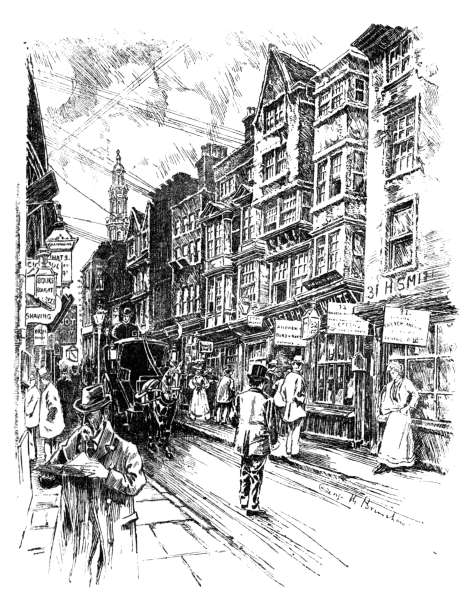
The street was a survival of old London, with its houses picturesquely
old, with pointed gables, and it is a cause for regret that it had to go
down in the march of modern improvements (see frontispiece).
Butcher Row ran round the north side of the church. It was so named from
a flesh-market established here by Edward I. Numerous small courts
opened off in the north side. Among these were Hemlock, Swan, Chair,
Crown and Star Courts. The Row and its vicinity had for many years a
notoriously bad reputation. One of the courts off Little Shear Alley was
Boswell Court, not, as some have imagined, called after Johnson's
biographer. This court was at one time a very fashionable place of
residence; Lady Raleigh, the widow of Sir Walter, lived here for three
years.
In Butcher Row the houses were picturesque, of timber and plaster. In
one of them the great de Rosny, afterwards Duc de Sully, lodged for one
night when he came to England as the French Ambassador.
Turning westward, we see what is left of Newcastle Street, which was
named after John Holles, Duke of Newcastle, who owned the ground (1711).
The work of demolition is going on as far as Catherine Street, where the
Gaiety theatre still stands, though not for long, for the second great
scimitar sweep of the new street will join the Strand here.
The parish of St. Paul's lies like a leaf on the parish of St.
Martin's-in-the-Fields, by which it is wholly surrounded. Its southern
boundary runs most erratically, zigzagging in and out across the streets
which connect Maiden Lane and Henrietta Street with the Strand. The
eastern line keeps on the east side of Bow and Brydges Street. The north
passes along the north side of Hart Street, and the west cuts across the
east ends of Garrick and New Streets, keeping to the east of
Bedfordbury.
The name Covent is a corruption of Convent, and is taken from the
convent garden of the Abbey of Westminster, which was formerly on this
site. It was written Covent, as taken from the French couvent more
immediately than the Latin conventus.
At the dissolution of the monasteries, Westminster Convent Garden became
Crown property. In the first year of his reign Edward VI. granted it to
the Duke of Somerset. On the fall of that nobleman it reverted to the
Crown, and in 1552 was granted to the Earl of Bedford with "seven acres,
called Long Acre." The Earl of Bedford built a town-house on his newly
acquired property, and devoted himself to the improvement of the
neighbourhood.
Though the parish is so small, it is full of interesting associations,
chiefly of the last two centuries. Wits, actors, literary men, and
artists, frequented its taverns and swarmed in its precincts. The
contrast between its earlier days, when it was a quiet retreat where the
monks slowly paced beneath the sheltering trees, and its later
vicissitudes, when the eighteenth-century roisterers and gamesters made
merry within its taverns, could hardly be more striking.
The great square called the Market was laid out by the Earl of Bedford
in 1631; the Piazza ran along the north and east sides; the church and
churchyard formed the west side; on the south was the wall of Bedford
House, and by a small grove of trees in the middle stood a sundial. The
place gradually grew as a market. In 1710 there were only a few sheds;
in 1748 the sheds had become tenements, with upper rooms inhabited by
bakers, cooks and retailers of gin.
The square itself is redolent of memories. When first built it was one
of the most fashionable parts of London, and the names of the occupiers
were all titled or distinguished. We read among them those of the Bishop
of Durham, Duke of Richmond, Earl of Oxford, Marquis of Winchester, Sir
Godfrey Kneller, and the Earl of Sussex. The arcade, or Piazza, as it
was called, was a fashionable lounging-place, and many foundling
children were called Piazza in its honour. One of the scenes in Otway's
"Soldier of Fortune" is laid here, and also one in Wycherley's "Country
Wife." Sir Peter Lely had a house in the square, and this house was
successively occupied by Sir Godfrey Kneller and Sir James Thornhill
(Timbs). Coffee-houses and taverns abounded in and about the square. Of
these the most famous were Will's, Button's and Tom's, well known by the
references to them in contemporary literature. The first of these in
point of time was "Will's," which stood at the north corner of Russell
and Bow Streets (see p. 106).
The Bedford Coffee-house under the Piazza succeeded Button's, or,
rather, came into vogue afterwards when Garrick, Quin, Foote and others
used it. The house stood at the north-east corner. It is described as a
place of resort for critics. "Everyone you meet is a polite scholar and
critic ... the merit of every production of the press is weighed and
determined." Apparently a place where the conversation was a continual
attempt at smartness; it must have been most fatiguing. The weak point,
indeed, of this public life was the demand it created for conversational
display. The greater part of Johnson's pithy sayings were delivered in
such a mixed company, and were prepared in sonorous English to suit the
company.
An article in the London Mercury, January 13, 1721, states that there
were twenty-two gaming-houses in the parish. Besides all these
attractions, there was Covent Garden theatre opened in 1733 by Rich,
though the first patent had been granted to Sir William Davenant. In
1746 Garrick joined Rich, but at the end of the season left him for
Drury Lane, taking with him all the best actors. In 1803 Kemble became
proprietor and stage-manager, but five years later the theatre was
completely burnt. It was rebuilt under the directions of R. Smirke, and
when re-opened was the scene of a singularly pertinacious revolt. The
prices had been raised in consequence of the improved accommodation, and
the people in the pit banded themselves together under the name of "Old
Prices," and made such an intolerable uproar that the piece could not
proceed. Smith says "the town seemed to have lost its senses." For weeks
people wore O.P. hats and O.P. handkerchiefs, and interrupted every
attempt to carry the play through. In the end a compromise was made. In
1840 Charles Kemble left the theatre, and the building was leased to C.
Mathews, Madame Vestris and Macready. In 1847 it was opened as an
Italian Opera-House after being almost rebuilt. It was again destroyed
by fire in 1856, but the façade was saved with its bas-reliefs and
statues by Flaxman and Rossi. These were placed on the present building
designed by Barry, which was opened two years later.
The Church of St. Paul, Covent Garden, was built by Inigo Jones in 1633
at the expense of the Earl of Bedford; consecrated by Bishop Juxon in
1638; destroyed by fire in 1795; rebuilt by John Hardwick in the place
of the original building. And the story goes that when the architect
heard the commission, "to build a church not much bigger than a barn,"
he replied it should be the handsomest barn in England.
Buried here are Robert Carr, Earl of Somerset; Sir Henry Herbert and
Samuel Butler, author of "Hudibras," died 1680; Sir Peter Lely, died
1680, whose monument was destroyed in the fire; Edward Kynaston, actor;
Wycherley, the dramatist; Grinling Gibbons, died 1721, sculptor in wood;
Susannah Centlivre; Dr. Arne, musician, died 1778; Charles Macklin,
comedian, died 1797 at the age of 107; John Wolcott, alias Peter
Pindar, died 1819. The registers begin at 1615, and among the baptismal
entries are the names of Lady Mary Wortley Montagu, May 26, 1689, and
Turner, the painter, May 14, 1775.
The church is visible from the street on the east and the market on the
west, but accessible only by a covered entry under the houses on the
north and south. In Hogarth's picture of "Morning" we get a glimpse of
the old church before its destruction, with clock-dial, and tiled roof,
not so very dissimilar from what it is at present.
The election of members for Westminster formerly took place on a
hustings before the church, when there were scenes of wild riot. The
most memorable of these elections was that of Fox and Sir Cecil Wray in
1784.
Bow Street, Covent Garden, was built in 1637, and named after its shape,
that of a bent bow. It is remarkable for the number of well-known
persons who have lived in it. It was one of the most fashionable streets
in the Metropolis, and Dryden wrote in the epilogue to one of his plays:
"I've had to-day a dozen billet-doux
From fops and wits and cits and Bow Street beaux;"
on which Sir Walter Scott remarked a billet-doux from Bow Street would
now be more alarming than flattering. The police officer began his reign
here in 1749.
Henry Fielding, who was in authority in 1753, did much to suppress the
unbridled license and open highway robbery of the Metropolis.
Will's Coffee-house was at No. 1, on the west side, the corner of
Russell Street. The principal room was on the first floor. Dryden made
the house the chief place of resort for the poets and wits of the time.
After his death Addison took the company across the street to Button's.
Ned Ward's notes on Will's are not respectful.
"From thence we adjourned to the Wits' Coffee-house.... Accordingly,
upstairs we went, and found much company, but little talk.... We
shuffled through this moving crowd of philosophical mutes to the other
end of the room, where three or four wits of the upper class were
rendezvous'd at a table, and were disturbing the ashes of the old poets
by perverting their sense.... At another table were seated a parcel of
young, raw, second-rate beaus and wits, who were conceited if they had
but the honour to dip a finger and thumb into Mr. Dryden's snuff-box"
(Cunningham, p. 555.).
Defoe, on the other hand, is more complimentary:—
"Now view the beaus at Will's, the men of wit,
By nature nice, and for discerning fit,
The finished fops, the men of wig and muff.
Knights of the famous oyster-barrel snuff."
At Button's there was a carved lion's head, of which the mouth was a
letter-box for contributions to the Guardian and Tatler. This was
set up by Addison in 1713, and attracted much attention. It was removed
in 1731 to the Shakespeare Tavern, and later came into the possession of
the Duke of Bedford. Tom's was the last of the three famous houses. It
was started by a waiter from Will's, and managed to hold its own. It was
on the north side of the street, nearly opposite Button's.
The literary associations of the street are innumerable. Wycherley
lodged here, and after an illness was visited by Charles II., who gave
him £500 for a trip to France. The well-known Cock Tavern was just
opposite his rooms, and when Wycherley had married the Countess of
Drogheda he used to sit in the tavern with the windows open so that his
jealous wife could see there were no women in his company. This tavern
was the resort of the rakes and mohocks that for a while made the
neighbourhood a terror to decent people. Henry Fielding wrote "Tom
Jones" while living in this street. Grinling Gibbons died here. Edmund
Waller, the poet, lived here during the Commonwealth, and Robert Harley,
Earl of Oxford, was born here in 1661. Radcliffe, the Court physician,
was a resident in the beginning of the eighteenth century.
The streets opening out of the square can boast many interesting
associations.
Henrietta Street was named after Charles I.'s Queen. Samuel Cooper,
miniature-painter, lived here. The Castle Tavern, where Sheridan fought
with Mathews on account of Miss Linley, was in this street.
Maiden Lane can claim several illustrious names. It was the birthplace
of Turner; Andrew Marvell and Voltaire both lodged here.
Long Acre was originally an open field called the Elms, and later known
as Seven Acres, from a grant of land made to the Duke of Bedford. A
curious house-to-house survey of 1650 is preserved in the Augmentation
Office. From this it would appear that the street at that date was full
of small shops, grocers, chandlers, etc., with here and there a big
house occupied by some titled person. Ever since the first introduction
of coaches Long Acre has been particularly favoured by coachbuilders,
and at the present time it is lined by carriage-works. Long Acre was the
scene of many convivial gatherings in the Hanoverian times. It can claim
the first "mug-house," an institution which speedily became popular.
Oliver Cromwell lived on the south side of Long Acre, and Dryden and
Butler in Rose Street, a dirty little alley half destroyed by the
building of Garrick Street. Here Dryden was set upon by three hired
bullies at the command of Lord Rochester, who was insulted by some
satirical lines which he attributed to the poet.
Garrick Street was built about 1864, and the club of the same name was
founded for the patronage of dramatic art.
St. Martin's Lane is one of the oldest thoroughfares in the parish. It
was built about 1613, and was then known as West Church Lane. It ran
right through to the front of Northumberland House, and prints are still
extant showing the church peeping over the line of houses on the western
side.
St. Martin's Lane claims many celebrated names, and was a favourite
resort for artists. The house in which Inigo Jones lived is still
pointed out—No. 31 on the east side. Almost exactly opposite this is
the Public Library, built at the same time as the Municipal Buildings;
it contains a fine reference collection (see also p. 21.) The lane
abounds with memories of the past. In St. Peter's Court Roubiliac
established a studio, afterwards a drawing academy, which numbered
Hayman, Cipriani, Ramsay, Cosway, Nollekens, Reynolds and Hogarth among
its members; this was the predecessor of the Royal Academy. This court
was two or three doors above the Free Library, and was eventually closed
up at the west end by the Garrick Theatre. No. 114 is traditionally on
the site of the mansion of the Earls of Salisbury, in which, also
traditionally, the Seven Bishops were confined before being committed
to the Tower. The names of Chippendale, Nathaniel Hone and Fuseli are
associated with the lane, also Sir Joshua Reynolds and Sir James
Thornhill.
Old Slaughter's Coffee-house alone is enough to redeem any street from
oblivion. This was established in 1692, and stood on the spot where
Cranbourne Street now crosses the end of St. Martin's Lane. It was a
favourite resort of all the painters and sculptors of the time, not to
mention the wits and beaux. Hogarth was a constant visitor, his house in
Leicester Square being conveniently near. Roubiliac, Gainsborough, and
also Wilkie, came to enjoy society at Old Slaughter's, and Pope and
Dryden are known to have visited it. The first chess club in London was
established here in 1747.
And now we have strolled around the chosen area, making Trafalgar Square
the centre, and returning to and fro in two great loops eastward and
westward, resembling a true lovers' knot. We have been in the company of
King and courtier, rebel and wit. We have consorted with the gay fops of
the eighteenth century in their club and coffee house life, and we have
seen the haunts of men whose names are household words wherever the
English tongue is spoken.
It has been chiefly seventeenth and eighteenth century life that has
enchained us as we read the pages of the past, and in its richness and
variety at least the eighteenth century would be difficult to rival.
Prosaic London, with her borough councils, her Strand improvements, and
her immense utilitarian flats, still retains the glamour of her bygone
days, and if her present buildings are without much attraction, they are
glorified by the halo of their association with their fascinating
predecessors.