The following collection of pictures, in each of which the artist has
depicted an event in the lives of the great musicians, can open with
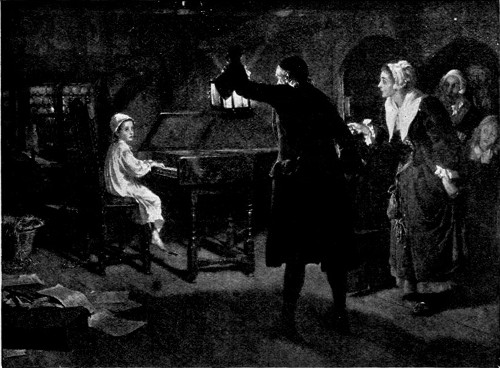
nothing more suitably than with the charming picture of "The Child Handel,"
by Margaret Dicksee. Handel's father strongly opposed the child's
passionate love for music, and the more his great gifts developed the more
severely was he forbidden to occupy himself with music. The little boy was
obliged to have recourse to subterfuge, and when his elders believed him
snug in bed he used to steal on tip-toe to the lumber-room, where he had
discovered an old spinet, on which he played softly to his heart's content,
alone and fancy-free. In one of these moments of enjoyment, when the divine
genius spoke to the child, he forgot himself and played louder and
louder—all the sound of the old spinet streamed through the silent night,
waking the sleepers in the house, who believed that the angels were keeping
vigil over the old town of Halle. But little George's father bethought
himself of the musical propensities of the boy, and, as the latter was not
to be found in his bed, the lantern was lit and a search-party followed
where the music led them. Alas! Poor George was found, severely
reprimanded, and dismissed to bed. The picture brings the scene so vividly
before our minds that we are glad to know the sequel. George was not to be
suppressed. A short time afterwards his father went to Weissenfels, where,
in consequence of the presence of the music-loving Prince, many concerts
were to be held. Little George knew this, and, as his father would not let
him go, he ran after the coach so long that his parent was compelled to
take him in. The Prince heard of the extraordinary child-musician, and,
thanks to his intercession, Handel's father at last gave permission that
his son should be taught music.
 "THE CHILD HANDEL."
From the Picture by Margaret Dicksee.
By permission of the Berlin Photographic Company, 133, New Bond Street,
London, W.
Copyright, 1893, by Photographische Gesellschaft.
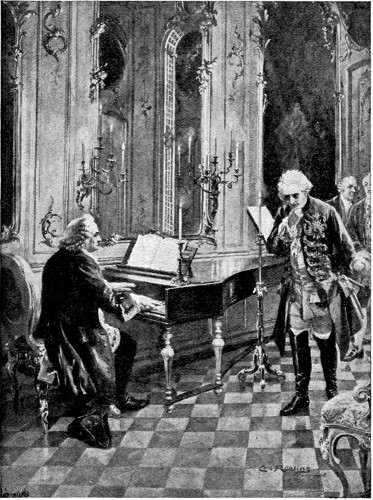
The next picture shows us Sebastian Bach, "the father of all music,"
playing before Frederick the Great. The painter has chosen the moment when
the King is giving Bach a theme on which to improvise. This theme, "a right
royal one," as Bach called it, was afterwards worked out by him and sent
back to the King, under the name of "A Musical Sacrifice." The King, who
was himself a remarkable musician, had shown Bach the greatest
appreciation, and this visit to Potsdam seems to have been one of the
happiest events in Bach's life. Those who are inclined to regard Frederick,
in his musical capacity, as no better than a dilettante flute-player
would do well to remember that he was among the first to recognise and to
encourage the genius of one of the greatest musicians of all time. Yet
Bach's greater works remained in manuscript, and it was left to musicians
of a later period—especially to Mendelssohn—to unearth and make them
known to the world at large.
 "FREDERICK THE GREAT AND SEBASTIAN BACH."
From the Picture by Carl Röhling.
By permission of the Berlin Photographic Company, 133, New Bond Street,
London, W.
Copyright, 1901, by Photographische Gesellschaft.
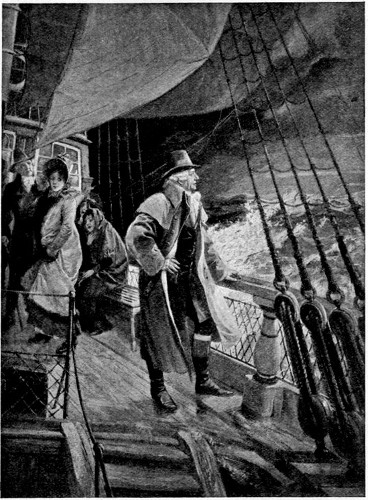
Another of our master-musicians, Haydn, unlike Bach, who never left his
country, came to England, and reached in this country the summit of his
renown. In the picture on the next page we see him on board ship. Well
wrapped in his great-coat he stands on deck and seems to enjoy the
sea-breezes, unconscious of the curiosity of the other passengers. He is
wondering what will await him in that strange country across the sea. Will
they understand him and the message he has to deliver to them: harmonies
so pure and simple from a heart so kindly and a will so strong? And they
did understand him in England; a glorious season of success awaited him.
Sympathy met him everywhere, and in such fulness that on returning home to
Austria he stopped at the little village of his birth and, kneeling at the
threshold of his father's humble cottage, he thanked God for all the
happiness which he had known in England.
 "HAYDN CROSSING TO ENGLAND."
From the Picture by Carl Röhling.
By permission of the Berlin Photographic Company, 133, New Bond Street,
London, W.
Copyright, 1902, by Photographische Gesellschaft.
"HAYDN CROSSING TO ENGLAND."
From the Picture by Carl Röhling.
By permission of the Berlin Photographic Company, 133, New Bond Street,
London, W.
Copyright, 1902, by Photographische Gesellschaft.
In his wake followed another and a brighter star. When Haydn was at the
zenith of his success all Germany began to talk of the little infant
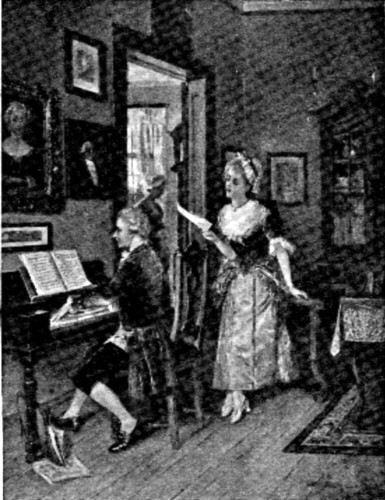
prodigy, Wolfgang Amadeus Mozart. Our first Mozart picture shows him at the
epoch of his life when he first fell in love. While on a visit to an uncle
he met his fate in the shape of one of his youthful cousins, Aloysia Weber.
The two sisters were pretty; the older, whom in the picture we see
lingering in the other room, was full of kindness and sweet unselfishness,
always putting forward the younger and more talented sister. Aloysia had a
beautiful and well-trained voice, and could read a song at first sight.
What was more natural than that the two young people who loved music should
learn to love each other? Then came the parting hour. Mozart was compelled
to go on one of his extensive tours. Two years passed by before he could
return to his Aloysia. She had, of course, vowed everlasting love; but,
alas for the faithlessness, the vanity of woman! Wolfgang came back,
faithful and loving as he had left, to find that Aloysia had grown into a
very beautiful girl, who had tasted the joys of celebrity as a singer.
Success had turned her head and she had nothing to say to the young
musician, who was only on the road to make his fame, and she threw away a
treasure which she was too ignorant to prize.
 "MOZART AND ALOYSIA WEBER."
From the Picture by Carl Röhling.
By permission of the Berlin Photographic Company, 133, New Bond Street,
London, W.
Copyright, 1902 by Photographische Gesellschaft.
 "MOZART AND BEETHOVEN."
From the Picture by A. Borckmann.
By permission of the Berlin Photographic Company, 133, New Bond Street,
London, W.
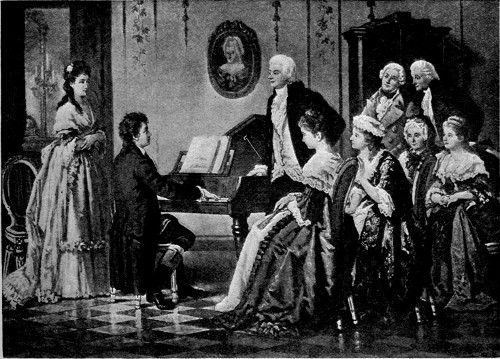
In the next picture we see Mozart again when, at the height of his own
fame, he listens to one who was destined to be greater even than
himself—the young Beethoven. The young musician of sixteen asked him for a
theme on which to improvise. Slowly the genius unfolded his wings; the
simple theme seemed to grow to a mighty phrase, which was taken up by other
voices as the harmony swelled under the fingers of the player who was
destined to show the coming generations the power of music at its greatest.
Mozart listened more and more attentively, his eyes fixed upon the young
musician, his face wearing an almost reverential look under the spell of
celestial inspiration, which came now like the rushing of a mighty wind.
The music still went on. Beethoven had forgotten that he was not alone; but
Mozart turned to his friends. "Listen!" he said. "And remember, of this
young man the whole world will speak."
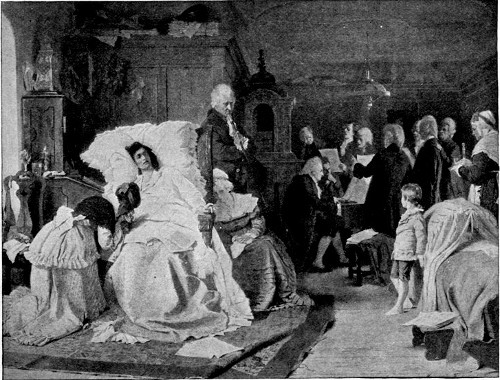
Kaulbach, in his painting, "Mozart's Requiem," has immortalized the moment
when fate cut short the life of Mozart. The fire of his genius, the
never-ceasing, burning desire to embody the immortal inspirations which
floated so richly in his brain, had "fretted the pigmy body to decay." Ill
and depressed he was leaning back in his chair, when a stranger was
announced, who asked him to compose a Requiem as full of dignity and beauty
as his genius could conceive, a work which should be without an equal. He
laid down a roll of a thousand ducats on Mozart's table and went away
without disclosing his name, saying only that he would call again. Then the
master collected his last strength, and a sublime effort resulted in the
unique work, before which the world still stands in awe and reverence. He
felt from the first moment that he was writing his own Requiem.
The work was finished and now he wished to hear it. Too weak to stir from
his room, he summoned his friends to perform the Requiem before him. They
came and he listened, still and happy, to those mighty strains of sadness;
and, so listening, his own soul flew to Heaven. This is the scene of
Kaulbach's picture.
 "THE LAST HOUR OF MOZART."
From the Picture by H. Kaulbach.
By permission of the Berlin Photographic Company, 133 New Bond Street,
London, W.
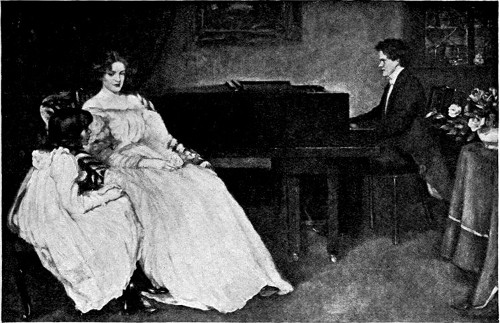
The well-known and well-beloved "Moonlight Sonata," whose power and beauty
will delight for ages, is the subject of the very pretty story depicted on
the next page. It is said that Beethoven passed, in the course of one of
his rambling walks, a lonely street in the suburbs of Vienna, and heard
from an open window the strains of his own music. The music came from a
room on the ground floor, and when he approached he saw a young girl
sitting at the piano and a child listening to her, huddled up on a chair
near by. Impulsive as he was, he at once entered, saying, "I know that
piece. What makes you play it? Does it please you?" "I love all Beethoven's
compositions," said the young girl in a sweet, quiet voice, without
showing any surprise at being thus interrupted by a stranger. But the child
came quickly towards him, saying, "My sister is blind, and music is her
only joy. What is it you want, sir?" With that peculiar directness which
was so characteristic of his nature, he simply said, "I wish to play to
you. I am Beethoven." Then the two girls settled themselves joyfully to
listen. The moon had risen, the street was silent, the tears glistened in
the blind eyes of the elder girl—and then came the wonderful mysterious
song of that Adagio in C sharp minor, which rose and fell and soared again
to Heaven. Such revelation of human feeling strained the nerves of these
two young beings almost beyond endurance. A slight pause, and the graces of
the Minuet played around them, soothed them, brushed the tears away, and
spoke of life and youth and gladness. And then it sang on—another rushing
storm—and melody after melody followed, and wildest outbreak of the
Titan's own rugged nature, and then it cleared up into majestic
strength—imposing chords of greatness—then silence. Beethoven turned and
went as he had come, and long after he gave to the world what he saw and
felt before these two lonely children.
 "THE MOONLIGHT SONATA."
From the Picture by Ernst Oppler.
By permission of the Berlin Photographic Company, 133, New Bond Street,
London, W.
Copyright, 1900, by Photographische Gesellschaft.
 "BEETHOVEN AND GOETHE IN TEPLITZ."
From the Picture by Carl Röhling.
By permission of the Berlin Photographic Company, 133, New Bond Street,
London, W.
Copyright, 1901, by Photographische Gesellschaft.
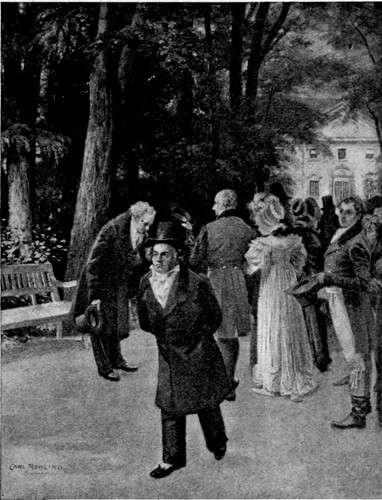
The picture entitled "Beethoven and Goethe in Teplitz" illustrates an
episode which shows Beethoven in the company of Germany's greatest poet,
for whom he had an enthusiastic admiration. Beethoven's was a proud nature,
and he sometimes showed his pride in a manner which had nothing in common
with the smooth and polished manners of the aristocratic society in which
he and Goethe were wont to move.
Beethoven and Goethe met at Teplitz, a Bohemian watering-place much
frequented by Royalties and aristocratic society. They were walking
together, when the Emperor and Empress and their suite came towards them.
Goethe, standing still, hat in hand, bowed almost to the ground, as it is
customary on the Continent. Beethoven pressed his hat tighter on his head,
let go Goethe's arm, and tried to elbow his way through the crowd; but the
Empress had seen him and greeted him smilingly as she passed on, whilst
Goethe received only the courtesy accorded to every unknown person. This is
the moment shown us by the artist. The expression of surprise in the faces
of the Royal visitors at Goethe's obsequious politeness, the indulgent
smiles which follow the irate Beethoven, are very amusing.
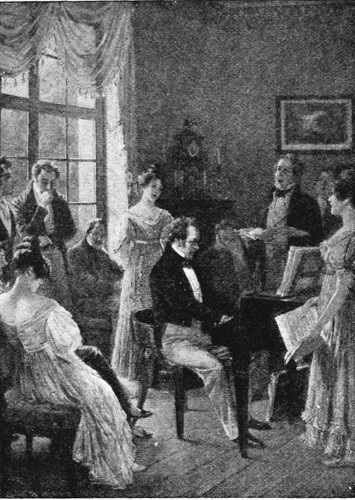
Franz Schubert is the creator of the German "Lied." He was the first who
gave this kind of music a deeper meaning and a more elevated form, and,
guided by his dramatic instinct, produced such masterpieces as the
"Erlking" and the "Müller-lieder." The singer is surprised to find most of
these songs written in a very high key, and before somebody had taken the
trouble to transpose them this was, even in Germany, a drawback to their
popularity. The reason was as follows. One of Schubert's best friends was a
very popular singer in Vienna, and his tenor voice was of an exceptional
compass. Schubert wrote most of his songs for him. The painter has had the
happy idea of giving us a portrait of this man in the act of singing, while
Schubert himself is playing the accompaniment. The young lady who stands at
the other side of the piano is probably the girl of whom Schubert said: "I
loved once a girl, she was not beautiful—but, oh, so kind-hearted, good,
and loving! And she sang my songs with a most beautiful soprano voice. We
loved each other for three years, and we were happy. Then I had to give her
up. I could never succeed in getting a post which would have enabled me to
marry. I had no right to prevent her from marrying a man who could give her
a home and make her happy." It is sad that a man whom we acknowledge as one
of the greatest of musicians should be compelled to give up every thought
of the happiness which comes to even the simplest worker in another field.
 "SCHUBERT AND HIS FRIENDS."
From the Picture by Carl Röhling.
By permission of the Berlin Photographic Company, 133, New Bond Street,
London, W.
Copyright, 1903, by Photographische Gesellschaft.
The next painting illustrates a romantic episode of Schumann's life. In
1836 Robena Laidlaw, though only sixteen, was Court pianist of the Queen of
Hanover, and her fame had already spread over Germany, England, and Russia.
She played his music for him, followed his inspirations, and rejoiced at
the flights of his genius. They had tasted to the full the delight of
understanding each other in the beautiful language of music.
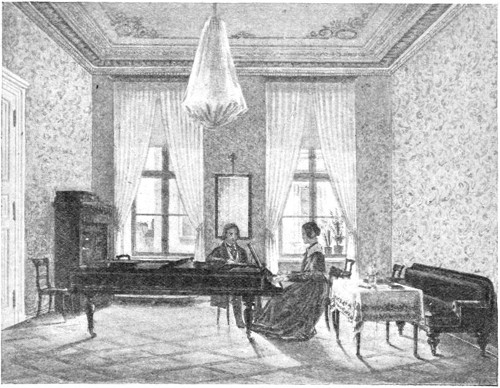 "SCHUMANN AND ROBENA LAIDLAW."
From the Water-Colour Drawing by J. Raabe.
One day they were wandering in the Rosenau—the rose-gardens of Leipzig.
The time of parting had come. His life and hers were unsettled and full of
plans and ambitions. She was to start for Paris the next day, and to go
from there to Russia to play before the Czar and the Imperial Court. Did
they realize their own feelings at the moment, or know how much akin such
friendship is to love?
He arranged the cushions around her in the little boat upon the lake and
bade her wait for him; he would bring her a rose as a parting gift. She had
long to wait, and when he came at last he said, with that melancholy
expression which, even in his younger years, was already his: "I searched
so long and could after all only find a rose which is not worthy of you.
But I will send you a remembrance of the Rosenau."
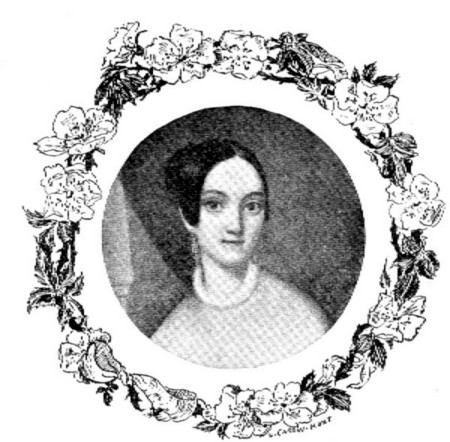 ROBENA LAIDLAW.
From a Painting.
Surfeited with the triumphs which fall naturally to the share of a great
artiste and a beautiful girl, Robena found, on returning from a State
concert at St. Petersburg, among many costly gifts of jewels and flowers
which awaited her, a simple roll of music with the German postmark. It
contained the twelve Phantasiestücke which are now reckoned among the
most poetical and beautiful of Schumann's works. He wrote: "I have not
asked, before sending them to the printer's, your permission to dedicate
these pieces to you. They are yours, and I hope you will accept them. The
whole Rosenau with all its romance is in them. Forget me not, and send me
your portrait soon, as you promised."
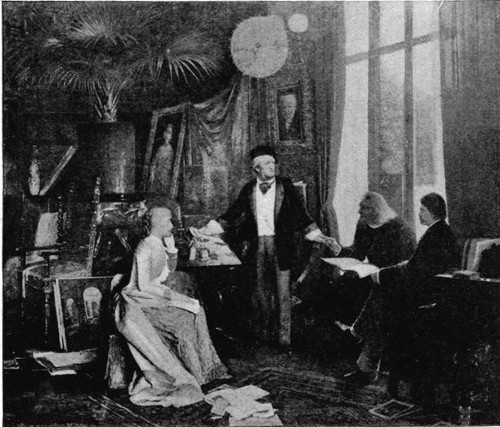 "WAGNER IN HIS HOME AT WAHNFRIED."
From the Picture by W. Beckmann.
By permission of Rud. Ibach Soln, owners of the Original.
Wasielewski tells in his "Schumanniana" that he heard him once, shortly
before his last illness, playing in the twilight, as he loved to do.
Melodies full of tender beauty floated around; the exquisite piece "des
Abends," the first of the Phantasiestücke; then reminiscences of "des
Nachts," wild and desperate, as if haunted by loneliness and terror; and
then again the sweet and tender song of the evening's silent longing. The
listener outside the door felt his heart nearly burst with emotion, but
Schumann shut the piano immediately when the door was opened, and no
allusion to what had passed was possible. Had he returned in this lonely
moment to the memories of youth? Was it a last and loving greeting to the
past?
The great composer who gave so much to the world is long laid to rest in
the cemetery of Bonn, and the waves of the Rhine sing his eternal
slumber-song, but the Phantasiestücke will live on, and sing of the
romance which was never told in words.
Robena Laidlaw died only two years ago in London. Among the many souvenirs
of this brilliant artiste's career was found a withered rose, and written
by her on a leaflet: "Schumann gave me this rose at the Rosenau, 1836."
Beckmann's picture represents the last of the epoch-making musicians,
Richard Wagner. We see him discussing "Parsifal," his last and grandest
work, with his wife and his two faithful friends, Liszt and Hans von
Wolzogen. Wagner was then already living in his own beautiful home in
Bayreuth, surrounded by the luxuries he so dearly loved, having as
companion the woman who understood him best. His battle had been hard, but
his ultimate conquest was decisive, and we may feel contented in the hope
that culture is in our days so widespread and advanced that genius is but
rarely exposed to pay with a life of misery for the halo of its greatness.
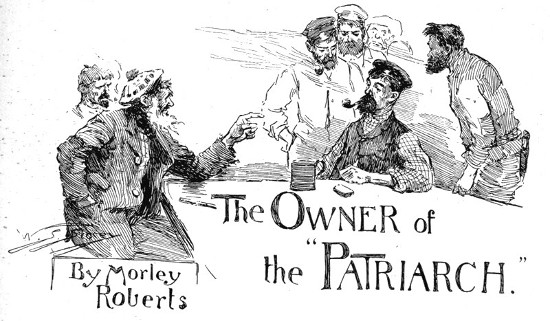
If anyone cares to look up the Patriarch in Lloyd's List it will be
discovered that the owner of her was T. Tyser, but it matters very little
whether she was built of heavier plating than the rules required, or
whether she was cemented or built under special survey or what not. For T.
Tyser, otherwise Mr. Thomas Tyser, was not only the owner of the
Patriarch, but also the owner of a dozen other vessels all beginning with
a "P." He was, moreover, the owner of a large block of land in the heart of
Melbourne; he had several streets, of which the biggest was Tyser Street,
S.E., in London, and his banking account was certainly of heavier metal
than he had any personal use for. He was a rough dog from the north
country, and in the course of half a century's fight in London he came out
top dog in his own line and was more or less of a millionaire.
"And he's my uncle," said Geordie Potts; "his sister was my mother, and
here I am before the stick in one of his old wind-jammers and gettin'
two-pun-ten in this here Patriarch of his, and hang me if I believe the
old bloke has another relation in the world. It's hard lines, mates—it's
hard lines. Don't you allow it's hard lines?"
It was Sunday morning in the south-east trades, and every sail was drawing
"like a bally droring-master," as Geordie once said, and the "crowd" of the
Patriarch were all fairly easy in their minds and ready for a discussion.
"If so be you are 'is nevvy, as you state," said the port watch,
cautiously, "we allow it's hard lines."
"I've stated it frequent," said Geordie, "and it's the truth, the whole
truth, and nothin' but it, so help me. D'ye think I'd claim to be old
Tyser's sister's son if I wasn't? I'd scorn to claim it."
"Any man would scorn to be Tyser's sister's son," said the starboard watch.
"He'd scorn to be 'im unless he was, for Tyser's a mean old dog, ain't he,
Geordie?"
Geordie thanked his watch-mates for backing him up so.
"That's right, chaps. There's no meaner in the north of England—or the
south, for that matter—and the way this ship's found is scandalous."
"The grub's horrid," said both watches.
"And look at the gear," said Geordie; "everything ready to part a deal
easier than my uncle is. I never lays hold of a halliard but I'm thinking
I'll go on my back if I pulls heavy. Oh, it's a fair scandal!"
He considered the scandal soberly and with some sadness.
"He might leave you some dibs, Geordie," suggested his mate, Jack Braby.
"He might, after all."
"Not a solitary dime," said Geordie. "Him and me quarrelled because my
father fought him in the street, and I hit the old hunks with a bit of a
brick because he got my dad down."
"Wot was the row about?" asked the others, eagerly.
"Nothin' to speak of," said Geordie. "My old man said he was a bloodsucker,
and that led to words. And I never hurt him to speak of. And yet I've
shipped in one of his ships, and am as poor as he's rich. He allowed none
of us would get a farthing; he shouted it out in the market-place and said
hospitals would get it, because one of his skippers that he'd sacked cut
him up awful with a staysail hank, and they sewed him very neat at one of
'em."
"There's nothin' so good in a fight as a staysail 'ank," said Jack Braby,
contemplatively. "I cut a policeman all to rags wiv one once."
"Was that the time you done three months' 'ard?" asked the port watch.
"Six," said Braby, proudly; "and I told the beak I could do it on my 'ead.
But, Geordie, if you was owner yourself what would you do?"
"Yes, wot?" asked the rest.
Geordie shook his head and sighed.
"I'd make my ships such that sailormen would be wantin' to pay to go in
'em," said Geordie. "I've laid awake thinkin' of it."
"Oh, tell us," said all hands, with as much unanimity as if they were
tailing on to the halliards under the stimulus of "Give us some time to
blow the man down." "Tell us, Geordie."
"I'd be friends with all my men, for one thing," said Geordie, "and I'd not
have a single Dutchman in a ship of mine."
The three "Dutchmen" on board, one of whom was a Swede, another a German,
and the third a Finn, shifted uneasily on their chests, but said nothing.
"And not a Dago," continued the "owner," "and I'd give double wages and
grog three times a day and tobacco thrown in. And the cook shouldn't be a
hash-spoiler, but what Frenchies call a chef."
"We never heard of that. How d'ye spell it, Geordie?"
"S—H—E—double F," said Geordie; "and it means a man that is known not to
spoil vittles, as most sea-cooks does, by the very look of him. And when it
was wet or cold the galley fire should be alight all night. And the skipper
and the mates should be told by me, and told very stern, that if they
vallied their billets a continental they'd behave like gents and not cuss
too much. And there shouldn't be no 'working up,' and any officer of mine
that was dead on 'dry pulls' on the halliards should have the sack quick.
And every time a ship of mine came into dock I'd be there, and I'd see what
the crowd's opinion was of the skipper and the mates. Oh, I'd make my ship
a Paradise, I would!"
Most of the men nodded approval, but Braby wasn't quite satisfied.
"And would there be grog every time of shortenin' sail, Geordie?"
"Oh, of course," said Geordie, "and every time you made sail too."
But an old seaman shook his head.
"'Tis mighty fine, mates, to 'ear Geordie guff as to what 'e'd do," he
growled, "but I ain't young and I've seed men get rich, and they wasn't in
the least what they allowed they'd be. Geordie 'ere is one of hus now, and
'e feels where the shoe pinches; but if so be 'e got rotten with money 'e'd
be for calling sailormen swine as like as not. And 'e'd wear a topper."
"You're a liar; I wouldn't," roared Geordie.
"Maybe I am a liar," said the old chap, "but I've seen what I've looked at.
If you was to learn as your uncle was dead now, you'd go aft and set about
on the poop and see hus doin' pulley-hauley, with a seegar in your teeth.
Riches spoils a man, and it can't be helped; it 'as to, somehow. I've no
fault to find with you now, Geordie Potts; for so young a man you're a good
seaman and a good shipmate (though you 'ave called me a liar), but you
take my word for it, money would make an 'og of you."
And here was matter for high debate which lasted all through the trades,
through the horse latitudes, and into the region of the brave west winds
till the Patriarch had made more than half her casting.
"So I'm to be a mean swab and a real swine when I'm rich," said Geordie.
"Oh, well, have it your own way. There's times some of you makes me feel
I'd like to make you sit up."
"'Ear, 'ear," said the old fo'c's'le man; "there's the very 'aughty
richness workin' in his mind, shipmates. What'll the real thing do if 'is
huncle pegs out sudden?"
It was curious to note that a certain subdued hostility rose up between
most of the men and Geordie. They sat apart and discussed him. Even Jack
Braby threw out dark and melancholy hints that they wouldn't be chums any
more if old Tyser's money came to his nephew. There were at times faint
suggestions that Geordie was getting touched with his possible prosperity.
"I'll live ashore and have a public-house," said Geordie Potts.
And they picked up Cape Otway light in due time, and ran through Port
Phillip Heads by-and-by, and came to an anchor off Sandridge. Presently
they berthed alongside the pier and began to discharge their cargo; and one
hot day went by like another, till they were empty and began to fill up
again with wool. In six weeks they were almost ready for sea once more. And
the very night before they hauled out from their berth and lay at anchor in
the bay, Geordie went ashore at six o'clock "all by his lonesome," as he
and Jack Braby had fought over the job which Braby was to get from his mate
when old Tyser died intestate. And as he got to the end of the pier he met
a young clerk from the agent's office who knew him by sight.
"I say, I'm in a great hurry," said the boy; "my girl's waiting for me.
Will you take these letters to Captain Smith, or I'll miss my train back?
I'll give you a bob."
"Righto!" said Geordie; and he pouched the shilling and the letters, and
the young fellow ran for his train.
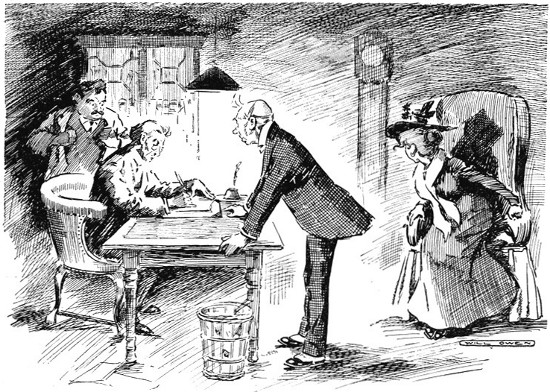
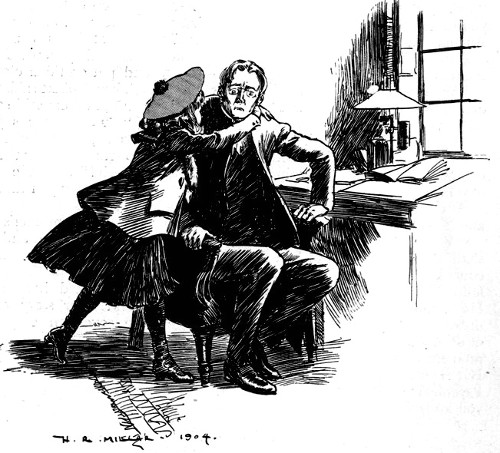
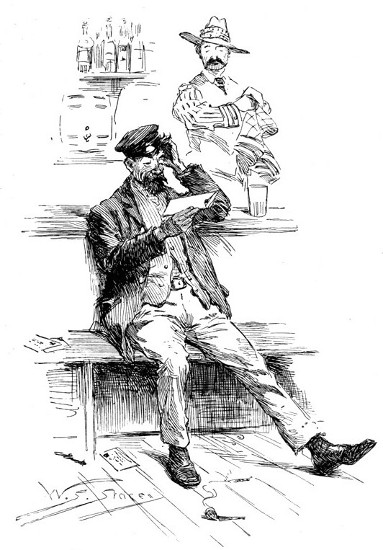 "'JERUSH,' SAID GEORDIE, 'THIS CAN'T BE ME!'"
"The letters can wait," said Geordie Potts, "but the bob can't, and I've
five more besides. Jack might have had his whack out of it if he hadn't
wanted to be my manager when he ain't fit for it."
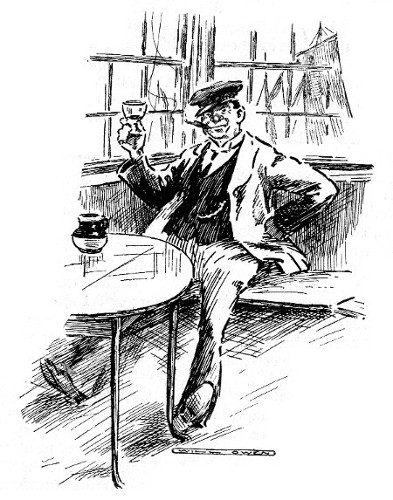
He put the letters into his pocket and made his way to the Sandridge Arms,
where he sat and drank by himself. It was seven o'clock, and he was by then
tolerably "full," before it occurred to him to see if he still had the
letters. He took them out, and the very first his eyes lighted on was one
in a long envelope addressed to
"George Potts, Esq.,
c/o Captain Smith,
Patriarch."
"Jerush," said Geordie, "this can't be me! 'Esq.' is what they puts after
names of gents. Even the skipper don't have it after his."
He fingered the long envelope and took another drink to consider the matter
on.
"Snakes! it must be me," he said, as he drew confidence out of his glass;
"there's no other Potts but me."
He was over-full by now, and he opened the letter and began to read it:—
"My Dear Sir——"
"By all that's living," said Geordie, "me 'my dear sir'!"
He went on reading:—
"My Dear Sir,—We regret to inform you of the sudden death of your uncle,
Mr. Thomas Tyser, on the 10th instant. He left no will, and you, as the
next of kin and heir-at-law, are entitled to all his real and personal
estate, which is, as you are doubtless aware, very large. According to our
present estimate it will amount to at least half a million sterling, and as
we have been his legal advisers for the last twenty years and know all his
affairs we can assure you that with proper management of certain
undertakings at present in our hands, it may be much more than our
estimate. In order that you may return at once we enclose you a draft on
the Union Bank of Australia for two hundred pounds, and have instructed
Captain Smith to give you your discharge, which he will, of course, do at
once.
"We hope, as we have been so long in the confidence of Mr. Tyser, that you
will see no reason to complain of our care of your interests.
"We are, my dear sir,
"Your obedient servants,
"Thomas Wiggs and Co."
"My stars!" said Geordie. And he stared aghast at a square piece of paper,
which he had reason to believe represented two hundred pounds. "My stars!
what a pot o' money!"
He gasped and took another drink.
"I'm the owner of the Patriarch," he said, and grasping all the letters
and his two-hundred-pound draft he rammed them down into the bottom of his
inside breast-pocket. "I'm the owner of—hic—the—hic—Patriarch."
He came out of his corner and went to the bar.
"Gimme a drink—an expensive drink, one that'll cost five bob," he demanded
of the barman.
"You'd better have a bottle o' brandy," said the barman.
"I wants the best."
"This is Hennessy's forty star brandy," said the liar behind the bar.
"There's no better in the world."
And Geordie retreated with the bottle to his corner and took a long drink
of a poisonous compound which contained as much insanity in it as a small
lunatic asylum. He came back to the bar presently and told the barman that
he was a millionaire.
"I own half Newcastle and a lot of Bourke Street, Melbourne, and a baker's
dozen of ships, and lumps of London!" said Geordie.
"Lend me a thousand pounds till to-morrow," said the barman.
"I like you—hic—I'll do it," said Geordie, and with that he fell headlong
and forgot his wealth. They dragged him outside on the veranda and let him
lie in the cool of the evening. He was picked up there two hours later by
Jack Braby and some of the starboard watch and taken on board.
"He let on he was a millionaire," said the barman, contemptuously.
Braby shook his head.
"Ah, he's liable to allow that when he's full, sir," said Braby.
But that fatal bottle kept Geordie Potts wholly insensible till they were
outside the Heads again and on their way to England, with the smoke of the
tug-boat far astern. And presently the second mate, Mr. Brose, who was a
very rough sort of dog, and had sweated his way up to his present exalted
rank from that of a foremast hand, hauled Geordie out by the collar of his
coat, and had him brought to by means of a bucketful of nice Bass's Straits
water. Geordie gasped like a dying dolphin, but came to rapidly.
"I'll teach you to get drunk, you swab," said Brose. "Take them wet things
off and turn to."
And Geordie obeyed like a child in the presence of force majeure.
"Oh, I've got a head," he told his mates, "and it seems to me that I had a
most extraordinary dream."
"Wot did you dream of, old Cocklywax?" asked Braby; "did you dream you'd
come in for old Tyser's money?"
And Geordie gasped.
"S'help me," he murmured. "S'help me, did I dream?"
He dropped his marline-spike as if it were red hot and made a break for the
fo'c's'le and his wet coat.
"Now if so be I dreamed," he said, "there'll be naught in this pocket. And
if I didn't, I'm jiggered."
He put his hand in and brought out a handful of damp and crushed letters,
and came out upon deck staggering. Mr. Brose saw him, and was on his tracks
like a fish-hawk on a herring-gull. Geordie saw him coming and stood
open-mouthed.
"Oh, sir," said Geordie. "Oh, sir——"
"Oh, rot," said Brose; "what's your little shenanakin game? Get to work, or
I'll have you soused till you're half dead."
But Geordie could explain nothing.
"Oh, sir," he stammered, and held up his papers, shaking them feebly. And
Brose shook him, anything but feebly, so that Geordie's teeth chattered.
"If you please, sir," he cried out at last, "if you please, sir, don't. I
owns her."
"You owns wot?" demanded Brose; and the rest of the men edged as near as
they dared.
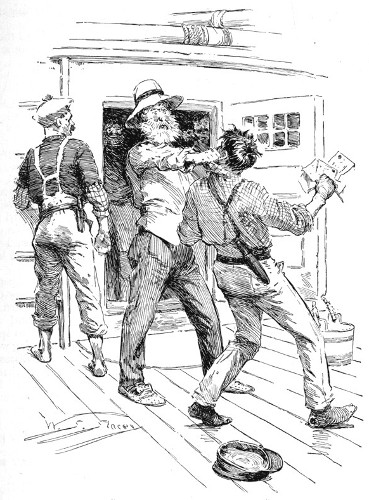 "BROSE SHOOK HIS MATE ONCE MORE."
"He's drunk still," said Braby, as Brose shook his mate once more.
"I owns the bally Patriarch," screamed Geordie, "and all the rest of 'em,
and all my uncle's richness, and I won't be shook, I won't!"
And Brose let him go.
"You're mad," said Brose, "you're mad."
"I ain't," roared Geordie, who was fast recovering from the shock, "I
ain't. Take these; read 'em—read 'em out; let the skipper read 'em. I owns
the Patriarch and the Palermo and the Proosian and the whole line.
The lawyer says so!"
He put the lot of damp letters into Mr. Brose's hands and sat down on the
spare top-mast lashed under the rail.
"There's letters for the captain 'ere," said Brose, suspiciously; "'ow did
you get 'em?"
"'Twas a youngster from the office give 'em me," replied Geordie, "and I
took a drink first, and there was one for me, and it said so—said I was
the owner, said it plain."
And when Brose had read the opened letter he gasped too and went aft to see
the skipper. The rest of the watch gathered round Geordie and spoke in
awe-struck whispers.
"Is it true, Geordie?"
"Gospel," said Geordie. "It's swore to. They sends me two hundred quid in a
paper."
"Show us," said the starbowlines, "show us."
"'Tis in the paper the second has," said Geordie. "It's wrote, 'Pay George
Potts, Esq., two hundred quid on the nail.'"
"I'd never 'ave let the second 'ave it," said Braby. "Like as not 'e'll
keep it."
"Then I'll sack him," said Geordie, firmly. "Let him dare try to keep it,
and I'll sack him and not pay him no wages."
"This is a very strange game, this is," said Braby. "I never 'eard tell of
the likes. Did they put 'Esk' on your letter?"
"They done so," said Geordie. "I've seen uncle's letters and they done so
to him."
"Then it must be true," said Braby. "They only puts 'Esk' on gents'
letters."
And Williams, the steward, was observed coming for'ard scratching his head.
"Where the deuce am I?" asked Williams, "and wot's the game? I'm sent by
the captain to say, 'Will Mr. Potts step into the cabin?'"
They all looked at Geordie.
"Mr. Potts? Why, that's you, Geordie."
"I s'pose it must be," said the owner. "Must I go, mates?"
"Of course," cried Braby.
But Geordie fidgeted.
"I could go in if we were painting of her cabin," he murmured; "but to talk
with the skipper——"
That evidently disgruntled him.
"'Tis your own cabin any'ow," said Braby. "I'd walk in like a lord."
"Well, I s'pose I must," said Geordie, reluctantly, and he went aft with
Williams.
"And you're the owner?" asked Williams.
Geordie sighed.
"So it seems, stooard," he admitted.
"It licks creation," said Williams.
"So it does," said Geordie, and the next moment he found himself announced
as "Mr. Potts," and he stood before the captain with his cap in his hand,
looking as if he was about to be put in irons for mutiny; but, as a matter
of fact, the old skipper was a deal more nervous than he was.
"This seems all correct, Mr. Potts," said Smith.
"Does it, sir?" asked Geordie. "I'm very sorry, sir, but it ain't my fault,
sir. I never meant—at least, I never allowed my uncle would do it, because
my father, sir, said he was a bloodsucker, and they fought, and I hit uncle
with a brick, sir, to make him let go of father's beard."
"Oh, yes, to be sure," said the captain, nervously, "but I'm thinking what
to do. It's a very anomalous situation for you to be here, Potts—Mr.
Potts, I mean."
But Geordie held up his hand.
"I'd much rather be Potts, sir, thanking you all the same."
"I couldn't do it," replied the skipper. "I was thinking that you might
like me to put back to Melbourne?"
"Wot for, sir?" demanded the owner.
"So that you could go home in a P. and O. boat," said old Smith.
"Thanking you kindly, sir," replied Geordie, "I'd rather stay in the
Patriarch. I don't like steamers and never did."
He had a vague notion that the skipper wanted him to go home before the
mast in one.
"Then you wish me not to put back, Mr. Potts?" said Smith.
"I'd very much rather not, sir," replied Geordie. "I'm very happy here,
sir, and takin' it all round the Patriarch's a comfortable ship, sir. May
I go for'ard now, sir?"
He made a step for the cabin door.
"Oh, dear, oh, dear," said old Smith, "you mustn't; you must have a berth
here and be a passenger."
The skipper's obvious nervousness was not without its effect upon the new
owner. For old Smith knew that if he lost his present billet he was not
likely to find another one, and he had nothing saved to speak of. So
somehow, and without knowing why, Geordie, without being in the least
disrespectful, was more decided in his answer than he would have been if
the "old man" had showed himself as hard and severe as usual.
"Not me," said Geordie, "not me, sir; I wouldn't and I couldn't. I'd be
that uncomfortable—oh, a passenger, good evings, no!"
"But bein' owner you can't stay for'ard," urged the skipper.
"Oh, yes, I can, sir," said Geordie; "I'd prefer it."
Smith sighed.
"If you prefer it, of course you must. But if you change your mind you'll
let me know."
"Right—I will, sir," said Geordie.
The skipper walked with him to the cabin door.
"And if you don't want to work, Mr. Potts, I dare say we can get on without
your services, though we shall miss them," he said, anxiously.
"I couldn't lie about and do nix," replied Geordie. "I'd die of it."
And away he went for'ard, while the skipper and Mr. Brose and Mr. Ware,
waked out of his watch below to hear the extraordinary news, discussed the
situation.
"And 'ave I to call 'im Mr. Potts?" asked Brose, with a pathetic air of
disgust.
"I say so," replied the skipper. "I can't afford, Brose, as you know, to
lose this job. And old Tyser promised me a kind of marine superintendent's
billet when I left the Patriarch, and I dessay this young chap will act
decent about it."
"I'm fair knocked," replied Ware. "I'm jolly glad that he ain't in my
watch. This is hard lines on you, Brose."
"If you please, Mr. Potts, will you be so good has to be so kind has to be
so hobliging as to go and over'aul the gear on the main," piped Brose, in
furious mockery, "Oh, this is 'ard!"
"Far from it," said old Smith; "you ought to be proud. It ain't every
second mate has a millionaire owner in his watch."
But Brose was sullen.
"You mark me, this josser won't do no 'and's turn that 'e don't like."
And for'ard the crowd said the same. As a result, for at least ten days
Geordie Potts worked very well indeed. But, of course, Brose, under the
skipper's orders, gave him all the soft jobs that were going. The second
mate got into a mode of exaggerated courtesy which was almost painful.
"Be so good, Mr. Potts, as to put a nice, neat Matthew Walker on this 'ere
lanyard."
Or—
"Mr. Potts, please be kind enough to go aloft and stop that spilling line
to the jack-stay."
And at meal times the port watch mimicked Brose.
"Dear Mr. Potts, howner, be so good as to heat this 'orrid 'ash without
growling."
And presently, when the weather began to get cold and the men brought out
their Cape Horn pea-jackets and their mitts, Geordie commenced to growl a
little.
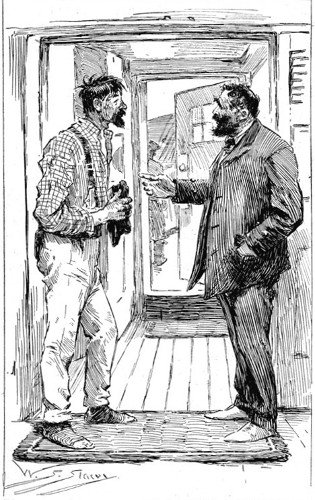 "'IF YOU DON'T WANT TO WORK, MR. POTTS, I DARESAY WE CAN GET
ON WITHOUT YOUR SERVICES,' HE SAID."
"'IF YOU DON'T WANT TO WORK, MR. POTTS, I DARESAY WE CAN GET
ON WITHOUT YOUR SERVICES,' HE SAID."
"I hates turnin' out in the gravy-eye watch worse and worse," he said.
"I've half a mind to let on I'm sick."
"You'd better go haft and tell the old man to 'ave the galley fire kep'
alight all night," said the crowd, crossly. "But you dasn't."
"I dast," said Geordie; "why, I owns the bally galley!"
"You dasn't!"
"I will," said Geordie. And next morning he went aft and touched his cap to
the skipper and begged to be allowed to speak to him.
"The galley fire at night?" said Smith. "Oh, certainly, Mr. Potts. I never
done it because it was against the horders of your late revered huncle,
sir."
"He was as mean as mean," said Geordie; "I think I can afford the fire,
sir."
The fire was lighted and the crowd said Geordie was the right sort.
"And wot about the gear, Mr. Howner?" asked Jack Braby. "If I was you,
before it gets too rotten cold I'd 'ave a real over'aulin' of things."
"I'll think of it," said Geordie. And that very afternoon he tackled Brose.
"The gear's tolerable rotten, sir," he began. And the second greaser knew
he was right and yet didn't like to say so. He yearned to curse him. "And
I'm thinkin'," said Geordie, "it would be a good thing to get up new stuff
and overhaul everything. I risks my life every time I goes aloft. The very
reef earings would part if a schoolgirl yanked at 'em."
"You'd better speak to Mr. Ware," said Brose, choking.
And at eight bells Geordie spoke to the chief officer, who was quite as
anxious as the skipper to keep his billet.
"It shall be done, Mr. Potts," said Ware.
In the first watch that night Geordie felt very tired, and said so. When it
was eight bells in the middle watch he was still asleep, or pretended to
be.
"Rouse out, howner," said Braby, and he shook Geordie up.
"I feels tolerable ill," said Geordie; "I don't think I shall turn out."
He didn't, and the rest of the port watch went on deck by themselves. At
the muster Mr. Potts didn't answer to his name.
"Mr. Potts is hill, sir," said the obsequious watch; "'e said 'e couldn't
turn out."
"I thought it would come soon," said Brose to himself. And he went for'ard
to the fo'c's'le.
"Are you very ill?" he asked, drily.
"I don't know quite how I feel," said the owner, "but I thinks a little
drop of brandy would do me good."
"I wish I could poison it," said Brose, under his voice. "This is most
'umiliatin' to a man in the persition of an officer."
By noon Geordie was well enough to sit on deck and smoke a pipe. The "old
man" came to see him.
"Wouldn't you like a berth aft now, Mr. Potts?" urged the skipper.
"I'll think about it, captain," said Geordie. "And in the meantime I don't
think I'll turn to."
The skipper turned to Brose.
"We can dispense with Mr. Potts's services for the time, eh, Mr. Brose?"
"Certingly," said Brose. But he walked to the rail and spat into the great
Pacific.
From that time onward Geordie did no work to speak of except to take his
trick at the wheel. And when they were south of the Horn he decided to do
that no longer.
"If you'll take my wheel for the rest of the passage, I'll double your
wages," he said to Braby. And Braby jumped at the offer. In the morning
Geordie went to the poop. It was noticeable that he went up the weather
poop ladder. Except in cases of hurry and emergency such a thing is next
door to gross insubordination at sea.
"I ain't goin' to take no more wheels," said Geordie. "And Braby will take
mine. I've doubled his wages."
Even old Smith gasped. As for Brose, he felt sea-sick for the first time
since he first went down Channel in an outward-bounder thirty years before.
"I'll make a note of it," said the skipper.
They shortened sail in a quick flurry of a gale out of the south-west later
in the day, and as all the topsails were down on the cap at once it was
"jump," and no mistake. As an act of kindly condescension the owner went to
the wheel and shoved away the Dutchman there, who was congratulating
himself on not being on a topsail yard.
"Get aloft, you Dutch swab," said Geordie; "I'll take her for you."
And Mr. Ware bellowed like a bull, for he had a fine foretopsail voice, and
when it was a real breeze his language rose with the seas and was fine and
flowery, vigorous and ornamental, and magnificent. While he was in the
middle of a peroration which would have excited envy in Cicero, or Burke,
or a barrister with no case, he heard the owner shouting; for a private
interview with the steward had given Geordie great confidence.
"Mr. Ware, Mr. Ware, I'd be glad if you'd cuss the men less. I don't like
it."
The chief officer collapsed as if he were a balloon with a hole in it. And
for the next minute he and the skipper engaged in an excited conversation.
"I can't—can't stand it," said Ware.
"You must," said old Smith, almost tearfully.
And Ware did stand it. But when the Patriarch was shortened down and he
left the deck, he went below and swore very horribly for five minutes by
any chronometer.
"Now I know what Brose feels," said Ware. "I've a great sympathy for poor
Brose."
The owner ordered a tot for all hands when they came down from aloft. And
he called the cook aft and harangued him from the break of the poop.
"Now, Mr. Spoil-Grub, mind you cook better than you've been doin', or I'll
have you ducked in a tub and set your mate to do your work."
He turned to the skipper with a beaming smile in his blue eyes.
"I can talk straight, can't I, cap?" he hiccoughed, blandly. "I'm thinkin'
I'll lie down in the cabin."
And when the old man went below he found Geordie dossing in his own sacred
bunk. The poor old chap went and sat in the cabin and put his head on his
hands.
"This is a most horrid experience," he said, mournfully. "I don't like
howners on board—I don't like 'em a bit."
But it was not only the after-guard who suffered. Geordie shifted his
dunnage aft at last, and though when he was sober he left the skipper's
berth, he made himself very comfortable in the steward's. And he loafed
about all day on deck with his pipe in his mouth. He began to look at the
men with alien eyes.
"I tell you they're loafin'," said he to Ware. "Don't I know 'em? They
watches you like cats, and when your eyes are off 'em they do nothin'. I'm
payin' 'em to work and I'm payin' you to make 'em. There's a leak
somewhere."
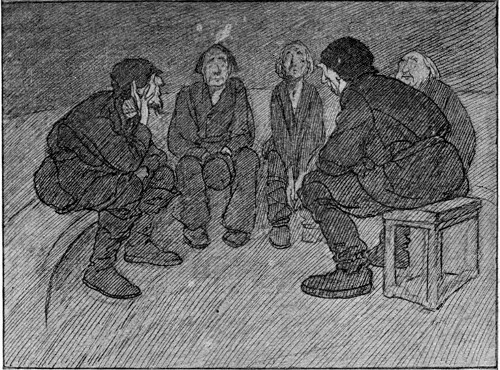
And he addressed the crowd from the poop.
"You're a lazy lot," he said, "that's wot you are. For two pins I'd put out
the galley fire, and I'd cut off your afternoon watch below."
And next day he raised their wages. A week later he cut them down again.
The skipper had a hard job to keep track of what the ship owed them.
"I wish we was home," groaned old Smith. "Oh, he'll be a terror of an
owner!"
"I'll murder him," said Brose.
"Wot did I tell you chaps about the 'orrid effecs of sudden richness on a
man?" asked the old fo'c's'le man for'ard. "Geordie Potts was a good sort,
but Mr. George Potts, Esquire, is an 'oly terror. 'E raises hus hup and
cuts hus down like grass."
And it presently came about that the only time they had any peace was when
Geordie was very much intoxicated. But when they got into the calms of
Capricorn on the home stretch to the north he developed a taste for
gambling and made the old skipper sit up all night playing "brag" for huge
sums of money.
"I lends you the dibs, and, win or lose, it's all hunky for you," said
Geordie. He made out orders to pay the "old man" several thousand pounds,
and Smith began to feel rich. Then Geordie raked Ware into the game. At
last even Brose succumbed to the lure of "I promises to pay Mr. Brose five
hundred on the nail," and joined the gamble.
"This is a dash comfortable ship," said Geordie. "What's a few thousand to
me? I don't mind losin'. Stooard, bring rum."
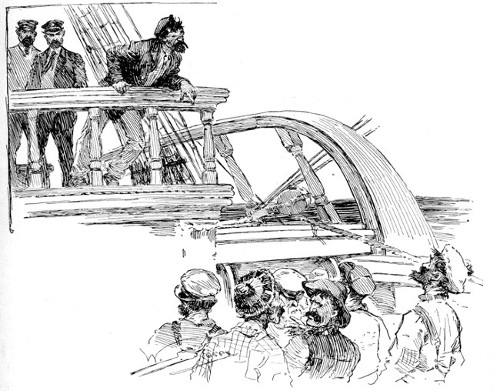 "HE ADDRESSED THE CROWD FROM THE POOP."
By the time they picked up the north-east trades poor old Smith owed the
"owner" ten thousand pounds. Ware was five thousand to the good, and Brose,
who had played poker in California, was worth fifteen thousand in strange
paper. He began to dream of a row of houses with a public-house at each
end. He and Geordie grew quite thick and compared public-house ideals.
"I'm goin' to buy a hotel," said Geordie; "there's one in Trafalgar
Square, London, as I've in my mind. I'll fit up the bar till it fair blazes
with golden bottles."
He borrowed the mate's clothes and had a roaring time, and then they came
into the Channel and picked up a tug, and went round the Foreland into
London river.
"I'll bet lawyers and so on will be down to meet me," said Geordie.
"They'll be full up with gold. To think of it! And to think I hit my poor
old uncle with a brick!"
He mourned over his brutality.
"He wasn't half a bad chap," he said, "and I don't see what call my dad had
to call him a bloodsucker after all."
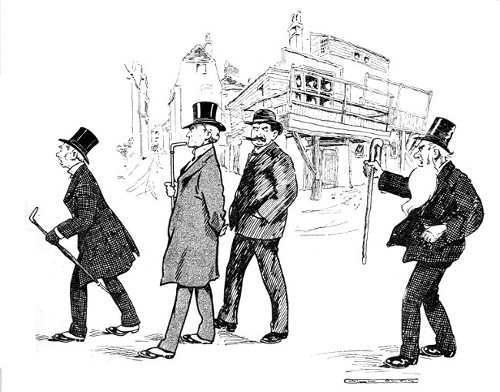
They docked in the South-West Dock, and sure enough they had not been
alongside their berth five minutes before old Tyser's usual London agent
and a very legal-looking person came on board.
"Let me introduce you to the new owner," said the obsequious skipper, as he
led up Geordie, who had a smile on him large enough to cut a mainsail out
of.
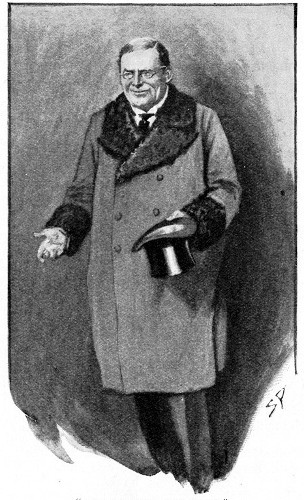
"Oh," said the lawyer, "then this is Mr. Potts?"
"That's me," said Geordie. "Have you brought any money with you? I owes Mr.
Ware five thousand and Mr. Brose fifteen."
The lawyer smiled.
"I'm afraid there's some mistake, Mr. Potts. Your uncle left a will after
all."
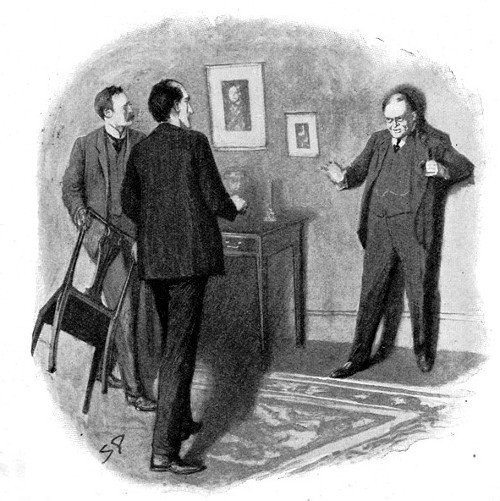
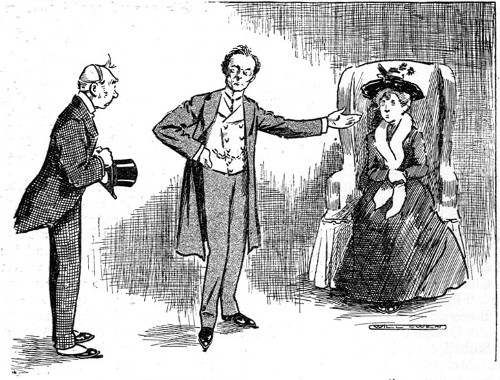
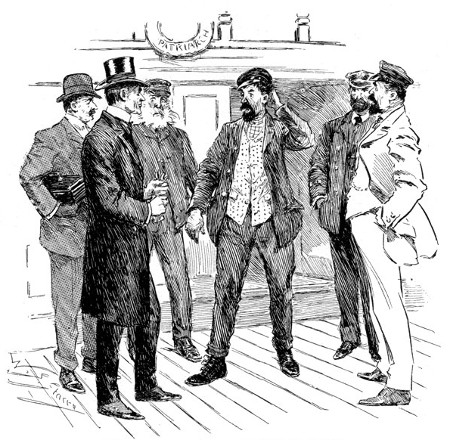 "I'M AFRAID THERE'S SOME MISTAKE, MR. POTTS."
Geordie's jaw dropped and so did Ware's. But Brose's fell as falls the
barometer in the centre of a cyclone.
"And me—did he leave me nothin'?" roared Geordie.
"Oh, yes," said the solicitor. "Mr. Gray, will you kindly give me that
cash-box you are carrying?"
And the agent handed him the cash-box. "He left you this," said the lawyer.
"And in this sealed envelope is the key."
Geordie grabbed the box eagerly.
"It's heavy," he said, "it's tolerable heavy."
And putting it on the rail he opened it with the key.
There was half a brick in it.
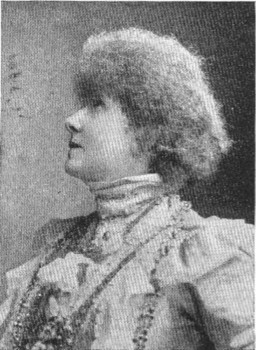
 SARAH BERNHARDT, AT THE AGE OF TWELVE, AND HER MOTHER.