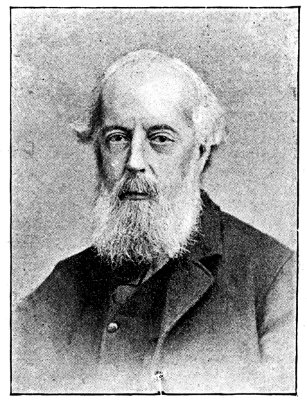
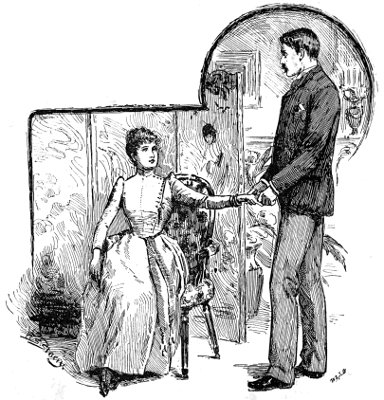
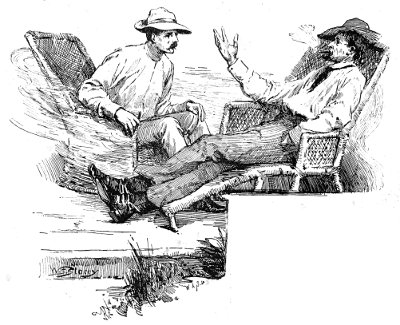
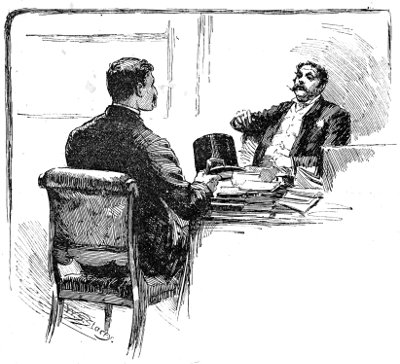
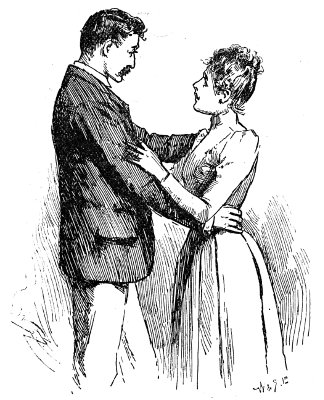
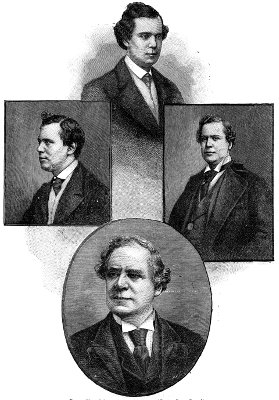
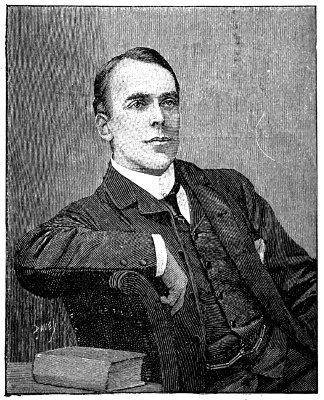
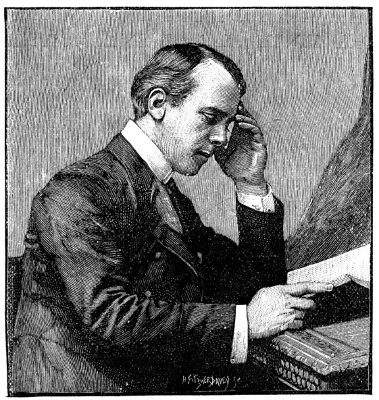
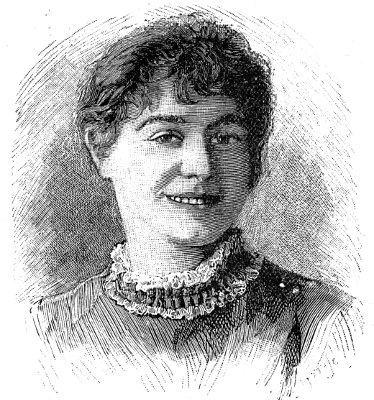
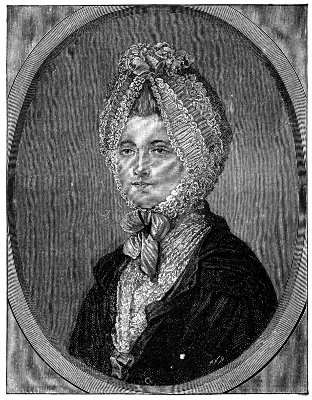
[Count Villiers de l'isle-Adam, who lives at Paris, where he edits the Revue des Lettres et des Arts,
is one of several living French writers who have made a special study of short stories. He is a highly
original writer, and, although as yet quite unknown to English readers, an extremely powerful one. Many of
his stories are such as could have been written by no one but himself; but probably he approaches more
nearly to Edgar Allan Poe than to any other English author.]
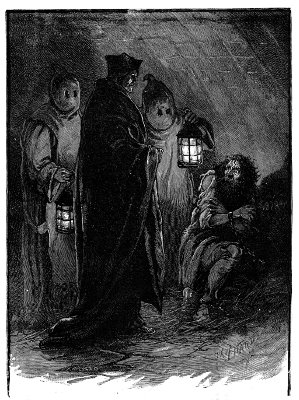
Below the vaults of the Official
of Saragossa one nightfall
long ago, the venerable
Pedro Arbuez d'Espila, sixth
Prior of the Dominicans of
Segovia, third Grand Inquisitor
of Spain—followed by a fra redemptor
(master-torturer), and preceded by two
familiars of the Holy Office holding lanterns—descended
towards a secret dungeon.
The lock of a massive door creaked; they
entered a stifling in pace, where the little
light that came from above revealed an instrument
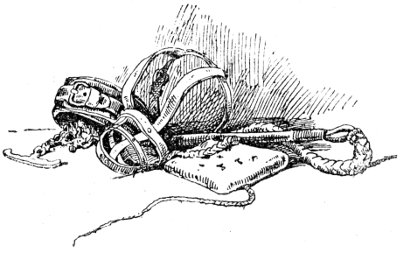
of torture blackened with blood,
a chafing-dish, and a pitcher. Fastened to
the wall by heavy iron rings, on a mass of
filthy straw, secured by fetters, an iron
circlet about his neck, sat a man in rags:
it was impossible to guess at his age.
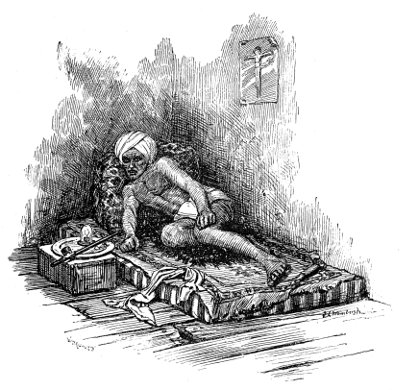
This prisoner was no other than Rabbi
Aser Abarbanel, a Jew of Aragon, who, on
an accusation of usury and pitiless contempt
of the poor, had for more than a
year undergone daily torture. In spite of
all, "his blind obstinacy being as tough as
his skin," he had refused to abjure.
Proud of his descent and his ancestors—for
all Jews worthy of the name are jealous
of their race—he was descended, according
to the Talmud, from Othoniel, and consequently
from Ipsiboe, wife of this last
Judge of Israel, a circumstance which had
sustained his courage under the severest of
the incessant tortures.
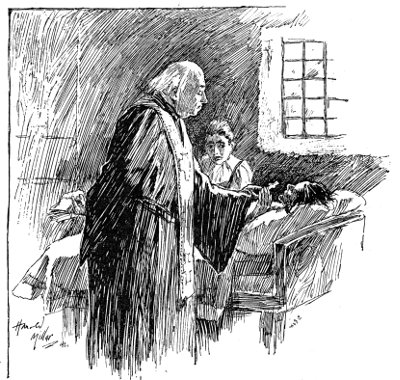
It was, then, with tears in his eyes at the
thought that so stedfast a soul was excluded
from salvation, that the venerable Pedro
Arbuez d'Espila, approaching the quivering
Rabbi, pronounced the following words:—
"My son, be of good cheer; your trials
here below are about to cease. If, in presence
of such obstinacy, I have had to
permit, though with sighs, the employment
of severe measures, my task of paternal
correction has its limits. You are the
barren fig-tree, that, found so oft without
fruit, incurs the danger of being dried up
by the roots ... but it is for God alone to
decree concerning your soul. Perhaps the
Infinite Mercy will shine upon you at the
last moment! Let us hope so. There are
instances. May it be so! Sleep, then, this
evening in peace. To-morrow you will
take part in the auto da fé, that is to say,
you will be exposed to the quemadero, the
brazier premonitory of the eternal flame.
It burns, you are aware, at a certain distance,
my son; and death takes, in coming,
two hours at least, often three, thanks to
the moistened and frozen clothes with
which we take care to preserve the forehead
and the heart of the holocausts. You
will be only forty-three. Consider, then,
that, placed in the last rank, you will have
the time needful to invoke God, to offer
unto Him that baptism of fire which is
of the Holy Spirit. Hope, then, in the
Light, and sleep."
As he ended this discourse, Dom Arbuez—who
had motioned the wretched man's
fetters to be removed—embraced him tenderly.
Then came the turn of the fra
redemptor, who, in a low voice, prayed
the Jew to pardon what he had made him
endure in the effort to redeem him; then
the two familiars clasped him in their arms:
their kiss, through their cowls, was unheard.
The ceremony at an end, the captive was
left alone in the darkness.
Rabbi Aser Abarbanel, his lips parched,
his face stupefied by suffering, stared, without
any particular attention, at the closed
door. Closed? The word, half unknown
to himself, awoke a strange delusion in his
confused thoughts. He fancied he had
seen, for one second, the light of the lanterns
through the fissure between the sides
of this door. A morbid idea of hope, due
to the enfeeblement of his brain, took hold
on him. He dragged himself towards this
strange thing he had seen; and, slowly inserting
a finger, with infinite precautions,
into the crack, he pulled the door towards
him. Wonder of wonders! By some extraordinary
chance the familiar who had
closed it had turned the great key a little
before it had closed upon its jambs of stone.
So, the rusty bolt not having entered its
socket, the door rolled back into the cell.
The Rabbi ventured to look out.
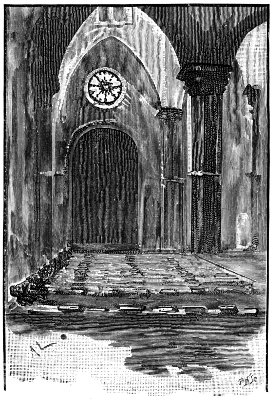
By means of a sort of livid obscurity he
distinguished, first of all, a half-circle of
earthy walls, pierced by spiral stairways,
and, opposite to him, five or six stone steps,
dominated by a sort of black porch, giving
access to a vast corridor, of which he could
only see, from below, the nearest arches.
Stretching himself along, he crawled to
the level of this threshold. Yes, it was
indeed a corridor, but of boundless length.
A faint light—a
sort of
dream-light—was
cast over
it; lamps suspended
to the
arched roof,
turned, by intervals,
the
wan air blue;
the far distance
was lost
in shadow.
Not a door
visible along
all this length!
On one side
only, to the
left, small
holes, covered
with a network
of bars, let a
feeble twilight
through the
depths of the
wall—the light
of sunset apparently,
for
red gleams fell
at long intervals
on the
flag-stones.
And how fearful
a silence!...
Yet there—there
in the
depths of the
dim distance—the
way might lead to liberty! The wavering hope
of the Jew was dogged, for it was the last.
Without hesitation he ventured forth,
keeping close to the side of the light-holes,
hoping to render himself indistinguishable
from the darksome colour of the long walls.
He advanced slowly, dragging himself along
the ground, forcing himself not to cry out
when one of his wounds, recently opened,
sent a sharp pang through him.
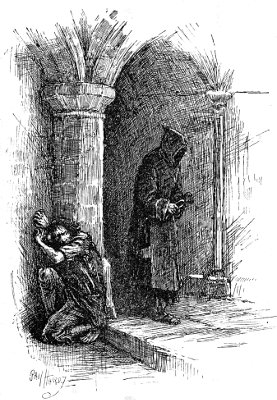
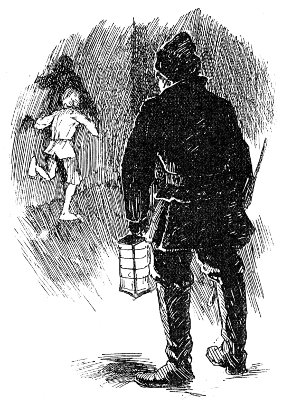
"IT WAS A FAMILIAR HURRYING ALONG."
All of a sudden the beat of a sandal,
coming in his direction, echoed along the
stone passage. A trembling fit seized him,
he choked with anguish, his sight grew dim.
So this, no doubt, was to be the end! He
squeezed himself, doubled up on his hands
and knees, into a recess, and, half dead with
terror, waited.
It was a familiar hurrying along. He
passed rapidly, carrying an instrument for
tearing out the
muscles, his
cowl lowered;
he disappeared.
The
violent shock
which the
Rabbi had received
had half
suspended the
functions of
life; he remained
for
nearly an hour
unable to
make a single
movement. In
the fear of an
increase of torments
if he
were caught,
the idea came
to him of returning
to his
cell. But the
old hope chirped
in his soul—the
divine
"Perhaps,"
the comforter
in the worst of
distresses. A
miracle had
taken place!
There was no
more room for
doubt. He began
again to
crawl towards
the possible escape. Worn out with suffering
and with hunger, trembling with
anguish, he advanced. The sepulchral
corridor seemed to lengthen out mysteriously.
And he, never ceasing his slow
advance, gazed forward through the darkness,
on, on, where there must be an outlet
that should save him.
But, oh! steps sounding again; steps, this
time, slower, more sombre. The forms of
two Inquisitors, robed in black and white,
and wearing their large hats with rounded
brims, emerged into the faint light. They
talked in low voices, and seemed to be in
controversy on some important point, for
their hands gesticulated.
At this sight Rabbi Aser Abarbanel
closed his eyes, his heart beat as if it would
kill him, his rags were drenched with the cold
sweat of agony; motionless, gasping, he
lay stretched along the wall, under the light
of one of the lamps—motionless, imploring
the God of David.
As they came opposite to him the two
Inquisitors stopped under the light of the
lamp, through a mere chance, no doubt, in
their discussion.
One of them, listening
to his interlocutor,
looked
straight at the
Rabbi. Under
this gaze—of
which he did not
at first notice the
vacant expression—the
wretched
man seemed to
feel the hot pincers
biting into
his poor flesh;
so he was again
to become a living
wound, a living
woe! Fainting,
scarce able to
breathe, his eyelids
quivering, he
shuddered as the
robe grazed him.
But—strange at
once and natural—the
eyes of the
Inquisitor were evidently the eyes of a man
profoundly preoccupied with what he was
going to say in reply, absorbed by what he
was listening to; they were fixed, and
seemed to look at the Jew without seeing
him.
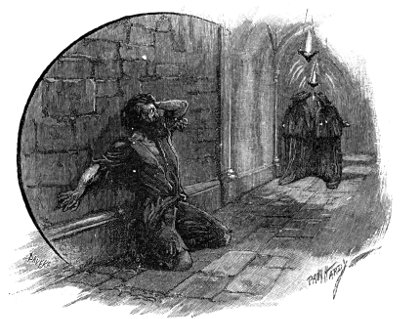
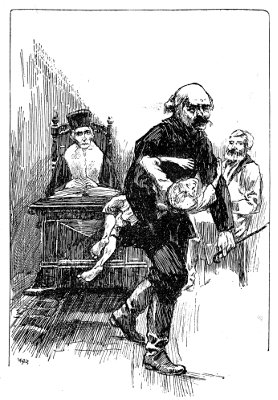
"THEY HAD NOT SEEN HIM!"
And indeed, in a few minutes, the two
sinister talkers went on their way, slowly,
still speaking in low voices, in the direction
from which the prisoner had come. They
had not seen him! And it was so, that, in
the horrible disarray of his sensations, his
brain was traversed by this thought: "Am
I already dead, so that no one sees me?"
A hideous impression drew him from his
lethargy. On gazing at the wall, exactly
opposite to his face, he fancied he saw, over
against his, two ferocious eyes observing
him! He flung back his head in a blind
and sudden terror; the hair started upright
upon his head. But no, no. He put out
his hand, and felt along the stones. What
he saw was the reflection of the eyes of the
Inquisitor still left upon his pupils, and
which he had refracted upon two spots of
the wall.
Forward! He must hasten towards that
end that he imagined (fondly, no doubt) to
mean deliverance; towards those shadows
from which he was no more than thirty
paces, or so, distant. He started once more—crawling
on hands and knees and stomach—upon
his dolorous way, and he was
soon within the dark part of the fearful
corridor.
All at once the wretched man felt the
sensation of cold upon his hands that he
placed on the flag-stones; it was a strong
current which came from under a little
door at the end of the passage. O God, if
this door opened on the outer world! The
whole being of the poor prisoner was overcome
by a sort of vertigo of hope. He
examined the door from top to bottom
without being able to distinguish it completely
on account of the dimness around
him. He felt over it. No lock, not a bolt!
A latch! He rose to his feet; the latch
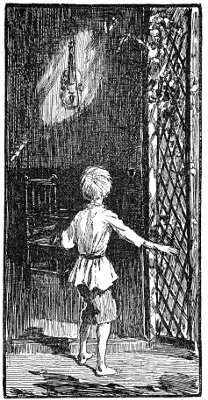
yielded beneath his finger; the silent door
opened before him.
"Hallelujah!" murmured the Rabbi, in
an immense sigh, as he gazed at what stood
revealed to him from the threshold.
The door opened upon gardens, under a
night of stars—upon spring, liberty, life!
The gardens gave access to the neighbouring
country that stretched away to the
sierras, whose sinuous white lines stood out
in profile on the horizon. There lay
liberty! Oh, to fly! He would run all
night under those woods of citrons, whose
perfume intoxicated him. Once among
the mountains, he would be saved. He
breathed the dear, holy air; the wind
re-animated him, his lungs found free play.
He heard, in his expanding heart, the
"Lazarus, come
forth!" And,
to give thanks
to God who had
granted him this
mercy, he
stretched forth
his arms before
him, lifting his
eyes to the firmament
in an
ecstasy.
And then he
seemed to see
the shadow of
his arms returning
upon himself;
he seemed
to feel those
shadow-arms
surround, enlace
him, and himself
pressed tenderly
against some
breast. A tall
figure, indeed, was opposite to him.
Confidently he lowered his eyes upon this
figure, and remained gasping, stupefied,
with staring eyes and mouth drivelling
with fright.
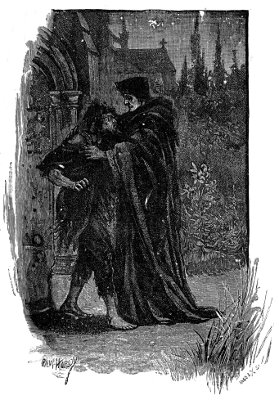
Horror! He was in the arms of the
Grand Inquisitor himself, the venerable
Pedro Arbuez d'Espila, who gazed at him
with eyes full of tears, like a good shepherd
who has found the lost sheep.
The sombre priest clasped the wretched
Jew against his heart with so fervent a
transport of charity that the points of the
monacal hair-cloth rasped against the chest
of the Dominican. And, while the Rabbi
Aser Abarbanel, his eyes convulsed beneath
his eyelids, choked with anguish between
the arms of the ascetic Dom Arbuez,
realising confusedly
that all
the phases of
the fatal evening
had been
only a calculated
torture,
that of Hope!
the Grand Inquisitor,
with a
look of distress,
an accent of
poignant reproach,
murmured
in his
ear, with the
burning breath
of much fasting:—"What!
my child! on
the eve, perhaps,
of salvation ... you
would then
leave us?"
How the Blind are Educated.
By Edward Salmon.
How many of the thousands
who go every year to the
Crystal Palace remember, or
even know, that hard by is
an institution which should
claim the support of all who
have hearts to feel for the afflictions of their
fellows? Perhaps if some of us, on pleasure
bent, knew as much of the working of the
Royal Normal College for the Blind as we
do of the neighbouring giant palace of
glass, we should appreciate the blessing of
sight at a truer value. It is to be feared
that few who go through life noting its
facts, observing the beauties of Nature,
regarding the faces of those they love, and
transacting their private business without
help from other people's eyes, give the
thought they ought to the precious nature
of the vision they boast, however limited
it may be. Still fewer are they who take
the trouble to inquire what is being done
for those who share not the glories of God's
light. Yet to be plunged in a lifelong
darkness; to be doomed, whilst breath lasts,
to a constant round of blind man's bluff; to
be able to walk, but not to see where one is
going; to be able to talk, but not to know,
by the expression of another's face, whether
one's remarks are welcomed or not; to be
able to listen, and not to watch the speaker—in
a word, to be robbed of half life's joys,
is surely a fate which should command
sympathy, prompt, practical, and universal.
The writer of this paper has, during the
last twelve or thirteen years, been more or
less intimately associated with the blind.
Nothing ever strikes him as more extraordinary
than the genuine happiness of
most of them. What ought, it would
seem, to have proved a crushing blow, has
apparently had little or no effect on the
brightness of their lives. Nor does the
infirmity prove any great bar to their independence.
Think of, among many others,
Milton undertaking his "Paradise Lost," his
history of England, and his Latin dictionary
after he became blind; of Philip Bourke
Marston—whose sorrows were not primarily
due to his affliction—mastering the typewriter,
so that he could communicate with
his friends and produce his poems without
the aid of an amanuensis; of Henry
Fawcett, who refused to allow the accident
which cost him his sight, to change his life,
and who not only kept up his riding and his
fishing, but won his way to Cabinet
rank. To men like Mr. Fawcett, no doubt
the possession of a life's partner means much,
and indeed ample material exists for an
interesting article on the wives of blind
men, who have been to them what Francis
Huber's was to him—"A good pair of eyes,
a right hand in all his troubles, and a light
for his darkest days."
We are, however, not now concerned
with blind men but with blind boys and
girls, and with those especially who are
receiving their education at the Royal
Normal College at Upper Norwood. This
institution owes its existence to two men,
whose efforts on behalf of their fellow-sufferers
cannot be too gratefully acknowledged—to
the late Dr. Armitage, and to
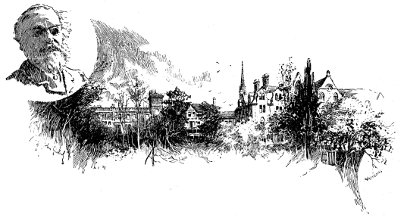
Dr. Campbell, the president, whose portrait,
together with a picture of the college, is
shown at the head of this paper. The meeting
of these gentlemen in London some twenty
years ago revolutionised the whole system
of education for the sightless. Dr. Armitage
spared no trouble, no money, no time
to advance the interests of the blind, and
it was a fortunate circumstance which threw
one so ready to place his energy and his
wealth at their disposal,
in contact with another
who, like Dr. Campbell,
wanted only such support
to enable him to
enter on the experiment
of helping the blind to
take their part in life's
battle with the confidence
and the same
chances of success and
independence as the
seeing. How completely
they worked
together is shown by a
little anecdote which
Dr. Campbell is fond
of relating. They had
been to a conference
at York, and, as was
their custom, travelled
third-class. Some other
congressmen, with firstclass
tickets, were considerably
astonished,
and exclaimed:—
"What, are you going third-class?"
Dr. Armitage's reply was characteristic
of the practical and cheery kindliness of the
man.
"Campbell and I have too many children
to be able to afford to travel first," he said.
"Have you a large family, doctor?"
asked one of his friends in surprise.
"Yes," he answered, "our English family
alone numbers about 32,000, and they have
relatives in all parts of the world."
The moral was plain. The few shillings
Dr. Armitage and his colleague were saving,
were destined to assist the work of amelioration,
and the gentlemen paid them a
chivalrous and graceful compliment by
exchanging their tickets and travelling in
the same compartment with the two benefactors
and servants of blind humanity.
THE LATE DR. ARMITAGE.
To such self-denying spirits as these is
England indebted for the institution which
forms the subject of this paper. The régime
adopted by Dr. Campbell—who by the way
it should be said is an American—was flat
rebellion against the systems previously in
vogue, and still maintained by other bodies.
Dr. Campbell's belief in physical training
amounts to a religion. He does everything
with reference to it and it alone. A quarter
of a century ago he himself was to have
died of consumption, but what did he do?
Quietly sit down and wait for the end to
come? No; blind as he was, he took the boat
to Europe and climbed
Mont Blanc. There are
a good many thousands
in the world who would
like to have the health
he enjoys to-day. What
physical exercise has
done for him, he believes
it will invariably
do for his pupils. Determination
to conquer
obstacles is the only
thing which will make
a two-legged creature a
man or woman, he says;
determination is only
possible to a vigorous
and healthy mind; a
vigorous and healthy
mind can only come of
a vigorous and healthy
body; and a man who
has not been trained
physically, is, to Dr.
Campbell, an engine
without motive power.
The outcome of the adoption of such ideas
is that the blind boys and girls at the Normal
College, like Dr. Campbell himself, are selfreliant,
cheerful, and healthy, and seen
trotting about the beautiful grounds of the
College, no one would ever think they
are sightless. The manner in which Dr.
Campbell leads the way from his house to any
part of the grounds is somewhat disquieting
to those who do not know him. He walks
without stick, and without stumbling, and
runs up and down flights of steps without
troubling even to grasp the rail at the side.
How can he tell when he reaches a corner
or the top of a flight of steps, to tumble
down which would be to break his neck?
He learns where he is by the most ingenious
contrivance imaginable. Wherever there
is a turning, or an obstacle, or a step which
might prove a source of danger or embarrassment,
the asphalted pathway is
slightly raised. It is high enough to prevent
one's stepping over it without noticing
it; it is too low to cause one to catch one's
toe and trip up. Hence, it is only necessary
for the blind promenader to keep his or her
wits moderately alive to be able to go
wherever he or she pleases in perfect ease
and safety.
The Armitage Gymnasium, which we
visit first, is declared by an expert to be
one of the most complete he has ever seen.
Lads of all ages are going through every
form of exercise; here two or three are
vaulting the horse with a neatness incredible
almost to those who have not seen it; there
another is working his way along the
parallel bars; here one stretches himself at
length on the long incline, a machine used
for pulling up one's own weight, for
strengthening the muscles and broadening
the chest; there another turns a
nautical wheel or is doing a mile or
two on a home trainer. This last is
calculated to inspire more enthusiasm
among the
lads than any
other athletic or
gymnastic feat.
Ordinary home
trainers, of course,
have a dial which
indicates the distance
ridden. In
order that his
boys, even in such
a matter, should
be made as independent
of other
people's eyes, as it
is the object of the
school to make
them in all details
of life, Dr. Campbell
has had fitted
to the machine a
bell which strikes
at the completion
of every quarter of
a mile. How this broad-shouldered, strong-limbed
lad astride it works away with might
and main, bent, apparently, on making a
record; how keenly he enjoys the effort, and
how utterly and happily oblivious he seems
of the fact that he is not as the majority of
his fellows are!
RINKING.
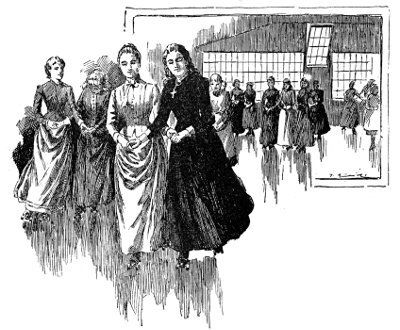
From the boys' gymnasium let us make
our way to the girls', where roller-skating
is going on. It is an apartment some
24 feet long by some 18 wide. Here are a
dozen or more girls moving on the tiny
wheels rapidly round and round. They
touch neither the wall nor the seats by the
wall, whilst the immunity from collisions
induces one to exclaim: "Surely here we
are not in the presence of the totally blind,
whatever may have been the case in the
gymnasium." We are, indeed. But how
is it these sightless young ladies move so
rapidly, and yet with a safety and precision
which might make their seeing sisters
envious of their skill? Solely by instinct
and practice. When roller-skating was
first introduced, Dr. Campbell had
electric bells ringing on the walls, but
he has now accustomed his pupils to
do without these disturbing guides, and
for all the spectator can see they find no
sort of inconvenience from their reliance
on their own senses. Here they go two
and two, three and
three, hands locked in
hands, with smiling
faces bespeaking infinite
enjoyment. Nor does
their accomplishment
on the skates begin and
end in what we now
see. They have been
trained with the most
perfect care, and are
capable of going through the most involved
manœuvres. Those who observe them
skating in lines, parting, wheeling, crossing
and recrossing each other's paths, may
imagine that this sort of performance is
only possible in their own rink, but last
year I had a privileged opportunity, at
St. James's Hall, of seeing that they are as
much under control in a strange place and
in the presence of a considerable public as
in their own grounds. Moving solely by
word of command, they go within a few
inches of obstacles in entire safety. It is a
performance, the wonder of which can only
be appreciated by those who have watched it.
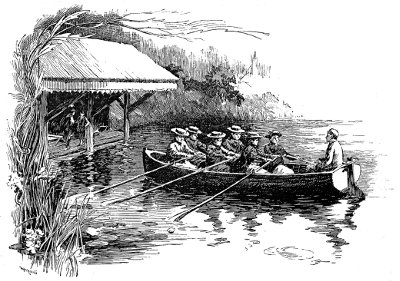
ON THE LAKE.
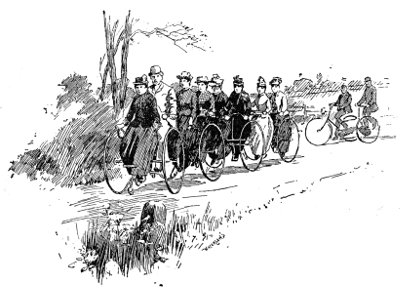
CYCLING.
Making our way now towards
the other end of the beautiful
grounds of the College, we come
to a small lake which Dr. Campbell
has constructed. On it is a
boat containing
eight girls, who
dip their oars
"with a long, long
pull and a strong,
strong pull," not
unworthy of the
men who sang to
the midship-mite.
Dr. Campbell—who
stops short
only at pure
miracles—does
not expect a blind child
to steer a boat round
and about a lake. Consequently
a person with
eyes occupies the stern
seat. So, too, with
tricycling. Some people,
carried off their balance
by the marvels which he
introduces to them, have
given publicity to the
statement that blind girls
and boys go careering away
together on a machine.
So they do, but they are
invariably steered by someone who can
see. To have such a person with every
blind rider, however, would mean the
employment of an immense number of
people. An eight-in-hand is, therefore,
devised, and this machine may often be
seen on the country roads of England,
carrying its seven sightless riders. They
go out for a twenty-mile spin,
have tea at a country inn, and
come back tired and ready for
bed. Dr. Campbell and his
good wife are both riders, whilst
Dr. Campbell and his
son have together done
their 1,000 miles on the
tricycle. The Doctor
gives an amusing account
of a tour in
Norway. His tricycle was probably among
the first seen by the Norwegian peasant, and
he relates how one man with a pony-cart
on a country road followed them for hours,
and when they put up at an inn and wanted
water, how he ran off to get some from the
mountain spring as joyously as though the
tricyclists had been creatures of a celestial
world, and how, when they were having
their feed at the inn, this rapt admirer rang
the bell of the machine, to the delight of
a crowd of enthusiastic onlookers.
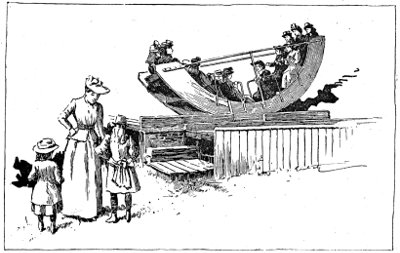
Other forms of outdoor amusement and
recreation to be seen at the College are
swinging, running, skittles, and the rocking-boat.
Ingenuity is the
characteristic of everything
we examine. How,
for instance, can the blind
play skittles, you may well
ask? Thus: The men
are placed at the end of a
long platform, and are
prevented from rolling
away by a cord which
passes through a hole in
the board and holds them
where they
fall. The
ball having
rolled to the
end of the
platform,
drops over
on to a
slope, and
returns to
the players.
So having made a
shot, they can find
out how many
men have been
bowled over, and
there is never any
risk of losing the
ball. Whilst
several boys
amuse themselves
in this way, a
dozen girls get
into the rocking-boat
close by, and
as they swing
themselves backwards
and forwards
sing softly
and melodiously
to the roll of the
boat.
THE ROCKING-BOAT.
Even now we have not exhausted the
possibilities of enjoyment which the grounds
afford the pupils of the College. During the
summer time many of the girls have their
little plot of flower garden. They take the
greatest interest in the cultivation of plants
which they cannot see, and to place in their
bosoms a flower which they have grown
themselves, is one of the delights of their
lives.
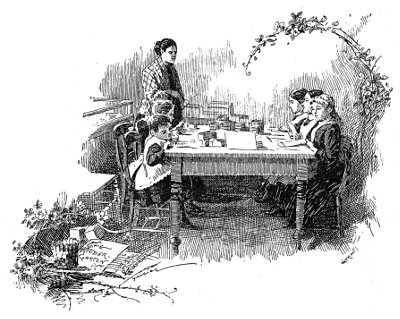
THE KINDERGARTEN.
So much for what Dr. Campbell properly
regards as the generation of the motive
power of his young people's lives. The
steam being ready, along what lines does
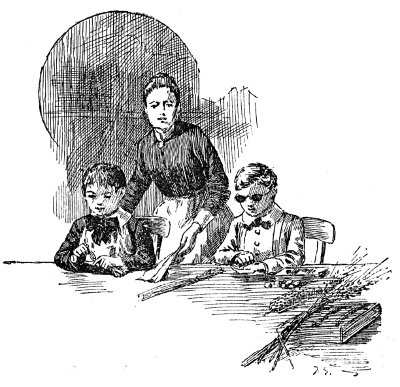
he make the human engine travel? We
start with the Kindergarten class. Half a
dozen little girls are sitting at a table interweaving
slit paper which presently is to
decorate baskets and other things. One is
a mite recently from Port Elizabeth, South
Africa. She has mastered the theory of
her work, and her little fingers only need
practice to make them as efficient as
those of her older companions. In this
room is a glass case containing some
clay models of pea-pods, buttercups,
and other things that grow—which one
would imagine they could never readily
grasp in detail—every one executed by the
pupils of the College. Even a small dog
has not proved
beyond the
powers of these
magic modellers.
From the Kindergarten
to the
Geography class.
Embossed maps
lie on the table,
and the pupils
put their fingers
on The Wash in
England, or on
the Andes, or on
Tasmania, as
quickly almost as
one's eyes can
travel from point
to point. They
answer questions
as to what grows
in a certain place, or who discovered
it, accurately and readily.
Other classes are learning geometry,
the rudiments of agriculture,
French and arithmetic.
The reading class is one of the
most interesting. Books in the
Braille system lie before the
pupils, who are running their
fingers deftly over the mass of
dots, and delivering passages
from "Hamlet," with sufficient
hesitation to prove the genuineness
of the reading, and yet with
an intelligence not always displayed
by those with eyes who
read Shakespeare aloud. Now
and again the pupil comes to a
word such as "Fortinbras," and it gives
her just a moment's pause, creating an impression
on one's mind of difficulties overcome,
which only naïveté or the highest
art could convey. Some idea of the extraordinary
pains necessary to teach the
Braille system—and it is unquestionably
the best invented—may be gleaned from
the fact that it has to be written backwards.
For instance, the paper is placed
between two strips of brass, the under
strip being impressed with a succession
of holes, and the upper divided into small
squares through which the stylus or punch
is passed.
CARPENTERING AND PIANO-MENDING.
As the writing has to be done from the
back of the paper, it is easy to understand
that the reading runs in the opposite
direction—a circumstance adding immensely
to the labour of the learner. All
sorts of contractions have
of course been adopted, and
the blind write from dictation
certainly as fluently as
the ordinary school-boy,
and they can read what
they have written
more fluently, for the average
school-boy reads
things better than his
caligraphy. In the same
way the most difficult sums
are done by means of a
type board, and it
simply astounding
how rapidly the pupils write down figures
delivered as units and read them off as billions,
millions, or hundreds of thousands.
The angle of a cypher, which might play
the part of a hyphen in ordinary type, alone
tells them what numeral
is intended. As one
watches this one realises
the force of Mr. W. W. Fenn's words:—"Give
the blind man in his fingers an
equivalent for his eyes, and the darkness
in which he lives is dispelled." On this
condition the Normal School at Norwood
is a veritable creator of light.
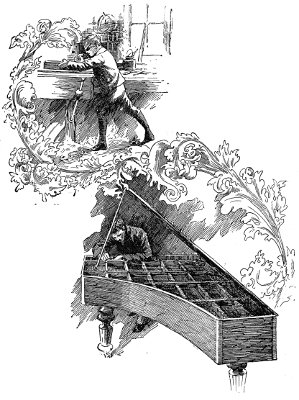
Let us now take a glance at the workshop,
where the boys are using plane and chisel,
pointing and dovetailing pieces of wood which
not only answer ends in themselves, but the
treatment of which serves to make the blind
useful with their hands. They seldom cut
their fingers, extra care no doubt giving
greater immunity. Another workshop near
at hand is occupied by young men perfecting
themselves in all the branches of pianoforte
making and tuning. They learn to
do everything, from tightening a wire to
putting a new one in, and hundreds of testimonials
from those who have employed
blind tuners speak for the thoroughness with
which they do their work. To enable the
learners to familiarise themselves with the
parts of an instrument, Messrs. Broadwood
made specially for them a model which can
be taken to pieces and put together again
till they know all about it. The interest
which Messrs. Broadwood have shown in the
College has assumed very practical shape,
and it is noteworthy that among the employés
of the firm is an old pupil of Dr.
Campbell's.
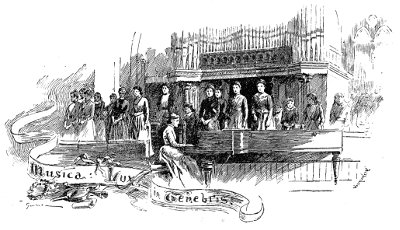
Musica: Lux in Tenebris.
Music of course is the principal means of
gaining a livelihood with the blind. An
organ recital and some glees fittingly bring
this succession of wonders to a close so far
as the visit to the College is concerned, but
really only lands us on the verge of the
great question of life after the College training
is ended. Throughout the world blind
musicians, who owe their education and
their skill to Dr. Campbell and his wife, are
earning their own livelihoods. In 1886 the
aggregate earnings of ex-pupils amounted to
nearly £10,000. Last year the sum was
£15,000. This great result, however, has
been accomplished in the teeth of a mountain
of prejudice, ignorance, and I must
add injustice, to surmount which has cost
Dr. Campbell a mightier effort than the
ascent of Mont Blanc. All he asks on
behalf of his pupils is a fair field: he wants
no favour. Two instances of the difficulty
of securing even this may be given. An
organist was wanted for a large church; Dr.
Campbell was anxious that one of his pupils
should compete. From the first the authorities
declared it was impossible a blind man
could hold the position, and to make it
impossible the candidates were to be called
on to play any two tunes from the hymn-book
which any two people in the congregation
might select. Here was a test which
it was believed would defeat the blind man's
chances. It reached Dr. Campbell's ears,
and he forthwith obtained a list of the
250 tunes which had been most sung in
that particular church during the last few
years, set his man to translate their score
into his own Braille, and to master them by
heart. The day of trial came, and the first
hymn called for was played by the blind
candidate not merely as it was written, but
with variations. The authorities marvelled,
but said it was chance. The second was
called, and still the blind man was ready.
"It's a miracle!" was the exclamation, but
the blind man won, and holds to-day, the
position competed for against not only the
world but the world's uncharitableness.
A second instance is equally eloquent of
the completeness with which these sightless
lads are equipped by Dr. Campbell to battle
with the world. An organist and choirmaster
was wanted, and the idea of putting
a blind man up for the post was scouted
as ludicrous. In the organ part of the
business, the blind candidate came out
indisputably first.
"But," said to him the gentleman with
whom the appointment rested, "you could
not possibly teach our boys."
"Is it fair to say I could not till you have
given me an opportunity of showing
whether I could or not?"
The only way to dispose of the claims of
this sightless irrepressible was to have the
boys in. He immediately put them
through their exercises, and handled them
in a way which argued greater knowledge
of what is wanted than most seeing masters
display. Some even of the rival candidates
declared the blind man to be the best
among them, and he secured the appointment,
to the advantage of all concerned.
In the old days the poor blind were educated
as beggars, and the more intelligent of
the indigent blind were appropriately nicknamed
by Theodore
Hook the indignant
blind.
Dr. Campbell does
not mind where
his pupils come
from. Whatever
they may be when
they are admitted
to the College,
there is only one
thing to be said of
nearly every one
of those who leave
it—they are ladies
and gentlemen in
education and deportment,
equally
able to earn their
own living and to grace the society in which
they may find themselves. Such a result
has been accomplished by terribly hard
work. Like Milton, Dr. Campbell "steers
right onward." He is a sort of Napier, and
only expects others to do what he does not
shrink from himself. He is the most kindly
of martinets. Blindness with him is no
reason for non-punctuality, and if a boy is
late in getting out of bed, he orders him to
retire at night half an hour earlier, so that
he may have the sleep he seems to need.
Such punishment is, we may be sure, felt
all the more keenly, because the doctor
himself sets the example of what is right.
For instance, every boy is supposed to be
ready for a swim in the splendid bath of the
College at a certain hour, and he cannot excuse
himself, even to his own mind, for being
absent or late on the score that the Doctor
enforces rules he does not carry out, for every
morning Dr. Campbell takes his plunge
with his scholars. He is determined that
in everything possible his boys and girls
shall go forth into the world unsurpassed
by their more fortunate brothers and sisters.
His efforts to rob the blind of any sense of
dependence on others, which they find so
humiliating—efforts which Dr. Armitage
fostered with such lavish generosity—and
to make them useful citizens instead of the
helpless recipients of local doles, are deserving
of a support which has hardly been
accorded to them. The Royal Normal
College for the Blind is a wondrous illustration
of the adage that even the darkest
cloud has its silver lining. Here, at least,
we find the drawbacks
consequent
on one of the
most appalling
of human infirmities
reduced to
a minimum. God
alone can restore
the light of day to
the brain from
which it is now
excluded, but that
He has delegated
to man the power
to do almost all
else, let the College
we have now
described so fully
bear witness.
Out of a Pioneer's Trunk.
By Bret Harte.
It was a slightly cynical, but
fairly good-humoured crowd
that had gathered before a
warehouse on Long Wharf in
San Francisco, one afternoon
in the summer of '51. Although
the occasion was an auction, the
bidders' chances more than usually hazardous,
and the season and locality famous for
reckless speculation, there was scarcely any
excitement among the bystanders, and a
lazy, half-humorous curiosity seemed to
have taken the place of any zeal for gain.
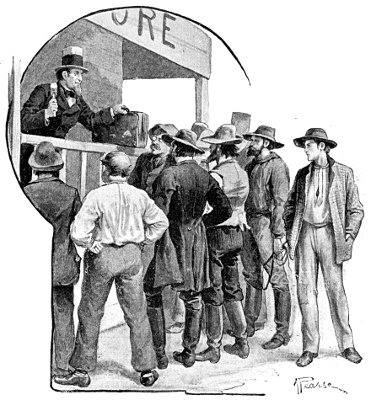
"IT WAS AN AUCTION OF UNCLAIMED TRUNKS AND BOXES."
It was an auction of unclaimed trunks
and boxes—the personal luggage of early
emigrants—which had been left on storage
in hulk or warehouse
at San Francisco, while
the owner was seeking
his fortune in the
mines. The
difficulty and
expense of
transport, often
obliging
the gold-seeker
to make part
of his journey
on foot, restricted
him to
the smallest
impedimenta,
and that of a
kind not often
found in the
luggage of ordinary
civilisation. As
a consequence, during
the emigration of '49,
he was apt on landing
to avail himself of the
invitation usually displayed
on some of
the doors of the rude
hostelries on the shore:
"Rest for the Weary
and Storage for
Trunks." In a majority
of cases he never
returned to claim his
stored property. Enforced
absence, protracted
equally by good
or evil fortune, accumulated the high storage
charges until they usually far exceeded the
actual value of the goods; sickness, further
emigration, or death also reduced the number
of possible claimants, and that more
wonderful human frailty—absolute forgetfulness
of deposited possessions—combined
together to leave the bulk of the property
in the custodian's hands. Under an understood
agreement they were always sold at
public auction after a given time. Although
the contents of some of the trunks were
exposed, it was found more in keeping with
the public sentiment to sell the trunks unlocked
and unopened. The element of
curiosity was kept up from time to time by
the incautious disclosures
of the lucky or unlucky
purchaser, and general
bidding thus encouraged—except
when the speculator,
with the true
gambling instinct,
gave no indication
in his face of what
was drawn in this
lottery. Generally,
however, some suggestion in the exterior
of the trunk, a label or initials; some
conjectural knowledge of its former owner,
or the idea that he might be secretly
present in the hope of getting his property
back for less than the accumulated dues,
kept up the bidding and interest.
A modest-looking, well-worn portmanteau
had been just put up at a small, opening
bid, when Harry Flint joined the crowd.
The young man had arrived a week before
at San Francisco friendless and penniless,
and had been forced to part with his
own effects to procure necessary food
and lodging while looking
for an employment. In
the irony of fate that
morning the proprietors
of a dry-goods store,
struck with his good looks
and manners, had offered
him a situation, if he
could make himself more
presentable to their fair
clients. Harry Flint
was gazing half
abstractedly, half
hopelessly, at the
portmanteau without
noticing the
auctioneer's persuasive
challenge.
In his abstraction
he was not aware
that the auctioneer's assistant
was also looking at
him curiously, and
that possibly his dejected and
half-clad appearance had excited
the attention of one of the
cynical bystanders, who was exchanging
a few words with the
assistant. He was, however, recalled to
himself a moment later when the portmanteau
was knocked down at fifteen dollars,
and considerably startled when the assistant
placed it at his feet with a grim smile.
"That's your property, Fowler, and I reckon
you look as if you wanted it back bad."
"But—there's some mistake," stammered
Flint. "I didn't bid."
"No, but Tom Flynn did for you. You
see, I spotted you from the first, and told
Flynn I reckoned you were one of those
chaps who came back from the mines dead
broke. And he up and bought your things
for you—like a square man. That's Flynn's
style, if he is a gambler."
"But," persisted Flint, "this never was
my property. My name isn't Fowler, and
I never left anything here."
The assistant looked at him with a grim,
half-credulous, half-scornful smile. "Have
it your own way," he said, "but I oughter
tell ye, old man, that I'm the warehouse
clerk, and I remember you. I'm here for
that purpose. But as that thar valise is
bought and paid for by somebody else and
given to you, it's nothing more to me.
Take or leave it."
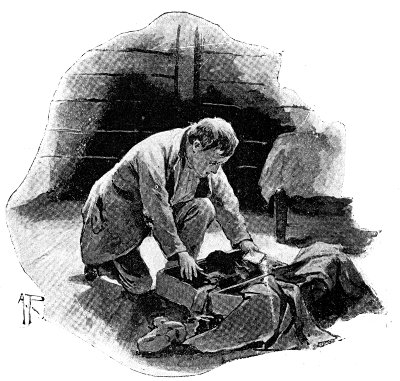
"HE EXAMINED ITS CONTENTS."
The ridiculousness of
quarrelling over the
mere form of his good
fortune here
struck Flint,
and, as his
abrupt benefactor
had as
abruptly disappeared,
he hurried off
with his prize. Reaching his cheap lodging-house,
he examined its contents. As he
had surmised, it contained a full suit of
clothing of the better sort, and suitable
to his urban needs. There were a few
articles of jewellery, which he put religiously
aside. There were some letters,
which seemed to be of a purely business
character. There were a few daguerreotypes
of pretty faces, one of which was
singularly fascinating to him. But there
was another, of a young man, which
startled him with its marvellous resemblance
to himself! In a flash of intelligence
he understood it all now. It was the likeness
of the former owner of the trunk,
for whom the assistant had actually mistaken
him! He glanced hurriedly at the
envelopes of the letters. They were addressed
to Shelby Fowler, the name by
which the assistant had just called him.
The mystery was plain now. And for the
present he could fairly accept his good luck,
and trust to later fortune to justify himself.
Transformed in his new garb, he left his
lodgings to present himself once more to
his possible employer. His way led past
one of the large gambling saloons. It
was yet too early to find the dry-goods
trader disengaged; perhaps the consciousness
of more decent, civilised
garb emboldened
him to
mingle more
freely with
strangers, and
he entered the
saloon. He
was scarcely
abreast of one
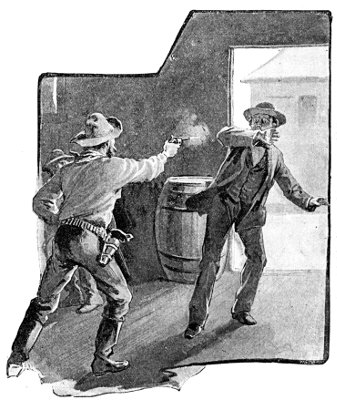
of the faro
tables when
man suddenly
leaped up with
an oath and
discharged a
revolver full
in his face.
The shot
missed. Before
his unknown
assailant could
fire again
the astonished
Flint
had closed
with him,
and instinctively
clutched
the weapon.
A brief but violent struggle ensued.
Flint felt his strength failing him, when
suddenly a look of astonishment came into
the furious eyes of his adversary, and the
man's grasp mechanically relaxed. The
half-freed pistol, thrown upwards by this
movement, was accidentally discharged
point blank into his temples, and he fell
dead. No one in the crowd had stirred or
interfered.
"You've done for French Pete this time,
Mr. Fowler," said a voice at his elbow. He
turned gaspingly, and recognised his strange
benefactor, Flynn. "I call you all to
witness, gentlemen," continued the gambler,
turning dictatorially to the crowd, "that this
man was first attacked and was unarmed."
He lifted Flint's limp and empty hands and
then pointed to the dead man, who was still
grasping the weapon. "Come!" He
caught the half-paralysed arm of Flint and
dragged him into the street.
"But," stammered the horrified Flint, as
he was borne along, "what does it all
mean? What
made that man
attack me?"
"I reckon it
was a case of
shooting on
sight, Mr.
Fowler; but
he missed it by
not waiting to
see if you were
armed. It
wasn't the
square thing,
and you're all
right with the
crowd now,
whatever he
might have had
agin you."
"But," protested
the unhappy
Flint,
"I never laid
eyes on the
man before,
and my name
isn't Fowler."
Flynn halted,
and dragged
him in a doorway.
"Who the devil are you?"
he asked roughly.
Briefly, passionately, almost hysterically
Flint told him his scant
story. An odd expression came over the
gambler's face.
"THE SHOT MISSED."
"Look here," he said abruptly, "I have
passed my word to the crowd yonder that
you are a dead-broke miner called Fowler.
I allowed that you might have had some
row with that Sydney Duck, Australian Pete,
in the mines. That satisfied them. If I go
back now, and say it's a lie, that your name
ain't Fowler, and you never knew who Pete
was, they'll jest pass you over to the
police to deal with you, and wash their
hands of it altogether. You may prove to
the police who you are, and how that d——
clerk mistook you, but it will give you
trouble. And who is there here who knows
who you really are?"
"No one," said Flint, with sudden hopelessness.
"And you say you're an orphan, and
ain't got any relations livin' that you're
beholden to?"
"No one."
"Then, take my advice, and be Fowler,
and stick to it! Be Fowler until Fowler
turns up, and thanks you for it; for you've
saved Fowler's life, as Pete would never
have funked and lost his grit over Fowler
as he did with you; and you've a right to
his name."
He stopped, and the same odd, superstitious
look came into his dark eyes.
"Don't you see what all that means? Well
I'll tell you. You're in the biggest streak
of luck a man ever had. You've got the
cards in your own hands! They spell
'Fowler'! Play Fowler first, last, and all
the time. Good-night, and good luck, Mr.
Fowler."
The next morning's journal contained an
account of the justifiable killing of the
notorious desperado
and ex-convict, Australian
Pete, by a
courageous young
miner by the name
of Fowler. "An act
of firmness and daring," said
The Pioneer,
"which will go far to
counteract the terrorism
produced by those
lawless ruffians."
In his new suit of
clothes, and with this
paper in his hand,
Flint sought the dry
goods proprietor—the
latter was satisfied
and convinced. That
morning Harry Flint
began his career as
salesman and as
"Shelby Fowler."
From that day
Shelby Fowler's
career was one of uninterrupted
prosperity.
Within the year
he became a partner.
The same miraculous
fortune followed other
ventures later. He was mill owner, mine
owner, bank director—a millionaire! He
was popular, the reputation of his brief
achievement over the desperado kept him
secure from the attack of envy and rivalry.
He never was confronted by the real Fowler.
There was no danger of exposure by others—the
one custodian of his secret, Tom
Flynn, died in Nevada the year following.
He had quite forgotten his youthful past,
and even the more recent lucky portmanteau;
remembered nothing, perhaps, but
the pretty face of the daguerreotype that
had fascinated him. There seemed to be no
reason why he should not live and die as
Shelby Fowler.
His business a year later took him to
Europe. He was entering a train at one of
the great railway stations of London, when
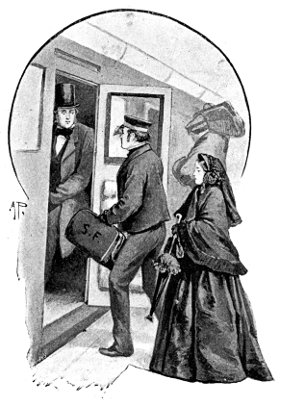
the porter, who had just deposited his portmanteau
in a compartment, reappeared at
the window followed by a young lady in
mourning.
"Beg pardon, sir, but I handed you the
wrong portmanteau. That belongs to this
young lady. This is yours."
"THE PORTER REAPPEARED AT THE WINDOW."
Flint glanced at the portmanteau on the
seat before him. It
certainly was not his,
although it bore the
initials "S. F." He
was mechanically
handing it back to
the porter, when his
eyes fell on the young
lady's face. For an
instant he stood petrified.
It was the face
of the daguerreotype.
"I beg pardon," he
stammered, "but are
these your initials?"
She hesitated, perhaps
it was the
abruptness of the
question, but he saw
she looked confused.
"No. A friend's."
She disappeared
into another
carriage, but
from that moment
Harry
Flint knew that
he had no other
aim in life but
to follow this
clue and the
beautiful girl
who had dropped it. He bribed the guard
at the next station, and discovered that she
was going to York. On their arrival, he
was ready on the platform to respectfully
assist her. A few words disclosed the fact
that she was a fellow-countrywoman,
although residing in England, and at present
on her way to join some friends at
Harrogate. Her name was West. At the
mention of his, he again fancied she looked
disturbed.
They met again and again; the informality
of his introduction was overlooked
by her friends, as his assumed name was
already respectably and responsibly known
beyond California. He thought no more
of his future. He was in love. He even
dared to think it might be returned; but
he felt he had no right to seek that knowledge
until he had told her his real name
and how he came to assume another's. He
did so alone—scarcely a month after their
first meeting. To his alarm, she burst
into a flood of tears, and showed an
agitation that seemed far beyond any
apparent cause. When she had partly recovered,
she said, in a low, frightened
voice:
"You are bearing my brother's name.
But it was a name that the unhappy boy
had so shamefully disgraced in Australia
that he abandoned it, and, as he lay upon
his death-bed, the last act of his wasted life
was to write an imploring letter begging
me to change mine too. For the infamous
companion of his crime who had first
tempted, then betrayed him, had possession
of all his papers and letters, many of
them from me, and was threatening to
bring them to our Virginia home and expose
him to our neighbours. Maddened
by desperation, the miserable boy twice
attempted the life of the scoundrel, and
might have added that blood guiltiness to
his other sins, had he lived. I did change
my name to my mother's maiden one, left
the country, and have lived here to escape
the revelations of that desperado, should he
fulfil his threat."
In a flash of recollection Flint remembered
the startled look that had come into
his assailant's eye after they had clinched.
It was the same man who had too late
realised that his antagonist was not Fowler.
"Thank God! you are for ever safe from
any exposure from that man," he said,
gravely, "and the name of Fowler has never
been known in San Francisco save in all
respect and honour. It is for you to take
back—fearlessly and alone!"
She did—but not alone, for she shared it
with her husband.
Anecdotes of the War Path
Irving Montagu
"One never can tell." This is
a world of change, and anything
beyond the limits of
the most fertile imagination
may happen to anyone, anywhere,
at any moment.
Were I a bellicose Bellamy, I might
incline towards "Looking backwards"
from the standpoint of a hundred years
hence, and thus, posing as a special of 1991,
might sigh for the shortcomings of the past,
and picture myself crossing, on an aërial
machine, the erst dark Continent (now lit
by electric light) at a pace which would
have even shattered the nerves of the
driver of an old Brighton express—"a
ponderous steam conveyance which, a hundred
years ago, succeeded the stage coach."
Again, I might suppose myself sending
sketches or despatches from remote battlefields
by means of "the electric communicator,"
a coil carried in one's portmanteau,
and which, by a simple mechanical arrangement—one
end being secured at the office
of your newspaper in Fleet-street or the
Strand—unwinds as you travel, so that,
wherever the fates have destined you to
go, you may be in immediate communication
with the editor of the journal you
represent; nay, more, the electric current
passing through your pen or pencil, simultaneously
producing copy or sketches with
a corresponding pen or pencil at the other
end. I say, were I a sort of bellicose
Bellamy, I might compare the possible
perfection of the future with the shortcomings
of to-day; but then, you see, I'm
not, and, though quite content to admit
that "one never can tell," I'm still more
disposed in these "Anecdotes of the War-path,"
by sticking to the practical present, to
convey some idea of the doings of correspondents
at the front.
To begin with, an iron constitution is the
best basis on which to build up the war
special, whose gifts with pen or pencil will
depend entirely on the diplomacy he possesses
by means of which to get to the
front himself, and, at the same time, keep
sufficiently in touch with the rear, to be
in perpetual communication with his own
headquarters at home.
I remember how one, otherwise most
brilliant Special, whose talent won for him
a reputation which he continues to enjoy,
came utterly to grief through want of that
tact which enabled others, during the siege
of Plevna, to get their articles and sketches
through. Between the slowly, very slowly
contracting girdle of Muscovite steel which
encircled that place and the Danube, there
was a perfectly free communication. The
historic bridge of boats was crossed without
difficulty, and, Roumania being thus reached,
one was in direct, uninterrupted correspondence
with the street beloved of Doctor
Johnson. The Special in question, however,
being assured by suave, courteous, and
in many cases English-speaking officers,
that the Russian Bear was the soul of
honour, and the Russian field-post the most
convenient mode of conveyance, put his
despatches into the military post bags at
Plevna. Then, "with a smile that was
childlike and bland," did those Muscovite
postal authorities receive them, stamp them
officially—and—well, they were never seen
again! Thus was a most daring Special,
possessed of marvellous talent (I will not
say if with pen or pencil) recalled to England,
and, in that capacity, lost to the
world. He lacked a diplomatic faculty,
without which success is impossible to the
war correspondent.
A case of a camp-kettle, too, comes
vividly back to me, in which a man delayed
his departure from London for three days
in consequence of some fad about a peculiar
commodity of this kind which was being
specially made for him, and this when
Europe was ablaze with war. Through that
confounded camp-kettle he might lose the
key to the position, yet the tinker came in
facile princeps and that knight of the pen
was nowhere. Happily, however, "fads"
very seldom get to the front at all, or, if
they do, change front themselves soon after
their arrival.
It seems to me that the man who would
win his spurs on the war-path must, by
being ready to start at any moment, accept
the inevitable in the light of "Kismit," and
be prepared to turn circumstances, good,
bad, or indifferent, to the best account
possible; he will meet with fewer difficulties,
and be better able to cope with those he
does experience.
By the way, were you ever shadowed?
The sensation, novel to begin with, is trying
in the long run, and infinitely less endurable
than being made prisoner of war, pure
and simple.
I had this experience shortly after the
entry of the Versailles troops into shattered,
still burning, Paris.
My wandering propensities and the notes
I from time to time made led to my being
so persecuted that I would have done much
to change places with Peter Schimmel, of
shadowless fame. I think my nose,
which, in polite society, might be called
retroussé, must have suggested the tip-tilted
organ of the typical Teuton, and that
hence suspicions of fresh complications were
aroused. Suffice it to say I was shadowed
by a hawk-eyed, hook nosed, beetle-browed,
oily-looking, parchment-faced being, who
seemed, by his very pertinacity, becoming
my second self. I hurried from place to
place in quest of incident, the pattering
feet of my shadow—if I may so put it—announced
his presence everywhere. I
mounted an omnibus, and there was a
double ascent up those spiral steps which
led to the roof, that hawk-eyed shade was
seated either by my side or with his back to
me. In the evening I strolled down, say,
the Boulevard des Capucines, while, with
measured tread, smoking a cigarette the
while, I was followed by the oily one; in
short, through the many occupations of my
life he was ever in my wake, till at last
release came.
I was arrested and taken before the Commissary
of Police, when it was discovered
I had been mistaken for somebody else, and,
with many apologies and regrets that I was
not the rogue I might have been, I was
released, my shadow being "unhooked," so
to speak. And now, oddly enough, I had a
morbid satisfaction in remembering the wild-goose
chases I had taken that Government
spy—up one street, down another, away into
the suburbs of Paris, back to its centre, only
to repeat the dose when I had time, till,
more attenuated and cadaverous than ever,
that hawk-eyed minion of the law could
barely drag one leg after another. Strange
as it may seem, when rid of him, I missed
him, missed him awfully, I assure you;
feeling quite lonely and incomplete without
him, and should have been almost pleased
to have had him tacked on again.
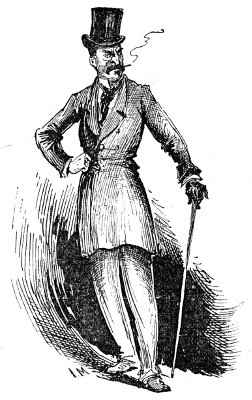
"A SUBSTANTIAL SHADOW."
Those Parisian shadows suggest to me a
strange shadow pantomime I once saw in
Spain, during the Carlist campaign, at an
engagement at Behobie. The fighting
began at about five in the morning in a
dense white fog, when the Carlists made a
desperate effort to take that small town
from an inferior but unflinching force. The
effect was, on approaching the scene, most
ludicrous. In the first place, one was
strangely impressed by mingled sounds as
of the barking of dogs and the quacking of
ducks, which turned out to be only terms
of derision which each side was hurling at
the other. Then, on coming closer still, the
shadow pantomime of which I have spoken
presented itself, just for all the world like
mimic war on a white sheet, till, the veil of
fog lifting, fighting—literally to the knife—presented
itself in all its terrible reality.
Under cover of that fog the Carlist hordes
had come down from their Pyrenean retreats
without the aid of those arranged ruses
which the armies of all nations have so often
to fall back upon. Amongst these is the
common one, when wind and locality serve,
of attacking under cover of the smoke of
burning forests or furze bushes. One ruse
during the siege of Plevna has always
struck me in this connection as having
been cleverly conceived.
The Turks, on the occasion of a sortie,
secured as many uniforms of dead Russians
as was possible. These they promptly put
on, and, covering their main body, advanced
backwards, as if retreating in good order
on a strong Russian position. The Turkish
officer in command—understanding the
Russian tongue—gave the order to "Retire."
Seeing and hearing this, the Russians,
supposing it to be an unexpected
retreat of their own men, made no defence,
till, when too late, they discovered them to
be Moslems in Muscovite garb, who, after
a most sanguinary fight, succeeded in
occupying the vantage point they had
gained.
The eccentricities of bullets, too, are not a
little interesting. There was a case in
Asia Minor of a bullet which made six
distinct holes of entry and exit in a man's
body, without materially injuring him,
before it passed away into the open. It
may be explained that the man was in a
kneeling position and firing at the time
he was struck. This erratic ball passed
first through the biceps of his right arm,
between his ribs, and again through the
triceps of his left arm. In Spain, also, I
remember an instance in which a bullet
passed through an officer's chacot, the
draught of which stunned him; he was
found quite insensible, though uninjured,
while that chacot had been drilled with the
ball which had thus prostrated him. On
two occasions I have myself had similar and
most providential escapes—once at a place
known as La Puncha, on the banks of the
Bidassoa, where, when sketching for The
Illustrated London News, I was brought
suddenly to the ground by a Carlist bullet,
with one leg completely shattered, but then,
you see, it was the leg of the camp stool on
which I was seated; the other was when
Conigsby, The Times' correspondent, and
myself were going in a drosky in the
direction of Zimnitza, to join the Russians
at Plevna.
Our route lay for some considerable
distance along an exposed road by the side
of the Danube, and it was then that the
Turkish batteries on the opposite shore
opened a deliberate fire on us with such
telling effect that the back of our conveyance
was considerably splintered, and a
portmanteau against which I was leaning
completely smashed, its contents being
hardly recognisable. I am reminded, while
on this subject, of how the correspondent to
the Macon journal was once in imminent
peril of being blown to atoms, a circumstance
to which I was an eye-witness.
He was about to return through a huge
wooden gate into a besieged Spanish town.
During his absence of only about ten
minutes, however, a large mortar had been
put in position behind it, and a large
roughly sawn aperture made. Just at the
very moment of his return, it was fired, the
draught sending him flying for some considerable
distance!
Though within a hair's breadth of death,
he was happily only bruised, while thus unwittingly
seeking "the bubble reputation
even at the cannon's mouth." Nor are the
eccentricities of shot and shell more curious
than those of cold steel, the most remarkable
instance which I remember being that
of a Russian and a Turk, who, meeting,
fought to the death with fixed bayonets in
a wood in Anatolia. The fatal thrusts
must have been simultaneous, the strange
fact being that both stood, with their legs
much apart, each with his bayonet embedded
deeply in his adversary's breast,
for several days, and were to be seen, still
erect, in the attitude of their last terrible
death-struggle.
But it's not with men alone that the
wanderer on the war-path is in touch. His
faithful ally, the horse, has a share of his
sympathy, specially if in the course of his
peregrinations he waded through the mud
to headquarters in Bulgaria in 1877. Facts
are stubborn things, and, when I say it was
a matter of statistics that twenty-two thousand
draught and other horses alone fell
between Sistova and Plevna from the combined
effect of fatigue and mud, it will be
seen that "going to the front" is as difficult
as getting to the rear—touching which,
by the way, I may on another occasion have
something interesting to say.
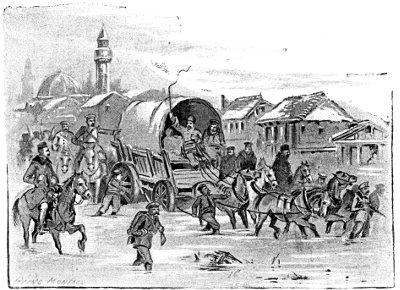
"GOING TO THE FRONT."
Mud! why, we were in a very sea of
mud; it found its way over the tops of our
jack-boots till it saturated our socks, this
always happening when, and it was often,
we dismounted to lend a hand at the spokes
of our supply waggon, from the bottom of
which came many-coloured streams of half-diluted
coffee, weak tea, and moist, very
moist sugar. Crimean mud is historic, yet
one who had gone through that campaign
and who was with me in Bulgaria assured
me we ran it very close.
Dead horses were to be seen here, there,
and everywhere, some having died in the
most grotesque attitudes, and all the victims
of that muddy deluge. In some cases,
reaching as it did to our own horses' girths,
we came to a standstill altogether, and it
was only after hiring at enormous cost many
others, to which we sometimes added oxen,
that we could plough our way through it at
all to some more elevated spot, with the
prospect on our arrival of descending into
an equally deep and depressing slough of
despond within the next five minutes on
the other side.
Did it ever strike you that the mother-in-law
is often a much-misunderstood and
under-valued individual?
If great men owe their greatness in many
cases to maternal influence, is it not possible
that even the much-derided mother-in-law
may sometimes have had hers, too, on the
destinies of mankind? Yet, it would seem
in Servia—at least, when I was there,
during that short but sharp campaign—that
the mother-in-law was at a greater
discount than here. And this is my reason—not
a bad one, I take it—for coming to
that conclusion. One morning, when in
Belgrade, I saw a sturdy Serb being roughly
hustled off to prison. Inquiring the cause,
I found he had been condemned for the
murder of his mother-in-law to five years'
penal servitude, but that his conduct had
been so exemplary that he had for some
weeks been out on a sort of Servian ticket-of-leave.
When I saw him, however, he
had just committed an offence beside which
the "ineffectual fire" of murder paled—he
had stolen a leaden spoon from an ice-shop,
and for this theft he was promptly executed
the following morning—by which, I take
it, leaden spoons must have been very
scarce in Belgrade at that time, and mothers-in-law
very plentiful.
Looking from that capital, which, unpicturesque
in itself, is picturesquely situated
at the juncture of the Trave and the
Danube, the panorama presented of the
shores of Hungary is most inviting, and at
the time of which I am writing its effectiveness
was added to by a large encampment
of Pharaoh Nepeks—Hungarian
gipsies. Ever on the alert for subjects
for my pencil, I was not long before I
chartered a small boat, and joined those
wanderers, with whose brethren I had forgathered
in many countries, and concerning
whom I had written much and made innumerable
sketches, and by whom I had
always been received as a "Romany rye."
This, however,
was my first acquaintance
with
the Pharaoh
Nepeks, of whose
hospitality I cannot
speak too
highly. It appeared,
however,
that I had arrived
at the moment of
a political crisis.
What the particular
disagreement
may have
been—not understanding
Romany
sufficiently—I am
unable to say. I
only know that I
had not been
there many hours
before a wordy
warfare led to
blows, and that
encampment of
about seven or
eight hundred
gipsies was at
desperate logger-heads.
Indeed, I
have only on one occasion seen more frantic
hand-to-hand fighting at close quarters
in actual war.
Rushing on each other with long-bladed
knives, they fought with a skill which must
have been begotten of long practice, and
terrible were the wounds which were presently
inflicted; in fact, the matter was
looked on as so serious that troops from
the Hungarian garrison of Semlin, hard by,
were sent to put a stop to the disturbance.
This at once caused a diversion. Whatever
their intestine troubles may have been,
they were one against the invaders of their
camp.
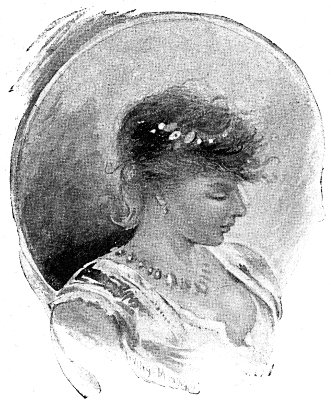
"A NEPEK BEAUTY."
It was at this moment, fired by the
wildest enthusiasm, that a perfectly bewitching
gipsy girl rushed forward and led
her tribe against the common enemy.
Bayonets, however, if sometimes brittle,
are often stubborn things, and the steadily
advancing lines of Hungarian troops quieted
at last those desperate Nepeks; not, however,
before many were severely wounded
and numbers of prisoners taken, amongst
whom I found myself being hurried off to a
guard tent, much to my annoyance, since
night was approaching, and I wanted to get
back to Belgrade
before sundown.
That annoyance,
however, was
short-lived, since
I found myself
placed in the
same tent as that
lovely young
gipsy girl, to
whom I had lost
my all-too-susceptible
heart an
hour ago; indeed,
then it was
that I made the
rough sketch
which illustrates
this article. Her
chiselled features,
the wildfire in
her sloe-black
eyes, her dishevelled
hair, and
the coins and
beads with which
those locks were
interwoven, her
torn green velvet
bodice and coarse
salmon-coloured
skirt are all as vividly before me now as
then. Nor did she seem averse to my companionship,
especially when she found I
could make myself understood through the
medium of two languages—that of Romany,
which is, of course, common to gipsies of
all nationalities, and that of the eye, which
is common to humanity at large. Indeed,
when, later on, we were liberated, my freedom
came all too soon. I had been made
captive by one who now had to return to
her kinsfolk, while I, in melancholy mood,
was pulled across "the Danube's blue
waters" in the direction of Belgrade, casting,
as I did so, many furtive glances
behind at my fair fellow-prisoner, who,
with several others, was waving me adieux
from the shore; and I think, if I remember
rightly, in my dreams that night, coils of
dishevelled raven hair and sloe-black eyes
played a conspicuous part.
Should you ever be called upon to assist
at an operation on the leg of a fellow-creature
under circumstances in which
chloroform is not obtainable, insist on holding
the wounded or otherwise affected limb.
I speak advisedly, since I recall, while
writing, a little incident which happened
to me in the hospital at Belgrade on the
occasion of my bringing to that place
several men who had been wounded at
Delegrad and Alixenatz. One of these had
to go through the painful process of probing
for a bullet, which had taken up its quarters
somewhere in the calf of his left leg.
"Hold his right leg, Montagu," said Dr.
McKeller, the head of the medical staff
(than whom there was never a more brilliant
Britisher on the war-path); "hold on
to the right, and we'll look after the left."
There was a merry twinkle in his eye
which, at the time, I only attributed to his
natural good humour.
Directly the probe made itself felt, that
right leg was drawn up till the knee almost
touched the nose of the patient, when, the
pain becoming unbearable, that leg, to
which I was still clinging, shot out straight,
and, striking me in the chest, sent me, like
a pellet from a catapult, flying across the
ward, greatly to the merriment of the
assembled doctors and nurses. Never, I
say, under any circumstances, unless you
are a Hercules, undertake, unaided, to hold—the
other leg.
In these rambling reminiscences I wish
rather to give to the reader a rough résumé
of some few of my experiences than make
any attempt at an abbreviated story of my
life. Thus it is I pass in rapid review such
incidents as in accidental succession present
themselves. Indeed, as I write, I am reminded,
by the snarls and contention for a
bone of several
dogs in the street
below, of the
Fosse Commune
at Erzeroum, a
deep entrenchment
across which those who
would from any
point enter that
grimy Oriental
city have to pass
on rough wooden
bridges.
"WAR, PESTILENCE, AND FAMINE."
There must be
some Eastern
sentiment which
necessitates the
Turks of Anatolia being more or less in touch
with the dead—otherwise why those mangy
man-eaters (no, not tigers, but half savage
dogs) which prowl about o' nights in the byways
of Erzeroum, or scratch up in the graveyards,
as they too often do, all that remains
of poor humanity, which, in this part of the
world, is but thinly and lightly covered
with mother earth? The backs of these
scavengers, raw, and sometimes bleeding,
tell too plainly the nature of their calling,
since they suffer from a peculiar scurvy
so induced. When the commissariat is
low, they go further afield, even to that
cordon of corruption outside the place,
where vultures, hawks, owls, and other
birds of prey fight or forgather with
wolves and such like four-footed adventurers,
and where, though metaphorically the
man-eater takes a back seat, he still picks
up some loathsome trifles—the menu is not
perhaps so choice as in his own graveyards,
but the supply is plentiful enough in all
conscience—everything corruptible,
from a dead cat to a dead
camel, finding a last resting-place
somewhere within that
seething circle.
Hark! Do you hear the
thunder of the guns in the Devé
Boyun Pass yonder? Do you
see the smoke mingling with
the fleeting clouds
in the far distance?
How complete a
picture this—could
you see it as I do
now in my mind's
eye—of "war, pestilence,
and famine!"
It's a far cry from
Anatolia to Bulgaria,
from Erzeroum to
the Russian lines
round about Plevna;
but such a flight to
pen and pencil on
the plains of paper-land
is nothing.
Thus do we now, on
the wings of fancy,
find ourselves at
Porodim, in the
Cossack camp, during
Osman Pasha's
stubborn resistance—where
Conigsby, of The Times, and
McGahan, of The Daily News, and many
others, including myself, were later on
sending home news or sketches, and awaiting
developments.
"TIT-BITS AT THE FRONT."
Not unlike a sack of potatoes on legs,
your average Cossack, when he has dismounted,
has more the clumsiness of the
clown than the cut of the crack cavalry
soldier about him, while his peculiar aversion
to water at once negatives any notion
of personal smartness, from a European
point of view. On the other hand, put
him in the stirrups, mount him with all his
paraphernalia on his shaggy little steed, and
he will ride, if need be, "through fire,
and—if quite unavoidable—water," too, if
it be only the will of the Czar.
It's a beautiful, nay, touching sight to see
the Cossack of the Don at the first streak
of early dawn on commissariat duty. As an
explorer and discoverer of dainties in obscure
hen-roosts, he stands—save for Reynard
himself—alone; seldom returning without
bringing in trophies on his lance-head
which will give a zest to the Major's breakfast—or—his
own.
One morning at Porodim several correspondents
and myself were making desperate
efforts to break the ice with a view to something
like a lame apology for the homely
tub. At length, having succeeded in doing
so, we commenced our ablutions, and soon
found ourselves the subject
of comment on the
part of several burly fellows,
who seemed quite
entertained at our
proceedings.
"Wonderful!"
said a Cossack Corporal,
turning to my
interpreter Nicholoff.
"Wonderful!
Englishmen, are
they? Why, they
wash in the winter
time!"
While on the subject
of Cossacks,
several odd incidents
present themselves:
The Times correspondent
and myself
having one day
secured (no matter
how) a fowl, promptly
proceeded to
pluck, cook, cut up and—but no, I mustn't
put the cart before the horse—we were interrupted
in our arrangements for the mid-day
meal by the passing of a number of ox-teams,
taking supplies of all kinds to the
front, which were driven by Cossack camp
followers. One of these, allowing his oxen to
continue the even tenor of their way, stopped
for a moment to take in the situation. Our
preparations evidently amused him, and
we, noting his interest in our movements—more
especially, The Times correspondent—indulged
in a certain amount of Anglo-Saxon
badinage, at which that Cossack
seemed to wonder more vaguely than
before, till my companion felt it quite safe
to say—in the vulgar vernacular, holding
up at the same time his half of that
mutilated fowl before the burly bullock
driver—"There now, I dare say you'd
make small bones of that if you could get
it, wouldn't you?"
In an instant the Cossack had seized the
dainty morsel in his grimy grip; the next it
was quite beyond reclaim between his teeth,
and then, to our utter astonishment, in unmistakable
North Country dialect he said:—
"Wull, p'raps I shall, now I've got 'un;
I'm a Yarkshermun, I am." And with
this, munching to his infinite satisfaction
that drum-stick as he went, he turned on
his heel and rejoined his oxen.
On inquiry we found him to be a Yorkshire
ne'er-do-weel, who, after many vicissitudes,
had somehow enlisted in the Cossack
contingent.
Before the siege was over, however, we
had more than forgiven
the unexpected appropriation
of the succulent
drum-stick.
One night—one of the
most severe of that terrible
winter—when such little
wood as was obtainable
was almost too damp to
ignite, myself and several
other correspondents were
sitting in sorry plight
round an apology for a
camp fire, half frozen, and
utterly demoralised, in a
condition, in fact, of benumbed
misery, which I
at least have never before
or since experienced. Save
for the lurid glare of
Plevna, like a smouldering
volcano in the distance,
and the tread now
and again of a sentry in
the crisp snow, we might
have been, as indeed we in some senses
were, in the Valley of the Shadow of
Death. Presently, however, a sound
broke the stillness of the night—a sound
which caused our hearts to throb, and
circulated anew the blood in our half-frozen
veins, a sound which spoke to each
of "England, home, and beauty," of a
welcome in store for us in the old country,
of hopes realised, and promises fulfilled—that
sound took the form of music, and
probably the most acceptable form music,
at such a moment, could take; for, proceeding
from a rough reed pipe, there
floated across to us on the cold night air
the welcome old strains of "Home, sweet
home:" sympathetically, exquisitely rendered,
it seemed literally to resuscitate us.
Yes, indeed, we had each of us something
to live for, much to be thankful for, and
when afterwards we ascertained the player
to have been none other than our Yorkshire
Cossack, it was pleasant to reflect
that if he had once played the dickens with
our dinner he had more than recompensed
us with "Home, sweet home."
"HOME, SWEET HOME."
Although we were sometimes in such
sorry plight as I've referred to, Conigsby
was well pleased to mix with the Muscovites;
he had previously been accredited to
the Turks, and at Philippopolis, Adrianople,
and elsewhere, had been frequently warned
that the strong Russian bias of his letters
to The Times boded him no good; indeed,
that "a cup of black
coffee," as poison is
politely termed by the
Moslems, was in active
preparation for him.
Loth to accept these
hints, it's more than probable
he would never
have come to Plevna at
all, had not a very forcible
argument been presented
to him. It happened
thus:—The representative
of Printing House-square—quite
innocent of
coming events—rose one
morning rather earlier
than usual. His room
seeming unusually dark,
he proceeded at once to
draw up the blind, when,
to his intense horror, he
suddenly found himself
face to face with a corpse—the
corpse of a Bulgarian
traitor—which, during the night, had been
hoisted by means of pulleys outside his bedroom
window. The Turks, to say the least
of it, had a design on his appetite for breakfast.
This gentle reminder was sufficient for
him; he quite understood now how matters
stood, and so exchanged as soon as possible
to the Russian lines.
His successor, whose views, alas! were
also Russophile, sent only a limited number
of despatches to The Times. It was café
noir that did it. I think he was buried at
Scutari.
I have heard it remarked by some stay-at-home
critics of war that they "don't
know what fear is," that they are, in other
words, ready-made heroes for whom there
is, unfortunately, no scope. To such I would
recommend some of the minor emergencies
of a campaign as tests worth trying. Personally,
I am quite willing to confess to
having experienced at times painfully unpleasant
qualms, and fully believe that to
do so is only human. Overcoming fear is
declared by some to be heroic, and individual
acts of unselfish bravery under such
circumstances cannot certainly be too
generously commended; but defend me from
the untried swash-buckler who "doesn't
know what fear is." Let him, as soon as
occasion serves, take a dose of ignominious
retreat—one dose before bedtime will be
found quite sufficient. Let him experience
a retreat, say, down a rugged mountain
defile in Spain, with the enemy in comparatively
close proximity on a parallel
ridge, a deep gorge between them, pouring
in a deadly fire on retreating artillery and
cavalry. This I experienced once not far
from San Sebastian. "Everyone for himself,
and the devil take the hindmost." I
cite the apt quotation of my old friend
Edmund O'Donovan, of The Daily News,
who was there at the
time. There was a
tooth and nail illustration
of that proverb then I
shall never forget: panic
reigned supreme, each struggling
in mad confusion to be
first out of the fray, yelling,
shouting, hooting in their
frenzy, even to the free use of
the butt ends of carbines and
revolvers, anything, in short,
to clear the way for that best beloved and
all-important "Number One."
"A RETREAT IN SPAIN."
It's astonishing, isn't it, with what jealous
care poor humanity looks after number one,
even though life be at a discount, as it was
during the siege of Plevna, when one morning
Conigsby and myself sallied forth in
opposite directions in quest of material for
our respective papers? Each in turn,
though separated by some miles, found
himself under a withering fire from Turkish
rifle pits, and later on each found himself
hastening for the kindly protection of the
same advanced Russian earthworks.
"This, Montagu," said Conigsby, "is an
incident which should not be overlooked.
A sceptical world will never believe it—yet
stay—unless—oh, yes, I have it. You do a
picture for The Illustrated News representing
our noble selves, specially your humble
servant, you know, as we now are in the
forefront of the fighting, while I write up
the occurrence in The Times. Such corroborative
evidence, which is, moreover,
absolutely true, will place our zeal beyond
question, and show the reading and picture-loving
public that life at the front is not all
'beer and skittles.'"
That day is particularly marked on my
memory as having been one of exceptional
interest, incident, and hard work, terminating
in a night made almost unbearable by
the howling of wolves and the neighing of
terror-stricken horses. With this—"An
Attack on the Encampment of The Times
and Illustrated London News," forming a
subject for the pages of that journal—and
with Conigsby's version of the experience
(it may be taken with several grains of salt),
which he gave at a Press dinner on our
return, I will bring this chapter of accidents
and incidents to a close.
"Never, gentlemen," said he, "never on
any account go to the front with a war
artist. They are dangerous individuals, I
assure you. Most of you will remember a
certain illustration of
Montagu's in which
our camp was represented
as being attacked
by wolves; but
you don't, I think,
know the true story
concerning it.
"One night, wearied
beyond measure with
a long day at the
front, I was striving in
vain to sleep through
a medley of sounds in
which the short,
quick, raspy barking
of wolves, and shouts
of men striving to
pacify scared horses, combined to make
night hideous, when, unable to stand it
any longer, I rushed into Montagu's tent—for,
without enlisting his aid, I felt
apoplexy must be the end of it—and
aroused him.
"Montagu, my dear fellow, do you hear
those wolves? They are simply unbearable.
I have tried every expedient but one—it's
our last resource. If there's one thing in
this world more than another calculated to
scare wolves it will be one of your pictures
for The Illustrated London News! Whereupon
I seized one of his latest productions,
and, rushing out, faced those fiery invaders.
"The result was instantaneous. With a
fearfully prolonged yelp they scuttled off
helter-skelter to the hills, where they were
very soon lost to sight.
"But, remember, I have already warned
you against going to the front with a war
artist, and would ask you now to listen to
Montagu's terrible retaliation. Goodness
knows, I am loth enough to admit it.
"Those wolves came back again, and then
it was that he, rushing into my tent, said
that lunacy, ay, raving madness, stared
him in the face, unless the last die were
cast—if that wouldn't settle them, nothing
would. With this he grasped a half-finished
article of mine to The Times, and
confronting those
wolves, read aloud to
that astonished pack
the first short paragraph.
Then it was
that, utterly panic-stricken,
they fled,
howling in wild confusion,
to the Balkans,
and I understand they
have been scarce in
Bulgaria ever since.
Who, after this, will
question for one
moment the far-reaching
influence of
the British press?"
(To be continued.)
The Rynard Gold Reef C'oy L'd. — Act I. — Act II. — Act III. — Act IV. — Act V.
By Walter Besant.
"You dear old boy," said the
girl, "I am sure I wish it
could be—with all my heart—if
I have any heart."
"I don't believe you
have," replied the boy,
gloomily.
"Well, but Reg, consider; you've got
no money."
"I've got five thousand pounds. If a
man can't make his way upon that, he
must be a poor stick."
"You would go abroad with it and dig,
and take your wife with you—to wash and
cook."
"We would do something with the
money here. You should stay in London,
Rosie."
"Yes. In a suburban villa, at Shepherd's
Bush, perhaps. No,
Reg, when I marry,
if ever I do—I am in
no hurry—I will step
out of this room into
one exactly like it."
The room was a
splendid drawing-room
in Palace Gardens,
splendidly furnished.
"I shall have
my footmen and
my carriage, and I
shall——"
"Rosie, give me
the right to earn all
these things for you!"
the young man cried
impetuously.
"You can only earn
them for me by the
time you have one
foot in the grave.
Hadn't I better in
the meantime marry
some old gentleman
with his one foot in the grave, so as to be
ready for you against the time when you
come home? In two or three years the
other foot I dare say would slide into the
grave as well."
"You laugh at my trouble. You feel
nothing."
"THIS HEARTLESS HAND."
"If the pater would part—but he won't—he
says he wants all his money for himself,
and that I've got to marry well. Besides,
Reg"—here her face clouded and
she lowered her voice—"there are times
when he looks anxious. We didn't always
live in
Palace
Gardens.
Suppose
we should
lose it all
as quickly
as we got it. Oh!" she shivered and
trembled. "No, I will never, never marry
a poor man. Get rich, my dear boy, and
you may aspire even to the valuable possession
of this heartless hand."
She held it out. He took it, pressed it,
stooped and kissed her. Then he dropped
her hand and walked quickly out of the
room.
"Poor Reggie!" she murmured. "I
wish—I wish—but what is the use of
wishing?"
Two men—one young, the other about
fifty—sat in the verandah of a small
bungalow. It was after breakfast. They
lay back in long bamboo chairs, each with
a cigar. It looked as if they were resting.
In reality they were talking business, and
that very seriously.
"Yes, sir," said the elder man, with something
of an American accent, "I have
somehow taken a fancy to this place. The
situation is healthy."
"Well, I don't know; I've had more
than one touch of fever here."
"The climate is lovely——"
"Except in the rains."
"The soil is fertile——"
"I've dropped five thousand in it,
and they haven't come up again yet."
"They will. I have been round
the estate, and I see money in it.
Well, sir, here's my offer: five
thousand down, hard cash, as soon
as the papers are signed."
"FIVE THOUSAND DOWN, HARD CASH."
Reginald sat up. He was on the
point of accepting the proposal, when
a pony rode up to the house, and the rider, a
native groom, jumped off, and gave him a
note. He opened it and read. It was from
his nearest neighbour, two or three miles
away: "Don't sell that man your estate.
Gold has been found. The whole country
is full of gold. Hold on. He's an assayer.
If he offers to buy, be quite sure that he
has found gold on your land.—F. G."
He put the note into his pocket, gave a
verbal message to the boy, and turned to
his guest, without betraying the least
astonishment or emotion.
"I beg your pardon. The note was from
Bellamy, my next neighbour. Well? You
were saying——"
"Only that I have taken a fancy—perhaps
a foolish fancy—to this place of yours,
and I'll give you, if you like, all that you
have spent upon it."
"Well," he replied, reflectively, but with
a little twinkle in his eye, "that seems
handsome. But the place isn't really worth
the half that I have spent upon it. Anybody
would tell you that. Come, let us be
honest, whatever we are. I'll tell you a
better way. We will put the matter into
the hands of Bellamy. He knows what a
coffee plantation is worth. He shall name
a price, and if we can agree upon that, we
will make a deal of it."
The other man changed colour. He
wanted to settle the thing at once as
between gentlemen. What need of third
parties? But Reginald stood firm, and he
presently rode away, quite sure that in a
day or two this planter, too, would have
heard the news.
A month later, the young coffee-planter
stood on the deck of a steamer homeward
bound. In his pocket-book was a plan of
his auriferous estate, in a bag hanging
round his neck was a small collection of
yellow nuggets; in his boxes was a chosen
assortment of quartz.
"Well, sir," said
the financier,
"you've brought
this thing to me.
You want my advice.
Well, my
advice is, don't
fool away the only
good thing that
will ever happen to
you. Luck such as
this doesn't come
more than once in
a lifetime."
"I have been
offered ten thousand
pounds for my
estate."
"Oh! Have you!
Ten thousand?
That was very
liberal—very liberal
indeed. Ten
thousand for a gold
reef."
"But I thought
as an old friend of my father you would,
perhaps——"
"Young man, don't fool it away. He's
waiting for you, I suppose, round the corner,
with a bottle of fizz ready to close."
"He is."
"Well, go and drink his champagne.
Always get whatever you can. And then
tell him that you'll see him——"
"I certainly will, sir, if you advise it.
And then?"
"And then—leave it to me. And—young
man—I think I heard, a year or two
ago, something about you and my girl
Rosie."
"There was something, sir. Not enough
to trouble you about it."
"She told me. Rosie tells me all her
love affairs."
"Is she—is she unmarried?"
"Oh yes, and for the moment I believe
she is free. She has had one or two engagements,
but, somehow, they have come
to nothing. There was the French Count,
but that was knocked on the head very
early in consequence of things discovered.
And there was the Boom in Guano, but he
fortunately smashed, much to Rosie's joy,
because she never liked him. The last was
Lord Evergreen. He was a nice old chap
when you could understand what he said, and
Rosie would have liked the title
very much, though his grandchildren
opposed the thing. Well,
sir, I suppose you couldn't understand
the trouble we took to keep
that old man alive for his own
wedding. Science did all it could,
but 'twas of no use——" The
financier sighed. "The ways of Providence
are inscrutable. He died, sir, the
day before."
"That was very sad."
"A dashing of the cup from the lip, sir.
My daughter would have been a Countess. Well,
young gentleman, about this estate of yours.
I think I see a way—I think, I am not yet
sure—that I do see a way. Go now. See
this liberal gentleman, and drink his champagne.
And come here in a week. Then,
if I still see my way, you shall understand
what it means to hold the position in the
City which is mine."
"And—and—may I call upon Rosie?"
"VERY LIBERAL INDEED!"
"Not till this day week, not till I have
made my way plain."
"And so it means this. Oh, Rosie, you
look lovelier than ever, and I'm as happy
as a king. It means this. Your father is
the greatest genius in the world. He buys
my property for sixty thousand pounds—sixty
thousand. That's over two thousand
a year for me, and he makes a company out
of it with a hundred and fifty thousand
capital. He says that, taking ten thousand
out of it for expenses, there will be a
profit of eighty thousand. And all that he
gives to you—eighty thousand, that's
three thousand a year for you; and sixty
thousand, that's two more, my dearest
Rosie. You remember what you said, that
when you married you should step out of
one room like this into another just as
good?"
"Oh, Reggie"—she sank upon his bosom—"you
know I never could love anybody
but you. It's true I was engaged to old
Lord Evergreen, but that was only because
he had one foot—you know—and when the
other foot went in too, just a day too soon,
I actually laughed. So the pater is going
to make a company of it, is he? Well, I
hope he won't put any of his own money
into it, I'm sure, because of late all the
companies have turned out so badly."
"But, my child, the place is full of gold."
"Then why did he turn it into a company,
my dear boy? And why didn't he
make you stick to it? But you know nothing
of the City. Now, let us sit down, and talk
about what we shall do—Don't, you
ridiculous boy!"
"OH, ROSIE. YOU LOOK LOVELIER THAN EVER!"
Another house just like the first. The
bride stepped out of one palace into
another. With their five or six thousand a
year, the young couple could just manage
to make both ends meet. The husband was
devoted; the wife had everything that she
could wish. Who could be happier than
this pair in a nest so luxurious, their life so
padded, their days so full of sunshine?
It was a year after marriage. The wife,
contrary to her usual custom, was the first
at breakfast. A few letters were waiting
for her—chiefly invitations. She opened
and read them. Among them lay one
addressed to her husband. Not looking at
the address, she opened and read that as
well:
"Dear Reginald,—I venture to address
you as an old friend of your own and
schoolfellow of your mother's. I am a
widow with four children. My husband
was the Vicar of your old parish—you
remember him and me. I was left with
a little income of about two hundred a
year. Twelve months ago I was persuaded
in order to double my income—a thing which
seemed certain from the prospectus—to
invest everything in a new and rich gold
mine. Everything. And the mine has
never paid anything. The Company—it is
called the Rynard Gold Reef Company—is
in liquidation because, though there is really
the gold there, it costs too much to get it.
I have no relatives anywhere to help me.
Unless I can get assistance my children and
I must go at once—to-morrow—into the
workhouse. Yes, we are paupers. I am
ruined by the cruel lies of that prospectus,
and the wickedness which deluded me, and
I know not how many others, out of my
money. I have been foolish, and am punished:
but those people, who will punish
them? Help me, if you can, my dear
Reginald. Oh! for God's sake, help my
children and me. Help your mother's
friend, your own old friend."
"This," said Rosie, meditatively, "is
exactly the kind of thing to make Reggie
uncomfortable. Why, it might make him
unhappy all day. Better burn it." She
dropped the letter into the fire. "He's an
impulsive, emotional nature, and he doesn't
understand the City. If people are so
foolish. What a lot of fibs the poor old
pater does tell, to be sure. He's a regular
novelist—Oh! here you are, you lazy boy!"
"Kiss me, Rosie." He looked as handsome
as Apollo and as cheerful. "I wish
all the world were as happy as you and
me. Heigho! Some poor devils, I'm
afraid——"
"Tea or coffee, Reg?"
Portraits of Celebrities at different times of their Lives. — JOHN LAWRENCE TOOLE. — EDWARD S. WILLARD. — MISS KATE RORKE. — THE DUKE OF CLARENCE AND AVONDALE. — THE DUCHESS OF FIFE. — PRINCE GEORGE OF WALES. — MME. ALBANI. — MISS AGNES JANSEN.
From a| AGE 20. |Photo.
AGE 25. From a Photo.
AGE 45. From a Photo.
From a Photo. by| PRESENT DAY. |Burton Bros., Dunedin.
Wherever the English
tongue is spoken the name of
J. L. Toole is
a household
word. After
winning his
spurs in Dublin, he made
his first appearance in London
at the St. James's
Theatre, which was
then under the management
of Mrs. Seymour.
This was in
1855. From the St.
James's he migrated
to the Lyceum, where
he played, among
other characters,
Flip Flap to Charles
Dillon's Belphegor,
Mrs. Bancroft, then
Marie Wilton, being
in the cast. It was
but a step from the
Lyceum to the Adelphi;
and his merry
reign there, in conjunction
with Paul
Bedford, will be always remembered in
connection with that theatre. It was
during this period that our first two portraits
were taken. The
third portrait represents
him at forty-five years of
age, before which time
he had produced Byron's
"Dearer than Life" at
the Queen's, Henry
Irving playing Bob
Gassett, and Lionel
Brough Uncle Ben.
The theatre he built
for himself in King
William-street was
opened in 1879. Our
fourth portrait was
taken in Dunedin,
New Zealand, about
five months ago, in
the course of his remarkably
successful
tour through the
Australasian colonies.
For these portraits
we are indebted to
Mr. Toole's courtesy.
Born 1854.
From a| AGE 18. |Photograph.
From a| AGE 27. |Photograph.
Mr. E. S. Willard, whose
career at the Shaftesbury
Theatre within the last two
years firmly established his
claim to be regarded as one
of our few really great actors,
made his first bow
to a theatrical audience
at the
Theatre Royal,
Weymouth, in December,
1869, and
afterwards gained
some useful experiences
on the
"Western Circuit."
In 1875 he married
Miss Emily Waters,
now well known in
literary circles as
"Rachel Penn,"
and then he made
his first appearance
in London at the
Covent Garden
Theatre. Five
years of hard work
in the provinces
followed, leading to his engagement at the
Princess's under the management of Mr.
Wilson Barrett. His performance of the
Spider in "The Silver King" was no less
popular than that of his chief. Although
Mr. Willard's position in the first rank of
actors could not have been long delayed,
his sudden leap to the front was almost
the result of a fortunate accident. He
had accepted a long engagement from
Mr. Hare for the new Garrick Theatre,
which, fortunately
for Mr. Willard,
was cancelled by
him when he refused
to play the
opening part assigned
to him. This
left him free to assume
the reins of
management at
the Shaftesbury
Theatre, where his
remarkable performances
of Cyrus
Blenkarn and Judah
established his
claim to pre-eminence,
and more
than justified the
faith and confidence
of his numerous
admirers.
From a Photo. by| AGE 36. |J. Templeton Grove.
AGE 12.
AGE 14.
Miss Kate Rorke, at the
age at which our first portrait
represents her, was already
on the stage, in the
character of one of the little
school-girls in "Olivia." At
fourteen she was still a stage school-girl,
this time in the Bancrofts' production of
"School" at the Haymarket. Soon afterwards
she joined Mr. Charles Wyndham's
touring company, and at the age of our
third portrait was delighting the audiences
of the chief provincial theatres in a variety of
characters. These early studies, combined
with great natural abilities, have borne the
fruit to be expected; and to-day Miss
Rorke, as the frequenters of the Garrick
Theatre know to their delight, is one of
the most charming and finished actresses
at present on the English stage.
AGE 16.
PRESENT DAY.
Born 1864.
AGE 5.
From a Photo. by Messrs. W. & D. Downey.
AGE 7.
From a Photo. by Messrs. W. & D. Downey.
At the age of seven Prince
Albert Victor was receiving
his education at home.
At fourteen—at which
age he is here depicted in
a Highland costume—he
was, like his brother George, a cadet on
board H.M.S. Britannia at
Dartmouth. At nineteen,
he became an undergraduate
at Trinity College, Cambridge;
after which he was
transferred to Aldershot to
study military science.
These portraits are published
by special arrangement
with Messrs. W. and
D. Downey, whose permission
thus to reproduce photographs
of celebrities from
their enormous and unique
assortment we are the first
to obtain.
AGE 14.
From a Photo. by Messrs. W. & D. Downey.
AGE 19.
From a Photo. by Messrs. W. & D. Downey.
From a Photo. by| AGE 26. |Messrs. W. & D. Downey.
From a Photo. by| AGE 3 MONTHS. |Messrs. W. & D. Downey.
From a Photo. by| AGE 6. |Messrs. W. & D. Downey.
The Duchess of Fife, as our
readers are aware, inherits
in no small degree the
conspicuous gifts of grace
and beauty for which her
Royal mother is so pre-eminently
distinguished. That such
has been the case throughout her life
is manifested by the charming portraits
which here represent her from the age
when, as a solemn baby, her first photograph
was taken, down to her appearance
at the present day.
From a Photo. by| AGE 10. |Messrs. W. & D. Downey.
From a Photo. by| AGE 15. |Messrs. W. & D. Downey.
These portraits are reproduced by
special arrangement with Messrs. W.
and D. Downey.
From a Photo. by| PRESENT DAY. |Messrs. W. & D. Downey.
Born 1865.
From a Photo. by| AGE 3. |Messrs. W. & D. Downey.
From a Photo. by| AGE 5. |Messrs. W. & D. Downey.
Of Prince George at the ages
of three and five we have
nothing to record; but at
the time at which our third
portrait represents him, he
was a middy on board H.M.S.
Britannia. A sailor is always a popular
member of all classes of society, and "our
sailor prince" enjoys the reputation of being
among the most popular of his profession.
From a Photo. by| AGE 14. |Messrs. W. & D. Downey.
From a Photo. by| AGE 18. |Messrs. W. & D. Downey.
From a Photo. by| AGE 25. |Messrs. W. & D. Downey.
These portraits are reproduced by special
arrangement with Messrs. W. and D.
Downey.
From a Photo. by| AGE 18. |Levitsky, Paris.
From a Photo. by| AGE 19. |Bergamasco, St. Petersburg.
The first portrait
we give of Mme.
Albani-Gye
shows her at
eighteen years,
when a student
under M. Duprez, of Paris.
The second represents her at
nineteen, as La Sonnambula,
in which rôle she made a
triumphant début in 1872 at
Covent Garden. Mme. Albani
spent her 25th birthday in
New York, where she created
the part of Elsa. The last
photograph represents her as
Desdemona, a character which
particularly appeals to her.
From a Photo. by| AGE 25. |Sarony, New York.
From a Photo. by| PRESENT DAY. |Sarony, New York.
From a Photo. by| AGE 18. |M. Hansen, Stockholm.
From a Photo. by| AGE 24. |Florman.
The first photograph we give
of Miss Agnes Jansen brings
her before us at eighteen
years of age, then a student
at the Royal Academy of
Music in Stockholm. Under
the guidance of her accomplished master,
Hugo Beyer, she made such marked progress
that she was shortly afterwards
engaged to appear in the leading contralto
rôles at the Opera House of her native city.
In 1885, on pleasure bent, she came to
England, and, in the cause of a charity, made
her début at the Albert Hall, since when
she has been continually sought for concerts
in town and country. Only a few weeks
back she appeared for the first time in a
London opera at Covent Garden, where
she is now performing.
From a Photo. by| AGE 27. |Chancellor, Dublin.
From a Photo. by| PRESENT DAY. |The Stereoscopic Co.
Humours of the Post Office. — II.
With Fac-similes.
The pages in the "Post Office
Album," through which we
were looking in our last number,
are by no means exhausted.
There is yet another curiously
addressed missive to Her
Majesty—"To the lady queen vicktorieha
queens pallice London" (Fig. 1); the late
Earl of Beaconsfield was also signalled out
for an hieroglyphic wrapper (Fig. 2); the
gentleman occupying the civic chair at the
Mansion House in 1886 was the recipient of
a somewhat remarkable envelope—sufficiently
suggestive, however, to reach him
(Fig. 3); whilst the Receiver and Accountant-General
of the Post Office received a
veritable puzzle in "Receive the county
general Cheapy hall London" (Fig. 4). One
remaining specimen (Fig. 5) here reproduced—which
was actually delivered to the proper
persons for
whom it was
intended—we
will leave to
those of our
readers who
revel in the unravelling
of the
mysterious.
FIG. 1.
FIG. 2.
Turn over
another leaf,
and you are requested
to
make yourself
acquainted
with an interesting
little
Welsh town in
Merionethshire,
familiarly
known as "Llanllanfairpyllghyllgheryogogogoch";
and the next page gives rise to unbounded
sympathy for the unfortunate postman
who dutifully delivered a letter to—
"Mr. Paddy O'Rafferty O'Shaugnessy, 'The Beautiful Shamrock' Next door to Barney Flynn's Whiskey Store. Knock me down entirely street, Stratford on Avon In the County Cork if ye like Dublin."
FIG. 3.
One gentleman is
evidently partial to
boxing—all his envelopes
are pugilistically
illustrated,
whilst another individual's
wrappers always
bear a request—in
big capitals—to
carry his communication
by a British
vessel, and on no
account by a foreign one. A
minister, evidently just ordained,
and residing in Jamaica, is depicted
in the pulpit with his old college
cap and boots in the distance, with
the reminder to "Never forget old
friends." One envelope strongly
suggests that somebody has a
weakness for anything but toast
and water, for the gentleman is
represented fast asleep, with a
huge barrel of beer above him, and
the tap still flowing freely into his
opened mouth, which is waiting
to receive it.
FIG. 4.
FIG. 5.
The volumes devoted to humours
nearer at home
are brimming over
with merriment,
whilst not a few
leaves contain
somewhat serious
impressions. Suggestions
of holiday
making form a prominent
feature.
Pretty and effective
views of the
sea and country
lanes, picturesque
valleys and mountains,
are liberally
displayed on the
various envelopes.
One lady
is at Margate, attired
in such masculine
clothing,
with binocular
under her arm,
that the artist
has added a flowing
beard to her
face. There is
a landlady presenting
a bill,
whilst the next
is really a very
original idea of
the various
stages of matrimony.
On a
number of boards
resting on an
easel, is one
marked "1883,"
with a pair of
lovers drifting
down a stream
in a boat, whilst
"1884" finds the same pair in wedding garments.
Other "years" are waiting for their
events in the lives of the young people.
FIG. 6.
Poetical addresses are as numerous as they
are varied. Here are one or two examples. A
postman read the following instructions:—
"Near Bristol City may patience lead thee; At Totterdown Row—postman, heed me— Stands Gordon House, 'tis passing fair, And Mr. Brittain dwelleth there."
FIG. 7.
Another envelope, bearing the Peckham
post-mark, thus silently appeals:—
"To Exeter fair city, by Western Mail, Good postman, send me without fail; And when in Devonshire I arrive, Over Exe Bridge and through St. Thomas drive, Past the old turnpike, and up the hill Held sacred to Little John's ✠ still, Just where the road begins to turn, You'll find Rose Cottage and Mrs. Hearn. Ask her if there's a fair young lass Come down from London her holidays to pass; To her please deliver without delay, For I'm postage paid, and so you need not stay."
The poetry is not great, but it is
suggestive.
An eminent maker of umbrellas
received a most artistic wrapper,
with numerous illustrations showing
the position his umbrellas held
amongst the community. Gentlemen
are using them as a means of
roaming the seas, whilst a more
adventuresome spirit, remarking
that "Umbrellas make you rise in the world,"
is going up à la balloon with one. Finally,
at the death of the worthy manufacturer
his own umbrella is carried in state followed
by an appreciative populace, and the head
of his memorial stone is further decorated
by a number of these very useful protectors.
The uncertainty of our glorious
climate is the subject for another wit, who
has drawn a monumental stone over which
a watering can is freely flowing with the
words—
Sacred to the memory of the fine weather which departed from this land June, 1888.
* * * * *
Also the sun of the above.
FIG. 8.
One envelope has
an ingenious direction
on it. It is
intended for s.s.
Kaisow, lying in
the Red Sea. It
shows a very intelligent-looking
sow
labelled K, with a
belt round it in the
form of the letter C
painted red.
A somewhat
similarly addressed
wrapper is one despatched
to Wales.
Swansea is represented
by a swan
with a capital C in
the immediate
vicinity of its tail
(Fig. 6); whilst following
the word
South is a representation
of a number
of enthusiastic fishermen
making every effort to harpoon
some whales. A stalwart
Highlander, in all his glory,
appears upon another, wishing
"A guid New Year to ye,"
and as he holds out a palm
almost as large as himself, he
merrily exclaims, "And here's
a hand, my trusty fren'!"
An invalid is lying with a
heavy box on him, labelled
appropriately "A Chest Complaint."
John Bull and Young
Australia occupy two corners
of the wrapper, shaking hands
across the sea, whilst the
next is a loving message to
an ocean roamer, showing an
energetic little nigger indulging
in what is frankly admitted
to be a "mangled
version of an old song," to the effect of—
"Good bye, John, Don't stop long, Come back soon to your numberless chickabiddies; My heart is low, The winds blow so, And takes away my sailor."
FIG. 9.
Niggers seem strong favourites for illustrative
purposes. A magnificent specimen
of a black is that of a gentleman in a huge
broad-brimmed straw hat, with the name
and address written on an equally prodigious
collar. The gentleman destined to
receive the letter rejoiced in the name of
Black, hence the presence of our dark
friend (Fig. 7). Here (Fig. 11) is a merry
little drummer boy, whose face is hidden
by the paper he is reading, which bears
the postage stamp.
FIG. 10.
A young lady residing at Port Elizabeth
probably felt a shock when she found on an
envelope from "home," a gentlemanly but
gluttonous cannibal making a small lunch
out of a venturesome white man, whom he
is swallowing at a single bite. "A Native
Swallowing a Settler" is the comforting
inscription on it. Equally startled, too,
probably, was the lady who found that she
had been singled out as "Lost, Stolen, or
Strayed," with a crowd of interested onlookers—including
representatives of the
military and police—eagerly scanning the
bill on which was set forth her name and
address (Fig. 8).
What looks like a sly hint at matrimony
was sent by an amorous swain to a young
damsel at Cape Town. A gentleman's
head, labelled "An unfurnished flat,"
surely suggests house furnishing. Page
after page of the postal scrap-book is
replete with illustrations: artists, sculptors,
eminent politicians, all classes of the community,
all have their own particular
"skit"—a musician, probably, and a violinist
to wit, receiving his envelope with a
pictorial representation suggesting the
weight of his instrument, so much so that
it took a couple of men to carry it between
them, and even then the fiddle and case
proved too heavy,
and was allowed to
fall to the ground,
much to the evident
hurt of one
of those engaged in
the job (Fig. 9).
"The lion is a
noble animal, and
to his keeper he
appears to possess
no small degree of
attachment." So
says an envelope
with the king of
beasts taking his
unwary keeper into
his paws.
It is needless to
say that married
people receive a fair
share of attention
from the envelope
artist. The "delighted parent" is in
strong evidence, whilst the nurse approaches
with gladdened step and joyfully
exclaims "Twins, sir!"
And a wit winds the series up with a
request on his missive addressed to the care
of a post-office to the effect:—"Don't give
him this unless he calls for it."
FIG. 11.
We append a couple of illustrations
which seem to have escaped the usually
keen eye of those at the Post Office, always
on the look-out for these little curiosities in
envelopes. One is kindly forwarded by a
gentleman interested in these "Postal
Humours," and shows a boar partial to
boating playfully flying a kite, on the tail
of which is the name and address. The
sun looks on somewhat dubiously from
above (Fig. 10). The second is a specimen
of many similar ones which arrive at the
office of Tit-Bits, and depicts the various
stages through which a letter passes whilst
on its way to compete for the weekly
"Vigilance Prize," until it is finally handed
in at its proper destination (Fig. 12).
FIG. 12.
Celebrated Beauties.
"Woman, be fair, we must adore you; Smile, and the world is all before you."
Looking back across the gulf
of years which divides us
from the latter portion of the
last century, we must be
struck by the total change
that has passed over society
generally. No men like those giants in
intellect, Chatham, Fox, Swift, Johnson,
now fill the canvas; no fine gentlemen,
who, as Thackeray says, were in themselves
a product
of the past, and
for which the
finikin, white-vested
masher is
but a poor substitute.
And the
women!—those
wondrously fair
creatures, whose
faces have been
handed down to
us by Reynolds
or Gainsborough,
and who
smile at us from
their gilt frames.
What witchery
in the almond-shaped
eyes,
long and languishing;
what
pouting lips;
what arched and
lovely necks;
what queenly
dignity in their
gait and carriage,
and
withal nothing
of the voluptuous
immodesty
which
marks the
wanton beauties of Charles II.'s Court:
they were mistresses, these were wives.
ELIZABETH GUNNING (DUCHESS OF HAMILTON).
(From the Picture by C. Read.)
There was never a period when so much
homage was paid to beauty as in the last
century. Men went mad for a lovely face,
fought duels for a smile or a flower given
by their mistress to a rival, and threw
prudence to the winds to obtain her. We
are now going to take a glance at some of
these fair magicians, whose stories read,
many of them, like fairy tales; Cinderella,
for instance, pales before the history of the
two Irish girls who, more than 150 years
ago, crossed the fish-pond which divides
the sister countries, and came to seek their
fortunes, with only their lovely faces pour
tout potage. The surpassing beauty of the
sisters has become matter of history, nor,
perhaps, is there
a parallel instance
of mere
beauty exciting
so extraordinary
a sensation as
that produced
by these portionless
girls.
Horace Walpole,
writing to
Sir Horace
Mann, says:—"You
who
know England
in other times
will find it difficult
to conceive
what indifference
reigns
with regard to
Ministers; the
two Miss Gunnings
are twenty
times more the
subject of conversation
than
the Duke of
Newcastle or
Lord Granville."
Again he
says:—"The
Gunning girls
have no fortune,
and are scarce gentlewomen, but by their
mother. (She was the Honourable Bridget
Bourke, third daughter to Theobald, sixth
Viscount Mayo.) The Bourkes have
Plantagenet blood, quite enough to compensate
for the inferior tap of the
Gunnings."
Maria was the eldest of "the goddesses,"
as Mrs. Montagu styles the two girls. She
was born in 1733, Elizabeth two years
later. Consequently, when they appeared
in London, one was nineteen, the other
seventeen.
The character of the beauty of the Gunnings
will be seen in the accompanying
portrait of Elizabeth—long swimming
eyes, and small, delicate mouth, and the
soft, composed face, breaking from between
the two lace lappets, secured in a top-knot
over the head.
Soon both sisters had admirers. "Lord
Coventry, a grave lord of the remains
of the patriot breed," dangled after
Maria, while Elizabeth was singled out
by the Duke of Hamilton, who was wild
and dissipated. He fell desperately in
love with the young beauty, who, on her
side, was well tutored by her Plantagenet
mother how to play the noble fish she had
on her line. The sequel is well known;
how the Duke, inflamed by Elizabeth's
coyness and coquetry, insisted upon the
extempore marriage at midnight, the
curtain-ring doing duty for a golden fetter.
Her sister's good fortune decided the fate
of Maria, who in a short time wedded her
grave lord.
It is an old maxim that "Nothing succeeds
like success," and the furore caused
by the "goddesses" increased after their
elevation to the peerage. "The world is
still mad about the Gunnings.[1] The
Duchess of Hamilton was presented on
Friday; the crowd was so great that even
the noble crowd in the drawing-room clambered
upon chairs and tables to look at her.
There are mobs at their doors to see them
get into their chairs, and people go early to
get places at the theatre when it is known
they will be there. Doctor Sacheverell
never made more fuss than these two
beauties." A shoemaker got two guineas
for showing a shoe he was making for Lady
Coventry. But the mind of her ladyship
was not equal to her beauty, the fact being
that neither of the girls had been educated
decently. The Duchess, however,
concealed her deficiency better than
Lady Coventry, who, Horace Walpole
tells us, said every day some new "sproposits."
Stories flew about of her sayings
which, no doubt, lost nothing in the
repetition; as when she told the good-natured
king that the only sight she wished
to see was a coronation. It was to him she
also complained that she could not walk in
the park, the people stared at her so much;
upon which George II. sent her a guard to
keep the starers in order. This incident
caused the circulation of the accompanying
ballad, composed by Horace Walpole:—
"Shut up the park, I beseech you, Lay a tax upon staring so hard; Or, if you're afraid to do that, sir, I'm sure you will grant me a guard.
"The boon thus requested was granted, The warriors were drawn up with care. With my slaves and my guards I'm surrounded, Come, stare at me now, if you dare!"
The beautiful Coventry enjoyed her title
but a short time, killing herself by the excessive
use of white paint. She died at the
early age of twenty-eight, and it was a
tribute to her that she was regretted by all
who had known her; even the heartless set
who made up her world have a word of
sorrow for this beautiful simpleton.
Elizabeth was more prosperous. Her
life from end to end was a success. She
was double-duchessed, marrying, a second
time, after a year's widowhood, Colonel
Campbell, who succeeded to the Dukedom
of Argyle. The Duke of Bridgewater had
also proposed for her. She was created
Baroness in her own right, and given the
office of Lady of the Bedchamber to Queen
Charlotte. She died in 1791, having been
mother to four dukes and wife to two, a
dignity which few women could claim.
Here come another pair of charming
sisters, Catherine and Mary Horneck,
daughters to Reynolds' kinsman, Captain
Kane Horneck; they are best known to
this generation through the medium of
Oliver Goldsmith's admiration for them,
just as the Miss Berrys' best claim to celebrity
is Horace Walpole's quasi-Platonic
friendship. The loving nicknames of the
"Jessamy Bride" and "Little Comedy,"
which were given to the sisters by Oliver,
show the terms of intimacy upon which he
stood. And this friendship seems to have
brought out some of the best points in the
character of the lovable author of the
"Immortal Vicar." Now we see him leading
them through the crowded masquerade
at the Pantheon, arrayed in his plum-coloured
suit and laced hat; or he is conducting
them and their mother on a trip to
Paris, his simple, harmless vanity highly
pleased at being the escort of such a lovely
trio (for Mrs. Horneck was as handsome as
her daughters). As usual, his innocent
pride was misinterpreted. Boswell, whom
Horace Walpole calls the "Mountebank to
a Zeno," talks of his envious disposition,
and adds that when accompanying two
beautiful young women with their mother
on a tour in France, he was seriously angry
that more attention was paid to them than
to him. But Boswell seems always to have
hated Goldsmith.
Of the two sisters, Mary, the younger,
the "Jessamy Bride," seems to have exerted
a strange fascination over him.
"Heaven knows," as his biographer, Mr.
Forster says, "what impossible dreams
may have come to the awkward, unattractive
man of letters, but he never aspired
to other regard than his genius and simplicity
might claim at least, for the sisters
heartily liked him, and perhaps the happiest
years of his life were passed in their
society."
MARY AND CATHERINE HORNECK.
(From the Picture by Sir Joshua Reynolds.)
One is glad to hear of even a ray of
happiness crossing the path of the poor,
sensitive poet; but it was nevertheless
through his admiration for the "Jessamy
Bride" that he met one of those mortifications
which press keenly upon one of his
highly strung, nervous temperament. This
annoyance came when he was in the full
tide of the success of "She Stoops to Conquer."
We may assume that the sweetest
part of this
success had been
that it raised
him in the eyes
of his dear
Mary. Nine
days after, The
London Packet,
in an abusive
article directed
against the
author of the
new comedy,
attacked him
coarsely. "Goldsmith
had
patiently suffered
worse
attacks, and
would doubtless
here have suffered
as patiently,
if baser matters
had not been
introduced, but
the libeller had
invaded private
life and dragged
in the 'Jessamy
Bride.' 'Was
but the lovely
H—— k as much enamoured, you would
not sigh, my gentle swain, in vain.'"
On reading this, Goldsmith fell into one
of his sudden furies. He rushed off to the
publisher, Evans, and beat him with his
cane. Evans, who was a sturdy man, returned
the blows; the combatants were at
last separated, and Goldsmith was sent
home in a coach much disfigured. The
affair did not end here; the poor, sensitive
poet was abused in every newspaper of the
day, all steadily ignoring the real ground
of offence. He had in the end to pay fifty
pounds to Evans for the assault.
It is pleasant to think that during the
lifetime of the poet no rival disturbed his
peace of mind. Catherine, "Little Comedy,"
married early Mr. Bunbury, second son to
Sir Charles Bunbury, of good Suffolk family,
but up till the time of Oliver's death, the
"Jessamy Bride" had no declared lover,
nor did she marry Colonel Gwynn until
three years later. Both sisters mourned
their gentle friend sincerely. At their request
his coffin was opened that a lock of
hair might be cut from his head for them.
It was in Mrs. Gwynn's possession when
she died nearly seventy years later. She
lived to a great
age, preserving
her beauty even
in years. The
Graces in her
case had
triumphed over
Time. Haslett
met her at
Northcote, the
artist's; she was
talking of her
favourite, Dr.
Goldsmith, with
recollection and
affection, unabated
by age.
"I could
almost fancy the
shade of Goldsmith
in the
room," adds
Haslett, "looking
round with
complacency."
Let us make
place now for
the most lovely
of all Sir Joshua's
lovely creations—and
the
woman in the flesh was quite as beautiful.
Her beauty got her a royal husband,
hers legally with all sanction of Church,
but not of State. Ah! there was the
sore place. It was, in fact, her beguiling
of the Duke from the right path of royalty
that induced the famous Marriage Act of
1772. The Duke of Cumberland, third
brother to George
III., was little
more than an overgrown
school-boy;
his manners,
Wraxall says,
made his faculties,
which were limited
enough, appear
even meaner. He
was immensely
attracted by Lady
Anne Horton, recently
a widow,
and daughter to
Colonel Simon
Luttrell, of famous,
or rather infamous
memory; an Irishman
of wild,
roistering habit,
who had been put
forward to fight
Wilkes, and so
made Lord
Carhampton.
Anne Horton
is described as
having bewitching, languishing eyes, which
she could animate to enchantment if she
pleased. Her coquetry was so active, so
varied, and yet so habitual, that it was
difficult not to see through it, and yet as
difficult to resist. She danced divinely,
sang charmingly, and was by no means
deficient in talent. Like all the members
of her family, who were cunning and
specious, she laid her snares for the weak
prince so adroitly that he fell in with all
her plans; and, her marriage being duly
witnessed, she had none of the heart-burnings
and uncertainty which poisoned the
life of Lady Waldegrave, who had
married the Duke of Gloucester, but had
left matters very much to his honour. Both
ladies, to say the truth, had a troublous
time. It was hardly worth the fuss and the
turmoil, the ups and the downs, the
humiliations and the slights inflicted upon
them by the Royal pair, and their subservient
Court.
ANN, DUCHESS OF CUMBERLAND.
(From the Picture by Sir Joshua Reynolds.)
Here we have another group of sisters—Irish
too—the Miss Montgomerys, daughters
to Sir William Montgomery. They are
painted by Sir Joshua as twining wreaths
round a statue of Hymen, a pretty allegory,
for the three girls were standing hand in
hand on the threshold of Hymen, one of
them being engaged to Mr. Gardiner,
afterwards Lord
Blessington; the
other to the
Honourable J.
Beresford; the
third and handsomest
to the
Marquis of Townshend,
then Viceroy
of Ireland.
The Marquis, who
was son to the odd
Lady Audrey, who
figures in Walpole
and Selwyn, was
a frank and fearless
soldier, having
fought at Dettingen
and Fontenoy.
His fancy
had been taken by
Miss Montgomery,
whom he had seen
some two years
before performing
in a Masque of
Comus at Marlay,
the residence of
Mr. Latouche. He had then prophesied
she would be a lovely woman, and felt
bound to set the seal of his approval upon
the fair creation. Mrs. Delaney says
that the women did not admire Lady
Townshend, which, no doubt, is a proof
that she attracted the admiration of the
worthier sex. In Sir Joshua's picture she
fills the canvas—her attitude is commanding,
her smile bewitching. Her sisters are
of a less majestic type.
What a lovely creature have we here—Elizabeth
Linley, whose talents and mental
endowments were something surprising,
joined as they were to a beauty which seems
to have captivated every soul who came
near her; indeed, we have only to look at
her portraits by Sir Joshua and Gainsborough,
both evidently stimulated by love
of their subject, to gather an idea of the
spell she worked. The expression of the
faultless face is so divinely sweet, there is
such a mixture of archness and intelligence
in the wondrous eyes, that we can make a
guess at what the impression must have
been when life animated the lovely picture.
So, too, it was with her singing; she was
possessed of the double power of delighting
an audience equally in
pathetic strains and songs
of brilliant execution, a
combination allowed to
few vocalists.
MRS. BERESFORD.
LADY TOWNSHEND.
(THE MISS MONTGOMEREYS.)
(From the Picture by Sir Joshua Reynolds.)
MRS. GARDINER.
The life of this gifted
being was a troubled one.
It began in a romance,
which added
to her interest
in the
eyes of the
public. The
Linleys were all musicians;
her father, Dr. Linley, was a teacher
of great eminence, living at Bath. When
the Sheridans came to reside there, the two
brothers fell at once in love with the siren
Elizabeth, who had already more lovers
than she knew how to manage. She preferred,
however, Richard Sheridan, and
eloped with him to France, to avoid an importunate
lover, Captain Matthews. On
their arriving in France, the astute Richard
worked on his companion's feelings and
persuaded her to be married to him at Lille
by a clergyman who performed these
irregular marriages. The bride at once
retired to a convent, where she remained
until her father came to fetch her. Of late
this version of the incident has been denied,
and it is said there was no marriage; anyhow,
the father, daughter, and Sheridan
returned to London. Richard fought two
duels with Captain Matthews, and finally
the course of true love ran smooth, and he
and Elizabeth were publicly wedded, with
all pomp and ceremony, in April, 1773.
From the first the public
took the young pair under
its protection; they made
friends everywhere. It was
in truth an ideal union of
beauty and talent. Mrs.
Sheridan's lovely voice
would have ensured them a good income;
but her husband would not allow her to
sing in public. This resolution on his
part earned him the hearty commendation
of Johnson:—"He has acted wisely
and nobly. Would not a gentleman be
disgraced by having his wife singing
publicly for hire? No, sir, there can
be no doubt here." Autre temps, autres
mœurs—a gentleman does not now disdain
to live by his wife's earnings!
Meantime, admirers crowded round the
beautiful Mrs. Sheridan. Sir Joshua's portrait
of her as "St. Cecilia" was exhibited
in the Academy of 1775. Most simple and
beautiful, was the praise of the carping
critic, Horace Walpole. Even the excellent
and most virtuous King took notice of the
young beauty, and it was said ogled her
when she sang in oratorios.
The struggle in which Sheridan was
more or less engaged during his whole life
had begun. A brilliant, erratic genius,
such as was the author of the "Rivals," is
not a safe guard of domestic happiness;
but, after all is said and done, Sheridan
was not so much to blame, and even his
worst enemy cannot deny that he had a
warm heart.
Moore tells us that, with all her beauty
and talent, Mrs. Sheridan was not happy,
nor did she escape the censure of the world;
but that Sheridan was ever unmindful of
her, Moore declares to be untrue. On the
contrary, he says he followed her with a
lover's eye throughout. Her letters to him
would certainly give the reader the idea
that she was on
the best terms
with her husband.
They are delightful,
fresh, and
natural, and perfectly
frank....
This gifted
woman died
early. She was
only thirty-one
when consumption
laid its fatal
hand upon her....
During her last
illness Sheridan
was devoted to
her. His grief
and his remorse
for any shortcomings
in his married
life are most
touching! Miss
Le-Fanu, writing
an account of the
last days to Miss
Sheridan, says:
"Your brother
behaved most
wonderfully, although
his heart
was breaking, and
at times his feelings
were so violent
that I feared
he would be
quite ungovernable
at the last.
Yet he summoned up courage to kneel by
the bedside till he felt the last pulse of
expiring excellence." And Mr. Moore
tells us that, some weeks after his wife's
death, "a friend, happening to sleep in
the room next his, could hear him sobbing
through the greater part of the night."
But soon after he fell in love with Pamela,
and married a Miss Ogle in two years.
MISS LINLEY.
(From the Picture by Gainsborough.)
And now we come to the most beautiful
woman of her time, Isabella, Duchess of
Rutland. Looking at her picture by Sir
Joshua, we cannot but be struck by the
infinite grace of the attitude, the queenly
dignity mixed with womanly sweetness.
The Duchess was in fact eminently womanly,
although acknowledged to be a queen of
beauty. No word of scandal touched her
name; and this in an age of Sneerwells and
Backbites.
In The European Magazine of 1782 there
is this curious
testimony to her
Grace's devotion
to her lord:—"Annexed
to the
respective names
are the amusements
which the
following women
of fashion principally
delight
in:—
Lady Spencer, riding.
Lady Salisbury, dancing.
Lady Craven, acting.
Lady Pembroke, Viol de Gambe.
Mrs. Damer, platonics.
Mrs. Greville, poetry.
Duchess of Devonshire, admiration.
Lady Weymouth, mankind.
Lady Huntingdon, The Tabernacle.
Lady South, the last word.
The Duchess of Rutland, her husband."
In 1782 the
Duchess accompanied
the Duke
to Ireland, where
he filled the post
of Lord Lieutenant.
She was
well fitted to win
the hearts of the
Irish people, who
were then, as now,
easily impressed by beauty. The magnificence
of the little Court had never been
equalled, while at the same time decorum
and a certain order were preserved,
which had not always been
the case. Under Lords Chesterfield and
Townshead, Mrs. Deans talks of the guests
carrying the dishes off the supper tables,
and in Lady Hardwicke's time there it was
that the romping bouts and the famous
Cutchacutchoo prevailed, but no wicked
tales are told of our Duchess's Viceroyalty.
Once only did she descend from her pedestal
of dignity: it might be that the breath of
frolic was too strongly in the air for even a
Saxon nature to resist. Anyhow she did
repair to the Irish Ranelagh Gardens to see
the fun, disguised
in the
dress of one of
her own waiting-women
She was of
course recognised,
and
mobbed.
On another
occasion, her
jealousy was
excited by hearing
the Duke
say he had
accidentally
seen the loveliest
woman he
had ever beheld.
She
never rested
until she found
out the residence
of this
Mrs. Dillon, and forced her way into her presence,
when a glance told her she was both
beautiful and virtuous. Ashamed of her
suspicions, she frankly told what had
brought her, and warmly invited the other
to return the visit. This, however, Mrs.
Dillon had the good sense and dignity to
decline.
In Mr. Gilbert's
interesting
history of
Dublin, he mentions
that the
body of the
Duke was
waked (according
to the Irish
custom) in the
House of Lords
for three nights.
The coffin was
then carried by
bearers to Christ
Church Cathedral,
where it
lay in State.
The Duchess returned
to England,
and never
married again.
ISABELLA, DUCHESS OF RUTLAND.
(From the Picture by Sir Joshua Reynolds.)
Three Birds on a Stile.
By B. L. Farjeon.
A learned bishop has declared
that the night before
men and women are married
should be spent in solitude,
and devoted to prayer, repentance,
and meditation; but
a bishop may be very learned, and yet
deficient in common sense. Miss Adelaide
Dorr, who was to be married to-morrow to
Mr. Arthur Gooch, had several sisters, two
brothers, and the usual number of parents.
With all these around her, popping in and
out, asking questions, making remarks,
laughing, crying, teasing, and kissing, and
trying on things, you may imagine the
state she was in. Arthur had put in an
appearance, but he had gone away early,
he had so much to do to complete his
arrangements for to-morrow. There was,
of course, a tender leave-taking in the passage,
from which Adelaide came in rather
quieter than usual, but she was not allowed
to be quiet long. The entire house was in
a flutter of excitement, and had the charming
girl expressed a desire for solitude, for
the purpose of following the learned bishop's
advice, it would instantly have been feared
that the prospect of approaching bliss had
turned her head. She had no wish for
solitude, and as to her having anything to
repent, the idea was monstrous and absurd.
There is little doubt that before she fell
asleep on this important night in her young
life she would breathe a prayer, but it
would not be exactly such a prayer as the
bishop had in view. And it is true she
thought a great deal of Arthur; indeed, she
thought of little else—a statement, perhaps,
which my female readers will dispute
when they take into consideration the
wedding dress and the trousseau. All I
can advance in proof of my assertion is
that Adelaide was very much in love, and
that there are circumstances—rare, I grant—in
which dress does not occupy the first
place in a woman's mind.
Neither did Arthur Gooch, who was as
much in love as Adelaide, spend the last
night of his bachelor existence in solitude
and repentance. When he left Adelaide,
he jumped into a hansom, and was driven
to his chambers, where he expected to find
a letter of pressing importance. He was
not a man of fortune; he had good prospects,
which were almost certain of realisation,
and he had a little investment or two
which paid him fair interest, and which
could not, without loss, be turned immediately
into cash. Now, the expenses of
the coming wedding, and the furnishing
and decoration of a house he had taken on
lease, had made more serious inroads on his
bank balance than he expected. Calculating
the expenses of the honeymoon trip on
the Continent, he found that he would run
short of money, and in this dilemma he
applied to a friend, Jack Stevens by name,
for a loan of seventy-five pounds, which,
with seventy-five of his own, which he had
by him, would carry him and his pretty
bride comfortably through. It was Jack
Stevens' answer to his letter asking for the
loan that he was expecting as he rode to his
chambers with the image of Adelaide in his
mind. What a dear girl she was! Was
there ever such another? Was he not the
happiest man in the world? And so on,
and so on. Who is not familiar with a true
lover's rhapsodies? Arthur was the sort of
man who would have rivalled Orlando, had
the positions been similar. He would have
carved Adelaide's name on every tree.
Running up to his rooms, which were at
the top of the house, he found half a dozen
letters in his letter box, and among them
one from his friend. It may be mentioned
that Jack Stevens would have been his best
man, had it not been that his presence was
imperatively demanded in another part of
the country on the day of the wedding.
It was provoking, but it could not be helped.
"Dear Arthur," said Jack Stevens in his
letter, "certainly you can have the money,
and more if you want it. As time is so
short, I do not care risking it through the
post, and a crossed cheque might not suit
you. I have to catch an early train in the
morning for Manchester, as you know, but
I shall be at Lady Weston White's 'At
Home' between eleven and twelve o'clock
to-night. I saw a card for the crush stuck
in your looking glass. Look me up there,
and I will hand you the notes. I am awfully
sorry to give you the trouble, but I can't
come to you, and I am anxious to be certain
that you are properly furnished before you
and your bride start for Paradise.
Always yours, dear boy,
Jack."
Lady Weston White was not
one of Arthur's intimate friends,
but he was on her list, and he
generally received cards from
her three or four times in the
course of the year. He had
not intended to go to her house
in Grosvenor-street on this occasion,
but Jack's letter settled
it, and he got out his swallow-tail.
The money he must
have, and there was no
other way of getting it.
There were letters to write,
and a lot of things to be
attended to which he calculated
would keep him
up till one o'clock in the
morning. Well, he would
have to stop up another
hour or so, that was all.
At half-past eleven he was
in Grosvenor-street, engulfed
in one of those
London crowds of ladies
and gentlemen which contribute to the
success of a London season. The beautiful
house was literally packed; to ascend a
staircase was a work of several minutes,
and to find his friend Jack in such a
vast assemblage a matter of considerable
difficulty. It was a notable gathering; the
élite of society were present, distinguished
men and fair women, and Arthur, as he
squeezed his way along, thought he had
never seen so wonderful a profusion of
diamonds and lovely dresses. The ladies
seemed to vie with each other in the display
of jewels. They glittered in the hair, round
the necks, in the ears, on the arms and
bosoms, on shoes, and fans, and ravishing
gowns; and Arthur observed that a new
fashion was coming into vogue, diamond
buttons on ladies' gloves. "If any of the
light-fingered fraternity were here," thought
Arthur, "they could gather a fine harvest."
And said aloud, "Allow me." A lady had
dropped her fan, and Arthur managed to
rescue it from the crush of feet. It sparkled
with diamonds. At length Arthur reached
the hostess, who held out two fingers to
him.
"ALWAYS YOURS—JACK."
Lady Weston White was a woman of
great penetration, and, as became a society
leader, of perfect self-possession. She never
forgot a face or a circumstance, and, busy
as she was at present in the performance
of her arduous duties, she
remembered that Arthur Gooch was
to be married within a few
hours; she remembered,
also, that to her R. S. V. P.
she had received a line from
him regretting he could not
accept her kind invitation.
She said nothing, however,
but gave him rather a questioning
look as he passed on
to allow other guests behind
him to pay their respects
to their hostess. The look
puzzled him somewhat; it
seemed to ask, "What brings
you here?" He had quite
forgotten that he had declined
her invitation. At
length, after much polite
squeezing and hustling, after
dropping his handkerchief
and picking it up again,
to the annoyance of some
neighbours who had become
fixtures and could scarcely
move for the crush, he saw
Jack Stevens in the distance. They were
both tall men, and communication being
established between them they made simultaneous
efforts to get to each other. This
accomplished, Arthur hooked Jack's arm,
and said:
"Let us get out of this as quick as we can."
It happened that Lady Weston White
was close enough to hear the words, of
which fact Arthur was oblivious, but as they
moved on he turned in her direction, and
caught another strange look from her.
"What on earth does she look at me in
that manner for?" he thought. "One
might suppose I came without an invitation."
He and Jack got their hats and
coats, and going from the house, stopped at
the corner of a street a few yards off.
"I haven't a moment to spare, Arthur,"
said Jack, "nor have you, I should imagine.
I had almost given you up; it is a mercy
we met each other in that crowd." He
took out his pocket-book. "I would walk
home with you, old fellow, if I had time;
you must take the will for the deed."
"All right, old man," said Arthur; "it
was very good of you to take all this trouble
for me. I don't know how it was I miscalculated
my finances so stupidly."
"Oh, these accidents happen to all of us.
Feel nervous about to-morrow?"
"It makes me rather serious, you know."
"Of course. Wish I could be there.
Now, no nonsense, Arthur. Will seventy-five
be enough? Isn't it cutting it rather
close? Don't spoil the honeymoon for a
ha'porth of tar. You can
have a couple of hundred if
you like. I've got it by me."
"Well, make it a hundred,"
said Arthur. "It will
be safer perhaps. Adelaide
might take a fancy to a new
bonnet."
"Or to some chocolate creams, or to
the moon and stars," said Jack, with a
good-humoured smile, "and you'd get them
for her. Say a hundred and fifty."
"All right. A hundred and fifty."
Jack Stevens, shaded by his friend's tall
form—for several persons passed them as
they were talking—counted out thirty five-pound
Bank of England notes, and slipped
them into Arthur's hand.
"Thank you, Jack."
"Not necessary. Good night, old fellow,
and good luck to you. Kiss the pretty
bride for me, and give her my love."
"I will, old man."
A few minutes afterwards Arthur Gooch
was in his chambers, "clearing up," as he
called it. He wanted to leave things as
orderly as he could, and in the accomplishment
of this laudable design there was a
great deal to do. All the time he was
writing and tearing up papers and burning
them, and packing bags and portmanteau,
he was thinking of Adelaide.
"Dear little woman! I wonder if she
is asleep. She hasn't left things to the
last as I have done. Altogether too tidy
for that. While I am fussing about in this
musty room—what a cosy nest we shall
come home to after the honeymoon!—there
she lies, with a smile on her pretty mouth,
dreaming of me. Your health, my darling!"
"LET US GET OUT OF THIS AS QUICK AS WE CAN."
He had opened a bottle of champagne, of
which he had already drunk a glass, and
now he poured out another, and as he held
it up to the light he saw Adelaide's bright
eyes amid the sparkling bubbles.
"Your health, my darling, and God bless
you!"
He drained the glass, and set it down.
It was really a love match, of which
there are more in this prosaic world than
cynics will admit. These young people
were all the world to each other, and if anything
had occurred to prevent the wedding
coming off their hearts would have been
broken.
Arthur set the glass upon the table with
a tender light in his eyes, and as he did so
he heard a ring at the street door below.
As has been stated, his chambers were at
the top of the house, but everything was
very quiet, and that is why he heard the
bell so plainly. The window of the room
in which he was working looked out upon
the street. He took no notice of the ringing,
and proceeded dreamily with his
packing. The wine he had drunk intensified
his sentimental mood, and he paused
many times to gaze upon the portrait of
his darling which stood in the centre of the
mantelpiece. It was a speaking likeness of
the beautiful face; the eyes seemed to look
at him with looks of love; the lovely lips
seemed to say, "I love you, I love you."
And Arthur pressed his lips to the sweet
face, and murmured in response, "I love
you, I love you! With all my heart and
soul, I love you, and will be true to you."
Suddenly it occurred to him that the
street door bell continued to ring. The
sound jarred upon his ears.
Throwing up his window he
leaned forward, and at the
top of his voice inquired
who it was that continued
to ring so pertinaciously.
"I have come to see Mr.
Arthur Gooch," was the
answer.
"To see me?" he cried in
wonder.
"Yes, you, if you are Mr.
Gooch."
"What for?"
"On most particular business."
"YOUR HEALTH, MY DARLING!"
Wondering more and
more, the young man ran
down the stairs and opened
the street door. In the dim light he saw
the figure of a gentleman with whose face
he was not familiar.
"What do you want with me?" he asked.
"It will be best for us to speak privately,"
replied the stranger. "It is a most delicate
matter."
"A most delicate matter!" stammered
Arthur.
"A most delicate matter!" repeated the
stranger in a grave tone.
The young man did not reflect upon the
imprudence of asking a stranger up to his
rooms at such an hour of the night. With
the exception of the housekeeper, who
occupied the basement, and who had been
heard to declare that nothing less than an
earthquake would wake her, once she was
asleep, Arthur Gooch was the only night
resident in the house. All the chambers,
with the exception of his, were let as offices,
and were tenanted only during the day.
It is scarcely probable, however, if Arthur
had given the matter a thought, that he
would have acted differently. Here was a
stranger paying him a visit, at an untimely
hour it was true, but upon a delicate matter,
which had best be disclosed in private.
Arthur was a man of muscle, and stood six
feet and half an inch in his stocking feet.
The man who had intruded himself upon
him was about five feet eight, a weed of a
man in comparison with him. There was,
moreover, no lack of physical courage in
Arthur—a quality, it may be remarked,
very different indeed from moral courage,
in which respect a pigmy may be superior
to a giant.
"Come up," said Arthur, and the two
men ascended the stairs. "Now," he said,
when they were together in his room, with
the door closed, "you see that I am very
busy. Explain your errand as briefly as
possible. What is this delicate matter you
speak of? I have not the pleasure of your
acquaintance. Oh," he said, looking at a
card presented by his visitor, "Mr. P. Foreman.
Your name is as strange to me as
your face. Who are you? What are
you?"
"I am a private detective," said Mr. P.
Foreman.
"A private detective!" cried Arthur,
with an ominous frown. "And what business
can you have with me at this hour of
the night? I've a mind to pitch you out
of window."
"Don't try it," said Mr. P. Foreman.
"I should be bound to resist, and my shouts
would be certain to bring someone to my
assistance. As to my business, it is, as I
have informed you, of a delicate nature."
"Speak in plain English if you have any
regard for yourself."
"It is a very simple affair," said Mr. P.
Foreman, "and it rests with you whether I
shall take my leave of you with an apology,
or adopt other measures. You were at
Lady Weston White's 'At Home' a couple
of hours ago."
"I was. What of it?"
"I am employed by her ladyship," proceeded
Mr. P. Foreman. "She has given
other 'At Homes' this season."
"DON'T TRY IT."
"She has, and I have been present at
them."
"So I understand. Very serious things
have occurred at those parties of her ladyship's
at which you were present. Some of
her guests have made complaints to her,
and it is only at great expense and trouble
that these complaints, and their very serious
nature, have been kept out of the society
papers."
"What has all this rhodomontade to do
with me?" demanded Arthur, impatiently.
"I am about to tell you. Valuable
diamonds have been lost at her ladyship's
'At Homes,' and have not been recovered.
Her ladyship is naturally anxious to put a
stop to this, and to bring the—" (Mr. P.
Foreman hesitated, and chose another word
than the one he intended to use)—"the
offenders to justice."
"Quite proper," said Arthur. "Go on,
and cut it short."
"The display to-night was brilliant, and
knowing that it would be so her ladyship
employed me and one or two others to keep
watch upon suspicious persons. As you
see"—he unbuttoned his light overcoat—"I
am in evening dress. I
was supposed to be present
as a guest, but I was really
there in my professional
capacity, keeping my eyes
open. Had it been regular
pickpockets whom her ladyship
suspected I
should have found
it an easy job, as I
know most of them,
but it was not. She
suspected certain
gentlemen upon her
list, to whom she was
in the habit of sending
cards."
Mr. P. Foreman
spoke in a significant
tone, and there was
no mistaking his
meaning. Arthur
laughed.
"Does her ladyship
do me the honour
to suspect me?"
"I am not at
liberty to say; my
orders are to speak
not one word that
might compromise
her ladyship."
"A very prudent instruction. Well?"
"Certain articles of jewellery have been
lost to-night in her ladyship's house. A
crescent diamond brooch, another with the
device of three birds on a stile, and a pin of
brilliants with a pearl in the centre. There
may be other articles missing, but we have
not heard of them. Of the three ornaments
I have mentioned the one most
easily traced is the three-birds-on-a-stile
brooch. The birds are perched upon a
stile of gold; one is set with sapphires, one
with brilliants, and one with rubies. I
remarked to her ladyship that it was a
pretty device. She is quite determined to
make the matter public, and to bring the—the
offenders to justice without an hour's
delay, if we are fortunate enough to track
them down."
"I infer," said Arthur, glaring at his
visitor, "from the very guarded answer
you gave to a question I put to you that
her ladyship really does suspect me. I am
greatly obliged to her ladyship." He
recalled the strange looks which Lady
Weston White had given him, and believed
that he could now interpret them. He
strode to the door and threw it open. "If
you have any regard for your bones, you
will now take your departure. I give you
just one minute."
"If you send me away unsatisfied," said
Mr. P. Foreman, composedly, "I shall, in
accordance with instructions
received,
have you arrested
the first thing in
the morning, and
brought before a
magistrate on a
distinct charge."
Arthur's heart
seemed suddenly
to cease beating.
There was no
mistaking that
the man was in
deadly earnest,
and would carry
out his threat.
What! To be arrested
on the very
morning of his
wedding! True,
the charge was
false and monstrous,
but it would
take time to prove
it so, and meanwhile—
"GO ON AND CUT IT SHORT."
Yes, meanwhile,
there was Adelaide
in her bridal dress waiting for her bridegroom.
Indignant as he was he could not
but inwardly acknowledge that his best
course would be to hush up the affair if
possible—not for his own sake, but for
Adelaide's. The shock to her feelings would
be too great; she might never recover from
it, and the happiness of her life might
be for ever destroyed. Mr. P. Foreman,
standing rather timidly near the open door,
kept his eyes fixed upon Arthur's face. He
shrank back as Arthur approached him.
"I am not going to hurt you," said the
young man. "Come in and shut the
door." Mr. P. Foreman obeyed. "You
said at the commencement of this interview
that it rested with me whether you would
take leave of me with an apology, or adopt
other measures. By other measures you
meant my arrest." Mr. P. Foreman
nodded. "But how do you propose to
arrive at the apology?"
"It is entirely in your hands," replied
Mr. P. Foreman. "You have only to
prove your innocence, and I apologise.
Her ladyship trusts everything to me, and
will be guided entirely by the report I
present to her."
"I have only to
prove my innocence!"
exclaimed
Arthur. "But
how can that be
done if you will
not take my word
for it? I swear
to you that I am
innocent, and I
declare this to be
a foul and monstrous
charge, for
which, if I am
put to any inconvenience
or annoyance,
I will
make her ladyship
and all concerned
in it suffer. Now
are you satisfied?"
"That is not
what I meant,"
said Mr. P. Foreman,
quietly.
"What I require
is proof
of your innocence.
I
cannot take
your word.
Any other gentleman would say as much."
Arthur could not help admitting that
this was true. "Again I ask you," he
cried, "how can I prove my innocence,
except by my word?"
"It is very easily done. You have not
changed your clothes. You have on your
dress trousers and waistcoat; your dress
coat hangs upon the back of that chair. If
none of the missing articles are in the
pockets I will offer you the completest
apology in my power, and shall sincerely
regret that I have caused you so much
uneasiness."
"HE SHRANK BACK AS ARTHUR APPROACHED."
Mr. P. Foreman was a private detective,
but he certainly spoke like a gentleman.
Throughout the interview he had
conducted himself with moderation; there
was even a sadness in his manner which,
now that so reasonable a course was suggested,
impressed itself upon Arthur.
"I am quite willing," he said, "to do
what you ask, though I dispute your right,
mind."
"I understand that," said Mr. P. Foreman.
"It is only," continued Arthur, "because
I am to be married in the morning, and
wish to spare a young lady's feelings, that
I submit."
There was a deeper sadness in Mr. P.
Foreman's voice as he observed, "To be
married in the morning! I must be mistaken."
He took a step towards the door.
"No, you don't go now," exclaimed
Arthur. "I insist upon your stopping, and
being completely satisfied. There's my
coat. Search the pockets."
But Mr. P. Foreman would not touch
the garment. "If you insist," he said,
"you must go through the formality yourself.
I should be ashamed to have
a hand in it."
"You are a good fellow, after
all," said Arthur, with a great sigh
of relief. Will you have a glass of
champagne?"
"Thank you," said Mr. P. Foreman.
Arthur filled two glasses. "Your
health," he said.
"Your health," said Mr.
P. Foreman. "Allow me
to wish you joy and happiness."
"Now you shall see,"
said Arthur, in a gay tone.
"Come a little nearer; I
might be a master of legerdemain."
A melancholy smile
crossed Mr. P. Foreman's
mouth, and he stood, apparently
unconcerned, while
Arthur turned out the
pockets of his waistcoat and
trousers.
"Nothing there," he said.
"Nothing there," said
Mr. P. Foreman, and again
moved towards the door.
"Stop a moment," said
Arthur, "there is my coat."
He turned out the pockets
upon the table; from the breast pocket he
produced the bank notes he had received
from his friend, Jack Stevens; from the
tail pockets a handkerchief and gloves.
Nothing more. He laughed aloud, and
lifted the handkerchief from the table.
The laugh was frozen in his throat. As
he lifted the handkerchief there fell from it
a jewelled brooch, the device a stile of
gold, with three birds perched thereon,
one of sapphires, one of rubies, one of
brilliants.
"My God!" he gasped, and sank into a
chair.
Mr. P. Foreman did not break the silence
that ensued. With sad eyes he gazed upon
the crushing evidence of guilt. At length
Arthur found his voice.
"You do not, you cannot," he cried in
an agonised tone, "believe me guilty!"
Mr. P. Foreman uttered no word.
Arthur's face was like the face of death. A
vision of his ruined life rose before him,
and in that vision the image of his fair
young bride, stricken with despair.
"What am I to do?" moaned the unhappy
man. "What am I to do? As I
hope for mercy in heaven, I swear that I
am innocent!"
Mr. P. Foreman in silence pointed to the
brooch on the table. It was an eloquent
sign, but he seemed to sympathise with the
hapless man before him. Arthur rose to
his feet, trembling in every limb.
"Have mercy upon me!" he murmured,
stretching forth his hands. "Before God I
am innocent!"
"I am sorry for the young lady," said Mr.
P. Foreman, "deeply, deeply sorry. I have
a daughter of my own, whom I hope one
day to see happily married. But she is in
delicate health."
"HE GASPED, AND SANK INTO A CHAIR."
There was a plaintiveness in his voice,
and Arthur, overwhelmed as he was, caught
at the despairing hope which presented
itself to his distracted mind. He and the
man who held his fate in his hands were
alone; there were no witnesses, and not
a sound reached them from house or
street.
"Save me!" implored Arthur. "As
you hope for your daughter's happiness,
save an innocent man—save an innocent
girl from despair and death!"
Mr. P. Foreman put his hands before his
eyes. "My duty!" he murmured.
"You owe a duty elsewhere," said
Arthur, in a rapid, feverish voice. "The
lady who has employed you trusts you
implicitly, and will receive your report
without question."
"I do not grasp your meaning," said
Mr. P. Foreman.
"Your daughter is in delicate health, you
say," continued Arthur. "You hope to see
her one day happily married. You are not
rich?"
"I am very poor," said Mr. P.
Foreman. "Do you think I would
otherwise follow this miserable occupation?
Fortune has been against
me all my life."
"It smiles upon you now," pursued
Arthur, desperately; "it offers you a
chance. You speak like a gentleman; you
have a soul above your station. See here.
There are a hundred and fifty pounds in
bank notes. Take them; they are yours—and
keep my secret, guiltless as I am.
You are not a young man; you have had
experience of the world; you must know
the voice of innocence when you hear it.
Could a guilty man plead as I am pleading?
By all your hopes of happiness, save me!
No one is near; no one knows but you and
I. It is so easy, so easy!—and I shall bless
you all my life!"
"You tempt me sorely," said Mr. P.
Foreman. "My daughter is ordered abroad
for her health, and I have no means to take
her."
"You have means here, at your hand.
Take the money—it is yours; I give it to
you freely. No one will be the wiser, and
you will be an instrument in the hands of
Providence to save two innocent lives!"
"Let me think a moment," said Mr. P.
Foreman, and he turned his head. Arthur
awaited his decision in an agony of despair.
Presently he spoke again. "I will express
no opinion of your guilt or innocence, but
you have offered what I cannot resist. I
will take the money, and will keep your
secret, for the sake of the lady you are
about to marry, for the sake of my poor
daughter. It may be the means of restoring
her to health. As for this brooch——"
"Take it," cried Arthur, impetuously,
"and do what you will with it. It is one
of my conditions. Heaven bless you—Heaven
bless you!"
"We are accomplices in a transaction
that must not be spoken of," said Mr. P.
Foreman, who had put the money and the
brooch into his pocket. "I pity and despise
you, as I pity and despise myself."
He did not wish Arthur good night;
seemingly ashamed of the bargain they had
made, he went downstairs, accompanied by
Arthur, who closed the
street door upon him.
Dazed and bewildered,
the young man returned
to his room, and with
great throbbings of his
breast at the
mysterious danger
he had escaped,
completed
his preparations
for the wedding
and the honeymoon.
Before
he threw himself
upon his bed
in the vain attempt
to seek
oblivion for an
hour or two, he
wrote a letter to
his friend Jack
Stevens, saying
he had unfortunately lost the money
that had been lent to him, and
begging for another loan, which
was to be forwarded to a hotel in
Paris where he intended to stop with his
young wife for a few days.
"TAKE THE MONEY—IT IS YOURS!"
There is no need to describe the wedding.
Everything passed off well, and everybody
in church declared they had never seen a
lovelier bride; but they observed, at the
same time, that the bridegroom appeared
far from happy, and one of the spectators
remarked that he looked several times over
his shoulder, with the air of a man who
feared that a ghost was standing behind
him. His own people and his new
relatives, being in a state of excitement,
did not take the same view of it; they said
he was nervous, which was quite natural on
such an occasion. Adelaide was tremblingly
happy, and she and her lover-husband
departed on their honeymoon
amid the usual showers of rice and hurling
of old slippers. In Paris, Arthur received
from Jack Stevens a draft for another
hundred and fifty pounds; but in the letter
which accompanied the welcome draft Jack
said he could not understand how Arthur
had managed to lose the money. "I saw
you," wrote Jack, "put the money in the
side pocket of your dress coat, and button
your overcoat over it. How could you
have lost it? Did you have an adventure,
and are you keeping it from me? Make a
clean breast of it, old fellow. I should like
to know. And if there is anything I can
do for you while you are away, do not
fail to call upon me. I am in London
for good, and am entirely at your service."
Arthur pondered over this letter,
and pondered deeply, also, over the
events which had occurred on the night
before the wedding; and the more he
pondered the more he was dissatisfied.
Once his young wife, who had noticed that
something was weighing on her hero's
spirits, said to him:
"Arthur, dear, are you happy?"
"Very happy, darling."
"But quite happy, Arthur?"
"Yes, darling, quite happy. Why do
you ask?"
"I don't know—only you seem so melancholy
sometimes."
"All your fancy, darling."
"I suppose so, Arthur, dear."
But the young bride was not satisfied for
all that. She was sure that her hero was
keeping something disagreeable from her.
However, like a sensible little woman, she
did not worry him; no bride could expect
greater attention and devotion than
he showed towards her, and she lectured
herself, and said that she could not expect
to know everything about her husband all
at once. "I shall have to study him," she
said, "and when I know him thoroughly I
will make him perfectly, perfectly happy."
On the eighth day of the honeymoon
something curious happened. They had
travelled from Paris to Geneva, and they
put up at the Grand Hôtel de la Paix. The
first time they dined in the hotel, Arthur,
looking up, saw exactly opposite to him
the forms of Mr. P. Foreman and a lady.
He turned red and white, and his heart
beat furiously. There appeared, however,
to be no cause for apprehension; Mr. P.
Foreman looked him straight in the face,
and evinced no sign of recognition. Perceiving
this, Arthur took courage, and
glanced at the lady. Again he turned red
and white. On the bosom of the lady's
dress was affixed a beautiful brooch—a stile
of gold, with its three little birds of rubies,
sapphires, and brilliants.
"Did you think the lady opposite to us
was very pretty, Arthur?" asked Adelaide,
as she and her husband stood close together
after dinner, looking into the clear waters
of the lake.
"I did not take particular notice, dear,"
replied Arthur, awkwardly.
"Oh, Arthur! I saw your eyes fixed upon
her."
Arthur did not dare confess that it was
the brooch he was staring at, and not at the
lady, so he diverted Adelaide's thoughts by
means of those tender secret caresses which
render young brides supremely happy.
But he thought very seriously, nevertheless.
The lady who accompanied Mr. P. Foreman
seemed to be in perfect health, and she was
not young enough to be his daughter, by
a good many years. The dreadful position
in which he had stood upon the occasion of
Mr. P. Foreman's nocturnal visit to his
chambers weighed terribly upon him. He
knew himself to be innocent; but the
brooch which his accuser had now appropriated
was found in his pocket; he had
taken it out himself. How had it got there?
That was the mystery that was perplexing
him, and he felt that he could not be at
peace with himself until it was solved.
That night he wrote to Jack Stevens, and
made a full confession of how he had lost
the money, and in his letter he gave a
very faithful description of Mr. P.
Foreman.
"If you can clear up the mystery," he
said in his letter, "for Heaven's sake do so. I
do not advise you to go to Lady Weston
White to make inquiries, for that might
result in attracting attention which, as
things stand, I wish to avoid; but do what
you can for me, and act as you think best,
for the sake of your old and unhappy friend,
Arthur." He directed Jack to reply to
him at the Hôtel Victoria, Interlaken, where
he proposed to take Adelaide after a stay in
Geneva. He made his visit to this beautiful
city shorter than he intended, so anxious
was he to receive Jack's reply. It was
not there when he arrived, but on the
following mid-day it was delivered to him.
"My dear Arthur," (Jack wrote), "my
dear simple friend, my timid love-stricken
swain, your letter astonished me, and in
your interests I set to work at once. I have
a friend who is a real detective—a real one,
mark you—and when I entrusted him with
your precious secret, and read to him the
careful description you have given of your
saviour, Mr. P. Foreman, he first looked at
me in blank amazement, and then burst
into a fit of laughter. 'By Jove!' he cried,
when he got over his fit, 'that is my
friend Purdy. He's been at his tricks
again.' 'Who is your friend Purdy,' I
inquired, 'and what are the particular
tricks you refer to?' He did not favour
me with an answer, but stipulated that
I should pay an immediate visit to Lady
Weston White, and ask whether the jewels
lost in her house on the night before your
wedding had been recovered. I did as
he bade me, and learned from her ladyship—what
do you think? Why, that there
were no jewels lost in her house, and never
had been, to her knowledge. I did not
enlighten her, old fellow, having some
regard for your reputation for shrewdness.
I went straight from her to my friend the
real detective. Learn from me, O wise
young bridegroom, that Mr. P. Foreman,
alias Purdy, is no more a detective than I
am, that he must have slipped the brooch
(all false stones, my boy) himself into your
pocket, having previously ascertained that
you were to be married in a few hours, and
that he practised upon you a rather clever
trick which he has practised successfully
upon other victims as simple as yourself.
Now I come to think of it, I shouldn't
wonder if he was one of the men who
passed us when I gave you the thirty five-pound
notes at the corner of the street.
My friend the real detective tells me that
Purdy is one of the best actors he has ever
seen, and that his skill would beat the devil
himself. Let us hope he will soon have
the chance of trying it on with his Satanic
majesty. Anyways, he is enjoying himself
on the Continent with your money and
mine, and, as he has cast a cloud over the
first fortnight or so of your honeymoon, I
should recommend you to lengthen it by
just as many days of happiness as he has
robbed you of. And here is another
recommendation, my dear, simple, old
fellow. Tell your little wife all about it,
and tell her at the same time that I have
given an order for a brooch, of which I
shall beg her acceptance, with the very
original design of a gold stile and three
little birds perched atop of it. Give her
my love, and accept the same from yours
ever and ever."
"BY JOVE!" HE CRIED, "THAT IS MY FRIEND PURDY."
Arthur danced about the room when he
read this comforting letter. Adelaide looked
up from a novel in which she had been
absorbed.
"Why, whatever is the matter with
you," she cried, "you dear old goose?"
"Never mind the dear old goose," said
Arthur. "Let us have a waltz round the
room, you dear young darling!"
A waltz they had, and they made some
glasses on the table jingle so that a
chambermaid knocked at the door, and
asked whether her services were required.
"Not at all," replied Arthur, in very
indifferent German. "I am only giving
madame a lesson."
At the end of which lesson Arthur
related to his bride what it was that had
been disturbing him. How she pitied him!
The tears ran down her pretty face as she
took his between her little hands, and
gave him kisses which he returned with
interest. Of that you may be sure.
"Oh, Arthur," said Adelaide, with the
fondest of looks, "I am glad I married you;
because, you know, you do want someone
to look after you."
As for the rest of the honeymoon, I leave
you to imagine it. All I will say is, that I
wish no newly married young couple a
happier.
A Night in an Opium Den.
By the Author of "A Dead Man's Diary."
Yes, I have
smoked
opium in
Ratcliff
Highway, and
in the den
which was
visited by
Charles
Dickens, and
through the
pipe which had
the honour of making that distinguished
novelist sick.
"And did you have lovely dreams? and
what were they like?" asks a fair reader.
Yes, I had lovely dreams, and I
have no doubt that by the aid of
imagination, and a skilful manipulation
of De Quincey, I could concoct
a fancy picture of opium-smoking
and its effects, which might
pass for a faithful picture of what
really occurred. But, "My Lord
and Jury"—to quote the historic
words of Mrs. Cluppins, when
cross-examined by Serjeant Buzfuz—"My
Lord and Jury, I will
not deceive you": what those
dreams were, I could not for the
life of me now describe, for they
were too aërial and unsubstantial
to be caught and fixed, like hard
facts, in words, by any other pen
than that of a Coleridge, or a De
Quincey. I might as well attempt to
convey to you, by means of a clay
model, an idea of the prism-fires
and rainbow-hues that circle, and
change, and chase each other round
the pictured sides of that floating
fairy-sphere which we call a soap-bubble,
as attempt, unassisted, to
describe my dreams in words.
Hence it is that in this narrative,
I have confined myself strictly to
the facts of my experiences.
THE PROPRIETOR.
The proprietor of the den which
I visited was a Chinaman named
Chang, who positively grinned me
over from head to foot—not
only when I was first made known
to him by the friend who had piloted me
to the establishment, but as long as I
remained within grinning range. An uninformed
onlooker might not unnaturally
have concluded that I was stone-deaf and
dumb, and that our host was endeavouring
to express, by his features, the cordiality he
was unable to convey in words. In reply
to every casual remark made by my companion,
the Chinaman would glance up for
a moment at his face, and then turn round
to grimace again at me, as though I, and
I only, were the subject of their conversation,
and he was half afraid I might think
he did not take a becoming interest in it.
In the few words which I exchanged with
him, I found him exceedingly civil, and he
took great pains to explain
to me that his wearing
no pigtail was attributable,
not to his own
act and deed, but to the
fact that that ornament
had been cut off by some
person or persons unknown,
when he was
either drunk or asleep—I
could not quite make
out which. The deadliest
insult which can be
offered a Chinaman (so I
understood him) is to cut
off his pigtail, and it was
only when referring to
this incident, and to his
desire to wreak a terrible
vengeance upon the perpetrators,
that there was
any cessation of his embarrassing
smile. The
thought of the insult to
which he had been subjected,
and of his consequent
degradation in the
eyes of his countrymen,
brought so evil a look
upon his parchment-coloured
features, and
caused his small and cunning
eyes to twist and
turn so horribly, that I
was glad to turn the
conversation to pleasanter
topics, even though it
necessitated my being
once more fixed by that
bland and penetrating
smile so peculiarly his
own. The smile became
more rigid than ever,
when I informed him that
I was anxious to smoke a
pipe of opium. The way
in which he turned his
face upon me (including
the smile, which enveloped
and illumined
me in its rays) was, for
all the world, like the
turning-on by a policeman
of a bull's-eye lantern.
With a final grin which
threatened to distort permanently
his features, he bade us follow
him, and led the way up the most villainously
treacherous staircase which it has
ever been my lot to
ascend.
A VILLAINOUS STAIRCASE.
"Den" was an appropriate
name for the reeking
hole to which he
conducted us. It was
dirty and dark, being lit
only by a smoking lamp
on the mantel-shelf, and
was not much larger than
a full-sized cupboard.
The walls, which were of
a dingy yellow (not unlike
the "whites" of the
smokers' eyes) were quite
bare, with the exception
of the one facing the door,
on which, incongruously
enough, was plastered a
coarsely-coloured and
hideous print of the crucifixion.
The furniture consisted
of three raised
mattresses, with small
tables on which were
placed pipes, lamps, and
opium.
IN THE DEN.
Huddled or curled up
on these mattresses lay two
wretched smokers—one
of them with the whites,
or, I should say, "yellows,"
of his eyes turned up
to the ceiling, and
another, whose slumbers
we had apparently disturbed,
staring about him
with a dazed and stupefied
air. Something in the
look of these men—either
the ghastly pallor of their
complexion, or the listlessness
of their bearing—reminded
me not a little
of the "white lepers"
of Norway. I have seen
patients in the hospitals
there whose general aspect
greatly resembled
that of these men, although
the skin of the
white leper has more of
a milky appearance—as
if it had been bleached,
in fact—than that of the
opium-smoker, which is
dirtier and more yellow. The remaining
occupants of the den, two of whom were
Chinamen, were wide awake. The third
was a partly naked Malay of decidedly evil
aspect, who shrank back on my entrance,
and coiled himself up in the recesses of a
dark corner, whence he lay furtively watching
me, very much in the same way in
which the prisoned pythons in a
serpent-house watch the visitors who
come to tap at the glass of their
cages. The Chinamen, however,
seemed pleased to see me; and, after I
had handed my cigar-case to the nearest,
begging that he and his friend would help
themselves, they became quite companionable.
One of them, to my surprise,
immediately relinquished the drug which
he had been smoking, and began to suck
with evident relish at the cigar. The
other, after pocketing the weed, lay down
on his back with his arms behind his head,
and with his legs drawn up to his body, in
which singularly graceful and easy attitude
he carried on a conversation with his
friend, watching me narrowly all the time,
through the chink between his knees. At
this point of my visit, and before I could
take any further stock of the surroundings,
I was not a little surprised by the entrance
of a young, and by no means ill-looking
Englishwoman, to whom I gave a civil
"good evening," receiving, however, only
a suspicious and surly nod in reply. She
occupied herself at first by tickling one of
the Chinamen under the armpits, evidently
finding no little amusement in the fits of
wild, unearthly, and uncontrollable laughter
into which he broke, but growing weary of
this, she seated herself on the raised
mattress where I was located, and proceeded
to take stock of her visitor. Beginning at
my boots, and travelling up by way of
trousers and waistcoat, up to my collar and
face, she examined me so critically and
searchingly from head to foot that I fancied
once or twice I could see the row of figures
she was inwardly casting up, and could hear
her saying to herself, "Boots and trousers,
say, sixty bob; and watch and chain, a
couple of flimsies each; which, with coat
and waistcoat, bring it up to thirty shiners;
which, with a couple of fivers for links,
loose cash and studs make about forty quid—that's
your figure
young man, as near as
I can reckon it."
A MALAY.
While this was going
on, my host, Mr. Chang, was busily making
preparations for my initiatory smoke by
sticking small pellets of the opium (a brownish,
glue-like substance) upon a pin, and
rolling and re-rolling them against the pipe,
which is about the size of a small flute, and
has a big open bowl with a tiny aperture at
the base. Into this aperture the drug-smeared
pin is slipped, and the pipe is then held
over a lamp, and the fumes of the burning
opium inhaled. The occupation is by no
means a luxurious one; for, as surely as I
removed the pipe from my lips to indulge
in a furtive cough (and it did make me
cough a bit at first), it inevitably went out.
By means of repeated applications to the
lamp, however, I managed to get through
the allotted number of pipes, and sank slowly
and insensibly into the deep waters of slumber,
until at last they closed over my head,
and I was swept and borne unresistingly
away upon the vast
seaward setting tide of sleep.
Of my dreams, as I have
already said, I have but the
haziest of recollections. I can
just recall a sensation of sailing,
as on a cloud, amid regions
of blue and buoyant ether; of
seeing, through vistas of purple
and gold, a scene of sunny seas
and shining shores, where, it
seemed to me, I beheld the
fabled "Blessed Isles," stretching
league beyond league
afar; and of peeps of
paradisial landscapes that
swam up to me as
through a world
of waters, and
then softened and
sank away into a
blending of beauteous
colours, and
into a vision of
white warm arms
and wooing bosoms.
And so we
slept on, I and
my wretched
companions, until, to quote Rossetti:—
Sleep sank them lower than the tide of dreams, And their dreams watched them sink, and slid away. Slowly their souls swam up again, through gleams Of watered light, and dull drowned waifs of day; Till, from some wonder of new woods and streams, He woke and wondered more.
Yes, "I woke and wondered more"—woke
to wonder where I was, and where
were my boots, my hat, and my umbrella;
woke to find the faithless friend, who had
promised to guard my slumbers, sleeping
peacefully at his post; and woke with a
taste in my mouth which can only be
likened to a cross between onions and bad
tobacco. And this taste, in conjunction with
a splitting headache and a general lowness
of spirits, served, for the next day or two, to
keep me constantly in remembrance of my
visit to the Opium Den in Ratcliff Highway.
Janko the Musician.
From the Polish of Sienkiewicz.
[Henryk Sienkiewicz is perhaps the most popular of contemporary Polish novelists. He is a realist,
but his realism is tempered by a dash of romance. Keenly in sympathy with the poor, the oppressed, the
despised, and possessed of a genius for portraying the character of Polish peasants, he has a particular gift for
depicting the sufferings of artistic natures dimly conscious of their gifts, or blighted by the curse of mediocrity.
Sienkiewicz was born in 1845, and was educated at the University of Warsaw. In 1876 he went to
California, and first attracted attention by letters descriptive of the New World contributed to the newspapers
of his native country. These sketches were collected, and, together with some short tales, published at
Warsaw in 1880 under the title of "Pisma." To his American experiences we owe Sienkiewicz's delightful
story, "For Daily Bread," one of the most simple and touching narratives possible. His chief work, "With
Fire and Sword," has been translated into English. This gifted writer was almost entirely unknown in this
country until recently. At the present day he resides at Warsaw, where he edits a paper.]
Weak and frail came he into
the world. The neighbours,
assembled round the bedside,
shook their heads over mother
and child. The blacksmith's
wife, the most experienced
amongst them, began to comfort the sick
woman after her fashion.
"You just lie quiet," she said, "and I
will light a blessed candle. It's all up with
you, poor dear, you must make your preparations
for another world. Someone had
better run for the priest to give you the
last Sacraments."
"And the
youngster must
be baptized at
once," said another.
"I tell
you he won't live
till the priest
comes, and it will
be some comfort
not to have an
unbaptized ghost
spooking about."
As she spoke,
she lit a blessed
candle, took the
baby, sprinkled it
with holy water,
till it winked its
eyes, and at the
same time pronounced
the
words:
"I baptize thee
in the name of
the Father, and
of the Son, and of
the Holy Ghost,
and give thee the
name of Jan,"
adding immediately
(with a vague recollection of the
form of prayer used for the dying): "And
now depart, O Christian Soul! out of this
world, and return to the place you came
from. Amen."
The Christian soul, however, had not the
least intention of departing out of this
world. It began, on the contrary, to kick
with the legs of the body as hard as ever
it could, and to cry, but in a fashion so
feeble and whimpering, that it sounded to
the women like the mewing of a kitten.
"THE PRIEST WAS SENT FOR."
The priest was sent for, discharged his
sacred office, and retired; but, instead of
dying, the mother recovered, and, after a
week, went back to work.
The life of the baby hung on a thread;
he scarcely seemed to breathe, but, when
he was four years of age, the cuckoo cried
three times over the cottage roof—a good
omen, according to Polish superstition—and
after that matters mended so that he
somehow attained his tenth year. To be
sure, he was always thin and delicate,
with a slouching body and hollow cheeks.
His hay-coloured hair fell over his clear,
prominent eyes, that had a far-away look
in them, as if he
saw things hidden
from others.
In winter the
child crouched behind
the stove and
wept softly from
cold, and not unfrequently
from
hunger if "Mammy"
had nothing in the
cupboard or in the
pot. In summer he
ran about in a little
white blouse, tied
round the waist
with a handkerchief,
and wore an old
straw hat on his
head. His flaxen
hair poked its way
through the holes,
and his eager glance
darted hither and
thither like a bird's.
His mother, poor
creature! who lived
from hand to mouth,
and lodged under a
strange roof like a
swallow, loved him,
no doubt, after a fashion, yet she gave him
many a cuff, and generally called him a
"changeling." At eight years of age he
began life on his own account, now driving
a flock of sheep, now making his way deep
into the forest to look for mushrooms when
there was nothing to eat at home. He had
Providence only to thank that the wolves
did hot devour him on one of these expeditions.
He was not a particularly precocious
boy, and, like all village children, had the
habit of sticking his finger into his mouth
when addressed. The neighbours prophesied
that he would not live long, or that, if he did
live, he would not be much of a comfort to
his mother, for he would never be strong
enough for hard work.
One distinguishing characteristic he had.
Who can say why the gift was bestowed
in so unlikely a quarter? But music he
loved, and his love was a passion. He
heard music in everything; he listened to
every sound, and the bigger he grew the
more he thought of melody and of harmony.
If he tended the cattle, or went
with a playfellow to gather berries in the
forest, he would return empty-handed, and
lisp, "O mammy, there was such beautiful
music! It was playing like this—la, la,
la!"
"I'll soon play you a different tune, you
good-for-nothing monkey!" his mother
would cry angrily, and rap him with the
ladle.
"YOU GOOD-FOR-NOTHING MONKEY!"
The youngster might shriek, and promise
not to listen to the music again, but
he thought all the more of how beautiful
the forest was, and how full of voices that
sang and rang. Who or what sang and
rang he could not well have told; the pine-trees,
the beeches, the birch-trees, the
thrushes, all sang; the whole forest sang,
and the echo sang too ... in the meadows
the blades of grass sang; in the garden
behind the cottage the sparrows twittered,
the cherry-trees rustled and trilled. In the
evening he heard all imaginable voices,
such as are audible only in the country,
and he thought to himself that the whole
village resounded with melody. His
companions could only wonder at him;
they heard none of these beautiful things.
When he was set to work to toss out hay
he fancied he heard the wind playing
through the prongs of his pitchfork. The
overseer, who saw him standing idly, his
hair thrown back from his forehead, listening
intently to the
wind's music on the
fork, seized a strap,
and gave the
dreamer a few cuts
to bring him to his
senses, but it was
of no avail. The
neighbours, at last,
nicknamed him
"Janko the Musician."
At night, when
the frogs croaked,
the corncrakes cried
across the meadows,
the bitterns boomed
in the marsh, and
the cocks crowed
behind the fences,
the child could not
sleep, he could but
listen with delight,
and heaven only
knows what harmonies
he heard in
all these mingled
sounds. His mother
dared not bring him
with her to church,
for when the organ
murmured or pealed, the eyes of the boy
grew dim and moist or else brightened
and gleamed as if the light of another
world illumined them.
The watchman, who nightly patrolled
the village and counted the stars, or carried
on a low-toned conversation with the dogs
in order to keep himself awake, more than
once saw Janko's little white blouse scudding
through the gloom to the alehouse. The
child did not enter the tavern, but
crouched close up to the wall and listened.
Within, couples revolved merrily to lively
music, and now and then a fellow would
cry "Hooray!" One could hear the stamping
of feet and the affected voices of the girls.
The fiddles murmured softly, the big 'cello's
deep notes thundered, the windows streamed
with light, every plank in the taproom
seemed to creak, to sing, to play, and Janko
listened to it all. What would he not have
given to have a fiddle that would give forth
such sounds, a bit of board that would make
such music! Alas! where was he to get
it; how could he make it? If they would
only allow him just to take one in his hand!...
But no! all he could do was to listen,
and so he listened till the voice of the
watchman would
call to him out of
the darkness—
"Off to bed with
you, you imp!"
"OFF TO BED WITH YOU, YOU IMP."
Then the little
bare feet would
patter away to the
cabin, and the voices
of the violins would
follow him as he ran
through the night.
It was a great
occasion for him
when at harvest
time or at a wedding
he heard the fiddlers
play. At such times
he would creep behind
the stove, and
for days would not
speak a single word,
looking straight before
him with great
glowing eyes, like
those of a cat at
night.
At last he made
himself a fiddle out
of a shingle, and
strung it with horsehair,
but it did not sound as beautifully as
those in the alehouse; the strings tinkled
softly, ever so softly, they hummed like flies
or midges. All the same, he played on them
from morning until night, though many a
kick and cuff he got till he was black and
blue. He could not help himself, it was
in his nature.
The child grew thinner and thinner;
his shock of hair became thicker, his eyes
grew more staring and swam with tears,
and his cheeks and chest became hollower.
He had never resembled other children, he
was more like his own poor little fiddle
that one could scarcely hear. Moreover,
before harvest-time he was almost starving,
living as he did chiefly on raw turnips,
and on his longing,
his intense longing, to
own a violin. Alas!
this desire bore evil
fruit.
Up at the Castle
the footman had a
fiddle that he sometimes
played in the
evening to please his
pretty sweetheart and
his fellow-servants.
Janko often crept
amongst the climbing
plants to the very
door of the servants'
hall to hear the music,
or, at least, to catch a
glimpse of the fiddle.
It generally hung on
the wall, exactly
opposite the door, and
the youngster's whole
soul was in his eyes as
he gazed at it, an
unattainable treasure
that he was unworthy
to possess, though he
held it to be the most
precious thing on
earth. A dumb longing
took possession of
him to touch it just
once with his very
own hand—or, at any
rate, to see it closer....
At the thought
the poor little childish heart leaped with
delight.
One evening there was no one in the servants'
hall. The family had for a long time
lived abroad, the house was empty, and the
footman, with his sweetheart, was elsewhere.
Janko, hidden amongst the creepers, had
already been looking for many minutes
through the half-open door at the goal of
his desires.
The moon, at her full, swam high in the
heavens; her beams threw a shaft of light
across the room, and fell on the opposite
wall. Gradually they moved towards where
the violin hung, and streamed full upon it.
To the child in the darkness a silvery halo
seemed to shine around the instrument,
illumining it so brightly that Janko was
almost dazzled; the strings, the neck, the
sides were plainly visible, the pegs shone
like glow-worms, and the bow like a silver
wand.... How beautiful it was; almost
magical! Janko gazed
with hungry eyes.
Crouching amidst the
ivy, his elbows supported
on his little
bony knees, he gazed
open-mouthed and
motionless at this one
object. Now fear held
him fast, next moment
an unappeasable longing
urged him forward.
Was it magic, or was
it not? The violin,
with its rays of glory,
absolutely appeared to
draw near to him, to
hover over his head.
"JANKO WAS ALMOST DAZZLED."
For a moment the
glory darkened, only
to shine again more
brilliantly. Magic, it
really was magic!
Meantime, the wind
murmured, the trees
rustled, the creepers
whispered softly, and
to the child they
seemed to say, "Go
on, Janko, there is not
a soul there.... Go
on, Janko."
The night was clear
and bright. By the
pond in the garden a
nightingale began to
sing—now softly, now
loudly. Her song said, "Go on; have
courage; touch it." An honest raven flew
softly over the child's head and croaked,
"No, Janko; no." The raven flew away,
but the nightingale remained, and the
creepers cried more plainly than ever,
"There's no one there."
The fiddle still hung in the track of the
moonbeams. The little crouching figure
crept softly and cautiously nearer, and the
nightingale sang "Go on—on—on—take
it."
The white blouse glimmered nearer the
doorway. Soon it was no longer hidden
by the dark creepers. On the threshold
one could hear the quick, panting breath of
the delicate child. A moment more and
the little white blouse had disappeared,
only one tiny bare foot still stood upon the
steps. In vain the friendly raven flew by
once more, and cawed "No, no,"—Janko
had already entered.
The frogs in the pond began suddenly
to croak as if something had frightened
them, and as suddenly were silent. The
nightingale ceased to sing, the climbing
plants to whisper. In the interval Janko
had edged nearer and nearer to his treasure,
but fear seized him. In the shadow of the
creepers he felt at home, like a wild creature
in a thicket, now he quivered like a wild
creature in a snare. His movements were
hasty, his breath came short.
The pulsing summer lightning that
glanced from east to west illumined the
apartment for an instant, and showed poor
trembling Janko almost on his hands and
knees, his head stretched out, cowering
before the violin, but the summer lightning
ceased, a cloud passed before
the moon, and there was nothing
to be seen nor heard.
Then, after a pause, there
sounded through the darkness
a low wailing note, as if someone
had accidentally touched
a string, and all at once a
rough, sleepy voice broke from
a corner of the room, asking
angrily—
"Who's there?"
A match cracked against
the wall. Then there was a
little spurt of flame, and then—great
heaven!—then were
to be heard curses, blows, the
crying of a child, appeals,
"Oh, for God's sake!" barking
of dogs, people running
with lights before the windows,
uproar in the whole
house.
Two days later poor Janko
stood before the magistrates.
Should he be prosecuted as a
thief? Of course.
The justice and the landlord
looked at the culprit as he
stood in the dock, his finger
in his mouth, with staring,
terrified eyes, small, emaciated,
dirty, beaten, unable to tell
why or wherefore he found
himself there, or what they
were about to do to him.
How, thought the justice,
could anyone try a wretched
little object like that, only ten years of age,
and barely able to stand on its legs? Was
he to be sent to prison, or what? One
must not be too severe with children.
Would it not be well if a watchman took
him and gave him a few strokes with a
cane, so that he might not steal a second
time, and so end the matter?
"Just so. A very good idea!"
Stach, the watchman, was called.
"Take him, and give him a caning as a
warning."
Stach nodded his stupid, bull head, took
Janko under his arm like a kitten, and
carried him off to the barn.
"HE TOOK JANKO UNDER HIS ARM LIKE A KITTEN."
Either the youngster did not understand
what it was all about, or he was too terrified
to speak; in either case he uttered not a
word, and looked round him like a little
frightened bird. How did he know what
they wanted with him. It was only when
Stach seized him, laid him on the barn
floor, and, holding him fast with one hand,
turned up his little shirt with the cane,
that poor Janko shrieked "Mammy!"
and after every blow he cried "Mammy,
mammy!" but lower and weaker each
time, until after a certain number of
strokes, the child was silent, and called for
his mother no more....
The poor broken fiddle!
You clumsy, wicked Stach! Who ever
flogged a child in such a fashion? The
poor, tiny fellow was always thin and weakly,
and scarcely had breath in his body!
At last the mother came and took the
child with her, but she had to carry him home.
Next day Janko did not rise. On the third
day he breathed out his soul in peace, on
the hard bed covered by the horsecloth....
As he lay dying, the swallows twittered
in the cherry-tree that grew before the
window, a sunbeam peered through the
pane, and flooded with glory the child's
rough hair and his bloodless face. The
beam seemed like a track for the little
fellow's soul to ascend to heaven.
Well for him was it that at least at the
hour of death he mounted a broad and
sunny path, for thorny would have been
his road in life. The wasted chest still
heaved softly, and the child seemed still
conscious of the echoes of the outer world
that entered through the open window.
It was evening; the peasant girls returning
from hay-making passed by and sang as
they went; the brook purled close at hand.
Janko listened for the last time to the
musical echoes of the village. Beside him,
on the horsecloth, lay the fiddle he had
made from a shingle. Suddenly the dying
child's face lit up, and his white lips
whispered—
"Mammy!"
"What is it, dearie?" asked the mother,
her voice stifled with sobs.
"Mammy, God will give me a real fiddle
in heaven."
"Yes, darling, yes," replied the mother.
She could speak no more, for from her
heart the pent-up sorrow burst suddenly
forth. She only murmured, "Jesus, my
Jesus!" and laying her head on the table,
wept as those weep from whom death robs
their dearest treasure.
And so it was. When she raised her
head and looked at the child, the eyes of
the little musician were open but fixed, the
countenance was grave, solemn, and rigid.
The sunbeam had disappeared.
"May you rest in peace, little Janko!"
Next day the Baron and his family returned
from Italy to the Castle. The
daughter of the house and her suitor were
there amongst the rest.
"What a delightful country Italy is!"
remarked the gentleman.
"Yes, and the people! They are a nation
of artists! It is a pleasure to note and
encourage their talent," answered the
young lady.
The larches rustled over Janko's grave!
A Silver Harvest.
SHOOTING SEINE-NET.
Cornish pilchards
are,
no doubt,
sufficiently
well known
to create
some interest
in the
method by
which they
are caught.
Some years
back the
fisheries
were worked
almost
entirely by
the "seine"
net system,
and had developed
into
a most
flourishing industry; but, at present,
owing principally to the large increase of
drift-net boats which, in their more regular
expeditions, tend to break up the "schools"
or "shoals," the old picturesque way of
catching them by the "seine" boats is
more or less falling into desuetude.
The glory and excitement of the pilchard
fishing belongs, however, to the seine-net
almost exclusively. For weeks the cliffs are
patrolled by anxious watchers, and when
once the red streak in the water shows to the
practised eye the "school" slowly moving,
the cry "heva" or "hubba" is heard
shouted from one to another, and every
man, woman, and child rushes to the beach.
A volunteer colonel the writer once met
touring about Cornwall with a camera had
skilfully arranged a characteristic group of
fishermen and lasses in a disused fish-cellar,
and had carefully had an artistic
background of nets, lobster-pots, &c., built
up after some hours of trouble and difficulty,
when, just as he was about to raise the cap,
a tap at the little window, a cry of "hubba,"
and his group flew off like lightning out of
the place. He never got them again. For
many weeks they were all busy with the
pilchards.
Another visitor, not knowing the colloquial
terms of the fisher-folk, was alarmed
to hear his landlady, in great excitement,
shout to a neighbour, "Shot at Cadgwith,"
and anxiously inquired whether anyone
was hurt or killed. Though the fishing
villages as a rule are in communication
only through coaches, or more often carts,
the news of the first catch rapidly flies;
naturally each place anticipating the advent
of the pilchards at any moment.
LAUNCHING THE TUCK-BOAT.
Many of the fishermen are almost practised
athletes. Down a long "way" or
"slip" the big seine boat is shot, the men
hanging on, pushing, or clambering on as
the boat is launched into the sea. In a
second the big heavy oars are shipped, every
man in his place, and pulling with all his
strength for the "shoal," guided by the
"huer" who, on the top of the cliff, directs
them by waving two branches of furze-bush
in the direction required. The turn-out of
a metropolitan fire-engine is not accomplished
more expeditiously. This work,
as may be supposed, is very arduous,
and on many parts of the coast the
manual labour is superseded by steam
seine-boats, which are constantly kept at
sea on the look-out, the men being paid
weekly wages by the proprietors. Occasionally
the "school" is missed, and sometimes,
in the difficulty of manœvering the
heavy boats in a comparatively rough sea,
a small portion only is secured. Many
tries have often to be made, the fish sometimes
turning out too young and small,
and, though these latter are valuable to the
sardine factories, many of which are
established in Cornwall, the cost of packing
and drawing the fish over many miles of
rough country prevents it being worth the
labour and trouble. And the roads in some
places, say, for instance, the way down to
Sennen Cove, Lands End, are most decidedly
rough, the writer having once seen a poor
old blind man, who perambulated the
country with a donkey-cart and apples,
once literally hung up on a huge boulder
of rock in the middle of the road. The fish
once reached, the net is thrown into the sea
and a complete circle made round them, the
net righting itself in the water by the leads
at the bottom and the corks at the top.
Then comes the "tuck-boat," often launched
by women and children, carrying a smaller
net, which is fastened inside the bigger
"seine," and partly under the fish, by
means of which, by gradually lessening the
circle, the precious catch is forced to the
surface. Large heavy boats, characteristically
called "loaders," are used to convey
the fish to the shore. Stalwart young men
dip the "tuck-basket" into the shoal of live
fish, the water naturally draining out when
it is raised to the surface, while the pilchards
are stowed in the "loader" by large
wooden shovels, to the accompaniment of
the screams of thousands of sea-gulls.
It is almost alarming, too, to see how
deep in the water the boats are loaded,
within an inch or two of the gunwale, Mr.
Plimsoll's load-line evidently not applying;
though, fortunately, accidents are rare.
Upon arriving at the shore or landing-place
many from their own and neighbouring
villages are there to take them up in
"creels" to the cellars. We have once seen
a large influx of Cornish miners for this
work only. They are paid 2d. a basket,
and can make £1 a day, though the work
is comparatively laborious.
Of course the natives manage at these
times to get fairly well provided with fish.
The children are very busy picking up the
stray pilchards, and the stray ones getting
scarce, an apparently accidental stumble on
the rough stones may upset a large creel
full, which is not worth gathering up when
fish is plentiful.
DIPPING FOR PILCHARDS.
If large catches, or perhaps two or three
catches fill the cellars, an interesting sight
is to see the fish packed on the ground by
the women and children, salt being plentifully
used, of course, and the heads placed
outwards. The row of carefully arranged
pilchards is then thatched over and left to
pickle for about a month.
The pay is pretty good for this work, the
children even getting 3d. per hour. The
pile is then undone, the fish packed with
great care in barrels, and by means of a
long lever with a heavy stone hooked on at
the end, pressed down tightly. It is then
ready for the market.
The inland villagers are good customers
for pilchards, and, indeed, for all sorts of
fish, conger and mackerel being especial
favourites with all. They are usually supplied
by the country dealers called "jowters,"
though how the word arose is uncertain;
but the biggest market is Italy,
several Italians being permanently established
in Cornwall in the business. It
might be supposed that the fishermen
themselves would care but little for fish, but
experience shows that few people are so
particularly fond of it. We have often
heard the natives declare that a bit of fresh
or salted fish was better at any time than
meat, roast or boiled. In the winter, when
unable to go to sea, the storms and gales
preventing the men from doing anything
for a livelihood, the salted pilchard is the
staple article of food. Served with a boiled
potato it makes a savoury enough dish,
though I think, perhaps, it needs an acquired
taste on behalf of the town dwellers to enjoy
it thoroughly.
Most of the fishermen have their plot of
land, and in their intervals of enforced leisure
are assiduous gardeners, cultivating generally
sufficient potatoes to last the winter.
PACKING.
The oil which is pressed out of the fish
is drained by little gutters into a small well,
and although after some lapse of time it
becomes anything but odorous, or even
agreeable to the view, it is very valuable to
the men for dressing their boots, &c., which
become so hardened by the sea-water.
Many of the fishermen in days gone by
have made a considerable lot of money by
Cornish pilchards. In some of the fishing
villages it is not at all uncommon for the
men to have built their own cottages out of
their earnings and to have put a little by
besides. Formerly, too, the "schools"
came along as early as August, but now they
are seldom seen until October. No satisfactory
reason either for their present
apparent scarcity or the change of the time
of their appearance can be given, the fishermen
themselves being at a loss for an
explanation.
The State of the Law Courts. — III.—THE BAR.
Undoubtedly the Bar possesses
a charm that belongs
to no other profession. Not
only are its possibilities magnificent,
extending as they do
to the Woolsack, but it has
the further attraction of being the one
calling wherein the youthful aspirant may
rely upon his personal attributes even more
than upon industry and training for success.
Many instances could be mentioned of
eminent leaders who have been inundated
with briefs, and have easily made their
£10,000 or more a year, not on account of
their legal lore, but because they have been
brilliant and persuasive speakers, charming
of manner, and quick at repartee.
Perhaps it is natural that most of the
smart young graduates who swell the ranks
of the Bar should feel themselves fully
equipped, if not in their store of learning,
at least in personal
qualifications. But
it is unfortunately
a fact that this
feeling of youthful
confidence, admirable
in itself, has
in a great measure
led to the growth
of a numerous army
of needy barristers,
many of whom are
only too anxious
to pick up an occasional
guinea at
the County or the
Criminal Courts.
THE TEMPLE: "HERE LIES OLIVER GOLDSMITH."
The prizes of the
Bar are only for the
few, and the disappointments
for
the many. This
uncertainty itself,
perhaps, is an attraction
to some
of the numerous
aspirants who
would emulate the
successes of Cockburn,
Ballantine,
Russell, Davey,
and other great
counsel. The advocates' profession is a
very ancient one, and goes back to Roman
times. The independence of the Bar has
always been its greatest boast. Whether
it has worthily maintained that characteristic
of recent years is a question that
we shall discuss later on, but that it did
so formerly there can be no doubt. In
illustration of this, we may relate a story of
a counsel named Wilkins, who was defending
a prisoner before Baron Gurney, a very
severe judge. Wilkins thought that the
judge had made up his mind to convict the
prisoner, and, in the course of his address
to the jury, he had the temerity to say:
"There exist those upon the Bench who
have the character of convicting judges. I
do not envy their reputation in this world,
or their fate hereafter!" The prisoner
was in the end acquitted, but whether as
the result of this attack, which Baron
Gurney felt very
keenly, or not, it is
impossible to say.
It may be doubted
whether any advocate
nowadays
would venture to
speak in a similar
way. It is possible,
however, that
Baron Gurney was
unaware of his
reputation for
severity, and Mr.
Wilkins' remarks
may have had a
salutary effect
upon him.
The appointment
of barristers
is now effected by
the four Inns of
Court, namely, the
Inner Temple, the
Middle Temple,
Lincoln's Inn, and
Gray's Inn. These
Inns are voluntary
associations, having
no statutory
powers, and it is
only by virtue of
ancient custom that they enjoy the right
of calling students to the Bar. They are
respectively governed by a self-elected body
called "Benchers," who consist of the judges,
a number of Queen's counsel, and a few
veteran "juniors." The barristers as a
class have no voice in the management
of the Inns, or in the discipline of their
profession. The social status of the Bar
has of late years deteriorated, although
it is true that barristers are generally
drawn from a much higher social level
than solicitors. Individual merit is,
somewhat erroneously perhaps, supposed
to be as great a factor for success as
interest, and this, together with other
considerations that we have already
alluded to, induces a large proportion
of the most accomplished University
graduates to devote themselves to the
Bar in preference to any other profession.
University men, however, are not
the only aspirants to the Woolsack,
whose first step is to obtain a call to
the Bar. There is quite a gathering
of coloured gentlemen in the Middle
Temple, including natives of India,
many of whom, no doubt, intend to
practise in their own courts; Hottentots,
Negroes, Mongolians, dreamy-eyed
Japanese, and perhaps an occasional
Redskin—many of whom seem to take
to the methods of European civilisation
quite naturally.
NEW COURT, MIDDLE TEMPLE.
The Inner Temple is considered more
fashionable than the Middle, and is preferred
by University men, especially perhaps
those who are prejudiced in favour of
uniformity of colour in their fellow-students.
Lincoln's Inn and Gray's Inn call comparatively
few men to the Bar.
MIDDLE TEMPLE LIBRARY.
Some particulars of the process of being
"called to the Bar" may be of interest.
The aspiring barrister must remain a student
for three years, and will have to pay nearly
£200 in stamp duty and fees to his Inn.
Exception is, however, made in the case of
solicitors, who, under recent regulations,
can be admitted to the Bar without delay
on payment of the fees. Within the last
fifteen years an examination has been instituted
for all students except solicitors, the
latter having been examined by their own
society; but, before that time, it was only
necessary to eat twenty-four dinners a year
for three years in the Hall of the Inn, besides
paying the fees, in order to become
qualified for the Bar. The dinners are still
retained, and although it is not pretended
that students insensibly imbibe
legal knowledge with their
meals in the atmosphere of the
picturesque old dining halls,
there can be no doubt that
the dinners serve a useful
purpose in enabling the future barristers
to form each other's acquaintance. With
what mingled feelings these dinners must
be looked back upon in after life! Of
two boon companions
in student
days one may, perhaps,
be judge of
the High Court,
while the other is
still struggling for
a precarious livelihood
in the County
Court.
Students coming
from the Universities
are only expected
to eat twelve
dinners a year. The
reason for this distinction
is shrouded
in mystery, but
perhaps some solution
may occur to
the ingenious mind
of the reader. It
is usual for students
to read with junior
counsel in large
practice, to whom
they pay a hundred
guineas a year. In
return for this they
have the run of the
papers, from which
they are no doubt
enabled in some degree
to familiarise
themselves with the advocate's profession;
if they require tuition, they must employ a
regular coach. The examinations, however,
are by no means severe. They secure a
certain amount of legal knowledge on the
part of the barrister, which can easily be
acquired by a few attendances at the lectures
held at the Inn, and a not very
assiduous reading of Roman and Common
Law. Upon the completion of his
three years, the student is called to the
Bar, by going through the solemn ceremony
of taking a glass of wine with the Benchers
of his Inn, and, together with a crowd
of his compeers, listening to a friendly
monition from the Senior Bencher, or some
other venerable greybeard. Having purchased
his wig and gown and a brandnew
blue bag, the young barrister is then
started on his career. He takes chambers
in the Temple or Lincoln's Inn, which he
probably shares with some other aspirants,
and then proceeds on his way to the Woolsack.
CORRIDOR, INNER TEMPLE HALL.
The sensations of a young barrister when
he first addresses
the Court are
usually somewhat
agonising. Serjeant
Ballantine
describes his first
experience as follows:—"I
rose, but
could see nothing;
the court seemed
to turn round and
the floor to be sinking.
I cannot tell
what I asked, but
it was graciously
granted by the
Bench."
He sat down with
a parched throat
and a sort of sickening
feeling that
he would never
succeed. "Most
successful advocates,"
he adds,
"have experienced
these sensations,
and to this day I
believe that many
rise to conduct
cases of importance
with some of their
old emotions."
The work of the
Bar is divided into several sections, so that
the beginner has a fairly wide choice as to
which department of his profession he will
make his own. There is the Parliamentary
Bar, the Common Law Bar, the Equity
Bar, and the Criminal Bar; and besides
these, several barristers are exclusively occupied
with Patents and Conveyancing.
But there are sections within sections, consisting
of small coteries of specialists who
devote themselves to the Divorce Court, to
the Privy Council, or to Admiralty work.
While the majority of barristers pass the
legal year in the Metropolis, except when on
circuit, there are a good many who settle
down in populous districts and become known
in the profession as local barristers. Both
Common Law and Equity men who are,
through the pressure of competition, unable
to make their way in London, or who perhaps
have the advantage of being related
to some eminent firm of provincial
solicitors, prefer the certainty of making
a decent livelihood in a busy manufacturing
town to the keener competition of the
Metropolis.
They are somewhat looked down upon
by their brethren in London, the work in
the provinces being of an inferior kind,
mainly confined to the police courts, county
courts, and quarter sessions.
The occupation of the local barrister, in
fact, does not commend itself to the majority
of the Bar, notwithstanding that a few are
able to make their £2,000 or £3,000 a year.
INNER TEMPLE HALL.
The Parliamentary Bar, probably the
most lucrative branch of the profession, is
engaged in Private Bill business before
Parliamentary Committees. A popular
Parliamentary Q.C. will make as much as
£20,000 a year, and sometimes even those
figures are exceeded. The leading "silks"
have always a
great number of
cases going on at
the same time
before Committees
of the Lords
and Commons,
and they spend
their day in
walking from
one committee-room
to another,
opening a case
here, replying on
a case there, and
cross-examining
witnesses whose
evidence-in-chief
they have never
heard. This
perambulatory
practice led to
such abuse that
in 1861 the committees
decided
not to allow a
barrister to cross-examine
who
had not been
present during
the whole of the
examination-in-chief,
and recently
Mr. Hanbury
has endeavoured to enforce this rule.
No doubt it is, generally speaking, a wholesome
regulation, for the reiteration by
successive counsel of the same questions
leads to an inordinate waste of public time
and money. It ought, however, to be
enforced with moderation, for it by no
means follows that a counsel who has not
heard the examination-in-chief is the less
able to cross-examine effectively. One of
the objects of cross-examination, it should
be understood, is to elicit fresh facts, and
in that respect it is not necessarily dependent
upon evidence-in-chief.
Undoubtedly cross-examination is one of
the most difficult as well as one of the most
important of a counsel's duties, and a
barrister who makes his mark in this particular
function is pretty certain to be in
general request. It is no less important
to know what questions to put than what
to refrain from asking. Many counsel are
too apt to imagine that by browbeating a
witness, and overwhelming him with a
multitude of questions, they are conducting
their cross-examination
effectively.
Baron
Alderson once
withered up an
advocate of this
character by remarking:
"Mr.
So-and-so, you
seem to think
that the art of
cross-examination
is to examine
crossly."
The Parliamentary
Bar certainly
numbers
within its ranks
several highly-talented
counsel,
not the least
eminent of
whom are Mr.
Pope, Mr. Bidder,
Mr. Littler,
and Mr. Pembroke-Stephens,
of whom we give
portraits. We
have already referred
to the
great incomes
that are made in
this department
of the Bar, and when it is remembered
that the work is limited to the time during
which Parliament is sitting, it becomes
apparent that the fees paid to leading
counsel must be enormous. Indeed, the
fees marked on their briefs often amount
to hundreds of guineas, and the junior
gets a sum equal to two-thirds of the
amount paid to the leader, except in cases
where the latter receives a special fee.
And, added to this, both receive a refresher
of fifteen guineas a day. Surely such payment
is excessive.
MR. LITTLER. MR. PEMBROKE-STEPHENS. MR. BIDDER. MR. POPE.
In one very essential particular the
members of the Equity Bar differ in their
customs from other branches of their profession.
Practising before the five Chancery
judges and the Chancery Court of
Appeal, the leaders of the Equity Bar
attach themselves to particular Courts, and
invariably decline to leave their own
favourite sphere of operations to appear in
another Court without a special fee. The
result of this arrangement is that litigants
employing eminent counsel in Chancery
cases can be almost certain of their attendance
throughout. However heavy may be
the fees paid to counsel of the Equity Bar,
it can at least be said that they generally
give full value for their money—a gratifying
compliment that can hardly be extended
to other branches of the profession. But
satisfactory as the system may seem to be
from the client's point of view, experience
shows that it is not without its serious disadvantages.
The continuous contact of
particular counsel with particular judges is
varying in its effects. In some cases it
leads to an undue influence on the part of
the counsel over the judges, while in others
the judges use their power to such an overbearing
extent that even eminent Queen's
counsel are sometimes subjected to a degree
of abasement that is painful to witness.
The demeanour of one or two of the
Equity judges is, in fact, characterised by an
absurd pomposity, and, however great their
abilities, they are not so high-minded as to
disdain the petty delight of trying to
humiliate the leaders of the Bar. There have
been several instances of a judge taking a
personal dislike to a counsel, and by making
him feel it on every possible occasion, practically
dismissing him from the Court.
Thus it will be recognised that the system
gives judges too much power over members
of the Bar.
There are always two favourite "silks"
in each Court, who practically divide the
work between them. The special fees
that we have already referred to are,
however, frequently obtained by eminent
Queen's counsel. The greatest
advocates of the Equity Bar—like Sir
Horace Davey or Mr. Rigby—do not
attach themselves to any Court, and will
not, in fact, appear in Court at all without
a special fee. The incomes made by some
of the most eminent Equity counsel are
prodigious. Lord Selborne, when Sir
Roundell Palmer, is said to have made
over £30,000 a year; and rumour has it
that neither Sir Horace Davey nor Mr.
Rigby are earning much less than that
amount.
Although, as a rule, the members of the
Equity Bar do not shine in public life,
it has nevertheless associated with it several
distinguished names, such as those of
Westbury, Cairns, and Selborne, all of
whom found in the Chancery Courts the
stepping-stone to fame.
The Criminal Bar of London congregates
at the Old Bailey (which is the Assize
Court for the Metropolis and part of the
Home Counties) as well as at the Middlesex
and Surrey Sessions, held respectively at
Clerkenwell and Newington. In speaking
of the Criminal Bar, the brilliant exploits of
such men as Ballantine, Parry, Huddleston,
Gifford, Hawkins, and Clarke naturally
occur to one's memory. But what a sad
falling off is now apparent! There is not a
single name of distinction now associated
with the historic Court that has in the past
resounded to the eloquence of so many
splendid advocates. Nowadays the mention
of the Criminal Bar only brings to mind
such men as the Government prosecutor
(official in all but name), Mr. Poland, and a
crowd of lesser lights, among whom Mr.
Forest Fulton, M.P., and Mr. Gill stand
forth as the most talented. There are at the
Criminal Bar a number of newly-fledged
barristers, and several indigent and disappointed
men who are content to gain a
small and precarious livelihood. A handful
secure a respectable living, and comparatively
large incomes are only made in two
or three cases, notably among those who
have Treasury work. The compulsory
litigants, who often have to send the
hat round among their friends for the
purpose, can for the most part only provide
small fees, and small as they are, they do
not always reach the hands of counsel.
MR. BESLEY. MR. C. MATTHEWS. MR. C. F. GILL. MR. POLAND. MR. FOREST FULTON.
It may be interesting to mention here
the curious fact that barristers cannot recover
their fees at law. The fee, it appears,
is an honorarium, and nothing more. Of
course, while barristers have no legal claim
for their fees, no action for negligence,
however gross, can lie against them;
and it is obvious that, if the power
were accorded to them of recovering their
fees at law, they would also be liable to
action in case of negligence. If we may
judge by the very rare occasions of actions
for negligence being successful against
solicitors, there is no reason why they
should have any terrors for counsel. It
would certainly be satisfactory to see the
barrister's profession put upon a more business-like
footing. Advocates are, under the
present conditions, sometimes the prey of
unscrupulous solicitors, who hand them
briefs marked with tempting fees that are
never paid, and when these harpies have
tired out the patience of one guileless
counsel, they devote similarly undesirable
attentions to another. Happily, such
solicitors are comparatively few; but even
respectable firms often avail themselves of
the inability of counsel to recover fees by
taking unconscionable credit.
The system should be changed, and if
barristers were made liable for negligence it
would, perhaps, have a wholesome effect in
preventing some of them from accepting
briefs to which they or their clerks must
know that they cannot attend.
To return to the Criminal Bar, one cannot
help observing how great is the disadvantage
at which a prisoner is sometimes placed. The
unfortunate man has perhaps been unable
by himself or his friends to find the necessary
funds to instruct a counsel, or perhaps
he has managed to scrape together
a guinea, which he hands over the
dock, as his case is called, to some
inexperienced barrister, who thereupon
finds himself face to face with a wary and
experienced advocate like Mr. Poland or
Mr. Gill. The prisoner's chances of vindicating
himself, innocent though he may be,
must be greatly reduced by the disadvantages
under which he labours.
The State, which
expends enormous
sums for the conviction
of criminals,
ought, undoubtedly,
as is the
case in many other
countries, to provide
legal assistance
for the accused
in order to
secure a fair trial.
So far as we are
aware, there is only
one case in which
this is done in
England, namely,
when an offence,
while in the execution
of duty, is
charged against a
member of the
police force, a body
of men who are in
a much better position
to secure for
themselves legal
assistance than the
majority of ordinary
prisoners.
MR. INDERWICK. SIR EDWARD CLARKE.
Perhaps the deplorable
dearth of highly talented men
at the Criminal Bar is in some degree
accounted for by the curious circumstance
that when a man once becomes a criminal
lawyer he can be nothing else. The dismal
atmosphere of the Old Bailey seems
to permeate all his future prospects, and
he is rarely able to emerge from it into
the higher ranks of his profession. The
Lord Chancellor, Mr. Justice Hawkins, and
Sir Edward Clarke are, perhaps, the only
living instances to the contrary; but even
they belong to a somewhat bygone time,
and were never exclusively criminal lawyers.
The leading common-law work of the
High Court is practically divided among a
dozen or so eminent Queen's counsel. It
is a matter of common complaint that the
leaders accept briefs, knowing well at the
time they receive them that they will not
be able to attend to them. There is a good
deal of truth in this, although the supposed
delinquents are able to put forward a very
plausible plea of justification. It is certain
that they cannot always know what briefs
they will be able
to give full attention
to, seeing that
there are a number
of Courts engaged
in trying
cases some of
which may last
days, and some
only minutes. Indeed,
a counsel
with a very small
practice may find
that, owing to the
unexpected manner
in which the
cases on the list
are sometimes disposed
of, the two
or three briefs that
have been entrusted
to him
may all require
his attention in
different Courts
on the same day,
although when he
accepted them he
might reasonably
have anticipated
that the cases
would be called
on different days.
It must, however,
be admitted that there are some eminent
counsel who accept briefs, although it is
morally certain that they will be unable to
give them any personal attention.
No other professional man expects to be
paid for work that he does not perform,
and there can be no doubt that the proper
course for counsel overwhelmed with briefs
to pursue is to return those that he cannot
attend to, thereby enabling his client to
obtain legal assistance elsewhere, and at the
same time distributing a little work among
his less fortunate brethren of the Bar. The
public are, however, at fault in insisting on
retaining an eminent advocate at a fancy
price, when their cases could be just as well
conducted at much smaller cost by men
whose names figure less frequently in the
reports of important trials. In any sensational
cause célèbre it is almost certain that
the names of Sir Charles Russell, Sir
Edward Clarke, and Mr. Lockwood, will
appear on one side or the other. These
eminent men have, in fact, the pick of the
work, and the same may be said, in regard to
great commercial cases, of Sir R. Webster
and Mr. Finlay, and, before his recent elevation
to the Bench, of Mr. Henn-Collins.
The work of a somewhat less distinguished
character is in the hands of half
a dozen Queen's counsel, among whom
may be mentioned Mr. Kemp, Mr. Willis,
Mr. Jelf, and Mr. Winch, while there
is a "tail" of "silks" who, not being
fortunate enough to rank as popular
favourites, have to content themselves with
a very much smaller practice as well as
smaller fees. Under the present conditions
there is nothing like a fair distribution of
work among the leaders of the Bar. This
is perhaps in a great measure due to the
action of solicitors, who, if they have a
rich client in a big action, are sure to run
after one of the half-dozen most popular
advocates, and with a less wealthy client
they will retain one of the next half-dozen.
It is indeed curious to observe how slavishly
solicitors run after the most eminent
counsel on the chance of securing their
services, rather than entrust their briefs to
less noted men, who, even if their ability
be less, would at least make up for it by
greater assiduity and closer attention. The
result is that these favoured gentlemen may
be seen popping in and out of the ten or
twelve Queen's Bench Courts that are sitting
at the same time, examining a witness
in one place, and addressing the jury in
another; while their imperfect knowledge
of their cases must inevitably tell to the
disadvantage of their clients, who perhaps
have paid them fees of one or even two
hundred guineas, with corresponding refreshers.
SIR HENRY JAMES. SIR RICHARD WEBSTER. SIR CHARLES RUSSELL.
From what we have said it will be
obvious that it is only the very few who
can hope to become wealthy at the Bar,
and such a lottery is "taking silk" that
many "juniors" refuse to have the distinction
conferred upon them, preferring the
modest income that they are able to earn
to the uncertainty and disappointment that
falls to the lot of most of those who become
leaders. Even a prosperous junior who
gives up his practice to become a Q.C.
runs the risk of being left out in the cold
altogether.
A state of things that practically places
the monopoly of the legal work in a few
hands tends neither to the advantage of
the public nor to the prosperity of the Bar
as a body. The evil is undoubtedly caused
by the centralisation of litigation in London,
and the compression within a few months
of the year of the whole of the High
Court business. There is no valid reason
why the Courts should not sit the whole
year through, and barristers and judges
take their holidays as they personally like
to arrange. The amalgamation of the two
branches of the legal profession has been
much discussed in recent years, and it has
many warm advocates both among barristers
and solicitors, one of the strongest being the
Solicitor-General. But no doubt the
majority are opposed to the suggested
change. Its supporters, in fact, are for the
most part to be found among ambitious
young solicitors who have acquired a taste
for advocacy in the Police and County
Courts. They urge that it would cheapen
litigation, inasmuch as there would be only
one person to pay instead of two, and they
point to the United States and to the
Colonies as indicating that amalgamation
would work well. In great cities, however,
the division of labour between the advocate
and the solicitor, although theoretically
non-existent, is in reality very similar to
what it is in this country. The advocate
must always be the advocate, and nothing
more, and the drudgery of preparing the
material for him to work upon must be
reserved for other persons, whether they
occupy the position of solicitors, partners,
or clerks.
Under the present system, a solicitor can
exercise his judgment in retaining the
counsel most suited to his client's case, an
advantage which would disappear if solicitors
had barristers for
partners. The
solicitor, it should
be remembered,
has multifarious
duties in connection
with litigation,
whilst the barrister
is only the adviser
on points of
law and the advocate.
It is further
to be observed that
the barrister, not
being associated
with the pecuniary
interests of his
client, but arguing
his case solely on
legal grounds, and
on the weight of
evidence, possesses
a degree of independence
and a
reputation for
trustworthiness
which, if he were
a solicitor as well,
he would be unable
to enjoy. It is not
from an amalgamation,
such as that suggested, that an
amelioration of the present system is to
be looked for. Notwithstanding its high
reputation, the Bar, by tamely submitting
to a system that works out to its own
detriment, is itself responsible not only for
its own unsatisfactory condition, whereby
the bulk of the profits of the profession go
into a few hands, but also in a considerable
degree for the gross defects of our judicial
system. Recently the members of the Bar
have formed among themselves a Bar
Committee to protect their interests, but
it appears to have done little practical
work, and to be little more than a mutual
admiration society.
IN THE TEMPLE CHURCH.
It is obviously to the interest of the leading
and wealthy members of the profession,
several of whom are legislators, that the
present state of things should continue.
They make splendid incomes within the
short legal year; while the Long Vacation,
which completely closes the Courts, prevents
the intrusion of competitors during
their holidays. The present system
practically secures to them a monopoly
of work, and gives them an extravagant
time for rest and enjoyment. The Long
Vacation, then,
which is also the
chief cause of the
law's delay, is at
the root of the
evil. The younger
barristers as well
as the less lucky
Queen's counsel,
who are anxious
for work that they
are fully capable of
performing, would
regard with pleasure
the abolition
or curtailment of
the Vacation, as a
means of enabling
them to share in
that work which
cannot properly be
done within the
brief period now
occupied.
Are the members
of the Bar,
notwithstanding
all their boasted
independence,
afraid to speak out
even in their own
interests? They alone are capable of
properly exposing the scandals of our
judicial system, and of bringing about
improvements that would be as much to
the advantage of the public as of themselves;
and yet their voice is uniformly
silent. It is certain that had the leaders
of the Bar opened their lips in the House
of Commons, those scandals to which we
adverted in former articles would either
have been non-existent or would have
been promptly remedied. It is not, however,
from the leaders of the Bar that
reform is to be expected; the first step
must be taken by the rank and file, who,
by a united movement showing that they
do indeed possess independence and grit,
will increase their own prosperity and at
the same time commend themselves to the
public.
The Home for Lost Dogs.
The Home
for Lost
Dogs, near
Battersea
Park, is a
veritable
haven of
rest for the
"lost and
strayed."
It was started in the most unpretentious
way, some thirty years ago, in a back
kitchen at Islington; to-day its premises
possess ample accommodation for the
temporary lodging of over 20,000 wanderers
every year; indeed, during 1890, no
fewer than 21,593 passed through its gates
(homes being found for 3,388), 1,771 were
restored to their owners, and 1,617 new
homes were provided where satisfactory
safeguards were assured. Such are the
interesting canine statistics given to us as
we start on our tour of inspection, under
the guidance of Mr. Matthias Colam, the
secretary.
We have entered the great red gates,
and stand for a moment upon the threshold
of the Receiving House, for a van passes
almost at our elbow. Its appearance suggests
"police"; at any rate, the driver is
an indisputable representative of law and
order in mufti.
Those familiar
cries betray who
the inmates are—all
sorts and
conditions of
dogs picked up
by the police;
this is a deposit
of some thirty
lost animals
about to find
apartments for a
time. When the
muzzling order
was first put into
force, such a van
would have to
run over to Battersea
three and
four times a day,
and then leave
a load of the lost behind. The conveyance
is specially constructed for this purpose.
Our friendly "policeman in plain clothes"
opens the back door, and there one can see
that the interior of the van is made into a
tenement of two floors, the bigger dogs
being placed below, and the more diminutive
species above. Iron rings are arranged
round the sides, to which the animals are
attached by their chains. A small but important
apartment, however, is that placed
at the bottom of the van, between the two
back wheels. It takes the form of a cage,
with iron bars and a grating of fine wire.
This is designed for the accommodation of
a more than usually troublesome dog, sometimes
one that is mad, so that he is carried
from the police-station to the "Home"
without upsetting the quieter-disposed
dispositions of his fellow-animals above.
IN THE CAGE.
Of course some dogs are brought here by
kind-hearted individuals other than the
police, and as many as 500 from all sources
have been received in the course of a
day. It is impossible to single out one
part of London more famous for its
"lost" than another—they arrive from the
East and from the West. That delightful
little King Charles which is just now
cuddled up in a corner of the Receiving
House has probably strayed from its customary
luxuriousness of a drawing-room in
Belgravia—it will surely be claimed in a few
hours—whilst its next-door neighbour is a
bull-dog, with
a prodigious
head, which
strongly suggests
pugilism and
Whitechapel.
The Receiving
House is situated
on your immediate
right. It
is the first room
into which the
lost dog goes
when it claims
admission to the
home. A dozen
dogs are waiting
to be examined—collies,
fox terriers,
and two or
three nondescripts
in addition
to the tiny King Charles and massive
bull-dog already caught sight of. On a
beam above, which stretches from one side
of the apartment to the other, are hanging
the chains and collars of the animals
admitted during the past week, under their
proper divisions of Monday, Tuesday,
Wednesday, and so on. This little collection
of a dozen are taken in hand one
by one. Should any of them be suffering
from rabies, they are at once sent to the
"Condemned Cell," to which we shall
presently pay a visit. The hon. veterinary
surgeon, A. J. Sewell, Esq., is sent
for, and if he endorses the opinion of the
receiver—himself a man who "knows a
dog"—the animal is at once destroyed.
Some poor creatures pass a day or two in
the Infirmary, and are quickly mended
under kind and humane treatment, whilst
those dogs who have had their day, and
are past all aid, are destroyed.
THE RECEIVING ROOM.
This Receiving House has been accorded
Royal patronage, for amongst what might
be called the canine sweepings of London
who have found their way here, the Duchess
of Teck's dog has looked in; so has the
Marquis of Harrington's, and Lord Brassey's.
Amongst the rarest of the wanderers located
here have been a couple of African sand
dogs, little creatures without a vestige of
hair on their bodies, saving a relieving tuft
on the head. Even at the Dogs' Home
many a romance might be found. Think
of a poor lost creature being picked up for
a few shillings—for dogs may be purchased
after a certain lapse of time—and then
running away with its new owner and
winning an important prize at the Brighton
show! More startling still was the case of
a bloodhound sold to Mr. Mark Beaufoy,
M.P., for a small
sum. That dog,
once numbered
amongst the lost,
was destined to
become the
mother of the
champion bloodhound
of the
world—"Cromwell."
Dogs have
been sold over
and over again
and have returned.
One
little story which
we hear as we
pass into the
main yard is
worth repeating.
"Bluebeard"
was his name,
and he was a
lively boarhound. All that is known of his
early life is that he was found walking about,
without visible means of subsistence, in the
vicinity of Wandsworth. He was lost—hence,
away with him to Battersea. On four separate
occasions "Bluebeard" was restored, and
every time he found his way back. One night,
after the gates were closed, the keeper heard
a tap-tap-tap at the entrance. It was the
paw of a dog, and when the keeper opened
the door it was none other than our old friend
"Bluebeard" who had delivered himself
up again for the third time. When he crept
in he went straight to his former kennel.
Eventually, "Bluebeard" was despatched to
the country, where, according to the latest
reports, he is doing well.
We are now on our way to the kennels—fine,
light, airy, and well-built places. We
pause just a moment, however, in the playground;
for all the bigger kennels have a playground
in the rear, where the dogs are let out
to enjoy a merry gambol, or indulge in the
luxury of a shower-bath, where at one end of
the ground a fountain is playing, under the
refreshing sprays of which the dogs delight
to run. Wooden boxes are provided under
which the animals may go in the summer
months, when the sun proves too warm for
them, or shelter from the rain during an
occasional shower, or inclement weather.
This particular playground is inhabited
principally by large dogs—retrievers,
Scotch collies, greyhounds, and even what
are generally known as carriage-dogs.
We invite them to the sides of the playground—round
which substantial iron bars
run—and what a noise is there! Yet we
are assured that at night not a sound is to
be heard—the sudden shriek of the whistle
of a passing train over the bridge close at
hand, or the warning note of a steam tug on
the river never disturbs them. Dogs in
company seem to ensure contentment. You
may peep into half a dozen other playgrounds,
where the creatures will be found
to be more of a diminutive type—hundreds
of fox-terriers; indeed, it would seem that
the lost terriers number ten times more than
any of the other species, whilst retrievers
and collies vie with each other for next
place on the roll. And round these immense
open cages good people wander with
distressful countenances in search of those
who have left their kennels in the back
garden without notice, or wagged their tails
for freedom by forsaking the comforts of the
hearth-rug in the front parlour. Suddenly
a visitor recognises and is recognised.
"Jack, Jack!" the owner cries. Jack
jumps up in mad delight, barks and barks
again, makes a frantic effort to pull down
the iron bars in its joy, but all to no avail.
Then a keeper enters the playground, picks
Jack up in his arms, and surely never was
a happier recognition. It is really this that
those in authority at Battersea depend upon
more than anything else, so as to ensure the
lost animal being returned to its rightful
owner. As a rule, the person losing a dog
goes into the yard accompanied by a keeper.
He picks out a dog, and it is fastened near
the gates, where it can be seen from the
office. The owner is invited to this
part of the yard, and the keeper watches
how the dog and its master meet one
another again. This simple plan seldom
fails. Furthermore, a set of questions have
to be answered by the claimant, and
mistakes seldom occur.
THE PLAYGROUND.
It is whilst we are watching the dogs at
play, just as Jack—lost no longer—is
tripping away merrily over the stones of the
yard, that we are entertained with numerous
anecdotes by our genial guide. We hear of
a devoted owner of a little pet terrier. Hers
was but an instance of many who come
several miles in search of their favourites.
This lady travelled some six or seven miles
every day for a week in the hopes of having
this same little terrier returned to her. It was
the last day of the week, and there was the
affectionate owner scanning eagerly every
dog that entered. At last the rumble of
the wheels of the police van was heard, and
when the door was opened, there amongst
the other inmates lay a tiny creature in the
corner fast asleep.
"That's Dot! my little Dot!" cried the
lady, and at the sound of her voice the
wandering terrier jumped up, and seemed
as though it would go mad ere one of the
assistants could loosen its chain. Dot went
away again with its mistress.
THE KENNELS.
It is needless to say—to put it kindly—that
wrongful appropriators of dogs occasionally
pay a visit to Battersea, and a
capital story is told of one of these gentry
who had seen a kind-hearted policeman
taking in a lost pug that same morning.
"Good mornin', sir," said this worthy,
entering the office; "I've lost my dawg, and
if you don't mind, I should feel mich
obliged if yer'd let me 'ave a look round the
'ome?"
"What sort of a dog was it?" asked the
secretary, coming in at that moment, and
recognising the man as a well-known dog
stealer. "When did you lose it?"
"This mornin', sir. An' it's a pug, with
a collar and studs and a blue ribbin round
its neck."
"Quite right—we had such a dog come
in this morning," the secretary said. "Just
wait a moment—sit down."
Our friend from Whitechapel did, evidently
much pleased with his tactics.
In a few moments he was invited to
step into the yard, where some four or five
pugs were held in check by a keeper.
"Which is yours?" was asked.
"Vy, that's it, sir—that with the collar
and blue ribbon round 'is neck. See 'ow 'e
knows me!"
When this enterprising gentleman was
told that the dog he had chosen had been
in the home a fortnight, and, further, that
the collar and ribbon had been taken off
the real dog's neck and temporarily decorated
the throat of another animal, Whitechapel
was somewhat
abashed, and was glad
to get away.
The principal kennels
are in the centre
of the yard, and are
divided into compartments
denoting the
various days on which
the dog entered, so that
at the completion of
the period which the
law requires all dogs
should be kept, the
animal will have been
a temporary tenant of
all of them in rotation.
The two sexes are
separated immediately
they enter, and you
may walk down the
centre avenue enjoying
the frolics of the merriest
of fox-terriers in one cage, and stay
to admire the fine coat of a lost St. Bernard,
or pat a good-looking collie on the
back as they look almost pitifully towards
you. This little army of dogs eat some
two tons of biscuits and meal in a fortnight.
At six o'clock, when the place is
closed, the dogs are bedded down with
plenty of clean straw and a liberal supply
of sawdust, and every hour a night watchman
goes his rounds to see that there is no
fighting, and to attend to the Crematorium—the
latter one of the most important
branches in the work of the institution.
There is just a moment to peep in at a
substantial looking shed, specially built for
the protection of puppies born at the Home.
A magnificent St. Bernard is lying convalescent
in the corner. Then, in another
part of the yard, more kennels are visited,
scrupulously clean, patterns of neatness;
and one compartment in the far corner
rivets our attention for the moment, for a
blue enamelled plate bears the significant
word "Dangerous." It would not be well
at any time to attempt to cultivate the
acquaintance of any of its inmates.
"DANGEROUS."
The Home has every reason to be proud
of its collies. It was a smooth-coated collie
borrowed from the Home for Lost Dogs
which figured so prominently in the last
Military Tournament at the Agricultural
Hall. The dog was borrowed for the purpose
of testing the value of the German
system of sending messages by these useful
creatures during the progress of military
operations in time of war. The dog was
attached to a cyclist who rode the whole
length of the hall—over bridges, ruts, and
other difficulties in the way—the animal
following him. Then the cyclist wrote a
message, and tied it round the collie's neck.
The way was pointed out to him, he took a
silent view of the road before him, and
then, with a sudden bark suggestive that
he understood, away the collie went, and
delivered the despatch safely as required.
This dog is now the property of Major
Crabb.
We are now nearing what is, perhaps,
the most important part of the Battersea
Home, the Infirmary—which is practically
the condemned cell—the Lethal Chamber,
and the Crematorium. The condemned
cell is a huge kennel separated into two
compartments, through the iron grating of
which often as many as a hundred dogs are
to be counted. It should be said that a
dog is never put to death unless it is past
all cure, and, further, that the means employed
are as quick and humane as scientists
have yet discovered. For many years the
method of killing was by
the administration of hydrocyanic
acid, but Dr.
B. W. Richardson, F.R.S.,
conclusively proved that
the most painless way of
causing death was by the
use of narcotic vapour,
and he superintended the
erection of an excellent
Lethal Chamber, which
was finished in May, 1884,
and since then has been
in constant use.
THE CONDEMNED CELL.
It is possible to narcotise
as many as a hundred
dogs at one time.
This generally takes place at night. The
unfortunate animals are conveyed from the
Condemned Cell to a large cage some ten
feet long, by four feet in depth and width.
Two such cages—each of which is divided
into tiers—are here. When the dogs are
safely secured in
the cage, they
are taken to the
chamber, the
door of which is
unlocked, the
bar-bolt lifted,
and the cage with
its inmates is
run into the Lethal
apartment.
Here it remains
for some six or
seven minutes,
during which
time the chamber
is charged
with carbonic
acid gas, and a
spray of chloroform
is pumped
in, which the
dogs immediately
inhale. This process
of bringing
about all that is
needed is not
strangulation or
suffocation, but is
essentially a
death sleep.
There are also
two smaller
chambers presented
to the
Home by Dr.
Richardson, constructed
on similar
principles, intended for use when a dog
has to be destroyed at once.
LETHAL CHAMBER AND CREMATORIUM.
Exactly opposite the Lethal Chamber is
the Crematorium. This is a white
brick structure, with a chimney
some 65 ft. high. It is so built
that the bodies of the dogs do not
in any way come in contact with
the fuel; the heat being obtained
from the coke furnace below. The
door of the Crematorium is wound
up by the means of a windlass, and
the interior reveals a space of
about 10 ft. long by 9 ft. in width.
After the lapse of some five or six
hours from leaving the Lethal
Chamber, the animals are put in
here. By the morning all that
of them is a few charred bones,
and in a corner of the yard may be seen a
dozen or so of sacks, containing all that
remains of many
a domestic pet,
waiting for the
soap-makers
(who buy them)
to come and fetch
them away. The
number of dogs
thus destroyed
every week averages
three hundred.
A very touching
incident occurred
just where
we are standing,
only a few weeks
before.
A gentleman
entered the gates
of the home, followed by as pure a
a St. Bernard as could
be wished for. He said quietly that
he wanted it to be destroyed. The
secretary looked at it. A valuable
dog indeed; a splendid creature.
The owner knew it. No money
would purchase it, but, unfortunately,
the dog had proved himself a
bit snappish, and his master had only
just paid a considerable sum of
money as atonement for damage
done. It was to be destroyed.
THE CAT'S HOUSE.
The master left the dog, and said
he would return in an hour's time.
He did so, and by this time the creature
had been taken to the Lethal
Chamber, and lay there on a slab
apparently asleep. It was hard for his
master to believe that he was dead. The
gentleman even felt the dog's heart to see
if it was beating, but there was no sign of
movement. Then he broke down; the
strong, stalwart fellow burst into tears as
he talked to his favourite. He told the
dead creature that they had been companions
for ten years, and he felt the parting
more than that of a brother.
Again he went away, but the next day
found him once more at the gates. He had
had no sleep—could he see his dog again?
But it was too late. All that was left of the
once envied St. Bernard was a few ashes, and
without a word the heart-broken master
turned and left the place.
One corner of the premises is particularly
interesting, and we look in whilst passing.
It is the cats' house. These are in many
instances stray cats, picked up in West-end
areas, and brought to Battersea by benevolent
ladies. They are fed twice a day. In
the morning they get new milk, and a
varied diet of the customary horse-flesh and
fish. Many parcels of fish are sent as presents
for the cats. The frolicsome pussies
have decidedly comfortable quarters, and
they, too, have a playground, in which are
planted tree trunks, of which they freely
avail themselves. One of the cats' houses
is peculiarly noticeable. These are the
boarders, for cats may be left here at a
charge of 1s. 6d. per week. This little collection
in front of us is the property of a
lady who has no fewer than a dozen here.
All have their pet names, and she frequently
comes to feed them herself. These splendid
Persians and Angoras—the latter with a
marvellous tail—have been residents here
for some three years, and amongst them
may be seen a fine specimen of a Russian
cat with a wonderful head, which seems to
while away its time by curling itself up in
its own particular box or sleeping apartment;
and a bob-tail may also be found
playing merrily.
As we leave the yard, we look in at the
men's reading-room, plentifully supplied
with newspapers, and a small library, the
shelves of which are principally taken up
by volumes of a "doggy" nature. The
office, too, must not be forgotten. These
rows of immense ledgers contain the
records of hundreds of thousands of dogs
which have enjoyed the hospitality of the
Institution at some time or other. The
Board-room is a fine apartment, and round
the sides of its walls legacies and donations
are chronicled in letters of gold. Framed
missives from Royalty may be read in
abundance—Her Majesty the Queen, the
Prince of Wales, and the Duke of Cambridge
are the patrons of the Home. There
is recorded in a book at Battersea an
expression of opinion, none other than that
of Her Majesty, which is worthy of being
quoted in these pages. On the occasion of
the Queen's Jubilee an address was presented
by those interested in the work in
connection with this very admirable institution.
Her Majesty made reply and said:—"The
objects of your association appear
to be deserving of the greatest sympathy
and commendation; and your solicitude for
the welfare of dogs, the friends of man,
who have shown so much zeal, fidelity, and
affection in the service of mankind, is the
fitting complement of the charity which
strives to comfort and succour the unfortunate
and afflicted members of our own
race."
THE HERMIT
A Story for Children: from the French of Voltaire.
In the reign of King Moabdar
there lived at Babylon a young
man named Zadig. He was
handsome, rich, and naturally
good-hearted; and at the
moment when this story
opens, he was travelling on foot to see the
world, and to learn philosophy and wisdom.
But, hitherto, he had encountered so much
misery, and endured so many terrible
disasters, that he had become tempted
to rebel against the will of Heaven, and
to believe that the Providence which
rules the world neglects the good, and
lets the evil prosper. In this unhappy
spirit he was one day walking on the
banks of the Euphrates, when he chanced
to meet a venerable hermit, whose snowy
beard descended to his girdle, and who
carried in his hand a scroll which he
was reading with attention. Zadig
stopped, and made him a low bow.
The hermit returned the salutation with
an air so kindly, and so noble, that Zadig
felt a curiosity to speak to him. He
inquired what scroll was that which he
was reading.
"It is the Book of Destiny," replied
the hermit, "would you like to read
it?"
He handed it to Zadig; but the latter,
though he knew a dozen languages,
could not understand a word of it. His
curiosity increased.
"You appear to be in trouble," said
the kindly hermit.
"Alas!" said Zadig, "I have cause to be
so."
"If you will allow me," said the hermit,
"I will accompany you. Perhaps I may be
useful to you. I am sometimes able to
console the sorrowful."
THE MYSTERIOUS SCROLL.
Zadig felt a deep respect for the appearance,
the white beard, and the mysterious
scroll of the old hermit, and perceived that
his conversation was that of a superior mind.
The old man spoke of destiny, of justice, of
morality, of the chief good of life, of human
frailty, of virtue and of vice, with so much
power and eloquence, that Zadig felt himself
attracted by a kind of charm, and besought
the hermit not to leave him until
they should return to Babylon.
"I ask you the same favour," said the
hermit. "Promise me that, whatever I
may do, you will keep me company for
several days."
Zadig gave the
promise; and they
set forth together.
"THEY WERE SERVED WITH DELICACIES."
That night the
travellers arrived
at a grand mansion.
The hermit
begged for food
and lodging for
himself and his
companion. The
porter, who might
have been mistaken
for a prince,
ushered them in
with a contemptuous
air of welcome.
The chief
servant showed
them the magnificent
apartments;
and they were
then admitted to
the bottom of the
table, where the
master of the
mansion did not
condescend to cast
a glance at them.
They were, however,
served with
delicacies in profusion,
and after
dinner washed
their hands in a
golden basin set with emeralds and rubies.
They were then conducted for the night
into a beautiful apartment; and the next
morning, before they left the castle, a servant
brought them each a piece of gold.
"The master of the house," said Zadig,
as they went their way, "appears to be a
generous man, although a trifle haughty.
He practises a noble hospitality." As he
spoke, he perceived that a kind of large
pouch which the hermit carried appeared
singularly distended; within it was the
golden basin, set with precious stones, which
the old man had purloined. Zadig was
amazed; but he said nothing.
At noon the hermit stopped before a
little house, in which lived a wealthy miser,
and once more asked for hospitality. An
old valet in a shabby coat received them
very rudely, showed them into the stable,
and set before them a few rotten olives,
some mouldy bread, and beer which had
turned sour. The hermit ate and drank
with as much content
as he had
shown the night
before; then, addressing
the old
valet, who had
kept his eye upon
them to make
sure that they
stole nothing, he
gave him the two
gold pieces which
they had received
that morning, and
thanked him for
his kind attention.
"Be so
good," he added,
"as to let me see
your master."
The astonished
valet showed
them in.
"Most mighty
signor," said the
hermit, "I can
only render you
my humble
thanks for the
noble manner in
which you have
received us. I
beseech you to
accept this golden
basin as a token
of my gratitude."
The miser almost fell backwards with
amazement. The hermit, without waiting
for him to recover, set off with speed, with
his companion.
"Holy Father," said Zadig, "what does
all this mean? You seem to me to resemble
other men in nothing. You steal a
golden basin set with jewels from a Signor
who receives you with magnificence, and
you give it to a curmudgeon who treats
you with indignity."
"My son," replied the hermit, "this
mighty lord, who only welcomes travellers
through vanity, and to display his riches,
will henceforth grow wiser, while the miser
will be taught to practise hospitality. Be
amazed at nothing, and follow me."
Zadig knew not whether he was dealing
with the most foolish or the wisest of all
men. But the hermit
spoke with such
ascendency that Zadig,
who besides was
fettered by his promise,
had no choice
except to follow him.
That night they
came to an agreeable
house, of simple aspect,
and showing
signs of neither prodigality
nor avarice.
The owner was a
philosopher, who had
left the world, and
who studied peacefully
the rules of
virtue and of wisdom,
and who yet was
happy and contented.
He had built this calm retreat to please
himself, and he received the strangers in it
with a frankness which displayed no sign of
ostentation. He conducted them himself to
a comfortable chamber, where he made them
rest awhile; then he returned to lead them
to a dainty little supper. During their conversation
they agreed that the affairs of this
world are not always regulated by the
opinions of the wisest men. But the hermit
still maintained that the ways of Providence
are wrapt in mystery, and that men do
wrong to pass their judgment on a universe
of which they only see the smallest part.
Zadig wondered how a person who committed
such mad acts could reason so correctly.
At length, after a conversation as agreeable
as instructive, the host conducted the
two travellers to their apartment, and
thanked heaven for sending him two visitors
so wise and virtuous. He offered them
some money, but so frankly that they could
not feel offended. The old man declined,
and desired to say farewell, as he intended
to depart for Babylon at break of day. They
therefore parted on the warmest terms, and
Zadig, above all, was filled with kindly feelings
towards so amiable a man.
When the hermit and himself were in
their chamber, they spent some time in
praises of their host. At break of day the
old man woke his comrade.
"We must be going," he remarked.
"But while everyone is still asleep, I wish
to leave this worthy man a pledge of my
esteem." With these words, he took a torch
and set the house on fire.
"THE HERMIT DREW HIM AWAY."
Zadig burst forth into cries of horror, and
would have stopped the frightful act. But
the hermit, by superior strength, drew him
away. The house was in a blaze; and the
old man, who was now a good way off with
his companion, looked back calmly at the
burning pile.
"Heaven be praised!" he cried, "our
kind host's house is destroyed from top to
bottom!"
At these words Zadig knew not whether
he should burst out laughing, call the reverend
father an old rascal, knock him down,
or run away. But he did neither. Still
subdued by the superior manner of the
hermit, he followed him against his will to
their next lodging.
This was the dwelling of a good and
charitable widow, who had a nephew of
fourteen, her only hope and joy. She did
her best to use the travellers well; and the
next morning she bade her nephew guide
them safely past a certain bridge, which,
having recently been broken, had become
dangerous to cross over. The youth, eager
to oblige them, led the way.
"Come," said the hermit, when they were
half across the bridge, "I must show my
gratitude towards your aunt;" and as he
spoke he seized the young man by the hair
and threw him into the river. The youth
fell, reappeared for an instant on the surface,
and then was swallowed by the
torrent.
"ANGEL OF HEAVEN!" CRIED ZADIG.
"Oh, monster!" exclaimed Zadig, "oh,
most detestable of men!"——
"You promised me more patience," interrupted
the old man. "Listen! Beneath
the ruins of that house which Providence
saw fit to set on fire, the owner will discover
an enormous treasure; while this
young man, whose existence Providence
cut short, would have killed his aunt within
a year, and you yourself in two."
"Who told you so, barbarian?" cried
Zadig, "and even if you
read the issue in your Book
of Destiny, who gave you
power to drown a youth
who never injured you?"
While he spoke, he
saw that the old man had
a beard no longer, and
that his face had become
fair and young; his hermit's
frock had disappeared;
four white wings
covered his majestic form,
and shone with dazzling
lustre.
"Angel of heaven!"
cried Zadig, "you are
then descended from the
skies to teach an erring
mortal to submit to the
eternal laws?"
"Men," replied the angel Jezrael, "judge
all things without knowledge; and you, of
all men, most deserved to be enlightened.
The world imagines that the youth who has
just perished fell by chance into the water,
and that by a like chance the rich man's
house was set on fire. But there is no such
thing as chance; all is trial, or punishment,
or foresight. Feeble mortal, cease to argue
and rebel against what you ought to
adore!"
As he spoke these words the angel took
his flight to heaven. And Zadig fell upon
his knees.