Published Monthly [Except August]
27 West 23d St., New York, N. Y.
BY
THE STORYTELLERS’ COMPANY
R. T. WYCHE, Pres.E. C. DE VILLAVERDE, SectyH. D. NEWSON, Treas.
27 West 23d Street,
Subscription $1.00 per Year 10 cents the Copy Copyright 1913, by The Storytellers’ Company
“TONGUES in trees, books in the running brooks,
Sermons in stones, and good in every thing.”
To all girls and boys, but only for the time of their childhood, the flowers of the field,
the blossoms of the wood, with the right to play among them freely, according to
the custom of children, warning them at the same time against thistles and thorns. We
give to them the banks of the brooks and the golden sands beneath the waters thereof,
and the odors of the willows that dip therein and the white clouds that float over the giant
trees, and we leave to the children the long, long days to be merry in a thousand ways
and the night and the moon, and the train of the milky way to wonder at.
We give to all boys all idle fields and commons, where ball may be played,
all pleasant waters where one may swim, all snowclad hills where one may coast,
and all streams and ponds where one may fish, or where, when grim winter comes, they
may skate, to have and to hold the same for the period of their boyhood. And to all boys,
all boisterous inspiring sports of rivalry and the disdain of weakness, and undaunted confidence
in their own strength. We give the powers to make lasting friendships and of
possessing companions, and to them exclusively we give all merry songs and brave choruses
to sing with lusty voices.
And to all girls the yellow fields and green meadows with the clover blossoms and
butterflies thereof, the woods with their appurtenances, the squirrels and birds
and echoes and strange noises, and all distant places which may be visited, together with
the adventures there to be found.
And to all children wheresoever they may be, each his own place at the fireside at
night with all the pictures that may be seen in the burning wood, to enjoy without
hindrance, and without any encumbrance of care, and to them also we give memory, and
to them the volumes of the poems of Burns and Shakespeare and of other poets and their
imaginary world, with whatever they may need, such as the red roses by the wall, the bloom
of the hawthorn, the sweet strains of music, and the stars of the sky, to enjoy freely and
fully without tithe or diminution until the happiness of old age crown them with snow.
By Williston Fish (Adapted)
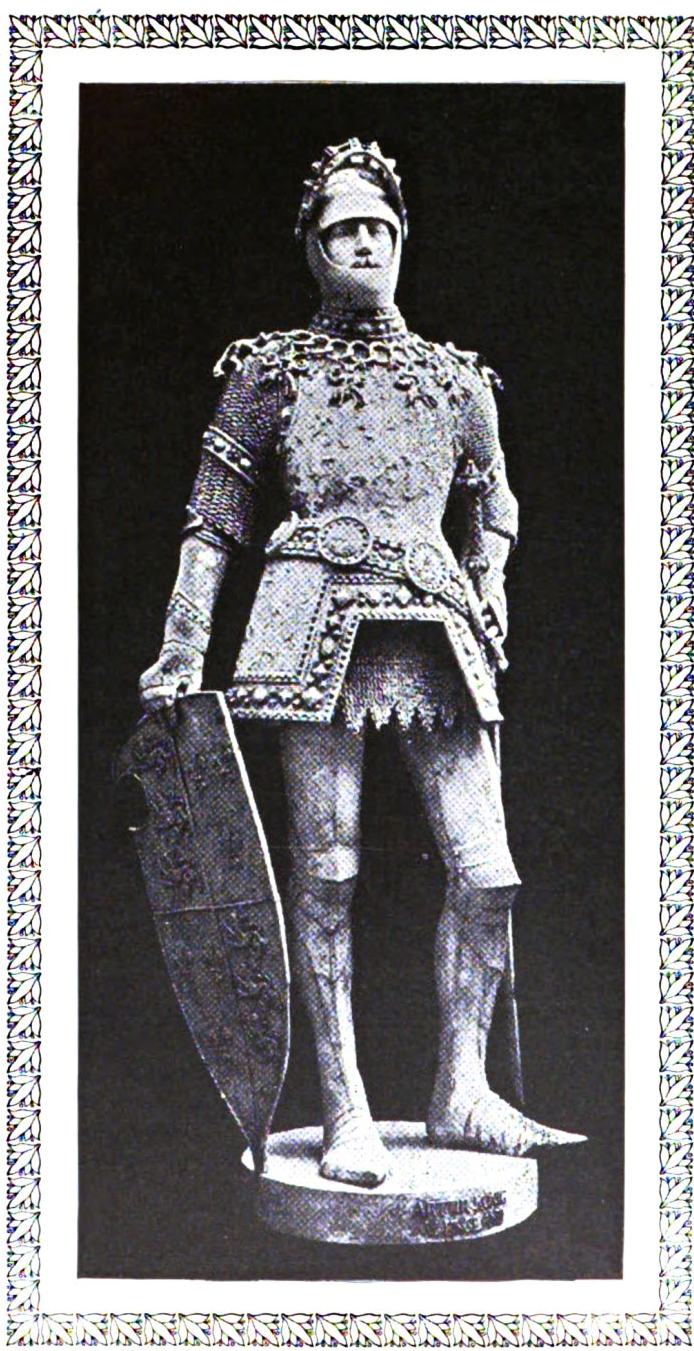
King Arthur’s Tomb, Innsbruck
“That Arthur who with lance in rest,
From spur to plume a star of tournament,
Shot thro’ the lists of Camelot, and charged
Before the eyes of ladies and of Kings.”
—Tennyson.
The Storytellers’ Magazine VOLUME 1JULY, 1913 NUMBER 2
“Heaven lies about us in our infancy”
“In tholde dayes of the King Arthur,
Of which the Britons speke great honour
All was this land fulfilled of faery.”
—The Canterbury Tales.
By Winona C. Martin
After the last story is told (the Passing of Arthur), and the children standing with Sir
Bevidere upon the highest crag of the jutting rock, see the warrior King pass with the three
tall queens in the dusky barge beyond the limits of the world, they too, wonder gazing on the
splendor of his Passing. Though defeated in the last weird battle in the west, yet he was victorious
in his ideals, for he became the spiritual King of his race.
“From the great deep to the great deep he goes.” The children hear but do not quite
understand—it is the better for that because something of the mystery of life and death is
awakened in the child. In that it serves its highest purpose. It helps the child to realize
that there are things in life that eye have not seen nor ear heard, and let it not be forgotten
that while we use these great stories for formal work, the formal is always the result of the creative.
“The letter killeth; the spirit giveth life.” Thus it is that child and teacher leave the
low plains of the “lesson hearer” and hand in hand walk the upland pastures of the soul.—Ed.
Once, in those dim, far off times when history fades
away and is lost in the mists of tradition, there sat
upon the throne of Britain a man named Vortigern.
Like many another king of his day—and of later days
for that matter, he had no right whatever to the
crown, for he had gained it by the betrayal of a trust,
and, some believed, by a still darker crime. Constantine, his overlord,
who had reigned in Britain before him, had, at his death, committed
to this Vortigern, his chief minister, the care of his three sons,
Constans, the heir, and his two brothers Pendragon and Uther. Soon
after the King’s death little Constans had mysteriously disappeared.
Then the true friends of the two remaining princes, fearing for their
lives, had fled with them across the sea and found refuge for them at
the court of France.
All this, however, was now many years ago; and so long had
Vortigern’s right to rule been unquestioned that he had almost forgotten
his crime.
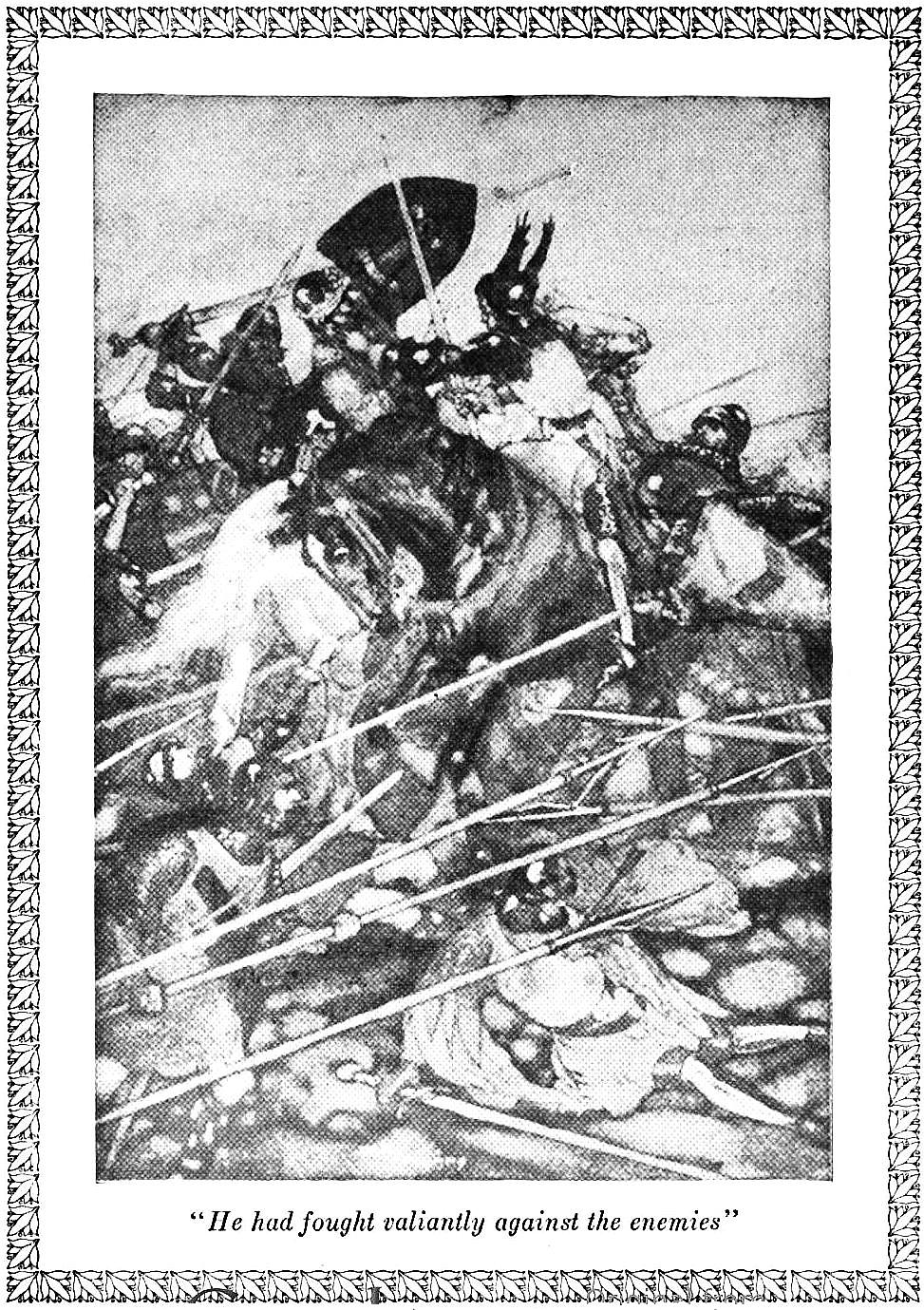
In the early days of his reign he had indeed fought valiantly
against the only enemies that the Britons had at that time greatly to
fear. These were the tall, fair-haired, blue-eyed Saxons who came
from beyond the seas led by Hengest and Horsa. But as the years had
passed, he and his warriors had given themselves up more and more to
lives of luxury and idleness, so that at last they had been obliged to
make a shameful peace with the enemy, and the Saxons were now
gradually becoming masters of the land.
It so happened, therefore, that on the day when our story opens,
King Vortigern had gathered his court about him in his capital city
of London, there to hold a high festival, and in feasting and carousing
to forget the disgrace of their surrender and the ills of the country.
Suddenly, up to the castle gate, through the great portal, along
the wide corridors, and into the very banquet-hall itself, never stopping
to dismount, rode a breathless messenger.
“To arms! Sir King, to arms!” he cried, waiting for no ceremony.
“Pendragon and Uther have this day set sail from the coast of France
with a mighty army, and they have sworn by a great oath to take your
life as you took the life of their brother Constans!”
Then the King remembered, and his face went ashen grey. He
turned to one after another of the men who should have been his
mighty warriors, and, reading in their flabby cheeks and lustreless eyes
the story of their slothful living, knew that his cause was well-nigh
lost before the fighting began.
“Summon my messengers!” he was able to say at last, and when
these were brought before him:
“Ride! into every corner of my kingdom, ride! And call together
the most skillful artificers, craftsmen and mechanics, for I have a
great work for them to do.”
Within a week the messengers on their fleet horses had scoured
the land, so that there stood before the King a hundred of the best
workmen that Britain could produce.
“Now hear my command,” said he. “On the plain that lies
furthest west in my kingdom build me a tower whose walls shall be
so firm as to withstand all assault of catapult and battering-ram; and
have it ready for my retreat within a hundred days, or your lives, to
the last man, shall be forfeited.”
The workmen left the presence of the King with fear in their
hearts; but to such good purpose did they labor that within a few
days there began to be visible upon the plain the jagged outlines of
the walls that were to enclose that mighty tower. Then the weary
workmen, for the first time feeling assured that they could accomplish
their task within the hundred days, lay down for the night and were
soon fast asleep.
With the first pale glimmer of dawn, however, they arose ready to
return to their labors with renewed energy. But what a sight met their
eyes! The tower lay in ruins! The walls had fallen during the night!
Then with the strength of terror they fell upon their task once
more. When the second morning came they turned their gaze half in
hope and half in dread toward the scene of their labors, only to have
their worst fears confirmed. Once again there lay before them but a
heap of ruins!
“We must use larger stones,” said one.
“We have no time to talk,” put in a second. “If our lives are
to be spared we must work as we never worked before.”
So all through the long hours of the day they toiled in silence and
in dread until the damage of the night had been repaired, only to find
when morning came that, for the third time, their tower had crumbled
to the ground.
“This is enchantment!” they then cried in despair. “We cannot
build the tower. Let us go and throw ourselves before the King to
plead for mercy!”
But when Vortigern, with his guilty conscience, heard that word
“enchantment,” a greater dread fell upon his heart.
“Lead out these useless artificers,” he thundered, “and summon
my wise men.”
And presently the great doors of the throne-room were thrown
open and, one by one, in solemn procession, trailing their black
robes, the astrologers, the wizards and the magicians of the realm
filed in, until they stood in a silent semi-circle before the King.
At last Vortigern raised his eyes.
“Tell me,” he said gloomily, “tell me, O my Wise Men, as you
hold in your possession all the secrets of this world, and of other
worlds unknown to ordinary mortals, tell me, I adjure you, why my
tower of refuge will not stand.”
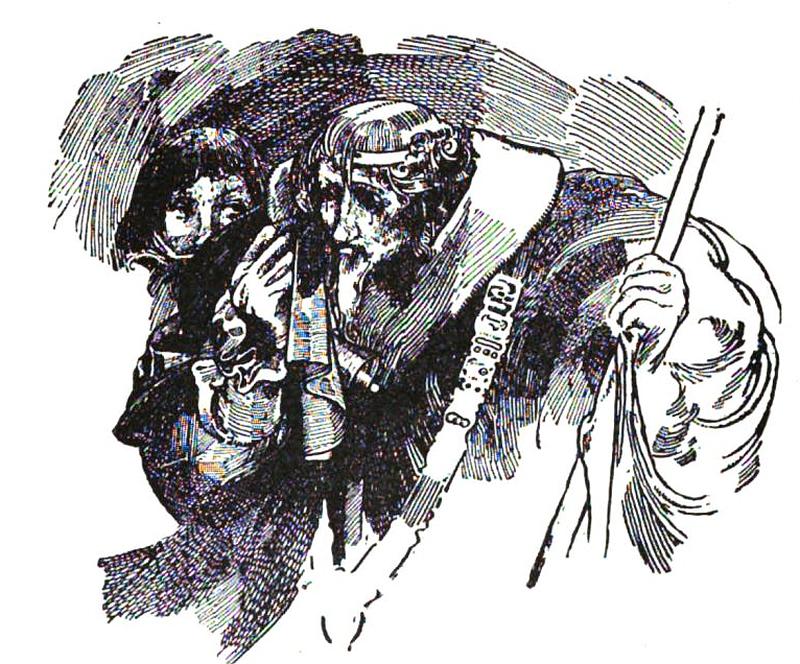
He ceased, and a deep silence fell upon the room. Wizard turned
to astrologer, and astrologer to magician, for each knew in his heart
that he could give no answer to the question of the King.
At last the oldest man present stepped forward and bowing low,
began to speak in deep and solemn tones:
“Your Majesty,” said he, “give us we pray you until tomorrow at
high noon. This night shall the wizards work their spells and the
astrologers consult the stars in their courses. Then shall we be able
to tell you why your tower will not stand.”
“Let it be so,” replied the King, “but also let it be well understood
that if at high noon tomorrow you are still unable to answer,
your lives shall pay the penalty, even as the lives of my workmen
shall pay the penalty if they do not raise my tower within the hundred
days. Fail me not, my Wise Men!”
That night, far down in the deepest dungeons of the castle, the
wizards gathered together about a steaming cauldron, vainly chanted
their incantations and worked their magic spells, while on the highest
battlements, the black-robed astrologers watched the stars from evening
until morning; but when the day-star itself faded from their sight
in the paling blue of dawn, they were no wiser than at the beginning
of their vigil.
“What shall we do?” they cried to one another in consternation
when the two companies of watchers had met to report their failures.
“Hush! Speak low!” whispered the Sage. “We must pretend.
It is the only way to save ourselves. I have a plan.”
And as they gathered about him he continued:
“He had fought valiantly against the enemies”
“You all know the prophecy—that a child who never had mortal
parents shall soon appear among us, and that he shall be able to read
more in the stars than the wisest of our astrologers, that he shall be
a greater magician than the greatest of us, and that through him we
shall lose our power and pass away?”
“Ah! yes, we have heard,” they answered, shaking their white
heads mournfully.
“That child,” continued the Sage, “is living somewhere in Britain
at this very moment, and his name is Merlin. Let us tell the King
that his tower, to make it stand, needs but the blood of this child
sprinkled upon its foundations. So shall we by the same act save our
lives and rid ourselves of one who otherwise will surely work us harm.”
Then the Wise Men bowed their heads and answered:
“You have spoken the words of wisdom.”
So at high noon that day, when they were once more gathered
about the throne, they gave their answer:
“Seek, your Majesty,” said they, “a child named Merlin who
never had mortal parents. Sprinkle his blood upon the foundations
of your tower. Then will it stand until the end of time.”
Thereupon the King summoned his messengers and gave the order:
“Ride! into every town, village and hamlet of my kingdom, ride!
And seek this child until you find him; but know that if he is not
brought to me within ten days, your lives shall be forfeited, and not
yours alone, but also the lives of my Wise Men for giving me useless
knowledge, and the lives of my workmen for doing useless work! Ride!”
Then out from old London Town, north and south and east and
west, up hill and down dale, over mountains and across rivers, rode
the King’s messengers on their strange quest. One day, two days,
three, four, five and six days, seven days, eight days; and when the
ninth day came two of them found themselves far from home, riding
through the street of a tiny hamlet.
“What is the use of seeking further?” said one. “For my part
I do not believe, for all the Wise Men say, that there ever was or ever
could be such a child.”
“I fear you are right,” replied his companion, “we may as well
give up the search and flee for our lives.”
As he spoke the last words, however, the men were obliged to
draw rein lest their horses should trample upon a crowd of children who
were quarreling in the narrow street. One urchin had just given
another a sharp blow across the face, whereupon his victim was proceeding
to vent his rage in words that immediately arrested the attention
of the messengers.
“Wizard turned to astrologer”
“How dare you strike me?” he was screaming at the top of his
shrill little voice. “You who came nobody knows from where, and
who never had a father or a mother!”
In an instant one of the men had slipped from his horse. Then,
having seized both boys, he drew them aside that he might question
them. Very soon boys and men found themselves the centre of an
interested group of villagers each one of whom seemed more anxious
than his neighbor to give all the information that he happened to
possess on the subject.
“Yes, his name is Merlin,” said one, “and he was cast upon our
shores by the waves of the sea.”
“Not at all!” interrupted another. “He was brought to our village
in the night by evil spirits.”
And so it went, but the anxious messengers soon cut short their
eloquence.
“If your name is Merlin,” said they to the lad, “and you do not
know who your father and mother are, you must come with us. It is
the command of the King.”
“I am quite willing,” replied the boy with unexpected meekness.
“Perhaps he would not be so willing,” whispered one
under his breath to his companion, “if he knew why he is wanted.”
“I hear what you say,” Merlin broke in, “and what is more, I
know what you mean; but just the same, I am willing to go with you
to King Vortigern. In fact I struck the boy knowing what he would
say and what you would do; so you see I am not afraid.”
On the tenth day after the departure of his couriers, the King sat
alone in his audience chamber. Suddenly the great doors were swung
wide, and a boy wearing the simple dress of a tiller of the soil appeared
before him.
“Your Majesty,” said he, “I am Merlin, the child who never
had father or mother. You sent for me because your Wise Men have
said that my blood is needed to make your strong tower stand. They
have told you an untruth because they know nothing about the tower,
and also because they are my enemies. I ask only that you call them
together so that I can prove to you that what I say is so.”
Then, at the astonished King’s command, the great bell of the
castle was tolled, and presently the black-robed astrologers, wizards
and magicians filed once again into the royal presence.
“You may question my Wise Men now,” said the King to Merlin,
“and save yourself if you can.”
“Tell us, then, O Prophets of King Vortigern,” cried the boy,
“what lies under the plain where the King has tried to build his
tower.”
Then the Wise Ones drew apart that they might take counsel
together, and presently the Sage stepped before the King and said:
“Your Majesty, we are now ready to give our answer. We who
have the power to look deep into the bowels of the earth know well
that beneath the plain where you have sought to build your tower,
should you dig never so deep, you would find nothing but the good,
brown soil of your Majesty’s kingdom.”
At this Merlin smiled and shook his dark curls.
“You tell us, then,” said the King.
“Let your workmen dig,” replied the boy, “and beneath the
plain they will find a deep pool.”
And when the workmen had dug, they found, just as Merlin had
prophesied—a deep, dark pool beneath the plain.
Then cried the King:
“My Wise Men have been put to shame by this mere lad. His
life shall be spared; but they, for their deceit, shall be driven in disgrace
from my kingdom.”
But Merlin interposed, saying:
“Not yet, Sir King, I pray you. Let us have another test that
you may feel perfectly sure. Ask your Wise Men what lies under the
pool that lay under the plain where you sought to build your tower.”
Again the Wise Ones talked together; and again because they
knew not what else to say, they gave the same answer:
“Sir King, you will find good, brown earth beneath the pool that
lay beneath the plain where Your Majesty sought to build his tower.”
“No, Sir King,” said Merlin. “Beneath the pool you will find
two great stones. Let your workmen drain the pool and see.”
And when the pool was drained, there lay two immense boulders,
just as Merlin had said.
“Truly this is a marvelous child,” exclaimed Vortigern. “Away
with my false prophets! From this time forth I will have no Wise
Man but Merlin!”
“Stay, Your Majesty,” said Merlin. “Let there be one more
test, then no question can ever arise in your mind. Ask your Wise
Men what lies beneath the stones that lay beneath the pool that lay
beneath the plain where you sought to build your tower.”
But this time the Wise Ones were wise enough to hold their peace.
“Very well,” said Merlin, “then I will tell you. Beneath the
stones you will find two great dragons, one red, the other white.
During the day these monsters sleep, but at night they awaken and
fight; and it was because of their terrible underground battles that
your tower could not be made to stand. The night following the
raising of the stones they will fight for the last time; for the red dragon
will kill the white one, and after that, O Mighty King, you may build
your tower in peace.”
Then the Wise Ones trembled, and silently they followed the King
and Merlin across the plain to watch the fatal raising of the stones.
When at last the mighty boulders had yielded to the combined
strength of all the workmen, there, before the eyes of the crowds that
had gathered, lay the two dragons—fast asleep.
“Now send the people away,” said Merlin to the King, “but you
and I must stay here and watch, for at midnight the dragons will fight
their last battle.”
And when the crowds had dispersed, and the Wise Men slunk
away one by one, Vortigern and the boy Merlin sat alone together on
the brink of the pool as the evening shadows fell.
The air grew chill. Presently the moon arose, shedding its weird
light upon the strange scene; and still the dragons slept on. Toward
midnight Merlin leaned forward, and, lightly touching the King’s arm,
whispered:
“See! They are about to awaken. Make no noise!”
Then slowly, and still drowsily, the great white dragon stirred and
opened his hideous eyes, while along his whole scaly body there ran a
shudder. This seemed to arouse the red monster from his dreams, for
before King Vortigern could draw breath, the two terrible creatures
had risen on their bat-like wings far above his head, and, with fire
streaming from their nostrils, were gnashing upon each other with
their fangs, and striking at each other with their ugly claws.
For an hour or more the awful battle continued, sometimes far
above their heads, and sometimes perilously near them on the earth;
and it seemed to the King that neither would ever be able to gain an
advantage—so well were they matched. After a while, however, the
white beast began to show signs of weakening; and at last with a
mighty crash, he fell to the ground—dead. Then the red dragon
spread his wings, and with a strange hissing sound vanished into the
shadows of the night, never to be seen again by mortal eyes.
“Tell me,” said the King when he could find sufficient voice to
speak. “Tell me, O wonderful boy that you are, what do these strange
things mean?”
“I will tell you, O mighty King, without fear or favor,” replied
Merlin, “although I know full well that what I have to say will not
be at all to your liking. You may build your tower now, for there is
nothing to hinder you; and you may shut yourself up within its strong
walls. Nevertheless, Pendragon and Uther, the sons of King Constantine
whose trust you betrayed, and the brothers of the young heir
Constans whom you so cruelly murdered, have to-day landed on your
shores with a mighty army. Forty days and forty nights shall the
siege continue, and at the end of that time your tower shall be destroyed
with every living soul within its walls.
“Then shall reign in Britain first Pendragon and afterwards
Uther; and all the days of their lives they shall war against the Saxon
whom you, Sir King, have brought to this land. The White Dragon
stands for the Saxon, and the Red Dragon for the Briton. Long and
deadly shall be the strife between them, but in the fulness of time there
shall be born to Uther a son whose name shall be called ARTHUR.
He shall be the greatest king that these Islands are destined ever to
know. He and his wonderful knights shall make war on the Saxon
and drive him from the land. So shall the mischief of your reign be
repaired—for a season.”
Then the King, still clinging to the shadow of his former hope,
hastened the building of his tower, and shut himself within its mighty
walls. Nevertheless, within forty days after the beginning of the
siege, having been driven back time and again, Pendragon and Uther,
counselled by Merlin, threw burning brands over the ramparts, so
that the tower took fire and burned with a mighty conflagration until
all within had perished.
Thus was Merlin’s prophecy concerning Vortigern fulfilled; and
as for his other prophecies—that is another story.
(Number Two—“How Arthur Won His Kingdom”—will appear in the next issue)
GLOSSARY FOR BEGINNERS
1. Adjure, to charge or entreat solemnly. 2. Artificer, one who works or constructs with
skill. 3. Astrologer, one who reads the supposed destinies of men in the stars. 4. Battering-ram,
a long beam, usually with a heavy head, used in making breaches in walls. 5. Boulder,
a stone or rock. 6. Catapult, a military engine used for throwing spears. 7. Cauldron, a large
kettle or boiler. 8. Hamlet, a small village. 9. Incantations, the saying or singing of magical
words for enchantment. 10. Over-lord, a king or chief who held authority over other lords.
11. Quest, a search. 12. Realm, a kingdom. 13. Sage, a wise man. 14. Vigil, a night watch.
15. Wizard, one having the power of magic; a male witch.
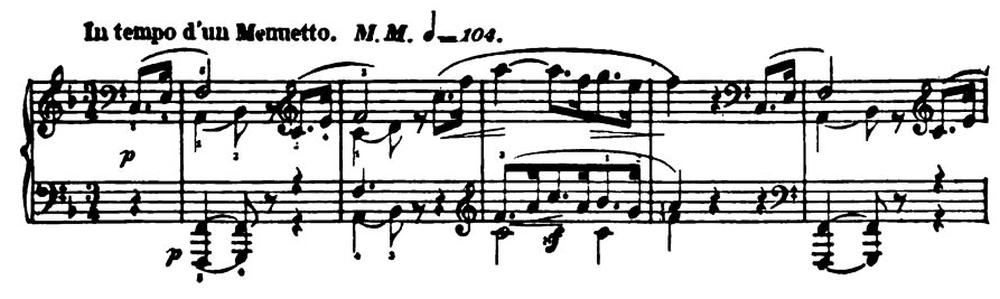
Beethoven’s Moonlight Sonata [1]
And the night shall be filled with music
And the cares that infest the day,
Shall fold their tents like the Arabs,
And as silently steal away.
—Longfellow.
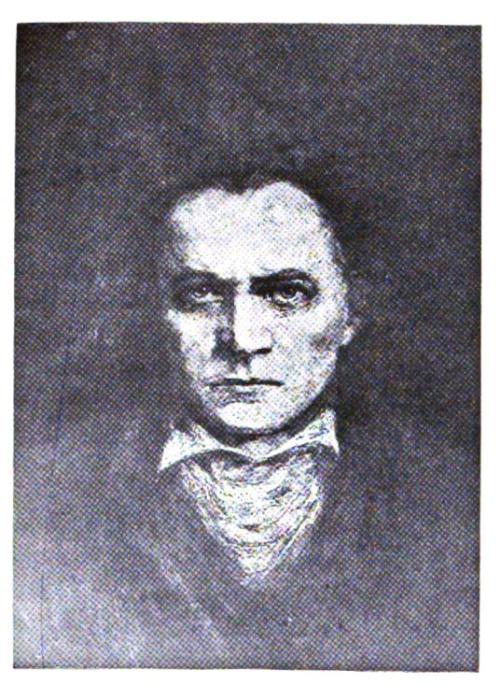
Beethoven
Reproduced by permission Braun et Cie.,
[1] The text of the Beethoven Moonlight Sonata is reprinted from the Aldine Fourth Reader, through the courtesy
of the publishers, Newson & Co., New York.
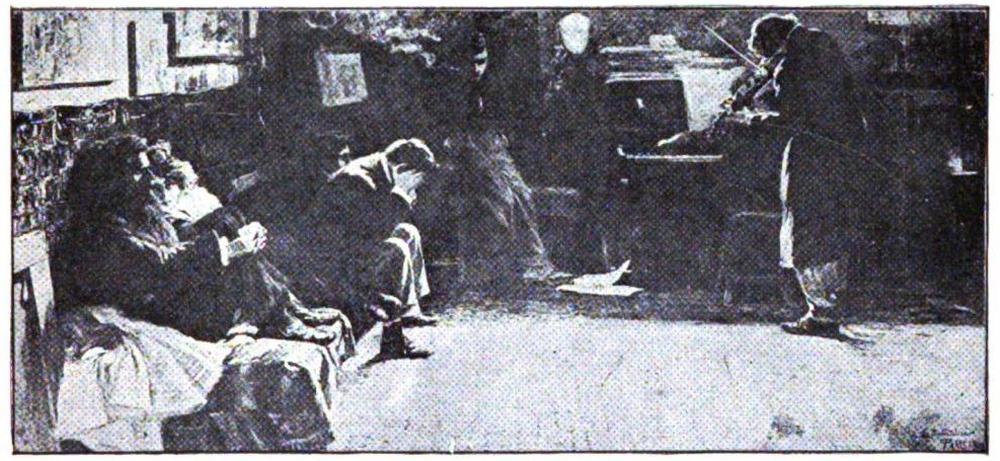
It happened at Bonn. One moonlight winter’s evening I called
upon Beethoven, for I wanted him to take a walk and afterward
sup with me. In passing through some dark, narrow street he
paused suddenly. “Hush!” he said—“What sound is that? It is
from my Sonata in F!” he said eagerly. “Hark! how well it is
played!”
It was a little, mean dwelling, and we paused outside and listened.
The player went on; but in the midst of the finale there was
a sudden break, then the voice of sobbing. “I cannot play any more.
It is so beautiful, it is utterly beyond my power to do it justice. Oh,
what would I not give to go to the concert at Cologne!”
“Ah, my sister,” said her companion, “why create regrets when
there is no remedy? We can scarcely pay our rent.”
“You are right; and yet I wish for once in my life to hear some
really good music. But it is of no use.”
Beethoven looked at me. “Let us go in,” he said.
“Go in!” I exclaimed. “What can we go in for?”
“I will play for her,” he said, in an excited tone. “Here is feeling—genius—understanding.
I will play to her, and she will understand
it.” And, before I could prevent him, his hand was upon the
door.
A pale young man was sitting by the table, making shoes; and
near him, leaning sorrowfully upon an old-fashioned harpsichord,
sat a young girl, with a profusion of light hair falling about her face.
Both were cleanly but very poorly dressed, and both started and
turned toward us as we entered.
“Pardon me,” said Beethoven, “but I heard music, and was
tempted to enter. I am a musician.”
The girl blushed and the young man looked grave—somewhat
annoyed.
“I—I also overheard something of what you said,” continued
my friend. “You wish to hear—that is, you would like—that is—shall
I play for you?”
There was something so odd in the whole affair, and something
so comic and pleasant in the manner of the speaker, that the spell
was broken in a moment, and all smiled involuntarily.
“Thank you!” said the shoemaker, “but our harpsichord is so
wretched, and we have no music.”
“No music!” echoed my friend. “How, then, does the Fraulein—”
He paused and colored up, for the girl looked full at him, and
he saw that she was blind.
“I—I entreat your pardon!” he stammered. “But I had not
perceived before. Then you play by ear?”
“Entirely.”
“And where do you hear the music, since you frequent no concerts?”
“I used to hear a lady practising near us. During the summer
evenings her windows were generally open, and I walked to and fro
outside to listen to her.”
She seemed shy; so Beethoven said no more, but seated himself
quietly before the piano, and began to play. He had no sooner struck
the first chord than I knew what would follow—how grand he would
be that night. And I was not mistaken. Never, during all the years
I knew him, did I hear him play as he then played to that blind girl
and her brother. He was inspired; and from the instant when his
fingers began to wander along the keys the very tone of the instrument
began to grow sweeter and more equal.
The brother and sister were silent with wonder and rapture. The
former laid aside his work; the latter, with her head bent slightly
forward, and her hands pressed tightly over her breast, crouched down
near the end of the harpsichord, as if fearful lest even the beating of
her heart would break the flow of those magical, sweet sounds. It
was as if we were all bound in a strange dream, and only feared to
wake.
Suddenly the flame of the single candle wavered, sank, flickered,
and went out. Beethoven paused, and I threw open the shutters,
admitting a flood of brilliant moonshine. The room was almost as
light as before, and the illumination fell strongest upon the piano
and player. But the chain of his ideas seemed to have been broken
by the accident. His head dropped upon his breast; his hands rested
upon his knees; he seemed absorbed in meditation. It was thus for
some time.
At length the young shoemaker rose, and approached him eagerly,
yet reverently. “Wonderful man!” he said, in a low tone, “who and
what are you?”
The composer smiled, as only he could smile, benevolently,
indulgently, kingly. “Listen!” he said, and he played the opening
bars of the Sonata in F.
The Moonlight Sonata
A cry of delight and recognition burst from them both, and
exclaiming, “Then you are Beethoven!” they covered his hand with
tears and kisses.
He rose to go, but we held him back with entreaties.
“Play to us once more—only once more!”
He suffered himself to be led back to the instrument. The moon
shone brightly in through the window and lit up his glorious, rugged,
and massive figure. “I will improvise a sonata to the moonlight!”
he said, looking up thoughtfully to the sky and stars. Then his hands
dropped on the keys, and he began playing a sad and infinitely lovely
movement, which crept gently over the instrument like the calm flow
of moonlight over the dark earth.
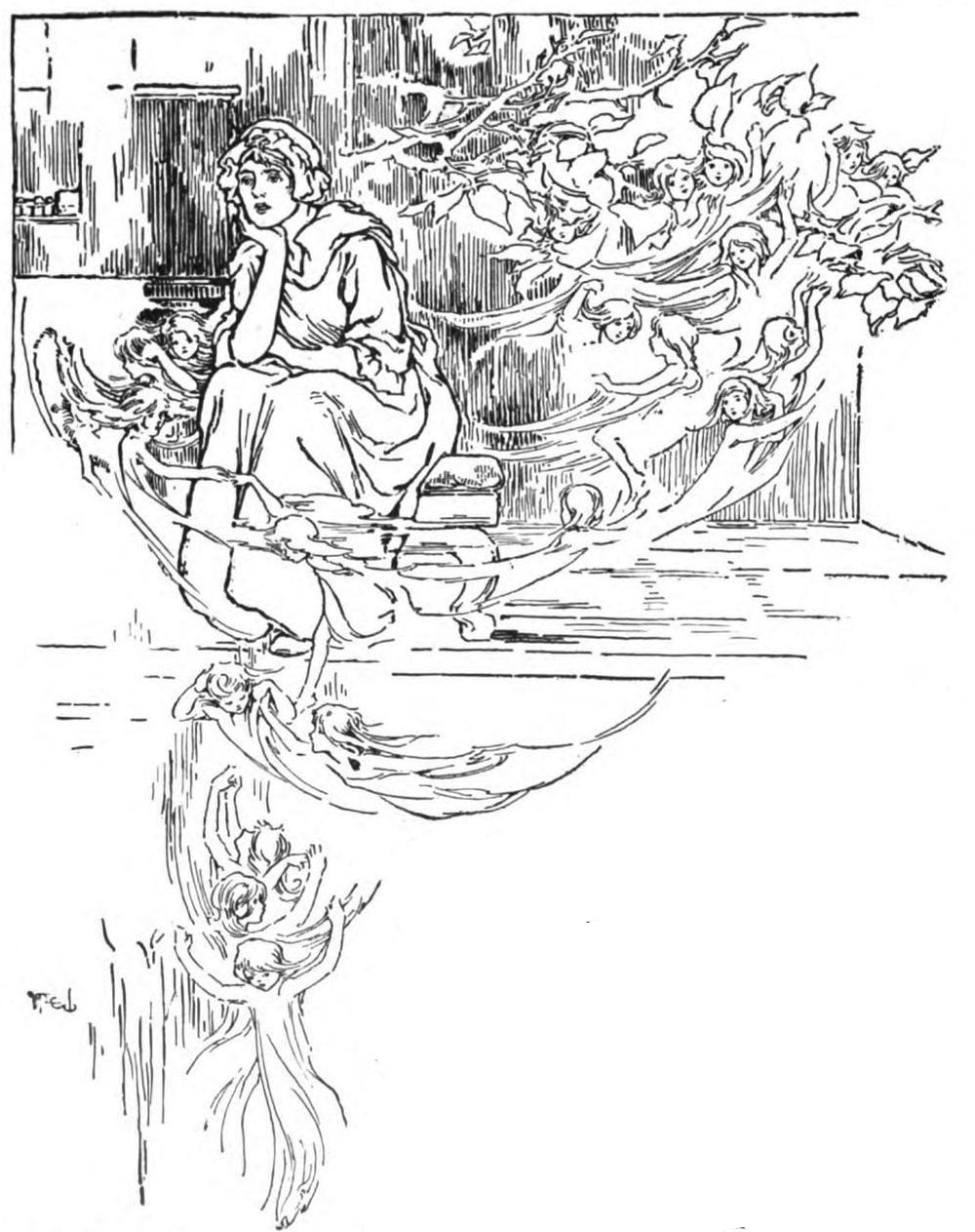
This was followed by a wild, elfin passage in triple time—a sort
of grotesque interlude, like the dance of sprites upon the sward.
Then came a swift agitato finale—a breathless, hurrying, trembling
movement, descriptive of flight and uncertainty, and vague, impulsive,
terror, which carried us away on its rustling wings, and left us all in
emotion and wonder.
“Farewell to you!” said Beethoven, pushing back his chair and
turning toward the door—“farewell to you!”
“You will come again?” asked they, in one breath.
He paused, and
looked compassionately,
almost tenderly,
at the face of the blind
girl. “Yes, yes,” he said hurriedly; “I
will come again, and give the Fraulein
some lessons. Farewell! I will soon
come again!” They followed us in silence
more eloquent than words, and stood
at their door till we were out of sight and
hearing.
“Let us make haste back,” said Beethoven,
“that I may write out that sonata
while I can yet remember it.”
We did so, and he sat over it till long past
day-dawn. And this was the origin of that
Moonlight Sonata with which we are all so fondly acquainted.
A Rose from Homer’s Grave
The nightingale’s love for the rose pervades all the songs of the East;
in those silent starlit nights the winged songster invariably brings a
serenade to his scented flower.
Not far from Smyrna, under the stately plantain trees where the
merchant drives his laden camels, which tread heavily on hallowed ground,
and carry their long necks proudly, I saw a blooming hedge of roses.
Wild doves fluttered from branch to branch of the tall trees, and where the
sunbeams caught their wings they shone like mother of pearl. There was
one flower on the rose hedge more beautiful than all the rest, and to this
one the nightingale poured out all the yearning of its love. But the rose
was silent, not a single dewdrop lay like a tear of compassion upon its
petals, while it bent its head towards a heap of stones.
“Here rests the greatest singer the world has ever known!” said the
rose. “I will scent his grave and strew my petals over it when the storms
tear them off. The singer of the Iliad returned to earth here, this earth
whence I sprang!—I, a rose from Homer’s grave, am too sacred to bloom
for a mere nightingale!”
And the nightingale sang till from very grief his heart broke.
The camel driver came with his laden camels, and his black slaves;
his little boy found the dead bird, and buried the little songster in Homer’s
grave. The rose trembled in the wind. Night came; the rose folded her
petals tightly and dreamt that it was a beautiful sunny day, and that a
crowd of strange Frankish men came on a pilgrimage to Homer’s grave.
Among the strangers was a singer from the North, from the home
of mists and northern lights. He broke off the rose and pressed it in a
book, and so carried it away with him to another part of the world, to
his distant Fatherland. And the rose withered away from grief lying
tightly pressed in the narrow book, till he opened it in his home and said
“Here is a rose from Homer’s grave!”
Now this is what the flower dreamt, and it woke up shivering in the
wind; a dewdrop fell from its petals upon the singer’s grave. The sun
rose and the day was very hot, the rose bloomed in greater beauty than
ever in the warmth of Asia.
Footsteps were heard and the strange Franks whom the rose saw in its
dream came up. Among the strangers was a poet from the North, he broke
off the rose and pressed a kiss upon its dewy freshness, and carried it with
him to the home of mists and northern lights. The relics of the rose rest
now like a mummy between the leaves of his Iliad, and as in its dream it
hears him say when he opens the book,
“Here is a rose from Homer’s grave!”
THE SECRET WOULDST THOU KNOW
TO TOUCH THE HEART OR FIRE THE BLOOD AT WILL?
LET THINE OWN EYES O’ERFLOW;
LET THY LIPS QUIVER WITH THE PASSIONATE THRILL;
SEIZE THE GREAT THOUGHT, ERE YET ITS POWER BE PAST,
AND BIND, IN WORDS, THE FLEET EMOTIONS FAST.
SO SHALT THOU FRAME A LAY
THAT HAPLY MAY ENDURE FROM AGE TO AGE,
AND THEY WHO READ SHALL SAY:
“WHAT WITCHERY HANGS UPON THIS POET’S PAGE!
WHAT ART IS HIS THE WRITTEN SPELLS TO FIND
THAT SWAY FROM MOOD TO MOOD THE WILLING MIND!”
William Cullen Bryant.
The Image in Story Telling
By Percival Chubb
Undoubtedly the element of fundamental importance
in story telling, as in all forms of art, is structure;
“the bones,” as a Japanese phrase has it; the bones of
the limbs, properly joined together to form the well-knit skeleton
of the living body of a work of art. “Let there be form!”
is the first fiat of the artist. That form is literally the “embodiment”
of the soul of intention which animates the creative
process of the artist’s mind. Such is the meaning of Spencer’s,
“the soul is form, and doth the body make.”
It is not, however, about form or the joinery of the story-teller’s
craft that I would speak; but of what comes next in
importance,—the clothing of the skeleton in a beautiful texture
of bodily substance. That substance must be of imagination
all compact. The language of which it is made must employ
the image, must evoke imagery. Language, it has been said, is
fossil poetry; and that is because in the first place the essential
of poetry is the image; and, secondly, because language seizes
upon the graphic qualities of things. So saving a quality is
imagination, that the use of appropriate and vivid imagery
will sometimes atone in a story teller for lack of structural
soundness. This is true, for instance, of some Irish story tellers
and stories. The joinery is often poor; for the architecture of
form is not the Celt’s strong point. The skillful management of
development and climax is frequently wanting in his work.
He does not know just when to stop; he loves to talk on, and
embroider, and gossip. And yet the winning charm of the
genuine Celtic story is irresistible. It holds us by the charm of
style; and the power of its style lies to a large extent in felicity
of imagery, and what we must call by the larger phrase, imaginative
power.
This view was again borne in upon the writer in reading
recently a passage from one of the letters of the great French
painter, Millet. Indeed, it is for the sake of using Millet’s
delightful illustration to enforce once more the truth of a not
unfamiliar principle that this brief article is written.
Millet’s illustration is taken from Theocritus. It is worth
noting, in passing, what a wonderful instinct for greatness
Millet had. He nurtured himself upon the great masters; took
to them naturally from the first. This was true of the literature
as well as the art which he came across. The peasant lad felt
the distinction and power of the poetry of Virgil even while he
learned to construe the difficult lines there on the farm in
Normandy, with the aid of the priest who instructed him.
Later on he took as naturally to Theocritus as to Virgil. He was
always a pupil of the great spirits.
In the letter I quote from, he begins by expressing his
enthusiasm for the Sicilian poet. He seizes upon the copy of
the Idylls sent to him, and does not leave it till he has “devoured
the contents.” But he adds, “It is when I take it word
for word that I am most delighted.” He finds things in the
original which are lacking in the translation; and he gives this
one striking example:
“In the first idyl, on the vase upon which all kinds of things are sculptured,
among others is a vine, full of ripe grapes, which a little fellow guards,
sitting on a wall. But on both sides are two foxes; one surveys the rows,
devouring the ripe grapes. Does not ‘surveys the rows’ show you the layout
of a grape-vine? Does it not make it real? And can’t you see the fox
trotting up and down, going from one row to another? It is a picture, an
image! You are there. But in the translation this living image is so
attenuated that it would hardly strike you. ‘Two foxes; one gets into the
vineyard and devours the grapes.’ O translator, it is not enough to understand
Greek: you must also know a vineyard to be struck by the accuracy
of your poet’s image, that it may spur you to the exertion of rendering it
well! And so on with everything. But I come back to that: I can’t see
the fox trotting—in the translator’s vineyard.
Could there be a more convincing plea for the enlivening
image than that? The image, in other words, is the condition
of sight, visualization, realization. The story teller, on looking
over a written draft of the story he is going to tell, can ask no
more important question than this: “Where can I substitute
for any weak abstract word one that arouses an image?” It
is not enough to think in images one’s self, to have an image,
one must be able to convey it by the use of an image-evoking word.
Another very good instance which I have frequently cited
to students in talking about story telling is the expression
employed in Shakespeare’s “Hamlet” when it is said,
“The cock that is the trumpet to the morn
Doth with his lofty and shrill-sounding throat
Awake the god of day.” ...
Consider how the effect would have been weakened if, instead
of the concrete, image-evoking word “throat,” Shakespeare
had used the word which most of us would have employed,
namely, the word “voice.” That word merely suggests a sound;
“throat” flashes the visible image of that “bird of dawning.”
We see. Not only do we hear that “shrill-sounding” trumpeter,
but we see that straining throat. We are there with the bird.
Many other examples might be cited, but these must
suffice to bring home once more, with fresh emphasis perchance
the truth that, after structural form, after securing sequence,
coherence, climax, unity, the most important factor in story
telling is the apt and adequate employment of the image.
Imagery is the magic of the story-teller’s art.
Endymion is the name of a man who fell in love with the Moon,
the beautiful, bright shining Moon whom the waves obey, and
which sends her light silver down upon the earth to ripple across
the tranquil waters and to shine upon the towers of sleeping cities,
to creep peacefully into the bed-chambers of its inhabitants
and kiss the tangled, golden ringlets of dreaming children. Now
Endymion’s friends thought he was very foolish to fall in love with
any one so far beyond his reach. Especially was this true of the Earth,
who was, in fact, in love with Endymion. And altho Earth put
forth her gayest and sweetest smelling flowers to attract Endymion,
Endymion would not even take the trouble to look upon poor Earth,
but always kept his eyes directed toward the shining Moon.
The Spirit of the Moon
At last poor Earth could stand it no longer, so she went to an
old enchantress named Dipsas and asked her whether she could weave
a charm that would bring Endymion’s thoughts back to Earth.
Dipsas said that such was not her power, but she could bewitch Endymion
so that a long sleep would fall upon him and therefore he couldn’t
love the Moon
any more. So
one night when
Endymion was
out gazing longingly
upon the
Moon and sighing
and calling for her
to look down upon
him and at least
smile upon him,
the enchantress
Dipsas stole up
behind him and
waving a fan of
hemlock above his
head, put him in
a sound sleep.
And there upon
the bank he slept
for twenty years,
and finally even
the Moon began
to miss him and
inquired where he
was, and when she
found that Endymion
had been
thrown into a long
sleep she became
interested in his welfare and perhaps sighed a little for his love, but
try as she would she could find no one who could break the spell.
Finally she sent Eumenides, a close friend of Endymion, to seek over
the world for a remedy.
In his travels about the earth to find a remedy Eumenides met
with an old man sitting beside a fountain, and he told the old man
what he sought.
OH,” said the old man, “you need travel no farther, for
he who can clearly see the bottom of this fountain
has found remedy for anything.”
And so Eumenides looked and saw the bottom
of the fountain clearly and read as follows:
“When the bright, round Moon shall come and
kiss Endymion, he shall rise from his sleep.”
Eumenides hastened back and told the Moon
what he had read at the bottom of the fountain.
Now the Moon was much surprised when she
heard of the remedy for Endymion’s long sleep, but finally she consented
to kiss him, and—wonder upon wonders!—the sleeper of twenty
years awoke. And so delighted was Endymion for the awakening
that he immediately lost all traces of his twenty years’ sleep and
stood before them a young man again. And so delighted was the
Moon with this young man who had undergone so much because of
his love for her that she said he might continue to worship her
forever and ever.
And the writer of this story meant to represent by the Moon
the Queen of England, Queen Elizabeth, whom all Englishmen loved
and honored and some day when you study English history you will
see what brave deeds these Englishmen performed for their Queen,
the shining Moon, so bright, and beautiful, but so beyond their reach.
“GIVE ME LEAVE TO ENJOY MYSELF; THAT PLACE THAT DOES
CONTAIN MY BOOKS, THE BEST COMPANIONS, IS TO ME A
GLORIOUS COURT, WHERE HOURLY I CONVERSE WITH THE OLD
SAGES AND PHILOSOPHERS; AND, SOMETIMES, FOR VARIETY, I
CONFER WITH KINGS AND EMPERORS, AND WEIGH THEIR
COUNSELS; CALLING THEIR VICTORIES, IF UNJUSTLY GOT, INTO
A STRICT ACCOUNT, AND, IN MY FANCY, DEFACE THEIR ILL-PLACED
STATUES.”—Beaumont and Fletcher.
The Story of Saint Christopher As told by R. T. Wyche
The meaning and value of the
story of Saint Christopher
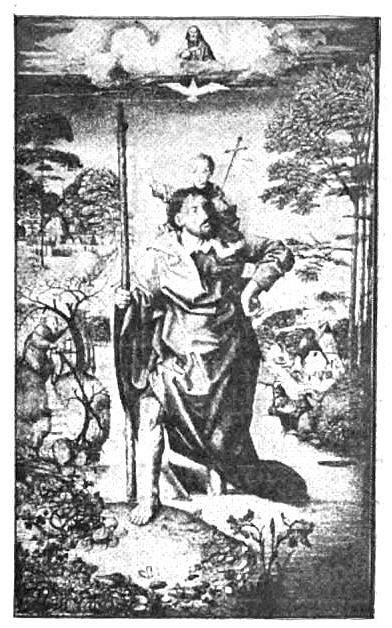
St. Christopher, Memling Royal Museum, Dresden
Reproduced by permission Braun et Cie.
The story of Saint Christopher is a story of the misunderstood boy. Many a child is
misunderstood by parent and teacher, and, like St. Francis of Assisi, is driven from home and
yet makes a great success in life.
The story is an epitome of a man’s life. Christopher in his boyhood had strength—he
worshiped strength—he could not find normal means of recreation, so he did evil. His hero,
the German Emperor, represents the interest of the child from eight to twelve years, with splendid
physical health, with moral and religious nature undeveloped. Christopher followed the normal
impulse in serving the German Emperor. The adolescent boy in high-school period, is represented,
in a way, by the second hero that Christopher served, a devil, a mischief-maker, but
as the boy grows out of that he catches a glimpse of the moral hero just as Christopher did
when he heard of the man of Galilee.—Ed.
Once on a time, a long time ago, beyond the seas, there lived
a boy named Christopher. As he grew up he was unusually
strong and giant like. He drove the cattle to field and lived in
the mountains and on the plains. Being alone much of his time
he had little opportunity for play or sport with other children, and
when he came home his parents did not play with him or entertain
him, and so he sought recreation where he could find it in other places.
He was full of energy and his parents frequently scolded him, which
drove him off to himself in bad moods. On one occasion he tied the
cows’ tails together, just to hear them bellow. On another occasion
he set fire to a forest, all in sport, because he had no one to join him
in better things. His stepmother scolded him and punished him so
that he would frequently go away alone or join bad companions
in mischief. Finally, one day, quarreling with a man, he killed him
because of his greater strength.
Fearing to return home, he wandered in strange lands, sometimes
working for his living, and sometimes living on what was given him.
Wherever he went people admired his broad shoulders and manly
form, for he was giantlike in size.
One day he heard of the Emperor of Germany, who was king
and the mightiest man in all the world. As Christopher admired and
worshiped strength, he wanted to see and to serve the Emperor.
At last after long journeys he came and stood before the German
Emperor and offered his services. The Emperor was at that time
waging wars for his kingdom, and when he saw Christopher, giantlike
and strong, he admired him and readily accepted his services,
taking him along as a bodyguard. Christopher was delighted and
threw his whole strength into the service of the Emperor and did
many wonderful deeds.
So strong was Christopher that frequently he would bear on his
shoulders great logs, place them across gullies and ravines and build
a bridge for the army to pass over. The Emperor frequently talked
with him and encouraged him, all of which immensely pleased Christopher,
for he thought, “I have at last found him who is most worthy
of worship and service.”
But on one occasion as the Emperor was riding near a forest,
Christopher noticed that the Emperor made the sign of the cross
and turned aside from the dark forest and went in another direction.
Christopher said to the Emperor: “Why did you turn back from the
forest?” The Emperor said: “The devil lives in that forest and I
fear him.” “What,” said Christopher, “afraid? I thought that you
were afraid of nothing!” But the Emperor said: “This demon of
darkness is very strong and I fear him.” Then Christopher said:
“If you are afraid I wish to leave your service and join myself to the
devil, because I do not want to serve any but the strongest.” Whereupon
the Emperor paid Christopher his wages and reluctantly parted
with him.
Christopher turned his face toward the dark forest, plunged into
its depths, and finally found a black altar, whereon the devil had
sacrificed the bodies of people. Hard by he found the devil and offered
his services to him. Right gladly the devil took him into his fellowship,
and straightway took him on trips of deviltry and mischief.
But one day they came along by a hill in an Eastern land. On the
top of the hill there stood three crosses. The devil turned aside as
if in fear. Christopher was quick to notice this and he said to the
devil:
“Why are you afraid?”
Then the devil said: “On that middle cross was crucified a man
who is greater than I, and I fear him.”
“What,” Christopher said, “you afraid? Why, then, I am done
with you; I want to serve him who is not afraid.”
And so he parted from the devil and as he went away the devil
laughed and mocked him. Christopher wandered a long time, inquiring
here and there for the man who had died upon the cross. Finally,
one day he found a priest, who lived in a cave that opened upon a
beautiful river. Tired, footsore and weary, he sat down at the invitation
of the priest, who brought him refreshing water from the
spring and gave him food. After he had rested a moment, he said to
the priest: “Can you tell me about the man who died on the cross?”
for Christopher had never heard of this man until the devil had told
him. “Yes,” said the priest, “right gladly will I tell you the story of
his life.”
Then the priest told Christopher how the man of Galilee had
lived, and toiled, and suffered to make the world better; how he was
crucified, died, and rose again. The story was a new and beautiful
one to Christopher, the wonder of it! The priest told him that though
this man was dead, his spirit was still in the world to make the world
better. Then Christopher said to the priest: “He is the one that I
wish to serve. How can I serve him?” Then the priest said: “You
see this river?—there is no bridge for the people to cross; it is wide
and at times dangerous. If you would serve him, help those who try
to cross the river. You are tall, with broad shoulders and mighty
strength. Day after day people as they travel through this land come
to this river but cannot cross—you can help them across, and in that
way you will serve him who, though dead, still lives.”
That pleased Christopher so that he built a house of logs and
boughs by the river’s side, and when people came to the river he would
wade through the water, take them on his shoulders and bear them
across. Years passed by; Christopher grew grey in the service of
humanity and his Master. Those who saw him day after day admired
him and looked for him and he became a friend of all the country,
loved by all.
One dark night when Christopher lay upon his bed, he heard
some one calling, like the voice of a child: “Oh! Christopher, kind,
good Christopher, come help me across!” Christopher arose from his
bed and seizing his great staff, waded through the water until he
reached the other side of the river, but there he found no one; all
was silent, save the ripple and murmur of the waves along the river’s
margin. “Strange,” he said, “I thought I heard some one calling.”
After looking all around, he said: “I must have been mistaken,”
and waded back through the water to the other side of the river and
lay down upon his couch again. But soon thereafter he heard the
same voice calling: “Oh! Christopher, kind, good Christopher, come
help me across!” “Strange,” said Christopher to himself, “some one
must be there,” and seizing his staff he again crossed the river.
But no one could he find, all was silent. Above his head the
stars shone, and he said to himself: “Strange it is I cannot find him
who called me.”
He went across the river and laid down upon his bed again. He
had not been lying there long before he heard the voice calling him
a third time: “Oh! Christopher, kind, good Christopher, come
help me across!” Christopher sat upon his bed—he was troubled.
“Strange,” he said, “some one calls me and yet I cannot find him.”
But again seizing his staff he said: “I will make one more trip.”
When he reached the other side of the river, there he saw a little boy,
and he said: “My little man, where were you,—twice I crossed the
river to find you?” The little boy said: “I was here.” And then
Christopher bent low and took the little man upon his shoulders
and waded through the water, but the boy grew heavier until he
seemed as heavy as a man. When Christopher reached the other side
and put him down and turned to look to see why, what seemed to be
a little child should be so heavy—lo! he was more than a child; a
young man in appearance, with a shining face, and he said to Christopher:
“I am he whom you serve; bury your staff and after a
certain number of days buds will appear thereon.” Then he disappeared,
vanishing as a mist, or as a shadow, though Christopher
saw not. He went and lay down upon his couch and slept in great
peace of mind and body.
Years passed. Christopher was still beloved by all the people
and faithful to his work, but his days were numbered. Though somewhat
feeble, he still bore the people on his shoulders across the river.
One dark stormy night, when the wind roared through the treetops
and the rain fell, Christopher, lying upon his bed, heard a voice call.
He tried to rise and answer; he did go in response to the voice, but
it was his spirit only that went, the last call had come to him.
The next morning the storm was gone and the sky was blue.
People came to cross the river and called as usual to Christopher,
but there was no response. They thought perhaps he was asleep
and went to the cottage. There they found him-— asleep, but it was
the long sleep. And a smile was on his face. Because of his service
to the people they afterwards called him Saint Christopher.
SOULS THAT HAVE TOIL’D AND WROUGHT AND THOUGHT WITH ME—
THAT EVER WITH A FROLIC WELCOME TOOK
THE THUNDER AND THE SUNSHINE, AND OPPOSED
FREE HEARTS, FREE FOREHEADS—YOU AND I ARE OLD;
OLD AGE HATH YET HIS HONOR AND HIS TOIL,
DEATH CLOSES ALL: BUT SOMETHING ERE THE END,
SOME WORK OF NOBLE NOTE MAY YET BE DONE,
NOT UNBECOMING MEN THAT STROVE WITH GODS.
THE LIGHTS BEGIN TO TWINKLE FROM THE ROCKS:
THE LONG DAY WANES: THE SLOW MOON CLIMBS: THE DEEP
MOANS ROUND WITH MANY VOICES.
Tennyson.
The Story of England’s First Poet [3] By George Philip Krapp
[3] Reprinted by permission from “In Oldest England” by George Philip Krapp. Copyright,
1912, by Longmans, Green & Co.
On the northern coast of England in the town of Whitby (White-town)
was built a monastery many centuries ago by a woman
whose name was Hild; and when the monastery was completed
she became the abbess. In this monastery ruled over by the Abbess
Hild, there were not only monks and nuns, but also a number of
servants and helpers who had not devoted themselves to the religious
life. Among these was a poor herdsman whose name was Cadmon.
He could neither read nor write, and his work in the monastery consisted
in taking care of the cows and other cattle which were needed
to supply the monastery table with milk and butter.
Now it was a common custom for Cadmon and his friends to
entertain themselves, when the day’s work was done, by sitting
around the fire telling stories and singing songs. Among other amusements
they had one especially which is known as “passing the harp.”
According to this custom, the harp was passed along from one person
to another, and as it came each man’s turn, he took the harp and sang
a song to its accompaniment. Most people in those days knew many
stories which they could recite in this way, but unfortunately for
Cadmon, this was an accomplishment which he could never learn.
Consequently when he saw the harp approaching him, he would get
up and leave the circle, ashamed to confess that he could not sing a
song as the others had done.
It happened that one night Cadmon left the group of his friends
in this way, as he had often done before, and went into the stable
where he was to pass the night watching the cattle. After a time he
fell asleep. As he lay sleeping, he heard a voice calling to him, which
said: “Cadmon, sing for me.” Then Cadmon answered the voice,
saying: “I cannot sing; and it is for that reason that I have left the
company of my friends and have come hither.” “Nevertheless, I
say you must sing for me,” the voice continued. “What shall I
sing?” asked Cadmon. “Sing for me,” the voice answered, “the
story of how all things were created.” And then Cadmon, greatly to
his own astonishment, found that he was able to sing, and he began
to sing the praises of God the Creator in verses which he had never
heard before.
The next morning, when Cadmon awoke from the sleep in which
he had had this dream or vision, the strangest part of it was that he
remembered perfectly what he had sung in his sleep during the night,
and better still, he was able to add other verses to these. He told
what had happened to him to his master, and his master went directly
to Abbess Hild and repeated the story to her. Hild immediately
called Cadmon to her, and, sending for several learned monks, she
bade them recite a passage of Scripture in English to Cadmon, and
then she asked Cadmon to turn what he had heard into verse. The
next morning Cadmon came back and recited to her in perfect and
melodious verse all that he had been told by the learned monks. Then
Hild immediately perceived that this poor cowherd in her monastery
was possessed of a very precious gift. She gave orders that he should
be accepted as a monk into her monastery, and that the other monks
should teach him all the story of the Bible. This was so done, and
being unable to read, Cadmon learned all the stories of the Bible by
having them told to him, and then he turned them into poetical form.
The monks were glad to write down the poems as Cadmon recited
them, and thus together they put into verse the whole story of the
creation of the world, of the fall of man, of the children of Israel and
the Exodus out of Egypt into the Promised Land, and many other
stories contained in the Bible.
“It was a common custom for Cadmon and his friends
to sing songs.”
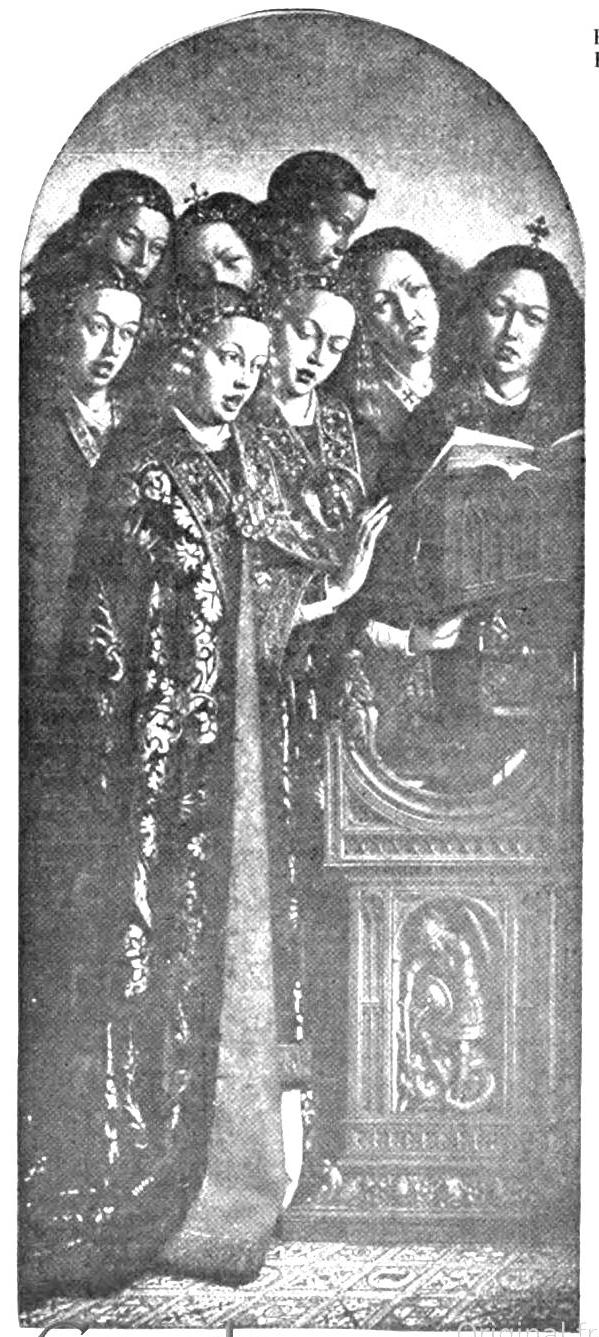
“The Singing Angels” Van Eyck
Royal Museum Berlin
For many years Cadmon continued to live in the monastery
at Whitby, making noble use of this poet’s gift that had been granted
to him. And it was here at Whitby that he finally died. He had been
unwell for several weeks before his death, but it was not supposed
that his sickness was serious. One night, however, the night on which
he died, he asked his nurse to take him to the infirmary, which was
the part of the monastery where those brothers who were dangerously
sick and on the point of death were usually cared for together.
The man was surprised that Cadmon should want to be taken to the
infirmary, but he did as he was asked to do. Cadmon seemed to
be bright and happy, and talked cheerfully with the other sick people
in the infirmary. When it was about midnight, he asked if the Eucharist
was there in the infirmary. “Why do you ask that?” his friends
said. “You are not so near to death that you need ask for the Eucharist.”
But Cadmon asked for the Eucharist again, and when he had
it in his hand he inquired whether they were all kindly disposed and
at peace with him. When they said they were, then Cadmon continued:
“And I, too, am at peace with all men.” Having made his
last communion, he asked if the time was near when the brothers of
the monastery should arise and say the prayers known as nocturns.
“It is almost time,” they answered. “Let us then wait for it,” he
said; and blessing himself with the sign of the cross, he lay back upon
his pillow, and so falling asleep, as peacefully and as gently as he
had lived, he passed to his final rest.
This is the simple story of the blameless life of the first English
poet whose name has come down to us. Other poets there must have
been before Cadmon, poets who sang the stories of the bloody combats
of English heroes before the days of Augustine and Aidan. From
the very earliest times the English have had their bards or minstrels,
whose task it was to keep alive the fame of the nation’s great men.
But not even the names of any of these earlier heathen poets are known
to us, and but a few fragments of their songs have survived to our day.
These songs were of the kind which Cadmon could not sing, but which
his companions, at their feasts and banquets, all sang so freely to the
accompaniment of the harp. This heathen minstrelsy is now all lost
and silent, while down through the ages the clear voice of Cadmon is
heard, singing the old story of the Creation of the World and of the
ways of God to man. From Cadmon to Milton it is a thousand years,
but the poor cowherd who became the chief ornament of Hild’s ancient
monastery on the cliff above Whitby sang his songs in the same spirit
as the author of “Paradise Lost.”
The “Uncle Remus” Stories Their Evolution and Place in the Curriculum — Part One
By Josephine Leach
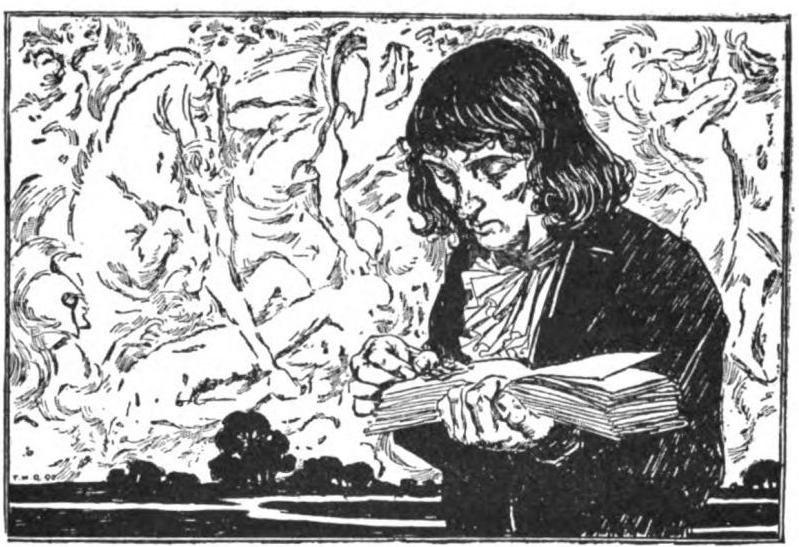
The fame of the “Uncle Remus” stories, according to Joel Chandler
Harris, himself, was an accident. But it is quite possible, that the
fame has not been quite as much of an accident as his modesty declares
it to be.
Mr. Harris was the son of a very poor woman in Georgia. She had
very little to give her children, and very early Joel Chandler was put out
to work. When, but a mere lad, he went to work as printer boy on the
plantation of Mr. Joseph A. Turner. Mr. Turner was a well educated and
cultured gentleman, who spent his leisure hours in publishing (on his own
plantation) a small paper, voicing the sentiment of the times.
Mr. Turner became very much interested in the Harris boy. He
recognized the lad’s ability, for very frequently he found unsigned paragraphs,
quite good in quality, in his paper, which had been composed by
the printer boy Harris, who inserted them as he set up the type. Mr.
Turner gave the boy free access to his very large and splendid library.
When Joel Chandler was not seated, during leisure hours, in the chimney
corner of a cabin in the negro quarters, listening to negro folk-lore, he was
delving deep into the best literature of all ages. He lived so completely
with the great masters in the library, that it is said, that this quite largely
influenced his charming literary style in years to come.
Here on the plantation, in the negro cabins, he came, through the
stories, to feel the emotions of the negro. No one has ever been so capable
of putting himself in another’s place as has Joel Chandler Harris. He
became possessed of all the curious knowledge of the negro, he learned of
dogs and horses, he knew the path of the red stream in the swamp, and the
way of the wild folk in the woods. In fact, one writer has gone so far as
to say, that had Joel Chandler Harris not spent these boyhood days in the
plantation home of Joseph A. Turner, there would have been no “Uncle
Remus” with all that he now means to literature.
In 1876, Mr. Harris was invited to take a place on the paper called
“The Constitution,” published at Atlanta, Georgia. Samuel Small was
then writing humorous sketches for this paper. Small suddenly resigned.
His sketches had been very popular, and the editor immediately looked
around for some one who could continue the work. Mr. Harris was given
the place. He went about his new task with much foreboding. He was
steeped in the quaint stories of the plantation, but would the people accept
these? He resolved to make the attempt, and then came the Uncle Remus
stories for their first appearance.
The stories grew in popularity, and for the same reason that made
Æsop’s fables an imperishable classic, these stories have taken their permanent
place in literature. They were the simple stories that had been linked
with the thoughts and emotions since earliest time, and have now, for the
first time, been put in artistic form, by one who had so entered into the
life of the negro, that he was able to express the negro’s emotions in the
negro’s way. In quoting from an article on Joel Chandler Harris in “The
Bookman,” Volume 27, the author says, “When Mr. Harris chose for his
subject, the plantation negro, he had a character of much subtility to deal
with. His subject is a creature of extremes, carelessly happy one day,
deeply despondent the next, which characteristic has sprung from his very
helplessness; with a never failing sense of humor, which acts as a continual
balance wheel. He is a being, whose mystical side has been highly developed,
and one to whom the “creeturs” have become brothers and sisters,
being endowed by him, with human virtues and vices.”
“Uncle Remus” gave to literature and the world a new type of negro,
that of a good kind-hearted, sympathetic old man, who was willing to spend
hours in telling stories to a little boy. So little is said of Uncle Remus
himself. He is merely the teller of the stories and yet one feels him to be
just such an old man, for his character is interpreted by the stories he tells.
Indeed, some one once asked the author, “Mr. Harris, really, don’t you
suppose that Uncle Remus would steal chickens if he had a chance?” and
Mr. Harris replied, “If I follow Uncle Remus all day, you surely can’t expect
me to know what he does all night.”
Joel Chandler Harris in writing his “Uncle Remus” stories, did not
labor to place them in logical sequence. He cared little about their value
to students of comparative folk-lore, and had little notion of their evolution
when he wrote them. The series cannot be placed into one great cycle that
follows a hero through a number of incidents and at last brings him to the
end, victorious. Mr. Harris told them for the pure enjoyment, and he
was much surprised to find such a demand for a thing that was all pleasure
and no work to him. He loved the simple tales because they were so near
to nature’s heart, because they were full of primitive wonder, quaint flashes
of humor, homely philosophy, and simple goodness.
The stories, however, readily group themselves into four classes.
I. Those that account for Certain Animal Traits, or Characteristics.
II. Stories with Brer Rabbit as a Hero.
III. Those stories told to the little Boy for their Ethical Value.
IV. Stories that attempt to Account for some Natural Phenomena.
Under the first group, Stories that account for certain animal characteristics,
I have placed the following:
Why the Hawk Catches Chickens.
Miss Partridge has a Fit.
Why Brer Possum has no Hair on his Tail.
Why Brer Fox’s Legs are Black.
Why Mr. Possum Loves Peace.
Why Brother Bull Growls and Complains.
How Mr. Rabbit Lost His Fine Bushy Tail.
Mr. Terrapin Shows His Strength.
Brer Buzzard Teaches Brer Terrapin to Fly.
The stories that show the shrewdness of Brer Rabbit, might be taken
as a small cycle which has Brer Rabbit as a hero.
The following are examples:
The Wonderful Tar Baby Story.
Old Mr. Rabbit, He’s a good Fisherman.
Brer Rabbit and de’ skeeters.
Brer Fox Says Grace.
Brer Rabbit Has Fun at the Ferry.
Why Brer Wolf didn’t eat the little Rabbits.
Brer Fox “Smells Smoke.”
Brer Rabbit Frightens Brer Tiger.
Brer Rabbit Conquers Mr. Lion.
Heyo House.
Sis Cow Falls a Victim to Mr. Rabbit.
How Mr. Rabbit Saved his Meat.
The Sad Fate of Mr. Fox.
Brer Rabbit Nibbles up de Butter.
The third group of stories that were told to the little boy for their
ethical value, presents quite a modern idea of the purpose of a good story;
namely, that in order to teach, a moral must be tacked on. When Uncle
Remus found the little boy in mischief, he straightway told him a story
with a homely moral. As for example the story of “Brother Bear and the
Honey Orchard.” Uncle Remus caught the little boy eating a great piece
of cake, while his little brother stood by, crying for some. ’Tis then that
he relates of the selfishment of Brer B’ar with his own conclusion, that
“to his membrence stingy folks nevah come to no good ’een.”
The following stories were told with this idea in mind:
Brother Bear and the Honey Orchard.
The Man and the Wild Cattle.
Brer Rabbit’s Money Mint.
Brother Billy Goat’s Dinner.
The King that talked Biggity.
According to how the Drap Falls.
Under the fourth heading I have grouped such stories as:
The Story of the Deluge and how it came about.
Where the Hurricane Comes from.
The Creation.
Why the Negro is Black.
No one can doubt but that these simple stories were first told when the
human race was very young. The things that are at present accomplished
by science were then met by magic. Whether or not we believe that the
child in his development passes through much the same experience as the
race has in its development, there are certain things that are evident: the
child makes human and holds conversation with everything in his backyard
world. The same voices speak to him that spoke to his cave dwelling
ancestors. To him the wind is a person of might and power, that moans
when in anguish and sighs when weary.
(To be concluded in next issue)
The Three Goats By Jessica Childs
This story, contributed by Miss Jessica Childs of the Pittsburgh (Pa.) Training School
for Teachers, is a translation from the Norse Folk Lore. It is very popular, Miss Childs finds,
with children in the first school year.
Now you shall hear!
There was once a Boy who had three Goats. All day they
leaped and pranced and skipped and climbed up on the rocky hill,
but at night the Boy drove them home. One night, when he went
to meet them, the frisky things leaped into a turnip field and he could
not get them out. Then the Boy sat down on the hillside and cried.
As he sat there a Hare came along. “Why do you cry?” asked
the Hare.
“I cry because I can’t get the Goats out of the field,” answered
the Boy.
“I’ll do it,” said the Hare. So he tried, but the Goats would not
come. Then the Hare, too, sat down and cried.
Along came a Fox.
“Why do you cry?” asked the Fox.
“I am crying because the Boy cries,” said the Hare; “and the
Boy is crying because he cannot get the Goats out of the turnip field.”
“I’ll do it,” said the Fox. So the Fox tried, but the Goats would
not come. Then the Fox also sat down and cried.
Soon after, a Wolf came along. “Why do you cry,” asked the
Wolf. “I am crying because the Hare cries,” said the Fox; “and
the Hare cries because the Boy cries; and the Boy cries because he
can’t get the Goats out of the turnip field.”
“I’ll do it,” said the Wolf. He tried, but the Goats would not
leave the field. So he sat down beside the others and began to cry too.
After a while, a Bee flew over the hill and saw them all sitting
there crying. “Why do you cry?” said the Bee to the Wolf.
“I am crying because the Fox cries, and the Fox cries because the
Hare cries; and the Hare cries because the Boy cries; and the Boy cries
because he can’t get the Goats out of the turnip field.”
“I’ll do it,” said the Bee.
Then the big animals and the Boy all stopped crying a moment
to laugh at the tiny Bee. He to do it, indeed, when they could not!
But the tiny Bee flew away into the turnip field and lit upon the ear
of one of the Goats and said,
“Buz-z-z-z-z!” And out ran the Goats every one!
“The child makes human and holds conversation with everything in his backyard
world.
”The same voices speak to him that spoke to his cave-dwelling ancestors.
“To him the wind is a person of might and power, that moans when in anguish
and sighs when weary.”Josephine Leach.
Story Telling in Washington, D. C. By Marietta Stockard
To the Kindergarten perhaps more than to any other department of
education, must be conceded the credit for having recognized the
power of the story in the life of the child. The best Kindergarten
training schools would no more omit a well organized course in story telling
than they would a course in psychology or child study, so it is with no claim
of something new or different that I respond to the invitation of the Storytellers’
Magazine to tell of the work as it is done in the Washington
Normal School.
We are fortunate in having a Principal who has been willing to allow
a full two years’ course in stories. This makes possible a broader literary
basis, better developed principles of selection, more of adaptation and practical
story telling than could be accomplished in a shorter time. It also
makes possible a more leisurely, more psychologic approach to the subject,
and therefore launches us upon the actual story telling with much of the
beginner’s painful self-consciousness eliminated.
My first question to a new class is, “What have you read and really
enjoyed during your past summer?” Next, “What are your favorite books?”
Through a careful study of the students’ responses to these questions I gain
a knowledge of the literary background and taste of each individual of
whom I shall strive to make a successful story teller.
Discussion of these books which the students know and like leads us
into the field of basic principles of selection in literature. Brief studies
of a few typical short stories, analysis of purpose, structure, and style
follow.
Realizing that the two absolute essentials in a successful story teller
are, on the one hand, a sympathetic knowledge of the best in literature, and
on the other, real understanding of the child, we read together as much
of the best literature about children as time permits.
Our first approach to the story for the child is through a discussion
of favorite fairy tales, remembered from the student’s own childhood.
Comparison shows that there are many common favorites, further study
reveals these same stories as favorites of generations of children.
Re-telling and enjoying these we gradually search out the secret of
their universal appeal and come to formulate a standard embodying the
essential characteristics which all stories for children should contain.
This knowledge of type stories is further developed by a brief study
of Norse Myths and Folk Tales. No other literature gives quite so well
the fundamental characteristics of action, simplicity and embodiment of
ideals as does the Norse. The student who has read Mabie’s Norse Myths,
Dasent’s Popular Tales from the Norse, Stories from Bjornstern and Selma
Lagerlof, absorbs the essential characteristics of the best story and can
scarcely help telling a story with vigor, simplicity, directness and imaginative
appeal.
Sympathetic attitude toward child and story and basis for selection
of stories in the light of fundamental principles of literature having been
developed, we next formulate the requisites of a good story teller and
methods of story telling. This is done through story telling in class under
criticism and a study of such books as: Voice and Spiritual Education, by
Corson; How to Tell Stories to Children, by Sara Cone Bryant; Stories and
Story Telling, by Porter St. John. We study, re-tell, adapt, and collect in
a manuscript story book such stories as are particularly suitable for use
in the kindergarten.
The demand for story tellers in the schools, in playground and
library work, in social centers and Sunday schools, led to the establishing
of a course in story telling and children’s literature at George Washington
University. This course is credited both in the teacher’s department and
in the English department of the University.
The work consists of lectures, required readings and reports. The
history of the story, its relation to literature, its relation to the child, the
story as a moral force, methods of story telling, including adaptation,
preparation, and presentation are a few of the topics discussed. Studies of
groups of animal stories, folk and fairy tales, hero tales, Bible stories,
Christmas and Thanksgiving stories, spring stories and humorous stories
constitute the content of the course.
Every student of children’s stories not only gains a deeper appreciation
of the best in literature and an added sympathy with and understanding of
the child, but also discovers an inexhaustible source of usefulness and joy.
Story Telling for Camp Fire Girls By Ellen Kate Gross Chief Guardian, Children’s Playground Association of Baltimore, Md. — “Wohelo”
Apropos to our conversation at the Richmond Congress in regard to
stories for Camp Fire Girls, the following plea is submitted to your editorial
board with the hope that your splendid magazine will help us in one phase
of our work.
In furthering the development of the Camp Fire Girls, there arises
the necessity for a supply of Indian folk tales well told and embodying the
out-of-door spirit of the Indian and his ideals. Moreover the various
points of the law of the Camp Fire can best be exemplified through stories
which develop the ideal held up. This law is to
“Seek beauty
Give service
Pursue knowledge
Hold on to health
Glorify work
Be happy”
The following suggestive list may illustrate how this method can be
carried out,—the thought and meaning of each precept being developed
through one of the stories named.
SEEK BEAUTY
Hawthorne, “The Great Stone Face.”
Kingsley, “Water Babies”—in parts.
GIVE SERVICE
Robert Louis Stevenson, “Prince Otto.”
Stockton, “Old Pypes and the Dryad,” in Fanciful Tales.
Biographies and Autobiographies.
Example “Florence Nightingale.”
“Lucretia Mott.”
“The Little Hero of Haarlem”
Emile Poulsson, “Nahum Prince,” in “In the Child’s World.”
BE TRUSTWORTHY
“Ruth and Esther,” told in Hamilton Mabie’s “Stories Every Child Should Know.”
GLORIFY WORK
19th Psalm.
Lives of Burbank, Edison and other Inventors.
“The Basket Weaver.”
“Beowulf,” in Hamilton Mabie’s “Legends Every Child Should Know.”
“The Message to Garcia,” by Elbert Hubbard.
BE HAPPY
“King Midas.”
“Ugly Duckling.”
“Pine Tree that changed its Leaves.”
King Arthur tales.
If some of these stories or similar ones, and also some Indian legends
could be published in your magazine from time to time, it would be a great
help to those who are working with Camp Fire Girls.
“Wohelo,” the musical cry of the Camp Fire Girls was sounded by
more than nine hundred of them at the first Grand Council held in the 69th
Regiment Armory, New York City, recently.
Clad in the picturesque attire of the American Indian, they sat in a
big circle around three lighted candles, representing their three foundation
principles, and groups of lights representing real camp fires, a Camp Fire
ceremonial which is performed to the music of “Burn, Fire; Burn!”
Under the supervision of the guardian Hiltini, who is Mrs. Luther H.
Gulick, three other guardians, Mrs. Bradley, Mrs. Weber and Miss McCarthy,
representing respectively Work, Health, Love, lighted the camp
fire by the Indian expedient of rubbing two sticks together.
The call of the Camp Fire Girls, “Wohelo,” is formed by the first
syllables of the three foundation words of their organization: Work,
Health, Love.
The Play Spirit in America
Those who have lost the play spirit are beginning to
die. These were the words of Dr. Cabot of the Massachusetts
General Hospital of Boston at the recent Congress
of the Playground and Recreation Association of America,
held at Richmond, Va. True recreation is re-creation—to
be made anew from day to day, mind and body. The
old saying that all work and no play makes Jack a dull
boy is true of adults as well as children. It is more important
that adults emphasize recreation for themselves than for the
child. It is so much easier for grown people to forget to play.
The serious person is only half awake. Seriousness often
excludes humor and thus shuts out the play spirit in life. The
serious person is not always thoroughly in earnest. He who
excludes humor and play cannot be in earnest because he does
not use all the resources at his command. Young people are
always earnest; play and humor are part of their program.
The calculating business man sitting in his close office or
the hard taskmaster sitting at a teacher’s desk may be making
a living and yet not living but prematurely dying. Compare
such a one with a group of young people who shout and laugh
in joyous play or work outside and ask yourself which is preferable,
which is life? The business man once had the play spirit
but he has lost it, and with it life and its joy. When he went
to school years ago he was not taught to live but to calculate;
not to think but to imitate and accumulate a living, not a life.
He has been true to his teaching. He might be rescued even
now if he could be made to see the necessity for play and feel
the rejuvenating effect of rhythmic games. He must get rid of
the idea that it is undignified for a grown man or woman to
play, to join hands in a circle, to shout and laugh and sing and
play games on the green.
The American people must be taught recreation, not only
in public playgrounds but the necessity of using home, lawn and
yard for play for child and adult as well. We must get rid of the
idea that people are made for parks and substitute the idea,
parks are made for people.
A one-time city superintendent of schools in a large city
and for a number of years a college president recently spent a
year on his farm and says that as a result his whole feeling and
view toward life has been changed by the year of recreation.
To have normal feelings is more important than abnormal
knowledge. Knowledge is sometimes weakness rather than
power.
A child without a playground is the father of a man without
a job, says one of our playground officials, and we might add
that a man without play will soon be a man without a job and
without health. It is high time that school faculties realize
their sin in failing themselves to play. Enthusiastic teachers
often study and teach all the winter, then go to a summer school
and pile on more of the same kind of work. We recognize the
evil of this, yet few are brave enough to stop in the midst of
work and play and teach play. Summer schools should send
their students back home rejuvenated, with renewed health
and enthusiasm and with a new feeling for life rather than
book-burdened, tired and nervous.
We have in America a wealth of folk-games, folk-dances,
folk-songs, folk-stories brought hither by the various races of
Europe, that would give us wholesome recreation,—a folk-culture,
yet we stand idly by and let an ignorant commercial
schemer run a dance hall and give our young people dissipation
instead of recreation. Churches and homes make a great mistake
when they say “Don’t do this” or that and stop there.
We must be positive and say “Do this, these are the games to
play, these are the songs to sing, these are the stories to tell,
come and join us.” If good people do not give us good recreation,
bad people will give us bad recreation and make us pay
for it. A machine can add a column of figures for us, another
person can spell a word for us, but no one else can recreate or
have health, personality and enthusiasm for us.
R. T. W.
Invocation Rev. Jenkin Lloyd Jones
Father, make us glad that we are here, glad in the dear fellowships
of the past, glad in the strong ties that bind us to our tasks, glad of
the tasks. O Thou Burden Giver, lift us above the selfishness of the
ease-seeker.
¶ Father, we come to listen to Thy commissions. Grant us power to go
into the dark places of human lives, the sad places of human hearts, and in
Thy name speak the word that may bring strength, peace, consolation.
Father, help us to realize the opportunities that await us; gird us anew
for the high and holy warfare wherein the weapons are the instruments of
love, the counters of kindness. Help us to forget the things that hurt, to
rise above all discouragements, to dwell with Thee in deathless places;
to rejoice with Thee in the boundless realms where the petty lines of caste,
class and sect, of race and prejudice, do not obtain, but where Thy children,
conscious of Thy Fatherhood, rejoice in the largeness of the love that includes
all races, all climes, and all ages.
¶ Father, take our hands and touch them with usefulness. Take our
feet that they may be shod with willingness. Take our hearts that they
may glow with kindness. Take our minds and tutor them in the way of
truth. Take our voices and tune them to the universal harmonies, that in
finite time we may sound some notes of thy never-ending song. Amen
What the Leagues are Doing
The closing meeting of the Knickerbocker Story Tellers’ League of New
York City, for the season 1913, was held on Saturday evening, May 17th.
The recent work of the League has been directed along the lines of
the English, Spanish and American Schools of Art. At a previous meeting
the stories of the Florentine, Flemish and Dutch Schools were told and no
actual reading was done throughout the entire evening. Mrs. Estelle
Davis Burt, the President, handled the topic Dutch Art.
The last meeting of the Atlanta Story Tellers’ League is reported by
Mr. George B. Hinman as the most interesting of the year.
Mrs. Goodman gave a very charming and illuminating account of her
visit with Mr. R. T. Wyche to the Knickerbocker Story Tellers’ League
in New York, and Mrs. Stevens told a most interesting original story,
which held her audience spellbound throughout. Miss Ray Klein, who is
one of the friends of the League, told a beautiful fairy story. The attendance
was large and appreciative.
The Story Tellers’ League of Little Rock, Arkansas, held its closing
meeting at the public library in May, when the following officers were
elected: Miss Eliza Hockins, president; Miss Grace Boyce, vice-president;
Miss Johnnie Bledsoe, secretary and treasurer. The program was excellent.
Miss Marguerite English told of “The Hall of Heroes”; Mrs. L. W. Cherry
told an Egyptian legend, adding to the beautiful story by touches of personal
experience in Egypt; Mrs. W. B. Rawlings told the story of a Syrian
mother; Miss Abbie Whitcomb gave the story of a Parisian boy hero in
her usual expressive way.
A conference was held May 27, 1913, at the Sinton Hotel from three to
five, with Dr. Richard Wyche, President of the National Story Tellers’
League of New York, who has started a magazine for the benefit of story
tellers, entitled “The Storytellers’ Magazine.” Dr. Lester Riley, Miss
Pearl Carpenter, Miss Alice Adele Folger, Miss Annie Laws, Miss Marie
Dickore, Miss Josephine Simrall and others of the Cincinnati branch of
the National Story Tellers’ League were present.—Cincinnati Commercial
Tribune.
From the Editor’s Study
The revival of interest in story telling on the part of educators
today is due perhaps more to scientific men than any
other group. The old conception of the child was that he was
born in depravity and therefore his natural impulses were bad,
and he should be repressed. Methods of suppression resulted;
the child had no rights. If the things he was compelled to
study were meaningless and obnoxious to him, well and good.
The things he was interested in were ignored.
But with the coming of the biologist, geologist, and psychologist,
we have seen a world of growth and change, reaching
back into the immeasurable past, and man in this order, not
fallen and depraved, but natural and normal with his face
to the morning, ever moving upward and onward. The students
of history, primitive art and folk-literature have traced for us
the path-way along which the soul of the race, ever growing
into self-realization gave expression to its beliefs, its hopes, its
prayers and its religion, in myth, fairy story, folk-lore and folk
epic. As one who travels through low land and forest yet ever
climbing reaches an upland peak and looking back sees path,
forest, field and rim of sea all in the perspective of beauty, so
we today looking back have an infinitely larger and deeper
view of life and its meaning. It is this view that has changed
our attitude toward the child and will result in our setting
him, “the last serf of civilization free.”
This new valuation of the child, respect for his rights and
a better understanding of his needs has brought story telling
to the front again. It is true that the race and the individual
of all races have had stories told them more or less by troubadour
and rhapsodist—the old story tellers, chief among them Homer,
but not until modern times have educators so seriously studied
this story as a means of education. For many centuries literature
lived orally and was handed down by the story tellers;
but when printing was invented the teacher began to busy
himself with grammar for young and old alike, until language
form became an end instead of a means.
Man in his development did not invent letters and language
with the hope that he might have something to say, but he had
so much to say he was compelled to invent language in order
to express himself. So with the child, we must feed the springs
of imagination and emotion if we would give him something
to express. As a tree puts forth leaf and blossom in obedience
to the laws of life within, so will the child give back in vital
expression the things that nurture his inner life. Expression
is life, suppression is death. It is the recognition of this truth
that has given us the pedagogical basis for the story, whether
it be re-telling, dramatization or illustration of the story; modelling
into clay, carving into wood or motiving in life.
Man becomes like that which he admires, therefore, stories
of noble deed and great heroes are used in school and Sunday-school
for character building in place of memorizing abstract
statements.
Young people will read books from which interesting stories
have been told them, therefore many of the public libraries
have a story teller for the children’s room, who by story telling,
directs the reading of the children for a whole community.
Story telling is a means of recreation and pure pleasure, therefore
the public playgrounds throughout the land have their
story tellers for the young people. Parents who tell in their
homes the right kind of stories make an atmosphere in which a
soul can grow and bind their off-spring to them with spiritual
ties, the most lasting of all.
Story telling is an alluring subject for study, a means of
delightful social intercourse and reinforcement for life, therefore
many have organized themselves into the National Story
Tellers’ League and its local branches.
It is to deal with this work of story telling in all of its aspects
that the Storytellers’ Magazine is founded. It is our purpose
to point out as far as we can the vital principles that underlie
the whole movement.
The question of what stories to tell is supremely important.
We cannot tell or read one-hundredth part of the good stories.
In order to answer this question, we propose to re-tell in the
pages of the magazine some of the best stories recognized by
educators the world over; and by articles from specialists,
point out the stories most worth while from the standpoint
of literature. It is true we shall deal as do the oral story
tellers with much of the old literature but with a creative
touch that will give it the breath of life, making it a living
literature and a new expression of American life and art.
We propose to answer the question of what stories to tell
by a study of the child and his needs in the various periods
of his development. Stories that contribute most to the
making of ideal womanhood and manhood, in the last analysis,
are the stories to emphasize.
The ancient story teller who by fireside or in royal court
told stories of their nation heroes like King Arthur, Siegfried or
Ulysses had quite a simple and direct use for the story compared
to the situation today. With the complexity of modern life
the use of the story becomes far more rich and varied. We
expect through short articles from authorities in this work to
point out all legitimate uses of the story.
Many a one has a gift for story telling but knows not how to
use it. We shall have an occasional article by those who have
made a success of story telling and can speak from experience.
When we think of the many educational institutions and
individual workers taking up this work of story telling, and
when we see the many young men and women who could, if
they but knew how, become evangels of the fine art of story
telling, and when we hear the voices of the great multitudes
of children in neglected country districts as well as cities,
saying “tell us a story” surely there is an opportunity and a
call to service for The Storytellers’ Magazine.
American thought is in a creative period. Old forms in
education, art, religion and government are assuming new
forms to fit new conditions. The story telling movement is
one with this growing life. Let us make it a true expression
of the Nation’s best life. We are still young; much lies ahead
of us. In the spirit of the great heroes of the old story
books let us spread every sail, make for the mid-seas and
discover lands not laid down in any chart.
In this issue of The Storytellers’ Magazine will be
found the initial number of Miss Martin’s admirable King
Arthur Series, composed of twelve stories, as follows:
1. Merlin and His Prophecies.
2. How Arthur Won His Kingdom.
3. How Arthur won His Sword “Excalibur,” his Bride and his Round Table.
4. The Adventures of Gareth—the Kitchen Knave.
5. The Adventures of Geraint.
6. The Adventures of Tristram, the Forest Knight.
7. The Adventures of Launcelot of the Lake.
8. The Dolorous Stroke.
9. The Coming of Galahad.
10. The Quest of the Sangreal.
11. The Achieving of the Sangreal.
12. The Passing of Arthur.
At least one story will appear in each succeeding issue of
the Magazine until the series is finished, and should space permit,
possibly two stories will appear in some of the numbers.
The Immortal Stories
They were told long before anybody had learned how to write them
out, though most of the fairy tales which the children feed on now are of
the second crop, to be sure.
Dr. Greville MacDonald, writing in the Contemporary Review of “The
Fairy Tale in Education,” insists as strongly as Ruskin did upon the vital
importance of the fairy story in the right kind of ministering to children.
He regrets the tendency among the science worshipers to regard the fairy
tale as a weed of superstition, to be pulled up and cast out with all such
worn out beliefs. And he goes on:
“The fairy tale is a wild flower. It is native to that pasture of
aboriginal, uncultivated innocence wherein, among the roots of grass and
flowers, the elemental passions dwell....
“Not the least important of these elemental passions is the individual
sense of unity with the world beyond. It is dominant in all unspoiled
peasant folk, and dormant when not dominant in all children. It takes
concrete form in folk-lore, folk-song and folk-dance. It throve fearlessly
in the thirteenth century painters, in the Gothic masons and glass stainers
of the great cathedrals. It is, indeed, the elemental gift in whose atmosphere
and inspiration the true art grows. Hence comes the child’s fellow
feeling with all simple life—his clutching at the flower, his delight in kitten,
bird or butterfly. These are fellow creatures all, allies in “effort and
expectation and desire.”
Dr. MacDonald is not worried by the protest that fairy tales sometimes
have “bad morals.” He finds much popular confusion between the words
“meaning” and “moral” in such complaints. What we do actually and
rightly dislike, he thinks, is a moral label.
This is why the short sighted, the unco guid, or those whose “heads
are filled with science” (to paraphrase a great writer), stupidly object to the
fairy tale; they always want to append a copy book moral. The bad
figures in fairy tales often play tricks successfully upon the good ones, but
the child is not thereby deceived. His unerring instinct, unwarped by any
sophistry of man’s education, pierces all the shams, and he loves the good
and turns away, just as surely, from the bad. The spiritual sense of what
is deeply true is integral in the child’s imagination, and must be held sacred.—N.
Y. Evening Sun.
From the Book Shelf
“In Oldest England,” by G. P. Krapp. Price, 75 cents. Longmans,
Green & Co., New York.
Dr. Krapp, a professor of literature in Columbia University, has given
us an interesting and valuable book, for both youth and adult. He relates
in an interesting way the story of England’s history, from the beginning
up to the Norman conquest, using facts, ancient manuscripts, pictures
and early literature to tell the story. He makes an appeal to the imagination,
to re-create those far-off days, that we may fully realize how our
ancestors lived a thousand years ago.
The measure of a people’s civilization, he says, is not in the amount
of machinery they possess, but in the thoughts and affections which go to
make up character. We cannot give a better idea of the book than the
story of England’s first poet, which we give on another page of the Magazine.
“Tales of the Enchanted Isles of the Atlantic.” By Thomas Wentworth
Higginson. Price, $1.50. The Macmillan Company, New York.
“Bancroft, the historian, made it a matter of pride that the beginning
of American annals was bare and literal,” says the author, and he goes on
to prove, through two hundred and fifty-nine interesting pages, that
Bancroft was mistaken. To Europeans, undiscovered America lay beyond
the great unknown sea of awe, danger and vanishing isles. The islands
within sight of European shores, Irish, Breton, Welsh and Spanish, had the
glamour of enchantment cast about them. They were the gateways to a
sea of mystery. The Canary Isles were discovered before the Christian
era and then lost sight of for thirteen centuries. A continent called
Atlantis, thought to have been submerged in the Atlantic, had long haunted
the imagination of people in Europe and Africa. Solon, the law-giver and
poet, wrote a letter in which he said that when a student in Egypt, he was
told that the island of Atlantis, was sunk thousands of years ago. This
letter was read and studied by both Socrates and Plato. From these
traditions, taught by Greek and Egyptian, and believed by the inhabitants
of Western Europe, who ever looked out upon the Atlantic, grew the interesting
tales which the author gives, such as “Island of Youth,” “Swan
Children of Lir,” “Castle of Active Door,” and “Island of Seven Cities.”
King Arthur visited one of the Islands, and wrestled with Half-Man, which
meant Habit, and when he fought his last battle in the West, and sailed
away, it was to Avalon, one of the enchanted isles.
These traditions were great psychic forces, that lured men on until
they discovered a new world, more marvelous than Atlantis. A fine book
for the story tellers and one bearing directly on American history.
“Indian Sketches, Père Marquette and the Last of the Pottawatomie
Chiefs.” By Cornelia Steketee Hulst. Price, 60 cents. Longmans,
Green & Co., New York.
Mrs. Hulst combines historical data and literary art in such proportion
as to make a most readable book, an Indian epic, beginning where the Song
of Hiawatha left off, and bringing the Indian down to modern times. The
story of the white man’s injustice and greed toward the Indian should be
told our children. Our histories have omitted the accounts of the exile and
banishment of tribes to the Far West. “To frankly confess a fault indicates
a higher plane of honor and sincerity,” says the author. We have wronged
our brothers, the Redmen, the first Americans. Let us as far as we can
right the wrong. The book is a voice from the present speaking to the future.
No one can read the book without feeling its appeal to fair play and eternal
justice and right.
The Indian’s religion of the Great Spirit, his folk-games and folk-stories,—a
true folk-culture that came out of the countless ages of American
geography and history may yet be made over into the culture of modern
America for our good. The author has set us thinking.
“Willie Wyld,” three volumes, Natural History Stories: “Voyage to
the Island of Zanzibar,” “Hunting Big Game in Africa,“
”Lost in the Jungles of Africa.” By William James Morrison,
with an introduction by Dr. P. P. Claxton, United States Commissioner
of Education. Price, 60 cents a vol. Publishing House M. E.
Church South, Nashville, Tenn.
The wide circulation these books have had prove the author’s position
that a story need not be a fairy story to hold a child’s attention, but that
Natural History has a marvelous story of its own to tell. While the books
are instructive, yet the narrative holds the attention to the end. The plot
is original and so is the method. Dr. Claxton says in his Introduction, “All
people like stories of adventure, boys and girls most of all. Our ancestors
told them about their camp fires, at night, in the long winter and on the
meadows and in the openings of the great forests in the long twilights of
the summer.
“Dr. Morrison has become known among modern story tellers for his
realistic stories of adventure in which are interwoven valuable information
of strange lands, peoples and animals. The stories in ‘Willie Wyld’ were
first told by Dr. Morrison to the children of Nashville, in the Children’s
Reading Room of the Public Library of that city, and have been written down
as told, hence their freshness, simplicity and realism. I have just read them
at a sitting without skipping a sentence, and I am sure many another child
will want to do the same.” A helpful set of books for boys and girls.
The Aldine Series of Readers: The Primer, 32 cents; 1st Reader,
36 cents; 2d Reader, 42 cents; 3d Reader, 48 cents; 4th Reader,
65 cents; 5th Reader, 75 cents; 4th, 5th, 6th and 7th Grade Readers,
48 cents each.
Learning to Read. A Teachers’ Manual, 60 cents. By Frank E. Spaulding,
Superintendent of Schools, Newton, Mass., and Catherine T.
Bryce, Supervisor of Primary Schools, Newton, Mass. Newson &
Company, New York.
These Readers are based on the Aldine Method of Teaching Reading,
as explained in “Learning to Read,”—A Manual for Teachers. Attractive
as they undoubtedly are, with Miss Webb’s delightful illustrations and the
excellent general arrangement of the material, they are far more important
in the means employed to attract and hold the child’s attention; in the
way in which they arouse the child’s interest and stimulate and direct the
child’s thought. The Aldine Method in reading is in reality the Story
Telling method of teaching the child to read.
Thus, learning to read by the Aldine Method, or the story-telling
method, appeals to the child as real pleasure; he enters upon the undertaking
with the enthusiasm of his play and his recreation. It is an enthusiasm
which does not easily tire.
Any teacher who is interested in the art of story telling as a means of
instruction for young children will surely be interested in the Aldine Readers.
Story Tellers’ Leagues
The Storytellers’ Magazine publishes for the convenience of those
interested in the story telling movement a finding list of Story Tellers’
Leagues throughout the United States. Correspondence is invited in order
to supply omissions caused by lack of information so that the Magazine
may be made as complete as possible.
Leagues marked with a * publish Year Books.
The National Story Tellers’ League
Home Office: 27 West Twenty-third Street, New York
Officers
Richard T. Wyche, President
27 West 23d St., N. Y.
R. M. Hodge, Secretary
552 West 113th St., N. Y.
James H. Van Sickle, Vice President
Superintendent of Schools, Springfield, Mass.
W. H. Keister, Treasurer
Superintendent of Schools, Harrisonburg, Va.
ALABAMA
BIRMINGHAM
Story Tellers’ League
——————————, President
——————————, Cor. Secretary
P. O. Address—Care J. H. Phillips, Supt. Birmingham Public Schools
MONTEVALLO
*Alabama Girls’ Technical Institute
Story Tellers’ League
Miss Myrtle Brooke, President
——————————, Cor. Secretary
P. O. Address—Alabama Girls’ Technical Institute, Montevallo, Ala.
TUSCUMBIA
Story Tellers’ League
Miss Rayner Tillman, President
——————————, Cor. Secretary
P. O. Address—Care Public Schools, Tuscumbia, Ala.
ARKANSAS
LITTLE ROCK
*Story Tellers’ League
Miss Grace Boyce, President
Miss Dora Hooper, Cor. Secretary
P. O. Address—Care Superintendent City Schools, Little Rock, Ark.
COLORADO
DENVER
Story Tellers’ League
Miss Edwina Fallis, President
——————————, Cor. Secretary
P. O. Address—637 Franklin St., Denver, Col.
CONNECTICUT
HARTFORD
Story Tellers’ League
Prof. E. P. St. John, President
Miss Ethel H. Wooster, Secretary
P. O. Address—Hartford School Religious Pedagogy, Hartford, Conn.
GEORGIA
ATHENS
“Round Table”
Prof. D. L. Earnest, President
Miss Janie Tharpe, Cor. Secretary
P. O. Address—State Normal, Athens, Ga.
ATLANTA
Story Tellers’ League
Mr. George B. Hinman, Hon. President
Mrs. Charles Goodman, President
Mrs. Meta Barker, Cor. Secretary
P. O. Address—24 Park Lane, Ansley Park, Atlanta, Ga.
“Just-So” Story Tellers’ Club
Mr. Walter McElrath, President
Miss Meta Barker, Secretary and Treasurer
P. O. Address—68 East Avenue, Atlanta, Ga.
DALTON
Story Tellers’ League
Mr. T. S. Lucas, President
——————————, Cor. Secretary
P. O. Address—Supt. City Schools, Dalton, Ga.
ILLINOIS
BLOOMINGTON
Story Tellers’ League
Miss Frances E. Foote, Hon. President
Mrs. C. B. Hanson, President
Mrs. Perry B. Johnson, Cor. Secretary
P. O. Address—402 West Chestnut St., Bloomington, Ill.
CARBONDALE
Story Tellers’ League
Miss Fadra R. Holmes, President
——————————, Cor. Secretary
P. O. Address—State Normal School, Carbondale, Ill.
CHICAGO
*Story Tellers’ League. (Chicago Branch Natl. S. T. L.)
Miss Alice O’Grady, President
Miss Grace Hemingway, Cor. Secretary
P. O. Address—444 N. Oak Park Ave., Oak Park, Ill.
DECATUR
Story Club
Miss Flora B. Smith, President
——————————, Cor. Secretary
P. O. Address—657 W. Main St., Decatur, Ill.
NORMAL
Story Tellers’ League, Normal University
Frances E. Foote, President
Miss Ada Kreider, Cor. Secretary
P. O. Address—Normal University, Normal, Ill.
SPRINGFIELD
Sangamon County Story Tellers’ League
Miss Emma Grant, President
——————————, Cor. Secretary
P. O. Address, Care of Superintendent Schools, Springfield, Ill.
IOWA
DES MOINES
Story Tellers’ League
Miss Jeanette Ezekiels, President
——————————, Cor. Secretary
P. O. Address—Kindergarten Dept., Drake University, Des Moines, Ia.
KANSAS
KANSAS CITY
Story Tellers’ League
Miss Mary L. Dougherty, President
——————————, Cor. Secretary
P. O. Address—540 Oakland Ave., Kansas City, Kan.
TOPEKA
Story Tellers’ League
Miss Linna E. Bresette, President
——————————, Cor. Secretary
P. O. Address—506 Polk St., Topeka, Kan.
KENTUCKY
COVINGTON
Story Tellers’ League
Miss Lily Southgate, President
——————————, Cor. Secretary
P. O. Address—High School, Covington, Ky.
FORT THOMAS
Story Tellers’ League
——————————, President
Miss Bessie J. White, Cor. Secretary
P. O. Address—Southgate Ave., Fort Thomas, Ky.
LOUISVILLE
Story Tellers’ League
Miss Nannie Lee Frayser, President
——————————, Cor. Secretary
P. O. Address—University School, Louisville, Ky.
NEWPORT
Campbell County Story Tellers’ League
——————————, President
Miss Florence Savage, Cor. Secretary
P. O. Address—36 Home Ave., Newport, Ky.
LOUISIANA
NEW ORLEANS
*Story Tellers’ League
Miss Eleanor Payne, President
Miss Ida Barnett, Cor. Secretary
P. O. Address—1631 Octavia St., New Orleans, La.
SHREVEPORT
Story Tellers’ League
Miss Pearl Fortson, President
——————————, Cor. Secretary
P. O. Address—High School, Shreveport, La.
MASSACHUSETTS
WORCESTER
Story Tellers’ Club
Miss Edna Collamore, President
Miss Mary Woodward, Cor. Secretary
P. O. Address—40 Merrick St., Worcester, Mass.
MICHIGAN
ADRIAN
*Story Tellers’ League
Miss Nellie Stow, President
Miss Fanny Rich, Cor. Secretary
P. O. Address—Care Public Library, Adrian, Mich.
CALUMET
Story Tellers’ League
Mrs. Robert Wetzel, President
Miss Ella Josey, Cor. Secretary
P. O. Address—Care C. & H. Library, Calumet, Mich.
DETROIT
Story Tellers’ League
Miss Mary Conover, President
Miss Alice M. Alexander, Cor. Secretary
P. O. Address—Children’s Room, Public Library, Detroit, Mich.
MISSOURI
ST. JOSEPH
*St. Joseph Story Tellers’ League
Miss Martina Martin, President
Miss Georgiana Behne, Cor. Secretary
P. O. Address—209 North 18th Street, St. Joseph, Mo.
MISSISSIPPI
BLUE MOUNTAIN
Story Tellers’ League
Miss Jennie Hardy, President
——————————, Cor. Secretary
P. O. Address—Blue Mountain College, Blue Mountain, Miss.
COLUMBUS
Story Tellers’ League
Miss Rosa B. Knox, President
——————————, Cor. Secretary
P. O. Address—Normal Institute, Columbus, Miss.
MONTANA
BOZEMAN
Story Tellers’ League
Mrs. R. J. Cunninghan, President
——————————, Cor. Secretary
P. O. Address—Bozeman, Mont.
DILLON
Story Tellers’ League
Miss Florence Mayer, President
Miss Susie Karas, Cor. Secretary
P. O. Address—State Normal, Dillon, Mont.
HELENA
Story Tellers’ League
Mr. J. W. Curtis, President
Miss Lucile Dyas, Cor. Secretary
P. O. Address—Care City Schools, Helena, Mont.
NEBRASKA
OMAHA
*Story Tellers’ League
Mrs. C. W. Axtell, President
Miss Emma Rosicky, Cor. Secretary
P. O. Address—1015 William St., Omaha, Neb.
*Wyche Story Tellers’ League
Miss Ida M. Crowell, President
Miss Mary Krebs, Cor. Secretary
P. O. Address—1332 S. 25th Ave., Omaha, Neb.
LINCOLN
Story Tellers’ League, Nebraska State Teachers’ Association
Miss Margaret Cleland, President
P. O. Address—2491 Q Street, Lincoln, Neb.
NEW YORK
NEW YORK CITY
Knickerbocker Story Tellers’ League
Mrs. E. D. Burt, President
Mrs. Anna P. Ball, Cor. Secretary
P. O. Address—500 West 121st Street, New York.
Informal Fireside Story Telling Circle
Miss L. A. Palmer, President
Miss Charlotte Cornish, Cor. Secretary
P. O. Address—235 East 18th St., New York
Story Tellers’ League, Y.W.C.A. Training School
——————————, President
——————————, Cor. Secretary
P. O. Address—113 East 34th Street, New York.
SYRACUSE
Story Teller’ League
Miss Maude C. Stewart, President
——————————, Cor. Secretary
P. O. Address—Care Willard School, Syracuse, N. Y.
NORTH CAROLINA
WILSON
Story Tellers’ League
Miss Daphne Carraway, President
Miss Florence Mayerberg, Cor. Secretary
P. O. Address—208 North Pine Street, Wilson, N. C.
OHIO
CINCINNATI
*Story Tellers’ League
Miss Pearl Carpenter, President
Miss L. O’Neill, Cor. Secretary
P. O. Address—2371 Fairview Ave., Cincinnati, O.
OXFORD
Story Tellers’ League
Miss Annie Logan, President
——————————, Cor. Secretary
P. O. Address—Miami University, Oxford, O.
PIQUA
Story Tellers’ League
Miss Jessie H. Masden, President
——————————, Cor. Secretary
P. O. Address—Schmidlapp Free Public Library, Piqua, O.
OKLAHOMA
PONCA CITY
Story Tellers’ League
Miss Lenna Mead, President
Miss Roberta McCullough, Cor. Secretary
P. O. Address—Ponca City, Okla.
PENNSYLVANIA
PHILADELPHIA
Story Tellers’ League
Prof. F. A. Child, President
Miss Helen D. Mills, Cor. Secretary
P. O. Address—Box 38, College Hall, University of Pennsylvania, Philadelphia, Pa.
NORTH EAST
North East Story Tellers’ Club
Miss Laura Selkregg, President
Miss Almeda Wells, Cor. Secretary
P. O. Address—140 W. Main St., North East, Pa.
SOUTH CAROLINA
TIMMONSVILLE
Story Tellers’ League
Miss Annie W. Shuler, President
——————————, Cor. Secretary
P. O. Address—Box 247, Timmonsville, S. C.
TENNESSEE
HARRIMAN
Story Tellers’ League
Miss Inez A. Ayers, President
——————————, Cor. Secretary
P. O. Address—Public Library, Harriman, Tenn.
NASHVILLE
*Story Tellers’ League
Miss Elizabeth Oehmig, President
Miss Cornelia Barksdale, Cor. Secretary
P. O. Address—1207 Ordway Place, Nashville, Tenn.
TEXAS
SAN ANTONIO
Mark Twain Story Tellers’ League
——————————, President
——————————, Cor. Secretary
P. O. Address—High School, San Antonio, Tex.
WACO
Story Tellers’ League of Baylor University Summer School
——————————, President
——————————, Cor. Secretary
P. O. Address—Care Prof. W. W. Pelham, Waco, Tex.
VIRGINIA
HARRISONBURG
Story Tellers’ League
Prof. C. J. Heatwole, President
——————————, Cor. Secretary
P. O. Address—State Normal School, Harrisonburg, Va.
RICHMOND
Story Tellers’ League
Miss Lucy Coleman, President
——————————, Secretary
P. 0. Address—13 North 5th Street, Richmond, Va.
WEST VIRGINIA
GLENVILLE
Story Tellers’ League
Mr. Blaine Engle, President
——————————, Cor. Secretary
P. O. Address—State Normal School, Glenville, W. Va.
HINTON
Story Tellers’ League
Mr. R. L. Cole, President
——————————, Cor. Secretary
P. O. Address—High School, Hinton, W. Va.
MORGANTOWN
Beowulf Story Tellers’ Club
Mr. J. A. McRae, President
Miss Marian Tapp, Cor. Secretary
P. O. Address—West Virginia University, Morgantown, W. Va.
WHITE SULPHUR SPRINGS
Story Tellers’ League
Mr. H. C. Bailey, President
Miss Bettie Dunbar, Cor. Secretary
P. O. Address—White Sulphur Springs, W. Va.
The School of
Mothercraft
OFFERS BRIEF COURSES IN
Story Telling, Nursery Play and Handwork;
Methods of Teaching Nature
Study; Practical Child Study.
Classes for Mothers, Mothers’ Assistants,
Sunday School Workers, Social
Workers. Reference Library.
For further particulars, write the Director,
Summer Address: MARY L. READ
59 West 96th St., New York City
Business Manager’s Story
Well, we came, we are seen, we are conquered—by the
many kind things our readers are saying about us.
Of course, we understand our friends and well wishers
are apt to emphasize our good points and minimize our failings.
The most conscientious critics are perhaps silent over our
shortcomings out of sympathy and good nature.
We hope not, however. Constructive ideas from friendly
critics is the most encouraging form of appreciation. The
best service any one can render the Magazine is to show how
it can be made better.
The Storytellers’ letter bag since the publication of the
first number of the Magazine has been running over with
comment of the most encouraging nature, and, as we venture
to hope the public at large will share in some degree our pleasure
over the cordial recognition of our efforts which it indicates,
we give below a few of the many comments received:
Amherst, N. H. Miss Rebecca Spaulding writes:
“Perhaps you will be interested in knowing that at the
news-stand where I stopped to buy the magazine the first day it was
out the newsboy himself was devouring it.”
“Is it a good Magazine?” I asked.
“It’s better’n the novels,” he answered with a bright smile,
and was soon lost in its pages again.
“Isn’t that a good advertisement in itself.”
Saint Louis, Mo. Percival Chubb, President of the Ethical
Society writes:
“Congratulations on your first number. It promises very well
and I hope you will be receiving assistance all over the country
which will enable you to make a notable thing of your new venture.”
Illinois Normal University. Miss Frances E. Foote writes:
“Hurrah for the Storytellers’ Magazine! I’m delighted with
this initial number.”
Yonkers, N. Y. Charles Welsh, author and editor, writes:
“You have struck it right the first time, and I hope you have
‘struck it rich.’ The Magazine is a little gem from the point of
view of get-up, and a glance at the contents suffices to show me
that you have struck a rich vein of good things. No home where
there are children should be without it.”
Albany, N. Y. Sherman Williams, Chief of the School Libraries’
Division, New York State Education Department, writes:
“I wish it might go into the hands of every first and second grade
primary teacher in the land.”
Philadelphia, Pa. Frederic A. Child, Professor of English
Language and Literature, University of Pennsylvania,
writes:
“The Magazine is fine, both in appearance and content.”
Chicago, Ill. Miss Georgene Faulkner—“The Story Lady”—writes:
“The Magazine is excellent and contains very valuable material.
The Bibliography alone is worth a year’s subscription.“
Utica, N. Y. Miss Georgina Speare writes:
” ... And last but not at all the least I shall aid you to get
subscribers, because I want to help the financial side of your undertaking.
You are beginning a splendid work and I wish you the
greatest success.”
The last writer, Miss Speare, in her desire “to help the
financial side,” hits the nail squarely on the head.
That is the business manager’s side.
No one knows so well as he what the making of a magazine
costs.
Have you ever reckoned up the thousands and thousands
of dollars it takes to make and publish ten or twelve numbers
of a magazine?
Have you ever thought how little it costs the subscriber—just
eight and one-third cents per month—including the postage?
If you have thought of these things you already understand
how necessary the subscriber is to the life of the Magazine.
“He, who is not for us, is against us” is just as true of a
Magazine subscription as any other form of endeavor.
We have received much substantial encouragement already
from subscribers, and new ones are coming in every day.
We have also many earnest representatives at work making
friends and subscribers for the Magazine, but we need many
more—in fact, we need you.
If you are not already a subscriber will you not send in your
subscription now—and then lend us your assistance to get
others.
REMEMBER, we make it worth your while to work for
The Storytellers’ Magazine.
Address BUSINESS MANAGER, The Storytellers’ Magazine,
27 West 23d St., New York.
BIBLIOGRAPHY
In this list of books, Column I gives the price upon receipt
of which the book named will be sent post-paid. Column II
gives the price upon receipt of which the book named will be
sent post-paid together with The Storytellers’ Magazine for one
year. Remittances may safely be made by Money or Express
Order or by draft on New York. All communications should
be sent to The Storytellers’ Magazine, 27 West 23d Street,
New York, giving the name of the book wanted; the date at
which the subscription to The Storytellers’ Magazine should
begin, and the name and full post-office address of the sender.
I. Story Telling
Column I
Column II
Price at which Book will be sent post-paid
Price of Book and The Storytellers’
Magazine for one year
Book and Storytellers’ Magazine Combined
Bryant, Sara Cone.—How to Tell Stories to Children
$1.00
”
$1.65
Stories to Tell Children.
1.00
”
1.65
Houghton, Louise.—Telling Bible Stories
1.25
”
1.85
Keyes.—Stories and Story-Telling.
1.25
”
1.85
Lyman, Edna.—Story-Telling: What to
Tell and How to Tell It
0.75
”
1.55
Partridge, E. N. & G. P.—Story-Telling
in School and Home.
1.25
”
1.75
Wyche, R. T.—Some Great Stories and
How to Tell Them.
1.00
1.55
II. Bible Stories
Bunyan.—Pilgrim’s Progress.
1.00
”
1.65
Chisholm.—Stories from The Old Testament.
0.50
”
1.30
Church.—Story of the Last Days of Jerusalem.
1.25
”
1.85
Hodges.—Saints and Heroes.
1.35
”
1.95
Kelman.—Stories from the Life of Christ.
0.50
”
1.30
Pendleton.—In Assyrian Tents.
0.75
”
1.55
Shepard.—Young Folks Josephus.
1.25
”
1.85
Siviter.—Nehe, Story of Nehemiah.
1.50
”
2.10
Tolstoi.—Where Love Is—There is God Also.
0.35
”
1.25
III. Epics, Romances and Classic Tales
Arnold.—Sohrab and Rustem.
0.25
”
1.15
Baldwin.—Story of Roland.
1.50
”
2.10
Baldwin.—Story of Siegfried.
1.50
”
2.10
Carpenter.—Hellenic Tales.
0.60
”
1.45
Church.—Odyssey for Boys and Girls.
1.50
”
2.10
Church.—Stories of Charlemagne.
1.75
”
2.25
Church.—Stories of Homer.
1.25
”
1.85
Crawford.—Tr. the Kalevala, the National
Epic of Finland.
3.00
”
3.50
Darton.—Tales of the Canterbury Pilgrims.
1.50
”
2.10
Darton.—Wonder-book of Old Romance.
1.50
”
2.10
Davidson.—A Knight Errant—Story of
Amadis of Gaul.
1.75
”
2.25
Havell.—Stories from Don Quixote.
1.50
”
2.10
Higginson.—Tales of the Enchanted
Islands of the Atlantic
1.50
”
2.10
Holbrook.—Northland Heroes.
0.35
”
1.25
Hull.—The Boy’s Cuchulain-Irish Hero
Legends.
1.50
”
2.10
Irving.—Tales from the Alhambra.
0.60
”
1.40
Lang, A.—Book of Romance.
1.60
”
2.15
Lang, Andrew.—”Tales of Troy and
Greece.”
1.00
”
1.65
Lang, L. B.—Red Book of Heroes.
1.60
”
2.15
Lanier.—The Boy’s King Arthur.
2.00
”
2.45
Mabie.—Heroes Every Child Should
Know.
0.50
”
1.30
Macleod.—Book of King Arthur, etc.
(Inexpensive edition.)
1.00
”
1.65
Macleod.—Book of King Arthur and His
Noble Knights.
1.50
”
2.10
Macleod.—Stories from the Faerie Queene
1.50
”
2.10
McSpadden.—Stories from Wagner.
0.50
”
1.30
McSpadden.—Stories from Chaucer.
0.50
”
1.30
Marshall.—Stories of Beowulf.
0.50
”
1.30
Marshall.—Stories of Childe Roland.
0.50
”
1.30
Marshall.—Story of William Tell.
0.50
”
1.30
Morris.—Story of Sigurd the Volsung.
2.00
”
2.45
Palmer.—Tr. Odyssey of Homer.
1.00
”
1.65
Pyle.—Story of King Arthur and his Knights.
2.00
”
2.45
Pyle.—Story of Launcelot and his Companions.
2.00
”
2.45
Pyle.—Some Merry Adventures of Robin
Hood. (Condensed)
0.50
”
1.30
Pyle.—Merry Adventures of Robin Hood
3.00
”
3.30
Ragozin.—Frithj and Roland.
1.25
”
1.85
Ragozin.—Siegfried and Beowulf.
1.25
”
1.85
Royde-Smith.—Una and the Red Cross Knight.
2.50
”
2.85
Tegner.—Frithiof’s Saga.
1.25
”
1.85
Tinker.—Beowulf. Tr. by Tinker.
1.00
”
1.65
Wilmot-Buxton.—Stories of Persian Heroes.
1.50
”
2.10
Wilson.—The Story of the Cid.
1.25
”
1.85
IV. Fables, Myths, Heroes and Folk Lore
Æsop’s Fables.—Ed. by Joseph Jacobs.
1.50
”
2.10
Andersen.—Wonder Stories.
1.00
”
1.65
Austin.—The Basket Woman—Ute Indian Tales.
1.50
”
2.10
Baldwin.—Story of the Golden Age.
1.50
”
2.10
Baldwin.—Wonder-book of Horses.
0.75
”
1.60
Blumenthal.—Folk Tales from the Russians
0.60
”
1.45
Bradish.—Old Norse Stories.
0.45
”
1.28
Brown.—In the Days of Giants.
1.10
”
1.85
Bryce.—Fables from Afar.
0.45
”
1.28
Short Stories for Little Folks.
0.35
”
1.20
Bryce.—That’s Why Stories.
0.45
”
1.28
Dasent.—Popular Tales from the Norse.
2.50
”
2.85
Griffis.—The Fire-Fly’s Lovers, Japanese
Folk Tales.
1.00
”
1.65
Grimm.—Household Stories. Tr. by Crane.
1.00
”
1.70
Hawthorne.—Wonderbook and Tanglewood Tales.
1.00
”
1.70
Harris.—Uncle Remus and His Friends.
1.50
”
2.10
Harris.—Uncle Remus, His Songs and Sayings.
2.00
”
2.45
Kingsley.—Heroes of Greek Fairy Tales.
1.00
”
1.65
Kupfer.—Legends of Greece and Rome.
0.75
”
1.60
Lagerlöf.—Swedish Folk Tales.
1.50
”
2.10
Lang, Andrew.—True Story Book.
2.00
”
2.45
Mabie.—Norse Stories Retold from The Eddas.
1.25
”
1.75
Peabody.—Old Greek Folk Stories.
0.25
”
1.15
Ramaswami, Raju.—Indian Fables.
1.50
”
2.10
Roulet-Nixon.—Japanese Folk Stories
and Fairy Tales.
0.40
”
1.25
Scudder.—Children’s Book.
2.50
”
2.85
Storr.—Half-a-Hundred Hero Tales.
1.35
”
1.95
Wiggin & Smith.—Tales of Laughter.
1.35
”
1.95
Wiggin & Smith.—Tales of Wonder.
1.50
”
1.95
Zitkala-sa.—Old Indian Legends.
0.60
”
1.40
V. Fairy Tales—Old and New
Andersen.—Fairy Tales. Tr. by Mrs. Lucas.
2.50
”
2.85
Andersen.—Fairy Tales. Vol. I.
0.40
”
1.25
Vol. II.
0.40
”
1.25
Andersen.—Stories and Tales.
0.30
”
1.20
Asbjornsen.—Fairy Tales from the Far
North (Burt).
1.00
”
1.65
Baldwin.—Fairy Stories and Fables.
0.35
”
1.25
Bain.—Russian Fairy Tales.
0.00
”
1.65
Bain.—Cossack Fairy Tales and Folk Tales.
0.00
”
1.65
Cary.—Fairy Legends of the French Provinces.
0.60
”
1.45
Chisholm.—In Fairy Land.
3.00
”
3.30
Compton.—American Indian Fairy Tales.
1.50
”
2.10
Craik.—The Fairy Book.
0.50
”
1.30
Dole.—Russian Fairy Book.
2.00
”
2.45
Grimm.—Fairy Tales. Tr. by Mrs. Lucas.
Ill. by Arthur Rackham.
1.50
”
2.10
Jacobs.—Celtic Fairy Tales.
1.00
”
1.65
Jacobs.—More Celtic Fairy Tales.
1.25
”
1.85
Jacobs.—English Fairy Tales.
1.00
”
1.65
Jacobs.—More English Fairy Tales.
1.25
”
1.85
Jacobs.—Indian Fairy Tales.
1.00
”
1.65
Lang, Andrew.—Blue True Story Book.
2.00
”
2.45
Lang, Andrew.—Crimson Fairy Book.
1.60
”
2.15
Macdonnell.—Italian Fairy Book.
1.35
”
1.90
Ozaki.—Japanese Fairy Book.
1.50
”
2.10
Rhys.—Fairy Gold.
0.70
”
1.55
Williston.—Japanese Fairy Tales.
0.75
”
1.55
VI. History, Biography, Travel and Adventure
Abbott.—Daniel Boone.
1.25
”
1.85
Christopher Carson, Known as Kit Carson.
1.25
”
1.85
Abbott.—David Crockett.
1.25
”
1.85
Ambrosi.—When I was a Girl in Italy.
0.75
”
1.55
Barnes.—Yankee Ships and Yankee Sailors.
0.50
”
1.30
Bolton.—Lives of Poor Boys Who Became Famous.
1.50
”
2.10
Boyesen.—Boyhood in Norway.
1.25
”
1.85
Brooks.—Story of Marco Polo.
1.50
”
2.10
Brooks.—True Story of Christopher Columbus.
1.50
”
2.10
Butterworth.—Zigzag Journeys around
the World. Per vol.
1.50
”
2.10
Carpenter.—Asia.
0.60
”
1.45
Carpenter.—South America.
0.60
”
1.45
Church.—Stories of the East from Herodotus.
1.25
”
1.85
Custer (Mrs).—Boy General. Story of the Life of Major-General George A. Custer.
0.50
”
1.40
Dana.—Two Years Before the Mast (University).
1.00
”
1.65
Du Chaillu.—Country of the Dwarfs.
1.25
”
1.85
Lost in the Jungle.
1.25
”
1.85
My Apingi Kingdom.
1.25
”
1.85
Stories of the Gorilla Country.
1.25
”
1.85
Wild Life Under The Equator.
1.25
”
1.85
Dutton.—Little Stories of Germany.
0.40
”
1.25
Garland.—Boy Life on the Prairie.
1.50
”
2.10
Gibson.—In Eastern Wonder-Lands.
1.50
”
2.10
Golding.—Story of David Livingston.
0.50
”
1.30
Hawthorne.—Biographical Stories.
0.25
”
1.15
Jenks.—Boy’s Book of Explorations.
2.00
”
2.45
Johnston and Spencer.—Ireland’s Story
1.40
”
2.05
Kingsley.—Westward Ho!
0.60
”
1.45
Knox.—Boy Travellers in Great Britain
and Ireland.
2.00
”
2.45
Mabie.—Heroines Every Child Should Know.
0.50
”
1.30
McManus.—Our Little Hindu Cousin.
0.60
”
1.40
Macgregor.—Story of France.
2.50
”
2.85
Parkman.—Oregon Trail.
0.40
”
1.25
Roosevelt and Lodge.—Hero Tales from American History.
1.50
”
2.10
Roosevelt.—Ranch Life and the Hunting Trail.
2.50
”
2.85
Schwatka.—Children of the Cold.
1.25
”
1.85
Starr.—American Indians.
0.45
”
1.30
Tappan.—Story of the Greek People.
1.50
”
2.00
Story of the Roman People.
1.50
”
2.00
Van Bergen.—Story of Russia.
0.65
”
1.50
White.—The Magic Forest.
0.50
”
1.30
Younge.—Book of Golden Deeds.
1.00
”
1.55
STORIES FOR CHILDREN
TWO LITTLE RUNAWAYS (Just Published)
Adapted and revised by Melvin Hix and Walter L. Hervey. Illustrated.
95 pp. 30 cents.
Snappy and Spitfire are a dog and a cat who become dissatisfied with their surroundings
and decide to run away. Their various adventures make an amusing and interesting
book for children. It was designed particularly to be used at that important stage when
children are ready to begin the independent practice of the most delightful of all arts,
the art of finding stories in books. The simplicity of plot and general content are admirably
suited to the needs and abilities of six-year-old readers.
INDIAN SKETCHES
By Cornelia Steketee Hulst. Illustrated. 120 pages. 60 cents.
New material, drawn from the beautiful and heroic stories of the Northwest Territory,
has been worked up with the aim of presenting the Indian in a much pleasanter
and fairer light than is usual in literature. Social and racial customs, the dances of the
various seasons, etc., are described. Parents and teachers of younger children will find
these “Sketches” interesting and historically accurate.
IN OLDEST ENGLAND
By George Philip Krapp. Illustrated. 173 pp. 60 cents.
A collection of well-chosen stories which represent old English life. Tales of adventure,
accounts of battles, vivid descriptions of their homes and dress, all serve to make
real this distant period. The story of the beginnings of the English people up to the
Norman Conquest is given, and the heroic characters of those times are brought to view
in a setting altogether new.
THE MAGIC SPEECH FLOWER
By Melvin Hix. Illustrated. 179 pp. 35 cents.
This is the story of a little boy who was kind to animals, and, because of his goodness
to them, gained the power to understand and to speak the speech of the animal folk.
Thus he hears from them all about their habits and they tell him many interesting legends
of the woods. Most of the stories are new and they are told in simple language which
can be read by children of eight or nine years of age.
HISTORICAL PLAYS OF COLONIAL DAYS
By Louise E. Tucker and Estelle L. Ryan.
Twenty-six plays. With full-page Frontispiece. 163 pp. 65 cents.
This book makes history real by lifting it into a dramatic presentation faithfully
reproducing people and events in colonial times in America. It teaches history in its
pleasantest form. All of the plays have been acted over and over again by children nine
or ten years old. They also immensely enjoy reading the plays without acting. The
average time required to give each of the plays is about fifteen minutes.
Fairy and Other Story Books by Andrew Lang.
All Sorts of Stories Book
By Mail, $1.75; Net
$1.60
Animal Story Book
2.00
Animal Story Book Reader
.50
Arabian Nights
2.00
Blue Fairy Book
2.00
Book of Princes and Princesses
By Mail, $1.75; Net
1.60
Book of Romance
By Mail, $1.75; Net
1.60
Book of Saints and Heroes
By Mail, $1.75; Net
1.60
Brown Fairy Book
By Mail, $1.75; Net
1.60
Crimson Fairy Book
By Mail, $1.75; Net
1.60
Green Fairy Book
2.00
Grey Fairy Book
2.00
Lilac Fairy Book
By Mail, $1.75; Net
1.60
My Own Fairy Book
2.00
Olive Fairy Book
By Mail, $1.75; Net
1.60
Orange Fairy Book
By Mail, $1.75; Net
1.60
Pink Fairy Book
2.00
Red Book of Animal Stories
2.00
Red Book of Heroes
By Mail, $1.75; Net
1.60
Red Book of Romance
By Mail, $1.75; Net
1.60
Red Fairy Book
2.00
Red True Story Book
2.00
True Story Book
2.00
Violet Fairy Book
By Mail, $1.75; Net
1.60
Yellow Fairy Book
2.00
LONGMANS, GREEN, & CO., Publishers
Fourth Avenue and 30th Street, New York
LEARNING TO READ
BY THE
Story Telling System
“Every primary teacher should be able to tell a story to
children effectively; this is an accomplishment almost
indispensable in her art. If you, as a teacher, have never
told a story, begin at once.” Thus write the authors of
The Aldine Readers
in
“LEARNING TO READ”
A Manual for Teachers
Rhymes, introduced by appropriate stories, furnish the
most effective means of acquiring an initial stock of “sight words.”
The story with which the teacher introduces each rhyme
is not a mere device for making a hard task easy for the child.
The story does serve this purpose, but it does much more
than that.
It arouses the child’s interest; it attracts and hold the child’s
attention; it stimulates and directs the child’s thought; in short,
the told story does for the child what the printed story must
do later. By teaching the child to listen well, the teacher is
preparing him to read well.
Story tellers use the Aldine Method, because learning to
read in this way appeals to the child as a real pleasure; he enters
upon the undertaking with the enthusiasm of his play and
recreation.
Do YOU use the ALDINE METHOD OF READING?
If not the publishers will welcome an opportunity to tell
you all about it.
NEWSON & COMPANY, Publishers
Boston NEW YORK Chicago