Nimmy Nimmy Not An English Fairy-tale
Retold from English Folk and Fairy Tales—Camelot Series
This story is built upon the lines of a perfect dramatic unit, as set forth by Freytag
in his “Technik des Dramas”—(1) Exposition. Facts preceding the principal interest,
i. e. the girl and her mother, etc. (2) Ascending Action. The coming of the king. The task.
The development of the plot. (3) The Climax. This is the revelation of the name by the king,
followed by the Supreme Moment which was the revelation of the proper name to Nimmy Nimmy
Not. (4) Descending Action. The disposal of the villain through his “shrivelling up” and
“flying away.” (5) Conclusion. “Living happy ever after.”
Joseph Jacobs in his “English Fairy Stories” gives us the following information in regard
to the story: “Unearthed by Mr. E. Clodd, from the Suffolk Notes and Queries of the Ipswitch
Journal, and re-printed by him in Folk-Lore Journal vii. 138-43. It has its parallels in Devonshire’s
as “Duffy and the Devil,” in Hunt’s Romances and Drolls of the West of England, 239-47;
in Scotland two variants are given by Chambers, “In Popular Rhymes of Scotland.” It is clearly
the same as Grimm’s “Rumpelstiltskin” (No. 14).
Mr. Clodd sees in the class of name-guessing stories, a “survival” of the superstition that
to know a man’s name gives you power over him, for which reason savages object to tell their
names. It may be necessary—to explain to the little one, that Tom Tit can only be referred
to as “That” because his name is not known until the end.
The version of the story here given is republished by permission from “Story Telling in
School and Home,” by Evelyn Newcombe Partridge and George Everett Partridge, Ph. D., New
York. Sturgis & Walton Co.
The illustrations for the story are reproduced from “English Fairy Stories,” through
the courtesy of the author Joseph Jacobs and the publishers Messrs. G. P. Putnam’s Sons,
New York.
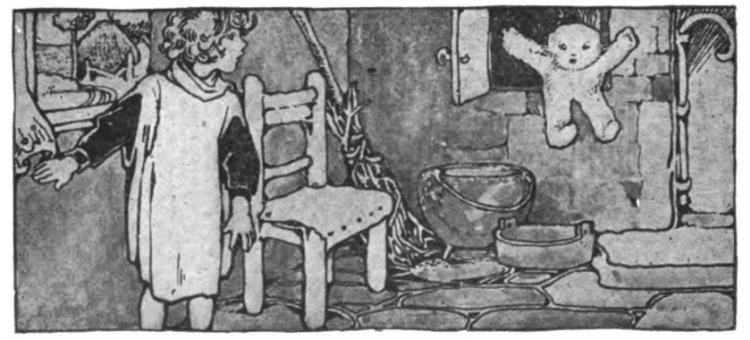
Once upon a time there was a woman, and she baked five pies.
And when she took them from the oven, she found that they
had baked so long the crusts were too hard to eat. So she
said to her daughter:
“Put you them there pies on the shelf, and by and by they’ll
come again.” She meant, you know, the crust would get soft.
The girl, she took the pies into the pantry, and she put them upon
the shelf in a long even row. She looked at them, and she thought
how good they would taste.
“Well, if them there pies’ll come again,” she said to herself, “I
may as well eat them now.”
So she ate them all, first and last!
Come supper time, the woman said:
“Go you and get one of them there pies, I dare say they’ve
come again by this time.”
The daughter she went into the pantry, and she looked at the
shelf. There were the five pie plates just as she had left them,—empty!
So she went back to her mother and she said:
“Noo, they ain’t come again.”
“Not one of them?” said the mother.
“Noo, not one of them,” says she.
“Well, come again or not come again, I’ll have one for my
supper.” And the old woman went toward the pantry.
“But you can’t have one, if they ain’t come again, mother.”
“But I can,” the woman declared. “I’ll have the best one for
my supper.”
“Best or worst,” the daughter said, “I’ve ate them all! And you
can’t have one ’til they’ve come again!”
Well, the woman, she was so astonished she forgot all about supper.
She carried her spinning to the doorway, and as she span, she
sang a little song about her daughter:
“My daughter has ate five, five pies today,
My daughter has ate five, five pies today!”
Now the king was coming down the road, and he heard the woman
singing, but he could not hear the words. So he stopped in front of
the door and said:
“My good woman, what were you singing?”
Now the old woman did not want anyone to know what a greedy
daughter she had; so she sang instead of that,
“My daughter has spun five, five skeins today.”
“Land sakes alive!” said the king, “I never heard tell of anyone’s
doing that. Now look you here, my good woman. I want a wife, and
I’ll marry your daughter. But look you here. For eleven months of
the year she shall have all the victuals she wants to eat, and all the
clothes she wants to wear, and all the company she likes to keep.
But the twelfth month, she must spin five skeins every day, or off’ll go
her head!”
“All right,” says the woman, for she thought:
“What a grand marriage this will be. And as for them there five
skeins, by that time he’ll forget all about them.”
So they were married. And for eleven months the girl had all
the victuals she wanted to eat, and she had all the clothes she wanted
to get, and she had all the company she liked to keep. But sometimes
she felt a little uneasy. Sometimes she thought of that spinning she
must do.
The king, he never said one word about the five skeins, so as the
eleven months had nearly passed, the girl thought that he had forgotten
all about it.
But one day, it was the last day of the eleventh month! The king
came to her, and he took her into a little room she had never seen
before. There was nothing in it but
a spinning wheel and a little chair and
a small bare table.
“Here, my girl,” says he, “here
I’ll put you tomorrow. And I’ll lock
the door. And here you must stay all
day long. At night I’ll come, and if
you’ve not spun the five skeins, off’ll
go your head!” And away he went
about his business.
Well, the girl was that frightened!
She had always been such a gatless
creature that she didn’t even know how
to spin! She sat down on a stool and
she began to cry. How she did cry!
However, all of a sudden she heard
a knocking, knocking, low down at the
door. She got up and she opened the
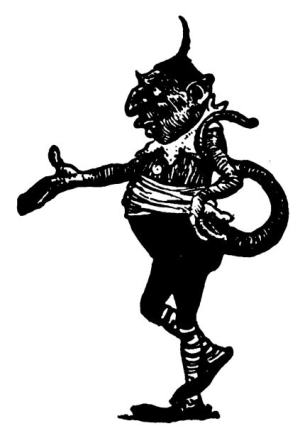
door. There stood a little black thing,
WITH A LONG BLACK TAIL. And That looked up at her out of
the corner of That’s eyes, and That says:
“What are you crying for?”
“What’s that to you?” says she.
“Never you mind, but tell me what you are crying for. Perhaps
I can help you,” the little black thing told her.
“Well, it can’t do any harm, if it doesn’t do any good,” she
thought. So she told him all about the five pies, and the five skeins
and everything.
“This is what I’ll do,” says that little black thing, twirling his
BIG BLACK TAIL. “I’ll come to your window every morning and
get the flax, and at night I’ll bring it home all spun.”
“What’s your pay?” says she.
That looked at her again out of the corner of That’s eyes. “I’ll
give you three guesses every night to guess my name, and if you
haven’t guessed it by the last night, you shall be MINE!”
The girl thought that she would be sure to guess it before the
month was up, so she said:
“All right.”
“All right,” That says, and how That did twirl That’s tail!
Well, the next day, the king took her into the room, and there
was the flax, and the day’s supply of victuals.
“Now, my dear,” says he, “if that ain’t spun by night, off’ll go
your head.” Then he went out and locked the door behind him.
The king had no sooner gone, than a knock,—knock came at the
window. There was the little black thing sitting on the window ledge.
She gave him the flax and away he flew.
Well, at evening, the knocking came again at the window. The
girl opened it, and there stood the little black thing with the flax on
his arm, all beautifully spun.
“Here it is,” he said, as he gave it to her. “Now, what’s my
name?”
“Is that Bill?” says she.
“Noo, that ain’t,” says he, and he twirled his tail.
“Is that Ned, then?”
“Noo, that ain’t.”
“Well, is that Mark, then?” she asked.
“Noo.” And That twirled That’s tail harder and away That
flew.
When the king came in, there were the skeins beautifully spun.
“Well, I see, my dear, that you won’t lose your head tonight.”
And he went away and left her locked in the room.
So every day the flax and the food were brought to the girl. And
every morning the little black imp would knock at the window and
carry away the flax, and every night it would bring back the flax
spun. And every night the girl would try the three times to guess
the imp’s name, but she could never guess the right one.
At last, the last day had come. And that night when the imp
brought back the skeins, he said:
“What, ain’t you guessed my name yet?”
“Is that Nicodemas?” says she.
“Noo, that ain’t,” That says.
“Is that Samuel?”
“Noo, not that neither.” Then That looked at her with That’s
eyes like coals of fire, and That says:
“Woman, there’s only tomorrow night, and THEN YOU’LL BE
MINE!” And away That flew.
Well, the girl she felt that bad. However, she heard the king
coming along the passage. In he came, and when he saw the five
skeins, he said:
“My dear, I don’t see but you’ll have your skeins ready tomorrow
night as well, so I reckon I shall not have to kill you, and I’ll have
supper in here tonight.”
So they brought the supper in, and the two sat down to the table.
Well, he had eaten but a mouthful, when he began to laugh.
“What are you laughing at?” the girl asked him.
“Well, today when I was out in the forest, I saw the funniest
sight.... I was in a strange part where I had never been before. And
I saw an old chalk pit.... And I heard the queerest humming and
humming coming from the pit. So I got off my hobby and crept
over to the pit without making a bit of a sound. And there I saw the
strangest looking little black thing with a long, black tail. And That
was sitting at a little spinning wheel, and That was spinning so fast
that I could scarcely see the wheel. And while That span, That sang,
“Nimmy, nimmy not,
My name is Tom Tit Tot.”
“And That kept singing it over again and again.”
When the girl heard this, she was so happy that she could almost
have jumped out of her skin for joy, but she didn’t say a word.
Next day, that little black thing looked so maliceful! And when
night came she heard the knock at the window, she opened it, and the
little black thing jumped into the room. He was grinning from ear
to ear, and O! That’s tail was twirling round so fast!
“What’s my name?” That said, as That gave her the skeins.
“Is that Solomon?” said the girl, pretending to be afraid.
“Noo, that ain’t,” That said, and That came further into the
room.
“Well, is that Zebedee?” says she again.
“Noo, that ain’t.” And then That laughed, and twirled That’s
tail until you could hardly see That.
“Take time, woman! The next guess AND YOU ARE MINE!”
And That stretched out That’s black hands at her.
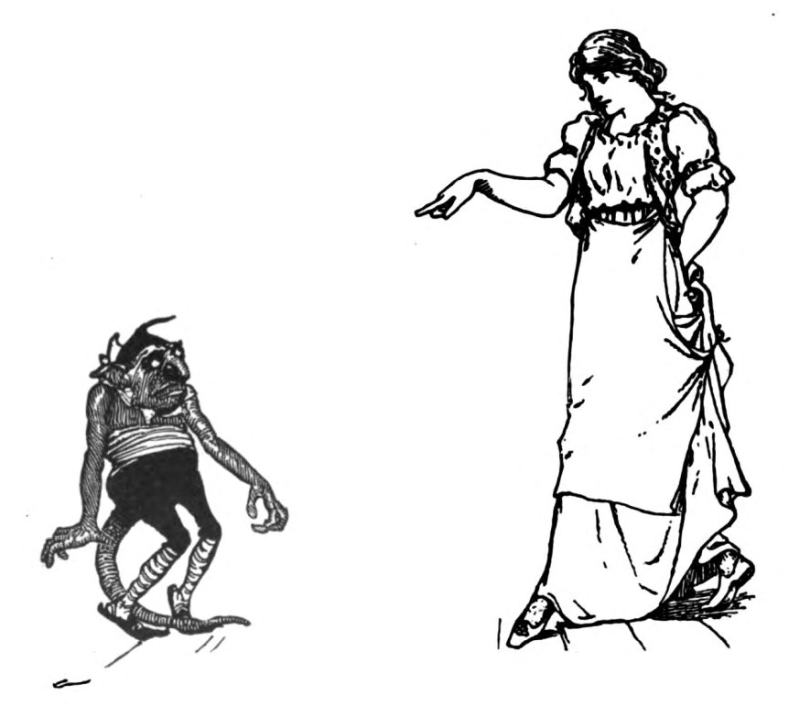
Well, she moved back a step or two, and she looked at that little
black thing, and then she laughed out, and says she, pointing her
finger at it,
“Nimmy, nimmy not,
Your name is Tom Tit Tot.”
When that black impet heard her, That shriveled right up, and
away That flew and was never heard of again.
And the girl lived happily ever after, and the king never again
asked her to do any more spinning.
The Taileypo
The Taileypo story was told to me by the Rev. George Washington Neale, a student
friend of mine, years ago, in Chicago University. Mr. Neale said that he had heard the story
many times in his childhood, from the lips of the old negro story tellers in Tennessee. This
story has its variant in the story of “The Golden Arm,” which was written by Mark Twain,
Joseph Jacobs and also in a collection by S. Baring-Gould.
It is a story that loses much in the writing, as it is impossible to give voice modulation
in cold print. After hearing Mr. Neale tell it a number of years ago, in Chicago, I took it up
and began to tell it, and found many people in the South, who had heard the old negroes tell
it.
In January 1905, I was in Atlanta, Ga., and went with Joel Chandler Harris, the author
of “Uncle Remus,” to the West End School, where I told a number of Uncle Remus stories to
the children. Beginning in the first grade, where Mr. Harris’s little grandson was then a pupil
and ending in the higher grades, where I told The Taileypo story. When the story was done,
Mr. Harris said it was one of the best negro stories he had heard, but that I did not have all
of the story. There was, he said, another piece of the story that should be linked with this
to make it complete, and I said to Mr. Harris: “Find the other piece, and write the story complete.”
One year after that Harris published the story in the Metropolitan Magazine, New York,
January 1906. Harris gave it a setting and artistic atmosphere, bringing in Brer’ Rabbit and
Mister Man. He put it in the mouth of Uncle Remus, and had the old negro, as in his other
books, tell the story to the little boy. That was a demonstration to me as to how Harris took
many of the negro stories in the raw, and passing them through the magic of his imagination
made them into art.
We are frequently puzzled to find humorous stories for the boys and girls,—they must
have humor. This story has universally amused them wherever it has been told. In it reverberates
the barbaric ages from whence the race came, and it is a spontaneous expression of life
from the primitive standpoint. To find a story that the boys and girls think humorous, and to
laugh together with them, is decidedly refreshing and healthful to the teacher, who has
dwelt so much on grammatical forms which are not fundamental in a child’s interest. As
Joseph Jacobs, says, “The children know the happenings in the story are make-believe just as
much as the spectators of a tragedy. Every one who has enjoyed the blessing of a romantic
imagination has been trained upon such tales of wonder.”
However, if one’s imagination and sense of humor is undeveloped, and the story is taken
seriously rather than humorously, it loses its value and should not be told. For that reason
the story teller or teacher must study his auditors.
As Uncle Remus would say, I will “’gin it out to you as it was ’gunt to me.”
In the mountains of Tennessee, ’way back in de big woods, lived
onct a man, in a house all by his self. This man had one room
to his house, and dat room was his kitchen.
One night, when de man was sleepin on his bed, he heerd sup’ner
roun de fire place snifflin, lickin de pots, de fryinpans, and de skillets,
car’en on and g’wyin on. De man struk a light, and dar he see de
curioses lookin varmint what you ever laid eyes on, a varmint wid a
great, long tail. No sooner de man see de varmint dan he retched
for his hatchet. He made one sweep at him, and clipped his tail
squar off behime. De varmint he run out thu de cracks er de logs
and tuk to de woods.
De man, fool-lik, took an cooked de tail, et it,—and den he went
to bed. ’Way long in de night, suppen cum and got up over de
man’s do, and scratched and sed:
“Taileypo, I want’s my ta-a-a-a-a-a-iley-po.”
De man had three dogs: one name Uno, and one Ino, and one
Cumticocalico. De man call his dogs, “Yer! Yer! Yer!”
De dogs dey cum bilin out frum under de house. De varmint
he run down side de house and jumped. De dogs snapped at him,
but he got away, and dey run’ed him and run’ed him ’way back in de
big woods. De man he tuk, he did and went back to bed, and went
to sleep.
But ’way long in de night, de thing cum and got up in de crac’
er de man’s do and sed:
“Taileypo, you know,—I know,—all I want’s my Ta-a-a-a-a-a-iley-po.”
De man call his dogs, “Yer! Yer! Yer!”
Uno, Ino and Cumticocalico cum abustin roun de cordner of de
house. De varmint jumped down from de side of de house and tuk
to de woods. De dogs ketch him at de gate,—knock down de gate
an tore down de fence. He got away, but dey jus’ natchally tore
up de earth runnin him ’way frum dar. De man tuk, he did and
went back to bed and went to sleep.
’Way long in de night, jus befo day, de man he heard sup’ner
down de hill, sayin:
“Uno, Ino, all I want’s my Ta-a-a-a-a-a-iley-po.”
By and by he heard him in de crack up over de do, sayin:
“Taileypo, I want’s my Ta-a-a-a-a-a-iley-po.”
De man call de dogs, “Yer! Yer! Yer!”
De dogs didn’t cum: de Taileypo dun car’ed em off sumeres
in de woods, lost em or kil’t em.
Arter a while—de Taileypo stop. Everything was still. De
man drapped back on his pillow, but fo long he feel supen and heard
supen scratchin and clawin at de foot of de bed. Supen ketch holt
er de kivers, and clawed lak a cat a’climin up. De man rais his
haid up and look, and he see two bright eyes, lak balls er fire, lookin
right pine blank at him frum de foot er de bed. De varmint crawl up
nigher and nigher on de man. He can see his little short ’years
by de light er his eyes. De varmint say right easy to de man again:
“Taileypo—I want my te-e-e-e-e-e-eley-po!”
De man try to holler. He opens his mouf, but lak a man in his
sleep, he ca’nt mak a soun’. De varmint crawl right up on top er
de man and say right easy again: “Taileypo.”
“I want’s my te-e-e-e-e-e-eley-po!”
De man’s voice cum back to him, and he say:
“I aint got your taileypo.”
De varmint says, “Yes, you is.”
He jumped on de man and scratch him all to pieces, and got his
taileypo.
All dat’s lef of de man’s house now is de rude heart-stone, and
dey say dat when de moon rises roun and red and shines down dat
lonely hollow, and de win’ blow, dat you can hear a voice in de win’
day say:
“Tail-a-a-a-a-a-e-eley-po-o-o-o!” and die in de distance.
Johnny Cake
Mr. Joseph Jacobs publishes this story in his Collection of “English Fairy Tales.”
He gives as his source “American Journal of Folk-Lore,” ii. 60. Another variant of this story
is found in “The Gingerbread Boy,” in St. Nicholas, May, 1875. Chambers gives two versions
of the same story, under the title “The Wee Bunnock,” the first of which is one of the most
dramatic and humorous of folk tales. Unfortunately the Scotticisms are so frequent as to render
the Droll practically untranslatable. “The Fate of Mr. Jack Sparrow” in Uncle Remus is
similar to that of Johnny Cake.
The version herewith is taken from the Aldine Fourth Reader, by Frank E. Spaulding
and Catherine T. Bryce, through the courtesy of the publishers, Newson & Company, New York.
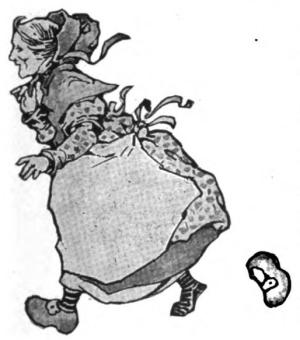
Once upon a time there was an old man, and an old woman, and
a little boy. One morning the old woman made a Johnny
Cake, and put it into the oven to bake.
Then she said to the little boy: “You watch Johnny Cake while
your father and I go out to work in the garden. Don’t let it burn.”
The little boy soon got tired watching the oven, and went to
look out of the window. All of a sudden he heard a noise back of
him. He looked around quickly. The oven door popped open.
Out jumped Johnny Cake. Away he went rolling along, end over
end, through the open door, down the steps, and out into the road,
long before the little boy could catch him.
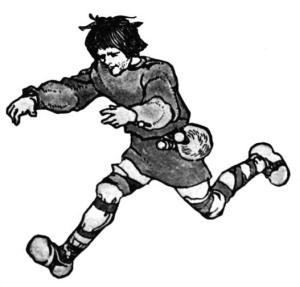
“Mother! Father! Johnny Cake’s running away!” cried the
little boy, and down the street he ran after Johnny Cake.
His father and mother
threw down their hoes and gave
chase too. But Johnny Cake
outran all three a long way, and
was soon out of sight. The old
man, the old woman, and the
little boy, quite out of breath,
sat down by the roadside to rest.
On ran Johnny Cake. By
and by he came to two well
diggers, who looked up from
their work and called out,
“Where are you going Johnny?”
“I’ve outrun an old man,
an old woman, and a little boy,
and I can outrun you, too-o-o!”
“You can, can you? We’ll
see about that!”
They threw down their spades and ran after him. But Johnny
Cake outstripped them also. Seeing they could never catch him,
they gave up.
On ran Johnny Cake. By and by he came to a bear.
“Where are you going Johnny?” growled the bear.
“I’ve outrun an old man, an old woman, a little boy, and two
well diggers, and I can outrun you, too-o-o!”
“You can, can you?”
growled the bear; “we’ll see
about that!”
And he rushed thump,
thump, after Johnny Cake,
who never stopped to look
behind him. Before long the
bear was left far behind, so at
last, breathless and panting,
he stretched himself out by
the roadside to rest.
On ran Johnny Cake.
By and by he came to a wolf.
“Where are you going, Johnny
Cake?” yelped the wolf.
“I’ve outrun an old man, an old woman, a little boy, two well
diggers, and a bear, and I can outrun you, too-o-o!”
“You can, can you?” snarled the wolf; “we’ll see about that!”
And he set into a gallop after Johnny Cake, who went on so fast
that the wolf saw there was no hope of overtaking him, and he, too,
lay down to rest.
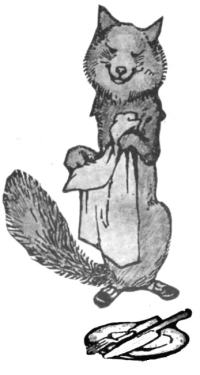
On ran Johnny Cake. By and by he came to a fox that lay
quietly in a corner of the fence.
“Where are you going, Johnny Cake?” called the fox, in a sharp
voice, but without getting up.
“I’ve outrun an old man, an old woman, a little boy, two well
diggers, a bear, and a wolf, and I can outrun you, too-o-o!”
“I can’t quite hear you, Johnny Cake; won’t you come a little
closer?” said the fox.
Johnny Cake went a little nearer to the fox and called out in
a very loud voice:
“I’ve outrun an old man, an old woman, a little boy, two well
diggers, a bear, and a wolf, and I can outrun you, too-o-o!”
“Can’t quite hear you; won’t you come a little closer?” said the
fox, in a feeble voice, as he put one paw behind his ear.
Johnny Cake came up quite close,
and leaning towards the fox, screamed
out, “I’ve outrun an old man, an old
woman, a little boy, two well diggers, a
bear, and a wolf, and I can outrun
you, too-o-o!”
“You can, can you?” yelped the
fox, and he snapped up Johnny Cake in
a twinkling.
The Twelve Months
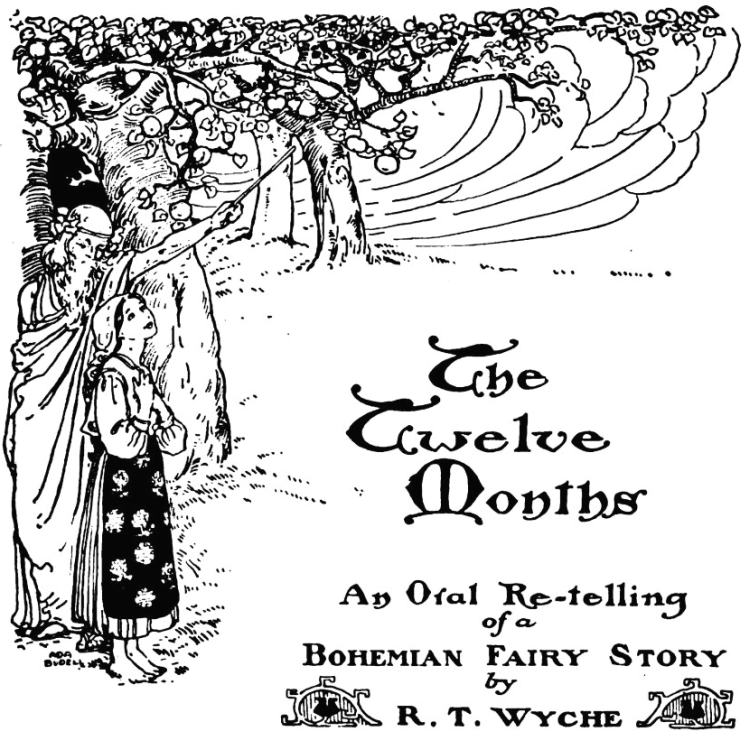
The Twelve Months
An Oral Re-telling of a Bohemian Fairy Story
by
R. T. Wyche
In the Bohemian land there lived a woman, who had one
daughter named Katinka, and a stepdaughter named Dobrunka.
The woman, naturally, loved her own daughter more than she did her
stepdaughter, but her own child was not as fair nor had she as
pleasing a disposition as had the stepdaughter Dobrunka.
This displeased the woman so that she made Dobrunka, the stepdaughter,
do all the housework, the cooking and the churning, whereas,
her own daughter, Katinka, she dressed in fine clothes and let her
live in idleness. And more than that—she frequently allowed
Katinka to order Dobrunka around the house as if she were a servant.
Dobrunka was always pleasing in countenance and in spirit, and the
work she did made her strong and wholesome, whereas the idleness
in which Katinka lived made her very disagreeable.
One day, Katinka came to Dobrunka, and said: “Dobrunka,
I want some violets; go out into the fields or the forest and find me
some.”
Dobrunka said, “Why Katinka, that is a strange request. This
is not the time for violets; it is mid-winter.”
Whereupon Katinka grew very angry and said: “Go, do as I
say and bring me some violets, or I shall beat you to a jelly.” With
that Katinka pushed her out of the door and with the help of her
mother barred the door behind her.
Now, it was mid-winter and snow was upon the ground, and
Dobrunka started through the forest not knowing what to do. As she
walked along the forest, she saw on a hillside a fire burning. Soon
she came to the fire, and there sat twelve old men with long grey
beards. Their names were the Twelve Months.
It was mid-winter, and January, of course, was presiding. As
Dobrunka came near to the group, not knowing what to do nor where
to go, she stopped and began to cry.
January saw her, and said: “Child, why do you stand there
shivering and crying, what is the matter?”
Dobrunka said, “My mother and sister have driven me from the
house, and they said if I do not bring them some violets they will
beat me to a jelly.”
January felt sorry for the girl, and he said: “Violets do not
belong to me; perhaps March can help you.”
Near by sat March, and he turned and saw the girl was troubled
and he pitied her.
March stood up and waved his wand over the fire. The fire and
the circle of old men disappeared. March and the girl were standing
in a field and the air was fragrant with the breath of early Spring.
March said, “Daughter look down at your feet, and gather as many
violets as you wish!”
As Dobrunka looked, all about her the field was purple with
violets. She stooped down and gathered a great handful of them.
When she came back to the house and entered the door, Katinka
saw her, and said, “Yes, I knew you could bring them, you were just
pretending that you could not.” And, the perfume of the violets
filled the whole house.
Some days after Katinka came again to Dobrunka, and said:
“Dobrunka, I want some strawberries, red and fresh from the
fields.”
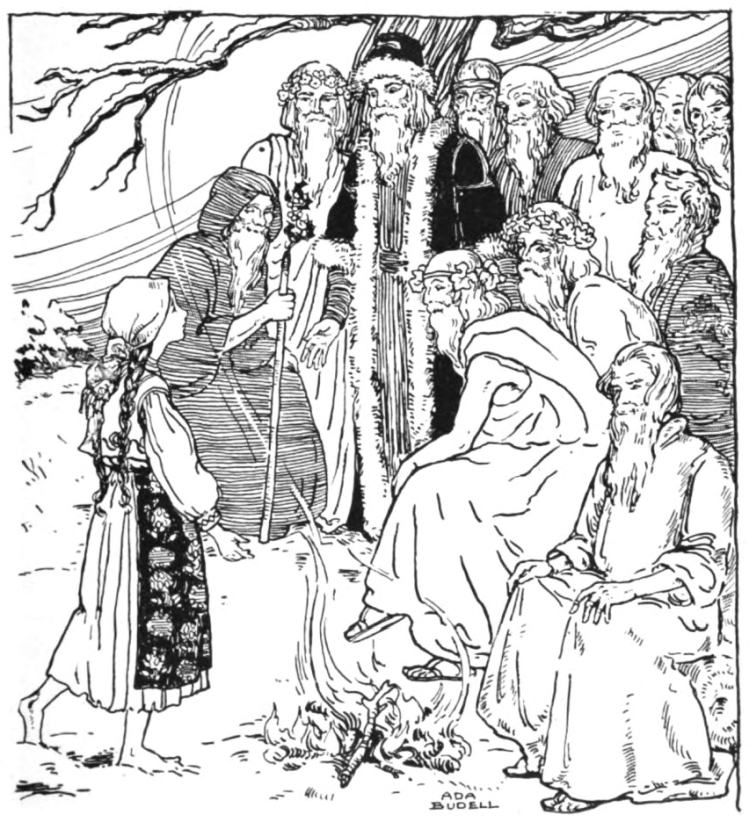
“There sat twelve old men”
Dobrunka said, “Why sister, how strangely you talk. This
is not the time for strawberries; it is mid-winter. But Katinka said:
“Obey me, you said there were no violets the other day; you
brought them,—go, bring me some strawberries or I will beat you to
a jelly.”
With that she pushed her out of the door and the stepmother
helped her bar the door.
Dobrunka then turned toward the forest again. Snow was still
on the ground. She walked along toward the mountain and saw
again the fire burning in the distance. Soon she was standing where
sat the twelve old men in a circle.
January heard her footfall on the snow. Dobrunka stopped and
began crying. January said to her, “Child, why did you come back,
we gave you violets and still you are back again?”
Dobrunka said, “My mother and sister have driven me from my
home, and they say if I do not bring some strawberries they will beat
me to a jelly.”
January said: “I am sorry, but I cannot help you. Strawberries
do not belong to me; perhaps May can help you.”
May was sitting across the circle. He looked at the girl standing
there in trouble and he felt sorry for her. He stood up and waved
his wand across the fire. The old men disappeared and the fire.
Dobrunka found herself standing in a field. It was a perfect day in
May. Above her head the sky was soft and blue; in every treetop
sang the birds. May, the old man, stood by her and said:
“Look child at the earth and see what you will find.”
Dobrunka looked, and all about in great bunches grew strawberries,
peeping like jewels from the green leaves.
May said to her, “Help yourself.” And stooping down she
gathered her hands full and then ran back to the house.
When she entered the door, her sister seized the berries and
ate them all up.
A few days after that, Katinka came again to Dobrunka and
said: “Dobrunka, I want some apples, fresh and ripe; go to the forest
and find me some.”
Dobrunka said, “Why sister how strangely you talk,—this is
not the time for apples; it is mid-winter.”
Katinka said, “Lazy girl, you said you could not find the
violets, but you did. You said there were no strawberries, but you
brought them; go, and get me some apples or I will beat you to a
jelly.”
Whereupon she pushed her from the door and the stepmother
helped her to bar the door behind her.
Dobrunka turned again to the forest. She remembered where
the old men lived on the mountainside and was soon standing near
the circle. She crept along very quietly. She did not wish to ask
the old men to help her again because they already had been so kind
to her, but January saw her standing with bowed head and shivering
in the cold.
He said, “Child, child, why did you come back here? We sent
you away the other day with your wants supplied.”
Then Dobrunka said: “My mother and sister have driven me
from the house, they say if I do not bring them some apples they will
beat me to a jelly.”
January said, “Apples do not belong to me; perhaps September
can help you.”
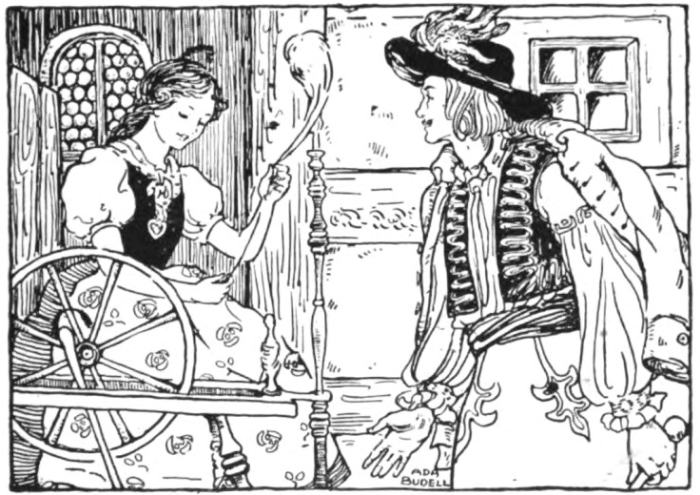
“One day the handsomest youth in all the world came by”
On the opposite side of the circle sat September, and he saw
the girl standing there, helpless. He felt sorry for her and standing
up, he waved his wand over the fire. The circle and the old men
disappeared. They were standing in a gently rolling field. The
air was soft; the crickets were chirping in the grass and there was
in the sky a haze. All around here stood great apple trees, loaded
with fruit, red and yellow.
September said to the girl, “Help yourself.”
Dobrunka picked up two of the largest apples, and then fled
back to the house. When her sister saw her, she seized the apples,
ate one and gave the other to her mother. As soon as the apples
were eaten,—she came to Dobronka, and said, “Why did you not
bring more apples?”
Then Dobrunka told her about the old men and how they had
helped her each time.
“Then,” said Katinka, “I know why you did not bring more,
you ate them up on the way. Go back, and bring me more or I will
beat you.”
Dobrunka said, “Please do not send me again in the cold,” and
she begged that she might stay in the house.
Then Katinka said, “I will go myself; if you could get them I
can get them from the old men.”
She left the house and walked through the forest, and soon came
in sight of the fire where sat the twelve old men. When she came
near to them, she said, “Hello there, old grey beards, I want some
apples and want them quick!”
January was not accustomed to such words. He stood up and
waved his wand over the fire and the fire and the circle were gone.
Katinka found herself in a great forest. The wind was wailing
through the treetops, the snow was falling and it was bitter cold.
Katinka did not come back to the house. Her mother waited for
her and by and by she started out in search of her, but she, too, was
lost in the storm that raged, and never came back.
Dobrunka waited in the house. The night passed, and the next
day and many days. By and by the snow melted. The birds and
flowers of Spring came, but still the lost ones did not come back.
Dobrunka had the house all alone. One day, the handsomest youth
in all the world came by and met Dobrunka. They became friends,
and afterwards they were married and lived happily forever thereafter.
The Storytellers’ League, of the State Normal School, of Dillon,
Montana, have decided for the present year to devote their attention to a
line of work, which so far as we know, has not yet been attempted by any
other League. They will investigate the part that the supernatural, especially
witchcraft, plays in literature, and will follow it not only through
folk literature, but the following units: Goethe’s Faust, Shakespeare’s
Midsummer Night’s Dream, Macbeth, Konigs-kinder and Hansel and
Gretel. The general theme will be broken from time to time by the introduction
of stories suitable for a special session. At the last meeting in
December the program will be given over to Christmas stories, tales and
legends. Miss Florence Mayer is President of the League.
Story Telling and Education — II
BY GEORGE EVERETT PARTRIDGE, Ph.D.
The recent revival of story telling raises many interesting
questions, both practical and theoretical. Considered as a
part of a larger movement,—an effort to control and utilize
the powers concealed within the instincts and unconscious forces
of the mind—story telling takes a place in a problem which we
can hardly be mistaken in calling one of the most important
of our day. We have tended to value, in education, only that
which we can see and fully understand; but now, as we begin
seriously to employ arts in the school, and in the arts to subordinate
knowledge to feeling, to use methods that yield no
immediate or practical return, we demand an increasing faith
in the powers of receptivity and inner response of the child,
and we must learn more and more to detect, and to be satisfied
with, unseen and remote effects.
In the art-invasion of the school, which is one aspect of this
movement toward a wider education, it is difficult to see how,
in the near future, we can be carried too far. We have been in
the habit of emphasizing so much the learning process, that
we are in danger of preventing the free and experimental attitude
toward these new interests that seems needed at the present
time. We are likely to have too little, rather than too much,
faith in the play motives, the æsthetic moods, and the subconscious
powers. We shall still want the child to express,
to dramatize, to be examined upon, everything he receives:
to externalize every response, even in the most intimate regions
of feeling.
In calling the influx of artistic elements and methods into
the school one phase of the education of the unconscious and
deeper powers, we have a significant practical view-point, and
are at the same time in touch with new results in science. As a
practical ideal, we must aim to educate all the individual, not
merely thought and voluntary movement. We wish to reach
the inherited mechanisms of the organism; we wish to play upon
all the potentialities of feeling and volition, and to utilize
powers latent in the deposits of experience that the child has
brought with him to the world.
These new results in science give to the well-worn principle
that we must educate all the powers of the child a new meaning,
and at least three important advances in psychology, in recent
years, combine to put solid ground under our feet for a practical
æsthetics, and give us principles by which we can coördinate
the artistic elements and methods of the school.
The first of these advances is the genetic psychology that
has arisen and flourished on the basis of Darwinian principles
in biology, and which has shown the fundamental place of the
feelings in education. The second is the new psycho-analysis,
which, by showing the laws of the symbolic expression of hidden
desires and feelings, has given us a new conception of the relation
of art to life. The third new result is in the psychology of
valuation, which has traced out, at least roughly, the course of
development of the æsthetic and ethical states of consciousness.
New and incomplete and lacking in coördination as these
principles are, they already yield us practical insights such as
we have never been able to obtain from the older philosophies.
We may confidently expect to see in time a solid science of the
feelings, which will give us a “union of art and life” in a sound
æstheticism in education: an æstheticism that will help
to organize and control the fundamental feelings, and will
overcome the superficial aloofness of our prevailing too formal
and too detached art. This will be based upon the discovery
that art, and the need of art, extend throughout all phases of
human life; and that all true art must work in intimate union
with practical affairs.
Considerations, such as these, seem essential for any study
of the place of story telling, or any other art, in education.
The story telling “situation” is an artistic situation. It
falls under the category of the beautiful, and is subject to all
the general principles of æsthetics. Thus it stands in striking
contrast with all formal methods of instruction, and all routine
and unemotional learning. In such artistic situations the child
is more fully present than in the formal school work, for he
brings with him his deeper, unconscious nature.
The nature of the story as an educational art is best shown
by its place in primitive life. Here the function of the story is
clearly practical. By it religion, and all beliefs, morals, customs,
and traditions are conveyed to the child. The folk-tales,
the legends, the fairy-tales, the epics, and the myths of
the world are not merely fanciful inventions of man; in a far
more profound way than we yet fully understand, they express
man’s most urgent needs and desires. Primitive man began
early to express, in his stories, by means of a varied symbolism,
his own hopes and wishes,—sometimes, thereby, keeping them
alive through hard conditions, and passing them on to new
generations; sometimes obtaining for them a vicarious satisfaction.
These racial stories affect our feelings deeply, simply
because there is continuity in evolution: because the past still
lives in the present: because these stories are the products of
universal needs, and symbolize or represent them. The story
is thus a language of the feelings; it is a means of communication
between the past and the unconscious and undeveloped potentialities
of the present. The story is a symbolic language:
its scenes and words are often trivial, but underneath them
runs a deeper meaning. Everyone who has told stories must
have felt this. We all know that when we tell a good story to
a child, the child is receiving from us indescribable meanings,
which the story itself conveys, but does not really contain or
express,—and this sense of free-masonry of emotional meaning
is the greatest charm of the story. One who feels this does not
need to point a moral to a tale; and one who feels the need of
the moral does not really tell his story.
Without knowing something about the nature of the æsthetic
feelings and moods it is impossible to understand the scope
of such an art as story telling. We are likely to think of æsthetic
feeling as passive, or as merely “refining” in its effects: or, if
inspiring, as mainly affecting the creative, artistic imagination.
But this is not the case. All æsthetic feelings are intensely
active. Because the responses are internal,—a play of forces
within the organism—we are likely to overlook them altogether.
In every æsthetic state, we have good reason to believe, there is
a play of volitions, an active choosing, a drama of aroused and
satisfied desire—definite, specific desire, which, though it may
often be unconscious, if none the less real. And it is because
of this drama of desire that æsthetic situations have meaning
and value—educational value.
We cannot at present know,—and as practical educators
we do not need to know—precisely the mechanism or content
of every emotional state; yet we can often see clearly some of
the deeper meaning and effect of æsthetic valuations. We can
see sometimes, in the child’s interest in fairy-tales, for example,
that the child is playing a part; that he is accepting for himself
misfortunes for the sake of the good that issues from them; that
he is appreciating, in some half-conscious way, the nature of a
world in which events are not separate and haphazard, but are
connected through far-seeing purposes. The child is not
merely pleased at the story; he reacts to it by taking attitudes:
by accepting, rejecting, deciding; by desiring, and by receiving
satisfaction. In such experiences the child is even acquiring
religion, and the standards and moods of later life are made
up of just such feelings as are conveyed so effectively through
the medium of the artistic story.
The story, then, is an important method in education. It
is a very effective and natural devise for conveying the ideals
and volitions of one generation to the mind of another, and of
coördinating many individuals by means of the common possession
of these ideals and purposes. We have yet to learn
fully how far we can go by this and other kinds of artistry in
teaching; but that the story should have a serious place in education,
seems wholly certain. Just how large a place it should
occupy is to be determined, in part, by experiment. Good
story telling may be utilized in so many subjects of the curriculum,
for so many purposes, and in so many departments of
education, within and without the school; its artistic possibilities
are so great; the present momentum of interest is so
strong, and so well justified by science, that we may expect to
see a widespread use of the story as a method of education.
We shall expect to see story telling become a part of the equipment
of all teachers, and the story literature of the world
become more and more accessible, and better adapted to the
child. And it is likely that the professional story teller will
again flourish among us, as in the days before books and schools
robbed him of his art.
The Story Tellers’ League, of Nashville, Tenn., issues an attractive
Year Book for the current year. Among the topics announced for the year
is a Greek pageant, “The Fire Regained,” to be given out of doors at the
Parthenon, in Centennial Park. This pageant was written by Mr. Sidney
Hirsch, a member of the Story Tellers’ League, and dedicated to the League.
A popular subscription of $10,000 has been made by the city for its production.
Seats will be arranged for 20,000 people. The Schools will furnish
800 young men and young women for the performance; a herd of sheep
and a flock of doves enter into the pageant. It will be given five afternoons
early in May.
Story Telling in Boston
Official Story Teller for the Boston Public Libraries
I really felt most delighted at the thought of the new magazine and
want to send an article, but can’t seem to find time to write it. Perhaps
it will answer if I just tell you what is being done in Boston Libraries and
Settlements by Mr. Cronan and myself, and let you choose such items as
seem of interest.
The Library classes are held in the afternoon. On Saturday from three
to four Mr. Cronan and I tell stories in the Central Library. On Monday
I go to Brighton; Tuesday to Jamaica Plain; Wednesday to South Boston;
Thursday the West End; Friday Shawmut Ave. Branch. All these are
Branches of the Central Library. The ages of the children are from ten
to fourteen. The attendance from one to two hundred.
The first part of the hour is devoted to telling the story of some book
which the children have not read and which would be a valuable book for
them to know. As the boys greatly outnumber the girls, the book is chosen
which is likely to appeal to them. I have told in “continued story” form
each book lasting from four to six periods of story telling the following:
- The Talisman
- Oliver Twist
- Spenser’s “Faerie Queen”
- Water Babies
- Robin Hood
- King Arthur and His Knights
- The Rhinegold
- Siegfried
- Treasure Island
- Captains Courageous
- Peter Pan
- The Bluebird
- Jean Valjean
- The Odyssey
- Finn and his Mighty Deeds
- The Christmas Carol
- Konigs Kinder, etc.
The last twenty minutes of the hour is usually devoted to some story
of fun or fancy—a fairy tale—or Brer’ Rabbit’s pranks. In the evening
similar work is done in Social Settlements with groups of boys from twelve
to fourteen years of age. At Denison House we have ninety-six boys of
Syrian and Irish nationality. There are groups in the Ruggles Street
Neighborhood House—the “South End Industrial School,” Jamaica Plain
Neighborhood House, South End House and Lincoln House.
In the summer story telling groups are held on the roof gardens of the
Settlement House or in the yard where we sit on the grass and tell stories
in the twilight—often to groups of one hundred and fifty children.
The accompanying newspaper clippings about my work may be of
interest:
Introduces the Child to the Best Literature
“I do not tell stories to amuse children, but to instruct them. The
purpose is to introduce the child to the best literature and not to
entertain him, although he is at the same time entertained.
“Story telling bridges the gap between the child and the library
and brings him into literature. It develops the child in every way and
teaches him what is really worth his while to read.
“It develops the imagination, trains his mind and he gets many
moral lessons, although I never tell stories as a means of preaching to
children.
Develops the Child’s Mind
“Story telling means far more to children than many people realize.
The love for stories is born in every child and it takes but a remarkably
short time before almost every child becomes a really wonderful listener.
“It is interesting to observe how the mind of the child is developed.
At first, many can keep their attention on a story only a short time,
but they soon learn the power of application and can listen breathlessly
for an hour and then ask for another story, even though they know the
time is up. After their attention has once been gained, children will
listen to stories as long as the story teller will continue.
Librarians Enthusiastic
“After a year or more of story telling in the public libraries, I
believe in the power of the story more than ever. Between the settlements
and the libraries, over 1,200 children come to listen to me each
week, and besides I have been conducting a normal class to teach
young librarians how to tell stories themselves.
“All the librarians appear to be enthusiastic over the story hour,
and although it adds to their cares and confusion, they welcome me
each week with a friendliness that is truly genuine.
“But the real inspiration comes from the children themselves.
They never seem to tire, and sometimes keep me for an hour and a
quarter with ‘A little more, please, just a few minutes. We want
to know what became of Oliver,’ or ‘Didn’t Siegfried come to life
again?’
The Stone Lion
A Tibetan story, retold from the excellent collection of Captain O’Connor. Although a
fairy-tale in form, it has the well marked purposive quality so characteristic of Eastern stories.
Adapted from Folk-Tales from Tibet, by Captain W. P. O’Connor.
This story was voted to be the best story told during two years to a class of younger
children at Bancroft School, Worcester. Twenty-two children whispered their votes to the
story teller. Ten chose The Stone Lion, while no other story received more than four votes.
This story, by permission of authors and publishers, is taken from Story Telling in
School and Home, by Emelyn Newcomb Partridge and George E. Partridge. Sturgis &
Walton Company, New York.
Once there were two brothers who lived with their mother
in a large house on a farm. Their father was dead. The
older brother was clever and selfish; but the younger was kind
and gentle. The older brother did not like the younger because he
was honest, and never could get the best of a bargain; so one day
he said to him:
“You must go away. I cannot support you any longer.”
So the younger brother packed all his belongings, and went to
bid his mother good-bye. When she heard what the older brother
had done, she said:
“I will go with you, my son. I will not live here any longer
with so hard-hearted a man as your brother.”
The next morning the mother and the younger brother started
out together. Toward night they came to a hut at the foot of a hill.
It was empty except for an axe, which stood behind the door. But
they managed to get their supper, and stayed in the hut all night.
In the morning they saw that on the side of the hill near the
hut was a great forest. The son took the axe, and went up on the
hill side and chopped enough wood for a load to carry to the town on
the other side of the hill. He easily sold it, and with a happy heart
brought back food and some clothing to make them both comfortable.
“Now, mother,” he said, “I can earn enough to keep us both, and
we shall be happy here together.”
Day after day he went out and cut the wood, and at night carried
it to the village and sold it; and they always had plenty to eat and
what they needed to make them happy and comfortable.
One day the boy went further up the hill than he had ever gone
before in search of better timber. As he climbed up the steep hillside,
he suddenly came upon a lion carved from stone.
“O!” thought the boy, “this must be the guardian deity of this
mountain. I will make him some offering tomorrow.”
That night he bought two candles, and carried them to the lion.
He lighted them and put one on each side of the lion, praying that
his own good fortune might continue.
As he stood there, suddenly the lion opened his great stone
mouth, and said:
“What are you doing here?”
The boy told him all the story of his hard-hearted brother,
and how he and his mother had left home, and were living in the hut
at the foot of the hill.
When he had heard all of the story, the lion said:
“If you will bring a bucket here tomorrow, and put it under my
mouth, I will fill it with gold for you.”
The next day the boy brought the bucket and put it under the
lion’s mouth.
“You must be very careful to tell me when it is nearly full,” said
the lion, “for if even one piece of gold should fall to the ground, great
trouble would be in store for you.”
The boy was very careful to do exactly as the lion told him,
and soon he was on his way home to his mother with a bucketful of
gold.
They were so rich now that they bought a great, beautiful farm,
and went there to live. Everything the boy undertook seemed to
prosper. He worked hard, and grew strong; and before many years
had passed he was old enough to marry, and bring a bride to the home.
But the mother still lived with them, and they were all very contented
and happy.
At last the hard-hearted brother heard of their prosperity. He
too had married, and had a little son. So he took his wife and the
little boy, and went to pay his younger brother a visit. It was not
long before he had heard the whole story of their good fortune, and
how the lion had given them all the gold.
“I will try that, too,” he said.
So he took his wife and child and went to the very same hut
his brother had lived in, and there they passed the night.
The very next morning he started out with a bucket to visit
the Stone Lion.
When he had told the lion his errand, the lion said:
“I will do that for you, but you must be very careful to tell me
when the bucket is nearly full; for even if one little piece of gold
touches the ground, great misery will surely fall upon you.”
Now the elder brother was so greedy that he kept shaking the
bucket to get the gold pieces closer together. And when the bucket
was nearly full he did not tell the lion, as the younger brother had done,
for he wanted all he could get.
Suddenly one of the gold pieces fell upon the ground.
“O,” cried the lion, “a big piece of gold is stuck in my throat.
Put your hand in and get it out. It is the largest piece of all.”
The greedy man thrust his hand at once into the lion’s mouth—and
the lion snapped his jaws together.
And there the man stayed, for the Lion would not let him go.
And the gold in the bucket turned into earth and stones.
When night came, and the husband did not come home, the wife
became anxious, and went out to search for him. At last she found
him, with his arm held fast in the lion’s mouth. He was tired, cold
and hungry. She comforted him as best she could, and brought him
some food.
Every day now the wife must go with food for her husband.
But there came a day when all the money was gone, and the baby was
sick, and the poor woman herself was too ill to work. She went to
her husband and said:
“There is no more food for you, nor for us. We shall all have to
die. O! if we had only not tried to get the gold.”
The lion was listening to all that was said, and he was so pleased
at their misfortune that he began laughing at them. And as he laughed,
he opened his mouth, and the greedy man quickly drew out his hand,
before the lion had a chance to close his jaws again!
They were glad enough to get away from the place where they
had had such ill luck, and so they went to the brother’s house once
more. The brother was sorry for them, and gave them enough money
to buy a small place, and there the hard-hearted brother took his
family and lived.
The younger brother and his wife and his mother lived very
happily in their beautiful home, but they always remembered the
Stone Lion on the hillside, who gave them their good fortune.
The Psycho-therapeutic Value of Story Telling
The Story telling Movement is growing with such gigantic strides that
a magazine which will keep the Missionaries in this movement in touch
with one another seems most desirable, if not absolutely necessary.
Many writers have voiced many opinions as to the benefits to be derived
from the exercise of the Art of Story telling, but there is one which
I have never seen in black and white, about which I feel impelled to write.
It is the Psycho-Therapeutic value of Story telling.
Pain is a real thing, and will hold us in his clutches and claim all our
attention if allowed to do so.
Sorrow is absorbing, and will bow our heads and break our spirits if
unhindered.
Upon what, then, may we concentrate our attention, that pain may
grow weary of pressing his claim?
With what may we so absorb our minds that sorrow will fade away?
One of the fundamental principles of Story telling is that the oral
interpreter of Literature, must so vividly see the pictures described in the
story, that he will cause his hearers to feel that they, too, see.
He must feel the impulses and emotions of the characters in the story
so truly that the hearts of his hearers will thrill with the same feeling.
Since this is true, that the mind must be absorbed in the distant
scenes of Story Land, pain in due course of time must grow tired of urging
his claim and will ultimately depart.
The emotions dominant in stories which we tell are altruistic for the
most part. We prefer to dwell upon themes in which evil is overcome by
good; those in which sorrow flees away and joy comes with the morning.
Isn’t it true that the person who, day after day, creates these altruistic
emotions in the hearts of his hearers will find his sorrow, deep-seated
though it may be, growing dimmer day by day as he brightens the lives of
his hearers?
There are many cases which I could give you to prove my point.
One, of a little child with spinal trouble, who was treated by a great surgeon.
He would call upon her two or three days out of the week and each
time tell her a story. He required her, meanwhile, to make up similar
stories. For instance, he would tell her the story of “Little Green Cap.”
Then he would say, “Now, by Tuesday I want you to have a story ready
for me. It must be about a poor little girl, a princess and a magic ring.”
So absorbed did the child become in such work that the pain in the poor
little back grew less and less insistent until she ceased to be an invalid
and was able to attend school. She was one of the happiest children I
ever knew. She said she didn’t mind the pain any more, she had such
lovely things to think about.
Another was the case of a young woman upon whom sorrow laid a
heavy hand. Prostrated by grief, she lay for several days in a darkened
room. Then rousing herself she went to a hospital and secured permission
from the superintendent to visit daily the friendless patients who seemed
lonely. For months she reported daily to the superintendent, was given
directions as to which patients to visit, and for three hours she would go
from one to the other telling humorous stories. The morning hours she
spent hunting for artistic, mirth-provoking stories and her afternoons in
bringing smiles to sad faces. The result was inevitable. People everywhere
welcomed her as a ray of sunshine.
One more case—that of a young woman who, while making a brave
struggle to recover from one serious operation, suddenly found herself
facing another even more serious. With nerves racked by persistent pain,
courage well nigh gone, pursued by that dread foe insomnia, she turned to
her one accomplishment, Story telling. Though able to sit up but a few hours
at a time, she held large audiences in many cities two or three times a week,
until she once more went under the knife. Then within two months she
was on the platform again, bringing herself back to health by compelling
her mind to dwell in Storyland. I knew all the particulars of this case,
the physical torture she endured for two years, the struggle she made to
live, and knowing what I do, forces me to believe that if Story telling did
not save her life, it certainly saved her reason.
It is a law of life that the only thing which we may always keep, is the
thing we give. If then, the prime function of Story telling is the giving of
Joy, then Joy is the thing which the Story teller may have.
To those who “travail and are heavy laden” I commend the Art of
Story telling.
Story Telling for Mothers
Interesting accounts were recently published in the Herald, Sun and
other New York papers of Miss Georgene Faulkner’s story telling for
mothers and children at the Waldorf-Astoria, New York and St. Mary’s
Parish House, Brooklyn.
The story telling at the Waldorf-Astoria was given under the auspices
of Mrs. William Rogers Chapman, President of the Rubenstein Musical
Club, to an audience of fourteen hundred, of which about seven hundred
were children.
Miss Faulkner, in Mother Goose attire, told the children Mother
Goose stories, assisted by singers who presented ballads to accompany the
stories. Much to the amusement of the children, Miss Faulkner would
sometimes change the text of the Mother Goose rhymes, and the children
were not backward about crying out corrections of these errors. Miss
Faulkner would say:
“Jack and Jill went up the hill,
Like a dutiful son and daughter;
Now Jack is sick, and Jill is ill,
They did not boil the water.”
This would be greeted by a chorus of, “No, No, that isn’t the way it
goes!” and other exclamations.
Later, Miss Faulkner, in German costume, told the fairy story of
“Hansel and Gretel.”
The “Gingerbread Man,” otherwise known as “Johnny Cake” and
“The Wee Bunnock,” gave more pleasure to the children than any other
story, perhaps because it was accompanied by Gingerbread Men in neat
boxes, which were given to the children as souvenirs of the occasion.
Through the courtesy of Mrs. Chapman and with the assistance of
Mrs. Arthur Elliot Fish, one hundred crippled children, from the Industrial
School for Crippled Children, participated in the delights of the “Mother
Goose” matinee.
The story telling at St. Mary’s Parish House, was arranged primarily
for mothers, under the auspices of Miss Mabel McKinney, Superintendent
of the Kindergartens in the Borough of Brooklyn.
“What kind of a story,” said Miss Faulkner, “should the mother tell
to her children? Any good interesting story will lend itself to the spoken
narrative. Many mothers are so careless about what their children read
—thinking that almost any book which they get from the library will
answer the need. This is a great mistake. If the mother will only take
care to direct the young mind into the right channels at the impressionable
period she would lay a firm foundation on which to build the future life
of the child. Not only are many books from Public Libraries pernicious,
but from the Sunday-School Libraries as well. Many mothers make a practice
of filling the minds of their little children with a hodge-podge of information,
superstition, fear and other ideas which have had a bad effect
upon the children’s mind. They think it makes little difference what they
put into the child’s thought so long as it is a story. In reality it makes
all the difference in the world.
“With the great storehouse of classical and folk-lore stories within easy
reach; stories of brave deeds well done; of self-sacrifice; of love and duty
and other high ideals, the mind of the child is easily guided into channels
of right thinking, and if mothers only realized it more fully, it is in their
power through the medium of these stories to fill the little mind with ideals,
which will have a most important bearing through life in the development
of character. Through the simple art of story telling the mother possesses
the key to the hidden nature of the child if she could only be made to
appreciate and understand the value of the story influence.”
The Story Tellers’ League at the Alabama Girls’ Technical Institute,
Montevallo, is divided into chapters: The Poe Chapter; the Uncle Remus
Chapter, and the Wyche Chapter. The Poe Chapter deals with the Edgar
Allen Poe stories, Kipling, Hawthorne, and Irving, while the Uncle Remus
Chapter deals with the Arabian Nights, Robin Hood, Uncle Remus, Folk
and Fairy Tales. The Wyche Chapter deals with the Stories of King Arthur;
the Opera stories—Magic Flute, Hansel and Gretel; the Beowulf Story,
and Stories of Knighthood by J. H. Cox. The Chapters meet once a week
separately, throughout the school year, and occasionally they have a joint
meeting. The programme of the League as well as other societies in the
school are published by the Institute, and may be had for the asking.
The Story Tellers’ League, with its three chapters, has a combined membership
of one hundred and twenty-five, making it one of the strongest organizations
in the school. One Chapter of the League devotes time to the
playing of folk games at the recreation hour, in the afternoon, on the lawn.
HOW TO ORGANIZE A STORY TELLERS’ LEAGUE
“I have just read an article in the March number of The World’s Work,
on the Story Tellers’ League movement, have heard of the Story Tellers’
League, or read a chapter in Mr. Wyche’s book, ‘Some Good Stories and
How to Tell Them,’ on the Story Tellers’ League, and should like to organize
such a league in my community. How shall I go about it?”
This is a question that comes almost every day to some officer of the
Story Tellers’ League.
The method of procedure in organizing a Story Tellers’ League is a
very simple one. The first step is to call a meeting of as many prospective
members as can be gotten together. A chairman and secretary pro tem
should then be elected and the meeting called to order. The organizer
should then state the purpose of the meeting, ask for the enrollment of
the names and addresses of those who wish to join and have these recorded
by the secretary.
The next step is the nomination and election of permanent officers,
usually a President, First Vice-President, Second Vice-President, Recording
Secretary, Corresponding Secretary and Treasurer. Upon the election
of these officers, the chairman and secretary pro tem resign in favor of
the elected officers, and the League is then duly organized for business.
The adoption of the Constitution and By-Laws is next in order. The
Constitution deals with the name, object, membership, officers, etc., of
the League; while the By-Laws provide for the dates of meetings, dues,
time and mode of the election of officers, and such other rules and regulations
for the conduct of the League as may be deemed desirable. An
Executive Committee may then be appointed to look after the general
business of the League, such as the arrangement of programmes at the
meetings; the planning of entertainments and special exercises, and various
other matters of this nature. The officers of the League are usually ex
officio members of the Executive Committee.
The League when organized should be reported to the President of
the National Story Tellers’ League, with the name and address of its
President and Secretary, so that it may be enrolled with similar Leagues
throughout the United States.
Some leagues issue Year-books which may be had upon application
to the Secretary. The National League will shortly issue a year-book
giving general information in regard to the story telling movement, with
list of the League’s suggestive programmes.
WHAT THE LEAGUES ARE DOING
The National Playground and Recreation Association of America will
hold its next annual meeting at Richmond, Virginia, May 6th to 10th.
Miss Anna Tyler of the New York Public Library, recently spoke to
the Public School Kindergarten Association on the subject of Story Telling
and Children’s Books. The New York Library has thirty-eight branches,
and Miss Tyler has charge of the story-telling work in these branches.
Miss Tyler explained how illuminating it was to watch the little ones’
use of books, and how the child was introduced to the right book by seeing
pictures in the book and hearing a story told from the book.
The National Story Tellers’ League will hold a conference with members
and representatives of all local Leagues this Summer, at the following
places: July 19th, at Knoxville, Tenn., in connection with the Summer
School of the South. At Chautauqua, N. Y., August 16th, in connection
with the Chautauqua Institute. At Parkersburg, West Virginia, June 21st,
in connection with the State Teachers’ Association of West Virginia.
The Story Tellers’ League of Philadelphia, a branch of the National
League, has for its President, Mr. F. A. Child, Professor of Oral Literature
in the University of Pennsylvania. The meeting of March 12th was called
“Indian Day.” Primitive tales of Alaskan Indian life, inspired by legends
on the Totem Pole, gives one an idea of the subject of the day. Mr. L. V.
Shortridge, University of Pennsylvania, dressed in native costume told the
stories. He showed the Alaskan territory, with its totem poles, putting
his audience in touch with actual conditions from which these folk tales
grew. At this meeting teachers, story tellers and leaders of groups of
children were invited to bring children with them. Mr. Robert Staton
furnished Indian Song.
Philadelphia has one of the largest and most successful Leagues. Its
membership numbers something like one hundred people, and it has created
a great deal of interest in the city among various classes of teachers and
educators as well as lovers of literature.
EDITORIAL
In entering the arena of Journalism The Storytellers’
Magazine invites the support of all who love literature and
youth. There are many magazines today covering almost every
field of activity, but not one devoted to the art of story telling.
While it is true that most of the magazines publish stories,
few of them deal with the educational aspect of these stories—their
most important relation.
Story telling in the schools; at the home; on the playground;
in the Sunday schools; the children’s library rooms of the Public
Library, and among social organizations has become so
popular and aroused such widespread interest throughout the
land that some medium of communication which will represent
and unify these interests—has become almost a necessity.
The Storytellers’ Magazine is founded upon a definite
purpose. It enters the field in the hope that it will merit the
support of a large number of general readers as well as teachers,
parents and all who are interested in the uplifting of the rising
generation. It goes forth as a missionary to acquaint its
audience as far as it can with the vital principles that underlie
the whole movement of story telling. It, therefore, invites the
co-operation of all who believe in the story telling idea, in the
hope that great good may come through such a union of
interests.
The Editor of the Magazine has devoted many years to
the work of story telling, and he earnestly hopes that through
the columns of the Magazine greater opportunity may be
afforded for direction and organization, and thus make more
permanent the whole story telling movement.
There is a growing belief that in arranging the curriculum
of studies for the young the rights and interests of the child
have received but scant consideration. Mere drudgery has been
translated to mean development while hard labor with little
thought to the tendencies and attributes of the individual child
has been accepted as education.
The Storytellers’ Magazine offers itself as a champion
of the rights of the child in education, and it hopes with the co-operation
of those who know and believe in the efficacy of the
story as a pleasing and effective instrument of education to
battle bravely for the rights and liberties of the child, who has
been aptly termed “the last serf of civilization.”
Elsewhere in this issue will be found an “Announcement”
setting forth in some detail the aims and ideals of the Storytellers’
Magazine.
The chief aim of this magazine is to serve the great cause of
story telling in a manner that will best satisfy the needs of
the greatest number of those interested in the movement.
How shall this be accomplished? The answer to this question
is Co-operation.
The first issue of a magazine is something of an experiment.
Its make-up is open to criticism and discussion. Its friends can
do it no greater service than to disclose its shortcomings and
point out the road to improvement.
Criticism is usually divided into two schools, one constructive,
the other destructive; or better, let us say into friendly
or unfriendly criticism.
While we shall endeavor to turn all unfriendly comment
into constructive channels, we shall hope far more to profit by
the sympathetic assistance and helpful advice of friends and
well-wishers.
The latch string is out to all, but a double welcome is assured
to those who “Lend a Hand.”
THE MOTHER—THE CHILD—THE STORY
Extract from a Report of Committee on Story Telling to the Montessori Class, University of
Virginia Summer School
Since all races in all epochs have used oral stories both as a
means of education and entertainment, and since much of the culture
and civilization that our ancestors have bequeathed to us has come down
to us in the form of story literature, and since the children of all races
and in all times have said, “Tell me a story,” we believe it is fundamental
in the child’s life and education.
We believe that the mother, who instinctively hums lullabys and sings
Mother Goose Rhymes to the child is cultivating the child’s sense of rhythm,
touching its feelings, and speaking to it through vocal language—voice
modulation—which precedes verbal language; that the mother who sings
“Hush you bybaby in the tree tops,
When the wind blows the cradle will rock,” etc.,
and other Mother Goose jingles, has already begun her story telling.
That the story, the most universally used medium for conveying truth
and especially the told story that comes through the sensuous beauty of
speech, should be continued throughout the child’s education.
We believe that when a child attributes life to its doll, makes up strange
and unreal stories, that it does so in obedience to a deep psychic necessity,—that
of developing the imagination, and that as a child climbs a tree or
ladder and in doing so develops his body and bodily senses, so he must
have for the development of his imagination the clear, bold, mental picture
whether it be in fairy and folk stories or the high daring of some noble
hero in epic literature or history.
We believe that the development of the imagination should go hand in
hand with the sense training, modified by local, ethnic, and individual
needs, and that children as well as adults must have heroes to admire and
worship and ideals to inspire; that the idea of God can be represented only
through the imagination and that to deny the child stories of gods and
supernatural beings would be to bring him up without religious training.
That the story that delights the child has psycho-therapeutic value and
whether it be fact or fiction it is true in a higher sense, ministering to the
spiritual needs of the child, and therefore valuable in education.
We believe that it is the most inalienable right of all children to hear
stories told from the great story books of the world; that wise selections
of stories should be made not only from the literature and history of
Europe and America, but from Japan, China, Russia, and India, so that
we may develop in the young people a feeling of a world brotherhood.
SOME RECENT BOOKS
“Story Telling in School and Home.” A Study in Educational Æsthetics. By Emelyn
Newcomb Partridge and George Everett Partridge, Ph.D. Publishers, Sturgis & Walton
Co., New York. Price, $1.25 net.
This is the fifth book that has appeared on story telling in the past half a dozen years.
The authors have presented the psychological foundation and the æsthetic value of story telling
in a most elaborate and convincing way. It is the first book that has been written by a psychologist,
on the subject of story telling, and Dr. Partridge’s handling of the delicate, subtle, psychic
forces that enter into literature and story telling is masterful; while Mrs. Partridge, with her
practical experience as a story teller, contributes as much to the art as applied and exemplified
in actual work of facing an audience of young people.
The study of the child on one hand and its fundamental needs, and the survey and analysis
of sources from which we can draw material,—myth, fable, folklore, epic, and history on the
other, is of immense value to all story tellers and all who teach young people even up to college
entrance.
Part II of the book contains a dozen retold stories that have been put into shape by the
oral telling, and are valuable both because of the form and their intrinsic worth. The book
contains a number of illustrations, which add to its attractiveness, along with a bibliography
and suggestions for reading. We cannot praise the book too highly. It is an inspiring book to
read and a permanent contribution to the literature of story telling.
Some Great Stories and How to Tell Them. By Richard Thomas Wyche. Price $1.00.
Newson & Company, New York.
“Story tellers were the first teachers,” says Mr. Wyche in his chapter on “The Origin of
Story Telling.”
In an interesting way he throws light on what stories shall be told, the use of the story
in the classroom and in formal work, the story in the Sunday-school, the library, the playground,
and the social circle.
The author also discusses the fundamental needs of the child, the psychological principles
involved, and the spiritual equipment needed in story telling.
For purposes of illustration the author uses “The Story of Beowulf,” “The Coming of
Arthur,” and other “Great Stories.”
Games for the Playground, Home, School, and Gymnasium. By Jessie H. Bancroft. Price,
$1.50 net. The Macmillan Company, New York.
Miss Bancroft’s book of games is a volume of over four hundred and sixty pages, with
twenty-three illustrations. It contains, we should say, over two thousand games classified for
Elementary schools from the first to the eighth year, for High schools, for playgrounds, for
gymnasiums, for boys’ and girls’ summer camps, for house parties and country clubs, for children’s
parties, and for the seashore. An excellent system of classification makes it possible to
classify the games in many different ways, and thus easily find those suited to one’s needs.
As story telling and playing games are blood relations on the playground, this book is to
be cordially commended as an interesting and valuable contribution to the Cause.
The Normal Child and Primary Education. By Arnold L. Gesell, Ph.D., and Beatrice
Chandler Gesell, Ed.B. Price, $1.25. Ginn & Company, New York.
This work, the authors tell us, is chiefly the result of contact with eager minds of young
women who were preparing to teach young children.
It will interest story tellers mainly because of its extensive analysis and discussion of the
child in the educational relation.
“To achieve results in literature,” it is stated, “the children must have something more
than a good story: they must have a good story teller—one with quick sympathies and an
intuitive knowledge of her group; one who loves the old stories, who feels the pulse of humanity
throbbing through them all; whose voice is clear, flexible, interpretative; whose language is
simple, direct, pictorial; who enters into a dramatic situation; who has a keen sense of humor,
who is willing to sow the seed and let it develop in its own good time.” “The Normal Child”
is a most helpful, illuminating, and instructive book.
The Children’s Reading. By Frances Jenkins Olcott. Price, $1.25 net. Houghton
Mifflin Co., Boston.
Miss Olcott has given us a valuable book on children’s readings. She speaks as an
authority from her many years’ experience as a librarian; therein is the chief value of her
book. She knows the names and authors of many of the best books for young people, and
gives many valuable lists of books. The very fact that she has had to deal with so many
books from without as a librarian, has probably prevented her knowing so well the inside of
the book,—seeing and living with its imagery, communing with its spirit and breathing its
atmosphere until it gives up its deepest meaning. Any treatment of a story that helps one to
visualize, to re-create, to breathe its atmosphere and live its spirit, ought to be valuable; the
letter killeth, the spirit giveth life. However, her quotations from authors who have done
that are many and valuable. The one on Homer’s Iliad, page 103, is especially good; but she
barely mentions the Odyssey, the more interesting story to the young people. The book is
conservative rather than original and creative.
Aldine First Language Book. For Grades Three and Four. By Catherine T. Bryce and
Frank E. Spaulding. Price 48 cents.
A Manual for Teachers. To accompany Aldine First Language Book. Price 60 cents.
Newson & Company, New York.
These two books, the Manual and the Pupil’s book accompanying it, the authors tell us have
grown out of many years’ experiment in teaching “language” so called.
The work which the child is called upon to accomplish is, throughout the entire book, based
on fables, myths, legends, stories of all kind, rhymes and poems, the delight of childhood, all of
which are fully within the range of the child’s understanding and appreciation. The varieties
of ways in which these materials are presented arouses the keen interest of the children, stimulates
their thought, and quickens their whole mental life. They discuss freely, they dramatize,
they reproduce orally and in writing, the work over into new forms, they live and love the
contents of stories and poems. No one can read this pupil’s book without becoming impressed
with the tremendous value of story telling as a direct instrument of education. The introduction
of a comprehensive “Teacher’s Manual” into the class-room, explaining the work to the teacher
step by step, seems to be a new and most serviceable idea.
Stories of Long Ago in the Philippines. By Dudley Odell McGovney, A.M. Price forty
cents. World Book Company, Yonkers-on-Hudson, New York.
The Story Readers’ Primer. By May Langdon White. Price thirty-six cents. World Book
Company, Yonkers-on-Hudson, New York.
These little stories of ancient days in the Philippines contain such interesting selections as
“The Sea and the Sky,” “The Bird and the Bamboo,” “The Good and the Evil Spirits,”
“Naming the Islands,” and “Manila Long Ago.” These stories have a certain historic value and
will be read with interest by children in the United States.
The Story Readers’ Primer tells of the every day experiences of two happy, healthy children,
and makes effective use of the classic stories and poems.
Business Department
Do you believe in fairies? We ask this question because
if you do, you will at once be reminded that all good
fairies stand ready upon the slightest provocation to
lend their assistance to a good cause. When the virtuous
Cinderella’s fortunes were at a low ebb the waving of the fairy
wand promptly summoned to her aid a host of cheerful attendants
who worked so industriously in her behalf that she
immediately became a princess and lived happily ever after.
The Storytellers’ Magazine, like the good fairy is interested
in the welfare of the Children, and, also like the good fairy, is
waving its wand to summon a host of workers to its side. At
this moment it is waving its wand directly at you. In Fairyland,
as you may have noticed, the cheerful little fairy workers
respond immediately to the waving of the wand, and work
most industriously without other remuneration than the thought
of a brave deed well done.
In Storyland, however, the case is quite different. Besides
the consciousness of duty well performed the workers receive
a material compensation for their services. They not only
have the honor of winning subscribers and adherents to the
story tellers’ cause, but the satisfaction of a substantial recognition
besides. What is your reply? Will you come and help
us—for a consideration? We need an army of workers, a
veritable fairy host who will make The Storytellers’ Magazine
a welcomed guest in every corner of the land. If you will join
forces with us in building up a great subscription list you will
aid in making The Storytellers’ Magazine a great Magazine.
If you will but wave your wand we promise to wave ours.
Every one is interested in the story telling idea, and when you
show that for the modest sum of eight and three-quarter cents
each month one may not only be kept in close touch with this
great movement, but enjoy a liberal education in the delightful
stories and other illustrative literature which appear in the
columns of the Magazine, you will be sure to find not only a
cordial welcome, but a subscriber as well.
Send us at once your name and address, and let us know
what territory you will become responsible for, and we will
send you the necessary instructions about getting subscribers.
Do not attempt at first to cover too much territory. It is
far better to cover a small territory thoroughly than a large
area half heartedly. We have in preparation a list of premiums
and club combinations which can be offered in connection
with the Magazine. When ready, this list will be furnished to
you and will aid you in getting subscribers.
Address
BUSINESS MANAGER
The Storytellers’ Magazine
27 West 23d St., New York
FORM OF APPLICATION
BUSINESS MANAGER, STORYTELLERS’ MAGAZINE
27 West Twenty-third Street
NEW YORK
Dear Sir: I hereby make application to represent The Storytellers’
Magazine as resident agent in the State of ............................. with headquarters
at ...................................... in ..................... County.
City or Town
I should like to have the following territory assigned to me .........................
(Here describe the Territory, whether
City, County, State, &c.)
If the territory is available, send Terms to Agents, Club Subscription Rates
and all necessary information to
Name .................................................................................
Home Address .........................................................................
Post Office ........................................ State .........................
Professional or Business Address is ..................................................
........................................................................................