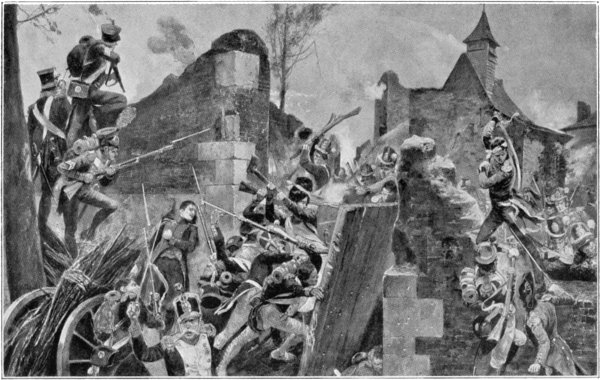
“In the whole of my experience I never saw an army so strongly posted
as the French at the battle of Toulouse. There ought to have been an
accurate plan and description made of the whole affair as a matter of
professional science.”
Wellington.
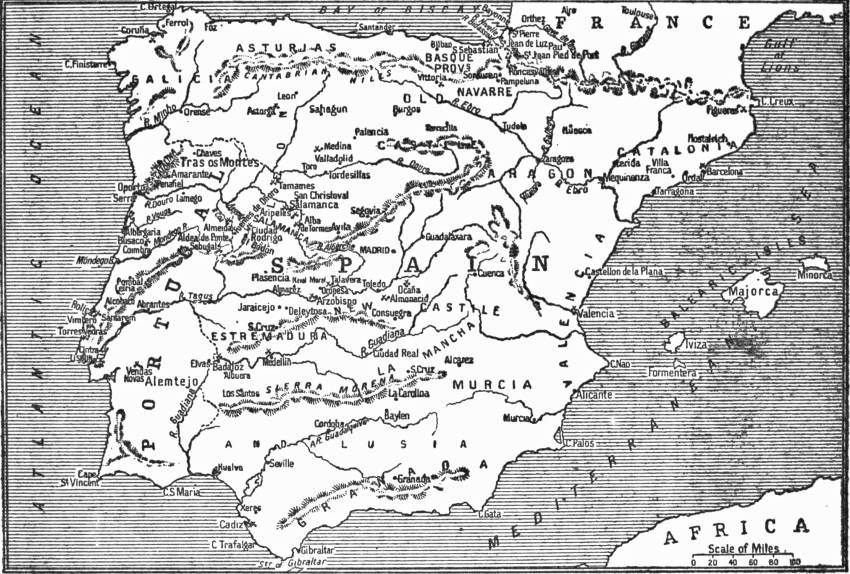
Marmont’s army was not the only one in retreat.
King Joseph, with 15,000 troops, had
left Madrid with the set purpose of joining
the Marshal, but when he received news of the battle of
Salamanca he retreated on Valencia, where Suchet’s
army was posted, and peremptorily ordered Soult to
evacuate Andalusia. This would enable him to bring
90,000 men to bear on his victorious enemy. His withdrawal
from Madrid enabled Wellington to enter the
capital on the 12th August 1812, Marmont, or rather
Clausel, who had temporarily succeeded him, being driven
back upon Burgos. The evacuation of the southern
province was doubtless very gratifying to the Spaniards,
but the threatened concentration of such a vast array of
troops placed the Anglo-Portuguese army in an extremely
unhappy position. The force at Wellington’s disposal
numbered 60,000 men, and although an additional 6000
had just landed at Alicante, in Valencia, it was evident
that they would be of little service at the moment.
When he became aware that Soult was about to abandon
Andalusia he left part of his army to occupy Madrid, and
with the remainder set out in the hope of being able to
crush Clausel, who was at Valladolid. This he was unable
to do, for the enemy retired from position to position. He
followed him to Burgos, which Wellington entered, the
French General meanwhile encamping on the banks
of the Ebro, where he shortly afterwards received substantial
reinforcements under Caffarelli and Souham
the latter of whom arrived as Marmont’s successor.
Wellington was also joined by some 11,000 Spanish
troops of the army of Galicia. He at once laid siege to
the castle above the town, which was strongly defended,
and although the troops worked with praiseworthy
ardour and four attempts were made to take it by assault,
he was eventually forced to abandon the idea, and for a
very important reason. Soult had joined King Joseph,
and the combined army was on its way to Madrid. He
had wasted a precious month, time which the French had
used to full advantage.
It is related that one of the Irish regiments incurred
his displeasure during the siege, and some of its members
asked permission for it to lead one of the assaults. Their
wish was granted, with the result that nearly all the men
laid down their lives in the desperate undertaking.
When Wellington passed a little later, a soldier who had
lost both his legs saluted and cried, “Arrah, maybe
ye’r satisfied now, you hooky-nosed vagabond!” The
Commander could not restrain a smile, and promptly
sent assistance. The Irishman ended his days in Chelsea
Hospital.
Sending word to Hill to abandon Madrid and meet him
on the Tormes, Wellington skilfully withdrew his men
from Burgos, and although his rear-guard was much
harassed by Souham’s troops, he formed a junction with
his lieutenant near the battlefield of Salamanca. On
arrival on the Tormes they were almost face to face with
the united army, but divided counsels reigned, and he
skilfully eluded the French, although they turned his
position. Aided by a dense fog, Wellington managed to
slip away unperceived. After a sharp engagement at a
ford of the Huebra, the pursuers abandoned the attempt
to secure the roads to Ciudad Rodrigo, which place was
reached by Wellington on the 18th November. Soult
retired to Toledo, Souham to Valladolid, and Joseph to
Segovia.
A pen-sketch of the men during this terrible retreat
tells us that “such a set of scare-crows never was seen.
It was difficult to say what they were, as the men’s coats
were patched with grey, some had blankets over them,
and most were barefooted; every step they took was up
to the knees in mud; women and sick men were actually
sticking in it.... A brigade of cavalry, however, which
was covering the rear, had left Lisbon but a short time
before, and was in high order. The clothing of the men
scarcely soiled, and the horses sleek and fat, made a
strange contrast with the others, especially the company
of artillery that had served in the batteries before Burgos.
We at first took the latter for prisoners, as they were
mostly in French clothing, many of them riding in the
carriages with the sick and wounded, drawn, some by
oxen, and some by mules and horses. I never saw
British soldiers in such a state.”
Wellington and his men then went into cantonments,
the former making his headquarters at Freneda. Much
was done to improve the morale of the troops, who had
got into a very insubordinate state. Reinforcements
came to hand, and Wellington worked hard to reorganize
the Spanish army, of which he had been appointed
Generalissimo after the battle of Salamanca. He had
also been raised to the rank of Marquis, thanked by both
Houses of Parliament, and presented with £100,000.
He paid a visit to the Cortes, made a speech, and wrote a
long letter to one of the Deputies in which he criticized
“the powers that be” in no uncertain way, adding,
however, a number of measures which would “give your
Government some chance of standing, and your country
some chance of avoiding farther revolutions.” The
whole communication must be studied to be fully
appreciated.75 “The Government and the Assembly,”
he says in one passage, “instead of drawing together, are
like two independent powers, jealous and afraid of each
other; and the consequence is, that the machine of
Government is at a stand. To this add that the whole
system is governed by little local views, as propounded
by the daily press of Cadiz, of all others the least enlightened
and the most licentious.” “I will fight for
Spain as long as she is the enemy of France, whatever
may be her system of government,” he adds, “but I
cannot avoid seeing and lamenting the evils which
await the country if you do not retrace your steps, let
what will be the result of the military operations of
the war....”
He advised the establishment of a permanent Regency,
“with all the powers allotted by the constitution to the
King, in the hands of one person.” He, or she, should be
aided by a Council, whose five members should superintend
the Department de Estado, the Interior and
Ultramar, Gracia y Justicia, Hacienda, and of War and
of Marine respectively, each being responsible for the
department under his superintendence. He suggested
either turning “the Council of State into a House of
Lords,” or making “a House of Lords of the Grandees,
giving then concurrent powers of legislation with the
Cortes; and you should leave the patronage now in the
hands of the Council of State in the hands of the Crown.”
In these days of Socialism the following remarks,
which occur in the same letter, are of more than passing
interest. “The theory of all legislation,” he says, “is
founded in justice; and, if we could be certain that
legislative assemblies would on all occasions act according
to the principles of justice, there would be no occasion
for those checks and guards which we have seen
established under the best systems. Unfortunately,
however, we have seen that legislative assemblies are
swayed by the fears and passions of individuals; when
unchecked, they are tyrannical and unjust; nay, more:
it unfortunately happens too frequently that the most
tyrannical and unjust measures are the most popular.
Those measures are particularly popular which deprive
rich and powerful individuals of their properties under
the pretence of the public advantage; and I tremble
for a country in which, as in Spain, there is no barrier
for the preservation of private property, excepting the
justice of a legislative assembly possessing supreme
powers.”
In summing up the result of his operations in the field
during 1812, Wellington tells the Earl of Liverpool on the
23rd November, that notwithstanding adverse criticism
in the newspapers, “it is in fact the most successful
campaign in all its circumstances, and has produced for
the cause more important results than any campaign in
which a British army has been engaged for the last
century. We have taken by siege Ciudad Rodrigo,
Badajoz, and Salamanca; and the Retiro surrendered.
In the meantime the Allies have taken Astorga,
Guadalaxara, and Consuegra, besides other places taken
by Duran and Sir H. Popham. In the months elapsed
since January this army has sent to England little short
of 20,000 prisoners, and they have taken and destroyed
or have themselves the use of the enemy’s arsenals in
Ciudad Rodrigo, Badajoz, Salamanca, Valladolid, Madrid,
Astorga, Seville, the line before Cadiz, etc.; and upon the
whole we have taken and destroyed, or we now possess,
little short of 3000 pieces of artillery. The siege of Cadiz
has been raised, and all the countries south of the Tagus
have been cleared of the enemy.
“We should have retained still greater advantages, I
think, and should have remained in possession of Castile
and Madrid during the winter, if I could have taken
Burgos, as I ought early in October, or if Ballasteros had
moved upon Alcarez as he was ordered, instead of intriguing
for his own aggrandizement.
“The fault of which I was guilty in the expedition to
Burgos was, not that I undertook the operation with
inadequate means, but that I took there the most inexperienced
instead of the best troops.... I see that a
disposition already exists to blame the Government for
the failure of the siege of Burgos. The Government had
nothing to say to the siege. It was entirely my own act.
In regard to means, there were ample means both at
Madrid and at Santander for the siege of the strongest
fortress. That which was wanting at both places was
means of transporting ordnance and military stores to
the place where it was desirable to use them.
“The people of England, so happy as they are in every
respect, so rich in resources of every description, having
the use of such excellent roads, etc., will not readily
believe that important results here frequently depend
upon 50 or 60 mules more or less, or a few bundles of
straw to feed them; but the fact is so, notwithstanding
their incredulity....”
When Wellington was ready for his 1813 campaign he
had 75,000 British and Portuguese at his disposal, and
some 60,000 Spaniards, in addition to the irregular bands
which were the bane of the enemy. The different French
armies totalled some 200,000 troops, but it was deemed
necessary to send 40,000 of these, under Clausel and Foy,
to exterminate the guerilleros, which was to Wellington’s
advantage, especially as it was impossible for Napoleon,
now deeply involved owing to the disastrous Russian
campaign, to send further reinforcements. Soult was
withdrawn, with 20,000 men, to oppose the Russian
advance. By way of further encouragement, Andalusia,
Estremadura, Galacia, and the Asturias no longer sheltered
the enemy. The British left was under Graham, the
right under Hill, and the centre under the Commander-in-Chief.
The first marched upon Valladolid, the
French retreating before him, and was joined near
Zamora on the 1st June 1813 by Wellington, followed
two days later by Hill. The French were deceived by
these movements, for they expected the main attack to
be made from Ciudad Rodrigo and Almeida with the
object of occupying Madrid. This was far from
Wellington’s purpose, which was to carry on the war in
the northern provinces, sever the French communications
with the homeland, and force them to withdraw to the
Pyrenees. King Joseph hastily retired from Valladolid
and reached Burgos. On the approach of Wellington to
that town, the fortifications were blown up and the enemy
fell back beyond the Ebro.
“When I heard and saw this explosion (for I was
within a few miles, and the effect was tremendous),”
Wellington remarks, “I made a sudden resolution forthwith—instanter
to cross the Ebro, and endeavour to
push the French to the Pyrenees. We had heard of the
battles of Lützen and Bautzen and of the armistice,76 and
the affairs of the Allies looked very ill. Some of my
officers remonstrated with me about the impudence of
crossing the Ebro, and advised me to take up the line of
the Ebro, etc. I asked them what they meant by taking
up the line of the Ebro, a river 300 miles long, and what
good I was to do along that line? In short, I would not
listen to the advice; and that very evening (or the very
next morning) I crossed the river and pushed the French
till I afterwards beat them at Vittoria.”
“We continued to advance,” writes a soldier of the
71st Regiment who fought in the battle, “until the 20th
of June; when reaching the neighbourhood of Vittoria,
we encamped upon the face of a hill. Provisions were
very scarce. We had not a bit of tobacco, and were
smoking leaves and herbs. Colonel Cadogan rode away,
and got us half a pound of tobacco a man, which was most
welcome.
“Next morning we got up as usual. The first pipes
played for parade; the second did not play at the usual
time. We began to suspect all was not right. We remained
thus until eleven o’clock; then received orders to
fall in, and follow the line of march. During our march
we fell to one side, to allow a brigade of guns to pass
us at full speed. ‘Now,’ said my comrades, ‘we will
have work to do before night.’ We crossed a river, and,
as we passed through a village, we saw, on the other side
of the road, the French camp, and their fires still burning,
just as they had left them. Not a shot had been fired at
this time. We observed a large Spanish column moving
along the heights on our right. We halted, and drew up
in column. Orders were given to brush out our locks,
oil them, and examine our flints. We being in the rear,
these were soon followed by orders to open out from the
centre, to allow the 71st to advance. Forward we
moved up the hill. The firing was now very heavy.
Our rear had not engaged, before word came for the
doctor to assist Colonel Cadogan, who was wounded.
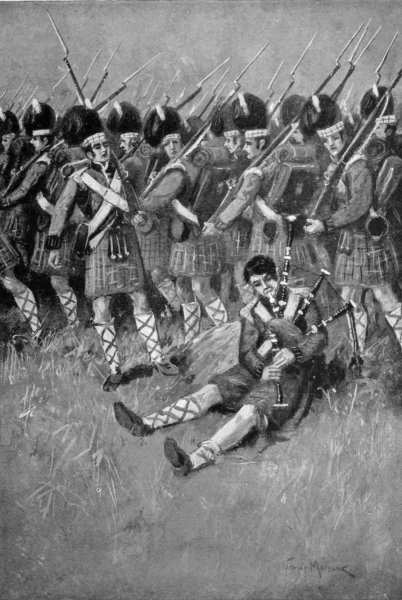
Immediately we charged up the hill, the piper playing,
‘Hey Johnny Cope.’ The French had possession of the
top, but we soon forced them back, and drew up in
column on the height; sending out four companies to
our left to skirmish. The remainder moved on to the
opposite height. As we advanced driving them before
us, a French officer, a pretty fellow, was pricking and
forcing his men to stand. They heeded him not—he
was very harsh. ‘Down with him!’ cried one near me;
and down he fell, pierced by more than one ball.
“Scarce were we upon the height, when a heavy
column, dressed in great-coats, with white covers on
their hats, exactly resembling the Spanish, gave us a
volley, which put us to the right about at double-quick
time down the hill, the French close behind, through the
whins. The four companies got the word the French
were on them. They likewise thought them Spaniards,
until they got a volley that killed or wounded almost
every one of them. We retired to the height, covered by
the 50th, who gave the pursuing column a volley which
checked their speed. We moved up the remains of our
shattered regiment to the height. Being in great want of
ammunition, we were again served with sixty rounds a
man, and kept up our fire for some time, until the bugle
sounded to cease firing....
“At this time the Major had the command, our second
Colonel being wounded. There were not 300 of us on the
height able to do duty, out of above 1000 who drew
rations in the morning. The cries of the wounded were
most heart-rending.
“The French, on the opposite height, were getting
under arms; we could give no assistance, as the enemy
appeared to be six to one of us. Our orders were to
maintain the height while there was a man of us. The
word was given to shoulder arms. The French, at the
same moment, got under arms. The engagement began
in the plains. The French were amazed, and soon put
to the right about, through Vittoria. We followed, as
quick as our weary limbs could carry us. Our legs were
full of thorns, and our feet bruised upon the roots of the
trees. Coming to a bean field at the bottom of the
heights, immediately the column was broke, and every
man filled his haversack. We continued to advance
until it was dark, and then encamped on a height above
Vittoria.... I had fired 108 rounds this day.”
According to the official figures the British lost 740
men by death and 4174 were wounded, out of a total
strength of 80,000. The captures included 151 guns,
415 caissons, 14,249 rounds of ammunition, nearly
2,000,000 musket ball cartridges, 40,668 lbs. of gunpowder,
fifty-six forage waggons, forty-four forge
waggons, treasure to the amount of £1,000,000, pictures
by Velasquez and other masters, jewellery, public and
private baggage. King Joseph’s carriage, and Jourdan’s
bâton. The last-mentioned was given by Wellington to
the Prince Regent, who with becoming fitness sent the
donor a Field-Marshal’s bâton. The French had 65,000
men engaged in the battle of Vittoria, of whom some
6000 were killed and wounded, and 1000 taken
prisoners.
The defeated army crossed the Pyrenees and marched
to Bayonne, where it was joined by the troops under Foy
and Clausel, who had been pursued by the Allies. “To
hustle the French out of Spain before they were reinforced,”
had been Wellington’s object, and he had
carried it out completely. As the garrisons of the
fortresses of Pampeluna and San Sebastian had been
strengthened, the former by Joseph and the latter by
Foy, during their retreat, Wellington now turned his
attention to them. Although the army under Suchet
was the only one now left in the Peninsula, it occupied
Catalonia and part of Valencia, and might therefore
attack Wellington’s right flank.
Napoleon was at Dresden when he heard of his
brother’s disaster at Vittoria, and he was in no mood for
soft words. He recalled both Joseph and Jourdan, and
gave the command to Soult. “It is hard to imagine
anything so inconceivable as what is now going on in
Spain,” the Emperor writes to Savary on the 3rd July
1813. “The King could have collected 100,000 picked
men: they might have beaten the whole of England.”
He blamed himself for the “mistaken consideration” he
had shown his brother, “who not only does not know
how to command, but does not even know his own value
enough to leave the military command alone.”
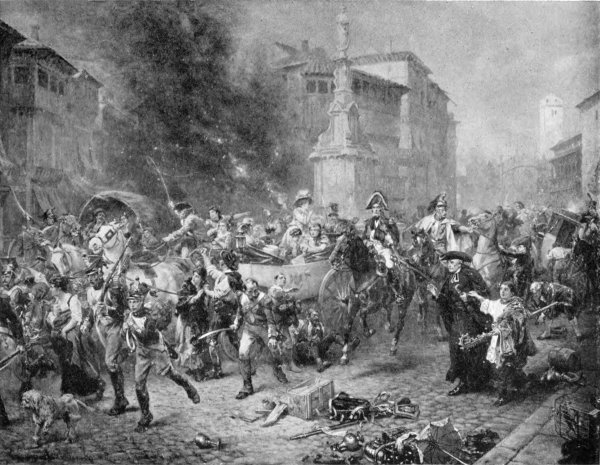
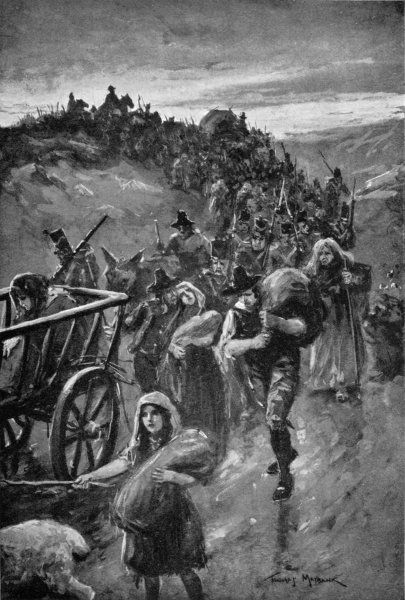
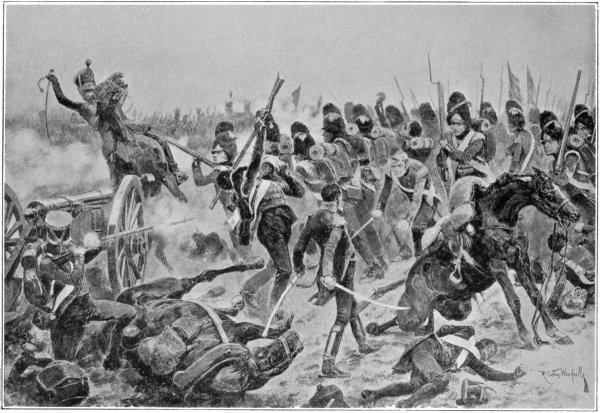
Flight of the French through Vittoria
Robert Hillingford
Soult reached Bayonne on the 12th July, and thirteen
days later had marched on Pampeluna with 73,000
troops, bent on relieving one or other of the fortresses,
perhaps both. He attacked the British right at
Roncesvalles and turned the position; Hill was attacked
at the head of the valley of Baztan and was obliged to
withdraw. Wellington at once raised the siege of San
Sebastian, which had been carried on by Sir Thomas
Graham, and contented himself by blockading the
fortress. He immediately concentrated his right and
centre at Sorauren, near Pampeluna. The series of fights
which took place at this time is known as the battles of
the Pyrenees. On the 27th Wellington arrived, and a
rousing cheer greeted him, which it is said deterred the
French from making anything but a partial attack.
Probably the truth of the matter is that Soult hesitated
because he was expecting additional forces with d’Erlon,
for the Marshal was scarcely likely to be overawed by a
greeting. A corporal, unable to restrain his enthusiasm
as the Commander-in-Chief rode along the line, shouted
out to the intense amusement of all, “There goes the
little blackguard what whops the French!”77
Soult was pointed out to the General by a spy.
“Yonder,” Wellington is reported to have said, “is a
great but cautious general; he will delay his attack to
know the reason of those cheers; that will give time for
my reinforcements to come up, and I shall beat him.”
As a matter of fact, the 6th Division of infantry, to
which Wellington had referred, did arrive, and
“bludgeon work,” to use his expression, took place on
the 28th, the anniversary of Talavera. The reinforcements
had scarcely secured their position, their right resting
on Orcain and their left on the heights overlooking
the valley of the Lanz, than a very determined attack
was made by the enemy. They were driven back, and
made an attempt on the hill occupied by the 7th caçadores
and Ross’s brigade of the 4th Division. They obtained
possession of it for a short time until driven down.
When the battle became general the 10th Portuguese
regiment was overpowered, necessitating the withdrawal
of Ross. Wellington then ordered two regiments to
charge the enemy on the heights and those on the left,
with the result that the French were “driven down with
immense loss.” “Every regiment,” says Wellington,
“charged with the bayonet, and the 40th, 7th, 20th, and
23rd, four different times.” Of Wellington’s 16,000
troops he lost 2600 killed and wounded, the French
1800 out of 20,000. The Portuguese behaved “admirably,”
and the Commander-in-Chief “had every reason to
be satisfied with the conduct of the Spanish regiments
El Principe and Pravia.”
By sunset Soult’s attacks had waned, and on the following
morning he began to retreat, although he received
reinforcements to the number of 18,000 troops. On the
30th he attacked Hill to no good effect, and Wellington
forced the French to retire from a strong position they
had taken up. The pursuit continued until the 1st
August, when it was discontinued, for the Allies were in
possession of the passes and the arduous exertion of
the troops was beginning to tell upon them.
Wellington again took up his headquarters at Lesaca.
Writing to Graham he says, “I hope that Soult will not
feel any inclination to renew his expedition. The French
army must have suffered greatly. Between the 25th of
last month and 2nd of this, they were engaged seriously
not less than ten times; on many occasions in attacking
very strong positions, in others beat from them or pursued.
I understand that their officers say that they have
lost 15,000 men. I thought so; but as they say so, I now
think more. It is strange enough that our diminution
of strength to the 31st does not exceed 1500 men,
although, I believe, our casualties are 6000.” It was
on the 31st that San Sebastian fell, the castle capitulating
shortly afterwards, and the day is also noteworthy for
Soult’s attack on San Marcial, which was repulsed by
Spanish troops, the enemy retiring across the Bidassoa.
Unfortunately, Sir John Murray made no headway
against Suchet in the east of Spain, and was superseded
by Lord William Bentinck, who besieged Tarragona,
which his predecessor had evacuated. Although he
was compelled to retire on the approach of the French
Marshal, the city was eventually occupied by the British
troops. Their entry into Villa Franca was marred by
the rout of the advanced guard in the pass of Ordal,
necessitating their retreat towards Tarragona.
It is obviously impossible to unravel with any approach
to detail the tangled skein of complicated manœuvres
which took place at this period, perhaps the most trying
and exacting of the war in the Peninsula. Gleig, however,
gives one picturesque touch to an involved picture
which reveals more of the personality of the great General
than many pages of military movements, and is infinitely
more valuable for the purposes of a life story. “Lord
Wellington,” he records, “after directing a Spanish
column to move up a glen towards a specific point, looked
at his watch, and observed to those about him that it
would take the men so much time to perform the journey.
He added that he was tired, and dismounting from his
horse, wrapped himself in his cloak and went to sleep.
A crowd of officers stood round him, and among others
some Spanish generals, whose astonishment at the coolness
of their chief was expressed in audible whispers.
For the very crisis of the struggle was impending, and the
French being in greater strength upon the spot, seemed
to have the ball at their foot. Now, among the officers
of the headquarters’ staff, there were several who had
never approved the passage of the Ebro. These began to
speak their minds freely, and one, the bravest of the
brave, the gallant Colonel Gordon, exclaimed, ‘I
always thought it would come to this. I was sure we
should make a mess of it, if we got entangled among the
Pyrenees, and now see if my words don’t come true.’
Lord Wellington happened to awake just as Gordon thus
unburdened his conscience. He sat up, and without
addressing himself to anyone in particular, extended his
right hand open, and said, as he closed it, ‘I have them
all in my hand, just like that.’ Not another word was
spoken. The Spaniards had reached the top of the
glen; Lord Wellington and his attendants remounted
their horses, and the battle was renewed.”
On the 7th October 1813 Wellington passed the
Bidassoa with the left of his army. Soult was attacked
and driven back with the loss of eight pieces of cannon,
taken by the Allies in the captured redoubts and
batteries. The fighting was continued on the following
day, after the fog which obscured the enemy’s position
had lifted, when a rock occupied by the French to the
right of their position was carried “in the most gallant
style” by the Spaniards, who immediately afterwards
distinguished themselves by carrying an entrenchment
on a hill which protected the right of the camp of Sarre.
Soult withdrew during the following night, and took up
a series of entrenched positions behind the Nivelle,
leaving, as Alison so eloquently puts it, “a vast hostile
army, for the first time since the Revolution, permanently
encamped within the territory of France. And thus was
England, which throughout the contest had been the
most persevering and resolute of all the opponents of
the Revolution, and whose government had never yet
either yielded to the victories or acknowledged the chiefs
which it had placed at the head of affairs, the first of all
the forces of Europe who succeeded in planting its
victorious standards on the soil of France.”
On the 10th November, a little over a week after the
surrender of Pampeluna through starvation, for the fall
of which he had waited before resuming offensive operations,
Wellington, with an army of about 90,000 men,
attacked the enemy’s position, an exceedingly strong one,
the right extending from the sea to St Jean de Luz, the
left from Bidarray to St Jean Pied de Port, the centre
between Amotz and Ascain. The enemy were driven
out of the lines and followed over the river, with a loss
of 4200 men and no fewer than 51 guns, the Allies losing
about 2500 killed and wounded.
“Our loss,” says Wellington, “although severe, has
not been so great as might have been expected, considering
the strength of the positions attacked, and the length
of time, from daylight in the morning till night, during
which the troops were engaged.” The disorders which
followed the battle were so great that with the exception
of a single division Wellington sent the whole of the
Spaniards—some 25,000—back to the Peninsula.
On the 12th the Marshal was in the entrenched camp
at Bayonne, and six days later the victorious army went
into cantonments, where it remained until the 9th
December, when it was ordered to march towards
Bayonne. It forced the passage of the Nive, and a
series of engagements was fought until the 13th, on which
date Hill, with one British and one Portuguese division,
fought and won the battle of Saint Pierre. Wellington
came up but refrained from interfering, and when he
saw that his brave colleague had proved victorious, he
wrung his hand in a hearty grip and exclaimed, “Hill,
the day is entirely your own.”
In the battles of the Nive the French lost 5800 killed
and wounded, and three German regiments by desertion
to the Allies, whose losses totalled 4600. Soult had
now one of two alternatives, either to be hemmed in at
Bayonne or to retreat. He chose the latter, and marched
in the direction of Toulouse with less than 40,000 troops,
Napoleon, now in desperate plight, having withdrawn
10,000 for the defence of the eastern frontier of France.
Leaving Sir John Hope to blockade Bayonne,
Wellington followed Soult, who took up a position at
Orthez, on the right bank of the Gave de Pau. Early
on the morning of the 27th February the battle opened
by Beresford turning the enemy’s right, but he was driven
back, as was Picton, who attacked the enemy’s centre.
“Enfin je le tiens!—At last I have him!” exclaimed
Soult, but Wellington changed his plan, and at once sent
Hill to cross the river by the ford above Souars and cut
off the Marshal’s retreat by the great road to Pau. At
the same time he ordered two divisions against the right
of the enemy’s centre, and Colborne cut off the division
which had checkmated Beresford. The French under
Reille were driven from the heights, and at first retired,
in good order, but Cotton and Lord Edward Somerset
charged and spread considerable confusion in the ranks,
while Hill marched on Aire and attacked Clausel. The
Portuguese were repulsed, but the British drove the
enemy from the town with great loss.
Wellington was wounded almost at the end of the battle,
which is perhaps one reason why the pursuit was not so
rapid as it might otherwise have been. However,
Beresford was sent with two divisions to Bordeaux,
whose citizens bade them enter, and thereupon proclaimed
the Duc d’Angoulême, eldest nephew of Louis
XVIII, who was now with the British army, as Prince
Regent.
The last battle of the Peninsular War was fought on
Easter Sunday, the 10th April 1814, at Toulouse, on
which Soult’s army had concentrated.
A mistake on the part of an engineer as to the breadth
of the Garonne above Toulouse prevented Wellington
from crossing at the spot he had selected because there
were not sufficient pontoons. This caused considerable
delay and a march to a narrower but more difficult
place below the town. Sir George Napier says that he
never saw the Commander-in-Chief in such a rage—he
was “furious.” On the completion of the gangway,
Beresford, with a portion of the army, passed over,
drove in the French outposts, and remained in front of
the enemy. There they stopped for three days, cut off
from the main force and liable to attack any moment.
This unexpected situation was brought about by a storm
which flooded the river and swept away the pontoons.
Soult is stated to have given this reason for failing to
assail Beresford’s force: “You do not know what stuff
two British divisions are made of; they would not be
conquered as long as there was a man of them left to
stand, and I cannot afford to lose men now.”
When the new bridge was available no time was lost
in crossing the river, and on the 10th Soult was attacked.
An eye-witness thus records the event78:
“The 4th, 6th, and a Portuguese division under
Marshal Beresford’s orders, attacked the great fort on
the right of the French, and here was the brunt of the
battle, for the enemy was strongly posted and flanked by
works, with trenches in their front, and their best troops
opposed to ours. But nothing could damp the courage
of this column; the enemy’s guns poured a torrent of
fire upon it; still it moved onward, when column upon
column appeared, crowning the hill and forming lines
in front and on the flanks of our brave fellows who were
near the top; and then such a roll of musketry accompanied
by peals of cannon and the shouts of the enemy
commenced, that our soldiers were fairly forced to give
way and were driven down again. This attack was
twice renewed, and twice were our gallant fellows forced
to retire, when, being got into order again and under a
tremendous fire of all arms from the enemy, they once
more marched onward determined ‘to do or die’ (for
they were nearly all Scotch) and, having gained the
summit of the position, they charged with the bayonet,
and in spite of every effort of the enemy, drove all before
them and entered every redoubt and fort with such a
courage as I never saw before. The enemy lay in heaps,
dead and dying! few, very few, escaped the slaughter
of that day; but ‘victory’ was heard shouted from
post to post as that gallant band moved along the crown
of the enemy’s position taking every work at the point
of the bayonet.
“While the work of death was going on here, the
centre of the French position was attacked by the
Spanish column of 8000 men, under General Freyre,
who had demanded in rather a haughty tone that Lord
Wellington should give the Spaniards the post of honour
in the battle. He acceded, but took special care to have
the Light Division in reserve to support them in case of
accidents. Old Freyre placed himself at the head of his
column, surrounded by his staff, and marched boldly up
the hollow way, or road, which led right up to the enemy,
under a heavy and destructive fire of cannon shot, which
plunging into the head of his column made great havoc
among his men; still they went steadily and boldly on,
to my astonishment and delight to see them behave so
gallantly, and I could not help expressing my delight
to Colonel Colborne. But, alas! he knew them too
well, and said to me, ‘Gently, my friend; don’t praise
them too soon; look at yonder brigade of French Light
Infantry, ready to attack them as soon as the head of
their column enters the open ground. One moment
more and we shall see the Spaniards fly! Gallop off,
you, and throw the 52nd Regiment (which was in line)
into open column of companies, and let these fellows
pass through, or they will carry the regiment off with
them.’ He had scarcely finished the words when a
well-directed fire from the French Infantry opened upon
the Spanish column, and instantly the words ‘Vive
l’Empereur! En avant! en avant!’ accompanied by a
charge, put the Spaniards to flight, and down they came
upon the 52nd Regiment, and I had but just time to
throw it into open column of companies when they rushed
through the intervals like a torrent and never stopped
till they arrived at the river some miles in the rear. As
soon as they had passed, and I had formed the regiment
into line again, we moved up and took the Spaniards’
place, driving before us the enemy’s brigade, who, being
by this time completely beaten on the right and all his
forts and trenches carried by Beresford’s troops, had
retreated into the town; so that we found the fort
on that part of the position which we attacked quite
abandoned, and we entered it without loss.
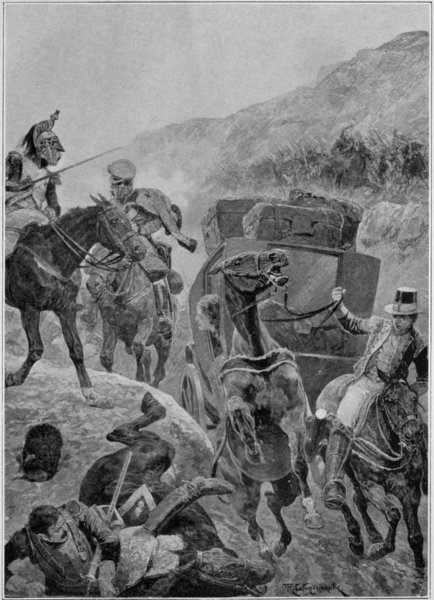
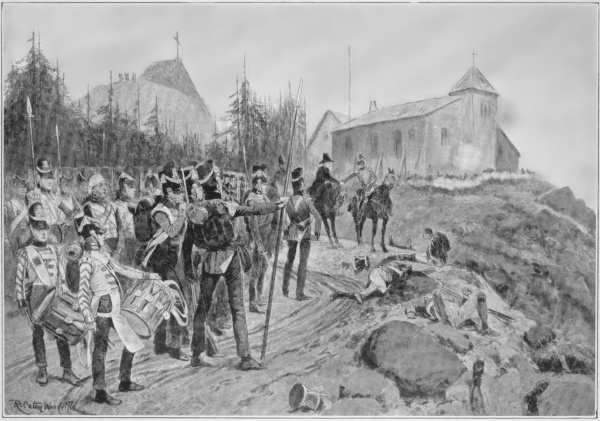
The French Retreat over the Pyrenees
R. Caton Woodville
“On our right the 3rd Division, under General Picton,
was ordered to make a false attack on the canal bridge,
which was strongly fortified and formed an impracticable
barrier to that part of the town; but General Picton
(who never hesitated at disobeying his orders) thought
proper to change this false attack into a real one, and
after repeated and useless attempts to carry it was forced
to give it up, with an immense loss of officers and men.
To our extreme right and on the opposite side of the
river General Hill was stationed with his corps in order
to watch the bridge and gates of the town, and either
prevent any attempt of the enemy to pass over a body of
troops during the action to cut off our communications with
the rear, or, should he show any design of retreating that
way, to impede him. However, all was quiet on that
side, and now that every man of the enemy’s army had
been chased from the position the battle was won, and
the roar of cannon, the fire of the musketry, and the
shouts of the victors ceased. All was still; the pickets
placed; the sentinels set; and the greatest part of the
army sleeping in groups round the fires of the bivouac.”
Soult had only been able to bring some 39,000 men into
the field, to so great an extent had his forces been depleted,
while Wellington had less than 50,000 available
troops. Of the French, 3200 were killed or wounded, of
the Allies 4600. On the 12th April Soult evacuated
Toulouse, six days after Napoleon the Great had snatched
up a pen and scrawled his formal abdication. A moment
before he had been full of fight, had wanted to rally the
corps of Augereau, Suchet and Soult. A year later he
won back more than these. Wellington entered Toulouse
on the day Soult left it, and within a few hours of the
receipt of the news from Paris of the proclamation of
Louis XVIII, a monarch as incompetent as the fallen
Emperor was great. History is oftentimes ironic, and
Time’s see-saw seldom maintains an even balance for
any lengthy period.