When Barbe Cavelier awoke next morning and saw around her the stone
walls of Fort Frontenac instead of a familiar convent enclosure, she sat
up in her bed and laughed aloud. The tiny cell echoed. Never before had
laughter of young girl been heard there. And when she placed her feet
upon the floor perhaps their neat and exact pressure was a surprise to
battered planks used to the smiting tread of men.
Barbe proceeded to dress herself, with those many curvings of neck and
figure, which, in any age, seem necessary to the fit sitting of a young
maid in her garments. Her aquiline face glowed, full of ardent life.
Some raindrops struck the roof-window and ran down its panes like tears.
When Barbe had considered her astounding position as the only woman in
Fort Frontenac, and felt well compacted for farther adventures, she
sprung upon the bunk, and stood with her head near the roof, looking out
into the fortress and its adjacent world. Among moving figures she could
not discern her uncle La Salle, or her uncle the Abbé, or even her
brother. These three must be yet in the officers’ house. Dull clouds
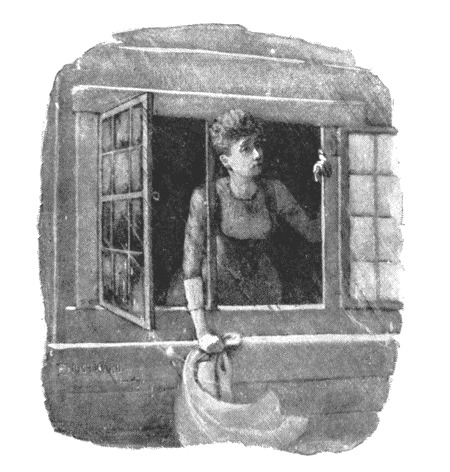
were scudding. As Barbe opened the sash and put her head out the morning
air met her with a chill. Fort Frontenac’s great walls half hid an
autumn forest, crowding the lake’s distant border in measureless expanse
of sad foliage. Eastward, she caught ghostly hints of islands on misty
water. The day was full of depression. Ontario stood up against the sky,
a pale greenish fleece, raked at intervals by long wires of rain.
But such influences had no effect on a healthy warm young creature,
freed unaccountably from her convent, and brought on a perilous,
delightful journey to so strange a part of her world.
She noticed a parley going forward at the gate. Some outsider demanded
entrance, for the sentry disappeared between the towers and returned for
orders. He approached the commandant who stood talking with Jacques le
Ber, the merchant of Montreal. Barbe could see Le Ber’s face darken.
With shrugs and negative gestures he decided against the newcomer, and
the sentinel again disappeared to refuse admission. She wondered if a
band of Iroquois waited outside. Among Abbé Cavelier’s complaints of La
Salle was Governor la Barre’s accusation that La Salle stirred enmity in
the Iroquois by protecting the Illinois tribe they wished to
exterminate.
“Even these Indians on the lake shore,” meditated Barbe, “who settled
there out of friendship to my uncle La Salle, may turn against him and
try to harm him as every one does now that his fortunes are low. I would
be a man faithful to my friend, if I were a man at all.”
She watched for a sight of the withdrawing party on the lake, and
presently a large canoe holding three men shot out beyond the walls. One
stood erect, gazing back at the fort with evident anxiety. Neither the
smearing medium of damp weather nor increasing distance could rob Barbe
of that man’s identity. His large presence, his singular carriage of the
right arm, even his features sinking back to space, stamped him Henri de
Tonty.
“He has come here to see my uncle La Salle, and they have refused to let
him enter,” she exclaimed aloud.
Stripping a coverlet from her berth she whipped the outside air with it
until the crackle brought up a challenge from below.
Fort Frontenac was a seignorial rather than a military post, and its
discipline had been lax since the governor’s Associates seized it, yet a
sentinel paced this morning before the officers’ quarters. When he saw
the signal withdrawn and a lovely face with dark eyelashes and a
topknot of curls looking down at him, he could do nothing but salute it,
and Barbe shut her window.
Dropping in excitement from the bunk, she ran across the upper room to
knock at La Salle’s door.
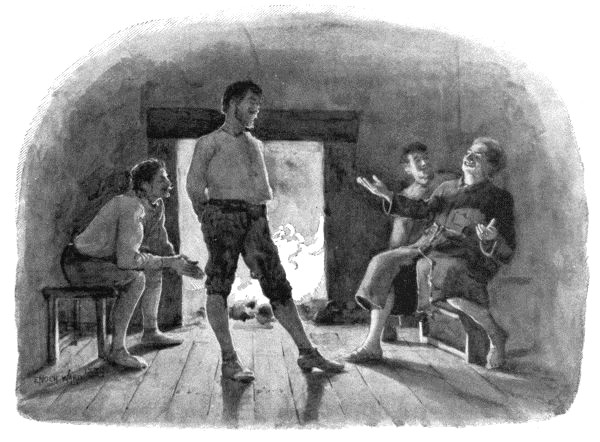
A boy stood basking in solitude by the chimney.
Her uncle La Salle’s apartment seemed filled with one strong indignant
voice, leaking through crevices and betraying its matter to the common
hall.
“You may knock there until you faint of hunger,” remarked the lad at the
hearth. “I also want my breakfast, but these precious Associates will
let us starve in the fort they have stolen before they dole us out any
food. I would not mind going into the barracks and messing, but I have
you also to consider.”
“It is not anything to eat, Colin—it is pressing need of my uncle La
Salle!”
“The Abbé has pressing need of our uncle La Salle. It was great relief
to catch him here at Frontenac. I have heard every bit of the lecture:
what amounts our uncle the Abbé has ventured in western explorations;
and what a fruitless journey he has made here to rescue for himself
some of the stores of this fortress; and what danger all we Caveliers
stand in of being poisoned on account of my uncle La Salle, so that the
Abbé can scarce trust us out of his sight, even with nuns guarding you.”
To Barbe’s continued knocking her guardian made the curtest reply. He
opened the door, looked at her sternly, saying, “Go away, mademoiselle,”
and shut it tightly again.
She ran back to her lookout and was able to discern the same canoe
moving off on the lake.
“Colin,” demanded Barbe, wrapping herself, “You must run with me.”
“Certainly, mademoiselle, and I trust you are making haste toward a
table.”
“We must run outside the fortress.”
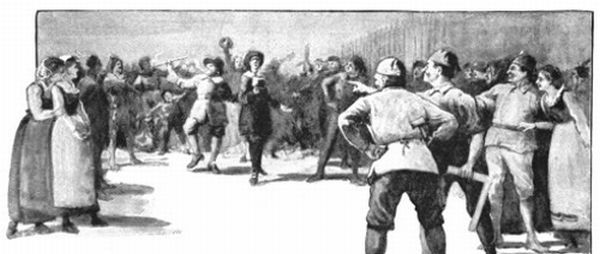
Though the boy felt it a grievance that he should follow instead of lead
to any adventure, he dashed heartily out with her, intending to take his
place when he understood the action. Rain charged full in their faces.
The sentry was inclined to hold them at the fortress gate until he had
orders, and Barbe’s impatience darted from her eyes.
“You will get me into trouble,” he said. “This gate has been swinging
over-much lately.”
“Let us out,” persuaded Colin. “The Associates will not care what
becomes of a couple of Caveliers.”
“Where are you going?”
“My sister wishes to run to the Iroquois village,” responded Colin, “and
beg there for a little sagamite. We get nothing to eat in Fort
Frontenac.”
The soldier laughed.
“If you are going to the Iroquois village why don’t you say your errand
is to Catharine Tegahkouita? It is no sin to ask an Indian saint’s
prayers.”
Barbe formed her lips to inquire, “Has Tegahkouita come to Fort
Frontenac?” But this impulse passed into discreet silence, and the man
let them out.
They ran along the palisades southward, Barbe keeping abreast of Colin
though she made skimming dips as the swallow flies, and with a détour
quite to the lake’s verge, avoided the foundation of an outwork.
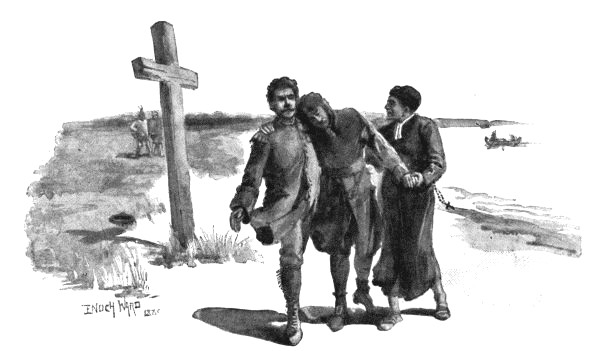
Father Hennepin’s cross stood up, a huge white landmark between
habitant settlement on the lake, and Indian village farther west but
visible through the clearing. Ontario seemed to rise higher and top the
world, its green curves breaking at their extremities into white
spatter, the one boat in sight making deep obeisance to heaving water.
“Do you see a canoe riding yonder?” exclaimed Barbe to Colin, as they
ran along wet sand.
“Any one may see a canoe riding yonder. Was it to race with that canoe
we came out, mademoiselle?”
“Wave your arms and make signals to the men in it, Colin. They must be
stopped. I am sure that one is Monsieur de Tonty, and they were turned
away from the fortress gate. They have business with our uncle La Salle,
and see how far they have gone before we could get out ourselves!”
“Why, then, did you follow?” demanded her brother, waving his arms and
flinging his cap in the rain. “They may have business with our uncle La
Salle, but they have no business with a girl. This was quite my affair,
Mademoiselle Cavelier.”
A maid whose feet were heavy with the mud of a once ploughed clearing
could say little in praise of such floundering. She paid no attention to
Colin’s rebuke, but watched for the canoe to turn landward. Satisfied
that it was heading toward them, Barbe withdrew from the border of the
lake. She would not shelter herself in any deserted hut of the habitant
village. Colin followed her in vexation to Father Hennepin’s mission
house, remonstrating as he skipped, and turning to watch the canoe with
rain beating his face.
They found the door open. The floor was covered with sand blown there,
and small stones cast by the hands of irreverent passing Indian boys.
The chapel stood a few yards away, but this whole small settlement was
dominated by its cross.[11]
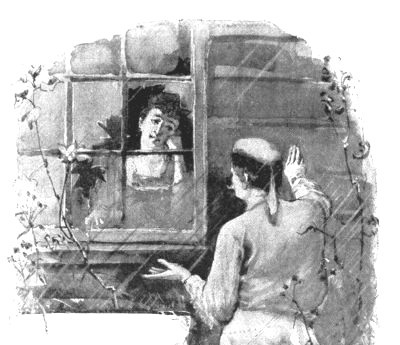
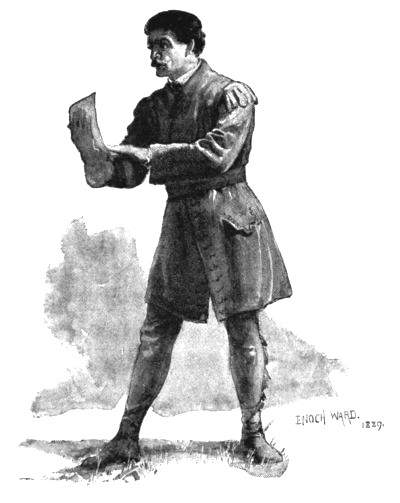
Barbe and Colin were scarcely under this roof shelter before Tonty
strode up to the door. He took off his hat with the left hand, his dark
face bearing the rain like a hardy flower. Dangers, perpetual immersion
in Nature, and the stimulus of vast undertakings had so matured Tonty
that Barbe felt more awe of his buckskin presence than her memory of the
fine young soldier in Montreal could warrant. She wanted to look at him
and say nothing. Colin, who knew this soldier only by reputation, was
eager to meet and urge him into Father Hennepin’s house.
Tonty’s reluctant step crunched sand on the boards. He kept his gaze
upon Barbe and inquired,—
“Have I the honor, mademoiselle, to address the niece of Monsieur de la
Salle?”
“The niece and nephew of Monsieur de la Salle,” put forth Colin.
“Yes, monsieur. You may remember me as the young tiger-cat who sprung
upon my uncle La Salle when you arrived with him from France.”
“I never forgot you, mademoiselle. You so much resemble Monsieur de la
Salle.”
“It is on his account we have run out of the fort to stop you. He does
not know you are here. I saw the sentinel close the gate against some
one, and afterward your boat pushed out.”
“And did you shake a signal from an upper window in the fort?”
“Monsieur, I could not be sure that you saw it, though I could see your
boat.”
“She made it very much her affair,” observed Colin, with the merciless
disapproval of a lad. “Monsieur de Tonty, there was no use in her
trampling through sand and rain like a Huron witch going to some herb
gathering. It was my business to do the errand of my uncle La Salle.
When she goes back she will get a lecture and a penance, for all her
sixteen years.”
“Mademoiselle,” said Tonty, “I am distressed if my withdrawal from Fort
Frontenac causes you trouble. I meant to camp here. I was determined to
see Monsieur de la Salle.”
“Monsieur,” courageously replied Barbe, “you cause me no trouble at all.
I thought you were returning to your fort on the Illinois. I did not
stop to tell my brother, but made him run with me. It is a shame that
the enemies of my uncle La Salle hold you out of Fort Frontenac.”
“But very little would you get to eat there,” consoled young Cavelier.
“We have had nothing to break our fast on this morning.”
“Then let us get ready some breakfast for you,” proposed Tonty, as his
men entered with the lading of the canoe. They had stopped at the
doorstep, but Father Hennepin’s hewed log house contained two rooms, and
he pointed them to the inner one. There they let down their loads, one
man, a surgeon, remaining, and the other, a canoeman, going out again in
search of fuel.
“Monsieur, it would be better for us to hurry back to the fortress and
call my uncle La Salle.”
“Nothing will satisfy you, mademoiselle,” denounced Colin. “Out you must
come to stop Monsieur de Tonty. Now back you must go through weather
which is not fitting for any demoiselle to face.”
“Mademoiselle,” said Tonty, “if you return now it will be my duty to
escort you as far as the fortress gate.”
Barbe drew her wrappings over her face, as he had seen a wild sensitive
plant fold its leaves and close its cups.
“I will retire to the chapel and wait there until my uncle La Salle
comes,” she decided, “and my brother must run to call him.”
“You may take to sanctuary as soon as you please,” responded Colin, “and
I will attend to my uncle La Salle’s business. But the first call I make
shall be upon the cook in this camp.”