Footnote anchors are denoted by [number], and the footnotes have been
placed at the end of each chapter.
Basic fractions are displayed as ½ ⅓ ¼ etc; other fractions are shown
in the form a/b, for example 1/200 or 95/729. A few fractions were of
the form a-b in the original book; these have been changed to a/b for
consistency.
New original cover art included with this eBook is
granted to the public domain.
Some minor changes to the text are noted at the end of the book.These are indicated by a dashed blue underline.
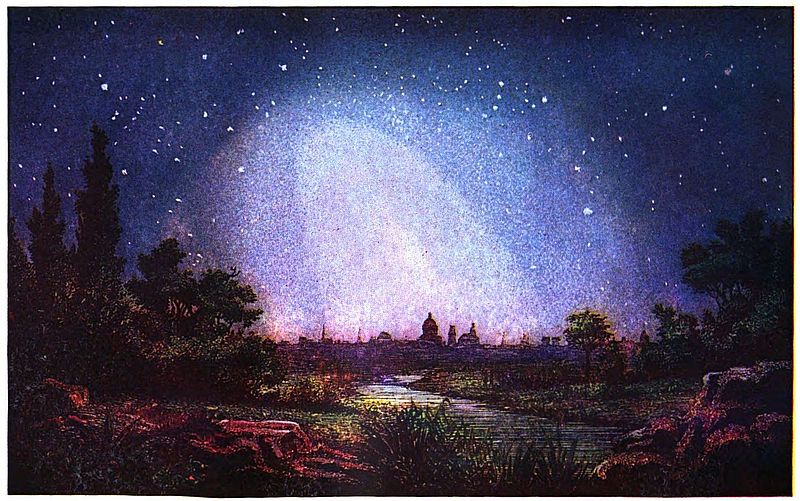
The Zodiacal Light
THE STORY OF THE UNIVERSE
Told by Great Scientists and Popular Authors
COLLECTED AND EDITED
By ESTHER SINGLETON
Author of “Turrets, Towers and Temples,” “Wonders of Nature,”
“The World’s Great Events,” “Famous Paintings,” Translator
of Lavignac’s “Music Dramas of Richard Wagner”
FULLY ILLUSTRATED
VOLUME I
THE
STARRY
SKIES
P. F. COLLIER AND SON
NEW YORK
Copyright 1905
By P. F. COLLIER & SON
PREFACE
In the following pages I have endeavored to present
a comprehensive and general view of the material side of
the universe. Instead of trying myself to tell the story of
the universe, I have gone to the works of acknowledged
weight and authority in this line of research and selected
from them extracts of a popular character, especially those
that are entertaining as well as merely instructive. The
average reader is frequently repelled from the study of the
sciences by the dry treatment adopted by those who try to
instruct him. He cares little for laws, theories, or affinities;
and he can not help being bored by attempts to make him
understand classifications with their long lists of words
manufactured from the names of modern celebrities or non-entities
and roots from dead languages. I have therefore
kept constantly in mind the person who seeks entertaining
knowledge, and not the scientific specialist. I have tried
to avoid all technicalities wherever possible.
Of late years, in fact ever since the foundation of
the British Association, there has been a constantly increasing
interest in the wonders of nature; and the specialist has
responded to this popular interest in his scientific labors by
speaking in language that an intelligent child can comprehend.
People as a rule prefer to read of the habits, instincts,
intelligence, and movements of animals and plants,
rather than of their organs and structure. Thus the study
of Natural History has received a great impetus from the
writings of such men as Darwin and Lubbock; and Astronomy
has been rendered more attractive to the lay reader by
Flammarion, Gore, Proctor, and Ball. Every traveler who
returns from remote or hitherto unknown Arctic or Torrid
Zones has something fresh to tell us of the phenomena and
life of our universe, which adds fresh stimulus to the popular
interest in the Natural Sciences.
The Story of the Universe naturally falls under the
following four heads:
First, the bodies moving in infinite space, including
stars, dark and lucid, planets, nebulæ, comets, and meteors.
Second, the Earth, considered as a separate world and
the only one of which we have precise detailed knowledge.
In this chapter we learn of the past of our globe from the
evidence afforded by the rocks of which its crust is composed.
The varying conformations of its present surface
are described, as is its atmospheric envelope and attendant
phenomena. The ocean and its movements and depths are
likewise fully considered.
Third, the Earth’s Garment—its flora. In this chapter
we are told of the wonders and beauties of plant-life, its
development and distribution.
Fourth, the Earth’s Creatures. Here we have a general
view of animal life, from the mighty mammoth to the fairy
fly: even the beings visible only to the microscope are not
forgotten. Special attention is also paid to man, from his
origin to the present day.
I have made the selections from authentic editions of
the writings of the scientists; and have taken no liberties
with the text, with the exception of occasional cutting.
In the Introduction I have given a short sketch of the
development of the Natural Sciences, from the dawn of
written history to the present day.
E. S.
New York, March, 1905.
INTRODUCTION
The knowledge of the Natural Sciences among the
Greeks and Romans was derived principally from the
Egyptians and Babylonians. The Phœnicians in their
voyages, also, necessarily paid considerable attention to
Astronomy. Their Cynosura consisted of the tail of the
Little Bear, by which they steered. The great names in
Greek Astronomy are Aratus, Hipparchus, and Ptolemy.
From the fancies of Astrology, in which the early Arabs
largely indulged, and which, though discountenanced by
Mahomet himself, have never been wholly abandoned by
their descendants, a not unnatural transition, led to the
study of Astronomy. Under the patronage of the Abbaside
Caliph Al-Mamun (813-833 A. D.) this science made
rapid progress.
Astronomy was zealously studied in the famous schools
of Bagdad and Cordova.
The Almagest, or System of Astronomy, by Ptolemy,
was translated into Arabic by Alhazi and Sergius as early as
812. In the Tenth Century, Albaten observed the advance
of the line of the apsides in the earth’s orbit; Mohammed-ben-Jeber-al-Batani,
the obliquity of the ecliptic; Alpetragius
wrote a theory of the planets; and Abul-Hassan-Ali,
on astronomical instruments. The obliquity of the ecliptic,
the diameter of the earth, and even the precession of the
equinoxes, were then calculated with commendable accuracy;
and shortly after, Abul-Mezar’s Introduction to Astronomy
and his Treatise on the Conjunction of the Planets,
with the Elements of Al-Furjanee (though this last author
was largely indebted to the Egyptian labors of Ptolemy),
proved that the caliph’s liberality had been well bestowed.
But Al-Batinee, a native of Syria (879-920 A. D.), surpassed
all his predecessors in the nicety alike of his observations
and computations. Geber, at Seville, constructed
(1196 A. D.) the first astronomical observatory on record;
and Ebn-Korrah in Egypt proved by his example that the
Arabs could be even better astronomers than the Greeks.
Ulug Bekh, grandson of the great Tamerlane, was a
diligent observer. He established an academy of astronomers
at Samarcand, the capital of his dominions, and constructed
magnificent instruments. Ulug Bekh, too, made
a catalogue of the fixed stars—the only one that had been
compiled since that of Hipparchus, sixteen centuries previously.
Gradually, by their intercourse with civilized nations,
the Arabian conquerors were themselves subjected to the
humanizing influence of letters, and, after 749 A. D., or
during the reign of the Abassides, literature, arts, and sciences
appeared, and were generously fostered under the
splendid sway, first of Almansor (754-775), and afterward
of the celebrated Harun-al-Raschid (786-808). Learned
men were now invited from many countries and remunerated
for their labors with princely munificence; the works
of the best Greek, Syriac, and old Persian writers were
translated into Arabic, and spread abroad in numerous
copies. The Caliph Al-Mamun, who reigned from 813 to
833, offered to the Greek emperor five tons of gold and
a perpetual treaty of peace on condition that the philosopher
Leo should be allowed to give instruction to the former.
Under the same Caliph the famous schools of Bagdad,
Basra, Bokhara, and Kufa were founded, and large libraries
were collected in Alexandria, Cairo, and Bagdad. The
school of Cordova in Spain soon rivaled that of Bagdad,
and in the Tenth Century the Arabs were everywhere the
preservers and distributers of knowledge.
Pupils from France and other European countries repaired
to Spain in great numbers, to study mathematics
and medicine under the Arabs. There were fourteen academies,
with many preparatory and upper schools, in Spain,
and five very considerable public libraries; that of the Caliph
Hakem containing, as is said, more than 600,000 volumes.
In Geography, History, Philosophy, Medicine, Physics,
and Mathematics the Arabians rendered important services
to science; and the Arabic words still employed in science—such
as algebra, alcohol, azimuth, zenith, nadir, with
many names of stars, etc. (see The Arabian Heavens,
pages 106-120 of Vol. I)—remain as indications of their
influence on the early intellectual culture of Europe. But
Geography owes most to them during the Middle Ages.
In Africa and Asia, the boundaries of geographical science
were extended, and the old Arab treatises on geography and
works of travels in several countries by Abulfeda, Edrisi,
Leo Africanus, Ibn Batuta, Ibn Foslan, Ibn Jobair, Albiruni
the astronomer, and others, are still interesting.
The structure of the earth received little attention from
the ancients; the extent of its surface known was limited,
and the changes upon it were neither so speedy nor violent
as to excite special attention. The only opinions deserving
to be noticed are those of Pythagoras and Strabo, both of
whom observed the phenomena which were then altering the
surface of the earth, and proposed theories for explaining
the changes that had taken place in geological time. The
first held that, in addition to volcanic action, the change
in the level of sea and land was owing to the retiring of
the sea; while the other maintained that the land changed
its level, and not the sea, and that such changes happened
more easily to the land below the sea because of its humidity.
From the fall of the Roman empire, during the Dark
Ages, the physical sciences were neglected. In the Tenth
Century, Avicenna, Omar, and other Arabian writers commented
on the works of the Romans, but added little of
their own.
Geological phenomena attracted attention in Italy in
the Sixteenth Century, the absorbing question then being
as to the nature of fossils; only a few maintained that they
were the remains of animals. Two centuries elapsed before
the opinion was generally adopted.
Aristotle was the first who collected, in his work On
Meteors, the current prognostics of the weather. Some of
these were derived from the Egyptians, who had studied
the science as a branch of Astronomy, while a considerable
number were the result of his own observation. The next
writer upon this subject was Theophrastus, one of Aristotle’s
pupils, who classified the opinions commonly received
regarding the weather under four heads, viz., the prognostics
of rain, of wind, of storm, and of fine weather. The
subject was discussed purely in its popular and practical
bearings, and no attempt was made to explain phenomena
whose occurrence appeared so irregular and capricious.
Cicero, Virgil, and a few other writers also wrote on the
subject; but the treatise of Theophrastus contains nearly all
that was known down to comparatively recent times. Partial
explanations were attempted by Aristotle and Lucretius,
but their explanations were vague, and often absurd.
In this dormant condition meteorology remained for
ages, and no progress was made till proper instruments
were invented for making real observations with regard to
the temperature, the pressure, the humidity, and the electricity
of the air.
Solomon spoke of “trees, from the cedar in Lebanon
even to the hyssop that springeth out of the wall.” There
is reason also to believe that Zoroaster devoted some attention
to plants, and that this study early engaged some of
the philosophers of Greece. The oldest botanical work
which has come down to us is that of Theophrastus, the
pupil of Aristotle, who flourished in the fourth century B. C.
His descriptions of plants are very unsatisfactory, but his
knowledge of their organs and of vegetable physiology may
well be deemed wonderful. It was not, indeed, till after
the revival of letters in Western Europe, that it was ever
again studied as it had been by him. About four hundred
years after Theophrastus, in the First Century of the Christian
era, Dioscorides of Anazarbus, in Asia Minor—a herbalist,
however, rather than a botanist—described more than
600 plants in a work which continued in great repute
throughout the Middle Ages.
About the same time, the elder Pliny devoted a share
of his attention to Botany, and his writings contain some
account of more than 1,000 species, compiled from various
sources and mingled with many errors. Centuries elapsed
without producing another name worthy to be mentioned.
It was among the Arabians that the science next began to
be cultivated, about the close of the Eighth Century. The
greatest name of this period is Avicenna. Among the
Arabs, Botany, like Chemistry, was chiefly studied as subsidiary
to medicine; but as an adjunct to the old herbal
pharmacopœia, it received close attention. The principal
mercurial and arsenical preparations of the materia medica,
the sulphates of several metals, the properties of acids and
alkalies, the distillation of alcohol—in fine, whatever resources
chemistry availed itself of up to a very recent date—were,
with their practical application, known to Er-Razi and
Geber. In fact, the numerous terms borrowed from the
Arabic language—for instance, alcohol, alkali, alembic, and
others—with the signs of drugs and the like, still in use
among modern apothecaries, remain to show how deeply
this science is indebted to Arab research.
Aristotle seems to have been the first to study Zoology.
Some of the groups he established still retain their place in
the most modern classifications. His two great sections of
the Animal Kingdom consisted of Enanima (red blood)
and Anima (having a circulation of colorless fluid). Ælian
and Pliny wrote on the subject, but they indulged largely
in fables. There was little advance in the science during the
Dark and Middle Ages. The Bestiaries were written for
the sake of moral teaching, and the animals had to behave
with that end in view. Albertus Magnus is the only famous
name in this department before the revival of learning.
The shining light of the Thirteenth Century was Roger
Bacon. His Opus Majus is “at once the Encyclopædia and
the Novum Organum of the Thirteenth Century.” In this,
besides other branches of scientific research, he devotes a
rapid examination to questions of Climate, Hydrography,
Geography, and Astrology. Scientific research, however,
was out of date, and from the educated world Roger Bacon
received small recognition. His writings earned only a
prison from his own Order, and he died, in his own words,
“unheard, forgotten, buried.”
The Revival of Learning, commonly known as the Period
of the Renaissance, naturally entailed renewed interest
in the sciences as well as the arts. Green gives a comprehensive
view of it:
“The last royalist had only just laid down his arms when the
little company who were at a later time to be known as the Royal
Society gathered round Wilkins at Oxford. It is in this group of
scientific observers that we catch the secret of the coming generation.
From the vexed problems, political and religious, with which
it had so long wrestled in vain, England turned at last to the physical
world around it, to the observation of its phenomena, to the
discovery of the laws which govern them. The pursuit of physical
science became a passion; and its method of research, by observation,
comparison, and experiment, transformed the older methods
of inquiry in matters without its pale. In religion, in politics, in
the study of man and of nature, not faith but reason, not tradition
but inquiry, were to be the watchwords of the coming time. The
dead-weight of the past was suddenly rolled away, and the new
England heard at last and understood the call of Francis Bacon.
“Bacon had already called men with a trumpet-voice to such
studies; but in England at least Bacon stood before his age. The
beginnings of physical science were more slow and timid there than
in any country of Europe. Only two discoveries of any real value
came from English research before the Restoration; the first, Gilbert’s
discovery of terrestrial magnetism in the close of Elizabeth’s
reign; the next, the great discovery of the circulation of the blood,
which was taught by Harvey in the reign of James. Apart from
these illustrious names England took little share in the scientific
movement of the continent; and her whole energies seemed to be
whirled into the vortex of theology and politics by the Civil War.
But the war had not reached its end when a little group of students
were to be seen in London, men ‘inquisitive,’ says one of
them, ‘into natural philosophy and other parts of human learning,
and particularly of what hath been called the New Philosophy,...
which from the times of Galileo at Florence, and Sir Francis
Bacon (Lord Verulam) in England, hath been much cultivated
in Italy, France, Germany, and other parts abroad, as well as with
us in England.’ The strife of the time indeed aided in directing the
minds of men to natural inquiries. ‘To have been always tossing
about some theological question,’ says the first historian of the
Royal Society, Bishop Sprat, ‘would have been to have made that
their private diversion, the excess of which they disliked in the public.
To have been eternally musing on civil business and the distresses
of the country was too melancholy a reflection. It was
nature alone which could pleasantly entertain them in that estate.’
Foremost in the group stood Doctors Wallis and Wilkins, whose
removal to Oxford, which had just been reorganized by the Puritan
Visitors, divided the little company into two societies. The Oxford
society, which was the more important of the two, held its meetings
at the lodgings of Dr. Wilkins, who had become Warden of
Wadham College, and added to the names of its members that of
the eminent mathematician Dr. Ward, and that of the first of English
economists, Sir William Petty. ‘Our business,’ Wallis tells
us, ‘was (precluding matters of theology and state affairs) to discourse
and consider of philosophical inquiries and such as related
thereunto, as Physick, Anatomy, Geometry, Astronomy, Navigation,
Statics, Magnetics, Chymicks, Mechanicks, and Natural Experiments:
with the state of these studies, as then cultivated at home
and abroad. We then discoursed of the circulation of the blood, the
valves in the venæ lacteæ, the lymphatic vessels, the Copernican
hypothesis, the nature of comets and new stars, the satellites of
Jupiter, the oval shape of Saturn, the spots in the sun and its turning
on its own axis, the inequalities and selenography of the moon,
the several phases of Venus and Mercury, the improvement of telescopes,
the grinding of glasses for that purpose, the weight of air,
the possibility or impossibility of vacuities, and Nature’s abhorrence
thereof, the Torricellian experiment in quicksilver, the descent of
heavy bodies and the degree of acceleration therein, and divers
other things of like nature.’
“The other little company of inquirers, who remained in London,
was at last broken up by the troubles of the Second Protectorate;
but it was revived at the Restoration by the return to
London of the more eminent members of the Oxford group. Science
suddenly became the fashion of the day. Charles was himself
a fair chymist, and took a keen interest in the problems of navigation.
The Duke of Buckingham varied his freaks of riming, drinking,
and fiddling by fits of devotion to his laboratory. Poets like
Dryden and Cowley, courtiers like Sir Robert Murray and Sir
Kenelm Digby joined the scientific company to which in token of
his sympathy with it the King gave the title of ‘The Royal Society.’
The curious glass toys called Prince Rupert’s drops recall the scientific
inquiries which, with the study of etching, amused the old
age of the great cavalry leader of the Civil War. Wits and fops
crowded to the meetings of the new society. Statesmen like Lord
Somers felt honored at being chosen its presidents. Its definite
establishment marks the opening of a great age of scientific discovery
in England. Almost every year of the half century which
followed saw some step made to a wider and truer knowledge. Our
first national observatory rose at Greenwich, and modern astronomy
began with the long series of astronomical observations which immortalized
the name of Flamsteed. His successor, Halley, undertook
the investigation of the tides, of comets, and of terrestrial magnetism.
Hooke improved the microscope, and gave a fresh impulse
to microscopical research. Boyle made the air-pump a means of
advancing the science of pneumatics, and became the founder of
experimental chymistry. Wilkins pointed forward to the science
of philology in his scheme of a universal language. Sydenham introduced
a careful observation of nature and facts which changed
the whole face of medicine. The physiological researches of Willis
first threw light upon the structure of the brain. Woodward was
the founder of mineralogy. In his edition of Willoughby’s Ornithology,
and in his own History of Fishes, John Ray was the first
to raise zoology to the rank of a science; and the first scientific
classification of animals was attempted in his Synopsis of Quadrupeds.
Modern botany began with his History of Plants, and the
researches of an Oxford professor, Robert Morison; while Grew
divided with Malpighi the credit of founding the study of vegetable
physiology. But great as some of these names undoubtedly are,
they are lost in the lustre of Isaac Newton. Newton was born
at Woolsthorpe in Lincolnshire, on Christmas Day, in the memorable
year which saw the outbreak of the Civil War. In the year of
the Restoration he entered Cambridge, where the teaching of Isaac
Barrow quickened his genius for mathematics, and where the
method of Descartes had superseded the older modes of study.
From the close of his Cambridge career his life became a series of
great physical discoveries. At twenty-three he facilitated the calculation
of planetary movements by his theory of Fluxions. The
optical discoveries to which he was led by his experiments with
the prism, and which he partly disclosed in the lectures which he
delivered as mathematical professor at Cambridge, were embodied
in the theory of light which he laid before the Royal Society on
becoming a Fellow of it. His discovery of the law of gravitation
had been made as early as 1666; but the erroneous estimate which
was then generally received of the earth’s diameter prevented him
from disclosing it for sixteen years; and it was not till the eve of
the Revolution that the Principia revealed to the world his new
theory of the Universe.”
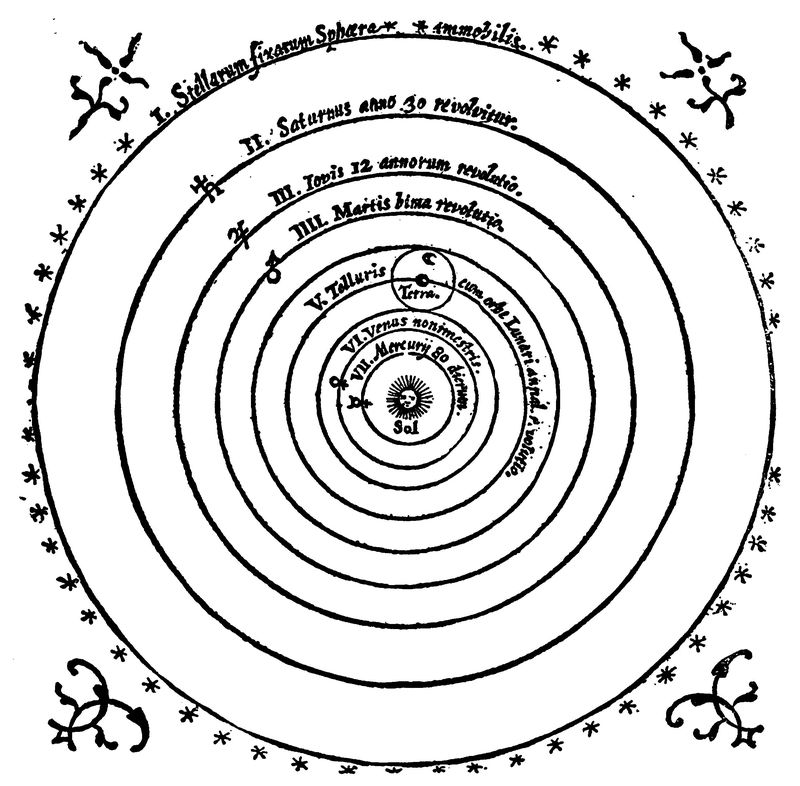
Ever since the Fifteenth Century, when Copernicus revived
the ancient theory of Pythagoras that the planets
revolved around the sun (a theory left in an imperfect
state and demonstrated later by Kepler, Galileo, Newton,
and others) astronomical research has progressed steadily.
It must be remembered, however, that De Revolutionibus
Orbium, which met with great opposition, contained nothing
regarding the laws of motion, for these had not been
as yet discovered, and Saturn marked the boundaries of the
Solar System. Copernicus assigned the “fixed stars” to
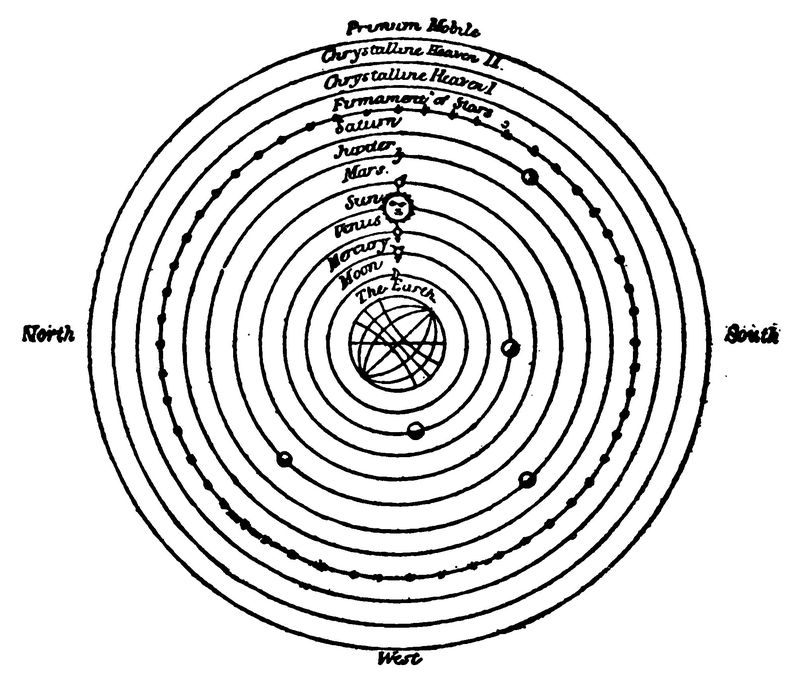
a sphere, as in Ptolemy’s heavens (see page 331).
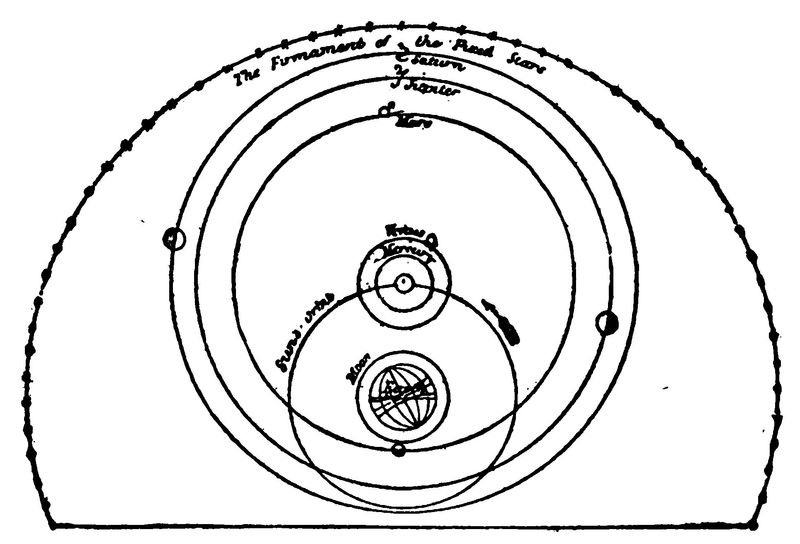
The great Danish astronomer, Tycho Brahe, whose idea
of the Solar System is represented on page 343, was his
opponent. Brahe, however, a devoted student, a man of
wealth, the favorite of kings and princes, and the proud
possessor of the Castle of Uraniberg (City of the Heavens),
an observatory equipped with fine instruments and built
for him by Frederick II, King of Denmark, on the island
of Hueen, and after his death the protégé of Rudolph II
at Benatek, near Prague, contributed greatly to the advancement
of the science by means of his discoveries, computations,
solar and lunar tables, and catalogue of stars. He,
like Copernicus, placed the “fixed stars” in an outer sphere.
His observations on the planets were made to prove the
truth of his system. This mass of observations was used
instead by Johann Kepler, who had been his assistant at
the Benatek Observatory, to prove Copernicus’s theory. Of
Kepler, the discoverer of the three famous laws, who gave
a complete theory of solar eclipses, calculated the transits of
Mercury and Venus, and made numerous discoveries in
optics and general physics, Proctor says:
“Kepler was not merely an observer and calculator; he inquired
with great diligence into the physical causes of every phenomenon,
and made a near approach to the discovery of that great principle
which maintains and regulates the planetary motions. He possessed
some very sound and accurate notions of the nature of
gravity, but unfortunately conceived it to diminish simply in proportion
to the distance, although he had demonstrated that the intensity
of light is reciprocally proportional to the surface over
which it is spread, or inversely as the square of the distance from
the luminous body.”
Great names follow in rapid succession. One of Kepler’s
contemporaries was Galileo Galilei, the discoverer of
the “three laws of motion” and the relation of time and
space in falling bodies, the first to apply the newly invented
telescope to the observation of the heavens and the discoverer
of four satellites of Jupiter (named by him the “Medeiran
Stars” in honor of his patron). He also detected
spots on the sun’s disk, the phases of Venus, and irregularities
on the moon’s surface, and declared the Milky Way to
be composed of a countless tract of separate stars.
When we remember the limited power of the telescope
of the age, we can but marvel, not at how little, but how
much was known regarding the starry skies.
During this period, numerous observers rendered great
service to Astronomy, and other scientists were engaged
in making useful drawings, charts, maps, tables, and catalogues
of stars.
To this period also belongs John Bayer of Augsburg,
who published a description of the constellations with maps
upon which the stars were marked with the letters of the
Greek Alphabet—a convenient method that was universally
adopted and is still in use. Other names include Gassendi,
Riccioli, Grimaldi, and Hevelius—the latter a rich citizen
of Dantzig, who had a fine observatory of his own, where
he worked for forty years. His drawings and descriptions
of the moon, his researches on comets, which he still believed
moved in parabolas, and his celestial charts engaged
most of his attention.
The Dutch astronomer Huygens (born in 1629) is
famous for his improvements in the telescope use of the
pendulum clock and developments in the machinery of astronomical
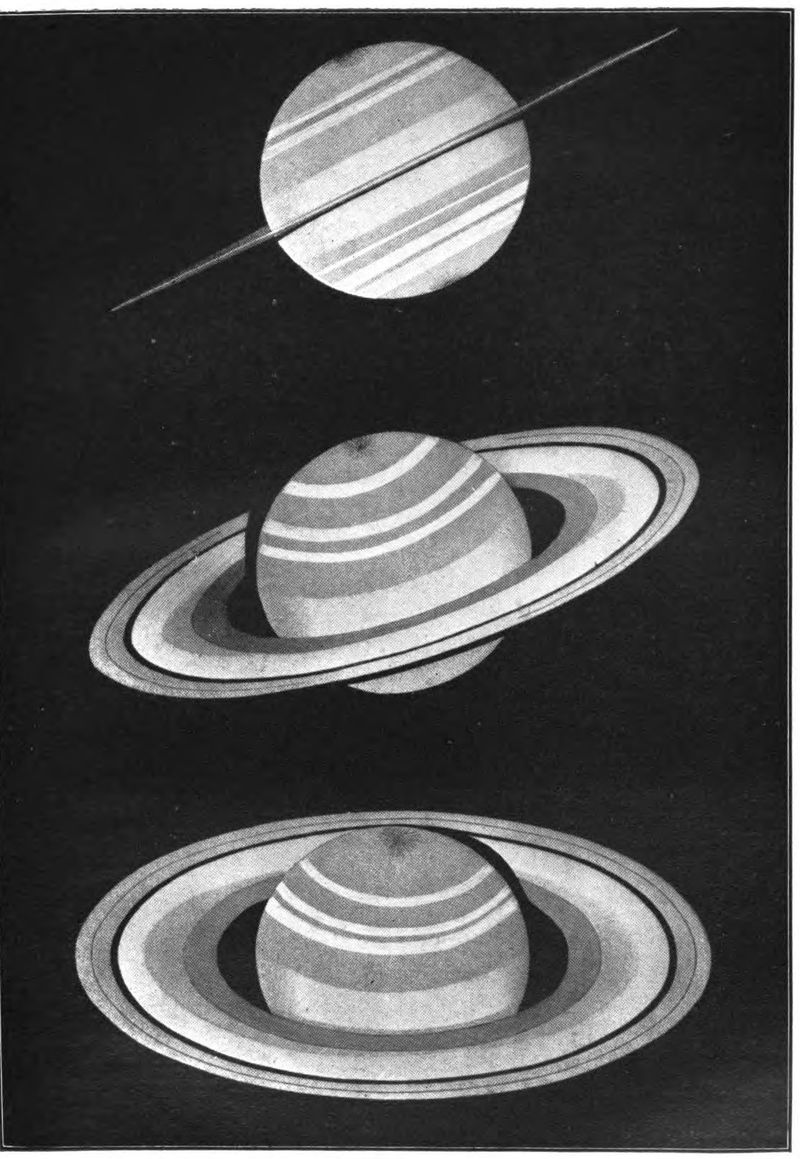
instruments. He discovered the ring of Saturn
and four of his satellites. Edmund Halley, an English astronomer
(born in 1656), also took a great interest in the
telescope, and went to Dantzig to settle a controversy between
Robert Hooke and Hevelius regarding the best
glasses for use in astronomical observations; for Hevelius
still worked with the ancient instruments, while Hooke
believed in the lens.
Halley revived the ancient idea that comets belonged
to the Solar System, and predicted that the comet of 1681
would return to its perihelion in 1759. This was the first
prediction of its kind verified.
During the last quarter of the Seventeenth Century, the
telescope assumes importance and two great observatories
begin their work. In 1670 the Paris Observatory, of which
Cassini was made director, was finished, and five years later
the Greenwich Observatory, where Flamsteed was installed
as royal astronomer.
Of Cassini, Lalande remarks that under him Astronomy
underwent revolutions, and in France he was regarded as
the “creator of the science.” Cassini discovered that
Saturn’s ring was double and found four satellites of
Jupiter.
Flamsteed’s observations on planets, satellites, comets,
“fixed stars,” and his catalogue of 2,884 stars were valuable
contributions to science; and his Historia Cœlestis is
said to have “formed a new era in sidereal astronomy.”
Flamsteed was succeeded by Halley, particularly famed
for his investigations of comets. The next great astronomical
event was the discovery of Uranus by Sir William
Herschel in 1781. Sir William Herschel also discovered
two more of Saturn’s satellites, and began the great work
of resolving the Milky Way and other clusters into swarms
of suns, single stars into double and triple stars, inquiries
into the mysteries of the nebulæ, and in every way enlarging
the general conception of the sidereal universe.
To the end of the Eighteenth and beginning of the Nineteenth
Centuries belongs the brilliant French astronomer
and mathematician Laplace, who published in 1799-1808
his Mécanique Céleste, in which he announced his Nebular
Hypothesis (described on page 433 of Vol. II. The discoveries
of the Planetoids are described on pages 396-403,
and that of Neptune in 1846 on pages 430-432). The latest
important additions to the Solar System are the discovery
by Prof. Barnard of Jupiter’s Fifth Satellite in 1892 and
Saturn’s Ninth by Prof. W. H. Pickering in 1904. The
discovery even of a Seventh Satellite of Jupiter has just been
announced from the Lick Observatory.
It would be impossible to mention the names of the astronomers
whose work from the middle of the last century
to its closing years has been distinguished in various fields.
Space only permits brief mention of the new methods of research
by means of the spectroscope and celestial photography.
With the first the name of the English astronomer,
William Huggins, is identified and has yielded most important
and startling information regarding the composition of
heavenly bodies, and with the application of the photographic
telescope these new methods have created a revolution
in astronomical observation.
It may be interesting to gain a slight idea of the numbers
of stars revealed by the camera by referring to Sir Robert
Ball:
“If we take a position on the equator, from whence, of course,
all the heavens can be completely seen in the lapse of six months,
the number of stars that can be reckoned with the unaided eye
will, according to Houzeau, amount to about six thousand. If we
augment our unaided vision by a telescope of even small dimensions,
such as three inches in diameter, the number of stars in the
Northern Hemisphere alone is upward of three hundred thousand.
We may assume that the Southern Hemisphere has an equally
numerous star-population, so that the entire multitude visible with
this optical aid is about six hundred thousand. Thus we see that
the use of a telescope small enough to be carried in the hands suffices
to multiply the lucid stars one-hundredfold. Great telescopes
no doubt soon show us that the hundreds of thousands are only
the brighter members of a host of millions, and now we receive
the assurance of photography that the telescopic stars are only
the more conspicuous members of that vast universe. Mr. Roberts
indeed declares that the multitudes of stars on the photographic
plate grow with each increase of exposure to such a degree that it
would almost seem as if the plate would be a wellnigh continuous
mass of stars if the operations could be sufficiently protracted.”
Naturally the past years have witnessed the making of
new catalogues and maps of stars, and many valuable computations
of parallaxes, etc. Some of the results obtained
by these new methods are described in the chapters on the
Nebulæ and Swarms of Suns, The Great Nebula of Orion,
and The Colored, Double, Multiple, Binary, Variable, and
Temporary Stars in Vol. I. From this brief survey of the
progress of Astronomy the fact will be appreciated, therefore,
that all the discoveries and researches have resulted in
a larger conception of the universe, and the Solar System
sinks into insignificance in the vast ocean of stars and suns.
The study of the Earth’s crust and its contents divested
of superstition dates from the end of the Seventeenth Century.
Nicolaus Steno (1638-1687), a Dane, devoted himself
to geology, and in 1669 observed successive layers of
strata. He is called “the father of Palæontology.” In 1680
Leibnitz proposed the theory that the Earth was originally
in a molten state. The classification of strata was begun
about the middle of the Eighteenth Century. The views
of James Hutton (1788), who returned to the theories advanced
by Ray (a return to the views of Pythagoras), were
continued by Sir Charles Lyell.
Geology and Palæontology have progressed side by side.
Among the most famous investigators are Cuvier, Dawson,
Marsh, Owen, Huxley, Agassiz, De Blainville, Kaup, Sir
Roderick Murchison, Boyd Dawkins, Sir William Flower,
R. Lydekker, and E. D. Cope.
To the review of the new developments of meteorology
and the science of probabilities by Sir Ralph Abercromby,
on pages 784-792 of Vol. II, it is only necessary to add that
the interest in meteorological research developed greatly
after Torricelli’s discovery in 1643 of weight and pressure
in the atmosphere led to the perfection of the barometer and
the development of the thermometer and hygrometer, both in
the Seventeenth Century. The theory of trade-winds George
Hadley announced in the Philosophical Transactions for
1735. Dalton’s Meteorological Essays, published in 1793,
and Dr. William Charles Wells’s Theory of Dew, published
in 1814, attracted much attention. Regarding the inquiries
into the laws of light by Snell, Newton, Descartes, Thomas
Young, and Sir George Airy, the reader is referred to the
chapter on The Rainbow in Vol. II, by John Tyndall, with
whose researches in the latter half of the Nineteenth Century
every one is more or less acquainted.
Little need be said here regarding the history of Botany,
which is reviewed on pages 984-1000 of Vol. II. We may
add, however, that one of the first to revive this study was
Otto Brunsfels, whose Historia Plantarum Argentorati was
published in two folio volumes with cuts in Strasburg in
1530. He had many followers on the Continent and in
England. During the revival of learning, chairs of Botany
were founded in the universities; botanic gardens were established
in many places (the Jardin des Plantes was
founded in 1626); and botanists began to travel to remote
countries to search for unknown flora.
To the Seventeenth Century belong the names of Dr.
Turner, “the father of English Botany”; Robert Morison,
professor of Botany at Oxford; John Ray, Nehemiah Grew,
Malpighi, Henshaw, and Robert Hooke. The two latter
were among the first to employ the newly invented microscope
to the study of this science. It may be mentioned in
passing, that Huygens is said to have taken from Holland
to England microscopes about the size of a grain of sand,
and that the first microscope consisting of a combination of
lenses is attributed to Jansen, a spectacle-maker of Holland.
Hooke, whom Herschel calls “the great contemporary
and almost the rival of Newton,” gave a tremendous
impetus to Microscopy, and practically laid the foundation
of Histology or the Inner Morphology of Plants, due to
Grew and Malpighi. Schleiden undertook to explain the
mysteries of cell formation in 1838, further investigated by
Schwann, and is now known as the Schleiden-Schwann
theory. Nägeli and Von Mohl continued researches on this
line. To the contents of the cell Von Mohl gave the name
protoplasm.
In 1849, Hofmeister began investigations into the life-histories
of plants, since when the study of Vegetable Physiology
has progressed side by side with Chemistry. To Darwin
great subjects are due: the cross-fertilization of plants,
their reproduction, and their relations to insects and their
movements. It may be mentioned, however, that in 1693
Ray attempted to explain the movements of leaves, tendrils,
and petals by physical and mechanical laws.
Since the middle of the Nineteenth Century, the branches
of Botany that have been particularly studied are Vegetable
Physiology and Pathology, Inner Morphology, and Fossil
Botany—and the discoveries made have naturally had an
effect upon the classification of vegetable life.
According to Agassiz:
“We must come down to the last century, to Linnæus, before
we find the history taken up where Aristotle had left it, and some
of his suggestions carried out with new freshness and vigor.
Aristotle had already distinguished between genera and species;
Linnæus took hold of this idea, and gave special names to other
groups, of different weight and value. Besides species and genera,
he gives us orders and classes—considering classes the most comprehensive,
then orders, then genera, then species. He did not,
however, represent these groups as distinguished by their nature,
but only by their range; they were still to him, as genera and species
had been to Aristotle, only larger or smaller groups, not
founded upon and limited by different categories of structure. He
divided the animal kingdom into six classes: Mammalia, Birds,
Reptiles, Fishes, Insects, and Worms.”
Linnæus’s classification was, therefore, the first attempt
to group animals; but until Cuvier there was no great principle
of classification. In 1707 Buffon succeeded in making
Zoology, which had been regarded as a most uninteresting
study, popular and respected. He also had the idea of collecting
all the known facts of scientific investigation and
arranging them systematically. Buffon was ridiculed as a
scientist by his contemporaries, Hevelius, Diderot, D’Alembert,
and Condillac, who opposed his explanations of natural
phenomena. Buffon’s Histoire Naturelle Générale et
Particulière is his most important work. A complete edition
in thirty-six volumes appeared in Paris in 1749-1788.
Although it is said to “have made an epoch in the study of
the natural sciences” in Buffon’s day, it now possesses little
scientific value.
Cuvier’s classification has never been overthrown. His
original investigations in various departments of science,
and particularly that of fossil vertebrate animals, opened
up new fields of study. His talents with both pen and pencil
contributed largely to making that branch of science popular.
Lamarck, Cuvier’s contemporary, divided the animal
kingdom into Vertebrates and Invertebrates. Lamarck, like
Geoffroy Saint-Hilaire, was a believer in the theory of evolution,
which was opposed by Cuvier.
Lamarck turned from the study of Meteorology to that
of Botany, and later again to that of Zoology. In 1793 he
became professor of the natural history of the lower classes
of animals in the Jardin des Plantes. His theories have
greatly influenced modern science, particularly that of the
“Variation of Species,” which was set forth in his Philosophie
Zoologique (two vols., Paris, 1809) and other
works. Lamarck’s Histoire des Animaux sans Vertèbres
(seven vols., Paris, 1815-22) is his greatest work.
Karl Ernst von Baer, the Russian naturalist, a pupil of
Döllinger in Würzburg, devoted himself chiefly to the study
of embryology and made valuable discoveries.
Passing by many illustrious names, we come to that
of Sir Richard Owen, of whom it has been said that “from
the sponge to man, he has thrown light over every subject
he has touched.” His work in the Hunter Museum, his descriptions
and restorations of extinct birds and animals, and
his original works on every branch of animal life, form an
enormous contribution to the progress of science. He promulgated
the advanced views of John Hunter, the great
physiologist and surgeon, of whose famous museum of more
than ten thousand specimens, illustrative of anatomy and
natural history, he became curator.
Three names shine with especial lustre upon the Nineteenth
Century—Darwin, Huxley, and Spencer. The theory
of evolution first appeared in De Maillet’s work, Telliamed,
published in 1758, but written in 1735. More than
thirty writers before Darwin treated this theory, among
whom were Erasmus Darwin, Goethe, Lamarck, and Geoffroy Saint-Hilaire.
Largely owing to the opposition of Cuvier,
it never succeeded until it was revived by Charles Darwin,
who, after twenty-one years of work, published his
results in 1858 in the Journal of the Linnæan Society, followed
in the next year by The Origin of Species by Means
of Natural Selection (see pages 1482-1512 of Vol. IV).
“The lifeless earth,” says Sir Robert Ball, “is the canvas on
which has been drawn the noblest picture that modern science
has produced. It is Darwin who has drawn this picture. He has
shown that the evolution of the lifeless earth from the nebula is
but the prelude to an organic evolution of still greater interest and
complexity. He has taken up the history of the earth at the point
where the astronomer left it, and he has made discoveries which
have influenced thought and opinion more than any other discoveries
that have been made for centuries.”
The neglected department of Marine Zoology the Nineteenth
Century has made particularly its mission to investigate,
but space only permits mention of four names: Edward
Forbes, Lord Kelvin (Sir Wyville Thomson), Ernst
Heinrich Haeckel, and the Prince of Monaco.
The first, whom Lord Kelvin considers “the most accomplished
and original naturalist of his time,” was a
pupil of Geoffroy Saint-Hilaire, Jussieu, and De Blainville.
He is regarded as the originator of the use of the dredge
for collecting specimens and the first who undertook the
systematic study of Marine Zoology with reference to the
distribution of fauna. In 1859 his Natural History of the
European Seas appeared after his death.
One of the most important investigators in this line is
Prof. Haeckel, famous for his studies of the lower class of
marine animals. He is also distinguished for his researches
in other branches of Zoology and Palæontology, and was
one of the first followers of Darwin in Germany.
Entomology has also made enormous progress during
the
Nineteenth Century. At the end of the Seventeenth Century,
Ray estimated the number of insects throughout the
world at 10,000 species! The great entomologists of the
Eighteenth Century include Linnæus, De Geer, and Fabricius.
Next follow Latreille, Kirby and Spence, and a host
of distinguished scientists in Europe and the United States,
of whom Sir John Lubbock (Lord Avebury) heads the list.
A comparatively new line of investigation is that of the
Chalcididæ (see Fairy Flies, pages 1449-1458, in Vol. IV).
What are the heavens? Where the shores
of that limitless ocean; where the bottom
of that unfathomable abyss?
What are those brilliant points—those innumerable
stars, which, never dim, shine out unceasingly
from the dark profound? Are they sown broadcast—orderless,
with no other bond save that which perspective
lends to them? Or, if not immovable, as
we have so long imagined, if not golden nails fixed
to a crystal vault, whither are they bound? And,
finally, what are the parts assigned to the sun, our
earth, and all the earths attendant on the glorious
orb of day in this tremendous concert of celestial
spheres—this sublime harmony of the universe?
These are magnificent problems of which the most
fertile imagination would have in vain attempted the
solution, if, for the greater glory of the human mind,
astronomy—first born of the sciences—had not at
length come to our aid.
How wonderful is the power of man! Chained
down to the surface of the earth, an intelligent atom
on a grain of sand lost in the immensity of a space, he
invents instruments which multiply a thousand-fold
his vision, he sounds the depths of the ether, gauges
the visible universe, and counts the myriads of
stars which people it; next, studying their most complicated
movements, he measures exactly their dimensions
and the distances of the nearest of them
from the earth, and next deduces their masses; then,
discovering in the seeming disorder of the stellar
groupings real bonds of union, he at last evolves
order from apparent confusion.
Nor is this all. Rising by a supreme flight of
thought to the most abstract speculations, he discovers
the laws which regulate all celestial movements,
and defines the nature of the universal force
which sustains the worlds.
Such are the fruits of the unceasing labors of
twenty generations of astronomers. Such the result
of the genius and of the patient perseverance of men
who have devoted themselves for two thousand years
to the study of the phenomena of the heavens. The
Chaldean shepherds were, they say, the first astronomers.
We can well believe it. Dwelling in the
midst of vast plains, where the mildness of the seasons
permitted them to pass the night in the open
air, where the clear sky unfolded before them perpetually
the most glorious scenes, they ought to have
been, and they were, contemplative astronomers.
And all of us would be what they were did not the
rigor of our climate and our variable atmosphere
so often prevent us observing the heavens; and did
not, moreover, the turmoil and cares of civilized life
deprive us of the necessary leisure.
Nothing is more fitted to elevate the mind toward
the infinite than the pensive contemplation of the
starry vault in the silent calm of night. A thousand
fires sparkle in all parts of the sombre azure of
the sky. Varied in color and brilliancy, some shine
with a vivid light, perpetually changing and twinkling;
others, again, with a more constant one—more
tranquil and soft; while very many only send us their
rays intermittently, as if they could scarce pierce the
profundity of space.
To enjoy this spectacle in all its magnificence, a
night must be chosen when the atmosphere is perfectly
pure and transparent—one neither illuminated
by the moon, nor by the glimmer of twilight or of
dawn. The heavens then resemble an immense sea,
the broad expanse of which glitters with gold dust
or diamonds.
In presence of such splendor, the senses, mind and
imagination are alike inthralled. The impression
gathered is an emotion at once profound and religious,
an indefinable mixture of admiration, and of
calm and tender melancholy. It seems as if these
distant worlds, in shining earthward, put themselves
in close communication with our thoughts.
At a first glance at the starry firmament the stars
seem pretty regularly distributed; nevertheless, look
at that whitish, undecided, vapory glimmer which
girdles the heavens as with a belt. It is the Milky
Way.[1] As we approach the borders of this star-cloud
in our inspection, the stars appear more and more
crowded together, and most of them so small that
the eye can scarcely distinguish them. The accumulation
of stars in the direction of the Milky Way is
more especially visible when we examine the heavens
with the aid of a powerful telescope.
The Milky Way itself is nothing more than an
immensely extended zone of stars, that is, of suns,
since each star, from the most brilliant to the faintest,
is a sun.
Here, then, is an immense group, a gigantic assemblage
of worlds, which seems to embrace all the
universe, if it be true that the greater number of
the scattered stars situated out of the Milky Way
nevertheless form part of it. In reality, this multitude
of millions of suns is divided into numerous and
distinct groups, and those into others still more restricted
in number, each composed of two or three
suns.
What breadth of space does each of these groups
occupy? What is the measure of the space which
holds them all? The most powerful imagination in
vain attempts to answer these questions intelligibly;
here numbers fail us.
Let us add—a fact well proved, and one which
will seem strange to many—
Our sun himself is a star of the Milky Way.
In examining attentively every part of the starry
vault, a keen eye perceives here and there whitish
spots resembling little clouds. One would say they
were so many patches detached from the Milky Way,
from which, however, they are often very distinct
and very distant. The telescope discovers by thousands
those cloud-patches, these—to give them their
astronomical name—Nebulæ.
It was formerly imagined that each of these star-clouds
was nothing more than an accumulation of
stars, very close together, and very numerous—so
many Milky Ways lying outside our own, and for
the most part so distant that the most powerful instruments
were able only to distinguish a confused
glimmering. One of the most important observations
of modern times, however, has shown that many
of these nebulæ, including the most glorious one in
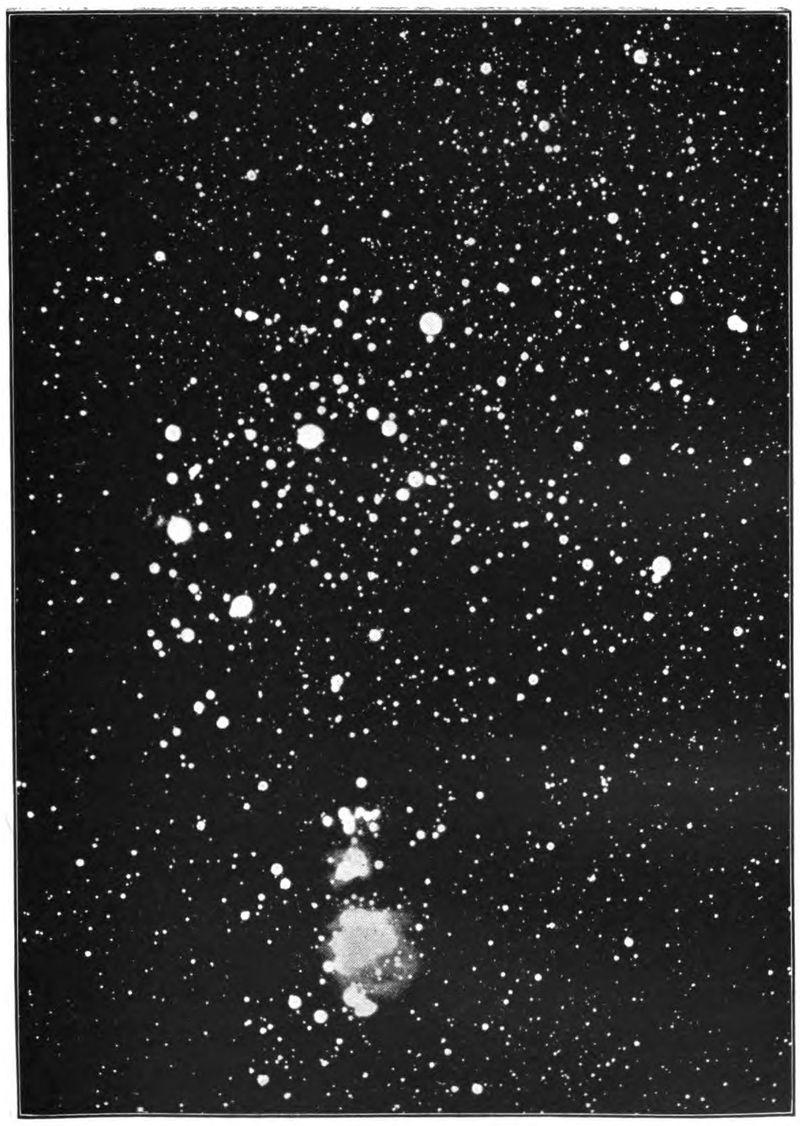
our northern hemisphere—that in the sword-handle
of Orion—are but masses of glowing gases.
Others, again, of these cloud-like masses—cloud-like
by reason of their distance—show us, faintly
shining on a background of apparent nebulæ, brilliant
stars, larger no doubt, or more brilliant, than
their fellows, and some of these objects called “Star-Clusters,”
which are nearest to us, are among the
most glorious objects revealed to us by our telescopes.
Let us attempt now to conceive what fearful distances
separate these archipelagoes of worlds from
our own!
Unfathomable abysses whose unspeakable depths
the most powerful telescopes increase indefinitely!
Profound, endless, bottomless, but lighted up by millions
of suns!
Such appears to us the universe from the natural
observatory where we are placed. But to obtain a
more complete idea of its constitution, of the infinite
variety of its members, we must descend from those
regions, where the sight and mind are lost, to a
group, nearer to us, and therefore more accessible
to the investigations of man—to that group, or system,
of which the earth forms part.
Of this the sun is the centre.
Round this focus of light and heat, but at various
distances, revolve more than a hundred secondary
bodies—Planets, some of which are accompanied
by smaller ones—Satellites. Not self-luminous, they
would be invisible to us, if the light, which they
receive from the sun, were not reflected toward the
earth, making them also appear as luminous points
spread over the celestial vault like so many stars.
Such would be the appearance of the earth seen in
space, at a distance sufficiently great.
A common character distinguishes all the celestial
bodies that form part of this group—the Solar System—from
the multitude of other stars. For while
the suns, composing what is called the Sidereal Universe,
are situated at distances seemingly infinite, the
bodies composing the group of which we speak are
relatively much nearer the earth, are, in fact, our
neighbors.
What results from this double fact? Two very
simple consequences, easily understood.
The first is, that the stars do not undergo any sensible
change of position in the starry vault. Their
distance is such that they appear actually at rest
in the depths of space; hence the term Fixed Stars—now
abandoned, because a minute and elaborate
study of their relative positions has established the
fact that the stars really do move in the remote regions
of the heavens. The apparent immobility of
which we have spoken, and which is one of their
characteristics, is evidenced by the uniformity of
appearance preserved for centuries by the artificial
groups of stars, to which the name of Constellations
has been given.
Now, it is otherwise with the bodies that revolve
round our sun: they are near enough to the earth
to allow of their displacements in space being perceived
in short intervals of time. Traveling, by
virtue of their proper motions along the starry vault,
distances which appear greater as their own distance
from us is less, these bodies received at the outset
the name they have since retained—Planets, or
Wandering Stars.
It is thus that, when we stand in the middle of an
extensive plain, we judge distant objects—those that
border the horizon—to be immovable; while we
instantly perceive the slightest change of place in
the near ones. It is true that when we ourselves
move, the real movements become complicated
with the apparent movements, but the former must
be distinguished, if we wish to have an exact idea
of the actual course traveled. This complication of
the apparent movements of the planets—a necessary
consequence of the movement of the earth—is one
of the most striking testimonials to the reality of the
latter; but it must also be added, that this was precisely
the stone of stumbling of ancient astronomy
until the time—and that not long ago—when the
real movements were made known. Movements of
rotation, movements of revolution, around the common
centre, the duration of these movements, distances,
forms and dimensions, distribution of light
and heat, all change in passing from one planet to
another. And yet, marvelous thing, the same laws
govern, all in such a way that the unity of plan is
not less marked than the astonishing variety of the
phenomena.
One circumstance common to all the bodies of the
solar system forcibly strikes the imagination. It is,
that these enormous masses—these globes, many of
which are much heavier than the earth, and lastly,
the earth itself—are not only suspended in space, but
move through the ether with velocities truly stupendous.
Imagine yourself a spectator, standing immovable
in space. A luminous body appears in the distance,
little by little you see it approach and increase in
size; its immense circumference, which exceeds a
hundred thousand leagues, is in rapid rotation,
which makes each point on its periphery travel
through nine miles a second. The globe itself passes
before you, carried through space with a velocity
twenty-four times greater than that of a cannon-ball.
In such a way Jupiter would appear to you traveling
in its orbit. This headlong course would banish it
forever to the most remote regions of the visible
universe, if it were not subdued and held by the
powerful attraction of a globe a thousand times
larger than its own—by the sun himself. Not only
does astronomy show, by undeniable proofs, the
reality of these marvelous movements—not only has
she arrived at the knowledge of their invariable constancy,
at least during thousands of centuries; but she
has found in their very rapidity the cause of the stability
of all the celestial bodies.
If there is difficulty in imagining such masses
freely circulating in the ether, how much more are
we impressed when we consider that these rapid
movements are not confined to the planets; and when
we look upon the sun with all his retinue as moving
in an orbit yet unknown, himself attracted no doubt
by a more powerful sun, or by a group of suns!
All the stars which by reason of their infinite distances
appear immovable, move in different directions;
and we shall see later, that if these movements
are performed with extreme slowness, the slowness
is apparent only. In reality, these are the most rapid
celestial movements that we know of.
Thousands of centuries will be necessary before
these immense sidereal voyages are accomplished.
Their vast periods are to the length of our year what
the dimensions of the earth are to the distances of
the stars; and, according to the happy expression of
Humboldt, they make of the universe an eternal
timekeeper. Thus, in the contemplation of celestial
phenomena, the idea of infinite duration impresses
itself on the mind with the same irresistible power as
the idea of the infinity of space.
[1] Via Lactea. It is also called the Galaxy, from the Greek
word for the same thing.
SPACE.— Richard A. Proctor — FOOTNOTES:
Although astronomy tells us in the clearest
words of the vast depths of space which surround
our earth on all sides, we are not thereby enabled
to realize their enormous extension. It is not
merely that the unknown depths beyond the range of
our most powerful telescopes are inconceivable, but
that the parts of space which we can examine are on
too large a scale for us to conceive their real dimensions.
It is hardly going too far to say that our
powers of actual conception are limited to the extent
of space over which the eye seems to range in the
daytime. Of course, in the daytime, at least in clear
weather, there is one direction in which the eyesight
ranges over a distance of many millions of miles—namely,
where we see the sun. But the sense of sight
is not cognizant of that enormous distance, and
simply presents the sun to us as a bright disk in the
sky, or perhaps rather nearer to us than the sky.
Even the distance of the sky itself is underestimated.
A portion of the light we receive from the sky on a
clear day comes from parts of the atmosphere distant
more than thirty or forty miles from us; but the
eye does not recognize the fact. The blue sky seems
a little further off than the clouds, but not much;
the light clouds of summer seem a little, but not
much, further off than the heavier clouds of a winter
sky; a cloud-covered winter sky seems a little further
off than heavy rain-clouds. The actual varieties of
distance among clouds of various kinds are not much
more clearly discerned than the actual varieties of
distance among the heavenly bodies. The estimate
formed of the distance of a cloud-covered sky overhead
probably amounts to little more than a mile,
and it is very doubtful whether the mind presents
the remotest depths of a blue sky overhead at more
than two miles. Toward the horizon the distance
seems greater, and probably on a cloudy day the sky
near the horizon is unconsciously regarded as at a
distance of about five miles, while blue sky near the
horizon may be regarded as lying at a distance of
six or seven miles, the arch of a blue sky seeming
to be far more deeply curved than that of a cloud-covered
sky.
It is to distances such as these that the mind unconsciously
refers the celestial bodies. We know that
the moon is about 2,000 miles in diameter, but the
mind refuses to present her to us as other than a
round disk much smaller than those other objects in
sight which occupy a much larger portion of the
field of vision. The sun can not be conceived to exceed
the moon enormously in size, seeing that he appears
no larger; and all the multitude of stars are
judged by the sight to be mere bright points of light
in reality as they appear to be.
How, then, can we hope to appreciate the vastness
of space whereof astronomy tells us? To the student
of science attempting to conceive the immensities
of whose existence he is assured, the same lesson
might be taught in parable which the child of St.
Augustine’s vision taught the Numidian theologian.
As reasonably might an infant hope to pour the
waters of ocean into a hollow, scooped with his
tiny fingers in the sand, as man to picture in his narrow
mind the length and breadth and depth of the
abysses of space in which our earth is lost.
Yet, as a picture of a great mansion may be so
drawn on a small scrap of paper as to convey just
ideas of its proportions, so may the great truths which
astronomy has taught us about the depths of space
be so presented that just conceptions may be formed
of the proportions of at least those parts of the universe
which lie within the range of scientific vision,
though it would be hopeless to attempt to conceive
their real dimensions.
When we learn that a globe as large as our earth,
suspended beside the moon, would seem to have a
diameter exceeding hers nearly four times, so that
the globe would cover a space in the heavens about
thirteen times as large as the moon covers, we form a
just conception of the size of the moon as compared
with the earth, though the mind can not conceive
such a body as the moon or the earth really is. When,
in turn, we are told that if a globe as large as the
earth, but glowing as brightly as the sun, were set
beside the sun, it would look a mere point of light,
we not only learn to picture rightly to ourselves how
largely the sun exceeds the earth, but also how enormous
must be the real distance of the sun.
Another step leads us to a standpoint whence
we can form a correct estimate of the vast distance
of the fixed stars; for we can learn that so
enormous is the distance of even the nearest fixed
star, that the tremendous space separating the
earth from that star sinks in turn into the merest
point, insomuch that if a globe as bright as the sun
had the earth’s orbit as a close-fitting girdle, then
this glorious orb (with a diameter of some 184,000,000
of miles) would look very much smaller than
such a globe as our earth would look at the sun’s
distance—would, in fact, occupy but about one-fortieth
part of the space in the sky which she, though
she would then look a mere point, would occupy if
viewed from that distance.
But there is a way of viewing the immensities of
space which, though not aiding us indeed to conceive
them, enables the mind to picture their proportions
better than any other. The dimensions of the
earth’s path around the sun sink into insignificance
beside those of the outermost planets; but these in
their turn dwindle into nothingness beside those of
some among the comets. From the path of these
comets, if only sentient and reasoning beings could
trace out in a comet’s company those mighty orbits,
and could have for the duration of their existence
not the brief span of time which measures the longest
human life, but many circuits of their comet home
around the same ruling orb (as we live during many
circuits of our globe around the sun), the dimensions
of the star-depths, which even to scientific insight
are all but immeasurable, would be directly discernible.
Not only would the proportions of that mighty
system be perceived, whose fruits and blossoms are
suns and worlds, but even the gradually changing
arrangement of its parts could be discerned.
Some comets, indeed, do not travel around the
sun, but flit from sun to sun on journeys lasting millions
of years, paying each sun but a single visit. A
being inhabiting such a comet, and having these interstellar
journeys as the years of his existence, so that
he could live through many of them, would have a
wonderful insight into the economy of the stellar
system. If his powers of conception as far exceeded
ours as the range of his travels and the duration of
his existence, he would be able to recognize the proportions
of a large part of the stellar universe as
clearly as we recognize the proportions of the solar
system.
But leaving these wonderful wanderers, whose
journeys are as far beyond our powers of conception
as the immensity of the regions of star-strewn space,
we may find, among the comets belonging to the sun’s
domain, bodies whose range of travel would give
their inhabitants far clearer views of the architecture
of the heavens than even the profoundest terrestrial
astronomer can possibly obtain.
Such a comet as Halley’s, for instance, though one
of comparatively limited range in space, yet travels
so far from the sun that, from the extreme part of
its path, it sees the stars displaced nearly twenty times
as much (owing to its own change of position) as
they are from the earth on opposite sides of her comparatively
narrow orbit. And the length of this
comet’s year, if it indicated the lives of all creatures
traveling along with it, would suggest a power of
patiently watching the progress of changes lasting
not a few of our years only, but for centuries. Seventy-five
or seventy-six years elapse between each
return of this comet to the sun’s neighborhood, and
one who should have lived during sixty or seventy
circuits of this body around its mighty orbit would
have been able to watch the rush of stars, with their
velocities of many miles per second, until visible displacements
had taken place in their positions.
This, however, is as nothing compared with the
mighty range in space and the enormous period of
the orbit of the great comet of the year 1811. This
comet is, on the whole, the most remarkable ever
known. It was visible for nearly seventeen months,
and though it did not approach the sun within 100,000,000
miles, and was therefore not subject to that
violence of action which has caused enormous tails
to be thrown out from comets which have come within
a few million miles of him, or even within less
than a quarter of his own diameter, it flourished
forth a tail 120,000,000 of miles in length. Its orbit
has, according to the calculations of the astronomer
Argelander, a space exceeding the earth’s distance
from the sun 211 times, and thus surpassing even the
mighty distance of Neptune fully seven times. It
occupies in circuiting this mighty path no less than
3,065 of our years (with a possible error either way
of about forty-three years). So that, according to
Bible chronology, this comet’s last appearance probably
occurred during the rule of the Judge Tola, son
of Puah, son of Dodo, over the children of Israel,
though it may have occurred during the rule of his
predecessor Abimelech, or during that of his successor
Jair.[2] During one-half of the enormous interval
between that time and 1811 the comet was rushing
outward into space, reaching the remotest part
of its path somewhere about the year 278 (A. D.), and
from that time to 1811 it was on its return journey.
It is strange to think, however, that though the remotest
part of its path lay 211 times further from the
sun than the earth’s orbit, yet even this mighty path,
requiring more than 3,000 years for a single circuit,
can not be said to have carried the comet into the star-depths.
If the earth were to shift its position by the
some enormous amount, the nearest fixed star would
have its apparent position changed only by about an
eighth part of the apparent diameter of the sun or
moon, or by about one-quarter of the distance separating
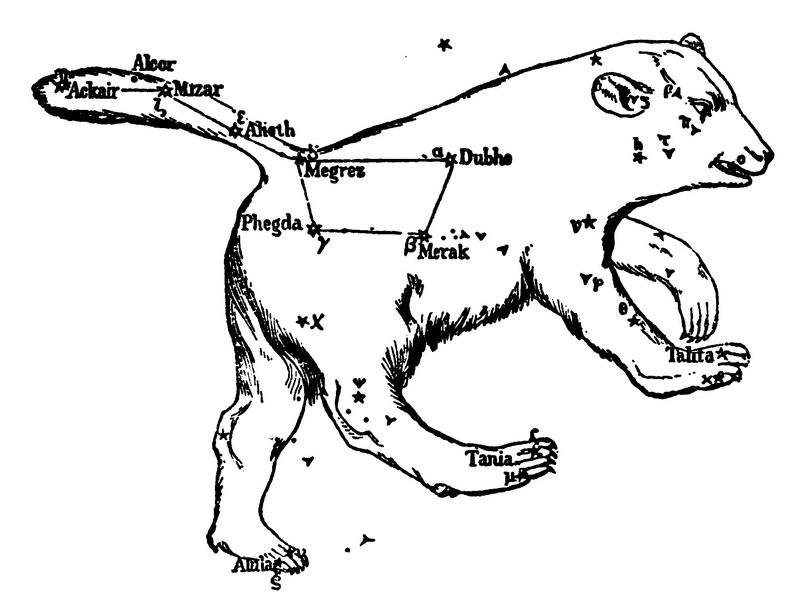
the middle star of the Bear’s tail from its close
companion.
But this fact of itself is most strikingly suggestive
of the vast distance of the stars. For consider
what it means. Imagine the middle star of the Bear’s
tail to be the really nearest of all the stars instead of
lying probably twenty or thirty times further away.
Conceive a comet belonging to that sun after making
its nearest approach to it to travel away upon an orbit
requiring 3,000 years for each circuit. Then (supposing
that star equal to our sun in mass) the comet,
though rushing away from its sun with inconceivable
velocity during 1,500 years, would, at the end of that
vast period, seem to be no further away than one-fourth
of the distance separating the sun from its
near companion. Look at the middle star of the
Bear’s tail on any clear night, and on its small satellite,
remembering this fact, and the awful immensity
of the star-depths are strongly impressed upon the
mind. But the observer must not fail to remember
that the star really is many times more remote than
we have here for a moment supposed, and that such
a comet’s range of travel would be proportionately
reduced. Moreover, many among the stars are
doubtless hundreds, even thousands, of times still
further away.
Let us turn lastly to the amazing comet of the year
1744. We find that though it had the longest period
of any which has ever been assigned to a comet as
the result of actual mathematical calculation, yet its
range in space would scarcely suffice to change the
position of the stars in such sort that the aspect of the
familiar constellations would be materially altered.
Euler, the eminent mathematician, calculated for
this comet a period of 122,683 years, which would
correspond, I find, to a distance of recession equal to
2,469 times the distance of the earth from the sun,
or about eighty times the distance of Neptune. Yet
this is but little more than twelve times the greatest
distance of the comet of 1811. Probably the actual
range of such an orbit from the middle star of the
Bear’s tail would be equal in appearance to the range
described above on the supposition that the star is
no further from us than the nearest known star
(Alpha Centauri). That is, such a comet, if it
could be seen and watched during a period of about
122,000 years, would seem to recede from the star
to a distance equal to about one-fourth the space separating
it from its close companion, and then to return
to the point of nearest approach to its ruling sun.
Such are the immensities of star-strewn space!
The journey of a comet receding from the sun with
inconceivable velocity during hundreds of thousands
of years carries it but so small a distance
from him compared with the distance of the nearest
star as scarcely to change the appearance of the
celestial landscape; and yet the distances separating
the sun from the nearest of his fellow suns are but
as hairbreadths to leagues when compared with the
proportions of the scheme of suns to which he belongs.
These distances, though so mighty that by
comparison with them the inconceivable dimensions
of our own earth sink into utter nothingness, do not
bring us even to the threshold of the outermost court
of that region of space to which the scrutiny of our
telescopes extends. Yet the whole of that region is
but an atom in the infinity of space.
[2] It might be suggested that the appearance of this blazing
comet among the stars drove the more superstitious of the
Israelites at that time to the worship of star-gods, as we read
how, during the Judgeship of Jair, they “served Baalim and
Ashtaroth, and the gods of Syria and the gods of Moab, and
the gods of the Philistines, and forsook the Lord and served
not Him.” To a people like the Jews, who seem to have been
in continual danger of returning to the Sabaistic worship of
their Chaldean ancestors, the appearance of a blazing comet
may have been a frequent occasion of backsliding.
EXTENT OF THE SIDEREAL HEAVENS.— Sir Robert S. Ball — FOOTNOTES:
Of all the discoveries that have ever been made
in science there are two which especially baffle
our powers of comprehension. They lie at the opposite
extremes of nature. One relates to objects which
are infinitely small, the other relates to objects which
are almost infinitely great. The microscope teaches
us that there are animals so minute that if a thousand
of them were ranged abreast they would easily swim
without being thrown out of line through the eye of
the finest cambric needle. Each of those minute
creatures is a highly organized number of particles,
capable of moving about, of finding and devouring
its food, and of behaving in all other respects as
becomes an animal as distinguished from an unorganized
piece of matter. The mind is capable of realizing
the structure of these little creatures, and of
fully appreciating their marvelous adaptation to the
life they are destined to lead. If these animals excite
our astonishment by reason of their extreme minuteness,
there is an appeal made to conceptions of an
entirely different character when we learn the lessons
which the telescope teaches. As the microscope reveals
the excessively minute, so does the telescope disclose
the sublimely great. In each case myriads of
objects are submitted to our astonished view, but
while the microscope brings before us creatures of
which countless millions could swim about freely in
a thimbleful of water, the telescope conducts our
vision to uncounted legions of stars, many of them
millions of times larger than the earth.
The grandest truth in the whole of nature is conveyed
in that first lesson in astronomy which answers
the question: What are the stars? This is a question
that a child will ask, and I have heard of a child’s
pretty idea that the stars were little holes in the sky
to let the glory of heaven shine through. The philosopher
will replace this explanation by another
hardly less poetical, which will enable us to form
some more adequate notion of the real magnificence
of the universe. Each star that we see is, it is true,
only a glittering little point of light, but that is
merely because we are a long way from it. An electric
light which will dazzle your eye when quite
close will be reduced to an agreeable illumination
if it is at a little distance, will become a faint light
a mile away, and at no great distance will become
altogether invisible. We must remember that out
in space there is plenty of room—there are no
bounds; and therefore when we see light glistening
in the far distant depths we can not at once
conclude that the light is a faint one because it appears
to us to be faint. It may be that the light is
only faint because it comes from such a tremendous
distance. In fact, the brightest light conceivable
could be reduced to the insignificance of a small star
if only it were removed sufficiently far.
The most intense light we know of comes, of
course, from the light which rules by day, from our
sun himself. The sun pours his unrivaled beams
around us in all directions with prodigal abundance,
notwithstanding his enormous distance of ninety-three
millions of miles. Let me describe an experiment
with respect to our sun, an experiment, it is
needless to say, which could never be performed,
but the results to which it leads us are none the less
certain. Astronomers have demonstrated them in
many other ways.
Suppose that the sun were gradually to be moved
away further and further into space; suppose that
by this time to-morrow the great luminary should
be twice as far as it is now, and the next day should
be three times as far, and the day after that four
times, and so on until in a year’s time we should
find that the sun was 365 times the distance from us
that it is at present. Let us now trace the changes
which we should see in the brilliancy of our orb of
day. When he had reached double his distance from
us, we should find that the light had decreased to a
quarter of its present amount, and the heat which we
derived from his beams would have decreased in the
same proportion. In ten days we should find that
the light had become so feeble as to be only one-hundredth
part of that which we enjoy now. The
apparent size of the sun would also be steadily decreasing,
for as the distance of a body increases its
apparent dimensions diminish. Sometimes the diminution
of apparent size with distance is well illustrated
on a clock tower. You would hardly believe
that the hands and face of a clock like that at Westminster
were so large until you happen to see a man
cleaning or repairing it, when he appears a mere
pigmy in comparison with the mighty dial which
points out the hours. In a similar way with every
increase of distance, the apparent size of the sun
would decline, and in the lapse of a year the sunlight
would be reduced to a feeble twilight. The
sun itself would remain visible for many years, even
if it were steadily moving away, though its lustre
would continually decline, and its size would continually
diminish, until at last it would have shrunk
to the insignificance of a small point of light, still
visible as a glittering object, but too minute to enable
any definite form to be perceived.
Further still, the sun might recede until it passed
beyond the reach of vision of the unaided eye;
the telescope would, however, be able to pursue
the retreating luminary until at last it sank into the
depths of space beyond the reach of any instrument
whatever.
This little argument will prepare us for an explanation
of the stars. They merely appear to us
to be points of light of varying degrees of brightness,
but we have seen that our own sun might be reduced
in lustre to that of the very dimmest of the stars if
only it were removed sufficiently far. If, therefore,
the stars are at a great enough distance from our system,
it may indeed be that they also are suns, possibly
equaling, or possibly even surpassing, our own sun
in magnificence.
Here is indeed an imposing suggestion. Can it be
that the host of stars which adorn our midnight sky
are actually suns themselves of an importance comparable
with that of our own? This is a great
thought, and we desire to test it by every means in
our power. You will see from the reasoning I have
given that the whole question turns simply on one
point, and that is: How far off are the stars?
The tiniest point of light that is just seen as a
glimmer in the mightiest of telescopes may be indeed
a sun as great, or indeed a million times greater, than
our sun, if only that star be sufficiently far off. To
find the distance of a star is a problem which taxes
the utmost powers of the painstaking astronomer;
every refinement of skill in making his measurements
and of care in the calculation of his observations
have to be lavished on the operation. Alas! it
but too often happens that the astronomer’s labors
prove to be futile. The surveying navigator often
has to mark on his chart that no bottom could be
found in the depths of the sea. His appliances would
not work, or work reliably, in those ocean abysses;
so, too, the astronomer, when he tries to sound the
depths of space to the distances of the stars, has also
to mark, generally speaking, “No bottom here,” as
the result of most of his investigations. When this
is the case we know for certain that the star on which
his calculations have been made must be a gorgeous
sun, because we are assured of the greatness of its
distance, even though we have not been able to find
out what that distance was. There are, however,
some few places through the sky where the astronomer’s
sounding line can, so to speak, touch bottom;
there are a few stars of which we do know the distance,
and the result is not a little significant. Were
our sun to be withdrawn from us to a distance so great
as that of the very nearest of the stars, our magnificent
ruler and benefactor would certainly have lost
all his splendor; he would, in fact, have shrunk to
the similitude of a little star not nearly so bright as
many of those which we see over our heads every
night. Imagine the sun’s light subdivided into two
hundred thousand parts, each of which would give
us only a feeble illumination, and then imagine that
each of these parts was again divided into two hundred
thousand parts more, and it is one of these last
fragments that would represent the miserable lustre
which the sun would then display.
From these considerations we can enunciate the
magnificent truth which astronomy discloses to us. I
do not think that in the whole range of nature there
is any thought so magnificent or so imposing as that
which teaches us to regard every star of every constellation
as a sun. We can not indeed assert that
they are all so great as our sun, but we can affirm
with certainty that many of them are far greater and
far more splendid. Considering that our sun presides
over a system of worlds of which the earth is
one, that it gives light and heat to those worlds, and
guides them in their movements, it would greatly enlarge
our conceptions of the universe if we were
assured that there was even one more sun as large
and as splendidly attended as is our own. But now
we find that not only is there one additional sun,
but that they teem in uncounted thousands through
space. Look, for example, on the next fine night at
the Great Bear, the best known of all our northern
constellations, and there you see seven stars forming
the well-known feature. Figure in your mind’s eye
each one of those stars in the likeness of a majestic
sun, as big, warm, and bright as our sun, and
look at other parts of the sky and repeat the process
with the other constellations, and your conception
of the magnificence of the starry system
will begin to assume proper proportions. But this
is only the first step, you must next look at the smaller
stars, and reflect that they, too, are also suns, only
much further off as a general rule than the brighter
stars, though this is by no means invariably the case.
Thus your estimate of the number of suns in the universe
will rise to thousands, but you will not stop
there, you will get a telescope to help you, and, to
your extreme delight and wonder, you will find that
there are hosts of stars—too faint to be visible to the
eye, but which the telescope will immediately disclose.
You will get a more powerful instrument, and
then you will perceive that the stars are to be numbered
by tens of thousands, and even by millions, and
with every fresh accession of power in your telescope
fresh troops and myriads of suns are revealed.
Suns in clusters, suns strewn thickly here and sparsely
there, so as to give us the notion that the only limit
to the number we can see is the power of the telescopes
we are using. Attempts at actual numeration
are futile, for who can tell the number of the
stars?
We can, however, form an estimate, and by taking
samples, so to speak, of the sky here and other samples
there, we have been enabled to learn the overwhelming
fact that our universe does contain at the
very least one hundred millions of suns.
In discussing the extent of the visible universe, it
must always be borne in mind that the further a
source of light is from us the fainter is the illumination
which we receive from it. Suppose that a star
which just lies on the limits of naked-eye visibility
were somehow to be transported to a distance which
is twice as great, then the lustre of that star would
be diminished to one-fourth of its original amount.
It would, therefore, be of course invisible to the
unaided eye, but could still be easily perceived by a
telescope. Indeed, the very word telescope means
an instrument for looking at objects a long way
off, and the effect of the telescope is to reduce the
apparent distance of the object.
The bulk of a grain of sand as compared with the
bulk of a football may illustrate the space accessible
to our eyes when compared with the space accessible
to one of the great telescopes. The larger of these
spaces has a thousand times the diameter of the
others; therefore, the relative quantities of these
spaces are to be obtained by multiplying 1,000 by
1,000 and by 1,000 again. Thus we finally learn
that the amplitude of our vision is augmented to
one thousand million times its original extent by
the use of our greatest telescopes. It need, therefore,
be no matter for surprise that the number of stars visible
through our great telescopes or recorded on the
sensitive films of photographic plates should number
scores of millions. In fact, it would sometimes seem
surprising that the number of telescopic stars is not
even greater than it actually appears to be. If we
are able to explore one thousand million times as
much space, we might expect that the number of
objects disclosed would be also increased about a
thousand million-fold, but this is certainly not the
case. The truth seems to be that our sun is but one
star of a mighty cluster of stars; we happen to lie
near the middle of the cluster, and the rest of the
stars belonging to it form what we know as the Milky
Way. There are, of course, other clusters scattered
through the heavens, some of them, perhaps, as great
as that body of stars which forms the Milky Way.
Owing to our residence in this cluster we see the
neighboring suns in multitudes, and thus we receive
the impression that the solar system lies in an exceptionally
rich part of the universe in as far as the
distribution of stars is concerned.
On the outskirts of the universe lie those faintest
and dimmest of objects which we can just perceive
through our greatest telescopes. We know that
many of the stars around us would still remain visible
in great instruments, even though they were removed
a thousand times as far off. Among the myriads of
faint stars which we see from our observatories, there
may be many, indeed there must be many, which are
fully a thousand times as distant as the bright stars
which twinkle in our comparative neighborhood.
We thus obtain some conception of the stupendous
distance at which the outskirts of the universe are
situated.
There are different ways of illustrating this
point, but I think the simplest, as well as the most
striking, is that which is founded on the velocity of
light. It is a remarkable fact that the beautiful star
known as Vega[3] has a distance from us so tremendous
that its light must have taken somewhere about
eighteen years to travel hither from thence. Notwithstanding
that the light dashes along with such
inconceivable speed that it will cover 185,000 miles
in every second, notwithstanding that a journey at this
pace will complete the entire circuit of this globe
seven or eight times between two successive ticks of
the clock, the light will, nevertheless, take eighteen
years to reach our eye from the time it leaves Vega.
We do not, therefore, see the star as it is at present;
we see it as it was eighteen years ago. For the light
which this evening enters our eyes has been all that
time on its journey. Indeed, if Vega were actually
to be blotted out from existence it would still continue
to shine out as vividly as ever for eighteen years
before all the light on its way had reached us.
We have been led to the belief that among the
more distant stars in the universe there must be many
which are fully a thousand times as far from us as is
Vega, hence we arrive at the startling conception
that the light they emit has been on its journey for
18,000 years before it reached us. When we look at
those lights to-night we are actually viewing them as
they were 18,000 years ago. In fact, those stars
might have totally vanished 17,000 years ago, though
we and our descendants may still see them glittering
for yet another thousand years.
We shall realize a little more fully what this reasoning
involves if we suppose that astronomers dwelt
on such a star, and that they had eyes and telescopes
sufficiently keen not only to discern our little earth,
but even to scrutinize its surface with attention. Let
us suppose that the stellar astronomers looked at England:
do you think they would see a network of railways
joining mighty and populous cities, furnished
with immense manufactories and with countless institutions?
Such would be the England of to-day.
But from the distance at which these astronomers are
situated light takes 18,000 years for its journey, and,
therefore, what they would see would be England as
it was 18,000 years ago. To them England would
even now appear as a country mainly covered with
forests inhabited by bears and wolves, and totally
void of any trace of civilization. This illustration
will, at all events, serve to convey some conception
of the distance at which the outskirts of our visible
universe are plunged in the depths of space.
[3] Vega is the brightest star in the Lyre and is nearly always
at night directly overhead in our latitude.—E. S.
THE STARS.— Amédée Guillemin
No sight is at once so awe-inspiring and so grand
as that of the heavens on a beautiful night. If
care be taken to choose as a standpoint for observation
an open place, such as a plain or the summit of
a hill on land, or, again, the open sea, and if the atmosphere,
somewhat charged with dew, possesses all
its transparency and purity, we shall see thousands
of luminous points twinkling in all directions, accomplishing
slowly and together their silent march.
The contrast of the obscurity which reigns on the
surface of the earth with the brightness of that resplendent
vault gives an indefinite depth to the celestial
ocean that deepens over our heads. But let us
here leave the magnificence of the spectacle to study
it in its most minute details.
Let us commence with the appearances. A characteristic
common to all the stars is an incessant and
very rapid change of brightness, which has received
the name of scintillation. This is accompanied by
variations of color equally rapid, due to the same
cause as the successive disappearances and reappearances.
All stars scintillate, whatever may be their
brilliancy, at least in our temperate regions. But
the intensity of this luminous movement is not the
same in all, and it varies, moreover, both with the
degree of purity of the sky, the elevation of the
stars above the horizon, and the temperature of the
night.
According to Arago, scintillation is due to the difference
of velocity of the various colored rays traversing
the unequally warm, unequally dense, unequally
humid atmospheric strata. Thus, in tropical
regions, where the atmospheric strata are more
homogeneous, scintillation is rarely observed in stars
the elevation of which above the horizon is more
than 15°, or the sixth of the distance of the horizon
from the zenith. “This circumstance,” says Humboldt,
“gives to the celestial vault of these countries
a particularly calm and soft character.”
Another specific character of the stars is that their
diameters are without appreciable dimensions. To
the naked eye, this distinction would be insufficient,
since, the moon and the sun excepted, the most considerable
planets have not sensible diameters. But,
while the magnifying power of optical instruments
shows us the principal planets under the form of
clearly defined disks, the most powerful glasses only
show a star as a luminous point. The distance which
separates us from these bodies is so great that there
is nothing to astonish us in such a result.
Wollaston affirms that the apparent diameter of
the most brilliant star in the heavens, Sirius, is not
more than the fiftieth part of a second of an arc. But
let us hasten to say that this result still leaves a good
margin as to the real dimensions of the star, since, at
the distance of Sirius, an apparent diameter would
represent a real diameter of 11,000,000 miles; that
is, twelve times the diameter of our sun.
Let us add, lastly, that the absence of appreciable
dimensions does not suffice to distinguish absolutely
the stars from the planets, since a certain number of
the latter, as we have before seen, appear in telescopes
only as simple luminous points. Let us come,
then, to a permanent specific characteristic, the
knowledge of which will always prevent us from
confounding a star with one of the known or unknown
bodies which form part of our solar group.
This characteristic is as follows:
The stars, properly so called, preserve among
themselves—nearly enough for our present purpose—the
same relative distances. They form, then, on
the celestial vault apparent groups, the configuration
of which is nearly invariable. Centuries must
elapse to show a change of form, unless we employ
extremely delicate measures. A planet, on the contrary,
moves rapidly across these groups, to such a
degree that, in the interval of a night, or at most of
a few nights, this displacement is very perceptible;
hence the old denomination of fixed stars, in opposition
to the wandering ones, or planets.
We must be careful, however, to guard against assigning
to this word a rigidity which it does not
possess, for the stars really move with a velocity not
inferior to that which animates the members of our
system. Their immense distance is the only cause
of their apparent immobility, which vanishes when
precise observations, embracing a sufficient interval
of time—some years, for example—are made.
A fact which strikes every one is the great diversity
of brightness in the stars which people the
heavens. All degrees of intensity are remarked, from
the resplendent light of Sirius to the scarcely perceptible
glimmer of those hardly visible to the naked
eye.
Whence arises this difference of brightness? This
question we can not answer for any star in particular,
but it is easy to imagine that it may result from
various circumstances, such as their less or greater
distance, the real and various dimensions of the
bodies, and, lastly, the intrinsic brightness of the light
peculiar to each. However this may be, astronomers
without regard to the unknown causes which may influence
the intensity of the stellar light, have divided
stars into classes or magnitudes; and when we speak
of a star of the first, second, or fifth magnitude, it is
understood that this way of speaking refers only to
the apparent brightness, and that nothing is affirmed
either as to the real dimensions or distance, or even
intrinsic brightness.
Besides, as the stars, arranged in the order of their
brightness, would form a progression decreasing by
imperceptible degrees, the classes adopted are themselves
conventional and arbitrary. The first six magnitudes
comprise all stars visible to the naked eye.
But the use of the most powerful telescopes brings to
view stars of feebler light, descending to the sixteenth
and seventeenth magnitudes. In truth, the progression
has no inferior limit: it extends more and more
in proportion as the progress of the optician’s art increases
the penetrating power of our instruments.
To gain an idea of the respective intensities of the
light emitted by the stars of the first six magnitudes,
following the scale adopted by astronomers, the
accompanying illustration (Fig. 1), should be inspected;
in it the stars are figured by disks, the surfaces
of which are in proportion to their brilliancy.
But, we repeat, it must not be thought that the stars
ranked in the same class are, on that account, of the
same brightness. Thus the light of Sirius is estimated
at four times the star Alpha Centauri; but
both, nevertheless, are included by astronomers in the
number of the stars of the first magnitude.
Fig. 1.—Relative Brilliancy of Stars of the first Six Magnitudes
We here give the names of the twenty most brilliant
stars of the two hemispheres which it is usual
to consider as forming the first class. They are here
arranged in the order of their brightness:
1. Sirius
11. Achernar
2. Eta Argus
12. Aldebaran
3. Canopus
13. Beta Centauri
4. Alpha Centauri
14. Alpha Crucis
5. Arcturus
15. Antares
6. Rigel
16. Altair
7. Capella
17. Spica
8. Vega
18. Fomalhaut
9. Procyon
19. Beta Crucis
10. Betelgeuse
20. Pollux
Lastly, Regulus, a bright star in the constellation
of the Lion, is also ranked by some astronomers in the
first magnitude, while others only admit in this class
the first seventeen stars in the above list. These divergences
are of no importance.
In proportion as the scale of brilliancy or magnitude
is descended, the number of the stars contained
in each class rapidly increases. The number of second
magnitude stars in the heavens is about 65; of the
third, about 200; of the fifth, 1,100; and of the sixth
magnitude, 3,200. Adding these numbers together,
we obtain a few over 5,000 stars of the first six magnitudes,
and these comprise very nearly all those that
can be seen with the naked eye.
The smallness of this number nearly always astonishes
those who have not tried to form an exact
estimate of the number of stars which shine in the
celestial vault on the most favorable nights.
The aspect of the multitude of sparkling points
which are scattered over the sky makes us disposed to
believe that they are innumerable, and to be counted,
if not by millions, at all events by hundreds of thousands.
This is, nevertheless, an illusion. All observers
who have taken the trouble to make an exact
enumeration of the stars visible to the naked eye
have arrived at a maximum of 3,000 as the mean
number which can be observed in every part of the
heavens, visible at the same time, at the same place;
this, of course, is but half of the entire heavens.
Argelander has published an exact catalogue of
the stars visible on the horizon of Berlin during the
course of the year. This catalogue comprises 3,256
stars. According to Humboldt, there are 4,146 visible
on the horizon of Paris in the whole course of
the year; and as this number increases in proportion
as we approach the Equator, that is to say, in proportion
as the double movement of the earth unfolds to
us during a year a more extensive portion of the
heavens, 4,638 stars are already visible to the naked
eye on the horizon of Alexandria.
We repeat, the maximum number is comprised
between 5,000 and 6,000 stars for the entire heavens,
including those seen by the most piercing and most
accustomed eyes in the best nights for observation.
When the atmosphere is lit up by the moon, or by
twilight, or, as happens in the great centres of population,
by the illumination of the houses and streets,
the lowest magnitude stars are effaced altogether, and
the number of those visible is consequently much
more limited. We may add in conclusion, that the
more the scintillation, the more easy it is to distinguish
very faint stars.
A word now on the number of stars that can be
seen with the help of the telescope. Here we shall
find the numbers which our imagination had erroneously
led us to believe are visible to the naked eye.
According to the illustrious director of the Observatory
of Bonn—Argelander—the seventh magnitude
comprises nearly 13,000 stars; the eighth,
40,000; and, lastly, the ninth, 142,000. The calculations
of Struve give the total number of stars visible
in the entire heavens by the aid of Sir William
Herschel’s 20-foot reflector as more than 20,000,000.
But, without doubt, these approximate numbers are
much below the real ones. It will be seen, besides,
that the richness of the heavens in stars is very unequal.
The bright zone known under the name of
the Milky Way alone contains, according to Herschel,
18,000,000.
THE LUCID STARS.— J. E. Gore — FOOTNOTES:
The term “lucid” has been applied to the stars
visible to the naked eye, without optical aid
of any kind.[4] Many people think that the number
of stars visible in this way is very large. But in
reality the number visible to the naked eye is comparatively
small. Some persons are, of course, gifted
with very keen eyesight—“miraculous vision” it is
sometimes called—and can see more stars than others;
but to average eyesight the number visible in this
way, and which can be individually counted, is very
limited. The famous Hipparchus formed a catalogue
of stars in the year 127 B. C. This presumably
contained all the most conspicuous stars he could see
in his latitude, and it includes only 1,025 stars. Al-Sûfi,
the Persian astronomer, in his Description of
the Fixed Stars, written in the Tenth Century, describes
the positions of only 1,018 stars, although he
refers to a number of other faint stars, of which he
does not record the exact places. Pliny thought that
about 1,600 stars were visible in the sky of Europe.
In modern times, however, a considerable number
of fainter stars have been recorded as visible to the
naked eye. The famous German astronomer, Heis,
who had keen eyesight, records the positions of 3,903
stars north of the Equator, and 1,040 between the
Equator and 20 degrees south declination, or a total
of 4,943 stars between the North Pole and 20 degrees
south of the Equator. This would, I find,
give a total of about 7,366 stars for both hemispheres
if the stars were equally distributed. Behrmann, in
his Atlas of Southern Stars, between 20 degrees south
declination and the South Pole, shows 2,344 stars
as visible to the naked eye. This would give a total
of 7,124 for both hemispheres. The actual number
seen by Heis and Behrmann in both hemispheres is
4,943 + 2,344, or 7,287 stars. The Belgian astronomer,
Houzeau, published a catalogue and atlas of
the stars in both hemispheres, made from his own
observations in Jamaica and South America, and
finds a total of 5,719 stars in the whole sky. As all
these observers had good eyesight, we may take a
mean of the above results as the total number visible
to the naked eye in the whole star sphere. This gives
6,874 stars, or in round numbers we may say that
there are about 7,000 stars visible to average eyesight
in both hemispheres. This gives, of course, about
3,500 stars to one observer at the same time at any
point on the earth’s surface.
As the whole star sphere contains an area of 41,253
square degrees, we have an average of one star to six
square degrees. In other words there is, on an average,
one lucid star in a space equal to about thirty
times the area covered by the full moon! This result
may seem rather surprising considering the apparently
large number of stars visible to the naked
eye on a clear night, but the fact can not be denied.
The stars are not, of course, equally distributed over
the surface of the sky, but are gathered together in
some places, and sparsely scattered in others, and this
may perhaps help to give the impression of a greater
number than there really are.
That the stars are of various degrees of brightness
was recognized by the ancient astronomers. Ptolemy
divided them into six classes, the brightest being
called first magnitude, those considerably fainter
the second, those much fainter still the third, down
to the sixth magnitude, which were supposed to be
the faintest just visible to the naked eye on a clear
moonless night. Ptolemy only recorded whole magnitudes,
but Al-Sûfi, in the Tenth Century, divided
these magnitudes, for the first time, into thirds.
Thus a star slightly less than an average star of the
second magnitude he called 2—3, that is nearer in
brightness to 2 than to 3; one a little brighter than
the third he recorded as 3—2, or nearer to 3 than
to 2, and so on. This method has been followed by
Argelander, Behrmann, Heis, and Houzeau, but in
the photometric catalogues of Harvard, Oxford, and
Potsdam the magnitudes are measured in decimals
of a degree. This has been found necessary for
greater accuracy, as the heavens contain stars of all
degrees of brightness.
The term “magnitude” means the ratio between
the light of a star of a given magnitude and that of
another exactly one magnitude fainter. This ratio
has been variously estimated by different astronomers,
and ranges from 2.155, found by Johnson in
1851, to 3.06, assumed by Pierce in 1878. The value
now universally adopted by astronomers is 2.512
(of which the logarithm is 0.4). This number is
nearly a mean of all the estimates made, and agrees
with the value found by Pogson in 1854 by means of
an oil flame, and by Rosen with a Zöllner photometer
in 1870. It simply means that an average star
of the first magnitude is 2.512 times the brightness
of a star of the second magnitude; a star of the
second, 2.512 times brighter than one of the third,
and so on. This makes a star of the first magnitude
just 100 times brighter than one of the sixth.
There are several stars brighter than an average
star of the first magnitude, such as Aldebaran. These
are Sirius, which is nearly 11 times brighter than
Aldebaran (according to the revised measures at
Harvard); Canopus, the second brightest star in the
heavens, and about two magnitudes brighter than
Aldebaran; Arcturus, Capella, Vega, Alpha Centauri,
Rigel, Procyon, Alpha Eridani, Beta Centauri,
and Alpha Orionis. Al-Sûfi rated 13 stars
of the first magnitude, visible at his station in Persia,
and Halley enumerates 16 in the whole sky. According
to the Harvard photometric measures, there are
13 stars in both hemispheres brighter than Aldebaran,
which is rated 1.07.
As average stars of the different magnitudes the
following may be taken as examples, derived from
the Harvard measures: First magnitude, Aldebaran
and Spica; second magnitude, β Aurigæ and β Canis
Majoris; third magnitude, ι Aurigæ and β Ophiuchi;
fourth magnitude, θ Herculis and ε Draconis;
and fifth magnitude, ρ Ursæ Majoris and ω Sagittarii.
Stars of about the sixth magnitude are, of
course, numerous, and lie near the limit of naked-eye
vision for average eyesight, although on clear
moonless nights still fainter stars may be “glimpsed”
by keen-eyed observers.
The stars have been divided into groups and constellations,
now chiefly used for the purpose of
reference, but in ancient times they were associated
with the imaginary figures of men and animals, etc.
The origin of these constellation figures is doubtful,
but they are certainly of great antiquity. Ptolemy’s
constellations were 48 in number, but different
writers from the First Century B. C. give different
numbers, ranging from 43 to 62. Bayer’s Uranometria,
published in 1603, contains 60, 12 new constellations
in the Southern Hemisphere having been
added by Theodorus to Ptolemy’s original 48.
The figures representing the constellations were
originally drawn on spheres, or celestial globes, as
they are now called. The ancient astronomers attributed
the invention of the sphere to Atlas. It
seems certain that a celestial sphere was constructed
by Eudoxus in the Fourth Century B. C. Strabo speaks
of one made by Krates about the year 130 B. C., and
according to Ovid, Archimedes had constructed one
at a considerably earlier period. None of these
ancient spheres has been preserved. There is, however,
in the Vatican a fragment in marble of a
Græco-Egyptian planisphere, and a globe in the museum
of Arolsen, but these are of much later date.
Our knowledge of the original constellation figures
is derived from the accounts given by Ptolemy and
his successors, and from a few globes which only
date back to the Arabian period of astronomy.
Among the Arabian globes still existing the most
famous is one made of copper, and preserved in the
Borgia Museum at Velletri in Italy. It is supposed
to have been made by a person called Caisar, who
was executed by the Sultan of Egypt in A. D. 1225.
The most ancient of all is one discovered some years
ago at Florence. It is supposed to date back to A. D.
1081, and to have been made by Meucci. There is
also one in the Farnese Museum at Naples, made
in A. D. 1225. Of modern celestial globes the oldest
is one made by Jansson Blaeu in 1603. This gives
all the constellations of the Southern Hemisphere as
well as the Northern.
Ptolemy’s figures of the constellations were restored
by the famous painter Albert Dürer of Nuremberg
in 1515. The figures on modern globes
and maps have been copied from this restoration.
Dürer’s maps are now very rare.
In 1603, an atlas was published by Bayer. This
was the first atlas to show the southern sky, and the
first to designate the brightest stars by the letters
of the Greek alphabet.[5] Flamsteed published an
atlas in 1729. Maps and catalogues of the lucid
stars have been published in recent times by Argelander,
Behrmann, Heis, Houzeau, Proctor, and
others. Of these Heis’s is, perhaps, the most reliable,
at least so far as accurate star magnitudes are concerned.
Houzeau shows both hemispheres, all the
stars had been observed by himself in Jamaica and
South America. Behrmann’s maps are confined to
the Southern Hemisphere, between the South Pole
and 20 degrees south of the Equator. The maps of the
Uranometria Argentina, made at Cordoba in the Argentine
Republic, show all the southern stars to the
seventh magnitude, but many of these are beyond
the reach of ordinary eyesight.
It is a well-known fact that the planets Venus and
Jupiter are bright enough to form shadows of objects
on a white background. It has also been found that
the brightest stars, especially Sirius, are sufficiently
brilliant to cast shadows. Kepler stated that a
shadow was formed by even Spica, but I am not
aware that this has been confirmed by modern observations.
There are some remarkable collections or clusters
of stars visible to the naked eye, of these the Pleiades
are probably the best known. To ordinary eyesight
6 stars are visible, but Möstlin, Kepler’s tutor, is said
to have seen 14 with the naked eye, and some observers
in modern times have seen 11 or 12. Other
naked-eye clusters are the Hyades in Taurus, called
Palilicium by Halley, and the Præsepe, or Bee-Hive
in Cancer. Of larger groups, the Plow or
Great Bear, Cassiopeia’s Chair, and Orion are probably
known to most people.
Many of the lucid stars are double, that is, consist
of two components, but most of these are only visible
in powerful telescopes. There are, however, a
few objects visible to the naked eye as double, and
these have been called “naked-eye doubles,” although
not strictly double in the correct sense of the
term.
Ptolemy applied the term double to the star ν
Sagittarii, which consists of two stars separated by a
distance of fourteen minutes of arc, or about half the
apparent diameter of the moon. According to
Riccioli, Van der Hove saw two naked-eye doubles,
one in Capricornus, 5 to 5½ minutes distant, and the
other in the Hyades, 4½ or 5 minutes apart. The
one in Capricornus was probably α, and the one in
the Hyades θ Tauri. The middle star in the tail of
the Great Bear, or handle of the Plow, has near
it a small star, Alcor, which to many eyes is distinctly
visible without optical aid. The famous
Belgian astronomer, Houzeau, who seems to have
had excellent sight, saw the star χ Tauri double, and
51 and 56 Tauri separated, also ι Orionis, and others.
Many of the stars are variable in their light, and
several hundred of these curious and interesting
objects are now known to astronomers. In a few of
these the light changes may be followed with the
naked eye. It is an interesting question whether any
of the lucid stars have disappeared or changed in
brightness since the early ages of astronomical observations.
Al-Sûfi failed to find seven of Ptolemy’s
stars, and Ulug Bekh, comparing his observations
with the catalogues of Ptolemy and Al-Sûfi, announced
twelve cases of supposed disappearance.
Some of these may, however, be due to errors of
observation. Montanari, writing in 1672, mentions
two stars as having disappeared, namely β and γ of
the constellation Argo, but these stars are now visible
in the positions originally assigned to them.
In a careful examination of Al-Sûfi’s description
of the stars written in the Tenth Century, and a comparison
with modern estimates and measures, I have
found several very interesting cases of apparent
change in the brightness of the lucid stars. Al-Sûfi
was an excellent and careful observer, and as a rule
his estimates agree well with modern observations.
We can therefore place considerable reliance on his
estimates of star magnitudes. The Story of Theta
Eridani has been well told by Dr. Anderson, and
there seems to be no doubt that this southern star,
which is now only of the third magnitude, was a
bright star of the first magnitude in Al-Sûfi’s time!
The following are other interesting cases of apparent
change which I have met with in my examination of
Al-Sûfi’s work. The Pole Star was rated third magnitude
by both Ptolemy and Al-Sûfi, but it is now of the
second magnitude, or a little less. The star γ Geminorum
was rated third magnitude by Ptolemy and
Al-Sûfi, or equal to δ Geminorum, but γ is now of
the second magnitude, and its great superiority in
brightness over δ is noticeable at a glance. Another
interesting case is that of ζ and ο Persei, two stars
which lie near each other, about seven degrees north
of the Pleiades. Al-Sûfi distinctly describes these
stars as both of the 3—4 magnitude; but Argelander,
Heis, and the photometric measures at Harvard
agree in making ζ about one magnitude brighter
than ο. The stars being close are easily compared,
and their present great difference in brightness is
very noticeable. This is one of the most remarkable
cases I have met with in Al-Sûfi’s work, and strongly
suggests variation in ο, as ζ is still about the same
brightness as Al-Sûfi made it. The identity of the
stars is beyond all doubt, as Al-Sûfi describes their
positions very clearly, and says there is no star between
them and the Pleiades, a remark which is quite
correct for the naked eye. The remarkable decrease
in brightness of β Leonis (Denebola) since Al-Sûfi’s
time has been considered in my paper on
Some Suspected Variable Stars. That it was a
bright star of the first magnitude is fully proved by
the observations of Al-Sûfi and Tycho Brahe. These
were careful and accurate observers, and they could
not have been mistaken about a star of the first magnitude.
β Leonis is now fainter than an average star
of the second magnitude, and there can be no reasonable
doubt that it has faded considerably since the
Tenth Century.
There are some other discrepancies between Al-Sûfi’s
observations and modern estimates, but the
above are perhaps the most remarkable. With
reference to lucid stars not mentioned by Al-Sûfi, he
has not, I think, omitted any star brighter than the
fourth magnitude in that portion of the sky visible
from his station. There are, however, a number of
stars between the fourth and sixth magnitudes
which he does not mention. Of these the brightest
seem to be ε Aquilæ, ρ and μ Cygni, and ζ Coronæ
Borealis.
With reference to the distribution of the lucid
stars in the sky there seems to be a well-marked tendency
to congregate on the Milky Way. It is a remarkable
fact that of the 15 brightest stars in the
heavens, no less than 11 lie on or near the Milky
Way, although the space covered by the Galaxy
does not exceed one-fifth or one-sixth of the whole
sky. From a careful enumeration of the stars in
or near the Milky Way which I made some years
ago, I found that of stars brighter than the fourth
magnitude there are 118 on the Milky Way out of
a total of 392, or about 30 per cent. From the
Southern catalogue known as the Uranometria
Argentina, Colonel Markwick, F.R.A.S., found 121
out of 228 stars to fourth magnitude, or a percentage
of 53 per cent. These results seem to show some intimate
relation between the lucid stars and the
Galaxy.
[4] Except concave spectacles used by short-sighted persons.
[5] This custom has since prevailed. The following are the
letters and their names:
α
Alpha
η
Eta
ν
Nu
τ
Tau
β
Beta
θ
Theta
ξ
Xi
υ
Upsilon
γ
Gamma
ι
Iota
ο
Omicron
φ
Phi
δ
Delta
κ
Kappa
π
Pi
χ
Chi
ε
Epsilon
λ
Lambda
ρ
Rho
ψ
Psi
ζ
Zeta
μ
Mu
σ
Sigma
ω
Omega
THE CONSTELLATIONS.— Camille Flammarion — FOOTNOTES:
The earth is forgotten, with its small and ephemeral
history. The sun himself, with all his
immense system, has sunk in the infinite night. On
the wings of inter-sidereal comets we have taken our
flight toward the stars, the suns of space. Have we
exactly measured, have we worthily realized the
road passed over by our thoughts? The nearest
star to us reigns at a distance of 275,000 times 37
millions of leagues—that is to say, at ten trillions[6]
of leagues (about twenty-five billions of miles); out
to that star an immense desert surrounds us, the most
profound, the darkest, and the most silent of solitudes.
The solar system seems to us very vast, the abyss
which separates our world from Mars, Jupiter,
Saturn, and Neptune appears to us immense; relatively
to the fixed stars, however, our whole system
represents but an isolated family immediately surrounding
us: a sphere as vast as the whole solar
system would be reduced to the size of a simple
point if it were transported to the distance of the
nearest star. The space which extends between the
solar system and the stars, and which separates the
stars from each other, appears to be entirely void of
visible matter, with the exception of nebulous fragments,
cometary or meteoric, which circulate here
and there in the immense voids. Nine thousand two
hundred and fifty systems like ours (bounded by
Neptune), would be contained in the space which
isolates us from the nearest star!
If a terrible explosion occurred in this star, and
if the sound could traverse the void which separates
it from us, this sound would take more than three
millions of years to reach us.
It is marvelous that we can perceive the stars at
such a distance. What an admirable transparency
in these immense spaces to permit the light to pass,
without being wasted, to thousands of billions of
miles! Around us, in the thick air which envelops
us, the mountains are already darkened and difficult
to see at seventy miles; the least fog hides from us
objects on the horizon. What must be the tenuity,
the rarefaction, the extreme transparency of the
ethereal medium which fills the celestial spaces!
Let us suppose ourselves, then, on the sun nearest
to ours. From there our dazzling furnace is already
lost like a little star, hardly recognizable among the
constellations: earth, planets, comets sail in the invisible.
We are in a new system. If we thus approach
each star we find a sun, while all the other
suns of space are reduced to the rank of stars.
Strange reality!—the normal state of the universe is
night. What we call day only exists for us because
we are near a star.
The immense distance which isolates us from all
the stars reduces them to the state of motionless lights
apparently fixed on the vault of the firmament. All
human eyes, since humanity freed its wings from
the animal chrysalis, all minds since the minds have
been, have contemplated these distant stars lost in the
ethereal depths; our ancestors of Central Asia, the
Chaldeans of Babylon, the Egyptians of the Pyramids,
the Argonauts of the Golden Fleece, the Hebrews
sung by Job, the Greeks sung by Homer, the
Romans sung by Virgil—all these earthly eyes, for so
long dull and closed, have been fixed from age to
age on these eyes of the sky, always open, animated,
and living. Terrestrial generations, nations and
their glories, thrones and altars have vanished: the
sky of Homer is always there. Is it astonishing that
the heavens were contemplated, loved, venerated,
questioned, and admired even before anything was
known of their true beauties and their unfathomable
grandeur?
Better than the spectacle of the sea calm or agitated,
grander than the spectacle of mountains
adorned with forests or crowned with perpetual
snow, the spectacle of the sky attracts us, envelops
us, speaks to us of the infinite, gives us the dizziness
of the abyss; for, more than any other, it seizes the
contemplative mind and appeals to it, being the
truth, the infinite, the eternal, the all. Writers who
know nothing of the true poetry of modern science
have supposed that the perception of the sublime
is born of ignorance, and that to admire it is necessary
not to know. This is assuredly a strange error,
and the best proof of it is found in the captivating
charm and the passionate admiration which divine
science now inspires, not in some rare minds only,
but in thousands of intellects, in a hundred thousand
readers impassioned in the search for truth, surprised,
almost ashamed at having lived in ignorance
of and indifference to these splendid realities, anxious
to incessantly enlarge their conception of things
eternal, and feeling admiration increasing in their
dazzled minds in proportion as they penetrate
further into Infinitude. What was the universe of
Moses, of Job, of Hesiod, or of Cicero, compared to
ours! Search through all the religious mysteries, in
all the surprises of art, painting, music, the theatre,
or romance, search for an intellectual contemplation
which produces in the mind the impression of truth,
of grandeur, of the sublime, like astronomical contemplation!
The smallest shooting star puts to us a
question which it is difficult not to hear; it seems to
say to us, What are we in the universe? The comet
opens its wings to carry us into the profundities of
space: the star which shines in the depths of the
heavens shows us a distant sun surrounded with
unknown humanities who warm themselves in his
rays. Wonderful, immense, fantastic spectacles, they
charm by their captivating beauty and transport
into the majesty of the unfathomable the man
who permits himself to soar and wing his flight to
Infinitude.
Nel ciel che più della sua luce prende
Fu’ io, e vidi cose che ridire
Né sa, né può qual di lassù discende.
“I have ascended into the heavens, which receive
most of His light, and I have seen things which he
who descends from on high knows not, neither can
repeat,” wrote Dante in the first canto of his poem on
“Paradise.” Let us, like him, rise toward the celestial
heights, no longer on the trembling wings of
faith, but on the stronger wings of science. What
the stars would teach us is incomparably more beautiful,
more marvelous, and more splendid than
anything we can dream of.
Chart of the Northern Constellations Showing the principal Stars of the first five magnitudes visible to the naked eye
Among the innumerable army of stars which
sparkle in the infinite night, the gaze is especially
arrested by the most brilliant lights and by certain
groups which vaguely present a mysterious bond between
the worlds of space. These groups have been
noticed at all epochs, even among the rudest races
of men, and from the earliest ages of humanity they
have received names, usually derived from the organic
kingdom, which give a fantastic life to the
solitude and the silence of the skies. Thus were
early distinguished the seven stars of the North, or
the Chariot, of which Homer speaks; the Pleiades,
or the “Poussinière”; the giant Orion; the Hyades
in the head of Taurus; Boötes, near the Chariot or
Great Bear. These five groups were already named
more than 3,000 years ago, and so were the brightest
stars of the sky, Sirius and Arcturus, etc.
The epoch of the formation of the constellations
is unknown, but we know that they were established
successively. The centaur Chiron, Jason’s tutor, has
the reputation of having first divided the sky on the
sphere of the Argonauts. But this is mythology;
and, besides, Job lived before the epoch at which
Chiron is supposed to have flourished, and Job had
already spoken of Orion, the Pleiades, and the
Hyades 3,000 years ago. Homer also speaks of these
constellations in describing the famous shield of
Vulcan. “On its surface,” says he, “Vulcan, with a
divine intelligence traces a thousand varied pictures.
He represents the earth, the heavens, the sea, the
indefatigable sun, the moon at its full, and all the
stars which wreath the sky: the Pleiades, the Hyades,
the brilliant Orion, the Bear, which they also call
the Chariot, and which revolves round the pole;
this is the only constellation which does not dip into
the ocean waves” (Iliad, chapter xviii.).
Several theologians have affirmed that it was
Adam himself, in the terrestrial paradise, who gave
their names to the stars; the historian Josephus assures
us that it was not Adam, but his son Seth, and
that in any case astronomy was cultivated long before
the Deluge. This nobility is sufficient for us.
Attentive observation of the sky also noticed from
the beginning the beautiful stars Vega of the Lyre,
Capella of Auriga, Procyon of the Little Dog, Antares
of the Scorpion, Altair of the Eagle, Spica of
the Virgin, the Twins, the Chair of Cassiopeia, the
Cross of the White Swan, stretched in the midst of
the Milky Way. Although noticed at the epoch of
Hesiod and Homer, these constellations and stars
were probably not yet named, because doubtless men
had not yet felt the necessity of registering them for
any application to the calendar, to navigation, or to
voyages.[7]
At the epoch when the maritime power of the
Phœnicians was at its apogee, about 3,000 years ago,
or twelve centuries before our era, it was the star β
of the Little Bear which was the nearest bright star
to the pole, and the skilful navigators of Tyre and
Sidon (O purpled kings of former times! what remains
of your pride?) had recognized the seven
stars of the Little Bear, which they named the Tail
of the Dog, Cynosura; they guided themselves by the
pivot of the diurnal motion, and during several centuries
they surpassed in precision all the mariners of
the Mediterranean. The Dog has given place to a
Bear, doubtless on account of the resemblance of the
configuration of these seven stars to the seven of the
Great Bear, but the tail remains long and curled up,
in spite of the nature of the new animal.
Thus the stars of the North at first served as points
of reference for the first men who dared to venture
on the seas. But they served at the same time as
guides on the mainland for the nomadic tribes who
carried their tents from country to country. In the
midst of savage nature, the first warriors themselves
had nothing but the Little Bear to guide their steps.
Imperceptibly, successively, the constellations
were formed. Some groups resemble the names
which they still bear, and suggested their denomination
to the men of ancient times, who lived in the
midst of nature and sought everywhere for relations
with their daily observations. The Chariot; the
Chair; the Three Kings, also named the Rake;
Jacob’s Staff and the Belt of Orion; the Pleiades,
or the Hen and Chickens; the Arrow (Sagitta); the
Crown; the Triangle; the Twins; the Dragon; the
Serpent; and even the Bull, the Swan, the Giant
Orion, the Dolphin, the Fishes, the Lion, Water and
Aquarius (the Water-bearer), etc., have given rise
to the analogy. These resemblances are sometimes
vague and far-fetched, like those we find in the
clouds; but it appears much more natural to admit
this origin than to suppose, with the classic authors,
that these names were suggested by the concordance
between the seasons or the labors of the fields and the
presence of the stars above the horizon. That the
name of the Balance (Libra) was given to the constellation
of the equinox because then the days are
equal, seems to us more than questionable; that
Cancer (the Crab) signifies that the sun goes back to
the solstice, and that the Lion has for its object to
symbolize the heat of summer, and Aquarius the
rain and inundations, appears to us no less imaginary.
However, they have also had other origins. Thus,
the Great Dog Sirius certainly announced the rising
of the Nile and the dog-days (which remain in our
calendar as a fine type of anachronism). Poetry,
gratitude, the deification of heroes, mythology, afterward
transferred to the sky the names of personages
and sovereigns—Hercules, Perseus, Andromeda,
Cepheus, Cassiopeia, Pegasus; later, in the Roman
epoch, they added the Hair of Berenice and Antinous;
later still, in modern times, they added the
Southern Cross, the Indian, the Sculptor’s Workshop
(Cœlum), the Lynx, the Giraffe (Camelopardus),
the Greyhounds (Canes Venatici), the
Shield of Sobieski, and the little Fox (Vulpecula).
They even placed in the sky a Mountain, an Oak, a
Peacock, a Swordfish, a Goose, a Cat, a Crane, a
Lizard, and a Fly, for which there was no necessity.
This is not the place to describe and draw in detail
all these constellations, with their more or less
strange figures. The important point for us here is
to form a general idea.
The sky remains divided into provinces, each of
which continues to bear the name of the primitive
constellation. But it is important to understand that
the positions of the stars themselves, as we see them,
are not absolute, and that the different configurations
which they may show us are only a matter of perspective.
We already know that the sky is not a concave
sphere on which brilliant nails could be attached;
that it is not a species of vault; that an immense
infinite void envelops the earth on all sides, in
all directions. We know also that the stars, the suns
of space, are scattered at all distances in the vast
immensity. When, therefore, we remark in the sky
several stars near each other, that does not imply
that these stars form the same constellation, that
they are on the same plane, and at an equal distance
from the earth. By no means; the arrangement
which they assume to our eyes is but an appearance
caused by the position of the earth relatively to
them. This is a mere matter of perspective. If we
could leave our world, and transport ourselves to a
point in space sufficiently distant, we should see a
variation in the apparent arrangement of the stars so
much the greater as our station of observation were
more distant from where we are at present. A moment’s
reflection is sufficient to convince us of this
fact, and save us from insisting further on this point.
Once these illusions are appreciated at their true
value, we can begin the description of the figures
with which the ancient mythology has constellated
the sphere. A knowledge of the constellations is
necessary for the observation of the heavens and for
the researches which a love of the sciences and
curiosity may suggest; without it we find ourselves
in an unknown country, of which the geography has
not been made, and where it would be impossible to
know our exact position. Let us make, then, this celestial
geography; let us see how to find our way, in order
to read readily in the great book of the heavens.
There is a constellation which everybody knows;
for greater simplicity we will begin with it. It will
serve us well as a point of departure from which to
go to the others, and as a point of reference to find its
companions. This constellation is the Great Bear,
which has also been named the Chariot of David.
It may well boast of being celebrated. If, notwithstanding
its universal notoriety, some of our readers
have not yet made its acquaintance, the following
is a description by which they may recognize it.
Fig. 2
Turn yourself toward the north—that is to say, opposite
to the point where the sun is found at noon.
Whatever may be the season of the year, the day of
the month, or the hour of the night, you will always
see there a large constellation formed of seven fine
stars, of which four are in a quadrilateral, and three
at an angle with one side; all are arranged as we see
in Fig. 2.
You have all seen it, have you not? It never sets.
Night and day it watches above the northern horizon,
turning slowly in twenty-four hours round a star of
which we shall speak directly. In the figure of the
Great Bear, the three stars of the extremity form the
tail, and the four in the quadrilateral lie in the body.
In the Chariot, the four stars of the quadrilateral
form the wheels, and the other three the pole, the
horses, or the oxen. Above the second of these latter
stars, ζ, good sight distinguishes quite a little star
named Alcor, which is also called the Cavalier. It
serves to test the power of the sight. Each star is
designated by a letter of the Greek alphabet: α and
β mark the first two stars of the quadrilateral, γ and
δ the two following, ε, ζ, η, the three of the pole.
Arabic names have also been given to these stars,
which we will pass in silence, because they are generally
obsolete, with the exception, however, of that
of the second horse—Mizar. With reference to the
Greek letters, many persons think that it would be
preferable to suppress them and to replace them by
numbers. But this would be impossible in the practice
of astronomy; and, moreover, inevitable confusion
would result, on account of the numbers which
the stars bear in the catalogues.
The Latins gave to plowing oxen the name of
triones; instead of speaking of a chariot and three
oxen, they came to call them the seven oxen (septemtriones).
From this is derived the word septentrion,
and there are now doubtless but few persons who, in
writing this word, know that they are speaking of
seven oxen. It is the same, however, with many
other words. Who remembers, for example, in using
the word tragedy, that he speaks of a song of a goat:
tragôs-ode?
Let us go back to Fig. 2. If we draw a straight
line through the two stars marked α and β which
form the right side of the square, and produce it beyond
α to a distance equal to five times that from β
to α, or to a distance equaling that from α to the end
of the tail, η, we find a star a little less brilliant than
at the extremity of a figure similar to the Great Bear,
but smaller and pointing in the opposite direction.
This is the Little Bear, or the Little Chariot, also
formed of seven stars. The star to which our line
leads us—that which is at the tip of the tail of the
Little Bear, or at the end of the pole of the Little
Chariot—is the polar star.
Fig. 3
The polar star enjoys a certain fame, like all persons
who are distinguished from the common, because,
among all the bodies which scintillate in the
starry night, it alone remains motionless in the
heavens. At any moment of the year, by day or by
night, when you observe the sky, you will always
find it. All the other stars, on the contrary, turn in
twenty-four hours round it, taken as the centre of this
immense vortex. The pole star remains motionless
at the pole of the world, from whence it serves as a
fixed point to navigators on the trackless ocean, as
well as to travelers in the unexplored desert.
Fig. 4
In looking at the pole star, motionless in the midst
of the northern region of the sky, we have the south
behind us, the east to the right, the west to the left.
All the stars turn round the pole star in a direction
contrary to that of the hands of a watch; they should,
then, be recognized according to their mutual relations
rather than by reference to the cardinal points.
On the other side of the pole star, with reference to
the Great Bear, is found another constellation which
we can also recognize at once. If from the middle
star, δ, we draw a line to the pole, and produce this
line by the same distance (see Fig. 3), we arrive at
Cassiopeia, formed of five principal stars arranged
somewhat like the strokes of the letter M. The little
star χ, which completes the square, gives the
constellation the form of a chair. This group assumes
all possible positions in turning round the pole;
it is found sometimes above, sometimes below, sometimes
to the right, and sometimes to the left; but it
is always easily recognized, for, like the preceding
group, it never sets, and is always opposite to the
Great Bear. The pole star is the axle round which
both these constellations turn.
Fig. 5 Fig. 6
If, now, we draw from the stars α and δ of the
Great Bear two lines through the pole, and produce
them beyond Cassiopeia, we come to the Square of
Pegasus (see Fig. 4), which shows a line of three
stars somewhat similar to the tail of the Great Bear.
These three stars belong to Andromeda, and lead to
another constellation, Perseus. The last star of the
Square of Pegasus is, as we see, the first (α) of Andromeda;
the three others are named γ, α, and β.
To the north of β of Andromeda is found, near a
little star, ν, an oblong nebula, which can be distinguished
with the naked eye. In Perseus, α, the
brightest—on the prolongation of the three principal
stars of Andromeda—appears between two others less
brilliant, which form with it a concave arc very easy
to distinguish. This arc serves us for a new alignment.
Producing it in the direction of δ, we find a very
brilliant star of the first magnitude; this is Capella
(the Goat). Forming a right angle with this prolongation
toward the south we come to the Pleiades
(Fig. 5). Not far from that is a variable star, Algol,
or the Head of Medusa, which varies from the second
to the fourth magnitude[8] in 2 days, 20 hours, 48
minutes, 51 seconds. We may add, that in this region
the star γ of Andromeda is one of the most beautiful
double stars (it is even triple).
Fig. 7 Fig. 8
If, now, we produce beyond the Square of Pegasus
(Fig. 6) the curved line of Andromeda, we reach
the Milky Way, and we meet in these parts Cygnus,
like a cross; the Lyre, where Vega shines (Fig. 7);
the Eagle, and Altair (not Atair, as it is sometimes
written) with two companions (Fig. 8).
Such are the principal constellations visible in the
circumpolar regions on one side; we shall make a
fuller acquaintance with them directly. While we
are tracing the lines of reference let us still have a
little patience and finish our summary review of this
part of the sky.
Fig. 9
Look now at the side opposite to that of which we
have just spoken. Let us return to the Great Bear.
Producing the tail along its curve, we find at some
distance from that a star of the first magnitude,
Arcturus (Fig. 9), or α of Boötes. A little circle of
stars which we see to the left of Boötes constitutes
the Northern Crown (Corona Borealis). In the
month of May, 1866, there was seen shining there a
fine star, the brightness of which lasted only fifteen
days. The constellation of Boötes is traced in the
form of a pentagon. The stars which compose it
are of the third magnitude, with the exception of
Arcturus, which is of the first. This is one of the
nearest to the earth; at least, it is one of a small number
whose distance has been measured. It shines
with a beautiful golden yellow color. The star ε,
which we see above it, is double—that is to say, the
telescope resolves it into two distinct stars, one yellow,
the other blue.
Fig. 10.
This technical description is far from the poetry
of Nature; but it is especially important here to be
clear and precise. Let us suppose ourselves, however,
under the starry vault on a beautiful summer’s
night, splendid and silent, and let us consider that
each of these points which we seek to recognize is a
world, or rather a system of worlds. Look at this
equilateral triangle (Fig 10); it permits us to cast
our eyes successively on three important suns: Vega
of the Lyre, Arcturus of Boötes, and the pole star,
which watches above the solitudes of our mysterious
North Pole. Many martyrs of science have died
looking at it! In twelve thousand years our descendants
will see the Lyre at the pole, ruling the
harmony of the heavens.
The stars which are near the pole, and which have
for that reason received the name of circumpolar
stars, are distributed in the groups which have just
been indicated. I earnestly invite my readers to
profit by fine evenings, and try to find for themselves
these constellations in the sky.
We have here the principal stars and constellations
of the Northern Hemisphere, the North Pole being
at the centre of the circle. We come now in the
order of our description to the twelve constellations
of the zodiacal belt, which makes the circuit of the
sky, inclined at 23° to the Equator, and of which
the ecliptic, the apparent path of the sun, forms
the centre line.
The name of zodiac, given to the zone of stars
which the sun traverses during the course of
the year, comes from ζώδια, animals, an etymology
which is due to the species of figures traced on this
belt of stars. Animals, in fact, predominate in these
figures. The entire circumference of the sky has
been divided into twelve parts, which have been
named the twelve signs of the zodiac; our ancestors
called them the “houses of the sun,” or “the monthly
abodes of Apollo,” because the day star visits them
each month, and returns every spring to the beginning
of the zodiacal city. Two memorable Latin
verses of the poet Ausonius present to us these twelve
signs in the order in which the sun travels through
them, and this still appears the easiest method of
learning them by heart.
or, in English, the Ram ♈︎, the Bull ♉︎, the Twins ♊︎,
the Crab ♋︎, the Lion ♌︎, the Virgin ♍︎, the Balance
♎︎, the Scorpion ♏︎, the Archer ♐︎, Capricornus ♑︎,
Aquarius ♒︎, and the Fishes ♓︎. The signs placed
beside these names are a vestige of the primitive
hieroglyphics which described them: ♈︎ represents
the horns of the Ram, ♉︎ the head of the Bull; ♒︎ is
a stream of water, etc.
If we now know our northern sky, if its most important
stars are sufficiently noted down in our mind,
with the reciprocal relations which they preserve
among themselves, we have no more confusion to
fear, and it will be easy to recognize the zodiacal
constellations. This zone may be of use to us as a line
of division between the north and the south. Here
is a description of it:
The Ram, which, moving in front of the herd, and regulating,
so to say, the march, opens the series. This constellation has
in itself nothing remarkable; the brightness of its stars indicates
the base of one of the horns of the leader of the sheep;
it is but of the second magnitude. After the Ram comes the
Bull. Admire on a fine winter’s night the charming Pleiades
which scintillate in the ether; not far from them shines a fine
red star—this is the eye of the Bull—Aldebaran, a star of the
first magnitude and one of the finest of our sky. We now
arrive at the Twins, whose heads are marked by two fine stars
of the second magnitude, situated a little above a star of the
first magnitude—Procyon, or the Little Dog; Cancer, or the
Crab, a constellation very little conspicuous (its most visible
stars are but of the fourth magnitude, and occupy the body of
the animal); the Lion, a fine constellation, marked by a star of
the first magnitude, Regulus, by one of the second, β, and by
several others of the second and third magnitudes arranged
in a trapezium; the Virgin, indicated by a very brilliant star of
the first magnitude; Spica, situated in the neighborhood of a
star, also of the first magnitude, Arcturus, which is found on
the prolongation of the tail of the Great Bear; the Balance
(Libra), indicated by two stars of the second magnitude,
which would exactly resemble the Twins if they were nearer
to each other; the Scorpion, a remarkable constellation; a star
of the first magnitude, of a fine red color, marks the Heart
(Antares), in the middle of two stars of the third magnitude,
above which are three bright stars arranged in a diadem;
Sagittarius, the Archer, of which the arrow, indicated by three
stars of the second and third magnitudes, is pointed toward the
tail of the Scorpion; Capricornus, a constellation not conspicuous,
which is recognized by two stars of the third magnitude
very near each other, and representing the base of the
horns of the hieroglyphic animal; Aquarius, indicated by three
stars of the third magnitude arranged in a triangle, of which
the most northern occupies a point on the equator; Pisces, the
Fishes, composed of stars, barely conspicuous, of the third to
fourth magnitudes, situated to the south of a large and magnificent
quadrilateral—the Square of Pegasus—of which we
have already spoken.
We have now enumerated the zodiacal constellations
in the order of the direct motion (from west
to east) of the sun, moon, and planets which traverse
them. They marked at the epoch of their formation,
the monthly passage of the sun into each of them.
The distribution of the stars in figurative groups was
the first truly hieroglyphical writing; it was engraved
on the firmament in indelible characters.
The zodiac has played a great part in the ancient
history of every nation—in the formation of the
calendar, in the appointment of public festivals, and
in the constitution of eras. The zodiac of Denderah,
discovered by the French savants in Egypt at the end
of the Eighteenth Century, was at first believed to
have an antiquity of 15,000 years; but it is now
proved that it is necessary to deduct from that number
of years half the cycle of precession—that is to
say, nearly 13,000 years—which brings down the date
of this sculpture to 2,000 years before our epoch;
and this in fact corresponds with the evidence of
archæology. It is remarkable that all the ancient
zodiacs and calendars which have been preserved
to us begin the year with the constellation of
the Bull, as we have already noticed. The zodiac
of the Elephanta Pagoda (Salsette) has at the head
of the procession the sign of the sacred Bull, the ox
Apis, Mithra—of which the promenade of the fat
ox, which is still performed in the environs of Paris,
is a vestige. The ceiling of a sepulchral chamber at
Thebes shows the Bull at the head of the procession.
The zodiac of Esne, the astronomical picture discovered
by Champollion in the Ramesseum of Thebes,
carries us back to the same origin, between two and
three thousand years before our era; Biot supposes
the date of this to be the year 3285, the vernal equinox
passing through the Hyades on the forehead of
Taurus. Father Gaubil has proved that from ancient
times the Chinese have referred the beginning
of the apparent motion of the sun to the stars of
Taurus; and we have a Chinese observation of the
star η of the Pleiades as marking the vernal equinox
in the year 2357 before our era. Hesiod sings of the
Pleiades as ruling the labors of the year, and the
name of Vergilia, which the ancient Romans gave
them, associates them with the beginning of the year
in spring.
Fig. 11
Without entering into any details of the different
zodiacs which have been preserved to us from the
most ancient and diverse nations, a glance at those
which are reproduced here will lead us to appreciate
the part which they have played in ancient religions.
Several zodiacal signs have become veritable
gods. The zodiac represented by Fig. 11 was
engraved, in the Thirteenth Century, on an Arabic
magic mirror, and dedicated to the sovereign prince
Aboulfald, “Victorious Sultan, Light of the World,”
if we are to believe the bombastic inscription which
encircles it. Fig. 12 shows an ancient Hindoo zodiac.
Fig. 13 shows a Chinese zodiac stamped upon a talisman,
even now in use. The twelve signs differ from
ours; they are: the Mouse, the Cow, the Tiger, the
Rabbit, the Dragon, the Serpent, the Horse, the
Ram, the Ape, the Hen, the Dog, and the Pig. Fig.
14 represents a Chinese medal, on which we see the
constellation Teou, the Great Bear[9] (which they
call the Bushel), the Serpent, the Sword, and the
Tortoise. This is a talisman intended to give courage;
it appears that it is in great demand among
the Chinese, and is as well circulated as the medals
of the Immaculate Conception are in France.
Fig. 12.—Ancient Hindoo Zodiac
Of all the zodiacal constellations, that of the Bull
has played the principal rôle in ancient myths; and
in this constellation it was the sparkling cluster of
the Pleiades which appears to have regulated the
year and the calendar among all the ancient nations.
The Mosaic deluge itself, referred to 17 Athir (November),
in commemoration of an important inundation,
had its date coincident with the appearance
of the Pleiades.[10]
Fig. 13.—Chinese Zodiac, from Fig. 14.—Chinese Medal, showing
a Talisman the Great Bear
But we forget the stars. If our descriptions
have been carefully followed, the reader will now
know the zodiacal constellations as well as those
of the north. There remains but little to do to know
the entire sky. But there is an indispensable addition
to be made to what precedes. The circumpolar stars
are perpetually visible above the London horizon; at
any time of the year when we wish to observe them it
is sufficient to turn to the north, and we shall always
find them, either above the pole star or below it, to
one side or the other, and always maintaining among
themselves the relations which we have employed to
find them. The stars of the zodiac do not resemble
them from this point of view, for they are sometimes
above the horizon, sometimes below. It is necessary,
then, to know at what epoch they are visible. For
this purpose it will be sufficient to remember the constellation
which is found in the middle of the sky at
nine o’clock in the evening on the first day of each
month—that, for example, which crosses at that moment
a line descending from the zenith to the south.
This line is the meridian, of which we have already
spoken; all the stars cross it once a day, moving from
east to west—that is to say, from left to right. In
indicating each of the constellations which pass at
the hour indicated, we also give the centre of the visible
constellations.
On January 1 Taurus passes the meridian at 9 o’clock in the
evening; notice Aldebaran, the Pleiades. On February 1 the
Twins (Gemini) are not yet there; we see them a little to the
left. March 1, Castor and Pollux have passed; Procyon to
the south, the little stars of the Crab (Cancer) to the left.
April 1, the Lion, Regulus. May 1, β of the Lion, Berenice’s
Hair. June 1, Spica of the Virgin, Arcturus. July 1, the
Balance (Libra), the Scorpion. August 1, Antares, Ophiuchus.
September 1, Sagittarius, Aquila. October 1, Capricornus,
Aquarius. November 1, Pisces, Pegasus. December
1, Aries, the Ram.
Our general review of the starry sky must now be
completed by the stars of the southern heavens.
Below Taurus and Gemini, to the south of the
zodiac, you notice the giant Orion, who raises his
club toward the forehead of the Bull. Seven brilliant
stars are here distinguished; two of them,
α and β, are of the first magnitude; the five others
are of the second magnitude, α and γ mark the
shoulders, κ the right knee, β the left knee; δ, ε, ζ
mark the belt or girdle. Below this line is a luminous
train of three stars, very near each other; this
is the Sword. Between the western shoulder and
Taurus is seen the Shield, composed of a row of small
stars. The head is marked by a little star (λ) of the
fourth magnitude.
On a fine winter’s night turn toward the south, and
you will immediately recognize this giant constellation.
The four stars, α, γ, β, κ, occupy the angles of
a great quadrilateral. The three others, δ, ε, ζ, are
crowded in an oblique line in the middle of this quadrilateral;
α, at the northeast angle, is named Betelgeuse
(not Beteigeuse, as some books print it); β, at
the southeast angle, is called Rigel.
The line of the Belt, produced both ways, passes
to the northeast near Aldebaran, the Eye of the Bull,
which we know already, and to the southeast near
Sirius, the finest star of the sky, which we shall soon
consider.
It is during the fine nights of winter that this constellation
shines in the evening above our heads. No
other season is so magnificently constellated as the
months of winter. While nature deprives us of certain
enjoyments in one way, it offers us in exchange
others no less precious. The marvels of the heavens
present themselves from Taurus and Orion in the
east to Virgo and Boötes on the west. Of eighteen
stars of the first magnitude which are counted in the
whole extent of the firmament, a dozen are visible
from nine o’clock to midnight, not to mention some
fine stars of the second magnitude, remarkable nebulæ,
and celestial objects well worthy of the attention
of mortals. It is thus that nature establishes a harmonious
compensation, and while it darkens our
short and frosty days of winter, it gives us long
nights enriched with the most opulent creations of
the sky.
The constellation of Orion is not only the richest in
brilliant stars, but it conceals for the initiated treasures
which no other is known to afford. We might
almost call it the California of the sky.
To the southeast of Orion, on the line of the Three
Kings, shines the most magnificent of all the stars,
Sirius, or α of the constellation of the Great Dog.
This star of the first magnitude marks the upper eastern
angle of a great quadrilateral, of which the base
near the horizon of London, is adjacent to a triangle.
This constellation rises in the evening at the end of
November, passes the meridian at midnight at the
end of January, and sets at the end of March. It
played the greatest part in Egyptian astronomy, for
it regulated the ancient calendar. It was the famous
Dog Star; it predicted the inundation of the Nile,
the summer solstice, great heats and fevers; but the
precession of the equinoxes has in 3,000 years moved
back the time of its appearance by a month and a
half, and now this fine star announces nothing,
either to the Egyptians who are dead or to their
successors.
The Little Dog, or Procyon, is found above the
Great Dog and below the Twins (Castor and Pollux),
to the east of Orion. With the exception of α
Procyon, no brilliant star distinguishes it.
Hydra is a long constellation, which occupies a
quarter of the horizon, under Cancer, the Lion, and
the Virgin. The head, formed of four stars of the
fourth magnitude, is to the left of Procyon, on the
prolongation of a line drawn from that star to Betelgeuse.
The western side of the great trapezium of
the Lion, like the line from Castor and Pollux, points
to α, of the second magnitude. This is the Heart of
Hydra; we remark the asterisms of the second class,
Corvus the Crow, and Crater the Cup.
Eridanus, Cetus, Piscis Australis, and the Centaur
are the only important constellations which remain
to be described. We find them, in the order which
we have indicated, to the right of Orion. Eridanus
is a river composed of a train of stars winding from
the left foot of Orion and losing itself below the
horizon. After following long windings, it ends
with a fine star of the first magnitude, α Eridani, or
Achernar. This is the river into which Phaeton fell
when he unskilfully directed the Chariot of the Sun.
It was placed in the sky to console Apollo for the
death of his son.
To find the Whale (Cetus), we may notice below
the Ram a star of the second magnitude which forms
an equilateral triangle with the Ram and the Pleiades;
this is α of Cetus, or the Jaw; α, μ, ξ, and γ
form a parallelogram which represents the head.
The base, α, γ, may be produced to a star of the third
magnitude, δ, and to a star of the neck marked ο.
This star is one of the most curious in the heavens. It
is named the Wonderful, Mira Ceti. It belongs to
the class of variable stars. Sometimes it equals in
brightness stars of the second magnitude, sometimes
it becomes completely invisible.[11] Its variations have
been followed since the end of the Sixteenth Century,
and it has been found that they are reproduced periodically
every 331 days on the average. The study
of these singular stars presents us with curious phenomena.
Lastly, the constellation of the Centaur is situated
below Spica of the Virgin. The star θ, of the second
magnitude, and the star ι, of the third, mark the head
and the shoulder. This is the only part of this figure
which rises above our horizon. The Centaur contains
the nearest star to us (α) of the first magnitude,
the distance of which is about twenty-five billions of
miles. The feet of the Centaur touch the Southern
Cross, formed of four stars of the second magnitude,
always hidden below our horizon. It reigns in silence
above the icy solitudes of the Southern Pole,
where ships proceed only with difficulty. Further
on, at the centre of the other hemisphere, is the southern
celestial pole, which is not marked by any remarkable
star.
It was from this region, Dante relates, that,
having visited hell, inclosed in the centre of the
earth, he went to the Mountain of Purgatory,
and from there to the Heights of Paradise. These
beautiful dreams have disappeared in the sunshine of
modern astronomy.
We will complete these descriptions by a little astronomical
chronology, which is not without interest.
From a careful examination of the most ancient historical
sources of classical astronomy, the following
is the order in which the constellations appear to
have been noticed, formed, and named, beginning
with the most ancient:
Most Ancient Reference
The Great Bear
Job (ch. xxxviii. ver. 32) (Seventeenth Century before our era), Homer (Ninth Century).
Orion
Job (ch. ix. ver. 9), Homer, Hesiod.
The Pleiades (the Hyades)
Job (ch. xxxviii. ver. 31), Homer, Hesiod.
Sirius and the Great Dog
Hesiod mentions it. Homer calls Sirius the Star of Autumn.
Such are the constellations, ancient and modern,
venerable or recent, into which the celestial sphere
has been divided. The ancient names are respectable
and respected, on account of their relations, known
or unknown, with the origins of history and religion;
the new ones must be ephemeral. It is useful to
know them, because several stars celebrated under
different titles have for their principal designation
their position in these asterisms; but what we should
wish would be to see them disappear.[14]
Many other substitutions have, however, been attempted.
I have in my library a splendid folio of
the year 1661, containing twenty-nine engraved
plates, illuminated in gold and silver, among which
are two which represent the sky delivered from the
pagans and peopled with Christians. Instead of
divinities more or less virtuous, in place of animals
of forms more or less fantastic, we behold the elect—apostles,
saints, popes, martyrs, sacred persons of
the Old and New Testament—seated in the celestial
vault, clothed in rich costumes of all colors, embroidered
with gold, and carefully installed in the
place of all the pagan heroes who for so many ages
reigned in the sky.
The author of this metamorphosis was named Jules
Schiller, and it was in the year 1627 that he introduced
it, coupling his name with that of John Bayer.
He began his dissertation by showing how the pagan
constellations are opposed to Christian opinion and
even to common-sense. He quoted the Fathers of
the Church who expressly disapprove of them:
Isodorus, who treats them as diabolical; Lactantius,
who condemns the corruption of the human
race; Augustine, who sends their heroes to
hell, etc.
These constellations formed by chance, in the
course of ages, without a fixed object; their inconvenient
size, the uncertainty of their boundaries; the
complicated designations, for which it was sometimes
necessary to exhaust whole alphabets; the bad taste
with which observers have introduced into the southern
sky the frigid nomenclature of instruments used
in science alongside mythological allegories—all
these accumulated defects have often suggested plans
of reform for the stellar divisions, and even the banishing
of all configuration. But ancient customs are
difficult to overcome, and it is very probable that,
except the recently named groups, which we may
now suppress, the venerable constellations will always
reign.
Such are the provinces of the sky. But these provinces
are of no intrinsic value; the important point
for us is to make acquaintance with the inhabitants.
[6] The French trillion is equivalent to the English billion, or a
million times a million (1,000,000,000,000).—J. E. G.
[7] The Chinese had designated them all, it is true, at the
same epoch, but their groups as well as their denominations
are absolutely different from ours, and do not appear to have
exercised any influence on the foundations of astronomical
history. It was another world, other methods, other inspirations,
as if Asia and Europe formed two distinct planets. A
distinguished author, M. Schlegel, published in 1875 a Chinese
Uranography, which is composed of 670 asterisms, and of
which he believes he can trace back the origin to 17,000 years
before our era. His argument is not convincing, and it seems
to me that the origin of the astronomy of the Celestial Empire
can not be very much anterior to the reign of the Emperor
Hoang-Ti—that is to say, to the Twenty-seventh Century before
our era—and would go back at furthest to the time of Fou-Hi
that is to say, to the Twenty-ninth Century. It was about the
same epoch—the Twenty-eighth Century before our era—that
the Egyptians, observing Sirius, the early rising of which announced
the inundation of the Nile, formed their canicular
year of 365 days.
[8] More correctly, from 2.3 magnitude to 3.5 magnitude.—J.
E. G.
[9] The author possesses in the Museum of the Observatory
at Juvisy a Japanese executioner’s sword, on the guard of
which this constellation is engraved. Was it believed that the
souls of executed criminals were sent there?
[10] See Astronomical Myths, based on Flammarion’s History
of the Heavens. By J. F. Blake. London, 1876.
[11] That is, to the naked eye; it never descends below the
tenth magnitude, and always remains visible in a 3-inch
telescope.—J. E. G.
[12] A constellation wrongly attributed by Arago and others
to Hevelius. It is found on the sphere of Eudoxus.
[13] Constellations incorrectly attributed to Tycho Brahe.
The first is given by Eratosthenes, the second dates from the
Emperor Adrian.
[14] Especially those which are absolutely superfluous, and
occupy places stolen from the ancient constellations, like the
Heart of Charles II, the Fox and Goose, the Lizard, the Sextant,
the Shield of Sobieski, Mount Mænalus, the Reindeer,
the Solitaire, the Messier, the Bull of Poniatowski, the Honors
of Frederick, the Harp, the Telescope, the Mural Circle, the
Air Balloon, the Electrical Machine, the Printer’s Workshop,
and the Cat. I know, however, with reference to this last
animal, that Lalande wrote: “I love cats! I adore cats! I
may be pardoned for having placed one in the sky after my
sixty years of assiduous labors.” But the illustrious astronomer
had no necessity for this plea in order that his name
should remain inscribed in letters of gold on the tablets of
Urania. The Heart of Charles II is but the flattery of a
courtier; the Shield of Sobieski, the Bull of Poniatowski,
should fall from the sky; the Messier is but a play on words
which makes the celestial flocks guarded by a pastor whose
name is the same as that of the prolific hunter of comets,
Messier. As for the Honors of Frederick, they usurp an unmerited
place, for, in order to make room for them, Andromeda
has been obliged to draw in her arm, which she had stretched
out there for three thousand years.
THE ARABIAN HEAVENS.— Ludwig Ideler — FOOTNOTES:
The majority of Arabic star-names mentioned
by Kazwini owe their origin to the astronomy
of the Greeks. For instance, to the latter belong El-dschediain,
the two Kids (Hædi); El-ma’lef, the
Manger; El-hhimârain, the two Asses; Kalb el-ased,
the Lion’s Heart; El-sumbela, the Ears; El-zubênâ,
the two Claws. Others indicate the positions of the
stars in the Greek constellations as Râs el-tinnîn,
Dragon’s Head; Râs el-hhauwâ, Head of the Snake
Man; Râs el-dschêthi, Head of the Kneeling (Hercules);
Dseneb el-dedschâdsche, the Hen’s Tail
(Swan’s); Dseneb el-dschedi, Goat’s Tail (Wild-goat);
Dseneb Kaitos, Whale’s Tail; Fom el-hhût,
Jaw of the (southern) Fish; Ridschl el-dschebbâr,
Giant’s Foot (Orion), etc. Still others, such as
Khebd el-ased, Dafîra el-ased, El-dsirâ el-mebsûta,
and el-mekbûda, El-nethra, El-dschebha, El-zubra,
Sâk el-ased, Adschaz el-ased, refer to the Arabic
Lion, which is a caricature of the Greek one.
Now if we separate these and many similar expressions
from the astronomical nomenclature of the
Arabs, there remains a class of star-names that present
sufficient internal evidence to show plainly that
they are indigenous to Arabia. It is worth while
taking the trouble to collect and compare them. We
shall in this way obtain a clearer idea of the sky that
was altogether peculiar to this people.
In the first place, a large number of names of animals
attracts our notice. In the vicinity of the North
Pole, a shepherd (El-râï, Gamma in Cepheus), accompanied
by his dog (Khelb el-râï, Zeta in Cepheus),
is pasturing a herd of sheep (El-firk and El-agnâm,
Alpha, Beta, Eta, and smaller stars in Cepheus),
to which group also seem to belong two calves
(El-ferkadain, Beta and Gamma in the Little Bear),
a she-goat (El-anâk, Zeta in the Great Bear), a he-goat
(El-tais in the Dragon), a young he-goat (El-dschedi,
Alpha in the Little Bear), four mother-camels,
a camel-foal, and a single camel pasturing
by itself (El-awaîd, El-raba, and El-râfid, collectively
on the head of the Dragon).
Various predatory animals are slinking around
this herd, two Jackals (El-dsîbain, Zeta and Eta in
the Dragon), which are specially stalking the camel-foal;
a male-hyena (El-dsîch, Iota in the Dragon)
and many other she-hyenas (El-dibâ, Beta, Gamma,
Delta and Mu in Boötes), and other she-hyenas with
their young (Aulâd el-dibâ, Theta, Iota, Kappa,
Lambda, and others in the same figure).
In the neighborhood of the two jackals (two stars
in the Dragon) bear the name of their claws (Adhfâr
el-dsîb).
Another shepherd (El-râï, Alpha in Ophiuchus)
pastures his sheep (El-agnâm, small stars in the region
of Hercules’s Club) on a mead (El-rauda),
which is defended on the side of the above-mentioned
hyenas by two hurdles (Nasak schâmi and Nasak
jemêni, rows of stars in Hercules and in the upper
part of the Snake), and is open in the direction of
the shepherd’s two dogs (Khelb el-râï, Alpha in Hercules
and Beta in Ophiuchus).
A third shepherd and a third herd are to be found
further to the south in the Milky Way. The latter
was represented as a river in which four animals
(camels or sheep) are drinking, while four others
(El-naâîm el-sâdira, Zeta, Sigma, Tau, and Phi, in
the Archer), are going away from it after having
quenched their thirst. Lambda in the Archer was
regarded as their shepherd (Râï el-naâïm).
Yet another shepherd was signified by the star Beta
in Orion (Rigel). He was called Râï el-dschauzâ,
the shepherd in the Dschauzâ, or Nut-region, i. e.,
in the region of Orion, which is splendid with many
conspicuous stars. The herd which he was given to
pasture are probably the “Thirst-quenched Camels”
(El-nihâl), which were regarded as being the stars
Alpha, Beta, Gamma, and Delta, in the Hare in the
vicinity of the Milky Way.
Besides these groups of animals, there are several
others scattered over the heavens. The three pairs
of stars standing close together at the feet of the
Great Bear were likened to the footmarks of a gazelle.
They were called the Gazelle’s Springs, or
Hoofs (Kafzât el-dhibâ or Dhufra el-gizlân). Naturally
the animal itself was regarded as being in the
neighborhood of its tracks. On the one hand, Omicron,
Pi, Rho, Sigma, A and d, on the head of the
Great Bear, and on the other, as it appears, the stars
of the Little Lion were included under the name
Gazelle (El-dhibâ). The latter group also appears
under the names the Gazelles and their Young (El-dhibâ
w’ aulâdhâ).
The five stars of the Virgin, Beta, Eta, Gamma,
Delta, and Epsilon, were looked upon as so many
yelping dogs (El-auwâ); Alpha and Beta in the
Archer as a pair of birds peculiar to Arabia (El-suradain);
Alpha (Fomalhaut) in the Southern
Fish and Beta (Diphda) in the Whale as two Frogs
(El-difda el-awel and El-difda el-thâni); four stars
in the Great Dog and the Dove and as many Monkeys
(El-kurûd), and the two bright stars of the latter
constellation as a pair of Ravens (El-ag’riba).
All the creatures so far mentioned are familiar to
the Arabs, the camel most of all. Just as their language
is rich in words which refer to this useful
animal, so also it plays the chief rôle in their astronomical
nomenclature. We have already met with
some camel-groups in the Arabian heavens. We
find two more in the Bull and in the Crow. The
brightest star in the Hyades has the name of “the
Large Camel” (El-fenîk or El-fetîk), the others are
called “the Small Camels” (El-kilâs or El-kalâjis).
The four principal stars of the Crow were regarded
as so many male-camels (El-adschmâl), analogous
to the above-mentioned four female-camels in a similar
figure at the head of the Dragon.
Just as frequently do we come across the ostrich
in the Arabian heavens. The Southern Crown bears
the name of the Ostrich Nest (Udha el-naâm), to
which two pairs of ostriches (El-dhalîmain, Lambda
and Mu in the Archer) appear to belong. A second
ostrich-nest was formed from a number of stars in
the upper part of Eridanus. In the neighborhood
are five hen-ostriches (El-naâmât, Zeta, Eta, Theta,
Tau, and Upsilon) in the belly of the Whale, and
somewhat further away are two male birds (El-dhalîm,
Alpha in the Southern Fish and Alpha in
the River). The latter have a number of young
ostriches (El-rijâl stars in the Phœnix) between
them. Ostrich eggs (El-baid), or their shells (El-kaid),
are represented by small stars in the vicinity
of the nest.
Besides the groups, we also find various isolated
animals in the starry heavens of the Arabs. Among
these is the Black Horse (El-dschaun, Epsilon in the
Great Bear), perhaps belonging to the neighboring
Governor (El-kâïd, Eta, in the same constellation);
the beast of prey (Anâk el-ard, Gamma in
Andromeda); the Male Camel (El-fahl), which was
represented by Canopus and the Dog running in
front of Sirius (El-khelb, Beta in Canis Major).
This nomenclature, borrowed from the animal kingdom,
to which must be added the Maidens (El-adsâra
Omicron, Eta, Delta, and Epsilon in Canis
Major); the Outrider and the Man-riding-behind
(El-fawâris and El-ridf, Delta, Gamma, Epsilon,
Zeta, and Alpha in the Swan); this nomenclature,
I say, is peculiar in that only one star was always
used to distinguish one animal.
The Arabs with so lively an imagination saw in
the skies sheep, camels, ostriches, but without being
led to it by the resemblance of the contour of the
entire star group, as was the case of the designers of
the Greek heavens. They therefore had no animal
figures proper, but only animal names, such as the
She-goat, the two He-goats, and the two Asses of the
Greeks. On two occasions, however, it happened that
more than one star was given to one animal. When
the eight stars of the Archer, which were represented
under the figure of only four animals at pasture going
to and returning from drinking, were regarded by
some as two ostriches, this does not seem to be an
exception to the rule, but a misunderstanding instead,
caused by the resemblance of two words (Naâïm
and Naâm). The case is probably the same with
the four stars, Delta, Pi, Rho, and Epsilon, in the
Dragon which are called the He-goat by a very late
Arab astronomer; for a star-name given by the lexicographer,
Firuzabadi, would argue that analogy
held true here also.
The two unmistakable cases to which I refer are
those of the falling and flying Eagle (El-nesr el-wâki
and El-nesr el-tâïr), the former of which was made
up of three stars in the form of an equilateral triangle,
and the latter of three standing in a straight
line (Alpha, Epsilon, and Zeta of the Lyre, Alpha,
Beta and Gamma of the Greek Eagle).
We need not take into consideration in this connection
either the Arabic Lion or the complete Horse,
since most probably both owe their origin to false interpretations
of later grammarians.
It is quite different with a second class of Arabic
star-names which signify inanimate objects. These
have to do with real forms throughout, which, however,
for the most part consist of only a few stars
after the manner of the Greek Arrow and Triangle.
To these belong El-chibâ, the tent of the Arab nomads
resting on three or four supports. One of these
was represented by three stars of the Charioteer
(Lambda, Mu, and Sigma), and another by the four
chief stars of the Crow.
El-athâfi, the three stones which the nomadic Arab
placed under his pot or kettle in the form of an equilateral
triangle to form the hearth. Every triad of
stars standing in a similar figure might be called an
Athâfi; for instance, Delta, Epsilon, and Rho in the
Ram, and the three on the head of Orion, which were
actually likened to one of these. In just so many
words, however, the only stars that occur under this
name are Alpha, Epsilon, and Zeta in the Lyre, and
Sigma, Tau, and Upsilon in the Dragon.
El-kidr, the Pot, a ring of stars in the vicinity of
the last Athâfi, which was formed from a number of
small stars of Cepheus and the Swan.
El-midschdah, the wooden twirling-stick (spit).
A kitchen utensil of similar triangular form was
represented by the Hyades. The name in course
of time came to be restricted to the chief star of this
group.
El-fekka, the sounding plate with the broken rim,
or Kas’a el-masâkhîm, the Beggar’s-dish. This name
was given to the stars of the Northern Crown, which
stand in a circle open toward the northeast.
El-mîzân, the Scale-beam, an appropriate name
for three stars in a straight line. The ancient Arabs
used it for Theta, Eta, and Delta in the Eagle; the
modern ones use it to distinguish the three stars on
the Belt and the three on the Sword of Orion, the
former of which, on account of their equal distance
from each other, are called the true scale-beam, and
the latter the false one, on account of the unequal
intervals.
El-dsirâ, the Ell, a term which may fitly be applied
to every pair of conspicuous stars standing a
certain distance from one another. It was used for
the two pairs of stars on the head of the Twins and
in the Little Dog.
El-ma’lef, the Manger—the name of the stars of
the Cup which stand in a circular form. The more
familiar Manger in the Crab belongs to the Greek
Heavens.
El-kubba, the Traveling-tent, drawn by camels
of the Arab’s female apartment. This name was
given by some to the stars of the Southern Crown,
while others, as has already been remarked, regard
it as an Ostrich Nest.
El-zaurak, the Boat, was represented by the chief
stars of the Phœnix. El-delv, the Well-Bucket, represented
by the Square of Pegasus, occurred more
frequently than any other, as is shown by the star-names
relating to it—El-ferg, El-arkûwa, El-khereb,
and Elnaâïm. Elna’sch, the Bier, was applied to the
well-known quadrangle in the Great and Little Bear.
The term particularly signifies the death-bier, and
taken in this sense each of the two biers is accompanied
by three mourning women—Benât—biers and
mourners combined are called Benât na’sch, literally
Daughters of the Bier, i. e., belonging to the Bier.
El-salîb, the Cross: one of these was referred to
under the four stars on the head of the Dragon,
which others regarded as four mother camels. A
second was found in the stars of the Dolphin.
El-serîr, El-khursi, El-arsch, various kinds of
Thrones. One, named Serîr benât na’sch, was represented
by seven stars standing in the form of a
bow on the head of the Great Bear, which were also
called El-hhûd, the Pond. Two other thrones under
the names Khursi, or Arsch el-dschauzâ, were distinguished
under four stars of Eridanus, and four in
the Hare, and yet another, named Arsch el-simâkh el-a’zal,
in the stars of the Crow.
El-nidâm and El-nedm, every set of things arranged
in a row, especially the Pearl Necklace,
which was the name given to the four stars 1, 2, 3, 4,
and Phi of the Whale standing in a straight line,
and the three on Orion’s Belt. Synonymous with
this, among words taken in their common acceptation
is El-nasak, a name used for two rows of stars
in the upper part of the Snake and Hercules, which
also has a picturesqueness about it, since the two rows
were regarded as hurdles around the meadow on
which the above-mentioned shepherd pastures his
flock.
El-fikrat, El-fekâr, and El-kelâda, the Brooch: the
first of these appears as the name of the stars on the
vertebra of the Scorpion’s tail; the second, for
Orion’s Belt; the third, for stars of the Archer. El-dschauzâ,
the Nuts, and El-lekat, the Golden-grains
or Spangles. The former name was used for the
stars of Orion and the neighboring Twins collectively,
the latter merely for those on Orion’s Sword.
Finally, to this class belongs El-khaf el-chadîb and
El-khaf el-dschedsmâ, the Dyed and the Mutilated
Hand, which figures were represented by the five
chief stars of Cassiopeia and the five better known on
the head of the Whale. Several of these figures, as
we have seen, appear at more than one place in the
sky. Hence arose, for astronomers at least, the necessity
for distinguishing epithets. Thus the Cross on
the head of the Dragon was called “the falling,” the
Tent in the Crow “the southern,” one of the Biers
“the smaller,” the other, “the greater”; one of the
thrones in the vicinity of Orion, “the front”; the
other, “the back.”
When these distinctions are wanting, as in the case
of the Athâfis, it is probably because the astronomers
only made use of the one in the Dragon. Ulug Bekh
does not name the other in the Lyre; Kazwini also
states that it only occurred in the speech of the common
people.
There is still a third and very numerous class of
genuine Arabic star-names, which, borrowed neither
from animate nor inanimate objects, are consequently
names that do not represent any figures. They owe
their origin to many circumstances, the majority of
which are lost to us. I will content myself with
mentioning only a few of them whose origin is not
shrouded in doubt.
The small star over the middle of the Great Bear’s
tail is called El-suhâ, the Forgotten, the Lost, because
it is only noticeable to a sharp eye; also El-saidak,
the Touchstone (test-stone), because by it
the eyesight was tested; Arcturus, Hâris el-semâ, the
Warder of the Heavens, because it is never entirely
lost in the rays of the sun; Capella, Rakîb el-thorejâ,
the Watchman of the Pleiades, because it rises at the
same time as they do; Alpha (Aldebaran), in the
Bull, Hhâdi el-nedschm, the Driver of the Seven
Stars; also El-tâbi and El-debarân, the Follower,
because it rises immediately after that constellation;
Beta (Denebola) in the Lion, El-serfa, the Breaker-up
(Upsetter), because at its rising and setting in
the morning twilight the hot and cold weather
change; Alpha (Ras Alhague) in the Watersnake;
El-ferd, the Isolated, because it is situated in a starless
region, etc. Besides this, among this class we
must include the Su’ûd, or fortunate stars, four of
which are in Pegasus, two in the Wild Goat, and
four in the Waterman.
It will already have been noticed that in this nomenclature
single stars frequently appear under several
names. Thus the stars of the Crow are sometimes
called El-adschmâl, the Camels; sometimes El-chibâ
el-jemêni, the Southern Tent; sometimes Arsch
el-simâkh el-a’zal, the figure of the throne in the
neighborhood of Spica—three quite different names
which express so many various notions and have also
so many separate authors.
Who were the originators of this nomenclature as
a whole?
The Arabs, and particularly the nomad Arabs.
To prove this we have only to cast a glance at the
names in the first two classes.
The inhabitants of the northern part of the Arabian
peninsula, the so-called “desert” and “stony”
Arabia, for the most part, lead a nomadic kind of
life.
The country is a treeless and waterless plain
covered with naked rocks and sand-drifted hills, on
which lie scattered single oases watered by springs
and glorified with a luxuriant vegetation. On these
the Arabs camp with their herds, and do not leave
them until the provender is consumed, or until more
powerful tribes force them to depart. They call
themselves Bedâvi (Bedouins), that is, Scenitæ, Nomads,
as they were called by the Greeks. These
nomads, cut off from all intercourse with the world
around them, who have never been subjugated by
a foreign power, have preserved their character and
their customs unchanged for several thousand years.
Their most important occupation is cattle-breeding.
Besides this, they follow the chase, or war upon their
enemies, regarding as such all those not belonging
to their race or who are not under their protection.
They dwell in tents. Several families are under a
Schech and several Schechs generally under an Emîr,
who rules over the whole tribe.
The majority of these nomadic Arabs were Sabians,
or Star-worshipers, before the adoption of
Islam. History has preserved for us the names of
several tribes who paid divine honors to single
planets, or conspicuous fixed stars. No wonder that
they should have fallen into such idolatry! The
dust raised by the desert wind, which, as a rule, only
blows during the day, and the heat of the sun compel
them to pasture their herds and to undertake their
hostile expeditions during the night. Leisure and
necessity bid them gain information by directing
their gaze at the starry sky, which is presented to
them in a splendor of which we in our northern
regions can scarcely form any idea. Since, therefore,
the aborigines must have noticed at an early period
that the nearly regular succession of changes in their
climate took place in conformity with the annually
recurring phenomena of the fixed stars, they ascribed
to the latter a divine power. Thus originated the
worship of the stars; and this once established, no
other motives were needed to induce them to devote
their constant attention to the starry skies. One result
of this was that they applied proper names to
the most conspicuous stars and groups of stars which
were borrowed partly from the animal world around
them, partly from their simple household effects,
partly from various qualities and circumstances
which they noticed in the stars. One tribe selected
one name; another, another; and so it came to pass
that one star, or group of stars, frequently bears
more than one name. When, on the other hand, stars
no less bright bear no names at all, the probable
reason is that only fragments of the astronomical nomenclature
of the Arab nomads have come down
to us.
After this terminology had been transmitted by
oral tradition, and especially by folk-songs, for hundreds,
perhaps thousands, of years in its original condition,
it was combined into an entirely heterogeneous
mass—that variegated mixture which we find in the
works of Kazwini, Ulug Bekh, and others.
When the Arabs in their fanatic zeal for the spread
of Mohammed’s doctrines had conquered a great
part of Asia, Africa, and Europe, and established in
the heart of the ancient world a mighty empire, they
adopted from the Greeks, with whom they had now
come in contact, their astronomy among other sciences,
and with it the Greek constellations and their
method of distinguishing the stars according to their
position in the figures.[15]
Their astronomers now generally discriminated
between the two classes of names in attributing the
one to the Arabs, the other to the astronomers.
Abdelrahman Sufi, in the preface to his work on
the constellations, says there are two kinds of heavens
to become acquainted with—that of the astronomers
and that of the Arabs. In the work itself he
first describes the constellations used by the astronomers,
i. e., the Greek ones, and then the old constellations
of the Arabs. Kazwini in every case
mentions a genuine Arabic star-name when he speaks
of the Arabic, which is the case with almost every
constellation.
Our early astronomers had very false notions of
this relation of the nomadic heavens of the ancient
Arabs to the mythological one of the Greeks adopted
by their descendants. Schickard, in his Astroscopium,
says: “Instead of the Dragon the Arabs depict
two wolves and five dromedaries.” He means
the two jackals and the family of camels which the
nomads represented under the five stars on the head
of the Dragon. The Arab astronomers drew the
Greek dragon on their charts and globes just as
we do. They only looked on the old jackals and
camels as names for some of its stars. In Golius
and Hyde we find a more correct view of the case.
[15] Already in the ancient book of Job, whose hero has quite
the characteristics of a Nomadic Emir, we find some astronomical
terms whose analogy with the true Arabic star-names
is unmistakable. See Job, ix. 9; xxxviii. 31, 32.
ASTRONOMY WITHOUT A TELESCOPE.— J. E. Gore — FOOTNOTES:
It must be remembered that astronomy was studied
ages before the invention of the telescope, and
that the ancient astronomers gained, without any
optical assistance, a considerable amount of knowledge
respecting the heavenly bodies.
Let us first consider the stars visible to the naked
eye. The number of these down to the sixth magnitude—about
the faintest that average eyesight can
see—is, for both hemispheres, about 6,000. The
number, therefore, visible at one time from any given
place is about 3,000. Possibly double this number
might be seen by those gifted with exceptionally keen
eyesight; but even this is a comparatively small number,
scattered as it is over so large an area. Those
who do not possess the power of effective enumeration
estimate the number visible to the naked eye as
considerably greater than is really the case. This is
partly due to the irregular distribution of the lucid
stars over the celestial vault, and partly to the effect
which the aspect of the starry sky produces on the
imagination; the fact of the stars increasing in number
as they diminish in brightness inducing us to suspect
the presence of points of light which we do not
actually see. An attempt to count those visible with
certainty in any selected portion of the sky will, however,
convince any intelligent person that the number,
far from being large, is really very small, and that
the idea, which some entertain, of a countless multitude
is merely an optical illusion, and a popular
fallacy which has no foundation in fact. Of course,
the number visible in telescopes is very considerable.
Perhaps with the largest telescopes 100,000,000 could
be seen; but even this large number is very far from
being “countless.” The present population of the
earth is about 1,400,000,000, or about fourteen times
the number of the visible stars!
The first thing to be done in studying the heavens
with the naked eye is to learn the positions and
names of the brighter stars; and from these the
fainter ones may easily be identified by means of a
star atlas. Those who study the stars in this way
have probably a more intimate knowledge of the
starry heavens than professional astronomers, who
generally find the stars—at least the fainter ones—by
referring to a catalogue of stars, and then setting
their telescope to the place indicated by the figures
given in the catalogue. Although the famous astronomer
Sir William Herschel possessed several
large telescopes, he also studied the stars with the
naked eye, and it is related of this great observer that
he could without hesitation identify any star he could
see in this way by its name, letter, or number! Such
an exhaustive knowledge of the heavens is, of course,
very rare; but an acquaintance with all the brighter
stars can easily be acquired by any person of ordinary
intelligence.
The “Plow,” or Great Bear,[16]
is
familiar to most people. This remarkable group of seven stars will
be found very useful in identifying some of the
brighter stars. The two stars furthest from the “tail”
are called “pointers,” as they point nearly to the
Pole Star, or star to which the axis of the earth nearly
points. I say “nearly,” for the Pole Star is not exactly
at the pole, but distant from it about three
diameters of the moon. The northern of these stars
is known to astronomers by the Greek letter Alpha
and the southern as Beta. The others, following the
order of the figure, are known by the letters Gamma,
Delta (the faintest of the seven), Epsilon, Zeta, and
Eta.[17] Now, if the curve formed by the three stars
in the tail, Epsilon, Zeta, and Eta, is continued on, it
will pass near a very bright star. This is Arcturus
(Alpha of the constellation Boötes), one of the
brightest stars visible. Again, if we draw an imaginary
line from Gamma to Beta, and produce it, it
will pass near another bright star. This is Capella
(Alpha of Auriga, “the Charioteer” referred to by
Tennyson).
Again, if we draw a line from Delta to Beta, and
produce it, it will pass near the tolerably bright
stars, Castor and Pollux (Alpha and Beta of the
constellation Gemini, or the Twins), the northern of
the two being Castor. Another line from Delta to
Gamma produced will pass near a bright star called
Regulus (Alpha of Leo, the Lion). Another line
from Beta to Eta will pass near a group called Corona
Borealis, or the Northern Crown.
Constellation of Orion, showing the Belt and Sword
On the opposite side of the Pole Star from the
Plow, a group of five conspicuous stars will be
found, forming a figure shaped somewhat like a W.
This is Cassiopeia’s Chair. Commencing with the
most westerly of the five, these stars are known as
Beta, Alpha, Gamma, Delta, and Eta. Like the stars
of the Plow, those of Cassiopeia’s Chair may be used
to find other stars. For instance, a line drawn from
Beta to Alpha passes close to a star known as Gamma
in Andromeda; and the same line produced in the
opposite direction will pass a little north of the bright
star Vega (Alpha Lyræ), one of the brightest stars
in the northern heavens. A line from Gamma to
Alpha produced will pass through the well-known
“Square of Pegasus.”
To the east of Vega lies Cygnus, or the Swan, a
well-known northern constellation. It may be recognized
by the long cross formed by its principal
stars, Alpha, Beta, Gamma, Delta, and Epsilon;
Alpha, or Deneb, being the most northern and
brightest, and Beta the most southern and faintest of
the five.
To the southeast of Cassiopeia’s Chair lies the
constellation Perseus, distinguished by its well-known
festoon, or curve, of stars. South of this lies
the constellation Taurus or the Bull, which contains
the well-known groups or clusters, the Pleiades and
the Hyades. The Pleiades form perhaps the most
remarkable group of stars in the heavens, and are
easily found, when above the horizon. To ordinary
eyesight the cluster consists of six stars. Some persons
gifted with exceptionally keen eyesight have,
however, seen eleven or twelve. A map of the Pleiades
made in the sixteenth century shows eleven
stars very correctly. This was drawn, of course, from
observations made with a measuring instrument, but
without the aid of a telescope. The observer (I
think it was Möstlin, Kepler’s tutor) must have possessed
wonderfully sharp eyesight. The Hyades
form a V-shaped figure, and contain the bright reddish
star Aldebaran.
South of Taurus and Gemini will be found the
splendid constellation of Orion, perhaps the most
brilliant group of stars visible in either hemisphere.
A remarkable quadrilateral figure is formed by its
four stars, Betelgeuse (Alpha) and Gamma[18] on the
north, and Rigel (Beta) and Kappa on the south.
Of these Betelgeuse and Rigel are bright stars of the
first magnitude. Betelgeuse is distinctly reddish and
also slightly variable in its light. Rigel is a beautiful
white star. In the middle of the quadrilateral
are three stars of the second magnitude, nearly in a
straight line, known as Delta, Epsilon, and Zeta,
Delta being the northern of the three. These form
Orion’s “belt.” South of these are three faint stars,
also in a straight line, forming the “sword” of Orion.
Surrounding the central star of the “sword” is “the
great nebula of Orion,” one of the finest objects in
the heavens. It is barely visible to the naked eye, but
may be seen with a good opera-glass.
To the southeast of Orion will be found Sirius, the
brightest star in the heavens. It is the chief star of
the constellation Canis Major, or the Great Dog, and
has been well termed “the monarch of the skies,”
from its great brilliancy.
The bright star Regulus, referred to above, is situated
in a remarkable group of stars shaped like a
sickle, and known as “the Sickle in Leo.” Regulus
lies at the extremity of the handle. Leo is well
placed for observation in April and May.
The famous group called the Southern Cross forms
a conspicuous object in the southern heavens. It has
formed a subject of interest since the earliest ages
of antiquity. Its component stars, are, however, not
so brilliant as some suppose, the two brightest being
between the first and second magnitudes, the next of
the second, and one between the third and fourth
magnitudes. Near the Southern Cross are two bright
stars known as Alpha[19] and Beta of the Centaur.
Among the stars are many objects known as
“double stars.” These consist of two stars very close
together, but which appear to the naked eye only
as single stars. Some are triple, and even quadruple.
Of these double stars there are now about 10,000
known to astronomers, but they are only visible with
a telescope. Some, indeed, are so close that the highest
powers of the very largest telescopes are necessary
to see them as anything but single stars. Of the
naked-eye stars there are, however, some apparently
so close that they present very much the appearance
of real double stars as seen in a telescope. These,
although not recognized by astronomers as double
stars, have been termed “naked-eye doubles.” Houzeau
found that the brighter the stars are the easier
it is to separate them; and that for small stars, about
15′ of arc, or half the moon’s apparent diameter, is
about the limit below which the naked eye can not
see a faint star double.
Fig. 15.—Constellation of the Great Bear
Of the “naked-eye doubles,” perhaps the most remarkable
is Mizar, the middle star in the “tail” of
the Great Bear. Close to it is a small star, sometimes
called “Jack on the Middle Horse.” It was known
to the ancient astronomers as Alcor, or “the test,” as
it was then considered a test of excellent eyesight.
Whether it has really brightened seems doubtful, but
at present it is perhaps visible to ordinary eyesight.
Some, however, fail to see it, while to others with
keener vision it seems as plain as the proverbial
“pike-staff.” The star Alpha Capricorni consists of
two stars which, although closer than Mizar and Alcor,
are more equal in brightness, and may be easily
seen with the naked eye on a clear night. Nu Sagittarii
may also be seen double in this way. Theta
Tauri, in the Hyades, is another object which some
eyes can see distinctly double; also Kappa Tauri, a
little to the north of the Hyades; Omicron Cygni, a
little to the west of Alpha Cygni (Deneb), is another
example. On a very fine night two stars may be seen
in Iota Orionis, the most southern star in the
“sword.” Near Gamma Leonis, one of the brightest
stars in the “sickle,” is a star of the sixth magnitude,
which some can see without optical aid.
The most severe test is, however, Epsilon Lyræ,
the northern of two small stars which form a little
triangle with the brilliant Vega. This, to some eyes,
appears double. The famous German astronomer
Bessel is said to have seen it at thirteen years of age.
To most people, however, it will perhaps appear
only elongated. This is a very remarkable star, as
each of the components is seen to be a close double
when examined with a good telescope; and between
the pairs are several fainter stars.
Among those interesting objects, the variable stars,
are several which may be well observed without optical
assistance. Of these may be mentioned Algol, of
which all the fluctuations of light may be easily observed
with the naked eye; Mira Ceti, which may be
well observed when at its brightest; Lambda Tauri,
a variable star of the Algol type; Betelgeuse (Alpha
Orionis), which is slightly variable; Zeta Geminorum,
a fourth magnitude star, which varies about
three-quarters of a magnitude in a period of about
ten days; R. Hydræ, which is visible to the naked
eye at maximum; Beta Lyræ, period about thirteen
days; Eta Aquilæ, period about seven days; and
Delta Cephei, which varies about one magnitude in
a period of a little over five days. Of all these stars
useful observations may be made without optical
assistance of any sort.
Observations, and even discoveries, of new or
“temporary” stars may also be made with the naked
eye. This occurred in the case of the “temporary”
stars of 1572, 1604, 1670, 1866, and 1870, but, of
course, these were bright objects at the time of their
discovery. Hind’s “new star” of 1848 in Ophiuchus
was, however, only of the fifth magnitude when it
appeared, and it might have escaped detection with
the naked eye. A star of this magnitude might, however,
be easily detected by an observer who is familiar
with the principal stars of a constellation.
The Milky Way may, perhaps, be better seen with
the naked eye than with any instrument, although an
opera-glass brings out well, in some places, its more
delicate details. A mere passing glance might lead a
casual observer to suppose that the Galaxy stretched
as a band of nearly uniform brightness across the
heavens. But good eyesight, careful attention, and
a clear sky will soon disclose numerous details previously
unsuspected; streams and rays of different
brightness, intersected by rifts of darkness, and interspersed
with spots and channels of comparatively
starless spaces. An excellent drawing of the Milky
Way—the result of five years’ observations with the
naked eye alone—has recently been completed by Dr.
Otto Boeddicker at Lord Rosse’s observatory in Ireland.
This beautiful picture is exquisitely drawn,
and shows a wonderful amount of detail. A writer
in the Saturday Review of November 30, 1889,
says: “His maps are in many respects a completely
new disclosure. Features barely suspected before
come out in them as evident and persistent; every
previous representation appears, by comparison,
structureless.” This shows what can be done with
the naked eye in the study of this wonderful zone.
Among the nebulæ and clusters there are not
many objects visible to the naked eye. A hazy appearance
about the middle star in Orion’s “sword”
indicates the presence of the “great Nebula,” one
of the finest objects in the heavens. The “great Nebula
in Andromeda,” aptly termed “the Queen of the
Nebulæ,” is distinctly visible to the naked eye on a
very clear night. It lies near the four and a half
magnitude star, Nu Andromedæ (a few degrees
north of Beta Andromedæ), and may be well seen
in the early evening hours in the month of January,
when it is high in the sky. It somewhat resembles
a small comet. This nebula was known long before
the invention of the telescope, and it was described
by one of the earlier astronomers as resembling “a
candle shining through horn,” a not inapt description.
Of star clusters visible without optical aid may be
mentioned the double cluster Chi Persei, which appears
to the eye as a luminous spot in the Milky
Way; the cluster known as 35 Messier, a little north
of Eta Geminorum, just visible to the naked eye on
a very clear night; and there are others in the Southern
Hemisphere, notably the globular cluster known
as Omega in the Centaur, which shines as a hazy
star of the fourth magnitude. Among the clusters
may perhaps be included the Præsepe, or the “Beehive,”
in Cancer, which has a nebulous appearance
to the naked eye.
Coming now to the Solar System, the sun and
moon, of course, first attract attention. Cases of sun-spots
visible to the naked eye are recorded, but, of
course, spots of such enormous size are of rare occurrence.
Of lunar detail little can be seen without
a telescope of some sort, but the larger markings are
sufficiently distinct to good eyesight to convince the
observer that they do not alter perceptibly, thus showing
clearly that the moon always turns the same side
to the earth.
Of the planets, nothing of their appearance in the
telescope can, of course, be seen with the naked eye,
but it is easy to identify the brighter planets. Mercury,
owing to its proximity to the sun, is rarely visible
in Europe and North America, but when favorably
situated, it may sometimes be detected near the
sun shortly after sunset or a little before sunrise.
Notwithstanding the difficulty of seeing it, it was
well known to the ancients, an observation of the
planet dating back to 264 B. C. It is easier, however,
to see in more southern latitudes, and I have frequently
observed it as bright as a star of the first magnitude
in the clear air of the Punjab sky. I have
also seen it on several occasions in Ireland, and the
Rev. S. S. Johnson, F.R.A.S., tells me he has seen it
with the naked eye no less than one hundred times
in the south of England. The brilliant planet Venus
can hardly be mistaken when seen in the morning or
evening sky. When at its brightest it considerably
exceeds Jupiter and Mars, and far surpasses Sirius,
the brightest star in the heavens.
If a very bright planet is seen rising at sunset, it
can not be Venus, which is never seen beyond a limited
distance from the sun. The observer may, therefore,
conclude with certainty that the planet is either
Jupiter or Mars. The latter, which occasionally
rivals Jupiter in brilliancy, may be easily distinguished
from the “giant planet” by its distinctly reddish
color. Saturn shines with a yellowish light, and
is never so bright as Mars or Jupiter when at their
brightest. The planet Uranus is just visible to the
naked eye, and may be found without optical assistance
when its position is accurately known.
Some observers think that they can see the crescent
of Venus with the naked eye when the planet is in
that phase, but this seems very doubtful. Cases have
been recorded of one or two satellites of Jupiter having
been seen with the unaided eyesight, but few are
gifted with such keen vision.
Occultations of bright stars may be well seen with
the naked eye, especially when they pass behind the
moon’s dark limb, and as the disappearance of a star
is practically instantaneous, really valuable observations
may be made without a telescope, by merely
noting the exact time at which the star vanishes.
Most of the comets discovered by astronomers are
small and faint, and only visible in good telescopes.
At intervals, however, a brilliant visitor appears on
the scene, and its path among the stars may be
watched from night to night with the naked eye.
Before the invention of the telescope, bright comets
were watched in this way, and their course recorded
so carefully that it has been found possible to calculate
their orbits with some approach to accuracy.
In these days of large telescopes and instruments of
almost mathematical precision, such a method of observation
is, of course, superseded; but we may still
watch the movements of a bright comet with interest,
and note its apparent path across the sky with
pleasure and profit. Shooting stars and fire-balls may
be best observed with the naked eye, and the excellent
work done in this way by Mr. W. F. Denning,
F.R.A.S., should encourage others to take up this interesting
branch of astronomy.
Another object which may be well seen with the
naked eye—indeed, it may best be observed in this
way—is the Zodiacal Light. This is a lenticular or
cone-shaped beam of light, which makes its appearance
at certain times of the year, above the eastern
horizon before the dawn, and above the western
horizon after sunset, when the sky is clear and the
moon absent. In the tropics it is much more easily
seen, the twilight being shorter, and I have often
observed it in India shining with great brilliancy.
From the above sketch my readers will see how
much may be learned of astronomy without optical
assistance of any kind, and I hope that those who do
not possess a telescope will use their eyes instead, and
thus gain some knowledge of the wonders and beauties
of the starry heavens. The knowledge thus
gained will stimulate their curiosity and will give
them keener interest in reading books which describe
the still greater wonders revealed by the telescope.
[16] Also known as the Dipper and Charles’s Wain.—E. S.
[17] The Arabian names Dubhe (Alpha), Merak (Beta),
Phecda (Gamma), Megrez (Delta), Alioth (Epsilon), Mizar
(Zeta), and Alkaid (Eta).—E. S.
To those who rightly appreciate its meaning the
Milky Way is the most magnificent of all
astronomical phenomena. However opinions may
vary as to the configuration of the star-streams composing
this object, no doubt now exists among
astronomers that the Milky Way consists really of
suns, some doubtless falling short of our own sun in
brilliancy, but many probably surpassing it. Around
these suns, we may fairly conceive, there revolve systems
of dependent orbs, each supporting its myriads
of living creatures. We have afforded to us a noble
theme for contemplation in the consideration of the
endless diversities of structure, and of arrangement,
which must prevail throughout this immensity of
systems.
The Galaxy traverses the constellation Cassiopeia.
Thence it throws off a branch toward Alpha Persei
(Mirfak), prolonged faintly toward the Pleiades.
The main stream, here faint, passes on through Auriga,
between the feet of Gemini and the Bull’s horns,
over Orion’s club to the neck of Monoceros. Thence,
growing gradually brighter, the stream passes over
the head of Canis Major, in a uniform stream, until
it enters the prow of Argo, where it subdivides. One
stream continues to Gamma Argus, the other diffuses
itself broadly, forming a fan-like expanse of interlacing
branches, which terminate abruptly on a line
through Lambda and Gamma Argus. Here there is
a gap beyond which the Milky Way commences in
a similar fan-shaped grouping, converging on the
brilliant (and in other respects remarkable) star Eta
Argus. Thence, it enters the Cross by a narrow neck,
and then directly expands into a broad, bright mass,
extending almost to Alpha Centauri. Within this
mass is a singular cavity known as the Coal-Sack. At
Alpha Centauri the Milky Way again subdivides,
a branch running off at an angle of 20°, and losing
itself in a narrow streamlet. The main stream increases
in breadth, until, “making an abrupt elbow,”
it subdivides into one continuous but irregular
stream, and a complicated system of interlacing
streams covering the region around the tail and following
claw of Scorpio. A wide interval separates
this part of the Galaxy from the great branch on the
northern side, terminating close on Beta Ophiuchi.
The main stream, after exhibiting several very remarkable
condensations, passes through Aquila, Sagitta,
and Vulpecula to Cygnus. In Cygnus there is
a “confused and patchy” region marked by a broad
vacancy, not unlike the Coal-Sack. From this region
there is thrown off the offset to Beta Ophiuchi,
already mentioned; the main stream is continued to
Cassiopeia.
Fig. 16.—The Midnight Sky, with Milky Way
There only remains to be noticed “a considerable
offset or protuberant appendage,” thrown from the
head of Cepheus directly toward the pole. Galileo
was the first to prove, though earlier astronomers
had entertained the notion, that the Milky Way
was composed of a vast number of stars crowded
closely together. But no attempt was made to offer
a theory of its structure until, in 1754 Thomas
Wright, in his Theory of the Universe, propounded
views closely according with those entertained later
by Sir W. Herschel. Wright, having examined a
portion of the Galaxy with a reflecting telescope, only
one foot in focal length, came to the conclusion that
our sun is in the midst of a vast stratum of stars; that
it is when we look along the direction in which this
stratum extends that we see the zone of light constituting
the Milky Way; and that as the line of sight
is inclined at a greater and greater angle to the mean
plane of the stratum, the apparent density of the star-grouping
gradually diminishes.
But it is to Sir W. Herschel, and the supplementary
labors of Sir J. Herschel, that we owe the more
definite views now commonly entertained respecting
the Via Lactea. The elder Herschel, whose nobly
speculative views of nature were accompanied by
practical common-sense, and a wonderful power of
patient observation, applied to the heavens his celebrated
method of gauging. He assumed as a first
principle, to be modified by the results of observation,
that there is a tolerable uniformity in the distribution
of stars through space. Directing his twenty-foot
reflector successively toward different parts of
the heavens, he counted the number of stars which
were visible at any single view. The field of view
of this reflector was fifteen minutes in diameter, so
that the portion of the sky included in any one view
was less than one-fourth of that covered by the moon.
He found the number of stars visible in different
parts of the heavens in a field of view of this size
to be very variable. Sometimes there were but two
or three stars in the field;[20] indeed, on one occasion
he counted only three stars in four fields. In other
parts of the heavens the whole field was crowded
with stars. In the richer parts of the Galaxy as many
as four hundred or five hundred stars would be visible
at once, and on one occasion he saw as many as
five hundred and eighty-eight. He calculated that
in one-quarter of an hour 116,000 stars traversed the
field of his telescope, when the richest part of the
Galaxy was under observation. Now, on the assumption
above named, the number of stars visible when
the telescope was pointed in any given direction was
a criterion of the depth of the bed of stars in that
direction. Thus, by combining a large number of
observations, a conception—rough, indeed, but instructive—might
be formed of the figure of that stratum
of stars within which our sun is situated.
Sir J. Herschel, during his residence at the Cape
of Good Hope, carried out an extensive series of observations
of the southern heavens. Applying his
father’s methods of gauging with a telescope of equal
power, he obtained a result agreeing, in a most remarkable
manner, with those obtained by Sir William
Herschel. It appeared, however, that the Southern
Hemisphere is somewhat richer in stars than the
Northern—a result which has been accepted as indicating
that our system is probably somewhat nearer
the southern than the northern part of the galactic
nebula. Moreover, Sir J. Herschel was led to believe
that the sidereal system forms a cloven flat ring
rather than a disk.
I think no one who has attentively examined the
glories of Orion, the richly jeweled Taurus, the singular
festoon of stars in Perseus, and the closely set
stars of Cassiopeia, but must have felt that the association
of splendor along this streak of the heavens
is not wholly accidental. The stars here seem to form
a system, and a system which one can hardly conceive
to be wholly unconnected with the neighboring
stream of the Milky Way. But in the southern portion
the arrangement is yet more remarkable and significant.
From Scorpio, over the feet of the Centaur,
over the keel of Argo, to Canis Major, there is a
clustering of brilliant stars, which it seems wholly
impossible not to connect with the background of
nebulous light. It is noteworthy, also, that this
stream of stars merges into the stream commencing
with the group of Orion, already noticed. Nor is
this all. It is impossible not to be struck by the
marked absence of bright stars in the region of the
heavens between Algol, Crux, and Corvus. One has
the impression that the stars have been attracted toward
the region of the stream indicated, so as to
leave this space comparatively bare.
Now, this last circumstance would appear less remarkable
if the paucity of stars here noticed were
common also in parts of the heavens far removed
from the Milky Way. But this is not the case. Beyond
this very region, which we find so bare of stars,
we come to a region in which stars are clustered in
considerable density, a region including Crater, Corvus,
and Virgo, with the conspicuous stars Algores,
Alkes, and Spica. But what is very remarkable,
while we can trace a connection between the stream
of bright stars over the Milky Way and the stream
of nebulous light in the background, it is obvious
that the two streams are not absolutely coincident in
direction.
The stream lies on one side of the Milky Way
near Scorpio, crosses it in the neighborhood of
Crux, and passes to the other side along Canis Major,
Orion, and Taurus. Does the stream return to the
Milky Way? It seems to me that there is clear evidence
of a separation near Aldebaran, one branch
curving through Auriga, Perseus, and Cassiopeia, the
other proceeding (more nearly in the direction originally
observed) through Aries (throwing out an
outlier along the band of Pisces), over the Square of
Pegasus, and along the streams which the ancients
compared to water from the urn of Aquarius (but
which in our modern maps are divided between
Aquarius and Grus). The stream-formation here is
very marked, as is evident from the phenomenon having
attracted the notice of astronomers so long ago.
But modern travels have brought within our ken the
continuation of the stream over Toucan, Hydrus, and
Reticulum (the two latter names being doubtless
suggested by the convolutions of the stream in this
neighborhood). Here the stream seems to end in
a sort of double loop, and it is not a little remarkable
that the Nubecula Major lies within one loop, the
Nubecula Minor within the other. It is also noteworthy
that from the foot of Orion there is another
remarkable stream of stars, recognized by the ancients
under the name of the River Eridanus, which
proceeds in a sinuous course toward this same region
of the Nubeculæ.
Having thus met with evidence—striking at least,
if not decisive—of a tendency to aggregation into
streams, let us consider if, in any other parts of the
heavens, similar traces may not be observable. We
traced a stream from Scorpio toward Orion, and so
round in a spiral to the Nubeculæ. Let us now return
to Scorpio, and trace the stream (if any appear)
in the contrary direction. Now, although over the
Northern Hemisphere star-streams are not nearly so
marked as over the Southern, yet there appears a
decided indication of stream-formation along Serpens
and Corona over the group on the left hand of
Boötes to the Great Bear. A branch of this stream,
starting from Corona, traverses the body of Boötes,
Berenice’s Hair, the Sickle in Leo, the Beehive in
Cancer, passing over Castor and Pollux in Gemini,
toward Capella. A branch from the feet of Gemini
passes over Canis Minor, along Hydra (so named
doubtless from the obvious tendency to stream-formation
along the length of this constellation), and
so to the right claw of Scorpio.
One other remarkable congeries of stars is to be
mentioned. From the northern part of the Milky
Way there will be noticed a projection toward the
North Pole from the head of Cepheus. This projection
seems to merge itself in a complex convolution
of stars, forming the ancient constellation Draco,
which doubtless included the ancient (but probably
less ancient) constellation Ursa Minor. After following
the convolutions of Draco, we reach the
bright stars Alwaid and Etanin (Beta and Gamma)
of this constellation, and thence the stream passes to
Lyra, where it seems to divide into two, one passing
through Hercules, the other along Aquila, curving
into the remarkable group Delphinus.
The streams here considered include every conspicuous
star in the heavens. But the question will
at once suggest itself, whether we have not been following
a merely fanciful scheme, whether all these
apparent streams might not very well be supposed
to result from mere accident. Now, from experiments
I have made, I am inclined to believe that in
any chance distribution of points over a surface, the
chance against the occurrence of a single stream as
marked as that which lies (in part) along the back
of Grus, or as the curved stream of bright stars along
Scorpio, is very great indeed; I am certain that the
occurrence of many such streams is altogether improbable.
And wherever one observes a tendency to
stream-formation in objects apparently distributed
wholly by chance, one is led to suspect, and thence
often to detect, the operation of law. I will take an
illustration, very homely perhaps, but which will
serve admirably to explain my meaning. In soapy
water, left in a basin after washing, there will often
be noticed a tendency to the formation of spiral
whorls on the surface. In other cases there may be
no definite spirality, but still a tendency to stream-formation.
Now, in this case, it is easy to see that the
curved bottom of the basin has assisted to generate
streams in the water, either circulating in one direction
or opposing and modifying each other’s effects,
according to the accidental character of the disturbance
given to the water in the process of washing.[21]
Here, of course, there can be no doubt of the cause
of the observed phenomena; and I believe that in
every case in which even a single marked stream is
seen in any congeries of spots or points, a little consideration
will suggest a regulating cause to which
the peculiarity may be referred.
It is hardly necessary to say that, if the stream-formation
I have indicated is considered to be really
referable to systematic distribution, the theory of a
stratum of stars distributed with any approach to uniformity,
either as respects magnitude or distance,
must be abandoned. It seems to me to be also quite
clear that the immense extent of the Galaxy, as compared
with the distances of the lucid stars from
us, could no longer be maintained. On this last point
we have other evidence, which I will briefly consider.
First, there is the evidence afforded by clusterings
in the Milky Way. I will select one which is well
known to every telescopist, namely, the magnificent
cluster on the sword-hand of Perseus. No doubt
can be entertained that this cluster belongs to the
galactic system, that is, that it is not an external
cluster: the evidence from the configuration of the
spot and from the position it occupies is conclusive
on this point. Now, within this spot, which shows no
stars to the naked eye, a telescope of moderate power
reveals a multitude of brilliant stars, the brightest of
which are of about the seventh magnitude. Around
these there still appears a milky unresolved light. If
a telescope of higher power be applied, more stars
are seen, and around these there still remains a nebulous
light. Increase power until the whole field
blazes with almost unbearable light, yet still there
remains an unresolved background. “The illustrious
Herschel,” says Professor Nichol, “penetrated, on
one occasion, into this spot, until he found himself
among depths whose light could not have reached
him in much less than 4,000 years; no marvel that
he withdrew from the pursuit, conceiving that such
abysses must be endless.” It is precisely this view
that I wish to controvert. And I think it is no difficult
matter to show at least a probability against the
supposition that the milky light in the spot is removed
at a vast distance behind the stars of the
seventh magnitude seen in the same field.
The supposition amounts, in fact, to the highly improbable
view that we are looking here at a range
of stars extending in a cylindrical stratum directly
from the eye—a stratum whose section is so very
minute in comparison with its breadth that, whereas
the whole field within which the spot is included is
but small, the distance separating the nearest parts
of the group from the furthest is equivalent to the
immense distance supposed to separate the sphere
of seventh magnitude stars from the extreme limits
of our Galaxy. And the great improbability of this
view is yet further increased when it is observed that
within this spot there is to be seen a very marked
tendency to the formation of minor streams, around
which the milky light seems to cling. It seems,
therefore, wholly improbable that the cluster really
has that indefinite longitudinal extension suggested
by Professor Nichol. In fact, it becomes practically
certain that the milky light comes from orbs
really smaller than the seventh magnitude stars in
the same field, and clustering round these stars in
reality as well as in appearance.
The observations applied to this spot may be extended
to all clusters of globular form; and where a
cluster is not globular in form, but exhibits, on examination,
either (1) any tendency within its bounds
to stream-formation, or (2) a uniform increase in
density as we proceed from any part of the circumference
toward the centre, it appears wholly
inconceivable that the apparent cluster is not really
a cluster, but a long range of stars extending to
an enormous distance directly from the eye of
the observer. When, in such a case, many stars of
the higher magnitudes appear within the cluster,
we seem compelled to admit the probability that they
belong to it; and, in any case, we can not assign to the
furthest parts of the cluster a distance greatly exceeding
(proportionally) that of the nearest parts.
Of a like character is the evidence afforded by narrow
streams and necks within the Galaxy itself. If
we consider the convolutions over Scorpio, it will
seem highly improbable that in each of these we see,
not a real convolution or stream, but the edge of a
roll of stars. For instance, if a spiral roll of paper
be viewed from any point taken at random, the
chances are thousands to one against its appearing as
a spiral curve, and, of course, the chance against
several such rolls so appearing is very much greater.
The fact that we are assumed to be not very far from
the supposed mean plane of the Milky Way would
partly remove the difficulty here considered, if it were
not that the thickness and extent of the stratum, as
compared with the distances of the lucid stars, must
necessarily be supposed very great, on the assumption
of any approach to uniformity of distribution.
Evidence pointing the same way is afforded by circular
apertures in the Galaxy, or indeed by apertures
of other forms. Another peculiarity of these cavities
is also noticeable; whereas on the borders of
every one there are many lucid stars, or in some cases
two or three very bright stars, within the cavity there
is a marked paucity of stars. This phenomenon
seems to indicate a much closer connection between
the brighter stars and the milky light beyond than
is supposed on the stratum theory. One can hardly
conceive the phenomenon to be wholly accidental.
There are some other points on which I fain would
dwell, but space will not permit me. I will merely
note that there are peculiarities in the distribution
of red double and multiple stars, in the position in
which temporary stars have made their appearance,
and in the distribution of nebulæ, which seem very
worthy of notice.
One point, however, immediately connected with
my subject remains to be mentioned. I have traced
streams of stars more conspicuous than those forming
the Milky Way. We have also evidence of streams
of light yet more delicate and evanescent than the
light of our own Galaxy. In Sir John Herschel’s
great work on the southern skies, he notes the frequent
recurrence of “an exceedingly delicate and
uniform dotting, or stippling, of the field of view by
points of light too small to admit of any one being
steadily or fully examined, and too numerous for
counting, were it possible so to view them.” In
thirty-seven places he detected this remarkable and
significant phenomenon; a phenomenon so faint that
he says, “The idea of illusion has continually arisen
subsequently”; an idea well befitting the modesty of
the philosophic observer, but which those who appreciate
Sir John Herschel’s skill as an observer will
be very unwilling to accept. As Professor Nichol
remarks, “It is enough to read from Herschel’s notebook—‘I
feel satisfied the stippling is no illusion, for
its dark mottling moves with the stars as I move the
tube to and fro’—to feel convinced that the phenomenon
is real.” Now a remarkable fact connected
with those observations is, that when Sir J. Herschel
marked down in a star-chart the places in which he
had detected this nebulous appearance, he found that,
“with the exception of three which appeared outlying
and disconnected, they formed several distinct
but continuous streams.”
[20] Field means the actual space covered by the lens.—E. S.
[21] Sometimes a singular regularity of curvature is noticed,
and a spiral is formed closely resembling in configuration some
of the great spiral nebulæ, as drawn by Lord Rosse, so that
one is tempted to see in the centrifugal tendency of the disturbed
water, and the centripetal effects caused by reflection
from the basin’s surface, causes which may in some sense
illustrate the laws operating in wider domains of space.
THE MAGELLANIC CLOUDS—ZODIACAL LIGHT—STAR GROUPS.— Amédée Guillemin
When we look on the region of the celestial
vault which surrounds the South Pole, we
can not help being struck with the contrast presented
by the small quantity of stars which it contains, with
the brilliant zone which borders the Milky Way,
from Orion and Argo to the Centaur, passing by the
Southern Cross. One solitary star of the first magnitude,
Achernar, more distant from the pole than
are the beautiful stars of the Centaur and of the
Cross, shines in this part of the sky.
But even this circumstance renders the singular
aspect of the two nebulous spots, which seem two detached
pieces of the great galactic zone, still more
striking. These half-stellar, half-nebulous systems,
unequal in magnitude and brightness, but easily seen
with the naked eye on a clear, moonless night, are
situated, one, the larger and more brilliant, between
the pole and Canopus, in the constellation of Doradus;
the other, the smaller and less brilliant, ordinarily
visible during the full moon, in Hydrus, between
Achernar and the pole.
Both are known by astronomers and navigators
under the name of “Cape Clouds,” or again, “Magellanic
Clouds.” And, to distinguish them, we have
again the Great Cloud (Nebecula Major) and the
Small Cloud (Nebecula Minor).
The Clouds of Magellan are distinguished from
all other nebulæ by their great apparent dimensions,
and by their physical structure; this last character
distinguishes them from most of the branches and offshoots
of the Milky Way, with which, we may also
add, they do not appear connected in any way.
The Great Cloud extends over a space which embraces
not less than forty-two square degrees—about
two hundred times the apparent surface of the lunar
disk. The Small Cloud occupies in extent four times
less than the other; according to Humboldt, it is
surrounded “with a kind of desert,” where, it is
true, shines the magnificent stellar cluster of Toucan.
If the exterior aspect of these two remarkable
nebulæ, and their situation in a celestial region poor
in stars, give to the southern sky a peculiar appearance,
their real structure makes them one of the
wonders of the heavens.
In the Great Cloud, Herschel has counted 582
single stars, among which one only is of the fifth
magnitude; six others are of the order immediately
inferior, and would doubtless be visible to the naked
eye if their light were not effaced by the general
glare.
In the Small Cloud, the single stars are proportionally
more numerous, since 200 have been counted,
among which three are of the sixth magnitude, while
it only includes thirty-seven of the nebulæ and seven
star-clusters. These immense aggregations, the elements
of which are themselves swarms of suns, remind
us of the largest, in appearance at least, of all
the clusters which the eye contemplates in the depths
of the sky—the Milky Way.
In the evenings, about the time of the vernal equinox—in
March and April, when in our climate the
twilight is of short duration—if we examine the
horizon toward the west, a little after sunset, we may
perceive a faint light that rises in the form of a cone
among the starry constellations.
This is what astronomers call the Zodiacal Light.
Those unfamiliar with it, or little accustomed to the
ordinary aspect of the sky, might confuse the glimmering
either with the Milky Way or with the ordinary
twilight, or even with an aurora. But, with a
little attention, it is impossible to mistake it.
The triangular form of this luminous cone, its elevation
and its inclined position to the horizon, make
it a thing apart, and one eminently deserving particular
mention.
As the days lengthen, and with them the duration
of twilight, the Zodiacal Light disappears; it becomes
invisible, at least in our climate. But it may again
be seen in the morning, in the east, about the time of
the autumnal equinox, in September and October,
when the dawn has an equally short duration—again,
however, to disappear during the period of long
nights and long twilights.
It is needless to add that the sky must be clear and
the night moonless for observations of the Zodiacal
Light to be possible.
Among the explanations that have been given,
the most probable one is that which likens the Zodiacal
Light to a flattened nebulous ring surrounding
the sun at some distance. It is to be remarked that
the direction of the axis of the cone, or of the pyramid,
prolonged below the horizon, always passes
through the sun.
It was believed at first that this direction precisely
coincided with the solar equator; but it seems more
certain that it coincides with the plane of the earth’s
orbit, or the ecliptic.
Now, what is the nature of this luminous mass?
Must it be considered as a zone of vapors thrown off
by the sun, when in the process of consolidation, when
our central star passed from a nebulous state to that
of a condensed fluid sphere? This was the opinion
of Laplace.
Another hypothesis, also connected with the first,
is that the Zodiacal Light is
formed of myriads of solid particles, analogous to the aerolites, possessing
a general movement, but traveling separately around
the focus of our solar world. The light of the ring
would be thus produced by the accumulation of this
multitude of brilliant points, reflecting toward us the
light borrowed by each of them from the sun.
This explanation accounts for the intensity of the
Zodiacal Light at different epochs; it would suffice
to admit that the condensation of the particles or the
density of the ring is not the same throughout its
extent, and that its movement of circulation round
the sun presents successively different parts to the
earth. In this case, it becomes a question whether
this lenticular ring of matter is distinct from the
zone of aerolites.
Lastly, some astronomers regard the Zodiacal
Light as a vaporous ring which belongs to the
earth, surrounding it at some distance. But this is
an opinion which appears somewhat wild, and is
utterly at variance with observation.
Are the stars that are visible to the naked eye
spread orderless on the celestial vault? or is there
not between those apparently most closely connected
some real or physical connection which requires us
to rank them in natural groups?
These questions have been already partly solved
by what is known of the double and multiple star
systems. Soon, exploring the regions of the sky visible
by means of the telescope, we shall have to pass
in review a multitude of stellar associations, in which
suns are found so compact and so numerous, and the
form of the groups so regular, that it is impossible
to deny their reciprocal dependence.
But long before the discovery of these islands,
these archipelagos as worlds, scattered with such
astonishing profusion over the infinite, the naked
eye had already distinguished a certain number of
groups, the stars composing which were so near together
that it was impossible to doubt their physical
connection.
Such, for example, is the group of the Pleiades.
Such, again, are the groups known under the names
of the Hyades, of Præsepe, and of Berenice’s Hair.
All are visible to the naked eye, and good eyes distinguish
without difficulty the principal stars of the
first-named groups. The Pleiades are situated in the
constellation of the Bull, which we can distinguish so
easily to the northwest of Orion and Aldebaran.
Of about eighty stars which form the group of the
Pleiades, six are visible without the help of telescopes.
Formerly, the Latin poet tells us, seven were
counted, which may be held to prove that one of
them is variable, and has diminished in brightness,
or else has disappeared.
The most brilliant, Alcyone, is of the third magnitude;
Electra and Atlas are of the fourth; Merope,
Maïa, and Taygete of the fifth. Three others again
have received particular names, although they are
below the limit of ordinary vision; these are Pleione,
Celeno, and Asterope, from the sixth to the eighth
magnitude. All the others are only visible by the
aid of a telescope; but with an ordinary glass it is
possible to distinguish a large number. The Pleiades
are known under the name of the Hen-coop,
doubtless because Alcyone appears in the group as
a hen surrounded with her chickens.
The Hyades, which are near the Pleiades, form a
less numerous and more scattered group. The bright
light of Aldebaran, which is, as is known, of the
first magnitude, renders them more difficult to distinguish
with the naked eye.
They appear in the rainy season. Hence their
name of Hyades, from the Greek word which signifies
to rain.
The connection of the stars which compose this
group is not so striking as in the case of the Pleiades.
Nevertheless, it seems difficult to admit that they are
quite independent of each other’s attraction. In examining
the position of these two groups in the vicinity
of the Milky Way, and observing that both are
situated in the prolongation of a branch of the great
zone, we are almost entitled to consider them as two
clusters of stars, belonging to the immense stellar
stratum which surrounds us, and in the midst of
which the sun himself is placed.
In Berenice’s Hair, most of the stars are visible
to the naked eye, and are perfectly distinguished in
the sky, a little to the east of the Lion. No very brilliant
star in the vicinity inconveniences the eye by
effacing their light.
The next group is situated in the Crab, and is
known under the name of Præsepe: it is visible to the
unassisted sight; but it is impossible to distinguish
the separate stars without the help of a telescope.
Nevertheless, an instrument of moderate power
easily separates them.
The groups which we have just described form a
transition between the stars scattered over the celestial
vault and the more condensed clusters, the undefined
aspect of which caused them formerly to be
designated under the general name of nebulæ.
Doubtless, if we could place ourselves in space,
and contemplate from a sufficiently distant standpoint
the whole of the stars which appear to us isolated,
we should see them condensed into one or several
distinct groups, analogous to those of the Pleiades;
while, were we to penetrate into the midst of
one of those compact clusters, we should see the stars
of which it is formed separated and scattered over
the celestial vault in such a way as to give it the
aspect of our own heavens.
THE NEBULÆ AND SWARMS OF SUNS.— J. E. Gore
We will now consider the nebulæ, properly so
called, that is to say, objects which the spectroscope
shows to consist of glowing gas. These are
sometimes large and irregular in form, like the great
nebula in the “Sword” of Orion, sometimes with
spiral convolutions, and sometimes of a definite
shape, like the planetary and annular nebulæ.
Of the large and irregular nebulæ, one of the most
remarkable is that known as “the great nebula in
Orion.” It surrounds the multiple star, Theta Orionis.
It is a curious fact that it escaped the searching
eye of Galileo, although he gave special attention to
the constellation of Orion, for even with a good
opera-glass a nebulous gleam is distinctly visible
round the central star of the “Sword.” The nebula
seems to have been discovered by Cysat, a Swiss astronomer,
in the year 1618, and it was sketched by
Huygens in 1656. It has been called the “fish-mouth”
nebula, from the fancied resemblance of the
centre portion to the mouth of a fish. A number of
small stars are visible over the surface of the nebula,
and at one time Lord Rosse thought it showed indications
of resolution into stars when examined with
his giant telescope; but this is now known to have
been a mistake, for Dr. Huggins finds, with the
spectroscope, that it consists of nothing but glowing
gas.
The brightest line in the nebular spectrum—the
“chief nebular line,” as it is called—has not yet been
identified with that of any terrestrial substance.
Mr. W. H. Pickering and Dr. Max Wolf have
photographed another nebula surrounding the star
Zeta Orionis—the southern star of the “Belt,” which
seems to be connected with the nebula in the
“Sword”; and Professor Barnard, using the “lens
of a cheap oil lantern” of 1½ inches aperture and 3½
inches focal length, has photographed “an enormous
curved nebulosity” stretching over nearly the whole
of the constellation of Orion, and involving the
“great nebula.”
Professor Keeler found, with the spectroscope,
that the Orion nebula is apparently receding from
the earth at the rate of nearly eleven miles a
second, but this motion may be, in part at least, due
to the sun’s motion in space in the opposite direction.
Professor Pickering considers that the parallax of
the nebula is probably not more than 0.″003, which
corresponds to a thousand years’ journey for light!
In the southern constellation, Argo is a magnificent
nebula, somewhat similar in appearance to the
great nebula in Orion. It surrounds the famous
variable star Eta Argûs. It is sometimes spoken of
as the “keyhole” nebula, owing to a curious opening
of that shape near its centre. It was carefully drawn
by Sir John Herschel at the Cape of Good Hope in
the years 1834-38. It lies in a very brilliant portion
of the Milky Way, and Sir John Herschel thus describes
it: “It is not easy for language to convey a
full impression of the beauty and sublimity of the
spectacle which the nebula offers as it enters the field
of view of a telescope, fixed in right ascension, by the
diurnal motion, ushered in as it is by so glorious and
innumerable a procession of stars, to which it forms
a sort of climax, and in a part of the heavens otherwise
full of interest,” and he adds: “In no part of its
extent does this nebula show any appearance of resolvability
into stars, being, in this respect, analogous
to the nebula of Orion. It has, therefore, nothing in
common with the Milky Way, on the ground of
which we see it projected, and may therefore be, and
not improbably is, placed at an immeasurable distance
behind that stratum.” Sir John Herschel’s
conclusion as to its physical constitution has been
fully confirmed by the spectroscope, which shows it
to consist of luminous gas. As in the Orion nebula,
there are numerous stars scattered over it. Some of
these may possibly have a physical connection with
the nebula, while others may belong to the Milky
Way. The nebula is of great extent, covering an apparent
space about five times the area of the full
moon, and its real dimensions must be enormous. It
was photographed by Mr. Russell, director of the
Sydney Observatory, in July, 1890, and the photograph
shows that “one of the brightest and most conspicuous
parts of the nebula”—the swan-shaped form
near the centre of Herschel’s drawing—has “wholly
disappeared,” and its place is now occupied by “a
great, dark oval.” Mr. Russell first missed the vanished
portion of the nebula in the year 1871, while
examining it with a telescope of 11½ inches aperture,
and the photograph now confirms the disappearance,
which is very remarkable, and shows that changes are
actually in progress in these wonderful nebulæ,
changes which may be detected after a comparatively
short interval of time.
Smaller than the nebula in Argo, but somewhat
similar in general appearance, is that known as 30
Doradus, which forms one of the numerous and diverse
objects which together constitute the greater
Magellanic Cloud. Sir John Herschel drew it carefully
at the Cape of Good Hope, and describes it as
“one of the most singular and extraordinary objects
which the heavens present,” and he says “it is unique
even in the system to which it belongs, there being
no other object in either nubecula to which it bears
the least resemblance.” It is sometimes called the
“looped nebula,” from the curious openings it contains.
One of these is somewhat similar to the “key-hole”
opening in the Argo nebula. Near its centre
is a small cluster of stars, and scattered over the
nebula are many faint stars, of which Sir John
Herschel gives a catalogue of 105, ranging from the
ninth to the seventeenth magnitude. I do not know
whether this nebula has been examined with the spectroscope,
but its appearance would suggest that it is
gaseous. It is remarkable as being the only object of
its class which is found outside the zone of the Milky
Way.
Among the nebulæ of irregular shape, although its
spectrum is said to be not gaseous, may be mentioned
that known as the “trifid nebula,” or 20 Messier. It
lies closely north of the star 4 Sagittarii in a
magnificent region of the heavens. In the drawing
made by Sir John Herschel at the Cape of
Good Hope, the principal portion consists of three
masses of nebulous matter separated by dark “lanes”
or “rifts.” Near the junction of the three “rifts” is
a triple star. A beautiful drawing of this nebula has
also been made by Trouvelot. It agrees fairly well
with that of Sir John Herschel, but shows more
detail.
Among other gaseous nebulæ may be mentioned
that called by Sir John Herschel the “dumb-bell”
nebula. It lies a little south of the sixth magnitude
star 14 Vulpeculæ, and was discovered by Messier
in 1779, while observing Bode’s comet of that year.
In small telescopes it has the appearance of a dumb-bell,
or hour-glass, but in larger telescopes the outline
is filled in with fainter nebulous light, giving
to the whole an elliptical form. Several faint stars
have been seen in it, but these probably belong to the
Milky Way, as Dr. Huggins finds the spectrum gaseous.
Dr. Roberts has photographed it, and he thinks
that “the nebula is probably a globular mass of nebular
matter which is undergoing the process of condensation
into stars, and the faint protrusions of nebulosity
in the south following and north preceding
ends are the projections of a broad ring of nebulosity
which surrounds the globular mass. This ring,
not being sufficiently dense to obscure the light of
the central region of the globular mass, is dense
enough to obscure those parts of it that are hidden by
the increased thickness of the nebulosity, thus producing
the ‘dumb-bell’ appearance. If these inferences
are true, we may proceed yet a step, or a series
of steps, further, and predict that the consummation
of the life-history of this nebula will be its reduction
to a globular cluster of stars.”
Among the gaseous nebulæ may also be included
those known as “annular nebulæ.” These are very
rare objects, only a few being known in the whole
heavens. The most remarkable is that known as 57
Messier, which lies between the stars Beta and Gamma
Lyræ, south of the bright star Vega. It was
discovered by Darquier, at Toulouse, in 1779, while
following Bode’s comet of that year. Lord Rosse
thought it resolvable into stars, and so did Chacornac
and Secchi, but no stars are perceptible with the great
American telescopes, and Dr. Huggins finds it to be
gaseous. The central portion is not absolutely dark,
but contains some faint nebulous light. Examined
with the great telescope of the Lick Observatory,
Professor Barnard finds that the opening of the ring
is filled in with fainter light “about midway in
brightness between the brightness of the ring and the
darkness of the adjacent sky. The aperture was
more nearly circular than the outer boundary of the
nebula, so that the ends of the ring were thicker than
the sides.” The entire nebula was of a milky color.
A central star, noticed by some observers, was usually
seen by Professor Barnard, but was never a
conspicuous object. He found the extreme dimensions
of the nebula about 81″ in length by about
59″ in width, or more than double the apparent area
of Jupiter’s disk. It has been beautifully photographed
by Dr. Roberts, and he says “the photograph
shows the nebula and the interior of the ring more
elliptical than the drawings and descriptions indicate;
and the star of the following side is nearer to
the ring than the distance given. The nebulosity on
the preceding and following ends of the ring protrudes
a little, and is less dense than on the north and
south sides. This probably suggested the filamentous
appearance which Lord Rosse shows. Some photographs
of the nebula have been taken between 1887
and 1891, and the central star is strongly shown on
some of them, but on others it is scarcely visible,
which points to the star being variable.” On a photograph
taken by MM. Androyer and Montaugerand
of the Toulouse Observatory, with an exposure
of nine hours (in multiple exposures), about 4,800
stars are visible on and near the nebula in an area
of three square degrees.
Another object of the annular class will be found
a little to the southwest of the star Lambda Scorpii.
It is thus described by Sir John Herschel: “A delicate,
extremely faint, but perfectly well defined, annulus.
The field crowded with stars, two of which
are on the nebula. A beautiful, delicate ring of a
faint, ghost-like appearance, about 40″ in diameter
in a field of about 150 stars, eleven and twelve magnitude
and under.”
Near the stars 44 and 51 Ophiuchi is another object
of the annular class, which Sir John Herschel
describes as “exactly round, pretty faint, 12″ diameter,
well terminated, but a little cottony at the edge,
and with a decided darkness in the middle, equal to
a tenth magnitude star at the most. Few stars in the
field, a beautiful specimen of the planetary annular
class of nebula.”
The Planetary Nebulæ form an interesting class.
They were so named by Sir William Herschel from
their resemblance to the disks of the planets, but, of
course, much fainter. They are generally of uniform
brightness, without any nucleus or brighter part in
the centre. There are numerous examples of this
class, one of the most remarkable being that known
as 97 Messier, which is situated about two degrees
southeast of Beta Ursæ Majoris—the southern of the
two “pointers” in the Plow. It is of considerable apparent
size, and even supposing its distance to be not
greater than that of 61 Cygni, its real dimensions
must be enormous. Lord Rosse observed two openings
in the centre with a star in each opening, and
from this appearance he called it the “owl nebula.”
One of the stars seems to have disappeared since
1850, and a photograph recently taken by Dr. Roberts
confirms the disappearance.
Another fine object of the planetary class is one
which lies close to the pole of the ecliptic. Webb
saw it “like a considerable star out of focus.” Smyth
found it pale blue in color. Dr. Huggins finds a gaseous
spectrum, the first discovery of the kind made.
Professor Holden, observing it with the great Lick
telescope, finds its structure extraordinary. He says
it “is apparently composed of rings overlying each
other, and it is difficult to resist the conviction that
these are arranged in space in the form of a true
helix,” and he ranks it in a new class which he calls
“helical nebulæ.”
A somewhat similar nebula lies a little to the west
of the star Nu Aquarii. Secchi believed it to be in
reality a cluster of small stars, but Dr. Huggins finds
its spectrum gaseous. A small nebula on each side
gives it an appearance somewhat similar to the planet
Saturn, with the rings seen edgewise. The great
Lick telescope shows it as a wonderful object—“a
central ring lies upon an oval of much fainter nebulosity.”
Professor Holden says “the color is a pale
blue,” and he compares the appearance of the central
ring “to that of a footprint left in the wet sand on
a sea beach.”
About two degrees south of the star Mu Hydræ
is another planetary nebula, which Smyth describes
as resembling the planet Jupiter in “size, equable
light and color.” Webb saw it of “a steady, pale
blue light,” and Sir John Herschel, at the Cape of
Good Hope, speaks of its color as “a decided blue—at
all events, a good sky-blue,” a color which seems
characteristic of these curious objects. Although Sir
William Herschel, with his large telescopes, failed
to resolve it into stars, Secchi thought he saw it
breaking up into stars with a “sparkling ring.” Dr.
Huggins, however, finds the spectrum to be gaseous,
so that the luminous points seen by Secchi could not
have been stellar.
Sir John Herschel, in his Cape Observations,
describes a planetary nebula which lies between the
stars Pi Centauri and Delta Crucis. He says it is
“perfectly round, very planetary, color fine blue ...
very like Uranus, only about half as large again,
and blue.... It is of the most decided independent
blue color when in the field by itself, and with no
lamplight and no bright star. About 10′ north of it
is an orange-colored star, eighth magnitude. When
this is brought into view, the blue color of the nebula
becomes intense ... color, a beautiful rich blue,
between Prussian blue and verditer green.”
There are some rare objects called “nebulous
stars.” The star Epsilon Orionis—the centre star
of Orion’s Belt—is involved in a great nebulous atmosphere.
The triple star Iota Orionis is surrounded
by a nebulous haze. The star Beta in Canes
Venatici is a 4½ magnitude star surrounded by a
nebulous atmosphere.
The term elliptical nebulæ has been applied to
those of an elliptical or elongated shape. This form
is probably due in many cases to the effect of perspective,
their real shape being circular, or nearly
so. Perhaps the most remarkable object of this class
is the well-known “nebula in Andromeda,” known
to astronomers as 31 Messier. It can be just seen
with the naked eye, on a clear moonless night, as a
hazy spot of light near the star Nu Andromedæ, and
it is curious that it is not mentioned by the ancients,
although it must have been very visible to their keen
eyesight in the clear Eastern skies. It was, however,
certainly seen so far back as 905 A. D., and it is referred
to as a familiar object by the Persian astronomer,
Al-Sûfi, who wrote a description of the heavens
about the middle of the Tenth Century. Tycho
Brahe and Bayer failed to notice it, but Simon
Marius saw it in December, 1612, and described it
“as a light seen from a great distance through half-transparent
horn plates.” It was also observed by
Bullialdus, in 1664, while following the comet of
that year. It has frequently been mistaken for a
comet by amateur observers in recent years. Closely
northwest of the great nebula is a smaller one discovered
by Le Gentil in 1749, and another to the
south, detected by Miss Caroline Herschel in 1783.
The great nebula is of an elliptical shape and considerable
apparent size. The American astronomer,
Bond, using a telescope of 15 inches aperture, traced
it to a length of about four degrees, and a width of
two and a half degrees. A beautiful photograph
taken by Dr. Roberts in December, 1888, shows an
extension of nearly two degrees in length, and about
half a degree in width, or considerably larger than
the apparent size of the full moon. Bond could not
see any symptom of resolution into stars, but noticed
two dark rifts or channels running nearly parallel
to the length of the nebula. In Dr. Roberts’s photograph
these rifts are seen to be really dark intervals
between consecutive nebulous rings into which
the nebula is divided. Dr. Roberts says: “A photograph
which I took with the 20-inch reflector on
October 10, 1887, revealed for the first time the true
character of the great nebula, and one of the features
exhibited was that the dark bands, referred to by
Bond, formed parts of divisions between symmetrical
rings of nebulous matter surrounding the large diffuse
centre of the nebula. Other photographs were
taken in 1887, November 15; 1888, October 1; 1888,
October 2; 1888, December 29; besides several
others taken since, upon all of which the rings of
nebulosity are identically shown, and thus the photographs
confirm the accuracy of each other, and the
objective reality of the details shown of the structure
of the nebula.” Dr. Roberts adds: “These photographs
throw a strong light on the probable truth
of the Nebular Hypothesis, for they show what appears
to be the progressive evolution of a gigantic
stellar system.”
The largest telescopes have hitherto completely
failed to resolve this wonderful object into stars. Dr.
Huggins, however, finds that the spectrum is not
gaseous, so that if the nebula really consists of stellar
points, they must be of very small dimensions.
The question may be asked, What is the probable
size and distance of this wonderful nebula? and could
it be an external universe?
The temporary star which appeared near the
nucleus of the nebula in August, 1885, was of the
seventh magnitude. I find that our sun, if placed
at the distance indicated by a parallax of 1/200th of
a second, would be reduced to a star of about the
eleventh magnitude, or four magnitudes fainter than
the temporary star appeared to us. That is to say,
the star would have been—with the assumed distance—about
forty times brighter than the sun. With any
greater distance, the star would have been proportionately
brighter, compared with the sun. This
seems improbable, and tends to the conclusion that
the nebula is not an external galaxy, but a member
of our own sidereal system, a system which probably
includes all the stars and nebulæ visible in our largest
telescopes. Dr. Common, indeed, suggests that it
may be comparatively near our system. He says:
“It is difficult to imagine that such an enormous object,
as the Andromeda nebula must be, is not very
near to us; perhaps it may be found to be the nearest
celestial object of all beyond the Solar System. It
is one that offers the best chance of the detection of
parallax, as it seems to be projected on a crowd of
stars, and there are well-defined points that might be
taken as fiducial points for measurement,” and he
adds: “Apart from the great promise this nebula
seems to give of determining parallax, there is a
fair presumption that in the course of time the rotation
of the outer portion may perhaps be detected by
observation of the positions of the two outer detached
portions in relation to the neighboring stars.”
The spiral nebulæ are wonderful objects, and were
discovered by the late Lord Rosse with his great six-foot
telescope. Their character has been fully confirmed
by photographs taken by Dr. Roberts. One
of the most remarkable of these extraordinary objects
is that known as 51 Messier. It lies about three degrees
southwest of the bright star Eta Ursæ Majoris—the
star at the end of the Great Bear’s tail. It was
discovered by Messier while comet-hunting on October
13, 1773. Telescopes of moderate power
merely show two nebulæ nearly in contact, but Lord
Rosse saw it as a wonderful spiral, and his drawing
agrees fairly well with a photograph taken by Dr.
Roberts in April, 1889. The nebula has also been
photographed by Dr. Common. Dr. Roberts says:
“The photograph shows both nuclei of the nebula to
be stellar, surrounded by dense nebulosity, and the
convolutions of the spiral in this as in other spiral
nebulæ are broken up into star-like condensations
with nebulosity around them. Those stars that do
not conform to the trends of the spiral have nebulous
trails attached to them, and seem as if they had
broken away from the spirals.” A tendency to a
spiral structure in the smaller nebula is also visible
on the original negative. Dr. Huggins finds that the
spectrum is not gaseous.
The nebula known as 99 Messier is of the spiral
form. It lies on the borders of Virgo and Coma
Berenices, near the star 6 Comæ. In large telescopes
it somewhat resembles a “Catherine wheel.” D’Arrest
and Key thought it resolvable into stars. It has
been photographed by M. Von Gothard.
Among the clusters and nebulæ, we may class the
Magellanic Clouds, or Nubeculæ in the Southern
Hemisphere, as they consist of stars, clusters, and
nebulæ.
Among the so-called nebulæ are many objects
which, when examined with telescopes of adequate
power, are seen to be resolved into myriads of small
stars; their comparative isolation from surrounding
objects impresses us forcibly with the idea that they
form, as it were, families of stars connected by some
physical bond of union. Of these clusters, as they
are called, we have naked-eye examples in the
Pleiades and the “Bee-Hive” in Cancer. Others
may be partially seen with a good opera-glass or
binocular, but most of them require telescopes of
considerable power to view them to advantage.
They are of various forms and of all degrees of
condensation. Some are comparatively large and
irregular, others small and compressed, with the
component stars densely crowded. Many are of
such uniform shape as to have received the name
of globular clusters. These have been aptly termed
“balls of stars,” and are among the most interesting
objects in the stellar heavens.
The most remarkable object of this class visible
in the Northern Hemisphere is that known as 13
Messier. It lies between the tolerably bright stars
Zeta and Eta Herculis, nearer the latter star. It
may be seen with an opera-glass as a hazy-looking
star of about the sixth magnitude, with a star on each
side of it. Examined with a powerful telescope, it
is resolved into numerous small stars. Sir William
Herschel estimated them at 14,000, but the real
number is probably much less. Assuming the average
magnitude of the components at twelve and a
half, I find that an aggregation of 14,000 stars of
this brightness would shine as a star of about the
second magnitude, or a little fainter.
Another object of the globular class, but less resolvable,
is that known as 92 Messier, which lies
between the stars Eta and Iota in Hercules, nearer
the latter. Sir William Herschel’s telescopes
showed it as seven or eight minutes of arc in diameter.
It is considerably brighter at the centre. The
larger components are easily visible in moderate-sized
telescopes, but even Lord Rosse’s giant instrument
failed to resolve the central blaze. There
is no doubt, however, that it consists wholly of small
stars, as the unerring eye of the spectroscope shows
a stellar spectrum, similar to that of the neighboring
13 Messier.
Fig. 17.—The Region of Boötes and Hercules
Another fine example of the globular class is 5
Messier, which lies closely north, preceding the fifth
magnitude star, 5 Serpentis. It is considerably
compressed at the centre. Sir William Herschel
counted 200 stars, but failed to resolve the central
nebulosity. Messier, its discoverer, found it visible
with a telescope only one foot long.
Another fine object is 3 Messier, in Boötes. Admiral
Smyth describes it as “a brilliant and beautiful
globular aggregation of not less than 1,000 small
stars.” It is beyond the power of small telescopes,
but it was resolved by Buffham, even in the centre,
with a 9-inch reflector.
Numerous fine examples of the globular class are
found in the Southern Hemisphere, which indeed
seems to be richer in these marvelous objects than
the northern sky. Of these the most interesting are
those known as Omega Centauri and 47 Toucani.
Omega Centauri, from its great apparent size—about
two-thirds of the moon’s diameter—and its
visibility to the naked eye, may perhaps be considered
as the most remarkable object of its kind
in the heavens. It shines as a hazy star of the fourth
magnitude, and I have often so seen it in the Punjab
sky. Its large size and globular form are clearly
visible in a binocular field-glass, but, of course, its
component stars are far beyond the reach of such
an instrument. Sir John Herschel, observing it
with his large telescope at the Cape of Good Hope,
found it a “truly astonishing object. All clearly resolved
into stars of two magnitudes, viz., thirteen
and fifteen, the larger lying in lines and ridges over
the smaller;... the larger form rings like lace-work
on it.” If we take the average magnitude of the components
at thirteen and a half, the apparent brightness
of the cluster would imply that it contains about
15,000 stars.
The Great Nebula in the Constellation Cygnus
The other wonderful cluster is that known as 47
Toucani, which lies close to the smaller Magellanic
Cloud. It is smaller in apparent size than Omega
Centauri, but Dr. Gould, observing it at Cordoba,
speaks of it as “one of the most impressive and perhaps
the grandest of its kind in either hemisphere,”
and he estimates its magnitude at four and a half,
as seen with the naked eye. It is thus described by
Sir John Herschel: “A most magnificent globular
cluster. It fills the field with its outskirts, but within
its more compressed part I can insulate a tolerably
defined, circular space, of 90″ diameter, wherein
the compression is much more decided, and the stars
seem to run together, and this part, I think, has a
pale pinkish or rose color, which contrasts, evidently,
with the white light of the rest. The stars are equal,
fourteen magnitude, immensely numerous and compressed....
Condensation in three distinct stages....
A stupendous object.” Sir John Herschel’s
drawing of this cluster reminds one of a swarm of
bees, and perhaps suggested to Tennyson the lines:
“Clusters and beds of worlds, and bee-like swarms
Of suns and starry streams.”
There are other interesting specimens of the
globular class in the Southern Hemisphere, but not
of such large apparent dimensions as those already
described. Of these may be mentioned 22 Messier,
which lies about midway between the stars Mu and
Sigma Sagittarii. It is described by Sir John
Herschel as a fine globular cluster, with stars of two
magnitudes, namely eleven or twelve, and fifteen or
sixteen, the larger being visibly reddish, and he suggested
that it consists of “two layers, or one shell
over another.” Owing to the comparative brightness
of the larger components, this cluster forms a good
object for small telescopes. I saw the brighter stars
well with a 3-inch refractor in the Punjab sky, but,
of course, the greater portion of the cluster has a
nebulous appearance in a telescope of this size.
Between Alpha and Beta Scorpii there is a condensed
globular cluster. With small telescopes it
very much resembles a telescopic comet, but with
larger instruments its true character is revealed. Sir
William Herschel considered it “the richest and
most condensed mass of stars in the firmament.” In
May, 1860, a “temporary star” of the seventh magnitude
suddenly appeared in the centre, almost blotting
out the cluster by its superior light. The star
faded away before the end of June of the same year,
and has not been seen with any certainty since. It
has been suggested that this temporary star lay between
the cluster and the earth, but it seems to me
much more probable that the outburst took place in
the cluster itself, and that it was possibly caused by
a collision between two of the component stars, or
by a swarm of meteors rushing with a high velocity
through the cluster.
The beauty and sublimity of the spectacle presented
by these globular clusters, when viewed with
a powerful telescope, is such as can not be adequately
described, and it has been said that when seen for
the first time, “few can refrain from a shout of
rapture.” The component stars, although distinctly
visible as points of light, defy all attempts at counting
them, and seem literally innumerable. Placed
like a mass of glittering diamond-dust on the dark
background of the heavens, they impress us forcibly
with the idea that if each of these lucid points is a
sun, the thousands which seem massed together in so
small a space must be in reality either relatively
close and individually small, or else the system of
suns must be placed at a distance almost approaching
the infinite.
The distance of these globular clusters from the
earth is, however, certainly very great. Attempts
to accurately determine their position in space have
not been attended with success. As the component
stars are at practically the same distance from the
eye, we have no comparison stars to measure from,
and their exact distance, therefore, remains unknown.
We may, however, estimate their probable distance
with some show of plausibility. We may assume
that the stars of the Hercules cluster would, if concentrated
in a point, shine as a star of about the fourth
magnitude. As the components are of about the
twelfth and thirteenth magnitudes, this would imply
that the cluster consists of about 2,500 stars. With
the data assumed, we may therefore conclude that
the components of the Hercules cluster are suns of
comparatively small size, separated by considerable
distances, but apparently massed together by the
effect of distance.
Among less condensed star clusters there are many
interesting objects. The Pleiades have been already
referred to. On a photograph of this remarkable
group, taken at the Paris Observatory, over 2,000
stars can be counted of all degrees of brilliancy, from
those visible without optical aid down to points of
light so faint as to be invisible to the eye in the telescope
with which they were photographed. Here
we have a cluster of probably larger size than that
in Hercules, probably at a greater distance from the
earth, and with its larger components of considerably
greater mass than our sun.
Near the bright star Pollux, I see a small cluster
of stars of about the seventh and eight magnitudes,
which, with a binocular field-glass, very much resembles
the Pleiades as seen with the naked eye. A
smaller cluster (known as 39 Messier) may be seen
near the star Pi Cygni.
The well-known Chi Persei may be also seen with
an opera-glass, but a telescope is necessary to show
the component stars to advantage, and the larger
the telescope the greater the number of faint stars
in these wonderful objects.
The cluster known as 35 Messier, a little north of
the star Eta Geminorum, is visible in an opera-glass,
but a small telescope is required to see the component
stars. A well-marked clustering tendency is visible
among the brighter stars of the group, two, three,
four, and sometimes five stars being grouped together
in subordinate collections. Admiral Smyth
says: “It presents a gorgeous field of stars from the
ninth to the sixteenth magnitude, but with the centre
of the mass less rich than the rest. From the small
stars being inclined to form curves of three or four,
and often with a large one at the root of the curve,
it somewhat reminds one of the bursting of a sky-rocket.”
This tendency to “stream” formation in
the components of star clusters is also well marked
in a photograph of the cluster 38 Messier (kindly
sent to me by MM. Henry of the Paris Observatory).
It was described by Webb as “a noble
cluster arranged in an oblique cross,” and Smyth
says: “The very unusual shape of this cluster recalls
the sagacity of Sir William Herschel’s speculations
upon the subject, and very much favors the idea of
an attractive power lodged in the brightest part.
For although the form is not globular, it is plainly
to be seen that there is a tendency toward sphericity,
by the swell of the dimensions as they draw near the
most luminous part, denoting, as it were, a stream
or tide of stars, setting toward the centre.”
Sir W. Herschel, speaking of a compressed cluster
in Perseus, says “the large stars are arranged in lines
like interwoven letters,” and Webb says “it is beautifully
bordered by a brighter foreshortened pentagon.”
Observing with a 3-inch telescope in India, I
noticed a beautiful cluster of stars, about 4° north of
Gamma and Upsilon Scorpii, resembling in shape a
bird’s foot, with remarkable streams of stars. This
cluster is visible to the naked eye as a star of about
the fifth magnitude.
Although these loosely associated star clusters do
not show such evidence in favor of family connection
as the more closely compacted globular clusters,
still we can hardly escape from the conviction that
their apparent aggregation is really due to some
physical bond of union, and not merely the result of
a fortuitous scattering of stars at different distances
in the line of sight.
THE GREAT NEBULA OF ORION.— Sir Robert S. Ball
The telescope, ever an ally in the study of the
heavens, is in this part of the science absolutely
indispensable. In other branches of astronomy we
can learn something without its aid. Indeed, many
great astronomical discoveries were made long before
the telescope was invented. But ere this memorable
event in the history of science it was impossible
for us to know anything of the existence of the
nebulæ. It is indeed true that there is one of these
objects which can be just detected by the naked eye.
It lies in the constellation of Andromeda, where, on
a clear and dark night, a faint spot of light can just
be discerned by a good eye. But a mere glimpse
gives us really no adequate notion of the true character
of the object. It might only, so far as the naked
eye discloses its nature, be a cluster of stars like that
we have already discerned in Perseus, or like the
similar group that, under the name of the Beehive,
is comparatively familiar in the constellation of
Cancer. With the single exception of the nebula in
Andromeda, all the objects so called are entirely
telescopic, yet how important a constituent the
nebulæ form in the contents of the heavens will be
shown by a look at some of the lists of these objects.
There are now several thousands of nebulæ known,
and their positions in the sky, as well as the details
of their appearances, are set forth in the catalogues.
The most glorious constellation of stars in the
firmament is undoubtedly that of Orion. This splendid
group is seen in the south during the winter
months, and toward the close of January it is situated
in a very convenient position for observing early in
the evening. The group is specially characterized
by the number of unusually bright stars which it includes,
and the three stars in the centre, forming the
so-called Belt of Orion, is as well known a celestial
figure as the sky contains. Directly under the belt
are three much smaller stars nearly in a line, which
points straight upward to the middle star of the belt.
These three lower stars are usually known as the
sword handle of Orion, this being the position which
they occupied in the fanciful old sketches of the constellation.
The three stars of the sword handle of
Orion are plunged in the Great Nebula. This object
can not be seen by the unassisted eye, though doubtless
around the central star a little haziness is perceptible,
and even the slightest telescopic aid will
suffice to indicate that the central star of the sword
handle is attended by a surrounding glow of light,
which renders it quite unlike other stars. This can
indeed be sufficiently shown with an ordinary opera-glass,
one glance through which will awaken in the
beholder a keen desire to study the object under more
favorable conditions. But to do justice to the object,
telescopes of large power are desirable.
To realize fully the magnificence of the Great
Nebula, the observer who is being introduced to the
object for the first time should not, strange to say,
direct the telescope at the nebula; the instrument
should rather be pointed at the heavens, just a little
to the west of the nebula. The clock driving the
equatorial should not be started, and the observer
should take his seat and look through the eye-piece
before the nebula has entered the field. He will
see, no doubt, a few stars on the black background,
which gradually pass in procession across his field
of view. This is merely the ordinary diurnal journey
of the heavens, by which all the objects move slowly
from east to west; I ought rather to say appear to
move, for, of course, the motion on the heavens is
only apparent, the fact being that it is the earth
which is turning round.
After the observer’s eye for a minute or so has
become familiarized with the dark aspect of the
heavens under ordinary circumstances, he will begin
to perceive on the eastern side (it will appear in
the telescope no doubt as on the western side) a faint
dawn of light. Gradually there will steal across his
field of view a sort of ghostlike luminosity that is
in marked contrast to the darkness in the rest of the
field; as the seconds move on, this object will disclose
itself until the full splendor of the Great
Nebula comes into view; then the entire field will
be filled with the light, and then it will gradually
advance and gradually pass away again to emphasize
the contrast between the brilliance of the nebula
and the darkness of the sky. Unless this method is
adopted, the full interest of a telescopic view of the
Great Nebula is not attained, for when the entire
field is full of the glow the beginner will hardly
recognize the nebula. He will be apt to think that
the fainter part of the field he sees is the ordinary
groundwork of the sky, and this illusion can only
be dispelled by enabling him to witness the actual
contrast in the way I have described. The central
portions of the nebula are, however, so brilliant and
so wonderfully marked with interesting detail, that
even a small instrument will suffice to reveal much
of its beauties.
In the centre of the nebula is the star known to
astronomers at Theta Orionis, the most prominent
star of the sword handle. To the eye this looks like
an ordinary star, but the telescope speedily dispels
that notion. Theta Orionis is found to consist of
four, or rather six, stars all so close together that the
unaided eye fails to distinguish them separately. A
structure so complex gives to this star quite a special,
indeed a unique, interest, wholly apart from the
marvelous nebula of which it is the focus. We must
dwell a little on the peculiarities of this star. We
are familiar with stars which are called double;
there are indeed some ten thousand objects so designated
known to astronomers and duly registered in
catalogues.
Many of these double stars are objects of extreme
telescopic beauty; sometimes they offer to our admiration
a delightful contrast of colors; perhaps
one will be topaz color and the other bluish, or on
rare occasions a pair of emerald gems will be seen
with an invisible band of mutual connection. Sometimes
triple stars are found, in which three stars are
obviously in alliance; but multiple stars of greater
complexity are comparatively rare; and so marvelous
a spectacle as Theta Orionis, in which no fewer
than six stars are obviously an allied group, is almost
unique. It is not a little remarkable that we find the
most exquisite multiple star which the sky can show,
beautifully framed or set in the centre of the grandest
of the nebulæ. Of course it might conceivably
happen that the apparent concourse of these objects
was fortuitous. The actual phenomenon could be
accounted for by the belief that the Great Nebula
was either very much nearer or very much further
than the multiple star, and that they chanced to lie
in the same line of sight, and had no other connection.
But to me it appears that this view is quite at
variance with every reasonable probability; that the
most wondrous multiple star should have happened
to lie in line with the very centre of the most wondrous
nebula would have been a coincidence against
the occurrence of which the probabilities were almost
infinite. There can scarcely be any doubt that
the multiple star and the Great Nebula are part of
the same system, and that the star is, in truth, placed
in the middle of the nebula, as it actually appears
to be.
And now as to the composition of this mysterious
object.
The word nebula means, of course, a little cloud,
but the expression is apt to be a misleading one. In
a sense no doubt they are little, inasmuch as the patch
of the sky which a nebula covers would be small
compared with one of our ordinary clouds. Indeed,
a nebula which covered as large an apparent part of
the sky as the size of the moon would be ranked as
a large object of its class, while even the greatest of
them is perhaps not more than ten or twelve times
as great. Nor is the word cloud, as applied to
nebula, an appropriate one. What we mean by a
cloud is only a vast mass of watery vapor raised by
the sun from the sea, and poised aloft until such time
as it shall be again dispersed into invisible water,
or until it shall descend to the earth as rain. Such
clouds are, of course, within the limits of our atmosphere,
and are rarely more than a few miles above
the earth’s surface. The light which renders clouds
visible only comes from reflected sunbeams, and consequently
at night clouds become invisible, though
the astronomer is often only too unpleasantly made
acquainted with their presence by the opacity with
which they shut out the stars from his view.
Utterly different in all respects are the nebulæ.
They are not masses of watery vapor. It may no
doubt possibly be that water in some form is there,
but it is not water which we see. We are looking at
some gaseous material of a bluish hue. The light
with which it glows is no reflected sunlight. The
nebula is indeed indebted to no foreign source for
that weird—I had almost said ghostlike—radiance
which it gives forth. The light comes from the
nebula itself. But how, it may well be asked, should
a purely gaseous substance be able to radiate forth
light? It is easy for us to comprehend how stars or
suns or comparatively solid bodies can, in virtue of
their tremendous temperature, glow with heat like
red-hot or white-hot iron. It is true that flame is
gas in an incandescent state, but in flame a vehement
chemical union of oxygen with some other substance
is in progress, and this is the source of the heat and
the light that flame gives forth. We can not regard
the Great Nebula in Orion as originating in anything
resembling flame.
We can, however, in our physical laboratories
arrange an experiment which seems to throw some
light on the composition of the nebula. Into a glass
tube a small quantity of hydrogen gas is admitted,
the air having been previously extracted. Then, by
means of two wires, one at each end of the tube, an
electric current is transmitted through the gas. Here
there is no combustion; the gas is merely the vehicle
by which the electricity flows from one pole to the
other. In doing so the gas instantly begins to glow
with an intense bluish light, and a very beautiful
effect is produced, which can be renewed or terminated
at will by simply making or breaking the electric
current. It would seem as if the gas we see in
the nebula were in a condition somewhat analogous
to the gas in the tube. I do not mean that the passage
of electricity through the nebula is the source
of its luminosity. There is, indeed, no ground for
such a supposition. It is the property of electricity
when passing through a conductor to warm that conductor;
thus we know that if a powerful current be
transmitted through a wire of the most infusible of
all metals, platinum, the wire will not only get warm,
but it may become red hot, white hot, and even melt
under the influence of the heat which is generated.
In those beautiful incandescent electric lamps which
are now happily coming into extensive use a current
of electricity flows through a filament of carbon, and
kindles that exquisite incandescence which is maintained
while the current flows. It would appear that
so long as the electricity is flowing through the glass
tube its action on the gas is to impart a very high
temperature. It is in consequence of this temperature
that the gas glows. Now we can offer a reasonable
account of the luminosity of the Great Nebula
in Orion. The particles of gaseous or vaporous material
of which it is formed are of an extremely high
temperature, sufficient to enable them to glow with
the brilliancy which renders them visible.
It is now almost twenty years since a marvelous
accession to our knowledge of such objects as the
Great Nebula in Orion was made by Dr. Huggins.
I have used our gas hydrogen as an illustration in
describing the character of the nebula, but I have
now to add that the presence of hydrogen is no mere
fiction but a substantial verity. Truly we here open
up one of the most marvelous chapters which science
has to disclose. The chemist can analyze the different
substances on the earth with his test tubes, and
he can tell the elements of which they are composed.
But in this old-fashioned chemistry it was at least
reasonable for the chemist to demand a portion of
the substance he was expected to analyze. Unless
he were provided with a sample, how could it be
possible for him to grind it up or submit it to the various
operations of his laboratory? In these modern
days the chemist can perform operations of which
his predecessors never even dreamed. No doubt
the old method is still used—nay, is indeed at this
moment cultivated with greater skill and means than
in any previous age—but side by side with the old
method, and as an invaluable supplement thereto,
the new method of chemical research, called spectrum
analysis, has been created, and has already
conducted to many profoundly interesting discoveries
in the most varied branches of science.
In the application of the spectroscopic method it
is not indispensably necessary that we actually have
a fragment of the substance; all we require is a beam
of light which that substance can be made to yield
when heated to a sufficiently high temperature.
When a beam of the nebular light is transmitted
through the prisms, it declares at once that the object
from which that light has come is totally different
from a star like the sun. Instead of the beautifully
colored band, decked in all the glowing hues of the
rainbow, the nebular beam is seen to be composed
simply of six or seven widely separated strips. It is
important to test the character of the light in these
strips. Fortunately this can be done in a way that is
completely satisfactory. We can produce artificial
lights from known sources, and observe them through
the spectroscope simultaneously with the light of the
nebula.
There are in the composition of this globe some
sixty or seventy different elementary substances, and
under suitable conditions each one of these substances
can afford a perfectly characteristic spectrum. Thus
the way of making the comparison with the nebula
is to try the different elements one after another,
until one can be discovered which pours forth a
light that behaves under the prism as does the light
from the nebula. Pursuing this inquiry, Dr. Huggins
found that when hydrogen gas was ignited
to incandescence by the passage of electricity, it
emitted light which, after passage through the
prisms, came to coincidence with one of the lines
in the spectrum of nebula; and the hydrogen character
of two of the other lines has been since demonstrated.
It was thus established that hydrogen is one
of the constituents of the Great Nebula in Orion.
Further confirmation of this important discovery
was forthcoming when the photographs of the spectrum
of the Great Nebula were subsequently obtained.
On these photographs lines were present
which are constituted by light of such a nature as to
be wholly invisible to the eye, though perceptible
on the photographic plate. It is of the greatest interest
to discover that these invisible rays from the
nebula are also indicative of the presence of hydrogen.
Thus we obtain a beautiful confirmation
of the fact that the nebula is partly composed of
glowing hydrogen.
There are, however, some remaining lines, the
character of which has not yet been ascertained.
It would be a little premature to assert that there
must be some substance in the Great Nebula not at
present known to us on the earth. This would be,
no doubt, one interpretation of the facts. We must,
however, admit the possibility of another explanation.
It is frequently found that the lines yielded
by an incandescent material vary to some extent when
the physical conditions of temperature and of pressure
are modified. It is, therefore, not impossible
that the unknown lines in the spectrum of the Great
Nebula may be due to some element known to us,
but which has not yet been tested under the conditions
which would make it yield the particular rays
we are speaking of.
The composition of a nebula as disclosed to us by
these researches is very instructive. Here we are
looking at an object which seems to lie at the very
limits of the visible universe—an object so remote
that our attempts to fathom its distance are quite unsuccessful;
yet in this inconceivably distant part of
our system we find at least one ingredient which we
know well on the earth. Previous to actual trial no
one would have expected, I think, to find the Great
Nebula largely constituted from such a familiar
element as hydrogen. This gas enters into the composition
of water, and is thus an element of extreme
abundance on the earth. That an element so common
with us here should also be abundant in these
awfully distant regions of the universe is one of the
most astonishing facts that modern science has revealed.
As the eye follows these ramifications of the Great
Nebula, ever fading away in brightness until it dissolves
in the blackness of the sky; as we look at the
multitudes of bright stars which sparkle out from the
depths of the great glowing gas; as we ponder on
the marvelous outlines of a portion of the nebula,
we are tempted to ask what the true magnitude of
this object must really be. Here, again, we have to
confess that science is unable to satisfy this very
legitimate curiosity. The only means of learning
the true length and breadth of a celestial object depends
upon our first having discovered the distance
from us at which the object is situated. Unhappily
we are, as I have said, entirely ignorant of what this
distance may be in the case of the Great Nebula in
Orion. Our ordinary methods of conducting such
an inquiry are hardly applicable to such an object,
and its position so near the Equator introduces fresh
difficulties into the problem. We shall, however,
certainly not err on the side of exaggeration if we
assert that the Great Nebula must be many millions
of times larger than that group of bodies which we
call the Solar System.
COLORED, DOUBLE, MULTIPLE, BINARY, VARIABLE AND TEMPORARY STARS.— J. E. Gore
On a clear night a careful observer will notice a
marked difference in the colors of the brighter
stars. The brilliant white or bluish-white light of
Sirius, Rigel, and Vega contrasts strongly with the
yellowish color of Capella, the deeper yellow, or
orange, of Arcturus, and the ruddy light of Aldebaran
and Betelgeuse. These colors are, however,
limited to various shades of yellow and red. No star
of a decided blue or green color is known, at least
among those visible to the naked eye in the Northern
Hemisphere. The third magnitude star Beta Libræ
is described by Webb as of a “beautiful pale green
hue,” but probably such a tint in the light of this star
will to most people prove quite imperceptible. Dr.
Gould, observing it in the Southern Hemisphere—under,
of course, more favorable conditions—says:
“There is a decidedly greenish tinge to the light of
Beta Libræ, although its color can not properly be
called conspicuous.”
Among the ruddy stars visible to the naked eye,
Mu Cephei, Herschel’s “garnet star,” is generally
admitted to be the reddest, but it is not sufficiently
bright to enable its color to be well distinguished
without the aid of an opera-glass. With
such an instrument, however, its reddish hue is striking
and beautiful, and very remarkable when compared
with other stars in its vicinity. Like so
many of the red stars, Mu Cephei is variable
in its light, but seems to have no regular period,
and often remains for many weeks without perceptible
change. It may be seen near the zenith
in the early evening hours toward the end of October,
and when in this position its ruddy color is very
conspicuous.
Among the brightest stars, Betelgeuse is perhaps
the reddest, and the contrast between its ruddy tint
and the white color of Rigel in the same constellation
(Orion) is very noticeable. Like Mu Cephei, Betelgeuse
is irregularly variable in its light, but not to
such an extent, and, like the “garnet star,” it frequently
remains for protracted periods nearly constant
in brightness. There are other cases of reddish
color among the naked-eye stars. Among these may
be mentioned Antares (Alpha Scorpii), Alphard
(Alpha Hydræ), noted as red by the Persian astronomer
Al-Sûfi, in the Tenth Century, and called by the
Chinese “The Red Bird”; Eta and Mu Geminorum;
Mu and Nu Ursæ Majoris; Delta and Lambda Draconis;
Beta Ophiuchi; Gamma Aquilæ, and others
in the Southern Hemisphere.
But it is among the stars below the limit of naked-eye
vision that we meet with the finest examples of
the red stars. Some of these are truly wonderful
objects. The small star, No. 592 of Birmingham’s
Catalogue of Red Stars (No. 713 of Espin’s edition),
which lies a little south of the 5½ magnitude star 79
Cygni, was described as “splendid red” by Birmingham,
“very deep red” by Copeland and Dreyer, and
“orange vermilion” by Franks. The star 248 Birmingham,
which lies about 5° south of Gamma Hydræ,
is another fine specimen. Birmingham described
it as “fine red” and “ruby”; Copeland as
“brown red”; Dreyer as “copper red”; and Espin
as “magnificent blood red.” This star is variable in
light, as the estimates of magnitude range from 6.7
to below 9. About 3° to the northeast of this remarkable
object is another highly-colored star, known as
R Crateris. It is easily found, as it lies in the same
telescopic field of view with Alpha Crateris, a 4½
magnitude star. Sir John Herschel described it as
“scarlet, almost blood-color; a most intense and curious
color.” Birmingham called it “crimson”; and
Webb “very intense ruby.” Observing it with
a 3-inch refractor in India in 1875, I noted it
as “full scarlet.” It varies in light from above
the eighth magnitude to below the ninth, and has
near it a star of the ninth magnitude of a paler
blue tint.
Another very red star is No. 4 of Birmingham’s
Catalogue, which will be found about 5° north, preceding
the great nebula in Andromeda. It is of about
the eighth magnitude, and may be well seen with
a 3-inch refractor. Krüger describes it as “intensiv
roth”; Birmingham as “fine red” and “crimson”;
Franks as “fine color, almost vermilion”; and Espin
as “intense red color, most wonderful.”
Another fine object is R Leporis, which forms
roughly an equilateral triangle with Kappa and Mu
Leporis. This is also variable from 6½ to 8½ magnitude.
It was discovered by Hind in 1845, and described
by him as “of the most intense crimson, resembling
a blood-drop on the background of the sky;
as regards depth of color, no other star visible in
these latitudes could be compared with it.” Schönfeld
called it “intensiv blutroth,” but Dunér, observing
its spectrum in 1880, gives its color as a less intense
red than that of other stars. Possibly it may
vary in color as well as in light.
The variable star U Cygni, which lies between
Omicron and Omega Cygni, is also very red. Webb
described it as showing “one of the loveliest hues
in the sky.” It varies from about the seventh to 11½
magnitude, with a period of about 461 days.
Another deeply colored star is the well-known
variable R Leonis. Hind says: “It is one of the most
fiery-looking variables on our list—fiery in every
stage from maximum to minimum, and is really a
fine telescopic object in a dark sky about the time of
greatest brilliancy, when its color forms a striking
contrast with the steady white light of the sixth magnitude
a little to the north.” This latter star is 19
Leonis.
In the Southern Hemisphere there are some fine
examples of red stars. Epsilon Crucis, one of the
stars in the Southern Cross, is very red. Mu Muscæ
is described by Dr. Gould as of “an intense orange
red.” Delta2 Gruis is a very reddish star of about
the fourth magnitude. Pi1 Gruis was observed
by Gould as “deep crimson,” and forming a striking
contrast with its white neighbor Pi2 Gruis,
which he notes as “conspicuously white.” The
variable L2 Puppis is described as “red in all
its stages, and remarkably so when faint.” Miss
Clerke, observing—at the Cape of Good Hope—R
Doradûs, another southern variable, says: “This
extraordinary object strikes the eye with the glare
of a stormy sunset,” and with reference to the variable
R Sculptoris, described by Gould as “an intense
scarlet,” she says: “The star glows like a live coal
in the field,” a description I have found myself very
applicable to other small red stars.
An eighth magnitude star about 5° north of Beta
Pictoris is noted by Sir John Herschel, in his Cape
Observations, as “vivid sanguine red, like a blood-drop.
A superb specimen of its class.” With reference
to a star of about 8½ magnitude in the field
with Beta Crucis, Herschel says: “The fullest and
deepest maroon red; the most intense blood-red of
any star I have seen. It is like a drop of blood when
contrasted with the whiteness of Beta Crucis.”
Of stars of other colors, the asserted green tint of
Beta Libræ has already been referred to. Among
the brighter stars of the Southern Hemisphere,
Theta Eridani, Epsilon Pavonis, Upsilon Puppis,
and Gamma Tucanæ are said to be decidedly blue.
The wonderful cluster surrounding the star Kappa
Crucis contains several bluish, greenish and red stars,
and is described by Sir John Herschel as resembling
“a superb piece of fancy jewelry.”
Among the double stars we find many examples of
colored suns. Of these may be mentioned Epsilon
Boötis, of which the colors are “most beautiful yellow”
and “superb blue,” according to Secchi; Beta
Cephei, “yellow and violet”; Beta Cygni, “golden
yellow and smalt blue”; Gamma Delphini, of which
I noted the colors in 1874 as “reddish yellow and
grayish lilac”; Alpha Herculis, “orange and emerald
or bluish green,” and described by Admiral
Smyth as “a lovely object, one of the finest in
the heavens”; Zeta Lyræ, “pale yellow and lilac”
(Franks); and Beta Piscis Australis, of which I observed
the colors in India as white and reddish lilac.
Some distant telescopic companions to red stars
have been described as blue. This may be in some
case due, partly at least, to the effect of contrast. In
others the blue color seems to be real. This has been
shown spectroscopically to be the case with the bluish
companions of Beta Cygni.
The physical cause of the difference of color is
still more or less a matter of mystery. Although we
can not consider it proved that the red stars are cooling
and “dying out” suns, as has been suggested, we
may, I think, conclude that their temperature, although
doubtless very high, must be lower than that
of the white stars. We know that a bar of iron when
heated to redness is not so hot as when raised to
“white heat,” and although the analogy between hot
iron and stellar photospheres may not be a perfect
one, it seems probable that the higher the temperature
of a star, the whiter its color will be. Most of
the white stars, as Sirius, Vega, and those only yellow
or slightly colored, show spectra of Secchi’s first
and second types, while the great majority of the red
stars exhibit banded spectra of the third and fourth
types.
To this rule there are, however, like other rules,
some notable exceptions. For instance, Aldebaran,
Alpha Hydræ, Xi Cygni, and 31 Orionis, although
distinctly reddish stars, show well-marked spectra of
the second or solar type. On the other hand, Rho
Ursæ Majoris and Omega Virginis, which, according
to Dunér, are only slightly yellow, have well-marked
spectra of the third type.
An apparent change of color seems in some cases
to be well established. The supposed red color of
Sirius in ancient times is well known. A certain established
change is found in the case of the famous
variable star Algol, which is distinctly described as
red by Al-Sûfi in the Tenth Century. It is now pure
white, or nearly so, and this is probably the best attested
instance on record of change of color in a
bright star.
Schmidt’s Nova Cygni of 1876 was noted as
“golden yellow” on the night of its discovery. When
it had faded to the eighth magnitude, Dr. Copeland
called it “decided red,” but when examined at Lord
Crawford’s observatory in September, 1877, its color
was recorded as “faint blue”! The new star in the
Andromeda nebula was considered to be yellowish
or reddish by most observers when near its maximum,
but about a month later its color was noted as
“bluish.”
Among the red and variable stars, there are many
suspected cases of color variation. Espin and other
observers have noted that the wonderful variable
Mira Ceti is much less red at maximum than
at minimum. My own observations confirm this.
When at its maximum brightness, Mira does not
seem to me a very highly-colored star, while at one
of its minima I noted it as “fiery red.” Possibly,
however, the great difference between its maximum
and minimum brilliancy may have an influence on
estimations of its color. The remarkable variable
Chi Cygni is said to be “strikingly variable in color.”
Espin’s observations in different years show it “sometimes
quite red, at others only pale orange red.”
The star Birmingham 118 was described by Schjellerup
in 1863 as “decided red,” but it was found
yellow by Secchi in 1868; “bluish” by Birmingham,
1873-76; “no longer red” by Schjellerup in March,
1876; and “white” by Franks in 1885. Espin omits
it from his revised edition of Birmingham’s Catalogue.
Birmingham 169 was found red by Struve, blue or
bluish-white by Birmingham in 1874, and white at
Greenwich in the same year. Espin also saw it white
in March, 1888. The star Birmingham 30, which
lies close to Phi Persei (54 Andromedæ), was described
by Schweizer as a “red star with a little
disk” in January, 1843; Birmingham noted it as
“light red” in December, 1875; Copeland “deep
red” in January, 1876; and Dreyer “reddish” in September,
1878; but Espin, in November and December,
1887, found it “certainly not red, and nothing
peculiar in the star’s appearance.” It might be expected
that these curious changes of color, if real,
would be accompanied by corresponding changes in
the star’s spectrum. Such may be the case, and observations
in this direction would probably lead to
some interesting results.
There seems to be some law governing the distribution
of the colored stars. The white stars appear
to be most numerous, as a rule, in those constellations
where bright stars are most abundant, for instance,
in Orion, Cassiopeia, and Lyra; yellow and orange
stars in large and ill-defined constellations, such as
Cetus, Pisces, Hydra, Virgo, etc. The very reddish
stars are most numerous in or near the Milky Way,
and one portion of the Galaxy—between Aquila,
Lyra, and Cygnus—was termed by Birmingham “the
red region in Cygnus.”
Many of the stars when examined with a good
telescope are seen to be double, some triple, and
a few quadruple, and even multiple. These when
viewed with the naked eye, or even a powerful
binocular, seem to be single, and show no sign
of consisting of two components. These telescopic
double stars should be carefully distinguished from
those which appear very close together with the
naked eye, and which in opera-glasses or telescopes
of small power might be mistaken for wide double
stars by the inexperienced observer. These latter
stars, such as Mizar—the middle star in the tail of
the Great Bear—and its small companion, Alcor,
have been called “naked-eye doubles,” but they are
not, properly speaking, double stars at all. Telescopic
double stars are far closer, and even the
widest of them could not possibly be seen double
without optical aid, even by those who are gifted
with the keenest vision. Of these so-called “naked-eye
doubles,” we may mention Alpha Capricorni,
which on a very clear night may be seen with the
naked eye to consist of two stars. On a very fine
night two stars may be seen in Iota Orionis, the most
southern star in Orion’s Sword. The star Zeta Ceti
has near it a fifth magnitude star, Chi, which may
be easily seen with the unaided vision. The star
Epsilon Lyræ (near Vega) is a severe test for
naked-eye vision. Bessel, the famous German astronomer,
is said to have seen it when thirteen years
of age. Omicron Cygni (north of Alpha and Delta
Cygni) forms another naked-eye double, and other
objects of this class may be noticed by a sharp-eyed
observer.
The star Mizar, already referred to, is itself a wide
telescopic double, and it seems to have been the first
double star discovered with the telescope (by Riccioli
in 1650). It consists of two components, of
which one is considerably brighter than the other.
It will give an idea of the closeness of even a “wide”
telescopic double when we say that the apparent distance
between Mizar and Alcor is nearly forty times
the distance which separates the close components of
the bright star. From this it will be seen that even
a powerful binocular field-glass would fail to show
Mizar as anything but a single star. The components
may, however, be well seen with a 3-inch telescope,
or even with a good 2-inch. The colors of
the two stars are pale green and white. Between
Mizar and Alcor is a star of the eighth magnitude,
and others fainter. Mizar was the first double star
photographed by Bond.
The Pole Star has a small companion at a little
greater distance than that which separates the components
of Mizar, but owing to the faintness of this
small star, the object is not so easy as Mizar.
The star Beta Cygni is composed of a large and
small star, of which the colors are described as
“golden yellow and smalt blue.” This is a very wide
double, and may be seen with quite a small telescope.
Another fine double star is that known to astronomers
as Gamma Andromedæ. The magnitudes of
the components are about the same as those of Mizar,
but a little closer. Their colors are beautiful (“gold
and blue”). This is one of the prettiest double stars
in the heavens. It is really a triple star, the fainter
of the pair being a very close double star; but this is
beyond the reach of all but the largest telescopes.
The star Gamma Delphini is another beautiful object,
the components being a little more unequal in
magnitude, but the distance between them about the
same as in Gamma Andromedæ. I have noted the
colors with a 3-inch telescope as “reddish yellow and
grayish lilac.” Gamma Arietis, the faintest of the
three well-known stars in the head of Aries, is another
fine double star, a little closer than Gamma
Delphini. This is an interesting object, from the fact
that it was one of the first double stars discovered
with the telescope—by Hooke, in 1664, when following
the comet of that year.
Another beautiful double star is Eta Cassiopeiæ,
the components being about equal in brightness to
those of Gamma Delphini, but the distance less than
one-half. The colors are, according to Webb, yellow
and purple; but other observers have found the
smaller star garnet or red. This is a very interesting
object, the components revolving round each other,
and forming what is called a binary star.
Another fine double star is Castor, which is composed
of two nearly equal stars separated by a distance
about half that between the components of
Gamma Andromedæ. This is also a binary, or revolving
double star, but the period is long. Gamma
Virginis is another fine double star, with components
at about the same distance as those of Castor, and the
colors very similar. It is also a remarkable binary
star.
Among double stars of which the components are
closer than those mentioned above, but which are
within the reach of a good 3-inch telescope—a common
size with amateur observers—the following
may be noticed: Alpha Herculis, colors, orange or
emerald green; the light of this star is slightly variable.
Gamma Leonis, another binary star with a long
period; colors, pale yellow and purple. Epsilon
Boötis, a lovely double star, the colors of which
Secchi described as “most beautiful yellow, superb
blue.”
For observers in the Southern Hemisphere, the
following fine double stars may be seen with a 3-inch
telescope: Alpha Centauri; this famous star, the
nearest of all the fixed stars to the earth, is also a remarkable
binary; its period, as recently computed
by Dr. See, is eighty-one years. Theta Eridani is a
splendid pair, but closer than Alpha Centauri. It
is, however, an easy object with a 3-inch telescope,
and with a telescope of this size I noted the colors
in India as light yellow and dusky yellow. The star
known as ƒ Eridani is a very similar double to Theta,
but the components are fainter. I noted the colors
in India as yellowish-white and very light green.
Of triple, quadruple, and multiple stars, there are
several which may be well seen with a small telescope.
Of these may be mentioned Iota Orionis, the
lowest star in the Sword of Orion, which consists of
a bright star accompanied by two small companions.
In Theta Orionis, the middle star of the Sword, four
stars may be seen forming a quadrilateral figure,
known to observers as the “trapezium.” There are
two fainter stars in this curious object, which lie in
the midst of the Orion nebula, but a somewhat larger
telescope is required to see them. Within the trapezium
are two very faint stars, which are only visible
in the largest telescopes. In Sigma Orionis—a star
closely south of Zeta, the lowest star in Orion’s Belt—six
stars may be seen with a 3-inch telescope.
Double and multiple stars may be either optical or
real. Optical double stars are those in which the
component stars are merely apparently close together,
owing to their being seen in nearly the same
direction in space. Two stars may seem to be close
together, while, in reality, one of them may be placed
at an immense distance behind the other. Just as two
lighthouses at sea may, on a dark night, appear close
together when viewed from a certain point, whereas
they may be really miles apart. In the case of double
stars it is, of course, always difficult to determine
whether the apparent closeness of the stars is real or
merely optical. But when, from a long series of observations
of their relative position, we find that one
is apparently moving round the other, we know that
the stars must be comparatively close, and linked together
by some physical bond of union. These most
interesting objects are known to astronomers as
binary, or revolving double stars. The probable existence
of such objects was predicted from abstract
reasoning by Mitchell in the Eighteenth Century;
but the discovery of their actual existence was made
by Sir William Herschel, while engaged on an attempt
to determine the distance of some of the double
stars from the earth. Unlike the planetary orbits,
which are nearly circular, at least those of the larger
planets of the Solar System, it is found that the orbits
of these double stars differ, in many cases, widely
from the circular form, in some cases, indeed, approaching
in shape more the orbit of a comet than
a planet.
The binary stars are among the most interesting
objects in the heavens. The number now known
probably amounts to nearly one thousand. In most
of them, however, the motion is very slow, and in
only about seventy cases has the change of position,
since their discovery, been sufficient to enable an
orbit to be computed.
Savary, in 1830, was the first astronomer who attempted
to compute the orbit of a binary star, namely,
the star Xi Ursæ Majoris. This remarkable pair
was discovered by Sir William Herschel in 1780,
and as the period of revolution is about sixty-one
years, a considerable portion of the ellipse had
been described in 1830, when it was attacked by
Savary.
The binary star with the shortest period known at
present seems to be the fourth magnitude star Kappa
Pegasi. It was discovered as a wide double star by
Sir William Herschel in 1786, the companion star
being of the ninth magnitude. In August, 1880, Mr.
Burnham, the famous American double star observer,
examining the star with the 18½-inch refractor
of the Dearborn Observatory, found the brighter
star to be a very close double, with a distance between
the components of only a quarter of a second of arc.
A few years’ observations showed that this pair were
in rapid motion round each other (about eleven
years).
Another binary star, with a period of about the
same length, is Delta Equulei, which was discovered
to be a close double by Otto Struve in 1851. Next
in order of shortness of period comes the southern
binary star Zeta Sagittarii, for which an orbit was
first computed in the year 1886 by the present writer.
The orbit of this star will, I think, require still further
revision, but the period of about eighteen years
is probably not far from the truth.
Another remarkably rapid binary star is 85 Pegasi.
Next in order of rapidity of motion we have
the southern binary star 9 Argûs.
The star 42 Comæ Berenices has a period of about
25¾ years, according to Otto Struve. The orbit is remarkable
from the fact that its plane passes through,
or nearly through, the earth, and is, therefore, projected
into a straight line, the companion star oscillating
backward and forward on each side of its
primary.
The star Beta Delphini—the most southern of the
four stars in the “Dolphin’s Rhomb”—is also a fast-moving
binary, discovered by Burnham in 1873.
Burnham thinks the period will prove to be about
twenty-eight years. The spectrum of the light of
Beta Delphini is similar to that of our sun, so that the
two bodies should be comparable in intrinsic brilliancy.
Another remarkable binary star with a comparatively
short period is Zeta Herculis. This pair have
now performed three complete revolutions since
their discovery in 1782 by Sir William Herschel.
Several orbits have been computed, but Dr. See’s
period of thirty-five years is probably the best. The
companion is, however, rather faint, being only 6½
magnitude, while the primary star is of the third.
In the case of the binary star, Eta Coronæ Borealis,
it was, some forty years ago, uncertain whether
its period was forty-three or sixty-six years, but now
that two complete revolutions have been performed
since its discovery by Sir William Herschel in 1781,
the question has been finally decided in favor of the
shorter period.
The brilliant star Sirius is also an interesting binary
star. The companion, which is relatively very faint—about
tenth magnitude—was discovered by Alvan
Clark in 1862. The existence of some such disturbing
body was previously suspected by astronomers,
owing to observed irregularities in the proper motion
of Sirius. Several orbits, giving periods of about
fifty years, have been computed. The great brilliancy
of Sirius, the brightest star in the heavens,
naturally suggests a sun of great size. Recent investigations
do not favor this idea. Its spectrum is,
however, of the first type, and the star is therefore
not comparable with the sun in brilliancy. The
above result would indicate that stars of the first, or
Sirian type, are intrinsically brighter than our sun.
Sirius is about eleven magnitudes brighter than its
faint companion. This makes the light of Sirius
about 25,000 times the light of the small star. The
two bodies must, therefore, be differently constituted,
and, indeed, the companion must be nearly a dark
body. If Sirius has any planets revolving round it—like
those of our solar system—they must forever
remain invisible in our largest telescopes. This remark,
of course, applies to all the fixed stars, single
and double. They may possibly have attendant families
of planets, like our sun, but if so, the fact can
never be ascertained by direct observation.
The star Zeta Cancri is a well-known triple star,
the close pair revolving in a period of about sixty
years. Nearly two revolutions have now been completed
since its discovery by Sir William Herschel
in 1781. All three stars probably form a connected
system, but the motion of the third star round the
binary pair is very slow and irregular.
Fig. 18.—System of the Double Sun Alpha Centauri
Another interesting binary star is Xi Ursæ Majoris.
As already stated, this was the first pair for
which an orbit was computed. More than a complete
revolution has now been performed since its
discovery by Sir William Herschel in 1780. The
period has, therefore, been well determined, and
seems to be about sixty years.
The bright southern star, Alpha Centauri, the
nearest of all the fixed stars to the earth, so far as
is known at present, is also a remarkable binary star.
It seems to have been first noticed as a double star
by Richaud in 1690.
Assuming my value of the sun’s stellar magnitude
(about 27), I find that the sun, if placed at the distance
of Alpha Centauri, would appear of about
the same brightness as the star does to us. As, according
to Professor Pickering, the spectrum of
Alpha Centauri is of the second or solar type, it
would seem that in mass, brightness, and physical
condition the star closely resembles our sun.
We next come to another very interesting binary
star, known to astronomers as 70 Ophiuchi. It is a
very fine double star, the magnitudes of the components
being about four and six, and the colors yellow
and orange. More than a complete revolution
has now been described by the components since its
discovery by Sir William Herschel in 1779. Placed
at the distance indicated by Krüger’s parallax, I find
that our sun would be reduced to a star of about magnitude
3½, which shows that the sun and star are of
about equal brightness. The spectrum is of the solar
type, according to Vogel.
A very famous binary star is that known to astronomers
as Gamma Virginis. Its history is a very
interesting one. It lies close to the celestial equator,
about one degree to the south and about fifteen degrees
to the northwest of the bright star Spica
(Alpha of the same constellation), with which it
forms the stem of a Y-shaped figure formed by the
brightest stars of the constellation Virgo, or the Virgin,
Gamma being at the junction of the two upper
branches. The brightness of Gamma Virginis is a
little greater than an average star of the third magnitude.
Variation of light has, however, been suspected
in one or both components. The Persian astronomer,
Al-Sûfi, in his description of the heavens,
written in the Tenth Century, rates it of the third
magnitude, and describes it as “the third of the stars
of al-auvâ, which is a mansion of the moon,” the first
and second stars of this “mansion” being Beta and
Eta Virginis, the fourth star Delta, and the fifth
Epsilon, these five stars forming the two upper
branches of the Y-shaped figure above referred to.
Gamma was called Zawiyah-al-auvâ, “the corner of
the barkers!” perhaps from its position in the figure,
which formed the thirteenth Lunar Mansion of the
old astrologers. It was also called Porrima and
Postvarta in the old calendars. The fact that Gamma
Virginis really consists of two stars very close together
seems to have been discovered by the famous
astronomer, Bradley, in 1718. The rapid decrease
in the apparent distance from 1780-1834 indicated
that the apparent orbit is very elongated, and that
possibly the two stars might “close up” altogether,
and appear as a single star even in telescopes of considerable
power. This actually occurred in the year
1836, or, at least, the stars were then so close together
that the most powerful telescopes of that day
failed to show Gamma Virginis as anything but a
single star. Of course, it would not have been beyond
the reach of the giant telescopes of our day.
From the year 1836 the pair began to open out again.
Another interesting binary star is Eta Cassiopeiæ.
Periods ranging from 149 to 222½ years have been
found by different computers. The most recent
computation makes it about 196 years.
The bright star Gamma Leonis, situated in the
well-known “Sickle in Leo,” is also a binary star,
but only a small portion of the orbit has been described
since its discovery by Sir William Herschel
in 1782. Dr. Doberck finds a period of 407 years.
It is remarkable for its very high “relative brightness.”
This pair forms a fine object for a small
telescope.
The star known as 12 Lyncis is a triple star, the
components being 5, 6, and 7½ magnitude. The close
pair forms a binary system, for which an orbit has
been computed by the present writer, who finds a
period of about 486 years. Sir John Herschel predicted
in 1823 that the angular motion of the pair
would “bring the three stars into a straight line in
57 years.” This prediction was fulfilled in 1887,
when measures by Tarrant showed that the stars were
then exactly in a straight line.
The bright star Castor is a famous double star, and
has been known since the year 1718, when it was observed
by Bradley and Pond. It was also observed
by Maskelyne in 1759, and frequently by Sir William
Herschel from 1799 to 1803. Numerous orbits
have been computed, with periods ranging from
199 years by Mädler and 1,001 years by Doberck.
I find that the mass of the system of Castor is only
1/19th of the sun’s mass, a result which would imply
that the components are masses of glowing gas!
Dr. Bélopolsky has found, with the spectroscope,
that the brighter component is a close binary star
with a dark companion, like Algol. The period of
revolution is about three days, and the relative orbital
velocity about 20¾ miles a second. Dr. Bélopolsky’s
observations show that the system is receding from
the earth at the rate of about 4½ miles per second.
With reference to the colors of the components of
binary stars, the following relation between color and
relative brightness has been established:
(1) When the magnitudes of the components are
equal, or approaching equality, the colors are generally
the same, or similar.
(2) When the magnitudes of the components
differ considerably, there is also a considerable difference
in color.
A new class of binary stars has been discovered
within the last few years by means of the spectroscope.
These have been called “spectroscopic binaries,”
and the brighter component of Castor, referred
to above, is an example of the class. They are
supposed to consist of two component stars, so close
together that the highest powers of the largest telescopes
fail to show them as anything but single stars.
Indeed, the velocities indicated by the spectroscope
show that they must be so close that the components
must forever remain invisible by the most powerful
telescopes which could ever be constructed by man.
In some of these remarkable objects, the doubling of
the spectral lines indicates that the components are
both bright bodies, but in others, as in Algol, the lines
are merely shifted from their normal position, not
doubled, thus denoting that one of the components is
a dark body. In either case, the motion in the line
of sight can be measured by the spectroscope, and we
can, therefore, calculate the actual dimensions of the
system in miles, and thence its mass in terms of the
sun’s mass, although the star’s distance from the earth
remains unknown. Judging, however, from the
brightness of the star, and the character of its spectrum,
we can make an estimate of its probable distance
from the earth.
The bright star Spica has also been found by the
spectroscope to be a close binary star. Vogel finds
a period of four days with a distance between the
components of about 6¼ millions of miles, and assuming
that the components have equal mass and are
moving in a circular orbit, he finds the mass of the
system about 2.6 times the mass of our sun. In addition
to its orbital motion, Vogel finds that Spica
is approaching the sun at the rate of over nine miles
per second.
To ordinary observers, the light of the stars seems
to be constant. Even to those who are familiar with
the constellations, the stars appear to maintain their
relative brilliancy unchanged. To a great extent
this is, of course, true; the great majority of the stars
remaining of the same brightness from day to day,
and from year to year. There are, however, numerous
exceptions to this rule. Many of the stars,
when carefully watched, are found to fluctuate in
their light, being sometimes brighter and sometimes
fainter. These are known as “variable stars”—one
of the most interesting class of objects in the heavens.
Some of these have been known for a great number
of years, and their variations having been carefully
watched, the laws governing their light changes have
been well determined.
We will first consider the variable stars with long
periods of variation, as these generally show the
largest fluctuations of light. Among these, the first
star in which variation of light seems to have been
noticed is the extraordinary object, Omicron Ceti,
popularly known as Mira, or the “wonderful” star.
It appears to have been first noticed by David
Fabricius in the year 1596. He observed that the
star now called Omicron, in the constellation Cetus,
was of the third magnitude on April 13 of that year,
and that in the following year it had disappeared.
Bayer saw it again in 1603, when forming his maps
of the constellations, and assigned to it the Greek letter
Omicron, but does not seem to have noticed the
fact that it was the same star which had been observed
by Fabricius seven years previously. No
further attention seems to have been paid to it until
1638 and 1639, when it was observed at Francker by
Professor Phocylides Holwarda to be of the third
magnitude in December, 1638, invisible in the following
summer, and again visible in October, 1639.
From 1648 to 1662 it was carefully observed by
Hevelius, and in subsequent years by several observers.
Its variations are now regularly followed
from year to year, and it forms one of the most interesting
objects of its kind in the heavens. Its light
varies from about the second magnitude to the ninth,
but its brightness at maximum is variable to a considerable
extent.
Perhaps the long period variable star next in order
of interest—at least to observers in the Northern
Hemisphere—is that known as Chi Cygni. It was
discovered by Kirch in 1686. The star varies at
maximum from 4 to 6½ magnitude, and at the minimum
it sinks to below the thirteenth magnitude. At
some maxima, therefore, it is easily visible to the
naked eye, and at others it is just below the limit of
ordinary vision. At the maximum of 1847, it was
visible to the naked eye for a period of 97 days. The
average period is about 406 days; but according to
Schönfeld—a well-known authority on the variables—observations
indicate a small lengthening of the
period. Chi Cygni is said to be “strikingly variable
in color.” Espin’s observations in different years
show it “sometimes quite red, at others only pale
orange-red.” In the spectroscope, its light shows a
splendid spectrum of the third type (or banded
spectrum, very characteristic of these long period
variables), in which bright lines were observed by
Espin in May, 1889.
R Leonis is another remarkable variable star,
which is sometimes visible to the naked eye at maximum.
It lies closely south of the star known as 19
Leonis. It was discovered by Koch in 1782. At the
maximum, its brightness varies from 5.2 to 7 magnitude,
and at minimum it fades to about the tenth
magnitude. The mean period is about 313 days.
The star is red in all phases of its light, and forms a
fine telescopic object. Close to it are two small stars,
which form, with the variable, an isosceles triangle.
There is a very remarkable variable star in the
Southern Hemisphere known as Eta Argûs. It lies
in the midst of the great nebula in Argo, and the
history of its fluctuations in light is very interesting.
Observed by Halley in 1677 as a star of the fourth
magnitude, it was seen of the second magnitude by
Lacaille in 1751. After this, it must have again
faded, for Burchell found it of only the fourth magnitude
from 1811 to 1815. From 1822 to 1826 it
was again of the second magnitude, as observed by
Fallows and Brisbane; but on February 1, 1827, it
was estimated of the first magnitude by Burchell.
It then faded again, for on February 29, 1828,
Burchell found it of the second magnitude. From
1829 to 1833 Johnson and Taylor rated it of the second
magnitude; and it was still of this magnitude,
or a little brighter, when Sir John Herschel commenced
his observations at the Cape of Good Hope
in 1834. It does not seem to have varied much in
brightness from that time until December, 1837,
when Herschel was astonished to find its light
“nearly tripled.” He says: “It very decidedly surpassed
Procyon, which was about the same altitude,
and was far superior to Aldebaran. It exceeded
Alpha Orionis, and the only star (Sirius and Canopus
excepted) which could at all be compared
with it was Rigel.”
From this time its light continued to increase. On
the 28th December it was far superior to Rigel,
and could only be compared with Alpha Centauri,
which it equaled, having the advantage of altitude,
but fell somewhat short of it as the altitudes approached
equality. The maximum of brightness
seems to have been obtained about the 2d of January,
1838, on which night, both stars being high and the
sky clear and pure, it was judged to be very nearly
matched, indeed, with Alpha Centauri. In 1843 it
again increased in brightness, and in April of that
year it was observed by Maclear to be brighter than
Canopus, and nearly equal to Sirius! It then faded
slightly, but seems to have remained nearly as bright
as Canopus until February, 1850, since which time
its brilliancy gradually decreased. It was still of
the first magnitude in 1856, according to Abbott,
but was rated a little below the second magnitude
by Powell in 1858. Tebbutt found it of the third
magnitude in 1860; Abbott a little below the fourth
in 1861. Ellery rated it fifth magnitude in 1863,
and Tebbutt sixth magnitude in 1867. In 1874 it
was estimated 6.8 magnitude at Cordoba, and only
7.4 in November, 1878. Tebbutt’s observations from
1877-86 show that it did not rise above the seventh
magnitude in those years, and in March, 1886, it was
rated 7.6 magnitude by Finlay at the Cape of Good
Hope. This seems to have been the minimum of
light, for in May, 1888, Tebbutt found that it “had
increased fully half a magnitude” since April, 1887.
The star is very reddish in color.
We will now consider the variables of short
period, which are particularly interesting objects,
owing to the comparative rapidity of their light
changes. The periods vary in length from about
17¼ days down to a few hours. Perhaps the most
interesting of these short period variables, at least to
the amateur observer, is the star Beta Lyræ, which
is easily visible to the naked eye in all phases of its
light. It can be readily identified, as it is the nearest
bright star to the south of the brilliant Vega, and
one of two stars of nearly the same magnitude,
the second being Gamma Lyræ. The variability of
Beta Lyræ was discovered by Goodricke in the year
1784. The period is about 12 days, 21 hours, 46
minutes, 58 seconds. Recent observations with the
spectroscope indicate that the star is a very close
double or “spectroscopic binary,” although it does
not seem certain that an actual eclipse of one component
by the other takes place, as in the case of
Algol. Bright lines were detected in the star’s spectrum
by Secchi so far back as 1866. In 1883 M.
Von Gothard noticed that the appearance of these
bright lines varied in appearance, and from an examination
of photographs taken at Harvard Observatory
in 1891, Mrs. Fleming found displacements
of bright and dark lines in a double spectrum,
the period of which agreed fairly well with that of
the star’s light changes.
Another interesting star of short period is Delta
Cephei, which is one of three stars forming an
isosceles triangle a little to the west of Cassiopeia’s
Chair, the variable being at the vertex of the triangle,
and the nearest of the three to Cassiopeia. Its variability
was also discovered by Goodricke in 1784.
It varies from 3.7 to 4.9 magnitude, with a period of
5 days, 8 hours, 47 minutes, 40 seconds. The amount
of the variation is, therefore, the same as in the
case of Algol, the star’s light at maximum being
about three times its light at minimum. The observations
also show that Delta Cephei is approaching
the earth at the rate of about 8¾ miles a second. The
color of the star is yellow, and it has a distant bluish
companion of about the fifth magnitude, which may
possibly have some physical connection with the
brighter star, as both stars have a common proper
motion through space.
Another remarkable star of short period is Eta
Aquilæ, the variability of which was discovered by
Pigott in 1784. It varies from magnitude 3.5 to 4.7,
with a period of 7 days, 4 hours, 14 minutes, but
Schönfeld found marked deviations from a uniform
period. Its color is yellow, and its spectrum, like
that of Delta Cephei, of the second or solar type.
A remarkable variable star of short period was
discovered in 1888 by Mr. Paul in the southern constellation
Antlia. It varies from magnitude 6.7 to
7.3, with the wonderfully short period of 7 hours,
46 minutes, 48 seconds, all the light changes being
gone through no less than three times in twenty-four
hours! It was for some years believed that the variation
was of the Algol type, but recent measures
made at the Harvard College Observatory show that
it belongs to the same class as Delta Cephei and Eta
Aquilæ.
A telescopic variable with a wonderfully short
period was discovered by Chandler in 1894. It lies
a little to the west of the star Gamma Pegasi, and
has been designated U Pegasi. It varies from magnitude
8.9 to 9.7, and was first supposed to be of the
Algol type with a period of about two days, but
further observations showed that the period was
much shorter, and only 5 hours, 31 minutes, 9 seconds.
The remarkable rapidity of its light changes,
which are gone through four times in less than
twenty-four hours, make this remarkable star a most
interesting object. Possibly there may be other stars
in the heavens with a similar rapidity of variation
which have hitherto escaped detection.
Unlike the variable stars of long period which
seemed scattered indifferently over the surface of the
heavens, the great majority of the short period variables
are found in a zone which nearly coincides with
the course of the Milky Way. The most notable
exceptions to this rule are W Virginis with the comparatively
long period of 17¼ days, and U Pegasi,
above described, which has the shortest known
period of all the variable stars. Another peculiarity
is that most of them are situated in what may be
called the following hemisphere, that is between 12
hours and 24 hours of right ascension. The most
remarkable exception to this rule is Zeta Geminorum.
Algol, or Beta Persei, is a famous variable star,
and the typical star of the class to which it belongs.
Its name, Algol, is derived from a Persian word,
meaning the “demon,” which suggests that the ancient
astronomers may have detected some peculiarity
in its behavior. The real discovery of its
variation was, however, made by Montanari in 1667,
and his observations were confirmed by Maraldi in
1692. Its fluctuations of light were also noticed by
Kirch and Palitzsch, but the true character of its
variations was first determined by the English astronomer,
Goodricke, in 1782. Its fluctuations of
light are very curious and interesting. Shining with
a constant, or nearly constant, brightness for a period
of about 59 hours as a star of a little less than the
second magnitude, it suddenly begins to diminish in
brightness, and in about 4½ hours it is reduced to a
star of about magnitude 3½. In other words, its light
is reduced to about one-third of its normal brightness.
If we suppose three candles placed side by
side at such a distance that their combined light is
merged into one, and equal to the usual brightness
of Algol, then, if two of these candles are extinguished,
the remaining candle will represent the light
of Algol at its minimum brilliancy. The star remains
at its minimum, or faintest, for only about 15
minutes. It then begins to increase, and in about 5
hours recovers its normal brightness, all the light
changes being gone through in a period of about 10
hours out of nearly 69 hours, which elapse between
successive minima. These curious changes take
place with great regularity, and the exact hour at
which a minimum of light may be expected can be
predicted with as much certainty as an eclipse of
the sun.
Goodricke, comparing his own observations with
one made by Flamsteed in the year 1696, found the
period from minimum to minimum to be 2 days,
20 hours, 48 minutes, 59½ seconds, and he came to
the conclusion that the diminution in the light of
the star is probably due to a partial eclipse by “a
large body revolving round Algol.” This hypothesis
was fully confirmed in the years 1888-89 by Professor
Vogel with the spectroscope. As no close
companion to Algol is visible in the largest telescopes,
we must conclude that either the satellite is
a dark body, or else so close to the primary that no
telescope could show it. Now, if the diminution in
Algol’s light is due to a dark body revolving round
it, and periodically coming between us and the bright
star, it follows that both components will be in
motion, and both will revolve round the common
centre of gravity of the pair. A little before a minimum
of light takes place, the dark companion should
therefore be approaching the eye, and, consequently,
the bright companion will be receding. During the
minimum there will be no apparent motion in the
line of sight, as the motion of both bodies will be at
right angles to the visual ray. After the minimum
is over, the motion of the two bodies will be reversed,
the bright one approaching the eye, and the
dark one receding. Now, this is exactly what Vogel
found. Before the diminution in the light of Algol
begins, the spectroscope showed that the star is receding
from the earth and after the minimum that it is
approaching the eye. That the companion is dark
and not bright, like the primary, is evident from the
fact that the spectral lines are merely shifted from
their normal position and not doubled, as would be
the case were both components bright, as in the case
of some of the “spectroscopic binaries”—for example,
Beta Aurigæ. Vogel found that before the
minimum of light, Algol is receding from the earth
with the velocity of 24½ miles a second, and after
the minimum it is approaching at the rate of 28½
miles a second. The difference between the observed
velocities indicates that the system is approaching
the earth with a velocity of about 2 miles a second.
Knowing, then, the orbital velocity, which is evidently
about 26½ miles a second, and assuming the
orbit to be circular, it is easy, with the observed
period of revolution, or the period of light variation,
to calculate the diameter of the orbit in miles, although
the star’s distance from the earth remains
unknown. Further, comparing its period of revolution
and the dimensions of the orbit with that of the
earth round the sun, it is easy to calculate, by Kepler’s
third law of motion, the mass of the system in
terms of the sun’s mass, and the probable size of
the component bodies. Calculating in this way,
Vogel computes that the diameter of Algol is about
1,061,000 miles, and that of the dark companion
830,300 miles, with a distance between their centres
of 3,230,000 miles, and a combined mass equal to
two-thirds of the sun’s mass, the mass of Algol being
four-ninths, and that of the companion two-ninths,
of the mass of the sun. Taking the diameter of the
sun as 866,000 miles, and its density as 1.44 (water
being unity), I find that the above dimensions give
a mean density for the components of Algol of about
one-third that of water, so that the components are
probably gaseous bodies, as Hall has already concluded.
Portion of the Sun’s Surface. Sunspot nearly 60,000 Miles Across
It is a curious fact that Al-Sûfi, the Persian astronomer,
in his Description of the Heavens, written
in the Tenth Century, speaks distinctly of Algol
as a red star (étoile, brillant; d’un éclat, rouge),
while at present it is white or at the most of a yellow
color. A similar change of color is supposed
to have taken place in the case of Sirius, but the
change in Algol seems more certain, as Al-Sûfi’s
descriptions are generally most accurate and reliable.
Stars of the Algol type of variable are very rare
objects, only a dozen or so having been hitherto discovered
in the whole heavens. Those visible to the
naked eye, when at their normal brightness, are:
Algol, Lambda Tauri, Delta Libræ, R Canis Majoris,
and U Ophiuchi.
A remarkable peculiarity about the variable stars
in general is that none of them has any considerable
proper motion. As a large proper motion is
generally considered to indicate proximity to the
earth, we may conclude, with great probability, that
the variable stars, as a rule, lie at a great distance
from our system. In other words, it appears that
the sun does not lie in a region of variable stars, and,
with the exception of Alpha Cassiopeiæ and Alpha
Herculis, a measurable parallax has not yet been
found, so far as I know, for any known variable star.
We now come to the interesting and mysterious
class of objects known as “new” or “temporary” stars.
These phenomena are of very rare occurrence, and
but few undoubted examples of the class are recorded
in the annals of astronomy. Possibly in some cases
they have been merely variable stars, of irregular
period and fitful variability; but others may have
been due to a real catastrophe, such as the collision
of two dark bodies in space, or, possibly, the passage
of a bright or dark body through a gaseous
nebula.
The earliest temporary star of which we have
any reliable information seems to be one which is
recorded in the Chinese annals of Ma-tuan-lin, as
having appeared in the year 134 B. C. in the constellation
Scorpio. Its position seems to have been
somewhere between the stars Beta and Rho of
Scorpio. Pliny informs us that it was the sudden
appearance of a new star which induced the famous
astronomer Hipparchus to form his catalogue of
stars, the first ever constructed. As the date of
Hipparchus’s catalogue is 125 B. C., it seems highly
probable that the new star referred to by Pliny was
the same as that recorded by the Chinese astronomer
as having appeared nine years previously.
A new star is said to have appeared in the year
76 B. C. between the stars Alpha and Delta in the
Plow, but the accounts are vague.
In 101 A. D., a small “yellowish-blue” star is said
to have appeared in the “sickle” in Leo, but its exact
position is not known. In 107 A. D., a new star is
mentioned near Delta, Epsilon and Eta in Canis
Major, three bright stars southeast of Sirius. In
123 A. D., another new star is recorded by Ma-tuan-lin
to have appeared between Alpha Herculis and
Alpha Ophiuchi.
The Chinese annals record that on December 10,
173 A. D., a brilliant star appeared between Alpha
and Beta Centauri in the Southern Hemisphere.
It remained visible for eight months, and is described
as resembling “a large bamboo mat!”—a curious description.
There is at present, close to the spot
indicated, a known variable star—R Centauri—of
which the period seems to be long and the variation
of light irregular. Possibly an unusually bright
maximum of this variable star formed the star of
the Chinese annals, or perhaps the variable star is
the remnant of the outburst which took place in the
First Century. The variable is a very reddish star,
and at present varies from about the sixth to the
tenth magnitude.
A new star is recorded in the year 386 A. D. as
having appeared between Lambda and Phi Sagittarii.
Near the position indicated, Flamsteed observed
a star, No. 65 of his catalogue, which is now
missing; and it has been conjectured that the star
seen by Flamsteed may possibly have been a return
of the star mentioned in the Chinese annals.
Cuspianus relates that a star as bright as Venus
appeared near Altair in 389 A. D., during the reign
of the Emperor Honorius, and that he had himself
seen it. There is some doubt, however, about the
exact date, as other accounts give the year 388 or
398. The star seems to have disappeared in about
three weeks.
In the year 393 A. D., another strange star is
recorded in the tail of Scorpio. An extraordinary
star is said to have been seen near Alpha Crateris
in 561 A. D. Here again a known variable and red
star—R Crateris—is close to the position indicated
by the ancient records.
The Chinese annals record a new star in 829 A. D.,
somewhere in the vicinity of the bright star Procyon,
and in this locality there are several known variable
stars.
The Bohemian astronomer, Cyprianus Leoviticus,
mentions the appearance of new stars in Cassiopeia
in the years 945 A. D. and 1264, and it has been conjectured
that perhaps these were apparitions of
Tycho Brahe’s famous star of 1572 (to be presently
described), forming a variable star with a period of
over 300 years. Lynn and Sadler, however, have
shown that the supposed stars of 945 and 1264 were,
in all probability, comets.
Extraordinary stars are recorded near Zeta Sagittarii
in 1011 A. D., near Mu Scorpii in 1203, and
near Pi Scorpii on July 1, 1584. It is remarkable
how many of these objects seem to have appeared in
this portion of the heavens.
A very brilliant star is mentioned by Hepidannus
as having appeared in Aries in May, 1012. He describes
it as “dazzling the eye.” Other temporary
stars are mentioned in 1054 A. D., near Zeta Tauri,
and in 1139 near Kappa Virginis; but the accounts
of these are very vague, and it seems by no means
certain that they were really new stars.
No possible doubt, however, can be entertained
with reference to the appearance of the object which
suddenly blazed out in Cassiopeia’s Chair in November,
1572. It was called the “Pilgrim Star,”
and was observed by the famous astronomer, Tycho
Brahe, who has left us a very elaborate account of
its appearance, position, etc. Although usually
spoken of as Tycho Brahe’s star, it seems to have
been really discovered by Cornelius Gemma on the
evening of November 9. That its appearance was
very sudden
may be inferred from Cornelius Gemma’s
statement that it was not visible on the preceding
night in a clear sky. Tycho Brahe’s attention
was first attracted to it on November 11. His description
of the new star is as follows—as quoted
by Humboldt: “On my return to the Danish islands
from my travels in Germany, I resided for some time
with my uncle, Steno Bille, in the old and pleasantly
situated monastery of Herritzwadt, and here I made
it a practice not to leave my chemical laboratory
until the evening. Raising my eyes, as usual, during
one of my walks, to the well-known vault of heaven,
I observed with indescribable astonishment, near the
zenith in Cassiopeia, a radiant fixed star of a magnitude
never before seen. In my amazement, I doubted
the evidence of my senses. However, to convince
myself that it was no illusion, and to have the testimony
of others, I summoned my assistants from the
laboratory, and inquired of them, and of all the country
people that passed by, if they also observed the
star that had thus suddenly burst forth. I subsequently
heard that in Germany, wagoners and other
common people first called the attention of astronomers
to this great phenomenon in the heavens—a
circumstance which, as in the case of non-predicted
comets, furnished fresh occasion for the usual raillery
at the expense of the learned. This new star I
found to be without a tail, not surrounded by any
nebula, and perfectly like all other fixed stars, with
the exception that it scintillated more strongly than
stars of the first magnitude. Its brightness was
greater than that of Sirius, Alpha Lyræ, or Jupiter.
For splendor, it was only comparable to Venus when
nearest to earth (that is, when only a quarter of her
disk is illuminated). Those gifted with keen sight
could, when the air was clear, discern the new star
in the daytime, and even at noon. At night, when
the sky was overcast, so that all other stars were
hidden, it was often visible through the clouds, if
they were not very dense (nubes non admodum
densas). Its distances from the nearest stars of
Cassiopeia, which throughout the whole of the following
year I measured with great care, convinced
me of its perfect immobility. Already in December,
1572, its brilliancy began to diminish, and the star
gradually resembled Jupiter, but by January, 1573,
it had become less bright than that planet. Toward
the month of November the new star was not brighter
than the eleventh in the lower part of Cassiopeia’s
Chair. The transition to the fifth and sixth magnitudes
took place between December, 1573, and February,
1574. In the following month the new star
disappeared, and, after having shone seventeen
months, was no longer discernible to the naked eye.”
(The telescope was not invented until thirty-seven
years afterward.) Humboldt adds: “At its first appearance,
as long as it had the brilliancy of Venus
and Jupiter, it was for two months white, and then
passed through yellow into red. In the spring of
1573, Tycho Brahe compared it to Mars; afterward
he thought it nearly resembled Betelgeuse, the star
in the right shoulder of Orion. The color for the
most part was like the red tint of Aldebaran. In the
spring of 1573, and especially in May, its white color
returned (albedinam quandam sublividam induebat,
qualis Saturni stellæ subesse videtur). So it remained
in January, 1574; being, up to the time of its
entire disappearance in the month of March, 1574,
of the fifth magnitude, and white, but of a duller
whiteness, and exhibiting a remarkably strong scintillation
in proportion to its faintness.”
Ma-tuan-lin speaks of a star in 1578 “as large as
the sun” (!) but does not state its position.
The star known as P (34) Cygni is sometimes
spoken of as a “Nova,” or new star; but it is still
visible to the naked eye as a star of the fifth magnitude.
It was observed of the third magnitude by
Jansen in 1600 and by Kepler in 1602. After the
year 1619 it appears to have diminished in brightness,
and is said to have vanished in 1621; but it may
merely have become too faint to be seen with the
naked eye. It was again observed of the third magnitude
by Dominique Cassini in 1655, and it afterward
disappeared. It was again seen by Hevelius
in November, 1655. In 1667, 1682, and 1715 it is
recorded as of the sixth magnitude, and there is no
further record of any marked increase in its light.
A period of about 18 years was assumed by Pigott;
but this is now disproved, and it seems probable that
the star is a variable of irregular period and fitful
variability, and not, properly speaking, a temporary
star. Its present color is yellow, and bright lines
have been seen in its spectrum.
A new star of the third magnitude was observed
near Beta Cygni by the Carthusian monk Anthelmus
in 1670. It remained visible for about two years,
and is said to have increased and diminished several
times before its final disappearance. Schönfeld computed
its exact position from observations made by
Hevelius and Picard. Quite close to the spot indicated,
a star of the eleventh magnitude has been
observed at the Greenwich Observatory, and fluctuations
of light were suspected in this small star by
Hind and others.
A very remarkable star, sometimes called the
“Blaze Star,” suddenly appeared in Corona Borealis,
in May, 1866. It was first seen by the late Mr.
Birmingham, at Tuam, Ireland, about midnight on
the evening of May 12, when it was of the second
magnitude, and equal to Alphecca, “the gem of the
coronet.” Its appearance must have been very
sudden, for Schmidt, the Director of the Athens Observatory,
stated that he was observing the constellation
on the same evening, about two and one-half
hours previous to Birmingham’s discovery, and observed
nothing unusual. He was certain that no star,
of even the fifth magnitude, could possibly have escaped
his notice. On the following night it was seen
by several observers in different parts of the world.
A remarkable and very interesting temporary star
was discovered in 1892 in the constellation Auriga.
It is a remarkable fact that the great majority of
the temporary stars appeared in or near the Milky
Way. The chief exceptions to this rule are: the star
of 76 B. C., in the Plow, the star recorded by Hepidannus
in Aries, 1012 A. D., and the “Blaze Star” of
1866 in Corona Borealis.
A WORLD ON FIRE—NOVA PERSEI.— Alexander W. Roberts
In the small hours of the morning of 22d February,
1901, Dr. Anderson of Bonnington, Edinburgh,
saw a bright star shining in the constellation
of Perseus, where he knew no such star was ever seen
before. The circumstances connected with this discovery
afford another striking instance of how Nature
keeps her secrets for her true amateur, using the
word in its highest sense.
The evening of 21st February was cloudy, and
nine out of ten astronomers would have gone to bed
when there seemed little prospect of the night clearing;
but Dr. Anderson was the tenth man. At twenty
minutes to three in the morning the clouds rolled
away from over the old gray Scottish capital, and the
trained eye of the patient observer saw right in the
heart of Perseus a new star. Never before had its
light, blue-white, like an unpolished diamond, shone
down on this strange earth of ours.
Next day the news of the wonderful discovery was
flashed to all the great observatories of the world,
and telescopes and spectroscopes, cameras and
photometers, were directed toward the strange phenomenon,
and by testing, measuring, examining,
sought to wrest its secrets from it.
Much is still a mystery; but what has been ascertained
during the period that the rhythm of its
light-waves beat upon our shores is of great interest
and importance as bearing directly on the life-history
of each individual star in the heavens, and of our own
sun and planet among them.
The first and simplest question that arises for settlement
is the date when the new star blazed forth
in our terrestrial sky. The curious reader will
notice the reservation: in our terrestrial sky. When
the star actually burst forth into resplendent light is
another matter, as we shall discover later on. It was
certainly before Dr. Anderson was born, and probably
before another Scotsman—Ferguson by name—combined,
like many another sage, counting and
watching sheep with counting and watching stars.
With regard to the date of the appearance in our
sky of the new star, Nova Persei, as it is called in
astronomical literature, when Dr. Anderson discovered
it at twenty minutes to three o’clock on the
morning of 22d February, it was bright enough to
be straightway evident to a trained astronomer. In
these later days of strenuous scientific activities every
portion of the sky is constantly being examined and
charted, and no sooner was the discovery of Nova
Persei announced than a searching of records began,
in order to ascertain if, at any time, the star had ever
been seen before.
Fig. 19.—Chart Showing Position of Nova Persei
It so chanced that on the evenings of 18th and 19th
February two photographs of the very spot where
three days later the new star appeared were taken
at Harvard Observatory. On neither of these photographs
is there the slightest evidence of the star’s existence.
It was, therefore, on these dates non-existent
so far as our earth was concerned. On the evening
of 20th February a well-known English observer,
Mr. Stanley Williams, had also taken a photograph
of the same portion of the sky; and again there was
no trace of the star. Mr. Williams’s photograph was
taken twenty-eight hours before Dr. Anderson saw
it. Still more strange is the fact that on the evening
of 21st February three observers on the Continent
testify that they had the constellation Perseus under
observation from seven o’clock to eleven, and had the
new star then been visible they could not have failed
to see it. The star, therefore, blazed out some time
between eleven o’clock and three on the night of its
discovery.
Now, what does this mean? It means this: that
by some cause a star, quite dark before, or so faint
that it could not be seen even by means of a powerful
telescope, in a few hours, or perhaps in a few minutes,
blazed forth as a star of conspicuous brightness. In
this brief space of time a dark and probably chill
globe became a seething mass of fire, a million times
hotter than it was before. Fierce, fervent heat lit up
the orb with a glow that reached from rim to rim of
the stellar universe. We have here a catastrophe
that goes beyond our wildest conceptions: the conflagration
of a world, the ruin of a star. What
guarantee have we for an assumption of this kind?
What of certitude is there in our vision of such a
Day of Doom for any part of our universe? Let
us consider the salient facts regarding the recent
changes in the appearance and structure of this star.
We shall relate only those facts that are beyond controversy,
as far as our present knowledge goes.
Nova Persei did not reach its maximum brightness
till the evening of 25th February, when it was
probably the most conspicuous object in the midnight
sky. It was then at least six times brighter
than at the time of its discovery. After this date it
began to wane slowly. At intervals there were spurts
of brightness lasting for two or three days, as if the
fires had not exhausted themselves. On the whole,
however, the light of the star waned, and by the end
of the year its enfeebled light was just bright enough
to be evident to the naked eye; twelve months after
its appearance it could only be seen with the aid of a
telescope.
Now, one of the most powerful instruments of research
in the new astronomy is the spectroscope. It
takes hold of the rays of light that come to us from
a star, and makes these rays reveal the condition of
things in the world they come from. One of the
spectroscopes turned on the new star in Perseus was
Professor Copeland’s magnificent instrument at
Blackford Hill Observatory, Edinburgh. Professor
Copeland described the new star as “a feebly developed”
sun. As the star, however, increased in
brightness the spectroscope chronicled the fact that
great physical changes were taking place in its composition
and structure. The star soon ceased to be a
feebly developed sun, for development had gone on
apace with the increase of light. Round the solid
or semi-molten mass there was rapidly aggregating
an ocean of fiery gases, probably thrown up from the
nucleus.
Put simply, Nova Persei, for long ages a cold,
dark, solid globe, was in the brief space of a few days
transformed from circumference to core into a luminous,
heated gaseous sphere. By what chance or
circumstance this vast change came about may be
inquired into later on. We only note here that this
was the story spelled out by those skilled in deciphering
the observations recorded by the spectroscope.
In July, 1901, Professor Pickering of Harvard
Observatory announced that the star had become
a nebula; that, indeed, its once solid globe had
practically dissolved into thinnest air. Not only had
its elements become molten with fervent heat, but
they had become transformed into shimmering wisps
of matter more diaphanous than a gossamer web.
Everything connected with the history of this star
is of exceptional interest; but all that had already
been ascertained was completely overshadowed by
the astonishing discovery made in November, 1902,
that nebulous prominences were observed darting out
from the star with a velocity of at least 100,000 miles
every second of time. These astonishing changes
have been confirmed at the two great American observatories,
the Yerkes and the Lick.
Whence and how had destruction come upon this
particular star? At one hour the star is dark, cold,
solid. A few hours later this dark, solid, cold body
is a blazing world, its solid mass blown apparently
into countless fragments; from every fragment, big
or little, there pour streams of fiery vapor; for millions
of miles round the star there is a whirlpool of
fire, a tempest of flame; and from end to end of this
great universe of ours the brightness of the burning
star pulsates. Three explanations have been given.
The one that naturally arises in our mind is that
it was struck by another star. Two worlds, each
moving at the rate of twenty miles a second, come
into collision, and the result is the annihilation of
both. The force of their impact, changed into heat,
drives their elements into vapor. Such a catastrophe
is quite possible in a universe like ours, where stars
and worlds, millions and millions in number, sweep
down the great avenues of space with a velocity far
beyond our comprehension.
We take it that when the crack of doom comes to
this earth of ours it will be in this fashion. Some
great dark star will strike our sun fair and square,
and then in the twinkling of an eye, before the inhabitants
of earth know what has taken place, sun
and moon and planet will be wrapped up and dissolved
in an atmosphere of fire.
We can in a certain rough way compute the increase
in temperature that would arise from the collision
of two great orbs. Thus, let us suppose that
Nova Persei was moving onward through space with
a velocity of ten miles a second—a moderate velocity,
be it noted, for a star—when it collided with the body
that wrought its destruction. The impact would be
terrific, and the result of it would be not only the
complete disintegration of both stars, but a sudden
rise in temperature of about five hundred thousand
degrees, an increase sufficient to vaporize the hardest
adamant.
The second theory which has been suggested as
explanatory not only of Nova Persei, but of all new
stars, is a modification of the foregoing. This theory
is that the new star in its flight through space suddenly
plunged into a nebula, or into some portion of
space denser than that through which it had already
passed. This explanation is not only intelligible
but reasonable. If the new star plunged into a
region filled with matter even as rare as air, the friction
would immediately set the star on fire. We see
the same phenomenon every night when a meteor
hustles through our atmosphere. The meteoric rocks,
with the chill of empty space in and around them,
dash into our upper air. A few seconds are ample
for the practical annihilation of most of them: in
that brief space of time they have been subjected to
a heat many times greater than that of a Bessemer
furnace.
We can imagine Nova Persei as some monster
meteor, a meteor larger than the sun, plunging into
a gaseous mass somewhat like our air. In a few
hours its temperature would be increased a million-fold.
This increase would fill the surrounding space
with fire, and there would be an immense and ever-increasing
area at fervent heat.
To the mind of the writer this explanation has
most to commend it. It is the one that is most in
harmony with the information which has been
gathered by hundreds of observers aided by the finest
of modern scientific equipment. But there are other
explanations. There will always be other explanations
so long as the world lasts.
One of these explanations is of more interest than
the rest, inasmuch as it makes a link of connection
between the recent terrible volcanic eruption in the
West Indies and the sudden appearance of a new
star like Nova Persei. It is suggested that Nova
Persei is, or rather was, a world somewhat like our
own, only vastly larger—that is, there was an inner
core of molten matter and an outer shell of solid
material. One day, according to the explosion
theory, this outer shell burst, and the interior fires
rushed hither and thither like a devouring flood all
over the stellar globe. Vast chemical changes went
on as the lambent flames turned everything solid
into streams of lava. Great electrical disturbances
took place all round the star. The whole phenomenon
of Nova Persei, according to this theory, is just
the destruction of St. Pierre on a sidereal scale.
Such a doom, of course, is possible in any star or
planet whose interior is still molten. At any moment
the imprisoned fires might break their barriers
and change a cold, fruitful, life-bearing earth into
a furnace; but it is far from probable that any such
fate will ever be meted out to our planet or to any
other, and, at any rate, destruction did not come to
Nova Persei in this manner. No explosion could
account for an access of heat and light any way comparable
to that which was observed. Neither could
any interior disruption be violent enough to hurl
the star into fragments. The gravitational hold of
the star would prevent this dismemberment. Yet
during the ages the mind of man has been irresistibly
drawn to this conception of the world’s end, so much
so that perhaps, after all, our instinct is right and
our science wrong, and the vision of the Minorite
Celano of the
Dies iræ, dies illa
Solvet sæculum in favilla,
is a vision of those things that will be in the later
days.
We have already touched on one strange circumstance
connected with the appearance of Nova
Persei. Dr. Anderson saw it for the first time at a
few minutes to three o’clock on the morning of 22d
February—that is, the news of the strange occurrence
reached our planet then; but when did the event
actually take place?
At Greenwich and at some of the other foremost
observatories attempts have been made directly and
indirectly to determine the distance of Nova Persei.
And yet this distance defies measurement. The star
is so far away that we have no instruments refined
enough to deal with the problem. But we know
that the sudden blazing up of Nova Persei was over
and done with before our great-grandfathers were
born. It happened more than two hundred years
ago—perhaps two thousand years ago. All this time
the news was swiftly traveling earthward, traveling
on and on and on, two hundred thousand miles every
second of the clock, past star and nebula and system,
never halting, never faltering—yet it took hundreds
of years to come to us; and beyond us lie countless
worlds that will not see the new star for centuries
to come. Hundreds of years hence in their sky will
appear suddenly in the constellation of Perseus a
strange star; it will increase in brightness for a few
days just as it did in ours; it will fade away intermittently
just as it did in ours. There is no imagination
here; only sober facts.
We may be allowed, in closing our narrative of
this wonderful star, to make one excursion into the
region of imagination. As the news of the star passes
on through space, are there any beings beyond ourselves
who will take record of its appearance? It
has taken centuries to come to us. Did any other
creatures in some far-off world lift their eyes to the
stars and wonder, as we do, what all this meant?
Will some mortal, like ourselves, in some remoter
world, in a day yet to come, see the sight, and have
the intelligence to say, “Lo! a new star?” We have
room enough here for the most extravagant fancy.
Perhaps there is so much room that we shall lose
ourselves if we venture to stray in such directions.
TELESCOPES.— A. Fowler — FOOTNOTES:
The Refracting Telescope.—The function of
a telescope is twofold. First, to magnify the
heavenly bodies, or, what comes to the same thing,
to make them look as if they were nearer to us, so that
we can see them better. Second, to collect a much
greater number of rays of light than the unassisted
eye alone can grasp, so that objects too dim to be
otherwise perceptible are brought within our range
of vision.
There are two forms of telescope, distinguished as
Refractors and Reflectors. The simplest form of refracting
telescope is exemplified by the common
opera-glass, and large refractors are not essentially
different. Such instruments depend for their action
upon the formation of an image by a lens. One can
easily illustrate this by producing upon the wall of
a room an inverted image of a candle or gas flame
with a spectacle lens (one adapted for a long-sighted
person), or with one of the larger lenses from an
opera-glass. Having such an image, it may be magnified
by means of another lens, just as one may magnify
a photograph with an ordinary reading glass.
Technically, the lens which forms the primary image
is called the object-glass of the telescope, and
that which is used to magnify this image is called
the eye-piece. The object-glass is usually a large
lens, which is placed at one end of a tube, while the
eye-piece is a much smaller lens, placed at the other
end. Means are provided for adjusting the distance
between the two lenses so as to admit of distinct
vision.
Matters are, however, not quite so simple as has
been stated. There is a very great difficulty introduced
by the fact that a lens made out of a single
piece of glass gives an image which is surrounded
by fringes of color, so that some device has to be
adopted in order to destroy, as far as possible, this
enemy of good definition. In the early history of
the telescope, this so-called chromatic aberration
was considerably reduced by making small object-glasses
of very great focal length.[22]
Lenses of 100-foot focus, however, are not easy to
employ as object-glasses, and astronomy was, therefore,
greatly benefited by Dollond’s invention of the
achromatic lens in 1760. This is a compound lens,
usually consisting of a double convex crown-glass
lens and a concavo-convex, or double concave, lens
of flint glass. The curvatures of the lenses, and the
optical properties of the two kinds of glass composing
them, are such that the color due to one of them
is practically neutralized by that due to the other
acting in opposition. A section of such an object-glass,
with the “cell” in which it rests, is shown in
Fig. 20.
Fig. 20.—The Achromatic Object-Glass
In this way the focal length of the lens, and, therefore,
the length of the telescope tube, can be kept
within reasonable dimensions, while the definition is
improved. There is, however, usually a little outstanding
color, due to the imperfect matching of the
two lenses, and if one looks through a large refractor,
even of a good quality, a purple fringe will be
noticed round all very bright objects. This only
affects a few of the brighter objects, while millions
of others which are dimmer may be seen free from
spurious color.
It may be remarked that the curved surfaces of
the lenses forming telescopic object-glasses must not
be parts of spheres. If they are, the images will be
rendered indistinct by spherical aberration, and the
optician has to design his curves to get rid of this
defect at the same time as chromatic aberration.
A new form of telescopic objective, consisting of
three lenses, which has many important advantages,
has been invented by Mr. Dennis Taylor, of the well-known
firm of T. Cooke & Sons, York, England.
Such a lens as this illustrates the perfection which
the optician’s art has now attained. Six surfaces of
glass have to be so accurately figured that every ray
of light falling upon the surface of the lens shall
pass through the finest pin-hole at a distance of eighteen
times the diameter of the lens.
The Reflector.—In a reflecting telescope, the
object-glass of the refractor is replaced by a concave
mirror. In order that such a mirror may reflect
all the rays from a star to a single point, its concave
surface must be part of a paraboloid of revolution,
that is, a surface produced by the revolution of a
parabola on its axis. If a spherical surface be employed,
all the rays will not be reflected to a single
point and the images which it gives will be ill-defined.
Yet it is astonishing to find that the difference
between a parabolic and spherical surface,
even in the case of a large mirror, is exceedingly
small. Sir John Herschel states that in the case of
a mirror four feet in diameter, and forming an image
at a distance of forty feet, the parabolic only
departs from the spherical form at the edges by less
than a twenty-one thousandth part of an inch.
Fig. 21.—The Newtonian Reflector
An image being formed by a mirror, it is next to
be viewed with an eye-piece just as in the case of a
refracting telescope. Here there is a little difficulty,
for if the eye-piece be applied in the direct line of
the mirror, the interposition of the observer’s head
will block out the light. Several ways of overcoming
this have been devised, but the plan most generally
followed is that which Newton adopted in the
first reflecting telescope which was ever constructed.
With his own hands Newton made a small reflector,
6¼ inches long and having an aperture of 1⅓
inches, with which he was able to study the phases
of Venus and the phenomena of Jupiter’s satellites.
This precious little instrument is now one of the
greatest treasures in the collection of the Royal Society
of London. The general design of this telescope
is shown in Fig. 21. The concave mirror is
at the bottom of the telescope tube, and normally it
would form an image of a star near the end of the
tube. A plane mirror, however, of small size intercepts
the rays and reflects them to the side, where
they converge to a focus. This image is observed
and magnified by an eye-piece, as in the refractor.
It is true that in this arrangement the plane mirror,
or flat, renders the central part of the principal mirror
ineffective, but the loss of light is very much less
than would be the case if the eye-piece were placed
in position to view the image centrally.
In the hands of Sir William Herschel the reflecting
telescope was greatly developed. The great
telescope with which he enriched astronomical science
had a mirror four feet in diameter, and its tube
was forty feet in length. With the view of utilizing
the whole surface of the mirror and dispensing with
a second reflecting surface, the 4-foot mirror was
placed at a small angle to the bottom of the tube, so
that its principal focal point was no longer at the
centre, but at the side of the tube.
In practice, however, it is found that the Herschelian
form of reflector does not give the best definition,
and it is now very seldom seen.
Among other forms, the “Cassegrain” is perhaps
the most important. During the last years this form
has received a great deal of attention, more especially
in regard to its special adaptability for photographic
purposes.
In the Cassegrain telescope, the plane mirror of
the Newtonian form is replaced by a small convex
mirror which is part of a hyperboloid of revolution,
its axis and focal point being coincident with those
of the primary mirror. The rays are in this way
reflected back to the mirror at the bottom of the tube,
and in order that the image may be seen, it is necessary
to cut out the middle part of the mirror to admit
the eye-piece.
Although the small mirror must theoretically be
hyperbolic, tolerable definition is obtained even if it
be spherical or ellipsoidal, and its actual departure
from these forms is so slight as to be beyond detection
by measurement, so that the figuring of such
mirrors can only be tested in the telescope. For photographic
purposes this telescope has the very important
advantage that a short telescope is equivalent
to a very long one of the Newtonian form, or refracting
telescope, so that the image of sun, moon, or
planets formed at the focus is very large in comparison
with the size of the telescope. A modification
of this form of telescope, in which the small mirror
is out of the path of the rays falling upon the larger
one, and no longer obstructing the central part, has
been revived by Dr. Common, and has become generally
known as the “Skew Cassegrain.”
In reflecting telescopes the mirrors were formerly
made of speculum metal (an alloy of copper and
tin), and the word speculum is even now commonly
employed to signify a telescopic mirror, although it
is usual to make the mirror of glass, with the concave
surface silvered and highly polished.
One is frequently asked for an opinion as to which
is the better form of telescope, the reflector or refractor,
and it is a question that one finds some little
difficulty in answering. On one point, however, all
are agreed, namely, that the reflector has the advantage
in regard to its achromatism; it is indeed perfectly
achromatic, while the so-called “achromatic”
refractor is at best only a compromise. For the rest,
one can not do better than quote the evidence of Dr.
Isaac Roberts before the International Astrophotographic
Congress: “The reflector requires the
exercise of great care and patience, and a thorough
personal interest on the part of the observer using it.
In the hands of such a person it yields excellent results,
but in other hands it might be a bad instrument.
The reflector gives results at least equal, if not superior,
to those obtained with the refractor, if the observer
be careful of the centring, and of the polish of
the mirror, and keeps the instrument in the highest
state of efficiency; but when intrusted to an ordinary
assistant the conditions necessary for its best performance
can not be so well fulfilled as the same could be
in the case of the refractor.” One great practical
advantage of the reflector is that there are fewer
optical surfaces, so that a large reflector may be obtained
for the price of a much smaller refractor.
Fig. 22.—The Cassegrain Reflector
Eye-Pieces.—So far we have regarded the eye-piece
of a telescope as a simple lens, but it is evident
that the spherical and chromatic aberration of such
a lens will interfere with its performance. For occasional
use, however, even a simple lens is very serviceable
if the object observed is brought to the
centre of the field of view.
Compound eye-pieces are of various forms, each
having certain advantages, the desiderata being freedom
from color and “flatness of field”—that is, stars
in different parts of the field are to be equally well
in focus. Those most commonly employed are the
Ramsden and Huyghenian eye-pieces. The former
consists of two plano-convex lenses of equal focal
lengths, having their curved faces toward each other,
and being placed at a distance apart equal to two-thirds
of the focal length of either lens. Such an eye-piece
can be used as a magnifying-glass, and it is
therefore placed outside the focal image formed by
the telescope with which it is used; on this account
it is called a positive eye-piece. This kind of eye-piece
is not quite achromatic, but its flat field of view
gives it a special value for many purposes.
In the Huyghenian eye-piece there are again two
lenses, made of the same kind of glass. That which
comes nearest to the eye has a focal length of only
one-third that of the field lens, and the distance between
the two lenses is half the sum of the focal
lengths. This form of eye-piece can not be used as
a magnifying-glass in the ordinary sense, and as the
field lens must be placed on the object-glass or mirror
side of the focus, it is called a negative eye-piece.
The Huyghenian eye-piece is more achromatic than
the Ramsden, and is more widely used when it is
only required to view the heavenly bodies. In instruments
employed for purposes of measurement, a positive
eye-piece is essential in order that the spider
threads may be placed at the focus of the telescope.
The images formed by an astronomical telescope are
upside down, and neither of the eye-pieces described
reinverts them.
A special form of eye-piece is therefore used when
a telescope is employed for terrestrial sight-seeing.
The desired result is obtained by the introduction of
additional lenses, but there is a corresponding reduction
of brightness.
For viewing the sun some device is necessary to
reduce the quantity of light entering the eye. To
look at the sun directly, even with a small instrument,
is very dangerous. The arrangement usually adopted
is a solar diagonal, in which the light is reflected from
a piece of plane glass before entering the eye-piece;
the piece of glass is wedge-shaped, so that the reflection
from one surface only is effective; if the glass
had parallel sides, the solar image would be double.
Magnifying Power.—The magnifying power of
a telescope depends upon the focal length of the
object-glass, or speculum, and that of the eye-piece.
Optically, it is equal to the former divided by the
latter, so that the greater the focal length of an
object-glass, or the smaller the focal length of the
eye-piece, the greater will be the magnifying power.
In a given telescope, the object-glass, or speculum,
is a constant factor and the magnifying power can
only be varied by changing the eye-piece. The focal
length of the Lick telescope, for example, is about
600 inches; with an eye-piece which is equivalent
to a lens of one-inch focus, the magnifying power
would be 600; with a lens of half an inch focus, it
would be 1,200, and so on.
The magnifying power which can be effectively
employed, however, depends upon a great variety
of circumstances. First, the clearness and steadiness
of the air; then there is the quality of the object-glass,
or speculum, to be considered; and also the
brightness of the object to be observed, for when the
object is very dim, its light will be spread out into
invisibility if too high a power be used.
In practice, good refractors perform well with
powers ranging up to 80 or 100 for each inch in the
diameter of the object-glass. Thus, on sufficiently
bright objects, a six-inch telescope will work well
with a power of about 500, while a 30-inch may be
effectively employed with powers between 2,000
and 3,000.
Illuminating Power.—It has already been
pointed out that magnification is not the only function
of a telescope. As a matter of fact, the most
powerful telescopes in the world fail to produce the
slightest increase in the apparent size of a star, for
even if these objects be brought to apparently a
3,000th part of their real distances, they are still too
far away to have any visible size. But although a
star can not be magnified, it can be rendered more
visible by the telescope, for the reason that the object-glass
collects a greater number of rays than the naked
eye. The pupil of the eye may be taken to have a
diameter of one-fifth of an inch; a lens one-inch in
diameter will have twenty-five times the area of the
pupil, and will therefore collect twenty-five times
the amount of light from a star; a two-inch lens will
grasp one hundred times, and a 36-inch 32,400 times
as much light as the pupil alone. Practically all
these rays collected by the object-glass, or speculum,
of a telescope can not be brought into the eye; some
are lost through the imperfect transparency of the
glass, or the imperfect reflecting power of the speculum.
Still, allowing a considerable percentage for
loss, there is an enormous concentration of light when
a large telescope is employed.
The Altazimuth Mounting.—Having got a
telescope, we have next to see how it can be best
supported, for unless it be a very small instrument
indeed, it will be impossible to hold it in the hand
like a spy-glass. However a telescope be mounted,
provision must be made for turning it to any part of
the sky whatsoever. Very frequently one of the axes
on which the instrument turns is vertical, while the
other is horizontal. Such a stand for a telescope is
called an altazimuth mounting, for the reason that it
permits the instrument to be moved in altitude and in
azimuth.
As a rule, one finds only small telescopes mounted
in this manner. The objection to it is that, as one
continues to observe a heavenly body, two independent
movements must be given to the telescope in
order to follow the body in its diurnal movement
across the heavens. If we commence observing a
star newly risen, for example, the telescope must
trace a star-like path in order to follow it as it ascends
into the heavens.
The Equatorial Telescope.—A much more convenient
method of setting up a telescope is to mount
it as an equatorial. The essential feature of this instrument
is that one of the axes of movement, instead
of being vertical, is placed parallel to the axis of the
earth. This is called the polar axis, and, when the
telescope is turned around such an axis, it traces out
curves in the sky which are identical with those described
by the stars in their diurnal motions. If,
then, the telescope be directed to a star or other
heavenly body, it can be made to follow the object
and keep it in view by a single movement. The axis
at right angles to the polar axis is called the declination
axis, and is necessary in order that the telescope
may be moved toward and from the poles so
that all the heavenly bodies above the horizon may
be included in its sweep.
One very important advantage of the equatorial is
that, as only one motion is required to keep a star in
view, so long as it is above the horizon, the necessary
movement may be furnished by clockwork. A good
equatorial is accordingly provided with a driving-clock,
which is regulated so that it would drive the
telescope through a whole revolution once a day.
Unlike an ordinary clock, the driving-clock of a telescope
is regulated by a governor, in order that the
instrument may have a continuous and not a jerky
movement.
The telescope is also provided with clamps and
fine adjustments, one each in R. A. and declination,
in order that it may be under the control of the observer.
It is evident that the telescope must be capable
of moving independently of the driving-gear, so
that it may first be placed in the desired direction;
when this is accomplished, the R. A. clamp is used
to put the telescope in gear with the clock. The
declination clamp is then made to fix the telescope
firmly to the declination axis. Fine adjustments in
both directions are necessary, because it is impossible
to sight a large instrument with such precision
as to bring an object exactly to the centre of the field
of view.
Some of the driving-clocks fitted to equatorials are
very elaborate. As clocks regulated by governors are
not such reliable timekeepers as those regulated by
pendulums, arrangements are made by which the
accuracy of a pendulum can be electrically communicated
to a governor clock. One of the best forms
of electrically controlled clocks is that devised by
Sir Howard Grubb.
Another important feature of an equatorial is that
it can be provided with circles which enable the
telescope to be pointed to any desired object of
known right ascension and declination. One of
these is the declination circle, attached to the declination
axis and read by a vernier fixed to the sleeve
in which the axis turns; this is adjusted so as to read
0° when the telescope points to any part of the celestial
equator, and 90° when it is directed to the pole.
The other circle is attached to the polar axis, and
determines the position of the telescope with regard
to the meridian; this is called the hour circle, and is
divided into twenty-four hours. When the telescope
is on the meridian, the hour circle reads zero, so that
its reading in any other position gives the hour angle
of the telescope. Having given the right ascension
and declination of a heavenly body which it is desired
to observe, the telescope is turned until the
declination circle reads the proper angle, and the
hour circle indicates the hour angle which is calculated
for the particular moment of pointing the
telescope. [The hour angle is the difference between
the right ascension of the object and the
sidereal time of observation.] In this way it is
easy to find objects of known position which are
invisible to the naked eye, and one can even pick
up the planets and brighter stars in full sunshine.
Conversely, one can determine from the circles the
right ascension and declination of any object under
observation, but for various reasons only approximate
results can be obtained in this way. The chief
use of the circles on an equatorial is therefore to provide
a means of pointing the telescope.
Telescopes of four inches aperture and upward are
usually provided with a smaller companion called a
finder. This has a larger field of view than the main
telescope, so that objects which are of sufficient
brightness can readily be picked up and brought to
the centre of the finder, the adjustments being such
that the object is then also at the centre of the field
of the large telescope.
There are, of course, many practical details connected
with the working of an equatorial with which
space does not permit us to deal. It may be remarked,
however, that the adjustment of the polar
axis is very simply performed by first inclining it at
an angle approximately equal to the latitude of the
place where it is set up, and setting it as nearly as
possible in the meridian by means of a compass or
by observations of the sun at noon. The final adjustment
is then made by a series of observations of stars
of known position.
Some of the World’s Great Telescopes.—Thanks
to the wide public interest taken in astronomical
matters, a large number of powerful telescopes
have been set up in various parts of the world.
To the British Islands belongs the honor of possessing
the largest telescope in the world. This is the
giant reflector erected by Lord Rosse, in 1842, at
Parsonstown, the mirror being six feet in diameter,
and the focal length sixty feet. Many very valuable
observations were made with this instrument in its
early days, but of late years it seems to have
fallen into disuse. One reason may be that the
mounting is not of the most convenient form, and
makes the telescope unsuitable for photographic
work.
Coming next in point of size to the Rosse telescope
is the reflector erected at Ealing by Dr. A. A. Common.
The glass mirror of this telescope is five feet
in diameter, five inches thick, and weighs more than
half a ton. Dr. Common aimed specially at constructing
the largest possible telescope which could be
equatorially mounted and provided with a driving-clock,
and he was only limited to an aperture of five
feet by the impossibility of obtaining a glass disk of
larger size. He has attained such great skill in this
work that he was able to produce a perfect mirror
five feet in diameter in three months’ time, although
no less than 410,000 strokes of the polishing machine
were required.
The telescope is of the Newtonian form, and the
mounting is quite unique. The polar axis consists
of an iron cylinder, made up of boiler plate, seven
feet eight inches in diameter, and about fifteen feet
long. From the top of the cylinder, near its outer
edge, two horns, each six feet long, project outward,
and the tube of the telescope swings on trunnions attached
to the ends of the horns. The main part of
the telescope tube is square, built up of steel angle
iron, and carries the mirror at its lower end; the
upper part of the tube, which carries the “flat” and
eye-piece, is round, and of tinned steel strengthened
by a skeleton framework.
It is evident that such an enormous instrument as
this can not be made to travel by clockwork with the
necessary uniformity without some very efficient arrangement
for reducing friction. Dr. Common’s
plan—and it is here that his instrument is unlike
others—is to make the hollow polar axis watertight,
and to fix it in a tank of water. At the bottom of the
polar axis is a ball and socket joint to keep it in position,
and at the top is another bearing, which can be
adjusted so that the polar axis lies truly in the meridian.
It was found necessary to introduce nine tons
of iron into the bottom of the hollow polar axis in
order to sink it to the proper angle, and to put sufficient
weight on the bearings to give stability to the
instrument. In this way the great mass is brought
into the region of manageability, and the driving-clock,
which is driven by a weight of one and a half
tons, is able to do its work efficiently. Such, in general
outline, is this wonderful telescope, which,
although not so large as Lord Rosse’s famous
instrument, is undoubtedly its superior in light-grasping
power and general utility, and more especially
in its adaptability for photographing the
heavens.
Among other large reflecting telescopes now in
use are the 4-foot reflectors at Melbourne and Paris,
and the 3-foot reflectors at South Kensington and the
Lick Observatory, California.
The largest refracting telescope yet constructed is
one of forty inches aperture for the Yerkes Observatory
of the University of Chicago. It is interesting
to note here that Professor Keeler, in his
report as an expert upon the performance of the
object-glass, considers that there is “evidence for the
first time that we are approaching the limit of size
in the construction of great objectives.” Unlike a
mirror, a lens can be supported only upon its circumference,
and it is the bending by its own weight
that proves detrimental to its defining power. If the
lens be made thicker with a view of overcoming this
defect, the absorption of light by the glass increases,
so that there is in the end no special gain by increasing
the size.
The length of the Yerkes telescope is 62 feet, and
is provided with all accessories pertaining to astrophysical
research. The world-renowed Lick Telescope
is of thirty-six inches aperture. The story
of the foundation of this monster instrument is not
much less wonderful than the telescope itself.
Brought up in poor circumstances, with few opportunities
for intellectual development, James Lick,
nevertheless, amassed a fortune in business, and having
few relations, he was anxious to dispose of
his wealth in such a way as to bring him that fame
which he had failed to achieve in other directions.
Although it is very probable that he had never looked
through a telescope in his life, the idea of a large
telescope had taken a very firm hold upon his mind,
and, thanks to the influence of his advisers, it was
definitely announced in 1873 that Mr. Lick’s bid for
immortality was to take this form. Several sites were
examined by experts, and finally Mount Hamilton,
California, 4,200 feet above sea-level, was selected.
An excellent road, twenty-six miles in length,
made at the cost of the county authorities, connects
the observatory with the nearest town, San José,
thirteen miles distant.
Owing to various delays, operations were not commenced
until 1880, and five years were consumed in
clearing away 72,000 tons of rocks and in erecting the
buildings.
Mr. Lick had stipulated for the erection of “a
telescope superior to and more powerful than any
telescope yet made,” and Messrs. Alvan Clark & Co.
contracted to supply a lens of thirty-six inches aperture
for the sum of $50,000. It turned out, however,
that it was much easier to make such a contract than
to fulfil it. To produce large disks of optically perfect
glass, even in the rough, requires the greatest
possible skill and patience, and this part of the work
was undertaken by Feil & Co. of Paris. The flint
glass disk was safely delivered in America in 1882,
but the crown disk was cracked in packing. The
elder Feil having retired from business, the duty of
providing a new block of crown glass devolved upon
his sons, who, after two years spent in vain attempts,
ended in bankruptcy, and it was only through
the elder Feil again resuming business that
the much-required disk was finally completed
in 1885. After the lapse of another year, the
rough disks were fashioned, in the workshops
of the Clarks, into the most marvelous of telescopic
lenses.
The mounting of the object-glass is worthy of the
occasion. The tube is no less than thirty-seven feet
long, and four feet in diameter in the middle part.
An iron pier, thirty-eight feet high, beneath which
lie the remains of Mr. Lick, supports the equatorial
head, and a winding staircase enables the observer
to reach the setting circles. Inside the hollow pier
is the powerful driving-clock which turns the telescope
to follow the heavenly bodies in their apparent
movements. Finders of six, four, and three inches
diameter, rods for the manipulation of the instrument,
and all necessary accessories, complete what
must long remain one of the most perfect instruments
at the service of astronomical science. The
$200,000 expended upon it have already been
amply justified by the work accomplished, while
Mr. Lick’s dream of immortality has become a
reality.
The following list indicates some of the large
refractors now doing active service:
Aperture
Observatory
36 inch
[Lick] California.
30 ”
Pulkowa, Russia.
30 ”
[Bischoffeim] Nice.
28 ”
Greenwich.
27 ”
Vienna.
26 ”
Washington.
25 ”
[Newall] Cambridge.
24 ”
[Lowell] Mexico.
23 ”
Princeton, New Jersey.
It is right to add, however, that opinion is still
greatly divided as to whether these telescopes of
large aperture really repay the expense and labor involved
in their erection and use. On the very rare
occasion when the “seeing” is practically perfect—which
occurs perhaps only a few hours in a year—it
is probable that the superiority of a large telescope
is very marked, but under average conditions there
seems to be little advantage over instruments of
moderate size for many classes of observations.
Certain it is that a great deal of valuable work is
done with comparatively small telescopes, ranging
from six to fifteen inches aperture, and this in all
departments of astronomical research. Hence, some
of the most active observatories do not figure in the
above list; among them may be mentioned the observatories
of Harvard College, Potsdam, Paris,
Heidelberg, Cape of Good Hope, Edinburgh, South
Kensington, Stonyhurst College, and the observatory
of Dr. Isaac Roberts at Crowborough, England.
Housing of Equatorials.—The building which
accommodates an equatorial telescope must evidently
be designed to admit of giving a clear opening to
any part of the sky. Usually this is accomplished
by making the roof, or dome, with a circular base,
provided with wheels, which run on rails. It is then
only necessary to open a narrow portion of the dome,
extending from top to base, and to turn the dome
until this aperture is in the required direction. One
of the most elaborate domes now in existence is that
built by M. Eiffel for the great refractor of the Nice
Observatory. The lower part of the building is in
the form of a square, having a side of about eighty-seven
feet and a height of about thirty feet. The
dome itself is seventy-four feet in diameter, and the
moving parts alone weigh ninety-five tons.
There are two shutters, each a little wider than
half the possible opening; these run on short rails,
and are moved simultaneously by means of an endless
rope. The whole of the dome is built up of
steel angle iron, covered with very thin sheet steel.
In order to facilitate the manipulation of the dome,
its great weight is buoyed up by means of a float
attached to its base and immersed in a circular tank
of water of a little greater size than the base of the
dome. If any mishap occurs with this gigantic tank,
the dome rests on wheels which run on a circular
rail, so that the work need not be interrupted. The
whole arrangement is very easily turned with the aid
of a winch by one man when the dome is floating,
but when resting on the wheels several men are required
at the winch.
This brief description will serve to illustrate some
of the problems which confront the possessor of a
very large telescope. For smaller instruments, the
observatories follow pretty nearly the same plan, except
that it is unnecessary to provide an arrangement
for floating the dome.
The observatory which shelters a reflecting telescope
need not differ very greatly from one which
contains a refractor. If the instrument be a Newtonian,
it is generally convenient to sink the polar
axis below the level of the floor in order that the observer
may not be at too great a height from the
ground, and in that case, the dome, or its equivalent,
is all that is necessary. For his five-foot reflector,
Dr. Common designed an observatory which is not
of the ordinary form, but gives the necessary opening
partly by means of large shutters and partly by
a revolution of the whole house. It is not every one
who is able to lay out $40,000 on such a dome as that
erected at Nice by M. Bischoffeim.
The varying position of the eye end of a telescope,
when it is turned to different parts of the sky, makes
it necessary to provide comfortable and safe seating
accommodation for the observer, more especially
when the telescope is a very large one. In the case
of the Yerkes telescope, the eye-piece is thirty
feet higher when observing near the horizon than
when observing near the zenith, and the observer
must necessarily follow the telescope. The most
convenient arrangement in such a case is to raise or
lower the floor of the observatory as occasion demands.
The floor of the Yerkes Observatory is
seventy-five feet in diameter, and by means of electric
motors it can be given a vertical motion of twenty-two
feet. A similar arrangement was provided for
the Lick telescope from the designs of Sir Howard
Grubb. With smaller instruments, observing ladders
and adjustable chairs of various forms are employed.
The Equatorial Coudé.—A form of equatorial
telescope which has possibly a great future before it
is one introduced at Paris under the name of the
equatorial coudé, or elbowed telescope. Its practical
advantage is that the observer remains in a constant
and comfortable position, so that revolving domes
and elevating floors, or other arrangements serving
similar purposes, are no longer necessary. The telescope
tube is of two parts of nearly equal length, and
what is ordinarily the lower half of the tube forms
part of the polar axis, while the other half is attached
to it at right angles. At the point of intersection
of the two halves of the tube is a plane mirror,
and there is another mirror in front of the object-glass.
If the latter mirror were removed, such a
telescope would only enable the observer to see objects
lying along the celestial equator, but by its
means objects in all parts of the heavens can be
brought within range to an observer gazing down the
hollow polar axis. The largest instrument is that at
the Paris Observatory, which has an object-glass 23½
inches in diameter for visual observations, and another
of the same size for photographic purposes.
Fixed Telescopes.—There is still another method
of using a telescope. The telescope itself may be
fixed, and the light of the heavenly bodies may be
reflected into it by means of a mirror which is made
to revolve so as to keep pace with their movements.
Foucault devised an instrument called the siderostat
for this purpose, and although it is not largely
employed for telescopic observations, it is very
widely utilized for spectroscopic work, where the
spectroscope is of a kind not readily attached to a
telescope.
Another instrument used for the same purpose has
recently been brought forward under the name of the
cœlostat. This is simply a mirror which is made to
turn on a polar axis in its own plane, and since a reflected
ray of light moves through twice the angle
that the reflecting surface turns through, the mirror
is made to revolve at the rate of one revolution in
two days. As the name indicates, the whole heavens
appear stationary in such an instrument, whereas in
a siderostat only one star at a time appears at rest,
while its neighbors slowly revolve round it.
Photographic Telescopes.—The application of
photography to the study of the heavenly bodies
marks one of the greatest advances of the present century.
The instruments which are employed for this
purpose range from the ordinary tourist camera to
the largest telescope. Unlike a person sitting for a
portrait, the heavenly bodies can not be made to stand
still for the purpose, and as instantaneous photographs
can only be obtained in the case of the sun
and moon, it is usually necessary to make the camera
follow the stars very exactly during the time of exposure
in order that the images may fall on precisely
the same parts of the photographic plate.
Some guiding arrangement is, therefore, essential,
and generally the photographic camera or telescope
is attached to an ordinary equatorial which is driven
by clockwork, or very carefully by hand if the
camera be a small one. In the guiding telescope are
two spider-threads at right angles to each other, and
it is by constantly keeping the image of a star at the
intersection of these “wires” that the operator ensures
the images remaining in a constant position upon the
sensitive plate.
An ordinary portrait camera, in the hands of a
skilled observer, yields very beautiful pictures, but
they are naturally on a small scale. The field of view
of such an instrument is so large that a whole constellation
may be photographed with a single exposure.
Portrait lenses of six inches aperture in the hands
of Dr. Max Wolf and Professor Barnard have given
magnificent delineations of the Milky Way, and of
the extremely faint nebulosities which are to be
found in many parts of the heavens.
For many purposes, however, telescopes of greater
power are required, and here it may be remarked
that the distance between the images of any two
adjacent stars will vary in direct proportion to the
focal length of the telescope. In the same way the
size of the image of a planet, the moon, or a comet,
increases as the focal length of the objective is increased.
Refracting telescopes which are employed for
photography require object-glasses which are specially
“corrected” for the photographic rays. White
light is compounded of light of all colors, but it is
the blue and violet constituents which are effective
in producing photographic action on an ordinary
sensitive plate. Now, an object-glass which is intended
for visual purposes is made to focus at the
same point as many as possible of the rays which are
most effective to the human eye, that is the green,
yellow, and red, and usually there is a blue or purple
halo round the images of the brighter objects, which
is, however, too feeble as a rule to interfere with
visual observations. This blue halo will evidently
result in defective definition if the lens be employed
for photography. By putting the plate at the point
where the blue rays are most nearly focused, a better
image is obtained; but for really good work a photographic
object-glass must be so designed that all
the blue and violet rays are brought to one and the
same focus. Such a lens will consequently be a very
poor one for visual observations.
The new “photo telescopic” object-glass now
manufactured by Messrs. Cooke appears to be full of
promise. In this lens all the colors of the spectrum
are brought to almost exactly the same focal point,
so that it serves equally well for photographic or
visual purposes.
This difficulty in regard to achromatism does not
exist in the case of the reflecting telescope, since rays
of light of every color are reflected at precisely the
same angles. For this reason reflectors, when
properly managed, give the best photographic results.
Dr. Isaac Roberts and Dr. Common are
especially identified with the application of the reflecting
telescope for celestial photography. The
instrument employed by the former consists of a
20-inch reflector and a 7-inch guiding telescope of
the refracting form. The two telescopes are mounted
on the extreme ends of the declination axis of an
equatorial.
Dr. Common does not employ a guiding telescope
at all. The photographic plate which he places at
the focus of the reflector is smaller than the field of
view, so that by means of an eye-piece fitted with a
cross wire at the side of the dark slide, he is able to
watch a star near the edge of the field. Both eye-piece
and dark slide are attached to a frame which
can be controlled by two screws at right angles to
each other. If the guiding star leaves the cross wire
through errors in driving, or other causes, the eye-piece
and dark slide are bodily moved after it by
means of the adjusting screws. This method not
only has the advantage of saving the cost of a guiding
telescope, but reduces the effects of vibration
consequent upon the correction of errors by moving
the whole telescope.
For photographing the sun a special instrument
called a photoheliograph is usually employed. This
differs only from an ordinary photographic telescope
in being provided with a secondary magnifier,
by which means the focal image formed by the object-glass
is amplified before falling upon the photographic
plate. On a bright, clear day pictures of the
sun eight inches in diameter can be taken with an
exposure of about 1/500th of a second, and such a
photograph will frequently record more facts as
to the state of the solar surface than a whole day’s
observation. Lenses or mirrors of very long focus
are also occasionally employed in solar photography,
and in this way a large image is obtained without the
use of a secondary magnifier.
Photographs of the moon and planets may be taken
either with or without a secondary magnifier, but in
either case the exposures are longer than for the sun.
Finally, it may be added that the sensitive plates
and processes used in astronomical photography
do not differ from those employed by ordinary
photographers.
[22] The focal length of a lens is the distance from its centre
at which an image of a very distant object, such as the sun,
is formed.
METEORS.— Sir Robert S. Ball
Our present knowledge as to the natural history
of the shooting stars has been mainly acquired
during the last hundred years. The first important
step in the comprehension of these bodies was to
recognize that the brilliant flash of light was caused
by some object which came from without and
plunged into our air. This was known at the end of
the Eighteenth Century, largely by the labors of the
philosopher Chladni in 1794.
A Portion of the Moon’s Disk Where Four Mountain Ranges Meet
Could an ordinary shooting star tell us its actual
history, the narrative would run somewhat as
follows:
“I was a small bit of material, chiefly, if not entirely,
composed of substances which are formed
from the same chemical elements as those you find
on the earth. Not improbably I may have had some
iron in my constitution, and also sodium and carbon,
to mention only a few of the most familiar elements.
I only weighed an ounce or two, perhaps more, perhaps
less—but you could probably have held me in
your closed hand, or put me into your waistcoat
pocket. You would have described me as a sort of
small stone, yet I think you would have added that
I was very unlike the ordinary stones with which you
were familiar. I have led a life of the most extraordinary
activity; I have never known what it was
to stay still; I have been ever on the move. Through
the solitudes of space I have dashed along with a
speed which you can hardly conceive. Compare my
ordinary motion with your most rapid railway trains;
my journey will be done ere the best locomotive ever
built could have drawn the train out of the station.
Pit me against your rifle bullets, against the shots
from your one-hundred-ton guns; before the missile
from the mightiest piece of ordnance ever fired shall
have gone ten yards I have gone 1,000 yards. I do not
assert that my speed has been invariable—sometimes
it has been faster, sometimes it has been slower; but
I have generally done my million miles a day at the
very least. Such has been my career, not for hours
or days, but for years and for centuries, probably
for untold ages. And the grand catastrophe in which
I vanished has been befitting to a life of such transcendent
excitement and activity; I have perished instantly,
and in a streak of splendor. In the course of
my immemorial wanderings I have occasionally
passed near some of the great bodies in the heavens;
I have also not improbably in former years hurried
by that globe on which you live. On those occasions
you never saw me, you never could have seen me,
not even if you had used the mightiest telescope that
has ever been directed to the heavens. But too close
an approach to your globe was at last the occasion
of my fall. You must remember that you live on the
earth buried beneath a great ocean of air. Viewed
from outside space, your earth is seen to be a great
ball, everywhere swathed with this thick coating
of air. Beyond the appreciable limits of the air
stretches the open space, and there it is that my prodigious
journeys have been performed. Out there
we have a freedom to move of which you who live
in a dense atmosphere have no conception. Whenever
you attempt to produce rapid motion on the
earth, the resistance of your air largely detracts from
the velocity that would be otherwise attainable.
Your quick trains are impeded by air, your artillery
ranges are shortened by it. Movements like mine
would be impossible in air like yours.
“And this air it is which has ultimately compassed
my destruction. So long as I merely passed near
your earth, but kept clear of that deadly net which
you have spread, in the shape of your atmosphere,
to entrap the shooting stars, all went well with me.
I felt the ponderous mass of the earth, and I swerved
a little in compliance with its attraction; but my supreme
velocity preserved me, and I hurried past
unscathed. I had many narrow escapes from capture
during the lapse of those countless ages in which I
have been wandering through space. But at last I
approached once too often to the earth. On this fatal
occasion my course led me to graze your globe so
closely that I could not get by without traversing
the higher parts of the atmosphere. Accordingly, a
frightful catastrophe immediately occurred. Not
to you; it did you no harm; indeed, quite the contrary.
My dissolution gave you a pleasing and instructive
exhibition. It was then, for the first time,
that you were permitted to see me, and you called me
a shooting star or a meteor.
“When from the freedom of open space I darted
into the atmosphere, I rubbed past every particle of
air which I touched in my impetuous flight, and
in doing so I experienced the usual consequence of
friction—I was warmed by the operation.
“You can readily comprehend the immense quantity
of heat that will have been produced ere friction
could deprive me of a speed of twenty miles a second.
That heat not merely warmed me, but I rapidly became
red-hot, white-hot, then I melted, even though
composed of materials of a most refractory kind.
Still friction had much more to do, and it actually
drove me off into vapor, and I vanished. You, standing
on your earth many miles below, never saw me—never
could have seen me—until this supreme moment,
when, glowing with an instantaneous fervor,
I for a brief second became visible.
“Nature knows no annihilation, and though I had
been driven off into vapor and the trial by fire had
scattered and dispersed me, yet in the lofty heights
of the atmosphere those vapors cooled and condensed.
They did not, they never could again reunite
and reproduce my pristine structure. Here and
there in wide diffusion I repassed from the vaporous
to the solid form, and in this state I wore the appearance
of a streak of minute granules distributed all
along the highway I had followed. These granules
gradually subsided through the air to the earth. On
Alpine snows, far removed from the haunts of men
and from contamination of chimneys, minute particles
have been gathered, many of which have unquestionably
been derived from the scattered remains
of shooting stars. Into the sea similar particles
are forever falling, and they have been subsequently
dredged up from profound depths, having subsided
through an ocean of water after sinking through an
ocean of air.”
Those splendid shooting stars which are often
called fire-balls move in every direction. They come
from the east, and from the west, from the north,
and from the south. There is no hour of the night
at which they have not occasionally been seen.
Even in daylight it has happened not once or twice,
but on several occasions, that a brilliant meteor has
forced itself upon our astonished notice. They generally
first make their appearance at a height which
is between fifty and one hundred miles above the
ground. They hurry down their inclined path, but
generally become extinguished while still at least
twenty miles aloft. In their more ambitious flights
meteors have been known to span a kingdom. Nor
are even greater strides unrecorded. The length of
a continent may be compared with the track of that
terrific meteor of 5th September, 1868, which broke
into visibility at an appalling height above the Black
Sea, and had not expended its stupendous energy
until it passed over the smiling vineyards of
France.
Great fire-balls are much more numerous than any
one would suppose who had not paid attention to
the subject. Nor need this be a matter for surprise
if it be remembered that when a fire-ball does arrive
it is only by a favorable combination of circumstances
that any particular individual is privileged to witness
the exhibition. As a random example of the
yearly crop of fire-balls, I take from the middle of
1877 to the middle of 1878. A list of the fire-balls
noticed during this period will be found in that store-house
of valuable information, the Reports of the
British Association. In the year referred to I see
that eighty-six great fire-balls have been recorded.
They have appeared in various localities, both in the
old hemisphere and in the new. The most arduous
observer may think himself fortunate if he has even
seen one of them.
As to the brilliant light from some of these great
fire-balls, there are numerous statements. We are
not infrequently told that even the beams of the full
moon are ineffectual in comparison with the blaze
of the meteor; and we find a high authority asserting
that one of these bodies displayed a flash as
“blinding as the sun.” On the 29th July, 1878, a
fire-ball was seen which created so splendid an
illumination that “the smallest objects were visible
at Manchester.”
Fortunate, indeed, would the astronomer have
been who, guided by some miraculous prescience,
had gone to the ancient city of York on the evening
of the 23d of February, 1879, and on the tower of
the glorious minster spent the night in observation
of the heavens. It would have been his privilege to
witness a majestic meteor under circumstances of almost
unique magnificence.
It was at seven minutes before three that such
few stragglers as the streets of York still contained
saw a pear-shaped ball of fire traveling across the
sky. It drenched the ancient city with a flood of
light. The superb front of the minster never before
glowed with a more romantic illumination.
The unwonted brilliancy streamed through every
aperture in every window in the city; every wakeful
eye was instantly on the alert; every light
sleeper started up suddenly to know what was the
matter. Even those whom the blaze of midnight
light had failed to awaken were only permitted to
protract their slumbers for another minute and a half—only
until an awful crash, like a mighty peal of
thunder, burst over the town, shaking the doors, the
windows, and even the houses themselves. The
whole city was thus alarmed. Every one started at
the noise. But that noise was not a clap of thunder.
Nor was it produced by an earthquake. It was
merely the explosion of the fire-ball which flung itself
against the atmosphere after its immeasurable
voyage through space.
Perhaps the most remarkable instance of the explosion
of a meteor is recorded in the case of the
great fire-ball so widely observed in America on the
21st of December, 1876. The movements of this
superb object have been carefully studied by Professor
H. A. Newton and Professor D. Kirkwood.
For the prodigious span of a thousand miles this
meteor tore over the American continent with a speed
of some ten or fifteen miles a second. It first appeared
over Kansas at a height of seventy-five miles.
Thence it glided over the Mississippi, over the Missouri;
it passed to the south of Lake Michigan; it
made a short voyage over Lake Erie, and it can not
have been very far from the Falls of Niagara, when
by becoming invisible all further traces of its movements
were lost. While passing a point midway between
Chicago and St. Louis a frightful explosion
shivered the meteor into a cluster of brilliant balls
of fire, which seemed to chase each other across the
sky. This cluster must have been about forty miles
long and five miles wide. The detonation by which
the explosion was accompanied was a specially notable
incident of this meteor. It was not only heard
with terrific intensity in the neighborhood, but the
volume of sound was borne to great distances.
The glory of a meteor is often so evanescent that
we just get a glimpse and it is gone. The sky resumes
its ordinary aspect; the familiar stars are there,
and even the very situation of the brilliant streak has
become unrecognizable. But this is not always so;
it sometimes happens that the brief career of the
meteor leaves a notable trace behind it, so that for
seconds and for minutes the sky is diversified by an
unwonted spectacle. The path of the meteor leaves
a stain of pearly light on the sky to mark the highway
pursued by our celestial visitor.
In its fearful career the meteor is often rent to
fragments, reduced to dust, dissolved into vapor.
The glowing atoms of the wreck lie strewn along the
path, just as the ghastly remnants of Napoleon’s
mighty army limned out the awful retreat from
Moscow.
A pencil-shaped cloud of meteoric débris, perhaps
eighty or a hundred miles in length, and four
or five miles in diameter, thus hangs poised in air.
It is at night. The sun has sunk so far below the
horizon that there is no trace of the feeblest twilight
glow. An ordinary cloud would, of course, be invisible
except as concealing the stars; no beams of
light fall upon it; there is nothing to render it luminous.
So, too, the meteoric streak will often pass
instantly into invisibility, but, as I have said, this is
not always the case. There is a well-authenticated
instance in which the trail of a superb meteor remained
visible for nearly an hour. I have endeavored
up to the present to explain the various phenomena
presented to us in the fall of a meteor, but
here, for the first time, we have to note a circumstance
for which it is not easy to account. We can
explain why it is that the long meteoric cloud should
be there, but we can not so easily explain why we
should be able to see it. Whence comes this beautiful
pearly luminosity? It seems that the meteoric
dust must glow with some intrinsic luminosity.
We have spoken of dazzling fire-balls which generate
for a brief moment a light which eye-witnesses,
with possibly a pardonable exaggeration, have ventured
to compare with the beams of the sun himself.
Other meteors are described as being as bright as the
full moon. Descending still lower in the scale of
splendor, we read of fire-balls as bright as Venus or
Jupiter, as bright as Sirius, or as a star of the first
magnitude. With each step downward in brilliancy
we find the meteors to increase in numerical abundance.
Shooting stars as bright as the stars of the
second or third magnitude are comparatively frequent;
they are still more numerous of the fourth
and fifth magnitudes. Every night brings its tale of
shooting stars whose brightness is just sufficient to
impress the unaided eye. Nor do the shooting stars
which even the most attentive eye can detect represent
a fraction of their entire number. As there are
telescopic stars which the unaided eye can not see,
so it might fairly be conjectured that, as we can trace
meteors of successive stages of brightness down to
the limit of unaided eye visibility, so there may be
meteors still and still smaller which would be detected
could we only direct a telescope toward them.
If we reflect that for every one that is seen there
must be thousands which dart in unseen, we obtain
an imposing idea of the myriads of shooting stars
that daily rain in upon our globe.
The world is thus pelted on all sides day and
night, year after year, century after century, by
troops and battalions of shooting stars of every size,
from objects not much larger than grains of sand up
to mighty masses which can only be expressed in
tons. In the lapse of ages our globe must thus be
gradually growing by the everlasting deposit of meteoric
débris. Looking back through the vistas of
time past, it becomes impossible to estimate how
much of the solid earth may not owe its origin to this
celestial source.
The first and most important truth with regard to
the recurrence of the meteors is their occasional appearance
in what are known as “meteoric showers.”
During such displays it sometimes happens that
shooting stars in shoals break forth simultaneously,
so as to produce a spectacle which we now regard as
of the utmost beauty and interest, but which in earlier
times has often been the source of the direst terror
and dismay.
Let me, for the sake of illustration, give some account
of one of these great showers of shooting stars.
In the year 1866 I occupied the position of astronomer
to the late Earl of Rosse. The memorable
night between November 13th and 14th, 1866, was
a very fine one; the moon was absent—a very important
consideration in regard to the effectiveness of
the display. The stars shone out clearly, and I was
diligently examining some faint nebulæ in the eye-piece
of the great telescope, when a sudden exclamation
from the attendant caused me to look up from
the eye-piece just in time to catch a glimpse of a fine
shooting star, which, like a great sky-rocket, but without
its accompanying noise, shot across the sky over
our heads. The great shooting star which had already
appeared was merely the herald announcing
the advent of a mighty host. At first the meteors
came singly, and then, as the hours wore on, they
arrived in twos and in threes, in dozens, in scores, in
hundreds. Our work at the telescope was forsaken;
we went to the top of the castellated walls of the
great telescope and abandoned ourselves to the enjoyment
of the gorgeous spectacle.
To number the meteors baffled all our arithmetic;
while we strove to count on the one side many of
them hurried by on the other. The vivid brilliance
of the meteors was sharply contrasted with the silence
of their flight. We heard on that marvelous
night no sounds save those with which we were
familiar. The flights of the celestial rockets were
attended with no noises that we could hear. The
meteors were no doubt somewhat various as to size,
but the characteristic feature of this shower, as contrasted
with another great shower I have also seen,
was the remarkable brilliance of the shooting stars.
It was their exceptional splendor even more than
their innumerable profusion that gave to the shower
its peculiarity. As to the actual brilliancy of the
meteors, I am enabled to give the accurate estimate
made by Mr. Baxendell at Manchester, where the
shower was well seen. Out of every hundred of these
meteors ten were brighter than a first magnitude
star, and two or three of them were brighter than
Sirius. Fifteen out of each hundred were between
the first and second magnitudes, and twenty-five were
between the second and third magnitudes, while the
remainder were smaller.
Some important facts with regard to ancient shooting-star
showers have survived the thousand and one
casualties to which historical records are exposed. A
careful discussion of those which are sufficiently accurate
to be intelligible discloses to us the startling
fact that in general every thirty-three years a grand
shooting-star shower has rained down on our earth.
It sometimes happens that two consecutive years are
rendered memorable by great showers. At present
the day of the year on which this particular shower
is wont to appear is about the 13th November; but in
earlier ages we find the date to shift slowly toward
the commencement of the year. Thus the display
which took place in A. D. 1698 was on the 9th of November;
while, looking back still further to one of
the very earliest records, viz., that of the year 934,
we find the date has receded to October 14th. This
change of the day on which the shower occurs is of
profound theoretical importance in connection with
the discovery of the orbit which these meteors pursue.
The advance of the date is, however, so slow
that for the past few generations, as well as for the
next, we may sufficiently define this particular
shower by the meteors which enliven the skies between
the 12th and the 14th of November. In fact,
the poetaster has parodied the well-known lines for
the days of the month by a similar effort, which will
serve to remind us also of another periodic shower
of shooting stars which occurs in August. He writes:
“If you November’s stars would see,
From twelfth to fourteenth watching be.
In August too stars shine from heaven,
On nights between nine and eleven.”
These lines are intended to imply that the days
named will usually bring, in every November, a few
meteors at all events belonging to the grand shower.
These are stragglers, as it were, from the mighty
host which visits us three times in the century.
Astronomers have a special name for this group of
November meteors. They are called the “Leonids.”
To explain why this name has been given, and why it
is appropriate, we must dwell on an important part
of the phenomena of the shower.
Fig. 23.—Position of Leo, Source of the Leonids
Among the constellations there is a fine sickle-shaped
group, forming a part of Leo, one of the signs
of the Zodiac. That part of the sky defined by Leo
is curiously related to the meteors of the 12th to the
14th of November. Every shooting star truly belonging
to that great shower pursued a track across
the heavens, the direction of which, if carried back
far enough, was always found to pierce through the
sickle of Leo. Indeed, the paths of all the meteors
formed a set of rays spreading away from that one
point in the constellation. An invariable characteristic
of this particular shower is its connection with
the constellation of Leo, hence the appropriateness
of the name of Leonids.
It must be borne in mind that we can never see the
meteors until the fatal moment when they dive into
our atmosphere. We could, indeed, at any time
point our telescope to the spot in the heavens where
we know the great shoal must certainly be located.
But the mightiest telescope in the world does not
disclose the shoal to us. In fact, we would never
have seen these Leonids at all, we would never have
become conscious that such a shoal of meteors existed,
had it not been for a certain circumstance,
which, for want of a better expression, I must speak
of as accidental.
Our globe pursues a certain definite track around
the sun. Year after year, with undeviating regularity,
the earth performs the stages of its journey.
If it reaches certain points on the 1st of January and
the 12th of October in one year, then it reaches the
same points on the 1st of January and the 12th of
October respectively on next year, or any other year.
The Leonids and the earth have each a certain
track. It might of course have happened that one
of these tracks lay quite outside or quite inside the
other. In the case of the Leonids, it has chanced
that their orbit does intersect the orbit of the earth,
and to this circumstance we are indebted for the
glorious displays every thirty-three years.
There are many other periodic showers of shooting
stars besides those notable Leonids. None of the
other showers, however, possess the same importance
as the Leonids, nor do they ever manifest celestial
splendor comparable with that of those of the 13th
of November. The Perseids, for example, which
appear from the 9th to the 11th of August, are tolerably
constant in their appearance, but have little
spectacular interest. There is also another shower
called the Andromedes, which occurs on the 27th of
November. It has produced certain displays, one of
the most remarkable of which took place in 1872.
The meteors were excessively numerous on that occasion,
but they were so short in their paths, and so insignificant
as to brilliance, that the spectacle, though
of great scientific interest, could not be compared as
to splendor with that of the Leonids in 1866.
There are also several other showers which appear
with greater or less regularity. Each of these possesses
two distinct characteristics by which its meteors
can be identified. One of these characters is
the date on which the shower appears. The other is
the constellation or point on the heavens from which
all the meteors appear to radiate. Thus when we
speak of the Andromedes on the 27th of November,
we express that the shower on the 27th November
comes from the part of the heavens marked by the
constellation of Andromeda.
A striking discovery has been made which points
to a curious connection between comets and shooting
stars. It has been found that the track followed
by a great shower of meteors is often identical with
the track pursued by a comet. It is wholly beyond
the province of mere chance that an orbit such as
that of the Leonids should, both as to its size and its
position in space, be likewise that of a comet, unless
the comet and the meteor swarm were objects related
to each other.
The great sun guides our world through its long
annual journey. The mighty mass of the earth yields
compliance to the potent sway of the ruler of our system.
But the sun does not merely exercise a control
over the vast planets which circulate around him.
The supreme law of gravitation constrains the veriest
mote that ever floated in a sunbeam, with the same
unremitting care that it does the mightiest of planets.
Thus it is that each little meteor is guided in its
journeys for untold ages. Each of these little objects
hurries along, deflected at every moment, to follow
its beautifully curved path by the incessant attraction
of the sun. At last, however, the fatal plunge is
taken. The long wanderings of the meteor have
come to an end and it vanishes in a streak of splendor.
COMETS.— Sir John Herschel
The extraordinary aspect of comets, their rapid
and seemingly irregular motions, the unexpected
manner in which they often burst upon us,
and the imposing magnitudes which they occasionally
assume, have in all ages rendered them objects
of astonishment, not unmixed with superstitious
dread to the uninstructed, and an enigma to those
most conversant with the wonders of creation and
the operations of natural causes. Even now, that we
have ceased to regard their movements as irregular,
or as governed by other laws than those which retain
the planets in their orbits, their intimate nature, and
the offices they perform in the economy of our system,
are as much unknown as ever. No distinct and
satisfactory account has yet been rendered of those
immensely voluminous appendages which they bear
about with them, and which are known by the name
of their tails (though improperly, since they often
precede them in their motions), any more than of
several other singularities which they present.
The number of comets which have been astronomically
observed, or of which notices have been
recorded in history, is very great, amounting to
several hundreds, and when we consider that in the
earlier ages of astronomy, and indeed in more recent
times, before the invention of the telescope, only
large and conspicuous ones were noticed; and that,
since due attention has been paid to the subject,
scarcely a year has passed without the observation
of one or two of these bodies, and that sometimes
two and even three have appeared at once; it will be
easily supposed that their actual number must be at
least many thousands. Multitudes, indeed, must escape
all observation, by reason of their paths traversing
only that part of the heavens which is above
the horizon in the daytime. Comets so circumstanced
can only become visible by the rare coincidence
of a total eclipse of the sun—a coincidence
which happened, as related by Seneca, sixty-two
years before Christ, when a large comet was actually
observed very near the sun. Several, however, stand
on record as having been bright enough to be seen
with the naked eye in the daytime, even at noon and
in bright sunshine. Such were the comets of 1402,
1532 and 1843, and that of 43 B. C. which appeared
during the games celebrated by Augustus in
honor of Venus shortly after the death of Cæsar,
and which the flattery of poets declared to be
the soul of that hero taking its place among the
divinities.
Comets consist for the most part of a large and
more or less splendid but ill-defined nebulous mass of
light called the head, which is usually much brighter
toward its centre, and offers the appearance of a
vivid nucleus, like a star or planet. From the head,
and in a direction opposite to that in which the sun
is situated from the comet, appear to diverge two
streams of light, which grow broader and more
diffused at a distance from the head, and which most
commonly close in and unite at a little distance behind
it, but sometimes continue distinct for a great
part of their course; producing an effect like that
of the trains left by some bright meteors, or like the
diverging fire of a sky-rocket (only without sparks
or perceptible motion). This is the tail. This magnificent
appendage attains occasionally an immense
apparent length. Aristotle relates of the tail of the
comet of 371 B. C., that it occupied a third of the
hemisphere, or 60°; that of A. D. 1618 is stated to
have been attended by a train no less than 104° in
length. The comet of 1680, the most celebrated of
modern times, and on many accounts the most remarkable
of all, with a head not exceeding in
brightness a star of the second magnitude, covered
with its tail an extent of more than 70° of the heavens,
or, as some accounts state, 90°; that of the comet of
1769 extended 97°, and that of the comet of 1843 was
estimated at about 65° when longest.
The tail is, however, by no means an invariable
appendage of comets. Many of the brightest have
been observed to have short and feeble tails, and a
few great comets have been entirely without them.
Those of 1585 and 1763 offered no vestige of a tail;
and Cassini describes the comets of 1665 and 1682 as
being as round and as well defined as Jupiter. On the
other hand, instances are not wanting of comets furnished
with many tails or streams of diverging light.
That of 1744 had no less than six, spread out like an
immense fan, extending to a distance of nearly 30° in
length. The small comet of 1823 had two, making
an angle of about 160°, the brighter turned as usual
from the sun, the fainter toward it, or nearly so. The
tails of comets, too, are often somewhat curved,
bending, in general, toward the region which the
comet has left, as if moving somewhat more slowly,
or as if resisted in their course.
The smaller comets, such as are visible only in
telescopes, or with difficulty by the naked eye, and
which are by far the most numerous, offer very frequently
no appearance of a tail, and appear only
as round or somewhat oval vaporous masses, more
dense toward the centre, where, however, they appear
to have no distinct nucleus, or anything which
seems entitled to be considered as a solid body. This
was shown in a very remarkable manner in the case
of the comet discovered by Miss Mitchell in 1847,
which on the 5th of October in that year passed centrally
over a star of the fifth magnitude: so centrally
that with a magnifying power of 100 it was impossible
to determine in which direction the extent of
the nebulosity was greatest. The star’s light seemed
in no degree enfeebled; yet such a star would be
completely obliterated by a moderate fog, extending
only a few yards from the surface of the earth.
And since it is an observed fact that even those larger
comets which have presented the appearance of a
nucleus have yet exhibited no phases, though we can
not doubt that they shine by the reflected solar light,
it follows that even these can only be regarded as
great masses of thin vapor, susceptible of being penetrated
through their whole substance by the sun-beams,
and reflecting them alike from their interior
parts and from their surfaces. Nor will any one regard
this explanation as forced, or feel disposed to
resort to a phosphorescent quality in the comet itself,
to account for the phenomena in question, when we
consider the enormous magnitude of the space thus
illuminated, and the extremely small mass which
there is ground to attribute to these bodies. It will
then be evident that the most unsubstantial clouds
which float in the highest regions of our atmosphere,
and seem at sunset to be drenched in light, and to
glow throughout their whole depth as if in actual
ignition, without any shadow or dark side, must be
looked upon as dense and massive bodies compared
with the filmy and all but spiritual texture of a
comet. Accordingly, whenever powerful telescopes
have been turned on these bodies, they have not
failed to dispel the illusion which attributes solidity
to that more condensed part of the head which appears
to the naked eye as a nucleus; though it is true
that in some a very minute stellar point has been seen,
indicating the existence of something more substantial.
Fig. 24.—Head of Comet
That the luminous part of a comet is something
in the nature of a smoke, fog, or cloud, suspended in
a transparent atmosphere, is evident from a fact
which has been often noticed, viz., that the portion
of the tail where it comes closest to and surrounds
the head is yet separated from it by an interval less
luminous, as if sustained and kept off from contact
by a transparent stratum, as we often see one layer of
clouds over another with a considerable clear space
between. These, and most of the other facts observed
in the history of comets, appear to indicate that the
structure of a comet, as seen in section in the direction
of its length, must be that of a hollow envelope,
of a parabolic form, inclosing near its vertex the
nucleus and head, something as represented in the
preceding figure. This would account for the apparent
division of the tail into two principal lateral
branches, the envelope being oblique to the line of
sight at its borders, and therefore a greater depth of
illuminated matter being there exposed to the eye.
In all probability, however, they admit great varieties
of structure, and among them may very
possibly be bodies of widely different physical constitution,
and there is no doubt that one and the same
comet at different epochs undergoes great changes,
both in the disposition of its materials and in their
physical state.
We come now to speak of the motions of comets.
These are apparently most irregular and capricious.
Sometimes they remain in sight only for a few days,
at others for many months; some move with extreme
slowness, others with extraordinary velocity; while
not infrequently the two extremes of apparent speed
are exhibited by the same comet in different parts of
its course. The comet of 1472 described an arc of
the heavens of 40° of a great circle in a single day.
Some pursue a direct, some a retrograde, and others
a tortuous and very irregular course; nor do they
confine themselves, like the planets, within any certain
region of the heavens, but traverse indifferently
every part. Their variations in apparent size, during
the time they continue visible, are no less remarkable
than those of their velocity; sometimes they
make their first appearance as faint and slow-moving
objects, with little or no tail; but by degrees accelerate,
enlarge, and throw out from them this appendage,
which increases in length and brightness
till (as always happens in such cases) they approach
the sun, and are lost in his beams. After a time
they again emerge on the other side, receding from
the sun with a velocity at first rapid, but gradually
decaying. It is for the most part after thus passing
the sun that they shine forth in all their splendor,
and that their tails acquire their greatest length and
development; thus indicating plainly the action of
the sun’s rays as the exciting cause of that extraordinary
emanation. As they continue to recede from
the sun, their motion diminishes and the tail dies
away, or is absorbed into the head, which itself
grows continually feebler, and is at length altogether
lost sight of, in by far the greater number of
cases never to be seen more.
Without the clew furnished by the theory of gravitation,
the enigma of these seemingly irregular and
capricious movements might have remained forever
unresolved. But Newton, having demonstrated the
possibility of any conic section whatever being described
about the sun, by a body revolving under the
dominion of that law, immediately perceived the applicability
of the general proposition to the case of
cometary orbits; and the great comet of 1680, one of
the most remarkable on record, both for the immense
length of its tail and for the excessive closeness of its
approach to the sun (within one-sixth of the diameter
of that luminary), afforded him an excellent opportunity
for the trial of his theory. The success of
the attempt was complete. From that time it became
a received truth, that the motions of comets are
regulated by the same general laws as those of the
planets.
Fig. 25.—Orbit of Newton’s Comet (1680)
Now calculations lead to the surprising fact, that
the comets are by far the most voluminous bodies in
our system. The following are the dimensions of
some of those which have been made the subjects of
such inquiry.
The tail of the great comet of 1680, immediately
after its perihelion passage, was found by Newton
to have been no less than 20,000,000 of leagues in
length, and to have occupied only two days in its
emission from the comet’s body! a decisive proof
this of its being darted forth by some active force,
the origin of which, to judge from the direction of
the tail, must be sought in the sun itself. Its greatest
length amounted to 41,000,000 leagues, a length
much exceeding the whole interval between the sun
and earth. The tail of the comet of 1769 extended
16,000,000 leagues, and that of the great comet of
1811, 36,000,000. The portion of the head of this
last, comprised within the transparent atmospheric
envelope which separated it from the tail, was
180,000 leagues in diameter. It is hardly conceivable
that matter once projected to such enormous distances
should ever be collected again by the feeble attraction
of such a body as a comet—a consideration
which accounts for the surmised progressive diminution
of the tails of such as have been frequently
observed.
The most remarkable of those comets which have
been ascertained to move in elliptic orbits is that
of Halley, so called from the celebrated Edmund
Halley, who, on calculating its elements from its
perihelion passage in 1682, when it appeared in great
splendor, with a tail 30° in length, was led to conclude
its identity with the great comets of 1531 and
1607, whose elements he had also ascertained. The
intervals of these successive apparitions being 75 and
76 years, Halley was encouraged to predict its reappearance
about the year 1759. So remarkable a
prediction could not fail to attract the attention of
all astronomers, and, as the time approached, it became
extremely interesting to know whether the attractions
of the larger planets might not materially
interfere with
its orbital motion. The computation
of their influence from the Newtonian law of gravity,
a most difficult and intricate piece of calculation,
was undertaken and accomplished by Clairaut, who
found that the action of Saturn would retard its return
by 100 days, and that of Jupiter by no less than
518, making in all 618 days, by which the expected
return would happen later than on the supposition
of its retaining an unaltered period—and that, in
short, the time of the expected perihelion passage
would take place within a month, one way or other,
of the middle of April, 1759. It actually happened
on the 12th of March in that year. Its next return
was calculated by several eminent geometers, and
fixed successively for the 4th, the 7th, the 11th, and
the 26th of November, 1835; the two latter determinations
appearing entitled to the higher degree of
confidence, owing partly to the more complete discussion
bestowed on the observations of 1682 and
1759, and partly to the continually improving state
of our knowledge of the methods of estimating the
disturbing effect of the several planets. The last of
these predictions, that of M. Lehmann, was published
on the 25th of July. On the 5th of August
the comet first became visible in the clear atmosphere
of Rome as an exceedingly faint telescopic nebula,
within a degree of its place as predicted by M.
Rosenberger for that day. On or about the 20th of
August it became generally visible, and, pursuing
very nearly its calculated path among the stars,
passed its perihelion on the 16th of November; after
which, its course carrying it south, it ceased to be
visible in Europe, though it continued to be conspicuously
so in the Southern Hemisphere throughout
February, March, and April, 1836, disappearing
finally on the 5th of May.
Fig. 26.—Forms of Cometary Orbits
Its first appearance, while yet very remote from
the sun, was that of a small round or somewhat oval
nebula, quite destitute of tail, and having a minute
point of more concentrated light eccentrically situated
within it. It was not before the 2d of October
that the tail began to be developed, and thenceforward
increased pretty rapidly, being already 4° or 5° long
on the 5th. It attained its greatest apparent length
(about 20°) on the 15th of October. From that time,
though not yet arrived at its perihelion, it decreased
with such rapidity that already on the 29th it was
only 3°, and on November the 5th 2½° in length.
There is every reason to believe that before the
perihelion, the tail had altogether disappeared, as,
though it continued to be observed at Pulkowa up
to the very day of its perihelion passage, no mention
whatever is made of any tail being then seen.
Reflecting on these phenomena, and carefully considering
the evidence afforded by the numerous and
elaborately executed drawings which have been
placed on record by observers, it seems impossible to
avoid the following conclusions: 1st. That the matter
of the nucleus of a comet is powerfully excited
and dilated into a vaporous state by the action of the
sun’s rays, escaping in streams and jets at those points
of its surface which oppose the least resistance, and
in all probability throwing that surface or the
nucleus itself into irregular motions by its reaction
in the act of so escaping, and thus altering its direction.
2. That this process chiefly takes place in that
portion of the nucleus which is turned toward the
sun; the vapor escaping chiefly in that direction.
3. That when so emitted, it is prevented from proceeding
in the direction originally impressed upon it
by some force directed from the sun, drifting it back
and carrying it out to vast distances behind the
nucleus, forming the tail or so much of the tail as
can be considered as consisting of material substance.
4th. That this force, whatever its nature, acts unequally
on the materials of the comet, the greater
portion remaining unvaporized, and a considerable
part of the vapor actually produced remaining in its
neighborhood, forming the head and coma.
5th. That the force thus acting on the materials of
the tail can not possibly be identical with the ordinary
gravitation of matter, being centrifugal or repulsive,
as respects the sun, and of an energy very
far exceeding the gravitating force toward that luminary.
This will be evident if we consider the enormous
velocity with which the matter of the tail is
carried backward, in opposition both to the motion
which it had as part of the nucleus and to that which
it acquired in the act of its emission, both which
motions have to be destroyed in the first instance,
before any movement in the contrary direction can
be impressed.
6th. That unless the matter of the tail thus repelled
from the sun be retained by a peculiar and
highly energetic attraction to the nucleus, differing
from and exceptional to the ordinary power of gravitation,
it must leave the nucleus altogether; being
in effect carried far beyond the coercive power of so
feeble a gravitating force as would correspond to the
minute mass of the nucleus; and it is therefore very
conceivable that a comet may lose, at every approach
to the sun, a portion of that peculiar matter, whatever
it be, on which the production of its tail depends,
the remainder being of course less excitable
by the solar action, and more impassive to his rays,
and therefore, pro tanto, more nearly approximating
to the nature of the planetary bodies.
7th. That, considering the immense distances to
which at least some portion of the matter of the tail
is carried from the comet, and the way in which it is
dispersed through the system, it is quite inconceivable
that the whole of that matter should be
reabsorbed—that therefore it must lose during its
perihelion passage some portion of its matter, and if,
as would seem far from improbable, that matter
should be of a nature to be repelled from, not attracted
by, the sun, the remainder will, by consequence,
be, pro quantitate inertiæ, more energetically
attracted to the sun than the mean of both. If then
the orbit be elliptic, it will perform each successive
revolution in a shorter time than the preceding, until,
at length, the whole of the repulsive matter is got
rid of.
Fig. 27.—Halley’s Comet
Besides the comet of Halley, several other of the
great comets recorded in history have been surmised
with more or less probability to return periodically,
and therefore to move in elongated ellipses around
the sun. Such is the great comet of 1680, whose
period is estimated at 575 years, and which has been
considered, with at least a high prima facie probability,
to be identical with a magnificent comet observed
at Constantinople and in Palestine, and
referred by contemporary historians, both European
and Chinese, to the year A. D. 1106; with that of A. D.
531, which was seen at noonday close to the sun; with
the comet of 43 B. C., already spoken of as having appeared
after the death of Cæsar, and which was also
observed in the daytime; and finally with two other
comets, mention of which occurs in the Sibylline
Oracles, and in a passage of Homer, and which are
referred, as well as the obscurity of chronology and
the indications themselves will allow, to the years
618 and 1194 B. C. It is to the assumed near approach
of this comet to the earth, about the time of
the Deluge, that Whiston ascribed that overwhelming
tide-wave to whose agency his wild fancy ascribed
that great catastrophe—a speculation, it is
needless to remark, purely visionary. These coincidences
of time are certainly remarkable, especially
when it is considered how very rare are the appearances
of comets of this class. Professor Encke, however,
has discussed, with all possible care, the observations
recorded of the comet of 1680, taking into
consideration the perturbations of the planets (which
are of trifling importance, by reason of the great inclination
of its orbit to the ecliptic), and his calculations
show that no elliptic orbit, with such a period
as 575 years, is competent to represent them within
any probable or even possible limits of error, the
most probable period assigned by them being 8814
Julian years. Independent of this consideration,
there are circumstances recorded of the comet of
A. D. 1106 incompatible with its motion in any orbit
identical with that of the comet of 1680, so that the
idea of referring all these phenomena to one and the
same comet, however seducing, must be relinquished.
Another great comet, whose return about the year
1848 had been considered by more than one eminent
authority in this department of astronomy highly
probable, is that of 1556, to the terror of whose aspect
some historians have attributed the abdication of the
Emperor Charles V. This comet is supposed to be
identical with that of 1264, mentioned by many historians
as a great comet, and observed also in China.
In 1661, 1532, 1402, 1145, 891, and 243 great comets
appeared—that of 1402 being bright enough to
be seen at noonday. A period of 129 years would
conciliate all these appearances, and should have
brought back the comet in 1789 or 1790 (other circumstances
agreeing). That no such comet was observed
about that time is no proof that it did not
return, since, owing to the situation of its orbit, had
the perihelion passage taken place in July it might
have escaped observation.
We come now, however, to a class of comets of
short period, respecting whose return there is no
doubt, inasmuch as two at least of them have been
identified as having performed successive revolutions
round the sun; have had their return predicted
already several times; and have on each occasion
scrupulously kept to their appointments. The first
of these is the comet of Encke, so called from Professor
Encke of Berlin, who first ascertained its
periodical return. It revolves in an ellipse of great
eccentricity (though not comparable to that of
Halley’s), the plane of which is inclined at an angle
of about 13° 22′ to the plane of the ecliptic, and in
the short period of 1,211 days, or about 3⅓ years.
This remarkable discovery was made on the occasion
of its fourth recorded appearance, in 1819. From
the ellipse then calculated by Encke, its return in
1822 was predicted by him, and observed at Paramata,
in New South Wales, by M. Rümker, being
invisible in Europe: since which it has been repredicted
and reobserved in all the principal observatories,
both in the Northern and Southern Hemispheres,
as a phenomenon of regular occurrence.
Another comet of short period is that of Biela,
so called from M. Biela of Josephstadt, who first
arrived at this interesting conclusion on the occasion
of its appearance in 1826. It is considered to be
identical with comets which appeared in 1772, 1805,
etc., and describes its very eccentric ellipse about the
sun in 2,410 days, or about 6¾ years; and in a plane
inclined 12° 34′ to the ecliptic. It appeared again,
according to the prediction, in 1832 and in 1846.
This comet is small and hardly visible to the naked
eye, even when brightest. Nevertheless, as if to
make up for its seeming insignificance by the interest
attaching to it in a physical point of view, it
exhibited, at its appearance in 1846, a phenomenon
which struck every astronomer with amazement, as
a thing without previous example in the history of
our system. It was actually seen to separate itself
into two distinct comets, which, after thus parting
company, continued to journey along amicably
through an arc of upward of 70° of their apparent
orbit, keeping all the while within the same field of
view of the telescope pointed toward them. The
first indication of something unusual being about
to take place might be, perhaps, referred to the 19th
of December, 1845, when the comet appeared to
Mr. Hind pear-shaped, the nebulosity being unduly
elongated in a direction inclining northward. But
on the 13th of January, at Washington, in America,
and on the 15th and subsequently in every part of
Europe, it was distinctly seen to have become double;
a very small and faint cometic body, having a
nucleus of its own, being observed appended to it,
at a distance of about 2′ (in arc) from its centre, and
in a direction forming an angle of about 328° with
the meridian, running northward from the principal
or original comet. From this time the separation of
the two comets went on progressively, though slowly.
On the 30th of January the apparent distance of the
nucleus had increased to 3′, on the 7th of February
to 4′, and on the 13th to 5′, and so on, until on the 5th
of March the two comets were separated by an interval
of 9′ 19″, the apparent direction of the line of
junction all the while varying but little with respect
to the parallel.
During this separation, very remarkable changes
were observed to be going on, both in the original
comet and its companion. Both had nuclei, both
had short tails, parallel in direction and nearly perpendicular
to the line of junction; but whereas at its
first observation, on January 13th, the new comet was
extremely small and faint in comparison with the
old, the difference both in point of light and apparent
magnitude diminished. On the 10th of February
they were nearly equal, although the day before the
moonlight had effaced the new one, leaving the other
bright enough to be well observed. On the 14th and
16th, however, the new comet had gained a decided
superiority of light over the old, presenting at the
same time a sharp and star-like nucleus, compared by
Lieutenant Maury to a diamond spark. But this
state of things was not to continue. Already, on the
18th, the old comet had regained its superiority,
being nearly twice as bright as its companion, and
offering an unusually bright and star-like nucleus.
From this period the new companion began to fade
away, but continued visible up to the 15th of March.
On the 24th the comet appeared again single, and
on the 22d of April both had disappeared.
While this singular interchange of light was going
forward, indications of some sort of communication
between the comets were exhibited. The new or
companion comet, besides its tail, extending in a direction
parallel to that of the other, threw out a faint
arc light which extended as a kind of bridge from
the one to the other; and after the restoration of the
original comet to its former pre-eminence, it, on its
part, threw forth additional rays, so as to present the
appearance of a comet with three faint tails forming
angles of about 120° with each other, one of
which extended toward its companion.
On the 22d of August, 1844, Signor de Vico, director
of the observatory of the Collegio Romano, discovered
a comet, the motions of which, a very few
observations sufficed to show, deviated remarkably
from a parabolic orbit. It passed its perihelion on
the 2d of September, and continued to be observed
until the 7th of December. Elliptic elements of this
comet, agreeing remarkably well with each other,
were accordingly calculated by several astronomers,
from which it appears that the period of revolution
is about 1,990 days, or 5½ (5.4357) years, which (supposing
its orbit undisturbed in the interim) would
bring it back to the perihelion on or about the 13th
of January, 1850, on which occasion, however, by
reason of its unfavorable situation with respect to
the sun and earth, it could not be observed.
This comet, when brightest, was visible to the
naked eye, and had a small tail. It is especially interesting
to astronomers from the circumstance of its
having been rendered exceedingly probable by the
researches of M. Leverrier, that it is identical with
one which appeared in 1678, with some of its elements
considerably changed by perturbation. This
comet is further remarkable from having been concluded,
by Messrs. Laugier and Mauvais, to be
identical with the comet of 1585 observed by Tycho
Brahe, and possibly also with those of 1743, 1766,
and 1819.
By far the most remarkable comet, however, which
has been seen during the present century, is that
which appeared in the spring of 1843, and whose
tail became visible in the twilight of the 17th of
March in England as a great beam of nebulous light,
extending from a point above the western horizon,
through the stars of Eridanus and Lepus, under the
belt of Orion. This situation was low and unfavorable;
and it was not till the 19th that the head was
seen, and then only as a faint and ill-defined nebula,
very rapidly fading on subsequent nights. In more
southern latitudes, however, not only the tail was
seen, as a magnificent train of light extending 50°
or 60° in length; but the head and nucleus appeared
with extraordinary splendor, exciting in every country
where it was seen the greatest astonishment and
admiration. Indeed, all descriptions agree in representing
it as a stupendous spectacle, such as in
superstitious ages would not fail to have carried
terror into every bosom. In tropical latitudes in the
Northern Hemisphere, the tail appeared on the 3d of
March, and in Van Diemen’s Land so early as the
1st, the comet having passed its perihelion on the
27th of February.
There is abundant evidence of the comet in question
having been seen in full daylight, and in the
sun’s immediate vicinity. It was so seen on the 28th
of February, the day after its perihelion passage, by
every person on board the H.E.I.C.S. “Owen Glenndower,”
then off the Cape, as a short dagger-like
object close to the sun a little before sunset. On the
same day at 3h 6mP. M., and consequently in full
sunshine, the distance of the nucleus from the sun
was actually measured with a sextant by Mr. Clarke
of Portland, United States, the distance centre from
centre being then only 3° 50′ 43″.
Fig. 28.—Orbits of the Nine Comets Captured by Jupiter Scale: 5 millimetres = 1 radius of the Earth’s orbit
It is by no means merely as a subject of antiquarian
interest, or on account of the brilliant spectacle
which comets occasionally afford, that astronomers
attach a high degree of importance to all that regards
them. Apart even from the singularity and
mystery which appertains to their physical constitution,
they have become, through the medium of
exact calculation, unexpected instruments of inquiry
into points connected with the planetary system itself,
of no small importance. We have seen that the
movements of the comet Encke, thus minutely and
perseveringly traced by the eminent astronomer
whose name is used to distinguish it, have afforded
ground for believing in the presence of a resisting
medium filling the whole of our system. Similar inquiries,
prosecuted in the cases of other periodical
comets, will extend, confirm, or modify our conclusions
on this head. The perturbations, too, which
comets experience in passing near any of the planets,
may afford, and have afforded, information as to the
magnitude of the disturbing masses, which could not
well be otherwise obtained. Thus the approach of
this comet to the planet Mercury in 1838 afforded
an estimation of the mass of that planet the more
precious, by reason of the great uncertainty under
which all previous determinations of that element
labored. Its approach to the same planet in the
year 1848 was still nearer. On the 22d of November
their mutual distance was only fifteen times the
moon’s distance from the earth.
It is, however, in a physical point of view that
these bodies offer the greatest stimulus to our curiosity.
There is, beyond question, some profound
secret and mystery of nature concerned in the phenomenon
of their tails. Perhaps it is not too much
to hope that future observation, borrowing every aid
from rational speculation, grounded on the progress
of physical science generally (especially those
branches of it which relate to the ethereal or imponderable
elements), may ere long enable us to
penetrate this mystery, and to declare whether it is
really matter in the ordinary acceptation of the term
which is projected from their heads with such extravagant
velocity, and if not impelled, at least
directed, in its course by a reference to the sun, as its
point of avoidance. In no respect is the question as
to the materiality of the tail more forcibly pressed
on us for consideration than in that of the enormous
sweep which it makes round the sun in perihelio, in
the manner of a straight and rigid rod, in defiance of
the law of gravitation, nay, even of the received laws
of motion, extending (as we have seen in the comets
of 1680 and 1843) from near the sun’s surface to the
earth’s orbit, yet whirled round unbroken: in the latter
case through an angle of 180° in little more than
two hours. It seems utterly incredible that in such
a case it is one and the same material object which is
thus brandished. If there could be conceived such a
thing as a negative shadow, a momentary impression
made upon the luminiferous ether behind the
comet, this would represent in some degree the conception
such a phenomenon irresistibly calls up.
But this is not all. Even such an extraordinary excitement
of the ether, conceive it as we will, will
afford no account of the projection of lateral streamers;
of the effusion of light from the nucleus of a
comet toward the sun; and its subsequent rejection;
of the irregular and capricious mode in which that
effusion has been seen to take place; none of the clear
indications of alternate evaporation and condensation
going on in the immense regions of space occupied
by the tail and coma—none, in short, of innumerable
other facts which link themselves with
almost equally irresistible cogency to our ordinary
notions of matter and force.
LIFE IN OTHER WORLDS.— J. E. Gore
The question is often asked, Are the stars inhabited?
To this we can confidently answer,
No. The stars themselves are certainly not habitable
by any forms of life with which we are familiar.
That the stars are luminous incandescent bodies,
similar to the sun, seems almost self-evident. That
they shine by their own inherent light, and not by
light reflected from another body, like the planets
of the Solar System, is a fact which scarcely needs
demonstration. There are no bright objects near
them from which they could derive their light, and
they are too far from the sun to obtain any illumination
from that source. But if any proofs were
necessary, we have the evidence of the spectroscope,
which shows unmistakably that their light emanates
from incandescent bodies. Many of the stars show
spectra very similar to that of the sun. The light
of others, although differing somewhat in quality
when analyzed by the prism, indicates clearly that
they are at a very high temperature—in many cases,
indeed, suggesting that they are actually hotter than
the sun. It may be objected, however, that in the
case of binary or revolving double stars, the smaller
component may possibly shine by light reflected from
the brighter star. Indeed, this has been suggested
in the case of Sirius and its faint companion. But,
if the companion of Sirius shone merely by reflected
light from its primary, it would be much fainter
than it is, and, indeed, would be utterly invisible in
our largest telescopes. Further, in some double
stars, spectroscopic observations suggest that the
component stars have different spectra. This is, of
course, conclusive evidence against the hypothesis
of borrowed light; for were the smaller star to shine
by reflected light from the larger, the spectra of both
would be identical, as in the case of the sun and
moon. We may therefore conclude that all the visible
stars are suns, and totally unfit for the habitation
of living creatures.
But may not the stars have planets revolving round
them, forming solar systems similar to our own? As
they are evidently suns shining by inherent light,
may they not form centres of planetary systems? In
the case of those stars having spectra differing from
the solar spectrum, we can not speak with any confidence;
but for those which show spectra similar
to that of our sun, and having, therefore, probably
a similar chemical constitution, the existence of
planets revolving round them seems from analogy
very probable. I refer to single stars, that is stars
which have no telescopic close companion; for the
double stars may, perhaps, form systems differently
constituted. In any case these binary systems would
not be strictly comparable with ours, for the sun is
certainly a single star.
Whether systems of planets really revolve round
the stars referred to, is a question which, unfortunately,
can not be decided by observation. If a
planet equal in size to the “giant planet,” Jupiter,
were revolving round the nearest star—Alpha Centauri—at
the same distance from that star that
Jupiter is from the sun, it would be utterly invisible
in our largest telescopes. The invisibility of planets
circling round the stars is therefore no proof whatever
of their non-existence. Each star of the solar
type may possibly be attended by a retinue of planets
which may, perhaps, remain forever invisible in the
largest telescopes which man can construct. We can,
therefore, draw our conclusions only from analogy.
If other suns exist resembling our own sun in chemical
constitution, which we know to be a fact, is it not
reasonable to suppose that they also form centres of
planetary systems similar to the Solar System?
“Consult with reason, reason will reply,
Each lucid point which glows in yonder sky,
Informs a system in the boundless space,
And fills with glory its appointed place;
With beams unborrowed brighten other skies,
And worlds to the unknown with heat and light supplies.”
The suns, which we call stars, were clearly not
created for our benefit. They are of very little
practical use to the earth’s inhabitants. They give
us very little light; an additional small satellite—one
considerably smaller than the moon—would
have been much more useful in this respect than the
millions of suns revealed by the telescope. They
must, therefore, have been formed for some other
purpose.
On Laplace’s Nebular Hypothesis, the condensation
of an original nebulous mass endowed with a
motion of rotation would result not only in the formation
of a sun, similar to ours, but also in a system
of planets revolving round the central body. If,
indeed, the primitive nebula had no rotation or
motions of any kind, the result would be a sun without
planets or satellites; but the motions with which
all the stars seem to be animated lead us to suppose
that this would be a case of very rare occurrence.
We may therefore conclude, with a high degree of
probability, that the stars—at least those with
spectra of the solar type—form centres of planetary
systems somewhat similar to our own.
This being surmised, let us consider the conditions
necessary for the existence of life on these planets.
There are various conditions which must be complied
with before we can imagine life, as we know it,
to be possible on any planet. Perhaps the most important
of these is the question of temperature. We
know that in the universe a great range of temperature
exists, from the cold of interstellar space—estimated
at about 460° below the freezing-point of
water—to the intense heat which rages in the solar
photosphere. In this long thermal scale life is, at
least on the earth, restricted within rather narrow
limits. Below a certain low temperature life can
not exist. The point is, however, far above the temperature
of space. On the other hand, above a certain
high temperature—a low one, however, compared
with the intense heat of the solar surface—life
is also impossible, at least for highly organized beings
like man and the larger animals. For minute
microscopic organisms the scale may, perhaps, be
somewhat extended; but even in its widest limits,
the range of temperature within which life is
possible is, so far as we know, certainly a narrow
one.
For the support of life and vegetation, light is
also necessary, for without it no flowers would bloom,
nor corn grow and ripen to maturity. To obtain
this supply of light and heat it is necessary that a
life-bearing planet should revolve at a suitable distance
from, and in a nearly circular orbit round, a
central sun. These conditions, it is hardly necessary
to say, are fulfilled in the case of the earth. Were
we much nearer to the sun than we are, we should
suffer from excessive heat, and were we much
further away, we should probably perish from the
cold. For this reason the existence of life on the
other planets of the Solar System seems very doubtful.
Mercury is probably too hot, and the other
planets are certainly too cold, so far as heat from
the sun is concerned, unless, indeed, their internal
heat is sufficient to raise the temperature of their
surface to a point sufficient for the maintenance of
life. Indeed, there is good reason to suppose that in
the planets Jupiter, Saturn, Uranus, and Neptune,
this internal heat is still so great that life would be
quite impossible on their surface. Venus, inside the
earth’s orbit, and Mars, outside, are the two planets
which seem to approach nearest to the required conditions.
We know that both these planets possess atmospheres
somewhat similar to ours, and, in Mars at
least, land and water most probably exist on its surface.
Venus is, of course, much hotter than the
earth, and Mars much colder, but possibly the polar
regions of Venus and the equatorial regions of Mars
may form suitable abodes for some forms, at least,
of animal and vegetable life.
Let us proceed, however, to consider some other
conditions necessary for the existence of life on a
planet. A suitable temperature is, of course, indispensable,
but this is not all. There are other conditions
which must be complied with. The planet
must have a rotation on its axis, so that every portion
shall in turn receive its due share of light and heat.
Each point on its surface must have its day and night,
the day for work and the night for rest. The axis
of rotation must not lie in the plane of the planet’s
orbit, but must have a suitable inclination, so that
each hemisphere may enjoy its seasons, summer and
winter, “seed-time and harvest,” in due course.
Further the velocity of rotation on its axis must not
be too rapid. If the earth rotated in a period of one
and a quarter hours, bodies at the equator would
have no weight, and life would be impossible in
those regions.
The planet must also possess a mass sufficient to
retain bodies on its surface by the force of gravity.
In the case of very small bodies, such as the moons
of Mars and some of the minor planets between
Mars and Jupiter, objects thrown into the air would
pass away into space never to return.
The planet should also have a mean density
greater than that of water, otherwise the seas would
possess no stability, and destructive waves would
quickly destroy all life on its surface. All these
conditions are fulfilled in the case of Mars as well
as on the earth. In the planet Saturn, however, the
density is less than that of water, and in Uranus and
Neptune only slightly greater.
The planet must also possess a suitable atmosphere.
This is an all-important condition for the support
of animal life—at least for the existence of man and
the higher orders of animals. This atmosphere must
consist—so far as we know—of oxygen and nitrogen
gases mechanically mixed in proper proportions,
and with a small quantity of carbonic acid gas.
Were the oxygen in smaller quantity than it exists
in the earth’s atmosphere, life could not be supported.
On the other hand, were it much in excess
of its present amount, a fever would be produced in
the blood which would very soon put an end to animal
life. The presence of other gases in excessive
quantities would also render the air unfit for breathing.
We see, therefore, that a comparatively slight
change in the composition of a planet’s atmosphere
would—so far as our experience goes—render the
planet uninhabitable by any of the higher forms of
life with which we are familiar.
For the support of life on a planet, water is also
absolutely necessary. Without this useful fluid the
world would soon become a desert, and life and
vegetation would speedily vanish from its surface.
Geological conditions must also be considered. It
is clearly necessary for the welfare of human beings
at least that the surface soil and rocks should contain
coal, iron, lime, and other minerals, substances almost
indispensable for the ordinary wants of civilized
existence.
Nine Views of the Hour-Glass Sea on Mars 1, Nov. 26, 1864; 2, June 29, 1873; 3, Oct. 28, 1879; 4, June 2, 1888; 5, June 20, 1890;
6, Aug. 6, 1892; 7, Oct., 1894; 8, Dec. 3, 1896; 9, Dec. 7, 1896
That all or any of the conditions considered
would be complied with in the case of a planet revolving
round a star it is, of course, impossible to
say. But when we find stars showing by their
spectra that they contain chemical elements identical
with those which exist in the sun and the earth,
analogy would lead us to suppose that very possibly
a planet resembling our earth may revolve round
each of these distant suns. I say a planet, for evidently
there would be only one distance from the
central luminary—a distance depending on its size—at
which the temperature necessary for the support
of life would exist, as in the case of the earth, over
the whole of the planet’s surface. For other
planets of the stellar system, life would be, if
it existed at all, most probably confined to restricted
regions of the planet’s surface. There would,
therefore, be in each system one planet, and only one,
especially suitable for the support of animal life as
we know it. This is with reference to light and heat.
If the other conditions were not complied with, then
life would probably not exist even on this one planet.
In the case of a star larger than the sun, the planet
should be placed at a greater distance than the earth
is from the sun, but in this case the length of the year
and the seasons would be longer than ours.
The star which more nearly resembles the sun in
the character of the light which it emits is the bright
star Capella. Arcturus has a somewhat similar
spectrum. But these are probably suns of enormous
size, if any reliance can be placed on the measures
of their distance from the earth. Other bright stars
with spectra of the solar type are Pollux, Aldebaran,
Beta Andromedæ, Alpha Arietis, Alpha Cassiopeiæ,
Alpha Cygni, and Alpha Ursæ Majoris. Another
star is Eta Herculis. The magnitude of this star as
measured with the photometer is about 3½. A parallax
found by Bélopolsky and Wagner places it at a
distance of 515,660 times the sun’s distance from the
earth. If the sun were placed at this distance, I find
that it would be reduced to a star of the third magnitude.
This result would imply that Eta Herculis
is a slightly smaller sun than ours; and a planet
placed a little nearer to the star than the earth is to
the sun might, perhaps, fulfil the conditions of a life-bearing
world.
The number of stars visible in our largest telescopes
is usually estimated at 100,000,000. Of these
we may perhaps assume that 10,000,000 have a spectrum
of the solar type, and therefore closely resemble
our sun in their chemical constitution. If we suppose
that only one in ten of these is similar in size to
the sun, and has a habitable planet revolving round
it, we have a total of 1,000,000 worlds in the visible
universe fitted for the support of animal life.
We may therefore conclude, with a high degree of
probability, that among the “multitudinous” stellar
hosts there are probably many stars having life-bearing
planets revolving round them.
THE SUN—WHAT WE LEARN FROM IT.— Richard A. Proctor — FOOTNOTES:
The Sun, the central and ruling body of the
planetary system, and the source of light and
heat to our earth and all the members of that system,
is a globe about 852,900 miles in diameter. So
far as observation extends, his figure is perfectly
spherical, no difference having been observed between
his polar and spherical diameters. It has been
well remarked, indeed, by Sir G. Airy, that if any
observer could by ordinary modes of measurement
satisfy himself that a real difference existed between
the diameters, that observer would have proved the
inexactness of his own work; for the absence of any
measurable compression comes out as the result of
comparisons between thousands of observations of
the sun’s limbs made at Greenwich and other leading
observatories. The volume of the sun exceeds
the earth’s 1,252,700 times. His mean density is
almost exactly one-fourth of the earth’s, and his mass
exceeds hers about 316,000 times. Gravity at the
surface of the sun exceeds terrestrial gravity about
27.1 times, so that a body dropped from rest near the
sun’s surface would fall through 436 feet in the first
second, and have acquired a velocity of 872 feet
per second.
Let the reader consider a terrestrial globe three
inches in diameter, and search out on that globe the
tiny triangular speck which represents Great Britain.
Then let him endeavor to picture the town in
which he lives as represented by the minutest pin-mark
that could possibly be made upon this speck.
He will then have formed some conception, though
but an inadequate one, of the enormous dimensions
of the earth’s globe, compared with the scene in
which his daily life is cast. Now, on the same
scale, the sun would be represented by a globe about
twice the height of an ordinary sitting-room. A
room about twenty-six feet in length, and height, and
breadth, would be required to contain the representation
of the sun’s globe on this scale, while the globe
representing the earth could be placed in a moderately
large goblet.
Such is the body which sways the motions of the
Solar System. The largest of his family, the giant
Jupiter, though of dimensions which dwarf those of
the earth or Venus almost to nothingness, would
yet only be represented by a thirty-two inch globe,
on the scale which gives to the sun the enormous
volume I have spoken of. Saturn would have a
diameter of about twenty-eight inches, his ring measuring
about five feet in its extreme span. Uranus
and Neptune would be little more than a foot in diameter,
and all the minor planets would be less than
the three-inch earth. It will thus be seen that the
sun is a worthy centre of the great scheme he sways,
even when we merely regard his dimensions.
Fig. 29.—Sun Spot seen in 1870
The sun outweighs fully seven hundred and forty
times the combined mass of all the planets which
circle around him, so that, when we regard the
energy of his attraction, we still find him a worthy
ruler of the planetary scheme.
Viewed with the naked eye, the sun appears only
as a luminous mass of intense and uniform brightness;
but when examined with the telescope, his surface
is frequently observed to be mottled over with
a number of dark spots, of irregular and ill-defined
forms, constantly varying in appearance, situation,
and magnitude. These spots are occasionally of immense
size, so as to be visible even without the aid
of the telescope; and their number is frequently so
great that they occupy a considerable portion of the
sun’s surface. Sir W. Herschel observed one in
1779 the diameter of which exceeded 50,000 miles,
more than six times the diameter of the earth; and
Scheiner affirms that he has seen no less than fifty on
the sun’s disk at once. Most of them have a deep
black nucleus, surrounded by a fainter shade, or
umbra, of which the inner part, nearest to the nucleus,
is brighter than the exterior portion. The
boundary between the nucleus and umbra is in general
tolerably well defined; and beyond the umbra
a stripe of light appears more vivid than the rest of
the sun.
Fig. 30.—Phase of Spot
The discovery of the sun’s spots has been attributed
to Fabricius, Galileo, and Scheiner, and has
been claimed for the English astronomer Harriot.
Amid these conflicting pretensions it is perhaps
impossible to arrive at the truth; but the matter is
of little importance; the discovery is one which
followed inevitably that of the telescope, and an accidental
priority of observation can hardly be considered
as establishing any claim to merit.
The study of solar physics may be said to have
commenced with the discovery of the sun spots,
about two hundred and sixty years ago. These spots
were presently found to traverse the solar disk in
such a way as to indicate that the sun turns upon an
axis once in about twenty-six days. Nor will this
rotation appear slow, when we remember that it implies
a motion of the equatorial parts of the sun’s
surface at a rate exceeding some seventy times the
motion of our swiftest express train.
Next came the discovery that the solar spots are
not surface stains, but deep cavities in the solar substance.
The changes of appearance presented by the
spots as they traverse the solar disk led Dr. Wilson
to form this theory so far back as 1779; but,
strangely enough, it is only in comparatively recent
times that the hypothesis has been finally established,
since even within the last ten years a theory
was put forward which accounted satisfactorily for
most of the changes of appearance observed in the
spots, by supposing them to be due to solar clouds
hanging suspended at a considerable elevation above
the true photosphere.
Sir William Herschel, reasoning from terrestrial
analogies, was led to look on the spot-cavities as
apertures through a double layer of clouds. He
argued that, were the solar photosphere of any other
nature, it would be past comprehension that vast
openings should form in it, to remain open for
months before they close up again. Whether we
consider the enormous rapidity with which the spots
form and with which their figure changes, or the
length of time that many of them remain visible, we
find ourselves alike perplexed, unless we assume that
the solar photosphere resembles a bed of clouds.
Through a stratum of terrestrial clouds openings
may be formed by atmospheric disturbances, but
while undisturbed the clouds will retain any form
once impressed upon them, for a length of time corresponding
to the weeks and months during which
the solar spots endure.
And because the solar spots present two distinct
varieties of light, the faint penumbra and the dark
umbra or nucleus, Herschel saw the necessity of assuming
that there are two beds of clouds, the outer
self-luminous and constituting the true solar photosphere,
the inner reflecting the light received from
the outer layer, and so shielding the real surface of
the sun from the intense light and heat which it
would otherwise receive.
But while recent discoveries have confirmed Sir
William Herschel’s theory about the solar cloud-envelopes,
they have by no means given countenance
to his view that the body of the sun may possibly be
cool. The darkness of the nucleus of a spot is found,
on the contrary, to give proof that in that neighborhood
the sun is hotter, because it parts less readily
with its heat. We shall see presently how this is.
Meantime let it be noticed, in passing, that a close
scrutiny of large solar spots has revealed the existence
of an intensely black spot in the midst of the
umbra. This black spot must be regarded as the
true nucleus.
The circumstance that the spots appear only on
two bands of the sun’s globe, corresponding to the
sub-tropical zones on our own earth, led the younger
Herschel to conclusions as important as those which
his father had formed. He reasoned, like his father,
from terrestrial analogies. On our own earth the
sub-tropical zones are the regions where the great
cyclonic storms have their birth, and rage with their
chief fury. Here, therefore, we have the analogue
of the solar spots, if only we can show reason for believing
that any causes resembling those which generate
the terrestrial cyclone operate upon those
regions of the sun where the solar spots make their
appearance.
We know that the cyclone is due to the excess
of heat at the earth’s equator. It is true that this
excess of heat is always in operation, whereas cyclones
are not perpetually raging in sub-tropical
climates. Ordinarily, therefore, the excess of heat
does not cause tornadoes. Certain aerial currents
are generated whose uniform motion suffices, as a
rule, to adjust the conditions which the excess of
heat at the equator would otherwise tend to disturb.
But when through any cause the uniform action of
the aerial currents is either interfered with or is
insufficient to maintain equilibrium, then cyclonic or
whirling motions are generated in the disturbed
atmosphere, and propagated over a wide area of the
earth’s surface.
Now we recognize the reason of the excess of heat
at the earth’s equator in the fact that the sun shines
more directly upon that part of the earth than on the
zones which lie in higher latitudes. Can we find
any reason for suspecting that the sun, which is not
heated from without as the earth is, should exhibit a
similar peculiarity? Sir John Herschel considers
that we can. If the sun has an atmosphere extending
to a considerable distance from his surface, then
there can be little doubt that, owing to his rotation
upon his axis, this atmosphere would assume the
figure of an oblate spheroid, and would be deepest
over the solar equator. Here, then, more of the
sun’s heat would be retained than at the poles,
where the atmosphere is shallowest. Thus, that
excess of heat at the solar equator which is necessary
to complete the analogy between the sun
spots and terrestrial cyclones seems satisfactorily
established.
It must be remarked, however, that this reasoning,
so far as the excess of heat at the sun’s equator
is concerned, only removes the difficulty a step. If
there were indeed an increased depth of atmosphere
over the sun’s equator sufficing to retain the requisite
excess of heat, then the amount of heat we receive
from the sun’s equatorial regions ought to be appreciably
less than the amount emitted from the remaining
portions of the solar surface. This is not
found to be the case, so that either there is no such
excess of absorption, or else the solar equator gives
out more heat, in other words, is essentially hotter,
than the rest of the sun. But this is just the peculiarity
of which we want the interpretation.
It may be taken for granted, however, that there
is an analogy between the sun spots and terrestrial
cyclonic storms, though as yet we are not very well
able to understand its nature.
Then next we come to one of the most interesting
discoveries ever made respecting the sun—the discovery
that the spots increase and diminish in frequency
in a periodic manner. We owe this discovery
to the laborious and systematic observations
made by Herr Schwabe of Dessau.
Schwabe found, in the course of about ten and a
half years, the solar spots pass through a complete
cycle of changes. They become gradually more and
more numerous up to a certain maximum, and then
as gradually diminish. At length the sun’s face becomes
not only clear of spots, but a certain well-marked
darkening around the border of his disk
disappears altogether for a brief season. At this
time the sun presents a perfectly uniform disk. Then
gradually the spots return, become more and more
numerous, and so the cycle of changes is run through
again.
The astronomers who have watched the sun from
the Kew Observatory have found that the process of
change by which the spots sweep in a sort of “wave
of increase” over the solar disk is marked by several
minor variations. As the surface of a great sea wave
will be traversed by small ripples, so the gradual increase
and diminution in the number of the solar
spots are characterized by minor gradations of
change, which are sufficiently well marked to be
distinctly cognizable.
Fig. 31.—Ptolemaic System
There seems every reason for believing that the
periodic changes thus noticed are due to the influence
of the planets upon the solar photosphere, though in
what way that influence is exerted is not at present
perfectly clear. Some have thought that the mere
attraction of the planets tends to produce tides of
some sort in the solar envelopes. Then, since the
height of a tide so produced varies as the cube or
third power of the distance, it has been thought that
a planet when in perihelion would generate a much
larger solar tide than when in aphelion. So that, as
Jupiter has a period nearly equal to the sun-spot
period, it has been supposed that the attractions of
this planet are sufficient to account for the great spot
period. Venus, Mercury, the Earth, and Saturn
have, in a similar manner, been rendered accountable
for the shorter and less distinctly marked periods.
Without denying that the planets may be, and
probably are, the bodies to whose influence the solar-spot
periods are to be ascribed, I yet venture to
express very strong doubts whether the attraction
of Jupiter is so much greater in perihelion than in
aphelion as to account for the fact that, whereas at
one season the face of the sun shows many spots, at
another it is wholly free from them.[23]
However, we are not at present concerned so much
with the explanation of facts as with the facts themselves.
We have to consider rather what the sun is
and what he does for the Solar System than why
these things are so.
Let us note, before passing to other circumstances
of interest connected with the sun, that the variable
condition of his photosphere must cause him to
change in brilliancy as seen from vast distances. If
Herr Schwabe, for instance, instead of observing the
sun’s spots from his watch-tower at Dessau, could
have removed himself to a distance so enormous that
the sun’s disk would have been reduced, even in the
most powerful telescope, to a mere point of light,
there can be no doubt that the only effect which he
would have been able to perceive would have been
a gradual increase and diminution of brightness,
having a period of about ten and a half years.
Our sun, therefore, viewed from the neighborhood
of any of the stars, whence undoubtedly he would
simply appear as one among many fixed stars, would
be a “variable,” having a period of ten and a half
years. And further, if an observer, viewing the sun
from so enormous a distance, had the means of very
accurately measuring its light, he would undoubtedly
discover that, while the chief variation of the sun
takes place in a period of ten and a half years, its
light is subjected to minor variations having shorter
periods.
The discovery that the periodic changes of the
sun’s appearance are associated with the periodic
changes in the character of the earth’s magnetism is
the next that we have to consider.
It had long been noticed that, during the course
of a single day, the magnetic needle exhibits a
minute change of direction, taking place in an oscillatory
manner. And, when the character of this
vibration came to be carefully examined, it was
found to correspond to a sort of effort on the
needle’s part to turn toward the sun. For example,
when the sun is on the magnetic meridian, the needle
has its mean position. This happens twice in a day,
once when the sun is above the horizon and once
when he is below it. Again, when the sun is midway
between these two positions—which also happens
twice in the day—the needle has its mean
position, because the northern and the southern ends
make equal efforts (so to speak) to direct themselves
toward the sun. Four times in the day, then, the
needle has its mean position, or is directed toward
the magnetic meridian. But, when the sun is not in
one of the four positions considered, that end of the
needle which is nearest to him is slightly turned
away from its mean position toward him. The
change of position is very minute, and only the exact
modes of observation made use of in the present
age would have sufficed to reveal it. There it is, however,
and this minute and seemingly unimportant
peculiarity has been found to be full of meaning.
The minute vibrations of the magnetic needle,
thus carefully watched—day after day, month after
month, year after year—were found to exhibit a yet
more minute oscillatory change. They waxed and
waned within narrow limits of variation, but yet in
a manner there was no mistaking. The period of this
oscillatory change was not to be determined, however,
by the observations of a few years. Between
the time when the diurnal vibration was least until
it had reached its greatest extent, and thence returned
to its first value, no less than ten and a half
years elapsed, and a much longer time passed before
the periodic character of the change was satisfactorily
determined.
The reader will at once see what these observations
tend to. The sun spots vary in frequency within
a period of ten and a half years, and the magnetic
diurnal vibrations vary within a period of the same
duration. It might seem fanciful to associate the
two periodic series of changes together, and doubtless
when the idea first occurred to Lamont, it was
not with any great expectation of finding it confirmed
that he examined the evidence bearing on the point.
Judging from known facts, we may see reasons for
such an expectation in the correspondence of the
needle’s diurnal vibration with the sun’s apparent
motion, and the law which has been found to associate
the annual variations of the magnet’s power
with the sun’s distance. But undoubtedly when the
idea occurred to Lamont it was an exceedingly bold
one, and the ridicule with which the first announcement
of the supposed law was received, even in
scientific circles, suffices to show how unexpected
that relation was which is now so thoroughly established.
For a careful comparison between the two
periods has demonstrated that they agree most perfectly,
not merely in length, but maximum for maximum,
and minimum for minimum. When the sun
spots are most numerous, then the daily vibration of
the magnet is most extensive, while, when the sun’s
face is clear of spots, the needle vibrates over its
smallest diurnal arc.
Then the intensity of the magnetic action has been
found to depend upon solar influences. The vibrations
by which the needle indicates the progress of
those strange disturbances of the terrestrial magnetism
which are known as magnetic storms have
been found not merely to be most frequent when
the sun’s face is most spotted, but to occur simultaneously
with the appearance of signs of disturbance
in the solar photosphere. For instance, during
the autumn of 1859, the eminent solar observer, Carrington,
noticed the apparition of a bright spot upon
the sun’s surface. The light of this spot was so
intense that he imagined the dark glass which protected
his eye had been broken. By a fortunate coincidence,
another observer, Mr. Hodgson, happened
to be watching the sun at the same instant,
and witnessed the same remarkable appearance.
Now it was found that the self-registering magnetic
instruments of the Kew Observatory had been
sharply disturbed at the instant when the bright
spot was seen. And afterward it was learned that
the phenomena which indicate the progress of a magnetic
storm had been observed in many places. Telegraphic
communication was interrupted, and in some
cases, telegraphic offices were set on fire; auroras
appeared both in the Northern and Southern Hemisphere
during the night which followed; and the
whole frame of the earth seemed to thrill responsively
to the disturbance which had affected the great
central luminary of the Solar System.
Fig. 32.—Copernican System: Facsimile of the Drawing in the Volume by
Copernicus Published in 1543
The reader will now see why I have discussed relations
which hitherto he may perhaps have thought
very little connected with my subject. He sees that
there is a bond of sympathy between our earth and
the sun; that no disturbance can affect the solar
photosphere without affecting our earth to a greater
or less degree. But if our earth, then also the other
planets. Mercury and Venus, so much nearer the
sun than we are, surely respond even more swiftly
and more distinctly to the solar magnetic influences.
But beyond our earth, and beyond the orbit of moonless
Mars, the magnetic impulses speed with the
velocity of light. The vast globe of Jupiter is thrilled
from pole to pole as the magnetic wave rolls in upon
it; then Saturn feels the shock, and then the vast
distances beyond which lie Uranus and Neptune are
swept by the ever-lessening yet ever-widening disturbance
wave. Who shall say what outer planets
it then seeks? or who, looking back upon the course
over which it has traveled, shall say that planets
alone have felt its effects? Meteoric and cometic
systems have been visited by the great magnetic wave,
and upon the dispersed members of the one and the
subtle structure of the other effects even more important
may have been produced than those striking
phenomena which characterize the progress of the
terrestrial or planetary magnetic storms.
When we remember that what is true of a relatively
great solar disturbance, such as the one witnessed
by Messrs. Carrington and Hodgson, is true
also (however different in degree) of the magnetic
influences which the sun is at every instant exerting,
we see that a new and most important bond of union
exists between the members of the solar family. The
sun not only sways them by the vast attraction of
his gravity, not only illumines them, not only warms
them, but he pours forth on all his subtle yet powerful
magnetic influences. A new analogy between the
members of the Solar System is thus introduced to reinforce
those other analogies which have been held
so strikingly to indicate that the ends for which our
earth has been created are not different from those
which the Creator had in view when He planned the
other members of the Solar System.
The real end and aim of the telescope, as applied
by the astronomer to the examination of the celestial
objects, is to gather together the light which streams
from each luminous point throughout space. We
may regard the space which surrounds us on every
side as an ocean without bounds or limits, an ocean
across which there are ever sweeping waves of light,
either emitted directly from the various bodies subsisting
throughout space, or else reflected from their
surfaces. Other forms of waves also speed across
those limitless depths in all directions, but the light-waves
are those which at present concern us. Our
earth is as a minute island placed within the ocean
of space, and to the shores of this tiny isle the light-waves
bear their message from the orbs which lie
like other isles amid the fathomless depths around
us. With the telescope the astronomer gathers together
portions of light-waves which else would have
traveled in diverging directions. By thus intensifying
their action, he enables the eye to become cognizant
of their true nature. Precisely as the narrow
channels around our shores cause the tidal wave,
which sweeps across the open ocean in almost insensible
undulations, to rise and fall through a wide
range of variation, so the telescope renders sensible
the existence of light-waves which would escape the
notice of the unaided eye.
The telescope, then, is essentially a light-gatherer.
The spectroscope is used for another purpose. It
might be called the light-sifter. It is applied by the
astronomer to analyze the light which comes to him
from beyond the ocean of space, and so to enable him
to learn the character of the orbs from which that
light proceeds.
The principle of the instrument is simple, though
the appliances by which its full powers can alone be
deduced are somewhat complicated.
A ray of sunlight falling on a prism of glass or
crystal does not emerge unchanged in character. Different
portions of the ray are differently bent, so that
when they emerge from the prism they no longer
travel side by side as before. The violet part of
the light is bent most, the red least; the various
colors from violet through blue, green, and yellow,
to red being bent gradually less and less.
The prism then sorts, or sifts, the light-waves.
But we want the means of sifting the light-waves
more thoroughly. The reader must bear with me
while I describe, as exactly as possible in the brief
space available to me, the way in which the first
rough work of the prism has been modified into the
delicate and significant work of the spectroscope. It
is well worth while to form clear views on this point,
because so many of the wonders of modern science
are associated with spectroscopic analysis.
If, through a small round hole in a shutter, light
is admitted into a darkened room, and a prism be
placed with its refracting angle downward and horizontal,
a vertical spectrum, having its violet end uppermost,
will be formed on a screen suitably placed
to receive it.
But now let us consider what this spectrum really
is. If we take the light-waves corresponding to any
particular color, we know, from optical considerations,
that these waves emerge from the prism in a
pencil exactly resembling in shape the pencil of white
light which falls on the prism. They therefore form
a small circular or oval image on their own proper
part of the spectrum. Hence the spectrum is in reality
formed of a multitude of overlapping images,
varying in color from violet to red. It thus appears
as a rainbow-tinted streak, presenting every gradation
of color between the utmost limits of visibility
at the violet and red extremities.
If we had a square aperture to admit the light,
we should get a similar result. If the aperture were
oblong, there would still be overlapping images; but
if the length of the oblong were horizontal, then,
since each image would also be a horizontally placed
oblong, the overlapping would be less than when the
images were square. Suppose we diminish the overlapping
as much as possible? in other words, suppose
we make the oblong slit as narrow as possible?
Then, unless there were in reality an infinite number
of images distributed all along the spectrum from
top to bottom, the images might be so narrowed as
not to overlap; in which case, of course, there would
be horizontal dark spaces or gaps in our spectrum.
Or, again, if we failed in finding gaps of this sort by
simply narrowing the aperture, we might lengthen
the spectrum by increasing the refracting angle of
the prism, or by using several prisms, and so on.
The first great discovery in solar physics, by
means of the analysis of the prism (though the discovery
had little meaning at the time), consisted in
the recognition of the fact that, by means of such
devices as the above, dark gaps or cross-lines can
be seen in the solar spectrum. In other words,
light-waves of the various gradations corresponding
to all the tints of the spectrum from violet to red
do not travel to us from the great central luminary
of our system. Remembering that the effect we call
color is due to the length of the light-waves, the
effect of red corresponding to light-waves of the
greatest length, while the effect of violet corresponds
to the shortest light-waves, we see that in
effect the sun sends forth to the worlds which circle
around him light-waves of many different lengths,
but not of all. Of so complex and interesting a
nature is ordinary daylight.
But spectroscopists sought to interpret these dark
lines in the solar spectrum, and it was in carrying
out this inquiry—which even to themselves seemed
almost hopeless, and to many would appear an utter
waste of time—that they lighted upon the noblest
method of research yet revealed to man.
They examined the spectra of the light from incandescent
substances (white-hot metals and the
like), and found that in these spectra there are no
dark lines.
They examined the spectra of the light from the
stars, and found that these spectra are crossed by
dark lines resembling those in the solar spectrum,
but differently arranged.
They tried the spectra of glowing vapors, and
they obtained a perplexing result. Instead of a
number of dark lines across a rainbow-tinted streak,
they found bright lines of various colors. Some gases
would give a few such lines, others many, some only
one or two.
Then they tried the spectrum of the electric spark,
and they found here also a series of bright lines, but
not always the same series. The spectrum varied according
to the substances between which the spark
was taken and the medium through which it passed.
Lastly, they found that the light from an incandescent
solid or liquid, when shining through various
vapors, no longer gives a spectrum without dark
lines, but that the dark lines which then appear vary
in position, according to the nature of the vapor
through which the light has passed.
Here were a number of strange facts, seemingly
too discordant and too perplexing to admit of being
interpreted. Yet one discovery only was wanting to
bring them all into unison.
In 1859, Kirchhoff, while engaged in observing
the solar spectrum, lighted on the discovery that a
certain double dark line, which had already been
found to correspond exactly in position with the
double bright line forming the spectrum of the
glowing vapor of sodium, was intensified when the
light of the sun was allowed to pass through that
vapor. This at once suggested the idea that the
presence of this dark line (or, rather, pair of dark
lines) in the spectrum of the sun is due to the existence
of the vapor of sodium in the solar atmosphere,
and that this vapor has the power of absorbing the
same order of light-waves as it emits. It would of
course follow from this that the other dark lines in
the solar spectrum are due to the presence of other
absorbent vapors in its atmosphere, and that the
identity of these would admit of being established in
the same way, supposing this general law to hold,
that a vapor emits the same light-waves that it is
capable of absorbing.
Kirchhoff was soon able to confirm his views by
a variety of experiments. The general principles to
which his researches led—in other words, the principles
which form the basis of spectrum analysis—are
as follows:
1. An incandescent solid or liquid gives a continuous
spectrum.
2. A glowing vapor gives a spectrum of white
lines, each vapor having its own set of bright lines,
so that, from the appearance of a bright-line spectrum,
one can tell the nature of the vapor or vapors
whose light forms the spectrum.
3. An incandescent solid or liquid shining
through absorbent vapors gives a rainbow-tinted
spectrum crossed by dark lines, these dark lines having
the same position as the bright lines belonging
to the spectra of the vapors; so that, from the arrangement
of the dark lines in such a spectrum, one
can tell the nature of the vapor or vapors which surround
the source of light.[24]
The application of the new method of research
to the study of the solar spectrum quickly led to a
number of most interesting discoveries. It was
found that, besides sodium, the sun’s atmosphere
contains the vapors of iron, calcium, magnesium,
chromium, and other metals. The dark lines corresponding
to these elements appear unmistakably
in the solar spectrum. There are other metals, such
as copper and zinc, which seem to exist in the sun,
though some of the corresponding dark lines have
not yet been recognized. As yet it has not been
proved that gold, silver, mercury, tin, lead, arsenic,
antimony, or aluminium exist in the sun—though
we can by no means conclude, nor indeed is it at all
probable, that they are absent from his substance.
The dark lines belonging to hydrogen are very well
marked indeed in solar spectrum, and, as we shall
see presently, the study of these lines has afforded
most interesting information respecting the physical
constitution of the sun.
Now we notice at once how importantly these researches
into the sun’s structure bear upon the subject
of this treatise. It would be indeed interesting
to consider the actual condition of the central orb of
the planetary scheme, to picture in imagination the
metallic oceans which exist upon his surface, the
continual evaporation from those oceans, the formation
of metallic clouds, and the downpour of metallic
showers upon the surface of the sun. But apart from
such considerations, and viewing Kirchhoff’s discoveries
simply in their relation to the subject of
other worlds, we have enough to occupy our attention.
If it could have been shown that, in all probability,
the substance of the sun consists of materials
wholly different from those which exist in this earth,
the conclusion obviously to be drawn from such a
discovery would be that the other planets also are
differently constituted. We could not find any just
reason for believing that in Jupiter or Mars there
exist the elements with which we are acquainted,
when we found that even the central orb of the planetary
system exhibits no such feature of resemblance
to the earth. But now that we know, quite certainly,
that the familiar elements, iron, sodium, and calcium,
exist in the sun’s substance, while we are led to
believe, with almost perfect assurance, that all the
elements we are acquainted with also exist there, we
see at once that, in all probability, the other planets
are constituted in the same way. There may of
course be special differences: in one planet the proportionate
distribution of the elements may differ,
and even differ very markedly, from that which
prevails in some other planet. But the general conclusion
remains, that the planets are formed of the
elements which have so long been known as terrestrial;
for we can not recognize any reason for believing
that our earth alone, of all the orbs which
circle around the sun, resembles that great central
orb in general constitution.
Now, we have in this general law a means of passing
beyond the bounds of the Solar System, and forming
no indistinct conceptions as to the existence and
character of worlds circling around other suns. For
these orbs, like our sun, contain in their substance
many of the so-called terrestrial elements, while it
may not unsafely be asserted that all, or nearly all,
those elements, and few or no elements unknown to
us, exist in the substance of every single star that
shines upon us from the celestial concave. Hence we
conclude that round those suns also there circle orbs
constituted like themselves, and therefore containing
the elements with which we are familiar. And the
mind is immediately led to speculate on the uses
which those elements are intended to subserve. If
iron, for example, is present in some noble orb circling
around Sirius, we speculate not unreasonably
respecting the existence on that orb—either now or
in the past, or at some future time—of beings capable
of applying that metal to the useful purposes
which man makes it subserve. The imagination
suggests immediately the existence of arts and
sciences, trades and manufactures, on that distant
world. We know how intimately the use of iron
has been associated with the progress of human
civilization, and though we must ever remain in ignorance
of the actual condition of intelligent beings
in other worlds, we are yet led, by the mere presence
of an element which is so closely related to the wants
of man, to believe, with a new confidence, that for
such beings those worlds must in truth have been
fashioned.
I would fain dwell longer on the thoughts suggested
by the researches of Kirchhoff. Gladly too
would I enter at length on an account of those interesting
discoveries which have been made in connection
with the total eclipses of the sun. One
point, however, remains which is too intimately connected
with my subject to be passed over.
I refer to the sun’s corona.
It has been proved that the solar prominences consist
of glowing vapors, hydrogen being their chief
constituent. It has been found also, by comparing
Mr. Lockyer’s observations of the prominence-spectra
with Dr. Frankland’s elaborate researches
into the peculiarities presented by the spectrum of
hydrogen at different pressures, that even in the very
neighborhood of the solar photosphere these vapors
probably exist at a pressure so moderate as to indicate
that the limits of the sun’s vaporous envelope can
not lie very far (relatively) from the outer solar
cloud-layer.
Now, the solar corona has been seen, during total
eclipses of the sun, to extend to a distance at least
equal to the sun’s diameter from the eclipsed orb.
So that, assuming the corona to be a solar atmosphere,
it would have a depth of about eight hundred
and fifty thousand miles, and being also drawn toward
the sun by his enormous attractive energy (exceeding
more than twenty-seven times that of the
earth), it could not fail to exert a pressure on his
surface exceeding many thousand-fold that of our
air upon the earth. In fact, such an atmosphere, let
its outermost layers be as rare as we can conceive,
would yet have its lower layers absolutely liquefied,
if not solidified, by the enormous pressure to which
they would be subjected. We can not, then, believe
this corona to be a solar atmosphere.
Fig. 33.—Tychonic System
Yet it is quite impossible to dissociate the corona,
either wholly or in part, from the sun. I am aware
that physicists of eminence have attempted to do
this, and not only so, but to make of the zodiacal
light a terrestrial phenomenon. But they have overlooked
considerations which oppose themselves irresistibly
to such a conclusion.
In the first place, the mere fact that, during a
total eclipse, the moon looks black, in the very heart
of the corona, affords, when properly understood,
the most conclusive evidence that the light of the
corona comes from behind the moon. If the glare
of our atmosphere could by any possibility account
for the corona (which is not the case), then that
glare should appear over the moon’s disk also. That
this is so is proved by the fact that, when the glare
really does cover the moon, as while the sun is but
slightly eclipsed, the moon is not projected as a
black disk on the background of the sky, though,
where her outline crosses the sun, it appears black,
by contrast with the intensity of his light.[25] The
point seems, however, too obvious to need discussion.
And, secondly, as Mr. Baxendell has pointed out,
during totality the part of the earth’s atmosphere
between the eye and the corona is not illuminated by
the sun. Over a wide space all round the sun we
are looking through an atmosphere which is completely
dark. In fact, if the earth’s atmosphere
alone were in question, we ought to see a dark or
negative corona around the sun, the illuminated atmosphere
only beginning to be faintly visible at a
considerable angular distance from the sun. This
argument, rightly understood, is altogether decisive
of the question.[26]
But the spectroscope has given certain very perplexing
evidence respecting the light of the corona,
and it remains that we should endeavor to see how
that evidence bears on the interesting problem which
the corona presents to our consideration.
During the total eclipse of 1868 the American
observers found that the spectrum of the corona is
continuous, but crossed by certain bright lines. If
we accept the absence of dark lines as established by
the evidence (which is doubtful), this result seems
at first sight very difficult to explain. Referring to
the principles of spectroscopic analysis stated on pp.
338-339, it will be seen that we should be led to
infer that the corona consists of incandescent matter
surrounded by certain glowing gases. It is difficult
to suppose that this is the real explanation of the
phenomenon.
Mr. Lockyer suggests that, if the corona shone by
reflecting the solar light, the continuous spectrum
might be accounted for by supposing the light from
the glowing vapors around the sun to supply the part
wanting where the solar dark lines are, and that
some of these vapors shining yet more brightly
would exhibit their bright lines upon the continuous
background of the spectrum. This view, as applied
by Mr. Lockyer to the theory that the corona is a
terrestrial phenomenon, is untenable, for the reasons
already adduced. But, independently of those reasons,
there are others which render such a solution
of the difficulty unavailable.
Now, remembering that we have two established
facts for our guidance—(1) the fact that the corona
can not be a solar atmosphere, and (2) the fact that
it must be a solar appendage—I think a way may be
found toward a satisfactory explanation.
Let it be premised that the bright lines of the
coronal spectrum correspond in position to those
seen in the spectrum of the aurora, and that the
same lines are seen in the spectrum of the Zodiacal
Light, and in that of the phosphorescent light occasionally
seen over the heavens at night.
Since we have every reason to believe that the
light of the aurora is due to electrical discharges
taking place in the upper regions of the air, we are
invited to the belief that the coronal light may be
due to similar discharges taking place between the
particles (of whatever nature) constituting the
corona.
Now, though the appearance of an aurora is due
to some special terrestrial action (however excited),
yet the material substances between which the discharges
take place must be assumed to be at all times
present in the upper regions of air. In all probability,
they are the particles of those meteors which the
earth is continually encountering. And since we
know that meteor-systems must be aggregated in far
greater numbers near the sun than near the earth, we
may regard the coronal light as due to electrical discharges
excited by the sun’s action, and taking place
between the members of such systems. Besides this
light, however, there must necessarily be a large proportion
of light reflected from these meteoric bodies.
In this way the peculiar character of the coronal
spectrum may be readily accounted for. We know,
from the auroral spectrum, that the principal bright
lines due to the electrical discharges would be precisely
where we see bright lines in the coronal spectrum.
But, besides these, there would be fainter
bright lines corresponding to the various elements
which exist in the meteoric masses. These elements,
we know, are the same as those in the substance
of the sun. Thus the bright lines would
correspond in position with the dark lines of the
solar spectrum. Hence, as light reflected by the
meteors would give the ordinary solar spectrum,
there would result from the combination a continuous
spectrum, on which the bright lines first mentioned
would be seen, as during the American
eclipse.
What the polariscope has told us respecting the
corona is in accordance with this view.
In the same way the quality of the Zodiacal Light
admits of being perfectly accounted for, without resorting
to the hypothesis that this phenomenon is a
terrestrial one.
The explanation thus put forward has at least the
advantage of being founded on well-established relations.
We know that the auroral light is associated
with the earth’s magnetism, and that meteoric
bodies are continually falling upon the earth’s atmosphere.
We know, also, that the sun exerts magnetic
influences a thousand-fold more intense than those of
the earth, and that in his neighborhood there must
be many million times more meteoric systems.
But we have other and independent reasons,
which must not be overlooked, for considering the
corona to be of some such nature as I have suggested.
Leverrier has shown that there probably
exists in the neighborhood of the sun a family of
bodies whose united mass suffices appreciably to affect
the motions of the planet Mercury. It would
not be safe to neglect considerations thus vouched
for.
Mr. Baxendell also has shown that certain periodic
variations in the earth’s magnetism point to the
existence of such a family of bodies; and he has
been able to assign to them a position according well
with that determined by Leverrier.
Now, whatever opinion we form as to the exact
character of the system of bodies pointed to by the
researches of Leverrier and Baxendell—whether we
suppose that system to form a zone around the sun,
or that (as I believe) the system is merely due to
the aggregation of meteoric perihelia in the sun’s
neighborhood—we may be quite certain of this, that
during a total solar eclipse the system could not fail
to become visible. Hence there is a double objection
to the view put forward by Mr. Lockyer and
others. In the first place, it fails to account for the
appearance presented by the corona; in the second
place, it fails to render an account of the implied
non-appearance of the system which, according to
the researches of Leverrier and Baxendell, circles
around the sun.
Fig. 34.—Scale of Planets Jupiter and Saturn are shown in their true axial positions, Uranus and
Neptune in the axial positions inferred from the motions of their satellites
We know that the sun is the sole source whence
light and heat are plentifully supplied to the worlds
which circle around him. The question immediately
suggests itself—Whence does the sun derive
those amazing stores of force from whence he is continually
supplying his dependent worlds? We know
that, were the sun a mass of burning matter, he would
be consumed in a few thousand years. We know
that, were he simply a heated body, radiating light
and heat continually into space, he would in like
manner have exhausted all his energies in a few
thousand years—a mere day in the history of his
system. Whence, then, comes the enormous supply
of force which he has afforded for millions on millions
of years, and which also our reason tells us he
will continue to afford while the worlds which circle
around him have need of it—in other words, for
countless ages to come?
Now, there are two ways in which the solar energies
might be maintained. The mere contraction of
the solar substance, Helmholtz tells us, would suffice
to supply such enormous quantities of heat that, if
the heat actually given out by the sun were due to
this cause alone, there would not, in many thousands
of years, be any perceptible diminution of the sun’s
diameter. But, secondly, the continual downfall of
meteors upon the sun would cause an emission of
heat in quantities vast enough for the wants of all
the worlds circling round him; while his increase
of mass from this cause would not be rendered perceptible
in thousands of years, either by any change
in his apparent size or by changes in the motions of
his family of worlds.
It seems far from unlikely that both these processes
are in operation at the same time. Certainly
the latter is, for we know, from the motions of the
meteoric bodies which reach the earth, that myriads
of these bodies must continually fall upon the sun.
And if the corona and Zodiacal Light really be due
to the existence of flights of meteoric systems circling
around the sun, or to the existence in his neighborhood
of the perihelia of many meteoric systems,
then there must be a supply of light and heat from
this source very nearly if not quite sufficient to
account for the whole solar emission.
It is well worthy of notice, too, that the association
between meteors and comets has an important
bearing on this question. We know that the most
remarkable characteristic of comets is the enormous
diffusion of their substance. Now, in this diffusion
there resides an enormous fund of force. The contraction
of a large comet to dimensions corresponding
to a very moderate mean density would be accompanied
by the emission of a vast supply of heat.
And the question is worth inquiring into, whether
we can indeed assume that the meteors which reach
our atmosphere are solid bodies, and not rather of
cometic diffusion; since it is difficult otherwise to
account for the light and heat which they emit.
Friction through the rarer upper strata of our atmosphere
will certainly not account for these phenomena;
nor, I think, will the compression of the
atmosphere in front of the meteors; on the other
hand, the sudden contraction of a diffused vapor
would be accompanied by precisely such results.
But, be this as it may, it is certain that a large portion
of the substance of every comet is in a singularly
diffused state. And since the meteoric systems
circling in countless millions round the sun are, in
all probability, associated in the most intimate manner
with comets, we may recognize in this diffusion,
as well as in the mere downfall of meteors, the source
of an enormous supply of light and heat.
And lastly, turning from our sun to the other
suns which shine in uncounted myriads throughout
space, we see the same processes at work upon them
all. Each star-sun has its coronal and its zodiacal
disks, formed by meteoric and cometic systems; for
otherwise each would quickly cease to be a sun.
Each star-sun emits, no doubt, the same magnetic influences
which give to the Zodiacal Light and to the
solar corona their peculiar characteristics. And
thus the worlds which circle round those orbs may
resemble our own in all those relations which we
refer to terrestrial magnetism, as well as in the circumstance
that on them also there must be, as on our
own earth, a continual downfall of minute meteors.
In those worlds, perchance, the magnetic compass
directs the traveler over desert wastes or trackless
oceans; in their skies, the aurora displays its brilliant
streamers; while, amid the constellations which
deck their heavens, meteors sweep suddenly into
view, and comets extend their vast length athwart
the celestial vault, a terror to millions, but a subject
of study and research to the thoughtful.
[23] Professor Kirkwood has published a most interesting
series of inquiries, going far to prove that the real secret or
the planetary influences lies in the fact that the sun’s surface
is not uniform, and that on a certain solar longitude the
planetary influences are more effective than elsewhere.
4. Light reflected from any opaque body gives the same
spectrum as it would have given before reflection.
5. But if the opaque body be surrounded by vapors, the
dark lines corresponding to these vapors make their appearance
in the spectrum with a distinctness proportioned to the
extent to which the light has penetrated those vapors before
being reflected to us.
6. If the reflecting body be itself luminous, the spectrum
belonging to it is superadded to the spectrum belonging to the
reflected light.
7. Glowing vapors surrounding an incandescent source of
light may cause bright lines or dark lines to appear in the
spectrum, according as they are more or less heated; or, they
may emit just so much light as to make up for what they
absorb, in which case there will remain no trace of their
presence.
8. The electric spark presents a bright-line spectrum, compounded
of the spectra belonging to the vapors of those substances
between which, and of those through which, the discharge
takes place. According to the nature of these vapors
and of the discharge itself, the relative intensity of the component
parts of the spectrum will be variable.
Lastly, the appearance of the spectrum belonging to any
element will vary according to the circumstances of pressure
and temperature under which the element may emit light.
[25] It is also shown most conclusively, by a photograph of the
eclipse of August, 1868, taken an instant before the totality.
Here we see the glare trenching upon the moon’s disk (elsewhere
black), as it should theoretically. So soon as totality
commenced, the glare had reached the moon’s limb, whence it
must immediately have passed quickly away.
[26] In fact, if we take the mode of reasoning by which Mr.
Lockyer has endeavored to get over certain physical difficulties
presently to be mentioned, we shall be able to point definitely
to the place where his argument fails. He says, conceive a
tiny moon placed so as to appear coincident with the centre of
the sun’s disk. There will be atmospheric glare as well as
direct sunlight. Now, conceive this small moon to expand
until it all but covers the sun. Still there will be glare and a
certain small proportion of direct sunlight. So far his reasoning
is most just. But when he allows his expanding moon to
cover the sun, and to extend beyond the solar disk as in total
eclipse, the atmospheric glare can no longer be assumed to
exist all round the expanding moon: at the moment when the
moon just hides the sun, the glare begins to leave the moon, a
gradually expanding black ring being formed round that
body. It is only necessary to consider where the glare comes
from to see that this must be so.
I have taken no account of diffraction here, because it has
been abundantly proved that no corona of appreciable width
could be formed around the moon during total eclipse by the
diffraction of the rays of light as they pass near the moon’s
limb.
MERCURY.— William F. Denning
Mercury is the nearest known planet to the
sun. It is true that a body, provisionally
named Vulcan, has been presumed to exist in the
space inferior to the orbit of Mercury; but absolute
proof is lacking, and every year the idea is losing
strength in the absence of any confirmation of a reliable
kind. Not one of the regular and best observers
of the sun has recently detected any such
body during its transits (which would be likely to
occur pretty frequently), and there is other evidence
of a negative character; so that the ghost of Vulcan
may be said to have been laid, and we may regard
it as proven that no major planet revolves in the interval
of 36,000,000 miles separating Mercury from
the sun.
Copernicus, amid the fogs of the Vistula, looked
for Mercury in vain, and complained in his last hours
that he had never seen it. Tycho Brahe, in the Island
of Hueen, appears to have been far more successful.
The planet is extremely fugitive in his appearances,
but is not nearly so difficult to find as
many suppose. Whenever the horizon is very clear,
and the planet well placed, a small sparkling object,
looking more like a scintillating star than a planetary
body, will be detected at a low altitude and may be
followed to the horizon.
Mercury revolves round the sun in 87 days, 23
hours, 15 minutes, and 44 seconds in an eccentric
orbit, so that his distance from that luminary varies
from 43,350,000 to 28,570,000 miles. When in superior
conjunction the apparent diameter of the
planet is 4″.5; at inferior conjunction it is 12″.9, and
at elongation 7″. His real diameter is 3,000 miles.
Being situated so near to the sun, it is obvious
that to an observer on the earth he must always remain
in the same general region of the firmament
as that body. His orbital motion enables him to
successively assume positions to the east and west of
the sun, and these are known as his elongations,
which vary in distance from 18° to 28°. He becomes
visible at these periods either in the morning or
evening twilight, and under the best circumstances
may remain above the horizon two hours in the absence
of the sun. The best times to observe the planet
are at his E. elongations during the first half of the
year, or at his W. elongations in the last half; for
his position at such times being N. of the sun’s place,
he remains a long while in view.
Occasionally he presents quite a conspicuous aspect
on the horizon, as in February, 1868, when I
thought his lustre vied with that of Jupiter, and in
November, 1882, when he shone brighter than Sirius.
The planet is generally most conspicuous a few
mornings after his W. elongations and a few evenings
before his E. elongations.
In the course of his orbital round, Mercury exhibits
all the phases of the moon. Near his elongations
the disk is about half illuminated, and similar
in form to that of our satellite when in the first or
third quarter. But the phase is not to be distinctly
made out unless circumstances are propitious. Galileo’s
telescope failed to reveal it, and Hevelius, many
years afterward, found it difficult. This is explained
by the small diameter of the planet and the rarity with
which his disk appears sharply defined. The phase
is sometimes noted to be less than theory indicates;
for the planet has been seen crescented when he
should have presented the form of a semicircle.
Several observers have also remarked that his surface
displays a rosy tint, and that the terminator is
more deeply shaded and indefinite than that of
Venus.
The atmosphere of Mercury is probably far less
dense than that of Venus. The latter being furthest
from the sun might be expected to shine relatively
more faintly than the former, but the reverse is the
case. Mercury has a dingy aspect in comparison
with the bright white lustre of Venus. On May 12,
1890, when the two planets were visible as evening
stars, and separated from each other by a distance
of only 2°, I examined them in a 10-inch reflector,
power 145. The disk of Venus looked like newly
polished silver, while that of Mercury appeared of
a dull leaden hue. A similar observation was made
by Mr. Nasmyth on September 28, 1878. The explanation
appears to be that the atmosphere of Mercury
is of great rarity, and incapable of reflection in
the same high degree as the dense atmosphere of
Venus.
As a naked-eye object, Mercury must necessarily
be looked for when near the horizon; but there is
no such need in regard to telescopic observation,
which ought to be only attempted when the planet
surmounts the dense lower vapors and is placed at a
sufficient elevation to give the instrument a fair
chance of producing a steady image. The presence
of sunshine need not seriously impair the definition,
or make the disk too faint for detail.
I have occasionally seen Mercury, about two or
three hours after his rising, with outlines of extreme
sharpness and quite comparable with the excellent
views obtained of Venus at the time of sunrise
or sunset. Those who possess equatorials should pick
up the planet in the afternoon and follow him until
after sunset, when the horizontal vapors will interfere.
Others who work with ordinary altazimuth
stands will find it best to examine the planet at his
western elongations during the last half of the year,
when he may be found soon after rising by the naked
eye or with an opera-glass, and retained in the telescope
for several hours after sunrise if necessary.
Mercury was displayed under several advantages
in the morning twilight of November, 1882, and I
made a series of observations with a 10-inch reflector,
power 212. Several dark markings were
perceived, and a conspicuous white spot. The general
appearance of the disk was similar to that of
Mars, and I forwarded a summary of my results to
Professor Schiaparelli of Milan, who favored me
with the following interesting reply:
“I have myself been occupied with this planet
during the past year (1882). You are right in saying
that Mercury is much easier to observe than
Venus, and that his aspect resembles Mars more than
any other of the planets of the Solar System. It has
some spots which become partially obscured and
sometimes completely so; it has also some brilliant
white spots in a variable position.”
Professor Schiaparelli used an 8½-inch refractor
in this work, and was able under some favorable
conditions to apply a power of 400. The outcome
of his researches, encouraged since 1882 by the addition
of an 18-inch refractor to the appliances of his
observatory, was announced in the curious fact that
the rotation of Mercury is performed in the same
time that the planet revolves round the sun! If
this conclusion is just, Mercury constantly presents
one and the same hemisphere to the sun, and the
behavior of the moon relatively to the earth has
found an analogy.
Spots or markings of any kind have rarely been
distinguished on Mercury. On June 11, 1867, Prince
recorded a bright spot, with faint lines diverging
from it northeast and south. The spot was a little
south of the centre. Birmingham on March 13,
1870, glimpsed a large white spot near the planet’s
east limb, and Vögel, at Bothkamp, observed spots
on April 14 and 22, 1871. These instances are quoted
by Webb, and they, in combination with the markings
seen by Schiaparelli at Milan and by the author
at Bristol in 1882, sufficiently attest that this object
deserves more attentive study.
One of the most interesting phenomena, albeit a
somewhat rare event, in connection with Mercury,
is that of a transit across the sun. The planet then
appears as a black circular spot. Observers have
noticed one or two very small luminous points on the
black disk, and an annulus has been visible round it.
These features are probably optical effects.
THE PLANET VENUS.— Camille Flammarion
Revolving round the sun in 224 days, Venus
has its motion combined with ours in such a
manner that it passes its inferior conjunction, between
the sun and us, every 584 days; but the plane
in which it revolves is inclined 3° 23′ to that in
which the earth itself moves. When Venus attains
its greatest elongations from the sun it shines in
the west in the evening, then in the morning in the
east, with a splendid brightness which eclipses that
of all the stars. It is, without comparison, the most
magnificent star of our sky. Its light is so vivid
that it casts a shadow. Sometimes, even, it pierces
the azure of the sky, in spite of the presence of the
sun above the horizon, and shines in full daylight.
The maximum visibility of Venus is produced by
its greatest phase, by its greatest elongation from the
sun, and by the clearness of our atmosphere.
The brilliant Venus was certainly the first planet
noticed by the ancients, as much on account of its
brightness as its rapid motion. Hardly is the sun
set than it sparkles in the twilight; from evening to
evening it removes further from the west and increases
in brightness; during several months it reigns
sovereign of the skies, then plunges into the solar
fires and disappears. It was pre-eminently the star
of the evening, the shepherd’s star, the star of sweet
confidences. It was the first of celestial beauties, and
the names conferred upon it correspond to the direct
impression which it produced on contemplative
minds. Homer called it “Callistos,” the Beautiful;
Cicero named it Vesper, the evening star, and
Lucifer, the morning star, a name likewise given in
the Bible and the ancient mythologies to the chief of
the celestial army.
The most ancient astronomical observation we
have of Venus is a Babylonian record of the year
685 B. C. It is written on a brick and preserved in the
British Museum.
The best hours for examining Venus in a telescope
are those of daylight. In the night the irradiation
produced by the brilliant light of this
beautiful planet prevents us from distinguishing
clearly the outlines of its phases.
When Venus occupies the region of its orbit behind
the sun, with reference to us—which is called
the point of superior conjunction—it is at its greatest
distance, and is reduced to a disk of 9½ seconds
in diameter. It comes imperceptibly toward us,
and when it passes its quadrature, at its mean distance,
it presents the aspect of a half-moon. It soon
attains its most brilliant light, at the epoch when it
shines at a distance of 39° from the sun, and shows
the third phase 69 days before its inferior conjunction.
Its apparent diameter is then 40 seconds, and
the width of its illuminated part is scarcely 10 seconds.
In this position we see the fourth of the disk
illuminated; but this quarter emits more light than
the more complete phases. Finally, when it reaches
the region of its orbit nearest to the earth, it shows
us nothing more than an excessively thin crescent,
since it is then between the sun and us, and presents
to us, so to say, its dark hemisphere. This is the
position where its apparent size is greatest, and
it then measures 62 seconds in diameter. After
passing its inferior conjunction the phases are reproduced,
in inverse order, as a morning star.
Venus is constantly visible in full daylight in astronomical
instruments, even at the moment of its
superior conjunction. It is then round and quite
small. At the epochs of its inferior conjunction it
presents itself under the form of a very thin crescent.
We sometimes notice that the interior of the crescent
of Venus, the remainder of the disk, is less
black than the background of the sky. This has been
called the ashy light (lumière cendrée) of Venus,
although it has no satellite to produce it. It seems
to me that this visibility, rather subjective than objective,
arises from clouds on the planet, which
whiten its disk and vaguely reflect the stellar light
scattered through space. The eye instinctively continues
the outline of the crescent, and imagines,
rather than sees, the rest.
The revolution of Venus round the sun is performed
in an orbit almost exactly circular, and without
perceptible eccentricity (0.0068), in a period of
224 days, 16 hours, 49 minutes, 8 seconds.
The days of Venus, also, are a little more rapid
than ours, but not much. Since the year 1666 attentive
observation of the planet led Cassini to conclude
that it turns on itself in 23 hours, 15 minutes.
This observation is extremely difficult, on account
of the brightness of the planet and the faintness of
the irregularities visible on its disk.
The year of Venus, composed of 224 terrestrial
days, consequently contains 231 of its own, since the
day is a little shorter there than here.
These same observations show that the axis of rotation
of this planet is much more inclined than ours,
and that this inclination is 55 degrees. It follows that
the seasons, although each lasting but 56 terrestrial
days, or 58 Venusian days, are much more intense
on this world than on ours. They pass, without
transition, from summer to winter.
The inclination of the world of Venus being more
than twice as great as ours, we have only to take a
terrestrial globe and incline it by the same quantity
to understand the climates and seasons which will
result. We may easily see that the torrid zone extends,
in this case, up to the frigid zone, and even
beyond it; and, reciprocally, the frigid zone extends
to the torrid zone, and even encroaches on it; so that
no place remains for a temperate zone. There is
not, then, on Venus any temperate climate, but all
latitudes are both tropical and arctic.
It follows, then, from all these circumstances, that
the seasons and climates are much more violent and
more varied than ours. This neighboring world
shows nearly the same dimensions as ours. Thus this
planet is truly the twin sister of ours.
The resemblance will be still more complete if
we add that this world is certainly surrounded by an
atmosphere.
When we examine with the spectroscope the light
reflected by this planet we first find the lines of the
solar spectrum (and this is natural, since the planets
have no light of their own, and merely reflect that
of the sun); but we notice besides several absorption
lines similar to those which the terrestrial atmosphere
gives, and particularly those of clouds and water
vapor.
We may also add that attentive observation of the
indentations visible on the crescent of Venus has
shown that the surface of this planet is quite as uneven
as that of the earth, and even more so; that
there are there Andes, Cordilleras, Alps, and Pyrenees,
and that the most elevated summits attain a
height of 44,000 metres (27 miles). It has even been
ascertained that the Northern Hemisphere is more
mountainous than the Southern.
Even the study of the geography of Venus has
already been commenced. But it is extremely difficult
to draw, and the hours of sufficiently pure
atmosphere and possible observation are very rare.
This difficulty will be easily understood if we reflect
that it is exactly when Venus arrives at its nearest
to us that it is least visible, since, its illuminated
hemisphere being always turned toward the sun, it
is its dark hemisphere which is presented to us. The
nearer it approaches us, the narrower the crescent
becomes. Add to this its vivid light and its clouds,
and you may imagine what difficulty astronomers
have in dealing with it.
Twelve Views of Jupiter Taken at Intervals within Six Consecutive Weeks
However, by observing it in the daytime to avoid
the glare, and not waiting till the crescent becomes
too thin, by choosing the quadratures, and making
use of moments of great atmospherical purity, observers
succeed, from time to time, in perceiving
grayish spots, which may indicate the place of its
seas.
Of what nature are the inhabitants of Venus? Do
they resemble us in physical form? Are they endowed
with an intelligence analogous to ours? Do
they pass their life in pleasure, as Bernardin de St.
Pierre said, or, rather, are they so tormented by the
inclemency of their seasons that they have no delicate
perception, and are incapable of any scientific or artistic
attention? These are interesting questions, to
which we have no reply. All that we can say is, that
organized life on Venus must be little different from
terrestrial life, and that this world is one of those
which resembles ours most. The imaginary travelers
to these worlds of the sky have always carried with
them their terrestrial ideas. The only scientific conclusion
which we can draw from astronomical observation
is that this world differs little from ours
in volume, in weight, in density, and in the duration
of its days and nights; that it differs a little more in
the rapidity of its years, the intensity of its climates
and seasons, the extent of its atmosphere, and its
greater proximity to the sun. It should, then, be inhabited
by vegetable, animal, and human races but
little different from those which people our planet.
As to imagining it desert or sterile, this is a hypothesis
which could not arise in the brain of any
naturalist. The action of the divine sun must be
there, as in Mercury, still more fertile than his terrestrial
work, already so wonderful. We may add
that Venus and Mercury, having been formed after
the earth, are relatively younger than our planet.
The inhabitants of Venus see us shining in their
sky like a magnificent star of the first magnitude,
soaring in the zodiac, and showing motions similar
to those which the planet Mars presents to us; but
instead of showing a reddish brightness, the earth
shines in the sky as a bluish light. It is from Venus
that we are most luminous. The inhabitants of
Venus with the naked eye see our moon shining beside
the earth and revolving round it in twenty-seven
days. They form a magnificent couple. Our planet
seen from there measures 65″, and the moon nearly
18″; the moon seen from Venus shows the same
diameter as the earth seen from the sun. Mercury
is brilliant, and comes immediately after the earth in
brightness. Mars, Jupiter, and Saturn are also visible
as from here, but a little less luminous. The
constellations of the whole sky show exactly the same
aspect as seen from the earth.
THE EARTH AS A PLANET.— Élisée Reclus
The earth on which we dwell is one of the lowest
in rank among the heavenly bodies. If an
astronomer in some other planet were exploring the
immensity of space, our earth, owing to its small
size, might readily elude his intelligent view. A
mere satellite of the sun, the volume of which is
1,255,000 times greater, the earth is but a point as
compared with the immense tract of ether traversed
by the planets in their courses round their central
globe. The sun itself is only a spark, which seems
lost amid the eighteen millions of stars which Herschel’s
telescope discerned in the Milky Way; the
latter, an immense agglomeration of suns and planets,
which looks to us like a broad streak of light round
the whole universe, is in reality nothing but a nebula.
Beyond our own sky, other skies stretch far away
into infinity, and others beyond these, so that light
notwithstanding its prodigious rapidity, takes eternities
to cross them. How small the earth seems in
this fathomless abyss of stars!
In the form of its orbit, in its movements round
the sun and on its own axis, in the succession of
days and seasons, and in all the phenomena governed
by the great law of attraction, the earth becomes
the representative of all the other planets; in
studying it, we study all the heavenly bodies.
Our planet is a spheroid; that is, a sphere flattened
at the two poles and enlarged at the equator, so that
all the circles passing through the extremity of the
polar axis form ellipses. The presumed depression
of each pole is about thirteen miles, nearly a three-hundredth
part of the radius of the earth; but it is
not altogether certain that the two poles are equally
flattened. Perhaps a contrast exists between the two
hemispheres, not only in the features of their continents
and the distribution of seas, but also in their
geometrical shape. Be this as it may, it appears
to be proved that the curvature is not exactly the
same at all points of the earth at an equal distance
from the poles; the meridians appear without exception
to be irregular ellipses.
The dimensions of the earth, as we have already
seen, are almost as nothing compared with the larger
celestial bodies, and especially with the extent of
space which can be explored by the telescope. If
light, the speed of which has been adopted in astronomy
as a term of comparison, could be diffused
in a curved line, it would travel seven times round
the globe in a second of time; this standard of measurement,
therefore, the only one suited to the stellary
field, is completely inapplicable to the surface of
our globe.
The isolated globule in the immensity of space
which we call the earth is not motionless, as the ancients
necessarily supposed, looking upon it, as they
did, as the immovable base of the firmament of
heaven. Hurried on in the vortex of universal vitality,
our globe is ever actuated by ceaseless motion,
describing in ether a series of elliptic spirals so complicated
that astronomers have not yet been able to
calculate their various curves. Besides rotating on
its own axis, the earth describes an ellipse round the
sun, and, under the influence of this body, is drawn
along from one heaven to another toward distant
constellations. It also oscillates and rocks on its
axis, and deviates more or less from its path, to salute,
as it were, every heavenly body which meets it. It
is probable that it never passes a second time through
the same regions of the air; yet, if it has again to
traverse the spiral line of ellipses it has already described,
it would be after a cycle of so many thousands
of millions of years, that the earth itself, completely
transformed, would be no longer the same
planet.
The motion of the earth, the immediate effects of
which are the most obvious to the notice of men, is
the daily rotation which takes place round an ideal
axis passing through the two poles. The globe turns
from right to left, or from west to east—that is, in a
contrary direction to the apparent motion of the sun
and stars, which seem to rise in the east and to set in
the west. As the earth’s axis terminates at each pole,
there is least surface-motion at those points, and the
motion is the more rapid in any part of the surface
of the globe the further it is from the central axis.
At St. Petersburg, in 60° latitude, the speed of rotation
is about nine miles a minute; in Paris, it exceeds
eleven and a half miles during the same brief
time; on the equatorial line, which may be looked
upon as the ring of an immense wheel, the speed of
the earth is twice as great as it is at 60° of latitude—that
is, about eighteen miles a minute, or 528 yards a
second—a rapidity equal to the flight of a 26-pound
cannon-ball impelled by thirteen pounds of powder.
By means of this rotatory motion, the earth presents
toward the sun each of its faces alternately, and each
also in turn toward the comparatively darker regions
of space; the succession of day and night is thus constituted.
In addition to this, the rotation of the earth
is an important fact which must always be taken into
account in determining the direction of fluids in
motion on the surface of the globe, such as streams
and rivers, also marine and atmospheric currents.
The annual revolution which the earth performs
round the sun follows the line of an ellipse, one of the
foci of which is occupied by the central star; the
eccentricity of the ellipse is nearly equal to 17/1000th
of the great axis. The distance between the sun and
the earth always varies according to the particular
point of its orbit which the latter is traveling over.
At its aphelion, that is, at its greatest remoteness, this
distance is about 93¾ millions of miles; at the period
of its perihelion, when the two heavenly bodies are
nearest to each other, it is approximately 90,259,000
miles. The mean distance, as estimated by astronomers
since the corrections of Encke, Hansen, Foucault,
and Hind, is 91,839,000 miles. This extent of
space is traversed by the solar rays in 8 minutes, 16
seconds; sound would take fifteen years in passing
through the same distance.
As Kepler has laid down in his celebrated laws,
our planet moves with an increased rapidity as it
approaches nearer to the sun and travels more
slowly in proportion to its distance from that luminary;
but its mean speed may be estimated at nearly
nineteen miles a second, or sixty times the rapidity of
a ball from the cannon’s mouth. This speed, which
makes one dizzy to think of, is to be added, as regards
each point in the surface of the earth, to the rotatory
motion which impels it round the polar axis.
After having turned round 366 times on its axis,
our planet has terminated its orbicular course, and is
in the same position relatively to the sun as at its
starting-point; it has then accomplished its year.
This daily rotation of the earth round its axis
produces the succession of days and nights, and, in
the same way, its annual revolution round the sun
causes the alternations of the seasons. If the axis of
the earth, that is the ideal line which passes through
its two poles, were perpendicular to the plane of its
annual orbit, it is evident that the portion of the
globe lighted by the sun would invariably extend
from one pole to the other, and that in both hemispheres
the days and nights would always consist of
twelve hours each. But this is not the case. The
earth performs its revolutionary movements in an
inclined position; its ideal polar axis is sloped about
23° 28′ from a perpendicular to its plane, and this
position is so far maintained that as regards the comparatively
rapid succession of days and seasons it
may be looked upon as invariable. This obliquity
of axis causes continued changes in the phase presented
to the sun. The portion of the earth illumined
by the rays of the sun varies every day; for, although
the planetary axis may appear to maintain its extremity
in a fixed position as regards some point in
infinite space, in respect to the sun it presents a constantly
varying degree of inclination, in consequence
of the continual motion of the earth. Twice during
the course of the year it so happens that the solar
rays fall perpendicularly upon the equator of the
earth; at every other period in the annual revolution,
sometimes the Northern and sometimes the Southern
Hemisphere receives the greatest amount of light.
The astronomical year commences on the 20th of
March, at the exact moment when the sun illumines
the equator in a vertical direction, and the line of
separation between light and shade passes through
the two poles. The period of darkness is then equal
to that of light, and admits of exactly twelve hours
at all points of the earth. Hence the name of “equinox”
(equality of nights). But after this day, which
in the Northern Hemisphere serves as the starting-point
of spring, the earth continues its translatory
movement. In consequence of the inclination of its
axis, the Northern Hemisphere, being turned toward
the sun, receives a greater quantity of light,
while the southern half of the globe is less vividly
lighted. The vertical rays of the sun now fall more
and more to the north of the equator, and the circle
of light, far from arresting its progress at the poles,
where the day of six months’ duration is commencing
to dawn, extends far beyond it over the regions of
the north. On the 21st of June, the day of the first
solstice, the axis of the earth being deeply inclined
toward the sun, this luminary shines on the zenith
of the tropic of Cancer at 23½° north of the equator,
and its light illumines the whole of the arctic zone,
that is, the portion of the earth’s surface extending
to 23½° round the North Pole. Then spring ceases
and summer begins as regards the Northern Hemisphere.
In the Southern Hemisphere, on the contrary,
autumn is giving place to winter. Above the
equator long days are prevailing, interrupted by
short nights; while in the south it is the nights which
last the longest. In the arctic zone the sun performs
its apparent course of diurnal rotation entirely above
the horizon. The six months’ day, which spring inaugurated
at the North Pole, attains its high noon
on the first day of summer. At the same moment
midnight arrives in the darkness which is oppressing
its antipodes.
Immediately after the 21st of June all the phenomena
which took place during the preceding season
are directly reversed. The sun appears to
retrograde toward the southern horizon; its vertical
rays cease to fall on the line of the northern tropic,
and constantly approach the equator. The zone
of light in the northern pole and of shade in the
southern equally diminish, and the days shorten in
the Northern Hemisphere in the same proportion as
they lengthen in the Southern; an equilibrium is
gradually being re-established between the two
halves of the earth. On the 22d of September the
position of the sun is again exactly above the equator,
and its light just reaches both poles. The equinox,
or the absolute equality of day and night in every
part of the globe, occurs for the second time in the
year; but this moment of equilibrium is, so to speak,
but a mathematical point between the two seasons.
The axis of the earth which, during the six months
past, turned the North Pole toward the sun, now
presents to him the South Pole; the vertical rays
of the central luminary fall to the south of the earth’s
equator, and the Southern Hemisphere, in its turn,
is the best endowed of the two halves of the globe in
the amount of light it receives and in the length of
its days. In the Southern Hemisphere spring is
commencing; in the Northern, autumn. Three
months afterward, on the 21st of December, the sun
comes directly over the southern tropic, or the tropic
of Capricorn, 23½° south of the equator, and the
whole of the antarctic zone is presented to the solar
rays. Summer has begun in the Southern Hemisphere,
and at the same time winter commences in
that of the north. Then, as the globe moves on, these
two seasons follow each other in their course, until
at length the earth attains a position similar to that
from which it started; the March equinox, the first
day of spring in Europe, and the first day of autumn
in Australia, commences anew the astronomical year.
The elliptical form of the earth’s orbit and the unequal
pace of the globe in the various points of its
course cause some considerable variations in the
duration of the seasons. In fact, from the 20th of
March to the 22d of September, that is, during the
spring and summer of the Northern Hemisphere,
the earth takes 186 days to travel over the first and
largest half of its orbit, while during the winter
period, from the 22d of September to the 20th of
March, only 179 days are required to accomplish
the second half of its journey. The summer period
of the Northern Hemisphere actually exceeds by
seven or eight days, or about 187 hours, the corresponding
period in the southern half of the globe;
added to this, in consequence of the longer space of
time during which the Arctic Pole remains inclined
toward the sun in the regions north of the equator,
the hours of daylight exceed the hours of night, while
in the south the hours of darkness predominate.
This is, however, to some extent compensated for;
as, although in the southern regions of the earth the
summer lasts a shorter time, our planet is then closer
to the sun; it is at its perihelion, and consequently
receives a larger proportion of heat. There is, however,
no doubt about the fact—as it is proved by a
direct observation, both of the winds and currents,
and also of their various temperatures—that, taking
an equal distance from the equator, the southern
regions are colder than those of the north.
If an equality of seasons between the two halves of
the world does not at present exist, it will not fail to
be established after a long series of centuries by means
of a slow terrestrial movement, which has been
known by the name of the precession of the equinoxes.
Just as a top (if we may be allowed to avail
ourselves of so old an illustration) turns round on
the ground and bends over successively in every direction,
thus describing with its axis an ideal cone,
so the earth revolves in space, and slowly sways the
line of its poles. This line, which is always sloped
at an angle of 66° 32′ to the plane of the terrestrial
orbit, turns round with a slight lateral motion, so
as always to point to a new region of the sky; if it
were prolonged indefinitely it would describe a
circle amid the distant stars. As the axis of the earth
is constantly changing its direction in this way, the
plane of the equator must vary exactly to the same
extent in its position as regards the sun. In fact,
every year the exact moment of the March equinox
anticipates by about twenty minutes the time at which
the corresponding equinox fell in the year preceding.
Each revolution of the earth round the sun
brings a fresh advance of twenty minutes in the determination
of the equinox; and as, during the long
course of ages, the axis of the earth does not intermit
in this swaying motion, the time must come, after
a period of 12,900 years, that the conditions of the
seasons will be altogether changed. The hemisphere
which hitherto received the larger proportion of
heat will receive the lesser share, and that half
of the globe which has endured the larger number
of wintry days will now, in its turn, enjoy the more
lengthened period of summer. Then, after a second
period of 12,900 years, during which the relation
between the seasons of the two hemispheres is being
gradually modified, the axis of the earth completes
its round of swaying, which has lasted for 258 centuries,
and the position of the globe in respect to the
sun being nearly the same as at its starting-point, a
second cycle of seasons will then commence.
We might call this period the earth’s great year,
if, at the end of it, the earth were in an identical position
to that which it occupied at the commencement;
but this is not the case. The attraction of the
moon, and the disturbances caused by the vicinity
of certain planets, are incessantly modifying the
curve described in the starry fields of space by the
earth’s axis, and complicate it with a multitude of
spirals, the various periods of which do not coincide
with the great period of the swaying of the axis.
The successive undulations form a continuous system
of interwoven spirals. “It is a manifestation of
the infinite.”
But even this is not all. In addition to all the
motions of the globe which we have already pointed
out—its diurnal rotation, its annual revolution round
the sun, the rhythmical swaying of its axis, proved
by the precession of the equinoxes, the nutation or
more rapid swaying which is caused by the attraction
of the moon—we must now notice the enormous
translatory movement which is dragging it through
endless tracks of space in the train of the sun. Not
many years ago, this motion was entirely unknown
to astronomers, and yet it is going on with inconceivable
rapidity—a rapidity more than double that
of the course of the planet round its central luminary.
In one second of time the earth moves about
forty-four miles toward the point of the heavens
where we find the constellation of Hercules. During
one year only she travels 1,382 millions of miles
in this direction. Our own little earth itself is
carried on from space to space, and never closes
the cycle of its revolutions. Ever since the time
when its particles were first grouped together, it has
been describing in space the infinite spiral of its
ellipses, and thus will it go on turning and oscillating
in ether until the moment when it will exist
no longer as an independent planet. For the earth,
too, must have an end; like every other body in the
universe, it comes into existence, and lives only to die
when its turn comes. Already its annual motion of
rotation is diminishing in speed; certainly this
slackening of pace is not very observable, since no astronomer
from Hipparchus to Laplace has yet exactly
defined it. But, unless some cosmical force
acting in a contrary direction compensates for the
loss of speed caused by the friction of the tides against
the bed and the shores of the ocean, the impetus of
our planet will every century diminish. After various
catastrophes which it is impossible to foresee,
the earth will eventually completely change its course
of action, and lose its independent existence, either
uniting itself with other planetary bodies or breaking
up into fragments; or it will perhaps terminate
its course by falling like a mere aerolite upon the
surface of the sun.
THE MOON.— Thomas Gwyn Elger
We know, both by tradition and published
records, that from the earliest times the faint
gray and light spots which diversify the face of our
satellite excited the wonder and stimulated the curiosity
of mankind, giving rise to superstitions more or
less crude and erroneous as to their actual nature
and significance. It is true that Anaxagoras, five
centuries before our era, and probably other philosophers
preceding him—certainly Plutarch at a much
later date—taught that these delicate markings and
differences of tint, obvious to every one with normal
vision, point to the existence of hills and valleys on
her surface; the latter maintaining that the irregularities
of outline presented by the “terminator,” or
line of demarcation between the illumined and
unillumined portion of her spherical superficies, are
due to mountains and their shadows; but more than
fifteen centuries elapsed before the truth of this
sagacious conjecture was unquestionably demonstrated.
Selenography, as a branch of observational
astronomy, dates from the spring of 1609, when
Galileo directed his “optic tube” to the moon, and
in the following year, in the Sidereus Nuncius, or
the “Intelligencer of the Stars,” gave to an astonished
and incredulous world an account of the unsuspected
marvels it revealed.
The bright and dusky areas, so obvious to the unaided
sight, were found by Galileo to be due to a very
manifest difference in the character of the lunar
surface, a large portion of the Northern Hemisphere,
and no inconsiderable part of the southeastern quadrant,
being seen to consist of large gray monotonous
tracts, often bordered by lofty mountains, while the
remainder of the superficies was much more conspicuously
brilliant, and, moreover, included by far
the greater number of those curious ring-mountains
and other extraordinary features whose remarkable
aspect and peculiar arrangement first attracted his
attention.
Before the close of the century when selenography
first became possible, Hevel of Dantzig, Scheiner,
Langrenus (cosmographer to the King of Spain),
Riccioli, the Jesuit astronomer of Bologna, and
Dominic Cassini, the celebrated French astronomer,
greatly extended the knowledge of the moon’s surface,
and published drawings of various phases and
charts, which, though very rude and incomplete,
were a clear advance upon what Galileo, with his
inferior optical means, had been able to accomplish.
Langrenus, and after him Hevel, gave distinctive
names to the various formations, mainly derived
from terrestrial physical features, for which Riccioli
subsequently substituted those of philosophers,
mathematicians, and other celebrities; and Cassini
determined by actual measurement the relative position
of many of the principal objects on the disk,
thus laying the foundation of an accurate system of
lunar topography; while the labors of T. Mayer
and Schröter in the Eighteenth Century, and of
Lohrmann, Mädler, Neison (Nevill), Schmidt, and
other observers in the Nineteenth, have been mainly
devoted to the study of the minuter detail of the
moon and its physical characteristics.
As was manifest to the earliest telescopic observers,
its visible surface is clearly divisible into strongly
contrasted areas, differing both in color and structural
character. Somewhat less than half of what we
see of it consists of comparatively level dark tracts,
some of them many thousands of square miles in extent,
the monotony of whose dusky superficies is
often unrelieved for great distances by any prominent
object; while the remainder, everywhere manifestly
brighter, is not only more rugged and uneven,
but is covered to a much greater extent with numbers
of quasi-circular formations differing widely in
size, classed as walled-plains, ring-plains, craters,
craterlets, crater-cones, etc. (the latter bearing a
great outward resemblance to some terrestrial volcanoes),
and mountain ranges of vast proportions,
isolated hills and other features.
Though nothing resembling sheets of water, either
of small or large extent, has ever been detected on
the surface of the moon, the superficial resemblance,
in small telescopes, of the large gray tracts to
the appearance which we may suppose our terrestrial
lakes and oceans would present to an observer
on the moon, naturally induced the early selenographers
to term them Maria, or “seas”—a convenient
name, which is still maintained, without, however,
implying that these areas, as we now see them,
are, or ever were, covered with water.
There are twenty-three of these dusky areas which
have received distinctive names; seventeen of them
are wholly, or in great part, confined to the northern
and to the southeastern quarter of the Southern
Hemisphere—the southwestern quadrant being to a
great extent devoid of them. By far the largest
is the vast Oceanus Procellarum, extending from a
high northern latitude to beyond latitude 10° in the
southeastern quadrant, and, according to Schmidt,
with its bays and inflections, occupying an area of
nearly two million square miles, or more than that of
all the remaining Maria put together. Next in
order of size come the Mare Nubium, or about one-fifth
the superficies, covering a large portion of the
southeastern quadrant, and extending considerably
north of the equator, and the Mare Imbrium, wholly
confined to the northeastern quadrant, and including
an area of about 340,000 square miles. These are
by far the largest lunar “seas”. The Mare Fœcunditatis,
in the Western Hemisphere, the greater part
of it lying in the southwestern quadrant, is scarcely
half so big as the Mare Imbrium; while the Maria
Serenitatis and Tranquilitatis, about equal in area
(the former situated wholly north of the equator and
the latter only partially extending south of it), are
still smaller. The arctic Mare Frigoris, some
100,000 square miles in extent, is the only remaining
large sea; the rest, such as the Mare Vaporum,
the Sinus Medii, the Mare Crisium,
the Mare Humorum, and the Mare Humboldtianum, are of
comparatively small dimensions, the Mare Crisium
not greatly exceeding 70,000 square miles, the Mare
Humorum (about the size of England) 50,000
square miles, while the Mare Humboldtianum, according
to Schmidt, includes only about 42,000
square miles, an area which is approached by some
formations not classed with the Maria.
Among the Maria which exhibit the most remarkable
arrangement of ridges is the Mare Humorum,
in the southeastern quadrant. Here, if it be observed
under a rising sun, a number of these objects
will be seen extending from the region north of the
ring-mountain Vitello in long undulating lines,
roughly concentric with the western border of the
“sea,” and gradually diminishing in altitude as they
spread out, with many ramifications, to a distance of
200 miles or more toward the north. At this stage
of illumination they are strikingly beautiful in a
good telescope, reminding one of the ripple-marks
left by the tide on a soft, sandy beach. Like most
other objects of their class, they are very evanescent,
gradually disappearing as the sun rises higher in the
lunar firmament, and ultimately leaving nothing to
indicate their presence beyond here and there a
ghostly streak or vein of a somewhat lighter hue than
that of the neighboring surface.
The Maria, like almost every other part of the
visible surface, abound in craters of a minute type,
which are scattered here and there without any apparent
law or ascertained principle of arrangement.
Walled-plains, approximating more or less to the
circular form, though frequently deviating considerably
from it, are among the largest inclosures on
the moon. They vary from upward of 150 to 160
miles or under in diameter, and are often encircled
by a complex rampart of considerable breadth, rising
in some instances to a height of 12,000 feet or
more above the inclosed plain. This rampart is
rarely continuous, but is generally interrupted by
gaps, crossed by transverse valleys and passes and
broken by more recent craters and depressions. As
a rule, the area within the circumvallation (usually
termed “the floor”) is only slightly, if at all, lower
than the region outside: it is very generally of a dusky
hue, similar to that of the gray plains of Maria, and,
like them, is usually variegated by the presence of
hills, ridges, and craters, and is sometimes traversed
by delicate furrows, termed clefts or rills.
Ptolemæus, in the third quadrant and not far removed
from the centre of the disk, may be taken as a
typical example of the class. Here we have a vast
plain, 115 miles from side to side, encircled by a massive
but much broken wall, which at one peak towers
more than 9,000 feet above a level floor, which
includes details of a very remarkable character.
The adjoining Alphonsus is another, but somewhat
smaller object of the same type, as are also Albategnius
and Arzachel; and Plato, in a high northern
latitude, with its noble, many-peaked rampart and
its variable steel-gray interior, Grimaldi, near the
eastern limb (perhaps the darkest area on the moon),
Schickard, nearly as big on the southeastern limb,
and Bailly, larger than either (still further south in
the same quadrant), although they approach some
of the smaller “seas” in size, are placed in the same
category. The conspicuous central mountain, so
frequently associated with other types of ringed inclosures,
is by no means invariably found within the
walled-plains; though, as in the case of Petavius,
Langrenus, Gassendi, and several other noteworthy
examples, it is very prominently displayed. The
progress of sunrise on all these objects affords a
magnificent spectacle. Very often when the rays infringe
on their apparently level floor at an angle
of from 1° to 2°, it is seen to be coarse, rough grained,
and covered with minute elevations, although an
hour or so afterward it appears as smooth as glass.
The more massive and extended mountain ranges
of the moon are found in the Northern Hemisphere,
and (what is significant) in that portion of it which
exhibits few indications of other superficial disturbances.
The most prominently developed systems,
the Alps, the Caucasus, and the Apennines, forming
a mighty western rampart to the Mare Imbrium
and giving it all the appearance of a vast walled-plain,
present few points of resemblance to any terrestrial
chain. The former include many hundred
peaks, among which Mont Blanc rises to a height of
12,000 feet, and a second, some distance west of
Plato, to nearly as great an altitude; while others
ranging from 5,000 to 8,000 feet are common. They
extend in a southwest direction from Plato to the
Caucasus, terminating somewhat abruptly, a little
west of the central meridian in about N. lat. 42°.
One of the most interesting features associated with
this range is the so-called great Alpine valley, which
cuts through it west of Plato.
The Caucasus consist of a massive wedge-shaped
mountain land, projecting southward, and partially
dividing the Mare Imbrium from the Mare Serenitatis,
both of which they flank. Though without
peaks so lofty as those pertaining to the Alps, there is
one, immediately east of the ring-plain Calippus,
which, towering to 19,000 feet, surpasses any of
which the latter system can boast. The Apennines,
however, are by far the most magnificent range on
the visible surface, including as they do some 3,000
peaks, and extending in an almost continuous curve of
more than 400 miles in length from Mount Hadley,
on the north, to the fine ring-plain Eratosthenes,
which forms a fitting termination, on the south. The
great headland Mount Hadley rises more than 15,000
feet, while a neighboring promontory on the southeast
of it is fully 14,000 feet, and another, close by,
is still higher above the Mare. Mount Huyghens,
again in N. lat. 20°, and the square-shaped mass
Mount Wolf, near the southern end of the chain, include
peaks standing 18,000 and 12,000 feet respectively
above the plain to which their flanks descend
with a steep declivity. The counterscarp of the
Apennines, in places 160 miles in width from east to
west, runs down to the Mare Vaporum, with a comparatively
gentle inclination. It is everywhere traversed
by winding valleys of a very intricate type,
all trending toward the southwest, and includes some
very bright craters and mountain-rings.
Whether variations in the visibility of lunar details,
when observed under apparently similar conditions,
actually occur from time to time from some
unknown cause, is one of those vexed questions which
will only be determined when the moon is systematically
studied by experienced observers using the
finest instruments at exceptionally good stations; but
no one who examines existing records of rills by
Gruithuisen, Lohrmann, Mädler, Schmidt, and other
observers, can well avoid the conclusion that the
anomalies brought to light therein point strongly to
the probability of the existence of some agency
which occasionally modifies their appearance or entirely
conceals them from view. In short, the more
direct telescopic observations accumulate, and the
more the study of minute detail is extended, the
stronger becomes the conviction that, in spite of the
absence of an appreciable atmosphere, there may be
something resembling low-lying exhalations from
some parts of the surface which from time to time are
sufficiently dense to obscure, or even obliterate, the
region beneath them.
Sir John Herschel maintained that “the actual
illumination of the lunar surface is not much superior
to that of weathered sandstone rock in full
sunshine. I have,” he says, “frequently compared the
moon setting behind the gray perpendicular façade
of the Table Mountain, illumined by the sun just
risen in the opposite quarter of the horizon when it
has been scarcely distinguishable in brightness from
the rock in contact with it. The sun and moon being
at nearly equal altitudes, and the atmosphere perfectly
free from cloud or vapor, its effect is alike on
both luminaries.” Zöllner’s elaborate researches on
this question are closely in accord with the above
observational result. Though he considers that the
brightest parts of the surface are as white as the whitest
objects with which we are acquainted, yet, taking
the reflected light as a whole, he finds that the moon
is more nearly black than white. The most brilliant
object on the surface is the central peak of the ring-plain
Aristarchus, the darkest the floor of Grimaldi,
or perhaps a portion of that of the neighboring
Riccioli. Between these extremes there is every gradation
of tone. Proctor, discussing this question on
the basis of Zöllner’s experiments respecting the
light reflected by various substances, concludes that
the dark area just mentioned must be notably darker
than the dark gray syenite which figures in his tables,
while the floor of Aristarchus is as white as newly
fallen snow.
MARS.— Agnes M. Clerke
The furthest terrestrial planet from the sun
is Mars, the “star of strength.” No other
heavenly body, except the moon, is so well placed
for observation from our position in space.
The diameter of Mars is 4,200 miles; its surface
is equal to two-sevenths, its volume to one-seventh
those of the earth. But, in consequence of its inferior
mean density, nine such spheres would go to
make up the mass of our world. The superficial
force of gravity on Mars, compared with its terrestrial
value, is as thirty-eight to a hundred. A man
could leap there a wall eight feet four inches in
height with no more effort than it would cost him
here to spring over a two-foot fence.
The planet’s rotation is performed in 24 hours,
37 minutes, on an axis deviating from the vertical by
24° 50′. Hence its seasons resemble our own, except
in being nearly twice as long, for the Martian
year is of 687 days.
The disk of Mars is diversified with three shades
of color—reddish, or dull orange, dark grayish-green,
and pure white. The last shows mainly in two
diametrically opposite patches. Each pole is surrounded
by a brilliant cap, suggesting the deposition
of ice or snow over the chilly spaces corresponding
to our arctic and antarctic regions. Nor is this all.
Each of the polar hoods shrinks to a mere remnant
as the local summer advances, but regains its original
size when wintry influences are again in the ascendant.
Here, and nowhere else in the planetary
system, we meet evidence of seasonal change; and
seasonal change is associated with vital possibilities.
Again, a globe upon which snow visibly melts must
contain water; hence the green markings can not but
image to our minds seas and inlets subdividing continents,
the blond complexion of which may be
caused by some native peculiarity of the soil. It is
in no way connected with vegetation, since it neither
fades nor flushes with the advent of spring; and an
atmospheric origin is excluded by the circumstance
that it becomes effaced by a whitish haze near the
limb, just where the densest atmospheric strata are
traversed by the line of sight.
The spots on Mars are by no means so sharply defined
as lunar craters and maria; yet they are fundamentally
permanent. Some can be recognized from
drawings made over two hundred years ago; and
these antique records have served modern astronomers
to determine with minute accuracy the rotation-period
of the planet. Continents are somewhat
vaguely outlined. Great tracts of them are of an
uncertain and variable hue, as if subject to inundations.
This peculiarity, thoroughly certified during
the favorable opposition of 1892, makes a strong distinction
between Mars and the Earth. Terrestrial
oceans keep within the limits assigned to them. On
the neighboring planet—as M. Faye observed in 1892—“water
seems to march about at its ease,” flooding
from time to time regions as wide as France. The
imperfect separation of the two elements recalls the
conditions prevailing during the terrestrial carboniferous
era.
The main part of the land of Mars is situated in
the Northern Hemisphere. It covers two-thirds of
the entire globular surface. Rather than land, indeed,
it should be called a network of land and water.
The great continental block—so its orange tint declares
it to be—is cut up in all possible directions by
an intricate system of what appear to be waterways,
running in perfectly straight lines—that is, along
great circles of the globe—for distances varying
from 350 to upward of 4,000 miles. They are frequently
seen in duplicate, strictly parallel companions
developing thirty to three hundred miles
apart from the original formations. This mysterious
phenomenon is evanescent, or rather periodical.
The canals invariably connect two bodies of water;
hence they need no locks or hydraulic machinery;
their course is on a dead level. The broadest of them
are comparable with the Adriatic; those at the limit
of visibility, stretching like the finest spider-threads
across the disk, have a width of eighteen miles.
“The canals,” Schiaparelli says, “may intersect
among themselves at all possible angles, but by
preference they converge toward the small spots to
which we have given the name of lakes. For example,
seven are seen to converge in Lacus Phœnicis,
eight in Trivium Charontis, six in Lunæ Lacus, and
six in Ismenius Lacus.”
These “lakes” evidently form an integral part of
the canal system. They resemble huge railway junctions;
and the largest of them—the “Eye of Mars”
(Schiaparelli’s Lacus Solis)—seems, in Mr. Lowell’s
phrase, like the hub of a five-spoked wheel. Mr. W.
H. Pickering in 1892, and Mr. Percival Lowell in
1894, were amazed at their extraordinary abundance.
“Scattered over the orange-ochre groundwork of
the continental regions of the planet,” the latter
wrote, “are any number of dark, round spots. How
many there may be it is not possible to state, as the
better the seeing, the more of them there seem to be.
In spite, however, of their great number, there is no
instance of one occurring unconnected with a canal.
What is more, there is apparently none which does
not lie at the junction of several canals. Reversely,
all the junctions appear to be provided with spots.”
Most of these foci are about 120 miles in diameter,
and appear most precisely circular when most clearly
seen. “Plotted upon a globe,” Mr. Lowell continues,
“they and their connecting canals make a most
curious network over all the orange-ochre equatorial
parts of the planet, a mass of lines and knots, the
one marking being as omnipresent as the other. Indeed,
the spots are as peculiar and distinctive a feature
of Mars as the canals themselves.”
Like the canals, too, they emerge periodically, and
in the same but a retarded succession. They “are,
therefore, in the first place, seasonal phenomena,
and, in the second place, phenomena that depend for
their existence upon the prior existence of the canals.”
Mr. Lowell terms them “oases,” and does not
shrink from the full implication of the term.
The most important result of the numerous observations
of Mars, made during the oppositions of 1892
and 1894, was the recognition of a regular course of
change dependent upon the succession of its seasons.
Schiaparelli had long anticipated this result; he is
commonly in advance of his time. These changes,
moreover, when closely watched, are really self-explanatory.
The alternate melting of the northern
and southern snow-caps initiates and to some extent
determines them. As summer advances in either
hemisphere, the wasting of the corresponding white
calotte can be followed in every minute particular.
“The snowy regions are then seen to be successively
notched at their edges; black holes and huge fissures
are formed in their interiors; great isolated fragments
many miles in extent stand out from the principal
mass, dissolve, and disappear a little later. In
short, the same divisions and movements of these icy
fields
present themselves to us at a glance that occur
during the summer of our own arctic regions.”
Indeed, glaciation on Mars is much less durable
than on the earth. In 1894 the southern snow-cap
vanished to the last speck 59 days after the solstice
and the remnant usually left looks scarcely enough
to make a comfortable cap for Ben Nevis. An immense
quantity of water is thus set free. The polar
seas overflow; gigantic inundations reinforced, doubtless,
from other sources, spread to the tropics; Syrtis
regions of marsh or bog deepen in hue, and become
distinctly aqueous; canals dawn on the sight, and
grow into undeniable realities. We seem driven to
believe that they discharge the function of flood-emissaries.
Mr. Lowell does not hesitate to pronounce them
of artificial formation, and, on that large assumption,
the purpose of their connection with his “oases” becomes
transparently clear. They bring to these
Tadmors in the wilderness the water supply by which
they are made to “blossom as the rose.” The junction-spots,
we are told, do not enlarge when the vernal
freshet reaches them; they only darken through
the sudden development of vegetation. These circular
“districts, artificially fertilized by the canal
system,” are strewn broadcast over vast desert areas,
the orange-ochreous sections of Mars, covering the
greater part of its surface, but deep buried in
the millennial dust of disintegrated red sandstone
strata.
“Here, then,” Mr. Lowell
remarks, “we have an
end and reason for the existence of canals, and the
most natural conceivable—namely, that the canals
are constructed for the express purpose of fertilizing
the oases. When we consider the amazing system of
the canal lines, we are carried to this conclusion as
forthright as is the water itself; what we see being
not the canal itself, indeed, but the vegetation along
its banks.”
The proportion of water to land is much smaller
on Mars than on the earth. Only two-sevenths of
the disk are covered by the dusky areas, and of late
the aqueous nature of some, if not all, of these has
been seriously called in question. Professor Pickering
was convinced by his observations, in 1892 and
1894, “that the permanent water area upon Mars, if it
exist at all, is extremely limited in its dimensions.”
He estimated it at about half the size of the Mediterranean.
Professor Schaeberle is similarly incredulous.
If the dark markings are seas, he asks, how
explain the irregular gradations of shade in them?
How, above all, explain their apparent intersection
by well-marked canals? Professor Barnard, observing
with the Lick thirty-six inch in 1894, discerned
on the Martian surface an astonishing wealth
of detail, “so intricate, small, and abundant, that it
baffled all attempts to properly delineate it.” It
was embarrassing to find these minute features belonging
more characteristically to the “seas” than
to the “continents.” Under the best conditions, the
dark regions lost all trace of uniformity. Their appearance
resembled that of a mountainous country,
broken by cañon, rift, and ridge, seen from a great
elevation. These effects were especially marked in
the “ocean” area of the Hour-Glass Sea.
Evidently the relations of solid and liquid in that
remote orb are abnormal; they can not be completely
explained by terrestrial analogies. Yet a series of
well-attested phenomena are intelligible only on the
supposition that Mars is, in some real sense, a terraqueous
globe. Where snows melt there must be
water; and the origin of the Rhone from a great
glacier is scarcely more evident to our senses than
the dissolution of Martian ice-caps into pools and
streams.
The testimony of the spectroscope is to the same
effect. Dr. Huggins found, in 1867, the spectrum of
Mars impressed with the distinct traces of aqueous
absorption, and the fact, although called in question
by Professor Campbell of Lick, in 1894, has been reaffirmed
both at Tulse Hill and at Potsdam. That
clouds form and mists rise in the thin Martian air,
admits of doubt. During the latter half of October,
1894, an area much larger than Europe remained
densely obscured. Whether or no actual
rain was at that time falling over the Maraldi Sea
and the adjacent continent it would be useless to conjecture.
We only know that with the low barometric
pressure at the surface of Mars, the boiling point of
water must be proportionately depressed (Flammarion
puts it at 115° Fahrenheit), which implies that
it evaporates rapidly, and can be transported easily.
If the Martian atmosphere be of the same proportionate
mass as that of our earth, it can possess no
more than one-seventh its superficial density. That
is to say, it is more than twice as tenuous as the air
at the summits of the Himalayas. The corresponding
height of a terrestrial barometer would be four
and a half inches. Owing, however, to the reduced
strength of gravity on Mars, this slender envelope
is exceedingly extensive. In the pure sky scarcely
veiled by it, the sun, diminished to less than half his
size at our horizons, probably exhibits his coronal
streamers and prominences as a regular part of his
noontide glory; atmospheric circulation proceeds so
tranquilly as not to trouble the repose of a land “in
which it seemeth always afternoon”; no cyclones traverse
its surface, only mild trade-winds flow toward
the equator, to supply for the volumes of air gently
lifted by the power of the sun, to carry reinforcements
of water-vapor north and south. Aerial
movements are, in fact, by a very strong presumption,
of the terrestrial type, but executed with greatly
abated vigor.
Brilliant projections above the terminator of Mars
were first distinctly perceived at the Lick Observatory
in 1890. They have been reobserved at Nice,
Arequipa, and Flagstaff (Mr. Lowell’s observatory),
coming into view, as a rule, when circumstances
concur to favor their visibility. They strictly
resemble lunar peaks and craters, catching the first
rays of the sun, while the ground about them is still
immersed in darkness; and Professor Campbell connects
them with “mountain chains lying across the
terminator of the planet,” and in some cases possibly
snow-covered. He calculates their height at about
ten thousand feet. Their presence was unlooked
for, since a flat expanse is a condition sine quâ non
for the minute intersection of land by water, which
seems to prevail on Mars.
Although the sun is less than half as powerful on
Mars as it is here, the Martian climate, to outward
appearance, compares favorably with our own.
Polar glaciation is less extensive and more evanescent,
and little snow falls outside the arctic and
antarctic regions. Yet the theoretical mean temperature
is minus 4° C., or 61° of Fahrenheit below
freezing. This means a tremendous ice-grip. The
coldest spot on the earth’s surface is considerably
warmer than this cruel average. Fortunately, it exists
only on paper. Some compensatory store of
warmth must then be possessed by Mars, and it can
scarcely be provided by its attenuated air. Possibly,
internal heat may still be effective, and we see exemplified
in Mars the geological period when vines
and magnolias flourished in Greenland, and date-palms
ripened their fruit on the coast of Hampshire.
The climate of Mars, according to Schiaparelli,
“must resemble that of a clear day upon a high mountain.
By day a very strong solar radiation hardly at
all mitigated by mist or vapor; by night a copious
radiation from the soil toward celestial space, and
hence a very marked refrigeration; consequently, a
climate of extremes, and great changes of temperature
from day to night, and from one season to another.
And as on the earth, at altitudes of from
17,000 to 20,000 feet, the vapor of the atmosphere is
condensed only into the solid form, producing those
whitish masses of suspended crystals which we call
cirrus-clouds, so in the atmosphere of Mars it would
be rarely possible to find collections of cloud capable
of producing rain of any consequence. The variation
of temperature from one season to another would
be notably increased by their long duration, and thus
we can understand the great freezing and melting
of the snow, renewed in turn at the poles at each complete
revolution of the planet round the sun.”
The German astronomer Mädler searched in
1830 for a Martian satellite, and although his telescope
was of less than four inches aperture, he satisfied
himself that none with a diameter of as much as
twenty-three miles could be in existence. As it happened,
he was right. The pair of moons detected by
Professor Asaph Hall with the Washington twenty-six
refractor, August 11 and 17, 1877, are unquestionably
below that limit of size. Neither of them
can well be more than ten miles across. Their names,
“Deimos” and “Phobos,” are taken from the Iliad,
where Fear and Panic are introduced as attendants
upon the God of War. Deimos revolves in 30 hours
and 18 minutes at a distance of 14,600 miles from the
centre of Mars. And since the planet rotates in 24
hours, 37 minutes, the diurnal motion of the sphere
from east to west is so nearly neutralized by the
orbital circulation of the satellite from west to east
that nearly 132 hours elapse between its rising and
its setting. During the interval, it changes four
times from new to full, and vice versâ.
Phobos is more effective in illumination, both because
it is larger and because it is less distant. At
the Martian equator, its brightness is equal to 1/60th
that of our moon, but beyond 69° of latitude it is
permanently shut out from view by the curvature
of the globe.
THE PLANETOIDS.— Camille Flammarion — FOOTNOTES:
On the first day of the last century (January
1, 1801), Piazzi, an astronomer devoted to the
sky, was observing at Palermo the small stars of the
constellation Taurus, and noting their exact positions,
when he remarked one which he had never seen before.
The following evening (January 2) he directed
his telescope again toward the same region
of the sky, and remarked that the star was no longer
at the point where he had seen it the day before, and
that it had retrograded by 4′. It continued to retrograde
up to the 12th, stopped, and then moved in the
direct way—that is to say, from west to east. What
was this moving star? The idea that it might be a
planet did not immediately occur to the mind of the
observer, and he took it for a comet, as William
Herschel had done in 1781, when he discovered
Uranus.
However, the skilful Sicilian observer was a member
of an association which had for its special object
the search for an unknown planet between Mars and
Jupiter. From the earliest times of modern astronomy
Kepler had described the disproportion, the
void which exists between the orbit of Mars and that
of Jupiter. If we omit, in fact, the orbit of the small
planets or asteroids, we notice that the four planets,
Mercury, Venus, the earth, and Mars, are in some
measure crowded quite close to the sun, while Jupiter,
Saturn, Uranus, and Neptune extend far into immensity.
The law of Titius indicates a number, the
number 28, as not being represented by any planet.
It was in 1772 that this savant published this relation
in a German translation which he had made of the
Contemplation de la Nature of Charles Bonnet. Bode,
Director of the Berlin Observatory, was so astonished
at the coincidence that he announced this arithmetical
relation as being a real law of nature, and spoke
of it in such a way that it is generally known only
by his name. He even organized an association of
twenty-four astronomers to explore each hour of the
Zodiac and search for the unknown. This systematic
exploration had not yet produced any result
when, by the merest chance, Piazzi saw his
moving star, and at first believed it to be a comet.
But on receipt of the news, Bode was convinced that
this was the looked-for planet.
The new planet was found to be at the distance
2.77, and to revolve within a few days of the predicted
period. Piazzi gave to the new body the
name of Ceres, the protecting divinity of Sicily in
the “good old times” of mythology.
The gap being thus filled up at the distance 28 by
the discovery of Ceres, no one thought that other
planets might exist there; and if Piazzi had supposed
so, he might have at once discovered a dozen
of the small bodies which revolve in this region.
An astronomer of Bremen, Olbers, observed this
planet on the evening of March 28, 1802, when he
perceived in the constellation of the Virgin a star
of the seventh magnitude which was not marked
on Bode’s chart, which he used. The following
day he found it had changed its place, and recognized
by this fact that it was a second planet.
But it was much more difficult to give citizenship
to it than to its elder sister, because, the
gap being filled up, it was not required, and
it was more inconvenient than agreeable. They
looked upon it, then, as a comet until its motion
proved that it revolved in the same region as Ceres
at the distance 2.77, and in 1,685 days (the period
of Ceres is 1,681 days). They gave it the name of
Pallas.
The unexpected discoveries of Ceres and Pallas
led astronomers to revise the catalogues of stars and
celestial charts. Harding was of the number of the
zealous revisers. He was soon rewarded for his
trouble. On September 1, 1804, at ten o’clock in the
evening, he saw in the constellation of Pisces a star
of the eighth magnitude which was not noted in the
Histoire Céleste of Lalande. On September 4, he
found it had perceptibly changed its place: it was
a new planet. It received the name of Juno. Its
distance from the sun is expressed by the number
2.67, and its revolution is performed in 1,592 days.
After these three discoveries, Olbers, noticing that
the orbits of these planets crossed each other in the
constellation of the Virgin, advanced the hypothesis
that they might be nothing else but fragments of a
large shattered planet. Mechanics show that, in this
case, the fragments would again pass every year—that
is to say, at each of their revolutions—through
the spot where the catastrophe took place. Olbers
then set himself to explore the constellation Virgo
carefully, and found on March 29, 1807, a fourth
small planet, to which he gave the name of Vesta.
Its distance is but 2.36, and its revolution only 1.326
days. This is the brightest of the small planets, and
it is sometimes seen with the naked eye (when we
know where it is), like a star of the sixth magnitude.
It seems surprising that after these brilliant beginnings
thirty-eight years should then have passed
without the discovery of a single planet, for it was
only in 1845 that the fifth, Astræa, was discovered by
Hencke (who should not be confused with the astronomer
Encke), a simple amateur astronomer,
postmaster at Berlin, who amused himself by constructing
charts of the stars. The principal reason
for this must be attributed to the want of good star-charts,
for to find these little moving points the
first thing necessary is to have a very precise chart
of the region of the Zodiac which we observe, in
order to see whether one of the stars observed is in
motion. The earliest good Zodiacal charts are those
which the Academy of Berlin commenced to publish
in 1830, taking as a basis the zones of Bessel continued
by Argelander. Those of the Paris Observatory,
which are more perfect, were only begun in 1854.
These small planets are all telescopic, invisible to
the naked eye, with the exception of Vesta, and sometimes
Ceres, which good sight can occasionally succeed
in distinguishing; they are of the seventh,
eighth, ninth, tenth, and eleventh magnitudes, and
even still smaller, and it was for this reason also that
so long an interval of time elapsed between the
fourth and fifth discoveries. It is probable that all
the small planets of any importance are now known,
but that a great number—several hundreds, perhaps—still
remain to be discovered of which the average
brightness does not exceed that of stars of the twelfth
magnitude, and of which the diameter is but a few
miles. The diameter of the largest, Vesta, may be
estimated at 400 kilometres (248 miles).
Hencke found successively the 5th and the 6th in
1845 and 1847; Hind, the English astronomer, the
7th and 8th in 1847; Graham, an English observer,
the 9th in 1848; Gasparis, an Italian astronomer, the
10th and 11th in 1849 and 1850, and afterward seven
others. Hind has further discovered eight others;
Goldschmidt, a German painter (a naturalized
Frenchman), discovered fourteen between 1852 and
1861.[27] They are now discovered by swarms; Paliser
alone has found sixty-eight since 1874.
The names given to these small bodies commenced
with the mythological army of divinities of the earth
and ancient heaven; but even before the list had been
exhausted certain scientific, or even national or
political, circumstances caused the preference to be
given to more modern names. It was thus that the
11th, discovered at Naples, received the name of
Parthenope; the 12th, discovered in England, that
of Victoria; the 20th, that of Massilia; the 21st, that
of Lutetia; the 25th, that of Phocæa, before even
Urania had been restored to the skies; the 45th was
named in honor of the Empress of the French; the
54th, in honor of the illustrious Alexander von
Humboldt; etc. The 87th, 107th, 141st, 154th, and
169th have been named in honor of a young astronomer
who has devoted his best years to the culture
of astronomy.
A rather curious fact is that they have put Wisdom
(Sapientia) in the sky only at the 275th, discovered in
1888; Bellona has been placed there since the 28th
(1854).
Of all this number of planets, the nearest to the
sun is No. 149, Medusa, of which the distance is 2.17—that
is to say, about twice as far from the sun as
the earth; and the most distant is No. 279, Thule,
of which the distance is 4.26, about 4¼ times our distance.
A large number of these small bodies are remarkable
for their great eccentricity and for their high
inclination to the ecliptic, an inclination so great
that some of them leave the Zodiac; thus, Pallas (2)
goes 34 degrees from the ecliptic; Euphrosyne (31)
and Anna (265) and Istria (183), to 26 degrees.
They are sometimes northern circumpolar stars, always
above the horizon, sometimes southern stars,
not arising above the horizon of Paris. All these
orbits are so interlaced with each other that, if they
were material hoops, we could by means of one
or two taken by chance raise all the others.
Are they globes? Yes, doubtless, for the most
part. But several among the smaller ones may be
polyhedral, and may have proceeded from subsequent
explosions; the variations of brightness which
have been sometimes observed seem to imply surfaces
irregularly broken.
Are they worlds? Why not? Is not a drop of
water shown in the microscope peopled with a multitude
of various beings? Does not a stone in a
meadow hide a world of swarming insects? Is not
the leaf of a plant a world for the species which inhabit
and prey upon it? Doubtless among the multitude
of small planets there are those which must
remain desert and sterile because the conditions of
life (of any kind) are not found united. But we
can not doubt that on the majority the ever-active
forces of nature have produced, as in our world,
creations appropriate to these minute planets. Let us
repeat, moreover, that for nature there is neither
great nor little. And there is no necessity to flatter
ourselves with a supreme disdain for these little
worlds, for in reality the inhabitants of Jupiter would
have more right to despise us than we have to despise
Vesta, Ceres, Pallas, or Juno: the disparity is greater
between Jupiter and the earth than between the
earth and these planets.
[27] Goldschmidt passionately loved astronomy, and I have
found among his papers, which his family left me, numerous
observations and remarks which show how he loved the study
of the sky. His greatest ambition had been, at first, to possess
a small telescope, in order to make some observations, and the
best day of his life was that on which he found one in the
possession of a dealer in old stores. He hastened to direct it
to the sky from his modest studio, situated in one of the most
frequented streets of Paris (Rue de l’Ancienne-Comédie),
above the Café Procope, formerly used as a rendezvous by the
stars of literature. There, from his window, he discovered, in
1852, the 21st small planet, which received from Arago the
name of Lutetia; then, in 1854, the 32d (Pomona); then, in
1855, the 36th (Atlanta); and afterward eleven others, all
from his window. Having often removed in search of a pure
atmosphere, he finally retired to Fontainebleau, where the
forest offered him on all sides admirable subjects for painting;
and here he died in 1866.
JUPITER.— Agnes M. Clerke
Jupiter is by far the most important member
of the solar family. The aggregate mass of all
the other planets is only two-fifths of his, which 316
earths would be needed to counterbalance. His size
is on a still more colossal scale than his weight, since
in volume he exceeds our globe 1,380 times. His
polar and equatorial diameters measure respectively
84,570 and 90,190 miles, giving a mean diameter of
88,250 miles, and a polar compression of 1/16th.
The corresponding equatorial protuberance rises to
2,000 miles, so that the elliptical figure of the planet
strikes an observer at the first glance. This at once
indicates rapid axial movement; and Jupiter’s rotation
is accordingly performed in nine hours and
fifty-five minutes, with an uncertainty of a couple
of minutes.
The numbers just given imply that this great
planet is of somewhat slight consistence, and its mean
density is, in fact, a little less than that of the sun.
The sun is heavier than an equal bulk of water in the
proportion of 1.4 to 1, Jupiter in the proportion of
1.33 to 1. The earth is thus more than four times
specifically heavier than the latter globe. Three
Jupiters would keep in equipoise four equal globes
of water, while the earth would turn the scale against
five and a half aqueous models of itself. This low
density, an unfailing characteristic of all the giant
planets, is charged with meaning. It at once gives
us to understand that, in crossing the zone of asteroids,
we enter upon a different planetary region from
that left behind. The bodies revolving there are on
an immensely larger scale of magnitude than those
on the hither side; they are of solar, rather than terrestrial,
density; they rotate much more rapidly, and
are in consequence of a more elliptical shape; they
display, and most likely possess, no solid surface;
they are attended by retinues of satellites.
Jupiter circulates round the sun in 11.86 years, in
an orbit deviating by less than one and a half degrees
from the plane of the ecliptic, but of thrice
the eccentricity of the ellipse traced out by the earth.
With a mean distance from the sun of 483 millions
of miles, it accordingly approaches within 462 at
perihelion, and withdraws to 504 millions of miles
at aphelion. Seasons it has none worth mentioning;
nor could they be of much effect even if they were
better marked.
Under propitious circumstances Jupiter comes
within 369 million miles of the earth. These occur
when he is in opposition nearly at the epoch of his
perihelion passage. His maximum opposition distance,
on the other hand, is 411 million miles. He is
then at aphelion. Thus, at the most favorable opposition,
he is 42 million miles nearer to us than at the
least favorable. The effect on his brightness is evident
to the eye. When his midnight culmination
takes place in October, he in fact sends us one and a
half times more light than when the event comes
round to April. We need only recall the unusual
splendor of his appearance in September and October,
1892, when his lustre was double that of Sirius.
His opposition period, as we may call it, is 399 days.
The intrinsic brilliancy of his surfaces is surprising,
especially when we consider that it is somewhat
deeply tinged with color.
The minimum diameter of the visible disk considerably
exceeds the maximum of that of Mars.
Even with a low power it thus makes a beautiful and
interesting telescopic object. Its distinctive aspect is
that of a belted planet, the belts varying greatly in
number and arrangement. As many as thirty have,
on occasions, been counted, delicately ruling the disk
from pole to pole. They are always parallel to the
equator, but are otherwise highly changeable, and
can not be too closely studied as an index to the
planet’s physical constitution. Two in particular are
remarkable. They are called the north and south
equatorial belts, and inclose a lustrous equatorial
zone. The poles are shaded by dusky hoods.
This general scheme of markings, however, when
viewed with one of the great telescopes of the world,
is so overlaid with minor particulars as sometimes
to be scarcely recognizable. One can not see the
wood for the trees. Lovely color-effects, too, come
out under the best circumstances of definition and
aerial transparency. The tropical belts may be summarily
described as red; but they are of complex
structure, and their subordinate features and formations
are marked out, under the sway of alternating
and tumultuous activities, by strips and patches of
vermilion, pink, purple, drab, and brown. The intermediate
space is divided into two bands by a line,
or narrow ribbon, pretty nearly coinciding with the
equator, and rosy or vivid scarlet in hue. The polar
caps are sometimes of a delicate wine-color, sometimes
pale gray.
Professor Keeler made an elaborate study of the
planet with the Lick 36-inch in 1889, and executed
a series of valuable drawings. With a power of 320,
the disk, he tells us, “was a most beautiful object,
covered with a wealth of detail which could not possibly
be accurately represented in a drawing.” Most
of the surface was then “mottled with flocculent and
irregular cloud-masses. The edges of the equatorial
zone were brilliantly white, and were formed of
rounded, cloud-like masses, which, at certain places,
extended into the red belt as long streamers. These
formed the most remarkable and curious feature of
the equatorial regions. They are the cause of the
double or triple aspect which the red belts present
in small telescopes.”
Near their starting-points the streamers were
white and sharply defined, but became gradually
diffused over the ruddy surface of the belts. When
at all elongated, they invariably flowed backward
against the rotational drift, and were inferred to
be cloud-like masses expelled from the equatorial
region, and progressively left behind by its advance.
This hypothesis was confirmed by the motion of some
bright points, or knots, on the streamers. “The portions
of the equatorial zone surrounding the roots of
well-marked streamers were somewhat brighter,”
Professor Keeler continues, “than at other places,
and it is a curious circumstance that they were almost
invariably suffused with a pale olive-green
color, which seemed to be associated with great disturbance,
and was rarely seen elsewhere.”
Now, if the material of the streamers had been
simply a superficial overflow, it should have carried
with it into higher latitudes an excess of linear rotational
speed, and should hence have pushed its way
onward as it proceeded north and south. But, instead,
it fell behind; its velocity was less, not greater,
than that of the belts with which it eventually became
incorporated. What are we to gather from this
fact? Evidently that the currents issuing north and
south were of eruptive origin. Their motion, in
miles per second, was slow, because they belonged to
profound strata of the planet’s interior. Their backward
drift measured the depth from which they had
been flung upward.
The spots, red, white, and black, constantly visible
on the Jovian surface, excite the highest curiosity.
They are of all kinds and qualities, and their
histories and adventures are as diverse as they are in
themselves. Some are quite evanescent; others last
for years. At times they come in undistinguished
crowds, like flocks of sheep, then a solitary spot will
acquire notoriety on its own account. White spots
appear in both ways; black spots more often in
communities; and it is remarkable that the former
frequent distinctively, though not exclusively, the
Southern, the latter the Northern Hemisphere. Red
spots, too, develop pretty freely; but the attention
due to them has been mainly observed by one striking
specimen.
The Great Red Spot has been present with us for
at least nineteen years; and it is a moot point whether
its beginnings were not watched by Cassini more than
two centuries ago. Its modern conspicuousness, however,
dates from 1878. Then of a full brick-red hue,
and strongly marked contour, it measured 30,000
by nearly 7,000 miles, and might easily have inclosed
three such bodies as the earth. It has since faded
several times to the verge of extinction, and partially
recovered; but there has never been a time when it
ceased to dominate the planet’s surface-configuration.
More than once it has been replaced by a bare elliptical
outline, as if through an effusion of white matter
into a mold previously filled with red matter; and
just such a sketch was observed by Gledhill in 1870.
The red spot is attached, on the polar side, to the
southern equatorial belt. It might almost be described
as jammed down upon it; for a huge gulf,
bounded at one end by a jutting promontory, appears
as if scooped out of the chocolate-colored material
of the belt to make room for it. Absolute contact,
nevertheless, seems impossible. The spot is
surrounded by a shining aureola, which seemingly
defends it against encroachments, and acts as a
chevaux-de-frise to preserve its integrity. The formation
thus constituted behaves like an irremovable
obstacle in a strong current. The belt-stuff encounters
its resistance, and rears itself up into a
promontory or “shoulder,” testifying to the solid
presence of the spot, even though it be temporarily
submerged. The great red spot, the white aureola,
and the brownish shoulder are indissolubly connected.
The spot is then no mere cloudy condensation.
Yet it has no real fixity. Its period of rotation is
inconstant. In 1870-80, it was of 9 hours, 55 minutes,
34 seconds; in 1885-86, it was longer by 7 seconds.
The object had retrograded at a rate corresponding
to one complete circuit of Jupiter in six years, or of
the earth in seven months. It is not then fast moored,
but floats at the mercy of the currents and breezes
predominant in the strange region it navigates. A
quiescent condition is implied by the approximate
constancy of its rotation-period during the last ten
years. With the paling of its color, its “proper
motion” slackens or ceases. This must mean that,
at its maxima of agitation, it is the scene of uprushes
from great depths, which, bringing with them
a slower linear velocity, occasion the observed laggings.
It is not self-luminous, and shows no symptom
of being depressed below the general level of the
Jovian surface.
Jupiter has no certain and single period of rotation.
Nearly all the spots that from time to time
come into view on its disk are in relative motion, and
thus give only individual results. The great red
spot has the slowest drift of all (with the rarest exceptions),
while the black cohorts of the Northern
Hemisphere outmarch all competitors. Mr. Stanley
Williams, as the upshot of long study, has delimitated
nine atmospheric surfaces with definite periods.
They are well marked, and evidently have some degree
of permanence, yet the velocities severally belonging
to them are distributed with extreme irregularity.
Thus, two narrow, adjacent zones differ in
movement by 400 miles an hour. This state of things
must obviously be maintained by some constantly
acting force, since friction, if unchecked, would very
quickly abolish such enormous discrepancies. The
rotational zones are unsymmetrically placed; there is
no correspondence between those north and south of
the Jovian equator; and, although the equatorial
drift is quicker than that of either tropic, it is outdone
in 20° to 24° north latitude.
Jupiter’s equatorial rotation, as indicated by observations
of spots, is accomplished in 9 hours 50
minutes; but Bélopolsky and Deslandres’s spectrographic
determinations gave rates of approach and
recession falling somewhat short of the corresponding
velocity.
Three Views of Saturn Showing Varying Aspects of the Ring taken at Different Intervals: 1, Feb. 2,
1862; 2, Nov. 3, 1858; 3, March 23, 1856
However this be, the rotation of the great planet,
albeit ill-regulated (if the expression be permissible),
is distinctly of the solar type. It is itself a
“semi-sun,” showing no trace of a solid surface, but
a continual succession of cloud-like masses belched
forth from within. Jupiter’s low mean density, considered
apart from every other circumstance, suffices
to demonstrate the primitive nature of his state. In
a sun-like body, the circulation is bodily and vertical.
That the processes going on in Jupiter are of this kind
is beyond question. Exchanges of hot and colder substances
are effected, not by surface-flows, but by up
and down rushes. The parallelism of his belts to his
equator makes this visible to the eye. An occasional
oblique streak betokens a current in latitude, but it
is exceptional, and might be called out of character.
Jupiter’s true atmosphere encompasses the disturbed
shell of vapors observed telescopically. Its
general absorptive action upon light is betrayed by
the darkening of the planet’s limb—another point of
resemblance to the sun; while its special, or selective,
absorption can only be detected with the spectroscope.
The actinic power of Jupiter’s light is very remarkable.
It surpasses that of moonlight nine times,
and that of Mars twenty-four times. Dr. Lohse further
ascertained that the Southern Hemisphere is
twice as chemically effective as the Northern. This
superiority is doubtless connected with the greater
physical agitation of the same region. A series of
photographs of Jupiter, taken in 1891 with the great
Lick refractor, were the first of any value for purposes
of investigation.
Jupiter’s satellites were the first trophies of telescopic
observation. They are, indeed, bright enough
for naked-eye perception, could they be removed
from the disk which obscures them with its excessive
splendor; and the first and third have actually been
seen, in despite of the glare, by a few persons with
phenomenally good eyesight. The mythological
titles of the Galilean group—Io, Europa, Ganymede,
and Calypso (proceeding from within outward)—have
been superseded by prosaic numbers.
The Jovian family presents an animated and attractive
spectacle. The smallest of its original members
(No. II) is almost exactly the size of our
moon; the largest (No. III), with its diameter of
3,550 miles, considerably exceeds the modest proportions
of Mercury. Satellite I revolves in 42½ hours
at the same average distance from Jupiter’s surface
that our moon does from that of the earth. No. II
has a period of 3 days 13 hours, and its distance from
Jupiter’s centre is 415,000 miles. Both these orbits
are sensibly circular; and Nos. III and IV travel in
ellipses of very small eccentricity, the one at a mean
distance of 664,000, the other at 1,167,000 miles, in
periods respectively of 7 days 4 hours, and 16 days
16½ hours. All four revolve strictly in the plane of
Jupiter’s equator.
They constitute a system bound together by peculiar
dynamical relations, in consequence of which
they can never be all either eclipsed or seen aligned
at one side of their primary at the same time. They
can all, however, be simultaneously hidden behind it,
or in its shadow; although this moonless condition
is looked out for as a telescopic rarity.
The transits of the satellites across the Jovian disk
present many curious appearances, due to complicated
and changeable effects of light and shade both
upon the planetary background and upon the little
circular objects self-compared with it. These, in the
ordinary course, show bright while near the dusky
limb, then vanish during the central passage, and re-emerge
again bright at the opposite side. But instead
of duly vanishing, they now and then darken
even to the point of becoming indistinguishable from
their own shadows, by which they are preceded or
followed. This difference of behavior can not be
attributed wholly to varieties of lustre in the sections
of the disk transited; otherwise it could be predicted.
But this has never been attempted; “black transits”
come when least expected. The third and fourth
satellites are those chiefly subject to these phases; the
second has never been known to exhibit them; and
they but slightly affect the first. Indeed, all the
satellites, except, perhaps, No. II, are striped or
spotted; and this leads to seeming deformations in
their shape, as well as fluctuations in their brightness,
the markings being evidently of atmospheric origin,
and hence changeable. Their distinct and accurate
perception has been made possible by the excellence
of the Lick 36-inch refractor.
Jupiter’s moons seem to resemble him in constitution.
The first three possess the same high reflective
power. No. II is as bright as the planet’s
brightest parts, so that its albedo can not fall short
of 0.70. And even No. IV (formerly designated
“Calypso” in reference to its frequent obscurations)
exactly matches, during its darkest phases, the blue-gray
polar hoods of its primary. On an average, too,
the satellites seem to be of about the same mean density
as Jupiter, No. I being considerably the lightest
for its bulk; and their spectra, according to Vogel’s
observations in 1873, are composed of solar rays
modified in precisely the same way as those reflected
by the planet.
The discovery, September 9, 1892, of Jupiter’s
“fifth satellite” was one of the keenest astronomical
surprises on record. Professor Barnard seized the
opportunity, lent by the specially favorable opposition
of 1892, to rummage the system for novelties.
Keeping the telescopic field dark by means of a metallic
bar placed so as to occult the gorgeous planetary
round, he sought, night after night, for what
might appear. At length, on September 9, he caught
the glimmer he wanted, and made sure, September 10,
that it truly intimated the presence of a new satellite.
This small body revolves in a period of 11 hours,
57 minutes, 23 seconds at a mean distance of 112,160
miles from Jupiter’s centre, or 67,000 from his
bulged equatorial surface. Hence, it should by right
be called “No. I” instead of “No. V.” The major
axis of the ellipse in which it circulates advances so
rapidly, owing to the disturbance caused by Jupiter’s
spheroidal figure, as to complete a revolution in five
months. The implied eccentricity of its orbit, as
M. Tisserand has shown, very slightly exceeds that
of the orbit of Venus, yet it has been made obvious
by Barnard’s observations of the differences between
its east and west elongations. Its orbital velocity
of 16½ miles a second far surpasses that of any other
satellite in the solar system. Close vicinity to a mass
so vast as Jupiter’s demands counterbalancing swiftness.
Its period of revolution being, however, longer
by one hour than Jupiter’s period of rotation, it so
far conducts itself normally as to rise in the east and
set in the west. On the other hand, since its progress
over the sphere is measured by the difference between
the two periods, it spends five Jovian days in
journeying from one horizon to the other, running,
in the meantime, four times through all its phases.
Yet it never appears full. Jupiter’s voluminous
shadow cuts off sunlight from it during nearly one-fifth
of each circuit.
SATURN.— Agnes M. Clerke — FOOTNOTES:
Nearly twice as far from the sun as Jupiter
revolves a planet, the spacious orbit of which
was, until 1781, supposed to mark the uttermost
boundary of the Solar System. The mean radius of
that orbit is 886 millions of miles; but in consequence
of its eccentricity, the sun is displaced from its middle
point to the extent of 50 million miles, and Saturn
is accordingly 100 million miles nearer to him at
perihelion than at aphelion. The immense round
assigned to the “saturnine” planet is traversed in
29½ years, at the tardy pace of six miles a second.
His seasons are thus twenty-nine times more protracted
than ours, and are nominally more accentuated,
since his axis of rotation deviates from the
vertical by 27°. But solar heat, however distributed,
plays an insignificant part in his internal economy.
In the first place, its amount is only 1/91st its amount
on the earth; in the second, Saturn, like Jupiter—even
more than Jupiter—is thermally self-supporting.
The bulk of his globe comparatively to its mass
suffices in itself to make this certain. The mean
diameter of Saturn is 71,000 miles, or nine times
(very nearly) that of the earth; if of equal density,
its mass should then be nine cubed, or 729 times the
same unit. The actual proportion, however, is 95;
hence the planet has a mean density of only 95/729th,
or between 1/7th and 1/8th the terrestrial, and being
thus composed of matter as light as cork, would float
in water. Professor G. H. Darwin has, moreover,
demonstrated, from the movements of its largest
satellite, that its density gains markedly with descent
into the interior, so that its surface-materials must
be lighter than any known solid or liquid.
When at its nearest to the earth, Saturn is as large
as a sixpence held up at a distance of 210 yards.
But instead of being round like a sixpence, it is
strongly compressed—more compressed even than
Jupiter. The spectra of the two planets are almost
identical. Both are impressed with traces of aqueous
absorption, and include the “red star line.”
Saturn resembles to the eye a large, dull star; its
rays are entirely devoid of the sparkling quality
which distinguishes those of Jupiter. But it shows
telescopically an analogous surface-structure. Its
most conspicuous markings are tropical dark belts of
a grayish or greenish hue; the equatorial region is
light yellow, diversified by vague white spots; while
the poles carry extensive pale blue canopies. The apparent
tranquillity of the disk may be attributed in
part to the vast distance from which it is viewed;
yet not wholly.
From measures executed by Barnard in 1895, it
appears that the equatorial diameter of Saturn is
76,470, its polar diameter 69,770 miles, giving a mean
diameter of 74,240, and a compression of about
1/12th. Gravity, at its surface, is only 1/5th more
powerful than on the earth.
Thus, Saturn not only belongs to the same celestial
species as Jupiter, but is a closely related individual
of that species. There is no probability that
either is to any extent solid. Both exhibit the same
type of markings; both betray internal tumults by
eruptions of spots which, by their varying movements,
supply a measure for the profundity of their
origin; both possess identically constituted atmospheres,
and are darkened marginally by atmospheric
absorption.
Saturn is, however, distinguished by the possession
of a unique set of appendages. Nothing like them
is to be seen elsewhere in the heavens; and when
well opened they form, with the globe they inclose,
and the retinue of satellites in waiting outside,
a strange and wonderful telescopic object. The
rings, since they lie in the plane of Saturn’s equator,
are inclined 27° to the Saturnian orbit, and 28° to
the ecliptic. The earth is, however, comparatively
to Saturn, so near the sun, that their variations in
aspect, as viewed from it, may in a rough way be considered
the same as if seen from the sun. They correspond
exactly with the Saturnian seasons. At the
Saturnian equinoxes, the rings are illuminated edgewise,
and disappear, totally or approximately; at the
Saturnian solstices, sunlight strikes them nearly at
the full angle of 27°, first from below, then from
above. At these epochs, we perceive the appendage
expanded into an ellipse about half as wide as it is
long. Two concentric rings (generally called A and B)
are then very plainly distinguishable, the inner being
the brighter. The black fissure which separates them
is called “Cassini’s division,” because that eminent
observer was, in 1675, the first to perceive it. A
chasm known as “Encke’s division,” in the outer
ring (A),
is a thinning-out rather than an empty
space; and temporary gaps frequently appear in A,
while B is entirely exempt from them. There are
then two definite and permanent bright rings, and
no more; but with them is associated the dusky formation
discovered by W. C. Bond, November 15,
1850, and described by Lassell as “something like a
crape veil covering a part of the sky within the inner
ring.” It is semi-transparent, the limb of Saturn
showing distinctly through it.
The exterior diameter of the ring-system is
172,800, while its breadth is 42,300 miles. The
rings A and C are each 11,000 miles wide; while B
measures 18,000, Cassini’s division 2,270, and the
clear interval between C and the planetary surface
somewhat less than 6,000 miles. Each ring, C included,
is brightest at its outer edge; but there is
no gap between the shining and the dusky structures,
B shading by insensible gradations up to C, yet
maintaining distinctness from it. The earliest exact
determinations of the former were made by Bradley
in 1719, since when they have been affected by no
appreciable change. The theoretically inevitable
subversion of the system is progressing with extreme
slowness.
The thickness of the rings is quite inconsiderable.
They are flat sheets, without (so to speak) a third
dimension. For this reason, they disappear utterly in
most telescopes, when their plane passes through the
earth, as it does twice in each Saturnian year. Only
under exceptional conditions, a narrow, knotted,
often nebulous, streak survives as an index to their
whereabouts. On October 26, 1891, Professor Barnard,
armed with the Lick refractor, found it impossible
to see them projected upon the sky, notwithstanding
that their shadow lay heavily on the
planet. It was not until three days later that “slender
threads of light” came into view. The corresponding
thickness of the formation was estimated
at less than fifty miles. The phenomenon of ring
disappearance will not recur until July 29, 1907.
The constitution of this marvelous structure is no
longer doubtful. It represents what might be called
the fixed form of a revolving multitude of diminutive
bodies. This was demonstrated by Clerk Maxwell
in the Adams Prize Essay of 1857. His
conclusion proved irreversible. The pulverulent
composition of Saturn’s rings is one of the acquired
truths of science. An incalculable number of tiny
satellites revolving independently in distinct orbits,
in the precise periods prescribed by their several
distances from the planet, are aggregated into the unmatched
appendages of Galileo’s tergeminus planeta.
The local differences in their brightness depend upon
the distribution of the component satelloids. Where
they are closely packed, as in the outer margins of
rings A and B, sunlight is copiously reflected; where
the interspaces are wide, the blackness of the sky is
barely veiled by the scanty rays thrown back from
the thinly scattered cosmic dust. The appearance
of the crape ring as a dark stripe on the planet results—as
M. Seeliger has pointed out—not from the
transits of the objects themselves, but from the flitting
of their shadows in continual procession across
the disk.
The albedo of these particles is so high as to render
it improbable that they are of an earthy or rocky
nature, such as the meteorites which penetrate our
atmosphere. The rings they form are, on the whole,
more lustrous than Saturn’s globe; but this superiority
is held to be due to the absence of atmospheric
absorption. Their spectrum is that of unmodified
sunlight.
An eclipse of Japetus, the eighth Saturnian moon,
by the globe and rings, November 1, 1889, was highly
instructive as to the nature of the dusky appendage.
The satellite was never lost sight of during its passage
behind it; but became more and more deeply
obscured as it traveled outward; then, at the moment
of ingress into the shadow of ring B, suddenly disappeared.
Certainty was thus acquired that the particles
forming the crape ring are most sparsely
strewn at its inner edge—which is, nevertheless, perfectly
definite—and gradually reach a maximum of
density at its outer edge. Yet, while there is not the
smallest clear interval, a sharp line of demarcation
separates it from the contiguous bright ring. Professor
Barnard was the only observer of these curious
appearances. The distribution of the ring-constituents,
like that of the asteroids, was governed by the
law of commensurable periods, Saturn’s moons replacing
Jupiter as the perturbing and regulating
power.
The “satellite-theory” of Saturn’s rings has received
confirmation from apparently the least promising
quarters. Professor Seeliger of Munich
showed, from photometric experiments in 1888, that
their constant lustre under angles of illumination
ranging from 0° to 30° was proof positive of their
composition out of discrete small bodies. And Professor
Keeler of Alleghany, by a beautiful and refined
application of the spectroscopic method, arrived
at the same result in April, 1895. “Under
the two different hypotheses,” he remarked, “that the
ring is a rigid body, and that it is a swarm of satellites,
the relative motion of its parts would be essentially
different.” The former would necessarily
involve increasing velocity outward, the latter, increase
of velocity inward, just for the same reason
that Mercury moves more swiftly than the earth,
and the earth than Saturn; while the sections of a
solid body, which could have but one period of rotation,
should move faster, in miles per second, the
further they were from the centre of attraction. The
line of sight test is then theoretically available; but
it was an arduous task to render it practically so.
The difficulties were, however, one by one overcome;
and a successful photograph of the spectra of Saturn
and its rings gave the required information in unmistakable
shape. From measurements of the inclinations
of five dusky rays contained in it with
reference to a standard horizontal line, rates of
movement were derived of 12½ miles per second for
the inner edge of ring B, and of 10 miles for the outer
edge of ring A. The agreement with theory was,
as nearly as possible, exact; the components of the
rings were experimentally demonstrated to be moving,
each independently of every other, under the
dominion of Kepler’s laws.
For the globe of Saturn, Professor Keeler obtained,
by the same exquisite method, a rotational
period of 10 hours, 14 minutes, 24 seconds, in precise
accordance with that indicated by the white spot
of 1876, which thus seems to have had no proper
motion, but to have floated on the ochreous equatorial
surface as tranquilly as a water-lily upon a stagnant
pool. The result, so far as it goes, hints that Saturn
may be really, as well as apparently, less ebullient
than Jupiter.
Seers into the future of the heavenly bodies consider
that the rings of Saturn, like the gills of a tadpole,
are symptomatic of an early stage of development;
and will be disposed of before he arrives at
maturity. They can not be regarded otherwise than
as abnormal excrescences. No other planet retains
matter circulating round it in such close relative
vicinity. It was proved by Roche of Montpellier
that no secondary body of importance can exist within
less than 2.44 mean radii of its primary; inside of
that limit it would be rent asunder by tidal strain.
But the entire ring-system lies within the assigned
boundary; hence, being where it is, it can only exist
as it is—in flights of discrete particles. Will it, however,
always remain where it is?
“Clerk Maxwell,” wrote Mr. Cowper Ranyard,
“used to describe the matter of the rings as a shower
of brickbats, among which there would inevitably
be continual collisions. The theoretical results of
such impacts would be a spreading of the ring both
inward and outward. The outward spreading will
in time carry the meteorites beyond Roche’s limit,
where, in all probability, they will, as Professor
Darwin suggests, slowly aggregate, and a minute
satellite will be formed. The inward spreading will
in time carry the meteorites at the inner edge of the
ring into the atmosphere of the planet, where they
will become incandescent, and disappear as meteorites
do in our atmosphere.”
Yet it may be that collisions are infrequent in this
conglomeration of “brickbats.” There is the strongest
presumption that they all circulate in the same
direction, in orbits nearly circular, and scarcely
deviating from the plane of the Saturnian equator.
Those pursuing markedly eccentric tracks must long
ago have been eliminated. Thus, encounters can only
occur through gravitational disturbances by Saturn’s
moons, and they must be of a mild character, depending
upon very small differences of velocity. The
first sign of a “spreading outward” should be the
formation of an exterior “crape ring,” of which no
faintest trace has yet been perceived.
Saturn’s rings are entirely invisible from its polar
regions, but occasion prolonged and complex eclipse-effects
in its temperate and equatorial zones. They
have been fully treated of from the geometrical point
of view by Mr. Proctor in Saturn and its System.
Of this planet’s eight satellites,[28] the largest, Titan
(No. VI), was discovered first (by Huygens in
1655), and the smallest, Hyperion (No. VII), last
(by Lassell and Bond in 1848). The five others were
detected by J. D. Cassini and William Herschel.
Titan, alone of the entire group, equals our moon in
size. It measures, according to Professor Barnard,
2,720 miles across. Its period of revolution is nearly
sixteen days, its distance from Saturn’s centre, 771,000
miles. The orbit of Japetus (No. VIII) is the
largest, and its period the longest of any secondary
body in the Solar System. It circulates in 79⅓
days at a distance of 2,225,000 miles, equal to 59½ of
Saturn’s equatorial radii. Hence its path is of about
the same proportional dimensions as that of our
moon. Japetus is remarkable for its variability in
light. It is capable of tripling or quadrupling its
minimum lustre. Sir William Herschel noticed
that these maxima coincided with a position on the
western side of the planet, and inferred rotation of
the lunar kind. “From the changes in this body,”
he argued in 1792, “we may conclude that some
part of its surface, and this by far the largest, reflects
much less light than the rest; and that neither the
darkest nor the brightest side is turned toward the
planet, but partly one and partly the other, though
probably less of the bright side.”
This explanation, however, he admitted to be incomplete.
There was, and is, outstanding variability,
which seems to intimate the presence of an atmosphere
and the formation of clouds. But no positive
knowledge has yet been gained regarding the physical
state of Saturn’s moons. We may, nevertheless,
conjecture that, since tidal friction has destroyed the
rotation (as regards Saturn) of the remotest member
of the family, it has not spared those more exposed to
its grinding-down action. All presumably rotate in
the same time that they revolve.
The five inner satellites move in approximately
circular orbits; the three outer in ellipses about twice
as eccentric as the terrestrial path. All, Japetus only
excepted, keep strictly to the plane of the rings. And
since this makes an angle of 27° with the planet’s
orbit, eclipses are much less frequent here than in
the Jovian system. They can only occur when Saturn
is within a certain distance (different for each) from
the node of the satellite-orbit. Even Mimas (No.
I), although it wheels round the ring at an interval
of only 34,000 miles, often slips outside the obliquely
projected shadow-cone. Its distance from Saturn’s
centre is 118,000 miles, and it completes a circuit in
22½ hours. Perpetually wrapped in the glare of its
magnificent primary, it is a very shy object, only to
be caught sight of in its timid excursions by the very
finest telescopes. Like all the Saturnian moons, except
Titan, and, by a rare conjunction, Japetus, it is
far too much contracted to be visible in transit
across the disk.
The movements of these bodies have been carefully
studied, and their mutual perturbations to some
extent unraveled. They have proved exceedingly
interesting to students of celestial mechanics. Titan
has, in this department, chiefly to be reckoned with.
He exercises in the Saturnian system a similar overpowering
influence to that wielded by Jupiter in the
Solar System.
[28] A ninth satellite, Phœbe, was discovered in 1904. Its
existence had been suspected for many years, and it was
discovered at the Arequipa Observatory, Peru, on March 14,
1899, by means of photography. Since that date, it has
been several times lost and rediscovered.—E. S.
URANUS AND NEPTUNE.— William F. Denning
While Sir W. Herschel was a musician at
Bath he formed the design of making a telescopic
survey of the heavens. While engaged in
this, he accidentally effected a discovery of great
importance, for on the night of March 13, 1781,
an object entered the field of his 6.3-inch reflector
which ultimately proved to be a new major planet
of our system.
The acute eye of Herschel, directly it alighted
upon the strange body, recognized it as one of
unusual character, for it had a perceptible disk,
and could be neither fixed star nor nebula. He
afterward found the object to be in motion, and its
appearance being “hazy and ill-defined,” with very
high powers, he was led to regard it as a comet, and
communicated his discovery to the Royal Society at
its meeting on April 26, 1781.
The supposed comet soon came under the observation
of others, including Maskelyne, the Astronomer
Royal, and Messier, the “Comet Ferret,” of Paris.
The latter, in a letter to Herschel, said: “Nothing
was more difficult than to catch it, and I can not
conceive how you could have hit this star or comet
several times, for it was absolutely necessary for me
to observe it for several days in succession before I
could perceive that it was in motion.”
As observations began to accumulate, it was seen
that a parabolic orbit failed to accommodate them.
Ultimately the secret was revealed. The only orbit
to represent the motion of the new body was found
to be an approximately circular one situated far outside
the path of Saturn, and the inference became
irresistible that the supposed “comet” must in reality
be a new primary planet revolving on the outskirts of
the Solar System. This conclusion was justified by
facts of a convincing nature, and its announcement
created no small excitement in the scientific world.
Every telescope was directed to that part of the
firmament which contained the new orb, and its pale
blue disk, wrapped in tiny proportions, was viewed
again and again with all the delight that so great a
novelty could inspire. From the earliest period of
ancient history, no discovery of the same kind had
been effected. The Chaldeans were acquainted with
five major planets, in addition to the earth, and the
number had remained constant until the vigilant eye
of Herschel enlarged our knowledge, and Saturn
was relieved as the sentinel planet going his rounds
on the distant frontiers of our system.
When the elements of the new body had been computed,
a search was instituted among the records of
previous observers, and it was found that Herschel’s
planet had been seen on many occasions, but it had
invariably been mistaken for a fixed star. Flamsteed
observed it on six occasions between 1690 and
1715, while Le Monnier saw it on twelve nights in
the years 1750 to 1771, and it seems to have been pure
carelessness on the part of the latter which prevented
him from anticipating Herschel in one of the greatest
discoveries of modern times.
The name Uranus was applied to the new planet,
though the discoverer himself called it Georgium
Sidus, and there were others who termed it Herschel
in honor of the man through whose sagacity it had
been revealed.
Uranus revolves around the sun in 30,687 days,
which very slightly exceeds 84 terrestrial years. His
mean distance from the sun is 1,782,000,000 miles,
but the interval varies between 1,699 and 1,865 millions
of miles. The apparent diameter of the planet
undergoes little variation; the mean is 3″.6, but
observers differ. His real diameter is approximately
31,000 miles, and the polar compression about 1/13,
though this value is not that found by all authorities.
The planet near opposition shines like a star of
the sixth magnitude, and is observable with the naked
eye. He emits a bluish light. While engaged in
meteoric observations, I have sometimes followed
the planet with the naked eye during several months,
and noted the changes in his position relatively to the
stars near. It is clear from this that Uranus admitted
of detection before the invention of the telescope.
A luminous ring, similar to that of Saturn, was at
first supposed to surround Uranus, and Herschel
suspected the existence of such a feature on several
occasions; but it scarcely survived his later researches,
and modern observations have finally disposed
of it.
In May and June, 1883, Professor Young, having
the advantage of the fine 23-inch refractor at the
Princeton Observatory, observed two faint belts, one
on each side of the equator, and much like the belts
of Saturn. On March 18, 1884, Messrs. Thollon and
Perrotin, with the 14-inch equatorial at Nice, remarked
dark spots similar to those on Mars, toward
the centre of the disk, and a white spot was seen on
the limb. Two different tints were perceived, the
color of the Northwest Hemisphere being dark and
that of the Southeast a bluish-white color. In April
observations were continued, and the white spot was
seen “rather as a luminous band than a simple spot,”
but it was most conspicuous near the limb. The
observers thought the appearances indicated a rotation-period
of about ten hours. The brothers Henry
at Paris, in 1884, invariably noticed two belts lying
parallel to each other, and including between them
the brighter equatorial zone of the planet. Their
results apparently show that the angle between the
plane of the Uranian equator and that of the satellite-orbits
is about 41°.
M. Perrotin, with the great 30-inch equatorial at
Nice, reobserved the belts in May and June, 1889.
He wrote that dark parallel bands were noticed
several times, and they were very similar to the belts
of Jupiter. M. Perrotin notes that the bands of
Uranus do not always present the same aspect. They
vary in size and number in different parts of their
circumference.
For many years it was supposed that Uranus possessed
six satellites, all of which were discovered by
Sir W. Herschel, but later observations proved that
four of these had no existence. They were small
stars near the planet. But two of Herschel’s satellites
were fully corroborated, and two new ones were
discovered by Lassell and Struve. The number of
satellites attending Uranus is four, and it is probable
that many others exist, though they are too minute to
be distinguished in the most powerful instruments
hitherto constructed. The following are the known
satellites: 3d Ariel, discovered in 1847; 4th Umbriel,
discovered in 1847; 1st Titania, discovered in 1787,
and 2d Oberon, discovered in 1787.
Titania and Oberon are the two brightest satellites,
but none of them can be seen except in large
instruments. From observations with large modern
instruments it appears highly probable that the four
known satellites must be considerably larger than any
others which may be revolving round the planet. A
curious fact in connection with these satellites is that
their motions are retrograde.
The leading incidents in the narrative of the discovery
of Uranus and Neptune present a great dissimilarity—Uranus
was discovered by accident,
Neptune by design. Telescopic power revealed the
former, while theory disclosed the latter. In one
case optical appliance afforded the direct means of
success, while in the other the unerring precision of
mathematical analysis attained it. The telescope
played but a secondary part in the discovery of
Neptune, for this instrument was employed simply
to realize or confirm what theory had proven.
Certain irregularities in the motion of Uranus
could not be explained but on the assumption of an
undetected planet situated outside the known boundaries
of the system. Two able geometers applied
themselves to study the problem of these irregularities,
and to deduce from them the place of the disturbing
body. This was effected independently by
Messrs. Le Verrier and Adams; and Dr. Galle of
Berlin, having received from Le Verrier the leading
results of his computations, and the intimation that
the longitude of the suspected planet was then 326°,
found it with his telescope on the night of September
23, 1846, in longitude 326° 52′. The calculated
place by Professor Adams was 329° 19′ for the same
date.
The name given to the new planet was Neptune.
When the elements were computed it was found that
they presented rather large differences with those
theoretically computed by Le Verrier and Adams.
It was also found that the planet had been previously
observed by Lalande on May 8 and 10, 1795, but its
true character escaped detection. This astronomer
had observed a star of the eighth magnitude on May
8; but on May 10, not finding the same star in the
exact place noted on the former evening, he rejected
the first observation as inaccurate and adopted the
second, marking it doubtful. Lalande, like Le
Monnier, the unsuspecting discoverer of Uranus, let
a valuable discovery slip through his hands.
Neptune revolves round the sun in 60,126 days,
which is equal to rather more than 164½ of our years.
His mean distance from the sun is 2,792,000,000
miles, and his usual diameter 2″.7. He exceeds
Uranus in dimensions, his real diameter being 37,000
miles.
Our knowledge of this distant orb is extremely
limited, owing to his apparently diminutive size and
feebleness. No markings have ever been sighted on
his miniature disk, and we can expect to learn nothing
until one of the large telescopes is employed in the
work. No doubt this planet exhibits the same belted
appearance as that of Uranus, and there is every
probability that he possesses numerous satellites.
Directly the new planet was discovered, Mr.
Lassell turned his large reflector upon it and sought
to learn something of its appearance, and possibly detect
one or more of its satellites. On October 3 and
10, 1846, he was struck with the appearance of the
disk, which was obviously not spherical. He subsequently
confirmed this impression, and concluded
that a ring, inclined about 70°, surrounded the
planet. Professor Challis supported this view, but
later observations in a purer sky led Mr. Lassell to
abandon the idea. Thus the ring of Neptune, like
the ring of Uranus, though apparently obvious at
first, vanished in the light of more modern researches.
But if Mr. Lassell quite failed to demonstrate the
existence of a ring, he nevertheless succeeded in discovering
a satellite belonging to the planet. This
was on October 10, 1846. The new satellite was
found to have a period of 5 days, 21 hours, and 3
minutes, and to be situated about 220,000 miles distant
from the planet.
Obvious typographical errors and punctuation errors have been
corrected after careful comparison with other occurrences within
the text and consultation of external sources.
Some hyphens in words have been silently removed, some added,
when a predominant preference was found in the original book.
Except for those changes noted below, all misspellings in the text,
and inconsistent or archaic usage, have been retained.
Pg 3: ‘Caliph Al-Mamum’ replaced by ‘Caliph Al-Mamun’. Pg 20: ‘Ninteenth Century’ replaced by ‘Nineteenth Century’. Pg 21: ‘Map of the’ replaced by ‘Chart of the’. Pg 21: ‘Hourglass Sea’ replaced by ‘Nine Views of the Hour-Glass Sea’. Pg 74: ‘cose che redire’ replaced by ‘cose che ridire’. Pg 74: ‘Nè sa, nè’ replaced by ‘Né sa, né’. Pg 100: ‘Hesoid’ replaced by ‘Hesiod’. Pg 122: ‘familar to most’ replaced by ‘familiar to most’. Pg 150: ‘formed of myraids’ replaced by ‘formed of myriads’. Pg 223: ‘may be interred’ replaced by ‘may be inferred’. Pg 238: ‘Will some motral’ replaced by ‘Will some mortal’. Pg 292: ‘its orbitual motion’ replaced by ‘its orbital motion’. Pg 380: ‘the Mare Humorom’ replaced by ‘the Mare Humorum’. Pg 390: ‘present themelves’ replaced by ‘present themselves’. Pg 391: ‘Mr. Lowell remarks,*’ replaced by ‘Mr. Lowell remarks,’; (the * anchor had no footnote and has been removed). Pg 396: ‘permamently shut’ replaced by ‘permanently shut’. Pg 418: ‘is a thining-out’ replaced by ‘is a thinning-out’.