Author of “Turrets, Towers and Temples,” “Wonders of Nature,”
“The World’s Great Events,” “Famous Paintings,” Translator
of Lavignac’s “Music Dramas of Richard Wagner”
THE STORY OF THE UNIVERSE — OMNIPRESENCE OF LIFE — George Henry Lewes
Come with me, and lovingly study Nature, as
she breathes, palpitates, and works under
myriad forms of Life-forms unseen, unsuspected,
or unheeded by the mass of ordinary men. Our
course may be through park and meadow, garden
and lane, over the swelling hills and spacious heaths,
beside the running and sequestered streams along the
tawny coast, out on the dark and dangerous reefs, or
under dripping caves and slippery edges. It matters
little where we go: everywhere—in the air
above, the earth beneath, and waters under the earth—we
are surrounded with Life. Avert your eyes
a while from our human world, with its ceaseless
anxieties, its noble sorrow, poignant, yet sublime, of
conscious imperfection aspiring to higher states, and
contemplate the calmer activities of that other world
with which we are so mysteriously related. I hear
you exclaim,
“The proper study of mankind is man;”
nor will I pretend, as some enthusiastic students
seem to think, that
“The proper study of mankind is cells;”
but agreeing with you, that man is the noblest study,
I would suggest that under the noblest there are
other problems which we must not neglect. Man
himself is imperfectly known, because the laws of
universal Life are imperfectly known. His life
forms but one grand illustration of Biology—the
science of Life—as he forms but the apex of the
animal world.
Our studies here will be of Life, and chiefly of
those minuter or obscurer forms which seldom attract
attention. In the air we breathe, in the water
we drink, in the earth we tread on, Life is everywhere.
Nature lives: every pore is bursting with
Life; every death is only a new birth, every grave
a cradle. And of this we know so little, think so
little! Around us, above us, beneath us, that great
mystic drama of creation is being enacted, and we
will not even consent to be spectators! Unless
animals are obviously useful or obviously hurtful
to us, we disregard them. Yet they are not alien,
but akin. The Life that stirs within us stirs within
them. We are all “parts of one transcendent whole.”
The scales fall from our eyes when we think of this;
it is as if a new sense had been vouchsafed to us, and
we learn to look at Nature with a more intimate and
personal love.
Life everywhere! The air is crowded with birds—beautiful,
tender, intelligent birds—to whom life
is a song and a thrilling anxiety, the anxiety of
love. The air is swarming with insects—those little
animated miracles. The waters are peopled
with innumerable forms, from the animalcule, so
small that one hundred and fifty millions of them
would not weigh a grain, to the whale, so large
that it seems an island as it sleeps upon the waves.
The bed of the seas is alive with polypes, crabs, star-fishes,
and with sand-numerous shell-animalcules.
The rugged face of rocks is scarred by the silent
boring of soft creatures, and blackened with countless
mussels, barnacles, and limpets.
Life everywhere! on the earth, in the earth, crawling,
creeping, burrowing, boring, leaping, running.
If the sequestered coolness of the wood tempt us to
saunter into its checkered shade, we are saluted by
the murmurous din of insects, the twitter of birds,
the scrambling of squirrels, the startled rush of unseen
beasts, all telling how populous is this seeming
solitude. If we pause before a tree, or shrub, or
plant, our cursory and half-abstracted glance detects
a colony of various inhabitants. We pluck a flower,
and in its bosom we see many a charming insect busy
at its appointed labor. We pick up a fallen leaf,
and if nothing is visible on it, there is probably the
trace of an insect larva hidden in its tissue, and
awaiting there development. The drop of dew upon
this leaf will probably contain its animals, visible
under the microscope. This same microscope reveals
that the blood-rain suddenly appearing on
bread, and awakening superstitious terrors, is nothing
but a collection of minute animals (Monas prodigiosa);
and that the vast tracts of snow which are
reddened in a single night owe their color to the
marvelous rapidity in reproduction of a minute
plant (Protococcus nivalis). The very mould which
covers our cheese, our bread, our jam, or our ink,
and disfigures our damp walls, is nothing but a collection
of plants. The many-colored fire which
sparkles on the surface of a summer sea at night, as
the vessel plows her way, or which drips from the
oars in lines of jeweled light, is produced by millions
of minute animals.
Nor does the vast procession end here. Our very
mother-earth is formed of the débris of life. Plants
and animals which have been built up its solid
fabric. We dig downward thousands of feet below
the surface, and discover with surprise the
skeletons of strange, uncouth animals, which roamed
the fens and struggled through the woods before
man was. Our surprise is heightened when we
learn that the very quarry itself is mainly composed
of the skeletons of microscopic animals; the
flints which grate beneath our carriage wheels are
but the remains of countless skeletons. The Apennines
and Cordilleras, the chalk cliffs so dear to
homeward-nearing eyes—these are the pyramids of
bygone generations of atomies. Ages ago these
tiny architects secreted the tiny shells which were
their palaces; from the ruins of these palaces we
build our Parthenons, our St. Peters, and our Louvres.
So revolves the luminous orb of Life! Generations
follow generations; and the Present becomes
the matrix of the Future, as the Past was of the
Present—the Life of one epoch forming the prelude
to a higher Life.
When we have thus ranged air, earth, and water,
finding everywhere a prodigality of living forms,
visible and invisible, it might seem as if the survey
were complete. And yet it is not so. Life cradles
within Life. The bodies of animals are little worlds,
having their own animals and plants. A celebrated
Frenchman has published a thick octavo volume
devoted to the classification and description of The
Plants which Grow on Men and Animals;[1] and
many Germans have described the immense variety
of animals which grow on and in men and animals;
so that science can boast of a parasitic Flora and
Fauna. In the fluids and tissues, in the eye, in the
liver, in the stomach, in the brain, in the muscles,
parasites are found, and these parasites have often
their living parasites in them!
We have thus taken a bird’s-eye view of the field
in which we may labor. It is truly inexhaustible.
We may begin where we please, we shall never
come to an end; our curiosity will never slacken.
“And whosoe’er in youth
Has through ambition of his soul given way
To such desires, and grasp’d at such delights,
Shall feel congenial stirrings late and long.”
As a beginning, get a microscope. If you can not
borrow, boldly buy one. Few purchases will yield
you so much pleasure; and, while you are about it,
do, if possible, get a good one. Spend as little
money as you can on accessory apparatus and expensive
fittings, but get a good stand and good
glasses. Having got your instrument, bear in mind
these two important trifles—work by daylight, seldom
or never by lamplight; and keep the unoccupied
eye open. With these precautions you may
work daily for hours without serious fatigue to the
eye.
Now where shall we begin? Anywhere will do.
This dead frog, for example, that has already been
made the subject of experiments, and is now awaiting
the removal of its spinal cord, will serve us as
a text from which profitable lessons may be drawn.
We snip out a portion of its digestive tube, which,
from its emptiness, seems to promise little; but a
drop of the liquid we find in it is placed on a glass
slide, covered with a small piece of very thin glass,
and brought under the microscope. Now look.
There are several things which might occupy your
attention, but disregard them now to watch that
animalcule which you observe swimming about.
What is it? It is one of the largest of the Infusoria,
and is named Opalina. When I call this an Infusorium
I am using the language of text-books;
but there seems to be a growing belief among zoologists
that the Opalina is not an Infusorium, but
the infantile condition of some worm (Distoma?).
However, it will not grow into a mature worm as
long as it inhabits the frog; it waits till some pike
or bird has devoured the frog, and then, in the
stomach of its new captor, it will develop into its
mature form—then, and not till then. This surprises
you. And well it may; but thereby hangs a
tale, which to unfold—for the present, however, it
must be postponed, because the Opalina itself needs
all our notice.
Observe how transparent it is, and with what
easy, undulating grace it swims about; yet this
swimmer has no arms, no legs, no tail, no backbone
to serve as a fulcrum to moving muscles—nay, it has
no muscles to move with. ’Tis a creature of the
most absolute abnegations—sans eyes, sans teeth,
sans everything; no, not sans everything, for, as
we look attentively, we see certain currents produced
in the liquid, and, on applying a higher magnifying
power, we detect how these currents are
produced. All over the surface of the Opalina there
are delicate hairs in incessant vibration; these are
the cilia.[2] They lash the water, and the animal is
propelled by their strokes, as a galley by its hundred
oars. This is your first sight of that ciliary action
of which you have so often read, and which you will
henceforth find performing some important service
in almost every animal you examine. Sometimes the
cilia act as instruments of locomotion; sometimes as
instruments of respiration, by continually renewing
the current of water; sometimes as the means of
drawing in food, for which purpose they surround
the mouth, and by their incessant action produce a
small whirlpool into which the food is sucked. An
example of this is seen in the Vorticella.
Having studied the action of these cilia in microscopic
animals, you will be prepared to understand
their office in your own organism.
It is an interesting fact, that while the direction
in which the cilia propel fluids and particles is generally
toward the interior of the organism, it is
sometimes reversed, and, instead of beating the particles
inward, the cilia energetically beat them back
if they attempt to enter. Fatal results would ensue
if this were not so. Our air-passages would no
longer protect the lungs from particles of sand, coal-dust,
and filings flying about the atmosphere; on
the contrary, the lashing hairs which cover the surface
of these passages would catch up every particle
and drive it onward into the lungs. Fortunately
for us, the direction of the cilia is reversed, and they
act as vigilant janitors, driving back all vagrant particles
with a stern “No admittance, even on business!”
In vain does the whirlwind dash a column of dust in
our faces—in vain does the air, darkened with coal-dust,
impetuously rush up the nostrils; the air is
allowed to pass on, but the dust is inexorably driven
back.
The swimming apparatus of the Opalina has led
us far away from the little animal who has been
feeding while we have been lecturing. At the mention
of feeding you naturally look for the food that
is eaten, the mouth and stomach that eat. But I
hinted just now that this ethereal creature dispenses
with a stomach, as too gross for its nature, and, of
course, by a similar refinement, dispenses with a
mouth. Indeed, it has no organs whatever except
the cilia just spoken of.
And this leads us to consider what biologists
mean by an organ: it is a particular portion of the
body set apart for the performance of some particular
function. The whole process of development is
this setting apart for special purposes. The starting-point
of Life is a single cell—that is to say, a
microscopic sac, filled with liquid and granules, and
having within it a nucleus, or smaller sac. Paley
has somewhere remarked that in the early stages
there is no difference discernible between a frog and
a philosopher. It is very true—truer than he conceived.
In the earliest stage of all, both the Batrachian
and the Philosopher are nothing but single
cells, although the one cell will develop into an
Aristotle or a Newton, and the other will get no
higher than the cold, damp, croaking animal which
boys will pelt, anatomists dissect, and Frenchmen
eat. From the starting-point of a single cell this
is the course taken: the cell divides itself into two,
the two become four, the four eight, and so on, till
a mass of cells is formed not unlike the shape of
a mulberry. This mulberry-mass then becomes a
sac, with double envelopes or walls; the inner wall,
turned toward the yelk, or food, becomes the assimilating
surface for the whole; the outer wall, turned
toward the surrounding medium, becomes the surface
which is to bring frog and philosopher into
contact and relation with the external world—the
Non-Ego, as the philosopher in after life will call it.
Here we perceive the first grand “setting apart,” or
differentiation, has taken place; the embryo having
an assimilating surface, which has little to do with
the external world, and a sensitive, contractile surface,
which has little to do with the preparation and
transport of food. The embryo is no longer a mass
of similar cells; it is already become dissimilar, different,
as respects its inner and outer envelope.
But these envelopes are at present uniform; one
part of each is exactly like the rest. Let us, therefore,
follow the history of Development, and we
shall find that the inner wall gradually becomes unlike
itself in various parts, and that certain organs,
constituting a very complex apparatus of Digestion,
Secretion, and Excretion, are all one by one wrought
out of it by a series of metamorphoses or differentiations.
The inner wall thus passes from a simple
assimilating surface to a complex apparatus serving
the functions of vegetative life.
Now glance at the outer wall: from it also various
organs have gradually been wrought; it has developed
into muscles, nerves, bones, organs of sense,
and brain—all these from a simple homogeneous
membrane!
With this bird’s-eye view of the course of development
you will be able to appreciate the grand law
first clearly enunciated by Goethe and Von Baer as
the law of animal life, namely, that development
is always from the general to the special, from the
simple to the complex, from the homogeneous to the
heterogeneous, and this by a gradual series of differentiations.
Here is our Opalina, for example, without mouth,
or stomach, or any other organ. It is an assimilating
surface in every part; in every part a breathing,
sensitive surface. Living on liquid food, it does not
need a mouth to seize or a stomach to digest such
food. The liquid, or gas, passes through the Opalina’s
delicate skin by a process which is called endosmosis;
it there serves as food; and the refuse
passes out again by a similar process, called exosmosis.
This is the way in which many animals and all
plants are nourished. The cell at the end of a rootlet,
which the plant sends burrowing through the
earth, has no mouth to seize, no open pores to admit
the liquid that it needs; nevertheless, the liquid
passes into the cell through its delicate cell-wall, and
passes from this cell to other cells upward from
the rootlet to the bud. It is in this way, also, that
the Opalina feeds: it is all-mouth, no-mouth; all-stomach,
no-stomach. Every part of its body performs
the functions which in more complex animals
are performed by organs specially set apart. It feeds
without mouth, breathes without lungs, and moves
without muscles. The Opalina, as I have said, is
a parasite. It may be found in various animals, and
almost always in the frog.
Nature is economic as well as prodigal of space.
She fills the illimitable heavens with planetary and
starry grandeurs, and the tiny atoms moving over
the crust of earth she makes the homes of the infinitely
little. Far as the mightiest telescope can
reach, it detects worlds in clusters, like pebbles on
the shore of infinitude; deep as the microscope can
penetrate, it detects life within life, generation within
generation, as if the very universe itself were not vast
enough for the energies of life!
THE ANIMAL KINGDOM — Thomas H. Huxley
As soon as the labors of anatomists had extended
over a sufficiently great variety of animals, it
was found that they could be grouped into separate
assemblages, the members of each of which, while
varying more or less in minor respects, had certain
structural features in common, and these common
morphological characters became the definition of
the group thus formed. The smallest group thus
constituted is a Morphological Species. A certain
number of species having characters in common, by
which they resemble one another and differ from all
other species, constitutes a Genus; a group of genera,
similarly associated, constitutes a Family; a group
of families, an Order; a group of orders, a Class; a
group of classes, a Sub-kingdom; while the latter,
agreeing with one another only in the characters in
which all animals agree, and in which they differ
from all plants, make up the Animal Kingdom.
Linnæus, living at a time when neither comparative
anatomy nor embryology can be said to have existed,
based his classification of animals upon such
broad resemblances of adult structure and habit as
his remarkable sagacity and wide knowledge enabled
him to detect. Cuvier and his school devoted
themselves to the working out of adult structure,
and the Leçons d’Anatomie Comparée and the Règne
Animal are wonderful embodiments of the results of
such investigations. But the Cuvierian system ignores
development; and it was reserved for Von
Baer to show the importance of developmental
studies, and to inaugurate the marvelous series of
researches which, in the course of the last fifty years,
have made us acquainted with the manner of development
of every important group of animals.
The splendid researches of Cuvier gave birth to
scientific palæontology, and demonstrated that, in
some cases, at any rate, extinct forms of life present
characters intermediate between those of groups
which are at present widely different. The investigations
of Agassiz upon fossil fishes tended in the
same direction, and further showed that, in some
cases, the older forms preserve, as permanent features,
structural characters which are embryonic and
transitory in their living congeners. Moreover,
Darwin, Owen, and Wallace proved that, in any
great area of geographical distribution, the later
tertiary extinct forms are clearly related to those
which now exist in the area. As Taxonomic investigations
increased in accuracy and in extent, the careful
examination of large suites of specimens revealed
an unexpected amount of variability in species; and
Darwin’s investigation of the phenomena presented
by animals under domestication proved that forms,
morphologically as distinct as admitted natural
genera, could be produced by selective breeding
from a common stock.
The only genus of animals of which we possess a
satisfactory, though still not quite complete, ancestral
history, is the genus Equus, the development of
which in the course of the Tertiary epoch from an
Anchitherioid ancestor, through the form of Hipparion,
appears to admit of no doubt. And all the
facts of geology and palæontology not only tend to
show that the knowledge of ancestral development
is likely long to remain fragmentary, but lead us to
doubt whether even such fragments as may be vouchsafed
to us by the extension of geological inquiry will
ever be sufficiently old, in relation to the whole
duration of life on the earth, to give us positive evidence
of the nature of the earliest forms of animals.
In the case of an existing animal, it is possible to
determine its adult structure and its development,
and therefore to assign its place relatively to other
animals, the structure and development of which are
also known; and, in the case of an extinct animal, it
is possible to ascertain certain facts of its structure,
and sometimes certain facts of its development, which
will justify a more or less positive assignment of
its place relatively to existing animals. So far, Taxonomy
is objective, capable of proof and disproof,
and it should leave speculation aside, until speculation
has converted itself into demonstration.
In the present rapidly shifting condition of our
knowledge of the facts of animal structure and development,
however, it is no easy matter to group
these facts into general propositions which shall express
neither more nor less than is contained in the
facts; and no one can be more conscious of the manifold
imperfections of the following attempt at such
a classification than the author of it.
In certain of the lower animals, the substance of
the body is not differentiated into histogenetic elements;
that is, into cells[3] which, by their metamorphoses,
give rise to tissues. In all other animals, on
the other hand, the protoplasmic mass, which constitutes
the primitive body, is converted into a multitude
of cells, which become metamorphosed into
the tissues of the body.
For the first of these divisions the old name of
Protozoa may be retained; for the second, the title
of Metazoa, recently proposed by Haeckel, may be
conveniently employed.
The subjoined synopsis indicates the general relations
of the different groups of the animal kingdom.
Those who are familiar with the existing condition
of our knowledge of animal morphology will be
aware that any such scheme must needs, at present,
be tentative and subject to extensive revision, in correspondence
with the advance of knowledge. Nor
will they regard it as any objection to the scheme of
classification proposed, that the divisions sketched
out may be incapable of sharp definition—the constant
tendency of modern investigations being to
break through all boundaries of groups, and to fill
up the gaps between them by the discovery of transitional
forms. In the place of assemblages of distinctly
definable groups, which it has hitherto been
the object of the taxonomist to define and co-ordinate
in precise logical categories, we are gradually
learning to substitute series, in which all the modifications
by which a fundamental form passes from
lower to higher degrees of organic complication are
summed up.
If we consider only the organization and nature
of animals, without regard to their size, utility,
the greater or less knowledge we have of them, and
other accessory circumstances, we shall find there
are four principal forms, four general plans, if it
may be so expressed, on which all animals seem to
have been modeled, and whose ulterior divisions,
whatever be the titles with which naturalists have
decorated them, are merely slight modifications,
founded on the development or addition of certain
parts, which produce no essential change in the
plan itself.
In the first of these forms, which is that of man
and of the animals most nearly resembling him, the
brain and principal trunk of the nervous system are
inclosed in a bony envelope, formed by the cranium
and vertebræ; to the sides of this intermedial column
are attached the ribs and bones of the limbs, which
form the framework of the body; the muscles generally
cover the bones, whose motions they occasion,
while the viscera are contained within the head and
trunk. Animals of this form we shall denominate
Animalia Vertebrata. They have, all, red blood, a
muscular heart, a mouth furnished with two jaws
situated either above or before each other, distinct
organs of sight, hearing, smell, and taste placed in
the cavities of the face, never more than four limbs,
the sexes always separated, and a very similar distribution
of the medullary masses and the principal
branches of the nervous system.
By a closer examination of each of the parts of
this great series of animals, we always discover some
analogy, even in species the most remote from each
other; and may trace the gradations of one same
plan from man to the last of the fishes.
In the second form there is no skeleton; the muscles
are merely attached to the skin, which constitutes
a soft contractile envelope, in which, in many species,
are formed stony plates, called shells, whose
position and production are analogous to those of
the mucous body. The nervous system is contained
within this general envelope along with the viscera,
and is composed of several scattered masses connected
by nervous filaments; the chief of these
masses is placed on the æsophagus and is called the
brain. Of the four senses, the organs of two only
are observable, those of taste and sight, the latter of
which are even frequently wanting. One single
family alone presents organs of hearing. There is
always, however, a complete system of circulation,
and particular organs for respiration. Those of digestion
and secretion are nearly as complex as in the
vertebrata. We will distinguish the animals of this
second form by the appellation of Animalia Mollusca.
Although, as respects the external configuration of
the parts, the general plan of their organization is
not as uniform as that of the vertebrata, there is always
an equal degree of resemblance between them
in the structure and the functions.
The third form is that remarked in worms, insects,
etc. Their nervous system consists of two long cords,
running longitudinally through the abdomen, with
which they communicate by filaments that encircle
the æsophagus like a necklace. The covering or
envelope of the body is divided by transverse folds
into a certain number of rings whose teguments are
sometimes soft, and sometimes hard; the muscles,
however, being always situated internally. Articulated
limbs are frequently attached to the trunk; but
very often there are none. We will call these animals
Animalia Articulata, or articulated animals,
in which is observed the transition from the circulation
in closed vessels to nutrition by imbibition, and
the corresponding one of respiration in circumscribed
organs, to that effected by tracheæ or air-vessels
distributed throughout the body. In them
the organs of taste and sight are the most distinct;
one single family alone presenting that of hearing.
Their jaws, when they have any, are always lateral.
The fourth form, which embraces all those animals
known by the name of zoophytes, may also be
properly denominated Animalia Radiata, or radiated
animals. We have seen that the organs of sense and
motion in all the preceding ones are symmetrically
arranged on the two sides of an axis. There is a
posterior and anterior dissimilar face. In this last
division they are disposed by rays round a centre; and
this is the case even when they consist of but two
series, for then the two faces are similar. They approximate
to the homogeneity of plants, having no
very distinct nervous system or particular organs of
sense; in some of them it is even difficult to discover
a vestige of circulation; their respiratory organs are
almost universally seated on the surface of the body,
the intestine in the greater number is a mere sac
without issue, and the lowest of the series are nothing
but a sort of homogeneous pulp, endowed with
motion and sensibility.
DEEP SEA FAUNA — Lord Kelvin
Nearly all the animals at extreme depths—practically
all the animals, for the small number
of higher forms feed upon these—belong to one
sub-kingdom, the Protozoa; whose distinctive character
is that they have no special organs of nutrition,
but absorb nourishment through the whole surface of
their jelly-like bodies. Most of these animals secrete
exquisitely formed skeletons, some of silica, some of
carbonate of lime. There is no doubt that they extract
both these substances from the sea-water; and
it seems more than probable that the organic matter
which forms their soft parts is derived from the same
source. It is thus quite intelligible that a world of
animals may live in these dark abysses, but it is a
necessary condition that they must chiefly belong to
a class capable of being supported by absorption
through the surface of their bodies of matter in solution,
developing but little heat, and incurring a very
small amount of waste by any manifestation of vital
activity. According to this view it seems probable
that at all periods of the earth’s history, some form
of the Protozoa—rhizopods, sponges, or both—predominated
greatly over all other forms of animal
life in the depths of the warmer regions of the sea.
The rhizopods, like the corals of a shallower zone,
form huge accumulations of carbonate of lime, and it
is probably to their agency that we must refer most
of those great bands of limestone which have resisted
time and change, and come in here and there with
their rich imbedded lettering to mark like milestones
the progress of the passing ages.
We find the first and simplest of the invertebrate
sub-kingdoms, the Protozoa, represented by three
of its classes—the monera, the rhizopoda, and the
sponges. The monera have been defined as a distinct
class by Professor Ernst Haeckel, of a vast assemblage
of almost formless beings apparently absolutely
devoid of internal structure, and consisting
simply of living and moving expansions of jelly-like
protoplasm. The monera pass into the rhizopoda,
which give a slight indication of advance in the definite
form of the graceful, calcareous, shell-like
structures which most of them secrete, and the two
groups may be taken together.
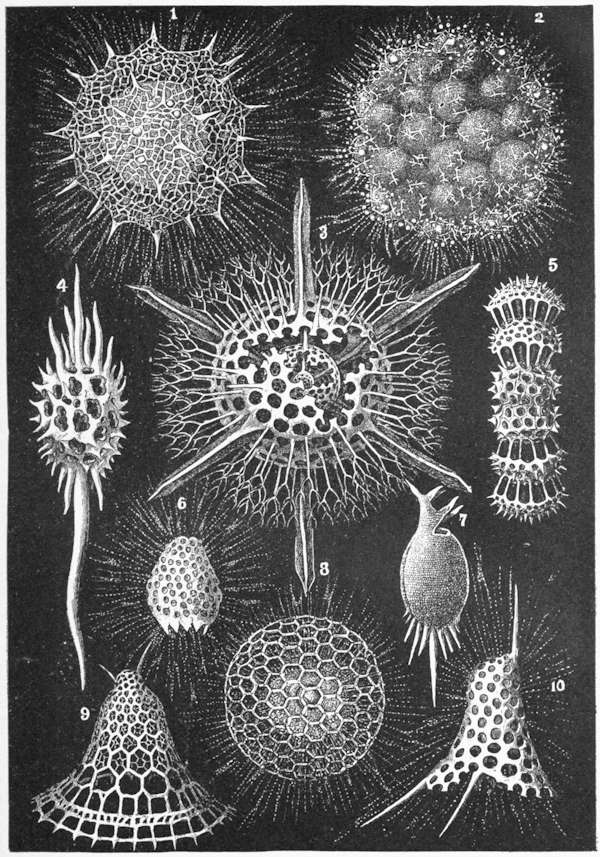
The dredging at 2,435 fathoms at the mouth of
the Bay of Biscay gave a very fair idea of the condition
of the bottom of the sea over an enormous
area, as we know from many observations which
have now been made with the various sounding
instruments contrived to bring up a sample of the
bottom. Under the microscope the surface-layer
was found to consist chiefly of entire shells of
Globigerina bulloides, large and small, and fragments
of such shells mixed with a quantity of amorphous
calcareous matter in fine particles, a little fine
sand, and many spicules, portions of spicules, and
shells of Radiolaria, a few spicules of sponges, and
a few frustules of diatoms.
In this dredging, as in most others in the bed
of the Atlantic, there was evidence of a considerable
quantity of soft gelatinous organic matter, enough
to give a slight viscosity to the mud of the surface-layer.
This gelatinous matter is capable of a certain
amount of movement, and there can be no doubt
that it manifests the phenomena of a very simple
form of life.
To this organism, if a being can be so called which
shows no trace of differentiation of organs, consisting
apparently of an amorphous sheet of a protein
compound, irritable to a low degree and capable of
assimilating food, Professor Huxley has given the
name of Bathybius haeckelii. The circumstance
which gives its special interest to Bathybius is its
enormous extent: whether it be continuous in one vast
sheet, or broken up into circumscribed individual
particles, it appears to extend over a large part of
the bed of the ocean; and as no living thing, however
slowly it may live, is ever perfectly at rest, but is
continually acting and reacting with its surroundings,
the bottom of the sea becomes like the surface
of the sea and of the land—a theatre of change, performing
its part in maintaining the “balance of organic
nature.”
Living upon and among this Bathybius, we find
a multitude of other protozoa—foraminifera and
other rhizopods, radiolarians, and sponges; and we
as yet know very little of the life-history of these
groups.
Many foraminifera of different groups inhabit
the deep water, lying upon or mixed in the upper
layer of the globigerina ooze, or fixed to some foreign
body, such as a sponge, coral, or stone; and all of
these are remarkable for their large size.
The few hauls of the dredge which we have already
had in deep water have been enough to teach
us that our knowledge of sponges is in its infancy—that
those which we have collected from shallow
water along our shores, and even those few which
have been brought up from deep water on fishing
lines, and have surprised us by the beauty of their
forms and the delicacy of their lustre, are the mere
margin and remnant of a wonderfully diversified
sponge-fauna which appears to extend in endless variety
over the whole of the bottom of the sea.
The most remarkable new forms are referable to
the group which seems to be in a sense special to deep
water, the Hexactinellidæ. One of the most abundant
and singular forms belonging to this order,
Holtenia carpenteri, is an oval or sphere 90 to 100
mm. in height, with one large oscular opening at
the top about 30 mm. in diameter, whence a simple
cylindrical cavity cupped at the bottom passes down
vertically into the substance of the sponge to the
depth of 55 mm. The outer wall of the sponge consists
of a complicated network of the cross-like heads
of five-rayed spicules. One ray of each spicule dips
directly into the body of the sponge, and the other
four, which are at right angles to it, form a cross on
the surface, giving it a beautiful stellate appearance.
The silicious rays of one star curve toward
and meet the rays of the neighboring stars, and run
parallel with them. All the rays of all the spicules
are thickly invested with consistent semi-transparent
gelatinous matter, which binds their concurrent
branches together by an elastic union, and fills up
the angles of the meshes with softly curved viscous
masses. This arrangement of the spicules, free and
yet adhering together by long elastic connections,
produces a strong, flexible, and very extensible tissue.
The cylindrical oscular cavity within the sponge is
lined with nearly the same kind of network.
When the sponge is living, the interstices of the
silicious network are filled up both outside and in
with a delicate fenestrated membrane formed of a
glairy substance like white of egg, which is constantly
moving, extending or contracting the fenestræ,
and gliding over the surface of the spicules.
This “sarcode,” which is the living flesh of the
sponge, contains distributed through it an infinite
number of very minute spicules, presenting the most
singular and elegant forms very characteristic of
each species of sponge. A constant current of water
carried along by the action of cilia passes in by
apertures in the outer wall, courses through the
passages in the loose texture of the intermediate
sponge-substance carrying organic matter in solution
and particles of nourishment into all its interstices,
and finally passes out by the large “osculum” at the
top. Over the upper third of the sponge a multitude
of radiating rigid silicious spicules form a kind of
ornamental frill, and from the lower third a perfect
maze of delicate glassy filaments, like fine white hair,
spread out in all directions, penetrating the semi-fluid
mud, and supporting the sponge in its precarious bed
by increasing its surface indefinitely while adding
but little to its weight.
This is only one of the ways by which sponges
anchor themselves in the ooze of the deep sea.
Hyalonema sends right down through the soft
mud a coiled wisp of strong spicules, each as thick
as a knitting needle, which open out into a brush
as the bed gets firmer, and fix the sponge in its place
somewhat on the principle of a screw pile. A very
singular sponge from deep water off the Lofoten
Islands spreads into a thin circular cake, and adds
to its surface by sending out a flat border of silky
spicules, like a fringe of white floss round a
little yellow mat; and the lovely Euplectella, whose
beauty is imbedded up to its fretted lid in the gray
mud of the seas of the Philippines, is supported by
a frill of spicules standing up round it like Queen
Elizabeth’s ruff.
The sponges of the deep-water ooze are by no
means confined to one group. The Hexactinellidæ
are perhaps the most abundant, but corticate sponges
even, closely allied to those which look so rigid when
fixed to stones in shallow water, send out long anchoring
spicules and balance themselves in the soft mud;
and off the coast of Portugal Mr. Gwyn Jeffreys
dredged in 1870 several small forms of the Halichondridæ,
with long supporting fibrous beards.
From its appearance when brought up Holtenia
evidently lives buried in the mud to its upper fringe
of spicules. When freshly dredged, it is loaded with
pale gray semi-fluid sarcode, full of Globigerinæ,
Triloculinæ, and other rhizopods, and covered in our
northern localities with the little ophiurid Amphiura
abyssicola, Sars, and the exquisitely delicate transparent
clam, Pecten viterus Chemnitz. Holtenia
extends from the Butt of Lewis to Gibraltar, in
from 500 to 1,000 fathoms.
In the Hexactinellidæ all the spicules, so far as
we know, are formed on the hexradiate plan; that is
to say, there is a primary axis, which may be long
or short, and at one point four secondary rays cross
this central shaft at right angles. In many of the
Hexactinellidæ the spicules are all distinct, and combined,
as in Holtenia, by a small quantity of nearly
transparent sarcode; but in others, as in “Venus’s
flower-basket,” and the nearly equally beautiful
genera Iphiteon, Aphrocallistes, and Farrea, the
spicules run together and make a continuous silicious
network. When this is the case the sponge may be
boiled in nitric acid, and all the organic matter and
other impurities thus removed, when the skeleton
comes out a lovely lacy structure of the clearest
glass. The six-rayed form of the spicules gives the
network which is the result of their fusion great
flexibility of design, with a characteristic tendency,
however, to square meshes.
Off the Butt of Lewis, in water of 450 to 500
fathoms, we met on two occasions with full-grown
specimens of a species of the remarkable genus
Hyalonema, with the coils in the larger examples upward
of 40 centimetres in length.
A bundle of from 200 to 300 threads of transparent
silica, glistening with a silky lustre, like the
most brilliant spun-glass—each thread from 30 to 40
centimetres long, in the middle the thickness of a
knitting-needle, and gradually tapering toward
either end to a fine point; the whole bundle coiled
like a strand of rope into a lengthened spiral, the
threads of the middle and upper portions remaining
compactly coiled by a permanent twist of the individual
threads; the lower part of the coil, which,
when the sponge is living, is imbedded in the mud,
frayed out so that the glassy threads stand separate
from one another, like the bristles of a glittering
brush; the upper portion of the coil close and compact,
imbedded perpendicularly in a conical or
cylindrical sponge; and usually part of the upper
portion of the silicious coil, and part of the sponge-substance,
covered with a brownish leathery coating,
whose surface is studded with the polypes of an alcyonarian
zoophyte—such is the general effect of a
complete specimen of Hyalonema.
The genus was first known in Europe by specimens
brought from Japan by the celebrated naturalist and
traveler, Von Siebold; and Japanese examples of
Hyalonema sieboldi, Gray, may now be found more
or less perfect in most of the European museums.
When the first specimen of Hyalonema was brought
home, the other vitreous sponges which approach it
so closely in all essential points of structure were
unknown.
In essential structure Hyalonema very closely resembles
Holtenia, and the more characteristic forms
of the Hexactinellidæ. On one of the Holteniæ from
the Butt of Lewis, there was a little accumulation
of greenish granular matter among the fibres. On
placing this under the microscope it turned out to
be a number of very young sponges, scarcely out of
their germ state. They were all at first sight very
much alike, minute pear-shaped bodies, with a long
delicate pencil of silky spicules taking the place of
the pear-stalk. On closer examination, however,
these little germs proved to belong to different species,
each showing unmistakably the characteristic
forms of its special spicules. Most of them were the
young of Tisiphonia, but among them were several
Holteniæ, and one or two were at once referred to
Hyalonema. In two or three hauls in the same locality
we got them in every subsequent stage—beautiful
little pear-shaped things, a centimetre long, with a
single osculum at the top, and the wisp like a small
brush. At this stage the Palythoa is usually absent,
but when the body of the sponge has attained 15 mm.
or so in length very generally a little pink tubercle
may be detected at the point of junction between
the sponge body and the coil, the germ of the first
polype.
During Mr. Gwyn Jeffreys’s cruise in 1870, two
specimens of a wonderful sponge belonging also to
the Hexactinellidæ were dredged in 374 fathoms in
rocky ground off Cape St. Vincent. The larger of
these forms a complete vase of a very elegant form,
nearly ninety centimetres in diameter at the top and
about sixty in height. The sponge came up folded
together, and had much the appearance of a piece
of coarse, grayish-colored blanket.
Near the mouth of the Strait of Gibraltar a number
of species were taken in considerable quantity, belonging
to a group which were at first confused with
the Hexactinellidæ, on account of their frequently
forming a similar and equally beautiful continuous
network of silica, so as to assume the same resemblance
to delicate lace when boiled in nitric acid.
The Corallio-spongiæ differ, however, from the
Hexactinellidæ in one very fundamental character.
While in the latter the spicule is hexradiate, in the
former it consists of a shaft with three diverging
rays at one end.
This group of sponges are as yet imperfectly
known. They seem to pass into such forms as
Geodia and Tethya; and the typical example with
which we are most familiar is the genus Dactylocalyx,
represented by the cup-shaped pumice-like
masses which are thrown ashore from time to time on
the West Indian Islands.
Twelve species of stony corals were dredged in
1869.
From their considerable size, the length and
rigidity of their straggling rays, and their habit of
clinging to fixed objects, the Echinodermata are not
very readily taken by the dredge, but they fall an
easy prey to the “hempen tangles.” It is possible that
this circumstance may to a certain extent exaggerate
their apparent abundance at great depths, but we
have direct evidence in the actual numbers which
are brought up that in some places they must be
wonderfully numerous; and we frequently dredge
sponges and corals actually covered with them in the
attitudes in which they lived, nestling among their
fibres and in the angles of their branches. I have
counted seventy-three examples of Amphiura abyssicola,
small and large, sticking to one Holtenia.
Both on account of their beauty and extreme
rarity, and of the important part they have borne
in the fauna of some of the past periods of the
earth’s history, the first order of the Echinoderms,
the Crinoidea, has always had a special interest to
naturalists; and, on the watch as we were for
missing links which might connect the present with
the past, we eagerly welcomed any indication of their
presence. Crinoids were very abundant in the seas
of the Silurian period. But during the lapse of
ages the whole order seems to have been worsted
in the “struggle for life.” They become scarce in the
newer Mesozoic beds, still scarcer in the Tertiaries,
and up to within the last few years only two
living stalked crinoids were known in the seas
of the present period, and these appeared to be
confined to deep water in the seas of the Antilles,
whence fishermen from time to time bring up mutilated
specimens on their lines. Their existence has
been known for more than a century; but although
many eyes have been watching for them, until very
lately not more than twenty specimens had reached
Europe, and of these only two showed all the joints
and plates of the skeleton, and the soft parts were
lost in all.
These two species belong to the genus Pentacrinus,
which is well represented in the beds of the lias and
oolite, and sparingly in the white chalk; and are
named respectively Pentacrinus asteria, L., and P.
mülleri, Oersted. The first of these has been known
in Europe since the year 1755, when a specimen was
brought to Paris from the island of Martinique, and
described by Guettard in the Memoirs of the Royal
Academy of Sciences. For the next hundred years
an example turned up now and then from the
Antilles.
Pentacrinus asteria may be taken as the type of
its order; I will therefore describe it briefly. The
animal consists of two well-marked portions, a stem
and a head. The stem, which is often from 40 to
60 centimetres in length, consists of a series of
flattened calcareous joints; it may be snapped over
at the point of junction between any two of these
joints, and by slipping the point of a penknife into
the next suture a single joint may be removed entire.
The joint has a hole in the centre, through which
one might pass a fine needle. This hole forms part
of a canal filled during life with a gelatinous nutrient
matter which runs through the whole length
of the stem, branches in a complicated way through
the plates of the cup, and finally passes through
the axis of each of the joints of the arms, and of
the ultimate pinnules which fringe them. On the
upper and lower surfaces of the stem-joint there
is a very graceful and characteristic figure of five
radiating oval leaf-like spaces, each space surrounded
by a border of minute alternate ridges and grooves.
The ridges of the upper surface of a joint fit into
the grooves of the lower surface of the joint above
it; so that, though from being made up of many
joints the stem admits of a certain amount of motion,
that motion is very limited.
As the border of each star-like figure exactly
fits the border of the star above and below, the five
leaflets within the border are likewise placed directly
one above the other. Within these leaflets the
limy matter which makes up the great bulk of the
joint is more loosely arranged than it is outside, and
five oval bands of strong fibres pass in the interspaces
right through the joints, from joint to joint,
from one end of the stem to the other. These
fibrous bands give the column great strength. It
is by no means easily broken even when dead and
dry. They also, by their elasticity, admit a certain
amount of passive motion. There are no muscles
between the joints of the stem, so that the animal
does not appear to be able to move its stalk at
will. It is probably only gently waved by the tides
and currents, and by the movements of its own arms.
In Pentacrinus asteria about every seventeenth
joint of the lower mature part of the stem is a little
deeper or thicker than the others, and bears a whorl
of five long tendrils or cirri. These tendrils have
no true muscles; they have, however, some power of
contracting round resisting objects which they touch,
and there are often star-fishes and other sea animals
entangled among them.
Near the head the cirri become shorter and
smaller, and their whorls closer. At the top of the
stem five little calcareous lumps like buttons stand
out from the projecting ridges, and upon these and
upon the upper part of the stem the cup which holds
the viscera of the animal is placed.
All the ordinary joints of the arms are provided
with muscles producing various motions, and binding
the joints firmly together. If one of the arms
get entangled, or fall into the jaws or claws of an
enemy, by a jerk the star-fish can at once get rid of
the embarrassed arm; and as all this group have a
wonderful power of reproducing lost parts, the arm
is soon restored.
Unfortunately, most of the examples of Pentacrinus
asteria hitherto procured have had the soft
parts destroyed and the disk more or less injured.
One specimen, however, in my possession is quite
perfect. The body is covered above by a membrane
closely tessellated with irregularly formed flat plates.
The mouth is a rounded opening of considerable size
in the centre of the disk, and opens into a stomach
passing into a short curved intestine which ends in
a long excretory tube—the so-called “proboscis” of
the fossil crinoids—which rises from the surface of
the disk near the mouth. From the mouth five
deep grooves, bordered on either side by small square
plates, run out to the edge of the disk, and are continuous
with the grooves on the upper surface of the
arms and pinnules, while in the angles between them
five thickened masses of the mailing of the disk
surround the mouth like valves. These were at
first supposed to answer the purpose of teeth. The
crinoids, however, are not predatory animals. Their
nutrition is effected in a very gentle manner. The
grooves of the pinnules and arms are richly ciliated.
The crinoid expands its arms like the petals of a full-blown
flower, and a current of sea-water bearing
organic matter in solution and suspension is carried
by the cilia along the brachial and radial grooves
to the mouth. In the stomach and intestine the
water is exhausted of assimilable matter, and the
length and direction of the excretory proboscis prevent
the exhausted water from returning at once into
the ciliated passages.
Two other fixed crinoids were dredged from the
Porcupine, and these must be referred to the Apiocrinidæ,
which differ from all other sections of the
order in the structure of the upper part of the stem.
The Apiocrinidæ attained their maximum during
the Jurassic period, when they were represented by
many fine species of the genera Apiocrinus and
Millericrinus. The chalk genus Bourguetticrinus
shows many symptoms of degeneracy. Rhizocrinus
loffotensis, M. Sars, was discovered in the year
1864, at a depth of about 300 fathoms, off the
Lofoten Islands, by G. O. Sars, a son of the celebrated
Professor of Natural History in the University
of Christiania, by whom it was described in
the year 1868. It is obviously a form of the Apiocrinidæ
still more degraded than Bourguetticrinus,
which it closely resembles.
The genus Bathycrinus must also be referred to the
Apiocrinidæ, since the lower portion of the head consists
of a gradually expanding funnel-shaped piece,
which seems to be composed of coalesced upper stem-joints.
The stem of Bathycrinus gracilis is long and
delicate; in one example of a stem alone, which came
up in the same haul with the one nearly perfect
specimen which was procured, it was 90 mm. in
length.
The general distribution of the deep-sea Asteridea
has already been referred to. Perhaps the most
obvious peculiarity which they present is the great
preponderance of the genera Astrogonium, Archaster,
Astropecten, and their allies. Genera belonging
to other groups do not apparently become less
numerous, for species of Asteracanthion, Cribrella,
Asteriscus, and Ophidiaster are as abundant as they
are at lesser depths; but as we go down new species
with tessellated mailing on the disk and massive
marginal plates seem to be perpetually added.
Of the twenty-six Echinoderms dredged from the
Porcupine, seven—Porocidaris purpurata, Phormosoma
placenta, Calveria hystrix, C. fenestrata,
Neolampas rostellatus, Pourtalesia jeffreysi, and P.
phiale—are forms which have been for the first
time brought to light during deep-sea dredging
operations, whether on this or on the other side of
the Atlantic. There seems little doubt that these
must be referred to the abyssal fauna, upon whose
confines we are now only beginning to encroach.
Three of the most remarkable generic forms—Calveria,
Neolampas, and Pourtalesia—have been found
by Alexander Agassiz among the results of the deep
dredging operations of Count Pourtales in the Strait
of Florida, showing a wide lateral distribution, while
even a deeper interest attaches to the fact that
while one family type, the Echinothuridæ, has been
hitherto only known in a fossil state, the entire
group finds nearer allies in the extinct faunæ of the
chalk or of the earlier Tertiaries than in that of
the present period.
Many of the mollusca from the deep water have
hitherto been found only in the northern portions of
the area examined, and are generally allied to northern
forms.
The abyssal mollusca are by no means devoid of
color, though, as a rule, they are paler than those
from shallow water. Neither are the abyssal mollusca
universally destitute of eyes. A new species
of Pleurotoma from 2,090 fathoms had a pair of
well-developed eyes on short foot-stalks; and a Fusus
from 1,207 fathoms was similarly provided. The
presence of organs of sight at these great depths
leaves little room to doubt that light must reach even
these abysses from some source. From many considerations
it can scarcely be sunlight. The whole
of the light beyond a certain depth might be due
to phosphorescence, which is certainly very general,
particularly among the larvæ and young of deep-sea
animals.
“THE MIMIC FIRES OF OCEAN” — G. Clarke Nuttall
Nature dazzles the eye of man with many
wonderful phenomena, but perhaps never
more so than when she turns the gloomy night waters
of the sea into a sheet of silvery fire. At these times
every movement of the wave, every cleavage of the
water by oar or prow, reveals in its dark depths a
hidden fire which scintillates and sparkles with
weird and mysterious light. The spectacle is one of
absolute fascination, for the Spirit of Enchantment
rests upon the waters and reality becomes fairyland.
The ancients, keenly alive to a sense of the supernatural,
saw in this luminosity a manifestation of
some unknown power, and wondered; the ignorant
read in it a portent of judgment and terror; while
in all ages the curious and the searchers after knowledge
have speculated as to its cause. But just as
Nature has invested its appearance with a halo of
mystery, so she has also wrapped in much obscurity
its immediate cause; and thus, though in the course
of centuries varying suggestions have been put forward,
nothing with any finality about it has been
arrived at. It was asserted truly that certain fishes
were luminous; sharks have glowed and shone,
shoals of herrings, pilchards, or mackerel have been
moving masses of light, and the fish drawn out of the
water have lain in great shining heaps, the glow of
which vanished as they dried and died.
Many writers have described the passages of ships
through such shoals—the sheet of moving flames—the
beautiful pale greenish elf-light that the fish exhibited;
while poets have apostrophized the “mimic
fires of ocean” and the “lightnings of the wave,” and
scientists and naturalists have in turn tried to account
for their power of luminosity. Some have attributed
it to the presence of certain substances of a
fatty nature excreted by the fish and adhering to the
surface of their bodies; others have declared that
it is due to a subtle power of the fish itself—a form
in which the energy of life shows itself under certain
conditions, just as this energy may be exhibited in
heat, or motion, or electricity; others, again, have
ascribed it to direct absorption and transmission of
the light of the sun, and so on. Many theories have
been elaborated, but none convincingly.
But now, it is asserted, the secret is laid bare.
It is wonderful how many secrets the searching
light of the Nineteenth Century is claiming to reveal.
It is only lately that any very serious effort has
been made to study this phenomenon, but the research
has been abundantly rewarded, for it is now pretty
certain that the luminosity is due to the presence in
the water of various kinds of bacteria.
Now, bacteria are the very smallest living organisms
of which we have cognizance. Millions of
them can lie on a penny; therefore, to produce the
gleaming appearance recognized by us as phosphorescence,
they must be present in numbers too
enormous even to contemplate with our finite minds.
It would be immeasurably easier to reckon with the
stars for multitude than with these phosphorescent
bacteria. They are colorless, rod-like bodies, only
known to us in the land revealed by the highest
powers of the microscope, and careful comparison
shows minor differences among them. For instance,
some of them are capable of independent motion—we
can hardly call it swimming—others are non-motile,
some are inclosed in a jelly-like covering,
others are without this sheath. Their power of motion
is probably due to excessively fine hairs at their
extremities, which, moving to and fro in the water,
act the part of oars. These cilia have not been found
in all forms of bacteria which move, but their presence
is inferred, since every advance in the study of
motile forms increases the number of bacteria which
are seen to possess them.
These light-producing bacteria are known as
photo-bacteria, and so far some half-dozen varieties
have been distinguished and named. The names in
such cases are usually either given from the locality
of their appearance (thus, photo-bacterium Balticum,
found in the Baltic), from their discoverer
(for example, photo-bacterium Fischeri, after Professor
Fischer), or from some striking attribute (to
wit, photo-bacterium phosphorescens, the commonest
light-giving species).
A Dutchman named Beyerinck has made a special
study of these photo-bacteria, and has experimented
with them in a great number of ways to determine,
if possible, why they should thus become illuminated,
and if the light plays any notable part in their life-history;
but his results are, seemingly, all more or less
of a negative nature. He can not find that it has
any very important function. The breathing of these
tiny organisms is not, apparently, in any way bound
up with it; their nutrition, growth, and development
go on quite well even if they are placed under such
conditions that their luminosity is arrested; in no
way, indeed, is it a vital process. It only seems to
depend on the food which the bacteria feed upon and
the presence of oxygen. Given suitable food and
plenty of fresh air, and they exhibit their characteristic
light; deprive them of one or the other and they
no longer shine.
This knowledge helps us to understand, then, the
phenomenon of phosphorescence. It is visible only
at night because in the full glare of day the greater
light overpowers the lesser; it is visible at certain
times and seasons because the conditions are such as
to evoke it. And what is favorable for the lighting
up of a single bacterium is favorable for all; hence
the myriad multitudes of infinitesimal units, each set
glowing with its tiny light, are sufficient in the sum
total to put a whole ocean aflame.
It would, of course, be presumptuous, and doubtless
erroneous, to say that all the phosphorescence of
the sea is due solely to photo-bacteria; it can only
be asserted in the present state of our knowledge that
they are certainly responsible for a great share of
it. But this wonder of nature must now be regarded
as yet another instance of the mighty results accomplished
through the agency of the smallest of living
things.
THE JELLY-FISH AND OTHER HYDROZOA — P. Martin Duncan
If anybody were asked to name the commonest objects
on a sandy or pebbly seashore, the reply would
be—sea-weed, crabs, limpets, a stranded jelly-fish,
looking like so much blubber, and a sea-gull flying
overhead. The first three things really belong to the
shore; the bird is a visitor that is looking after food,
and the large, turned-upside-down, basin-shaped,
jelly-looking mass is a waif from the ocean. If one
of these stranded jelly-fish is looked at, as it lies on
the sand, its shape appears to be something like that
of an umbrella without the stick. It is thick, however,
and has some curious markings about its surface
and inside. Even something like a fringe of
thick hairs may be detected around the edge. On
trying to take it up or turn it over, the fingers go
into it, so readily does the animal tear; but on getting
the umbrella on its back, the underneath part is
seen to be made up, in the middle, of some projections
slightly more solid than the rest of the body; and if
put between them, the finger passes through a sort
of tube into a cavity in the body, which is the
stomach.
Some of these jelly-fish, or Medusæ, as they are
called, are pounds in weight; but after a while only
a shred of membrane-looking stuff remains, the
water which makes up nearly all the animal having
drained away. It is evident that the large Medusæ
grow from small ones, and that there are many kinds
of them, some of which are always small. A great
jelly-fish, two feet across, was once a little one, leading
exactly the same life. They grow, and to grow
they must have nourishment; they are never still,
and their muscles, transparent as they may be, have
to be nourished, or their strength would soon give
way. They require not only food, but also air in
the water, so that they consume it, and make its
oxygen gas of use to them. They seek the light in
a remarkable manner, and get out of the way
of things very gracefully, and their motions are
rhythmical, like the ticks of a clock, in succession.
Have they nerves and eyes? Science answers in the
affirmative. These creatures, consisting of a vast
proportion of sea-water, breathe, digest, and feed.
More than this, they produce young; and if they are
pale in color, bluish, or roseate in hue during the
day, they are the glory of the deep during the night;
and each one is a globe of light, the luminousness
being the result of the action of the mysterious energy
of life upon matter.
Many of the jelly-fish found on the shores dead
and injured are eighteen inches across, and it is not
uncommon to see one swimming freely whose body
is larger than that. Yet in spite of this size, and of
the gifts of the creature, it has one of the shortest of
lives, and it is born, grown, and dead between the
spring and the winter.
On examining a large jelly-fish, it will be noticed
to have not only four round bodies on the top,
round the centre, and the four lobes hanging down
beneath, but that the edges of the body are not
quite round, but are notched, so as to make eight
lobes to it. And if a little care be taken, marks can
be seen on the under part of the body, from the round
centre spots to each of the eight splits in the disk;
and a magnifying-glass shows a little substance there
which feels gritty, and is sometimes colored. Other
branching tube-marks pass from the midst of the
body to the edge of the umbrella, and a tube runs all
round the edge. The tubes communicate in the midst
of the body with a cavity, into which the finger can
pass between the four under lobes—the stomach—and
the digested matters pass into them to nourish the
creature. Around the disk or umbrella, and outside
the circular tube, is the fringe of hairs which have,
to a certain extent, to do with the capture of prey.
Each consists of a filmy substance, in which are fixed
thread-cells, not very unlike those of the sea-anemone,
but they have longer barbs and sharper thorns
stretching out from them. Any violence or irritation
causes the thread to shoot forth and to injure. The
rest of the body of the Medusa is covered with an excessively
thin skin, which has movable cilia upon it.
It is supposed, and with some reason—for nervous
threads and bodies have been found on the disk,
close to the gritty bodies especially—that these last
are eyes, or ears, or both. The nerves supply the
muscles that move the umbrella, and cause it to expand
and contract, and the muscles are remarkable,
for some are not simple contracting fibres all made
of one piece, as in the Anemone tribe.
The jelly-fish, when in full vigor and weighing
many pounds, must catch and eat much, and the manner
in which this is done is by no means perfectly
understood. The food is digested, and the results are
taken from the stomach into the numerous tubes in
the body, where they nourish the tissues. The movements
of the animal and its extremely delicate membranes
enable much water to come in contact with
it, and it breathes by that means, for there are no
special gills or lungs.
The four round spots on the top of the body,
sometimes white and sometimes red in color, are
spaces in the body, and they open into the central
stomach. The circles of these chambers are lined
with ciliate membrane, and in some places it is arranged
in folds, and in them the eggs or ova form.
Little oval or roundish things, like pins’ heads are
they: they burst forth and pass out of the stomach,
and then through the canal into the four lobes hanging
down like pouting lips. Here they rest a while
until a little grown, and they start out on their journey
of life in the autumn time as little oval or long
things made up of cells, the outside ones having movable
hairs also on them. Totally unlike the parent, the
tiny offspring floats off with the tide and does a little
work in moving itself with its hairy covering. Sooner
or later this minute thing, which is called a planula,
settles on a stone or piece of sea-weed, and begins
to grow. First of all its outer skin is formed into
a hollow on the top, a kind of basin-shaped cavity
being produced. This is the future stomach. Then
some little projections grow around the hollow, and
stick out in the water like so many rays, and they
increase in number and length very rapidly. Under
this shape the creature has been described as a hydra
or a polype, and it really resembles a small sea-anemone
with very long and slender tentacles. But the
internal anatomy differs. The creature is all stomach
and tentacles, and it grows by catching small prey.
All the elaborate tissues of the jelly-fish are absent
and the creature can not move. It is this curious condition
of life that brings the jelly-fish tribe within
notice of a seashore observer, for those little hydras
live in some places at low-water mark. The knowledge
that the hydra was the child of the jelly-fish
was obtained many years ago by a Scotch and by a
Scandinavian naturalist. It was known that some
small kinds of jelly-fish which were kept in sea-water
in an aquarium disappeared altogether in the late
autumn. Then it was noticed that there were many
very small things with tentacles, on the sides of the
glass, which had not been noticed before. And at
last the curious discovery was made that these hydras
or planulas reproduced jelly-fish the next year. This
is a very strange story, and the course of nature’s
proceeding is, that when food has become scarce and
the boisterous waves would become fatal to the delicate
Medusa, it shall lay eggs which produce creatures
that can settle down out of the way of the rush
of water, and that require but little food. Then in
the next year when food is in plenty, the progeny
separate into jelly-fish like the parent. The hydras
or progeny have no power of laying eggs; they digest
and produce the creature that shall lay eggs. The
Scandinavian naturalists and Germans called this
“alternate generation,” and named the hydra the
nurse of the jelly-fishes. This is the method by
which most of the jelly-fish, which may be occasionally
seen stranded on the coast, were produced;
but there are some whose planulas do not settle
down, but are always free swimmers, and they divide
into Medusæ in the sea.
This intensely interesting course of life is modified
in all the hundreds of kinds of creatures which are
connected with the jelly-fish in classification, by their
having many structures in common. The creatures
thus classified with the jelly-fish are called Hydrozoa,
or Water Animals, and they pass two lives, one of
which is commonly observed on the seashore everywhere.
One life is a fixed one, and the other is a
free swimming one; in one stage it is eating and
drinking, and in the other, these functions are not
always or often carried out. The egg-laying and
perpetuation of the animal are the duty of the greater
part of the beautiful branched and hair-like things
which are arranged by visitors to the seaside in patterns,
and retained as memorials of pleasant days,
and which are popularly called sea-weeds. They are
not such things, but are the delicate stems, branches,
and bud-like homes of the parents of tiny jelly-fish,
which are only to be caught in the open sea. These
horny stems and branches end in creatures with tentacles
or feelers, and they live between tides, in rock
pools, and at low water.
Sometimes these fragile, plant-looking things are
fixed on to stones or sea-weed, and some get a ride by
growing on shells, inhabited, since the death of their
original possessor, by the Hermit Crab.
One very numerous tribe of these feathery-looking
weeds, but which are truly animals, is common everywhere
on the shore, between tide-marks into deep
water. Their stems are branching, and the little
bud-like things on them, when watched in still water,
may be seen to put forth pretty colored bodies with
tentacles around a centre; and as there may be hundreds
of them on the branches and stem, the creature
resembles a bunch of rayed flowers. Hence the
name Sertularia, from sertula, a small garland.
These Sertularians were noticed and drawn many
years ago, and were called Corallines. This is a great
mistake, because the Coralline is a plant covered
with carbonate of lime. The correct name would be
the Garland polypes. When we get a bunch of these
creatures from the seaside they are dead, and the
hard and preservable outside parts alone are left, all
the beauty of color and the wonderful inside structure
are gone. But even then it can be noticed that
the stems of the creature arise from a network of
tubes fixed on to stones, sea-weeds, and shells. This
resembles a root, but it does not absorb nourishment
like the root of a plant. The stems, often not bigger
than hairs, are hollow, and the branches also. The
surface of the branches is covered on one, or often on
both sides, by minute cups. These give almost a saw-edge
look to it, in some of the creatures; and among
these cups, which are open at their free end, are some
larger ones, which are closed where free, and often
ribbed and ornamented on their outside. It is noticed
that the hollow of the stem and branches is continued
into the cups, but not into the closed ones, and
that these are shut off from it by a very delicate
layer of tissue. This is the minute structure of these
things when dead; but when alive, the inside of the
stem and branches is filled with a soft substance,
which reaches up to the part where each of the cups
is attached to the outside. The cups, hundreds in
number, on each stem and branch, contain a most
beautiful flower-like polype. Variously colored, according
to the kind, it has a bell shape, and has a spot
for the mouth, which leads to a stomach, whose floor
is connected with the pith of the whole branch.
Around the mouth are numerous tentacles excessively
irritable, capable of stinging and paralyzing prey;
and the spectacle of hosts of these, all working for the
common good of the branching animal, is very beautiful.
Sometimes there is much red in the color, at
other times green, yellow, or a dull tint; and in order
to relieve the sameness of outline presented by
thousands of cups, their horny margin is spined or
toothed. In full vigor during the summer, and living
through the winter and probably for several
years, these cups with their tentacled polypes contribute
to the growth and nutrition of the whole.
They all work for a common end, and that is for the
persistence of the life of the colony. They live on
microscopic things in the water, such as minute ova,
or the young of things like unto themselves, and on
animalcules, and probably on the moving spores of
sea-weeds. As the spring advances, the larger and
closed cups begin to grow by budding from the stem,
and they become filled with a gummy substance with
a few granules in it, and somewhat resembling the
pith of the stem. As the closed cup grows, it often
becomes marked on the outside with rings or belts,
and it becomes a very prominent object on the horny-looking
Garland polype. These closed cups are concerned
in the reproduction of the creature, for after
a few weeks the substance inside them is seen to
collect into bunches of round or oval bodies, often
yellow in color, or of other tints. By and by the cup
bursts, or a sort of trap-door opens at the top, and
these things escape. They are small, covered with
cilia, or moving hairs, and resemble the planulas of
the jelly-fish in shape, and they swim freely, and
finally settle down on a stone or weed. They become
environed by a horny coat, the stomach having been
formed first by simple bending in of the outside of
the creature, and tentacles grow. The planula thus
founds a new colony. But there are other phases in
this curious life-story; for instead of the little round
balls in the closed cups getting free as planulas, some
in certain kinds grow there, and resemble excessively
minute jelly-fish stuck fast by the back, and exposing
the mouth, feet, and the fringed umbrella. These
Medusæ, as they may be called, die on the parent,
and never wander.
There is one kind of these Garland polypes called
Lafœa in which the round bodies produced in the
closed cups burst forth, and not in the shape of planulas.
They come forth like tiny bells, furnished
with minute eye-spots on the edge, and they have an
umbrella shape, and long tentacles arising from the
edge near the eye-spots. They are jelly-fish, to all
intents and purposes, and swim freely about, and in
time produce planulas which develop into a parent
Garland polype again.
There is a very interesting kind of these allies of
the sea-jellies which, from its feathery shape, has
been called Plumularia. Specimens are common,
and there is a stem, and it has branches, and the
cups are in one row on the branchlets. Moreover,
there are openings in the horny envelope of the soft
pith of the branches, which do not give exit to a
polype-looking thing with its mouth surrounded with
tentacles, but to a simple pith with many threads
or stinging cells in it. It is more or less like a long
tongue, and is placed among the cups with polypes,
and it is evidently an instrument for capturing
minute creatures. The Sickle-beard is one of them.
But one of the most singular of these delicate
creatures lives in very numerous colonies, on such an
unexpected place as the outside of the shell tenanted
within by a wandering hermit-crab. It is called
Hydractinia. The Hydractinia has a kind of crust
for its formation, with tubes in it, and out from them
comes a white film, which, under a magnifying-glass,
presents a number of stems and polypes. Each
one has at its free part a club-shaped end, which has
several rows of tentacles around it. These, often
twenty-five in number, are, like the stem, very irritable,
flexible, and are covered with a sticky matter.
The club is hollow within, for the stomach, and food
gets in by the top, where the horny skin appears to
be absent.
The tentacles are rather sharp, and when they are
half-contracted they often appear to have a knob at
the end, otherwise they are stuck out and are like so
many thick threads. The stalk which supports the
conical-shaped head has a thin and wrinkled skin
with sharp, dot-like points on it, and probably they
secrete a sticky substance. The polypes thus formed
cluster together like so much moss on the shell, and it
would appear, if not in the English species, certainly
in one which frequents the American coasts, that
some groups are male and others female. But there is
no doubt, from the researches of Mr. Moseley, F.R.S.,
of the Challenger, that some of the polypes act as
catchers of food, and feed those which pay especial
attention to increasing and multiplying. These last
have minute little knobs growing on the stalk beneath
the head, and which develop round bodies inside.
After a while motion is noticed in them, and
there is every reason to believe that they burst forth
and swim off as small jelly-fish. Some, however,
give out little planulas, which settle down and grow
like the parent.
It will have been noticed from this description that
these polypes are different in shape from the Garland
polypes and that instead of being bell-shaped, with
tentacles around the mouth, they are club-shaped,
and have more than one row of tentacles half way
down. This last shape gives a characteristic to many
little polypes which lead, like the others, two lives—one
fixed on the seashore on plants and stones, and
the other, freely swimming, as a pretty little jelly-fish.
Another kind lives fixed on sea-weeds in shallow
water, and its stem consists of a single tube, which is
creeping and threadlike. The cups for the polype
are on long stalks, with markings like rings on them,
and are bell-shaped with a toothed edge. The mouth
is surrounded by tentacles, as in the Garland polype,
and, in fact, there is not much outside distinction
between them and this Campanularia, or Bell
polype.
There is a stomach in the polype bud which leads
to a canal that goes down the stalk, and even into the
creeping stem or root. The buds, on stalks of their
own, are very remarkable. They contain, soon after
they are formed, numerous little jelly-fish attached to
stalks. There may be twenty or thirty of these in
each bud, and the day will come when they will
burst forth, be cast loose from their stems, and swim
off. They resemble hand-bells of a very flat kind,
and the mouth is prolonged into a four-parted projection,
which protrudes through a structure not
seen in the great jelly-fish, but peculiar to these
smaller ones, which fills up the disk underneath,
from the mouth to the edge, with a layer of muscular
fibres. They have four long tentacles, and when
they have lived for some time they begin to play some
very curious tricks. Thus a foreign naturalist, M.
Van Beneden, was examining some creatures in his
aquarium, and found hundreds of these very small
jelly-fish, and he caught some in order to examine
them with his microscope. He began to draw some
of them carefully in order to write a description of
them. About an hour afterward, on again looking
at his specimen, he was amazed to find its shape
changed, and the animal apparently turned inside
out. The tentacles on the edge seemed to be reversed
in their position; the umbrella-like dome,
from being convex was the reverse, and the curled
lip-like proboscis seemed converted into the stem of
a solitary polype. One of these Campanularians,
called erroneously the Wrinkled-thread Coralline,
grows on sea-weeds near low-water mark, and especially
on the great Riband Tangle. It is a small
thing, about an inch in height, and its stem is of a
pink or rose-red color; it is sparingly branched in a
zigzag manner, and its stem is ringed. The buds develop
jelly-fish, but they never escape, and hang on
by stalks for the rest of their lives.
FISHES — Andrew Wilson
This division every one must know as that of
the Vertebrata, a word which may be used in
a popular sense, as corresponding to the expression
“backboned” animals. At the head of this group
man and quadrupeds are found, while the fishes form
the lowest class in the division.
There are few groups of the animal world more
interesting to the ordinary observer than that of the
fishes. To survey the various forms and shapes presented
by these animals as displayed in a great
museum should prove a sufficient incentive to gain
a more intimate acquaintance with the class; and
when, even in a popular sense, we investigate the
structure and habits of fishes, the study increases in
its fascination and interest. While if we reflect that
on a knowledge of the habits of fishes, of their distribution
in our oceans and seas, and of the special
products which many of them offer for our use and
luxury, the commercial success of our fisheries depends,
it can need no further argument to convince
us that, after all, there is something of great practical
benefit to be derived from the study of zoological
science.
It is not our intention at present to say anything
regarding the commercial or economic aspects of
fishes, and even their general habits must be very
briefly touched upon. We rather aim at giving some
account of the structure of the fishes, and at noting
such peculiarities in their habits and life as may
prove most interesting to our readers. Primarily,
then, we find that fishes may be recognized by having
the body usually, but not always, covered with
scales, of various forms and kinds. Then, secondly,
we have the limbs represented by certain fins; and,
thirdly, we find almost all fishes to breathe by gills
during the whole of life. These three points are,
in the main, sufficient to distinguish fishes from their
higher as well as their lower neighbors. The scales
which cover the bodies of fishes present great diversities
in shape, size, and appearance. Some fishes
thus exhibit an utter want of scales; while others,
like knights of old, are incased in a veritable suit of
scaly armor. The lampreys, and their curious neighbors
the hag-fishes, are destitute of scales; and in our
familiar eels, the scales are very small and insignificant.
Such fishes, however, are amply compensated
for the want of scales by the power they possess
of throwing out from the skin a vast quantity of
glutinous or oily matter, technically named mucus.
The presence of this secretion, which has given origin
to the phrase “as slippery as an eel,” serves to protect
the surface of the body, and no doubt also assists
in the easy progress of these fishes through the water.
So large is the quantity of this oily matter which the
hag-fishes can emit from their body, that one form
has received the specific name of glutinosa; the fish
being able in this way to literally convert the water
of the vessel in which it is contained into a jelly-like
mass. The familiar blennies, found in rock-pools
after the tide has receded, are also able to emit
a large amount of this glutinous fluid.
Illustrating the opposite extreme of the development
of scales, we find such fishes as the bony
pikes of North American lakes and rivers, the bodies
of which are covered with an armor of closely fitting
and overlapping scales or plates, named ganoid,
from their shining appearance (Greek ganos, splendor).
The scales of this fish are said to be employed
in the manufacture of the little “mother-of-pearl”
buttons, so commonly used. Many fossil fishes were
also abundantly provided with these hard, bony
plates; and our living sturgeons possess scales of
similar nature, although in the latter fishes they do
not completely cover the body. The bright silvery
scales of the herring and its neighbors are thin structures,
and are very easily detached from the skin;
and a curious form of scale is seen in the perches;
the hinder edge of each scale in the latter case being
cut into comb-like teeth. In the sharks, skates, and
rays, the scales are small and horny, and are often
provided with little spines. If we draw our hand
along the back of a dog-fish from tail to head, as
when we stroke a cat’s back the wrong way, we feel
numerous small projecting points, borne on the
scales. The rough skin surface thus produced is frequently
used under the name of “shagreen” in the
manufacture of spectacle-cases and like articles, and
is also employed for polishing the surface of wood.
In their general shape the bodies of fishes exhibit
a great compression from side to side, a rounding
of the sides, and a pointing of either extremity,
adapting the animals for easy progression through
the water. Some fishes, such as the soles, flounders,
plaice, etc., are named “flat fishes” from the great
flattening exhibited by their bodies; although, at the
same time, it is important to observe that these fishes
are simply more compressed from side to side than
their neighbors. Most persons, on looking at a sole
or flounder, are apt to think that one of the flat surfaces
must represent the back, and the other the
under surface of the body. This idea is strengthened
by the fact that the so-called back surface is dark,
and the apparent under surface light in color, and
because both eyes exist on the dark-colored surface.
That, however, the flat surfaces are really the sides
of the fish may be seen by noting that on each surface
a breast-fin is developed; these fins being placed
invariably one on each side of the body. And while
the eyes in early life are disposed one on each side of
the head, in the position in which eyes are naturally
situated, they are gradually brought round to one
side by the bones of the head becoming curiously
twisted in the course of development. Thus these
fishes lie and swim on one side—that which is light-colored—and
present a most singular combination
of curious and abnormal features.
The fins of fishes constitute interesting features in
their structure. Almost all fishes have two sets of
fins—those which exist in pairs and those which are
unpaired, and which are developed in the middle
line of the body. To the former class belong the two
pectoral or “breast-fins” and the two ventral or “belly-fins.”
The “breast-fins” correspond to the forelegs
of other animals or to the arms of man; while the
ventral fins correspond to the hindlegs or to man’s
lower limbs; and these latter fins may be placed, as
hind-limbs should be, to the rear of the body (as in
sturgeons); or they may be found (as in the cod)
placed beneath the breast-fins on the throat.
It may be asked, How do we know that these two
pairs of fins represent the limbs of other animals?
We reply, because when we investigate their structure
we find them to be supported by a bony skeleton,
the various portions of which correspond to those existing
in the skeleton of the limbs of man or other
vertebrates. And it is only through this important
principle of tracing out what are known as the homologies
or resemblances between parts, and by looking
at and comparing their structure, that we are
enabled to find out the real nature of many organs in
animals; similar organs frequently existing under
very different and varied guises.
The other fins of fishes do not exist in pairs, but are
placed in the middle line of the body. Hence they
are named the median or unpaired fins. Thus we
find the back or dorsal fins to represent the unpaired
fins, as also do the tail and anal fins; the latter being
placed on the lower surface of the body. These unpaired
fins, if they correspond to any other structures
in the fishes, are simply to be regarded as special
developments of the skin, and therefore bear no true
relationship to the limbs of other animals. We may
find one or more dorsal and one or more anal fins;
but the tail-fin, by the action of which, as every one
knows, the fish chiefly swims, is always single, but
may be divided into halves. Most of our common
fishes have the halves of the tail-fin of equal size;
others, such as the sharks, sturgeons, etc., having the
upper half greatly exceeding the lower half of the
tail-fin in size. In one species of shark, named
the Thresher or Fox-shark, the upper half of the
tail-fin appears enormously developed as compared
with the lower half; and the names of this species
have been derived from the use the fish makes of its
tail in lashing the water, and from the long-tailed
appearance suggesting a resemblance to the familiar
Reynard of the land. In fishes the tail-fin is always
placed vertically, or in the same line as the body,
and moves from side to side; while in the whales—which
are not fishes, but Mammalia or quadrupeds
possessing fish-like bodies—the tail-fin is placed
across the body. Some fishes may want arms or legs—that
is, the pectoral or ventral fins; the eels, for
example, possessing no ventral fins. The flying-fishes,
on the contrary, possess a very large development
of the pectoral or breast fins, and support themselves
temporarily in the air by their aid.
Fishes are usually very well provided in the matter
of teeth. What would be thought of a quadruped
which had teeth not only in its jaws, but had its
tongue, its palate, the sides and floor of its mouth,
and other parts, also bearing rows of these structures?
Yet such is the case with many fishes. Then,
also, where the teeth of one set in fishes are lost, or
destroyed through the natural wear and tear to which
they are subjected, new teeth are developed to supply
the place of the lost members. Any one may gain a
good idea of the formidable array of teeth in fishes,
and of the manner in which one set succeeds another,
by inspecting the jaws of a shark in a museum. In
fishes the teeth are not implanted in sockets, but are
fastened by ligaments to the surface of the bones
which bear them. Sometimes one tooth only is developed
in fishes. This is the case in the curious,
eel-like hag-fishes already mentioned; these fishes
possessing but a single large tooth, borne on the
palate; and by means of this formidable weapon,
which possesses saw-like edges, they bore their way
into the bodies of other fishes, and there take up their
abode as unwelcome guests. A cod or large haddock
may sometimes be found with five or six hags contained
in its interior. The parrot-fishes, or Scari, of
tropical seas, are so named from their possessing jaws
shaped like the beaks of those familiar birds, and
these jaws are rendered all the more extraordinary
from their being covered or incrusted by numerous
small teeth, which are as closely packed on the jaw
as paving-stones are in a street, and which serve
these fishes as useful instruments when they feed
upon the living parts of the hard and limy coral-animals.
In the jaws and floor of the mouth of the
Port Jackson shark, or in the Eagle rays, or skates,
the teeth may be seen to be flat and broad. Such
teeth form a regular pavement arranged like a mosaic
pattern, and are admirably adapted for crushing
whatever substances enter the mouth.
Fishes are well provided in the way of digestive
apparatus. A throat or gullet, stomach, intestines,
liver, and other glands, serve for the digestion of the
food, and a heart and blood-vessels exist for the circulation
of the blood thus manufactured from the
food. The blood is purified in the gills. Each gill—consisting
in common fishes of a supporting
“arch” bearing a great number of delicate filaments
arranged like the teeth of a comb—may be viewed
as simply a network of blood-vessels. The blood,
pumped into this network by the heart, is purified
by the action of the oxygen gas contained in the pure
water which the fish is constantly taking into its gill-chamber
by its mouth; while the pure blood is recirculated
through the body, and the water used in
breathing is got rid of by being ejected behind the
“gill-cover” at the neck, so as to allow a fresh inflow
to be drawn in by the mouth. The gills of some
fishes may be very differently constructed from those
of the common members of the class. Thus the lampreys
breathe by pouch-like gills which open each
by a separate aperture. Seven gill-apertures may be
seen on each side of the neck of the common lamprey;
and the sharks, skates, and their neighbors also
breathe by sac-like gills. Certain curious facts regarding
the breathing of fishes will be afterward
alluded to. Fishes illustrate plainly what is meant
by aquatic or water-breathing. They possess gills
or organs, adapted for separating the atmospheric air
which is entangled or contained in the water; land animals
breathing the same air directly from the
atmosphere.
That fishes are wary and active, and possess senses
of acute nature, are facts well known to all. The
lowest fish, the little clear-bodied lancelet, possesses
no brain whatever, and no organ of hearing is
developed, while the eyes are at the best of very simple
and rudimentary structure. In other fishes, again,
the brain and nervous system not only acquire a
typical development, but the senses also advance in
perfection. The sense of sight is of perfect kind,
the eyes of fishes being adapted for seeing in the
dense medium in which they live; while the sense
of smell is also developed, although, curiously
enough, the nostrils, in all except two kinds of
fishes—the hag-fishes and the curious Lepidosiren or
mud-fish—are pocket-like in nature, and do not open
backward, as in higher animals, into the mouth.
The sense of taste is not exercised in a high degree
by fishes, and it is interesting to observe that the sense
of touch appears to reside especially in the sides of
the body, on which surfaces a well-marked line—the
“lateral line”—may be observed in most fishes. This
lateral line is connected with a series of canals or
sacs abundantly supplied with nerves. The function
of these organs is believed to be that of exercising
the sense of touch; and from the manner in which
many fishes swim against objects, and bring the sides
of their bodies in gentle contact with foreign objects,
there would seem to exist strong reasons for supporting
the above idea. That fishes “hear” is a well-known
fact. No outer ear is developed, but an internal
ear—the essential part of the organ of hearing—is
found in all fishes except the little lancelet.
While the intelligence or instinct of fishes is not,
generally speaking, of a high order, there are not
wanting instances to prove that these animals may
exhibit traits of character sometimes wanting in
higher groups of animals. Any one who has kept
gold-fishes must have noted that in time they become
more and more familiar with the hand that
feeds them, and the experience of aquarium keepers
goes to prove that some fishes may even show signs
of recognizing friends.
Like the human race, the class of fishes evinces
many illustrations of individuals and groups which
differ more or less widely from their more commonplace
neighbors. To some of the more curious of
these “odd fishes” we may next direct attention.
A very singular little group of fishes, for example,
is that known to the naturalist by the name Lophobranchii;
this term meaning literally “tuft-gilled.”
Included in this division are two curious families,
of one of which the sea-horses or Hippocampi are
the representatives; while to the other family belong
their allies, the pipe-fishes. No more interesting
forms than these two groups can well be selected
from the great class of which they are little-known
members. And the interest with which they are regarded
by zoologists extends beyond the mere investigation
of their outside form or appearance;
since they present, in many points of their economy
and habits, very marked deviations from what one
may call the ordinary course of fish-life.
Imagine a little body from four to six inches in
length, topped by a head which in outline exactly resembles
that of a horse, and which tapers off below,
or rather behind, into a lithe, flexible, and pointed
tail, and we may form a rough idea of the general
appearance of one of the sea-horses. This little body
we shall find to be covered with ganoid plates or
scales of hard horny or bony material, exhibiting
ridges and angles all over its surface. Two large
brilliant eyes, each of which may be moved independently
of the other, add to the curious appearance
of the head; while to the body itself may be attached
long streamers of sea-weed, serving to conceal the
little beings as they nestle amid their marine bowers,
each looking like some veritable creation of heraldic
or mythological kind.
The flexible tail which terminates the body has
the important office of mooring or attaching the
fishes to any fixed object. As we see them in the aquarium,
they are generally poised, as it were, on the
tail; the latter being coiled around a bit of sea-weed,
while the erect body and head look warily through
the waters of their miniature sea. When they detach
themselves, they swim about in the erect position
by means of the two pectoral or breast fins,
which being placed close to the sides of the neck,
project like veritable ears, and assist in rendering the
equine appearance of the head of still more realistic
nature. These fins move with a quick twittering motion,
and propel their possessor swiftly through the
water; while the back-fin, placed toward the hinder
extremity of the body, also assists them in swimming.
Some curious points in the internal structure of
the sea-horses warrant a brief notice. As already
stated, the gills of an ordinary fish are shaped each
like a comb; the teeth of the comb being represented
by the delicate processes, each consisting in reality
of a network of blood-vessels, in which the blood is
exposed to the oxygen of the water, and is thus purified.
In the sea-horses, however, the gills do not
present this comb-like appearance, but exist in the
form of separated tufts or bunches of delicate filaments,
which spring from the gill-supports or arches.
From this peculiarity the name “tuft-gilled,” already
alluded to, is derived, and the pipe-fishes agree in
the structure of the gills with the sea-horses. Then,
also, as most readers are aware, the gills of ordinary
fishes are covered by a horny plate, appropriately
named the gill-cover, and it is by sharply compressing
the gills with this cover that the water used in breathing
is ejected from the gills, so as to make room for
a fresh supply. In the sea-horses, however, the gill-cover
is not open or free at its under and hinder
edges, but is firmly attached all round to the neighboring
tissues, and so rendered immovable. At one
point in its circumference, however, a small aperture
is left, through which the breathing-water
escapes from the gills.
The sea-horses are found abundantly in the English
Channel, around the coasts of France and Spain, in
the Mediterranean Sea, and in the tropical oceans.
Several distinct species are known to zoologists, but
they closely resemble one another in the essential
features just noted. They are lively and intelligent
little creatures, and become familiar in time with
their possessors. Fixed by their tails, they may be
seen actively to dart the head at any passing object
adapted for food; while, when they wish to free their
bodies from the attached position, they appear to
manœuvre with the chin and head in order to effect
their purpose. Their food appears to consist of small
crustaceans, worms, etc.; and they are known to be
especially fond of such delicate titbits as are afforded
by the eggs of other fishes.
Perhaps the most curious part of the history of
the sea-horses relates to their care of the young.
Fishes generally take little or no care of their offspring,
and it is therefore the more surprising
to encounter in these little beings a singular example
of parental fidelity and attachment. Nor,
as might be expected, is it the mother-fish who is
charged with the task of attending the young. Contrary
to the general rule, the male fish assumes the
part of nurse, and well and faithfully does he appear
to discharge his duties. At the root of the tail in
the male sea-horse a curious little pouch is seen.
In this pouch the eggs laid by the females—which
want the pouch—are deposited, and are therein duly
hatched. Nor does the parental duty end here; for
after the young are hatched and swim about by themselves,
they seek refuge in the pouch during the early
or infantile period of their life whenever danger
threatens them. This procedure forcibly reminds
one of the analogous habits of the kangaroos and
their young; but the occurrence is the more remarkable
in the lower and presumably less intelligent
fish.
Some experiments made on the sea-horses seem
to demonstrate the existence of a more than ordinary
degree of attachment to the young. Thus when
a parent-fish was taken out of the water, the young
escaped from the pouch; but on the parent being
held over the side of the boat, the young at once
swam toward him, and re-entered the pouch without
hesitation. Some authorities have not hesitated to
express an opinion that the young are nourished
within the pouch by some fluid or secretion of its
lining membrane. But further observation is certainly
necessary before this latter opinion can be
relied upon.
The pipe-fishes are very near neighbors of the
sea-horses, and derive their name from the thin
elongated shape of their bodies, together with the
fact that the jaws are prolonged to form a long pipe-like
snout, at the extremity of which the mouth opens.
These fishes are very lively in all their movements,
and dart through the water so quickly that in many
cases the eye is unable to follow them. Like the
sea-horses, the male pipe-fishes protect and tend
their progeny, and exhibit an equal attachment to
their young.
These latter features are also well exemplified by
the familiar sticklebacks of our ponds and streams.
The latter fishes actually build nests for the reception
and care of their eggs, the nests being made
chiefly or solely by the males; while on the latter,
during the process of hatching and in the upbringing
of the young, devolves the chief care of protecting
and looking after the welfare of the progeny. These
instances of the care and duties which devolve on
the males, instead of on the mother-parents, appear
to reverse the more natural order which almost universally
obtains in the case of both lower and higher
animals.
Of the oddities which fish-life presents, probably
none are more remarkable than the archer or
shooter fishes (Toxotes), which inhabit the seas of
Japan and of the Eastern Archipelago. When kept
in confinement, these fishes may be seen to shoot drops
of water from their elongated jaws at flies and other
insects which attract their attention. They have been
observed to strike their prey with unerring aim at
distances of three or four feet. Another notable
species of shooting-fishes is the Chætodon. This
latter form possesses a prominent beak or muzzle,
consisting of the elongated jaws; and from this beak,
as from the barrel of a rifle, the fish shoots its watery
missiles at the insects which alight on the vegetation
fringing its native waters.
The old saying which compares great helplessness
to the state of a “fish out of water” does not
always find a corroborative re-echo in natural history
science. As every one knows, different fishes exhibit
very varying degrees of tenacity to life when
removed from their native element. Thus a herring
dies almost immediately on being taken out of water;
while, on the other hand, the slippery eels will bear
removal from their habitat for twenty-four hours
or longer; and we have known of blennies—such as
the shanny (Blennius pholis)—surviving a long
journey by post of some forty-eight hours’ duration,
when packed amid some damp sea-weed in a box.
But certain fishes are known not merely to live
when taken out of water, but actually of themselves,
and as part of their life and habits, to voluntarily
leave the water and disport themselves on land. Of
such abnormal fishes, the most famous is the climbing
perch or Anabas scandens of India, which inhabits
the Ganges, and is also found in other Asiatic
ponds and rivers. These fishes may be seen to leave
the water and to make their way overland, supporting
themselves in their jerking gait by means of their
strong spiny fins. They appear to migrate from one
pool to another in search of “pastures new,” especially
in the dry season, and when the water of their
habitats becomes shallow.
The Hindu name applied to these fishes means
“climbers of trees”; and although statements have
been made both by travelers and natives that the
climbing perch has been found scaling the stems of
trees, these accounts, we fear, must be regarded as of
equal value with the native belief that the fishes fall
in showers on the land from the skies. Of the power
of the fishes to live for five or six days out of water,
however, no doubt can be entertained; and their
ability to support life under these unwonted conditions
is explained by the fact that certain bones of
the head are curiously contorted so as to form a labyrinth,
amid the delicate recesses of which a supply
of water is retained, for the purpose of keeping the
gills moist.
Another group of fishes, also inhabiting India,
and possessing powers of existing “out of water,” is
the Ophiocephalidæ (“snake-headed”); a family
allied to the Mullet group. It would appear, from
some observations on these fishes, that they are enabled
not only to live, like the climbing perch, out
of water, but that they die if kept below the surface
of the water even for a comparatively short time.
Thus when an Ophiocephalus and a carp were placed
together in a vessel of water, a net being placed
about two inches from the surface, the carp swam,
as might be expected, freely and continuously below
the surface, while the Ophiocephalus made vigorous
efforts to attain the surface, for the purpose of inhaling
air directly from the atmosphere. When not
allowed to reach the surface, the Ophiocephali died,
suffocated, in periods varying from twenty minutes
to two hours. The explanation of the power possessed
by the latter fish, of being able to live out of
water, resides in the fact that these fishes possess two
cavities in the throat, in which blood is purified by
the inhalation of atmospheric air. Thus the Ophiocephalus
not only can exist out of water, but escape
from that medium must, in fact, be viewed as an absolute
necessity for the normal life of the animal.
The climbing perch appears also to exhibit this
latter peculiarity of requiring to escape periodically
from the water, for this fish, like the Ophiocephalus,
may be actually drowned, if kept from obtaining a
supply of atmospheric air.
The curious Lepidosirens or mud-fishes, which
occur in the Gambia of Africa and the Amazon of
South America, exhibit a greater peculiarity of
structure, which still more completely fits them for
living out of water. In the great majority of fishes,
a curious sac or bag known as the swimming or air
bladder is found. The use of this structure in ordinary
fishes is to alter the specific gravity of the animals;
and, by the compression or expansion of the
air or gases it contains, to enable them to sink or rise
in the water at will; but it would also appear that indirectly
it may aid in the breathing of all fishes which
possess the organ. In the mud-fishes, however, the
air-bladder becomes divided externally into two
sacs, while internally each sac exhibits a cellular
structure resembling that seen in the lungs of higher
animals, with which structures, in fact, the swimming-bladder
of fishes actually corresponds. Then
also this elaborate air-bladder of the mud-fish communicates
with the mouth and throat by a tube,
which corresponds to a windpipe. The nostrils of
the mud-fishes further open backward into the
mouth; while, as already mentioned, in all other
fishes, save one genus, the nostrils are simple, closed,
pocket-like cavities. And it may lastly be noted that
the Lepidosirens are in addition provided with true
gills, like their ordinary and more commonplace
neighbors.
These remarks serve to explain the “reason why”
these fishes can exist for months out of water. Thus,
on the approach of the hot season, the mud-fishes
leave their watery homes and wriggle into the soft
mud of their native rivers. Here they burrow out
a kind of nest, coiling head and tail together; and
as the mud dries and hardens, the fishes remain in
this temporary tomb; breathing throughout the warm
season like true land-dwellers, by means of the lung-like
air-bladder. When the wet season once more returns,
the fishes are aroused from their semi-torpid
state by the early rains moistening the surrounding
clay; and when the pools and rivers once more attain
their wonted depth, the Lepidosirens emerge
from their nests, seek the water, breathe by means of
their gills, and otherwise lead a true aquatic existence.
Another fish, the Ceratodus or “Barramunda”
of Australian rivers, possesses a similarly modified
air-bladder, and is thus enabled to breathe independently
of its gills.
With such a combination of the characters of land
and water animals, it is little to be wondered at that
the true position of the mud-fishes and their neighbors
in the zoological scale should have formed a
subject for much discussion. They appear, however,
to be true fishes, and not amphibians (or frog-like
animals); and they therefore may legally occupy
a prominent position among the oddities of
their class.
Other curious beings included among the fishes
are the so-called globe-fishes (Diodon, etc.), which
derive their name from their power of distending
their bodies with air at will; and their bodies being
usually provided with spines, they may be judged
to present a rather formidable front to any ordinary
adversary in their expanded condition. Then also
we have the curious trigger-fishes (Balistes), so
named from the prominent pointed spine in front
of the first back-fin; this spine firmly holding its
erect position until the second spine or fin-ray be
depressed, when the first spine is released by mechanism
resembling that of the trigger of a gun. The
obvious use of such an apparatus is clearly of a defensive
kind; and it is remarkable to find that man
has imitated and reproduced, in one of his common
mechanical contrivances, a structure existing in all
its natural perfection in the fish.
Oddities in the way of curious fishes can receive no
better illustration than that afforded by the very
curious “telescope-fishes” of China. These beautiful
little fishes are kept alive in many of our large
aquaria. At first sight the telescope-fishes might be
mistaken for the familiar gold-fishes, but a cursory
inspection of their appearance at once shows the peculiarities
of structure which have earned for these
creatures their distinctive name. The eyes are seen
to be singularly prominent, and protrude from the
head to a marked extent, while they also present
certain alterations in intimate structure. The fins,
moreover, are double, this conformation being well
exemplified in the large and prominent tail-fin.
The exact nature of these fishes has been discussed
by the French Academy of Sciences, in the records
of which it is stated that the Chinese have cultivated
these fishes from an ordinary species of the carp
race, and that the peculiar conformation of the eyes
results from a diseased state, which, by being transmitted
from one generation to another, has become
at last a stable and definite character of the animals.
This very probable explanation of the origin of these
peculiar eyes is supported by the fact that certain
carps inhabiting the canal Saint Martin at Paris were
found to possess prominent eyes; and a like appearance
has been observed in carps living in rivers into
which the water of drains had been allowed to flow.
WONDERS OF THE SHORE — Charles Kingsley
See, on the shore, a shell bed, quite large,
but comely enough to please any eye. What
a variety of colors and forms are there, amid the
purple and olive wreaths of wrack, and bladder-weed,
and tangle (ore-weed they call it in the south),
and the delicate green ribbons of the Zostera (the
only English flowering plant which grows beneath
the sea). What are they all? What are the long,
white razors? What are the delicate green-gray
cimeters? What are the tapering brown spires?
What the tufts of delicate yellow plants like squirrels’
tails and lobsters’ horns, and tamarisks, and fir-trees,
and all other finely cut animal and vegetable
forms? What are the groups of gray bladders, with
something like a little bud at the tip? What are the
hundreds of little pink-striped pears? What those
tiny babies’ heads covered with gray prickles instead
of hair? The great red star-fish, which the
Ulster children call “the bad man’s hands”; and
the great whelks, which the youth of Musselburgh
know as roaring buckies, these we have seen before;
but what, oh what, are the red capsicums?
Yes, what are the red capsicums? and why are
they poking, snapping, starting, crawling, tumbling
wildly over each other, rattling about the huge mahogany
cockles, as big as a child’s two fists, out of
which they are protruded? Mark them well, for
you will perhaps never see them again.
That red capsicum is the foot of the animal contained
in the cockle-shell. By its aid it crawls, leaps,
and burrows in the sand, where it lies drinking in
the salt water through one of its siphons and discharging
it again through the other. Put the shell
into a rock pool, or a basin of water, and you will
see the siphons clearly. But I suppose your eyes
will be rather attracted by that scarlet and orange
foot which is being drawn in and thrust out to a
length of nearly four inches, striking with its point
against any opposing object, and sending the whole
shell backward with a jerk. The point, you see, is
sharp and tongue-like, only flattened, not horizontally,
like a tongue, but perpendicularly, so as to
form, as it was intended, a perfect sand-plow, by
which the animal can move at will either above or
below the surface of the sand.
Enough of Cardium tuberculatum. Now for the
other animals of the heap; and first, for those long,
white razors. They, as well as the gray cimeters,
are solens, razor-fish (Solen siliqua and S. ensis),
burrowers in the sand by that foot which protrudes
from one end, nimble in escaping from the Torquay
boys, whom you will see boring for them with a long
iron screw on the sands at low tide. They are very
good to eat, these razor-fish; at least for those who
so think them; and abound in millions upon all our
sandy shores.
Now for the tapering brown spires. They are
Turritellæ, snail-like animals (though the form of
the shell is different), who crawl and browze by
thousands on the beds of Zostera, or grass wrack,
which you see thrown about on the beach, and which
grows naturally in two or three fathoms of water.
Stay: here is one which is “more than itself.” On
its back is mounted a cluster of barnacles (Balanus
Porcatus), of the same family as those which stud
the tide-rocks in millions, scratching the legs of
hapless bathers. Look at the mouth of the shell; a
long gray worm protrudes from it, which is not the
rightful inhabitant. He is dead long since, and his
place has been occupied by one Sipunculus Bernhardi,
a wight of low degree who connects “radiate”
with annulate forms—in plain English, sea-cucumbers
with sea-worms. But however low in the scale of
comparative anatomy, he has wit enough to take care
of himself; mean, ugly, little worm as he seems.
For, finding the mouth of the Turritella too big for
him, he has plastered it up with sand and mud
(Heaven alone knows how), just as a wry-neck
plasters up a hole in an apple tree when she intends
to build therein, and has left only a round hole, out
of which he can poke his proboscis. A curious thing
is this proboscis, when seen through the magnifier.
You perceive a ring of tentacles round the mouth,
for picking up I know not what; and you will perceive,
too, if you watch it, that when he draws it in,
he turns mouth, tentacles, and all inward, and so
down into his stomach, just as if you were to turn
the finger of a glove inward from the tip till it
passed into the hand; and so performs, every time he
eats, the clown’s as yet ideal feat of jumping down
his own throat.
So much have we seen on one little shell. But
there is more to see close to it. Those yellow plants
which I likened to squirrels’ tails and lobsters’ horns,
and what not, are zoophytes of different kinds. Here
is Sertularia argentea (true squirrel’s tail); here S.
filicula, as delicate as tangled threads of glass; here
abietina; here rosacea. The lobsters’ horns are
Antennaria antennina; and mingled with them are
Plumulariæ, always to be distinguished from Sertulariæ
by polypes growing on one side of the branch,
and not on both. Here is falcata, with its roots
twisted round a sea-weed. Here is cristata, on the
same weed; and here is a piece of the beautiful
myriophyllum, which has been battered in its long
journey out of the deep water about the ore rock.
Here are Flustræ, or sea-mats. This, which smells
very like Verbena, is Flustra coriacea. That scurf
on the frond of ore-weed is F. lineata. The glass
bells twined about this Sertularia are Campanularia
syringa; and here is a tiny plant of Cellularia ciliata.
Look at it through the field-glass; for it is truly
wonderful. Each polype cell is edged with whip-like
spines, and on the back of some of them is—what
is it but a live vulture’s head, snapping and
snapping—what for?
Next, what are the striped pears? They are sea-anemones,
Sagartia viduata, the snake-locked anemone.
They have been washed off the loose stones
to which they usually adhere by the pitiless roll of
the ground-swell; however, they are not so far gone
but that if you take one of them home and put it in
a jar of water, it will expand into a delicate compound
flower, which can neither be described nor
painted, of long pellucid tentacles, hanging like a
thin, bluish cloud over a disk of mottled brown and
gray. Here, adhering to this large whelk, is another,
but far larger and coarser. It is Sagartia
parasitica, one of our largest British species; and
most singular in this, that it is almost always (in
Torbay at least) found adhering to a whelk: but
never to a live one; and for this reason. The live
whelk (as you may see for yourself when the tide
is out) burrows in the sand in chase of hapless
bivalve shells, which he bores through with his
sharp tongue (always, cunning fellow, close to the
hinge where the fish is), and then sucks out their
life. Now, if the anemone stuck to him, it would
be carried under the sand daily, to its own disgust.
It prefers, therefore, the dead whelk, inhabited by
a soldier crab, Pagurus Bernhardi, of which you
may find a dozen anywhere as the tide goes out;
and travels about at the crab’s expense, sharing with
him the offal which is his food. Note, moreover,
that the soldier crab is the most hasty and blundering
of marine animals, as active as a monkey, and as subject
to panics as a horse; wherefore the poor anemone
on his back must have a hard life of it; being
knocked about against rocks and shells, without
warning, from morn to night and night to morn.
Against which danger, kind Nature, ever maximus
in minimis, has provided by fitting him with a stout
leather coat, which she has given, I believe, to no
other of his family.
Next for the babies’ heads, covered with prickles
instead of hair. They are sea urchins, Amphidotus
cordatus, which burrow by thousands in the sand.
They are of that Spatangoid form which you will
often find fossil in the chalk, and which shepherd
boys call snakes’ heads. We shall soon find another
sort, an Echinus, and have time to talk over these
most strange (in my eyes) of all living animals.
I must mention Synapta; or, as Montague called
it, Chirodota—a much better name, and, I think,
very uselessly changed; for Chirodota expresses the
peculiarity of the beast, which consists in—start not,
reader—twelve hands, like human hands, while
Synapta expresses merely its power of clinging to
the fingers, which it possesses in common with many
other animals. It is, at least, a beast worth talking
about; as for finding one, I fear that we have no
chance of such good fortune.
But what is it like? Conceive a very fat, short
earth-worm; not ringed, though, like the earth-worm,
but smooth and glossy, dappled with darker
spots, especially on one side, which may be the upper
one. Put round its mouth twelve little arms, on each
a hand with four ragged fingers, and on the back
of the hand a stump of a thumb, and you have
Synapta Digitata. These hands it puts down to its
mouth, generally in alternate pairs, but how it obtains
its food by them is yet a mystery, for its intestines
are filled, like an earth-worm’s, with the mud
in which it lives, and from which it probably extracts
(as does the earth-worm) all organic matters.
You will find it stick to your fingers by the whole
skin, causing, if your hand be delicate, a tingling
sensation; and if you will examine the skin under
the microscope, you will find the cause. The whole
skin is studded with minute glass anchors, some hanging
freely from the surface, but most imbedded in
the skin. Each of these anchors is joined at its root
into one end of a curious cribriform plate—in plain
English one pierced like a sieve, which lies under
the skin and reminds one of the similar plates in the
skin of the White Cucumaria, which I will show
you presently; and both of these we must regard as
the first rudiments of an Echinoderm’s outside skeleton,
such as in the sea-urchins covers the whole body
of the animal. The animal, when caught, has a
strange habit of self-destruction, contracting its skin
at two or three different points, and writhing till it
snaps itself into “junks,” as the sailors would say,
and then dies.
Every ledge of these flat New Red Sandstone rocks,
if torn up with the crowbar, discloses in its cracks
and crannies nests of strange forms which shun the
light of day; beautiful Actiniæ fill the tiny caverns
with living flowers; great Pholades bore by hundreds
in the softer strata; and wherever a thin layer of
muddy sand intervenes between two slabs, long
Annelid worms of quaintest forms and colors have
their horizontal burrows, among those of that curious
and rare radiate animal, the Spoonworm, an eyeless
bag about an inch long, half bluish gray, half
pink, with a strange scalloped and wrinkled proboscis
of saffron color, which serves in some mysterious
way, soft as it is, to collect food and clear its
dark passage through the rock. See, at the extreme
low-water mark, where the broad olive fronds of
the Laminariæ, like fan-palms, droop and wave
gracefully in the retiring ripples, a great bowlder
which will serve our purpose. Its upper side is a
whole forest of sea-weeds, large and small; and that
forest, if you examined it closely, as full of inhabitants
as those of the Amazon or the Gambia. To
“beat” that dense cover would be an endless task;
but on the under side, where no sea-weeds grow, we
shall find full in view enough to occupy us till the
tide returns.
Now the crowbar is well under it; heave, and with
a will; and so, after five minutes’ tugging, propping,
slipping, and splashing, the bowlder gradually tips
over, and we rush greedily upon the spoil.
The first object which strikes the eye is probably
a group of milk-white slugs, from two to six inches
long, cuddling snugly together. You try to pull
them off, and find that they give you some trouble,
such a firm hold have the delicate white sucking
arms, which fringe each of their five edges. You
see at the head nothing but a yellow dimple; for
eating and breathing are suspended till the return
of tide; but once settled in a jar of salt water, each
will protrude a large chocolate-colored head, tipped
with a ring of ten feathery gills, looking very much
like a head of “curled kale,” but of the loveliest
white and primrose; in the centre whereof lies
perdu a mouth with sturdy teeth—if, indeed, they,
as well as the whole inside of the beast, have not
been lately got rid of, and what you see be not a mere
bag, without intestine or other organ: but only for
the time being. For hear it, worn-out epicures and
old Indians who bemoan your livers, this little Holothuria
knows a secret which, if he could tell it, you
would be glad to buy of him for thousands sterling.
To him blue pill and muriatic acid are superfluous
and travels to Brunnen a waste of time. Happy
Holothuria! who possesses really the secret of everlasting
youth, which ancient fable bestowed on the
serpent and the eagle. For when his teeth ache, or
his digestive organs trouble him, all he has to do is
just to cast up forthwith his entire inside, and faisant
maigre for a month or so, grow a fresh set, and then
eat away as merrily as ever. His name, if you wish
to consult so triumphant a hygeist, is Cucumaria
Pentactes.
Now what are those bright little buds, like salmon-colored
Banksia roses half-expanded, sitting
closely on the stone? Touch them; the soft part is
retracted, and the orange flower of flesh transformed
into a pale pink flower of stone. That is the Madrepore
(Caryophyllia Smithii); one of our south coast
varieties: and see, on the lip of the last one, which
we have carefully scooped off with the chisel, two
little pink towers of stone, delicately striated; drop
them into this small bottle of sea-water, and from the
top of each tower issues every half second—what
shall we call it?—a hand or a net of finest hairs,
clutching at something invisible to our grosser sense.
“Doubtless you are familiar with the stony skeleton
of our Madrepore, as it appears in museums. It
consists of a number of thin calcareous plates standing
up edgewise, and arranged in a radiating
manner round a low centre.... This is but
the skeleton; and though it is a very pretty object,
those who are acquainted with it alone can
form but a very poor idea of the beauty of
the living animal.... Let it, after being torn
from the rock, recover its equanimity; then you
will see a pellucid gelatinous flesh emerging from
between the plates, and little exquisitely formed
and colored tentacula, with white clubbed tips
fringing the sides of the cup-shaped cavity in the
centre, across which stretches the oval disk marked
with a star of some rich and brilliant color, surrounding
the central mouth, a slit with white crenated
lips, like the orifice of one of those elegant
cowry shells which we put upon
our mantel-pieces.
The mouth is always more or less prominent, and can
be protruded and expanded to an astonishing extent.
The space surrounding the lips is commonly fawn
color, or rich chestnut-brown, the star or vandyked
circle rich red, pale vermilion, and sometimes the
most brilliant emerald green, as brilliant as the
gorget of a humming-bird.”[4]
And what does this exquisitely delicate creature
do with its pretty mouth? Alas for fact! It sips no
honey-dew, or fruits from paradise. “I put a minute
spider, as large as a pin’s head, into the water, pushing
it down to the coral. The instant it touched the
tip of a tentacle it adhered, and was drawn in with
the surrounding tentacles between the plates. With
a lens I saw the small mouth slowly open and move
over to that side, the lips gaping unsymmetrically;
while, with a movement as imperceptible as that of
the hour hand of a watch, the tiny prey was carried
along between the plates to the corner of the mouth.
The mouth, however, moved most, and at length
reached the edges of the plates, gradually closed
upon the insect, and then returned to its usual place
in the centre.” (Gosse.) The fact is, that the
Madrepore, like those glorious sea-anemones whose
living flowers stud every pool, is by profession a
scavenger and a feeder on carrion; and being as
useful as he is beautiful, really comes under the rule
which he seems at first to break, that handsome is
who handsome does.
Look now at these tiny saucers of the thinnest ivory,
the largest not bigger than a silver threepence,
which contain in their centres a milk-white crust of
stone, pierced, as you see under the magnifier, into
a thousand cells, each with its living architect within.
Here are two kinds: in one the tabular cells radiate
from the centre, giving it the appearance of a tiny
compound flower, daisy or groundsel; in the other
they are crossed with waving grooves, giving the
whole a peculiar fretted look, even more beautiful
than that of the former species. They are Tubulipora
patina and Tubulipora hispida; and stay—break
off that tiny rough red wart, and look at its
cells also under the magnifier: it is Cellepora pumicosa;
and now, with the Madrepore, you hold in
your hand the principal, at least the commonest,
British types of those famed coral insects which in
the tropics are the architects of continents and the
conquerors of the ocean surge.
There are a few other true cellepore corals round
the coast. The largest of all, Cervicornis, may be
dredged a few miles outside on the Exmouth bank,
with a few more Tubulipores: but all tiny things,
the lingering and, as it were, expiring remnants of
that great coral-world which, through the abysmal
depths of past ages, formed here in Britain our limestone
hills, storing up for generations yet unborn
the materials of agriculture and architecture. Inexpressibly
interesting, even solemn, to those who
will think, is the sight of those puny parasites which,
as it were, connect the ages and the eons: yet not
so solemn and full of meaning as that tiny relic of
an older world, the little pear-shaped Turbinolia
(cousin of the Madrepores and Sea-anemones),
found fossil in the Suffolk crag, and yet still lingering
here and there alive in the deep water of Scilly
and the west coast of Ireland, possessor of a pedigree
which dates, perhaps, from ages before the day
in which it was said: “Let us make man in our
image, after our likeness.”
But we must make haste; for the tide is rising fast,
and our stone will be restored to its eleven hours’
bath long before we have talked over half the wonders
which it holds. Look, though, ere you retreat,
at one or two more.
What is that little brown thing whom you have
just taken off the rock to which he adhered so stoutly
by his sucking-foot? A limpet? Not at all: he is
of quite a different family and structure; but on the
whole, a limpet-like shell would suit him well
enough, so he had one given him: nevertheless, owing
to certain anatomical peculiarities, he needed one
aperture more than a limpet; so one, if you will examine,
has been given him at the top of his shell
(Fissurella græca). This is one instance among a
thousand of the way in which a scientific knowledge
of objects must not obey, but run counter to, the impressions
of sense; and of a custom in nature which
makes this caution so necessary, namely, the repetition
of the same form, slightly modified, in totally
different animals, sometimes as if to avoid waste
(for why should not the same conception be used in
two different cases, if it will suit in both?) and
sometimes (more marvelous by far) when an organ,
fully developed and useful in one species, appears
in a cognate species but feeble, useless, and, as it
were, abortive; and gradually, in species still further
removed, dies out altogether; placed there it would
seem at first sight merely to keep up the family likeness.
I am half jesting; that can not be the only
reason, perhaps not the reason at all; but the fact
is one of the most curious, and notorious also, in
comparative anatomy.
Look, again, at those sea-slugs. One, some three
inches long, of a bright lemon-yellow, clouded with
purple; another of a dingy gray (Doris tuberculata
and bilineata); another exquisite little creature of a
pearly French white, furred all over the back with
what seem arms, but are really gills, of ringed white
and gray and black (Eolis papilosa). Put that yellow
one into water, and from his head, above the
eyes, arise two serrated horns, while from the after
part of his back springs a circular Prince-of-Wales’s-feather
of gills—they are exactly like those which
we saw just now in the white Cucumaria. Yes; here
is another instance of the same custom of repetition.
The Cucumaria is a low radiate animal—the sea-slug
a far higher mollusk; and every organ within
him is formed on a different type; as, indeed, are
those seemingly identical gills, if you come to examine
them under the microscope, having to oxygenate
fluids of a very different and complicated
kind; and, moreover, the Cucumaria’s gills were put
round his mouth, the Doris’s feathers round the other
extremity; that gray Eolis’s again, are simple clubs,
scattered over his whole back, and in each of his
nudibranch congeners these same gills take some
new and fantastic form; in Melibæa those clubs are
covered with warts; in Scyllæa, with tufted bouquets;
in the beautiful Antiopa they are transparent
bags; and in many other English species they take
every conceivable form of leaf, tree, flower, and
branch, bedecked with every color of the rainbow,
as you may see them depicted in Messrs. Alder and
Hancock’s unrivaled Monograph on the Nudibranch
Mollusca.
One sight more, and we have done. I had something
to say, had time permitted, on the ludicrous
element which appears here and there in nature.
There are animals, like monkeys and crabs, which
seem made to be laughed at; by those at least who
possess that most indefinable of faculties, the sense
of the ridiculous. But, in the meanwhile, there are
animals in which results so strange, fantastic, even
seemingly horrible, are produced, that fallen man
may be pardoned if he shrinks from them in disgust.
At all events, whether we were intruding or
not, in turning this stone, we must pay a fine for having
done so; for there lies an animal as foul and
monstrous to the eye as “hydra, gorgon, or chimæra
dire,” and yet so wondrously fitted to its work that
we must needs endure for our own instruction to
handle and to look at it. Its name, if you wish for it,
is Nemertes; probably N. Borlasii, a worm of very
“low” organization, though well fitted enough for
its own work. You see it? That black, shiny, knotted
lump among the gravel, small enough to be taken
up in a dessert spoon. Look now, as it is raised and
its coils drawn out. Three feet—six—nine, at least:
with a capability of seemingly endless expansion; a
slimy tape of living caoutchouc, some eighth of an
inch in diameter, a dark, chocolate black, with paler
longitudinal lines. Is it alive? It hangs, helpless
and motionless, a mere velvet string across the hand.
Ask the neighboring Annelids and the fry of the
rock-fishes, or put it into a vase at home, and see.
It lies motionless, trailing itself among the gravel;
you can not tell where it begins or ends; it may be
a dead strip of sea-weed, Himanthalia lorea, perhaps,
or Chorda filum, or even a tarred string. So
thinks the little fish who plays over and over it, till
he touches at last what is too surely a head. In an
instant a bell-shaped sucker mouth has fastened to
his side. In another instant, from one lip, a concave
double proboscis, just like a tapir’s (another
instance of the repetition of forms), has clasped
him like a finger; and now begins the struggle: but
in vain. He is being “played” with such a fishing-line
as the skill of a Wilson or a Stoddart never
could invent; a living line, with elasticity beyond
that of the most delicate fly rod, which follows every
lunge, shortening and lengthening, slipping and
twining round every piece of gravel and stem of
sea-weed, with a tiring drag such as no Highland
wrist or step could ever bring to bear on salmon or
on trout. The victim is tired now; and slowly, and
yet dexterously, his blind assailant is feeling and
shifting along his side, till he reaches one end of
him; and then the black lips expand, and slowly
and surely the curved finger begins packing him end
foremost into the gullet, where he sinks, inch by
inch, till the swelling which marks his place is lost
among the coils, and he is probably mascerated to
a pulp long before he has reached the opposite extremity
of his cave of doom. Once safe down, the
black murderer slowly contracts again into a knotted
heap, and lies, like a boa with a stag inside him,
motionless and blessed.
There; we must come away now, for the tide is
over our ankles; but touch, before you go, one of
those little red mouths which peep out of the stone.
A tiny jet of water shoots up almost into your face.
The bivalve (Saxicava rugosa), who has burrowed
into the limestone knot (the softest part of the stone
to his jaws, though the hardest to your chisel), is
scandalized at having the soft mouths of his siphons
so rudely touched, and taking your finger for some
bothering Annelid, who wants to nibble him, is defending
himself; shooting you, as naturalists do
humming-birds, with water. Let him rest in peace;
it will cost you ten minutes’ hard work and much
dirt to extract him; but if you are fond of shells,
secure one or two of those beautiful pink and straw-colored
scallops (Hinnites pusio) who have gradually
incorporated the layers of their lower valve
with the roughness of the stone, destroying thereby
the beautiful form which belongs to their race, but
not their delicate color. There are a few more
bivalves, too, adhering to the stone, and those rare
ones, and two or three delicate Mangeliæ and Nassæ
are trailing their graceful spires up and down
in search of food. That little bright red and yellow
pea, too, touch it—the brilliant colored cloak
is withdrawn, and, instead, you have a beautiful
ribbed pink cowry (Cypræa Europæa), the only
European representative of that grand tropical
family. Cast one wondering glance, too, at the
forest of zoophytes and corals, Lepraliæ and Flustræ,
and those quaint blue stars, set in brown jelly,
which are no zoophytes, but respectable mollusks,
each with his well-formed mouth and intestines
(Botrylli), but combined in a peculiar form of communism,
of which all one can say is that one hopes
they like it.
From the bare rocks above high-water mark,
down to abysses deeper than ever plummet sounded,
is life, everywhere life; fauna after fauna, and flora
after flora, arranged in zones, according to the
amount of light and warmth which each species requires,
and to the amount of pressure which they
are able to endure. The crevices of the highest
rocks, only sprinkled with salt-spray in spring-tides
and high gales, have their peculiar little univalves,
their crisp lichen-like sea-weed, in myriads; lower
down, the region of the Fuci (bladder-weeds) has
its own tribes of periwinkles and limpets; below
again, about the neap-tide mark, the region of the
Corallines and Algæ furnishes food for yet other
species who graze on its watery meadows; and beneath
all, only uncovered at low spring-tide, the
zone of the Laminariæ (the great tangles and ore-weeds)
is most full of all of every imaginable form
of life.
CRABS, PRAWNS, AND LOBSTERS — Philip Henry Gosse
If you look at the head of a crab, a lobster, or a
prawn, you will see that it is furnished with
jointed antennæ, like that of insects; but whereas in
insects there is never more than a single pair, in the
creatures of which I am speaking there are two pairs.
In the prawn you may suppose, at first sight, that
there are four pairs; but that is because the internal
antennæ terminate each in three many-jointed bristles,
in structure and appearance exactly like the
bristles of the outer pair, two of the three being
nearly as long as the outer, while the third is short.
In the lobster, the internal are two-bristled, both bristles
rather short, while the external are very long.
In the flat-crabs each pair is simple, the inner minute,
the outer long. In the great eatable crab each
pair is very small, and they are dissimilar.
Two Strange Zoophytes
1, Holtenia Carpenteri, a species of glass sponge; 2, Pentacrinus Asteria, the only
survivor of the Crinoid family
Now taking the last-named animal as the representative
of his class, let us examine one of his inner
antennæ first. It consists of a jointed stem and a terminating
bristle; the latter furnished with small hairs
common to the general surface of the body, and
with long, delicate, membraneous filaments (setæ),
often improperly called cilia, which are larger and
much more delicate in structure than the ordinary
hairs.
The basal joint is greatly enlarged: if it be carefully
removed from its connection with the head, and
broken open, it will be found to inclose in its cavity
a still smaller chamber, with calcareous walls of a
much more delicate character than the outer walls.
This internal shell is considered by Mr. Spence Bate
to be a cochlea, from its analogy, both in structure
and supposed use, to the organ so named in the internal
ear of man and other vertebrate animals. It
is situated, as has been said, in the cavity of the basal
joint of the internal antennæ, and is attached to the
interior surface of its wall furthest from the median
line of the crab. It has a tendency to a spiral form,
but does not pass beyond the limits of a single convolution.
If this interior cell does indeed represent the
cochlea of more highly constructed ears—to which
it bears some resemblance, both in form and structure—then
it seems to identify, beyond dispute, these
inner or upper antennæ as the organs of hearing.
Now with this conclusion agrees well the manner
in which the living animal makes use of the
organs in question. The crab always carries them
erect and elevated; and is incessantly striking the
water with them, with a very peculiar jerking action,
now and then vibrating, and, as it has been
called, “twiddling” them. These antennæ, therefore,
appear to be always on the watch: let the animal
be at rest, let it be feeding, no matter, the superior
antennæ are ever elevated and on constant
guard.
The lengthened and delicate setæ with which they
are furnished are, moreover, peculiarly adapted to
receive and convey the most minute vibratory sensations
from the medium in which they are suspended;
and, on the whole, it seems to be satisfactorily settled
by Mr. Spence Bate (to whose excellent memoir I
am indebted for these explanatory details) that the
inner antennæ are real ears.
Having thus taken our crab by the ears, we will
endeavor next to tweak his nose. But stay, we must
find it first. We turn our horny gentleman up, and
in his flat ancient face we certainly discern little sign
of a nasal organ. Our friend Mr. Bate must assist
us again. He will tell us to look at the outer or lower
antennæ. We will look accordingly, magnifier in
hand, while he makes it clear to us that these are a
pair of noses.
Each of these organs is formed of a stem consisting
in general of five joints, and a filament of many minute
joints. In the prawn and the lobster all the
five joints of the stem are distinct; but in the crab the
whole are, as it were, soldered together into a compact
mass, with difficulty distinguishable into their
constituent articulations; while in some species their
position can be indicated only by the presence of the
olfactory operculum.
This important little organ varies in its construction
in the different families of Crustacea. In the
crab it is a small movable appendage, situated at the
point of junction between the second and third joints;
it is attached to a long, calcareous, lever-like tendon,
at the extreme limit of which is placed a set of
muscles, by which it is opened and closed; to assist
in which operation, at the angle of the operculum
most distant from the central line of the animal are
fixed two small hinges. When the operculum is
raised, the internal surface is found to be perforated
by a circular opening protected by a thin membrane.
In the prawn, shrimp, and lobster, there is no operculum,
but only the orifice covered by a membrane,
which is placed at the extremity of a small protuberance,
and it is not capable of being withdrawn
into the cavity of the antennæ, as in the crab.
In the latter animal, the little door, when it is
raised, exposes the orifice in a direction pointing to
the mouth; and where there is no door, still the direction
of the opening is the same, inward and forward,
answering to the position of the nostrils in the
higher animals. In each case it is so situated that it
is impossible for any food to be conveyed into the
mouth without passing under this organ; and there
most conveniently the animal is enabled to judge of
the suitability of any substance for food, by raising
the little door, and applying to the matter to be tested
the sensitive membrane of the internal orifice.
Thus it is concluded that this lower or outer pair
of antennæ are the proper organs of smell, as the
upper and inner are of hearing.
The eyes, though constructed on the same general
principles as those of insects, yet present some particulars
worthy of your notice. In the crabs and
lobsters they consist of numerous facets, behind each
of which is a conical or prismatic lens, the round extremity
of which is fitted into a transparent conical
pit, corresponding to a vitreous body, while the conical
extremity of these lenses is received into a kind
of cup, formed by the filaments of the optic nerve.
Each of these filaments, together with its cup, is
surrounded by pigment matter in a sheath-like manner.
To see this structure would require anatomical
skill; but you may here examine with a low power
portions of the cornea, or glassy exterior, of the eye
of a crab and of a lobster. In the former, you see
that the facets into which the cornea is divided are
hexagonal, like those of most insects, but in the latter
they are square.
But Crustacea have a far greater faculty of circumspection
than insects have; for besides the extensive
convexity and numerous facets of their eyes,
these organs are placed at the extremity of shelly
foot-stalks, which are themselves movable on hinges,
capable of being projected at pleasure, of being
moved in different directions, and of being packed
snugly away, when not in active use, in certain
grooves hollowed out expressly for them in the front
margin of the shell.
REPTILES — Peter Mark Roget
The order of Batrachia, or Amphibious Reptiles,
constitutes the first step in the transition
from aquatic to terrestrial vertebrata. It is more
particularly the function of respiration that requires
to be modified, in consequence of the change of element
in which the animal is to reside; and as if it
had been necessary, conformably to the laws of animal
creation, that this change should not be abruptly
made, we find that Batrachian reptiles, with which
this series commences, are constructed, at first, on
the model of fishes; breathing the atmospheric air
contained in the water by means of gills, and moving
through the fluid by the same instruments of progression
as fishes, which, indeed, they exactly resemble
in every part of their mechanical conformation. The
tadpole, which is the young of the frog, is, at first,
not distinguishable in any circumstance of its internal
skeleton, or in the disposition of its vital organs,
from the class of fishes. The head, indeed, is enlarged,
but the body immediately tapers to form a
lengthened tail, by the prolongation of the spinal
column, which presents a numerous series of coccygeal
vertebræ, furnished with a vertical expansion
of membrane to serve as a caudal fin, and with appropriate
muscles for executing all the motions required
in swimming.
Yet, with all this apparent conformity to the structure
of a strictly aquatic animal, the tadpole contains
within its organization the germs of a higher development.
Preparations are silently making for a
change of habitation, for the animal’s emerging
from the waters, for the reception of atmospheric
air into new cavities, for the acquisition of limbs
suited to new modes of progression; in a word, for
a terrestrial life, and for all the attributes and powers
which belong to quadrupeds. The succession of
forms, which these metamorphoses present, are in
themselves exceedingly curious, and bear a remarkable
analogy with the progress of the transformations
of those insects, which in the first stages of
their existence are aquatic. To this philosophic inquirer
into the marvelous plans of creation, the series
of changes which mark these singular transitions
can not fail to be deeply interesting; and occurring,
as we here find them, among a tribe of animals allied
to the more perfect forms of organization, they
afford us a better opportunity of exploring the secrets
of their development by tracing them from the
earlier stages of this complicated process, so full of
mystery and of wonder.
The egg of the frog is a round mass of transparent
nutritive jelly, in the centre of which appears a
small black globule. By degrees this shapeless
globule exhibits the appearance of a head and tail,
and in this form it emerges from its prison, and
moves briskly in the water. From the sides of the
neck there grow out feathery tufts, which float
loosely, and without protection, in the surrounding
fluid. These, however, are mere temporary organs,
for they serve the purposes of respiration only until
the proper gills are formed, and they then shrink and
become obliterated. The true gills, or branchiæ,
are contained within the body, and are four in number
on each side, constructed on a plan very similar
to those of fishes. Retaining this aquatic constitution,
the tadpole rapidly increases in size and in activity
for several weeks. In the meantime the legs, of
which no trace was at first apparent, have commenced
their growth. The hindlegs are the first to
make their appearance, showing their embryo forms
within the transparent coverings of the hinder part
of the trunk, just at the origin of the tail. These are
soon succeeded by the forelegs, which exactly follow
the hindlegs in all the stages of their development,
until they have acquired their due proportion to the
size of the trunk. The animal at this period wears a
very ambiguous appearance, partaking of the forms
both of the frog and of the lizard, and swimming
both by the inflexions of the tail and the irregular
impulses given by the feet. This interval is also employed
by this amphibious being in acquiring the
faculty of respiring atmospheric air. We observe it
rising every now and then to the surface, and cultivating
its acquaintance with that element, into
which it is soon to be raised; occasionally taking in
a mouthful of air, which is received into its newly
developed lungs, and afterward discharging it in
the form of a small bubble. When the necessary internal
changes are at length completed, preparations
are made for getting rid of the tail, which is now a
useless member, and which, ceasing to be nourished,
diminishes by degrees, leaving only a short stump,
which is soon removed. The gills are by this time
shrunk, and rapidly disappear, their function being
superseded by the lungs, which have been called into
play; and the animal now emerges from the water
and begins a new mode of existence, having become
a perfect frog. It still, however, retains its aquatic
habits, and swims with great ease in the water by
means of its hindfeet, which are very long and muscular,
and of which the toes are furnished with a
broad web, derived from a thin extension of the integuments.
No less curious are the changes which take place in
all the other organs for the purpose of effecting the
transformations rendered necessary by this entire
alteration in all the external circumstances of that
animal—this total reversal of its wants, of its habits,
of its functions, and of its very constitution.
There are five toes in the foot, with sometimes the
rudiment of a sixth: the anterior extremity has only
four toes, which are without claws.
The necessity of employing the same instruments
for progression in the water and on land is probably
the cause which prevents their having the form best
adapted for either function. The hindfeet of the
frog, being well constructed for striking the water
backward in swimming, are, in consequence, less
capable of exerting a force sufficient to raise and support
the weight of the body in walking: and this
animal accordingly is exceedingly awkward in its
attempt to walk. On a short level plane it can proceed
only by leaps; an action which the length and
great muscularity of the hindlegs particularly fit
them for performing. The toad, on the other hand,
whose hindlegs are short and feeble, walks better,
but does not jump or swim so well as the frog.[5] The
Hyla, or tree-frog, has the extremities of each of its
toes expanded into a fleshy tubercle, approaching in
the form of its concave surface to that of a sucker,
and by the aid of which it fastens itself readily to the
branches of trees, which it chiefly inhabits, and along
which it runs with great agility.
The salamander is an animal of the same class as
the frog, undergoing the same metamorphoses from
the tadpole state. It differs much, however, in respect
to the development of particular parts of the
skeleton. The anterior extremities of the salamander
make their appearance earlier than the hindlegs,
and the tail remains as a permanent part of the structure.
The land salamanders have a rounded tail, but
the aquatic species, or Tritons, have it compressed
vertically; thus retaining the fish-like form of the
tadpole, and the same radiated disposition of the
muscles.
In the class of serpents we see exemplified the
greatest possible state of simplicity to which a vertebrated
skeleton can be reduced; for it consists merely
of a lengthened spinal column, with a head but little
developed, and a series of ribs; but apparently destitute
of limbs, and of the bones which usually connect
those limbs with the trunk. In the conformation of
the skull and bones of the face, they present strong
analogies with Batrachian reptiles, and also with
fishes, one tribe of which, namely, the apodous
or anguilliform fishes, they greatly resemble by the
length and flexibility of the spine. These peculiarities
of conformation may be in a great measure traced
to the mode of life for which they are destined. The
food assigned to them is living prey, which they must
attack and vanquish before they can convert it into
nourishment. The usual mode in which the boa
seizes and destroys its victims is by coiling the hinder
part of its body round the trunk or branch of a tree,
keeping the head and anterior half of the body disengaged;
and then, by a sudden spring, fasten upon
the defenceless object of its attack, and twining round
its body so as to compress its chest and put a stop to
its respiration. Venomous serpents, on the other
hand, coil themselves into the smallest possible
space, and suddenly darting upon the unsuspecting
or fascinated straggler, inflict the quickly fatal
wound.[6]
It is evident, from these considerations, that, in the
absence of all external instruments of prehension
and of progressive motion, it is necessary that the
spine should be rendered extremely flexible, so as to
adapt itself to a great variety of movements. This
extraordinary flexibility is given, first, by the sub-division
of the spinal column into a great number
of small pieces; secondly, by the great freedom of
their articulations; and thirdly, by the peculiar mobility
and connections of the ribs.
Numerous as are the vertebræ of the eel, the spine
of which consists of above a hundred, that of serpents
is in general formed of a still greater number. In
the rattlesnake (Crotalus horridus) there are about
two hundred; and above three hundred have been
counted in the spine of the Coluber natrix. These
vertebræ are all united by ball and socket joints, as
in the adult batrachia; the posterior rounded eminence
of each vertebra being received into the anterior
surface of the next.
While provision has thus been made for extent
of motion, extraordinary care has at the same time
been bestowed upon the security of the joints. Thus,
we find them effectually protected from dislocation
by the locking in, above and below, of the articular
processes, and by the close investment of the capsular
ligaments. The direction of the surfaces of these
processes, and the shape and length of the spinous
processes, are such as to allow of free lateral flexion,
but to limit the vertical and longitudinal motions:
and whatever degree of freedom of motion
may exist between the adjoining vertebræ, that
motion being multiplied along the column, the
flexibility of the whole becomes very great, and
admits of its assuming every degree and variety of
curvature.
The mode in which the boa exerts a powerful pressure
on the bodies of the animals it has seized, and
which it has encircled within its folds, required the
ribs to be movable laterally, as well as backward, in
order to elude the force thus exerted. The broad
convex surfaces on which they play give them, in
this respect, an advantage which the ordinary mode
of articulation would not have afforded. The spinous
processes in this tribe of serpents are short and widely
separated, so as to allow of flexion in every direction.
In the rattlesnake, on the other hand, their length
and oblique position are such as to limit the upward
bending of the spinal column, although, in other respects,
its motion is not restricted. The vertebræ at
the end of the tail are furnished with broad transverse
processes for the attachment of the first joints of
the rattle.
But of whatever variety of flexions we may suppose
the lengthened body of a serpent to be capable,
it will, at first view, be difficult to conceive how these
simple actions can be rendered subservient to the
purposes of progression on land: and yet experience
teaches us that few animals advance with more celerity
on the surface of the ground, or dart upon their
prey with greater promptitude and precision. They
raise themselves without difficulty to the tops of the
highest trees, and escape to their hiding-places with
a quickness which eludes observation and baffles the
efforts of their pursuers.
The solution of this enigma is to be sought for
partly in the structure of the skin, which, in almost
every species, is covered with numerous scales: and
partly in the peculiar conformation of the ribs. The
edges of the scales form rough projections, which are
directed backward, so as to catch the surfaces of the
bodies to which they are applied, and to prevent any
retrograde motion. In some species, the integument
is formed into annular plates, reminding us of the
structures so prevalent among worms and myriapode
animals. Each scale is connected with a particular
set of muscular fibres, capable of raising or depressing
it, so that, in this way, it is converted into a kind
of toe; and thus the body rests upon the ground by
numerous fixed points of support.
This support is further strengthened by the connection
of the ribs with the abdominal scuta, or the
scales on the under side of the body. The mode in
which the ribs become auxiliary instruments of progressive
motion was first noticed by Sir Joseph Banks.
While he was watching the movements of a Coluber
of unusual size which was exhibited in London, and
was moving briskly along the carpet, he thought he
saw the ribs come forward in succession, like the feet
of a caterpillar. Sir Everard Home, to whom Sir
Joseph Banks pointed out this circumstance, verified
the fact by applying his hand below the serpent, and
he then distinctly felt the ends of the ribs moving
upon the palm, as the animal passed over it. The
mode in which the ribs are articulated with the
spine is peculiar, and has evidently been employed
with reference to this particular function of the ribs,
which here stand in place of the anterior and posterior
extremities, possessed by most vertebrated animals,
and characterizing the type of their osseous
fabric. In the ordinary structure, the head of each
rib has a convex surface, that plays either on the
body of a single vertebra with which it is connected,
or upon the two bodies of adjacent vertebræ: but in
serpents the extremity of the head of the rib has two
slightly concave articular surfaces, which play on a
convex protuberance of the vertebra. This structure
is attended with the advantage of preventing the
ribs from interfering with the motions of the vertebræ
upon one another. At their lower ends the
ribs of one side have no connection with those of the
other, nor are they joined to any bone analogous to
a sternum: for, except in the Ophiosaurus and the
blind-worm (Anguis fragilis), there is no vestige
either of a sternum or scapula, in any animal of this
class. Each rib terminates in a slender cartilage,
tapering to a point, which rests, for its whole length,
upon the upper surface of one of the scuta, or broad
scales on the lower side of the body. These scuta,
which are thus connected with the ends of the ribs,
and which are moved by means of short muscles, may
be compared to hoofs, while the ribs themselves may
be considered as performing the office of legs. The
ribs move in pairs; and the scutum under each pair,
being carried along with it in all its motions, and
laying hold of the ground by its projecting edge,
becomes a fixed point for the advance of the body.
This motion, Sir E. Home observes, is beautifully
seen when a snake is climbing over an angle to get
upon a flat surface. When the animal is moving on
a plane, it alters its shape from a circular or oval
form, to one that approaches to a triangle, of which
the surface applied to the ground forms the base.
Five sets of muscles are provided for the purpose
of giving to the ribs the motions backward and forward,
by which, as levers, they effect this species of
progression. These muscles are disposed in regular
layers; some passing over one or two ribs to be attached
to the succeeding rib. In all snakes the ribs
are continued backward much beyond the region occupied
by the lungs; and although the anterior set
are subservient to respiration, as well as to progressive
motion, it is evident that all those posterior to
the lungs must be employed solely for the latter of
these purposes.
It is easy to understand how the serpent can slowly
advance, by this creeping, or vermicular motion, consisting
in reality of a succession of very short steps.
But its progress is accelerated by the curvatures into
which it throws its body; the fore part being fixed,
and the hind part brought near to it; then, by a
reverse process, the hind part is fixed, and the head
projected forward. By an alternation of these movements,
assisted by the actions of the ribs, the serpent
is enabled to glide onward with considerable rapidity,
and without attracting observation. But where
greater expedition is necessary, they employ a more
hurried kind of pace, although one which exposes
them more to immediate view. The body, instead
of being bent from side to side, is raised in one great
arch, of which the two extremities alone touch the
ground; and these being alternately employed as
points of support, are made successively to approach
and to separate from each other, the body being propelled
by bringing it from a curved to a straight
line.
There is yet a third kind of motion, which serpents
occasionally resort to, when springing upon their
prey, or when desirous of making a sudden escape
from danger. They coil themselves into a spiral, by
contracting all the muscles on one side of the body,
and then, suddenly throwing into violent action all
the muscles on the opposite side, the whole body is
propelled, as if by the release and unwinding of a
powerful spring, with an impulse which raises it to
some height from the ground, and projects it to a
considerable distance.
Thus these animals, to which nature has denied all
external members, are yet capable, by the substitution
of a different kind of mechanism, still constructed
from the elements belonging to the primitive
type of vertebrated animals, of silently gliding
along the surface of the earth, of creeping up trees,
of striding rapidly across the plain, and of executing
leaps with a vigor and agility which astonish the beholder,
and which, in ages of ignorance and superstition,
were easily ascribed to supernatural agency.
The conformation of those parts of the frame
which are subservient to progressive motion becomes
more perfect in the class of Saurian reptiles, which
includes all the lizard tribes. Several links of connection
with the preceding class may still be noticed,
marking the progress of development, as we follow
the ascending series of animals. Rudiments of the
bones of the extremities, and, also, of the sternum,
make their appearance very visibly in the Ophiosaurus,
and in the blind-worm (Anguis fragilis). The
Siren lacertina has two diminutive forefeet, placed
close to the head. The Lacerta lumbricoides of Linnæus,
or the Bipes canaliculatus of Lacépède, which
is found in Mexico, and of which a specimen is preserved
in the collection at Paris, has a pair of very
short feet, also placed near the head, and divided
into four toes, with the rudiment of a fifth. The Lacerta
bipes (Linn.), or Sheltopusic of Pallas, has, on
the other hand, a pair of hindfeet only, but extremely
small, together with rudiments of a scapula
and clavicle concealed under the skin. Next in order
must be placed the Chalcides, or snake-lizard, and
the Lacerta seps, animals frequently met with in the
south of France, and which have four minute feet,
totally inefficient for the support of the body, and
only remotely useful in contributing to its progressive
undulations.
Ascending from these, we may form a series of
reptiles, in which the development of the limbs
becomes more and more extended, till we arrive at
crocodiles, in which they attain a considerable degree
of perfection. As a consequence of this greater
development of the skeleton, we find the trunk divisible
into separate regions. We now, for the first time,
meet with a distinct neck, separating the head from
the thorax, which is itself distinguishable from the
abdomen; and a distinct sacrum is interposed between
the lumbar and the caudal vertebræ.
The number of ribs differs in different species of
Sauria: they are always articulated to the extremities
of the transverse processes of the vertebræ, of
which they appear to be continuations. Processes
of this description also occur in the neck, attached
to the transverse processes of the cervical vertebræ;
and these have been regarded as cervical ribs. Their
presence are impediments to the flexions of the neck;
whence arises the difficulty which the crocodile appears
to have in bending the neck, while turning
round upon the animal he is pursuing. In the
thorax, the ribs are connected with a broad sternum;
but there are other ribs, both before and behind,
which have no such termination, and therefore bear
the name of false ribs.
The toes are usually provided with membranes
spread between them, to assist in swimming. The
form of the tail, which is generally compressed vertically,
like that of fishes, though perhaps not to an
equal degree, is another indication of their being
formed for an aquatic life: for where the tail has this
shape, we always find that the chief muscular power
is bestowed upon it as an instrument of aquatic
progression, producing, by its lateral flexions, a horizontal
movement of the body. Crocodiles and alligators,
for instance, which have this conformation,
are comparatively weak when on land, and as soon
as they have seized their prey their efforts are always
directed to drag it with them into the water;
knowing that when in their own element they can
readily master its struggles, and dispose of it as they
please.
In the Gecko tribe we find a particular mechanism
provided for effecting the adhesion of the feet to
the objects to which they are applied. It is somewhat
analogous to that employed in the case of the house-fly,
already mentioned. Each foot has five toes;
all, except the thumb, terminated by a sharp curved
claw. On the under surface of each toe there are
as many as sixteen transverse slits, leading to the
same number of cavities, or sacs; these open forward,
and their external edge is serrated, appearing like
the teeth of a small-toothed comb. All these parts,
together with the cavities, are covered or lined with
cuticle. Below them are large muscles which draw
down the claw; and from the tendons of these muscles
arise two sets of smaller muscles, situated so
as to be put upon the stretch, when the former are in
action. By the contractions of these muscles the
orifices of the cavities, or sacs to which they belong,
are opened, and the serrated edges applied accurately
to the surfaces with which the feet are in contact.
Sir Everard Home, in his account of this structure,
compares it to the sucking disk of the Remora. By
its means the animal is enabled to walk securely upon
the smoothest surfaces, even in opposition to the
tendency of gravity. It can run very quickly along
the walls or ceiling of a building, in situations where
it can not be supported by the feet, but must depend
altogether upon the suspension derived from a succession
of rapid and momentary adhesions.
Although the Sauria are better formed for progressive
motion than any of the other orders of reptiles,
yet the greater shortness and oblique position
of their limbs, compared with those of mammiferous
quadrupeds, obliges them in general to rest the
weight of the trunk of the body on the ground, when
they are not actually moving. None of these reptiles
has any other kind of pace than that of walking
or jumping; being incapable of performing either a
trot or a gallop, in consequence of the obliquity of
the plane in which their limbs move. The chameleon
walks with great slowness and apparent difficulty;
and we have seen that, in consequence of the structure
of the bones of its neck, the crocodile, though
capable of swift motion in a straight line, is unable
to turn itself round quickly. The general type of
these reptiles, having reference to an amphibious
life, has not attained that exclusive adaptation to a
terrestrial existence which we find in the higher
orders of the Mammalia.
The order of Chelonian Reptiles, which comprises
all the tribes of tortoises and turtles, appears to
constitute an exception to the general laws of conformation
which prevail among vertebrated animals:
for instead of presenting a skeleton wholly
internal, the trunk of the body is found to be inclosed
on every side in a bony case, which leaves
openings only for the head, the tail, and the fore
and hind extremities. That portion of this osseous
expansion which covers the back is termed the Carapace;
and the flat plate which defends the lower
part of the body is termed the Plastron. It is a form
of structure that reminds us of the defence provided
for animals very low in the scale of organization,
such as the echinus, the crustacea, and the bivalve
mollusca. Yet the substance which forms these
strong bucklers, both above and below, is a real
osseous structure, developed in the same manner as
other bones, subject to all the changes and having
all the properties of these structures. The great purpose
which Nature seems to have had in view in the
formation of the Chelonia is security; and for the
attainment of this object she has constructed a vaulted
and impenetrable roof, capable of resisting enormous
pressures from without, and proof against any ordinary
measures of assault. It is to the animal a strong
castle, into which he can retire on the least alarm,
and defy the efforts of his enemies to dislodge or
annoy him.
These considerations supply us with a key to many
of those apparent anomalies which can not fail to
strike us in viewing the dispositions of the parts of
the skeleton and the remarkable inversion they appear
to have undergone, when compared with the
usual arrangement. We find, however, on a more
attentive examination, that all the bones composing
the skeleton in other vertebrated animals exist also
in the tortoise; and that the bony case which envelops
all the other parts is really formed by an extension
of the spinous processes of the vertebræ and
ribs on the one side and of the usual pieces which
compose the sternum on the other. The upper and
lower plates thus formed are united at their edges
by expansions of the sternocostal appendices, which
become ossified. Thus, no new element has been
created; but advantage has been taken of those already
existing in the general type of the vertebrata,
to modify their forms by giving them different degrees
of relative development, and converting them,
by these transformations, into a mechanism of a very
different kind, and subservient to other objects than
those to which they are usually applied. It is
scarcely possible to have stronger proofs, if such
were wanting, of the unity of plan which has regulated
the formation of all animal structures than
those afforded by the skeleton of the tortoise.
The first step taken to secure the relative immobility
of the trunk is to unite in one rigid, bony
column all its vertebræ, and to allow of motion only
in those of the neck and of the tail. The former,
accordingly, are all anchylosed together, leaving, indeed,
traces of their original forms as separate vertebræ,
but exhibiting no sutures at the place of junction.
The canal for the spinal marrow is preserved,
as usual, above the bodies of these coalesced vertebræ,
and is formed by their united leaves; the arches
being completed by the spinous processes. But these
processes do not terminate in a crest as usual; they
are further expanded in a lateral direction, forming
flat pieces along the back, which are united to one
another by sutures, and which are also joined to the
expanded ribs, so as to form the continuous plane
surface of the carapace. The transverse processes of
the vertebræ are well marked, but, though firmly
united to the ribs, do not give rise to them; for the
ribs, which are flattened and expanded, so as to touch
one another along their whole length, are inserted
below, between the bodies of every two adjoining
vertebræ; while above they are united by suture with
the plates of the spinous processes. This change in
the situation of the ribs is the consequence of the
change in their office. When designed to be very
movable, we find them attached either to the extremities
of the transverse processes or to the articular
surfaces of a single vertebra; but where solidity
and security are aimed at, they are always inserted
between the bodies of two vertebræ. It is remarkable,
indeed, that a great number of the peculiarities
which distinguish the conformation of the chelonia
from that of other reptiles indicate an approach to
the structure of birds; as if Nature had intended this
small group of animals to be an intermediate link
of gradation to that new and important type of animals
destined for a very different mode of existence.
It is to be noticed, also, that as the plates, which
form this investing case, are bony structures, they
could not with any safety have been exposed to the
action of the atmosphere. Hence we find them
covered throughout with a thin, horny plate, originally
a production of the integument. This substance
is commonly known by the name of tortoise-shell.
The immobility of the trunk is compensated, as
far as regards the safety of the head, by the great
flexibility of the neck; which is composed of seven
vertebræ, unencumbered by processes, and capable
of taking a double curvature like the letter S, when
the head is to be retracted within the carapace. These
vertebræ are joined by the ball and socket articulation
common to all the existing species of reptiles.[7]
The articulation of the head with the neck is effected
in the same manner; but it is interesting to remark
that the occipital condyle, which is situated at the
lower margin of the great aperture, though presenting
a single convex surface, yet has that surface
evidently divided into three parts; the two upper
portions being lateral and the lower portion in the
middle.
The singular conformation of the bones of the
head, in the turtle, affords fresh evidence in support
of the theory that these bones were originally vertebræ.
The brain of the tortoise is exceedingly small;
and yet the skull, when viewed from above, presents
an appearance of great breadth, as if it inclosed a
cavity of large dimensions. This great breadth of
the head in the turtle gives the animal an aspect of
superior intelligence, to which character, from the
really diminutive size of its brain, it is in no respect
entitled. As the turtle is unable to withdraw
its head within the carapace, such extraordinary protection
appears to have been necessary: for it is not
met with in the tortoise, which has a carapace sufficiently
capacious to give shelter to the head whenever
occasion may require.
All the feet are joined obliquely to the limbs which
support them, giving the animal an apparent awkwardness
of gait, as if it were obliged to walk upon
club feet. The impulse which they give being
lateral and oblique, renders them more efficacious
for progression in the water than on land: this circumstance,
in conjunction with the constitutional
torpor of the animal, sufficiently accounts for the
excessive and, indeed, proverbial tardiness of its
movements.
Security appears still to be the object aimed at in
the mechanism of all other parts of the skeleton.
After the head has been drawn in by the double or
serpentine flexion of the neck, the knees are brought
together and the whole limb withdrawn within the
shell, the forelegs folding completely over the head,
so as to cover and protect it most effectually.
Considerable differences may be noticed in the
structure of the several species of Chelonia, according
to the diversity of their habits. Tortoises which
live on land require more complete protection
by means of their shell than turtles, or Emydes,
which dwell only in the water: hence the convexity
of their carapace, the solidity of its ossification, its
immovable connection with the plastron, and the
complete shelter it affords to the head and limbs.
Turtles, on the other hand, receiving support from
the element in which they reside, require less provision
to be made for these objects. Previously to
the retraction of the head and limbs within the shell,
the air is expelled from the large cavities of the
lungs by the vigorous actions of the abdominal
muscles, which exist in these animals as well as in all
the vertebrata, although here they are covered by
the bones, and compress the lungs by pushing the
abdominal viscera against them. This sudden expulsion
of air is the cause of the long-continued hissing
sound which the tortoise emits while preparing
to retreat into its stronghold.
The ribs, though they first assume the form of
broad plates immovably united to the spine, when
they have proceeded a certain distance separate from
each other and resume their usual form; the intervening
spaces between two adjacent ribs being here
filled up by membrane. The plastron is united
with the carapace by membrane likewise; and the
sternum, instead of forming one broad plate of bone,
has the intervals between its imperfectly developed
elements also membraneous. All this renders the
whole shell less compact, more flexible, and more
feeble: but the movements of the animal are quicker
and more energetic.
These characteristic differences between the aquatic
Chelonia and those that live on land are still more
strongly marked in the genus Trionyx, or soft tortoise,
which is destitute of scales, and in which many
of the pieces that are bony in the tortoise are replaced
by simple cartilage or membrane.
The enormous weight of the shell of the turtle
would be a serious impediment to the motion of this
animal in the water, were there not some provision
made for diminishing the specific gravity in the body.
This purpose is answered by the great capacity of
the lungs, which, when inflated with air, nearly fill
the thorax, and give great buoyancy to the whole
mass. Thus, wherever there exists a supposed inconvenience,
dependent on the fulfilment of one condition,
we are certain to meet with a compensation in
the structure of some other part and in the mode of
executing some other function. An express provision
for giving buoyancy has been made in the construction
of the shell of a species of tortoise inhabiting
the coasts of the
Seychelle Islands. The under
surface of the shell, instead of being gently concave,
as in land tortoises, has a deep circular concavity in
the centre, above four inches in depth, which, when
the animal goes into the water, retains a large volume
of air, buoying up the whole mass while it remains
in that element. The greater size of turtles,
when compared with tortoises, is a further instance
of the superior facility with which organic growth
proceeds in aquatic than in land animals formed on
the same model of construction.
THE CLASSIFICATION AND ORIGIN OF INSECTS — Lord Avebury
About sixty years ago the civil and ecclesiastical
authorities of St. Fernando in Chili arrested
a certain M. Renous on a charge of witchcraft
because he kept some caterpillars which turned into
butterflies. This was no doubt an extreme case of
ignorance; it is now almost universally known that
the great majority of insects quit the egg in a state
very different from that which they ultimately assume;
and the general statement in works on entomology
has been that the life of an insect may be
divided into four periods.
Thus, according to Kirby and Spence, “the states
through which the insects pass are four: the egg, the
larva, the pupa, and the imago.” Burmeister, also,
says that, excluding certain very rare anomalies, “we
may observe four distinct periods of existence in
every insect—namely, those of the egg, the larva,
the pupa, and the imago, or perfect insect.” In fact,
however, the various groups of insects differ widely
from one another in the metamorphoses they pass
through: in some, as in the grasshoppers and crickets,
the changes consist principally in a gradual increase
of size, and in the acquisition of wings; while others,
as, for instance, the common fly, acquire their full
bulk in a form very different from that which they
ultimately assume, and pass through a period of inaction
in which not only is the whole form of the
body altered, not only are legs and wings acquired,
but even the internal organs themselves are almost
entirely disintegrated and re-formed.
The following list gives the orders or principal
groups into which the Class Insecta may be divided.
I will not, indeed, here enter upon my own views, but
will adopt the system given by Mr. Westwood in his
excellent Introduction to the Modern Classification
of Insects. He divides insects into thirteen groups,
and with reference to eight of them it may be said
that there is little difference of opinion among entomologists.
These orders are by far the most numerous,
and I have placed them in capital letters.
As regards the other five there is still much difference
of opinion. It must also be observed that Prof.
Westwood omits the parasitic Anoplura, as well as
the Thysanura and Collembola.
ORDERS OF INSECTS ACCORDING TO WESTWOOD
1. Hymenoptera
Bees, Wasps, Ants, etc.
2. Strepsiptera
Stylops, Zenos, etc.
3. Coleoptera
Beetles.
4. Euplexoptera
Earwigs.
5. Orthoptera
Grasshoppers, Crickets, Cockroaches, etc.
6. Thysanoptera
Thrips.
7. Neuroptera
Ephemeras, etc.
8. Trichoptera
Phryganea.
9. Diptera
Flies and Gnats.
10. Aphaniptera
Fleas.
11. Heteroptera
Bugs.
12. Homoptera
Aphis, Coccus, etc.
13. Lepidoptera
Butterflies and Moths.
Of these thirteen orders, the eight which I have
placed in capital letters—namely, the first, third,
fifth, seventh, ninth, eleventh, twelfth, and thirteenth—are
much the most important in the number and
variety of their species; the other five form comparatively
small groups. The Strepsiptera are minute
insects, parasitic on Hymenoptera: Rossi, by whom
they were discovered, regarded them as Hymenopterous;
Lamarck placed them among the Diptera;
by others they have been considered to be most closely
allied to the Coleoptera, but they are now generally
treated as an independent order.
The Euplexoptera or Earwigs are only too familiar
to most of us. Linnæus classed them among
the Coleoptera, from which, however, they differ in
their transformations. Fabricius, Olivier, and Latreille
regarded them as Orthoptera; but Dr. Leach,
on account of the structure of their wings, considered
them as forming the type of a distinct order,
in which view he has been followed by Westwood,
Kirby, and many other entomologists.
The Thysanoptera, consisting of the Linnæan
genus Thrips, are minute insects well known to gardeners,
differing from the Coleoptera in the nature of
their metamorphoses, in which they resemble the
Orthoptera and Hemiptera.
The Trichoptera, or Caddis worms, offer many
points of resemblance to the Neuroptera, while in
others they approach more nearly to the Lepidoptera.
According to Westwood, the genus Phryganea
“forms the connecting link between the Neuroptera
and Lepidoptera.”
The last of these small aberrant orders is that of
the Aphaniptera, constituted for the family Pulicidæ.
In their transformations, as in many other respects,
they closely resemble the Diptera. Strauss Durckheim
indeed said that “la puce est un diptère sans
ailes.” Westwood, however, regards it as constituting
a separate order.
As indicated by the names of these orders, the
structure of the wings affords extremely natural and
convenient characters by which the various groups
may be distinguished from one another. The mouth-parts
also are very important; and, regarded from
this point of view, the Insecta have been divided
into two series—the Mandibulata and Haustellata, or
mandibulate and suctorial groups, between which
the Collembola occupy an intermediate position.
These two series are:
Mandibulata.
Haustellata.
Hymenoptera.
Lepidoptera.
Strepsiptera.
Diptera.
Coleoptera.
Aphaniptera.
Euplexoptera.
Hemiptera.
Orthoptera.
Homoptera.
Trichoptera?
Thysanoptera?
Again—and this is the most important from my
present point of view—insects have sometimes been
divided into two other series, according to the nature
of their metamorphoses: “Heteromorpha,” to use
the terminology of Prof. Westwood, “or those in
which there is no resemblance between the parent
and the offspring; and Homomorpha, or those in
which the larva resembles the imago, except in the
absence of wings. In the former the larva is generally
worm-like, of a soft and fleshy consistence, and
furnished with a mouth, and often with six short
legs attached in pairs to the three segments succeeding
the head. In the Homomorpha, including
the Orthoptera, Hemiptera, Homoptera, and certain
Neuroptera, the body, legs, and antennæ are
nearly similar in their form to those of the perfect
insect, but the wings are wanting.”
Heteromorpha.
Homomorpha.
Hymenoptera.
Euplexoptera.
Strepsiptera.
Orthoptera.
Coleoptera.
Hemiptera.
Trichoptera.
Homoptera.
Diptera.
Thysanoptera.
Aphaniptera.
Lepidoptera.
Neuroptera.
But though the Homomorphic insects do not pass
through such striking changes of form as the Heteromorphic,
and are active throughout life, still it
was until within the last few years generally (though
erroneously) considered, that in them, as in the Heteromorpha,
the life fell into four distinct periods;
those of (1) the egg, (2) the larva, characterized by
the absence of wings, (3) the pupa with imperfect
wings, and (4) the imago, or perfect insect.
The species belonging to the order Hymenoptera
are among the most interesting of insects. To this
order belong the gallflies, the sawflies, the ichneumons,
and, above all, the ants and bees. We are
accustomed to class the Anthropoid apes next to man
in the scale of creation, but if we were to judge animals
by their works, the chimpanzee and the gorilla
must certainly give place to the bee and the ant. The
larvæ of the sawflies, which live on leaves, and of the
Siricidæ or long-tailed wasps, which feed on wood,
are very much like caterpillars, having three pairs
of legs, and in the former case abdominal prolegs as
well: but in the great majority of Hymenoptera the
larvæ are legless, fleshy grubs; and the various modes
by which the females provide for, or secure to, them
a sufficient supply of appropriate nourishment constitutes
one of the most interesting pages of Natural
History.
The species of Hymenoptera are very numerous;
in England alone there are about 3,000 kinds, most
of which are very small. In the pupa state they are
inactive, and show distinctly all the limbs of the perfect
insect, incased in distinct sheaths, and folded on
the breast. In the perfect state they are highly organized
and very active. The working ants and
some few species are wingless, but the great majority
have four strong membraneous wings, a character distinguishing
them at once from the true flies, which
have only one pair of wings.
The sawflies are so called because they possess at
the end of the body a curious organ, corresponding to
the sting of a wasp, but which is in the form of a
fine-toothed saw. With this instrument the female
sawfly cuts a slit in the stem or leaf of a plant, into
which she introduces her egg. The larva much resembles
a caterpillar, both in form and habits. To
this group belongs the nigger, or black caterpillar
of the turnip, which is often in sufficient numbers to
do much mischief. Some species make galls, but the
greater number of galls are formed by insects of another
family, the Cynipidæ.
In the Cynipidæ the female is provided with an
organ corresponding to the saw of the sawfly, but
resembling a needle. With this she stings or punctures
the surface of leaves, buds, stalks, or even roots
of various plants. In the wound thus produced she
lays one or more eggs. The effects of this proceeding,
and particularly of the irritating fluid which she
injects into the wound, is to produce a tumor or
gall, within which the egg hatches, and on which
the larva, a thick fleshy grub, feeds. In some species
each gall contains a single larva; in others, many
live together.
The oak supports several kinds of gallflies: one
produces the well-known oak-apple, one a small
swelling on the leaf resembling a currant, another a
gall somewhat like an acorn, another attacks the
root; the species making the bullet-like galls, which
are now so common, has only existed for a few years
in England; the beautiful little spangles so common
in autumn on the under side of oak leaves are the
work of another species, the Cynips longipennis.
One curious point about this group is, that in some
of the commonest species the females alone are
known, no one yet having ever succeeded in finding
a male.
Another great family of the Hymenoptera is that
of the ichneumons; the females lay their eggs either
in or on other insects, within the bodies of which the
larvæ live. These larvæ are thick, fleshy, legless
grubs, and feed on the fatty tissues of their hosts,
but do not attack the vital organs. When full-grown,
the grubs eat their way through the skin of
the insect, and turn into chrysalides. Almost every
kind of insect is subject to the attacks of these little
creatures, which are no doubt useful in preventing
the too great multiplication of insects, and especially
of caterpillars. Some species are so minute that
they actually lay their eggs within those of other insects.
These parasites assume very curious forms in
their larval state.
But of all the Hymenoptera, the group containing
the ant, the bee, and the wasp is the most interesting.
This is especially the case with the social species,
though the solitary ones also are extremely remarkable.
The solitary bee or wasp, for instance, forms
a cell generally in the ground, places in it a sufficient
amount of food, lays an egg, and closes the cell. In
the case of bees, the food consists of honey; in that
of wasps, the larva requires animal food, and the
mother therefore places a certain number of insects
in the cell, each species having its own special prey,
some selecting small caterpillars, some beetles, some
spiders. Cerceris bupresticida, as its name denotes,
attacks beetles belonging to the genus Buprestis.
Now if the Cerceris were to kill the beetle before
placing it in the cell, it would decay, and the young
larva, when hatched, would find only a mass of corruption.
On the other hand, if the beetle were
buried uninjured, in its struggles to escape it would
be almost certain to destroy the egg. The wasp has,
however, the instinct of stinging its prey in the centre
of the nervous system, thus depriving it of motion,
and let us hope of suffering, but not of life; consequently,
when the young larva leaves the egg, it finds
ready a sufficient store of wholesome food.
Other wasps are social, and, like the bees and ants,
dwell together in communities. They live for one
season, dying in autumn, except some of the females,
which hibernate, awake in the spring, and form new
colonies. These, however, do not, under ordinary
circumstances, live through a second winter. One
specimen which I kept tame through one spring and
summer lived until the end of February, but then
died. The larvæ of wasps are fat, fleshy, legless
grubs. When full-grown they spin for themselves
a silken covering, within which they turn into chrysalides.
The oval bodies which are so numerous in
ants’ nests, and which are generally called ants’ eggs,
are really not eggs, but cocoons. Ants are very fond
of the honey-dew which is formed by the Aphides,
and have been seen to tap the Aphides with their antennæ,
as if to induce them to emit some of the sweet
secretion. There is a species of Aphis which lives on
the roots of grass, and some ants collect these into
their nests, keeping them, in fact, just as we do cows.
Moreover, they collect the eggs in the autumn and
tend them through the winter (when they are of no
use) with the same care as their own, so as to have
a supply of young Aphides in the spring. This is one
of the most remarkable facts I know in the whole
history of animal life. One species of red ant does
no work for itself, but makes slaves of a black kind,
which then do everything for their masters. The
slave makers will not even put food into their own
mouths, but would starve in the midst of plenty if
they had not a slave to feed them. I found, however,
that I could keep them in life and health for
months if I gave them a slave for an hour or two in
a week to clean and feed them.
Ants also keep a variety of beetles and other insects
in their nests. Some of these produce a secretion
which is licked by the ants as they do the honey-dew;
there are others, however, which have not yet been
shown to be of any use to the ants, and yet are rarely,
if ever, found, excepting in ants’ nests. That the ants
have some reason for tolerating their presence seems
clear, because they readily attack any unwelcome intruder;
but what that reason is, we do not yet know.
If these insects are to be regarded as the domestic
animals of the ants, then we must admit that the ants
possess more domestic animals than we do.
M. Lespès, who regards these insects as true domestic
animals, has recorded some interesting observations
on the relations between one of them (Claviger
Duvalii) and the ants (Lasius niger) with which
it lives. This species of Claviger is never met with
except in ants’ nests, though, on the other hand, there
are many communities of Lasius which possess none
of these beetles; and M. Lespès found that when he
placed Clavigers in a nest of ants which had none of
their own, the beetles were immediately killed and
eaten, the ants themselves being, on the other hand,
kindly received by other communities of the same
species. He concludes from these observations that
some communities of ants are more advanced in
civilization than others; the suggestion is no doubt
ingenious, and the fact curiously resembles the experience
of navigators who have endeavored to introduce
domestic animals among barbarous tribes.
The order Strepsiptera are a small but very remarkable
group of insects, parasitic on bees and
wasps. The larva is minute, six-legged, and very
active; it passes through its transformations within
the body of the bee or wasp. The male and female
are very dissimilar. The males are minute, very active,
short-lived, and excitable, with one pair of large
membraneous wings. The females, on the contrary,
are almost motionless, and shaped very much like
a bottle; they never quit the body of the bee, but only
thrust out the top of the bottle between the abdominal
rings of the bee.
In the order Coleoptera, the larvæ differ very
much in form. The majority are elongated, active,
hexapod, and more or less depressed; but those of the
Weevils, of Scolytus, etc., which are vegetable feeders,
and live surrounded by their food—as, for instance,
in grain, nuts, etc.—are apod, white, fleshy grubs,
not unlike those of bees and ants. The larvæ of the
Longicorns, which live inside trees, are long, soft,
and fleshy, with six short legs. The Geodephaga,
corresponding with the Linnæan genera Cicindela
and Carabus, have six-legged, slender, carnivorous
larvæ; those of Cicindela, which waylay their prey,
being less active than the hunting larvæ of the Carabidæ.
The Hydradephaga, or water-beetles, have
long and narrow larvæ, with strong sickle-shaped
jaws, short antennæ, four palpi, and six small eyes
on each side of the head; they are very voracious.
The larvæ of the Staphylinidæ are by no means unlike
the perfect insect, and are found in similar situations;
their jaws are powerful, and their legs moderately
strong. The larvæ of the Lamellicorn beetles—cock-chafers,
stag-beetles, etc.—feed on vegetable
substances or on dead animal matter. They are
long, soft, fleshy grubs, with the abdomen somewhat
curved, and generally lie on their side. The larvæ
of the Elateridæ, known as wireworms, are long and
slender, with short legs. That of the glowworm
(Lampyridæ) is not unlike the apterous female.
The male glowworm, on the contrary, is very different.
It has long, thin, brown wing-cases, and often
flies into rooms at night, attracted by the light which
it probably mistakes for that of its mate.
The metamorphoses of the Cantharidæ are very
remarkable. The larvæ are at first active and hexapod.
The Phytophaga are vegetable feeders, both
as larvæ and in the perfect state. The larvæ are furnished
with legs, and are not unlike the caterpillars
of certain Lepidoptera.
The larva of Coccinella (the ladybird) is somewhat
depressed, of an elongated ovate form, with a
small head, and moderately strong legs. It feeds on
Aphides.
Thus, then, we see that there are among the Coleoptera
many different forms of larvæ. Macleay considered
that there were five principal types.
The pupa of the Coleoptera is quiescent, and “the
parts of the future beetle are plainly perceivable,
being incased in distinct sheaths; the head is applied
against the breast; the antennæ lie along the sides
of the thorax; the elytra and wings are short and
folded at the sides of the body, meeting on the under
side of the abdomen; the two anterior pairs of legs
are entirely exposed, but the hind pair are covered
by wing-cases, the extremity of the thigh only appearing
beyond the sides of the body.”[8]
In the next three orders—namely, the Orthoptera
(grasshoppers, locusts, crickets, walking-stick insects,
cockroaches, etc.), Euplexoptera (earwigs), and Thysanoptera,
a small group of insects well known to
gardeners under the name of Thrips—the larvæ when
they quit the egg already much resemble the mature
form, differing, in fact, principally in the absence
of wings, which are more or less gradually acquired,
as the insect increases in size. They are active
throughout life. Those specimens which have rudimentary
wings are, however, usually called pupæ.
The Neuroptera present, perhaps, more differences
in the character of their metamorphoses than any
other order of insects. Their larvæ are generally
active, hexapod little creatures, and do not vary
from one another in appearance so much, for instance,
as those of the Coleoptera, but their pupæ
differ essentially; some groups remaining active
throughout life, like the Orthoptera; while a second
division have quiescent pupæ, which, however, in
some cases, acquire more or less power of locomotion
shortly before they assume the mature state;
thus that of Raphidia, though motionless at first, at
length acquires strength enough to walk, even while
still inclosed in the pupa skin, which is very thin.
One of the most remarkable families belonging to
this order is that of the Termites, or so-called white
ants. They abound in the tropics, where they are a
perfect pest, and a serious impediment to human
development. Their colonies are extremely numerous,
and they attack woodwork and furniture of all
kinds, generally working from within, so that their
presence is often unsuspected until it is suddenly
found that they have completely eaten away the interior
of some post or table, leaving nothing but a
thin outer shell. Their nests, which are made of
earth, are sometimes ten or twelve feet high, and
strong enough to bear a man. One species, Termes
lucifugus, is found in the south of France, where it
has been carefully studied by Latreille. He found
in these communities five kinds of individuals—(1)
males; (2) females, which grow to a very large size,
their bodies being distended with eggs, of which they
sometimes lay as many as 80,000 in a day; (3) a
form described by some observers as pupæ, but by
others as neuters. These differ very much from the
others, having a long, soft body without wings, but
with an immense head, and very large, strong jaws.
These individuals act as soldiers, doing apparently
no work, but keeping watch over the nest and attacking
intruders with great boldness. (4) Apterous
eyeless individuals, somewhat resembling the winged
ones, but with a larger and more rounded head;
these constitute the greater part of the community,
and, like the workers of ants and bees, perform all the
labor, building the nest and collecting food. (5)
Latreille mentions another kind of individual which
he regards as the pupa, and which resembles the
workers, but has four white tubercles on the back,
where the wings afterward make their appearance.
There is still, however, much difference of opinion
among entomologists with reference to the true nature
of these different classes of individuals. M.
Lespès, who has studied the same species, describes
a second kind of male and a second kind of female,
and the subject, indeed, is one which offers a most
promising field for future study.
Another interesting family of Neuroptera is that
of the Ephemeræ, or Mayflies, so well known to fishermen.
The larvæ are semi-transparent, active, six-legged
little creatures, which live in water; having
at first no gills, they respire through the general surface
of the body. They grow rapidly and change
their skin every few days. After one or two moults
they acquire seven pairs of branchiæ, or gills, which
are generally in the form of leaves, one pair to the
segment. When the larvæ are about half grown, the
posterior angles of the two posterior thoracic segments
begin to elongate. These elongations become
more and more marked with every change of skin.
One morning, in the month of June, some years ago,
I observed a full-grown larva, which had a glistening
appearance, owing to the presence of a film of air
under the skin. I put it under the microscope, and,
having added a drop of water with a pipette, looked
through the glass. To my astonishment, the insect
was gone, and an empty skin only remained. I then
caught a second specimen in a similar condition, and
put it under the microscope, hoping to see it come
out. Nor was I disappointed. Very few moments
had elapsed, when I had the satisfaction of seeing the
thorax open along the middle of the back; the two
sides turned over; the insect literally walked out of
itself, unfolded its wings, and in an instant flew up
to the window. Several times since, I have had the
pleasure of witnessing this marvelous change, and it
is really wonderful how rapidly it takes place: from
the moment when the skin first cracks, not ten seconds
are over before the insect has flown away.
Another family of Neuroptera, the dragon-flies,
or horse-stingers, as they are sometimes called, from
a mistaken idea that they sting severely enough to
hurt a horse, though in fact they are quite harmless,
also spend their early days in the water. The larvæ
are brown, sluggish, ugly creatures, with six legs.
They feed on small water-animals, for which they
wait very patiently, either at the bottom of the water
or on some aquatic plant. The lower jaws are attached
to a long folding rod; and when any unwary
little creature approaches too near the larva, this
apparatus is shot out with such velocity that the
prey which comes within its reach seldom escapes.
In their perfect condition, also, dragon-flies feed on
other insects, and may often be seen hawking round
ponds. The so-called ant-lions in many respects resemble
the dragon-flies, but the habits of the larvæ
are very dissimilar. They do not live in the water,
but prefer dry places, where they bury themselves
in the loose sand, and seize with their long jaws any
small insect which may pass. The true ant-lion
makes itself a round, shallow pit in loose ground or
sand, and buries itself at the bottom. Any inattentive
little insect which steps over the edge of this pit
immediately falls to the bottom, and is instantaneously
seized by the ant-lion. Should the insect escape,
and attempt to climb up the side of the pit, the
ant-lion is said to throw sand at it, knocking it down
again.
One other family of Neuroptera which I must
mention is the Hemerobiidæ. The perfect insect is
a beautiful, lace-winged, very delicate, green creature,
something like a tender dragon-fly, and with
bright, green, touching eyes. The female deposits
her eggs on leaves, not directly on the plant itself,
but attached to it by a long white slender footstalk.
The larva has six legs and powerful jaws, and makes
itself very useful in destroying the hop-fly.
The insects forming the order Trichoptera are
well known in their larval condition under the
name of caddis worms. These larvæ are not altogether
unlike caterpillars in form, but they live in
water—which is the case with very few lepidopterous
larvæ—and form for themselves cylindrical cases or
tubes, built up of sand, little stones, bits of stick,
leaves, or even shells. They generally feed on vegetable
substances, but will also attack minute fresh-water
animals. When full grown, the larva fastens
its case to a stone, the stem of a plant, or some other
fixed substance, and closes the two ends with an open
grating of silken threads, so as to admit the free access
of water, while excluding enemies. It then turns
into a pupa which bears some resemblance to the perfect
insect, “except that the antennæ, palpi, wings,
and legs are shorter, inclosed in separate sheaths, and
arranged upon the breast.” The pupa remains quiet
in the tube until nearly ready to emerge, when it
comes to the surface, and in some cases creeps out of
the water. It is not therefore so completely motionless
as the pupæ of Lepidoptera.
The Diptera, or flies, comprise insects with two
wings only, the hinder pair being represented by minute
club-shaped organs called “haltères.” Flies
quit the egg generally in the form of fat, fleshy,
legless grubs. They feed principally on decaying
animal or vegetable matter, and are no doubt useful
as scavengers. Other species, as the gadflies, deposit
their eggs on the bodies of animals, within which the
grubs feed, when hatched. The mouth is generally
furnished with two hooks which serve instead of jaws.
The pupæ of Diptera are of two kinds. In the true
flies, the outer skin of the full-grown larva is not shed,
but contracts and hardens, thus assuming the appearance
of an oval brownish shell or case, within which
the insect changes into a chrysalis. The pupæ of the
gnats, on the contrary, have the limbs distinct and
inclosed in sheaths. They are generally inactive, but
some of the aquatic species continue to swim about.
One group of flies, which is parasitic on horses,
sheep, bats, and other animals, has been called the
Pupipara, because it was supposed that they were
not born until they had arrived at the condition of
pupæ. They come into the world in the form of
smooth, ovate bodies, much resembling ordinary dipterous
pupæ, but as Leuckart has shown, they are
true, though abnormal, larvæ.
The next order, that of the Aphaniptera, is very
small in number, containing only the different species
of flea. The larva is long, cylindrical, and legless;
the chrysalis is motionless, and the perfect insect is
too well known, at least as regards its habits, to need
any description.
The Heteroptera, unlike the preceding orders of
insects, quit the egg in a form differing from that of
the perfect insect principally in the absence of wings,
which are gradually acquired. In their metamorphoses
they resemble the Orthoptera, and are active
through life. The majority are dull in color, though
some few are very beautiful. The species constituting
this group, though very numerous, are generally
small, and not so familiarly known to us as those of
the other large orders, with indeed one exception, the
well-known bug. This is not, apparently, an indigenous
insect, but seems to have been introduced.
The word is indeed used by old writers, but either
as meaning a bugbear, or in a general sense, and not
with reference to this particular insect. In Britain
it never acquires wings, but is stated to do so
sometimes in warmer climates. The Heteroptera
can not exactly be said either to sting or bite. The
jaws, of which, as usual among insects, there are two
pairs, are like needles, which are driven into the
flesh, and the blood is then sucked up by the lower lip,
which has the form of a tube. This peculiar structure
of the mouth prevails throughout the whole
order; consequently their nutriment consists almost
entirely of the juices of animals or plants. The
Homoptera agree with the Heteroptera in the structure
of the mouth, and in the metamorphoses. They
differ principally in the front wings, which in Homoptera
are membraneous throughout, while in the
Heteroptera, the front part is thickened and leathery.
As in the Heteroptera, however, so also in the Homoptera,
some species do not acquire wings. The
Cicada, celebrated for its chirp, and the lanthorn
fly, belong to this group. So also does the so-called
cuckoo-spit, so common in English gardens, which has
the curious faculty of secreting round itself a quantity
of frothy fluid which serves to protect it from
its enemies. But the best known insects of this group
are the Aphides or plant-lice; while the most useful
belong to the Coccidæ, or scale insects, from one
species of which we obtain the substance called lac,
so extensively used in the manufacture of sealing-wax
and varnish. Several species also have been
used in dyeing, especially the cochineal insect of
Mexico, a species which lives on the cactus. The
male coccus is a minute, active insect, with four
large wings; while the female, on the contrary, never
acquires wings, but is very sluggish, broad, more or
less flattened, and in fact, when full grown, looks
like a small brown, red, or white scale.
The larvæ of the order Lepidoptera are familiar
to us all under the name of caterpillars. The insects
of this order in their larval condition are
almost all phytophagous, and are very uniform
both in structure and in habits. The body is long
and cylindrical, consisting of thirteen segments;
the head is armed with powerful jaws; the three
following segments, the future prothorax, mesothorax,
and metathorax, each bears a pair of simple
articulated legs. Of the posterior segments, five also
bear false or prolegs, which are short, unjointed,
and provided with a number of hooklets. A caterpillar
leads a dull and uneventful life; it eats ravenously
and grows rapidly, casting its skin several times
during the process, which generally lasts only a few
weeks; though in some cases, as, for instance, that of
the goat-moth, it extends over a period of two or
three years, after which the larva changes into a
quiescent pupa or chrysalis.
Fossil insects are, unfortunately, rare, there being
but few strata in which the remains of this group
are well preserved. Moreover, well-characterized
Orthoptera and Neuroptera occur as early as the
Devonian strata; Coleoptera and Hemiptera in the
Coal-measures; Hymenoptera and Diptera in the
Jurassic; Lepidoptera, on the contrary, not until
the Tertiary. But although it appears from these
facts that, as far as our present information goes,
the Orthoptera and Neuroptera are the most ancient
orders, it is not, I think, conceivable that the latter
should have been derived from any known species of
the former; on the other hand, the earliest known
Neuroptera and Orthoptera, though in some respects
less specialized than existing forms, are as truly and
as well characterized insects as any now existing;
nor are we acquainted with any earlier forms which
in any way tend to bridge over the gap between them
and lower groups, though, as we shall see, there are
types yet existing which throw much light on the
subject.
The stag-beetle, the dragon-fly, the moth, the
bee, the ant, the gnat, the grasshopper—these and
other less familiar types seem at first to have little
in common. They differ in size, in form, in color,
in habits, and modes of life. Yet the researches of
entomologists, following the clew supplied by the
illustrious Savigny, have proved not only that while
differing greatly in details they are constructed on
one common plan, but also that other groups, as,
for instance, Crustacea (lobsters, crabs, etc.) and
Arachnida (spiders and mites), can be shown to be
fundamentally similar.
Thus, then, although it can be demonstrated that
perfect insects, however much they differ in appearance,
are yet reducible to one type, the fact becomes
much more evident if we compare the larvæ. M.
Brauer and I have pointed out that two types of
larvæ, which I have proposed to call Campodea-form
and Lindia-form, and which Packard has
named Leptiform and Eruciform, run through the
principal groups of insects.
Let me say a word as to the general insect type.
It may be described shortly as consisting of animals
possessing a head, with mouth-parts, eyes, and antennæ;
a many-segmented body, with three pairs of
legs on the segments immediately following the head;
with, when mature, either one or two pairs of wings,
generally with caudal appendages.
Thus, then, we find in many of the principal
groups of insects that, greatly as they differ from
one another in their mature condition, when they
leave the egg they more nearly resemble the typical
insect type, consisting of a head, a three-segmented
thorax, with three pairs of legs, and a many-jointed
abdomen, often with anal appendages. Now, is there
any mature animal which answers to this description?
We need not have been surprised if this type, through
which it would appear that insects must have passed
so many ages since (for winged Neuroptera have
been found in the carboniferous strata), had long ago
become extinct. Yet it is not so. The interesting
genus Campodea still lives; it inhabits damp earth,
and closely resembles the larva of Chloëon, constituting,
indeed, a type which occurs in many orders of
insects. It is true that the mouth-parts of Campodea
do not resemble either the strongly mandibulate form
which prevails among the larvæ of Coleoptera, Orthoptera,
Neuroptera, Hymenoptera, Lepidoptera;
or the suctorial type of the Homoptera and Heteroptera.
It is, however, not the less interesting or significant
on that account, since its mouth-parts are intermediate
between the mandibulate and haustellate
types; a fact which seems to me most suggestive.
It appears, then, that there are good grounds for
considering that the various types of insects are descended
from ancestors more or less resembling the
genus Campodea, with a body divided into head,
thorax, and abdomen; the head provided with mouth-parts,
eyes, and one pair of antennæ; the thorax with
three pairs of legs; and the abdomen, in all probability,
with caudal appendages.
If these views are correct, the genus Campodea
must be regarded as a form of remarkable interest,
since it is the living representative of a primeval type,
from which not only the Collembola and Thysanura,
but the other great orders of insects have derived
their origin.
Since, then, individual insects are certainly in many
cases developed from larvæ closely resembling the
genus Campodea, why should it be regarded as incredible
that insects as a group have gone through
similar stages? That the ancestors of beetles under
the influence of varying external conditions, and in
the lapse of geological ages, should have undergone
changes which the individual beetle passes through
under our own eyes and in the space of a few days, is
surely no wild or extravagant hypothesis. Again,
other insects come from vermiform larvæ much resembling
the genus Lindia, and it has been also repeatedly
shown that in many particulars the embryo
of the more specialized forms resembles the full-grown
representatives of lower types. I conclude,
therefore, that the Insecta generally are descended
from ancestors resembling the existing genus Campodea,
and that these again have arisen from others
belonging to a type represented more or less closely
by the existing genus Lindia.
Of course it may be argued that these facts have
not really the significance which they seem to me to
possess. It may be said that when Divine power
created insects, they were created with these remarkable
developmental processes. By such arguments
the conclusions of geologists were long disputed.
When God made the rocks, it was tersely said, He
made the fossils in them. No one, I suppose, would
now be found to maintain such a theory; and I believe
the time will come when it will be generally
admitted that the structure of the embryo, and its
developmental changes, indicate as truly the course
of organic development in ancient times as the contents
of rocks and their sequence teach us the past
history of the earth itself.
INSECTS: THEIR WINGS, STINGS, EARS, AND EYES — Philip Henry Gosse
The most perfect fliers in existence are insects.
The swallow and the humming-bird are powerful
on the wing, and rapid; but neither these nor
any other “winged fowl” can be compared with many
of the filmy-winged insects. The common house-fly,
for example, will remain for hours together
floating in the air beneath the ceilings of our dwelling-rooms,
hovering and dancing from side to side,
without effort and without fatigue. It has been
calculated that in its ordinary flight the house-fly
makes about 600 strokes with its wings every second,
and that it is carried through the air a distance of
five feet during that brief period. But, if alarmed,
the velocity can be increased six or sevenfold, as
every one must have observed, so as to carry the insect
thirty or five-and-thirty feet in the second. In
the same space of time, observes Mr. Kirby, a race-horse
could clear only ninety feet, which is at the
rate of more than a mile a minute. Our little fly,
in her swiftest flight, will in the same space of time
go more than the third of a mile. Now compare the
infinite difference of the size of the two animals (ten
millions of the fly would hardly counterpoise one
racer), and how wonderful will the velocity of this
minute creature appear! Did the fly equal the race-horse
in size, and retain its present powers in the
ratio of its magnitude, it would traverse the globe
with the rapidity of lightning.
Bees, again, are accomplished masters of aerial
motion. The humblebees, notwithstanding their
heavy bodies, are the most powerful fliers of this
class. The same excellent entomologist tells us that
they “traverse the air in segments of a circle, the
arc of which is alternately to right and left. The
rapidity of their flight is so great that, could it be
calculated, it would be found, the size of the creature
considered, far to exceed that of any bird, as has
been proved by the observations of a traveler in a
railway carriage proceeding at the rate of twenty
miles an hour, which was accompanied, though the
wind was against them, for a considerable distance
by a humblebee (Bombus subinterruptus), not
merely with the same rapidity, but even greater, as
it not infrequently flew to and fro about the carriage,
or described zigzag lines in its flight. The aerial
movements of the hive-bee are more distinct and
leisurely.”
You have doubtless often admired the noble
dragon-fly, with its four ample and widespread
wings of gauze, hawking in a green lane, or over a
pool in the noon of summer. It sails, or rather shoots
with arrowy fleetness hither and thither, now forward,
now backward, now to the right, now to the
left, without turning its body, but simply by the
action of its powerful and elegant wings. Leeuwenhoek
once saw an insect of this tribe chased by a swallow
in a menagerie a hundred feet long. The dragon-fly
shot along with such astonishing power of wing,
to the right, to the left, and in all directions, that
this bird of rapid flight and ready evolution was
unable to overtake and capture it, the insect eluding
every attempt, and being in general fully six feet in
advance of the bird. A dragon-fly has been known
to fly on board a ship at sea, the nearest land being
the coast of Africa, five hundred miles distant, a
fact highly illustrative of its power of wing.
It is a point of interest to know the structure of
the organs by which such results are accomplished.
Let us begin with the common fly. Well, we
will borrow one of his wings for the lesson, and,
putting it into the stage-forceps, we shall be able to
turn it in any direction for observation beneath the
microscope.
At first it seems a very thin, transparent membrane,
of a shape between triangular and oval, with
a few fine black lines running through it, and along
one edge. But on bringing a greater magnifying
power to bear on it, we see that the clear surface is
covered with minute short stiff hairs, each of which
has an expanded base. And still further, by delicate
focusing, we find that there are two sets of these
hairs, which come into view alternately, those of one
row projecting upward toward our eye, those of the
other downward. They are placed on both the upper
and under surface, and are in fact appendages of two
distinct membranes, applied to each other. There
is some reason to believe that these hairs are delicate
organs of touch communicating impressions
through the skin to a sensitive layer beneath; at
least such seems their function on the body, and
we may judge from analogy that it is not different
here.
The black lines are elastic, horny tubes, over
which the membranes are spread and stretched, like
the silk of an umbrella by its ribs. The upper membrane
is firmly attached to the tubes (which are
called nervures); the lower has but a slight adhesion,
and is easily stripped from them. The nervures
originate in the body, and diverge like a fan to various
points of the tip, and to the upper and lower
edges; some of them, however, terminate in the substance
of the wing without reaching the edge, and
some send off cross branches by which two are connected
together. They generally maintain the same
thickness throughout, but there are enlargements
where the branches join the main trunks. These
nervures are hollow, and are, during life, filled with
a subtile fluid, which is supplied from the vessels of
the body. They contain also ramifications of the exquisite
spiral air-vessels.
In this wing of the bee all of these structures may
be seen to greater advantage. Unlike the fly, which
has but a single pair of wings, the bee has two pairs,
of which the fore pair is the larger and more horny,
the hinder pair seeming to be, as it were, cut out
of the hinder and inner side of the fore ones. The
two edges—the hinder edge of the fore pair and the
front edge of the hind pair—then correspond, but
it is necessary that, during flight, when the wings are
expanded, the two wings on each side should maintain
this relative position, neither overlapping the
other, but together presenting one broad surface,
wherewith to beat the air. There must be, therefore,
some contrivance for locking together the two edges
in question, which yet shall be capable of being unlocked
at the pleasure of the animal; for the wings
during repose slide over one another. This contrivance
is furnished by a series of hairs or spines
running along the front edge of the hindwing; they
are bent up into strong semicircular hooks, arching
outward, looking, under a high power, like the hooks
on a butcher’s stall. On the other hand, the margin
of the forewing is strengthened, and is turned over
with a shallow doubling, so as to make a groove into
which the hooks catch; and thus, while the forewings
are expanded, the hooks of the other pair are
firmly locked in their doubled edge, while, as soon
as flight ceases, and the wings are relaxed, there is
no hindrance to the sliding of the front over the
hind pair.
The wings of many insects are interesting on account
of the organs with which they are clothed. A
familiar example is furnished by the common gnat.
There is the same general structure as before—two
clear elastic membranes stretched over slender horny
tubular nervures, and studded on both surfaces with
short spine-like hairs, which in this case, however,
are excessively numerous and minute. But along
the nervures, and along other lines which run (generally)
parallel with the front margin, and also along
the whole margin, there are set long leaf-like scales
of very curious appearance and structure.
There are, however, other insects which display
these or similar appendages in far greater profusion,
and in much variety of form and appearance. In
the fissures of cliffs that border the seashore may
often be found some wingless but active insects,
which are endowed with the power of leaping in
great perfection. From their hinder extremity being
furnished with long projecting bristles, they are
sometimes called bristle-tails, but naturalists designate
the genus Machilis. If you can get one sufficiently
still to examine it, you will be delighted with
the lustre of its clothing, which appears dusted all
over with a metallic powder of rich colors—red,
brown, orange, and yellow, foiled by dull lead-gray
in places.
If you touch one of these nimble leapers, though
ever so slightly, you will see the result on your
finger-ends, for they will be found covered with a
thin stratum of the finest dust, which displays the
colored metallic reflection seen on the insect. By
touching one with a plate of glass, instead of your
finger, you will get the same dust to adhere to this
transparent medium, by applying which to the microscope
you may at once discern the marvelous
nature of the raiment with which the little creature
is bedecked.
The dust is now seen to be composed of myriads
of thin scales, mostly regular and symmetrical in
their forms, though varying exceedingly among
themselves in this respect. Some are heart-shaped,
some shovel-shaped, some round, oval, elliptical,
half round, half elliptical, long and narrow, sometimes
irregular and unequal, and of various other
indescribable outlines.
The beautiful and extensive order called Lepidoptera
or scale-winged, par excellence, including the
gay tribes of butterflies and moths, presents us with
many exceedingly interesting varieties in these singular
coverings.
Here are specimens from the pretty little white
five-plume moth (Pterophorus), so common in
meadows in summer. The general shape of the
scales from the body and wings is that of a willow-leaf,
some singly pointed, but more cut at the tip
into two, three, or four notches. Those from the
legs are longer and slenderer in proportion; and
among the others from the wings there are some
which take the form of hairs, which send forth one
or more branches from one side, that form a very
acute angle with the main stem. The scales proper
are all marked with longitudinal lines, very minute
and close, but they mostly bear a central band, and
sometimes a marginal one on each side, of spots set in
sinuous lines like the bands on a mackerel’s back;
these are probably composed of pigment-granules.
The hairs with which the bodies of moths are invested
are essentially of the same character as the
scales which clothe their wings. Here are examples
from the glowing sides of the abdomen of that richly
colored insect, the cream-spot tiger-moth (Arctia
villica). You see they are simple scales, drawn out
to an inordinate length and great tenuity; each has
its quill-like footstalk, and we may trace on some
of them the ribs and transverse dotting, while here
we see all intermediate stages between the slenderest
hair and the broadly ovate, bluntly pointed scales
from the wings.
You are familiar, of course, with the brilliant
little blue butterfly (Polyommatus Alexis) which
dances and glitters in the sunshine on waste places
in June. Among the scales of ordinary form which
clothe the lovely little wings will occur one here and
there of a different shape from the rest. Here you
may see one; it is much smaller than the average;
the footstalk is very long, and the shape of the entire
scale is that of a battledoor. The ribs are
rather few and coarse, and they have this peculiarity,
that each rib swells at intervals into rounded dilatations,
each of which has a minute black point in
its centre. In some of these battledoor scales there
is, near the lower part of the expansion, a crescent
of minute pigment-grains.
Scales taken from the brilliant changeable blue-green
patch in the hindwing of Papilio Paris, a
fine Indian butterfly, have an interesting appearance.
They are simply pear-shaped in outline, with
few longitudinal ribs set far apart, and numerous
strongly marked corrugations running across between
them. That these are really elevations of the
surface is well seen in some scales, even with transmitted
light, and a high power; for the slopes of
the wrinkles that face the light display the lustrous
emerald reflection proper to the wing, while the
transmitted color of the whole scale is a rich transparent
red.
The dimensions of the scales do not bear any certain
proportion to the size of the insect which is
clothed with them; those from the broad wings of
the noble Saturnia Atlas, for example, eight or nine
inches in expanse, being exceeded in size by some
from those of the little British muslin moth, an inch
wide.
The little beetles which we are familiar with
under the name of weevils, characterized by their
long slender snouts, at the end of which they carry
curiously folding antennæ, and which constitute the
family Curculionidæ, are in many cases clothed with
scales, to which they owe their colors and patterns.
Several of British species display a green or silvery
lustre, which under the microscope is seen to be
produced by oval scales. But these are eclipsed by
the splendor of many tropical species, especially
that well-known one from South America which
is called the diamond beetle, and scientifically
Entimus imperialis, from its unparalleled magnificence.
A piece of one of the wing-cases of this beetle is
gummed to the slide now upon the stage. We look
at it by reflected light with a magnifying power of
130 diameters. We see a black ground, on which
are strewn a profusion of what look like precious
stones blazing in the most gorgeous lustre. Topazes,
sapphires, amethysts, rubies, emeralds seem here
sown broadcast; and yet not wholly without regularity,
for there are broad bands of the deep black
surface, where there are no gems, and, though at
considerable diversity of angle, they do all point with
more or less precision in one direction, viz., that of
the bands. These gems are flat transparent scales,
very regularly oval in form, for one end is rather
more pointed than the other; there is no appearance
of a footstalk, and by what means they adhere I
know not; they are evidently attached in some manner
by the smaller extremity to the velvety black
surface of the wing-case. The gorgeous colors seem
dependent in some measure on the reflection of light
from their polished surface, and to vary according
to the angle at which it is reflected. Green, yellow,
and orange hues predominate; crimson, violet, and
blue are rare, except upon the long and narrow
scales that border the suture of the wing-cases,
where these colors are the chief reflected.
If you have ever thought on the subject, you have
probably taken for granted that the various sounds
produced by insects are voices uttered by their
mouths. But it is not so. No insect has anything approaching
to a voice. Vocal sounds are produced by
the emission of air from the lungs variously modified
by the organs of the mouth. But no insect breathes
through its mouth; no air is expelled thence in a
single species; it is a biting, or piercing, or sucking
organ; an organ for the taking of food, or an organ
for offence or defence; but never an organ of sound.
The wings are in most cases the immediate causes of
insect sounds.
There is a pretty little beetle (Clytus), not uncommon
in summer in gardens, remarkable for the
brilliant gamboge-yellow lines across its dark wing-cases,
which makes a curious squeaking sound when
you take it in your hand. You think it is crying; but
if you carefully examine it with a lens while the
noise is uttered, you will perceive that the cause is
the grating of the thorax against the front part of
the two wing-cases. Several other beetles produce
similar sounds when alarmed, by rubbing the other
end of the wing-sheaths with the tip of the abdomen.
Many of those genera which feed on ordure and carrion
do this.
But the noisiest of all insects are those of the
classes Orthoptera and Homoptera, the crickets and
grasshoppers, and the treehoppers. The locusts and
grasshoppers, it appears, make use of their hindlegs
in producing their crink. If you look at the grasshopper’s
leg, you will see that the thigh is marked
with a number of transverse overlapping angular
plates, and that the shank carries a series of short
horny points along each side. The insect when it
crinks brings the shank up to its thigh, and rubs
both to and fro against the wing-sheaths, doing this
by turns with the right and left legs, which causes
the regular breaks in the sound.
In this case we may without hesitation conclude
that the friction of the thigh-plates and shank-points
on the rough edges of the wing-cases produces the
musical vibration of the tense membrane, as rubbing
a wet glass with the finger will yield a loud musical
note.
The most elaborate contrivance for the production
of sounds among the insect races, however, is
found among the Cicadæ, celebrated in classical
poetry as the very impersonations of song and eloquence.
Probably at some period of your life you have
been stung by a bee or wasp. I shall take it for
granted that you have, and that having tested the
potency of these warlike insects’ weapons with one
sense, you have a curiosity to examine them with
another. The microscope shall aid your vision to
investigate the morbific implement.
This is the sting of the honey-bee. It consists of a
dark brown horny sheath, bulbous at the base, but
suddenly diminishing, and then tapering to a fine
point. This sheath is split entirely along the inferior
edge, and by pressure with a needle I have been enabled
to project the two lancets, which commonly lie
within the sheath. These are two slender filaments of
the like brown horny substance, of which the centre is
tubular, and carries a fluid, in which bubbles are
visible. The extremity of each displays a beautiful
mechanism, for it is thinned away into two thin blade-edges,
of which one remains keen and knife-like,
while the opposite edge is cut into several saw teeth
pointing backward.
The lancets do not appear to be united with the
sheath in any part, but simply to lie in its groove;
their basal portions pass out into the body behind the
sheath, where you see a number of muscle-bands
crowded around them: these, acting in various directions,
and being inserted into the lancets at various
points, exercise a complete control over their
movements, projecting or retracting them at their
will. But each lancet has a singular projection from
its back, which appears to act in some way as a guide
to its motion, probably preventing it from slipping
aside when darted forth, for the bulbous part of the
sheath, in which these projections work, seems
formed expressly to receive them.
Thus we see an apparatus beautifully contrived to
enter the flesh of an enemy: the two spears finely
pointed, sharp-edged, and saw-toothed, adapted for
piercing, cutting, and tearing; the reversed direction
of the teeth gives the weapon a hold in the flesh, and
prevents it from being readily drawn out. Here is
an elaborate store of power for the jactation of the
javelins, in the numerous muscle-bands; here is a
provision made for the precision of the impulse; and
finally, here is a polished sheath for the reception of
the weapons and their preservation when not in actual
use. All this is perfect; but something still was
wanting to render the weapons effective, and that
something your experience has proved to be supplied.
The mere intromission of these points, incomparably
finer and sharper than the finest needle that
was ever polished in a Sheffield workshop, would
produce no result appreciable to our feelings; and
most surely would not be followed by the distressing
agony attendant on the sting of a bee. We must
look for something more than we have seen.
We need not be long in finding it. For here, at
the base of the sheath, into which it enters by a narrow
neck, lies a transparent pear-shaped bag, its surface
covered all over, but especially toward the neck,
with small glands set transversely. It is rounded
behind, where it is entered by a very long and
slender membraneous tube, which, after many
turns and windings, gradually thickening and
becoming more evidently glandular, terminates
in a blind end.
This is the apparatus for preparing and ejecting a
powerful poison. The glandular end of the slender
tube is the secreting organ: here the venom is prepared;
the remainder of the tube is a duct for conveying
it to the bag, a reservoir in which it is stored
for the moment of use. By means of the neck it is
thrown into the groove at the moment the sting is
projected, the same muscles, probably, that dart forward
the weapon compressing the poison-bag and
causing it to pour forth its contents into the groove,
whence it passes on between the two spears into the
wound which they have made.
A modification of this apparatus is found throughout
a very extensive order of insects—the Hymenoptera;
but in the majority of cases it is not connected
with purposes of warfare. Wherever it occurs it is
always confined to the female sex, or (as in the case
of some social insects) to the neuters, which are
undeveloped females. When it is not accompanied
by a poison-reservoir it is ancillary to the deposition
of the eggs, and is hence called an ovipositor, though
in many cases it performs a part much more extensive
than the mere placing of the ova.
A very wide field of observation, and one easily
cultivated, is presented by the organs of sense in the
insect races, and in particular by those curious
jointed threads which proceed from the front or
sides of the head, and which are technically called
antennæ. These may sometimes be confounded with
the palpi; for in a carnivorous beetle, for instance,
both palpi and antennæ are formed of a number of
oblong, polished hard joints, set end to end, like beads
on a necklace. And it is probable there may be as
much community in the function as in the form of
these two sets of appendages; that both are the
seats of some very delicate perceptive faculty allied
to touch, but of which we can not, from ignorance,
speak very definitely. It is likely, indeed,
that sensations of a very variable character are perceived
by them, according to their form, the degree
of their development, and the habits of the species.
It is not impossible, judging from the very great
diversity which we find in the form and structure of
these and similar organs in this immense class of
beings, compared with the uniformity that prevails
in the organs of sense bestowed on ourselves and other
vertebrate animals, that a far wider sphere of perception
is open to them than to us. Perhaps conditions
that are appreciable to us only by the aid of
the most delicate instruments of modern science may
be appreciable to their acute faculties, and may govern
their instincts and actions. Among such we may
mention, conjecturally, the comparative moisture or
dryness of the atmosphere, delicate changes in its
temperature, in its density, the presence of gaseous
exhalations, the proximity of solid bodies indicated
by subtile vibrations of the air, the height above the
earth at which flight is performed, measured barometrically,
the various electrical conditions of the
atmosphere; and perhaps many other physical diversities
which can not be classed under sight, sound
smell, taste, or touch, and which may be altogether
unappreciable, and therefore altogether inconceivable,
by us. It is probable, however, that the antennæ
are the organs in which the sense of hearing
is specially seated.
The forms which are assumed by the antennæ of
insects are very diverse; and I can bring before you
only a very small selection out of the mass. One of
the most simple forms is that found in many beetles,
as in this Carabus, for example. Here each antennæ
is composed of eleven joints, almost exactly alike and
symmetrical, each joint a horny body of apparently
a long oval shape, polished on the surface, but not
smooth, because covered with minute depressed lines,
and clothed with shaggy hair. There is, however, a
slight illusion in the appearance: it seems as if the
dividing point of the joints were, as I have just said,
at the termination of the oval, but when we look
closely we see that the summit of each oval is, as it
were, cut off by a line, and by comparing the basal
joints with the others, we see that this line is the real
division, that the summit of the oval really forms the
bottom of the succeeding joint, and that the constricted
part is no articulation at all. The first, or
basal joint (called the scapus), and the second (called
the pedicella), differ in form from the rest, here but
slightly, but often considerably. The whole of the
remaining joints are together termed the clavola.
There is a very extensive family of beetles known
as Lamellicornes, because the antennal joints are
singularly flattened and applied one over the other
like the leaves of a book (lamella, a leaf).
But this structure is seen to still greater advantage
in the much larger cockchafer, so abundant in
May in some seasons. The insect widely expands
them, evidently to receive impressions from the atmosphere;
when alarmed, they are closed and withdrawn
beneath the shield of the head, but on the first
essay toward escape, or any kind of forward movement,
the leaves are widely opened, and then, after
an instant’s pause to test the perceptions on the sensorium,
away it travels.
But much more curious and beautiful are the antennæ
of many moths, which often resemble feathers,
particularly in the group Bombycina, of which the
silkworm is an example; and in the male sex, which
displays this structure more than the female.
This is the antenna of a large and handsome and
not at all uncommon moth—the oak egger (Lasiocampa
quercus). It consists of about seventy joints,
so nearly alike in size and outline that the whole
forms an almost straight rod, slightly tapering to the
tip. Each joint, however, sends forth two long
straight branches, so disposed that the pair make a
very acute angle, and the whole double series of
seventy on each side form a deep narrow groove.
These two series of branches, being perfectly regular
and symmetrical, impart to the antennæ the aspect
of exquisite feathers.
It is, however, when we examine the elements of
this structure in detail, using moderately high powers
of enlargement, that we are struck with the elaborateness
of the workmanship bestowed upon them.
Each of the lateral branches is a straight rod, thick
at its origin, whence it tapers to a little beyond its
middle, and then thickens again to its tip. Here two
horny spines project from it obliquely, one much
stouter than the other, at such an angle as nearly to
touch the tip of the succeeding branch.
Besides this, each branch is surrounded throughout
its length with a series of short stiff bristles, very
close-set, projecting horizontally (to the plane of the
axis of the branch), and bent upward at the end
candelabrum-fashion. The mode in which they are
arranged is in a short spiral, which makes about
forty-five whorls or turns about the axis; at least in
the branches which are situated about the middle of
the antennæ; for these diminish in length toward the
extremity, bringing the feather to a rather abrupt
point.
The entire surface of the branch gleams under reflected
light with metallic hues, chiefly yellows and
bronzy greens; which appear to depend on very minute
and closely applied scales that overlap each
other. The main stem of the feather—that is, the primary
rod or axis—is somewhat sparsely clothed with
scales of another kind, thin, oblong, flat plates,
notched at the end, and very slightly attached by
means of a minute stem at the base—the common
clothing scales of the Lepidoptera.
We may acquire some glimpse of a notion why
this remarkable development of antennæ is bestowed
upon the male sex of this moth by an acquaintance
with its habits. It has been long a practice with entomologists,
when they have reared a female moth
from the chrysalis, to avail themselves of the instincts
of the species to capture the male. This sex has an
extraordinary power of discovering the female at immense
distances, and though perfectly concealed;
and will crowd toward her from all quarters, entering
into houses, beating at windows, and even descending
chimneys, to come at the dear object of their
solicitude. Collectors call this mode of procuring
the male “sembling,” that is “assembling,” because
the insects of the sex assemble at one point. It can
not be practiced with all insects, nor even with all
moths; those of this family, Bombycidæ, are in general
available; and of these, none is more celebrated
for the habit than the oak egger. The very individual
whose antenna has furnished us with this observation
was taken in this way; for having bred a female of
this species, one evening I put her into a basket in my
parlor. One male, the same evening, came dashing
into the kitchen; but the next day, soon after noon,
in the hot sunshine of August, no fewer than four
more males came rapidly in succession to the parlor
window, which was a little open, and, after beating
about the panes a few minutes, found their way in,
and made straightway for the basket, totally regardless
of their own liberty.
It must be manifest to you that some extraordinary
sense is bestowed upon these moths, or else some ordinary
and well-known sense in extraordinary development.
It may be smell; it may be hearing; but
neither odor nor sound, perceptible by our dull faculties,
is given forth by the females; the emanation is
far too subtile to produce any vibrations on our sensorium,
and yet sufficiently potent, and widely diffused,
to call these males from their distant retreats in
the hedges and woods.
The male gnat presents in its antennæ a pair of
plumes of equal beauty, but of a totally different
character. The pattern here is one of exceeding
lightness and grace.
In the tribe of two-winged insects, which we term,
par excellence, flies (Muscadæ), the antennæ are of
peculiar structure. The common house-fly shall give
us a good example. Here, in front of the head, is a
shell-like concavity, divided into two by a central
ridge. Just at the summit of this projection are the two
antennæ, originating close together, and diverging as
they proceed. Each antenna consists of three joints,
of which the first is very minute, the second is a reversed
cone, and the third, which is large, thick, and
ovate, is bent abruptly downward immediately in
front of the concavity. From the upper part of this
third joint projects obliquely a stiff bristle or style,
which tapers to a fine point. It is densely hairy
throughout; and is more beset with longer hairs on
two opposite sides, which decrease regularly in length
from the base, making a wide and pointed plume.
Such are a few examples of what are presumed to
be the ears of insects; let us now turn our attention to
their eyes. And we can scarcely select a more brilliant,
or a larger example, than is presented by this
fine dragon-fly (Æshna), which I just now caught as
it was hawking to and fro in my garden. How gorgeously
beautiful are these two great hemispheres
that almost compose the head, each shining with a
soft satiny lustre of azure hue, surrounded by olive-green,
and marked with undefined black spots, which
change their place as you move the insect round!
Each of these hemispheres is a compound eye. I
put the insect in the stage-forceps, and bring a low
power to bear upon it with reflected light. You see
an infinite number of hexagons, of the most accurate
symmetry and regularity of arrangement. Into those
which are in the centre of the field of view, the eye
can penetrate far down, and you perceive that they
are tubes; of those which recede from the centre,
you discern more and more of the sides; while, by
delicate adjustment of the focus, you can see that
each tube is not open, but is covered with a convex
arch of some glassy medium polished and transparent
as crystal. There are, according to the computations
of accurate naturalists, not fewer than 24,000 of these
convex lenses in the two eyes of such a large species
of dragon-fly as this. Every one of these 24,000
bodies represents a perfect eye; every one is furnished
with all the apparatus and combinations requisite
for distinct vision; and there is no doubt that
the dragon-fly looks through them all. In order to
explain this, I must enter into a little technical explanation
of the anatomy of the organs, as they have
been demonstrated by careful dissection.
The glassy convex plate or facet in front of each
hexagon is a cornea, or corneule, as it has been called.
Behind each cornea, instead of a crystalline lens,
there descends a slender transparent pyramid, whose
base is the cornea, and whose apex points toward the
interior, where it is received and embraced by a
translucent cup, answering to the vitreous humor.
This, in its turn, is surrounded by another cup,
formed by the expansion of a nervous filament arising
from the ganglion on the extremity of the optic
nerve, a short distance from the brain. Each lens-like
pyramid, with its vitreous cup and nervous filament,
is completely surrounded and isolated by a
coat (the choroid) of dark pigment, except that there
is a minute orifice or pupil behind the cornea, where
the rays of light enter the pyramid, and one at the
apex of the latter, where they reach the fibres of the
optic nerve.
Each cornea is a lens with a perfect magnifying
power. The focus of each cornea has been ascertained
by similar experiments to be exactly equal to
the length of the pyramid behind it, so that the image
produced by the rays of light proceeding from
any external object, and refracted by the convex
cornea, will fall accurately upon the sensitive termination
of the optic nerve-filament placed there to
receive it.
The rays which pass through the several pyramids
are prevented from mingling with each other by the
isolating sheath of dark pigment; and no rays except
those which pass along the axis of each pyramid can
reach the optic nerve; all the rest being absorbed in
the pigment of the sides. Hence it is evident that as
no two corneæ on the rounded surface of the compound
eye can have the same axis, no two can transmit
a ray of light from the very same point of any object
looked at; while, as each of the composite eyes is
immovable, except as the whole head moves, the combined
action of the whole 24,000 lenses can present
to the sensorium but the idea of a single, undistorted,
unconfused object, probably on somewhat of the same
principle by which the convergence of the rays of
light entering our two eyes gives us but a single
stereoscopic picture.
The soft blue color of this dragon-fly’s eyes—as
also the rich golden reflections seen on the eyes of
other insects, as the whameflies, and many other Diptera—is
not produced by the pigment which I have
alluded to, but is a prismatic reflection from the
corneæ.
You would suppose that, having 24,000 eyes, the
dragon-fly was pretty well furnished with organs of
vision and surely would need no more; but you would
be mistaken. It has three other eyes of quite another
character.
If you look at the commissure or line of junction of
the two compound eyes on the summit of the head,
you will see just in front of the point where they separate
and their front outlines diverge a minute crescent-shaped
cushion of a pale-green color, at each
angle of which is a minute antenna. Close to the base
of each antenna there is set, in the black skin of the
head that divides the green crescent from the compound
eyes, a globose polished knob of crystal-like
substance, much like the “bull’s-eyes” or hemispheres
of solid glass that are set in a ship’s deck to enlighten
the side-cabins. On the front side of the crescentic
cushion there is a third similar glassy sphere, but
much larger than the two lateral ones. What are
these three spherules?
They are eyes, in no important respect differing
from the individuals which compose the compound
masses except that they are isolated. The shining
glassy hemisphere is a cornea of hard transparent
substance, behind which is situated a spherical lens,
lodged in a kind of cup formed by an expansion of
the optic nerve, and which is surrounded by a colored
pigment-layer. You may study these simple
eyes, or stemmata, as they are called, in many other
insects, though they are not so universally present as
the compound eyes. On the forehead of the honey-bee
they are well seen, as three black shining globules,
placed, as in the dragon-fly, in a triangle.
FAIRY FLIES — Fred. Enock
If it were possible to obtain a reply from all living
naturalists as to what first attracted their attention
to insect life, I venture to think that seventy-five
per cent or more of the replies would be: “The
first sight of a living butterfly.” How many of us
(no matter what our specialty may now be) can look
back to that time when, perhaps, a tortoise-shell
flaunted its beauty before our youthful eyes, and we
were drawn to it and fascinated by its gorgeous color,
as it delicately sipped the nectar from a dandelion
or thistle, gently opening and shutting its wings,
spreading them as wide as possible so that every part
should be seen! The colors and markings flashed before
our enraptured gaze, and while we were held
captive by its beauty, another still more beautiful butterfly—the
peacock—sailed past and alighted close
to the first, riveting our attention by the marvelously
lovely “eyes” on its wings; and again another—this
time a red admiral—in full sail bore down upon us,
opened fire, and we surrendered, swearing allegiance
for evermore to Atalanta and all her crew. Few boys
could stand still and not be affected or influenced
by such beauty. Such then has been, and will be, the
foundation of our naturalists—“butterfly hunters”
first, specialists later on.
As we are briefly running through the Hymenoptera
our difficulties seem to increase, for with the
next division, the Chalcididæ, we hardly know what
to do, or to whom we can turn for assistance in naming
these brilliantly spangled green and gold colored
flies, whose “name is legion.” The laborers in
this field are indeed few, so much so that there is not
a “specialist” even at the Natural History Museum,
South Kensington.
Let us go back to one of those “neglected families”
which have received but small attention. One reason
for this want of attention is, no doubt, because of the
extreme smallness of the members of this family,
the largest being not more than one-twentieth of an
inch long, whereas the smallest is less than one-eighty-fifth
of an inch from head to tail. These insect
atoms have been classed among the Chalcididæ
by Haliday—the originator of the Mymaridæ—who
first noticed them in 1833. Since that date Westwood
has placed them among the Proctotrupidæ; and now
Ashmead—author of American Proctotripidæ—has
decided in favor of Haliday’s arrangement, and in
this I fully concur.
The fairy flies are, without doubt, among the
many wonderful parasitic Hymenoptera, the most
admirable in their exquisite structure, as well as in
their habits and economy. All the species are egg
parasites, and each species has its peculiar taste, selecting
with unerring instinct the right kind of egg—generally
that of an injurious insect—in which the
female lays one of its own eggs, which in due time
hatches or develops into an active maggot. This
maggot feeds upon the contained fluids, and finds
sufficient nutriment to bring it to full size, when it
assumes the pupal stage. The fly, being matured,
bites out a round piece of the eggshell large enough
to allow it to escape. The most noticeable character
in the fairy flies is the transverse line across the face
a little above the insertion of the antennæ. The
wings are devoid of all wing nerves, for the sub-costal
is so short and stumpy that the wing looks perfectly
free. Both the upper and under surfaces of the
wings are covered with minute hairs, and the margins
of both wings are surrounded by long hair-like
ciliæ.
Owing to the kindness of the authorities of Dublin
Museum, I have been permitted to make a most
exhaustive and critical examination of Haliday’s
type collection of British Mymaridæ, and though the
hand of time and those of others have materially interfered
with their original arrangement, the result
has been most satisfactory to me. Although one or
two of the most interesting types are absent, I have
been enabled to re-establish Haliday’s genus Panthus,
which certain compilers had, for no apparent reason,
ignored. I found two specimens still bearing the
old labels, and after long and critical microscopic examination
I saw that both were distinct from any
others. I applied for and obtained permission to
remove the carded specimens, and remount them in
Canada balsam. This was successfully done, and on
making a photo-micrograph the peculiar generic
characters were brought out most distinctly. Some
naturalists appear to imagine that a pocket lens will
be sufficient to identify these species, but in an insect
which is but a fiftieth or an eightieth of an inch long
it is of absolute importance that every joint and detail
should be examined under the microscope, and the
relative proportion of each joint of the antennæ be
compared with closely allied species—just as they
are with all large Hymenoptera. The curve, too, of
the delicate wings is a most important feature which
must not be hurried over. This point leads me to
speak of the immense superiority of photo-micrographs
over drawings of these fairy flies. No matter
how exact an enthusiastic naturalist may be in his
endeavors, it is a physical impossibility for any one
to follow out and reproduce the exact curve of these
microscopic wings; and as the flies when properly
prepared and “set” in Canada balsam lend themselves
peculiarly to photo-micrography, it is wise to
take advantage of this. The details can afterward
be drawn to a much larger scale. It is my intention
to do this with every species which I have collected
during the past twenty-five years, and of which I
have a very large number, far exceeding those
known to science. The illustrations accompanying
this short article will, I think, show what exceedingly
good subjects the fairy flies are for
photo-micrographs.
Since Haliday’s arrangement of the British Mymaridæ,
elucidated by Francis Walker, no new species
have been recorded, the genera numbering
eleven, the species, thirty-five, as follows, viz.:
Ooctonus, four species
Mymar, one species
Gonatocerus, five species
Cosmocoma, eight species
Alaptus, two species
Caraphractus, one species
Litus, one species
Anaphes, seven species
Eustochus, one species
Anagrus, four species
Camptoptera, one species
Of these I have found representatives of all, and a
few notes may not be uninteresting to those who desire
to search for these fairy flies.
Ooctonus. Of this genus I have not found very
many specimens. It is thick-set, and least like a
fairy. Unfortunately, Haliday did not publish any
detailed account of his captures, but from the fact
of his naming one (plentifully represented in his
collection) Ooctonus hemipterus, it is just possible
it may be parasitic in eggs of bugs.
Gonatocerus is, perhaps, as plentiful as any in the
London district. It is a constant visitor to my garden,
though I have failed to discover its nidus.
Alaptus minimus and fusculus have long been
known to me. The first-named is not more than one-seventy-second
of an inch long, with a sessile abdomen.
Its wings are somewhat hatchet shaped, with
peculiar enlargements at the base of the inner margin.
The lower wings have a crimped appearance,
arising from the mackerel marking. This, and in
fact all the family, are to be found running up the
glass in a greenhouse, especially on the window facing
east. Alaptus fusculus is one of the first to appear
in spring—its peculiar jerky gait will at once
reveal its identity. Of this species I have bred hundreds
from the eggs of a psocid (Stenopscocus cruciatus),
an insect much like a common aphis, but
very active and shy, having a decided objection to
being watched. But “all good things come to those
who know how to wait,” and wait he must for hours,
days, months, and years before the life history of a
single species is made out. Haliday mentions that
Polynema (Cosmocoma) destroys the eggs of the cabbage
butterfly. I read this twenty-five years ago, but
I have never yet found one egg “struck.” Stenopscocus
lays its eggs on the leaves of various shrubs
and trees. I have found them on lime, oak, sycamore,
hawthorn, and ivy. They are laid in patches
of ten to twenty, the female psocid carefully weaving
a silken covering in an endeavor to protect
them from the attacks of enemies; but, alas! who
would imagine a fairy fly to be an enemy? Yet its
microscopic size enables it to pass unnoticed, and
also permits its passing beneath the silken screen,
and, once there, woe betide the psocid’s eggs! for
the busy fairy taps one with her clubbed antennæ,
mounts to the summit, and then lets down the ovipositor
until the barbed tip touches the surface of
the fresh-laid egg (it must be fresh). Now by carefully
focusing a good magnifier, we can observe
the fairy taking a firm hold of the surface of the
egg with the two curved tips of each of her exquisitely
formed toes! Next we note that pressure
is being put upon the barbed ovipositor. The antennæ
are pressed firmly to the surface, and impress
the observer with the fact that some very serious
business is in hand. Eleven minutes have passed
without any sign of a move, when just after eleven
and a quarter the ovipositor positively bumps
through the shell. There is another serious pause,
and then up go the clubbed antennæ, and very carefully
the ovipositor is withdrawn until it slips back
between the sheaths. The fairy turns round, and
with saliva from her mouth seals up the incision.
Another egg is ascended, bored, and stored with an
egg—and so on until the whole batch of twenty has
been struck, and all chance of any psocid emerging
utterly ruined. I kept the first batch of eggs which
I had seen struck in October until the following
year, when, as the warm days of April arrived, I
carefully examined them, until one eventful day I
observed one of the eggs had a tiny hole in it. On
placing it under the microscope I saw a pair of
mandibles busily at work nibbling away the eggshell,
until at last the hole was large enough to admit
of the head being thrust through. After many
efforts the antennæ were freed, followed by the first
pair of legs; then, with this additional leverage at
command, the thorax was lifted out, the second pair
of legs and part of the wings following, and after
much apparently painful effort the third and last
pair of legs was withdrawn, enabling the fairy to
walk out, and to free those most exquisitely delicate
wings without a hitch. Now, taking a firm grip
on the empty eggshell, the fairy went through her
toilet. Not a hair or spine escaped attention—each
and every part of this microscopic marvel received
the utmost attention; every hair forming the lovely
marginal fringe was brushed out and arranged in
exact order. The wings were raised several times to
try them, and then away this atom of perfection flew.
Since my first seeing the ovipositor of a fairy fly I
have dissected many struck eggs, and in less than a
minute had the germ (laid by the fairy fly) under
my microscope, and watched it grow, and the cells
divide again and again in such a marvelous manner
that I have been lost in wonderment or simply overcome.
Flesh and blood is not strong enough to carry
on such watchings too long, but the fascination is
so great that time after time have I watched the
mysterious changes taking place—various organs being
formed under my eyes—the active larva gradually
losing all its activity until it appears in pupal
form, and then new limbs and organs seem to be
evolved from nothing at all.
The next genus, Litus, is a peculiar one. Its one
representative, Litus cynipseus, much resembles a
flea in color and form. It is the only fairy fly that
takes its time in walking. I have never seen it in
a hurry, neither have I ever seen the male—and the
female is not a plentiful species.
Eustochus is distinguished by having a deeply
marked suture across the club of the antennæ, and
though Haliday mentions but one species, I have
found over a dozen; in fact, of this genus I can
always find specimens anywhere—on windows, in
greenhouses, in railway carriages, besides sweeping
them up from grass and all kinds of herbage. I
have also seen and caught them flying, and have obtained
many specimens from spiders’ webs.
Mymar pulchellus is, without doubt, the most
extraordinary of the whole family. My first specimen
I caught in a spider’s web when living near
Finsbury Park. It was very much held by viscid
globules, but after many hours’ work appeared in
Canada balsam a splendid mount. No insect has exercised
my power of thought more than this one;
but its life history remains a mystery still, though I
imagine I am within measurable distance of discovering
its nidus. The posterior wings are abnormal—mere
bristles—and yet they are of immense service
when hooked into the anterior ones, the black specks
just before the tips of these bristle-like wings being
the three hooklets.
The next representative, Cosmocoma, is Haliday’s
Polynema, which, he states, affects the eggs of the
cabbage butterfly. C. fumipennis is of the most
strikingly beautiful character. I once saw the male
of this, but it was on the glass outside the greenhouse,
while I was inside and the door was locked. My
feelings at that moment can be better imagined than
described.
Caraphractus cinctus has received a good deal of
attention and notoriety from the fact that in 1862
Sir John Lubbock discovered that it was aquatic in
its habits, using its wings for swimming under water.
It was christened Polynema natans by the worthy
discoverer of its natatorial habits; but in 1896 it
fell to my lot to prove it to be identical with Haliday’s
Caraphractus.
Anaphes is found in almost any garden, and is frequently
confounded with Eustochus, but the solid
club is an unfailing character. It is also somewhat
larger than Eustochus.
Anagrus contains many species of very delicate
yellow fairy flies, always present in gardens and
about ponds—in fact, almost everywhere. I have
been again fortunate in discovering the life history
of several species belonging to this genus. One is
parasitic in eggs of dragon-flies, and three others in
different kinds of eggs of frog-hoppers, which have
for over thirty years eluded my search.
One more genus remains to be noticed, and it is
the most fairy-like of all the Mymaridæ, viz., Camptoptera
papaveris. It is the smallest of the family,
the female being but one-eighty-fifth of an inch long.
Mystery surrounds this gem, and yet it is most plentiful
in certain localities. The male, of which I have
only taken two specimens, measures just one-ninety-second
of an inch from head to tail, and yet is absolutely
perfect in every part.
INSECT TRANSFORMATIONS — Andrew Wilson
Most people are aware, as a piece of commonplace
knowledge, that many animals, before
arriving at their mature or adult state, undergo a
series of changes in form, of a more or less complete
character. To such a series of changes the naturalist
applies the term “metamorphosis”; and the study of
the disguises which an animal may in this way successively
assume forms one of the most interesting
and fascinating subjects that can attract the notice of
the observer.
The great insect-class presents us with the most familiar
examples of these changes, and the butterflies
and moths exemplify metamorphosis in its most typical
aspect. Thus we know that from the egg of the
butterfly, deposited by the short-lived parent upon
the leaves of plants, a crawling grub-like creature is
first developed. This form we name the “larva” or
“caterpillar”; and if we might fail to recognize its
relationship to the bright denizen of the air as far
as outward appearance is concerned, we might also be
at a loss to reconcile its internal structure with that
of the perfect butterfly. Thus the latter is winged;
possesses a mouth and digestive system, adapted for
the reception and assimilation of flower-juices; and
wholly differs in structure and habits from its worm-like
progeny. The caterpillar is provided with a
mouth furnished with jaws, and adapted for biting or
mastication; its digestive system presents a type differing
widely from that of the perfect form; and its
crawling, terrestrial habits appear in strong contrast
to the light and ethereal movements of its parent.
The life of this larva may be accurately described
as one devoted solely to its nourishment. Its entire
existence, while in the caterpillar state, is one long
process of continuous eating and devouring. By
means of its jaws it nips and destroys the young leaves
of plants, much to the gardener’s annoyance; and so
rapidly does its body increase in size, that the first
skin with which its body is provided soon cracks and
bursts like a tight-fitting coat, and a process of moulting
ensues. As the result of this process the larva
emerges, clad in a new skin, adapted to the increased
size of its body. This second skin may similarly become
inadequate to accommodate its ever-increasing
growth, and a second process of moulting produces in
turn a new investment. In this way the caterpillar
may change its coat many times—twenty-one moultings
have been counted in the development of the
Mayflies—and on arriving at the close of its larval
stage of existence, may present a very great increase
in size, as compared with the dimensions it presented
at the beginning of its life.
But, sooner or later, the caterpillar appears to
sicken, and to become quiescent. Its former state of
activity is exchanged for one of lethargy, from which
it awakes to begin an operation of a novel and different
nature from that in which it has been previously
engaged. It begins to spin a delicate silky thread by
means of a special apparatus, situated in the head,
and which consists of silk-glands and of an organ
named the “spinneret.” Within the silken case or
“cocoon” which it thus constructs with the thread
of the spinneret, the caterpillar-body is soon inclosed;
the first stage of its existence comes to an end; and the
second or cocoon stage, marked by outward quiescence
and apparent rest, becomes known to us as that
of the “pupa,” “chrysalis,” or “nymph.”
Although outwardly still, and although all the
former activity appears to have been exchanged for
a state of dull repose, changes of active kind, and of
marvelous extent, are meanwhile proceeding within
the cocoon or pupa-case. The elements of the caterpillar’s
form are being gradually disintegrated or
broken down, and built up anew in the form and
image of the adult butterfly. Old textures and garments
are being exchanged for new ones; particle by
particle the outward and inward structures of the
larva are being replaced by others proper to the mature
being; and in due course, and after a longer or
shorter period, the cocoon is ruptured, and the perfect
form emerges—a bright and beautiful creature,
furnished with wings and active senses, and rejoicing
in the exercise of its new-born functions amid
the sunlight and the flowers.
Such is an outline of the familiar process by which
the larva or caterpillar of the butterfly becomes transformed
or developed, to form the “imago” or perfect
and adult form. And if we review the stages exemplified
in the process, we shall be able to detect in
each an obvious harmony and correspondence both
with the preceding and with the succeeding stage.
Thus we find that the life of the perfect and mature
insect is at the best of a comparatively short and transient
nature, and its energies are directed chiefly to
reproduction—to the deposition of eggs, from which
new individuals will, in due course, be reproduced.
The larval stage, on the contrary, is devoted to nutrition;
to the laying up, as it were, of a store of nourishment,
sufficient to last throughout the lifetime of
the being, and to sustain it while its adult functions
are being performed.
Indeed, the entire lifetime of the higher insect may
be divided into, or comprised within, two distinct
periods. The first of these latter is the nutritive period,
represented by the caterpillar-state, when the
nutrition of the body is mainly provided for; and the
second period, no less defined than the first, is included
in the life of the perfect form, which is devoted
to reproducing the species. This last we might
therefore term the reproductive period of insect-life.
All insects, however, do not exemplify “metamorphosis”
in so perfect a manner as does the butterfly.
The beetles, flies, bees, etc., and many other insects,
undergo a process of metamorphosis essentially resembling
that of the butterfly; the characteristic feature
of this form of development being that while the
caterpillar stage is passed in activity, the pupa or
chrysalis is quiescent; and from this resting-pupa the
active, winged insect comes forth. The dragon-flies,
crickets, grasshoppers, and their allies, undergo, on
the other hand, a less perfect series of changes than the
foregoing insects. The young grasshopper, on leaving
the egg, bears first a close resemblance to the
perfect insect. It is, further, not of worm-like conformation,
and in these two points differs from the
larva of the other forms. Then, thirdly, it does not
inclose itself in a cocoon-case, but passes its chrysalis
stage in a free and active condition. In this respect it
again differs from the butterfly chrysalis; and its perfect
form is attained simply by the development of
the wings. So that, in reality, the chief difference
between the young and the perfect form of the grasshopper
consists in the non-development in the former
of the wings, which are thus characteristic of the
adult form.
The dragon-flies illustrate an essentially similar
kind of metamorphosis, but also exemplify differences
in the details of their development. The young
of the dragon-fly are active creatures, inhabiting the
water of pools; the eggs from which they are produced
having been deposited by the parent in bunches
on the leaves of water-plants. The larvæ are of
brownish color, and possess six legs, and a peculiar
apparatus of jaws, consisting of a pair of nippers
attached to a movable, rod-like stem. This apparatus
can be folded upon the head, when it gives to the
larva the appearance of being masked, and hence the
name of “mask” which has been applied to this structure.
But on the approach of some unwary insect,
the jaws can be rapidly extended to seize the unfortunate
victim, and convey it to the mouth of its captor.
The dragon-fly’s young are thus purely aquatic
in habits, and propel themselves along by ejecting
water, which has been used in breathing, from the
posterior extremity of the body.
Having arrived at the close of its chrysalis-stage
of development—the chrysalis differing from the
larva simply in its greater size, and in the development
of the wings and perfect body within the pupa-skin—the
insect at length fixes its body to some water-plant.
The pupa-skin next splits along the back, and
the mature, winged insect slowly emerges therefrom.
The crumpled wings soon dry, and acquire their normal
consistence; and the dragon-fly, freed from the
trammels of a mundane existence, mounts into the
air, and “revels in the freedom of luxury and light.”
Tennyson has aptly described this change in his lines:
To-day I saw the dragon-fly
Come from the wells where he did lie.
An inner impulse rent the veil
Of his old husk: from head to tail
Came out clear plates of sapphire mail.
He dried his wings: like gauze they grew:
Thro’ crofts and pastures wet with dew
A living flash of light he flew.
In these latter instances, as in the case of the butterfly,
the nutrition of the insects has been proceeding
during the earlier stages of life, and has been fitting
them for entering upon the final part of their existence,
which may extend for a longer or shorter period,
but which is mainly devoted to the continuation
of the species. The time occupied in the development
of insects varies greatly in different groups.
Cold and damp appear to delay this process. The
chrysalis of a butterfly has been kept for two years in
an icehouse, without undergoing development; while
on removal to a warm place it became transformed
into the winged insect. The cockchafer occupies
three years in its development, the duration of life in
its perfect state being probably only a single year.
STRUGGLE FOR EXISTENCE — Charles Darwin
Among organic beings in a state of nature
there is some individual variability: indeed I
am not aware that this has ever been disputed. It
is immaterial for us whether a multitude of doubtful
forms be called species or sub-species or varieties;
what rank, for instance, the two or three hundred
doubtful forms of British plants are entitled to hold,
if the existence of any well-marked varieties be admitted.
But the mere existence of individual
variability and of some few well-marked varieties,
though necessary as the foundation for the work,
helps us but little in understanding how species arise
in nature. How have all those exquisite adaptations
of one part of the organization to another part, and
to the conditions of life, and of one organic being to
another being, been perfected? We see these beautiful
co-adaptations most plainly in the woodpecker
and the mistletoe; and only a little less plainly in
the humblest parasite which clings to the hairs of a
quadruped or feathers of a bird; in the structure of
the beetle which dives through the water; in the
plumed seed which is wafted by the gentlest breeze;
in short, we see beautiful adaptations everywhere
and in every part of the organic world.
Again, it may be asked, how is it that varieties,
which I have called incipient species, become ultimately
converted into good and distinct species,
which in most cases obviously differ from each other
far more than do the varieties of the same species?
How do those groups of species which constitute
what are called distinct genera, and which differ
from each other more than do the species of the same
genus, arise? All these results follow from the
struggle for life. Owing to this struggle, variations,
however slight and from whatever cause proceeding,
if they be in any degree profitable to the individuals
of a species, in their infinitely complex relations
to other organic beings and to their physical
conditions of life, will tend to the preservation of
such individuals, and will generally be inherited by
the offspring. The offspring, also, will thus have a
better chance of surviving, for, of the many individuals
of any species which are periodically born,
but a small number can survive. I have called this
principle, by which each slight variation, if useful,
is preserved, by the term Natural Selection, in order
to mark its relation to man’s power of selection. But
the expression often used by Mr. Herbert Spencer
of the Survival of the Fittest is more accurate, and
is sometimes equally convenient.
The elder De Candolle and Lyell have largely
and philosophically shown that all organic beings
are exposed to severe competition. In regard to
plants, no one has treated this subject with more
spirit and ability than W. Herbert, Dean of Manchester,
evidently the result of his great horticultural
knowledge. Nothing is easier than to admit in words
the truth of the universal struggle for life, or more
difficult—at least I have found it so—than constantly
to bear this conclusion in mind. Yet unless it be
thoroughly ingrained in the mind, the whole economy
of nature, with every fact on distribution,
rarity, abundance, extinction, and variation, will be
dimly seen or quite misunderstood. We behold the
face of nature bright with gladness, we often see
superabundance of food; we do not see or we forget
that the birds which are idly singing round us mostly
live on insects or seeds, and are thus constantly destroying
life; or we forget how largely these songsters,
or their eggs, or their nestlings, are destroyed
by birds and beasts of prey; we do not always bear
in mind that, though food may be now superabundant,
it is not so at all seasons of each recurring year.
I should premise that I use this term Struggle for
Existence in a large and metaphorical sense, including
dependence of one being on another, and including
(which is more important) not only the
life of the individual, but success in leaving progeny.
Two canine animals, in a time of dearth, may be
truly said to struggle with each other which shall
get food and live. But a plant on the edge of a
desert is said to struggle for life against the drought,
though more properly it should be said to be dependent
on the moisture. A plant which annually
produces a thousand seeds, of which only one on an
average comes to maturity, may be more truly said
to struggle with the plants of the same and other
kinds which already clothe the ground. The mistletoe
is dependent on the apple and a few other trees,
but can only in a far-fetched sense be said to struggle
with these trees, for, if too many of these parasites
grow on the same tree, it languishes and dies.
But several seedling mistletoes, growing close together
on the same branch, may more truly be said
to struggle with each other. As the mistletoe is disseminated
by birds, its existence depends on them;
and it may metaphorically be said to struggle with
other fruit-bearing plants, in tempting the birds to
devour and thus disseminate its seeds. In these
several senses, which pass into each other, I use for
convenience’ sake the general term of Struggle for
Existence.
A struggle for existence inevitably follows from
the high rate at which all organic beings tend to
increase. Every being, which during its natural
lifetime produces several eggs or seeds, must suffer
destruction during some period of its life, and during
some season or occasional year, otherwise, on the
principle of geometrical increase, its numbers would
quickly become so inordinately great that no country
could support the product. Hence, as more individuals
are produced than can possibly survive, there
must in every case be a struggle for existence, either
one individual with another of the same species, or
with the individuals of distinct species.
There is no exception to the rule that every organic
being naturally increases at so high a rate that,
if not destroyed, the earth would soon be covered
by the progeny of a single pair. Even slow-breeding
man has doubled in twenty-five years, and at this
rate, in less than a thousand years, there would literally
not be standing-room for his progeny. Linnæus
has calculated that if an annual plant produced only
two seeds—and there is no plant so unproductive as
this—and their seedlings next year produced two,
and so on, then in twenty years there would be a million
plants. The elephant is reckoned the slowest
breeder of all known animals, and I have taken some
pains to estimate its probable minimum rate of natural
increase; it will be safest to assume that it begins
breeding when thirty years old, and goes on
breeding till ninety years old, bringing forth six
young in the interval, and surviving till one hundred
years old; if this be so, after a period of from 740
to 750 years there would be nearly nineteen million
elephants alive, descended from the first pair.
But we have better evidence on this subject than
mere theoretical calculations; namely, the numerous
recorded cases of the astonishingly rapid increase of
various animals in a state of nature, when circumstances
have been favorable to them during two or
three following seasons. Still more striking is the
evidence from our domestic animals of many kinds
which have run wild in several parts of the world;
if the statements of the rate of increase of slow-breeding
cattle and horses in South America, and latterly
in Australia, had not been well authenticated, they
would have been incredible. So it is with plants;
cases could be given of introduced plants which have
become common throughout whole islands in a period
of less than ten years. In such cases, and endless
others could be given, no one supposes that the
fertility of the animals or plants has been suddenly
and temporarily increased in any sensible degree.
The obvious explanation is that the conditions of
life have been highly favorable, and that there has
consequently been less destruction of the old and
young, and that nearly all the young have been enabled
to breed. Their geometrical ratio of increase,
the result of which never fails to be surprising,
simply explains their extraordinarily rapid increase
and wide diffusion in their new homes.
In a state of nature almost every full-grown plant
annually produces seed, and among animals there
are very few which do not annually pair. Hence we
may confidently assert that all plants and animals
are tending to increase at a geometrical ratio—that
all would rapidly stock every station in which they
could anyhow exist—and that this geometrical tendency
to increase must be checked by destruction at
some period of life. Our familiarity with the larger
domestic animals tends, I think, to mislead us: we
see no great destruction falling on them, but we do
not keep in mind that thousands are annually
slaughtered for food, and that in a state of nature
an equal number would have somehow to be disposed of.
The only difference between organisms which annually
produce eggs or seeds by the thousand, and
those which produce extremely few, is, that the slow-breeders
would require a few more years to people,
under favorable conditions, a whole district, let it
be ever so large. The condor lays a couple of eggs
and the ostrich a score, and yet in the same country
the condor may be the more numerous of the two;
the Fulmar petrel lays but one egg, yet it is believed
to be the most numerous bird in the world. One
fly deposits hundreds of eggs, and another, like the
hippobosca, a single one; but this difference does
not determine how many individuals of the two species
can be supported in a district. A large number
of eggs is of some importance to those species which
depend on a fluctuating amount of food, for it allows
them rapidly to increase in number. But the real
importance of a large number of eggs or seeds is
to make up for much destruction at some period of
life; and this period in the great majority of cases
is an early one. If an animal can in any way protect
its own eggs or young, a small number may be
produced, and yet the average stock be fully kept
up; but if many eggs or young are destroyed, many
must be produced, or the species will become extinct.
It would suffice to keep up the full number of a
tree, which lived on an average for a thousand years,
if a single seed were produced once in a thousand
years, supposing that this seed were never destroyed,
and could be insured to germinate in a fitting place.
So that, in all cases, the average number of any animal
or plant depends only indirectly on the number
of its eggs or seeds.
In looking at Nature, it is most necessary to keep
the foregoing considerations always in mind—never
to forget that every single organic being may be said
to be striving to the utmost to increase in numbers;
that each lives by a struggle at some period of its
life; that heavy destruction inevitably falls either
on the young or old, during each generation or at
recurrent intervals. Lighten any check, mitigate the
destruction ever so little, and the number of the
species will almost instantaneously increase to any
amount.
The causes which check the natural tendency of
each species to increase are most obscure. Look at
the most vigorous species; by as much as it swarms
in numbers, by so much will it tend to increase still
further. We know not exactly what the checks are
even in a single instance. Nor will this surprise any
one who reflects how ignorant we are on this head,
even in regard to mankind, although so incomparably
better known than any other animal. Eggs
or very young animals seem generally to suffer most,
but this is not invariably the case. With plants there
is a vast destruction of seeds, but, from some observations
which I have made, it appears that the seedlings
suffer most from germinating in ground already
thickly stocked with other plants. Seedlings, also,
are destroyed in vast numbers by various enemies;
for instance, on a piece of ground three feet long
and two wide, dug and cleared, and where there
could be no choking from other plants, I marked
all the seedlings of our native weeds as they came up,
and out of 357 no less than 295 were destroyed,
chiefly by slugs and insects. If turf which has long
been mown, and the case would be the same with
turf closely browsed by quadrupeds, be let grow,
the more vigorous plants gradually kill the less vigorous,
though fully grown plants; thus out of twenty
species growing on a little plot of mown turf (three
feet by four) nine species perished, from the other
species being allowed to grow up freely.
The amount of food for each species of course
gives the extreme limit to which each can increase;
but very frequently it is not the obtaining food; but
the serving as prey to other animals, which determines
the average numbers of species. Thus, there
seems to be little doubt that the stock of partridges,
grouse, and hares on any large estate depends chiefly
on the destruction of vermin. If not one head of
game were shot during the next twenty years in
England, and, at the same time, if no vermin were
destroyed, there would, in all probability, be less
game than at present, although hundreds of thousands
of game animals are now annually shot. On the other
hand, in some cases, as with the elephant, none is
destroyed by beasts of prey; for even the tiger in
India most rarely dares to attack a young elephant
protected by its dam.
Climate plays an important part in determining
the average numbers of a species, and periodical seasons
of extreme cold or drought seem to be the most
effective of all checks. I estimated (chiefly from the
greatly reduced numbers of nests in the spring) that
the winter of 1854-55 destroyed four-fifths of the
birds in my own grounds; and this is a tremendous
destruction, when we remember that ten per cent is
an extraordinarily severe mortality from epidemics
with man. The action of climate seems at first sight
to be quite independent of the struggle for existence;
but in so far as climate chiefly acts in reducing food,
it brings on the most severe struggle between the individuals,
whether of the same or of distinct species,
which subsist on the same kind of food. Even when
climate, for instance extreme cold, acts directly, it
will be the least vigorous individuals, or those which
have got least food through the advancing winter,
which will suffer most. When we travel from
south to north, or from a damp region to a dry, we
invariably see some species gradually getting rarer
and rarer, and finally disappearing; and the change
of climate being conspicuous, we are tempted to
attribute the whole effect to its direct action. But
this is a false view; we forget that each species, even
where it most abounds, is constantly suffering enormous
destruction at some period of its life, from
enemies or from competitors for the same place and
food; and if these enemies or competitors be in the
least degree favored by any slight change of climate,
they will increase in numbers; and as each area is
already fully stocked with inhabitants, the other species
must decrease. When we travel southward and
see a species decreasing in numbers, we may feel
sure that the cause lies quite as much in other species
being favored as in this one being hurt. So it is when
we travel northward, but in a somewhat lesser degree,
for the number of species of all kinds, and
therefore of competitors, decreases northward; hence
in going northward, or in ascending a mountain, we
far oftener meet with stunted forms, due to the directly
injurious action of climate, than we do in proceeding
southward or in descending a mountain.
When we reach the Arctic regions or snow-capped
summits, or absolute deserts, the struggle for life is
almost exclusively with the elements.
That climate acts in main part indirectly by favoring
other species, we clearly see in the prodigious
number of plants which in our gardens can perfectly
well endure our climate, but which never become
naturalized, for they can not compete with our
native plants nor resist destruction by our native
animals.
When a species, owing to highly favorable circumstances,
increases inordinately in numbers in a
small tract, epidemics—at least, this seems generally
to occur with our game animals—often ensue; and
here we have a limiting check independent of the
struggle for life. But even some of these so-called
epidemics appear to be due to parasitic worms,
which have from some cause, possibly in part
through facility of diffusion among the crowded animals,
been disproportionally favored: and here
comes in a sort of struggle between the parasite and
its prey.
On the other hand, in many cases, a large stock
of individuals of the same species, relatively to the
numbers of its enemies, is absolutely necessary for
its preservation. Thus we can easily raise plenty of
corn and rape-seed, etc., in our fields, because the
seeds are in great excess compared with the number
of birds which feed on them; nor can the birds,
though having a superabundance of food at this one
season, increase in number proportionally to the
supply of seed, as their numbers are checked during
winter; but any one who has tried knows how
troublesome it is to get seed from a few wheat or
other such plants in a garden: I have in this case lost
every single seed. This view of the necessity of a
large stock of the same species for its preservation
explains, I believe, some singular facts in nature,
such as that of very rare plants being sometimes extremely
abundant, in the few spots where they do
exist; and that of some social plants being social, that
is abounding in individuals, even on the extreme
verge of their range. For in such cases we may believe
that a plant could exist only where the conditions
of its life were so favorable that many could
exist together, and thus save the species from utter
destruction. I should add that the good effects of
intercrossing, and the ill effects of close interbreeding,
no doubt come into play in many of these cases.
Many cases are on record showing how complex
and unexpected are the checks and relations between
organic beings which have to struggle together in
the same country. I will give only a single instance,
which, though a simple one, interested me. In
Staffordshire, on the estate of a relation, where I
had ample means of investigation, there was a large
and extremely barren heath, which had never been
touched by the hand of man; but several hundred
acres of exactly the same nature had been inclosed
twenty-five years previously and planted with Scotch
fir. The change in the native vegetation of the
planted part of the heath was most remarkable,
more than is generally seen in passing from one
quite different soil to another: not only the proportional
numbers of the heath-plants were wholly
changed, but twelve species of plants (not counting
grasses and carices) flourished in the plantations,
which could not be found on the heath. The effect
on the insects must have been still greater, for six
insectivorous birds were very common in the plantations,
which were not to be seen on the heath; and
the heath was frequented by two or three distinct insectivorous
birds. Here we see how potent has been
the effect of the introduction of a single tree, nothing
whatever else having been done, with the exception
of the land having been inclosed, so that cattle could
not enter. But how important an element inclosure
is I plainly saw near Farnham, in Surrey. Here
there are extensive heaths, with a few clumps of old
Scotch firs on the distant hilltops: within the last
ten years large spaces have been inclosed, and self-sown
firs are now springing up in multitudes, so close
together that all can not live. When I ascertained
that these young trees had not been sown or planted,
I was so much surprised at their numbers that I went
to several points of view, whence I could examine
hundreds of acres of the uninclosed heath, and literally
I could not see a single Scotch fir except the
old planted clumps. But on looking closely between
the stems of the heath, I found a multitude of seedlings
and little trees which had been perpetually
browsed down by the cattle. In one square yard,
at a point some hundred yards distant from one of
the old clumps, I counted thirty-two little trees; and
one of them, with twenty-six rings of growth, had,
during many years, tried to raise its head above the
stems of the heath, and had failed. No wonder that,
as soon as the land was inclosed, it became thickly
clothed with vigorously growing young firs. Yet
the heath was so extremely barren and so extensive
that no one would ever have imagined that cattle
would have so closely and effectually searched it for
food.
Here we see that cattle absolutely determine the
existence of the Scotch fir; but in several parts of
the world insects determine the existence of cattle.
Perhaps Paraguay offers the most curious instance
of this; for here neither cattle nor horses nor dogs
have ever run wild, though they swarm southward
and northward in a feral state; and Azara and Rengger
have shown that this is caused by the greater
number in Paraguay of a certain fly, which lays its
eggs in the navels of these animals when first born.
The increase of these flies, numerous as they are,
must be habitually checked by some means, probably
by other parasitic insects. Hence, if certain insectivorous
birds were to decrease in Paraguay, the
parasitic insects would probably increase; and this
would lessen the number of the navel-frequenting
flies—then cattle and horses would become feral, and
this would certainly greatly alter (as indeed I have
observed in parts of South America) the vegetation:
this again would largely affect the insects; and
this, as we have just seen in Staffordshire, the insectivorous
birds, and so onward in ever-increasing
circles of complexity. Not that under nature the relations
will ever be as simple as this. Battle within
battle must be continually recurring with varying
success; and yet in the long run the forces are so
nicely balanced that the face of nature remains for
long periods of time uniform, though assuredly the
merest trifle would give the victory to one organic
being over another. Nevertheless, so profound is
our ignorance, and so high our presumption, that we
marvel when we hear of the extinction of an organic
being; and as we do not see the cause, we invoke
cataclysms to desolate the world, or invent laws on
the duration of the forms of life!
I am tempted to give one more instance showing
how plants and animals, remote in the scale of nature,
are bound together by a web of complex relations.
I shall hereafter have occasion to show that
the exotic Lobelia fulgens is never visited in my
garden by insects, and consequently, from its peculiar
structure, never sets a seed. Nearly all our orchidaceous
plants absolutely require the visits of insects
to remove their pollen-masses and thus to fertilize
them. I find from experiments that humblebees
are almost indispensable to the fertilization of the
heart’s-ease (Violo tricolor), for other bees do not
visit this flower. I have also found that the visits
of bees are necessary for the fertilization of some
kinds of clover; for instance, 20 heads of Dutch
clover (Trifolium repens) yielded 2,290 seeds, but
20 other heads protected from bees produced not
one. Again, 100 heads of red clover (T. pratense)
produced 2,700 seeds, but the same number of protected
heads produced not a single seed. Humblebees
alone visit red clover, as other bees can not
reach the nectar. It has been suggested that moths
may fertilize the clovers; but I doubt whether they
could do so in the case of the red clover, from their
weight not being sufficient to depress the wing petals.
Hence we may infer as highly probable that, if the
whole genus of humblebees became extinct or very
rare in England, the heart’s-ease and red clover
would become very rare, or wholly disappear. The
number of humblebees in any district depends in
a great measure upon the number of field-mice,
which destroy their combs and nests; and Colonel
Newman, who has long attended to the habits of
humblebees, believes that “more than two-thirds of
them are thus destroyed all over England.” Now
the number of mice is largely dependent, as every
one knows, on the number of cats; and Colonel Newman
says, “Near villages and small towns I have
found the nests of humblebees more numerous than
elsewhere, which I attribute to the number of cats
that destroy the mice.” Hence it is quite credible
that the presence of a feline animal in large numbers
in a district might determine, through the intervention
first of mice and then of bees, the frequency of
certain flowers in that district!
The dependency of one organic being on another,
as of a parasite on its prey, lies generally between
beings remote in the scale of nature. This is likewise
sometimes the case with those which may be
strictly said to struggle with each other for existence,
as in the case of locusts and grassfeeding quadrupeds.
But the struggle will almost invariably be most severe
between the individuals of the same species,
for they frequent the same districts, require the same
food, and are exposed to the same dangers. In the
case of varieties of the same species, the struggle will
generally be almost equally severe, and we sometimes
see the contest soon decided: for instance, if
several varieties of wheat be sown together, and the
mixed seed be resown, some of the varieties which
best suit the soil or climate, or are naturally the most
fertile, will beat the others and so yield more seed,
and will consequently in a few years supplant the
other varieties. To keep up a mixed stock of even
such extremely close varieties as the variously
colored sweet peas, they must be each year harvested
separately, and the seed then mixed in due proportion,
otherwise the weaker kinds will steadily decrease
in number and disappear. So again with the
varieties of sheep; it has been asserted that certain
mountain varieties will starve out other mountain
varieties, so that they can not be kept together. The
same result has followed from keeping together different
varieties of the medicinal leech. It may even
be doubted whether the varieties of any of our domestic
plants or animals have so exactly the same
strength, habits, and constitution, that the original
proportions of a mixed stock (crossing being prevented)
could be kept up for half a dozen generations,
if they were allowed to struggle together, in
the same manner as beings in a state of nature, and
if the seed or young were not annually preserved in
due proportion.
As the species of the same genus usually have,
though by no means invariably, much similarity in
habits and constitution, and always in structure, the
struggle will generally be more severe between them,
if they come into competition with each other, than
between the species of distinct genera. We see
this in the extension over parts of the United
States of one species of swallow having caused the
decrease of another species. The increase of the
missel-thrush in parts of Scotland has caused the
decrease of the song-thrush. How frequently we
hear of one species of rat taking the place of another
species under the most different climates! In Russia
the small Asiatic cockroach has everywhere
driven before it its great congener. In Australia the
imported hive-bee is rapidly exterminating the small,
stingless native bee. One species of charlock has
been known to supplant another species; and so in
other cases.
A corollary of the highest importance may be deduced
from the foregoing remarks; namely, that
the structure of every organic being is related, in
the most essential yet often hidden manner, to that
of all the other organic beings, with which it comes
into competition for food or residence, or from
which it has to escape, or on which it preys. This
is obvious in the structure of the teeth and talons of
the tiger; and in that of the legs and claws of the
parasite which clings to the hair on the tiger’s body.
But in the beautifully plumed seed of the dandelion,
and in the flattened and fringed legs of the water-beetle,
the relation seems at first confined to the elements
of air and water. Yet the advantage of
plumed seeds no doubt stands in the closest relation
to the land being already thickly clothed with other
plants; so that the seeds may be widely distributed
and fall on unoccupied ground. In the water-beetle,
the structure of its legs, so well adapted for
diving, allows it to compete with other aquatic insects,
to hunt for its own prey, and to escape serving
as prey to other animals.
All that we can do is to keep steadily in mind that
each organic being is striving to increase in a geometrical
ratio; that each at some period of its life,
during some season of the year, during each generation,
or at intervals, has to struggle for life and to
suffer great destruction. When we reflect on this
struggle, we may console ourselves with the full belief
that the war of nature is not incessant, that no
fear is felt, that death is generally prompt, and
that the vigorous, the healthy, and the happy survive
and multiply.
NATURAL SELECTION — Charles Darwin
How will the struggle for existence, briefly discussed
in the last chapter, act in regard to variation?
Can the principle of selection, which we have
seen is so potent in the hands of man, apply under
nature? I think we shall see that it can act most
efficiently. Let the endless number of slight variations
and individual differences occurring in our domestic
productions, and, in a lesser degree, in those
under nature, be borne in mind; as well as the
strength of the hereditary tendency. Under domestication,
it may be truly said that the whole organization
becomes in some degree plastic. But the variability,
which we almost universally meet with in our
domestic productions, is not directly produced, as
Hooker and Asa Gray have well remarked, by man;
he can neither originate varieties, nor prevent their
occurrence; he can only preserve and accumulate
such as do occur. Unintentionally he exposes organic
beings to new and changing conditions of life, and
variability ensues; but similar changes of conditions
might and do occur under nature. Let it also be
borne in mind how infinitely complex and close-fitting
are the mutual relations of all organic beings
to each other and to their physical conditions of life;
and consequently what infinitely varied diversities of
structure might be of use to each being under changing
conditions of life. Can it, then, be thought improbable,
seeing that variations useful to man have
undoubtedly occurred, that other variations useful in
some way to each being in the great and complex
battle of life, should occur in the course of many successive
generations? If such do occur, can we doubt
(remembering that many more individuals are born
than can possibly survive) that individuals having
any advantage, however slight, over others, would
have the best chance of surviving and of procreating
their kind? On the other hand, we may feel sure
that any variation in the least degree injurious would
be rigidly destroyed. This preservation of favorable
individual differences and variations, and the destruction
of those which are injurious, I have called Natural
Selection, or the Survival of the Fittest.
We shall best understand the probable course of
natural selection by taking the case of a country
undergoing some slight physical change, for instance,
of climate. The proportional numbers of its inhabitants
will almost immediately undergo a change, and
some species will probably become extinct. We may
conclude, from what we have seen of the intimate
and complex manner in which the inhabitants of each
country are bound together, that any change in the
numerical proportions of the inhabitants, independently
of the change of climate itself, would seriously
affect the others. If the country were open on its
borders, new forms would certainly immigrate, and
this would likewise seriously disturb the relations
of some of the former inhabitants. Let it be remembered
how powerful the influence of a single introduced
tree or mammal has been shown to be. But
in the case of an island, or of a country partly surrounded
by barriers, into which new and better
adapted forms could not freely enter, we should then
have places in the economy of nature which would
assuredly be better filled up, if some of the original
inhabitants were in some manner modified; for, had
the area been open to immigration, these same places
would have been seized on by intruders. In such
cases, slight modifications, which in any way favored
the individuals of any species, by better adapting
them to their altered conditions, would tend to
be preserved; and natural selection would have free
scope for the work of improvement.
We have good reason to believe that changes in the
conditions of life give a tendency to increased variability;
and in the foregoing cases the conditions have
changed, and this would manifestly be favorable to
natural selection, by affording a better chance of the
occurrence of profitable variations. Unless such occur,
natural selection can do nothing. Under the
term of “variations,” it must never be forgotten that
mere individual differences are included. As man
can produce a great result with his domestic animals
and plants by adding up in any given direction individual
differences, so could natural selection, but far
more easily from having incomparably longer time
for action. Nor do I believe that any great physical
change, as of climate, or any unusual degree of isolation
to check immigration, is necessary in order that
new and unoccupied places should be left for natural
selection to fill up by improving some of the varying
inhabitants. For as all the inhabitants of each country
are struggling together with nicely balanced
forces, extremely slight modifications in the structure
or habits of one species would often give it an
advantage over others; and still further modifications
of the same kind would often still further increase
the advantage, as long as the species continued under
the same conditions of life and profited by similar
means of subsistence and defence. No country can
be named in which all the native inhabitants are now
so perfectly adapted to each other and to the physical
conditions under which they live, that none of
them could be still better adapted or improved; for
in all countries the natives have been so far conquered
by naturalized productions that they have allowed
some foreigners to take firm possession of the land.
And as foreigners have thus in every country beaten
some of the natives, we may safely conclude that the
natives might have been modified with advantage, so
as to have better resisted the intruders.
As man can produce, and certainly has produced, a
great result by his methodical and unconscious means
of selection, what may not natural selection effect?
Man can act only on external and visible characters:
Nature, if I may be allowed to personify the natural
preservation or survival of the fittest, cares nothing
for appearances, except in so far as they are useful to
any being. She can act on every internal organ, on
every shade of constitutional difference, on the whole
machinery of life. Man selects only for his own
good: Nature only for that of the being which she
tends. Every selected character is fully exercised
by her, as is implied by the fact of their selection.
Man keeps the natives of many climates in the same
country; he seldom exercises each selected character
in some peculiar and fitting manner; he feeds a long
and a short-beaked pigeon on the same food; he does
not exercise a long-backed or long-legged quadruped
in any peculiar manner; he exposes sheep with long
and short wool to the same climate. He does not
allow the most vigorous males to struggle for the
females. He does not rigidly destroy all inferior
animals, but protects during each varying season, as
far as lies in his power, all his productions. He often
begins his selection by some half-monstrous form; or
at least by some modification prominent enough to
catch the eye or to be plainly useful to him. Under
Nature, the slightest differences of structure or constitution
may well turn the nicely balanced scale in
the struggle for life, and so be preserved. How fleeting
are the wishes and efforts of man! how short his
time! and consequently how poor will be his results,
compared with those accumulated by Nature during
whole geological periods! Can we wonder, then, that
Nature’s productions should be far “truer” in character
than man’s productions; that they should be
infinitely better adapted to the most complex conditions
of life, and should plainly bear the stamp of far
higher workmanship?
It may metaphorically be said that natural selection
is daily and hourly scrutinizing, throughout the
world, the slightest variations; rejecting those that
are bad, preserving and adding up all that are good;
silently and insensibly working, whenever and wherever
opportunity offers, at the improvement of each
organic being in relation to its organic and inorganic
conditions of life. We see nothing of these slow
changes in progress, until the hand of time has
marked the lapse of ages, and then so imperfect is
our view into long-past geological ages, that we see
only that the forms of life are now different from
what they formerly were.
In order that any great amount of modification
should be effected in a species, a variety when once
formed must again, perhaps after a long interval of
time, vary or present individual differences of the
same favorable nature as before; and these must be
again preserved, and so onward step by step. Seeing
that individual differences of the same kind perpetually
recur, this can hardly be considered as an unwarrantable
assumption. But whether it is true, we
can judge only by seeing how far the hypothesis accords
with and explains the general phenomena of
nature. On the other hand, the ordinary belief that
the amount of possible variation is a strictly limited
quantity is likewise a simple assumption.
Although natural selection can act only through
and for the good of each being, yet characters and
structures, which we are apt to consider as of very
trifling importance, may thus be acted on. When we
see leaf-eating insects green, and bark-feeders mottled-gray;
the Alpine ptarmigan white in winter, the
red grouse the color of heather, we must believe that
these tints are of service to these birds and insects in
preserving them from danger. Grouse, if not destroyed
at some period of their lives, would increase
in countless numbers; they are known to suffer
largely from birds of prey; and hawks are guided
by eyesight to their prey—so much so, that on parts
of the Continent persons are warned not to keep
white pigeons, as being the most liable to destruction.
Hence natural selection might be effective in
giving the proper color to each kind of grouse, and
in keeping that color, when once acquired, true and
constant. Nor ought we to think that the occasional
destruction of an animal of any particular color
would produce little effect: we should remember
how essential it is in a flock of white sheep to destroy
a lamb with the faintest trace of black. In plants,
the down on the fruit and the color of the flesh are
considered by botanists as characters of the most
trifling importance: yet we hear from an excellent
horticulturist, Downing, that in the United States
smooth-skinned fruits suffer far more from a beetle,
a Curculio, than those with down; that purple plums
suffer far more from a certain disease than yellow
plums; whereas another disease attacks yellow-fleshed
peaches far more than those with other colored flesh.
If, with all the aids of art, these slight differences
make a great difference in cultivating the several varieties,
assuredly, in a state of nature, where the trees
would have to struggle with other trees and with a
host of enemies, such differences would effectually
settle which variety, whether a smooth or downy, a
yellow or purple fleshed fruit, should succeed.
In looking at many small points of difference between
species, which, as far as our ignorance permits
us to judge, seem quite unimportant, we must not
forget that climate, food, etc., have no doubt produced
some direct effect. It is also necessary to bear
in mind that, owing to the law of correlation, when
one part varies, and the variations are accumulated
through natural selection, other modifications, often
of the most unexpected nature, will ensue.
Natural selection will modify the structure of the
young in relation to the parent, and of the parent in
relation to the young. In social animals it will adapt
the structure of each individual for the benefit of the
whole community; if the community profits by the
selected change. What natural selection can not do
is to modify the structure of one species, without giving
it any advantage, for the good of another species;
and though statements to this effect may be found in
works of natural history, I can not find one case
which will bear investigation. A structure used
only once in an animal’s life, if of high importance
to it, might be modified to any extent by natural selection;
for instance, the great jaws possessed by certain
insects, used exclusively for opening the cocoon—or
the hard tip to the beak of unhatched birds, used
for breaking the egg. It has been asserted that of
the best short-beaked tumbler-pigeons a greater number
perish in the egg than are able to get out of it; so
that fanciers assist in the act of hatching. Now if
nature had to make the beak of a full-grown pigeon
short for the bird’s own advantage, the process of
modification would be very slow and there would be
simultaneously the most rigorous selection of all the
young birds within the egg, which had the most powerful
and hardest beaks, for all with weak beaks
would inevitably perish; or, more delicate and more
easily broken shells might be selected, the thickness
of the shell being known to vary like every other
structure.
Inasmuch as peculiarities often appear under domestication
in one sex and become hereditarily attached
to that sex, so no doubt it will be under nature.
Thus it is rendered possible for the two sexes to be
modified through natural selection in relation to different
habits of life, as is sometimes the case; or for
one sex to be modified in relation to the other sex,
as commonly occurs. This leads me to say a few
words on what I have called Sexual Selection. This
form of selection depends, not on a struggle for existence
in relation to other organic beings or to external
conditions, but on a struggle between the individuals
of one sex, generally the males, for the possession
of the other sex. The result is not death to
the unsuccessful competitor, but few or no offspring.
Sexual selection is, therefore, less rigorous than natural
selection. Generally, the most vigorous males,
those which are best fitted for their places in nature,
will leave most progeny. But in many cases, victory
depends not so much on general vigor as on having
special weapons, confined to the male sex. A hornless
stag or spurless cock would have a poor chance of
leaving numerous offspring. Sexual selection, by always
allowing the victor to breed, might surely give
indomitable courage, length to the spur, and strength
to the wing to strike in the spurred leg, in nearly the
same manner as does the brutal cockfighter by the careful
selection of his best cocks. How low in the scale
of nature the law of battle descends I know not; male
alligators have been described as fighting, bellowing,
and whirling round, like Indians in a war-dance, for
the possession of the females; male salmon have been
observed fighting all day long; male stag-beetles
sometimes bear wounds from the huge mandibles of
other males; the males of certain hymenopterous insects
have been frequently seen by that inimitable observer,
M. Fabre, fighting for a particular female
who sits by, an apparently unconcerned beholder of
the struggle, and then retires with the conqueror.
The war is, perhaps, severest between the males of
polygamous animals, and these seem oftenest provided
with special weapons. The males of carnivorous
animals are already well armed; though to
them and to others special means of defence may be
given through means of sexual selection, as the mane
of the lion and the hooked jaw to the male salmon;
for the shield may be as important for victory as the
sword or spear.
Among birds, the contest is often of a more peaceful
character. All those who have attended to the
subject believe that there is the severest rivalry between
the males of many species to attract, by singing,
the females. The rock-thrush of Guiana, birds of
paradise, and some others, congregate; and successive
males display with the most elaborate care, and show
off in the best manner, their gorgeous plumage; they
likewise perform strange antics before the females,
which, standing by as spectators, at last choose the
most attractive partner. Those who have closely attended
to birds in confinement well know that they
often take individual preferences and dislikes: thus
Sir R. Heron has described how a pied peacock was
eminently attractive to all his hen birds. I can not
here enter on the necessary details; but if man can in
a short time give beauty and an elegant carriage to
his bantams, according to his standard of beauty, I
can see no good reason to doubt that female birds, by
selecting, during thousands of generations, the most
melodious or beautiful males, according to their
standard of beauty, might produce a marked effect.
Some well-known laws, with respect to the plumage
of male and female birds, in comparison with the
plumage of the young, can partly be explained
through the action of sexual selection on variations
occurring at different ages, and transmitted to the
males alone or to both sexes at corresponding ages.
Thus it is, as I believe, that when the males and
females of any animal have the same general habits
of life, but differ in structure, color, or ornament,
such differences have been mainly caused by sexual
selection: that is, by individual males having had, in
successive generations, some slight advantage over
other males, in their weapons, means of defence, or
charms, which they have transmitted to their male
offspring alone. Yet, I would not wish to attribute
all sexual differences to this agency: for we see in
our domestic animals peculiarities arising and becoming
attached to the male sex, which apparently
have not been augmented through selection by man.
The tuft of hair on the breast of the wild turkey-cock
can not be of any use, and it is doubtful whether
it can be ornamental in the eyes of the female bird;—indeed,
had the tuft appeared under domestication,
it would have been called a monstrosity.
In order to make it clear how, as I believe, natural
selection acts, I must beg permission to give one or
two imaginary illustrations. Let us take the case of
a wolf, which preys on various animals, securing
some by craft, some by strength, and some by fleetness;
and let us suppose that the fleetest prey, a deer,
for instance, had from any change in the country increased
in numbers, or that other prey had decreased
in numbers, during that season of the year when the
wolf was hardest pressed for food. Under such circumstances
the swiftest and slimmest wolves would
have the best chance of surviving and so be preserved
or selected—provided always that they retained
strength to master their prey at this or some other
period of the year, when they were compelled to prey
on other animals. I can see no more reason to doubt
that this would be the result than that man should be
able to improve the fleetness of his greyhounds by
careful and methodical selection, or by that kind of
unconscious selection which follows from each man
trying to keep the best dogs without any thought of
modifying the breed. I may add, that, according to
Mr. Pierce, there are two varieties of the wolf inhabiting
the Catskill Mountains, in the United States,
one with a light greyhound-like form, which pursues
deer, and the other more bulky, with shorter legs,
which more frequently attacks the shepherd’s flocks.
To the effects of intercrossing in eliminating variations
of all kinds, I shall have to recur; but it may
be here remarked that most animals and plants keep
to their proper homes, and do not needlessly wander
about; we see this even with migratory birds, which
almost always return to the same spot. Consequently
each newly formed variety would generally be at
first local, as seems to be the common rule with varieties
in a state of nature; so that similarly modified
individuals would soon exist in a small body together,
and would often breed together. If the new variety
were successful in its battle for life, it would slowly
spread from a central district, competing with and
conquering the unchanged individuals on the margins
of an ever-increasing circle.
It may be worth while to give another and more
complex illustration of the action of natural selection.
Certain plants excrete sweet juice, apparently
for the sake of eliminating something injurious from
the sap: this is effected, for instance, by glands at the
base of the stipules in some Leguminosæ, and at the
backs of the leaves of the common laurel. This juice,
though small in quantity, is greedily sought by insects;
but their visits do not in any way benefit the
plant Now, let us suppose that the juice or nectar
was excreted from the inside of the flowers of a certain
number of plants of any species. Insects in seeking
the nectar would get dusted with pollen, and
would often transport it from one flower to another.
The flowers of two distinct individuals of the same
species would thus get crossed; and the act of crossing,
as can be fully proved, gives rise to vigorous
seedlings, which consequently would have the best
chance of flourishing and surviving. The plants
which produced flowers with the largest glands or
nectaries, excreting most nectar, would oftenest be
visited by insects, and would oftenest be crossed; and
so in the long run would gain the upper hand and
form a local variety. The flowers, also, which had
their stamens and pistils placed, in relation to the
size and habits of the particular insect which visited
them, so as to favor in any degree the transportal of
the pollen, would likewise be favored. We might
have taken the case of insects visiting flowers for the
sake of collecting pollen instead of nectar; and as
pollen is formed for the sole purpose of fertilization,
its destruction appears to be a simple loss to the plant;
yet if a little pollen were carried, at first occasionally
and then habitually, by the pollen-devouring insects
from flower to flower, and a cross thus effected, although
nine-tenths of the pollen were destroyed it
might still be a great gain to the plant to be thus
robbed; and the individuals which produced more
and more pollen, and had larger anthers, would be
selected.
When our plant, by the above process long continued,
had been rendered highly attractive to insects,
they would, unintentionally on their part, regularly
carry pollen from flower to flower; and that
they do this effectually, I could easily show by many
striking facts.
Let us now turn to the nectar-feeding insects; we
may suppose the plant, of which we have been slowly
increasing the nectar by continued selection, to be a
common plant; and that certain insects depended in
main part on its nectar for food. I could give many
facts showing how anxious bees are to save time: for
instance, their habit of cutting holes and sucking the
nectar at the bases of certain flowers, which with a
very little more trouble they can enter by the mouth.
Bearing such facts in mind, it may be believed that
under certain circumstances individual differences in
the curvature or length of the proboscis, etc., too
slight to be appreciated by us, might profit a bee or
other insect, so that certain individuals would be
able to obtain their food more quickly than others;
and thus the communities to which they belonged
would flourish and throw off many swarms inheriting
the same peculiarities. The tubes of the corolla of
the common red and incarnate clovers (Trifolium
pratense and incarnatum) do not on a hasty glance
appear to differ in length; yet the hive-bee can easily
suck the nectar out of the incarnate clover, but not
out of the common red clover, which is visited by
humblebees alone; so that whole fields of the red
clover offer in vain an abundant supply of precious
nectar to the hive-bee. That this nectar is much liked
by the hive-bee is certain; for I have repeatedly seen,
but only in the autumn, many hive-bees sucking the
flowers through holes bitten in the base of the tube
by humblebees. The difference in the length of the
corolla in the two kinds of clover, which determines
the visits of the hive-bee, must be very trifling; for
I have been assured that when red clover has been
mown, the flowers of the second crop are somewhat
smaller, and that these are visited by many hive-bees.
I do not know whether this statement is accurate; nor
whether another published statement can be trusted,
namely, that the Ligurian bee, which is generally
considered a mere variety of the common hive-bee,
and which freely crosses with it, is able to reach and
suck the nectar of the red clover. Thus, in a country
where this kind of clover abounded, it might be
a great advantage to the hive-bee to have a slightly
longer or differently constructed proboscis. On the
other hand, as the fertility of this clover absolutely
depends on bees visiting the flowers, if humblebees
were to become rare in any country, it might be a
great advantage to the plant to have a shorter or more
deeply divided corolla, so that the hive-bees should
be enabled to suck its flowers. Thus I can understand
how a flower and a bee might slowly become,
either simultaneously or one after the other, modified
and adapted to each other in the most perfect manner,
by the continued preservation of all the individuals
which presented slight deviations of structure
mutually favorable to each other.
I must here introduce a short digression. In the
case of animals and plants with separated sexes, it is
of course obvious that two individuals must always
(with the exception of the curious and not well understood
cases of parthenogenesis) unite for each
birth; but in the case of hermaphrodites this is
far from obvious. Nevertheless there is reason to believe
that with all hermaphrodites two individuals,
either occasionally or habitually, concur for the reproduction
of their kind. This view was long ago
doubtfully suggested by Sprengel, Knight, and Kölreuter.
We shall presently see its importance; but I
must here treat the subject with extreme brevity,
though I have the materials prepared for an ample
discussion. All vertebrate animals, all insects, and
some other large groups of animals, pair for each
birth. Modern research has much diminished the
number of supposed hermaphrodites; and of real
hermaphrodites a large number pair; that is, two
individuals regularly unite for reproduction, which
is all that concerns us. But still there are many hermaphrodite
animals which certainly do not habitually
pair, and a vast majority of plants are hermaphrodites.
What reason, it may be asked, is there
for supposing in these cases that two individuals ever
concur in reproduction? As it is impossible here to
enter on details, I must trust to some general considerations
alone.
In the first place, I have collected so large a body
of facts, and made so many experiments, showing,
in accordance with the almost universal belief of
breeders, that with animals and plants a cross between
different varieties, or between individuals of the same
variety but of another strain, gives vigor and fertility
to the offspring; and, on the other hand, that close
interbreeding diminishes vigor and fertility; that
these facts alone incline me to believe that it is a general
law of nature that no organic being fertilizes
itself for a perpetuity of generations; but that a cross
with another individual is occasionally—perhaps at
long intervals of time—indispensable.
Turning for a brief space to animals; various terrestrial
species are hermaphrodites, such as the land-mollusca
and earthworms; but these all pair. As
yet I have not found a single terrestrial animal which
can fertilize itself. This remarkable fact, which
offers so strong a contrast with terrestrial plants, is
intelligible on the view of an occasional cross being
indispensable; for owing to the nature of the fertilizing
element there are no means, analogous to the
action of insects and of the wind with plants, by
which an occasional cross could be effected with terrestrial
animals without the concurrence of two individuals.
Of aquatic animals, there are many self-fertilizing
hermaphrodites; but here the currents of
water offer an obvious means for an occasional cross.
As in the case of flowers, I have as yet failed, after
consultation with one of the highest authorities,
namely, Professor Huxley, to discover a single hermaphrodite
animal with the organs of reproduction
so perfectly inclosed that access from without, and
the occasional influence of a distinct individual, can
be shown to be physically impossible. Cirripeds long
appeared to me to present, under this point of view,
a case of great difficulty; but I have been enabled,
by a fortunate chance, to prove that two individuals,
though both are self-fertilizing hermaphrodites, do
sometimes cross.
It must have struck most naturalists as a strange
anomaly that, both with animals and plants, some species
of the same family and even of the same genus,
though agreeing closely with each other in their
whole organization, are hermaphrodites, and some
unisexual. But if, in fact, all hermaphrodites do occasionally
intercross, the difference between them
and unisexual species is, as far as function is concerned,
very small.
From these several considerations and from the
many special facts which I have collected, but which
I am unable here to give, it appears that with animals
and plants an occasional intercross between distinct
individuals is a very general, if not universal, law of
nature.
To sum up, as far as the extreme intricacy of the
subject permits, the circumstances favorable and unfavorable
for the production of new species through
natural selection. I conclude that for terrestrial productions
a large continental area, which has undergone
many oscillations of level, will have been the
most favorable for the production of any new forms
of life, fitted to endure for a long time and to spread
widely. While the area existed as a continent, the
inhabitants will have been numerous in individuals
and kinds, and will have been subjected to severe
competition. When converted by subsidence into
large separate islands, there will still have existed
many individuals of the same species on each island:
intercrossing on the confines of the range of
each new species will have been checked: after physical
changes of any kind, immigration will have been
prevented, so that new places in the polity of each
island will have had to be filled up by the modification
of the old inhabitants; and time will have been
allowed for the varieties in each to become well
modified and perfected. When, by renewed elevation,
the islands were reconverted into a continental
area, there will again have been very severe competition:
the most favored or improved varieties will
have been enabled to spread: there will have been
much extinction of the less improved forms, and the
relative proportional numbers of the various inhabitants
of the reunited continent will again have been
changed; and again there will have been a fair field
for natural selection to improve still further the inhabitants,
and thus to produce new species.
That natural selection generally acts with extreme
slowness I fully admit. It can act only when there
are places in the natural polity of a district which can
be better occupied by the modification of some of its
existing inhabitants. The occurrence of such places
will often depend on physical changes, which generally
take place very slowly, and on the immigration
of better adapted forms being prevented. As
some few of the old inhabitants become modified, the
mutual relations of others will often be disturbed;
and this will create new places, ready to be filled
up by better adapted forms; but all this will take
place very slowly. Although all the individuals of
the same species differ in some slight degree from
each other, it would often be long before differences
of the right nature in various parts of the organization
might occur. The result would often be greatly
retarded by free intercrossing. Many will exclaim
that these several causes are amply sufficient to neutralize
the power of natural selection. I do not believe
so. But I do believe that natural selection will
generally act very slowly, only at long intervals of
time, and only on a few of the inhabitants of the same
region. I further believe that these slow, intermittent
results accord well with what geology tells us
of the rate and manner at which the inhabitants of
the world have changed.
Slow though the process of selection may be, if
feeble man can do much by artificial selection, I can
see no limit to the amount of change, to the beauty
and complexity of the co-adaptations between all organic
beings, one with another and with their physical
conditions of life, which may have been effected
in the long course of time through nature’s power of
selection, that is, by the survival of the fittest.
Natural selection acts solely through the preservation
of variations in some way advantageous, which
consequently endure. Owing to the high geometrical
rate of increase of all organic beings, each area is
already fully stocked with inhabitants; and it follows
from this, that as the favored forms increase in
number, so, generally, will the less favored decrease
and become rare. Rarity, as geology tells us, is the
precursor to extinction. We can see that any form
which is represented by few individuals will run a
good chance of utter extinction, during great fluctuations
in the nature of the seasons, or from a temporary
increase in the number of its enemies. But we
may go further than this; for, as new forms are produced,
unless we admit that specific forms can go on
indefinitely increasing in number, many old forms
must become extinct. That the number of specific
forms has not indefinitely increased, geology plainly
tells us; and we shall attempt to show why it is that
the number of species throughout the world has not
become immeasurably great.
We have seen that the species which are most numerous
in individuals have the best chance of producing
favorable variations within any given period.
It is the common and diffused or dominant species
which offer the greatest number of recorded varieties.
Hence, rare species will be less quickly modified
or improved within any given period; they will
consequently be beaten in the race for life by the
modified and improved descendants of the commoner
species.
From these several considerations I think it inevitably
follows that as new species in the course of time
are formed through natural selection, others will become
rarer and rarer, and finally extinct. The forms
which stand in closest competition with those undergoing
modification and improvement will naturally
suffer most. And we have seen in the chapter on
the Struggle for Existence that it is the most closely
allied forms—varieties of the same species, and species
of the same genus or of related genera—which,
from having nearly the same structure, constitution,
and habits, generally come into the severest competition
with each other; consequently, each new variety
or species, during the progress of its formation,
will generally press hardest on its nearest kindred,
and tend to exterminate them. We see the same
process of extermination among our domesticated
productions, through the selection of improved forms
by man. Many curious instances could be given
showing how quickly new breeds of cattle, sheep, and
other animals, and varieties of flowers, take the place
of older and inferior kinds. In Yorkshire, it is historically
known that the ancient black cattle were
displaced by the long-horns, and that these “were
swept away by the short-horns” (I quote the words
of an agricultural writer) “as if by some murderous
pestilence.”
Divergence of character is of high importance, and
explains, as I believe, several important facts. In the
first place, varieties, even strongly marked ones,
though having somewhat of the character of species—as
is shown by the hopeless doubts in many cases of
how to rank them—yet certainly differ far less from
each other than do good and distinct species. Nevertheless,
according to my view, varieties are species
in the process of formation, or are, as I have called
them, incipient species. How, then, does the lesser
difference between varieties become augmented into
the greater difference between species? That this
does habitually happen, we must infer from most of
the innumerable species throughout nature presenting
well-marked differences, whereas varieties, the
supposed prototypes and parents of future well-marked
species, present slight and ill-defined differences.
Mere chance, as we may call it, might
cause one variety to differ in some character from its
parents, and the offspring of this variety again to
differ from its parent in the very same character and
in a greater degree; but this alone would never account
for so habitual and large a degree of difference
as that between the species of the same genus.
As has always been my practice, I have sought
light on this head from our domestic productions.
We shall here find something analogous. It will be
admitted that the production of races so different
as short-horn and Hereford cattle, race and cart-horses,
the several breeds of pigeons, etc., could never
have been effected by the mere chance accumulation
of similar variations during many successive generations.
In practice, a fancier is, for instance, struck
by a pigeon having a slightly shorter beak; another
fancier is struck by a pigeon having a rather longer
beak; and on the acknowledged principle that
“fanciers do not and will not admire a medium
standard, but like extremes,” they both go on (as
has actually occurred with the sub-breeds of the
tumbler-pigeon) choosing and breeding from birds
with longer and longer beaks, or with shorter and
shorter beaks. Again, we may suppose that at an
early period of history, the men of one nation or
district required swifter horses, while those of another
required stronger and bulkier horses. The
early differences would be very slight, but, in the
course of time, from the continued selection of
swifter horses in the one case, and of stronger ones
in the other, the differences would become greater,
and would be noted as forming two sub-breeds.
Ultimately, after the lapse of centuries, these sub-breeds
would become converted into two well-established
and distinct breeds. As the differences
became greater, the inferior animals with intermediate
characters, being neither very swift nor very
strong, would not have been used for breeding, and
will thus have tended to disappear. Here, then, we
see in man’s productions the action of what may be
called the principle of divergence, causing differences,
at first barely appreciable, steadily to increase,
and the breeds to diverge in character, both from
each other and from their common parent.
But how, it may be asked, can any analogous principle
apply in nature? I believe it can and does
apply most efficiently (though it was a long time before
I saw how), from the simple circumstance that
the more diversified the descendants from any one
species become in structure, constitution, and habits,
by so much will they be better enabled to seize on
many and widely diversified places in the polity of
nature, and so be enabled to increase in numbers.
We can clearly discern this in the case of animals
with simple habits. Take the case of a carnivorous
quadruped, of which the number that can be supported
in any country has long ago arrived at its full
average. If its natural power of increase be allowed
to act, it can succeed in increasing (the country not
undergoing any change in conditions) only by its
varying descendants seizing on places at present occupied
by other animals: some of them, for instance,
being enabled to feed on new kinds of prey, either
dead or alive; some inhabiting new stations, climbing
trees, frequenting water, and some perhaps becoming
less carnivorous. The more diversified in habits and
structure the descendants of our carnivorous animals
become, the more places they will be enabled to
occupy. What applies to one animal will apply
throughout all time to all animals—that is, if they
vary—for otherwise natural selection can effect
nothing.
By considering the nature of the plants or animals
which have in any country struggled successfully
with the indigenes, and have there become naturalized,
we may gain some crude idea in what manner
some of the natives would have to be modified in
order to gain an advantage over their compatriots;
and we may at least infer that diversification of structure,
amounting to new generic differences, would be
profitable to them.
The advantage of diversification of structure in
the inhabitants of the same region is, in fact, the same
as that of the physiological division of labor in the
organs of the same individual body—a subject so
well elucidated by Milne Edwards. No physiologist
doubts that a stomach adapted to digest vegetable
matter alone, or flesh alone, draws most nutriment
from these substances. So in the general economy of
any land, the more widely and perfectly the animals
and plants are diversified for different habits of life,
so will a greater number of individuals be capable
of there supporting themselves. A set of animals,
with their organization but little diversified, could
hardly compete with a set more perfectly diversified
in structure. It may be doubted, for instance,
whether the Australian marsupials, which are divided
into groups differing but little from each other,
and feebly representing, as Mr. Waterhouse and
others have remarked, our carnivorous, ruminant,
and rodent mammals, could successfully compete
with these well-developed orders. In the Australian
mammals, we see the process of diversification in an
early and incomplete stage of development.
If under changing conditions of life organic beings
present individual differences in almost every part
of their structure, and this can not be disputed; if
there be, owing to their geometrical rate of increase,
a severe struggle for life at some age, season, or year,
and this certainly can not be disputed; then, considering
the infinite complexity of the relations of all
organic beings to each other and to their conditions of
life, causing an infinite diversity in structure, constitution,
and habits, to be advantageous to them, it
would be a most extraordinary fact if no variations
had ever occurred useful to each being’s own welfare,
in the same manner as so many variations have occurred
useful to man. But if variations useful to
any organic being ever do occur, assuredly individuals
thus characterized will have the best chance of
being preserved in the struggle for life; and from
the strong principle of inheritance, these will tend
to produce offspring similarly characterized. This
principle of preservation, or the survival of the fittest,
I have called Natural Selection. It leads to the
improvement of each creature in relation to its organic
and inorganic conditions of life; and consequently,
in most cases, to what must be regarded as
an advance in organization. Nevertheless, low and
simple forms will long endure if well fitted for their
simple conditions of life.
Natural selection, on the principle of qualities
being inherited at corresponding ages, can modify
the egg, seed, or young, as easily as the adult. Among
many animals, sexual selection will have given its
aid to ordinary selection, by assuring to the most vigorous
and best adapted males the greatest number of
offspring. Sexual selection will also give characters
useful to the males alone, in their struggles or rivalry
with other males; and these characters will be transmitted
to one sex or to both sexes, according to the
form of inheritance which prevails.
Whether natural selection has really thus acted, in
adapting the various forms of life to their several
conditions and stations, must be judged by the general
tenor and balance of evidence. But we have
already seen how it entails extinction; and how
largely extinction has acted in the world’s history,
geology plainly declares. Natural selection, also,
leads to divergence of character; for the more organic
beings diverge in structure, habits, and constitution,
by so much the more can a large number
be supported on the area—of which we see proof
by looking to the inhabitants of any small spot,
and to the productions naturalized in foreign lands.
Therefore, during the modification of the descendants
of any one species, and during the incessant
struggle of all species to increase in numbers, the
more diversified the descendants become, the better
will be their chance of success in the battle for life.
Thus the small differences distinguishing varieties
of the same species steadily tend to increase, till they
equal the greater differences between species of the
same genus, or even of distinct genera.
We have seen that it is the common, the widely
diffused and widely ranging species, belonging to the
larger genera within each class, which vary most; and
these tend to transmit to their modified offspring that
superiority which now makes them dominant in their
own countries. Natural selection, as has just been remarked,
leads to divergence of character and to much
extinction of the less improved and intermediate
forms of life. On these principles, the nature of the
affinities, and the generally well-defined distinctions
between the innumerable organic beings in each class
throughout the world, may be explained. It is a
truly wonderful fact—the wonder of which we are
apt to overlook from familiarity—that all animals
and all plants throughout all time and space should
be related to each other in groups, subordinate to
groups, in the manner which we everywhere behold;
namely, varieties of the same species most closely
related, species of the same genus less closely and
unequally related, forming sections and sub-genera,
species of distinct genera much less closely related,
and genera related in different degrees, forming sub-families,
families, orders, sub-classes and classes. The
several subordinate groups in any class can not be
ranked in a single file, but seem clustered round
points, and these round other points, and so on in
almost endless cycles. If species had been independently
created, no explanation would have been possible
of this kind of classification; but it is explained
through inheritance and the complex action of natural
selection, entailing extinction and divergence of
character.
The affinities of all the beings of the same class
have sometimes been represented by a great tree. I
believe this simile largely speaks the truth. The
green and budding twigs may represent existing species;
and those produced during former years may
represent the long succession of extinct species. At
each period of growth all the growing twigs have
tried to branch out on all sides, and to overtop and
kill the surrounding twigs and branches, in the same
manner as species and groups of species have at all
times overmastered other species in the great battle
for life. The limbs divided into great branches, and
these into lesser and lesser branches, were themselves
once, when the tree was young, budding twigs; and
this connection of the former and present buds by
ramifying branches may well represent the classification
of all extinct and living species in groups subordinate
to groups. Of the many twigs which flourished
when the tree was a mere bush, only two or
three, now grown into great branches, yet survive and
bear the other branches; so with the species which
lived during long-past geological periods, very few
have left living and modified descendants. From
the first growth of the tree, many a limb and branch
has decayed and dropped off; and these fallen
branches of various sizes may represent those whole
orders, families, and genera which have now no living
representatives, and which are known to us only
in a fossil state. As we here and there see a thin
straggling branch springing from a fork low down in
a tree, and which by some chance has been favored
and is still alive on its summit, so we occasionally
see an animal like the Ornithorhynchus or Lepidosiren,
which in some small degree connects by its
affinities two large branches of life, and which has
apparently been saved from fatal competition by
having inhabited a protected station. As buds give
rise by growth to fresh buds, and these, if vigorous,
branch out and overtop on all sides many a feebler
branch, so by generation I believe it has been with
the great Tree of Life, which fills with its dead and
broken branches the crust of the earth, and covers
the surface with its ever-branching and beautiful
ramifications.
MAMMALIA — Baron Cuvier
The mammalia are placed at the head of the
animal kingdom not only because it is the
class to which man himself belongs, but also because
it is that which enjoys the most numerous
faculties, the most delicate sensations, the most varied
powers of motion, and in which all the different
qualities seem combined in order to produce a most
perfect degree of intelligence, the one most fertile
in resources, most susceptible of perfection, and least
the slave of instinct.
As their quantity of respiration is moderate, they
are designed in general for walking on the earth,
but with vigorous and continued steps. The forms
of the articulations of their skeleton are, consequently,
strictly defined, which determines all their
motions with the most rigorous precision.
Some of them, however, by means of limbs considerably
elongated and extended membranes, raise
themselves in the air; others have them so shortened
that they can move with facility in water only,
though this does not deprive them of the general
character of the class.
The upper jaw in all of these animals is fixed to
the cranium; the lower jaw is formed of two pieces
only, articulated by a projecting condyle to a fixed
temporal bone; the neck consists of seven vertebræ;
one single species excepted, which has nine; the anterior
ribs are attached before, by cartilage to a
sternum consisting of several vertical pieces; their
anterior extremity commences in a shoulder-blade,
that is not articulated, but simply suspended in the
flesh, often resting on the sternum by means of an
intermediate bone, called a clavicle. This extremity
is continued by an arm, a forearm, and a
hand, the latter being composed of two ranges of
small bones called the carpus, of another range called
the metacarpus, and of the fingers, each of which
consists of two or three bones, termed phalanges.
With the exception of the cetacea, the first part
of the posterior extremity in all animals of this class
is fixed to the spine, forming a girdle or pelvis,
which, in youth, consists of three pairs of bones, the
ilium which is attached to the spine, the pubis which
forms the anterior part of the girdle, and the
ischium, the posterior. At the point of union of
these three bones is situated the cavity with which the
thigh is articulated, to which, in its turn, is attached
the leg, formed of two bones, the tibia and fibula;
this extremity is terminated by parts similar to those
of the hand, i. e., by a tarsus, metatarsus, and toes.
The head of the mammalia is always, articulated
by two condyles, with the atlas, the first vertebra of
the neck.
The brain is always composed of two hemispheres,
united by a medullary layer, called the corpus
callosum, containing the ventricles, and enveloping
four pairs of tubercles, named the corpora striata,
or striated bodies, the thalami nervorum opticorum,
or beds of the optic nerves, and the nates and testes.
Between the optic beds is a third ventricle, which
communicates with a fourth under the cerebellum,
the crura of which always form a transverse prominence
under the medulla oblongata, called the pons
Varolii, or bridge of Varolius.
The eye, invariably lodged in its orbit, is protected
by two lids and a vestige of a third, and has
its crystalline fixed by the ciliary processes—its
sclerotic is simply cellular.
The ear always contains a cavity called the
tympanum, or drum, which communicates with the
mouth by the Eustachian tube; the cavity itself is
closed externally by a membrane called the membrana
tympani, and contains a chain of four little
bones, named the incus or anvil, malleus or hammer,
the os orbiculare or circular bone, and the stapes
or stirrup; a vestibule, on the entrance of which rests
the stapes, and which communicates with three semicircular
canals; and finally a cochlea, which terminates
by one canal in the vestibule and by the other
in the tympanum.
Their cranium is subdivided into three portions;
the anterior is formed by the two frontal and ethmoidal
bones, the middle by the two ossa parietalia and
the os ethmoides, and the posterior by the os occipitis.
Between the ossa parietalia, the sphenoidalis,
and the os occipitis are interposed the two temporal
bones, part of which belong properly to the face.
Their face consists of two maxillary bones, between
which pass the nostrils; the two intermaxillaries
are situated before and the two ossa palati
behind them; between these descends the vomer, a
bony process of the os ethmoides; at the entrance of
the nasal canal are placed the ossa nasi; to its external
parietes adhere the inferior turbinated bones,
the superior ones which occupy its upper and posterior
portion belonging to the os ethmoides. The
jugal or cheek bone unites the maxillary to the temporal
bone on each side, and frequently to the os
frontis; finally the os unguis and pars plana of the
ethmoid bone occupy the internal angle of the orbit,
and sometimes a part of the cheek. In the embryo
state these bones also are much more subdivided.
Their tongue is always fleshy, connected with a
bone called the hyoides, which is composed of several
pieces, and suspended from the cranium by
ligaments.
Their lungs, two in number, divided into lobes
and composed of an infinite number of cells, are
always inclosed, without any adhesion, in a cavity
formed by the ribs and diaphragm and lined by the
pleura; the organ of voice is always at the upper extremity
of the trachea; a fleshy curtain, called the
velum palati, establishes a direct communication
between their larynx and nasal canal.
Their residence on the surface of the earth rendering
them less exposed to the alternations of cold and
heat, their tegument, the hair, is but moderately
thick, and in such as inhabit warm climates even
that is rare.
The Cetacea, which live exclusively in water, are
the only ones that are altogether deprived of it.
The young are nourished for some time after
birth by a fluid (milk) peculiar to animals of this
class, which is produced by the mammæ at the time
of parturition, and continues to be so long as is necessary.
It is from the mammæ that this class derives
its name, and being a character peculiar to it, they
distinguish it better than any other that is external.
The variable characters which form essential differences
among the mammalia are taken from the
organs of touch, on which depends their degree of
ability or address, and from the organs of manducation,
which determine the nature of their ailment,
and are all closely connected, not only with everything
relative to the function of digestion, but also
with a multitude of other differences relating to
their intelligence.
The degree of perfection of the organs of touch
is estimated by the number and the pliability of the
fingers, and from the greater or less extent to which
their extremities are enveloped by the nail or the
hoof.
A hoof which completely envelops the end of the
toe blunts its sensibility, and renders the foot incapable
of seizing.
The opposite extreme is when a nail, formed of
one single lamina, covers only one of the faces of
the extremity of the finger, leaving the other possessed
of all its delicacy.
The nature of the food is known by the grinders,
to the form of which the articulation of the jaws
universally corresponds.
To cut flesh, grinders are required as trenchant
as a saw and jaws fitted like scissors, having no other
motion than a vertical one.
For bruising roots or grains flat-crowned grinders
are necessary, and jaws that have a lateral motion;
in order that inequalities may always exist on the
crown of these teeth, it is also requisite that their
substance be composed of parts of unequal hardness,
so that one may wear away faster than others.
Hoofed animals are necessarily herbivorous, and
have flat-crowned grinders, inasmuch as their feet
preclude the possibility of their seizing a living prey.
Animals with unguiculated fingers were susceptible
of more variety; their food is of all kinds, and independently
of the form of their grinders, they differ
greatly from each other in the pliability and delicacy
of their fingers. There is one character with respect
to this which has immense influence on their
dexterity and greatly multiplies its powers; it is the
faculty of opposing the thumb to the finger for the
purpose of seizing minute objects, constituting what
is properly called a hand, a faculty which is carried
to its highest perfection in man, in whom the whole
anterior extremity is free and capable of prehension.
These various combinations which strictly determine
the nature of the different mammalia have
given rise to the following orders:
Among the unguiculated animals, the first is Man,
who, in addition to privileges of other descriptions,
possesses hands at the anterior extremities only, the
posterior being designed to support him in an erect
position.
In the order next to man, that of the Quadrumana,
we find hands at the four extremities.
In another order, that of the Carnivora, the thumb
is not free, and can not be opposed to the anterior
extremities.
Each of these orders has the three sorts of teeth,
grinders, canini, and incisors, or cutting teeth.
In the fourth order, that of the Rodentia, the toes
differ but little from those of the Carnivora, but there
are no canine teeth, and the incisors are placed in
front of the mouth, and adapted to a very peculiar
sort of manducation.
Then come those animals whose toes are much
cramped and deeply sunk in large nails, which are
generally curved; they have no incisors, and in some
the canines disappear, while others have none of any
description. We comprise them all under the title
of Edentata.
This distribution of the unguiculated animals
would be perfect and form a very regular series
were it not that New Holland has lately furnished
us with a little collateral one, consisting of animals
with pouches, the different genera of which are
connected by a general similarity of organization;
some of them, however, in the teeth and nature of
their diet corresponding to the Carnivora and others
to the Rodentia, and a third to the Edentata.
The hoofed animals are less numerous, and have
likewise fewer irregularities.
The Ruminantia, by their cloven foot, the absence
of true incisors in their upper jaw, and their four
stomachs, form an order that is very distinct.
The remaining hoofed animals may all be united
in a single order, which I shall call Pachydermata
or Jumenta, the elephant excepted, which might constitute
a separate one, and which is remotely connected
with that of the Rodentia.
In the last place we find those of the mammalia
which have no posterior extremities, whose piscatory
form and aquatic mode of life would induce
us to form them into a particular class, were it not
that in everything else their economy is similar to
that in which we have them. These are the hot-blooded
fishes of the ancients, or the Cetacea, which,
uniting to the vigor of the other mammalia the advantage
of being sustained by the watery element,
present to our wondering sight the most gigantic
of animals.
ZOOLOGICAL ZONES — Sir Richard Owen
Organic life in its animal form is much more
developed, and more variously, in the sea than
in its vegetable form.
Observations of marine animals have led to attempts
at generalizing the results; and the modes
of enunciating these generalizations or laws of
geographical distribution are very analogous to those
which have been applied to the vegetable kingdom,
which is as diversely developed on land as is the animal
kingdom in the sea. Certain horizontal areas,
or provinces, have been characterized by the entire
assemblage of animals and plants constituting their
population, of which a considerable proportion is
peculiar to each province, and the majority of the
species have their areas of maximum development
within it.
Of such provinces of marine life, that much-lamented,
far-seeing, and genial philosopher, Edward
Forbes, has provisionally defined twenty-five.
The same physical conditions are associated with
a certain similarity between the animals of different
provinces. Where those provinces are proximate,
such likeness is due to the identity or close affinity
of the species; but where the provinces are remote
the resemblance is one of analogy, and species of
different genera or families represent each other.
A second mode of expressing the ascertained facts
of the geographical distribution of marine animals
is by tracts called Homoiozoic Belts, bounded by
climatal lines; which are not, however, parallel with
lines of latitude, but undulate in subordination to
climatal influences of warm or cold oceanic currents,
relations of land to water, etc. Of these belts Professor
E. Forbes has defined nine: one equatorial,
with four to the north and four to the south, which
are mutually representative.
But the most interesting form of expression of the
distribution of marine life is that which parallels
the perpendicular distribution of plants. Edward
Forbes, availing himself of the valuable results of
a systematic use of the dredge, first showed that marine
animals and plants varied according to the
depth at which they lived in a manner very analogous
to the changes in the forms and species of
vegetation observed in the ascent of a tropical mountain.
He has expressed these facts by defining five
bathymetrical zones, or belts of depth, which he
calls: 1. Littoral; 2. Circumlittoral; 3. Median;
4. Infra-median; 5. Abyssal.
The life-forms of these zones vary, of course, according
to the nature of the sea bottom; and are
modified by those primitive or creative laws that
have caused representative species in distant localities
under like physical conditions—species related by
analogy.
Very much remains to be observed and studied by
naturalists in different parts of the globe, under the
guidance of the generalizations thus sketched out,
to the completion of a perfect theory. But in the
progress to this, the results can not fail to be practically
most valuable. A shell or a sea-weed, whose
relations to depth are thus understood, may afford
important information or warning to the navigator.
To the geologist the distribution of marine life according
to the zones of depth has given the clew to
the determination of the depth of the seas in which
certain formations have been deposited.
By the light of these laws of geographical distribution
we view with quite a new interest the shells,
corals, and sea-weeds of our own shores. We trace
the regions whence they have been invaded by races
not aboriginally belonging to our seas; we obtain
indications of irruptions of sea-currents of dates anterior
to the present arrangements of land and water.
Thus, part of our marine fauna has been traced back
to the old Pliocene period, part to the somewhat
newer period of the red-crag, part to the still more
recent glacial period—all these being anterior to
the constitution of the Celtic Province, as it is now
displayed.
The class of animals to which the restrictive laws
of geographical distribution might seem least applicable
is that of birds: their peculiar power of locomotion,
associated in numerous species with migratory
habits, might seem to render them independent
of every influence, save those of climate and of food,
which directly affects the conditions of their existence.
Yet the long-winged albatross is never met
with north of the equator; nor does the condor soar
above other mountains than the Andes. The geographical
range of its European representative, the
strong-winged lammergeyer, is similarly restricted.
The Asiatic Phasianidæ and Pavonidæ are represented
by turkeys (Meleagris) in America; by the
guinea-fowl (Numida Agelastus, Phasidus) in
Africa, and by the Megapodiæ or mound birds in
Australia. Several genera of finches are peculiar
to the Galapagos Islands; the richly and fantastically
ornate birds of paradise are restricted to New
Guinea and some neighboring isles. Mr. Sclater,
who has contributed the latest summary of facts on
the distribution of birds, reckons seventeen families
as peculiar to America and sixteen families as peculiar
to Europe, Asia, and Africa. Some species
have a singularly restricted locality, as the red-grouse
(Tetrao scoticus) to the British Isles; the owl-parrot
(Nestor productus) to Philip Island, a small
spot near New Zealand.
When birds have wings too short for flight, we
marvel less at their restricted range; and particular
genera of brevipennate birds have their peculiar
continents and islands. The long and strong-limbed
ostrich courses over the whole continent of Africa
and conterminous Arabia. The genus of three-toed
ostriches (rhea) is similarly restricted to South
America. The emeu (Dromaius) has Australia
assigned to it. The continent of the cassowary
(Casaurius) has been broken up into Sumatra, Java,
Banda, and other islands, extending from the southeastern
peninsula of Asia to New Guinea. A second
species of cassowary has recently been imported to
our zoological gardens from the more southern island
of New Britain. The singular nocturnal wingless
kivi (apteryx) is peculiar to the island of New
Zealand.
Other species and genera which seem to be like the
apteryx, as it were mocked with feathers and rudiments
of wings, have wholly ceased to exist within
the memory of man in the islands to which they were
respectively restricted. The dodo (Didus ineptus)
of the Mauritius, and the solitaire (Pezophops
solitaria) are instances.
In New Zealand also there existed, within the
memory of the Maori ancestry, huge birds having
their nearest affinities to the still existing apteryx of
that island, but generically distinct from that and
all other known birds. I have proposed the name
of Dinornis for this now extinct genus, of which more
than a dozen well-defined species have come to my
knowledge, all peculiar to New Zealand, and the
last discovered the strangest, by reason of the elephantine
proportions of its feet. A tridactyle wingless
bird of another genus, Æpyornis, second only to
the gigantic Dinornis in size, appears to have only
recently become extinct—if it be extinct—in the
island of Madagascar. The egg of this bird, which
may have suggested to the Arabian voyagers, attaining
Madagascar from the Red Sea, the idea of the
Roc of their romances, would hold the contents of
six eggs of the ostrich, sixteen eggs of the cassowary,
and one hundred and forty-eight eggs of the common
fowl.
Had all the terrestrial animals that now exist
diverged from one common centre within the limited
period of a few thousand years, it might have been
expected that the remoteness of their actual localities
from such ideal centre would bear a certain
ratio with their respective powers of locomotion.
With regard to the class of birds, one might have
expected to find that those which were deprived of
the power of flight, and were adapted to subsist on
the vegetation of a warm or temperate latitude,
would still be met with more or less associated together,
and least distant from the original centre of
dispersion situated in such a latitude. But what is
the fact? The species of no one order of birds is
more widely dispersed over the earth than the wingless
or struthious kind. Assuming that the original
centre has been somewhere in the southwestern
mountain range of Asia, there is but one of the species
of flightless birds whose habitat can be reconciled
with the hypothesis. By the neck of land still
uniting Asia with Africa, the progeny of the primary
pair created or liberated at the hypothetical
centre might have traveled to the latter continent,
and there have propagated and dispersed themselves
southward to the Cape of Good Hope. It is remarkable,
however, that the ostrich should not have migrated
eastward over the vast plains or steppes which
extend along the warmer temperate zone of Asia, or
have reached the southern tropical regions; it is in
fact scarcely known in the Asiatic continent, being
restricted to the Arabian deserts, and being rare
even in those parts which are most contiguous to
what I have called its proper continent, Africa. If
we next consider the locality of the cassowary, we
find great difficulty in conceiving how such a bird
could have migrated to the islands of Java, the
Moluccas, or New Guinea, from the continent of
Asia. The cassowary is not web-footed like the
swimming birds; for wings it has only a few short
and strong quills. How could it have overcome the
obstacles which some hundreds of miles of ocean
would present to its passage from the continent of
Asia to those islands? If the difficulty already be
felt to be great in regard to the insular position of
the cassowary, it is still greater when we come to
apply the hypothesis of dispersion from a single centre
to the dodo of the island of Mauritius, or the
solitaire of the island of Rodriguez. How, again,
could the emeu have overcome the natural obstacles
to the migration of a wingless terrestrial bird from
Asia to Australia? and why should not the great
continent of Asia have offered in its fertile plains a
locality suited to its existence, if it ever at any period
had existed on that continent? A bird of the
nature of the emeu was hardly less likely to have
escaped the notice of scientific travelers than the ostrich
itself; but, save in the Arabian deserts, the ostrich
has not been found in any part of Asia, and
no other species of wingless birds has ever been
met with on that continent; the evidence in regard
to such large and conspicuous birds is conclusive to
that fact. Again, in order that the rhea, or three-toed
ostrich, should reach South America by traveling
along that element on which alone it is organized
and adapted to make progress, it must, on
the hypothesis of dispersion from a single Asiatic
centre, have traveled northward into the inhospitable
wilds of Siberia; it must have braved and overcome
the severer regions of the Arctic zone; it must
have maintained its life with strength adequate to
the extraordinary power of walking and running
more than a thousand miles of land or frozen ocean
utterly devoid of the vegetables that now constitute
its food before it could gain the northern division
of America, to the southern division of which it is
at present and seems ever to have been confined.
The migration in this case could not have been
gradual and accomplished by successive generations.
No individual of the large vegetable-feeding wingless
bird that now subsists in South America could
have maintained its existence, much less hatched its
eggs, in Arctic latitudes, where the food of the species
is wholly absent. If we are still to apply the
current hypothesis to this problem in natural history,
we must suppose that the pair or pairs of the
rhea that started from the highest temperate zone
in Asia capable of maintaining their life must have
also been the same individuals which began to propagate
their kind when they reached the corresponding
temperate latitude of America. But no individuals
of the rhea have remained in the prairies or
in any part of North America—they are limited to
the middle and southern division of the South
American continent. And now, finally, consider the
abode of the little apteryx at the Antipodes, in the
comparatively small insulated patch of dry land
formed by New Zealand. Let us call to mind its
very restricted means of migration—the wings reduced
to the minutest rudiments, the feet webless
like the common fowls, its power of swimming as
feeble! How could it ever have traversed six hundred
miles of sea that separate it from the nearest
land intervening between New Zealand and Asia?
How pass from the southern extremity of that continent
to the nearest island of the Indian Archipelago,
and so from member to member of that group
to Australia—and yet leave no trace behind of such
migration by the arrest of any descendants of the
migratory generations in Asia itself, or in any island
between Asia and New Zealand?
If these facts are inexplicable on the hypothesis
of the dispersion of the species of the air-breathing
animals from a single Asiatic centre, we must next
endeavor to collect analogous facts and classify
them, and so try to explain intelligibly, that is agreeably
with the facts, the true law or cause of the
actual geographical distribution of animals.
The laws of geographical distribution, as affecting
mammalian life, have been reduced to great exactness
by observations continued since the time of
Buffon, who first began to generalize about a century
ago in that way, noting the peculiarities of the species
of South American animals. The most important
extension of this branch of zoology has been
due to recent researches and discoveries of extinct
species of the class Mammalia; and it is chiefly in
relation to the modifications of zoological ideas produced
by palæontology that a few brief remarks will
here be made.
The Quadrumana, or order of apes, monkeys, and
lemurs, consist of three chief divisions—Catarhines,
Platyrhines, and Strepsirhines. The first family
is peculiar to the Old World; the second to South
America; the third has the majority of its species
and its chief genus (Lemur) exclusively in Madagascar.
Out of twenty-six known species of Lemuridæ,
only six are Asiatic and three are African.
The Catarhine monkeys include the Macaques,
most of which are Asiatic, a few are African and
one European; the Cercopitheques, most of which
are African and a few Asiatic; and other genera
which characterize one or other continent exclusively.
Thus the true baboons (Papio) are African,
as are the thumbless monkeys (Colobus) and the
chimpanzees (Troglodytes). The Semnopithecus,
gibbons, and orangs are peculiarly Asiatic. Palæontology
has shown that a macaque, a gibbon, and
an orang existed during the older Tertiary times in
Europe, and that Semnopithecus existed in Miocene
times in India. But all the fossil remains of Quadrumana
in the Old World belong to the family
Catarhina, which is still exclusively confined to that
great division of dry land. The tailless macaque
(Innus silvanus) of Gibraltar may have existed in
that part of the Old World before Europe was separated
by the Straits of Gibraltar from Africa.
Fossil remains of Quadrumana have been discovered
in South America; they indicate Platyrhine forms:
a species, for example, allied to the howlers (Mycetes),
but larger than any now known to exist, has
left its remains in Brazil.
While adverting to the geographical distribution
of Quadrumana, I would contrast the peculiarly
limited range of the orangs and chimpanzees with
the cosmopolitan powers of mankind. The two species
of orang (Pithecus) are confined to Borneo and
Sumatra; the two species of chimpanzee (Troglodytes)
are limited to an intertropical tract of the
western part of Africa. They appear to be inexorably
bound by climatal influences regulating the
assemblage of certain trees and the production of
certain fruits. With all our care, in regard to choice
of food, clothing, and contrivances for artificially
maintaining the chief physical conditions of their
existence, the healthiest specimens of orang or
chimpanzee, brought over in the vigor of youth,
perish within a period never exceeding three years,
and usually much shorter in England. By what
metamorphoses, may we ask, has the alleged humanized
chimpanzee or orang been brought to endure
all climates? The advocates of transmutation
have failed to explain them. Certain it is that those
physical differences in cerebral, dental, and osteological
structure which place, in my estimate of
them, the genus Homo in a distinct group of the
mammalian class, zoologically of higher value than
the order, are associated with equally contrasted
powers of endurance of different climates, whereby
man has become a denizen of every part of the globe
from the Torrid to the Arctic zones.
Climate rigidly limits the range of the Quadrumana
latitudinally; creational and geographical
causes limit their range in longitude. Distinct
genera represent each other in the same latitudes of
the New and Old Worlds; and also, in a great degree,
in Africa and Asia. But the development of
an orang out of a chimpanzee, or reciprocally, is
physiologically inconceivable.
The order Ruminantia is principally represented
by Old World species, of which 162 have been defined,
while only 24 species have been discovered
in the New World, and none in Australia, New
Guinea, New Zealand, or the Polynesian Isles.
The camelopard is now peculiar to Africa; the
musk-deer to Africa and Asia; out of fifty defined
species of antelope, only one is known in America,
and none in the central and southern divisions of the
New World. The bison of North America is distinct
from the bison of Europe. The musk-ox alone,
peculiar for its limitation, to high northern latitudes,
roams over the Arctic coasts of both Asia and
America. The deer tribe are more widely distributed.
The camels and dromedaries of the Old
World are represented by the llamas and vicunas
of the New. As, in regard to a former (Tertiary)
zoological period, the fossil Camilidæ of Asia are
of the genus Camilus, so those of America are of
the genus Auchenia. This geographical restriction
ruled prior to any evidence of man’s existence.
Palæontology has expanded our knowledge of the
range of the giraffe: during Miocene or old Pliocene
periods, species of Camelopardalis roamed in Asia
and Europe. Passing to the non-ruminant Artiodactyles,
geology has also taught us that the hippopotamus
was not always confined, as now, to African
rivers, but bathed, during Pliocene times, in those of
Asia and Europe. But no evidence has yet been had
that the giraffe or hippopotamus were ever other than
Old World forms of Ungulata.
With respect to the hog tribe, we find that the true
swine (Sus) of the Old World are represented by
peccaries (Dicotyles) in the New; and geology has
recently shown that Tertiary species of Dicotyles
existed in North as well as South America. But no
true Sus has been found fossil in either division of
the New World, nor have the Dicotyles been found
fossil in the Old World of the geographer. One of
the earliest forms of the European rhinoceros was
devoid of the nasal weapon.
Geology gives a wider range to the horse and elephant
kinds than was cognizant to the student of living
species only. The existing Equidæ and Elephantidæ
properly belong, or are limited, to the Old
World; and the elephants to Asia and Africa, the
species of the two continents being quite distinct.
The horse, as Buffon remarked, carried terror to the
eye of the indigenous Americans, viewing the animal
for the first time, as it proudly bore their Spanish
conqueror. But a species of Equus coexisted with the
Megatherium and Megalonyx in both South and
North America, and perished apparently with them,
before the human period. Elephants are dependent
chiefly upon trees for food. One species now finds
conditions of existence in the rich forests of tropical
Asia; and a second species in those of tropical Africa.
Why, we may ask, should not a third be living at the
expense of the still more luxuriant vegetation watered
by the Orinoco, the Essequibo, the Amazon, and
La Plata, in tropical America? Geology tells us
that at least two kinds of elephant (Mastodon Andium
and Mastodon Humboldtii) formerly did derive
their subsistence, along with the great Megatheroid
beasts, from that abundant source. Nay,
more; at least two kinds of elephant (Mastodon
ohioticus and Elephas texianus) existed in the warm
and temperate latitudes of North America. Twice
as many species of mastodon and elephant, distinct
from all the others, roamed in Pliocene times in the
same latitude of Europe. At a later or Pleistocene
period, a huge elephant, clothed with wool and hair,
obtained its food from hardy trees, such as now grow
in the 65th degree of north latitude; and abundant
remains of this Elephas primigenius (as it has been
prematurely called, since it was the last of the British
elephants) have been found in temperate and
high northern latitudes in Europe, Asia, and America.
This, like other Arctic animals, was peculiar
in its family for its longitudinal range. The musk
buffalo was its contemporary in England and Europe,
and still lingers in the northernmost parts of
America.
I have received evidences of elephantine species
from China and Australia, proving the proboscidian
pachyderms to have been the most cosmopolitan of
hoofed herbivorous quadrupeds. Geology extends
the geographical range of the sloths and armadillos
from South to North America; but the deductions
from recent rich discoveries of huge terrestrial
forms of sloth, of gigantic armadillos, and
large anteaters go to establish the fact that these
peculiar features of the order Bruta have ever been,
as they are now, peculiar to America; that several
genera, including the larger species, have perished;
and that the range of their still existing diminutive
representatives has been reduced to the southern division
of the New World.
Australia, which in extent of dry land merits to
be regarded as a fifth continent, has a more restricted
and peculiar character of aboriginal mammalian
population than South America. It is emphatically
the “province” of those quadrupeds the females of
which are provided with a pouch for the transport
and protection of their prematurely formed young.
One genus of Marsupialia (Didelphys or opossums,
properly so called) is peculiar to America, and
is there the sole representative of the order. A small
kangaroo, and a few phalangers, exist in islands that
link the Malayan Archipelago with the Australian
world. All the other marsupial genera are found
in Australasia, comprising New Guinea, Australia,
and Tasmania. The largest and most destructive of
carnivorous marsupials are peculiar to Tasmania.
The sum of all the evidence from the fossil world
in Australia proves its mammalian population to have
been essentially the same in Pleistocene, if not Pliocene,
times as now; only represented, as the Edentate
mammals in South America were then represented,
by more numerous genera, and much more gigantic
species than now exist.
In the Miocene and Eocene tertiary deposits, marsupial
fossils of the American genus Didelphys have
been found, both in France and England; and they
are associated with tapirs like that of America. In
a more ancient geological period, remains of marsupials,
some insectivorous, others with teeth, have been
found in the upper Oolite.
Thus it would seem that the deeper we penetrate
the earth, or, in other words, the further we recede
in time, the more completely we are absolved from
the present laws of geographical distribution.
GEOGRAPHICAL DISTRIBUTION OF ANIMALS — William Hughes
The great division of the animal kingdom recognized
by naturalists is that into vertebrate
and invertebrate animals. Vertebrated animals are
those which possess a spinal bone, to which are attached
ribs, constituting the framework of the entire
body. All animals of this division have red
blood. The vertebrate animals comprehend fishes,
reptiles, birds, and mammalia. This last term is inclusive
of all animals that suckle their young, man
among the number.
The class mammalia comprehends the following
orders: 1. Carnivora (flesh-eating, as the lion, tiger,
etc.); 2. Ruminantia (animals that chew the cud, as
the camel, ox, sheep, and others); 3. Pachydermata
(thick-skinned, as the elephant, horse, etc.); 4. Rodentia
(gnawing, as the beaver, squirrel, mice, etc.);
5. Edentata (toothless, as the ant-eater and armadillo);
6. Quadrumma (four-handed, as the ape and
monkey tribe); 7. Cherioptera (having winged arms,
as bats); 8. Marsupialia (pouched, as the kangaroo
and opossum); 9. Cetaceæ (whales, dolphins, and the
various seals). The last-mentioned of these divisions
includes members (and those the largest) of a tribe
assigned in popular language to a distinct division of
the animal world—fishes. But the whale and other
creatures of its order possess the distinguishing attribute
of the mammalia—that is, they afford their
nutriment from the breast.
The animals belonging to the ruminating and
pachydermatous orders are further distinguished as
ungulata, or hoofed, from the well-known characteristic
of their extremities. The domesticated animals
that are used as food by man are almost exclusively
derived from this class. The animals included
within the other orders of mammalia are designated
as unguiculata, from their extremities terminating in
claws, or nails.
The invertebrate animals, or those which have no
spinal bone, all have white blood. They are scientifically
divided into molluscous animals, in which
the muscles are attached to the skin, with or without
the protection of a shell—such as snails and slugs;
articulated animals, in which the covering of the
body is divided into rings or segments, to the interior
of which the muscles are attached—comprehending
all insects and worms; and radiated animals, in which
the organs of motion or sensation radiate from a common
centre—such as star-fish.
The opposite sides of a hill-range, even in cases
where the climate is nearly identical, and the passage
from one slope to the other easy, will often exhibit
different conditions of animal life. Isothermal lines
mark—with hardly less precision in the case of animals
than of plants—the range of particular families
and species, in the direction of latitude and elevation
alike. The fact that such is the case testifies strongly
to the force of those instincts with which all animals
are endowed, and by which their habits are regulated.
The powers of locomotion possessed by animals
might at first sight seem calculated to favor a wider
extension of geographical range than belongs to vegetables,
and in the well-known instances of migratory
species (of which the swallow and other birds are
familiar examples) such is undoubtedly the case.
But even these migrations are confined within a well-defined
range, determined by conditions of climate,
and facility of obtaining the necessary food. Birds in
general are separated, as markedly as quadrupeds, in
respect of their habitat, or geographical range. This
is equally true, indeed, in regard to every one of the
great classes into which the animal world is divided.
Each zone of the ocean, both in latitude and in the
direction of depth, has its proper forms of life.
To take an instance from land animals, the elephant
is confined by natural instinct within the belt
of the warm latitudes, and not more so by the high
temperature which such latitudes alone enjoy than
by the limitation of its necessary food to the regions
which are its proper home. Nowhere else but within
or near the tropics is there found the luxuriant
abundance of forest vegetation which the elephant
requires to make sustenance upon. The reindeer, on
the other hand, is as characteristically an inhabitant
of polar latitudes, and perishes if brought within the
continued influence of a warmer temperature than
that of his native region. The ibex and the chamois,
with some other animals of the goat tribe, frequent
only the highest and least accessible portions of the
mountain region, while various members of the deer
kind range over the lower elevations and the plains
below. Of birds, the condor, or great vulture of the
Andes, confines his range within the region of the
highest peaks of the mountain region, as his European
congener—the lammergeyer, or vulture of the Alps—does
in another part of the globe. In the mountainous
portions of Great Britain, the eagles which
(notwithstanding the keen pursuit of the sportsman)
frequent the scarcely accessible crags that surround
Loch Maree and other secluded localities of the
Highlands, furnish a similar instance. Again, the
shark is the well-known scourge of the warmer belt
of ocean, while the same zone of sea constitutes—from
its high temperature—a region through which
the whale never passes.
It is, besides, equally true of the animal as of the
vegetable kingdom, that every region of the globe has
its own proper inhabitants, different in species, for
the most part, from those of other regions. The animal
life of the Old World is markedly different from
that of the New World in correspondent parallels,
and under conditions of climate which are in all important
regards analogous. Even when the genera, or
families, are the same, the species are in nearly all
cases distinct. In yet higher measure, the animal
life of Australia differs from that of other divisions
of the globe. Whole orders of the animal world are
wanting in Australian zoology, while the vast majority
of its animals belong to a division which is altogether
unrepresented in the continents of the Old
World—that is, the marsupial tribe. The difference
is less strongly marked in the case of the adjacent continents
of the Northern Hemisphere than in the instances
of the lands lying south of the equator.
The natural distribution of animals has been importantly
modified by human agency. This is especially
the case in regard to those divisions of the
mammalia which comprehend the domestic quadrupeds—the
horse, dog, ox, sheep, and others. Man
has carried these animals with him in his migrations
from one region to another, and has thus introduced
new species (and even genera) into lands where they
were previously unknown. The horse, the ox, and
the common sheep, were unknown in the New World
prior to the Spanish discoveries of the Fifteenth and
Sixteenth Centuries, but speedily became naturalized
there, and, in the case of the two first-named, have
long since reverted to a condition of nature. Wild
horses roam by thousands over the savannas and
pampas of the western world. Within a much more
recent period, the domestic cattle of Europe have
been introduced into the Australian continent, and
have multiplied there to an extraordinary degree. Efforts
are now making to introduce into Australia
both the camel of the Old World and the llama of
South America. The hare and the rabbit of Britain
have become naturalized in the more southwardly of
the Australian colonies. Similar efforts are at the
present time directed to the naturalization in the
Australian rivers of the salmon and other fish that
belong to the streams and estuaries of Europe. What
has been accomplished, in these and many similar
cases, by the direct efforts of man, has resulted, in
the case of many of the smaller animals, from his
involuntary agency, or from accidental causes. The
vessel which conveys a cargo of native produce from
one region to a foreign shore has often carried with
it the germs of life (vegetable as well as animal),
besides, in numerous instances, the smaller members
themselves of the animal world. The insects that
were originally confined to one region have thus become
distributed over wide areas of the globe.
A few other of the more obvious differences between
the native zoology of the Old and New Worlds
may be adverted to with advantage. Among carnivorous
quadrupeds, the lion, tiger, leopard, panther,
and hyena are confined to the eastern half of the
globe. In the New World, the puma and the jaguar
take respectively the places of the lion and tiger
of the Asiatic continent. Of the ruminants, the
camel, the giraffe, and the numerous antelopes are
only found within the Old World. Of the pachydermata,
the elephant, the rhinoceros, the hippopotamus,
the horse, the zebra, and the ass are unknown
to the native zoology of the lands lying west of the
Atlantic. The elephant, and also the rhinoceros, belong
to Asia and Africa (the species being different
in the case of either continent), the hippopotamus
is African only: the zebra (with its kindred species,
the quagga) is also peculiar to Africa. Both the
horse and the ass probably came originally from Asia.
Of the Quadrumana, which are numerously represented
in the zoology of either hemisphere, the species
(and, in most cases, the genera) are distinct.
Again, the opossums of the New World belong to an
order (the marsupial) which is altogether unrepresented
in the three continents of the Old World, but
which exhibits its fullest development in the Australian
division of the globe. Numerous other instances
might be adduced, but these will suffice. They serve
to show that, in the case of animals as of plants, particular
regions constitute centres of particular forms
of life, which thence spread, within certain limits,
around, still leaving to each such region its strongly
marked and typical characteristics in such regards.
Europe exhibits, in its indigenous zoology, a character
less marked and distinctive than belongs to
other divisions of the globe. This is in some degree
the result of its dense population, and the consequent
diminution in the number of wild species, but in a
more special manner results from its conditions of
geographical form and position. Europe is less
a continent in itself than an outlying portion of
the vast and unbroken mass of the Asiatic continent.
No strongly marked feature intervenes between the
plains of eastern Europe and those of northern Asia,
and within the continuous range of land that extends,
under the same parallels, from the Baltic Sea eastward
to the waters of the Pacific Ocean, the animal
life exhibits for the most part identity of species and
genera. The differences between them, in a vast
number of instances, are merely varieties. Many of
the fur-bearing animals are common to all the lands
that lie within the Arctic circle, as many as twenty-seven
species being native to Europe, Asia, and North
America alike.
The vast population of Europe has necessitated the
rearing of the domestic quadrupeds in vast numbers,
and has been accompanied, in numerous instances, by
the extermination of the wild denizens of the forest.
It would seem from a passage in Herodotus (book
vii, 125) that the lion once frequented the woods of
Macedonia. The wild boar, bear, and the wolf were
formerly natives of the British Islands, and the last
named animal has only been exterminated from within
their limits during the last hundred and fifty years.
The beaver, long since banished, was once common
on the banks of the Welsh streams. The fox is only
preserved by artificial means, and for the purposes
of the chase. The wildcat, now rarely seen, and that
only in the remoter portions of the Scotch Highlands,
was formerly common within the English forests.
The bustard, a bird now rarely seen, was once met
with in huge flights on the plains of Norfolk and Suffolk,
while huge fen-eagles frequented the marshy
flats of the adjacent country.
These are but few instances of the way in which
human agency modifies the distribution of animal
life. On the continent, the extermination of a particular
species is of course more difficult; in numerous
cases is perhaps altogether impossible. The wolf
inhabits the forests of continental Europe, from the
high tracts that adjoin the Alps and the Pyrenees
northward to the shores of the Baltic and White Seas.
The wild boar and the bear (three species of the latter—the
brown and the black in the wooded regions
of the south, the white polar bear in the extreme
north) are still met with. The urus or wild ox of
the Lithuanian forests, regarded by naturalists as the
progenitor of our common domestic cattle, is even
yet found to the eastward of the Baltic.
Europe, however, has no one of the great families
of mammalia that can be looked on as peculiarly its
own, or, in other words, as giving it a distinctive
zoology—like the antelopes of Southern and Western
Asia, the numerous pachyderms of the African continent,
the llama tribe of the New World, or the marsupials
of Australia. Of the total number of European
mammalia, not exceeding a hundred and eighty,
only fifty-eight are peculiar to this continent, and
none of the larger quadrupeds is included among
them.
The domesticated animals that are so numerously
reared in every part of Europe have probably been,
in most cases, derived from indigenous species. The
urus or wild ox has been the parent of the common
ox, and the wild boar of the domestic pig; the goat,
and, in the extreme north, the reindeer, are also native
to the European soil. The moufflon of Sardinia
was perhaps the ancestor of at least some of our
breeds of sheep.
The birds of Europe display a greater number and
variety of species than its land animals. This is especially
the case in regard to the family of aquatic
birds—always most numerous in the higher latitudes.
More than thirty species of the duck tribe alone belong
to Northern Europe, some of them being common
to the corresponding latitudes of Asia and the
New World. The stork and the crane (both of migratory
habits) belong to the maritime regions of
Western Europe; the pelican, the spoonbill, and the
scarlet flamingo, to the shores of the Mediterranean.
Europe has fewer species (as well as fewer individuals)
of the reptile kind than either of the other
divisions of the globe—a happy exemption, which is
due to its temperate climate. The only venomous
serpents found in Europe are three species of viper,
all of them confined to its southern shores: the common
viper of middle and Northern Europe is innocuous.
Lizards are common in the south, as many as
sixty-three species being enumerated.
The waters of Europe exhibit a rich variety of fish,
a vast number of them useful as to the food of man.
Each of its inland seas has its own peculiar tribes, the
Mediterranean basin displaying the richest diversity.
Among the inhabitants of the Mediterranean are several
sharks, swordfish, dolphins, and six species of
tunny—the last-mentioned the largest of edible fish.
The anchovy is peculiar to the Mediterranean. The
seas that lie around the British Islands abound in
the gregarious tribes of edible fish, as the cod, turbot,
mackerel, herring, pilchard, and many others. The
stromming of the Baltic is of like utility. The
salmon frequents the estuaries and river-mouths
throughout the coast-line of Western Europe to the
northward of the Bay of Biscay, becoming more numerous
as higher latitudes are reached.
The generally temperate climate of Europe
secures it, for the most part, an exemption from the
dense swarms of insect-life that belong to warmer
latitudes. Yet between eight or nine thousand species
are enumerated as native to the British Islands alone.
The common honey-bee is distributed all over southern
and Central Europe, and is probably indigenous.
The locust is only an occasional visitor to its shores,
and belongs to the other side of the Mediterranean.
The silkworm was introduced from China toward
the close of the Fifth Century of our era.
Asia is rich in variety of animal life, and especially
so as regards the class mammalia, all the orders of
which but two (the marsupials and the edentata) are
represented in its zoology. Of domesticated quadrupeds,
the camel, ox, goat, and sheep, among the ruminants,
with the horse, the ass, and the elephant, among
pachyderms, are natives of Asia. The camel, of
which there are several species, all natives of this
continent, ranges from the shores of the Indian Ocean
and Red Sea as far north as Lake Baikal. The reindeer
and elk frequent the Siberian and Mongolian
plains, migrating from the former locality southward
with the approach of winter. Numerous varieties of
the ox tribe (including the common ox, aurochs, buffalo,
and yak) are reared by the Tartar nations who
inhabit the upland plains of the interior. The antelope
and deer tribe, of which there are a vast number
of species, belong to the western and southwestern
regions of the continent. The plains of Turkestan, to
the eastward of the Caspian, are perhaps the original
country of the horse. The wild ass is indigenous to
Western Asia. The elephant is not found to the west
of India, nor to the north of the Himalaya Mountains;
it belongs only to the two Indian peninsulas,
with Ceylon, and some of the smaller islands of the
Malay archipelago.
Among Asiatic carnivora are the lion, tiger, leopard,
panther, and ounce, of the cat genus: the wolf,
hyena, and jackal, of the dog tribe. Two species of
bear are native to the Himalaya region (the snow-bear,
and the black-bear) and the polar bear belongs
to the Arctic coasts of the continent. The lion of
Asia is now restricted to the region which extends
from the banks of the Euphrates and Tigris to the
western coasts of the Indian peninsula, including the
deserts of Mesopotamia, Persia, and Hindostan. The
tiger has a more extensive range, and inhabits all the
middle and southeastern divisions of the continent.
The hyena, and also the jackal, belong to the western
half of Southern Asia; the wolf frequents the northern
and western plains, and is found in a range of
country extending from Siberia, through Turkestan,
to the shores of the Mediterranean. The dog and
the fox are common all over the continent, and present
numerous varieties; in Kamtchatka and some
parts of Siberia, the former animal is used as a beast
of burden, and is trained to draw the sledges over the
vast plains of ice and snow.
Numerous fur-bearing animals occur in Siberia,
including the bear, glutton, badger, wolf, fox, lynx,
pole-cat, weasel, ermine, marten, otter, sable, squirrel,
beaver, hare, and the reindeer: many of these
belong also to the northern regions of Europe. The
quadrumana are found in the south and southeast of
the continent and the islands of the Malay archipelago;
the largest and most remarkable among them—the
orang-outang—is restricted to the Malayan
peninsula and the islands of Borneo and Sumatra.
The gibbons (or long-armed apes) belong exclusively
to Asia, and abound in its southeastern parts.
Bats are more numerous in the islands of the Asiatic
archipelago than on the continent.
Asia is less rich in variety of birds than in quadrupeds,
but (with the exception of the turkey, which
is a native of the New World, and of the guinea-fowl,
which is African) all our domestic poultry
came originally from this division of the globe.
Among its birds of prey are eagles, vultures, falcons,
owls, and hawks; but although individually abundant,
the species of these are not numerous. Song-birds
are numerous in western Asia, but are comparatively
scarce in the eastern division of the continent,
where, however (especially among the islands
of the Malay archipelago and in China), birds of
beautiful plumage abound. The peacock is a native
of India, the golden pheasants belong to China, and
the birds of paradise to New Guinea and the adjacent
islands.
Reptiles are less numerous in Asia than in some
other parts of the globe, but are sufficiently common
in the southeastern parts of the continent and the adjacent
islands. The python (analogous to the boa-constrictor
of the New World) lurks in the morasses
and swamps of the East Indian islands; the cobras,
with several other kinds of venomous serpents, are
found in the peninsulas of Eastern and Western India.
Both sea and fresh-water snakes are numerous.
Among insects, the locust is abundant in Western
Asia, and commits the most dreadful ravages among
the crops in Syria, Persia, and Arabia.
Africa is yet richer than Asia in regard to the animal
kingdom. Of the total number of mammalia,
more than a fourth occur in this division of the Old
World, and fewer than a sixth of the number are
common to Africa with either of the other continents.
It is in the carnivora, ruminants, pachyderms, and
quadrumana, that African zoology is more especially
rich. Only one order, the marsupial, is unrepresented
in it. Nor is the varied abundance of animal
life in this region of the globe confined to species;
the development of individual life within its vast
and almost boundless solitudes is yet more characteristic.
Among African beasts of prey are the lion, panther,
leopard, wolf, fox, hyena, and jackal. Three
varieties of the lion occur—that of Northern Africa,
of the countries on the Senegal, and of the extreme
south, toward the Orange River. There are two
hyenas—one, the spotted hyena, a native of Southern
Africa; the other, the striped hyena, indigenous to
the more northerly parts of the continent, and extending
its range from Abyssinia and Barbary into Western
Asia. The wolf and the jackal belong to Northern
Africa.
Of ruminants, there are no less than sixty species
of the antelope kind, which is especially abundant
in Southern Africa. The
camelopard or giraffe is
peculiar to this continent, and ranges from the banks
of the Gariep to the southern borders of the Sahara,
but is not found upon the western coasts. Several
species of buffalo occur in a wild state, and are most
abundant within the outlying districts of the Cape
Colony. Sheep and goats abound in most parts of
Africa, but are probably not indigenous; both in
Barbary and near the Cape of Good Hope—at the
opposite extremities of the continent—are found
sheep with broad, fat tails, so large as sometimes to
weigh from ten to thirty pounds. The camel of
Africa is found all over its northern and central
regions.
Of the Pachydermata, or thick-skinned animals,
the most characteristic are the elephant, rhinoceros,
and hippopotamus. The elephant is found dispersed,
in immense herds of from one to three hundred, all
over the wooded regions of Central and Southern
Africa, and the rhinoceros frequents principally the
same localities. The ivory supplied by the tusks of
the former is one of the most valuable native products
of this quarter of the globe. The rhinoceros is
valued chiefly for its hide, which is made into shields
and harness. The hippopotamus is found in the
upper part of the Nile valley, and in all the lakes
and rivers to the southward of the Great Desert—including
the Senegal, the Gambia, the Congo, and
the Gariep. This animal is peculiar to Africa; its
teeth consist of the finest ivory, for the sake of which
it is hunted by the settlers of the Cape. All three
of these animals are used as food by the native races
of the South African interior.
The wild boar is found in some parts of Africa:
the zebra, dow, and quagga (all peculiar to this continent)
abound in its central and southern regions,
particularly in the arid plains in the neighborhood
of the Orange River. Of the African Quadrumana,
monkeys, baboons, apes, and lemurs abound in the
forests throughout every part of the continent.
The chimpanzee of the western coasts (from the
neighborhood of Sierra Leone to the 10th parallel
of S. latitude) makes nearer approach to the human
form than the orang-outang of Southeastern Asia,
but is surpassed in this respect by the gorilla, one
of the largest of the ape tribe, which inhabits the
forests in the neighborhood of the Gaboon River
(0° 30′ N. lat.).
Bats are numerous in Africa, and most of the species
inhabiting this continent are peculiar to it. The
Rodentia are also for the most part of peculiar species;
among them are hares, rabbits, jerboas, squirrels,
rats, and mice.
Among birds, the ostrich is confined to Africa, but
ranges from its southern extremity to the northern
borders of the Great Desert. Its feathers form a
highly valued article of traffic, and the bird is domesticated
in many parts of Africa for the sake of
procuring these free from injury. The vulture (of
which two species occur—one in Northern Africa
and the other in the neighborhood of the Cape)
serves here, as elsewhere, to preserve the air from
impurity, by feeding on the carcasses of animals, and
divides with the hyena the office of scavenger. The
owl, falcon, and eagle are also enumerated among
the African birds of prey. Of gallinaceous birds
Africa possesses only the guinea-fowl; but the domestic
poultry are numerously reared, though not
indigenous. The woods of tropical Africa abound in
numberless varieties of parrots and paroquets, besides
many other birds of bright and gaudy plumage—as
the beautiful sun-birds (which inhabit the
western coasts, and are scarcely larger than the humming-birds
of America), together with the golden-colored
orioles, crested hoopoes, bee-eaters, and others.
The honey-suckers, which abound in the neighborhood
of the Cape of Good Hope, feed entirely upon
the nectar or saccharine juice of the proteas and similar
plants. The sun-birds also occur in Southern
Africa, and rival those of India and the Gambia in
the brilliancy of their colors.
Lizards, serpents, and reptiles of every description
abound in various parts of the African continent,
though its general aridity, throughout extensive regions,
is less favorable to the development of reptile
life than in the case of correspondent latitudes elsewhere.
The crocodile inhabits all the large rivers
of tropical Africa, and is abundant in the lower portion
of the Nile. The huge python, sometimes
twenty-two feet in length (though inferior in size
to the boa of the New World), is found in the
swamps and morasses of the western coast, and some
species of the cobra (or hooded snake) occur—chiefly
in Southern Africa and on the shores of
Guinea. Insects abound, both in species and as individuals;
among them is the locust, which at intervals
ravages all the northern parts of the continent.
But the termites, or white ants, of Western Africa
are the most celebrated members of the insect family,
and effect the most extraordinary destruction of furniture,
books, clothes, food, and everything that
comes in their way. They build pyramidal or conical
nests, firmly cemented together, and divided
into several apartments—so large that at first sight
they appear in the distance like the villages of the
natives. Both the bee and the wasp are numerously
distributed, but the bee has not been domesticated by
any of the native people of this continent; it is, however,
reared by the Arabs in Northern Africa.
The New World exhibits, through its vast prolongation
in the direction of latitude, a development
of animal life which is almost infinitely varied, and
which differs in many essential regards from that belonging
to either of the continents of the Eastern
Hemisphere. Each of the nine orders of Mammalia
is represented within its limits, but many of the most
attractive and valuable members of the animal life
of Asia and Africa are nevertheless wanting. America
has neither the elephant nor the camel; and
neither the horse, the ox, the sheep, nor the hog is
indigenous to it.
The Carnivora of the New World are inferior in
size, strength, and ferocity to those of Asia and
Africa. In place of the lion, America has only the
puma—a smaller and less powerful creature. The
tiger of Southern Asia is represented by the jaguar,
a somewhat smaller animal, but the most powerful
of the American carnivora. In North America, however,
the numerous bears are distinguished by their
size and power, particularly the grizzly bear of the
countries which border upon the Rocky Mountains.
The great white bear of the polar regions is common
to the high latitudes of either hemisphere.
North America, which is more strictly continental in
extent than the southern half of the New World,
possesses, indeed, other types of animal life which
rival those of the Eastern Hemisphere. Among these
are the majestic bison, or American buffalo, together
with the elk or moose-deer, occupying a place similar
to the reindeer of Northern Europe and Asia.
Several varieties of the deer-kind occur in the northern
half of the continent, together with the musk-ox,
the big-horned sheep, and the Rocky Mountain goat,
which are peculiar to this region.
The tapir and the peccary (an animal of the hog
kind) range all over the plains of South America,
and the former is also found on the coast of Central
America. The puma (or cougar) occurs on the
Mexican Isthmus, and even as far northward as the
45th parallel, though found most numerously in the
southern half of the continent, where its range extends
to within a few degrees of the Strait of Magellan.
The jaguar is found in the coast regions of the
Mexican Isthmus, as well as the forests of Brazil
and the adjoining regions of South America. The
lynx and the wolf belong to the colder tracts of North
America.
The opossums are numerous in South America,
and one species is met with in the United States
(Virginia); this family (Marsupialia) is altogether
absent from the eastern continent, but is fully developed
in the Australian division of the globe.
The beaver abounds in the colder latitudes of North
America, together with a vast number of other fur-bearing
animals; as raccoons, martens, squirrels, sea-otters,
minks, muskrats, ermines, foxes, wolverines,
and hares.
The llama tribe (comprehending, besides the
llama, the alpaca, vicuna, and others), is peculiar
to South America. Its members are found throughout
the prolonged cordilleras of the western side of
that continent, from Chili to New Granada, dwelling
always at considerable heights above the level of
the sea. The llama belongs to the same order (Ruminantia)
as the camel of the Old World, and supplies
some of the uses of that animal as a beast of burden.
Prior to the Spanish conquest, the llama was, indeed,
the only beast of burden which the natives of South
America possessed. The tapir of the same continent
(an animal about the size of a small cow, and readily
distinguished by the downward bend of its snout)
belongs to the order of pachyderms. Two species of
tapir, both of them peculiar to that region, inhabit
South America: a third species is native to the island
of Sumatra, and the adjacent Malay peninsula, in
Southeastern Asia.
The paca and cutia (or agouti) both of a family
which is peculiar to South America, take the place
of the hare and rabbit of the Old World, and belong,
like those animals, to the order of rodents. Both are
used as food. The capybara and the common guinea-pig
belong to the same order. The chinchilla, another
of the South American rodents, valued for its
delicate fur, is confined to the southern portions of
the Andes.
The sloth, ant-eater, and armadillo (all belonging
to the order of Edentata), are natives of South
America.
Monkeys are exceedingly numerous all over that
continent, especially in the forests of Brazil. These,
however, are different in species from the monkeys
of the Eastern Hemisphere; they are of smaller size,
and (with the exception of one nearly tailless species,
found within the forests of the Upper Amazons,
within a very limited area) all possess tails, mostly
prehensile. None of the apes of the New World
makes the same approach to the human form which
is found either in the chimpanzee and gorilla of
Western Africa or the orang of Southeastern Asia.
Toward the close of the day the howling monkeys of
Brazil make the woods resound with the most frightful
cries; but they are neither of large size nor of
formidable powers. The family of lemurs, so abundant
in the eastern half of the globe, has not a single
representative in the New World. The marmosets,
a family confined to America, are numerous within
the regions of the lower Amazons.
Bats are very numerous in South America—more
so than in any other part of the world: among them
is the large vampire-bat, to which popular rumor has
assigned the most bloodthirsty propensities, though
it is in reality perfectly harmless, feeding chiefly
upon fruits, with a few insects. All the American
bats differ in species from those of the eastern continent.
The ornithology of tropical America exceeds in
splendor that of any other region of the globe.
Among the principal birds of prey are several species
of eagle, including the large white-headed
eagle of the United States, with vultures, hawks,
kites, and owls. South America, however, possesses
the largest of the vulture tribe—the gigantic condor of
the Andes, which is confined to the higher peaks of
those mountains, bordering on the limits of the snowy
region. This is one of the most powerful and rapacious
of birds, and commits numerous ravages
among the cattle, deer, and other animals. The
American ostrich, or emu, which dwells in the pampas
of that region, is also distinguished by its size.
The turkey is American, and is the only one of the
domestic poultry that has been derived from the New
World.[9] The toucans, distinguished by their enormous
bills, are peculiar to America.
The humming-birds are peculiar to the western
continent, and in the tropical regions of America
various birds of the most glittering plumage, together
with numberless fire-flies, lend an almost
magical charm to the aspect of nature. The range
of the humming-birds extends over the whole continent
to the southward of the 42d parallel (north
lat.) and stretches upon the western side of North
America as high as the parallel of 60°—an evidence
of the superior warmth which distinguishes that side
of the American continent.
Both reptiles and insects are abundant in the New
World, which, owing to its excessive moisture and
dense vegetation, is peculiarly suited to the development
of these departments of the natural kingdom.
Venomous serpents are more numerous in tropical
America than in any other part of the globe. The
rattlesnake occurs in both divisions of the continent,
within the parallels of 44° to the northward and of 30°
to the south of the equator; the huge boa-constrictor,
the largest of the serpent tribe, and the terror even
of the natives, dwells in the marshes and swamps of
South America. Huge caymans, iguanas, and other
lizards, with numberless alligators and water-snakes,
abound in the rivers and temporary lagoons of the
same region.
Australia possesses a zoology which is more distinctive
than that of any other part of the world. Its
native insects, reptiles, birds, and land animals are
all strikingly different from those of other regions.
The difference is greatest (or, at any rate, most obvious
to ordinary observation) in the case of its land
animals. Two-thirds of the Australian Mammalia
belong to the marsupial order, and the kangaroo, the
largest member of that family, surpasses in size any
other of its indigenous quadrupeds. The Quadrumana,
pachyderms, and ruminants are altogether
unrepresented, nor are there any of the larger carnivora,
the native dog (already verging on extinction)
being the chief among them. In the present
day large numbers of the Australian population are
employed in rearing the domestic cattle of Europe.
Australia forms in all regards a distinct zoological
province, and its insulated position has tended, in
greater measure than is the case with any other part
of the world, to confine the distinguishing features
of its fauna within its own proper limits. The kangaroo
family includes numerous distinct species,
from the full-sized kangaroo down to the kangaroo-rat.
But not a single one of the tribe is found beyond
the limits of Australia and the neighboring island
of Tasmania. The opossums, which belong to the
same order, are only found elsewhere in the New
World. The most remarkable, however, among the
members of the Australian animal world is that
popularly known as the duck-bill (platypus, or
ornithorynchus), which constitutes a puzzle to the
naturalist. This is a semi-aquatic creature, about
twelve or thirteen inches in length, with the body of
an otter, a bill like that of the duck, and which lays
eggs. As one of the tribe of Mammalia (to which,
by its habits, it belongs), the platypus must be classed
under the head of Edentata; while, on the other hand,
as being oviparous, it may be regarded as belonging
to a totally distinct division of the animal world.
The platypus frequents the margins of creeks and
pools, but remains mostly in the water, and is only
approached with difficulty, on account of its extreme
shyness. It has a coating of soft fur, variously shaded
from black to silver-gray.
Australia is distinguished by an extreme paucity
of animal life (in so far as land animals are concerned),
in even a higher degree than by the limited
number of its native species. This is readily explained
by the generally arid character of its interior,
the scantiness of the native vegetation, and the
consequent difficulty of finding food. The traveler
may frequently pass over many hundred miles of
country without meeting with a single quadruped,
and almost without finding the traces of a single
land animal. Its characteristics in the latter regard
are undergoing, however, a rapid change: the horse
and the ox, introduced by the European settlers, have
in some cases reverted to a state of nature, and a herd
of wild cattle is now not infrequently met with beyond
the ordinary limits of the settlers’ range.
The ornithology of Australia is richer and more
varied than other branches of its animal life. Its
chief distinction consists in the vast proportion of
suctorial birds—that is, such birds as derive their
principal support from sucking the nectar of flowers.
This peculiar organization, restricted in Africa,
India, and America to the smallest birds in creation,
is here developed very generally, and belongs to species
that are as large as an English thrush. The
melliphagidæ, or honey-suckers, take the place of the
humming-birds of the New World: like all the
family to which they belong, they have the tongue
terminating in a brush-like bundle of very slender
filaments, with which they suck the nectar of flowers.
Among the native Australian birds are a vast number
of the parrot tribe, comprehending paroquets,
cockatoos, and others, many of them distinguished
by the most beautiful plumage. Of birds of prey,
eagles, falcons, and hawks are numerous, as well as
several owls. The largest among the feathered tribes
of Australia is the emu, or cassowary—a bird of the
ostrich kind, though of rather inferior size to the
African ostrich. It is found chiefly in the southern
portions of the continent, but is yearly becoming
scarcer under the advance of the settlers.[10]
The scattered islands of the Pacific which, under
the name of Polynesia, constitute, in modern geography,
one of the divisions of the globe, can hardly
be regarded as a distinct zoological region, so obviously
has their animal life been derived from other
lands. When first visited by European navigators,
little more than a century since, the largest quadruped
found in the Polynesian groups was the hog,
which had probably accompanied the tribes of mankind
by whom they were peopled. The only other
land animals were the dog, mouse, and lizard, with
a few rats. There were but few reptiles, or insects;
fleas, scorpions, cockroaches, and other vermin have
since been introduced.
The native fauna of New Zealand is hardly less
scanty than that of the smaller groups of the Pacific.
The largest animal found there by the first European
settlers was the pig, which is probably not indigenous,
though it has reverted to a state of nature. Dogs are
the only beasts of prey: a few rats and mice complete
the list of its Mammalia. There are no marsupials,
though New Zealand is nearer by many thousand
miles to Australia than to any of the other continents.
The feathered tribes are equally few in number, but
they include at least one species—now fast approaching
extinction—the apteryx (wingless bird), which
has no representative elsewhere. The moa, a bird
of the ostrich kind, appears to have become extinct
within the Nineteenth Century.
CETACEA — Peter Mark Roget
Remarkable exemplifications of the law of
uniformity of organic structure are furnished
by the family of the Cetacea, which includes the
whale, the cachalot, the dolphin, and the porpoise,
and exhibits the most elementary forms of the type of
the Mammalia, of which they represent the early or
rudimental stage of development. Here, as before,
we have to seek these first elements among the inhabitants
of the water: for whenever, in our progress
through the animal kingdom, we enter upon a new
division, aquatic tribes are always found to compose
the lowest links of the ascending chain. Here, also, we
observe organic development proceeding with more
rapidity, and raising structures of greater dimensions
in aquatic than in terrestrial animals. The order
Cetacea comprises by far the largest animals which
inhabit the globe. Whatever may have been the
magnitude of those huge monsters which once moved
in the bosom of the primeval ocean, or stalked with
gigantic strides across antediluvian plains, and
whose scattered remains bear fearful testimony of the
convulsions of a former world, certain it is that, at
the present day, the whales of the northern seas are
the most colossal of the living animal structures existing
on the surface of this planet.
A cursory survey of the organization of the tribes
belonging to this semi-amphibious family will impress
us with the resemblance they bear to fishes;
for they present the same oval outline of the body,
the same compact form of the trunk, which is united
with the head without an intervening neck; the same
fin-like shape of the external instruments of motion
and the same enormous expansion and prolongation
of the tail, which is here also, as in fishes, the chief
agent in progression. With all this agreement in
external characters, their internal economy is conducted
upon a totally different plan; for although
constantly inhabiting the ocean, their vital organs
are so constructed as to admit of their breathing only
the air of the atmosphere, and the consequences
which flow from this difference are of great importance.
The necessity of aerial respiration compels
them to rise, at short intervals, to the surface
of the water; and this air, with which they fill their
lungs in respiration, gives their bodies the buoyant
force that is required to facilitate their ascent, and
supersedes the necessity of a swimming bladder, an
organ which is so useful to the fish.
With the intent of diminishing still further their
specific gravity, Nature has provided that a large
quantity of oily fluid shall be collected under the
skin, a provision which answers, also, the purpose of
preserving the vital warmth of the body. A great
accumulation of this lighter substance is formed on
the upper part of the head, apparently with a view
to facilitate the elevation to the surface of the blowing
hole, or orifice of the nostrils, which is placed
there.[11]
Another peculiarity of conformation, in which the
Cetacea differ from fishes, and which has also an
obvious relation to their peculiar mode of breathing,
is in the form of the tail, which, instead of being
compressed laterally and inflected from side to side,
as in fishes, is flattened horizontally, and strikes the
water in a vertical direction, thereby giving the body
a powerful impulsion, either toward the surface,
when the animal is constrained to rise, or downward,
when, by diving, it hastens to escape from danger.
All the essential and permanent parts of the skeleton
of vertebrated animals, that is, the spinal column,
and its immediate dependencies, the skull, the caudal
prolongation, and the ribs are found in that of the
Cetacea. The thorax is carried very much forward,
especially in the whale, and the neck is so short as to
be scarcely recognizable: for the object of the conformation
is here, as in that of the fish, to allow free
scope for the movements of the tail and ample space
for the lodgment of its muscles. For the purpose
of giving greater power and more extensive attachment
to these muscles, the transverse processes of the
dorsal and lumbar vertebræ are expanded both in
length and breadth, and, being situated horizontally,
offer no impediment to the vertical flexure of the
spine. For the same reason the ribs are continued
in a line with the transverse processes, and articulated
with their extremities, thus giving still further
breadth to the trunk.
As there is a total absence of hinder extremities,
so there is no enlargement of any of the vertebræ
corresponding to a sacrum, and the caudal vertebræ
are uninterrupted continuations of those of the trunk.
They develop, however, parts which are met with
only among fishes and reptiles, namely, arches
composed of inferior leaves and spinous processes,
inclosing and giving protection to a large artery.
Although the bones of the legs do not exist, yet there
are found, in the hinder and lower part of the trunk,
concealed in the flesh, and quite detached from the
spine, two small bones, apparently corresponding to
pelvic bones, for the presence of which no more probable
reason can be assigned than the tendency to preserve
an analogy with the more developed structures
of the same type.
A similar adherence to the law of uniformity in
the plan of construction of all the animals belonging
to the same class, is strikingly shown in the conformation
of the bones of the anterior extremities of the
Cetacea; for, although they present, externally, no
resemblance to the leg and foot of a quadruped,
being fashioned into fin-like members, with a flat,
oval surface for striking the water, yet, when the
bones are stripped of the thick integument which
covers them and conceals their real form, we find
them exhibiting the same divisions into carpal and
metacarpal bones, and phalanges of fingers, as exist
in the most highly developed organization, not
merely of a quadruped, but also of a monkey, and
even of man.
HUNTING AND FISHING OF ANIMALS — Frédéric Houssay
The search for food has necessarily been the
cause of the earliest industries among animals.
It is easy to understand that the herbivora need little
ingenuity in seeking nourishment; they are so
superior to their prey that they can obtain it and feed
on it by the sole fact of an organization adapted to
its assimilation. They are, it is true, at the mercy of
circumstances over which they have no control, and
which lead to famine. The carnivora also may have
to suffer from the absence of prey, but even in the
most favorable seasons, and in the regions where the
animals on which they live abound, it is necessary for
them to develop a special activity to obtain possession
of beings who are suspicious, prompt in flight,
and as fleet as themselves. Thus it is among these
that we expect to find the art of hunting most
cultivated; especially if we put aside the more
grossly carnivorous of them, whose whole organization
is adapted for rapid and effective results.
The most rudimentary method of hunting in ambush
is simply to take advantage of some favorable
external circumstance to obtain concealment, and
then to await the approach of the prey. Some animals
place themselves behind a tuft of grass, others
thrust themselves into a thicket, or hang on to the
branch of a tree in order to fall suddenly on the victim
who innocently approaches the perfidious ambush.
The crocodile, as described by Sir Samuel
Baker, conceals himself by his skill in plunging
noiselessly. On the bank a group of birds have
alighted. They search the mud for insects or worms,
or simply approach the stream to drink or bathe. In
spite of his great size and robust appetite the crocodile
does not disdain this slight dish; but the least
noise, the least wrinkle on the surface of the water
would cause the future repast to vanish. The
reptile plunges, the birds continue without suspicion
to come and go. Suddenly there emerges
before them the huge open jaw armed with formidable
teeth. In the moment of stupor and immobility
which this unforeseen apparition produces a few imprudent
birds have disappeared within the reptile’s
mouth, while the others fly away. In the same sly
and brutal manner he snaps up dogs, horses, oxen,
and even men who come to the river to drink.
One of the most dangerous ambushes which can be
met on the road by animals who resort to a spring is
that prepared by the python. This gigantic snake
hangs by his tail to the branch of a tree and lets
himself droop down like a long creeper. The victim
who comes within his reach is seized, enrolled,
pounded in the knots which the snake forms around
him. It is not necessary to multiply examples of
this simple and widespread method of hunting.
Not content with utilizing the natural arrangements
they meet with, there are animals which construct
genuine ambushes, acting thus like man, who
builds in the middle or on the edge of ponds, cabins
in which to await wild ducks, or who digs in the
path of a lion a hole covered with trunks of trees, at
the bottom of which he may kill the beast without
danger. Certain insects practice this method of
hunting. The fox, for instance, so skilful a hunter
in many respects, constructs an ambush when hunting
hares.
The larva of the tiger beetle (Cicindela campestris)
constructs a hole about the size of a feather
quill, disposed vertically, and of a depth, enormous
for its size, of forty centimetres. It maintains itself
in this tube by arching its supple body along the walls
at a height sufficient for the top of its head to be
level with the surface of the soil, and to close the
opening of the hole. A little insect—an ant, a young
beetle, or something similar—passes. As soon as it
begins to walk on the head of the larva, the latter
letting go its hold of the wall allows itself to fall
to the bottom of the trap, dragging its victim with it.
In this narrow prison it is easily able to obtain the
mastery over its prey, and to suck out the liquid parts.
The Staphilinus Cæsareus acts with still greater
shrewdness; not only is his pit more perfect, but he
takes care to remove all traces of preceding repasts
which might render the place obviously one of
carnage. He chooses a stone, beneath which he
hollows a cylindro-conical hole with extremely
smooth walls. This hole is not to serve as a trap,
that is to say that the proprietor has no intention of
causing any pedestrian to roll to the bottom. It is
simply a place of concealment in which he awaits
the propitious moment. No creature is more patient
than this insect, and no delay discourages him. As
soon as some small animal approaches his hiding-place
he throws himself on it impetuously, kills
it, and devours it. Near his ditch he has hollowed a
second of a much coarser character, the walls of
which have not been smoothed with the same care.
One here sees elytra and claws piled up; they are the
hard and horny parts which he has not been able
to eat. The heap in this ditch is not then an alimentary
store. It is the oubliette in which the Staphilinus
buries the remains of his victims. If he allowed
them to accumulate around his hole all pedestrians
would come to fear this spot and to avoid it. It
would be like the dwelling of a polypus, which is
marked by the numerous carapaces of crabs and shells
which strew the neighborhood.
The ambuscade of the ant-lion is classic; it does
not differ greatly from the others. He excavates a
conical pitfall, in which he conceals himself, and
seizes the unfortunate ants and other insects whom
ill-chance causes to roll into it.
A variety of ambush which brings the baited
ambush method of hunting to considerable perfection
lies in inciting the prey to approach the hiding-place
instead of trusting to chance to bring it there.
In such circumstances man places some allurement
in the neighborhood—that is to say, one of the foods
preferred by the desired victim, or at least some object
which recalls the form of that food, as, for example,
an artificial fly to obtain possession of certain
fishes.
It is curious to find that fish themselves utilize this
system; it is the method adopted by the angler
and the Uranoscopus. The Uranoscopus scaber lives
in the Mediterranean. At the end of his lower jaw
there is developed a mobile and supple filament
which he is able to use with the greatest dexterity.
Concealed in the mud, without moving and only
allowing the end of his head to emerge, he agitates
and vibrates his filament. The little fishes who prowl
in the neighborhood, delighted with the sight of this
apparent worm, regarding it as a destined prey,
throw themselves on to it, but before they are able to
bite and recognize their error they have disappeared
in the mouth of the proprietor of the bait.
The angler (Lophius piscatorius) has not usurped
his rather paradoxical name. He retires to the midst
of the sea-weed and algæ. On his body and all
round his head he bears fringed appendages which,
by their resemblance to the leaves of marine plants,
aid the animal to conceal himself. The color of
his body also does not contrast with neighboring
objects. From his head arise three movable filaments
formed by three spines detached from the upper
fin. He makes use of the anterior one, which
is the longest and most supple. Working in the
same way as the Uranoscopus, the angler agitates his
three filaments, giving them as much as possible the
appearance of worms, and thus attracting the little
fish on which he feeds.
All these methods of hunting or of fishing by surprises
are for the most part practiced by the less agile
species which can not obtain their prey by superior
fleetness. Midway between these two methods may
be placed that which consists in surprising game
when some circumstance has rendered it motionless.
Sometimes it is sleep which places it at the mercy of
the hunter, whose art in this case consists in seeking
out its dwelling. Sometimes he profits by the youth
of the victim, like all bird-nesters, whose aim is to
eat the eggs or to devour the young while still incapable
of flying. The animals who eat birds’ eggs
are numerous both among mammals and reptiles, as
well as among birds themselves.
The alligator of Florida and of Louisiana delights
in this chase. He seeks in particular the great boat-tail
(Quiscalus major) which nests in the reeds at
the edge of marshes and ponds. When the young
have come out and are expecting from their parents
the food which the chances of the hunt may delay,
they do not cease chirping and calling by their cries.
But the parents are not alone in hearing these appeals.
They may also strike the ears of the alligator,
who furtively approaches the imprudent singers.
With a sudden stroke of his tail he strikes the reeds
and throws into the water one or more of the hungry
young ones, who are then at his mercy.
The animals who feed on species living in societies
either seize on their prey when isolated or when all
the members of the colony are united in their city. A
search for the nest is necessary in the case of creatures
who are very small in comparison with the hunter, as
in the case of ants and the ant-eater. But the ant-eater
possesses a very long and sticky tongue, which
renders the capture of these insects extremely easy;
when he finds a frequented passage it is enough to
stretch out his tongue; all the ants come of their own
accord and place themselves on it, and when it is
sufficiently charged he withdraws it and devours
them. The African Orycteropus, who is also a great
eater of ants and especially of termites, is equally
aided by a very developed tongue; but he has less
patience than the ant-eater, and he adds to this resource
other proceedings which render the hunt more
fruitful and enable him to obtain a very large number
of insects at one time. Thanks to his keenness of
scent he soon discovers an ant-path bearing the special
and characteristic odor which these Hymenoptera
leave behind them, and he follows the track
which leads to their nest. On arriving there, without
troubling himself about the scattered insects that
prowl in the neighborhood, he sets himself to penetrate
into the midst of the dwelling, and with his
strong claws hollows out a passage which enables him
to gain access. On the way he pierces walls, breaks
down floors, gathering here and there some fugitives,
and arrives at last at the centre, in which millions of
animals swarm. He then swallows them in large
mouthfuls and retires, leaving behind him a desert
and a ruin in the spot before occupied by a veritable
palace, full of prodigious activity.
The colonies are not only exposed to the devastations
of those who feed on their members; they have
other enemies in the animals who covet their stores
of food. The most inveterate robber of bees is the
nocturnal Death’s Head moth. When he has succeeded
in penetrating the hive the stings of the proprietors
who throw themselves on him do not trouble
him, thanks to his thick fleece of long hairs which the
sting can not penetrate; he makes his way to the cells,
rips them open, gorges himself with honey, and
causes such havoc that in Switzerland, in certain
years when these butterflies were abundant, numbers
of hives have been found absolutely empty. Many
other marauders and of larger size, such as the bear,
also spread terror among these laborious insects and
empty their barns. No animal is more crafty than
the raven, and the fabulist who wished to make him
a dupe was obliged to oppose to him the very cunning
fox in order to render the tale fairly life-like.
A great number of stories are told concerning the
raven’s cleverness, and many of them are
undoubtedly true. There is no bolder robber of nests. He
swallows the eggs and eats the little ones of the species
who can not defend themselves against him; he
even seeks the eggs of sea-gulls on the coast; but in
this case he must use cunning, for if he is discovered
it means a serious battle. On the coast also the raven
seeks to obtain possession of the hermit-crab. This
crustacean dwells in the empty shells of gasteropods.
At the least alarm he retires within this shell and
becomes invisible, but the bird advances with so much
precaution that he is often able to seize the crab before
he has time to hide himself. If the raven fails
he turns the shell over and over until the impatient
crustacean allows a claw to emerge; he is then seized
and immediately devoured.
If there is a question of hunting larger game like a
hare, the raven prefers to take an ally. They start
him at his burrow and pursue him flying. In spite of
his proverbial rapidity the hare is scarcely able to
flee more than two hundred yards. He succumbs
beneath vigorous blows on his skull from the beaks
of his assailants. During winter, in the high regions
of the Alps, when the soil is covered with snow, this
chase is particularly fruitful for ravens. The story
is told of that unfortunate hare who had hollowed
out in the snow a burrow with two entrances. Two
of these birds having recognized his presence, one
entered one hole in order to dislodge the hare, the
other awaited him at the other opening to batter his
head with blows from his beak and kill him before
he had time to gain presence of mind.
Rooks sometimes hunt in burrows by ingeniously
concerted operations. Mr. Bernard has described
the interesting way in which the rook hunts voles or
field-mice in Thuringia. His curiosity was excited
by the way in which numerous rooks stood about a
field cawing loudly. In a few days this was explained:
the field was covered with rooks; the original
assemblage had been calling together a mouse-hunt,
which could only be successfully carried out
by a large number of birds acting in conjunction.
By diligently probing the ground and blocking up
the network of runs, the voles, one or more at a time,
were gradually driven into a corner. The hunt was
very successful, and no more voles were seen in that
field during the winter.
Other animals are not easily discouraged by the
swiftness of their prey; they count on their own resistance
in order to tire the game; some of them also
manage their pursuit in the most intelligent way, so
as to preserve their own strength while the tracked
animal’s strength goes on diminishing until exhaustion
and fatigue place him at their mercy.
Mammals especially, such as dogs, wolves, and
foxes, exercise this kind of chase; it is, exactly, the
coursing which man has merely had to direct for his
own benefit. Wild dogs pursue their prey united in
immense packs. They excite each other by barking
while they frighten the game and half paralyze his
efforts. No animal is agile and strong enough to be
sure of escaping. They surround him and cut off his
retreat in a most skilful manner; gazelles and antelopes,
in spite of their extreme nimbleness and speed,
are caught at last; boars are rapidly driven into a
corner; their vigorous defence may cost the life of
some of the assailants, but they nevertheless become
the prey of the band who rush on to the quarry. In
Asia wild dogs do not fear even to attack the tiger.
Wolves hunt also in considerable bands. Their audacity,
especially when pressed by hunger in the bad
season, is well known. In time of war they follow
armies, to attack stragglers and to devour the dead.
In Siberia they pursue sledges on the snow with terrible
perseverance, and the pack is not delayed by
the massacre of those who are shot. A few stop to
devour at once their fallen comrades, while the others
continue the pursuit.
Besides these brutal chases wolves seem able to exercise
a genuine feint. Sometimes it is a couple who
hunt in concert. If they meet a flock, as they are
well aware that the dog will bravely defend the animals
intrusted to him, that he is vigilant, and that his
keen scent will bring him on them much sooner than
the shepherd, it is with him that they first occupy
themselves. The two wolves approach secretly; then
suddenly one of them unmasks and attracts the attention
of the dog, who rushes after him with such
ardor that he fails to perceive that in the meantime
the second thief has seized the sheep and dragged it
into the wood. The dog finally renounces his pursuit
of the fugitive and returns to his flock. Then the
two confederates join each other and share the prey.
In other circumstances it is a wolf who hunts with
his female. When they wish to obtain possession of
a deer, whose robust flight may last a long time, one
of the couple, the male, for example, pursues him
and directs his chase in such a way that the game must
pass by a place where the female wolf is concealed.
She then takes up the chase while the male reposes.
It is an organized system of relays. The strength of
the deer becomes necessarily exhausted; he can not
resist the animation shown by his active foe, and is
seized and killed. Then the other wolf calmly approaches
the place of the feast to share his part of
the booty.
The fox also successfully uses this method of
coursing with relays.
It has often been repeated that man is the only creature
sufficiently intelligent to utilize as weapons exterior
objects like a stone or a brick; in a much greater
degree, therefore, it was said, was he the only creature
capable of striking from afar with a projectile.
Nevertheless creatures so inferior as fish exhibit extreme
skill in the art of reaching their prey at a distance.
Several act in this way. There is first the
Toxotes jaculator, who lives in the rivers of India.
His principal food is formed by the insects who
wander over the leaves of aquatic plants. To wait
until they fell into the water would naturally result
in but meagre fare. To leap at them with one bound
is difficult, not to mention that the noise would cause
them to flee. The Toxotes knows a better trick than
that. He draws in some drops of water, and, contracting
his mouth, projects them with so much force
and certainty that they rarely fail to reach the
chosen aim, and to bring into the water all the insects
he desires. Other animals also squirt various
liquids, sometimes in attack, but more especially in
defence. The Cephalopods, for example, emit their
ink, which darkens the water and allows them to
flee. Certain insects exude bitter or fœtid liquids;
but in all these cases, and in others that are similar,
the animal finds in his own organism a secretion
which happens to be more or less useful to his conservation.
The method of the Toxotes is different.
It is a foreign body which he takes up, and it is an
intended victim at which he takes aim and which
he strikes; his movements are admirably co-ordinated
to obtain a precise effect.
Another fish, the Chelinous of Java, also acts in
this manner. He generally lives in estuaries. It is,
therefore, a brackish water which he takes up and
projects by closing his gills and contracting his
mouth; he can thus strike a fly at a distance of
several feet. Usually he aims sufficiently well to
strike it at the first blow, but sometimes he fails.
Then he begins again until he has succeeded, which
shows that his movements are not those of a machine.
He knows what he is doing, what effect ought to be
produced, and whether this desired result has happened,
and he perseveres until the insect has fallen.
These facts are unquestioned; the Chinese preserve
these curious fish in jars, and amuse themselves by
making them carry on this little exercise. Many
observers have witnessed and described it.
THE DEATH-FEIGNING INSTINCT — W. H. Hudson
Most people are familiar with the phenomenon
of “death-feigning,” commonly seen in
coleopterous insects and in many spiders. This
highly curious instinct is also possessed by some vertebrates.
In insects, it is probably due to temporary
paralysis occasioned by sudden concussion, for when
beetles alight abruptly, though voluntarily, they assume
that appearance of death which lasts for a few
moments. Some species, indeed, are so highly sensitive
that the slightest touch, or even a sudden menace,
will instantly throw them into this motionless,
death-simulating condition. Curiously enough, the
same causes which produce this trance in slow-moving
species, like those of Scarabæus, for example,
have a precisely contrary effect on species endowed
with great activity. Rapacious beetles, when disturbed,
scuttle quickly out of sight, and some water-beetles
spin about the surface, in circles or zigzag
lines, so rapidly as to confuse the eye. The common
long-legged spiders (Pholcus) when approached
draw their feet together in the middle of the web,
and spin the body round with such velocity as to resemble
a whirligig.
Certain mammals and birds also possess the death-simulating
instinct, though it is hardly possible to
believe that the action springs from the same immediate
cause in vertebrates and in insects. In the latter,
it appears to be a purely physical instinct, the
direct result of an extraneous cause, and resembling
the motions of a plant. In mammals and birds, it is
evident that violent emotion, and not the rough
handling experienced, is the final cause of the swoon.
Passing over venomous snakes, skunks, and a few
other species in which the presence of danger excites
only anger, fear has a powerful, and in some
cases a disabling, effect on animals; and it is this
paralyzing effect of fear on which the death-feigning
instinct, found only in a few widely separated
species, has probably been built up by the slow cumulative
process of natural selection.
I have met with some curious instances of the
paralyzing effect of fear. I was told by some hunters
in an outlying district of the pampas of its effect on
a jaguar they
startled, and which took refuge in a
dense clump of dry reeds. Though they could see
it, it was impossible to throw the lasso over its head,
and after vainly trying to dislodge it, they at length
set fire to the reeds. Still it refused to stir, but lay
with head erect, fiercely glaring at them through the
flames. Finally, it disappeared from sight in the
black smoke; and when the fire had burned itself
out, it was found, dead and charred, in the same spot.
On the pampas, the Gauchos frequently take the
black-necked swan by frightening it. When the
birds are feeding or resting on the grass, two or three
men or boys on horseback go quietly to leeward of the
flock, and, when opposite to it, suddenly wheel and
charge it at full speed, uttering loud shouts, by which
the birds are thrown into such terror that they are
incapable of flying, and are quickly despatched.
I have also seen Gaucho boys catch the silver-bill
(Lichenops perspicillata) by hurling a stick or stone
at the bird, then rushing at it, when it sits perfectly
still, disabled by fear, and allows itself to be taken.
I myself once succeeded in taking a small bird of
another species in the same way.
Among mammals, our common fox (Canis azaræ),
and one of the opossums (Didelphys azaræ), are
strangely subject to the death-simulating swoon. For
it does indeed seem strange that animals so powerful,
fierce and able to inflict such terrible injury with
their teeth should also possess this safeguard, apparently
more suited to weak inactive creatures that can
not resist or escape from an enemy and to animals
very low down in the scale of being. When a fox is
caught in a trap or run down by dogs, he fights savagely
at first, but by and by relaxes his efforts, drops
on the ground and apparently yields up the ghost.
The deception is so well carried out that dogs are
constantly taken in by it, and no one, not well acquainted
with this clever trickery of nature, but
would at once pronounce the creature dead, and
worthy of some praise for having perished in so
brave a spirit.
Now, when in this condition of feigning death,
I am sure that the animal does not altogether lose
consciousness. It is exceedingly difficult to discover
any evidence of life in the opossum; but when one
withdraws a little way from the feigning fox, and
watches him very attentively, a slight opening of the
eye may be detected; and finally, when left to himself,
he does not recover and start up like an animal
that has been stunned, but slowly and cautiously
raises his head first, and only gets up when his foes
are at a safe distance. Yet I have seen Gauchos, who
are very cruel to animals, practice the most barbarous
experiments on a captive fox without being able to
rouse it into exhibiting any sign of life. This has
greatly puzzled me, since if death-feigning is simply
a cunning habit, the animal could not suffer itself to
be mutilated without wincing. I can only believe
that the fox, though not insensible, as its behavior
on being left to itself seems to prove, yet has its body
thrown by extreme terror into that benumbed condition
which simulates death, and during which it is
unable to feel the tortures practiced upon it.
The swoon sometimes actually takes place before
the animal has been touched, and even when the exciting
cause is at a considerable distance. I was once
riding with a Gaucho, when we saw, on the open
level ground before us, a fox, not yet fully grown,
standing still and watching our approach. All at
once it dropped, and when we came up to the spot
it was lying stretched out, with eyes closed, and apparently
dead. Before passing on, my companion,
who said it was not the first time he had seen such
a thing, lashed it vigorously with his whip for
some moments, but without producing the slightest
effect.
The death-feigning instinct is possessed in a very
marked degree by the spotted tinamou or common
partridge of the pampas (Nothura maculosa).
When captured, after a few violent struggles to escape,
it drops its head, gasps two or three times, and,
to all appearances, dies. If, when you have seen
this, you release your hold, the eyes open instantly,
and, with startling suddenness and a noise of wings,
it is up and away and beyond your reach forever.
Possibly, while your grasp is on the bird, it does actually
become insensible, though its recovery from
that condition is almost instantaneous. Birds when
captured do sometimes die in the hand, purely from
terror. The tinamou is excessively timid, and sometimes
when birds of this species are chased—for
Gaucho boys frequently run them down on horseback—and
when they find no burrows or thickets
to escape into, they actually drop dead on the plain.
Probably, when they feign death in their captor’s
hand, they are in reality very near to death.
BIRDS — J. Arthur Thomson
Birds are in some ways the highest of the vertebrate
animals. They represent the climax of
that passage from water to land which the backboned
series illustrates. Their skeleton is more modified
from the general type than that of mammals;
their arrangements for locomotion, breathing, and
nutrition are certainly not less perfect; their body
temperature, higher than that of any other animals,
is an index to the intense activity of their general
life; their habitual and adaptive intelligence is familiarly
great, while in range of emotion and sense
impressions they must be allowed the palm. It is, in
fact, only when we emphasize the development of
the nervous system, and the closeness of connection
between mother and offspring, that the mammals are
seen to have a right to their pre-eminence over birds.
Birds and mammals represent two divergent lines of
progress, and stand in no close connection, but the
affinities between birds and reptiles are sufficiently
marked to warrant their being included in a common
class (Sauropsida), in contrast to the amphibians and
fishes (Ichthyopsida) on the one hand, and Mammalia
on the other. Among the numerous points of
difference which separate birds from their nearest
relations, the reptiles, and from mammals, the following
may be noticed:
REPTILES
BIRDS
MAMMALS
Covering
Scales or scutes
Feathers
Hair
Number of fingers
Always more than three
At most three
Five or fewer
” ” skull condyles
One
One
Two
Number of aortic arches
At least two
One, right
One, left
Diaphragm
Only incipient
Only incipient
Complete
Blood
Cold
Hottest
Warm
Position of optic lobes
On top of brain
At sides of brain
Covered up
Parturition
Ovi- or viviparous
Oviparous
Except two viviparous
But those contrasts are only a few of the less technical
selected from Professor Huxley’s masterly comparison
of the three classes. To appreciate the full
extent of the resemblances and differences between
birds and reptiles, and the contrast between both and
mammals, the reader must consult Huxley’s Anatomy
of Vertebrate Animals.
Most birds use their wings in flight, the feather-covered
arms being raised and depressed with great
rapidity by means of the breast muscles. Every one
who has watched birds is familiar with the marked
differences in rapidity and mode of flight. It has
been calculated that a common average of rapidity
is about 40 to 60 feet per second, but records of the
feats of carrier-pigeons, etc., certainly greatly surpass
this. It seems probable that strong-winged
birds, like eagles, can cover about 80 feet in a second.
Buffon noted that they disappeared from sight in
about three minutes. Strong birds, like the albatross
and birds of prey, can not fly very rapidly, but
can sustain their exertions for long periods, while
many other birds rarely take prolonged flights, except
during migration. The ostrich uses its wings to
help it along in its rapid race; some aquatic birds,
like the steamer-duck, use them as paddles, auxiliary
to their legs. On the ground, birds vary greatly in
rate and manner of progression: the swift strides of
the ostrich, the rapid run of the partridge, the hopping
of the sparrow are well-known illustrations of
different gaits. That many birds are expert divers
and climbers is also a familiar fact.
The great activity of birds is associated with very
efficient respiration. Expiration, or the expulsion
of used air, is managed by the contraction of breast
and abdominal muscles, which compress the inclosed
cavities and force the air from the sacs and lungs.
When these muscles are relaxed the cavities again
elastically expand, and fresh air rushes in by the
windpipe to lungs and air sacs.
With few exceptions, birds have a vocal organ, and
are able to produce more or less variable sounds.
The organ is, however, wanting in the running birds,
such as the ostrich and the American vultures. The
sounds produced are almost as varied as the different
kinds of birds, and an expert ornithologist has little
difficulty in identifying a great number of forms
by their distinctive noises. That some chirp and
others scream, that chattering describes the language
of many and croaking that of others, that some boom
and others bark, that the crows caw, and the laughing
jackass laughs, that the mocking-bird imitates, and
the parrot becomes able to articulate, and above all
that the lark trills and the nightingale truly sings,
are well-known illustrations of the variety of bird
language. The weird cry of the curlew or whaup,
the melancholy voice of the sea-mew, the gabble of
ducks, the crowing of the cock, the soft cooing of the
dove, the hoarse voice of the corncrake, the ecstatic
melody of the bobolink, the cheerful notes of the
blackbird, the educated music of the canary, are
again a random selection of instances from an almost
infinite medley. It is among the so-called
perchers, songsters, or Insessores that we find song
really developed, and that for most part in the males,
and in highest degree at breeding time. Though the
notes are not musically pure, many songs of birds have
been expressed in musical notation, and every one is
familiar with imitations in word form. Singing is
an unbidden expression of emotional energy. It is
most marked at the high tide of sexual emotion during
the breeding season. It is best, sometimes solely,
developed in the males, who use their powers to attract
the females, and often vie with one another in
so doing. In other cases the note is obviously used
as language, expressing alarm and the like, for that
some birds are able by voice to convey impressions to
one another is indubitable. In so far as the song
is an instrument and expression of sexual attraction,
it fails to be included among those powers which
have been strengthened and developed by sexual
selection.
After the strain of the reproductive period, or
sometimes at the low ebb of mid-winter, the old
feathers drop off, and birds undergo annual moult.
The use of this in replacing breakage, and in furnishing
a complete machinery for the flight of migration,
is very evident; the cause is not yet sufficiently
investigated. Moulting obviously presents some
analogies with skin-casting and hair-shedding in
other animals, and must be associated with some
deep-seated constitutional change, such as its connection
with the end of the breeding season suggests.
Besides this annual growth of new feathers, many
birds exhibit double and some triple moulting. The
ptarmigan, for instance, changes its suit three times
in the year, moulting after breeding into gray, changing
this for white as the winter sets in, and acquiring
in spring a third and most attractive set of
feathers. In association with sexual attraction many
male birds seem to undergo a partial moult, as the
result of which they acquire those special decorations
which are the index of a reproductive climax.
Birds usually pair in springtime, but to this rule
there are many exceptions. Fertilization is internal,
and all birds are oviparous. The number of eggs
is often in inverse proportion to the size of the bird.
Several, such as the apteryx, lay only one; the doves
and birds of prey lay two or three, but the majority
of birds many more.
It is important to notice that the higher development
of birds, as compared with reptiles, is associated
with the production of fewer offspring, but at
the same time with the enormous increase of parental
care and sacrifice. If the young are to be developed
within the eggs, the latter must be kept at an
approximately constant warmth. In almost all cases
this is effected by brooding, the frequent helplessness
of the young, the very common arboreal habit, the not
infrequent enemies, have necessitated a most varied
series of nest-building contrivances. The nest is built
before the eggs are ready to be laid, and in most cases
the female takes the prominent part in its construction.
But both in the building and in the subsequent
brooding the male may do his share, or in some cases
much more. Each species usually has its own peculiar
style and material of construction, though this
may be adapted to varying conditions. The nests are
usually solitary, more rarely grouped, and very exceptionally
(as among cassowaries and ostriches)
common property. Rooks, sea-fowl, herons, are familiar
examples of breeding communities, while the
sociable grosbeak, the republican swallows, and a few
others, form even closer associations. The cuckoo
and the cowbird have managed by a sort of parasitism
to shirk their task, and quite a number of birds
lay their eggs in an exceptional manner in the nests
of neighbors. The beak is the organ most used in
construction, but the pressure of the body may round
off the forming nest, and the feet may also be used.
How comfortable a nest may be made inside every
one knows; how adroitly hidden it may be by external
decorations of moss and lichen is familiar to
every nest-hunter. The smaller birds usually build
the more beautiful nests, and every variety occurs,
from the comparatively careless hole in the sand
made by the ostrich to the skilfully suspended and
neatly fashioned nest of the tailor-bird. It must be
noticed that habits vary considerably, as the very
diverse nests built in different circumstances by falcon,
eagle, heron, etc., well illustrate. Nests are
shifted to suit food-supply, and vary in structure according
to the available material. And again, since
nest-building is obviously an acquired habit, which
gradually rewarded the species in the greater success
of both parent and offspring during breeding time,
it is natural to find it dispensed with in many cases
where the nature of the situation rendered no actual
nest necessary, or where the birds for some other reason
have never learned the habit. Some sea-birds,
like the auk, simply lay on the rocky ledges of their
haunts; some ground-birds simply deposit their eggs
on the bare soil.
Burrowed holes are made by sand-martins, bee-eaters,
penguins, kingfishers, and many others. The
prairie-owl, living in the burrows of the prairie-dog
and of the armadillo, is a well-known example
of peculiar habit, and in the first case of curious partnership.
Ground nests, generally of the simplest
character, with rough and scanty accumulation of
nest material, are made by swans, ducks, geese, fowls,
gulls, waterhens, corncrakes, etc. Mud nests, constructed
from damp earth, are well illustrated by the
house-swallows, blue-creeper, flamingo, etc. The
common singing thrush is well known to make a firm
nest of clay and cow-dung mixed with moss. Carpenter-nests,
formed with more or less preparation in
the holes of trees, are used by woodpeckers and a few
other arboreal birds. Platform nests, simply consisting
of flat seats, are formed by the ring and turtle
doves, by eagles, storks, and cranes. In some parts
of the Continent the flat nests formed by the storks
on the tops of buildings are familiar enough objects.
Basket nests are such loosely interwoven constructions
of grass, stems, twigs, etc., as are made by the
crows, missel-thrushes, and most singing birds. The
green weaving birds (Ploceus pensilis) hang their
loosely woven nests, with downward directed opening,
on the Madagascar trees. The South African republican
birds (Philitærus socius) form hundreds
of hanging nests on the branches, under the shelter
of a common thatch. Woven nests are the more delicately
constructed and really woven constructions of
wool, hair, bark, grass, etc., which are made by such
birds as the goldfinch, the Baltimore bird, and very
many others. Sewed nests, composed of leaves sewed
together by the beak as needle, are well illustrated
by various species of Icterus, and by the Indian tailor-bird
(Orthotomus bennetii). Felt-work nests are
woven from the wool of plants or animals, sometimes
with other material in addition; the humming-birds
and the bullfinch form beautiful nests of this fashion.
Cement nests are bound together by a viscid and
very adhesive secretion, which is mixed with saliva,
and used to glue the materials of the nest together.
The nests of the American swallow, the edible birds’
nests of the Salangani, sought after as luxuries by
Chinese and others, are of this cemented type. Dome
or moss nests are roofed in above and have an entrance
on the side. The common wren, the water-wagtail,
and the tits build on this principle. The
beautiful bottle-shaped nest of the titmouse is one of
the best examples. The parasite habit is well known
among cuckoos and cowbirds. The nest of another
bird is utilized to the future loss of the rightful inmates,
and with obvious economy of labor on the part
of the intruders. Thus sparrows usurp the nests of
swallows, and starlings those of woodpeckers. Pheasant
and partridge eggs are sometimes found in the
same nest, and the same has been observed in many
cases—e. g., gull and eider-duck. When artificial
nests are forthcoming, birds are glad to be relieved
of the labor of construction, and different birds thus
sometimes share a common box. The resorts of birds,
when convenient nooks are available, are often extremely
curious.
It is a well-known fact that comparatively few
birds (at any rate outside of the tropics) remain in
the same place all the year round. They do not hibernate,
but migrate on the approach of cold. Some
we know as winter visitors, returning north again in
spring, most we know only in summer, for in autumn
they fly to the warmer south; a third set we call
“birds of passage”; for these we only know somewhat
incidentally as they pass through on their way elsewhere.
Thus the swallow, the cuckoo, the nightingale,
etc., come to Britain in summer and breed there,
being winter residents further south; the fieldfare,
jacksnipe, bean-goose, redwing, and some others,
reach Great Britain in winter, being summer residents
and breeders further north; while the little
sandpipers are familiar examples of the true birds of
passage which we know only for a short time as they
rest on our shores in the journey south in autumn, and
north again in spring. These three classes are
obviously only different cases of one fact of migration.
Almost all birds are in some degree migratory.
Those which breed in the equatorial regions are
the chief exceptions, and even they pass from hill to
valley and back again. Forms, too, which seem to
be constant residents of a non-tropical country are
in many cases known to exhibit a partial or a very
local migration. This is true, for instance, of the
common wren and the red grouse in the north of
Scotland. All birds breed in the colder regions of
their migration. Changes in food supply and the
temperature are the most important conditions impelling
them to shift their habitats. The general
trend of migration is always, as indicated, toward
the equator in autumn, from the equator in
spring; but the investigations of the British Migration
Committee have clearly shown that the
courses often come to be circular. The flight is the
more universal in a country the more marked the
contrast between summer and winter. The annual
migration from breeding areas too cold for winter
residence and food supply to warmer subsistence
areas can not be understood apart from the history
of climates. When the European climate was more
equable, it was virtually indifferent to the birds where
they went. As it grew colder the birds had to fly further
and further south every few winters. Migration
has become an inherited habit, for they set about
it before the impelling conditions are directly present.
According to Wallace, natural selection has
played an important part in confirming this habit.
Many facts about migration are still utterly obscure.
The power birds have of flying straight and of returning
to the same locality is very marvelous. It
must be remembered that a continuous tradition is
sustained; those who have made the journey before
guide the others. Doubtless they have memory for
great landmarks. They fly across the shallower parts
of the Mediterranean, where a chain of islands in this
submerged tract long remained to guide them. The
smaller birds usually keep nearer the ground; but it
must not be forgotten that the flight is usually mostly
accomplished by night. Birds generally meet in concourses,
and migrate in flocks. Only a few fly alone.
Sometimes the old males remain, while the others
“flit.” The return northward is more rapid, without
young ones or weaklings. The males often return
first.
As birds have a full active life, with considerable
variety of function, in usually complex environment,
since, as we have already noticed, their sense-organs
and nervous systems are highly developed, considerable
exhibition of intelligence is to be expected.
They seem to have great vividness of sense impressions,
to judge from their power of recalling old
haunts and old friends. Birds often return to the
same place season after season, and they have been
known to recognize an owner after the lapse of years.
Their quickness of ear and power of retention are
evidenced by the power some possess of learning to
repeat sounds, both words and tunes. Some have exhibited
marked fondness for music, and the æsthetic
tastes of the bower-bird excite deserved admiration.
Much more is known in regard to their marvelous
hereditary, general, and largely automatic reasonable
habits or “instincts” than in regard to their power of
individually adapting their conduct to novel circumstances.
Their beautiful and adroit contrivances of
nest-building are very familiar instances of the former,
but many instances of the latter have been recorded.
As to feelings, it is hardly necessary to refer to
their unexampled exhibition of sexual emotion in
song and dance, parade, and display, or to the marvelous
parental love and sacrifice expressed in their
nest-building labors, in their prolonged incubation,
and in their care for and courage in defending their
brood. Subtler emotions of jealousy, both in connection
with and altogether apart from sex, of affection
for owners or associations, of sympathy for wounded
or enfeebled fellows, are also not rarely exhibited.
That a bird singing continuously for hours does not
represent a rare height of emotion is not to be believed.
It may be fairly said that the joyous song of
the lark “at heaven’s gate” is an eloquent expression
of emotion only surpassed perhaps by human music.
MIMICRY — David Robertson
In ordinary language a person who can imitate
the accent, manner of talking, and acting of another
is said to be a good mimic. In biology, however,
the term mimicry is used in a metaphorical
sense, being applied to the resemblance which one
species of animal or plant frequently shows to another.
This resemblance is usually of a protective
character. It is evident that if the resemblance which
a defenceless species of animal often has to a species
well furnished with natural offensive and defensive
weapons were a mere freak of nature, no satisfactory
and philosophical explanation of the phenomenon
could be given.
Scientific investigators have to lay aside their wonder,
and laboriously set about finding a solution to
the most intricate and puzzling phenomena both in
natural and physical science.
Mimicry was first used by Mr. W. H. Bates to
denote the advantageous and generally protective resemblance
assumed by one species of animal or plant
to another.
It will be seen further on that the resemblance is
not confined to one species of animal to another species
of animal, and one species of plant to a plant of
quite a distinct species, but that it also exists between
animals and plants.
Mr. A. R. Wallace, who, by his most patient and
skilful researches in the domain of animal life, has
clearly defined and limited the term mimicry as applied
in biology, says: “A certain species of plant or
animal possesses some special means of defence from
its enemies, such as a sting, a powerful and disagreeable
odor, a nauseous taste, or a hard integument or
covering. Some other species, inhabiting the same
district or part of it, and not itself provided with
the same means of defence, closely resembles the
first species in all external points of form and color,
though often very different in structure and unrelated
in the biological order.”
In South America there are certain butterflies, the
Heliconidæ, which are remarkable for the variety
and beauty of their colors; but they are incapable
of rapid and sustained flight, and would for this
reason fall an easy prey to insect-eating birds. Their
wings, however, are never found among those rejected
by insectivorous birds—in places where the
remains of other butterflies frequently cover the
ground. The Heliconidæ possess a powerfully disagreeable
and pungent odor, which is so little volatile
as to cling to the fingers for several days after handling
one of these insects. Mr. Wallace inferred from
this that they have a disagreeable taste, and would
not on that account be eaten by birds. This was subsequently
found by Mr. Belt to be the case.
Belonging to the family of the Pieridæ, which is
quite distinct from the family of the Heliconidæ,
and the greater number of which are white, there
is a genus of small butterfly named Leptalis, which
is eaten by birds. Some species of the genus Leptalis
are white, like their allies among the Pieridæ, but
the majority of the Leptales have an exact resemblance
to some species of the Heliconidæ as far as
regards the peculiar shape and color of their wings.
The structure of the two families is completely
different; in spite of this the resemblance is so strikingly
close that both the experienced entomologists
Mr. Bates and Mr. Wallace often at the time of
capture mistook the one for the other, and only discovered
their mistake by a closer examination. This
has been looked upon as the most typical example
of true mimicry, and is interesting from the fact that
it is the first instance to which the term mimicry was
applied.
It is necessary to distinguish carefully between
true mimicry and several similar though superficial
modes of resemblance which occur among organic
beings. Several orchids resemble flies or spiders,
but this is merely a case of accidental resemblance.
Among animals of a higher order than insects
mimicry very seldom occurs.
Among mammals, all of which belong to the vertebrates,
mimicry is seldom found, and it is supposed
that only one genuine case has been observed.
Cladobates, an insect-eating genus found in the
Malayan region, includes many species closely resembling
squirrels both in size and color, as well in
regard to the bushiness and position of the tail.
It is supposed by Mr. Wallace that Cladobates,
owing to its resemblance to the harmless fruit-eating
squirrel, may be enabled to approach insects and
birds upon which it lives.
Cuckoos bear a considerable resemblance to
hawks; the cuckoo tribe being weak and defenceless
will in this way be enabled to elude the voracious
hawks.
There is a genus of dull-colored birds in Australia
and the Moluccas named Tropidorhynchus. These
birds are large, active, and strong, with powerful
claws and sharp beaks. They congregate in flocks,
and are remarkably aggressive, driving away crows
and even hawks.
In these same countries a genus of the group
orioles lives, named Mimeta. These are much
weaker than their allies the golden orioles, and besides
are devoid of their brilliant colors, being
usually olive-green or brown. It is a very common
thing to find species of the Mimeta resembling
Tropidorhynchi living on the same island.
The Tropidorhynchus bouruensis and Mimeta
bouruensis are both found in the island of Bouru,
the latter of which mimics the former as described
by Mr. Wallace:
“The upper and under surfaces of the two birds
are exactly of the same tints of dark and light brown.
The Tropidorhynchus has a large, bare, black patch
round the eyes; this is copied in the Mimeta by a
patch of black feathers. The top of the head of the
Tropidorhynchus has a scaly appearance from the
narrow scaly-formed feathers, which are imitated
by the broader feathers of the Mimeta, having a
dusky line down each. The Tropidorhynchus has a
pale ruff, formed of curious recurved feathers on the
nape (which has given the whole genus the name of
friar birds); this is represented in the Mimeta by a
pale band in the same position. Lastly, the bill of
the Tropidorhynchus is raised into a protuberant
keel at the base, and that of the Mimeta has the
same character, although it is not a common one in
the genus.” The result is that when superficially examined
the birds seem to be identical, though possessed
of important structural differences, and placed
wide apart in any natural arrangement.
Mr. Wallace mentions some curious cases of
mimicry among reptiles, where a venomous tropical
genus of snakes, Elaps, belonging to America, is
closely mimicked by several genera of harmless
snakes.
It is in a special degree among insects that cases
of mimicry are most frequently found.
Genuine cases of mimicry are not so easily shown
to exist among plants. The resemblance between
white dead nettle (Lamium album) and the stinging
nettle, as well as between other labiates and the stinging
nettle, may be considered to be a case of real
mimicry as defined above.
The true stinging nettles are avoided by animals,
owing to their possession of stinging hairs, which
contain an acid fluid capable of causing pain and
producing blisters.
It would be clearly of advantage to another plant
to resemble one possessing such defensive armor as
the stinging nettle.
There is another labiate, Ajuga ophrydis of South
Africa, mentioned by Mr. Mansel Weale. This
labiate closely resembles an orchid, and for this reason
insects may be induced to visit the flower and thus
fertilize it.
Mr. Worthington Smith, the eminent fungologist,
has found three rare British fungi, each accompanying
common species, which they closely resembled;
and one of the common species has a bitter nauseous
taste. In this case we have an example of genuine
mimicry.
Dr. Hans Meyer has given in his valuable work,
Across East African Glaciers, some very striking instances
of mimicry. He says:
“The similarity for the purpose of protection of
the majority of the great mammals, i. e., the likeness
of the color of their coats, and partly also of
their external appearance, to the features and colors
of the regions which they inhabit, must strike every
traveler with astonishment.
“At a small distance the hartbeest (antelope),
when stationary, is really not distinguishable from
red ant-heaps which everywhere abound; the long-legged
and long-necked giraffe can not be distinguished
from the dead trunk of a mimosa, the zebra
from a gray-brown clump of grass and thorn-scrub,
the rhinoceros from a fallen trunk of a tree. It is
only when they move that they can be distinguished.
Nature has also extended this protective mimicry
(Schutzspiel) to the small insects; and perhaps for
this reason they often escape the eye specially in
search of them; for butterflies and grasshoppers look
like dry twigs, the cicadæ like leaf-stalks, the spiders
like thorns, the phasmodæ like bare twigs, beetles
like small lumps of earth and small stones, moths like
mosses and lichens.
“This protective mimicry is manifested not only
in regard to the colors and forms of the animals,
but also as regards their movements, or their manner
of standing still, and in their preference for certain
localities appropriate to their disguise. There
is protection everywhere; protection against climatic
extremes and against animal foes; such varied and
abundant protection as could only be developed by
natural selection in a primeval continent like Africa.”
In spite of the voluminous literature of “animal
mimicry” since Bates first published his classical
memoir on the subject, the exact nature of the process
whereby insects and other creatures “mimic”
(though that is not the appropriate word) the appearance
of other species is still far from being
understood. All we know is that this power, this resemblance
of a beetle or a butterfly to the ground
upon which it sits, the sticks among which it creeps,
or the leaves among which it flutters, helps to save
it from destruction, while it is a decided advantage
to it to “mimic” another insect which is sedulously
avoided by birds. The observations in this byway
of zoology are as curious as any yet made. It
is found, for instance, that an American spider
(Cyrlarachne) takes the semblance of a little land
shell very abundant in the localities which it frequents;
and that another species (Thomisus alcatorius),
remarkable for the length of its forelegs,
so fastens itself on the stems of grasses as to be nearly
indistinguishable from the spikelets.
Some observations, for which we are indebted to
M. Heckel of Marseilles, throw a good deal of light
on the origin of mimicry, at least so far as the assumption
of protective coloration is concerned.
There is a spider (Thomisus onustus) very common
in the south of France which conceals itself in the
flower of a species of wild convolvulus for the purpose
of trapping two kinds of fly on which it feeds.
This convolvulus is found in three principal varieties:
white, pink with deeper spots of the same hue,
and light pink forms with a slight greenishness on
the external wall of the flower. Each of these three
varieties is visited by the spider. But the varieties
of spider conform in hue to the varieties of the flower,
and each confines itself to the one which is most protective
to it. If, however, the animal is confined to
a Dahlia versicolor, it conforms to the hue of its new
abode—that is, the pink one turns to red, and, in like
manner, if transferred to the yellow snapdragon, it
takes the color of this flower. They change in shade
as the shade of their host changes, and when pink,
white, green, and yellow varieties are confined together
in a box they all become nearly white.
The question of protective coloration in fishes has
of late received some light which compels a revision
of our former theories on the subject. It has usually
been held that the color of fishes is of the mimicry
order—that is, it has been acquired for the purpose
of deceiving their enemies. Trout will very commonly
take the hue of the river bottom over which
they swim, and, as every one knows, it is difficult to
detect a flounder or other flat fish at rest, though
when it turns over the white under surface of its
body instantly reveals the creature’s presence. The
hue of the upper surface is due to the action of light.
For when a sole was kept in a raised glass case, with
light directed upward from below, pigment formed
on the white side, and began to be absorbed on the
one hitherto exposed to the same agent.
DWELLINGS — Frédéric Houssay
Animals construct dwellings either to protect
themselves from the cold, heat, rain, and other
chances of the weather, or to retire to at moments
when the search for food does not compel them to be
outside and exposed to the attacks of enemies. Some
inhabit these refuges permanently; others only remain
there during the winter; others, again, who live
during the rest of the year in the open air, set up
dwellings to bring forth their young, or to lay their
eggs and rear the offspring.
We shall find every stage, from that of beings provided
for by nature, and endowed with a special organ
which secretes for them a shelter, up to those
who are constrained by necessity to seek in their own
intelligence an expedient to repair the forgetfulness
of nature.
Nearly all the Mollusca are enveloped by a very
hard calcareous case, secreted by their mantle: this
shell, which is a movable house, they bear about
with them and retire into at the slightest warning.
Caterpillars which are about to be transformed
into chrysalides weave a cocoon, a very close dwelling
in which they can go through their metamorphosis
far from exterior troubles. It is an organic
form of dwelling, or produced by an organ. It is
not necessary to multiply examples of this kind;
they are extremely numerous. In the same category
must be ranged the cells issuing from the wax-glands
which supply bees with materials for their combs in
which they inclose the eggs of the queen with a provision
of honey.
I do not wish to insist on creations of this kind
which are independent of the animal’s will and reflection.
Near these facts must be placed those in
which animals, still using a natural secretion, yet
endeavor to obtain ingenious advantages from it
unknown by related species.
There is, for example, the Macropus viridiauratus,
or paradise-fish, which blows air bubbles in
the mucus produced from its mouth. This mucus
becomes fairly resistant, and all the bubbles imprisoned
and sticking side by side at last form a floor.
It is beneath this floating shelter that the fish suspends
its eggs for its little ones to undergo their early
development.
Certain tubicolar annelids, whose skin furnishes
abundant mucus which does not become sufficiently
hard to form an efficacious protection, utilize it to
weld together and unite around them neighboring
substances, grains of sand, fragments of shell, etc.
They thus construct a case which both resembles formations
by special organs and manufacture by the
aid of foreign materials. The larvæ of Phryganea,
who lead an aquatic life, use this method to separate
themselves from the world and prepare tubes in
which to dwell. All the fragments carried down by
the stream are good for their labors on condition only
that they are denser than the water. They take possession
of fragments of aquatic leaves, and little
fragments of wood which have been sufficiently long
in the water to have thoroughly imbibed it, and so
become heavy enough to keep themselves at the bottom,
or at least to prevent them from floating to the
surface. It is the larva of Phryganea striata which
has been best studied; those of neighboring species
evidently act much in the same way, with differences
only in detail. The little carpenter stops a fragment
rather longer than his own body, lies on it and brings
it in contact with other pieces along his own sides. He
thus obtains the skeleton of a cylinder. The largest
holes are filled up with detritus of all kinds. Then
these materials are agglutinated by a special secretion.
The larva overlays the interior of its tube with
a covering of soft silk which renders the cylinder
water-tight and consolidates the earlier labors. The
insect is thus in possession of a safe retreat. Resembling
some piece of rubbish, it completes its metamorphosis
in peace, undisturbed by the carnivora
of the stream.
Between the beings whom nature has endowed with
a shelter and those who construct it by their own industry,
we may intercept those who, deprived of a
natural asylum and not having the inclination or the
power to make one, utilize the dwellings of others,
either when the latter still inhabit them, or when they
are empty on account of the death or departure of the
owner. In the interior of the branchial chamber of
many bivalvular mollusca, and especially the mussel,
there lives a little crustaceous commensal called the
pea-crab (Pinnoteres pisum). He goes, comes, hunts,
and retires at the least alarm within his host’s shell.
The mussel, as the price of its hospitality, no doubt
profits by the prizes which fall to the little crab’s
claws. It is even said that the crab in recognition
of the benefits bestowed by his indolent friend keeps
him acquainted with what is passing on around, and
as he is much more active and alert than his companion
he sees danger much further away, and gives
notice of it, asking for the door to be shut by lightly
pinching the mussel’s gill.
For birds like the cuckoo and the Molothrus it
is not possible to plead extenuating circumstances.
They occupy a place in an inhabited house without
paying any sort of rent. Every one knows the
cuckoo’s audacity. The female lays her eggs in different
nests and troubles herself no further about
their fate. She seeks for her offspring a shelter
which she does not take the trouble to construct, and
moreover at the same time assures for them the care
of a stranger in place of her own.
In North America a kind of starling, the Molothrus
pecoris, commonly called the cowbird, acts in
the same careless fashion. It lives in the midst of
herds, and owes its specific name to this custom; it
feeds on the parasites on the skin of cattle. This
bird constructs no nest. At the moment of laying the
female seeks out an inhabited dwelling, and when the
owner is absent she furtively lays an egg there. The
young intruder breaks his shell after four days’ incubation,
that is to say, usually much before the
legitimate children; and the parents, in order to silence
the beak of the stranger who, without shame,
claims his share with loud cries, neglect their own
brood which have not yet appeared, and which they
abandon.
The habits of the Molothrus bovariensis, a closely
allied Argentine cowbird, have been carefully studied
by Mr. W. H. Hudson, who has also some interesting
remarks as to the vestiges of the nesting instinct
in this interesting parasitical bird, which is constantly
dropping eggs in all sorts of places, even on
the ground, most of them being lost. Mr. Hudson
suggests that this bird lost the nest-making instinct
by acquiring the semi-parasitical habit, common to
many South American birds, of breeding in the large
covered nests of the Dendrocolaptidæ, although, owing
to increased severity in the struggle for the possession
of such nests, this habit was defeated.
The Rhodius anarus, a fish of European rivers,
also ensures a quiet retreat for his offspring by a
method which is not less indiscreet. At the period of
spawning, a male chooses a female companion and
with great vigilance keeps off all those who wish to
approach her. When the laying becomes imminent,
the Rhodius, swimming up and down at the bottom
of the stream, at length discovers a Unio. The bivalve
is asleep with his shell ajar, not suspecting the
plot which is being formed against him. It is a
question of nothing less than of transforming him into
furnished lodgings. The female fish bears underneath
her tail a prolongation of the oviduct; she introduces
it delicately between the mollusk’s valves
and allows an egg to fall between his branchial folds.
In his turn the male approaches, shakes himself over
it, and fertilizes it. Then the couple depart in search
of another Unio, to whom to confide another representative
of the race. The egg, well sheltered against
dangers from without, undergoes development, and
one fine day the little fish emerges and frisks away
from his peaceful retreat.
The hermit-crab perhaps knows best how to take
advantage of old clothes. He collects shells of Gasteropods,
abandoned flotsam, the first inhabitant of
which has died. The hermit-crab (Pagurus Bernhardus)
is a Decapod Crustacean—that is to say, he
resembles a very small crab. But his inveterate habit
during so many generations of sheltering his abdomen
in a shell prevents this part from being incrusted
with lime and becoming hard. The legs and the head
remain in the ordinary condition outside the house,
and the animal moves bearing it everywhere with
him; on the least warning he retires into it entirely.
But the crustacean grows. When young he had
chosen a small shell. A mollusk, in growing, makes
his house grow with him. The hermit-crab can not
do this, and when his dwelling has become too narrow
he abandons it for one that is more comfortable.
At first inclosed in the remains of a Trochus, he
changes into that of a Purpura; a little later he seeks
asylum in a whelk. Besides the shelter which these
shells assure to the crustacean, they serve to mask
his ferocity, and the prey, which approaches confidently
what it takes to be an inoffensive mollusk, becomes
his victim.
The great horned owl likewise does not construct
a nest, but takes possession of the dwellings abandoned
by others. These birds utilize for laying their
eggs sometimes the nest of a crow or a dove, sometimes
the lair which a squirrel had considered too
dilapidated. The female, without troubling about
the bad state of these ruins, or taking pains to repair
them, lays her eggs here and sits on them.
It is time to turn to animals who have more regard
for comfort, and who erect dwellings for themselves
or their offspring. These dwellings may be divided
into three groups: (1) Those which are hollowed in
earth or in wood; (2) those which in the simplest
form result from the division of material of any kind;
then, as a complication, of materials bound together;
then, as a last refinement, of delicate materials, such
as blades of grass or threads of wool woven together;
such are the nests of certain birds and the tents of
nomads; (3) those which are built of moist earth
which becomes hard on drying; the perfection of this
method consists of piling up hard fragments, pieces
of wood or ashlar, the moist earth being only a mortar
which unites the hard parts together. Animals
exercise with varying success these different methods,
all of which man still practices.
We will first occupy ourselves with the dwelling
hollowed in the earth. It is the least complicated
form. The number of creatures who purely and
simply bury themselves thus to obtain shelter is incalculable;
I will only mention a few examples, and
pass on from simple combinations to the more perfected
industries, of which they present the first
sketch.
Speaking generally, birds are accomplished architects.
Certain of them are, however, content with a
rudimentary cavern. There is no question here of
those who retire to clefts in the rock or in trunks of
trees, for in these cases the cavity is only the support
of the true house, and it is in the construction of this
that the artist reveals his talent. I wish to speak of
animals which remain in a burrow without making a
nest there. A paroquet of New Zealand called the
kakapo (Strigops habroptilus) thus dwells in natural
or hollowed excavations. It is only found in a
restricted portion of the island and leads a miserable
life there, habitually staying in the earth and pursued
by numerous enemies, especially half-wild dogs. It
tries to hold its own, but its wings and beak do not
suffice to protect it, and the race would have completely
disappeared if these birds were not able to
resist, owing to the prudence with which they stay
within their dwellings. They profit by a natural
retreat, or one constructed in rocks or beneath roots
of trees; they only come out when impelled by hunger,
and return as soon as they can in case of danger.
A large number of animals also hollow out shelters
for their eggs, with the double object of maintaining
them at a constant temperature and of concealing
them. Most reptiles act in this manner.
It is not only land animals which adopt this custom
of living in the earth, and there sheltering their offspring.
Fish also make retreats on the bank or at
the bottom. To mention only one case, the bullhead
(Cottus gobio) of English rivers, which spawns in the
Seine in May, June, and July, acts in this manner.
Beneath a rock in the sand it prepares a cavity; then
seeks females and brings them to lay eggs in its little
lodging. During the four or five weeks before they
come out it watches the eggs, keeping away as far as
possible every danger which threatens them. It only
leaves its position when pressed by hunger, and as
soon as the hunt is concluded, returns to the post of
duty.
Other animals when digging have a double object:
they wish to shelter themselves, and at the same time
to find the water which they need for themselves or
for the development of their young.
It is well known that frogs and toads generally go
in the spring to lay their eggs in streams and ponds.
A batrachian of Brazil and the hot regions of South
America, the Cystignathus ocellatus, no doubt fearing
too many dangers for the spawn if deposited in the
open water, employs the artifice of hollowing, not far
from the bank, a hole the bottom of which is filled by
infiltration. It there places its eggs, and the little
ones on their birth can lead an aquatic life while
being guaranteed against its risks.
Many beings live permanently in a burrow; reptiles—snakes
or lizards—are to be placed among
these. Among others, the Lacerta stirpium arranges
a narrow and deep hole, well hidden beneath a
thicket, and retires into it for the winter, when cold
renders it incapable of movement and at the mercy
of its enemies. Before giving itself up to its hibernal
sleep, it is careful to close hermetically the opening
of the dwelling with a little earth and dried leaves.
When spring returns and the heat awakens the reptile,
it comes out to warm itself and to hunt, but never
abandons its dwelling, always retiring into it in case
of alarm and to pass there cold days and nights.
Darwin has observed and described how a little
lacertilian, the Conlophus subcristatus, conducts its
work of mining and digging. It establishes its burrow
in a soft tufa, and directs it almost horizontally,
hollowing it out in such a way that the axis of the
hole makes a very small angle with the soil. This
reptile does not foolishly expend its strength in this
troublesome labor. It only works with one side of
its body at a time, allowing the other side to rest.
For instance, the right anterior leg sets to work
digging, while the posterior leg on the same side
throws out the earth. When fatigued, the left legs
come into play, allowing the others to repose.
Other animals, without building their cavern with
remarkable skill, show much sagacity in the choice
of a site calculated to obtain certain determined advantages.
In Egypt there are dogs which have become
wild. Having shaken off the yoke of man,
which in the East affords them little or no support,
they lead an independent life. During the day they
remain quiescent in desert spots or ruins, and at night
they prowl about like jackals, hunting living prey or
feeding on abandoned carcasses. There are hills
which have in a manner become the property of
these animals. They have founded villages there,
and allow no one to approach. These hills have an
orientation from north to south, so that one slope is
exposed to the sun from morning to midday and the
other from midday to evening. Now, dogs have a
great horror of heat. They fear the torrid heat of
the south as much as in our climate they like to lie
warmed by gentle rays; there is no shadow too deep
for their siesta. Therefore, on these Egyptian hills
every dog hollows out a lair on both slopes. In the
morning, when he returns from his nocturnal expeditions,
the animal takes refuge in the second, and
remains there until midday, sunk in refreshing sleep.
At that hour the sun begins to reach him, and to escape
it he passes over to the opposite slope; it is a
curious sight to see them all, with pendent heads and
sleepy air, advance with trailing steps to their eastern
retreat, settle down in it, and continue their dream
and their digestion till evening, when they again set
forth to prowl.
The trap-door spiders of the south of Europe
construct burrows which have been studied with
great care and in much detail by Moggridge. He
found that there were four chief types of burrow.
The whole burrow as well as the door are lined with
silk, which also forms the hinge. The great art of
the trap-door spider lies in her skilful forming of
the door, which fits tightly, although it opens widely
when she emerges, and which she frequently holds
down when an intruder strives to enter, and in the
manner with which the presence of the door is concealed,
so as to harmonize with surrounding objects.
Perhaps in no case is the concealment more complete
than when dead leaves are employed to cover the
door. In some cases a single withered olive leaf is
selected, and it serves to cover the entrance; in other
cases several are woven together with bits of wood
or roots.
The trap-door spider (Mybale henzii, Girard),
which is widely diffused in California, forms a simple
shaft-like burrow, but, like the European trap-door
spider, it is very skilful in forming an entrance
and in concealing its presence. Its habits have
lately been described by D. Cleveland of San Diego.
In the adobe land hillocks are numerous; they are
about a foot in height, and some three or four feet
in diameter. These hillocks are selected by the
spiders—apparently because they afford excellent
drainage, and can not be washed away by the winter
rains—and their stony summits are often full of
spiders’ nests. These subterranean dwellings are
shafts sunk vertically in the earth, except where some
stony obstruction compels the miner to deflect from
a downward course. The shafts are from five to
twelve inches in depth, and from one-half to one and
a half inches in diameter, depending largely upon the
age and size of the spider.
When the spider has decided upon a location,
which is always in clay, adobe or stiff soil, he
excavates the shaft by means of the sharp horns at
the end of his mandibles, which are his pick and
shovel and mining tools. The earth is held between
the mandibles and carried to the surface. When the
shaft is of the required size, the spider smoothes and
glazes the wall with a fluid which is secreted by
itself. Then the whole shaft is covered with
a silken paper lining, spun from the animal’s
spinnerets.
The door at the top of the shaft is made of several
alternate layers of silk and earth, and is supplied
with an elastic and ingenious hinge, and fits closely
in a groove around the rim of the tube. This door
simulates the surface on which it lies, and is distinguishable
from it only by a careful scrutiny. The
clever spider even glues earth and bits of small plants
on the upper side of his trap-door, thus making it
closely resemble the surrounding surface.
The spider generally stations itself at the bottom
of the tube. When, by tapping on the door, or by
other means, a gentle vibration is caused, the spider
runs to the top of his nest, raises the lid, looks out
and reconnoitres. If a small creature is seen, it
is seized and devoured. If the invader is more
formidable, the door is quickly closed, seized and
held down by the spider, so that much force is
required to lever it open. Then, with the intruder
looking down upon him, the spider drops to the
bottom of his shaft.
It has been found by many experiments that when
the door of his nest is removed, the spider can renew
it five times—never more than that. Within these
limitations, the door torn off in the evening was
found replaced by a new one in the morning. Each
successive renewal showed, however, a greater proportion
of earth, and a smaller proportion of silk,
until finally the fifth door had barely enough silk to
hold the earth together. The sixth attempt, if made,
was a failure, because the spinnerets had exhausted
their supply of the web fluid. When the poor persecuted
spider finds his domicile thus open and defenceless,
he is compelled to leave it, and wait until
his stock of web fluid is renewed.
Skilful diggers prepare burrows with several entrances;
some even arrange several rooms, each for a
special object. The otter seeks its food in the water,
and actively hunts fish in ponds and rivers. But
when fishing is over, it likes to keep dry and at the
same time sheltered from terrestrial enemies. Its
dwelling must also present an easy opening into the
water. In order to fulfil all the conditions, its house
consists first of a large room hollowed in the bank at
a level sufficiently high to be beyond reach of floods.
From the bottom of this keep a passage starts which
sinks and opens about fifty centimetres beneath the
surface of the water. It is through here that the
otter noiselessly glides to find himself in the midst
of his hunting domain without having been seen or
been obliged to make a noisy plunge which would
put the game to flight. If this were all, the hermetically
closed dwelling would soon become uninhabitable,
as there would be no provision for renewing
the air, so the otter proceeds to form a second passage
from the ceiling of the room to the ground, thus
forming a ventilation tube. In order that this may
not prove a cause of danger, it is always made to open
up in the midst of brushwood or in a tuft of rushes
and reeds.
Marmots also are not afraid of the work which will
assure them a warm and safe refuge in the regions
they inhabit, where the climate is rough. In summer
they ascend the Alps to a height of 2,500 to 3,000
metres and rapidly hollow a burrow like that for
winter time, which I am about to describe, but smaller
and less comfortable. They retire into it during bad
weather or to pass the night. When the snow
chases them away and causes them to descend to a
lower zone, they think about constructing a genuine
house in which to shut themselves during the winter
and to sleep. Twelve or fifteen of these little animals
unite their efforts to make first a horizontal passage,
which may reach the length of three or four
metres. They enlarge the extremity of it into a
vaulted and circular room more than two metres in
diameter. They make there a good pile of very dry
hay on which they all install themselves, after having
carefully protected themselves against the external
cold by closing up the passage with stones and calking
the interstices with grass and moss.
In solitary woods or roads the badger (Meles),
who does not like noise, prepares for himself a peaceful
retreat, clean and well ventilated, composed of
a vast chamber situated about a metre and a half beneath
the surface. He spares no pains over it, and
makes it communicate with the external world by
seven or eight very long passages, so that the points
where they open are about thirty paces distant from
one another. In this way, if an enemy discovers one
of them and introduces himself into the badger’s
home, the badger can still take flight through one
of the other passages. In ordinary times they serve
for the aeration of the central room. The animal
attaches considerable importance to this. He is also
very clean in his habits, and every day may be seen
coming out for little walks, having an object of an
opposite nature to the search for food. This praiseworthy
habit is, as we shall see, exploited by the fox
in an unworthy manner.
The fox has many misdeeds on his conscience, but
his conduct toward the badger is peculiarly indelicate.
The fox is a skilful digger, and when he can
not avoid it, he can hollow out a house with several
rooms. The dwelling has numerous openings, both
as a measure of prudence and of hygiene, for this
arrangement enables the air to be renewed. He prepares
several chambers side by side, one of which
he uses for observation and to take his siesta in; a
second as a sort of larder in which he piles up what
he can not devour at once; a third in which the
female brings forth and rears her young. But he
does not hesitate to avoid this labor when possible.
If he finds a rabbit warren he tries first to eat the
inhabitants, and then, his mind cleared from this
anxiety, arranges their domicile to his own taste, and
comfortably installs himself in it. In South America,
again, the Argentine fox frequently takes up permanent
residence in a vizcachera, ejecting the rightful
owners; he is so quiet and unassuming in his manners
that the vizcachas become indifferent to his
presence, but in spring the female fox will seize on
the young vizcachas to feed her own young, and if
she has eight or nine, the young of the whole village
of vizcachas may be exterminated.
The badger’s dwelling appears to the fox particularly
enviable. In order to dislodge the proprietor
he adopts the following plan: Knowing that the
latter can tolerate no ordure near his home, he
chooses as a place of retirement one of the passages
which lead to the chamber of the peaceful recluse.
He insists repeatedly, until at last the badger, insulted
by this grossness, and suffocated by the odor,
decides to move elsewhere and hollow a fresh palace.
The fox is only waiting for this, and installs himself.
The vizcacha (Lagostomus trichodactylus) is a
large rodent inhabiting a vast extent of country in
the pampas of La Plata, Patagonia, etc. Unlike
most other burrowing species, the vizcacha prefers
to work on open level spots. On the great grassy
plains it is even able to make its own conditions, like
the beaver, and is in this respect, and in its highly
developed social instinct, among the two or three
mammals which approach man, although only a
rodent, and even in this order, according to Waterhouse,
coming very low down by reason of its marsupial
affinities.
The vizcacha lives in small communities of from
twenty to thirty members, in a village of deep-chambered
burrows, some twelve or fifteen in number,
with large pit-like entrances closely grouped
together, and as the vizcachera, as this village is
called, endures for an indefinitely long period, the
earth which is constantly brought up forms an irregular
mound thirty or forty feet in diameter, and from
fifteen to thirty inches above the level of the road;
this mound serves to protect the dwelling from
floods on low ground. A clearing is made all round
the abode and all rubbish thrown on the mound; the
vizcachas thus have a smooth turf on which to disport
themselves, and are freed from the danger of
lurking enemies.
The entire village occupies an area of one hundred
to two hundred square feet of ground. The burrows
vary greatly in extent; usually in a vizcachera there
are several that, at a distance of from four to six feet
from the entrance, open into large circular chambers.
From these chambers other burrows diverge in all
directions, some running horizontally, others obliquely
downward to a maximum depth of six feet from
the surface; some of these galleries communicate
with those of other burrows.
On viewing a vizcachera closely, the first thing that
strikes the observer is the enormous size of the
entrances to the central burrows in the mound; there
are usually several smaller outside burrows. The
entrance to some of the principal burrows is sometimes
four to six feet across the mouth, and sometimes
it is deep enough for a tall man to stand in up
to the waist.
Certain rodents have carried hollow dwellings to
great perfection. Among these the hamster of
Germany (Cricteus frumentarius) is not the least
ingenious. To his dwelling-room he adds three or
four storehouses for amassed provisions. The burrow
possesses two openings: one, which the animal prefers
to use, which sinks vertically into the soil; the
other, the passage of exit, with a gentle and very
winding slope. The bottom of the central room is
carpeted with moss and straw, which make it a warm
and pleasant home. A third tunnel starts from this
sleeping chamber, soon forking and leading to the
wheat barns. Thus during the winter the hamster
has no pressing need to go out except on fine days
for a little fresh air. He has everything within his
reach, and can remain shut up with nothing to fear
from the severity of the season.
It is not only the soil which may serve for retreat;
wood serves as an asylum for numerous animals, who
bore it, and find in it both food and shelter. In this
class must be placed a large number of worms, insects,
and crustaceans. One of these last, the Chelura
terebrans, a little amphipod, constitutes a great
danger for the works of man. It attacks piles sunken
to support structures, and undermines them to such
a degree that they eventually fall.
An insect, the Xylocopa violacea, related to the
humblebee, from which it differs in several anatomical
characters, and by the dark violet tint of its
wings, brings an improvement to the formation of
the shelter which it makes in wood for its larvæ.
Instead of hollowing a mere retreat to place there all
its eggs indiscriminately, it divides them into compartments,
separated by horizontal partitions. It is
the female alone who accomplishes this task, connected
with the function of perpetuating the race.
She chooses an old tree-trunk, a pole, or the post
of a fence, exposed to the sun and already worm-eaten,
so that her labor may be lightened. She first
attacks the wood perpendicularly to the surface,
then suddenly turns and directs downward the passage,
the diameter of which is about equal to the
size of the insect’s body. The Xylocopa thus forms
a tube about thirty centimetres in length. Quite at
the bottom she places the first egg, leaving beside it
a provision of honey necessary to nourish the larva
during its evolution; she then closes it with a partition.
This partition is made with fragments of the
powder of wood glued together with saliva. A first
horizontal ring is applied round the circumference
of the tube; then in the interior of this first ring a
second is formed, and so on continuously, until the
central opening, more and more reduced, is at last
entirely closed up. This ceiling forms the floor for
the next chamber, in which the female deposits a new
egg, provided, like the other, with abundant provisions.
The same acts are repeated until the retreat
becomes transformed into a series of isolated cells
in which the larvæ can effect their development,
and from which they will emerge either by themselves
perforating a thin wall which separates them
from daylight, or by an opening which the careful
mother has left to allow them to attain liberty without
trouble.
The second class of habitation, which I have called
the woven dwelling, proceeds at first from the parceling
up of substances, then of objects capable of being
entangled like wisps of wood or straw, then of fine
and supple materials which the artisan can work together
in a regular manner, that is to say, by felting
or weaving.
There are, first, cases in which the will of the animal
does not intervene, or at least is very slightly
manifested. The creature is found covered and protected
by foreign bodies which are often living beings.
Spider-crabs (Maïa), for example, have their
carapaces covered with algæ and hydroids of all
sorts. Thus garnished, the Crustaceans have the advantage
of not being recognized from afar when they
go hunting, since beneath this fleece they resemble
some rock. H. Fol has observed at Villefranche-sur-Mer
a Maïa so buried beneath this vegetation
that it was impossible at first sight to distinguish it
from the stones around. Under these conditions the
animal submits to a shelter rather than creates it.
Yet it is not so passive as one might at first be led
to suppose. When the algæ which flourish on
its back become too long and impede or delay its
progress, it tears them off with its claws and thoroughly
cleans itself. The carapace being quite clean,
the animal finds itself too smooth and too easy to
distinguish from surrounding objects; it therefore
takes up again fragments of algæ and replaces them
where they do not delay to take root like cuttings
and to flourish anew.
The sponge-crab (Dromia vulgaris) also practices
this method of shelter. It seizes a large sponge
and maintains it firmly over its carapace with the help
of the posterior pair of limbs. The sponge continues
to prosper and to spread over the Crustacean who
has adopted it. The two beings do not seem to be
definitely fixed to each other; the contact of a sudden
wave will separate them. When the divorce is
effected, the Dromia immediately throws itself on its
cherished covering and replaces it. M. Künckel
d’Herculais tells of one of these curious Crustaceans
which delighted the workers in the laboratory of
Concarneau. The need for covering themselves experienced
by these crabs is so strong that in aquariums
when their sponge is taken away they will
apply to the back a fragment of wrack or of anything
which comes to hand. A little white cloak with the
arms of Brittany was manufactured for one of these
captives, and it was very amusing to see him put on
his overcoat when he had nothing else wherewith
to cover himself.
An Australian bird, the Catheturus Lathami, as
described by Gould, is still in the rudiments, and
limits itself to preparing an enormous pile of leaves.
It begins its work some weeks before laying its
eggs; with its claws it pushes behind it all the dead
leaves which fall on the earth and brings them into a
heap. The bird throws new material on the summit
until the whole is of suitable height. This detritus
ferments when left to itself, and a gentle heat is
developed in the centre of the edifice. The Catheturus
returns to lay near this coarse shelter; it then
takes each egg and buries it in the heap, the larger
end uppermost. It places a new layer above, and
quits its labor for good. Incubation takes place
favored by the uniform heat of this decomposing
mass, hatching is produced, and the young emerge
from their primitive nest.
Birds are not alone in constructing temporary
dwellings in which to lay their eggs; some fish are
equally artistic in this kind of industry, and even
certain reptiles. The alligator of the Mississippi
would not perhaps at first be regarded as a model
of maternal foresight. Yet the female constructs a
genuine nest. She seeks a very inaccessible spot in
the midst of brushwood and thickets of reeds. With
her jaw she carries thither boughs which she arranges
on the soil and covers with leaves. She lays her eggs
and conceals them with care beneath vegetable remains.
Not yet considering her work completed,
she stays in the neighborhood watching with jealous
eye the thicket which shelters the dear deposit, and
never ceases to mount guard threateningly until the
day when her young ones can follow her into the
stream.
A hymenopterous relative of the bees, the Megachile,
cuts out in rose-leaves fragments of appropriate
form which it bears away to a small hole in a
tree, an abandoned mouse nest or some similar cavity.
There it rolls them, works them up, and arranges
them with much art, so as to manufacture what resemble
thimbles, which it fills with honey and in
which it lays.
The Anthocopa acts in a similar manner, carpeting
the holes of which it takes possession with the delicate
petals of the corn poppy.
The retreats of nocturnal birds of prey do not
differ in method of construction from these two kinds
of nests. They are holes in trees, in ruins, in old
walls, and are lined with soft and warm material.
These dwellings are related, not to the type of the
hollowed cave, but to that of the habitation manufactured
from mingled materials. They constitute
an inferior form in which the pieces are not firmly
bound together, but need support throughout. The
cavity is the support which sustains the real house.
Diurnal birds of prey are the first animals who
practice skilfully the twining of materials. Their
nests, which have received the name of eyries, are
not yet masterpieces of architecture, and reveal the
beginning of the industry which is pushed so far by
other birds. Usually situated in wild and inaccessible
spots, the young are there in safety when their
parents are away on distant expeditions. The abrupt
summits of cliffs and the tops of the highest forest
trees are the favorite spots chosen by the great birds
of prey. The eyrie generally consists of a mass of
dry branches which cross and mutually support one
another, constituting a whole which is fairly resistant.
The abodes of squirrels, though exhibiting more
art, are constructions of the same nature; that is to
say, they are formed of interlaced sticks. This animal
builds its home to shelter itself there in the bad
season, to pass the night in, and to rear its young.
Very agile, and not afraid of climbing, it places its
domicile near the tops of our highest forest trees.
Rather capricious also, and desiring change of residence
from time to time, it builds several of them; at
least three or four, sometimes more. The materials
which it needs are collected on the earth among fallen
dead branches, or are torn away from the old abandoned
nest of a crow or some other bird. The squirrel
first builds a rather hollow floor by intermingling
the fragments of wood which it has brought. In this
state its dwelling resembles a magpie’s nest. But the
fastidious little animal wishes to be better protected
and not thus to sleep in the open air. Over this foundation
he raises a conical roof; the sticks which form
it are very skilfully disposed, and so well interlaced
that the whole is impenetrable to rain. The house
must still be furnished, and this is done with Oriental
luxury; that is to say, the entire furniture consists
of a carpet, a carpet of very dry moss, which the
squirrel tears from the trunks of trees, and which it
piles up so as to have a soft and warm couch. An
entrance situated at the lower part gives access to the
aerial castle; it is usually directed toward the east.
On the opposite side there is another orifice by which
the animal can escape if an enemy should invade the
principal entrance. In ordinary times also it serves
to ventilate the chamber by setting up a slight current
of air. The squirrel greatly fears storms and
rain, and during bad weather hastens to take refuge
in his dwelling. If the wind blows in the direction
of the openings, the little beast at once closes them
with two stoppers of moss, and keeps well shut in as
long as the storm rages.
The great Anthropoid apes have found nothing
better for shelter than the squirrels’ method. It
must, however, be taken into account that they have
much more difficulty in arranging and maintaining
much heavier rooms, and in building up a shelter
with larger surface.
The orang-outang, which lives in the virgin forests
of the Sunda Archipelago, does not feel the need of
constructing a roof against the rain. He is content
with a floor established in the midst of a tree, and
made of broken and interlaced branches. He piles
up on this support a considerable mass of leaves and
moss; for the orang does not sleep seated like the
other great apes, but lies down in the manner of man,
as has often been observed when he is in captivity.
When he feels the cold he is ingenious enough to
cover himself with the leaves of his couch.
In Upper and Lower Guinea the chimpanzee
(Troglodytes niger) also establishes his dwelling on
trees. He first makes choice of a large horizontal
branch, which constitutes a sufficient floor for the
agile animal. Above this branch he bends the neighboring
boughs, crosses them, and interlaces them so
as to obtain a sort of framework. When this preliminary
labor is accomplished, he collects dead wood or
breaks up branches and adds them to the first. Before
commencing he had taken care when choosing
the site that the whole was so arranged that a fork
was within reach to sustain the roof. He thus constructs
a very sufficient shelter.
The Troglodytes calvus, a relative of the preceding,
inhabiting the same regions, as described by Du
Chaillu, shows still more skill in raising his roof.
A tree is always chosen for support. He breaks off
boughs and fastens them by one end to the trunk, by
the other to a large branch. To fix all these pieces
he employs very strong creepers, which grow in
abundance in his forests. Above this framework,
which indicates remarkable ingenuity, the animal
piles up large leaves, forming in layers well pressed
down and quite impenetrable to the rain. The whole
has the appearance of an open parasol. The ape sits
on a branch beneath his handiwork, supporting himself
against the trunk with one arm. He has thus an
excellent shelter against the midday sun as well as
against tropical showers.
There exists in Australia a bird with very curious
customs. This is the satin bower-bird. The art displayed
in this bird’s constructions is not less interesting
than the sociability he gives evidence of, and
his desire to have for his hours of leisure a shelter
adorned to his taste. The bowers which he constructs,
and which present on a small scale the appearance
of the arbors in our old gardens, are places
for reunion and for warbling and courtship, in which
the birds stay during the day, when no anxiety leads
them to disperse. They are not, properly speaking,
nests built for the purpose of rearing young; for at
the epoch of love each couple separates and constructs
a special retreat in the neighborhood of the bower.
These shelters are always situated in the most retired
parts of the forest, and are placed on the earth
at the foot of trees. Several couples work together
to raise the edifice, the males performing the chief
part of the work. At first they establish a slightly convex
floor, made with interlaced sticks, intended to
keep the place sheltered from the moisture of the
soil. The arbor rises in the centre of this first platform.
Boughs vertically arranged are interlaced at
the base with those of the floor. The birds arrange
them in two rows facing each other; they then curve
together the upper extremities of these sticks, and
fix them so as to obtain a vault. All the prominences
in the materials employed are turned toward the outside,
so that the interior of the room may be smooth
and the birds may not catch their plumage in it.
This done, the little architects, to embellish their retreat,
transport to it a number of conspicuous objects,
such as very white stones from a neighboring stream,
shells, the bright feathers of the paroquet, whatever
comes to their beak. All these treasures are arranged
on the earth, before the two entries to the bower, so
as to form on each side a carpet, which is not smooth,
but the varied colors of which rejoice the eye. The
prettiest treasures are fixed into the wall of the hut.
These objects are intended solely for the delight of
these feathered artists. They are very careful also
only to collect pieces which have been whitened and
dried by the sun.
Certain humming-birds also, according to Gould,
decorate their dwellings with great taste. “They instinctively
fasten thereon,” he stated, “beautiful
pieces of flat lichen, the larger pieces in the middle,
and the smaller on the part attached to the branch.
Now and then a pretty feather is intertwined or
fastened to the outer sides, the stem being always so
placed that the feather stands out beyond the surface.”
In spite of their lack of skill and the inadequacy
of their organs, fish are not the most awkward architects.
The species which construct nests for laying
in are fairly numerous; the classical case of the
stickleback is always quoted, but this is not the only
animal of its class to possess the secret of the manufacture
of a shelter for its eggs.
A fish of Java, the gourami (Osphronemus olfax),
establishes an ovoid nest with the leaves of aquatic
plants woven together. It makes its work about the
size of a fist, takes no rest until it is completed, and
is able to finish it in five or six days. It is the male
alone who weaves this dwelling; when it is ready a
female comes to lay there, and generally fills it; it
may contain from six hundred to a thousand eggs.
Without doubt the class of birds furnishes the most
expert artisans in the industry of the woven dwelling.
In our own country we may see them seeking every
day to right and left, carrying a morsel of straw, a
pinch of moss, a hair from a horse’s tail, or a tuft of
wool caught in a bush. They intermingle these materials,
making the framework of the construction
with the coarser pieces, keeping those that are
warmer and more delicate for the interior. These
nests, attached to a fork in a branch or in a shrub,
hidden in the depth of a thicket, are little masterpieces
of skill and patience. To describe every form
and every method would fill a volume. But I can not
pass in silence those which reveal a science sure of
itself, and which are not very inferior to what man
can do in this line. The Lithuanian titmouse
(Ægithalus pendulinus), whose works have been
well described by Baldamus, lives in the marshes in
the midst of reeds and willows in Poland, Galicia,
and Hungary. Its nest, which resembles none met
with in England, is always suspended above the
water, two or three metres above the surface, fixed
to a willow branch. All individuals do not exhibit
the same skill in fabricating their dwelling; some are
more careful and clever than others who are less experienced.
Some also are obliged by circumstances
to hasten their work. It frequently happens that
magpies spoil or even altogether destroy with blows
of their beaks one of these pretty nests. The unfortunate
couple are obliged to recommence their task,
and if this accident happens two or three times to
the same household, it can easily be imagined that,
discouraged and depressed by the advancing season,
they hasten to build a shelter anyhow, only doing
what is indispensable, and neglecting perfection.
However this may be, the nests which are properly
finished have the form of a purse, twenty centimetres
high and twelve broad. At the side an opening, prolonged
by a passage which is generally horizontal,
gives access to the interior. Sometimes another opening
is found without any passage. Every nest in the
course of construction possesses this second entry, but
it is usually filled up when the work is completed.
When the bird has resolved to establish its retreat,
it first chooses a hanging branch presenting bifurcations
which can be utilized as a rigid frame on which
to weave the lateral walls of the habitation. It intercrosses
wool and goats’ hair so as to form two courses
which are afterward united to each other below, and
constitute the first sketch of the nest, at this moment
like a flat-bottomed basket. This is only the beginning.
The whole wall is reinforced by the addition
of new material. The architect piles up down from
the poplar and the willow, and binds it all together
with filaments torn from the bark of trees, so as to
make a whole which is very resistant. Then a couch
is formed by heaping up wool and down at the bottom
of the nest.
The American Baltimore oriole, also called the
Baltimore bird, is a distinguished weaver. With
strong stalks and hemp or flax, fastened round two
forked twigs corresponding to the proposed width of
nest, it makes a very delicate sort of mat, weaving
into it quantities of loose tow. The form of the nest
might be compared to that of a ham; it is attached by
the narrow portion to a small branch, the large part
being below. An opening exists at the lower end of
the dwelling, and the interior is carefully lined with
soft substances, well interwoven with the outward
netting, and it is finished with an external layer of
horse-hair, while the whole is protected from sun
and rain by a natural canopy of leaves.
The rufous-necked weaver bird, as described by
Brehm, shows itself equally clever. Its nest is woven
with extreme delicacy, and resembles a long-necked
decanter hung up with the opening below. From
the bottom of the decanter a strong band attaches the
whole to the branch of a tree. The yellow weaver
bird of Java, as described by Forbes, constructs very
similar retort-shaped nests.
These birds have no monopoly of these careful
dwellings; a considerable number of genera have
carried this industry to the same degree of perfection.
When animals apply themselves in association to
any work, they nearly always exhibit in it a marked
superiority over neighboring species among whom
the individuals work in isolation. The construction
of dwellings is no exception, and the nests of the sociable
weaver birds of South Africa are the best constructed
that can be found. These birds live together
in considerable colonies; the members of an association
are at least two hundred in number, and sometimes
rise to five hundred. The city which they construct
is a marvel of industry. They first make with
grass a sloping roof, giving it the form of a mushroom
or an open umbrella, and they place it in such
a way that it is supported by the trunk of a tree and
one or two of the branches. This thatch is prepared
with so much care that it is absolutely impenetrable
to water. Beneath this protecting shelter each couple
constructs its private dwelling. All the individual
nests have their openings below, and they are so
closely pressed against one another that, on looking
at the construction from beneath, the divisions can
not be seen. One only perceives a surface riddled
with holes like a skimmer; each of these holes is the
door of a nest. The work may endure for several
years; as long as there is room beneath the roof the
young form pairs near their cradle; but at last, as
the colony continues to increase, a portion emigrate
to found a new town on another tree in the forest.
The industry of the woven dwelling does not flourish
among mammals; but there is one which excels
in it. This is the dwarf mouse (Mus minutus), certainly
one of the smallest rodents. It generally lives
amid reeds and rushes, and it is perhaps this circumstance
which has impelled it to construct an aerial
dwelling for its young, not being able to deposit them
on the damp and often flooded soil. This retreat is
not used in every season; its sole object is for bringing
forth the young. It is therefore a genuine nest,
not only by the manner in which it is made, but by
the object it is intended to serve. The nest is made
with as much delicacy as that of any bird, and no
other mammal except man is capable of executing
such weaver’s work.
There are birds which have succeeded in solving
a remarkable difficulty. Sewing seems so ingenious
an art that it must be reserved for the human species
alone. Yet the tailor-bird, the Orthotomus longicauda,
and other species possess the elements of it.
They place their nests in a large leaf which they
prepare to this end. With their beaks they pierce two
rows of holes along the two edges of the leaf; they
then pass a stout thread from one side to the other
alternately. With this leaf, at first flat, they form
a horn in which they weave their nest with cotton or
hair. These labors of weaving and sewing are preceded
by the spinning of the thread. The bird makes
it itself by twisting in its beak spiders’ webs, bits of
cotton, and little ends of wool. Sykes found that the
threads used for sewing were knotted at the ends.
It is impossible not to admire animals who have skilfully
triumphed over all the obstacles met with in the
course of these complicated operations.
Certain spiders, while they do not actually sew in
the sense that they perforate the leaves they use to
build their nest, and draw the thread through them,
yet subject the leaves to an operation which can not
well be called anything else but sewing it.
Certain wasps, by the material of their dwellings,
approach the Japanese; they build with paper. This
paper or cardboard is very strong and supplies a solid
support; moreover, being a bad conductor of heat, it
contributes to maintain an equable temperature
within the nest. The constructions of these insects,
though they do not exhibit the geometric arrangement
of those of bees, are not less interesting. The paper
which they employ is manufactured on the spot, as
the walls of the cells develop. Detritus of every kind
enters into its preparation: small fragments of wood,
sawdust, etc.; anything is good. These Hymenoptera
possess no organ specially adapted to aid them; it is
with their saliva that they glue this dust together and
make of it a substance very suitable for its purpose.
The dwellings often reach considerable size, yet they
are always begun by a single female, who does all the
work without help until the moment when the first
eggs come out; she is thus furnished with workers
capable of taking a share in her task. The Vespa
sylvestris builds a paper nest of this kind, hanging to
the branch of a tree, like a great gray sphere prolonged
to a blunt neck. The hornet’s nest is similar
in construction.
Gelatine nests are made by certain swallows who
nest in grottoes or cliffs on the edge of the sea. After
having collected from the water a gelatinous substance
formed either of the spawn of fish or the eggs
of mollusca, they carry this substance on to a perpendicular
wall, and apply it to form an arc of a
circle. This first deposit being dry, they increase it
by sticking on to its edge a new deposit. Gradually
the dwelling takes on the appearance of a cup and
receives the workers’ eggs. These dwellings are the
famous swallows’ nests, so appreciated by the epicures
of the extreme East, which are edible in the
same way as, for example, caviare.
Certain animals, whose dwelling participates in
the nature of a hollow cavern, make additions to it
which claim a place among the constructions with
which we are now occupied.
The Anthophora parietina is in this group; it is
a small bee which lives in liberty in our climate. As
its name indicates, it prefers to frequent the walls of
old buildings and finds a refuge in the interstices, hollowing
out the mortar half disintegrated by time.
The entrance to the dwelling is protected by a tube
curved toward the bottom, and making an external
prominence. The owner comes and goes by this
passage, and as it is curved toward the earth the interior
is protected against a flow of rain, while at
the same time the entry is rendered more difficult for
Melectes and Anthrax. These insects, in fact, watch
the departure of the Anthophora to endeavor to penetrate
into their nests and lay their eggs there. The
gallery of entry and exit has been built with grains
of sand, the débris produced by the insect in working.
These grains of sand glued together form, on
drying, a very resistant wall.
The other animals of which I have to speak are
genuine masons, who prepare their mortar by tempering
moistened earth. Every one has seen the swallow
in spring working at its nest in the corner of a
window. It usually establishes its dwelling in an
angle, so that the three existing walls can be utilized,
and to have an inclosed space there is need only to
add the face. It usually gives to this the form of a
quarter of a sphere, and begins it by applying earth
more or less mixed with chopped hay against the
walls which are to support the edifice. At the summit
of the construction a hole is left for entry and
exit. During the whole of its sojourn in our country
the swallow uses this dwelling, and even returns to
it for many years in succession, as long as its work
will support the attacks of time. The faithful return
of these birds to their old nest has been many times
proved by attaching ribbons to their claws; they have
always returned with the distinctive mark.
Besides the swallows, birds offer us several types of
skilful construction with tempered earth.
The flamingo, which lives in marshes, can not
place its eggs on the earth nor in the trunks of trees,
which are often absent from its domain. It builds a
cone of mud, which dries and becomes very resistant,
and it prepares at the summit an excavation open to
the air; this is the nest. The female broods by
sitting with her legs hanging over the sides of the
hillock on which her little family prospers above the
waters and the damp soil.
A perch in the Danube makes a dwelling of dried
earth in the form of an elliptic cupola, and prepares
a semicircular opening for entry and exit.
The bird which shows itself the most skilful mason
is probably the oven-bird (Furnarius rufus) of
Brazil and La Plata. Its name is owing to the form
of the nest which it constructs for brooding, and
which has the appearance of an oven. It is very skilful
and knows how to build a dome of clay without
scaffolding, which is not altogether easy. Having
chosen for the site of its labors a large horizontal
branch, it brings to it a number of little clay balls
more or less combined with vegetable débris, works
them all together, and makes a very uniform floor,
which is to serve as a platform for the rest of the
work. When this is done, and while the foundation
is drying, the bird arranges on it a circular border
of mortar slightly inclined outward. This becomes
hard; it raises it by a new application, this time inclined
inward. All the other layers which will be
placed above this will also be inclined toward the interior
of the chamber. As the structure rises, the
circle which terminates it above becomes more and
more narrow. Soon it is quite small, and the animal,
closing it with a little ball of clay, finds itself in
possession of a well-made dome. Naturally it prepares
an entrance; the form of this is semicircular.
But this is not all. In the interior it arranges two
partitions: one vertical, the other horizontal, separating
off a small chamber. The vertical partition
begins at one of the edges of the door, so that the air
from without can not penetrate directly into the
dwelling, which is thus protected against extreme
variations of temperature. It is in the compartment
thus formed that the female lays her eggs and
broods, after having taken care to carpet it with a
thick layer of small herbs.
The muskrats of Canada live in colonies on the
banks of streams or deep lakes, and construct dwellings
which are very well arranged. In their methods
we find combined the woven shelter with the house
of built earth. Their cabins are established over the
highest level of the water and look like little domes.
In building them the animals begin by placing reeds
in the earth; these they interlace and weave so as to
form a sort of vertical mat. They plaster it externally
with a layer of mud, which is mixed by means of the
paws and smoothed by the tail. At the upper part of
the hut the reeds are not pressed together or covered
with earth, so that the air may be renewed in the interior.
A dwelling of this kind, intended to house six
or eight individuals who have combined to build it,
may measure up to sixty-five centimetres in diameter.
There is no door directly opening on to the ground.
A subterranean gallery starts from the floor and
opens out beneath the water. It presents secondary
branches, some horizontal, through which the animal
goes in search of roots for food, while others
descend vertically to pits specially reserved for the
disposal of ordure.
Fairy Flies (magnified 30 diameters)
1, Caraphractus Cinctus, Male; 2, 3, same, Female; 4, 5, Mymar Pulchellus, Male
and Female; 6, 7, Prestwichia Aquatica, Female and Male; 8, Cosmocomo
Fumipennis, Female
But it is, above all, the beaver (Castor fibre) who
exhibits the highest qualities as an engineer and
mason. This industrious and sagacious rodent is well
adapted to inconvenience the partisans of instinct as
an entity, apart from intelligence, which renders
animals similar to machines and impels them to
effect associated acts, without themselves being able
to understand them, and with a fatality and determination
from which they can under no circumstance
escape.
The civilization of the beaver has perished in the
presence of man’s civilization, or rather of his persecution.
In regions where it is tracked and disturbed
by man the beaver lives in couples, and is content
to hollow out a burrow like the otter’s, instead
of showing its consummate art. It merely vegetates,
fleeing from enemies who are too strong for it, and
depriving itself of a dangerous comfort. But when
the security of solitude permits these animals to
unite in societies, and to possess, without too much
fear, a pond or a stream, they then exhibit all their
industry.
They build very well arranged dwellings, although
at first sight they look like mere piles of
twigs, branches, and logs heaped in disorder on a
small dome of mud. At the edge of a pond each
raises his own lodge, and there is no work by the
colony in common. If, however, there is a question
of inhabiting the bank of a shallow stream, certain
preliminary works become necessary. The rodents
establish a dam, so that they may possess a large
sheet of water which may be of fair depth, and above
all constant, not at the mercy of the rise and fall of
the stream. A sudden and excessive flood is the one
danger likely to prove fatal to these dikes; but even
our own constructions are threatened under such
circumstances.
When the beavers, tempted by abundance of
willows and poplars, of which they eat the bark and
utilize the wood in construction, have chosen a site,
and have decided to establish a village on the edge of
the water, there are several labors to be successively
accomplished. Their first desire is to be in possession
of a large number of felled trunks of trees. To obtain
them they scatter themselves in the forest bordering
the stream and attack saplings of from twenty
to thirty centimetres in diameter. They are equipped
for this purpose. With their powerful incisors,
worked by strong jaws, they can soon gnaw through
a tree of this size. But they are capable of attacking
trees even more than 100 cm. in diameter
and some forty metres in height with great skill
and adaptability; “no better work could be accomplished
by a most highly finished steel cutting tool,
wielded by a muscular human arm” (Martin). They
operate seated on their hindquarters, and they make
their incision in the wood with a feather edge. It
was once supposed that they always take care so to
direct their wood-cutting task that the tree may fall
on the water-side, but this is by no means the case,
and appears to be simply due, as Martin points out,
to the fact that trees by the water-side usually slope
toward the water. The austerity of labor alternates,
it may be added, with the pleasures of the
table. From time to time the beavers remove the
bark of the fallen trees and feed on it.
Mr. Lewis H. Morgan studied the American beaver
with great care and thoroughness, more especially
on the southwest shore of Lake Superior; he
devotes fifty pages to the dams, and it is worth while
to quote his preliminary remarks regarding them:
“The dam is the principal structure of the beaver.
It is also the most important of his erections, as it is
the most extensive, and because its production and
preservation could only be accomplished by patient
and long-continued labor. In point of time, also, it
precedes the lodge, since the floor of the latter and
the entrances to its chamber are constructed with
reference to the level of the water in the pond. The
object of the dam is the formation of an artificial
pond, the principal use of which is the refuge it
affords to them when assailed, and the water-connection
it gives to their lodges and to their burrows
in the banks. Hence, as the level of the pond must,
in all cases, rise from one to two feet above these
entrances for the protection of the animal from pursuit
and capture, the surface-level of the pond must,
to a greater or less extent, be subject to their immediate
control. As the dam is not an absolute necessity
to the beaver for the maintenance of his life, his
normal habitation being rather natural ponds and
rivers, and burrows in their banks, it is in itself considered
a remarkable fact that he should have voluntarily
transferred himself, by means of dams and
ponds of his own construction, from a natural to an
artificial mode of life.
“Some of these dams are so extensive as to forbid
the supposition that they were the exclusive work of
a single pair or of a single family of beavers; but it
does not follow, as has very generally been supposed,
that several families, or a colony, unite for the joint
construction of a dam. After careful examination of
some hundreds of these structures, and of the lodges
and burrows attached to many of them, I am altogether
satisfied that the larger dams were not the
joint product of the labor of large numbers of
beavers working together, and brought thus to immediate
completion; but, on the contrary, that they
arose from small beginnings, and were built upon
year after year, until they finally reached that size
which exhausted the capabilities of the location;
after which they were maintained for centuries, at
the ascertained standard, by constant repairs. So far
as my observations have enabled me to form an
opinion, I think they were usually, if not invariably,
commenced by a single pair, or a single family of
beavers; and that when, in the course of time, by
the gradual increase of the dam, the pond had become
sufficiently enlarged to accommodate more
families than one, other families took up their residence
upon it, and afterward contributed by their
labor to its maintenance. There is no satisfactory
evidence that the American beavers either live or
work in colonies; and if some such cases have been
observed, it will either be found to be an exception
to the general rule, or in consequence of the sudden
destruction of a work upon the maintenance of which
a number of families were at the time depending.
“The great age of the larger dams is shown by
their size, by the large amount of solid materials
they contain, and by the destruction of the primitive
forest within the area of the ponds; and also by the
extent of the beaver-meadows along the margins of
the streams where dams are maintained, and by the
hummocks formed upon them by and through the
annual growth and decay of vegetation in separate
hills. These meadows were undoubtedly covered
with trees adapted to a wet soil when the dams were
constructed. It must have required long periods of
time to destroy every vestige of the ancient forest by
the increased saturation of the earth, accompanied
with occasional overflows from the streams. The
evidence from these and other sources tends to show
that these dams have existed in the same places for
hundreds and thousands of years, and that they have
been maintained by a system of continuous repairs.
“At the place selected for the construction of a
dam, the ground is usually firm and often stony, and
when across the channel of a flowing stream, a hard
rather than a soft bottom is preferred. Such places
are necessarily unfavorable for the insertion of stakes
in the ground, if such were, in fact, their practice in
building dams. The theory upon which beaver-dams
are constructed is perfectly simple, and involves no
such necessity. Soft earth, intermixed with vegetable
fibre, is used to form an embankment, with sticks,
brush, and poles imbedded within these materials to
bind them together, and to impart to them the
requisite solidity to resist the effects both of pressure
and of saturation. Small sticks and brush are used,
in the first instance, with mud and earth and stones
for down-weight. Consequently these dams are extremely
rude at their commencement, and they do
not attain their remarkably artistic appearance until
after they have been raised to a considerable height,
and have been maintained, by a system of annual
repairs, for a number of years.”[12]
There are two different kinds of beaver-dams,
although they are both constructed on the same
principle. One, the stick-dam, consists of interlaced
stick and pole work below, with an embankment of
earth raised with the same material upon the upper
or water face. This is usually found in brooks or
large streams with ill-defined banks. The other, the
solid-bank dam, is not so common nor so interesting,
and is usually found on those parts of the same
stream where the banks are well defined, the channel
deep, and the current uniform. In this kind the
earth and mud entirely buries the sticks and poles,
giving the whole a solid appearance. In the first
kind the surplus water percolates through the dam
along its entire length, while in the second it is discharged
through a single opening in the crest formed
for that purpose.
The materials being prepared in the manner I have
previously described, the animals make ready to
establish their dike. They intermix their materials—driftwood,
green willows, birch, poplars, etc.—in
the bed of the river, with mud and stones, so making
a solid bank, capable of resisting a great force of
water; sometimes the trees will shoot up forming
a hedge. The dam has a thickness of from three to
four metres at the base, and about sixty centimetres
at the upper part. The wall facing up-stream is
sloping, that directed down-stream is vertical; this is
the best arrangement for supporting the pressure of
the mass of water which is thus expended on an
inclined surface. In certain cases beavers carry
hydraulic science still further. If the course of the
water is not very rapid, they generally make an
almost straight dike, perpendicular to the two banks,
as this is then sufficient; but if the current is strong,
they curve it so that the convexity is turned up-stream.
In this way it is much better fitted to resist.
Thus they do not always act in the same way, but
arrange their actions so as to adapt them to the conditions
of the environment.
The embankment being completed, the animals
construct their lodges. Fragments of wood, deprived
of the bark, are arranged and united by clay or mud
which the beavers take from the river-side, transport,
mix, and work with their forepaws. During a single
night they can collect as much mud at their houses as
amounts to some thousands of their small handfuls.
They thus plaster their houses with mud every
autumn; in the winter this freezes as hard as a stone
and protects them from enemies. These cabins form
domes from three to four metres in diameter at the
base, and from two to two and a half metres in
height. The floor is on a level with the surface of
the artificial pond. A passage sinks in the earth and
opens about one and a half metres below the level of
the water, so that it can not be closed up by ice during
the severe winters of these regions.
Within, near the entry, the beavers form, with the
aid of a partition, a special compartment to serve as a
storehouse, and they there pile up enormous heaps of
nenuphar roots as provisions for the days when ice
and snow will prevent them from barking the young
trunks.
A dwelling of this kind may last for three or four
years, and the animal here tranquilly enjoys the fruits
of its industry as long as man fails to discover the
retreat; for the beaver can escape by swimming from
all carnivorous animals excepting, perhaps, the
otter. During the floods the level of the water nearly
reaches the hut; if the inundation is prolonged and
the animal runs the risk of being asphyxiated beneath
his dome, it breaks through the upper part with its
teeth and escapes. When the water returns to its bed
the beaver comes back, makes the necessary repairs,
and resumes the usual peaceful course of its life.
We have thus seen, from a shapeless hole to these
complex dwellings, every possible stage; we have
found among animals the rudiments of the different
human habitations, certain animals, indeed, having
arrived at a degree of civilization which man himself
in some countries has not yet surpassed, or even
indeed yet attained.
MAN’S FIRST APPEARANCE — Boyd Dawkins
The characteristics of the evolution of living
forms may be summed up as follows:
I. Eocene—in which the placental mammals now
on earth were represented by allied forms belonging
to existing orders and families. Living orders and
families appear; lemurs (Lemuridæ) in Europe and
North America. Evidence found in fresh-water and
marine strata; lignites.
II. Miocene—in which the alliance between living
and placental mammals is more close than before.
Living genera appear; apes (Simiadæ) in Europe
and North America. Evidence—fresh-water and
marine strata; volcanic débris (Auvergne); lignites.
III. Pliocene—in which living species of placental
mammals appear. Living species appear; apes
(Simiadæ) in Southern Europe. Evidence found in
fresh-water and marine strata; volcanic débris (Auvergne).
IV. Pleistocene—in which living species of placental
mammals are more abundant than the extinct.
Man appears; Anthropidæ; the palæolithic hunter;
living species abundant. Evidence—refuse-heaps,
contents of caves, river deposits, submarine forests,
bowlder clay, moraines, marine sands, and shingle.
V. Prehistoric—in which domestic animals and
cultured fruits appear. Man abundant, domestic
animals, cultivated fruits, spinning, weaving, pottery-making,
mining, commerce; the neolithic, bronze,
and iron stages of culture. Evidence—camps, habitations,
tombs, refuse-heaps, surface accumulation,
caves, alluvia, peat bogs, submarine forests, raised
beaches.
VI. Historic—in which the events are recorded in
history. Evidence—documents, refuse-heaps, caves,
tombs.
The orders, families, genera, and species in the
above summary, when traced forward in time, fall
into the shape of a genealogical tree, with its trunk
hidden in the secondary period, and its branchlets
(the living species) passing upward from the Pliocene,
a tree of life with living Mammalia for its
fruits and foliage. Were the extinct species taken
into account, it would be seen that they fill up the
intervals separating one living form from another,
and that they too grow more and more like the living
forms as they approach nearer to the present day.
It must be remembered that in the above definitions
the fossil marsupials are purposely ignored, because
they began their specialization in the secondary period,
and had arrived in the Eocene at the stage which
is marked by the presence of living genus—the
opossum (Didelphys).
It will be seen that our inquiry into the antiquity
of man is limited to the last four of the divisions.
The most specialized of all animals can not be looked
for until the higher Mammalia by which he is surrounded
were alive. We can not imagine him in the
Eocene age, at a time when animal life was not sufficiently
differentiated to present us with any living
genera of placental mammals. Nor is there any
probability of his having appeared on the earth in
the Miocene, because of the absence of higher placental
mammals belonging to living species. It is most
unlikely that man should have belonged to a fauna
in which no other living species of mammal was
present. He belongs to a more advanced stage of
evolution than the mid-Miocene of Thenay. Up to
this time the evolution of the animal kingdom had
advanced no further than the Simiadæ in the direction
of man; and the apes then haunting the forests
of Italy, France, and Germany represent the highest
type of those on earth.
We may also look at the question from another
point of view. If man were upon the earth in the
Miocene age, it is incredible that he should not have
become something else in the long lapse of ages, and
during the changes in the condition of life, by which
all the Miocene land Mammalia have been so profoundly
affected that they have been either exterminated
or have assumed new forms. Nor in the succeeding
Pliocene age can we expect to find man upon
the earth, because of the very few living species of
placental mammals then alive. It is not until we arrive
at the succeeding stage, or the Pleistocene, when
living species of Mammalia began to abound, that
we meet with indisputable traces of the presence of
man on the earth. The rudely chipped implements
of the River-drift hunter lie scattered through the
late Pleistocene river deposits in southern and eastern
England in enormous abundance, and as a rule
in association with the remains of animals of Arctic
and of warm habit, as well as some one or other of the
extinct species of reindeer and hippopotamus along
with mammoth and woolly rhinoceros.
The geographical change in Northern Europe at
the close of the forest-bed age was very great. The
forest of the North Sea sank beneath the waves, and
Britain was depressed to a depth of no less than 2,300
feet in the Welsh Mountains, and was reduced to an
archipelago of islands, composed of what are now the
higher lands. The area of the English Channel was
also depressed, and the “silver streak” was wider than
it is now, as is proved by the raised beach at Brighton,
at Brackelsham, and elsewhere, which marks the sea-line
of the largest island of the archipelago, the
Southern Island, as it may be termed, the northern
shores of which extended along a line passing from
Bristol to London. The northern shore of the Continent
at this time extended eastward from Abbeville,
north of the Erzgebirge, through Saxony and
Poland, into the middle of Russia, Scandinavia being
an island from which the glaciers descended into the
sea. This geographical change was accompanied by
a corresponding change in climate. Glaciers descended
from the higher mountains to the sea level,
and icebergs, melting as they passed southward, deposited
their burdens of clay and sand which occupy
such a wide area in the portions then submerged of
Britain and the Continent. This depression was followed
by a re-elevation, by which the British Isles,
a part of the Continent, all the large tract of country
within the 100-fathom line, again became the feeding-grounds
of the late Pleistocene mammalia.
An appeal to the animals associated with the River-drift
implements will not help us to fix the exact relation
of man to these changes, because they were in
Britain before as well as after the submergence, and
were living throughout in those parts of Europe
which were not submerged. It can only be done in
areas where the submergence is clearly defined. At
Salisbury, for instance, the River-drift hunter may
have lived either before, during or after the southern
counties became an island. When, however, he
hunted the woolly and leptorhine rhinoceros, the
mammoth, and the horse, in the neighborhood of
Brighton, he looked down upon a broad expanse of
sea, in the spring flecked with small icebergs such as
those which dropped their burdens in Brackelsham
Bay. At Abbeville, too, he hunted the mammoth,
reindeer, and horse down to the mouth of the Somme
on the shore of the glacial sea. The evidence is
equally clear that the River-drift hunter followed the
chase in Britain after it had emerged from beneath
the waters of the glacial sea, from the fact that the
river deposits in which his implements occur either
rest upon the glacial clays, or are composed of fragments
derived from them, as in the oft-quoted case of
Hoxne and Bedford. Further, it is very probable
that he may have wandered close up to the edge of the
glaciers then covering the higher hills of Wales and
the Pennine chain. The severity of the climate in
winter at this time in Britain is proved, not merely
by the presence of the Arctic animals, but by the numerous
ice-borne blocks in the river gravels dropped
in the spring after the break-up of the frosts.
The River-drift man is proved, by the implements
which he left behind, to have wandered over the
whole of France, and to have hunted the same animals
in the valley of the Loire and the Garrone, as
in the valley of the Thames. In the Iberian peninsula
he was also a contemporary of the African elephant,
the mammoth, and the straight-tusked elephant,
and he occupied the neighborhood both of
Madrid and Lisbon. He also ranged over Italy,
leaving traces of his presence in the Abruzzo, and in
Greece he was a contemporary of the extinct pygmy
hippopotamus (H. Pentlandi). South of the Mediterranean
his implements have been met with in
Oran, and near Kolea in Algeria, and in Egypt in
several localities. At Luxor they have been discovered
by General Pitt-Rivers in the breccia, out of
which are hewn the tombs of the kings. In Palestine,
they have been obtained by the Abbé Richard between
Mount Tabor and the Sea of Tiberias; and
by Mr. Stopes between Jerusalem and Bethlehem.
Throughout this wide area the implements, for the
most part of flint or of quartzite, are of the same rude
types, and there is no difference to be noted between
the hatchets found in the caves of Cresswell in Derbyshire
and those of Thebes, or between those of the
valley of the Somme and those of Palestine. The
River-drift hunter ranged over the Indian peninsula
from Madras as far north as the valley of the Nerbudda.
Here we find him forming part of a fauna in
which are species now living in India, such as the
Indian rhinoceros and the arnee, and extinct types
of oxen and elephants. There are two extinct hippopotami
in the rivers, and living gavials, turtles, and
tortoises. It is plain, therefore, that at this time
the fauna of India stood in the same relation to the
present fauna as the European fauna of the late
Pleistocene does to that now living in Europe. In
both there was a familiar association of extinct and
living forms, from both the genus hippopotamus has
disappeared in the lapse of time, and in both man
forms the central figure.
We are led from the region of tropical India to
the banks of the Delaware, in New Jersey, by the
recent discoveries of Dr. C. C. Abbott. Here, too,
living and extinct species are found side by side.
Thus in our survey of the group of animals surrounding
man when he first appeared in Europe, India,
and North America, we see that in all three regions,
so widely removed from each other, the animal
life was in the same stage of evolution, and “the old
order” was yielding “place unto the new.” The
River-drift man is proved by his surroundings to belong
to the Pleistocene age in all three. The evidence
of Palæolithic man in South Africa seems to me
unsatisfactory, because the age of the deposits
in which the implements are found has not been
decided.
The identity of the implements of the River-drift
hunter proves that he was in the same rude state of
civilization, if it can be called civilization, in the Old
and New Worlds, when the hands of the geological
clock pointed to the same hour. It is not a little
strange that his mode of life should have been the
same in the forests to the north and south of the Mediterranean,
in Palestine, in the tropical forests of
India, and on the western shore of the Atlantic. The
hunter of the reindeer in the valley of the Delaware
was to all intents and purposes the same sort of savage
as the hunter of the reindeer on the banks of the
Wiley or of the Solent.
It does not, however, follow that this identity of
implements implies that the same race of men were
spread over this vast tract. It points rather to a primeval
condition of savagery from which mankind
has emerged in the long ages which separate it from
our own time. It may further be inferred, from his
widespread range, that the River-drift man (assuming
that mankind sprang from one centre) must have
inhabited the earth for a long time, and that his dispersal
took place before the glacial submergence and
the lowering of the temperature in Northern Europe,
Asia, and America. It is not reasonable to suppose
that the Straits of Behring would have offered a free
passage, either to the River-drift man from Asia to
America, or to American animals from America to
Europe, or vice versâ, while there was a vast barrier
of ice or of sea, or of both, in the high northern latitudes.
I therefore feel inclined to view the River-drift
man as having invaded Europe in pre-glacial
time along with the other living species which then
appeared. The evidence, as I have already pointed
out, is conclusive that he was also glacial and post-glacial.
In all probability, the birthplace of man was in
a warm, if not a tropical, region of Asia—“in a garden
of Eden”; and from this the River-drift man
found his way into those regions where his implements
occur. In India, he was a member of a tropical
fauna, and his distribution in Europe and along
the shores of the Mediterranean proves him to have
belonged either to the temperate or the southern
fauna in those regions. It will naturally be asked,
To what race can the River-drift man be referred?
The question, in my opinion, can not be answered in
the present stage of the inquiry, because the few
fragments of human bones discovered along with
the implements are too imperfect to afford any clew.
Nor can we measure the interval in terms of years
which separates the River-drift man from the present
day, either by assuming that the glacial period was
due to astronomical causes, and then proceeding to
calculate the time necessary for them to produce
their result, or by an appeal to the erosion of valleys,
or the retrocession of waterfalls. The interval must,
however, have been very great to allow of the changes
in geography and climate, and the distribution of
animals which has taken place—the succession of
races, and the development of civilization before
history began. Standing before the rock-hewn tombs
of the kings at Luxor, we may realize the impossibility
of fixing the time when the River-drift hunter
lived in the side of the ancient Thebes, or of measuring
the lapse of time between his days and the
splendor of the civilization of Egypt. In this inquiry
I have purposely omitted all reference to the
successor of the River-drift man in Europe—the
Cave man—who was in a higher stage of the hunter
civilization. In the course of my remarks you will
have seen that the story told by the rudely chipped
implements found at our very door forms a part of
the wider story of the first appearance of man and
of his distribution on the earth.
MAN’S PRIMITIVE CONDITION — Duke of Argyll
As the question of man’s origin is different from
the question of his antiquity, and as the antiquity
of man is a different question from his primitive
condition, so again the last question includes
within itself several different matters of inquiry.
There is first the question, What consciousness had
primeval man of moral obligation, and what communion
with his Creator? Next there is the question,
What were his innate intellect or understanding?
And, thirdly, there is the question, What was
his condition in respect to knowledge, whether as the
result of intuition or as the result of teaching? Sir
J. Lubbock speaks of primeval man as having been
in a condition of “utter barbarism.” But no one,
speaking philosophically, has a right to use such
terms as “barbarism” and “civilization” without
some definition of their meaning. What were those
faculties which made the first creature who possessed
them “worthy to be called a man”? A mind
capable of reason, disposed to reason, and able to acquire,
to accumulate, and to transmit knowledge—this
is the distinctive attribute of man. The first
being “worthy to be so called” must have had such a
mind. But it could not properly be said of such a
being, on the ground merely of his ignorance of mechanical
arts, that he was in a condition of “utter
barbarism,” if he were at the same time conscious
of moral obligations and obedient to them.
Wherever a brutal or savage custom prevails it is at
once assumed to be a sample of the original condition
of mankind. And this in the teeth of facts which prove
that many of such customs not only may have been,
but must have been, the result of corruption. Take
cannibalism as one of these. Sir J. Lubbock seems to
admit that this loathsome practice was not primeval,
probably because he considers it as unnatural. And
so it is—that is to say, it is against the better nature
of man; but the fact of its existence proves that within
the limits of that nature there are elements liable to
perversions even so horrible as this. And so we come
upon the fact of the two natures of man, and of the
power of the worst parts of his nature to overcome
the best. It is thus that customs the most cruel and
depraved become established. But if this be the
explanation, and the only possible explanation, of
cannibalism, is it not evident that this may also be
the explanation of other customs which are violent
and horrible only in a less degree? Cruel rites of
worship and savage customs as regards marriage
and the relation of the sexes come under the same
category. Cannibalism is only an extreme case of a
general law, and it is a crucial test of the fallacy of
a whole class of arguments commonly assumed by
those who support the savage theory respecting the
primeval condition of mankind.
The great difficulty of teaching many savages the
arts of civilized life is no proof whatever that the
various degrees of advance toward the knowledge
of those arts which are actually found among semi-barbarous
nations may not have been of strictly indigenous
growth. Thus it appears that one tribe of
Red Indians, called “Mandans,” practiced the art
of fortifying their towns. Surrounding tribes, although
they saw the advantages derived from this art,
yet never practiced it, and never learned it.
I do not agree with the late Archbishop of Dublin
that we are entitled to assume it as a fact that, as
regards the mechanical arts, no savage race has ever
raised itself. Whately says that “the earliest generations
of mankind had received only very limited,
and what may be called elementary, instruction,
enough merely to enable them to make further advances
afterward by the exercise of their natural
powers.” But how much was this “enough”? And
what is meant by “instruction,” as distinguished from
inborn or intuitive powers of observation and of
reasoning? May not this have been the form in
which the Creator first “instructed” man? For here
it is important to observe that in direct proportion
as we assume man’s primitive condition to have been
such as to require elementary teaching, in the same
proportion do we suppose that his primitive condition
in respect to intellect was low and weak. Accordingly,
Whately assumes as an indisputable fact,
that man has no instincts such as enable the lower
animals to construct nests, cells, and lairs. My own
belief is that this is an assumption which is not only
unproved, but one which in all probability is false.
As Whately himself admits, “man is an animal” as
well as the creatures that are below him. It is true
that he has not instincts of the same kind as they
have. But this is no proof whatever that he has not,
and had not originally, instincts which stand in strict
correlation with the peculiarities of his higher physical
organization. There are many facts which go
far to prove that man has, and must always have had,
instincts which afford all that is required as a starting-ground
for advance in the mechanical arts. Few
persons have reflected on how much is involved in
the most purely instinctive acts, such as the throwing
of a stone or the wielding of a stick as a weapon of
offence. Both these simple acts involve the great principle
of the use of artificial tools. Even in the most
rudimentary form the use of an implement fashioned
for a special purpose is absolutely peculiar to man,
and arises necessarily and instinctively out of the
structure of his body. The bodies of the lower animals
are so constructed that such implements as they
are capable of directing are all supplied in the form
of bodily organs. All effects which they desire to
produce, or are capable of producing, are effected
directly by the use of those organs under the guidance
of implanted instincts. There are some very curious
cases among the lower animals of a near approach
to the principle involved in the use of tools—that is
to say, the use of natural force through artificial
means. Thus the common gray or hooded crow is
constantly in the habit of lifting shell-fish to a certain
height in the air and then letting them fall upon
the rocks of the shore in order to break the shells.
Some species of monkey will even use any stone
which may be at hand for the purpose of striking and
breaking a nut. The elephant tears branches from
the trees and uses them as an artificial tail to fan
himself and to keep off the flies. But between these
rudiments of intellectual perception and the next
step—that of adapting and fashioning an instrument
for a particular purpose—there is a gulf in which
lies the whole immeasurable distance between man
and the brutes. In no case whatever do they ever
use an implement made by themselves as an intermediate
agency between their bodily organs and the
work which they desire to do. Man, on the contrary,
is so constructed that in almost everything he
desires to do he must employ an agency intermediate
between his bodily organs and the effect which he
wishes to produce. But this necessity, which in one
aspect is a physical disability, is correlated with a
mind capable of invention, and with certain implanted
instincts which involve all the rudiments of
mechanical skill. The man who first lifted a stone
and threw it, practiced an art which not one of the
lower animals is capable of practicing. This is an
act which in all probability is as strictly instinctive
and natural to man as it is to a dog to bite, or to a bull
to charge. Yet the act involves the idea and the
knowledge of projectile force and of the arts by
which direction can be given to that force. The
wielding of a stick is, in all probability, an act
equally of primitive intuition, and from this to the
throwing of a stick, and the use of javelins, is an easy
and natural transition. Simple as these acts are, they
involve both physical and mental powers capable of
all the developments which we see in the most
advanced industrial arts.
And here it is important to observe that even if
savage races be taken as the type of man’s primeval
condition, the evidence afforded by these races is all
in favor of the conclusion that, as regards his characteristic
mental powers, man has always been man,
and nothing less. There is quite as much ingenuity
and skill in the manufacture of a knife of flint as in
the manufacture of a knife of iron. And the skill
displayed by the men who used stone implements is
not confined to that which is involved in the selection
of mineral substances suitable for the purpose. That
skill is also eminently displayed in the use made of
those stone implements after they had been fashioned.
The smaller implements of bone, or of horn,
or of wood which the stone knives and hatchets were
employed to make are often highly ingenious, and
sometimes eminently beautiful. The truth is that
high qualities of reasoning and ready faculties of
observation are called forth in the inverse ratio of
the acquired knowledge with which they are provided,
and from which they start.
It matters not which of the two theories we adopt
in regard to the origin of the human race, whether
we suppose it to have proceeded from one or from
two, or even from several different centres of creation;
it matters not whether we suppose with Sir
J. Lubbock that the “first being worthy to be called
a man” was born of some inferior creature, or
whether we believe with Whately, that he was truly
human in his powers, but required some “elementary
instruction to enable his faculties to begin their
work.” In any case we may safely assume that man
must have begun his course in some one or more
of those portions of the earth which are genial in
climate, rich in natural fruits, and capable of yielding
the most abundant return to the very simplest
arts. It is under such conditions that the first establishment
of the human race can be most easily
understood; nay, it is under such conditions only
that it is conceivable at all. And as these are the conditions
which would favor the first establishment
and the most rapid increase of man, so also are these
the conditions under which knowledge would most
rapidly accumulate, and the earliest possibilities of
material civilization would arise.
Now what are the changes of external circumstance
which first, in the natural course of things, would
bring an adverse influence to bear upon mankind?
Here again we are on firm ground, because we know
one great cause which has been always operating, and
we know its natural and inevitable effects. This
cause is simply the law of increase. It is the consequence
of that law that population is always pressing
upon the limits of subsistence. Hence the necessity of
migrations, and the force which has propelled successive
generations of men further and further, in
ever-widening circles round the original centre or
centres of their birth. Then, as it would always be
the weaker tribes who would be driven from the
ground which had become overstocked, and as the
lands to which they went forth were less and less
hospitable in climate and productions, the struggle
for life would be always harder. And so it always
happens in the natural and necessary course of things,
that the races which were driven furthest would be
the rudest—the most engrossed in the pursuits of
mere animal existence.
Is it not true that the lowest and rudest tribes in
the population of the globe have been found at the
furthest extremities of its great continents, and in
the distant islands which would be the last refuge of
the victims of violence and misfortune? “The New
World” is the continent which presents the most uninterrupted
stretch of habitable land from the highest
northern to the lowest southern latitude. On the extreme
north we have the Eskimo, or Inuit race, maintaining
human life under conditions of extremest
hardship, even amid the perpetual ice of the polar
seas. And what a life it is! Watching at the blow-hole
of a seal for many hours, in a temperature of 75°
below freezing-point, is the constant work of the Inuit
hunter. And when at last his prey is struck, it is his
luxury to feast upon the raw blood and blubber. To
civilized man it is hardly possible to conceive a life
so wretched, and in many respects so brutal, as the life
led by this race during the long lasting night of the
Arctic winter. Not even the most extravagant theorist,
as regards the plurality of human origins, can
suppose that there was an Eskimo Adam—that any
man was originally created or developed in the icy
regions round the pole. Here then we have a case,
beyond all question, of races driven by wars and migrations
from the more temperate regions of the
globe. So long as they were still in those regions,
the ancestors of the Eskimo must have lived in another
manner, and must have had wholly different
habits. The rigors of the region they now inhabit
have reduced this people to the condition in which
we now see them, and whatever arts their fathers
knew, suited to more genial climates, have been, and
could not fail to be, utterly forgotten.
And now let us pass to the other extremity of the
great continent of America—to Cape Horn, and to
the island off it, which projects its desolate rocks
into one of the most inhospitable climates in the
world. The inhabitants of Tierra del Fuego are perhaps
the most degraded among the races of mankind.
How could they be otherwise? “Their country,”
says Mr. Darwin, “is a broken mass of wild rocks,
lofty hills, and useless forests; and these are viewed
through mists and endless storms. The habitable
land is reduced to the stones of the beach. In search
of food they are compelled to wander unceasingly
from spot to spot, and so steep is the coast that they
can only move about in their wretched canoes.” They
are habitual cannibals, killing and eating their old
women before they kill their dogs, for the sufficient
reason, as explained by themselves—“Doggies catch
otters, old women no.” Well might Darwin add,
“While beholding these savages one asks, Whence
have they come? What could have tempted, or what
change compelled, a tribe of men to leave the fine
regions of the north, to travel down the Cordillera,
or backbone of America, to invent and build canoes
which are not used by the tribes of Chili, Peru, and
Brazil, and then to enter on one of the most inhospitable
countries within the limits of the globe?”
There can be but one explanation. Quarrels and
wars between tribe and tribe, induced by the mere
increase of numbers and the consequent pressure on
the means of subsistence, have been always, ever since
man existed, driving the weaker races further and
further from the older settlements of mankind. And
when the ultimate points of the habitable world are
reached, the conditions of existence cause and necessitate
a savage and degraded life. Darwin gives the
true explanation of their condition when he says,
“How little can the higher powers of the mind be
brought into play! What is there for imagination to
picture, for reason to compare, for judgment to decide
upon?” The case of the Fuegians is a case in
which there can be no doubt whatever of the causes
of their degraded condition. On every side of them,
and in proportion as we recede from their wretched
country, the surrounding tribes are less wretched and
better acquainted with the simpler arts. And it is
remarkable that in the case of this people we have
proof of another point of great interest and importance,
viz., this—that even the most degraded savages
have all the perfect attributes of humanity,
which can be and are developed the moment they
are placed under favorable conditions. Captain
Fitzroy had in 1830 carried off some of these people
to England, where they were taught the habits and
the arts of civilized life. Of one of these, who was
taken back to his own country in the Beagle, Mr.
Darwin tells us that his “intellect was good,” and of
another that he had a “nice disposition.” We see,
therefore, that every fact and circumstance connected
with the Fuegians agrees with the supposition that
their “utter barbarism” was due entirely to the cruel
conditions of their life, and the wretched country
into which they had been driven. The Bushmen of
South Africa are another case in point. It seems to
be clearly ascertained that they belong to the same
race as other tribes who are far less degraded, and
that they are simply the descendants of outcasts
driven to the woods and rocks. So, again, among the
great islands of the Pacific, the natives of Van Diemen’s
Land were the most utterly degraded of all
the Polynesian races.
With these facts staring us in the face, connecting
themselves in an obvious order with causes which we
know to be all operating in one direction, is it not
absurd to argue that the condition of these outcasts
of the human family can be assumed as representing
the aboriginal condition of man? Is it not certain
that whatever advances toward civilization may have
been made among their progenitors, such advances
must necessarily have been lost under the conditions
to which their children are reduced?
And now we can better estimate the value to be set
on the arguments which have been founded on the
rude implements found in the river drifts and in the
caves of Northern Europe. I, for one, accept the evidence
which geology affords that these implements are
of very ancient date. I accept too the evidence which
that science affords, that these implements were in all
probability the ice hatchets and rude knives used
by tribes which toward the close of the glacial age
had pushed their way to the furthest limits of the
lands which were then habitable. And what follows?
The inevitable conclusion is, that it must be
about as safe to argue from those implements as to
the condition of man at that time, in the countries
of his primeval home, as it would be in our own day
to argue from the habits and arts of the Eskimo as to
the state of civilization in London or in Paris.
RACES OF MANKIND — William Hughes
It is estimated that the earth is inhabited, at the
present time, by 1,450 millions of human beings,
who are distributed over its surface in the manner
shown in the following table:
Area in British square miles
Population
Population to square mile
Europe
3,700,000
320,000,000
86
Asia
17,000,000
830,000,000
47
Africa
12,000,000
200,000,000
16
North America (including West Indies)
8,600,000
68,000,000
8
South America
7,000,000
28,000,000
4
Oceania
3,000,000
4,000,000
1
Europe is, therefore, relatively to its size, by much
the most populous division of the globe, though Asia
contains the highest number of inhabitants—amounting,
indeed, to little less than two-thirds of the entire
human race. The New World is very much less
populated by man than the older known portions of
the globe, though its capabilities for the support of
man fully equal those of any of the continents of the
Eastern Hemisphere. Australia, and the scattered
islands of the Pacific Ocean, are the least populous
portions of the earth, the total present number of
their inhabitants amounting to a mere fraction of the
entire number.[13]
The numerical distribution of mankind undergoes
great change in the present day, when emigration
from over-populated lands to distant parts of the
globe is conducted on so extensive a scale. But this
affects the distribution of race in much higher measure
than it does the merely numerical distribution of
man. The fast-increasing numbers of the settlers in
the fertile plains and river valleys of the New World,
descendants of European colonists, perhaps hardly
more than replaces, numerically, the native races
who occupied the same regions prior to the first visit
of the white man to their shores. It is the tendency,
everywhere, of the native races to decay before the
white settler. Wars, famine, epidemic diseases, and
various social causes, again, tend to keep down the
total number of the human family—at any rate, to
check the more rapid numerical growth which it
would otherwise exhibit.
The generally recognized ethnological division of
mankind, with reference to race, is into three leading
families—the Caucasian, Mongolian, and Negro.
Two other families—the Malay and the American—are
commonly added to these, making five in the
total. The first-named division is that suggested by
the illustrious French naturalist, Cuvier. The five-fold
division is due to the German philosopher,
Blumenbach. In the scheme of the former, the
Malay and American are regarded as sub-varieties—the
one of the Caucasian and the other of the Mongolian
family. Other writers again enumerate a
much greater number of varieties of mankind, each
possessing characters sufficiently distinct to entitle
it to be regarded as a separate family.
[In using the word race, as applied to different
families of man, the division must be understood as
implying “variety” only—not species. There is no
specific difference in the various members of the
human family—no difference, that is, which implies
anything in contradiction to the assumption that all
mankind have had a common origin, springing from
a single pair. The human family differs in this regard
from all the lower members of the animal kingdom.
The order “bimana” (i. e., two-handed), to which,
in scientific classification, man is referred, comprises
only a single genus, and a single species.
The characteristic points of difference between the
great families of mankind above referred to are the
color of the skin, eyes, and hair (with the nature of
the latter, whether curled, lank, woolly, or frizzled),
and the shape of the skull. All other physical differences,
as regards stature, form of limbs, and general
outline of body, seem capable of ready explanation
by reference to opposite conditions of climate,
food, and habits of social life. But between the
Caucasian and the Negro, or the latter and the Mongol,
there is a broad and strongly marked difference,
and one that extends over the whole historic period.]
The distinguishing attributes of the Caucasian
race, physically considered, are the oval form of the
skull with the generally symmetrical shape of the
entire head and frame of body. The face is of oval
form, the features moderately prominent, the forehead
arched, the cheek-bones only slightly projecting,
the mouth small, the chin full and round; with
the skin generally of light color (varying, however,
from white to a deep brown, or swarthy, hue), the
eyes and hair of various hue, and the latter often
curling. The facial angle[14] is greater in the case of
the Caucasian than in either of the other varieties
of mankind.
The epithet Caucasian, applied to this branch of
the human family, is derived from the high mountain
range which stretches between the Black and
Caspian Seas, and is justified by the fact that the
finest specimens of man—physically considered—have
in all ages been found in proximity to that region.
The perfect forms and external beauty of the
Circassian and Georgian people—male and female
alike—are well known. The finest types of the
white race (mere physical beauty alone being considered)
are to be found within the elevated region of
the Caucasian isthmus; and it has even been sought
to show that the human form degenerates in proportion
as its distance thence, in whatsoever direction, is
increased. To the westward of the Caucasus (whatever
may be the case in other directions), the grace
which attends on moral and intellectual dignity is,
however, added to that of merely personal beauty.
Considered in reference to color, the Caucasian is
the white variety of the human family; but the latter
epithet must be considered as applicable only in a
general sense, for numerous shades of color intervene
between the swarthy complexions of the sub-tropical
regions that border on the Mediterranean
and the fair skins of the people of Northern and
Northwestern Europe. These differences are doubtless
in some measure dependent on climate. Yet
there must be a well-grounded difference due to
other causes, since families of whites dwell during
several successive generations within the tropics
without acquiring the hue of the Negro, or settle
within the western continent without gaining any
external resemblance to the copper-colored native of
the New World.
The geographical distribution of the Caucasian
family in the present day is nearly co-extensive with
the land area of the globe; but this family of nations
is most numerously developed within the temperate
latitudes of the Northern Hemisphere. Western
Asia, the European continent (with the exception of
a portion in the extreme north), and the northern
belt of Africa, are the proper home of the Caucasian
tribes. Thence they have colonized nearly every part
of the New World, as well as Southern Africa and
the more distant regions of Australia and New Zealand,
at the opposite side of the globe. Nine-tenths
of the population of Europe belong to the Caucasian
family of man, the small minority who constitute the
exception consisting of the Turks, the Magyars, the
Finns, the Laplanders, and the Samoiedes. In Asia,
the Caucasian nations form but a minority of its vast
population; they include, however, the natives of the
Arabian or Semitic stock, the Persians, the Afghans,
and perhaps also (such, at least, is the generally received
theory) the Hindoos—that is, all the people
dwelling to the south of the Himalaya and to
the west of the Bay of Bengal. In Africa, the proportion
of Caucasians to its population is probably
small, though they are spread over the whole of
Northern Africa, from the Mediterranean to the
southern border of the desert, and the furthest limit
of Abyssinia.
In America, the Caucasian family—settling in that
part of the world as colonists only within the last
three centuries and a half—is fast supplanting the
indigenous races, and comprehends two-thirds of the
total number of its inhabitants in the present day.
Within the temperate latitudes of North America,
that is, within the valleys of the Mississippi and St.
Lawrence, with the Atlantic seaboard from the Gulf
of St. Lawrence southward, the white race is most
numerous. Five-sixths of the present population of
North America belong, either in whole or in part,
to the Caucasian stock.
In the case of Australia, the diminution in the
numbers of the native race has been even more rapid
than in the case of the Western Continent. The white
race, whose date of settlement on the Australian
shores is as yet hardly more than three-quarters of a
century, now vastly outnumbers the indigenous tribes.
In Tasmania, the latter have indeed become extinct.
Even in New Zealand, which was peopled by an
athletic tribe of savages when Captain Cook visited
it less than a century since, the colonial population,
planted on its shores within the last forty years, now
greatly outnumbers the native tribes, which, moreover,
undergo gradual diminution in numerical
amount.
The Mongolian variety of man is distinguished
by a greater approach to squareness in the shape of
the skull (viewed from above), with greater prominence
in the cheek-bones—so that lines prolonged
from the sides of the face upward meet in a point,
giving the entire framework of the head a pyramidal
shape. The forehead is comparatively low
and slanting; the face and nose broad and flat; the
eyes deeply sunk, with the inner corner slanting toward
the nose; the complexion of an olive or yellowish-brown
color, the hair lank and black, the
beard scanty, the stature below that of Europeans,
and the frame generally broad, square, and robust,
with high shoulders, and the neck thick and strong.
These attributes are much less strongly marked in
the case of some nations of Mongol parentage than in
others, and in the instances of the Magyars, Turks,
and Finns—long settled among the Caucasian family—have
in great measure disappeared. In point of
color, the Mongolian is known as the yellow variety
of mankind.
The name of Mongolian, applied to this branch of
the human family, is derived from the nomad races
who peopled the upland plains of Central Asia. It
comprehends, besides the Mongols proper, the vast
population of China (above a third of the entire
human family), together with the Burmese, Siamese,
and other inhabitants of the southeastern peninsula
of Asia, and the native tribes of the Siberian lowland.
The Turks and the Magyars, in Southeastern
and Central Europe, the Finns, Samoiedes, and Laplanders,
in the extreme north of the same continent,
and the Eskimos, in the correspondent latitudes
of the New World, belong to the same stock. In
all, probably three-fifths of the population of Asia,
and more than a half of the population of the globe,
are comprehended within this division of mankind.
The Negro, or black variety of mankind, is distinguished
in general by the elongated form of the
skull, combined with a low facial angle. The eyes,
as well as the skin, are black; the nose broad, flat,
and thick; the cheek-bones prominent; the lips
thick; the jaws (especially the lower one) narrow
and projecting; the hair woolly; the palms of the
hands and the soles of the feet flat; and the forms
of the arms and lower extremities generally clumsy
and ungraceful. These attributes, however, are very
much modified in the case of some members of the
Negro race, and they belong in very various degree
to the different Negro nations who inhabit the African
continent. The black skin, woolly hair, thick
lips, and elongated skull are the most striking features
of the Negro race.
Africa, to the south of the desert, is the proper
home of the Negro race. Tribes of true Negro
stock occupy by far the larger portion of that great
continent to the southward of the Senegal, the
Niger, the basin of Lake Chad, and the highlands of
Abyssinia. The Arabs, however, have penetrated
Central Africa within the basins of the Niger and
Lake Chad, and have been settled for upward of five
centuries upon the coasts of Eastern Africa.
The Hottentot and Caffre families, who inhabit
the extreme south of the African continent, must be
classed as sub-varieties of the Negro stock. The
epithet negroid is generally applied to these races.
But between the Hottentot and Negro types there is
a well-marked distinction, and not less so between
the Hottentot and the Caffre families. The color of
the Hottentot is a dark and yellowish brown; the
hair short and frizzled, and distributed over the
head in tufts; the stature short. The Caffres are
well made and (comparatively to their neighbors of
Hottentot race) of muscular frame—their limbs of
rounded form, their skin of deep brown color, their
hair short, black, and curly, but less woolly than that
of the Negro.
The Negro race, through the iniquities of the
slave-trade, has been transplanted from Africa to
the other side of the Atlantic, and now forms a considerable
item in the population of the New World.
In North America, the people of pure Negro blood
amount, however, to hardly more than a twelfth part
of the total population; in South America the proportion
is perhaps rather more considerable.
The Malay, or brown family of nations, is distinguished,
besides the color of the skin, by lank,
coarse, and black hair; with flat faces and obliquely
set eyes. Their stature is below the average height
either of the Caucasian or the Negro, and the figure
generally square and robust.
If the nations of the Malay family are to be referred
to one of the three greater divisions, they must
be regarded as a sub-variety either of the Mongol
or the Negro stock. Proximity of geographical position,
with other circumstances, would lead us to
prefer the former. The Papuans, however, who inhabit
New Guinea and the adjacent islands to the
eastward, exhibit many of the characteristics of the
Negro type, and the native race of Australia is of the
Papuan or Austral-Negro family. There is, in truth,
throughout the Australian and Polynesian division
of the globe, a well-marked distinction between the
brown and the black races. The former, who belong
to the true Malay family, comprehend, with the
Malays proper (that is, the bulk of the inhabitants
of the Malay peninsula and the adjacent islands),
the people of Madagascar; also the New Zealanders,
and the inhabitants of most of the smaller Polynesian
archipelagoes, from the Sandwich Islands on
the north to the Society, Navigators, and Friendly
groups in the south. The Austral-Negro or Papuan
division, on the other hand, includes the native tribes
of the Australian continent and the adjacent island
of Tasmania (the latter now all but extinct), with
the inhabitants of New Guinea, the Louisiade archipelago,
New Britain, the Solomon Islands, the New
Hebrides, New Caledonia, and the Fiji Islands.
The American, or red variety of mankind, has its
home in the two great continents which are together
known as the New World. Its distinguishing attributes
are a reddish or copper-colored skin, with
long, coarse, black hair (which is never crisped like
that of the Negro, or curled, as that of the white often
is), and scanty beard. The cheek-bones are prominent,
but more arched and rounded than those of the
Mongol, without being so angular, or projecting at
the sides; the orbit generally deep, and the outer
angle slightly elevated. In point of temperament,
the Indian (as the native inhabitant of the American
wilderness is termed) is cold and phlegmatic to an
unusual degree, and he manifests an extraordinary
insensibility to bodily pain. His bodily senses—of
sight, hearing, and smell—are remarkably acute.
These, as well as many other attributes of the Indian
race, have probably resulted from the conditions of
the hunter’s life, pursued through many generations.
The above characteristics, however, are exhibited
in widely different measure in the case of the numerous
native tribes and nations that are found
through the whole wide extent of the American continent,
though all of them (with the exception of
the Eskimos) are classed under the common term
Indian. The native races of South America are generally
further removed than those of North America
from the higher type of the American family, and
they become progressively more degraded toward its
furthest extremity. Some of the Indian tribes who
dwell in the Brazilian forest exhibit a degree of
personal ugliness, and a degradation of condition in
general, which contrasts strikingly with that of the
higher classes of North American Indians, and the
native savages of Tierra del Fuego are among the
most misshapen and degraded of the human race.
In these and some other cases the distortion of feature,
and even that observable in the shape of the
head, is produced by artificial means, applied in
infancy.
The Indian family of nations makes, perhaps,
nearer approach to the Mongol than to either of the
other two great divisions of mankind, and must be
regarded as a sub-variety of that family, if three
great varieties only be allowed. The Eskimos,
who inhabit the extreme northern shores of the
New World, are uniformly regarded as of Mongol
origin.
THE HUMAN RACE — Louis Figuier
What is man? A profound thinker, Cardinal
de Bonald, has said: “Man is an intelligence
assisted by organs.” We would fain adopt this definition,
which brings into relief the true attribute of
man, intelligence, were it not defective in drawing
no sufficient distinction between man and the brute.
It is a fact that animals are intelligent and that their
intelligence is assisted by organs. But their intelligence
is infinitely inferior to that of man. It does
not extend beyond the necessities of attack and defence,
the power of seeking food, and a small number
of affections or passions, whose very limited
scope merely extends to material wants. With man,
on the other hand, intelligence is of a high order,
although its range is limited, and it is often arrested,
powerless and mute, before the problems itself proposes.
In bodily formation man is an animal, he
lives in a material envelope, of which the structure
is that of the Mammalia; but he far surpasses the
animal in the extent of his intellectual faculties. The
definition of man must therefore establish this relation
which animals bear to ourselves, and indicate, if
possible, the degree which separates them. For this
reason we shall define man: an organized, intelligent
being, endowed with the faculty of abstraction.
By saying that man appeared for the first time
upon the globe at the commencement of the Quaternary
Period, we establish the fact, which is
agreeable to the cosmogony of Moses, that man was
formed after the other animals, and that by his advent
he crowned the edifice of animal creation.
At the Quaternary Period almost all the animals
of our time had already seen the light, and a certain
number of animal species existed which were
shortly to disappear. When man was created, the
mammoth, the great bear, the cave tiger, and the
cervus megaceros—animals more bulky, more robust,
and more agile than the corresponding species of
our time—filled the forests and peopled the plains.
The first men were therefore contemporary with the
woolly elephant, the cave bear and tiger; they had
to contend with these savage phalanxes, as formidable
in their number as their strength. Nevertheless,
in obedience to the laws of nature, these animals were
to disappear from the globe and give place to smaller
or different species, while man, persisting in the
opposite direction, increased and multiplied, as the
Scripture has said, and gradually spread into all inhabitable
countries, taking possession of his empire,
which daily increased with the progress of his intelligence.
Did man see the light at any one spot of the earth,
and at that alone, and is it possible to indicate the
region which was, so to say, the cradle of humanity?
Or are we to believe that, in the first instance, man
appeared in several places at the same time? That
he was created and has always remained in the very
localities he now inhabits? That the Negro was
born in the burning regions of Central Africa, the
Laplander or the Mongolian in the cold regions to
which he is now confined?
There is a school of philosophers who assert that
man was manifold in his creation, that each type of
humanity originated in the region to which it is now
attached, and that it was not emigration followed
by the action of climate, circumstances, and customs
which gave birth to the different races of man. This
opinion has been upheld in a work by M. Georges
Pouchet, son of the well-known naturalist of Rouen.
If there existed several centres of human creation,
they should be indicated, and it should be shown
that the men who dwell there nowadays have never
been connected with other populations. M. Georges
Pouchet preserves prudent silence upon this question;
he avoids defining the locus of any one of these
supposed multiple creations.
We, on our part, think that man had on the globe
one centre of creation, that, fixed in the first instance
in a particular region, he has radiated in every direction
from that point, and by his wanderings, coupled
with the rapid multiplication of his descendants, he
has ultimately peopled all the inhabitable regions
of the earth.
We need hardly say that animals, like plants, are
attached to various localities which they rarely quit
with impunity, since they have not the faculty of
acclimatizing themselves at will. The elephant lives
only in India and in certain parts of Africa; the hippopotamus
and giraffe in other countries of the same
continent; monkeys exist in very few portions of the
globe, and if we consider their different species, we
shall find that the place of abode of each species is
very limited. For instance, of the larger apes the
orang-outang is found only in Borneo and Sumatra,
and the gorilla in a small corner of Western Africa.
Had man originated in all those places where now
his different races are found, he would stand alone as
an exception among organized beings.
Reasoning then by induction, that is, applying to
man all that we observe to obtain generally among
beings living on the surface of the globe, we come to
the conclusion that the human species, in common
with every vegetable or animal species, had but one
centre of creation.
Around the central tableland of Asia are found
the three organic and fundamental types of man, that
is to say, the white, the yellow, and the black. The
black type has been somewhat scattered, although it
is still found in the south of Japan, in the Malay
Peninsula, in the Andaman Isles, and in the Philippines,
at Formosa. The yellow type forms a large
portion of the actual population of Asia, and it is
well known whence came those white hordes that
invaded Europe at times prehistoric and in more recent
ages; those conquerors belonged to the Aryan
or Persian race, and they came from Central Asia.
Around the central tableland of Asia, we find
not only the three fundamental types of the human
species, but the three types of human speech. Does
not this, therefore, afford ground for presumption,
if not actual proof, that man first appeared in this
very region which Scripture assigns as the birthplace
of the human race?
It is from this central tableland of Asia, radiating
so to say around this point of origin, that man has
progressively occupied every part of the earth.
Migration commenced at a very early period; the
facility with which our species becomes habituated
to every climate and accommodates itself to variations
of temperature, taken in connection with the
nomadic character which distinguished primitive
populations, explains to us the displacement of the
earlier inhabitants of the earth. Soon, means of navigation,
although rude, were added to the power of
traveling by land, and man passed from the continent
to distant islands, and thus peopled the archipelagoes
as well as the mainland. By means of transport,
effected in canoes formed from the trunks of trees
barely hollowed out, the archipelagoes of the Indian
Ocean, and finally Australia, were gradually
peopled.
The American continent formed no exception to
this law of the invasion of the globe by the emigration
of human phalanxes. It is a matter of no great
difficulty to pass from Asia to America, across Behring
Strait, which is almost always covered with
ice, thus permitting of almost a dry passage from
one continent to the other. Thus it is that the inhabitants
of Northern Asia have found their way
into the north of the New World.
This communication of one terrestrial hemisphere
with the other is less surprising when we consider
what modern historical works have shown, namely,
that already about the Tenth Century, which would
be nearly 400 years before Christopher Columbus,
navigators from the coast of Norway had penetrated
to the other hemisphere. The inhabitants of Mexico
and Chili possess most authentic historical archives,
which prove that a most advanced civilization flourished
there at an early period. Gigantic monuments
which still remain bear witness to the great antiquity
of the civilization of the Incas (Peru) and of the
Aztecs (Mexico). It is reasonable to suppose that
the inhabitants of America, who thus advanced at
a rapid pace in the path of civilization, descended
from the hordes of Northern Asia which reached the
New World by traversing the ice of Behring Strait.
To explain, therefore, the presence of man upon
all parts of the continent, and in the islands, it is
not necessary to insist upon the existence of several
centres, where our species was created. If popular
traditions went to show that all the regions now
inhabited have always been occupied by the same
people, and that those who are found there have constantly
lived in the same places, there might be reason
to admit the hypothesis of multiple creations of
the human race; but, on the contrary, traditions for
the most part teach us that each country has been
peopled progressively by means of conquest or emigration.
Tradition shows that the nomadic state of
existence has universally preceded fixed settlements.
It is, therefore, probable that the first men were constantly
on the move. A flood of barbarians, coming
from Central Asia, overflowed the Roman Empire,
and the Vandals penetrated even into Africa. Modern
migrations have been conducted on a still vaster
scale, for at the present day we find America almost
wholly occupied by Europeans; English, Spanish,
and other people of the Latin race fill the vast American
hemisphere, and the primitive populations of
the New World have almost entirely disappeared,
annihilated by the iron yoke of the conqueror.
The continent of Asia was peopled little by little
by branches of the Aryan race, who came down from
the plains of Central Asia, directing their course toward
India. As to Africa: that continent received
its contingent of population through the Isthmus of
Suez, the valley of the Nile, and the coasts of Arabia,
by the aid of navigation.
There is therefore nothing to show that humanity
had several distinct nuclei. It is clear that man
started from one point alone, and that through his
power of adapting himself to the most different climates,
he has, little by little, covered the whole face
of the inhabitable earth.
There is another problem. Did the white, the yellow,
and the black man exist from the first moment
of the appearance of our species upon the globe, or
have we to explain the formation of these three
fundamental races by the action of climate, by any
special form of nourishment, the result of local resources;
in other words, by the action of the soil?
Innumerable dissertations have been written with
a view of explaining the origin of these three races,
and of connecting them with the climate or the soil.
But it must be admitted that the problem is hardly
capable of solution. The influence which a warm
climate exercises upon the color of the skin is a well-known
fact, and it is a matter of common observation
that the white European, if transported into the heart
of Africa, or carried to the coast of Guinea, transmits
to his descendants the brown color which the skin of
the Negro possesses, and that in their turn the offspring
of Negroes, who have been brought into northern
countries, become as they descend paler and paler
and end by being white. But the color of the skin is
not the only characteristic of a race; the Negro
differs from the white, less by the color of his skin
than by the structure of the face and cranium, as also
by the proportion of his members to one another. Is
it not, moreover, a fact that the hottest countries are
inhabited by people with white skins? Such, for instance,
are the Touaricks of the African Sahara, and
the Fellahs of Egypt. On the other hand, men with
black faces are found in countries enjoying a mean
temperature, as, for instance, the inhabitants of California
on the coast of the Pacific Ocean.
We have now another question to consider. Should
these white, yellow, or black men, to whom we must
add those who are brown and red, all of whom differ
one from another in the color of their skin, in height,
in their physiognomy, and in their outward appearance,
be grouped into different species, or are we to
regard them merely as varieties of species—that is
to say, races?
Buffon, in his chapter upon man, a work which we
can always read again with admiration and advantage,
contents himself with bringing forward the
three fundamental types of the human species which
have been known from the first under the names of
the white, black, and yellow race. But these three
types in themselves do not exemplify every human
physiognomy. The ancient inhabitants of America,
commonly known as the Red-Skins, are entirely overlooked
in this classification, and the distinction between
the Negro and the white man can not always
be easily pointed out, for in Africa the Abyssinians,
the Egyptians, and many others, in America the Californians,
and in Asia the Hindoos, Malays, and Javanese
are neither white nor black.
Blumenbach, the most profound anthropologist of
the last century, and author of the first actual treatise
upon the natural history of man, distinguished in his
Latin work, De Homine, five races of men, the Caucasian,
Mongolian, Ethiopian, Malay, and American.
Another anthropologist, Prochaska, adopted
the divisions pointed out by Blumenbach, but united
under the name of the white race, Blumenbach’s Caucasian
and Mongolian groups, and added the Hindoo
race.
The eloquent naturalist Lacépède, in his Histoire
naturelle de l’Homme, added to the races admitted
by Blumenbach the hyperborean race, comprising
the inhabitants of the northern portion of the globe
in either continent.
Cuvier fell back upon Buffon’s division, admitting
only the white, black, and yellow races, from which
he simply derived the Malay and American races.
A naturalist of renown, Virey, author of l’Histoire
naturelle du Genre humain, l’Histoire naturelle de
la Femme, and of many other clever productions
upon natural history and particularly anthropology,
gave much attention to the classification of the human
races. But he was not favorable to the unity of
our species, being led to entertain the opinion that
the human species was twofold. This was the starting
point of an erroneous deviation in the ideas of
naturalists who wrote after Virey. We find Bory de
Saint Vincent admitting as many as fifteen species of
men, and another naturalist, Desmoulins, doubtless
influenced by a feeling of emulation, distinguished
sixteen human species, which, moreover, were not the
same as those admitted by Bory de Saint Vincent.
This course of classification might have been followed
to a much greater extent, for the differences
among men are so great that if strict rule is not adhered
to it is impossible to fix any limit to species.
Unless therefore the principle of unity has been fully
conceded at starting, the investigation may result in
the admission of a truly indefinite quantity.
This is the principle which pervades the writings
of the most learned of all the anthropologists of our
age, Dr. Pritchard, author of a Natural History of
Man, which in the original text formed ten volumes,
but of which the French language possesses but a
very incomplete translation.
Dr. Pritchard holds that all people of the earth belong
to the same species; he is a partisan of the unity
of the human species, but is not satisfied with any of
the classifications already proposed, and which were
founded upon organic characteristics. He, in fact,
entirely alters the aspect of the ordinary classifications
which are to be met with in natural history. He
commences by pointing out three families, which, he
asserts, were in history the first human occupants of
the earth: namely, the Aryan, Semitic, and Egyptian.
Having described these three families, Pritchard
passes to the people who, as he says, radiated in various
directions from the regions inhabited by them,
and proceeded to occupy the entire globe.
This mode of classification, as we have pointed out,
leaves the beaten track trodden by other natural historians.
For this reason it has not found favor among
modern anthropologists, and this disfavor has reacted
upon the work itself, which, notwithstanding, is the
most complete and exact of all that we possess
upon man. Although it has been adopted by no
other author, Pritchard’s classification of the human
race appears to us to be the most sound in
principle.
The classification of the human race which we
propose to follow, modifying it where in our opinion
it may appear to be necessary, is due to a Belgian
naturalist, M. d’Omalius d’Halloy. It acknowledges
five races of men: the white, black, yellow, brown,
and red.
When we examine the form and relative size of
the brain in ascending the series of mammiferous
animals, we find that this organ increases in volume,
and progresses, so to say, toward the superior characteristics
which it is to display in the human species.
The brain increases in importance from the zoophyte
to the ape. But, in comparing the brain of the ape
with that of man, an important difference becomes at
once apparent. The brain of the gorilla, orang-outang,
or chimpanzee, which are the apes that bear
the greatest resemblance to man, and which for that
reason are designated anthropomorphous apes, is
very much smaller than that of man.
The senses, taken individually, are not more developed
in man than they are in certain animals; but in
man they are characterized by their harmony, their
perfect equilibrium, and their admirable appropriation
to a common end. Man, it will at once be admitted,
is not so keen of sight as the eagle, nor so
subtle of hearing as the hare, nor does he possess the
wonderful scent of the dog. His skin is far from
being as fine and impressionable as that which covers
the wing of a bat. But, while among animals, one
sense always predominates to the disadvantage of the
rest, and the individual is thus forced to adopt a
mode of existence which works hand in hand with
the development of this sense, with man, all the senses
possess almost equal delicacy, and the harmony of
their association makes up for what may be wanting
in individual power.
Man is certainly better off, as regards the sense of
sight, than a large majority of animals. Instead of
being placed upon different sides of his head, looking
in opposite directions, and receiving two images
which can not possibly be alike, his eyes are directed
forward, and regard similar objects, by which means
the impression is doubled.
The sense of touch in man reaches a degree of perfection
which it does not attain in animals. How
marvelous is the sense of touch when exercised by
applying the extremities of the fingers, the part of
the body the best suited to this function, and how
much more wonderful is the organ called the hand,
which applies itself in so admirable a manner to the
most different surfaces whose extent, form, or qualities
we wish to ascertain!
“Man alone,” says Galen, “is furnished with hands,
as he alone is a participator in wisdom.” The hand is
a most marvelous instrument, and one most admirably
adapted to his nature. Remove his hand, and
man can no longer exist. By its means he is prepared
for defence or attack, for peace or war. What need
has he of horns or talons? With his hand, he grasps
the sword and lance, he fashions iron and steel.
While with horns, teeth, and talons animals can only
attack or defend at close quarters, man is able to project
from afar the instruments with which he is
armed. Shot from his hand, the feathered arrow
reaches at a great distance the heart of an enemy, or
stops the flight of a passing bird. Although man is
less agile than the horse and the deer, yet he mounts
the horse, guides him, and thus successfully hunts
the deer. He is naked and feeble, yet his hand procures
him a covering of iron and steel. His body is
unprotected against the inclemencies of climate, yet
his hand finds him a convenient abode, and furnishes
him with clothing. By the use of his hand, he gains
dominion and mastery over all that lives upon the
earth, in the air, or in the depths of the sea.
The sense of hearing, without attaining in man the
perfection which it reaches in certain animals, is
nevertheless of great delicacy, and becomes an infinite
resource of instruction and pure enjoyment.
Not only are differences of intonation, intensity, and
timbre recognized by our ear, but the most delicate
shades of rhythm and tone, the relations of simultaneous
and successive sounds which give the sentiment
of melody and harmony, are appreciated, and
furnish us with the first and most natural of the arts—music.
Let us now pass to the bony portion of the human
body, and consider first of all the head. The head is
shared by two regions, the cranium and the face.
The predominance of either of these regions over the
other depends upon the development of the organs
which belong to each.
The cranium contains the cerebral mass, that is,
the seat of the intellect; the face is occupied by the
organs appertaining to the principal senses. In animals,
the face greatly exceeds the cranium in extent;
the reverse is, however, the case with man. It is but
rarely that with him the face assumes importance at
the expense of the cranium—in other words, that the
jaws become elongated, and give to the human face
the aspect of a brute.
There is in the human face an anatomical characteristic
of greater importance than any taken from
the elongation of the cranium; that is, the projection
forward, or the uprightness of the jaws. The
term prognathism (from πρὸ, forward, and γνάθος,
jaw) is applied to this jutting forward of the teeth
and jaws, and orthognathism (from ὀρθὸς, straight,
γηάθς, jaw) to the latter arrangement.
It was long admitted that prognathism, or projection
of the jaws, was peculiar to the Negro race. But
this opinion has been forced to yield to the discovery
that projecting jaws exist among people in no way
connected with the Negro. In the midst of white
populations this characteristic is frequently met with;
it is occasionally found among the English, and is by
no means rare at Paris, especially among women.
Prognathism would appear to be characteristic of a
small European race dwelling to the south of the
Baltic Sea, the Esthonians, and which itself is but
the residue of the primitive Mongolian race. It is
probably the mixture of Esthonian blood with that
of the inhabitants of Central Europe, which causes
the appearance in our large cities of individuals
whose faces are prognathous.
We can not close our remarks upon the face without
speaking of a curious relation between it and the
cranium, which has been much abused; we allude to
the facial angle. By facial angle is meant the angle
which results from the union of two lines, one of
which touches the forehead, the other of which,
drawn from the orifice of the ear, meets the former
line at the extremity of the front teeth.
The Dutch anatomist Camper, after having compared
Greek and Roman statues, or medals of either
nationality, assumed that the cause of the intellectual
superiority which distinguished Greek from Roman
physiognomies was to be found in the fact that, with
the Greeks, the facial angle is larger than in Roman
heads. Starting with this observation, Camper pursued
his inquiries until it occurred to him to advance
the theory that the increase of the facial angle may
be taken in the human race as a sign of superior intelligence.
This observation was correct, insomuch as it separated
men from apes, and carrion birds from other
birds. But its application to different varieties of
men, as a measure of their various degrees of intelligence,
was a pretension doomed to be sacrificed
to future investigations. Dr. Jacquart, assistant naturalist
in the Museum of Natural History at Paris,
calling to his aid an instrument he invented, by
which the facial angle is rapidly measured, has, in
our day, made numerous studies of the facial angle of
human beings. M. Jacquart found that this angle
can not be taken as a measure of intelligence, for he
observed it to be a right angle in individuals who,
with respect to intelligence, were in no way superior
to others whose facial angle was much smaller.
Erect carriage is another of the characteristics
which distinguish the human species from all other
animals, including the ape, by whom this position is
but rarely assumed, and then accidentally and unnaturally.
Everything in the human skeleton is calculated to
ensure a vertical posture. In the first place, the head
articulates with the vertebral column at a point so
situated that, when this vertebral column is erect,
the head, by means of its own weight, remains supported
in equilibrium. Besides this, the shape of the
head, the direction of the face, the position of the
eye, and the form of the nostrils all require that man
should walk erect on two feet.
J. J. Rousseau was, therefore, very far from right
when he contended that man was born to go on all
fours.
[3] The term “cell” is used here in its broadest sense.
[4] Gosse, “A Naturalist’s Rambles on the Devonshire
Coast.”
[5] It is singular that the frog, though so low in the scale of
vertebrated animals, should bear a striking resemblance to the
human conformation in its organs of progressive motion. This
arises from the exertions which it makes in swimming being
similar to those of man in walking, in as far as they both result
from the strong action of the extensors of the feet. Hence, we
find a distinct calf in the legs of both, produced by the swelling
of similar muscles. The muscles of the thigh present, also,
many analogies with those of man; particularly in the presence
of the long muscle called the sartorius, the use of which is to
turn the foot outward, both in stepping and in swimming.
[6] Their prey is swallowed entire; and therefore, as we shall
afterward find, the bones of the jaws and face are formed to
admit of great expansion, and of great freedom of motion upon
one another.
[7] The expression of this fact is thus qualified, because it
does not apply to many fossil or extinct species, such as the
Ichthyosaurus.
[9] The turkey had been domesticated by the Mexicans, from
whom the Spaniards introduced it into Europe. It had already
become tolerably common in England before the close of the
Sixteenth Century, and in Spain and the south of Europe much
earlier in date.
The potato, maize, the cinchonas, tobacco, and the turkey,
have been pronounced the five great gifts of the New World
to the Old.
[10] The emu and cassowary, though in common language referred
to as identical, are specifically distinct. Of the cassowary,
properly so called, three distinct species are now known—one
of them an inhabitant of the Australian mainland, in the
neighborhood of Cape York, a second native to New Guinea,
and a third inhabiting the island of New Britain.
[11] The substance called Spermaceti is lodged in cells, formed
of a cartilaginous substance, situated on the upper part of the
head of the Cachalot.
[12] L. H. Morgan, The American Beaver and his Works, Philadelphia,
1868, pp. 82-86.
[13] The figures given in the above table represent no more than
an approximate estimate. It is only in the case of Europe that
we possess the means of making such calculations with any
approach to accuracy. The amount of the population of China
alone has been stated with wide variations—the estimates ranging
between two hundred millions and more than double that
number. We adopt above the higher number, which appears to
be confirmed by the general testimony of observers. The number
of inhabitants within the African continent (and especially
within those portions of it populated by the negro race)
is scarcely more than a guess: the figures given above are
probably rather below than in excess of the truth.
[14] The facial angle is formed by the meeting of two lines
drawn on the profile of the skull—one of them a line touching
the projecting part of the forehead and the gum of the
upper jaw, the other connecting the base of the nose and the
opening of the ear. The angle formed by the meeting of these
lines sometimes amounts in a Caucasian variety of man to 80
degrees and upward; in the other varieties it seldom exceeds
70 degrees; and in the instance of some degraded races is
considerably less.
TRANSCRIBER’S NOTE
Obvious typographical errors and punctuation errors have been
corrected after careful comparison with other occurrences within
the text and consultation of external sources.
Some hyphens in words have been silently removed, some added,
when a predominant preference was found in the original book.
Except for those changes noted below, all misspellings in the text,
and inconsistent or archaic usage, have been retained.
Pg 1366: ‘upon out mantel’ replaced by ‘upon our mantel’. Pg 1385: ‘spinous prosesses’ replaced by ‘spinous processes’. Pg 1397: ‘this mall group’ replaced by ‘this small group’. Pg 1401: ‘Scychelle Islands’ replaced by ‘Seychelle Islands’. Pg 1457: ‘Anagarus contains’ replaced by ‘Anagrus contains’. Pg 1549: ‘The cameleopard’ replaced by ‘The camelopard’. Pg 1572: ‘undoubtededly true’ replaced by ‘undoubtedly true’. Pg 1579: ‘they started, and’ replaced by ‘they startled, and’. Pg 1671: ‘and Caspain Seas’ replaced by ‘and Caspian Seas’.
In the Index: Pg 1695: ‘A gler-fish’ replaced by ‘Angler-fish’. Pg 1696: ‘Bees, 1426-17’ replaced by ‘Bees, 1426-27’. Pg 1697: ‘Cheiroptera, 1536’ replaced by ‘Cherioptera, 1536’. Pg 1700: ‘Goethe, 895, 998-90’ replaced by ‘Goethe, 895, 998-99’. Pg 1703: ‘th (constellation)’ replaced by ‘the (constellation)’. Pg 1709: ‘Unguilata, 1536’ replaced by ‘Ungulata, 1536’. Pg 1709: ‘Vaucluse, the Sorges’ replaced by ‘Vaucluse, the Gorges’.