INTRODUCTORY REMARKS.
The period through which we are
now passing, may properly be said
to comprise one of the three great
epochs which, according to Voltaire,
mark the history of every
nation. Nay more. Have not the
providential developments of the
rebellion revealed a new goal in
our national progress? Instead of
being a dire calamity, may we not rather consider the
present civil war as a means, in the hand of Divine
Providence, for the solution of a great moral problem—the
overthrow of slavery? So completely had
the South become wedded to her peculiar institution,
that no other instrumentality save the sword was adequate
to effect their separation. The shock of battle
would alone loosen the bonds of the captive. If this
were the design of Providence in inflicting this war
upon us, no one can deny that events are slowly though
surely working for its accomplishment. Every acre of
territory gained possession of by our soldiers is an acre
gained for freedom, and already entire States have been
wrested from the grasp of the usurper. Such a design
precluded the possibility of success on the part of the
rebels; for, as the death of one of the Siamese twins necessarily
terminates the existence of the other, so will the
destruction of slavery ensure the downfall of the Southern
Oligarchy.
Alexander Stephens has styled it “The Corner-stone of
the New Confederacy.” The corner-stone demolished,
how can the superstructure remain? If, then, the
blood which has flowed on so many battle-fields, will wash
out the foul stain from our national escutcheon, will it
have been shed in vain?
Yet this war, though it may result, under Providence,
in the destruction of slavery, is waged, on our part, for a
different object, for our national existence; and who so
unjust as to deny to the nation the same right which is
freely accorded to the individual—that of self-preservation?
The motives which prompted the instigators of this
revolution allow of no misconstruction. Envious of the
growing North; imbittered through disappointed ambition;
forgetful of our memories as a people, and recreant
to the sacred trust handed down by our fathers, they deliberately
plotted the common ruin of our country. Nor is
it owing to any lack of exertion on their part that the
government is not now overthrown; our capitol and national
archives in their possession; Toombs calling the
roll of his slaves on Bunker Hill, and grass-growing in
the streets of New York and Philadelphia. It was
against men prompted by such motives and their infatuated
followers that the sword was unsheathed, and is now
wielded.
Admitting, however, which was not the case, that they
aimed simply at a peaceful withdrawal from the Union,
we could not have consented to this, without ensuring the
ultimate, if not speedy, downfall of our own government.
The right of secession once admitted, or, what is the same
thing, Mr. Buchanan’s theory, that secession, though unconstitutional,
resistance to it on the part of the executive
is equally so, acquiesced in—is there a state which would
not eventually discover grievances justifying a withdrawal
from the Federal compact? One “wayward sister”
allowed to depart in peace, the whole family of States
would eventually become separated. It is, therefore, a
duty which we owe to ourselves, and the world, whose
hopes and progress are identified with this last and noblest
experiment of a free government, to manfully and successfully
resist the breaking away of a single thread from
the woof of our national fabric, the erasure of a single
star from our national constellation.
War is the legitimate result of man’s evil nature, and
in falling upon these evil times, we are merely experiencing
the misfortune common to all lands and all
ages. Grim visaged Mars has presided at the birth, and
brooded over the career of nearly every nation. “What,”
asks Dr. Fuller, “is the history of nations, but an account
of a succession of mighty hunters and their adherents,
each of whom, in his day, caused terror in the land of
the living? The earth has been a kind of theatre, in
which one part of mankind, being trained and furnished
with weapons, have been employed to destroy another;
and this, in a great measure, for the gratification of the
spectators.” America is not the first country which has
been called upon to give up the flower of her youth. Yet
our losses, though heavy, do not compare with those which
have hitherto marked the annals of blood. The siege
and reduction of Jerusalem resulted in the loss of
1,000,000 lives; 90,000 Persians were slain at the battle
of Arbela, and 100,000 Carthaginians in the engagement
of Palermo; 12,000 infantry and 10,000 cavalry
perished on the fatal field of Issus. Spain lost 2,000,000
lives during her persecutions of the Arabians, and 800,000
more in expelling the Jews. Frederick the Great inflicted
a loss of 40,000 on the Austrians in the conflicts of
Leuthen and Leignitz. The battle of Jenna, and the
lesser engagements immediately following, cost the Prussian
army over 70,000 men. At the battle of Leipsic
the French suffered casualties to the number of 60,000,
and the Swedes and their allies 40,000 more; 50,000
French and Russian soldiers lay dead and dying on the
field after the battle of Moskowa, and Napoleon again lost
47,000 at Waterloo, and the Duke of Wellington, 15,000.
War has its lights as well as shadows. A retrospect of
the world’s history reveals the fact that the sword has
been no mean instrumentality in the development of the
human race. Though leaving a trackless waste behind, it
has opened a way for the advance of civilization. From
the earliest period down to the late Russian war, when the
English army made known the true religion to the Turks,
it has been the forerunner of Christianity. Whatever
the impelling motives; the resort to arms is always attended
with some good results. The enervation and effeminacy
which a long peace begets, disappear before a chivalric
ardor and a sublime energy. A generous and self-sacrificing
spirit is developed where selfishness and venality
before existed; the political atmosphere over-heated, foul,
corrupt, is cooled, cleared, and purified by the shafts and
thunderbolts of war.
We, that is the North, have experienced but few of
the evils, and all the benefits, resulting from a condition of
hostility. Indeed, were it not for the absence of so many
familiar countenances, we should with difficulty realize
that the country is engaged in a bloody civil strife. On
every side are to be seen unmistakable evidences of national
prosperity. The industrial arts are pursued with
more vigor and success than ever before. The various
channels of commerce, instead of being drained, dried
up, are crowded to their utmost capacity. At no former
period have our ship-builders been so active in constructing
vessels for our own and other governments as at
the present time. New factories are being built, and new
avenues of trade opened all over the Eastern States, while
the inexhaustible resources of the great West are being
developed in an unparalleled manner. The inhabitants of
Ohio reduced their debts last year to the amount of twenty
millions of dollars, and it is estimated that the wealth
of the country is increasing at the rate of six hundred
millions per annum. A national debt, it is true, is all the
time accumulating, but as a recent writer on political economy
has well said: “When a nation maintains a war
upon the enemy’s soil, and so manages its affairs that the
annual expenses fall below the real value of its industrial
products, it is evident that it must be increasing in wealth.
The merchant who makes more than he spends, increases
in riches, and it is the same with a nation. An increase
of national debt is no sign of increasing poverty in the
people, for this debt may be a simple transfer of only a
small portion of the surplus wealth of individuals to the
general fund of the commonwealth—an investment in
public instead of private stocks.” There is every reason
for encouragement, and if we will prosecute the war in
which we are now engaged steadily and unflinchingly,
victory and a glorious, honorable, and permanent peace
will crown our efforts.
CHAPTER I. — COMPANY ORGANIZATIONS. — COMPANY A. — COMPANY B. — COMPANY C. — COMPANY D. — COMPANY E. — COMPANY F. — COMPANY G, — COMPANY H. — COMPANY I. — COMPANY K.
Patriotism of Central New York.—Determination of the People
to put down the Rebellion.—Raising of Troops.—Organization
of the various Companies of the 33d New York Regiment.
No portion of the Loyal North was
more deeply stirred by the events of
April, ’61, than the people of Western
New York. The firing of the rebel
guns on Anderson and his little band
reverberated among her hills and
valleys, arousing man, woman and
child to the highest pitch of excitement and patriotism.
There was no locality, however remote,
no hamlet, however obscure, to which this wild
fervor did not penetrate. Every thought and action
were for the time absorbed in the one great resolve
of avenging the insult offered to our flag, and suppressing
the rebellion. Neither was it the sudden,
fitful resolution, which comes and goes with the flow
and ebb of passion; but the calm, inflexible determination,
which springs from a sense of wrongs
inflicted, purity of purpose, and a lofty patriotism.
The enthusiasm of the people at once assumed
tangible shape in the raising of volunteers. The
rebels had deliberately begun war, and war they
should have to the bitter end.
Among the very first Regiments to be organized
and hastened forward to the battle-ground, was the
Thirty-third, consisting of the following companies:
|
FIRST
COMMANDER. |
LAST
COMMANDER. |
| A, |
Capt. |
Guion, |
Capt. |
Tyler, |
| B, |
〃 |
Corning, |
〃 |
Draime, |
| C, |
〃 |
Aikens, |
〃 |
Cole, |
| D, |
〃 |
Cutler, |
〃 |
Gifford, |
| E, |
〃 |
Warford, |
〃 |
Warford, |
| F, |
〃 |
McNair, |
〃 |
McNair, |
| H, |
〃 |
Walker, |
〃 |
Drake, |
| I, |
〃 |
Letts, |
〃 |
Root, |
| K, |
〃 |
McGraw, |
〃 |
McGraw. |
On the reception of the news that the rebels had
deliberately begun hostilities in Charleston Harbor,
the utmost excitement was occasioned in the quiet
village of Seneca Falls. Meetings were held in the
Public Hall, under the auspices of prominent citizens,
and immediate steps taken for the raising of
volunteers. An agent was at once dispatched to
Albany, in order to secure the necessary authority
for organizing a company. The inhabitants aided
materially with their funds and influence in furthering
the enterprise.
E. J. Tyler, Esq., established an enrolling office,
and placards were posted up in prominent parts of
the village, calling for recruits.
During the first two days between forty and fifty
were secured, and in a week’s time the number was
increased to eighty. As fast as recruited, the men
were set to drilling, in an ample building secured
for that purpose.
On the 9th of May the company held an election
for officers, which resulted as follows:
- Captain—George M. Guion.
- First Lieutenant—E. J. Tyler.
- Second Lieutenant—Pryce W. Bailey.
Not long after, J. T. Miller, Esq., now Inspector
General of the State, presented a beautiful flag to
the Company, in behalf of the ladies of the place.
Captain Guion responded in a brief speech, as he
received the banner, promising in behalf of the
members of his command, that it should ever be
defended, and never suffered to trail in the dust.
The presentation exercises, which were held in the
Public Hall, were very largely attended, and passed
off with great eclat and spirit.
On the 13th of May the Company departed for
Elmira, amid the wildest enthusiasm of the citizens,
where it soon after became Co. A, 33d N. Y.
This Company was raised in Palmyra,
Wayne County. Monday,
April 20th, Hon. Joseph W. Corning,
Member of the Assembly,
who had just returned from Albany,
volunteered as a private, for
the war, attaching his name to an
enlistment roll, and was followed in turn by Josiah
J. White and Henry J. Draime. The nucleus of
an organization was thus formed, which by the 24th
numbered thirty-eight members. Four days later
seventy-seven men answered to their names on the
roll, and the Company immediately proceeded to
organize, by the election of the following officers:
- Captain—Joseph W. Corning.
- First Lieutenant—Josiah J. White.
- Second Lieutenant—Henry J. Draime.
With but few exceptions, the citizens of the place
exhibited a lively interest in the formation of this
their first Volunteer Company. Every man was
supplied with towels, handkerchiefs, et cetera, and
many of them furnished with board from the day
of enlistment until their departure. A fund of
seven thousand dollars was subscribed for the support
of such of their families as might require
assistance during their absence. A sword, sash and
belt were presented to each of the officers. The
ladies of the village exhibited their patriotism in the
presentation of a beautiful silk flag to the Company.
The 16th of May was designated as the day for
its departure. Relatives and friends of the Volunteers,
from the surrounding country, began to make
their appearance early in the day, and long before
the hour of leaving, the streets were thronged
with people. The Company, now increased to
eighty-two strong, was escorted to the depot by the
Palmyra Light Guards, headed by the Brass Band.
Following next in order were the Clergy of the
place, and citizens on foot and in carriages, constituting
a long and imposing procession. Flags,
handkerchiefs and bunting of every description were
waved from the windows and house-tops, and
banners and emblems, with appropriate mottoes,
were displayed at the street corners, as the procession
moved along. It was a scene which the
spectators and participants will never forget. Arriving
at the depot, James Peddie, Esq., delivered
a farewell address, and the Company was soon en
route for Elmira.
Reaching there late in the evening, the men
remained in the village until the next day, when
accommodations were provided for them at Southport,
some two miles distant. They were quartered
here until the organization became Co. B of the
Thirty-third New York, when they were transferred
to the barracks.
This Company was recruited at Waterloo, Seneca
County. The people throughout the village and
township heartily co-operated in the various plans
undertaken for raising volunteers. War meetings
were held at different places, from time to time, and
a large relief fund contributed for the benefit of all
such as should enlist.
Among those most active in organizing this
Company, were Hon. A. P. King, Hon. D. S.
Kendig, Messrs. R. P. Kendig, Wm. Knox, Sterling
G. Hadley, Henry C. Wells, E. H. Mackey, Joseph
Wright, and Dr. Samuel Wells. These gentlemen
contributed freely of their funds and influence to the
cause.
Eighty-six volunteers came forward and attached
their names to the Roll. The following were chosen
officers:
- Captain—John F. Aikens.
- First Lieutenant—Chester H. Cole.
- Second Lieutenant—Andrew Schott.
On the 26th of April the Company was sworn
into the State service by Major John Bean, of
Geneva, and received the name of the “Waterloo
Wright Guards,” in honor of Joseph Wright, Esq.
The ladies of the village devoted several weeks to
preparing outfits for the men, who were bountifully
furnished with every thing conducive to a soldier’s
comfort. They likewise presented to the Company,
through S. G. Hadley, Esq., a finely wrought silk
banner. Rev. Dr. Parkes, of the Episcopal Church,
receiving it, assured them that though torn and
tattered in the fierce encounters of battle, this
banner would never, he was confident, be dishonored.
On the 30th of April the men departed for Elmira,
where they were quartered in a barrel factory, and
afterwards in the barracks.
The call for troops which followed the commencement
of hostilities, received a hearty response from
the inhabitants of Canandaigua—the loveliest of our
western Villages. The Stars and Stripes were flung
to the breeze from the Old Court House, and the
building turned into a recruiting station. Charles
Sanford was the first one to enroll his name. Ninety-three
others were added in the course of a few days
to the list. On the 28th of April the following
officers were elected:
- Captain—J. R. Cutler.
- First Lieutenant—Stephen T. Duel.
- Second Lieutenant—Samuel A. Barras.
Gideon Granger, Esq., Henry G. Chesebro and
other prominent citizens, interested themselves in the
Company, and aided materially in completing its
organization. The ladies of the place, likewise,
contributed very much to the comfort and enjoyment
of the men, by furnishing them with ample
supplies of clothing, manufactured under the auspices
of the Relief Society. The Company was
encamped on the beautiful and spacious Fair
Grounds, east of the village, where several hours
were devoted daily to drilling. On the 10th of May
it took its departure for Elmira, 99 strong, where it
became Co. D of the Thirty-third.
Inspired with the common feeling
of patriotism which everywhere
suddenly manifested itself during
the month of April, ’61, the inhabitants
of Geneseo, Livingston
County, immediately adopted measures
for raising their quota of
men for the war. A public meeting
was called at the American
Hotel, enrolling papers produced,
and several recruits secured. A
second meeting was soon after held
in the Town-hall, and during the week a third
convened at the same place. Hon. Wm. H. Kelsey,
Messrs. E. R. Hammond, John Rorbach, H. V.
Colt and Jas. T. Norton, Editor of the Geneseo
Republican, were prominent movers in the matter.
A company consisting of thirty-four was immediately
raised, and volunteered in response to the call
for seventeen thousand troops from New York State.
They were not accepted at first. The organization
was, however, continued, and the men went into
camp on the fair ground, tents being furnished
them. The Agricultural Buildings were also placed
at their disposal. When the order was issued at
Albany requiring the maximum number of each
company accepted to be seventy-four, the list of
recruits was increased to that figure, and the company
accepted. On the 4th of May it was mustered
into the State Volunteer service for two years, by
Col. Maxwell. The election for officers had resulted
as follows:
- Captain—Wilson B. Warford.
- 1st Lieutenant—Moses Church.
- 2nd Lieutenant—John Gummer.
Large numbers of spectators were attracted to
the Fair Grounds to witness the drill of the men in
infantry tactics, to which several hours were devoted
daily. On the ninth of May the mustering papers
were received from Albany, accompanied with
marching orders. The Company did not leave,
however, until the 15th, nearly a week afterwards.
Prior to its departure a splendid battle flag was
received from Company A, Fifty-ninth Regiment, N.
Y. S. Militia, Sidney Ward, Esq., making the presentation
remarks, and Taylor Scott, Esq., replying
in behalf of the Company. The citizens of the place
also presented Captain Warford with an elegant
silver-mounted revolver. Leaving in the morning,
amidst much enthusiasm, the Company reached
Elmira on the afternoon of the same day, and soon
afterward became Co. E, Thirty-third N. Y.
On the afternoon of Friday, April 19th, 1861, a
brief telegram was received at the village of
Nunda, from Gen. Fullerton, inquiring if “Nunda
could furnish a Company under the call of the
President for 75,000 men.” A meeting was immediately
convened that evening, F. Gibbs, Esq.,
presiding. After brief speeches from the Chairman
and others, volunteers were called for from among
the audience, mostly made up of young men.
Twenty-eight immediately stepped forward and
entered their names upon the enlistment roll. On
the succeeding Monday, Wednesday and Saturday
evenings, meetings were again held, and enough
more recruits secured to form a Company. Messrs.
Skinner, Dickinson and Grover were appointed a
Committee to superintend its organization. The
citizens generously received volunteers into their
homes, and provided for them while perfecting themselves
in drill.
The ladies were, in the meantime, employed
in manufacturing various articles for their comfort
during the career on which they were about
to enter. A relief fund was also raised for the
support of such families as would be left dependent.
On the 6th of May the Company was mustered by
Maj. Babbitt, and the following were elected officers.
- Captain—James M. McNair.
- 1st Lieutenant—George T. Hamilton.
- 2nd Lieutenant—Henry G. King.
Capt. McNair immediately proceeded to Albany,
and procured the acceptance of the officers and men,
the time of their service to date from May 13th.
This intelligence was received at Nunda with all
the enthusiasm which would now attend the reception
of the news of a great victory.
The citizens turned out en masse to witness and
participate in the exercises connected with the departure
of the Company for the place of rendezvous.
After music, prayer and the delivery of an address
to the little band by the Rev. Mr. Metcalf, a revolver
was bestowed upon Lieut. King by the Society of B.
B. J., also one on Sergeant Hills, by Leander Hills,
Esq. Each member of the Company was likewise
provided with a Testament by Rev. Mr. Metcalf and
John E. McNair, Esq. Miss Mary Linkletter then
stepped forward and presented, on behalf of the
ladies of the village, a silk flag, which was received
by Captain McNair. The brass band and fire
companies headed the escorting procession to the
depot. Reaching Elmira on the 18th of May, the
men were quartered on Lake Street, and, on becoming
Co. F, Thirty-third N. Y., at the barracks.
Known as the Buffalo Company, was raised in
that city, immediately succeeding the fall of Sumter.
Fired with the patriotic zeal which everywhere
exhibited itself during that eventful period, the
inhabitants of the city put forth every exertion to
raise volunteers for the Republic. Of the many
companies organized, none were composed of better
material, or presented a more martial appearance,
than this. T. B. Hamilton, Esq., who has since
become Lieutenant Colonel of the Sixty-Second
New York Regiment, superintended its organization.
Volunteers flocked to the recruiting station, and in
a few days after the books were opened, seventy-seven
names were enrolled. The Company was
named the Richmond Guards, after Dean Richmond,
Esq., of Batavia, and received many flattering attentions
from the city. The requisite number of men
being obtained, the election of officers was held,
which resulted as follows:
- Captain—T. B. Hamilton.
- First Lieutenant—A. E. Eustapheive.
- Second Lieutenant—I. V. Germain.
A few days later it departed for Elmira, when it
became Co. G of the Thirty-third.
Geneva was not behind her sister villages in that
display of enthusiasm and patriotism which marked
the memorable days of April, and through the
hitherto quiet streets the fife and drum were heard
summoning the young men to arms. Messrs.
Calvin Walker and John S. Platner moved at once
in the formation of a Volunteer Company. The
law office of the first named gentleman was turned
into a recruiting station, and his name, together
with Mr. Platner’s, headed a recruiting roll. In a
week’s time seventy-seven volunteers were secured,
and an election held for officers, resulting as follows:
- Captain—Calvin Walker.
- 1st Lieutenant—John S. Platner.
- 2nd Lieutenant—Alexander H. Drake.
Proceeding to Albany the Captain procured the
necessary organization papers, and by the 25th of
the month the Company was mustered into the
State service by Maj. Bean. The ladies, in the
meantime, had formed a Soldiers’ Relief Society, of
which Mrs. Judge Folger was President, and Mrs.
John M. Bradford, Secretary, and met daily to prepare
garments for the men. All, or nearly all, of them
were supplied with outfits consisting of shirts, stockings,
blankets, &c., &c. Agreeable to orders they
made arrangements to leave for Elmira on the 1st
day of May, but owing to the unpleasant weather
and other causes of delay, did not get away until
the 3d. On the morning of that day the Company
were drawn up before the Franklin House, when a
tasteful silk flag was presented to it by the Rev. Mr.
Curry, in behalf of the ladies of the place, Capt.
Walker responding. Splendid swords were also
donated to Lieutenants Platner and Drake, and
Bibles and Testaments to both officers and men. In
the afternoon the Company marched through the
principal streets of the village, escorted by the Fire
Department and a lengthy procession of citizens,
and proceeded to the steamboat landing.
The wharves were crowded for a long distance
with admiring spectators, while the perfect shower
of bouquets which was rained down upon the men
testified to the regard which was entertained for
them. Amid the waving of handkerchiefs, display
of flags, and deafening cheers of their fellow townsmen,
they steamed away from the wharf, while
the roar of artillery reverberated over the placid
waters of Seneca Lake as they disappeared from
view. Reaching Elmira on the following day, the
men were quartered in the town-hall, where they
remained until becoming Co. H. of the Thirty-third
N. Y., when they were transferred to the barracks.
Captain Walker being chosen Lieut.-Colonel of the
Thirty-third, Lieutenant Platner was promoted to
Captain, Lieutenant Drake to 1st Lieutenant, and
S. C. Niles to 2nd Lieutenant.
Immediately after the President’s proclamation
calling for 75,000 volunteers reached Penn Yan, a
meeting was called at Washington Hall. General
A. F. Whitaker presided, and George R. Cornwell
was Secretary. Several addresses were made, and
the session continued till a late hour. A roll was
presented, and thirty-four names obtained.
On Thursday evening, April 25th, a much larger
gathering was held, bands of music parading the
streets and playing patriotic airs. Resolutions were
adopted to raise a company of volunteers, and recruits
came forward freely. After the County
Union assembly on Saturday, April 27th, the
Finance Committee appointed at that meeting,
Messrs. E. B. Jones, C. C. Sheppard, D. A. Ogden,
and F. Holmes, circulated a subscription to raise
funds to provide for the families of volunteers.
On the ninth day of May, 1861, the Company,
which at this time was known as the “Kenka
Rifles,” was inspected by Major John E. Bean, of
Geneva, and mustered into the State service. On
the same day an election was held for officers, resulting
as follows:
- Captain—James M. Letts.
- First Lieutenant—Edward E. Root.
- Second Lieutenant—William H. Long.
The Company continued to drill under its officers
until receiving orders to go into camp at Elmira, on
the 18th of May. On that day the Company
departed, being escorted to the Railroad Depot
by the firemen and citizens. A large concourse
was assembled, and the ladies of Penn Yan presented
a beautiful flag to the Company, which
was addressed by Hon. D. A. Ogden and Mr. E.
B. Jones. Each member was also presented with
a Testament. Up to this period every effort had
been made by the citizens of Penn Yan and vicinity
to assist in its organization and contribute to the
success of the command. This patriotic zeal extended
to all classes, but to none more than to the
ladies, who rendered every assistance and attention
to the men. On their arrival at Elmira they were
quartered in Rev. T. K. Beecher’s church, and
on the 24th May became Company I of the Thirty-third
Regiment of New York State Volunteers.
On the 3rd July, 1861, it was mustered into the
United States service by Captain Sitgreaves, and
from that time its history became identified with
that of the Regiment.
Americans will ever remember with gratitude
the patriotism displayed by our adopted fellow
citizens, during the progress of the great uprising.
Teuton and Celt alike manifested their devotion for
their adopted country, by rallying to the rescue.
This was true to a remarkable degree of the Irish
population of Seneca Falls. The call of the President
for troops led to the immediate formation of
an Irish Company. Patrick McGraw, who had
served in Her Majesty’s service for upwards of fifteen
years, superintended its organization, and was afterwards
chosen Captain. He was materially aided by
Brig. Gen. Miller, and Messrs. John McFarland and
George Daniels. On Sunday afternoon, April 11th,
the Sabbath quietude of the village was disturbed
by the music of bands and tramp of citizens.
Every one was on the alert, and every eye turned
towards one point, the Catholic Church, for there
the organization of the Company was to receive,
after Vespers, the sanction and benediction of the
Catholic Pastor. A procession was formed at the
Village Armory, composed of the Volunteers, headed
by Capt. McGraw, the Jackson Guards, under the
command of Capt. O’Neil, bands of music, and
vast crowds of citizens. At 4 P. M. the procession
arrived at the Church, which was immediately filled
to its utmost capacity. Union flags gracefully hung
around the sanctuary, and the choir sang the “Star
Spangled Banner” and the “Red, White and Blue.”
Vespers ended, an address was delivered by the
Pastor, who urged loyalty to the Union, the defence
of a common country, and the perpetuation of the
traditional bravery of the Irish race.
Tuesday afternoon, May 22d, 1861, the Company
prepared to leave for Elmira. It was a general
holiday in the village and suburbs. The factories
ceased work, stores were closed, bells rung out their
liveliest peals, the “Big Gun” blazed away, and
every one was on the qui vive. The men were supplied
with a graceful fatigue dress, of home manufacture.
Equipped in their rakish caps, knit woolen
shirts and dark grey pantaloons, they marched
through the streets, accompanied by the Jackson
Guards, the Fire Companies, and many thousands of
loyal citizens. On the Fair Grounds the Company
was presented with a flag, the gracious offering of
the citizens. The Captain received, on the same
occasion, a beautiful sword, Rev. Edward McGowan
making the presentation speech.
The “Jackson Guards” and “Continentals” accompanied
the men to Geneva, and escorted them
to the steamboat provided for conveying them to
Elmira. At the landing, the crowds were immense,
and cheer after cheer went up from the assemblage
for the Irish Volunteers, as the boat steamed away
from the dock.
On reaching Elmira, the men were provided with
quarters, and soon after became attached to the
Thirty-third, as Co. K.
CHAPTER II.
Elmira a Place of Rendezvous.—Arrival of Troops.—Organization
of the Thirty-third.—A Beef Incident.—Presentation of a
Flag.—Mustering into the United States Service.
The reader will remember that Elmira had been
designated as the point of rendezvous for volunteers
from the central and western portions of the State.
Battalions, Companies and squads flocked hither
daily, and were consolidated into regiments. In
this manner the 12th, 13th, 19th, 21st, 23rd, 26th
and 27th, among other regiments, were formed. The
plan and arrangements for consolidation were to a
certain extent left with the various commands, each
one being permitted to select and act upon its own
regimental organization.
On the 17th of May the officers of eight of the
previously described Companies met and decided
upon forming themselves into a regiment, the two
other Companies afterwards joining them. On the
21st the organization was rendered complete by the
election and appointment of the following field and
staff officers:
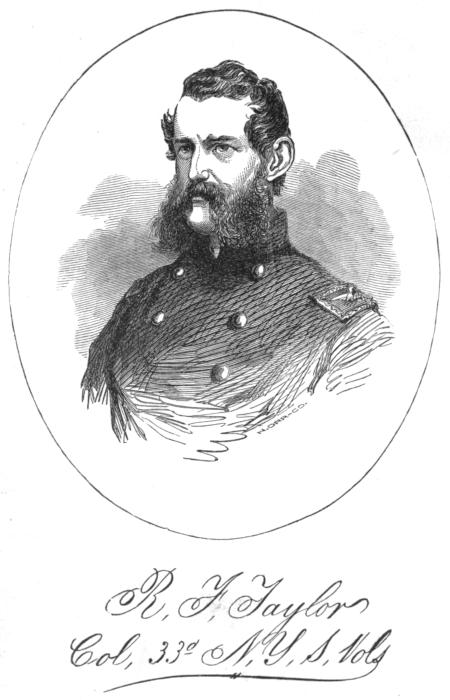
- Colonel—Robert F. Taylor, Rochester.
- Lieutenant Colonel—Calvin Walker, Geneva.
Resigned at Camp Lyon.
- Major—Robert J. Mann, Seneca Falls. Resigned
at Camp Griffin.
- Adjutant—Charles T. Sutton, New York City.
Resigned at Hagerstown.
- Quarter-Master—H. L. Suydam, Geneva. Resigned
at Camp Lyon.
- Chaplain—Rev. G. N. Cheney, Rochester. Resigned
at Camp Lyon.
- Surgeon—T. Rush Spencer. Resigned at Camp
Granger.
- Assistant Surgeon—S. S. Mulford, Cherry Valley.
Resigned at Stafford Court House.
The regiment was designated as the Thirty-third
New York State Volunteers, and assigned to
barrack number five, at Southport, where it remained
until the departure for Washington.
The entire change in the mode of life occasioned
some uneasiness, at first, on the part of the men.
They were not made up of the refuse material of
our large cities, “the scum that rises uppermost when
the nation boils,” but had come from homes supplied
with every comfort. A few days, however, served
to inure them to the change, and they learned to
sleep soundly in the rude hammocks, and thrive
on the plain bill of fare.
As a general thing they were supplied with
wholesome and nutritious food; but an occasional
oversight would occur, when, woe to the unlucky
purveyor. On one occasion some meat was sent to
them, which, imparting a suspicious odor to their
olfactories, the boys immediately collected, and
bearing it away to a prepared receptacle, deposited
the stuff with all the funeral pomp and ceremony
which formerly attended the burial of Euclid at
Yale College. The funeral oration abounded in
not the most complimentary allusion to the Commissariat,
who, improving on the wholesome advice
administered, ever afterwards furnished the Regiment
with beef that would pass muster.
The principal event connected with the sojourn
of the Thirty-third here, was the reception of a
splendid banner from the patriotic ladies of Canandaigua.
The Regiment being formed into a hollow
square, Mrs. Chesebro, of Canandaigua, stepped forward
and presented the flag to Colonel Taylor, in
the following felicitous remarks:
“Colonel Taylor, and Members of the Ontario
Regiment: In behalf of the wives, mothers and
daughters of Canandaigua, I ask your acceptance of
this Regimental Banner. On the one side is the
coat of arms of our noble Empire State; on the
reverse, the Seal of old Ontario, adopted by your
forefathers shortly after the Revolution, in 1790.
And who—seeing the sudden transformation of her
peaceful citizens into armed soldiers—can doubt
the loyalty and patriotism of the men of Ontario?
Soldiers! in assuming the name of a time-honored
county as the bond of union for this Regiment, you
assume to emulate the virtues which characterized
the pioneers of civilization in Western New York,
and like them, let forbearance and moderation
actuate your motives and temper your zeal. Let
the thought that brave hearts at home, have, with
more than Roman heroism, parted with those most
dear to them, inspire each soul to acts of courage,
and nerve each arm to deeds of daring. And
though ‘the pomp and circumstance of war’ are,
to woman’s timid nature, but other terms for death
and desolation, this banner is the assurance of our
sympathy with the cause of Liberty and our Country.
Bear it forth with you in the heat of battle,
where each soldier may fix his eye upon it, and if it
comes back riddled with bullets and defaced with
smoke, we shall know that a traitor has answered
with his life for every stain upon it. Bear it forth,
as you go, followed by our best wishes, and our
earnest prayers; and may the God of Battles preserve
and bless you, and crown your efforts and
those of all our brave defenders of the stars and
stripes with speedy and signal victory! Take it,
and may God’s blessing go with you and it.”
Colonel Taylor responded:
“Mrs. Chesebro, and Members of the Committee
from Canandaigua: I thank you most heartily for
the beautiful gift which you have presented to the
Thirty-third Regiment. It shall be most gratefully
prized as a token of the kind interest and loyalty of
the ladies of Canandaigua; and I promise that it
shall never be dishonored or disgraced. But, unfortunately,
I am not much given to talking; my
business lies in another direction; and I am willing
to let the acts and doings of the Ontario Regiment
speak for me. I have the pleasure of introducing to
you the Chaplain of the Thirty-third, the Rev. Mr.
Cheney, who will address you more fully.”
He then introduced Chaplain Cheney, who addressed
Mrs. Chesebro and the delegation accompanying
her, as follows:
“I think that I hardly need an introduction to
those who hail from Canandaigua; and although I
might well wish that the part I now undertake to
discharge, had been conferred upon one better able
to do justice to the occasion and the theme, yet,
belonging as I do by birth and early associations to
Ontario County, the task is to me one of pleasantness.
And when I strive, as I now do, to return
most heartfelt acknowledgments to the ladies of
Canandaigua for this token of interest and confidence
in our Regiment, I only strive to utter the
sentiment which fills every soldier’s breast this
moment.
“It is an old proverb, and one which has been
more than once graven on the warrior’s shield “not
words but deeds,” and I would be mindful of the
spirit of the saying; and yet I hazard nothing in
assuring the patriotic women of Canandaigua that
they shall never see the day when they will regret
the confidence which they have placed in the men
of the Thirty-third. It may be, that in the fortunes
of war no opportunity will be given them of great
distinction, and I cannot promise for them that
under these colors they shall win bloody fields and
achieve splendid victories. I cannot promise in
their behalf, feats of arms which future poets shall
sing, and future historians record; but I can, and I
do here pledge them, never, in camp or in field, to
bring disgrace on this banner, nor on the name
‘Ontario’ which its folds display. I cannot promise
you a glorious and safe return of this Banner,
but I think that I can, in behalf of every man in
these ranks, declare that death shall be welcome
sooner than its dishonor. Storms may disfigure it,
shot may pierce and rend its silken folds, brave blood
may wet and stain its blue and gold, but the men of
the Ontario Regiment will guard it with their lives;
and their arms shall be nerved, and their souls inspired,
not only by the love of their imperilled
country, but also by the remembrance of the confidence
and expectation which the gift implies.
They will guard it. They will fight for it, not
only because it is entrusted to their keeping by
loyal women, but also because it comes to them
from that beautiful old town which never yet has
been dishonored by a traitor-son, but which has
been famous in all the land as the home of Spencer,
and Howell, and Sibley, and Worden, and Granger,
and others whose names are part of the history of
our State and Country.
“Perhaps we do not appreciate the part that
woman bears in every great struggle for national
existence. We are too apt to consider all as achieved
by the work and sacrifice of men. And yet, noble
and heroic as they are who go forth to battle for the
right—not less noble and heroic are their loved ones,
mothers, sisters, wives, who give them up in the
hour of need, and who at home, without surrounding
excitements to sustain them, without any prospect
of renown to reward them, watch, labor and
pray to the God of Hosts in behalf of that cause
for which they have bravely but tearfully risked
their heart’s dearest treasures. Who can estimate
the influence of loyal women in our country’s
present struggle? Not the less potent in that it is for
the most part unobtrusive and beneath the surface;
an influence manifested not in bloody smiting, but
in humble labors to alleviate the necessities and
miseries of war, in words and acts of inspiring
encouragement.
“Bear, then, to the ladies of Canandaigua our
heartfelt gratitude. Tell them that their trust shall
not be dishonored. Tell them that their gift shall
not be in vain, but that by its influence, cheering on
our men to true and loyal heroism, it will be gratefully
remembered and cherished as one of the powers
and instrumentalities by which, we trust to God,
that ere long from the rock-ribbed coast of Maine to
the Keys of Florida,
‘The Star Spangled Banner in triumph shall wave,
O’er the Land of the Free and the Home of the Brave.’”
The Elmira Cornet Band then discoursed a patriotic
air, after which the Regiment returned to the
barracks and partook of a sumptuous repast, provided
by the citizens of Elmira.
This beautiful banner, which has ever been the
pride of the Regiment, was made of the finest blue
silk, bearing upon one side the Coat-of-Arms of the
State of New York, and on the reverse the Seal of
the County of Ontario, adopted in 1790. Over this
seal appeared in bold gilt letters, the words: “Ontario
County Volunteers.” Surmounting the staff
was a highly finished carved Eagle, with spread
pinions—the whole forming one of the most elegant
battle-flags ever wrought by fair hands.
Six hours were allotted each day to drilling,
though, owing to the absence of arms, the men were
confined, during the entire time of sojourn at
Elmira, to the rudimentary principles of the manual.
Books, newspapers, and other reading material, purchased
and contributed by various benevolent associations,
whiled away many hours which would
otherwise have hung heavily.
Meanwhile our forces were being massed on the
Potomac, and the men became anxious to depart for
the seat of war. They had enlisted to fight the
rebels at once, and, unexperienced as they were
in military matters, could not understand the
necessity of devoting so much time to preparation.
Not that they chafed under discipline, but longed to
be up and at the miscreants who had dared to fire
on their country’s flag, and were then menacing
its capital.
Friday, July 3d, the Regiment was drawn up in
front of the barracks, and Captain Sitgreaves, a
regular officer, proceeded to muster it by companies
into the United States’ service for two years, dating
from May 22d, the time at which it was organized.
All those who desired to do so, were permitted to
visit their homes on the 4th, with the understanding
that they should return immediately. Arms and
equipments were for the first time furnished on the
6th and 7th, and preparations made for an immediate
departure to Washington, via Harrisburg. A
long train of freight and cattle cars were drawn up
to receive the men, but Col. Taylor declined to
“embark” his command in any such vehicles,
and passenger cars were furnished in their stead.
CHAPTER III.
Departure for Washington.—Patriotism of the Williamsport Ladies.—Arrival
at the Capital.—Camp Granger.—Destroying a Liquor
Establishment.—“Cleaning-out” a Clam Peddler.—Review by
Governor Morgan.—First Death in the Regiment.—First Battle
of Bull Run.—Changes among the Officers.
About noon on Tuesday, the 8th, the Companies
marched down to the depot, preceded by the Elmira
Cornet Band, which had been attached to the Regiment.
Two hours later they moved away, amidst
tremendous cheering from the assembled multitude,
waving of handkerchiefs, throwing of bouquets, &c.
On reaching Williamsport, Pa., the ladies of
the place crowded around the cars, showering
oranges, apples, cakes and other edibles upon
the men, filling their canteens with coffee, and in
other ways displaying their patriotism and hospitality.
They will long be held in grateful remembrance
by the Regiment. Passing through Harrisburg
the train reached Baltimore about noon, the
men marching through the streets with fixed
bayonets to the Washington Depot.
When within about fifteen miles of Baltimore,
some fifty of the officers and men, who had gone in
search of water on the stoppage of the train, were
left, much to their own chagrin and the amusement
of the Regiment. Arriving in Washington at three
o’clock P.M., the Companies formed and proceeded
down Pennsylvania Avenue to the various quarters
assigned them. It rained fiercely that afternoon,
and they were glad enough to get under shelter,
without waiting to gratify their curiosity by an
inspection of the Capitol buildings.
The next day, Wednesday, they were marched out
on Seventh Street, two and one-half miles from the
city, to the spot designated for their encampment,
which was named “Camp Granger,” in honor of Gen.
John A. Granger, Esq., of Canandaigua, who had
interested himself much in behalf of the Regiment.
This was the first experience of most of the men in
the art of castramentation, and many were the droll
incidents which occurred in connection with the
pitching of the tents. After repeated trials, however,
they were all satisfactorily adjusted.
The habitations completed, drilling was the next
thing in order, which, together with target-shooting,
scouting, and mock skirmishing, was kept up from
day to day. The first lessons in “guard running”
were learned here, many of the men managing to
escape to the city, under cover of night, and return
without detection before the sounding of the morning
reveille. As a general thing they were temperate
and abstemious in their habits, manifesting their
disrelish for ardent spirits, by destroying on one
occasion a liquor establishment which had been
opened on the grounds. There were some, however,
who, thinking it necessary to partake of their
“bitters,” would smuggle liquor into camp, bringing
it in in their gun barrels, or by some other ingenious
means.
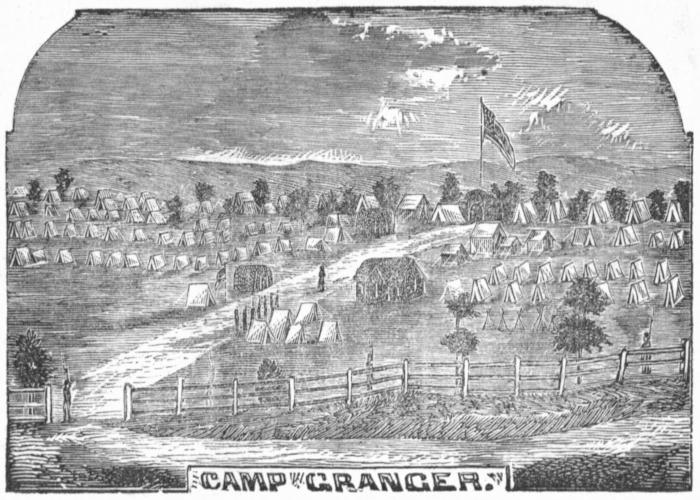
CAMP GRANGER.
One afternoon a clam peddler was so imprudent as
to leave his wagon for a few moments within the
camp enclosure. A mischievous member of Company—observing
this, cautiously removed the end
board, and, mounting the driver’s seat, started the
horse off at a rapid pace, scattering the bivalves
along the ground in front of the tents for several
rods. All the boys were heartily regaled on clam
soup that night, greatly to the discomfiture of the
peddler, who ever afterwards steered clear of the
Thirty-third. Many other incidents of a similar
character served to relieve the monotony of camp
life.
Governor Morgan inspected the Regiment on one
occasion. Sickness, arising from change of climate
and damp weather, had thinned out the ranks
to some extent, but they made a fine appearance
while passing in review before him, and the
Governor expressed himself highly pleased with
their morale and general condition. Frequent visits
were received from members of the Sanitary Commission,
who made contributions of various articles
from time to time.
The first death in the Regiment occurred here.
E. Backerstose, a member of Company H, was
killed by the accidental discharge of his gun. The
remains were forwarded, in charge of some of his
comrades, to Geneva, where his parents resided.
It was while the Regiment was encamped at
Camp Granger that the first battle of Bull Run
was fought, July 21st. From sunrise until sunset,
through the long hours of that memorable Sabbath
day, the booming of cannon could be distinctly
heard in the distance. Every rumor that reached
the city was conveyed to and circulated through
the camp, producing the most feverish excitement
on the part of the men, and an eager desire to cross
over the Potomac and participate in the conflict.
Towards evening it appeared as if their wishes were
to be gratified, the Thirty-third, together with several
other regiments, receiving marching orders. All
sprang with alacrity to their places, and moved off in
the direction of Long Bridge. On reaching the Treasury
Department, however, the orders were countermanded,
and the men returned to camp, uncertain
of the fortunes of the day, fearful of what the morrow
would bring forth.
What followed the unhappy termination of the
engagement at Manassas is familiar to every one.
The Thirty-third shared in the universal gloom
which for a time settled, down upon the nation.
Instead, however, of occasioning despondency and
despair, the Bull Run defeat furnished an additional
incentive to action, and the soldiers impatiently
bided their time. Captain Aikens, of Company
C, resigned here, and was succeeded by First
Lieutenant Chester H. Cole. Lieutenant Schott,
Company C, was succeeded by L. C. Mix, Commissary
Sergeant; John Connor, of Company E, and
William Riker, died of disease.
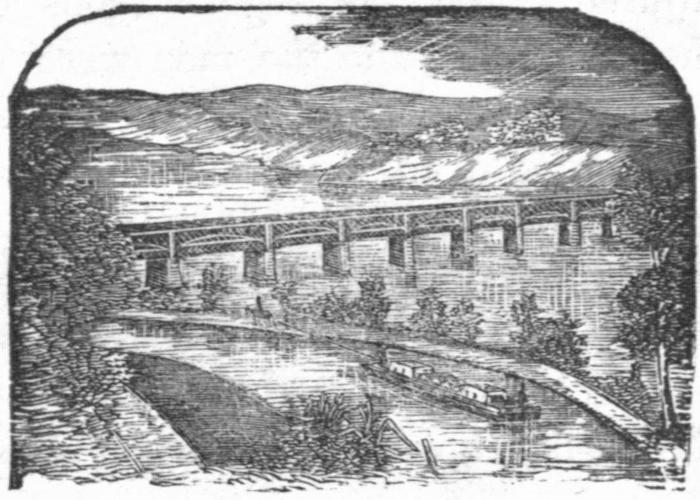
CHAIN BRIDGE.
CHAPTER IV.
Removal to Vicinity of Chain Bridge.—Upsetting of Ambulances.—The
Regiment Brigaded.—Frequent Alarms and Reconnoissances.—Reviewed
by General McClellan.—Crossing of the
Potomac.—Forts Marcy and Ethan Allen.—Formation of
Divisions.—Colonel Stevens.—First Skirmish with the Enemy
at Lewinsville Camp.—General Brooks.—General Davidson.—The
Seventy-seventh New York added to the Brigade.—A
Novel Wedding in Camp.—Circulating a Temperance Pledge.—Battle
of Drainesville.
Thursday, July 6th, the Regiment broke camp,
and proceeding through Georgetown, along the
River Road, took up a new position near the Reservoir,
about one-half of a mile from Chain Bridge.
This spot had previously been designated as
Camp Lyon, after the lamented hero of Springfield,
Mo. Two heavy four-horse ambulances, containing
the sick, were accidentally precipitated down a steep
embankment, while moving to the new camp.
Fortunately no one was killed, though several were
severely injured. The baggage wagons did not
come up the first night, and the men were compelled
to sleep in the open air, without blankets. A
report being brought in that the rebels were advancing
on the Maryland side of the river, a detachment
of one hundred men, consisting of ten from
each Company, started out on a reconnoissance
about one o’clock in the morning. Discovering no
signs of the enemy, however, the force returned at
daylight.
The Thirty-third was here for the first time
brigaded, being placed, together with the Third
Vermont and 6th Maine, under the command of
Colonel, since General, W. F. Smith. The Second
Vermont was afterwards attached to the Brigade.
The time was principally employed in drilling,
constructing rifle-pits, and a redoubt mounting
three guns. There were repeated alarms during
the stay here.
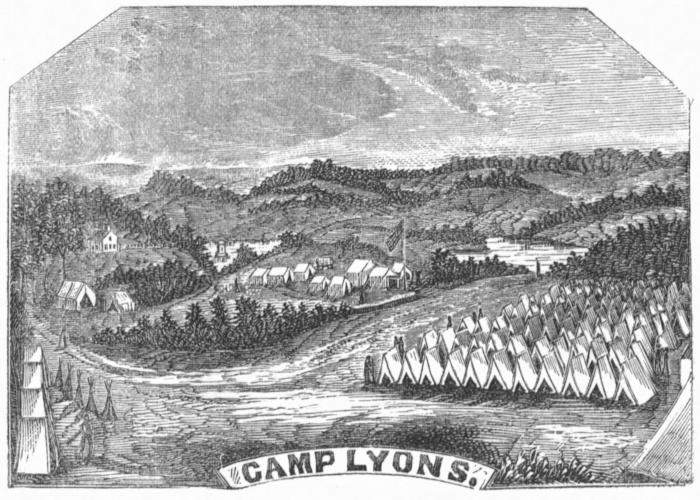
CAMP LYONS.
On one occasion word was received from General
McClellan that the enemy had crossed the Potomac
in large force, and were advancing upon the city.
General Smith immediately ordered out his command,
posting the Thirty-third behind a stone wall,
where they remained until the returning cavalry
scouts reported the alarm to be false. During the
latter part of the month one Company crossed the
Long Bridge, on a reconnoissance, with a section of
artillery and fifty cavalry, and proceeding on the
Falls Church road, thence to Lewinsville, drove
the rebel cavalry pickets to their camp at Vienna,
arrested a prominent secessionist, and returned by
way of Langley, reaching camp at sunset.
General McClellan, accompanied by President
Lincoln, Secretaries Seward, Chase and Cameron,
reviewed the Brigade on the 29th of August.
The following changes took place while here:
Henry N. Alexander appointed Quarter-Master,
vice H. S. Suydam, resigned.
Sylvanus Mulford, promoted to full Surgeon, vice
T. R. Spencer, promoted to Brigade Surgeon.
Patrick Ryan, 2nd Lieutenant of Company K,
resigned, succeeded by Edward Cary, who was immediately
detailed to General Smith’s staff.
Peter Weissgreber, Co. G, died in camp.
On the 3rd of September a detachment of fifty-two
men, from Companies C and D, crossed the
river, and proceeding as far as Langley, threw out
skirmishers to the right and left of the road. During
the afternoon an alarm was created by the
pickets coming upon General Porter’s, stationed
further to the left, who were mistaken for rebels.
They were all immediately withdrawn, with the
exception of three members of Company D, who
refused to leave, in their eagerness to get a shot at
the supposed grey-backs. This mistake provoked
considerable merriment, although it resulted very
unfortunately in the shooting of the most valuable
spy in the employ of the government, who imprudently
ventured beyond the line of skirmishers.
About eleven o’clock on the same evening the
entire Brigade crossed over the Long Bridge. On
reaching the Virginia shore the Thirty-third filed
off in the fields at the left, Companies A, F and
D being deployed in front, as skirmishers, for a
mile or more. The remainder of the Regiment lay
upon their arms all night, with the exception of a
small party employed in cutting away timber which
interfered with the artillery range.
Other troops, to the number of ten thousand,
likewise crossed over that night, and eighteen
hundred axes were immediately set to work in
felling the dense forest of half-grown pines, where
forts Marcy and Ethan Allen now stand. This
location was christened Camp Advance. Numerous
fortifications were constructed, and in three
days’ time heavy siege guns mounted. The troops
always slept upon their arms, ready to repel an
attack at a moment’s notice. One night a severe
rain storm washed several of the knapsacks belonging
to the Thirty-third into a gully running near
by, filled the band instruments with water, and
drenched through to the skin all who were not
provided with shelter. The arrival of tents on the
15th occasioned much joy among the men.
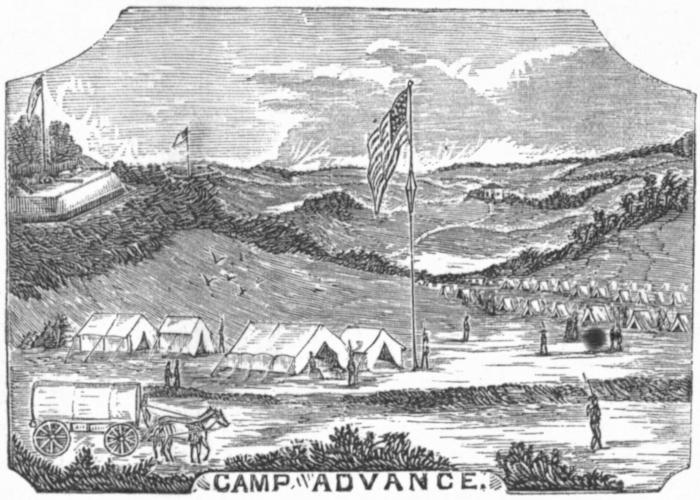
CAMP ADVANCE.
During the same day the æronauts reported the
enemy as moving in large numbers, and the entire
army slept on their arms. The “movement”
proved to be merely a raid for the purpose of destroying
“Hall’s House,” and property belonging
to other Unionists. Lieutenants Mix and Gifford
were sent north from here on recruiting service, and
D’Estaing Dickinson, of Watertown, was appointed
Assistant Surgeon.
Hitherto the army had been organized into
Brigades simply. Divisions were now formed, and
the Thirty-third was attached to the Third Brigade,
commanded by the lamented Colonel Stevens, and
consisting of the Forty-ninth and Seventy-ninth
N. Y. and Forty-seventh Pa. General Smith was
appointed commander of the Division. This change
consummated, Camp Advance was abandoned for
Camp Ethan Allen, which was taken possession of
September 24th. The men were employed in
working on Fort Allen, slashing timber, performing
picket duty, &c., &c. A visit from the Paymaster
was made here, who distributed several months’ pay
among the troops. Colonel Stevens, in a special
order, prohibited profanity in his command.
It was while lying at Camp Ethan Allen that
the Thirty-third engaged in its first skirmish with
the enemy.
On the morning of September 29th, Smith’s entire
Division moved up the Lewinsville Turnpike, to
attack, as was generally supposed, the rebel force at
Vienna. On arriving, however, at Makell’s Hill,
between Langley and Lewinsville, the men were
formed in line of battle, and Mott’s battery planted in
front, supported by the Thirty-third. Other batteries
were also unlimbered, and placed in position. Co.
B., together with twenty-five New Hampshire sharp
shooters, were deployed in front as skirmishers. After
firing a few shots—from Mott’s battery—at and
dispersing a squad of rebel cavalry in the distance,
the force moved forward to the edge of a dense pine
forest. Taking seven men with him, Lieut. Draime
proceeded through the thicket, to reconnoitre the
country beyond, and was, not long after, followed by
the entire Company, under Captain Corning. Several
herd of cattle were captured, and a large
amount of booty secured, at the residence of Captain
Ball, the rebel cavalryman who was taken
prisoner at Alexandria, and afterwards violated his
parole. Great numbers of wagons were in the
meantime sent out, in various directions, to secure
forage. Very suddenly, however, the rebels opened
a warm artillery fire along the whole line, which
was responded to by our batteries. Many of the
enemy’s missiles struck among the Thirty-third,
but fortunately no one of the regiment was injured
during the entire skirmish. Seeing Lieutenant
Draime and his men at the Ball residence, they
shelled them furiously, but did not prevent their
carrying off a good supply of honey, which was
highly relished by them and their comrades.
Having obtained a large amount of spoil, the whole
force returned to camp. Lieut. Col. Walker resigned
at Camp Ethan Allen, and Capt. Corning was
appointed to his place. He was succeeded by Lieut.
White, and he, in turn, by 2d Lieut. Draime.
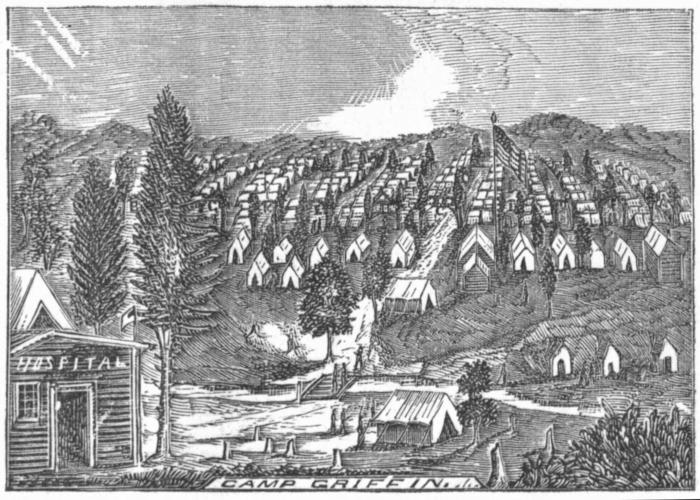
CAMP GRIFFIN.
On the 10th of October, the whole Division again
moved out to Makell’s Hill, and formed in line of
battle, skirmishers being thrown out in front. After
remaining here several hours, the force fell back
to Langley, and from there proceeded east on the
Kirby road to “Big Chestnut.” In the afternoon of
the next day they advanced half a mile further, and
went into camp, at what has since been known as
“Camp Griffin,” where the Thirty-third remained
until the final advance was made.
On the second day after locating here, sixty men,
under command of Capt. Platner, proceeded on a
reconnoissance beyond the picket line, and falling in
with some rebel cavalry, killed two of the number;
Lieut. White shooting one of them dead. The fleeing
enemy were pursued until they reached the
cover of a dense thicket, when, being strongly reinforced,
they turned upon the pursuing party, who
escaped back in safety to camp by closely following
the sinuous windings of the Virginia rail fences.
On the same afternoon Co. E. had a skirmish with
the rebel cavalry, killing several of them in the
woods where they were engaged. Some of the
other Companies hastened to its support, but did not
reach the ground in time to participate in the melée.
This was the last of the picket firing before Washington.
The men were employed here in drilling,
“slashing,” reviews, sham-fights, and picket duty.
Frequently they proceeded out on picket at two or
three o’clock in the morning, when the mud was
knee-deep, often remaining for thirty hours or more
without being relieved.
During the month of October, Col. Stevens left
for the south, taking the Seventy-ninth Highlanders
with him. Col. Taylor assumed command of the
Brigade, until Gen. Brennan was sent to take charge
of it. Not long after he was likewise ordered south.
The Forty-seventh Pennsylvania accompanied him,
the Eighty-sixth New York taking its place. Gen.
Brooks now commanded the Brigade for a few days,
at the end of which time General Davidson, a
loyal Virginian, from Fairfax County, was placed
over it. Previous to the outbreak he had been a
Major in the regular cavalry service, and was a brave
and popular officer. He rode a spirited mustang,
presented to him by Kit Carson, while serving on
the western frontier. The Eighty-sixth New York
was soon sent back to Casey’s Division, and the Seventy-seventh,
raised in the vicinity of Saratoga, succeeded
it. As an instance of the great cutting down
of the impedimenta of our armies, this regiment then
employed one hundred and five double wagons for
transportation, where only five are now used for
that purpose. The same can be said of most of
the commands.
A novel wedding came off one night at the Chaplain’s
quarters, the happy couple being a private and
a laundress belonging to Company C. The affair
was conducted with all the ceremony the circumstances
of the case would permit of, and to the satisfaction
of the guests, who were regaled with wedding
cake, wine, and other refreshments, decidedly palatable
after the long experience on “hard tack.”
While the after-festivities were happily progressing,
the fortunate bridegroom suddenly brought them to
a close by grasping the hand of his “fair one,” and
disappearing in the direction of his domicile, with a
general invitation to “call round.” The wife remained
with her husband until the battle of Antietam,
when, he being wounded, they both departed
for the North.
About $400 were contributed by the various Companies
for a chapel-tent and reading-room. A temperance
pledge, circulated among the men, was
signed by a large number, many of whom have
kept it until this time. On the day of the battle of
Drainesville, the long roll beat, and the Brigade proceeded
out to “Freedom Hill,” where it was drawn
up in line of battle to intercept the rebels, should
they, in case of a defeat, attempt to escape in that
direction. The enemy not appearing, the Regiments
returned to camp at sunset.
At the time of the Ball’s Bluff affair they were
furnished with three days’ rations preparatory to
again moving, but were not called out.
CHAPTER V.
Grand Review of the Army, at Bailey’s Cross Roads.—Pleasant
Acquaintances formed.—Changes and Deaths at Camp Griffin.—Dissatisfaction
at the General Inactivity.—President’s War Orders.—Gen.
McClellan’s Plans and Correspondence with the President.
The grand review by Gen. McClellan took place
while the Thirty-third was encamped at Camp Griffin;
the troops, over seventy thousand, were assembled
at Bailey’s Cross-Roads, early in the day, to
await the arrival of their Chief. Towards noon
Gen. McClellan appeared, accompanied by the President
and other distinguished personages, and as the
party rode along in front of the line, cheer after
cheer rent the air. Having assumed a stationary
position on an elevated spot, the various commands
passed in review before them. The day was mild
and beautiful, the roads in good condition, men in
fine spirits, and the review presented a most imposing
spectacle, surpassing anything of the kind ever
before witnessed in America. Surgeon Dickerson
was unfortunately thrown from his horse by a collision
on this occasion, receiving a severe concussion.
The Surgeon attending pronounced the case a fracture
of the skull producing compression of the brain,
when a Herald attaché, standing by, added: “died
in a few moments,” and a telegram was published to
that effect in the Herald of the following day.
During their stay here, the officers and men
made the acquaintance of several interesting families
in the vicinity. Among them was the “Woodworths,”
residing on the picket line. Mr. W., who
originally moved from Oswego County, New York,
had suffered much at the hands of the enemy. After
the first battle of Bull Run, the rebels entered
his house, robbing it of many valuables, and conducted
him to Richmond, where he was imprisoned.
Being released in the following October, he returned
to find his once happy home nearly in ruins. The
officers spent many pleasant hours in the society of
his entertaining daughters, and in listening to the
old man’s narrative of the wrongs inflicted upon
him for his Union sentiments. All the members of
the family apparently vied with each other in their
efforts to render the sojourn of the Thirty-third in
that locality as pleasant as possible.
The following changes occurred at Camp Griffin:
Major Robert H. Mann resigned; succeeded by
John S. Platner, Captain Co. H, who in turn was
succeeded by First Lieutenant A. H. Drake. Chaplain
George N. Cheney resigned; succeeded by Rev.
A. H. Lung, Pastor of the First Baptist Church
Canandaigua. John R. Cutler, Captain Co. D, succeeded
by Henry J. Gifford, 1st Lieutenant, transferred
from the Thirteenth New York. Samuel A.
Barras, 2d Lieutenant Co. D, resigned, George T.
Hamilton, 1st Lieutenant Co. F, resigned. Henry
G. King, promoted from 2d to 1st Lieutenant Co.
F, vice G. T. Hamilton, resigned. Henry A. Hills,
promoted to 2d Lieutenant, from 1st Sergeant, vice
H. G. King, promoted. George W. Brown, promoted
from ranks to 1st Lieutenant Co. D, vice H.
J. Gifford, promoted. Jefferson Bigelow, promoted
from 1st Sergeant to 2d Lieutenant Co. D, vice S.
A. Barras, resigned. John W. Corning, appointed
2d Lieutenant Co. B, vice H. J. Draime, promoted.
Prior to his departure, the Chaplain was presented
with an elegant gold watch, as a testimonial of the
regard entertained for him.
The following deaths occurred from disease:
Company B, David Hart; Company C, Corporal
George A. Langdon; Company C, Pierre Outry;
Company E, Peter Zimmer; Company F, George E.
Prentice; Company F, Gardner Bacon; Company
F, Irwin Van Brunt; Company G, Patrick Conner;
Company G, Wm. Cooper; Company H, James H.
Gates; Company I, Archibald Coleman; Company
K, Augustus Murdock.
William Humphrey, Company J, and Joseph
Finnegan, Company K, were accidentally killed.
The long inactivity which prevailed in all our
armies was as unsatisfactory as it was inexplicable to
the country. Day after day, week after week, and
month after month, brought the same story, “All
quiet along the lines,” until the patience of the people
became well nigh exhausted, and they began to
clamor for the removal of this and that leader, declaring
that they all
“Like peasant foot-boys did keep the walls
And dare not take up arms like gentlemen.”
On the 19th of January, however, the President
issued orders for a general movement of all the Federal
forces; one result of which was the series of victories
at the West, which so revived the drooping
hopes of the nation. Twelve days afterwards, he
issued a special order directed to the Army of the
Potomac, which had not yet moved. It read as
follows:
Executive Mansion, Washington, January 31st, 1861.
President’s Special War Order No. 1.
Ordered, that all the disposable force of the Army
of the Potomac, after providing safely for the defence
of Washington, be formed into an expedition for the
immediate object of seizing and occupying a point
upon the railroad south-westward of what is known
as Manassas Junction; all details to be in the discretion
of the General-in-Chief, and the expedition to
move before or on the 22d day of February next.
ABRAHAM LINCOLN.
General McClellan replied, in writing, to this
order, objecting to the plan which it proposed, as
involving “the error of dividing our army by a very
difficult obstacle (the Occoquan), and by a distance
too great to enable the two portions to support each
other, should either be attacked by the masses of the
enemy.” In conclusion he expressed himself desirous
of moving against the enemy, either by the way of
the Rappahannock or the Peninsula. This reply
explains the reason of his having so long delayed
operations. His aim was to mass together a large
army, thoroughly equipped and drilled, and leaving
a sufficient force to guard Washington, throw the
remainder of his army suddenly in the enemy’s rear,
or hurl them swiftly upon the rebel capital, before
they could move to its support.
The President did not agree with his young General,
as will be seen from the following communication,
which he addressed him in reply:
“Executive Mansion, Washington, February 3d, 1862.
“My Dear Sir:—You and I have distinct and different
plans for a movement of the Army of the
Potomac; yours to be down the Chesapeake, up the
Rappahannock to Urban, and across land to the
terminus of the railroad on York river; mine to
move directly to a point on the railroad south-west
of Manassas. If you will give me satisfactory answers
to the following questions, I shall gladly yield
my plan to yours:
“1. Does not your plan involve a greatly larger
expenditure of time and money than mine?
“2. Wherein is a victory more certain by your
plan than mine?
“3. Wherein is a victory more valuable by your
plan than mine?
“4. In fact, would it not be less valuable in this—that
it would break no great line of the enemy’s
communication, which mine would?
“5. In case of disaster, would not a safe retreat
be more difficult by your plan than by mine?
“Yours, truly,
“A. LINCOLN.”
He afterwards, however, yielded to General McClellan.
Thus affairs stood, until the first week in
March, when the enemy were discovered to be retreating
from Manassas, and the grand advance
commenced.
CHAPTER VI.
Advance of the Army of the Potomac.—The Thirty-third taking
up the line of march.—Flint Hill.—General McClellan decides to
move on Richmond by way of the Peninsula.—Embarkation of
the Thirty-third at Alexandria.—Embarkation Scene.—Mount
Vernon.—The Monitor.—Arrival at Fortress Monroe.—Agreeable
change of the climate.—Hampton.—Reconnoisance to Watt’s
Creek.—Rebel Epistolary Literature.—Bathers shelled by the
rebel gunboat Teaser.—Building a Redoubt.
On the 10th of March the Army of the Potomac
unfurled its banners, and began the forward march.
Comprised of legions of brave men perfected in discipline
through long months of drill; supplied with
everything pertaining to the material of war, and
headed by a General the very mention of whose
name inspired to deeds of daring—in this grand
army were centred the Nation’s hopes. The long
delay was ended, the public pulse quickened, and
with light heart and elastic step the volunteer moved
away, confident that he moved to victory.
The Thirty-third took up their line of march at 3½
o’clock in the morning, while a severe rain-storm
was prevailing, which continued during the day, rendering
the roads almost impassable. Four and a half
hours were consumed in marching the distance of
two miles, and many of the wagons were stuck fast
in the mud before reaching Lewinsville. The brigade
encamped the first night at Flint Hill, on an
abandoned rebel site, having marched ten miles.
The men, weary, hungry, foot sore, and wet to the
skin, hailed with feelings such as they had never
before experienced, the orders to “halt, stack arms,
and encamp for the night.” The division remained
in this locality four days, being again reviewed by
their commander.
It was here that the men began to learn, for the
first time, to their chagrin and mortification, that
the enemy had retreated southward. After beleaguering
the capital, blockading the river, and keeping
our army at bay for more than six months, they had
quietly absconded, taking everything with them.
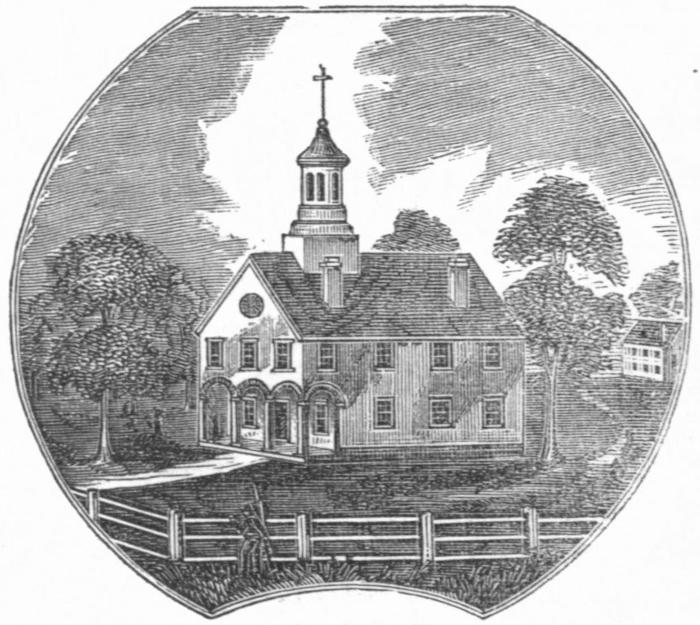
Fairfax Court House.
About this time, March 13th, General McClellan
convened a council of his Corps Commanders at
Fairfax Court House, informing them that he had
previously determined on moving forward towards
Richmond by the way of the Rappahannock; but
further deliberation had led him to abandon this
route for the one via Fortress Monroe. Thereupon
every preparation was made for transferring the
scene of operations to the Peninsula. The larger
portion of the army had proceeded no further in the
direction of Manassas than the Court House. A
small force, however, had advanced to the Rappahannock,
ascertaining that the country was clear of
rebels to that river.
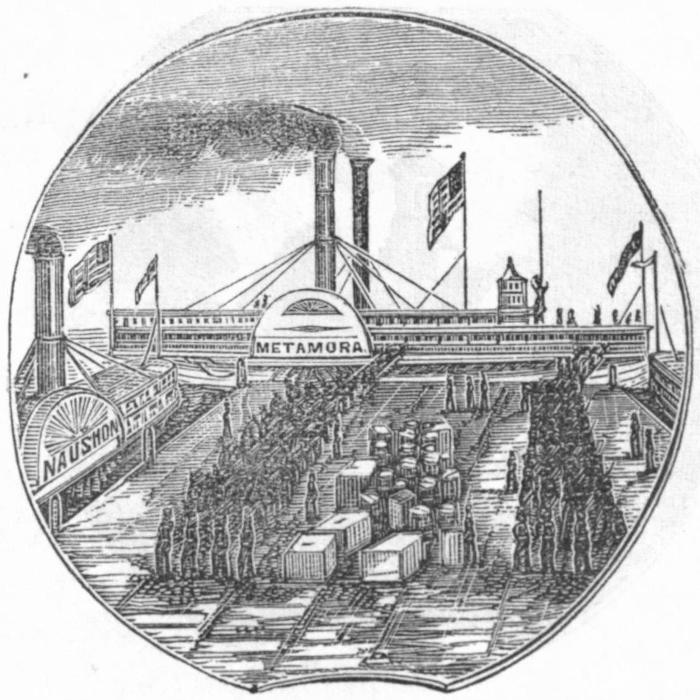
Embarkation at Alexandria.
On the 15th of the month General Smith’s division
resumed the line of march, and passing through
Fairfax, encamped at Cloud’s Mills, near Alexandria.
The Thirty-third remained here along with other
troops, until Sunday the 23d, when it marched to
Alexandria, and embarked on vessels for Fortress
Monroe. Six companies proceeded on board the
Metamora, previously employed on the Hudson
river; three on the Naushon, and the remaining
Company on another small steamer. The embarkation
scene was one which will long be remembered
by the participants.
Transports of every size and description were riding
in the river, or moored at the wharves, receiving
on board regiment after regiment. National ensigns
and banners appeared in every direction, flying from
the forests of masts, over forts in the distance, or
unfurled at the head of the regiments. Beyond the
city were visible long lines of glistening bayonets,
winding over hill and through dale as far as the eye
could reach, and the gentle breezes which blew from
the southward bore to the ear the music of a hundred
national bands. They steamed away at the
close of the day, amid tremendous cheering, waving
of handkerchiefs, and singing of the “red, white, and
blue;” the setting sun shimmering on the water; the
dark outlines of the capitol looming up in the distance.
All hands crowded the decks to catch a
lingering look of Washington, rebellious Alexandria,
and the surrounding region, where they had spent
the first months of their soldier-life.
Dropping down the river, the three steamers bearing
the Thirty-third lay off Fort Washington until
the next morning, when they “hove anchor,” and
started for Fortress Monroe. When opposite Mount
Vernon, the bells were tolled in memory of the illustrious
dead. The first of the Monitors, since lost off
the coast of North Carolina, lay at anchor further
down the river, and attracted much attention. So
diminutive, so insignificant in appearance, it seemed
impossible that this little “cheese-box” could be
so formidable an engine of destruction; able to blow
the largest man-of-war afloat into “one long porthole.”
Passing numerous barges, sloops, and other
water-craft, in the employ of the government, the
steamers reached Fortress Monroe at midnight, and
the troops disembarked at Old Point Comfort during
the following morning.
Forces belonging to General Heintzelman had
already arrived, and were encamped in the vicinity
of the fort. The change in the climate was very
perceptible as well as agreeable. Instead of the
bleak, cutting winds and unhealthy climate of Camp
Griffin, a warm genial south breeze was blowing,
and the mild, balmy atmosphere was alike bracing
and exhilarating. After the long confinement of the
more northern winter months, it was far from disagreeable
to be transferred to a spot where the peach
trees were in blossom, birds were singing, and
flocks sporting in green meadows.
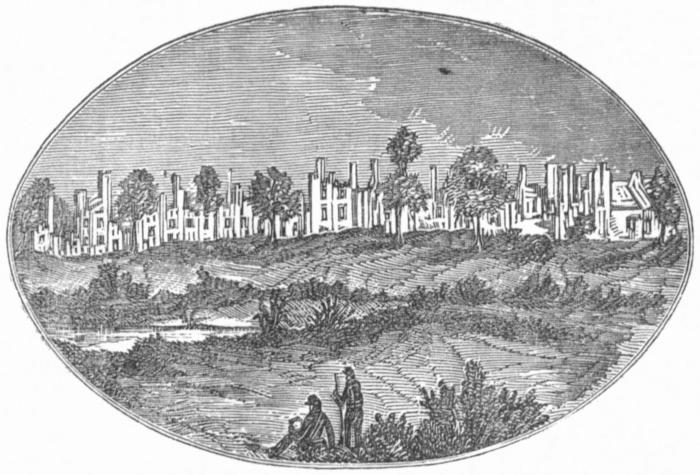
Ruins of Hampton.
On landing, the Thirty-third marched to the ruined
village of Hampton, and after tarrying a short
time to partake of refreshments, and examine the various
objects of interest, proceeded three miles beyond,
and encamped close to the James River. Prior to
leaving Washington, General Heintzelman had received
instructions from General McClellan, who did
not reach the Peninsula until the second of April,
to keep all the troops in the vicinity of the fort for
a few days, so that the rebels should have no idea
of the direction in which the army was to eventually
move, whether towards Norfolk or Yorktown. He
accordingly did so.
On the 27th reconnoitering parties were sent forward.
Smith’s entire division marched, without knapsack,
to Watt’s Creek, a small hamlet near Big
Bethel, where some rebel cavalry were discovered
and put to flight by a few shells from our artillery.
There were newly made camps and other evidences
of the recent occupation of the place by rebel infantry.
For the first time, the Thirty-third boys discovered
a batch of the rebel literature, which has furnished
so much amusement for northern readers during
the progress of the war. Little groups were collected
to listen to the reading of various documents,
including several tender missives, the writers of
which had evidently followed Voltaire’s advice for
writing love letters, “to begin without knowing what
you have to say, and end without knowing what you
have written.”
On the same day Gen. Hooker proceeded with his
command to Big Bethel, the enemy decamping when
he made his appearance. After remaining over night
at Watt’s Creek, sleeping on their arms, in the forest,
the troops of Smith’s division returned and encamped
about two miles north of Newport News. A
severe rain-storm set in after dark, and the men of the
Thirty-third awoke in the morning, to find everything
afloat. There was water enough within the encampment
to have easily floated a canoe, which of course
occasioned a general clearing out on the part of the
regiment.
Several severe cases of sickness arose from this
heavy freshet, and a Division Hospital was established
at Newport News, under charge of the Thirty-third
surgeon. A new and more elevated site, and nearer
the James, was immediately occupied.
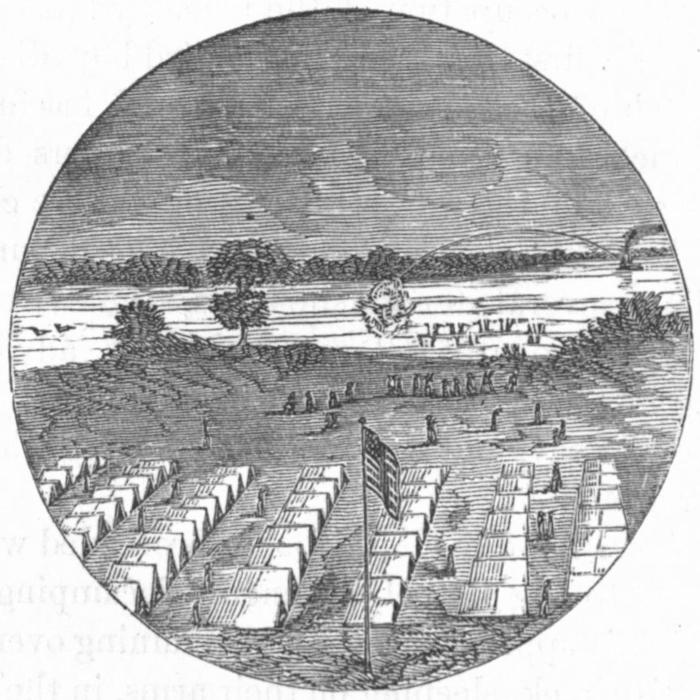
Rebel Gunboat Teaser.
The men were allowed to bathe daily in the river.
One afternoon, while so employed, the small rebel
Gunboat Teaser, afterwards captured and found to
be commanded by a younger brother of General
Davidson, ran down to within a mile and a half, and
commenced throwing shells at the bathers. The
sudden appearance of these unwelcome visitors in
their midst produced a general “skedaddle,” and the
men came running into camp as fast as their legs
would carry them. Some made their appearance in a
perfectly denuded state; others more fortunate had
managed to secure a shirt, while two or three came
in with simply cap and stockings on. This affair
created great merriment, and furnished a fruitful
theme of conversation for weeks afterwards. The
firing of the Teaser produced no effect beyond the
severe scare administered to the men.
Soon after the return of the regiment from
Watt’s Creek, two Companies proceeded again in
that direction to ascertain where the enemy’s picket
lines extended. They saw a few of the confederates,
who fled on their approach. The Thirty-third assisted
in building a log redoubt near the encampment, which
was named Fort Wright, in honor of Joseph Wright,
Esq., of Waterloo, K. Y. Scattered up and down the
James River for miles, were to be seen the remains of
elegant country seats and farm, houses, destroyed by
the rebel General Magruder at the time Hampton
was burned. The country on every side presented a
scene of ruin and desolation, conveying to the mind
a vivid impression of the wanton devastation of war.
After the lapse of a few days the Thirty-third was
sent, with the other regiments of Gen. Davidson’s brigade,
for the third time, to Watt’s Creek, and after
dispersing the rebel pickets, returned without loss.
CHAPTER VII.
Continued Arrival of Troops.—Advance of the Army of the Peninsula.—Arrival
of the Regiment at Young’s Mills.—An Aged
Contraband.—Lee’s Mills.—The Various Companies of the Thirty-third
ordered to the Front.—Caisson struck by a rebel Ball.—Continued
Firing of the Enemy.—Falling back of the National
Forces.—Heavy Rain Storm.—The Beef Brigade.—Enemy’s
Fortifications.—Troublesome Insects.—Night Skirmishing.—Celerity
of the Paymaster’s Movements.—Evacuation of Yorktown.—Early
information of the fact brought to Col. Corning
by Contrabands.—The Rebel Works taken possession of.
Troops continued to arrive in large numbers
from Washington, and on the 4th of April, the entire
army commenced moving in the direction of Yorktown,
appearing the next day in front of the enemy’s
lines. During the afternoon of the 4th the Thirty-third
reached Young’s Mills, which the enemy had
left in the morning.
Their position here had been a very strong one;
in addition to the natural defences of the place, they
had thrown up heavy earthworks, constructed seven
rifle pits, and placed four batteries in position.
Their quarters, which were taken possession of by
our men, consisted of wooden huts, snugly and compactly
built. An aged contraband was found running
the grist-mill, from which the place took its
name. The next day the march was resumed
through a heavily timbered region, and over roads
very much impaired by recent rains; the division
arriving in front of Lee’s Mills at noon.
Skirmishing and artillery firing immediately
commenced, and was kept up with but little intermission
for several days. In accordance with instructions
from Gen. Davidson, Col. Taylor sent, on
Saturday, Co. B., to do picket duty on the left.
The men advanced to within 150 yards of the enemy,
who were found to have three large forts in
addition to other fortifications. They remained out
all night, keeping up a running fire most of the time,
and having three of their number wounded. Co. A
relieved them on the following morning. Cos. D, E,
F, G, H, I, and K, were likewise posted as pickets,
and to C was assigned the duty of supporting sections
of Wheeler’s and Cowan’s batteries.
While so employed, one of the enemy’s cannon
balls, which were falling in every direction, struck
a caisson and exploded several of the shells in rapid
succession. At this juncture, an artilleryman,
running up, dashed a bucket of water over the remainder,
thereby preventing their explosion, to the
great relief of the cannoniers, as well as of the supporting
party. The artillery firing of the rebels,
which was kept up at intervals along the whole line,
killed but few of our men, though occasioning some
uneasiness by its terrible execution among the forest
trees. Saplings were snapped asunder like pipe
stems, while huge limbs severed from the tall oaks
were falling in every direction. Many trees of large
growth were completely perforated with solid shot,
or shattered by shell.
During this time Capts. Cole and Guion, with a
Volunteer force, made an important reconnoissance
beyond our picket lines, advancing very near to the
rebel works, from which they were fired upon.
In order to avoid the artillery and picket firing, it
was decided to have the forces of Gen. Smith fall
back for a short distance, where they would threaten
the enemy full as much, and at the same time be
less exposed. After the removal of the batteries
the various Companies of the Thirty-third withdrew
to the distance of a mile, being the last to leave the
front, where they had retained their respective positions
under the hottest of the enemy’s fire, for a
period of fifty-four hours, and lost in wounded Lieut.
Gale, Co. G, and several privates.
Exhausted from the want of sleep and sufficient
rations, the men sank down on the moist ground
that night, with no protection from the falling rain,
save that afforded by a few boughs and leaves. Officers
and privates were alike drenched through to
the skin, long before the dawn of day. They remained
here some three or four days.
Owing to the condition of the roads, it was found
impossible to bring up the supply trains. Two
hundred and fifty men were accordingly detailed
to proceed back and obtain rations. After several
hours’ absence they returned, each one bearing upon
his fixed bayonet a goodly piece of meat, and obeying
the facetious orders of the Lieut. Colonel to “shoulder
beef, present beef,” etc. Six barrels of meat
were thus brought into camp. The men were not
so exhausted but that they indulged in a hearty
laugh over this circumstance, and the detail was
ever afterwards known as the “Beef Brigade.”
On the 11th of April, the Brigade moved one
mile and a half nearer Yorktown, encamping
directly in front of the enemy’s fortifications, which
consisted, in addition to numerous other earthworks,
of a chain of forts, extending across the Peninsula
to James River. The time was employed here in
building corduroy roads, “slashing” timber, etc.
An innumerable army of insects, known under the
general appellation of wood-ticks, were very annoying.
They would burrow in the flesh of both
man and beast, and, regardless of the consequences,
“pinch” and pull away with all the tenacity of the
horse leech. One of the officers amused himself in
making a large collection of these troublesome
creatures, which he has brought home with him.
On the day that Gen. Smith made the unsuccessful
attempt to cross the Warwick River with the Vermont
troops, Davidson’s Brigade moved a mile and
a half further to the right, where it remained until
the evacuation of and advance upon Yorktown.
While here, frequent reconnoissances were made by
the Regiment. Parties detailed from the various
commands were employed every night in constructing
rifle-pits and other earthworks.
On the evening prior to the evacuation, a portion
of the Thirty-third assisted in the completion of a
large mortar-bed, and mounting of two heavy mortars,
which completely commanded the enemy’s
works directly opposite. Had they remained, these
two powerful engines of war would have made fearful
havoc among the rebels. This night-work was
attended with more or less firing on the part of the
enemy, which, however, produced but little effect,
in addition to the frequent turning out of the Regiments.
The Thirty-third was ordered under arms
three times during one night, when a heavy storm
was prevailing.
The Paymaster again made his appearance here,
and emptied his money bags in a remarkably short
space of time. Perhaps a remark he made to one
of the officers had some connection with his celerity
of movement: “Well, isn’t this a mighty exposed
condition.” It was indeed an exposed condition, the
enemy constantly tossing shells into our camp by
way of amusement, and to “stir us up,” as they
expressed it.
Troops had now arrived, to the number of a
hundred and twenty-five thousand, and the siege
was being conducted successfully, both on the right
and left. All the necessary preparations for the
storming of the rebel stronghold were nearly completed,
when, on the morning of Sunday, the 4th of
May, the game, much to the chagrin and mortification
of our Generals, was discovered to have flown.
The intelligence was first brought to the left
wing of the army by two contrabands. The fugitives
bringing the news came to the officer of the
picket line, the Lieut. Colonel of the Thirty-third,
before daylight, and stated that on the Thursday
evening previous the artillery had been removed;
on Friday the wagon-trains and a portion of the
troops, and that that night “they had all been leaving.”
They were immediately conveyed to General
Hancock’s quarters.
Men of straw were posted as sentinels on the ramparts,
and “Quaker Guns” had supplanted the
formidable artillery, which for weeks had rained
down its iron hail on the besiegers.
Not long after, the various Regiments commenced
crossing, and by noon the entire Division was over.
At the same time other portions of the army were
crossing at various points on the right, and General
Stoneman, with his cavalry and flying artillery, was
started in pursuit of the enemy. General Hooker
followed at supporting distance, with his Division.
Generals Sumner, Heintzelman and Keys’ corps, to
which Smith’s Division belonged, were also pushed
forward.
CHAPTER VIII. BATTLE OF WILLIAMSBURG, FOUGHT MONDAY, MAY 5.
After crossing Warwick Creek, Sunday, May 4th,
Smith’s Division immediately pushed forward in
pursuit of the fleeing enemy. The Thirty-third was
ordered to halt near one of the rebel works, and,
owing to the forgetfulness of an Aid, did not resume
the march again until 5 o’clock P.M. Darkness
coming on, and not being able to ascertain the
whereabouts of the Division, the Regiment bivouaced
for the night seven miles east of Williamsburg.
Several months before, the enemy had constructed
a line of defence across the Peninsula, about two
miles back of this city, consisting of a very extended
entrenchment, called Fort Magruder, which covered
the high road from Yorktown, at a narrow and easily
defended point, and of five heavy square earthworks
on the north side, and two others on the
south.
On retreating from Yorktown, the rebels left
several thousand men in these works to check our
pursuit, and enable the bulk of their army to get
across the Chickahominy. Smith’s Division came up
Sunday evening, as likewise did Hooker’s, and other
troops of Heintzelman’s Corps, which was further to
the left.
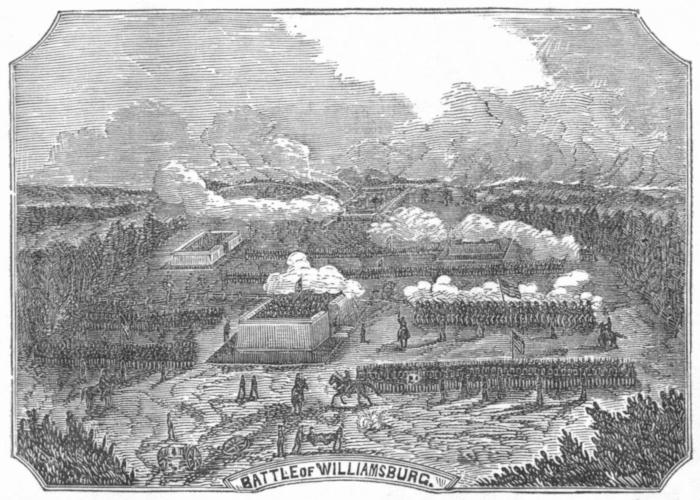
BATTLE OF WILLIAMSBURG.
As our troops drew near the forts, Monday morning,
a heavy artillery fire was poured upon them,
followed by musketry. The Thirty-third overtook
the Division while it was progressing. Meanwhile
General Hooker, who was advancing further to the
left, fiercely engaged the enemy, who came out on
the plain to meet him, and being pressed by overwhelming
numbers, was obliged to fall back to the
support of General Peck’s Brigade. About eleven
o’clock, General Hancock, who was now temporarily
commanding the Third Brigade, with his own, was
ordered further to the right of the Division, to turn
the enemy’s position. The Thirty-third, which had
been marching since daylight, Fifth Wisconsin,
Forty-ninth Pennsylvania, and Sixth and Seventh
Maine, were assigned to this duty. After proceeding
about two miles to the right, and in view of York
River, they changed their course to the left, and
crossed King’s Creek, on a high dam built by the
enemy to “back up” the water, and thereby render
the stream unfordable. The overflow or pond thus
made, extended nearly a mile, and in front of a portion
of their entrenchments. Situated upon the
high land at the western extremity of it, was one of
the earthworks previously mentioned, strongly built,
and with deep broad moats in front. Further back,
and towards the York, were two others constructed,
on a still higher rise of ground, and surrounded
with numerous rifle-pits. They were, however, now
all deserted. Just before reaching the dam, the
three left Companies of the Thirty-third—B, Capt.
White, G, Capt. Hamilton, and K, Capt. McGraw,
were left, under Lieut. Col. Corning, to guard the
forks of the road. After the force crossed, they
were ordered forward, and took possession of the
first fort, Major Platner being left in command of
them.
General Hancock continued to move forward, and
having advanced half a mile to the left, halted in
the field, a short distance from the enemy, and near
by an abandoned redoubt. Lieut. Col. Corning was
now ordered to take Cos. A, Capt. Guion, D, Lieut.
Brown, commanding, and F, Capt. McNair, Regimental
Colors and Color Guard, occupy and hold
the fort. This was quickly done, and the beautiful
banner soon waved from the battlements, where it
remained through the fierce conflict which ensued,
torn and tattered for the first time by shell and
bullets. A few moments later, Colonel Taylor proceeded
with the remaining Companies of the Regiment,
C, E, H and I, to a body of woods to the right
and front, and deployed them as skirmishers.
Wheeler and Cowan’s Batteries moved forward
five hundred yards, directly in front of the redoubt
and commenced shelling Fort Magruder, in which
the enemy were posted. They were supported by
the Fifth Wisconsin, whose skirmishers connected
with those of the Thirty-third on the right, and
Sixth Maine and Forty-ninth Pennsylvania on the
left. From the redoubt, occupied by Cos. A, D
and F, the ground descended slightly for a few rods,
and then became a level plain, extending to Fort
Magruder, and presenting but few obstacles to the
advance of infantry.
Our artillery kept up a vigorous fire until two
o’clock in the afternoon, and then ceased, in accordance,
as it was understood, with orders from General
McClellan, who had arrived on the opposite side of
the creek.
A lull of several hours followed, but the heavy
firing from the direction of our left, indicated that
a severe engagement was going on there. No other
troops had arrived to reinforce Hancock, and he held
his position on the enemy’s left flank all day with
the small force previously designated. Night was
approaching, and the men began to consider what
further dispositions were to be made of them, when
suddenly the rebels were discovered approaching
from the direction of Williamsburg, and rapidly
forming two lines of battle, which extended entirely
across the plain in front. It required but a glance
to divine their object. With overwhelming numbers
they expected to press down upon the small
force and capture it entire, or drive it pell mell into
the creek. General Hancock immediately sent
word to the batteries and infantry supports to fall
back quickly, which they did, engaging the enemy
as they retired. The three Companies of the Thirty-third
were ordered out of the redoubt into line of
battle, but the Color Sergeant and Guard remained
to defend and keep unfurled the banner. The
Seventh Maine was likewise posted in line of battle
at the right.
On came the swarthy rebels, shouting Bull Run
and Ball’s Bluff, their lines unbroken and unchecked,
while our guns and the Fifth Wisconsin, Sixth
Maine and Forty-ninth Pennsylvania, hastily receded,
forming on the left of the Thirty-third, as they
fell back. The enemy’s flying artillery also moved
forward, and discharged shot and shell in quick
succession, which fell all around the redoubt. It was
a most trying situation—the foe was steadily bearing
down upon us, and no reinforcements, were they to
be had, could cross the narrow mill-dam in time to
render assistance. Still the men faltered not, but
nerved themselves for the shock, determined that
many of the enemy should bite the dust before they
would surrender.
As the rebels drew nearer and nearer, the men
fired rapidly, but failed to make any impression upon
their lines, which swept over the plain in most perfect
order. They had now arrived within seventy
yards of the redoubt. Lieutenant Brown and many
other brave fellows had fallen mortally wounded.
The cannoniers with their guns, and members of
other Regiments, were hurrying back to the dam to
escape. The right and left of the line were wavering,
and it seemed as if all was lost.
At this critical juncture, the Lieutenant Colonel,
turning to Colonel Taylor, who had just arrived from
the skirmish line, remarked, “Nothing but a charge
can check them.” “A charge it shall be,” he
replied, and instantly waving his sword in the air,
shouted, “Forward, men,” “Charge bayonets,” added
Lieut. Colonel Corning, and the brave fellows, to a
man, sprang forward on the double quick, and were
soon lost in the cloud of smoke which enveloped
the plain. Incited by this gallant example of three
Companies charging a whole Division, other Regiments
followed. Alarmed at this sudden counter
charge, and doubtless fearing that they had underrated
our force, the enemy broke and ran in confusion.
In vain the commanding officer attempted
to rally them. Sauve qui peut became the order of
the day. The Thirty-third, which was close on the
front line when it broke, halted, and discharged
volley after volley upon the gray-backs, as they
scampered over the plain. The other regiments now
joined them, and for several moments a most murderous
fire was poured upon the panic stricken fugitives,
who never stopped until they reached their entrenchments.
Many tumbled over on their backs and
feigned death, while others ran towards us with
uplifted hands, imploring that we would spare their
lives.
More than two hundred of them lay dead and
wounded on the field, including the Lieut. Colonel
and Major of the Twenty-fourth Virginia, and a
Captain on Magruder’s Staff.
It was a most daring and brilliant exploit, deciding
the fortunes of the day, and turning what was,
up to this time, a defeat on the left, into a substantial
victory.
The four Companies deployed as skirmishers on
the left, to prevent a flank movement, were not idle
during this time. Colonel Taylor had posted them
just beyond a small creek, nearly on a parallel with
the first position occupied by the batteries, as
follows: Co. C, Capt. Cole, right; H, Capt. Drake,
centre; E, Capt. Warford, left, and I, Capt. Root,
in rear and reserve. On his departure, Capt. Warford
was placed in command of the line.
After they had been in position a short time,
Lieutenant Gummer, of Co. E, was sent with ten of
Captain Cole’s men one hundred and fifty yards in
front, as a party of observation. Having made a
proper survey of the vicinity, he returned and
reported to headquarters. Firing now commenced
between the skirmishers on the left, and Captain
Warford ordered Captain Root forward to strengthen
the line. Soon after, the enemy’s charging column
made its appearance from the direction of Williamsburg,
and dashing into the woods, struck the
skirmish line on the right of Co. E. Brisk firing
ensued, our skirmishers falling back into the forest,
and the enemy pushing on to the open fields at the
left.
Owing to the confusion resulting from the sudden
turn of affairs, Captain Root was unable to find the
skirmish line, and consequently placed in an awkward
position, the enemy being all around him.
His men were not dismayed, however, but after
receding two hundred yards, halted. A small party
of rebels who had broke away from the main force,
now approached, and when within a short distance
were fired upon. Taking them to be friends they
cried out, “Don’t fire, you are shooting your own
men.” At this Captain R. ordered them to advance
and surrender; and they were, much to their surprise
and chagrin, made prisoners. One of the
officers attempted to escape, but the Captain made
after him and compelled him to deliver up his
sword. Other prisoners were afterwards taken, and
when the number was swelled to forty, Captain R,
concluding that he had his hands full, left the woods,
and marched them off to the redoubt with his Company
of twenty-seven men.
Not knowing that the wavering in the line was
occasioned by the attack of the enemy’s storming
column, Captain Warford attempted to rally it
instead of ordering it to retreat. While doing so,
he was informed that some stragglers wished to give
themselves up, but seeing nothing of them, started
back to a small support in the rear. On the way,
an officer approached him and said, “We are falling
back,” mistaking him for a fellow rebel. The Captain
immediately captured him. The enemy had now
been routed, and numerous stragglers ran into
the woods, and were taken by the Captain’s men.
Frequent shots were exchanged, and several of
Cos. E and H wounded. He was himself repeatedly
shot at, but escaped without a scratch.
When the enemy’s column advanced into the
woods, it passed through Captain Drake’s Company
(H), which was in the centre of the skirmish line,
and captured several of his men. After it had gone
by, a body of fifty stragglers returned and suddenly
attacked him in the rear. Being thus surrounded
on all sides he, together with several more of his
men, were compelled to surrender. On being
ordered to give up his sword to a non-commissioned
officer, he refused, but presented it to a rebel
Lieutenant, who soon after came up. He and
twenty of his men were hurried off to Williamsburg,
and a few days later taken to Richmond.
After being confined there and at Salsbury, N.C.,
several months, he was exchanged and rejoined the
Regiment in Maryland.
Capt. Cole’s Company took thirty-seven prisoners,
who were dispatched to headquarters, under charge
of Lieut. Brett. Wm. Moran (private), not satisfied
with halting and compelling them to deliver up
their arms, made the prisoners get down on their
knees and “surrender unconditionally.” “Down on
your knays, d—n you,” was the order which he
administered to every one he found. He and others
of the Company were afterwards complimented in a
Special Order for their conduct on this occasion.
Separated, and each one fighting on their “own
hook,” it was marvellous that all of these four Companies
were not captured by the enemy. But owing
to the heavy rain which prevailed, and thick underbrush
concealing their strength and movements, they
not only effected their escape, but brought away
nearly as many prisoners as they numbered men.
This constituted a fitting sequel to the operations
of the other portion of the Regiment.
Thus terminated the Battle of Williamsburg, in
which the Thirty-third captured alone one hundred
and fifty prisoners, and won the plaudits of the
whole army for its gallant charge. During the following
night the enemy evacuated the city, and its
surrounding works, retreating back to the Chickahominy.
The Thirty-third slept on their arms, and
on the following day encamped near York River.
On the evening of the 7th, Gen. McClellan rode
into camp on his favorite bay charger, and the Regiment
being drawn up in line, he addressed them as
follows:
Officers and Soldiers of the Thirty-third:
“I have come to thank you in person for gallant
conduct on the field of battle on the 5th instant. I
will say to you what I have said to other Regiments
engaged with you. All did well—did all I could
expect. But you did more; you behaved like Veterans.
You are Veterans—Veterans of a hundred
battles could not have done better! Those on your
left fought well; but you won the day! You were
at the right point, did the right thing, and at the
right time. You shall have Williamsburg inscribed
on your Banner.”
This brief speech from the Commanding General
occasioned the wildest enthusiasm among the men,
and as “Little Mac” rode away, followed by his
Staff, cheer after cheer rent the air. During the
same evening a beautiful roan horse was presented
to Adj. Sutton by the Regiment.
CHAPTER IX.
Williamsburg.—Condition of the Roads.—Pamunkey River.—Contrabands.—Arrival
of General Franklin.
The retreat of the enemy left Williamsburg in
our possession. No place in the Old Dominion is
fraught with more historic interest than this city, it
having been the first incorporated town in the State;
the Capital until 1769, and the seat of the Royal
Government prior to the revolution of 1776. It is
now the Capital of James City County, situated
midway between the James and York Rivers, sixty
miles east of Richmond and sixty-eight north-west
of Norfolk. Among other public buildings is the
Insane Retreat, which in years past has been one
of the most popular institutions of the kind in the
country. The College of William and Mary, founded
here in the time of King William, is, next to Harvard,
the oldest literary institution in the United
States, having been projected during the year 1693.
King William gave it an endowment of twenty thousand
dollars and twenty thousand acres of land, together
with a revenue of a penny a pound on tobacco
exported from Virginia and Maryland. Other
endowments were afterwards added. The College
buildings, churches, and many private dwellings
were used as hospitals for the confederate wounded.
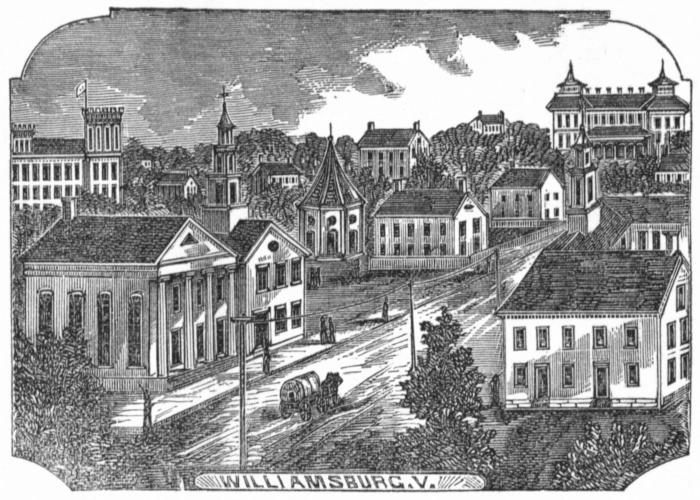
WILLIAMSBURG, V.
Insane Asylum. William and Mary College.
After a delay of three or four days, in order to
bring up supplies, the army resumed the march
Friday May 9th, for the Chickahominy. The
Thirty-third broke camp early in the morning, and
proceeding through Williamsburg, bivouacked for
the night, at “Burnt Ordinary,” a small hamlet some
fifteen miles beyond. The next day it moved on
again, encamping near New Kent Court House.
It was near this point that Gen. Stoneman had
overtaken the rear guard of the fleeing enemy, who
were drawn up in line of battle with a section of
artillery to receive him. Evidences of the conflict
were seen on every hand, and many of our own and
the rebel wounded were scattered about in the neighboring
farm-houses. While tarrying here, the roar
of Gen. Franklin’s artillery at West Point, seven
miles away, could be distinctly heard, and the result
of the battle, which was made known the next day,
increased the buoyancy and confidence of our troops.
Owing to the rains, passage of trains, and steady
tramp of men, the roads had now become reduced
to a terrible condition. Scattered all along the
route, were gun-carriages, caissons, ambulances and
supply wagons, stuck fast in the mud or lying disabled
by the road-side. Horses and mules, either dead or
dying from exhaustion, were seen every few rods,
and the ground was strewn with guns, cartridge-boxes,
knapsacks and clothing, which the fleeing enemy
had cast aside. Nearly two weeks time were
occupied in reaching the Chickahominy, between
forty and fifty miles distant from Williamsburg.
Smith’s division resumed the march again on the
10th, reaching “Cumberland Court House” the same
day, and remained there until the 13th, when it proceeded
towards “Cumberland Landing,” on the
Pamunkey River.
A beautiful—and after the long and tedious march
exhilarating—sight here met the eye. Stretching far
away to the left and front was a vast plain, variegated
with green pastures, and field after field of cereals
yellowing into maturity. To the right the tortuous
Pamunkey appeared, skirted with dense forests and
rich pasture lands, and bearing upon its sluggish
waters Federal transports of every description. For
the first time in a twelvemonth, vessels flying the
stars and stripes were pursuing its serpentine course.
No sooner had the order been given to halt and stack
arms, than the soldiers began to scatter in every
direction, some to bathe in the river, others to enjoy
a siesta under the shade trees, or indulge in a pipe
of the royal weed, that never failing solace for a soldier’s
griefs.
Reports of every description concerning operations
elsewhere were served up to the troops here; one to
the effect that Gen. Brooks with his whole brigade
had been captured, another that we had made prisoners
of Gen. Magruder and most of his force. The
further we advanced the more filled the air became
with these
“Flying rumors gathering as they rolled.”
Moving five miles up the river, Col. Taylor’s
command encamped in a large clover-field, on the
old Custis estate, at present in the possession of
Gen. Fitzhugh Lee, of the rebel cavalry service.
On every side were magnificent fields of grain, into
which the jaded horses and lank cattle were turned
loose.
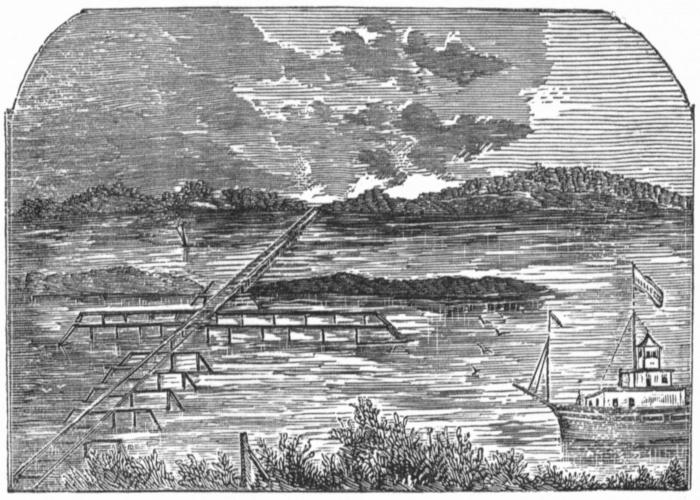
Ruin of R. R. Bridge at White House, over the Pamunkey.
Here for the first time the men began to find
negroes scattered around on the plantations, whom,
owing to their rapid flight, the rebels had not driven
before them. Several of these contrabands were
appropriated by the officers, and remaining with the
regiment through its various campaigns, came home
with their new “Masters.” Among this number
was a comical specimen of the race, who, on being
approached as he stood huddled together with a
squad of fifty or more, and asked by Sergeant Windchip
if he “would not like to see the north,” replied,
“God bless you, massa, don’t care if I do.” Then
turning to his fellow contrabands, he took a most
affectionate as well as droll adieu—the tears coursing
down his ancient cheeks—broke away from the
sobbing “brothers and sisters” and “fell into line.”
Upon reaching the White House, which was merely
a landing on the river, the left wing of the Regiment
was detailed for picket duty, along with a
detachment under command of the Lieut.-Col. of the
Seventy-seventh New York. The orders were to proceed
as far as a certain Court House, and connect
with Gen. Brooks’ pickets on the left. After marching
some two miles and a half, on what was supposed
to be the right road, they were suddenly brought
to a halt by rebel cavalrymen, who fled rapidly on
being fired at. A few moments reconnoitring served
to convince the Lieutenant-Colonel that the picket
lines did not extend in that locality. So deploying
his men in a wheat-field, he returned to head quarters
to ascertain its whereabouts. They remained
here until near dark, when an Aid came out and
ordered them into camp. The laugh over this fruitless
search of eight hours after our picket line became
intensified, when it was afterwards ascertained
that the force had proceeded full a mile beyond our
outer or cavalry pickets.
The band serenaded Gen. McClellan one evening,
when he sent an Aid to extend his compliments to
the regiment. There was a perfect forest of masts
here; government transports constantly arriving and
departing, and on every side was seen the ceaseless
activity which marks an active campaign.
Gen. Franklin soon reached this point and assumed
charge of the 6th corps, to which Gen. Smith’s Division
was assigned. Prior to that time it had been in
Gen. Keyes’ corps and comprised a portion of the
left wing of the army. But this change brought the
Division on the extreme right. Monday, 19th, the
Brigade moved up the river six miles, and halted on
the farm of an Æsculapian rebel, whom his contrabands
described as suddenly seized with the gout
on our approach. The boys designated this place as
“Camp Onion,” owing to the quantities of this odoriferous
vegetable which were hawked through the
encampment. Saturday, May 21st, the march was resumed,
the division proceeding to within eleven miles
of Richmond.
CHAPTER X. BATTLE OF MECHANICSVILLE.
Two days later Gen. Stoneman pushed forward
with cavalry and artillery, on a bold reconnoissance
toward the rebel capital. Gen. Davidson’s Brigade
followed, as a support, the rest of the Division remaining
behind. About four o’clock in the afternoon, the
General fell in with the enemy—“Howell Cobb’s Brigade”—who
retreated after a few shots had been exchanged.
Stoneman again moved forward, halting for
the night just east of Beaver Dam Creek, and the Brigade,
crossing over, took up position on an elevated
spot, and slept on their arms. This creek is a narrow,
muddy stream, emptying into the Chickahominy.
A part of the Thirty-third were employed on picket
duty until the next morning, being stationed in
close proximity to the rebels. At daybreak the
infantry pushed on towards Mechanicsville; General
Stoneman with the cavalry proceeding further to the
right. Three companies of the Thirty-third acted
as the advance guard, and were deployed as skirmishers.
When within two hundred yards of Mechanicsville,
the rebels, who had fallen back during
the night, were discovered drawn up in the principal
street, and in a neighboring grove. The skirmishers
immediately opened upon them, when taking refuge
in buildings and behind walls, they returned the
fire.
The whole Brigade now moved up on both sides
of the road, and two sections of Wheeler’s battery
were got into position, and commenced tossing shell
into the village. This placed the skirmishers between
two fires, and for a time, they were nearly as
much exposed to our own as the rebels. One had
his canteen perforated by a piece of shell thrown
from the Union battery, another had a part of his
shoe taken away. The firing of the rebel cannoniers,
at first slow, became very rapid and accurate as
the battle progressed. One solid shot passed between
Major Platner and Captain Guion, as they
stood conversing together. A second whizzed close
by the head of Colonel Taylor’s horse, and a third
striking the roll of blankets strapped on behind a
horseman, threw them high into the air. Every one
held their breath for a moment, supposing that it was
the rider himself, but he escaped unharmed.
The guns were afterwards removed to the right of
the skirmishers, and a section of flying artillery posted
on the left. A heavy fire was now concentrated
on the buildings in which the confederates had
concealed themselves, soon causing an exodus on
their part, and the whole force commenced falling
back in the direction of Richmond. Seeing this,
Gen. Davidson ordered a charge, when the Thirty-third
and Seventy-seventh gallantly charged down
upon the place, driving everything before them.
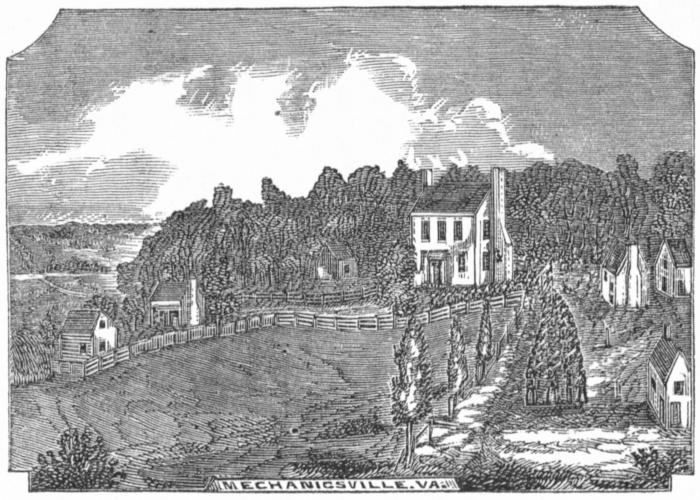
MECHANICSVILLE, VA.
Large numbers of knapsacks and blankets which
the rebels had thrown away in their flight were picked
up in the streets. They were most of them marked
“Rome (Ga.) Light Guards.” Guns, equipments,
blankets, and other materials of war, were likewise
found in large quantities. Nearly all the houses
were more or less pockmarked with shot and
shell. The Mayor’s residence, an elegant mansion,
had been struck seventeen different times. Those
of the inhabitants who had not fled, were found
packed away like sardines, in cellars and other
places of refuge. They were very much frightened,
and not until repeatedly assured that we would
not harm them, could they be prevailed upon to
come out.
After taking possession of the village, a line of
skirmishers was thrown out half a mile on the
Richmond road. Detachments of the Thirty-third,
Seventh Maine, and five companies of cavalry were
left in charge of the town. They were relieved
upon the following day, and rejoined their regiments
on the Beaver Dam, to which the Brigade had
returned after the engagement. Some members of
Company E discovered a grist mill here, and spent
most of the night in grinding corn, and making hoe-cake.
Gen. Stoneman had in the meantime proceeded
several miles to the right, and accomplished the object
of the expedition by destroying the Richmond
and Fredericksburg railroad bridge over the Chickahominy.
With one exception this was the nearest point
attained to Richmond during the entire Peninsular
campaign. Gen. Hooker, after the battle of Fair
Oaks, followed the fleeing enemy to within less than
four miles of their capital.
That it could then have been taken had General
Davidson’s brigade been reinforced and permitted to
proceed, is a truth which admits of no denial.
There were no rebel forces between Mechanicsville
and the city, with the exception of those driven
from the former place, they being concentrated on
the left of our lines. There were no fortifications
of any extent on that side of the capital, as the
attack was expected to be made from the other
direction. The approaches were all left open, and
the appearance of this single brigade of “Yankees”
struck terror to the rebels, who inferred that all was
lost.
CHAPTER XI.
“Gaines’ Farm.”—Liberty Hall.—Battle of Seven Pines.—Fair
Oaks.—Rapid rise of the Chickahominy.—The Gaines Estate.—An
aged Negro.—Golden’s Farm.—Camp Lincoln.—Letter
from an Officer.
Davidson’s brigade again moved from Beaver
Dam Creek, on the 26th of May, down the left bank
of the Chickahominy (the enemy throwing a few
shells at them as they marched), and encamped on
“Gaines’ Farm,” where they remained until the
5th of June, performing picket duty and building
corduroy roads. Not far from here was “Liberty
Hall,” where Patrick Henry was born, May 29,
1736. The building, which his father had used as a
grammar school, was now appropriated for a National
Hospital, and the little farm on which Patrick
had commenced life in company with his young wife,
the daughter of a neighboring farmer, occupied by
our troops.
General Keyes’ corps, followed by that of General
Heintzelman, had now crossed the Chickahominy,
the remainder of the army still resting on the left
bank. General Casey’s division held the extreme
advance; his pickets being within five miles of Richmond.
Relying upon the sudden and rapid rise of
the river preventing our crossing over more troops,
Gen’l Johnston, then commander of the rebel forces,
hurled his whole army upon these two corps on the
morning of the 31st, with the expectation of annihilating
them. Casey’s Division, which bore the brunt
of the attack, was forced back from their rifle-pits and
second line of battle, after fighting for several hours
and losing 1,443 men.
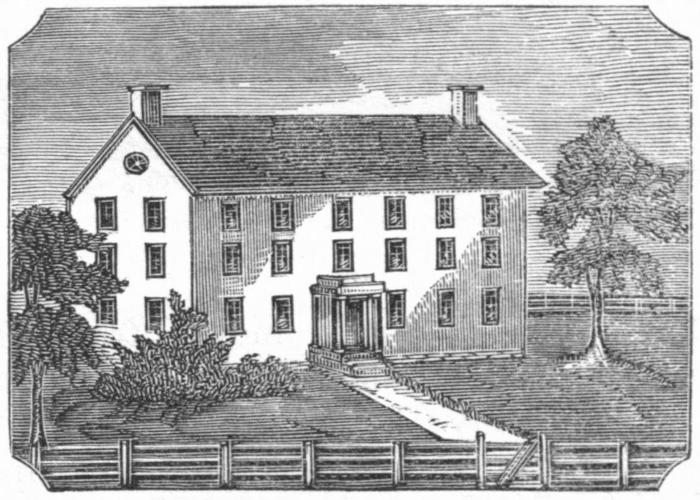
Liberty Hall, Birth-place of Patrick Henry.
The courageous Sumner, who, notwithstanding the
freshet, had crossed his corps, now drove fiercely at
the enemy, and saved the left wing from destruction.
Yet the whole force was obliged to fall back nearly
two miles, owing to the overwhelming numbers and
impetuous onslaught of the rebels. Here they
maintained their ground, refusing to yield an inch
more, and the fighting ended for the day. This
was known as the battle of Seven Pines.
The enemy renewed the conflict on the morrow,
attacking General Sumner at “Fair Oaks,” from
which the second day’s struggle derives its name.
They were everywhere repulsed, and compelled to
retreat back to their stronghold, followed by our
victorious troops to within four miles of the capital,
when, for a second time, it was given up for lost.
“The enemy,” wrote General McClellan to the
Secretary of War, after the close of the contest,
“attacked in force, and with great spirit, yesterday
morning, but are everywhere most signally repulsed
with great loss. Our troops charged frequently on
both days, and uniformly broke the enemy. The
result is, that our left is within four miles of Richmond.
I only wait for the river to fall to cross with
the rest of the force and make a general attack.
Should I find them holding firm in a very strong
position, I may wait for what troops I can bring up
from Fort Monroe. But the morale of my troops is
now such that I can venture much. I do not fear
for odds against me. The victory is complete, and
all credit is due to the gallantry of our officers and
men.”
The Thirty-third, at the commencement of the
conflict, was doing picket duty near one of the
bridges which were being constructed over the
Chickahominy. So sudden was the rise in the river,
that the force which proceeded at two o’clock Sunday
morning to relieve the pickets stationed near
the bridge three hours previous, found them nearly
surrounded with water. Some were standing up to
their arm-pits in the now new channel, and others,
having lost their footing, were clinging to trees, for
dear life. Boats were obtained, and they were
rescued from their perilous position. At 3 o’clock,
General Brooks came down to the river with his
Brigade, the second in Smith’s Division—Davidson’s
being the third, and Hancock’s the first,—to
cross over and render what assistance he could on
the opposite side. By this time the bridge was
most of it swept away, and the General, instead of
attempting to cross, set his men to repairing it. At
sunrise the river had overflowed to the width of half
a mile, and he experienced much difficulty in getting
his troops back to dry land again. All day Sunday
the heavy roar of artillery and sharp firing of musketry
could be heard. Just at night, General
McClellan, accompanied by General Hancock, rode
down to the right of the Thirty-third, where they
remained until dark, watching the progress of the
battle.
Dr. Gaines, the owner of the farm on which the
Regiment was now encamped, possessed one of the
finest estates in Virginia. One wheat field alone
comprised four hundred and fifty acres. In the rear
of his dwelling, furnished in the most costly manner,
was a picturesque grove, which furnished a cool
retreat for the officers during the intense heat of the
mid-day. In front was an extensive garden, abounding
in flowers and shrubs of native and foreign
with all its beautiful surroundings, was overrun by
the “invader.”
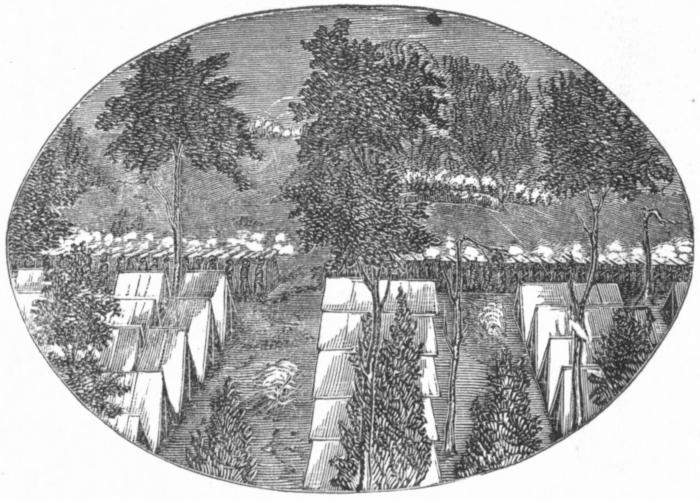
Camp Lincoln.
Attack of the 7th and 8th Georgia.
The Regiment remained here until the 5th of
June, when the Division was ordered to cross the
Chickahominy and encamp on “Golden’s Farm,”
nearly opposite. The Third Brigade took the advance.
Owing to the high stage of the water, it was obliged
to proceed down the river to “Dispatch Station,”
before effecting a crossing. When marching up on
the opposite bank, the men fell in with a gray-haired,
toothless negro, 102 years of age, who entertained
them with a recital of many incidents which had
transpired during his long period of slave life.
After having marched over fifteen miles to reach a
point only three miles opposite the old encampment,
the Thirty-third arrived at Golden’s Farm,
where Baxter’s Fire Zouaves, of Philadelphia, were
found briskly skirmishing with the enemy.
Our artillery, which immediately opened upon
them, put the rebels to flight, and the picket line was
moved forward, for some distance. Col. Taylor halted
his command in a beautiful corn-field, and on the following
day occupied a more advanced position, less
than one thousand yards from the enemy’s lines.
There it remained until the 28th of June, the spot
being christened “Camp Lincoln.”
An officer of the Regiment, in a communication
from here, dated June 8th, wrote:
“We are now six miles from Richmond, behind
entrenchments, waiting for something to turn up.
The pickets are very close together, and many
prisoners are coming in every day. A Sergeant and
five men just came through the lines, and reported
to Colonel Taylor, Field Officer of the day. The
Sergeant is from Ulster County, N. Y. Doubtless
a great number would desert, if it were possible to
do so without incurring danger. Yesterday much
amusement was created by the operation of a new
and original line of telegraph between our forces and
the enemy. It seems a number of dogs have been
wandering around in front for some days. One of
them yesterday came in with a letter tied around his
neck. It was read by our men, the Thirty-third
being on picket duty at the time, and an answer
sent back the same way; another note was likewise
written, and answered. The import of the first letter
was, that they were much ‘obliged for the tender of
cannon they took from us the other day, and anything
more of the same sort sent them, they would
cheerfully receive.’ No doubt of it. The second was
rough in its language, and full of empty boastings.
The battle-field of last Saturday week is close by us,
and bears evidence of the murderous conflict, when
tens of thousands bore down upon barely a Division,
and unsuccessfully tried to cut them off, or thrust or
crush them into the river.
The difficulties attendant upon transporting troops
and various munitions of war, has retarded us some,
but now we are ready. This morning (the Sabbath)
there was some sharp firing in front, but it was
quickly subdued by a battery of our 20-pounders.
A new Regiment has been added to our Brigade—Col.
Max Weber’s Regiment—the 20th N. Y. Vols.
We have a fine Brigade now, and our General
thinks an effective one. Our picket line has been
advanced twice, the enemy retiring each time. The
regular receipt of the mails has been interrupted
again, and of course is a source of regret to us.
Sitting on the ramparts of our rifle-pits this morning,
writing this letter, the view looking up the
river, reminds one of Big Flats, at Geneseo, flooded
by heavy rains. The stream here is unusually high.
An old negro, 102 years old, who has always lived
in this section, says that he never knew such an
immense quantity of rain to fall before in the same
space of time, at this season of the year. Gen.
Prim and Staff, with our Division Staff, just passed
through our camp on a reconnoissance to the front.”
CHAPTER XII.
Proximity to the Rebels.—Colonel Taylor fired at by a Sharpshooter.—Picket
Skirmishing.—Building a Bridge.—Position of
Affairs.—General McClellan Reconnoitring.—He writes to the
President.—Lee’s Plans.—Second Battle of Mechanicsville.—Shelling
the Thirty-third’s Camp.—Battle of Gaines’ Farm.—A
Retreat to the James decided upon.
Soon after reaching “Camp Lincoln,” the Thirty-third
was set to work on a formidable redoubt, since
known as “Fort Davidson,” and likewise constructed
numerous rifle-pits. The enemy daily threw
shot and shell at our encampments, apparently for
mere pastime, many of them striking among the
tents. On one occasion a round shot, passing entirely
over the officers’ quarters, killed Dr. Spencer’s
Orderly in the rear. Not long after another came
whizzing through the air, and carried away the
shoulder blade of a reckless cavalryman, who was
laughing as he rode along at the manœuvres of the
men, declaring that he would not “dodge for their
guns.” A member of the Seventy-seventh was
killed in hospital close by.
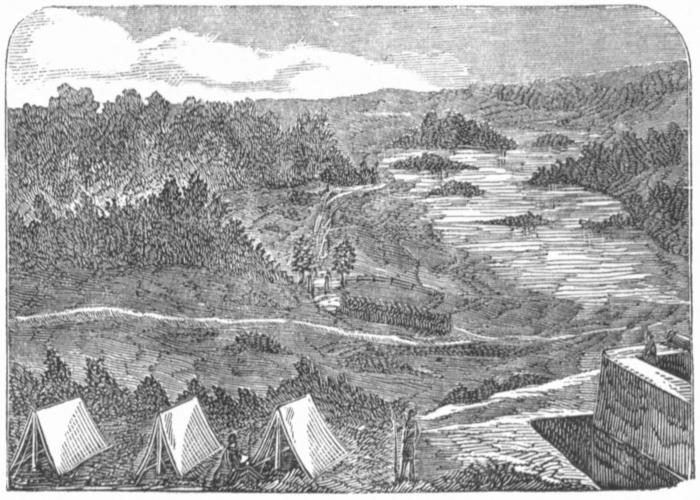
Fort Davidson—Chickahominy Swamps.
The rebels also had a very disagreeable habit of
climbing up in the forest trees and firing at us, some
times even when sitting in the camp doors. One
afternoon, as Colonel Taylor was reclining upon a
lounge in the Lieutenant Colonel’s tent, a sharp-shooter
deliberately fired at him from a neighboring
tree, the ball passing through the lounge and out at
the back side of the tent. He immediately ordered
out several of his best shots to pick off the impudent
rebel.
Not content with constantly annoying us during
the daytime, they frequently got up night demonstrations,
compelling our “troops” to turn out at
very unseasonable hours. The Thirty-third were
aroused from their slumbers one night by the bursting
of a shell directly over the centre of the encampment.
Gorman’s Brigade frequently engaged in
these night skirmishes. Colonel Taylor’s command
rarely indulged in picket firing, as many of the
Regiments did, unless it was provoked by the enemy.
This custom, so prevalent at the commencement of
the war, has almost wholly ceased, and now, instead
of “blazing away” on the slightest pretext, the
pickets patrol their beats month after month within
speaking distance, without molesting one another.
As the month advanced, the troops were kept
busily employed in throwing up breastworks and
constructing a new bridge over the Chickahominy,
below the point where the lowest of the three previously
carried away by the freshet was built. Frequently
they were compelled to stand waist deep in
the water, while cutting timbers, which were carried
to the river on handspikes, many of them requiring
sixteen or more men to transport them. This
bridge, when completed, was an imposing structure,
and afterwards saved the right wing of the army, by
furnishing a passage to the opposite side of the
river, when the rebel legions were hurled against it
with such rapidity and violence.
Nearly three months had now elapsed since the
Army of the Potomac landed at Fortress Monroe,
and began the Peninsular Campaign. Yorktown
had been evacuated, the bloody battles of “Williamsburg,”
“West Point,” “Fair Oaks” and “Seven
Pines,” besides several lesser engagements, fought,
the troops arrived before and around Richmond, and
our labors were apparently about to be crowned
with success by its capture.
One evening, about the 20th of the month, Gen.
McClellan, accompanied by Gens. Smith, Gorman
and Porter, rode down to the picket line where
Captain Warford, with his Company, was stationed.
After removing their coats, in order to conceal their
rank, and fording a small creek, they ascended to a
tree-top to reconnoitre the enemy’s position. Their
pickets were only about twenty rods distant, on the
opposite side of a wheat field. Descending, the
Commander-in-Chief remarked to Gen. Smith, with
a smile on his face, “I have got them now,” accompanying
the remark with a significant doubling up
of his right fist. His army then numbered one
hundred and fifteen thousand men fit for duty.
A few brief hours served to dispel the visions of
success and glory which had brightened up his countenance.
On the evening of the 25th, Gen. McClellan
telegraphed to the President: “I incline to
think that Jackson will attack my right and rear.
The rebel force is stated at two hundred thousand,
including Jackson and Beauregard. I shall have to
contend against vastly superior odds, if these reports
be true, but this army will do all in the power of
man to hold their position, and repulse an attack.
I regret my inferiority in numbers, but feel that I
am in no way responsible for it, as I have not failed
to represent repeatedly the necessity of reinforcements;
that this was the decisive point, and that all
should be concentrated here. I will do all that a
General can do, with the splendid army I have the
honor to command, and if it is destroyed by overwhelming
numbers, can at least die with it and share
its fate.... I shall probably be attacked
to-morrow, and now go to the other side of the
Chickahominy to arrange for the defence on that side.”
The reader will understand that our army was
then arranged in the form of a semi-circle, extending
across the Chickahominy, the left resting upon
Savage’s Station, and the right upon Mechanicsville.
In the rear of the right wing was “White House,”
on the Pamunkey River, used as a base of supplies
for the army, which were brought by way of York
River. The plan of Gen. Lee, who had now succeeded
Gen. Johnston, was to concentrate his whole
force on our right wing, destroy it before the troops
on the other side of the river could be brought
against him, gain possession of White House, thereby
cutting off our supplies as well as way of retreat,
and capture the entire army. He had no sooner
however, taken the initiatory step in this programme,
by calling Jackson to his assistance, than
Gen. McClellan, as appears from the above letter
to the President, divined his whole strategy.
On the afternoon of Thursday, June 26th, the
enemy fell upon Gen. McCall’s Division at Mechanicsville.
Reynolds’ and Seymour’s Brigades bore
the brunt of the attack. The battle continued until
sundown, when the rebels were handsomely repulsed.
At midnight the force fell back, in accordance
with orders, to “Gaines’ Farm,” where was fought
the bloody engagement of Friday, June 27th, resulting
in a Federal loss of 9,000 killed, wounded
and missing. Smith’s Division, it will be remembered,
was now located nearly opposite from Gaines’
Farm, or Mill.
While the battle was progressing, on Thursday, at
Mechanicsville, the enemy stationed on the opposite
side of the river opened a furious cannonade on Gen.
Smith, to divert attention. The tents of the Thirty-third
were considerably damaged with shot and
shell, and the horses of the Major and Quartermaster
killed, in addition to several other animals. Very
fortunately the men had just completed a formidable
breastwork directly in front of the encampment, and
taking refuge behind this, none of them were
killed.
The contrabands, of whom a considerable number
now accompanied the Regiment, were terribly
frightened, and scampered away rapidly. Two of
them sought refuge behind a pile of cracker-boxes, but
they had hardly gained this shelter before a bursting
shell scattered the boxes and contents in all directions,
much to the horror of the fleeing negroes and
amusement of the soldiers, who were ensconced
away behind the earthworks. Several of them
received such a fright that they were never seen
afterwards. Of this number was one of the negroes
who communicated the information before Yorktown
of its evacuation.
On the following day, the 27th, a portion of Gen.
Franklin’s Corps was sent back across the river to
aid Gen. Porter in holding his position at Gaines’
Farm. Several of our batteries were likewise
wheeled about and brought to bear upon the enemy.
But these and other reinforcements were not sufficient
to turn the tide of battle. The overwhelming
numbers of the enemy, estimated by Gen. McClellan
at full eighty thousand, precluded any hope of successfully
resisting them and maintaining the position.
All the troops on the east bank of the river accordingly
crossed that night to the opposite side, destroying
the bridge after them.
Gen. McClellan immediately summoned several
of his Generals, and informed them that there was
only one of two things to be done, either to mass all
of his troops at that point, near “Golden’s Farm,”
and risk a sanguinary battle, or to retire immediately
and rapidly to the James River. In the former
case, defeat would ensure the destruction of the
army, whereas by abandoning the siege of Richmond
for the time being, he could retreat in safety to the
James, saving most of his men and material. The
result of the interview was a determination on the
part of the Commanding General to “change his
base,” and, under cover of night, preparations were
made for the retreat.
CHAPTER XIII. BATTLE OF GOLDEN’S FARM.
During the following morning, Saturday, June
28th, Col. Taylor, in accordance with orders from
Gen. Smith, moved with a portion of his command to
relieve and support the picket line, then within two
hundred yards of the enemy, leaving the remainder
in camp, under command of acting Adjutant Tyler,
to strike tents, secure baggage, &c., preparatory to
retreating. The men had hardly reached the picket
line before the confederates opened a heavy artillery
fire from twenty pieces, which was mainly concentrated
upon the camp.
Shot and shell flew in every direction, crashing
through the trees, ploughing up the ground, completely
riddling the tents, firing the baggage and
commissary stores, and rendering every foot of the
camp enclosure untenable. The camp guard, prisoners,
sick, convalescents and, others, seizing their
arms, immediately sought refuge behind the earthworks,
consisting of ditches and the breastwork in
front, which had afforded such good protection on
the Thursday previous.
Several of the enemy’s missiles struck the breastworks
and rolled over, occasioning not a little confusion.
One shell dropped down into the ditch
beneath the parapet among the men, but was quickly
tossed out by J. W. Hendricks, Co. A, and again
taken up by Peter Roach, of the same Company,
and thrown down the hill, where it exploded, doing
no injury. This heroic deed of these brave fellows
undoubtedly saved the lives of several of their comrades
at the imminent peril of their own.
Not being replied to by our guns, nearly all of
which had been taken to the rear to form in the
line of retreat, their artillery firing ceased at the
end of an hour, leading our officers to infer that the
rebels had withdrawn to some other point. The mistake
was soon discovered, however, when the picket
line (embracing, in addition to a part of the Thirty-third,
two companies of the Forty-ninth Pennsylvania),
which had firmly maintained its position, in
spite of the artillery fire, was fiercely attacked by
two full regiments of infantry.
The men stood their ground manfully at first,
but were at length forced back to the earthworks,
wheeling and firing steadily as they retreated. The
defences gained, and the co-operation of the remainder
of the Regiment secured, a most gallant stand
was made. Colonel Taylor had hardly stationed the
men in their places before the rebels, flushed with
their first success, and confident of easily storming
the defences and capturing the defenders, came
charging furiously down upon them.
All became hushed along the line as the men
nerved themselves for the encounter. The orders
to “reserve fire,” “fire low,” &c., were given in a
quiet undertone, and the soldiers, bringing their firelocks
to their shoulders and resting them over the
top of the parapet, calmly waited the approach of
the enemy. On they came, yelling and shouting
like demons, till within a few yards of the breastwork
when there instantly shot forth from behind
it a sheet of flame, followed by another and another,
until, staggered by the galling fire, the rebels wavered,
broke and fled in great disorder from the field.
When the smoke cleared away the number of
killed and wounded that appeared scattered upon
the ground testified to the accuracy of our aim.
Nearly every one had brought down his man. They
continued firing upon the retreating enemy until
out of range. Not satisfied with the reception
which they had received, the confederates, re-forming,
again advanced, though more cautiously than at
first. But they were again met by a murderous
fire and compelled to fall back, leaving many of
their number on the field.
Maddened by the defeat and carnage which had
taken place around him, Colonel Lamar, of the
Eighth Ga., who commanded the enemy, now
sprang forward in front of his men, and, waving his
sword and hat in the air, incited them to a renewal
of the charge. Over a hundred rifles were instantly
levelled at him, and he fell, dangerously wounded, to
the ground. At the same time a section of Mott’s
battery, which had come up, opened an enfilading
fire upon them from the left, and the victory was
complete, the enemy fleeing in all directions.
Huzza after huzza followed from our men, who
could be restrained only with the greatest difficulty
from leaping over the parapet and pursuing them.
This it would not have been prudent to do, owing to
the great disparity in numbers. A small party was,
however, sent forward to secure several prisoners
who had voluntarily surrendered, and also our
wounded.
This attempt, on the part of the Seventh and Eighth
Ga. Regiments, to capture the Thirty-third, resulted
to them in a loss of 91 killed and left upon the field,
a large number of wounded, 50 prisoners, including
the wounded Col. Lamar of the Eighth and Lieut.
Colonel Tower of the Seventh Ga., and two hundred
stand of arms. We lost several, in killed and
wounded, during the first part of the engagement,
when forced back to the entrenchments. A number
were also taken prisoners, including Captain
Hamilton, of Company G, who was exchanged, and
returned to the Regiment at Harrison’s Landing.
The enemy’s balls mostly passed several feet over,
or lodged in the earthworks, doing but little injury.
First Lieutenant Moses Church, of Company E,
fearless to a fault, seized a musket and, going out
from behind the protection of the works, fired repeatedly,
with deliberate aim, at the advancing rebels,
until he dropped dead, pierced through the head
with a minie-ball. He was a brave and beloved
officer, and was buried close to the spot where he
so nobly died. Private Hildreth, of the same Company,
also exposed himself in a similar manner, and
was shot dead, the ball penetrating his eye.
Immediately after the final discomfiture of the
rebels, Major Platner was sent by Colonel Taylor to
establish a new picket line, and both parties buried
their dead, under a flag of truce. One of the prisoners,
belonging to the Eighth Ga., on seeing the
mangled remains of his brother, wept bitterly and
for a time refused to leave them. The same soldier
afterwards conversed with members of the Thirty-third
at the first battle of Fredericksburg, and
reverted to the circumstance, and also to the fact
that his Regiment had encountered the Thirty-third
for the fourth time in battle.
While the engagement was going on, the Seventy-seventh
N. Y., to the command of which Lieut.-Colonel
Corning had been temporarily assigned,
was drawn up in line of battle further to the left,
to prevent a flank movement.
The following is Colonel Taylor’s report of the
engagement:
Head-Quarters Thirty-third Regiment, N. Y. S. V., Virginia, July 10, 1862.
To the A. A. Gen’l, Third Brigade:
... On June 28th, the
entire Regiment, with the exception of the camp
guard, cooks, and a few convalescent sick, was
ordered out on picket. Soon after, they became
engaged with the enemy, and according to instructions
they fell back, contesting every inch, into the
rifle pits in front of their camp. During this time
Lieutenant Lucius C. Mix and Lieutenant Ed. J.
Tyler, of Company A, succeeded, under a galling
fire, in collecting and placing in good order, the
former his camp guard, and the latter all others in
camp—some fifty men. Both of these officers were
conspicuous in their endeavors to stop those who had
become panic stricken, of which there were a few,
and arranging them to good effect in the rifle pit—many
of whom fought nobly. I can also mention
the name of Quartermaster Sergeant John J. Carter,
now Lieutenant of Company B, in connection with
this affair, who not only did good service in quieting
the men, but conduced to keeping up a continual
fire on the enemy. Much praise is due to Captain
Warford and Lieutenant Church, of Company E,
also to Lieutenant Corning, of Company B, and
Lieutenant Gale, of Company G, for their coolness
in drawing in the men, and establishing order under
such circumstances, at one time being nearly surrounded.
Captain Hamilton, of Company G, was
taken prisoner while actively engaged in rallying
his men, and Lieutenant Church, of Company E,
was killed while encouraging his men by words and
deeds.
The above is respectfully submitted.
Your most obedient servant,
R. F. Taylor,
Colonel Commanding Thirty-third N. Y. S. V.
General Davidson, in his report of the affair, said:
“The Thirty-third N. Y. Volunteers, Colonel
Taylor, of my Brigade, then on picket, in conjunction
with the Forty-ninth Pa. (two companies), Colonel
Irwin, had the honor of repulsing the enemy most
handsomely. The conduct of the Thirty-third N. Y.,
Forty-ninth Pa., and Seventh Maine, under this terrible,
concentrated fire, which took us completely by
surprise, was all that could be desired.”
CHAPTER XIV.
The Retreat Commenced.—The Thirty-third one of the last Regiments
to Leave.—Savage’s Station.—Destruction of Property.—General
Davidson Sun-struck.
Our army was now in full retreat, the right wing
following the left, and both sweeping away to the
James. The rebel capital beleagured, pressed, girt
round about by a living wall, and just within our
grasp, once more breathes freely. The siege is raised,
the tide of war rolled back from her gates, and the
black flag of rebellion waves in triumph.
It was a sad and humiliating day for our brave
boys, when gathering up effects and shouldering
muskets, they turned their backs on the city. For
weeks they had regarded it as their prize. Their
young Chief had told them it should be theirs, and
in him they firmly placed their trust. Bitter were
the anathemas heaped upon the Washington authorities,
through whose mismanagement they believed
victory was being turned into defeat. Whatever may
have been the truth of the case, they and they alone
were held responsible that we were now marching
away from instead of towards Richmond. The
route of the right wing lay along the west bank of
the Chickahominy to Savage’s Station, White Oak
Swamp, and thence to Harrison’s Bar. General
Smith’s command did not begin to move until the
troops, crossed from the other side of the river, had
passed by.
Saturday night, June 28th, the right wing of the
Thirty-third was again detailed for picket duty, the
third night the men had been without sleep. In
obedience to orders from Gen. Davidson, Captain
McNair, taking a squad of men, destroyed the camp
equipage of the entire Brigade. Before morning the
destruction of everything of value was completed.
Cos. C, D and I remained on picket until 1 o’clock
A. M., when they were relieved by A and F. The
line stretched away to the left for half a mile, connecting
on with General Gorman’s. The reader
can imagine what were the feelings of these men,
who were left to deceive and hold in check the
enemy while the remainder of the troops withdrew.
Regiment after Regiment disappeared in the distance,
until they alone remained. Moments lengthened
into hours, but their eyes were greeted with no signal
to retire. Through the gray mist of the early
morn, the rebel pickets could be seen, their line
advanced already to within speaking distance, and
their forces in the rear preparing to throw themselves
headlong on our retreating columns; still no
orders for withdrawal came.
It is a brave and noble thing when a soldier,
burning with love of country and cheered on by the
presence and sympathy of comrades in arms, rushes
into the conflict, and at the cannon’s mouth breasts
the storm of death; but braver and nobler far, when
the picket guard, knowing that each moment lengthens
the distance between him and friends, and makes
more certain his slaughter or capture by an insolent
and cruel foe, stands calmly waiting his fate,
rather than betray his trust and compromise the
safety of an army. Gen. Smith had said to them
before going out, “It is the duty of the few to sacrifice
themselves for the safety of the many,” and they
murmured not at the decision which had made them
the victims.
After all hope of being withdrawn had gone, they
were, to their great joy, signalled to return, which
they did rapidly, under cover of a dense fog, and
soon joined the Regiment.
The Division marched two miles Sunday morning,
keeping on the high lands which skirt the
Chickahominy, in order to protect the right of the
army. On arriving at Trent House, they were
massed for a short time, during which Gen. McClellan
rode by.
Again resuming the march along the river, they
halted about one mile to the right of Savage’s
Station, and, after remaining in line of battle a few
moments, fell back to the Station, a large clearing
in the forest, of two thousand acres or more. The
pioneers of the Thirty-third were detailed to assist
in the destruction of the immense war material which
had accumulated here. Of all the pyrotechnic
displays which our military authorities have gotten
up during the war, this was the most costly and
magnificent, if such a melancholy spectacle can be
styled magnificent.
Scattered over a large surface of ground were
heavy supplies of provisions and ammunition burning
and bursting, filling the air with smoke and
embers, and adding to the already oppressive heat
of the day. As the flames reached fresh piles of
commissary stores, they would burst forth anew,
lighting up the country for miles, and imparting
a terrible grandeur to the scene. The forage, which
had been sent from the North, and collected from
the surrounding country, burned rapidly, creating
dense volumes of smoke, which slowly drifted
along to the westward. Great numbers of torpedoes,
prepared for signal purposes, were shooting in
every direction, displaying through the murky
atmosphere the red, white and blue colors. Occasionally
a box of cartridges would explode, sending
the balls whizzing among the tree tops, to the great
annoyance of some of the men, who did not care to
be picked off in this style. A large number of agricultural
implements sent down from Washington to
aid in harvesting the crops of the Peninsula, were
thrown together in a promiscuous heap. The torch
applied, nothing soon remained of them but a mass
of blackened shafts and wheels. Though burning
so fiercely, the flames were found inadequate to complete
the destruction. A long train of cars was
accordingly run up, and after being loaded with
material, and set on fire, was started towards the
Chickahominy, the engineer swinging off after having
“let on full steam.” Along it sped at a fearful
rate, until reaching the river, when the engine exploded,
as it careened over the bank, and the cars
were precipitated into the water below, lying piled
one upon another, a mass of ruins. The explosion
of the engine, which was heard for a long distance,
caused the rebels to hastily decamp from the opposite
side of the river, where they were drawn up to
prevent our retreat in that direction.
A General Hospital was located at the Station,
and contained, in addition to thousands of sick, the
wounded from the late battles, who had been sent
here after the retreat was decided upon, presenting
an indescribable scene of suffering and woe. To add
to the gloom and unhappiness of their condition,
they were now informed that all who could not join
in the march would be left behind, no ambulances
or transportation being furnished. A large number
of the poor fellows, determined not to fall into the
hands of the enemy, started bravely out, and through
all the retreat, their weak and emaciated forms could
be seen struggling along the weary way, with limbs
just amputated, or undressed wounds bleeding at
every step. But with spirits all unconquered, and
hope yet whispering words of encouragement, many
of these unfortunates reached Harrison’s Bar, and
have since recovered to recount experiences of suffering
and brave endurance, rarely fallen to the lot of
human beings.
Of this number was Philip Smith, of the Thirty-third,
whose case presents a striking instance of that
fortitude which brought many sick and wounded
through that long retreat, while many strong men
were compelled to succumb to the fatigue and
become prisoners. He was wounded through the
elbow at the battle of Golden’s Farm. The wound
was severe, and such as would ordinarily require
amputation.
He was immediately conveyed to Savage’s Station,
where the surgeons determined to remove the
arm. Smith resisted, but was forced upon the
operating table. It became necessary for the surgeons
to leave the subject for a moment, when he
sprang from the table and hurried away from the
Hospital. He followed the moving army from
day to day, much of the time unable to obtain food,
his arm frightfully swollen, and every moment becoming
more painful. After four days he arrived at
Harrison’s Landing, and found his way on board of
one of the transports, his wound still undressed.
He was carried to Baltimore, and placed in the
General Hospital there. Here, too, the surgeon in
charge, determined upon amputation, and declared
he could not live ten days in that condition.
“Then,” said Smith, “I will die with two arms.”
For several days the surgeon refused to dress the
wound at all, and at length was about to force the
operation, when the Chief Surgeon, after a careful
examination, remarked, that as the young man
appeared to have an excellent constitution he might
bear up under the excruciating pain, and perhaps
recover without losing the limb. The wound was
now dressed for the first time, and although months
of pain and sickness followed, Smith finally recovered
his health, with the consolation that his obstinate
endurance had saved his right arm.
After remaining two hours in the woods round
Savage’s Station, Davidson’s Brigade marched two
miles further to the rear, when a halt was ordered.
Several large boxes of Quartermaster’s stores were
found here, having been left for want of transportation.
The men helped themselves freely to clothing,
doffing their old garments for entire new suits.
After resting for a few moments, the Brigade was
ordered back again to the Station, to support Gen.
Brooks, who had become engaged with the enemy.
Proceeding back at a double quick, Brooks was
found driving the enemy in fine style with his Vermont
Brigade, after having punished them severely.
The battle lasted until an hour after sunset, when a
brilliant cavalry charge totally routed and put
to flight the rebels. Gen. Brooks was, however,
wounded. The Vermont troops fought nobly, sustaining
the reputation which they had previously
won at Lee’s Mills and in other engagements. While
the conflict was raging fiercely, a member of the
Forty-ninth Pennsylvania stepped out in front of the
line of battle, and, unmindful of the bullets which
were whistling around him, delivered a very solemn
prayer. The effect was most impressive on the
hearers.
Parties, including one often men from the Thirty-third,
detailed to bury the dead, were nearly all
taken prisoners. The Brigade remained until ten
o’clock in the evening, the men falling asleep in
their tracks, when it again moved to the rear, on the
road previously taken, towards White Oak Swamp.
Gen Davidson, who had been sun-struck during the
afternoon, was borne along for some distance on a
litter by members of the band. On being temporarily
left by the road-side, the General stepped
into a house close by, and a straggler happening
along took his place. The men returning, took up
the litter, and carried the straggler nearly a mile
before discovering their mistake. They were very
much chagrined over the “sell,” but thought it too
good a joke to keep.
CHAPTER XV.
A Tedious Night March.—White Oak Swamp.—Sudden Attack
by the Enemy.—Narrow Escape of General Smith.—A Cowardly
Colonel.
Col. Taylor succeeded to the command of the
Brigade. The distance to the bridge was represented
as being inconsiderable, and the troops
plodded wearily along, congratulating themselves
that they should soon reach a resting place; but
hour after hour of the long night passed, and no
bridge appeared. Owing to the darkness and confusion,
the commands became mingled together,
Regiments losing their Brigades, and soldiers their
Regiments.
It was now the fourth night the men had been
without sleep, which, together with the fearful excitement
through which they had passed, exhausted
their strength, and one after another sank down by
the road side, knowing that the enemy would soon
be along.
An hour before day the Brigade reached the
bridge which crossed White Oak Swamp, when a
scene ensued which baffles description. The structure
was very narrow, and each Regiment pushed ahead
pell-mell, in order to get over first. A Maj. General
stood on the bridge and kept repeating: “For God’s
sake hurry up men.” The enemy were pressing
closely behind, and might make their appearance at
any moment, rendering escape impossible. Already
guards stood, with torch in hand, waiting the first
signal of their approach to fire the structure, and
thereby save those who had already crossed.
After anxiously waiting an hour, the Thirty-third
succeeded in effecting a crossing, but many were
found to be missing. A placard was posted up by
the road-side directing such men as might afterwards
come up, to the spot where the Regiment was
located. General Smith temporarily established his
headquarters under a fruit tree, and sent out aids
to hunt up his various Regiments. Those of Colonel
Taylor’s Brigade being got together, moved up, about
six o’clock, on their way from the swamp, taking the
road to Harrison’s Landing. They proceeded, however,
only a short distance, over the crest of a hill, and
halting, formed in line of battle.
No signs of the enemy being visible, arms were
stacked, and the men scattered in various directions—some
to pitch tents, others to bring water or
bathe themselves. Nearly all the stragglers had now
got over, and about eleven o’clock the bridge was
in flames. When the Thirty-third were receiving
rations they were suddenly startled by the roar of
fifty cannon and the appearance in their midst of
shot and shell. Under cover of the dense wood on
the opposite side of the swamp the enemy had
planted their batteries, in close proximity to us, and
obtained perfect range of our forces. So accurate
was their aim that the first shell burst in the dwelling
occupied by General Smith, cutting the gray-haired
owner in two just as he was leaving the
house. The same shell disabled Lieutenant Long,
knocked down Lucius Beach of Company C, and
killed a Southern laborer who was standing close
by. General Smith was changing his clothes at the
time, and lost his watch. He coolly walked away
from the house, but one of his aids, darting away
from him, ran bareheaded through the Regiment like
mad, and getting behind a tree, hugged it closely
during the rest of the cannonade. A momentary
panic followed this sudden attack of the enemy, and
it required the most strenuous exertions on the part
of officers to restore order in the ranks. Those who
fled to the rear were brought back at the point of
the bayonet. A Regiment stationed in front of Col.
Taylor’s was thrown into the greatest confusion,
and, following the example of their leader, rushed
back headlong, sweeping down those who impeded
their course. Exasperated at this conduct, the
officers of the Thirty-third threatened to shoot down
the entire Regiment if they did not return. Their
Colonel, who so ignobly deserted them, came and
sat down among the privates of the Thirty-third,
when one of them said to him, “Don’t your Regiment
need you? we have got all the officers we
want here.” Upon this he picked himself up and
hastened to a hospital near by. He was afterwards
compelled to resign. The Regiment did some
splendid fighting at Antietam, under a new leader.
The soldiers all fell flat on the ground, thereby escaping
the shells, which ploughed through the top of
the crest, or, clearing it, struck in the marsh beyond.
Occasionally one would burst directly over their
heads, causing some loss of life. After remaining
under this fire for half an hour, Colonel Taylor
withdrew his Brigade to the edge of the woods,
and formed them in line of battle. Maj. Platner, who
was now in command of the Regiment, was ordered to
report to General Hancock, who stationed him on the
extreme right of the line, remarking as he did so,
“Major, you have the post of honor; hold the position
at all hazards, and add new laurels to those
already won by the Thirty-third.” The firing still
continued very heavy, the enemy making several
attempts to cross the swamp, but they were repulsed
each time. The bridge had been burned before their
arrival. Several cavalrymen, however, succeeded in
getting over. Lieutenant Hills, who had been sent
to the top of the crest to watch the movements of
the enemy, observed one of these horsemen
capture five Union soldiers. They were lying
behind a fence, and when he rode up and ordered
them to surrender the cowards yielded, though
having guns in their hands. The daring trooper
likewise rode fearlessly towards Lieutenant Hills,
and shouted to him to surrender. Let the scoundrel
come on if he wants to, said Captain Cole, who had
come up, which remark intimidated him, and he
galloped rapidly away. The cannonading continued
until after night had enveloped friend and
foe in darkness. General Smith appeared frequently
riding along the line, regardless of the
shells which were bursting all around him, and
exhibiting as much nonchalance as if the occasion
were nothing more than a militia training. Halting
at one time in front of the Thirty-third, he said
to them, “You are doing nobly; stay where you
are until you get different orders.” He afterwards
remarked that the Regiment had “sustained its former
reputation.” While the battle was progressing
a fierce engagement was also going on at Charles
City Cross-Roads. The cheering of friend and foe
could be easily distinguished as either side gained
any advantage.
About half-past eight o’clock in the evening the
enemy’s fire slackened, and preparations were made
to resume the march. The Division stealthily withdrew,
and were massed in a large field. The men
were not permitted to return to the hillside and
secure their knapsacks, which contained letters,
likenesses, &c., but were speedily and quietly
hurried away.
A picket line was left to deceive the enemy by
making them think that we still remained. In half
an hour’s time all preparations were completed, and
the troops commenced marching. It was a most
solemn and impressive scene as the long column
moved away, winding over hill and through dale.
The officers delivered their commands in a whisper,
and the men were not permitted to speak. The
artillery was drawn away by hand; one single
Napoleon being left to fire upon the crossing, kept
booming, booming all night long.
The woods adjoining the swamp were set on fire
at our departure, casting a lurid flame over woodland
and plain, and lighting up the country for
miles around. An attack was expected every
moment, and the snapping of a twig or cry of a
night bird was sufficient to create an alarm. But
no enemy appeared, and the solemn, noiseless march
was continued. Colonel Taylor, in his report of
this engagement at White Oak Swamp, said: “Major
John S. Platner, and Captain Cole, of Company C,
and Captain McNair, of Company F, rendered
themselves conspicuous in their efforts to get the
men into line of battle and under arms, where they
nobly stood until relieved by the order to fall back.”
The following is an extract from a report subsequently
made by General Davidson: “In compliance
with special order No. 42, from 6th Army
Corps, to forward any recommendations for promotion,
and the names of the officers and men deserving
reward for distinguished services, I have the honor
to report as follows: Major John S. Platner,
Captain James McNair, Company F, and Captain
C. H. Cole, Company C, for gallant conduct at
White Oak Swamp. Owing particularly to the
efforts of these officers, the men were formed in
perfect order, and enabled to hold their position
under the terrific fire of the enemy.”
CHAPTER XVI.
The Enemy Out-generaled.—Arrival at Malvern Hills.—The
Thirty-third assigned to Picket Duty.—Battle of Malvern.—Arrival
at Harrison’s Landing.—General McClellan’s Address.—Building
a Fort.—Slashing Timber.
So successfully had the pickets, who were left to
cover the withdrawal, performed their part, that it
was not discovered by the enemy in time to pursue.
Before morning, however, a fresh danger encountered
the Division, which now constituted the rear
of the army. Another portion of the enemy, under
Huger, had gained possession of the road ahead
of us, thereby cutting off the retreat. Some, nearly
exhausted by the arduous labors of the four days
previous, were well nigh discouraged on receipt of
this intelligence. But General Smith was equal to
the emergency, and instead of pressing forward, as
some of his officers advised, and attempting to cut
his way through to the river, seven miles distant,
he turned off, and making a circuit of twenty-two
miles, completely eluded the foe.
In a conversation which occurred a few days
afterwards, at Liberty Hall, between General Jackson
and Surgeon Dickinson, of the Thirty-third,
who had remained with his sick and wounded,
Stonewall remarked, that “Huger ought to be court-martialled
for permitting Smith to escape, and
Magruder shot for his drunkenness and mismanagement
at Malvern.” They were both subsequently
shelved. Jackson added, further, that Gen.
McClellan had out-generaled them, escaping with
his army when it was just within their grasp.
After debouching from the main thoroughfare a
halt was ordered, and the men, sinking down by
the road-side, were soon fast asleep. But they
were immediately roused from their slumbers, and
springing to their feet, prepared to resist the
enemy’s cavalry, who were reported to be advancing
on a charge. The alarm, however, proved to
be groundless, having been occasioned by some
horses, which had got away from their sleepy riders,
dashing through the ranks. When the panic created
by this circumstance had subsided, the Division
again moved forward rapidly, many of the
soldiers being so exhausted as to fall asleep, and
mechanically move along, until a halt in the line
would throw them headlong against their comrades
in front. The memories of that fearful night
march can never be effaced from the brain of those
who participated in it. An hour after daylight the
head of the column reached Malvern, when the
boys, mistaking some dead pines ahead for ship
masts, gave vent to the wildest demonstrations of
joy, supposing that the river had been reached. It
was, however, but a short way off. Moving on a
little distance further, the troops were massed by Regiments
in a large clearing, and permitted an hour’s
sleep. At the expiration of that time the Thirty-third
was ordered on picket in the woods at the
right of Malvern Hills, where a portion of the army
was drawn up to receive an attack. Major Platner,
still in command of the Regiment, deployed
all the Companies as skirmishers, every other man
being permitted to sleep.
Directly in the rear, the Vermont Brigade were
employed in slashing timber, and constructing a
formidable abatis, behind which a line of battle
was formed, No openings were left, or other provisions
made for the escape of the Thirty-third,
should the enemy appear, but they were told to fire
off their guns, and make their way back through
the slashing as best they could. The night was
intensely dark, and the men, unable to see or converse
with each other, had a decidedly dreary time
of it. About three o’clock in the morning (Wednesday)
an Aid appeared and ordered them in.
Owing to the darkness and obstacles some did not
get back for several hours.
The fierce battle of Malvern Hills was, in the
meantime, being fought. The line of battle was
formed about eight o’clock in the morning (Tuesday),
General Franklin having the right, Generals
Keyes and Heintzelman the centre, and General
Porter the left. General Sumner’s Corps was
held as a reserve. Our batteries were planted on
the hills in commanding positions. About nine
o’clock the pursuing enemy made their appearance
and immediately opened a heavy artillery fire,
which was replied to by our guns, the gunboats
Galena and Jacob Bell assisting. The artillery
duel was kept up until three o’clock in the afternoon,
when the enemy charged in solid column
upon our batteries, but were repulsed with terrible
slaughter. Again and again they renewed the
charge, but were as often beaten back. Despairing
of dislodging us with shot and shell, or of storming
our guns, they now advanced their infantry, who
opened a musketry fire, and the engagement became
general along the whole line. For three long
hours the battle raged fiercely, neither side gaining
any material advantage. But at the end of this
time reinforcements arrived to the number of four
Brigades, and decided the fortunes of the day. The
enemy were everywhere beaten back and put to
flight, many of them not stopping until they
reached their defences. Some were at the time,
and have since been, of the opinion that our victorious
forces could have followed them into their
capital. But when we consider the distance intervening,
the condition of our own troops, and that
this was only one wing of the rebel army that
had met with defeat, it is scarcely reasonable to
conclude that the success could have been followed up
by the capture of Richmond. This terminated the
series of engagements connected with the retreat.
Like Massena fleeing before Wellington, General
McClellan had again and again turned upon Lee,
and as often checked him in the pursuit.
After being ordered in from the picket line, the
Thirty-third was permitted a few hours’ rest, and then
sent to the front to support Ayers’ battery. The men
had hardly taken their position behind the guns,
before they were ordered to move on, which they did
in a furious storm. Reaching a large wheat field, a
portion of the army was found drawn up, in a hollow
square, with the trains in the centre, expecting
an attack. The troops were marched and counter-marched,
and arranged to meet the enemy, but
they did not make their appearance. The Regiment
here joined the others of the Brigade under Colonel
Taylor, and proceeded on towards Harrison’s Landing.
The water was in many places from six to eight
inches deep, the streams very much swollen, and various
other circumstances conspired to make the marching
slow and tedious. The Thirty-third, however,
reached the landing about two o’clock in the afternoon,
which was on the old Harrison estate, and
reminded the men very much of White House Landing.
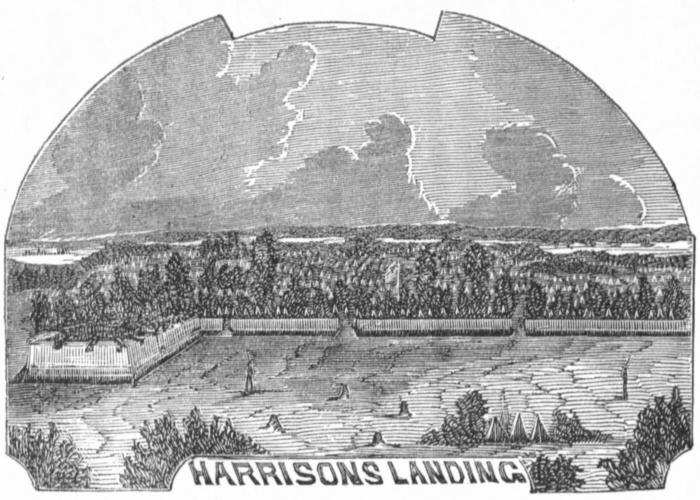
HARRISONS LANDING
The river was full of gunboats and transports
of every description. Many of the boys were so
famished that they did not wait for the commissary,
but swam out to the boats, and, clambering up the
sides, procured something to eat. Others were so
exhausted that, without delaying for food or shelter,
they sank down in the mud, and were soon fast asleep.
Notwithstanding the excessive heat and innumerable
number of bugs and flies of every description, they
found no difficulty in wooing Morpheus after the
severe and terrible exposures and hardships of the
seven days previous. On the next day, which
was the 4th, General McClellan issued the following
address to the troops:
Headquarters Army of the Potomac, Camp near Harrison’s Landing, July 4th, 1862.
Soldiers of the Army of the Potomac:
Your achievements of the last ten days have illustrated
the valor and endurance of the American
soldier. Attacked by superior forces, and without
hope of reinforcements, you have succeeded in changing
your base of operations by a flank movement,
always regarded as the most hazardous of military
expedients. You have saved all your material, all
your trains, and all your guns, except a few lost in
battle, taking in return, guns and colors from the
enemy. Upon your march you were assailed, day
after day, with desperate fury, by men of the same
race and nation, skilfully massed and led. Under
every disadvantage of number, and necessarily of
position also, you have, in every conflict, beaten
back your foes with enormous slaughter. Your conduct
ranks you among the celebrated armies of history.
No one will now question that each of you
may always with pride say, “I belong to the Army
of the Potomac.”
You have reached the new base, complete in
organization and unimpaired in spirit. The enemy
may, at any time, attack you. We are prepared to
meet them. I have personally established your lines.
Let them come, and we will convert their repulse
into a final defeat.
Your government is strengthening you with the
resources of a great people. On this, our Nation’s
birthday, we declare to our foes, who are rebels
against the best interests of mankind, that this army
shall enter the capital of the so-called Confederacy;
that our National constitution shall prevail; and that
the Union, which can alone insure internal peace and
external security to each State, “must and shall be
preserved,” cost what it may in time, treasure, and
blood.
GEO. B. McCLELLAN.
This stirring address was received with immense
enthusiasm by the army. During the day a national
salute was fired at the headquarters of each Army
Corps, and immediately after the bands played various
national airs. General McClellan likewise visited
all the troops in the afternoon, and they paraded
before him.
The position here was one of great beauty, the
country being open, rolling, and skirted with large
and variegated forests. Beautiful country residences,
belonging to aristocratic owners, were seen in every
direction.
Saturday morning, 5th, Smith’s Division was sent
back on the Charles City Cross-roads, two and a half
miles, to the support of General Shields’ forces, which
had been attacked by Texan cavalry. The rebels
were repulsed, and fled, leaving one gun in our possession.
The Brigade remained here, and pitched
their tents in a very commanding though unhealthy
position. The water was frequently so stagnant that
fish could not live in it, floating lifeless to the top.
The men immediately commenced earthworks on the
highlands in the vicinity of the Landing. The
Thirty-third assisted in the construction of an extensive
fort, mounting several 32-pounders. When
completed, it presented a very formidable appearance.
An immense amount of slashing was also
performed. It was a fine sight to see a whole forest
rapidly disappear before the sturdy blows of a thousand
choppers. While one Regiment used the axes,
another was posted in front to prevent the enemy’s
sharpshooters from firing upon them.
The men learned, with much satisfaction, soon after
reaching the Landing, of the capture of their old
acquaintance, the Teaser, which surrendered to the
Union gunboat Mantanzas.
Much sickness prevailed among the camps, owing
to the unhealthy surroundings and impure water.
Many died, and many more were taken North, not,
however, before the seeds of death had been implanted
in their constitutions. Each Company of the
Thirty-third provided itself with a well, and afterwards
enjoyed the luxury of pure water. Everything
pertaining to a soldier’s living was furnished
in abundance, after affairs became settled, sweet
bread, in addition to many other things, being added
to the bill of fare. While here, General Smith was
confirmed as a Brigadier General of Volunteers.
He was likewise nominated for a Major Generalship.
General Davidson, recovering from the effects of the
sunstroke, resumed command of the Brigade, and
Colonel Taylor returned to his Regiment. One reconnoissance
was made by him in the direction of Richmond.
CHAPTER XVII.
Arrival of Reinforcements.—Visit of President Lincoln.—Attack
by the Enemy.—Reconnoissance to Malvern Hills.—A Deserter
drummed out of Camp.—A change of base decided upon.—Return
March to Fortress Monroe.—Scenes by the way.
Reinforcements began to come up the river, so
that in a few days the army numbered one hundred
and twenty thousand men.
On the morning of the 8th President Lincoln arrived
unexpectedly from Fortress Monroe, and was
welcomed with a salute of thirty-two guns. After
spending a few hours at Headquarters, he proceeded
to review the various commands, accompanied by
General McClellan. As he rode along the lines, and
observed the thinned ranks and torn and tattered
flags, he exhibited much emotion. The review was
not completed until 9 o’clock, the moon shining
brightly, and a cool, fresh breeze blowing from off
the water. General Halleck likewise made his appearance
on the 24th, and inspected the army.
The enemy soon began to show themselves on the
opposite and higher bank of the river, and in the
course of a few days increased to the number of several
thousand. About midnight, on the 31st, they
opened a vigorous fire from three batteries on our
shipping and camps. Many of the shells struck in
the vicinity of the Thirty-third. Our gunboats
returned the fire, and, with the assistance of the
siege-guns, drove them away, at the end of two
hours. Only two men were killed, and twelve
wounded, by this night attack.
On the following morning eight hundred troops
crossed the river in boats, and burned all the buildings,
and cut down the trees in the vicinity.
Monday, August 4th, a force consisting of infantry,
cavalry and artillery, under General Hooker,
proceeded back to Malvern Hills, and after a brief
engagement re-occupied them, the enemy retreating.
They remained here until Wednesday, and then
returned to camp. On the following Friday, great
rejoicing was occasioned in General Hooker’s Division,
on the reception of the news that he had
been promoted to a Major Generalship. The troops
assembled en-masse at his headquarters, and cheered
vociferously for “Fighting Joe,” while various bands
discoursed national airs. Several hundred lighted
candles were fixed in the surrounding trees, imparting
a beautiful effect to the scene. The same day Colonel
Taylor left for the north on recruiting service,
taking with him Lieutenant Corning and a Sergeant
from each Company. Gen. Davidson also departed,
having been ordered to the Department of Missouri.
Lieutenant-Colonel Corning, being now senior officer
of the Brigade, assumed command of it.
A soldier who had run away from the Golden’s
Farm fight, was paraded before the Division with his
head half-shaved, and a placard marked “Coward,”
suspended upon his back. He was also sentenced
to forfeit all back pay, and spend the remainder
of his time of enlistment at the Tortugas. All the
Regiments were drawn up in line of battle, and the
culprit marched back and forth before them, while a
band played “the rogue’s march.”
Owing to the movements of the enemy in front of
General Pope, unhealthy location of the army at
Harrison’s Landing, and because they had come to
regard the Peninsula route to Richmond impracticable,
and lost confidence in General McClellan’s
capacity, the military authorities at Washington
decided, early in the month of August, to recall the
army from the Peninsula. General McClellan was
strongly opposed to this, declaring to them that if
fifty thousand reinforcements were furnished him, he
would yet enter the rebel capital. His wishes,
however, were not complied with, and preparations
for a “change of base” were commenced. Smith’s
Division received orders to be in readiness to march
at daylight, Thursday, August 14th. It did not
move, however, until the following Saturday. All
the necessary preparations were conducted with
secrecy and dispatch; wooden guns were planted on
the fort which the Thirty-third had assisted in building,
and sentinels of straw were posted a few feet apart
on the ramparts. All day Thursday and Friday,
other portions of the army marched by, the artillery
and wagon trains proceeding at night. Generals
Porter’s, Keyes’, and Sumner’s Corps proceeded by
the Charles City Court House, and General Heintzelman’s
by the Cole’s Ford route. The object of the
previous movement to Malvern was now explained,
it having been made to mislead the enemy, and cause
them to think that another advance was intended.
About four o’clock Saturday afternoon, Smith’s
Division took up the line of march. As the troops moved
away, the enemy who, apparently for the first time,
had discovered the movement, drew near and fired
for some time at the sham pickets or sentinels, occasioning
many humorous remarks from the soldiers,
such as, “They won’t drive them,” “Why don’t you
drop him, Mr. Rebel.” “How are you, sharp-shooter,”
&c., &c. The column was forty miles in length,
General Porter, who was at the head, having then
reached Williamsburg. The Thirty-third proceeded
by the river road, and marching five miles the
first night, encamped on a deserted plantation.
While halting by the way, General McClellan appeared,
and after addressing the men a few encouraging
words, urged the necessity of marching as rapidly
as possible. The moon shone brightly, but the
air was chilly, and many who had thrown away their
blankets suffered from the cold and heavy dew.
The following day, Sunday, the march was resumed
at six o’clock, and continued until three in the afternoon.
The Regiment marched seventeen miles, crossing
the Chickahominy near its mouth on a pontoon
bridge—the longest ever constructed in this country—consisting
of ninety-six boats, anchored about
twenty feet apart.
Among other craft lying here was the steamer
Matamora, which had conveyed a portion of the
Thirty-third from Alexandria to Fortress Monroe.
The troops encamped in a wheat-field on an elevated
spot about one-fourth of a mile back from the
river. All danger of an attack from the enemy was
now past, and they slept soundly after their long
and wearisome march. The country for miles back
in the interior was very flat, almost on a level with
the river’s bank, and abounded in swamps and marshes.
Evidences of ruin and decay were seen all along
the route. The orchards had frequently been so
neglected that a second growth of trees had sprung
up and grown through the limbs of the older ones,
presenting an anomalous sight. Col. Vegesack, who
had been assigned to the 20th New York, now took
command of the Brigade, and Lieutenant-Colonel
Corning returned to the Regiment. Col. Vegesack,
who had obtained a furlough from the Swedish
army to cross the water and fight in behalf of
the Union, was a brave and beloved officer. While
the first battle of Fredericksburg was in progress,
he received an extension of time, and in announcing
the fact to his men on the field, added; “My soldiers,
I fight from patriotism: you fight from patriotism and
for country; I expect that you will fight well.”
The next day the Regiment marched fifteen miles,
passing through Williamsburg. The inhabitants
manifested in various ways their delight at seeing the
army retreating, which four months before had
marched so victoriously in the opposite direction.
Marching by Fort Magruder and the old battle-field,
the Thirty-third bivouacked in a pleasant spot three
miles beyond. The troops rose early the next morning,
and by six o’clock were in motion. Proceeding
through Yorktown, the Regiment encamped near
a grave-yard, two miles distant from the city, in
which two of General Washington’s Aids, killed in
the first siege of Yorktown, were buried. Officers
and men now for the first time visited the city,
spending several hours in wandering through the
streets, and examining the heavy fortifications constructed
by the enemy. General Van Allen was in
command of the place. Near to the fortifications was
a “Union Cemetery,” containing the graves of 300
Union soldiers, each of which was adorned by a
neat head-board, designating the name and Regiment
of the soldier. Wednesday the march was resumed
at five o’clock, and continued for ten miles, until
Big Bethel was reached. At ten o’clock on the following
morning the Regiment arrived in Hampton.
The various Divisions of the army had now reached
here, the entire retrograde movement having
been performed most successfully.
CHAPTER XVIII.
Abandonment of the Peninsula.—Arrival at Acquia Creek.—Disembarkation
at Alexandria.—Pope’s Operations.—Death of
Generals Stevens and Kearney.—Retreat to the Fortifications.—Responsibility
for the Disaster.—Fitz-John Porter.
On the following day, the Thirty-third and other
Regiments of the Third Brigade embarked at Fortress
Monroe, on board the steamers Vanderbilt
and Empire City, and came to anchor the same evening
at Acquia Creek. The design in sending them
here was to reinforce General Burnside, who had
already arrived, and held Fredericksburg with a large
force. As affairs were assuming a threatening attitude
around Washington, it was deemed best, however,
to withdraw all the troops from Fredericksburg
and vicinity. General Burnside, therefore, commenced
evacuating the region the same day that the Thirty-third
arrived. The three bridges constructed over
the Rappahannock, the railroad, Quartermaster and
commissary buildings at Falmouth, were destroyed,
the Fredericksburg machine-shop and foundry blown
up, and various other property laid in ruins. As
the last of the forces were leaving, a woman appeared,
with three little children clinging to her
side, whom General Burnside recognized as a prominent
Union lady. He immediately remarked to
her: “Have you anything down to the bridge,
madam?” “Only a bed and a few small articles, sir.”
Turning to one of his wagon-masters, he said, “Send
down an ambulance, wagon-master, and have them
brought up and carried to the depot.” The lady
afterwards had the pleasure of being landed safely
in Washington with her children and effects. This
was a little incident in itself, but illustrates the
character of the man.
The Thirty-third did not disembark, but proceeding
on up to Alexandria, went into camp near Fort
Ellsworth, on the 24th, just five months from the
day it left for the Peninsula. Five months of active
campaigning had brought with it all the fortunes of
war. Victory and defeat had anon perched on our
banners. New Generals had come and gone. Brave
spirits innumerable had been shot to death on the
field, lain down in sickly swamps to die, or breathed
their life away in northern hospitals or homes. The
retrospect was not a cheerful one.
The other Regiments of Franklin’s Corps arrived
during the same day, on the Daniel Webster and
other transports.
General Pope’s army was in the meantime actively
engaged.
Saturday, August 9th, the battle of Cedar Mountain
was fought between Generals Banks and Jackson,
which can hardly be claimed as a victory for the
Federal arms, though the subsequent retreat of the
enemy left us in possession of the field.
Wednesday, 13th, General Buford’s Cavalry pushed
on further south, as far as Orange Court House,
capturing many wounded who had been abandoned.
Sunday, 17th, the army encamped along the banks
of the Rapidan.
Wednesday, 20th, General Pope and his entire
command crossed to the north bank of the river,
and during the same day Jackson, who had been
heavily reinforced from Lee’s army, appeared at
several of the fords, and opened a brisk and lengthy
artillery fire. Opposing batteries were planted along
the river at different points for a distance of fifteen
miles. No advantage resulted to the enemy from this
prolonged artillery duel. They succeeded, however,
in throwing a body of cavalry across one of the
fords at the extreme left of our lines, which was met
by a corresponding force. A severe conflict ensued,
neither party being the victors.
Saturday, 23rd, the rebels made a spirited attack on
Rappahannock Station, compelling us to abandon it.
The bridge over the Rappahannock at that point
was burned, and the abutments blown up.
Monday, 25th, the entire left wing of the rebel
army crossed the river at Warrenton Springs, and
General Pope immediately decided upon abandoning
the line of the Rappahannock.
Tuesday, 26th, Ewell, with a part of Jackson’s command,
appeared at Bristow Station, in Pope’s rear,
and destroyed two bridges, two locomotives, and fifty
cars, en route back to Alexandria from Warrenton
Junction, whither they had conveyed General
Hooker’s Division a few hours previous. Leaving
Bristow Station, Ewell proceeded to Manassas Junction,
and burnt one hundred more cars, heavily laden
with ammunition and supplies. He also destroyed
the bridge over Bull Run, and retreated to Hay
Market, closely pursued by Hooker and Kearney.
About the same time Longstreet’s corps forced a
passage through Thoroughfare Gap, after meeting
with a stubborn resistance from General King’s Division.
On abandoning the Rappahannock, General
Pope had marched rapidly back, in three columns,
from Warrenton and Warrenton Junction, and disposed
his forces in the following manner. The Corps
of McDowell and Sigel and the Pennsylvania
Reserves, under Reynolds, were moved to Gainesville.
Reno and Kearney were directed upon Greenwich,
while Hooker’s Division was sent against Ewell
along the railroad. These dispositions, General
Halleck tells us, were well planned, but were unfortunately
too late, as a large detachment of Lee’s
army was already east of Thoroughfare Gap. General
Porter was ordered to be at Bristow Station by
daylight on the morning of the 28th, but not obeying
the order, his Corps did not participate in the
battles of the 28th and 29th. Heintzelman’s Corps
pressed forward to Manassas on the morning of the
28th, and forced Jackson to retreat across Bull Run
by the Centreville turnpike. McDowell had succeeded
in checking Lee at Thoroughfare Gap, but the
latter took the road to New Market, and hastened to
the relief of Jackson, who was now in rapid retreat.
A portion of McDowell’s corps encountered
the retreating column on the afternoon of the
28th, near Warrenton turnpike, and a severe but
successful battle ensued.
Friday, 29th, Jackson was again attacked near the
old battle ground of July 1861, when a heavy
engagement ensued. Sigel, who had arrived, held
the extreme right of our lines. The enemy endeavored
to turn his position, but were repulsed three
times. Fighting continued until dark, at which
time the rebels had been driven one mile. General
Pope, in his official report of this battle, wrote:
“We fought a terrific battle here yesterday with
the combined forces of the enemy, which lasted with
continuous fury, from daylight until after dark, by
which time the enemy was driven from the field
which we now occupy. Our troops are too much
exhausted to push matters, but I shall do so in the
course of the morning, as soon as Fitz-John Porter’s
Corps comes up from Manassas.”
Upon the following day our forces were arranged
as follows: Heintzelman, extreme right; Porter and
McDowell, centre; and Banks, extreme left. Sigel
was held as a reserve in the rear of Porter. We
renewed the battle at 7 o’clock, A. M. Firing was
kept up on both sides until one o’clock, when the
rebels charged in solid column upon our centre.
They were at first repulsed, but again advancing in
six columns, McDowell’s troops gave away. The
centre now being broken, the wings were compelled
to fall back, when a perfect rout ensued. Officers
and men, alike, rushed back, pell mell, in the direction
of Washington, as fast as their legs would carry them.
Reaching Bull Run they were temporarily rallied
and held the advance of the enemy in check, but
again pushing on, they did not stop until within
sight of Centreville.
Returning to General Franklin’s command, the
Thirty-third, together with the other Regiments of
the Corps, received marching orders on the 28th.
Tents were struck, rations provided, and everything
got in readiness to hasten to the support of Pope.
But the movement did not commence, and at sunset
the tents were re-pitched. Orders came again, however,
at ten o’clock, to be ready to march on the following
morning. The Third Brigade was in readiness
at six o’clock, but, proceeding on to the camps
of the remaining portions of the Corps, saw but little
indication of a move. Tents remained standing,
unharnessed artillery horses were eating their grain,
and other evidences of an intended delay were apparent.
After the lapse of two hours, the Corps
took up the line of march, and proceeding through
Annandale, halted at eleven o’clock for the day,
after having made a distance of six and one half
miles. The next morning the march was resumed
at eight o’clock. On nearing Fairfax Court House,
the artillery firing of General Pope could be distinctly
heard, and the troops, knowing that he must be in
need of reinforcements, were anxious to push rapidly
forward. But they were moved along at
a snail pace. Arriving at Cub Run, two miles
beyond Centreville, large numbers of wounded men,
stragglers and wagons were met going to the rear.
While the Thirty-third was fording Cub Run, “we
were ordered,” writes the Lieutenant-Colonel, “to
counter-march. Our army had given way and the
hellish intentions of some Generals had been accomplished.
Pope had been defeated.” The Brigade returned
to Centreville, reaching there about ten
o’clock at night. Lieutenant-Colonel Corning was
immediately ordered to proceed with the Thirty-third
and Seventh Maine, to a point two miles to the
rear, to stop the stragglers, who were now hurrying
towards the capital by whole Brigades. The
Regiments were posted across the road, where they
remained until the following morning, halting and
turning back, at the point of the bayonet, a large
number of the panic-stricken fugitives. Being relieved,
they returned again to Centreville, and took
up position in one of the lines of battle formed by
the Corps to cover the retreat. Under protection of
a flag of truce, some sixty ambulances proceeded to
the battle-field and brought off about half of our
wounded, who had lain since Saturday in the open
air, exposed to the broiling sun, and fierce storm
which prevailed Sunday evening. The poor fellows
were in a terrible condition, having been deserted
by the surgeons, who, like the rest of the army,
were panic-stricken and had fled. Nearly two hundred
of them were left, the flag of truce expiring
before they could be brought away. Just at
nightfall (Monday) a portion of the enemy succeeded
in getting in our rear, between Centreville and
Fairfax, and fell upon the supply trains, which were
withdrawing to Alexandria. General Stevens was
immediately sent back from the former place, and
succeeded in driving the enemy away, though losing
his own life. He fell at the head of his Brigade,
pierced through the breast by a minie-ball. Later
in the evening the lion-hearted Kearney was also
killed. It was his habit, like that of Stonewall
Jackson’s, to ride round his lines after the troops
were asleep, and inspect them closely, satisfying himself
that the pickets were doing their duty. Not
unfrequently he would start off in this manner alone,
and be absent for hours, making himself fully acquainted
with everything that was transpiring along
the lines. It was while out on such a tour of inspection,
Monday night, that he was shot dead by a
rebel picket, who observed him riding along, from a
distance. His death, as well as that of General
Stevens, was universally lamented.
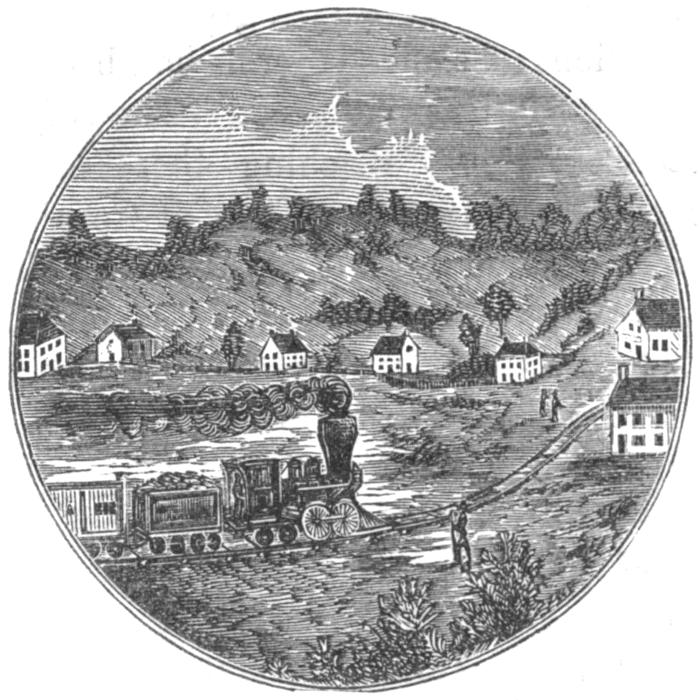
Vienna, 15 miles from Alexandria.
The entire army now fell back to the fortifications
around Alexandria. The Thirty-third left the front
about seven o’clock Monday evening, halting at two
o’clock on the following morning, one mile west of
Fairfax Court House. The roads were full of troops
and wagon trains, and the night was intensely dark,
which added to the confusion. After sleeping two
hours, the Division again moved back to the front, and
constituted the rear guard of the retreating forces.
About ten o’clock it was withdrawn and proceeded
towards Alexandria, reaching the old camping
ground at ten o’clock in the evening.
So ended the second series of Bull Run engagements.
Owing to the timidity and lack of confidence
in the people, which have led the military
authorities at Washington, from the commencement
of the war, to withhold unfavorable intelligence, the
country has never comprehended the extent of the
disaster which resulted from this week of battles.
Our arms unquestionably suffered the severest
reverse which has yet befallen them. In addition to
the loss of seventy-five cannon and large quantities
of small arms, equipments, supplies, etc., there
must have been fully twenty thousand Federal
troops killed, wounded and taken prisoners.
Neither has the country comprehended the rightful
causes of this disaster. We believe that it was
occasioned solely by the jealousy of military officers,
and not through incapacity on the part of Gen. Pope.
No sooner was he appointed to the command of the
Army of Virginia, and large forces placed under
him, than an emulous spirit manifested itself among
the Generals of the Army of the Peninsula. When
he issued the injudicious address to his troops,
announcing that his headquarters were to be in the
saddle, and that they were not to be employed in
seeking out lines of retreat, this spirit was still
further developed. Finally, when the Peninsular
forces were recalled to the capital and placed under
Pope, and Gen. McClellan left in command of the
fortifications simply, several of his Generals deliberately,
we believe, plotted the new leader’s ruin.
Gen. Porter was unquestionably the most guilty one
of the number, and merited a severer punishment
than has been meted out to him. This was the general
opinion entertained in the army, outside of his own
Corps. However much they loved and admired
Gen. McClellan, the troops came to regard his pet,
Gen. Fitz-John Porter, with distrust and suspicion.
Had he obeyed orders, Gen. Pope informs us that
the enemy would have been completely routed.
No satisfactory reasons have ever been given for
the late advance and slow march of Gen. Franklin’s
Corps from Alexandria to the scene of operations,
when it was so much needed. The fact of his never
having been called to account for it, is, however,
sufficient reason for asserting that Gen. Franklin was
not responsible for the delay. He was too much of
a patriot, too much of a soldier, to be guilty of
any machinations against a brother officer and his
country. Great injustice has been done him by
associating his name with Gen. Porter’s.
The conduct and correspondence of Gen. McClellan
all go to prove that he neither shared in nor
countenanced that spirit of rivalry which cost the
country so much blood and treasure. Gen. Pope’s
plans were well conceived, and if they had been
carried out, would doubtless have resulted in a substantial
victory. However questionable his veracity,
we cannot withhold from him the meed of having
displayed good generalship in the East as well as in
the West.
CHAPTER XIX.
General McClellan Restored to Command.—Re-organization of the
Army.—Advance of the Enemy into Maryland.—March from
Washington.—Battle of Crampton’s Pass.—Harper’s Ferry Surrendered.
Soon after the troops fell back, Gen. Pope was
relieved, at his own request, and Gen. McClellan
re-instated as Major General commanding. He immediately
commenced the labor of re-organizing the
army. The lull which followed, and absence of the
enemy from our immediate front, boded no good.
The news, therefore, which soon reached Washington,
that the rebels had made their appearance near
Edward’s Ferry, was not wholly unexpected. Friday
night, Sept. 5th, they crossed the Potomac and occupied
Frederick City with a heavy force, destroying the
Baltimore and Ohio Railroad for several miles, and
cutting off communication with Harper’s Ferry and
Martinsburg, where considerable bodies of our
troops were stationed. Gen. Lee’s plan, he afterwards
stated, in crossing the river, was to threaten
Baltimore, Washington and Harrisburg at the
same time, thereby diverting the attention of our
authorities while he encircled and captured the above
forces. Gen. McClellan immediately pushed forward
to meet him.
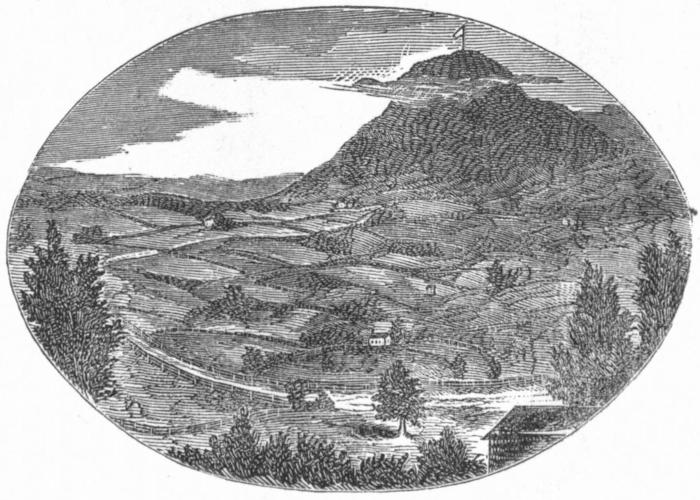
SUGAR-LOAF MOUNTAIN, MARYLAND.
Saturday evening, Sept. 6th, Franklin’s Corps
crossed the Long Bridge, followed by Sumner’s and
Hooker’s (late McDowell’s), and proceeded up the
Maryland side of the river. All night long the solid,
heavy tramp of troops could be heard through the
streets of the capital.
The Thirty-third passed up Pennsylvania Avenue
about 7 o’clock, and marching until 2 o’clock Sunday
morning, halted at Tanlytown. The march was
resumed at 5 o’clock P. M., and continued for six
miles.
Monday, Sept. 8th, marched through Rockville,
halting one mile west of the place. Many of the
knapsacks were left here, and afterwards sent back
to Washington. Resuming the march, bivouacked
four miles east of Darnestown.
Tuesday, Sept. 9th, moved at 9 o’clock A. M.,
and encamped near Seneca Creek. The weather
was very warm and roads dusty, but, relieved of
their knapsacks and other effects, the soldiers suffered
comparatively little.
Thursday, Sept. 11th, marched at 9 o’clock, A. M.,
and halted about noon between Barnsville and Sugar
Loaf Mountain.
Friday, Sept. 12th, marched at 9 A. M., encamping
near Monocacy Bridge, which had been destroyed
by the enemy, but was now rebuilt. The same
day our advance, under Gen. Burnside, entered
Frederick, the people turning out en masse to welcome
them. Just before reaching the city they encountered
a Brigade of rebel cavalry, under Fitzhugh
Lee, whipping and driving them before them
in gallant style.
Crossing the bridge upon the following morning,
Lieut.-Col. Corning was ordered forward with the
Thirty-third and Twentieth New York, to drive the
enemy out of Jefferson’s Pass, an opening through
the range of mountains extending southeast of and
nearly parallel with the Blue Ridge.
Doffing such wearing apparel and equipments as
were not necessary, the men pressed rapidly forward.
Their dark blue uniforms and glistening bayonets
soon appeared among the trees and green foliage of
the mountain side, as they moved upward, scaling
rocky ledges, and clinging hold of shrubs and
branches, to steady their footing. The enemy, who
were posted along the summit, hastily fled as they
drew near, leaving it in their possession. A magnificent
view presented itself from here. Stretching
far away in every direction, were rich fields of grain,
ripening into maturity, thousands of cattle feeding
on the green hills, little villages and farm houses
dotting the landscape, the church spires of Frederick
looming up in the distance, and at the base of
the Blue Mountains immense rebel trains, protected
from attack by the frowning guns above. Descending
the opposite side of the mountain, the two
Regiments deployed as skirmishers, and moving forward
a mile beyond the beautiful village of Jefferson,
picketed for the night. All along the route they
were enthusiastically received by the Marylanders.
Fair maids plucked the richest flowers from their
gardens, and clustering them in rich bouquets, placed
them in the hands of the brave New Yorkers.
Grave matrons, with ruddy daughters, like Angels
of Mercy, came to the gates by the road-side with
cups of milk and water to refresh the thirsty soldiers.
Such a reception was hardly expected, and was the
more appreciated, after the long and unpleasant
experiences among the rebel men and women of
Virginia. The remainder of the Division came up
here and rested for the night.
Heavy firing was heard in the direction of Harper’s
Ferry. While passing through Jefferson much
merriment was occasioned by the chasing of a rebel
cavalryman. Seeing him lagging behind, one of
our troopers, clapping spurs to his horse, started in
hot pursuit, yelling and screaming at the top of his
voice, as he rode. He continued to gain on the
gray-back, and when within a few yards, discharged
his carbine and revolver simultaneously at him,
which so alarmed the fugitive that he wheeled, and
at once gave himself up. A little further on, Col.
Irwin, of the Forty-ninth Pennsylvania, who had now
assumed command of the Brigade, took after five
rebel videttes, and riding into their midst with a
revolver in each hand, compelled three of them to
surrender.
When our forces advanced to Frederick, the
enemy retreated on two turnpikes diverging from
the city, and running through cuts in the Blue
Ridge, six miles apart, and known as the South
Mountain, or Turner’s Pass, near Middletown, and
Crampton’s Pass, near Burkettsville. Having fortified
these and the surrounding hill-tops, they waited
our approach. Gen. McClellan, after reviewing the
situation for a short time, decided upon storming
these positions. To Gen. Franklin he assigned the
duty of taking Crampton’s Pass, while he superintended
operations personally at Turner’s.
The Sixth Corps moved forward from the vicinity
of Jefferson Sunday morning, and on nearing Burkettsville,
was arranged for the attack. The enemy
seeing this, opened a heavy fire from the guns
planted on the heights, but the troops pressed rapidly
forward on the double-quick over the ploughed fields
and meadows, until the village was reached, when
they halted in the streets. The Thirty-third lost but
one man while running the gauntlet of the rebel
batteries. Though shot and shell were flying in
every direction, the citizens came out of their
houses, waved their handkerchiefs, cheered for the
“Union Boys,” and brought them food and drink.
After resting for a few moments, the advance was
again sounded, and Slocum’s Division moved to the
right of the turnpike and engaged the enemy, while
Gen. Brooks, supported by the Thirty-third and
other Regiments of the Third Brigade, marched
directly up the road. About 3 o’clock Slocum
reached the Pass, and drove the enemy from it, after
a hard fought battle. Brooks’ column immediately
came on, and dashing up the woody summit, charged
the battery at the left of the Pass and captured two
guns, together with numerous prisoners. Among
the number was Col. Lamar, of the Eighth Georgia,
who had previously been taken at the battle of Golden’s
Farm and paroled. It now being dark, the troops
retraced their steps to the Pass, and moving down
the west side of the mountain, bivouacked at the
foot in Pleasant Valley. Gens. Hooker and Reno
had, in the meantime, stormed the South Mountain
gorge, though in doing so the latter lost his life.
Monday morning, the Sixth Corps stood to arms
at sunrise, and prepared to march to the relief of
Harper’s Ferry. It was soon ascertained, however,
that Col. Miles had surrendered that place, and the
men went into camp again. This intelligence so
affected Gen. McClellan as to cause him to shed
tears. Tuesday, the Corps remained in Pleasant
Valley.
CHAPTER XX. THE BATTLE OF ANTIETAM, FOUGHT WEDNESDAY, SEPT. 17TH.
The battle of Antietam was the first substantial
victory which crowned the labors of the Army of the
Potomac. Williamsburg, Fair Oaks and Malvern
were all victories, but productive of no immediate
results. Fought on ground of the enemy’s choosing,
and under the disadvantages which always attend
the assailing party, it was a decisive struggle, stemming
the tide of invasion and rolling back to their
rebellious territory Lee’s boasted legions, the
“Ragged multitude
Of hinds and peasants, rude and merciless,”
who had come to “free” “My Maryland.” A single
regret is associated with Antietam: that the enemy,
defeated and driven back, were not followed up and
annihilated.
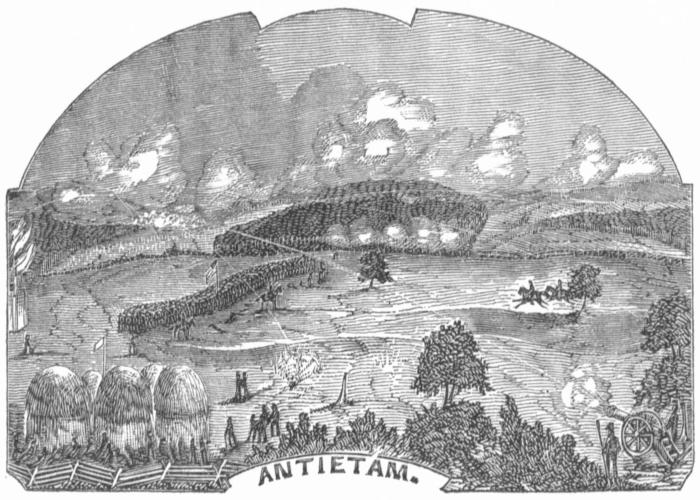
ANTIETAM.
Straw Stacks, with Wounded. Position
of Thirty-Third when attacked. Rickett’s Battery.
After being driven from the mountain passes,
Gen. Lee withdrew his forces from the vicinity of
the Blue Ridge, Boonsboro and Hagerstown, and
concentrated them near Sharpsburg, in horse-shoe
shaped lines, the heels resting near the Potomac.
Gen. McClellan followed with his entire army, save
Couch’s Division and Franklin’s Command, which
having been detached for the relief of Harper’s
Ferry, were several miles in the rear.
The valley in which the conflict occurred lies
directly west of the spur of the Blue Ridge known
as South Mountain, and comprises one of the most
delightful portions of Maryland. Looking down
from the Highlands, the eye fell upon little villages,
crowning eminences or nestling in dells; farm houses
standing out boldly on the hill-tops, or half-hidden
down the woody slopes; yellow fields of grain, green
pastures and sombre fallows; luxuriant orchards
and groves of maple, interspersed with oak; the
tortuous Antietam, forming in its serpentine windings
numerous miniature islands; lesser streams
sparkling in the sunlight, leaping and babbling down
the mountain side, or flowing noiselessly through the
verdant meadows—the whole comprising a landscape
of surpassing beauty and loveliness.
Down on this fair valley settled the “horrid
cloud” called battle. Over this gorgeous patch-work
of nature rolled the “hot elements of destruction.”
Monday afternoon and Tuesday were spent by
Gen. McClellan in reconnoitring the enemy’s position,
and establishing his own. He likewise devoted
considerable time to examining the topography of
the region. “Two hostile armies,” a recent writer
observes, “on a battle-field, are two wrestlers—one
tries to throw the other; they cling to everything;
a thicket is a basis; for want of a village to support
it, a Regiment gives way; a fall in the plain, a
transverse hedge in a good position, a wood, a ravine,
may arrest the heel of that column which is
called an army, and prevent its slipping. The one
who leaves the field is beaten, and hence the necessity
for the responsible Chief to examine the smallest
clump of trees, and the slightest rise in the ground.”
No General ever realized the truth of the above
more than Gen. McClellan, and it was accordingly
his wont to inspect minutely the ground chosen for
battle. Before Tuesday noon he had familiarized
himself with the plan of “Antietam,” examined the
woods, fields, hills, dales and streams which it
embraced, selected the commanding positions for
his artillery, and marked out the level spots where
infantry could be manœuvred to advantage.
As fast as the troops came streaming down from
the mountain, they moved to the various points
assigned them. It was an inspiring sight, those long
shining lines, pouring down through the woods and
fields, like “living threads that went to weave
themselves into the glorious tapestry of our nation’s
history.”
There was the chivalric Burnside, leading the conquerors
of Roanoke and Newbern—the Ninth Army
Corps—which he loved so well. Further to the
right came Porter, with his Regulars and well filled
ranks of Volunteers. Still further on appeared the
brave old Sumner, whose highest wish was to die
with the harness on—followed by troops who adored
the hero of Fair Oaks, if possible, more than their
Chief.
In the rear rode the gallant Mansfield, who, tired
of inactivity, had exchanged the ease of court duty
at the capital for the command of Banks’ Corps,
fresh from the gory fields of Cedar Mountain and
Bull Run. Hither was he come to uncover to the
storm his head, now silvered o’er by the frosts of
nearly sixty winters, and die while cheering forward
his men on a charge. And there too was the courageous
Hooker, deploying far away to the right his
battle-scarred veterans.
During Tuesday there was heavy skirmishing
between the infantry, and considerable artillery firing,
but no general engagement took place. Meanwhile
Lee was reinforced by Jackson’s Corps of
thirty thousand men, who, after having taken possession
of Harper’s Ferry, moved rapidly back up
the Virginia side of the Potomac and crossed over
at the fords near Sharpsburg. Aware, as he now
was, of his superiority in numbers and position, the
rebel chief calmly awaited our attack.
The dawn of Wednesday found the Federal army
arranged in much the same manner as the day previous,
Hooker on the right, supported by Mansfield,
then Sumner, then Porter on a commanding
eminence, as a reserve, and lastly Burnside, on the
extreme left.
The line extended between four and five miles. The
rebel left was in the woods, directly in front of our
right, and their forces were posted across the valley
between us and Sharpsburg, and very nearly parallel
with our own. Our artillery was planted behind
the crests of the various hillocks, ready to be run up
and fire at a moment’s notice.
To Gen. Hooker had been assigned the honor of
opening the great combat. During the night previous
he had crossed the Antietam on the Hagerstown
road, and gained a position on the right bank of that
stream, which curved round in front of our forces.
He was in the saddle before daylight, and the rising
sun shone upon his troops moving forward in
battle array—the right of our lines sweeping round
towards the Potomac. They proceeded but a short
distance before encountering the enemy, drawn up
to receive them, and soon the profound stillness
which precedes a battle was broken, and Saxon was
pitted against Saxon in the contest of death.
Steadily the brave fellows pressed forward over the
wooded and uneven ground, regardless of the infantry
and artillery fire which was concentrated upon them
from several points, and sweeping through the cornfields
and grove at the right of the Sharpsburg
turnpike, bore down with irresistible fury upon the
rebel lines.
They stood the shock but a moment, and then
the swarthy foe fell back in disorder, closely
followed by our victorious boys, who made the
welkin ring with their shouts and cheers. But now
come reinforcements for the enemy, and our troops
are forced back from the ground which they have so
gallantly won. For a moment it seems as if Hooker
will be overpowered, so heavily has the enemy’s left
been reinforced, but the timely arrival of Mansfield
stems the tide of rebel success. The two commands
are massed together, and together resist the onslaughts
of the enemy. There is as yet no fighting
elsewhere. All the energy, skill and force of the
respective commanders are, for the time being, centred
on this point. Hither all eyes are turned.
Ten o’clock finds the troops still fiercely engaged.
Both Hooker and Mansfield are lost to them. Gen.
McClellan soon arrives, inspiring the men by his
presence. A few moments later Sumner comes up
with his whole Corps to the relief of those who have
been fighting for three hours.
His troops suffer severely. It was true he exposed
them—unnecessarily some thought—but no more
than he exposed himself. Wherever the conflict
waxed hottest, there he was to be seen riding to and
fro, brandishing his sword and cheering forward his
men, his head uncovered and his long silver locks
streaming in the breeze. French, Richardson,
Kimball and other brave spirits were with him,
seconding his commands.
The gallant young Howard, who laid aside his ministerial
robes to lose an arm at Fair Oaks Roads, leads
Burn’s old Brigade on a charge. Close by appears the
intrepid Meagher, double-quicking his Irish braves
through a field of corn, and the enemy, who have
again commenced advancing, are checked. Our
reserve artillery are now trained upon them, and
“Like a plow in the fallow through them
Plow the Northern ball,”
creating wide gaps and producing fearful carnage
in their ranks. But determined on breaking this
part of our line, Gen. Lee continued to mass his
forces here, and portions of Sumner’s troops, weary
and exhausted, began to recede.
It was now a most critical moment—Mansfield
killed, Hooker wounded, Sedgwick, Richardson and
Crawford carried bleeding from the field,—the
enemy pressing on in overwhelming numbers,—our
own troops giving way,—what should we have done
had not Franklin arrived at this juncture from
Pleasant Valley with two fresh Divisions?
The force had left Pleasant Valley at daylight,
and marched rapidly to the scene of action. The
Third Brigade, with two others, immediately pressing
forward, put the enemy to flight, and
established the lines far in advance of where
they had been at the opening of the fight.
This brilliant success cost us, however, many
casualties. Fifty were killed and wounded in
the Thirty-third alone; among the former was Sergeant-Major
George W. Bassett, a brave and beloved
officer. He was shot through the head, after bearing
Lieut. Mix from the field, seriously wounded through
the thigh. Captain Gifford and Lieutenant King
were also wounded. Lieutenant-Colonel Corning’s
horse was hit three times, and Major Platner’s
killed. The Thirty-third, and other Regiments of
Franklin’s Corps sent forward, held their position
during the remainder of the contest. The fighting on
the left did not commence until later in the day, and
it was noon before the fire of musketry announced
that the infantry were engaged in that direction.
The first advance was made down the slope of a
hill, to a bridge which crossed the Antietam. Beyond
the stream the enemy were so posted as to
sweep the bridge with a severe musketry fire.
After an hour or two of fighting for its possession,
a charge was ordered, and the structure carried
at the point of the bayonet.
Once across the creek, General Burnside found
the rebels in a new position of great strength.
Against this position he advanced at once, and
Gens. Cox, Wilcox and Sturges soon occupied the
hill. No sooner, however, had they appeared on
the summit, than the opposing artillery rendered it
untenable. They, therefore, relinquished it, but so
planted their guns that the enemy could not reoccupy
it.
The rebel infantry now appeared, as they had done
earlier in the day, on the right, in overwhelming
numbers, and attempted to drive back Burnside.
Being sorely pressed he sent to Gen. McClellan for
reinforcements. “Tell Burnside that I can furnish
him no more troops.” (What was Porter doing all
this time?) “But, General,” answers the aid, “Gen.
Burnside is being crushed, and before I get back may
be overpowered.” “Tell Gen. Burnside,” Gen.
McClellan once more sternly replies, “that he must
maintain his position at all hazards and at whatever
cost.” Lieut. French galloped back to his General
with this verbal communication, and from that time
the warm intimacy existing between McClellan and
Burnside—an intimacy which had sprung up when
they were chums together in civil life—was ended.
Gen. Burnside felt, and justly too, that some of the
fresh and well trained troops belonging to Porter
should have been sent to his assistance. He withstood
the shock but a few moments, losing very heavily, and
then withdrew from the extreme position which he
had gained near Sharpsburg to one slightly in rear
of it. He, however, held his bank of the river completely,
and maintained much ground beyond it,
which he had taken from the enemy.
Night closed upon the scene, preventing further
operations, and our victorious troops slept on the
battle-field.
A guard of three officers, nine Sergeants and
thirty men from the Thirty-third were posted in
front of the Regiment, and after dark moved forward
to within a hundred yards of the enemy. Towards
morning the officer of the guard informed Lieut.
Col. Corning that the rebels were moving artillery
back by hand. He immediately reported this to
headquarters, and in the morning sent Lieut. Carter
to Gen. Smith to announce to him in person that he
had heard artillery moving to the rear, and perceived
other indications of a retreat on the part of the
enemy. An hour later they could be seen from
Burnside’s position moving back to the river. The
men were impatient to dash after them and end the
war. Where was McClellan that he did not give
orders to renew the conflict? No such orders came.
About noon the Third Brigade was relieved by
Cochrane’s of Couch’s Division. The afternoon
passed as had the forenoon, no offensive demonstrations
being made by us. The rebels kept up a
brisk fire from their skirmish line, which fact was,
after our Peninsular experience, an additional evidence
to us that they were retiring. About noon, on
the following day (Friday), our skirmishers moved
forward, and discovered that the enemy had all
crossed to the Virginia side of the Potomac. The
whole army was now put in motion and encamped
near the bank of the river. Gen. McClellan has
been severely censured for thus permitting the enemy
to slip through his fingers, but he committed no
greater blunder than did Lee in afterwards allowing
Burnside to escape at Fredericksburg and Hooker
at Chancellorsville.
CHAPTER XXI.
Appearance of the Field after the strife.—Union Losses and
Captures.—Bravery of the Raw Levies.—The Thirty-third complimented
by the Brigade Commander.
One forgets the horrors of war in the roar of
artillery and shock of contending thousands, but
when the field is afterwards surveyed, we realize
how fearful, how terrible is the calamity. The falling
back of the enemy left the battle-field of Antietam
in our possession, with all its heart-rending and
melancholy scenes. Scattered over a space of four
miles, were men with uniforms of blue, and uniforms
of gray, exhibiting all the frightful mutilations
which the human body can suffer.
Shot through the head, shot through the body,
shot through the limbs, shot to the death, they lay
stretched out together, wherever the surging to and
fro of the contending armies had marked the line of
battle. Approaching the field from the direction of
Hagerstown, the first evidences of the conflict are
seen, in a small grove which has been cut to pieces
by a hurricane of shot, and shell. Close by appears
the debris of a once elegant farm-house, literally
shot down by our guns. Near the adjoining barn
are several dead animals, killed in their stalls, or
while grazing in the pastures. Advancing further,
the fences by the road-side are completely riddled
with bullets. Here, for several moments, two contending
Regiments fought, divided from each other
only by the width of the road, until both were
nearly annihilated.
Many, who fell forward on the fences, still remain
in a standing posture, grasping in death the rails
which had afforded them so frail a protection. Others
lie stretched out upon the ground, fiercely clenching
their muskets, and with countenances exhibiting
all the savageness and ferocity which mark the warrior
in the strife. Several of the wounded have
crawled close into the fence corners to avoid the hot
sun, or lain themselves out on a pallet of straw,
gathered by their own hands from a stack close by.
Of this number is a North Carolinian, who on
being informed, as he is carried away to the hospital,
that the wound is very severe, replies, “Cut off
my leg, for, if you do not, I shall be exchanged, and
again forced to fight against the old flag, which I
have never ceased to love.”
Further on is a Federal soldier, who, though he
has lost a leg, is consoling himself with the prospect
of soon being in the bosom of his family. Alas for
the poor New York boy lying near! no sight of
home will ever greet him, for the death film already
dims his eye, and the clammy sweat is gathering
upon his brow.
To the left and rear of this, is the corn-field
through which the Irish Brigade so gallantly charged,
when Sumner went to the relief of Hooker. The
mangled corpses lie in heaps among the tall, bare
stalks, shorn of their leaves, as if by a hail-storm.
One long row of rebel dead lie in the outskirts of the
field, almost as straight, and regular, as if they had
fallen at dress parade. They were drawn up here
to resist the charging party, who, reserving their fire
until reaching the corn, then discharged a volley,
which bore down almost the whole line.
Returning to the road and following on towards
Sharpsburg, we come to the little elevation on
which several rebel batteries were planted. Numerous
are the evidences of the terribleness of our fire,
when it was concentrated upon them, as the battle
progressed. Dead cannoniers, dead infantrymen,
and dead horses; exploded caissons, broken wheels,
and fractured limbers; muskets, revolvers, and stilettos;
round shot, solid shot and case shot, scattered
promiscuously together! Could mortal live under
such a concentrated fire? How did they remain and
live so long?
In the rear of here is another corn-field filled with
the dead and dying of the enemy. A solid shot has
completely beheaded one and passing through the
body of another left a fearful wound, from which the
bowels are protruding. Stopping to draw a bucket of
water from the well close by, we observe two more
who were apparently shot while lying concealed behind
the sweep. The dwelling house is deserted
and the barn in ruins; smoke still rising from the
mass of smouldering grain. Returning again to the
road and entering “Bloody Lane,” the most appalling
sight of all meets our eye. Here our boys succeeded
in getting a cross fire on the rebels, and they lie
in heaps from one end of the lane to the other.
Retreat, they could not, surrender they would not,
and only eighteen remain uninjured of the Regiment
stationed in the defile.
The pioneers have already arrived and commenced
burying the dead in long trenches. At the head of
one of these is a rough pine board bearing the inscription,
“142 dead rebels buried here.” Pursuing our
way through the fields, past the ruins of a dwelling
destroyed by our shell, and a small church perforated
with bullets, we arrive in front of the position
occupied by the Thirty-third. A windrow of dead
and dying rebels lie here. The Chaplain is kneeling
in prayer with a young South Carolinian, who was
shot through the hip and afterwards had his arm
broken and fingers taken off by a shell, as he lay
stretched upon his back. There are pools of blood all
around, and we have to pick our way carefully to
avoid tramping upon the prostrate forms. Cries for
water, water, are heard in every direction, mingled
with the moans of the poor unfortunates, who are
breathing their life away.
Passing further on to the left, the same gory sights
meet the eye. The large number of killed and
wounded in the vicinity of Antietam bridge, testify
to the fierceness of General Burnside’s struggle for
its possession.
The woods here, as at the right of the line, are
torn and shivered by shell. Clasped firmly round a
small sapling is a confederate with a bullet through
his brain. He evidently caught at this tree, when
falling, and so firm was his grasp that death has
failed to relax it. At the foot of another is stretched
a Union soldier wearing a breast-plate. A small
depression made by a ball, shows it to have once
saved his life, but a second bullet, though not perforating
the plate and entering his breast, has glanced
upward and passing through his chin inflicted a
death wound.
Leaving the battle-field with its gastly sights, we
arrive at the village of Sharpsburg to find fresh
evidences of the conflict. Buildings burned or
perforated with minie and shell, churches filled
with abandoned confederate wounded, disabled
horses running loose about the streets, and knapsacks,
guns and equipments thrown away in the
hasty flight of their owners. Antietam was a sorry
day for the enemy.
The following are extracts from the report made
by the Third Brigade commander immediately
succeeding the battle. “A severe, unexpected volley
from the woods on our right struck full on the
Thirty-third and Seventy-seventh, which staggered
them for a moment, but they soon closed up, faced
by the rear rank, and formed in a close and scorching
fire, driving back and scattering the enemy at this
point.” ...
“The Thirty-third and Seventy-seventh, under
Lieutenant-Colonel Corning and Captain Babcock
repulsed the enemy handsomely, and then took and
held firmly their respective places in line of battle
until relieved.”
Our loss during the engagement amounted to
11,426. That of the confederates has never been
made known. Our captures in this battle and those
of the mountain passes, amounted to thirty-nine
colors, thirteen guns, fifteen thousand stand of small
arms, and six thousand prisoners. The enemy’s
wounded were kindly provided for, and received the
same attention as our own.
A very noticeable feature among the officers made
prisoners, was the entire absence of shoulder straps.
A narrow strip of cloth over the shoulder, or silver
star on the coat collar, were the only insignia of
rank.
Our Regiments of new troops covered themselves
with glory in the fight. In fact, Pea Ridge, Donaldson
and Newbern had previously demonstrated that
true courage and patriotism are more than a match
for mere drill and discipline. Said a rebel officer,
while extolling their gallantry, “—— them, they
didn’t know when they were flanked.”
CHAPTER XXII.
Pennsylvania Militia.—Visit of the President.—Beautiful Scenery
along the Potomac.—Harper’s Ferry.—“Jefferson’s Rock.”
Two days after the battle, General Smith’s Division
moved up the river near to Williamsport, to
reinforce General Couch, it being reported that the
enemy were re-crossing the Potomac at that point.
The Thirty-third commenced marching at ten
o’clock in the evening, joining General Couch at daylight.
Two thousand rebel cavalry had forded the
river, but upon finding us in force, retired. About
four miles in the rear, the Pennsylvania Militia were
drawn up in line of battle across the turnpike
leading to Hagerstown.
There were nearly thirty thousand of this extemporized
army, who had hastened forward from
every portion of the State, to assist in repelling the
invader. Clergymen, lawyers, doctors, merchants,
mechanics, and farmers made up the ranks. Among
the privates, manning a howitzer, we recognized
Congressman Kelly and Judge White of Philadelphia.
The men were armed with Sharp’s rifles,
minies, flint-locked muskets, shot-guns, squirrel
rifles, in short everything that could be classed under
the head of “shooting irons.” They were equipped
in every style, from the neat soldierly uniform of the
Philadelphians to the raw homespun of the Mountain
boys. It was truly an imposing militia turnout.
On the 23rd, the Regiment broke camp, and proceeding
north on the Hagerstown turnpike, encamped
near Bakersville, where it remained three weeks.
About the 1st of October, the President again visited
the army. Having reviewed the troops at
Harper’s Ferry, under General Sumner, he rode up
to Antietam, and after inspecting the battle-field, reviewed
Generals Burnside’s and Porter’s commands.
He then proceeded up to Williamsport, and inspected
the troops there, Smith’s Division passing before
him about three o’clock on the afternoon of the 2d.
He was accompanied by General McClellan, and
everywhere welcomed with cheers.
Monday, October 6th, Lieutenants Rossiter and
Roach arrived with two hundred recruits for the
Thirty-third, who were welcomed in a brief speech
by the Lieutenant-Colonel. Part of them were
apportioned to the various Companies, and the remainder
formed into a new Company, D, that Company
having been disbanded. The men very much
enjoyed the time spent in Maryland. The surrounding
country was very healthy and fertile,
affording an abundance of everything for man and
beast. Sickness and want, which had so decimated
the ranks on the Peninsula, were unknown here.
Never did painter’s eye rest upon more beautiful
and picturesque scenery than that from Williamsport
to Harper’s Ferry. The wide but shallow
Potomac winds gracefully among the hills and
through the rich valleys, lined on either side with
stately oaks, spreading elms and weeping willows,
which furnished a refreshing shade during the heat
of the day. Every few rods little rivulets come
leaping and dashing down from the highlands, while
an occasional larger stream, like the Antietam, gives
variety to the scene. The canal runs nearly parallel
with the river for the whole distance, divided
from it by the narrow tow-path. The boatmen
must have loved to reach this part of their journey,
where the tall trees hide out the sun, and their overhanging
branches form one continuous arbor for the
drivers.
Here officers and men used to come daily and
recline upon the green banks, or wander up and
down the stream. Occasionally a party would ride
down ten miles to Harper’s Ferry, and spend the
day in visiting that wild scene of ruin.
No village has occupied a more prominent position
in connection with this wicked rebellion. Certainly
no other has experienced so many vicissitudes;
for from the beginning of May, 1861, when the
rebels seized upon the place, as a base of offensive
operations against Maryland and Pennsylvania, it
has changed hands with the changes of the seasons.
The fortunes of war have transformed it from one
of the most beautiful and prosperous, to one of the
most desolate and poverty stricken of villages. On
rounding a spur of the Maryland Heights, it appears
on the opposite side of the Potomac, clustering
around the base of a precipitous hill, climbing its
uneven sides and extending inland for some distance.
A substantial bridge has taken the place of General
Banks’ pontoons, and trains pass to and fro hourly.
Underneath, and scattered about the abutments, are
seen the remains of the thirty-five cars and engines
thrown into the river by Jackson’s forces. The cars
land you among the acres of ruins of government
buildings. The black walls remain standing, and
but little of the rubbish has been removed. A huge
pile of gun-barrels, locks, &c., fused by the heat into
a shapeless mass, is all that remains of the thirty
thousand muskets deposited in the arsenal before
the war. Large iron wheels are lying about, one of
them originally costing thirty thousand dollars.
It is a singular fact, that of all the government
buildings, John Brown’s famous “engine-house” has
alone escaped destruction. This is a brick structure,
some thirty feet square, fronting on the Potomac.
It seems almost incredible that the misguided
man could have held it such a length of time
against such fearful odds, and then only to surrender
when stormed by the marines. To have attempted
it was unparalleled bravery, or down right insanity.
The port-holes which the old man dug through
the walls have been filled, the engine removed, and
John Brown’s fortress is now used as a rebel prison
house.
The harsh, severe weather of northern latitudes, is
never experienced here, nor, on the other hand, the
oppressive heats of more southern localities. The
climate presents that happy medium so conducive
to health and enjoyment. The most romantic and
picturesque scenery meets the eye in every direction.
On the right are seen the wild, mountainous regions
of the Virginia Highlands, covered with oak and
evergreen, and intersected with deep ravines; on the
left, the precipitous Maryland Heights, now white
with national tents: in front and beneath, the Potomac
and Shenandoah, flowing majestically together,
consolidating their energies, as it were, for cutting
a channel through the lofty mountain range. Close
by the bank of the latter is “Jefferson’s Rock,”
where that eminent statesman was wont to retire for
meditation and reflection. In the rear the pastoral
lowlands of the Shenandoah stretch out as far as the
eye can reach, rich in cereals of every growth and
variety. Of the thirty-two hundred inhabitants before
the war, less than seven hundred now remain.
With but few exceptions, these are Unionists, and, if
we are to believe their declarations, have been so from
the first. Fully one half the houses are vacant, their
secession owners having decamped, and, being considered
common property by the soldiers, many of
them have been stripped of doors, windows, and
other wood-work, suitable for camp-tables, stools, firewood,
&c. Harper’s Ferry is indeed a sad and
striking commentary upon the rebellion.
CHAPTER XXIII.
Hagerstown.—Martinsburg.—A New Campaign.—Return of
Colonel Taylor.—Crossing the river at Berlin.—Appearance
of the Country.—Loyal Quakers.—Removal of General McClellan.—His
Farewell Address.—Causes of his Popularity.
Saturday, October 11th, the Thirty-third left the
vicinity of Bakersville and encamped near Hagerstown,
which is a thriving village of some four thousand
inhabitants. It is the county-seat of Washington
County, Maryland, which has sent 1,600 men to
the war. The Herald and Torch, a staunch Union
paper, is published here, and the people, with but few
exceptions, are thoroughly loyal. During the first
year of the rebellion a secession sheet was issued, but
the people becoming exasperated, compelled the editor
to remove to Dixie. When General Lee occupied
the place a few weeks since, he returned and coolly
taking possession of the Torch Office, resurrected his
paper. He was, of course, obliged to retire with the
rebel army.
One of the most noticeable features of the place
was the numerous bevies of fair maidens, who, in
accordance with the southern habit, sallied out,
after tea, without shawls or bonnets, on moonlight
walks. These rambles gave rise to many pleasant
acquaintances, at least on the part of the soldiers.
There is a daily stage running from Hagerstown
to Williamsport and Martinsburg, two other thoroughly
loyal places. Martinsburg is situated on
the Virginia side, thirteen miles back from the
Potomac. When the vote on the ordinance of secession
was taken, it gave an overwhelming Union majority,
though rebel bayonets were bristling at the
polls. Through all the vicissitudes of this unhappy
struggle, the people have remained true to their
first faith.
On the same day that the Regiment reached its new
encampment, General Stuart started on his famous
detour round our lines, and Lieutenant-Colonel
Corning was despatched with the Thirty-third and
Seventy-seventh New York, and two pieces of
artillery, to the Cavetown Turnpike bridge. His
instructions were to watch vigilantly for the rebel cavalry,
and intercept any of them who might return that
way from Chambersburg, where they had gone. But,
instead of taking the backward track, Stuart kept
on round our army, and passing by Frederick, crossed
back into Virginia near Edward’s Ferry. This
was considered a wonderful feat at the time, but has
since been cast into the shade by the operations of
General Stoneman.
Saturday, October 18th, the Third Brigade passed
through Hagerstown, and arrived at Clear Spring
on the following morning. The Thirty-third was
immediately stationed along the Potomac to guard
Nolan’s Ferry, Dam No. 5, the “Fiddle-String,”
and various other points on the river and canal.
The weather now began to grow cold, and a northeast
wind blew much of the time, which occasioned
some discomfort to those who were not provided
with tents.
On the 27th, the Regiment again proceeded on
picket for three days, during which time a company
of Maryland cavalry forded the river, and, surprising
the rebel pickets, captured several of them.
Six weeks had how elapsed since the battle of
Antietam, during which time our army had been
posted along the Potomac for the distance of twenty
miles or more, guarding the various fords and
recuperating their energies for another campaign.
The rebels, in the meantime, having harvested all
the rich cereals of the Shenandoah Valley, and destroyed
the Baltimore and Ohio railroad, began to
fall back to the interior of the State. This retrograde
movement commenced during the third week of
October. General McClellan immediately detected
it, and prepared for an advance. Instead of following
directly after the enemy, he decided upon marching
down the Loudon Valley, lying parallel with the
Shenandoah, and separated from it by the Blue
Ridge; the army to proceed in two columns, one,
consisting of the troops around Harper’s Ferry, to
march along the southern base of the Blue Ridge;
the other, comprising those about Williamsport,
Sharpsburg, and in Pleasant Valley, to cross the
river at Berlin, and pursuing the various turnpikes,
unite with the first in the vicinity of Warrenton,
about forty miles from the Potomac.
Friday, October 24th, a detachment of the Fiftieth
New York, Engineers, under Major Spaulding, was
sent to Berlin, six miles below Harper’s Ferry, and
constructed a bridge 1,500 feet long, consisting of
sixty pontoons. On the following Tuesday, October
28th, General Franklin’s Corps received marching
orders. The next day the Third Brigade took up
the line of march, and was joined at Shafer’s farm,
on Thursday, by the Thirty-third, which had returned
from picket duty. Proceeding through Boonsboro
and Turner’s Gap, the Regiment reached Berlin
on Saturday, where it was joined by Colonel Taylor
and Lieutenant Corning, returned from recruiting
service. Colonel Taylor had been very successful
in his labors, having secured more than two hundred
new men, who were sent on at Hagerstown.
Troops were converging at this point from all
directions, waiting for their turn to cross over into
Dixie, and long trains of ammunition and supplies
extended back into the country for miles. At sunset,
on the evening of the 2d of November, the army commenced
crossing. The crescent moon shone brightly
over the heights of Loudon, and, seemingly far up in
the heavens, a red signal light glimmered on the
summit of the neighboring mountain. Scattered
along the Maryland hillsides for miles, were camp
fires, lighting up the picturesque scenery and
shimmering on the clear and sparkling waters
of the Potomac. Seated at one of them was the
brave General Reynolds, since killed at the battle
of Gettysburg, dressed in a turban and loose
gown, conversing with his staff. The cries of boatmen,
coming up from below with supplies, were
mingled with the clatter of horses’ hoofs, whose
riders galloped down the tow-path from Pleasant
Valley with dispatches for the various Corps Commanders.
The occasional booming of a gun could
be heard in the west, indicating that our cavalry
were in proximity to the enemy.
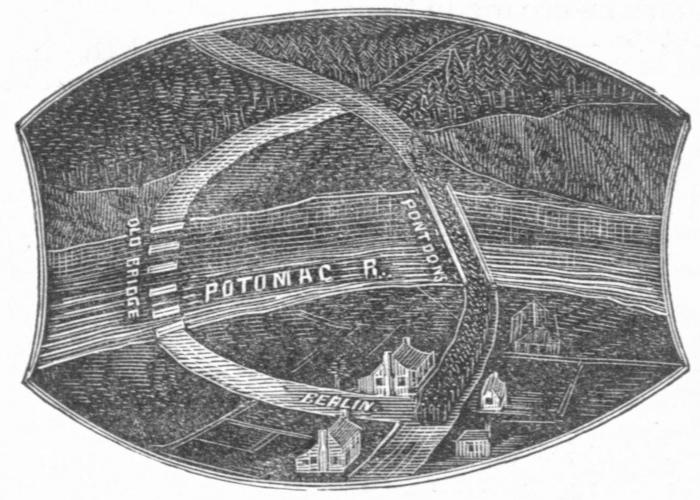
Crossing at Berlin.
All night long a steady stream of men poured
over, cheering lustily as they reached the opposite
shore. The Thirty-third marched over the bridge
about six o’clock in the morning (Monday), and
passing through Lovettsville, encamped about ten
miles from the river. The route lay through a most
fertile and productive region, which had not been
ravaged by either army, and the boys, with Stuart’s
raid fresh in their minds, foraged on an unparalleled
scale. Unmindful of Gen. McClellan’s order against
“jayhawking,” they scoured over the adjoining
farms, and from every direction were heard, through
the stillness of the night, the piercing wail of expiring
pork, the plaintive lowing of stricken bovine, or suppressed
cry of unfortunate gallinaceous. No details
of guards were made to protect the rebel inhabitants,
as was the case on the Peninsula, and the next day
found many of the men mounted upon horses and
loaded down with booty of every description. Not
far from this camp was the scene of Lieutenant-Colonel
McVicar’s brilliant exploit, where, a few days
before, he had gallantly led a charge upon the enemy.
He rode far in advance of the charging party,
captured several prisoners, and, in addition to having
his horse shot under him, received five bullets through
his clothing. One of the captured horses was presented
to him by the commander of the expedition,
and since his death has been sent home to his widow
at Rochester.
Tuesday we resumed the march at daylight, and
proceeding fifteen miles, near by a Quaker settlement,
encamped beyond Union. With hardly an exception,
these Friends have remained staunch Unionists,
and, what is more, have not hesitated to proclaim
their anti-slavery sentiments when the rebel minions
have been all around them.
Mr. Yardly Taylor, the leading man in the society,
is widely known among the Quakers of the Northern
States. He possessed a magnificent estate, beautified
with groves, arbors, gravel walks, and gardens
abounding in every variety of exotics. We found
him a very genial, affable gentleman, upwards of
60 years of age, and willing to do anything for the
Federal soldiers. This Union settlement was like an
oasis in the desert of rebellion.
The road from Union to Philamount presented
numerous evidences of the severe cavalry fights which
had taken place between Gens. Pleasanton and Stuart.
There were also several Federal and Rebel wounded
scattered among the farm-houses. A few fresh
graves were likewise observed. We remained in camp
until two o’clock, Wednesday afternoon, and then
marched five miles to a point, where the various
columns of the army could be seen, extending up
and down the valley for many miles, and presenting
a fine spectacle. Heavy cannonading was heard all
day from the front.
Thursday we marched seven miles more. As we
proceeded further into Virginia, the country grew very
desolate, exhibiting all the ravages and evils of war.
Gens. Geary and Blenker with his German Division,
had both been through here in the spring, and the
rebel army had since come along and destroyed what
they left. It seemed as though the hand of the
destroying angel had swept over the land, withering
as it went.
Owing, however, to the absence of nearly all the
men in the army, the game in this region had not
been hunted down, and was found in abundance.
The fur, fin and feather tribes held almost undisputed
sway in the forests and streams.
Friday we marched at 6 A. M., and arriving at
White Plains, waited for supplies. A dreary snowstorm
prevailed all day, covering the ground to the
depth of several inches. Many of the men, who had
imprudently thrown away their overcoats or blankets,
suffered severely from the cold.
The intelligence received on Saturday, that Gen.
McClellan had been removed, added still more to
the gloom. The order for his removal reached his
headquarters at Rectortown, a small village to the
right of White Plains, about 11 o’clock on the previous
evening. Gen. Gorman and several members of
his staff were present at the time. He continued conversing
in a cheerful manner, and was apparently
the least affected one of the number. Gen. Burnside,
to whom the command was turned over, soon
made his appearance, and spent the greater portion
of the night in consultation with him, after which
Gen. McClellan penned the following farewell
address to his troops:
Headquarters Army of the Potomac, Camp near Rectortown, Va., November 7th, 1862.
Officers and Soldiers of the Army of the Potomac:
An order of the President devolves upon Major
General Burnside the command of this army. In
parting from you I cannot express the love and gratitude
I bear you. As an army, you have grown
up under my care. In you I have never found
doubt or coldness. The battles you have fought
under my command, will probably live in our
nation’s history. The glory you have achieved;
our marches, perils and fatigues; the graves of our
comrades fallen in battle and by disease; the broken
forms of those whom wounds and sickness have disabled;
the strongest associations which exist among
men, unite us still by an indissoluble tie. We shall
ever be comrades in supporting the Constitution of
our country, and the nationality of its people.
GEORGE B. McCLELLAN,
Major-General United States Army.
On the Sunday evening following, he gave an
informal reception at his tent, where several hours
were spent in conversation. Upon one of the guests
remarking to him, “General, we shall see you back
again in a fortnight,” he replied, “If I never return
to the Army of the Potomac, may I live to write its
history. It is a task to which I shall devote myself.”
To another he remarked, “I feel as if the Army
of the Potomac belonged to me. It is mine. I feel
that its officers are my brothers, its soldiers my
children. This separation is like a forcible divorce
of husband and wife.” Of his successor, he said:
“Burnside is the best and honestest of men. He is
no Mr. Pope, he will do a great deal better than you
expect.” Monday he rode among the troops, accompanied
by a large retinue, and took an affectionate
adieu of all of them. History fails to present, if we
except the parting of Napoleon from his soldiers, so
affecting and imposing a spectacle as was this farewell
of Gen. McClellan to the army, whose leader
he had been for eighteen months. After visiting
the troops at Warrenton and vicinity, he rode out to
New Baltimore, where Smith’s Division had arrived.
The various Regiments were drawn up in line,
with bright uniforms and burnished arms, and as
their late Chief passed slowly before them, rent the
air with cheers. It was a great ovation, shrouded
in the gloom of a funeral occasion.
Gen. McClellan’s connection with the soldiers of
the Army of the Potomac was ended, but nothing
could sever the bonds of friendship and affection
which united him to them. To many the secret of
this great popularity has ever been a mystery. It
arose from a variety of causes. It is rarely the case
that a Regiment does not become attached to its
Colonel, a Brigade to its Brigadier, and a Division
or Corps to its Major-General. In the same manner
the army became attached to its commander. Long
connection increases this attachment, and General
McClellan had been associated with these soldiers
for nearly a year and a half.
Gen. McClellan possessed a physique and address
calculated to excite admiration. Indeed, it was proverbial
in the army that no one could doff his hat so
gracefully as “Little Mac.” In addition to being
Napoleonic in his appearance, he was Napoleonic in
his speeches and orders, which equally won their
hearts. He was likewise free from that boasting
spirit which had made Pope so unpopular.
He visited frequently among his troops—an important
means of winning popularity. His Generals,
appointed and promoted through his influence,
thoroughly infused a McClellan element into their
commands. An army of Generals bear very much
the same relation to their Chief that office-holders
do to the head of their party. By maintaining him
in his position, they ensure their own, and in promoting
his interests, they promote themselves. Especially
is this true under a Democratic form of
Government, where politics exert such an undue
influence in the army.
Gen. McClellan’s troops were, furthermore, of the
opinion that his plans had been interfered with by
the Washington authorities, and promised reinforcements
withheld at the very moment he most needed
them. Finally, they believed that he could lead
them to victory.
When we speak of this enthusiasm for General
McClellan, we do not, however, imply that it was
universal. Not only Burnside, but his whole Ninth
Army Corps, began to question his military capacity,
when he failed to “push the enemy to the
wall,” on the day succeeding the battle of Antietam.
The troops who had previously been attached to
the Department of Virginia proper, as well as the
new levies, were to a certain extent indifferent as to
who might be their leader.
CHAPTER XXIV.
Gen. McClellan’s Departure.—Gen. Burnside’s Address.—March to
Fredericksburg.—Reasons for choosing this Route.—Randolph Estate.—Failure
of the Pontoons to Arrive.—Stafford Court House.—The
Thirty-third preparing Winter Quarters.—Scouting Parties.—The
Ashby Family.
Gen. McClellan took his departure for Washington
on a special train from Warrenton, Tuesday
noon, and Gen. Burnside assumed command, after
issuing the following address:
“In accordance with General Orders No. 182,
issued by the President of the United States, I hereby
assume command of the Army of the Potomac.
Patriotism and the exercise of my every energy in
the direction of this army, aided by the full and
hearty co-operation of its officers and men, will, I
hope, under the blessing of God, ensure its success.
“Having been a sharer of the privations, and a
witness of the bravery of the old Army of the
Potomac in the Maryland campaign, and fully identified
with them in their feelings of respect and
esteem for Gen. McClellan, entertained through a
long and most friendly association with him, I feel
that it is not as a stranger that I assume command.
“To the Ninth Army Corps, so long and intimately
associated with me, I need say nothing. Our
histories are identical.
“With diffidence for myself, but with a proud confidence
in the unswerving loyalty and determination
of the gallant army now entrusted to my care, I
accept its control, with the steadfast assurance that
the just cause must prevail.
“A. E. BURNSIDE,
Major-General Commanding.”
He immediately proceeded to organize the army
into three Grand Divisions—the Second and Ninth
Corps, under Sumner, comprising the right; Third
and Fifth, under Hooker, the centre; and First and
Sixth, under Franklin, the left. Gen. Smith succeeded
Franklin in the command of the Sixth Corps,
and Gen. Howe was placed in charge of the
Division.
We had now obtained possession of all the Gaps in
the Blue Ridge. But we had merely locked the door
after the escape of the animal, for the enemy, instead
of being cooped up in the Shenandoah Valley, were
in advance of us, well on their way to Culpepper.
After mature deliberation and consultation with
Gen. Halleck, who had arrived at Warrenton, Gen.
Burnside decided to march rapidly to Fredericksburg,
cross the Rappahannock at that place, and
pushing southward, seize some point on the railroad,
and fight a battle with Lee before he could
mass all his forces. His reasons for choosing this
route in preference to the one by Gordonsville, he
has since stated, as follows: “The further we got
into the interior of Virginia the larger would be our
line of communications, and the greater would be
the difficulty we would have in keeping them open,
as the enemy had on our right flank a Corps that at
almost any time could, by a rapid movement, seriously
embarrass us. If we were caught by the
elements so far from our base of supplies, and at the
same time in the enemy’s country, where they had
means of getting information that we had not, it
might, I thought, prove disastrous to the army, as
we had but one line of railway by which to supply
it. In moving upon Fredericksburg, we would all
the time be as near Washington as would the enemy;
and after arriving at Fredericksburg, we would be
at a point nearer Richmond than we would be even
if we should take Gordonsville. On the Gordonsville
line the enemy, in my opinion, would not give
us a decisive battle at any place this side of Richmond.
They could defend Gordonsville until such
time as they felt they had given us a check, and
then with so many lines of rail open to them,
they would move upon Richmond or Lynchburg,
and, in either case, the difficulty of following them
would be very great.” Gen. Halleck agreed to have
the pontoons ready for him at Falmouth, opposite
Fredericksburg, on his arrival.
Saturday and Sunday, Nov. 15th and 16th, the
army started in a south-easterly direction in three
columns, with the exception of a small force, which
bore off towards Culpepper, to mislead and cause
the enemy to think we were going to advance in
that direction. The Thirty-third broke camp early
on Sunday, and marching sixteen miles, encamped
in a beautiful grove near Catlett’s Station. The
men were in fine spirits, and moved rapidly over the
good roads, inspired with the hope that they were
now going to Richmond without fail.
The first day’s march presented nothing worthy of
interest, unless it was the worn-out and ruined
plantations which were seen on every side. Upon
halting at one we found the mansion, situated back
from the road, entirely deserted. Windows, doors,
and everything of a combustible nature, had disappeared
from the once splendid dwelling. Near by
were a number of rude log huts, occupied by negroes.
A bevy of children sallied out to inspect us as we
rode up, betraying all that eager curiosity peculiar
to the African race. They, together with a few
helpless old men and women, were the sole occupants
of the place. From them we learned that it
belonged to a second cousin of John Randolph of
Roanoke, who had died a few weeks before, and was
buried beneath a tall oak in front of the mansion.
The widow had gone to Fredericksburg, taking with
her what effects she could.
Monday morning the reveille was sounded very
early, and by six o’clock the Regiment was on its
way. The march lay through a country more barren
and desolate, if possible, than that north of Warrenton,
presenting the worst features of a slave region.
“Snatching” and “jayhawking” continued to be the
order of the day, as when in the Loudon Valley.
“How are you, Stuart?” “I believe this horse came
from Pennsylvania;” “This is a Maryland pig;” were
among the oft repeated responses made to the rebel
farmers, who expostulated with the boys for making
way with their animals. Very little satisfaction
could be obtained from the “invaders.” War the
Virginians wanted, and war they should now have
to their hearts’ content. After a march of fourteen
miles, we bivouacked near the mouth of Acquia Creek.
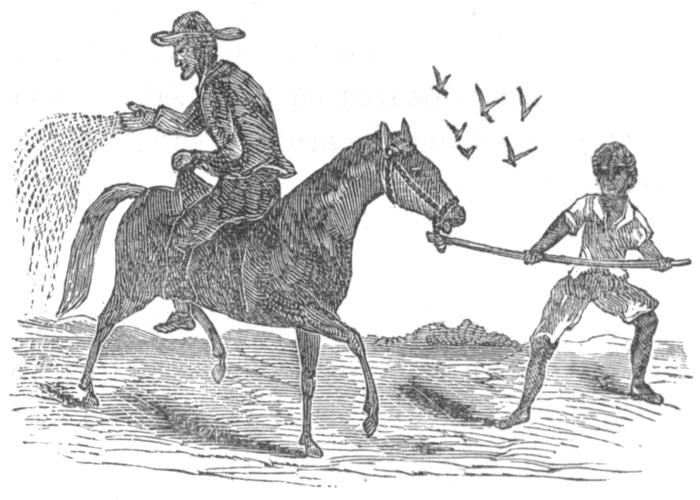
A Virginia Sowing Machine.
Tuesday we proceeded about fourteen miles further,
and encamped near Stafford Court House, between
the Potomac and Rappahannock rivers, about ten
miles from the latter.
The right and centre Divisions had now arrived in
the vicinity of Falmouth, but no pontoons greeted
the eye of Gen. Burnside. The Washington authorities
had neglected to forward these essentials for
crossing the river, and the rapid and successful
marching had been to no purpose. In a day or two
more the enemy would be on hand, fortifying the
Fredericksburg Heights, and resisting our passage.
How great must have been the Commanding
General’s disappointment and anger at this phase of
affairs! All his plans foiled; the whole campaign
a failure; simply because some one had “forgotten
to give the order” for forwarding a few pontoons.
The Second, Third, Fifth and Ninth Corps encamped
near the river. The Sixth remained near
Stafford Court House, and the First, pushing on to
Brooks’ Station, was stretched along the Fredericksburg
and Acquia railroad, upon which repairs
were immediately commenced. Generals Franklin
and Smith, who were boon companions, and nearly
always together, located their headquarters in a
grove close by the village of Stafford, which presented
a scene of utter ruin. Dwellings, formerly occupied
by the better class, were deserted, and the
surrounding negro huts consumed, timber by timber,
in the camp fires of the Union soldiers. Our troops
had occupied the place during the previous spring.
The once neat Court House stood by the road side, a
striking monument to treason and rebellion. Deprived
of its white picket fence, stripped of window
blinds, benches and doors, walls defaced by various
hieroglyphics, the judge’s bench a target for the
expectorating Yankee, the circular enclosure for
the jury besmeared with mud, and valuable documents
lying about the floor; it was indeed a sad
picture of what an infatuated people will bring upon
themselves. In one corner of the yard stood a
House of Records, in which had been filed all the
important documents belonging to the county for a
century. But they now lay scattered upon the floor
around the steps, and in the door yard, to the depth
of fifteen inches or more. It is impossible to estimate
the inconvenience and loss which will follow
this wholesale destruction of deeds, claims, mortgages,
&c.
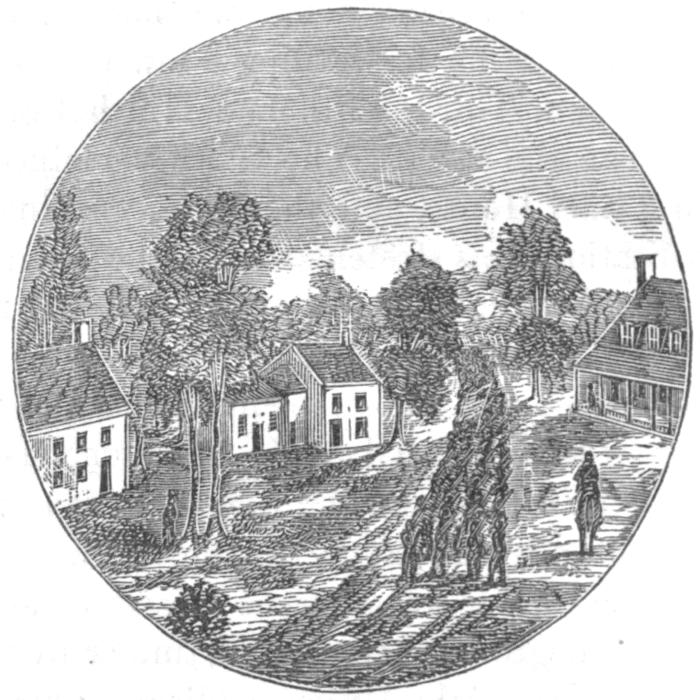
Warwick Court-House, near Youngs’ Mills, Virginia.
The jail, across the way from the Court House,
where many a poor fugitive had doubtless languished
in chains for striking out for freedom, was converted
into a guard-house. Peeping through the
iron grates of the windows, were to be seen the bilious
countenances of several culprits, who, may be, were
atoning for having invaded a hen roost or bagged
an unsuspecting pig.
Colonel Taylor’s men took up position on a
woody crest, and immediately commenced felling
trees, pitching tents, building camp fires, and making
themselves comfortable generally. The constant
ringing of numerous axes and crashing of falling
trees all around us, recalled memories of other days,
and it was difficult to realize that we were not in a
western log clearing. Indeed, the army of “invaders”
have accomplished for Virginia what her indolent
population have failed to do, cleared up the woodlands,
and let the sunlight into many a hitherto
cheerless and unhealthy spot.
The boys, as if prescient of coming delay and ease,
soon began to construct elaborate log huts, which
afforded a much more comfortable shelter than the
thin, airy tents. Foraging parties scoured the surrounding
country daily, and returned at night loaded
down with eatables of every description. What
confederate money (of which we had an abundance)
would not buy, was “confiscated.” These expeditions
were greatly enjoyed by those participating in
them. Roving through woods and fields, from one
farm house to another, they made numerous acquaintances,
and learned everything of interest pertaining
to the locality.
On one occasion a party halted at an obscure
hovel for a drink of water. On entering we found
the only occupant to be a superannuated negress, who,
as she expressed it, having become “too old a critter
to do nothing, had been turned out here to die.”
Further conversation disclosed the fact that she
had belonged to James Ashby, a brother of the
deceased famous General of that name. She related
much that was of interest concerning the Ashby
family. There were three brothers of them—James,
Turner and Richard (commonly known as Dick)—raised
in the vicinity of Front Royal, and all now in
their graves. James, who was her master, moved to
this vicinity when a young man, acquired a large
estate, and died February, 1861. Turner, the General,
who, when a young man, was admired by every
one for his manly bearing, and in later years for his
chivalric deeds, was killed at the battle of Cross-Keys.
Dick, the remaining and youngest brother,
was shot in a skirmish, just prior to the last battle of
Bull Run.
After the death of her master, the younger slaves
were sent South and sold. “Though I hab raised,”
she said, “nineteen children to manhood (eleven
sons among the number), all of whom hab been torn
away from me, and hab worked hard all my life for
massa, his heirs wouldn’t let me stay in the house,
but sent me here, with a little hog and hominy, to die
alone.” Three times she had herself hoed the little
patch of corn in front of the hut, and gathered and
husked it. On our inquiring if she was “Union,”
she replied, “I’se partial to Yankees, but some of
dem is mighty rogues. Dem ar low class people
among dem steal all my things. Two came along
last week and showed me twenty-five cents for some
hoe-cake, which I gib dem, and bless you child, when
dey come to pay, felt in all de pockets and couldn’t
find de money; but, God bless you chil’ren, dey
knew all de time where it was. But de Southrons are
just as bad.”
She recounted, with tears in her eyes, the manner
in which her youngest son was dragged away.
He had been sick for some time, but when word
came that the Union forces were advancing, they
tied his legs, and placing him in a cart, drove off
towards Richmond; but he never reached there,
having died in the streets of Olean. We left “Aunt
Sophie,” more convinced than ever that the cruelties
and wrongs which grow out of slavery have not
been overdrawn.
CHAPTER XXV.
Completion of the Potomac Creek Bridge.—An interesting relic
of Virginia Aristocracy.—General Burnside determines to cross
the river.—March of the Sixth Corps.—White-Oak Church.
During the first few days the rations were drawn
from Acquia Landing with teams, but heavy rains
coming on, the wheeling became terrible. Pioneers
were accordingly set to work building corduroy roads,
and in a week’s time constructed seven miles of them.
On the 28th the bridge over the Potomac Creek,
ninety feet in length, was completed, and the cars
immediately commenced running, bringing up plenty
of supplies of every description. This structure, in
addition to numerous other works, had been destroyed
during the preceding August, when General
Burnside abandoned the region. They had now all
to be rebuilt.
The time passed here much in the same manner
as in Maryland, the Regiment being employed on
picket duty, slashing timber, &c., &c. Occasionally
the officers rode over to the front, and viewed
General Headquarters, Fredericksburg, and the
river scenery, which is very attractive. Our own
and the rebel pickets were scattered along the
banks of the Rappahannock, almost within speaking
distance of each other, and frequently indulged
in conversation. “You have lost your best
man,” shouted out a grey-back, one afternoon; “Burnside
is played out. We don’t care a —— for
him.” A Ninth New Hampshire boy replied by
asking him where they had stolen their blue overcoats.
“We took them off the dead Yankees at
Antietam. Why didn’t you take ours?” “Because
they walked off so fast,” was the ready reply.
Another wanted to know if we had any Bull Run
boys with us. “Have you any South Mountain or
Antietam boys with you?” retorted one of our
pickets. These interviews, which generally partook
of a profane character, were afterwards forbidden.
The enemy continued to augment their forces daily,
throwing up new earthworks every night to the
right or left of the city. Their operations were
plainly visible from the balloon and signal stations.
Nearly opposite the road to the camp of the
Thirty-third was an interesting relic of the old-time
Aristocracy, concerning which the present race of
Virginians boast so much, and possess so little.
Standing remote and alone in the centre of a dense
wood, was an antiquated house of worship, reminding
one of the old heathen temples hidden in the
recesses of some deep forest, whither the followers
after unknown gods were wont to repair for worship,
or to consult the oracles. On every side are venerable
trees, overtowering its not unpretentious steeple.
The structure is built of brick (probably brought
from England), in the form of a cross, semi-gothic,
with entrances on three sides, and was erected in
the year 1794. On entering, the first object which
attracts the attention, is the variously carved pulpit,
about twenty-five feet from the floor, with a winding
stair-case leading to it. Beneath are seats for the
attendants, who, in accordance with the custom of
the old English Episcopacy, waited upon the
rector. The floor is of stone, a large cross of
granite lying in the centre, where the broad aisles
intersect. To the left of this is a square enclosure
for the vestrymen, whose names are written on the
north wall of the building. The reader, if acquainted
with Virginia pedigrees, will recognize in
them some of the oldest, and most honored names of
the State—Thomas Fitzhugh, John Lee, Peter Hodgman,
Moor Doniphan, John Mercer, Henry Tyler,
William Mountjoy, John Fitzhugh, and John
Peyton. On the south wall are four large tablets,
containing Scriptural quotations. Directly beneath
is a broad flag-stone, on which is engraved, with
letters of gold: “In memory of the House of
Moncure.” This smacks of royalty. Parallel to
it lies a tomb-stone, “Sacred to the memory
of William Robison, the fourth son of H. and
E. Moncure, of Windsor Forest; born the 27th of
January, 1806, and died 13th of April, 1828, of a
pulmonary disease brought on by exposure to the
cold climate of Philadelphia, where he had gone to
prepare himself for the practice of medicine. Possessed
of a mind strong and vigorous, and of a
firmness of spirit a stranger to fear, he died manifesting
that nobleness of soul which characterized
him while living, the brightest promise of his
parents, and the fondest hopes of their afflicted
family.”
Led, doubtless, by the expectation of discovering
buried valuables, some one had removed the stone
from its original position, and excavated the earth
beneath. Close by the entrance on the north side,
are three enclosed graves, where sleep those of
another generation. The brown, moss-covered tombstones
appear in strong contrast to a plain pine
board at the head of a fresh made grave alongside,
and bearing the inscription: “Henry Basler, Co.
H, 118th Pennsylvania Volunteers.”
One evening considerable alarm was occasioned
by the appearance of numerous camp fires in the
rear, the supposition being that the enemy had
turned the right of our lines, and were pushing for
Acquia Landing. Inquiry, however, soon ascertained
that they proceeded from General Sickles’
Division, which was on the march from the vicinity
of Fairfax to join the Second Corps.
Nearly four weeks had now elapsed since the
army arrived at the new base of operations. The
rainy season was approaching, and whatever was
done, must be done quickly. Owing to the difficulty
our scouts and spies experienced in crossing the
river, but very little reliable information could be
obtained of the enemy’s forces. They were variously
estimated at from sixty to one hundred and
twenty-five thousand men. A long extended line of
fortifications appeared on the first crest of hills, but
whether these constituted their only earthworks,
or a new Torres Vedras existed beyond, was a matter
of uncertainty.
It was, however, definitely ascertained that Jackson
had arrived from the Shenandoah Valley, and
that Lee had posted his troops up and down the
river for a distance of twenty miles, to obstruct our
crossing.
After consulting with his Division and Corps
Commanders, General Burnside decided upon throwing
his entire army across at some given point, and
hurling it quickly upon the necessarily weak line,
pierce, and break it, before the rebel General could
concentrate his forces. Skinner’s Neck, about
twelve miles below the city, was the point first
chosen for crossing. But he afterwards decided to
cross at Fredericksburg, because, as he has since
informed us, he “felt satisfied that they did not expect
us to cross here, but down below. In the next
place, I felt satisfied that this was the place to fight
the most decisive battle; because, if we could divide
their forces by piercing their lines at one or two
points, separating their left from their right, then a
vigorous attack by the whole army would succeed in
breaking their army in pieces. The enemy had cut
a road along the rear of the line of heights, by
means of which they connected the two wings of
their army, and avoided a long detour around,
through a bad country. I wanted to get possession
of that road.”
As an initiatory step to active operations, he commenced
a series of feints down the river as far as
Port Conway, twenty miles below. Among other
ruses, a long train of empty wagons was sent down
the river road, in plain view of the enemy, and
returned by an obscure route. Wednesday evening,
December 3rd, the Left Grand Division received
marching orders, with instructions to proceed in a
southerly course, as if intending to strike and cross
the river several miles below Fredericksburg.
Colonel Taylor had just moved his command to a
new spot, higher up the side of the woody crest on
which it was encamped, and the men were busily
employed in erecting log-huts when the orders came.
Instead, however, of occasioning any dissatisfaction,
they were received with joy, and the men began,
with alacrity, preparations for resuming the “on to
Richmond.” Strange as it may seem, soldiers dread
the privations and dangers of an active campaign
less than the idleness and ennui of camp; and,
contrary as it may be to the opinion generally
entertained, there is much less sickness on the march
than when the troops are encamped. The excitement
consequent upon seeing new sights, and participating
in new scenes, dispels those camp ills, real
or imaginary, so common among soldiers during
a period of inactivity.
By eleven o’clock the next morning, everything
was got in readiness, and the Regiment took its
place in the advancing column, which extended for
miles, and was headed by Generals Franklin and
Smith. Proceeding about eight miles, through
Stafford Village, on the cross-road intersecting
the Falmouth and Acquia Turnpike, the troops
bivouacked for the night close by Potomac Creek
bridge.
On the following day a snow storm set in, which,
together with the rain, imparted a decidedly gloomy
and sombre aspect to the surroundings. The soldiers
protected themselves as best they could with
their frail tents, stirring out but little. The march
was resumed Saturday morning at eight o’clock, and
reaching White-Oak Church, an insignificant building,
in which Stephen A. Douglass delivered an
address during his last political tour, the Corps
turned straight to the left, towards Belle Plain, and
proceeding about a mile, encamped in the fields and
woods adjoining the road. Here it remained until
the following Thursday, about six miles from Fredericksburg,
and two in the rear of Burnside’s
Headquarters. The Thirty-third occupied a small
grove, together with the 20th, 49th, 77th New
York and 7th Maine. The First Corps soon after
came up and took position near the Sixth. Various
inquiries concerning the roads and distances
to Port Conway were made of the inhabitants, who,
with hardly an exception, were rebels, in order to
create the impression that we were going to move
down the river. This, together with other similar
ruses, succeeded admirably, for, as we afterwards
learned, General Lee sent down the whole of Jackson’s
force to Port Royal, opposite Port Conway,
to resist our crossing.
Meanwhile preparations were actively going on in
front. Additional pontoons had been brought from
Washington, and the Engineers’ Brigade made ready
their trains. The Second, Third, Fifth and Ninth
Corps, composing the right and centre Grand Divisions,
were placed under marching orders, though not
moving from their camps.
CHAPTER XXVI.
Laying of the Bridges.—A solemn scene.—Bombardment of
Fredericksburg.—Gallantry of the Seventh Michigan and other
Regiments.—Crossing of the left Grand Division.

At length everything was in
readiness, and during Wednesday
evening, December
11th, the advance movement
was begun. All night
long, the rumbling of artillery
could be heard, as
numerous batteries moved
to the Rappahannock and
were planted along the
bank. One after another, the long, phantom-like
pontoons descended the hillsides, and were unloaded
near the points designated for crossings.
Four bridges were to be thrown, the first a few
yards above the Lacey House, which fronts the
main street of the city, the second several hundred
yards below, and the third and fourth about a mile
still further down the river. The right and centre
Grand Divisions were to cross on the first two, and
the left on the remaining two. General Burnside
designed to have all the artillery in position by
eleven o’clock, the pontoons thrown by two A. M.,
and a large force across by sunrise. Owing, however,
to numerous delays, none of the boats were
launched before four o’clock.
The writer stood at the upper crossing. It was a
most solemn scene, those brave Engineers (50th
New York) pushing their pontoons out upon the
ice, and fearlessly moving them around in the water,
to their proper positions. Any moment might terminate
their existence. They were upon the very
threshold of eternity. Pacing along the opposite
bank, or grouped around the picket fires, were to be
seen the rebel sentinels, almost within pistol-shot.
Occasionally they would stop a moment to view our
operations, then resume their beat as unconcernedly
as if nothing unusual was transpiring. The bridge
was headed directly for one of their fires.
Nearly one quarter of it was completed without
interruption, when, suddenly, as the Court House
clock struck five, two signal guns boomed away in
the distance, and were immediately followed by a
sharp volley of musketry. Lieutenant-Colonel Bull,
two captains and several men fell dead; others tumbled
headlong into the water and sank to the bottom,
or were rescued by their brave comrades and brought
bleeding and dripping to the shore. We were not
unprepared for this. Before the enemy had time to
re-load, our artillery planted on the bluffs overhead,
and infantry drawn up along the river’s bank,
returned a heavy fire upon the buildings in which
the sharpshooters were secreted.
Boom, boom, went the cannon, crack, crack, went
the rifle, for one long hour, until the silence of the
rebels terminated the duel, and the pontoniers resumed
operations. But they had hardly reached the
outermost boat, and turned their backs to place an
additional one in position, before another murderous
fire was poured in upon them, and the fierce duel
was renewed. After another hour’s delay firing
ceased, and again the builders stepped forward, but
were again compelled to fall back. New batteries
now opened rapidly upon the buildings, but failed to
dislodge the sharpshooters, who, crouching down in
their hiding places, fired upon the pontoniers as
often as they ventured from the shore. About ten
o’clock General Burnside appeared and gave the
order, “Concentrate the fire of all your guns upon
the place, and batter it down.” One hundred and
forty-three, cannon of various calibre, from 10-pound
Parrots to 4½ inch siege guns, were immediately
trained upon the doomed city, and for fifty minutes
rained down a perfect tempest of solid shot, shell and
canister. Through the mist and dense clouds of
smoke, bright fires appeared bursting forth in different
parts of the town, and adding to the terrible
grandeur of the spectacle.
When the cannonading ceased and the smoke
cleared away, the destructiveness of our fire was apparent.
Whole rows of buildings along the river
side were rent and riven, as if by the thunderbolts
of heaven—roofs gone, doors and windows smashed
to atoms, and great hideous gaps through the walls;
shade trees shorn of their limbs or twisted from their
trunks; fences stripped of their pickets by canister,
or lying flat on the ground; streets furrowed with
solid shot, and strewn with household effects; elegant
up-town residences in flames; we had literally
swept the city with the besom of destruction.
It did not seem possible that any animate thing
could have survived this bombardment; and there
were in fact no signs of life visible; but no sooner
had the engineers again resumed operations, than
they were greeted with a fresh shower of bullets.
How the sharpshooters had managed to live through
all that fire and smoke, was to us almost a miracle.
Yet they were alive, and as plucky as ever, and
our gunners returned to their work.
General Burnside now almost despaired of effecting
a crossing. Nothing but some brilliant coup-de-main
would accomplish it. He accordingly
decided upon sending a body of men over in boats,
who should rush suddenly upon the concealed foe,
and hunt them from their holes. The Seventh
Michigan and Nineteenth Massachusetts were designated
for this purpose. The gallant fellows never
flinched from the duty assigned them, but taking
their places in the pontoons, pushed bravely out into
the stream, regardless of the rapid volleys of musketry
which were poured into them. In a moment
they had gained the opposite shore, and fearlessly
sweeping up the bank, dashed into the houses, and
shot, bayoneted or captured the small force which
had occasioned us so much trouble and delay. A
hundred dark, swarthy Alabamians and Mississippians
were brought back, amidst the wildest cheers of
the spectators who had witnessed the heroic act.
Fredericksburg was now ours, and no further
trouble was experienced in laying the bridge. The
second was completed in a similar manner; about
ninety men belonging to Colonel Fairchild’s New
York Regiment being taken over in boats, and
returning with 110 rebels. Owing to the fact of
there being no buildings to screen them, the enemy
could offer but little resistance to the engineers at the
lower crossings, and they were completed much
earlier in the day.
The pontoons now being thrown, the right and
centre Grand Divisions moved down in columns to
cross, halting around Falmouth Station. The left,
which had marched from White-Oak Church early
in the morning, was massed during the day on
the plain below. For some reason, General Burnside
decided to cross but a small force that night,
and the Sixth Corps drew back from the plain, and
bivouacked in the adjoining woods. Leaving the
vast army—
“A multitude like which the populous North
Poured never from its frozen loins”—
sleeping along the banks of the river and in the
groves beyond, let us briefly survey the scene of its
operations during the four days which followed.
Directly in the rear of Fredericksburg is a plain,
about one quarter of a mile wide, extending back to
a low range of hills, along the crest of which was
the enemy’s first line of works. At the foot of and
running parallel with this range, is a massive stone
wall, behind which infantry were posted. In the
rear of the first is another and much higher chain of
hills, extending down the river for several miles.
Along the top of these woody heights ran the road,
referred to by General Burnside, connecting the rebel
right with the rebel left, which rested immediately
back of the city.
Crossing Hazel Creek, a small stream skirting the
lower part of the place and emptying into the
Rappahannock, the ground becomes very level,
stretching out into a broad plateau, and traversed
by the Bowling Green turnpike, running half a
mile back from the river, and the Fredericksburg
and Richmond railroad still further back. The
Bernard House was located on the bank, about one
mile and a half below the city. Three-fourths of a
mile lower down, the Massaponax Creek flows into
the Rappahannock. This plain, bounded on the
north by Hazel Creek, east by the Rappahannock,
west by a chain of hills, and south by the Massaponax,
was the theatre of General Franklin’s operations.
While he advanced and occupied some
point in these hills, Sumner and Hooker were to
storm the batteries in the rear of Fredericksburg.
Our narrative will be confined mainly to the left
Grand Division.
Long before daylight Friday morning, it commenced
crossing, and by ten o’clock was all over.
As fast as the various commands reached the
opposite shore, they debouched upon the plain,
spreading out like a fan, prepared to sweep down the
enemy before them. The Thirty-third passed over
the bridge about 7½ o’clock. An hour and a half
later the Sixth Corps was drawn up in line of battle,
facing to the west. The First Corps joined on further
to the left. Skirmishers were deployed, and feeling
their way cautiously forward, encountered those of
the enemy near the Bowling Green road. The
first man wounded was John S. Havens, of Company
H, Thirty-third, which was in the front. After
a few moments the rebels fell back, leaving us in
possession of the road. Owing to the dense fog
which prevailed, it was deemed best not to fight
the battle that day, and our troops moved no further
forward. About 2½ o’clock in the afternoon, the enemy
opened some masked guns from the heights
on our batteries facing in that direction, which,
immediately limbering up, moved several yards further
to the front and returned the fire. The artillery
duel was kept up for some time, resulting in but
little loss to us.
General Burnside rode down from the right at
sunset, and was received with vociferous cheering by
the Regiments as he galloped rapidly by. Officers
and men had alike admired the courage which led
him to boldly cross the river and endeavor to clear up
the mystery which enshrouded the enemy; and now
that the rebels had apparently retreated, leaving
a mere shell of an army to oppose us, their admiration
for their chief knew no bounds.
CHAPTER XXVII. BATTLE OF FREDERICKSBURG, FOUGHT SATURDAY, DECEMBER 13TH.
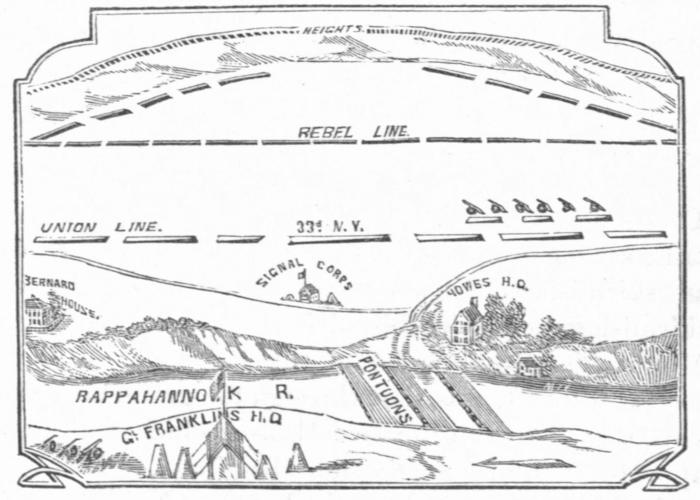
Battle-field of the Left Grand Division.
Franklin’s troops slept upon their arms that night,
little dreaming of the fierce conflict of the morrow. At
an early hour Saturday morning, it became evident
that the enemy, instead of having fallen back, were
concentrating their forces, with the design of giving
us battle. The sun rose clear in the heavens, though
the mist and fog of a late Indian summer enveloped
the plain. The air was mild and balmy as on a September
day, and the fifty thousand men whom the
reveille woke from their slumbers began to prepare
for action, and were soon marshalled in “battle’s
magnificently stern array.”
They were arranged as follows: The Sixth Corps,
under General Smith, on the right, composed of three
Divisions, viz: General Newton’s on the extreme right
and rear, resting near the bridges; General Brooks’
in the centre, and General Howe’s on the left. The
First Army Corps, General Reynolds, extended still
further to the left, drawn up in the following order:
General Gibbon’s Division on the right, connecting
with General Howe’s; General Meade’s, centre; and
General Doubleday’s, left, facing to the southward,
and resting nearly on the river. The Thirty-third
was posted in the first of the three lines of battle, to
support a battery. General Jackson commanded
the rebels in front of us. At an early hour the
Thirteenth Massachusetts and Pennsylvania Bucktails,
among other Regiments, were deployed in front,
as skirmishers, between whom and the enemy’s
skirmishers considerable firing ensued. General
Vinton, now commander of the Brigade, venturing
too far in front, was shot through the groin, and conveyed
back to the Bernard House, which had been
appropriated for the Division Hospital. Col. Taylor
took command until the arrival of Gen. Neill, formerly
of the Twenty-third Pennsylvania. As soon as the
heavy mist cleared away, Capt. Hall’s Second Maine
Battery, planted at the right of Gibbon’s Division,
opened upon the enemy. Artillery firing now became
general along the whole line. Heavy siege guns in
our rear, the First Maryland and First Massachusetts
Batteries, and Battery D, Fifth Artillery, on the right;
Captain Ransom’s and Captain Walker’s in front,
and Harris’ Independent on the left, kept up a
terrific fire on the rebels. Orders now came to
advance, and about nine o’clock, Gibbon’s and
Meade’s Divisions commenced moving slowly forward,
thereby almost straightening our lines, which
were previously arranged somewhat in the form of a
crescent. Considerable resistance was met with, but
the forces continued to move forward, until at mid-day
the line of battle was half a mile in advance
of where it had been in the morning.
But now came the reserve fire of the enemy, with
terrific force. Shot and shell were poured into our
men from all along the heights, which, curving around
in the shape of a horse-shoe, exposed them to an
enfilading fire. The rebel infantry likewise appeared,
and fired rapidly. Still Meade and Gibbon continued
to press on, and as the enemy gave way, cheer
after cheer rent the air from our troops. General
Meade now led his Division on a charge, and pressing
on the edge of the crest, skilfully penetrated an
opening in the enemy’s lines and captured several
hundred prisoners, belonging to the Sixty-first Georgia
and Thirty-first North Carolina Regiments. Owing,
however, to the lack of reinforcements, he was
eventually compelled to fall back. While the fight
was progressing at this point, Jackson sent down a
heavy column, near the Massaponax, to turn our
left, but it was handsomely repulsed and driven
back by Doubleday.
Very heavy firing now raged along the line.
Dense clouds of smoke hid friend and foe from view,
and the heavy roar of artillery and musketry shook
the ground as with an earthquake. The bloody carnival
was at its height, “and wild uproar and desolation
reigned” supreme. Mortals could not long endure
such a conflict, and after forty minutes’ duration, it
was followed by a temporary lull, the combatants
resting from their labors through sheer exhaustion.
The rising smoke disclosed the field strewn with the
dead and wounded, lying thick as autumnal leaves.
The lull, however, was of short duration. Again
“stiffening the sinews and summoning up the
blood,” the warriors rushed forward over the mangled
forms of their comrades, and the conflict raged
with fury. One of Gibbon’s Brigades, gallantly
charging over the plain, dashed right up to the
mouths of the frowning cannon, and storming the
enemy’s breastworks, captured two hundred prisoners.
Once more the air resounded with cheers,
cheers which, alas! were many a noble fellow’s death-cry.
But unable to withstand the galling fire, the
troops, like those of Meade before them, were
compelled to relinquish their hold on the crest, and
fall back, with decimated ranks.
Reinforcements now arrived, consisting of Sickles’
and Birney’s Divisions from Hooker’s command, and
were sent to the support of Meade. Newton’s
Division was also transferred from the extreme right
of the line to the right of the First Corps, and became
engaged. General Franklin was seated, most of the
time, in a little grove, which he had made his temporary
headquarters, watching the progress of the
battle, and delivering orders to the Aid-de-Camps,
who were constantly arriving and departing. Occasionally
mounting his horse, he rode up and down the
lines, regardless of the missiles of death, anxiously
peering in the direction of the woody crest, to
discover if possible some weak spot in the enemy’s
lines. Generals Smith and Reynolds were with him
frequently.
About one o’clock, the young and gallant General
Bayard, of the cavalry, was fatally wounded. He
had just seated himself under a tree by General
Franklin, when a ball striking a few yards in front,
ricocheted, and passed through his thigh, inflicting
a fearful wound. He was immediately conveyed
to the hospital, and died a few hours afterwards.
As he was lying on the couch, the Chaplain of the
Harris Light Cavalry approached, and inquiring if
he desired him to write anything for him, “By-and-by,”
he replied. Then turning to Surgeon Hackley,
he asked if he should be able to live forty-eight hours.
A negative answer being given, he further inquired
if he should die easy. He was to have been married
in a few days.
Meanwhile Generals Howe’s and Brooks’ Divisions
were exposed to an enfilading fire from the enemy’s
artillery. The Thirty-third still supported a battery.
Instead of being posted some distance to the rear,
Colonel Taylor was ordered close up to the guns,
and the men lay almost beneath the caissons. Shot
and shell were whizzing, screaming, crashing, and
moaning all around them, but they manfully maintained
their position, receiving the fire directed upon
the artillerists. Towards noon a 64-pounder opened
from the hill directly back of Fredericksburg. The
first shell struck a few feet in front of the Regiment,
the second fell directly in their midst, plunging into
the ground to the depth of three feet or more. The
enemy had obtained a most perfect range, and
would have inflicted a great loss of life, had not the
monster gun, very fortunately for us, exploded
on the third discharge. The guns which the Thirty-third
supported were repeatedly hit by the enemy,
whose batteries could be distinctly seen glistening in
the edge of the woods a mile distant.
One round shot struck the wheel of a caisson,
smashing it to atoms, and prostrating the “powder
boy,” who was taking ammunition from it at the time.
Had the missile gone ten inches further to the left, it
must have exploded the caisson and caused fearful
havoc among the Thirty-third. Here Colonel Taylor
lay with his men, for many long hours, exposed
to the fury of the rebel cannoniers, without shelter or
protection of any kind, until the after part of the
day, when they were relieved by the Forty-third New
York, Col. Baker, and fell back to the second line of
battle. Towards evening, a Brigade of the enemy
charged down from the crest upon one of our
batteries (Martin’s), yelling and cheering, as they
came on the double quick. Slowly the Second and
Fourth Vermont, which were in the skirmish line,
fell back, until the enemy had advanced well on
towards the guns, when a most sweeping cross fire
was poured upon them. At the same time, the Third
Vermont, concealed in a ravine close by, rose to
their feet, delivering volley after volley, and they
were sent back, broken, disorganized and howling to
the thickets.
And so the dark masses of men swayed to and
fro through the livelong day, neither side gaining
any material advantage. Nor did the going down of
the sun end the struggle. After the evening shadows
had gathered over the plain, the artillery still kept
playing upon each other, though probably with but
little effect. About half past eight, the last gun was
fired, and the shrieks and groans of the sufferers
alone broke upon the stillness of the night.
The fighting on the right, at Fredericksburg, had
been still less successful. Again and again were our
forces hurled against the rebel works, only to be
rolled back with confusion and slaughter. The
narrow plain previously described, over which they
had to charge, was so completely commanded by the
enemy’s guns, as to render every foot of it untenable.
The last assaulting column succeeded,
however, in reaching the stone-wall which we had
all day attempted to gain possession of. But they
had no sooner commenced clambering up the green
sides of the bluff, and arrived within a few feet of
the guns, before rebel reinforcements arrived and
drove them back beyond the wall and over the
plain. This terminated the fighting on the right.
During the night General Burnside summoned
his Division Commanders to his Headquarters, and
after a brief consultation, informed them of his
determination to renew the attack in the rear of the
city, on the following day. His plan was to form
his old Corps, the Ninth, into a column of attack,
by Regiments. He thought that the eighteen or
twenty Regiments of which it was composed, by
arriving quickly, one after another, would be able to
carry the stone-wall and the batteries in front, and
force the enemy back to his second line of works.
All of his Generals stoutly opposed the project, but
still believing that it would prove successful, he
ordered the storming columns to be got in readiness.
When, however, General Sumner, always so fond of
a fight, rode up to him on the following day, and
said, “General, I hope you will desist from this
attack; I do not know of any General Officer who
approves of it, and I think it will prove disastrous to
the army,” he decided upon abandoning it.
CHAPTER XXVIII.
Events succeeding the Battle.—A North Carolina Deserter.—The
Bernard Estate.—Re-crossing the River.—The Thirty-third
in its Old Camp.—Families on the Picket Line.—A
Courageous Female.—Changes in the Regiment.
The dawn of Sunday found the left Grand Division
arranged in much the same order of the day
previous. The Thirty-third still held the position
which it had occupied during the afternoon. An
attack from the enemy was now hourly expected, but
they made no demonstrations, and what was most
inexplicable to Gen. Franklin and every one else,
failed to open their guns planted along the crest,
and completely sweeping every part of the plain.
The men rested on their arms, and the day was
spent in removing the wounded from the field.
Collected in the rear of the Bernard House were
several of the prisoners, who were addressed by
Chaplain Lung in the afternoon. Prominent among
the number was a member of the Fifty-fourth North
Carolina, mostly composed of conscripted Union
men. Finding that he could not escape to the
North, or avoid being impressed, he concluded to
accept $1,200, to go as a substitute, and desert at the
first favorable opportunity. He was caught in the
act, and sent to Richmond and imprisoned. On the
day before the battle, he was hurried up to Fredericksburg,
with several others, and sent to the front
with a gun. When the enemy gave way before
Meade’s charge, he remained behind, concealed in
the bushes, expecting our soldiers would come up
and rescue him. The charging force failing, however,
to follow up their success, he was seized with
the most intense forebodings. Knowing full well
that he would surely be shot, if thus caught in the act
of deserting the second time, in a moment of
frenzy, he whipped out his jack-knife, and made
two perforations, opposite each other, in his left leg,
hoping thereby to make his officers think that he
was wounded, and on this account lagged in the
rear. He afterwards fortunately made his escape.
The wound was a poor apology for a gun-shot hole,
though it might have passed muster with the rebel
surgeons if he had been taken, and thereby saved his
life.
The Bernard House, since destroyed by fire, was
a large, elegant stone mansion, built after the English
style, and fitted up in a princely manner.
The spacious apartments were furnished with velvet
carpeting, damask curtains, statuary, and paintings—everything
which wealth could command. Several
large libraries of choice volumes evinced a literary
taste on the part of the occupants, while the well
stocked larder, and spacious wine-cellar, testified no
less to their epicurean proclivities. The proprietor,
A. N. Bernard, a corpulent bachelor of the genuine
F. F. V. stamp, was arrested when our forces first
crossed, for conveying information to the enemy.
He was, however, granted the freedom of his house,
and wandered about from one room to another,
almost distracted at seeing the “Yankees” carrying
away his furniture and books, devouring his sweetmeats,
and drinking, in Union toasts, his imported
liquors. He had sown the wind, he was now reaping
the whirlwind.
Monday passed in much the same manner as
Sunday. The enemy could be seen erecting new
batteries along the crest, but did not open upon us.
Why this failure to shell our forces, which lay for
two days upon the open plain, exposed to the
destructive cross-fire of their guns, remains a mystery
to our Generals to this day. They probably desisted,
hoping that we would renew the attack, or were
afraid to fire upon them, lest, infuriated and
exasperated, our troops would, as a dernier resort,
recklessly charge up the heights, and capture their
batteries, at whatever cost.
Monday evening the retrograde movement across
the river, which had several hours previously been
determined upon, commenced. The three Grand
Divisions began crossing simultaneously. A light
rain and a heavy wind blowing away from the enemy,
favored the perilous movement, and it was conducted
in safety. A more masterly retreat from before
an enemy was never executed. So secretly had all
the preliminary movements been conducted, that
when the various Regiments were quietly ordered to
fall in, they supposed it was for a night attack. The
Thirty-third re-crossed about 9 o’clock, and before
morning the entire army was over.
Thus terminated the first battle of Fredericksburg,
the greatest we had yet fought, and surpassing
in magnitude that of Waterloo. General Lee had
three hundred guns in position, and one hundred
thousand men (see London Times’ Correspondence);
General Burnside nearly the same number of guns,
and one hundred and thirty thousand men; whereas
the combined forces of Napoleon and the Duke of
Wellington at Waterloo, before the arrival of Blucher,
amounted to only one hundred and fifty thousand;
two hundred and forty pieces covering the
whole amount of their artillery.
We were repulsed, but not dispirited.
“The strife
Was not inglorious, though the event was dire.”
Such brave, heroic fighting as the Union Soldiers
performed on that bloody Saturday, has never been
surpassed, and will ever redound to the glory of our
arms. For nine long hours they stood upon an
open plain, exposed to the cross fire of hundreds of
hostile cannon, unprotected by shelter of any kind,
and fought an enemy concealed in forests, behind
breastworks and in rifle-pits. Had no delays occurred
at the outset, the assault would undoubtedly
have proved successful, but after the enemy had had
time to withdraw all their forces from below and
mass them in front, defeat was a foregone conclusion.
Officers and men were disposed to believe that the
movement had been peremptorily ordered from Washington,
until the appearance of General Burnside’s
frank and manly letter, assuming the entire responsibility.
From that time forward, the army
questioned his military capacity, but could not
refrain from admiring his qualities as a man.
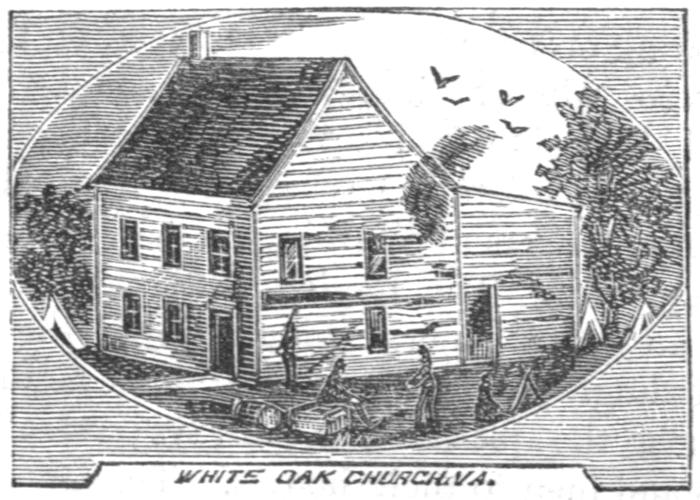
WHITE-OAK CHURCH, VA.
After re-crossing the river, the Thirty-third
bivouacked in the dense woods near by, where it
remained two days. Tuesday morning, a squad of
rebel officers rode down over the battle-field to the
Bernard House. This brought them within range of
our guns planted on Stafford Heights, and Battery
C, Fifth Regulars, immediately dropped a shell
among them, which exploding, killed two, and sent
the others fleeing back to the hills. The riderless
horses dashed down to the river, and were shot
by our men, employed in digging rifle-pits on this
side.
Friday, December 19th, the left Grand Division
moved back to White-Oak Church, and the Thirty-third
re-occupied the camp which it had left on the
Thursday previous. Once more the men applied
themselves to the labor of building log-huts and
fitting up winter quarters. The “Cabins” were
arranged in long rows fronting on the road, and protected
from the wind by the grove of hemlocks.
The weather continued very warm and pleasant, and
but little sickness prevailed in the Regiment. Christmas
was devoted to mirth and hilarity, the
Colonel giving a dinner party to the officers at his
tent.
Marching orders were again received on the 30th,
but were almost immediately countermanded.
General Burnside had arranged another plan of
attack, but the details having been ferreted out by
rebel sympathizers at Washington, he was compelled
to relinquish it. The Regiment frequently went on
picket, and as a general thing enjoyed the change.
The Fitzhughs, Balls, and several other families who
lived near the picket line, always welcomed the
officers and men to their houses. Though confessed
rebels, many pleasant hours were spent in the
society of the daughters, whose brothers and lovers
were absent in the rebel army. There was in fact
hardly a corporal’s guard of young men left between
the Potomac and Rappahannock, so effectually had
the conscription act been enforced.
Among other maidens who were accustomed to
entertain the Regiment, was the betrothed of
Geo. B. Davis, a nephew of Jeff.’s. One afternoon
a cavalryman, after vainly ransacking the out-buildings
of her father’s plantation for corn, approached
the door in which the young lady was standing, and
insisted that some of the grain, “which he knew was
concealed in the house, should be given him.” “We
have none, was the reply.” “Stand aside until I go in
and see for myself,” he rudely retorted, at the same
time whipping out of its sheath a heavy Colt’s
Revolver. No sooner done than the fair girl planted
herself firmly in the door way, drew a small
repeater from her bosom, and deliberately aiming
it at the rascal’s head, exclaimed, “Approach one
step further towards this house, and you are a dead
man.” Cowed and baffled by this exhibition of
bravery, the trooper turned on his heel and left. This
incident illustrates the coolness and courage with
which some of the Virginia women are endowed.
The following changes, in addition to those already
mentioned, had occurred in the Regiment up to this
time.
Captain Theodore Hamilton, Co. G, promoted to
Lieutenant-Colonel, 62d N. Y.
Captain G. Murray Guion, Co. A, promoted to
Lieutenant-Colonel, 148th N. Y.
Captain A. H. Drake returned to duty from
Salisbury, North Carolina, October 6th.
Captain H. J. White, Co. B, resigned.
Captain James M. Letts, Co. I, resigned.
Adjutant Charles T. Sutton resigned.
First Lieutenant H. J. Draime, Co. B, promoted
to Captain B.
First Lieutenant E. J. Tyler, Co. A, promoted to
Captain A.
First Lieutenant John W. Corning, Co. B, promoted
to Adjutant.
First Lieutenant G. A. Gale, Co. G, promoted to
Captain G.
First Lieutenant E. E. Root, Co. I, promoted to
Captain I.
John Gummer, Co. E, promoted to First Lieutenant
E.
Charles D. Rossiter, appointed First Lieutenant D.
Otis Cole, appointed First Lieutenant H.
First Lieutenant R. C. Niles, Co. H, resigned.
First Lieutenant H. G. King, Co. F, resigned.
Second Lieutenant G. W. Marshall, Co. G, promoted
to First Lieutenant G.
Second Lieutenant Ira V. Germain, Co. G,
dismissed.
Second Lieutenant Pryce W. Bailey, Co. A, promoted
to First Lieutenant A.
Second Lieutenant Jefferson Bigelow, Co. D,
resigned.
Second Lieutenant J. Marshall Guion, Co. H,
resigned.
Second Lieutenant C. H. Howe, Co. I, resigned.
Second Lieutenant William H. Long, Co. I, promoted
to First Lieutenant I, and since on Brennan’s,
Davidson’s and Neill’s Staffs successively, Assistant
A. G.
Second Lieutenant L. C. Mix, Co. C, promoted to
First Lieutenant B.
Second Lieutenant H. H. Hills, Co. F, promoted
to First Lieutenant F.
Second Lieutenant Walter H. Smith, Co. E,
resigned.
First Sergeant J. F. Winship, Co. F, promoted to
Second Lieutenant F.
First Sergeant G. T. Brennan, Co. I, promoted to
Second Lieutenant I.
First Sergeant J. E. Stebbins, Co. C, promoted to
Second Lieutenant C, vice Mix, promoted.
First Sergeant Byron F. Craine, Co. D, promoted
to Second Lieutenant G.
First Sergeant T. H. Sibbalds, Co. A, promoted to
Second Lieutenant A.
First Sergeant C. H. Howe, Co. I, promoted to
Second Lieutenant I.
Sylvester Porter, Co. H, promoted to Second
Lieutenant H.
W. W. Smith, Co. E, appointed Second Lieutenant
E.
William E. Roach, Co. D, appointed Second
Lieutenant D.
Orlando Bacon promoted to Sergeant-Major.
John W. Alexander promoted to Quartermaster-Sergeant.
Corporal J. F. Barker promoted to Commissary-Sergeant.
John J. Carter promoted from Commissary-Sergeant
to Second Lieutenant B.
MEDICAL DEPARTMENT.
First Surgeon S. Mulford, resigned.
First Assistant Surgeon D’Estaing Dickinson,
promoted to full Surgeon.
Second Assistant Surgeon Richard Curran, promoted
to First Assistant Surgeon.
Duncan McLachlen appointed Second Assistant
Surgeon.
Edmund De Graff appointed Hospital Steward.
CHAPTER XXIX.
Another Advance.—The Army stalled in mud.—Removal of General
Burnside.—General Hooker succeeds him.—Character of
the two men.—General Franklin relieved, and General Smith
transferred to the 9th Army Corps.—His Parting Address.—Colonel
Taylor assigned to a Brigade.—A Contraband Prayer
Meeting.—Sanitary Condition of the Army.
The weather continued to be very open and favorable
for offensive operations, and accordingly, on the
20th of January, General Burnside began another
forward movement. His plan this time was to cross
the Rappahannock several miles above Falmouth, and
turn the enemy’s left wing.
Monday morning, the left Grand Division was
put in motion, reaching Banks’ Ford—the spot
designed for crossing—the same day. One of the
most terrible storms the Army ever experienced set
in that night and continued until Wednesday,
rendering the passage of the river impossible.
We were literally engulphed in a sea of mud,
Virginia subsoil, of all Jeff.’s dirty allies the most
effective, completely blocking our progress, and transforming,
in a few hours’ time, our compact, well
disciplined forces, into a confused, chaotic mass. One
hundred and thirty-seven thousand men “stalled” in
mud! Pontoons overturned and abandoned, or
“snaked” along by infantry; artillery “mired” to
the hubs, or broken down by the road-side; ammunition
trains upset, or at a dead-lock; supply wagons
stuck fast in the clayey soil, or half hidden beneath
the surface; soldiers leaping from bog to bog, or
floundering in the mud like so many Neighbor Pliables
in the Slough of Despond; stragglers roaming
through the fields and forests in quest of food, or
collected around a barrel of whiskey thrown overboard
to lighten some driver’s load; did an army
ever before encounter such a plight?
A further advance under such circumstances was of
course out of the question, and on Thursday the
army returned to Falmouth, the Thirty-third
re-occupying its old camp for the third time. A
portion of the Regiment remained up the river to
assist in getting back the artillery, pontoons and
other materiel. On the Monday following, we were
startled by the report that General Burnside had
been succeeded by General Hooker. Very few were
disposed to credit the statement, but it was soon
confirmed by the appearance of the following farewell
address:
Headquarters of the Army of the Potomac, Camp near Falmouth, Jan. 26, 1863.
General Orders No. 9.—By direction of the President
of the United States, the Commanding General
this day transfers the command of this army to
Major General Joseph Hooker. The short time that
he has directed its movements has not been fruitful
of victory, nor any considerable advancement of
our line, but it has again demonstrated an amount of
courage, patience and endurance that, under more
favorable circumstances, would have accomplished
great results. Your General, in taking an affectionate
leave of the army, from which he separates with
so much regret, may be pardoned if he bids an
especial farewell to his long and tried associates of
the Ninth Corps. His prayers are that God may be
with you, and grant you continued success until the
rebellion is crushed.
MAJOR GENERAL BURNSIDE.
Owing to the lack of co-operation manifested
on the part of many subordinate officers, General
Burnside had, prior to this time, issued an order dismissing
several of them. This order he sent to the
President, with the request that he would either
sanction it, or relieve him from the position of General
Commanding. He must be clothed with authority
to root out all disorganizing elements in his
army, substituting, in the place of envious, intriguing
Generals, those who would labor in unison with him,
or yield over his command. The President did not
see fit to confer this authority upon him, and he was
accordingly relieved.
Rarely do we meet with one possessed of such
noble qualities as were displayed in General Burnside’s
character. Free from those personal ambitions
which lead so many to seek only
“The bubble reputation even in the cannon’s mouth;”
influenced solely by motives of patriotism, generous
and magnanimous to a fault, manly and
Christian in his deportment, unassuming and almost
diffident, he was the idol of the Ninth Army Corps,
and won the esteem and admiration of all who
were thrown in contact with him. His only faults
were those of a military character: of these the
main one was a want of reticence. The closest
secrecy in all matters was seemingly incompatible
with his frank, open nature. Lack of confidence in
his own judgment led him to confer freely with
others concerning his plans, who in turn communicated
them to others, until he could with truth, exclaim:
“I never whisper a private affair
Within the hearing of cat or mouse,
But I hear it shouted at once from
The top of the house.”
But admitting, as he himself repeatedly did, that
he was not endowed with that grasp of intellect,
fertility of resource, in short Napoleonic comprehensiveness,
necessary for commanding so large an army,
how many men are born in a century who are thus
endowed? Napoleon once remarked that there was
but one General in the whole of France, besides
himself, who could manœuvre one hundred thousand
men.
General Hooker came into power with a flourish
of trumpets, breathing death and destruction to the
foe. After ridiculing without stint his predecessors,
plotting and scheming for their overthrow, and
declaring that he would “take the contract for bagging
the whole rebel army,” he had at last prevailed
upon the President, who was boxing the compass
for a new chief, to appoint him. The appointment
was, however, conferred, as General Hooker has
frequently said, in direct opposition to General Halleck’s
wishes. Now that he had secured the reins,
Mr. Rebel must beware. He would “smash them
to ——.” “God Almighty must have mercy on their
souls—he wouldn’t.”
The prince of braggarts, one could not be in his
presence an hour without recalling a character in
King John.
“Here’s a stay
That shakes the rotten carcass of old death
Out of his rags! Here’s a large mouth indeed!
That spits forth death, and mountains, rocks, and seas:
Talks as familiarly of roaring lions,
As maids of thirteen do of puppy-dogs.
What cannonier begot this lusty blood?
He speaks plain cannon, fire, and smoke, and bounce.
He gives the bastinado with his tongue.
Zounds! I was never so bethump’d with words,
Since I first call’d my brother’s father, dad.”
No sooner had he assumed command than the
Grand Divisions were abolished, and Generals
Franklin and Sumner relieved—the latter at his
own request. General Smith was immediately
after transferred to the Ninth Army Corps, which
had departed for the Peninsula. The following was
his parting address:
Headquarters Sixth Corps, in Camp near White-Oak Church, Va., Feb. 5, 1863.
To the Officers and Soldiers of the 6th Army Corps:
I relinquish command over you in obedience to
orders. Your soldierly qualities make it a high
honor to command you, and long months of association
with you make me regret the separation.
To my old Division I would say more in memory
of our past and longer association. You will not
forget that you were in the advance from Fort
Monroe to within sight of the spires of Richmond;
that in front of the lines near Yorktown, you took
and held for days a position within three hundred
yards of the enemy; that your valor decided the day
at Williamsburg; that in three consecutive days, the
27th, 28th, and 29th of June last, you met and
repulsed the foe; that on the 17th of September you
came upon the battle-field to find the enemy advancing
upon unsupported artillery, and that, rushing
upon their lines, you drove them back in confusion,
and saved the right wing at Antietam. With
such memorials your future is easily foretold.
W. F. SMITH.
The rainy season had now arrived; all hopes of
further active operations were abandoned, and the
army went into permanent winter quarters. During
the month of February, the Thirty-third, Forty-ninth
Pennsylvania, and One Hundred and Nineteenth
Pennsylvania, were formed into a new Brigade,
and placed under the charge of Colonel Taylor, who
established his Headquarters at the “Lee House,”
about one mile and a half from White-Oak Church.
The Regiment changed its location to a woody crest
on the Lee estate, a third of a mile in the rear of the
Colonel’s quarters. This was the most delightful
camp the Thirty-third had during its two years of
service; airy, roomy, healthy, commanding a fine
view of the surrounding country, and well supplied
with pure water from springs close by. On the
summit of the hill, a square clearing was made,
company streets laid out, and the soldiers’ cabins
built in regular order. The officers’ quarters were
constructed just in the edge of the wood at the head
of the various streets. Encamped directly beneath,
on the hill side, were the Forty-ninth and One
Hundred and Nineteenth Pennsylvania.
The months of February, March, and April, passed
very pleasantly. Athletic sports of every description
and in-door amusements, beguiled away many
hours. A mail was received every evening and
distributed at the Chaplain’s tent. The New York,
Philadelphia and Washington daily papers, together
with numerous volumes from the Bernard libraries,
and other secession sources, furnished ample reading
material.
On becoming weary of the monotony of camp
life, many sauntered out to the surrounding forests,
fields, and farm-houses, in quest of adventure. Between
the encampment and Acquia Creek was a
settlement of contrabands, employed by government
in wood-chopping. They occupied the huts built by
the enemy when in possession of the region, and
were apparently very contented with their new mode
of life. After the labors of the day were closed,
they assembled for a Virginia “hoe-down,” in
which the slaves so much delight, or to participate
in religious exercises. Most of the older members
of the community were of a religious turn, and not
unfrequently spent the entire night in devotion.
Their leader on such occasions, a wrinkled, osseous
specimen, whose crisp hair and callous skin were, if
possible, a shade darker than that of his companions,
had been the head-cook of his master, and now acted
in that capacity. He was never so much at home as
when exhorting the brethren, and instead of being
embarrassed by the presence of soldiers, then talked
and prayed with increased fervor. The writer took
down his prayer one evening. He had just risen
from his knees when we entered, but loth to lose an
opportunity of displaying his talent to the “northern
white folks,” he again kneeled down and delivered
the following with great unction.
Oh, Lord God of dis glorious Universe. Wilt
dou look down in de omnipresence of dy eye upon
dese dy collard children bowed upon de knucklebone
dis night. Take a solemn peep upon us and
let a heap of light in. Dou knowest what dese dy
poor darkies need. Dere be Sam, dere be Jerry,
and dere be Pompey. Dey are in dere sins, dats
what I reckon. Help dem to git up, and git from de
wilderness of sin, and come in to de clearing of
salvation. Take a solemn peep also upon de darkies
in de other cabin, who fiddle and whirl on de
bombastic toe, while dy servant fulminates words
to dee. May dey rise above the anthratory things
of dis world, and fly like massa Linkum’s balloom
heavenward. Ruler of all humans on dis earth, wilt
dou bress de Generals in de field dis night, if it be
circumspection in dy eye. Bress de Colonels in de
field dis knight, if it be circumspection in dy discreet
eye, and also bress de Union soldiers who carry
de musket and chew de cartridge, fightin for de
Union and de Stars and Stripes. Dey fight in a
scientific cause, and be de bestest of men, but good
Lord, mey dey swear less and pray more. And finally
bress dy humble servant now supplicating dee in behalf
of dese benighted darkies. It behoves dee to
dig deep, and sound to de very bottom of his heart.
May dere be nary blimmage between myself and
my Saviour.
In de language of de mighty Washington, dis
world is all a fleetin show. To-day we are alive and
hoppin around like grass-hoppers, to-morrow the
sickle of death cuts us down, and spreads us out like
grass in hay time. On every side dou knowest, oh
Lord, is de evidences of de general dislocation and
distruction of de human family. Dere be fightin
among one another, and natural disease. But we
die to live again, either as saints or evil spirits.
Dere be discushions on doctrines. Elecshion, Before-ordination,
Perfection, and sich like, confuse de intellects
of both black men and white. But good Lord,
dou knowest dat dese are vain allusions, splittin an
dividin dy creatures into sexes without mercy.
Whoever will can go to glory. Many dare will be
with sleek countenances, white collars and fine
clothes, who will find do gates shut against dem,
while de blind old woman hobbling on crutches, she
go straight in, Amen.
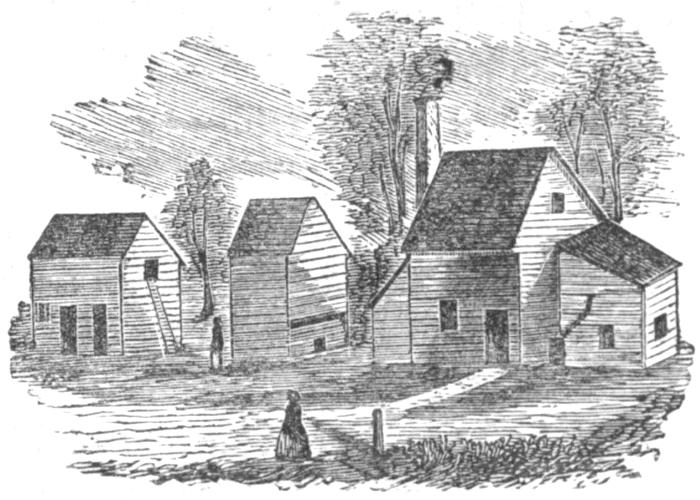
Slave Quarters.
The hearty burst of amens which followed from
the hearers, indicated that they were no less satisfied
with his “gifts” than the leader himself, whose serene
and placid countenance was turned upon us in a
most knowing manner, as much as to say, “any
white man beat that?”
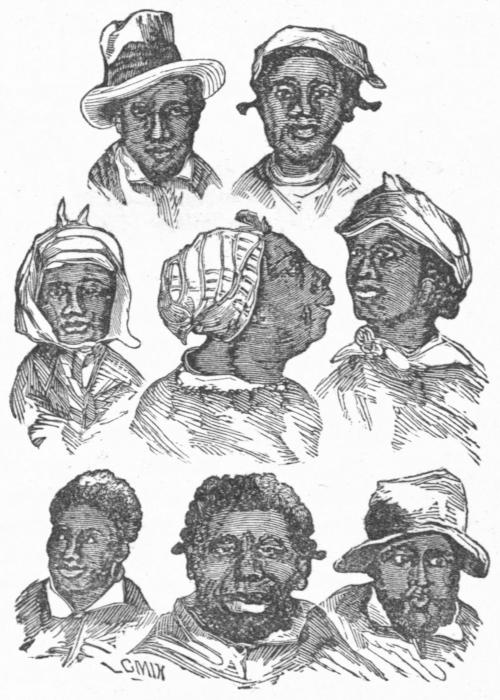
Contrabands near Acquia Creek.
Several now joined in singing a “hymn,” of
which the chorus was—
“Lord, we are flowin to de fountain,
And it is so sweet;
Didn’t my Jesus turn him in de coffin?
Didn’t my Jesus turn him in de coffin?
Sister Mary she loved Jesus,
And so do I.
Lord, we are flowin to de fountain,
Flowin to de fountain,
And it is so sweet.”
While this was being sung, a young member of
the band, with sleeves rolled up and a bandana
wrapped about his head, stood in the centre of the
cabin, and kept time. He continued beating with
the feet and patting with the hands, at the same
time twisting himself into every conceivable
shape the human body will admit of, until the
perspiration rolled off in large drops from his forehead.
An exhortation was next listened to, after
which they sang a variety of tunes, the following
being a sample—
Jesus ’ll git us out o’ dis,
Jesus ’ll git us out o’ dis,
An’ will go home to Canean,
An’ will go home to Canean.
In describing this strange scene, we have no
intention of throwing ridicule upon these unfortunates,
or their devotions, but merely to give the
reader an idea of the manner in which slave
worship is frequently conducted.
The health of the troops continued to be remarkably
good, only five per cent. of the entire army
being on the sick list. Indeed, when we compare
the sanitary condition of the Army of the Potomac
from its origin up to the present time with that of
other military organizations, there is abundant
occasion for thanksgiving. Nearly one half of
our entire forces of the Revolution, forty-seven per
cent., were at one time unfit for duty. Of thirty
thousand troops that composed the English Army
under Wellington in 1809, six thousand were sick
in the hospitals. In 1811, the Portuguese Army,
numbering forty-four thousand, had nine thousand
on the sick list. The terrible sickness during the
late Crimean struggle is fresh in the memory of
every one. Thirty thousand Russian soldiers perished
in a few weeks’ time from camp diseases, and
thirty-five per cent., if we mistake not, of the allied
troops were prostrated with sickness when Florence
Nightingale entered upon her mission of mercy. At
the commencement of the war, the enemy calculated
largely on Cholera, Yellow Jack, and other maladies,
as allies in decimating our ranks; but the health of
the troops thus far has been unparalleled in the
history of modern warfare. This has been mainly
due to the lavish amount of supplies—at least one
third greater than those furnished to any European
Army—and to the skillful management of the
medical Department.
What is known as the Regimental fund comprises
the proceeds from the sale of the excess rations
furnished to the various Regiments. This sum
amounts to several thousand dollars annually, thus
indicating the liberality of government in the matter
of food. The Medical Department characterized at
the commencement of the war, by little order or
efficiency, is now completely systematized and placed
on a servicable footing. Immediately on the resumption
of active operations, the Surgeons are assigned
to the duty for which they are best qualified; some
to the care of the sick, others to the amputating
table, and others to the field.
“Poor white trash.”
The encampment was frequently visited during
the winter by those stigmatized among the wealthier
Virginians, as “poor white trash.” They generally
came to crave “a little flour,” “a few potatoes,”
anything to keep body and soul together. Deprived
of their sons by a contest in which they took no
interest, stripped of their little all by both parties,
reduced to absolute penury, theirs was a hopeless lot
indeed.
CHAPTER XXX.
Splendid Condition of the Army.—Gen. Hooker’s Programme.—A
Forward Movement.—Battles of Chancellorsville and Vicinity.—Jackson
turns Hooker’s Right Wing.—Operations below Fredericksburg.—Strategy.—Address
from the Commanding General.—The
Washington Estate.—Crossing the Rappahannock.
Winter had now passed, and the warm, genial days
of April were fast drying up the roads, and rendering
the resumption of operations practicable. Four
months had rolled away since the bloody struggle
under Burnside, during which the army had recuperated
its energies, recovered its morale, and been reinforced
by numerous accessions of troops. Believing,
with Frederick the Great, that a soldier’s pluck lies
in his stomach, Gen. Hooker had added fresh bread,
potatoes and other esculents to the already substantial
bill of fare, thereby putting his men in the best
of fighting trim; and they, in turn, had come to
cherish a certain regard for and confidence in him,
shouting like the Portuguese under Crawford, “Long
live the General who takes care of our bellies.”
The army was ripe for offensive movements. The
long weeks of inactivity had afforded the General
commanding ample time for reviewing the situation,
deciding upon a plan of attack, and completing the
necessary preparations.
About the middle of the month marching orders
were issued to the troops, but were immediately
rescinded, owing to a furious storm which arose and
prevailed for two days. The elements again becoming
propitious, on Monday and Tuesday, April 27th
and 28th, the various Army Corps left their snug
winter quarters and moved towards the Rappahannock.
The programme decided upon was this: while
a portion of the army crossed below Fredericksburg,
and diverted the attention of the enemy, the remainder
were to proceed up the river, and turning their
left wing, occupy a position directly in the rear of the
rebel works. At the same time Gen. Stoneman,
taking nearly the entire body of our cavalry, was to
make his way down through the State by the Culpepper
route, and circling round to the railroad,
destroy the bridges over the North and South Anna
rivers, less than twenty miles from Richmond.
After the seventy-five thousand men thrown in the
rear had attacked and defeated the enemy, the fifty
thousand at Fredericksburg were to press forward
likewise, engage them, and cut off the way of retreat
towards Richmond. This comprehensive and masterly
plan—substantially the same as Gen. Burnside’s
last—must, if it had proven successful, have accomplished
no less than its author intended, the total
destruction of Gen. Lee’s army; but, alas! Jackson
had not then received his death wound.
The Second Corps, Couch’s; Fifth, Meade’s;
Eleventh, Howard’s; and Twelfth, Slocum’s;
marched to the upper fords of the Rappahannock,
and meeting with but little opposition, most of the
force moved forward, and by Thursday night were
massed in the vicinity of Chancellorsville, after
having travelled a distance of thirty-six miles.
On Friday, Gen. Hooker, who accompanied this wing
of the army, formed the troops in a line of battle, of
a triangular or Redan shape, resting with its wings
respectively on the Rappahannock, between Banks’
and United States Fords and Hunting Creek—an
affluent of the Rappahannock—and having its apex
at Chancellorsville, in the rear of Fredericksburg.
The events which followed we shall allude to briefly,
reserving our main description for those operations
in which the Thirty-third were concerned.
During the day reconnoitring forces were sent
on the roads leading to Fredericksburg, to “feel” the
enemy, and likewise learn the topography of the
region. All night Friday, parties were engaged in
felling trees, clearing away the tangled thickets, and
constructing abatis. Saturday, Howard’s Corps was
posted on the extreme right; then a Division of
Sickles’ Corps (3), which had come up; then Slocum;
then Couch; then Meade on the left; Humphrey’s
Division of Meade’s Corps holding the extreme
left. Several unsuccessful attempts were made by
the enemy during the day to pierce the lines, but
about four o’clock in the afternoon, Jackson suddenly
hurled forty thousand men upon Howard’s
Corps, which fell back in confusion. The Second
Division of the Third Corps was immediately
wheeled around to the rescue, and succeeded in
recovering some of the lost ground, but the right of
the line was completely turned. This success of the
enemy placed Gen. Sickles, who had pushed forward
in front with the remaining two Divisions of the
Third Corps, in a very precarious condition, nearly
severing his connection with the remainder of the
army. Gen. Hooker now decided upon a night
attack, which, though terrible and bloody, as the
engagement through the afternoon had been, resulted
in victory. The enemy were driven full half a mile,
and the lines re-formed on the left, much in the same
manner as they had been before.
The First Army Corps, which had arrived from
Falmouth, and the Fifth, were posted as a new line,
while the disorganized Eleventh was transferred to
the left. About 5½ o’clock Sunday morning, the
enemy came down the plank road leading from
Chancellorsville, and made a furious onslaught. The
engagement soon became general, and for five hours
the roar of artillery and sharp rattle of musketry
resounded through the forest. Our batteries were
posted on commanding positions, and made great
havoc among the enemy as they advanced to the
conflict.
About ten o’clock the lines were contracted and
re-formed in the vicinity of the clearing, which,
together with a single house, constituted all of Chancellorsville.
During the remainder of the day the
enemy made several attempts to break them, but
were each time repulsed. Here the army remained
on the defensive, in a strongly entrenched position,
until the following Tuesday evening, when it retreated,
and safely re-crossed the Rappahannock.
Returning now to the other wing of the army,
the First Corps, Gen. Reynolds, Third, Gen. Sickles,
and Sixth, Gen. Sedgwick, proceeded, on the afternoon
of the 28th, to the dense woods back of the
point where Gen. Franklin crossed the river in December,
and bivouacked for the night. The Thirty-third,
which was on picket Tuesday, when the Sixth
Corps broke camp, having gone out the day previous,
was ordered in at two o’clock P. M., and in a half
hour’s time completed their preparations for departure.
The sick had previously been sent to the
Corps Hospital, which had been established at
Potomac Creek Bridge, and placed in charge of Surgeon
Dickinson. All clothing and camp equipage,
not absolutely necessary, were sent to Belle Plain, in
charge of Quartermaster Alexander, and the haversacks
and knapsacks, loaded down with rations, of
which the troops were ordered to have eight days’
supply. The time for their departure northward
was drawing rapidly near, and for days the men had
been making themselves merry over the prospect of
soon being with the loved ones at home, after two
long years absence. Under such circumstances they
could hardly have been expected to enter upon the
new movement with much heart or spirit. Instead,
however, of flinching from the fresh duties imposed
upon them, they stepped with alacrity to their places
when Col. Taylor, who had now resumed command
of his Regiment, gave the order to “fall in,” eager
to strike one more blow for their country—add one
more laurel to the wreath of honor which encircled
the name of the gallant Thirty-third.
Leaving the now grass-green crest, where so many
pleasant weeks had been spent, the Regiment
wended its way down the sloping sides, through the
fields on the left, and crossing the main thoroughfare
near White-Oak Church, entered the forest. An
hour’s march brought them to a small clearing, where
a halt for a few moments was ordered, and the men
stretched themselves out on the green turf. Again
entering the woods, they pursued a circuitous
course, through dense thickets, across deep ravines
and over treacherous bogs, until the Division was
overtaken at dusk, close to the spot where the Regiment
had encamped after re-crossing the river in
the winter. Fires not being permitted, the men
were obliged to dispense with coffee, and sup as best
they could on “hard tack” and ham, after which the
light shelter tents were spread and, they betook themselves
to rest. The “Light Brigade” of the same
Division was employed during the night in getting
the pontoons down near to the river.
Instead of being drawn on noisy, rumbling trucks,
as heretofore, they were quietly conveyed on the
men’s shoulders, who tugged away lustily at them
until between three and four o’clock in the morning,
Wednesday, when they were launched in the river.
So stealthily had the operations been conducted, that
the enemy’s pickets did not sound the alarm, until
they saw boat loads of armed men approaching.
They had time to fire only two or three volleys, and
then fled. Russell’s Brigade was the first to reach
the opposite bank, and rapidly clambering up its sides,
started in pursuit of the astonished rebels. The
officer of the picket line was found fast asleep in
bed, and on being brought over, entreated us not to
exchange him, “for if you do,” he said, “I shall surely
be shot for having been caught napping.” Col. Irwin,
of the Forty-ninth Pennsylvania, and some eight
or ten others, were wounded in the crossing. Two
bridges were lain, in the identical positions occupied
last year, and Brooks’ Division of the Sixth Corps
thrown over.
Later in the morning, five companies of the Fiftieth
New York, Engineers, proceeded one mile and
a quarter below, and commenced throwing two other
bridges. Troops from Meredith’s (Iron) Brigade of
Gen. Wads worth’s Division, First Corps, dashed over
in boats, and charging up the bank, took nearly all of
the enemy prisoners, who were firing from behind
earthworks and rifle-pits. The Twenty-fourth Michigan,
Col. Marrow, led this gallant charge, followed
by the Sixth Wisconsin. Some of the rebels who
escaped took refuge in a house close by, but our guns
immediately being turned upon it, they scampered
from the building as fast as their legs could carry
them, provoking round after round of laughter from
our boys. The whole of Wadsworth’s Division
crossed, the General not waiting for the bridges to
be completed, but fearlessly swimming his horse
over. Troops now began to debouch at various points
from the forest, and reaching the flats along the river,
halted and stacked arms. The Thirty-third, together
with the other Regiments of Howe’s Division, breakfasted
early, and descending to the plain about nine
o’clock, halted at the same spot where it had lain
during the day preceding the crossing last year under
Burnside. The sky was of a leaden, wintry gray, and
a stiff breeze was blowing.
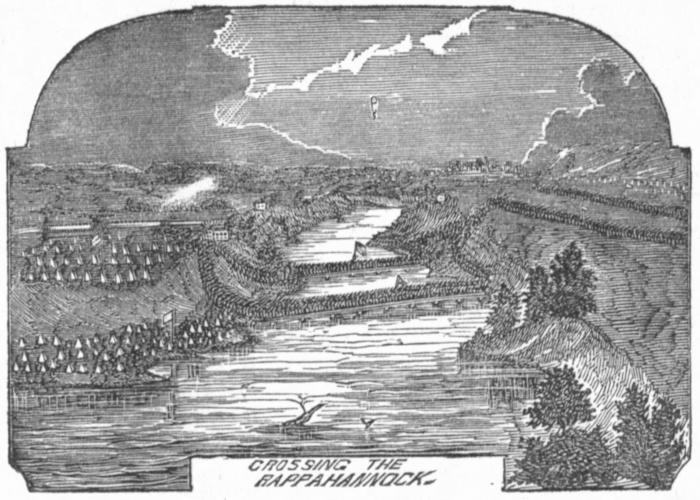
CROSSING THE RAPPAHANNOCK.
The Advance of the Sixth Corps.
The whole of the Sixth Corps, with the exception
of Brooks’ Division, now over the river, were massed
here, and the First Corps, with the exception of Wadsworth’s
Division, near the two lower bridges, while
the Third, Gen. Sickles, remained back on the hills
and in the woods in the rear.
Can it be? was the question which trembled on
every lip, that we are again to be recklessly hurled
against that amphitheatre of hills, before which five
thousand of our number fell last year? So it
seemed. The three entire Corps could not be designed
for a mere feint movement? But when no
more troops were crossed over, and on the following
day a series of marches and countermarches were
ordered, all gloomy forebodings were dispelled, for
we then knew that the appearance of the three
Corps here was for a ruse, though on a large scale,
to attract the attention of the enemy, while the force
above moved to their rear. The appearance by
noon of two heavy lines of the enemy on the old
battle-field, now a beautiful carpet of green, proved
that the strategy had been successful.
As fast as their numerous regiments arrived from
above or below, they descended the hills and
formed in line at the foot to receive us. There they
remained in position for hours; but seeing no disposition
to advance on our part, large numbers,
dropping back in the woods, swarmed like bees in
the tree-tops to scrutinize our movements, and ascertain,
if possible, “what we were about that we did
not come on.” Gen. Sedgwick, who had charge of
this wing of the army, continued to march and
counter-march the troops in view of the enemy.
Forming on the crest of the hills, they would move
down in solid columns to the bridges, as if to cross,
but instead of crossing, quietly draw back through a
gully, and in a half hour’s time be descending the
hill again. This series of manœuvres led the enemy
to suppose that our entire army was here. The disappearance,
however, of most of the rebel infantry
from our front, on Friday morning, indicated that
they had divined our strategy—not, however, until
it had accomplished the purpose intended, as the
reading of the following order showed:
Headquarters Army of the Potomac, Near Falmouth, April 30, 1863.
It is with heartfelt satisfaction that the General
Commanding announces to the army that the operations
of the last three days have determined that our
enemy must ingloriously fly, or come out from behind
their defences and give us battle on our own ground,
where certain destruction awaits them. The operations
of the Fifth, Eleventh and Twelfth Corps have
been a series of splendid successes.
By command of
MAJOR-GENERAL HOOKER.
S. Williams, Adjutant-General.
While the enemy had delayed in our front, our
right wing had reached Chancellorsville.
The reading of these brief lines to the various
Regiments occasioned the wildest enthusiasm, and
cheer after cheer was given for “Fighting Joe.”
While waiting orders on the flats, elegant swords
were presented to Captains Cole and Gifford by their
respective Companies. The Colonel made a brief
address, urging them to wield these new weapons
manfully in the coming strife.
Just at nightfall the enemy opened a heavy fire on
the lower bridges and the infantry on the opposite
bank, killing and wounding some thirty of them. Our
guns replied with much spirit, until darkness put an
end to the conflict. The rebels used one heavy
Whitworth gun, which was planted four miles away,
and fired with a most uncomfortable precision.
Friday was a day of comparative quiet, there
being no infantry and but very little artillery firing.
The enemy’s pickets were posted along the Bowling
Green road, while heavy reinforcements from Richmond
could be seen moving over the hills towards
Chancellorsville. Gen. Sickles’ Corps moved up
the river to reinforce Hooker.
During the afternoon, members of the Regiment
improved the inactivity to visit the old Washington
Estate, situated down the river, about a mile in the
rear of the lower bridges. The story of little George
cutting down his father’s apple tree with his new
hatchet, is familiar to every one. The exact spot where
the tree stood is pointed out, and the green on which
the Father of his Country played and wantoned in his
childhood. The Estate has descended to the Fitzhughs,
who abandoned it on our appearance here last
fall. Their son, a Captain in the Confederate service,
was killed on Wednesday, when the Iron
Brigade crossed the river.
Saturday morning found our troops posted in
about the same position as the day previous, the
Thirty-third still remaining encamped on the flats.
About half-past seven a rebel battery, planted during
the night in front of the ruins of the Bernard House,
tossed a couple of shells among the pickets, who
were playing ball. This was immediately followed
by their ten-pound Parrots, planted on the crest,
three-quarters of a mile below, which again concentrated
a rapid fire on the lower bridges and Wadsworth’s
Division. They were, however, soon silenced
by our heavy guns. Occasional skirmishing
continued through the day. Towards evening, Gen.
Brooks discovered bodies of the enemy moving along
the hills, as if to fall upon our right. When, however,
he perceived, a few moments later, that the
head of the column was directed towards Chancellorsville,
he became satisfied that Gen. Lee was withdrawing
all his infantry from our front, and immediately
ordered the skirmish line forward. The
“Light Brigade,” which was then in front, advanced,
flanked the enemy’s pickets and drove them in fine
style half a mile beyond the Bowling Green road.
Scattered along the turnpike were found knapsacks,
canteens and several “dummeys,” or pickets of
straw.
The lower crossing had now been abandoned, and
Gen. Sedgwick sent the First Corps likewise up the
river to reinforce Hooker, leaving only the Sixth
Corps below Fredericksburg. Immediately on our
obtaining possession of the Bowling Green turnpike,
Howe’s and Newton’s, the two remaining Divisions
of the Corps, passed over the bridges.
CHAPTER XXXI. THE STORMING OF FREDERICKSBURG HEIGHTS. SUNDAY, MAY 3, 1863.
Sunday, May 3d, was a proud day for the Union
arms—the boasted Heights of Fredericksburg were
stormed by our brave boys, and the Stars and Stripes
planted triumphantly over that “Gibraltar of
America.” Whatever the result of the fighting in
the rear, that in front crowned our arms with imperishable
renown. “This crest of hills,” wrote the
London Times’ correspondent, after the battle under
Burnside, “constitute one of the strongest positions
in the world—impregnable to any attack from the
front.” The achievements of that memorable day
again demonstrated that what is impossible with
John Bull becomes possible with Jonathan. The
members of the Thirty-third can ever point with
pride to the conspicuous part which they bore in
this brilliant achievement—the crowning glory of
their two years’ career.
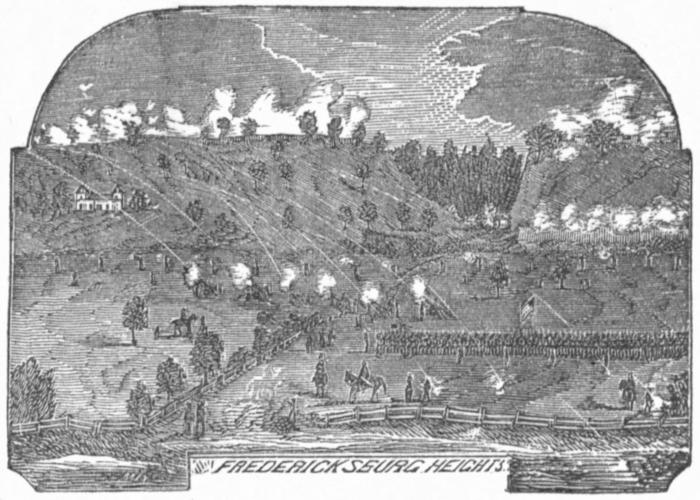
FREDERICKSBURG HEIGHTS.
Stormed by the Sixth Army Corps.
Though Gen. Lee had withdrawn his infantry
from the ridge below the city, he left, as he supposed,
a sufficient force to hold the hills immediately
in the rear. Here was planted the best of his artillery,
supported by the flower of his infantry, under
command of the haughty and supercilious Barksdale,
who a few weeks later breathed his life away
on the crimson fields of Gettysburg—abandoned by
his own men, without a slave even to bring him a
cup of cold water.
About one o’clock Sunday morning, a courier
arrived at Gen. Sedgwick’s headquarters, with orders
from Gen. Hooker to storm the Heights, and pushing
on beyond, join him at Chancellorsville. After
crossing below Fredericksburg Saturday evening,
Howe’s Division had advanced up towards the city
on the Bowling Green road, as far as Hazel Creek,
the Thirty-third and Forty-ninth New York being
deployed as skirmishers. When Hooker’s orders
arrived, Gen. Newton’s Division passed to the right,
and later, Howe’s also moved further on, connecting
with him. Brooks likewise came up from below, and
formed on to Howe’s left. The positions of the various
Divisions became then as follows: Gen. Brooks,
extreme left; Gen. Howe, centre; and Gen. Newton,
right; connecting on with Newton’s was Gibbon’s
Division of the Second Corps, extending
above the city.
The Regiments for the assault were selected from
Howe’s, Newton’s and Gibbon’s commands. The
following comprised all, or nearly all, the number:
31st, 33d, 36th, 43d, 49th, 59th, 61st and 77th New
York; 23d, 61st, 82d, 93d, 98th, 122d, 127th and
139th Pennsylvania; 7th, 19th and 20th Massachusetts;
5th Wisconsin, 6th and 7th Maine, 21st New
Jersey and 1st Long Island.
To Gen. Neill’s Brigade was assigned the honor of
leading the left one of the storming columns, and to
the Thirty-third the honor of leading the Brigade.
The reader will remember that the line of works to
be taken was about one third of a mile in the rear
of Fredericksburg, constructed on a natural bluff,
extending above and below the city for some distance,
and known as “Marye’s Heights.” Beneath
ran the famous stone-wall, forming the western
boundary of the plain over which the charging
columns must pass. Along the lower edge of this
plateau, close by the reservoir, which separates it
from the city, the troops were massed, lying on the
ground to avoid the enemy’s fire. The diagram on
the opposite page represents the scene of action,
with the relative positions occupied by the advance
Regiments of the assaulting columns.
Heavy artillery firing was kept up during the
morning, between the rebel batteries and our own,
planted along the edge of the river. The siege guns
posted on Stafford Heights fired repeatedly on the
enemy’s works, doing good execution. One of the
shells exploded a rebel caisson at the redoubt near
the stone-wall, and killed ten horses. After blowing
up the caisson it struck two directly behind, and
hurled eight others down the steep precipice in the
rear into the yawning chasm beneath. They presented
a hideous spectacle as they lay at the bottom,
dead and dying.
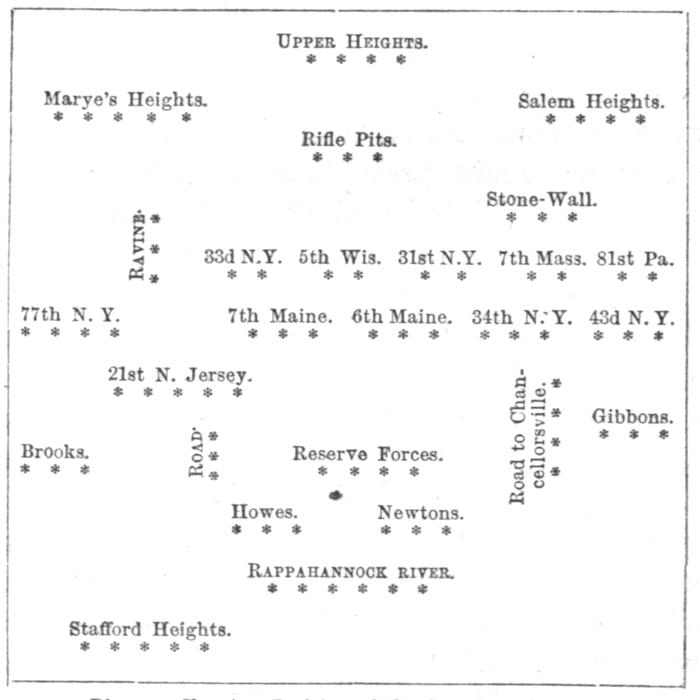
Diagram Showing Position of the Storming Column.
At length, as the City Hall clock struck eleven,
came the order for the charge, and the lion-hearted
men rose to their feet. The hundreds of spectators
in the rear held their breath in terrible suspense,
expecting to see them the next moment prostrate in
the dust. “Forward!” cries Gen. Sedgwick, and
they echelon up the open plain, regardless of the
frowning batteries which vomit grape and cannister
upon them. Col. Spear drops dead from his horse,
and the Sixty-first Penn., at the right of the Chancellorsville
road, momentarily recoils; but the Forty-third
New York comes rapidly to the rescue, and
the columns again press forward, delivering the
battle cheer, which is heard above the roar of artillery
and fierce roll of musketry. Three hundred
yards are passed, one hundred more will bring them
to the stone-wall. All the guns along the crest now
concentrate their fire on the plain. Col. Johns falls,
Col. Newman falls, Major Wheeler falls; Captains
Gray, Ballinger, Irwin, Burke and Knickerbocker are
dead; the ground comprised within the focus is
strewn with the bodies of the slain. But there is no
wavering, and in a moment more the “Slaughter-Pen”
is ours. The Sixth Maine and Thirty-first New
York scale the wall, bayonet the defenders, dash up
the crest, and amid long continued shouts and cheers,
turn their own guns upon the fleeing enemy. “What
men are these,” inquires a terrified gunner, as our
brave boys appear upon the ramparts. “We are
Yankees, ——; do you think we will fight now?”
is the response.
Neill’s Brigade, further to the left, has likewise
swarmed over the wall, and now unfurls its banners
on the Heights.
Only part of the work is, however, done. The guns
on the right and left of the Chancellorsville road
have been stormed, but there yet remains a heavy
battery further to the left, which is now turned upon
the portion of the works occupied by us. The
Thirty-third tarries but a moment, and then starts
for these guns, followed by the remaining Regiments
of the Brigade. Quickly descending to the ravine
at the left, they double-quick through underbrush
and obstructions of every description, cheered on and
led forward by the Colonel, Lieut.-Colonel, Major
and Adjutant. The rebel gunners see them coming
through the thicket, and depressing their guns, rain
down a tempest of cannister. Captain Root falls,
pierced through the thigh; Capt. Cole is prostrated
by a minie; Lieut. Byrne lies by his side; seventy
men are wounded or dead. The old flag, which
waved in triumph at Williamsburg, Golden’s Farm
and Antietam, goes down. A second color-bearer
seizes the banner and raises it on high, but a bullet
quickly lays him low. Another and another grasps
the standard, until six have been shot down, when
Sergeant Vandecar rushes forward, hoists the tattered
banner on his musket, and the Regiment presses forward.
As they emerge from the wood to the opening,
they are saluted with a rapid fire from the rebel
infantry supports, but unmindful of the deluge of iron
hail, they push on, clamber up the green glacis,
sweep over the parapet, and capture a thirty-two
pounder at a bound. Oh! it was a splendid sight
to see those gallant fellows rush boldly up to the
cannon’s mouth, and snatch victory from the jaws of
death.
The artillerists, with the exception of a few who
fled, were captured or killed. The supports fell
back and formed in line of battle. A squad of them,
who lagged behind, were ordered to surrender. They
refused to do so, when a ball from the musket of
Sergeant Proudfoot brought one of them to the
ground. Again they were ordered to halt, and again
refusing, Sergeant Kane killed a second. A third
and fourth were likewise shot down. Having formed
in line, the infantry opened a heavy fire on the
Thirty-third, also drawn up in line. The Seventh
Maine soon came up to its support, being received
with loud cheers, and formed on the left. The
Twenty-first New Jersey not long after followed,
and the rebels were put to flight.
It was with the greatest difficulty that Col. Taylor
could restrain his men from following. Many of
them, unmindful of the orders of their Captains,
did push forward in the pursuit, killing and wounding
several of the fugitives. The Thirty-third’s
banner was unfurled over the captured redoubt, and
the men lay down to rest after their arduous labors.
Two more guns were taken by the Regiments of the
Brigade further to the left.
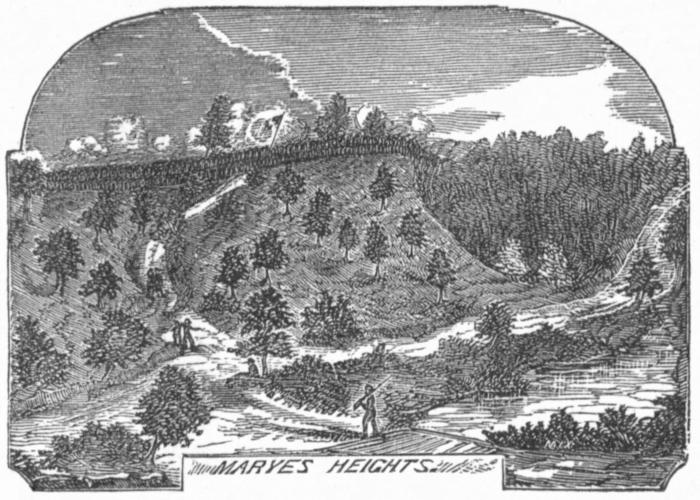
MARYES HEIGHTS.
Showing the Redoubt captured by the Thirty-third.
This part of the enemy’s line of fortifications consisted
of four detached earthworks, very strong and
inaccessible to infantry, as they supposed, on account
of the steepness of the hill and dense underbrush,
which intervened between it and the city. Lieut.
Col. Corning’s horse—a magnificent animal—was
shot from under him, as he was fearlessly charging
up the hill with the Regiment. While passing
through the woods below, Capt. Draime discovered
a party of rebels a short way off, and taking
a few of his men started after them. He returned
after the redoubt was taken, bringing with him
Col. Luce of the Eighteenth Mississippi, and one
Captain, four Lieutenants and thirty-eight privates,
belonging to the same regiment. Capt. Tyler narrowly
escaped, having his clothing perforated eleven
different times with bullets. It seemed almost a
miracle that any of the officers or men could have
passed through such a fiery ordeal unscathed.
CHAPTER XXXII. BATTLES OF SALEM HEIGHTS.
After resting for a brief period on the summit of
the Heights, the Corps pushed rapidly up the turnpike
leading to Chancellorsville, no effort being
made to take possession of the still higher ridge at
the left, to which a portion of the enemy had retreated,
and were now tossing an occasional shell at
us. The country presented a beautiful appearance,
with its green meadows and vast fields of cereals
stretching out in every direction. Gen. Brooks’
Division, which now took the advance, moved rapidly
forward, but instead of meeting with Hooker’s
pickets, encountered a heavy force of the enemy,
about four miles ahead, near Salem. They were
concealed in a forest, into which our infantry
were imprudently advanced before it was shelled.
The rebels immediately rose from their masked position,
and delivered a murderous fire. Gen. Brooks
quickly formed his men in line, and soon became
hotly engaged. While the conflict was at its height,
a body of the enemy suddenly opened upon him
from the left, and he changed front to meet them.
The battle now became very sanguinary, the rebels
rapidly thinning our ranks with their cross fire.
Darkness came to our relief and the fighting ceased,
not, however, before we had lost twelve hundred
men. Seven hundred of this number belonged to
Bartlett’s Brigade—consisting of the Twenty-seventh
New York, among other Regiments,—who fell in
twenty minutes time. The woods afterwards took
fire from our shells, and many of the wounded
belonging to both parties perished in the flames.
The little army slept soundly that night after the
arduous duties of the day. But there were many
officers as well as men who lay down to rest with
serious apprehensions of the morrow. No troops
had been thrown forward to occupy the higher ridge
at our left. What should prevent the enemy from
circling round under cover of night to this crest, and
descending get between us and the captured but
now abandoned Heights in the rear?
The dawn of Monday proved how well grounded
had been these fears. At eight o’clock a heavy rebel
column was observed streaming down the mountain
side, and pushing rapidly for Marye’s Heights. Not
a picket had been thrown out to give warning of
their approach, or a single gun to sweep the gully
through which they had to pass. A scene of utmost
confusion now ensued. The road leading from the
city out to the army was crowded with straggling
soldiers, going on to rejoin their Regiments, supply
wagons, ammunition trains and ambulances filled
with wounded from the previous evening’s fight.
The soldiers scattered through the fields in all directions.
The teamsters and ambulance drivers dashed
furiously into the city, or turned back to the army,
thereby escaping. A few, losing presence of mind,
cut their horses loose from the wagons, and,
mounting them, rode away, in hot haste. Gen. Gibbon,
in charge of the city, sent up one or two Regiments
left with him as a patrol, to check the enemy.
But it was useless for them to attempt doing so, and
after firing three or four rounds, they fled out to the
army. The rebels now pressed forward and re-occupied
the Heights, delivering as they did so, one of
their characteristic yells, so much resembling a wolf
howl.
After resting for a moment they were deployed
out to the right of the Heights, and forming an
extended line, swept rapidly up after the Sixth
Corps. A Union battery, planted on a bluff up the
river, one mile from the city, immediately opened a
hot fire on their backs, and so interfered with his
plans that the commanding officer was content to
draw in his forces and mass them around the
Heights.
Fredericksburg, as well as Falmouth, was now perfectly
defenceless, all the troops not with Sedgwick
having been sent up to the support of Hooker, and a
few siege guns planted on Stafford Heights, comprising
almost our only artillery. The enemy,
had they known it, could have passed down into
the city with impunity, paroled our fifteen hundred
wounded, and then, seizing our pontoon-boats, pushed
over the river and captured Gen. Hooker’s headquarters
and the immense supplies at the Falmouth depot.
Why they did not at least descend to the city still
remains a mystery. Perhaps they were intimidated
by the show of resistance made by a few stragglers,
whom some wounded officers collected about the
streets and posted along the edge of the city. Capts.
Root and Cole, and other officers in the hospital, sent
their swords and equipments over the river, expecting
to be made prisoners. As the day advanced, however,
and the enemy did not come down, preparations
were made for transferring the wounded to the opposite
bank, and before night they were all taken over,
together with the materiel of war, which had collected
there.
The Sixth Corps was now placed in a most critical
position by this coup-de-main of Gen. Lee, having the
enemy in front, left and rear, and an unfordable river
on the right. No wonder that Gen. Butterfield,
Chief-of-Staff, when he rode down to the Falmouth
side of the river and comprehended the situation,
remarked to Gen. Fogliardi, the Swiss General who
accompanied him, “Sedgwick has gone up.” That
indomitable hero, however, had no idea of “going
up,” but immediately set about rescuing his command
from the dilemma in which Hooker and his
Chief-of-Staff had placed it. Hooker and his Chief-of-Staff,
we say, for it was in accordance with their
orders that the Sixth Corps had been pushed on,
regardless of the higher ridge at the left.
The diagram on the opposite page represents the
positions of the different forces of both armies as
they then were.
First on the west our main army, then Lee’s main
army, then the Sixth Corps, then a rebel Corps, and
then our siege guns, planted on the east side of the
river—a most extraordinary sandwiching of opposing
forces together.
Instead of attempting to cut his way through to
Hooker in front, or Fredericksburg in the rear, Gen.
Sedgwick drew back Brook’s Division, still in the
advance, and arranging his army in the form of an
arc, fronting towards the enemy, gradually contracted
the lines until the wings extended nearly to the
river. By this movement the rebels were thrown out
of the rear to his left front. The lines continued to
stretch out towards the river, until they enclosed
Banks’ Ford, six miles above the city, over which
communication was immediately established with
Falmouth, and Gen. Sedgwick sent for supplies.
The announcement of this fact dispelled much of the
gloom prevailing at headquarters, for it was then
known that if the Corps could hold out until night
it would be able to draw back to the ford, under cover
of darkness, and escape.
At daybreak, the Thirty-third, together with three
other Regiments of Gen. Neill’s Brigade, had been
sent out to attack a body of rebels who appeared on
the higher ridge, some distance further on from the
point where they finally descended. After a spirited
fight, the enemy were put to flight. The Regiment
had now returned, and was posted on the left
curvature of the arc formed by Sedgwick, about one
mile from the Heights, and near the road leading
from the city. Occupying a commanding position,
and being so near, they could perceive all the operations
of the flanking force, which numbered twenty-five
thousand. The reader can imagine their feelings
at seeing the Heights which they had so
gallantly stormed on the day previous, now reöccupied
by the enemy. After being arranged in line of battle,
the men amused themselves by firing at the rebel
skirmishers, who crept up behind the trees and
fences to reconnoitre our position. Several were
killed in this manner. Lieutenant Carter, seizing a
musket from the hands of one of his men, brought
down a general officer, who persisted in recklessly
riding out in front of the line.
As the morning advanced, members of the Regiment
proceeded out on the road, and brought in one
of the wagons abandoned by the teamsters, which
proved to be well stocked with delicacies for a
General and his Staff. This was a rich prize for the
men, who, now having subsisted for six days on the
scanty contents of their haversacks, were as eager
for food as the famished Arab in the desert, who,
discovering a bag of gold, mourned that it did not
contain dates.
Towards noon a Brigade of rebels charged upon
the earthworks thrown up in front of the Brigade,
but were handsomely repulsed, and two hundred of
them made prisoners, by a counter charge.
Our forces remained in two lines of battle, expecting
every moment a fierce onslaught from various
points. But the day wore away without an attack,
and the men were beginning to think that none
would be made, when suddenly, about four o’clock,
a heavy column of reinforcements for the enemy
were observed descending the upper ridge. This
meant battle. Imagine a semi-circle within a semi-circle,
and you have the relative positions of the
opposing forces at that time.
An hour later, the rebel hordes rose quickly from
the Heights where they had lain all day, and rushing
forward with cheers and yells, precipitated themselves
upon our line. At the same moment the siege
guns at Falmouth opened a fire on their rear. Gen.
Neill’s Brigade, being the nearest to them, bore the
brunt of the attack, and though assaulted by overpowering
numbers, maintained its position and
repulsed the enemy. One Regiment, the same which
broke at White-Oak Swamp, gave way, thereby
bringing a destructive cross fire upon the Thirty-third.
As the rebels fell back in disorder through
the fields, it was only by the greatest exertions that
Col. Taylor could restrain his men from following.
A few squads did rush forward and secured several
prisoners.
But unmindful of the havoc made in their ranks,
the enemy again pressed on, determined to crush
the Brigade. At the same time they attacked other
points in the extended arc, and Gen. Neill, seeing
that there was imminent danger of his position being
turned, fell back, not, however, before having
incurred a loss of one thousand men. Gen. Sedgwick
now gave instructions for the entire lines to
recede, in accordance with the plan which he had
previously decided upon, viz: to slowly fall back
fighting to the river, until darkness should come on.
As the lines drew back, the enemy steadily pursued,
a vigorous fire of musketry and artillery being kept
up on both sides. Our batteries literally mowed
the pursuers down, as they repeatedly charged upon
them in solid columns. The gunners reserved their
fire until the charging forces came within a few
rods, and then poured the grape and cannister into
them at a fearful rate. Having broken the columns,
they would fall back to new positions, and again
resist their approach.
In this manner the retreat was conducted most
successfully, though not without great loss. The
Thirty-third, which suffered severely at the outset,
likewise lost many men in falling back, including
Lieuts. Porter and Rossiter. While scaling a fence at
one time, which through some culpable negligence
had been left standing, several were killed and
wounded. Gen. Neill being stunned by the falling of
his wounded horse, Col. Taylor temporarily took
command of the Brigade.
To assume command of a Brigade in the confusion
of a retreat, when the enemy was pressing on
all sides, was a most hazardous undertaking. Col.
Taylor, however, did not shrink from the responsibility,
and with the assistance of the Major of the
Seventh Maine, who stepped forward when he called
for volunteer Aids, soon arranged the Regiments in
proper line.
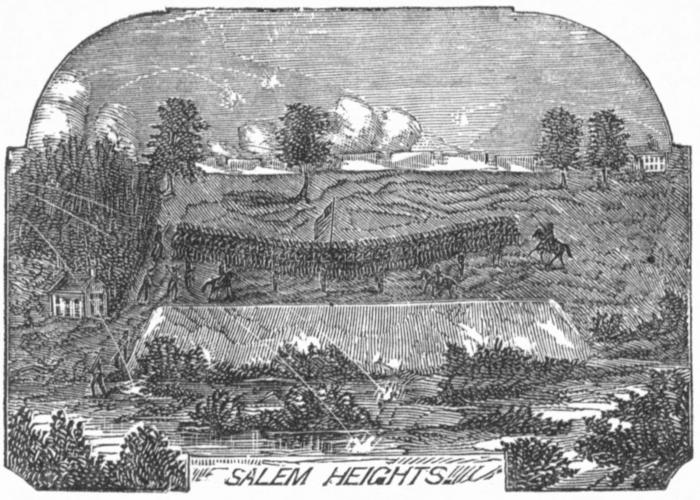
SALEM HEIGHTS.
Charge of the Thirty-third.
Darkness closed upon the combatants and prevented
further pursuit by the enemy, though
skirmishing continued for hours afterwards. Never
had men watched more eagerly for the going down
of the sun, and now that night had spread her sable
mantle over the scene, great was the sense of relief
experienced.
But the joy at their deliverance is suddenly dispelled
by a report that the bridges thrown over the
river at Banks’ Ford have been destroyed, and thus
the way of retreat cut off. During the afternoon
the enemy between us and Hooker had succeeded in
planting several guns near the ford, and kept
pounding away at the bridges for hours. One of
them was seriously injured, but before they could
complete its destruction, batteries were got into
position on the opposite side of the river, and drove
them away. Happily, then, this rumor was without
foundation.
The scenes of that night vividly recalled the
memories of the seven days’ retreat on the Peninsula.
Though no panic prevailed, there was the
utmost confusion. Owing to the darkness and the
large number of wounded, and immense amount of
war materiel which had to be conveyed over, many
of the wounded were left where they fell during the
battle, it being impossible to bring them away. This
was the case with most of those belonging to the
Thirty-third. Lieut. Rossiter died in the hands of
the enemy. By morning the entire Corps was safely
over, and encamped along the flats on the opposite
side. The Thirty-third crossed the bridge about 8
o’clock, A. M.
The next morning the rebels commenced shelling
the troops from the west bank, which caused them
to draw back immediately from the river. Brooks’
and Newton’s Divisions moved a few miles to the
northward, Howe’s remaining in the vicinity. During
the following night the main army re-crossed
above, under cover of a fierce storm. Wednesday
and Thursday were spent in getting back to Falmouth.
Howe’s Division returned to White-Oak
Church during Friday, now for the third time.
The Thirty-third encamped in a field about three-quarters
of a mile from its former position. It was
a sad sight, those thin and decimated ranks; of five
hundred and fifty brave men, who two weeks before
marched out to meet the enemy, less than three
hundred now returned.
CHAPTER XXXIII.
Gen. Stoneman’s Expedition Successful.—Reasons for the Campaign
proving a Failure.—Death of Jackson.—His Character.—Gen.
Neill’s Report.
Gen. Stoneman fully accomplished the object of
his expedition by destroying the railroad bridge, but
owing to the defeat of the army, no material advantage
resulted from his labors.
So terminated the second bloody campaign of the
Rappahannock. The reader who has followed
us through the various operations, will readily fix
upon two main circumstances, as contributing to our
defeat—the breaking of the Eleventh Corps at Chancellorsville,
and the failure to take possession of the
upper range of hills at the left of Fredericksburg.
Gen. Hooker had succeeded admirably in getting
the main portion of the army in the rear of the
enemy. He had chosen a good position, and skilfully
posted his troops. All was going well until
the giving away of the Eleventh Corps let Jackson,
with forty thousand men, upon his right flank. He was
thenceforward compelled to act upon the defensive.
Sedgwick was now brought forward upon the board,
and assigned the duty of restoring, at least, equilibrium
to the contest, by a bold, fearless move. If
unsuccessful, the entire army must rapidly retreat
across the Rappahannock. If successful, the fortunes
of the campaign would be retrieved, and Lee
ground to atoms between the upper and nether millstone,
or forced to “ingloriously fly” towards Richmond.
The Heights were victoriously stormed, and
all was well with Sedgwick. But now comes the
terrible blunder which decides the contest, the neglect
to occupy the upper ridge.
If, says Victor Hugo, Bulow, Blucher’s Lieutenant,
had debouched from the forest above Freschemont,
instead of pursuing the route he did, the form of the
nineteenth century would have been different. If
Sedgwick had debouched from the Heights above
Fredericksburg to the ridge at the left, instead of
pushing on towards Chancellorsville, the enemy
would have been hemmed in, and the bloody battle
of Gettysburg never have been fought; or if a single
battery of heavy guns had been left to command
the road leading down from the ridge and the ravine
through which the flanking force had to pass, in
order to reach Marye’s Heights, the tables would not
have been turned, and Sedgwick instead of Lee compelled
to fight one way and face another.
Our losses during the seven days’ campaign were
not far from sixteen thousand, or four thousand
more than those incurred in the December struggle.
Of this number, more than five thousand came from
the Sixth Army Corps.
The casualties of the enemy amounted to not far
from twelve thousand. In the death of Jackson they
suffered an irreparable loss. Better, said one of the
Richmond papers soon afterwards, that a whole
Army Corps should have gone down than the brave
Stonewall. The true circumstances of his death
have never been published. On Saturday evening
he proceeded out on the turnpike leading from Chancellorsville,
to examine his lines. Instead of riding
alone, as was frequently his habit on such occasions,
he was accompanied by most of his staff and several
orderlies. A squad of the First North Carolina
Regiment had, in the meantime, been posted across
the road by a Division General, to intercept a body
of our cavalry, which he learned was on a reconnoissance.
Mistaking Jackson and his aids in the dark
for the Union troopers, they all fired as he drew near,
killing the aids, wounding two orderlies and sending
one bullet through Jackson’s right hand, and another
through his left arm. He died six days afterwards,
from the effects of these wounds.
The various statements which have appeared from
time to time concerning his piety have not been
exaggerated. He was a decidedly spiritual rebel.
While located at Harper’s Ferry and Winchester,
during the earlier months of the war, he led the
Union Prayer Meetings, and those of the Presbyterian
Church, of which he was a Deacon.
There is not wanting evidence to prove that he
held, at the outset, serious doubts as to the justice of
the insurrection or rebellion. Some of the readers
may recall the following incident, given to the public
last August. It was related to us by a clergyman,
who received it from the lips of the divine referred
to.
Dr. J——, a prominent Presbyterian divine of
New York, who was closely related to Stonewall,
being in Central Virginia just prior to his rapid
march on Banks, spent the night with him and
attempted to convince him of his error in regard to
the States-rights doctrine. At the General’s request
they devoted some two hours to prayer, Jackson
praying long and earnestly. When they rose from
their knees his eyes were suffused with tears, and in
a repentant voice he remarked: “Whatever Virginia
decides to do, I will do. If to return to the Union,
I will fight for the Union.” Not a week elapsed
before Dr. J—— heard of his relative thundering up
through the Shenandoah in hot pursuit of Banks.
The States-rights heresy has compassed the ruin of
many gifted and brave men.
The following is General Neill’s report of the part
borne by his Brigade in the campaign.
Headquarters Third Brigade, Near Fredericksburg, Va., May 7th, 1863.
I have the honor to report, for the information
of the General Commanding the Division, that on
the night of May 2nd, 1863, in obedience to orders,
I led my Brigade across the pontoon bridge at
Mansfield on the Rappahannock, about three-fourths
of a mile below Fredericksburg, posting two Regiments,
the Thirty-third and Forty-ninth New York,
as pickets, in front of the enemy. At 12 o’clock,
midnight, my Brigade was ordered to march along
the “Bowling Green” road towards Fredericksburg.
Whilst waiting to get the road, the enemy attacked
the left of my picket line, held by the Forty-ninth
New York. The Forty-ninth repulsed them, and
held their ground.
On the morning of the third, Sunday, at about 10
o’clock, I was ordered to form three Regiments as the
advance of a column of assault against the Heights
on Marye’s Hill, back of Fredericksburg. I led the
Thirty-third New York, Twenty-first New Jersey,
and Seventh Maine Volunteers, preceded by the
Seventy-seventh New York, who were acting as
skirmishers, under a heavy fire of shot and shell.
Before reaching the batteries on the hill against
which we were directed, I found they had already
been taken by our troops on our right, and I directed
the attack against the batteries on the hills to our
left, along the Richmond road. We took in succession
four distinct detached earthworks of strong
profile. We captured three pieces of artillery—two
long brass guns and one short howitzer—and one
stand of colors, belonging to the Eighteenth Mississippi
Regiment, after which we marched to assist in
repelling an attack of the enemy along the Chancellorsville
road.
On the morning of the fourth of May, the enemy
attempted to turn our rear, when I led four Regiments
of my Brigade back towards Fredericksburg,
and checked them. I must not omit to mention,
on the morning of the fourth a Brigade of rebels
advanced to take an earthwork near the Plank
Road, which was then occupied by our troops;
when two companies of the Forty-ninth New York,
and one company of the Seventh Maine, supported
by the Forty-ninth New York, in conjunction with
two pieces of Lieutenant Martin’s battery, entirely
routed the whole Brigade and the three companies
of infantry aforementioned, captured 200 prisoners,
and the colors of a rebel regiment, the Fifty-eighth
Virginia.
On the evening of the fourth of May, about
5 o’clock, the whole of Longstreet’s Corps came
up the Richmond Road, as reinforcements, attacking
my right and front, massing large numbers of his
infantry in the ravines which were held by their
troops. After losing about one thousand men, I
was obliged to retire, my Regiments being unable to
cope with the overpowering numbers of the enemy,
and fearful, lest in the position I then held, they
would be captured by the enemy piercing our lines
in rear, between us and “Banks’ Ford.” In the
assault, the Twentieth New York Volunteers broke
and went to the rear. I could not rally them. The
other Regiments stood their ground nobly, under a
murderous fire, and by their stubborn resistance
at that time, I believe the Sixth Corps was enabled
to eventually re-cross the Rappahannock at Banks’
Ford, in the night.
Colonel Van Houten, Twenty-first New Jersey
Volunteers, was wounded on the field of the battle,
and I regret to say, died a prisoner in the hands
of the enemy, from wounds received in battle.
I cannot close my report without making free and
sincere acknowledgments to the brave officers and
men of the various Regiments of my command, who
encountered the enemy at these two different battles;
and would especially mention the great assistance
rendered by the gallant efforts of my Assistant
Adjutant General, Captain Wm. H. Long, of the
Assistant Inspector General, Lieutenant Pryce W.
Bailey, Thirty-third New York Volunteers; and
of Lieutenants Wm. H. Alberts and Horace Binney,
my Aids-de-Camp. The horses of both my Aids,
and my own, were shot.
With great respect,
THOMAS H. NEILL,
Brigadier General.
CHAPTER XXXIV.
Departure for Home.—Orations at Geneva and Canandaigua.
Tuesday, May 12th, Colonel Taylor brought the
welcome intelligence to the Regiment, that they
were to go home on the coming Friday. The order
for their departure was accompanied by the following
addresses from the Corps, Division, and Brigade
Generals.
Headquarters Sixth Army Corps, May 13, 1863.
Special Order No. 120.
5. The term of service of the Thirty-third New
York Volunteers having expired, they will proceed
at once to Elmira, New York, the place of enrolment,
where they will be mustered out of the service.
Upon their arrival there, their arms, equipments
and public property will be turned in to the proper
officers. The Quartermaster’s Department will furnish
transportation from Falmouth.
The General commanding the Corps congratulates
the officers and men of the Thirty-third New York
Volunteers upon their honorable return to civil life.
They have enjoyed the respect and confidence of
their companions and commanders; they have
illustrated their term of service by gallant deeds,
and have won for themselves a reputation not
surpassed in the Army of the Potomac, and have
nobly earned the gratitude of the Republic.
By Command of
MAJOR GENERAL SEDGWICK.
(Signed,) M. T. McMahon,
Assistant Adjutant General.
Headquarters Second Division, Sixth Corps, May 14th, 1863.
General Orders No. 26.
By the rules of enlistment, the term of service of
the Thirty-third Regiment New York Volunteers
expires to-day, and they are entitled to an honorable
discharge from the service of the United States.
Yet the General Commanding the Division cannot
let this Regiment depart without expressing his
regret at their leaving, and hopes that they will
speedily re-organize and join this command, to serve
their country once more and to the end of this war,
with the same spirit as they have served for the last
two years. To say that this Regiment, in camp, on
the march, and in all the many hard battles in which
they were engaged, have done their duty and behaved
gallantly, is but a weak expression of the acknowledgment
of their good services. They have earned
for themselves the approbation and confidence of
their Commanders, and fully deserve the gratitude
of their country. By order of
BRIGADIER-GENERAL HOWE.
Charles Mundee,
Major and A. A. G.
Headquarters Third Brigade, Second Division, Sixth Army Corps, May 14th, 1863.
The Brigadier General Commanding the Third
Brigade, cannot part with the Thirty-third New
York Volunteers, without expressing to the officers
and men of that gallant Regiment, who have fought
under his eye and command with so much honor
and distinction, his regret at our separation, his well
wishes for your future.
No words can express what you all must feel—the
sense of having fought nobly for our country,
and suffered bravely for the cause. The memory of
those who have fallen is tenderly cherished, and
your Brigade Commander bids you “God Speed” in
anything you may undertake in the future.
Sincerely,
BRIG. GEN. THOMAS H. NEILL,
Commanding Third Brigade.
On the evening before departure, Colonel Taylor
assembled the recruits, numbering one hundred and
sixty-three, who having enlisted for three years,
were to be left, and addressed them a few words
of parting; expressing his regret that they were not
to accompany the Regiment home; urging them
to conduct themselves in the future, gallantly, as
they had done in the past; and informing them
that their officers and comrades, though absent in
body, would be present with them in spirit. Lieutenant-Colonel
Corning followed with a brief address.
They were formed into one Company, and attached,
under Captain Gifford, to the Forty-ninth New
York.
Early Friday morning, the Regiment proceeded to
Brooks’ Station. Just before leaving the camp, the
Seventh Maine, which had been intimately associated
with the Thirty-third during its entire campaign,
appeared in a body, and presented their adieus.
Leaving Brook’s Station at 9 o’clock, they reached
Acquia Landing, and embarking on board a
small steamer, an hour later, arrived at Washington
about 4 o’clock P. M. The men were
quartered in barracks until the following day, when
they left at noon on a special train for Elmira,
reaching that city at 4 o’clock on Sunday afternoon.
The Regiment remained here until the following
Saturday, when it departed for Geneva, to receive a
magnificent welcome, tendered by the citizens of that
village. As the little steamer conveying the men
hove in sight, they were greeted with the thunder
of artillery, mingled with the chimes of the various
church bells, and, on disembarking at the wharf,
were met by the village authorities, and a large
deputation of citizens. After a few moments spent
in congratulation, the Regiment formed in procession,
and marched through the principal streets
to the park, where the following address was listened
to from Hon. Charles J. Folger:
Colonel Taylor, and Officers and Men of the
Thirty-third Regiment:
There has fallen to me the pleasant duty of tendering
to you a welcome home again. In behalf of
the community from which you went forth, I offer
you a hearty and an overflowing welcome back from
your service as soldiers.
But it does not seem to us that you are the same
men from whom we parted. It is now two years
since we saw you, some of you, leave this shore,
young volunteers, familiar only with the ways of
happy homes and a peaceful community, and now
you return to us bronzed and scarred veterans,
conversant with all the rude alarms of war, having
looked death steadily in the face in many a well-contested
field of strife, and having won for yourselves
an ample soldierly reputation.
Two years ago, I said! It seems, as we look
back, but a little space, yet how full that time has
been crowded with stirring incidents and exciting
events. And to none more than to you have come
those events and those incidents. Of what we have
only read or heard with but a dull ear, of that
you have been a great part, and have looked
upon with courageous eyes. We can scarcely name
a battle in the long catalogue which tells of the
acts and achievements of the Army of the Potomac,
in which the Thirty-third Regiment has not borne a
part, and borne it valiantly and well.
Raised, as you for the most part were, in that district
of country which once fell within the limits of
old Ontario County, you went forth with the name
of the Ontario Regiment, and that fact has always
endeared you to us in this immediate region. You
were christened after our County. It is a proud
old name, for Ontario is the mother of Counties not
only, but the Mother of Men as well. And we felt
proud of you, for we were, and are, proud of the
name: and we were jealous of it, too; jealous that
it should take no tarnish in your hands. But as
report after report came back to us of your good
behavior; of your courage and steadiness; of your
fiery valor; our jealousy was gone, lost, merged in
a sense of swelling pride, that the noble old name of
Ontario had been so well bestowed, and that not
only it took no stain, but that it received an additional
and higher lustre and great glory from the
soldiers of the Thirty-third.
And you may be sure that when the news came of
battles fought, and the papers told us of our troops
in action, there was a speedy search here for the
name and exploits of the Thirty-third, and an eager
community was interested in its sufferings and in
its achievements, and never, never pained by its
defaults, or by its individual disasters.
And so as time went on, though you may not
have noticed it, the Regiment which went out as
the Ontario Regiment, came to be called the Thirty-third,
or Ontario Regiment. And then, and not long
after, naught else but the Thirty-third, and that was
a sufficient and an individual designation, for you
had made the “two threes” famous throughout the
army and the country; and you needed no appellation
of distinction, save your own name, the gallant
Thirty-third—“Taylor’s Fighting D——s.” And
all this has been due to, and resultant from, the good
qualities and spirit of the men, encouraged and
trained, and brought up by the labors and example
of the officers.
We owe you many thanks; we offer them to you,
now that you have so well, so eminently, glorified
this community, whose geographical name you have
borne.
I just said that we traced the papers after a battle,
and looked for mention of the Thirty-third and its
deeds; and then the days after, when came the long
and sorrowful list of casualties, with what tremor and
apprehension we looked again for the beloved number,
33. For well we knew, that where all were so
brave in battle, some must have met Death and
yielded to his power. And we cannot now look upon
your thinned ranks and diminished numbers without
missing from them some well-remembered faces,
very dear to many among us. Nor without feeling
that a great and awful sacrifice had been made for a
great and righteous cause. And more especially was
this the case, when the report came of the last conflict
upon the Rappahannock, so glorious and yet so
fatal to your Regiment. When here at home all was
buoyant expectation of your soon return, even then
announced, it was sad and sorrowful indeed, to read
and know that there was no return for, alas! too
many.
Yet it is a consolation that the sacrifice so costly
has been made for a cause, precious above price, for
the defence of constitutional and legitimate Government,
against the assaults of a hateful and hated
rebellion in arms. And there is the further consolation,
that no one who has been taken from your
ranks has died the death of a traitor or of a deserter,
or as a coward running from the fate which
overtook him; but that loyally, manfully, gallantly,
all have stood with their comrades, and have met
their destiny as a true soldier loves to meet it, with
his face toward the foe.
And you have brought back with you your colors,
the last thing which a brave Regiment surrenders.
These colors have never been surrendered, have
never been repulsed, have never been driven back,
have never retreated save at the order of the General
Commanding, and when a whole army or the whole
force fell back with them. The Thirty-third has
never, as a Regiment, fallen back upon compulsion,
but has often stopped the current of the enemy’s
advance, and has turned the tide of many an unpromising
conflict, and saved from the chronicle the record
of a loyal defeat. Torn by shot and shell, dim with
the stain of the elements, spotted with the blood of
its brave defenders, and faded from the bright hues
which were first unfurled to the sunlight, these
colors yet bear upon them one word, which is a sunbeam
of itself—
“WILLIAMSBURG,”
inscribed there for gallant conduct and persistent,
obdurate bravery in that field, by an order delivered
to you from the mouth of your Commander-in-Chief,
George B. McClellan.
That one word written there is a lustre and a
glory which no warp and woof of the artificer, though
shot with silk of richest dye, and with thread of
purest gold, can equal or imitate.
It is worn and tattered. But the perils it has
shared with you, the hardships you have borne under
it, make it beautiful and sacred to us, men of inaction,
who now look upon it, the mute yet eloquent
witnesses of all your noble deeds. It will soon take
its place in the treasured archives of this noble
State, among its kindred flags, second to none, equal
to any in interest.
But I weary your patience with a theme which
grows upon my mind, and I must come to a close.
I hope we all, whose spokesman I now am, hope
and pray that, escaped from the hardships of your
service, you may live long to enjoy the blessings of
a Government and a Union, as we trust, saved and
restored, in no small part, by your devotion. And
it will add no canker to your enjoyment to reflect,
that you turned your back upon home and its comforts
and endearments, and perilled all for the preservation
of this Nationality, and all there is so priceless,
bound up in its perpetuity.
And let me say, in conclusion, that I know in this
generation of American men, no one who has a right
to bear himself with a prouder, loftier self-respect,
than he who two years ago, when the country of his
birth, or of his adoption, was in the dark hour of its
extremest danger, and seemed ready for extinction,
stepped forth from the mass of community as a volunteer
soldier for its defence; and who, through two
years of varying fortune, has kept right on in the
path of duty, and ready at every call; has braved
danger, has endured hardships, has met deadly peril
face to face, and never flinched; and who, now his
term of service is over, returns to the society he has
protected, to pursue the ordinary avocations of life,
the pursuit of which would have been ended and
lost in political chaos but for his sacrifices and his
daring. I am not able to express the emotions
which swell my soul when I look upon the men who
have done all this. Let him who can survey them
unmoved, go ally himself to the iceberg, or confess
himself the spawn of that Devil, who, all self and
selfish emotion, is the only legitimate progenitor of
such a cold and heartless wretch.
Again and again, Colonel and Officers and Men of
our own gallant Thirty-third, I return you the public
thanks, and give you the public hearty welcome
home.
Col. Taylor responded as follows:
Friends and Fellow-Citizens:—It gives me
unbounded pleasure to meet with you again in
Geneva, and I feel grateful to you for the warm hospitality
and kind reception you have given to my
Regiment. Words can but poorly express the gratitude
of our soldier hearts for this unexpected welcome
from your hands; and rest assured we shall
long cherish the remembrance of this hour as among
the happiest of our lives.
Friends, I did not come here to address you at
length, and you doubtless are all aware that I am
not a man of many words, but rather a man of
actions, and quite unaccustomed to public speaking.
Therefore, you will pardon my brevity, while I
assure you that we feel more than we speak. When
we left you two years ago, we resolved to do our
duty in the field, and can freely say that there’s not
a man in the Thirty-third Regiment but has done
his whole duty on all occasions. What our career
has been during this eventful period you need not be
told. You are familiar with every engagement, and
if our conduct on these occasions but merits your
approval, we are content.
Again I thank you all kindly in behalf of my
Regiment, for the welcome you have extended to
us, and should unlooked-for events transpire that
would demand their services, my Regiment would
be among the first to respond to the call, and I
believe every man would be found again in the
ranks.
Three cheers were now given for the citizens of
Geneva, and three more for the Union, after which
the soldiers repaired to Camp Swift, to partake of a
bounteous repast prepared by the ladies of the
village. The tables groaned under the profusion of
choice delicacies, which were dispensed by fair hands
to the war-worn veterans.
The remainder of the day was spent in visiting
with friends and recounting incidents connected
with the two year’s campaign. During the morning,
a number of the Regiment, who had been
taken prisoners at Salem Heights, arrived from
Annapolis, and participated in the generous hospitalities.
Twenty-five of the wounded, who returned
with the command, were likewise most of them
present.
CHAPTER XXXV.
Splendid Ovation at Canandaigua.—Speeches and Address by
E. G. Lapham, J. P. Faurot, and the Colonel, Lieutenant-Colonel,
and Chaplain of the Regiment.—Return of the Regimental Banner
to the Ladies of Canandaigua.—Parting Exercises.—The
Thirty-third passes into History.
On the following Monday, May 25th, the Regiment
proceeded to Canandaigua, where a splendid
ovation was received at the hands of the citizens.
The most extensive preparations had been made and
the people flocked in by hundreds from the surrounding
country to welcome home their own “Ontario
Regiment.” The train, consisting of ten coaches,
reached the depot at nine o’clock, where an immense
crowd of people were assembled to catch a first
glimpse of the heroes of Williamsburg and Marye’s
Heights. After a brief delay, a procession was
formed, under the direction of the Marshal of the
day, in the following order:
Marshal—William Hildreth.
Band.
Committee of Arrangement.
Speakers.
Assistant Marshal—M. D. Munger.
Colonel Taylor and Staff.
Regiment.
Assistant Marshal—Darwin Cheney.
Band.
Firemen.
Citizens.
Having formed, the procession marched to the
Court House Square, where E. G. Lapham, Esq.,
addressed the Regiment as follows.
Officers and Soldiers:—You have come back,
after two years of arduous service in the cause of
your country, to receive, as is your due, the gratitude
of the State and the homage of the People.
The high honor has been assigned me, humble and
unfitted as I am for the duty, in the name and
behalf of the people of this County and locality
to bid you a hearty and generous welcome. You
have come among us at a period when our hearts
are inspired to make your reception the more cordial
by the news of the brilliant achievements of our
arms in the south-west. You return with thinned
ranks, and diminished numbers, the glorious remnant
of a noble band, whose bravery and skill have been
displayed on almost every battle-field, from the scene
where the great contest for our independence was
closed, to the last deadly conflict around Fredericksburg
and Chancellorsville. Each one of you has
brought home his tale of thrilling incident or noble
daring, which will be repeated from hearthstone to
hearthstone, and from generation to generation, as
long as the name of America shall be known among
men.
You have brought back in triumph that banner
(pointing to the regimental banner presented by the
ladies of Canandaigua), soiled and tattered by the
casualties of the war, and it, too, is a witness of
your devotion and fidelity to the honored flag of
your country. That banner was an object of interest
to us when it was confidingly placed in your
keeping by the donors. It was an object of interest
to you when you received it on your parade ground
at Elmira. It was an object of still deeper interest
to you when its tattered fragments were borne aloft
by brave hands, and dimly seen through the cloud
and smoke of battle. It is to become an object
of still deeper interest to us when you shall soon
return it to the fair hands from whom you received
it, in fulfilment of your honored pledge to return it
unstained by cowardice or shame, “though stained
with blood in a righteous cause.” Soldiers, that
flag, like all things earthly, will perish,
“Its silken folds may feed the moth,”
but the precious lives which have been gloriously
lain down in its defence are treasures laid up where
“neither moth nor rust corrupt,” and their names
will go into the history of this Republic as among
its most priceless treasures. We trust, that after
a brief respite from the toils and privations of the
battle-field, and the enjoyment of the rest and
renewed vigor you will derive from the abundant
delights and comforts of home and fireside, most, if
not all of you, will again be found, if need be, rallying
to the support of the flag you have so long and
so nobly defended.
To you sir (addressing Colonel Taylor), and your
Aids, the cherished leaders of this glorious band of
men, no words are adequate to express the deep
gratitude we feel for your fidelity to your trust.
Officers and Soldiers, it only remains for me, in
conclusion, without detaining you longer, again
to say, that in the name and by the authority of the
people I represent, we bid you welcome—thrice
welcome—among us.
After a brief reply from Colonel Taylor, the
procession re-formed, and marched through various
streets of the village, which were gaily festooned
and decorated with flags. In front of the Webster
House a wreath of evergreen spanned the entire
street, and the Stars and Stripes were unfurled over
the building. Crossing the railroad, a little distance
above, was a massive arch, consisting of two semicircles
of evergreen, studded with bouquets and
bright flowers, and containing in the centre the
word “Welcome.” A second arch was erected
near the Episcopal Church, composed of green twigs
bespangled with roses, and extending across the
street. On one side appeared the words, “Welcome
to the Brave,” wrought with red and white flowers.
On the opposite, “Tears for the Fallen,” enshrouded
with crape. Over the entrance to the Seminary
Grounds appeared the mottoes, “Our Country,”
and “Its defenders,” gracefully set out with laurel
and roses. Suspended over the gateway of the
Academy was a “Welcome,” of red, white, and
blue. On entering Gibson street, the procession
passed under a third beautiful arch of evergreens
and flowers, bearing the significant word “Williamsburg.”
Arrived at the Fair Grounds, east of the
village, the gates were thrown wide open, and
the spacious enclosure soon filled with thousands
of spectators. After listening to numerous stirring
airs from the Hopewell, Canandaigua, and Regimental
brass bands, the Regiment performed the
various evolutions of the manual, exhibited the
manner of pitching tents, made a “charge,” and
went through with numerous other military exercises,
which elicited rounds of applause from the
lookers on. These ended, J. P. Faurot, Esq.,
ascended the platform, which had been erected for
the occasion, and delivered the following address:
Soldiers and Officers of the Thirty-third
Regiment of Volunteers, and of the Army of the
Potomac:—The thousands within the sound of
my voice have this day assembled to extend to you,
for your courage, your patriotism, your noble
sacrifices, the plaudits and homage of a grateful
people, and a warm and hearty welcome to your
homes, and the joys of domestic life. A little more
than two years ago, this nation was basking in the
meridian splendor of national glory, happiness and
prosperity, with a territory extending from ocean to
ocean; a flag that floated in triumph over every part
of our vast domain; a Constitution and Government
dispensing its blessings and its benefits over all; a
great, a glorious and happy nation of thirty-three
millions of people. Suddenly the tocsin of war was
sounded by several of the States, which, for three-quarters
of a century, had enjoyed the blessings, the
privileges and prosperity incident to the Government
handed down to us by our patriot fathers. The freemen
of the north saw the threatened danger to our
institutions, to our country and our homes. You,
Soldiers and Patriots, at this crisis in our country’s
history, worthy sons of patriot sires, left your farms,
your work-shops, your counters and your homes, and
organized the Regiment comprising the immortal
Thirty-third Volunteers of the Empire State, and
went forth to meet the foe that would strike down
the liberties of millions of happy freemen, and who
would destroy the wisest and best government ever
devised by the wisdom of man. Unacquainted
with the arts of war, with patriot hearts you rushed
to the rescue of your country from impending ruin
and desolation; and first in deadly conflict at
Lewinsville, you proved that your valor, your patriotism
and your skill, were equal to the trying
emergencies through which you were called to pass.
At Yorktown, the place of final victory to our arms
under the immortal Washington, you seemed to
be inspired by his spirit and nobly, bravely, proved
yourselves soldiers worthy the high and holy cause
you were defending.
At Williamsburg—that desperate conflict—you
exhibited a daring, a high and ennobling courage,
unsurpassed in ancient or modern times; a daring
that knew no fear; a resolution as immovable, as
determined, as that of the most daring patriots and
veterans of Revolutionary fame. For your noble
conduct, for your deeds of valor there, the name of
Williamsburg was inscribed upon your banner, by
order of your great chieftain, Geo. B. McClellan.
You, officers and soldiers of the gallant Thirty-third,
in every battle have covered yourselves all
over with glory. After the inscription upon your
banner, you no less distinguished yourselves for bravery
and deeds of noble daring, at the battles of Mechanicsville,
White-Oak Swamp, Malvern Hills, the
second battle of Bull Run, Antietam and South
Mountain, and the battles at Fredericksburg, under
the gallant Burnside and Hooker, the last of which
was only three weeks ago this day. It was then but
a few days before your two years of enlistment expired,
that many of your brave companions offered
up their lives as sacrifices upon their country’s altar.
It was then that an officer advancing with his men,
in the midst of a deadly fire, silenced one of the largest
and most deadly guns of the enemy—a deed that has
seldom, if ever, been exceeded for noble daring and
self-sacrificing patriotism in the annals of any age or
of any country. You left your homes from the rendezvous
at Elmira two years ago, with about nine
hundred men; you return to us with three hundred
and fifty, all told; your colors and your flags rent
and torn by shell and shot of the enemy in bloody
strife, tell a truer tale of your sacrifices, your
achievements and your patriotism, than any language
can portray. Yes, you have by that flag and your
deeds of valor, erected a prouder monument, a more
enduring fame, than would be perpetuated by the
loftiest mausoleum that the genius of man could
erect. While we sympathize and do honor to you
who appear with us to-day, we must not forget your
companions—the patriot dead—who fell fighting for
civil and religious liberty; for the great principles
of constitutional government. They have offered up
their lives on the altar of their country, and their
and your names will fill the brightest page in history
for all coming time; yes, this day we must think
of the sacrifices of fathers and mothers; of the
desolate homes; of the tears and the sighs of the
widowed, and the sufferings and sorrows of the
bereaved. You have nobly met the necessities of
your bleeding country, and obeyed her every call,
until the last hour of your enlistment expired, and
may we, your countrymen, catch the spirit of your
patriotism and fill up the ranks in our country’s
defence. We shall triumph; our country again shall
hold her high position among the nations of the
earth. The principle, that man is capable of self-government,
shall here be maintained. Your example
has shown us that no sacrifice is too great; that
the Stars and Stripes of our native land again shall
float in triumph over every foot of American soil,
and the Bird of Liberty shall again expand her
pinions, and with one wing touch the sunrise, and
the other the sunset, and cast her shadow over the
whole world. It may be truly said—
“Your country’s glory, ’tis your chief concern:
For this you struggle, and for this you burn;
For this you smile, for this alone you sigh;
For this you live, for this would freely die.”
Lieut.-Col. Corning responded to the address by
thanking the speaker for his complimentary allusion
to the men of the Thirty-third. They were worthy
of it all. “If you could have seen them,” he continued,
“on the battle-field, a spontaneous feeling of
gratitude would have burst from your hearts. Yes,
they are worthy of all the honor you can bestow
upon them. We thought at one time that your
loyalty was growing cold, and that the ‘God bless
you,’ tendered to us at parting, had been forgotten.
But, thank God, I am pleased to find it different,
by the splendid manner in which you have welcomed
us home to-day. These men are entitled to all the
honor you can bestow on them; and the sick, those
who had to come home on account of impaired
health, are equally entitled to your honor and your
regard, with those who have passed safely through
the perils of a battle-field.”
After the singing of the “Red, White and Blue,”
by a choir of young ladies and gentlemen, Colonel
Taylor stepped forward and returned to the ladies
of Canandaigua the beautiful flag which they had
presented to the Regiment two years before. As he
did so he remarked, that
“it had been given to them
with the pledge that it should never be sullied by
cowardice, or a dishonorable act, and it had never
been; and it never trailed in the dust, except on one
occasion, when the color-bearer sank from sheer
exhaustion on the field. It was a beautiful flag
when presented to the Regiment, but it is now torn
and soiled, but to him and the Regiment it was all
the dearer. He had no doubt it would be dearer to
those who gave it, as a relic of the bravery and patriotism
of the gallant men of the Thirty-third. It
was very heavy to be carried on the field, but it had
always been carried with them. On one occasion
six out of eight of the color-bearers had been shot
down, and another man was called for to support it,
when Sergeant Vandecar immediately sprang forward
with a gun and bravely and heroically bore
the flag aloft.
The Regiment, when he assumed the command,
numbered about eight hundred men, and now there
were not four hundred of them left. If they had come
home some two weeks ago, there would have been
about six hundred of them; but two hundred fell
killed and wounded in the battle of Fredericksburg.
It now only remained for him to hand the flag back,
remarking, in conclusion, that had it been necessary,
for want of others, he would himself have stepped
forward and defended the flag with his life.
On receiving back the now torn and tattered
banner, the ladies presented the following address,
read by A. H. Howell, Esq.:
Col. Taylor:—When two years ago you honored
the ladies of Canandaigua in accepting for the
Thirty-third Regiment this Banner, the work of
their hands and the gift of their affection, the Regiment,
through you, pledged themselves with their
lives, to protect it from dishonor and cherish it as
the emblem of Love and Loyalty. The Recording
Angel registered that vow in figures of Life, and
nobly has the pledge been redeemed in the blood of
Malvern Hill, Fair Oaks, Williamsburg, Lee’s Mills,
Antietam and Fredericksburg.
This bullet-riven, blood-stained Banner is dearer
to us, now that we know it has inspired acts of courage
and patriotic ardor, and that it has been as the
presence of mother, sister, wife, home, to the dying
soldier, than it was when we parted with it in its
freshness and new life, impatient for the pomp and
circumstance of war.
We were proud of it as a beautiful offering. We
receive it now with its honorable scars—as a weary
soldier seeking rest and shelter. We will guard it
carefully and protect it tenderly.
Many a home in our midst is desolate—many
waiting, watching hearts are bereaved; but every
true woman will thank God it was not made so by
the death of a coward or renegade, and that her
dead are “Freedom’s now, and Fame’s.”
Soldiers! on the field of battle you proved yourselves
all that was noble, brave and manly—worthy
sons of old Ontario.
The women of Ontario will expect you to do
battle in their service, by respecting as citizens those
laws and domestic institutions for which you have
perilled your lives; and to your latest posterity your
children and your children’s children can have no
prouder heritage—can make no prouder boast, than
that you were members of the gallant Thirty-third.
The choir now sang the “Star Spangled Banner,”
after which Chaplain Lung delivered the following
parting address to the Regiment:
Gentlemen and Fellow Soldiers:—You have
reached the evening of a two year’s military life.
The cause in which you have been engaged is one in
which you may well be proud. It gives me pleasure
to know that the military glory which surrounds you
this hour, is a thing that you have nobly earned.
The honors which you now enjoy have been bought
by your toil, and sweat and blood. They have been
purchased by long and weary marches, by drill and
duty in camp, and by your unflinching bravery amid
the thunder and peril of battle.
My fellow soldiers, you are standing here to-day,
with the pleasing consideration that you have done
your duty, and can receive an honorable discharge.
Sooner than have been ingloriously dismissed;
sooner than to have been branded with the name of
deserter—a stain never to be washed out, a stigma
to mark your remembrance and disgrace your children
after you are dead—sooner than this should
have ever overtaken you, you have showed by your
gallant conduct that you would have preferred to
have been riddled by the enemy’s bullets and died
on the field. There were those in our own ranks
who have thus died. As a flower when bruised,
mangled and crushed, will give forth all the richness
of its odor, so these bruised ones who have
gone down in the shock of battle, will leave the
sweet recollections of a patriotic spirit; and honor
from a nation, and love from mothers and sisters,
sweeter than the odor of flowers, will cluster around
those names, to be handed down to unborn millions.
It is a pleasing consideration, that you are now
about to return to the embrace of friends and loved
ones. You are to exchange the noise of the camp
for the quietude of home; the rude tent for the neat
cottage; the hard blanket for the soft bed; and the
blast of the bugle for the prattling of children. As
you go, I would bind sacred admonition around your
hearts, and pray God’s blessing to go with you. If
while you have been absent from the holy influences
of home, there have been some evil and wicked
habits fastened on you, let this hour shake them off;
this hour break the fetters that bind them, and return,
leaving forever every bad habit which may have
come nigh the camp.
You stand here to-day, having fully earned the
proud title of veteran soldiers. Four times you
have crossed the Potomac, twice the Chickahominy,
four times the Rappahannock. You have marched
by land and water; by night and day. You have
fought in trenches, and in fields; supported batteries
and charged bayonets, until the honors of war, the
smell of powder, the scars of shell and ball, and the
red dust of twelve battle-fields are upon you.
But while we enjoy the blessings of this hour, let
us not forget the many heroes whom we have left behind
us. They are quietly slumbering in the dust.
All along the Potomac, on either side; up and down
the Peninsula; amid the swamps of the Chickahominy;
on the sunny banks of the James River, and
on the sandy shores of the Rappahannock—in little
groves, on sandy hillocks; in fields, and by the road-side—are
seen the silent resting places of our patriotic
dead. The green pine waves over them,
chanting mournful dirges to the piping winds; the
new-grown grass clusters around them; the sweet
fragrance of the summer’s flowers is wafted over
them, and the birds warble their notes of song among
them; but no mother’s voice is heard there; no sister’s
tear has ever wet the cold sod of the brave
sleeper.
This is not a Democratic war, nor a Republican
war; neither is it a “Negro war,” nor an “Abolition
war.” Let us regard all such appellations as the
result of mere party spirit rather than of genuine
loyalty. This is the Nation’s war. It is loyalty
struggling to suppress disloyalty. It is right arrayed
against wrong; Union against Disunion; order and
obedience against confusion and rebellion. In this
struggle let us worship at no political shrine.
For a time we may be defeated, but not conquered.
The States of this glorious Union are inseparably
linked together by the eternal laws of nature. The
silvery chain of lakes on the North, the sparkling
sea gulfs on the South, the broad Atlantic on
the East, and the shores of the Pacific on the West,
have firmly and legally solemnized these political
nuptials, and bound them in one grand, sacred,
federal bond of everlasting union. “What therefore
God hath joined together let not man put
asunder.”
But I must not detain you longer. I will only
point you to that tattered old flag—pierced by ball
and rent with shell; faded by sun and storm, and
worn into shreds by the breezes of heaven, which
have flaunted her furls over fields of blood, marring
her stripes, and plucking from her proud constellation
some of her brilliant stars. There she hangs in
all the glory of her chivalry!—time-honored—a rich
relic, sacred to the memory of the brave.
“Invincible banner! the flag of the free,
Oh, where treads the foot that would falter for thee,
Or the hands to be folded till freedom is won,
And the eagle looks proud, as of old, to the sun?
Give tears for the parting; a murmur of prayer,
Then forward! the fame of our standard to share;
With welcome to wounding, and combat, and scars,
And the glory of death for the Stripes and the Stars.”
This closed the exercises of the day, and the
Regiment re-forming, proceeded to the Canandaigua
House to partake of a sumptuous banquet, prepared
by the ladies of the village.
Rarely has it been the lot of mortals to receive
such an ovation as were those tendered to the Thirty-third
by the citizens of Geneva and Canandaigua.
It was well nigh a recompense for two years of toil
and danger, to become a recipient of such welcomes.
Every circumstance connected with them will be
fondly cherished by the officers and men.
The Command returned to Geneva the same evening,
and was quartered at the barracks, the officers
taking rooms at the hotels. Tuesday, June 2nd,
Captain Beirn, of the regular service, assembling
the Regiment on the green in front of the
barracks, mustered it out of the service by Companies,
and the Thirty-third passed into history.
FINIS.
APPENDIX. BIOGRAPHIES OF THE THIRTY-THIRD OFFICERS. — COLONEL ROBERT F. TAYLOR — LIEUTENANT-COLONEL J. W. CORNING — MAJOR JOHN S. PLATNER — ADJUTANT CHARLES T. SUTTON — ADJUTANT JOHN W. CORNING — QUARTERMASTER HIRAM LLOYD SUYDAM — QUARTERMASTER HENRY N. ALEXANDER — CHAPLAIN GEORGE N. CHENEY — CHAPLAIN AUGUSTUS H. LUNG — SURGEON T. RUSH SPENCER — SURGEON SYLVANUS S. MULFORD, — SURGEON D’ESTAING DICKINSON — ASSISTANT SURGEON RICHARD CURRAN — ASSISTANT-SURGEON DUNCAN M’LACHLEN — CAPTAIN GEORGE M. GUION, — CAPTAIN EDWIN J. TYLER, — FIRST LIEUTENANT PRICE WESLEY BAILEY, — SECOND LIEUTENANT THOMAS H. SIBBALDS, — CAPTAIN HENRY J. WHITE, — CAPTAIN HENRY J. DRAIME, — FIRST LIEUTENANT L. C. MIX, — SECOND LIEUTENANT JOHN J. CARTER, — CAPTAIN JOHN F. AIKENS, — CAPTAIN CHESTER H. COLE, — FIRST LIEUTENANT ROBERT H. BRETT, — SECOND LIEUTENANT J. E. STEBBINGS, — SECOND LIEUTENANT ANDREW J. SCHOTT, — CAPTAIN HENRY J. GIFFORD, — FIRST LIEUTENANT STEPHEN T. DUEL, — SECOND LIEUTENANT WM. E. ROACH, — CAPTAIN WILSON B. WARFORD, — FIRST LIEUTENANT JOHN GUMMER, — SECOND LIEUTENANT WALTER H. SMITH, — CAPTAIN JAMES M. McNAIR, — FIRST LIEUTENANT H. A. HILLS, — FIRST LIEUTENANT GEORGE T. HAMILTON, — FIRST LIEUTENANT HENRY G. KING, — SECOND LIEUTENANT JOHN F. WINDSHIP, — CAPTAIN THEODORE B. HAMILTON, — CAPTAIN GEORGE A. GALE, — FIRST LIEUT. ALEXANDER E. EUSTAPHEIVE, — FIRST LIEUTENANT G. W. MARSHALL, — SECOND LIEUTENANT BYRON F. CRAIN, — CAPTAIN CALVIN C. WALKER, — CAPTAIN ALEXANDER H. DRAKE, — FIRST LIEUTENANT REUBEN C. NILES, — FIRST LIEUTENANT MARSHALL J. GUION, — FIRST LIEUTENANT OTIS COLE, — SECOND LIEUTENANT SYLVESTER PORTER, — CAPTAIN JAMES M. LETTS, — CAPTAIN EDWARD E. ROOT, — CAPTAIN WILLIAM HALE LONG, — FIRST LIEUTENANT GEORGE BRENNAN, — SECOND LIEUTENANT CHARLES HOWE, — CAPTAIN PATRICK McGRAW, — FIRST LIEUTENANT BARNARD BYRNE, — SECOND LIEUTENANT PATRICK RYAN, — SECOND LIEUTENANT EDWARD CAREY, — FIRST LIEUT. GEORGE W. BROWN, — FIRST LIEUTENANT MOSES CHURCH, — FIRST LIEUT. CHARLES D. ROSSITER, — SERGEANT-MAJOR GEORGE W. BASSETT — TO THE NEW YORK THIRTY-THIRD REGIMENT.
The State Military Authorities at Albany are now
collecting biographies of all the commissioned officers
from this State, to be printed and preserved among the
archives of the Commonwealth. It was customary at
Rome and Athens to engrave the names of their warriors
on marble-tablets erected at the street corners, that all
might see who had perilled their lives in defence of their
country.
Was born in Erie, Pa., June 19th, 1826. He attended
school until fifteen years of age, when he became
employed as an apprentice in the clothing business. In
1843 he proceeded to Toronto, Canada, remaining there
until the spring of 1845. After spending several months
in travelling, he settled in Rochester, and during the following
December associated himself with the Rochester
Union Grays. April 14th, 1847, he enlisted in Captain
Wilder’s Company, 10th Infantry, and was appointed
Orderly Sergeant. The Regiment, which was raised for
the war by Colonel Robert E. Temple, immediately proceeded
to Mexico, and served in various campaigns until
August 1848. Sergeant Taylor distinguished himself on
various occasions, but especially at the battle of Meir.
The Regiment was detached from the army, and stationed
at this post village, for several weeks. Learning this
fact, a considerable force of the enemy advanced cautiously
through the mountain defiles, and made a sudden
night attack, hoping to capture the entire command.
On entering the village they proceeded immediately to
the barracks where the men were quartered, and opened
a hot fire on them. Not a commissioned officer was present
at that time. Sergeant Taylor immediately roused
the men from their slumbers, rallied them around him,
and after a brief engagement, routed the Mexicans and
put them to flight.
Returning to Rochester during the fall of 1848, he
remained a short time, and then settled at Stafford,
Genesee County. He was engaged in the clothing business
here until the spring of 1851, when he removed
to South Byron. During the fall of the same year he
proceeded to Cuba, Allegany County, and in the following
spring, returned to Rochester, where he has continued
to reside until the present time. Soon after returning,
he, with several others, organized the Rochester Light
Guard. He was immediately elected Orderly Sergeant,
and promoted to Second Lieutenant, January 26th, 1856.
July 4th, 1856, he was made Division Inspector, with the
rank of Lieutenant-Colonel, on General Fullerton’s Staff.
Resigning this position, he was elected First Lieutenant
of the Light Guard, which had now become Co. C.,
Fifty-fourth Regiment State Militia. January 25th, 1857,
he was elected Major of the Regiment. August 19th,
1857, he resigned his Majorship to accept the Captaincy
of the Light Guard. On the firing of Fort Sumter,
April, 1861, he commenced raising a company for
the war, and in fourteen days tendered eighty-six men
to the Governor. His Company was immediately accepted,
and mustered into the service as Company A,
Thirteenth New York Volunteers. On the 22d day of
May, he was unanimously elected Colonel of the Thirty-third
New York.
Colonel Taylor was present with his command in all
the engagements of its two years’ campaign, with the
exception of Antietam, when he was absent on recruiting
service. Owing to his soldierly qualities and skill in
manœuvring troops, he was frequently placed in command
of a Brigade. His gallant conduct during the last series
of battles around Fredericksburg greatly increased the
esteem and regard with which he was held among his
fellow-officers and men.
Was born in Yarmouth, North Scotia, Nov. 4th, 1813, and
when eleven years of age removed with his parents to
Rochester. The father losing all of his property by an
extensive conflagration, the son was thrown on his own
resources, and resorted to various shifts for a livelihood.
In 1829 he joined a military organization, and devoted
much time to the manual. During a part of the years
1833 and 1834, he resided in Waterloo, where he was
elected Captain of a Company of Fusileers. In the
spring of 1834 he proceeded to Clayton, Jefferson Co.,
and spent two years in teaching and agricultural pursuits.
He was here likewise chosen Captain of a Militia Company.
In the spring of 1837 he started on a travelling
tour, and spent several months among the Western wilds,
meeting with numerous adventures. Returning to New
York in December, he settled at Ontario, Wayne Co.,
where he remained ten years, engaged in agricultural
pursuits. In 1847 he removed to Palmyra, and embarked
in the mercantile business. May, 1850, he sailed for
California, and after spending three years in mining
operations, returned to Palmyra. He now commenced the
study of law, was admitted to the bar in March 1855,
and continued the practice of his profession until the outbreak
of the war. He was chosen Justice of the Peace,
Police Magistrate, Mayor of the village, and filled other
positions of trust. In the fall of 1860 he was elected by
a heavy majority to represent his district in the State
Legislature.
He took a prominent part in the various Legislative
proceedings of the session, and when the South rebelled,
urged the enforcement of the most stringent measures for
their subjection. On the adjournment of the Assembly he
returned home, and the next day commenced raising a
Company for the war. He was promoted from Captain
to Lieutenant-Colonel of the Thirty-third, November,
1861, and was present with the Regiment in all its
encounters with the enemy, being frequently complimented
by his superior officers for “gallantry and courage.”
Was born at Clyde, Wayne County, March 23, 1837.
During the month of April, 1857, he proceeded to
Geneva, and became Assistant Postmaster. On the following
June he entered the Dry Goods House of
S. S. Cobb as accountant, and in the spring of 1859
became a partner. When the Geneva Company was
organized he enlisted as a private, his name being the
second on the roll, and was unanimously elected First
Lieutenant. On the promotion of Captain Walker to the
Lieutenant-Colonelcy of the Regiment, Capt. Platner was
unanimously chosen to succeed him. January 24, 1861,
he was appointed Major of the Thirty-third, which position
he filled with much distinction until the close of the two
years’ campaign, participating in all the battles and
skirmishes of the Regiment, and having two horses killed
and two wounded in action. He commanded the Thirty-third
during the engagements at Savage’s Station, White
Oak Swamp, and Malvern Hills, bringing it safely
through all the toils and dangers of the retreat from
before Richmond.
Was born in the city of New York, in the year 1830.
He marched to the defence of Washington, April 17th,
1861, with the famous Seventh Regiment, of which he
had long been a member, and on returning, received his
appointment in the Thirty-third. October 29th, 1863,
he resigned in consequence of ill health.
Was born in the town of Ontario, Wayne County, September
8th, 1841. At the age of six years he removed
with his parents to Palmyra, where he attended school
and engaged in teaching until the fall of 1861. During
the month of October he was appointed Second Lieutenant
of Co. B, and on the following May, promoted
to first Lieutenant. He had charge of his Company
during the months of July and August 1862, and acquitted
himself with much credit at the battle of Golden’s
Farm, and during the seven days’ retreat. Returning
to Palmyra, after the army reached Harrisons’ Landing,
on recruiting service, he was prostrated with a severe fit
of sickness. Recovering, he rejoined his Regiment in
November, and was appointed Adjutant.
Was born in Geneva, April 26th, 1822, was appointed
Quartermaster on the organization of the Regiment;
resigned his position September 14th, 1861. He now
resides in Geneva, being extensively engaged in the
confectionery business.
Was born in Rochester, April 18, 1823, where he remained
until 1850, engaged in various pursuits. He was
residing in Chicago when the Thirty-third was organized.
Enlisted as a private, and was promoted to Quartermaster,
September 14th, 1861.
Was born in Richmond, Ontario Co., June 3d, 1829.
He graduated at Hobart College, Geneva, in the year
1849. In 1850 he proceeded to the Episcopal Seminary
in Fairfax County, Virginia, remaining there until June
1852, when he was ordained Deacon in Christ’s Church,
Alexandria. He then came to Rochester, to assist Rev.
H. W. Lee, D. D., then Rector of St. Luke’s Church,
and since Bishop of Iowa. December, 1852, he took
charge of St. Mark’s Church, Penn Yan, and in June,
1853, was admitted to the priesthood by the Bishop of
Western New York. October, 1854, he was called to
the charge of Trinity Church, Rochester. He remained
here until receiving the appointment of Chaplain to the
Thirty-third. Accompanying the Regiment to Washington,
he resigned, December 1st, 1861, and returned to
his Church. He afterwards accepted a call from the
Episcopal Church at Branchport, where he was prostrated
by disease, and died June 12th, 1863. The men became
very much attached to him during his brief
sojourn with the Regiment.
Was born in Rush, Susquehanna County, Pa., November
1st, 1827. After devoting several years to study
and teaching, he entered the Harford Academy, where
he remained two years and a half. At the expiration of
that time, he was admitted into the Sophomore Class of
the Lewisburg University, and graduated in 1853. In
the fall of the same year he became a student in the
Theological Seminary at Rochester, and completed his
studies July, 1855. During the year 1857 he was
settled Pastor of “the First Baptist Church of Canandaigua
Village,” laboring with marked success until commissioned,
January 2nd, 1862, Chaplain of the Thirty-third.
While on the Peninsula, he was attacked with a
severe fit of sickness, and lay at the point of death
for several days. He, however, recovered his health,
and rejoining the Regiment, remained until its return
home, when he resumed his pastoral labors at Canandaigua.
Was appointed Surgeon of the Thirty-third on its
organization, afterwards promoted to Brigade Surgeon.
Who resided at Cherry Valley, was chosen Assistant
Surgeon of the Thirty-third on its organization and was
afterwards promoted to full Surgeon. He resigned at
Stafford Court House.
Was born in the town of Watertown, Jefferson County,
May 19th, 1836, and graduated from Albany Medical
College in 1858. After practising in Watertown and
vicinity four years, he was chosen Surgeon to Sing
Sing Prison, which position he held when appointed
Assistant Surgeon of the Thirty-third. He was promoted
to full Surgeon in the fall of 1862, and remained
with the Regiment until its return home. While in
charge of the Liberty Hall Hospital on the Peninsula,
containing nearly five hundred men, he was made
prisoner, refusing to leave his patients. After being
detained by the rebel authorities for several weeks, he
was set at liberty and rejoined the Regiment. During
the winter of 1863 he was placed in charge of Howe’s
Division Hospital at Acquia Creek, and when General
Hooker’s series of battles occurred, was given, the
entire supervision of all the hospitals of the Sixth Army
Corps.
Was born in Carrahill, Clare County, Ireland, January
4th, 1838, and coming to this country at the age of twelve
years, settled at Seneca Falls with his parents. He
graduated from the Medical Department of Harvard
College in 1860, and enlisted as a private in the Thirty-third.
He was appointed Hospital Steward, when the
Regiment reached Washington, and promoted to Assistant
Surgeon, August 15, 1862. General Smith complimented
him, after the battle of Antietam, in a special
order, for having advanced with his Regiment into the
thickest of the fray.
Was born in Caledonia, Livingston County, January 30th,
1832. Studied medicine with Dr. Chamberlain, of
Le Roy, New York. Graduated at the Buffalo Medical
College, and was appointed Assistant Surgeon of the
Thirty-third, January 22nd, 1863.
Co. A, was engaged in the druggist business at Seneca
Falls, on the outbreak of the rebellion. Remained with
the Regiment until September, 1862, participating in
the various battles of the Peninsula, when he was promoted
to the Lieutenant-Colonelcy of the 148th New
York Volunteers, which position he still retains.
Co. A, was born in Onondaga County, New York, April
1st, 1828. He moved at an early age to Seneca Falls,
which has been his home until the present time. Engaged
in the mercantile business at eighteen years of
age and, followed it until 1847, when he sailed for
California, being nine months and twenty-two days on
the voyage. Returned to Seneca Falls, in the spring of
1851, and re-engaged in business. Was elected as
First Lieutenant of Company A, on its formation. Acted
as Adjutant of the Regiment from May until August
1862, and on the following October was promoted to the
Captaincy.
Co. A, was born in Newtown, North Wales, August
18th, 1837. Emigrated to this country in 1847, settled
at Skaneateles; moved from thence successively to Auburn,
New York City and Utica. Returning home, attended
school one year, and then proceeded to Seneca Falls.
Enlisted as a private in Company A, afterwards elected
to Second Lieutenant, and detached to General Davidson’s
Staff at Yorktown. Promoted to First Lieutenant, May
21st, 1862; was relieved from Staff at Harrison’s Landing,
and took charge of his Company. Appointed on
General Neill’s Staff, January 16th, 1863.
Co. A, on the organization of the company, was elected
Second Sergeant, and promoted to Second Lieutenant,
October 1862, immediately after the battle of
Antietam.
Co. B, succeeded to the command of the Company when
Captain Corning was promoted to Lieutenant-Colonel,
November 1861. Afterwards resigned and was succeeded
by First Lieutenant Draime.
Co. B, was born in the City of Sadan, France, and coming
to America in 1832, settled with his parents in Canton,
Ohio. March 27th, 1839, he enlisted in the Fifth
Regular Artillery, was soon promoted to non-commissioned
officer, and remained in the service five years.
During that time, he was stationed in Detroit, Chicago,
Buffalo, Sackett’s Harbor, Fort Columbus, Fort Adams,
&c. Fired the minute guns at Sackett’s Harbor on the
death of President Harrison, and was ordered to Rhode
Island with his battery, to assist in suppressing the
insurrection known as the “Dorrite War.”
After leaving the army, he resided, among other places,
in Rochester, Fredonia, &c., employed in superintending
engineering operations. He was living in Palmyra when
the war commenced; enlisted as a private in Co. B, was
elected Second Lieutenant, and promoted to First Lieutenant,
and then Captain.
Co. B, was born in New Haven, Conn., in 1829. Removed
to Ithaca, N. Y. Having early developed a taste
for drawing, he was induced to go to New York to
learn the “art and mysteries” of engraving. After
five years’ practice, started business in Rochester. Was
engaged for ten years, until the war, when he went with
the Thirty-third as Commissary Sergeant. Promoted
to Second Lieutenant of Co. C, July 29th, 1861.
Acted in that capacity until the battle of Antietam,
when he was wounded. Promoted to First Lieutenant,
and assigned to Co. B, October 17th, 1862.
Afterwards rejoined the Regiment and was detailed Aid-de-Camp
to Colonel Taylor, Colonel Commanding First
Brigade, Second Division, Sixth Corps, not being sufficiently
recovered to resume active duties as a line
officer.
Co. B, was born in Troy, June 16th, 1842. His parents
dying when he was quite young, he was removed to Buffalo,
and sent to school. Two years later he was placed
under the care of Rev. John Sherdan, of Portageville.
Soon after Cyrus Rose, of Nunda, adopted him, receiving
him into his family as his own son. He was nearly
prepared for College when the war commenced, but
laying aside his books, enlisted as a private in Co. F.
On reaching the field, was appointed Quartermaster-Sergeant.
Nine months afterwards he was promoted to
a Second Lieutenancy, and assigned to Co. B. General
Smith mentioned Lieutenant Carter, among others, after
the battle of Antietam, “whose conduct was particularly
gallant under my own observation.”
Co. C, was born at Newburg, N. Y. Removed at the
age of fourteen to Waterloo. Was employed in various
pursuits until the breaking out of the war, when he
was made Captain of Co. C. Resigned at Washington,
July 28th, 1861.
Co. C, was born in Leray, Jefferson County, October
3rd, 1828. When sixteen years of age he proceeded
to the West. Returned to Leray, and soon removed to
Pillar Point, where he became employed as a ship-carpenter.
Afterwards worked in Oswego, Syracuse,
and New York. When the war broke out, he was residing
in Waterloo; enlisted as a private in Co. C, was
elected First Lieutenant on the formation of the Company,
and promoted to Captain, July 29th, 1861. He
was with the Thirty-third in all its engagements up to
the storming of Marye’s Heights, when he was severely
wounded in the thigh. He recovered sufficiently, however,
to return home with the Regiment.
Co. C, was born in Yorkshire, England, May 17th, 1829,
came to this country when above five years of age, and
settled at Utica. At twenty-one years of age sailed for
California, where he remained two years. Returned to
Utica, and engaged in the machinist business. In 1860
moved to Waterloo. Was elected Orderly Sergeant of Co.
C, and promoted to First Lieutenant, July 29th, 1861.
Co. C, was born at Madrid, St. Lawrence County, August
2, 1833. Enlisting as a private in Co. C, at Waterloo, was
elected Third Sergeant; promoted to Orderly Sergeant,
July 29th, 1861, and to Second Lieutenant, October
17th, 1862.
Co. C, was elected Second Lieutenant on the organization
of the Company, and resigned, July 29th, 1861.
Since died at Waterloo, N. Y.
Co. D, succeeded John R. Cutler to the command of Co.
D, at Camp Griffin. Was educated for the law. Enlisted
as a private in the Thirteenth New York Volunteers,
and afterwards promoted to First Lieutenant of
Co. D, Thirty-third New York. On the departure of
the Regiment from the field, the one hundred and sixty-three
three years’ recruits were organized into one Company
under him, and attached to the Forty-ninth New
York.
Co. D, was chosen First Lieutenant on the formation
of the Company; since resigned.
Co. D, was born in Colchester, Vermont, October 9th,
1825, moved, at seven years of age, to Troy, and from
thence to Rochester in 1838. Proceeded to California
in 1849, and returned to Rochester. Was appointed
Second Lieutenant, Co. D, during the fall of 1862. Has
since performed service, at battles of Fredericksburg
and Chancellorsville, in the ambulance Corps, to which
position he was assigned in February, 1863.
Co. E, was born in Hunterdon, New Jersey, July 27th,
1822. Removed to Geneseo in 1839, where he remained
until the breaking out of the rebellion. Enlisted as a
private in Co. E, and was immediately elected Captain.
Was very fond of military pursuits, and for many years
served as Captain of a Military Company.
Co. E, was born in Dorsetshire, England, July 23d,
1819; came to this country during the spring of 1851,
and settled in Geneseo. Enlisted as a private in Co. E,
and was elected Second Lieutenant. Promoted to First
Lieutenant, July 28th, 1862.
Co. E, resigned, March 18th, 1863.
Co. F, was born on the 8th of June, 1835, in Nunda,
N. Y. His earlier years were spent at school, and upon
the farm. He prepared for College under the tutorship
of Prof. Judson A. Bassett, at the Nunda Literary
Institute, and after teaching a term, entered the University
of Rochester in July, 1857. He graduated with
his class in July 1860, and immediately entered the law
office of Orlando Hastings, in Rochester. During the
winter of 1860 and 1861 he taught the Academy in
West Bloomfield, N. Y., where he was engaged when
the rebellion broke out. He immediately enlisted with
a company forming at Nunda, of which he was elected
Captain, May 10th, 1861. He continued with the company
until it was mustered out of service, June 2nd,
1863, at Geneva, N. Y. The degree of Master of Arts
was conferred upon Captain McNair at the Commencement
of the University of Rochester in July, 1863.
Co. F, was born at Nunda, Livingston Co., Feb. 1st, 1834.
Proceeded to Shelby County, Ky., in the year 1856,
and afterwards to Illinois, Kansas, Missouri, and Nebraska,
being employed most of the time in teaching. Returning
to Nunda, enlisted as a private in Co. F, elected Orderly
Sergeant on the organization of the Company, promoted
to Second Lieutenant, February, 6th, 1862, and to First
Lieutenant at White Oak Church, December 27th, 1862.
Co. F, enlisted as a private in Co. F, was elected First
Lieutenant on its permanent organization, and resigned
at Camp Griffin.
Co. F, was born at Mount Morris, August 15th, 1835.
When the war commenced, enlisted as a private in Co.
F, was chosen Second Lieutenant, and promoted to First
Lieutenant, February, 1862. He was detailed for a time
as Acting Quartermaster.
Co. F, was born in Queensbury, Warren County, June
11th, 1832. At nineteen years of age removed to
Angelica, Allegany County; afterwards resided in Illinois,
Missouri, and Michigan. Returned to Wyoming,
Pike County. During the winter of 1861, enlisted as
a private in Co. F; promoted to Second Sergeant, May
6th, 1861, afterwards to First Sergeant, and, December
27th, 1862, to Second Lieutenant.
Co. G, was elected Captain of the Company on the
organization, and participated in all the earlier engagements
in which the Regiment was engaged. During the
month of December, 1862, he was promoted to the Lieutenant-Colonelcy
of the Sixty-second New York, which
position he still holds.
Co. G, was born in London, Canada West, November,
1st, 1839. In 1845, removed to Watertown, and three
years later to Buffalo; attended school until sixteen years
of age, and then became employed in the printing
establishment of Jewett, Thomas & Co., where he remained
four years. When hostilities commenced, he
enlisted in a three months’ Regiment, and afterwards in
Co. G, as a private. Was immediately elected First
Sergeant, and served in that capacity until May 20th,
1862, when he was promoted to Second Lieutenant.
October 16th, 1862 he was promoted to First Lieutenant,
and during the following December, to Captain of the
Company. He was wounded in the left leg before
Yorktown, but remained but a brief time away from the
Regiment.
Co. G, was elected First Lieutenant on the organization of
the Company, and resigned October 14th, 1862.
Co. G, was born in Elizabethtown, N. J., March 1st,
1840. Removed to Buffalo with his parents at an early
age, where he remained until the breaking out of the
rebellion. Enlisted as a private in the Buffalo Company,
elected Fifth Sergeant on the formation of the Company.
Promoted to First Sergeant, May 20th, 1862,
Second Lieutenant, October 15th, 1862, and to First
Lieutenant, December 27th, 1862.
Co. G, was born at Manchester, Ontario Co., April 26th,
1836. At ten years of age he removed with his parents
to Shortsville; enlisted as a private in the Canandaigua
Co. D; promoted to Second Lieutenant, December 27th,
1862, and assigned to Co. G.
Co. H, was elected Captain of Co. H, on its formation.
When the Regiment was organized at Elmira, he
was chosen Lieutenant-Colonel, but resigned not long
after reaching Washington.
Co. H, was born at Starkey, Yates County, October 18th,
1832. At the age of fifteen, removed with his parents
to Steuben County, where he remained until the year
1858. Then became employed as a clerk in Canandaigua
and afterwards at Geneva. Enrolled himself as a
private in Co. H, elected Second Lieutenant on the
organization of the Company, and promoted to First
Lieutenant, May 25th, 1861. He was taken prisoner
at Williamsburg, and after several months’ confinement
in Salisbury, North Carolina, was exchanged and returning
to the Regiment, January 24th, 1862, he was
promoted to the Captaincy of Co. H.
Co. H, was elected Orderly Sergeant on the formation
of the Company, promoted to Second Lieutenant, Jan.
24th, 1862, and resigned December 27th, owing to ill
health.
Co. H, was appointed Commissary Sergeant at organization
of Regiment. Was transferred from Co. A, and
made Second Lieutenant of Co. H, January 24th, 1862;
resigned December 27th, 1862.
Co. H, was born in Perinton, Monroe Co., Sept. 14th,
1834. At nineteen years of age, entered the Rochester
University, remaining there nearly two years. Returning
home, engaged in farming and stock growing
until twenty-four years of age, then became employed
two years on the Michigan Southern railroad. Returning
home again, engaged in nursery and vineyard business
until August 27th, 1862, when he enlisted as a
private in a body of recruits for the Thirty-third. Was
commissioned First Lieutenant, October 13th, and assigned
to Co. H. Remained with the Company until Jan.
27th, when he was appointed A. A. G., First Brigade,
Howe’s Division. Served in this capacity, and also as
Acting Brigade Commissary, until March 23d. April
14th, was transferred to General Russell’s Staff.
Co. H, was born in the town of Seneca, Ontario County,
April 17th, 1842, where he resided with his parents
until the outbreak of the rebellion. Enlisted as a
private in Co. H, and was elected Second Sergeant, May
23d, 1861. He was afterwards promoted to First Sergeant,
and to Second Lieutenant, October 16th, 1862.
Was wounded, at the battle of White Oak Swamp, in
the left shoulder, and confined to the hospital for
two months. At the end of that time he rejoined the
Regiment, and was again wounded in the right thigh,
during the sanguinary struggle on Salem Heights. Returned
home, and was mustered out with his Company.
Co. I, was engaged in the Daguerrean business at Penn
Yan on the outbreak of the rebellion; was chosen
Captain of Co. I, on its organization, and resigned at
Camp Griffin.
Co. I, was born in Washington County, August 24th
1839. Removed at an early age to Yates County.
After spending several years, at the Prattsburg Academy
and Rochester Commercial College, he became employed
in the Stationery House of George R. Cornwell, Penn
Yan, as confidential clerk. Was elected First Lieutenant
of Co. I, on its organization, and promoted to
Captain, December 27th, 1861. He received a severe
wound in the left thigh while leading his Company in
the charge on Marye’s Heights. For several weeks
his life was despaired of, but after lying two months in
the hospital, he recovered sufficiently to return home.
Co. I, was born in New York City, February 22nd,
1835. At fifteen years of age went to sea. Returned
in three years; engaged in mercantile pursuits till the
outbreak of the rebellion, then joined the Seventh Massachusetts
as a private. Was afterwards elected Second
Lieutenant Fifth New York, and a few days succeeding,
Second Lieutenant, Co. I, Thirty-third. After being
promoted to First Lieutenant, served as Provost Marshal
under General Brooks, and as Aid-de-Camp to General
Davidson. October, 1862, was promoted to Captain, and
A. A. General, and assigned to duty under General
Vinton. Remained with him until General Neill took
Command of the Brigade, when he became his A. A.
General.
Co. I, was born in Penn Yan, December 18th, 1838.
Remained there until the outbreak of the rebellion, when
he enlisted as a private in Co. I. Promoted to Sergeant,
August 1st, 1861, to Orderly Sergeant, January
1st, 1862, and to First Lieutenant, December 1st, 1862.
Co. I, was elected Orderly Sergeant at its organization.
Promoted to Second Lieutenant, December 31st, 1861,
and resigned, October 1862.
Co. K, was born in the county of Down, Ireland, June
16th, 1824. When seventeen years of age, enlisted in
the Eighty-ninth Regiment English Infantry, serving in
Canada three years, and in England, Ireland and Scotland
eleven more. Came to this country in the winter of 1853,
and settled at Seneca Falls. Was elected Captain of Co.
K, and remained with the Regiment till the close of
its two years’ campaign.
Co. K, served as First Lieutenant of Co. K, until
severely wounded while charging up Marye’s Heights.
Co. K, was elected on the formation of the Company,
afterwards resigned.
Co. K, was appointed to fill Lieutenant Ryan’s place,
but was immediately assigned to General Smith’s Staff.
DECORUM EST PRO PATRIA MORI.
Co. D, born in Rochester, was an only son, and, employed
as mercantile clerk, proved a most efficient
and trustworthy young business man. He entered
the Regiment as a private. Promoted to Lieutenant
of Co. D, he fell mortally wounded at the battle
of Williamsburg. His agreeable manners and gallant
conduct had endeared him to the Regiment,
every member of whom mourned his loss as if he
had been a brother.
Co. E, was born in New England, about the year
1817. He was residing at Geneseo when the war
commenced, engaged in the hardware business.
Fond of military pursuits, he connected himself
with a Militia company, and was chosen Lieutenant.
On the organization of Co. E., he was
elected first Lieutenant, participated in the various
skirmishes near Washington, and the battles at Williamsburg
and Mechanicsville. At the battle of
Golden’s Farm he exhibited great bravery, going
fearlessly out in front of the breastwork, and firing
round after round at the enemy, until he fell dead,
pierced through the head by a minie-ball. He was
universally beloved by the Regiment. A brave soldier,
and skilful officer, he died, leaving a bright
record behind him.
Company D, the youngest son of William and
Electa B. Rossiter, was born in Rochester,
New York, March 4th, 1842. His parents soon
after removed to Little Falls, Herkimer County,
N. Y., where his father died. In the year 1856 he
entered the Farmers and Mechanics’ Bank at Rochester,
and, writes the Cashier, “though quite young,
soon learned to count money, and became a very
rapid and accurate accountant.”
In 1861 he enlisted in Co. G, Fifty-fourth Regiment
N. Y. S. M., and was soon after promoted to
Sergeant. During the following spring he was
again promoted to Orderly, and served in that capacity
with his home regiment until September, when
he was authorized with others to raise a Company for
the war.
Lieutenant Rossiter was wounded by a ball,
entering the left side and passing completely through
his body, in the fatal retreat of Sedgwick’s Corps,
after storming Fredericksburg Heights. He was
carried in a blanket a short distance by four of his
faithful men, but owing to the extreme pain it gave
him, he asked to be left behind, and was accordingly
left in the rebel hospital at Banks’ Ford. He lived
just a week from the day he was wounded, and owing
to a merciful peculiarity of the wound, his sufferings
were not excessive. Lieutenant Roach, at the risk
of his own life, succeeded in finding his body, and
at dead of night carried it on his shoulders nearly
a mile. Lieutenant Rossiter’s remains were taken
to Rochester and interred at Mount Hope, May 20th,
1863.
In a communication written since his death, his
Captain says of him, “Charlie was ardent and
enthusiastic, firmly devoted to his country’s good,
and he fell nobly, a martyr to her cause. I have
never seen an officer to whom the trying scenes of a
battle-field were new, bear himself with more bravery
and cool courage than did Charlie.”
Lines written on his death.
Aye! Lay the banner across his breast,
With chaplets twine the marble brow,
It will be calmer now.
What boon but this demand the brave,
A warrior’s fame, a warrior’s grave?
This land, where peace and plenty reign,
He left for a field of death and strife,
To offer up, in Freedom’s fane,
A sacrifice—his life.
More glorious gift could mortal give?
He died, but oh! his name shall live.
But hark! though death has brought relief,
An honor saved, a glory won;
The voice of woe, “My son! my son!”
No wonder if her grief be wild,
He was the widow’s only child.
Loved ones, bereaved ones, no more from sleep
Wake in the silent hours wildly to weep;
All does not die with the swift-fleeting breath,
There is light in the darkness; even in death.
Was born in the town of Barrington, Yates County,
November 6, 1838. When the war broke out, he
was a Law Student at Penn Yan. Enlisting as a
private in Co. I, he was chosen Third Sergeant,
and promoted to Sergeant-Major, May 22nd, 1861.
Having borne off Lieutenant Mix from the battle-field
of Antietam, he returned to the front and was
immediately shot through the head. By his winning
ways and zealous attendance to duties, he had won
the esteem of his officers and commanders, and
fell universally regretted.
BY A. A. H.
Oh! where are those heroes; the first in the fight,
The brave Thirty-third with their standard so bright,
Unfurled to the breeze in the enemy’s view,
As they shouted aloud for the Red, White and Blue?
We saw them depart like a host from our shore;
Their guns on their shoulders they gallantly bore.
The path of their fathers they fearlessly trod;
Their bosoms beat proudly, their trust was in God.
Their steps never faltered, their hearts never failed,
At the glance of the traitors their eye never quailed.
On the red field of glory they fought undismayed;
On the red field of glory their relics are laid.
Now chant we their requiem, mournful and slow,
In deep thrilling tones let its melody flow;
Ah! well may we tell of their triumphs with pride,
Like warriors they fought, and like heroes they died;
Farewell to the dauntless, farewell to the brave!
Unshrouded they sleep in a far distant grave;
But fadeless, immortal their memory shall bloom,
And freedom with roses shall scatter their tomb.
Of the brave Thirty-third doth a remnant remain,
Whose gallant commander shall lead them again,
And the heart of rebellion grow cold as it feels
The plunge of their weapons, the wounds of their steel.
Their bright swords are gleaming, their banner unfurled
By the soft floating zephyrs, is gracefully curled;
They are restless, impatient the charge to renew,
They are shouting aloud for the Red, White and Blue.
GENERAL ORDERS PERTAINING TO THE ARMY. — PICKET DUTY.
This most important feature, for the safety of an
army, is perhaps the least understood of all that appertains
to the art of war. As the same system is germain
to all armies, the following explanation will, no doubt, be
acceptable in this volume, as the duty has been seldom
described, though often spoken of, in the numerous
details of midnight attacks, and skirmishes. In the disposition
of, say two hundred men, they go forth to a point
designated as the grand reserve, varying in distance
from two hundred rods to nearly a mile from the outer
or picket line, where are left half of the number as a
reserve, in case the pickets are driven in, and also for
mutual relief in their fatiguing duties (often out on
picket for three days). Then, to the right and nearer
the line, is stationed an officer and forty-eight men, who
immediately relieve the line of men (who are out in front)
sixteen in number, leaving thirty-two men on the support,
so-called—or two more reliefs, relieving each other every
two hours; the same on the left support.
When six hours have passed, the three reliefs on each
support having stood on post their two hours each, the
Grand Reserve sends out the ninety-six men who have
been resting—forty-eight to each support—they, in turn,
going through the same routine—the first ninety-six men
going back to the main reserve to rest, &c. Thus the
whole thing is systematized, the Grand Reserve and the
supports alternately relieving each other, until the whole
time for which they are detailed, expires, when another
detail from some other Regiment relieves the whole picket.
The Picket Guard is always commanded by a Staff Officer.
The following is a specimen of an order from Brigade
Headquarters, detailing a Picket Guard from the Thirty-third
Regiment:
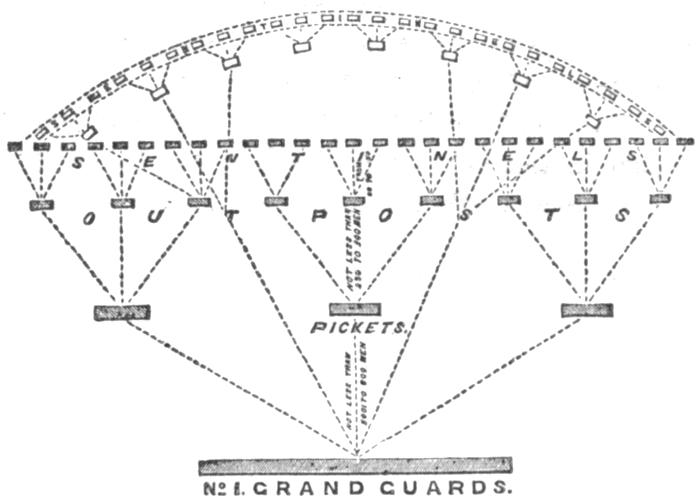
Headquarters 3d Brigade, 2d Division, 6th Corps.
(Special Orders.)
Ten Commissioned Officers, fifty Non-Commissioned
Officers, and three hundred and fifty Privates, will be
detailed from the Thirty-third Regiment N. Y. S. Volunteers,
for Picket Guards, and will mount at 9.30 A. M.
Major John S. Platner, 33d N. Y. S. V., and Assistant-Surgeon
Richard Curran, of the same Regiment,
will accompany the detail, which is to remain on
duty for three successive days.
Grand Guard Mounting will be had according to Butterfield’s
System, on which a Division Staff Officer will
perform the duties of Assistant-Adjutant-General of
Brigade, and a Brigade Staff Officer will act as Regimental
Adjutant. By command of
BRIG. GENERAL THOS. H. NEILL.
W. H. Long,
Captain and A. Gen’l.
Headquarters 6th Army Corps, February 25th, 1863.
(Orders.)
Colonel R. F. Taylor, Commanding First Brigade
Second Division, is detailed as General Officer of the day
for to-morrow, and will report at these Headquarters at 9
o’clock, A. M. By command of
MAJOR GENERAL SEDGWICK.
(Signed) C. A. Whittier,
Captain and A. A. A. General.
Headquarters 2d Division, 6th Corps, February 25, 1863.
[Official.]
E. Mattock,
Lieutenant and A. A. A. Gen’l.
Headquarters 1st Brigade, 2d Division, 6th Corps, March 12th, 1863.
[Special Orders No. 7.]
First Lieutenant L. C. Mix, 33d N. Y. S. V., is
hereby detailed on special duty at these Headquarters.
He will report to Colonel Taylor for duty at once.
By order of
COLONEL TAYLOR,
Commanding 1st Brigade.
John W. Corning,
Lieutenant and A. A. A. Gen’l.
Headquarters 2d Division, 6th Corps, March 14th, 1863.
[Special Orders No. 51.]
Lieutenant William E. Roach, Co. B, 33d N. Y.
S. V., is detailed for duty in the Ambulance Corps. He
will report, without delay, to Lieutenant Wood, Commanding
Ambulance Corps. By order of
BRIGADIER GENERAL HOWE.
(Signed) E. Mattocks,
Lieutenant and A. A. A. Gen’l.
Headquarters 1st Brigade, 2d Division, 6th Corps, March 16th, 1863.
[Official.]
John W. Corning,
Lieutenant and A. A. A. Gen’l.
Headquarters 3d Brigade, 2d Division, 6th Corps, April 15th, 1863.
[Circular.]
I. On the march blankets and shelter-tents will be
worn diagonally over the shoulder, from right shoulder to
left side; overcoats will be rolled and packed on the top
of the knapsacks.
II. The rations will be carried precisely as ordered in
circular from these Headquarters of April 13, 1863.
III. The surplus clothing, not already disposed of, will
be packed in cracker-boxes, marked and sent to the barge,
awaiting transportation to Washington. The instructions
contained in General Orders No. 155, Army of the
Potomac, 1862, in regard to the duties of Commanders
of Regiments and Companies towards their Commands,
whilst on the march, will be strictly observed. No man
will leave his Command without proper authority in writing.
IV. Commanding Officers of Regiments will be held
responsible for the execution of these orders.
By command of
BRIGADIER GENERAL NEILL.
William H. Long,
Captain and A. A. Gen’l.
Medical Director’s Office, Headquarters Army of the Potomac, Camp near Falmouth, Va., March 9th, 1863.
[Circular.]
General:—I have the honor to invite the attention of
the Commanding General to a practice quite prevalent in
the army; that of excavating the earth, building a hut
over the hole, and covering it over with brush and dirt
and canvass.
This system is exceedingly pernicious, and must have
a deleterious effect upon the health of the troops occupying
these abominable habitations; they are hot-beds of
low forms of fever, and when not productive of such diseases,
the health of the men is undermined, even if they
are not compelled to report sick.
I strongly recommend that, in huts covered by canvass,
the covering be removed at least twice a week, if the
weather permit, and the men throughout the army be
compelled to hang their bedding in the open air every
clear day. I am, General,
Very respectfully your obedient Servant,
(Signed) JNO. LETTERMAN,
Medical Director A. P.
Headquarters 2d Division, 6th Corps, March 16, 1863.
[Official Copy.]
Brigade Commanders of the Second Division will take
immediate measures to carry out the recommendation in
the above order. By order of
BRIGADIER GENERAL HOWE.
(Signed) E. Mattocks,
Lieutenant and A. A. Gen’l.
Headquarters Army of the Potomac, March 15th, 1863.
[Official Copy.]
Respectfully furnished for the information of the Commanding
Officer of Sixth Corps, who will at once take
measures to carry into effect the recommendations of the
Medical Director. By command of
MAJOR GENERAL HOOKER.
(Signed) S. Williams, A. A. General.
Headquarters 6th Corps, March 15th, 1863.
[Official Copy.]
The attention of Division Commanders is called to the
above. By command of
MAJOR GENERAL SEDGWICK.
(Signed) C. A. Whittier,
Captain and A. A. A. Gen’l.
Headquarters 1st Brigade, 2d Division, 6th Corps, March 17th, 1863.
[Official Copy.]
Regimental Commanders in this Brigade will see that
the above order is strictly complied with. By order of
COLONEL R. F. TAYLOR,
Commanding First Brigade.
Lucius C. Mix,
Lieutenant and A. A. A. General.
Headquarters 3d Brigade, Smith’s Division, August 8th, 1862.
[Special Orders No. 180.]
A Board of Survey will assemble at the Quartermaster’s
Department of the Thirty-third New York State
Volunteers, at 3 o’clock, P. M., to-day, to examine into
and report upon a quantity of bacon issued to the Thirty-third
Regiment N. Y. S. V., by the Third Brigade, C. S.,
on the 7th instant. The bacon is reported unfit for issue.
The Board will make a full report.
Detail for the Board:
Capt. Patrick McGraw, Co. K,
Lieut. L. C. Mix, Co. C,
Lieut. P. W. Bailey, Co. D, 33d N. Y. V.
By order of
LIEUT.-COL. JOS. W. CORNING,
Commanding Third Brigade.
W. H. Cameron,
A. A. A. General.
Headquarters 1st Brigade, 2d Division 6th Corps, March 4th, 1863.
[Special Orders.]
Private ——, Co. G, Thirty-third New
York State Volunteers, is hereby detailed on “extra duty”
in the Brigade Commissary Department. He will report
to Lieutenant Otis Cole, A. C. S. of this Brigade, with
the least possible delay. By order of
COLONEL R. F. TAYLOR,
Commanding First Brigade.
Lucius C. Mix,
Lieutenant and A. A. A. General.
Charges and Specifications against Private ——
——, of Company ——, Thirty-third Regiment
New York State Volunteers.
CHARGE.
Violation of the 21st Article of War.
SPECIFICATION.
In this that said Private —— ——
of Company ——, Thirty-third Regiment New York State
Volunteers, did, without leave of his Commanding Officer,
absent himself from his Camp and Company at about nine
o’clock, A. M., of the 12th day of December, 1861, and
remained absent until about nine o’clock, P. M., of the
13th day of December, 1861; this at Camp Griffin, near
Lewinsville, Virginia.
Lieut. Commanding Co. — 33d Reg’t N. Y. S. V.
Witnesses —— ——
FURLOUGH FOR ENLISTED MEN.
To all whom it may Concern:
The bearer hereof, ——, Private,
of Captain ——’s Company [——], Regiment
of New York State Volunteers; aged —— years, ——
feet —— inches high, —— complexion, —— eyes,
—— hair, and by profession a ——
born in —— of ——, and enlisted
at —— in the —— of ——
on the —— day of ——, eighteen hundred
and —— to serve for the period of —— years,
is hereby permitted to go to ——, in the
county of ——, State of ——
he having received a furlough from the —— day of ——
186—, to the —— day of ——, 186—, at
which period he will rejoin his Company and Regiment at
——, or wherever it then may
be, or be considered a deserter.
Subsistence has been furnished to said ——
—— to the —— day of ——, 186—
and pay to the —— day of ——, 186—, both
inclusive.
Given under my hand at ——
this —— day of ——, 186—.
R. F. TAYLOR,
Commanding Regiment.
FURLOUGH.
——, a Private of Company ——, Thirty-third Regiment
New York State Volunteers.
Recommended for —— days, for the following reasons:
Absent at present two (2).
The Regiment is entitled to ten enlisted men on furlough
at once.
MAJOR JNO. S. PLATNER,
Commanding Regiment.
Headquarters, —— Brigade, ——, 186—.
Approved for ten days, and respectfully forwarded.
R. F. TURNER,
Commanding Brigade.
Headquarters, ——, Division ——, 186—.
Approved for ten days, and respectfully forwarded.
THOS. H. NEILL,
Brig. Gen. Commanding Division.
Headquarters, —— 6th Corps, ——, 186—.
Approved for ten days. By command of
MAJOR GENERAL SEDGWICK.
C. A. Whittier,
Captain and A. A. A. Genl.
Headquarters, 3d Brigade, 2d Division, 6th Corps.
Brigade Orders, No. 5.
The following calls, emanating from these Headquarters,
will hereafter be sounded:
| Reveille, at |
Daybreak. |
| Surgeon’s Call, at |
7.00 |
A. M. |
| Breakfast, at |
7.30 |
A. M. |
| Guarding Mounting, |
8.00 |
A. M. |
| Drill Call, at |
9.30 |
A. M. |
| Recall from Drill, at |
11.45 |
A. M. |
| Dinner, at |
12.00 |
M. |
| Drill Call, |
2.00 |
P. M. |
| Recall from Drill, |
4.00 |
P. M. |
| First Call for Dress Parade (Assembly), |
5.15 |
P. M. |
| Adjutant’s Call to form Parade, |
5.45 |
P. M. |
| Tattoo, |
8.30 |
P. M. |
| Taps, |
9.00 |
P. M. |
By order of
BRIGADIER GENERAL T. H. NEILL.
Wm. H. Long,
Captain and A. A. General.