Larger versions of most illustrations may be seen by right-clicking them
and selecting an option to view them separately, or by double-tapping and/or
stretching them.
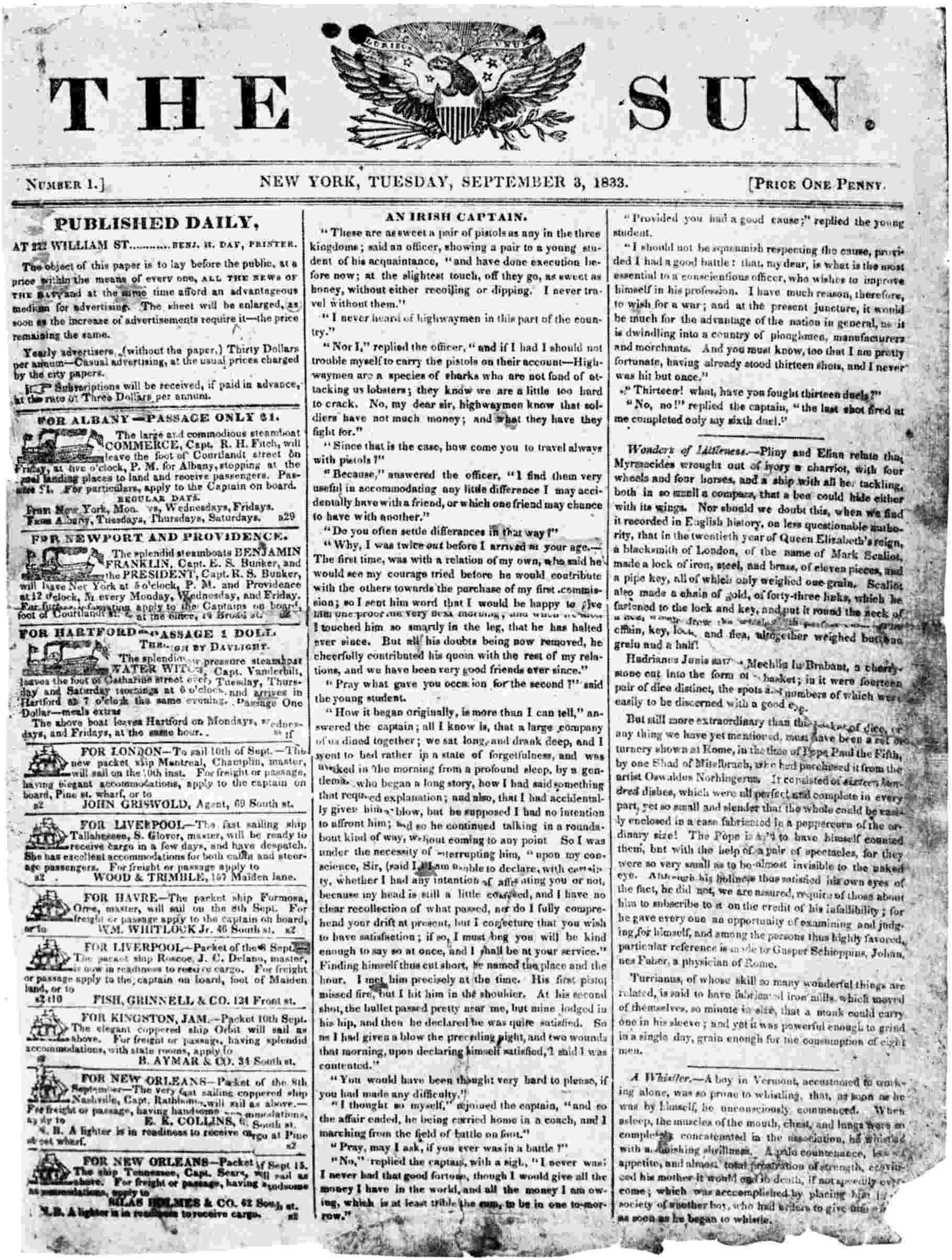
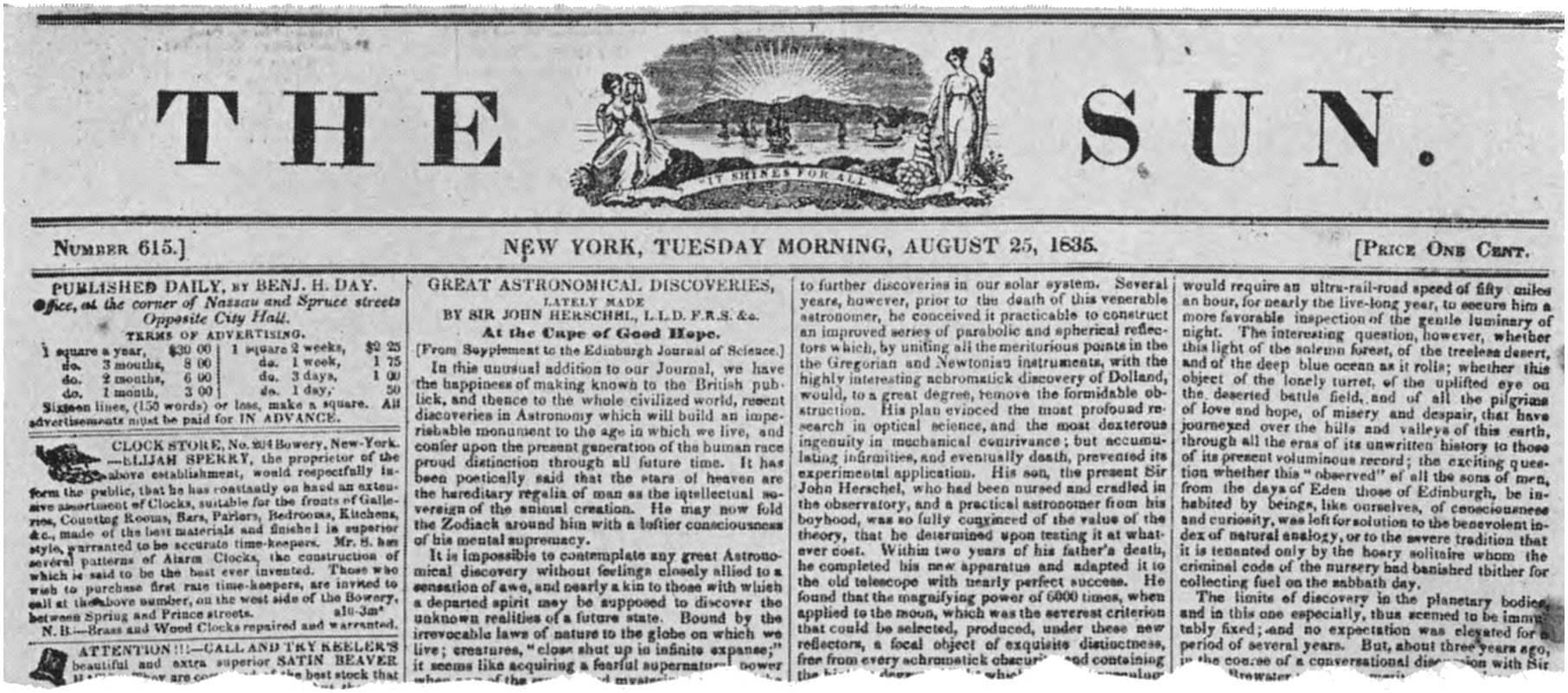
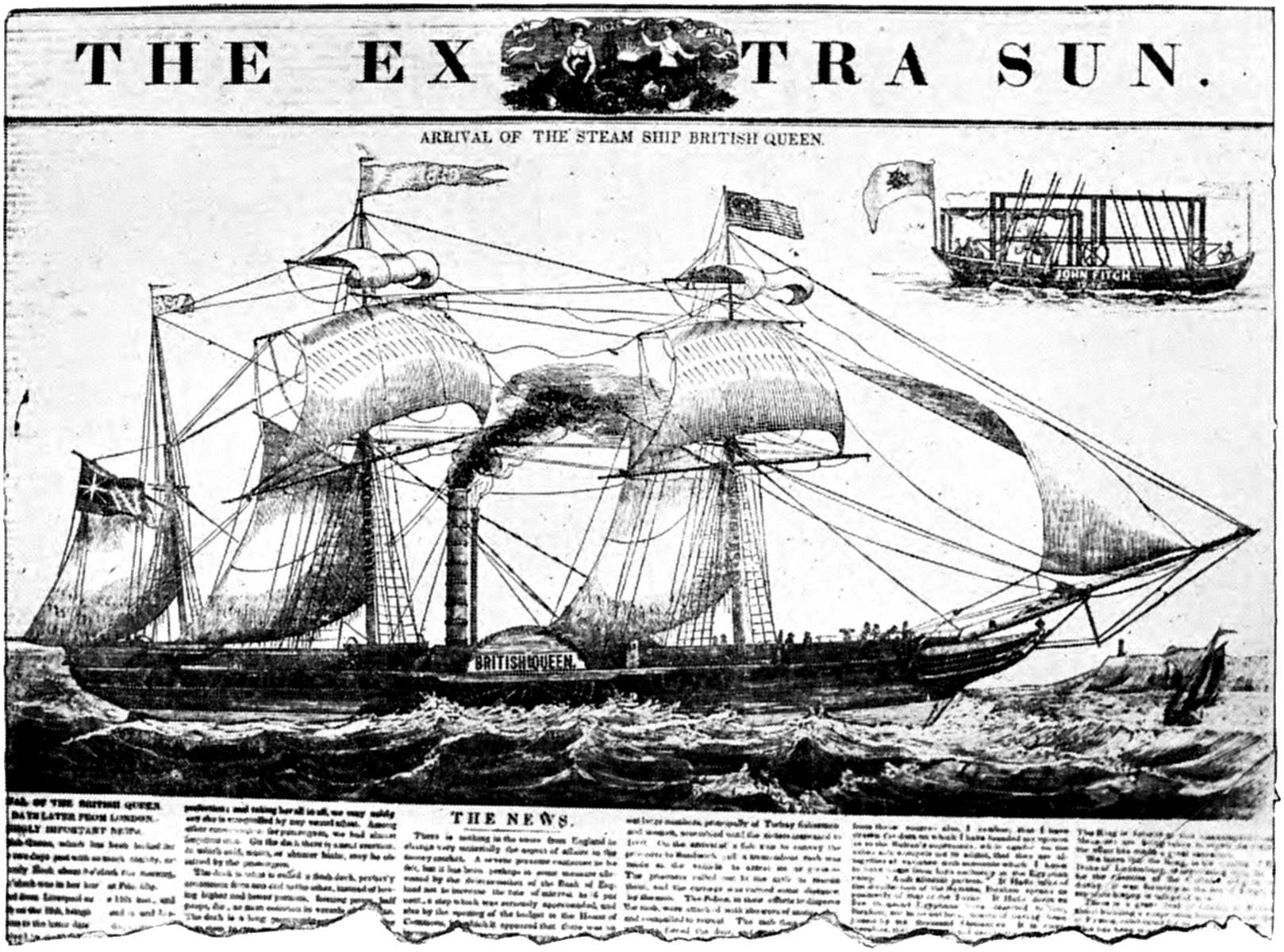
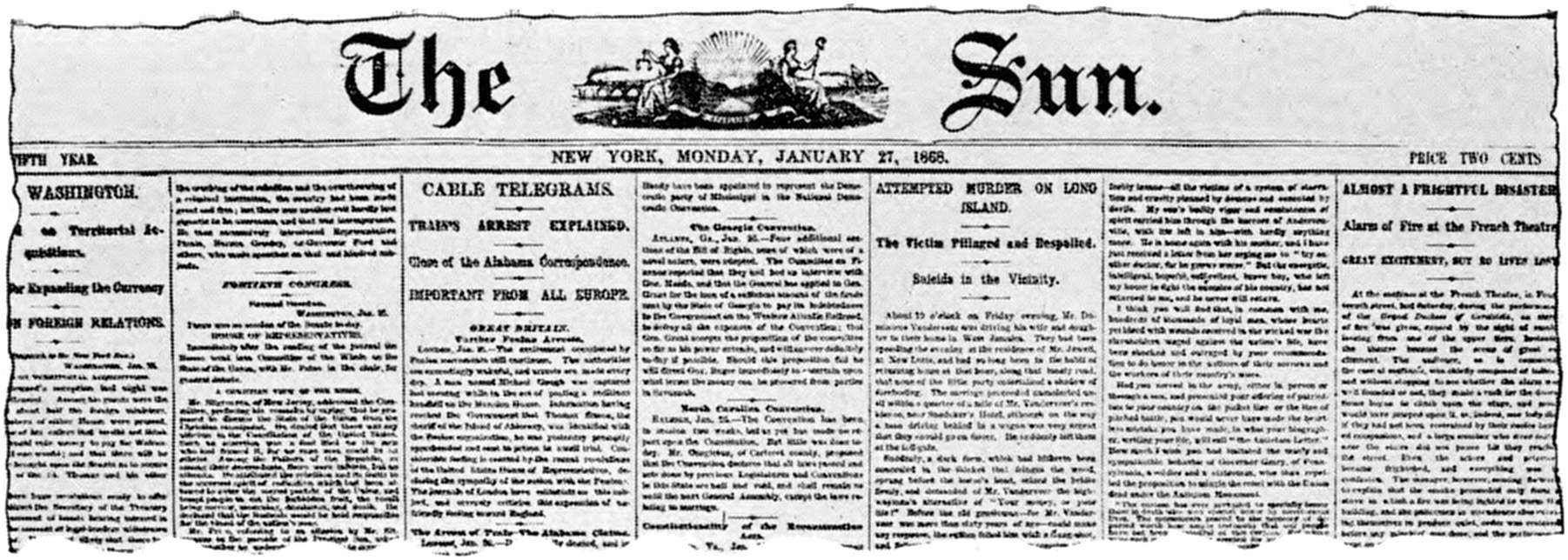
THE FIRST HEAD-LINE OF THE NEW YORK SUN
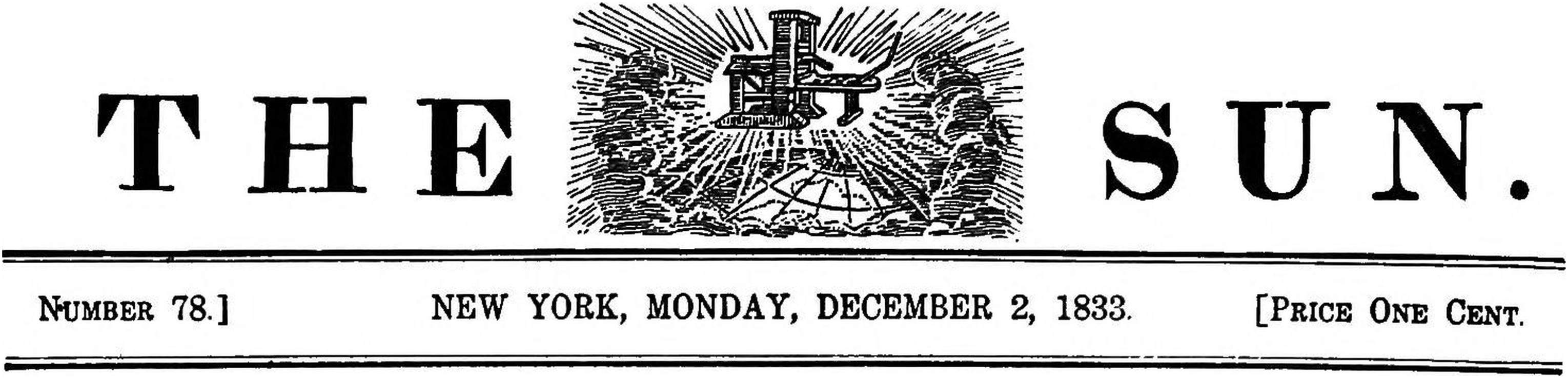
THE SECOND HEAD-LINE OF THE NEW YORK SUN
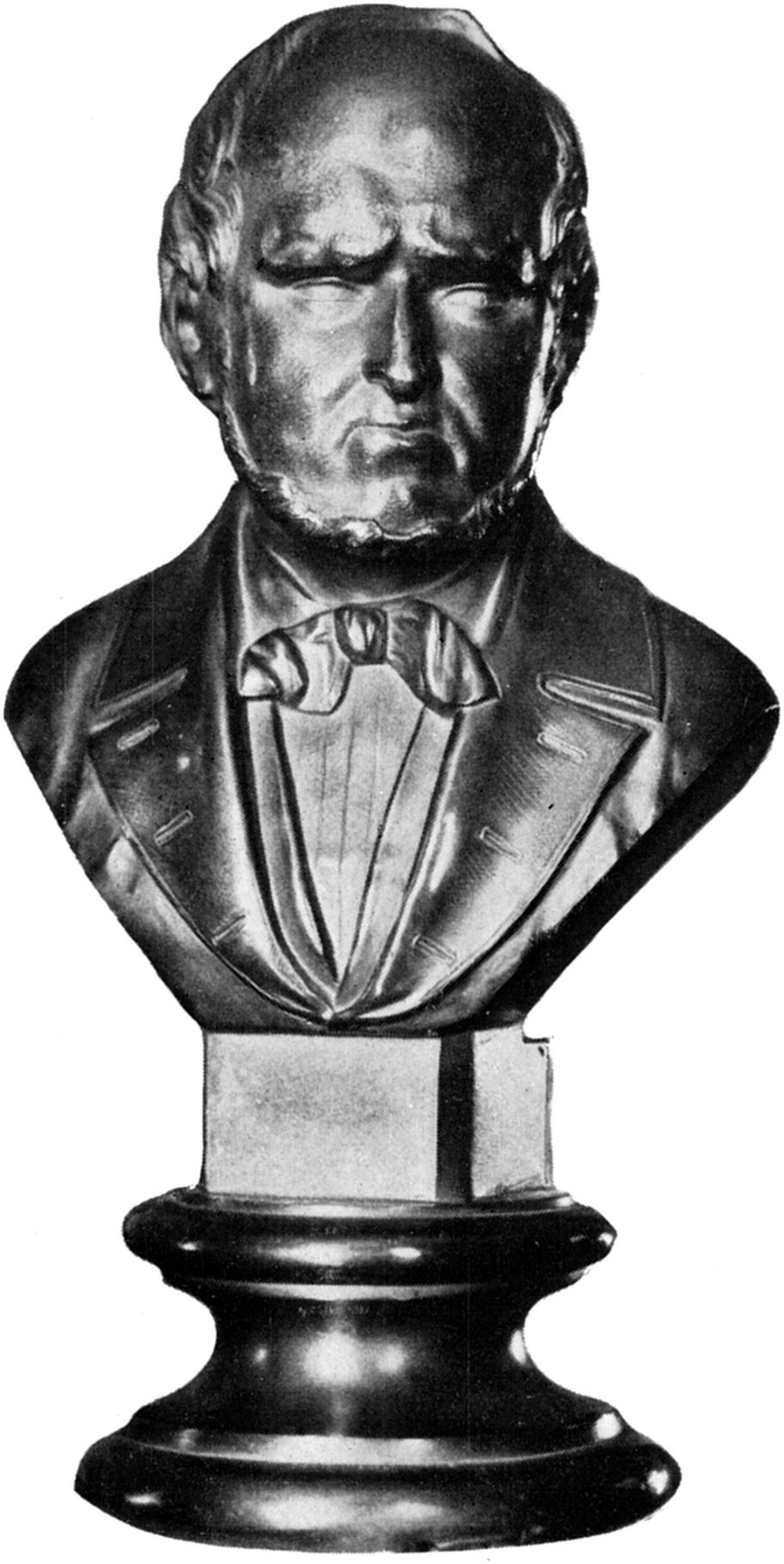
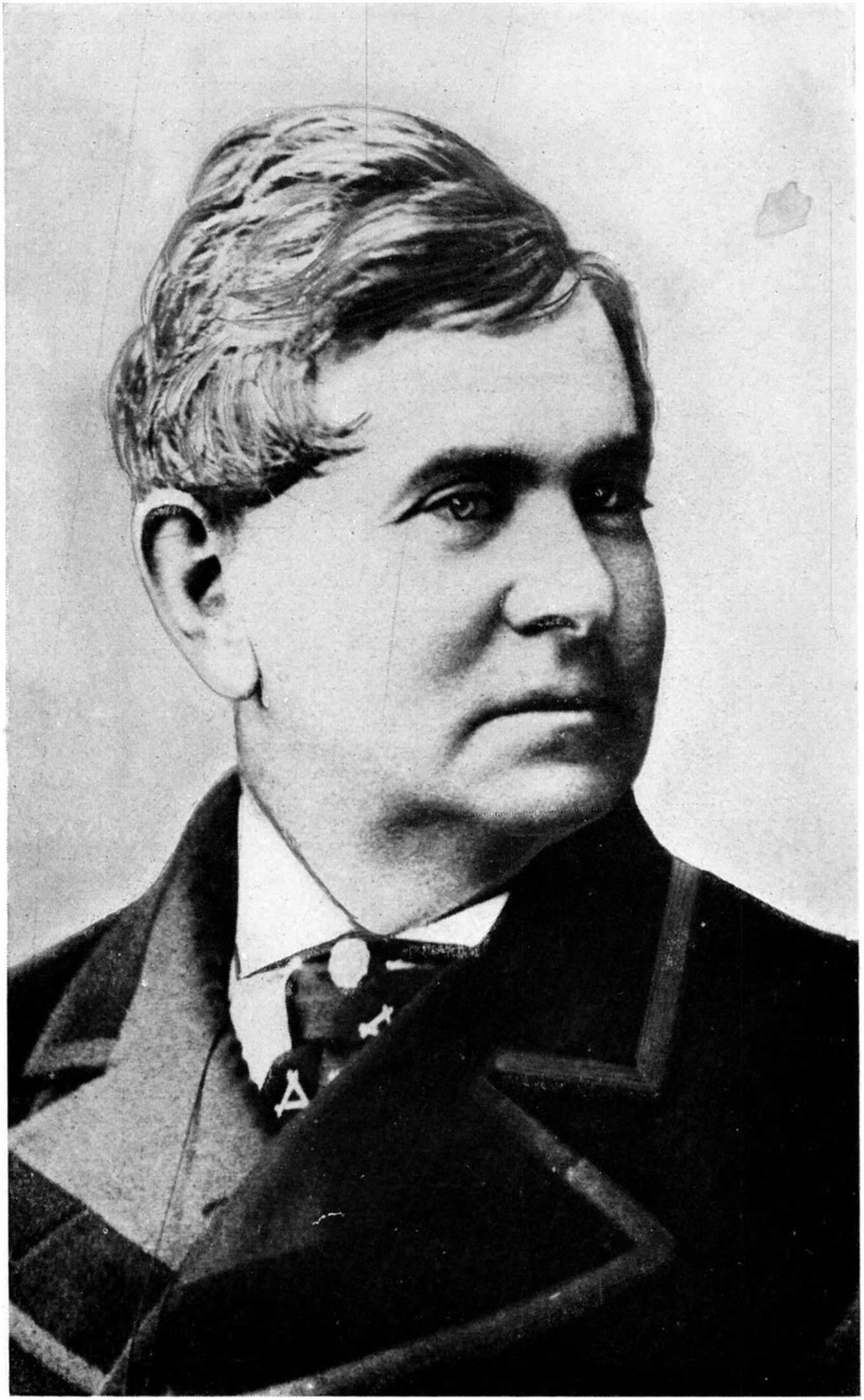
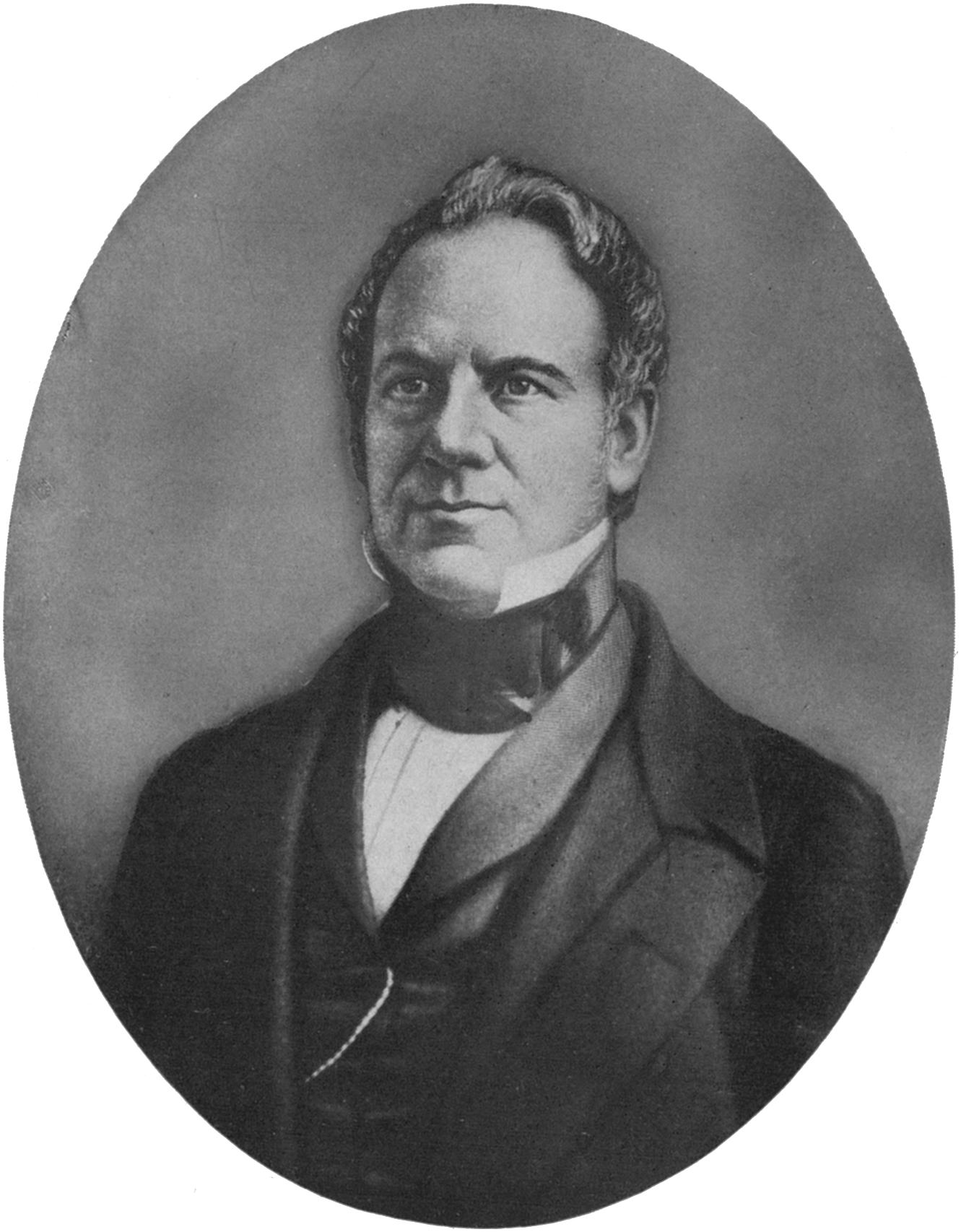
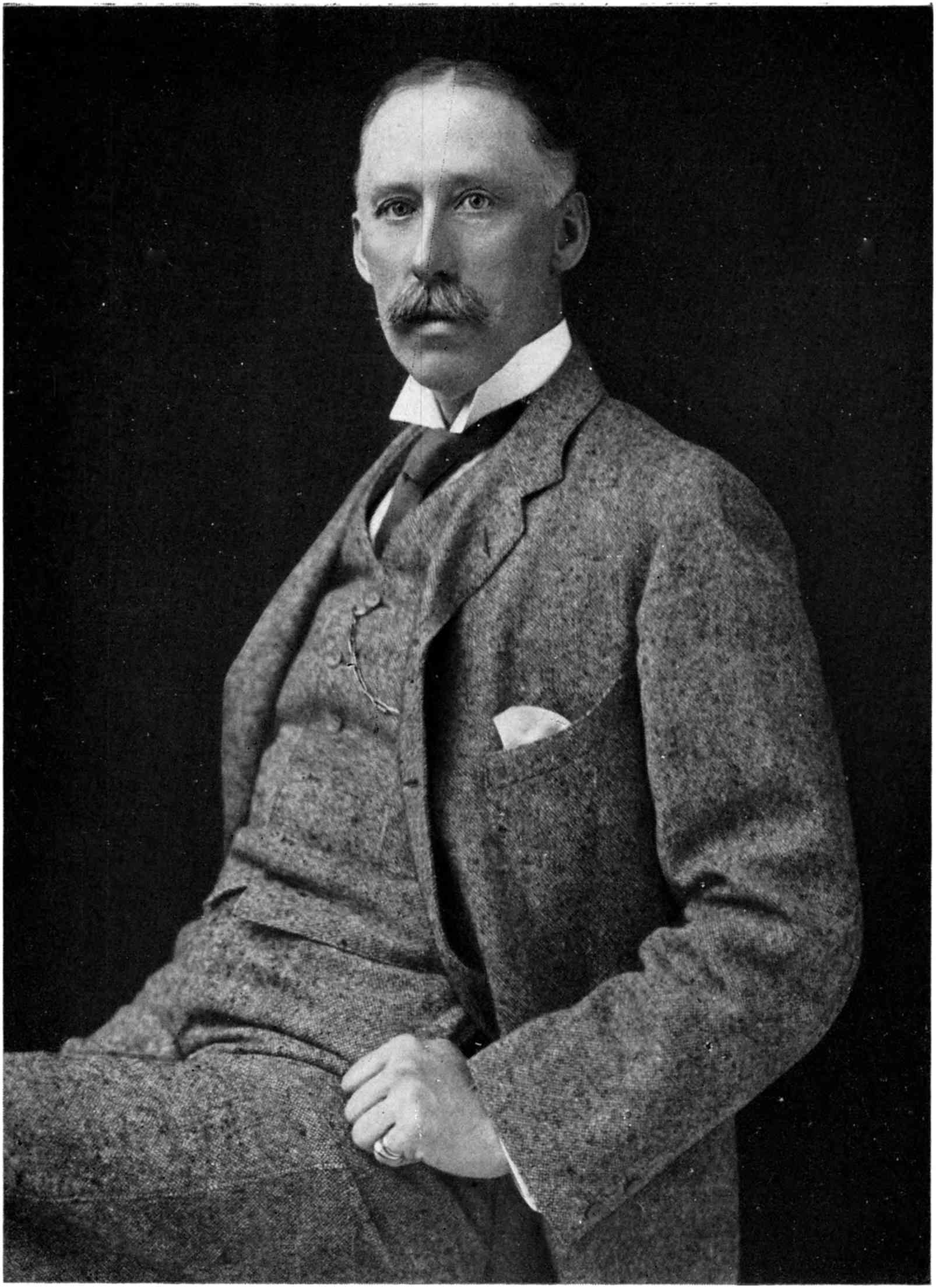
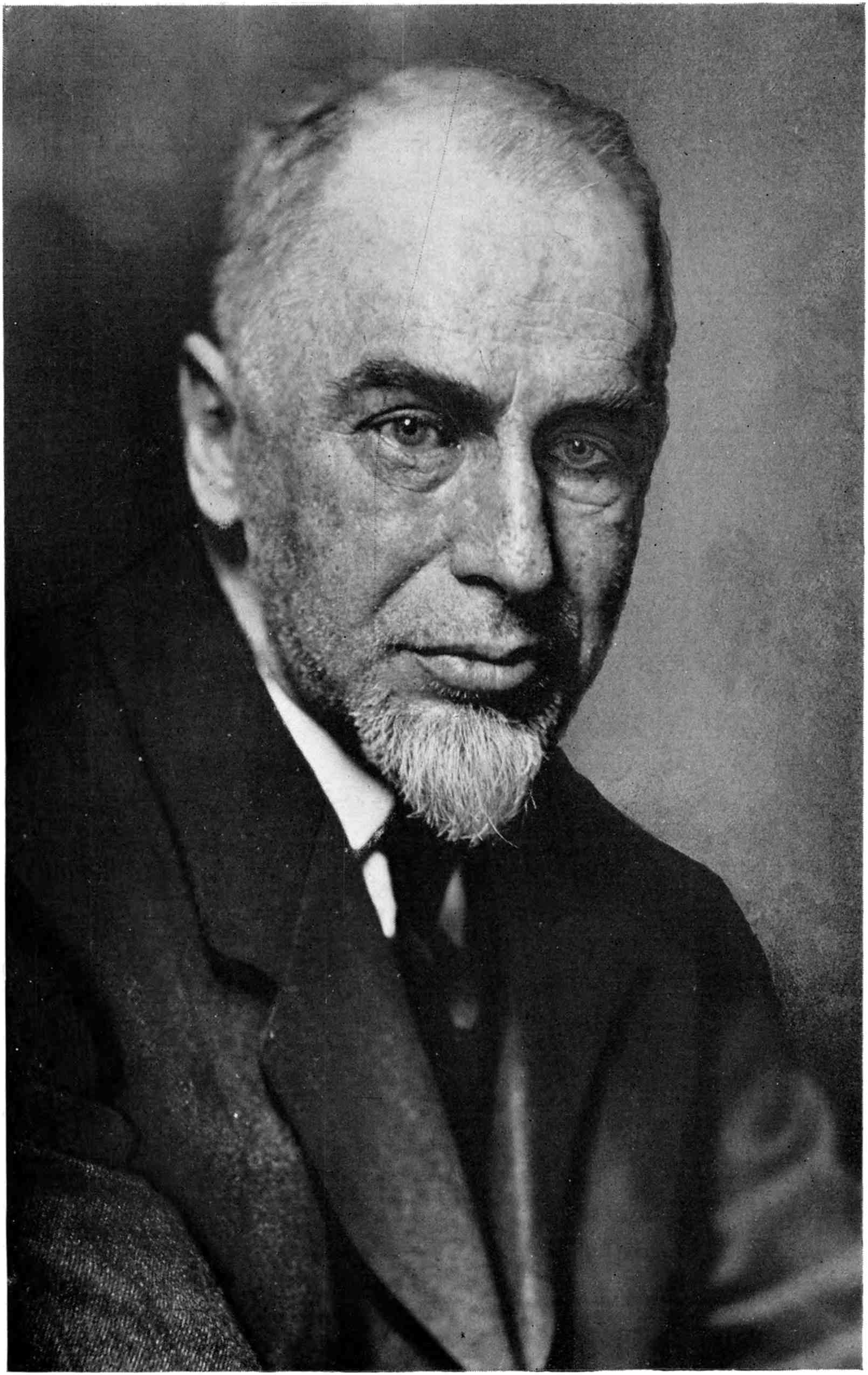
BENJAMIN H. DAY, FOUNDER OF “THE SUN”
THE STORY OF TheSun.
NEW YORK, 1833–1918
BY FRANK M. O’BRIEN
WITH AN INTRODUCTION BY EDWARD PAGE MITCHELL, EDITOR OF “THE
SUN”—ILLUSTRATIONS AND FACSIMILES
NEW YORK: GEORGE H. DORAN COMPANY
Copyright, 1918,
By George H. Doran Company
Copyright, 1917, 1918, The Frank A. Munsey Company
Copyright, 1918, The Sun Printing and Publishing Association
Printed in the United States of America
TO FRANK A. MUNSEY
AN INTRODUCTION BY THE EDITOR OF THE SUN
It is truer, perhaps, of a newspaper than of most
other complex things in the world that the whole
may be greater than the sum of all its parts. In any
daily paper worth a moment’s consideration the least
fancifully inclined observer will discern an individuality
apart from and in a degree independent of the
dozens or hundreds or thousands of personal values
entering at a given time into the composite of its grey
pages.
This entity of the institution, as distinguished from
the human beings actually engaged in carrying it on,
this fact of the newspaper’s possession of a separate
countenance, a spirit or soul differentiating it from all
others of its kind, is recognised either consciously or
unconsciously by both the more or less unimportant
workers who help to make it and by their silent partners
who support it by buying and reading it. Its
loyal friends and intelligent critics outside the establishment,
the Old Subscriber and the Constant Reader,
form the habit of attributing to the newspaper, as to
an individual, qualities and powers beneficent or
maleficent or merely foolish, according to their mood or
digestion. They credit it with traits of character quite
as distinct as belong to any man or woman of their
acquaintance. They personify it, moreover, without
much knowledge, if any, of the people directing and producing
it; and, often and naturally, without any particular
concern about who and what these people may be.
On their own side, the makers of the paper are accustomed
to individualise it as vividly as a crew does
the ship. They know better than anybody else not
only how far each personal factor, each element of the
composite, is modified and influenced in its workings
by the other personal factors associated in the production,
but also the extent to which all the personal units
are influenced and modified by something not listed in
the office directory or visible upon the payroll; something
that was there before they came and will be there
after they go.
Of course, that which has given persistent idiosyncrasy
to a newspaper like the Sun, for example, is accumulated
tradition. That which has made the whole
count for more than the sum total of its parts, in the
Sun’s case as in the case of its esteemed contemporaries,
is the heritage of method and expedient, the increment
of standardised skill and localised imagination contributed
through many years to the fund of the paper
by the forgotten worker as well as by the remembered.
The manner of growth of the great newspaper’s well-defined
and continuous character, distinguishing it from
all the rest of the offspring of the printing press, a development
sometimes not radically affected by changes
of personnel, of ownership, of exterior conditions and
fashions set by the popular taste, is a subject over
which journalistic metaphysics might easily exert itself
to the verge of boredom. Fortunately there has
been found a much better way to deal with the attractive
theme.
The Sun is eighty-five years old as this book goes to
press. In telling its intimate story, from the September
Tuesday which saw the beginning of Mr. Day’s
intrepid and epochal experiment, throughout the days
of the Beaches, of Dana, of Laffan, and of Reick to the
time of Mr. Munsey’s purchase of the property in the
summer of 1916, Mr. O’Brien has done what has never
been undertaken before, so far as is known to the
writer of this introduction, for any newspaper with a
career of considerable span.
There have been general histories of Journalism, presenting
casually the main facts of evolution and progress
in the special instance. There have been satisfactory
narratives of journalistic episodes, reasonably accurate
accounts of certain aspects or dynastic periods
of newspaper experience, excellent portrait biographies
or autobiographies of journalists of genius and high
achievement, with the eminent man usually in strong
light in the foreground and his newspaper seldom
nearer than the middle distance. But here, probably
for the first time in literature of this sort, we have a
real biography of a newspaper itself, covering the whole
range of its existence, exhibiting every function of its
organism, illustrating every quality that has been conspicuous
in the successive stages of its growth. The
Sun is the hero of Mr. O’Brien’s “Story of the Sun.”
The human participants figure in their incidental relation
to the main thread of its life and activities.
They do their parts, big or little, as they pass in interesting
procession. When they have done their parts
they disappear, as in real life, and the story goes on,
just as the Sun has gone on, without them except as
they may have left their personal impress on the newspaper’s
structure or its superficial decoration.
During no small part of its four score and five
years of intelligent interest in the world’s thoughts and
doings it has been the Sun’s fortune to be regarded as
in a somewhat exceptional sense the newspaper man’s
newspaper. If in truth it has merited in any degree
this peculiar distinction in the eyes of its professional
brethren it must have been by reason of originality of
initiative and soundness of method; perhaps by a
chronic indifference to those ancient conventions of
news importance or of editorial phraseology which,
when systematically observed, are apt to result in a
pale, dull, or even stupid uniformity of product. Mr.
Dana wrote more than half a century ago to one of his
associates, “Your articles have stirred up the animals,
which you as well as I recognise as one of the great
ends of life.” Sometimes he borrowed Titania’s wand;
sometimes he used a red hot poker. Not only in that
great editor’s time but also in the time of his predecessors
and successors the Sun has held it to be a duty and
a joy to assist to the best of its ability in the discouragement
of anything like lethargy in the menagerie. Perhaps,
again, that was one of the things that helped to
make it the newspaper man’s newspaper.
However this may be, it seems certain that to the
students of the theory and practice of journalism, now
happily so numerous in the land, the chronicler of one
highly individual newspaper’s deeds and ways is affording
an object lesson of practical value, a textbook
of technical usefulness, as well as a store of authoritative
history, entertaining anecdote, and suggestive professional
information. And a much wider audience
than is made up of newspaper workers present or to
come will find that the story of a newspaper which Mr.
O’Brien has told with wit and knowledge in the pages
that follow becomes naturally and inevitably a swift and
charming picture of the town in which that newspaper
is published throughout the period of its service to that
town—the most interesting period in the existence of
the most interesting city of the world.
It is a fine thing for the Sun, by all who have worked
for it in its own spirit beloved, I believe, like a creature
of flesh and blood and living intelligence and human
virtues and failings, that through Mr. Munsey’s wish
it should have found in a son of its own schooling a
biographer and interpreter so sympathetically responsive
to its best traditions.
Edward P. Mitchell.
CONTENTS
CHAPTER I
SUNRISE AT 222 WILLIAM STREET
PAGE
Benjamin H. Day, with No Capital Except Youth and Courage, Establishes the First Permanent Penny Newspaper.—The Curious First Number Entirely His Own Work
A Magnificent Fake Which Deceived Two Continents, Brought to “The Sun” the Largest Circulation in the World and, in Poe’s Opinion, Established Penny Papers
The Success of “The Sun” Leads to the Founding of The “Herald.”—Enterprises and Quarrels of a Furious Young Journalism.—The Picturesque Webb.—Maria Monk
A Sprightly City Which Daily Bought Thirty Thousand copies of “The Sun.”—The Rush to Start Penny Papers.—Day Sells “The Sun” for Forty Thousand Dollars
“The Sun” Uses Albany Steamboats, Horse Expresses, Trotting Teams, Pigeons, and the Telegraph to Get News.—Poe’s Famous Balloon Hoax and the Case of Mary Rodgers
Moses Y. Beach as an Emissary of President Polk.—The Associated Press Founded in the Office of “The Sun.”—Ben Day’s Brother-in-Law Retires with a Small Fortune
One of the Few Entirely Loyal Newspapers of New York.—Its Brief Ownership by a Religious Coterie.—It Returns to the Possession of M. S. Beach, Who Sells It to Dana
His Life at Brook Farm and His Tribune Experience.—His Break with Greeley, His Civil War Services and His Chicago Disappointment.—His Purchase of “The Sun”
The Period of the Great Personal Journalists.—Dana’s Avoidance of Rules and Musty Newspaper Conventions.—His Choice of Men and His Broad Definition of News
A Picture of the Room Where One Man Ruled for Thirty Years.—The Democratic Ways of a Newspaper Autocrat.—W. O. Bartlett, Pike, and His Other Early Associates
Amos J. Cummings, Dr. Wood, and John B. Bogart.—The Lively Days of Tweedism.—Elihu Root as a Dramatic Critic.—The Birth and Popularity of “The Sun’s” Cat
The Deaths of Raymond, Bennett, and Greeley Leave Him the Dominant Figure of the American Newspaper Field.—Dana’s Dream of a Paper Without Advertisements
Dana’s Relentless Fight Against the Whisky Ring, the Crédit Mobilier, “Addition, Division, and Silence,” the Safe Burglary Conspiracy and the Boss Shepherd Scandal
Something About Everything, for Everybody.—A Wonderful Four-Page Paper.—A Comparison of the Styles of “Sun” Reporters in Three Periods Twenty Years Apart
Cummings, Ralph, W. J. Chamberlin, Brisbane, Riggs, Dieuaide, Spears, O. K. Davis, Irwin, Adams, Denison, Wood, O’Malley, Hill, Cronyn.—Spanish War Work
Lord, Managing Editor for Thirty-Two Years.—Clarke, Magician of the Copy Desk.—Ethics, Fair Play and Democracy.—“The Evening Sun” and Those Who Make It
Literary Associations of an Editorial Department That Has Encouraged and Attracted Men of Imagination and Talent.—Mitchell, Hazeltine, Church, and Their Colleagues
The Coming and Going of a Newspaper Disease.—Dana’s Attitude Toward President Cleveland.—Dana’s Death.—Ownerships of Paul Dana, Laffan, Reick, and Munsey
Benjamin H. Day, with No Capital Except Youth and Courage,
Establishes the First Permanent Penny Newspaper.—The
Curious First Number Entirely His Own Work.
In the early thirties of last century the only newspapers
in the city of New York were six-cent journals
whose reading-matter was adapted to the politics
of men, and whose only appeal to women was their size,
perfectly suited to deep pantry-shelves.
Dave Ramsey, a compositor on one of these sixpennies,
the Journal of Commerce, had an obsession. It was
that a penny paper, to be called the Sun, would be a
success in a city full of persons whose interest was in
humanity in general, rather than in politics, and whose
pantry-shelves were of negligible width. Why his mind
fastened on the Sun as the name of this child of his
vision is not known; perhaps it was because there was
a daily in London bearing that title. It was a short
name, easily written, easily spoken, easily remembered.
Benjamin H. Day, another printer, worked beside
Dave Ramsey in 1830. Ramsey reiterated his idea to
his neighbour so often that Day came to believe in it,
although it is doubtful whether he had the great faith
that possessed Ramsey. Now that due credit has been
given to Ramsey for the idea of the penny Sun, he
passes out of the record, for he never attempted to put
his project into execution.
Nor was Day’s enthusiasm for a penny Sun so big
that he plunged into it at once. He was a business
man rather than a visionary. With the savings from
his wages as a compositor he went into the job-printing
business in a small way. He still met his old chums
and still talked of the Sun, but it is likely that he never
would have come to start it if it had not been for the
cholera.
There was an epidemic of this plague in New York
in 1832. It killed more than thirty-five hundred people
in that year, and added to the depression of business
already caused by financial disturbances and a wretched
banking system. The job-printing trade suffered with
other industries, and Day decided that he needed a
newspaper—not to reform, not to uplift, not to arouse,
but to push the printing business of Benjamin H. Day.
Incidentally he might add lustre to the fame of the
President, Andrew Jackson, or uphold the hands of the
mayor of New York, Gideon Lee; but his prime purpose
was to get the work of printing handbills for John
Smith, the grocer, or letter-heads for Richard Robinson,
the dealer in hay. Incidentally he might become rich
and powerful, but for the time being he needed work at
his trade.
Ben Day was only twenty-three years old. He was
the son of Henry Day, a hatter of West Springfield,
Massachusetts, and Mary Ely Day; and sixth in descent
from his first American ancestor, Robert Day. Shortly
after the establishment of the Springfield Republican
by Samuel Bowles, in 1824, young Day went into the
office of that paper, then a weekly, to learn the printer’s
trade. That was two years before the birth of the
second and greater Samuel Bowles, who was later to
make the Republican, as a daily, one of the greatest of
American newspapers.
BENJAMIN H. DAY
A Bust in the Possession of Mrs. Florence A. Snyder, Summit, N. J.
Day learned well his trade from Sam Bowles. When
he was twenty, and a first-class compositor, he went to
New York, and worked at the case in the offices of the
Evening Post and the Commercial Advertiser. He married,
when he was twenty-one, Miss Eveline Shepard.
At the time of the Sun’s founding Mr. Day lived, with
his wife and their infant son, Henry, at 75 Duane Street,
only a few blocks from the newspaper offices.
Day was a good-looking young man with a round,
calm, resolute face. He possessed health, industry, and
character. Also he had courage, for a man with a
family was taking no small risk in launching, without
capital, a paper to be sold at one cent.
The idea of a penny paper was not new. In Philadelphia,
the Cent had had a brief, inglorious existence.
In Boston, the Bostonian had failed to attract the cultured
readers of the modern Athens. Eight months before
Day’s hour arrived the Morning Post had braved it
in New York, selling first at two cents and later at one
cent, but even with Horace Greeley as one of the
founders it lasted only three weeks.
When Ben Day sounded his friends, particularly the
printers, as to their opinion of his project, they cited
the doleful fate of the other penny journals. He drew,
or had designed, a head-line for the Sun that was to be,
and took it about to his cronies. A. S. Abell, a printer
on the Mercantile Advertiser, poked the most fun at
him. A penny paper, indeed! But this same Abell
lived to stop scoffing, to found another Sun—this one
in Baltimore—and to buy a half-million-dollar estate
out of the profits of it. He was the second beneficiary
of the penny Sun idea.
William M. Swain, another journeyman printer, also
made light of Day’s ambition. He lived to be Day’s
foreman, and later to own the Philadelphia Public
Ledger. He told Day that the penny Sun would ruin
him. As Day had not much enthusiasm at the outset,
surely his friends did not add to it, unless by kindling
his stubbornness.
As for capital, he had none at all, in the money sense.
He did have a printing-press, hardly improved from the
machine of Benjamin Franklin’s day, some job-paper,
and plenty of type. The press would throw off two
hundred impressions an hour at full speed, man power.
He hired a room, twelve by sixteen feet, in the building
at 222 William Street. That building was still there,
in the shadow of the Brooklyn Bridge approach, when
the Sun celebrated its fiftieth anniversary in 1883; but
a modern six-story envelope factory is on the site to-day.
There is no question as to the general authorship of
the first paper. Day was proprietor, publisher, editor,
chief pressman, and mailing-clerk. He was not a lazy
man. He stayed up all the night before that fateful
Tuesday, September 3, 1833, setting with his own hands
some advertisements that were regularly appearing in
the six-cent papers, for he wanted to make a show of
prosperity.
He also wrote, or clipped from some out-of-town newspaper,
a poem that would fill nearly a column. He rewrote
news items from the West and South—some of
them not more than a month old. As for the snappy
local news of the day, he bought, in the small hours of
that Tuesday morning, a copy of the Courier and Enquirer,
the livest of the six-cent papers, took it to the
single room in William Street, clipped out or rewrote
the police-court items, and set them up himself. A
boy, whose name is unknown to fame, assisted him at
devil’s work. A journeyman printer, Parmlee, helped
with the press when the last quoin had been made tight
in the fourth and last of the little pages.
The sun was well up in the sky before its namesake
of New York came slowly, hesitatingly, almost sadly,
up over the horizon of journalism—never to set! In
the years to follow, the Sun was to have changes in
ownership, in policy, in size, and in style, but no week-day
was to come when it could not shine. Of all the
morning newspapers printed in New York on that 3rd
of September, 1833, there is only one other—the Journal
of Commerce—left.
But young Mr. Day, wiping the ink from his hands
at noon, and waiting in doubt to see whether the public
would buy the thousand Suns he had printed, could not
foresee this. Neither could he know that, by this humble
effort to exalt his printing business, he had driven
a knife into the sclerotic heart of ancient journalism.
The sixpenny papers were to laugh at this tiny intruder—to
laugh and laugh, and to die.
The size of the first Sun was eleven and one-quarter
by eight inches, not a great deal bigger than a sheet of
commercial letter paper, and considerably less than one-quarter
the size of a page of the Sun of to-day. Compared
with the first Sun, the present newspaper is about
sixteen times larger. The type was a good, plain face
of agate, with some verse on the last page in nonpareil.
An almost perfect reprint of the first Sun was issued
as a supplement to the paper on its twentieth birthday,
in 1853, and again—to the number of about one hundred
and sixty thousand copies—on its fiftieth birthday, in
1883. Many of the persons who treasure the replicas
of 1883 believe them to be original first numbers, as
they were not labelled “Presented gratuitously to the
subscribers of the Sun,” as was the issue of 1853.
Hardly a month passes by but the Sun receives one of
them from some proud owner. It is easy, however, to tell
the reprint from the original, for Mr. Day in his haste
committed an error at the masthead of the editorial or
second page of the first number. The date-line there
reads “September 3, 1832,” while in the reprints it is
“September 3, 1833,” as it should have been, but wasn’t,
in the original. And there are minor typographical
differences, invisible to the layman.
Of the thousand, or fewer, copies of the first Sun, only
five are known to exist—one in the bound file of the
Sun’s first year, held jealously in the Sun’s safe; one
in the private library of the editor of the Sun, Edward
Page Mitchell; one in the Public Library at Fifth
Avenue and Forty-second Street, New York; and two in
the library of the American Type Founders Company,
Jersey City.
There were three columns on each of the four pages.
At the top of the first column on the front page was a
modest announcement of the Sun’s ambitions:
The object of this paper is to lay before the public,
at a price within the means of every one, ALL THE NEWS
OF THE DAY, and at the same time afford an advantageous
medium for advertising.
It was added that the subscription in advance was
three dollars a year, and that yearly advertisers were to
be accommodated with ten lines every day for thirty
dollars per annum—ten cents a day, or one cent a line.
That was the old fashion of advertising. The friendly
merchant bought thirty dollars’ worth of space, say in
December, and inserted an advertisement of his fur
coats or snow-shovels. The same advertisement might
be in the paper the following July, for the newspapers
made no effort to coordinate the needs of the seller
and the buyer. So long as the merchant kept his name
regularly in print, he felt that was enough.
The leading article on the first page was a semi-humorous
story about an Irish captain and his duels.
It was flanked by a piece of reprint concerning microscopic
carved toys. There was a paragraph about a Vermont
boy so addicted to whistling that he fell ill of it.
Mr. Day’s apprentice may have needed this warning.
The front-page advertising, culled from other newspapers
and printed for effect, consisted of the notices
of steamship sailings. In one of these Commodore
Vanderbilt offered to carry passengers from New York
to Hartford, by daylight, for one dollar, on his splendid
low-pressure steamboat Water Witch. Cornelius Vanderbilt
was then thirty-nine years old, and had made the
boat line between New York and New Brunswick, New
Jersey, pay him forty thousand dollars a year. When
the Sun started, the commodore was at the height of his
activity, and he stuck to the water for thirty years afterward,
until he had accumulated something like forty
million dollars.
E. K. Collins had not yet established his famous Dramatic
line of clipper-ships between New York and Liverpool,
but he advertised the “very fast sailing coppered
ship Nashville for New Orleans.” He was only thirty
then.
Cooks were advertised for by private families living
in Broadway, near Canal Street—pretty far up-town
to live at that day—and in Temple Street, near Liberty,
pretty far down-town now.
On the second page was a bit of real news, the melancholy
suicide of a young Bostonian of “engaging manners
and amiable disposition,” in Webb’s Congress Hall,
a hotel. There were also two local anecdotes; a paragraph
to the effect that “the city is nearly full of
strangers from all parts of this country and Europe”;
nine police-court items, nearly all concerning trivial
assaults; news of murders committed in Florida, at
Easton, Pennsylvania, and at Columbus, Ohio; a report
of an earthquake at Charlottesville, Virginia, and a few
lines of stray news from Mexico.
The third page had the arrivals and clearances at
the port of New York, a joke about the cholera in New
Orleans, a line to say that the same disease had appeared
in the City of Mexico, an item about an insurrection in
the Ohio penitentiary, a marriage announcement, a death
notice, some ship and auction advertisements, and the
offer of a reward of one thousand dollars for the recovery
of thirteen thousand six hundred dollars stolen
from the mail stage between Boston and Lynn and the
arrest of the thieves.
The last page carried a poem, “A Noon Scene,” but
the atmosphere was of the Elysian Fields over in Hoboken
rather than of midday in the city. When Day
scissored it, probably he did so with the idea that it
would fill a column. Another good filler was the bank-note
table, copied from a six-cent contemporary. The
quotations indicated that not much of the bank currency
of the day was accepted at par.
The rest of the page was filled with borrowed advertising.
The Globe Insurance Company, of which
John Jacob Astor was a director, announced that it had
a capital of a million dollars. The North River Insurance
Company, whose directorate included William B.
Astor, declared its willingness to insure against fire and
against “loss or damage by inland navigation.” At
that time the boilers of river steamboats had an unpleasant
trick of blowing up; hence Commodore Vanderbilt’s
mention of the low pressure of the Water Witch.
John A. Dix, then Secretary of State of the State of
New York, and later to be the hero of the “shoot him
on the spot” order, advertised an election. Castleton
House Academy, on Staten Island, offered to teach and
board young gentlemen at twenty-five dollars a quarter.
THE FIRST ISSUE OF “THE SUN”
Such was the first Sun. Part of it was stale news,
rewritten. Part was borrowed advertising. It is doubtful
whether even the police-court items were original, although
they were the most human things in the issue,
the most likely to appeal to the readers whom Day
hoped to reach—people to whom the purchase of a paper
at six cents was impossible, and to whom windy, monotonous
political discussions were a bore.
In those early thirties, daily journalism had not advanced
very far. Men were willing, but means and
methods were weak. The first English daily was the
Courrant, issued in 1702. The Orange Postman, put out
the following year, was the first penny paper. The
London Times was not started until 1785. It was the
first English paper to use a steam press, as the Sun
was the first American paper.
The first American daily was the Pennsylvania
Packet, called later the General Advertiser, begun in
Philadelphia in 1784. It died in 1837. Of the existing
New York papers only the Globe dates back to the
eighteenth century, having been founded in 1797 as the
Commercial Advertiser. Next to it in age is the Evening
Post, started in 1801.
The weakness of the early dailies was largely due to
the fact that their publishers looked almost entirely to
advertising for the support of the papers. On the other
hand, the editors were politicians or highbrows who
thought more of a speech by Lord Piccadilly on empire
than of a good street tragedy; more of an essay by Lady
Geraldine Glue than of a first-class report of a kidnapping.
Another great obstacle to success—one for which
neither editor nor publisher was responsible—was the
lack of facilities for the transmission of news. Fulton
launched the Clermont twenty-six years before Day
launched the Sun, but even in Day’s time steamships
were nothing to brag of, and the first of them was yet
to cross the Atlantic. When the Sun was born, the most
important railroad in America was thirty-four miles
long, from Bordentown to South Amboy, New Jersey.
There was no telegraph, and the mails were of pre-historic
slowness.
It was hard to get out a successful daily newspaper
without daily news. A weekly would have sufficed for
the information that came in, by sailing ship and stage,
from Europe and Washington and Boston. Ben Day
was the first man to reconcile himself to an almost impossible
situation. He did so by the simple method of
using what news was nearest at hand—the incidental
happenings of New York life. In this way he solved his
own problem and the people’s, for they found that the
local items in the Sun were just what they wanted,
while the price of the paper suited them well.
CHAPTER II THE FIELD OF THE LITTLE “SUN”
A Very Small Metropolis Which Day and His Partner,
Wisner, Awoke by Printing Small Human Pieces About
Small Human Beings and Having Boys Cry the Paper.
How far could the little Sun hope to cast its beam
in a stodgy if not naughty world? The circulation
of all the dailies in New York at the time was less than
thirty thousand. The seven morning and four evening
papers, all sold at six cents a copy, shared the field thus:
MORNING PAPERS
Morning Courier and New York Enquirer
4,500
Democratic Chronicle
4,000
New York Standard
2,400
New York Journal of Commerce
2,300
New York Gazette and General Advertiser
1,500
New York Daily Advertiser
1,400
Mercantile Advertiser and New York Advocate
1,200
EVENING PAPERS
Evening Post
3,000
Evening Star
2,500
New York Commercial Advertiser
2,100
New York American
1,600
Total
26,500
New York was the American metropolis, but it was
of about the present size of Indianapolis or Seattle. Of
its quarter of a million population, only eight or ten
thousand lived above Twenty-third Street. Washington
Square, now the residence district farthest down-town,
had just been adopted as a park; before that it
had been the Potter’s Field. In 1833 rich New Yorkers
were putting up some fine residences there—of which a
good many still stand. Sixth Street had had its name
changed to Waverley Place in honor of Walter Scott,
recently dead, the literary king of the day.
Wall Street was already the financial centre, with its
Merchants’ Exchange, banks, brokers, and insurance
companies. Canal Street was pretty well filled with
retail stores. Third Avenue had been macadamized
from the Bowery to Harlem. The down-town streets
were paved, and some were lighted with gas at seven
dollars a thousand cubic feet.
Columbia College, in the square bounded by Murray,
Barclay, Church, and Chapel Streets, had a hundred
students; now it has more than a hundred hundred.
James Kent was professor of law in the Columbia of
that day, and Charles Anthon was professor of Greek
and Latin. A rival seat of learning, the University of
the City of New York, chartered two years earlier, was
temporarily housed at 12 Chambers Street, with a certain
Samuel F. B. Morse as professor of sculpture and
painting. There were twelve schools, harbouring six
thousand pupils, whose welfare was guarded by the
Public School Society of New York, Lindley Murray
secretary. The National Academy of Design, incorporated
five years before, guided the budding artist in
Clinton Hall, and Mr. Morse was its president, while
it had for its professor of mythology one William Cullen
Bryant.
Albert Gallatin was president of the National Bank,
at 13 Wall Street. Often at the end of his day’s work
he would walk around to the small shop in William
Street where his young friend Delmonico, the confectioner,
was trying to interest the gourmets of the city
in his French cooking. Gideon Lee, besides being
mayor, was president of the Leather Manufacturers’
Bank at 334 Pearl Street. He was the last mayor of
New York to be appointed by the common council, for
Dix’s advertisement in the first Sun called an election
by which the people of the city gained the right to elect
a mayor by popular vote.
A list of the solid citizens of the New York of that
year would include Peter Schermerhorn, Nicholas Fish,
Robert Lenox, Sheppard Knapp, Samuel Swartwout,
Henry Beekman, Henry Delafield, John Mason, William
Paulding, David S. Kennedy, Jacob Lorillard, David
Lydig, Seth Grosvenor, Elisha Riggs, John Delafield,
Peter A. Jay, C. V. S. Roosevelt, Robert Ray, Preserved
Fish, Morris Ketchum, Rufus Prime, Philip Hone, William
Vail, Gilbert Coutant, and Mortimer Livingston.
These men and their fellows ran the banks and the
big business of that day. They read the six-cent papers,
mostly those which warned the public that Andrew
Jackson was driving the country to the devil. It would
be years before the Sun would bring the light of common,
everyday things into their dignified lives—if it
ever did so. Day, the printer, did not look to them to
read his paper, although he hoped for some small part
of their advertising. It is likely that one of the Gouverneurs—Samuel
L.—read the early Sun, but he was
postmaster, and it was his duty to examine new and
therefore suspicionable publications.
Incidentally, Postmaster Gouverneur had one clerk
to sort all the mail that came into the city from the rest
of the world. It was a small New York upon which the
timid Sun cast its still smaller beams. The mass of the
people had not been interested in newspapers, because
the newspapers brought nothing into their lives but the
drone of American and foreign politics. A majority of
them were in sympathy with Tammany Hall, particularly
since 1821, when the property qualification was
removed from the franchise through Democratic effort.
New York had literary publications other than the
six-cent papers. The Knickerbocker Magazine was
founded in January of 1833, with Charles Hoffman,
assistant editor of the American Magazine, as editor.
Among the contributors engaged were William Cullen
Bryant and James K. Paulding. The subscription-list,
it was proudly announced, had no fewer than eight
hundred names on it. The Mechanics’ Magazine, the
Sporting Magazine, the American Ploughboy, the Journal
of Public Morals, and the Youth’s Temperance Lecturer
were among the periodicals that contended for
public favour.
Bryant was a busy man, for he was the chief editor
of the Evening Post as well as a magazine contributor
and a teacher. Fame had come to him early, for
“Thanatopsis” was published when he was twenty-three,
and “To a Water-fowl” appeared a year later,
in 1818. Now, in his thirties, he was no longer the
delicate youth, the dreamy poet. One April day in
1831 Bryant and William L. Stone, one of the editors
of the Commercial Advertiser, had a rare fight in front
of the City Hall, the poet beginning it with a cowskin
whip swung at Stone’s head, and the spectators ending
it after Stone had seized the whip. These two were
editors of sixpenny “respectables.”
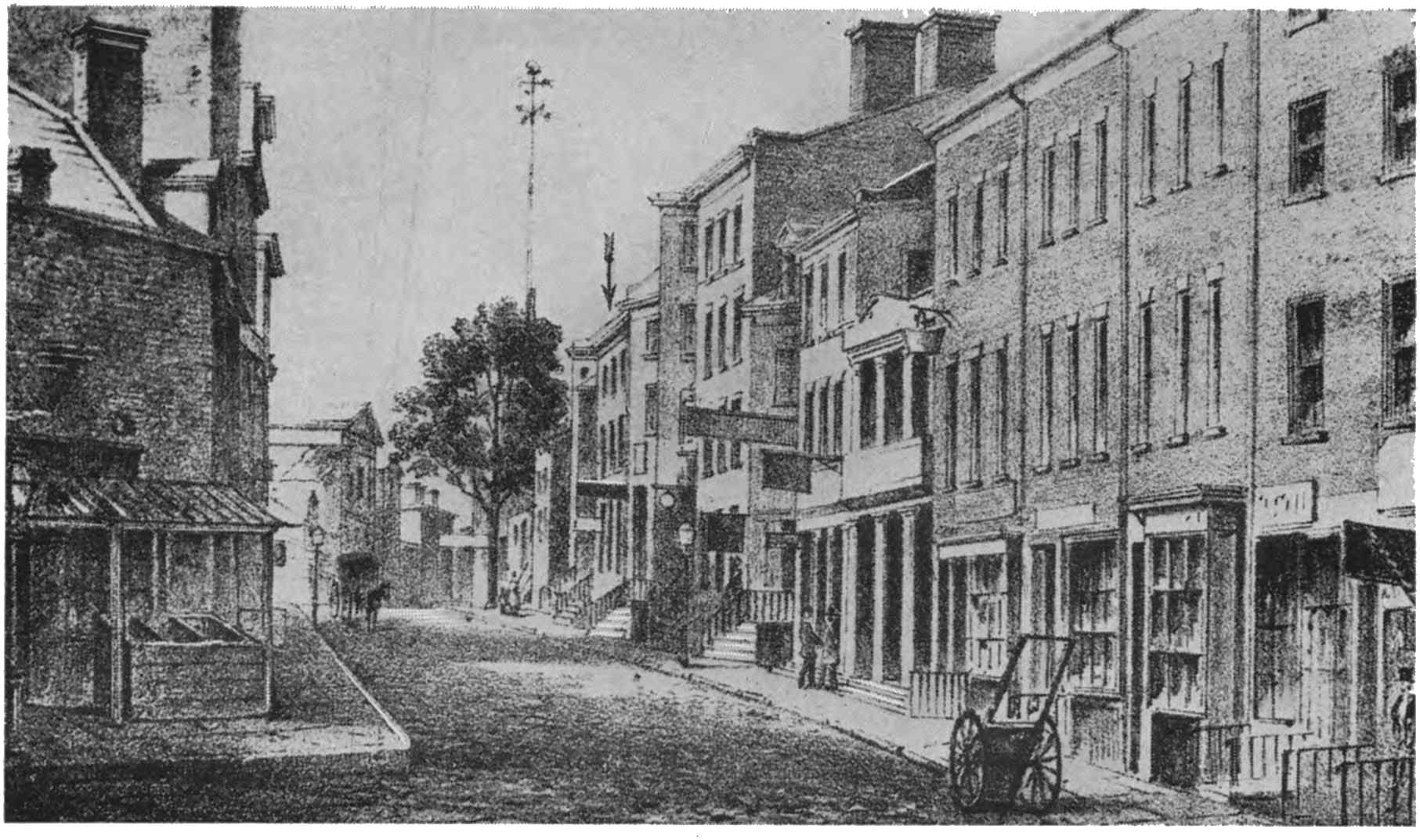
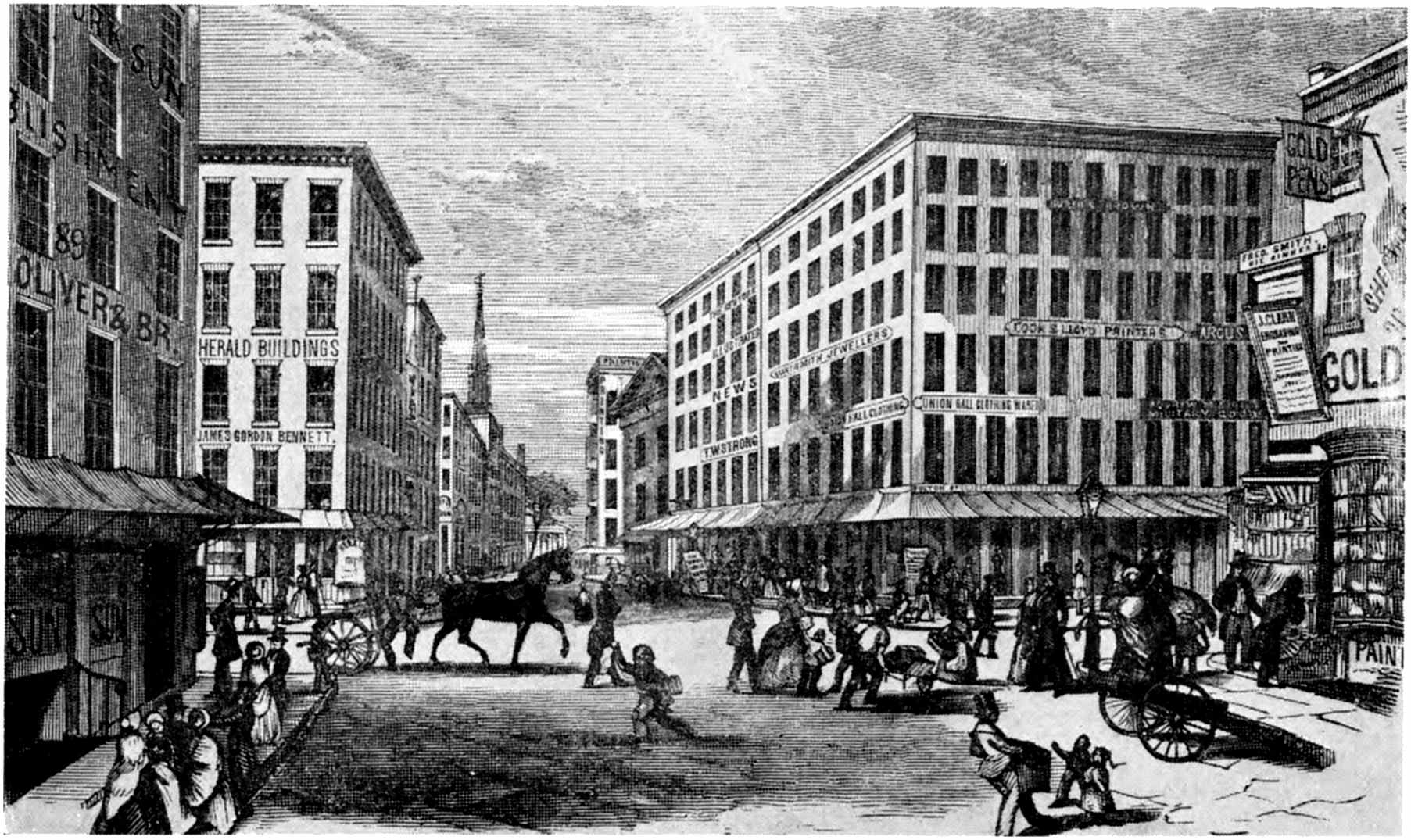
THE FIRST HOME OF “THE SUN,” 222 WILLIAM STREET
(Under the Arrow)
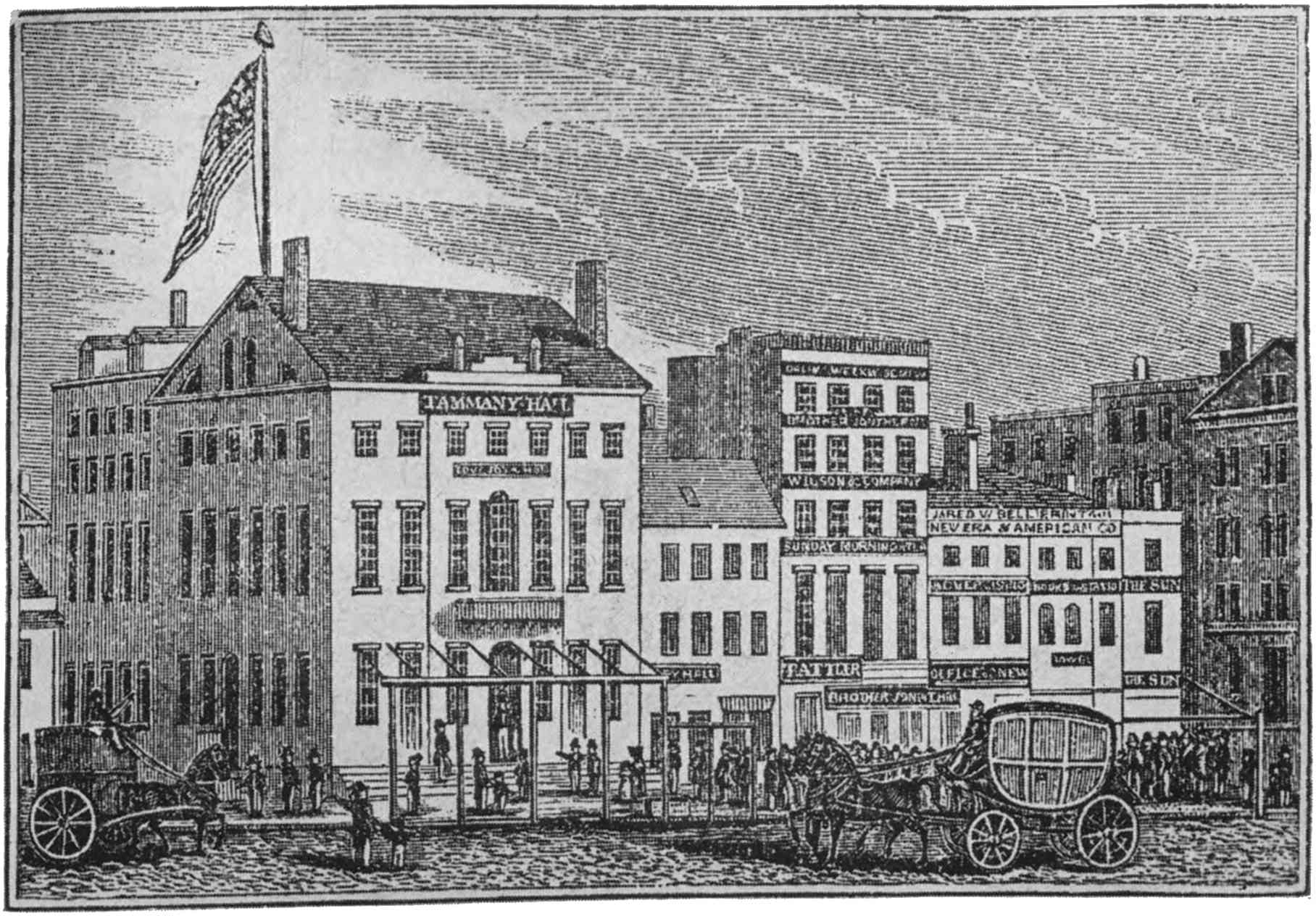
THE SECOND HOME OF “THE SUN”
Nassau Street, from Frankfort to Spruce, in the Early Forties. “The Sun’s”
Second Home Is Shown at the Right End of the Block. The Tammany Hall
Building Became “The Sun’s” Fourth Home in 1868.
Irving and Cooper, Bryant and Halleck, Nathaniel
P. Willis and George P. Morris were the largest figures
of intellectual New York. In 1833 Irving returned from
Europe after a visit that had lasted seventeen years.
He was then fifty, and had written his best books.
Cooper, half a dozen years younger, had long since
basked in the glory that came to him with the publication
of “The Spy,” “The Pilot,” and “The Last of the
Mohicans.” He and Irving were guests at every cultured
function.
Prescott was finishing his first work, “The History
of Ferdinand and Isabella.” Bancroft was beginning
his “History of the United States.” George Ticknor
had written his “Life of Lafayette.” Hawthorne had
published only “Fanshawe” and some of the “Twice
Told Tales.” Poe was struggling along in Baltimore.
Holmes, a medical student, had written a few poems.
Dr. John William Draper, later to write his great
“History of the Intellectual Development of Europe,”
arrived from Liverpool that year to make New York
his home.
Longfellow was professor of modern languages at
Bowdoin, and unknown to fame as a poet. Whittier had
written “Legends of New England” and “Moll
Pitcher.” Emerson was in England. Richard Henry
Dana and Motley were at Harvard. Thoreau was helping
his father to make lead-pencils. Parkman, Lowell,
and Herman Melville were schoolboys.
Away off in Buffalo was a boy of fourteen who clerked
in his uncle’s general store by day, selling steel traps to
Seneca braves, and by night read Latin, Greek, poetry,
history, and the speeches of Andrew Jackson. His name
was Charles Anderson Dana.
The leading newspaperman of the day in New York
was James Watson Webb, a son of the General Webb
who held the Bible upon which Washington took the
oath of office as first President. J. Watson Webb had
been in the army and, as a journalist, was never for
peace at any price. He united the Morning Courier
and the Enquirer, and established a daily horse express
between New York and Washington, which is said to
have cost seventy-five hundred dollars a month, in order
to get news from Congress and the White House twenty-four
hours before his rivals.
Webb was famed as a fighter. He had a row with
Duff Green in Washington in 1830. In January, 1836,
he thrashed James Gordon Bennett in Wall Street. He
incited a mob to drive Wood, a singer, from the stage
of the Park Theater. In 1838 he sent a challenge to
Representative Cilley, of Maine, a classmate of Longfellow
and Hawthorne at Bowdoin. Cilley refused to
fight, on the ground that he had made no personal reflections
on Webb’s character; whereupon Representative
Graves, of Kentucky, who carried the card for
Webb, challenged Cilley for himself, as was the custom.
They fought with rifles on the Annapolis Road, and
Cilley was killed at the third shot.
In 1842 Webb fought a duel with Representative
Marshall, of Kentucky, and not only was wounded, but
on his return to New York was sentenced to two years
in prison “for leaving the State with the intention of
giving or receiving a challenge.” At the end of two
weeks, however, he was pardoned.
Having deserted Jackson and become a Whig, Webb
continued to own and edit the Courier and Enquirer
until 1861, when it was merged with the World. His
quarrels, all of political origin, brought prestige to his
paper. Ben Day had no duelling-pistols. His only
chance to advertise the Sun was by its own light and
its popular price.
Beyond Webb, Day had no lively journalist with
whom to contend at the outset, and Webb probably did
not dream that the Sun would be worthy of a joust.
Perhaps fortunately for Day, Horace Greeley had just
failed in his attempt to run a one-cent paper. This was
the Morning Post, which Greeley started in January,
1833, with Francis V. Story, a fellow printer, as his
partner, and with a capital of one hundred and fifty
dollars. It ran for three weeks only.
Greeley and Story still had some type, bought on
credit, and they issued a tri-weekly, the Constitutionalist,
which, in spite of its dignified title, was the avowed
organ of the lotteries. Its columns contained the following
card:
Greeley & Story, No. 54 Liberty Street, New York,
respectfully solicit the patronage of the public to their
business of letterpress printing, particularly lottery-printing,
such as schemes, periodicals, and so forth,
which will be executed on favorable terms.
It must be remembered that at that time lotteries
were not under a cloud. There were in New York
forty-five lottery offices, licensed at two hundred and
fifty dollars apiece annually, and the proceeds were
divided between the public schools and a home for deaf-mutes.
That was the last year of legalized lotteries.
After they disappeared Greeley started the New Yorker,
the best literary weekly of its time. It was not until
April, 1841, that he founded the Tribune.
Doubtless there were many young New Yorkers of
that period who would have made bang-up reporters,
but apparently, until Day’s time, with few exceptions
they did not work on morning newspapers. One exception
was James Gordon Bennett, whose work for Webb
on the Courier and Enquirer helped to make it the leading
American paper.
Nathaniel P. Willis and George P. Morris would probably
have been good reporters, for they knew New York
and had excellent styles, but they insisted on being
poets. With Morris it was not a hollow vocation, for
the author of “Woodman, Spare That Tree,” could always
get fifty dollars for a song. He and Willis ran
the Mirror and later the New Mirror, and wrote verse
and other fanciful stuff by the bushel. Philip Hone
would have been the best reporter in New York, as his
diary reveals, but he was of the aristocracy, and he
seems to have scorned newspapermen, particularly
Webb and Bennett.
But somehow, by that chance which seemed to smile
on the Sun, Ben Day got clever reporters. He wanted
one to do the police-court work, for he saw, from
the first day of the paper, that that was the kind of
stuff that his readers devoured. To them the details of
a beating administered by James Hawkins to his wife
were of more import than Jackson’s assaults on the
United States Bank.
When George W. Wisner, a young printer who was
out of work, applied to the Sun for a job, Day told
him that he would give him four dollars a week if he
would get up early every day and attend the police-court,
which held its sessions from 4 A.M. on. The people
of the city were quite as human then as they are
to-day. Unregenerate mortals got drunk and fought
in the streets. Others stole shoes. The worst of all
beat their wives. Wisner was to be the Balzac of the
daybreak court in a year when Balzac himself was writing
his “Droll Stories.”
The second issue of the Sun continued the typographical
error of the day before. The year in the date-line of
the second page was “1832.” The big news in this
paper was under date of Plymouth, England, August 1,
and it told of the capture of Lisbon by Admiral Napier
on the 25th of July. Day—or perhaps it was Wisner—wrote
an editorial article about it:
To us as Americans there can be little of interest in
the triumph of one member of a royal family of Europe
over another; and although we can but rejoice at the
downfall of the modern Nero who so lately filled the
Portuguese throne, yet if rumor speak the truth the
victorious Pedro is no better than he should be.
The editor lamented the general lack of news:
With the exception of the interesting news from
Portugal there appears to be very little worthy of note.
Nullification has blown over; the President’s tour has
terminated; Black Hawk has gone home; the new race
for President is not yet commenced, and everything
seems settled down into a calm. Dull times, these, for
us newspaper-makers. We wish the President or Major
Downing or some other distinguished individual would
happen along again and afford us material for a daily
article. Or even if the sea-serpent would be so kind as
to pay us a visit, we should be extremely obliged to him
and would honor his snakeship with a most tremendous
puff.
Theatrical advertising appeared in this number, the
Park Theater announcing the comedy of “Rip Van
Winkle,” as redramatized by Mr. Hackett, who played
Rip. Mr. Gale was playing “Mazeppa” at the Bowery.
Perhaps these advertisements were borrowed from a
six-cent paper, but there was one “help wanted” advertisement
that was not borrowed. It was the upshot
of Day’s own idea, destined to bring another revolution
in newspaper methods:
TO THE UNEMPLOYED—A number of steady men
can find employment by vending this paper. A liberal
discount is allowed to those who buy to sell again.
Before that day there had been no newsboys; no
papers were sold in the streets. The big, blanket political
organs that masqueraded as newspapers were
either sold over the counter or delivered by carriers to
the homes of the subscribers. Most of the publishers
considered it undignified even to angle for new subscribers,
and one of them boasted that his great circulation
of perhaps two thousand had come unsolicited.
The first unemployed person to apply for a job selling
Suns in the streets was a ten-year-old-boy, Bernard
Flaherty, born in Cork. Years afterward two continents
knew him as Barney Williams, Irish comedian,
hero of “The Emerald Ring,” and “The Connie Soogah,”
and at one time manager of Wallack’s old Broadway
Theatre.
When Day got some regular subscribers, he sent
carriers on routes. He charged them sixty-seven cents
a hundred, cash, or seventy-five cents on credit. The
first of these carriers was Sam Messenger, who delivered
the Sun in the Fulton Market district, and
who later became a rich livery-stable keeper. Live lads
like these, carrying out Day’s idea, wrought the greatest
change in journalism that ever had been made, for
they brought the paper to the people, something that
could not be accomplished by the six-cent sheets with
their lofty notions and comparatively high prices.
On the third day of the Sun’s life, with Wisner at the
pen and Barney Flaherty “hollering” in the startled
streets, the editor again expressed, this time more positively,
his yearning that something would happen:
We newspaper people thrive best on the calamities
of others. Give us one of your real Moscow fires, or
your Waterloo battle-fields; let a Napoleon be dashing
with his legions through the world, overturning the
thrones of a thousand years and deluging the world
with blood and tears; and then we of the types are in
our glory.
The yearner had to wait thirty years for another
Waterloo, but he got his “real Moscow fire” in about
two years, and so close that it singed his eyebrows.
Lacking a Napoleon to exalt or denounce, Mr. Day
used a bit of that same page for the publication of homelier
news for the people:
The following are the drawn numbers of the New
York consolidated lotteries of yesterday afternoon:
62 6 59 46 61 34 65 37 8 42
So Horace Greeley and his partner, with their tri-weekly
paper, could not have been keeping all of the
lottery patronage away from the Sun.
Over in the police column Mr. Wisner was supplying
gems like the following:
A complaint was made by several persons who
“thought it no sin to step to the notes of a sweet violin”
and gathered under a window in Chatham Street, where
a little girl was playing on a violin, when they were
showered from a window above with the contents of
a dye-pot or something of like nature. They were directed
to ascertain their showerer.
The big story on the first page of the fourth issue of
the Sun was a conversation between Envy and Candor
in regard to the beauties of a Miss H., perhaps a fictitious
person. But on the second page, at the head of
the editorial column, was a real editorial article approving
the course of the British government in freeing the
slaves in the West Indies:
We supposed that the eyes of men were but half
open to this case. We imagined that the slave would
have to toil on for years and purchase what in justice
was already his own. We did not once dream that light
had so far progressed as to prepare the British nation
for the colossal stride in justice and humanity and benevolence
which they are about to make. The abolition
of West Indian slavery will form a brilliant era in the
annals of the world. It will circle with a halo of imperishable
glory the brows of the transcendent spirits
who wield the present destinies of the British Empire.
Would to Heaven that the honor of leading the way
in this godlike enterprise had been reserved to our own
country! But as the opportunity for this is passed, we
trust we shall at least avoid the everlasting disgrace of
long refusing to imitate so bright and glorious an example.
Thus the Sun came out for the freedom of the slave
twenty-eight years before that freedom was to be accomplished
in the United States through war. The Sun
was the Sun of Day, but the hand was the hand of
Wisner. That young man was an Abolitionist before
the word was coined.
“Wisner was a pretty smart young fellow,” said Mr.
Day nearly fifty years afterward, “but he and I never
agreed. I was rather Democratic in my notions. Wisner,
whenever he got a chance, was always sticking in
his damned little Abolitionist articles.”
There is little doubt that Wisner wrote the article
facing the Sun against slavery while he was waiting for
something to turn up in the police-court. Then he went
to the office, set up the article, as well as his piece
about the arrest of Eliza Barry, of Bayard Street, for
stealing a wash-tub, and put the type in the form.
Considering that Wisner got four dollars a week for his
break-o’-day work, he made a very good morning of that;
and it is worthy of record that the next day’s Sun did
not repudiate his assault on human servitude, although
on September 10 Mr. Day printed an editorial grieving
over the existence of slavery, but hitting at the methods
of the Abolitionists.
These early issues were full of lively little “sunny”
pieces, for instance:
Passing by the Beekman Street church early this
morning, we discovered a milkman replenishing his
lacteous cargo with Adam’s ale. We took the liberty
to ask him, “Friend, why do ye do thus?” He replied,
“None of your business”; and we passed on, determined
to report him to the Grahamites.
A poem on Burns, by Halleck—perhaps reprinted
from one of the author’s published volumes of verse—added
literary tone to that morning’s Sun.
In the next issue was some verse by Willis, beginning:
Look not upon the wine when it
Is red within the cup!
Then, and for some years afterward, the Sun exhibited
a special aversion to alcohol in text and head-lines.
“Cursed Effects of Rum!” was one of its favourite
head-lines.
The Sun was a week old before it contained dramatic
criticism, its first subject in that field being the appearance
of Mr. and Mrs. Wood at the Park Theatre in
“Cinderella,” a comic opera. The paper’s first animal
story was printed on September 12, recording the fact
that on the previous Sunday about sixty wild pigeons
stayed in a tree at the Battery nearly half an hour.
On September 14 the Sun printed its first illustration—a
two-column cut of “Herschel’s Forty-Feet Telescope.”
This was Sir W. Herschel, then dead some ten
years, and the telescope was on his grounds at Slough,
near Windsor, England. Another knighted Herschel
with another telescope in a far land was to play a big
part in the fortunes of the Sun, but that comes later.
In the issue with the cut of the telescope was a paragraph
about a rumour that Fanny Kemble, who had just
captivated American theatregoers, had been married to
Pierce Butler, of Philadelphia—as, indeed, she had.
Broadway seems to have had its lure as early as
1833, for in the Sun of September 17, on the first page,
is a plaint by “Citizen”:
They talk of the pleasures of the country, but would
to God I had never been persuaded to leave the labor
of the city for such woful pleasures. Oh, Broadway,
Broadway! In an evil hour did I forsake thee for verdant
walks and flowery landscapes and that there tiresome
piece of made water. What walk is so agreeable
as a walk through the streets of New York? What
landscape more flowery than those of the print-shops?
And what water was made by man equal to the Hudson?
This was followed by uplifting little essays on “Suicide”
and “Robespierre.” The chief news of the day—that
John Quincy Adams had accepted a nomination
from the Anti-Masons—was on an inside page. What
was possibly of more interest to the readers, it was
announced that thereafter a ton of coal would be two
thousand pounds instead of twenty-two hundred and
forty—Lackawanna, broken and sifted, six dollars and
fifty cents a ton.
On Saturday, September 21, when it was only eighteen
days old, the Sun adopted a new head-line. The
letters remained the same, but the eagle device of the
first issue was supplanted by the solar orb rising over
hills and sea. This design was used only until December
2, when its place was taken by a third emblem—a
printing-press shedding symbolical effulgence upon
the earth.
The Sun’s first book-notice appeared on September
23, when it acknowledged the sixtieth volume of the
“Family Library” (Harpers), this being a biography
of Charlemagne by G. P. R. James. “It treats of a
most important period in the history of France.” The
Sun had little space then for book-reviews or politics.
Of its attitude toward the great financial fight then
being waged, this lone paragraph gives a good view:
The Globe of Monday contains in six columns the
reasons which prompted the President to remove the
public deposits from the United States Bank, which
were read to his assembled cabinet on the 18th instant.
Nicholas Biddle and his friends could fill other papers
with arguments, but the Sun kept its space for
police items, stories of authenticated ghosts, and yarns
about the late Emperor Napoleon. The removal of
William J. Duane as Secretary of the Treasury got two
lines on a page where a big shark caught off Barnstable
got three lines, and the feeding of the anaconda at the
American Museum a quarter of a column. Miss Susan
Allen, who bought a cigar on Broadway and was
arrested when she smoked it while she danced in the
street, was featured more prominently than the expected
visit to New York of Mr. Henry Clay, after
whom millions of cigars were to be named. For the
satisfaction of universal curiosity it must be reported
that Miss Allen was discharged.
On October 1 of that same year—1833—the Sun came
out for better fire-fighting apparatus, urging that the
engines should be drawn by horses, as in London. In
the same issue it assailed the gambling-house in Park
Row, and scorned the allegation of Colonel Hamilton,
a British traveller, that the tooth-brush was unknown in
America. Slowly the paper was getting better, printing
more local news; and it could afford to, for the penny
Sun idea had taken hold of New York, and the sales
were larger every week.
Wisner was stretching the police-court pieces out to
nearly two columns. Now and then, perhaps when Mr.
Day was away fishing, the reporter would slip in an
Abolition paragraph or a gloomy poem on the horrors
of slavery. But he was so valuable that, while his
chief did not raise his salary of four dollars a week, he
offered him half the paper, the same to be paid for out
of the profits. And so, in January of 1834, Wisner
became a half-owner of the Sun. Benton, another Sun
printer, also wanted an interest, and left when he could
not get it.
Before it was two months old the Sun had begun to
take an interest in aeronautics. It printed a full column,
October 16, 1833, on the subject of Durant’s balloon
ascensions, and quoted Napoleon as saying that
the only insurmountable difficulty of the balloon in
war was the impossibility of guiding its course. “This
difficulty Dr. Durant is now endeavoring to obviate.”
And the Sun added:
May we not therefore look to the time, in perspective,
when our atmosphere will be traversed with as much
facility as our waters?
In the issue of October 17 a skit, possibly by Mr. Day
himself, gave a picture of the trials of an editor of the
period:
SCENE—An editor’s closet—editor solus.
“Well, a pretty day’s work of it I shall make. News,
I have nothing—politics, stale, flat, and unprofitable—miscellany,
enough of it—miscellany bills payable, and
a miscellaneous list of subscribers with tastes as miscellaneous
as the tongues of Babel. Ha! Footsteps!
Drop the first person singular and don the plural. WE
must now play the editor.”
(Enter Devil)—“Copy, sir!”
(Enter A.)—“I missed my paper this morning, sir,
I don’t want to take it—”
(Enter B.)—“There is a letter ‘o’ turned upside
down in my advertisement this morning, sir! I—I—”
(Enter C.)—“You didn’t notice my new work, my
treatise on a flea, this morning, sir! You have no literary
taste! Sir—”
(Enter D.)—“Sir, your boy don’t leave my paper,
sir—I live in a blind alley; you turn out of —— Street
to the right—then take a left-hand turn—then to the
right again—then go under an arch—then over a kennel—then
jump a ten-foot fence—then enter a door—then
climb five pair of stairs—turn fourteen corners—and
you can’t miss my door. I want your boy to leave
my paper first—it’s only a mile out of his way—if he
don’t, I’ll stop—”
(Enter E.)—“Sir, you have abused my friend; the
article against Mr. —— as a candidate is intolerable—it
is scandalous—I’ll stop my paper—I’ll cane you—I’ll—”
(Enter F.)—“Mr. Editor, you are mealy-mouthed,
you lack independence, your remarks upon Mr. ——,
the candidate for Congress, are too tame. If you don’t
put it on harder I’ll stop my—”
(Enter G.)—“Your remarks upon profane swearing
are personal, d——n you, sir, you mean me—before I’ll
patronize you longer I’ll see you in ——”
(Enter H.)—“Mr. ——, we are very sorry you do
not say more against the growing sin of profanity. Unless
you put your veto on it more decidedly, no man of
correct moral principles will give you his patronage—I,
for one—”
(Enter I.)—“Bad luck to the dirty sowl of him,
where does he keep himself? By the powers, I’ll strike
him if I can get at his carcass, and I’ll kick him anyhow!
Why do you fill your paper with dirty lies about
Irishmen at all?”
(Enter J.)—“Why don’t you give us more anecdotes
and sich, Irish stories and them things—I don’t like the
long speeches—I—”
(Devil)—“Copy, sir!”
The day after this evidence of unrest appeared the
Sun printed, perhaps with a view to making all manner
of citizens gnash their teeth, a few extracts from the
narrative of Colonel Hamilton, “the British traveler in
America”:
In America there are no bells and no chambermaids.
I have heard, since my arrival in America, the toast
of “a bloody war in Europe” drank with enthusiasm.
The whole population of the Southern and Western
States are uniformly armed with daggers.
At present an American might study every book
within the limits of the Union and still be regarded in
many parts of Europe, especially in Germany, as a man
comparatively ignorant.
The editorial suggested that the colonel “had better
look wild for the lake that burns with fire and brimstone.”
The union printers were lively even in the first days
of the Sun, which announced, on October 21, 1833, that
the Journal of Commerce paid its journeymen only ten
dollars a week, and added:
The proprietors of other morning papers cheerfully
pay twelve dollars. Therefore, the office of the Journal
of Commerce is what printers term a rat office—and
the term “rat,” with the followers of the same profession
with Faust, Franklin, and Stanhope, is a most
odious term.
The “pork-barrel” was foreshadowed in an item
printed when the Sun was just a month old:
At the close of the present year the Treasury of the
nation will contain twelve million dollars. This rich
and increasing revenue will probably be a bone of contention
at the next session of Congress.
At the end of its first month the Sun was getting more
and more advertising. Its news was lively enough, considering
the times. Rum, the cholera in Mexico, assassinations
in the South, the police-court, the tour of Henry
Clay, and poems by Walter Scott were its long suit.
The circulation of the little paper was now about twelve
hundred copies, and the future seemed promising, even
if Mr. Day did print, at suspiciously frequent intervals,
articles inveighing against the debtor’s-prison law.
The Astor House—now half a ruin—was at first to be
called the Park Hotel, for the Sun of October 29, 1833,
announced editorially:
THE PARK HOTEL—Mr. W. B. Astor gives notice
that he will receive proposals for building the long-contemplated
hotel in Broadway, between Barclay and
Vesey Streets.
An advertisement which the Sun saw fit to notice
editorially was inserted by a young man in search of
a wife—“a young woman who understands the use of
the needle, and who is willing to be industrious.” The
editorial comment was:
The advertisement was handed to us by a respectable-looking
young man, and of course we could not refuse
to publish it—though if we were in want of a wife we
think we should take a different course to obtain one.
Sometimes the police items, flecked with poetry, and
presumably written by Wisner, were tantalizingly
reticent, as:
Maria Jones was accused of stealing clothing, and
committed. Certain affairs were developed of rather a
singular and comical nature in relation to her.
Nothing more than that. Perhaps Wisner rather
enjoyed being questioned by admiring friends when he
went to dinner at the American House that day.
Bright as the police reporter was, the ship-news man
of that day lacked snap. The arrival from Europe of
James Fenimore Cooper, who could have told the Sun
more foreign news than it had ever printed, was disposed
of in twelve words. But it must be remembered
that the interview was then unknown. The only way
to get anything out of a citizen was to enrage him,
whereupon he would write a letter. But the Sun did
say, a couple of days later, that Cooper’s newest novel,
“The Headsman,” was being sold in London at seven
dollars and fifty cents a copy—no doubt in the old-fashioned
English form, three volumes at half a guinea
each.
The Sun blew its own horn for the first time on November
9, 1833:
Its success is now beyond question, and it has exceeded
the most sanguine anticipations of its publishers
in its circulation and advertising patronage. Scarcely
two months has it existed in the typographical firmament,
and it has a daily circulation of upward of two
thousand copies, besides a steadily increasing advertising
patronage. Although of a character (we hope)
deserving the encouragement of all classes of society,
it is more especially valuable to those who cannot well
afford to incur the expense of subscribing to a “blanket
sheet” and paying ten dollars per annum.
In conclusion we may be permitted to remark that the
penny press, by diffusing useful knowledge among the
operative classes of society, is effecting the march of
intelligence to a greater degree than any other mode of
instruction.
The same article called attention to the fact that the
“penny” papers of England were really two-cent papers.
The Sun’s price had been announced as “one
penny” on the earliest numbers, but on October 8,
when it was a little more than a month old, the legend
was changed to read “Price one cent.”
From the Collection of Charles Burnham
BARNEY WILLIAMS, THE COMEDIAN, WHO WAS THE
FIRST NEWSBOY OF “THE SUN”
The Sun ran its first serial in the third month of its
existence. This was “The Life of Davy Crockett,” dictated
or authorized by the frontiersman himself. It
must have been a relief to the readers to get away from
the usual dull reprint from foreign papers that had
been filling the Sun’s first page. In those days the first
pages were always the dullest, but Crockett’s lively
stories about bear-hunts enlivened the Sun.
Other celebrities were often mentioned. Aaron Burr,
now old and feeble, was writing his memoirs. Martin
Van Buren had taken lodgings at the City Hotel. The
Siamese Twins were arrested in the South for beating
a man. “Mr. Clay arrived in town last evening and
attended the new opera.” This was “Fra Diavolo,” in
which Mr. and Mrs. Wood sang at the Park Theatre.
“It is said that Dom Pedro has dared his brother
Miguel to single combat, which has been refused.”
A week later the Sun gloated over the fact that Pedro—Pedro
I of Brazil, who was invading Portugal on behalf
of his daughter, Maria da Gloria—had routed the usurper
Miguel’s army.
On December 5, 1833, the Sun printed the longest
news piece it had ever put in type—the message of
President Jackson to the Congress. This took up three
of the four pages, and crowded out nearly all the advertising.
On December 17, in the fourth month of its life, the
Sun announced that it had procured “a machine press,
on which one thousand impressions can be taken in an
hour. The daily circulation is now nearly FOUR
THOUSAND.” It was a happy Christmas for Day and
Wisner. The Sun surely was shining!
The paper retained its original size and shape during
the whole of 1834, and rarely printed more than four
pages. As it grew older, it printed more and more
local items and developed greater interest in local affairs.
The first page was taken up with advertising and reprint.
A State election might have taken place the day
before, but on page 1 the Sun worshippers looked for a
bit of fiction or history. What were the fortunes of
William L. Marcy as compared to a two-column thriller,
“The Idiot’s Revenge,” or “Captain Chicken and Gentle
Sophia”?
The head-lines were all small, and most of them
italics. Here are samples:
INGRATITUDE OF A CAT. PERSONALITY OF NAPOLEON. WONDERFUL ANTICS OF FLEAS. BROUGHT TO IT BY RUM.
The news paragraphs were sometimes models of condensation:
PICKPOCKETS—On Friday night a Gentleman lost
$100 at the Opera and then $25 at Tammany Hall.
The Hon. Daniel Webster will leave town this morning
for Washington.
John Baker, the person whom we reported a short
time since as being brought before the police for stealing
a ham, died suddenly in his cell in Bellevue in the
greatest agony—an awful warning to drunkards.
James G. Bennett has become sole proprietor and
editor of the Philadelphia Courier.
Colonel Crockett, it is expected, will visit the Bowery
Theater this evening.
RUMOR—It was rumored in Washington on the 6th
that a duel would take place the next day between two
members of the House.
SUDDEN DEATH—Ann McDonough, of Washington
Street, attempted to drink a pint of rum on a wager,
on Wednesday afternoon last. Before it was half
swallowed Ann was a corpse. Served her right!
Bayington, the murderer, we learn by a contemporary,
was formerly employed in this city on the Journal
of Commerce. No wonder he came to an untimely fate.
DUEL—We understand that a duel was fought at
Hoboken on Friday morning last between a gentleman
of Canada and a French gentleman of this city, in which
the latter was wounded. The parties should be arrested.
LAMENTABLE DEATH—The camelopard shipped
at Calcutta for New York died the day after it was
embarked. “We could have better spared a better”
crittur, as Shakespeare doesn’t say.
The Sun, although read largely by Jacksonians, did
not take the side of any political party. It favoured
national and State economy and city cleanliness. It
dismissed the New York Legislature of 1834 thus:
The Legislature of this State closed its arduous
duties yesterday. It has increased the number of our
banks and fixed a heavy load of debt upon posterity.
Nothing more. If the readers wanted more they
could fly to the ample bosoms of the sixpennies; but
apparently they were satisfied, for in April of 1834 the
Sun’s circulation reached eight thousand, and Colonel
Webb, of the Courier and Enquirer, was bemoaning the
success of “penny trash.” The Sun replied to him by
saying that the public had been “imposed upon by ten-dollar
trash long enough.” The Journal of Commerce
also slanged the Sun, which promptly announced that
the Journal was conducted by “a company of rich,
aristocratical men,” and that it would take sides with
any party to gain a subscriber.
The influence of Partner Wisner, the Abolitionist,
was evident in many pages of the Sun. On June 23,
1834, it printed a piece about Martin Palmer, who was
“pelted down with stones in Wall Street on suspicion
of being a runaway slave,” and paid its respects to
Boudinot, a Southerner in New York who was reputed
to be a tracker of runaways. It was he who had set
the crowd after the black:
The man who will do this will do anything; he would
dance on his mother’s grave; he would invade the sacred
precincts of the tomb and rob a corpse of its winding-sheet;
he has no SOUL. It is said that this useless
fellow is about to commence a suit against us for a
libel. Try it, Mr. Boudinot!
During the anti-abolition riots of that year the Sun
took a firm stand against the disturbers, although there
is little doubt that many of them were its own readers.
The paper made a vigorous little crusade against
the evils of the Bridewell in City Hall Park, where
dozens of wretches suffered in the filth of the debtors’
prison. The Sun was a live wire when the cholera re-appeared,
and it put to rout the sixpenny papers which
tried to make out that the disease was not cholera, but
“summer complaint.” Incidentally, the advertising
columns of that day, in nearly all the papers were filled
with patent “cholera cures.”
The Sun had an eye for urban refinement, too, and
begged the aldermen to see to it that pigs were prevented
from roaming in City Hall Park. In the matter
of silver forks, then a novelty, it was more conservative,
as the following paragraph, printed in November, 1834,
would indicate:
EXTREME NICETY—The author of the “Book of
Etiquette,” recently printed in London, says: “Silver
forks are now common at every respectable table, and
for my part I cannot see how it is possible to eat a
dinner comfortably without them.” The booby ought
to be compelled to cut his beefsteak with a piece of old
barrel-hoop on a wooden trencher.
Not even abolition or etiquette, however, could sidetrack
the Sun’s interest in animals. In one issue it dismissed
the adjournment of Congress in three words and,
just below, ran this item:
THE ANACONDA—Most of those who have seen the
beautiful serpent at Peale’s Museum will recollect that
in the snug quarters allotted to him there are two
blankets, on one of which he lies, and the other is covered
over him in cold weather. Strange to say that on
Monday night, after Mr. Peale had fed the serpent with
a chicken, according to custom, the serpent took it into
his head to swallow one of the blankets, which is a seven-quarter
one, and this blanket he has now in his stomach.
The proprietor feels much anxiety.
Almost every newspaper editor in that era had a theatre
feud at one day or another. The Sun’s quarrel was
with Farren, the manager of the Bowery, where Forrest
was playing. So the Sun said:
DAMN THE YANKEES—We are informed by a correspondent
(though we have not seen the announcement
ourselves) that Farren, the chap who damned the Yankees
so lustily the other day, and who is now under
bonds for a gross outrage on a respectable butcher near
the Bowery Theater, is intending to make his appearance
on the Bowery stage THIS EVENING!
Five hundred citizens gathered at the theatre that
night, waited until nine o’clock, and then charged
through the doors, breaking up the performance of
“Metamora.” The Sun described it:
The supernumeraries scud from behind the scenes like
quails—the stock actors’ teeth chattered—Oceana
looked imploringly at the good-for-nothing Yankees—Nahmeeoke
trembled—Guy of Godalwin turned on his
heel, and Metamora coolly shouldered his tomahawk and
walked off the stage.
The management announced that Farren was discharged.
The mayor of New York and Edwin Forrest
made conciliatory speeches, and the crowd went away.
The attacks of Colonel Stone, editor of the six-cent
Commercial, aroused the Sun to retaliate in kind. A
column about the colonel ended thus:
He was then again cowskinned by Mr. Bryant of the
Post, and was most unpoetically flogged near the American
Hotel. He has always been the slave of avarice,
cowardice, and meanness.... The next time he sees
fit to attack the penny press we hope he will confine himself
to facts.
A month later the Sun went after Colonel Stone
again:
The colonel ... for the sake of an additional glass
of wine and a couple of real Spanish cigars, did actually
perpetrate a most excellent and true article, the first
we have seen of his for a long time past. Now we have
serious thoughts that the colonel will yet become quite
a decent fellow, and may ultimately ascend, after a
long course of training, to a level with the penny dailies
which have soared so far above him in the heavens of
veracity.
It must be said of Colonel Stone that he was a man
of literary and political attainments. He was editor
of the Commercial Advertiser for more than twenty
years.
The colonel did not reform to the Sun’s liking at once,
but the feud lessened, and presently it was the Transcript—a
penny paper which sprang up when the Sun’s
success was assured—to which the Sun took its biggest
cudgels. One of the Transcript’s editors, it said, had
passed a bogus three-dollar bill on the Bank of Troy.
Another walked “on both sides of the street, like a
twopenny postman,” while a third “spent his money
at a theatre with females,” while his family was in
want. But, added the Sun, “we never let personalities
creep in.”
The New York Times—not the present Times—had
also started up, and it dared to boast of a circulation
“greater than any in the city except the Courier.” Said
the Sun:
If the daily circulation of the Sun be not larger than
that of the Times and Courier both, then may we be
hung up by the ears and flogged to death with a rattle-snake’s
skin.
The Sun took no risk in this. By November of 1834
its circulation was above ten thousand. On December
3 it published the President’s message in full and circulated
fifteen thousand copies. At the beginning of
1835 it announced a new press—a Napier, built by
R. Hoe & Co.—new type, and a bigger paper, circulating
twenty thousand. The print paper was to cost four-fifths
of a cent a copy, but the Sun was getting lots of
advertising. With the increase in size, that New Year’s
Day, the Sun adopted the motto, “It Shines for All.”
which it is still using to-day. This motto doubtless
was suggested by the sign of the famous Rising Sun
Tavern, or Howard’s Inn, which then stood at the junction
of Bedford and Jamaica turnpikes, in East New
York. The sign, which was in front of the tavern as
early as 1776, was supported on posts near the road and
bore a rude picture of a rising sun and the motto which
Day adopted.
In the same month—January, 1835—the bigger and
better Sun printed its first real sports story. The sporting
editor, who very likely was also the police reporter
and perhaps Partner Wisner as well, heard that there
was to be a fight in the fields near Hoboken between
Williamson, of Philadelphia, and Phelan, of New York.
He crossed the ferry, hired a saddle-horse in Hoboken,
and galloped to the ringside. It was bare knuckles,
London rules, and only thirty seconds’ interval between
rounds:
At the end of three minutes Williamson fell. (Cheers
and cries of “Fair Play!”) After breathing half a
minute, they went at it again, and Phelan was knocked
down. (Cheers and cries of “Give it to him!”) In
three minutes more Williamson fell, and the adjoining
woods echoed back the shouts of the spectators.
The match lasted seventy-two minutes and ended in
the defeat of Williamson. The Sun’s report contained
no sporting slang, and the reporter did not seem to like
pugilism:
And this is what is called “sports of the ring!” We
can cheerfully encourage foot-races or any other humane
and reasonable amusement, but the Lord deliver us from
the “ring.”
The following day the Sun denounced prize-fighting
as “a European practice, better fitted for the morally
and physically oppressed classes of London than the
enlightened republican citizens of New York.”
As prosperity came, the news columns improved. The
sensational was not the only pabulum fed to the reader.
Beside the story of a duel between two midshipmen he
would find a review of the Burr autobiography, just out.
Gossip about Fanny Kemble’s quarrel with her father—the
Sun was vexed with the actress because she said
that New York audiences were made up of butchers—would
appear next to a staid report of the doings of
Congress. The attacks on Rum continued, and the
Sun was quick to oppose the proposed “licensing of
houses of prostitution and billiard-rooms.”
The success of Mr. Day’s paper was so great that
every printer and newspaperman in New York longed
to run a penny journal. On June 22, 1835, the
paper’s name appeared at the head of the editorial
column on Page 2 as The True Sun, although on the first
page the bold head-line THE SUN, remained as usual.
An editorial note said:
We have changed our inside head to True Sun for
reasons which will hereafter be made known.
On the following day the True Sun title was entirely
missing, and its absence was explained in an editorial
article as follows:
Having understood on Wednesday (June 21) that a
daily paper was about being issued in this city as nearly
like our own as it could be got up, under the title of
The True Sun, for the avowed purpose of benefitting the
proprietors at our expense, we yesterday changed our
inside title, being determined to place an injunction
upon any such piratical proceedings. Yesterday morning
the anticipated Sun made its appearance, and at
first sight we immediately abandoned our intention of
defending ourselves legally, being convinced that it is
a mere catchpenny second-hand concern which (had it
our whole list and patronage) would in one month be
among the “Things that were.” It is published by
William F. Short and edited by Stephen B. Butler, who
announces that his “politics are Whig.”... Mr.
Short, with the ingenuity of a London pickpocket,
though without the honesty, has made up his paper as
nearly like ours as was possible and given it the name
of The (true) Sun for the purpose of imposing on the
public.... We hereby publish William F. Short and
Stephen B. Butler to our editorial brethren and to
the printing profession in general as Literary Scoundrels.
A day later (June 24, 1835) the Sun declared that
in establishing the True Sun “Short, who is one of the
printers of the Messenger, actually purloined the composition
of his reading matter”; and it printed a letter
from William Burnett, publisher of the Weekly Messenger,
to support its charge of larceny.
On June 28, six days after the True Sun’s first appearance,
the Sun announced the failure of the pretender.
The True Sun’s proprietors, it said, “have concluded
to abandon their piratical course.”
Another True Sun was issued by Benjamin H. Day
in 1840, two years after he sold the Sun to Moses Y.
Beach. A third True Sun, established by former employees
of the Sun on March 20, 1843, ran for more than
a year. A daily called the Citizen and True Sun, started
in 1845, had a short life.
When a contemporary did not fail the Sun poked
fun at it:
MAJOR NOAH’S SINGULARITY—The Evening
Star of yesterday comes out in favor of the French,
lottery, gambling, and phrenology for ladies. Is the
man crazy?
The editor whose sanity was questioned was the
famous Mordecai Manuel Noah, one of the most versatile
men of his time. He was a newspaper correspondent
at fifteen. When he was twenty-eight, President
Madison appointed him to be consul-general at Tunis,
where he distinguished himself by his rescue of several
Americans who were held as slaves in the Barbary
States. On his return to New York, in 1816, he again
entered journalism, and was successively connected with
the National Advocate, the Enquirer, the Commercial
Advertiser, the Times and Messenger, and the Evening
Star. In 1825 he attempted to establish a great Jewish
colony on Grand Island, in the Niagara River, but he
found neither sympathy nor aid among his coreligionists,
and the scheme was a failure.
Noah wrote a dozen dramas, all of which have been
forgotten, although he was the most popular playwright
in America at that day. His Evening Star was a good
paper, and the Sun’s quarrels with it were not serious.
For their attacks on Attree, the editor of the Transcript,
Messrs. Day and Wisner got themselves indicted
for criminal libel. They took it calmly:
Bigger men than we have passed through that ordeal.
There is Major Noah, the Grand Mogul of the editorial
tribe, who has not only been indicted, but, we believe,
placed at the bar. Then there’s Colonel Webb; no
longer ago than last autumn he was indicted by the
grand jury of Delaware County. The colonel, it is said,
didn’t consider this a fair business transaction, and,
brushing up the mahogany pistol, he took his coach and
hounds, drove up to good old Delaware, and bid defiance
to the whole posse comitatus of the county. The greatest
men in the country have some time in the course of
their lives been indicted.
A few weeks later, when Attree, who had left the
Transcript to write “horribles” for the Courier, was
terribly beaten in the street, the Sun denounced the
assault and tried to expose the assailants.
In February, 1835, a few days after the indictment of
the partners, Mr. Wisner was challenged to a duel by a
quack dentist whose medicines the Sun had exposed.
The Sun announced editorially that Wisner accepted
the challenge, and that, having the choice of weapons,
he chose syringes charged with the dentist’s own medicine,
the distance five paces. No duel!
It would seem that the Sun owners sought a challenge
from the fiery James Watson Webb of the mahogany
pistol, for they made many a dig at his sixpenny
paper. Here is a sample:
OUTRAGEOUS—The Courier and Enquirer of Saturday
morning is just twice as large as its usual size.
The sheet is now large enough for a blanket and two
pairs of pillow-cases, and it contains, in printers’ language,
698,300 ems—equal to eight volumes of the ordinary-sized
novels of the present day. If the reading
matter were printed in pica type and put in one unbroken
line, it would reach from Nova Zembla to Terra
del Fuego. Such a paper is an insult to a civilized community.
A little later, when Colonel Webb’s paper boasted of
“the largest circulation,” the Sun offered to bet the
colonel a thousand dollars—the money to go to the
Washington Monument Association—that the Sun had
a circulation twice as great as that of the big sixpenny
daily.
It must not be thought, however, that the Sun did not
attempt to treat the serious matters of the day. It
handled them very well, considering the lack of facilities.
The war crisis with France, happily dispelled; the
amazing project of the Erie Railroad to build a line as
far west as Chautauqua County, New York; the anti-abolitionist
riots and the little religious rows; the ambitions
of Daniel Webster and the approach of Halley’s
comet—all these had their half-column or so.
When Matthias the Prophet, the Dowie of that day,
was brought to trial in White Plains, Westchester
County, on a charge of having poisoned a Mr. Elijah
Pierson, the Sun sent a reporter to that then distant
court. It is possible that this reporter was Benjamin
H. Day himself. At any rate, Day attended the trial,
and there made the acquaintance of a man who that
very summer made the Sun the talk of the world and
brought to the young paper the largest circulation of
any daily.
CHAPTER III RICHARD ADAMS LOCKE’S MOON HOAX
A Magnificent Fake Which Deceived Two Continents,
Brought to “The Sun” the Largest Circulation in the
World and, in Poe’s Opinion, Established Penny Papers.
The man whom Day met at the murder trial in
White Plains was Richard Adams Locke, a reporter
who was destined to kick up more dust than
perhaps any other man of his profession. As he comes
on the stage, we must let his predecessor, George W.
Wisner, pass into the wings.
Wisner was a good man, as a reporter, as a writer
of editorial articles, and as part owner of the paper.
His campaign for Abolition irritated Mr. Day at first,
but the young man’s motives were so pure and his articles
so logical that Day recognized the justice of the
cause, even as he realized the foolish methods employed
by some of the Abolitionists. Wisner set the face of
the Sun against slavery, and Day kept it so, but there
were minor matters of policy upon which the partners
never agreed, never could agree.
When Wisner’s health became poor, in the summer
of 1835, he expressed a desire to get away from New
York. Mr. Day paid him five thousand dollars for his
interest in the paper—a large sum in those days, considering
the fact that Wisner had won his share with
no capital except his pen. Wisner went West and settled
at Pontiac, Michigan. There his health improved,
his fortune increased, and he was at one time a member
of the Michigan Legislature.
When Day found that Locke was the best reporter
attending the trial of Matthias the Prophet, he hired
him to write a series of articles on the religious fakir.
These, the first “feature stories” that ever appeared
in the Sun, were printed on the front page.
A few weeks later, while the Matthias articles were
still being sold on the streets in pamphlet form, Locke
went to Day and told him that his boss, Colonel Webb
of the Courier and Enquirer, had discharged him for
working for the Sun “on the side.” Wisner was about
to leave the paper, and Day was glad to hire Locke, for
he needed an editorial writer. Twelve dollars a week
was the alluring wage, and Locke accepted it.
Locke was then thirty-five—ten years senior to his
employer. Let his contemporary, Edgar Allan Poe, describe
him:
He is about five feet seven inches in height, symmetrically
formed; there is an air of distinction about his
whole person—the air noble of genius. His face is
strongly pitted by the smallpox, and, perhaps from the
same cause, there is a marked obliquity in the eyes; a
certain calm, clear luminousness, however, about these
latter amply compensates for the defect, and the forehead
is truly beautiful in its intellectuality. I am acquainted
with no person possessing so fine a forehead
as Mr. Locke.
Locke was nine years older than Poe, who at this
time had most of his fame ahead of him. Poe was quick
to recognize the quality of Locke’s writings; indeed,
the poet saw, perhaps more clearly than others of that
period, that America was full of good writers—a fact of
which the general public was neglectful. This was Poe’s
tribute to Locke’s literary gift:
His prose style is noticeable for its concision, luminosity,
completeness—each quality in its proper place.
He has that method so generally characteristic of genius
proper. Everything he writes is a model in its peculiar
way, serving just the purposes intended and nothing to
spare.
The Sun’s new writer was a collateral descendant of
John Locke, the English philosopher of the seventeenth
century. He was born in 1800, but his birthplace was
not New York, as his contemporary biographers wrote.
It was East Brent, Somersetshire, England. His early
American friends concealed this fact when writing of
Locke, for they feared that his English birth (all the
wounds of war had not healed) would keep him out
of some of the literary clubs. He was educated by his
mother and by private tutors until he was nineteen,
when he entered Cambridge. While still a student he
contributed to the Bee, the Imperial Magazine, and
other English publications. When he left Cambridge
he had the hardihood to start the London Republican,
the title of which describes its purpose. This was a
failure, for London declined to warm to the theories of
American democracy, no matter how scholarly their
expression.
Abandoning the Republican, young Locke devoted
himself to literature and science. He ran a periodical
called the Cornucopia for about six months, but it was
not a financial success, and in 1832, with his wife and
infant daughter, he went to New York. Colonel Webb
put him at work on his paper.
Locke could write almost anything. In Cambridge
and in Fleet Street he had picked up a wonderful store
of general information. He could turn out prose or
poetry, politics or pathos, anecdotes or astronomy.
While he lived in London, Locke was a regular reader
of the Edinburgh New Philosophical Journal, and he
brought some copies of it to America. One of these,
an issue of 1826, contained an article by Dr. Thomas
Dick, of Dundee, a pious man, but inclined to speculate
on the possibilities of the universe. In this article Dr.
Dick suggested the feasibility of communicating with
the moon by means of great stone symbols on the face
of the earth. The people of the moon—if there were any—would
fathom the diagrams and reply in a similar
way. Dr. Dick explained afterward that he wrote this
piece with the idea of satirizing a certain coterie of
eccentric German astronomers.
Now it happened that Sir John Frederick William
Herschel, the greatest astronomer of his time, and the
son of the celebrated astronomer Sir William Herschel,
went to South Africa in January, 1834, and established
an observatory at Feldhausen, near Cape Town, with
the intention of completing his survey of the sidereal
heavens by examining the southern skies as he had
swept the northern, thus to make the first telescopic
survey of the whole surface of the visible heavens.
Locke knew about Sir John and his mission. The
Matthias case had blown over, the big fire in Fulton
Street was almost forgotten, and things were a bit dull
on the island of Manhattan. The newspapers were in
a state of armed truce. As Locke and his fellow journalists
gathered at the American Hotel bar for their
after-dinner brandy, it is probable that there was nothing,
not even the great sloth recently arrived at the
American Museum, to excite a good argument.
Locke needed money, for his salary of twelve dollars
a week could ill support the fine gentleman that he was;
so he laid a plan before Mr. Day. It was a plot as well
as a plan, and the first angle of the plot appeared on
the second page of the Sun on August 21, 1835:
CELESTIAL DISCOVERIES—The Edinburgh
Courant says—“We have just learnt from an eminent
publisher in this city that Sir John Herschel, at the
Cape of Good Hope, has made some astronomical discoveries
of the most wonderful description, by means of
an immense telescope of an entirely new principle.”
Nothing further appeared until Tuesday, August 25,
when three columns of the Sun’s first page took the
newspaper and scientific worlds by the ears. Those
were not the days of big type. The Sun’s heading read:
GREAT ASTRONOMICAL DISCOVERIES.
LATELY MADE
BY SIR JOHN HERSCHEL, LL.D., F.R.S., &c.
At the Cape of Good Hope.
[From Supplement to the Edinburgh Journal of Science.]
It may as well be said here that although there had
been an Edinburgh Journal of Science, it ceased to
exist several years before 1835. The periodical to which
Dr. Dick, of Dundee, contributed his moon theories was,
in a way, the successor to the Journal of Science, but
it was called the New Philosophical Journal. The
likeness of names was not great, but enough to cause
some confusion. It is also noteworthy that the sly
Locke credited to a supplement, rather than to the
Journal of Science itself, the revelations which he that
day began to pour before the eyes of Sun readers. Thus
he started:
In this unusual addition to our Journal we have the
happiness of making known to the British public, and
thence to the whole civilized world, recent discoveries
in astronomy which will build an imperishable monument
to the age in which we live, and confer upon the
present generation of the human race proud distinction
through all future time. It has been poetically said
that the stars of heaven are the hereditary regalia of
man as the intellectual sovereign of the animal creation.
He may now fold the zodiac around him with a loftier
consciousness of his mental supremacy.
RICHARD ADAMS LOCKE, AUTHOR OF THE MOON HOAX
From an Engraving in the Possession of His Granddaughter, Mrs. F. Winthrop
White of New Brighton, S. I.
After solemnly dwelling on the awe which mortal
man must feel upon peering into the secrets of the sky,
the article declared that Sir John “paused several
hours before he commenced his observations, that he
might prepare his own mind for discoveries which he
knew would fill the minds of myriads of his fellow men
with astonishment.” It continued:
And well might he pause! From the hour the first
human pair opened their eyes to the glories of the blue
firmament above them, there has been no accession to
human knowledge at all comparable in sublime interest
to that which he has been the honored agent in supplying.
Well might he pause! He was about to become
the sole depository of wondrous secrets which had been
hid from the eyes of all men that had lived since the
birth of time.
At the end of a half-column of glorification, the writer
got down to brass tacks:
To render our enthusiasm intelligible, we will state
at once that by means of a telescope, of vast dimensions
and an entirely new principle, the younger Herschel, at
his observatory in the southern hemisphere, has already
made the most extraordinary discoveries in every planet
of our solar system; has discovered planets in other
solar systems; has obtained a distinct view of objects in
the moon, fully equal to that which the unaided eye
commands of terrestrial objects at the distance of one
hundred yards; has affirmatively settled the question
whether this satellite be inhabited, and by what orders
of beings; has firmly established a new theory of cometary
phenomena; and has solved or corrected nearly
every leading problem of mathematical astronomy.
And where was the Journal of Science getting this
mine of astronomical revelation for its supplement?
The mystery is explained at once:
We are indebted to the devoted friendship of Dr.
Andrew Grant, the pupil of the elder, and for several
years past the inseparable coadjutor of the younger Herschel.
The amanuensis of the latter at the Cape of Good
Hope, and the indefatigable superintendent of his telescope
during the whole period of its construction and
operations, Dr. Grant has been able to supply us with
intelligence equal in general interest at least to that
which Dr. Herschel himself has transmitted to the Royal
Society. For permission to indulge his friendship in
communicating this invaluable information to us, Dr.
Grant and ourselves are indebted to the magnanimity of
Dr. Herschel, who, far above all mercenary considerations,
has thus signally honored and rewarded his fellow
laborer in the field of science.
Regarding the illustrations which, according to the
implications of the text, accompanied the supplement,
the writer was specific. Most of them, he stated, were
copies of “drawings taken in the observatory by Herbert
Home, Esq., who accompanied the last powerful
series of reflectors from London to the Cape. The
engraving of the belts of Jupiter is a reduced copy of
an imperial folio drawing by Dr. Herschel himself. The
segment of the inner ring of Saturn is from a large
drawing by Dr. Grant.”
A history of Sir William Herschel’s work and a description
of his telescopes took up a column of the
Sun, and on top of this came the details—as the Journal
printed them—of Sir John’s plans to outdo his
father by revolutionary methods and a greater telescope.
Sir John, it appeared, was in conference with Sir David
Brewster:
After a few minutes’ silent thought, Sir John diffidently
inquired whether it would not be possible to
effect a transfusion of artificial light through the focal
object of vision! Sir David, somewhat startled at the
originality of the idea, paused a while, and then hesitatingly
referred to the refrangibility of rays and the
angle of incidence. Sir John, grown more confident,
adduced the example of the Newtonian reflector, in
which the refrangibility was corrected by the second
speculum and the angle of incidence restored by the
third.
“And,” continued he, “why cannot the illuminated
microscope, say the hydro-oxygen, be applied to render
distinct and, if necessary, even to magnify, the focal
object?”
Sir David sprang from his chair in an ecstasy of conviction,
and, leaping half-way to the ceiling, exclaimed:
“Thou art the man!”
Details of the casting of a great lens came next. It
was twenty-four feet in diameter, and weighed nearly
fifteen thousand pounds after it was polished; its estimated
magnifying-power was forty-two thousand times.
As he saw it safely started on its way to Africa, Sir
John “expressed confidence in his ultimate ability to
study even the entomology of the moon, in case she contained
insects upon her surface.”
Thus ended the first instalment of the story. Where
had the Sun got the Journal of Science supplement?
An editorial article answered that “it was very politely
furnished us by a medical gentleman immediately from
Scotland, in consequence of a paragraph which appeared
on Friday last from the Edinburgh Courant.” The article
added:
The portion which we publish to-day is introductory
to celestial discoveries of higher and more universal interest
than any, in any science yet known to the human
race. Now indeed it may be said that we live in an age
of discovery.
It cannot be said that the whole town buzzed with
excitement that day. Perhaps this first instalment was
a bit over the heads of most readers; it was so technical,
so foreign. But in Nassau and Ann Streets, wherever
two newspapermen were gathered together, there was
buzzing enough. What was coming next? Why hadn’t
they thought to subscribe to the Edinburgh Journal of
Science, with its wonderful supplement?
Nearly four columns of the revelations appeared on
the following day—August 26, 1835. This time the
reading public came trooping into camp, for the Sun’s
reprint of the Journal of Science supplement got beyond
the stage of preliminaries and predictions, and began
to tell of what was to be seen on the moon. Scientists
and newspapermen appreciated the detailed description
of the mammoth telescope and the work of placing it,
but the public, like a child, wanted the moon—and got
it. Let us plunge in at about the point where the public
plunged:
The specimen of lunar vegetation, however, which
they had already seen, had decided a question of too
exciting an interest to induce them to retard its exit.
It had demonstrated that the moon has an atmosphere
constituted similarly to our own, and capable of sustaining
organized and, therefore, most probably, animal
life.
“The trees,” says Dr. Grant, “for a period of ten
minutes were of one unvaried kind, and unlike any I
have seen except the largest class of yews in the English
churchyards, which they in some respects resemble.
These were followed by a level green plain which, as
measured by the painted circle on our canvas of forty-nine
feet, must have been more than half a mile in
breadth.”
The article had explained that, by means of a great
reflector, the lunar views were thrown upon a big canvas
screen behind the telescope.
Then appeared as fine a forest of firs, unequivocal
firs, as I have ever seen cherished in the bosom of my
native mountains. Wearied with the long continuance
of these, we greatly reduced the magnifying power of the
microscope without eclipsing either of the reflectors,
and immediately perceived that we had been insensibly
descending, as it were, a mountainous district of highly
diversified and romantic character, and that we were
on the verge of a lake, or inland sea; but of what relative
locality or extent, we were yet too greatly magnified
to determine.
On introducing the feeblest achromatic lens we possessed,
we found that the water, whose boundary we had
just discovered, answered in general outline to the Mare
Nubicum of Riccoli. Fairer shores never angel coasted
on a tour of pleasure. A beach of brilliant white sand,
girt with wild, castellated rocks, apparently of green
marble, varied at chasms, occurring every two or three
hundred feet, with grotesque blocks of chalk or gypsum,
and feathered and festooned at the summits with the
clustering foliage of unknown trees, moved along the
bright wall of our apartment until we were speechless
with admiration.
A column farther on, in a wonderful valley of this
wonderful moon, life at last burst upon the seers:
In the shade of the woods on the southeastern side
we beheld continuous herds of brown quadrupeds, having
all the external characteristics of the bison, but more
diminutive than any species of the bos genus in our
natural history. Its tail was like that of our bos grunniens;
but in its semicircular horns, the hump on its
shoulders, the depth of its dewlap, and the length of
its shaggy hair, it closely resembled the species to which
I have compared it.
It had, however, one widely distinctive feature, which
we afterward found common to nearly every lunar
quadruped we have discovered; namely, a remarkable
fleshy appendage over the eyes, crossing the whole
breadth of the forehead and united to the ears. We
could most distinctly perceive this hairy veil, which
was shaped like the upper front outline of the cap known
to the ladies as Mary Queen of Scots cap, lifted and lowered
by means of the ears. It immediately occurred to
the acute mind of Dr. Herschel that this was a providential
contrivance to protect the eyes of the animal
from the great extremes of light and darkness to which
all the inhabitants of our side of the moon are periodically
subjected.
The next animal perceived would be classed on earth
as a monster. It was of a bluish lead color, about the
size of a goat, with a head and beard like him, and a
single horn, slightly inclined forward from the perpendicular.
The female was destitute of the horn and
beard, but had a much longer tail. It was gregarious,
and chiefly abounded on the acclivitous glades of the
woods. In elegance of symmetry it rivaled the antelope,
and like him it seemed an agile, sprightly creature, running
with great speed and springing from the green turf
with all the unaccountable antics of the young lamb or
kitten.
This beautiful creature afforded us the most exquisite
amusement. The mimicry of its movements upon our
white-painted canvas was as faithful and luminous as
that of animals within a few yards of a camera obscura
when seen pictured upon its tympan. Frequently, when
attempting to put our fingers upon its beard, it would
suddenly bound away into oblivion, as if conscious of
our earthly impertinence; but then others would appear,
whom we could not prevent nibbling the herbage, say or
do what we would to them.
So, at last, the people of earth knew something concrete
about the live things of the moon. Goats with
beards were there, and every New Yorker knew goats,
for they fed upon the rocky hills of Harlem. And the
moon had birds, too:
On examining the center of this delightful valley we
found a large, branching river, abounding with lovely
islands and water-birds of numerous kinds. A species
of gray pelican was the most numerous, but black and
white cranes, with unreasonably long legs and bill, were
also quite common. We watched their piscivorous experiments
a long time in hopes of catching sight of a
lunar fish; but, although we were not gratified in this
respect, we could easily guess the purpose with which
they plunged their long necks so deeply beneath the
water. Near the upper extremity of one of these islands
we obtained a glimpse of a strange amphibious creature
of a spherical form, which rolled with great velocity
across the pebbly beach, and was lost sight of in the
strong current which set off from this angle of the
island.
At this point clouds intervened, and the Herschel
party had to call it a day. But it had been a big day,
and nobody who read the Sun wondered that the astronomers
tossed off “congratulatory bumpers of the best
‘East India particular,’ and named this place of wonders
the Valley of the Unicorn.” So ended the Sun
story of August 26, but an editorial paragraph assured
the patrons of the paper that on the morrow there would
be a treat even richer.
What did the other papers say? In the language of
a later and less elegant period, most of them ate it up—some
eagerly, some grudgingly, some a bit dubiously, but
they ate it, either in crumbs or in hunks. The Daily
Advertiser declared:
No article has appeared for years that will command
so general a perusal and publication. Sir John has
added a stock of knowledge to the present age that will
immortalize his name and place it high on the page of
science.
The Mercantile Advertiser, knowing that its lofty
readers were unlikely to see the moon revelations in
the lowly Sun, hastened to begin reprinting the articles
in full, with the remark that the document appeared to
have intrinsic evidence of authenticity.
The Times, a daily then only a year old, and destined
to live only eighteen months more—later, of course, the
title was used by a successful daily—said that everything
in the Sun story was probable and plausible, and
had an “air of intense verisimilitude.”
The New York Sunday News advised the incredulous
to be patient:
Our doubts and incredulity may be a wrong to the
learned astronomer, and the circumstances of this wonderful
discovery may be correct.
The Courier and Enquirer said nothing at all. Like
the Journal of Commerce, it hated the Sun for a lucky
upstart. Both of these sixpenny respectables stood
silent, with their axes behind their backs. Their own
readers, the Livingstons and the Stuyvesants, got not a
line about the moon from the blanket sheets, but they
sent down into the kitchen and borrowed the Sun from
the domestics, on the shallow pretext of wishing to
discover whether their employees were reading a moral
newspaper—as indeed they were.
The Herald, then about four months old, said not a
word about the moon story. In fact, that was a period
in which it said nothing at all about any subject, for
the fire of that summer had unfortunately wiped out
its plant. On the very days when the moon stories appeared,
Mr. Bennett stood cracking his knuckles in
front of his new establishment, the basement of 202
Broadway, trying to hurry the men who were installing
a double-cylinder press. Being a wise person, he advertised
his progress in the Sun. It may have vexed
him to see the circulation of the Sun—which he had
imitated in character and price—bound higher and
higher as he stood helpless.
The third instalment of the literary treasure so
obligingly imported by the “medical gentleman immediately
from Scotland” introduced to Sun readers new
and important regions of the moon—the Vagabond
Mountains, the Lake of Death, craters of extinct volcanoes
twenty-eight hundred feet high, and twelve luxuriant
forests divided by open plains “in which waved
an ocean of verdure, and which were probably prairies
like those of North America.” The details were satisfying:
Dr. Herschel has classified not less than thirty-eight
species of forest trees and nearly twice this number of
plants, found in this tract alone, which are widely different
to those found in more equatorial latitudes. Of
animals he classified nine species of mammalia and five
of oviparia. Among the former is a small kind of reindeer,
the elk, the moose, the horned bear, and the biped
beaver.
The last resembles the beaver of the earth in every
other respect than its destitution of a tail and its invariable
habit of walking upon only two feet. It carries
its young in its arms, like a human being, and walks
with an easy, gliding motion. Its huts are constructed
better and higher than those of many tribes of human
savages, and from the appearance of smoke in nearly
all of them there is no doubt of its being acquainted
with the use of fire.
The largest lake described was two hundred and
sixty-six miles long and one hundred and ninety-three
wide, shaped like the Bay of Bengal, and studded with
volcanic islands. One island in a large bay was pinnacled
with quartz crystals as brilliant as fire. Near
by roamed zebras three feet high. Golden and blue
pheasants strutted about. The beach was covered with
shell-fish. Dr. Grant did not say whether the fire-making
beavers ever held a clambake there.
The Sun of Friday, August 28, 1835, was a notable
issue. Not yet two years old, Mr. Day’s newspaper had
the satisfaction of announcing that it had achieved the
largest circulation of any daily in the world. It had, it
said, 15,440 regular subscribers in New York and 700
in Brooklyn, and it sold 2,000 in the streets and 1,220
out of town—a grand total of 19,360 copies, as against
the 17,000 circulation of the London Times. The double-cylinder
Napier press in the building at Nassau and
Spruce Streets—the corner where the Tribune is to-day,
and to which the Sun had moved on August 3—had to
run ten hours a day to satisfy the public demand. People
waited with more or less patience until three o’clock
in the afternoon to read about the moon.
That very issue contained the most sensational instalment
of all the moon series, for through that mystic
chain which included Dr. Grant, the supplement of the
Edinburgh Journal of Science, the “medical gentleman
immediately from Scotland,” and the Sun, public curiosity
as to the presence of human creatures on the orb
of night was satisfied at last. The astronomers were
looking upon the cliffs and crags of a new part of the
moon:
But whilst gazing upon them in a perspective of
about half a mile we were thrilled with astonishment
to perceive four successive flocks of large winged creatures,
wholly unlike any kind of birds, descend with a
slow, even motion from the cliffs on the western side
and alight upon the plain. They were first noticed by
Dr. Herschel, who exclaimed:
“Now gentlemen, my theories against your proofs,
which you have often found a pretty even bet, we have
here something worth looking at. I was confident that
if ever we found beings in human shape it would be in
this longitude, and that they would be provided by their
Creator with some extraordinary powers of locomotion.
First, exchange for my Number D.”
This lens, being soon introduced, gave us a fine half-mile
distance; and we counted three parties of these
creatures, of twelve, nine, and fifteen in each, walking
erect toward a small wood near the base of the eastern
precipices. Certainly they were like human beings, for
their wings had now disappeared, and their attitude in
walking was both erect and dignified.
Having observed them at this distance for some minutes,
we introduced lens H.z., which brought them to the
apparent proximity of eighty yards—the highest clear
magnitude we possessed until the latter end of March,
when we effected an improvement in the gas burners.
About half of the first party had passed beyond our
canvas; but of all the others we had a perfectly distinct
and deliberate view. They averaged four feet in height,
were covered, except on the face, with short and glossy
copper-colored hair, and had wings composed of a thin
membrane, without hair, lying snugly upon their backs,
from the top of the shoulders to the calves of the legs.
The face, which was of a yellowish flesh-color, was a
slight improvement upon that of the large orang-utan,
being more open and intelligent in its expression, and
having a much greater expanse of forehead. The mouth,
however, was very prominent, though somewhat relieved
by a thick beard upon the lower jaw, and by lips
far more human than those of any species of the Simia
genus.
In general symmetry of body and limbs they were infinitely
superior to the orang-utan; so much so that, but
for their long wings, Lieutenant Drummond said they
would look as well on a parade-ground as some of the
old cockney militia. The hair on the head was a darker
color than that of the body, closely curled, but apparently
not woolly, and arranged in two curious semi-circles
over the temples of the forehead. Their feet
could only be seen as they were alternately lifted in
walking; but from what we could see of them in so transient
a view, they appeared thin and very protuberant
at the heel.
Whilst passing across the canvas, and whenever we
afterward saw them, these creatures were evidently
engaged in conversation; their gesticulation, more particularly
the varied action of the hands and arms, appeared
impassioned and emphatic. We hence inferred
that they were rational beings, and, although not perhaps
of so high an order as others which we discovered
the next month on the shores of the Bay of Rainbows,
that they were capable of producing works of art and
contrivance.
The next view we obtained of them was still more favorable.
It was on the borders of a little lake, or expanded
stream, which we then for the first time perceived
running down the valley to the large lake, and
having on its eastern margin a small wood. Some of
these creatures had crossed this water and were lying
like spread eagles on the skirts of the wood.
We could then perceive that their wings possessed
great expansion, and were similar in structure to those
of the bat, being a semi-transparent membrane expanded
in curvilineal divisions by means of straight
radii, united at the back by the dorsal integuments.
But what astonished us very much was the circumstance
of this membrane being continued from the shoulders to
the legs, united all the way down, though gradually decreasing
in width. The wings seemed completely under
the command of volition, for those of the creatures
whom we saw bathing in the water spread them instantly
to their full width, waved them as ducks do
theirs to shake off the water, and then as instantly
closed them again in a compact form.
Our further observation of the habits of these creatures,
who were of both sexes, led to results so very remarkable
that I prefer they should be first laid before
the public in Dr. Herschel’s own work, where I have
reason to know that they are fully and faithfully stated,
however incredulously they may be received....
The three families then almost simultaneously spread
their wings, and were lost in the dark confines of the
canvas before we had time to breathe from our paralyzing
astonishment. We scientifically denominated them
the vespertilio-homo, or man-bat; and they are doubtless
innocent and happy creatures, notwithstanding
some of their amusements would but ill comport with
our terrestrial notions of decorum.
So ended the account, in Dr. Grant’s words, of that
fateful day. The editor of the supplement, perhaps a
cousin of the “medical gentleman immediately arrived
from Scotland,” added that although he had of course
faithfully obeyed Dr. Grant’s injunction to omit “these
highly curious passages,” he did not “clearly perceive
the force of the reasons assigned for it,” and he added:
From these, however, and other prohibited passages,
which will be published by Dr. Herschel with the certificates
of the civil and military authorities of the
colony, and of several Episcopal, Wesleyan, and other
ministers who, in the month of March last, were permitted
under the stipulation of temporary secrecy to
visit the observatory and become eye-witnesses of the
wonders which they were requested to attest, we are confident
his forthcoming volumes will be at once the most
sublime in science and the most intense in general interest
that ever issued from the press.
New York now stopped its discussion of human
slavery, the high cost of living—apples cost as much as
four cents apiece in Wall Street—and other familiar
topics, and devoted its talking hours to the man-bats of
the moon. The Sun was stormed by people who wanted
back numbers of the stories, and flooded with demands
by mail. As the text of the Journal of Science article
indicated that the original narrative had been illustrated,
there was a cry for pictures.
Mr. Day was busy with the paper and its overworked
press, but he gave Mr. Locke a free hand, and that
scholar took to Norris & Baker, lithographers, in the
Union Building, Wall Street, the drawings which had
been intrusted to his care by the “medical gentleman
immediately from Scotland.” Mr. Baker, described by
the Sun as quite the most talented lithographic artist
of the city, worked day and night on his delightful task,
that the illustrations might be ready when the Sun’s
press should have turned out, in the hours when it was
not printing Suns, a pamphlet containing the astronomical
discoveries.
“Dr. Herschel’s great work,” said the Sun, “is preparing
for publication at ten guineas sterling, or fifty
dollars; and we shall give all the popular substance of
it for twelve or thirteen cents.” The pamphlets were to
be sold two for a quarter; the lithographs at twenty-five
cents for the set.
Most newspapers that mentioned the discovery of
human creatures on the moon were credulous. The
Evening Post, edited by William Cullen Bryant and
Fitz-Greene Halleck—“the chanting cherubs of the
Post,” as Colonel Webb was wont to call them—only
skirted the edge of doubt:
That there should be winged people in the moon does
not strike us as more wonderful than the existence of
such a race of beings on earth; and that there does or
did exist such a race rests on the evidence of that most
veracious of voyagers, Peter Wilkins, whose celebrated
work not only gives an account of the general appearance
and habits of a most interesting tribe of flying Indians,
but also of those more delicate and engaging
traits which the author was enabled to discover by reason
of the conjugal relations he entered into with one of
the females of the winged tribe.
Peter Wilkins was the hero of Robert Paltock’s imaginative
book, “The Life and Adventures of Peter Wilkins,
a Cornish Man,” published in London in 1750.
Paltock’s winged people, said Southey, were “the most
beautiful creatures of imagination that were ever devised.”
The instalment of the discoveries printed on August
29 revealed to the reader the great Temple of the Moon,
built of polished sapphire, with a roof of some yellow
metal, supported by columns seventy feet high and six
feet in diameter:
It was open on all sides, and seemed to contain
neither seats, altars, nor offerings, but it was a light
and airy structure, nearly a hundred feet high from
its white, glistening floor to the glowing roof, and it
stood upon a round, green eminence on the eastern side
of the valley. We afterward, however, discovered two
others which were in every respect facsimiles of this
one; but in neither did we perceive any visitants except
flocks of wild doves, which alighted on its lustrous
pinnacles.
Had the devotees of these temples gone the way of all
living, or were the latter merely historical monuments?
What did the ingenious builders mean by the globe surrounded
with flames? Did they, by this, record any
past calamity of their world, or predict any future one
of ours? I by no means despair of ultimately solving
not only these, but a thousand other questions which
present themselves respecting the object in this planet;
for not the millionth part of her surface has yet been
explored, and we have been more desirous of collecting
the greatest possible number of new facts than of indulging
in speculative theories, however seductive to the
imagination.
The conclusion of this astounding narrative, which
totalled eleven thousand words, was printed on August
31. In the valley of the temple a new set of man-bats
was found:
We had no opportunity of seeing them actually engaged
in any work of industry or art; and, so far as we
could judge, they spent their happy hours in collecting
various fruits in the woods, in eating, flying, bathing,
and loitering about upon the summits of precipices.
One night, when the astronomers finished work, they
neglectfully left the telescope facing the eastern horizon.
The risen sun burned a hole fifteen feet in circumference
through the reflecting chamber, and ruined
part of the observatory. When the damage was repaired,
the moon was invisible, and so Dr. Herschel
turned his attention to Saturn. Most of the discoveries
here were technical, as the Sun assured its readers, and
the narrative came to an end. An editorial note added:
This concludes the supplement with the exception of
forty pages of illustrative and mathematical notes,
which would greatly enhance the size and price of this
work without commensurably adding to its general interest.
In order that our readers may judge for themselves
whether we have withheld from them any matter
of general comprehension and interest, we insert one
of the notes from those pages of the supplement which
we thought it useless to reprint; and it may be considered
a fair sample of the remainder. For ourselves,
we know nothing of mathematics beyond counting dollars
and cents, but to geometricians the following new
method of measuring the height of the lunar mountains,
adopted by Sir John Herschel, may be quite interesting.
Perhaps the pretended method of measuring lunar
mountains was not interesting to laymen, but it may
have been the cause of an intellectual tumult at Yale.
At all events, a deputation from that college hurried
to the steamboat and came to New York to see the
wonderful supplement. The collegians saw Mr. Day,
and voiced their desire.
“Surely,” he replied, “you do not doubt that we
have the supplement in our possession? I suppose the
magazine is somewhere up-stairs, but I consider it almost
an insult that you should ask to see it.”
On their way out the Yale men heard, perhaps from
the “devil,” that one Locke was interested in the matter
of the moon, that he had handled the supplement, and
that he was to be seen at the foot of the stairs, smoking
his cigar and gazing across City Hall Park. They advanced
upon him, and he, less brusque than Mr. Day,
told the scientific pilgrims that the supplement was in
the hands of a printer in William Street—giving the
name and address.
As the Yale men disappeared in the direction of the
printery, Locke started for the same goal, and more
rapidly. When the Yalensians arrived, the printer,
primed by Locke, told them that the precious pamphlet
had just been sent to another shop, where certain proof-reading
was to be done. And so they went from post
to pillar until the hour came for their return to New
Haven. It would not do to linger in New York, for
Professors Denison Olmsted and Elias Loomis were
that very day getting their first peep at Halley’s comet,
about to make the regular appearance with which it
favours the earth every seventy-six years.
But Yale was not the only part of intellectual New
England to be deeply interested in the moon and its
bat-men. The Gazette of Hampshire, Massachusetts,
insisted that Edward Everett, who was then running
for Governor, had these astronomical discoveries in
mind when he declared that “we know not how soon
the mind, in its researches into the labyrinth of nature,
would grasp some clue which would lead to a new universe
and change the aspect of the world.”
Harriet Martineau, who was touring America at the
time, wrote in her “Sketches of Western Travel” that
the ladies of Springfield, Massachusetts, subscribed to
a fund to send missionaries to the benighted luminary.
When the Sun articles reached Paris, they were at once
translated into illustrated pamphlets, and the caricaturists
of the Paris newspapers drew pictures of the
man-bats going through the streets singing “Au Clair
de la Lune.” London, Edinburgh, and Glasgow made
haste to issue editions of the work.
Meanwhile, of course, Sir John Herschel was busy
with his telescope at the Cape, all unaware of his expanded
fame in the north. Caleb Weeks, of Jamaica,
Long Island, the Adam Forepaugh of his day, was setting
out for South Africa to get a supply of giraffes for
his menagerie, and he had the honour of laying in the
great astronomer’s hand a clean copy of the pamphlet.
To say that Sir John was amazed at the Sun’s enterprise
would be putting it mildly. When he had read
the story through, he went to Caleb Weeks and said that
he was overcome; that he never could hope to live up
to the fame that had been heaped upon him.
In New York, meanwhile, Richard Adams Locke had
spilled the beans. There was a reporter named Finn,
once employed by the Sun, but later a scribe for the
Journal of Commerce. He and Locke were friends.
One afternoon Gerard Hallock, who was David Hale’s
partner in the proprietorship of the Journal of Commerce,
called Finn to his office and told him to get extra
copies of the Sun containing the moon story, as the
Journal had decided, in justice to its readers, that it
must reprint it.
Perhaps at the Sun office, perhaps in the tap-room
of the Washington Hotel, Finn met Locke, and they
went socially about to public places. Finn told Locke
of the work on which he was engaged, and said that,
as the moon story was already being put into type at the
Journal office, it was likely that it would be printed on
the morrow.
“Don’t print it right away,” said Locke. “I wrote
it myself.”
The next day the Journal, instead of being silently
grateful for the warning, denounced the alleged discoveries
as a hoax. Mr. Bennett, who by this time
had the Herald once more in running order, not only
cried “Hoax!” but named Locke as the author.
Probably Locke was glad that the suspense was over.
He is said to have told a friend that he had not intended
the story as a hoax, but as satire.
“It is quite evident,” he said, as he saw the whole
country take the marvellous narrative seriously, “that
it is an abortive satire; and I am the best self-hoaxed
man in the whole community.”
But while the Sun’s rivals denounced the hoax, the
Sun was not quick to admit that it had gulled not only
its own readers but almost all the scientific world. Barring
the casual conversation between Locke and Finn,
there was no evidence plain enough to convince the layman
that it was a hoax. The Sun fenced lightly and
skilfully with all controverters. On September 16,
more than two weeks after the conclusion of the story,
it printed a long editorial article on the subject of the
authenticity of the discoveries, mentioning the wide-spread
interest that had been displayed in them:
Most of those who incredulously regard the whole
narrative as a hoax are generously enthusiastic in
panegyrizing not only what they are pleased to denominate
its ingenuity and talent, but also its useful effect
in diverting the public mind, for a while, from that
bitter apple of discord, the abolition of slavery, which
still unhappily threatens to turn the milk of human
kindness into rancorous gall. That the astronomical
discoveries have had this effect is obvious from our exchange
papers. Who knows, therefore, whether these
discoveries in the moon, with the visions of the blissful
harmony of her inhabitants which they have revealed,
may not have had the effect of reproving the discords of
a country which might be happy as a paradise, which
has valleys not less lovely than those of the Ruby Colosseum,
of the Unicorn, or of the Triads; and which has
not inferior facilities for social intercourse to those possessed
by the vespertiliones-homines, or any other
homines whatever?
Some persons of little faith but great good nature,
who consider the “moon story,” as it is vulgarly called,
an adroit fiction of our own, are quite of the opinion
that this was the amiable moral which the writer had in
view. Other readers, however, construe the whole as
an elaborate satire upon the monstrous fabrications of
the political press of the country and the various genera
and species of its party editors. In the blue goat with
the single horn, mentioned as it is in connection with
the royal arms of England, many persons fancy they
perceive the characteristics of a notorious foreigner
who is the supervising editor of one of our largest morning
papers.
We confess that this idea of intended satire somewhat
shook our own faith in the genuineness of the extracts
from the Edinburgh Journal of Science with
which a gentleman connected with our office furnished
us as “from a medical gentleman immediately from
Scotland.”
Certain correspondents have been urging us to come
out and confess the whole to be a hoax; but this we can
by no means do until we have the testimony of the
English or Scotch papers to corroborate such a declaration.
In the mean time let every reader of the account
examine it and enjoy his own opinion. Many intelligent
and scientific persons will believe it true, and will
continue to do so to their lives’ end; whilst the skepticism
of others would not be removed though they were
in Dr. Herschel’s observatory itself.
The New York showmen of that day were keen for
novelty, and the moon story helped them to it. Mr.
Hannington, who ran the diorama in the City Saloon—which
was not a barroom, but an amusement house—on
Broadway opposite St. Paul’s Church, put on “The
Lunar Discoveries; a Brilliant Illustration of the Scientific
Observation of the Surface of the Moon, to Which
Will Be Added the Reported Lunar Observations of
Sir John Herschel.” Hannington had been showing
“The Deluge” and “The Burning of Moscow,” but the
wonders of the moon proved to be far more attractive
to his patrons. The Sun approved of this moral
spectacle:
Hannington forever and still years afterward, say we!
His panorama of the lunar discoveries, in connexion
with the beautiful dioramas, are far superior to any
other exhibition in this country.
Not less popular than Hannington’s panorama was
an extravaganza put on by Thomas Hamblin at the
Bowery Theatre, and called “Moonshine, or Lunar Discoveries.”
A Sun man went to review it, and had to
stand up; but he was patient enough to stay, and he
wrote this about the show:
It is quite evident that Hamblin does not believe a
word of the whole story, or he would never have taken
the liberties with it which he has. The wings of the
man-bats and lady-bats, who are of an orange color and
look like angels in the jaundice, are well contrived for
effect; and the dialogue is highly witty and pungent.
Major Jack Downing’s blowing up a whole flock of
winged lunarians with a combustible bundle of Abolition
tracts, after vainly endeavoring to catch a long aim
at them with his rifle, is capital; as are also his puns
and jokes upon the splendid scenery of the Ruby Colosseum.
Take it altogether, it is the most amusing thing
that has been on these boards for a long time.
Thus the moon eclipsed the regular stars of the New
York stage. Even Mrs. Duff, the most pathetic Isabella
that ever appeared in “The Fatal Marriage,” saw her
audiences thin out at the Franklin Theatre. Sol Smith’s
drolleries in “The Lying Valet,” at the Park Theatre,
could not rouse the laughter that the burlesque man-bats
caused at the Bowery.
All this time there was a disappointed man in Baltimore;
disappointed because the moon stories had
caused him to abandon one of the most ambitious stories
he had attempted. This was Edgar Allan Poe, and the
story he dropped was “Hans Pfaall.”
In the spring of 1835 the Harpers issued an edition
of Sir John Herschel’s “Treatise on Astronomy,” and
Poe, who read it, was deeply interested in the chapter
on the possibility of future lunar investigations:
The theme excited my fancy, and I longed to give
free rein to it in depicting my day-dreams about the
scenery of the moon; in short, I longed to write a story
embodying these dreams. The obvious difficulty, of
course, was that of accounting for the narrator’s acquaintance
with the satellite; and the equally obvious
mode of surmounting the difficulty was the supposition
of an extraordinary telescope.
Poe spoke of this ambition to John Pendleton Kennedy,
of Baltimore, already the author of “Swallow
Barn,” and later to have the honour of writing, as the
result of a jest by Thackeray, the fourth chapter of
the second volume of “The Virginians.” Kennedy
assured Poe that the mechanics of telescope construction
were so fixed that it would be impossible to impart
verisimilitude to a tale based on a superefficient telescope.
So Poe resorted to other means of bringing the
moon close to the reader’s eye:
I fell back upon a style half plausible, half bantering,
and resolved to give what interest I could to an actual
passage from the earth to the moon, describing the
lunar scenery as if surveyed and personally examined by
the narrator.
Poe wrote the first part of “Hans Pfaall,” and published
it in the Southern Literary Messenger, of which
he was then editor, at Richmond, Virginia. Three weeks
afterward the first instalment of Locke’s moon story
appeared in the Sun. At the moment Poe believed that
his idea had been kidnapped:
No sooner had I seen the paper than I understood the
jest, which not for a moment could I doubt had been
suggested by my own jeu d’esprit. Some of the New
York journals—the Transcript, among others—saw the
matter in the same light, and published the moon story
side by side with “Hans Pfaall,” thinking that the
author of the one had been detected in the author of
the other.
Although the details are, with some exceptions, very
dissimilar, still I maintain that the general features of
the two compositions are nearly identical. Both are
hoaxes—although one is in a tone of mere banter, the
other of down-right earnest; both hoaxes are on one
subject, astronomy; both on the same point of that subject,
the moon; both professed to have derived exclusive
information from a foreign country; and both attempt
to give plausibility by minuteness of scientific detail.
Add to all this, that nothing of a similar nature had
even been attempted before these two hoaxes, the one of
which followed immediately upon the heels of the other.
Having stated the case, however, in this form, I am
bound to do Mr. Locke the justice to say that he denies
having seen my article prior to the publication of his
own; I am bound to add, also, that I believe him.
Nor can any unbiassed person who reads, for purpose
of comparison, the “Astronomical Discoveries” and
“Hans Pfaall” suspect that Locke based his hoax on
the story of the Rotterdam debtor who blew his creditors
to bits and sailed to the moon in a balloon. Chalk
and cheese are much more alike than these two products
of genius.
Poe may have intended to fall back upon “a style
half plausible, half bantering,” as he described it, but
there is not the slightest plausibility about “Hans
Pfaall.” It is as near to humour as the great, dark mind
could get. “Mere banter,” as he later described it, is
better. The very episode of the dripping pitcher of
water, used to wake Hans at an altitude where even
alcohol would freeze, is enough proof, if proof at all
were necessary, to strip the tale of its last shred of
verisimilitude. No child of twelve would believe in
Hans, while Locke’s fictitious “Dr. Grant” deceived
nine-tenths—the estimate is Poe’s—of those who read
the narrative of the great doings at the Cape of Good
Hope.
Locke had spoiled a promising tale for Poe—who tore
up the second instalment of “Hans Pfaall” when he
“found that he could add very little to the minute and
authentic account of Sir John Herschel”—but the poet
took pleasure, in later years, in picking the Sun’s moon
story to bits.
“That the public were misled, even for an instant,”
Poe declared in his critical essay on Locke’s writings,
“merely proves the gross ignorance which, ten or twelve
years ago, was so prevalent on astronomical topics.”
According to Locke’s own description of the telescope,
said Poe, it could not have brought the moon nearer
than five miles; yet Sir John—Locke’s Sir John—saw
flowers and described the eyes of birds. Locke had an
ocean on the moon, although it had been established beyond
question that the visible side of the moon is dry.
The most ridiculous thing about the moon story, said
Poe, was that the narrator described the entire bodies
of the man-bats, whereas, if they were seen at all by an
observer on the earth, they would manifestly appear as
if walking heels up and head down, after the fashion of
flies on a ceiling.
And yet the hoax, Poe admits, “was, upon the whole,
the greatest hit in the way of sensation—of merely
popular sensation—ever made by any similar fiction
either in America or Europe.” Whether Locke intended
it as satire or not—a debatable point—it was a
hoax of the first water. It deceived more persons, and
for a longer time, than any other fake ever written: and,
as the Sun pointed out, it hurt nobody—except, perhaps,
the feelings of Dr. Dick, of Dundee—and it took
the public mind away from less agreeable matters.
Some of the wounded scientists roared, but the public,
particularly the New York public, took the exposure of
Locke’s literary villainy just as Sir John Herschel accepted
it—with a grin.
As for the inspiration of the moon story, the record
is nebulous. If Poe was really grieved at his first
thought that Locke had taken from him the main imaginative
idea—that the moon was inhabited—then Poe
was oversensitive or uninformed, for that idea was at
least two centuries old.
Francis Godwin, an English bishop and author, who
was born in 1562, and who died just two centuries before
the Sun was first printed, wrote “The Man in the
Moone, or a Discourse of a Voyage Thither by Domingo
Gonsales, the Speedy Messenger.” This was published
in London in 1638, five years after the author’s death.
In the same year there appeared a book called “The
Discovery of a World in the Moone,” which contained
arguments to prove the moon habitable. It was written
by John Wilkins—no relative of the fictitious Peter of
Paltock’s story, but a young English clergyman who
later became Bishop of Chester, and who was the first
secretary of the Royal Society. Two years later Wilkins
added to his “Discovery of a World” a “Discourse
Concerning the Possibility of a Passage Thither.”
Cyrano de Bergerac, he of the long nose and the
passion for poetry and duelling, later to be immortalized
by Rostand, read these products of two Englishmen’s
fancy, and about 1650 he turned out his joyful “Histoire
Comique des Etats et Empires de la Lune.” But
Bergerac had also been influenced by Dante and by
Lucian, the latter being the supposed inspiration of the
fanciful narratives of Rabelais and Swift. Perhaps
these writers influenced Godwin and Wilkins also; so
the trail, zigzagged and ramifying, goes back to the
second century. It is hard to indict a man for being
inspired, and in the case of the moon story there is no
evidence of plagiarism. If “Hans Pfaall” were to be
compared with Locke’s story for hoaxing qualities, it
would only suffer by the comparison. It would appear
as the youthful product of a tyro, as against the cunning
work of an artist of almost devilish ingenuity.
Is there any doubt that the moon hoax was the sole
work of Richard Adams Locke? So far as concerns the
record of the Sun, the comments of Locke’s American
contemporaries, and the belief of Benjamin H. Day, expressed
in 1883 in a talk with Edward P. Mitchell, the
answer must be in the negative. Yet it must be set
down, as a literary curiosity at least, that it has been
believed in France and by at least one English antiquary
of repute that the moon hoax was the work of a Frenchman—Jean
Nicolas Nicollet, the astronomer.
Nicollet was born at Cluses, in Savoy, in 1786. First
a cowherd, he did not learn to read until he was twelve.
Once at school his progress was rapid, and at nineteen
he become preceptor of mathematics at Chambry. He
went to Paris, where in 1817 he was appointed secretary-librarian
of the Observatory, and he studied astronomy
with Laplace, who refers to Nicollet’s assistance
in his works. In 1823 he was appointed to the government
bureau of longitudes, and at the same time was
professor of mathematics in the College of Louis le
Grand.
He became a master of English, and through this
knowledge and his own mathematical genius he was able
to assemble, for the use of the French life-insurance
companies, all that was known, and much that he himself
discovered, of actuarial methods; this being incorporated
in his letter to M. Outrequin on “Assurances
Having for Their Basis the Probable Duration of
Human Life.” He also wrote “Memoirs upon the
Measure of an Arc of Parallel Midway Between the
Pole and the Equator” (1826), and “Course of Mathematics
for the Use of Mariners” (1830).
In 1831 Nicollet failed in speculation, losing not only
his own fortune but that of others. He came to the
United States, arriving early in 1832, the very year that
Locke came to America. It is probable that he was in
New York, but there is no evidence as to the length of
his stay. It is known, however, that he was impoverished,
and that he was assisted by Bishop Chanche,
of Natchez, to go on with his chosen work—an exploration
of the Mississippi and its tributaries. He made
astronomical and barometrical observations, determined
the geographical position and elevation of many important
points, and studied Indian lore.
The United States government was so well pleased
with Nicollet’s work that it sent him to the Far West
for further investigations, with Lieutenant John C. Frémont
as assistant. His “Geology of the Upper Mississippi
Region and of the Cretaceous Formation of the
Upper Missouri” was one of the results of his journeys.
After this he tried, through letters, to regain his lost
standing in France by seeking election to the Paris
Academy of Sciences, but he was black-balled, and,
broken-hearted, he died in Washington in 1843.
The Englishman who believed that Nicollet was the
author of the moon hoax was Augustus De Morgan,
father of the late William De Morgan, the novelist, and
himself a distinguished mathematician and litterateur.
He was professor of mathematics at University College,
London, at the time when the moon pamphlet first appeared
in England. His “Budget of Paradoxes,” an
interesting collection of literary curiosities and puzzles,
which he had written, but not carefully assembled, was
published in 1872, the year after his death.
THE FIRST INSTALLMENT OF THE MOON HOAX
A MOON SCENE, FROM LOCKE’S GREAT DECEPTION
Two fragments, printed separately in this volume,
refer to the moon hoax. The first is this:
“Some Account of the Great Astronomical Discoveries
Lately Made by Sir John Herschel at the Cape of
Good Hope.”—Second Edition, London, 12mo, 1836.
This is a curious hoax, evidently written by a person
versed in astronomy and clever at introducing probable
circumstances and undesigned coincidences. It first
appeared in a newspaper. It makes Sir J. Herschel discover
men, animals, et cetera, in the moon, of which
much detail is given. There seems to have been a
French edition, the original, and English editions in
America, whence the work came into Britain; but
whether the French was published in America or at
Paris I do not know. There is no doubt that it was
produced in the United States by M. Nicollet, an astronomer,
once of Paris, and a fugitive of some kind.
About him I have heard two stories. First, that he
fled to America with funds not his own, and that this
book was a mere device to raise the wind. Secondly,
that he was a protégé of Laplace, and of the Polignac
party, and also an outspoken man. That after the Revolution
he was so obnoxious to the republican party that
he judged it prudent to quit France; which he did in
debt, leaving money for his creditors, but not enough,
with M. Bouvard. In America he connected himself
with an assurance office. The moon story was written,
and sent to France, chiefly with the intention of entrapping
M. Arago, Nicollet’s especial foe, into the belief
of it. And those who narrate this version of the
story wind up by saying that M. Arago was entrapped,
and circulated the wonders through Paris until a letter
from Nicollet to M. Bouvard explained the hoax.
I have no personal knowledge of either story; but as
the poor man had to endure the first, it is but right that
the second should be told with it.
The second fragment reads as follows:
“The Moon Hoax; or, the Discovery That the Moon Has
a Vast Population of Human Beings.” By Richard
Adams Locke.—New York, 1859.
This is a reprint of the hoax already mentioned. I
suppose “R. A. Locke” is the name assumed by M.
Nicollet. The publisher informs us that when the hoax
first appeared day by day in a morning newspaper, the
circulation increased fivefold, and the paper obtained
a permanent footing. Besides this, an edition of sixty
thousand was sold off in less than one month.
This discovery was also published under the name of
A. R. Grant. Sohnke’s “Bibliotheca Mathematica”
confounds this Grant with Professor R. Grant of Glasgow,
the author of the “History of Physical Astronomy,”
who is accordingly made to guarantee the discoveries
in the moon. I hope Adams Locke will not
merge in J. C. Adams, the codiscoverer of Neptune.
Sohnke gives the titles of three French translations of
“The Moon Hoax” at Paris, of one at Bordeaux, and of
Italian translations at Parma, Palermo, and Milan.
A correspondent, who is evidently fully master of
details, which he has given at length, informs me that
“The Moon Hoax” first appeared in the New York Sun,
of which R. A. Locke was editor. It so much resembled
a story then recently published by Edgar A. Poe, in a
Southern paper, “Adventures of Hans Pfaall,” that
some New York journals published the two side by side.
Mr. Locke, when he left the New York Sun, started
another paper, and discovered the manuscript of Mungo
Park; but this did not deceive. The Sun, however, continued
its career, and had a great success in an account
of a balloon voyage from England to America, in
seventy-five hours, by Mr. Monck Mason, Mr. Harrison
Ainsworth, and others.
I have no doubt that M. Nicollet was the author of
“The Moon Hoax,” written in a way which marks the
practised observatory astronomer beyond all doubt, and
by evidence seen in the most minute details. Nicollet
had an eye to Europe. I suppose that he took Poe’s
story and made it a basis for his own. Mr. Locke, it
would seem, when he attempted a fabrication for himself,
did not succeed.
In his remark that “there seems to have been a
French edition, the original,” Augustus De Morgan was
undoubtedly misled, for every authority consultable
agrees that the French pamphlets were merely translations
of the story originally printed in the Sun; and
De Morgan had learned this when he wrote his second
note on the subject.
The M. Arago whom De Morgan believes Nicollet
sought to entrap was Dominique François Arago, the
celebrated astronomer. In 1830, as a reward for his
many accomplishments, he was made perpetual secretary
of the Paris Academy of Sciences, and in the following
year—the year of Nicollet’s fall from grace—he
was elected to the Chamber of Deputies. As to the intimation
that Arago was really misled by the moon
story, it is unlikely. W. N. Griggs, a contemporary of
Locke, insists in a memoir of that journalist that the
narrative was read by Arago to the members of the
Academy, and was received with mingled denunciation
and laughter. But hoaxing Arago in a matter of astronomy
would have been a difficult feat. Surely the discrepancies
pointed out by Poe would have been noticed
immediately.
It is, however, easy to understand De Morgan’s belief
that Nicollet was the author of the moon story. Much
of the narrative, particularly parts which have here
been omitted, is made up of technicalities which could
have come only from the pen of a man versed in the
intricacies of astronomical science. They were not put
into the story to interest Sun readers, for they are far
over the layman’s head, but for the purpose of adding
verisimilitude to a yarn which, stripped of the technical
trimmings, would have been pretty bald.
It was plain to De Morgan that Nicollet was one of
the few men alive in 1835 who could have woven the
scientific fabric in which the hoax was disguised. It
was also apparent to him that Nicollet, jealous of the
popularity of Arago, might have had a motive for
launching a satire, if not a hoax. And then there was
Nicollet’s presence in America at the time of the moon
story’s publication, Nicollet’s knowledge of English, and
Nicollet’s poverty. The coincidences are interesting,
if nothing more.
* * * * *
Let us see what the French said about Nicollet and
the story that came to the Sun from “a medical gentleman
immediately from Scotland.” In a sketch of Nicollet
printed in the “Biographie Universelle” (Michaud,
Paris, 1884), the following appears:
There has been attributed to him an article which
appeared in the daily papers of France, and which, in
the form of a letter dated from the United States, spoke
of an improvement in the telescope invented by the
learned astronomer Herschel, who was then at the Cape
of Good Hope. It has been generally and with much
probability attributed to Nicollet.
With the aid of this admirable improvement Herschel
was supposed to have succeeded in discovering on the
surface of the moon live beings, buildings of various
kinds, and a multitude of other interesting things. The
description of these objects and the ingenious method
employed by the English astronomer to attain his purpose
was so detailed, and covered with a veneer of
science so skilfully applied, that the general public was
startled by the announcement of the discovery, of which
North America hastened to send us the news.
It has even been said that several astronomers and
physicists of our country were taken in for a moment.
That seems hardly probable to us. It was easy to perceive
that it was a hoax written by a learned and mischievous
person.
The “Nouvelle Biographie Générale” (Paris, 1862),
says of Nicollet:
He is believed to be the author of the anonymous
pamphlet which appeared in 1836 on the discoveries in
the moon made by Herschel at the Cape of Good Hope.
Cruel, consistent Locke, never to have written down
the details of the conception and birth of the best invention
that ever spoofed the world! He leaves history
to wonder whether it be possible that, with one
word added, the French biographer was right, and that
it was “a hoax written by a learned and a mischievous
person.” Certain it is that Nicollet never wrote all
of the moon story; certain, too, that Locke wrote much,
if not all of it. The calculations of the angles of reflection
might have been Nicollet’s, but the blue unicorn is
the unicorn of Locke.
No man can say when the germ of the story first took
shape. It might have been designed at any time after
Herschel laid the plans for his voyage to the Cape of
Good Hope, and that was at least two years before it
appeared in the Sun. Was Nicollet in New York then,
and did he and Locke lay their heads together across
a table at the American Hotel and plan the great
deceit?
There was one head full of figures and the stars;
another crammed with the imagination that brought
forth the fire-making biped beavers and the fascinating,
if indecorous, human bats. If they never met, more is
the pity. Whether they met, none can say. Go to ask
the ghosts of the American Hotel, and you find it gone,
and in its place the Woolworth Building, earth’s spear
levelled at the laughing moon.
Whatever happened, the credit must rest with Richard
Adams Locke. Even if the technical embellishments
of the moon story were borrowed, still his was the genius
that builded the great temple, made flowers to bloom in
the lunar valleys, and grew the filmy wings on the
vespertilio-homo. His was the art that caused the
bricklayer of Cherry Street to sit late beside his candle,
spelling out the rare story with joyous labour. It must
have been a reward to Locke, even to the last of his
seventy years, to know that he had made people read
newspapers who never had read them before; for that
is what he really accomplished by this huge, complex
lie.
“From the epoch of the hoax,” wrote Poe, “the Sun
shone with unmitigated splendor. Its success firmly
established the ‘penny system’ throughout the country,
and (through the Sun) consequently we are indebted
to the genius of Mr. Locke for one of the most important
steps ever yet taken in the pathway of human progress.”
CHAPTER IV DAY FINDS A RIVAL IN BENNETT
The Success of “The Sun” Leads to the Founding of the
“Herald.”—Enterprises and Quarrels of a Furious
Young Journalism.—The Picturesque Webb.—Maria
Monk.
The usefulness of Richard Adams Locke as a Sun
reporter did not end with the moon hoax. Far
from expressing regret that its employee had gulled
half the earth, the Sun continued to meet exposure with
a calm and almost flippant front, insisting that it would
never admit the non-existence of the man-bats until
official contradiction arrived from Edinburgh or the
Cape of Good Hope. The paper realized the value, in
public interest, of Locke’s name, and was proud to announce,
in November of 1835, that it had commissioned
Locke to write another series of articles, telling the
story of the “Life and Adventures of Manuel Fernandez,
otherwise Richard C. Jackson, convicted of the
murder of John Roberts, and to be executed at the Bellevue
Prison, New York, on Thursday next, the 19th
instant.”
This was a big beat, for the young men of the Courier
and Enquirer, and perhaps of the Herald, had been trying
to get a yarn from the criminal, a Spaniard who
had served in foreign wars, had been captured by savages
in Africa, and had had many other adventures.
Fernandez was convicted of killing another sailor for
his attention to Fernandez’s mistress, a Mrs. Schultz;
and for about three weeks Locke spent several hours a
day in the condemned man’s cell. The “Life and Adventures,”
which was printed on the first page of the
Sun, ran serially from November 14 to November 25,
and was read with avidity.
It was ironical that the hero of the story, who had
expressed to Locke an eagerness to have his career set
before the public in its true light, was prevented from
reading the later instalments; for the law, taking no
cognizance of the literary side of the matter, went about
its business, and Fernandez was hanged in the Bellevue
yard on the 19th, a morning when the Sun’s narrative
had wrecked the sailor off the coast of Wales. Mr.
Locke reported the execution and drew upon the autopsy
to verify the “Adventures.”
It is an interesting fact that the corpse of Fernandez
exhibited marks of all those serious injuries which are
recorded in the course of our narrative of his life, more
particularly that dreadful fracture of his vertebræ which
he suffered in Leghorn.
The mere word of a “medical gentleman immediately
from Scotland” was no longer to be relied upon!
The Sun’s story of the great fire of December, 1835,
sounds like Locke, but it may have been written by one
of the other bright young men who worked for Benjamin
H. Day. Among them were William M. Prall, who
succeeded Wisner as the court reporter, and Lucius
Robinson.
“Robinson seemed to be a young man of excellent
ideas, but not very highly educated,” Mr. Day remarked
about fifty years later.
Perhaps the Day standards were very high. Robinson
was twenty six when he worked on the Sun. He had
been educated at an academy in Delhi, New York, and
after that had studied law and been admitted to the
bar. He was too poor to practise at once, and went into
newspaper work to make a living. After leaving the
Sun he was elected district attorney of Greene County,
and in 1843 was appointed master of chancery in New
York. He left the Democratic party when the Republican
party was organized, but returned to his old political
allegiance after the Civil War. In 1876 he was
elected Governor of New York—an achievement which
still left him a little less famous than his fellow reporter,
Locke.
“Give us one of your real Moscow fires,” sighed the
Sun in the first week of its existence.
The prayer was answered a little more than two
years later, when about twenty blocks south of Wall
Street, between Broad Street and the East River, were
consumed. The fire started late in the evening of
Wednesday, December 16, and all that the Sun printed
about it the next morning was one triple-leaded paragraph:
POSTSCRIPT—HALF PAST 1 O’CLOCK—A TREMENDOUS
CONFLAGRATION is now raging in the
lower part of the city. The Merchants’ Exchange is in
flames. Nearly all the blocks in the triangle bounded
by William and Wall Streets and the East River are
consumed! Several hundred buildings are already
down, and the firemen have given out. God only knows
when the fire will be arrested.
On Friday morning the Sun had two and a half columns
about the fire, and gave an approximately correct
estimate that seven hundred buildings had been burned,
at a loss of twenty million dollars. The calamity provided
an opportunity for the fine writing then indulged
in, and the fire reporter did not overlook it; nor did he
forget Moscow. Here are typical extracts:
Where but thirty hours since was the rich and prosperous
theater of a great and productive commerce,
where enterprise and wealth energized with bold and
commanding efforts, now sits despondency in sackcloth
and a wide and dreary waste of desolation reigns.
It seemed as if God were running in his anger and
sweeping away with the besom of his wrath the proudest
monuments of man. Destruction traveled and triumphed
on every breeze, and billows of fire rolled over
and buried in their burning bosoms the hopes and fortunes
of thousands. Like the devouring elements when
it fed on Moscow’s palaces and towers, it was literally
a “sea of fire,” and the terrors of that night of wo and
ruin rolling years will not be able to efface.
The merchants of the First Ward, like Marius in the
ruins of Carthage, sit with melancholy moans, gazing
at the graves of their fortunes, and the mournful mementoes
of the dreadful devastation that reigns.
On the afternoon of the following day the Sun got out
an extra edition of thirty thousand copies, its normal
morning issue of twenty-three thousand being too small
to satisfy the popular demand. The presses ran without
stopping for nearly twenty-four hours.
On Monday, the 21st, the Sun had the enterprise to
print a map of the burned district. Copies of the special
fire editions went all over the world. At least one of
them ran up against poetic justice. When it reached
Canton, China, six months after the fire, the English
newspaper there classed the story of the conflagration
with Locke’s “Astronomical Discoveries,” and begged
its readers not to be alarmed by the new hoax.
The Sun had grown more and more prosperous. In
the latter part of 1835 its four pages, each eleven and
one-half by eighteen inches, were so taken up with advertising
that it was not unusual to find reading-matter
in only five of the twenty columns. Some days the publisher
would apologize for leaving out advertisements,
on other days, for having so little room for news. He
promised relief, and it came on January 4, 1836, when
the paper was enlarged. It remained a four-page Sun,
but the pages were increased in size to fourteen by
twenty inches. In announcing the enlargement, the
third in a year, the Sun remarked:
We are now enabled to print considerably more than
twenty-two thousand copies, on both sides, in less than
eight hours. No establishment in this country has such
facilities, and no daily newspaper in the world enjoys
so extensive a circulation.
In the first enlarged edition Mr. Day made the boast
that the Sun now had a circulation more than double
that of all the sixpenny respectables combined. He
had a word, too, about the penny papers that had sprung
up in the Sun’s wake:
One after another they dropped and fell in quick succession
as they had sprung up; and all, with but one
exception worth regarding, have gone to the “receptacle
of things lost upon earth.” Many of these departed
ephemerals have struggled hard to keep within their
nostrils the breath of life; and it is a singular fact that
with scarcely an exception they have employed, as a
means of bringing a knowledge of their being before the
public, the most unlimited and reckless abuse of ourselves,
the impeachment of our character, public and
private; the implications, moral and political; in short,
calumny in all its forms.
As to the last survivor of them worth note, which remains,
we have only to say, the little world we opened
has proved large enough for us both.
The exception to the general rule of early mortality
was of course the Herald. In spite of this broad attitude
toward his only successful competitor, Day could
not keep from swapping verbal shots with Bennett. The
Sun said:
Bennett, whose only chance of dying an upright man
will be that of hanging perpendicularly upon a rope,
falsely charges the proprietor of this paper with being
an infidel, the natural effect of which calumny will be
that every reader will believe him to be a good Christian.
Day had a dislike for Colonel Webb, of the Courier
and Enquirer, almost as great as his enmity toward Bennett;
so when Webb assaulted Bennett on January 19,
1836, it was rather a hard story to write. This is the
Sun’s account of the fray:
Low as he had fallen, both in the public estimation
and his own, we were astonished to learn last evening
that Colonel Webb had stooped so far beneath anything
of which we had ever conceived it possible for him to be
guilty, as publicly, and before the eyes of hundreds who
knew him, to descend to a public personal chastisement
of that villainous libel on humanity of all kinds, the
notorious vagabond Bennett. But so it is.
As the story is told to us by an eye-witness, the
colonel met the brawling coward in Wall Street, took
him by the throat, and with a cowhide striped the
human parody from head to foot. For the space of
nearly twenty minutes, as we are told, did the right
arm of the colonel ply his weapon with unremitted activity,
at which time the bystanders, who evidently enjoyed
the scene mightily, interceded in behalf of the
suffering, supplicating wretch, and Webb suffered him
to run.
Had it been a dog, or any other decent animal, or had
the colonel himself with a pair of good long tongs removed
a polecat from his office, we know not that we
would have been so much surprised; but that he could,
by any possibility, have so far descended from himself as
to come in public contact with the veriest reptile that
ever defiled the paths of decency, we could not have
believed.
Webb’s quarrel with Bennett grew out of the Herald’s
financial articles. Bennett was the first newspaperman
to see the news value of Wall Street. When he was
a writer on the Courier and Enquirer, and one of
Webb’s most useful men, he made a study of stocks,
not as a speculator, but as an investigator. He had a
taste for money matters. In 1824, five years after his
arrival in America from the land of his birth, Scotland,
he tried to establish a commercial school in New York
and to lecture on political economy. He could not
make a go of it, and so returned to newspaper work as
reporter, paragrapher, and poet.
In 1828 he became Washington correspondent of the
Enquirer, and it was at his suggestion that Webb, in
1829, bought that paper and consolidated it with his
own Courier. Bennett was a Tammany Society man,
therefore a Jacksonian. He left Webb because of
Webb’s support of Nicholas Biddle, and started a Jackson
organ, the Pennsylvanian, in Philadelphia. This
was a failure.
Meanwhile Bennett had seen the Sun rise, and he felt
that there must be room for another penny paper in
New York. With his knowledge of stocks he believed
that he could make Wall Street news a telling feature.
In his second issue of the Herald, May 11, 1835, he
printed the first money-market report, and three days
later he ran a table of sales on the Stock Exchange.
At this time, and for three years afterward, Bennett
visited Wall Street daily and wrote his own reports.
His flings at the United States Bank, of which Webb’s
friend Biddle was president, and his stories of alleged
stock speculations by the colonel himself, were the cause
of Webb’s animosity toward his former associate. Bennett
took Webb’s assault calmly, and even wrote it up
in the Herald, suggesting at the end that Webb’s torn
overcoat had suffered more damage than anything else.
Day’s quarrel with Bennett, which never reached the
physical stage, was the natural outcome of an intense
rivalry among the most successful penny papers of that
period—the Sun, the Herald, and the Transcript.
Against the sixpenny respectables these three were one
for all and all for one, but against one another they
were as venomous as a young newspaper of that day felt
that it had to be to show that it was alive.
Day’s antagonism toward Webb was sporadic. Most
of the time the young owner of the Sun treated the fiery
editor of the Courier and Enquirer as flippantly as he
could, knowing that Webb liked to be taken seriously.
Day’s constant bête noire was the commercial and foreign
editor of Webb’s paper, Mr. Hoskin, an Englishman.
On January 21, 1836, the Sun charged that Webb and
Hoskin had rigged a “diabolical plot” against it. The
sixpenny papers had formed a combination for the purpose
of sharing the expense of running horse-expresses
from Philadelphia to New York, bringing the Washington
news more quickly than the penny papers could
get it by mail. The Sun and the Transcript then formed
a combination of their own, and in this way saved themselves
from being beaten on Jackson’s message, sent to
Congress in December, 1835.
In January, 1836, Jackson sent a special message to
Congress. It was delivered on Monday, the 18th, and
on Wednesday, the 20th, the Sun published a column
summary of it. Webb made the charge that his messenger
from Washington had been lured into Day’s
offices, and that the Sun got its story by opening the
package containing the message intended for the
Courier and Enquirer. The Sun replied that it received
the message legitimately, and that the whole
thing was a scheme to discredit Mr. Day and his bookkeeper,
Moses Y. Beach:
The insinuation of Webb that we violated the sanctity
of a seal we hurl back in proud defiance to his own
brow.
Webb went to the police and to the grand jury, and
for a few days it looked as if the hostile editors might
reach for something of larger calibre than pens. Thus
the Sun of January 22:
We were informed yesterday at the police office, and
subsequently by a gentleman from Wall Street, that
Webb, of the Courier and Enquirer, had openly threatened
to make a personal assault upon us. It was lucky
for him that we did not hear this threat; but we can
now only say that if such, or anything similar to it, be
his intention, he will find each of the three editors of
the Sun always provided with a brace of “mahogany
stock” pistols, to accommodate him in any way he likes,
or may not like.
The specification of “mahogany stock” referred to
Colonel Webb’s own supposed predilection for pistols
of that description. Mr. Day and his aids may have
carried these handsome weapons, but it is not on record
that they made use of them, or that they had occasion
to do so. Persons gunning for editors seemed to neglect
Mr. Day in favour of Mr. Bennett.
No sooner was this fierce clash with Webb over than
the Sun found itself bombarded from many sides in the
war over Maria Monk. This woman’s “Awful Disclosures”
had just been published in book form by
Howe & Bates, of 68 Chatham Street, New York. They
purported to be “a narrative of her sufferings during a
residence of five years as a novice and two years as a
black nun in the Hôtel Dieu Nunnery at Montreal.” On
January 18, 1836, the Sun began to publish these shocking
stories, in somewhat condensed and expurgated
form. It did not vouch for their truth, but declared that
it printed them from an “imperative sense of duty.”
“We have no better means than are possessed by any
reader,” it cautiously added, “to decide upon their truth
or falsehood.”
The “Disclosures” ran in the Sun for ten days, during
which time about one-half of the book was printed.
Maria Monk herself was in New York, and so cleverly
had she devised the imposture that she was received in
good society as a martyr. Such was the public interest
that it was estimated by Cardinal Manning, in 1851,
that between two hundred and two hundred and fifty
thousand copies of the volume were sold in America and
England. The Know-Nothing Party used it for political
capital, and anti-Catholic riots in several cities were the
result of its publication.
Its partial appearance in the Sun, while it may have
helped the circulation of the book, undoubtedly hastened
the exposure of the fraud. The editor of the Commercial
Advertiser, William Leete Stone, liked nothing better
than to show up impostors. He had already written
a life of Matthias the Prophet, and he decided to get at
the truth of Maria Monk’s revolting story.
Stone was at this time forty-four years old. He had
been editor of the Herkimer American, with Thurlow
Weed as his journeyman; of the Northern Whig, of Hudson,
New York; of the Albany Daily Advertiser, and of
the Hartford Mirror. In 1821 he came to New York
and succeeded Zachariah Lewis as editor of the Commercial
Advertiser. As a Mason he had a controversy
with John Quincy Adams, who was prominent in the
anti-Masonic movement.
Stone was prominent politically. In 1825 he and
Thurlow Weed accompanied Lafayette in his tour of
the United States. In 1841 President William Henry
Harrison appointed him minister to The Hague, but
when Harrison died he was recalled by President Tyler.
He was also the first superintendent of the New York
public schools—an office which he held at the time of
his death, in 1844.
Stone went to Montreal, visited the Hôtel Dieu, and
minutely compared the details set down by the Monk
woman in regard to the inmates of the nunnery and
the plan of the building. The result of his investigation
was to establish the fact that the “Awful Disclosures”
were fiction, and he exposed the impostor not only in
his newspaper, but in his book, “Maria Monk and the
Nunnery of the Hôtel Dieu.” The adherents of the
woman abused Stone roundly for this, and the general
belief in her fake was not entirely dissipated for years;
not even after her own evil history was told, and after
the Protestant residents of Montreal had held a mass-meeting
to denounce her. Maria Monk died in the city
prison in New York fourteen years after she had created
the most unpleasant scandal of the time.
News matters of a genuine kind diverted the types
from Maria Monk. There was the celebrated murder of
Helen Jewett, a case in which Mr. Bennett played detective
with some success, and the Alamo massacre.
Crockett, Bowie, and the rest of that band of heroes
met their death on March 6, 1836, but the details did
not reach New York for more than a month; it was
April 12 when the Sun gave a column to them.
Texas and the Seminole War kept the news columns
full until May 10, when Colonel Webb again pounced
upon James Gordon Bennett. Said the Sun:
Upon calculating the number of public floggings
which that miserable scribbler, Bennett, has received,
we have pretty accurately ascertained that there is not
a square inch of his body which has not been lacerated
somewhere about fifteen times. In fact, he has become
a common flogging property; and Webb has announced
his intention to cowskin him every Monday morning until
the Fourth of July, when he will offer him a holiday.
We understand that Webb has offered to remit the flogging
upon the condition that he will allow him to shoot
him; but Bennett says:
“No; skin for skin, behold, all that a man hath will
he give for his life!”
The Sun beat the town on a great piece of news that
spring. “Triumphant News from Texas! Santa Anna
Captured!” the head-lines ran.
This appeared on May 18, four weeks after Sam
Houston had taken the Mexican president; but it was
the first intimation New York had had of the victory at
San Jacinto.
During the investigation of the murder of Helen
Jewett and the trial of Richard P. Robinson, the suspect,
the Sun attacked Bennett for the manner in which
the Herald handled the case. Bennett saw a good yellow
story in the murder, for the house in which the murdered
girl had lived could not be said to be questionable;
there was no doubt about its character. Bennett’s interviewing
of the victim’s associates did not please the
Sun, which pictured the unfortunate women “mobbed
by several hundred vagabonds of all sizes and ages—amongst
whom the long, lank figure of the notorious
Bennett was most conspicuous.”
When it was not Bennett, it was Colonel Webb or one
of his men. The Sun went savagely after the proprietor
of the Courier and Enquirer because he led the hissing
at the Park Theatre against Mr. and Mrs. Joseph Wood,
the English opera-singers. The offence of the Woods
lay in giving a performance on an evening when a benefit
was announced for Mrs. Conduit, another popular
vocalist. The town was divided upon the row, but as
the Woods and Mrs. Conduit were all English-born, it
was not a racial feud like the Macready-Forrest affair.
The Sun rebuked Colonel Webb particularly because,
after booing at the Woods, he had refused Mr. Wood’s
offer to have it out over pistols and coffee.
Wood was not a lily-finger. He had been plain Joe
Wood, the pugilist, before he married the former Lady
Lennox and embraced tenor song in a serious way. Society
rather took the part of the Woods, for after the
Park Theatre row a dinner in their compliment was
arranged by Henry Ogden, Robert C. Wetmore, Duncan
C. Pell, John P. Hone, Carroll Livingston, and
other leading New Yorkers.
The fearlessness of the Sun did not stop with saucing
its contemporaries. When Robinson was acquitted of
the Jewett murder, after a trial which the Sun reported
to the extent of nearly a page a day, the Sun editorially
declared:
Our opinion, calmly and dispassionately formed from
the evidence, is that Richard P. Robinson is guilty of
the wilful and peculiarly atrocious murder of Helen
Jewett.... Any good-looking young man, possessing
or being able to raise among his friends the sum of
fifteen hundred dollars to retain Messrs. Maxwell,
Price, and Hoffman for his counsel, might murder any
person he chose with perfect impunity.
Robinson’s acquittal was credited largely to Ogden
Hoffman, whose summing up the Sun described as “the
most magnificent production of mind, eloquence, and
rhetorical talent that ever resounded in a hall of justice.”
This was the Ogden Hoffman of whom Decatur
said, when Hoffman left the navy in 1816, that he regretted
that the young man should have exchanged “an
honourable profession for that of a lawyer.” Hoffman
and his partner Maxwell, who shared in this tremendous
fee of fifteen hundred dollars, had been district
attorneys of New York before the time of the Jewett
murder, and the Sun inquired what would have been
Robinson’s fate if Hoffman, and not Phenix, had been
the prosecutor.
On August 20, 1836, the Sun announced that its circulation
averaged twenty-seven thousand copies daily,
or fifty-six hundred more than the combined sale of the
eleven six-cent papers. Of the penny papers the Sun
credited the Herald with thirty-two hundred and the
Transcript with ten thousand, although both these
rivals claimed at least twice as much. Columns were
filled with the controversy which followed upon the
publication of these figures. The Sun departed from a
scholarly argument with the Transcript over the pronunciation
of “elegiac,” and denounced it as a “nestle-tripe,”
whatever that was.
There was a little room left for the news. Aaron
Burr’s death got a stick; Marcy’s nomination for Governor
of New York, an inch; Audubon’s arrival in
America, four lines. News that looks big now may not
have seemed so imposing then, as this Sun paragraph of
September 22, 1836, would show:
Two more States are already spoken of for addition
to the Union, under the names of Iowa and Wisconsin.
Richard Adams Locke left the Sun in the fall of
1836, and on October 6, in company with Joseph Price,
started the New Era, a penny paper for which the Sun
wished success. In less than a month, however, Locke
and his former employer were quarrelling about the price
of meals at the Astor House. That famous hotel was
opened in May, 1836, with all New York marvelling at
the wonders of its walnut furniture, so much nicer than
the conventional mahogany! Before it was built, it
was referred to as the Park Hotel. When it opened it
was called Astor’s Hotel, but in a few months it came
to be known by the name which stuck to it until it was
abandoned in 1913.
But to return to our meal. Said Mr. Locke’s New
Era:
A paragraph is going the rounds of the papers abusing
the Astor House. Nothing can be more groundless.
Where the arrangements are complete, the charges, of
course, must be corresponding. We suppose the report
has been set afloat by some person who was kicked out
for not paying his bill.
To this horrid insinuation Day replied:
The report they speak of was set afloat by ourselves,
after paying $1.25 for a breakfast for a lady and her
infant a year and a half old, served just one hour and
seven minutes after it was ordered, with coffee black
as ink and without milk, and that, too, in a room so
uncleanly as to be rather offensive.
Locke wanted to make the New Era another Sun,
but he failed. His second hoax, “The Lost Manuscript
of Mungo Park,” which purported to tell hitherto unrelated
adventures of the Scottish explorer, fell down.
The public knew that the New Era was edited by the
author of the moon story. When the New Era died,
Locke went to the Brooklyn Eagle, just founded, and he
succeeded Henry C. Murphy, the proprietor and first
editor, when that famous lawyer and writer was running
for mayor of Brooklyn. Locke afterward was a
custom-house employee. He died on Staten Island in
1871.
Squabbling with his former friend Locke over hotel
service was no such sport for Day as tilting at the
owner of the Herald. The Sun attacked Bennett in the
fall of 1836 for his attitude toward the Hamblin benefit.
Thomas Sowerby Hamblin was made bankrupt by the
Bowery Theatre fire on September 22, for the great fires
of the previous December had ruined practically all the
fire-insurance companies of New York, and there was
not a policy on the theatre which this English actor-manager,
with James H. Hackett, had made the leading
playhouse of America. Hamblin did not like Bennett’s
articles and the Sun thus noted the result of them:
Alas, poor Bennett! He seems destined to be flogged
into immortal fame, and become the common buffet-block
of all mankind. Mr. Hamblin paid him a complimentary
visit last evening [November 17] in his editorial
closet and lathered him all into lumps and
blotches, although the living lie was surrounded by his
minions and had a brace of loaded pistols lying on his
desk when the outraged visitor first laid hands on him.
When the Sun’s advertising business had increased
until its income from that source was more than two
hundred dollars a day, it bought two new presses of the
Napier type from Robert Hoe, at a cost of seven thousand
dollars. These enabled Mr. Day to run off thirty-two
hundred papers an hour on each press. On the 2nd
of January, 1837, the size of the Sun was slightly increased,
about an inch being added to the length and
width of each of its four pages.
In February, 1837, the price of flour rose from the
normal of about $5.50 a barrel to double that amount.
The Sun declared that the increase was not natural,
but rather the result of a combination—a suspicion
which seems to have been shared by a large number of
citizens. The bread riots of February 13 and later
were the result of an agitation for lower prices.
The Journal of Commerce denounced the Sun as an
inciter of the riots, and suggested that the grand jury
should direct its attention toward Mr. Day. The Sun
not only refused to recede from its stand, but suggested
that the foreman of the grand jury, the famous Philip
Hone, had himself incited a riot—the riot against the
Abolitionists, July 11, 1834—which had a less worthy
purpose than the Sun’s stand on the matter of flour
prices. The Sun was virtuously indignant, even more
than it had been a short time before, when the Transcript
charged the Sun’s circulation man, Mr. Young,
with biting two of the Transcript’s carriers!
The beginning of regular transatlantic steamship
service did not find in the Sun a completely joyous welcome—thanks,
perhaps, to the temperament of Lieutenant
Hosken, R.N. He was an officer of the Great
Western, a side-wheeler of no less than thirteen hundred
and forty tons, with paddles twenty-eight feet in diameter.
This new ship, built at Bristol, and a marvel of
its time, reached New York, April 23, 1838, after a passage
of only sixteen days! The Sirius, another new
vessel, got in a few hours ahead of the Great Western,
after a voyage of eighteen days. The Sun said of this
double event:
Of the conduct of the officers in command of the
Great Western, we regret that we are compelled by reports
to place it in no very favorable contrast with the
gentlemanly demeanor of the officers of the Sirius.
Every attention has been paid her, citizens have turned
out to welcome her arrival, she was saluted by the battery
on Ellis’s Island, et cetera, et cetera, and thousands
of other demonstrations of courtesy were made, which
proved only throwing pearls before swine. A news boat
was ordered to keep off or be run down, and the hails
of that boat and others were answered through a speaking-trumpet
in a manner which would have done toward
the savage of Nootka Sound, but is not exactly the style
in which to meet the courtesies of members of a community
upon which the line of packets depends in a
large part for success. One would have thought that all
the impudence of Europe was put on board a vessel
built of large tonnage expressly for its embarkation.
By the time our corporation officers have run the suspender-buttons
off their breeches in chase of Lieutenant
Hosken, R. N., they will discover that they have been
fools for their pains.
Reverse this account entirely, and it will apply to the
Sirius—testimony which we are happy to make.
So the Sun was not obsequiously grateful for the
arrival of a ship whose speed enabled it to announce
on April 24 that Queen Victoria had issued, on the 6th,
the proclamation of the details of her coronation at
Westminster on June 26, and that O’Connell was taking
steps to remove the civil disabilities from the Jews.
All this time the Sun was not neglecting the minor
local happenings about which its patrons liked to read.
The police-courts, the theatres, and the little scandals
had their column or two.
CHAPTER V NEW YORK LIFE IN THE THIRTIES
A Sprightly City Which Daily Bought Thirty Thousand
Copies of “The Sun.”—The Rush to Start Penny Papers.—Day
Sells “The Sun” for Forty Thousand Dollars.
No dull city, that New York of Ben Day’s time!
Almost a dozen theatres of the first class were
running. The Bowery, the first playhouse in America
to have a stage lighted with gas, had already been twice
burned and rebuilt. The Park, which saw the American
début of Macready, Edwin Forrest, and James H.
Hackett, was offering such actors as Charles Kean,
Charles and Fanny Kemble, Charles Mathews, Sol
Smith, Mr. and Mrs. Joseph Wood, and Master Joseph
Burke, the Irish Roscius. Forrest, then talked of as a
candidate for Congress, was the favourite of New York.
On his appearance, said a Sun review of his acting in
“King Lear,” the audience uttered “the roar of seven
thunders.”
There was vaudeville to be enjoyed at Niblo’s Garden,
a circus at Vauxhall Garden. Drama held the
boards at the Olympic and the National. The Franklin
was one of the new theatres. It was in Chatham Street,
between James and Oliver, and it was there that Barney
Williams, the Sun’s pioneer newsboy, made his first
stage appearance, as a jig-dancer, when he was about
fifteen years old.
Charlotte Cushman, Hackett, Forrest, and Sol Smith
were the leading American actors of that day, although
Junius Brutus Booth had achieved some prominence.
Edwin Booth, Joseph Jefferson, William J. Florence,
and Maggie Mitchell were children, all a little older
than the Sun. John T. Raymond was born at Buffalo
in 1836, John E. McCullough in Ireland the next
year, and Lawrence Barrett at Paterson, New Jersey,
in 1838.
The hotels were temples of plenty. English travellers,
going to the new Astor, the American, Niblo’s, or
the New York House, recoiled in horror at the appetite
of the Yankee. At breakfast they saw the untutored
American break two or three boiled eggs into a tumbler
and eat them therefrom—and then they wrote letters
to the London Times about it. At dinner, served in the
hotels about noon—three o’clock was the fashionable
hour in private houses—the hungry New Yorker, including
Mr. Day and his brother-in-law, Mr. Beach,
would sit down to roast beef, venison, prairie-chicken,
and a half-dozen vegetables. Bottles of brandy stood
in the centre of the table for him who would; surely not
for Mr. Day, who printed daily pieces about the effects
of strong drink!
There was gambling on Park Row—Chatham Row,
it was called then—games in the Elysian Fields of
Hoboken on Sundays, and duels there on week-days;
picnickings in the woods about where the Ritz-Carlton
stands to-day; horse-racing on the Boulevard, now
upper Broadway, and rowing races on the Harlem.
Those who liked thoroughbred racing went to the Union
Course on Long Island, or to Saratoga.
Club life was young. Cooper, Halleck, Bryant, and
other literary moguls had started the Bread and Cheese
Club in 1824. The Hone Club, named for Mayor Hone,
sprang up in 1836, and gave dinners for Daniel Webster,
William H. Seward, and other great Whigs. In
that same year the Union Club was founded—the oldest
New York club that is still in existence.
The Sun was not as popular in the clubs as it is
to-day. A clubman of 1837 caught reading any newspaper
except the Courier and Enquirer, the Evening
Post, or one of their like, would have been frowned upon
by his colleagues.
The Sun found plenty to print.
“We write,” it boasted, “more original editorial
matter than any other paper in the city, great or small.”
It poked with its paragraphs at the shinplaster, that
small form of currency issued by private bankers. It
made fun of phrenology, then one of the fads. It jeered
at animal magnetism, another craze. It had the Papineau
rebellion, the Patriot War, Indian uprisings, and
the belated news from Europe. It printed extracts from
the “Pickwick Papers.” Dickens was all the rage.
The Sun’s comment on “Nicholas Nickleby,” when
Dickens’s fourth book reached New York in 1838, was
that it was as well written as “Oliver Twist,” and “not
so gloomy.” Yet the grimness of the earlier novel had
a fascination for the youth of that day. It was this
book, read by candle-light after the store was closed,
that so weakened the eyes of Charles A. Dana—still
clerking in Buffalo—that he believed he would have to
become a farmer.
The Sun did not mention, in its report of the Patriot
War, that Dana was a member of the Home Guard in
Buffalo, and had ideas of enlisting as a regular soldier.
The Sun did not know of the youth’s existence; nor is
it likely that he read Mr. Day’s paper.
A piece of “newspaper news” was printed in the
Sun of June 1, 1837—a description of the first so-called
endless paper roll in operation. Day still printed on
small, flat sheets, but evidently he was impressed with
the novelty. The touch about the rag-mill, of course,
was fiction:
We have been shown a sheet of paper about a hundred
feet in length and two feet wide, printed on both sides
by a machine at one operation. This extraordinary invention
enables a person to print off any length of paper
required for any number of copies of a work or a public
journal without a single stop, and without the assistance
of any person except one to put in the rags at the
extremity of the machine.
This wonderful operation is effected by the placing
of the types on stereotype plates on the surface of two
cylinders, which are connected with the paper-making
machinery. The paper, as it issues from the mill, enters
in a properly moistened state between the rollers, which
are evenly inked by an ingenious apparatus, and
emerges in a printed form. The number of copies can
be measured off by the yard or mile. The work which
we have seen from this press is “Robinson Crusoe,” and
consists of one hundred and sixty duodecimo pages.
The Bible could be printed off and almost disseminated
among the Indians in one continuous stream of
living truth. The Sun would occupy a roll about seven
feet in diameter, and our issue to Boston, Philadelphia,
and other cities would be not far from a quarter of a
mile long, each. The two cents postage on this would
be but a trifle. The whole length of our paper would be
about seventy-seven thousand feet, a papyrus which it
must be confessed it would take Lord Brougham a
longer time to unroll than the vitrified scrolls of Herculaneum
and Pompeii.
All that it is necessary for a man to do on going into
a paper-mill is to take off his shirt, hand it to the devil
who officiates at one extremity, and have it come out
“Robinson Crusoe” at the other. We should like to
exchange some of our old shirts in this way, as we cannot
afford the expense, during these hard times, of getting
them washed.
Mr. Thomas French, the inventor, is from Ithaca,
and is now in this city. He has one roll about six inches
in diameter which is six hundred feet long.
(From a Picture in the Possession of
Mrs. Jennie Beach Gasper)
MOSES YALE BEACH, SECOND OWNER OF “THE SUN”
No display advertising was printed in the Sun of
those years, but there was a variety of “liners.” These
were adorned with tiny cuts of ships, shoes, horses,
cows, hats, dogs, clocks, and what not. For example—
Came to the premises of F. Reville, Gardener, on the
16th inst., a COW, which has since calved. The owner
is requested to call, prove property, and pay expenses.
Bloomingdale, between fifth and sixth mile-stones.
That is nearly five miles north of the City Hall, on
the West Side—a region where now little grows except
the rentals of palatial apartment-houses. Here are
two other advertisements characteristic of the time:
A CARD—TO BUTCHERS—Mr. Stamler, having
retired to private life, would be glad to see his friends,
the Butchers, at his house, No. 5 Rivington Street, this
afternoon, between the hours of 2 and 5 P.M., to partake
of a collation.
SIX CENTS REWARD!—Run away from the subscriber,
on the 30th of May, Charles Eldridge, an indented
apprentice to the Segar-Making business, about
16 years of age, 4 feet high, broken back. Had on, when
he left, a round jacket and blue pantaloons. The above
reward and no charges will be paid for his delivery to
JOHN DIBBEN, No. 354 Bowery.
On June 15, 1837, the name of Benjamin H. Day,
which had appeared at the masthead of the Sun since its
beginning, disappeared. In its place was the legend:
“Published daily by the proprietor.” This gave rise to
a variety of rumours, and about a week later, on June
23, the Sun said editorially:
Several of our contemporaries are in a maze of wonder
because we have taken our beautiful cognomen
from the imprint of the Sun. Some of the loafers among
them have even flattered themselves that our humble
self in person had consequently disappeared. Not so,
gentlemen—for though we may not be ambitious that
our thirty thousand subscribers should daily pronounce
our name while poring over advertisements on the first
page, we nevertheless remain steadily at our post, and
shall thus continue during the pleasure of a generous
public, except, perchance, an absence of a few months
on a trip to Europe, which we purpose to make this
season.
With regard to a certain report that we had lost
twenty thousand dollars by shaving notes, we have
nothing to say. Our private business transactions cannot
in the least interest the public at large.
Day’s name never went back. The reason for its disappearance
was a libel-suit brought by a lawyer named
Andrew S. Garr. On May 3, 1837, the Sun printed a
report of a case in the Court of Chancery, in which it
was incidentally mentioned that Garr had once been
indicted for conspiracy to defraud. The reporter neglected
to add that Garr had been acquitted. At the end
of the article was the quotation:
When rogues get quarreling, the truth will out.
Garr sued Day for ten thousand dollars, and Day not
only took his name from the top of the first column of
the first page, but apparently made a wash sale of the
newspaper.
The case was tried in February, 1838, and on the
16th of that month Garr got a verdict for three thousand
dollars—“to be extracted,” as the Sun said next
morning, “from the right-hand breeches-pocket of the
defendant, who about a year since ceased replenishing
that fountain of the ‘needful’ from the prolific source
of the Sun’s rays by virtue of a total, unconditional,
and unrevisionary sale of the same to its present proprietor.”
The name of that “present proprietor” was not
given; but on June 28, 1838, the following notice appeared
at the top of the first page:
Communications intended for the Sun must be addressed
to Moses Y. Beach, 156 Nassau Street, corner
of Spruce.
Day was really out of the Sun then, after having been
its master for five years lacking sixty-seven days, and
the paper passed into the actual ownership of Beach,
who had married Day’s sister, and who had acted as
the bookkeeper of the Sun almost from its inception.
There were those, including Edgar Allan Poe, who believed
that Beach was the boss of the Sun even in the
days of the moon hoax, but they were mistaken. The
paper, as the Sun itself remarked on December 4, 1835,
was “altogether ruled by Benjamin H. Day.”
“I owned the whole concern,” said Mr. Day in 1883,
“till I sold it to Beach. And the silliest thing I ever
did in my life was to sell that paper!”
And why did Day sell, for forty thousand dollars, a
paper which had the largest circulation in the world—about
thirty thousand copies? The answer is that it
was not paying as well as it had paid.
There were a couple of years when his profits had
been as high as twenty thousand dollars. The net return
for the six months ending October 1, 1836, as announced
by the Sun on April 19, 1837, was $12,981.88;
but at the time when Day sold out, the Sun was about
breaking even. The advertising, due to general dulness
in business—for which the bank failures and the big
fire were partly to blame—had fallen off. It was costing
Day three hundred dollars a week more for operating
expenses and materials than he got for the sales of
newspapers, and this loss was barely made up by the
advertising receipts. With what he had saved, and the
forty thousand paid to him by Beach, he would have a
comfortable fortune. He was only twenty-eight years
old, and there might be other worlds to conquer.
From nothing at all except his own industry and
common sense Day had built up an enterprise which the
Sun itself thus described a few days before the change
of ownership:
Some idea of the business done in the little three-story
building at the corner of Nassau and Spruce
Streets occupied by the Sun for the publication of a
penny paper may be formed from the fact that the
annual outlay for material and wages exceeds ninety-three
thousand dollars—very nearly two thousand a
week, and more than three hundred a day for the six
working days. On this outlay we circulate daily thirty
thousand papers. Allowing the other nine morning
papers an average of three thousand circulation—which
may fall short in two or three cases, while it is a large
estimate for all the rest—it will appear that the circulation
of the Sun newspaper is daily more than of all
the others united.
That this is not mere gasconade, but susceptible of
proof, we refer the curious to the paper-makers who
furnish the stock for this immense circulation; to the
type-founders who give us a new dress three times a
year, and to the Messrs. Hoe & Co., who built our two
double-cylinder Napier presses, which throw off copies
of the Sun at the rate of four thousand per hour. We
invite newspaper publishers to visit our establishment
when the presses are in operation, and we shall be happy
to show them what would have astonished Dr. Faust,
with all his intimacy with a certain nil admirari
potentate.
As for the influence of the paper among the people,
the Sun dealt in no vain exaggeration when it said of
itself, a year before Day’s departure:
Since the Sun began to shine upon the citizens of
New York there has been a very great and decided
change in the condition of the laboring classes and the
mechanics. Now every individual, from the rich aristocrat
who lolls in his carriage to the humble laborer who
wields a broom in the streets, reads the Sun; nor can
even a boy be found in New York City or the neighboring
country who will not know in the course of the day
what is promulgated in the Sun in the morning.
Already can we perceive a change in the mass of the
people. They think, talk, and act in concert. They
understand their own interest, and feel that they have
numbers and strength to pursue it with success.
The Sun newspaper has probably done more to benefit
the community by enlightening the minds of the common
people than all the other papers together.
Day found New York journalism a pot of cold, stale
water, and left it a boiling caldron; not so much by
what he wrote as by the way in which he made his
success. There were better newspapermen than Day
before and during his time, plenty of them. They had
knowledge and experience, they knew style, but they
did not know the people. In their imagination the
“gentle reader” was a male between the ages of thirty-five
and ninety, with a burning interest in politics, and
a fancy that the universe revolved around either Andrew
Jackson or Daniel Webster. Why write for any one
who did not have fixed notions on the subject of the
United States Bank or Abolition?
To the mind of the sixpenny editor, the man who
did not have six cents to spend was a negligible quantity.
Nothing was worth printing unless it carried an
appeal to the professional man or the merchant.
The Courier and Enquirer, under Colonel Webb,
belched broadsides of old-fashioned Democratic doctrine,
and Webb hired the best men he could find to load
the guns. He had Bennett, Noah, James K. Paulding,
and, later, Charles King and Henry J. Raymond. These
were all good writers, most of them good newspapermen;
but so far as the general public was concerned,
Colonel Webb might as well have put them in a cage.
The Journal of Commerce was a great sixpenny, but
it was not for the people to read. From 1828 until the
Civil War its editor was Gerard Hallock, an enterprising
journalist who ran expensive horse-expresses to
Washington to get the proceedings of Congress, but
would not admit that the public at large was more interested
in a description of the murdered Helen Jewett’s
gowns than in a new currency bill. The clipper-ships
that lay off Sandy Hook to get the latest foreign news
from the European vessels cost Hallock and Webb, who
combined in this enterprise, twenty thousand dollars a
year—probably more than they spent on all their local
news.
In the solemn sanctum of the Evening Post, William
Cullen Bryant and William Leggett wrote scholarly
verse and free-trade editorials. They were live men, but
their newspaper steed was slow. Leggett could urge
Bryant to give a beating to Stone, the editor of the Commercial
Advertiser, and he himself fought a duel with
Blake, the treasurer of the Park Theatre; but these
great men had little steam when it came to making a
popular newspaper. The great editors were of a cult.
They revolved around one another, too far aloft for the
common eye.
Charles King was the most conservative of them all.
He was a son of Rufus King, Senator from New York
and minister to England, and he was editor of the
American, an evening sixpenny, from 1827 to 1845. He
lacked nothing in scholarship, but his paper was miserably
dull, and rarely circulated more than a thousand
copies. He remained at his editorial desk for four years
after the American was absorbed by the Courier and
Enquirer, and then he became president of Columbia
College, a place better suited to him.
Such were the men who ruled the staid, prosy, and
expensive newspapers of New York when Day and his
penny Sun popped up. Most of them are better known
to fame than Day is, but not one of them did anything
comparable to the young printer’s achievement in making
a popular, low-priced daily newspaper—and not only
making it, but making it stick. For Day started something
that went rolling on, increasing in size and
weight until it controlled the thought of the continent.
Day was the Columbus, the Sun was the egg. Anybody
could do the trick—after Day showed how simple it was.
Bennett and his Herald were the first to profit by
the example of the young Yankee printer. It should
have been easy for Bennett, yet he had already failed
at the same undertaking. He was at work in the newspaper
field of New York as early as 1824, nine years
before Day started the Sun. He failed as proprietor
of the Sunday Courier (1825), and he failed again with
the Philadelphia Pennsylvanian. He had a wealth of
experience as assistant to Webb and as the Washington
correspondent of the Enquirer.
It was no doubt due to the success of the Sun that
Bennett, after two failures, established the Herald. He
saw the human note that Ben Day had struck, and he
knew, as a comparatively old newspaperman—he was
forty when he started the Herald—what mistakes Day
was making in the neglect of certain news fields, such
as Wall Street. But the value of the penny paper Day
had already proved, and Day had established, ahead of
everybody else, the newsboy system, by which the man
in the street could get a paper whenever he liked without
making a yearly investment.
Bennett may have written the constitution of popular
journalism, but it was Day who wrote its declaration
of independence. If it had not been for the untrained
Day, fifteen years younger than Bennett, it is possible
that there would have been no Herald to span nearly a
century under the ownership of father and son; and the
two James Gordon Bennetts not only owned but absolutely
were the Herald from May 10, 1835, when the
father started the paper, until May 14, 1918, when the
son died.
It had been said of Bennett that he discovered that
“a paper universally denounced will be read.” Day
learned that much a year before the Herald was started.
Day was sensational, and he seemed to court the written
assaults of the sixpenny editors. Bennett also sought
abuse, and did not care when it brought physical pain
with it. He was still more sensational than Day. If
there was nothing else, his own personal affairs were
made the public’s property. He was about to marry,
so the Herald printed this:
TO THE READERS OF THE HERALD—Declaration
of Love—Caught at Last—Going to be Married—New
Movement in Civilization.
My ardent desire has been through life to reach the
highest order of human excellence by the shortest possible
cut. Association, night and day, in sickness and
in health, in war and in peace, with a woman of the
highest order of excellence must produce some curious
results in my heart and feelings, and these results the
future will develop in due time in the columns of the
Herald. Meantime I return my heartfelt thanks for
the enthusiastic patronage of the public, both of Europe
and of America. The holy estate of wedlock will only
increase my desire to be still more useful. God Almighty
bless you all—JAMES GORDON BENNETT.
James Parton described Bennett as “a man of French
intellect and Scotch habits.” Bennett was not of Scottish
blood, his parents being of French descent, but
his youth in Scotland, where he was born, probably
impregnated him with the thrift of his environment.
He established the no-credit system in the Herald business
office. Probably he had observed that Colonel
Webb had lost a fortune in unpaid subscriptions and
advertisements.
Bennett was a good business man and an energetic
editor. He used all the ideas that Day had proved
profitable, and many of his own. Perhaps the most
valuable thing he learned from Day was that it was
unwise to be a slave to a political party. But his own
experience with the luckless Pennsylvanian, a Jackson
organ, may have convinced him of the futility of the
strictly partisan papers, which neglected the news for
the sake of the office-holders.
Day’s success with the Sun was responsible for the
birth, not only of the Herald, but of a host of American
penny papers, which were established at the rate of a
dozen a year. Of the New York imitators the Jeffersonian,
published by Childs & Devoe, and the Man,
owned by George H. Evans, an Englishman who was the
Henry George of his day, were not long for this world.
The Transcript, started in 1834, flashed up for a time
as a dangerous rival of the Sun. Three compositors,
William J. Stanley, Willoughby Lynde, and Billings
Hayward, owned it. Its editor was Asa Greene, erstwhile
physician and bookseller and always humorist.
He wrote “The Adventures of Dr. Dodimus Duckworth,”
“The Perils of Pearl Street,” and “The Travels
of Ex-Barber Fribbleton in America”—this last a
travesty on the books of travel turned out by Englishmen
who visited the States.
William H. Attree, a former compositor, wrote the
Transcript’s lively police-court stories, the Sun’s rival
having learned how popular was crime. The Transcript
lasted five years, the earlier of them so prosperous that
the proprietors thought they were going to be millionaires.
But Reporter Attree went to Texas with the
land-boomers, and Lynde, who wrote the paragraphs,
died. When the paper failed, in 1839, Hayward went
to the Herald, where he worked as a compositor all the
rest of his life.
The other penny papers that sprang up in New York
to give battle—while the money lasted—to the Sun, the
Transcript, and the Herald, were the True Sun, started
by some of Day’s discharged employees; the Morning
Star, run by Major Noah, of the Evening Star; the New
Era, already mentioned, which Richard Adams Locke
started in 1836 in company with Jared D. Bell and
Joseph Price; the Daily Whig, of which Horace Greeley
was Albany correspondent in 1838; the Bee, the Serpent,
the Light, the Express, the Union, the Rough Hewer,
the News Times, the Examiner, the Morning Chronicle,
the Evening Chronicle, the Daily Conservative, the
Censor, and the Daily News. All these bobbed up, in
one city alone, in the five years during which Ben Day
owned the Sun.
Most of them were mushrooms in origin and morning-glories
by nature. They could not stand the Sun’s
rays.
Notable exceptions were two evening papers, the
Express and the Daily News. The Express was established
in June, 1836, under the editorship of James
Brooks and his brother Erastus, graduates of the Advertiser,
of Portland, Maine. It was devoted to Whig
politics and the shipping of New York. The Daily News
took no considerable part in journalism until twenty-five
years later, when Benjamin Wood bought it.
In other parts of the country the one-cent newspaper,
properly conducted, met with the favour which the public
had showered upon Ben Day. William M. Swain,
who has been mentioned as a fellow compositor with
Ben Day, and who tried to dissuade his friend from the
folly of starting the Sun, saw the wisdom of the penny
paper, and saw, also, that the New York field was filled.
He went to Philadelphia and established the Public
Ledger, the first issue appearing on March 25, 1836.
The Ledger was not the first penny sheet to be published
in Philadelphia, the Daily Transcript having preceded
it by a few days. These two newspapers soon
consolidated, however.
Swain’s Ledger was at once sensational and brave.
It came out for the abolition of slavery, and its office
was twice mobbed. It was mobbed again in 1844, during
the Native American riots. Swain was a big,
hard-working man. George W. Childs, his successor
as proprietor of the Ledger, wrote of him that for
twenty years it was his habit to read every paragraph
that went into the paper. Swain made three million
dollars out of the Ledger; but when, during the
Civil War, the cost of paper compelled nearly all the
newspapers to advance prices, he tried to keep the
Ledger at one cent, and lost a hundred thousand dollars
within a year. Childs, who had been a newsdealer and
book-publisher, bought the paper from Swain in 1864,
and raised its price to two cents.
When Swain went to Philadelphia he had two partners,
Arunah S. Abell and Azariah H. Simmons, both
printers, and, like Swain, former associates of Day.
Simmons remained with Swain on the Ledger until his
death in 1855, but Abell—the man who poked more fun
than anybody else at Day for his penny Sun idea—went
to Baltimore and there established a Sun of his
own, the first copy coming out on May 17, 1837.
It was a success from the start. How well it paid
Abell to follow Ben Day’s scheme may be judged by
the fact that thirty years later Abell bought Guilford,
a splendid estate near Baltimore, and paid $475,000
for it.
Both Swain and Abell were friends of S. F. B. Morse,
and they helped him to finance the electric telegraph.
The Baltimore Sun published the famous message—“What
hath God wrought?”—sent over the wire from
Washington to Baltimore on May 24, 1844, when the telegraph
first came into practical use. Abell was the sole
proprietor of the Baltimore Sun from 1837 to 1887.
He died in 1888 at the age of eighty-two.
Other important newspapers started in the ten years
that followed Day’s founding of the Sun were the Detroit
Free Press, the St. Louis Republic, the New
Orleans Picayune, the Burlington Hawkeye, the Hartford
Times, the New York Tribune, the Brooklyn Eagle,
the Cincinnati Enquirer, and the Cleveland Plain
Dealer.
In 1830 there were only 852 newspapers in the United
States, which then had a population of 12,866,020, and
these newspapers had a combined yearly circulation of
68,117,000 copies. Ten years later the population was
17,069,453, and there were 1,631 newspapers with a combined
yearly circulation of 196,000,000 copies. In other
words, while the population increased 32 per cent. in
a decade, the total sale of newspapers increased 187
per cent. The inexpensive paper had found its readers.
AN EXTRA OF “THE SUN”
These Special Editions Were Issued on the Arrival of Every Mail Ship from England.
THE THIRD HOME OF “THE SUN”
Beach and Bennett, Rival Publishers, Had Offices Opposite Each Other at Fulton and
Nassau Streets.
In his report on newspapers for the Census of 1880,
S. N. D. North says that from 1830 to 1840—
By the sheer force of its superior circulation, the
penny press exerted the most powerful newspaper influence
that was felt in the United States, and during
this interval its beneficial influence was the most apparent.
It taught the higher-priced papers that political
connection was properly subordinated to the
other and higher function of the public journal—the
function of gathering and presenting the news as it
is, without reference to its political or other effect upon
friend or foe.
The advent of the penny press concluded the transition
period in American journalism, and had three
effects which are easily traceable. It increased the circulation,
decreased the price of daily newspapers, and
changed the character of the reading-matter published.
As Charles H. Levermore wrote in an article on the
rise of metropolitan journalism in the American Historical
Review:
Independent journalism, as represented first by the
Sun and the Herald, won a complete victory over old-fashioned
partizan journalism. The time had forever
departed when an Albany regency could tune the press
of the State as easily and simply as Queen Elizabeth
used to tune the English pulpits. As James Parton
said, “An editorial is only a man speaking to men;
but the news is Providence speaking to men.”
Thus Ben Day’s Sun remade American journalism—more
by accident than design, as he himself remarked
at a dinner to Robert Hoe in 1851.
It is evident that Day soon regretted the sale of the
Sun, for in 1840 he established a penny paper called the
True Sun. This he presently sold for a fair price, but
his itch for journalism did not disappear. He started
the Tatler, but it was not a success. In 1842, in conjunction
with James Wilson, he founded the monthly
magazine, Brother Jonathan, which reprinted English
double-decker novels complete in one issue. This later
became a weekly, and Day brought out illustrated editions
semi-annually.
This was a new thing, at least in America, and Day
may be called the originator of our illustrated periodicals
as well as of our penny papers. His right-hand
men in the editing of Brother Jonathan were Nathaniel
P. Willis, the poet, and Horatio H. Weld, who was
first a printer, next an editor, and at last a minister.
Day sold Brother Jonathan for a dollar a year.
When the paper famine hit the publishing business in
1862, he suspended his publication and retired from
business. He was well off, and he spent the remaining
twenty-seven years of his life in ease at his New York
home. He died on December 21, 1889. His son Benjamin
was the inventor of the Ben Day process used in
making engravings.
Day always watched the fortunes of the Sun with
interest, but he did not believe that his immediate successors
ran it just the right way. When the paper
passed into the hands of Charles A. Dana, in 1868, Day—then
not yet threescore—said:
“He’ll make a newspaper of it!”
And it was then he added that the silliest thing he
himself ever did was to sell the Sun.
CHAPTER VI MOSES Y. BEACH’S ERA OF HUSTLE
“The Sun” Uses Albany Steamboats, Horse Expresses, Trotting
Teams, Pigeons, and the Telegraph to Get News.—Poe’s
Famous Balloon Hoax and the Case of Mary Rogers.
The second owner of the Sun, Moses Yale Beach,
was, like Ben Day, a Yankee. He was born in
the old Connecticut town of Wallingford on January 7,
1800. He had a little education in the common schools,
but showed more interest in mechanics than in books.
When he was fourteen he was bound out to a cabinet-maker
in Hartford. His skill was so fine that he saw
the needlessness of serving the customary seven years,
and his industry so great that he was able, by doing
extra work in odd times, to get together enough money
to buy his freedom from his master. He set up a cabinet-shop
of his own at Northampton, Massachusetts.
When Beach was twenty, he made the acquaintance
of Miss Nancy Day, of Springfield, the sister of Benjamin
was the inventor of the Ben Day process used in
Day were married in 1821, and as the business at
Northampton was not prospering, they settled down in
Springfield.
The young man was a good cabinet-maker, but his
mind ran to inventions rather than to chests and high-boys.
Steamboat navigation had not yet attained a
commercial success, but Beach was a close student of
the advance made by Robert Fulton and Henry Bell.
First, however, he devoted his talents as an inventor
to a motor in which the power came from explosions of
gunpowder. He tried this on a boat which he intended
to run on the Connecticut River between Springfield
and Hartford. When it failed, he turned back to steam,
and he undoubtedly would have made a success of this
boat line if his money resources had been adequate.
Beach then invented a rag-cutting machine for use
in paper-mills, and he might have had a fortune out of
it if he had taken a patent in time, for the process is
still used. As it was, the device enabled him to get an
interest in a paper-mill at Saugerties, New York, where
he removed in 1829. This mill was prosperous for some
years, but in 1835 Beach found it more profitable to go
to work for his young brother-in-law, Mr. Day, who had
by this time brought the Sun to the point of assured
success.
Beach was a great help to Day, not only as the
manager of the Sun’s finances, but as general supervisor
of the mechanical department. In the three years of
his association with Day he picked up a good working
knowledge of the newspaper business. He recognized
the features that had made the Sun successful—chiefly
the presentation of news that interested the ordinary
reader—and saw the neglect of this policy was keeping
the old-fashioned sixpenny papers at a standstill.
He did not underestimate other news. “Other news,”
in that day, meant the proceedings of Congress and the
New York State Legislature, the condensed news of
Europe, as received from a London correspondent or rewritten
from the English journals, and such important
items as might be clipped from the newspapers of the
South and West. Many of these American papers sent
proof-sheets of news articles to the Sun by mail.
When Beach bought the paper there was no express
service. There had been, in fact, no express service in
America except the one which Charles Davenport and
N. S. Mason operated over the Boston and Taunton
Railway. But in March, 1839, about a year after Beach
got the Sun, William F. Harnden began an express
service—later the Adams Express Company—between
New York and Boston, using the boats from New York
to Providence and the rail from Providence to Boston.
This was a big help to the New York papers, for with
the aid of the express the English papers brought by
ships landing at Boston were in the New York offices
the next day. To a city which still lacked wire communication
of any kind this was highly important, and
there was hardly an issue of the Sun in the spring of
1839 that did not contain a paragraph laudatory of
Mr. Harnden’s enterprise.
The steamship, still a novelty, was the big thing in
newspaperdom. While the Sun did not neglect the
police-court reports and the animal stories so dear to
its readers, the latest news from abroad usually had
the place of honour on the second page. The first page
remained the home of the advertisement and the haunt
of the miscellaneous article. It was by ship that Sun
readers learned of Daguerre and his picture-taking device;
of Cobden and the Anti-Corn-Law League; of the
war between Abd-el-Kader and the French; of Don
Carlos and his ups and downs—mostly downs; of the
first British invasion of Afghanistan. There was the
young queen, Victoria, always interesting, and there
were the doings of actors known to America:
At the queen’s desire, her tutor, Dr. Davys—father to
the Miss Davys whose ears the queen boxed—has been
appointed Bishop of Marlborough.
Charles Kean’s friends say he has been offered the
sum of sixty pounds a night for sixty nights in New
York.
On June 1, 1839, the Sun got out an extra on the
arrival, at three o’clock that morning, of the Great
Western, after a passage of thirteen days—the fastest
trip up to that time—and fifty-seven thousand copies
of the paper were sold. The Sun’s own sailing vessels
met the incoming steamships down the bay. The Sun
boasted:
In consequence of our news-boat arrangements we
receive our papers more than an hour earlier than any
other paper in this city. On the arrival of the Liverpool
[July 1, 1839], we proceeded to issue an extra,
which will reach Albany with the news twelve hours
before it will be published in the regular editions of
their evening papers, and twenty-four hours ahead of
the morning papers.
The Sun had woodcuts made of all the leading ships,
and these, with their curly waves, lit up a page wonderfully,
if not beautifully. When the British Queen arrived
on July 28, 1839, there was a half-page picture
of her. She was the finest ship that had ever been built
in Great Britain, with her total length of two hundred
and seventy-five feet—less than one-third as much as
some of the modern giants—and her paddle-wheels with
a diameter of thirty-one feet. Small wonder that the
Sun favoured New York with a Sunday paper in honour
of the event, and that the Monday sale, with the
same feature, was forty-nine thousand. Quoth the Sun:
Who will wonder, after this, that the lazy, lumbering
lazaroni of Wall Street stick up their noses at us?
In January, 1840, when the packet-ships United
States and England arrived together, the Sun gave the
story a front-page display, and actually used full-faced
type for the subheads of the article.
A tragedy is recalled in one paragraph of the Sun’s
account of the arrival of the Great Western on April
26, 1841:
Up to the closing of the mail from Liverpool to London
on the 7th, the steamer President had not arrived.
The President never arrived, and her fate is one of
the secrets of the sea. She sailed from New York on
March 11, 1841, with thirty-one passengers, including
Tyrone Power, the Irish actor, who had just concluded
his second American tour. It is conjectured that the
President sank during the great gale that sprang up her
second night out.
In getting news from various parts of the United
States, the Sun took a leaf from the book of Colonel
Webb and other journalists who had used the horse express.
In January, 1841, on the occasion of Governor
William H. Seward’s message to the Legislature, the
Sun beat the town. The Legislature received the message
at 11 A.M. on January 5:
An express arriving exclusively for the Sun then
started, it being one o’clock, and at six this morning
reached our office, thus enabling us to repeat the triumph
achieved by us last year over the whole combined
press of New York, large and small. It is but just to
say that our express was brought on by the horses of
the Red Bird Line with unparalleled expedition, in
spite of wind, hail, and rain.
Nowadays a Governor’s message is in the newspaper-offices
days before it is sent to the Legislature, and
there, treated in the confidence that is never betrayed
by a decent newspaper, it is prepared for printing, so
that it may be on the street five minutes after it is delivered,
if its importance warrants. In the old days
the message, borne by relays of horse vehicles down
the snow-covered post-road from Albany to New York,
was more important to the newspapers than the messages
of this period appear to be. With newspapers,
as with humans, that which is easy to get loses value.
In October, 1841, the Sun spent money freely to
secure a quick report of the momentous trial of Alexander
McLeod for the murder of Amos Durfee. War
between the United States and Great Britain hinged
on the outcome. During the rebellion in Upper Canada,
in 1837, the American steamer Caroline was used by
the insurgents to carry supplies down the Niagara River
to a party of rebels on Navy Island. A party of loyal
Canadians seized and destroyed the Caroline at Grand
Island, and in the fight Durfee and eleven others were
killed. The Canadian, McLeod, who boasted of being
a participant, was arrested when he ventured across the
American border in 1840.
The British government made a demand for his release,
insisting that what McLeod had done was an act
of war, performed under the orders of his commanding
officer, Captain Drew. President Van Buren replied
that the American government had several times asked
the British government whether the destruction of the
Caroline was an act of war, and had never received a
reply; and further, that the Federal government had
no power to prevent the State of New York from trying
persons indicted within its jurisdiction.
The whole country realized the hostile attitude of
the British ministry, and accepted its threat that war
would be declared if McLeod were not released. The
trial took place at Utica, New York, and the Sun printed
from two to five columns a day about it. It ran a
special train from Utica to Schenectady. There a
famous driver, Otis Dimmick, waited with a fine team
of horses to take the story to the Albany boat, the fastest
means of transportation between the State capital
and the metropolis. The Sun declared that one day
Dimmick and his horses made the sixteen miles between
Schenectady and Albany in forty-nine minutes.
And the end of it all was proof that McLeod, who had
boasted of killing “a damned Yankee,” had been asleep
in Chippewa on the night of the Caroline affair, and
was nothing worse than a braggart. So the war-cloud
blew over.
Beach was a man of great faith in railroads and all
other forms of progress. When the Boston and Albany
road was finished, the Sun related how a barrel of flour
was growing in the field in Canandaigua on a Monday—the
barrel in a tree and the flour in the wheat—and on
Wednesday, transformed and ready for the baker, it
was in Boston.
Sperm candles manufactured by Mr. Penniman at
Albany on Wednesday morning were burning at Faneuil
Hall and at the Tremont, in Boston, on the evening of
the same day.
The Sun had faith in Morse and his telegraph from
the outset. The invention was born in Nassau Street,
only a block or two from the Sun’s office. Morse put
the wire into practical use between Baltimore and Washington
on May 24, 1844. That was a Friday. The Sun
said nothing about it the next day, and had no Sunday
paper; but on Monday it said editorially:
MAGNETIC TELEGRAPH—The new invention is
completed from Baltimore to Washington. The wire,
perfectly secured against the weather by a covering of
rope-yarn and tar, is conducted on the top of posts
about twenty feet high and one hundred yards apart.
The nominations of the convention this day are to be
conveyed to Washington by this telegraph, where they
will arrive in a few seconds. On Saturday morning the
batteries were charged and the regular transmission of
intelligence between Washington and Baltimore commenced....
At half past 11 A.M., the question being
asked, what was the news at Washington, the answer
was almost instantaneously returned: “Van Buren
stock is rising.” This is indeed the annihilation of
space.
It is hardly necessary to say that the convention referred
to was the Democratic national convention at
Baltimore, that Van Buren’s stock, high early in the
proceedings, fell again, and that James K. Polk was the
nominee.
But as New York was not fortunate enough to have
the first commercial telegraph-line, the Sun had to rely
on its own efforts for speedy news from the convention.
It ran special trains from Baltimore, “beating the
United States mail train and locomotive an hour or
two.”
The Sun soon afterward expressed annoyance at a
report that it was itself a part of a monopoly which was
to control the telegraph, and that it had bought a telegraph-line
from New York to Springfield, Massachusetts.
It insisted that there should be no monopoly,
and that the use of the telegraph must be open to all.
There was no suggestion that Morse intended to control
his invention improperly, but the Sun was not quite
satisfied with the government’s lassitude. Morse had
offered his rights to the government for one hundred
thousand dollars, and Congress had sneered.
It was not until 1846 that the telegraph was extended
to New York, and in the meantime the New York papers
used such other means as they could for the collection
of news. Besides trains, ships, horses, and the
fleet foot of the reporter, there were pigeons. Beach
went in for pigeons extensively. When the Sun moved
from 156 Nassau Street, in the summer of 1842, it took
a six-story building at the southwest corner of Nassau
and Fulton Streets, securing about three times as much
room as it had in the two-story building at Spruce
Street. On the top of the new building Beach built a
pigeon-house, which stood for half a century.
The strange, boxlike cote attracted not only the attention
of Mr. Bennett, whose Herald was quartered
just across the street, but of all the folk who came and
went in that busy region. So many were the queries
from friends and the quips from enemies concerning the
pigeon-house that the Sun (December 14, 1843), vouchsafed
to explain:
Why, we have had a school of carrier-pigeons in the
upper apartments of the Sun office since we have occupied
the building. Did our contemporaries believe that
we ever could be at fault in furnishing the earliest news
to our readers? Or did they indulge the hope that in
newspaper enterprise they could ever catch us napping?
Carrier-pigeons have long been remarked for their
sagacity and admired for their usefulness. They are,
of all birds, the most invaluable, and as auxiliary to a
newspaper cannot be too highly prized. Part of the
flock in our possession were employed by the London
Morning Chronicle in bringing intelligence from Dublin
to London, and from Paris to London, crossing both
channels; therefore they are not novices in the newspaper
express.
If there was delay in the arrival of the Boston
steamer, and the weather clear, we despatched our choice
pigeon, Sam Patch, down the Sound, and he invariably
came back with a slip of delicate tissue-paper tied under
his wing, containing the news. We thus are apprised
of the arrival of the steamer some two hours before any
one else hears of her. Our men are at their cases; the
steam is up in our pressroom, and our extras are always
out first.
We sometimes let one of our carriers fly to the Narrows,
and in twenty minutes or so we know what is
coming in, thirty miles from Sandy Hook Light. We
despatch them as far as Albany, on any important mission;
frequently to New Jersey, and in the summer-time
they sometimes look in at Rockaway and let us know
what is going on at the pavilion. We have a small
sliding door in our observatory, on the top of the Sun
office, through which the little aerials pass. By sending
off one every little while, we ascertain the details of
whatever is important or interesting at any given point.
They often fly at the rate of sixty miles an hour, easy!
For example, a half-dozen will leave Washington at daylight
this morning and arrive here about noon, beating
the mail generally ten hours or so. They can come
through from Albany in about two hours and a half,
solar time. They fly exceedingly high, and keep so until
they make the spires of the city, and then descend. We
have not lost one by any accident, and believe ours is
the only flock of value or importance in the country.
We give this brief detail of “them pigeons” because
our prying friends and neighbors in the newspaper way
have such a meager, guesswork account of them; and
because we dislike any mystery or artifice in our business
operations.
Speed and more speed was the newspaper demand of
the hour, particularly among the penny papers. The
Sun and the Herald had been battling for years, with
competitors springing up about them, usually to die
within the twelvemonth. Now the Tribune had come to
remain in the fray, even if it had not as much money to
spend on news-gathering as the Sun and the Herald.
Edgar Allan Poe saw the fever that raged among the
rivals. He had just returned to New York from Philadelphia
with his sick wife and his mother. He was a
recognized genius, but his worldly wealth amounted to
four dollars and fifty cents. He had written “The
Narrative of A. Gordon Pym,” “The Murders in the
Rue Morgue,” “The Gold Bug,” and other immortal
stories, but his livelihood had been precarious. He had
been in turn connected with the Southern Literary Messenger,
the Gentleman’s Magazine, and Graham’s Magazine,
and had twice issued the prospectuses for new
periodicals of his own, fated never to be born.
His fortunes were at their lowest when he arrived in
New York on April 6, 1844. He and his family found
rooms in Greenwich Street, near Cedar, now the thick
of the business district. “The house is old and looks
buggy,” he wrote to a friend, but it was the best he
could do with less than five dollars in his pocket.
He had to have more money. The newspapers seemed
to be the most available place to get it, and the Sun the
livest of them. Speed—that was what they wanted.
They had been having ocean steamers until they were
almost sick. Railroads were unromantic. Horses were
an old story. The telegraph was still regarded as
theory, and it hardly appealed to the imagination.
Pigeons? Perhaps there was inspiration in the sight
of Sam Patch preening himself on a cornice of the Sun’s
building. A magnified pigeon would be an air-ship.
Poe sat him down, wrote the “balloon hoax,” and sold
it to Mr. Beach. It appeared in the Sun of April 13,
1844.
Beneath a black-faced heading that was supplemented
by a woodcut of three race-horses flying under the whips
of their jockeys and the subtitle “By Express,” was the
following introduction:
ASTOUNDING INTELLIGENCE BY PRIVATE EXPRESS
FROM CHARLESTON, VIA NORFOLK!—THE
ATLANTIC OCEAN CROSSED IN THREE
DAYS!!!—ARRIVAL AT SULLIVAN’S ISLAND OF
A STEERING BALLOON INVENTED BY MR. MONCK
MASON.
We stop the press at a late hour to announce that by
a private express from Charleston, South Carolina, we
are just put in possession of full details of the most
extraordinary adventure ever accomplished by man.
The Atlantic Ocean has actually been traversed in a
balloon, and in the incredibly brief period of three days!
Eight persons have crossed in the machine, among
others Sir Everard Bringhurst and Mr. Monck Mason.
We have barely time now to announce this most novel
and unexpected intelligence, but we hope by ten this
morning to have ready an extra with a detailed account
of the voyage.
P. S.—The extra will be positively ready, and for sale
at our counter, by ten o’clock this morning. It will
embrace all the particulars yet known. We have also
placed in the hands of an excellent artist a representation
of the “Steering Balloon,” which will accompany
the particulars of the voyage.
The promised extra bore a head of stud-horse type,
six banks in all, and as many inches deep.
“Astounding News by Express, via Norfolk!” it announced.
“The Atlantic Crossed in Three Days!—Signal
Triumph of Mr. Monck Mason’s Flying-Machine!!!—Arrival
at Sullivan’s Island, Near Charleston, of
Mr. Mason, Mr. Robert Holland, Mr. Henson, Mr. Harrison
Ainsworth, and Four Others in the Steering Balloon
Victoria, after a Passage of Seventy-Five Hours
from Land to Land—Full Particulars of the Voyage!!!”
The great problem is at length solved. The air, as well
as the earth and the ocean, has been subdued by science,
and will become a common and convenient highway for
mankind. The Atlantic has been actually crossed in a
balloon! And this, too, without difficulty—without any
great apparent danger—with thorough control of the
machine—and in the inconceivably brief period of
seventy-five hours from shore to shore!
By the energy of an agent at Charleston, South Carolina,
we are enabled to be the first to furnish the public
with a detailed account of this most extraordinary voyage,
which was performed between Saturday, the 6th
instant, at 11 A.M. and 2 P.M. on Tuesday, the 9th instant,
by Sir Everard Bringhurst, Mr. Osborne, a
nephew of Lord Bentinck; Mr. Monck Mason, and Mr.
Robert Holland, the well-known aeronauts; Mr. Harrison
Ainsworth, author of “Jack Sheppard,” et cetera,
and Mr. Henson, the projector of the late unsuccessful
flying-machine—with two seamen from Woolwich—in
all, eight persons.
The particulars furnished below may be relied on as
authentic and accurate in every respect, as with a slight
exception they are copied verbatim from the joint diaries
of Mr. Monck Mason and Mr. Harrison Ainsworth, to
whose politeness our agent is indebted for much verbal
information respecting the balloon itself, its construction,
and other matters of interest. The only alteration
in the MS. received has been made for the purpose of
throwing the hurried account of our agent, Mr. Forsyth,
into a connected and intelligible form.
The story that followed was about five thousand
words in length. To summarize it, Monck Mason had
applied the principle of the Archimedean screw to the
propulsion of a dirigible balloon. The gas-bag was an
ellipsoid thirteen feet long, with a car suspended from
it. The screw propeller, which was attached to the car,
was operated by a spring. A rudder shaped like a
battledore kept the air-ship on its course.
The voyagers, according to the story, started from
Mr. Osborne’s home near Penstruthal, in North Wales,
intending to sail across the English Channel. The
mechanism of the propeller broke, and the balloon,
caught in a strong northeast wind, was carried across
the Atlantic at the speed of sixty or more miles an hour.
Mr. Mason kept a journal, to which, at the end of each
day, Mr. Ainsworth added a postscript. The balloon
landed safely on the coast of South Carolina, near Fort
Moultrie.
The names of the supposed voyagers were well chosen
by Poe to give verisimilitude to the hoax. Monck
Mason and Robert Holland, or Hollond, were of the
small party which actually sailed from Vauxhall Gardens,
London, on the afternoon of November 7, 1836,
in the balloon Nassau and landed at Weilburg, in Germany,
five hundred miles away, eighteen hours later.
Harrison Ainsworth, the novelist, was then one of the
shining stars of English literary life. The others named
by Poe were familiar figures of the period.
Poe adopted the plan, used so successfully by Locke
in the moon hoax, of having real people do the thing
that they would like to do; but there the resemblance
of the two hoaxes ends, except for the technical bits that
Poe was able to inject into his narrative. The moon
hoax lasted for weeks; the balloon hoax for a day.
Even the Sun did not attempt to bolster it, for it said
the second day afterward:
BALLOON—The mails from the South last Saturday
night not having brought confirmation of the balloon
from England, the particulars of which from our
correspondent we detailed in our extra, we are inclined
to believe that the intelligence is erroneous. The description
of the balloon and the voyage was written with
a minuteness and scientific ability calculated to obtain
credit everywhere, and was read with great pleasure and
satisfaction. We by no means think such a project impossible.
About a week later, when the Sun was still being
pounded by its contemporaries, a few of which had been
gulled into rewriting the story, another editorial article
on the hoax appeared:
BALLOON EXPRESS—We have been somewhat
amused with the comments of the press upon the balloon
express. The more intelligent editors saw its object
at once. On the other hand, many of our esteemed
contemporaries—those who are too ignorant to appreciate
the pleasant satire—have ascribed to us the worst
and basest motives. We expected as much.
The “pleasant satire” of which the Sun spoke was
evidently meant to hold up to view the craze of the day
for speed in the transmission of news and men. Yet
the Sun itself, as the leader of penny journalism, had
been to a great extent the cause of this craze. It had
taught the people to read the news and to hanker for
more.
There was another story which Poe and the Sun
shared—one that will outlive even the balloon hoax.
Almost buried on the third page of the Sun of July 28,
1841, was this advertisement in agate type:
Left her home on Sunday morning, July 25, a young
lady; had on a white dress, black shawl, blue scarf,
Leghorn hat, light-colored shoes, and parasol light-colored;
it is supposed some accident has befallen her.
Whoever will give information respecting her at 126
Nassau shall be rewarded for their trouble.
The next day the Sun said in its news columns:
☞ The body of a young lady some eighteen or twenty
years of age was found in the water at Hoboken. From
the description of her dress, fears are entertained that
it is the body of Miss Mary C. Rogers, who is advertised
in yesterday’s paper as having disappeared from her
home, 126 Nassau Street, on Sunday last.
The fears were well grounded, for the dead girl was
Mary Cecilia Rogers, the “beautiful cigar-girl” who
had been the magnet at John Anderson’s tobacco-shop
at Broadway and Duane Street; the tragic figure of
Poe’s story, “The Mystery of Marie Roget,” a tale which
served to keep alive the features of that unsolved riddle
of the Elysian Fields of Hoboken. To the Sun, which
had then no Poe, no Sherlock Holmes, the murder was
the text for a moral lesson:
There can be no question that she had fallen a victim
to the most imprudent and reprehensible practise,
which has recently obtained to a considerable extent
in this city, of placing behind the counters and at the
windows of stores for the sale of articles purchased exclusively
by males—especially of cigar-stores and drinking-houses—young
and beautiful females for the purpose
of thus attracting the attention, exciting the interest
(or worse still), and thus inducing the visits and
consequent custom, of the other sex—especially of the
young and thoughtless.
It was by being placed in such a situation, in one of
the most public spots in the city, that this unfortunate
girl was led into a train of acquaintances and associations
which has eventually proved not only her ruin,
but an untimely and violent death in the prime of youth
and beauty. From being used as an instrument of
cupidity—as a sort of “man-trap” to lure by her
charms the gay and giddy into the path of the spendthrift
and of constant dissipation—she has become the
victim of the very passions and vices which her exposure
to the public gaze for mercenary gain was so well
calculated to engender and encourage.
The Sun and the other papers might have pursued
the Mary Rogers mystery further than they did had it
not been that in a few weeks a more tangible tragedy
presented itself, when John C. Colt, a teacher of bookkeeping,
and the brother of Samuel Colt, the inventor,
killed Samuel Adams, one of the leading printers of
New York. Adams had gone to Colt’s lodgings at
Broadway and Chambers Street to collect a bill, and
Colt, who had a furious temper, murdered him with a
hammer, packed the body in a box, and hired an innocent
drayman to haul it down to the ship Kalamazoo,
for shipment to New Orleans. This affair drove the
Rogers murder out of the types, and left it for Poe to
preserve in fiction with the names of the characters
thinly veiled and the scene transferred to Paris.
The great social event of the town in 1842 was the
visit of Charles Dickens. He had been expected for
several years. In fact, as far back as October 13, 1838,
the Sun remarked:
Boz is coming to America. We hope he will not make
a fool of himself here, like a majority of his distinguished
countrymen who preceded him.
The Sun got out an extra on the day when Dickens
landed, but it was not in honour of Boz, but rather because
of the arrival of the Britannia with a budget of
foreign news. Buried in a mass of Continental paragraphs
was this one:
Among the passengers are Mr. Charles Dickens, the
celebrated author, and his lady.
The ship-news man never even thought to ask Dickens
how he liked America. But society was waiting for
Boz, and he was tossed about on a lively sea of receptions
and dinners. The Sun presently thought that the
young author was being exploited overmuch:
Mr. Dickens, we have no doubt, is a very respectable
gentleman, and we know that he is a very clever and
agreeable author. He has written several books that
have put the reading world in most excellent good
humor. In this way he has done much to promote the
general happiness of mankind, and honestly deserves
their gratitude.
Having crossed the water for the purpose of traveling
in America, where his works have been extensively read
and admired, he is, of course, received and treated with
marked civility, attention, and respect. We should be
ashamed of our countrymen if it were otherwise. During
his stay at Boston the citizens gave him a public
dinner. At New Haven he received a similar token of
kind regard. In this city a ball has been given him.
All these attentions were right and proper, and as far
as we can learn they have been uniformly conducted in
a gentlemanly and respectable manner, becoming alike
to the characters of those who gave and him who received
them.
But a few penny-catchers of the press are determined
to make money out of Boz. The shop-windows are
stuffed with lithograph likenesses of him, which resemble
the original just about as much as he resembles
a horse. His own wife would not recognize them in
any other way than by the word “Boz” written under
them.
Then a corps of sneaking reporters, most of them
fresh from London, are pursuing him like a pack of
hounds at his heels to catch every wink of his eye, every
motion of his hands, and every word that he speaks, to
be dished up with all conceivable embellishments by
pen and pencil, and published in extras, pamphlets, and
handbills. To make all this trash sell well in the market,
the greatest possible hurrah must be made by the papers
interested in the speculations, and therefore the
whole American people are basely caricatured by them,
and represented as one vast mob following Dickens from
place to place, and striving even to touch the hem of
his garment.
That our readers at a distance may not be induced to
suppose that the good people of New York are befooling
themselves in this way, we beg leave to assure them that
all these absurd reports are ridiculous caricatures,
hatched from the prolific brains of a few reckless reporters
for a few unprincipled papers. They do in truth
make as great fools of themselves as they represent the
public to be generally. But beyond their narrow and
contemptible circle we are happy to know that Mr.
Dickens is treated with that manly and sincere respect
which is so justly his due, and which must convince him
that he is amongst a warm-hearted people, who know
both how to respect their guest and themselves.
When Dickens sailed for home, in June, the Sun bade
him bon voyage with but a paragraph. It was more
than a year afterward that it came to him again; and
meanwhile he had trodden on the toes of America:
The appearance of the current number of “The Life
and Adventures of Martin Chuzzlewit” will not add
to the happiness of retrospections. Where is that Boston
committee, where the renowned getters-up of the
City Hotel dinner and the ball at the Park Theater,
with its tableaux vivants, its splendid decorations, and
tickets at ten dollars each?
The scene is passing now before our memory—the
crammed theater, full up to its third tier, the dense
crowd opening a passage for Mr. Dickens and the proud
and happy committee while he passes up the center of
the stage amid huzzas and the waving of handkerchiefs,
while the band is playing “God Save the Queen” and
“See, the Conquering Hero Comes.” And our Irving,
our Halleck, our Bryant passed around in the crowd,
unnoticed and almost unknown. Shame! Let our
cheeks crimson, as they ought.
The Sun itself was doing very nicely. On its tenth
birthday, September 3, 1843, it announced that it employed
eight editors and reporters, twenty compositors,
sixteen pressmen, twelve folders and counters, and one
hundred carriers. The circulation of the daily paper
was thirty-eight thousand, of the Weekly Sun twelve
thousand.
Mr. Beach owned the Sun’s new home at Fulton and
Nassau Streets and the building at 156 Nassau Street
which he had recently vacated, and which was burned
down in the fire of February 6, 1845. He had a London
correspondent who ran a special horse express to carry
the news from London to Bristol. A Sun reporter went
to report Webster’s speech on the great day when the
Bunker Hill Monument was finished. He got down
correctly at least the last sentence: “Thank God, I—I
also—am an American!”
With a circulation by far the largest in the world,
the Sun was obliged to buy a new dress of type every
three months, for the day of the curved stereotype plate
was still far off. Early in 1846 two new presses, each
capable of six thousand Suns an hour, were put in at a
cost of twelve thousand dollars.
The size of the paper grew constantly, although Beach
stuck to a four-page sheet because of the limitations of
the presses. Instead of adding pages, he added columns.
From Day’s little three-column Sun the paper
had grown, by April of 1840, to a width of seven columns.
Of the total of twenty-eight columns in an issue
twenty-one and a half were devoted to advertising,
three to mixed news and editorials, two and a half to
the court reports, and one column to reprint.
With the page seven columns wide, Beach thought
that the two words—“The Sun”—looked lonely, and
to fill out the heading he changed it to read “The New
York Sun.” This continued from April 13 to September
29, 1840, when the proprietor saw how much more
economical it would be to cut out “New York” and
push the first and seventh columns of the first page up
to the top of the paper. Then it was “The Sun” once
more in head-line as well as body.
The paper is never the New York Sun, Eugene Field’s
poem to the contrary notwithstanding. It is the Sun,
universal in its spirit, and published in New York by
the accident of birth.
Three years after that the Sun became an eight-column
paper, and there were no more sneers at the
blanket sheets, for the Sun itself was getting pretty
wide.
It was in the reign of Moses Y. Beach as owner of
the Sun, that Horace Greeley came to stay in New York
journalism. He had been fairly successful as editor
of the New Yorker, and his management of the campaign
paper called the Log Cabin, issued in 1840 in the interest
of General Harrison, was masterly. With the prestige
thus obtained, he was able, on April 10, 1841, to
start the Tribune.
In the first number he announced his intention of
excluding the police reports which had been so valuable
to “our leading penny papers”—meaning the
Sun and the Herald—and of making the Tribune
“worthy of the hearty approval of the virtuous and refined.”
It was a week before the Sun mentioned its
former friend, and then it was only to say:
A word to Horace Greeley—if he wishes us to write
him or any of his sickly brood of newspapers into notice,
he must first go to school and learn a little decency. He
must further retract the dirty, malignant, and wholesale
falsehood which he procured to be published in the
Albany Evening Journal a year ago last winter, with
the hope of injuring the Sun. He must then deal in
something besides misstatements of facts.... Until
he does all this we shall feel very indifferent to any
thrusts that he can make at us with his dagger of lath.
Soon afterward the Sun rubbed it in by quoting the
Albany Evening Journal:
Galvanize a large New England squash, and it would
make as capable an editor as Horace.
But Greeley was a lively young man, in spite of his
eccentric ways and his habit of letting one leg of his
trousers hang out of his unpolished boots. Only thirty
when he started the Tribune, he had had a lot of experience,
particularly with politicians and with fads.
He still believed in some of the fads, including temperance—which
was then considered a fad—vegetarianism,
and Abolition. He had been, too, a poet; and his verses
lived to haunt his mature years. He had to give away
most of the five thousand copies that were printed of
the first number of the Tribune, but in a month he had
a circulation of six thousand, and in two months he
doubled this.
Greeley had the instinct for getting good men, but
not always the knack of holding them. One of his early
finds was Henry J. Raymond, who attracted his attention
as a boy orator for the Whig cause. Raymond
worked for Greeley’s New Yorker and later for the
Tribune. He was a good reporter, using a system of
shorthand of his own devising.
On one occasion, at least, he enabled the Tribune to
beat the other papers. He was sent to Boston to report
a speech, and he took with him three printers and
their cases of type. After the speech Raymond and
his compositors boarded the boat for New York, and
as fast as the reporter transcribed his notes the printers
put the speech into type. On the arrival of the boat
at New York the type was ready to be put into the forms,
and the Tribune was on the street hours ahead of its
rivals.
Greeley paid Raymond eight dollars a week until
Raymond threatened to leave unless he received twenty
dollars a week. He got it, but Greeley made such a
fuss about the matter that Raymond realized that further
increases would be out of the question. Presently
he went to the Courier and Enquirer, and from 1843 to
1850 he tried to restore some of the glory that once had
crowned Colonel Webb’s paper.
In this period Raymond and his former employer,
Greeley, fought their celebrated editorial duel—with
pens, not mahogany-handled pistols—on the subject of
Fourierism, that theory of social reorganization which
Greeley seemed anxious to spread, and which was
zealously preached by another of his young men, Albert
Brisbane, now perhaps better remembered as the father
of Arthur Brisbane. But Colonel Webb’s paper would
not wake wide enough to suit the ambitious Raymond,
who seized the opportunity of becoming the first editor
of the New York Times.
Other men who worked for Greeley’s Tribune in its
young days were Bayard Taylor, who wrote articles
from Europe; George William Curtis, the essayist;
Count Gurowski, an authority on foreign affairs; and
Charles A. Dana.
Beach soon recognized Greeley as a considerable
rival in the morning field, and there was a long tussle
between the Sun and the Tribune. It did not content
itself with words, and there were street battles between
the boys who sold the two papers. Stung by one of
Beach’s articles, Greeley called the Sun “the slimy and
venomous instrument of Locofocoism, Jesuitical and
deadly in politics and grovelling in morals.” The term
Locofoco had then lost its original application to the
Equal Rights section of the Democratic party and was
applied—particularly by the Whigs—to any sort of
Democrat.
Moses Y. Beach had no such young journalists about
him as Dana or Raymond, but he had two sons who
seemed well adapted to take up the ownership of the
Sun. He took them in as partners on October 22, 1845,
under the title of “M. Y. Beach & Sons.” The elder
son, Moses Sperry Beach, was then twenty-three years
old, and had already been well acquainted with the
newspaper business, particularly with the mechanical
side of it. Before his father took him as a partner,
young Moses had joined with George Roberts in the
publication of the Boston Daily Times, but he was glad
to drop this and devote himself to the valuable property
at Fulton and Nassau Streets.
If a genius for invention is inheritable, both the
Beach boys were richly endowed by their father. Moses
S. invented devices for the feeding of rolls of paper,
instead of sheets, to flat presses; for wetting news-print
paper prior to printing; for cutting the sheets after
printing; and for adapting newspaper presses to print
both sides of the sheet at the same time.
Alfred Ely Beach was only nineteen when he became
partner in the Sun. After leaving the academy at Monson,
Massachusetts, where he had been schooled, he
worked with his father in the Sun office, and learned
every detail of the business. The inventive vein was
even deeper in him than in his brother. When he was
twenty he formed a partnership with his old schoolmate,
Orson D. Munn, of Monson, and they bought the Scientific
American from Rufus Porter and combined its
publishing business with that of soliciting patents.
Alfred Beach retained his interest in the Sun for
several years, but he is best remembered for his inventions
and for his connection with scientific literature.
In 1853 he devised the first typewriter which printed
raised letters on a strip of paper for the blind. He
invented a pneumatic mail-tube, and a larger tube on
the same principle, by which he hoped passengers could
be carried, the motive power being the exhaustion of
air at the far end by means of a rotating fan.
He was the first subway-constructor in New York.
In 1869 he built a tunnel nine feet in diameter under
Broadway from Warren Street to Murray Street, and
the next year a car was sent to and fro in this by pneumatic
power. A more helpful invention, however, was
the Beach shield for tunnel-digging—a gigantic hogs-head
with the ends removed, the front circular edge
being sharp and the rear end having a thin iron hood.
This cylinder was propelled slowly through the earth by
hydraulic rams, the dislodged material being removed
through the rear.
Mr. Beach was connected with the Scientific American
until his death in 1896. His son, Frederick Converse
Beach, was one of the editors of that periodical,
and his grandson, Stanley Yale Beach, is still in the
same field of endeavour.
CHAPTER VII “THE SUN” IN THE MEXICAN WAR
Moses Y. Beach as an Emissary of President Polk.—The Associated
Press Founded in the Office of “The Sun.”—Ben
Day’s Brother-in-Law Retires with a Small Fortune.
The Beaches, father and sons, owned the Sun
throughout the Mexican War, a period notable for
the advance of newspaper enterprise; and Moses Yale
Beach proved more than once that he was the peer of
Bennett in the matter of getting news.
Shortly before war was declared—April 24, 1846—the
telegraph-line was built from Philadelphia to Fort
Lee, New Jersey, opposite New York. June found a
line opened from New York to Boston; September, a
line from New York to Albany. The ports and the capitals
of the nation were no longer dependent on horse expresses,
or even upon the railroads, for brief news of
importance. Morse had subdued space.
For a little time after the Mexican War began there
was a gap in the telegraph between Washington and
New York, the line between Baltimore and Philadelphia
not having been completed; but with the aid of special
trains the Sun was able to present the news a few hours
after it left Washington. It was, of course, not exactly
fresh news, for the actual hostilities in Mexico were not
heard of at Washington until May 11, more than two
weeks after their accomplishment.
The good news from the battle-fields of Palo Alto
and Resaca de la Palma was eighteen days in reaching
New York. All Mexican news came by steamer to New
Orleans or Mobile, and was forwarded from those ports,
by the railroad or other means, to the nearest telegraph-station.
Moses Y. Beach was instrumental in whipping
up the service from the South, for he established a
special railroad news service between Mobile and Montgomery,
a district of Alabama where there had been
much delay.
On September 11, 1846, the Sun uttered halleluiahs
over the spread of the telegraph. The line to Buffalo
had been opened on the previous day. The invention
had been in every-day use only two years, but more than
twelve hundred miles of line had been built, as follows:
New York to Boston
265
New York to Albany and Buffalo
507
New York to Philadelphia, Baltimore, and Washington
240
Philadelphia to Harrisburg
105
Boston to Lowell
26
Boston toward Portland
55
Ithaca to Auburn
40
Troy to Saratoga
31
Total
1,269
England had then only one hundred and seventy-five
miles of telegraph. “This,” gloated the Sun, “is
American enterprise!”
The Sun did not have a special correspondent in
Mexico, and most of its big stories during the war, including
the account of the storming of Monterey, were
those sent to the New Orleans Picayune by George W.
Kendall, who is supposed to have put in the mouth of
General Taylor the words—
“A little more grape, Captain Bragg!”
Moses Yale Beach himself started for Mexico as a
special agent of President Polk, with power to talk
peace, but the negotiations between Beach and the
Mexican government were broken off by a false report
of General Taylor’s defeat by Santa Anna, and Mr.
Beach returned to his paper.
The more facilities for news-getting the papers enjoyed,
the more they printed—and the more it cost them.
Each had been doing its bit on its own hook. The Sun
and the Courier and Enquirer had spent extravagant
sums on their horse expresses from Washington. The
Sun and the Herald may have profited by hiring express-trains
to race from Boston to New York with the latest
news brought by the steamships, but the outflow of
money was immense. The news-boats—clipper-ships,
steam-vessels, and rowboats—which went down to Sandy
Hook to meet incoming steamers cost the Sun, the
Herald, the Courier and Enquirer, and the Journal of
Commerce a pretty penny.
With the coming of the Mexican War there were special
trains to be run in the South. And now the telegraph,
with its expensive tolls, was magnetizing money
out of every newspaper’s till. Not only that, but there
was only one wire, and the correspondent who got to
it first usually hogged it, paying tolls to have a chapter
from the Bible, or whatever was the reporter’s favourite
book, put on the wire until his story should be ready
to start.
It was all wrong, and at last, through pain in the
pocket, the newspapers came to realize it. At a conference
held in the office of the Sun, toward the close of
the Mexican War, steps were taken to lessen the waste
of money, men, and time.
MOSES SPERRY BEACH
A Nephew of Benjamin H. Day and a Son of Moses Yale Beach. He Held
“The Sun” Until Dana’s Time. This Picture is Reproduced from the First
Edition of Mark Twain’s “Innocents Abroad.” Mr. Beach Was One of Clemens’s
Fellow Voyagers.
At this meeting, presided over by Gerard Hallock,
the veteran editor of the Journal of Commerce, there
were represented the Sun, the Herald, the Tribune—the
three most militant morning papers—the Courier
and Enquirer, the Express, and Mr. Hallock’s own
paper. The conference formed the Harbour Association,
by which one fleet of news-boats would do the work
for which half a dozen had been used, and the New
York Associated Press, designed for cooperation in the
gathering of news in centres like Washington, Albany,
Boston, Philadelphia, and New Orleans. Alexander
Jones, of the Journal of Commerce, became the first
agent of the new organization. He had been a reporter
on both sides of the Atlantic, and it was he who invented
the first cipher code for use in the telegraph, saving
time and tolls.
Thus in the office where some of the bitterest invective
against newspaper rivals had been penned, there
began an era of good feeling. So busy had the world
become, and so full of news, through the new means of
communication afforded by Professor Morse, that the
invention of opprobrious names for Mr. Bennett ceased
to be a great journalistic industry.
As an example of the change in the personal relations
of the newspaper editors and proprietors, the guests
present at a dinner given by Moses Y. Beach in December,
1848, when he retired from business and turned the
Sun over to his sons Moses and Alfred, were the venerable
Major Noah, then retired from newspaper life;
Gerard Hallock, Horace Greeley, Henry J. Raymond,
of the Courier and Enquirer, and James Brooks, of the
Express. All praised Beach and his fourteen years of
labour on the Sun, but there was never a word about
Benjamin H. Day. Evidently that gentleman’s re-entry
into the newspaper field as the proprietor of the
True Sun had put him out of tune with his brother-in-law.
Richard Adams Locke was there, however—the
only relic of the first régime.
What the Sun thought of itself then is indicated in
an editorial printed on December 4, when the Beach
brothers relieved their father, who was in bad health:
We ask those under whose eyes the Sun does not
shine from day to day—our Sun, we mean; this large
and well-printed one-cent newspaper—to look it over
and say whether it is not one of the wonders of the age.
Does it not contain the elements of all that is valuable
in a diurnal sheet? Where is more effort or enterprise
expended for so small a return?
Of this effort and enterprise we feel proud; and a
circulation of over fifty thousand copies of our sheet
every day among at least five times that number of
readers, together with the largest cash advertising
patronage on this continent, convinces us that our pride
is widely shared.
The Sun that Ben Day had turned over to Moses Y.
Beach was no longer recognizable. Fifteen years
had wrought many changes from the time when the
young Yankee printer launched his venture on the tide
of chance. The steamship, the railroad, and the telegraph
had made over American journalism. The police-court
items, the little local scandals, the animal stories—all
the trifles upon which Day had made his way to
prosperity—were now being shoved aside to make room
for the quick, hot news that came in from many quarters.
The Sun still strove for the patronage of the
People, with a capital P, but it had educated them away
from the elementary.
The elder Beach was enterprising, but never rash.
He made the Sun a better business proposition than
ever it was under Day. Ben Day carried a journalistic
sword at his belt; Beach, a pen over his ear. Perhaps
Day could not have brought the Sun up to a circulation
of fifty thousand and a money value of a quarter of a
million dollars; but, on the other hand, it is unlikely
that Beach could ever have started the Sun.
Once it was started, and once he had seen how it was
run, the task of keeping it going was fairly easy for
him. He was a good publisher. Not content with getting
out the Sun proper, he established the Weekly Sun,
issued on Saturdays, and intended for country circulation,
at one dollar a year. In 1848 he got out the American
Sun, at twelve shillings a year, which was shipped
abroad for the use of Europeans who cared to read of
our rude American doings. Another venture of Beach’s
was the Illustrated Sun and Monthly Literary Journal,
a sixteen-page magazine full of woodcuts.
Mr. Beach had for sale at the Sun office all the latest
novels in cheap editions. He wrote a little book himself—“The
Wealth of New York: A Table of the
Wealth of the Wealthy Citizens of New York City Who
Are Estimated to Be Worth One Hundred Thousand
Dollars or Over, with Brief Biographical Notices.” It
sold for twenty-five cents.
Perhaps Beach was the father of the newspaper syndicate.
In December, 1841, when the Sun received
President Tyler’s message to Congress by special messenger,
he had extra editions of one sheet printed for
twenty other newspapers, using the same type for the
body of the issue, and changing only the title-head. In
this way such papers as the Vermont Chronicle, the
Albany Advertiser, the Troy Whig, the Salem Gazette,
and the Boston Times were able to give the whole text
of the message to their readers without the delay and expense
of setting it in type.
Here is Dana’s own estimate of the second proprietor
of the Sun:
Moses Y. Beach was a business man and a newspaper
manager rather than what we now understand as a journalist—that
is to say, one who is both a writer and a
practical conductor and director of a newspaper. Mr.
Beach was a man noted for enterprise in the collection
of news. In the latter days when he owned and managed
the Sun in New York, the telegraph was only
established between Washington and Boston, though
toward the end of his career it was extended, if I am
not mistaken, as far towards the South as Montgomery
in Alabama. The news from Europe was then brought
to Halifax by steamers, just as the news from Mexico
was brought to New Orleans. Mr. Beach’s energy found
a successful field in establishing expresses brought by
messengers on horseback from Halifax to Boston and
from New Orleans to Montgomery, thus bringing the
news of Europe and the news of the Mexican War to
New York much earlier than they could have arrived
by the ordinary public conveyance. With him were
associated, sooner or later, two or three of the other
New York papers; but the energy with which he carried
through the undertaking made him a conspicuous and
distinguished figure in the journalism of the city. The
final result was the organization of the New York Associated
Press, which has now become a world-embracing
establishment for the collection of news of every description,
which it furnishes to its members in this city and
to other newspapers in every part of the country. Under
the stimulus of Mr. Beach’s energetic intellect, aided
by the cheapness of its price, the Sun became in his
hands an important and profitable establishment. Yet
he is scarcely to be classed among the prominent journalists
of his day.
Through conservatism, good business sense, and
steady work, Moses Y. Beach amassed from the Sun
what was then a handsome fortune, and when he retired
he was only forty-eight. His last years were spent at
the town of his birth, Wallingford, where he died on
July 19, 1868, six months after the Sun had passed out
of the hands of a Beach and into the hands of a Dana.
(From Photo in the Possession of
Mrs. Jennie Beach Gasper)
ALFRED ELY BEACH
A Son of Moses Y. Beach; He Left “The Sun” to Conduct the “Scientific
American.”
Beach Brothers, as the new ownership of the Sun
was entitled, made but one important change in the
appearance and character of the paper during the next
few years.
Up to the coming of the telegraph the Sun had devoted
its first page to advertising, with a spice of reading-matter
that usually was in the form of reprint—miscellany,
as some newspapermen call it, or bogus, as most
printers term it. But when telegraphic news came to
be common but costly, newspapers began to see the importance
of attracting the casual reader by means of
display on the front page. The Beaches presently used
one or two columns of the latest telegraph-matter on
the first page; sometimes the whole page would be so
occupied.
In 1850, from July to December, they issued an
Evening Sun, which carried no advertising.
On April 6, 1852, Alfred Ely Beach, more concerned
with scientific matters than with the routine of daily
publication, withdrew from the Sun, which passed into
the sole possession of Moses S. Beach, then only thirty
years old. It was reported that when the partnership
was dissolved the division was based on a total valuation
of two hundred and fifty thousand dollars for the paper
which, less than nineteen years before, Ben Day had
started with an old hand-press and a hatful of type.
Horace Greeley, telling a committee of the British parliament
about American newspapers, named that sum
as the amount for which the Sun was valued in the sale
by brother to brother.
“It was very cheap,” he added.
CHAPTER VIII “THE SUN” DURING THE CIVIL WAR
One of the Few Entirely Loyal Newspapers of New York.—Its
Brief Ownership by a Religious Coterie.—It Returns
to the Possession of M. S. Beach, Who Sells It to Dana.
In 1852, when Moses Sperry Beach came into the sole
ownership of the Sun, it was supposed that the
slavery question had been settled forever, or at least
with as much finality as was possible in determining
such a problem. The Missouri Compromise, devised by
Henry Clay, had acted as a legislative mandragora
which lulled the United States and soothed the spasms
of the extreme Abolitionists. Even Abraham Lincoln,
now passing forty years, was losing that interest in
politics which he had once exhibited, and was devoting
himself almost entirely to his law practice in Springfield,
Illinois.
The Sun had plenty of news to fill its four wide pages,
and its daily circulation was above fifty thousand. The
Erie Railroad had stretched itself from Piermont, on
the Hudson River, to Dunkirk, on the shore of Lake
Erie. The Hudson River Railroad was built from New
York to Albany. The steamship Pacific, of the Collins
Line, had broken the record by crossing the Atlantic
in nine days and nineteen hours. The glorious yacht
America had beaten the British Titania by eight miles
in a race of eighty miles.
Kossuth, come as the envoy plenipotentiary of a
Hungary ambitious for freedom, was New York’s hero.
Lola Montez, the champion heart-breaker of her century,
danced hither and yon. The volunteer firemen of
New York ran with their engines and broke one another’s
heads. The Young Men’s Christian Association,
designed to divert youth to gentler practices, was organized,
and held its first international convention at
Buffalo in 1854. Lieutenant Ulysses S. Grant, of the
United States army, was in California, recently the
scene of the struggle between outlawry and the Vigilantes,
and was not very sure that he liked the life of a
soldier.
Messrs. Heenan, Morrissey, and Yankee Sullivan furnished,
at frequent intervals, inspiration to American
youth. The cholera attacked New York regularly, and
as regularly did the Sun print its prescription for
cholera medicine, which George W. Busteed, a druggist,
had given to Moses Yale Beach in 1849, and which is
still in use for the subjugation of inward qualms. The
elder Beach, enjoying himself in Europe with his son
Joseph Beach, sent articles on French and German life
to his son Moses Sperry Beach’s paper.
Literature was still advancing in New England. Persons
of refinement were reading Hawthorne’s “Scarlet
Letter” and “The House of Seven Gables,” Ik Marvel’s
“Reveries of a Bachelor,” Irving’s “Mahomet,”
and Parkman’s “Conspiracy of Pontiac.” Marion Harland
had written “Alone.” Down in Kentucky young
Mary Jane Holmes was at work on her first novel,
“Tempest and Sunshine.” But brows both high and
low were bent over the instalments in the National Era
of the most fascinating story of the period, Harriet
Beecher Stowe’s “Uncle Tom’s Cabin.”
The writing of news had not gone far ahead in quality.
Most of the reporters still wrote in a groove a century
old. Every chicken-thief who was shot, “clapped
his hand to his heart, cried out that he was a dead man,
and presently expired.” But the editorial articles were
well written. On the Sun John Vance, a brilliant Irishman,
was turning out most of the leaders and getting
twenty dollars a week. In the Tribune office Greeley
pounded rum and slavery, while his chief assistant,
Charles A. Dana, did such valuable work on foreign and
domestic political articles that his salary grew to the
huge figure of fifty dollars a week.
Bennett was working harder than any other newspaper-owner,
and was doing big things for the Herald.
Southern interests and scandal were his long suits.
“We call the Herald a very bad paper,” said Greeley
to a Parliamentary committee which was inquiring
about American newspapers. He meant that it was
naughty; but naughtiness and all, its circulation was
only half as big as the Sun’s.
Henry J. Raymond was busy with his new venture,
the Times, launched by him and George Jones, the
banker. With Raymond were associated editorially
Alexander C. Wilson and James W. Simonton. William
Cullen Bryant, nearing sixty, still bent “the good grey
head that all men knew” over his editor’s desk in the
office of the Evening Post. With him, as partner and
managing editor, was that other great American, John
Bigelow.
J. Watson Webb, fiery as ever in spirit, still ran the
Courier and Enquirer, “the Austrian organ in Wall
Street,” as Raymond called it because of Webb’s hostile
attitude toward Kossuth. Webb had been minister to
Austria, a post for which Raymond was afterward to
be nominated but not confirmed. The newspapers and
the people were all pretty well satisfied with themselves.
And then Stephen A. Douglas put his foot in it, and
Kansas began to bleed.
Douglas had been one of the Sun’s great men, for the
Sun listed heavily toward the Democratic party nationally;
but it did not disguise its dislike of the Little
Giant’s unhappily successful effort to organize the Territories
of Kansas and Nebraska on the principle of
squatter sovereignty. After the peace and quiet that
had followed the Missouri Compromise, this attempt to
bring slavery across the line of thirty-six degrees and
thirty minutes by means of a local-option scheme looked
to the Sun very much like kicking a sleeping dragon in
the face.
After Douglas had been successful in putting his bill
through Congress, the Sun still rejected its principles.
Commenting on the announcements of certain Missourians
that they would take their slaves into the new
Territory, the Sun said:
They may certainly take their slaves with them into
the new Territory, but when they get them there they
will have no law for holding the slaves. Slavery is a
creation of local law, and until a Legislature of Kansas
or Nebraska enacts a law recognizing slavery, all slaves
taken into the Territory will be entitled to their freedom.
It was at this time that the germs of Secession began
to show themselves on the culture-plates of the continent.
The Sun was hot at the suggestion of a division
of the Union:
It can only excite contempt when any irate member
of Congress or fanatical newspaper treats the dissolution
of the Union as an event which may easily be
brought about. There is moral treason in this habit of
continually depreciating the value of the Union.
The Sun saw that Douglas’s repeal of the Missouri
Compromise was a smashing blow delivered by a Northern
Democrat to the Democracy of the North; but the
sectional hatred was not revealed in all its intensity
until 1856, when Representative Preston S. Brooks, of
South Carolina, made his murderous attack on Senator
Charles Sumner, of Massachusetts, in the Senate Chamber.
This and its immediate consequences were well
covered by the Sun, not only through its Associated
Press despatches, but also in special correspondence
from its Washington representative, “Hermit.” It had
a report nearly a column long of Sumner’s speech,
“The Crime Against Kansas,” which caused Brooks to
assault the great opponent of slavery.
That year was also the year of the first national convention
of the Republican party, conceived by the Abolitionists,
the Free Soilers, and the Know-nothings, and
born in 1854. The Sun had a special reporter at Philadelphia
to tell of the nomination of John C. Frémont,
but the paper supported Buchanan. Its readers were
of a class naturally Democratic, and although the paper
was not a party organ, and had no liking for slavery or
Secession, the new party was too new, perhaps too much
colored with Know-nothingism, to warrant a change of
policy.
On the subject of the Dred Scott decision, written by
Chief Justice Taney and handed down two days after
Buchanan’s inauguration, the Sun was blunt:
We believe that the State of New York can confer
citizenship on men of whatever race, and that its citizens
are entitled, by the Constitution, to be treated in
Missouri as citizens of New York State. To treat them
otherwise is to discredit our State sovereignty.
John Brown’s raid at Harper’s Ferry was found
worthy of a column in the Sun, but space was cramped
that morning, for four columns had to be given to a
report of the New York firemen’s parade. The firemen
read the Sun.
But Mr. Beach sent a special man to report Brown’s
trial at Charlestown, Virginia. The editorial columns
echoed the sense of the correspondence—that the old
man was not having a fair show. Besides, the Sun believed
that Brown was insane and belonged in a madhouse
rather than on the gallows. It printed a five-thousand-word
sermon by Henry Ward Beecher on
Brown’s raid. Beecher and the Beaches were very
friendly, and there is still in Beecher’s famous Plymouth
Church, Brooklyn, a pulpit made of wood brought from
the Mount of Olives by Moses S. Beach.
When John Brown was hanged, December 2, 1859,
the Sun remarked:
The chivalry of the Old Dominion will breathe easier
now.... But, while Brown cannot be regarded as a
common murderer, it is only the wild extravagance of
fanatical zeal that will attempt to elevate him to the
rank of a martyr.
In the Illinois campaign of 1858 the Sun was slow
to recognize Abraham Lincoln’s prowess as a speaker,
although Lincoln was then recognized as the leading exponent
of Whig doctrine in his State. Referring to the
debates between Lincoln and Douglas in their struggle
for the Senatorship, the Sun said:
An extraordinary interest is attached by the leading
men of all parties to the campaign which Senator
Douglas is conducting in the State of Illinois. His
rival for the Senatorial nomination, Mr. Lincoln, being
no match for the Little Giant in campaign oratory,
Senator Trumbull has taken the stump on the Republican
side.
Two years later, when Lincoln was nominated for
President, the Sun saw him in a somewhat different
light:
Mr. Lincoln is an active State politician and a good
stump orator. As to the chances of his election, that is a
matter upon which we need not at present speculate.
But the time for the Sun to speculate came only three
days later (May 22, 1860), when it frankly stated:
It is now admitted that Mr. Lincoln’s nomination is
a strong one.... He is, emphatically, a man of the
people.... That he would, if elected, make a good
President, we do not entertain a doubt. His chances
of election are certainly good. The people are tired of
being ruled by professional politicians.
That was written before the Democratic national convention.
The Sun wanted the Democrats to nominate
Sam Houston. It saw that Douglas had estranged the
anti-slavery Democrats of the North. When Douglas
was nominated, the Sun remarked:
Of the six candidates in the field—Lincoln, Bell,
Houston, Douglas, Breckinridge, and Gerrit Smith—Lincoln
has unquestionably the best chance of an election
by the people.
The Sun had no illusions as to the candidacy of John
C. Breckinridge, the Vice-President under Buchanan,
when he was nominated for President by the Democrats
of the South, who refused to flock to the colours of
Douglas:
The secessionists do not expect that Breckinridge will
be elected. Should Lincoln and Hamlin be elected by
the votes of the free States, then the design of the conspirators
is to come out openly for a disruption of the
Union and the erection of a Southern confederacy.
“The Union cannot be dissolved,” the Sun declared
on August 4, “whosoever shall be elected President!”
And on the morning of Election Day the Sun, which
had taken little part except to criticise the conduct of
the Democratic campaign, said prophetically: “History
turns a leaf to-day.” Its comment on the morning after
the election was characteristic of its attitude during
the canvass:
Mr. Lincoln appears to have been elected, and yet the
country is safe.
In a paragraph of political gossip printed a week later
the Sun said that Horace Greeley could have the collectorship
of the port of New York if he resigned his
claims to a seat in the Cabinet, and that—
For the postmastership Charles A. Dana of the
Tribune, Daniel Ullman, Thomas B. Stillman, and
Armor J. Williamson are named. Either Mr. Dana
or Mr. Williamson would fill the office creditably.
That was probably the first time that Charles A.
Dana got his name into the Sun.
Although unqualifiedly opposed to Secession, the
Sun did not believe that military coercion was the best
way to prevent it. It saw the temper of South Carolina
and other Southern States, but thought that it saw,
too, a diplomatic way of curing the disorder. South
Carolina, it said, had a greater capacity for indignation
than any other political body in the world. Here was
the way to stop its wrath:
Open the door of the Union for a free and inglorious
egress, and you dry up the machine in an instant.
This was somewhat on a plane with Horace Greeley’s
advice in the Tribune—“Let the erring sisters go in
peace.” The Sun, however, was more Machiavellian:
Our proposition is that the Constitution be so
amended as to permit any State, within a limited period,
and upon her surrender of her share in the Federal
property, to retire from the confederacy [the Union] in
peace. It is a plan to emasculate Secession by depriving
it of its present stimulating illegality. Does any
one suppose that even South Carolina would withdraw
from the Union if her withdrawal were normal?
This was printed on December 8, 1860, some weeks
before the fate of the Crittenden Compromise, beaten
by Southern votes, showed beyond doubt that the South
actually preferred disunion.
With mingled grief and indignation the Sun watched
the Southern States march out of the Union. It poured
its wrath on the head of the mayor of New York, Fernando
Wood, when that peculiar statesman suggested,
on January 7, 1861, that New York City should also
secede. “Why may not New York disrupt the bonds
which bind her to a venal and corrupt master?” Wood
had inquired.
The Sun had more faith in Lincoln than most of its
Democratic contemporaries exhibited. Of his inaugural
speech it said:
There is a manly sincerity, geniality, and strength to
be felt in the whole address.
The day after the fall of Fort Sumter the Sun found
a moment to turn on the South-loving Herald:
We state only what the proprietor of the Herald undoubtedly
believes when we say that if the national
ensign had not been hung out yesterday from its windows,
as a concession to the gathering crowd, the issue
of that paper for another day would have been more
than doubtful.
Shortly afterward the Sun charged that the Herald
had had in its office a full set of Confederate colours,
“ready to fling to the breeze of treason which it and the
mayor hoped to raise in this city.” Later in the same
year the Sun accused the Daily News and the Staats-Zeitung
of disloyalty, and intimated that the Journal
of Commerce and the Express were not what they should
be. The owner of the Daily News was Ben Wood, a
brother of Fernando Wood. In its youth the News had
been a newspaper of considerable distinction. It was
an offshoot of the Evening Post, and one of its first
editors was Parke Godwin, son-in-law of William Cullen
Bryant. Another of its early editors was Samuel J.
Tilden.
Wood, who was a Kentuckian by birth, made the
News a Tammany organ and used it to get himself
elected to Congress, where he served as a Representative
from 1861 to 1865, constantly opposing the continuation
of the war. The Sun’s accusation of disloyalty against
the News was echoed in Washington, and for eighteen
months, early in the war, the News was suppressed.
The Staats-Zeitung, also included in the Sun’s suspicion,
was then owned by Oswald Ottendorfer, who had come
into possession of the great German daily in 1859, by
his marriage to Mrs. Jacob Uhl, widow of the man who
established it as a daily.
Presence in the ranks of the copperhead journalists
was disastrous to the owner of the Journal of Commerce,
Gerard Hallock, who had been one of the great
figures of American journalism for thirty years. In
the decade before the war Hallock bought and liberated
at least a hundred slaves, and paid for their transportation
to Liberia; yet he was one of the most uncompromising
supporters of a national proslavery policy.
When the American Home Missionary Society withdrew
its support from slave-holding churches in the
South, Hallock was one of the founders of the Southern
Aid Society, designed to take its place.
In August, 1861, the Journal of Commerce was one
of several newspapers presented by the grand jury of
the United States Circuit Court for “encouraging rebels
now in arms against the Federal government, by expressing
sympathy and agreement with them.” Hallock’s
paper was forbidden the use of the mails. He sold
his interest in the Journal of Commerce, retired from
business, never wrote another line for publication, and
died four years later.
Another contemporary of the Sun which suffered during
the war was the World, then a very young paper.
It had first appeared in June, 1860, as a highly moral
daily sheet. Its express purpose was to give all the
news that it thought the public ought to have. This
meant that it intended to exclude from its staid columns
all thrilling police reports, slander suits, divorce cases,
and details of murders. It refused to print theatrical
advertising.
The World had a fast printing-press and obtained an
Associated Press franchise. It hired some good men,
including Alexander Cummings, who had made his mark
on the Philadelphia North American, James R. Spalding,
who had been with Raymond on the Courier and
Enquirer, and Manton Marble. But the World,
stripped of lively human news, was a failure. After
two hundred thousand dollars had been sunk in a footless
enterprise, the religious coterie retired, and left the
World to the worldly.
Its later owners were variously reported to be August
Belmont, Fernando Wood, and Benjamin Wood; but it
finally passed entirely into the hands of Manton Marble,
who made it a free-trade Democratic organ. Marble
had learned the newspaper business on the Journal and
the Traveler in Boston, and in 1858 and 1859 he was
on the staff of the Evening Post. In July, 1861, the
World and the Courier and Enquirer were consolidated,
and Colonel J. Watson Webb, who had owned and
edited the latter paper for thirty-four years, retired
from newspaper life.
During the Civil War the World was strongly opposed
to President Lincoln’s administration. Perhaps
this fact accounts for the punishment which befell it
through the misdeed of an outsider.
In May, 1864, there was sent to most of the morning-newspaper
offices what purported to be a proclamation
by the President, appointing a day of fasting and
prayer, and calling into military service, by volunteering
and draft, four hundred thousand additional troops.
This was a fake, engineered by Joseph Howard, Jr., a
newspaperman who had been employed on the Tribune,
and who put out the hoax for the purpose of influencing
the stock-market. The Sun, the Tribune, and the Times
did not fall for the hoax, but the Herald, the World, and
the Journal of Commerce printed it, stopping their
presses when they learned the truth.
General John A. Dix seized the offices of the Herald,
the World, and the Journal of Commerce, put soldiers
to guard them, and suppressed the papers for several
days—all this by order of the President. Howard, the
forger, was arrested, and on his confession was sent to
Fort Lafayette, where he was a prisoner for several
weeks. Manton Marble wrote a bitter letter to Lincoln
in protest against what he considered an outrage on the
World. Marble remained at the head of the paper until
1876.
The Sun took the setback of Bull Run with better
grace than most of the papers—far better than Horace
Greeley, who yelled for a truce. It seemed to see that
this was only the beginning of a long conflict, which
must be fought to the end, regardless of disappointments.
On August 15, 1861, it declared:
Let there be but one war. Better it should cost millions
of lives than that we should live in hourly dread of
wars, contiguous to a people who could make foreign
alliances and land armies upon our shores to destroy
our liberties.
On the subject of the war’s cost it said:
No more talk of carrying on the war economically!
The only economy is to make short and swift work of
it, and the people are ready to bear the expense, if it
were five hundred millions of dollars, to-day.
This was printed when the war was very young; when
no man dreamed that it would cost the Federal government
six times five hundred millions.
The Sun’s editorial articles were not without criticism
of the conduct of the war. It was one of the many papers
that demanded the resignation of Seward at a time
when the Secretary of State was generally blamed for
what seemed to be the dilly-dallying of the government.
Lincoln himself was still regarded as a politician as
well as a statesman—a view which was reflected in the
Sun’s comment on the preliminary proclamation of
emancipation, September 22, 1862:
As the greatest and most momentous act of our nation,
from its foundation to the present time, we would
rather have seen this step disconnected from all lesser
considerations and from party influences.
The inference in this was that Lincoln had deliberately
made his great stroke on the eve of the Republican
State convention in New York.
The Tribune declared that the proclamation was “the
beginning of the end of the rebellion.” “The wisdom of
the step is unquestionable,” said the Times; “its necessity
indisputable.” The businesslike Herald remarked
that it inaugurated “an overwhelming revolution in
the system of labour.” The World said that it regretted
the proclamation and doubted the President’s power to
free the slaves. “We regard it with profound regret,”
said the Journal of Commerce. “It is usurpation of
power!” shouted the Staats-Zeitung.
Such was the general tone of the New York morning
newspapers during the war. Only three—the Sun, the
Tribune, and the Times—could be described as out-and-out
loyalists. The Sun was for backing up Lincoln
whenever it believed him right, and that was most of the
time; yet it was free in its criticism of various phases of
the conduct of the war.
Like most of the Democrats of New York, the Sun
was an admirer of General McClellan, and it believed
that his removal from the command of the army was due
to politics. But when the election of 1864 came around,
the Sun refused to join its party contemporaries in wild
abuse of Lincoln and Johnson. On the morning after
the Republican nominations it said:
It is no time to quarrel with those men who honestly
wish to crush the rebellion on the ground that they have
nominated a rail-splitter and a tailor. It would be
more consistent with true democracy if these men were
honored for rising from an humble sphere.
The Sun supported McClellan, praising him for his
repudiation of the plank in the Democratic platform
which declared the war a failure; but in the last days
of the campaign it was frank in its predictions that
Lincoln would be elected. On the morning after election
it had this to say:
The reelection of Abraham Lincoln announces to the
world how firmly we have resolved to be a free and
united people.
After the assassination of President Lincoln the Sun
said:
In the death of Mr. Lincoln the Southern people have
lost one of the best friends they had at the North. He
would have treated them with more gentleness than any
other statesman. From him they would have obtained
concessions it is now almost impossible for our rulers
and people to grant.
The Sun’s attitude toward the copperheads and
deluded pacifists of the North is reflected in an editorial
article published on June 5, 1863. The North was then
in its worst panic. Only a month previously Lee had
defeated Hooker at Chancellorsville, and the victorious
Confederates were marching through Maryland into
Pennsylvania. At a mass-meeting in Cooper Union,
George Francis Train and other copperheads denounced
the war, praised Vallandigham, of Ohio, who had been
banished into the South for his unpatriotic conduct, and
declared for “peace and reunion.” It was largely a
Democratic meeting, but the Sun would not stomach the
disloyal outburst:
The fact that over ten thousand people assembled in
and about Cooper Union on Thursday evening to listen
to speeches and adopt an address and resolutions prepared
under that “eye single to the public welfare,”
discloses the ease with which a few political tricksters
may present false issues to the unthinking and, in the
excitement of the moment, induce their hearers to applaud
sentiments that, when calmly considered, are unworthy
of a great and free people. Taking advantage
of the blunders of the present administration, these self-styled
Democrats raise their banners and, under the
guise of proclaiming peace, in reality proclaim a war
upon those very principles it is the highest boast of every
true Democrat to acknowledge.
The Democratic party is essentially the peace party
of the present rebellion; but it will sanction no peace
that is obtained by compromising the vital principles
that give force to our form of government. They will
not ask for peace at the expense of the Union, and desire
no Democratic victories that do not legitimately
belong to them as an expression of the confidence of the
people in their fidelity to the Union and the Constitution.
The late meeting, then, should not be sanctioned by
any true Democrat. It was in no sense Democratic;
it was in reality an opposition meeting, and only as
such will it be looked upon as having any important
bearing upon the great questions of the hour, and if
rightly interpreted by the administration will exert no
evil influence upon the future destinies of this great
nation.
The methods of gathering war news, early in the conflict,
were haphazard. The first reports to reach New
York from Southern fields were usually the government
bulletins, but they were not as trustworthy as the official
bulletins of the European war.
On the morning after the first battle of Bull Run, the
Sun’s readers were treated to joyous head-lines:
A GREAT BATTLE—SEVENTY THOUSAND REBELS
IN IT—OUR ARMY VICTORIOUS—GREAT LOSS OF
LIFE—TWELVE HOURS’ FIGHTING—RETREAT OF
THE REBELS—UNITED STATES FORCES PRESSING
FORWARD.
But on the following morning the tune changed:
RETREAT OF OUR TROOPS—OUR ARMY SCATTERED—ONLY
TWENTY-TWO THOUSAND UNION
TROOPS ENGAGED—ENEMY NINETY THOUSAND
STRONG—OUR CANNON LEFT BEHIND.
As a matter of fact, only about eighteen thousand
troops were engaged on each side.
The Sun had no famous correspondents at the front.
It sent three reporters to Virginia in 1861, and these
sent mail stories and some telegraph matter, which was
of value in supplementing the official bulletins, the Associated
Press service, the specials from “Nemo” and
“Hermit,” the Sun correspondents in Washington, and
the matter rewritten from the Philadelphia and Western
newspapers.
The Sun was still a local paper, with a constituency
hungry for news of the men of the New York regiments.
To the Sun readers the doings of General Meagher, of
the Irish Brigade, or Colonel Michael Corcoran, of the
Sixty-Ninth Regiment, were more important than the
strategic details of a large campaign.
The Sun, like all the Northern papers, was frequently
deceived by false reports of Union victories.
Federal troops were in Fredericksburg—on the front
page—weeks before they were in it in reality; in Richmond,
years too soon. But there was no doubt about
Gettysburg, although the North did not get the news
until the 5th of July. The Sun came out on Monday,
the 6th, with these head-lines:
VICTORY!—INVASION COMES TO GRIEF—LEE
UTTERLY ROUTED—HIS DISASTROUS RETREAT—ALL
FEDERAL PRISONERS RECAPTURED—EIGHTEEN
THOUSAND PRISONERS CAPTURED—MEANS
OF ESCAPE DESTROYED.
On April 10, 1865, the head-lines were sprinkled with
American flags and cuts of Columbia, and the types
carried the welcome news for which the North had
waited for four long years:
OUR NATION REDEEMED—SURRENDER OF LEE
AND HIS WHOLE ARMY—THE TERMS—OFFICERS
AND MEN PAROLED AND TOLD TO GO HOME—THE
COUNTRY WILD WITH JOY, ETC., ETC., ETC.
The “etc., etc., etc.,” suggests that the head-writer
was too wild with joy to go into more details.
It was not until May, 1862, that the Sun abandoned
the ancient custom of giving a large part of the first
page to advertising. This reform came late, perhaps
because Moses S. Beach was out of the Sun in the early
months of the war.
On August 6, 1860, the control of the paper had passed
from Mr. Beach to Archibald M. Morrison, a rich young
man of religious fervour, who was prompted by other religious
enthusiasts to get the Sun and use it for evangelical
purposes. Mr. Morrison gave Mr. Beach one hundred
thousand dollars for the good-will of the paper, and
agreed to pay a rental for the material. Mr. Beach retained
the ownership of the building, of the presses,
and, indeed, of every piece of type.
The new proprietors of the Sun held a prayer-meeting
at noon every day in the editorial rooms. They also
injected a bit of religion into the columns by printing
on the first page reports of prayer-meetings in the
Sailors’ Home and of the doings of missionaries in
Syria and elsewhere. In spite of the new spirit that
pervaded the office, however, it was still possible for
the unregenerate old subscriber to find some little space
devoted to the fistic clashes of Heenan and Morrissey.
Flies are not caught with vinegar.
The new management made a sort of department paper
of the Sun, the front page being divided with the
headings “Financial,” “Religious,” “Criminal,”
“Calamities,” “Foreign Items,” “Business Items,”
and “Miscellaneous.” It was not a bad newspaper, and
it was quite possible that some business men would prefer
it to the Beach kind of sheet; but it is certain that
the advertisers were not attracted and that some readers
were repelled. One of the latter climbed the stairs of
the building at Fulton and Nassau Streets early one
morning and nailed to the door of the editorial rooms a
placard which read: “Be ye not righteous overmuch!”
During the Morrison régime the Sun refused to accept
advertisements on Sunday. Of course, the printers
worked on Sunday night, getting out Monday’s paper,
but that was something else. The Sun went so far
(July 23, 1861) as to urge that the Union generals
should be forbidden to attack the enemy on Sundays.
“Our troops must have rest, and need the Sabbath,” it
said.
William C. Church, one of the rising young newspapermen
of New York, was induced to become the
publisher under the Sun’s new management. He was
only twenty-four years old, but he had had a good deal
of newspaper experience in assisting his father, the
Rev. Pharcellus Church, to edit and publish the New
York Chronicle. After a few weeks in the Sun office,
however, Mr. Church saw that the paper, though daily
treated with evangelical serum, was not likely to be a
howling success; and on December 10, 1860, four months
after he took hold as publisher, it was announced that
Mr. Church had “withdrawn from the publication of
the Sun for the purpose of spending some months in
European travel and correspondence for the paper.”
Mr. Church wrote a few letters from Europe, but
when the Civil War started he hurried home and went
with the joint military and naval expedition headed by
General T. W. Sherman and Admiral S. F. Dupont.
He was present at the capture of Port Royal, and wrote
for the Evening Post the first account of it that appeared
in the North. Later he acted as a war-correspondent of
the Times, writing under the pseudonym “Pierrepont.”
In October, 1862, he was appointed a captain of volunteers,
and toward the close of the war he received the
brevets of major and lieutenant-colonel.
During the war Mr. Church and his brother, Francis
Pharcellus Church, established the Army and Navy
Journal, and in 1866 they founded that brilliant magazine,
the Galaxy—later merged with the Atlantic
Monthly—which printed the early works of Henry
James. Colonel Church owned the Army and Navy
Journal, and was its active editor, until his death, May
23, 1917, at the age of eighty-one. He was the biographer
and literary executor of John Ericsson, the inventor,
and he wrote also a biography of General Grant.
He and his brother Francis were the most distinguished
members of a family which, in its various branches, gave
no less than seventeen persons to literature.
Francis P. Church’s connection with the Sun was
longer and more pleasant than William’s. His writings
for it ranged over a period of forty years. He was one
of the Sun’s greatest editorial writers, and was the
author of the most popular editorial article ever written—“Is
There a Santa Claus?” But that comes in
a later and far more brilliant period than the one in
which William C. Church served the Sun all too
briefly.
At the end of 1861, what with the expense of getting
war news, and perhaps with the reluctance of the readers
to absorb piety, the Sun’s cash-drawer began to
warp from lack of weight, and Mr. Beach, who had
never relinquished his rights to all the physical part of
the paper, took it back. This is the way he announced
his resumption of control on New Year’s morning, 1862:
Once more I write myself editor and sole proprietor
of the New York Sun. My day-dream of rural enjoyment
is broken, and I am again prisoner to pen and
types. For months I sought to avoid the surrender, but
only to find resistance without avail.... But I congratulate
myself on my surroundings. Never was prisoner
more royally treated.
What, then, to the readers of the Sun? Nothing save
the announcement that I am henceforth its publisher
and manager. They require no other prospectus, program,
or platform.
Moses S. Beach.
John Vance, who is said to have worked twelve years
without a vacation, left the Sun about that time because
Mr. Beach refused to name him as editor-in-chief.
Vance was a good writer, but he and Beach
were often at odds over the Sun’s policies. It probably
was Vance’s influence that kept the paper in line
for Douglas in the Presidential campaign of 1860—a
campaign in which the Sun was run for two months by
Beach and for three months by the Morrisonites.
Vance, in spite of his leaning toward Douglas, was an
intimate friend of Elihu Burritt, the Learned Blacksmith,
who was an Abolitionist and an advocate of universal
brotherhood.
On Beach’s return to the Sun he set out to recover its
lost advertising and to restore some of the livelier news
features that had been suppressed by the Morrison
group. Early in the summer of 1862 he began to shift
advertising from the front page, to make room for the
big war head-lines that had been run on the second
page. He also used maps and woodcuts of cities, ships,
and generals. The Sun’s pictures of the Monitor and
the Merrimac were printed in one column by deftly
standing the gallant iron-clads on their sterns.
It was in this summer that Beach reduced expenses
and speeded up the issue of the paper by adopting the
stereotyping process, one of the greatest advances in
newspaper history:
About a week ago we commenced printing the Sun by
a new process—that of stereotyping and printing with
two presses. We are much gratified to-day in being
able to say that the process has proved eminently successful.
From this time forth we may expect to present
a clean face to our many readers every day. We have
completed one stereotype within seventeen minutes and
a quarter, and two within nineteen minutes and a half.
That was rapid work for 1862, but the stereotypers
of the present day will take a form from the composing-room,
make the papier-mâché impression, pour in the
molten metal, and have the curved plate ready for the
press in twelve minutes.
The new process saved Beach a lot of money as well
as much precious time. Before its coming, when the
paper was printed directly from the face of the type,
the Sun had to buy a full new set of type six or eight
times a year, at an annual cost of six thousand dollars.
The war played havoc with newspaper finances. The
price of news-print paper rose to twenty-four cents a
pound. All the morning papers except the Sun raised
their prices to three or four cents in 1862. The Sun
stayed at its old penny.
On January 1, 1863, in order to meet advancing costs
and still sell the Sun for one cent, Beach found it necessary
to “remove one column from each side of the
page”—a more or less ingenuous way of saying that the
Sun was reduced from seven columns to five. The columns
were shortened, too, and the whole paper was set
in agate type. The Sun then looked much as it had
appeared twenty years before.
With these economies Beach was able to keep the
price at one cent until August 1, 1864, when the Sun
slyly said:
We shall require the one cent for the Sun to be paid
in gold, or we will receive as an equivalent two cents
in currency.
Apologies or explanations are needless. An inflated
currency has raised the price of white paper nearly
threefold.
Of course nobody had one cent in gold, so the Sun
readers grinned and paid two cents in copper.
From that day on the price of the Sun was two cents
until July 1, 1916, when Frank A. Munsey bought the
Sun, combined his one-cent newspaper, the New
York Press, with it, and reduced the price to one
cent. On January 26, 1918, by reason of heavy expenses
incidental to the war, the Sun, with all the other large
papers of New York, increased its price to two cents
a copy. In its eighty-five years the Sun has been a
penny paper thirty-two years, a two-cent paper fifty-three
years.
The Sun was constantly profitable in the decade before
the Civil War. The average annual profits from
1850 to 1860 were $22,770. The high-water mark in that
period was reached in 1853, when the advertising receipts
were $89,964 and the net profits $42,906. Its circulation
in September, 1860, was fifty-nine thousand
copies daily, of which forty-five thousand were sold on
the island of Manhattan.
One of the secrets of the Sun’s popularity in the years
when it had no such news guidance as Bennett gave to
the Herald, no such spirited editorials as Greeley put
into the Tribune, no such political prestige as Raymond
brought to the Times, was Moses S. Beach’s belief that
his public wanted light fiction. The appetite created by
Scott and increased by Dickens was keen in America.
True, the penny Sun’s literary standards were not of
Himalayan height. Hawthorne was too spiritual for
its readers, Poe too brief. They wanted wads of adventure
and dialogue, dour squires, swooning ladies, hellish
villains, handsome heroes, and comic character folk.
The young mechanic had to have something he could
understand without knitting his brows. For him,
“The Grocer’s Apprentice; a Tale of the Great
Plague,” and “Dick Egan; or, the San Francisco
Bandits,” written for the Sun by H. Warren Trowbridge.
In the days before the Civil War, wives snatched
the Sun from husbands to read “Maggie Miller; or,
Old Hagar’s Secret,” “written expressly for the Sun”
by Mary J. Holmes, already famous through “Lena
Rivers” and “Dora Deane.” Ephemeral? They are
still reading “Lena Rivers” in North Crossing,
Nebraska.
Horatio Alger, Jr., wrote several of his best tales
for Mr. Beach, who printed them serially in the Sun
and the Weekly Sun. To the New York youth of 1859,
who dreamed not that in three years he would be clay
on the slope at Fredericksburg, it was the middle of a
perfect day to pick up the Sun, read a thrilling news
story about Blondin cooking an omelet while crossing
the Niagara gorge on a tight rope, and then, turning
to the last page, to plunge into “The Discarded
Son; or, the Cousin’s Plot,” by the author of
“The Secret Drawer,” “The Cooper’s Ward,” “The
Gipsy Nurse,” and “Madeline the Temptress”—for all
these were written expressly for the Sun by young Mr.
Alger. He was only twenty-five then, with the years
ahead when, a Unitarian minister, he should see fiction
material in the New York street-boy and write the epics
of Ragged Dick and Tattered Tom.
What did the women readers of the Sun care about
the discovery of oil in Pennsylvania or the wonderful
trotting campaign of Flora Temple, when they could
devour daily two columns of “Jessie Graham; or, Love
and Pride”? The Sun might condense A. T. Stewart’s
purchase of two city blocks into a paragraph, but there
must be no short measure of “Gerald Vane’s Lost One,”
by Walter Savage North.
When the religious folk held the reins of the Sun
they tried to compromise by printing “Great Expectations”
as a serial, but the wise Mr. Beach, on getting
the paper back, quickly flung to his hungry readers
“Hunted Down,” by Ann S. Stephens. Later in the
war he catered to the martial spirit with “Running
the Blockade,” by Captain Wheeler, United States
army.
One column of foreign news, one of city paragraphs,
one of editorial articles, one of jokes and miscellany, one
of fiction, and nineteen of advertising—that was about
the make-up of Beach’s Sun before the Civil War; that
was the prescription which enabled the Sun to sell
nearly sixty thousand copies in a city of eight hundred
thousand people. It was a fairly well condensed paper.
In February, 1857, when it printed one day two and a
half columns about the mysterious murder of Dr.
Harvey Burdell, the rich dentist of Bond Street, it
broke its record for length in a police story.
It was in Moses S. Beach’s time that the Atlantic
cable, second only to the telegraph proper as an aid to
newspapers, was laid. On August 6, 1858, when Cyrus
W. Field telegraphed to the Associated Press from Newfoundland
that the ends of the cables had reached both
shores of the sea, the Sun said that it was “the greatest
triumph of the age.” Eleven days later the Sun contained
this article:
We received last night and publish to-day what purports
to be the message of Queen Victoria, congratulating
the President of the United States on the successful
completion of the Atlantic telegraph. We are
assured that the message is genuine, and that it came
through the Atlantic cable. It is not surprising, however,
that the President, on receiving it, doubted its
genuineness, as among the hundreds who crowded our
office last evening the doubters largely preponderated.
The message, accepting it as the queen’s, is, in style
and tone, utterly unworthy of the great event which it
was designed to celebrate.
The message is so shabbily like royalty that we cannot
believe it to be a fabrication.
Perhaps that was written by John Vance, the Irish
exile. And perhaps the editorial article which appeared
the following day was written by Beach himself:
Victoria’s message ... in its complete form, as it
appears in our columns to-day, is friendly and courteous,
though rather commonplace in expression and
style.
New York had a great celebration over the laying of
the cable that week. The Sun’s building bore a sign
illuminated by gaslight:
S. F. B. MORSE AND CYRUS W. FIELD,
WIRE-PULLERS OF THE NINETEENTH
CENTURY.
The first piece of news to come by cable was printed
in the Sun of August 27, 1858, and ran:
A treaty of peace has been concluded with China, by
which England and France obtain all their demands,
including the establishment of embassies at Peking and
indemnification for the expenses of the war.
It will be remembered that this first cable was not a
success, and that permanent undersea telegraph service
did not come until 1866; but the results produced in
1858 convinced the world that Field and his associates
were right, and that perseverance and money would
bring perfect results.
After the war, when paper became cheaper, Beach
preferred to enlarge the Sun rather than reduce its price
to one cent. He never printed more than four pages,
but the lost columns were restored, with interest, so
that there were eight to a page. Even at two cents a
copy it was still the cheapest of the morning papers;
still the beloved of the working classes and the desired
of the politicians. Just after the war ended the Sun
declared that it was read by half a million people.
On January 25, 1868, when the Sun had been in the
possession of the Beaches for about thirty of its thirty-five
years, a new editor and manager, speaking for a new
ownership of the Sun, made this announcement at the
head of the editorial column:
THE SUN
The Oldest Cheap Paper in New York.
Notice is hereby given that the Sun newspaper, with
its presses, types, and fixtures, has become the property
of an association represented by the undersigned,
and including among its prominent stockholders Mr.
M. S. Beach, recently the exclusive owner of the whole
property. It will henceforth be published in the
building known for the last half-century as Tammany
Hall, on the corner of Nassau and Frankfort
Streets. Its price will remain as heretofore at two
cents a copy, or six dollars per annum to mail subscribers.
It will be printed in handsome style on a folio
sheet, as at present; but it will contain more news and
other reading matter than it has hitherto given.
In changing its proprietorship, the Sun will not in
any respect change its principles or general line of conduct.
It will continue to be an independent newspaper,
wearing the livery of no party, and discussing public
questions and the acts of public men on their merits
alone. It will be guided, as it has been hitherto, by uncompromising
loyalty to the Union, and will resist every
attempt to weaken the bonds that unite the American
people into one nation.
The Sun will support General Grant as its candidate
for the Presidency. It will advocate retrenchment and
economy in the public expenditures, and the reduction
of the present crushing burdens of taxation. It will
advocate the speedy restoration of the South, as needful
to revive business and secure fair wages for labor.
The Sun will always have all the news, foreign, domestic,
political, social, literary, scientific, and commercial.
It will use enterprise and money freely to make
the best possible newspaper, as well as the cheapest.
It will study condensation, clearness, point, and will
endeavor to present its daily photograph of the whole
world’s doings in the most luminous and lively manner.
It will not take as long to read the Sun as to read the
London Times or Webster’s Dictionary, but when you
have read it you will know about all that has happened
in both hemispheres. The Sun will also publish a semiweekly
edition at two dollars a year, containing the
most interesting articles from the daily, and also a condensed
summary of the news prepared expressly for this
edition.
The Weekly Sun will continue to be issued at one
dollar a year. It will be prepared with great care, and
will also contain all the news in a condensed and readable
form. Both the weekly and semiweekly will have
accurate reports of the general, household, and cattle
markets. They will also have an agricultural department,
and will report the proceedings of the Farmers’
Club. This department will be edited by Andrew S.
Fuller, Esq., whose name will guarantee the quality of
his contributions.
We shall endeavor to make the Sun worthy the confidence
of the people in every part of the country. Its
circulation is now more than fifty thousand copies
daily. We mean that it shall soon be doubled; and in
this, the aid of all persons who want such a newspaper
as we propose to make will be cordially welcomed.
Charles A. Dana,
Editor and Manager.
New York, January 25, 1868.
Beneath this announcement was a farewell message
from Moses Sperry Beach to the readers whom he had
served for twenty years:
With unreserved confidence in the ability of those
who are to continue this work of my life, I lay aside an
armor which in these latter years has been too loosely
borne.
So Moses S. Beach retired from journalism at forty-five.
With the $175,000 paid to him for the Sun, and
the profits he had made in his many years of ownership,
he was easily rich enough to realize his dream of quiet
rural life—a realization that lasted until his death in
1892.
But who was this Dana who was taking up at forty-eight
the burden that a younger man was almost wearily
laying down?
It is very likely that he was not well known to the
readers of the Sun. The newspaper world knew him as
one who had been the backbone of Greeley’s Tribune
in the turbulent period before the Civil War and for a
year after the war was on. The army world knew him
as the man who had been chosen by Lincoln and Stanton
for important and confidential missions. Students
knew him as one of the editors of the “New American
Encyclopedia.” By many a fireside his name was
familiar as the compiler of the “Household Book of
Poetry.” Highbrows remembered him as one of the
group of geniuses in the Brook Farm colony.
In none of these categories were many of the men
who ran with the fire-engines, voted for John Kelly, and
bought the Sun. But the Sun was the Sun; it was their
paper, and they would have none other; and they would
see what this Dana would do with it.
CHAPTER IX THE EARLIER CAREER OF DANA
His Life at Brook Farm and His Tribune Experience.—His
Break with Greeley, His Civil War Services and His
Chicago Disappointment.—His Purchase of “The Sun.”
Day and Dana each did a great thing for the Sun
and incidentally for journalism and for America.
Day made humanity more intelligent by making newspapers
popular. Dana made newspapers more intelligent
by making them human.
Day started the Sun at twenty-three and left it at
twenty-eight. Dana took the Sun at forty-eight and
kept it for thirty years. Each, in his time, was absolute
master of the paper.
“The great idea of Day’s time,” wrote E. P. Mitchell
on the Sun’s fiftieth birthday, fifteen years after Dana
took hold, “was cheapness to the buyer. The great idea
of the Sun as it is, was and is interest to the reader.”
Of the nine men who have been owners of the Sun,
seven were of down-east Yankee stock, and six of the
seven were born in New England. Of the editors-in-chief
of the Sun—except in that brief period of the
lease by the religious coterie—all have been New Englanders
but one, and he was the son of a New Englander.
Dana was born in Hinsdale, New Hampshire, on
August 8, 1819. His father was Anderson Dana, sixth
in descent from Richard Dana, the colonial settler; and
his mother, Ann Denison, came of straight Yankee stock.
The father failed in business at Hinsdale when Charles
was a child, and the family moved to Gaines, a village
in western New York, where Anderson Dana became a
farmer. Here the mother died, leaving four children—Charles
Anderson, aged nine; Junius, seven; Maria,
three, and David, an infant. The widower went to the
home of Mrs. Dana’s parents near Guildhall, Vermont,
and there the children were divided among relatives.
Charles was sent to live with his uncle, David Denison,
on a farm in the Connecticut River Valley.
There was a good teacher at the school near by, and
at the age of ten Charles was considered as proficient in
his English studies as many boys of fifteen. When he
was twelve he had added some Latin to the three R’s.
In the judgment of that day he was fit to go to work.
His uncle, William Dana, was part owner of the general
store of Staats & Dana, in Buffalo, New York, whither
the boy was sent by stage-coach. He made himself
handy in the store and lived at his uncle’s
house.
Buffalo, a distributing place for freight sent West on
the Erie Canal, had a population of only fifteen thousand
in 1831. Many of Staats & Dana’s customers were
Indians, and young Charles added to the store’s efficiency
by learning the Seneca language. At night he
continued his pursuit of Latin, tackled Greek, read what
volumes of Tom Paine he could buy at a book-shop
next door, and followed the career, military and political,
of the strenuous Andrew Jackson. When he had a
day off he went fishing in the Niagara River or visited
the Indian reservation.
He was a normal, healthy lad, even if he knew more
Latin than he should. When war threatened with Great
Britain over the Caroline affair, Dana joined the City
Guard and had a brief ambition to be a soldier. He
was of slender build, but strong. He belonged to the
Coffee Club, a literary organization, and he made a talk
to it on early English poetry.
“The best days of my life,” he called this period.
Staats & Dana failed in the panic of 1837, and
Charles, then eighteen, and the possessor of two hundred
dollars saved from his wages, decided to go to
Harvard. He left Buffalo in June, 1839, although his
father did not like the idea of letting him go to Harvard.
“I know it ranks high as a literary institution, but
the influence it exerts in a religious way is most horrible—even
worse than Universalism.”
Anderson Dana had a horror of Unitarianism, and
had heard that Charles was attending Unitarian meetings.
“Ponder well the paths of thy feet,” he wrote in
solemn warning to his perilously venturesome son, “lest
they lead down to the very gates of hell.”
Dana entered college without difficulty, and devoted
much of his time to philosophy and general literature.
He wrote to his friend, Dr. Austin Flint, whom he had
met in Buffalo, and who had advised him to go to Harvard.
I am in the focus of what Professor Felton calls
“supersublimated transcendentalism,” and to tell the
truth, I take to it rather kindly, though I stumble sadly
at some notions.
This was not strange, for besides hearing Unitarian
discourse, young Dana was attending Emerson’s lectures
at Harvard and reading Carlyle.
CHARLES A. DANA AT THIRTY-EIGHT
A Photograph Taken in 1857 When He Was Managing Editor
of the New York “Tribune.”
In his first term Dana stood seventh in a class of
seventy-four. In the spring of 1840 he left Cambridge,
but pursued the university studies at the home of his
uncle in Guildhall, Vermont. Here, at an expense of
about a dollar a week, he put in eight hours a day at
his books, and for diversion went shooting or tinkered
in the farm shop. His sister, then fifteen years old, was
there, and he helped her with her studies.
Dana returned to Harvard in the autumn, but not
for long. His purse was about empty, and he found no
means of replenishing it at Cambridge. In November
the faculty gave him permission to be absent during the
winter to “keep school.” Dana went to teach at Scituate,
Massachusetts, getting twenty-five dollars a month
and his board.
His regret at leaving college was keen, for it meant
that he would miss Richard Henry Dana’s lectures on
poetry, and George Ripley’s on foreign literature.
Young Dana’s mind was full in those days. There
was the eager desire for education, with poverty in the
path. He thought he saw a way around by going to
Germany, where he could live cheaply at a university
and be paid for teaching English. There was also a
religious struggle.
I feel now an inclination to orthodoxy, and am trying
to believe the real doctrine of the Trinity. Whether I
shall settle down in Episcopacy, Swedenborgianism, or
Goethean indifference to all religion, I know not. My
only prayer is, “God help me!”
But the immediate reality was teaching school in a
little town where most of the pupils were unruly sailors,
and Dana faced it with good-natured philosophy. At
the end of a day’s struggle to train some sixty or seventy
Scituate youths, he went back to the home of Captain
Webb, with whose family he boarded, and read Coleridge
for literary quality, Swedenborg for religion, and
“Oliver Twist” for diversion. Candles and whale-oil
lamps were the only illuminants, and Dana’s eyes, never
too strong, began to weaken.
He returned to college in the spring of 1841, but his
eyes would stand no more. He was about to find work
as an agricultural labourer when Brook Farm attracted
him. Through George Ripley he was admitted to that
association, which sought to combine labour and intellect
in a beautiful communistic scheme. He agreed to
teach Greek and German and to help with the farm
work.
Dana subscribed for three of the thirty shares—at
five hundred dollars a share—of the stock of the Brook
Farm Institute of Agriculture and Education, as the
company was legally titled. Brook Farm was a fine
place of a hundred and ninety-two acres, in the town of
Roxbury, about nine miles from Boston. It cost $10,500
and, as most of the shareholders had no money to pay on
their stock, mortgages amounting to eleven thousand
dollars were immediately clapped on the place—a feat
rare in the business world, at once to mortgage a place
for more than its cost. Dana, now twenty-three years
old, was elected recording secretary, one of the three
trustees, and a member of the committees on finance
and education.
He remained as a Brook Farmer to the end of the
five years that the experiment lasted. There he met
Hawthorne, who lingered long enough to get much of
the material for his “Blithedale Romance”; Thoreau,
who had not yet gone to Walden Pond; William Ellery
Channing, second, the author and journalist; Albert
Brisbane, the most radical of the group of socialists
of his day; and Margaret Fuller, who believed in Brook
Farm, but did not live there.
Brook Farm was the perfect democracy. The members
did all the work, menial and otherwise, and if there
was honour it fell to him whose task was humblest. The
community paid each worker a dollar a day, and
charged him or her about two dollars and fifty cents a
week for board. It sold its surplus produce, and it educated
children at low rates. George Ripley, the Unitarian
minister, was chief of the cow-milking group,
and Dana helped him. Dana, as head waiter, served
food to John Cheever, valet to an English baronet then
staying in Boston.
“And it was great fun,” Dana said, in a lecture delivered
at the University of Michigan forty years afterward.
“There were seventy people or more, and at
dinner they all came in and we served them. There was
more entertainment in doing the duty than in getting
away from it.”
It was at Brook Farm that Dana first made the acquaintance
of Horace Greeley, who, himself a student
of Fourier, was interested in the Roxbury experiment,
so much more idealistic than Fourierism itself.
Dana took Brook Farm seriously, but he was not one
of the poseurs of the colony. No smocks for him, no
long hair! He wore a full, auburn beard, but he wore
a beard all the rest of his life. He was a handsome,
slender youth, and he got mental and physical health
out of every minute at the farm. By day he was busy
teaching, keeping the association’s books, milking, waiting
on table, or caring for the fruit-trees. He was the
most useful man on the farm. At night, when the others
danced, he was at his books or his writings.
He wrote articles for the Harbinger, and for the Dial,
which succeeded the Harbinger as the official organ of
the Transcendentalists. Dr. Ripley was the editor of
the Harbinger, and he had such brilliant contributors
as James Russell Lowell and George William Curtis;
but Dana was his mainstay. He wrote book-reviews,
editorial articles and notes, and not a little verse. His
“Via Sacra” is typical of the thoughtful youth:
Slowly along the crowded street I go,
Marking with reverent look each passer’s face,
Seeking, and not in vain, in each to trace
That primal soul whereof he is the show.
For here still move, by many eyes unseen,
The blessed gods that erst Olympus kept;
Through every guise these lofty forms serene
Declare the all-holding life hath never slept;
But known each thrill that in man’s heart hath been,
And every tear that his sad eyes have wept.
Alas for us! The heavenly visitants—
We greet them still as most unwelcome guests,
Answering their smile with hateful looks askance,
Their sacred speech with foolish, bitter jests;
But oh, what is it to imperial Jove
That this poor world refuses all his love?
A Mrs. Macdaniel, a widow, came to Brook Farm
from Maryland with her son and two daughters. One
of the daughters brought with her an ambition for the
stage, but her destiny was to be Mrs. Dana. On March
2, 1846, in New York, Charles A. Dana and Eunice Macdaniel
were married. That day, coincidentally, the fire
insurance on the main building at Brook Farm lapsed,
perhaps through the preoccupation of the recording
secretary; and the next day this building, called the
Phalanstery, was burned.
That was the beginning of the end of Brook Farm
and of Dana’s secluded life. He went to work on the
Boston Daily Chronotype for five dollars a week. It
was a Congregational paper, owned and edited by
Elizur Wright. When Wright was absent, Dana acted
as editor, and on one of these occasions he caused
the Chronotype to come out so “mighty strong
against hell,” that Mr. Wright declared, years afterward,
that he had to write a personal letter to
every Congregational minister in Massachusetts, explaining
that the apparent heresy was due to his having
left the paper in the charge of “a young man without
journalistic experience.”
In February, 1847, Dana went to New York, and
Horace Greeley made him city editor of the Tribune at
ten dollars a week. Later in that year Dana insisted
on an increase of salary, and Greeley agreed to pay him
fourteen dollars a week—a dollar less than his own
stipend; but in consideration of this huge advance Dana
was obliged to give all his talents to the Tribune.
Dana still nursed his desire to see Europe, but he had
given up the idea of teaching in a German university.
Newspaper work had captured him. Germany was still
attractive, but now as a place of news, for the rumblings
against the rule of Metternich were being heard in central
Europe. And in France there was a sweep of
socialism, a subject which still held the idealistic Dana,
and the beginning of the revolution in Paris (February
24, 1848).
Dana told Greeley of his European ambition, but
Greeley threw cold water on it, saying that Dana—not
yet thirty—knew nothing about foreign politics. Dana
asked how much the Tribune would pay for a letter a
week if he went abroad “on his own,” and Greeley
offered ten dollars, which Dana accepted. He made a
similar agreement with the New York Commercial Advertiser
and the Philadelphia North American, and contracted
to send letters to the Harbinger and the Chronotype
for five dollars a week.
“That gave me forty dollars a week for five letters,”
said Dana afterward; “and when the Chronotype went
up, I still had thirty-five dollars. On this I lived in
Europe nearly eight months, saw plenty of revolutions,
supported myself there and my family in New York,
and came home only sixty-three dollars out for the
whole trip.” Not a bad outcome for what was probably
the first correspondence syndicate ever attempted.
The trip did wonders for Dana. He saw the foreign
“improvers of mankind” in action, more violent than
visionary; saw theory dashed against the rocks of
reality. He came back a wiser and better newspaperman,
with a knowledge of European conditions and men
that served him well all his life. There is seen in some
of his descriptions the fine simplicity of style that was
later to make the Sun the most human newspaper.
Social experiments still interested Dana after his return
to New York in the spring of 1849, but he was
able to take a clearer view of their practicability than
he had been in the Brook Farm days. He still favoured
association and cooperation, and every sane effort toward
the amelioration of human misery, but he now
knew that there was no direct road to the millennium.
Once home, however, and settled, not only as managing
editor, but as a holder of five shares of stock in the
Tribune, Dana was kept busy with things other than
socialistic theories. Slavery and the tariff were the
overshadowing issues of the day.
Greeley was the great man of the Tribune office, but
Dana, in the present-day language of Park Row, was the
live wire almost from the day of his return from Europe.
When Greeley went abroad, Dana took charge. Greeley
now drew fifty dollars a week; Dana got twenty-five,
Bayard Taylor twenty, George Ripley fifteen. Dana’s
five shares of stock netted him about two thousand dollars
a year in addition to his salary.
Here is a part of a letter which Dana wrote in 1852
to James S. Pike, the Washington correspondent of the
Tribune:
Keenest of Pikes:
What a desert void of news you keep at Washington!
For goodness’ sake, kick up a row of some sort. Fight
a duel, defraud the Treasury, set fire to the fueling-mill,
get Black Dan [Webster] drunk, or commit some other
excess that will make a stir.
The solemn phrases of transcendentalism had vanished
from the tip of Dana’s pen.
In the fight over slavery in the fifties, the effort of
Greeley and Dana was against the further spread of
the institution over new American territory, rather than
for its complete overthrow. When Greeley was at the
helm, the Tribune appeared to admit the possibility of
secession, a forerunner of “Let the erring sisters depart
in peace.” But when Dana was left in charge, the editorials
pleaded for the integrity of the Union at any cost.
Greeley was heart and soul for liberty, but his fist was
not in the fight. Of the political situation in 1854,
Henry Wilson wrote, in his “Rise and Fall of the
Slave Power”:
At the outset Mr. Greeley was hopeless, and seemed
disinclined to enter the contest. He told his associates
that he would not restrain them; but, as for himself, he
had no heart for the strife. They were more hopeful;
and Richard Hildreth, the historian; Charles A. Dana,
the veteran journalist; James S. Pike, and other able
writers, opened and continued a powerful opposition in
its columns, and did very much to rally and assure the
friends of freedom and nerve them for the fight.
Dana went farther than Greeley cared to go, particularly
in his attacks on the Democrats; so far, in
fact, that Greeley often pleaded with him to stop.
Greeley wrote to James S. Pike:
Charge Dana not to slaughter anybody, but be mild
and meek-souled like me.
Greeley wrote to Dana from Washington, where
Dana’s radicalism was making his colleague uncomfortable:
Now I write once more to entreat that I may be
allowed to conduct the Tribune with reference to the
mile wide that stretches either way from Pennsylvania
Avenue. It is but a small space, and you have all the
world besides. I cannot stay here unless this request
is complied with. I would rather cease to live at all.
If you are not willing to leave me entire control with
reference to this city, I ask you to call the proprietors
together and have me discharged. I have to go to this
and that false creature—Lew Campbell, for instance—yet
in constant terror of seeing him guillotined in the
next Tribune that arrives, and I can’t make him believe
that I didn’t instigate it. So with everything here. If
you want to throw stones at anybody’s crockery, aim at
my head first, and in mercy be sure to aim well.
Again Greeley wrote to Dana:
You are getting everybody to curse me. I am too sick
to be out of bed, too crazy to sleep, and am surrounded
by horrors.... I can bear the responsibilities that
belong to me, but you heap a load on me that will kill
me.
With all Dana’s editorial work—and he and Greeley
made the Tribune the most powerful paper of the fifties,
with a million readers—he found time for the purely
literary. He translated and published a volume of
German stories and legends under the title “The Black
Ant.” He edited a book of views of remarkable places
and objects in all countries. In 1857 was published his
“Household Book of Poetry,” still a standard work of
reference. He was criticised for omitting Poe from the
first edition, and at the next printing he added “The
Raven,” “The Bells,” and “Annabel Lee.” Poe and
Cooper were among the literary gods whom Dana refused
to worship in his youth, but in later life he
changed his opinion of the poet.
With George Ripley, his friend in Harvard, at Brook
Farm, and in the Tribune office, Dana prepared the
“New American Encyclopedia,” which was published
between 1858 and 1863. It was a huge undertaking and
a success. Dana and Ripley carefully revised it ten
years afterward. In 1882, with Rossiter Johnson, Dana
edited and published a collection of verse under the title
“Fifty Perfect Poems.”
Although Dana persisted that the Union must not
fall, Greeley still believed, as late as December, 1860,
that it would “not be found practical to coerce” the
threatening States into subjection. When war actually
came, however, Greeley at last adopted the policy of
“No compromise, no concessions to traitors.”
The Tribune’s cry, “Forward to Richmond!” sounded
from May, 1861, until Bull Run, was generally attributed
to Dana. Greeley himself made it plain that it was
not his:
I wish to be distinctly understood as not seeking to
be relieved from any responsibility for urging the advance
of the Union army in Virginia, though the precise
phrase, “Forward to Richmond!” was not mine, and I
would have preferred not to reiterate it. Henceforth I
bar all criticism in these columns on army movements.
Now let the wolves howl on! I do not believe they can
goad me into another personal letter.
As a matter of fact, “Forward to Richmond!” was
phrased by Fitz-Henry Warren, then head of the
Tribune’s correspondence staff in Washington. He
came from Iowa, where in his youth he was editor of the
Burlington Hawkeye. He resigned from the Tribune
late in 1861 to take command of the First Iowa Cavalry,
which he organized. In 1862 he became a brigadier-general,
and he was later brevetted a major-general.
In 1869 he was the American minister to Guatemala.
From being one of the men around Greeley he became
one of the men with Dana, and in 1875–1876 he did
Washington correspondence for the Sun, and wrote
many editorial articles for it.
In 1861 Dana was an active advocate of Greeley’s
candidacy for the United States Senate, and almost got
him nominated. If Greeley had gone to the Senate,
Dana might have continued on the Tribune; but it became
evident, before the war was a year old, that one
newspaper was no longer large enough for both men.
The sprightly, aggressive, unhesitating, and practical
Dana, and the ambitious, but eccentric and somewhat
visionary Greeley found their paths diverging. The circumstances
under which they parted were thus described
by Dana in a letter to a friend:
On Thursday, March 27, I was notified that Mr.
Greeley had given the stockholders notice that I must
leave, or he would, and that they wanted me to leave
accordingly. No cause of dissatisfaction being alleged,
and H. G. having been of late more confidential and
friendly than ever, not once having said anything betokening
disaffection to me, I sent a friend to him to
ascertain if it was true, or if some misunderstanding
was at the bottom of it. My friend came and reported
that it was true, and that H. G. was immovable.
On Friday, March 28, I resigned, and the trustees at
once accepted it, passing highly complimentary resolutions
and voting me six months’ salary after the date of
my resignation. Mr. Ripley opposed the proceedings in
the trustees, and, above all, insisted on delay in order
that the facts might be ascertained; but all in vain.
On Saturday, March 29, Mr. Greeley came down,
called another meeting of the trustees, said he had never
desired me to leave, that it was a damned lie that he
had presented such an alternative as that he or I must
go, and finally sent me a verbal message desiring me to
remain as a writer of editorials; but has never been near
me since to meet the “damned lie” in person, nor written
one word on the subject. I conclude, accordingly,
that he is glad to have me out, and that he really set on
foot the secret cabal by which it was accomplished. As
soon as I get my pay for my shares—ten thousand dollars
less than I could have got for them a year ago—I
shall be content.
That was the undramatic and somewhat disappointing
end of Dana’s fourteen years on the Tribune. He
was forty-three years old and not rich. All he had was
what he got from the sale of his Tribune stock and what
he had saved from the royalties on his books.
From the literary view-point he was doubtless the
best-equipped newspaperman in America, but there was
no great place open for him then.
Dana’s work on the Tribune had attracted the attention
of most of the big men of the North, including
Edwin M. Stanton, who in January, 1862, was appointed
Secretary of War in place of Simon Cameron.
Stanton asked Dana to come into the War Department,
and assigned him to service upon a commission to audit
unsettled claims against the quartermaster’s department.
While in Memphis on this work he first met
General Grant, then prosecuting the war in the West.
In the autumn of 1862, Stanton offered to Dana a
post as second Assistant Secretary of War, and Dana,
having accepted, told a newspaperman of his appointment.
When the news was printed, the irascible Stanton
was so much annoyed—although without any
apparent reason—that he withdrew the appointment.
Dana then became a partner with George W. Chadwick,
of New York, and Roscoe Conkling, of Utica, in an
enterprise for buying cotton in that part of the Mississippi
Valley which the Union army occupied.
Dana and Chadwick went to Memphis in January,
1863, armed with letters from Secretary Stanton to
General Grant and other field commanders. But no
sooner had their cotton operations begun than Dana saw
the evil effect that this traffic was having. It had
aroused a fever of speculation. Army officers were forming
partnerships with cotton operators, and even privates
wanted to buy cotton with their pay. The Confederacy
was being helped rather than hindered.
Disregarding his own fortunes, Dana called upon
General Grant and advised him to “put an end to an
evil so enormous, so insidious and so full of peril to the
country.” Grant at once issued an order designed to
end the traffic, but the cotton-traders succeeded in having
it nullified by the government.
Then Dana went to Washington, saw President Lincoln
and Secretary Stanton, and convinced them that
the cotton trade should be handled by the Treasury
Department. As a result of Dana’s visit, Lincoln issued
his proclamation declaring all commercial intercourse
with seceded States to be unlawful. Thus Dana
patriotically worked himself out of a paying business.
Yet his unselfishness was not without a reward. It
reestablished his friendly relations with Stanton, and
won for him the President’s confidence.
Just then there was an important errand to be done.
Many complaints had been made against General Grant.
Certain temperance people had told Lincoln that Grant
was drinking heavily, and although Lincoln jested—“Can
you tell me where Grant buys his liquor? I
would like to distribute a few barrels of the same brand
among my other major-generals”—he really wished to
have all doubts settled.
The President and Mr. Stanton chose Dana for the
mission. It was an open secret. If Grant did not know
that Dana was coming to make a report on his conduct,
all the general’s staff knew it. General James
Harrison Wilson, biographer of Dana—and, with Dana,
biographer of Grant—wrote of this situation:
It was believed by many that if he [Dana] did not
bring plenary authority to actually displace Grant, the
fate of that general would certainly depend upon the
character of the reports which the special commissioner
might send to Washington in regard to him.
Wilson was at this time the inspector-general of
Grant’s army. He consulted with John A. Rawlins,
Grant’s austere young adjutant-general and actual chief
of staff, and the two officers agreed that Dana must be
taken into complete confidence. Wilson wrote:
We sincerely believed that Grant, whatever might
be his faults and weaknesses, was a far safer man to
command the army than any other general in it, or than
any that might be sent to it from another field.
Dana and Wilson and Rawlins made the best of a
delicate, difficult situation. Dana was taken into headquarters
“on the footing of an officer of the highest
rank.” His commission was that of a major of volunteers,
but his functions were so important that he was
called “Mr. Dana” rather than “Major Dana.” Dana
himself never used the military title.
Dana sent his first official despatches to Stanton in
March, 1863, from before Vicksburg. Grant’s staff made
clear to him the plan of the turning movement by which
the gunboats and transports were to be run past the
Vicksburg batteries while the army marched across the
country, and Dana made most favourable reports to
Washington on the general’s strategy.
Dana saw not only real warfare, but a country that
was new to him. After a trip into Louisiana he wrote
to his friend, William Henry Huntington:
During the eight days that I have been here, I have
got new insight into slavery, which has made me no
more a friend of that institution than I was before....
It was not till I saw these plantations, with their
apparatus for living and working, that I really felt the
aristocratic nature of it.
Under a flag of truce Dana went close to Vicksburg,
where he was met by a Confederate major of artillery:
Our people entertained him with a cigar and a drink
of whisky, of course, or, rather, with two drinks. This
is an awful country for drinking whisky. I calculate
that on an average a friendly man will drink a gallon
in twenty-four hours. I wish you were here to do my
drinking for me, for I suffer in public estimation for
not doing as the Romans do.
Dana was with Grant on the memorable night of
April 16, 1863, when the squadron of gunboats, barges,
and transports ran the Vicksburg forts. From that
time on until July he accompanied the great soldier.
It was Dana who received and communicated Stanton’s
despatch giving to Grant “full and absolute authority to
enforce his own commands, and to remove any person
who, by ignorance, inaction, or any cause, interferes
with or delays his operations.”
Dana was in many marches and battles. Like the
officers of Grant’s staff, he slept in farmhouses, and ate
pork and hardtack or what the land provided. The
move on Vicksburg was a brilliant campaign, and in ten
days Dana saw as much of war as most men of the
Civil War saw in three years. Dana sent despatches to
Washington describing the battles at Champion’s Hill
and the Big Black Bridge, the investment of Vicksburg,
and the establishment of a line of supply from the
North. Through Dana’s eyes the government began to
see Grant as he really was.
Dana, with either Grant or Wilson, rode over all the
country of the Vicksburg campaign, often under fire.
He was present at Grant’s councils, and rode into Vicksburg
with him after its surrender. Dana’s view of the
great soldier’s personality is given in something he
wrote many years later, long after their friendship was
ended:
Grant was an uncommon fellow—the most modest,
the most disinterested, and the most honest man I ever
knew, with a temper that nothing could disturb, and a
judgment that was judicial in its comprehensiveness and
wisdom. Not a great man, except morally; nor an
original or brilliant man, but sincere, thoughtful, deep,
and gifted with courage that never faltered. When the
time came to risk all, he went in like a simple-hearted,
unaffecting, unpretending hero, whom no ill omens
could deject and no triumph unduly exalt. A social,
friendly man, too; fond of a pleasant joke and also
ready with one; but liking above all a long chat of an
evening, and ready to sit up with you all night talking
in the cool breeze in front of his tent. Not a man of
sentimentality, not demonstrative in friendship; but
always holding to his friends and just even to the
enemies he hated.
Here is Dana’s picture of Rawlins, sent to Stanton
on July 12, 1863—eight days after the fall of Vicksburg:
He is a lawyer by profession, a townsman of Grant,
and has great influence over him, especially because he
watches him day and night, and whenever he commits
the folly of tasting liquor, hastens to remind him that
at the beginning of the war he gave him [Rawlins] his
word of honor not to touch a drop as long as it lasted.
Grant thinks Rawlins a first-rate adjutant, but I think
this is a mistake. He is too slow, and can’t write the
English language correctly without a great deal of careful
consideration.
In spite of this criticism, Dana admired Rawlins.
Without him, he said, Grant would not have been the
same man.
After Vicksburg and Gettysburg, Dana returned to
Washington. He was now an Assistant Secretary of
War, and his success as an official reporter on the conduct
of the Army of the Tennessee had been so great
that Stanton sent him to cover, in the same way, the
operations of the Army of the Cumberland, going first
to General Rosecrans at Chattanooga. Dana saw the
hottest of the great fight at Chickamauga, and galloped
twelve miles to send his despatches about it to Stanton.
He made blunt reports to the government on the unfitness
of Rosecrans:
I consider this army to be very unsafe in his hands,
but I know of no one except Thomas who could now be
safely put in his place.
After a conference at Louisville between Stanton and
Grant, Rosecrans was relieved and Thomas became commander
of the Army of the Cumberland. A fine soldier
and a modest man, Thomas was disinclined to supplant
a superior.
“You have got me this time,” he said to Dana, “but
there is nothing for a man to do in such a case but
obey orders.”
Dana’s despatches had made Stanton realize the importance
of holding Chattanooga, and the Secretary of
War ordered Thomas to defend it at all hazards.
“I will hold the town till we starve!” replied
Thomas.
Dana was not only a useful eye for the government,
but he was a valued companion for General Wilson and
other officers who went with him on his missions. He
knew more poetry than any other man in the army except
General Michael Lawler, an Illinois farmer, whose
boast it was that on hearing any line of standard English
verse he could repeat the next line. Dana, the compiler
of the “Household Book of Poetry,” would try to
catch Lawler, but in vain. Dana was not so literal
as the Illinois general, but General Wilson says that
he “seemed never to forget anything he had ever
read.”
The great advantage of Dana’s despatches to Stanton
was that they gave a picture of the doings in his
field of work that was not biased by military pride or
ambition. He wrote what he saw and knew, without
counting the effect on the generals concerned. For one
illuminating example, there was his story of the final
attack in the battle of Missionary Ridge. To read
Grant or Sherman, one would suppose that the triumphant
assault was planned precisely as it was executed;
but Dana’s account of that fierce day is the one that
must be relied upon:
The storming of the ridge by our troops was one of the
greatest miracles in military history. No man that
climbs the ascent by any of the roads that wind along
its front could believe that eighteen thousand men were
moved up its broken and crumbling face, unless it was
his fortune to witness the deed. It seems as awful as
the visible interposition of God. Neither Grant nor
Thomas intended it. Their orders were to carry the
rifle-pits along the base of the ridge and capture their
occupants; but when this was accomplished, the unaccountable
spirit of the troops bore them bodily up
those impracticable steeps, over bristling rifle-pits on
the crest, and thirty cannon enfilading every gully. The
order to storm appears to have been given simultaneously
by Generals Sheridan and Wood, because the
men were not to be held back, dangerous as the attempt
appeared to military prudence. Besides, the generals
had caught the inspiration of the men, and were ready
themselves to undertake impossibilities.
No wonder that even when Lincoln was confined to his
chamber by illness, Dana’s despatches were brought
to him; “not merely because they are reliable,” as
Assistant Secretary of War Watson wrote to Dana,
“but for their clearness of narrative and their graphic
pictures of the stirring events they describe.” A conservative
tribute to the best reporter of the Civil War.
Dana returned to Washington about the beginning of
1864 to take up office tasks, and particularly the reorganization
of the Cavalry Bureau. Dishonest horse-dealers
were plundering the government, and Dana
never rested until he had sent enough of these rogues
to prison to frighten the rest of the band. Dana was a
good office man; he worked, says James Harrison Wilson,
“like a skilful bricklayer.” And as he relieved
Stanton of much of the routine of the War Department,
the Secretary supported him in his assaults on dishonest
contractors, even when the political pressure brought to
bear for their protection was at its highest.
Lincoln sent Dana to report Grant’s progress in the
Virginia campaign that opened in May, 1864. On the
26th, three weeks after the march began, he was able
to notify Washington of an entire change in the morale
of the contending armies:
The rebels have lost all confidence, and are already
morally defeated. This army has learned to believe
that it is sure of victory. Even our officers have ceased
to regard Lee as an invincible military genius....
Rely upon it, the end is near as well as sure.
In the eventful weeks of that early summer Dana
became an observer for Grant as well as for the government.
It was evident to Dana that the great soldier,
and not Washington, must decide what was to be done.
In a despatch from Washington, whither he had returned
at Grant’s request, Dana said to the general:
Until you direct positively and explicitly what is to
be done, everything will go on in the fatal way in which
it has gone on for the past week.
Longstreet’s Confederates were coming down the
Shenandoah Valley, and Grant, taking heed of Dana’s
significant message, sent Sheridan to dispose of them.
Then, as Grant himself was stationed in front of Petersburg,
Dana resumed his activities in the office at Washington.
“It has fallen to the lot of no other American,” says
General Wilson, “to serve as the confidential medium
of communication between the army and the government
and between the government and the general-in-chief,
as it did to Dana during the War of the Rebellion.”
One pleasant errand which fell to Dana was the delivery
to Sheridan, after his victory over Early at Cedar
Creek, of his promotion to major-general. This entailed
a journey on horseback through the Valley of Virginia,
and the constant danger of capture by Mosby’s guerrillas;
but Dana, who greatly admired Sheridan, was
glad to take the chance.
When the news came to Washington of the fall of
Richmond, in April, 1865, Secretary Stanton sent Dana
to the Confederate capital to gather up its archives.
Many of these historically valuable papers had been
removed and scattered, but Dana collected what he
could and sent them to Washington. He wanted to be
present with Grant at Lee’s surrender, but fate kept
him in Richmond, for Lincoln was there, and needed
him. When at last he got away, Grant had left Appomattox.
Dana joined him en route, and together they
reached Washington on the day before the President’s
assassination.
It was on the day of his arrival that Dana went to
the President to ask him whether it would be well to
order the arrest of Jacob Thompson, a Confederate
commissioner who was trying to go from Canada to
Europe through Maine. Lincoln returned the historic
reply:
“No, I rather think not. When you have got an
elephant by the hind leg, and he is trying to run away,
it’s best to let him run!”
A few hours after the President’s death, however,
Stanton ordered Dana to obtain Thompson’s arrest.
Dana was active in unearthing the conspiracy that
led to the assassination. A month later, acting under
Stanton’s injunctions, he wrote the order to General
Miles authorizing him to manacle and fetter Jefferson
Davis and Clement C. Clay, Jr., whenever he thought
it advisable, the Secretary of War being in fear that
some of the prisoners of state might escape or kill
themselves.
MR. DANA AT FIFTY
From a Photograph Taken in 1869, a Year After He Obtained Control of “The Sun.”
Dana then and afterward resented the suggestion that
the president of the fallen Confederacy had met with
cruelty or injustice while he was confined in Fortress
Monroe. In his “Recollections of the Civil War,” he
said:
Medical officers were directed to superintend his
meals and give him everything that would excite his
appetite. As it was complained that his quarters in
the casemate were unhealthy and disagreeable, he was,
after a few weeks, transferred to Carroll Hall, a building
still occupied by officers and soldiers. That Davis’s
health was not ruined by his imprisonment at Fort Monroe
is proved by the fact that he came out of prison in
better condition than when he went in, and that he
lived for twenty years afterward, and died of old age.
A new newspaper, the Daily Republican, was started
in Chicago, a few weeks after the close of the Civil War,
by Senator Trumbull and other prominent Illinoisans.
They asked Dana to become its editor. His work in
the War Department was done, and he had hoped to go
into business, for his own estimate of his power as a
journalist was not as flattering as the opinions of those
who knew him. Yet the Chicago proposition was attractive
on paper, for its capital was fixed at the large
sum of five hundred thousand dollars—an amount sufficient,
in those days, to carry on any intelligently managed
journal.
Dana resigned as Assistant Secretary of War on
July 1, 1865, went to Chicago, and became editor of the
Republican. No man was more intellectually fit for
the editorship of a newspaper in that hour of reconstruction.
He had been a real Republican from the
founding of the party. He cared little for the new
President, Andrew Johnson, and the Republican was
more inclined toward the side of Stanton, who differed
with Johnson as to the methods which should be used
in the remaking of the South. Of Johnson, Dana wrote
to General Wilson:
The President is an obstinate, stupid man, governed
by preconceived ideas, by whisky, and by women. He
means one thing to-day and another to-morrow, but the
glorification of Andrew Johnson all the time.
The statement that the capital stock of the Republican
was fixed at half a million dollars must now be qualified.
It was fixed on paper, but not in the banks. Little of
the money was actually paid in, and some of the subscribers
were not solvent. Dana worked hard with his
pen, but the Republican had not enough backing to
hold it up. After one year of it Dana resigned and
came East, determined to start a paper in New York.
He had friends of influence and wealth who were
glad to be associated with him. These included:
Thomas Hitchcock
Isaac W. England
Charles S. Weyman
John H. Sherwood
M. O. Roberts
George Opdyke
E. D. Smith
F. A. Palmer
William H. Webb
Roscoe Conkling
A. B. Cornell
E. D. Morgan
David Dows
John C. Hamilton
Amos R. Eno
S. B. Chittenden
Freeman Clarke
Thomas Murphy
William M. Evarts
Cyrus W. Field
E. C. Cowdin
Salem H. Wales
Theron R. Butler
Marshall B. Blake
F. A. Conkling
A. A. Low
Charles E. Butler
Dorman B. Eaton
The most eminent of this distinguished group was,
of course, William M. Evarts, then the leader of the
American bar. He had been counsel for the State of
New York in the Lemmon slave case, pitted against
Charles O’Connor, counsel for the State of Virginia.
He became chief counsel for President Johnson in the
impeachment proceedings of 1868, and later was Johnson’s
Attorney-General. He was chief counsel for the
United States in the Alabama arbitration, senior counsel
for Henry Ward Beecher in the Tilton case, Secretary
of State under Hayes, and a United States Senator
from 1885 to 1891.
Roscoe Conkling was a United States Senator from
New York at the time when Dana bought the Sun. He
was one of Grant’s strongest supporters, and led the
third-term movement in 1880. His brother, Frederick
Augustus Conkling, was the Republican candidate for
mayor of New York in the first year that Dana controlled
the Sun, although later he changed his politics,
supporting Tilden in 1876, and Hancock in 1880.
Edwin D. Morgan was Conkling’s colleague in the
Senate, where he served from 1863 to 1869. He was Governor
of New York from 1858 to 1862. He, like most
of Dana’s associates, was a Grant man, and it was Morgan
who managed Grant’s second Presidential campaign.
Alonzo B. Cornell, then only thirty-six years old,
had risen from being a boy telegrapher to a directorship
in the Western Union. He was already prominent in
the Republican politics of New York State, and was
afterward Governor for three years (1880–1882).
George Opdyke, a loyal Lincoln man, had been mayor
of New York in the trying years of 1862 and 1863.
Cyrus W. Field had won world-wide distinction as
the Columbus of modern times, as John Bright called
him. Two years before Dana bought the Sun Field had
succeeded, after many reverses, in making the Atlantic
cable a permanent success.
Amos R. Eno, merchant and banker, was the man
who had made New York laugh by building the Fifth
Avenue Hotel so far north—away up at Twenty-Third
Street—that it was known as Eno’s Folly. This he did
nearly ten years before Dana went to the Sun, and in
1868 the hotel was not only the most fashionable in the
United States, but the most profitable.
A. A. Low was a merchant and the father of Seth
Low, later mayor of New York. William H. Webb was
a big ship-builder. Thomas Murphy was a Republican
politician whom Grant made collector of the port of
New York, and who gave Grant his place at Long
Branch as a summer home.
At least three of the men in the list were active in
the Sun office. Thomas Hitchcock was a young man
of wealth and scholarship who had become acquainted
with Dana when both were interested in Swedenborgianism.
He wrote, among other books, a catechism of that
doctrine. For many years he contributed to the Sun,
under the name “Matthew Marshall,” financial articles
which appeared on Mondays, and which were regarded
as the best reviews and criticisms of their kind.
Charles S. Weyman got out the Weekly Sun, and
edited that delightful column, “Sunbeams.”
Salem H. Wales was a merchant whose daughter became
Mrs. Elihu Root. Dorman B. Eaton was one of
the pioneers of civil-service reform. Marshall O. Roberts,
F. A. Palmer, David Dows, and E. C. Cowdin were
great names in the business and financial world.
Why Dana and his friends did not start a new paper
is explained in the following letter, written by Dana to
General Wilson:
Just as we were about commencing our own paper,
the purchase of the Sun was proposed to me and accepted.
It had a circulation of from fifty to sixty thousand
a day, and all among the mechanics and small
merchants of this city. We pay a large sum for it—$175,000—but
it gives us at once a large and profitable
business.
If you have a thousand dollars at leisure, you had
better invest it in the stock of our company, which is
increased to $350,000 in order to pay for the new acquisition.
Of this sum about $220,000 is invested in the
Tammany Hall real estate, which is sure to be productive,
independent of the business of the paper.
The “Tammany Hall real estate” was the building
at the corner of Nassau and Frankfort Streets, where
Tammany kept its headquarters from 1811, when it
moved from Martling’s Long Room, at Nassau and
Spruce Streets, to 1867, when Dana and his friends
bought the building with the expectation of starting a
new paper. If Moses S. Beach had attracted Dana’s
attention to the Sun in time, he might have sold him,
as well as the paper, his own building at Nassau and
Fulton Streets. But the Tammany Hall building was
a better-placed home for the Sun than its old quarters.
It faced City Hall Park and was a part of Printing-House
Square. Dana was right about the productiveness
of the real estate, for no spot in New York sees
more pedestrians go by than the Nassau-Frankfort corner.
The Sun lived there for forty-three years, and its
present home, taken when the old hall became too small
and ancient, is only a block away.
The first number of the Sun issued under Dana—Monday,
January 27, 1868—contained a long sketch of
Tammany Hall and its former home, concluding:
Peace succeeds to strife. No new Halleck can sing:
There’s a barrel of porter at Tammany Hall,
And the Bucktails are enjoying it all the night long;
In the time of my boyhood ’twas pleasant to call
For a seat and cigar ’mid the jovial throng.
So far as the corner of Nassau and Frankfort Streets
is concerned, L’Empire est paix. The Sun shines for
all; and on the site of old Tammany’s troubles and tribulations
we turn back the leaves of the past, dispel the
clouds of discord, and shed our beams far and near over
the Regenerated Land.
Dana changed the appearance of the Sun overnight.
He kept it as a folio, for he always believed in a four-page
paper, even when he was printing ten pages, but
he reduced the number of columns on a page from eight
to seven, widening each column a little.
The principal head-lines, which had been irregular in
size and two to the page, were made smaller and more
uniform, and four appeared at the top of the front page.
The editorial articles, which had been printed in minion,
now appeared a size larger, in brevier, and the heads on
them were changed to the simple, dignified full-face
type of the size that is still used.
Dana changed the title-head of the Sun from Roman,
which it had been from the beginning, to Old English,
as it stands to-day. He also changed the accompanying
emblem. It had been a variation of the seal of the
State of New York, with the sun rising in splendour behind
mountains; on the right, Liberty with her Phrygian
cap held on a staff, gazing at an outbound vessel;
on the left, Justice with scales and sword, so
facing that if not blindfolded she would see a locomotive
and a train of cars crossing a bridge. These
classic figures were kept, but the eagle—the State crest—which
brooded above the sunburst in Beach’s time,
was removed, so that the rays went skyward without
hindrance.
Dana liked “It Shines for All,” the Sun’s old motto—everybody
liked it, but only one newspaper, the Herald,
ever had the effrontery to pilfer it—but he took it from
the scroll in the emblem and replaced there the State
motto, “Excelsior.”
The Sun, under its new master, rose auspiciously—master,
not masters, for in spite of the number of his
financial associates, Dana was absolute. The men behind
him realized the folly of dividing authority. The
Sun, whether under Day or one of the Beaches, had always
been a one-man paper. Therefore it succeeded,
just as the Herald, another journal governed by an
autocrat, went ahead; but with the Tribune, where the
stockholders ruled and argued, things were different.
Dana was the boss. As General Wilson wrote in his
biography:
From this time forth it may be truthfully said that
Dana was the Sun, and the Sun Dana. He was the sole
arbiter of its policy, and it was his constant practice to
supervise every editorial contribution that came in
while he was on duty. The editorial page was absolutely
his, whether he wrote a line in it or not, and he
gave it the characteristic compactness of form and
directness of statement which were ever afterward its
distinguishing features.
Dana was a man whose natural intellectual gifts had
been augmented by his travels, his experience on the
Tribune, his exploits in the war, and his association
with the big men of his time. Add to all this his solid
financial backing and his acquirement of a paper with
a large circulation, and the combination seemed an
assurance of success. Yet, had Dana lacked the peculiarly
human qualities that were his, the indefinable
newspaper instinct that knows when a tom-cat on the
steps of the City Hall is more important than a crisis
in the Balkans, the Sun would have set.
Only genius could enable a lofty-minded Republican,
with a Republican aristocracy behind him, to take over
the Sun and make a hundred thousand mechanics and
tradesmen, nearly all Democrats, like their paper better
than ever before. And that is what Dana did, except
that he added to the Sun’s former readers a new
army of admirers, recruited by the magic of his pen.
CHAPTER X DANA: HIS “SUN” AND ITS CITY
The Period of the Great Personal Journalists.—Dana’s
Avoidance of Rules and Musty Newspaper Conventions.—His
Choice of Men and His Broad Definition of News.
When Dana came into control of the Sun, the city
of New York, which then included only Manhattan
and the Bronx, had less than a million population,
yet it supported, or was asked to support, almost
as many newspapers as it has to-day. That was the
day of the great personal editor. Bennett had his
Herald, with James Gordon Bennett, Jr., as his chief
helper. Horace Greeley was known throughout America
as the editor of the Tribune. Henry J. Raymond was at
the head of the Times. Manton Marble—who died in
England in 1917—was the intellectual chief of the
highly intellectual World.
The greatest Republican politician of that day, Thurlow
Weed, was the editor of the Commercial Advertiser.
He had just changed his political throne from the Astor
House to the comparatively new Fifth Avenue Hotel.
Weed was seventy-one years old, but not the Nestor of
New York editors, for William Cullen Bryant was three
years his senior and still the active editor of the Evening
Post. The Evening Express, later to be incorporated
with the Mail, was ruled by the brothers Brooks, James
as editor-in-chief and Erastus as manager. David M.
Stone ran the Journal of Commerce. Ben Wood owned
the only penny paper in town—the Evening News.
Marcus M. Pomeroy, better known as Brick Pomeroy,
had just started his sensational sheet, the Democrat,
on the strength of the reputation he had won in the
West as editor of the La Crosse Democrat. Later he
changed the title of the Democrat to Pomeroy’s Advance
Thought.
These were the men who assailed or defended the
methods of the reconstruction of the South; who stood
up for President Johnson, or cried for his impeachment;
who supported the Presidential ambitions of Grant,
then the looming figure in national politics, or decried
the elevation of one whose fame had been exclusively
military; who hammered at the wicked gates of Tammany
Hall, or tried to excuse its methods.
Tweed had not yet committed his magnificent atrocities
of loot, but he was practically the boss of the city,
at the same time a State Senator and the street commissioner.
John Kelly, then forty-six—two years the
senior of the boss—was sheriff of New York. Richard
Croker, who was to succeed Kelly as Kelly succeeded
Tweed at the head of the wigwam, was then a stocky
youth of twenty-five, engineer of a fire-department
steamer and the leader of the militant youth of Fourth
Avenue. He was already actively concerned in politics,
allied with the Young Democracy that was rising against
Tweed. In the year when Dana took the Sun, Croker
was elected an alderman.
A slender boy of ten played in those days in Madison
Square Park, hard by his home in East Twentieth
Street, just east of Broadway. His name was Theodore
Roosevelt.
New York’s richest man was William B. Astor, with
a fortune of perhaps fifty million dollars. He was
then seventy-six years old, but he walked every day
from his home in Lafayette Place—from its windows
he could see the Bowery, which had been a real bouwerie
in his boyhood—to the little office in Prince Street
where he worked all day at the tasks that fell upon
the shoulders of the Landlord of New York. He probably
never had heard of John D. Rockefeller, a prosperous
young oil man in the Middle West.
Cornelius Vanderbilt, only two years younger than
Astor, was president of the New York Central Railroad,
and was linking together the great railway system that
is now known by his name, battling the while against
the strategy of Jay Gould and his sinister associates.
By far the most imposing figure in financial America,
Vanderbilt had everything in the world that he wanted—except
Dexter, and that great trotter was in the
stable of Robert Bonner, who was not only rich enough
to keep Dexter, but could afford to pay Henry Ward
Beecher thirty thousand dollars for a novel, “Norwood,”
to be printed serially in the Ledger.
Only one other New Yorker of 1868 ranked in wealth
with Astor and Vanderbilt—Alexander T. Stewart,
whose yearly income was perhaps greater than either’s.
He was then worth about thirty million dollars, and he
had astonished the business world by building a retail
shop on Broadway, between Ninth and Tenth Streets—now
half of Wanamaker’s—at a cost of two millions and
three-quarters.
In Wall Street the big names were August Belmont,
Larry Jerome, Jay Gould, Daniel Drew, and Jim Fisk.
Gould and Fisk were doing what they pleased with
Erie stock. They and the leaders of Tammany Hall,
like Tweed and Peter B. Sweeny and Slippery Dick
Connelly, hatched schemes for fortunes as they sat
either in the Hoffman House, where Fisk sometimes
lived, or at dinner in the house in West Twenty-Third
Street, where the only woman at table was Josie Mansfield.
Of the great hotels of that day not more than one
or two are left. The Fifth Avenue then took rank not
only as the finest hostelry in New York, but perhaps
in the world. The Hoffman House was running as a
European-plan hotel. It had not yet become a Democratic
headquarters, for the Democrats still preferred
the New York, on the American plan. The other big
“everything included” hotels were the St. Nicholas,
where Middle West folk stayed, and the Metropolitan,
where the exploiter of mining-stock held forth. Among
the smaller and European-plan hotels were the St.
James, the St. Denis, the Everett, and the Clarendon,
all more or less fashionable, and the Brevoort and the
Barcelona, patronized largely by foreigners.
The restaurants were limited in number, for New
York had not acquired the restaurant habit as strongly
as it has it now. When you have mentioned Delmonico’s,
Taylor’s, Curet’s, and the Café de l’Université, you
have almost a complete list of the places to which fashion
drove in its brougham after the theatre.
The playhouses were plentiful enough, considering
the size of the city. None was north of Twenty-Fourth
Street. Wallack’s, at Broadway and Thirteenth Street,
was considered the best theatre in America. The Grand
Opera House, at Eighth Avenue and Twenty-Third
Street, was called the handsomest. Surely it was costly
enough, for Jim Fisk, who had his own way with Erie
finances, paid eight hundred thousand dollars of the
railroad stockholders’ gold for it, to buy it from the
railroad later with some of its own stock, of problematical
value.
THE FIRST NUMBER OF “THE SUN” UNDER DANA
The Title Heading Has Remained Unchanged for Fifty Years.
THE HOME OF “THE SUN” FROM 1868 TO 1915
The Famous Old Building at Nassau and Spruce Streets.
The Academy of Music, at Fourteenth Street and
Irving Place, housed Italian opera. The Théâtre Français,
also on Fourteenth Street, but near Sixth Avenue,
was the original home in this country of opera bouffe.
Opera burlesque prevailed at the Fifth Avenue Opera
House, on West Twenty-Fourth Street. The Olympic,
on Broadway near Houston, had been built for Laura
Keene; it was there that Edward A. Sothern first appeared
under his own name. Barney Williams, the
Sun’s first newsboy, was managing the Broadway
Theatre, in Broadway near Broome Street. Edwin
Booth was building a fine theatre of his own at Sixth
Avenue and Twenty-Third Street—destined to score an
artistic but not a financial success.
Club life was well advanced. In the house of the Century
Club, then in East Fifteenth Street, the member
would come upon Bayard Taylor, George William Curtis,
Parke Godwin, William Allen Butler, Edwin Booth,
Lester Wallack, John Jacob Astor, August Belmont.
The Union League was young, and was just about to
move from a rented home at Broadway and Seventeenth
Street to the Jerome house, at Madison Avenue and
Twenty-Sixth Street, where it remained until 1881,
then to go to its present home in Fifth Avenue at
Thirty-Ninth Street. In the Union League could be
seen John Jay, Horace Greeley, William E. Dodge, and
other enthusiastic Republicans. Upon occasion Mr.
Dana went there, but he was not an ardent clubman.
All in all, the New York of Dana’s first year as an
absolute editor was an interesting island, with just
about as much of virtue and vice, wisdom and folly,
sunlight and drabness, as may be found on any island
of nine hundred thousand people. He did not set out
to reform it. He did not try to turn the general journalism
of that day out of certain deep grooves into
which it had sunk. He had his own ideas of what news
was, how it should be written, how displayed; but they
were ideas, not theories. He was not perturbed because
the Sun had not handled a big story just the way the
Herald or the Tribune dished it up; nor was it of the
slightest consequence to him what Mr. Bennett or Mr.
Greeley thought of the way the Sun used the story.
Dana made no rules. Other newspapers have printed
commandments for their writers, but the Sun has never
wasted a penny’s worth of paper on rules. If there
ever was a rule in the office, it was “Be interesting,”
and it was not only an unwritten rule, but generally an
unspoken one.
Dana’s realization that journalism was a profession
which could be neither guided nor governed by set rules
was expressed in a speech made by him before the Wisconsin
Editorial Association at Milwaukee, in 1888:
There is no system of maxims or professional rules
that I know of that is laid down for the guidance of
the journalist. The physician has his system of ethics
and that sublime oath of Hippocrates which human wisdom
has never transcended. The lawyer also has his
code of ethics and the rules of the courts and the rules
of practice which he is instructed in; but I have never
met with a system of maxims that seemed to me to be
perfectly adapted to the general direction of a newspaperman.
I have written down a few principles which
occurred to me, which, with your permission, gentlemen,
I will read for the benefit of the young newspapermen
here to-night:
Get the news, get all the news, get nothing but the
news.
Copy nothing from another publication without perfect
credit.
Never print an interview without the knowledge and
consent of the party interviewed.
Never print a paid advertisement as news-matter.
Let every advertisement appear as an advertisement;
no sailing under false colors.
Never attack the weak or the defenseless, either by
argument, by invective, or by ridicule, unless there is
some absolute public necessity for so doing.
Fight for your opinions, but do not believe that they
contain the whole truth or the only truth.
Support your party, if you have one; but do not think
all the good men are in it and all the bad ones outside
of it.
Above all, know and believe that humanity is advancing;
that there is progress in human life and human
affairs; and that, as sure as God lives, the future will
be greater and better than the present or the past.
In other words, don’t loaf, don’t cheat, don’t dissemble,
don’t bully, don’t be narrow, don’t grouch.
Mr. Dana’s maxims were as applicable to any other
business as to his own. In a lecture delivered at Cornell
University in 1894—three years before his death—Mr.
Dana uttered more maxims “of value to a newspaper-maker”:
Never be in a hurry.
Hold fast to the Constitution.
Stand by the Stars and Stripes. Above all, stand for
liberty, whatever happens.
A word that is not spoken never does any mischief.
All the goodness of a good egg cannot make up for
the badness of a bad one.
If you find you have been wrong, don’t fear to say so.
All these maxims were quite as useful to the merchant
as to the newspaperman. They related to the broad
conduct of life. They counselled against folly, so far as
the making of newspapers was concerned, but they did
not convey the mysterious prescription with which Dana
revived American journalism from that trance in which
it had forgotten that everybody is human and that the
English language is alive and fluid.
If there had been rules by which a living newspaper
could be made from men and ink and wood-pulp, Dana
would have known them; but there were none, nor are
there now. The present editor of the Sun, E. P.
Mitchell, who knew Dana better than any other man
knew him, said in an address at the Pulitzer School of
Journalism a few years ago:
Mr. Dana used to lecture on journalism sometimes,
when he was invited, but in the bottom of my heart I
don’t believe he had any theories of journalism other
than common sense and free play for individual talent
when discovered and available. And I do remember
distinctly that when he sent Mr. Joseph Pulitzer, then
fresh from St. Louis, on to Washington to report in
semieditorial correspondence the critical stage of the
electoral controversy of 1876, Mr. Dana did not think
it necessary to instruct that correspondent to assimilate
his style to the Sun’s methods and traditions. Never
was a job of momentous journalistic importance better
done in the absence of plain sailing directions; but that,
perhaps, was due partly to the fact that Mr. Pulitzer
was somewhat of an individualist himself.
For the ancient common law of journalism, as derived
from England, and perhaps before that from away back
in Bœotia, Mr. Dana didn’t care one comic supplement.
If anybody had asked Mr. Dana to compile a set of specific
directions for running a newspaper, his reply, I
am sure, would have been something like this:
“Heaven bless you, young man, there aren’t any
rules! Go ahead and write when you have something to
say, not when you think you ought to say something.
I’ll edit out the nonsense. And, by the way, unless
there happens to have been born into your noddle a
little bit of the native aptitude, you ought to go and be
a lawyer or a farmer or a banker or a great statesman.”
Mr. Dana had no regard for typographical gymnastics.
To him a head-line was something to fill the
mind rather than the eye. He knew the utter impossibility
of trying to startle the reader eight times in as
many adjacent columns—a feat which Mr. Bennett and
some of his imitators seemed to consider feasible. Surprise
is not the only emotion upon which a newspaper
can play. The Sun stretched all the human octaves from
horror to amusement, but the keys of horror were only
touched when it was necessary.
Make rules for news? How is it possible to make a
rule for something the value of which lies in the fact
that it is the narrative of what never had happened, in
exactly the same way, before? John Bogart, a city
editor of the Sun who absorbed the Dana idea of news
and the handling thereof, once said to a young reporter:
“When a dog bites a man, that is not news, because
it happens so often. But if a man bites a dog, that is
news.”
The Sun always waited for the man to bite the dog.
Here is Mr. Dana’s own definition of news:
The first thing which an editor must look for is news.
If the newspaper has not the news it may have everything
else, yet it will be comparatively unsuccessful;
and by news I mean everything that occurs, everything
which is of human interest, and which is of sufficient
interest to arrest and absorb the attention of the public
or of any considerable part of it.
There is a great disposition in some quarters to say
that the newspapers ought to limit the amount of news
that they print; that certain kinds of news ought not to
be published. I do not know how that is. I am not
prepared to maintain any abstract proposition in that
line; but I have always felt that whatever the divine
Providence permitted to occur I was not too proud to
report.
A belief has been accepted in some quarters that the
Sun of Dana’s time preferred college men for its staff.
This was in a way false, but it is true that a great
many of the Sun’s young men came from the colleges.
Mr. Dana’s views on the matter of educational equipment
were quite plainly expressed by himself:
If I could have my way, every young man who is
going to be a newspaperman, and who is not absolutely
rebellious against it, should learn Greek and Latin
after the good old fashion. I had rather take a young
fellow who knows the “Ajax” of Sophocles, and has
read Tacitus, and can scan every ode of Horace—I
would rather take him to report a prize-fight or a spelling-match,
for instance, than to take one who has never
had those advantages.
At the same time, the cultivated man is not in every
case the best reporter. One of the best I ever knew was
a man who could not spell four words correctly to save
his life, and his verb did not always agree with the subject
in person and number; but he always got the fact
so exactly, and he saw the picturesque, the interesting,
the important aspect of it so vividly, that it was worth
another man’s while, who possessed the knowledge of
grammar and spelling, to go over the report and write
it out.
Now, that was a man who had genius; he had a
talent the most indubitable, and he got handsomely
paid in spite of his lack of grammar, because after his
work had been done over by a scholar it was really beautiful.
But any man who is sincere and earnest and not
always thinking about himself can be a good reporter.
He can learn to ascertain the truth; he can acquire the
habit of seeing.
When he looks at a fire, what is the most important
thing about that fire? Here, let us say, are five houses
burning; which is the greatest? Whose store is that
which is burning? And who has met with the greatest
loss? Has any individual perished in the conflagration?
Are there any very interesting circumstances about the
fire? How did it occur? Was it like Chicago, where a
cow kicked over a spirit-lamp and burned up the city?
All these things the reporter has to judge about. He
is the eye of the paper, and he is there to see which is
the vital fact in the story, and to produce it, tell it,
write it out.
Dana saw the usefulness to a reporter of certain
qualities which are acquired neither at school nor in
the office:
In the first place, he must know the truth when he
hears it and sees it. There are a great many men who
are born without that faculty, unfortunately. But there
are some men that a lie cannot deceive; and that is a
very precious gift for a reporter, as well as for anybody
else. The man who has it is sure to live long
and prosper; especially if he is able to tell the truth
which he sees, to state the fact or the discovery that he
has been sent out after, in a clear and vivid and interesting
manner.
The invariable law of the newspaper is to be interesting.
Suppose you tell all the truths of science in a
way that bores the reader; what is the good? The
truths don’t stay in the mind, and nobody thinks any
the better of you because you have told the truth
tediously. The reporter must give his story in such a
way that you know he feels its qualities and events and
is interested in them.
Dana was catholic not only in his taste for news, but
in his idea of the manner of writing it. Nothing gave
him more uneasiness than to find that a Sun man was
drifting into a stereotyped way of handling a news
story or writing an editorial article. Even as he advised
young men to read everything from Shakespeare
and Milton down, he repeatedly warned them against
the imitation, unconscious or otherwise, of another’s
style:
Do not take any model. Every man has his own
natural style, and the thing to do is to develop it into
simplicity and clearness. Do not, for instance, labor
after such a style as Matthew Arnold’s—one of the most
beautiful styles that has ever been seen in any literature.
It is no use to try to get another man’s style or to imitate
the wit or the mannerisms of another writer. The
late Mr. Carlyle, for example, did, in my judgment, a
considerable mischief in his day, because he led everybody
to write after the style of his “French Revolution,”
and it became pretty tedious.
If a writer could not keep on without aping the literary
fashion of another, then he was not for the Sun.
Dana wanted good English always, but a constant spice
of variety in the treatment of a subject, and in the style
itself; therefore he chose a variety of men.
If he believed that the best report of a ship-launching
could be written by a longshoreman, he would have
hired the hard-handed toiler and assigned him to the
job. He wanted men who would look at the world with
open eyes and find the new things that were going on.
Dana knew that they were going on. His vision had
not been narrowed by too close application to newspaper
offices where editors and managing editors had handled
the stock stories year in and year out in the same wearisome
way.
To Dana life was not a mere procession of elections,
legislatures, theatrical performances, murders, and lectures.
Life was everything—a new kind of apple, a crying
child on the curb, a policeman’s epigram, the exact
weight of a candidate for President, the latest style in
whiskers, the origin of a new slang expression, the
idiosyncrasies of the City Hall clock, a strange four-master
in the harbour, the head-dresses of Syrian girls,
a new president or a new football coach at Yale, a vendetta
in Mulberry Bend—everything was fish to the
great net of Dana’s mind.
Human interest! It is an old phrase now, and one
likely to cause lips to curl along Park Row. But the
art of picking out the happenings of every-day life that
would appeal to every reader, if so depicted that the
events lived before the reader’s eye, was an art that did
not exist until Dana came along. Ben Day knew the
importance of the trifles of life and the hold they took
on the people who read his little Sun, but it remained
for Dana to bring out in journalism the literary quality
that made the trifle live. Whether it was an item of
three lines or an article of three columns, it must have
life, or it had no place in the Sun.
Dana did not teach his men how to do it. If he
taught them anything, it was what not to do. His men
did the work he wanted them to do, not by following
instructions, but by being unhampered by instructions.
He set the writer free and let him go his own way to
glory or failure. There were no conventions except
those of decency, of respect for the English language.
Because newspapermen had been doing a certain thing
in a certain way for a century, Dana could not see why
he and his men should go in the same wagon-track.
With a word or an epigram he destroyed traditions
that had fettered the profession since the days of the
Franklin press.
One day he held up a string of proofs—a long obituary
of Bismarck, or Blaine, or some celebrity who had
just passed away.
“Mr. Lord,” he said to his managing editor, “isn’t
that a lot of space to give to a dead man?”
Yet the next day the same Dana came from his office
to the city editor’s desk to inquire who had written a
certain story two inches long, and, upon learning, went
over to the reporter who was the author.
“Very good, young man, very good,” he said, pointing
to the item. “I wish I could write like that!”
Names of writers meant nothing to Dana. He judged
everything that was printed in the Sun, or offered to it
for publication, on its own merits. He went through
manuscript with uncanny speed, the gaze that seemed
to travel only down the centre of the page really taking
in the whole substance. A dull article from a celebrity
he returned to its envelope with the note “Respectfully
declined,” and without a thought of the author’s surprise,
or possibly rage. But over a poem from an up-State
unknown he might spend half an hour if the verses
contained the germ of an idea new to him.
One clergyman who had come into literary prominence
offered to write some articles for the Sun. Dana
told him he might try. The clergyman evidently had a
notion that the Sun’s cleverness was a worldly, reckless
devilishness, and he adapted the style of his first article
to what he supposed was the tone of the paper. Dana
read it, smiled, wrote across the first page “This is too
damned wicked,” and mailed it back to the misguided
author.
He was a patient man. A clerk in the New York
post-office copied by hand Edward Everett Hale’s story,
“The Man Without a Country,” and offered it to the
Sun—as original matter—for a hundred dollars. It
was suggested to Mr. Dana that the poor fool should
be exposed.
“No,” said Dana, “mark it ‘Respectfully declined,’
and send it back to him. He has been honest enough to
enclose postage-stamps.”
CHAPTER XI DANA, AS MITCHELL SAW HIM
A Picture of the Room Where One Man Ruled for Thirty
Years.—The Democratic Ways of a Newspaper Autocrat.—W.
O. Bartlett, Pike, and His Other Early Associates.
The English historian, Kinglake, wrote a description
of John T. Delane, the most famous editor of
the London Times, which Mr. Dana’s associate, Mr.
Mitchell, liked to quote as a picture of what Mr. Dana
was not. It is a fine limning of the great editor, as great
editors were supposed to be before Dana showed his disregard
for the journalistic dust of the ages:
From the moment of his entering the editor’s room
until four or five o’clock in the morning, the strain he
had to put on his faculties must have been always great,
and in stirring times almost prodigious. There were
hours of night when he often had to decide—to decide,
of course, with great swiftness—between two or more
courses of action momentously different; when, besides,
he must judge the appeals brought up to the paramount
arbiter from all kinds of men, from all sorts of earthly
tribunals; when despatches of moment, when telegrams
fraught with grave tidings, when notes hastily scribbled
in the Lords or Commons, were from time to time coming
in to disturb, perhaps even to annul, former reckonings;
and these, besides, were the hours when, on questions
newly obtruding, yet so closely, so importunately,
present that they would have to be met before sunrise,
he somehow must cause to spring up sudden essays, invectives,
and arguments which only strong power of
brain, with even much toil, could supply. For the delicate
task any other than he would require to be in a
state of tranquillity, would require to have ample time.
But for him there are no such indulgences; he sees the
hand of the clock growing more and more peremptory,
and the time drawing nearer and nearer when his paper
must, must be made up.
That, mark you, was Delane, not Dana. When Mr.
Dana counselled the young men at Cornell never to be
in a hurry, he meant it. Fury was never a part of his
system of life and work. Probably he viewed with
something like contempt the high-pressure editor of his
own and former days. There was no agony in the daily
birth of the Sun. Mr. Mitchell said of his chief:
Mr. Dana has always been the master, and not the
slave, of the immediate task. The external features
of his journalism are simplicity, directness, common
sense, and the entire absence of affectation. He would
no more think of living up to Mr. Kinglake’s ideal of a
great, mysterious, and thought-burdened editor, than
of putting on a conical hat and a black robe spangled
with suns, moons, and stars, when about to receive a
visitor to his editorial office in Nassau Street.
That office in Nassau Street, of which every reader
of the Sun, and surely every newspaperman in America,
formed his own mental picture! To some imaginations
it probably was a bare room, with a desk for the editor
and, close by, the famous cat. To other imaginations,
whose owners were familiar with Mr. Dana’s love for
the beautiful, the office may have been a studio unmarred
by the presence of a single unbeautiful object.
Both visions were incorrect.
(Drawn from Life by Corwin Knapp Linson)
MR. DANA IN HIS OFFICE
Surroundings were nothing to Dana. To him an
office was a place to work, to convert ideas into readable
form. What would works of art be in such a
place to a man who took more interest in the crowds
that went to and fro on Park Row beneath his window?
Let the room itself be described by Mr. Mitchell, who
set down this picture of it after he had spent hours in
it with Mr. Dana almost daily for twenty years:
In the middle of the small room a desk-table of black
walnut of the Fulton Street style and the period of the
first administration of Grant; a shabby little round
table at the window, where Mr. Dana sits when the day
is dark; one leather-covered chair, which does duty at
either post, and two wooden chairs, both rickety, for
visitors on errands of business or ceremony; on the desk
a revolving case with a few dozen books of reference;
an ink-pot and pen, not much used except in correcting
manuscript and proofs, for Mr. Dana talks off to a
stenographer his editorial articles and his correspondence,
sometimes spending on the revision of the former
twice as much time as was required for the dictation; a
window-seat filled with exchanges, marked here and
there in blue pencil for the editor’s eyes; a big pair of
shears, and two or three extra pairs of spectacles in
cache against an emergency—these few items constitute
what is practically the whole objective equipment
of the editor of the Sun. The shears are probably the
newest article of furniture in the list. They replaced,
three or four years ago, another pair of unknown antiquity,
besought and obtained by Eugene Field, and
now occupying, alongside of Mr. Gladstone’s ax, the
place of honor in that poet’s celebrated collection of
edged instruments.
For the non-essentials, the little trapezoid-shaped
room contains a third table containing a file of the newspaper
for a few weeks back, and a heap of new books
which have passed review; an iron umbrella-rack; on
the floor a cheap Turkish rug; and a lounge covered
with horsehide, upon which Mr. Dana descends for a five
minutes’ nap perhaps five times a year.
The adornments of the room are mostly accidental
and insignificant. Ages ago somebody presented to Mr.
Dana, with symbolic intent, a large stuffed owl. The
bird of wisdom remains by inertia on top of the revolving
bookcase, just as it would have remained there
if it had been a stuffed cat or a statuette of “Folly.”
Unnoticed and probably long ago forgotten by the proprietor,
the owl solemnly boxes the compass as Mr.
Dana swings the case, reaching in quick succession for
his Bible, his Portuguese dictionary, his compendium
of botanical terms, or his copy of the Democratic national
platform of 1892. On the mantelpiece is an ugly,
feather-haired little totem figure from Alaska, which
likewise keeps its place solely by possession. It stands
between a photograph of Chester A. Arthur, whom Mr.
Dana liked and admired as a man of the world, and the
japanned calendar-case which has shown him the time
of year for the last quarter of a century. A dingy
chromolithograph of Prince von Bismarck stands shoulder
to shoulder with George, the Count Joannes.
The same mingling of sentiment and pure accident
marks the rest of Mr. Dana’s picture-gallery. There is
a large and excellent photograph of Horace Greeley,
who is held in half-affectionate, half-humorous remembrance
by his old associate in the management of the
Tribune. Another is of the late Justice Blatchford,
of the United States Supreme Court; it is the strong
face of the fearless judge whose decision from the Federal
bench in New York twenty years ago blocked the
attempt to drag Mr. Dana before a servile little court
in Washington to be tried without a jury on the charge
of criminal libel, at the time when the Sun was demolishing
the District Ring.
Over the mantel is Abraham Lincoln. There are pictures
of the four Harper brothers and of the Appletons.
Andrew Jackson is there twice, once in black and white,
once in vivid colors. An inexpensive Thomas Jefferson
faces the livelier Jackson. A framed diploma certifies
that Mr. Dana was one of several gentlemen who presented
to the State a portrait in oils of Samuel J. Tilden.
On different sides of the room are William T.
Coleman, the organizer of the San Francisco Vigilantes,
and a crude colored print of the Haifa colony at the
foot of Mount Carmel in Syria. Strangest of all in this
singular collection is a photograph of a tall, lank, and
superior-looking New England mill-girl, issued as an
advertisement by some Connecticut concern engaged in
the manufacture of spool-cotton.
For a good many years the most available wall-space
in Mr. Dana’s office was occupied by a huge pasteboard
chart, showing elaborately, in deadly parallel columns,
the differences in the laws of the several States of the
Union respecting divorce. It was put there, and it remained
there, serving no earthly purpose except to
illustrate the editor’s indifference as to his immediate
surroundings, until it disappeared as mysteriously as it
had come.
Such were Mr. Dana’s surroundings, with nothing to
indicate, as Mr. Mitchell remarked, that the occupant
“knew Manet from Monet, or old Persian lustre from
Gubbio.”
It is twenty years since Dana went out of that room
for the last time, and the room and the old building
are no more, but the stuffed owl is still at his post in
the office of the editor of the Sun. He is an older if not
wiser bird, and he is no longer subjected to the revolutions
of the bookcase, for Mr. Mitchell has given him a
firmer perch beside his door. From a nearby wall Mr.
Dana’s pictures of the four Harpers keep vigil, too.
Dana was interested in everything, read everything,
saw almost everybody. His own office was almost as
free as the great main office of the Sun, where sat everybody
from the managing editor down to the office-boy.
One day Dana, coming into the big room, saw carpenters
building a partition between the room and the head of
the stairs that led to the street. It was explained to
him that the public was inclined to be unnecessarily intrusive
at times.
“Take the partition down,” he said. “A newspaper
is for the public.”
That this was not always a desirable plan is illustrated
in a story about Dana, probably apocryphal, but
characteristic. One night the city editor rushed into
his chief’s room.
“Mr. Dana,” he said, “there’s a man out there with
a cocked revolver. He is very much excited, and he
insists on seeing the editor-in-chief.”
“Is he very much excited?” inquired Mr. Dana, returning
to the proof that he was reading. “If you
think it is worth while, ask Amos Cummings if he will
see the gentleman and write him up.”
Persons in search of alms would enter Mr. Dana’s
room without ceremony. If they were Sisters of Charity,
as often was the case, Mr. Dana would walk up and
down, telling them of his visit with the Pope, and would
finish by giving them one of the silver dollars of which
his pocket seemed to have an endless supply. Almost
every day, when he despatched a boy to a nearby restaurant
for his sandwich and bottle of milk, he would
give him a five-dollar bill and instruct him to bring
back the change all in silver. He liked to jingle the
coins in his pocket and to have them ready for alms-giving.
Dana was never fussy, never overbearing with his
men. He bore patiently with the occasional sinner, and
tried to put the best face on a mistake.
The Dana patience extended also to outsiders. On
one occasion William M. Laffan, then the dramatic
critic and later the owner of the Sun, wrote a severe
criticism of a performance by Miss Ada Rehan. Augustin
Daly hurried to Mr. Dana’s office the next afternoon.
“Mr. Dana,” he said, “I have called to try to convince
you that you should discharge your dramatic
editor. He has—”
“I see,” said Dana, smiling. “Well, Mr. Daly, I will
speak to Mr. Laffan about the matter, and if he thinks
that he really deserves to be discharged, I will most
certainly do it!”
Thirty or forty years ago the belief was not uncommon,
among those ignorant of editorial methods and the
limitations of human powers, that Mr. Dana wrote every
word that appeared on the editorial page of the Sun.
It is likely that this flattering myth came to his ears
and caused him more than one chuckle. Dana wrote
pieces for the Sun, many of them, but he never essayed
the superhuman task of filling the whole page with his
own self. Nobody knew better than he what a bore a
man becomes who flows opinion constantly, whether by
voice or by pen.
For Dana, not the eternal verities in allopathic doses,
but the entertaining varieties, carefully administered.
He might be immensely interested in the destruction of
the Whisky Ring, and in writing about that infamy
articles which would scorch the ears of Washington;
but he knew that not every man, woman, and child who
read the Sun was furious about the Whisky Ring or
cared to read columns of opinion about it every day.
They must have pabulum in the form of an article about
the princely earnings of Charles Dickens, or the identification
of Mount Sinai, or the mysterious murder of a
French count.
So he hired men who could compare Dickens’s lectures
with Thackeray’s, or were familiar with the controversy
over Mount Barghir, or who knew a murder mystery
when they saw it. They wrote, and he read and sometimes
edited, but usually approved, for he knew that
newspaper success lay not so much in a choice of topics
as in a choice of men. He knew that the success of an
editorial page came less from inside opinions than from
outside interest. Dana’s remarkable success in the
exaltation of journalism to literary heights was won
not so much through what he wrote, but through what
he left other men free to write.
His own work as a writer for the Sun took but a fraction
of his busy day. He dictated his articles to Tom
Williams, his stenographer, a Fenian and a bold man.
“Can you write as fast as I talk?” asked Dana when
Williams applied for the job.
“I doubt it, Mr. Dana,” said Williams; “but I can
write as fast as any man ought to talk.”
For twenty years Tom Williams transcribed articles
that absorbed the readers of the Sun, but his own heart
was down the bay, near his Staten Island home, where
he spent most of his spare time in fishing and sailing.
It was always a grief to Williams to enter the office on
an election or similarly important night, and to find
that no one paid any attention to his stories about how
the fish were biting.
Dana had no doubt—nor had any one, least of all
those who came under his editorial condemnation—of
his own ability as a trenchant writer. The expression
of thought was an art which he had studied from boyhood.
Whatever of the academic appeared in his early
work had been driven out during his service on the
Tribune and in the war, particularly the latter, for as
a reporter for the government he learned to avoid all
but the salients of expression. But as the editor of the
Sun he found less delight in his own product than in
the work of some other man whose literary ability answered
his own standards of terseness, vigour, and
illumination. The new man would help the Sun, and
that was all that Dana asked.
That another man’s work should be mistaken for
his own, or his own for another man’s, was to Dana
nothing at all, except perhaps a source of amusement.
The anonymity of the writers on the Sun was so complete
that the public knew their work only as a whole;
but whenever anything particularly biting or humorous
appeared, the same public instantly decided that Dana
must have written it.
No king, no clown, to rule this town!
That line, born in the Sun’s editorial page, will live
as long as Shakespeare. In eight words it embodied
the protest of New York against the arrogance and
stupidity of machine political rule. Ten thousand times,
at least, it has been credited to Dana, but as a matter
of fact it was written by W. O. Bartlett.
Bartlett was one of those great newspaper writers
whose fate—or choice—it is never to own a newspaper
and never to attract public attention through the writing
of signed articles or books. Writing was not primarily
his profession, and by the older men of New
York who remember him he is recalled as a brilliant
lawyer rather than as a writer. He met Dana through
Secretary Stanton, and he was the Sun’s attorney soon
after Dana and his friends bought the paper. His law-offices
were in the Sun Building, directly below Mr.
Dana’s own offices. There, and also at the Hoffman
House, where he lived when he was not on his estate
at Brookhaven, Long Island, Mr. Bartlett wrote his
articles for the Sun.
Bartlett was a writer of the school of simplicity.
His style of reducing a proposition to its most elementary
form, so that it was clear to even the Class B intellect,
was the admiration and envy of all who knew
his articles. It was an inspiration, too, to many young
newspapermen of his day.
The manner of Mr. Arthur Brisbane of the Evening
Journal, luring the reader into a sociological dissertation
by first inquiring whether he knows “Why a Flea
Jumps So Far,” is the Bartlett manner, with such modifications
as are necessary to reach the attention of a
group intellectually somewhat different from Bartlett’s
readers. Only Bartlett did not spend too much time
on the flea. Of the three men whose articles have most
distinguished the first column of the Sun’s editorial
page, each has had his own weapon when leading to attack.
Dana struck with a sword. Mitchell used—and
uses—the rapier. Bartlett swung the mace. It was
jewelled with the gems of language, but still it was a
mace; and if it crushed the skull of the enemy at the
first blow, so much the better. It was Bartlett, for instance,
who wrote the article in which the Democratic
candidate for President in 1880, General Hancock, was
referred to as “a good man, weighing two hundred and
forty pounds.”
W. O. Bartlett wrote for the Sun from 1868 until
his death in 1881. He was the foremost figure in the
group of older men around Dana—the men who had
been prominent in political and literary life before the
Civil War. Other notable men of middle age who were
chosen by Mr. Dana to write editorial articles were
James S. Pike, Fitz-Henry Warren, Henry B. Stanton,
and John Swinton.
James Shepherd Pike’s articles appeared more frequently
in the columns of the Sun than Pike himself
appeared in the office, for most of his work was done
in Washington. He was about eight years older than
Mr. Dana, but they were great friends from the earliest
days of Dana’s Tribune experience. For five years, beginning
in 1855, Pike was a Washington correspondent
and one of the associate editors of the Tribune. During
the Civil War he was United States minister to the
Netherlands, a reward for his services in his home State,
Maine, where he was useful in uniting the anti-slavery
forces. He was a brother of Frederick A. Pike, a war-time
Representative from Maine, whose “Tax, fight,
emancipate!” was the Republican watchword from its
utterance in 1861.
Pike was one of the group that supported Greeley for
the Presidency in 1872. He was one of the really great
publicists of his day. He wrote “The Restoration of
the Currency,” “The Financial Crisis,” “Horace Greeley
in 1872,” “A Prostrate State”—which was a description
of the Reconstruction era in South Carolina—and
“The First Blows of the Civil War,” this last a
volume of reminiscent correspondence, some newspaper,
some personal. The friendship and literary
association of Pike and Dana lasted more than thirty
years, and ended only with Pike’s death in 1882, just
after he had passed threescore and ten.
Fitz-Henry Warren, who has been already referred
to in this narrative as the author of the Tribune’s
cry, “On to Richmond!” wrote many editorial articles
for Dana, who had conceived a great admiration for
Warren when both were in the service of the Tribune,
Dana as managing editor and Warren as head of the
Washington bureau. Warren emerged from the Civil
War not only a major-general, but a powerful politician,
and it was not until several years later, after he had
served in the Iowa Senate and as minister to Guatemala,
that Dana was able to bring the pen of this transplanted
New Englander to the office of the Sun. Once there,
it did splendid work.
It is not easy to identify the editorials that appeared
in the Sun under the Dana régime; not so much because
of the lapse of years, but because the spirit of Dana so
permeated everything that was printed on his page that
it is difficult to say with certainty, “This Dana wrote,
this Bartlett, this Mitchell, this Warren, and this Pike.”
But, for the purpose of giving some small idea of the
grace and magnificence of Warren’s style, here is a
paragraph from an editorial article known to have been
written by him on the death of Charles Sumner in
March, 1874:
Men spoke softly on the street; their very voices betokened
the impending event, and even their footfalls
are said to have been lighter than common. But in the
neighborhood of the Senator’s house there was a sense
of singular and touching interest. Splendid equipages
rolled to the corner, over pavements conceived in fraud
and laid in corruption, to testify the regard of their
occupants for eminent purity of life. Liveried servants
carried hopeless messages from the door of him who was
simplicity itself, and to whom the pomp and pageantry
of this evil day were but the evidences of guilty degeneracy.
Through all those lingering hours of anguish
the sad procession came and went.
On the sidewalk stood a numerous and grateful representation
of the race to whom he had given the proudest
efforts and the best energies of his existence. The
black man bowed his head in unaffected grief, and the
black woman sat hushing her babe upon the curbstone,
in mute expectation of the last decisive intelligence from
the chamber above.
General Warren continued to write for the Sun until
1876, and he died two years afterward, when he was
only sixty-two years old, in Brimfield, Massachusetts,
the town of his birth.
JOSEPH PULITZER
ELIHU ROOT
JUDGE WILLARD BARTLETT
Although Henry Brewster Stanton was a comparatively
old man when he began writing for the Sun, his
activities in that line lasted for nearly twenty years.
In 1826, when he was twenty-one years old, he entered
newspaper work on Thurlow Weed’s Monroe Telegraph,
published in Rochester. Soon afterward he became an
advocate of the anti-slavery cause. In 1840 he married
Elizabeth Cady, and with her went abroad, where in
Great Britain and France they worked for the relief
of the slaves in the United States. It was during that
journey that Elizabeth Cady Stanton signed the first
call for a woman’s rights convention.
On his return to America Stanton studied law with
his father-in-law, Daniel Cady. After his admission to
the bar he practised in Boston, but he returned to New
York and politics in 1847. He left the Democratic
party to become one of the founders of the Republican
party.
Dana met Stanton when the latter was a writer for
the Tribune, and when Dana came into the control of
the Sun he secured the veteran as a contributor. Stanton
knew politics from A to Z, and his brief articles,
filled with political wisdom and often salted with his
dry humour, were just the class of matter that Dana
wanted for the editorial page. Stanton was also a capable
reviewer of books. He wrote for the Sun from 1868
until his death in 1887. Henry Ward Beecher said of
him:
“I think Stanton has all the elements of old John
Adams—able, staunch, patriotic, full of principle, and
always unpopular. He lacks that sense of other people’s
opinions which keeps a man from running against
them.”
John Swinton was one of the few of Dana’s men who
might be described as a “character.” He lived a double
intellectual life, writing conservative articles in his
newspaper hours and making socialistic speeches when
he was off duty. Yet it was a double life without duplicity,
for there was no concealment in it, no hypocrisy,
and no harm. When he had finished his day in the office
of the Sun, perhaps at writing some instructive paragraphs
about the possibilities of American trade in
Nicaragua, he would take off his skull-cap, place a
black soft hat on his gray head, and go forth to dilate
on the advantages of super-Fourierism to some sympathetic
audience of socialists.
There was a story in the office that one evening Mr.
Swinton, making a speech at a socialistic gathering, referred
hotly to the editor of the Sun as one of the props
of a false form of government, and added that “some
day two old men will come rolling down the steps of the
Sun office,” and that at the bottom of the steps he,
Swinton, would be on top.
This may be of a piece with the story about Mr.
Dana and the man with the revolver; but the young men
in the reporters’ room liked to tell it to younger men.
It probably had its basis in the fact that on the morning
after a particularly ferocious assault on capital, John
Swinton would poke his head into Mr. Dana’s room to
tell him how he had given him the dickens the night
before—information which tickled Mr. Dana immensely.
And Dana never went to the bottom of the Sun stairs
except on his own sturdy legs.
Swinton was a Scotsman, born in Haddingtonshire in
1830. He emigrated to Canada as a boy, learned the
printer’s trade, and worked at the case in New York.
After travels all over the country, he lived for a time
in Charleston, South Carolina, and there acquired an
abhorrence for slavery. He went to Kansas and took
part in the Free Soil contest, but returned to New York
in 1857 and began the study of medicine.
While so engaged he contributed articles to the New
York Times, and Henry J. Raymond, who liked his
work, took him as an editorial writer. He was the
managing editor of the Times during the Civil War, and
had sole charge during Raymond’s absences. At the
end of the war Swinton’s health caused him to resign
from the managing editorship, but he continued to
write for the editorial page. He went to work on the
Sun about 1877.
His specialty was paragraphs. Dana liked men who
could do anything, but he also preferred that every man
should have some specialty. Swinton had the imagination
and the light touch of the skilful weaver of small
items. Also, he was much interested in Central America,
and his knowledge of that region was of frequent
use to the Sun.
Swinton left the Sun in 1883 to give his whole time
to John Swinton’s Paper, a weekly journal in which he
expounded his labour-reform and other political views.
He was the author of many pamphlets and several books,
including a “Eulogy of Henry J. Raymond” and an
“Oration on John Brown.”
Such were the editorial writers of what may be called
the iron age of the Sun; the men who helped Dana to
build the first story of a great house. As they passed
on, younger men, some greater men, trained in the Dana
school, took their places and spanned the Sun’s golden
age—such men as E. P. Mitchell, Francis P. Church,
and Mayo W. Hazeltine.
Meanwhile, on the other side of a partition on the
third floor of the old brick building at the corner of
Frankfort Street, another group of men were doing their
best to advance Dana’s Sun by making it the best newspaper
as well as the best editorial paper in America.
These, too, were giants.
CHAPTER XII DANA’S FIRST BIG NEWS MEN
Amos J. Cummings, Dr. Wood, and John B. Bogart.—The
Lively Days of Tweedism.—Elihu Root as a Dramatic
Critic.—The Birth and Popularity of “The Sun’s” Cat.
Managing editors did not come into favour in
American newspaper offices until the second half
of the last century. As late as 1872 Frederic Hudson,
in his “History of Journalism in the United States,”
grumbled at the intrusion of a new functionary upon
the field:
If a journal has an editor, and editor-in-chief, it is
fair to assume that he is also its managing editor.
That historian (he was a Herald man, and Bennett
would have no managing editor) had not been reconciled
to the fact that between the editor of a newspaper—the
director of its policies and opinions and general
style and tone—and the subeditors to whose various
desks comes the flood of news there must be some one
who will act as a link, lightening the labours of the
editor and shouldering the responsibilities of the desk
men. He may never write an editorial article; may
never turn out a sheet of news copy or put a head on an
item; may never make up a page or arrange an assignment
list—but he must know how to do every one of
these things and a great deal more.
A managing editor is really the newspaper’s manager
of its employees in the news field. He is an editor to the
extent that he edits men. He may appear to spend most
of his time and judgment on the acceptance or rejection
of news matter, the giving of decisions as to the length
or character of an article, its position in the paper, and,
more broadly, the general make-up of the next day’s
product; but a man might be able to perform all these
professional functions wisely and yet be impossible as
a managing editor through his inability to handle newspapermen.
The Tribune was the first New York paper to have a
managing editor. He was Dana. Serene, tactful, and
a man of the world, he was able by judicious handling
to keep for the Tribune the services of men like Warren
and Pike, who might have been repelled by the sometimes
irritable Greeley. The title came from the London
Times, where it had been used for years, perhaps
borrowed from the directeur gérant of the French newspapers.
The Sun had no managing editor until Dana bought
it, Beach having preferred to direct personally all matters
above the ken of the city editor. The Sun’s first
managing editor was Isaac W. England, whom Dana
had known and liked when both were on the Tribune.
England was of Welsh blood and English birth, having
been born in Twerton, a suburb of Bath, in 1832. He
worked at the bookbinding trade until he was seventeen,
and then came to the United States and made his living
at bookbinding and printing. He used to tell his Sun
associates of his triumphal return to England, when
he was twenty, for a short visit, which he spent in the
shop of his apprenticeship, showing his old master how
much better the Yankees were at embossing and
lettering.
England returned to America in the steerage and saw
the brutal treatment of immigrants. This he described
in several articles and sold them to the Tribune. Greeley
gave him a job pulling a hand-press at ten dollars a
week, but later made him a reporter. He was city editor
of the Tribune until after the Civil War, and then he
went with his friend Dana to Chicago for the short and
profitless experience with the Chicago Republican. In
the period between Dana’s retirement from the Republican
and his purchase of the Sun, England was manager
of the Jersey City Times.
England was managing editor of the Sun only a year,
then becoming its publisher—a position for which he
was well fitted. An example of his business ability was
given in 1877, when Frank Leslie went into bankruptcy.
England was made assignee, and he handled the affairs
of the Leslie concern so well that its debts were paid
off in three years. This was only a side job for England,
who continued all the time to manage the business
matters of the Sun. When he died, in 1885, Dana wrote
that he had “lost the friend of almost a lifetime, a man
of unconquerable integrity, true and faithful in all
things.”
The second managing editor of the Sun was that great
newspaperman Amos Jay Cummings. He was born to
newspaper work if any man ever was. His father, who
was a Congregational minister—a fact which could not
be surmised by listening to Amos in one of his explosive
moods—was the editor of the Christian Palladium and
Messenger. This staid publication was printed on the
first floor of the Cummings home at Irvington, New
Jersey. Entrance to the composing-room was forbidden
the son, but with tears and tobacco he bribed the printer,
one Sylvester Bailey, who set up the Rev. Mr. Cummings’s
articles, to let him in through a window. Cummings
and Bailey later set type together on the Tribune.
They fought in the same regiment in the Civil War.
They worked together on the Evening Sun, and they are
buried in the same cemetery at Irvington.
The trade once learned, young Amos left home and
wandered from State to State, making a living at the
case. In 1856, when he was only fourteen, he was
attracted by the glamour that surrounded William
Walker, the famous filibuster, and joined the forces of
that daring young adventurer, who then had control
of Nicaragua. The boy was one of a strange horde of
soldiers of fortune, which included British soldiers who
had been at Sebastopol, Italians who had followed Garibaldi,
and Hungarians in whom Kossuth had aroused
the martial flame.
Like many of the others in Walker’s army, Cummings
believed that the Tennessean was a second Napoleon,
with Central America, perhaps South America,
for his empire. But when this Napoleon came to his
Elba by his surrender to Commander Davis of the
United States navy, in the spring of 1857, Cummings
decided that there was no marshal’s baton in his own
ragged knapsack and went back to be a wandering
printer.
Cummings was setting type in the Tribune office when
the Civil War began. He hurried out and enlisted as a
private in the Twenty-Sixth New Jersey Volunteer Infantry.
He fought at Antietam, Chancellorsville, and
Fredericksburg. At Marye’s Hill, in the battle of
Fredericksburg, his regiment was supporting a battery
against a Confederate charge. Their lines were broken
and they fell back from the guns. Cummings took the
regimental flag from the hands of the colour-sergeant
and ran alone, under the enemy’s fire, back to the guns.
The Jerseymen rallied, the guns were recovered, and
Cummings got the Medal of Honor from Congress. He
left the service as sergeant-major of the regiment and
presently appeared in Greeley’s office, a seedy figure infolded
in an army overcoat.
“Mr. Greeley,” said Amos, “I’ve just got to have
work.”
“Oh, indeed!” creaked Horace. “And why have
you got to have work?”
Cummings said nothing, but turned his back on the
great editor, lifted his coat-tails and showed the sad, if
not shocking, state of his breeches. He got work. In
1863, when the Tribune office was threatened by the
rioters, Amos helped to barricade the composing-room
and save it from the mob.
Cummings served as editor of the Weekly Tribune
and as a political writer for the daily. This is the way
he came to quit the Tribune:
John Russell Young, the third managing editor of
the Tribune, got the habit of issuing numbered orders.
Two of these orders reached Cummings’s desk, as
follows:
Order No. 756—There is too much profanity in this
office.
Order No. 757—Hereafter the political reporter must
have his copy in at 10.30 P.M.
Cummings turned to his desk and wrote:
Order No. 1234567—Everybody knows —— well that
I get most of the political news out of the Albany
Journal, and everybody knows —— —— well that the
Journal doesn’t get here until eleven o’clock at night,
and anybody who knows anything knows —— —— well
that asking me to get my stuff up at half past ten is
like asking a man to sit on a window-sill and dance on
the roof at the same time.
Cummings.
The result of this multiplicity of numbered orders was
that shortly afterward Cummings presented himself to
the editor of the Sun.
“Why are you leaving the Tribune?” asked Mr. Dana.
“They say,” replied Amos, “that I swear too much.”
“Just the man for me!” replied Dana, according to
the version which Cummings used to tell.
At any rate, Amos went on the Sun as managing
editor, and he continued to swear. The compositors
now in the Sun office who remember him at all remember
him largely for that.
The union once set apart a day for contributions to
the printers’-home fund, and each compositor was to
contribute the fruits of a thousand ems of composition.
Cummings, who was proud of being a union printer,
left his managing-editor’s desk and went to the composing-room.
“Ah, Mr. Cummings,” said Abe Masters, the foreman,
“I’ll give you some of your own copy to set.”
“To hell with my own copy!” said Cummings, who
knew his handwriting faults. “Give me some reprint.”
Green reporters got a taste of the Cummings profanity.
One of them put a French phrase in a story.
Cummings asked him what it meant, and the youth told
him.
“Then why the hell didn’t you write it that way?”
yelled Cummings. “This paper is for people who read
English!”
In those days murderers were executed in the old
Tombs prison in Centre Street. Cummings, who was
full of enterprise, sought a way to get quickly the fall
of the drop. The telephone had not been perfected, but
there was a shot-tower north of the Sun’s office and east
of the Tombs. Cummings sent one man to the Tombs,
with instructions to wave a flag upon the instant of the
execution. Another man, stationed at the top of the
shot-tower, had another flag, with which he was to make
a sign to Cummings on the roof of the Sun Building,
as soon as he saw the flag move at the prison.
The reporter at the Tombs arranged with a keeper
to notify him just before the execution, but the keeper
was sent on an errand, and presently Cummings, standing
nervously on the roof of the Sun Building, heard the
newsboys crying the extras of a rival sheet. The plan
had fallen through. No blanks could adequately represent
the Cummings temper upon that occasion.
Cummings was probably the best all-round news man
of his day. He had the executive ability and the knowledge
of men that make a good managing editor. He
knew what Dana knew—that the newspapers had yet
to touch public sympathy and imagination in the news
columns as well as in editorial articles; and he knew
how to do it, how to teach men to do it, how to cram
the moving picture of a living city into the four pages
of the Sun. He advised desk men, complimented or
corrected reporters, edited local articles, and, when a
story appealed to him strongly, he went out and got it
and wrote it himself.
In such brief biographies of Cummings as have been
printed you will find that he is best remembered in the
outer world as a managing editor, or as the editor of the
Evening Sun, or as a Representative in Congress fighting
for the rights of Civil War veterans, printers’
unions, and letter-carriers; but among the oldest generation
of newspapermen he is revered as a great reporter.
He was the first real human-interest reporter.
He knew the news value of the steer loose in the streets,
the lost child in the police station, the Italian murder
that was really a case of vendetta. The Sun men of his
time followed his lead, and a few of them, like Julian
Ralph, outdid him, but he was the pioneer; and a thousand
Sun men since then have kept, or tried to keep, on
the Cummings trail.
It was Cummings who sent men to cover the police
stations at night and made it possible for the Sun to
beat the news association on the trivial items which
were the delight of the reader, and which helped, among
other things, to shoot the paper’s daily circulation to
one hundred thousand in the third year of the Dana
ownership.
The years when Cummings was managing editor of
the Sun were years stuffed with news. Even a newspaperman
without imagination would have found plenty
of happenings at hand. The Franco-Prussian War, the
gold conspiracy that ended in Black Friday (September
24, 1869), the Orange riot (July 12, 1871), the great
Chicago fire, the killing of Fisk by Stokes, Tweedism—what
more could a newspaperman wish in so brief a
period? And, of course, always there were murders.
There were so many mysterious murders in the Sun that
a suspicious person might have harboured the thought
that Cummings went out after his day’s work was done
and committed them for art’s sake.
When men and women stopped killing, Cummings
would turn to politics. Tweed was the great man then;
under suspicion, even before 1870, but a great man,
particularly among his own. The Sun printed pages
about Tweed and his satellites and the great balls of
the Americus Club, their politico-social organisation.
It described the jewels worn by the leaders of Tammany
Hall, including the two-thousand-dollar club badge—the
head of a tiger with eyes of ruby and three large diamonds
shining above them.
Everybody who wanted the political news read the
Sun. As Jim Fisk remarked one evening as he stood
proudly with Jay Gould in the lobby of the Grand Opera
House—proud of his notoriety in connection with the
Erie Railroad jobbery, proud of the infamy he enjoyed
from the fact that he owned two houses in the same
block in West Twenty-third Street, housing his wife in
one and Josie Mansfield in the other; proud of his guilty
partnership in Tweedism—
“The Sun’s a lively paper. I can never wait for daylight
for a copy. I have my man down there with a
horse every morning, and just as soon as he gets a Sun
hot from the press he jumps on the back of that horse
and puts for me as if all hell was after him.
“Gould’s the same way; he has to see it before daylight,
too. My man has to bring him up a copy. You
always get the news ahead of everybody else. Why, the
first news I got that Gould and me were blackballed in
the Blossom Club we got from the Sun. I’m damned
if I’d believe it at first, and Gould says, ‘What is this
Blossom Club?’ Just then Sweeny came in. I asked
Sweeny if it was true, and Sweeny said yes, that Tweed
was the man that done it all. There it was in the Sun,
straight’s a die.”
The Sun reporter who chronicled this—it may have
been Cummings himself—had gone to ask Fisk whether
he and his friends had hired a thug to black-jack the
respectable Mr. Dorman B. Eaton, a foe of the Erie outfit;
but he took down and printed Fisk’s tribute to the
Sun’s enterprise. As there was scarcely a morning in
those days when the Sun did not turn up some new trick
played by the Tweed gang and the Erie group, their
anxiety to get an early copy was natural.
Tweed and his philanthropic pretences did not deceive
the Sun. On February 24, 1870—a year and a
half before the exposure which sent the boss to prison—the
Sun printed an editorial article announcing that
Tweed was willing to surrender his ownership of the
city upon the following terms:
(From a Photograph by Paul Dana)
MR. DANA AT SEVENTY
To give up all interest in the court-house swindle.
To receive no more revenue from the department of
survey and inspection of buildings; and he hopes the
people of New York will remember his generosity in
giving up this place, inasmuch as his share amounts to
over one hundred thousand dollars a year.
Tweed was liked by many New Yorkers, particularly
those who knew him only by his lavish charities. One
of these wrote the following letter, which the Sun
printed on December 7, 1870, under the heading “A
Monument to Boss Tweed—the Money Paid In”:
Enclosed please find ten cents as a contribution to
erect a statue to William M. Tweed on Tweed Plaza. I
have no doubt that fifty thousand to seventy-five thousand
of his admirers will contribute. Yours, etc.,
Seventeenth Ward Voter.
On December 12 the Sun said editorially:
Has Boss Tweed any friends? If he has, they are a
mean set. It is now more than a week since an appeal
was made to them to come forward and put up the ancillary
qualities to erect a statue of Mr. Tweed in the
centre of Tweed Plaza; but as yet only four citizens
have sent in their subscriptions. These were not large,
but they were paid in cash, and there is reason for the
belief that they were the tokens of sincere admiration
for Mr. Tweed. But the hundreds, or, rather, thousands,
of small-potato politicians whom he has made
rich and powerful stand aloof and do not offer a
picayune.
We propose that the statue shall be executed by
Captain Albertus de Groot, who made the celebrated
Vanderbilt bronzes, but we have not yet decided
whether it shall represent the favorite son of New
York afoot or ahorseback. In fact, we rather incline
to have a nautical statue, exhibiting Boss Tweed as a
bold mariner, amid the wild fury of a hurricane, splicing
the main brace in the foretopgallant futtock shrouds
of his steam-yacht. But that is a matter for future
consideration. The first thing is to get the money;
and if those who claim to be Mr. Tweed’s friends don’t
raise it, we shall begin to believe the rumor that the
Hon. P. Brains Sweeny has turned against him, and
has forbidden every one to give anything toward the
erection of the projected statue.
Ten days later the Sun carried on the editorial page
a long news story headed “Our Statue of Boss Tweed—the
Readers of the Sun Going to Work in Dead
Earnest—The Sun’s Advice Followed, Ha! Ha!—Organisation
of the Tweed Testimonial Association of
the City of New York—A Bronze Statue Worth
Twenty-Five Thousand Dollars to Be Erected.”
Sure enough, the ward politicians had taken the joke
seriously. Police Justice Edward J. Shandley, Tim
Campbell, Coroner Patrick Keenan, Police Commissioner
Smith, and a dozen other faithful Tammany men
were on the list of trustees. They decided upon the
space then known as Tweed Plaza, at the junction of
East Broadway and New Canal and Rutgers Streets as
the site for the monument.
The Sun added to the joke by printing more letters
from contributors. One, from Patrick Maloy, “champion
eel-bobber,” brought ten cents and the suggestion
that the statue should be inscribed with the amount
of money that Tweed had made out of the city. This
sort of thing went on into the new year, the Sun
aggravating the movement with grave editorial advice.
At last the jest became more than Tweed could bear,
and from his desk in the Senate Chamber at Albany, on
March 13, 1871, he sent the following letter to Judge
Shandley, the chairman of the statue committee:
My dear Sir:
I learn that a movement to erect a statue to me in the
city of New York is being seriously pushed by a committee
of citizens of which you are chairman.
I was aware that a newspaper of our city had brought
forward the proposition, but I considered it one of the
jocose sensations for which that journal is so famous.
Since I left the city to engage in legislation the proposition
appears to have been taken up by my friends, no
doubt in resentment at the supposed unfriendly motive
of the original proposition and the manner in which it
had been urged.
The only effect of the proposed statue is to present
me to the public as assenting to the parade of a public
and permanent testimonial to vanity and self-glorification
which do not exist. You will thus perceive that
the movement, which originated in a joke, but which
you have made serious, is doing me an injustice and an
injury; and I beg of you to see to it that it is at once
stopped.
I hardly know which is the more absurd—the original
proposition or the grave comments of others, based upon
the idea that I have given the movement countenance.
I have been about as much abused as any man in public
life; I can stand abuse and bear even more than my
share; but I have never yet been charged with being
deficient in common sense.
Yours very truly, Wm. M. Tweed.
This letter appeared in the Sun the next day under
the facetious heading: “A Great Man’s Modesty—The
Most Remarkable Letter Ever Written by the Noble
Benefactor of the People.” Editorial regret was expressed
at Tweed’s declination; and, still in solemn
mockery, the Sun grieved over the return to the subscribers
of the several thousand dollars that had been
sent to Shandley’s committee. William J. Florence,
the comedian, had put himself down for five hundred
dollars.
Was it utterly absurd that the Tweed idolaters should
have taken seriously the Sun’s little joke? No, for so
serious a writer as Gustavus Myers wrote in his “History
of Tammany Hall” (1901) that “one of the signers
of the circular has assured the author that it was a serious
proposal. The attitude of the Sun confirms this.”
And another grave literary man, Dr. Henry Van Dyke,
set this down in his “Essays on Application” (1908):
William M. Tweed, of New York, who reigned over
the city for seven years, stole six million dollars or more
for himself and six million dollars or more for his followers;
was indorsed at the heights of his corruption by
six of the richest citizens of the metropolis; had a public
statue offered to him by the New York Sun as a “noble
benefactor of the city,” etc.
Of course Mr. Myers and Dr. Van Dyke had never
read the statue articles from beginning to end, else
they would not have stumbled over the brick that even
Tweed, with all his conceit, was able to perceive.
In July, 1871, when the New York Times was fortunate
enough to have put in its hands the proof of what
everybody already suspected—that Senator Tweed,
Comptroller Connolly, Park Commissioner Sweeny, and
their associates were plundering the city—the Sun was
busy with its own pet news and political articles, the
investigation of the Orange riots and the extravagance
and nepotism of President Grant’s administration.
The Sun did not like the Times, which had been directed,
since the death of Henry J. Raymond, in 1869,
by Raymond’s partner, George Jones, and Raymond’s
chief editorial writer, Louis J. Jennings; but the Sun
liked the Tweed gang still less. It had been pounding
at it for two years, using the head-lines “Boss Tweed’s
Legislature,” or “Mr. Sweeny’s Legislature,” every day
of the sessions at the State capital; but neither the Sun
nor any other newspaper had been able to obtain the
figures that proved the robbery until the county bookkeeper,
Matthew J. O’Rourke, dug them out and took
them to the Times.
The books showed that the city had been gouged out
of five million dollars in one item alone—the price paid
in two years to a Tweed contracting firm, Ingersoll &
Co., for furniture and carpets for the county court-house.
Enough carpets had been bought—or at least
paid for—to cover the eight acres of City Hall Park
three layers deep. And that five million dollars was
only a fraction of the loot.
In September, 1871, after the mass-meeting of citizens
in Cooper Union, the Sun began printing the revelations
of Tweedism under the standing head, “The Doom of
the Ring.”
Tweed engaged as counsel, among others, William O.
Bartlett, who was not only counsel for the Sun but,
next to Mr. Dana, the paper’s leading editorial writer
at that time. The boss may have fancied that in retaining
Bartlett he retained the Sun, but it is more
likely that he sought Bartlett’s services because of that
lawyer’s reputation as an aggressive and able counsellor.
If Tweed had any delusions about influencing the Sun,
they were quickly dispelled. On September 18, in an
editorial article probably written by Dana, the Sun
said:
While Mr. Bartlett, in his able argument before
Judge Barnard on Friday, vindicated Mr. Tweed from
certain allegations set forth in the complaint of Mr.
Foley, he by no means relieved him from all complicity
in the enormous frauds and robberies that have been
committed in the government of this city. With all his
ability, that is something beyond Mr. Bartlett’s power;
and it is vain to hope that either of the leaders of the
Tammany Ring can ever regain the confidence of the
public, or for any length of time exercise the authority
of political office. They must all go, Sweeny, Tweed,
and Hall, as well as Connolly.
Mr. Tweed must not imagine that he can buy his way
out of the present complication with money, as he did
in 1870. The next Legislature will be made up of different
material from the Republicans he purchased, and
the people will exercise a sterner supervision over its
acts.
A good picture of Tweed’s popularity, which he still
retained among his own people, was drawn in an editorial
article in the Sun of October 30, 1871, three days
after the boss had been arrested and released in a million
dollars’ bail:
In the Fourth District William M. Tweed is sure to
be re-elected [to the State Senate]. The Republican
factions, after a great deal of quarreling, have concentrated
on O’Donovan Rossa, a well-known Fenian, but
his chance is nothing. Even if it had been possible by
beginning in season to defeat Tweed, it cannot be done
with only a week’s time.
Besides, his power there is absolute. The district
comprises the most ignorant and most vicious portion
of the city. It is full of low grog-shops, houses of ill-fame,
low gambling-houses, and sailor boarding-houses,
whose keepers enjoy protection and immunity, for which
they pay by the most efficient electioneering services.
Moreover, the district is full of sinecures paid from the
city treasury. If, instead of having stolen millions, Mr.
Tweed were accused of a dozen murders, or if, instead of
being in human form, he wore the semblance of a bull or
a bear, the voters of the Fourth District would march
to the polls and vote for him just as zealously as they
will do now, and the inspectors of election would furnish
for him by fraudulent counting any majority that might
be thought necessary in addition to the votes really
given.
Tweed was re-elected to the State Senate by twelve
thousand plurality.
The great robber-boss was a source of news from his
rise in the late sixties to his death in 1878. As early as
March, 1870, the Sun gave its readers an intimate idea
of Tweed’s private extravagances under the heading:
“Bill Tweed’s Big Barn—Democratic Extravagance
Versus That of the White House—Grant’s Billiard
Saloon, Caligula’s Stable, and Leonard Jerome’s Private
Theatre Eclipsed—Martin Van Buren’s Gold Spoons
Nowhere—Belmont’s Four-in-Hand Overshadowed—a
Picture for Rural Democrats.”
Beneath this head was a column story beginning:
The Hon. William M. Tweed resides at 41 West
Thirty-sixth Street. The Hon. William M. Tweed’s
horses reside in East Fortieth Street, between Madison
and Park Avenues.
That was the Sun’s characteristic way of starting a
story.
Tweed was, in a way, responsible for the appearance
of a Sun more than four pages in size. Up to December,
1875, there was no issue of the Sun on Sundays. In
November of that year it was announced that beginning
on December 5 there would be a Sunday Sun, to be sold
at three cents, one cent more than the week-day price,
but nothing was said, or thought, of an increase In
size.
On Saturday, December 4, Tweed, with the connivance
of his keepers, escaped from his house in Madison
Avenue. This made a four-column story on which Mr.
Dana had not counted. Also, the advertisers had taken
advantage of the new Sunday issue, and there were more
than two pages of advertisements. There was nothing
for it but to make an eight-page paper, for which Dana,
who then believed that all the news could be told in a
folio, apologised as follows:
We confess ourselves surprised at the extraordinary
pressure of advertisements upon our pages this morning;
and disappointed in being compelled to present the
Sun to our readers in a different form from that to
which they are accustomed. We trust, however, that
they will find it no less interesting than usual; and,
still more, that they will feel that although the appearance
may be somewhat different, it is yet the same
friendly and faithful Sun.
But the Sunday issue of the Sun never went back to
four pages, for the eight-page paper had been made so
attractive with special stories, reprint, and short fiction
that both readers and advertisers were pleased. It was
ten years, however, before the week-day Sun increased
its size. Even during the Beecher trial (January,
1875) when the Sun’s reporter, Franklin Fyles, found
himself unable to condense the day’s proceedings within
a page of seven columns, the Sun still gave all the rest
of the day’s news.
Cummings’s right-hand man in the news department
of the Sun was Dr. John B. Wood, the Great American
Condenser. All the city copy passed through his hands.
He was then nearing fifty, a white-haired man who wore
two pairs of glasses with thick lenses, these crowned
with a green shade. He had been a printer on several
papers and a desk man on the Tribune, whence Dana
brought him to the Sun. Wood’s sense of the value of
words was so acute that he could determine, as rapidly
as his eye passed along the pages of a story, just what
might be stricken out without loss. It might be a word,
a sentence, a page; sometimes it would be ninety-eight
per cent of the article.
Even when his sight so failed that he was unable to
read copy continuously, Dr. Wood performed the remarkable
feat of condensing through a reader. Willis
Holly read copy to him for months, six hours a night.
Holly might read three pages without interruption,
while Wood sat as silent as if he were asleep. Then——
“Throw out the introduction down to the middle of
the second page, begin with ‘John Elliott killed,’ and
cut it off at ‘arrested him.’”
Joseph C. Hendrix, who became a member of Congress
and a bank president, was a Sun cub reporter. One
night he was assigned to read copy to Dr. Wood. He
picked up a sheet and began:
“‘The application of Mrs. Jane Smith for divorce
from her husband, John Smith—’”
“Cut out ‘her husband,’” said Wood.
“‘—who alleges cruelty,’” Hendrix continued, “‘in
that he—’” Here the reporter’s writing was blurred,
and Hendrix, who could not decipher it, said “Damn!”
“Cut out the ‘damn,’” said Dr. Wood.
In keeping news down to the bone Wood was of
remarkable value to the Sun in those years when Dana
showed that it was possible to tell everything in four
pages. New York was smaller then, and display advertising
had not come to be a science. The Sun got along
nicely on its circulation, for the newsdealers paid one
and one-third cents for each copy. With the circulation
receipts about fourteen hundred dollars a day, the advertising
receipts were clear profit. Amos Cummings
had such a fierce disregard for the feelings of advertisers
that often, when a good piece of news came in late, he
would throw out advertising to make room for it.
The city editors of the Sun under Cummings were, in
order, John Williams, Lawrence S. Kane, Walter M.
Rosebault, William Young, and John B. Bogart. Williams,
who had been a Methodist preacher, left the Sun
in 1869 to become religious editor of the Herald. Kane,
a big blond Irishman with mutton-chop whiskers, held
the city desk until the summer of 1870 and then returned
to the reportorial staff. Rosebault, who had
been one of the Sun’s best young reporters, resigned
from the city editorship late in 1870 in order to study
law. He afterward went to San Francisco to be principal
editorial writer of the Chronicle, but soon returned
to New York and for many years, while practising law,
he contributed editorial and special articles to the Sun.
Mr. Rosebault, who is still an active lawyer, told the
present writer, in July, 1918, that of all the reporters
who served on his staff when he was city editor of the
Sun only one, Sidney Rosenfeld, later a dramatist and
the first editor of Puck, was still alive.
The first telegraph editor of the Sun was an Episcopalian
clergyman, Arthur Beckwith, afterward connected
with the Brooklyn Eagle and the Brooklyn
Citizen as a law reporter. When he left the telegraph
desk of the Sun his place was taken by Colonel Henry
Grenville Shaw, a Civil War veteran. Colonel Shaw
left the Sun to become night editor of the San Francisco
Chronicle and was succeeded by Amos B. Stillman, a
ninety-pound man from Connecticut. He was a newspaperman
in his native state until the Civil War, and
after Appomattox he went back to Connecticut. He
went on the Sun in 1870 as telegraph editor, and stayed
on the same desk for forty-five years.
In the early days of Dana’s Sun there were no night
editors, for it had not been found necessary to establish
a central desk where all the news of all the departments
could be gathered together for judgment as to relative
value. Each desk man sent his own copy to the composing-room,
and the pages were made up by the managing
editor or the night city editor after midnight. Leisurely
nights, those, with no newspaper trains to catch
and no starting of the presses until four o’clock in the
morning!
AMOS JAY CUMMINGS
One evening in that period the other desk men in
the news department of the Sun observed that Amos
Stillman was extraordinarily busy and more than
usually silent. He scribbled away, revising despatches
and writing subheads, and it was after twelve o’clock
when he got up, stretched, and uttered one sentence:
“Quite a fire in Chicago!”
That was the October evening in 1871 when Mrs.
O’Leary’s cow started the blaze that consumed seventeen
thousand buildings. To Deacon Stillman it was
just a busy night.
Deacon Stillman was born only eighteen months after
the Sun—Ben Day’s Sun; but even as this is being written
he is strolling up and down a corridor in the Sun
office, waiting for another old-timer, some mere lad of
sixty, to come out and have dinner with him.
Under Cummings was developed a young man who
turned out to be one of the great city editors of New
York—John B. Bogart, of whom Arthur Brisbane wrote
that he was the best teacher of journalism that America
had produced. He was in most respects the opposite
of Cummings. He had all of Cummings’s love for the
business, but not his tremendous rush. Cummings was
an explosion, Bogart a steady flame. Cummings roared,
Bogart was gentle.
Like Cummings and Stillman, Bogart was a Union
veteran. In 1861, when he was only sixteen years old,
he left the New Haven store where he was a clerk and
enlisted in the Seventh Connecticut Volunteers. After
serving three years in the army, he returned home to
become a bookkeeper in a dry-goods store. He went on
the Sun February 21, 1871, as a general reporter. On
March 17, 1873—his twenty-eighth birthday—he was
made city editor, the former city editor, William Young,
having been promoted to the managing editor’s desk to
take the place of Cummings, whose health was poor.
John Bogart remained at the city desk for seventeen
years of tireless work. He was a master of journalistic
detail, a patient follower-up of the stories which, like
periscopes, appear and reappear on the sea of events.
“He was a whole school of journalism in himself,”
Brisbane wrote of Bogart years afterward. “He could
tell the young men where to go for their news, what
questions to ask, what was and what was not worth
while. Above all, he could give enthusiasm to his men.
He worked by encouraging, not by harsh criticism.”
Bogart always asked a young reporter whether he had
read the Sun that morning. If one confessed that he
had read only part of it, Bogart would invite him to
sit down, and would say:
“Mr. Jones, it is one of the salutary customs of this
paper that every reporter shall read everything in it
before appearing for duty. Don’t even skip the advertisements,
because there are stories concealed in many
of them. The Sun is good breakfast-food.”
The custom of Bogart’s time is the custom still, but
a reporter has to go harder at his reading than he did
in the days of the four-page Sun.
If a new reporter had not absorbed the Sun style,
Bogart gently tried to saturate him with it.
“I notice,” he said to a man who had covered a little
fire the night before, “that you begin your story with
‘at an early hour yesterday morning,’ and that you say
also that ‘smoke was seen issuing from an upper
window.’”
“Isn’t that good English?” asked the young man.
“It is excellent English,” Bogart replied calmly,
“and it has been indorsed by generations of reporters
and copy-readers. If you look in the other papers you
will find that some of them also discovered smoke issuing
from an upper window at an early hour yesterday
morning. We do not deny that it is good English; but
it is not good Sun English.”
Never again did smoke issue from an upper window
of that reporter’s copy.
Under Cummings and Bogart the Sun turned out Sun
men. A young man from Troy, Franklin Fyles, was
one of their first police-station reporters. He did not
know as many policemen as did Joseph Josephs, who
wore a silk hat and a gambler’s mustache, and who
covered the West Side stations, but he wrote well. He
did not know as many desperate characters as were
honoured with the acquaintance of David Davids, the
East Side police reporter, but he knew a Sun story when
he saw it. In 1875, five years after Fyles came on the
Sun, he was the star reporter, and he reported the
Beecher trial. Ten thousand words a day in longhand
was an easy day’s work for the reports of that great scandal.
Fyles became the dramatic critic of the Sun in
1885, and continued as such until 1903. In that period
he wrote several plays, including “The Girl I Left Behind
Me,” in which David Belasco was his collaborator;
“Cumberland ’61,” and “The Governor of Kentucky.”
Fyles died in 1911 at the age of 64.
Another police-station reporter of the Sun was Edward
Payson Weston, who had been an office-boy in
various newspaper offices until about the beginning of
the Civil War and had then become a reporter. Before
Dana bought the Sun Weston had walked from Portland,
Maine, to Chicago—thirteen hundred and twenty-six
miles—in twenty-six days. Forty years later he
walked it in twenty-five days.
Cummings liked Weston. Whatever faults there may
have been in his literary style, his knee action was a
perfect poem. He could bring a story down from the
Bellevue morgue faster than all the horse-cars. He was
the best “leg man” in the history of journalism. In
1910, more than four decades after the Sun first took
him on, Weston, then a man of seventy years, walked
from Los Angeles to New York in seventy-seven days.
Henry Mann, a Civil War veteran, was the Sun’s principal
court reporter. He covered the Tweed and Stokes
trials and the impeachment of Judge Barnard. Later
he was exchange editor and he is remembered also as
the author of “The History of Ancient and Medieval
Republics.”
Other Sun reporters were Tom Cook, who came from
California, had the shiniest silk hat on Park Row, and
knew Fisk and the rest of the Erie crowd; Big Jim Connolly,
one of the best news writers of his day; the
McAlpin brothers, Robert and Tod; and Chester S.
Lord, who was to become the managing editor of the
Sun and serve it in that capacity for a third of a
century.
William Young, who was city editor when Lord went
on the paper, gave him his first assignment—to get a
story about the effect of the Whisky Ring’s work on
the liquor trade. Lord wrote a light and airy piece
which indicated that the ring’s operations would bring
highly moral results by decreasing the supply of intoxicants;
but when the copy-reader got through with the
story this is the way it read:
A Sun reporter interviewed several leading wholesale
liquor-dealers yesterday concerning the despatch from
Louisville, saying that all the old whisky in the country
had been purchased by a Western firm for a rise. They
said that they had sold their accumulated stock of prime
whisky months ago. One firm, the largest in the city,
had sold nearly two thousand barrels, stored since 1858.
One shrewd dealer said it was reported that Grant was
in the ring, and that he wanted to secure a supply to
fall back on in his retirement.
Mark Maguire, the celebrated “Toppy,” was the chief
of the sporting writers. He was about the oldest man
in the Sun office, born before Napoleon went to Elba.
He was the first king of the New York newsboys, and
Barney Williams, the boy who first sold Ben Day’s Sun,
once worked for him.
Maguire had as customers, when they visited New
York, Jackson, Webster, Clay, and Calhoun. When
prosperity came to him he opened road-houses that were
the resorts of horse-owners like Commodore Vanderbilt
and Robert Bonner. His Cayuga House, at McComb’s
Dam, was named after his own fast trotter, Cayuga
Girl. Maguire’s intimacy with Bonner was such that
the hangers-on in the racing game believed that Bonner
owned the Sun and transmitted his views to Dana
through “Toppy.” Maguire worked for the Sun up
to his death in 1889.
When Amos Cummings had an evening to spare from
his regular news work he would go with Maguire to a
prize-fight and write the story of it. Maguire invented
the chart by which a complete record of the blows struck
in a boxing match is kept—one circle for the head and
one for the body of each contestant, with a pencil-mark
for every blow landed. After an evening in which Jem
Mace was one of the entertainers, Maguire’s chart
looked like a shotgun target, but Cummings, who
watched the fighters while Mark tallied the blows, would
make a live story from it.
The Sun of that day had women reporters; indeed, it
had the first real woman reporter in American journalism,
Mrs. Emily Verdery Battey. She worked on
fashion stories, women’s-rights stories, and general-news
stories. She was one of the Georgia Verderys, and she
went on the Sun shortly after Mr. Dana took hold. Her
brother, George Verdery, was also a Sun reporter. Another
Sun woman of that time was Miss Anna Ballard,
who wrote, among other things, the news stories that
bobbed up in the surrogates’ court.
The dramatic criticisms of the Sun, in the first three
or four years of the seventies, were written by two young
lawyers recently graduated from the law school of New
York University, Willard Bartlett and Elihu Root.
Bartlett was a year the younger, but he ranked Root
as a critic because of his acquaintance—through his
father, W. O. Bartlett—with newspaper ways. If
Lester Wallack was putting on “Ours,” that would be
Mr. Bartlett’s assignment, while Mr. Root went to
report the advance of art at Woods’s Museum, where
was the Lydia Thompson troupe. If it befell that on
the same evening Edwin Booth produced “Hamlet” in
a new setting and George L. Fox appeared in a more
glorious than ever “Humpty Dumpty,” Critic Bartlett
would see Booth; Assistant Critic Root, Fox.
In time these young journalists passed on to be actors
in that more complex and perhaps equally interesting
drama, the law, which for fourteen years they practised
together. Mr. Bartlett figured as one of Mr. Dana’s
counsel in several of the Sun’s legal cases. After thirty
years on the bench, retiring from the chief judgeship of
the Court of Appeals of the State of New York through
the age statute in 1916, Judge Bartlett is still actively
interested in the Sun, and many of its articles on legal
and literary topics are contributed by him.
As for Mr. Root, his friendship with the Sun has been
unbroken for almost fifty years, and he has made more
news for it than most men. Under such circumstances
even the most jealous newspaper is willing to forgive
the desertion of an assistant dramatic critic.
It was Willard Bartlett, incidentally, who was the
inventor of the Sun’s celebrated office cat. One night
in the eighties the copy of a message from President
Cleveland to Congress came to the desk of the telegraph
editor. It was a warm evening, and the window near
the telegraph desk was open. The message fluttered
out and was lost in Nassau Street. The Sun had nothing
about it the next morning, and in the afternoon,
when Mr. Bartlett called on Mr. Dana, the matter of
the lost message was under discussion. The editor remarked
that it was a matter difficult to explain to the
readers.
“Oh, say that the office cat ate it up,” suggested
Bartlett.
Dana chuckled and dictated a paragraph creating the
cat. Instantly the animal became famous. Newspapers
pictured it as Dana’s inseparable companion,
and the Sun presently had another, and longer, editorial
article about the wonderful beast:
The universal interest which this accomplished animal
has excited throughout the country is a striking
refutation that genius is not honored in its own day
and generation. Perhaps no other living critic has
attained the popularity and vogue now enjoyed by our
cat. For years he worked in silence, unknown, perhaps,
beyond the limits of the office. He is a sort of
Rosicrucian cat, and his motto has been “to know all
and to keep himself unknown.” But he could not
escape the glory his efforts deserved, and a few mornings
ago he woke up, like Byron, to find himself famous.
We are glad to announce that he hasn’t been puffed
up by the enthusiastic praise which comes to him from
all sources. He is the same industrious, conscientious,
sharp-eyed, and sharp-toothed censor of copy that he has
always been, nor should we have known that he is conscious
of the admiration he excites among his esteemed
contemporaries of the press had we not observed him in
the act of dilacerating a copy of the Graphic containing
an alleged portrait of him.
It was impossible not to sympathize with his evident
indignation. The Graphic’s portrait did foul injustice
to his majestic and intellectual features. Besides, it
represented him as having a bandage over one eye, as
if he had been involved in controversy and had had his
eye mashed. Now, aside from the fact that he needs
both eyes to discharge his literary duties properly, he is
able to whip his weight in office cats, and his fine, large
eyes have never been shrouded in black, and we don’t
believe they ever will be. He is a soldier as well as a
scholar.
We have received many requests to give a detailed
account of the personal habits and peculiarities of this
feline Aristarchus. Indeed, we have been requested to
prepare a full biographical sketch to appear in the next
edition of “Homes of American Authors.” At some
future day we may satisfy public curiosity with the details
of his literary methods. But genius such as his
defies analysis, and the privacy of a celebrity ought not
to be rudely invaded.
It is not out of place, however, to indicate a few
traits which illustrate his extraordinary faculty of literary
decomposition, so to speak. His favorite food
is a tariff discussion. When a big speech, full of wind
and statistics, comes within his reach, he pounces upon
it immediately and digests the figures at his leisure.
During the discussion of the Morrison Bill he used to
feed steadily on tariff speeches for eight hours a day,
and yet his appetite remained unimpaired.
When a piece of stale news or a long-winded, prosy
article comes into the office, his remarkable sense of
smell instantly detects it, and it is impossible to keep
it from him. He always assists with great interest at
the opening of the office mail, and he files several hundred
letters a day in his interior department. The
favorite diversion of the office-boys is to make him
jump for twelve-column articles on the restoration of
the American merchant marine.
He takes a keen delight in hunting for essays on civil-service
reform, and will play with them, if he has time,
for hours. They are so pretty that he hates to kill
them, but duty is duty. Clumsy and awkward English
he springs at with indescribable quickness and ferocity;
but he won’t eat it. He simply tears it up. He can’t
stand everything.
We don’t pretend he is perfect. We admit that he
has an uncontrollable appetite for the Congressional
Record. We have to keep this peculiar publication out
of his reach. He will sit for hours and watch with
burning eyes the iron safe in which we are obliged to
shut up the Record for safe-keeping. Once in a while
we let him have a number or two. He becomes uneasy
without it. It is his catnip.
With the exception of this pardonable excess he is a
blameless beast. He mouses out all the stupid stuff and
nonsense that finds its way into the office and goes for
it tooth and claw. He is the biggest copyholder in the
world. And he never gets tired. His health is good,
and we have not deemed it necessary to take out a policy
on any one of his valuable lives.
Many of our esteemed contemporaries are furnishing
their offices with cats, but they can never hope to have
the equal of the Sun’s venerable polyphage. He is a cat
of genius.
The cat may have contracted his hatred of the dull
and prosy from the men who worked in the Sun office
when Amos Cummings smiled and swore and got out
the greatest four-page paper ever seen, singing the while
the song of Walker’s filibusters:
How would you like a soldier’s life
On the plains of Nicara-goo?
Marching away and fighting all day,
Nothing to eat and as much to pay—
We do it all for glory, they say,
On the plains of Nicara-goo.
Not a bit of breakfast did I see,
And dinner was all the same to me;
Two fried cats and three fried rats
Was a supper at Nicara-goo.
Marching away and fighting all day,
Nothing to eat and as much to pay—
We do it all for glory, they say,
On the plains of Nicara-goo!
Cummings worked so hard that in 1873 he broke down
and the Sun sent him to Florida. There he wandered
about, exploring rivers, studying the natives, and writing
for the Sun, over the signature of “Ziska,” a series
of travel letters as interesting as any that ever appeared
in a newspaper. When he returned to New York in
1876, John Kelly, then endeavouring to raise Tammany
from the mire into which Tweed had dropped it, persuaded
Cummings to become managing editor of the
New York Express. Cummings did not stay long on
the Express, being disgusted with Kelly’s hostility
toward Tilden’s candidacy for the presidential nomination,
and he went back to the Sun.
DANIEL F. KELLOGG
AMOS B. STILLMAN
JOHN B. BOGART
For the next ten years his efforts were mostly in the
direction of improving the weekly issue. In 1886 he
was elected to the House of Representatives from a
West Side district, but he maintained his connection
with the Sun, and in 1887 he became editor of the
Evening Sun, then just started. In 1888 Cummings
resigned from the House, saying that he was too poor
to be a Congressman, but on the death of Representative
Samuel Sullivan (“Sunset”) Cox he consented to
take the vacant place and continue Cox’s battles for the
welfare of the letter-carriers. His service in the House
lasted fifteen years. Cummings was a great labour advocate,
not only in behalf of letter-carriers, but of printers,
navy-yard employees, and musicians. He had the last-named
in mind when he said in a speech on an alien-labour
bill:
As the law now stands, when a German student, or
one of those fellows that swill beer along the Rhine,
desires to come here for the summer, all he has to do
is to get a saxophone or some other kind of musical
instrument, call himself an artist, and be allowed to
land here.
That was Amos’s convincing, if inelegant, style.
When he introduced a bill to compensate navy-yard men
for labour already performed, but not paid for, Representative
Holman, of Indiana, asked:
“How much money will it take out of the Treasury?”
“None of your business!” snapped Cummings.
“The government must pay its just debts.”
While he was in the House, Cummings wrote a series
of articles on the big men of Washington. He was a
delegate to the Democratic national conventions of 1892
and 1896. He died in Baltimore May 2, 1902, and a
Republican House of Representatives voted a public
funeral to this militant Democrat.
Greater news men than Cummings followed him, undoubtedly,
but there was no newspaperman in New
York before his time who knew better what news was
or how to handle it; not even the elder Bennett, for
that great man knew only the news that looked big.
Cummings was the first to know the news that felt big.
It was Cummings and his work that Henry Watterson
had in mind when he one day remarked to Mr. Dana:
“The Sun is a damned good paper, but you don’t
make it.”
That statement undoubtedly pleased the editor of the
Sun, for it was evidence from an expert that he had
carried his theory to success. He had set men free to
write what they saw, as they saw it, in their own way.
It was the Sun way, and that was what he wanted. As
Dana himself handed down this heritage of literary freedom
in his editorial page to Mitchell, so he gave to the
men on the news pages, through Amos Cummings and
Chester S. Lord and their successors, the right to watch
with open eyes the world pass by, and to describe that
parade in a different way three hundred and sixty-five
days a year.
CHAPTER XIII DANA’S FAMOUS RIVALS PASS
The Deaths of Raymond, Bennett, and Greeley Leave Him
the Dominant Figure of the American Newspaper Field.—Dana’s
Dream of a Paper Without Advertisements.
Four years after he became the master of the Sun,
and a quarter of a century before death took him
from it, Dana found himself the Nestor of metropolitan
journalism. Of the three other great New York editors
of Dana’s time—three who had founded their own
papers and lived with those papers until the wing of
Azrael shut out the roar of the presses—Raymond had
been the first, and the youngest, to go; for his end came
when he was only forty-nine, eighteen years after the
establishment of his Times.
Bennett, the inscrutable monarch of the Herald, died
in 1872, three years after Raymond, but Bennett, who
did not establish the Herald until he was forty, had
owned it, and had given every waking hour to its welfare,
for thirty-seven years. The year of Bennett’s
death saw the passing of the unfortunate Greeley,
broken in body and mind from his fatuous chase of
public office, within three weeks of his defeat for the
presidency. As the sprightly young editor of the Louisville
Courier-Journal, Colonel Henry Watterson, wrote
in his paper in January, 1873:
Mr. Bryant being no longer actively engaged in newspaper
work, Mr. Dana is left alone to tell the tale of
old-time journalism in New York. He, of all his fellow
editors of the great metropolis, has passed the period
of middle age; though—years apart—he is as blithe and
nimble as the youngest of them, and has performed, with
the Sun, a feat in modern newspaper practice that entitles
him to the stag-horns laid down at his death by
James Gordon Bennett. Mr. Dana is no less a writer
and scholar than an editor; as witness his sketch of
Mr. Greeley, which for thorough character-drawing is
unsurpassed. In a word, Mr. Dana at fifty-three is as
vigorous, sinewy, and live as a young buck of thirty-five
or forty.
His professional associates were boys when he was
managing editor of the Tribune. Manton Marble was
at college at Rochester, and Whitelaw Reid was going
to school in Ohio. Young Bennett and Bundy were
wearing short jackets.
They were rough-and-tumble days, sure enough, even
for New York. There was no Central Park. Madison
Square was “out of town.” Franconi’s Circus, surnamed
a “hippodrome,” sprawled its ugly wooden
towers, minarets, and sideshows over the ground now
occupied by the Fifth Avenue Hotel. Miss Flora
McFlimsy of the opposite square had not come into being;
nay, Madison Square itself existed in a city ordinance
merely, and, like the original of Mr. Praed’s Darnell
Park, was a wretched waste of common, where the
boys skated and played shinny.
The elder Harpers stood in the shoes now worn by
their sons, who were off at boarding-school. George
Ripley was as larky as John Hay is. Delmonico’s,
down-town, was the only Delmonico’s. The warfare
between the newspapers constituted the most exciting
topic of the time. Bennett was “Jack Ketch,” Raymond
was the “little villain,” and Greeley was by turns
an “incendiary,” a “white-livered poltroon,” and a
“free-lover.” Parke Godwin and Charles A. Dana were
managing editors respectively; both scholars and both,
as writers, superior to all the rest, except Greeley, who,
as a newspaper writer, never had a superior.
The situation is changed completely. Bennett, Greeley,
and Raymond are dead. Dana and Godwin, both
about of an age, stand at the head of New York journalism;
while Reid, Marble, and Jennings, all young
men, wear the purple of a new era.
Will it be an era of reforms? There are signs that
it will be. Marble is a recruit. Reid is essentially a
man of the world. Jennings is an Englishman. One
would think that these three, led by two ripe scholars
and gentlemen like Godwin and Dana, would alter the
character of the old partisan warfare in one respect at
least, and that if they have need to be personal, they
will be wittily so, and not brutally and dirtily personal;
the which will be an advance.
There will never be an end to the personality of journalism.
But there is already an end of the efficacy of
filth. In this, as in other things, there are fashions.
What ill thing, for example, can be said personally injurious
of Reid, Marble, Jennings, Bundy, and the rest,
all hard-working, painstaking men, without vices or peculiarities,
who do not invite attack?
On the whole, the newspaper prospect in New York
is very good. There will be, perhaps, less of what we
call “character” in New York journalism, but more
usefulness, honesty, and culture and as the New York
dailies, like the New York milliners, set the fashion,
these excellent qualities will diffuse themselves over the
country. They may even reach Nashville and Memphis.
It is an age of miracles. Who can tell?
“There will never be an end to the personality of
journalism.” It is curious to note in passing that
Henry Watterson, who retired from the active editorship
of the Courier-Journal on August 7, 1918, after
fifty years’ service, was the last of the men who, according
to the measure of forty years ago, were “personal
journalists.” “Dana says,” “Greeley says,” “Raymond
says”—such oral credits are no longer given by the
readers of the really big and reputable newspapers of
New York to the men who write opinions. “Henry
Watterson says” was the last of the phrases of that
style.
Dana believed in personal journalism and thought it
would not pass away. A few days after the death of
Horace Greeley, the editor of the Sun printed his views
on the subject:
A great deal of twaddle is uttered by some country
newspapers just now over what they call personal journalism.
They say that now that Mr. Bennett, Mr. Raymond,
and Mr. Greeley are dead, the day for personal
journalism is gone by, and that impersonal journalism
will take its place. That appears to be a sort of journalism
in which nobody will ask who is the editor of a
paper or the writer of any class of article, and nobody
will care.
Whenever in the newspaper profession a man rises
up who is original, strong, and bold enough to make his
opinions a matter of consequence to the public, there
will be personal journalism; and whenever newspapers
are conducted only by commonplace individuals whose
views are of no interest to the world and of no consequence
to anybody, there will be nothing but impersonal
journalism.
And this is the essence of the whole question.
For all that, Dana must have felt lonely, for at that
moment, at any rate, the new chiefs of the Sun’s rivals
did not measure up to the heights of their predecessors.
To Dana, the trio that had passed were men worthy of
his steel, and worthy, each in his own way, of admiration.
Toward Greeley, in spite of the circumstances
under which Dana left the Tribune, the editor of the
Sun showed a kindly spirit; not only in his support of
Greeley for the presidency, which may have sprung from
Dana’s aversion to Grantism, but in his general attitude
toward the brilliant if erratic old man. As for Bennett,
Dana frankly believed him to be a great newspaperman,
and never hesitated to say so.
What Dana thought of the three may be judged by his
editorial article in the Sun on the day after Greeley’s
funeral:
In burying Mr. Greeley we bury the third founder of
a newspaper which has become famous and wealthy in
this city during the last thirty-five years. Mr. Raymond
died three years and Mr. Bennett barely six
months ago.
These three men were exceedingly unlike each other,
yet each of them possessed extraordinary professional
talents. Mr. Raymond surpassed both Mr. Bennett and
Mr. Greeley in the versatility of his accomplishments,
and in facility and smoothness as a writer. But he was
less a journalist than either of the other two. Nature
had rather intended him for a lawyer, and success as a
legislative debater and presiding officer had directed his
ambition toward that kind of life.
Mr. Bennett was exclusively a newspaperman. He
was equally great as a writer, a wit, and a purveyor of
news; and he never showed any desire to leave a profession
in which he had made himself rich and formidable.
Horace Greeley delighted to be a maker of newspapers,
not so much for the thing itself, though to that
he was sincerely attached, as for the sake of promoting
doctrines, ideas, and theories in which he was a believer;
and his personal ambition, which was very profound and
never inoperative, made him wish to be Governor, Legislator,
Senator, Cabinet Minister, President, because
such elevation seemed to afford the clearest possible
evidence that he himself was appreciated and that the
cause he espoused had gained the hearts of the people.
How incomplete, indeed, would be the triumph of any
set of principles if their chief advocate and promoter
were to go unrecognized and unhonored!
It is a most impressive circumstance that each of
these three great journalists has had to die a tragic
and pitiable death. One perished by apoplexy long
after midnight in the entrance of his own home; another
closed his eyes with no relative near him to perform that
last sad office; and the third, broken down by toils,
excitements, and sufferings too strong to be borne,
breathed his last in a private madhouse. What a lesson
to the possessors of power, for these three men were
powerful beyond others! What a commentary upon
human greatness, for they were rich and great, and
were looked upon with envy by thousands who thought
themselves less fortunate than they! And amid such
startling surprises and such a prodigious conflict of
lights and shadows, the curtain falls as the tired actor,
crowned with long applause, passes from that which
seems to that which is.
Louis J. Jennings succeeded Raymond as the editor
of the Times, and acted as such until 1876, when he
returned to England, his desk being taken by John
Foord. Jennings went into politics in England, and
was elected a member of Parliament. He also wrote
a life of Gladstone and edited a collection of Lord Randolph
Churchill’s speeches.
Bennett was followed in the possession of the Herald
by his son and namesake. Whitelaw Reid took Greeley’s
place at the head of the Tribune. Dana did not
like Reid in those days. In a “Survey of Metropolitan
Journalism” which appeared in the editorial columns
of the Sun on September 3, 1875—the Sun’s forty-second
birthday—Dana dismissed his neighbour of the then
“tall tower” with—
We pass the Tribune by. Our opinion of it is well
known. It is Jay Gould’s paper, and a disgrace to
journalism.
Dana’s attitude toward the other big newspapers was
more kindly:
The Times is a very respectable paper, and more than
that, a journal of which the Republican party has reason
to be proud. It is not a servile organ, but a loyal partisan.
We prefer for our own part to keep aloof from
the party politicians. They are disagreeable fellows to
have hanging about a newspaper office, and their advice
we do not regard as valuable. But we do not decry
party newspapers. They have their field, and must
always exist. The Times is a creditable example of
such a newspaper. It would be better, however, if Mr.
Jennings himself wrote the whole editorial page.
The mistake of the Times was in lapsing into the dulness
of respectable conservatism after its Ring fight. It
should have kept on and made a crusade against frauds
of all sorts.
The Herald has improved since young Mr. Bennett’s
return. We are attracted toward this son of his father.
He has a passion for manly sports, and that we like. If
the shabby writers who make jest of his walking-matches
had an income of three or four hundred thousand dollars
a year, perhaps they would drive in carriages instead of
walking and dawdle away their time on beds of ease or
the gorgeous sofas of the Lotos Club. Mr. Bennett does
otherwise. He strides up Broadway with the step of an
athlete, dons his navy blue and commands his yacht,
shoots pigeons, and prefers the open air of Newport to
the confinement of the Herald office.
The World is a journal which pleases us on many accounts
... but occasionally there is a bit of prurient
wit in its columns that might better be omitted. The
World is also too often written in too fantastic language.
Its young men seem to vie with each other in tormenting
the language. They will do better when they learn
that there is more force in simple Anglo-Saxon than in
all the words they can manufacture. We advise them
to read the Bible and Common Prayer Book. Those
books will do their souls good, anyway, and they may
also learn to write less affectedly.
The Sun was as frank in discussing its own theories
and ambitions as it was in criticising its contemporaries
for dulness and poor writing. Dana’s dream, never to be
realized, was a newspaper without advertisements. He
believed that by getting all the news, condensing it into
the smallest readable space, and adding such literary
matter as the readers’ tastes demanded, a four-page
paper might be produced with a reasonable profit from
the sales, after paper and ink, men and machinery, had
been paid for.
An editorial article in the Sun on March 13, 1875,
was practically a prospectus of this idea:
Until Robert Bonner sagaciously foresaw a handsome
profit to be realized by excluding advertisements and
crowding a small sheet with such choice literature as
would surely attract a mighty throng of readers, never
did the owner of any serial publication so much as dream
of making both ends meet without a revenue from advertisements.
The Tribune, the Times, and the Herald
at length ceased to expect a profit from their circulation,
and then they came to care for large editions only so
far as they served to attract advertisers.
It was then that the Sun conceived the idea of a daily
newspaper that should yield more satisfactory dividends
from large circulation than had ever been declared by
the journals that had looked to the organism of political
parties and to enterprising advertisers for the bulk of
their income. It saw in New York a city of sufficient
population to warrant the experiment of a two-cent
newspaper whose cost should equal that of the four-cent
dailies in every respect, the cost of white paper alone
excepted. Accordingly we produced the Sun on a sheet
that leaves a small margin for profit, and by restricting
the space allotted to advertisers and eliminating the verbiage
in which the eight-page dailies hide the news, we
made room in the Sun for not only all the real news of
the day, but for interesting literature and current political
discussion as well.
It was an enterprise that the public encouraged with
avidity. The edition rapidly rose to one hundred and
twenty thousand copies daily, and it is now rising; while
the small margin of profit on that enormous circulation
makes the Sun able to exist without paying any special
attention to advertising—approaching very closely, in
fact, to the condition of a daily newspaper able to support
itself on the profits of its circulation alone.
Only a single further step remains to be taken. That
step was recently foreshadowed in a leader in which the
Sun intimated that the time was not far distant in which
it would reject more advertising than it would accept.
With a daily circulation of fifty or a hundred thousand
more, there is little doubt that the Sun would find it
necessary to limit the advertisers as the reporters and
other writers for its columns are limited, each to a space
to be determined by the public interest in his subject.
It will be a long stride in the progress of intellectual
as distinguished from commercial journalism, and the
Sun will probably be the first to make it, thus distancing
the successors of Raymond, Bennett, and Greeley in the
great sweepstakes for recognition as the Journal of the
Future.
JAMES GORDON BENNETT, SR.
HORACE GREELEY
HENRY J. RAYMOND
It must be remembered, in recalling the failure of
Dana’s dream of a paper sans advertising, that his mind
was not usually the port of vain dreams. He was a
practical man, with more business sense than any other
editor of his time, Bennett alone excepted. In him
imagination had not swallowed arithmetic, and there is
no possible doubt that he had good reason to believe in
the practicability of the program he so candidly outlined
to his readers. It was part and parcel of his faith
in a four-page newspaper—a faith so strong, so well
grounded on results, that for the first twenty years of
the Dana régime the Sun never appeared in more than
four pages, except in emergencies.
In the end, of course, the scheme was beaten by the
very excellence of its originator’s qualities. The Sun, by
its popularity, drew more and more advertising. By its
good English, its freedom from literary shackles, and
the spirit of its staff, it attracted more and more writers
of distinction, each unwilling to be denied his place in
the Sun. Dana always had unlimited space for a good
story, just as the cat had an insatiable appetite for a
bad one; and thus, through his own genius, he destroyed
his own dream, but not without having almost proved
that it was possible of realisation.
Dana believed that most of the newspapers of his day—particularly
in the seventies—were tiring out not only
the reader, but the writer. Commenting on a decline
in the newspaper business in the summer of 1875, the
Sun said:
Some of our big contemporaries have been overdoing
the thing. They seem to think that to secure circulation
it is necessary to overload the stomachs of their
readers.
The American newspaper-reader demands of an editor
that he shall not give him news and discussions in heavy
chunks, but so condensed and clarified that he shall be
relieved of the necessity of wading through a treatise to
get at a fact, or spending time on a dilated essay to get
a bite at an argument.
Six or seven dreary columns are filled with leading
articles, no matter whether there are subjects to discuss
of public interest, or brains at hand to treat them. Our
big contemporaries exhaust their young men and drive
them too hard. The stock of ideas is not limitless, even
in a New York newspaper office.
Another thing has been bad. Men with actual capacity
of certain sorts for acceptable writing have been
frightened off from doing natural and vigorous work by
certain newspaper critics and doctrinaires who are in
distress if the literary proprieties are seemingly violated,
and if the temper and blood of the writer actually show
in his work. They measure our journalistic production
by an English standard, which lays it down as its first
and most imperative rule that editorial writing shall be
free from the characteristics of the writer. This is
ruinous to good writing, and damaging to the sincerity
of writers.... If we choose to glow or cry out in indignation,
we do so, and we are not a bit frightened at the
sound of our own voice.
Dana himself had that peculiar faculty, as indescribable
as instinct, of knowing, when he saw an article in
the paper, just how much work the author of it had put
in—particularly in cases where the labour had been in
leaving out, rather than in writing. As a result of this
intuition he never drove his men. He would accept
three lines or three columns for a day’s work, and his
admiration might go out more heartily to the three lines.
As for the appearance of characteristics in men’s writing,
that was as necessary, in Dana’s opinion, as it was
wicked in the judgment of the ancient editors.
CHAPTER XIV “THE SUN” AND THE GRANT SCANDALS
Dana’s Relentless Fight Against the Whisky Ring, Crédit
Mobilier, “Addition, Division, and Silence,” the Safe
Burglary Conspiracy and the Boss Shepherd Scandal.
The first ten years of Dana’s service on the Sun were
marked by the uprooting of many public evils. To
use the mild phrasing of the historian John Fiske, “Villains
sometimes succeeded in imposing upon President
Grant, who was an honest, simple-hearted soldier without
much knowledge of the ways of the world.” To say
it more concretely, hardly a department of the national
government but was alive with fraud. The Sun, which
had supported Grant in the election of 1868, turned
against his administration in its first months, and for
years it continued to keep before the public the revelations
of corruption—which were easily made, so bold
were the scoundrels, so coarse their manner of theft.
Among the scandals which the Sun either brought to
light or was most vigorous in assailing, these were the
principal:
The Crédit Mobilier Scandal—This involved the
names of many Senators and Representatives who were
accused of accepting stock in the Crédit Mobilier of
America, the fiscal company organised to build the
Union Pacific Railroad, as a reward for using their
influence and votes in favour of the great enterprise.
The Navy Department Scandal—In this the Sun accused
George M. Robeson, Secretary of the Navy, of
having permitted double payment to contractors and of
violating the law in making large purchases without
competitive bidding. Mr. Dana appeared as a witness
in the Congressional investigation of Robeson, who, in
the end, while not convicted of personal corruption, was
censured for the laxity of his official methods.
The Whisky Ring—This evil combination cheated the
government out of millions of dollars. It was made up
of distillers, wholesale liquor-dealers, and employees of
the internal revenue office, these conspiring together to
avoid the payment of the liquor tax. The first attack
on the corrupt alliance was made in the Sun of February
3, 1872, in an article by “Sappho,” one of the Sun’s
Washington correspondents. Other great newspapers
took up the fight, but the Sun was the chief aggressor.
As a result of the exposure, two hundred and thirty-eight
men were indicted and many of them, including
the chief clerk of the Treasury Department, were sent
to prison.
“Addition, Division, and Silence”—On March 20,
1867, W. H. Kemble, State Treasurer of Pennsylvania
and one of the Republican bosses, wrote the following
letter to Titian J. Coffey, a lawyer and claim-agent in
Washington:
My dear Titian:
Allow me to introduce to you my particular friend,
Mr. George O. Evans. He has a claim of some magnitude
that he wishes you to help him in. Put him
through as you would me. He understands addition,
division, and silence.
W. H. Kemble.
When this letter fell into the hands of the Sun, which
had already made war on the ring formed for the collection
of war claims, it saw in Kemble’s last four words
the sententious platform of wide-spread fraud. It
printed the letter, and kept on printing it, with that
iteration which Dana knew was of value in a crusade.
In a few months the whole country was familiar with
the phrase so suggestive of plunder.
Kemble was a politician with a thick skin, but he at
last became so enraged at the repetition of “addition,
division, and silence,” whether uttered by street urchins
or printed all over America as the watchword of corruption—“honest
graft,” he would have called it, if that
phrase had then been common—that he sued out a writ
of criminal libel against Mr. Dana and had him arrested
as he was passing through Philadelphia. The
only result of this was to make the phrase more common
than before.
Kemble was afterward convicted of trying to bribe
Pennsylvania legislators, and was sent to prison for a
year.
The Post-Trader Scandal—William W. Belknap,
Grant’s Secretary of War, was charged with receiving
from Caleb P. Marsh fifteen hundred dollars in consideration
for the appointment of John S. Evans to maintain
a trading-establishment at Fort Sill, in the Indian
Territory. The scandal came to the surface through the
remark of Mrs. Belknap that Mrs. Evans would have
no place in society, “as she is only a post-trader’s wife,”
and the retort of Mrs. Evans, upon hearing of this, that
“a post-trader’s wife is as good as the wife of an official
who takes money for the appointment of a post-trader.”
The Sun laid the story of bribery wide open, and the
Senate proceeded to impeach the Secretary of War. He
escaped punishment by resigning his office, twenty-five
Senators voting “not guilty” on the ground that
Belknap’s resignation technically removed him from
the Senate’s jurisdiction. Thirty-five Senators voted
“guilty,” but a two-thirds vote was necessary to punish.
The Salary Grab—This was the act of Congress of
March 3, 1873, which raised the President’s salary from
twenty-five thousand dollars to fifty thousand, and the
salaries of Senators and Representatives from five thousand
to seventy-five hundred. Its evil lay not in the
increases, but in the retroactive clause which provided
that each Congressman should receive five thousand
dollars as extra pay for the two-year term then ending.
The assaults of the Sun and other newspapers so
aroused public indignation that Congress was obliged
to repeal the act in January, 1874, and many Members
returned their share of the spoil to the Treasury.
The Boss Shepherd Scandal—The Sun printed an
article from Washington accusing Alexander Shepherd,
vice-president of the Board of Public Works of the
District of Columbia, and Henry D. Cooke, governor of
the District, with having a financial interest in the
Metropolitan Paving Company, which had many street
contracts in the national capital. Shepherd and Cooke
laid a complaint of criminal libel against Mr. Dana, and
an assistant district attorney of the District of Columbia
came to New York and procured from United States
Commissioner Davenport a warrant for the editor’s
arrest.
It was the intent of the prosecution to hale Dana to
a Washington police-court, where he would be tried
without a jury. Dana had gone willingly, even eagerly,
to Washington when summoned in the Robeson case, but
the Shepherd strategy was so manifestly an attempt to
railroad him that an appeal was taken to the Federal
court for the southern district of New York. The historic
decision of the district judge—Samuel Blatchford,
subsequently promoted to the United States Supreme
Court—may be summed up in one of its paragraphs:
The Constitution says that all trials shall be by jury,
and the accused is entitled, not to be first convicted by
a court and then to be convicted by a jury, but to be
convicted or acquitted in the first instance by a jury.
As the Sun said of this decision, important to the
freedom of the individual as well as to that of the press:
Those who sought to murder liberty, where they
looked for a second Jeffreys, found a second Mansfield.
The Safe Burglary Conspiracy—Columbus Alexander,
a reputable citizen of Washington, was active in
the movement to smash the Washington contractors’
ring. He sought to bring certain contractors’ books
into court and exposed the false set that was produced.
The ringsters hired a man to go to Mr. Alexander with
a story that he could bring him the genuine books.
Then the gang, which included men in the secret-service
departments of the government, placed some of the genuine
books in the safe of the district attorney’s office and
employed three professional burglars to blow open the
safe.
The books, taken from the safe, were carried to Alexander’s
home by the man who had approached him.
Close behind came police, who were prepared to arrest
Alexander as soon as he received the “stolen property.”
He was to be accused of hiring the burglars to crack
the district attorney’s safe. But the hour was early in
the morning, Alexander was sleeping the deep sleep of
the just, and the criminal rang his doorbell in vain.
The ringsters then “arrested” the “thief,” and
caused him to sign a false confession, accusing Alexander;
but the failure of their theatricals had broken
the hireling’s nerve as well as their own, and the conspiracy
collapsed. Two of the hired criminals turned
state’s evidence at the trial, but the powerful politicians
of the ring were able to bring about a disagreement of
the jury.
These were the greatest of the scandals which the Sun
exposed in its news columns and denounced on its editorial
page. It was the cry of the ringsters, and even
of some honest men, that the Sun’s assaults on the evils
that marred Grant’s administration were the result of
Dana’s personal dislike of the President. More specifically
it was declared that Dana was a disappointed
office-seeker, and that the place of collector of customs
at the port of New York was the office he sought.
We have it on the unimpeachable testimony of General
James Harrison Wilson, the biographer of Dana,
and, with Dana, a biographer of Grant, that General
Rawlins, Grant’s most intimate friend, told Dana’s associates,
and particularly General Wilson, that Dana
was to be appointed collector. There is no evidence
that Dana ever asked Grant, or any other man, for
public office. One place, that of appraiser of merchandise
at the port of New York, was offered him, and
he refused it. The Sun said editorially, replying to an
insinuation made by the Commercial Advertiser that if
Dana had been made collector his paper would not denounce
the administration:
The idea that the editor of the Sun, which shines for
all, could consent to become collector of the port of
New York is extravagant and inadmissible. It would
be stepping down and out with a vengeance.
And yet we do not mean that the collector of New
York need be other than an upright man. Moses H.
Grinnell was such, and Tom Murphy, though a politician,
a crony of Boss Grant, and one of the donors of
Boss Grant’s cottage, certainly never took a dollar of
money from the Federal Treasury to which he was not
entitled. General Arthur, the present collector, is a
gentleman in every sense of the word.
The office of collector is respectable enough, but it is
not one that the editor of the Sun could desire to take
without deserving to have his conduct investigated by
a proceeding de lunatico.
Dana and the Sun lost friends because of the assaults
on Grantism. The warfare was bitter and personal.
In the case of Belknap, for instance, the Sun was attacking
a man whom Dana, having known him as a good
soldier, had recommended for appointment as Secretary
of War. But it must be recalled that at the very
height of his antagonism to Grant, the President, Dana
never receded from his opinion that Grant, the general,
was the Union’s greatest soldier. And the Sun was
quick to applaud him as President when, as in currency
matters, he took a course which Dana considered right.
The friends of Grant, nevertheless, turned against
Dana and his paper. Some of them, stockholders in the
Sun Printing and Publishing Association, quit the concern
when they found themselves unable to turn Dana
from his purpose. All their pleadings were vain.
“A few years from now,” Dana would reply, “I shall
be willing to accept whatever judgment the nation passes
on my course of action; but now I must do as I think
right.”
So far as the material prosperity of the Sun was concerned,
the desertion of Grant’s friends hurt it not a
whit. For every reader lost, four or five were won.
Men may stop reading a paper because it disgusts them;
they rarely quit it because it is wounding them.
“I don’t read the Sun,” said Henry Ward Beecher
during his trial, “and don’t allow anybody to read it
to me. What’s the good of a man sticking pins into
himself?”
The Sun made this reply to Beecher’s assertion:
Everybody reads the Sun—the good, that they may
be stimulated to do better; the bad, in fear and trembling
lest their wickedness shall meet its deserts.
In Beecher’s case, as in Grant’s, the Sun believed that
it was doing a public service in laying open wrongful
conditions. In answer to one who criticised its brutal
candour about the Plymouth Church scandal the Sun
said:
The exposure of the moral nastiness in Brooklyn is a
salutary thing. If, when the exposure of the scandal
took place, the people had been indifferent—as indifferent
as Beecher assumed to be—and had received no
shock to their sense of purity and propriety, then the
Jeremiahs might well have bewailed the turpitude of
society and prophesied evil things for the country.
Then, indeed, the poison would have been in the whole
social atmosphere....
The Plymouth pastor, if a guiltless man, has brought
all this trouble on himself by his cowardly course in
dealing with the accusations against him....
If he is not a bold man, strong in the truth and in
purity, what business has he to preach the religion of
the Apostles to his fellow men—he who distributed
Sharp’s rifles to the Kansas combatants with slavery,
who denounced sin and bore his head high as a man
of freedom of thought and action? To have kept himself
consistent, he should not have dallied with Tilton
and Moulton in secret, but if entrenched in innocence
he should have dragged out their slanders and torn to
pieces their plans from the pulpit where he had preached
courage under difficulties, divine faith under sorrow,
and bold encounter with sin. This would soon have
expelled the poison lurking in the social atmosphere,
but Beecher did not do it.
Perhaps Beecher’s thanks were not due to Dana, but
Grant’s surely were. It is impossible that scandals like
those of the Whisky Ring could have lain hidden forever.
If they had not been exposed when they were,
they would have come to the top later, perhaps after
Grant went out of office, and when his cry, “Let no
guilty man escape!” would have been in vain.
The Sun’s fights against the scandals of the Grant
period were no more bitter than its attacks on the
frauds attending the Presidential election of 1876,
although Dana had no cause for personal animosity
toward Hayes. The Sun’s chief Washington correspondent,
A. M. Gibson, who handled many of the
Grant scandals, wrote most of the news stories about
the theft of the Presidency by Mr. Hayes’s managers.
He also published in book form an official history of
the fraud.
Joseph Pulitzer, then newly come from the West, was
assigned by Dana to cover the proceedings of the Electoral
Commission in semieditorial style. Pulitzer was
later, in 1878, a European correspondent of the Sun.
CHAPTER XV “THE SUN” AND “HUMAN INTEREST”
Something About Everything, for Everybody.—A Wonderful
Four-Page Paper.—A Comparison of the Styles of
“Sun” Reporters in Three Periods Twenty Years Apart.
The political scandals made good reading, but the
Sun was not content to feed its readers on investigations.
It put a little bit of everything on their breakfast-plates—the
Moody and Sankey revivals, Mr. Keely’s
motor, which didn’t work, and young Edison’s multiple
telegraph, which did; the baseball games of the days
when Spalding pitched for Boston and Anson and Reach
were at first and second base, respectively, for the Philadelphia
Athletics; the presentation of a cup to John
Cable Heenan, the prize-fighter, as the handsomest and
best-dressed man at the ball of the Shandley Association;
an interview with Joaquin Miller on Longfellow;
the wiggles of the sea-serpent off Swampscott; a ghost-story
from Long Island, with a beautiful spook lashed
to the rigging of a spectral bark; the arrival of New
York’s first Chinese laundryman; Father Tom Burke’s
lectures on Ireland; the lectures of Tyndall on newly-discovered
phenomena of light; the billiard-matches between
Cyrille Dion and Maurice Daly; a tar-and-feathers
party in Brooklyn—the Sun skimmed the pan of life and
served the cream for two cents.
The familiar three-story head-line, which was first
used by the Sun on the day of Grant’s inauguration,
and which stayed the same until long after Mr. Dana’s
death, attracted readers with the magic of the head-writers’
art. “The Skull in the Chimney,” “Shaved by
a Lady Barber,” “A Man Hanged by Women,” “Burned
Alive for $5,000,” “The Murder in the Well,” “Death
Leap in a Theatre,” “An Aged Sinner Hanged,” “The
Duel in the Bedroom,” “Horrors of a Madhouse,” “A
Life for a Love-Letter”—none could glance at the compelling
titles of the Sun stories without remaining to
read. They are still fascinating in an age when lady
barbers would attract no attention.
A typical Sun of 1874 might contain, in its four pages,
six columns about the Beecher-Tilton case; four columns
of editorial articles; a letter from Eli Perkins (Melville
DeLancey Landon) at Saratoga, declaring that the spa
was standing still commercially because of its lack of
good drinking-water; a column, also from Saratoga, describing
the defeat of Preakness by Springbok; the
latest in the strange case of Charley Ross; a column
headed “Life in the Metropolis—Dashes Here and
There by the Sun’s Reporters”; a column of “Sunbeams,”
a column about trout-fishing, two columns of
general news, and five columns of advertisements.
Instead of Eli Perkins’s letter, there might be a
critique by Leopold Damrosch, from Baireuth, of Wagner’s
“Götterdämmerung,” just presented; or a dissection,
by “Monsieur X,” of E. A. Sothern’s Dundreary.
“Monsieur X” was Napoleon Leon Thiéblin, who was
for years one of the Sun’s most distinguished critics and
essayists. He was that kind of newspaperman who
could—and did—write on Saturday of the political news
of Bismarck and on Sunday of the crowd at Coney
Island.
Thiéblin, who was of French blood, was born in St.
Petersburg in 1834. He was graduated at the Russian
Imperial Academy of Artillery, and commanded forty
pieces of cannon at the siege of Sebastopol. At the
close of the Crimean War he went to London and became
a member of the staff of the Pall Mall Gazette,
reporting for that journal the French side of the war
with Germany in 1870–71, and the atrocities of the
Commune, over the pen-name of “Azamet Batuk.” He
reported the Carlist War in Spain for the New York
Herald, and then came to America to lecture, but Dana
persuaded him to join the Sun staff. He contributed
to the Sun many articles on foreign affairs, including
a series on European journalism; “The Stranger’s Note-Book,”
which was made up of New York sketches; letters
from the Centennial Exposition at Philadelphia;
and the Wall Street letters signed “Rigolo.”
In the “Sunbeams” column were crowded the vagrant
wit and wisdom of the world. The items concerned
everything from great men in European chancelleries
to organ-grinders in Nassau Street:
The mules are all dying in Arkansas.
A printer in Texas has named his first-born Brevier
Fullfaced Jones.
Real estate is looking up at New Orleans.
Translations from Hawthorne are becoming popular
in France.
Venison costs six cents a pound in St. Paul.
Queen Victoria says every third woman in Cork is a
beauty.
Goldwin Smith is coming to the United States.
The Pope denounces short dresses.
The same terseness is seen in the “Footlight Flashes,”
begun in 1876:
Clara Morris takes her lap-dog out for a daily drive.
Miss Claxton is meeting with indifferent success in
“Conscience.”
Not less than $30,000 was spent last evening in the
theatres of New York.
John T. Raymond drew excellent houses as Colonel
Sellers at the Brooklyn Theatre.
For the term of their appearance in “King Lear,”
Lawrence Barrett will receive $1,200 a week; E. E.
Sheridan, $1,000; Frederick B. Warde, $500.
The interview, invented by the elder Bennett, was
becoming more and more popular. The Sun used it,
not only as the vehicle of acquired information, but
sometimes as the envelope of humour. Take, for
example, this bit, printed in 1875, but as fresh in style
and spirit as if it were of the product of a reporter of
1918:
INTERVIEWING VANDERBILT
ANOTHER REPORTER COMES AWAY FREIGHTED WITH
VALUABLE INFORMATION
Commodore Vanderbilt was eighty-one years old yesterday.
He spent the day in his Fourth Avenue offices,
taking his usual drive in the afternoon. A Sun reporter
visited him in the evening to inquire about a favorable
time for selling a few thousands of New York Central.
“This,” said the commodore, slowly and solemnly, as
he entered the drawing-room, “is my birthday.”
“Indeed!” said the reporter. “Do you think the
preferred stock——”
“To-day,” the commodore interrupted, “I am eighty-one
years old. I am stronger——”
“Is there any prospect of an immediate rise?”
“I have never gone into the late-supper business,” the
commodore answered, apparently not catching the drift
of the question; “and I have always been a very temperate
man. But how did you find out that this was
my birthday?”
“You hinted at the fact yourself,” the reporter replied.
“Will the Erie troubles——”
“The Erie troubles will not prevent me from beginning
my eighty-second year with a young heart and a
clear conscience.”
“And with the prospect of seeing a good many more
birthday anniversaries?” the reporter asked.
“That, my dear boy,” said the commodore, “is one of
those things that no fellow can tell about.”
“Do you think that this is a good time to sell?”
“No, it’s never a good time to sell after banking-hours.”
“Good evening!”
“Good evening! Drop in again.”
JULIAN RALPH
How did the Sun reporters of the seventies compare
with those of later years? As no two reporters are alike
in vision and style, no two occasions identical in incident,
no two dramatic moments twin, it is better to make
comparison by choosing arbitrarily scenes far apart in
years, but set on similar stages, and to lay before the
reader the work of the Sun reporter in each case. Let
us take, because of their resemblance in public interest
and the similarity of physical surroundings, the close
of the trials, twenty years apart, of Edward S. Stokes
for the murder of James Fisk, Jr.; of Lizzie Borden for
the killing of her father and step-mother, and of Charles
Becker for the assassination of Herman Rosenthal.
The following is from the Sun of January 6, 1873:
Stokes took his accustomed place, and his relatives
sat down facing the jurors. The judge entered and took
his place. Then, amid the most solemn silence, the
twelve jurymen filed in and seated themselves. The
awful conclusion at which they had arrived could be
read in their faces. Each juror’s name was called, and
with the usual response.
The judge turned toward them, and in a low, clear
voice asked:
“Gentlemen, have you agreed on a verdict?”
The foreman of the jury arose and said, “We have.”
Clerk of the Court: “Gentlemen of the jury, rise.
Prisoner, stand up. Gentlemen of the jury, look upon
the prisoner. Prisoner, look upon the jury. What say
you, gentlemen of the jury? Do you find the prisoner
at the bar guilty or not guilty?”
Foreman of the Jury: “Guilty of murder in the first
degree.”
A passionate wail that made men’s hearts leap rose
from the group that clustered round the prisoner, and
the head of the horror-stricken girl, from whose bosom
the anguished cry was rent, fell upon the shoulder of
her doomed brother.
The jury was polled by request of the prisoner’s counsel.
No sooner had the last man answered “Yes” to
the question whether all agreed on the verdict than the
prisoner, erect and firm, turned his face full upon Mr.
Beach (of the prosecution), who at one time had been
his counsel in a civil case.
“Mr. Beach,” the prisoner said, slowly and in a full-toned
voice, “you have done your work well. I hope
you have been well paid for it.”
Then the prisoner sank slowly into his seat. Mr.
Beach made no reply. Mr. Fellows, assistant district
attorney, explained that he had refused to try the case
unless Mr. Beach and Mr. Fullerton were associated
with him. They had consented to join him at the request
of District Attorney Garvin, and without any fee
from any member of Colonel Fisk’s family.
The prisoner half-arose and, sweeping the air with his
clenched fist, said:
“Mr. Fellows, say that they were hired by Jay Gould.
Please say that!”
The sensation in court was such as is seldom known.
You could hear it as you hear the wind stirring the trees
of the forest. Then the court discharged the jury and
the people began to move.
The following was printed in the Sun of June 21,
1893, under date of New Bedford, Massachusetts:
“Lizzie Andrew Borden,” said the clerk of the court,
“stand up!”
She arose unsteadily, with a face as white as
marble.
“Gentlemen, have you agreed upon a verdict?” said
the clerk to the jury.
It was so still in court that the flutter of two fans
made a great noise.
“We have,” said Foreman Richards boldly.
The prisoner was gripping the rail in front of the
dock as if her standing up depended upon its keeping
its place.
“Lizzie Andrew Borden,” said the clerk, “hold up
your right hand. Jurors, look upon the prisoner.
Prisoner, look upon the foreman.”
Every juryman stood at right-about-face, staring at
the woman. There was such a gentle, kindly light beaming
in every eye that no one questioned the verdict that
was to be uttered. But God save every woman from
the feelings that Lizzie Borden showed in the return
look she cast upon that jury! It was what is pictured
as the rolling gaze of a dying person. She seemed not
to have the power to move her eyes directly where she
was told to, and they swung all around in her head.
They looked at the ceiling; they looked at everything,
but they saw nothing. It was a horrible, a pitiful sight,
to see her then.
“What say you, Mr. Foreman?” said the gentle old
clerk.
“Not guilty!” shouted Mr. Richards.
At the words the wretched woman fell quicker than
ever an ox fell in the stockyards of Chicago. Her forehead
crashed against the heavy walnut rail so as to
shake the reporter of the Sun who sat next to her, twelve
feet away, leaning on the rail. It seemed that she must
be stunned, but she was not. Quickly, with an unconscious
movement, she flung up both arms, threw them
over the rail, and pressed them under her face so that it
rested on them. What followed was mere mockery, but
it was the well-governed order of the court and had to
be gone through with.
And finally, this is from the Sun of May 23, 1914:
“Charles Becker to the bar!”
Once more the door that gives entrance toward the
Tombs as well as to the jury-room was opened. A
deputy sheriff appeared, then Becker, then a second
deputy. One glance was all you needed to see that
Becker had himself under magnificent control. His
iron nerve was not bending. He swung with long
strides around the walls and came to a stand at the
railing. Those who watched him did not see a sign
of agitation. He was breathing slowly—you could see
that from the rise and fall of his powerful chest—and
smiling slightly as he glanced toward his counsel.
He looked for the first time toward the jurors. There
was confidence and hope shining in his eyes. Coolly,
without haste, he studied the face of every man in the
box. Not one of them met his eye. Foreman Blagden
gazed at the floor. Frederick G. Barrett, Sr., juror No.
12, studied the ceiling. The others gazed into space or
turned their glance toward the justice.
There was the most perfect silence in the court-room.
The movements of trolley-cars in Centre Street made a
noise like rolling thunder. A pneumatic riveter at work
on a building close by set up a tremendous din.
And yet such sounds and annoyances were forgotten,
ceased to be of consequence, when Clerk Penny bent
toward the foreman and slowly put the customary question:
“Gentlemen of the jury, have you agreed upon your
verdict?”
Mr. Blagden’s reply was barely audible; many in the
room sensed its import, but failed to grasp the actual
words. It was obvious that the foreman, having to
express the will of his associates, was stirred by such
feeling as seldom comes to any man.
“Guilty as charged in the indictment,” he breathed
more than spoke.
Becker’s right hand was then gripped to the railing.
He held his straw hat in his left hand, which, as his
arm was bent backward and upward, rested against the
small of his back. It is the plain truth that he took the
blow without a quiver. After a second, it may be, he
coughed just a little; a mere clearing of the throat.
But his mouth was firm. His dark face lost no vestige
of color. His black eyes turned toward the jurymen,
who still avoided his glance, who looked everywhere but
at the man they had condemned.
If comment were needed, it would be that the Sun
reporter in the court-room at New Bedford had the advantage
of describing a protagonist who, by her sex and
by the very mystery that was left unsolved at her acquittal,
was a far more dramatic figure than Stokes or
the police lieutenant. The climaxes quoted are useful
as an illustration of the advance of reporting from 1873,
when the Sun style was still forming, to 1893 and 1914,
when it was fully formed; not as a comparison between
what may not have been the best work of the reporter of
the Stokes trial, Henry Mann, and the stories by Julian
Ralph, who saw Lizzie Borden fall, and Edwin C. Hill,
who wrote the Becker article.
The Sun omitted the weary introductions that had
been the fashion in newspapers—leading paragraphs
which told over again what was in the head-lines and
were merely a prelude to a third and detailed telling.
The Sun reporter began at the beginning, thus:
The Hon. John Kelly, wearing a small bouquet in the
lapel of his coat, stepped out of his coach in front of
Cardinal McCloskey’s residence in Madison Avenue just
before eight o’clock yesterday morning. A few minutes
later three other coaches arrived, and their occupants
entered the house. Many of the neighbors knew that a
niece of the cardinal was to be married to Mr. Kelly, and
they strained their eyes through plate-glass windows in
the hope that they might see the bride and the groom.
Cardinal McCloskey, having been apprized of the arrival
of the wedding-party, went to the chapel in the other
part of the house, and at about a quarter past eight,
the time fixed for the mass pro sponsis, the marriage
ceremony was begun.
In the longer and more important stories, the rule
was adhered to as closely as possible. Prolixity, fine
writing, and hysteria were taboo. Mark the calmness
with which the Sun reporter began his story of the most
sensational crime of the late seventies:
Two little mounds of red-colored earth around a small
hole in the ground, and a few feet of downtrodden grass,
were all that marked the last resting-place of Alexander
T. Stewart yesterday morning. In the dead of the night
robbers had dug into the earth above the vault, removed
one of the stones that covered it, and stolen the body of
the dead millionaire.
The human lights of life were caught by the Sun men
and transferred to every page of every issue. In 1878
a Sun reporter was sent to Menlo Park, New Jersey, to
see how a young inventor there, who had just announced
the possibility of an incandescent electric light, worked:
Here Mr. Edison dropped his cigar-stump from his
mouth, and, turning to Griffin, asked for some chewing-tobacco.
The private secretary drew open his drawer
and passed out a yellow cake as large as a dinner-plate.
The professor tore away a chew, saying:
“I am partly indebted to the Sun for this tobacco.
It printed an article saying that I chewed poor tobacco.
That was so. The Lorillards saw the article and sent
me down a box of the best plug that ever went into a
man’s mouth. All the workmen have used it, and Grif
says there is a marked moral improvement in the men.
It seems, however, to have the opposite effect on Grif.
You see that he has salted away the last cake for his
own use.”
Nearly forty years later Sun reporters still went to
see Mr. Edison borrow white magic from nature and
chewing-tobacco from his employees, and to describe
both interesting processes.
With Dana’s knowledge of what people wanted to
read was mixed a curiosity, sometimes frankly expressed
in the Sun, as to just why they wanted to read some
things a great deal more than other things. It must be
remembered that even in the seventies and eighties not
everybody read a newspaper every day; some reserved
their pennies and their eyes for great climaxes. The
Sun, a paper which paid much attention to political
matters, naturally found its circulation sharply affected
by important political happenings. It sold
ninety-four thousand extra copies on the morning after
the Tilden-Hayes election—two hundred and twenty-two
thousand copies, in all, being disposed of before
eight o’clock in the morning. In 1875, when the pugilist,
John Morrissey, who was supported by the Sun
for the State Senate because he was anti-Tammany,
defeated Fox, the Sun sold forty-nine thousand extra
copies on the day after the election.
The assassination of the Czar Alexander II of Russia
did not sell an extra paper, but the hanging of Foster,
the “car-hook murderer,” sent the sales up seventeen
thousand. The deaths of Cornelius Vanderbilt and
Alexander T. Stewart had no effect on the Sun’s circulation,
the passing of Napoleon III raised it only
one thousand for the day, and the death of Pius IX
caused only four thousand irregular readers to buy the
paper; but the execution of Dolan, a murderer now
practically forgotten, sent the sales up ten thousand.
The beginning of coercive measures in Ireland by the
arrest of Michael Davitt sold no extra papers in a city
full of Irishmen, but the Fenian invasion of Canada
meant the sale of ten thousand copies more than
usual.
Tweed’s death caused an increase of five thousand;
the death of President Garfield, of seventy-four thousand.
Only thirteen thousand extras were sold after
the Brooklyn Theatre fire, while the Westfield steamboat
explosion sold thirty-one thousand. Twenty-one
thousand irregular readers bought the Sun to read
about the first blasting of Hell Gate in 1876, while
only eight thousand were interested in the fact that
Tilden had been counted out by the Electoral Commission.
The flare-up of the Beecher scandal, in
August, 1874, sold as many extras—ten thousand—as
the shooting of Fisk.
The beginning of the Crédit Mobilier exposé added
only a thousand to the normal circulation, but on the
morning after a big walking-match the presses had to
run off forty thousand more than their usual daily
grist. The resignation of Roscoe Conkling and Thomas
C. Platt from the United States Senate hoisted the
circulation only two thousand, but the fight between
John L. Sullivan and Paddy Ryan meant a difference
of eleven thousand. The opening of the Centennial
Exposition in Philadelphia caused extra sales of three
thousand; an international rifle-match at Creedmoor,
ten thousand.
In 1882 the Sun made the calculation that the average
effect of certain sorts of news in increase of circulation
was about as follows:
Presidential elections
82,000
State and city elections
42,000
Last days of walking-matches
25,000
October State elections in Presidential years
21,000
Great fires
10,000
Notable disasters
9,000
Hangings in or near New York
8,000
The Sun expressed a curiosity to know—
Who are the eighty or ninety thousand people, not
regular readers of the Sun, that buy the paper after
a Presidential election? Where do they live? Do they
read the papers only after exciting events?
On its fiftieth birthday—September 3, 1883—the Sun
printed a table showing the high-tide marks of its circulation:
November 8, 1876—Presidential election
222,390
Sept. 20, 1881—Garfield’s death
212,525
Nov. 3, 1880—Presidential election
206,974
July 13, 1871—Orange riots
192,224
Sept. 21, 1881—Second day after Garfield’s death
180,215
Nov. 3, 1875—State and city election
177,588
July 3, 1881—Garfield shot
176,093
In the same article, a page review written by Mr.
Mitchell, the reasons for the Sun’s success were succinctly
given:
No waste of words, no nonsense, plain, outspoken
expressions of honest opinion, the abolishment of the
conventional measures of news importance, the substitution
of the absolute standard of real interest to human
beings, bright and enjoyable writing, wit, philosophical
good humor, intolerance of humbug, hard
hitting from the shoulder on proper occasions—do we
not see all these qualities now in our esteemed contemporaries
on every side of us, and in every part of
the land?
By this time Dana had framed a newspaper organisation
more nearly perfect than any other in America.
Grouping about him men suited to the Sun, to himself,
and to one another, he had created a literary world of
his own—a seeing, thinking, writing world of keen objective
vision. Men of a hundred various minds, each
with his own style, his own ambition, his own manner
of life, the Sun staff focused their abilities into the
one flood of light that came out every morning. It
was a bohemia of brightness, not of beer; unconventional
in its manner of seeing and writing, but not in
its collars or its way of living. The Sun spirit, unquenchable
then as now, burned in every corner of the
shabby old rooms. It was the spirit of unselfish devotion,
not so much to Dana or his likable lieutenants
as to the invisible god of a machine in which each man
was a pinion, meshing smoothly with his neighbour.
That these pinions did mesh without friction was
due, in largest part, to Dana’s intuitive faculty of
choosing men who would “fit in” rather than men
who could merely write. It was by his choosing that
the Sun came to have for its editorial page writers
like W. O. Bartlett and E. P. Mitchell, M. W. Hazeltine
and N. L. Thiéblin, Henry B. Stanton and John
Swinton, James S. Pike and Fitz-Henry Warren, Paul
Dana and Thomas Hitchcock, Francis P. Church and
E. M. Kingsbury. It was by his choosing that the Sun
had managing editors like Amos J. Cummings and
Chester S. Lord, city editors like John B. Bogart and
Daniel F. Kellogg, and night city editors like Henry
W. Odion, Ambrose W. Lyman, and S. M. Clarke.
Managing editors and city editors hired men, hundreds
of them, but always according to the Dana plan—first
find the man, then find the work for him.
Chester S. Lord, who took more men on the Sun than
any other of its executives, was fully familiar with the
Dana method when he began, in 1880, a career as managing
editor that lasted for thirty-two years of brilliant
achievement; and he followed it until he retired. He
had been on the Sun since 1872, shortly after he came
out of Hamilton College, and he had served as a reporter,
as editor of suburban news, as assistant night
city editor under Lyman, and as assistant managing
editor in the brief period when Ballard Smith succeeded
Cummings and Young as chief of the Sun’s
news department.
At the beginning of his service as managing editor
Lord found himself with a staff which included Bogart,
Dr. Wood, Stillman, Odion, E. M. Rewey, Garrett
P. Serviss, and Cyrus C. Adams, all trained desk men
and most of them good reporters as well; and such
first-class reporters and correspondents as Julian
Ralph, S. S. Carvalho, Willis Holly, and E. J. Edwards.
To these, by the time the Sun reached its half-century
mark, had been added the great night city
editor Clarke and reporters like John R. Spears and
Arthur Brisbane. Other great newspapermen were
soon to join the army of Mr. Lord in that long campaign
of which the editor of the Sun said, on the occasion
of Mr. Lord’s retirement:
Every night of his ten thousand nights of service
has been a Trafalgar or a Waterloo. He has fought
ten thousand battles against the world, the flesh, and
the devil; the woman applicant, the refractory citizen,
the liar at the other end of the wire, and the ten thousand
demons which make up the great army of nervous
prostration.
CHAPTER XVI “SUN” REPORTERS AND THEIR WORK
Cummings, Ralph, W. J. Chamberlin, Brisbane, Riggs,
Dieuaide, Spears, O. K. Davis, Irwin, Adams, Denison,
Wood, O’Malley, Hill, Cronyn.—Spanish War Work.
There is an unconventional club which has no home
except on the one night each year when it holds
a dinner in a New York hotel. Its members are men
who have been writers on the Sun, and who, though they
have left the paper, love it. They meet for no purpose
except to toast the Sun of their day and this. They
call themselves the Sun Alumni.
From the ranks of the novelists and magazine editors
and writers come men like Will Irwin, Samuel Hopkins
Adams, Robert Welles Ritchie, Albert W. Atwood,
Henry James Forman, Cameron Mackenzie, Kirk Munroe,
Charles Mason Fairbanks, Robert R. Whiting,
James L. Ford, E. J. Edwards, Arthur F. Aldridge,
George B. Mallon, Gustav Kobbé, and Frederick Kinney
Noyes.
From the lists of newspaper owners and editors come
Arthur Brisbane, of the Washington Times; Edward
H. Mott, of the Goshen Republican; Frank H. Simonds,
of the New York Tribune; Martin J. Hutchins, of the
Chicago Journal; C. L. Sherman, of the Hartford
Courant.
From the staffs of other New York newspapers come
Charles Selden, Carr V. Van Anda, and Richard V.
Oulahan, of the Times; William A. Willis, of the
Herald; Rudolph E. Block, of the American; J. Arthur
Seavey, of the Tribune; and Lindsay Denison, of the
Evening World.
From the bench come Judges Willard Bartlett, Warren
W. Foster, and Willard H. Olmsted; from government
work, Stephen T. Mather, Robert Sterling Yard,
and E. W. Townsend; from business, Edward G. Riggs,
Willis Holly, Collin Armstrong, Oscar King Davis,
Robert Grier Cooke, John H. O’Brien, and Roy Mason.
If the racing season is over in Cuba, C. J. Fitzgerald is
present. If business on the San Diego Sun is not too
brisk, its editor, Clarence McGrew, crosses the continent
to be at the feast. Until his death in 1917, Franklin
Matthews, associate professor of journalism at Columbia
University, who was with the Sun from 1890 to 1909 in
many capacities, was one of the leading spirits of the
Alumni. Dr. Talcott Williams, chief of the school of
journalism, is another enthusiastic alumnus.
These men, the outsider observes, gather and talk in
groups. The men of the eighties recall the wonders of
the four-page Sun and its Bogarts, Ralphs, and Cummingses.
Men of the nineties chat of the feats of “Jersey”
Chamberlin and “Commodore” Spears. The
alumni who matriculated in the present century speak
of Riggs and Irwin, Denison and O’Malley and Hill.
But all talk of the Sun, and of Dana and Mitchell and
Lord and Clarke.
It is only when they speak of reporters that there is
a grouping of heroes. That is because it is a natural
and pleasant practice, if an illogical one, for newspapermen
of the present and previous decades to look back
to this or that period of a paper and say:
“That was the day! The names of the men on the
staff prove it.”
An old Sun man will point, for instance, to the Sun’s
roster of reporters in 1893, when the local staff included:
Julian Ralph
John R. Spears
Oscar K. Davis
C. J. Fitzgerald
Carr V. Van Anda
David Graham Phillips
George B. Mallon
Samuel Hopkins Adams
Daniel F. Kellogg
C. M. Fairbanks
Lawrence Reamer
W. J. Chamberlin
Edward G. Riggs
E. W. Townsend
Rudolph E. Block
Samuel A. Wood
E. D. Beach
E. O. Chamberlin
Victor Speer
Joseph Vila
W. A. Willis
Collin Armstrong
The weak place in this sort of retrospection is that
after twenty-five years the observer’s focus is twisted.
Julian Ralph was a great reporter in 1893, but W. J.
Chamberlin, whose name is linked with Ralph’s among
great Sun reporters, was only just arriving. John R.
Spears had made his reputation, but Riggs’s fame as
a political writer was not yet established. Townsend
had tickled New York with his “Chimmie Fadden”
stories, but Sam Adams was a cub. Wood, Vila, and
Reamer were not as important to the Sun in 1893 as
they are at this writing.
The men of 1893 probably agreed that there was no
staff like the staff of 1868, just as the men of 1942 may
gaze with proud regret at the staff list of 1917. Distance,
like pay-day, lends enchantment; and newspaper
history is a little more hazy than most other kinds of
history, because the men who write what happens to
other people have no time to set down what happens
to themselves.
The anonymity of the Sun reporter has been almost
complete. If Julian Ralph had never gone into the field
of books and magazines, he would have been as little
known to the general public as the Sun’s best reporter
is to-day; but newspapermen would not have undervalued
him. There is better quality in the things he
wrote hastily and anonymously for the Sun than in
some of the eight or nine published volumes that bear
his name, and the reason for this is that he was primarily
a newspaperman.
ARTHUR BRISBANE
He entered the game at fifteen, as an apprentice in
the office of the Red Bank (New Jersey) Standard. At
seventeen he was a city editor and a writer of humour.
At eighteen he had founded the Red Bank Leader—a
failure. At nineteen he was one of the editors of the
Webster (Massachusetts) Times, and at twenty he was
a reporter on the New York Graphic. At twenty-two
he was on the Sun, where he remained from 1875 to
1893.
Ralph was a news man who lacked none of the large
reportorial qualities. He enjoyed seeing new places
and new people. He liked to hunt news—an instinct
missing in some good writers who fail to be great reporters.
He liked to write—a taste found too seldom
among men who write well, and too frequently among
the graphomaniacs who fancy that everything is worth
writing, and that perfection lies in an infinite number
of words.
Some one said of Ralph that he “could write five
thousand words about a cobblestone.” If he had done
that, it would have been an interesting cobblestone. He
had a passion for detail, but it was not the lifeless and
wearisome detail of the realistic novelist. When he
wrote half a column about a horse eating a woman’s
hat, the reader became well acquainted with the horse,
the woman, and the crowd that had looked on.
Ralph was untiring in mind, legs, and fingers. He
liked the big one-man news story, such as an inauguration
or a parade, or the general introduction of a national
convention. His quiet, easy style, his ability to
cover an event of many hours and much territory, were
shown to good advantage in his description of the
funeral of General Grant in August, 1885. He wrote
it all—a full front page of small type—in about seven
hours, and with a pencil. It began:
There have not often been gathered in one place so
many men whose names have been household words, and
whose lives have been inwoven with the history of a
grave crisis in a great nation’s life, as met yesterday
in this city. The scene was before General Grant’s
tomb in Riverside Park; the space was less than goes
to half an ordinary city block, and the names of the
actors were William T. Sherman, Joe Johnston, Phil
Sheridan, Simon B. Buckner, John A. Logan, W. S.
Hancock, Fitz John Porter, Chester A. Arthur, Thomas
A. Hendricks, John Sherman, Fitzhugh Lee, John B.
Gordon, David D. Porter, Thomas F. Bayard, John L.
Worden, and a dozen others naturally linked in the
mind with these greater men. Among them, like children
amid gray-heads, or shadows beside monuments,
were other men more newly famous, and famous only
for deeds of peace in times of quiet and plenty—a President,
an ex-President, Governors, mayors, and millionaires.
And all were paying homage to the greatest
figure of their time, whose mortal remains they pressed
around with bared, bowed heads.
That was the beginning of a story of about eleven
thousand words, all written by Ralph in one evening.
It told everything that was worth reading about the
burial—the weather, the crowded line of march, the
people from out of town, the women fainting at the
curbs, the uniforms and peculiarities of the Union and
Confederate heroes who rode in the funeral train; told
everything from eight o’clock in the morning, when the
sightseers began to gather, until the bugler blew taps
and the regiments fired their salute volleys. It was
a story typical of Ralph, who saw everything, remembered
everything, wrote everything. In detail it is unlikely
that any reporter of to-day could surpass it. In
dramatic quality it has been excelled by half a dozen
Sun reporters, including Ralph himself.
For example, there is the story of a similar event—Admiral
Dewey’s funeral—written in January, 1917, by
Thoreau Cronyn, of the Sun, with a dramatic climax
such as Ralph did not reach. This is the end of
Cronyn’s story—the incident of the old bugler whose
art failed him in his grief:
Chattering of spectators in the background hushed
abruptly. A light breeze, which barely rumpled the
river, set a few dry leaves tossing about the tomb of
Farragut, Dewey’s mentor at Mobile. The voice of
Chaplain Frazier could be heard repeating a prayer,
catching, and then going on smoothly.
A second of silence, then the brisk call of the lieutenant
commanding the firing-squad of Annapolis cadets.
“Load!”
Rifles rattling.
“Aim!”
Rifles pointed a little upward for safety’s sake, though
the cartridges had no bullets.
“Fire!”
Twenty rifles snapped as one. This twice repeated—three
volleys over the tomb into which the twelve sailors
had just carried the admiral’s body.
And now came the moment for Master-at-Arms
Charles Mitchell, bugler on the Olympia when Dewey
sank the Spanish fleet, to perform his last office for the
admiral. Raising the bugle to his lips and looking
straight ahead at the still open door of the tomb, he
sounded “taps.” The first three climbing notes and
the second three were perfect. Then the break and the
recovery, and the funeral was over.
Julian Ralph saw more of the world, and made more
copy out of what he saw, than any other newspaperman.
While still on the Sun he was making books out of the
material he picked up on his assignments. In the early
nineties, while still on the Sun staff, he made two tours
for Harper’s Magazine and wrote “On Canada’s Frontier,”
“Our Great West,” and “Chicago and the World’s
Fair,” the last of which was the official book of the
Columbian Exposition. After his experiences in the
Boer War he wrote “Towards Pretoria,” “War’s
Brighter Side” (with Conan Doyle), and “An American
with Lord Roberts.” His other books are “Alone
in China,” “Dixie; or, Southern Scenes and Sketches,”
“People We Pass,” and a novel, “The Millionairess.”
He was the author of the “German Barber” sketches,
which appeared almost weekly in the Sun for a long
time, and which are remembered as among the genuine
examples of real humour in dialect. During the Boer
War, Ralph joined the staff of the London Daily Mail,
and after returning from South Africa he made his
home in London until his death in 1903.
A tradition about Ralph, indicating the pleasure that
his articles gave to his own colleagues as well as to the
public, concerns one of the great football-games of the
eighties. John Spears discovered the picturesqueness
of the Yale-Princeton games, usually played on Thanksgiving
Day, and the Sun featured them year after year.
Reporters hungered for the job, for it meant not only
money, but the opportunity to write a fine story.
When Ralph’s turn came he wrote such a good article
that the copy-desk let it run for five columns. Lord
admired it, Clarke was enthusiastic over it, and the
other men in the office took turns in reading the story
in the proofs, so happily was it turned. It was not
until the first edition was off the press that an underling,
who cared more for football than for literature,
suggested that the story ought to contain the score of
the game. Ralph had forgotten to state it, and all the
desks, absorbed in the thrill of the article itself, had
overlooked the omission.
Ralph reported for the Sun the outrages of the Molly
Maguires in the Pennsylvania coal-fields. After the
execution of two of the outlaws for murder, he was
bold enough to follow their bodies back to their village
where they had lived, in order to describe the wake.
He was warned to leave the place before sunset, on
pain of death, and he went, for there was nothing to
be gained by staying.
On another assignment, a murder mystery, the relatives
of the victim, who were ignorant and superstitious
people, suspected Ralph of being the murderer. When
he came into their house to see the body, they demanded
that he should touch it, their belief being that the body
would turn over, or the wounds reopen, if touched by
the murderer. There was an implied threat of death
for the reporter if he refused, but Ralph walked out
without complying.
Ralph was a believer in the sixth sense of journalists,
that inexplicable gift by which a man, and particularly
a newspaperman, comes to a clairvoyant knowledge that
something is about to happen—in other words, an exalted
hunch. John B. Bogart, city editor in Ralph’s
Sun days, had this sense, and he called it a “current
of news.” He thus described its workings to Ralph:
One day I was walking up Broadway when suddenly
a current of news came up from a cellar and enveloped
me. I felt the difference in the temperature of the air.
I tingled with the electricity or magnetism in the current.
It seemed to stop me, to turn me around, and to
force me to descend some stairs which reached up to
the street by my side.
I ran down the steps, and as I did so a pistol-shot
sounded in my ears. One man had shot another, and
I found myself at the scene upon the instant.
While acting as the legislative correspondent of the
Sun at Albany, Ralph was in the habit of walking to
one of the local parks to enjoy the view across a valley
southwest of the city. One day, while gazing across
the valley, he was seized with a desire to go to the
mountains in the distance beyond it. The impulse remained
with him for two days, and then, on the third
day, he read of a news happening that had occurred in
the mountains on the very day when the current of news
had thrilled him.
Ralph reported the Dreyfus court-martial at Rennes,
in France. One morning he could not sleep after five
o’clock. As he was on his way to court he said to
George W. Steevens, of the London Daily Mail, who
was walking with him:
“Wait a moment while I go into the telegraph office
and wire my paper that I expect exciting news to-day.”
At that hour there was no apparent reason to expect
any news out of the ordinary, but it was only a few
hours later that Maître Labori, Dreyfus’s counsel, was
shot down on his way to court.
Young newspapermen who are fortunate enough to
be possessed of—or by—the sixth sense must remember,
however, that it cannot be relied upon to sound the
alarm on every occasion. Mr. Bogart, who felt that
he had a friend in the current of news, kept close track
of the assignment-book. As a city editor he was unsurpassed
for his diligence in following up news stories.
One day he assigned Brainerd G. Smith, afterward professor
of journalism at Cornell, to report the first reception
given by Judge Hilton after the death of the
judge’s partner, A. T. Stewart.
“And above all,” Mr. Bogart wound up, “don’t leave
the house without asking Judge Hilton whether they’ve
found Stewart’s body yet.”
Julian Ralph attributed his success as a journalist
chiefly to three things—a liking for his work, the ability
to get what he was sent for, and good humour. He
omitted mention of something which distinguished him
and Chamberlin and all other great reporters—hard
work. Ralph himself gives a brief but complete picture
of a day’s hard work in his description, in “The Making
of a Journalist,” of the way in which he reported the
inauguration of a President:
I had myself called at five o’clock in the morning,
and, having a cab at hand, mounted the box with the
negro driver and traveled about the city from end to
end and side to side. I did this to see the people get
up and the trains roll in and the soldiers turn out—to
catch the capital robing like a bride for her wedding.
After breakfast, eaten calmly, I made another tour
of the town, and then began to approach the subject
more closely, calling at the White House, mingling with
the crowds in the principal hotels, moving between the
Senate and the House of Representatives, to report the
hurly-burly of the closing moments of a dying administration.
I saw the old and the new President, and then
witnessed the inauguration ceremonies and the parade.
Then, having seen the new family in place in the
White House, I took a hearty luncheon, and sat down
at half past one o’clock to write steadily for twelve
hours, with plenty of pencils and pads and messenger-boys
at hand, and with my notebook supplemented by
clippings from all the afternoon papers, covering details
to which I might or might not wish to refer. Cigars, a
sandwich or two at supper-time, and a stout horn of
brandy late at night were my other equipments.
As Ralph remarked, that was hard work, but it was
nothing when compared with the job of reporting a
national convention. “One needs only to see an inauguration,”
he said. “In a national convention one
must know.”
Wilbur J. Chamberlin’s name is not in any book of
American biography. In library indexes his name is
found only as the author of “Ordered to China,” a series
of letters he wrote to his wife while on the assignment
to report the Boxer rebellion—one of the many pieces
of Sun work which he did faithfully and well. He never
found time to write books, although he wished to do so.
He was a Sun man from the day he went on the staff,
in 1890, until the day of his death, August 14, 1901.
Chamberlin was born in Great Bend, Pennsylvania,
March 12, 1866. While he was still a boy he went to
Jersey City, where he worked in newspaper offices and
became the local correspondent of several newspapers,
including the Sun. He came to be known as “Jersey”
Chamberlin to the Sun men who did not know how
much he detested the nickname. His intimates called
him Wilbur, and the office knew him generally as “W.
J.”—an easy way of distinguishing him from other
Chamberlins and Chamberlains. He lacked Ralph’s
rather distinguished personal appearance, but his strong
personality, his courage, ability, and industry overshadowed
any lack of fashion.
Like Ralph, he was indefatigable. Like his brother,
E. O. Chamberlin, he let nothing stop him in the pursuit
of news. Like Henry R. Chamberlain, he had the gift
of divining rapidly the necessary details of any intricate
business with which his assignment dealt. If a bank
cashier had gone wrong, “W. J.” was the man to describe
how the sinner had manœuvred the theft; to
wring from usually unwilling sources the story which
appeared in the bank only in figures, but which must
appear in the Sun in terms of human life. The world
of finance was more dumb then than it is now, for Wall
Street had not learned the wisdom of uttering its own
pitiless publicity.
Chamberlin had one idiosyncrasy and one hatred.
The mental peculiarity was a wish to conceal his own
age. Unlike most successful men, he wished to be
thought older than he was; and he looked older. He
was only thirty-five when he died in Carlsbad, on his
way home from China; yet he had packed into that
brief life the work of an industrious man of fifty.
His single enmity was directed against cable companies,
and he had good reason to dislike them. One
day, during the Spanish-American War he boarded the
Sun boat, the Kanapaha, and ran to Port Antonio,
Jamaica, with an exclusive story. The women clerks
in the telegraph office took his despatch and counted
the words three times before they would start sending
it. They told Chamberlin the cost, about a hundred
dollars, which he promptly paid in cash.
Three or four days later he went back to Port Antonio
with another important despatch. The cable clerk told
him that on his previous visit their count had been one
word short.
“That’s all right,” said Chamberlin, and he threw
down a shilling to pay for the one word.
“Thank you,” said the lady. “Now we can send
the message!”
The cable hoodoo pursued Chamberlin to China. As
soon as he arrived in Peking he began sending important
news stories by telegraph to Tientsin, where he had left
a deposit of three hundred dollars with the cable company
that was to forward the messages to New York.
After working in Peking for two weeks, he discovered
that all his stories were lying in a pigeonhole at Tientsin;
not one had been relayed.
A third time an important despatch was held up overnight
because it had not been written on a regular telegraph-blank.
But Chamberlin’s most bitter grudge
against the cable companies was the result of his adding
to a message sent to the Sun on Christmas Eve, 1900,
the words “Madam Christmas greeting.” This was a
short way of saying, “Please call up Mrs. Chamberlin
and tell her that I wish her a Merry Christmas.” Under
the cable company’s rules nothing could be sent at the
special newspaper rate except what was intended for
publication. Chamberlin got a despatch from the manager
of the cable company as follows:
Your cable Sun New York December 24 words
“Madam Christmas greeting” not intended for publication.
Please explain.
There was nothing for Chamberlin to do but assure
the cable manager that if the Sun had wished to print
“Madam Christmas greeting” in its columns it was
welcome to do so.
In spite of his cable misfortunes Chamberlin got more
news to the Sun about the Boxer troubles than any
other correspondent obtained. He was the first reporter
in China who told the truth about the outrageous treatment
of the Chinese by some of the so-called Christians.
He was particularly frank in describing the brutality
of Count von Waldersee’s German soldiers. In November,
1900, he wrote to his wife:
As you have probably noticed in my despatches, I
have not much use for the German soldiers anyhow.
They are a big lot of swine, if human beings ever are
swine.
Chamberlin had a reputation for possessing the ability
to write any kind of a story, no matter how technical
or how delicate. Edward G. Riggs was sitting beside
him in the Populist convention of July, 1896, when the
suspenders of the sergeant-at-arms of the convention,
who was standing on a chair, cheering, surrendered to
cataclasm. Riggs turned to his colleague and said
triumphantly:
“At last, W. J., there’s one story you can’t write!”
But Chamberlin wrote it:
He clutched, but he clutched too late. He dived and
grabbed once, twice, thrice, but down those trousers
slipped. Mary E. Lease was only three feet away.
Miss Mitchell, of Kansas, was less than two feet away.
Helen Gougar was almost on the spot. Mrs. Julia
Ward Pennington was just two seats off, and all around
and about him were gathered the most beautiful and
eloquent women of the convention, and every eye was
upon the unfortunate Deacon McDowell.
Then he grabbed, and then again, again, and again
they eluded him. Down, down he dived. At last victory
perched on him. He got the trousers, and, with
a yank that threatened to rip them from stem to stern,
he pulled them up. At no time had the applause ceased,
nor had there been any sign of a let-up in the demonstration.
Now it was increased twofold. The women
joined in.
McDowell, clutching the truant trousers closely about
him, attempted to resume his part in the demonstration,
but it was useless, and after frantic efforts to show enthusiasm
he retired to hunt up tenpenny nails. When
it was over, an indignant Populist introduced this resolution:
“Resolved, that future sergeants-at-arms shall be required
to wear tights.”
The chairman did not put the resolution.
The number of Chamberlains and Chamberlins in the
history of American journalism is enough to create confusion.
The Sun alone had four at one time. They
were Wilbur J. Chamberlin and his almost equally valued
brother, Ernest O. Chamberlin, who later became
managing editor of the Evening World; Henry Richardson
Chamberlain, and Henry B. Chamberlin.
E. O. Chamberlin went on the Sun’s local staff while
Wilbur was still engaged in small work in Jersey City.
In the late eighties he was a colabourer with reporters
like Daniel F. Kellogg, Edward G. Riggs, William McMurtrie
Speer, Charles W. Tyler, Robert Sterling Yard,
Samuel A. Wood, Paul Drane, and Willis Holly.
Henry Richardson Chamberlain, who was born in
Peoria, Illinois, became a Sun reporter in May, 1889.
He was then thirty years old, and had had twelve years’
experience in Boston and New York. In 1888 he had
served as managing editor of the New York Press. He
was particularly valuable to the Sun on the stories most
easily obtained by reporters of wide acquaintance, such
as business disasters. In 1891 he returned to Boston
to become managing editor of the Boston Journal, but
he was soon back on the Sun.
In 1892 he was sent to London as the Sun’s correspondent
there, and it was at this post that he won his
greatest distinction. He had a news eye that looked
out over political Europe and an imagination that compelled
him to concern himself as much with the future
of the continent as with its past and present. The
Balkans and their feuds interested him strongly, and
he was forever writing of what might come from the
complications between the little states through their
own quarrels and through their tangled relations with
the powers. It was the habit of some newspapermen,
both in London and New York, to stick their tongues in
their cheeks over “H. R. C.’s war-cloud articles.”
“H. R. is always seeing things,” was a common remark,
even when the logic of what he had written was
undeniable. There couldn’t be a general war in Europe,
said his critics, kindly; it was impossible.
Besides having general supervision over the Sun’s
European news, Chamberlain personally reported the
Macedonian disturbances, the Panama Canal scandal in
France, the Russian crisis of 1906, and the Messina
earthquake. He was the author of many short stories
and of one book, “Six Thousand Tons of Gold.” He
died in London in 1911, while still in the service of the
Sun; still believing in the impossibility of putting off
forever the great war which so often rose in his visions.
Henry B. Chamberlin’s service on the Sun was briefer
than that of the Chamberlin brothers or H. R. Chamberlain.
He came to New York from Chicago, where he
had been a reporter on the Herald, the Tribune, the
Inter-Ocean, the Times, and the Record. After 1894,
when he left the Sun, he was again with the Chicago
Record, and in that paper’s service he saw the Santiago
sea-fight from his boat—the only newspaper boat with
the American squadron.
Nor must any of these Chamberlins and Chamberlains
be confused with some of their distinguished contemporaries
not of the Sun—Joseph Edgar Chamberlin,
who was the Cuban correspondent of the New York
Evening Post in 1898, and later an editorial writer on
the New York Evening Mail and the Boston Transcript;
Eugene Tyler Chamberlain, one-time editor of the Albany
Argus; and Samuel Selwyn Chamberlain, son of
the famous Ivory Chamberlain of the New York Herald,
founder of the Matin of Paris, and at various times
editor of the San Francisco Examiner and the New
York American.
Edward G. Riggs, who left the Sun on February 1,
1913, to become a railroad executive, had been a Sun
reporter and political correspondent for twenty-eight
years. He joined the staff in 1885 as a Wall Street
reporter. Though he never lost interest in the world
of finance and its remarkable men, he soon gravitated
toward politics. He became, indeed, the best-known
writer of political news in America. He wrote at every
national convention from 1888—when Ambrose W.
Lyman, then the Washington correspondent of the Sun,
was at the head of a staff that included Julian Ralph
and E. O. Chamberlin—until 1912. In 1892 Ralph was
in charge of the Sun’s national convention work, with
Riggs as his first lieutenant; but Riggs was the Sun’s
top-sawyer at the conventions of 1896, 1900, 1904, 1908,
and 1912.
Riggs had a closer view of the wheels of the political
machines of New York State than any other political
writer. His intimate acquaintance with Senators Platt
and Hill, Governors Odell and Flower, and the other
powers of the State brought to him one hundred per
cent of the political truths of his time—the ten per cent
that can be printed and the ninety per cent that can’t.
Riggs never became a regular correspondent at either
Washington or Albany. He preferred to rove, going
where the news was. In Washington he knew and was
welcomed by Presidents Harrison, Cleveland, McKinley,
Roosevelt, and Taft; by Senators like Hanna and Quay;
by Cabinet members like Hay and Knox; by House
leaders like Reed and Bland. He knew J. P. Morgan
and William C. Whitney as well as he knew William J.
Bryan and Peffer, the Kansas Populist.
Between Presidential elections, when political affairs
were quiet in New York, Riggs acted as a scout for the
Sun with the whole country to scan. Mr. Dana had
an unflagging interest in politics, and he relied on Riggs
to bring reports from every field from Maine to
California.
“Riggs,” Dana once remarked to a friend, “is my
Phil Sheridan.”
It was through Riggs that Thomas C. Platt, then the
Republican master of New York State, sent word to
Dana that he would like to have the Sun’s idea of a
financial plank for the Republican State platform of
1896. The plank was written by Mr. Dana and the
Sun’s publisher—afterward owner—William M. Laffan.
It denounced the movement for the free coinage of silver
and declared in favour of the gold standard. The State
convention, held in March, adopted Dana’s plank, and
the national convention in June accepted the same ideas
in framing the platform upon which Major McKinley
was elected to the Presidency.
It was Riggs who carried a message from Dana to
Platt, in 1897, asking the New York Senator to withdraw
his opposition to the nomination of Theodore
Roosevelt as Assistant Secretary of the Navy. Platt
complied, and Roosevelt got the position.
Some years ago, in response to a question as to the
difference between a political reporter and a political
correspondent, Riggs wrote:
There was a vast difference between the two. The
political reporter is he who begins at the foot of the
ladder when he reports the actual facts at a ward meeting.
The political correspondent is he who has run
the gamut of ward meetings, primaries, Assembly district,
Senate district, and Congress district conventions,
city conventions, county conventions, State conventions,
and national conventions, and who builds his articles
to his newspaper on his information of the situation
in the State or nation, based upon circumstances and
facts arising out of all of the aforesaid conventions.
A political reporter and a political correspondent occupy
in newspaper life the same relative positions as
the cellar-digger and the architect in the building-trade
world. Cellar-digger is just as important in his sphere
as architect. The most superb architects were the most
superb cellar-diggers. No man can be a successful political
correspondent unless he has been a successful
political reporter. Judges are made out of lawyers,
generals and admirals out of cadets. Only the most
ordinary of human virtues are necessary for the equipment
of a successful political reporter and correspondent—cleanliness,
sobriety, honesty, and truthfulness.
Writing of Riggs as the dean of American political
correspondents, Samuel G. Blythe said in the Saturday
Evening Post:
He has made it his business to know men in all parts
of the country, and to know them so they will tell him
as much of the truth as they will tell anybody. He is
tenacious of his opinions and loyal to his friends. He
is jolly, good-natured, companionable, and a fine chap
to have around when he is in repose. Wherever men
spoke the English language he was known as “Riggs—of
the Sun.”
Reputation and success in newspaper work demand
the highest and most unselfish loyalty to one’s paper.
It must be the paper first and nothing else second.
Loyalty is Riggs’s first attribute, even better than his
courage.
The influence of a man like Riggs cannot be estimated.
There is no way of computing this, but there
is no person who will deny that he has been a power.
He has not had his head turned by flattery. He has
been “Riggs—of the Sun.”
One of Mr. Riggs’s last great pieces of newspaper
work was a twenty-thousand-word history of national
conventions which appeared in the Sun in 1912—the
first history of its kind ever written. Mr.
Riggs was also a frequent contributor to the editorial
page.
Arthur Brisbane, when he became a Sun reporter in
1882, was almost the youngest reporter the Sun had
had; he went to work on his eighteenth birthday. He
had been intensively educated in America and abroad.
In his first three or four months he was a puzzle to his
superiors, his colleagues, and perhaps to himself.
“He sat around,” said one of his contemporary reporters,
“like a fellow who didn’t understand what it
was all about—and then he came out of his trance like
a shot from a gun and seemed to know everything about
everything.”
Brisbane was well liked. He was a handsome, athletic
youth, interested in all lines of life and literature,
cheerful, and eager for adventurous assignment. After
two years of reportorial work he went to France to
continue certain studies, and while he was there the
Sun offered to him the post of London correspondent,
which he accepted.
In March, 1888, when John L. Sullivan and Charley
Mitchell went to Chantilly, in France, for their celebrated
fight, Brisbane went with them and wrote a good
two-column story about it—a story that contained never
a word of pugilistic slang but a great deal of interest.
He saw the human side:
Deeply interested were the handfuls of Frenchmen
who gathered and watched from such a safe and distant
pavilion as we would select to look upon a hyena fight.
And, when other reporters were deafened by the battle,
Brisbane heard the plaintive appeal of Baldock,
Mitchell’s tough second:
“Think of the kids, Charley, the dear little kids,
a calling for you at home and a counting on you for
bread! Think what their feelings will be if you don’t
knock the ear off him, and knock it off him again!”
Not but what the correspondent paid conscientious
attention to the technique of the fray:
A detailed report of each of the thirty-nine rounds
taken by me shows that out of more than a hundred
wild rushes made by Sullivan, and of which any one
would have been followed by a knockout in Madison
Square, not half a dozen resulted in anything.
A couple of years after the establishment of the
Evening Sun Brisbane was made its managing editor—a
big job for a man of twenty-three years. In 1890 he
went to the World, where he became the editor of the
Sunday magazine and the most illustrious exponent of
that startling form of graphic art which demonstrates
to the reader, without calling upon his brain for undue
effort, how much taller than the Washington Monument
would be New York’s daily consumption of dill
pickles, if piled monumentwise.
Seven years later Mr. Hearst took Brisbane from
Mr. Pulitzer and made him editor of the Evening Journal—a
position eminently suited to his talents, for here
he was able to write as he wished in that clear, simple
style which had endeared him to the Sun.
Brisbane’s newspaper style goes directly back to the
writing of William O. Bartlett. It has its terse, cutting
qualities, the avoidance of all but the simplest words,
and the direct drive at the object to be attained. Brisbane,
too, adopted the Dana principle that nothing was
more valuable in editorial writing, for the achievement
of a purpose, than iteration and reiteration. This was
the plan that Dana always followed in his political
battles—incessant drum-fire. Brisbane uses it now as
proprietor of the Washington Times, which he bought
from Frank A. Munsey, the present owner of the Sun,
in June, 1917.
John R. Spears was one of the big Sun men for fifteen
years. He, like Amos Cummings and Julian
Ralph, was brought up in the atmosphere of a printing-office
as a small boy; but in 1866, when he was sixteen
years old, he entered the Naval Academy at Annapolis
and spent a couple of years as a naval cadet. His
cruise around the world in a training-ship filled him
with a love of the sea that never left him. His marine
knowledge helped him and the Sun, for which he wrote
fine stories of the international yacht-races between the
Mayflower and the Galatea (1886) and the Volunteer
and the Thistle (1887).
Spears liked wild life on land, too, and the Sun sent
him into the mountains of West Virginia and Kentucky
to tell of the feuds of the Hatfields and the McCoys.
He went into the Ozarks to write up the Bald Knobbers,
and he sent picturesque stories, in the eighties, from
No Man’s Land, that unappropriated strip between
Kansas and Texas which knew no law from 1850, when
it was taken from Mexico, until 1890, when it became
a part of the new State of Oklahoma.
Spears was a hard worker. They said of him in the
Sun office that he never went out on an assignment
without bringing in the material for a special article
for the Sunday paper. He wrote several books, including
“The Gold Diggings of Cape Horn,” “The Port of
Missing Ships,” “The History of Our Navy,” “The
Story of the American Merchant Marine,” “The Story
of the New England Whalers,” and “The History of
the American Slave Trade.” He now lives in retirement
near Little Falls, New York. His son, Raymond
S. Spears, the fiction-writer, was a Sun reporter from
1896 to 1900.
Park Row knows Erasmus D. Beach chiefly through
the book-reviews he wrote for the Sun during many
years, but he was a first-class reporter, too. The Sun
liked specialists, but no man could expect to stick to
his specialty. When Gustav Kobbé went on the Sun
in March, 1880, it was for the general purpose of assisting
William M. Laffan in dramatic criticism and Francis
C. Bowman in musical criticism; but his first assignment
was to go to Bellevue Hospital and investigate the
reported mistreatment of smallpox patients—a job
which he accepted like the good soldier that every good
Sun man is.
Mr. Beach was a clever all-round writer and reporter,
with a leaning toward the purely literary side of the
business, and he had no special fondness for sports;
but the Sun sent him, with Christopher J. Fitzgerald
and David Graham Phillips, to report the Yale-Princeton
football-game at Eastern Park, Brooklyn, on Thanksgiving
Day, 1890—that glorious day for Yale when the
score in her favour was thirty-two to nothing. It was
the time of Heffelfinger and Poe, McClung and King.
Beach wrote an introduction which Mr. Dana classed
as Homeric. Here is a bit of it:
Great in the annals of Yale forever must be the name
of McClung. Twice within a few minutes this man has
carried the ball over the Princeton goal-line. He runs
like a deer, has the stability of footing of one of the
pyramids, and is absolutely cool in the most frightfully
exciting circumstances.
A curious figure is McClung. He has just finished
a run of twenty yards, with all Princeton shoving
against him. He is steaming like a pot of porridge,
and chewing gum. His vigorously working profile is
clearly outlined against the descending sun. How dirty
he is! His paddings seem to have become loosed and
to have accumulated over his knees. He has a shield,
a sort of splint, bound upon his right shin. His long
hair is held in a band, a linen fillet, the dirtiest ever
worn.
He pants as a man who has run fifty miles—who has
overthrown a house. He droops slightly for a moment’s
rest, hands on knees, eyes shining with the glare
of battle, the gum catching between his grinders. A
tab on one of his ears signifies a severe injury to that
organ, an injury received in some previous match from
an opposition boot-heel, or from a slide over the rough
earth with half a dozen of the enemy seated upon him.
He has a little, sharp-featured face, squirrel-like, with
a Roman nose and eyes set near together. Brief dental
gleams illuminate his countenance in his moments of
great joyfulness.
EDWARD G. RIGGS
Dana liked Beach’s introduction because the reader
need not be a football fan to enjoy it. For the technique
of the game he who wished to follow the plays
could find all that he wanted in the stories of Fitzgerald
and Phillips.
In connection with Beach’s literary accomplishments,
there is a tradition that another famous Sun reporter
of the eighties, Charles M. Fairbanks, was assigned to
report one of the great games at Princeton, and, although
entirely unacquainted with punts and tackles,
came back with a story complete in technical detail,
having learned the fine points of football in a few hours.
Later, in the early nineties, Fairbanks was night editor
of the paper.
A Sun man who has been a Sun man from a time
to which the memory of man goeth back only with a
long pull, is Samuel A. Wood, who has been the Sun’s
ship-news man for more than thirty-five years. He is
a good example, too, of the Sun man’s anonymity, for
although he was the originator of the rhymed news story
and his little run-in lyrics have been the admiration
of American newspapermen for more than a generation,
few persons beyond Park Row have known Wood as
the author of them.
Although a first-class general reporter, Wood has
stuck closely to his favourite topics, the ships and the
weather. He made weather news bearable with such
bits as this:
The sun has crossed the line, and now the weather
may be vernal; that is, if no more cyclones come, like
yesterday’s, to spurn all the efforts of the spring to
come as per the classic rhymers. (Perhaps there was
a spring in those days of the good old-timers!) But
this spring sprang a fearful leak from clouded dome
supernal, and weather that should be divine might be
declared infernal; entirely too much chilliness, nocturnal
and diurnal, which prompted many citizens to
take, for woes external, the ancient spring reviver of
the old Kentucky colonel.
The mercury fell down the tube a point below the
freezing, and Spring herself might be excused for shivering
and sneezing. The wind, a brisk northeaster,
howled, the sky was dark and solemn, and chills chased
one another up and down the spinal column.
Oh hail, diphtherial mildness, hail, and rain, and
snow—and blossom! Perhaps the spring has really
come, and may be playing possum!
Wood writes rhymeless sea-stories with the grace of
a Clark Russell. He turns to prose-verse only when
the subject particularly suits it, as for instance in the
story upon which Mr. Clarke, the night city editor,
wrote the classic head—“Snygless the Seas Are—Wiig
Rides the Waves No More—Back Come Banana Men—Skaal
to the Vikings!” This is the text:
While off the Honduranean coast, not far from Ruatan,
the famous little fruiter Snyg on dirty weather ran.
Her skipper, Wiig, was at the helm, the boatswain hove
the lead; the air was thick; you could not see a half-ship’s
length ahead. The mate said:
“Reefs of Ruatan, I think, are off our bow.”
The skipper answered:
“You are right; they’re inside of us now.”
The water filled the engine-room and put the fires
out, and quickly o’er the weather rail the seas began
to spout.
When dawn appeared there also came three blacks
from off the isle. They deftly managed their canoe,
each wearing but a smile; but, clever as they were, their
boat was smashed against the Snyg, and they were
promptly hauled aboard by gallant Captain Wiig.
“We had thirteen aboard this ship,” the fearful cook
remarked. “I think we stand a chance for life, since
three coons have embarked. Now let our good retriever,
Nig, a life-line take ashore, and all hands of
the steamship Snyg may see New York once more.”
But Nig refused to leave the ship, and so the fearless
crew the life-boat launched, but breakers stove the stout
craft through and through. Said Captain Wiig:
“Though foiled by Nig, our jig’s not up, I vow; I’ve
still my gig, and I don’t care a fig—I’ll make the beach
somehow!”
And Mate Charles Christian of the Snyg (who got
here yesterday) helped launch the stanch gig of the
Snyg so the crew could get away. The gig was anchored
far inshore; with raft and trolley-line all hands on the
Snyg, including Nig, were hauled safe o’er the brine.
Although the Snyg, of schooner rig, will ply the waves
no more, let us hope that Wiig gets another Snyg for
the sake of the bards ashore.
The Sun’s handling of the news of the brief war with
Spain, in 1898, has an interest beyond the mere brilliance
of its men’s work and the fact that this was the
last war in which the newspaper correspondents had
practically a free hand.
For years “Cuba Libre” had been one of the Sun’s
fights. From the first days of his control of the paper
Mr. Dana had urged the overthrow of Spanish dominion
in the island. His support of the revolutionists went
back, as E. P. Mitchell has written, “to the dark remoteness
of the struggles a quarter of a century before
the war—the time of the Cespedes uprising, the Virginius
affair, and the variegated activities of the New
York Junta.” Mr. Mitchell adds:
The affection of the Sun and its editor for everything
Cuban except Spanish domination lasted quite down to
and after the second advent of Maximo Gomez; it was
never livelier than in the middle seventies.
Mr. Dana was the warm friend of José Marti. He
corresponded personally (with the assistance of his
Fenian stenographer, Williams) with the leading revolutionists
actually fighting in the island. He was the
constant and unwearied intellectual resource of a swarm
of patriots, adventurers, near-filibusters, bondholding
financiers, lawyer-diplomats, and grafters operating exclusively
in Manhattan. A Latin-American accent was
a sure card of admission to the woven-bottomed chair
alongside the little round table in the inner corner room
of the series of four inhabited by the Sun’s entire force
of editors and reporters.
We were then the foremost if not the only American
organ of Cuban independence. The executive journalistic
headquarters of the cause was just outside Mr.
Dana’s front door. The Cuba Libre editor, as I suppose
he would be styled nowadays, was a gentleman of
Latin-American origin, who bore the aggressive and appropriate
name of Rebello. The Cuba Libre “desk”
was about as depressing a seat of literary endeavor as
the telegraph-blank shelf in a country railroad station,
which it resembled in its narrowness, its dismal ink-wells,
rusty pens, and other details of disreputable
equipment. From this shelf there issued, by Mr. Dana’s
direction, many encouraging editorial remarks to Rebello’s
compatriots in the jungle.
Nor was free Cuba ungrateful to the Sun. A few
years after the war, when Mr. Mitchell was walking
about the interior Cuban town of Camaguey, formerly
Puerto Principe, he came upon a modest little public
square, the lamp-posts of which were labelled “Plaza
Charles A. Dana.” At the corner of the church of Las
Mercedes was a tablet with the following inscription:
TRIBUTO DEL PUEBLO A LA MEMORIA DE CHARLES A. DANA
ILLUSTRE PUBLICISTA AMERICANO
DEFENSOR INFATIGABLE DE LAS
LIBERTADES CUBANAS
ABRIL 10 DE 1899
Dana was dead, without having seen the blooming of
the flower he had watered, but Cuba had not wholly
forgotten.
* * * * *
When the Maine was blown up in February, 1898,
the Sun began preparations to cover a war. The managing
editor, Chester S. Lord, assisted by W. J. Chamberlin,
worked out the preliminary arrangements. John
R. Spears, then thirty-eight years old and a reporter
of wide experience, particularly in matters of the sea—he
had already written “The History of Our Navy”—was
sent to Key West, the headquarters of the fleet
which was to blockade Havana. He was at Key West
some weeks before war was declared.
The Sun chartered the steam yacht Kanapaha and
sent her at once to Key West, under the command of
Captain Packard, to take on Spears and his staff, which
included Harold M. Anderson, Nelson Lloyd, Walstein
Root, Dana H. Carroll, and others. Besides the men
named, who were to go with the Kanapaha on her voyage
with Sampson’s fleet, the Sun sent Oscar King Davis
with Schley’s squadron, and Thomas M. Dieuaide on
board the Texas. Dieuaide got a splendid view of the
great sea-fight of July 3, when Cervera came out of the
harbour of Santiago, and he wrote the Sun’s first detailed
account of the destruction of the Spanish fleet.
The Sun men ashore in Cuba were captained by W. J.
Chamberlin, who succeeded Mr. Spears some time before
the battle of Santiago. His force included H. M.
Anderson, Carroll and Root of the Sun, and Henry M.
Armstrong and Acton Davies of the Evening Sun.
Armstrong, who was with Shafter, covered much of the
attack and investment of Santiago and the surrender
of that city. It was Chamberlin who sent to the United
States the first news of the formal surrender of Santiago,
but the message was not delivered to the Sun. The
government censorship gently commandeered it and
gave it out as an official bulletin. Chamberlin wrote
the story of the battle of San Juan Hill on board a
tossing boat that carried him from Siboney to the cable
station at Port Antonio.
The first American flag hoisted over the Morro at
Santiago was the property of the Sun, but in this case
there was no government peculation. Anderson and
Acton Davies gave the flag, which was a boat ensign
from the Kanapaha, to some sailors of the Texas, and
the sailors fastened it to the Morro staff.
When Schley’s squadron was united with Sampson’s
fleet, some time before the battle of Santiago, O. K.
Davis was ordered to Manila. He had the luck to sail
on the cruiser Charleston, which, on June 21, 1898,
made the conquest of the island of Guam. That famous
but bloodless victory was described by Davis in a two-page
article which was exclusively the Sun’s, and of
which the Sun said editorially on August 9, 1898:
No such story ever has been written or ever will be
written of our conquest of the Ladrones as that of the
Sun’s correspondent, published yesterday morning. It
is the picture of a historic scene, in which not a single
detail is wanting. This far-away little isle of Guam,
so much out of the world that it had not heard of our
war with Spain, and mistook the Charleston’s shells
for an honorary salute, is now a part of the United
States of America, and destined to share in the greatness
of a progressive country. The queer Spanish governor,
who declined to go upon Captain Glass’s ship
because it would be a breach of Spanish regulations, is
now our prisoner at Manila.
Dieuaide, who wrote the Sun’s story of the Santiago
sea-fight, is also distinguished as the author of the first
published description of St. Pierre—or, rather, of the
ashes that covered it—after that city and all but two
persons of its thirty thousand had been buried by the
eruption of Mont Pelée. The introductory paragraph
of Dieuaide’s article gives an idea of his graphic power:
Fort de France, Martinique, May 21—To-day we
saw St. Pierre, the ghastliest ghost of the modern centuries.
But yesterday the fairest of the fair of the
wondrous cities of the storied Antilles, bright, beautiful,
glorious, glistening and shimmering in her prism of
tropical radiance, an opalescent city in a setting of
towering forest and mountain, now a waste of ashen-gray
without life, form, color, shape, a drear monotone,
a dim blur on the landscape—it seems even more than
the contrast between life and death.
The dead may live. St. Pierre is not alive, and never
will be. Out of shape has come a void. It is the
apotheosis of annihilation. To one who sits amid the
ruins and gazes the long miles upward over the seamed
sides of La Pelée, still thundering her terrible wrath,
may come some conception of the future ruin of the
worlds.
It has been a day of sharp impressions, one cutting
into another until the memory-pad of the mind is
crossed and crisscrossed like the fissured flanks of La
Pelée herself; but most deeply graven of all, paradoxically,
is the memory of a dimness, a nothingness, an
emptiness, a lack of everything—the gray barrenness unrelieved
of what was the rainbow St. Pierre. Mont
Pelée, the most awful evidence of natural force to be
seen in the world to-day—La Pelée, majestic, terrible,
overpowering, has been in evidence from starlight to
starlight, but it is the ashen blank that was once the
city of the Saint of the Rock that stands out most
clearly in the kaleidoscopic maze slipping backward and
forward before our eyes.
And thus on, without losing interest, for seven solid
columns.
Will Irwin’s great page story, printed beside the
straight news of the San Francisco earthquake, is another
Sun classic. Irwin had the fortune to be familiar
with San Francisco, and he was able, without reference
to book or map, to give to New York, through the Sun,
a most vivid picture of “The City That Was.” It is
a literary companion-piece of Thomas M. Dieuaide’s
gray drawing of St. Pierre, but only the introduction
must do here:
The old San Francisco is dead. The gayest, lightest-hearted,
most pleasure-loving city of this continent, and
in many ways the most interesting and romantic, is a
horde of huddled refugees living among ruins. It may
rebuild; it probably will; but those who have known
that peculiar city by the Golden Gate, and have caught
its flavor of the “Arabian Nights” feel that it can never
be the same.
It is as though a pretty, frivolous woman had passed
through a great tragedy. She survives, but she is sobered
and different. If it rises out of the ashes it must
be a modern city, much like other cities and without
its old flavor.
There were less than five columns of the article, but
it told the whole story of San Francisco; not in dry
figures of commerce and paved streets, but of the people
and places that every Eastern man had longed to see,
but now never could see.
Writers like Ralph and Chamberlin, Dieuaide and
Irwin, are spoken of as “star” reporters, yet the saying
that the Sun has no star men is not entirely fictional.
Its best reporters are, and will be, remembered
as stars, but no men were, or are, treated as stars. Big
reporters cover little stories and cubs write big ones—if
they can. A city editor does not send an inexperienced
man on an assignment that requires all the skill
of the trained reporter, yet it is Sun history that many
new men have turned in big stories from assignments
that appeared, at first blush, to be inconsequential.
There are always two or three so-called star men in the
office, but the days when there are two or three star
assignments are comparatively few.
Let us take, arbitrarily, one day twenty-five years
ago—February 1, 1893—and see what some of the Sun
reporters did:
Jefferson Market Court
S. H. Adams
Essex Market Court and Meeting of Irish Federalists
Rudolph E. Block
With R. Croker at Lakewood
George B. Mallon
Custom-House News
E. G. Riggs
City Hall News
W. H. Olmsted
Police Headquarters
Robert S. Yard
Ship News
S. A. Wood
Coroners and Post-Office
W. A. Willis
Subway Project and Murder at East Eighty-Eighth Street
W. J. Chamberlin
Magic Shell Swindle
E. W. Townsend
Condition of Police Lodging-Houses
D. G. Phillips
Carlyle Harris Case
F. F. Coleman
Fire at Koster & Bial’s
John Kenny
Bishop McDonnell’s Trip to Rome
Evans
To gain an impression of the variety of work which
comes to a Sun reporter, take the assignments given to
David Graham Phillips in the last days of his service
with the Sun in 1893:
March
1—Joseph Jefferson’s Lecture on the Drama
”
2—Bear Hunt at Glen Cove
”
3—Special Stories for the Sunday Sun
”
6—Obituary of W. P. Demarest
”
7—Meeting of Russian-Americans
”
8—Mystery at New Brunswick, New Jersey
”
9—Special Stories for Sunday
”
10—Accident in Seventy-First St. Tunnel
”
11—More Triplets in Cold Spring
”
12—Services in Old Scotch Church
”
13—Furniture Sale
”
14—Opening of Hotel Waldorf
”
15—Married Four Days, Then False
”
17—Dinner, Friendly Sons of St. Patrick
”
18—Parade and Show, Barnum & Bailey
”
19—Church Quarrel, Rutherford, N. J.
Phillips was then one of the Sun’s best reporters;
not as large a figure in the office as Ralph, or Chamberlin,
or Spears, but one entitled to assignments of the
first class. A list of his assignments soon after he
joined the staff in the summer of 1890 would be monotonous—Jefferson
Market police-court day after day;
the kind of work with which the Sun broke in a new
man. Once on space, with eight dollars a column instead
of fifteen dollars a week, Phillips got what he
wanted—a peep at every corner of city life. In a little
more than two years as a space man he picked up much
of the material that is seen in his novels.
A Sun man takes what comes to his lot. When W.
J. Chamberlin returned from Cuba, his first assignment
was a small police case. But a really good reporter
finds his opportunity and his “big” stories for himself.
It would take a small book to give a list of the “big”
stories that the Sun has printed, and a five-foot shelf
of tall volumes to reprint them all. Some of them
were written leisurely, like Spears’s stories of the Bad
Lands, some in comparative ease, like Ralph’s stories
of Presidential inaugurations and the Grant funeral,
or W. J. Chamberlin’s eleven-column report of the
Dewey parade in 1899. In these latter the ease is only
comparative, for the writer’s fingers had no time to rest
in the achievement of such gigantic tasks. And the
comparison is with the work done by reporters on occasions
when there was no time to arrange ideas and
choose words; when the facts came in what would be
to the layman hopeless disorder.
Such an occasion, for instance, was the burning of
the excursion steamer General Slocum, the description
of which—in the end a marvellous tale of horror—was
taken page by page from Lindsay Denison as his typewriter
milled it out. Such an occasion was Edwin C.
Hill’s opportunity to write his notable leads to the
stories of the Republic wreck in 1909 and the Titanic
disaster in 1912. But the Sun and Sun men never have
hysterics. Tragedy seems to tighten them up more
than other newspapers and newspapermen.
Introductions to big stories tell the pulse of the
paper. Read, for example, the Sun introduction to the
great ocean tragedy of 1898:
Halifax, Nova Scotia, July 6—The steamship La
Bourgogne of the Compagnie Générale Transatlantique,
which left New York on Saturday last bound for Havre,
was sunk at five o’clock on Monday morning after a
collision with the British ship Cromartyshire in a dense
fog about sixty miles south of Sable Island. The ship
had 750 persons aboard. The number of first and second
cabin passengers was 220 and of the steerage passengers
297, a total of 517. The number of officers was
11, of the crew 222. Eleven second-cabin and 51 steerage
passengers and 104 of the crew, a total of 166, were
saved. All the officers but four, all the first-cabin passengers,
and all but one of the more than one hundred
women on board, were lost. The number of lost is believed
to be 584.
This was more detailed, but not more calm than the
opening of Edwin C. Hill’s story on the loss of the
Titanic:
The greatest marine disaster in the history of ocean
traffic occurred last Sunday night, when the Titanic
of the White Star Line, the greatest steamship that ever
sailed the sea, shattered herself against an iceberg and
sank with, it is feared, fifteen hundred of her passengers
and crew in less than four hours. The monstrous
modern ships may defy wind and weather, but ice and
fog remain unconquered.
Out of nearly twenty-four hundred people that the
Titanic carried, only eight hundred and sixty-six are
known to have been saved, and most of these were
women and children.
Probably the most restrained lead on a Sun account
of a great disaster was the introduction to the article
on the Brooklyn Theatre fire of 1876:
The Brooklyn Theatre was built in September, 1871,
opened for public entertainment October 2, 1871, and
burned to the ground with the sacrifice of three hundred
lives on the night of Tuesday, December 5, 1876.
Of a more literary character, yet void of excitement,
was the way Julian Ralph began his narrative of the
blizzard of March, 1888:
It was as if New York had been a burning candle
upon which nature had clapped a snuffer, leaving nothing
of the city’s activities but a struggling ember.
While on this subject, it is as well to say that the Sun,
in ordinary stories, does without introductions. “Begin
at the beginning” has been one of its unwritten rules;
or, as a veteran copy-reader remarked to a new reporter
who told it all in the first paragraph:
“For the love of Mike, can’t you leave something for
the head-writer to say?”
Every young newspaper man hears a good deal about
“human-interest stories.” Some of the professors of
journalism tell their pupils what human-interest stories
are; others advise the best way to know one, or to get
one. It is not evident, however, that any one has devised
an infallible formula for taking a trivial or commonplace
event and, by reason of the humour, pathos,
or liveliness thereof, lifting it to a higher plane.
Amos Cummings is believed to have been the first
newspaperman to see the news value of the lost child
or the steer loose in the street. Amos himself wrote
a story about the steer. Ralph wrote another one, and
got his first job in New York on the strength of it.
Frank W. O’Malley wrote one recently, and made New
York laugh over it. But your newspaperman needs
something besides a frightened steer and some streets;
he must have “something in his noddle,” as Mr. Dana
used to say.
Every reporter gets a chance to write a story about
a lost child, but there are perhaps only two lost-child
stories of the last thirty years that are remembered,
and both were Sun stories. David Graham Phillips
found his lost child in the Catskills and wrote an article
over which women wept. The next time a child was
lost, Phillips’s city editor sent him on the assignment,
and he fell down. The child was there, and the woods,
and the bloodhounds, but the reporter’s brain would
not turn backward and go again through the processes
that made a great story. Hill’s story, which is remembered
by its head—“A Little Child in the Dark”—will
never be repeated—by Hill.
The tear-impelling article is the most difficult thing
for a good reporter to write or a bad reporter to avoid
trying to write. It might be added that good reporters
write a “sob story” only when it fastens itself on them
and demands to be written; and then they write the
facts and let the reader do the weeping. O’Malley’s
story of the killing of Policeman Gene Sheehan, which
has been reprinted from the Sun by several text-books
for students of journalism, is good proof of this. Practically
all of it—and it was a column long—was a
straightforward report of the story told by the policeman’s
mother. This is a part:
Mrs. Catherine Sheehan stood in the darkened parlor
of her home at 361 West Fifteenth Street late yesterday
afternoon and told her version of the murder of her son
Gene, the youthful policeman whom a thug named Billy
Morley shot in the forehead down under the Chatham
Square elevated station early yesterday morning.
Gene’s mother was thankful that her boy hadn’t killed
Billy Morley before he died, “because,” she said, “I
can say honestly, even now, that I’d rather have Gene’s
dead body brought home to me, as it will be to-night,
than to have him come to me and say, ‘Mother, I had
to kill a man this morning.’
“God comfort the poor wretch that killed the boy,”
the mother went on, “because he is more unhappy to-night
than we are here. Maybe he was weak-minded
through drink. He couldn’t have known Gene, or he
wouldn’t have killed him. Did they tell you at the
Oak Street Station that the other policemen called Gene
‘Happy Sheehan’? Anything they told you about him
is true, because no one would lie about him. He was
always happy, and he was a fine-looking young man.
He always had to duck his helmet when he walked
under the gas-fixture in the hall as he went out the door.
“After he went down the street yesterday I found
a little book on a chair—a little list of the streets or
something that Gene had forgot. I knew how particular
they are about such things, and I didn’t want the
boy to get in trouble, so I threw on a shawl and walked
over through Chambers Street toward the river to find
him. He was standing on a corner some place down
there near the bridge, clapping time with his hands for
a little newsy that was dancing; but he stopped clapping—struck,
Gene did, when he saw me. He laughed
when I handed him a little book and told him that was
why I’d searched for him, patting me on the shoulder
when he laughed—patting me on the shoulder.
“‘It’s a bad place for you here, Gene,’ I said. ‘Then
it must be bad for you, too, mammy,’ said he; and as
he walked to the end of his beat with me—it was dark
then—he said, ‘There are lots of crooks here, mother,
and they know and hate me, and they’re afraid of me’—proud,
he said it—‘but maybe they’ll get me some
night.’
“He patted me on the back and turned and walked
east toward his death. Wasn’t it strange that Gene
said that?
“You know how he was killed, of course, and how—now
let me talk about it, children, if I want to. I
promised you, didn’t I, that I wouldn’t cry any more
or carry on? Well, it was five o’clock this morning
when a boy rang the bell here at the house, and I looked
out the window and said:
“‘Is Gene dead?’
“‘No, ma’am,’ answered the lad; ‘but they told me
to tell you he was hurt in a fire and is in the hospital.’
“Jerry, my other boy, had opened the door for the
lad, and was talking to him while I dressed a bit. And
then I walked down-stairs and saw Jerry standing silent
under the gaslight; and I said again, ‘Jerry, is Gene
dead?’ And he said ‘Yes,’ and he went out.
“After a while I went down to the Oak Street Station
myself, because I couldn’t wait for Jerry to come
back. The policemen all stopped talking when I came
in, and then one of them told me it was against the
rules to show me Gene at that time; but I knew the
policeman only thought I’d break down. I promised
him I wouldn’t carry on, and he took me into a room
to let me see Gene. It was Gene.”
The Sun has been richly fortunate in the humour that
has tinged its news columns since its very beginning.
Even Ben Day, with all the worries of a pioneer journalist,
made the types exact a smile from his readers.
With Dana, amusing the people was second only to instructing
them. Julian Ralph and Wilbur Chamberlin
both had the trick of putting together the bricks of fact
with the mortar of humour. Chamberlin had several
characters, like his Insec’ O’Connor, whose strings he
pulled and made to dance. Hardly a sea-story of Sam
Wood’s—except where there is tragedy—does not contain
something to be laughed over. Samuel Hopkins
Adams was an adept at the comic twist. Lindsay
Denison once wrote a story of a semipublic celebration
of an engagement so delightfully that the bride’s father,
perhaps the only person in New York who did not see
the humour of the affair, threatened to break the pledge
of troth, although the groom was a public character
who had courted publicity all his life.
Charles Selden, as grave a reporter as ever glowered
at a poor space-bill, had a vein of structural humour
perhaps unsurpassed by any reporter. His account of
a press reception at the home of Miss Lillian Russell
has been approached in delicacy only by O’Malley’s
interview with Miss Laura Jean Libbey. Selden’s story
of the occasion when creditors took away all the furniture
of John L. Sullivan’s café—except the one chair
upon which the champion snoozed—was a model of dry,
unlaboured humour.
As an example of the drollness with which O’Malley
has delighted Sun readers for ten years, take this extract
from his report of the East Side Passover parade
of 1917, referring to Counselor Levy, the Duke of Essex
Street, whose title was conferred by the Sun twenty
years ago:
It was difficult for a time to get the details of the
duke’s Passover garb, owing to the fact that the interior
of his Nile-green limousine has recently been fitted up
with book-shelves, so that the duke can be surrounded
with his law library even when motoring to and from
his office on the East Side. Furthermore, every space
not occupied by the duke and duchess and the law
library yesterday was decorated with floral set pieces
in honor of Easter, a large pillow of tuberoses inscribed
with the words “Our Duke” in purple immortelles,
and presented by the Essex Market Bar Association to
their dean, being the outstanding piece among the interior
floral decorations of the duke’s Rolls-Royce. Beside
Ittchee, the duke’s Jap valet and chauffeur, was
a large rubber-plant, which shut off the view, the rubber-plant
being the Easter gift of Solomon, Solomon, Solomon,
Solomon, Solomon and Solomon, who learned all
their law as students in the offices of the duke.
Little or nothing remains to be told about the duke’s
Easter scenery. He was dressed in the mode, that’s
all—high hat, morning coat, trousers like Martin Littleton’s,
mauve spats, corn-colored gloves, patent-leather
shoes, Russian-red cravat, set off with a cameo showing
the face of Lord Chief Justice Russell in high relief.
His only distinctive mark was the absence of a gardenia
on his lapel.
He was off then, waving his snakewood cane jauntily,
while the East Side scrambled after the car to try to
feel the Nile-green varnish. And with a final direction
to Ittchee, “Go around by Chauncey Depew’s house on
the way home, my good man,” the car exploded northward,
and the Passover parade on Delancey Street
officially ended for the day.
There is hardly a man who has lived five years as a
Sun reporter but could write his own story of the Sun
just as he has written stories of life. Here but a few
of these men and their work have been touched. It has
been a long parade from Wisner of 1833 to Hill of 1918.
Many of the great reporters are dead, and of some of
these it may be said that their lives were shortened by
the very fever in which they won their glory. Some
passed on to other fields of endeavour. Others are
waiting to write “the best story ever printed in the
Sun.”
What was the best story ever printed in the Sun?
It may be that that story has been quoted from in these
articles; and yet, if a thousand years hence some super-scientist
should invent a literary measure that would
answer the question, the crown of that high and now
unbestowable honour of authorship might fall to some
man here unmentioned and elsewhere unsung. Perhaps
it was an article only two hundred words long.
CHAPTER XVII SOME GENIUS IN AN OLD ROOM
Lord, Managing Editor for Thirty-Turn Years.—Clarke,
Magician of the Copy Desk.—Ethics, Fair Play and Democracy.—“The
Evening Sun” and Those Who Make It.
For forty-seven years the city or news room of the
Sun was on the third floor of the brick building
at the south corner of Nassau and Frankfort Streets,
a five-story house built for Tammany Hall in 1811, when
that organization found its quarters in Martling’s Tavern—a
few doors south, on part of the site of the present
Tribune Building—too small for its robust membership.
In the days of Grand Sachems William Mooney,
Matthew L. Davis, Lorenzo B. Shepard, Elijah F.
Purdy, Isaac V. Fowler, Nelson J. Waterbury, and
William D. Kennedy, and the big and little bosses,
including Tweed, this third-floor room had been used
as a general meeting-hall. It was here, in 1835, that
the Locofoco—later the Equal Rights—party was born
after a conflict in which the regular Tammany men,
finding themselves in the minority, turned off the gas
and left the reformers to meet by the light of locofoco
matches. It was a room from which many a Democrat
was hurled because he preferred De Witt Clinton to
Tammany’s favourite, Martin Van Buren. Two flights
of long, straight stairs led to the ground floor. They
were hard to go up; they must have been extremely
painful to go down bouncing.
It was a long, wide, barnlike room, lighted by five
windows that looked upon Park Row and the City Hall.
The stout old timbers were bare in the ceiling and in
them were embedded various hooks and ring-bolts to
which, once upon a time, was attached gymnasium apparatus
used by a turn verein, which hired the room
when the Tammanyites did not need it.
It was not a beautiful room. Mr. Dana never did
anything to improve it except in a utilitarian way, and
from the time when he bought the building from the
Tammany Society, in 1867, until it was torn down in
1915, the old place looked very much the same. Of
course, new gas-jets were added, these to be followed
by electric-light wires, until the upper air had a jungle-like
appearance, and there were rude, inexpensive desks
and telephone-booths.
The floor was efficient, for it was covered with rubber
matting that deadened alike the quick footstep of Dana
and the thundering stride of pugilistic champions who
came in to see the sporting editor. But the city room’s
only ornaments were men and their genius. Here wrote
Ralph and Chamberlin, Spears and Irwin, and all
the rest of the fine reporters of the old building’s
years.
Near the windows of this shabby room were the desks
of the men who planned news-hunts, chose the hunters,
and mounted their trophies. Six desks handled all the
news-matter in the old city room of the Sun. The
managing editor sat at a roll-top in the northwest corner,
near a door that led to Mr. Dana’s room. A little
distance to the east was the night editor’s desk. At
the large flat-top desk near the managing editor three
men sat—the cable editor, who handled all foreign news;
the “Albany man,” who edited articles from the State
and national capitals and all of New York State; and
the telegraph editor, who took care of all other wire
matter.
CHESTER SANDERS LORD
In the southwest corner of the room was a double
desk at which the city editor sat from 10 A.M. until
5 P.M., when the night city editor came in. Next to
the city editor’s desk was the roll-top of the assistant
city editor, also used by the assistant night city editor.
Beyond that was the desk of the suburban or “Jersey”
editor. Nearest the door, so that the noise of ten-thousand-dollar
challenges to twenty-round combat
would not disturb the whole room, was the desk of the
sporting editor.
In the fifty years that have passed since Dana bought
the Sun, the changes in the heads of the news departments
have been comparatively few. True, the news
office has not been as fortunate as the editorial rooms,
where only three men, Charles A. Dana, Paul Dana,
and Edward P. Mitchell, have been actual editors-in-chief;
but the list of managing editors and night city
editors is not long. Before the day of Chester S. Lord,
the managing editors were, in order: Isaac W. England,
Amos J. Cummings, William Young, and Ballard Smith.
Since Lord’s retirement the managing editors have been
James Luby, William Harris, and Keats Speed.
The city editors have been John Williams, Larry
Kane, W. M. Rosebault, William Young, John B.
Bogart (1873–1890), Daniel F. Kellogg (1890–1902),
George B. Mallon (1902–1914), and Kenneth Lord, the
present city editor, a son of Chester S. Lord.
The night city editors before the long reign of Selah
Merrill Clarke—of whom more will be said presently—were
Henry W. Odion, Elijah M. Rewey, and Ambrose
W. Lyman, all of whom had previously been Sun reporters,
and all of whom remained with the Sun, in
various capacities, for many years. Rewey was the
exchange editor from 1887 to 1903, and was variously
employed at other important desk posts until his death
in 1916. Since Mr. Clarke’s retirement, in 1912, the
night city editors have been Joseph W. Bishop, J. W.
Phoebus, Eugene Doane, Marion G. Scheitlin, and M.
A. Rose.
The night editors of the Sun, whose function it is to
make up the paper and to “sit in” when the managing
editors are absent, have been Dr. John B. Wood, the
“great American condenser”; Garret P. Serviss, now
with the Evening Journal; Charles M. Fairbanks, Carr
V. Van Anda (1893–1904), now managing editor of the
New York Times; George M. Smith (1904–1912), the
present managing editor of the Evening Sun; and
Joseph W. Bishop.
In the eighties, the nineties, and the first decade of
the present century the front corners of the city room
were occupied, six nights a week, by two men closely
identified with the Sun’s progress in getting and preparing
news. These, Chester S. Lord and S. M. Clarke,
were looked up to by Sun men, and by Park Row generally,
as essential parts of the Sun.
Lord, through his city editors, reporters, and correspondents,
got the news. If it was metropolitan news—and
until the latter days of July, 1914, New York
was the news-centre of the world, so far as American
papers were concerned—Clarke helped to get it and
then to present it after the unapproachably artistic
manner of the Sun. In the years of Lord and Clarke
more than a billion copies of the Sun went out containing
news stories written by men whom Lord had hired
and whose work had passed beneath the hand of Clarke.
Chester Sanders Lord, who was managing editor of
the Sun from 1880 to 1913, was born in Romulus, New
York, in 1850, the son of the Rev. Edward Lord, a
Presbyterian clergyman who was chaplain of the One
Hundred and Tenth Regiment of New York Volunteer
Infantry in the Civil War. Chester Lord studied at
Hamilton College in 1869 and 1870, and went from
college to be associate editor of the Oswego Advertiser.
In 1872 he came to the Sun as a reporter, and covered
part of Horace Greeley’s campaign for the Presidency
in that year. After nine months as a reporter he was
assigned by the managing editor, Cummings, to the suburban
desk, where he remained for four years.
In the fall of 1877 he bought the Syracuse Standard,
but in six weeks he returned to the Sun and became
assistant night city editor under Ambrose W. Lyman,
the predecessor of S. M. Clarke. Ballard Smith, who
succeeded William Young as managing editor in 1878,
named Lord as his assistant, and Lord succeeded Ballard
Smith as managing editor on December 3, 1880.
For thirty-three years Lord inspected applicants for
places in the news departments of the Sun, and decided
whether they would fit into the human structure that
Dana had built. Edward G. Riggs, who knew him as
well as any one, has written thus of him:
Like Dana, he has been a great judge of men. His
discernment has been little short of miraculous. Calm,
dispassionate, without the slightest atom of impulse,
as wise as a serpent and as gentle as a dove, Lord got
about him a staff that has been regarded by newspapermen
as the most brilliant in the country. Independent
of thought, with a placid idea of the dignity of his place,
ever ready to concede the other fellow’s point of view
even though maintaining his own, Lord was never
known in all the years of his managing editorship of
the Sun to utter an unkind word to any man on the
paper, no matter how humble his station.
One of Lord’s notable performances as managing
editor was the perfecting of the Sun’s system of collecting
election returns. Before 1880 the correspondents
had sent in the election figures in a conscientious but
rather inefficient manner—by towns, or cities. Lord
picked out a reliable correspondent in each county of
New York State and gave to the chosen man the responsibility
of sending to the Sun, at nine o’clock on
election night, an estimate of the result in his particular
county. This was to be followed at eleven o’clock, if
necessary, with the corrected figures.
“Don’t tell us how your city, or township, or village
went,” he said to the correspondents. “Let us have
your best estimate on the county. Don’t spare the telephone
or the telegraph, either to collect the returns or
to get them into the Sun office.”
The telephone was just coming into general use for
the transmission of news, and Lord saw its possibilities
on an election night.
As a result of the new system, improved from year
to year, the Sun became what it is—the election-night
authority on what has happened. So confident was the
Sun of its figures on the night of the Presidential election
of 1884 that it, alone of all the New York papers,
declared the next morning that Mr. Cleveland had defeated
Mr. Blaine, although the Sun had been one of
the most strenuous opponents of the Democratic candidate.
Blaine, who had wired to the Sun for its estimates,
got the first news of his defeat from Lord. Eight
years later, when Mr. Cleveland defeated President
Harrison, the winner’s political chief of staff, Daniel
S. Lamont, received the first tidings of the great and
unexpected victory from Mr. Lord.
In the late eighties the Sun was supplementing its
Associated Press news service with a valuable corps of
special correspondents scattered all over America and
Europe. The news received from these Sun men led
to the establishment, by William M. Laffan, then publisher
of the Sun, of a Sun news agency which was
called the Laffan Bureau. This service, originated for
the purpose of covering special events in the live way
of the Sun, was suddenly called upon to cover the whole
news field of the world in a more comprehensive way.
Lord’s part in this work, when Dana decided to break
with the Associated Press, has been graphically described
by Mr. Riggs:
“Chester,” said Mr. Dana one afternoon early in the
nineties, leaning over Lord’s desk, “I have just torn
up my Associated Press franchise. We’ve got to have
the news of the world to-morrow morning, and we’ve
got to get it ourselves.”
“Don’t let that fret you, Mr. Dana,” replied Lord.
“You’ve got a Dante class on hand to-night. You just
go home and enjoy yourself. I’ll have the news for
you all right.”
Dana always said that he didn’t enjoy his Dante class
a single bit that night; but he didn’t go near the Sun
office, neither did he communicate with the office. He
banked on Lord, and the next morning and ever afterward
Lord made good on the independent service. He
built up the Laffan Bureau, which more recently has
become the Sun News Service, and the special correspondents
of the paper in all parts of the world see to
it that the Sun gets the news.
A task like that which Dana thrust on Lord might
have paralyzed the average managing editor of a great
metropolitan newspaper confronted by keen and powerful
competitors. It was unheard of in journalism. It
had never been attempted before. Lord, with calm
courage and confidence, sent off thousands of telegrams
and cable despatches that night. Many were shots in
the air, but the majority were bull’s-eyes, as the next
morning’s issue of the Sun proved.
Was Dana delighted? If you had seen him hop,
skip, and jump into the office that morning, you’d have
received your answer. When Lord turned up at his
desk in the afternoon, Dana rushed out from his chief
editor’s office, grasped him about the shoulders, and
chuckled:
“Chester, you’re a brick, you’re a trump. You’re the
John L. Sullivan of newspaperdom!”
The Laffan Bureau, which assimilated the old United
Press, became a news syndicate the service of which
was sought by dozens of American papers whose editors
admired the Sun’s manner of handling news. The Laffan
Bureau lasted until 1916, when the Sun, through
its purchase by Frank A. Munsey, absorbed Mr. Munsey’s
New York Press, which had the Associated Press
service.
Among Mr. Lord’s fortunate traits as managing editor
were his ability to choose good correspondents all over
the world and his entire confidence in them after they
were selected. No matter what other correspondents
wrote, the Sun stood by its own men. They were on
the spot; they should know the truth as well as any
one else could.
Months before Aguinaldo’s insurrection the Sun man
at Manila, P. G. McDonnell, kept insisting that the
Filipino chieftain would revolt. The other New York
newspapers laughed at the Sun for seeing ghosts, but
McDonnell was right.
Newspaper readers will remember that in 1904 the
fall of Port Arthur was announced three or four times
in about as many months, and each time the Sun appeared
to be beaten on the news until the next day,
when it was discovered that the Russians were still
holding out. All the Sun did about the matter was
to notify its Tokyo correspondent, John T. Swift, that
when Port Arthur really fell it would expect to hear
from him by cable at “double urgent” rates. At midnight
of January 1, 1905, four months after these instructions
were given to Swift, the Sun got a “double
urgent” message:
Port Arthur fallen—Swift.
No other paper in New York had the news. The Sun
rubbed it in editorially on January 3:
Deeply conscious as we are of the deplorable lack of
modern enterprise which has hitherto deprived the Sun
of the distinction of repeatedly announcing the fall of
Port Arthur, we have to content ourselves with the
reflection that when finally the Sun did print the fall
of Port Arthur, it was so.
Soon after the election of Woodrow Wilson, in 1912,
the head of the Sun bureau in Washington, the late
Elting A. Fowler, made the prediction that William
Jennings Bryan would be named as Secretary of State.
Nearly every other metropolitan newspaper either ignored
the story, or ridiculed it as absurd and impossible.
The Sun never made inquiry of Fowler as to the source
of his information. He had been a Sun man for ten
years, and that was enough. Fowler repeated and reiterated
that Bryan would be the head of the new
Cabinet, and sure enough, he was.
The Sun correspondent in a city five hundred miles
from New York was covering a great murder mystery.
Every other New York newspaper of importance had
sent from two to five men to handle the story; the Sun
sent none. The correspondent saw that the New York
men were getting sheaves of telegrams from their newspapers,
directing them in detail how to tell the story,
and to what length; so he sent a message to the Sun
advising it of the large numbers of New York reporters
engaged on the mystery, and of the amount of matter
they were preparing to send. Had the Sun any instructions
for him? Yes, it had. The reply came
swiftly:
Use your own judgment—Chester S. Lord.
That was the Sun way, and the Sun printed the correspondent’s
stories, whether they were one column long,
or six. The Sun could not see how an editor in New
York could know more about a distant murder than a
correspondent on the spot.
It was the Sun’s way, once a man was taken on, to
keep him as long as it could. One day Mr. Lord sent
for Samuel Hopkins Adams, then a reporter, and asked
him whether he would like to go away fishing.
“A Sunday story?” inquired Adams.
“No, not exactly,” said Mr. Lord. “A vacation,
rather. You’ve been fired. Go away, but come back,
say, next Tuesday, and go to work, and it’ll be all
right. Don’t worry!”
Adams learned that a suit for libel had been brought
against the paper by an individual who had been made
an unpleasant figure in a police story which Adams
had written.
A few days after Adams returned to his duties Mr.
Dana came out of his room and asked the city editor,
Mr. Kellogg, the name of the reporter who had written
an article to which he pointed. Kellogg told Dana that
Adams was the author, and Dana strode across the
room and bestowed upon the reporter one of his brief
and much prized commentaries of approval. Then he
looked at Adams more closely, and, with raised eyebrows,
walked to the managing editor’s desk.
“Who is that young man?” he asked Mr. Lord, indicating
Adams with a movement of the head.
Mr. Lord murmured something.
“Didn’t I order him discharged a few days ago?”
said Mr. Dana.
Another but more prolonged murmur from Mr. Lord.
Adams got up from his desk to efface himself, but as
he left the room he caught the voice of Mr. Dana, a
trifle higher and a bit plaintive:
“Why is it, Mr. Lord, that I never succeed in discharging
any of your bright young men?”
Adams did not wait for the answer.
This story, while typical of Lord, is not typical of
Dana. For every word of censure he had a hundred
words of praise. He read the paper—every line of it—for
virtues to be commended rather than for faults to
be condemned.
“Who wrote the two sticks about the lame girl? A
good touch; that’s the Sun idea!”
If a new man had written something he liked—even
a ten-line paragraph—the editor of the Sun would cross
the room to shake the man’s hand and say:
“Good work!”
The spirit he radiated was contagious. The men,
encouraged by Dana, spread faith to one another. The
“Sun” spirit—the envious of other newspapers were
wont to refer to those who had it as “the Sun’s Mutual
Admiration Society”—did and does much to make the
Sun. The men lived the socialism of art. If a new
reporter received a difficult assignment, ten older men
were ready to tell him, in a kindly and not at all didactic
way, how to find the short cut.
Perhaps some part of the democracy of the Sun office
has come from the fact that men have rarely been taken
in at the top. It was Dana’s plan to catch young men
with unformed ideas of journalism and make Sun men
of them. They went on the paper as cubs at fifteen
dollars a week—or even as office-boys—and worked their
way to be “space men,” if they had it in their noddles.
All space men were free and equal in the Jeffersonian
sense. Their pay was eight dollars a column. That
one man made one hundred and fifty dollars in a week
when his neighbour made only fifty was usually the
result, not of the system, but of the difference between
the men. Some were harder workers than others, or
better fitted by experience for more important stories;
and some were born money-makers. If a diligent reporter,
through no fault of his own, was making small
“bills,” the city editor would see to it that something
profitable fell to him—perhaps a long and easily written
Sunday article.
Through changed conditions in newspaper make-up
and policies, the space system in the payment of reporters
is now practically extinct. It had good points
and bad ones. Undoubtedly it developed a large number
of men to whom a salary would not have been
attractive. Some, to whose style and activities the
space system lent itself, remained in the profession
longer than they would otherwise have stayed. On the
other hand, it was not always fair to reporters with
whom a condensed style was natural. The dynamics
of a two-inch article, the very value of which lies in
its brevity, cannot be measured with a space-rule.
The Sun’s ideas of fairness do not end with itself and
its men. It has always had a proper consideration for
the feelings of the innocent bystander. It never harms
the weak, or stoops to get news in a dishonourable or
unbecoming way. It would be hard to devise a set of
rules of newspaper ethics, but a few examples of things
that the Sun doesn’t do may illuminate.
SELAH MERRILL CLARKE
Soon after one of the Sun’s most brilliant reporters
had come on the paper, he was sent to report the wedding
of a noted sporting man and a famous stage beauty,
the marriage ceremony being performed by a picturesque
Tammany alderman. The reporter returned to the
office with a lot of amusing detail, which he recited in
brief to the night city editor.
“Just the facts of the marriage, please,” said Mr.
Clarke. “The two most important events in the life
of a woman are her marriage and her death. Neither
should be treated flippantly.”
Another reporter wrote an amusing story about a fat
policeman posted at the Battery, who chased a tramp
through a pool of rain-water. The policeman fell into
the water, and the tramp got away. No report of the
occurrence was made at police headquarters, but a Sun
man saw the incident and wrote it.
“It’s an amusing story,” said Clarke to the reporter,
“but they read the papers at police headquarters, and
this policeman may be put on trial for not reporting
the escape of the hobo. Suppose we drop this classic
on the floor?”
A telegraph messenger-boy once wrote a letter to the
police commissioner, telling him how to break up the
cadets (panders) of the East Side. A Sun man found
the lad and got an interesting interview with him.
“Leave my name out, won’t you?” the messenger
said to the reporter. “If you print it, I may lose my
job.”
He was told that his name was known in the Sun
office, but that the reporter would present his appeal.
“Did you find the messenger?” Clarke asked the reporter
on his arrival.
The Sun man replied that he had found him, and
that the interview was interesting and exclusive. Before
he had an opportunity to repeat the boy’s plea for
anonymity, Clarke said:
“Is it going to hurt the boy if we print his name?
If it is, leave it out, and refer to him by a fictitious
number.”
Two reporters, one from the Sun and one from another
big daily, went one night to interview a famous
man on an important subject. The Sun man returned
and wrote a brief story containing none of the big news
which it had been hoped he might get. The other newspaper
came out with some startling revelations, gleaned
from the same interview. Mr. Lord showed the rival
paper’s article to the Sun reporter, with a mild inquiry
as to the reason for the Sun’s failure to get the news.
“We both gave our word,” said the reporter, “that
we would keep back that piece of news for three days,
even from our offices.”
“Son,” said Mr. Lord, “you are a great man!”
That was the Lord phrase of acquittal.
One of the big occurrences in the investigation of the
life-insurance companies in 1905 was a report which
was read to the investigating committee in executive
session. Every newspaper yearned for the contents of
the document. After the committee adjourned, a member
of it whispered to a Sun reporter:
“There is a bundle of those reports just inside the
door of the committee room. I should think that five
dollars given to a scrub-woman would probably get a
copy for you.”
The Sun man, knowing the value of the report, and
not content to act on his own estimate of Sun ethics,
telephoned the temptation to the city editor, Mr. Mallon.
“A Sun man who would do that would lose his job,”
was the instant decision.
A couple of days after Stephen Tyng Mather, recently
First Assistant Secretary of the Interior, went on the
Sun as a reporter, the city editor, Mr. Bogart, called
him to his desk.
“Mr. Mather,” said Bogart, “an admirer of the Sun
has sent me a turkey. Of course, I cannot accept it.
Please take it to his house in Harlem and explain why;
but don’t hurt his feelings.”
Mather had just come from college, where he had
never learned that the ethics of journalism might require
a reporter to become a deliverer of poultry, but
he took the turkey. It does not detract from the moral
of the story to say that Mather and another young reporter,
neither quite understanding the Sun’s stern
code, took the bird to the Fellowcraft Club and had it
roasted—a fact of which Mr. Bogart may have been
unaware until now.
The best news-handler that journalism has seen, Selah
Merrill Clarke, was night city editor of the Sun for
thirty-one years. He came to the paper in 1881 from
the New York World, where he had been employed as
a reporter, and later as a desk man. In the early seventies
he wrote for the World a story of a suicide, and
one of the newspapers of that day said of it that neither
Dickens nor Wilkie Collins, with all the time they could
ask, could have surpassed it. His story of the milkman’s
ride down the valley of the Mill River, warning
the inhabitants that the dam had broken at the Ashfield
reservoir, near Northampton, Massachusetts (May 16,
1874), was another classic that attracted the attention
of editors, including Dana.
Clarke never thought well of himself as a reporter,
and often said that in that capacity he was a failure.
As a judge of news values, or news presentation, or as
a giver of the fine literary touch which lent to the Sun’s
articles that indescribable tone not found in other papers,
Clarke stood almost alone.
The city editor of a New York newspaper sows seeds;
the night city editor re-seeds barren spots, waters wilting
items, and cuts and bags the harvest. The city
editor sends men out all day for news; the night city
editor judges what they bring in, and decides what space
it shall have. In the handling of a big story, on which
five or fifteen reporters may be engaged, the night city
editor has to put together as many different writings
in such a way that the reader may go smoothly from
beginning to end. Chance may decree that the poorest
writer has brought in the biggest news, and the
man on the desk must supply quality as well as judgment.
At such work Clarke was a master. It has been said
of him that by the eliding stroke of his pencil and the
insertion of perhaps a single word he could change the
commonplace to literature. No reporter ever worked
on the Sun but wished, at one time or another, to thank
Clarke for saving him from himself. Clarke had the
faculty of seeing instantly the opportunity for improvement
that the reporter might have seen an hour or a
day later.
Clarke got about New York very little, but he knew
the city from Arthur Kill to Pelham Bay; knew it just
as a general at headquarters knows the terrain on which
his troops are fighting, but which he himself has never
seen. He had the map of New York in his brain.
When an alarm of fire came in from an obscure corner,
he knew what lumber-yards or oil-refineries were near
the blaze, and whether that was a point where the water
pressure was likely to fail.
Clarke’s memory was uncanny; it seemed to have
photographed every issue of the Sun for years. It was
a saying that while Clarke stayed the Sun needed
neither an index nor a “morgue”—that biographical
cabinet in which newspapers keep records of men and
affairs.
Twenty-five years after the Beecher-Tilton trial a
three-line death-notice came to Clarke’s desk. He read
the dead man’s name and summoned a reporter.
“This man was a juror in the Beecher case,” said
Clarke. “Look in the file of February 6 or 7, 1875,
and I think you’ll find that this man stood up and made
an interruption. Write a little piece about it.”
A Sun man who reported the funeral of Russell Sage
at Lawrence, Long Island, in July, 1906, returned to
the office and told Mr. Clarke that an acquaintance of
the Sage family had told him, on the train coming back,
the contents of the old man’s will—a document for
which the reading public eagerly waited. The reporter
laid his informant’s card before the night city editor.
Clarke studied the name on it for a minute, and then
said:
“We won’t print the story. Dig out the file for June,
1899, and somewhere on the front page—I think it will
be in the third or fourth column—on the 1st or 2nd of
June you’ll find a story telling that this man was sent
to Sing Sing for forgery.”
Clarke’s memory was right. Although it is anti-climactic
to relate it, the ex-convict’s description of
what the will contained was also correct.
Will Irwin, while reporting a small war between two
Chinese societies, wrote an article one night about the
arrest of two Hip Sing tong men who were wearing
chain armour under their blouses. Clarke, much interested,
asked Irwin all about the armour.
“It reminds me of ‘King Solomon’s Mines,’” remarked
Irwin, “and the chain armour that the heroes
had made in Sheffield to wear in Africa.”
“Yes,” replied Clarke, who had not read the Haggard
novel in fifteen years; “but it wasn’t Sheffield—it was
Birmingham.”
Clarke had a sense of responsibility that showed itself
in nervousness. On a night when news was breaking,
that nervousness was exhibited in his trips, every ten
minutes, to the ice-water tank; in the constant lighting
and relighting of his pipe; in the quick turn of his
head at the approach of a reporter. Yet his nervousness
was not contagious. So long as Clarke was nervous,
the men under him felt that they need not be. He
did all the worrying, and, unlike most worriers, got
results from it.
Let him know that something had happened in the
city, and his drag-net system was started. No matter
how remote the happening, how apparently hopeless the
clue, he let neither man nor telephone rest until every
possible corner had been searched for the guilty news
item. Once the situation was in hand he would return
to the adornment of a head-line or the working out of
some abstruse problem in mathematics—perhaps the
angles of a sun-dial, for Clarke’s hobby was gnomonics,
and he knew dials from Ptolemy’s time down. As a
rest from mathematics he might write a limerick in
Greek, and then carefully tear it up.
Almost every newspaper in New York tried, at one
time or another, to take Clarke from the Sun. One
night an emissary from one of the apostles of the then
new journalism entered the Sun office and sent his card
to Mr. Clarke. When the night city editor appeared,
he whispered:
“Mr. —— says that if you’ll ascertain the highest
salary the Sun will pay you to stay, he’ll double it.”
Clarke uttered the strange sound that was his indulgence
when disagreeably disturbed—a cross between
a growl and a grunt—and turned back toward his desk.
“He’ll triple it!” cried the tempter.
Although Clarke heard the words, he kept on to his
desk, and not only never mentioned the matter, but
probably never thought of it again.
On another occasion he made a notable trip to the
gate at the entrance to the big room. A drunken visitor
was making the place ring with yells, and the office-boys
could not stop him. Clarke bore the noise for ten
minutes, and then, remarking, “This is unendurable!”
went and threw the man down the stairs.
Clarke was the hero of a dozen newspaper stories,
which he scorned to read.
“Do you know, Mr. Clarke,” said a reporter who did
not know how shy “the boss” was, “that Blank has
put you into a short story in Space’s Magazine?”
“Who is Blank?” said Clarke shortly.
“Why,” said his informant, “he worked here for
several weeks.”
“Oh, Lord!” said Clarke. “I can’t be expected,
can I, to remember all the geniuses that come and
go?”
There was a mild ferocity about him that caused
more than one cub to think that the night boss was unfriendly,
but this attitude had a good effect. No young
reporter ever made the same mistake twice.
“If you mean ‘child,’ write it so,” he would say.
“Don’t write it ‘tot.’ And please have more variety
in your motor cars. I have seen several that were not
large and red and high-powered.”
The head-lines of the Sun have been well written since
the first days of Dana, and Clarke, for thirty years, was
the best of the head-line writers. He wrote rhyming
heads for Sam Wood’s prose verse, satirical heads for
satires, humorous heads for the funny men’s articles.
A Sun reader could gauge almost exactly the worth of
an article by the quality of the heading. A Sun reporter
could tell just what Clarke thought of his story
by the cleverness of the lines that the night city editor
wrote above it.
Clarke would put the obvious heading on a long,
matter-of-fact yarn in two minutes, but he might spend
half an hour—if he had it to spare—polishing a head
for a short and sparkling piece of work. Two architects
who did city work pleaded poverty, but admitted
having turned over property to their wives. Clarke
headed the story:
A brief item about the arrest of some boys for stealing
five copies of “The Simple Life” he headed
“Tempted Beyond Their Strength.” Over a paragraph
telling of the killing of a Park Row newsboy
by a truck he wrote: “A Sparrow Falls.”
Clarke had a besetting fear that Russell Sage would
die suddenly late at night, and that the Sun would not
learn of it in time. Again and again false “hunches”
caused him to send men to the Sage home on Fifth
Avenue to discover the state of the old millionaire’s
health. When Mr. Sage became seriously ill, reporters
were sent in relays to watch the house. One man who
had such an assignment turned up at the Sun office at
one o’clock in the morning.
“I left Mr. Sage’s house,” he explained to Clarke,
“because Dr. Blank just came out and I had a little
talk with him. He asked me if S. M. Clarke was still
night city editor of the Sun; and when I told him that
you were, he said:
“‘Tell Selah for me that I will call him personally
on the ’phone if there is the least change in Mr. Sage’s
condition. Selah and I are old friends; we used to be
room-mates in college.’”
“Blank always was a darn liar!” said Mr. Clarke.
“Go back to the house and sit on the door-step.”
On February 28, 1917, five years after Clarke retired,
the Sun Alumni Association gave a dinner in his honour,
with Mr. Lord presiding. Men came five hundred miles
for the event, and the speeches were entirely about
Clarke and his work. Mr. Clarke himself, who was
only five miles away, sent a kindly letter to say that
he was pleased, but that he could not imagine anything
more absurd than a man’s attending a dinner given in
his own honour.
Clarke was a factor in that nebulous institution so
frequently referred to as the “Sun school of journalism,”
a college in which the teaching was by example
rather than precept. Clarke occasionally told the
young reporters how not to do it, but his real lessons
were given in the columns of the Sun. There, in cold
type, the man could see that Clarke had thrown his
beautiful introduction on the floor, had lifted a word
or a phrase from the middle of the article and put it
to the fore, or had, by one of the touches which marked
the great copy-reader’s genius, breathed life into the
narrative. Clarke had no rules for improving a story,
but he had a faculty, not uncommon among the finest
copy-readers, of seeing an event more clearly than it
had appeared to the reporter who described it, even
when the desk man’s information came entirely from
the reporter’s screed.
If a reporter found his story in the paper almost
untouched by Clarke’s pencil and adorned with a typical
Clarkean head, it was a signal to him that he had done
well. He was sure not to get verbal approbation from
Clarke. There is a legend that Clarke once cried
“Fine!” after skimming over a sheet of well-written
copy, but it is only a legend. With a reporter who
never wrote introductions and never padded his articles
Clarke would sometimes crack a joke. Sun traditions
have it that once, after a reporter had turned New York
inside out to dig out a particularly difficult piece of
news, the night city editor remarked to his assistant
that that reporter “was a handy man to have around
the office.” Although Clarke has been referred to by
an excellent judge, Will Irwin, as “the greatest
living schoolmaster of newspapermen,” his methods
could never be adapted to the academies of journalism.
As a schoolmaster of a more positive type, Sun men
remember the late Francis T. Patton, who edited suburban
news for twenty years. Staff men on assignments
in New Jersey, Westchester, Long Island, and
other places just beyond the city turned in their copy
to “Boss” Patton, a cultured man who spent his spare
hours reading old Latin works in the original or working
out chess problems. It was to him that the bewildered
cub turned in his hour of torment, and Patton
would tell him how long his story ought to run, how
he might begin it, how end it.
“I know it isn’t right to fake, Mr. Patton,” said
a new reporter; “but is exaggeration never permissible?”
“It is,” said Patton. “You may use exaggeration
whenever it is needed to convey to the reader an adequate
but not exaggerated picture of the event you are
describing. For instance, if you are reporting a storm
at Seabright, and the waves are eight and one-half feet
high by the tape which you surely carry in your hip-pocket
for such emergencies, it will hardly do to inform
the reader that the waves are eight and one-half feet
high; his visualization of the scene would not be perfect.
Yet, if you write that the waves ran mountain-high,
I shall change your copy if it comes to me. The
expression would be too stale. Hyperbole is one of
the gifts.”
SAMUEL A. WOOD
OSCAR KING DAVIS
THOMAS M. DIEUAIDE
SAMUEL HOPKINS ADAMS
Patton’s droll humour was one of the delights of the
Sun office. One night Charles M. Fairbanks was writing,
for the Herald, a story about “The Men Who Make
the Sun Shine.” He asked Patton for something about
himself.
“You may say,” replied the boss of the suburban
desk, “that my characteristics are brilliancy, trustworthiness,
accuracy, and poetic fervour.”
“Boss,” said a young reporter to Mr. Patton, “I
often think you and I could run this paper better than
the men who are running it.”
“How strange!” said Mr. Patton, looking surprised.
“I know that I could, but it has never occurred to me
that you would not do worse than they do.”
The sports department has been one of the Sun’s
strongholds since Mr. Dana’s first years. Dana would
let Amos Cummings give half a page to a race at Saratoga
or Monmouth Park, and would encourage Amos
to neglect his executive duties so that the paper might
have a good report of a boxing-match. When William I
lay dead in Berlin, the Sun’s principal European correspondent,
Arthur Brisbane, was concerned, not with
the future of the continent, but with the aftermath of
the Sullivan-Mitchell fight at Chantilly.
The stories of the international yacht-races have always
been told best in the Sun, whether the reporter
was John R. Spears or William J. Henderson. Mr.
Henderson, who is the ablest musical critic in America,
is probably the best yachting reporter, too. While the
world of music knows him through his distinguished
critiques, particularly of opera, the Sun knows him as
a great reporter—one who would rank high among
the best it has ever had. Another Sun man who
wrote yachting well is Duncan Curry, later of the
American.
In turf matters the Sun has long been looked upon
as an authority. In the heyday of racing the paper
enjoyed the services of Christopher J. Fitzgerald, since
then familiar as a starter on many race-tracks, and
of Joseph Vila, now sporting editor of the Evening
Sun. Fitzgerald, although a specialist in sports, was
also a first-class general reporter. He is the hero
of a story of the proverbial “Sun luck,” which in
this case might better be called Sun persistence and
activity.
In the latter part of December, 1892, the steamship
Umbria, the fastest transatlantic boat of her day, was
two weeks overdue at New York. Every newspaper
had tugs out to watch for her first appearance. On the
night of December 28 Fitzgerald was assigned to tug
duty. The first tug he took down the moonlit bay
broke her propeller in the ice; with the second tug he
ran twenty miles beyond Sandy Hook. Presently an
inward-bound liner appeared in the dark, and the other
newspaper boats followed her; but this was not the
Umbria, but the Britannic. An hour later a tank
steamer came along, and Fitzgerald hailed her on the
chance that she knew something about the missing
ship.
“The Umbria,” came back the answer, “is about five
miles astern, coming in slowly.”
The Sun’s tug raced to sea and soon came alongside
the overdue steamer. On board was Frank Marshall
White, the Sun’s London correspondent, and he had,
all ready written, a story telling how the Umbria broke
her machinery, and how the chief engineer lay on his
back for five days trying to mend the break. Fitzgerald
took White’s story and raced to Quarantine,
where there was a telegraph-station, but, at that hour,
no operator. Fitzgerald, himself an expert telegrapher,
pounded the Sun’s call, “SX,” for ten minutes, but the
Sun operator had gone home.
Fitzgerald returned to the tug and went under full
speed to the Battery, landing at 3.35 A.M. Running to
Park Row, he found an assistant foreman of the Sun
composing-room enjoying his lemonade in Andy Horn’s
restaurant. This man rounded up four or five printers,
and they began setting up the story at 4 A.M. The Sun
had a complete and exclusive story, and twenty thousand
copies were sold of Fitzgerald’s extra.
Vila, like Fitzgerald a man of large physique and
a former athlete, wrote the descriptions of a dozen Suburban
Handicaps and Futurities, of a score of great
college rowing-matches, of a thousand baseball and football
games. Damon Runyon, the poet and sporting
editor, once remarked that “Vila is the only sporting
writer I have ever seen who knows exactly, at the end
of a sporting event, just what he is going to write,
when he is going to write it, and how much he is going
to write.”
When John W. Gates and John A. Drake came to the
New York race-tracks and made bets of sensational
magnitude, Vila was the only turf reporter able to give
the exact figures of the amounts bet by the Western
plungers. The printing of these in the Sun so aroused
the Jockey Club that a curb was put on big betting.
The present sports staff includes some of the writers,
like Nat Fleischer, “Daniel,” Frederick G. Lieb, and
George B. Underwood, who were on the big sports staff
of the New York Press when that paper was amalgamated
with the Sun.
Returning to the big, bare room in the old Sun Building,
cast the eye of memory through the thin forest of
chandeliers entwined with lianas of electric wiring, and
across the dull desks. Boss Lord has come in from
dinner and is reading telegraphic bulletins from out-of-town
correspondents or glancing at a growing pile
of proofs. At the Albany desk Deacon Stillman is
editing a batch of Congress news from Walter Clarke
or Richard V. Oulahan in Washington, or of legislative
news from Joseph L. McEntee in Albany, or is trying to
think out an apt head for a double murder in Herkimer
County. At the cable desk Cyrus C. Adams, long secretary
of the American Geographical Society, is looking
in a guide-book to discover whether the name of a street
in Naples has not been distorted by the operators while
in transit between the Rome correspondent and New
York. The telegraph editor is telling the night editor,
Van Anda or Smith, that he has “nothing much but
yellow fever,” and the night editor is replying that
“three-quarters of a column of yellow fever will be
plenty.”
At the city desk Clarke, who has half finished the
heading on a bit about a green heron seen in Bronx
Park, picks up the telephone to tell an East Side police-station
reporter to investigate the report of an excursion
boat gone aground on Hart’s Island, and then turns
away to tell Ralph, or Chamberlin, or Joseph Fox, or
Irwin, or Hill, or O’Malley, that a column and a half
lead will do for the police investigation, or the great
public dinner, or whatever his task may have been.
As he finishes, a reporter lays on his desk a long story,
and Clarke, reading the substance of the first page of it
in an instant, hands it over to his assistant to edit.
At the Jersey desk Boss Patton has polished the disquisitions
of a suburban correspondent on the antics
of a shark in Barnegat Bay, and is explaining to a space
man, almost with tears, why it was necessary to cut
down his article about the picnic of the Smith family
at Peapack.
The sporting editor, John Mandigo, has just bade
good night to some distinguished visitor—say Mr. Fitzsimmons—and
is bending over some copy from Fitzgerald
or Vila. Perhaps Henry of Navarre and Domino
are nose-and-nose in the stretch at Gravesend, or Amos
Rusie has struck out seventeen opposing batters, or Kid
Lavigne has lambasted Joe Walcott quite properly at
Maspeth.
At a side desk a copy-reader on local news is struggling
with a mass of writing from various youthful reporters.
“At seven ten o’clock last evening, as Policeman
McGuffin was patrolling his beat, his attention was attracted
by a cry of fire,” etc. The copy-reader knows
that smoke will presently issue from the upper windows;
knows, too, that he presently will boil the seven
pages down to three lines and gently tell the reporter
why he did it.
The chess expert is turning a cabalistic cablegram
from St. Petersburg into a detailed story of the contest
between a couple of the masters of the game. The
bowling man is writing a description, which may never
see the light, of a desperate struggle between the Harlem
Pin Kings and the Bensonhurst Alley Scorchers.
H. L. Fitzpatrick is writing a golf story with such
magnificent technique that Mandigo will not dare to
cut a line out of it.
A dozen reporters, great and small, are at the desks
in the middle of the room, busy with pencils. In a side
room three or four others, converts to the typewriter,
are pounding out copy. In another room Riggs is dictating
to a stenographer the day’s doings in political
life.
Four or five “rewrite men,” the “long wait” and
his helpers, the “short waits,” are slipping in and out
of the telephone-booths, taking and writing news articles
from twenty points in the city where the Mulberry
Street reporter, the police-station reporters, the Tenderloin
man—who covers the West Thirtieth Street police-station,
the Broadway hotels, and the theatrical district—and
the Harlem man are still busy gathering news.
From a room wisely distant comes the rattle of the
telegraph. Half a dozen wires are bringing in the continent’s
news. Half a dozen boys, spurred by their chief,
Dan O’Leary, carry the typed sheets to the proper desks.
The dramatic critic comes in and sits down at his
desk to write two-thirds of a column about a first performance.
The music critic has sent down a brief
notice of the night’s opera.
Most of the reporters finish their work and go out.
One or two remain to write special articles for the Sunday
papers. A sporting reporter is spinning a semi-fictional
yarn of life in Chinatown. A police reporter
is composing little classics of life in Dolan’s Park Row
restaurant.
At one o’clock there is a rumbling of the presses in
the basement, and soon copies of the first edition come
to the desks of the news-masters. Lord suggests to the
night editor a shift of front-page articles. Clarke, his
pencil flashing, marks in additions to the story of a late
accident. A cub waits patiently for a discarded paper,
to see whether his piece has got in. An older reporter,
who wrote the story in the first column of the first page,
does not look at his own work, but turns to the sporting
page to read the racing entries for the next day—his
day off.
At 1.27 A.M. Clarke rises and goes home. At two
o’clock Lord closes his desk. Most of the desk men
disappear; the work is done. The night editor—Van
Anda or the imperturbable Smith—remains at his desk,
with the “long wait” reporter to bear him company.
At half past three they also go, and the watchman begins
to turn out the lights. Down below, the presses
are tossing forth the product of a night’s work in the
big, bare, old room.
A story of the Sun would be incomplete without a
sketch of its little sister. The Evening Sun was established
by Mr. Dana nearly twenty years after he bought
the Sun. He saw a place for a one-cent evening newspaper,
for the only journal of that description then
published in New York was the Daily News, which was
largely a class publication. The leading evening newspapers
were the Evening Post, the Commercial Advertiser,
and the Mail and Express, selling for three cents
and catering to a highbrow or a partisan clientele.
The first Evening Sun was issued on March 17, 1887,
at an hour when the St. Patrick’s Day parade was being
reviewed by Mayor Hewitt. With its four pages of six
columns each, its brief, lively presentation of general
news, and its low price, the paper was an immediate
success—though not the success that it is to-day, with
its sixteen pages, its wealth of special articles, and the
many features that make it one of America’s best evening
newspapers.
The new paper had no titular editor-in-chief. Mr.
Dana was the editor of the Sun and had the general
guidance of the evening paper. Dana’s associate, the
publisher of the Sun, William M. Laffan, took a deep
interest in the welfare of the new venture, and the
Evening Sun was often referred to as his “baby.”
The first managing editor of the paper was Amos J.
Cummings, with Allan Kelly as city editor and John
McCormick as sporting editor. When Cummings went
to Congress, E. J. Edwards took his place and remained
as managing editor until August, 1889, when Arthur
Brisbane returned from the post of London correspondent
of the Sun to manage the evening paper.
It was Brisbane who induced Richard Harding Davis,
then a young reporter in Philadelphia, to come to New
York. As Davis was walking up from the ferry one
morning in October, 1889, on his way to take up his
new duties, he was taken in hand, in City Hall Park,
by a bunco-steerer. Davis listened to the man’s wiles,
turned him over to the police of the City Hall station,
and then hurried to the Evening Sun office to write a
story about it for the paper. Davis’s Van Bibber stories,
the first of his fiction to attract wide attention, were
originally printed in the Evening Sun, in 1890. As a
reporter under Brisbane, Davis picked up much of the
information and experiences that coloured his fiction.
When Brisbane went to the Pulitzer forces, he was
succeeded as managing editor by W. C. McCloy, who
had been city editor, and who remained at the head
of the news department for more than twenty years.
Jacob A. Riis, who had been the police-headquarters
reporter of the Tribune since 1877, went to the Evening
Sun in 1890, coincident with the publication of his first
popular work, “How the Other Half Lives.” Other
of his works, including “The Children of the Poor”
and “Out of Mulberry Street,” were written while he
was the chief police reporter of the Evening Sun. Riis’s
work was valuable, not only to the paper, but to the
city itself. His writings attracted the attention of
Theodore Roosevelt when the future President was head
of the police board of New York (1895–1897), and the
men became close friends. Together they worked to
improve conditions in the tenement districts, and Roosevelt
called Riis “New York’s most useful citizen.”
WILL IRWIN
FRANK WARD O’MALLEY
EDWIN C. HILL
Thomas M. Dieuaide, whose work for the Sun in the
Spanish War has been referred to in this volume, and
who became city editor of the Evening Sun, was one of
Riis’s colleagues. Dieuaide was the author of the
Evening Sun’s broadside against the black vice of the
East Side. Printed in 1901, shortly before the beginning
of a mayoralty campaign, it was a prime
factor in the election of a reforming administration.
Richard Harding Davis was not the only fiction-writer
to graduate from the Evening Sun’s school.
Irvin S. Cobb got his start in the North as an Evening
Sun reporter. He came to New York from Paducah,
Kentucky, rented a hall room, and sat down and wrote
to the managing editor of the Evening Sun a letter of
application so humorous that he was employed immediately.
His report of the peace conference at Portsmouth,
New Hampshire, following the Russo-Japanese
War, attracted wide attention. Stephen French Whitman
and Algernon Blackwood, the novelists, were also
Evening Sun men.
The Evening Sun’s list of former dramatic critics
includes Acton Davies and Edward Fales Coward, both
playwrights, and Charles B. Dillingham, the theatrical
manager. Arthur Woods, recently police commissioner
of New York, and Robert Adamson, recently fire commissioner,
were old Evening Sun men. Frederick
Palmer, Associated Press correspondent with the
British forces in the great war, and Arthur Ruhl, a
special correspondent at the front, are Evening Sun
alumni.
In the early years of the Evening Sun the chief editorial
writer was James T. Watkins, whom Mr. Laffan
had known in California as a man of wide scholarship
and an economic expert. He was so prolific that it
was a common saying in the office that, with Watkins
at his desk, the Evening Sun needed no other writers
of editorial articles. Frank H. Simonds, who had been
an editorial writer for the Sun since 1908, became chief
editorial writer for the Evening Sun in 1913. In 1914
his war articles attracted wide attention. He was
afterward editor of the Tribune.
Other writers for the editorial page were Edward H.
Mullin, an Irishman from Dublin, and Frederic J.
Gregg. The chief editorial writer is now James Luby,
who is assisted by an Evening Sun veteran, Winfield
S. Moody.
The managing editors since W. C. McCloy have been
Charles P. Cooper, James Luby, and the present incumbent,
George M. Smith, for many years night editor
of the Sun, and its managing editor in the absence of
Mr. Lord.
After Allan Kelly, the city editors were W. C. McCloy,
Charles P. Cooper, Ervin Hawkins, Nelson Lloyd,
and T. M. Dieuaide. Mr. Lloyd, who left the paper
to write fiction, had served as city editor from 1897
to 1904.
The Evening Sun has always had a particular appeal
to the woman reader. Its first woman reporter, Miss
Helen Watterson, of Cleveland, Ohio, was induced to
come East in Brisbane’s régime to write a column called
“The Woman About Town,” and ever since 1890 the
staff of women writers on the paper has been increasing.
The Evening Sun has a page or two a day of
feature articles written for women, by women, about
women.
The financial and sports departments of the Evening
Sun make it a man’s paper, too. No home-going broker
would dare to board the subway without a copy of the
Wall Street edition of the Evening Sun. A large staff
of sporting writers, captained by Joseph Vila, provides
each day a page or two of authoritative athletic news.
The Sun and the Evening Sun are run as separate
publications, each with a complete staff, but their
presses and purposes are one.
CHAPTER XVIII THE FINEST SIDE OF “THE SUN”
Literary Associations of an Editorial Department That Has
Encouraged and Attracted Men of Imagination and Talent.—Mitchell,
Hazeltine, Church, and Their Colleagues.
TheSun’s association with literature, particularly
with fiction, has been more intimate than that of
any other daily American newspaper. Ben Day had
a taste for fiction, else the moon hoax, a bit of good
writing as well as the greatest of fakes, would not have
appeared. In the time of Moses Y. Beach the balloon
hoax and other writings of Poe were in the Sun. Moses
S. Beach, who owned or controlled the paper for twenty
years, brought popularity and profit to it through
stories written exclusively for the Sun by Mary J.
Holmes, Horatio Alger, Jr., and a dozen other authors
whose tales compelled readers to burn the midnight gas.
Under Dana the Sun’s interest in literature became
broader, more intense. Dana’s knowledge that the most
avid appetite of the public was for the short story and
the novel, led him to encourage his men to adopt, when
feasible, the fiction form in news writing. In his four-page
daily there was not much room for romance proper,
but when the Sunday Sun was under way, its eight
pages afforded space for tales of fancy.
In the first few years of Dana’s ownership the walks
of American literature were not crowded. As late as
1875 the Sun lamented:
For younger rising men we look almost in vain. Bret
Harte gives no promise of lasting fecundity. Howells
does charming work, and will probably long remain in
position as a dainty but not suggestive or formative
writer. Aldrich is very slight. John Hay easily won
whatever name he has, and it will easily pass away.
Henry James the younger is one of the rising men, the
youth of literature.
But of all these there is not one who has yet discovered
the stuff out of which the kings and princes, or
even the barons, of literature are made.
Harte, having written his most famous short stories,
had come East. Howells, then thirty-eight, had published
three or four novels, but “The Rise of Silas
Lapham” was ten years ahead. John Hay, then on
the Tribune editorial staff, had written his “Pike
County Ballads” and “Castilian Days.” Henry James
had put forth only “Watch and Ward.” To these
budding geniuses the general public was rather inclined
to prefer Augusta Evans’s “St. Elmo,” E. P. Roe’s
“Barriers Burned Away,” and Edward Eggleston’s
“Hoosier Schoolmaster.”
Notwithstanding the expressed doubt as to Harte’s
fecundity, Dana admired his work and printed his
stories in the Sun for years afterward. Late in the
seventies he bought Harte’s output and syndicated it—probably
the first successful application of the newspaper
syndicate system to fiction. About the same
period Robert Louis Stevenson’s earlier successes, such
as “The Treasure of Franchard” and “The Sire de
Maletroit’s Door,” were having their first American
printing in the Sun, their original appearance having
been in Temple Bar and other English magazines.
The files of the Sun for 1891 contain writings of
Stevenson that are omitted from most, if not from all
of the collections of his works. These are parts of his
articles on the South Seas, an ambitious series which
he was unable to finish. Some of them were printed
in the London Black and White. All of them appeared
in the Sun. Through the Sun’s literary syndicate the
American public gained some of its earliest acquaintance
with Harte and Henry James. Kipling’s “Light
That Failed” had its first American appearance in the
Sun in the autumn of 1890. It may interest Mr. James’s
admirers to know that one of the Middle Western newspapers,
having bought a James novel from the Sun,
played it up with a gingery head-line:
GEORGINA’S REASONS!
HENRY JAMES’S LATEST STORY!
A Woman Who Commits Bigamy and Enforces Silence on
Her Husband!
Two Other Lives Made Miserable by Her Heartless Action!
Among the literary men given less to fiction and more
to history, sociology, and philosophy who have yielded
to the Sun’s columns from their treasure, sometimes
anonymously, were Jeremiah Curtin, the translator of
Sienkiewicz and Tolstoy and an authority on folk-lore;
George Ticknor Curtis, jurist and writer on the Constitution;
Goldwin Smith, whose views on the subject
of the destiny of Canada coincided with Dana’s, and
who contributed to the Sun hundreds of articles from
his store of philosophical and political wisdom; Charles
Francis Adams, Jr., who wrote on railway management;
General Adam Badeau, one of Grant’s biographers;
William Elliot Griffis, probably the most authoritative
of all American writers upon Japanese affairs;
and Francis Lynde Stetson, the distinguished authority
on corporation and railway law.
PAUL DANA
Of the more strictly journalistic writers who, although
not attached permanently to the Sun’s staff,
contributed to its news and editorial columns, the names
rise of James S. Pike, of Joseph Pulitzer and his predecessor
as editor of the World, William Henry Hurlbut;
of James F. Shunk and his brother-in-law, Chauncey
F. Black, both of Pennsylvania and both humorists;
of Edward Spencer, a writer of fiction who displayed
splendid imaginative qualities, and of Oliver Dyer,
whose range of ability was so great that while one day
he wrote for Bonner’s Ledger advice to distressed lovers,
the next day would find him penning for the Sun an
exhaustive article on the methods employed in building
a railroad across the Andes!
Dana encouraged the men who wrote exclusively, or
almost entirely, for the Sun, to write fiction. Edward
P. Mitchell, whom Mr. Dana attracted to the Sun from
the Lewiston (Maine) Journal in 1875, when Mr.
Mitchell was twenty-three years old, wrote for the Sun
at least a score of short stories of between two thousand
and six thousand words. Two of his tales—“The
Ablest Man in the World” and “The Tachypomp,” both
scientific fantasies of remarkably ingenious construction,
were included in the Scribner collection of “Short
Stories by American Authors,” Mr. Mitchell being the
only writer doubly represented in those volumes. “The
Ablest Man in the World” also has its place in Stedman
and Hutchinson’s distinguished “Library of American
Literature.”
Other short stories of Mr. Mitchell’s, like “The Man
Without a Body” and “The Balloon Tree,” are remembered
by older Sun readers for their ingenious form
and delightful narrative. Mr. Mitchell’s smaller
sketches, numbering perhaps three hundred, included
not only fancy but humour, and particularly little
burlesques delicately picturing the weaknesses of the
great or quasi-great men of the day. As a change from
his strictly editorial work he might write a description
of Mark Twain in his observatory, armed with a boat-hook
and preparing to fend off a comet; or, becoming
Mr. Dana’s reporter, he would expose a spiritualistic
séance of the Eddy Brothers somewhere up in Vermont,
or go to Madison Square to record the progress of
George Francis Train toward world dictatorship by
self-evolution on a diet of peanuts; or he would write
a dramatic criticism of the appearance of the Sun’s
droll friend, George, the Count Joannes, as Hamlet.
These few instances, a dozen out of twenty thousand
articles that Mr. Mitchell wrote for the Sun, are not
mentioned as a key to the general tenor of his work—which
has covered everything from the definition of a
mugwump to the interpretation of a President’s Constitutional
powers—but rather as an indication of the
Sun’s catholicity in subjects. If incidentally they serve
to counteract the impression that the editorship of a
great newspaper is gained through mere erudition, as
opposed to a fine understanding of the very human
reader, so much the better.
From his first day with the Sun Mr. Mitchell absorbed
his chief’s lifelong belief that the range of public
interest was infinite. As he said in 1916, in an address
to the students of the Pulitzer School of Journalism
on “The Newspaper Value of Non-Essentials”:
Sometimes people are as much interested in queer
names, like Poke Stogis, for example, or in the discussion
of a question such as “What Is the Best Ghost
in Fiction?” or “How Should Engaged Couples Act
at the Circus?” or “What Is a Dodunk?” or “Do the
Angels Play Football?” as some other people are interested
in the conference of the great powers.
It is well to remember always this psychological factor.
Both the range of the newspaper and the attractive
power of the writer for the newspaper in any department
depend upon the breadth of sympathy with human
affairs and the diversity of things in which he, the
writer, takes a genuine personal interest.
In that speech the Sun’s judgment of what the people
want, whether it be in news, editorial, or fiction, is restated
exactly as it might have been stated at any time
within the last fifty years. And Dana and Mitchell are
found in agreement not only upon the subject of what
the reader wishes, but upon the necessity for the
preservation in newspapers, as well as in books, of the
ideals of the language. Speaking at a conference held
at Princeton University in 1917, Mr. Mitchell said:
The most serious practical evil that will result from
the elimination of the classics will fall upon the English
language itself. The racial memory begins to decay,
the racial imagination, the begetter of memory, begins
to weaken, the sense of precise meanings begins to lose
its edge, and the English language ceases to be a vital
thing and becomes a mere code of arbitrary signals
wigwagged from mouth to ear. Were I the emergency
autocrat of this language, I should proclaim in drastic
regulations and enforce by severe penalties the American
duty of adherence to the old habits of speech, the
old scrupulous respect for the finer shades of meaning,
the old rigid observance of the morality of word relations;
and this, I believe, can be done only by maintaining
the classical culture at high potency.
Mr. Mitchell was born in Maine in 1852, and was
graduated from Bowdoin in 1871. It is curious to note,
scanning the names of the editors and proprietors, how
the Sun has drawn upon New England.
Benjamin H. Day was born in West Springfield,
Massachusetts, April 10, 1810.
Moses Yale Beach was born in Wallingford, Connecticut,
January 7, 1800.
Moses Sperry Beach was born in Springfield, Massachusetts,
October 5, 1822.
Charles A. Dana was born in Hinsdale, New Hampshire,
August 8, 1819.
Edward P. Mitchell was born in Bath, Maine, March
24, 1852.
Frank A. Munsey was born in Mercer, Maine, August
21, 1854.
Any grouping of Sun men on the purely literary side
brings the name of Hazeltine to stand with those of
Dana and Mitchell. Mayo Williamson Hazeltine was
a fine example of the scholar in newspaper work; an
example of the way in which Dana, with his intellectual
magnificence, found the best for his papers.
Educated at Harvard and Oxford and in continental
Europe, Hazeltine came to the Sun in 1878, and was its
literary critic until his death in 1909. During the same
period he was also one of its principal writers of articles
on foreign politics and sociology. His book-reviews,
published in the Sun on Sundays, which made the initials
“M. W. H.” familiar to the whole English-reading
world, were marvels of comprehension. Many a publisher
of a three-volume historical work lamented when
it attracted Hazeltine’s attention, for his review, whether
two columns or seven, usually compressed into that
space all that the average student cared to know about
the book, reducing the high cost of reading from six
or eight dollars to a nickel.
Hazeltine enjoyed, under both Dana and Mitchell,
practically his own choice of subjects, a free hand with
them, and a generous income; and in return, for more
than thirty years, he poured into the columns of the
Sun a wealth of the erudition which was his by right
of education, travel, an intense interest in all things
intellectual, and a wonderful memory.
In the list of writers of editorial articles which includes
Dana, Mitchell, William O. Bartlett, and Hazeltine,
are found also the names of Frank P. Church,
E. M. Kingsbury, Napoleon L. Thiéblin, James Henry
Wilson, John Swinton, Henry B. Stanton, Fitz-Henry
Warren, William T. Washburn, Harold M. Anderson,
Frank H. Simonds, and Henry M. Armstrong. Of these
Church stands alone as the writer in whose case the
Sun broke its rule that the anonymity of editorial
writers is absolute. After Mr. Church’s death on April
11, 1906, it was announced in the Sun that he was the
author of what for more than twenty years has been
regarded as the most popular editorial article ever
written. It appeared on September 21, 1897:
IS THERE A SANTA CLAUS?
We take pleasure in answering at once and thus
prominently the communication below, expressing at
the same time our great gratification that its faithful
author is numbered among the friends of the Sun:
Dear Editor:
I am eight years old. Some of my little friends
say there is no Santa Claus. Papa says “If you
see it in the Sun it’s so.” Please tell me the truth,
is there a Santa Claus?
Virginia O’Hanlon.
115 West Ninety-Fifth Street.
Virginia, your little friends are wrong. They have
been affected by the skepticism of a skeptical age. They
do not believe except they see. They think that nothing
can be which is not comprehensible by their little minds.
All minds, Virginia, whether they be men’s or children’s,
are little. In this great universe of ours man is a mere
insect, an ant, in his intellect, as compared with the
boundless world about him, as measured by the intelligence
capable of grasping the whole of truth and
knowledge.
Yes, Virginia, there is a Santa Claus. He exists as
certainly as love and generosity and devotion exist, and
you know that they abound and give to your life its
highest beauty and joy. Alas, how dreary would be the
world if there were no Santa Claus! It would be as
dreary as if there were no Virginias. There would be
no childlike faith then, no poetry, no romance, to make
tolerable this existence. We should have no enjoyment
except in sense and sight. The eternal light with which
childhood fills the world would be extinguished.
Not believe in Santa Claus! You might as well not
believe in fairies! You might get your papa to hire
men to watch in all the chimneys on Christmas Eve to
catch Santa Claus, but even if they did not see Santa
Claus coming down, what would that prove? Nobody
sees Santa Claus, but that is no sign that there is no
Santa Claus. The most real things in the world are
those that neither children nor men can see. Did you
ever see fairies dancing on the lawn? Of course not,
but that’s no proof that they are not there. Nobody
can conceive or imagine all the wonders there are unseen
and unseeable in the world.
You tear apart the baby’s rattle and see what makes
the noise inside, but there is a veil covering the unseen
world which not the strongest man, nor even the united
strength of all the strongest men that ever lived, could
tear apart. Only faith, fancy, poetry, love, romance,
can push aside that curtain and view and picture the
supernal beauty and glory beyond. Is it all real? Ah,
Virginia, in all this world there is nothing else real and
abiding.
No Santa Claus! Thank God, he lives, and he lives
forever. A thousand years from now, Virginia, nay, ten
times ten thousand years from now, he will continue to
make glad the heart of childhood.
Church, as one intimate wrote upon his death, after
more than thirty years with the Sun, had all the literary
gifts, “the tender fancy, the sympathetic understanding
of human nature, the humour, now wistful, now joyous,
the unsurpassed delicacy of touch.”
WILLIAM M. LAFFAN
In dramatic criticism, where the Sun has required
from its writers somewhat more than the mere ability
to praise or blame, its roster bears such names as Frank
Bowman, Willard Bartlett, Elihu Root, William Stewart
(“Walsingham”), who was the first of the dramatic
critics to adopt an intimate style; Andrew Carpenter
Wheeler, better known to the public under his
pen-name of “Nym Crinkle,” whose reviews were a feature
of the Sunday issue of the Sun; William M. Laffan,
the always brilliant and sometimes caustic; Franklin
Fyles, who wrote plays as well as reviews of plays;
John Corbin, the scholarly analyst; Walter Prichard
Eaton, author of “The American Stage of To-day,”
and Lawrence Reamer, who has been with the Sun, as
reporter or critic, for a quarter of a century.
In criticism of opera and other musical events the
Sun, through the writings of William J. Henderson,
has pleased the general public as well as the musicians,
and has added many sound and scholarly chapters to
newspaper literature.
In book-reviewing a hundred pens have served the
Sun. Hazeltine, E. P. Mitchell, Willard Bartlett, Erasmus
D. Beach, George Bendelari, Miss Dana Gatlin,
H. M. Anderson, and Grant M. Overton are but a few
of the men and women who have told Sun readers what’s
worth while.
For Sun reporters the Sunday paper has been a favourable
field for an excursion into fiction-writing. In
its columns a man with a tale to tell has every chance.
There William Norr gave, in his “Pearl of Chinatown,”
the real atmosphere of a little part of New York that
once held romance. It was for the Sunday Sun that
Edward W. Townsend created his celebrated characters,
Chimmie Fadden, Miss Fanny, Mr. Paul, and the rest
of that happy, if slangy, family. Clarence L. Cullen
laid bare the soul of alcoholic adventurers in his “Tales
of the Ex-Tanks.” Ed Mott made famous the bears of
Pike County, Pennsylvania. David A. Curtis related
the gambling ways of Old Man Greenlaw and his associates.
Charles Lynch conferred the title of the Duke
of Essex Street upon an obscure lawyer, and made him
the talk of the East Side. Joseph Goodwin brought to
the notice of an ignorant world the ways of Sarsaparilla
Reilly and other Park Row restaurant heroes. David
Graham Phillips, Samuel Hopkins Adams, and other
men destined to be known through their books, ground
out, for glory and eight dollars a column, the yarns—sometimes
fact turned into fiction, sometimes fiction
masked as fact—that kept the readers of the Sunday
Sun from getting out into the open air.
CHAPTER XIX “THE SUN” AND YELLOW JOURNALISM
The Coming and Going of a Newspaper Disease.—Dana’s
Attitude Toward President Cleveland.—Dana’s Death.—Ownerships
of Paul Dana, Laffan, Reich, and Munsey.
Of such things as we have mentioned here, putting
into the necessary news, attractively written, a
proper seasoning of regional colour and atmosphere,
humour and pathos, the Sun has been made since Dana
came to it. He created a new journalism, but it was
a decent and distinct kind, appealing to the intellect
rather than to the passions. It gave room for the honest
expression of everybody’s opinion, from Herbert
Spencer to Chimmie Fadden. Because of this, because
he had lifted American newspaper work out of the dust
of tradition, Dana had a holy anger when a newer
journalism tried to throw it into the mud.
When Henry Watterson was called as an expert witness
in proceedings to appraise the estate of Joseph
Pulitzer, in 1914, the veteran editor of the Louisville
Courier-Journal made an interesting statement on this
subject:
There is much confusion in the public mind about
what is known as “yellow journalism.” There have been
several periods of it in New York. James Gordon Bennett
was the first yellow journalist, and Charles A. Dana
was the second. Mr. Pulitzer was the third. Finally,
when Mr. Hearst came along, he was the fourth, and
I think he quite filled the field of yellow journalism.
As Mr. Bennett became more respectable and Mr.
Dana more fixed in his efforts, they were raised in the
public estimation. So was Mr. Pulitzer. I think the
field of yellow journalism is so filled by the Hearst
newspapers that they no more compete with the World
than with the Herald or the Sun.
Mr. Watterson did not define yellow journalism.
Perhaps he considered it broadly as sensational journalism.
The elder Bennett was sensational to the extent
that he printed things which the sixpenny papers
of his time did not print. He made the interview
popular, and he was the first editor to see the value
of paying attention to financial news.
So far as printing human news is concerned, Benjamin
H. Day worked that field before Bennett started the
Herald. If Mr. Watterson considered Dana a yellow
journalist, what else was Day, with his stories about
the sodden things of the police-courts, or his description
of Miss Susan Allen smoking a cigar and dancing in
Broadway?
Printing a diagram of the scene of a murder, with
a big black X to mark the spot where the victim was
found, did not make the World a yellow newspaper,
for Amos Cummings began to print murder charts as
soon as he became managing editor of the Sun. Putting
black-faced type over a story on the front page
did not make the World or the Journal yellow, for
Cummings, when he was on the Tribune, was the first
to use big type in head-lines, and the Tribune was never
accused of yellowness.
If pictures made a paper yellow, Dana was not yellow,
for he used few illustrations in the news pages of the
paper. Again, if head-lines indicate yellowness, Dana
must be acquitted of being a yellow journalist; for the
head-lines of the Sun, from the first year of Dana’s control
until after his death, remained practically unchanged,
and were conservative to the last degree.
Head-lines and pictures, so far as their sensational
attraction was concerned, meant nothing to Dana. He
was not yellow, but white and alive. The distinction
was clearly explained by Mr. Mitchell:
Remember the difference between white and yellow.
The essential difference is not of method or quality of
product, but of purpose and of moral responsibility or
moral debasement. Yellow will tell you that it means
force, originality, and independence in the presentation
of ideas. This is consolatory to yellow, but not accurate.
Yellow will print an interesting exaggeration
or misstatement, knowing it to be such. If in doubt
about the truth of alleged news, but in no doubt whatever
as to its immediate value as a sensation, yellow will
give the benefit of the doubt to the sensation every time,
and print it with head-lines tall enough to reach to
Saturn. White won’t; that is the only real color test.
I hope you are all going to be white, and not only white,
but red, white, and blue.
No yellow journalist he, Dana! To paraphrase Webster,
he smote the rock of humanity, and abundant
streams of literature rushed forth. If he startled, he
startled the intellect, not the eye. His appeals were
to the intelligence, the soul, the risibilities of man, and
not to his primitive passions. He believed that all the
information, the philosophy, and the humour of the
world could be conveyed through the type of a daily
newspaper as surely as and much more broadly than they
had been conveyed through the various mediums of the
old newspapers, the encyclopedias, the novels, the pulpit,
and the lecture platform.
When Dana attacked yellow journalism—the expressive
phrase was fastened in the language by Ervin
Wardman, in the Press—it was in the firm belief that
this new journalism, the “journalism that did things,”
was doing the wrong thing; that it was breaking down
the magnificent structure that had been reared by himself
and Greeley and Raymond and Bennett and Hurlbut.
This group had been possessed of all the newspaper
faculties and facilities. If yellow journalism had
been right, they would have raised it to its highest peak.
Dana, who knew better than any editor of his time what
the public wanted, could have produced a perfect yellow
Sun; but he chose to print a golden one. He wrought
more genuine journalistic advance than any other man
in history. As Mr. Mitchell wrote of him in McClure’s
Magazine in October, 1894, three years before Mr.
Dana’s death:
The revolution which his genius and invention have
wrought in the methods of practical journalism in
America during the past twenty-five years can be estimated
only by newspaper-makers. His mind, always
original, and unblunted and unwearied at seventy-five,
has been a prolific source of new ideas in the art of
gathering, presenting, and discussing attractively the
news of the world.
He is a radical and unterrified innovator, caring not
a copper for tradition or precedent when a change of
method promises a real improvement. Restlessness like
his, without his genius, discrimination, and honesty of
purpose, scatters and loses itself in mere whimsicalities
or pettinesses; or else it deliberately degrades the newspaper
upon which it is exercised.
To Mr. Dana’s personal invention are due many, if
not most, of the broad changes which within a quarter
of a century have transformed journalism in this country.
From his individual perception of the true philosophy
of human interest, more than from any other
single source, have come the now general repudiation
of the old conventional standards of news importance;
the modern newspaper’s appreciation of the news value
of the sentiment and humor of the daily life around us;
the recognition of the principle that a small incident,
interesting in itself and well told, may be worth a
column’s space, when a large, dull fact is hardly worth
a stickful’s; the surprising extension of the daily newspaper’s
province so as to cover every department of
general literature, and to take in the world’s fancies
and imaginings as well as its actual events.
The word “news” has an entirely different significance
from what it possessed twenty-five or thirty years
ago under the ancient common law of journalism as
derived from England; and in the production of this
immense change, greatly in the interest of mankind
and of the cheerfulness of daily life, it would be difficult
to exaggerate the direct and indirect influence of
Mr. Dana’s alert, scholarly, and widely sympathetic
perceptions.
WILLIAM C. REICK
The assaults which Dana made upon yellow journalism
were not actuated by the jealous envy of one
who has himself overlooked an opportunity. Everything
that the Sun attacked in yellow newspapers was
something to which the Sun itself never would have
stooped—the faked or distorted interview, the product
of the thief or the eavesdropper, the collection of back-stairs
gossip, the pilfered photograph, the revelation of
personal affairs beyond the public’s business, the arrogation
of official authority, the maudlin plea for sympathy
in a factitious cause, the gross exaggeration for
sensation’s sake of a trifling occurrence, the appeal
to sensualism, and the demagogic attack upon the
rich.
Right endures, and where is yellow journalism?
Gone where the woodbine twineth. Its prototype, the
wild ass, stamps o’er its head and cannot break its sleep.
The “journalism that does things” doesn’t do anything
any more except to try and teach its men to write
articles the way the Sun has been printing them since
1868. In a chart of new journalism the largest, blackest
X-mark would show where the body of new journalism,
slain by public taste, lies buried forever.
The New York World, once the most ingenious exponent
of yellow journalism, has become as conservative
as the Sun was in the days when Joseph Pulitzer worked
for Dana. Mr. Hearst’s papers, once the deepest of all
yellows, now hold up their hands in horror when they
see, beside them on the news-stands, the bold, black
head-lines of the Evening Post!
Yellow journalism said to its readers:
“This way to the big show! We have a mutilated
corpse, a scandal in high life, divorce details that
weren’t brought out in court, a personal attack on the
mayor, lifelike pictures of dead rats, the memoirs of a
demented dressmaker, some neatly invented prison horrors,
and a general denunciation of everybody who owns
more than five hundred dollars. Don’t miss it!”
Dana said to his readers:
“Come, let me show you the clean stream of life;
the newsboy with the trained dog, the new painting at
the Metropolitan Museum, an Arabian restaurant on the
East Side, the new Governor at Albany, the latest theory
of planetary control, one book by Old Sleuth and another
by Henry James, a ghost in a Berkshire tavern
and an authentic recipe for strawberry shortcake, a
clown who reads Molière and a king who plays pinochle,
a digest of ten volumes of history and the shortest complete
poem (“This bliz knocks biz”) ever written, a
dark tragedy in the Jersey pines and a plan for a new
subway, a talk with the Grand Lama and a home-run by
Roger Connor, a panic in Wall Street and a poor little
girl who finds a quarter.”
In the long run—and it did not have to be very long—the
more attractive offering was permanently chosen
by newspaper-readers.
The curious effect on American journalism of the
conflict between Sun methods and the so-called new
journalism was referred to, in an address delivered at
Yale University on January 12, 1903, by Frank A.
Munsey, then owner of the New York Daily News and
now proprietor of the Sun:
The newspaperman of to-day is a composite type, the
product of the Sun and the New York World of fifteen
or eighteen years ago. These two newspapers represented
two distinct and widely different styles of journalism.
The World was alert, daring, aggressive, and
sensational. It was about the liveliest thing that ever
swung into New York from the West.... No man has
ever stamped himself more thoroughly upon his generation
than has Joseph Pulitzer on the journalism of
America. He was the originator and the founder of
our present type of overgrown newspaper, with its illustrations
and its merits and its defects.
The part the Sun played in this recreating and rejuvenating
of the American press was purely literary.
It was the first newspaper to make fiction out of facts—that
is, to handle facts with the skill and manner of
the novelist, so that they read like fiction and possessed
all its charm and fascination. The Sun at that time
consisted of but four pages, and I am convinced that
it was the best example of newspaper-making ever produced
anywhere. With the exception of one or two of
these fiction-fact stories so charmingly told, it was the
perfection of condensation, accuracy, brilliancy.
Mr. Munsey did not say, because it was not germane
to his subject, that for fourteen years before the advent
of Pulitzer, Dana had been demonstrating the news
value of the human-interest story, and that it was
almost entirely upon the human-interest story, twisted
and exaggerated, that yellow journalism was founded.
Mr. Munsey did not say, for he could not know, that
fifteen years after his address at Yale the new journalism
would be extinct and the Sun would be still
the Sun. The editors of to-day do not ask a reporter
whether he can climb a porch or photograph an unwilling
person, but whether he can see news and write it.
An adequate history of the Sun’s political activities
during Dana’s time would fill volumes. Rather than
the editor of an organ of the opposition, Dana was
usually an opposition party in himself; not merely for
the sake of opposition, but because the parties in power
from 1869 to 1897 usually happened to have practices
or principles with which he, as the editor of the Sun,
was in disagreement. His attacks on the Grant administration
for the thievery that spotted it, and on the
Hayes administration because of the circumstances
under which Mr. Hayes came to the Presidential chair,
were bitter and without relent. His opposition to
Grover Cleveland, an intellectual rather than a personal
war, began before Mr. Cleveland was a national figure.
In September, 1882, when the hitherto obscure Buffalonian
was nominated for Governor of New York, the
Sun said:
It is usually not a wise thing in politics, any more
than in war, to take a private from the ranks and at
one bound to promote him to be commander-in-chief;
yet that is what has been done in the case of Grover
Cleveland.
In the Presidential campaign of 1884 the Sun would
not support Cleveland and could not support Blaine,
whose conduct in Congress the Sun had frequently condemned;
so it advocated the hopeless cause of General
Benjamin F. Butler, who had been elected Governor of
Massachusetts in 1882, the year when Cleveland was
chosen Governor of New York. Dana was not an
admirer of Butler’s spectacular army career, or of his
general political leanings, but he admired him for his
attitude in the Hayes-Tilden scandal, and he believed
that Butler, if elected President, would shake things up
in Washington. The Sun supported him “as a man to
be immensely preferred to either of the others and as
a protest against such nominations.” Dana personally
announced that sooner than support Blaine he would
quit work and burn his pen.
In 1885, opposing Cleveland’s free-trade policy, the
Sun vigorously supported Samuel J. Randall, of Pennsylvania,
a protectionist Democrat, for speaker of the
House, as against John G. Carlisle, of Kentucky, a free-trader;
but Randall was beaten.
The Sun ridiculed Cleveland’s theories of civil-service
reform, although it believed that real reforms were
needed. On this point Dana wrote, in a letter:
I do not believe in the establishment in this country
of the German bureaucratic system, with its permanent
staff of office-holders who are not responsible to the
people, and whose tenure of place knows no variation
and no end except the end of life. In my judgment a
genuine reform of the evils complained of is reached by
the vigorous simplification of the machinery of government,
by the repeal of all superfluous laws, the abolition
of every needless office, and the dismissal of every needless
officer. The true American doctrine on this subject
consists in the diminution of government, not in its
increase.
For all of its opposition to Cleveland, whom it dubbed
the “stuffed prophet,” the Sun preferred him to General
Harrison in the campaign of 1888. It feared a return
to power of the influences which it had combated during
the administrations of Grant and Hayes. Four years
afterward, however, the Sun was strongly against the
third nomination of Cleveland.
In Mr. Cleveland’s second term the Sun supported his
course when Dana believed it to be American. While
at first it considered the President too mild and conciliatory
in matters of foreign policy, it praised him and
his Secretary of State, Richard Olney, for their stand
against Great Britain in the Venezuela boundary dispute;
praised them just as heartily as it had condemned
Mr. Cleveland’s earlier action in the Hawaiian matter,
when the President withdrew the treaty of annexation
which his predecessor had sent to the Senate.
The Sun’s most deadly weapon, ridicule, was constantly
in play in the years of the Hawaiian complications.
It found vulnerable spots in Mr. Cleveland’s
re-establishment of the deposed Queen Liliuokalani and
in the President’s sending of a commissioner—“Paramount”
Blount, as the Sun called him—without the
advice and consent of the Senate. As jealous then as
it is to-day of any raid by the Executive upon the Constitution
or the powers of Congress, the Sun had the
satisfaction of a complete victory in the Hawaiian
matter.
On the other hand, the Sun applauded Mr. Cleveland’s
attitude on the money question and his brave
stand against the mob in the Chicago railway strikes of
1894, when the President used troops to prevent the
obstruction of the mails by Eugene V. Debs and his
followers.
Dana was seventy-seven years old when William J.
Bryan—whom the Sun had already immortalized as the
Boy Orator of the Platte—was nominated for the Presidency
in 1896, but the veteran editor went at the task
of exposing the free-silver fallacy with the same blithe
vigour that he had shown twenty years before. His
opinion, printed in the Sun of August 6, 1896, is a good
example of Dana’s clear style:
The Chicago platform invites us to establish a currency
which will enable a man to pay his debts with
half as much property as he would have to use in order
to pay them now. This proposition is dishonest. I do
not say that all the advocates of the free coinage of
silver are dishonest. Thousands of them—millions, if
there be so many—are doubtless honest in intention.
But I am unable to reconcile with any ideal of integrity
a change in the law which will permit a man who has
borrowed a hundred dollars to pay his debt with a
hundred dollars each one of which is worth only half
as much as each dollar he received from the lender.
FRANK A. MUNSEY
Dana’s opinions on political questions were more
eagerly sought than those of any other editor after
Greeley’s death, and the Sun’s political news was complete;
yet with Dana, and with the Sun, politics was,
after all, only one small part of life. The whole world,
with its facts and fancies, not the political problems of
one continent, was the real field to be covered.
Dana’s curiosity was all-embracing. After the Sun’s
financial success was assured he went abroad frequently,
and saw not only western Europe, but Russia and the
Levant. Of these he wrote in his “Eastern Journeys.”
He knew a dozen languages. He conversed with the
Pope about Dante and with Russian peasants about
Tolstoy. His knowledge of Spanish, acquired early in
life, made easy his travels in Mexico and Cuba. Everywhere
he went he talked of freedom with its friends, and
encouraged them. He knew Kossuth, Mazzini, Garibaldi,
Clémenceau, Marti, and Parnell.
At home, Dana’s amusements were chiefly literary
and artistic—the study of languages, history, and
belles-lettres, the collection of pottery and pictures.
His Chinese porcelains were perhaps the best, in point
of quality, in the Occident.
“I am persuaded,” one critic said of them, “that Mr.
Dana must have had a most profound instinct in relation
to the whole subject.”
After Mr. Dana’s death these porcelains, about four
hundred in number, were sold at auction for nearly
two hundred thousand dollars.
In winter Dana lived in a large house which he built
in 1880 at the corner of Madison Avenue and Sixtieth
Street, and which held the art treasures that he began
to gather in the first days of his prosperity. Here he
kept his pictures, notably some fine specimens of the
Barbizon school, and his books, which included some
rare volumes, but which in the main were chosen for
their usefulness.
Dana’s happiest days were spent at his country place,
Dosoris, an island near Glen Cove, on the north shore
of Long Island. There, around a large, old-fashioned,
square frame house, he made roads and flower-beds and
planted trees from many parts of the world. He grew
an oak from an acorn that was brought from the tomb
of Confucius. He knew Gray’s “Botany” almost by
heart, and could give an intimate description of every
flower in the Dosoris gardens. His interest in plants
was so deep that once, while travelling in Cuba with an
eminent painter, he led his companion for hours through
the hot hills of Vuelta Abajo in order to satisfy himself
that a certain variety of pine did not grow in that
region.
Dana’s was a normal, healthy life. He was a good
horseman and swimmer and a great walker. When he
was seventy-five years old he climbed to the top of
Croyden Mountain, in New Hampshire, with a party
of younger men puffing behind him. He found pleasure
in all of life, whether it was at the office, where he
worked steadily but not feverishly, or with his family
among the rural delights of Dosoris, or surrounded by
congenial literary spirits at the dinner-table.
He knew no illness until his last summer. Up to
June, 1897, the sturdy figure and the kindly face framed
in a white beard were as familiar to the Sun office as
they were in the seventies. With Dana there was no
slow decay of body or mind. He died at Dosoris on
October 17, 1897, in the thirtieth year of his reign over
the Sun.
A few years before, on observing an obituary paragraph
which Mr. Dana had written about some noted
man, John Swinton asked his chief how much space he
(Swinton) would get when his time came.
“For you, John, two sticks,” said Mr. Dana. Turning
to Mr. Mitchell, then his chief editorial writer, he
added: “For me, two lines.”
On the morning after Mr. Dana’s death every newspaper
but one in New York printed columns about the
career of the dean of American journalism. The Sun
printed only ten words, and these were carried at the
head of the first editorial column, without a heading:
Charles Anderson Dana, editor of the Sun, died
yesterday afternoon.
Mr. Swinton perhaps believed that Mr. Dana was
joking when he said “two lines,” but Mr. Mitchell knew
that his chief was in earnest. The order was characteristic
of Dana. It was not false modesty. Perhaps it
was a certain fine vanity that told him what was true—that
he and his work were known throughout the
land; that the Sun, in its perfection the product of his
genius and vigour, would continue to rise as regularly
as its celestial namesake; that all he had done would
live on. He had made the paper so great that the withdrawal
from it of one man’s hand was negligible.
Dana was gone, but his son remained as principal
owner, and his chief writer and most intimate intellectual
associate for twenty years was left to form the
Sun’s policies as he had moulded them in Dana’s absences
and as he shapes them to-day. His publisher,
the astute Laffan, was still in charge of the Sun’s financial
affairs. Other men whom he had found and trained,
like Frank P. Church, Mayo W. Hazeltine, and Edward
M. Kingsbury in the editorial department, and Chester
S. Lord and Daniel F. Kellogg in the news department,
continued their work as if Dana still lived.
With their grief doubt was not mingled. The Sun’s
success resulted from no secret formula that died with
the discoverer. Half of Dana’s victory came by his
attraction to himself of men who saw life and literature
as he saw them; and so, in a magnificent way, he had
made his work dispensable.
And Dana’s was always the magnificent way. To
him journalism was not a means of making money, but
of interesting, elevating, and making happy every one
who read the Sun or wrote for it. He raised his profession
to new heights. As Hazeltine wrote in the North
American Review:
One of Mr. Dana’s special titles to the remembrance
of his fellow workers in the newspaper calling is the fact
that, more than any other man on either side of the
Atlantic, he raised their vocation to a level with the
legal and medical professions as regards the scale of
remuneration. He honored his fellow craftsmen of the
pen, and he compelled the world to honor them.
Shortly after the death of his father, Paul Dana, who
was then forty-five years old, and who had been on the
Sun editorial staff for seventeen years, was made editor
by vote of the trustees of the Sun Printing and Publishing
Association. In the following year (1898) the
younger Dana bought from Thomas Hitchcock, who was
one of Charles A. Dana’s associates both in a financial
and in a literary way, enough shares to give him the
control of the paper.
Paul Dana continued in control of the property for
several years and held with credit his father’s title of
editor until 1903. William Mackay Laffan, who had
been associated with the elder Dana since 1877, next
obtained the business control. His proprietorship was
announced on February 22, 1902, and it continued until
his death in 1909.A
A The following editorial article appeared in the Sun on July 26, 1918:
“Mr. Paul Dana calls the Sun’s attention to what he claims was an
error in ‘The Story of the Sun’ as it originally appeared in the Munsey
Magazine: the statement that ‘he [Mr. Dana] continued in control
of the property until 1900.’ Mr. Dana states that he did not dispose
of his controlling interest until 1902. The statement in the Munsey
Magazine publication of ‘The Story of the Sun’ was founded upon the
International Encyclopædia’s biography of William M. Laffan and also
upon a statement published in the Sun at the time of Mr. Laffan’s
death in 1909, that Mr. Laffan obtained the control of the Sun in 1900.
When the Munsey Magazine articles were reprinted in the Sunday Sun
the paragraph referred to by Mr. Dana was changed to read as follows:
“‘Paul Dana continued in control of the property for several years
and held with credit his father’s title of editor until 1903. William
Mackay Laffan, who had been associated with the elder Dana since
1877, obtained the business control. His proprietorship was announced
on February 22, 1902, and it continued until his death in 1909.’
“We will let Mr. Dana’s version of this matter stand in ‘The Story
of the Sun’ unless some further evidence appears on the disputed
point.”
Among the makers of the Sun who best knew the
paper and the intellectual demands of its readers,
Laffan must be included with Dana and Mitchell. At
the time when he came to be master of the paper, his
career had covered the entire journalistic field, and he
was, moreover, a thorough Sun man, sympathetic with
all the ideals of his old friend Dana.
Laffan, who was born in Dublin, Ireland, and had a
light and delightful brogue, was educated at Trinity
College and at St. Cecilia’s School of Medicine. When
he was twenty he went to San Francisco, where, beginning
as a reporter, he became city editor of the Chronicle
and managing editor of the Bulletin. In 1870 he went
to Baltimore, to be a reporter on the Daily Bulletin,
and of this newspaper he became editor and part owner.
Eventually he became the full owner of both the Daily
Bulletin and the Sunday Bulletin, and in this capacity
he endeared himself to the citizens of Baltimore by his
fight against political rings.
He left newspaper work for a short time to become
general passenger-agent of the Long Island Railroad;
but in 1877, on Mr. Dana’s invitation, he went on the
Sun as a general writer. Himself an artist who modelled
in clay, painted in oils and water-colours, and
etched, his judgment made him valuable to the paper
as an art critic.
Like Mr. Dana, he was interested in Chinese porcelains,
and he made a deeper study of them than did
his employer. When a catalogue was needed for the
Chinese porcelains in the Morgan collection in the
Metropolitan Museum of Art, Mr. Laffan, who was an
active trustee of the museum, was called upon to edit
the work. He also edited a book on “Oriental Porcelain.”
He was the author of “American Wood Engravers,”
published in 1883. For these things he is
remembered in the world of art. The men of the stage
remember him as one of the most distinguished dramatic
critics that New York has seen. Even to-day, in the
comparison of the styles of critics old and new, Laffan’s
incisive reviews are recalled as standards.
In the business world of journalism Laffan is thought
of chiefly as the publisher of the Sun from 1884 on, and
as the live spirit of the Evening Sun for many of its
years. As the actual director of the Sun—although his
editorial powers were almost entirely delegated to Mr.
Mitchell—Mr. Laffan was a picturesque and powerful
figure. Beneath an inscrutable exterior he was distinctly
a likable person.
One day Laffan wrote a ten-line item, a bit about an
exhibition of a friend’s painting, and asked the city
editor to print it. He never commanded, even when he
controlled the paper; he asked. The item was lost in
the shuffle that night. The next day he rewrote it and
again asked a place for it. It was printed in the first
edition and left out of the city edition. For the third
time he carried the article to the city editor, and without
a sign of anger.
“It seems to me,” he said, “that anybody can get anything
printed in this paper—except the owner.”
A millionaire advertiser asked Laffan to print an
article about his pet charity.
“Take it to Clarke,” said Laffan. “If he’ll print it
for you, he’ll do more for you than he’ll do for me.”
A New York newspaper once remarked of Laffan that
“he never drove any man to drink, but he drove many
a man to the dictionary.” That was a commentary on
the unusual words which Laffan, whose vocabulary was
wide, would occasionally use in an editorial article. His
articles were never involved, however. They were not
frequent, they were generally short, never without important
purpose, and they drove home.
Patient as Laffan was with lost items of his own, he
was a man of fine human temper. One morning, on
arriving at the office, he found that a Wall Street group
of rich scoundrels had sued the Sun for several hundred
thousand dollars for its exposure of their methods. He
called the city editor.
“Mr. Mallon,” he said, “tell your young man who
wrote the articles to go ahead and give these men better
cause for libel suits!”
The Sun was making a vigorous war on a great railroad
magnate. One day an attaché of the office informed
Laffan that a man was waiting to see him who
bore a contract which would bring to the Sun four hundred
thousand dollars’ worth of advertising from the
magnate’s railroads.
“Tell him to see the advertising manager,” said
Laffan.
“He insists on seeing you,” said the clerk.
“Tell him to go to hell,” said Laffan.
There was a keen humour in the big Irish head.
Laffan was opposed to the amendment to the New York
State constitution which provided for an expenditure
of more than a hundred millions in improving the Erie
Canal. Under his direction a Sun reporter, John H.
O’Brien, wrote a series of articles intended to shatter
public faith in the huge investment. The amendment,
however, was approved by a great majority.
“Mr. O’Brien,” said Mr. Laffan to the reporter, a
few days after the election, “I think it would be a very
graceful thing on your part to give a little dinner to
all those gentlemen who voted against the canal project.”
Upon Mr. Laffan’s death, in November, 1909, the trustees
of the Sun Printing and Publishing Association
asked Mr. Mitchell, who had been made editor of the Sun
on July 20, 1903, to take up the administrative burden
as well as the editorial. This Mr. Mitchell did for a
little more than two years, although his personal inclinations
were toward the literary construction and
supervision of the paper rather than toward the business
detail incident to the presidency of so large a corporation.
The double load was lightened in December,
1911, when control of the Sun was gained through stock
purchase by William C. Reick, who became the president
of the company, Mr. Mitchell being permitted to
return to the editorial functions which have now engrossed
him, either as Mr. Dana’s aid or as editor-in-chief,
for more than forty years.
EDWARD PAGE MITCHELL
Editor of “The Sun”
Mr. Reick, who was born in Philadelphia in 1864,
entered newspaper work in that city when he was nineteen
years old. A few years later he removed to
Newark, New Jersey, where he became the correspondent
of the New York Herald. He attracted the attention
of Mr. Bennett, the owner of the Herald, and
in 1888 he was made editor of the Herald’s London and
Paris editions. A year later he returned to America to
become city editor of the Herald, the highest title then
given on a newspaper which refuses to have a titular
managing editor. In 1903 he was elected president of
the New York Herald Company, and he remained in
that position until 1906, when he left the Herald to
become associated with Adolph Ochs in the publication
of the New York Times and with George W. Ochs in the
publication of the Philadelphia Public Ledger.
When Mr. Reick assumed the control of the Sun
properties, he devoted much care to the improvement of
the Evening Sun, putting it under the managing editorship
of George M. Smith, who had served for many years
as news editor of the Sun under Chester S. Lord. As
Mr. Munsey said when he acquired the Sun and the
Evening Sun from Mr. Reick:
Very great credit is due Mr. Reick for the fine development
of the Evening Sun since it came under his control.
I know of no man who has done a better and sounder
piece of newspaper work at any time, in New York or
elsewhere, than Mr. Reick has done on the Evening Sun.
Among the events of the Reick régime were the retirement
of Chester S. Lord from the managing editorship
and of George B. Mallon from the city editorship, and
the removal of the newspaper from its old home at
Nassau and Frankfort Streets to the American Tract
Society Building, one block farther south, at Nassau
and Spruce Streets.
It was during Mr. Reick’s control of the Sun that Mr.
Munsey, in the autumn of 1912, bought the New York
Press, a one-cent Republican morning daily holding an
Associated Press membership. The Sun had lacked the
Associated Press service since the fateful night when
Mr. Dana bolted from that organization and started the
Laffan News Bureau.
Mr. Munsey bought the Sun from Mr. Reick on June
30, 1916, and four days later, on July 3, the Press, with
its Associated Press service, its best men, and some of
its popular features, was absorbed by the Sun. As the
Press had been a penny paper, the price of the Sun was
reduced to one cent, after having stood at two cents
since the Civil War. It remained a penny paper until
January 26, 1918, when the pressure of production-costs
forced the price of all the big New York dailies to two
cents.
The amalgamation of the Sun and the Press wrought
no change in the editorial department of the Sun, Mr.
Mitchell remaining as its chief. Ervin Wardman, long
the editor of the Press, became the publisher of the Sun
and vice-president of the Sun Printing and Publishing
Association. Mr. Reick remained with the organization
in an advisory capacity. Keats Speed, the managing
editor of the Press, became managing editor of the
Sun, Kenneth Lord remaining as city editor.
The Sun has had five homes—at 222 William Street,
where Benjamin H. Day struck off the first tiny number;
at 156 Nassau Street, rented by Day in August, 1835,
when the paper began to pay well; at the southwest
corner of Nassau and Fulton Streets, to which Moses Y.
Beach moved the Sun in 1842; at Nassau and Frankfort
Streets, the old Tammany Hall, which Dana and his
associates bought; and at 150 Nassau Street, whither
the Sun moved in July, 1915. It is expected that the
Sun will presently move to another and a fine home, for
in September, 1917, Mr. Munsey bought the Stewart
Building, at the northeast corner of Broadway and
Chambers Street, just north of City Hall Park. The
site is generally admitted to be the most desirable building
site downtown, so large is the ground space, so fine
is the outlook over the spacious park, and so close is it
to three subways, three or four elevated-railroad lines,
and the Brooklyn Bridge.
Should the criticism be made that this book is not all-inclusive,
let it be remembered that there can be no
really complete history of the Sun except itself—the
tons of files in which for eighty-five years Sun men have
drawn their pictures of life’s procession. In a narrative
like this only the outlines of the Sun’s course, margined
with incidents of the men who made it great by making
it as human as themselves, can find room.
It is easy to begin a story of the Sun, because Ben
Day and that uncertain morning in 1833, the very dawn
of popular journalism, make a very real picture. Try
to end it, and the roar of the presses in the basement is
remindful of the fact that there is no end, except the
arbitrary closing. This Sun, like Richmond’s—
By the bright track of his fiery car
Gives token of a goodly day to-morrow.
BIBLIOGRAPHY
The files of the Sun, 1833–1918.
“The Life of Charles A. Dana,” by James Harrison Wilson,
LL.D., late Major General, U. S. V. Harper & Bros.,
1907.
“Journalism in the United States from 1690 to 1872,” by
Frederic Hudson. Harper & Bros., 1873.
“The Art of Newspaper Making,” by Charles A. Dana.
D. Appleton & Co., 1895.
“Henry J. Raymond and the New York Press for Thirty
Years,” by Augustus Maverick. A. S. Hale & Co., Hartford,
Conn., 1870.
“First Blows of the Civil War,” by James S. Pike. American
News Co., 1879.
“Ordered to China; Letters of Wilbur J. Chamberlin.”
Frederick A. Stokes Co., 1903.
“The Making of a Journalist,” by Julian Ralph. Harper
& Bros., 1903.
“Mr. Dana of the Sun,” by Edward P. Mitchell.
McClure’s Magazine, October, 1894.
“The New York Sun,” by Will Irwin. American Magazine,
January, 1909.
“The Men Who Make the New York Sun,” by E. J. Edwards.
Munsey’s Magazine, October, 1893.
CHRONOLOGY
1833.—The Sun is founded by Benjamin H. Day, September 3.
1835.—Its home is changed from 222 William street to 156
Nassau street, August 3.
1835.—The Moon Hoax appears, August 25.
1838.—Moses Yale Beach becomes proprietor, June 28.
1842.—The Sun moves to the southwest corner of Fulton and
Nassau streets, July.
1844.—Poe’s Balloon Hoax appears, April 3.
1845.—M. Y. Beach takes his sons, Moses S. and Alfred E.,
as partners, October 22.
1848.—Moses Yale Beach retires, December 4.
1852.—Alfred Ely Beach retires, April 6.
1860.—Moses S. Beach lets the Sun to a religious group,
August 6.
1861.—The Sun returns to the management of M. S. Beach,
January 1.
1864.—The price is raised to two cents, August 1.
1868.—Charles A. Dana becomes the editor and manager of
the Sun, January 25.
1868.—The Sun moves to 170 Nassau street, January 25.
1875.—Edward P. Mitchell joins the editorial staff, October 1.
1897.—Death of Charles A. Dana, October 17.
1902.—William M. Laffan’s proprietorship is announced,
February 22.
1903.—Edward P. Mitchell becomes the editor of the Sun,
July 20.
1909.—Death of William M. Laffan, November 19.
1911.—William C. Reick becomes proprietor, December 17.
1915.—The Sun moves to 150 Nassau street, July 11.
1916.—Frank A. Munsey becomes proprietor, June 30.
1916.—With the Sun is amalgamated the New York Press,
July 3.
1916.—The price is reduced to one cent, July 3.
1918.—The price again becomes two cents, January 26.
Punctuation, hyphenation, and spelling were made
consistent when a predominant preference was found
in the original book; otherwise they were not changed.
Simple typographical errors were corrected; unbalanced
quotation marks were remedied when the change was
obvious, and otherwise left unbalanced.
Illustrations in this eBook have been positioned
between paragraphs and outside quotations. In versions
of this eBook that support hyperlinks, the page
references in the List of Illustrations lead to the
corresponding illustrations.
The index was not checked for proper alphabetization
or correct page references.
Page 139: Words appear to be missing from the
paragraph beginning “When Beach was twenty.”
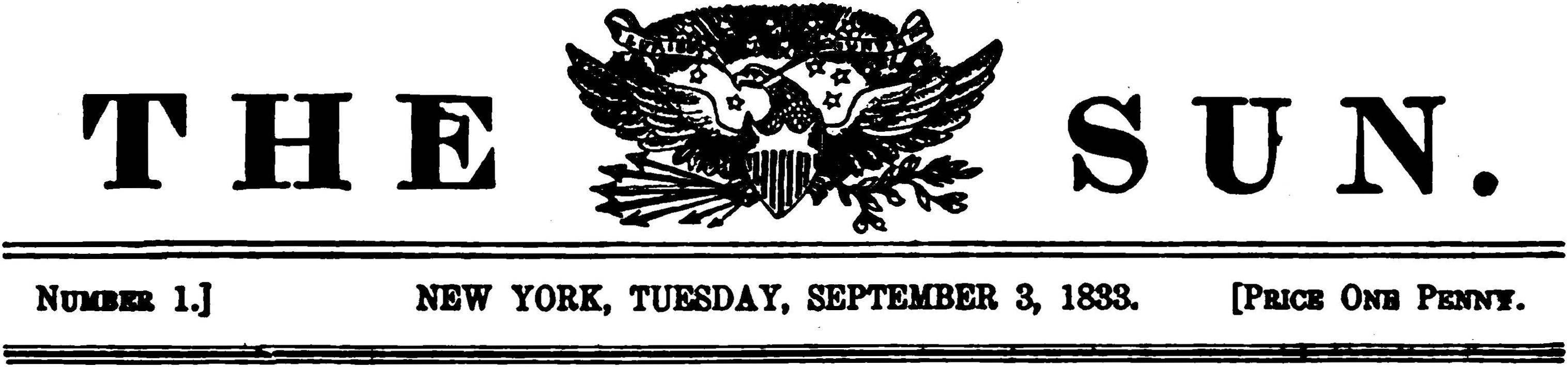
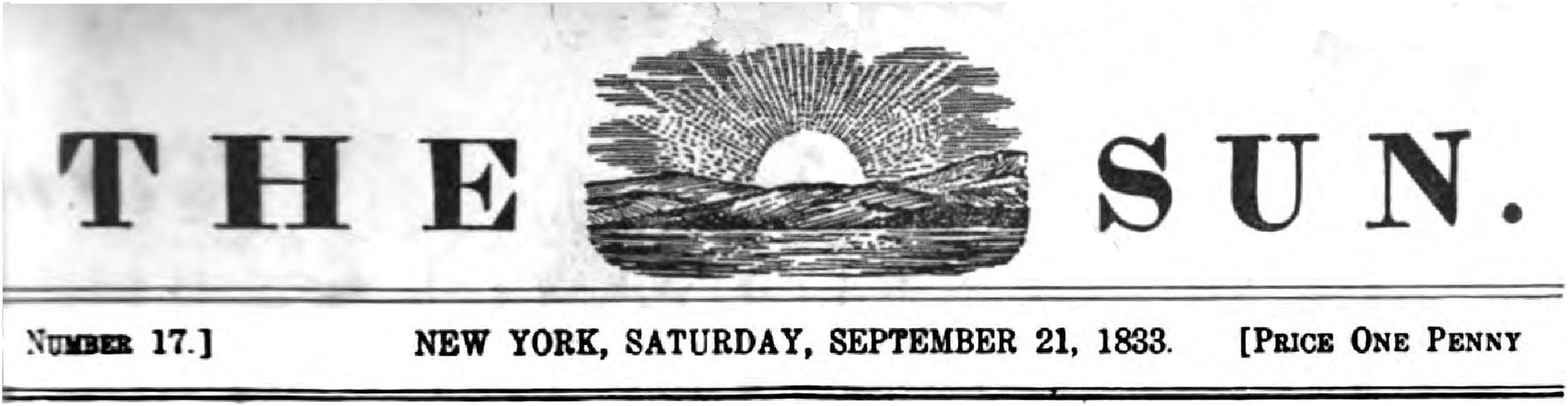
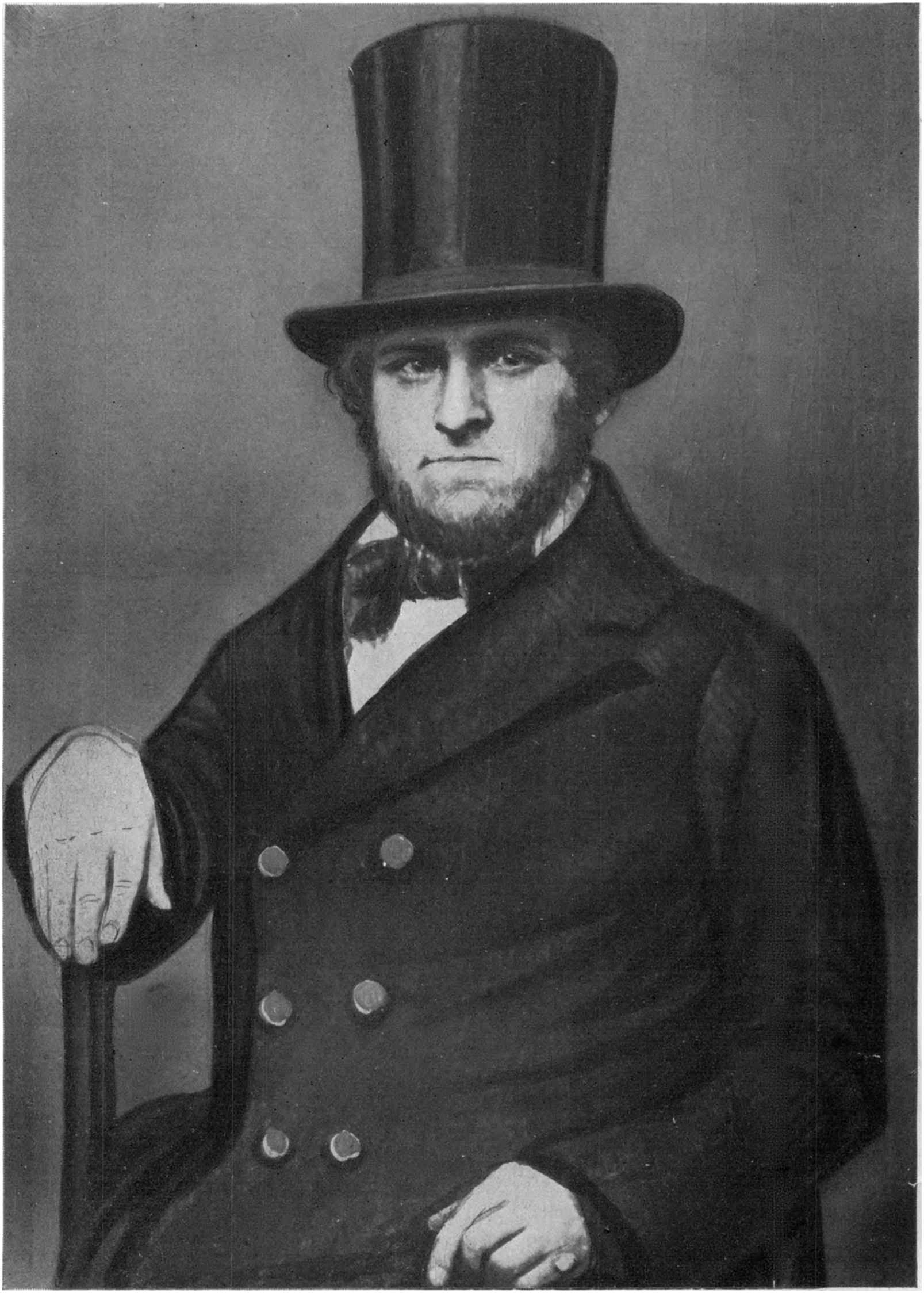
 Sun.