Author of “The Starry Skies,” “The World’s Foundations,”
“Radiant Suns,” Etc.
WITH COPIOUS ADDITIONS
Fully Illustrated
CINCINNATI
NATIONAL BOOK COMPANY
COPYRIGHT, 1898,
By J. T. JONES.
INTRODUCTION.
By Charles Pritchard, M. A., F. R. S.,
Professor of Astronomy in the University of Oxford.
The pages of this volume on a great subject were
submitted to my criticism while passing through the
press, with a request from a friend that I would make
any suggestions which might occur to me for its improvement.
Naturally, such a request was entertained,
in the first instance, with hesitation and misgiving.
But after a rapid perusal of the first sheet, I found my
interest awakened, and then gradually secured; for the
book seemed to me to possess certain features of no
ordinary character, and, in my judgment, held out the
promise of supplying an undoubted want, thus enabling
me to answer a question which I have been
often asked, and which had as often puzzled me, to
the effect, “Can you tell me of any book on astronomy
suited to beginners?” I think just such a book
is here presented to the reader; for the tale of the
stellar universe is therein told with great simplicity,
and perhaps with sufficient completeness, in an earnest
and pleasant style, equally free, I think, from inaccuracy
or unpardonable exaggeration. We have
here the outlines of elementary astronomy, not merely
detailed without mathematics, but to a very great extent
expressed in untechnical language. Success in
such an attempt I regard as a considerable feat, and
one of much practical utility.
For the science of astronomy is essentially a science
of great magnitude and great difficulty. From the
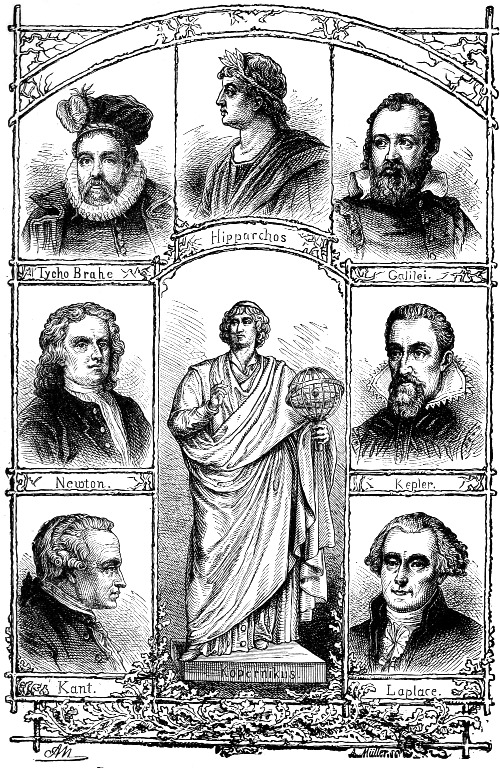
time of Hipparchus, some century and a half before
the Christian era, down to the present day, the cultivation
of astronomy has severely taxed the minds of a
succession of men endowed with the rarest genius.
The facts and the truths of the science thus secured
have been of very slow accretion; but like all other
truths, when once secured and thoroughly understood,
they are found to admit of very simple verbal expression,
and to lie well within the general comprehension,
and, I may safely add, within the sympathies of all
educated men and women.
Thus the great astronomers, the original discoverers
of the last twenty centuries, have labored, each in
his separate field of the vast universe of nature, and
other men, endowed with other gifts, have entered on
their labors, and by systematizing, correlating, and
simplifying the expression of their results, have
brought the whole within the grasp of cultivated
men engaged in other branches of the varied pursuits
of our complicated life. It is in this sort of order
that the amelioration and civilization of mankind
have proceeded, and at the present moment are, I
hope and believe, rapidly proceeding.
It was, I suspect, under this point of view, though
half unconsciously so, that my attention was arrested
by the book now presented to the reader; for we
have here many of the chief results of the laborious
researches of such men as Ptolemy, Kepler, Newton,
Herschel, Fraunhofer, Janssen, Lockyer, Schiaparelli,
and others—no matter where accumulated or by
whom recorded—filtered through the mind of a
thoughtful and cultured lady, and here presented to
other minds in the very forms wherein they have been
assimilated and pictured in her own. And these forms
and pictures are true. It is in this way that the intellectual
“protoplasm” of the human mind is fostered
and practically disseminated.
And, then, there is still another point of view from
which this general dissemination of great truths in a
simple style assumes an aspect of practical importance.
I allude to the influences of this process on
the imaginative or poetic side of our complex nature.
Wordsworth, in one of his prefaces, has stated so
clearly the truth on this subject that I can not do better
than give his words. “If the time should ever
come,” he says, “when what is now science becomes
familiarized to men, then the remotest discoveries of
the chemist, the botanist, the mineralogist, will be as
proper objects of the poet’s art as any upon which it
can be employed. He will be ready to follow the
steps of the man of science; he will be at his side,
carrying sensation into the midst of the objects of
science itself. The poet will lend his divine spirit to
aid the transfiguration, and will welcome the being
thus produced as a dear and genuine inmate of the
household of man.”
It is for reasons such as here stated that I heartily
commend this book to the attention of those who
take an interest in the advancement of the intellectual
progress and culture of society. The story of
the Kosmos is told by the authoress in her own language
and after her own method. I believe, as I have
said, the story is correct.
Something very great—and yet something very
little. Something very great, compared with the
things upon the earth; something very little, compared
with the things outside the earth.
And as our journeyings together are for a while to
be away from earth, we shall find ourselves obliged
to count her as something quite small in the great
universe, where so many larger and mightier things
are to be found,—if indeed they are mightier. Not
that we have to say good-bye altogether to our old
home. We must linger about her for a while before
starting, and afterwards it will be often needful to
come back, with speed swifter than the flight of light,
that we may compare notes on the sizes and conditions
of other places visited by us.
But first of all: what is this earth of ours?
It was rather a pleasant notion which men held in
olden days, that we—that great and important “We”
which loves to perch itself upon a height—stood firm
and fixed at the very center of everything. The earth
was supposed to be a vast flat plain, reaching nobody
could tell how far. The sun rose and set for us alone;
and the thousands of stars twinkled in the sky at night
for nobody’s good except ours; and the blue sky overhead
was a crystal covering for the men of our earth,
and nothing more. In fact, people seem to have
counted themselves not merely to have had a kind of
kingship over the lower animals of our earth, but to
have been kings over the whole universe. Sun, stars,
and sky, as well as earth, were made for man, and for
man only.
This was the common belief, though even in those
olden days there were some who knew better. But the
world in general knows better now.
Earth the center of the universe! Why, she is not
that of even the particular family in the heavens to
which she belongs. For we do not stand alone. The
earth is one of a family of worlds, and that family is
called The Solar System. And so far is our earth
from being the head of the family, that she is not
even one of the more important members. She is
merely one of the little sisters, as it were.
Men not only believed the earth, in past days, to
be at the center of the universe; but also they believed
her to remain there without change. Sun, moon, stars,
planets, sky, might move; but never the earth. The
solid ground beneath their feet, that at least was firm.
Every day the sun rose and set, and every night the
stars, in like manner, rose and set. But this was
easily explained. We on our great earth stood firm
and still, while sun, moon, stars, went circling round
us once in every twenty-four hours, just for our sole
and particular convenience. What an important personage
man must have felt himself then in God’s great
universe! Once again, we know better now!
THE SOLAR SYSTEM.
For it is the earth that moves, and not the sun; it
is the earth that moves, and not the stars. The daily
movements of sun and stars, rising in the east, traveling
over the sky, and setting in the west, are no more
real movements on their part than, when we travel in
a rail way-train, the seeming rush of hedges, telegraph
posts, houses, and fields is real. They are fixed and
we are moving; yet the movement appears to us to be
not ours but theirs.
Still more strongly would this appear to be the case
if there were no noise, no shaking, no jarring and
trembling, to make us feel that we are not at rest.
Sometimes when a train begins to move gently out of
a station, from among other trains, it is at the first
moment quite impossible to say whether the movement
belongs to the train in which we are seated or to
a neighboring train. And in the motions of our earth
there is no noise, no shaking, no jarring—all are rapid,
silent, and even.
If you were rising through the air in a balloon, you
would at first only know your own movement by seeing
the earth seem to drop away from beneath you.
And just so we can only know the earth’s movements
by seeing how worlds around us seem to move in consequence.
When I speak of the Universe, I mean the whole of
God’s mighty creation as far as the stars reach. Sometimes
the word is used in this sense, and sometimes
it is used only for a particular part of creation nearer
to us than other parts. At present, however, we will
put aside all thought of the second narrower meaning.
The wisest astronomer living can not tell us how
far the stars reach. We know now that there is no
firm crystal covering over our heads, dotted with
bright points here and there; but only the wide open
sky or heaven, containing millions of stars, some
nearer, some farther, some bright enough to be seen
by us all, some only visible through a telescope.
People talk often of the stars being “set in space;”
and the meaning of “space” is simply “room.” Where
you are must be space, or you could not be there.
But it is when we get away from earth, and travel in
thought through the wide fields of space, where God
has placed his stars, that we begin to feel how vast it
is, and what specks we are ourselves—nay, what a
speck our very earth is, in this great and boundless
creation.
For there is no getting to the borders of space.
As one telescope after another is made, each one
stronger in power and able to reach farther than the
last, still more and more stars are seen, and yet more
and more behind and beyond, in countless millions.
It is the same all round the earth. The old notion
about our world being a flat plain has been long since
given up. We know her now to be a round globe,
not fixed, but floating like the stars in space.
When you look up into the sky, you are looking
exactly in the opposite direction from where
you would be looking up if you were in Australia.
For Australia’s “up” is our “down,” and our “down”
is Australia’s “up.” Or, to put it more truly, “up” is
always in the direction straight away from this earth,
on whatever part of it you may be standing; and
“down” is always towards the center of the earth.
All round the globe, in north, south, east, west,
whether you are in Europe, Asia, Africa, or America,
though you will see different stars in certain different
quarters of the earth, still overhead you will find shining
countless points of light.
And now, what are these stars? This is a matter
on which people are often confused, and on which
it is well to be quite clear before going one step
farther.
Some of the stars you have most likely often noticed.
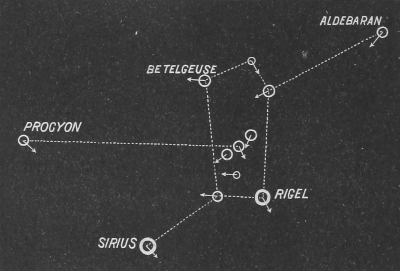
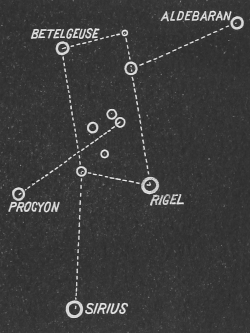
The seven chief stars of the Great Bear are
known to a large number of people; and there are few
who have not admired the splendid constellation of
Orion. Perhaps you also know the W-shape of Cassiopeia,
and the brilliant shining of Sirius, and the
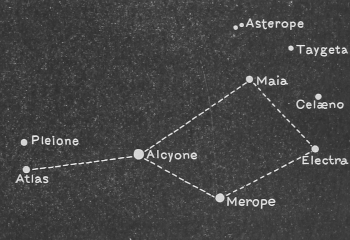
soft glimmer of the Pleiades.
The different constellations or groups of principal
stars have been watched by men for long ages past.
They are called the fixed stars, for they do not change.
How many thousands of years ago they were first arranged
by men into these groups, and who first gave
them their names, we can not tell.
True, night by night, through century after century,
they rise, and cross the sky, and set. But those
are only seeming movements. Precisely as the turning
round of the earth upon her axis, once in every
twenty-four hours, makes the sun appear to rise and
cross the sky and set, in the day-time; so also the
same turning of the earth makes the stars appear to
do the same in the night-time.
There is another seeming movement among the
stars, which is only in seeming. Some come into
view in summer which can not be seen in winter; and
some come into view in winter which can not be seen
in summer. For the sun, moving on his pathway
through the sky, hides those stars which shine with
him in the day-time. The zodiac is an imaginary
belt in the heavens, sixteen or eighteen degrees wide,
containing the twelve constellations through which
the sun passes. And as he passes from point to point
of his pathway, he constantly conceals from us fresh
groups of stars by day, and allows fresh groups to appear
by night.
Speaking generally,
however,
the stars remain
the same year
after year, century
after century.
The groups
may still be seen
as of old, fixed
and unchanging.
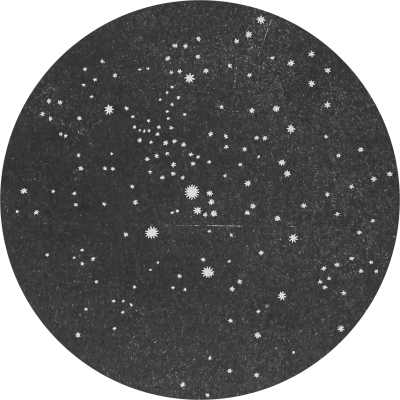
THE PLEIADES.
What are these stars? Stars and planets have
both been spoken about. There is a great difference
between the two.
Perhaps if you were asked whether the sun is most
like to a star or a planet, you would be rather at a loss;
and many who have admired the brilliant evening
star, Venus, often to be seen after sunset, would be
surprised to learn that the evening star is in reality no
star at all.
A star is a sun. Our sun is nothing more nor less
than a star. Each one of the so-called “fixed stars,”
that you see shining at night in the sky, is a sun like
our sun; only some of the stars are larger suns and
some are smaller suns than ours.
The main reason why our sun looks so much larger
and brighter than the stars is, that he is so very much
nearer to us. The stars are one and all at enormous
distances from the earth. By and by we will go more
closely into the matter of their distance, compared
with the distance of the sun.
At present it is enough to say that if many of the
stars were placed just as near to us as our sun is
placed, they would look just as large and bright;
while there are some that would look a great deal
larger and brighter. And if our sun were to travel
away from us, to the distance of the very nearest
of the little twinkling stars, he would dwindle down
and down in size and brilliancy, till at last we should
not be able to tell him apart from the rest of the
stars.
I have told you that the stars are called “fixed”
because they keep their places, and do not change from
age to age. Though the movement of the earth makes
them seem all to sweep past every night in company,
yet they do not travel in and out among one another,
or backwards and forwards, or from side to side. At
all events, if there be such changes, they are so slow
and so small as to be exceedingly difficult to find out.
Each group of stars keeps its own old shape, as for
hundreds of years back.
But among these fixed stars there are certain stars
which do go to and fro, and backwards and forwards.
Now they are to be seen in the middle of one constellation,
and now in the middle of another. These restless
stars were long a great perplexity. Men named
them Planets or Wanderers.
We know now that the planets are in reality not
stars at all, and also that they are not nearly so far
away from us as the fixed stars. In fact, they are
simply members of our own family—the Solar System.
They are worlds, more or less like the world we live
in; and they travel round and round the sun as we
do, each more or less near to him; and they depend
upon him for heat and light, in more or less the same
manner as ourselves.
Therefore, just as our sun is a star, and stars are
suns, so our earth or world is a planet, and planets
are worlds. Earth is the name we give to that particular
world or planet on which we live. Planets
may generally be known from stars by the fact that
they do not twinkle. But the great difference between
the two lies in the fact that a star shines by
its own radiant, burning light, whereas a planet shines
merely by light reflected or borrowed from the sun.
But how were the earth and the other worlds made?
Let us imagine an immense gaseous mass placed in
space. Attraction is a force inherent in every atom of
matter. The denser portion of this mass will insensibly
attract towards it the other parts, and in the slow
fall of the more distant molecules towards this more
attractive region, a general motion is produced, incompletely
directed towards this center, and soon involving
the whole mass in the same motion of rotation.
The simplest form of all, even in virtue of this
law of attraction, is the spherical form. It is that
which a drop of water takes, and a drop of mercury
if left to itself.
The laws of mechanics show that, as this gaseous
mass condenses and shrinks, the motion of rotation of
the nebula is accelerated. In turning, it becomes
flattened at the poles, and gradually takes the form of
an immense lens-shaped mass of gas. It has begun
to turn so quickly as to develop at its exterior circumference
a centrifugal force superior to the general
attraction of the mass, as when we whirl a sling. The
inevitable consequence of this excess is a rupture of
the equilibrium, which detaches an external ring.
This gaseous ring will continue to rotate in the same
time and with the same velocity; but the nebulous
mother will be henceforth detached, and will continue
to undergo progressive condensation and acceleration
of motion. The same feat will be reproduced as often
as the velocity of rotation surpasses that by which the
centrifugal force remains inferior to the attraction. It
may have happened also that secondary centers of
condensation would be formed even in the interior of
the nebula.
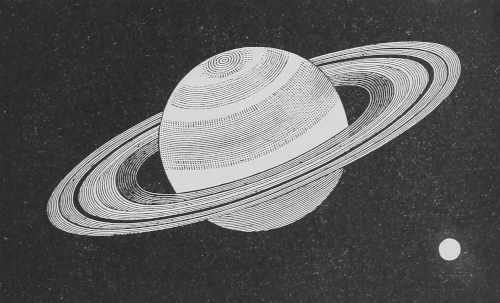
In our system the rings of Saturn still subsist.
The successive formation of the planets, their situation
near the plane of the solar equator, and their
motions of translation round the same center, are explained
by the theory which we are discussing. The
most distant known planet, Neptune, would be detached
from the nebula at the epoch when this nebula
extended as far as the planet, out to nearly three thousand
millions of miles, and would turn in a slow revolution
requiring a period of 165 years for its accomplishment.
The original ring could not remain in the
state of a ring unless it was perfectly homogeneous
and regular; but such a condition is, so to say, unrealizable,
and it did not delay in condensing itself into
a sphere. Successively, Uranus, Saturn, Jupiter, the
army of small planets, Mars, would thus be detached
or formed in the interior of this same nebula. Afterwards
came the earth, of which the birth goes back
to the epoch when the sun had arrived at the earth’s
present position. Venus and Mercury would be born
later. Will the sun give birth to a new world? This
is not probable.
CHAPTER II
THE HEAD OF OUR FAMILY.
People began very early in the history of the
world to pay close attention to the sun. And no
wonder. We owe so much to his heat and light that
the marvel would be if men had not thought much
about him.
Was the sun really any larger than he looked, and
if so, how much larger was he? And what was his
distance from the earth? These were two of the questions
which puzzled our ancestors the longest. If
once they could have settled exactly how far off the
sun really was, they could easily have calculated his
exact size; but this was just what they could not do.
So one man supposed that the sun must be quite
near, and very little larger than he looked. Another
thought he might be seventy-five miles in diameter.
A third ventured to believe that he was larger than
the country of Greece. A fourth was so bold as to
imagine that he might even outweigh the earth
herself.
After a while many attempts were made to measure
the distance of the sun; and a great many different
answers to this difficult question were given by different
men, most of them very wide of the mark. It is
only of late years that the matter has been clearly
settled. And, indeed, it was found quite lately that a
mistake of no less than three millions of miles had
been made, notwithstanding all the care and all the
attention given. But though three millions of miles
sounds a great deal, yet it is really very little—only a
tiny portion of the whole.
For the distance of the sun from the earth is no
less than about NINETY-THREE MILLIONS OF MILES.
Ninety-three millions of miles! Can you picture that
to yourself? Try to think what is meant by a thousand
miles. Our earth is eight thousand miles in
diameter. In other words, if you were to thrust a
gigantic knitting-needle through her body, from the
North Pole to the South Pole, it would have to be
about eight thousand miles long.
To reach the thought of one million, you must picture
one thousand times one thousand. Our earth is
about twenty-five thousand miles round. If you were
to start from the mouth of the River Amazon, in South
America, and journey straight round the whole earth on
the equator, till you came back to the same point, you
would have traveled about twenty-five thousand miles.
But that would be a long way off from a million miles.
You would have gone only once round the earth.
Now a cord one million miles in length could be
wrapped, not once only, but forty times, round and
round the earth. And when you have managed to
reach up to the thought of one million miles, you have
then to remember that the sun’s distance is ninety-three
times as much again. So, to picture clearly to
ourselves the actual meaning of “ninety-three millions
of miles” is not so easy.
Suppose it were possible to lay a railroad from here
to the sun. If you could journey thither in a perfectly
straight line, at the rate of thirty miles an hour,
never pausing for one single minute, night or day, you
would reach the sun in about three hundred and forty-six
years.
Thirty miles an hour is a slow train. Suppose we
double the speed, and make it an express train, rushing
along at the pace of sixty miles an hour. Then
you might hope to reach the end of your journey in
one hundred and seventy-three years. If you had
quitted this earth early in the eighteenth century,
never stopping on your way, you would be, just about
now, near the end of the nineteenth, arriving at the sun.
So much for the sun’s distance from us. Now as
to his size.
I have already mentioned that our earth’s diameter—that
is, her through measure, as, for instance, the
line drawn straight from England through her center
to New Zealand—is about eight thousand miles. This
sounds a good deal. But what do you think of the
diameter of the sun being no less than eight hundred
and fifty-eight thousand miles? The one is eight thousand
miles, the other over eight hundred thousand!
Suppose you had a long slender pole which would
pass through the middle of the earth, one end just
showing at the North Pole and the other at the South
Pole. You would need more than a hundred and
eight of such poles, all joined together, to show the
diameter of the sun.
The sun seems not to be made of nearly such heavy
materials as the earth. He is what astronomers call
less “dense,” less close and compact in his make, just
as wood is less dense and heavy than iron. Still, his
size is so enormous, that if you could have a pair of
gigantic scales, and put the sun into one scale and
the earth with every one of her brother and sister
planets into the other, the sun’s side would go down
like lightning. He would be found to weigh seven
hundred and fifty times as much as all the rest put
together. And, it would take more than twelve hundred
thousand little earths like ours, rolled into one
huge ball, to make a globe as large as the sun.
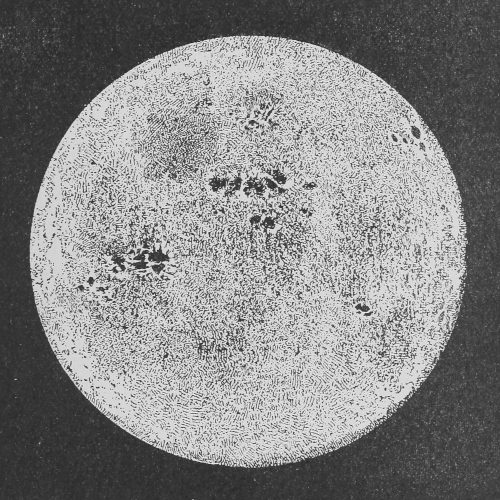
In the beginning of the seventeenth century a man
named Fabricius was startled by the sight of a certain
black spot upon the face of the sun. He watched till
too dazzled to look any longer, supposing it to be a
small cloud, yet anxious to learn more. Next day
the spot was there still, but it seemed to have moved
on a little way. Morning after morning this movement
was found to continue, and soon a second spot, and
then a third spot, were observed creeping in like manner
across the sun. After a while they vanished, one
at a time, round his edge, as it were; but after some
days of patient waiting on the part of the lookers-on,
they appeared again at the opposite edge, and once
more began their journey across.
Fabricius seems to have been the first, but he was
not the last, to watch sun-spots. Many astronomers
have given close attention to them. Modern telescopes,
and the modern plan of looking at the sun
through darkened glass, have made this possible in a
way that was not possible two or three hundred years
ago.
The first important discovery made through the
spots on the sun, was that the sun turns round upon
his axis, just in the same manner that the earth turns
round upon hers. Instead of doing so once in the
course of each twenty-four hours, like the earth, he
turns once in the course of about twenty-five days.
It must not be supposed that the spots seen now
upon the sun are the same spots that Fabricius saw
so long ago. There is perpetual change going on;
new spots forming, old spots vanishing; one spot breaking
into two, two spots joining into one, and so on.
Even in a single hour great alterations are sometimes
seen to take place.
Still, many of the spots do remain long enough and
keep their shapes closely enough to be watched from
day to day, and to be known again as old friends when
they reappear, after being about twelve days hidden
on the other side of the sun. So that the turning of
the sun upon his axis has become, after long and careful
examination, a certain known fact.
For more than thirty years one astronomer kept
close watch over the spots on every day that it was
possible to see the sun. Much has been learned from
his resolute perseverance.
Now what are these spots?
One thing seems pretty sure, and that is that they
are caused by some kind of tremendous storms or
cyclones taking place on the surface of that huge ball
of fire.
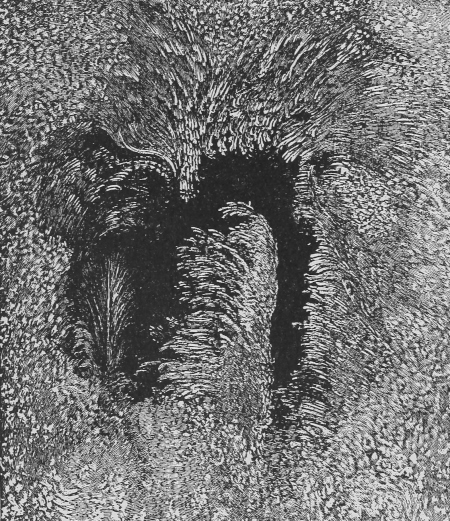
SUN SPOTS.
The first attentive observer of the sun, Scheiner,
at first regarded the spots as satellites—an indefensible
opinion, which, however, some have attempted to
revive. Galileo attributed them to clouds or vapors
floating in the solar atmosphere; this was the best
conclusion which could be drawn from the observations
of that epoch. This opinion met for a long
time with general approval; it has even been renewed
in our day. Some astronomers, and among them
Lalande, believed, on the contrary, that they were
mountains, of which the flanks, more or less steep,
might produce the aspect of the penumbra—an opinion
irreconcilable with the proper motion which the
spots sometimes possess in a very marked manner.
It is not usual, in fact, to see mountains traveling.
Derham attributed them to the smoke issuing from
the volcanic craters of the sun, an opinion revived and
maintained in recent times by Chacornac. Several
savants, regarding the sun as a liquid and incandescent
mass, have also explained the spots by immense cinders
floating on this ocean of fire. But a century had
scarcely elapsed after the epoch when the spots were
observed for the first time, when an English astronomer,
Wilson, showed with certainty that the spots are
hollow.
We do not know with any certainty whether the
sun is through and through one mass of glowing molten
heat, or whether he may have a solid and even
cool body within the blazing covering. Some have
thought the one, and some the other. We only know
that he is a mighty furnace of heat and flame, beyond
anything that we can possibly imagine on our quiet
little earth.
It seems very sure that no such thing as “quietness”
is to be found on the surface of the sun. The wildest
and fiercest turmoil of rushing wind and roaring flame
there prevails. The cyclones or hurricanes which take
place are sometimes so rapid and so tremendous in
extent, tearing open the blazing envelope of the sun,
and showing glimpses of fiery though darker depths
below, that we, on our far-distant earth, can actually
watch their progress.
Astronomers speak of the “quivering fringe of fire”
all around the edge of the sun, visible through telescopes.
But the sun is perpetually turning on his
axis, so that each hour fresh portions of his surface
thus pass the edge, showing the same appearance.
What conclusion can we come to but that the whole
enormous surface of the sun is one restless, billowy
sea of fire and flame?
It sounds to us both grand and startling to hear of
the mighty outbreaks from Mount Vesuvius, or to read
of glowing lava from a volcano in Hawaii pouring in
one unbroken stream for miles.
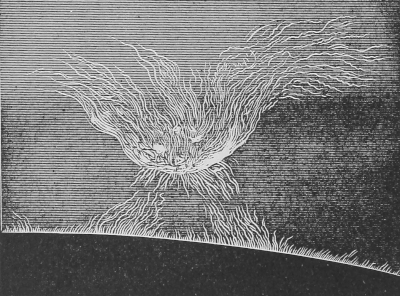
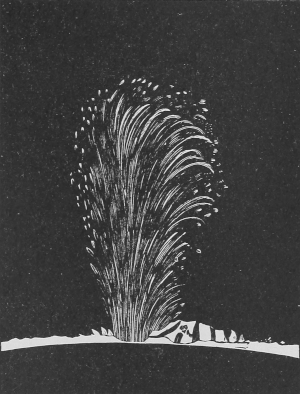
But what shall be thought of rosy flames mounting
to a height of fifty or a hundred thousand miles above
the edge of the sun? What shall be thought of a
tongue of fire long enough to fold three or four times
round our solid earth? What shall be thought of the
awful rush of burning gases, sometimes seen, borne
along at the rate of one or two or even three hundred
miles in a single second across the sun’s surface?
What shall be thought of the huge dark rents in this
raging fiery ocean, rents commonly from fifty to one
hundred thousand miles across, and not seldom more?
Fifty thousand miles! A mere speck, scarcely
visible without a telescope; yet large enough to hold
seven earths like ours flung in together. The largest
spot measured was so enormous that eighteen earths
might have been arranged in a row across the breadth
of it, like huge boulders of rock in a mountain cavern;
and to have filled up the entire hole about one hundred
earths would have been needed.
It is well to grow familiar with certain names given
by astronomers to certain parts of the sun.
The round shining disk or flat surface, seen by all
of us, is called the photosphere, or “light-sphere.” It
has a tolerably well-defined edge or “limb,” and dazzles
the eye with its intense brightness.
Across the photosphere the spots move, sometimes
many, sometimes few, in number. Besides the dark
spots, there are spots of extreme brilliancy, standing
out on even that dazzling surface, which causes a piece
of white-hot iron to look black and cold by contrast.
These extra-radiant spots which come and go, and at
times change with great rapidity, are named faculæ—a
Latin word meaning “torches.”
At the edge of the photosphere astronomers see
what has been already mentioned, that which is sometimes
called the chromotosphere, which one has named
“the sierra,” and which another has described as “a
quivering fringe of fire.” The waves of the sea, on a
stormy day, seen in the distance rising and breaking
the horizon-line, may serve as an illustration; only in
the sun the waves are of fire, not water. What must
their height be, to be thus visible at a distance of
ninety-three millions of miles?
Outside the sierra are seen, at certain seasons,
bright, “rose-colored prominences” or flames of enormous
height. During an eclipse, when the dark body
of the moon comes between the sun and us, exactly
covering the photosphere, these red tips stand out
distinctly beyond the edge of sun and moon. Their
changes have been watched, and their height repeatedly
measured. Some are so lofty that ten little earths
such as ours might be heaped up, one upon another,
without reaching to their top. Whether they are in
character at all like the outbursts from our own volcanoes
it is hard to say. To compare the two would
be rather like comparing a small kitchen fire with
a mighty iron-smelting furnace. The faculæ, the
sierra, and the prominences are visible only through
a telescope.
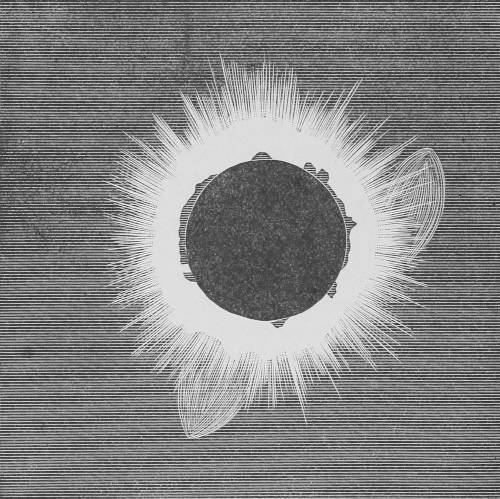
Outside these red flames or “prominences” is the
corona, commonly divided into the inner and outer
coronas.
Many different explanations have been offered of
this beautiful crown of light round the sun, plainly
visible to the naked eye during an eclipse. But here
again we know little, and must be content to watch
and wait.
CHAPTER III.
WHAT BINDS THE FAMILY TOGETHER?
What is it which binds together all the members
of the Solar System? Ah, what? Why should not
the sun at any moment rush away in one direction,
the earth in a second, the planets in half a dozen
others? What is there to hinder such a catastrophe?
Nothing—except that they are all held together by a
certain close family tie; or, more correctly, by the
powerful influence of the head of the family.
This mysterious power which the sun has, and
which all the planets have also in their smaller degrees,
is called Attraction. Sometimes it is named
Gravitation or Gravity. When we speak, as we often
do, of the law of attraction or gravitation, we mean
simply this—that throughout the universe, in things
little and great, is found a certain wonderful something,
in constant action, which we call a “law.”
What the “something” may be, man can not tell;
for he knows it only by its effects. But these effects
are seen everywhere, on all sides, in the earth and in
the universe. It is well named in being called a
“law;” for we are compelled to obey it. None but
the Divine Lawgiver who made this law can for a single
moment suspend its working.
What causes an apple to fall to the ground when
it drops from the branch? Why should it not, instead,
rise upwards? Because, of course, it is heavy, or has
weight. But what is weight? Simply this—that the
earth draws or drags everything downwards towards
herself by the power of attraction. Every substance,
great or small, light or heavy, is made up of tiny
atoms. Each one of these atoms attracts or draws
all the other atoms towards itself; and the closer
they are together, the more strongly they pull one
another.
The atoms in a piece of iron are much closer than
the atoms in a piece of wood; therefore the iron is
called the “more dense” of the two, and its weight or
“mass” is greater. The more closely the atoms are
pressed together, the greater the number of them in
a small space, and the more strong the drawing towards
the earth; for the earth draws each one of these
atoms equally. That is only another way of saying
that a thing is “heavier.” If you drop a stone from
the top of a cliff, will it rise upwards or float in the
air? No, indeed. The pull of the earth’s attraction,
dragging and still dragging downward, makes it rush
through the air, with speed quickening each instant,
till it strikes the ground. Every single atom in every
single body pulls every other atom, whether far or
near. The nearer it is, the stronger always the
pulling.
We do not always feel this, because the very much
greater attraction of the earth hides—or smothers, as
we may say—the lesser attraction of each small thing
for another. But though you and I might stand side
by side upon earth, and feel no mutual attraction, yet
if we could mount up a few thousands of miles, far
away from earth, and float in distant space, there we
should find ourselves drawn together, and unable to
remain apart.
Now precisely as an apple falling from a tree and
a stone dropping from a cliff are dragged downward
to the earth, just so our earth and all the planets are
dragged downwards towards the sun and towards each
other. The law of the earth’s attraction of all objects
on its surface to itself was indistinctly suspected a
very long time ago; but it was the great Newton who
first discovered that this same law was to be found
working among the members of the whole Solar System.
The sun attracts the earth, and the earth attracts
the sun. But the enormous size of the sun
compared with our earth—like a great nine-foot globe
beside a tiny one-inch ball—makes our power of attraction
to be quite lost sight of in his, which is so
much greater.
The principle of gravitation is of far wider scope
than we have yet indicated. We have spoken merely
of the attraction of the earth, and we have stated that
its attraction extends throughout space. But the law
of gravitation is not so limited. Not only does the
earth attract every other body, and every other body
attract the earth, but each of these bodies attracts
each other; so that, in its more complete shape, the
law of gravitation announces that “every body in the
universe attracts every other body with a force which
varies inversely as the square of the distance.” It is
impossible for us to overestimate the importance of
this law. It supplies the clue by which we can unravel
the complicated movements of the planets. It
has led to marvelous discoveries, in which the law of
gravitation has enabled us to anticipate the telescope,
and, indeed, actually to feel the existence of bodies
before those bodies have even been seen.
We come now to another question. If the sun is
pulling with such power at the earth and all her sister
planets, why do they not fall down upon him?
What is to prevent their rolling some day into one of
those deep rents in his fiery envelope? Did you ever
tie a ball to a string, and swing it rapidly round and
round your head? If you did, you must have noticed
the steady outward pull of the ball. The heavier the
ball, and the more rapid its whirl, the stronger the pull
will be. Let the string slip, and the rush of the ball
through the air to the side of the room will make this
yet more plain. Did you ever carry a glass of water
quickly along, and then, on suddenly turning a corner,
find that the water has not turned with you? It has
gone on in its former direction, leaving the glass, and
spilling itself on the floor.
The cause in both cases is the same. Here is another
“law of nature,” so-called. Though we can
neither explain nor understand why and how it is so,
we see it to be one of the fixed rules of God’s working
in every-day life throughout his universe. The law,
as we see it, seems to be this: Everything which is at
rest must remain at rest, until set moving by some
cause outside of, or independent of itself; and everything
which is once set moving, must continue moving
in a straight line until checked.
According to this a cannon-ball lying on the ground
ought to remain there until it is set in motion; and,
once set in motion by being fired from a cannon, it ought
to go on forever. Exactly so—if nothing stops it. But
the earth’s attraction draws the cannon-ball downward,
and every time it strikes the ground it is partly
checked. Also each particle of air that touches it
helps to bring it to rest. If there were no earth
and no air in the question, the cannon-ball might rush
on in space for thousands of years.
Why did the water get spilled? Because it necessarily
continued moving in a straight line. Your sudden
change of direction compelled the solid glass to
make the same change, but the liquid water was free to
go straight on in its former course; so it obeyed this
law, and did go on. Why did the ball pull hard at the
string as you swung it round? Because at each instant
it was striving to obey this same law, and to
rush onward in a straight line. The pull of the string
was every moment fighting against that inclination,
and forcing the ball to move in a circle.
Just such is the earth’s movement in her yearly
journey round the sun. The string holding in the
ball pictures the sun’s attraction holding in the earth.
The pulling of the ball outward in order to continue
its course in a straight line, pictures the pulling of
our earth each moment to break loose from the sun’s
attraction and to flee away into distant space.
For the earth is not at rest. Each tick of the clock
she has sped onward over more than eighteen miles
of her pathway through the sky. Every instant the
sun is dragging, with the tremendous force of his attraction,
to make her fall nearer to him. Every instant
the earth is dragging with the tremendous force
of her rapid rush, to get away from him. These two
pullings so far balance each other, or, more strictly, so
far combine together, that between the two she journeys
steadily round and round in her nearly circular
orbit.
If the sun pulled a little harder she would need to
travel a little faster, or she would gradually go nearer
to him. If the earth went faster, and the sun’s attraction
remained the same as it is now, she would
gradually widen her distance. Indeed, it would only
be needful for the earth to quicken her pace to
about five-and-twenty miles a second, the sun’s power
to draw her being unchanged, and she would then
wander away from him for ever. Day by day we on
our earth should travel farther and farther away, leaving
behind us all light, all heat, all life, and finding
ourselves slowly lost in darkness, cold, and death.
For what should we do without the sun? All our
light, all our warmth, come from him. Without the
sun, life could not exist on the earth. Plants, herbage,
trees, would wither; the waters of rivers, lakes, oceans,
would turn to masses of ice; animals and men would
die. Our earth would soon be one vast, cold, forsaken
tomb of darkness and desolation.
We may not think so, but everything which moves,
circulates, and lives on our planet is the child of the
sun. The most nutritious foods come from the sun.
The wood which warms us in winter is, again, the sun
in fragments. Every cubic inch, every pound of wood,
is formed by the power of the sun. The mill which
turns under the impulse of wind or water, revolves
only by the sun. And in the black night, under the
rain or snow, the blind and noisy train, which darts
like a flying serpent through the fields, rushes along
above the valleys, is swallowed up under the mountains,
goes hissing past the stations, of which the pale eyes
strike silently through the mist,—in the midst of night
and cold, this modern animal, produced by human industry,
is still a child of the sun. The coal from the
earth which feeds its stomach is solar work, stored up
during millions of years in the geological strata of
the globe.
As it is certain that the force which sets the watch
in motion is derived from the hand which has wound
it, so it is certain that all terrestrial power proceeds
from the sun. It is its heat which maintains the three
states of bodies—solid, liquid, and gaseous. The last
two would vanish, there would be nothing but solids;
water and air itself would be in massive blocks,—if
the solar heat did not maintain them in the fluid state.
It is the sun which blows in the air, which flows in
the water, which moans in the tempest, which sings
in the unwearied throat of the nightingale. It attaches
to the sides of the mountains the sources of the
rivers and glaciers, and consequently the cataracts and
the avalanches are precipitated with an energy which
they draw directly from him. Thunder and lightning
are in their turn a manifestation of his power. Every
fire which burns and every flame which shines has received
its life from the sun. And when two armies
are hurled together with a crash, each charge of cavalry,
each shock between two army corps, is nothing
else but the misuse of mechanical force from the same
star. The sun comes to us in the form of heat, he
leaves us in the form of heat; but between his arrival
and his departure, he has given birth to the
varied powers of our globe.
I have spoken before about the old-world notion
that our earth was a fixed plain, with the sun circling
round her. When the truth dawned slowly upon
some great minds, anxious only to know what really
was the truth, others made a hard struggle for the
older and pleasanter mode of thinking. It went with
many sorely against the grain to give up all idea of
the earth being the chief place in the universe. Also
there was something bewildering and dizzying in the
notion that our solid world is never for one moment
still. But truth won the victory at last. Men consented
slowly to give up the past dream, and to learn
the new lesson put before them.
We still talk of the sun rising and setting, and of
the stars doing the same. This is, however, merely a
common form of speech, which means just the opposite.
For instead of the sun and stars moving, it is
the earth which moves.
The earth has two distinct movements. Indeed, I
ought to say that she has three; but we will leave all
thought of the third for the present. First, she turns
round upon her axis once in every twenty-four hours.
Secondly, she travels round the sun once in about every
three hundred and sixty-five days and a quarter. No
wonder our ancestors were startled to learn that the
world, which they had counted so immovable, was perpetually
spinning like a humming-top, and rushing
through space like an arrow.
You may gain some clear notions as to the daily
rising and setting of our sun, with the help of an
orange. Pass a slender knitting-needle through the
orange, from end to end, and hold it about a yard distant
from a single candle in a room otherwise darkened.
Let the needle or axis slant somewhat, and turn the
orange slowly upon it.
The candle does not move; but as the orange turns,
the candle-light falls in succession upon each portion
of the yellow rind. Half of the orange is always in
shade, and half is always in light; while at either side,
if a small fly were standing there, he would be passing
round out of shade into candle-light, or out of candle-light
into shade.
Each spot on our earth moves round in turn into
half-light, full-light, half-light, and darkness; or, in
other words, has morning-dawn, midday-light, evening
twilight, and night. Each spot on our earth would
undergo regularly these changes every twenty-four
hours throughout the year, were it not for another
arrangement which so far affects this that the North
and South Poles are, by turns, cut off from the light
during many months together.
Thus the sun is in the center of the Solar System,
turning slowly on his axis; and the earth and the
planets travel round him, each spinning like a teetotum,
so as to make the most of his bright warm rays.
But for this spinning movement of the earth, our day
and night, instead of being each a few hours long,
would each last six months.
You may notice that, as you turn the orange steadily
round, the outside surface of the skin has to move
much more slowly in those parts close to the knitting-needle,
than in those parts which bulge out farthest
from it. Near the North and South Poles the surface
of our earth travels slowly round a very small circle in
the course of twenty-four hours. But at the equator
every piece of ground has to travel about twenty-five
thousand miles in the same time; so that it rushes along
at the rate of more than one thousand miles an hour.
A man standing on the earth at the equator is being
carried along at this great speed, not through the air,
for the whole atmosphere partakes of the same rapid
motion, but with the air, round and round the earth’s
axis.
Now about the other movement of the earth—her
yearly journey round the sun. While she moves, the
sun, as seen from the earth, seems to change his place.
First he is observed against a background of one group
of stars, then against a second, then against a third.
Not that the stars are visible in the daytime when
the sun is shining, but their places are well known in
the heavens; and also they can be noted very soon
after he sets, or before he rises, so that the constellations
nearest to him may each day be easily found out.
Of course, in old times the sun was thought to be
really taking this journey among the stars, and men
talked of “the sun’s path” in the heavens. This path
was named “the Ecliptic,” and we use the word still,
though we know well that the movements are not
really his, but ours.
As the earth’s daily movement causes day and night,
so the earth’s yearly movement causes spring, summer,
autumn, and winter. A few pages back I mentioned,
in passing, one slight yet important fact which lies at
the root of this matter about the seasons. The earth,
journeying round the sun, travels with her axis slanting.
Put your candle in the middle of the table, and
stand at one end, holding your orange. Now let the
knitting-needle, with the orange upon it, so slant that
one end shall point straight over the candle, towards
the upper part of the wall at the farther end of the
room. Call the upper end so pointing the North Pole
of your orange. You will see that the candle-light
falls chiefly upon the upper half of the orange; and as
you turn it slowly, to picture day and night, you will
find that the North Pole has no night, and the South
Pole has no day. That is summer in the northern
hemisphere, and winter in the southern.
Walk round next to one side of the table, towards
the right hand, taking care to let the knitting-needle
point steadily still in exactly the same direction, not
towards the same spot, for that would alter its direction
as you move, but towards the same wall. Stop, and
you will find the candle lighting up one-half of your
orange, from the North to the South Poles. Turn it
slowly, never altering the slope of the axis, and you
will see that every part of the orange comes by turns
under the light. This is the Autumnal Equinox,
when days and nights all over the world are equal in
length.
Walk on to the other end of the table, still letting
the needle slope and point steadily as before. Now
the candle-light will shine upon the lower or South
Pole, and the North Pole will be entirely in the shade.
This is summer in the southern hemisphere, and
winter in the northern.
Pass on to the fourth side of the table, and once
more you will find it, as at the second side, equal light
from North Pole to South Pole. This will be the
Spring Equinox.
It is an illustration that may be easily practiced.
But everything depends upon keeping the slant of the
needle or axis unchanged throughout. If it be allowed
to point first to right, and then to left, first towards the
ceiling, and then towards the wall, the attempt will
prove a failure.
CHAPTER IV.
THE LEADING MEMBERS OF OUR FAMILY—FIRST
GROUP.
The chief distinction between stars and planets is, as
before said, that the stars shine entirely by their own
light, while the planets shine chiefly, if not entirely,
by reflected light. The stars are suns; mighty globes of
glowing flame. The planets simply receive the light
of the sun, and shine with a brightness not their own.
A lamp shines by its own light; but a looking-glass,
set in the sun’s rays and flashing beams in all directions,
shines by reflected light. In a dark room it would
be dark. If there were no sun to shine upon Mars or
Venus, we should see no brightness in them. The
moon is like the planets in this. She has only borrowed
light to give, and none of her own.
Any one of the planets removed to the distance of
the nearest fixed star, would be invisible to us. Reflected
light will not shine nearly so far as the direct
light of a burning body. There may be thousands or
millions of planets circling round the stars—those
great and distant suns—just as our brother-planets
circle round our sun. But it is impossible for us to
see them. The planets which we can see are close
neighbors, compared with the stars. I do not mean
that they are near in the sense in which we speak of
nearness upon earth. They are only near in comparison
with what is so very much farther away.
For a while we must now leave alone all thought
of the distant stars, and try to gain a clear idea of the
chief members of our own Family Circle—that family
circle of which the sun is the head, the center, the
source of life and warmth and light. There are two
ways in which astronomers group the planets of the
Solar System. One way is to divide them into the
Inferior Planets, and the Superior Planets.
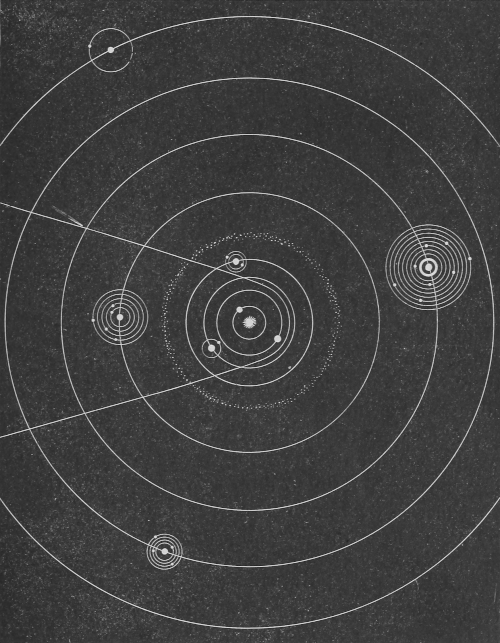
As the earth travels in her pathway round the sun,
two planets travel on their pathways round the sun
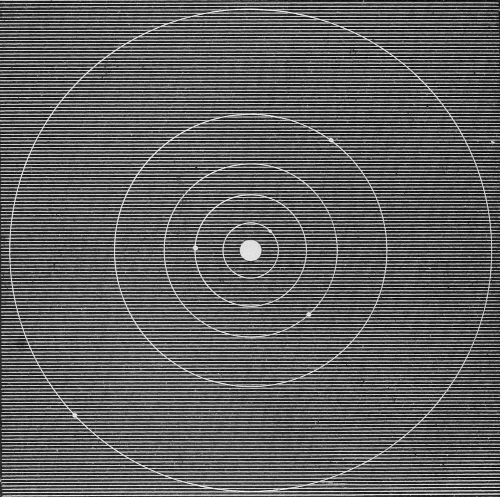
nearer to him than ourselves. If the pathway or orbit
of our earth were pictured by a hoop laid upon the
table, with a ball in the center for the sun; then
those two planets would have two smaller hoops of
different sizes within ours; and the rest would have
larger hoops of different sizes outside ours. The two
within are called inferior planets, and the rest outside
are called superior planets.
A round hoop would not make a good picture of
an orbit. For the yearly pathway of our earth is not
in shape perfectly round, but slightly oval; and the
sun is not exactly in the center, but a little to one side
of the center. This is more or less the case with the
orbits of all the planets.
But the laying of the hoops upon the table would
give no bad idea of the way in which the orbits really
lie in the heavens. The orbits of all the chief planets
do not slope and slant round the sun in all manner of
directions. They are placed almost in the same plane
as it is called—or, as we might say, in the same flat.
In these orbits the planets all travel round in the same
direction. One may overtake a second on a neighboring
orbit, and get ahead of him, but one planet never
goes back to meet another.
In speaking of the orbits, I do not mean that the
planets have visible marked pathways through the
heavens, any more than a swallow has a visible pathway
through the sky, or a ship a marked pathway
through the sea. Yet each planet has his own orbit,
and each planet so distinctly keeps to his own, that
astronomers can tell us precisely whereabouts in the
heavens any particular planet will be, at any particular
time, long years beforehand.
There is also another mode of grouping the planets,
besides dividing them into superior and inferior planets.
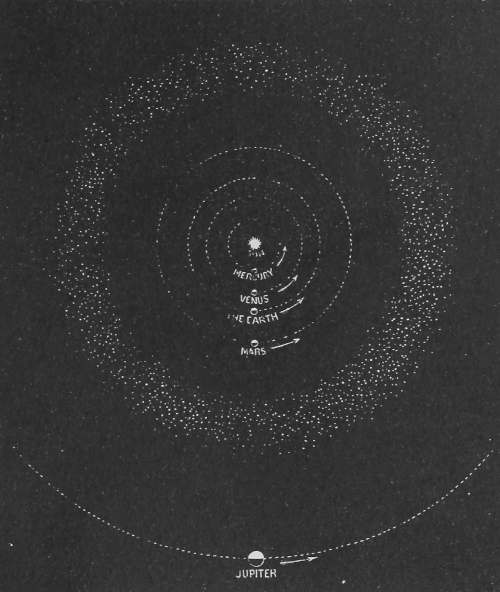
By this other mode we find two principal groups
or quartets of planets, separated by a zone or belt of a
great many very small planets.
{ Mercury.
{ Venus.
First Group
{ Earth.
{ Mars.
The Asteroids or Planetoids.
{ Jupiter.
{ Saturn.
Second Group
{ Uranus.
{ Neptune.
The first four are small compared with the last
four, though much larger than any in the belt of tiny
Asteroids.
It was believed at one time that a planet had been
discovered nearer to the sun than Mercury, and the
name Vulcan was given to it. But no more has been
seen of Vulcan, and his existence is so doubtful that
we must not count him as a member of the family
without further information.
Mercury is very much smaller than our Earth. The
diameter of the earth is eight thousand miles, but the
diameter of Mercury is only about three thousand
miles—not even half that of the earth. Being so
much nearer to the sun than ourselves, the pulling of
his attraction is much greater, and this has to be balanced
by greater speed, or Mercury would soon fall down
upon the sun. Our distance from the sun is ninety-three
millions of miles. Mercury’s distance is only
about one-third of ours; and instead of traveling, like
the earth, at the rate of eighteen miles each second,
Mercury dashes headlong through space at the mad
pace of twenty-nine miles each second. It is a good
thing the earth does not follow his example, or she
would soon break loose from the sun’s control altogether.
The earth takes more than three hundred and sixty-five
days, or twelve months, to journey round the sun
in her orbit. That is what we call “the length of our
year.” But Mercury’s year is only eighty-eight days,
or not quite three of our months. No wonder!—when
his pathway is so much shorter, and his speed so much
greater than ours. So Mercury has four years to one
year on earth; and a person who had lived on Mercury
as long as five earthly years, would then be
twenty years old. The increased number of birthdays
would scarcely be welcome in large families, supposing
we could pay a long visit there.
The sun, as seen from Mercury, looks about four
and a half times as large as from here; the heat and
glare being increased in proportion. No moon has
ever been found, belonging to Mercury.
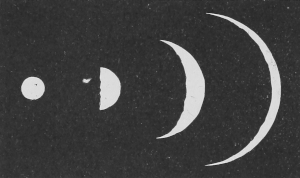
The planet Mercury is, like the earth and the moon,
a globe of dark matter which only shines and is visible
by the illumination of the solar light. Its motion
round the central star, which brings it sometimes between
the sun and us, sometimes in an oblique direction,
sometimes at right angles, and shows us a part
incessantly variable, of its illuminated hemisphere,
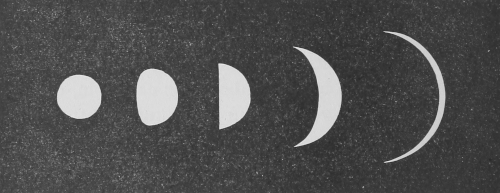
produces in its aspect, as seen in a telescope, a succession
of phases similar to those which the moon
presents to us. The cut represent the apparent variations
of size and the succession of phases, visible in
the evening after sunset; when the planet attains its
most slender crescent, it is in the region of its orbit
nearest to the earth, and passes between the sun and
us; then, some weeks afterwards, it emerges from the
solar rays and passes again through the same series
of phases in inverse order, as we see them by reversing
the figure.
PHASES OF MERCURY BEFORE INFERIOR CONJUNCTION—EVENING
STAR.
Venus, the second inferior planet, is nearly the same
size as our earth. Seen from the earth, she is one of
the most brilliant and beautiful of all the planets.
Her speed is three miles a second faster than ours,
and her distance from the sun is about two-thirds that
of our own; so that the orbit of Venus lies half-way
between the orbit of Mercury and the orbit
of the earth. The day of Venus is about half an
hour shorter than ours. Her year is nearly two hundred
and twenty-five days, or seven and a half of our
months. One or two astronomers have fancied that
they caught glimpses of a moon near Venus; but this
is still quite doubtful, and indeed it is believed to have
been a mistake.
Venus and Mercury are only visible as morning
and evening planets. Venus, being farther from the
sun, does not go before and follow after him quite so
closely as Mercury, and she is therefore the longer
within sight.
When Venus, traveling on her orbit, comes just
between the sun and us, her dark side is turned towards
the earth, and we can catch no glimpse of her.
When she reaches that part of her orbit which is
farthest from us, quite on the other side of the sun,
her great distance from us makes her light seem less.
But about half-way round on either side, she shows
exceeding brilliancy, and that is the best view we can
get of her.
Seen through a telescope, Venus undergoes phases
like those of Mercury, or of our moon. That is to
say, we really have “new Venus,” “quarter Venus,”
“half Venus,” “full Venus,” and so on.
Of all the luminaries in the heavens, the sun and
moon excepted, the planet Venus is the most conspicuous
and splendid. She appears like a brilliant lamp
amid the lesser orbs of night, and alternately anticipates
the morning dawn, and ushers in the evening
twilight. When she is to the westward of the sun, in
winter, she cheers our mornings with her vivid light,
and is a prelude to the near approach of the break of
day and the rising sun. When she is eastward of that
luminary, her light bursts upon us after sunset, before
any of the other radiant orbs of heaven make their
appearance; and she discharges, in some measure, the
functions of the absent moon. The brilliancy of this
planet has been noticed in all ages, and has been frequently
the subject of description and admiration both
by shepherds and by poets. The Greek poets distinguished
it by the name of Phosphor, “light-bringer,”
when it rose before the sun, and Hesperus, “the west,”
when it appeared in the evening after the sun retired.
It is now generally distinguished by the name of the
Morning and Evening Star.
Next to the orbit of Venus comes the orbit of our
own Earth, the third planet of the first group.
Mars, the fourth of the inner quartet, but the first
of the superior planets, is a good deal smaller than
Venus or the earth. The name Mars, from the heathen
god of war, was given on account of his fiery reddish
color. Mars is better placed than Venus for being
observed from earth. When he is at the nearest point
of his orbit to us, we see him full in the blaze of sunlight;
whereas Venus, at her nearest point, turns her
bright face away.
The length of the day of Mars—or, in other words,
the time he takes to turn upon his axis—is only forty
minutes longer than that of earth. Mars’ journey
round the sun is completed in the course of six hundred
and eighty-seven days, not much less than two
of our years. His distance from the sun is about one
hundred and forty millions of miles, and his speed is
fourteen miles a second. We shall find, with the increasing
distance of each planet, that the slower pace
balances the lessened amount of the sun’s attraction.
Passing on from Mars, the last of the first group of
planets, we reach the belt of Asteroids, sometimes
called Planetoids, Minor Planets, or Telescopic Planets.
They are so tiny that Mercury is a giant compared
with the largest among them.
The zone of space containing all these little planets
is more than a hundred millions of miles broad. Their
orbits do not lie flat in almost the same plane, but
slant about variously in a very entangled fashion. If
a neat model were made of this zone, with a slender
piece of wire to represent each orbit, it would be
found impossible to lift up one wire without pulling
up all the rest with it. Those asteroids lying nearest
to the sun take about three of our years to travel
round him, and those lying farthest take about six of
our years.
New members of the group are very often found.
The number of asteroids now known amounts to
about three hundred and twenty. Ceres is estimated
by Professor Barnard, of the Yerkes Observatory, Chicago
University, to be six hundred miles in diameter.
Vesta is about two hundred and fifty miles in diameter.
Meta, on the other hand, is less than seventy-five
miles. There are some smaller ones that do not
measure twenty miles in diameter, and it is probable
that there are many which are so small as to be absolutely
invisible to the best telescopes, and which
measure only a few hundred rods in diameter. Twenty
thousand Vestas would be needed to make one globe
equal to our earth in size.
Are they worlds? Why not? Is not a drop of
water, shown in the microscope, peopled with a multitude
of various beings? Does not a stone in a
meadow hide a world of swarming insects? Is not
the leaf of a plant a world for the species which inhabit
and prey upon it? Doubtless among the multitude
of small planets there are those which must
remain desert and sterile, because the conditions of
life (of any kind) are not found united. But we can
not doubt that on the majority the ever-active forces
of nature have produced, as in our world, creations
appropriate to these minute planets. Let us repeat,
moreover, that for nature there is neither great nor
little. And there is no necessity to flatter ourselves
with a supreme disdain for these little worlds; for in
reality the inhabitants of Jupiter would have more
right to despise us than we have to despise Vesta,
Ceres, Pallas, or Juno. The disparity is greater between
Jupiter and the earth than between the earth
and these planets. A world of two, three, or four
hundred miles in diameter is still a continent worthy
to satisfy the ambition of a Xerxes or a Tamerlane.
CHAPTER V.
THE LEADING MEMBERS OF OUR FAMILY—SECOND
GROUP.
Leaving behind us the busy zone of planetoids,
hurrying round and round the sun in company, we
cross a wide gap, and come upon a very different
sight.
The distance from the sun which we have now
reached is little less than four hundred and fifty millions
of miles, or about five times as much as the
earth’s distance; and the sun in the heavens shows a
diameter only one-fifth of that which we are accustomed
to see. Slowly—yet not slowly—floating onwards
through space, in his far-off orbit, we find the
magnificent planet Jupiter.
Is eight miles each second slow progress? Compared
with the wild whirl of little Mercury, or even
compared with the rate of our own earth’s advance,
we may count it so; but certainly not, compared with
our notions of speed upon earth. Eight miles each
second is five hundred times as fast as the swiftest express-train
ever made by man. No mean pace that
for so enormous a body. For Jupiter is the very
largest of all the members of the Solar System except
the sun himself—quite the eldest brother of the family.
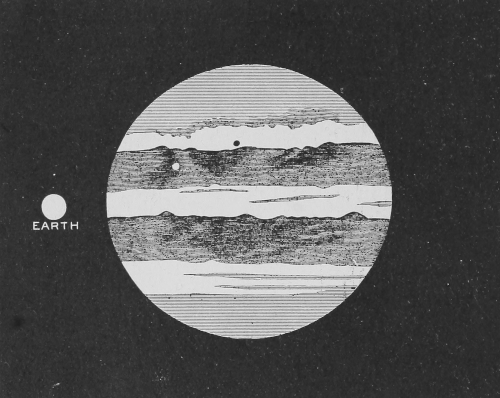
His diameter is about eighty-five thousand miles,
his axis being nearly eleven times as long as that of
earth. Though in proportion to his great bulk not
nearly so heavy as our earth, yet his bulk is so vast
that more than twelve hundred earths would be needed
to make one Jupiter.
It must not, however, be forgotten that there is a
certain amount of uncertainty about these measurements
of Jupiter. He seems to be so covered with a
dense atmosphere and heavy clouds that it is quite
impossible for us to learn the exact size of the solid
body within.
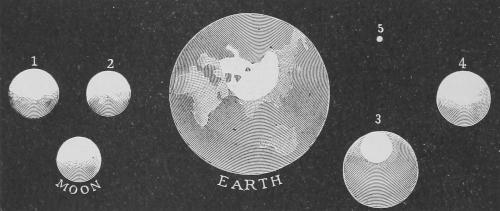
Jupiter does not travel alone. Borne onwards with
him, and circling steadily around him, are five moons;
the smallest with a probable diameter of about one hundred
miles; one about the same size as our own moon,
and the others all larger. The nearest of the five,
though distant from the center of the planet over one
hundred and twelve thousand miles, revolves about
him in twelve hours; the second, though farther from
Jupiter than our moon from the earth, speeds round
him in less than two of our days. The most distant,
though over a million miles away, takes scarcely seventeen
days to accomplish its long journey. Jupiter and
his moons make a little system by themselves—a
family circle within a family circle.
Like the smaller planets, Jupiter spins upon his
axis; and he does this so rapidly that, notwithstanding
his great size, his day lasts only ten hours, instead of
twenty-four hours like ours. But if Jupiter’s day is
short, his year is not. Nearly twelve of our years pass
by before Jupiter has traveled once completely round
the sun. So a native of earth who had just reached
his thirty-seventh year, would, on Jupiter, be only
three years old.
Passing onward from Jupiter, ever farther and
farther from the sun, we leave behind us another vast
and empty space—empty as we count emptiness,
though it may be that there is in reality no such thing
as emptiness throughout the length and breadth of
the universe. The width of the gap which divides
the pathway of Jupiter from the pathway of his giant
brother-planet Saturn is nearly five times as much as
the width of the gap separating the earth from the
sun. The distance of Saturn from the sun is not
much less than double the distance of Jupiter.
With this great space in our rear, we come upon
another large and radiant planet, the center, like Jupiter,
of another little system; though it can only be
called “little” in comparison with the much greater
Solar System of which it forms a part.
Saturn’s diameter is less than that of Jupiter, but
the two come near enough to be naturally ranked together.
Nearly seven hundred earths would be needed
to make one globe as large as Saturn. But here again
the dense and cloudy envelope makes us very uncertain
about the planet’s actual size. Saturn is like Jupiter
in being made of lighter materials than our earth;
and also in his rapid whirl upon his axis, the length
of his “day” being only ten and a half of our hours.
From Jupiter’s speed of eight miles each second,
we come down in the case of Saturn to only five miles
each second. And Jupiter’s long annual journey looks
almost short, seen beside Saturn’s long journey of
thirty earthly years. A man aged sixty, according to
our fashion of reckoning time, would on Saturn have
just kept his second birthday.
The system or family of Saturn is yet more wonderful
than that of Jupiter. Not five only but eight
moons travel ceaselessly round Saturn, each in its own
orbit; and in addition to the eight moons, he has
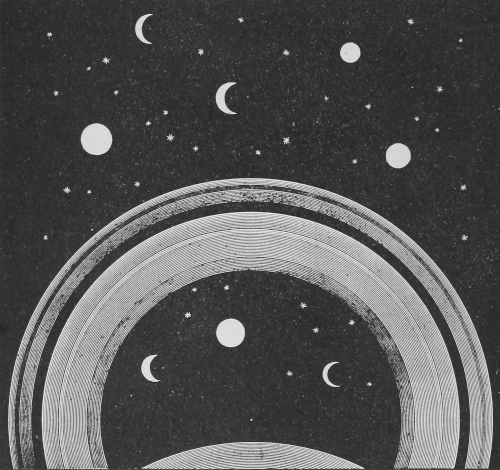
revolving round him three magnificent rings. These
rings, as well as the moons, shine, not by their own
brilliancy, for they have none, but by borrowed sunlight.
The farthest of the moons wanders in his
lonely pathway about two millions of miles away from
Saturn. The largest of them is believed to be about
the same size as the planet Mars. Of the three rings
circling round Saturn, almost exactly over his equator,
the inside one is dusky, purplish, and transparent; the
one outside or over that is very brilliant; and the
third, outside the second, is rather grayish in hue.
Another vast gap—more enormous than the last.
It is a wearisome journey. From the orbit of Jupiter
to the orbit of Saturn at their nearest points, was five
times as much as from the sun to the earth. But from
the orbit of Saturn to the orbit of Uranus, the next
member of the sun’s family, we have double even that
great space to cross.
Still, obedient to the pulling of the sun’s attractive
power, Uranus wanders onward in his wide pathway
round the sun, at the rate of four miles a second.
Eighty-four of our years make one year of Uranus.
This planet has four moons, and thus forms a third
smaller system within the Solar System; but he may
have other satellites also, as yet undiscovered. In size
he is seventy-four times as large as our earth.
One more mighty chasm of nine hundred millions
of miles, for the same distance which separates the
pathway of Saturn from the pathway of Uranus, separates
also the pathway of Uranus from the pathway
of Neptune. Cold, and dark, and dreary indeed seems
to us the orbit on which this banished member of our
family circle creeps round the sun, in the course of one
hundred and sixty-five years, at the sluggish rate of
three miles a second.
On the planet Saturn, the quantity of light and
heat received from the sun is not much more than a
hundredth part of that which we are accustomed to
receive on earth. But by the time we reach Neptune,
the great sun has faded and shrunk in the distance
until to our eyes he looks only like an exceedingly
brilliant and dazzling star.
We know little of this far-off brother, Neptune,
except that he is rather larger than Uranus, being one
hundred and five times as big as the earth; that he has
at least one moon; and also that, like Uranus, he is
made of materials lighter than those of earth, but
heavier than those of Jupiter or Saturn.
After all, it is no easy matter to gain clear ideas as
to sizes and distances from mere statements of “so
many miles in diameter,” and “so many millions of
miles away.” A “million miles” carries to the mind
a very dim notion of the actual reality.
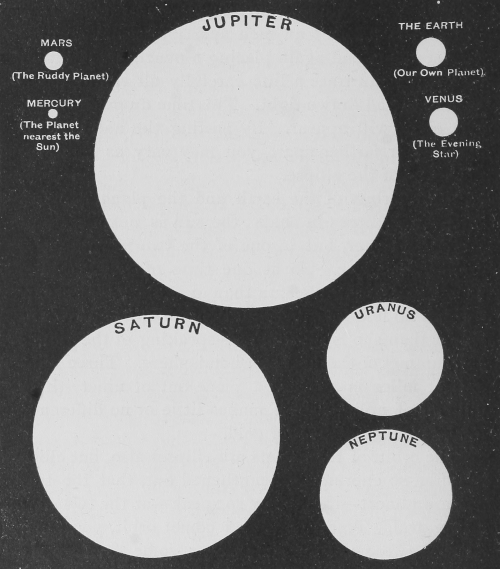
Now if we can in imagination bring down all the
members of the Solar System to a small size, keeping
always the same proportions, we may find it a help.
“Keeping the same proportions” means that all must
be lessened alike, all must be altered in the same
degree. Whatever the supposed size of the earth may
be, Venus must be still about the same size as the
earth, Saturn seven hundred times as large, and so on.
Also, whatever the distance of the earth from the sun,
in miles, or yards, or inches, Mercury must still be one-third
as far, Jupiter still five times as far, and thus
with the rest.
First, as to size alone. Suppose the earth is represented
by a small globe, exactly three inches in diameter.
It will be a very small globe. Not only men
and houses, but mountains, valleys, seas, will all have
to be reduced to so minute a size, as to be quite invisible
to the naked eye.
Fairly to picture the other members of the Solar
System, in due proportion, you will have them as
follows:
Mercury and Mars will be balls smaller than the
earth, and Venus nearly the same size of the earth.
Uranus and Neptune will be each somewhere about a
foot in diameter. Saturn will be twenty-eight inches
and Jupiter thirty-two inches in diameter. The sun
will be a huge dazzling globe, twenty-six feet in diameter.
No wonder he weighs seven hundred and
fifty times as much as all his planets put together.
Next let us picture the system more exactly on
another and smaller scale. First, think of the sun as
a brilliant globe, about nine feet, or three yards, in
diameter, floating in space.
About one hundred yards from the sun travels a
tiny ball, not half an inch in diameter, passing slowly
round the sun—slowly, because as sizes and distances
are lessened, speed must in due proportion be lessened
also. This is Mercury. About two hundred yards
from the sun travels another tiny ball, one inch in diameter.
This is Venus. Nearly a quarter of a mile
from the sun travels a third tiny ball, one inch again
in diameter; and at a distance of two feet and a half
from it a still smaller ball, one quarter of an inch in
diameter, journeys round it and with it. These are
the earth and the moon. About half as far again as
the last-named ball, travels another, over half an inch
in diameter. This is Mars.
Then comes a wide blank space, followed by a large
number of minute objects, no bigger than grains of
powder, floating round the sun in company. These
are the Asteroids. Another wide blank space succeeds
the outermost of them.
About one mile distant from the sun journeys a
globe, ten inches in diameter. Round him, as he
journeys, there travel five smaller balls, the largest of
which is about the third of an inch in diameter. Their
distances from the bigger globe vary from one and a
third to twelve and a half feet. These are Jupiter and
his moons.
Nearly two miles distant from the sun journeys
another globe, about eight and a half inches in diameter.
Eight tiny balls and three delicate rings circle
round him as he moves. These are Saturn and his
belongings. About four miles distant from the sun
journeys another globe, four inches in diameter, with
four tiny balls accompanying him—Uranus and his
moons. Lastly, at a distance of six miles from the
sun, one more globe, not much larger than the last,
with one tiny companion, pursues his far-off pathway.
These proportions as to size and distance will serve
to give a clear idea of the Solar System.
CHAPTER VI.
THE MOON.
Come, and let us pay a visit to the moon. We
seem to feel a personal interest in her, just because
she is, in so peculiar a sense, our own friend and close
attendant. The sun shines for us; but, then, he shines
for all the members of the Solar System. And the
stars—so many as we can see of them—shine for us
too; but no doubt they shine far more brilliantly for
other and nearer worlds. The moon alone seems to
belong especially to ourselves.
Indeed, we are quite in the habit of speaking about
her as “our moon.” Rather a cold and calm friend,
some may think her, sailing always serenely past,
whatever may be going on beneath her beams; yet
she has certainly proved herself constant and faithful
in her attachment.
We have not very far to travel before reaching her,—merely
about two hundred and forty thousand miles.
That is nothing, compared with the weary millions of
miles which we have had to cross to visit some members
of our family. A rope two hundred and forty
thousand miles long would fold nearly ten times round
the earth at the equator. You know the earth’s diameter—about
eight thousand miles. If you had
thirty poles, each eight thousand miles long, and
could fasten them all together, end to end, one beyond
another, you would have a rod long enough to reach
from the earth to the moon.
Let us take a good look at her before starting. She
is very beautiful. That soft silvery light, so unlike
sunlight or gaslight, or any other kind of light seen
upon earth, has made her the darling of poets and
the delight of all who love nature. Little children
like to watch her curious markings, and to make out
the old man with his bundle of sticks, or the eyes,
nose, and mouth of the moon—not dreaming what
those markings really are. And in moods of sadness,
how the pure calm moonlight seems to soothe the
feelings! Who would suppose that the moon’s beauty
is the beauty rather of death than of life?
APPEARANCE OF THE FULL MOON.
The stars have not much chance of shining through
her bright rays. It is well for astronomers that she is
not always at the full. But when she is, how large
she looks—quite as large as the sun, though in reality
her size, compared with his, is only as a very small
pin’s head compared with a school globe two feet in
diameter. Her diameter is little more than two thousand
miles, or one quarter that of our earth; and her
whole surface, spread out flat, would scarcely equal
North and South America, without any of the surrounding
islands.
The reason she looks the same size as the sun, is
that she is so very much nearer. The sun’s distance
from us is more than one-third as many millions of
miles as the moon’s distance is thousands of miles.
This makes an enormous difference.
We call our friend a “moon,” and say that she
journeys round the earth, while the earth journeys
round the sun. This is true, but it is only part of the
truth. Just as certainly as the earth travels round
the sun, so the moon also travels round the sun. And
just as surely as the earth is a planet, so the moon also
is a planet. It is a common mode of expression to
talk about “the earth and her satellite.” A no less
correct, if not more correct, way would be to talk of
ourselves as “a pair of planets,” journeying round the
same sun, each pulled strongly towards him, and each
pulling the other with a greater or less attraction, according
to her size and weight. For the sun actually
does draw the moon with more force than that with
which the earth draws her. Only as he draws the
earth with the same sort of force, and nearly in the
same degree, he does not pull them apart.
The moon, like the other planets, turns upon her
axis. She does this very slowly, however; and most
singularly she takes exactly the same time to turn
once upon her axis that she does to travel once round
the earth. The result of this is, that we only see one
face of the moon. If she turned upon her axis,
and journeyed round the earth in two different lengths
of time, or if she journeyed round us and did not turn
upon her axis at all, we should have views of her on
all sides, as of other planets. But as her two movements
so curiously agree, it happens that we always
have one side of the moon towards us, and never catch
a glimpse of the other side.
And now we are ready to start on our journey of
two hundred and forty thousand miles. An express
train, moving ceaselessly onward night and day, at the
rate of sixty miles an hour, would take us there in
about five months and a half. But no line of rails has
ever yet been laid from the earth to the moon, and no
“Flying Dutchman” has ever yet plied its way to and
fro on that path through the heavens. Not on the
wings of steam, but on the wings of imagination, we
must rise aloft. Come—it will not take us long. We
shall pass no planets or stars on the road, for the moon
lies nearer to us than any other of the larger heavenly
bodies.
Far, far behind us lies the earth, and beneath our
feet, as we descend, stretch the broad tracts of moonland.
For “downward” now means towards the
moon, and away from the distant earth.
What a strange place we have reached! The weird,
ghastly stillness of all around, and the glaring, dazzling,
cloudless heat, strike us first and most forcibly.
Nothing like this heat have we ever felt on earth. For
the close of the moon’s long day—on this side of its
globe—is approaching, and during a whole fortnight
past the sun’s fierce rays have been beating down on
these shelterless plains. Talk of sweltering tropics on
earth! What do you call this heat? Look at the
thermometer: how the quicksilver is rising! Well, that
is not a common thermometer which we have brought
with us. The mercury has stopped—three hundred
degrees above boiling water!
Not a cloud to be seen overhead; only a sky of inky
blackness, with a blazing sun, and thousands of brilliant
stars, and the dark body of our own earth, large
and motionless, and rimmed with light. Seen from
earth, sun and moon look much the same size; but
seen from the moon, the earth looks thirteen times as
large as our full moon. Not even a little mistiness in
the air to soften this fearful glare! Air! why, there
is no air; at least not enough for any human being to
breathe or feel. If there were air, the sky would be
blue, not black, and the stars would be invisible in
the daytime. It looks strange to see them now shining
beside the sun.
And then, this deadly stillness! Not a sound, not
a voice, not a murmur of breeze or water. How could
there be? Sound can not be carried without air, and
of air there is none. As for breeze—wind is moving
air, and where we have no air we can have no wind.
As for water—if there ever was any water on the
moon, it has entirely disappeared. We shall walk to
and fro vainly in search of it now. No rivers, no rills,
no torrents in those stern mountain ramparts rising on
every side. All is craggy, motionless, desolate.
How very, very slowly the sun creeps over the black
sky! And no marvel, since a fortnight of earth-time
is here but one day, answering to twelve hours upon
earth. Can not we find shelter somewhere from this
blazing heat? Yonder tall rock will do, casting a sharp
shadow of intense blackness. We never saw such
shadows upon earth. There the atmosphere so breaks
and bends and scatters about the light, that outlines
of shadows are soft and hazy, even the clearest and
darkest of them, compared with this.
When will the sun go down? But he is well worth
looking at meanwhile. How magnificent he appears,
with his pure radiant photosphere, fringed by a sierra
of dazzling pink and white, orange and gold, purple
and blue. For here no atmosphere lies between to
blend all into yellow-white brightness. And how
plainly stand out those prominences or tongues of
tinted flame, not merely rose-colored, as seen from
earth, but matching the sierra in varying hues; while
beyond spreads a gorgeous belt of pink and green,
bounded by lines and streams of delicate white light,
reaching far and dying slowly out against the jet background.
The black spots on the face of the sun are
very distinct, and so also are the brilliant faculæ.
We must take a look around us now at moonland,
and not only sit gazing at the sun, though such a sky
may well enchain attention. How unlike our earthly
landscapes! No sea, no rivers, no lakes, no streams,
no brooks, no trees, bushes, plants, grass, or flowers;
no wind or breeze; no cloud or mist or thought of possible
rain; no sound of bird or insect, of rustling
leaves or trickling water. Nothing but burning, steadfast,
changeless glare, contrasting with inky shadows;
sun and earth and stars in a black heaven above;
silent, desolate mountains and plains below.
For though we stand here upon a rough plain, this
moon is a mountainous world. Ranges of rugged
hills stretch away in the distance, with valleys lying
between—not soft, green, sloping, earthly valleys, but
steep gorges and precipitous hollows, all white dazzle
and deep shade.
But the mountains do not commonly lie in long
ranges, as on earth. The surface of the moon seems
to be dented with strange round pits, or craters, of
every imaginable size. We had a bird’s-eye view of
them as we descended at the end of our long journey
moonward. In many parts the ground appears to be
quite honeycombed with them. Here are small ones
near at hand, and larger ones in the distance. The
smaller craters are surrounded by steep ramparts of
rock, the larger ones by circular mountain-ranges. We
have nothing quite like them on earth.
Are they volcanoes? So it would seem; only no
life, no fire, no action, remain now. All is dead,
motionless, still. Is this verily a blasted world? Has
it fallen under the breath of Almighty wrath, coming
out scorched and seared? Is it simply passing
through a certain burnt-out, chilled phase of existence,
through which other planets also pass, or will pass, at
some stage of their career? Who can tell?
We will move onward, and look more closely at
that towering mass of rugged rocks, beyond which the
sun will by and by go down. Long jetty shadows lie
from them in this direction. No wonder astronomers
on earth can through their telescopes plainly see these
black shadows contrasting with the glaring brightness
on the other side.
A “mass of rocks” I have said; but as, with our
powers of rapid movement, we draw near, we find a
range of craggy mountains sweeping round in a vast
circle. Such a height in Switzerland would demand
many hours of hard climbing. But on this small
globe attraction
is a very different
matter from
what it is on
earth; our weight
is so lessened
that we can leap
the height of a
tall house without
the smallest
difficulty. No
chamois ever
sprang from
peak to peak in
his native Switzerland with such amazing lightness as
that with which we now ascend these mighty rocks.
ONE FORM OF LUNAR CRATER.
Ha! what a depth on the other side! We stand
looking down into one of the monster craters of the
moon. A sheer descent of at least eleven thousand
feet would land us at the bottom. Why, Mont Blanc
itself is only about fifteen thousand feet in height.
And what a crater! Fifty-six miles across in a straight
line, from here to the other side, with these lofty
rugged battlements circling round, while from the
center of the rough plain below a sharp, cone-shaped
mountain rises to about a quarter of the height of the
surrounding range.
It is a grand sight; peak piled upon peak, crag upon
crag, sharp rifts or valleys breaking here and there the
line of the narrow, uplifted ledge; all wrapped in silent
and desolate calm. There are many such craters as
this on the moon, and some much larger.
The sun slowly nears his setting, and sinks behind
the opposite range. How we shiver! The last ray of
sunlight has gone and already the ground is pouring
out its heat into space, unchecked by the presence of
air or clouds. The change takes place with marvelous
quickness. A deadly chill creeps over all around. A
whole fortnight of earth-time must pass before the
sun’s rays will again touch this spot. Verily the contrasts
of climate in the moon, during the twelve long
days and nights which make up her year, are startling
to human notions.
But though the sun is gone we are not in darkness.
The stars shine with dazzling brightness, and the huge
body of the earth, always seeming to hang motionless
at one fixed point in the sky, gives brilliant light,
though at present only half her face is lit up and half
is in shadow. Still her shape is plainly to be seen,
for she has ever round her a ring of light, caused by
the gathered shining of stars as they pass behind her
thick atmosphere. She covers a space on the sky
more than a dozen times as large as that covered by
the full moon in our sky.
THE EARTH AS SEEN FROM THE MOON.
It would be worth while to stay here and watch the
half-earth grow into magnificent full-earth. But the
cold is becoming fearful—too intense for even the
imagination to endure longer. What must be the state
of things on the other side of the moon, where there
is no bright earth-light to take the place of the sun’s
shining, during the long two weeks’ night of awful
chill and darkness?
It seems probable that a building on the moon
would remain for century after century just as it was
left by the builders. There need be no glass in the
windows, for there is no wind and no rain to keep
out. There need not be fireplaces in the rooms, for
fuel can not burn without air. Dwellers in a city in
the moon would find that no dust can rise, no odors
be perceived, no sounds be heard. Man is a creature
adapted for life in circumstances which are very narrowly
limited. A few degrees of temperature, more
or less; a slight variation in the composition of air,
the precise suitability of food, make all the difference
between health and sickness, between life and death.
Looking beyond the moon, into the length and breadth
of the universe, we find countless celestial globes, with
every conceivable variety of temperature and of constitution.
Amid this vast number of worlds with
which space teems, are there any inhabited by living
beings? To this great question science can make no
response save this: We can not tell.
Time for us to wend our way homewards from this
desolate hundred-fold arctic scene. We have more to
learn by and by about our friend and companion.
For the present—enough.
CHAPTER VII.
VISITORS.
We come next to the very largest members of our
Solar System.
From time to time in past days—and days not
very long past either—people were startled by the
sight of a long-tailed star, moving quickly across the
sky, called a comet. We see such long-tailed stars
still, now and then; but their appearance no longer
startles us.
It is hardly surprising, however, that fears were
once felt. The great size and brilliancy of some of
these comets naturally caused large ideas to be held
as to their weight, and the general uncertainty about
their movements naturally added to the mysterious
notions afloat with respect to their power of doing
harm.
A collision between the earth and a comet seemed
no unlikely event; and if it happened—what then?
Why, then, of course, the earth would be overpowered,
crushed, burnt up, destroyed. So convinced were
many on this point that the sight of a comet and the
dread of the coming “end of the world” were fast
bound together in their minds.
Even when astronomers began to understand the
paths of some of the comets, and to foretell their return
at certain dates, the old fear was not quickly laid
to rest. So late as the beginning of the present century,
astronomers having told of an approaching
comet, other people added the tidings of an approaching
collision. “If a collision, then the end of the
world,” was the cry; and one worthy family, living
and keeping a shop in a well-known town on the
south coast of England, packed up and fled to America—doubtless
under full belief that the destruction
of the Old World would not include the destruction
of the New.
The nature of these singular bodies is somewhat
better known in the present day; yet even now, among
all the members of the Solar System, they are perhaps
the ones about which we have most to learn. The
nucleus, or bright and star-like spot, which, with the
surrounding coma or “hair,” we sometimes call the
“head” of the comet, is the densest and heaviest part
of the whole. The comets are of immense size, sometimes
actually filling more space than the sun himself,
and their tails stream often for millions of miles
behind them; nevertheless, they appear to be among
the lightest of the members of the Solar System.
This excessive lightness greatly lessens the comet’s
power of harm-doing. In the rebound from all the
old exaggerated fears, men laughed at the notion of
so light and delicate a substance working any injury
whatever, and even declared that a collision might
take place without people on earth being aware of
the fact. It is now felt that we really know too little
about the nature of the said substance to be able to
say what might or might not be the result of a collision.
A certain amount of injury to the surface of
the earth might possibly take place. But of the
“end of the world,” as likely to be brought about
by any comet in existence, we may safely banish
all idea.
The word “comet” means “a hairy body,” the
name having been given from the hairy appearance
of the light around the nucleus. About seventeen
hundred different comets have been seen at different
times by men—some large, some small; some visible
to the naked eye, but most of them only visible through
telescopes. These hundreds are, there is no doubt, but
a very small number out of the myriads ranging through
the heavens.
If you were seated in a little boat in mid-ocean,
counting the number of fishes which in one hour
passed near enough in the clear water for your sight
to reach them, you might fairly conclude, even if you
did not know the fact, that for every single fish which
you could see, there were tens of thousands which you
could not see.
Reasoning thus about the comets, as we watch
them from our earth-boat in the ocean of space, we
feel little doubt that for each one which we can see,
millions pass to and fro beyond reach of our vision.
Indeed, so long ago as the days of Kepler, that great
astronomer gave it as his belief that the comets in
the Solar System, large and small, were as plentiful
as the fishes in the sea. And all that modern astronomers
can discover only tends to strengthen this
view.
Why should the comets be called “visitors?” I
call them so simply because many of them are visitors.
Some, it is true, belong to the Solar System. But
even in their case, strong doubts are felt whether they
were not once visitors from a distance, caught in the
first instance by the attraction of one of the larger
planets, and retained thenceforward, for a time at least,
by the strong attraction of the sun.
PASSAGE OF THE EARTH AND THE MOON THROUGH THE TAIL OF A
COMET.
Every comet, like every planet, has his own orbit
or pathway in the heavens, though the kind of orbit
varies with different comets. There are, first, those
comets which travel round and round the sun in
“closed orbits”—that is, in a ring with joined ends.
Only the ring is always oval, not round. There are,
secondly, those which travel in an orbit which may be
closed; but if so, the oval is so long and narrow, and
the farther closed end is at so great a distance, that
we can not speak certainly. There are, thirdly, those
which decidedly are mere visitors. They come from
the far-off star-depths, flash once with their brilliant
trains of light through our busy Solar System, causing
some little excitement by the way, and go off in another
direction, never to return.
Only a small part of the orbits of these comets can
be seen from earth; but by careful attention astronomers
learn something of the shape of the curve in
which they travel. It is in that way possible to calculate,
sometimes certainly, and sometimes uncertainly,
whether a comet may be expected to return, or
whether we have seen him for the first and the last
time. By looking at part of a curve, the rest of
which is hidden from us, we are able to judge
whether that part belongs to a circle or an oval, or
whether the two ends pass away in different directions,
and do not join.
The comets, whether members of our family circle
or visitors from a distance, are altogether very perplexing.
They are often extremely large, yet they are always
extremely light. They reflect the sun’s brightness
like a planet, yet in some measure they seem to
shine by their own light, like a star. They obey the
attraction of the sun, yet he appears to have a singular
power of driving the comets’ tails away from
himself.
For, however rapidly the comet may be rushing
round the sun, and however long the tail may be, it is
almost always found to stream in an opposite direction
from the sun. An exception to this rule was seen in
the case of a certain comet with two tails, one of
which did actually point towards the sun; but the inner
tail may have been only a “jet” of unusual length,
like in kind to the smaller jets often thus poured out
from the nucleus.
Very curious changes take place in comets as they
journey, especially as they come near the sun. One
was seen in the course of a few days to lose all his
hair, and also his tail. Another was seen to break
into two pieces, both of which pieces at last disappeared.
Sometimes the one tail divides into two tails.
Traveling, as the comets do, from intense cold into
burning heat, they are very much affected by the violent
change of climate. For the paths of the comets
are such long ovals, or ellipses, that, while they approach
the sun very closely in one part of their “year,”
they travel to enormous distances in the other part.
“Halley’s Comet,” which takes seventy-six of our
years to journey round the sun, comes nearer to him
than Venus, and goes farther away from him than
Neptune. As this comet draws gradually closer, he
has to make up for the added pull of the sun’s increasing
attraction by rushing onward with greater
and greater rapidity, till he whirls madly past the sun,
and then, with slowly slackening speed, journeys farther
and farther away, creeps at length lazily round
the farther end of his orbit in the chill, dark, neighborhood
of Neptune, and once more travels towards
the sun with growing haste.
“Encke’s Comet” has a year of only three and a
half of our years, so he may be said to live quite in
our midst. But many comets travel much farther
away than the one named after Halley. It is calculated
of some that, if they ever return at all, it can not
be for many hundreds of years.
PASSAGE OF THE COMET OF 1843 CLOSE TO THE SUN (FEBRUARY
27TH, 10 HOURS, 29 MINUTES.)
“Newton’s Comet,” seen about two centuries ago,
has a journey to perform of such length that he is
not expected again to appear for several thousand
years. Yet, at the nearest point in his orbit, he approached
the sun so closely, that the heat which he
endured was about two thousand times that of red-hot
iron. Changes were seen to be taking place in
his shape, as he drew near to the sun, and disappeared.
Four days he was hidden in the sun’s rays. He vanished,
with a tail streaming millions of miles behind
him. He made his appearance again with a tail
streaming millions of miles in front of him. But how
this wonderful movement took place is beyond man’s
power to explain.
The comet of 1843 was one of the most attractive
seen during the present century. It was first observed
in March, and it appeared with a suddenness which had
quite a startling effect. It was an imposing object in
the southern regions. The comet was seen in Italy
on the 28th of February; at Washington, on the 6th
of March; at Oporto, on the 14th; but owing to unfavorable
weather, it was not visible in England, or any
of the northern countries of Europe, previous to the
17th. A little after sunset on that day the tail was
observed in the western sky, but the head had already
sunk below the horizon. The whole of the comet appeared
on the following evenings for a short time, for
it was traveling away from the sun with great velocity,
having doubled the solar orb before it became
visible; and about the beginning of April it finally
disappeared.
The appearance of this startling stranger, as observed
at Washington, is thus described by Lieutenant
Maury, of the Hydrographical Office in that city:
“On Monday morning, March 6th, our attention was
called to a paragraph in the newspapers, stating that
a comet was visible near the sun at midday with the
naked eye. The sky was clear; but not being able to
discover any thing with the unassisted eye, recourse
was had to the telescope, but with no better success.
About sunset in the evening, the examination was renewed
with great diligence, but to no purpose. The
last faint streak of day gilded the west; beautiful
and delicate fleeces of cloud curtained the bed of
the sun; the upper sky was studded with stars,
and all hopes of seeing the comet that evening had
vanished. Soon after we had retired, the officer of
the watch announced its appearance in the west. The
phenomenon was sublime and beautiful. The needle
was greatly agitated, and a strongly marked pencil of
light was streaming up from the path of the sun in
an oblique direction to the southward and eastward;
its edges were parallel. It was 30° long. Stars
could be seen twinkling through it, and no doubt
was at first entertained that this was the tail of the
comet.”
The tail, as seen in northerly countries, spread over
an arc of the heavens of about 40°; but in southern
latitudes it extended to from 60° to 70°. It had an absolute
length of two hundred millions of miles; so
that, had it been coiled around the earth like a serpent,
it would have girdled it eight thousand times at the
equator. This comet approached still nearer the sun
than that of Newton, and must therefore have been
exposed to a heat of greater intensity. Its center is
computed to have been within a hundred thousand
miles of the solar surface; and according to Sir John
Herschel’s calculations, it was then exposed to a heat
equal to that which would be received by an equal
portion of the earth’s surface, if it were subject to the
influence of forty-seven thousand suns, placed at the
common distance of the actual sun. It is difficult to
conceive how a flimsy substance in such circumstances
could escape being entirely dissipated. But such was
its velocity that it wheeled round the sun in less than
two hours.
The general question of the probability and the
consequences of a collision with a comet may be legitimately
entertained. With reference to the first point,
it can not be denied that collision is possible; but, at
the same time, it is so extremely improbable that it
may be safely dismissed from apprehension. The fact
of such an event not having been experienced in the
known course of terrestrial history is surely some
guarantee against its occurrence. Another may be
found in the small volume of the earth and of comets
when compared with the immensity of space in which
they move. According to the well-understood principles
of probabilities, Arago has calculated that, upon
the appearance of a new comet, the odds are as 281,000,000
to 1, that it will not strike against our globe.
But even supposing collision to occur, all that we
know of the constitution of comets justifies the conclusion
that the encounter would involve no terrestrial
convulsion, nor any result incompatible with full security
to life and happiness.
So much for the largest members of our circle—largest,
though lightest; members some, visitors others.
Now we turn to the smallest.
CHAPTER VIII.
LITTLE SERVANTS.
If you walk out any night after dark, and watch
the bright stars shining in a clear sky—shining as
they have done for ages past—you will probably see,
now and then, a bright point of light suddenly appear,
dart along a little distance, and as suddenly vanish.
That which you have seen was not the beginning of
a story, but in ninety-nine cases out of a hundred
it was the end of a story. The little shooting-star
was in existence long before you saw him, whirling
through space with millions of little companions. But
he has left them all, and dropped to earth. He is a
shooting-star no longer.
If such a journey to the moon as the one described
two chapters back were indeed possible, the voyage
aloft would hardly be so easily and safely performed
as is there taken for granted. Putting aside the
thought of other difficulties, such as lack of conveyance
and lack of air, there would be the danger of
passing through a very considerable storm of missiles—a
kind of “celestial cannonade”—which, to say
the least, would prove very far from agreeable.
These “starlets” and “meteor planets,” as they
have been called, are not visible in a normal condition,
because of their minuteness. But on entering our atmosphere
they are rendered luminous, owing to the
heat evolved by the sudden and violent compression
of the air in front of the moving body. According to
this view, shooting-stars, which simply dart across the
heavens, may be regarded as coming within the limits
of the atmosphere, and carried out of it again, by their
immense velocity, passing on in space. Meteoric
showers may result from an encounter with a group
of these bodies, while aërolites are those which come
so far within the sphere of the earth’s attraction as to
fall to its surface. More than two thousand years ago
the Greeks venerated a famous stone which fell from
the heavens on the river Ægos.
METEOR EMERGING FROM BEHIND A CLOUD (NOV. 23, 1877).
It will scarcely be believed what numbers of these
shooting-stars or meteorites constantly fall to the earth.
As she travels on her orbit, hurrying along at the rate
of nineteen miles each second, she meets them by
tens of thousands. They too, like the earth, are journeying
round the great center of our family. But
they are so tiny, and the earth by comparison is so
immense, that her strong attraction overpowers one
after another, drags it from its pathway, and draws it
to herself.
And then it falls, flashing like a bright star across
the sky, and the little meteorite has come to his end.
His myriads of companions, hastening still along their
heavenly track—for the meteorites seem to travel commonly
in vast flocks or companies—might, had they
sense, mourn in vain for the lost members of their
family.
Any one taking the trouble to watch carefully some
portion of the sky after dark, may expect to see each
hour about four to eight of these shooting-stars—except
in the months of August and November, when
the number is much larger. About six in an hour
does not sound a great deal. But that merely means
that there have been six in one direction, and near
enough for you to see. Somebody else, watching,
may have seen six in another direction; and somebody
else, a few miles away, may have seen six more.
It is calculated that, in the course of every twenty-four
hours, about four hundred millions of meteorites
fall to earth, including those visible only through
telescopes.
This is rather startling. What if you or I should
some day be struck by one of these solid, hard little
bodies, darting as they do towards earth with speed
swifter than that of a cannon-ball? True, they are
not really stars, neither are they really planets. But
they are, to say the least, often much larger than a
cannon-ball, and a cannon-ball can destroy life.
Four hundred millions every twenty-four hours!
Does it not seem singular that we do not see them
constantly dropping to the ground? The truth is, we
should see them, and feel them too, and dire would
be the danger to human life, but for a certain protecting
something folded round this earth of ours to
ward off the peril. That “something” is the earth’s
atmosphere. But for the thick, soft, strong, elastic
air through which the meteorites have to pass, they
would fall with fearful violence, often doing terrible
mischief. As it is, we are guarded. The shooting-star,
drawn by the earth’s attraction, drops into her
atmosphere, darting with tremendous speed. In consequence
of this speed and the resistance of the air,
it catches fire. That is when we first see it. The
meteorites are believed to appear at a height of about
seventy miles, and to disappear at a height of about
fifty miles. So that, in one instant’s flash, the shooting-star
has traveled some twenty miles toward us.
Then the light goes out. The little meteorite is burnt.
It falls to earth still; but only as fine dust, sinking
harmlessly downward.
The meteorites do not always vanish so quickly.
Now and then a larger one—too large to be rapidly
burnt—does actually reach the ground. If any man
were struck by such a stone he would undoubtedly be
killed.
When meteorites thus fall to earth they are usually
called aërolites. Some are found no bigger than a
man’s fist, while others much exceed this size. There
is one, kept carefully in the British Museum, which
weighs three tons and a half; and we hear of another,
lying in South America, between seven and eight feet
in length. Such a sky-visitant would be very unwelcome
in any of our towns.
We must remember that, whatever size an aërolite
may be when it reaches the earth, it must have been
far greater when journeying round the sun, since a
good part of it has been burnt away during its rush
downward through the earth’s atmosphere.
Meteors, or bolides, or fireballs, are of much the
same nature as meteorites; but they are larger, longer
to be seen, and slower in movement. Also, it is not
uncommon for them to burst with a loud explosion.
Early in the present century such a meteor visited
Normandy. It exploded with a noise like the roll of
musketry, scattering thousands of hot stones over a
distance of several miles. A great number of them
were collected, still smoking. The largest of these
stones weighed no less than twenty pounds. Happily
no one seems to have been injured. Other such
falls have taken place from time to time. Sometimes
bright, slowly-moving meteors have been seen, looking
as large as the moon.
A remarkable fireball appeared in England on
November 6, 1869. This fireball was extensively
seen from different parts of the island, and by combining
and comparing these observations, we obtain
accurate information as to the height of the object
and the velocity with which it traveled. It appears
that this meteor commenced to be visible at a point
ninety miles above Frome, in Somersetshire, and that
it disappeared at a point twenty-seven miles over the
sea, near St. Ives, in Cornwall. The whole length of
its course was about 170 miles, which was performed
in a period of five seconds, thus giving an average velocity
of thirty-four miles a second. A remarkable
feature in the appearance which this fireball presented
was the long, persistent streak of luminous
cloud, about fifty miles long and four miles wide,
which remained in sight for fully fifty minutes. We
have in this example an illustration of the chief features
of the phenomena of a shooting-star presented
on a very grand scale. It is, however, to be observed
that the persistent luminous streak is not a universal,
nor, indeed, a very common characteristic of a shooting-star.
If we may liken comets to the fishes of the Solar
System—and in their number, their speed, their varying
sizes, their diverse motions, they may be fairly so
likened—we may perhaps speak of the meteorites as
the animalcula of the Solar System. For, in comparison
with the planets, they are, in the matter of
size, as the animalcula of our ponds in comparison
with human beings. In point of numbers they are
countless.
Take a single drop of water from some long-stagnant
pond, and place it under a powerful microscope.
You will find it to be full of life, teeming with tiny animals,
darting briskly to and fro. The drop of water
is in itself a world of living creatures, though the
naked eye of man could never discover their existence.
So with the meteorites. There is good reason to believe
that the Solar System fairly teems with them.
We talk of “wide gaps of empty space,” between the
planets; but how do we know that there is any such
thing as empty space to be found throughout all the
sun’s domain?
Not only are the meteorites themselves countless, a
matter easily realized, but the families or systems of
meteorites appear to be countless also. They, like
the systems of Jupiter and Saturn, are each a family
within a family—a part of the Solar System, and yet
a complete system by themselves. Each circles round
the sun, and each consists of millions of tiny meteorites.
When I say “tiny,” I mean it of course only by
comparison with other heavenly bodies. Many among
them may possibly be hundreds of feet and even more
in diameter, but the greater proportion appear to be
much smaller. It is not impossible that multitudes
beyond imagination exist, so small in size that it is
impossible we should ever see them, since their
dying flash in the upper regions of our atmosphere
would be too faint to reach our sight.
The earth, traveling on her narrow orbit round the
sun, crosses the track of about one hundred of these
systems, or rings. Sometimes she merely touches the
edge of a ring, and sometimes she goes into the very
thick of a dense shower of meteorites. Twice every
year, for instance, on the 10th of August and the 11th
of November, the earth passes through such a ring,
and very many falling stars may be seen on those
nights. Numbers of little meteorites, dragged from
their orbits and entangled in the earth’s atmosphere,
like a fly caught in a spider’s web, give their dying
flash, and vanish. It used to be supposed that the
August and November meteorites belonged to one
single system; but now they are believed to be two
entirely distinct systems.
THE GREAT SHOWER OF SHOOTING-STARS, NOVEMBER 27, 1872.
The comet discovered on February 27, 1827, by
Biela, and ten days later at Marseilles by Gambart,
who recognized that it was the same as that of 1772
and 1805, returned six and a half years later, in 1832.
In fact it crossed, as we have seen, the plane of the
terrestrial orbit at the respectable distance of fifty
millions of miles from the earth; but if there was
any danger in this meeting, it was rather for it than
for us; for it was certainly strongly disturbed in its
course. It returned in 1839, but under conditions
too unfavorable to enable it to be observed—in the
month of July, in the long days, and too near the
sun. It was seen again in 1845, on November
25th, near the place assigned to it by calculation, and
its course was duly followed. Everything went on to
the general satisfaction, when—unexpected spectacle!—on
January 13, 1846, the comet split into two! What
had passed in its bosom? Why this separation? What
was the cause of such a celestial cataclysm? We do
not know; but the fact is, that instead of one comet,
two were henceforth seen, which continued to move
in space like two twin-sisters—two veritable comets,
each having its nucleus, its head, its coma, and its
tail, slowly separating from each other. On February
10th there was already a hundred and fifty thousand
miles of space between the two. They would seem,
however, to have parted with regret, and during several
days a sort of bridge was seen thrown from one
to the other. The cometary couple, departing from
the earth, soon disappeared in the infinite night.
They returned within view of the earth in the
month of September, 1852. On the 26th of this
month the twins reappeared, but much farther apart,
separated by an interval of twelve hundred and fifty
thousand miles.
But this is not the strangest peculiarity which this
curious body presented to the attention of astronomers.
The catastrophe which was observed in 1846 was only
a presage of the fate which awaited it; for now its existence
is merely imagined, the truth being that this
comet is lost. Since 1852 all attempts to find it again
have been unavailing.
To be lost is interesting, especially for a comet.
But this, doubtless, was not enough; for it reserved
for us a still more complete surprise. Its orbit intersects
the terrestrial orbit at a point which the earth
passes on November 27th. Well, nothing more was
thought about it—it was given up as hopeless, when,
on the evening of November 27, 1872, there fell from
the sky a veritable rain of shooting stars. The expression
is not exaggerated. They fell in great flakes.
Lines of fire glided almost vertically in swarms and
showers—here, with dazzling globes of light; there,
with silent explosions, recalling to mind those of rockets;
and this rain lasted from seven o’clock in the
evening till one o’clock next morning, the maximum
being attained about nine o’clock. At the observatory
of the Roman College, 13,892 were counted; at Montcalieri,
33,400; in England a single observer counted
10,579, etc. The total number seen was estimated at
a hundred and sixty thousand. They all came from the
same point of the sky, situated near the beautiful star
Gamma of Andromeda.
On that evening I happened to be at Rome, in the
quarter of the Villa Medicis, and was favored with a
balcony looking towards the south. This wonderful
rain of stars fell almost before my eyes, so to say, and
I shall never cease regretting not having seen it.
Convalescent from a fever caught in the Pontine
Marshes, I was obliged to go into the house immediately
after the setting of the sun, which on that evening
appeared from the top of the Coliseum to sleep in
a bed of purple and gold. My readers will understand
what disappointment I felt next morning when, on going
to the observatory, Father Secchi informed me of
that event! How had he observed it himself? By
the most fortunate chance: A friend of his, seeing the
stars fall, went to him to ask an explanation of such a
phenomenon. It was then half-past seven. The spectacle
had commenced; but it was far from being finished,
and the illustrious astronomer was enabled to
view the marvelous shower of nearly fourteen thousand
meteors.
This event made a considerable stir in Rome, and
the pope himself did not remain indifferent; for, some
days afterwards, having had the honor of being received
at the Vatican, the first words that Pius IX addressed
to me were these: “Have you seen the shower
of Danaë?” I had admired, some days before in
Rome, some admirable “Danaës,” painted by the
great masters of the Italian school in a manner which
left nothing to be desired; but I had not had the
privilege of finding myself under the cupola of the
sky during this new celestial shower, more beautiful
even than that of Jupiter.
What was this shower of stars? Evidently—and
this is not doubtful—the encounter with the earth of
myriads of small particles of matter moving in space
along the orbit of Biela’s comet. The comet itself,
if it still existed, would have passed twelve weeks before.
It was not, then, to speak correctly, the comet
itself which we encountered, but perhaps a fraction
of its decomposed parts, which, since the breaking-up
of the comet in 1846, would be dispersed along its
orbit behind the head of the comet.[1]
[1] No doubt can remain of the identity of this swarm of shooting-stars
with the comet of Biela. On November 27, 1885, the
same encounter occurred. A magnificent shower of stars was observed
all over Europe just at the moment when the earth crossed
the comet’s orbit.
Once in every thirty-three years we have a grand
display of meteorites in November; tens of thousands
being visible in one single night. The meteorites in
that ring have their “year” of thirty-three earthly
years, and once in the course of that long year our
earth’s orbit carries her deep into their midst. In
this single November ring there are myriads upon
myriads of meteorites, spreading through millions of
miles of space.
Yet this system is but one among many. There is
no reason whatever to suppose that the streams of meteorites
cluster more thickly about the orbit of the
earth, than in other parts of the Solar System. No
doubt the rest of the planets come across quite as
many. Indeed, the wonderful rings of Saturn are
probably formed entirely of meteorites—millions upon
millions of them whirling round the planet in a regular
orbit-belt, lit up by the rays of the sun. Also it is
believed that the meteorite families cluster more and
more closely in the near neighborhood of the sun,
rushing wildly round him, and falling by millions into
the ocean of flame upon his surface. It has even been
guessed that they may serve in part as fuel to keep up
his mighty furnace heat.
There is a curious cone-shaped light seen sometimes
in the west after sunset. It is called the “Zodiacal
Light,” and men have often been much puzzled
to account for it. The shining is soft and dim, only
to be seen when the sky is clear, and only to be seen
in the neighborhood of the sun. This, too, may be
caused by reflected light from countless myriads of
meteorites gathering thickly round the sun.
CHAPTER IX.
NEIGHBORING FAMILIES.
We have now to take flight in thought far, far beyond
the outskirts of our little Solar System. Yes,
our great Solar System, with its mighty sun, its
planets, its moons, its comets and meteorites, its
ceaseless motions, its vast distances,—even all this
sinks to littleness beside the wider reaches of space
which now have to be pictured to our minds. For
our sun, in all his greatness, is only a single star—only
one star among other stars—and not by any
means one of the largest of the stars.
How many stars are there in the sky? Look overhead
some cloudless night, and try to count the brilliant
points of light. “Millions,” you would most
likely give as your idea of their number. Yet you
would be wrong; for you do not really perceive so
many. The stars visible to man’s naked eye have
been mapped and numbered. It is found that from
two to three thousand are, as a rule, the utmost ever
seen at once, even on a favorable night, and with particularly
good sight.
But what is actually the full number of the stars?
Two or three thousand overhead. Five or six thousand
round the whole world. So much visible to
man’s unaided eyes. Ah, but take a telescope, and
see through it the opening fields of stars beyond stars.
Take a stronger telescope, and note how, as you pierce
deeper into space, fresh stars beyond fresh stars shine
faintly in the measureless distance. Take the most
powerful telescope ever made, and again it will be the
same story.
There has been a chart or map drawn of known
stars in the northern hemisphere—including those
visible in telescopes down to a certain magnitude—containing
over three hundred thousand. But that is
only a part of even what man can see. Sir William
Herschel calculated roughly that the number of stars
within reach of his powerful telescope, round the
whole earth, amounted probably to something like
twenty millions.
Twenty millions of suns! For that is what it really
means. Twenty millions of radiant, burning, heavenly
bodies—some the same size as our sun; some
larger, perhaps very much larger; some smaller, perhaps
very much smaller; but all SUNS. And any
number of these suns may have, just like our own,
families of planets traveling round them, enjoying
their light and their heat.
We talk about stars of the first, second, and other
magnitudes. Stars can be seen without a telescope
as low down as the sixth magnitude; after that they
become invisible to the naked eye. This word “magnitude”
is rather misleading. “Magnitude” means
size, and whatever the real size of the stars may be,
they have to our sight no seeming size at all. So
when we speak of different magnitudes, we really
mean different brightnesses. The brightest stars are
those of the first magnitude, the next brightest those
of the second magnitude, and so on. No doubt many
a star of the third or fourth magnitude is really much
larger than many a star of the first or second magnitude,
only being farther away it shines more dimly, or
the higher-magnitude star may in itself possess greater
natural brilliancy.
Of first-magnitude stars there are altogether about
twenty; of second-magnitude stars about sixty-five;
of third-magnitude stars about two hundred; and so
the numbers increase till of the sixth-magnitude stars
we find more than three thousand. These are all that
can be commonly seen with the naked eye, amounting
to five or six thousand. With telescopes the numbers
rise rapidly to tens of thousands, hundreds of thousands,
and even millions.
For a long while it was found quite impossible to
measure the distances of the stars. To this day the
distances of not over two dozen, among all those tens
of thousands, have been discovered. The difficulty of
finding out the distance of the sun was as nothing
compared with the difficulty of finding out the distances
of the stars.
No base-line sufficient for the purpose could for
years be obtained. I must explain slightly what is
meant by a “base-line.” Suppose you were on the
brink of a wide river, which you had no means of
crossing, though you wished to discover its breadth.
Suppose there were on the opposite brink a small
tree, standing alone. As you stood, you would see
the tree seeming to lie against a certain part of the
country beyond. Then, if you moved along your
bank some fifty paces, the tree would seem to lie
against quite a different part of the country beyond.
Now if you had a long piece of string to lay down
along the fifty paces you walked, and if two more
pieces of string were tied, one from each end of the
fifty paces, both meeting at the tree, then the three
pieces of string would make one large triangle, and
the “fifty paces” would be the “base” of your triangle.
If you could not cross the river, you could not of
course tie strings to the tree. But having found your
base-line, and measured its exact length, and having
also found the shape of the two angles at its two ends,
by noting the seeming change of the tree’s position,
it would then be quite easy to find out the distance
of the tree. The exact manner in which this calculation
is made can hardly be understood without some
slight knowledge of a science called trigonometry.
The tree’s distance being found, the breadth of the river
would be known.
This mode of measuring distance was found comparatively
easy in the case of the moon. But in the
case of the sun there was more difficulty, on account
of the sun’s greater distance. No base-line of ordinary
length would make the sun seem to change his position
in the sky in the slightest degree. Nor till the
very longest base-line on the earth was tried could the
difficulty be overcome. That base-line is no less than
eight thousand miles long. One man standing in
England looking at the sun, and another man standing
in Australia looking at the sun, have such a base-line
lying between them, straight through the center
of the earth.
In the case of the stars this plan was found useless.
So closely has the sky been mapped out, and so exactly
is the place of each star known, that the tiniest
change would have been at once noticed. Not a star
showed the smallest movement. The eight thousand
miles of the earth’s diameter was a mere point with
regard to them.
A bright idea came up. Here was our earth traveling
round the sun, in an orbit so wide that in the
middle of summer she is over one hundred and eighty
millions of miles away from where she is in the middle
of winter. Would not that make a magnificent
base-line? Why not observe a star in summer and
observe the same star again in winter, and then calculate
its distance.
This, too, was done. For a long while in vain!
The stars showed no signs of change, beyond those due
to causes already known. Astronomers persevered,
however, and with close and earnest care and improved
instruments, success at last rewarded their efforts.
A few—only a few, but still a few—of those distant
suns have submitted to the little measuring-line of
earth, and their distance has been roughly calculated.
Now, what is their distance? Alpha Centauri, the
second star which was attempted with success, is the
nearest of all whose distance we know. You have
heard how far the sun is from the earth. The distance
of Alpha Centauri is two hundred and seventy-five
thousand times as much. Can you picture to yourself
that vast reach of space—a line ninety-three millions
of miles long, repeated over and over again two hundred
and seventy-five thousand times?
But Alpha Centauri is one of the very nearest.
The brilliant Sirius is at least twice as far away.
Others utterly refuse to show the smallest change
of position. It is with them, as had been said, much
the same as if a man were to look at a church-steeple,
twenty miles distant, out of one pane in a
window, and then were to look at it out of the next
pane. With the utmost attention he would find no
change of position in the steeple. And like the base-line
of two glass panes to that steeple, so is the base-line
formed by our whole yearly journey to thousands
of distant stars. We might measure how far away
they are, only the longest base-line within our reach
is too short for our purpose.
The planet Neptune has a wider orbit than ours.
But even his orbit, seen from the greater number of
the stars, would shrink to a single point. After all,
how useless to talk of two hundred and seventy-five
thousand times ninety-three millions of miles! What
does it mean? We can not grasp the thought.
Let us look at the matter from another view. Do
you know how fast light travels—this bright light
shining round us all day long? Light, so far as we
know, does not exist everywhere. It travels to and
fro, from the sun to his planets, from the planets to
one another; from the sun to the moon, from the
moon to the earth, and from the earth to the moon
again.
Light takes time to travel. This sounds singular,
but it is true. Light can not pass from place to place
in no time. Light, journeying through space, is invisible.
Only when it strikes upon something, whether
a solid body or water or air, does it become visible to
our eyes. The shining all round us in the day-time
is caused by the sunlight being reflected, not only
from the ground, but from each separate particle of air.
If we had no atmosphere, we should see still the bright
rays falling on the ground, but the sky above would
be black. Yet that black sky would be full of millions
of light-rays, journeying hither and thither from
sun and stars, invisible except where they alight upon
something.
The speed of light is far beyond that of an express
train, far beyond that of the swiftest planet. In one
tick of the clock, Mercury has rushed onward twenty-nine
miles. In one tick of the clock, storm-flames
upon the surface of the sun will sweep over two or
three hundred miles. But in one tick of the clock a
ray of light flashes through one hundred and eighty-six
thousand three hundred and thirty-seven miles.
One hundred and eighty-six thousand miles! That
is the same as to say that, during one single instant,
a ray of light can journey a distance equal to about
eight times round and round our whole earth at the
Equator.
By using this wonderful light-speed as a measurement,
we gain clearer ideas about the distances of the
stars. A ray of light takes more than eight minutes
to pass from the sun to the earth. Look at your watch,
and note the exact time. See the hand moving slowly
through the minutes, and imagine one single ray of
light, which has left the sun when first you looked,
flashing onward and onward through space, one hundred
and eighty-six thousand miles each second. Eight
minutes and a half are over. The ray falls upon your
hand. In those few minutes it has journeyed ninety-three
millions of miles.
So much for the sun’s distance. How about the
stars? Alpha Centauri, a bright star seen in the
southern hemisphere, is one of our nearest neighbors.
Yet each light-gleam which reaches the eye of man
from that star, left Alpha Centauri four years and a
third before. During four years and a third, from the
moment when first it quitted the surface of the blazing
sun, it has flashed ceaselessly onward, one hundred
and eighty-six thousand miles each second, dwindling
down with its bright companion-rays from a glare of
brilliancy to a slender glimmer of light till it reaches
the eye of man. Four years and a third sounds much,
side by side with the eight minutes’ journey from the
sun. Sound would take more than three millions of
years to cross the same abyss. At the constant velocity
of thirty-seven miles an hour, an express-train
starting from the sun Alpha Centauri would not reach
the earth until after an uninterrupted course of nearly
seventy-five millions of years.
This is our neighbor star. The second, the nearest
after it, is nearly double as far, and is found in
quite another region of space, in the constellation of
Cygnus, the Swan, always visible in our northern
hemisphere. If we wish to understand the relative
situation of our sun and the nearest two, let us take
a celestial globe, and draw a plane through the center
of the globe and through Alpha Centauri and 61
Cygni. We shall thus have before us the relation
which exists between our position in infinitude and
those of these two suns. The angular distance which
separates them on the celestial sphere is 125°. Let
us make this drawing, and we shall discover certain
rather curious particulars. In the first place, these
two nearest stars are in the plane of the Milky Way,
so that we can also represent the Milky Way on our
drawing; again, this celestial river is divided into
two branches, precisely in the positions occupied by
these two nearest stars, the division remaining marked
along the whole interval which separates them. This
drawing shows us, further, that if we wish to trace the
curve of the Milky Way with reference to the distance
of our two stars, it will be nearer to us in the constellation
of the Centaur than in that of the Swan;
and, in fact, it is probable that the stars of that region
of the sky are nearer than those of the opposite region.
Another very curious fact is, that both the
nearest stars are double.
But look at Sirius, that beautiful star so familiar to
us all. The light which reaches you to-night, left his
surface from nine to ten years ago. Look at the Little
Bear, with the Pole-star shining at the end of his tail.
That ray of soft light quitted the Pole-star some forty
years ago. Almost half a century it has been speeding
onward and ever onward, with ceaseless rapidity,
till its vast journey is so far accomplished that it has
reached the earth. Look at Capella, another fair star
of the first magnitude. The light which reaches you
from her has taken over thirty years to perform its
voyage. Ten, thirty, forty years—at the rate of
186,000 miles per second!
These stars are among the few whose distance can
be roughly measured. Others lie at incalculable distances
beyond. There are stars whose light must, it
is believed, have started hundreds or even thousands
of years before the soft, faint ray at length reaches
the astronomer’s upturned eye through the telescope.
Look at Capella, how gently and steadily she
shines! You see Capella, not as she is now, but as
she was thirty years ago. Capella may have ceased
to exist meantime. The fires of that mighty sun
may have gone out. If so, we shall by and by learn
the fact—more than thirty years after it happened.
Look at the Pole-star. Is there any Pole-star now?
I can not tell you. I only know there was one, forty
years ago, when that ray of light started on its long
journey. Stars have ceased to shine before now.
What may have happened in those forty years, who
can say? Look at that dim star, shining through a
powerful telescope with faint and glimmering light.
We are told that in all probability the tiny ray left its
home long before the time of Adam.
There is a strange solemnity in the thought. Hundreds
of years ago—thousands of years ago—some say,
even tens or hundreds of thousands of years ago! It
carries us out of the little present into the unknown
ages of a past eternity.
If the neighboring stars are placed at tens and
hundreds of trillions of miles from us, it is at quadrillions,
at quintillions of miles that most of the stars
lie which are visible in the sky in telescopic fields.
What suns! what splendors! Their light comes from
such distances! And it is these distant suns which
human pride would like to make revolve round our
atom; and it was for our eyes that ancient theology
declared these lights, invisible without a telescope,
were created! No contemplation expands the thought,
elevates the mind, and spreads the wings of the soul
like that of the sidereal immensities illuminated by
the suns of infinitude. We are already learning that
there is in the stellar world a diversity no less great
than that which we noticed in the planetary world.
As in our own Solar System the globes already studied
range from 6 miles in diameter (satellites of Mars)
up to 88,000 miles (Jupiter)—that is to say, in the
proportion of 1 to 14,000—so in the sidereal system
the suns present the most enormous differences of
volume and brightness: 61 Cygni, the stars numbered
2,398 in the catalogue of Lalande, and 9,352 in the
catalogue of Lacaille, and others of the eighth or ninth
magnitude, are incomparably smaller or less luminous
than Sirius, Arcturus, Capella, Canopus, Rigel, and
the other brilliants of the firmament.
CHAPTER X.
OUR NEIGHBORS’ MOVEMENTS.
How high! how distant! how mighty! How little
we know about them, yet how overwhelming the little
we know, and how wonderful that we do know it!
We have now to consider the movements of these
distant neighbors—first, their seeming movements;
secondly, their real movements.
I have already spoken about the seeming motions
of the stars as a whole, once believed to be real, and
now known to be only caused by the motions of our
earth. For just as the turning of the earth upon her
axis makes the sun seem to rise every morning in the
east, and to set every evening in the west, so that
same continued turning makes the stars seem to rise
every evening in the east and to set every morning in
the west.
When we speak of the stars as rising in the east,
we do not mean that they all rise at one point in the
east, but that all rise, more or less, in an easterly direction—northeast,
east, and southeast. So also with
respect to the west. It is to the east and west of the
earth as a whole that they rise and set—not merely to
the east and west of that particular spot on earth
where one man may be standing. All night long fresh
stars are rising, and others are setting, and if it were
not for the veil of light made by the sunshine in our
atmosphere, we should see the same going on all day
long as well.
There are some constellations, or groups of stars,
always visible at night in our northern hemisphere;
and there are some constellations never visible to us,
but only seen by people living in the southern hemisphere—in
Australia, for instance. There are other
constellations which appear in summer and disappear
in winter, or which appear in winter and disappear in
summer. This change is caused by our earth’s journey
round the sun. It is not that the constellations
have altered their place in the heavens with respect
to the other constellations, it is merely that the earth
has so altered its position in the heavens that the
groups of stars which a short time ago were above the
horizon with the sun by day are now above the horizon
without him by night.
Mention has been a good many times made of the
axis of the earth ending in the North and South Poles.
If this axis were carried straight onward through
space, a long, slender pole passing upwards into the
sky without any bend, from the North Pole in one
direction and from the South Pole in the other,—this
would be the pole of the heavens. The places of the
stars in the sky are counted as “so many degrees”
from the North and South Celestial Poles, just as the
places of towns on earth are counted as “so many
degrees” from the North and South Poles of earth.
There are atlases of the sky made as well as atlases of
the earth.
The constellation of the Great Bear is known to all
who have ever used their eyes at all to watch the
heavens. Almost equally well known are the two
bright stars in this constellation named the Pointers,
because, taken together, they point in nearly a straight
line to a certain important star in the end of the Little
Bear’s tail, not very distant.
This star, important less from its brightness than
from its position, lies close to that very spot in the
heavens where the celestial North Pole passes. It is
called the Pole-star. Night after night, through the
year, it there remains, all but motionless, never going
below the horizon for us in the northern hemisphere,
or northern half of the earth; never rising above the
horizon for those in the southern hemisphere. It
shines ever softly and steadily in its fixed position.
If you travel further south, the Pole-star sinks downward
towards the horizon. If you travel further
north, the Pole-star rises higher above the horizon.
If you were at the North Pole, you would see the Pole-star
exactly overhead.
CONSTELLATION OF THE GREAT BEAR.
Very near the Pole-star is the constellation of the
Great Bear, with Cassiopeia nearly opposite on the
other side of the Little Bear, and other groups between
the two, completing the circle. These constellations
do not, to us who live in the northern
hemisphere, rise or set; for they simply move in a
circle round and round the Pole-star, never going below
the horizon. All day and all night long this
circling movement continues, though only visible at
night. It is caused entirely by the earth’s own motion
on her axis.
THE GREAT BEAR 50,000 YEARS AGO.
THE GREAT BEAR 50,000 YEARS HENCE.
Lower down, or rather further off from the Pole-star,
comes another ring of constellations. These in
just the same manner appear to travel round and
round the Pole-star. But being further away, each
dips in turn below the horizon—or, as we call it, each
sets and rises again. And by the time we come to
yet another circle of leading constellations, we reach
those which are so far affected by the earth’s yearly
journey as to be only visible through certain months,
and to be hidden during other months.
CONSTELLATION OF ORION, AS IT APPEARS NOW.
If we could stand exactly at the North Pole, during
part of its six months’ night, we should see the Pole-star
just overhead, and all the constellations circling
round it once in every twenty-four hours. Those
nearest would move slowly, in a small ring. Those
furthest, and lowest down, would in the same length
of time sweep round the whole horizon. But the
stars would not there seem to rise or set. If we were
standing at the South Pole, we should see exactly the
same kind of seeming movement, only with altogether
a different set of stars. If we were standing on the
Equator at night, we should see the rising and setting
very plainly. The whole mass of stars would
appear to rise regularly and evenly in an easterly direction,
to pass steadily across the sky, each taking
its own straightforward path, and to set in a westerly
direction.
We who are placed midway between the Pole and
the Equator, see a mixture of these two motions. Some
stars seem to circle round and round, as all would do
if we stood at the North Pole. Some stars seem to
rise and set, as all would do if we stood at the Equator.
So much for the seeming
movements of the stars.
But now, about their
real movements. Are the
stars fixed, or are they not?
These seeming daily and
yearly motions do not affect
the question, being
merely caused by our own
motions. Trees and hedges
may appear to move as
we rush past them in a
train, yet they are really
fixed.
CONSTELLATION OF ORION 50,000
YEARS FROM NOW.
During a long while,
after it was found out that
the quick, daily movements of all the stars in company
were merely apparent, men believed that they
really had no “proper motions”—that is, no movements
of their own. For century after century the
constellations remain the same. Hundreds of years
ago the seven chief stars of the Great Bear shone in
company as they shine now. Who could suppose that
each one of those seven stars is hurrying on its path
through space with a speed exceeding far that of the
swiftest express-train? Yet so it is. Hundreds of
years ago the grand group of Orion, with belt and
sword, gleamed brilliantly night by night as it gleams
in these days; and Cassiopeia had her W form, and
Hercules and Draco and Andromeda were shaped as
they are shaped still. Who would imagine that through
those hundreds of years each star of these different
constellations was hastening with more or less of speed
along its heavenly road? Yet so it is.
Cases have been decisively ascertained of stars
changing their places among the other stars by a slow
and gradual motion. Three of the most conspicuous
of them—Sirius, Arcturus, and Aldebaran—have been
proved, by the comparison of modern with some ancient
observations, to have experienced a change of place
to the southward, to the extent of more than the breadth
of the moon in all the three. And during the period
of accurate modern measurement, other instances have
been ascertained of steady change of place by the
effect of proper motion.
But if the stars are thus rapidly moving in all directions,
how is it that we do not see them move? How
is it that, night after night, year after year, century
after century, even thousand years after thousand
years, the shapes of the constellations remain unaltered?
Suppose you and I were standing on the seashore
together, watching the movements of scores of
sea-craft, little boats and large boats, steamers, yachts,
and ships. Suppose we stood through a full quarter
of an hour looking on. Some might move, it is true,
very slowly; yet their movements in every case would
plainly be seen. There could be no possibility of
mistaking the fact, or of supposing them to be
“fixed.” Just so we see the nearer planets move.
Little danger of our supposing them to be “fixed
stars.”
In the matter of the stars themselves, we must
carry our illustration further. Come with me up to
the top of that lofty hill on the border of the sea, and
let us look from the cliff. We see still the movements
among boats and smacks, yachts and steamers,
only the increased distance makes the movements
seem slower. But our view is widened. Look on the
far horizon and see three distant dots, which we know
to be ships—one and two close together, and a third a
little way off, making a small constellation of vessels.
Watch them steadily for a quarter of an hour. You
will detect no movement, no increased distance or
nearness between any two of the three. The group
remains unchanged.
Are they really moving? Of course they are, more
or less rapidly, probably with differing speed and in
different directions. But at so great a distance, one
quarter of an hour is not long enough for their motions
to become visible to the naked eye. If we
could watch longer—say, for two or three hours—ah,
that would make all the difference! If only we could
watch longer! But the hundreds, and even thousands
of years during which men have watched the stars,
sink, at our vast distance, into no more than one quarter
of an hour spent in watching the far-off ships from
the high hilltop. The motions can not be detected.
In ten thousand years you might see something. In
fifty thousand years you might see much. But four
or five thousand years are not sufficient.
One other mode there is, by means of which the
movements of the ships on the horizon might be made
plain. Suppose you had no more than the quarter of
an hour to spare, but suppose you had at your command
a powerful telescope. Then you may practically
bring the ships nearer, and by magnifying the small,
slow, distant motions, you may make them, as it were,
larger, quicker, more easy to see.
Telescopes will do this for us, likewise, in the matter
of the stars. By means of telescopes, with the assistance
of careful watching and of close calculation it
has been found that the stars are really moving quickly,
each one in his own pathway. The very speed of
some of them has been measured.
Arcturus is one of those stars, the motions of which
are most plainly to be seen. In the course of about
one thousand years he changes visibly his place in the
sky by a space equal to the apparent diameter of the
moon. The seeming movement of Arcturus in one
thousand years is the same as the seeming width of
the round moon that we see.
But the actual speed with which Arcturus rushes
through space is said to be no less than fifty-four
miles each second, or not far from two hundred thousand
miles an hour. That is nearly three times as
fast as our own earth’s motion round the sun. How
enormous the distance must be which can shrink
such speed to such seeming slowness!
Another beautiful star, Capella, is believed to travel
at the rate of thirty miles each second. The speed
of Sirius is slower, being only fourteen miles a second.
The Pole-star creeps along at the rate of only one
mile and a half each second.
So also with the rest of the stars. There seems
good reason to believe that every star we see shining
in the heavens, every star visible in powerful telescopes,
is perpetually hastening onward. But hastening
whither? God knows! We do not.
In all probability not one of the tens of millions
of stars which may be seen through telescopes is in
repose. This is a matter of conjecture, of reasoning
from analogy, and of reasoning also from the working
of known laws. We know, as a consequence of direct
observation, apart from the new spectroscopic method,
that at least hundreds are upon the wing. We assume,
as a matter of the greatest possible likelihood, that all
the millions besides, which can not be actually seen
to stir, are equally on the move. Knowing what we
do know of the laws by which the universe of stars is
governed, it seems to us an absolute impossibility that
any single star, amid the whole vast host, can be or
could be permanently at rest.
If by any means a star were brought to repose—what
then would happen? It would inevitably start
off again, drawn by the attraction of other stars.
From whatever direction the strongest pull came, the
impulse would be given. Lengthened repose would be
out of the question. And this, it seems to us, must
be true, not of one star only, here or there, but of
every star in the enormous host of radiant suns which
make up the mighty Stellar System.
Our forefathers, one thousand years ago, could not
measure the precise positions of individual stars, as
astronomers now are able to do. They had no modern
observatories, no telescopes, no spectroscopes, no photographic
appliances. These methods of observation
we shall explain in another chapter. Their measurements
at best were rough, their scientific knowledge
was crude. Had we any such accurate observations
handed down from one thousand years ago as are
made in these days, we should no doubt see clearly
many slight differences in the positions of many stars
which are not now apparent. But even then we
should see no changes sufficient in amount to affect
the general outlines of the leading constellations.
A star, which in the course of a century makes
visible advance over a space in the sky equal to only
a small portion of the breadth of the full moon, is
looked upon as a fast voyager. One hundred times
this degree of movement, if it took place in a considerable
number of stars in our sky, would not in
centuries very materially change the face of our midnight
heavens.
And all motions which would in the remotest degree
affect the shapes of constellations, must be sideway
motions. Those line-of-sight motions, of which
the spectroscope alone tells us, could never have been
discovered by simple observation of the sky. Until
the new method came to light we had no means
whatever of perceiving such movements among the
stars.
Suppose you are looking at two men in the distance,
upon a wide, flat plain. One of the two is
walking very slowly across your line of vision. The
second man is moving very slowly straight towards
you. If you watch with care you may find out both
the movements. The sideway walking will be apparent
first and most easily, because, as the man
moves, he has constantly a fresh part of the horizon
behind him. But in time the advance of the second
man towards you will also become apparent; for although
he is seen still against precisely the same spot
on the horizon, he slowly occupies a larger spot on
the retina of your eye,—in other words, he seems to
grow bigger. And that, as you know from long experience,
can only mean increasing nearness.
If a star seemed to grow larger as it drew nearer,
we should then be able to perceive that movement
also. But no star in the sky ever does seem to grow
any larger. Every star is to us but one point of light.
It may be rushing towards us at an enormous rate of
speed, yet still as a single point it remains, always at
the same point in our sky. Therefore we have no
chance of perceiving its movement; or rather, we had
no chance until the discovery of this new method.
In fact, the very nearest known star is at so enormous
a distance that, supposing it to be coming towards
us at the rate of one hundred miles each
second, it would still gain, in the course of a century,
only one-fortieth part more of brightness than it has
now. It would not increase at all in apparent size.
When we leave behind us the thought of starry
motions, as we faintly detect them at this great distance,
and picture to ourselves the actual far-off whirl
of all those glorious suns, the effect upon the mind is
overwhelming. Stars are found to be rushing hither
and thither, at every degree of speed, in every imaginable
direction: stars to right, and stars to left; stars
towards us, and stars away from us; stars alone, and
stars in company,—all this, and more, deciphered out
of the tiny gleam of quivering light, which streams
through the vast abyss of space from each distant orb
to earth. So real star-motions were known—first,
through telescopic observation; secondly, through
spectroscopic observation; and now, lastly, photography
has stepped in, bringing with it much increase
of exactitude.
But if all the stars are moving, what of our sun?
Our sun is a star. And our sun also is moving. He
is pressing onward, in a wide sweep through space,
bearing along with him his whole vast family—planets,
satellites, comets, meteorites—round or towards some
far distant center. For aught we know, every star in
the heavens may have a like family traveling with him.
In infinite space the stars are strewn in immense
clusters, like archipelagoes of islands in the ocean
of the heavens. To go from one star to another in
the same archipelago light takes years; to pass from
one archipelago to another it takes thousands of years.
Each of these stars is a sun similar to ours, surrounded,
doubtless, at least for the most part, by
worlds gravitating in its light; each of these planets
possesses, sooner or later, a natural history adapted to
its constitution, and serves for many ages as the abode
of a multitude of living beings of different species.
Attempt to count the number of stars which people
the universe, the number of living beings who are
born and die in all these worlds, the pleasures and
pains, the smiles and tears, the virtues and vices! Imagination,
stop thy flight!
The sun is not one of the most quickly-moving
stars. His rate of speed has not been found out with
any certainty, but it is believed to be about four or
five miles a second.
And where are we going? This has been in
part discovered. If you and I were driving through a
forest of trees, we should see the trees on each side of
us seeming to move backward, while behind they
would close together, and in front they would open out.
Astronomers—and first among them, William Herschel—reasoned
that if our Solar System were really
in motion, we ought to be able to see these changes
among the stars. And some such changes have become
visible through careful watching—not so much
those ahead and behind as those at the sides.
It is not actually so simple a matter as looking at
the trees in a forest, because the trees would be at rest,
whereas each star has his own particular real motion,
as well as his seeming change of place caused by our
sun’s motion. It is more like moving in a small
steamer at sea, among hundreds of other craft, each
of which is going on its own way, at the same time
that all on either side seem to move backward because
we are moving forward.
So each movement had to be noted, and the real
motions had to be separated from the seeming backward
drift of stars to the right and left of the sun’s
pathway. The result of all this is that the sun, with
his planets, is found to be hastening towards a certain
far-off constellation named Hercules.
It is a strange and unexpected fact, but absolutely
true, that each sun of space is carried along with a
velocity so rapid that a cannon-ball represents rest in
comparison; it is at neither a hundred, nor three hundred,
nor five hundred yards per second that the
earth, the sun, Sirius, Vega, Arcturus, and all the
systems of infinitude travel: it is at ten, twenty,
thirty, a hundred thousand yards a second; all run, fly,
fall, roll, rush through the void—and still, seen as a
whole, all seems in repose.
The immense distance which isolates us from all
the stars reduces them to the state of motionless lights
apparently fixed on the vault of the firmament. All
human eyes, since humanity freed its wings from the
animal chrysalis, all minds since minds have been,
have contemplated these distant stars lost in the ethereal
depths; our ancestors of Central Asia, the Chaldeans
of Babylon, the Egyptians of the Pyramids, the
Argonauts of the Golden Fleece, the Hebrews sung by
Job, the Greeks sung by Homer, the Romans sung by
Virgil,—all these earthly eyes, for so long dull and
closed, have been fixed, from age to age, on these eyes
of the sky, always open, animated, and living. Terrestrial
generations, nations and their glories, thrones
and altars have vanished: the sky of Homer is always
there. Is it astonishing that the heavens were contemplated,
loved, venerated, questioned, and admired,
even before anything was known of their true beauties
and their unfathomable grandeur?
Better than the spectacle of the sea, calm or agitated,
grander than the spectacle of mountains adorned
with forests or crowned with perpetual snow, the spectacle
of the sky attracts us, envelops us, speaks to us
of the Infinite. “I have ascended into the heavens,
which receive most of His light, and I have seen
things which he who descends from on high knows
not, neither can repeat,” wrote Dante in the first canto
of his poem on “Paradise.” Let us, like him, rise towards
the celestial heights, no longer on the trembling
wings of faith, but on the stronger wings of science.
What the stars would teach us is incomparably more
beautiful, more marvelous, and more splendid than
anything we can dream of.
How do such contemplations enlarge and transfigure
the vulgar idea which is generally entertained of the
world! Should not the knowledge of these truths
form the first basis of all instruction which aims at
being serious? Is it not strange to see the immense
majority of human beings living and dying without
suspecting these grandeurs, without thinking of learning
something of the magnificent reality which surrounds
them?
Where the sun and his planets will journey in future
ages no living man can say. Indeed, though it
is a question which does not lack interest to a thoughtful
mind, yet there are numberless other questions
about centuries near at hand which concern man far
more nearly. The history of the Universe, and the
history of this Earth of ours, must have advanced
many broad stages before our sun and his attendant
planets can have traveled so far that any change will
be apparent in the shape of the star-constellations
which spangle our sky.
CHAPTER XI.
MORE ABOUT THE SOLAR SYSTEM.
We have now reached a point where it ought not to
be difficult for us to picture to ourselves, with something
of vividness, the general outlines of the Solar System.
Awhile ago this Solar System was a very simple
matter in the eyes of astronomers. There was the
great sun fixed in the center, with seven planets circling
round him—seven of course, it was said, since
seven was the perfect number—and a few moons keeping
pace with some of the planets, and an occasional
comet, and a vast amount of black, empty space. But
astronomers now begin to understand better the wonderful
richness of the system as a whole; the immense
variety of the bodies contained in it; the perpetual
rush and stir and whirl of life in every part. Certainly
there is no such thing as dull stagnation
throughout the family.
First, we have the great, blazing, central sun; not
a sun at rest, as regards the stars, but practically at
rest as regards his own system, of which he is always
head and center. Then come the four smaller planets,
rapidly whirling round him, all journeying in the
same direction, and all having their oval pathways lying
on nearly the same flat plane in space. Then the
broad belt of busy little planetoids. Then the four
giant planets,—Jupiter nearly five times as far as our
earth from the sun; Saturn nearly twice as far as Jupiter;
Uranus nearly twice as far as Saturn; Neptune
as far from Uranus as Uranus from Saturn,—all keeping
on very nearly the same level as the four inner planets.
POSITION OF PLANETS INFERIOR TO JUPITER—SHOWING THE
ZONE OF THE ASTEROIDS.
And between and about these principal members of
the system, with their accompanying moons, we have
thousands of comets flashing hither and thither, with
long, radiant trains; and myriads of meteorites, gathered
often into dense, vast herds or families, but also scattered
thickly throughout every part of the system,
each tiny ball reflecting the sun’s rays with its little
glimmer of light.
Broad reaches of black and empty space! Where
are they? Perhaps nowhere. We are very apt, in
our ignorance, to imagine that where we see nothing,
there must of necessity be nothing. But, for aught
we know, the whole Solar System, not to speak of
sky-depths lying beyond, may be bright with reflecting
bodies great and small, from the mighty Jupiter
down to the fine diamond-dust of countless meteorites.
In this earth of ours we find no emptiness. Closer
and closer examination with the microscope only
shows tinier and yet tinier wonders of form and life,
each perfect in finish. Not of form only, but of life.
How about that matter as regards the Solar System? Is
our little world the one only spot in God’s great universe
which teems with life? Are all other worlds
mere barren, empty wastes? Surely not. We may
safely conclude that life of one kind or another has
been, is, or will be, upon our brother and sister
worlds.
The same reasoning may be used for the distant
stars—those millions of suns lying beyond reach of
man’s unassisted eyes. Are they formed in vain?
Do their beams pour uselessly into space, carrying
light, warmth, and life-giving power to nothing?
Surely around many of them, as around our sun,
must journey worlds; and not only worlds, but worlds
containing life.
We shall have to speak of this matter again as we
go on. Whether men and women like ourselves could
live on the other planets is another question. In some
cases it looks doubtful, in some it would seem to be
impossible. But the endless variety of life on this
earth—life on land, life in the air, life in water, life
underground, life in tropical heat, life in arctic cold—forbids
us in anywise to be positive as to what may or
may not be.
If no animals that we know could exist there, animals
that we do not know might be found instead.
Any one of the planets may, and very likely does,
abound with life. Nay, the very meteorites themselves,
before they catch fire and burn in our air, may
be the homes of tiny animalcula, altogether different
from anything we see on earth. We can not fancy
life without air, but neither could we fancy life in
water, if we had not seen and known it to be possible.
I have spoken of the probable brightness of the
Solar System as a whole. We are so apt to think of
things merely as we see them with our short sight,
that it is well sometimes to try to realize them as
they actually are. Picture to yourself the great central
sun pouring out in every direction his burning
rays of light. A goodly abundance of them fall on
our earth, yet the whole amount of light and heat received
over the whole surface of this world is only the
two-thousand-millionth part of the enormous amount
which he lavishly pours into space. How much of
that whole is wasted? None, though God gives his
gifts with a kingly profusion which knows no bounds.
Each ray has its own work to do. Millions of rays
are needed for the lighting and nourishing and warming
of our companion-planets, while others are caught
up by passing comets, and myriads flash upon swift,
tiny meteorites. Of the rays not so used, many pass
onwards into the vast depths beyond our system, and
dwindle down into dim, starlike shining till they reach
the far-off brother-stars of our sun.
Have they work to do there? We can not tell.
We do not know how far the sun’s influence reaches.
As head and center, he reigns only in his own system.
As a star among stars, a peer among his equals,
he may, for aught we can tell, have other work to do.
In an early chapter, mention was made of the
earth’s three motions, two only being explained.
First, she spins ceaselessly upon her axis. So does
the sun, and so do the planets. Secondly, she travels
ceaselessly round and round the sun in her fixed orbit.
So does each one of the planets. Thirdly, she journeys
ceaselessly onward through space with the sun.
So also do the rest of the planets. These last two
movements, thought of together, make the earth’s
pathway rather perplexing at first sight. We talk of
her orbit being an ellipse or oval; but how can it be
an ellipse, if she is always advancing in one direction?
The truth is, the earth’s orbit is and is not an
ellipse. As regards her yearly journey round the sun,
roughly speaking, we may call it an ellipse. As regards
her movement in space, it certainly is not an
ellipse.
Think of the Solar System, with the orbits of all
the planets, as lying nearly flat—in the manner that
hoops might be laid upon a table, one within another.
The asteroids, comets, and meteorites do not keep to
the same level; but their light weight makes the matter
of small importance.
Having imagined the sun thus in the center of a
large table—a small ball, with several tiny balls traveling
round him on the table at different distances—suppose
the sun to rise slowly upwards, not directly
up, but in a sharp slant, the whole body of planets
continuing to travel round, and at the same time rising
steadily with him.
By carefully considering this double movement,
you will see that the real motion of the earth—as
also of each of the planets—is not a going round on
a flat surface to the same point from which she started,
but is a corkscrew-like winding round and round upwards
through space. Yet as regards the central sun,
the shape of the orbit comes very near being an ellipse,
if calculated simply by the earth’s distance from
him at each point in turn of her pathway through
the year.
An illustration may help to explain this. On the
deck of a moving vessel, you see a little boy walking
steadily round and round the mast. Now is that
child moving in a circle, or is he not? Yes, he is.
No, he is not. He walks in a circle as regards the
position of the mast, which remains always the center
of his pathway. But his movement in space is never
a circle, since he constantly advances, and does not
once return to his starting-point. You see how the
two facts are possible side by side. Being carried
forward by the ship, with no effort of his own, the
forward motion does not interfere with the circling
motion. Each is performed independently of the
other.
It is the same with the earth and the planets.
The sun, by force of his mighty attraction, bears
them along wherever he goes—no exertion on their
part, so to speak, being needed. That motion does
not in the least interfere with their steady circling
round the sun.
Just as—to use another illustration—the earth,
turning on her axis, bears through space a man standing
on the Equator at the rate of one thousand miles
an hour. But this uniform movement, unfelt by himself,
does not prevent his walking backwards, or forwards,
or in circles, as much as he will.
So, also, a bird in the air is unconsciously borne
along with the atmosphere, yet his freedom to wheel
in circles for any length of time is untouched.
A few words about the orbits of the planets. I
have more than once remarked that these pathways
are, in shape, not circles, but ellipses. A circle is a
line drawn in the shape of a ring, every part of which
is at exactly the same distance from the center-point
or focus. But an ellipse, instead of being, like a circle,
perfectly round, is oval in shape; and instead of having
only one focus, it has two foci, neither being exactly
in the center. Foci is the plural word for focus.
If an ellipse is only slightly oval—or slightly elliptical—the
two foci are near together. The more oval or
eccentric the ellipse, the farther apart are the two foci.
You may draw a circle in this manner. Lay a
sheet of white paper on a board, and fix a nail through
the paper into the board. Then pass a loop of thread—say
an inch or an inch and a half in length—round
the nail, and also round a pencil, which you hold.
Trace a line with the pencil, keeping the loop tight,
so that the distance of your line from the nail will be
always equal, and when it joins you have a circle.
The nail in the center is the focus of the circle.
To draw an ellipse, you must fix two nails. Let
them be about half an inch apart; pass a loop over
both of them, and again placing a pencil point within
the loop, again trace a line carefully all round, keeping
the thread drawn tight. This time an oval instead
of a circle will appear. By putting the nails nearer
together or farther apart, you may vary as you will
the shape of the ellipse.
In the orbits of the earth and the planets, all of
which are ellipses in shape, the sun is not placed in
the exact center, but in one of the two foci, the second
being empty. So at one time of the year the
planet is nearer to the sun than at another time. Our
earth is no less than three millions of miles nearer in
winter than she is in summer—speaking of the winter
and summer of the northern hemisphere. Three millions
of miles is so tiny a piece out of ninety-three
millions of miles, that it makes little or no difference
in our feelings of heat or cold.
The orbits of the comets are ellipses also, but ellipses
often so enormously lengthened out, that the two
foci are almost—if one may so speak—at the two ends
of the oval. To draw a good comet orbit, you must
fix the two nails on your paper some five or six
inches apart, with a loop of thread just large enough to
slip over them both, and to allow the pencil to pass
round them. When your ellipse is drawn, you must
picture the sun in the place of one of the two nails,
and you will see how, in their pathways, the comets
at one time pass very near the sun, and at another
time travel very far away from him.
COMPARATIVE SIZE OF THE PLANETARY WORLDS.
It is generally found in families, not only that the
parent or head of the family has great influence over
all the members, but that each member has influence
over each other member. Brother influences brother,
and sister influences sister.
This, too, we find in the Solar System. Not only
does the sun, by his powerful attraction, bind the
whole family together, but each member of the family
attracts each other member. True, the force of
the sun’s attraction is overpowering in amount compared
with others. The sun attracts the planets, and
the planets attract the sun; but their feeble pulling is
quite lost in the display of his tremendous strength.
Among themselves we see the power more plainly.
The earth attracts the moon, keeping her in constant
close attendance; and the moon attracts the earth, causing
a slight movement on her part, and also causing the
tides of the sea. Each planet has more or less power
to hinder or help forward his nearest brother-planet.
For instance, when Jupiter on his orbit draws near
the slower Saturn on his orbit, Saturn’s attraction
pulls him on, and makes him move faster than usual;
but as soon as he gets ahead of Saturn then the same
attraction pulls him back, and makes him go more
slowly than usual. Jupiter has the same influence
over Saturn; and so also have Saturn and Uranus over
one another, or Uranus and Neptune.
In early days astronomers were often greatly puzzled
by these quickened and slackened movements,
which could not be explained. Now the “perturbations”
of the planets, as they are called, are understood
and allowed for in all calculations. Indeed, it
is by means of this very attraction that Neptune was
discovered, and the planets have actually been weighed.
What a wonderful difference we find in this picture
of the Solar System, as we now know it to be, from
the old-world notion of our earth as the center of the
universe!
When we think of all the planets, and of the magnificent
sun; when we pass onward in imagination
through space, and find our sun himself merely one
twinkling star amid the myriads of twinkling stars
scattered broadcast through the heavens, while planets
and comets have sunk to nothing in the far distance,—then
indeed we begin to realize the unutterable
might of God’s power! Why, our earth and all
that it contains may be regarded as but one grain of
dust in the wide universe.
CHAPTER XII.
MORE ABOUT THE SUN.
Not among the least of the wondrous things of
creation are the tremendous disturbances taking place
upon the surface of the sun—that raging, roaring sea
of flame.
A good many explanations have been from time to
time offered as to the dark spots seen to move across
the face of the sun. Some one or more of these explanations
may be true; but we know little about the
matter. A sun-spot does not commonly consist of
merely one black patch. There is the dark center,
called the umbra—plural, umbræ. There is the grayish
part surrounding the umbra, called the penumbra.
Also, in the center of the umbra there is sometimes
observable an intensely black spot, called the nucleus.
Sometimes a spot is made up of nucleus and umbra
alone, without any penumbra. Sometimes it is made
of penumbra alone, without any umbra. Sometimes
in one spot there are several umbræ, with the gray
penumbra round the whole, and gray bridges dividing
the umbræ.
The enormous size of these spots has been already
described in an earlier chapter. Fifty thousand to
one hundred thousand miles across is nothing unusual.
In the year 1839 a spot was seen which measured no
less than one hundred and eighty-six thousand miles
in diameter.
One explanation proposed was, that the sun might
be a cool body, covered over with different envelopes
or dense layers of cloudy form, one above another.
The inside envelope—or, as some say, the inside atmosphere—would
then be thick and dull-colored,
protecting the solid globe within and reflecting light,
but having none of its own. The next envelope
would be one mass of raging, burning gases—the
photosphere, in fact. The outer envelope would be a
transparent, surrounding atmosphere, lighted up by
the sea of fire within. A sun-spot would then consist
of the tearing open of one or more of these envelopes,
so as to give glimpses of the gray, inner atmosphere,
or even of the dark, cool globe at the center.
There may be some truth in this explanation; but
the notion of a cool and dark body within is now
pretty well given up. The apparent blackness of a
spot-nucleus does not prove actual blackness or absence
of heat. A piece of white-hot iron, held up
against the sun, looks black; and it may be merely
the contrast of the glowing photosphere which makes
the nucleus seem so dark. It is even believed that
the blackest parts may be the most intensely hot
of all.
Another proposed explanation was of dark clouds
floating in the sun’s atmosphere. There, again, are
found difficulties, particularly in the fact that, as the
spots move across the sun, the changes which regularly
take place in their appearance make it pretty
clear that their shape is not flat, but hollow and cave-like.
The changes here spoken of are seeming
changes of shape, caused by change of position.
There are also real changes constantly taking place.
Although the spots often keep their general outlines
long enough to be watched across the face of the sun,
and even to be known again after spending nearly a
fortnight hidden on the other side, still they are far
from being fixed in form.
A TYPICAL SUN-SPOT.
The alterations are at times not only very great,
but very rapid. Sometimes in a single hour of watching,
an astronomer can see marked movement going
on—as you or I might in an hour observe movements
slowly taking place in a high layer of clouds. For
movement to show at all in one hour, at so immense
a distance, proves that the actual rate of motion must
be very great.
The first great fact which was got from the study
of these spots was this, that this great sun is very
much like our own earth, in so far as it rotates on an
axis in exactly the same way that our earth does. Not
only do the spots change their position on the face of
the sun, in consequence of the sun’s rotation on its
axis, but they change very much from day to day, and
even from hour to hour; so that we have evidence not
only that the sun is rotating like our earth, but that
the atmosphere of the sun is subjected to most tremendous
storms—storms so tremendous, in fact, that
the fiercest cyclones on our own earth are not for one
moment to be compared with them. The fact that
the spots do really move with the sun, and are really
indentations, saucer-like hollows, in the photosphere,
is shown by the appearance, which is always presented
by a spot when it is near the edge of the sun. You
know if you take a dinner-plate, and look it full in
the face, it is round; but if you look at it edgeways,
it is not round. Take two different views of the same
spot: In one, you look the sun-spot straight in the face,
and you see into it and can learn all about it; but in
the other, when it has nearly gone round the corner,
and is disappearing on the sun’s edge, you see it in
the same way that you would see a plate looked at
edgeways.
These sun-cyclones must indeed be of terrific force
and extent, compared with anything we see on earth.
It was calculated that the speed of movement perceived
in one spot was about three hundred and sixty-three
miles each second.
And still all this is nothing, or almost nothing, in
comparison with the real power of the sun! The
liquid state of the ocean; the gaseous state of the atmosphere;
the currents of the sea; the raising of the
clouds, the rains, storms, streams, rivers; the calorific
value of all the forests of the globe and all the coal-mines
of the earth; the motion of all living beings;
the heat of all humanity; the stored-up power in
all human muscles, in all the manufactories, in all
the guns,—all that is almost nothing compared
with that of which the sun is capable. Do we
think that we have measured the solar power
by enumerating the effects which it produces on
the earth? Error! profound, tremendous, foolish
error! This would be to believe still that this star has
been created on purpose to illuminate terrestrial humanity.
In reality, what an infinitesimal fraction of
the sun’s total radiation the earth receives and utilizes!
In order to appreciate it, let us consider the distance
of ninety-three millions of miles which separates us
from the central star, and at this distance let us see
what effect our little globe produces, what heat it intercepts.
Let us imagine an immense sphere traced at
this distance from the sun, and entirely surrounding it.
Well, on this gigantic sphere, the spot intercepted by
our little earth is only equivalent to the fraction
1/2,138,000,000; that is to say, that the dazzling solar hearth
radiates all round it through immensity a quantity of
light and heat two thousand one hundred and thirty-eight
million times more than that which we receive,
and of which we have just now estimated the stupendous
effects. The earth only stops in its passage the
two thousand millionth part of the total radiation.
Sometimes the storms or outbursts come in the
shape of a bright spot instead of a dark one.
A SOLAR ERUPTION.
Two astronomers were one day watching the sun
from two different observatories, when they saw such
an event take place. An intense and dazzling spot of
light burst out upon the surface of the sun—so intense,
so dazzling, as to stand quite apart from the
radiant photosphere. To one astronomer it looked
like a single spot, while the other saw two spots close
together. In about a minute the light grew more
dim, and in five minutes all was over. But in those
five minutes the spot or spots had traveled a distance
of thirty-five thousand miles.
It was a very remarkable thing that the magnets
on earth—those delicate little needles which point so
steadily yet perseveringly towards the North Pole—seemed
to be strongly agitated by the distant solar
outburst. This brings us to another interesting fact.
The spots on the sun are not always the same in
number. Sometimes they are many, sometimes they
are few. Long and close watching has made it clear
that they pass through a regular order of changes:
some years of many spots being followed by other
years of less and less spots; then some years of very
few spots being followed by other years of more and
more spots,—decrease and increase being seemingly
regular and alternate.
This turn or cycle of changes—from more to less,
and then from less to more again—is found to run its
course about once in every eleven years, with some
variations.
Now, it has long been known that the magnetic-needle
goes through curious variations. Though we
speak of it as pointing always north, yet it does not
always so point exactly. Every day the needle is
found to make certain tiny, delicate motions, as if
faintly struggling to follow the daily movements of
the sun—just a little towards the east, or just a little
towards the west. These tiny motions, having been
long watched and measured, were found to go through
a regular course of changes—some years more, and
some years less, waxing and waning by turns. It was
discovered that the course of changes from more to
less, and from less to more again, took place in about
eleven years.
These two things, you see, were quite independent
of one another. Those who watched the sun-spots
were not thinking of the magnets, and those who
watched the magnets were not thinking of the sun-spots.
But somebody did at last happen to think of
both together. He was laughed at, yet he took the
trouble carefully to compare the two. And, strange
to say, he found that these two periods in the main
agreed—the eleven years of alternate changes in the
number of sun-spots, and the eleven years of alternate
changes in the movements of the magnetic-needle.
When the spots are most, the needle moves most.
When the spots are least, the needle moves least.
So much we know. But to explain the why and the
wherefore is beyond our power.
This study of the magnetism of our wandering
planet is very interesting, and one which is still very
little known. Here is a weak needle, a slip of magnetic
iron, which, with its restless and agitated finger,
incessantly seeks a region near the north. Carry this
needle in a balloon up to the higher aerial regions, where
human life begins to be extinguished; shut it up in a
tomb closely separated from the light of day; take it down
into the pit of a mine, to more than a thousand yards in
depth,—and incessantly, day and night, without fatigue
and without rest, it watches, trembles, throbs, seeks
the point which attracts it across the sky, through the
earth, and through the night. Now—and here is a
coincidence truly filled with notes of interrogation—the
years when the oscillation of this innocent little
steel wire is strongest are the years when there are
more spots, more eruptions, more tempests in the sun;
and the years when its daily fluctuations are weakest
are those when we see in the day-star neither spots,
eruptions, nor storms. Does there exist, then, a magnetic
bond between the immense solar globe and our
wandering abode? Is the sun magnetic? But the
magnetic currents disappear at the temperature of red-hot
iron, and the incandescent focus of light is at a
temperature incomparably higher still. Is it an electrical
influx which is transmitted from the sun to the
earth across a space of ninety-three millions of miles?
On September 1, 1859, two astronomers—Carrington
and Hodgson—were observing the sun, independently
of each other; the first on a screen which
received the image; the second directly through a telescope,—when,
in a moment, a dazzling flash blazed out
in the midst of a group of spots. This light sparkled
for five minutes above the spots without modifying
their form, as if it were completely independent, and
yet it must have been the effect of a terrible conflagration
occurring in the solar atmosphere. Each observer
ascertained the fact separately, and was for an
instant dazzled. Now, here is a surprising coincidence:
at the very moment when the sun appeared inflamed
in this region the magnetic instruments of the Kew
Observatory, near London, where they were observing,
manifested a strange agitation; the magnetic
needle jumped for more than an hour as if infatuated.
Moreover, a part of the world was on that day and
the following one enveloped in the fires of an aurora
borealis, in Europe as well as in America. It was
seen almost everywhere,—at Rome, at Calcutta, in
Cuba, in Australia, and in South America. Violent
magnetic perturbations were manifested, and at several
points the telegraph-lines ceased to act. Why
should these two curious events not be associated with
each other? A similar coincidence was observed on
August 3, 1872, by Professor Charles A. Young, of
Princeton, N. J.: a paroxysm in the solar chromosphere,
magnetic disturbances everywhere.
There is a very singular appearance seen upon the
sun which must not be passed over without mention.
Some astronomers speak of the whole surface as being
mottled all over with a curious rough look when examined
through a powerful telescope. This “mottling”
is described by various observers in various ways.
One speaks of “luminous spots shaped like rice-grains.”
Another, of “luminous spots resembling
strokes made with a camel’s-hair pencil.” Another,
of “luminous objects or granules.” Others, of “multitudes
of leaves,” “nodules,” “crystalline shapes,”
“leaves or scales, crossing one another in all directions,
like what are called spills in the game of spillikens.”
They have also been pictured as “certain
luminous objects of an exceedingly definite shape and
general uniformity of size, whose form is that of the
oblong leaves of a willow-tree.” These cover the whole
disk of the sun, excepting the space occupied by the
spots, in countless millions, and lie crossing each other
in every imaginable direction.
In size they are said to be about one thousand miles
long, by two or three hundred broad, but they vary a
good deal. Where there is a spot, the willow-leaves
at its edge are said to point pretty regularly towards
the center. Whether they are, as they seem to be,
solid in form; whether they are, as some suppose, the
chief source of the sun’s light and heat; whether they
lie on his surface or float in his atmosphere; what is
their real nature, and what is their real use,—about
these questions we are at present quite in the dark.
We have next to
think a little more
about the edge or
limb of the sun,
and the stormy
flames and outburst
there seen.
Until quite lately
the only time for
observing such appearances
was during
a total eclipse
of the sun. Lately,
by means of the
new instrument
called the “spectroscope,”
it has been
found possible to
take observations when no eclipse is going on.
SUN-FLAMES, MAY 3, 1892.
A few words of explanation as to eclipses of the
sun seem needful, before going further. An eclipse
of the sun is caused simply by the round body of the
moon passing exactly between the sun and the earth,
so as to hide the sun from us.
Let there be a candle on the table, while you stand
near. The rays of light from the candle fall upon
your face. Now move slowly, to and fro, a round ball
between you and the candle. So long as it is not precisely
in the line between—so long as it is a little
higher, or a little lower, or a little to one side—then
you can still see the flame. Once you let the ball come
just between the light and your eyes, and you see it no
more. In other words the candle-flame is eclipsed—hidden,
veiled, cut off—by the ball.
It may seem curious at first sight that the moon,
which is very small compared with the sun, should
have power to cover the sun. But remember the difference
of the distance. The sun is very far, and the
moon is very near. Any small object very near will
easily hide from your sight a large object at a considerable
distance. You may hold up a shilling-piece
at arm’s length, and make it cover from sight a man,
or even a house, if the latter be far enough away.
The sun at a distance of ninety-three millions of miles,
and the moon at a distance of two hundred and forty
thousand miles, have to our vision the same seeming
size. So, when the moon glides between, her round
face just about covers the sun’s round face.
If the moon were traveling exactly in the same
plane as the plane of the earth’s orbit, an eclipse would
be a very common affair indeed. But the plane of the
moon’s orbit being not quite the same as the plane of
the earth’s orbit, she passes sometimes a little above,
and sometimes a little below, the exact spot where
she would hide the sun’s rays from us. Now and
then, at certain intervals, she goes just between. And
so well is the moon’s path in the heavens understood
that astronomers can tell us, long years beforehand,
the day and the hour an eclipse will take place.
An eclipse of the sun is sometimes partial, sometimes
total, sometimes annular. In a partial eclipse,
the moon does indeed pass between, but only so as to
hide from us part of the sun. She is a little too low,
or a little too high, to cover his face. In a total
eclipse, the moon covers the sun completely, so that
for a few minutes the bright photosphere seems blotted
out from the heavens, a black round body, surrounded
by light, taking its place. In an annular
eclipse, the moon in like manner crosses the sun, but
does not succeed in covering him entirely, a rim of
bright photosphere showing round the black moon.
For in an annular eclipse, the moon, being a little
farther away from the earth than at the time of a
total eclipse, has too small a disk quite to hide the
sun’s disk.
The blackness of the moon during an eclipse is
caused by the fact that her bright side is turned towards
the sun, and her dark side toward us. An
eclipse of the sun can take place only at new moon,
never at full moon. At her full, the moon is outside
the earth’s orbit, away from the sun, and can not by
any possibility pass between.
Eclipses, like comets, have always been interpreted
as the indication of inevitable calamities.
Human vanity sees the finger of God making signs
to us on the least pretext, as if we were the end and
aim of universal creation. Let us mention, for example,
what passed even in France, with reference to
the announcement of an eclipse of the sun, on August
21, 1560. For one, it presaged a great overthrow of
States and the ruin of Rome; for another, it implied
another universal deluge; for a third, nothing less
would result than a conflagration of the globe; finally,
for the less excited, it would infect the air. The belief
in these terrible effects was so general that, by
the express order of the doctors, a multitude of frightened
people shut themselves up in very close cellars,
well heated and perfumed, in order to shelter themselves
from these evil influences. Petit relates that
the decisive moment approached, that the consternation
was at its height, and that a parish priest of the
country, being no longer able to confess his parishioners,
who believed their last hour had come, was
obliged to tell them in a sermon “not to be so much
hurried, seeing that, on account of the wealth of the
penitents, the eclipse had been postponed for a fortnight.”
These good parishioners found no more difficulty
in believing in the postponement of the eclipse
than they had in believing in its unlucky influence.
History relates a crowd of memorable acts on which
eclipses have had the greatest influence. Alexander,
before the battle of Arbela, expected to see his army
routed by the appearance of a phenomenon of this
kind. The death of the Athenian general Nicias and
the ruin of his army in Sicily, with which the decline
of the Athenians commenced, had for their cause an
eclipse of the moon. We know how Christopher Columbus,
with his little army, threatened with death by
famine at Jamaica, found means of procuring provisions
from the natives by depriving them in the evening
of the light of the moon. The eclipse had scarcely
commenced when they supplied him with food. This
was the eclipse of March 1, 1504. We need not relate
other facts of this nature, in which history abounds,
and which are known to every one.
Eclipses no longer cause terror to any one, since we
know that they are a natural and inevitable consequence
of the combined motions of the three great
celestial bodies—the sun, the earth, and the moon;
especially since we know that these motions are regular
and permanent, and that we can predict, by means
of calculation, the eclipses which will be produced in
the future as well as recognize those which have occurred
in the past.
The following description of the total eclipse of
1860 will be found interesting. Mr. Lowe, who observed
it at Santander, Spain, thus writes:
“Before totality commenced, the colors in the sky
and on the hills were magnificent beyond all description.
The clear sky in the north assumed a deep
indigo color, while in the west the horizon was first
black like night. In the east the clear sky was very
pale blue, with orange and red, like sunrise. On the
shadow creeping across, the deep blue in the north
changed, like magic, to pale, sunrise tints of orange
and red, while the sunrise appearance in the east had
changed to indigo. The darkness was great; the
countenances of men were of a livid pink. The
Spaniards lay down, and their children screamed with
fear; fowls hastened to roost, ducks clustered together,
pigeons dashed against the houses; flowers
closed; many butterflies flew as if drunk, and at last
disappeared. The air became very humid, so much
so that the grass felt to one of the observers as if recently
rained upon.”
CHAPTER XIII.
YET MORE ABOUT THE SUN.
Having seen something of storms taking place on
the sun’s photosphere, we must next give our attention
to storms taking place at his edge. But it should
be remembered that the said edge, far from being a
mere rim to a flat surface, is a kind of horizon-line—is,
in fact, just that part of the photosphere which is
passing out of or coming under our sight. The surface
there is, in kind, the same as the surface of the
broad disk facing us. In watching outbursts at the
edge of the sun, we have a side view instead of a
bird’s-eye view.
In the year 1871, Professor Charles A. Young, of
Princeton, was looking at a large hydrogen cloud on
the edge of the sun. When I speak of a “cloud,” it
must not be supposed that anything like a damp,
foggy, earthly cloud is meant. This solar cloud was a
huge mass of red-hot gas, about one hundred thousand
miles long, rising to a height of fifty thousand
miles from the sun’s surface, and appearing to rest
on glowing pillars of fire.
The professor, while watching, was called away for
half an hour. He came back, expecting to find things
much as he had left them. Instead of this, a startling
change had taken place. The whole mass of
glowing fire seemed to have been actually “blown to
shreds” by some tremendous outburst from below.
In place of the motionless cloud were masses of scattered
fire, each from about four thousand to fourteen
thousand miles long, and a thousand miles wide.
As the professor gazed, these “bits” of broken
cloud rose rapidly upwards, away from the surface of
the sun. When I say “rapidly,” I mean that the real
movement, which the professor could calculate, was
rapid. The seeming movements were of course slow,
and over a small space. The actual motions were not
tardy, for in ten minutes these huge, fiery cloud-pieces
rushed upwards to a height of two hundred thousand
miles from the edge of the sun, moving at a rate of at
least one hundred and sixty-seven miles each second.
Gradually they faded away.
But what caused this sudden change? Just before
the professor was interrupted, he had noticed a curious
little brilliant lump—a sort of suspicious thunder-cloud
appearance—below the quiet, bright cloud. And
after this tremendous shattering, the little bright lump
rose upwards into a huge mass of rolling flame, reaching
like a pyramid to a height of fifty thousand miles.
In the course of a few minutes these enormous flames
could be seen to move and bend, and to curl over their
gigantic tips. But they did not last long. At half-past
twelve the professor had been called away; by
half-past two the rolling flames completely vanished.
Now, whatever may be the full explanation of this
sight, there is no doubt that on that day was observed
from earth a tremendous outburst, compared with
which our mightiest volcanoes are like the sputtering
of a farthing dip beside a roaring furnace. The awful
force and greatness of such a solar eruption are
more than we can possibly picture to ourselves. At
our distance we may catch a faint glimpse of what is
going on, and calculate speed of movement. But
vividly to realize the actual terrific grandeur of what
took place is past our power.
Possibly this was much the same kind of outburst
as that seen by the two English astronomers; only
theirs was a bird’s-eye view, as it were, looking down
on the top of the sight, while the professor had a side-view,
certainly much the best for observation.
It does not follow from what he saw that the eruption
must have taken place exactly at the “edge” of
the sun. Probably it happened near the edge. All
he could say, was that the flames rose fifty thousand
miles, and the pieces of cloud were carried two hundred
thousand miles, away from the edge. The eruption
may have begun on the other side of the sun, at
any distance from the horizon-edge where it first became
visible to earthly eyes.
Also, while the professor found that the shattered
cloudlets moved at a rate of about one hundred and
sixty-seven miles each second, it is calculated that the
first fearful outburst must have caused movement,
near the surface of the sun, at a rate of at least three
hundred miles each second. Probably the hydrogen
cloud was borne upwards along with a vast mass of
fragments flung out from the sun. We are here upon
doubtful ground; but this tremendous power of eruption
in the sun, and of driving matter out of and away
from his surface, should not be forgotten.
Though such a sun-storm as that just described is
not often to be seen, yet there are at all times certain
strange red prominences, or glowing flames, rising up
here and there from the sun’s “limb.” Doubtless they
rise also from other parts of the photosphere, though
they are only visible to us when near enough to the
edge to stand out beyond it.
Seen during an eclipse, these prominences have
clear, sharp outlines, and are usually bright rose-red
in color. They are described as sometimes wide and
low, sometimes tall and slender; sometimes jagged,
sometimes regular; sometimes keeping long the same
shape, sometimes changing quickly in a few minutes.
They are said to be like flames, like mountains, like
the teeth of a saw, like icebergs, like floating cloudlets.
As to their height, from fifty to eighty thousand
miles is nothing unusual. We must not speak of
Mont Blanc or Mount Everest here. Jupiter placed
bodily on the surface of the sun, beside such a fire-mountain,
would not far overtop it. The earth, Venus,
Mars, and Mercury, would lie like little toy-balls at its
foot. And these are common-sized sun-flames. One
was measured which reached to the enormous height
of two hundred thousand miles. The spectroscope
shows these solar prominences or jets to be made—at
least in part—of burning hydrogen gas.
Beyond the sierra or chromatosphere—that border
of rippling, crimson flame-billows round the edge of
the sun, with red flame-mountains rising out of it
here and there—beyond these, stretches the corona.
The corona, as seen from earth, is a bright, far-reaching
glory of light, shining round the sun in a total
eclipse. The moon then comes between the sun and
the earth, her dark, round body creeping over the face
of the sun till the bright photosphere is completely
covered. But the sierra and the tall, red flames stand
out from behind the black moon, and the beautiful,
soft corona-light stretches far beyond.
SOLAR CORONA AND PROMINENCE.
It was long doubted whether the corona really belonged
to the sun or to the moon. There seems now
no doubt that it is a part of the sun.
Various descriptions of the corona have been
given at different times, as observed during different
eclipses. It has been seen as a steady, beamy, white
cloud behind the moon, showing no flickering. It has
been seen marked with bright lines of light, and seeming
to move rapidly round and round. It has been
seen silvery white, sending off long streams of brightness.
It has been seen in the form of white light,
with bluish rays running over it. It has been seen
with entangled jets of light, like “a hank of thread in
disorder.” It has been seen silvery-white again, with
a faint tinge of greenish-violet about the outer edge.
It has been seen from a high mountain-top as a mass
of soft, bright light, “through which shot out, as if
from the circumference of the moon, straight, massive,
silvery rays, seeming distinct and separate from each
other, to a distance of two or three diameters of the
lunar disk, the whole spectacle showing as upon a
background of diffused, rose-colored light.”
Majestic, indeed, are the proportions of some of
those mighty flames which leap from the surface of
the sun, yet these flames flicker, as do our terrestrial
flames, when we allow them time comparable to their
gigantic dimensions. Drawings of the same prominence
often show great changes in a few hours, or even
less. The magnitude of the changes could not be less
than many thousands of miles, and the actual velocity
with which such masses move is often not less than
one hundred miles a second. Still more violent are
the solar convulsions, which some observers have been
so fortunate as to behold, when from the sun’s surface,
as from a mighty furnace, vast incandescent masses
are projected upwards. All indications point to the
surface of the sun as the seat of the most frightful
storms and tempests, in which the winds sweep along
incandescent vapors.
The corona consists of two parts—the inner and
brighter corona, the outer and fainter corona. The
shape of the whole seems to change much at different
times. The outer edge is usually blurred and indistinct,
fading gently away.
Many explanations have been suggested. At one
time the corona was supposed to be a solar atmosphere,
reflecting light like our own atmosphere. Some
have thought the light might be caused by countless
myriads of meteorite systems, revolving in the close
neighborhood of the sun. Some suppose it may be
owing, in part at least, to solar eruptions, and the
pouring outward of burning gas and matter. But our
knowledge of the true nature of the corona is yet in
its infancy.
A few closing words as to the size and weight of
the sun. In diameter, eight hundred and fifty-eight
thousand miles, and in bulk equal to one million two
hundred and eighty thousand earths, his weight is in
proportion less. Our earth is about four times as
dense as the sun. If her size were increased to the
sun’s size, her density being the same as now, she
would be very much heavier than the sun, and would
attract much more strongly. Still, though the sun is
of lighter materials than the earth, his immense size
gives him weight equal to seven hundred and fifty
times as much as all the planets put together.
The attraction on the surface of the sun is also
very great—so great that we can hardly picture it to
ourselves. If life exists there at all—supposing it
possible that any kind of life can be in such a fiery
atmosphere—it must be life very different from any
known in this world. A man who on earth weighs
one hundred and sixty pounds, and walks lightly erect,
would, on the sun, lie helplessly bound to the ground,
crushed by his own overpowering weight. It is said
that a cannon-ball, reposing on the sun, if lifted one
inch and allowed to fall, would dash against the
ground with a speed three times greater than that of
our fastest express-trains. For weight on earth is
merely caused by the amount of force with which the
earth draws downward a body towards herself—a
force greater or less according to the density of that
body. So weight on the sun would be immensely
increased by his immensely greater power of attraction.
COMPARATIVE SIZE OF THE EARTH AND SUN.
It is an interesting question how far the sun’s attractive
influence reaches effectually through space.
The nearer a body is to the sun, the greater the attraction
which he exercises over it. At the distance
of the planet Mercury, a speed of twenty-nine miles
each second is needful to overcome or balance it sufficiently
for the planet to remain in his orbit. At the
distance of the planet Neptune, about three miles
each second is enough. If a planet were journeying
at four times the distance of Neptune, the speed would
need to be not over two miles each second, lest the
planet should break loose and wander away. But
even two miles a second is no mean speed—more
than seven thousand miles an hour. If we come to
speak of that which we on earth call rapid motion,
we shall gain a clearer idea as to the extent of the
sun’s power.
Suppose a planet were traveling through space at
the rate of one of our fastest express-trains—sixty
miles an hour. It has been calculated that, unless
the sun’s attraction were interfered with and overpowered
by some nearer sun, the said planet, though
placed at a distance ten or twelve times as great as
that of the far-off star Alpha Centauri, would still be
forced by the sun’s attraction to journey round him in
a closed orbit. At such a speed it would not be free
to wander off into the depths of space.
CHAPTER XIV.
MORE ABOUT THE MOON.
From a globe all fire, all energy, all action, we
come to a globe silent, voiceless, changeless, lifeless.
So, at least, the moon seems to us. But it will not do
to speak too confidently.
True, we can find no trace of an atmosphere in the
moon. If there is any atmosphere at all, it must be
so thin as to be less than that which we on earth
count as actually none. We pump away the air from
a glass inclosure in an air-pump, and say the glass
is empty. Only it is not quite empty. There is always
just a very little air remaining, though so little
that fire would not burn and animals could not live in
it. Some believe that air, up to that amount, may be
found in the moon. But this is much the same as to
say there is none at all. For, of course, with either
no air or so very little air, life can not possibly exist
on the moon. We can not imagine such a thing for a
moment. That is just how the matter stands. We
“can not imagine,” and therefore we conclude it to be
an impossibility. As if we knew a hundredth part of
the possibilities in any one corner of God’s great universe!
As if our being unable to picture a thing
proves that thing not to exist!
Suppose we had always lived in tropical heat, and
had never seen, known, or heard of such a fact as life
in Arctic snows. Should we consider it a thing possible?
Suppose we had always lived on dry land, with
never a sight of sea or river or pond, and never a
proof that animal life could exist under water—aye,
and that some living animals may be suffocated by
air, just as other living animals are suffocated by
water. Should we not, in our wisdom, reason out
such a state of affairs to be utterly impossible?
There may be no life on the moon. It may be that
she is now passing through a dead, cold, blasted stage,
either at the close of some past history, or in preparation
for some future history—or both. But, on the
other hand, it may be that the moon is no less full of
life than the earth; only the life must be different in
kind, must be something which we do not know any
thing at all about.
The moon is very much smaller than the earth.
Her diameter is about two-sevenths of the earth’s diameter;
her entire surface is about two twenty-sevenths
of the earth’s surface; her size is about two
ninety-ninths of the earth’s size; and her whole weight
is about one-eightieth of the earth’s weight. Attraction
or gravitation on the surface of the moon is very
different from what it is on the earth. Her much
smaller bulk greatly lessens her power of attraction.
While a man from earth would, on the surface of
the sun—supposing he could exist there at all—lie
helpless, motionless, and crushed by his own weight,
he would on the moon find himself astonishingly light
and active. A leap over a tall house would be nothing
to him.
THE MOON—AN EXPIRED PLANET.
The moon, unlike the sun, has no light or heat of
her own to give out. She shines merely by reflected
light. Rays of sunlight falling upon her, rebound
thence, and find their way earthward. This giving of
reflected light is not a matter all on one side. We
yield to the moon a great deal more than she yields
to us. Full earth, seen from the moon, covers a
space thirteen times as large as full moon seen from
earth.
Perhaps you may have noticed, soon after new
moon, when a delicate crescent of silver light shows
in the sky, that within the said crescent seems to lie
the body of a round, dark moon, only not perfectly
dark. It shows a faint glimmer. That glimmer is
called earth-shine. The bright crescent shines with
reflected sunlight. The dim portion shines with reflected
earth-light. What a journey those rays have
had! First, leaving the sun, flashing through ninety-three
millions of miles to earth, rebounding from earth
and flashing over two hundred and forty thousand
miles to the dark shaded part of the moon, then
once more rebounding and coming back, much wasted
and enfeebled, across the same two hundred and forty
thousand miles, to shine dimly in your eyes and mine.
The popular description of this particular view of the
moon is “the old moon in the arms of the new.”
Now about the phases of the moon; that is, her
changes from “new” to “full,” and back again to
“new.” If the moon were a starlike body, shining
by her own light, she would always appear to be
round. But as she shines by reflected sunlight, and
as part of her bright side is often turned away from
us, the size and shape of the bright part seem to vary.
For, of course, only that half of the moon which is
turned directly towards the sun is bright. The other
half turned away is dark, and can give out no light at
all, unless it has a little earth-shine to reflect.
As the moon travels round the earth, she changes
gradually from new to full moon, and then back to
new again. “New moon” is when the moon, in her
orbit, comes between the sun and the earth. The
half of her upon which the sun shines is turned away
from us, and only her dark side is towards us. So at
new moon she is quite invisible. It is at new moon
that an eclipse of the sun takes place, when the
moon’s orbit carries her in a line precisely between
sun and earth.
Passing onwards round the earth, the moon, as we
get a little glimpse of her shining side, first shows a
slender sickle of light, which widens more and more
till she reaches her first quarter. She is then neither
between earth and sun, nor outside the earth away
from the sun, but just at one side of us, passing over
the earth’s own orbit. Still, as before, half her body
is lighted up by the sun. By this time half the bright
part and half the dark part are turned towards us; so
that, seeing the bright quarter, we name it the “first
quarter.”
On and on round us moves the moon, showing
more light at every step. Now she passes quite outside
the earth’s orbit, away from the sun. Not the
slightest chance here of an eclipse of the sun, though
an eclipse of the moon herself is quite possible. But
more of that presently. As she reaches a point in a
line with earth and sun—only generally a little higher
or lower than the plane of the earth’s orbit—her
round, bright face, shining in the sun’s rays, is turned
exactly towards us. Then we have “full moon.”
Still she goes on. Once more her light narrows
and wanes, as part of her bright half turns away.
Again at the “last quarter,” as at the first, she occupies
a “sideways” position, turning towards us half
her bright side and half her dark side. Then she
journeys on, with lessening rim of light, till it vanishes,
and once more we have the dark, invisible
“new moon.”
It was these phases and aspects of the moon which
formerly gave birth to the custom of measuring time
by months, and by weeks of seven days, on account of
the return of the moon’s phases in a month, and because
the moon appears about every seven days, so to
say, under a new form. Such was the first measure of
time; there was not in the sky any signal of which
the differences, the alternations, and the epochs were
more remarkable. Families met together at a time
fixed by some lunar phase.
The new moons served to regulate assemblies, sacrifices,
and public functions. The ancients counted
the moon from the day they first perceived it. In order
to discover it easily, they assembled at evening
upon the heights. The first appearance of the lunar
crescent was watched with care, reported by the high
priest, and announced to the people by the sound of
trumpets. The new moons which correspond with the
renewal of the four seasons were the most solemn; we
find here the origin of the “ember weeks” of the
Church, as we find that of most of our festivals in the
ceremonies of the ancients. The Orientals, the Chaldeans,
Egyptians, and Jews religiously observed this
custom.
An eclipse of the sun has already been described.
An eclipse of the moon is an equally simple matter.
An eclipse of the sun is caused by the dark, solid
body of the moon passing just between earth and sun,
hiding the sun from us, and casting its shadow upon
the earth. An eclipse of the moon is also caused by
a shadow—the shadow of our own earth—falling upon
the moon.
Here again, if the plane of the moon’s orbit were
the same as ours, eclipses of the moon would be very
common. As it is, her orbit carries her often just a
little too high or too low to be eclipsed, and it is only
now and then, at regular intervals, that she passes
through the shadow of the earth.
If a large, solid ball is hung up in the air, with
bright sunlight shining on it, the sunlight will cast a
cone of shadow behind the ball. It will throw, in a
direction just away from the sun, a long, round shadow,
the same as the ball at first, but tapering gradually off
to a point. If the ball is near the ground, a round
shadow will rest there, almost as large as the ball.
The higher the ball is placed, the smaller will be the
round shadow, till at length, if the ball be taken far
enough upwards, the shadow will not reach the ground
at all. Our earth and all the planets cast just such
tapering cones of dark shadow behind them into space.
The cone always lies in a direction away from the sun.
It is when the moon comes into this shadow that
an “eclipse of the moon” takes place. Sometimes
she only dips half-way into it, or just grazes along
the edge of it, and that is called a “partial eclipse.”
Sometimes she goes in altogether, straight through
the midst of the shadow, so that the whole of her
bright face for a short time grows quite dark. Then
we have a “total lunar eclipse.”
CHAPTER XV.
YET MORE ABOUT THE MOON.
There are two ways of thinking about the moon.
One way is to consider her as merely the earth’s
attendant satellite. The other way is to consider
her as our sister-planet, traveling with us round the
central sun.
The first is the more common view; but the second
is just as true as the first.
For the sun does actually pull the moon towards
himself, with a very much stronger pulling than that
of the earth. The attraction of the sun for the moon
is more than double the attraction of the earth for the
moon. If it were not that he pulls the earth quite as
hard as he pulls the moon, he would soon overpower
the earth’s attraction, and drag the moon away from
us altogether.
People are often puzzled about the orbit or pathway
of the moon through the heavens. For in one
sense they have to think of her as traveling round
and round in a fixed orbit, with the earth in the
center. In another sense they have to think of her
as always journeying onwards with the earth in her
journey round the sun, and thus never returning to
the same point.
There are two ways of meeting this difficulty.
First of all, remember that the one movement does
not interfere with the other. Just as in the case of
the earth traveling round the sun, and also traveling
onward with him through space; just as in the case
of a boy walking round and round a mast, and also
being borne onwards by the moving vessel,—so it is
here. The two movements are quite separate and
independent of each other. As regards the earth
alone, the moon journeys round and round perpetually,
not in a circle, but in a pathway which comes
near being an ellipse. As regards the actual line
which the moon’s movements may be supposed to
draw in space, it has nothing elliptical about it, since
no one point of it is ever reached a second time by
the moon.
But according to this last view of the question, nobody
ever can or will walk in a circle or an oval.
Take a walk round your grass-plot, measuring your
distance carefully at all points from the center. Is
that a circle? All the while you moved, the surface
of the earth was rushing along and bearing you with
it, and the whole earth was hurrying round the sun,
and was being also carried by him in a third direction.
Whatever point in space you occupied when
you started, you can never fill that particular part of
space again. The two ends of your so-called circle
can never be joined.
But then you may come back to the same point on
the grass, as that from which you started. And this
is all that really signifies. Practically you have
walked in a circle. Though not a circle as regards
space generally, it is a circle as regards the earth.
So also the moon comes back to the same point in
her orbit round the earth. Letting alone the question
of space, and considering only the earth, the moon
has—roughly speaking—journeyed in an ellipse.
You may, however, look at this matter in quite another
light. Forget about the moon being the earth’s
satellite, and think of earth and moon as two sister-planets
going round the sun in company.
The earth, it is true, attracts the moon. So, also,
the moon attracts the earth; though the far greater
weight of the earth makes her attraction to be far
greater. If earth and moon were of the same size,
they would pull each other with equal force.
But though the pull of the earth upon the moon is
strong, the pull of the sun upon the moon is more
than twice as strong. And greatly as the earth influences
the moon, yet the actual center of the moon’s
orbit is the sun, and not the earth. Just as the earth
travels round the sun, so also the moon travels round
the sun.
The earth travels steadily in her path, being only
a little swayed and disturbed by the attraction of the
moon. The moon on the contrary, while traveling
in her orbit, is very much swayed and disturbed indeed
by the earth’s attraction. In fact, instead of
being able to journey straight onwards like the earth,
her orbit is made up of a succession of delicate curves
or scallops, passing alternately backwards and forwards
over the orbit of the earth. Now she is behind the
earth; now in front of the earth; now between earth
and sun; now outside the earth away from the sun.
The order of positions is not as here given, but each
is occupied by her in turn. Sometimes she moves
quickly, sometimes she moves slowly, just according
to whether the earth is pulling her on or holding her
back. Two hundred and forty thousand miles sounds a
good deal. That is the distance between earth and
moon. But it is, after all, a mere nothing, compared
with the ninety-three millions of miles which separate
the sun from the earth and moon.
If we made a small model, with the sun in the
center, and the earth and moon traveling a few inches
off, only one slender piece of wire would be needed
to represent the path of earth and moon together.
For not only would the earth and the moon be so
small as to be quite invisible, but the whole of the
moon’s orbit would have disappeared into the thickness
of the single wire. This question of the moon’s
motions is in its nature intricate, and in its details
quite beyond the grasp of any beginner in astronomy.
But so much at least may be understood, that
though the earth’s attraction powerfully affects the
moon, and causes in her motions perturbations, such as
have been already spoken about as taking place among
the planets, yet that in reality the great controlling
power over the moon is the attraction of the sun.
The tides of the ocean are chiefly brought about
by the moon’s attraction. The sun has something to
do with the matter, but the moon is the chief agent.
This action of the moon can best be seen in the southern
hemisphere, where there is less land. As the
moon travels slowly round the earth, her attraction
draws up the yielding waters of the ocean in a vast
wave which travels slowly along with her. The same
pulling which thus lifts a wave on the side of the
earth towards the moon, also pulls the earth gently
away from the water on the opposite side, and causes
a second wave there. The parts of the ocean between
these two huge waves are depressed, or lower in level.
These two waves on the opposite sides of the earth
sweep steadily onwards, following the moon’s movements,—not
real, but seeming movements, caused by
the turning of the earth upon her axis.
Once in every twenty-four hours these wide waves
sweep round the whole earth in the southern ocean.
They can not do the same in the north, on account of
the large continents, but offshoots from the south
waves travel northwards, bringing high-tide into every
sea and ocean inlet. If there were only one wave,
there would be only one tide in each twenty-four
hours. As there are two waves, there are two tides,
one twelve hours after the other. In the space between
these two high-tides we have low-tide.
Twice every month we have very high and very low
tides. Twice every month we have tides not so high
or so low. The highest are called “spring-tides,” and
the lowest “neap-tides.” When the moon is between
us and the sun, or when she is “new moon,” there are
spring-tides; for the pull or attraction of sun and
moon upon the ocean act exactly together. It is the
same at full moon, when once more the moon is in a
straight line with earth and sun. But at the first and
last quarters, when the moon has her sideways position,
and when the sun pulls in one direction and the
moon pulls in another, each undoes a little of the
other’s work. Then we only have neap-tides; for the
wave raised is smaller, and the water does not flow so
high upon our shores.
In speaking of the surface of the moon, we are
able only to speak about one side. The other is
entirely hidden from us. This is caused by the
curious fact that the moon turns on her axis and
travels round the earth in exactly the same length of
time. One-half of the moon is thus always turned towards
us, though of that half we can only see so much
as is receiving the light of the sun. But the half
turned in our direction is always the same half.
One part of the moon—not quite so much as half,
though always the same portion—is turned away from
us. A small border on each side of that part becomes
now and then visible to us, owing to certain movements
of the earth and the moon.
What sort of a landscape may lie in the unknown
district, it is idle to imagine. Many guesses have
been made. Some have supposed it possible that air
might be found there; that water might exist there;
that something like earthly animals might live there.
It is difficult to say what may not be, in a place about
which we know nothing whatever. But judging from
our earthly experience, nothing seems more unlikely
than that air, water, clouds, should be entirely banished
from over one-half of a globe, and collected together
in the space remaining.
We are on safer ground when we speak about that
part of the moon which is turned towards us. For we
can say with confidence that if any atmosphere exist
there, it must be in thickness less than the two-thousandth
part of our earthly atmosphere. It seems
equally clear that water also must be entirely wanting.
The tremendous heat of the long lunar day would
raise clouds of vapor, which could not fail to be visible.
But no such mistiness ever disturbs the sharply-defined
outline of the moon, and no signs of water action are
seen in the craggy mountains and deep craters.
THE LUNAR CRATER COPERNICUS.
The craters which honeycomb the surface of the
moon are various in size. Many of the larger ones
are from fifty to a hundred miles in diameter. These
huge craters—or, as we may call them, deep circular
plains—are surrounded by mighty mountain ramparts,
rising to the height of thousands of feet.
Usually they have in their center a sugar-loaf or
cone-shape mountain, or even two or more such
mountains, somewhat lower in height than the surrounding
range. The sunset-lights upon certain of
these distant mountain-peaks were first watched by
Galileo through his telescope, and have since been
seen by many an observer—intense brightness contrasting
with intense blackness of shadow.
In addition to her great craters, the moon seems
to be thickly covered with little ones, many of them
being as small as can be seen at all through a telescope.
Whether these are all volcano-craters remains to be
discovered. It is not supposed that any of them are
now active. From time to time, signs of faint changes
on the moon’s surface have been noticed, which it
was thought might be owing to volcanic outbursts.
Such an outburst as the worst eruptions of Mount
Vesuvius would be invisible at this distance. But the
said changes may be quite as well accounted for by
the startling fortnightly variations of climate which
the moon has to endure. The general belief now inclines
to the idea that the moon-volcanoes are extinct,
though no doubt there was in the past great volcanic
activity there.
A description has been given earlier of the rain of
meteorites constantly falling to our earth, and only
prevented by the atmosphere from becoming serious.
But the moon has no such protecting atmosphere, and
the amount of cannonading which she has to endure
must be by no means small. Perhaps in past times,
when her slowly-cooling crust was yet soft, these celestial
missiles showering upon her may have occasionally
made deep round holes in her surface.
This is another guess, which time may prove to be
true. Guesses at possible explanations of mysteries
do no harm, so long as we do not accept them for
truth without ample reason.
LUNAR ERUPTION—BRISK ACTION.
The origin of the lunar craters must be referred
to some ancient epoch in the moon’s history. How
ancient that epoch is we have no means of knowing;
but in all probability the antiquity of the lunar craters
is enormously great. At the time when the moon
was sufficiently heated to have these vast volcanic
eruptions, of which the mighty craters are the survivals,
the earth must have been very much hotter
than it is at present. It is not, indeed, at all unreasonable
to believe that when the moon was hot enough
for its volcanoes to be active, the earth was so hot that
life was impossible on its surface. This supposition
would point to an antiquity for the moon’s craters far
too great to be estimated by the centuries and the
thousands of years which are adequate for the lapse
of time as recognized by the history of human events.
It seems not unlikely that millions of years may have
elapsed since the mighty craters of Plato or of Copernicus
consolidated into their present form.
LUNAR ERUPTION—FEEBLE ACTION.
It will now be possible for us to attempt to account
for the formation of the lunar craters. The
most probable views on the subject are certainly those
adopted by Mr. Nasmyth, as represented in the cuts,
though it must be admitted that they are by no means
free from difficulty. We can explain the way in which
the rampart around the lunar crater is formed, and
the great mountain which so often adorns the center
of the plain. The first of these cuts contains an imaginary
sketch of a volcanic vent on the moon in the
days when the craters were active. The eruption is
here in the full flush of its energy, when the internal
forces are hurling forth a fountain of ashes or stones,
which fall at a considerable distance from the vent; and
these accumulations constitute the rampart surrounding
the crater. The second cut depicts the crater in
a later stage of its history. The prodigious explosive
power has now been exhausted, and perhaps has been
intermitted for some time. A feeble jet issues from
the vent, and deposits the materials close around the
orifice, and thus gradually raises a mountain in the
center.
Besides the craters and their surrounding barriers,
there are ranges of mountains on the moon, and flat
plains which were once named “seas,” before it was
found that water did not exist there. Astronomers
also see bright ridges, or lines, or cracks of light, hard
to explain.
One of the chief craters is called “Ptolemy,” and
in size it is roughly calculated to be no less than one
hundred and fourteen miles across. Another, “Copernicus,”
is about fifty-six miles; and another,
“Tycho,” about fifty-four miles. The central cone-mountain
of Tycho is five thousand feet high. The
crater of “Schickard” is supposed to be as much as
one hundred and thirty-three miles in diameter.
Astronomers have agreed to name these craters
after the great discoverers who enlarged our knowledge
of the solar and sidereal systems. It is fitting
that these great names are suggested every time the
moon is seen through a telescope. To Ptolemy we
are indebted for what is known as “The Ptolemaic
System of the Universe,” which makes the earth the
center around which the sun, moon, planets, and stars
all revolve, and explains the apparently erratic movements
of the planets by supposing their orbits to be
epicycles; that is, curves returning upon themselves
and forming loops. Tycho Brahe was willing to allow,
with Copernicus, that the planets all revolved around
the sun; but he taught that both sun and planets
turned around the earth.
The system known as “The Copernican” is now
known to be the only true one, and it is universally
accepted. It is so called after Nicolaus Copernicus,
who was born in Thorn, Prussia, February 19, 1473.
He was educated for the Church, and studied medicine,
but devoted himself especially to astronomy.
Without being precisely a great genius, this quiet
and thoughtful monk seems to have been wise far
beyond the age in which he lived, and remarkable
for his independence of mind. He had a “profound
sagacity,” and a wide general grasp of scientific
subjects.
The extremely complicated and cumbrous nature
of the Ptolemaic system appeared to his judgment
hardly compatible with the harmony and simplicity
elsewhere characteristic of nature. Moreover, he was
impressed and perplexed by the very marked changes
in the brilliancy of the planets at different seasons.
These changes now are no difficulty at all. Venus,
Mars, Jupiter, when on the same side of the sun as
ourselves, are comparatively near to us, and naturally
look much more bright in consequence of that nearness
than when they are on the opposite side of the
sun from ourselves. But under the Ptolemaic system,
each planet was supposed to revolve round our earth,
and to be always at about the same distance from us;
therefore, why such variations in their brilliancy?
NICOLAUS COPERNICUS.
During thirty-six long years he patiently worked
out this theory, and during part of those thirty-six
years he wrote the one great book of his lifetime, explaining
the newer view of the Solar System which
had taken hold of his reason and imagination. This
book, named De Revolutionibus Orbium Cœlestium,
or, “Concerning the Revolutions of the Celestial
Spheres,” which came out only a few hours before his
death, was dedicated to the Bishop of Rome—a little
touch of worldly wisdom which doubtless staved off
for a while the opposition of the Vatican.
Copernicus was not the first who thought of interpreting
the celestial motions by the theory of the
earth’s motion. That immortal astronomer has taken
care to give, with rare sincerity, the passages in the
ancient writers from which he derived the first idea of
the probability of this motion—especially Cicero, who
attributed this opinion to Nicetas of Syracuse; Plutarch,
who puts forward the names of Philolaus, Heraclides
of Pontus, and Ecphantus the Pythagorean;
Martianus Capella, who adopted, with the Egyptians,
the motion of Mercury and Venus around the sun, etc.
Even a hundred years before the publication of the
work of Copernicus, Cardinal Nicolas of Cusa, in 1444,
in his great theological and scientific encyclopedia,
had also spoken in favor of the idea of the earth’s
motion and the plurality of worlds. From ancient
times to the age of Copernicus, the system of the
earth’s immobility had been doubted by clear-sighted
minds, and that of the earth’s motion was proposed
under different forms. But all these attempts still
leave to Copernicus the glory of establishing it definitely.
Not content with merely admitting the idea of the
earth’s motion as a simple arbitrary hypothesis, which
several astronomers had done before him, he wished—and
this is his glory—to demonstrate it to himself by
acquiring the conviction by study, and wrote his book
to prove it. The true prophet of a creed, the apostle
of a doctrine, the author of a theory, is the man who,
by his works, demonstrates the theory, makes the
creed believed in, and spreads the doctrine. He is
not the creator. “There is nothing new under the
sun,” says an ancient proverb. We may rather say,
Nothing which succeeds is entirely new. The newborn
is unformed and incapable. The greatest things
are born from a state of germ, so to say, and increase
unperceived. Ideas fertilize each other. The sciences
help each other; progress marches. Men often feel a
truth, sympathize with an opinion, touch a discovery,
without knowing it. The day arrives when a synthetical
mind feels in some way an idea, almost ripe,
becoming incarnate in his brain. He becomes enamored
of it, he fondles it, he contemplates it. It grows
as he regards it. He sees, grouping round it, a multitude
of elements which help to support it. To him
the idea becomes a doctrine. Then, like the apostles
of good tidings, he becomes an evangelist, announces
the truth, proves it by his works, and all recognize in
him the author of the new contemplation of nature,
although all know perfectly well that he has not invented
the idea, and that many others before him have
foreseen its grandeur.
Such is the position of Copernicus in the history of
astronomy. The hypothesis of the earth’s motion had
been suggested long before his birth on this planet.
This theory counted partisans in his time. But he—he
did his work. He examined it with the patience
of an astronomer, the rigor of a mathematician, the
sincerity of a sage, and the mind of a philosopher.
He demonstrated it in his works. Then he died without
seeing it understood, and it was not till a century
after his death that astronomy adopted it, and popularized
it by teaching it. However, Copernicus is really
the author of the true system of the world, and his
name will remain respected to the end of time.
The so-called “seas” on the moon are those large
dark spots to be seen on its surface, in the shape of
“eyes, nose, and mouth,” or of the famous old man
with his bundle of sticks. The brighter parts are the
more mountainous parts.
The chief ranges of lunar mountains have been
named by astronomers after mountains on earth, such
as the Apennines, the Alps, the Caucasian range, the
Carpathian and the Altai Mountains.
CHAPTER XVI.
MERCURY, VENUS, AND MARS.
Once again we have to journey through the high-roads
of the Solar System, paying a brief visit to each
in turn of our seven chief brother-and-sister planets,
and learning a few more leading facts about them.
Having gone the same way before, it will not now seem
quite so far.
Busy, hurrying Mercury! we must meet him first
in his wild rush through space. If he were to slacken
speed for a single instant, he would begin to fall with
fearful rapidity towards the sun. And if Mercury
were to drop into one of those huge black chasms of
rent furnace-flame on the sun’s surface, there would be
a speedy end to his life as a planet.
Mercury’s day is about the same length as our day,
and his year is about one quarter the length of our
year. If Mercury has spring, summer, autumn, and
winter, each season must be extremely short; but this
depends upon whether Mercury’s axis slopes like the
earth’s axis—a matter difficult to find out. Mercury
is always so near to the sun, that it is by no means
easy to observe him well.
We know more about his orbit than his axis. The
earth’s orbit, as before explained, is not a circle, but
an ellipse or oval. Mercury’s orbit is an ellipse also,
and a much longer—or, as it is called, a more eccentric—ellipse.
The earth is three millions of miles
nearer to the sun at one time of the year, than six
months before or after. Mercury is no less than fifteen
millions of miles nearer at one time than another,
which must make a marked difference in the amount
of heat received.
Even when the distance is greatest, the sun as seen
from Mercury looks four and a half times as large as
the sun we see. What a blazing splendor of light!
It is not easy to imagine human beings living there,
in such heat and glare, and with either no changes of
season at all, or such very short seasons rapidly following
one another. Mercury may, and very likely
does, abound with living creatures, as much as the
earth abounds with them; only one fancies they must
be altogether a different kind of living creatures from
any ever seen on earth. And yet we do not know. Man
can so wonderfully adapt himself or be adapted to different
climates on earth, from extreme heat to extreme
cold, that we can not tell how far this adapting power
may reach.
Both Mercury and Venus seem to be enfolded in
dense, cloud-laden atmospheres, rarely parting so as
to allow us to get even a glimpse of the real planets
within the thick, light-reflecting covering. Some
have thought that a heavy, moist, protecting atmosphere
may help to ward off the intense heat, and to
make Mercury a more habitable place. Our earthly
atmosphere is rather of a kind to store up heat, and
to make us warmer than we should be without it; but
there might be vapors differently constituted which
might act in some other way. At all events, we know
how easily God can have adapted either the planet
to the creatures he meant to place there, or the creatures
to the climate. “All things are possible” to
him. The how and the what are interesting questions
for us, but we must often be content to wait for an
answer.
A thick, gray ring or belt has been noticed round
the small, black disk of Mercury, while it has passed
between us and the sun. The edge of Mercury, seen
against the bright photosphere beyond, would, if there
were no atmosphere, be sharp and clear as the edge of
the airless moon. This surrounding haze seems to
show that Mercury has an atmosphere. The sunlight
reflected from Mercury’s envelope of clouds shines at
least as brightly as if it were reflected from his solid
body.
The small size of Mercury makes attraction on his
surface much less than on earth. A lump of iron
weighing on earth one pound, would weigh on Mercury
only about seven ounces, or less than half as
much. So a man would be a very light leaper indeed
there, and an elephant might be quite a frolicsome
animal. If there are star-gazers in Mercury, and if
the cloud-laden atmosphere allows many clear views
of the sky, the earth and Venus must both be beautiful
to look upon. Each of the two would shine far
more brightly than Jupiter, as seen at his best from
earth.
Like Mercury, Venus, the next planet, has an orbit
lying inside our orbit. Mercury and Venus are always
nearer to the sun than we are; and if Mercury
and Venus traveled round the sun in orbits, the planes
of which were exactly the same as the plane of the
earth’s orbit, we should very often see them creeping
over the surface of the sun. Not that they really
“creep over” it; only, as they journey between the
sun and us, we can see them pass like little black dots
across the sun’s disk. This is the same thing as when
the moon passes across the sun’s disk and eclipses it.
But Mercury and Venus are too far away from us to
cause any eclipse of the sun’s light.
Mercury has given more trouble to astronomers
than any other member of the system; for, owing to
his proximity to the sun, he is usually lost in the
solar glory, and is never seen in a dark part of the
heavens, even at the time of his greatest distance.
This circumstance, together with a small mass and an
immense velocity, renders it difficult to catch and watch
him. In high latitudes, where the twilight is strong
and lengthened, while mists often overhang the horizon,
the planet can seldom be seen with the naked eye.
Hence an old astro-meteorologist contemptuously describes
him as “a squirting lacquey of the sun, who
seldom shows his head in these parts, as if he was in
debt.” Copernicus lamented that he had never been
able to obtain a sight of Mercury; and the French astronomer
Delambre saw him not more than twice with
the naked eye.
The most favorable times for making observations
are about an hour and three-quarters before sunrise in
autumn, and after sunset in spring; but very clear
weather and a good eye are required. At certain periods,
when between the earth and the sun, on a line
joining the centers of the two bodies, Mercury appears
projected on the solar disk as a small, round, dark
spot. This is called a transit, and would occur during
every revolution if the plane of his orbit coincided
with that of the orbit of the earth. But as one-half
of his orbit is a little above that of the earth, and the
other half a little below it, he passes above or below
the sun to the terrestrial spectator, except at those intervals,
when, being between us and the sun, he is
also at one of the two opposite points where the planes
of the respective orbits intersect each other. Then,
stripped of all luster, the planet passes over the face
of the great luminary as a black circular speck, affording
evidence of his shining by reflected light, and
of his spherical form.
The first transit of Mercury recorded in history
was predicted by Kepler, and witnessed by Gassendi,
at Paris, on the morning of a cloudy day, the 7th of
November, 1631. It was toward nine o’clock when he
saw the planet; but owing to its extreme smallness,
he was at first inclined to think it was a minute solar
spot. It was then going off the sun; and made its
final egress toward half-past ten. The observed time
of the transit was nearly five hours in advance of the
computed time. This was a very satisfactory accordance
for that age between theory and observation; but
it was the effect of a fortuitous combination of circumstances,
rather than of computations founded upon
well-established data. “The crafty god,” wrote Gassendi,
in the peculiar style of his day, “had sought to
deceive astronomers by passing over the sun a little
earlier than was expected, and had drawn a veil of
dark clouds over the earth in order to make his escape
more effectual. But Apollo, knowing his knavish
tricks from his infancy, would not allow him to pass
altogether unnoticed. To be brief, I have been more
fortunate than those hunters after Mercury who have
sought the cunning god in the sun. I found him out,
and saw him where no one else had hitherto seen
him.” Since Gassendi’s time a number of transits
have been observed.
These crossings of the sun’s face, or “transits,” as
they are called, have been important matters. The
transit of Venus especially was once eagerly looked
for by astronomers, since, by close observations of Venus’s
movements and positions, the distance of the
sun could at that time be better calculated than in any
other way. Other methods are now coming into vogue.
The transits of Venus are rare. Two come near
together, separated by only eight years, and then for
more than one hundred years the little dark body of
Venus is never seen from earth to glide over the sun’s
photosphere. There was a transit of Venus in the
year 1761, and another in the year 1769. There was
a transit of Venus in 1874, and another in 1882. At
the last transits it was found that the sun, instead of
being ninety-five millions of miles away, as astronomers
thought, was only ninety-three millions of miles
away. The reason why these transits happen so
seldom, is that the orbits of Mercury and Venus lie in
rather a different plane or level from the earth’s orbit.
So, like the moon, though often passing between us
and the sun, they generally go just a little higher or
just a little lower than his bright face.
Mercury and Venus show phases like the moon, although
they do not circle round the earth as the moon
does. These “phases,” or changes of shape, are probably
never visible except through a telescope. It will
be easier to think about the phases of Venus alone,
than to consider both together. Her orbit lies within
the earth’s orbit, and the earth and Venus travel round
the sun—as do all the planets—in the same direction.
But as Venus’s pathway is shorter than ours, and as
her speed is greater, she is much the quickest about
her yearly journey, and she overtakes us again and
again at different points of our orbit in turn.
PHASES OF VENUS.
At one time
she comes between
us and
the sun. That
is her nearest
position to us,
and she is then
only about
twenty-five millions
of miles distant.
A beautiful sight she would be, but unfortunately
her bright side is entirely turned away, and
only her dark side is turned towards us. So then she
is “new Venus,” and is invisible.
At another time she is completely beyond the sun,
and at her farthest position away from us. Her shining
is quite lost in the sun’s rays coming between.
And though we get a good view of her as “full Venus,”
at a little to one side or the other, yet so great
is her distance—as much as one hundred and fifty-seven
millions of miles—that her size and brightness
are very much lessened.
Between these two nearest and farthest points, she
occupies two middle distances, one on each side of
the sun. Then, like the moon at her “quarters,” she
turns to us only half of her bright side. But this is
the best view of Venus that we have, as a brilliant,
untwinkling, starlike form,—the Evening Star of ancients
and of poets. Between these four leading positions
Venus is always traveling gradually from one to
another—always either waxing or waning in size and
in brightness. Mercury passes through the same
seeming changes.
Inhabitants of Venus must have a glorious view of
the earth, with her attendant moon. For just at the
time when the two planets are nearest together, and
when she is only “new Venus” to us, a dark and invisible
body, the earth is “full earth” to Venus. The
very best sight we ever have of Venus can not come
near that sight. But if Mercury and Venus really are
so often covered with heavy clouds as astronomers believe,
this must greatly interfere with any habits of
star-gazing.
Venus and the earth have often been called twin-sister
planets. There are many points of likeness between
them. In size they differ little, and in length
of day they are within an hour of being the same.
Earth certainly has a companion-moon, and Venus, it
is believed, has not. At one time several astronomers
were pretty certain that they had caught glimpses of a
moon; but the supposed moon has of late quite vanished,
and nobody can say whether it ever really existed.
Venus travels in an ellipse which comes nearer
to being a circle than the orbit of any other planet.
Mountain-shadows have been watched through the
telescope, in Venus, as in the moon. Some astronomers
have believed that they saw signs of very lofty
mountains—as much as twenty-eight miles, or four
times the height of our highest earthly mountains, but
this requires confirmation.
There is a good deal of uncertainty about the
climate of Venus. The heat there must greatly surpass
heat ever felt on earth—the sun being about
double the apparent size of our sun, and pouring out
nearly double the amount of light and heat that we
receive.
This difference may be met, as already stated, by a
sheltering, cloudy atmosphere, or the inhabitants may
have frames and eyesight suited to the increased glare
and warmth.
An atmosphere and water exist there as here.
From what we have seen above of the rapid and violent
seasons of this planet, we might think that the
agitations of the winds, the rains, and the storms
would surpass everything which we see and experience
here, and that its atmosphere and its seas would
be subject to a continual evaporation and precipitation
in torrential rains—an hypothesis confirmed by its
light, due, doubtless, to reflection from its upper
clouds, and to the multiplicity of the clouds themselves.
To judge by our own impressions, we should
be much less pleased with this country than with our
own, and it is even very probable that our physical
organization, accommodating and complaisant as it is,
could not become acclimatized to such variations of
temperature. But it is not necessary to conclude from
this that Venus is uninhabitable and uninhabited.
We may even suppose, without exaggeration, that its
inhabitants, organized to live in the midst of these
conditions, find themselves at their ease, like a fish in
water, and think that our earth is too monotonous and
too cold to serve as an abode for active and intelligent
beings.
Of what nature are the inhabitants of Venus? Do
they resemble us in physical form? Are they endowed
with an intelligence analogous to ours? Do they pass
their life in pleasure, as Bernardin de St. Pierre said;
or, rather, are they so tormented by the inclemency of
their seasons that they have no delicate perception,
and are incapable of any scientific or artistic attention?
These are interesting questions, to which we
have no reply. All that we can say is, that organized
life on Venus must be little different from terrestrial
life, and that this world is one of those which resemble
ours most. It should, then, be inhabited by vegetable,
animal, and human races but little different from those
which people our planet. As to imagining it desert
or sterile—this is an hypothesis which could not arise
in the brain of any naturalist. The action of the divine
sun must be there, as in Mercury, still more fertile
than his terrestrial work, already so wonderful.
We may add that Venus and Mercury, having been
formed after the earth, are relatively younger than our
planet.
It is believed also that the axis of Venus, instead
of being slanted only as much as the earth’s axis, is
tilted much more. Even if the tilting is less than
some have supposed, it is probably very considerable.
If Venus really does “lie over” in such a manner,
certain startling changes of climate on its surface—unpleasant
changes, according to our ideas—would
take place.
Like earth, Venus would have her two arctic regions,
where a burning summer’s day would succeed
a bitter winter’s night, each half a year in length.
She would have also her tropical region—only in that
region intense cold would alternate with intense heat,
brief seasons of each in turn. And between the tropics
and the arctic regions would lie wide belts, by turns
entirely tropical and entirely arctic. The rapidity and
severity of these changes, following one another in a
year about as long as eight of our months, would
seem to be too much for any human frame to endure.
But it all rests upon an if. And we may be quite
sure that if there are any manner of human beings
in Venus, their frames are well suited to the climate
of their world.
Though Mars is one of the inner group of four
small planets, divided by the zone of asteroids from
the outer group of four great planets, yet he belongs
to the outside set of Superior Planets. His orbit surrounds
ours, being at all points farther off from the
sun. Very slight “phases” have been seen in Mars.
He turns to us, from time to time, just enough of his
dark side to prove that he has a dark side, and that
he does not shine like a star by his own light. But
the phases on that planet are by no means marked as
they are with Venus.
Until lately it was believed that Mars possessed no
moons. Two very small ones have, however, been
lately found circling round him.[2] They have been
named Deimos and Phobos, after the “sons of Mars”
in Greek mythology. Deimos travels round Mars in
thirty-nine hours, while Phobos performs the same
journey in the astonishingly short period of seven
hours and a half!
[2] The discovery of the two moons is due to the agency of a
woman. Professor Asaph Hall, of Washington City, was searching
by the aid of the most powerful telescope which had yet been directed
to Mars, and at the very moment when the planet was in the
most favorable condition for observation. Having searched in
vain during several evenings in August, 1877, he was about to give
up, when Mrs. Hall begged him to search a little more. He did
so, and on the night of the 11th he discovered the first of the
satellites, and then on the 17th the second.
MARS AND THE PATH OF ITS SATELLITES.
We have here, then, a system very different from
that of the earth and moon. But the most curious
point is the rapidity with which the inner satellite of
Mars revolves round its planet. This revolution is
performed in seven hours, thirty-nine minutes, fifteen
seconds, although the world of Mars rotates on itself
in twenty-four hours, thirty-seven minutes—that is to
say, this moon turns much more quickly than the
planet itself. This fact is inconsistent with all the
ideas we have had up to the present on the law of
formation of the celestial bodies. Thus, while the
sun appears to revolve in the Martian sky in a slow
journey of more than twenty-four hours, the inner
moon performs its entire revolution in a third of a
day. It follows that it rises in the west and it sets in
the east! It passes the second moon, eclipses it from
time to time, and goes through all its phases in eleven
hours, each quarter not lasting even three hours.
What a singular world!
These satellites are quite small—they are the
smallest celestial bodies we know. The brightness
of the planet prevents us from measuring them exactly.
It seems, however, that the nearer is the
larger, and shows the brightness of a star of the tenth
magnitude, and that the second shines as a star of the
twelfth magnitude. According to the most trustworthy
photometric measures, the first satellite may
have a diameter of 7.45 miles, and the second a
diameter of 6.2 miles. The larger of these two worlds
is scarcely larger than Paris. Should we honor
them with the title of worlds? They are not even
terrestrial continents, nor empires, nor kingdoms,
nor provinces, nor departments. Alexander, Cæsar,
Charlemagne, or Napoleon, might care but little
to receive the scepter of such worlds. Gulliver might
juggle with them. Who knows, however? The vanity
of men being generally in the direct ratio of their
mediocrity, the microscopical reasoning mites which
doubtless swarm on their surface have also, perhaps,
permanent armies, which mutilate each other for the
possession of a grain of sand.
These two little moons received from their discoverer
the names of Deimos (Terror) and Phobos
(Flight), suggested by the two verses of Homer’s
“Iliad” which represent Mars descending on the earth
to avenge the death of his son Ascalaphus:
“He ordered Terror and Flight to yoke his steeds,
And he himself put on his glittering arms.”
Phobos is the name of the nearer satellite; Deimos,
that of the more distant.
The existence of these little globes had already
been suspected from analogy, and thinkers had frequently
suggested that, since the earth has one satellite,
Mars should have two, Jupiter four, Saturn eight;
and this is indeed the fact—though as Jupiter is now
found to have five satellites, this arithmetical progression
is upset. But as we experience too often in
practice the insufficiency of these reasonings of purely
human logic, we can not give them more value than
they really possess. We might suppose in the same
way now that Uranus has sixteen satellites, and Neptune
thirty-two. This is possible; but we know nothing
of them, and have not even the right to consider
this proportion as probable. It is not the less curious
to read the following passage, written by Voltaire in
1750 in his masterpiece, the “Micromégas:”
“On leaving Jupiter, our travelers crossed a space
of about a hundred millions of leagues, and reached
the planet Mars. They saw two moons, which wait on
this planet, and which have escaped the gaze of astronomers.
I know well that Father Castel wrote
against the existence of these two moons; but I agree
with those who reason from analogy. These good
philosophers know how difficult it would be for Mars,
which is so far from the sun, to get on with less than
two moons. However this may be, our people found
it so small that they feared they might not find anything
to lie upon, and went on their way.”
Here we have unquestionably a very clear prophecy,
a rare quality in this kind of writing. The astronomico-philosophical
romance of “Micromégas” has
been considered as an imitation of Gulliver. Let us
open the masterpiece of Swift himself, composed about
1720, and we read, word for word, in Chapter III of
the “Voyage to Laputa:”
“Certain astronomers ... spend the greatest
part of their lives in observing the celestial bodies,
which they do by the assistance of glasses far excelling
ours in goodness. For this advantage hath enabled
them to extend the discoveries much farther
than our astronomers in Europe; for they have made
a catalogue of ten thousand fixed stars, whereas the
largest of ours do not contain above one-third part of
that number. They have likewise discovered two
lesser stars, or satellites, which revolve about Mars,
whereof the innermost is distant from the center of
the primary planet exactly three of his diameters, and
the outermost five. The former revolves in the space
of ten hours, and the latter in twenty-one and a half;
so that the squares of their periodical times are very
near in the same proportion with the cubes of their
distance from the center of Mars, which evidently
shows them to be governed by the same law of gravitation
that influences the other heavenly bodies.”
What are we to think of this double prediction of
the two satellites of Mars? Indeed, the prophecies
which have been made so much of in certain doctrinal
arguments have not always been as clear, nor
the coincidences so striking. However, it is evident
that no one had ever seen these satellites before 1877,
and that there was in this hit merely the capricious
work of chance. We may even remark that both the
English and French authors have only spoken ironically
against the mathematicians, and that in 1610, Kepler,
on receiving the news of the discovery of the satellites
of Jupiter, wrote to his friend Wachenfals that
“not only the existence of these satellites appeared to
him probable, but that doubtless there might yet be
found two to Mars, six or eight to Saturn, and perhaps
one to Venus and Mercury.” We can not, assuredly,
help noticing that reasoning from analogy is here
found on the right road. However this may be, this
discovery truly constitutes one of the most interesting
facts of contemporary astronomy.
Mars is not only much smaller than the earth, but
a good deal less dense in his “make.” His material is
only about three-quarters as heavy as an equal amount
of the earth’s material. A very heavy man on earth
would be a most light and active individual on Mars.
Gold taken from earth to Mars would weigh there no
more than tin weighs upon earth.
Mars has, it seems, an atmosphere, even as earth
has. Of all the planets Mars, is the only one whose
actual surface is discernible in the telescope. Mercury
and Venus are so hidden by dense envelopes of
clouds that the real planets within are only now and
then to be dimly caught sight of. Jupiter and Saturn
are so completely enwrapped in mighty masses of
vapor, that we can not even be certain whether there
are any solid bodies at all inside.
But Mars can be studied. Here and there, it is
true, clouds sweep over the landscape, hiding from
view for a little while one continent or another, one
sea or another, growing, changing, melting away, as
do the clouds of earth. Still, though these clouds
come and go, there are other markings on the surface
of Mars which do not change. Or, rather, they only
change so much as the continents and oceans of earth
would seem to vary, if watched from another planet,
as the daily movement of earth carried them from
west to east, or as they might be hidden for a while
by cloud-layers coming between. It has been curiously
noted that these clouds over Mars form often in
the morning and evening, and are afterwards dispersed
by the heat of midday. Also there seems
every reason to believe that rainfalls take place in
Mars as upon earth.
The red color of Mars is well known. This does
not vanish in the telescope, but it is found that parts
only have the red or orange hue, while other parts are
dark and greenish. These are the markings which
remain always the same, and they have been so
closely examined that more is known about the geography
of Mars than of any other world outside our
own.
Mars, at his nearest point, does not draw closer to
us than forty millions of miles. At such a distance
one must not speak too confidently. There are, however,
many reasons for believing that the red portions
are continents and that the green portions are oceans.
The spectroscope has lately shown us that water
does really exist in the atmosphere of Mars—unlike the
dreary, waterless moon. So we no longer doubt that
the cloudlike appearances are clouds, and that rain
sometimes falls on Mars. If there is rain, and if there
are clouds and vapor, there are probably oceans also.
Two singular white spots are to be seen at the
north and south poles, which we believe to be polar
ice and snow. Somebody looking at our earth in like
manner from a distance, would doubtless perceive two
such white snow-spots. These two polar caps are
seen to vary with the seasons. When the north pole
of Mars is turned towards the sun, the white spot
there grows smaller; and at the same time, the south
pole of Mars being turned away from the sun, the
white spot there grows larger. Again, when the south
pole is towards the sun, and the north pole away from
the sun, the white spot at the south is seen to be the
smallest, and the white spot at the north is seen to
be the largest. This is exactly what takes place in
the summers and winters of our north and south poles.
The markings of Mars have been so carefully studied,
that at last a map has been made of the planet—a
map of a world, never less than forty millions of
miles away! Names have been given to the continents
and oceans—such as Dawes Continent, Herschel
Continent, De La Rue Ocean, Airy Sea, Huggins
Inlet, and so on.
Land and water seem to be very differently arranged
on Mars from what they are on earth. Here
we have about three times as much water as land, and
to get from one continent to another without crossing
the sea is in some cases impossible. But a traveler
there might go most conveniently to and fro, hither
and thither, to all parts of his world, either on land or
on water, without any change. If he preferred water,
he would never need to set foot on land; and if he
preferred land, he would never need to enter a boat.
The two are so curiously mingled together, narrow
necks of land running side by side with long, narrow
sea-inlets, that Atlantic and Pacific Oceans are unknown.
Some have wondered whether the reddish color of
the land may be caused by grass and trees being red
instead of green. Very strange if so it were. But in
that case, no doubt the inhabitants of Mars would
find green just as trying to their eyesight, as we should
find red trying to ours.
CHAPTER XVII.
JUPITER.
Passing at one leap over the belt of tiny asteroids,
about which we know little beyond their general movement,
and the size and weight of a few among them,
we reach at once the giant planet Jupiter: Mighty
Jupiter, hurrying ever onward, with a speed, not indeed
equal to that of Mercury or of our earth, yet eighty
times as rapid as the speed of a cannon-ball! Think
of a huge body, equal in bulk to twelve hundred
earths, equal in weight to three hundred earths, rushing
ceaselessly through space, at the rate of seven
hundred thousand miles a day!
Jupiter’s shape is greatly flattened at the poles.
He spins rapidly on his axis, once in nearly ten hours,
and has therefore a five hours’ day and a five hours’
night. As the slope of his axis is exceedingly slight,
he can boast little or no changes of season. The climate
near the poles has never much of the sun’s heat.
In fact, all the year round the sun must shine upon
Jupiter much as he shines on the earth at the equinoxes.
But the amount of light and heat received by Jupiter
from the sun is only about one twenty-fifth part
of that which we receive on earth; and the sun, as
seen from Jupiter, can have but a small, round surface,
not even one-quarter the diameter of the sun we see
in the sky.
When looked at with magnifying power, the bright,
starlike Jupiter grows into a broad, softly-shining disk
or plate, with flattened top and bottom, and five tiny,
bright moons close at hand. Sometimes one moon is
on one side, and four are on the other; sometimes
two are one side and three on the other; sometimes
one or more are either hidden behind Jupiter or passing
in front of him. Jupiter has also curious markings
on his surface, visible through a telescope. These
markings often undergo changes; for Jupiter is no
chill, fixed, dead world, such as the moon seems to be.
GENERAL ASPECT OF JUPITER—SATELLITE AND ITS SHADOW.
There are dark belts and bright belts, usually running
in a line with the equator, from east to west.
Across the regions of the equator lies commonly a
band of pearly white, with a dark band on either side
of “coppery, ruddy, or even purplish” hue. Light
and dark belts follow one after another, up to the
north pole and down to the south pole.
When we talk of “north and south poles” in the
other planets, we merely mean those poles which
point towards those portions of the starry heavens
which we have chosen to call “northern” and “southern.”
You know that all the chief planets travel
round the sun in very nearly the same plane or flat
surface that we do ourselves. That plane is called
the “plane of the ecliptic.” Suppose that you had an
enormous sheet of cardboard, and that in the middle
of this cardboard the sun were fixed, half his body
being above and half below. At a little distance, fixed
in like manner in the card, would be the small body
of the earth, half above and half below, her axis being
in a slanting position. The piece of cardboard represents
what is called in the heavens the plane of the
ecliptic—an imaginary flat surface, cutting exactly
through the middle of the sun and of the earth.
If the planets all traveled in the same precise plane,
they would all be fixed in the cardboard just like the
earth, half the body of each above and half below.
As they do not so travel, some would have to be placed
a little higher, some a little lower, according to what
part of their orbits they were on. This supposed
cardboard “plane of the ecliptic” would divide the
heavens into two halves. One half, containing the
constellations of the Great Bear, the Little Bear, Cepheus,
Draco, and others, would be called the Northern
Heavens. One end of the earth’s axis, pointing just
now nearly to the Polar Star, we name the North
Pole; and all poles of planets pointing towards this
northern half of the heavens, are in like manner
named by us their north poles.
With regard to west and east, lay in imagination
upon this cardboard plane a watch, with its face upwards;
remembering that all the planets and nearly
all the moons of the Solar System are said both to
spin on their axes, and to travel in their orbits round
the sun, from west to east. Note how the hands of
your watch would move in such a position. The
“west to east” motions of planets and moons would
be in exactly the opposite direction from what the motions
of the watch-hands would be.
To return to Jupiter. It is believed that these
bands of color are owing to a heavy, dense atmosphere,
loaded with vast masses of cloudy vapor. By
the “size” of Jupiter, we really mean the size of this
outside envelope of clouds. How large the solid body
within may be, or whether there is any such solid
body at all, we do not know. The extreme lightness
of Jupiter, as compared with his great size, has caused
strong doubts on this head.
The white belts are supposed to be the outer side
of cloud-masses shining in the sunlight. Travelers
in the Alps have seen such cloud-masses, spreading
over the whole country beneath their feet, white as
driven snow, and shining in the sunbeams which they
were hiding from villages below; or looking like soft
masses of cotton-wool, from which the mountain-peaks
rose sharply here and there.
The dark spaces between seem to be rifts or breaks
in the clouds. Whether, when we look at those dark
spaces, we are looking at the body of Jupiter, or only
at lower layers of clouds, is not known. But sometimes
blacker spots show upon the dark cloud-belts,
and this seems rather as if they were only lower layers
of clouds, the black spots giving us peeps down
into still lower and deeper layers, or else perhaps to
the planet itself. These appearances remind one
strongly of the sun-spots, each with its penumbra,
umbra, and nucleus. Occasionally bright white spots
show, instead of dark ones. It is thought that they
may be caused by a violent upward rush of dense
clouds of white vapor. The white spots again recall
the sun and his faculæ.
Jupiter’s bands are not fixed. Great changes go
on constantly among them. Sometimes a white band
will turn dark-colored, or a dark band will turn white.
Sometimes few and sometimes many belts are to be
seen. Sometimes a dark belt will lie slanting across
the others, nearly from north to south. Once, in a
single hour, an entirely new belt was seen to come
into shape. Another time, two whole belts vanished
in one day. The bands, in which such rapid movements
are seen, are often thousands of miles in breadth.
Sometimes these wide zones of clouds will remain for
weeks the same. At another time a break or rift in
them will be seen to journey swiftly over the surface
of the planet.
The winds on earth are often destructive. A hurricane,
moving at the rate of ninety miles an hour,
will carry away whole buildings and level entire plantations.
Such hurricanes rarely, if ever, last more
than a few hours. But winds in Jupiter, judging from
the movements of the clouds, often travel at the rate
of one hundred and fifty miles an hour; and that, not
for hours only, but for many weeks together. What
manner of living beings could stand such weather
may well be questioned.
Another difficulty which arises is as to the cause
of these tremendous disturbances on Jupiter. Our
earthly storms are brought about by the heat of the
sun acting on our atmosphere. But the sun-heat
which reaches Jupiter seems very far from enough to
raise such vast clouds of vapor, and to bring about
such prolonged and tremendous hurricanes of wind.
What if there is another cause? What if Jupiter
is not a cooled body like our earth, but a liquid, seething,
bubbling mass of fiery heat—just as we believe
our earth was once upon a time, in long past ages, before
her outside crust became cold enough for men and
animals to live thereon? Then, indeed, we could understand
how, instead of oceans lying on his surface,
all the water of Jupiter would be driven aloft to hang
in masses of steam or be condensed into vast cloud-layers.
Then we could understand why a perpetual
stir of rushing winds should disturb the planet’s atmosphere.
In that case would Jupiter be a planet at all? Certainly—in
the sense of obeying the sun’s control. Our
earth was once, we believe, a globe of melted matter,
glowing with heat—and farther back still, possibly, a
globe of gas. Some people are very positive about
these past changes; but it is wise not to be over-positive
where we can not know to a certainty what
has taken place. However, Jupiter may have cooled
down only to the liquid state, and if he goes on cooling
he may, by and by, gain a solid crust like the earth.
This idea about Jupiter’s hot and molten state belongs
quite to late years. Certain other matters seem
to bear it out, though of actual proof we have none.
It is thought, for instance, that the dull, coppery red
light, showing often in the dark bands, may be a red
glow from the heated body within. Also it has been
calculated that Jupiter gives out much more light than
our earth would do, if increased to his size and moved
to his place—more, in fact, than we could reasonably
expect him to give out. If so, whence does he obtain
the extra brightness? If he does not shine by reflected
light alone, he probably shines also in some
additional degree by his own light.
But what about Jupiter being inhabited? Would
it in such a case be quite impossible? “Impossible”
is not a word for us to use about matters where we are
ignorant. We can only say that it is impossible for
us to imagine any kind of living creatures finding a
home there, if our present notions about the present
state of Jupiter are correct. Then is the chief planet
of the Solar System a huge, useless monument of
God’s power to create? Not so fast. Even as merely
such a monument, he could not be useless. And
even if he were put to no present use at all, it might
be merely because this is a time of preparation for
the future. God has his times of long and slow
preparation, alike with worlds, with nations, and
with individuals.
But now as to the five moons circling round Jupiter.
There used to be some very pretty ideas afloat
about the wonderful beauty of the moons, as seen
from Jupiter, their united brilliancy so far surpassing
the shining of our one poor satellite, and making up
for the dim light of Jupiter’s sun.
A certain little difficulty was not quite enough considered.
If anybody were living on the surface of Jupiter,
he would have, one is inclined to think, small
chance of often seeing the moons through the cloud-laden
atmosphere.
SATELLITES OF JUPITER COMPARED WITH THE EARTH AND MOON.
The nearest of the four larger moons to Jupiter
would, it is true, appear—when visible at all—rather
bigger than ours does to us; while the two next would
be almost half as large, and the farthest about a quarter
as large—supposing inhabitants of Jupiter to have
our powers of vision.
All taken together they would cover a considerably
larger space in the sky than does our moon. But it
must be remembered that Jupiter’s moons, like ours,
shine merely by reflected sunlight. And so dim is the
sunshine at that distance compared with what it is
at our distance, that all the five moons together, even
if full at the same time, could only give about one-sixteenth
part of the light which we obtain from our
one full moon.
Besides, they never are full together, seen from any
one part of Jupiter. The four inner moons are never
to be seen “full” at all; for just when they might be
so, they are eclipsed or shaded by Jupiter’s shadow.
The fourth sometimes escapes this eclipse, from being
so much farther away.
A thought has been lately put forward, which may
or may not have truth in it. What if—instead of
Jupiter being a world, inhabited by animals and people,
as is often supposed, with a small distant sun and
five dim moons to give them light—what if Jupiter is
himself in some sort a second sun to his moons, and
what if those “moons” are really inhabited planets?
It may be so. That is all we can say. The idea is
not an impossible one.
The so-called “moons” are certainly small. But
they are by no means too small for such a purpose.
Jupiter would in that case, with his five moons circling
round him, enjoying his light and warmth, be a small
picture of the sun, with his four inner planets and the
asteroids circling round him, basking in a more lavish
amount of the same.
Picturing the moons as giving light to Jupiter, we
find them seemingly dim and weak for such a purpose—though,
of course, we may here make a grand
mistake in supposing the eyesight of living creatures
in Jupiter to be no better than our own eyesight.
Even upon earth a cat can see plainly where a man
has to grope his way in darkness.
But by picturing the moons as inhabited, and
Jupiter as giving out some measure of heat and light
to make up for the lessened amount of light and heat
received from the sun, the matter becomes more easy
to our understanding.
THE SYSTEM OF JUPITER.
The nearest moon has indeed a magnificent view
of Jupiter as a huge bright disk in its sky, no less
than three thousand times as large as our moon appears
to us, shining brightly with reflected sunlight,
and it may be glowing with a red light of his own in
addition. Even the farthest off of the five sees him
with a face sixty-five times the size of our moon.
And the varying colors and stormy changes in the
cloud-belts, viewed thus near at hand, must afford
marvelously beautiful effects.
Just as Mercury, Venus, Earth, and Mars travel
round the sun, at different distances, nearly in the
same plane, so Jupiter’s five moons travel round him,
at different distances, nearly in the same plane.
Jupiter’s moons are always to be seen in a line, not
one high and another low, one near his pole and another
near his equator.
The moon nearest to Jupiter, discovered in September,
1892, by Professor Barnard, now of the Yerkes
Observatory of the Chicago University, has a probable
diameter of one hundred miles, and revolves round its
primary in about twelve hours. The second satellite,
named Io, is said to be over two thousand miles in
diameter, travels round Jupiter in less than two of our
days, and is eclipsed by Jupiter’s shadow once in every
forty-two hours.
The third moon, Europa, is rather smaller, takes
over three days to its journey, and suffers eclipse once
in every eighty-five hours.
The fourth moon, Ganymede, is believed to be considerably
larger than Mercury, journeys round Jupiter
once a week, and is eclipsed once every hundred and
seventy-one hours.
The fifth moon, Callisto, is also said to be slightly
larger than Mercury, performs its journey in something
more than sixteen days, and from its greater
distance suffers eclipse less often than the other four.
The distance of the nearest is more than one hundred
thousand miles from Jupiter; that of the farthest,
more than one million miles.
The following table presents more minutely the
results of the latest discoveries concerning these satellites:
SATELLITES.
DISTANCE FROM CENTER OF JUPITER.
DIAMETER.
PERIOD OF REVOLUTION.
D. H. M. S.
1. Barnard’s Satellite,
112,500 miles.
100 miles.
11 57 23
2. Io,
266,000 ”
2,356 ”
1 18 27 33
3. Europa,
424,000 ”
2,046 ”
3 13 13 42
4. Ganymede,
676,000 ”
3,596 ”
7 3 42 33
5. Callisto,
1,189,000 ”
2,728 ”
16 15 32 11
The fact of these eclipses, and of the shadow
thrown by Jupiter’s body, shows plainly that though
he may give out some measure of light, as has been
suggested, yet that light can not be strong, or it
would prevent any shadow from being thrown by the
sunlight. Also, the dense masses of cloud around
him, though reflecting sunlight brightly, would shut
in much of his own light. Possibly it is chiefly as
heat-giver and as sunlight-reflector that Jupiter serves
his five satellites.
As with our own moon, so with Jupiter’s moons,
the real center of their orbit is the sun, and not
Jupiter. They accompany Jupiter in his journey,
controlled by the sun, and immensely influenced by
Jupiter.
At night the spectacle of the sky seen from Jupiter
is, with reference to the constellations, the same
as that which we see from the earth. There, as here,
shine Orion, the Great Bear, Pegasus, Andromeda,
Gemini, and all the other constellations, as well as the
diamonds of our sky: Sirius, Vega, Capella, Procyon,
Rigel, and their rivals. The 390,000,000 of miles
which separate us from Jupiter in no way alter the
celestial perspectives. But the most curious character
of this sky is unquestionably the spectacle of the
five moons, each of which shows a different motion.
The second moves in the firmament with an enormous
velocity, and Barnard’s satellite still faster, and
produce almost every day total eclipses of the sun in
the equatorial regions. The four inner moons are
eclipsed at each revolution, just at the hours when they
are at their “full.” The fifth alone attains the full
phase.
Contrary to the generally received opinion, these
bodies do not give to Jupiter all the light which is
supposed. We might think, in fact, as has been so
often stated, that these five moons illuminate the
nights five times better relatively than our single
moon does in this respect, and that they supplement in
some measure the feebleness of the light received
from the sun. This result would be, assuredly, very
agreeable, but nature has not so arranged it. The
five satellites cover, it is true, an area of the sky
greater than our moon, but they reflect the light of a
sun twenty-seven times smaller than ours; indeed, the
total light reflected is only equal to a sixteenth of
that of our full moon, even supposing the soil of these
satellites to be as white as it appears to be, especially
the fifth satellite.
Jupiter appears to be a world still in process of
formation, which lately—some thousands of centuries
ago—served as a sun to his own system of five or
perhaps more worlds. If the central body is not at
present inhabited, his satellites may be. In this case,
the magnificence of the spectacle presented by Jupiter
himself to the inhabitants of the satellites is worthy
of our attention. Seen from Barnard’s satellite, Jupiter’s
disk has a diameter of 47°, or more than half
the distance from the horizon to the zenith. Seen
from the second satellite, the Jovian globe presents an
immense disk of twenty degrees in diameter, or 1,400
times larger than the full moon! What a body!
What a picture, with its belts, its cloud motions, and
its glowing coloration, seen from so near! What a
nocturnal sun!—still warm, perhaps. Add to this the
aspect of the satellites themselves seen from each other,
and you have a spectacle of which no terrestrial night
can give an idea.
Such is the world of Jupiter from the double point
of view of its vital organization and of the spectacle
of external nature, seen from this immense observatory.
The attraction of the planets has always played an
important part in the motion of comets and the form
of their orbits. The enormous size of Jupiter gives
it more influence than any other planet, and we are
not surprised that it should have seriously interfered
with some of the comets that belong to the Solar
System. We have already seen that Biela’s comet
was captured by Jupiter, and that it was probably dissolved
into meteoric dust. We show in the cut the
orbits of eight others that circle around the sun, but
retreat no farther away than Jupiter. These are the
orbits as now determined, but they vary from age to
age on account of disturbances of other planets. But
it is not likely that the comets themselves will ever
escape from the control of Jupiter.
ORBITS OF NINE COMETS CAPTURED BY JUPITER.
CHAPTER XVIII.
SATURN.
The system of Jupiter is a simple system compared
with that of Saturn, next in order. For whereas
Jupiter has only five moons, Saturn has eight, and,
in addition to these, he has three wonderful rings.
Neither rings nor moons can be seen without a telescope,
on account of Saturn’s great distance from us—more
than three thousand times the distance of the
moon, or upwards of eight hundred millions of miles.
Saturn’s mean distance from the sun is eight hundred
and seventy-six million seven hundred and sixty-seven
thousand miles.
Saturn does not equal his mighty brother Jupiter
in size, though he comes near enough in this respect
to be called often his “twin”—just as that small pair
of worlds, Venus and Earth, are called “twins.”
While Jupiter is equal in size to over one thousand
two hundred earths, Saturn is equal to about seven
hundred earths. And while Jupiter is equal in weight
to three hundred earths, Saturn is only equal in weight
to ninety earths. He appears to be made of very light
materials—not more than three-quarters as dense as
water. This would show the present state of Saturn
to be very different from the present state of the earth.
We are under the same uncertainty in speaking of
Saturn as in speaking of Jupiter. Like Jupiter, Saturn
is covered with dense masses of varying clouds, occasionally
opening and allowing the astronomer peeps
into lower cloud-levels; but rarely or never permitting
the actual body of the planet to be seen.
The same perplexities also come in here, to be answered
much in the same manner. We should certainly
expect that in a vast globe like Saturn the
strong force of attraction would bind the whole into a
dense solid mass; instead of which, Saturn is about
the least solid of all the planets. He seems to be
made up of a light, watery substance, surrounded by
vapor.
SATURN AND THE EARTH—COMPARATIVE SIZE.
One explanation can be offered. What if the globe
of Saturn be still in a red-hot, molten state, keeping
such water as would otherwise lie in oceans on his
surface, floating aloft in masses of steam, the outer
parts of which condense into clouds?
No one supposes that Jupiter and Saturn are in the
same condition of fierce and tempestuous heat as the
sun. They may have been so once, but they must
now have cooled down very many stages from that
condition. Though no longer, however, a mass of
far-reaching flames and fiery cyclones, the body of
each may have only so far cooled as to have reached a
stage of glowing molten red-heat, keeping all water in
the form of vapor, and sending up strong rushes of
burning air to cause the hurricanes which sweep to
and fro the vast cloud-masses overhead.
And if this be the case, then, with Saturn as with
Jupiter, comes the question, Can Saturn be inhabited?
And if—though we may not say it is impossible, yet
we feel it to be utterly unlikely—then again follows
the question, What if Saturn’s moons are inhabited?
Telescopic observations tempt us to believe that
there is on this planet a quantity of heat greater than
that which results from its distance from the sun; for
the day-star as seen from Saturn is, as we have said,
ninety times smaller in surface, and its heat and light
are reduced in the same proportion. Water could
only exist in the solid state of ice, and the vapor of
water could not be produced so as to form clouds
similar to ours. Now, meteorological variations are
observed similar to those which we have noticed on
Jupiter, but less intense. Facts, then, combine with
theory to show us that the world of Saturn is at a
temperature at least as high as ours, if not higher.
But the strangest feature of the Saturnian calendar
is, unquestionably, its being complicated, not only
with the fabulous number of 25,060 days in a year,
but, further, with eight different kinds of months, of
which the length varies from 22 hours to 79 days—that
is to say, from about two Saturnian days to 167.
It is as if we had here eight moons revolving in eight
different periods.
The inhabitants of such a world must assuredly
differ strangely from us from all points of view.
The specific lightness of the Saturnian substances
and the density of the atmosphere will have conducted
the vital organization in an extra-terrestrial
direction, and the manifestations of life will be produced
and developed under unimaginable forms. To
suppose that there is nothing fixed, that the planet itself
is but a skeleton, that the surface is liquid, that
the living beings are gelatinous—in a word, that all is
unstable—would be to surpass the limits of scientific
induction.
The diameter of the largest moon is about half the
diameter of the earth, or much larger than Mercury.
The four inner satellites are all nearer to Saturn than
our moon to us, though the most distant of the eight
is ten times as far away. The inner moon takes less
than twenty-three hours to travel round Saturn, and
the outer one over seventy-nine days.
A great many charming descriptions have been
worked up, with Saturn as with Jupiter, respecting
the magnificent appearance of the eight radiant
moons, joined to the glorious shining of the rings,
as quite making up for the diminished light and heat
of the sun. But here again comes in the doubt,
whether really it is the moons who make up to Saturn
for lack of light, or whether it is Saturn who makes
up to the moons for lack of light.
Certainly, Saturn’s cloudy covering would a little
interfere with observations of the moons by any inhabitants
of the solid body within—supposing there
be any solid body at all. And though it sounds very
wonderful to have eight moons instead of one moon,
yet all the eight together give Saturn only a very
small part of the light which we receive from our
one full moon—so much more dimly does the sun light
them up at that enormous distance.
The same thing has been noticed with Saturn as
with Jupiter—that he seems to shine more brightly
than is to be expected in his position, from mere reflection
of the sun’s rays. A glowing body within,
sending a certain amount of added light through or
between the masses of clouds, would explain away
this difficulty.
One more possible proof of Saturn’s half-liquid
state is to be found in his occasional very odd changes
of shape. Astronomers have been startled by a peculiar
bulging out on one side, taking off from his
roundness, and giving a square-shouldered aspect.
We may not say it is quite impossible that a solid
globe should undergo such tremendous upheavals and
outbursts as to raise a great portion of its surface five
or six hundred miles above the usual level—the
change being visible at a distance of eight hundred
millions of miles. But it would be easier to understand
the possibility of such an event, in the case
of a liquid, seething mass, than in the case of a
solid ball.
On the other hand this alteration of outline may
be caused simply by a great upheaval not of the planet’s
surface, but of the overhanging layers of clouds.
Some such changes, only much slighter, have been
remarked in Jupiter.
And now as to the rings. Nothing like them is to
be seen elsewhere in the Solar System. They are believed
to be three in number; though some would
divide them into more than three. Passing completely
round the whole body of Saturn, they rise, one
beyond another, to a height of many thousands of miles.
The inner edge of the inner ring—an edge perhaps
one hundred miles in thickness—is more than ten
thousand miles from the surface of Saturn or more
strictly speaking, from the outer surface of Saturn’s
cloudy envelope. A man standing exactly on
the equator and looking up, even if no clouds came
between, would scarcely be able to see such a slender
dark line at such a height.
This dark, transparent ring, described sometimes
as dusky, sometimes as richly purple, rises upwards
to a height or breadth of nine thousand miles. Closely
following it is a ring more brilliant than Saturn himself,
over eighteen thousand miles in breadth. When astronomers
talk of the “breadth” of these rings, it
must be understood that they mean the width of the
band measured upwards, in a direction away from the
planet.
Beyond the broad, bright ring is a gap of about
one thousand seven hundred miles. Then follows the
third ring, ten thousand miles in breadth; its outermost
edge being at a height of more than forty-eight
thousand miles from Saturn. The color of the third
ring is grayish, much like the gray markings often
seen on Saturn.
What would not be our admiration, our astonishment,
our stupor perhaps, if it were granted us to be
transported there alive, and, among all these extra-terrestrial
spectacles, to contemplate the strange aspect
of the rings, which stretch across the sky like a
bridge suspended in the heights of the firmament!
Suppose we lived on the Saturnian equator itself,
these rings would appear to us as a thin line drawn
across the sky above our heads, and passing exactly
through the zenith, rising from the east and increasing
in width, then descending to the west and diminishing
according to perspective. Only there have we
the rings precisely in the zenith. The traveler who
journeys from the equator towards either pole leaves
the plane of the rings, and these sink imperceptibly,
at the same time that the two extremities cease to appear
diametrically opposite, and by degrees approach
each other. What an amazing effect would be produced
by this gigantic arch, which springs from the
horizon and spans the sky! The celestial arch diminishes
in height as we approach the pole. When we
reach the sixty-third degree of latitude the summit of
the arch has descended to the level of our horizon and
the marvelous system disappears from the sky; so that
the inhabitants of those regions know nothing of it,
and find themselves in a less favorable position to
study their own world than we, who are nearly 800,000,000
miles distant.
During one-half of the Saturnian year the rings
afford an admirable moonlight on one hemisphere of
the planet, and during the other half they illuminate
the other hemisphere; but there is always a half-year
without “ringlight,” since the sun illuminates but one
face at a time. Notwithstanding their volume and
number, the satellites do not give as much nocturnal
light as might be supposed; for they receive, on an
equal surface, only the ninetieth part of the solar
light which our moon receives. All the Saturnian satellites
which can be at the same time above the horizon
and as near as possible to the full phase do not
afford more than the hundredth part of our lunar light.
But the result may be nearly the same, for the optic
nerve of the Saturnians may be ninety times more
sensitive than ours.
But there are further strange features in this system.
The rings are so wide that their shadow extends over
the greater part of the mean latitudes. During fifteen
years the sun is to the south of the rings, and for fifteen
years it is to the north. The countries of Saturn’s
world which have the latitude of Paris endure
this shadow for more than five years. At the equator
the eclipse is shorter, and is only renewed every fifteen
years; but there are every night, so to say, eclipses
of the Saturnian moons by the rings and by themselves.
In the circumpolar regions the day-star is
never eclipsed by the rings; but the satellites revolve
in a spiral, describing fantastic rounds, and the sun
himself disappears at the pole during a long night of
fifteen years.
At one time it was supposed that the rings were
solid, but they are now believed to consist of countless
myriads of meteorites, each whirling in its own appointed
pathway round the monster planet.
IDEAL VIEW OF SATURN’S RINGS AND SATELLITES FROM THE
PLANET.
As already said—leaving out of the question the
cloudy atmosphere—a man standing on the equator
would see nothing of the rings. A man standing at
the north pole or the south pole of Saturn could see
nothing either, since the rings would all lie below his
horizon. But if he traveled southward from the north
pole, or northward from the south pole, towards the
equator, he would in time see the ringed arch appearing
above the horizon, rising higher and growing
wider with every mile of his journey; and when he
was in a position to view the whole broad expanse, the
transparent half-dark belt below, the wide radiant band
rising upwards over that, and the grayish border surmounting
all, he would truly have a magnificent spectacle
before him.
This magnificent spectacle is, however, by no means
always visible, even from those parts of Saturn where
alone it ever can be seen. The rings shine merely
by reflected sunlight. Necessarily, therefore, while
the sunbeams make one side bright the other side is
dark; and not only this, but the rings throw broad and
heavy shadows upon Saturn in the direction away
from the sunlight.
In the daytime they probably give out a faint shining,
something like our own moon when seen in sunlight.
During the summer nights they shine, no
doubt, very beautifully. During the winter nights it
so happens that their bright side is turned away; and
not only that, but during the winter days the rings,
while giving no light themselves to the wintry hemisphere
of Saturn, completely hide the sun.
When it is remembered that Saturn’s winter—that
is, the winter of each hemisphere in turn—lasts during
fifteen of our years; and when we hear of total
eclipses of the sun lasting unbroken through eight
years of such a winter, with not even bright rings to
make up for his absence, we can not think of Saturn
as a tempting residence. The sun gives Saturn
at his best only about one-ninetieth of the heat and
light that he gives to our earth; but to be deprived of
even that little for eight years at a time, does indeed
sound somewhat melancholy.
Looking now at the other side of the question, the
possible inhabitants of the moons, especially those
near at hand, would have splendid views of Saturn
and his rings in all their varying phases. For Saturn
is a beautiful globe, wrapped in his changeful envelope
of clouds, which, seen through a telescope, are lit
up often with rainbow tints of blue and gold; a creamy
white belt lying usually on the equator; while around
extend the purple and shining and gray rings, sometimes
rivaling in bright colors Saturn himself.
We are compelled to assume that the continuous
appearance of the rings is not due to real continuity
of substance, but that they are composed of flights of
disconnected satellites, so small and so closely packed
that, at the immense distance to which Saturn is removed,
they appear to form a continuous mass. There
are analogous instances in the Solar System. In the
zone of asteroids we have an undoubted instance
of a flight of disconnected bodies traveling in a ring
about a central attracting mass. The existence of
zones of meteorites traveling around the sun has long
been accepted as the only probable explanation of the
periodic returns of meteoric showers. Again, the singular
phenomenon called the Zodiacal Light is, in all
probability, caused by a ring of minute cosmical bodies
surrounding the sun. In the Milky Way and in the
ring-nebulæ we have other illustrations of similar arrangements
in nature, belonging, however, to orders
immeasurably vaster than any within the Solar System.
The moons of Saturn do not, like those of Jupiter,
travel in one plane.
CHAPTER XIX.
URANUS AND NEPTUNE.
Till the year 1781, Saturn was believed to be the
outermost planet of the Solar System, and nobody
suspected the fact of two great, lonely brother-planets
wandering around the same sun at vast distances beyond,—Uranus,
nine hundred millions of miles from
Saturn; Neptune, nine hundred millions of miles
from Uranus. No wonder they remained long undiscovered.
Uranus can sometimes be seen by the unaided eye
as a dim star of the sixth magnitude. And when he
was known for a planet, it was found that he had
been often so seen and noted. Again and again he
had been taken for a fixed star, and as he moved on,
disappearing from that particular spot, it was supposed
that the star had vanished.
One night, March 13, 1781, when William Herschel
was busily exploring the heavens with a powerful
telescope, he noticed something which he took for a
comet without a tail. He saw it was no mere point of
light like the stars, but had a tiny round disk or face,
which could be magnified. So he watched it carefully,
and found in the course of a few nights that it
moved—very slowly, certainly; but still it did move.
Further watching and calculation made it clear that,
though the newly-found heavenly body was at a very
great distance from the sun, yet it was moving slowly
in an orbit round the sun. Then it was known to be
a planet, and another member of the Solar System.
From that day the reputation of Herschel rapidly
increased. King George III, who loved the sciences
and patronized them, had the astronomer presented
to him; charmed with the simple and modest account
of his efforts and his labors, he secured him a life
pension and a residence at Slough, in the neighborhood
of Windsor Castle. His sister Caroline assisted
him as secretary, copied all his observations, and
made all his calculations; the king gave him the title
and salary of assistant astronomer. Before long the
observatory at Slough surpassed in celebrity the principal
observatories of Europe; we may say that, in
the whole world, this is the place where the most discoveries
have been made.
Astronomers soon applied themselves to the observation
of the new body. They supposed that this
“comet” would describe, as usually happens, a very
elongated ellipse, and that it would approach considerably
to the sun at its perihelion. But all the calculations
made on this supposition had to be constantly
recommenced. They could never succeed in representing
all its positions, although the star moved very
slowly: the observations of one month would utterly
upset the calculations of the preceding month.
Several months elapsed without a suspicion that a
veritable planet was under observation, and it was not
till after recognizing that all the imaginary orbits for
the supposed comet were contradicted by the observations,
and that it had probably a circular orbit much
farther from the sun than Saturn, till then the frontier
of the system, that astronomers came to consider
it as a planet. Still, this was at first but a provisional
consent.
It was, in fact, more difficult than we may think to
increase without scruple the family of the sun. Indeed,
for reasons of expediency this idea was opposed.
Ancient ideas are tyrannical. Men had so
long been accustomed to consider old Saturn as the
guardian of the frontiers, that it required a rare boldness
of spirit to decide on extending these frontiers
and marking them by a new world.
William Herschel proposed the name of Georgium
Sidus “the Star of George,” just as Galileo had given
the name of “Medicean stars” to the satellites of Jupiter
discovered by him, and as Horace had said Julium
Sidus. Others proposed the name of Neptune, in
order to maintain the mythological character, and to
give to the new body the trident of the English maritime
power; others, Uranus, the most ancient deity of
all, and the father of Saturn, to whom reparation was
due for so many centuries of neglect. Lalande proposed
the name of Herschel, to immortalize the name
of its discoverer. These last two denominations prevailed.
For a long time the planet bore the name of
Herschel; but custom has since declared for the mythological
appellation, and Jupiter, Saturn, and Uranus
succeed each other in order of descent—son, father,
and grandfather.
The discovery of Uranus extended the radius of
the Solar System from 885,000,000 to 1,765,000,000
of miles.
The apparent brightness of this planet is that of
a star of the sixth magnitude; observers whose sight
is very piercing may succeed in recognizing it with
the naked eye when they know where to look for it.
Uranus moves slowly from west to east, and takes no
less than eighty-four years to make the complete circuit
of the sky. In its annual motion round the sun
the earth passes between the sun and Uranus every
369 days—that is to say, once in a year and four days.
It is at these times that this planet crosses the meridian
at midnight. We can observe it in the evening
sky for about six months of every year.
Everybody supposed that now, at least, the outermost
member of all was discovered. But a very
strange and remarkable thing happened.
Astronomers know with great exactness the paths
of the planets in the heavens. They can tell, years
beforehand, precisely what spot in space will be filled
at any particular time by any particular planet. I am
speaking now of their movements round the sun and
in the Solar System—not of the movements of the
whole family with the sun, about which little is yet
known.
Each planet has its own particular pathway; its
own particular distance from the sun, varying at each
part of its pathway; its own particular speed in traveling
round the sun, changing constantly from faster
to slower or slower to faster, according to its distance
from the sun, and according to the pull backwards or
forwards of our neighboring planets in front or in rear.
For as the orbits of all the planets are ovals, with the
sun not in the middle, but somewhat to one side of the
middle, it follows that all the planets, in the course of
their years, are sometimes nearer to and sometimes
farther from the sun.
The astronomers of the present day understand
this well, and can describe with exactness the pathway
of each planet. This knowledge does not come
merely from watching one year how the planets travel,
and remembering for another year, but is much more
a matter of close and difficult calculation. Many
things have to be considered, such as the planet’s
distance from the sun, the sun’s power of attraction,
the planet’s speed, the nearness and weight of other
neighboring planets.
All these questions were gone into, and astronomers
sketched out the pathway in the heavens which they
expected Uranus to follow. He would move in such
and such an orbit, at such and such distances from the
sun, and at such and such rates of speed.
But Uranus would not keep to these rules. He
quite discomfited the astronomers. Sometimes he
went fast, when, according to their notions, he ought
to have gone more slowly; and sometimes he went
slowly, when they would have looked for him to go
more fast, and the line of his orbit was quite outside
the line of the orbit which they had laid down. He
was altogether a perplexing acquaintance, and difficult
to understand. However, astronomers felt sure
of their rules and modes of calculation, often before
tested, and not found to fail. They made a guess at
an explanation. What if there were yet another
planet beyond Uranus, disturbing his motions—now
drawing him on, now dragging him back, now so far
balancing the sun’s attraction by pulling in the opposite
direction as to increase the distance of Uranus
from the sun?
It might be so. But who could prove it? Hundreds
of years might pass before any astronomer, in
his star-gazing, should happen to light upon such a
dim and distant world. Nay, the supposed planet
might be, like Uranus, actually seen, and only be mistaken
for a “variable star,” shining but to disappear.
There the matter seemed likely to rest. There the
matter probably would have rested for a good while,
had not two men set themselves to conquer the difficulty.
One was a young Englishman, a student of
Cambridge, John Couch Adams; the other, a young
Frenchman, Urbain Jean Joseph Leverrier,—both being
astronomers.
Each worked independently of the other, neither
knowing of the other’s toil. The task which they
had undertaken was no light one—that of reaching
out into the unknown depths of space to find an unknown
planet.
Each of these silent searchers into the sky-depths
calculated what the orbit and speed of Uranus would
be, without the presence of another disturbing planet
beyond. Each examined what the amount of disturbance
was, and considered the degree of attraction
needful to produce that disturbance, together with
the direction from which it had come. Each, in
short, gradually worked his way through calculations
far too deep and difficult for ordinary minds to grasp,
till he had found just that spot in the heavens where a
planet ought to be, to cause, according to known laws,
just such an effect upon Uranus as had been observed.
Adams finished his calculation first, and sent the
result to two different observatories. Unfortunately,
his report was not eagerly taken up. It was, in fact,
hardly believed. Leverrier finished his calculation
also, and sent the result to the Berlin Observatory.
The planet was actually seen in England first, but the
discovery was actually made known from Berlin first.
The young Englishman had been beforehand, but the
young Frenchman gained foremost honor.
It was on the 23d of September, 1846, that Leverrier’s
letter reached the Berlin astronomers. The
sky that night was clear, and we can easily understand
with what anxiety Dr. Galle directed his telescope to
the heavens. The instrument was pointed in accordance
with Leverrier’s instructions. The field of view
showed, as does every part of the heavens, a multitude
of stars. One of these was really the planet.
The new chart—prepared by the Berlin Academy of
Sciences, upon which the place of every star, down
even to those of the tenth magnitude, was engraved—was
unrolled, and, star by star, the heavens were compared
with the chart. As the process of identification
went on, one object after another was found in the
heavens as engraved on the chart, and was of course
rejected. At length a star of the eighth magnitude—a
brilliant object—was brought into review. The
map was examined, but there was no star there.
This object could not have been in its present place
when the map was formed. The object was therefore
a wanderer—a planet. Yet it is necessary to be
excessively cautious in such a matter.
Many possibilities had to be guarded against. It
was, for instance, possible that the object was really a
star which, by some mischance, eluded the careful eye
of the astronomer who constructed the map. It was
even possible that the star might be one of the large
class of variables which alternate in brightness, and
it might have been conceivable that it was too faint
to be seen when the chart was made. Even if neither
of these explanations would answer, it was still necessary
to show that the object was now moving, and
moving with that particular velocity and in that particular
direction which the theory of Leverrier indicated.
The lapse of a single day was sufficient to
dissipate all doubts. The next night the object was
again observed. It had moved, and when its motion
was measured it was found to accord precisely with
what Leverrier had foretold. Indeed, as if no circumstance
in the confirmation should be wanting, it was
ascertained that the diameter of the planet, as measured
by the micrometers at Berlin, was practically coincident
with that anticipated by Leverrier.
The world speedily rang with the news of this
splendid achievement. Instantly the name of Leverrier
rose to a pinnacle hardly surpassed by that of any
astronomer of any age or country. For a moment it
seemed as if the French nation were to enjoy the undivided
honor of this splendid triumph. But in the
midst of the pæans of triumph with which the enthusiastic
French nation hailed the discovery of Leverrier,
there appeared a letter from Sir John Herschel
in the Athenæum for 3d October, 1846, in which he
announced the researches made by Adams, and claimed
for him a participation in the glory of the discovery.
Subsequent inquiry has shown that this claim was a
just one, and it is now universally admitted by all independent
authorities.
This, however, was of slight comparative importance.
The truly wonderful part of the matter was,
that these two men could have so reasoned that, from
the movements of one lately-discovered planet, they
could point out the exact spot where a yet more distant
planet ought to be, and that close to this very
spot the planet was found. For when, both in England
and in Germany, powerful telescopes were pointed
in the direction named—there the planet was. No
doubt about the matter. Not a star, but a real new
planet in the far distance, wandering slowly round
the sun.
Here we have the discovery of Neptune in its simple
grandeur. This discovery is splendid, and of the
highest order from a philosophical point of view, for
it proves the security and the precision of the data of
modern astronomy. Considered from the point of
view of practical astronomy, it was but a simple exercise
of calculation, and the most eminent astronomers
saw in it nothing else! It was only after its verification,
its public demonstration—it was only after the
visual discovery of Neptune—that they had their eyes
opened, and felt for a moment the dizziness of the infinite
in view of the horizon revealed by the Neptunian
perspective. The author of the calculation himself,
the transcendent mathematician, did not even
give himself the trouble to take a telescope and look
at the sky to see whether a planet was really there!
I even believe that he never saw it. For him, however,
then and always, to the end of his life, astronomy
was entirely inclosed in formulæ—the stars were but
centers of force.
Very often I submitted to him the doubts of an
anxious mind on the great problems of infinitude: I
asked him if he thought that the other planets might
be inhabited like ours, what might be especially the
strange vital conditions of a world separated from the
sun by the distance of Neptune, what might be the
retinue of innumerable suns scattered in immensity,
what astonishing colored lights the double stars should
shed on the unknown planets which gravitate in these
distant systems. His replies always showed me that
these questions had no interest for him, and that, in
his opinion, the essential knowledge of the universe
consisted in equations, formulæ, and logarithmic series
having for their object the mathematical theory of velocities
and forces.
But it is not the less surprising that he had not
the curiosity to verify the position of his planet, which
would have been easy, since it shows a planetary disk;
and, besides, he might have had the aid of a chart,
because he had only to ask for these charts from the
Berlin Observatory, where they had just been finished
and published. It is not the less surprising that Arago,
who was more of a physicist than a mathematician,
more of a naturalist than a calculator, and whose
mind had so remarkable a synthetical character, had
not himself directed one of the telescopes of the observatory
towards this point of the sky, and that no
other French astronomer had this idea. But what surprises
us still more is to know that nearly a year before,
in October, 1845, a young student of the University
of Cambridge, Mr. Adams, had sought the
solution of the same problem, obtained the same results,
and communicated these results to the director
of the Greenwich Observatory, and that the astronomer
to whom these results were confided had said
nothing, and had not himself searched in the sky
for the optical verification of his compatriot’s solution!
This was indeed a triumph of human intellect.
Yet it is no matter for human pride, but rather of
thankfulness to God, who gave to man this marvelous
reasoning power. And the very delight we have in
such a success may humble us in the recollection of
the vast amount lying beyond of the utterly unknown.
But while the rare mind of a Newton could meekly
realize the littleness of all he knew, lesser minds are
very apt to be puffed up with the thought of what the
human intellect can accomplish.
Perhaps the chief feeling of lawful satisfaction in
this particular discovery arises from the fact that it
gives marked and strong proof of the truth of our
present astronomical system and beliefs. Many mistakes
may be made, and much has often to be unlearned.
Nevertheless, if the general principles of
modern astronomy were wrong, if the commonly-received
facts were a delusion, such complete success
could not have attended so delicate and difficult a
calculation.
We do not know much about these two outer planets,
owing to their enormous distance from us. Uranus
is in size equal to seventy-four earths, and Neptune is
in size equal to one hundred and five earths. Both
these planets are formed of somewhat heavier materials
than Saturn, being about as dense as water.
The size of the sun as seen from Uranus is about
one three-hundred-and-ninetieth part of the size of
the sun we see. To Neptune he shows a disk only
one nine-hundredth part of the size of that visible to
us—no disk at all, in fact, but only starlike brilliancy.
The Uranian year lasts about eighty-four of our
years; and this, with a very sloping axis, must cause
most long and dreary winters, the tiny sun being hidden
from parts of the planet during half an earthly
life-time.
Uranus has at least four moons, traveling in very
different planes from the plane of the ecliptic. Once
it was thought that he had eight, but astronomers have
since searched in vain for the other four, believed for
a while to exist. Neptune has one moon, and may
possess others not yet discovered.
Sir Henry Holland, the celebrated physician, and
a devoted student of astronomy, has left on record an
incident of his life connected with the planet Neptune
of singular interest. I give it here, and in his own
words, because it is scarcely likely otherwise to fall
under the notice of astronomical readers. After stating
that his interest in astronomy had led him to take advantage
of all opportunities of visiting foreign observatories,
he says:
“Some of these opportunities, indeed, arising out
of my visits to observatories both in Europe and
America, have been remarkable enough to warrant a
more particular mention of them. That which most
strongly clings to my memory is an evening I passed
with Encke and Galle in the observatory at Berlin,
some ten or twelve days after the discovery of the
planet Neptune on this very spot; and when every
night’s observations of its motions had still an especial
value in denoting the elements of its orbit. I
had casually heard of the discovery at Bremen, and
lost no time in hurrying on to Berlin. The night in
question was one of floating clouds, gradually growing
into cumuli; and hour after hour passed away
without sight of the planet which had just come to
our knowledge by so wonderful a method of predictive
research. Frustrated in this main point, it was
some compensation to stay and converse with Encke
in his own observatory, one signalized by so many
discoveries, the stillness and darkness of the place
broken only by the solemn ticking of the astronomical
clock, which, as the unfailing interpreter of the
celestial times and motions, has a sort of living existence
to the astronomer. Among other things discussed,
while thus sitting together in a sort of tremulous
impatience, was the name to be given to the new
planet. Encke told me he had thought of ‘Vulcan,’
but deemed it right to remit the choice to Leverrier,
then supposed to be the sole indicator of the planet and
its place in the heavens; adding that he expected Leverrier’s
answer by the first post. Not an hour had
elapsed before a knock at the door of the observatory
announced the letter expected. Encke read it aloud;
and, coming to the passage where Leverrier proposed
the name of ‘Neptune,’ exclaimed, ‘So lass den Namen
Neptun sein.’
It was a midnight scene not easily to be forgotten.
A royal baptism, with its long array of titles, would
ill compare with this simple naming of the remote
and solitary planet thus wonderfully discovered. There
is no place, indeed, where the grandeur and wild ambitions
of the world are so thoroughly rebuked and
dwarfed into littleness as in the astronomical observatory.
As a practical illustration of this remark,
I would add that my own knowledge of astronomers—those
who have worked themselves with the telescope—has
shown them to be generally men of tranquil
temperament, and less disturbed than others by
worldly affairs, or by the quarrels incident even to
scientific research.”
The same reasoning which has been used in reference
to Jupiter and his moons, and to Saturn and his
moons, might perhaps be applied also to Uranus and
Neptune and their moons.
We know too little yet of their condition to venture
far in such speculations. Still, taking the matter as
a whole, there seem many reasons to incline us to the
idea that each of the four greater outside planets may
be a kind of secondary half-cooled sun to his satellites,
helping to make up to them for the small amount
of light and heat which they can obtain from the far-off
sun.
CHAPTER XX.
COMETS AND METEORITES.
A curious discovery has been lately made. It is
that some sort of mysterious tie seems to exist between
comets and meteorites. For a long while this
was never suspected. How should it be? The comets,
so large, so airy, so light; the meteorites, so small, so
solid, so heavy,—how could it possibly be supposed
that the one had anything to do with the other? But
supposings often have to give in to facts. Astronomers
are gradually becoming convinced that there certainly
is a connection between the two.
Strange to say, comets and meteorites occupy—sometimes,
at least—the very same pathways in the
heavens, the very same orbits round the sun. A certain
number of meteorite systems are now pretty well
known to astronomers as regularly met by our earth
at certain points in her yearly journey. Some of
these systems or rings have each a comet belonging
to it—not merely journeying near, but actually in its
midst, on the same orbit.
Perhaps it would be more correct to say that the
meteorites belong to the comet, than that the comet
belongs to the meteorites. We tread here on uncertain
ground; for whether the meteorites spring from
the comet, or whether the comet springs from the
meteorites, or whether each has been brought into
existence independently of the other, no one can at
present say.
Though it is out of our power to explain the kind
of connection, yet a connection there plainly is. So
many instances are now known of a comet and a
meteorite ring traveling together that it is doubtful
whether any such ring could be found without a
comet in its midst. By and by the doubt may spring
up whether there ever exists a comet without a train
of meteorites following him.
Among the many different meteorite rings which
are known, two of the most important are the so-called
August and November systems. Of these two,
the November system must claim our chief attention.
Not that we are at all sure of these being the most
important meteorite rings in the Solar System. On
the contrary, as regards the November ring, we have
some reason to think that matters may lie just the
other way.
The comet belonging to the November system is
a small one—quite an insignificant little comet—only
visible through a telescope. We do not, of course,
know positively that larger comets and greater meteorite
systems generally go together, but, to say the least,
it seems likely. And if the greatness of a ring can
at all be judged of by the size of its comet, then the
November system must be a third-rate specimen of
its kind. It is of particular importance to us, merely
because it happens to be the one into which our
earth plunges most deeply, and which we therefore
see and know the best. The August ring is, on the
contrary, connected with a magnificent comet, and
may be a far grander system. But our pathway does
not lead us into the midst of the August meteors as
into those of November. We pass, seemingly, through
its outskirts.
The meteorites of the November system are very
small. They are believed to weigh commonly only
a few grains each. If they were larger and heavier,
some of them would fall to earth as aerolites, not
more than half-burnt in their rush through the atmosphere.
But this they are never found to do.
There are known meteorite systems, which our
earth merely touches or grazes in passing, from which
drop aerolites of a very different description—large,
heavy, solid masses. It is well for us that we do not
plunge into the midst of any such ring, or we might
find our air, after all, a poor protection.
The last grand display of the November system of
meteorites took place in the years 1866 to 1869, being
continued more or less during three or four Novembers
following. The next grand display will occur
in the year 1899.
For this system—Leonides, as it is called, because
the falling-stars in this display seem all to shoot towards
us from a spot in the constellation Leo—seems
to have a “time” or “year” of thirty-three and a
quarter earthly years. The shape of its orbit is a
very long ellipse, near one end of which is the sun,
while the other end is believed to reach farther away
than the orbit of Uranus.
A great deal of curiosity has been felt about the
actual length and breadth and depth of the stream of
meteorites through which our solid earth has so often
plowed her way. During many hours at a time,
lookers-on have watched the magnificent display of
heavenly fireworks,—not a mere shooting-star here
and there, as on common nights, but radiant meteors,
flashing and dying by thousands through the sky.
In 1866 no less than eight thousand meteors, in two
hours and a quarter, were counted from the Greenwich
Observatory in England. A natural wonder
sprang up in many minds as to the extent of the ring
from which they fell.
For not in one night only, but in several nights
during three or four years, and that not once only but
once in every thirty-three years, thousands and tens
of thousands appear to have been stolen by our earth
from the meteorite-ring, never again to be restored.
Yet each time we touch the ring, we find the abundance
of little meteorites in nowise seemingly lessened.
When speaking of a “ring” of meteorites, it must
not be supposed that necessarily the meteorites form
a whole unbroken ring all round the long oval orbit.
There may be no breaks. There may be a more or
less thin scattering throughout the entire length of
the pathway. But the meteorites certainly seem to
cluster far more densely in some parts of the orbit
than in other parts, and it was about the size of the
densest cluster that so much curiosity was felt.
Little can be positively known, though it is very
certain that the cluster must be enormous in extent.
Three or four years running, as our earth, after journeying
the whole way round the sun, came again to
that point in her orbit where she passes through the
orbit of the Leonides, she found the thick stream of
meteorites still pouring on, though each year lessening
in amount. Taking into account this fact, and
also the numbers that were seen to fall night after
night, and also the speed of our earth, a “rough estimate”
was formed.
The length of this dense cluster is supposed to
reach to many hundreds of millions of miles. The
thickness or depth of the stream is calculated to be
in parts over five hundred thousand miles, and the
breadth about ten times as much as the depth. Each
meteorite is probably at a considerable distance from
his neighbor; but the whole mass of them, when in
the near neighborhood of the sun, must form a magnificent
sight.
And if this be only a third-rate system, what must
a first-rate system be like? And how many such systems
are there throughout the sun’s wide domains?
The most powerful telescope gives us no hint of the
existence of these rings till we find ourselves in their
midst.
It may be that they are numbered by thousands,
even by millions. The whole of the Solar System—nay,
the very depths of space beyond—may, for aught
we know, be crowded with meteorite systems. Every
comet may have his stream of meteorites following
him. But though the comet is visible to us, the meteorites
are not. Billions upon billions of them may
be ever rushing round our sun, entirely beyond our
ken, till one or another straggler touches our atmosphere
to flash and die as a “shooting star” in our sight.
We have, and with our present powers we can
have, no certainty as to all this. But I may quote
here the illustration of a well-known astronomical
writer on the subject.
Suppose a blind man were walking out of doors
along a high road, and during the course of a few
miles were to feel rain falling constantly upon him.
Would it be reasonable on his part, if he concluded
that a small shower of rain had accompanied him along
the road as he moved, but that fine weather certainly
existed on either side of the road? On the contrary,
he might be sure that the drops which he felt, were
but a few among millions falling all together.
Or, look at the raindrops on your window some
dull day at home. Count how many there are? Could
you, with any show of common sense, decide that
those raindrops, and those alone, had fallen that day?
So, when we find these showers of meteorites falling
to earth, we may safely conclude that, for every one
which touches our atmosphere, myriads rush elsewhere
in space, never coming near us.
CHAPTER XXI.
MORE ABOUT COMETS AND METEORITES.
The three prominent features of comets—a head,
nucleus, and tail—are seen only in particular instances.
The great majority appear as faint globular
masses of vapor, with little or no central condensation,
and without tails. On the other hand, some
have a strongly-defined nucleus, which shines with a
light as vivacious as that of the planets, so as to be
even visible in the daytime. This was the case with
one seen at Rome soon after the assassination of Julius
Cæsar, believed by the populace to be the soul of
the dictator translated to the skies. The first comet
of the year 1442 was also so brilliant, that the light of
the sun at noon, at the end of March, did not prevent
it from being seen; and the second, which appeared
in the summer, was visible for a considerable time
before sunset. In 1532, the people of Milan were
alarmed by the appearance of a star in the broad daylight;
and as Venus was not then in a position to be
visible, the object is inferred to have been a comet.
Tycho Brahe discovered the comet of 1577, from his
observatory in the isle of Huene, in the sound, before
sunset; and Chizeaux saw the comet of 1744, at one
o’clock in the afternoon, without a telescope.
The comet of 1843, already referred to in a previous
chapter, was distinctly seen at noon by many persons
in the streets of Bologna without the aid of glasses.
The nucleus is generally of small size, but the surrounding
nebulosity, which forms the head, is often of
immense extent; and the hazy envelope, the “horrid
hair” of poetry, is sometimes seen separated from it
by a dark space, encircling it like a ring. This was
the aspect of the comet of 1811. The entire diameter of
the head measured 1,250,000 miles, and hence its bulk
was nearly three times that of the sun, and four million
times that of the earth. But such extraordinary
dimensions are quite exceptional.
THE GREAT COMET OF 1811.
Popular impressions respecting the supposed terrestrial
effects of the comet of 1811—a fine object in
the autumn of that year, long remembered by many—are
on record. It was gravely noted, that wasps
were very few in number; that flies became blind,
and disappeared early; and that twins were born more
frequently than usual. The season was remarkable
for its bountiful harvest and abundant vintage. Grapes,
figs, melons, and other fruits, were not only produced
in extraordinary quantity, but of delicious flavor, so
that “comet wines” had distinct bins allotted to them
in the cellars of merchants, and were sold at high
prices. There is, however, no fact better attested, by
a comparison of observations, than that comets have
no influence whatever in heightening or depressing
the temperature of the seasons. The fine fruits and
ample harvest of the year in question were, therefore,
coincidences merely with the celestial phenomenon,
without the slightest physical connection with it.
Though the advanced civilization of recent times
has led to juster views of cometary apparitions than
to regard them as divinely-appointed omens of terrestrial
calamity, yet society is apt to be nervous respecting
these bodies, as likely to cause some great natural
convulsion by collision with our globe.
The great comet, which in 1682 received first the
name of Halley’s comet, appeared last in 1835, his
return having been foretold within three days of its
actually taking place. For Halley’s comet is a member
of the Solar System, having a yearly journey of
seventy-six earthly years. He journeys nearer the
sun than Venus, and travels farther away than
Neptune.
In the years 1858, 1861, and 1862, three more
comets appeared, all visible without the help of a
telescope. Of these three, Donati’s comet, in 1858,
was far superior to the rest. This fine object was
first discovered on the 2d of June by Dr. Donati, at
Florence. It appeared at first as a faint nebulous
patch of light, without any remarkable condensation;
and as its motion towards the sun at that time was
slow, it was not till the beginning of September that
it became visible to the naked eye. A short tail was
then seen on the side opposite to the sun.
DONATI’S COMET, 1858.
The development was afterwards rapid, and the
comet became equally interesting to the professional
astronomer and to the unlearned gazer. In the first
week of October the tail attained its greatest length,
36°. At this time the tail was sensibly curved, and
had the appearance of a large ostrich-feather when
waved gently in the hand. At the latter end of October
the comet was lost in the evening twilight. Its
nearest approach to the earth was about equal to half
the distance of the earth from the sun, and the nearest
approach to Venus was about one-ninth part of that
distance. An elliptical orbit, with a periodic time of
more than 2,000 years, has been assigned to our late
visitor.
It was a singular fact about this comet that at one
time the star Arcturus could be seen shining through
the densest portion of the tail, close to the nucleus.
Now, although the faintest cloud-wreath of earth
would dim, if not hide, this star, yet the tail of the
great comet was of so transparent a nature that Arcturus
shone undimmed, as if no veil had come between.
The exceedingly slight and airy texture of a
comet’s tail could hardly be more plainly shown. It
was this gauzy appendage to a little nucleus which
men once thought could destroy our solid earth at a
single blow!
These cometary trains generally appear straight,
or at least, by the effect of perspective, they seem to
be directed along the arcs of great circles of the celestial
sphere. Some are recorded, however, which presented
a different appearance. Thus, in 1689, a comet
was seen whose tail, according to the historians, was
curved like a Turkish saber. This tail had a total
length of 68°. It was the same with the beautiful
comet of Donati, which we admired in 1858, and of
which the tail had a very decided curvature.
A comet can only be observed in the sky for a
limited time. We perceive it at first in a region
where nothing was visible on preceding days. The
next day, the third day, we see it again; but it has
changed its place considerably among the constellations.
We can thus follow it in the sky for a certain
number of days, often during several months; then we
cease to perceive it. Often the comet is lost to view
because it approaches the sun, and the vivid light of
that body hides it completely; but soon we observe it
again on the other side of the sun, and it is not till
some time afterwards that it definitely disappears.
Some have been visible at noonday, quite near the
sun, like that of 1882, on September 17th.
Yet, while taking care not to overrate, we must not
underrate. True, the comets are delicate and slight
in structure. One comet, in 1770, wandered into the
very midst of Jupiter’s moons, and so small was its
weight that it had no power whatever, so far as has
been detected, to disturb the said moons in their orbits.
Jupiter and his moons did very seriously disturb
the comet, however; and when he came out
from their midst, though none the worse for his adventure,
he was forced to travel in an entirely new
orbit, and never managed to get back to his old pathway
again.
But there are comets and comets, some being
heavier than others. The comet named after Donati,
albeit too transparent to hide a star, was yet so immense
in size that his weight was calculated by one
astronomer to amount to as much as a mass of water
forty thousand miles square and one hundred and nine
yards deep.
When first noticed, Donati’s comet had, like all
large comets, a bright envelope of light round the
nucleus. After a while the one envelope grew into
three envelopes, and a new tail formed beside the
principal tail, which for a time was seen to bend
gracefully into a curve, like a splendid plume. A
third, but much fainter tail, also made its appearance,
and many angry-looking jets were poured out from
the nucleus. These changes took place while the
comet was passing through the great heat of near
neighborhood to the sun. Afterwards, as he passed
away, he seemed gradually to cool down and grow
quiet. The singular changes in the appearance of Newton’s
comet have been earlier noticed. No marvel
that he did undergo some alterations. The tremendous
glare and burning heat which that comet had to
endure in his rush past the sun, were more than
twenty-five thousand times as much as the glare and
heat of the fiercest tropical noonday ever known upon
earth. Can we wonder that he should have shown
“signs of great excitement,” that his head should have
grown larger and his tail longer?
It certainly was amazing, and past comprehension,
that the said tail, over ninety millions of miles in
length, should in four days have seemingly swept
round in a tremendous half-circle, so as first to point
in one direction, and then to point in just the opposite
direction.
We are much in the habit of speaking about
comets as traveling through the heavens with their
tails streaming behind them. But though this is
sometimes the case, it is by no means always.
The tails of comets always stream away from the
sun—whether before or behind the comet’s head seeming
to be a matter of indifference. As the comet comes
hurrying along his orbit, with ever-increasing speed,
towards the sun, the head journeys first, and the long
tail follows after. But as the comet rounds the loop
of his orbit near the sun—the point nearest of all
being called his perihelion—the head always remains
towards the sun, while the tail swings, or seems to
swing, in a magnificent sweep round, pointing always
in the direction just away from the sun.
Then, as the comet journeys with slackening speed,
on the other side of his orbit, towards the distant
aphelion, or farthest point from the sun, he still keeps
his head towards the sun. So, at this part of his
passage, in place of the head going first and the tail
following after, the tail goes first and the head follows
after. The comet thus appears to be moving backwards;
or, like an engine pushing instead of drawing
a train, the head seems to be driving the tail
before it.
GREAT COMET OF 1744.
THE FIRST COMET OF 1888—JUNE 4.
The sun, then, acts on these bodies when they approach
him, produces in them important physical and
chemical transformations, and exercises on their developed
atmosphere a repulsive force, the nature of
which is still unknown to us, but the effects of which
coincide with the formation and development of the
tails. The tails are thus, in the extension of the
cometary atmosphere, driven back, either by the solar
heat, by the light, by electricity, or by other forces;
and this extension is rather a motion in the ether than
a real transport of matter, at least in the great comets
which approach very near the sun, and in their immense
luminous appendages. The effects produced
and observed are not the same in all comets, which
proves that they differ from each other in several respects.
The tails have sometimes been seen to diminish
before the perihelion passage, as in 1835.
Luminous envelopes have also been seen succeeding
each other round the head, concentrating themselves
on the side opposite to the sun, and leaving the central
line of the tail darker than the two sides. This
is what happened in the Donati comet and in that of
1861. Sometimes a secondary tail has been seen projected
towards the sun, as in 1824, 1850, 1851, and
1880. Comets have been seen with the head enveloped
in phosphorescence, surrounding them with a
sort of luminous atmosphere. Comets have also been
seen with three, four, five, and six tails, like that of
1744, for example, which appeared like a splendid
aurora borealis rising majestically in the sky, until,
the celestial fan being raised to its full height, it was
perceived that the six jets of light all proceeded from
the same point, which was nothing else but the nucleus
of a comet. On the other hand, the nuclei
themselves show great variations—some appear simply
nebulous, and permit the faintest stars to be visible
through them; others seem to be formed of one
or more solid masses surrounded by an enormous atmosphere;
in others, again, a nucleus does not exist,
as in the Southern comet of 1887. One of the comets
of 1888 showed a triple nucleus and a bristling coma,
as may be seen in the cut. We may, then, consider
that the wandering bodies collected under the name
of comets are of several origins and several different
species.
Why the tails of comets should so persistently
avoid the sun it is impossible to say. We do not
even know whether the cause lies actually in the sun
or in the comet. Astronomers speak of the “repulsive
energy” with which the sun “sweeps away” from his
neighborhood the light vapory matter of which the
tails are made. But the how and the wherefore of
this strange seeming repulsion they can not explain.
For at the selfsame time the sun appears to be attracting
the comet towards himself, and driving the comet’s
tail away from himself.
A few of the more well-known comets have been
mentioned; but a year rarely passes in which at least
one comet is not discovered, though often only a small
specimen, sometimes even tailless and hairless. No
doubt many others pass unseen. The large and grand
ones only come to view now and then.
What are comets and meteorites made of? Respecting
comets, a good many ideas are put forth, and
a good many guesses are made, as to “burning gas,”
“luminous vapor,” “beams of light,” and so on. But
in truth, little is known about the matter. Respecting
meteorites, we can speak more certainly. A good
many meteorites have fallen to earth as aerolites, and
have been carefully examined. They are found to
contain nickel, cobalt, iron, phosphorus, and sometimes
at least, a large supply of hydrogen gas.
Not only do solid aerolites fall half-burnt to the
ground, but even when the meteorites are quite consumed
in the air, the fine dust remaining still sinks
earthward. This fine dust has been found upon
mountain-tops, and has been proved by close examination
to be precisely the same as the material of the
solid aerolites.
A luminous body of sensible dimensions rapidly
traverses space, diffusing on all sides a vivid light—like
a globe of fire of which the apparent size is often
comparable with that of the moon. This body usually
leaves behind it a perceptible luminous train. On or
immediately after its appearance it often produces an
explosion, and sometimes even several successive explosions,
which are heard at great distances. These
explosions are also often accompanied by the division
of the globe of fire into luminous fragments, more or
less numerous, which seem to be projected in different
directions. This phenomenon constitutes what is
called a meteor, properly speaking, or a bolide. It is
produced during the day as well as the night. The
light which it causes in the former case is greatly enfeebled
by the presence of the solar light, and it is
only when it is developed with sufficient intensity that
it can be perceived.
In the British Museum there is a superb collection
of meteorites. They have been brought together from
all parts of the earth, and vary in size from bodies not
much larger than a pin’s-head up to vast masses
weighing many hundred pounds. There are also
many models of celebrated meteorites, of which the
originals are dispersed through various other museums.
Many of these objects have nothing very remarkable
in their external appearance. If they were met
with on the sea-beach, they would be passed by without
more notice than would be given to any other
stone. Yet what a history such a stone might tell us
if we could only manage to obtain it! It fell; it was
seen to fall from the sky; but what was its course anterior
to that movement? Where was it one hundred
years ago, one thousand years ago? Through what
regions of space has it wandered? Why did it never
fall before? Why has it actually now fallen? Such
are some of the questions which crowd upon us as we
ponder over these most interesting bodies. Some of
these objects are composed of very characteristic materials.
Take, for example, one of the more recent meteorites,
known as the Rowton siderite. This body differs
very much from the more ordinary kind of stony meteorite.
It is an object which even a casual passer-by
would hardly pass without notice. Its great weight
would also attract attention, while if it be scratched
or rubbed with a file, it would be found that it was
not in any sense a stone, but that it was a mass of
nearly pure iron. We know the circumstances under
which that piece of iron fell to the earth. It was on
the 20th of April, 1876, about 3.40 P. M., that a strange
rumbling noise, followed by a startling explosion, was
heard over an area of several miles in extent among
the villages in Shropshire. About an hour after this
occurrence, a farmer noticed the ground in one of his
grass-fields to have been disturbed, and he probed the
hole which the meteorite had made, and found it, still
warm, about eighteen inches below the surface. Some
men working at no great distance had actually heard
the noise of its descent, but without being able to indicate
the exact locality. This remarkable object
weighs 7¾ pounds. It is an irregular angular mass
of iron, though all its edges seem to have been rounded
by fusion in its transit through the air, and it is covered
with a thick black film of the magnetic oxide of
iron, except at the point where it first struck the
ground.
This siderite is specially interesting on account of
its distinctly metallic character. Falls of the siderites,
as they are called, are not so common as those of the
stony meteorites; in fact, there are only a few known
instances of meteoric irons having been actually seen
to fall, while the falls of stony meteorites are to be
counted in scores or in hundreds. The inference is
that the iron meteorites are much less frequent than
the stony ones.
It is a wonderful thought that we should really have
these visitants from the sky, solid metal or showers of
dust, coming to us from distant space.
If the dust of thousands of meteorites is always
thus falling earthward, one would imagine that it
must in time add something to the weight of the
earth. And this actually is the case. During the last
three thousand years, no less than one million tons of
meteorite-dust must, according to calculation, have
fallen to earth out of the sky. A million tons is of
course a mere nothing compared
with the size of the world. Still,
the fact is curious and interesting.
It has been suggested that, perhaps
the flames of the sun are
partly fed by vast showers of falling
meteorites. It has even been
suggested that perhaps, in long
past ages, the earth and the planets
grew to their present size under
a tremendous downpour of
meteorites; the numbers which
now drop to earth being merely
the thin remains of what once
existed. But for this guess there
is no real foundation.
Whether suns and worlds full-grown,
created as in an instant;
whether tiny meteorites in countless
myriads to be used as stones
in “building;” whether vast
masses of flaming gas, to be gradually
cooled and “framed” into
shape—which ever may have
come first, and whichever may
have been the order of God’s
working—still that “first” was
made by him; still he throughout
was the Master-builder.
GREAT COMET OF 1680.
A few words more about
“comet-visitors.” Many comets,
as already stated, belong to our
Solar System, though
whether they have always
so belonged is another
question. It is
not impossible that they
may once upon a time
have wandered hence
from a vast distance,
and, being caught prisoner
by the powerful attraction
of Jupiter or
one of his three great
brother-planets, have
been compelled thenceforth
to travel in a closed
pathway round the sun.
GREAT COMET OF 1769.
There are also many
comets which come once
only to our system, flashing
round past the sun,
and rushing away in
quite another direction,
never to return. Where
do these comets come
from? And where do
they go? From other
suns—brother suns to
ours? It may be. One
is almost disposed to
think that it must be so.
Do we ever think
what an immense voyage
they must have made to come from there to here? Do
we imagine for how many years they must have flown
through the dark immensity to plunge themselves into
the fires of our sun? If we take into account the directions
from which certain comets come to us, and if
we assign to the stars situated in that region the least
distances consistent with known facts, we find that
these comets certainly left their last star more than
twenty millions of years ago.
In thus putting to us from the height of their celestial
apparitions so many notes of interrogation on
the grandest problems of creation, comets assume to
our eyes an interest incomparably greater than that
with which superstition blindly surrounded them in
past ages. When we reflect for a moment that a certain
comet which shines before us in the sky came
originally from the depths of the heavens, that it has
traveled during millions of years to arrive here, and
that consequently it is by millions of years that we
must reckon its age if we wish to form any idea of it,
we can not refrain from respecting this strange visitor
as a witness of vanished eras, as an echo of the past,
as the most ancient testimony which we have of the
existence of matter. But what do we say? These
bodies are neither old nor young. There is nothing
old, nothing new—all is present. The ages of the
past contemplate the ages of the future, which all
work, all gravitate, all circulate, in the eternal plan.
Musing, you look at the river which flows so gently
at your feet, and you believe you see again the river
of your childhood; but the water of to-day is not that
of yesterday, it is not the same substance which you
have before your eyes, and never, never shall this
union of molecules, which you behold at this moment,
come back there—never till the consummation of
the ages!
If the appearance of comets forebodes absolutely
nothing as to the microscopical events of our ephemeral
human history, it is not the same with the effects
which might be produced by their encounter with our
wandering planet. In such an encounter there is
nothing impossible. No law of celestial mechanics
forbids that two bodies should come into collision in
their course, be broken up, pulverized, and mutually
reduced to vapor.
I have before described some of the tremendous
outbursts seen on the surface of our sun. It is believed
that in these outbursts matter is expelled, or
driven forth, with such fearful violence as to send it
whirling through space, never to fall back to the sun.
Some meteorites may have their births thus. So
also may some comets. And if all the stars are suns—huge
fiery globes like our sun, and subject like him
to tremendous eruptions—they too, probably, send out
comets and meteorites to wander through space.
Whether or no comets come into existence in any such
manner, one thing seems pretty certain. Those comets
which come to us from outside our system must
come from some other system. And the nearest systems
known are those of the stars.
The nearest star of all, whose distance has been
measured, is Alpha Centauri. It has been roughly
calculated that a comet, passing direct from Alpha
Centauri to our sun, would take about twenty millions
of years for his journey. But here we tread upon
very doubtful ground. Many matters, at present unknown
to us, might greatly affect the result of such a
calculation. Also it is by no means impossible that
other stars lie really much nearer to us than Alpha
Centauri, whose distance astronomers have not yet
attempted to measure.
BARON ALEXANDER VON HUMBOLDT.
“In order to complete our view,” says Alexander
Von Humboldt, “of all that we have learned to consider
as appertaining to our Solar System, which now,
since the discovery of the small planets, of the interior
comets of short revolutions, and of the meteoric
asteroids, is so rich and complicated in its form, it
remains for us to speak of the ring of zodiacal light.
Those who have lived for many years in the zone of
palms must retain a pleasing impression of the mild
radiance with which the zodiacal light, shooting
pyramidally upward, illumines a part of the uniform
length of tropical nights. I have seen it shine with
an intensity of light equal to the Milky Way in Saggitarius,
and that not only in the rare and dry atmosphere
of the summit of the Andes, at an elevation of
from thirteen to fifteen thousand feet, but even on the
boundless grassy plains of Venezuela, and on the seashore,
beneath the ever-clear sky of Cumana. This
phenomenon was often rendered especially beautiful
by the passage of light, fleecy clouds, which stood out
in picturesque and bold relief from the luminous background.
“This phenomenon, whose primordial antiquity
can scarcely be doubted, is not the luminous solar atmosphere
itself, which can not be diffused beyond
nine-tenths of the distance of Mercury. With much
probability we may regard the existence of a very
compressed ring of nebulous matter, revolving freely
in space around the sun between the orbits of Venus
and Mars, as the material cause of the zodiacal light.
These nebulous particles may either be self-luminous
or receive their light from the sun.
“I have occasionally been astonished, in the tropical
climates of South America, to observe the variable
intensity of the zodiacal light. As I passed the nights,
during many months, in the open air, on the shores of
rivers and on plains, I enjoyed ample opportunities of
carefully examining this phenomenon. When the
zodiacal light had been most intense, I have observed
that it would be weakened for a few minutes, until it
again suddenly shone forth in full brilliancy. In a
few instances I have thought I could perceive, not
exactly a reddish coloration, nor the lower portion
darkened in an arc-like form, nor even a scintillation,
but a kind of flickering and wavering of the light.
Must we suppose that changes are actually in progress
in the nebulous ring? Or is it not more probable that
processes of condensation may be going on in the uppermost
strata of the air, by means of which the transparency—or,
rather, the reflection of light—may be
modified in some peculiar and unknown manner? An
assumption of the existence of such meteorological
causes on the confines of our atmosphere is strengthened
by the sudden flash and pulsations of light which
have been observed to vibrate for several seconds
through the tail of a comet. During the continuation
of these pulsations it has been noticed that the
comet’s tail was lengthened by several degrees, and
then again contracted.”
CHAPTER XXII.
MANY SUNS.
Once more we have to wing our flight far, far away
from the busy Solar System where we live; away from
whirling planets, moons, meteorites, all shining with
reflected sunlight; away from the great central sun
himself, our own particular bright star. Once more
we have, in imagination, to cross the vast, black,
empty space—is it black, and is it empty, had we
sight to see things as they are?—separating our sun
from other suns, our star from other stars. For the
sun is a star—only a star. And stars are suns—big,
blazing suns. One is near, and the others are far
away. That is the difference.
We have no longer to do with bodies merely reflecting
another’s light—always dark on one side and
bright on the other—but with burning bodies, shining
all round by their own light. We have no longer to
picture just one single star with his surrounding
worlds, but we have to fix our thoughts upon the
great universe of stars or suns in countless millions.
The earth is forgotten, with its small and ephemeral
history. The sun himself, with all his immense
system, has sunk in the infinite night. On the wings
of inter-sidereal comets we have taken our flight towards
the stars, the suns of space. Have we exactly
measured, have we worthily realized the road passed
over by our thoughts? The nearest star to us reigns
at a distance of 275,000 times our distance from the
sun; out to that star an immense desert surrounds us,
the most profound, the darkest, and the most silent
of solitudes.
The solar system seems to us very vast; the abyss
which separates our world from Mars, Jupiter, Saturn,
and Neptune, appears to us immense; relatively to
the fixed stars, however, our whole system represents
but an isolated family immediately surrounding us:
a sphere as vast as the whole solar system would be
reduced to the size of a simple point if it were transported
to the distance of the nearest star. The space
which extends between the solar system and the stars,
and which separates the stars from each other, appears
to be entirely void of visible matter, with the exception
of nebulous fragments, cometary or meteoric,
which circulate here and there in the immense voids.
Nine thousand two hundred and fifty systems like
ours, bounded by Neptune, would be contained in the
space which isolates us from the nearest star!
It is marvelous that we can perceive the stars at
such a distance. What an admirable transparency
in these immense spaces to permit the light to pass,
without being wasted, to thousands of billions of
miles! Around us, in the thick air which envelops
us, the mountains are already darkened and difficult
to see at seventy miles; the least fog hides from us
objects on the horizon. What must be the tenuity,
the rarefaction, the extreme transparency of the ethereal
medium which fills the celestial spaces!
The sun is center and ruler and king in his own
system. But as a star, he is only one among many
stars, some greater, some less than himself. From the
far siderial heavens he is hardly recognized even as a
star among the constellations, so faint is his light.
Do the suns which surround us form a system
with that which illuminates us, as the planets form
one round our solar focus, and does our sun revolve
round an attractive center? Does this center, the
point of the revolutions of many suns, itself revolve
round a preponderating center? In a word, is the
visible universe organized in one or several systems?
No Divine revelation comes to instruct men on the
mysteries which interest them most—their personal or
collective destinies. We have now, as ever, but science
and observation to answer us.
A problem so vast as this is still far from receiving
even an approximate solution. From whatever point
of view we consider it, we find ourselves face to face
with the infinite in space and time. The present aspect
of the universe immediately brings into question
its past and its future state, and then the whole of
united human learning supplies us in this great research
with but a pale light, scarcely illuminating the
first steps of the dark and unknown road on which we
are traveling. However, such a problem is worthy of
engaging our attention, and positive science has already
made sufficient discoveries in the knowledge of
the laws of nature to permit us to attempt to penetrate
these great mysteries. What is it that the general
observation of the heavens—what is it that sidereal
synthesis teaches us on our real situation in
infinitude?
A TELESCOPIC FIELD IN THE MILKY WAY.
In the calm and silent hours of beautiful evenings,
what pensive gaze is not lost in the vague windings
of the Milky Way, in the soft and celestial gleam of
that cloudy arch, which seems supported on two opposite
points of the horizon, and elevated more or less
in the sky according to the place of the observer and
the hour of the night? While one-half appears above
the horizon, the other sinks below it, and if we removed
the earth, or if it were rendered transparent,
we should see the complete Milky Way, under the
form of a great circle, making the whole circuit of the
sky. The scientific study of this trail of light, and
its comparison with the starry population of the
heavens, begins for us the solution of the great
problem.
Let us point a telescope towards any point of this
stupendous arch. Suddenly hundreds, thousands of
stars show themselves in the telescopic field, like
needle-points on the celestial vault. Let us wait for
some moments, that our eye may become accustomed
to the darkness of the background, and the little
sparks shine out by thousands. Let us leave the instrument
pointed motionless towards the same region,
and there slowly passes before our dazzled vision the
distant army of stars. In a quarter of an hour we
see them appear by thousands and thousands. William
Herschel counted three hundred and thirty-one
thousand in a width of 5° in the constellation Cygnus,
so nebulous to the naked eye. If we could see the
whole of the Milky Way pass before us, we should see
eighteen millions of stars.
This seed-plot of stars is formed of objects individually
invisible to the naked eye, below the sixth
magnitude; but so crowded that they appear to touch
each other, and form a nebulous gleam which all human
eyes, directed to the sky for thousands of years,
have contemplated and admired. Since it is developed
like a girdle round the whole circuit of the sky,
we ourselves must be in the Milky Way. The first
fact which impresses our mind is, that our sun is a star
of the Milky Way.
Thought travels fast—faster than a comet, faster
than light. A rushing comet would, it is believed,
take twenty millions of years to cross the chasm between
the nearest known fixed star and us. Light,
flashing along at the rate of about one hundred and
eighty-six thousand miles a second, will perform the
same journey in four years and a third. But thought
can overleap the boundary in less than a single
moment.
Each star that we see in the heavens is to our eyesight
simply one point of light. The brighter stars
are said to be of greater magnitude, and the fainter
stars of lesser magnitude; yet, one and all, they have
no apparent size. The most powerful telescope, though
it can increase their brilliancy, can not add to their
size. A planet, which to the naked eye may look like
a star, will, under a telescope, show a disk, the breadth
of which can be measured or divided; but no star has
any real, visible disk in the most powerful telescope
yet constructed. The reason of this is the enormous
distance of the stars. Far off as many of the planets
lie, yet the farthest of them is as a member of our
household compared with the nearest star.
I have already tried to make clear the fact of their
vast distance. Light, which comes to us from the
sun in eight minutes and a half, takes over four and a
third years to reach us from Alpha Centauri. From
this four-years-and-a-third length of journey between
Alpha Centauri and earth, the numbers rise rapidly to
twenty years, fifty years, seventy years, even hundreds
of years. The distance of most of the stars is completely
beyond our power to measure. The whole
orbit of our earth, nay, the whole wide orbit of the
far-off Neptune, would dwindle down to one single
point, if seen from the greater number of the stars.
It used to be believed that, taking the stars generally,
there was probably no very marked difference
in their size, their kind, their brightness. Some of
course would be rather larger, and others rather
smaller; still it was supposed that they might be
roughly classed as formed much on the same scale
and the same plan. But doubts are now felt about
this notion. For a very similar idea used to be held
with regard to the Solar System. The wonderful variety
of form and richness in numbers, now known to
abound within its limits, are discoveries of late years.
May not the same variety in kind and size be found
also among the stars? The more we look into the
heavens, the more we find that dull, blank uniformity
is not to be seen there.
It is the same upon earth. Man builds his little
rows of boxlike houses side by side, each one exactly
like all the rest, or dresses his thousand soldiers in
coats of the same cut and color, or repeats a neat leaf-design
hundreds of times on carpets or wall-papers;
but God never makes two leafs or two blades of grass
alike. Wholesale turning out of things after one pattern
is quite a human idea, not divine.
We know so much about the stars as that some are
at least considerably larger and some considerably
smaller than others. When one star is seen to shine
brightly, and another beside it shines dimly, we are
apt to think that the brightest must be the nearest.
Yet it is often impossible for us to say how much
of the difference is owing to the greater distance of
one or the other, to the greater size of one or the
other, or to the greater brilliancy of one or the other.
In many instances we do know enough to be quite
sure that there is a great difference, not only in the
distance of the stars, but in their size, their kind, their
brightness.
The stars have been lately classed by one or two
astronomers into four distinct orders or degrees—partly
depending on their color. The first class is
that of the White Suns. These are said to be the
grandest and mightiest of all. The star Sirius belongs
to the order of White Suns. Secondly comes
the class of Golden Suns. To these blazing furnaces
of yellow light, second only to the white-light stars,
belongs our own sun. Thirdly, there are numbers of
stars called Variable Stars, the light of which is constantly
changing, now becoming more, now becoming
less. Fourthly, there is the class of small Red Suns,
about which not much is known.
These four orders or divisions do not by any means
include all the stars, or even all the single stars.
Roughly speaking, however, the greater number of
single stars, and many also of the double stars, belong
to one or another of the above classes.
When we talk of the different sizes of the different
stars, it should be plainly understood that we have no
means of directly measuring them. A point of light
showing no disk, no surface, no breadth, can not be
measured, for there is nothing to measure.
In certain cases we are not entirely without the
power of judging. The distances of a few of the
stars from us have been found out. Knowing how
far off any particular star is, astronomers are able to
calculate exactly how bright our own sun would look
at that same distance. If they find that our sun
would shine just as the star in question shines, there
is some reason for supposing that our sun and the
star may be of the same size. If our sun would
shine more brightly than the star shines, there is
some reason for supposing that the star may be
smaller than our sun. If our sun would shine more
dimly than the star shines, there is some reason for
supposing that the star may be larger than our sun.
Other matters, however, have to be considered.
Suppose we find a star at a certain distance shining
twice as brilliantly as our own sun would shine at
that same distance. Naturally, then, we say, That
star must be much larger than our sun.
The reasoning may be mistaken. We do not know
the fact. What if, instead of being a much larger
sun, it is only a much brighter sun? This possibly
must be allowed for. It has, indeed, been strongly
doubted by one astronomer, after close study of the
sun, whether any surface of any star could exceed the
surface of our sun in its power of light and heat.
But Sirius sheds actually forty-eight times as much
light around it as does our sun; we are not exactly
entitled to say that Sirius is forty-eight times as big as
the sun, but we can say that Sirius is forty-eight times as
brilliant or as splendid. In making this calculation
we have taken a lower determination of the brightness
of Sirius relatively to the sun than some other
careful observations would have warranted. It will
thus be seen that if there be any uncertainty in
our result it must only be as to whether Sirius is not
really more than forty-eight times as bright as the
sun.
When we picture to ourselves the star-depths, the
boundless reaches of heavenly space, with these countless
blazing suns scattered broadcast throughout, we
have not to picture an universe in repose. On the
contrary, all is life, stir, energy. Just as in the busy
whirl of our Solar System no such thing as rest is to
be found, so also it seems to be in the wide universe.
Every star is in motion. “Fixed,” as we call
them, they are not fixed. Invisible as their movements
are to our eyes through immensity of distance,
yet all are moving. Those silent, placid, twinkling
specks of light are, in reality, huge, roaring, seething,
tumultuous furnaces of fire and flame, heat and
radiance.
Each, too, is hurrying along his appointed pathway
in space. Some move faster, some move more slowly.
One mile per second; ten miles per second; twenty,
thirty, forty, fifty miles per second,—thus varying are
their rates of speed. But whether fast or whether
slowly, still onward and ever onward they press.
Some are rushing towards us, some are rushing away
from us. Some are speeding to the right, some are
speeding to the left.
The fine star Arcturus, which any one may admire
every evening on the prolongation of the tail of the
Great Bear, is slowly withdrawing from the fixed point
where the celestial charts placed it two thousand years
ago, and is moving towards the southwest. It takes
eight hundred years to describe a space in the sky
equal to the apparent diameter of the moon; nevertheless,
this displacement was sufficiently perceptible
to attract attention more than a century and a half
ago, for Halley had noticed it in 1718, as well as those
of Sirius and Aldebaran. However slow it may appear
at the distance we are from Arcturus, this motion
is, at a minimum, 1,637 millions of miles a year.
Sirius takes 1,338 years to pass over the same angular
space in the sky; at the distance of that star this is,
at a minimum, 397 millions of miles per annum. The
study of the proper motions of the stars has made the
greatest progress in the last half-century, and especially
in recent years. All the stars visible to the
naked eye and a large number of telescopic stars
show displacements of this kind.
Where are they going? Does any single star ever
return to his starting-point—wherever that starting-point
may have been? Do they journey in vast circles
or ellipses, round some far-distant center? What
controls them all? Is it the mighty power of some
such center, or does each star, by his faint and distant
attraction, help to control all his brother-stars, to guide
them on their appointed path, to preserve the delicate
balance of a universe?
How little we know about the matter! Only so
much we can tell—that the controlling and restraining
hand of God is over the whole. Whether by the
attraction of one great center or by the united influences
of a thousand fainter attractions, he steers each
radiant sun upon its heavenly path, “upholding all
things by the words of his power.” There is no
blundering, no confusion, no entanglement. All is
perfect order, calm arrangement, restrained energy.
CHAPTER XXIII.
SOME PARTICULAR SUNS.
In the constellation of the Swan there is a little,
dim, sixth-magnitude star, scarcely to be seen without
a telescope. This star, 61 Cygni by name, is the first
whose distance from us it was found possible to determine.
We may think it strange that so faint a star was
even attempted. Would not astronomers have naturally
supposed it to be one of the farther-distant
stars? No, they did not. For though 61 Cygni
showed but a dim light, yet his motion—not the daily
apparent motion, but the real motion as seen from
earth—was found to be so much more rapid than the
motion of most other stars that they rightly guessed
61 Cygni to be a rather near neighbor of ours.
Do not misunderstand me, when I speak of a “more
rapid motion,” and of “rather near neighborhood.”
The real rate of 61 Cygni’s rush through space is believed
to be about forty miles each second, or one
thousand four hundred and fifty millions of miles
each year. All we can perceive of this quick motion
is that, in the course of three hundred and
fifty years, 61 Cygni travels over a space in the sky
about as long as the breadth of the full moon. Little
enough, yet very far beyond what can be detected in
the greater number of even the brightest stars.
Then, again, as to the near neighborhood of this
star, 61 Cygni is near enough to have his distance
measured, and that is saying a good deal. Alpha
Centauri, the nearest star of which we know in the
southern heavens, is two hundred and seventy-five
thousand times as far distant as the sun. But 61 Cygni,
the nearest star of which we know in the northern
heavens, is nearly twice as far away as Alpha Centauri.
CYGNUS.
We call 61 Cygni a star, for so he appears to common
observers. In reality, instead of being only one
star, the speck of
light which we call
61 Cygni consists
of two stars. The
two are separated
by a gap about half
as wide again as
the wide gap between
the sun and
Neptune. Yet so
great is their distance
from us that to the naked eye the two seem to be
one. These two suns would together make a sun only
about one-third as large as our sun. They differ in
size, the quicker movements of one showing it to be
the smaller; and it is by means of their known distance
from one another, and their known rate of motion,
that their size, or rather their weight, can be
roughly calculated. Of course neither of the two
shows any actual measurable disk. So much and so
little is with tolerable certainty known about this
particular pair of suns.
Next let us turn to Alpha Centauri—named Alpha,
the first letter of the Greek alphabet, because it is
the brightest star in the constellation of the Centaur.
The second brightest star in a constellation is generally
called Beta, the third Gamma, the fourth Delta,
and so on; just as if we were to name them A, B,
C, D, in order of brightness.
The constellation Centaur lies in the southern
heavens, close to the beautiful constellation called the
Southern Cross, and is invisible in the northern hemisphere.
Of all the stars shining in the heavens
round our earth, two only—Sirius and Canopus—show
greater brilliancy than Alpha Centauri.
As in the case of 61 Cygni, astronomers were led to
attempt the measurement of Alpha Centauri’s distance,
by noticing how much more distinct were his
movements than the movements of other stars, though
less rapid both to the eye and in reality than those of
61 Cygni. Alpha Centauri’s rate of motion is some
thirteen miles each second.
And this, so far as we yet know, is our sun’s nearest
neighbor in the heavens outside his own family
circle.
Strange to say, Alpha Centauri, like 61 Cygni, consists,
not of a single star, but of a pair of stars. It is
a two-sun system—whether or no surrounded by planets
can not be told. We can only reason from what
we see to what we do not see. And as God did not
form our earth “in vain,” and did not form our sun
“in vain,” so we firmly believe that he did not form
“in vain” any one of his myriads of suns scattered
through space. What is, has been, or will be the
particular use of each one, it would be rash to attempt
to say. But that many among them have, like
our own sun, systems of worlds revolving round them,
we may safely consider very probable.
STARS WHOSE DISTANCES ARE BEST KNOWN. (See Table.)
The two suns of the Alpha Centauri double-star
are separated by a distance about twenty-two times as
great as the distance of the earth from the sun, yet to
the naked eye they show as a single star. Here again
one is much smaller than the other; and the smaller
revolves round the larger in about eighty-five years.
It is believed that the two together would form a
sun about twice as large and heavy as our sun. This
belief is strengthened by the great brilliancy of Alpha
Centauri. Our own sun, placed at that distance from
us, would shine only one-third as brightly as he does.
STARS WHOSE DISTANCES ARE BEST KNOWN.
NAME OF STAR.
MAG- NITUDE.
DISTANCE IN MILES.
1
Alpha Centauri,
1.0
25 trillions.
2
61 Cygni,
5.1
43 ”
3
2,398, Draco,
8.2
55 ”
4
Sirius,
1.0
58 ”
5
9,352, Lacaille,
7.5
66 ”
6
Procyon,
1.3
71 ”
7
Lalande, 21,258,
8.5
74 ”
8
Œltzen, 11,677,
9.0
74 ”
9
Sigma Draconis,
4.7
78 ”
10
Aldebaran,
1.5
81 ”
11
Epsilon Indi,
5.2
87 ”
12
Œltzen, 17,415,
9.0
94 ”
13
1,516, Draco,
7.0
101 ”
14
Omicron Eridani,
4.4
101 ”
15
Altair,
1.6
101 ”
16
Bradley, 3,077,
5.5
101 ”
17
Eta Cassiopeiæ,
3.6
118 ”
18
Vega,
1.0
128 ”
19
Capella,
1.2
174 ”
20
Arcturus,
1.0
204 ”
21
Pole Star,
2.1
215 ”
22
Mu Cassiopeiæ,
5.2
320 ”
23
1,830, Groombridge,
6.5
426 ”
This table presents the most trustworthy data which
we have yet obtained with reference to stellar distances.
As a great number of attempts have been
made on stars which, by their brightness or by the
magnitude of their proper motion, would appear to be
the nearest to us, we may believe that the star now
considered as the nearest is really so, and that there
is no other less distant. Thus our sun, a star in the
immensity, is isolated in infinitude, and the nearest
sun reigns at twenty-five trillions of miles from our
terrestrial abode. Notwithstanding its unimaginable
velocity of 186,400 miles a second, light moves, flies,
during four years and one hundred and twenty-eight
days to come from this sun to us. Sound would take
more than three millions of years to cross the same
abyss. At the constant velocity of thirty-seven miles
an hour, an express train starting from the sun Alpha
Centauri would not arrive here till after an uninterrupted
course of nearly seventy-five millions of years.
Here, then, are the nearest suns to us. These stars,
twenty-three in number, are almost the only ones
which have shown a perceptible parallax; still the result
is very doubtful for the last four, of which the
parallax is less than a tenth of a second. Attempts
have been made to ascertain the parallax of all the
stars of the first magnitude, and the result has been
negative for those which are not entered in this
list. Canopus, Rigel, Betelgeuse, Achernar, Alpha of
the Cross, Antares, Spica, and Fomalhaut, do not show
a perceptible parallax. The fine star Alpha Cygni,
which shines near 61 Cygni, does not present to the
most accurate researches any trace of fluctuation: it is,
then, incomparably more distant than its modest neighbor—at
least five times, and perhaps twenty times,
fifty times, one hundred times beyond that. What must
be the colossal size and amazing light of these suns,
of which the distance is greater than three hundred
to four hundred trillions of miles, and which nevertheless
still shine with so splendid a brightness!
We did not know the distance of any stars till the
year 1840. This shows how recent this discovery is;
indeed, we have hardly now begun to form an approximate
idea of the real distances which separate the
stars from each other. The parallax of 61 Cygni, the
first which was known, was determined by Bessel,
and resulted from observations made at Königsberg
from 1837 to 1840. Since then, the first figure obtained
has been corrected by a series of more recent
observations.
Such distances are amazing and almost terrifying
to the imagination. The mind is bewildered and almost
overwhelmed when attempting to form a conception
of such portions of immensity, and feels its own
littleness, the limited nature of its powers, and its utter
incapacity for grasping the amplitudes of creation.
But though it were possible for us to wing our flight
to such a distant orb as 61 Cygni, we should still find
ourselves standing only on the verge of the starry firmament
where ten thousands of other orbs a thousand
times more distant would meet our view. We
have reason to believe that a space equal to that
which we are now considering intervenes between
most of the stars which diversify our nocturnal sky.
The stars appear of different magnitudes; but we
have the strongest reason to conclude that in the majority
of instances this is owing, not to the difference
of their real magnitudes, but to the different distances at
which they are placed from our globe.
If, then, the distance of a star of the first or second
magnitude, or those which are nearest to us, be so immensely
great, what must be the distance of stars of
the sixteenth or twentieth magnitude, which can be
distinguished only by the most powerful telescopes?
Some of these must be many millions of times more
distant than the nearest star whose distance now appears
to be determined. And what shall we think of
the distance of those which lie beyond the reach of
any telescope that has yet been constructed, stretching
beyond the utmost limits of mortal vision, within
the unexplored regions of immensity? Here even
the most vigorous imagination drops its wing, and
owns itself utterly unable to penetrate this mysterious
and boundless unknown.
Turning now from the sun, whose distance was
first measured, and from the nearest star with which
we are acquainted, let us think about the most radiant
star in the heavens—Sirius, “the blazing Dog-star of
the ancients;” named by one astronomer “the king of
suns.”
First, as to the color of Sirius. He belongs to the
order of “White Suns,” and among all the white suns
known to us, Sirius ranks as chief. There may be
many at greater distances far surpassing him in size,
and weight, and brilliancy; but we can only speak so
far as we know. Strange to say, Sirius was not always
a “white sun;” for ancient writers describe him as
being, in their days, a red star. This change is very
singular, and difficult to understand. But Sirius is
not the only example of the kind. Many alterations
in color have been noticed as taking place, often in a
much shorter space of time. For instance, one star,
which was a white sun in the days of Herschel, is now
a golden sun.
Secondly, as to the distance of Sirius. Like a few
other stars, Sirius lies not quite so far away as to be
beyond reach of measurement. No base-line upon
earth would cause the slightest seeming change of
position in him; but as our earth journeys round the
sun, the line from one side of her orbit to the other is
found wide enough. A base-line of one hundred and
eighty-six millions of miles does cause just a tiny
seeming change.
It is very little even with Alpha Centauri, and with
Sirius it is much less. The “displacement” of Sirius
is so slight that to measure his distance with exactness
is impossible. Sirius lies more than twice as
far away from earth as Alpha Centauri. To reach
Sirius, the straight line between earth and sun must
be repeated six hundred and twenty-six thousand
times. Light, which reaches us from the sun in eight
minutes and a half, and from Alpha Centauri in four
years and a third, can not reach us from Sirius in
less than nine years.
Thirdly, as to the size of Sirius. Here, of course,
we are in difficulties. Radiantly as Sirius shines on a
clear night, and dazzling as he looks through a powerful
telescope, he shows no real disk or round surface,
but only appears as one point of brilliant light. Some
believe him to be much the same size as our sun, while
others believe him to be very much larger. But we
have no certain ground to rest upon. The only safe
method of calculating the probable size—or, rather,
weight—of a star is through the discovery of a companion,
and a knowledge of its distance from the chief
star, and its time of revolution round the chief star.
Fourthly, as to the motions of Sirius—not his
nightly apparent movement, caused by the earth’s
turning on her axis, but his real journey through
space. For a long while it was only possible to observe
the movements of a star when the star was traveling
sideways to us across the sky. A star coming
straight towards us, or going straight away from us,
would seem to be at rest. Lately, however, by means
of that remarkable instrument, the spectroscope, it
has been found possible to measure the motions of
stars coming towards or going away from us. This
is possible as yet only in a few scattered cases, but
among those few is the brilliant Sirius.
The sideways motion of Sirius had been known
before. It now appears that he does not move exactly
sideways to us, but is rushing away in a slanting direction
at the rate of thirty miles each second, or about
one thousand millions of miles a year.
How many millions upon millions of miles Sirius
must now be farther from us than in the days of the
ancients! Yet he shines still, the most brilliant star
in the sky. So small a matter are all those millions
of miles, compared with the whole of his vast distance
from us, that we do not perceive any lessening
of light.
It is an interesting fact that while Sirius is moving
away from us, we are also moving away from him.
Our “first station ahead,” in the constellation Hercules,
lies exactly in the opposite direction from Sirius.
But the sun does not move so fast as Sirius. He is
believed to accomplish only about one hundred and
fifty millions of miles each year, drawing all his planets
with him.
Fifthly, has Sirius a family, or system, like that of
our sun? Why not? Common sense and reason alike
answer with a “Probably, yes”—not only about Sirius,
but about other stars also. No doubt the systems—the
number, size, weight, speed, distance, and kind of
planets—differ very greatly. No doubt there are
boundless varieties of beauty and grandeur.
But that our sun should be the head of so wonderful
and complex a system, that his rays should be the
source of life and heat to so many dependents, and
that all the myriads of suns besides should be mere
solitary lamps shining into empty space, warming,
lighting, controlling nothing, is an idea scarcely to be
looked in the face.
Of course, there may be other and different uses
for some of these suns, beyond our understanding.
We must not be positive in the matter. It seems,
however, pretty certain that Sirius at least is not a
solitary, unattended sun.
Astronomers, carefully watching his movements,
were somewhat perplexed. As with Uranus, the attraction
of a heavy body beyond was suspected from
the nature of the planet’s motions, so it happened
again with the far more distant Sirius. Astronomers
could only explain his movements by supposing the
attraction of some large and near satellite. No one
knew anything about such a satellite, but it was felt
that one must exist.
Nearly twenty years had elapsed after Bessel had
predicted the disturber of Sirius before the telescopic
discovery which confirmed it was made. The circumstances
under which that discovery was made are not,
indeed, so dramatic as those which attended the discovery
of Neptune, but yet they have an interest of
their own. In February, 1862, Alvan Clark & Sons,
the celebrated telescope-makers, of Cambridge, Massachusetts,
were completing a superb eighteen-inch object-glass
for the Chicago Observatory. Turning the
instrument on Sirius, for the purpose of trying it, the
practiced eye of Alvan Graham Clark, the son, soon
detected something unusual, and he exclaimed, “Why,
father, the star has a companion!” The father looked,
and there was a faint companion due east from the
bright star, and distant about ten seconds of a degree.
This was exactly the predicted direction of the companion
of Sirius, and yet the observers knew nothing
of the prediction. As the news of this discovery
spread, many great telescopes were pointed on Sirius;
and it was found that when observers knew exactly
where to look for the object, many instruments would
show it. The new companion star to Sirius lay in the
true direction, and it was now watched with the keenest
interest, to see whether it also was moving in the
way it should move,—if it were really the body whose
existence had been foretold. Four years of observation
showed that this was the case, so that hardly any
doubt could remain that the telescopic discovery had
been made of the star which had caused the inequality
in the motion of Sirius.
It is certainly a very remarkable fact that, out of
the thousands of stars with which the heavens are
adorned, no single star has yet been found which certainly
shows an appreciable disk in the telescope. We
are aware that some skillful observers have thought
that certain small stars do show disks; but we may
lay this aside, and appeal only to the ordinary fact
that our best telescopes turned on the brightest stars
show merely glittering points of light, so hopelessly
small as to elude our most delicate micrometers. The
ideal astronomical telescope is, indeed, one which will
show Sirius, or any other bright star, as nearly identical
as possible with Euclid’s definition of a point,
being that which has no parts and no magnitude.
Lastly, what is Sirius made of? The late discovery
of spectrum analysis, or of the instrument called the
spectroscope, helps us here. A little further explanation
on this subject will be given later. It may be
observed in passing that before the said discovery,
astronomers can scarcely be asserted to have known
with any certainty that stars were suns. They could,
indeed, be sure that at the vast distances of the fixed
stars no bodies, shining by merely reflected light,
could possibly be visible to us. But there knowledge
stopped.
Now we can say more. Now the spectroscope, by
breaking up and dividing for us the slender ray of
light traveling from each star, has shown to us something
of the nature of the stars. Now we know that
the stars, like our sun, are burning bodies, surrounded
by atmospheres full of burning gas.
It has even been found out that in Sirius there are
large quantities of sodium and magnesium, besides
other metals, and an abundant supply of hydrogen gas.
CHAPTER XXIV.
DIFFERENT KINDS OF SUNS.
Various in kind, various in size, various in color,
various in position, various in motion, are the myriad
suns scattered through space. So far are they from
being formed on the same plan, turned out on the
same model, that it may with reason be doubted
whether any two stars could be found exactly alike.
Why should we expect to find them so? No two oak-leaves,
no two elm-leaves, precisely alike, are to be
found upon earth.
So some stars are large, some are small. Some are
rapid in movement, some are slow. Some are yellow,
some white, some red, green, blue, purple, or gray.
Some are single stars; others are arranged in pairs,
trios, quartets, or groups. Some appear only for a
time, and then disappear altogether. Others are
changeful, with a light that regularly waxes and
wanes in brightness.
We have now to give a little time and thought to
variable stars and temporary stars; afterwards to
double stars and colored stars. There are many stars
which pass through gradual and steady changes—first
brightening, then lessening in light, then brightening
again. One such star is to be seen in the constellation
of the Whale. It is named “Mira,” or “The
Marvelous,” and the time in which its changes take
place extends to eleven months. For about one fortnight
it is a star of the second magnitude. Through
three months it grows slowly more and more dim, till
it becomes invisible, not only to the naked eye, but
through ordinary telescopes. About five months it
remains thus. Then again, during three months, it
grows brighter and brighter, till it is once more a
second-magnitude star, and after a fortnight’s pause
begins anew to fade.
At its maximum, this star is yellow; when it is
faint, it is reddish. Spectrum analysis shows in it a
striped spectrum of the third type, and when its light
diminishes it preserves all the principal bright rays
reduced to very fine threads. The most plausible explanation
of this variability is to suppose that it periodically
emits vapors similar to the eruptions observed
in the solar photosphere. Instead of its
periodicity being like that of the sun—eleven years
and hardly perceptible—this variation of the sun of
the Whale is three hundred and thirty-one days and
very considerable. It is subject to oscillations and irregularities
similar to those which we remark in our
sun. Of all the variable stars, this is the easiest to
observe, and it has been known for nearly three hundred
years.
The most celebrated of all the variable stars is
that known as Algol, in the constellation of Perseus.
This star is very conveniently placed for observation,
being visible every night in the Northern Hemisphere,
and its wondrous and regular changes can be observed
without any telescopic aid. Every one who desires to
become acquainted with the great truths of astronomy
should be able to recognize this star, and should have
also followed it during one of its periods of change.
Algol is usually a star of the second magnitude; but
in a period between two or three days—or, more accurately,
in an interval of two days, twenty hours,
forty-eight minutes, and fifty-five seconds—its brilliancy
goes through a most remarkable cycle of variations.
The series commences with a gradual decline
of the star’s brightness, which, in the course of three
or four hours, falls from the second magnitude down
to the fourth. At this lowest stage of brightness, Algol
remains for about twenty minutes, and then begins
to increase, until in three or four hours it regains the
second magnitude, at which it continues for about two
days, thirteen hours, when the same series commences
anew. It seems that the period required by Algol to
go through its changes is itself subject to a slow, but
certain variation.
Another variable star, Betelgeuse in Orion, undergoes
its variations in about two hundred days; while
yet another, Delta Cephei, takes only six days. Our
own sun is believed to be in some slight degree a
variable star, passing through his changes in eleven
years. When the sun-spots are most numerous, he
would probably appear, if seen from a great distance,
more dim than when there are few or none of them.
Sometimes a star is not merely variable. Stars have
appeared for a brief space, and then utterly vanished.
They are then named Temporary Stars. Whether
such a star really does go out of existence, or whether
it merely becomes too dim to be seen; whether the
furnace-fires are extinguished, and the glowing sun
changes into a dark body, or whether it merely turns
a dark side towards us for a very long period,—these
are questions we can not answer.
An extraordinary specimen of a temporary star was
seen in 1572. It was not a comet, for it had no coma
or tail, and it never moved from its place. The brightness
of the star was so great as to surpass Sirius and
Jupiter, and to equal Venus at her greatest brilliancy.
Nay, it must have surpassed even Venus, for it was
plainly visible at midday in a clear sky. Gradually
the light faded and grew more dim, till at length it
entirely disappeared. As it lessened in brilliancy, it
also changed in color, passing from white to yellow,
and from yellow to red. This curiously agrees with
the three tints of the first, second, and fourth orders
of suns, as lately classified.
This star was observed by Tycho Brahe, who gives
the following curious account:
“One evening, when I was contemplating, as usual,
the celestial vault, whose aspect was so familiar to me,
I saw, with inexpressible astonishment, near the zenith,
in Cassiopeia, a radiant star of extraordinary magnitude.
Struck with surprise, I could hardly believe my
eyes. To convince myself that it was not an illusion,
and to obtain the testimony of other persons, I called
out the workmen employed in my laboratory, and
asked them, as well as all passers-by, if they could
see, as I did, the star, which had appeared all at once.
I learned later on that in Germany carriers and other
people had anticipated the astronomers in regard to a
great apparition in the sky, which gave occasion to
renew the usual railleries against men of science (as
with comets whose coming had not been predicted).
“The new star was destitute of a tail; no nebulosity
surrounded it; it resembled in every way other stars
of the first magnitude. Its brightness exceeded that
of Sirius, of Lyra, and of Jupiter. It could only be
compared with that of Venus when it is at its nearest
possible to the earth. Persons gifted with good sight
could distinguish this star in daylight, even at noonday,
when the sky was clear. At night, with a cloudy
sky, when other stars were veiled, the new star often
remained visible through tolerably thick clouds. The
distance of this star from the other stars of Cassiopeia,
which I measured the following year with the
greatest care, has convinced me of its complete immobility.
From the month of December, 1572, its
brightness began to diminish; it was then equal to
Jupiter. In January, 1573, it became less brilliant
than Jupiter; in February and March, equal to stars
of the first order; in April and May, of the brightness
of stars of the second order. The passage from the
fifth to the sixth magnitude took place between December,
1573, and February, 1574. The following
month the new star disappeared without leaving a
trace visible to the naked eye, having shone for seventeen
months.”
These circumstantial details permit us to imagine
the influence which such a phenomenon must have exercised
on the minds of men. Few historical events
have caused so much excitement as this mysterious
envoy of the sky. It first appeared on November 11,
1572. General uneasiness, popular superstition, the
fear of comets, the dread of the end of the world, long
since announced by the astrologers, were an excellent
setting for such an apparition. It was soon announced
that the new star was the same which had led the wise
men to Bethlehem, and that its arrival foretold the return
of the Messiah and the last judgment. For the
hundredth time, perhaps, this sort of prognostication
was recognized as absurd. It did not, however, prevent
the astrologers from being believed, twelve years
later, when they announced anew the end of the
world for the year 1588; these predictions exercised
the same influence on the public mind.
After the star of 1572 the most celebrated is that
which appeared in October, 1604, in Serpentarius, and
which was observed by two illustrious astronomers,
Kepler and Galileo. As happened with the preceding,
its light imperceptibly faded. It remained visible for
fifteen months, and disappeared without leaving any
traces. In 1670 another temporary star, blazing out
in the head of the Fox (Vulpecula), showed the singular
phenomenon of being extinguished and reviving
several times before it completely vanished. We know
of twenty-four stars which, during the last two thousand
years, have presented a sudden increase of light;
have been visible to the naked eye, often brilliant; and
have then again become invisible. The last apparitions
of this kind happened before our eyes in 1866,
1876, 1885, and 1892, and spectrum analysis enabled
us to ascertain, as we have seen, that they were due to
veritable combustion—a fire caused by a tremendous
expansion of incandescent hydrogen, and to phenomena
analogous to those which take place in the solar
photosphere. A rather curious fact about these stars
is, that they do not blaze out indifferently in any point
of the sky, but in rather restricted regions, chiefly in
the neighborhood of the Milky Way.
Many other instances have been known, beside
those referred to, of variable and temporary stars.
There are two distinct kinds of double-stars. First,
we have those which merely seem to be double, because
one lies almost directly behind the other, though
widely distant from it.
Just as a church-tower,
two miles off, may appear
to stand close side
by side with another
church-tower two and
a half miles off, though
they are in fact separated.
Secondly, we
have the real systems
of two suns belonging
to one another; the
smaller moving round
the larger, or more correctly
both traveling
round one central point called the center of gravity,
the smaller having the quicker rate of motion.
LYRA
Alpha Centauri and 61 Cygni have been already described,
as examples of true double-stars. In the
constellation Lyra a marked instance is to be seen.
The brightest star in the Lyre is Vega, and near Vega
shines a tiny star, which to people with particularly
clear sight has sometimes rather a longish look. If
you examine this star through an opera-glass, you find
it to consist of two separate stars. But if you get a
more powerful telescope, and look again, you will find
that each star of the couple actually consists of two
stars. The four are not at equal distances. Two points
of light seemingly close together are parted by a wide
gap from two other points equally close together.
These four stars are believed to have a double motion.
Each of the separate pairs revolves by itself, the two
suns traveling round one center; and in addition to
this the two couples of suns probably perform a long
journey round another center common to them all.
Many thousands of double stars have been discovered;
and a large number of these are now known to
be, not merely two distinct suns lying in the same line
of sight, but two brother-suns, each probably the center
of his own system of planets.
We have not only to consider the number of suns,
though of simple numbers more yet remains to be said.
Attention must also be given to the varying colors of
different stars; for all suns in the universe are not
made after the model of our sun. All suns are not
yellow.
So far as single stars are concerned, colors seem
rather limited. White stars, golden or orange stars,
ruby-red stars, placed alone, are often seen; but blue
stars, green stars, gray stars, silver stars, purple stars,
are seldom if ever visible to the naked eye, or known
to exist as single stars.
Take a powerful telescope and examine star-couples,
and a very different result you will find.
Not white, yellow, and red alone, but blue, purple,
gray, green, fawn, buff, silvery white, and coppery
hues, will delight you in turn. As a rule, when the
two stars of a couple are alike in color, they are
either white, or yellow, or red. Also in the case of
double-stars of different colors, the larger of the two
is almost invariably white or some shade of yellow
or red.
There are, however, exceptions to all such rules.
Blue stars are almost never seen alone, and as one of
a pair the blue star is generally, if not invariably, the
smaller. But instances are known of double-stars,
both of which are blue; and one group in the southern
heavens is entirely made up of a multitude of
bluish suns.
It is when we come to consider double-stars of two
colors that the most striking effects are found. Now
and then the two suns are nearly the same in size; but
more commonly one is a good deal larger than the other.
This is known by the brighter light of the largest, and
the more rapid movements of the smallest. The lesser
star is often only small by comparison, and may be
in reality a very goodly and brilliant sun.
Among nearly six hundred “doubles” examined by
one astronomer, there were three hundred and seventy-five
in which the two stars were of one color,
generally white, yellow, orange, or red. The rest were
different in tint, the difference between the two suns
in about one hundred and twenty cases being very
marked.
For instance, a red “primary,” as the larger star is
called, will be seen with a small green satellite; or a
white primary will have a little brother-sun of purple,
or of dark ruby, or of light red. Sometimes the larger
sun is orange, the companion being purple or dark
blue. Again, the chief star will be red with a blue
satellite, or yellow with a green satellite, or orange
with an emerald satellite, or golden with a reddish-green
satellite. We hear of golden and lilac couples,
of cream and violet pairs, of white and green companions.
But, indeed, the variety is almost endless.
CONSTELLATIONS IN THE NORTHERN HEMISPHERE.
There may be worlds circling around these suns—worlds,
perhaps, with living creatures on them.
We know little about how such systems of suns and
worlds may be arranged. Probably each sun would
have his own set of planets, and both suns with their
planets would travel round one central point. Perhaps,
where the second sun is much the smallest, it
might occasionally be like a big blazing satellite among
the planets—a kind of burning Jupiter-sun to the chief
sun.
Among colored stars, single and double, a few may
be mentioned by name as examples. Sirius, as already
observed, is a brilliant white sun; and brilliant
white also are Vega, Altair, Regulus, Spica, and many
others. Capella, Procyon, the Pole-star, and our own sun,
are examples of yellow stars. Aldebaran, Betelgeuse,
and Pollux, are ruby-red. Antares is a red star, with
a greenish “scintillation” or change of hue in its
twinkling. A tiny green sun belonging to this great
and brilliant red sun has been discovered. Some have
called Antares “the Sirius of Red Suns.”
It is during the fine nights of winter that the constellation
Taurus, or The Bull, with the star Aldebaran
marking its eye, shines in the evening above our
heads. No other season is so magnificently constellated
as the months of winter. While nature deprives
us of certain enjoyments in one way, it offers us in
exchange others no less precious. The marvels of the
heavens present themselves from Taurus and Orion
in the east to Virgo and Boötes on the west. Of eighteen
stars of the first magnitude, which are counted in
the whole extent of the firmament, a dozen are visible
from nine o’clock to midnight, not to mention
some fine stars of the second magnitude, remarkable
nebulæ, and celestial objects well worthy of the attention
of mortals. It is thus that nature establishes an
harmonious compensation, and while it darkens our
short and frosty days of winter, it gives us long nights
enriched with the most opulent creations of the sky.
The constellation of Orion is not only the richest in
brilliant stars, but it conceals for the initiated treasures
which no other is known to afford. We might
almost call it the California of the sky.
To the southeast of Orion, on the line of the
Three Kings, shines the most magnificent of all the
stars, Sirius, or Alpha of the constellation of the Great
Dog. This constellation rises in the evening at the
end of November, passes the meridian at midnight
at the end of January, and sets at the end of March.
It played the greatest part in Egyptian astronomy, for
it regulated the ancient calendar. It was the famous
Dog Star; it predicted the inundation of the Nile, the
summer solstice, great heats and fevers; but the precession
of the equinoxes has in three thousand years
moved back the time of its appearance by a month and
a half; and now this fine star announces nothing,
either to the Egyptians who are dead or to their successors.
But we shall see farther on what it teaches
us of the grandeur of the sidereal universe.
The Little Dog, or Procyon, is found above the
Great Dog and below the Twins (Castor and Pollux),
to the east of Orion. With the exception of Alpha
Procyon, no brilliant star distinguishes it.
The two double-stars, 61 Cygni and Alpha Centauri,
are formed each of two orange suns.
In the Southern Cross there is a wonderful group
of stars, consisting of about one hundred and ten
suns, nearly all invisible to the naked eye. Among the
principal stars of this group, which Sir John Herschel
described as being, when viewed through a powerful
telescope, like “a casket of variously-colored precious
stones,” are two red stars, two bright green, three pale
green, and one of a greenish blue.
The splendor of these natural illuminations can
hardly be conceived by our terrestrial imagination.
The tints which we admire in these stars from here
can give but a distant idea of the real value of their
colors. Already, in passing from our foggy latitudes
to the limpid regions of the tropics, the colors of the
stars are accentuated, and the sky becomes a veritable
casket of brilliant gems. What would it be if we
could transport ourselves beyond the limits of our
atmosphere? Seen from the moon, these colors would
be splendid. Antares, Alpha Herculis, Pollux, Aldebaran,
Betelgeuse, Mars, shine like rubies; the Polar
Star, Capella, Castor, Arcturus, Procyon, are veritable
celestial topazes; while Sirius, Vega, and Altair are
diamonds, eclipsing all by their dazzling whiteness.
How would it be if we could approach the stars so as
to perceive their luminous disks, instead of merely
seeing brilliant points destitute of all diameter?
Blue days, violet days, dazzling red days, livid green
days! Could the imagination of poets, could the caprice
of painters, picture on the palette of fancy a
world of light more astounding than this? Could the
mad hand of the chimera, throwing on the receptive
canvas the strange lights of its fancy, erect by chance
a more astonishing edifice?
CHAPTER XXV.
GROUPS AND CLUSTERS OF SUNS.
We have been thinking a good deal about single
stars and double stars, as seen from earth. Now we
have to turn our attention to groups, clusters, masses
of stars, in the far regions of space.
Have you ever noticed on a winter night, when
the sky was clear and dotted with twinkling stars, a
band of faintly-glimmering light stretching across the
heavens from one horizon to the other? The band is
irregular in shape, sometimes broader, sometimes narrower;
here more bright, there more dim. If you
were in the Southern Hemisphere you would see the
same soft belt of light passing all across the southern
heavens. This band or belt is called the Milky Way.
But what is the Milky Way? It is made up of
stars. So much we know. As the astronomer turns
his telescope to the zone of faintly-gleaming light, he
finds stars appearing behind stars in countless multitudes;
and the stronger his telescope, the more the
white light changes into distant stars.
Our sun we believe to be one of the stars of the
Milky Way; merely one star among millions of stars;
merely one golden grain among the millions of sparkling
gold-dust grains scattered lavishly through creation.
Scattered, not recklessly, not by chance, but
placed, arranged, and guided each by its Maker’s upholding
hand.
The Milky Way, or the Galaxy, as it has been
called, has great interest for astronomers. Many have
been the attempts made to discover its actual size, its
real shape, how many stars it contains, how far it extends;
but to all such questions the only safe answers
to be returned are fenced around with “perhaps” and
“may be.” There are many very remarkable clusters of
stars to be seen in the heavens—some few visible as
faint spots of light to the naked eye, though the greater
number are only to be seen through a telescope.
Either with the naked eye, or in telescopes of varying
power, they show first as mere glimmers of light,
which, viewed with a more powerful telescope, separate
into clusters of distant stars.
A CLUSTER OF STARS IN CENTAURUS.
The most common shape of these clusters is globular—to
the eye appearing simply round. Stars gather
densely near the center, and gradually open out to
a thin scattering about the edge. Thousands of suns
are often thus collected into one cluster.
The clusters are to be seen in all parts of the sky;
but the greater number seem to be gathered into the
space covered by the Milky Way and by the famous
south Magellanic Clouds.
Some of them are beautifully colored; as, for instance,
a cluster in Toucan, not visible from England,
the center of which is rose-colored, bordered with
white. No doubt it contains a large number of
bright red suns, surrounded by a scattering of white
suns.
It used to be supposed that many of these clusters
were other vast gatherings or galaxies of stars, like
the Milky Way, lying at enormous distances from us.
This now seems unlikely. The present idea rather is,
that each cluster, in place of being another “Milky
Way” of millions of widely-scattered suns, is one
great star-system, consisting indeed of thousands of
suns, but all moving round one center. Probably
most of these clusters are themselves a part of the
collection of stars to which our sun belongs.
If this be so, and if worlds are traveling among
the suns—as may well be, since they are doubtless
quite far enough apart for each sun to have his own
little or great system of planets—what sights must be
seen by the inhabitants of such planets!
We do not indeed know the distance between the
separate suns of a cluster, which may be far greater
than appears to us. But if astronomers calculate
rightly, they are near enough together to shed bright
light on all sides of a planet revolving in their midst.
The said planet might perhaps not have within view
a single sun equal in apparent size to our sun as seen
from earth; yet thousands of lesser suns, shining
brightly in the firmament night and day, would cause
a radiance which we never enjoy.
No, not night. In such a world there could be no
night. Worlds in the midst of a star-cluster must be
regions of perpetual day. No night, no starry heaven,
no sunrise lights or sunset glories, no shadow mingling
with sunshine, but one continual, ceaseless blaze of
brightness. We can hardly picture, even in imagination,
such a condition of things.
THE GREAT NEBULA IN ANDROMEDA, COMPARED WITH
SIZE OF THE SOLAR SYSTEM.
Besides star-clusters there are also nebulæ. The
word nebula comes from the Latin word for “cloud,”
and the nebulæ are so named from their cloudlike
appearance.
It is not easy to draw a line of clear division between
nebulæ and distant star-clusters; for both have
at first sight the same dim, white, cloudy look. In
past days the star-clusters were included by astronomers
under the general class of nebulæ. And as with
the star-clusters, so with many of the nebulæ, the
more powerful telescopes of modern days have shown
them to be great clusters, or systems, or galaxies of
stars, at vast distances from us.
It was supposed with the nebulæ, as with some of
the star-clusters, that they were other “Milky Ways”
of countless stars, far beyond the outside boundaries
of our Milky Way. This may still be true of some or
many nebulæ, but certainly not of all.
For there are different kinds of nebulæ. Some
may, as just said, be vast gatherings of stars lying at
distances beyond calculation, almost beyond imagination.
Others appear rather to be clusters of stars,
like those already described, probably situated in our
own galaxy of stars. There is also a third kind of
nebula. Many nebulæ, once supposed to be clusters
of stars, having been lately examined by means of the
spectroscope, are found to be enormous masses of
glowing gas, and not solid bodies at all.
The number of nebulæ known amounts to many
thousands. They are commonly divided into classes,
according to their seeming shape. There are nebulæ
of regular form, and nebulæ of irregular form. There
are circular nebulæ, oval nebulæ, annular nebulæ,
conical nebulæ, cometary nebulæ, spiral nebulæ, and
nebulæ of every imaginable description. These
shapes would no doubt entirely change, if we could
see them nearer; and indeed, even in more powerful
telescopes, they are often found to look quite different.
While on the subject of clusters and nebulæ, mention
should be made of the famous Magellanic Clouds
in the southern heavens. Sometimes they are called
the Cape Clouds. They differ from other nebulæ in
many points, and more particularly in their apparent
size. The Great Cloud is about two hundred times
the size of the full moon, while the Small Cloud is
about one-quarter as large. In appearance they are
not unlike two patches of the Milky Way, separated
and moved to a distance from the main stream.
These clouds are surrounded by a very barren portion
of the heavens, containing few stars; but in
themselves they are peculiarly rich. Seen through a
powerful telescope, they are found to abound with
stars. The Greater Cloud alone contains over six
hundred from the seventh to the tenth magnitudes,
countless tiny star-points of lesser magnitudes, star-clusters
of all descriptions, and nearly three hundred
nebulæ,—all crowded into this seemingly limited
space.
Among many famous nebulæ, the one in Orion and
the one in Andromeda may be particularly mentioned.
The size of the latter, as compared with the size of
our Solar System, is shown in the cut of this nebula.
On the hypothesis of a complete resolvability into stars,
the mind is lost in numbering the myriads of suns, the
agglomerated individual lights of which produce these
nebulous fringes of such different intensities. What
must be the extent of this universe, of which each sun
is no more than a grain of luminous dust!
CHAPTER XXVI.
THE PROBLEM OF SUN AND STAR DISTANCES.
One question had long occupied the minds of scientific
men without the finding of any satisfactory
answer, and this was the distance of the sun from
our earth.
At length the sun had fully gained his rightful position
in the minds of men as center and controller of
the Solar System, and earth was fully dethroned from
her old false position. In point of fact, the sun had
gained more than his rightful position; since he was
now looked upon very much as the earth had been
formerly looked upon; since he was regarded practically
as the motionless Universe-Center. The earth
might and did move—people had grown used to that
idea—but the sun, at all events, was fixed. The sun,
beyond turning upon his axis, was motionless.
Still, as to the true distance of the sun from ourselves,
ignorance reigned. Tycho Brahe had made a great
advance on earlier notions by placing the light-giver
4,000,000 miles away in imagination. Kepler, a
quarter of a century later, increased this to 14,000,000.
Galileo afterwards reverted to the 4,000,000.
All this, however, was sheer guesswork.
Not till well on in the seventeenth century did Cassini
make a definite attempt at actual measurement of
the sun’s distance, and this attempt gave as a result
some 82,000,000 miles—not far removed from the
truth. But at the same period other observers gave
results of 41,000,000 and 136,000,000; so for years
the question still remained swathed in mist. Better
modes and better instruments were required before it
could receive settlement.
The measurement of the distance of objects a good
way off is by means of their “parallax,” or the apparent
change in their position when viewed from two
different points at some distance from each other.
To this method of calculating distance we have already
referred.
This kind of measurement of distances is not confined
to our earth’s surface alone. The distances of
bright bodies in the heavens may be calculated after
just the same method, provided only that the heavenly
body is not too far distant to be made to change its
seeming position in the sky.
Suppose you wished to find out how far off the
moon is. You would have to make your observation
of the moon’s exact position in the sky—of just that
spot precisely where she is to be seen among heavenly
scenery at a particular moment; and you would have
to get somebody else to make a similar observation, at
the same time, from some other part of earth, at a
good distance from your post.
There are no hills or woods in the sky for the moon
to be seen against; but there are plenty of stars, bright
points of light far beyond the moon. If you look at
her from one place, and your friend looks at her from
another place a good way off, there will be a difference
in your two “views.” You will see her very
close to certain stars; and your friend will see her not
quite so close to those stars, but closer to others. This
difference of view would give the moon’s parallax.
If your observation were very careful, very exact,
and if you had the precise distance between the spot
where you stood, and the spot where your friend stood,—then,
from that base-line, and from the two angles
formed by its junction with the lines from the two
ends of it straight to the moon, you might reckon
how many miles away the moon is. The greater the
distance between the two places of observation, the
better,—as, for instance, at Greenwich and the Cape
of Good Hope.
Practically, this is not nearly so simple a matter as
it may sound, because our earth is always on the move,
and the moon herself is perpetually journeying onward.
All such motions have to be most scrupulously allowed
for. So the actual measurement of moon-distance requires
a great deal of knowledge and of study. Many
other difficulties and complications besides these enter
into the question, and have to be overcome.
Now, the sun is very much farther away than the
moon, and the stumbling-blocks in the way of finding
out his distance become proportionately greater
and more numerous. To observe him from two parts
of England, or from two parts of Europe, would give
him no parallax. That is to say, there would be no
change of position on his part apparent to us.
I do not say that there would be no change at all;
but only that it would be so minute as to be quite unseen
by human eyes, even with the help of most careful
and accurate measurement. A very long base-line
is needed to make the sun distinctly appear to change
his position ever so little. Only the very longest
base-line which can be found on earth will do for
this,—nothing less than the earth’s whole diameter
of nearly eight thousand miles. And I think you
will see that the success of the calculation would
then depend, not alone on most careful observation
from two posts at the opposite sides of earth; not
alone on mathematical gifts and powers of close reckoning;
but also, essentially, on a true knowledge of
our earth’s diameter; that is, of the exact length of
the base-line from which the whole calculation would
have to be made, and upon which the answer would
largely depend.
For a long while the earth’s diameter was not well
known. As time went on, fresh measurements were
again and again made of different portions of earth’s
surface, fresh calculations following therefrom; and
gradually clear conclusions were reached. A very
important matter it was that they should be reached;
for the semi-diameter of our earth has been adopted
as a “standard measure” for the whole universe; and
the slightest error in that standard measure would
affect all after calculations.
When actual observations of sun-distance came to be
made, innumerable difficulties arose. Foremost stood
the huge amount of that distance. This made precise
observations more difficult; and at the same time
it made every mistake in observation so much the
worse. A little mistake in observing the moon
might mean only a hundred miles or so wrong in the
answer; but a mistake equally small in observing the
sun would lead to an error of many millions of miles.
Again, to observe the sun’s exact position among
the stars, as with the moon, was not possible; because
when the sun is visible, the stars are not visible.
Then, too, the dazzling brightness of the sun balked
the needed exactitude.
Halley had a brilliant thought before he died. He
could not carry it out himself, but he left it to others
as a legacy; that was, by observing the transit of
Venus from two different points on the earth’s surface.
At his suggestion, on the first opportunity—which
was not till after his death—the above mode
was tried of measuring the sun’s distance.
A certain observer, stationed on one part of earth,
saw the tiny dark body of Venus take one particular
line across the sun’s bright face. Another observer,
standing on quite another and a far-off part of earth,
saw the little dark body take quite another line across
the sun’s bright face. Not that there were two little
dark bodies, but that the one body was seen by different
men in different places.
From these separate views of the path of Venus
across the face of the sun, in connection with what
was already known of the earth’s diameter, and therefore
of the length of base-line between the two places,
the distance of the sun was reckoned to be about 95,000,000
miles.
Since that date many fresh attempts have been
made, and errors have been set right. Mercury as
well as Venus has been used in this matter, and other
newer modes of measurement have also been successfully
tried. We know now, with tolerable accuracy,
that the sun’s greater distance from earth is between
92,000,000 and 93,000,000 miles. A curious illustration
of sun-distance has been offered by one writer.
Sound and light, heat and sensation, all require time
for journeying. When a child puts his finger into a
candle-flame, he immediately shrieks with pain. Yet,
quickly as the cry follows the action, his brain is not
really aware of the burn until a certain interval has
elapsed. True, the interval is extremely minute; still
it is a real interval. News of the burn has to be telegraphed
from the finger, through the nerves of the
arm, up to the brain; and it occupies time in transmission,
though so small a fraction of a second that
we can not be conscious of it.
Now, try to imagine a child on earth with an arm
long enough to reach the sun. His fingers might be
scorched by the raging fires there, while yet his brain
on earth would remain quite unaware of the fact for
about one hundred and thirty years. All through
those years, sensation would be darting along the
arm exactly as fast as it darts from the finger-tips of
an ordinary child on earth to that child’s brain.
If the scorching began before he was one year old,
he would have become a very aged man, one hundred
and thirty years old, before he could know in his mind
what was happening in the region of his hand. Moreover,
if, on receiving the intimation, he should decide
to withdraw his hand from that unpleasantly-hot
neighborhood, another hundred and thirty years would
elapse before the fingers could receive and act upon
the message, telegraphed from the brain, through the
nerves of the arm. So much for the distance of the
sun from our earth!
But the stars! How far off are the stars?
The distance of the moon is a mere nothing. The
distances of the planets have been found out. The
distance of the sun has been measured. But the
stars—those wondrous points of light, twinkling on,
night after night, century after century, unchanged in
position save by the seeming nightly pilgrimage of
them all across the sky in company, caused only by
our earth’s restless, continual whirl,—
What about the distances of the stars? Can we
measure their distance by means of their parallax?
This mode of measurement was tried successfully on
the moon, on the planets, and on the sun. But when
it was tried upon the stars, from two stations as far
apart as any two stations on earth could be, the attempt
was a failure. Not a ghost of parallax could
be detected with any one star. Not the faintest sign
of displacement was seen in the position of a single
star when most critically and carefully examined.
Then arose a brilliant thought! What of earth’s
yearly journey round the sun? If a base-line of 8,000
miles were not enough, compared with the great distance
of the stars, this at least remained. Our earth
at midsummer is somewhere about 185,000,000 miles
away from where she is at midwinter, comparing her
position with that of the sun, and reckoning him to
be at rest.
In reality, the sun is not at rest, but is in ceaseless
motion, carrying with him, wherever he goes, the
whole Solar System with as much ease as a train
carries its passengers. Those passengers are truly in
motion, yet, with regard merely to the train, they are
at rest. So each member of the Solar System—attached
to the sun, not by Ptolemaic bars, but by the
bond of gravity—is borne along by him through
space; yet, with respect to each member of that system,
the central sun is always and absolutely at rest.
At one time of the year, our earth is on one side of
the sun, over 92,000,000 miles distant. Six months
later, the earth is on the other side of the sun, not
quite 93,000,000 miles away from him in that opposite
direction. Twice 93,000,000 comes to 186,000,000.
This line, therefore—the diameter of the earth’s whole
yearly orbit, may be roughly stated as about 185,000,000
of miles in length.
Here surely was a base-line fit to give parallax to
any star—or, rather, to make parallax visible in the
case of any star. For it is, after all, a question, not of
fact, but of visibility; not of whether the thing is, but
of whether we are able to see it.
As the earth journeys on her annual tour round the
sun, following a slightly elliptic pathway, the diameter
of which is about 185,000,000 miles, each star in the
sky must of necessity undergo a change of position,
however minute, performing a tiny apparent annual
journey in exact correspondence with the earth’s great
annual journey.
The question is not, Does the star do this? but,
Can we see the star do this? Its apparent change of
position may be so infinitesimal, through enormous
distance, that no telescopes or instruments yet made
by man can possibly show it to us.
The star-motion of which I am now speaking is
purely a seeming movement, not real. Be very clear
on this point in your mind. Real star-movements,
though suspected earlier, were not definitely surmised—one
may even say “discovered”—until the year
1718, by Halley. And though Cassini in 1728 referred
to this discovery of Halley’s, yet very little was
heard about the matter until the days of Herschel.
Only apparent star-motions were generally understood
and accepted.
The first and simplest of such seeming star-motions
is one which we can all see—the nightly journey of
the whole host of stars, caused by our earth’s whirl
upon her axis.
The second is also simple, but by no means also
easily seen. Astronomers reasoned out the logical
necessity for such an apparent motion long before it
could be perceived. As far back as the days of Copernicus
it was felt that if the Copernican System
were true, if the earth in very deed traveled round
the sun, then the stars ought to change their positions
in the sky when viewed from different parts of earth’s
annual journey. Observations were taken, divided by
six months of time and by one hundred and eighty-five
millions of miles of space. And the stars
stirred not!
Stupendous as was this base-line, it proved insufficient.
So much more stupendous was the distance of
the stars that the base-line sank to nothing, and once
again parallax could not be detected. Not that the
seeming change of position in the star did not take
place, but that human eyes were unable to see it,
human instruments were unable to register it.
There lies the gist of the matter. If the change
of position can be observed, well and good! The
length of the base-line being known, the distance of
the star may be mathematically calculated. For the
size of the tiny apparent path, followed in a year by
the star, is and must be exactly proportioned to the
distance of the star from that base-line. If the tiny
oval be so much larger, then the star is known to be
so much nearer. If the tiny oval be so much smaller,
then the star is known to be so much farther away.
But when not the minutest token could be discovered
of a star’s position in the sky being in the least
degree affected by the earth’s great annual change of
position, astronomers were at a loss. There was absolutely
nothing to calculate from. The star was a
motionless point to earth. The whole yearly orbit of
earth was a motionless point to the star. One slender
beam of light united the two. Reckoners had
nothing to stand upon.
It is interesting to know that Copernicus had actually,
long before, suggested this as a possible explanation
of the absence of star-parallax. He thought
that astronomers might fail altogether to find it, because
the stars might be “at a practically infinite distance”
from our earth.
CHAPTER XXVII.
MEASUREMENT OF STAR DISTANCES.
Until the days of Sir William Herschel, little attention
was bestowed upon the universe of distant stars.
Before his advent the interest of astronomers had been
mainly centered in the sun and his revolving worlds.
The “fixed stars” were indeed studied, as such, with
a certain amount of care, and numberless efforts were
made to discover their distances from earth; but the
thought of a vast Starry System, in which our little
Solar System should sink to a mere point by comparison
with its immensity, had not yet dawned.
With larger and yet larger telescopes of his own
making, Herschel studied the whole Solar System, and
especially the nature of sun-spots, the rings of Saturn,
the various motions of attendant moons, together
with countless other details. He enlarged the system
by the discovery of another planet outside Saturn—the
planet Uranus, till then unknown.
These were only first steps. The work which he
did in respect of the Solar System was as nothing
compared with the work which he did among the
stars. His work in our system was supplementary to
other men’s labors; his work among the stars was the
beginning of a new era. Like many before him, he,
too, sought eagerly to find star-parallax, and he, too,
failed. Not yet had instruments reached a degree of
finish which should permit measuring operations of
so delicate a nature.
Although he might not detect star-parallax, he
sprang a mine upon the older notions of star-fixity. He
shook to its very foundations the sidereal astronomy of
the day,—the theory, long held, of a motionless universe,
motionless stars, and a rotating but otherwise
motionless sun. He did away with the mental picture,
then widely believed in, of vast interminable fixity
and stillness, extending through space, varied only
by a few little wandering worlds. As he swept the
skies, and endeavored to gauge the fathomless depths,
and vainly pursued the search for the parallax of one
star after another, he made a great and unlooked-for
discovery. This was in connection with double-stars.
Double-stars had long been known, and were generally
recognized. But whether the doubleness were
purely accidental, due merely to the fact of two stars
happening to lie almost in the same line of sight, as
viewed from earth, or whether any real connection
existed between the two, no man living could say.
Indeed, so long as all stars were regarded as utter
fixtures, the question was of no very great interest.
But light dawned as Herschel watched. He found
the separate stars in a certain pair to be moving.
Each from time to time had slightly, very slightly,
changed its place. Then, at least, if all other stars in
the universe were fixed, those two were not fixed. He
watched on, and gradually he made out that their motions
were steady, were systematic, and were connected
the one with the other. That was one of the first
steps towards breaking down the olden notion, so
widely held, of a fixed and unchanging universe.
Another double-star, and yet another, responded to
Herschel’s intense and careful searching. These other
couples, too, were revolving, not separately, but in
company; journeying together round one center;
bound together apparently by bonds of gravitation,
even as our sun and his planets are bound together.
Other stars besides binary stars are found to move
with a real and not merely a seeming movement.
Viewed carelessly, the stars do indeed appear to remain
fixed in changeless groups; fixed even through
centuries. But, to exceedingly close watching and
accurate measurement, many among them are distinctly
not fixed; many among them can be actually
seen to move.
Of course the observed motions are very small and
slow. One may be found to creep over a space as
wide as the whole full moon in the course of three
hundred or four hundred years; and this is rapid traveling
for a star in earth’s sky! Another will perhaps
cross a space one-tenth or one-twentieth or one-fiftieth
of the moon’s width in one hundred years.
Such motions had never been carefully noted or
examined, until Herschel came to do away with
the old received notions of star-fixity. Happily,
Herschel was no slave to “received ideas.” Like
Galileo in earlier times, he wished to “prove all
things” personally, anxious only to find out what
was the truth. And he found that the stars were not
fixed! He found that numbers of them were moving.
He conjectured that probably all the rest were
moving also; that in place of a fixed universe of
changeless stars we have a whirling universe of rushing
suns.
Herschel could not, of course, watch any one star
for a hundred years, much less for several centuries.
But in a very few years he could, by exceedingly close
measurement, detect sufficient motion to be able to
calculate how long it would take a certain star to creep
across a space as wide as the full moon.
From step to step he passed on, never weary of his
toil. He sought to gauge the Milky Way, and to form
some notion of its shape. He noted a general drift of
stars to right and to left, which seemed to speak of a
possible journey of our sun through space, with all
the planets of the Solar System. He flung himself
with ardor into the study of star-clusters and of nebulæ.
He saw, with an almost prophetic eye, the
wondrous picture of a developing universe—of nebulæ
growing slowly into suns, and of suns cooling gradually
into worlds—so far as to liken the heavens to a
piece of ground, containing trees and plants in every
separate stage of growth.
And still the search for star parallax went on, so
long pursued in vain. No longer base-line than that
of the diameter of earth’s yearly orbit lay within man’s
reach. But again and yet again the attempt was
made. Instruments were improved, and measurements
became ever more delicate; and at length some
small success crowned these persistent endeavors. The
tiny sounding-line of earth, lowered so often into the
mysterious depths of space, did at last “touch bottom.”
Herschel died, full of years and honors, in 1822;
and some ten years later three different attempts
proved, all to some extent, and almost at the same
date, successful. Bessel, however, was actually the
first in point of time; and his attempt was upon the
double-star, 61 Cygni; not at all a bright star, but only
just visible to the naked eye.
There are stars and stars, enough to choose from.
The difficulty always was, which to select as a subject
for trial with any reasonable prospect of a good result.
Some astronomers held that the brightest stars were the
most hopeful, since they were probably the nearest;
and of course the nearer stars would show parallax
more readily, because their parallax would be the
greater. But certain very bright stars indeed are
now known to be far more distant than certain very
dim stars.
Again, some astronomers thought that such stars
as could be perceived to move most rapidly in the
course of years would be the most hopeful objects to
attack, since the more rapid movement might be supposed
to mean greater nearness, and so greater ease
of measurement. But some stars, seen to move rapidly,
are now known to be more distant than others
which are seen to move more sluggishly. So neither
of these two rules could altogether be depended on;
yet both were, on the whole, the best that could be
followed, either separately or together.
The star 61 Cygni is not one of the brighter stars,
but it is one of those stars which can be seen to travel
most quickly across the sky in the course of a century.
Therefore it was selected for a trial; and that
trial was the first to meet with success.
For 61 Cygni was found to have an apparent parallax;
in other words, its tiny seeming journey through
the year, caused by our earth’s great journey round
the sun, could be detected. Small as the star-motion
was, it might, through careful measurement, be perceived.
And, in consequence, the distance of the star
from earth could be measured. Not measured with
anything like such exactitude as the measurements of
sun-distance, but with enough to give a fair general
notion of star-distance.
One success was speedily followed by others. By
a few others,—not by many. Among the thousands of
stars which can be seen by the naked eye, one here and
one there responded faintly to the efforts made. One
here and one there was found to stir slightly in the
sky, when viewed from earth’s summer and winter
positions, or from her spring and autumn positions, in
her yearly pathway round the sun.
It was a very, very delicate stir on the part of the
star. Somewhat like the difference in position which
you might see in a penny a few miles off, if you looked
at it first out of one window and then out of another
window in the same house. You may picture the
penny as radiantly bright, shining through pitch darkness;
and you may picture yourself as looking at it
through a telescope. But even so, the apparent change
of position in the penny, viewed thus, would be exceedingly
minute, and exceedingly difficult to see.
There are two ways of noting this little seeming
movement on the part of a star in the sky.
Either its precise place in the sky may be observed—its
exact position, as in a map of the heavens—or
else its place may be noted as compared with another
more distant star, near to it in the sky, though
really far beyond. Parallax, if visible, would make it
alter its precise place in the sky. Parallax, if visible,
would bring it nearer to or farther from any other
star more distant than itself from earth. The more
distant star would have a much smaller parallax—probably
so small as to be invisible to us—and so it
would do nicely for a “comparison star.”
The first of these methods was the first tried; and
the second was the first successful.
To find star-distance through star-parallax sounds
quite simple, when one thinks of the general principle
of it. Just merely the question of a base-line, accurately
measured; and of two angles, accurately observed;
and of another angle, a good way off, accurately calculated,—all
resting on the slight seeming change of
position in a certain distant object, watched from two
different positions, about 185,000,000 miles apart.
Quite simple, is it not? Only, when one comes to
realize that the “change of position” is about equal
to the change of position in a penny piece, miles away,
looked at from two windows in one house,—then the
difficulty grows.
Besides this, one has to remember all the “corrections”
necessary, before any true result can be
reached.
A penny piece, miles away, seen from two windows,
would be difficult enough as a subject for measurement.
But, at least, the penny would be at rest; and
you yourself would be at rest; and light would pass
instantaneously from it to you; and there would be no
wobbling and nodding motions of everything around
to add to your perplexities.
In the measurement of star-parallax, all these
things have to be considered and allowed for; all have
to be put out of the question, as it were, before any
correct answer is obtained.
The refraction of light must be considered; because
that displaces the star, and makes it seem to us to be
where it is not. And the aberration of light must be
considered; because, in a different way, that does the
same thing, making the star seem to take a little journey
in the course of the year. And the precession, or
forward motion, of the equinoxes, and nutation, or
vibratory motion, have both to be separately considered;
because they, too, affect the apparent position
of every star in the sky.
To watch the star in comparison with another star
is easier than merely to note its exact position in the
sky; for the other star—the “companion-star”—is
equally with itself affected by refraction of light and
by aberration of light. But, then, another question
comes in seriously: whether or no the companion-star
shows any parallax also; since, if it does, that parallax
must be carefully calculated and allowed for.
So the measurement of star-distance, even when
parallax can be detected, is by no means a light or
easy matter. On the contrary, it bristles with difficulties.
It is a most complicated operation, needing
profound knowledge, accurate observation, trained
powers of reasoning and calculation.
Nothing short of what has been termed “the terrific
accuracy” of the present day could grapple with
the truly tremendous difficulties of this problem of star-distance.
It has, however, been grappled with, and
grappled with successfully. We now know, not indeed
with anything like exactitude, yet with reasonable
certainty, the distances of a good many stars, as
expressed roughly in round number of “about” so
many trillions of miles.[3] We have at least learned
enough to gain some notion of the immeasurable distances
of countless other stars, lying far beyond reach
of earth’s longest measuring-line.
[3] The diameter of the moon as seen from the earth is equal to one thousand
eight hundred and sixty eight seconds of space. When the parallax of a star
is ascertained, it is a simple matter to calculate the distance of the star by the
use of the following table. If the star shows a displacement of one second in
space, or one eighteen-hundred-and-sixty-eighth part of the width of the moon,
that star is distant two hundred and six thousand two hundred and sixty-five
times the distance of the earth from the sun.
An angle of
1″
is equivalent to
206,265 times
93,000,000 of miles.
“ “ “
0″.9
“ “ “
229,183 “
“ “ “
“ “ “
0″.8
“ “ “
257,830 “
“ “ “
“ “ “
0″.7
“ “ “
294,664 “
“ “ “
“ “ “
0″.6
“ “ “
343,750 “
“ “ “
“ “ “
0″.5
“ “ “
412,530 “
“ “ “
“ “ “
0″.4
“ “ “
515,660 “
“ “ “
“ “ “
0″.3
“ “ “
687,500 “
“ “ “
“ “ “
0″.2
“ “ “
1,031,320 “
“ “ “
“ “ “
0″.1
“ “ “
2,062,650 “
“ “ “
“ “ “
0″.0
“ “ “
Immeasurable.
The nearest star, Alpha Centauri, shows a parallax of less than one second
(0″.75). The farthest star, the distance of which has been ascertained, is 1830
Groombridge, which shows a parallax of only 0″.045, and is distant 4,583,000
times earth’s distance from the sun, or 426 trillions of miles.
The very thought of such unimaginable depths of
space, of suns beyond suns “in endless range,” toned
down by simple distance to mere quivering specks of
light, is well-nigh overwhelming.
CHAPTER XXVIII.
THE MILKY WAY.
The Milky Way forms a soft band of light round
the whole heavens. In the Southern Hemisphere, as
in the Northern Hemisphere, it is to be seen. In some
parts the band narrows; in some parts it widens. Here
it divides into two branches; there we find dark spaces
in its midst. One such space in the south is so black
and almost starless as to have been named the Coal-sack.
All along, over the background of soft, dim
light, lies a scattering of brighter stars shining on its
surface. Much interest and curiosity have long been felt
about this mysterious Milky Way. That it consists
of innumerable suns, and that our sun is one among
them, has been believed for a considerable time. But
other questions arise. How many stars does the
Milky Way contain? What is its shape? How far
does it reach?
No harm in asking the questions, only we have to
be satisfied in astronomy to ask many questions which
can not yet receive answers. No harm for man to
learn that the utmost reach of his intellect must fall
short in any attempt to sound the depths of God’s
universe, even as the arm of a child would fall short
in seeking to sound the depths of the ocean over the
side of a little boat. For the attempt has been made
to sound the depths of our star-galaxy out of this little
earth-boat.
The idea first occurred to the great Herschel, as
we have already mentioned, and a grand idea it was—only
a hopeless one. He turned his powerful telescope
north, south, east, west. He counted the stars
visible at one time in this, in that, in the other directions.
He found a marked difference in the numbers.
The portion of sky seen through his telescope was
about one quarter the size of that covered by the
moon. Sometimes he could merely perceive two or
three bright points on a black background. At other
times the field of his telescope was crowded. In the
fuller portions of the Milky Way, he had four or five
hundred stars under view at once. In one place he
saw about one hundred and sixteen thousand stars
pass before him in a single quarter of an hour.
Herschel took it for granted that the stars of the
Milky Way, uncountable in numbers, are, as a rule,
much the same in size—so that brightest stars would,
as a rule, be nearest, and dimmest stars would, as a
rule, be farthest off. Where he found stars clustering
thickly, beyond his power to penetrate, he believed
that the Milky Way reached very far in that direction.
Where he found black space, unlighted by stars
or lighted by few stars, he decided that he had found
the borders of our galaxy in that direction.
Following these rules which he had laid down, he
made a sort of rough sketch of what he supposed
might be the shape of the Milky Way. He thought
it was somewhat flat, extending to a good distance
breadthways and a much greater distance lengthways,
and he placed our sun not far from the middle. This
imagined shape of the Milky Way is called “The
Cloven-disk Theory.” To explain the appearance of
the Milky Way in the sky, Herschel supposed it to be
cloven or split through half of its length, with a black
space between the two split parts.
It seems that Herschel did not hold strongly to
this idea in later years, and doubts are now felt
whether the rules on which he formed it have sufficient
foundation.
For how do we know that the stars of the Milky
Way are, as a rule, much the same in size? Certainly
the planets of the Solar System are very far from being
uniform, and the few stars whose weight can with
any certainty be measured, seem to vary considerably.
There is a great difference also between the large and
small suns in many of the double-stars!
Again, how do we know that the bright stars are,
as a rule, the nearest, and the dim stars the farthest
off? Here, also, late discoveries make us doubtful.
Look at Sirius and 61 Cygni—Sirius the most radiant
star in the heavens, and 61 Cygni almost invisible to
the naked eye. According to this rule, 61 Cygni
ought to lie at an enormous distance beyond Sirius.
Yet in actual fact, Sirius is the farthest away of
the two.
The illustrious Herschel believed that he had penetrated,
on one occasion, into the star-cluster on the
sword-hand in the constellation of Perseus until he
found himself among sidereal depths, from which the
light could not have reached him in less than four
thousand years.
The distance of those stars had not, and has not,
been mathematically measured. Herschel judged of
it by their dimness, by the strong power needed to
make them visible, and by the rules which he had
adopted as most likely true.
Again, when Herschel found black spaces in the
heavens almost void of stars, and believed that he
had reached the outside borders of the Milky Way,
he may have been in the right, or he may have been
mistaken. The limit might lie there, or thousands
more of small stars might extend in that very direction,
too far off for their little glimmer to be seen
through the most powerful telescope.
A CLUSTER OF STARS IN PERSEUS.
If this latter idea about the Milky Way being
formed of a great many brilliant suns, and of vast
numbers of lesser suns also, be true, astronomers
will, in time, be able to prove its truth. For in that
case, many faint telescopic stars being much nearer
to us than bright stars of the greater magnitudes, it
will be found possible to measure their distance.
The journey of our earth round the sun must cause
a seeming change in their position between summer
and winter.
The theory also that some of the nebulæ are other
outlying Milky Ways, or galaxies of stars, separated
by tremendous distances from our own, is interesting,
and was long held as almost certain, yet we have no
distinct proof either one way or the other. Many of
the nebulæ may be such gatherings of countless stars
outside our own, or every nebula visible may be actually
part and parcel of our galaxy.
Much attention has of late been paid to the arrangement
of stars in the sky. The more the matter
is looked into, the more plainly it is seen that stars
are neither regular in size nor regular in distribution.
They are not merely scattered carelessly, as it were,
here, there, and anywhere, but certain laws and plans
of arrangement seem to have been followed which
astronomers are only now beginning dimly to perceive.
Stars are not flung broadcast through the heavens,
each one alone and independent of the rest. They
are placed often, as we have already seen, in pairs, in
triplets, in quartets, in clusters. Also, the great masses
of them in the heavens seem to be more or less arranged
in streams, and sprays, and spirals. So remarkable
are the numbers and forms of many of these
streams that the idea has been suggested, with regard
to the Milky Way, whether it also may not be a vast
stream of stars, like a mighty river, collecting into itself
hundreds of lesser streams.
The contemplation of the heavens affords no spectacle
so grand and so eloquent as that of a cluster of
stars. Most of them lie at such a distance that the
most powerful telescopes still show them to us like
star-dust. “Their distance from us is such that they
are beyond, not only all our means of measurement,”
says Newcomb, “but beyond all our powers of estimation.
Minute as they appear, there is nothing that we
know of to prevent our supposing each of them to be
the center of a group of planets as extensive as our
own, and each planet to be as full of inhabitants as
this one. We may thus think of them as little colonies
on the outskirts of creation itself, and as we see
all the suns which give them light condensed into one
little speck, we might be led to think of the inhabitants
of the various systems as holding intercourse with
each other. Yet, were we transported to one of these
distant clusters, and stationed on a planet circling one
of the suns which compose it, instead of finding the
neighboring suns in close proximity, we should see a
firmament of stars around us, such as we see from the
earth. Probably it would be a brighter firmament, in
which so many stars would glow, with more than the
splendor of Sirius, as to make the night far brighter
than ours; but the inhabitants of the neighboring
worlds would as completely elude telescopic vision as
the inhabitants of Mars do here. Consequently, to
the inhabitants of every planet in the cluster, the question
of the plurality of worlds might be as insolvable
as it is to us.”
These are clusters of stars of regular form in which
attraction appears to mark its secular stamp. Our
mind, accustomed to order in the cosmos, anxious for
harmony in the organization of things, is satisfied with
these agglomerations of suns, with these distant universes,
which realize in their entirety an aspect approaching
the spherical form. More extraordinary,
more marvelous still, are the clusters of stars which
appear organized in spirals.
In considering stars of the first six magnitudes
only—stars visible to the naked eye—a somewhat
larger number is found in the Southern Hemisphere
than in the Northern Hemisphere. In both hemispheres
there are regions densely crowded with stars,
and regions by comparison almost empty.
It has been long questioned whether the number
of bright stars is or is not greater in the Milky Way
than in other parts of the sky. Careful calculations
have at length been made. It appears that the whole
of the Milky Way—that zone of soft light passing
round the earth—covers, if we leave out the Coal-sack
and other such gaps, between one-tenth and one-eleventh
of the whole heavens.
The entire number of naked-eye stars, or stars of
the first six magnitudes, does not exceed six thousand;
and of these, eleven hundred and fifteen lie scattered
along the bed of the Milky Way stream. If the
brighter stars were scattered over all the sky as thickly
as throughout the Milky Way, their number would
amount to twelve thousand instead of only six thousand.
This shows us that the higher-magnitude stars
really are collected along the Milky Way in greater
numbers than elsewhere, and is an argument used by
those who believe the Milky Way to be a mighty
stream of streams of stars.
In the dark spaces of the Milky Way, on the contrary,
bright stars are so few that if they were scattered
in the same manner over all the sky, their present
number of six thousand would come down to
twelve hundred and forty. This would be a serious
loss.
We know in the sky 1,034 clusters of stars and
more than 11,000 nebulæ. The former are composed
of associated stars; the latter may be divided into two
classes: First, nebulæ which the ever-increasing progress
of optics will one day resolve into stars, or which
in any case are composed of stars, although their distances
may be too great to enable us to prove it;
second, nebulæ properly so called, of which spectrum
analysis demonstrates their gaseous constitution.
Here is an instructive fact. The clusters of stars
present the same general distribution as the telescopic
stars—they are more numerous in the plane of the
Milky Way, while it is the contrary which is presented
by the nebulæ properly so called; they are rare, thinly
spread in the Milky Way, and thickly scattered to the
north as well as to the south of this zone up to its
poles. The constitution of the Milky Way—not nebulous,
but stellar—is a very significant fact. The
nebulæ properly so called are distributed, in a sense,
contrary to the stars, being more numerous towards
the poles of the Milky Way and in regions poor in
stars, as if they had absorbed the matter of which the
stars are formed.
CHAPTER XXIX.
A WHIRLING UNIVERSE.
No rest,, no quiet, no repose, in that great universe,
which to our dim eyesight looks so fixed and
still, but one perpetual rush of moving suns and
worlds. For every star has its own particular motion,
every sun is pressing forward in its own appointed
path. And among the myriads of stars—bright,
blazing furnaces of white or golden, red, blue,
or green flame—sweeping with steady rush through
space, our sun also hastens onwards.
The rate of his speed is not very certain, but it is
generally believed to be about one hundred and fifty
million miles each year. Possibly he moves in reality
much faster.
When I speak of the sun’s movement, it must of
course be understood that the earth and planets all
travel with him, much as a great steamer on the sea
might drag in his wake a number of little boats.
From one of the little boats you could judge of the
steamer’s motion quite as well as if you were on the
steamer itself. Astronomers can only judge of the
sun’s motion by watching the seeming backward drift
of stars to the right and left of him; and the watching
can be as well accomplished from earth as from
the sun himself.
After all, this mode of judging is, and must be,
very uncertain. Among the millions of stars visible,
we only know the real distances of about twenty-five;
and every star has its own real motion, which has to
be separated from the apparent change of position
caused by the sun’s advance.
It seems now pretty clear that the sun’s course is
directed towards a certain point in the constellation
Hercules. If the sun’s path were straight, he might be
expected by and by, after long ages, to enter that constellation.
But if orbits of suns, like orbits of planets,
are ellipses, he will curve away sideways long before
he reaches Hercules.
HERCULES
One German astronomer thought he had found the
center of the sun’s orbit. He believed the sun and
the stars of the Milky Way to be traveling round the
chief star in the Pleiades, Alcyone. This is not impossible;
but it is now felt that much stronger proof
will be required before the idea can be accepted.
In the last chapter mention was made of star-streams
as a late discovery. Though a discovery still
in its infancy, it is one of no small importance. Briefly
stated, the old theory as to the plan of the Milky Way
was as follows: Our sun was a single star among millions
of stars forming the galaxy, some comparatively
near, some lying at distances past human powers of
calculation, and all formed upon much the same model
as to size and brightness. Where the band of milky
light showed, stars were believed to extend in countless
thousands to measureless distances. Where dark
spaces showed, it was believed that we looked beyond
the limits of our universe into black space. Stars scattered
in other parts of the sky were supposed generally
to be outlying members of the same great Milky Way.
Many of the nebulæ and star-clusters were believed to
be vast and distant gatherings of stars, like the Milky
Way itself, but separated by unutterably wide reaches
of space. Some of these views may yet be found to
contain truth, though at the present moment a different
theory is afloat.
It is still thought probable that our sun is one among
many millions of suns, forming a vast system or collection
of stars, called by some a universe. It is also
thought possible that other such mighty collections of
stars may exist outside and separate from our own at
immense distances. It is thought not impossible or
improbable that some among the nebulæ may be such
far-off galaxies of stars; though, on the other hand, it
is felt that every star-cluster and nebula within reach
of man’s sight may form a part of our own “universe.”
According to this view of the question, the Milky
Way, instead of being an enormous universe of countless
suns reaching to incalculable distances, may
rather be a vast and mighty star-stream, consisting of
hundreds of brilliant leading suns, intermixed with
thousands or even millions of lesser shining orbs. If
this be the true view, the lesser suns would often be
nearer than the greater suns, although more dim;
and the Milky Way would not be itself a universe,
though a very wonderful and beautiful portion of our
universe.
Which of these two different theories or opinions
contains the most truth remains to be found out. But
respecting the arrangement of stars into streams, interesting
facts have lately been discovered. We certainly
see in the Solar System a tendency of heavenly
bodies to travel in the same lines and in companies.
Not to speak of Jupiter and his moons, or Saturn and
his moons, we see it more remarkably in the hundreds
of asteroids pursuing one path, the millions of meteorites
whirling in herds. Would there be anything
startling in the same tendency appearing on a mightier
scale? Should we be greatly astonished to find
streams of stars, as well as streams of planets?
For such, indeed, appears to be the case. Separated
by abysses of space, brother suns are plainly to
be seen journeying side by side through the heavens,
towards the same goal.
The question of star-drift is too complex and difficult
to be gone into closely in a book of this kind.
One example, however, may be given. Almost everybody
knows by sight the constellation of the Great
Bear—the seven principal stars of which are called also
Charles’s Wain, a corruption of the old Gothic Karl
Wagen, the churl’s or peasant’s wagon. It is also
called the Great Dipper. Four bright stars form a
rough sort of oblong, and from one of the corners
three more bright stars stretch away in a curve, representing
the Bear’s tail. Many smaller stars are intermixed.
THE GREAT BEAR.
These seven bright stars have always been bound
together in men’s minds, as if they belonged to one
another. But who, through the centuries past, since
aught was known of the real distances of the stars
from ourselves and from one another, ever supposed
that any among the seven were really connected together?
One of these seven stars, the middle one in the
tail, has a tiny companion-star, close to it, visible to
the naked eye. For a good while it was uncertain
whether the two were a “real double,” or only a seeming
double. In time it became clear that the two did
actually belong to one another.
Mizar is the name of the chief star, and Alcor of
the companion. Alcor is believed to be about three
thousand times as far away from Mizar, as our earth
from the sun. Now, if this be the width of space between
those two bright points, lying seemingly so close
together as almost to look to the naked eye like one,
what must be the distance between the seven leading
stars of the Great Bear, separated by broad sky-spaces?
Who could imagine that one of these suns had aught
to do with the rest?
Yet among other amazing discoveries of late years
it has been found by means of the new instrument,
the spectroscope, that five out of these seven suns are
traveling the same journey, with the same speed. Two
of the seven appear to be moving in another direction,
but three of the body-stars and two of the tail-stars
are hastening in the direction away from us, all in the
same line of march, all rushing through space at the
rate of twenty miles each second. Some smaller stars
close to them are also moving in the same path. Is
not this wonderful? We see here a vast system of
suns, all moving towards one goal, and each probably
bearing with him his own family of worlds.
Many such streams have been noticed, and many
more will doubtless be found. For aught we know,
our own sun may be one among such a company of
brother-suns, traveling in company.
It is difficult to give any clear idea of the immensity
of the universe—even of that portion of the universe
which lies within reach of our most powerful
telescopes. How far beyond such limits it may reach,
we lose ourselves in imagining.
Earlier in the book we have supposed possible models
of the Solar System, bringing down the sun and
worlds to a small size, yet keeping due proportions.
What if we were to attempt to make a reduced model
of the universe; that is of just so much of it as
comes within our ken?
Suppose a man were to set himself to form such a
model, including every star which has ever been seen.
Let him have one tiny ball for the sun, and another
tiny ball for Alpha Centauri; and let him, as a beginning,
set the two one yard apart. That single yard
represents ninety-three millions of miles, two hundred
and seventy-five thousand times repeated. Then let
him arrange countless multitudes of other tiny balls,
at due distances—some five times, ten times, twenty
times, fifty times, as far away from the sun as Alpha
Centauri.
It is said that the known universe, made upon a
model of these proportions, would be many miles in
length and breadth. But the model would appear
fixed as marble. The sizes and distances of the stars
being so enormously reduced, their rates of motion
would be lessened in proportion. Long intervals of
time would need to pass before the faintest motion in
one of the millions of tiny balls could become visible
to a human eye.
CHAPTER XXX.
READING THE LIGHT.
THE PRISM AND SPECTRUM.
Several times, in the course of this book, mention
has been made of a wonderful new instrument called
the spectroscope. We now proceed to give a brief
account of the origin and achievements of this newest
of scientific appliances. The first step towards its
formation was made by Sir Isaac Newton, when he
discovered the power of the prism to decompose light.
This consists in the fact that a ray of light, after passing
through a transparent prism, becomes expanded
into an elongated spectrum, no longer white, but presenting
an invariable succession of colors from red to
violet. These are called the seven primary colors;
namely, red, orange, yellow, green, blue, indigo, and
violet. The rainbow is a familiar illustration of this
spectrum with its various colors; and the raindrops
are the prisms which reflect and decompose the light.
THE SPECTROSCOPE.
Optical science was long satisfied with this glance
into the interior constitution of light, occupying itself
with the phenomena of the prismatic colors, and theorizing
on the nature of white light. In 1802, Dr.
W. H. Wollaston, in closely examining a spectrum,
found it to be crossed by at least four fine dark lines.
It is only when an extremely narrow slit is employed
in admitting the sunlight that they become visible.
Dr. Wollaston, supposing them to be merely “natural
boundaries” of the different color-bands, inquired no
further; and there for a while the matter rested. Not
many years later, in 1815, the matter was taken up by
a German optician and scientist of Munich, Joseph
von Fraunhofer. Applying more delicate means of
observation, he was surprised to find very numerous
dark lines crossing the spectrum.
With patience he went into the question, using the
telescope as well as a very narrow slit, and soon he
discovered that the dark lines were to be numbered,
not by units or by tens, but by hundreds—or, as we
now know, by thousands. Some were in the red, some
were in the violet, some were in the intermediate
bands; but each one had, and has, its own invariable
position on the solar spectrum. For, be it understood,
these dark lines are constant, not variable. Where a
line is seen, there it remains. Whenever a ray of sunlight
is properly examined, with slit and with prism,
that line will be found always occupying precisely the
same spot in the spectrum.
Some of the chief and more distinct lines were
named by Fraunhofer after certain letters of the alphabet,
and by those letter-names they are still known.
He began with A in the red and went on to H in the
violet. Fraunhofer made a great many experiments
connected with these mysterious lines, anxious to discover,
if possible, their meaning. For although he
now saw the lines, which had scarcely so much as
been seen before, he could not understand them—he
could not read what they said. They spoke to him,
indeed, about the sun; but they spoke in a foreign
language, the key to which he did not possess. He
tried making use of prisms of different materials,
thinking that perhaps the lines might be due to something
in the nature of the prism employed. But let
the prism be what it might, he found the lines still
there. Then he examined the light which shines from
bright clouds, instead of capturing a ray direct from
the sun. And he found the lines still there. For
cloudlight is merely reflected sunlight.
Then he examined the light of the moon, to see if
perchance the spectrum might be clear of breaks.
And he found the lines still there. For moonlight is
only reflected sunlight. Next he set himself to examine
the light which travels to us
from some of the planets, imagining
that a different result might follow.
And he found the lines still there.
For planet-light again is no more than
reflected sunlight.
SPECTRA, SHOWING
THE DARK LINES.
Lastly, he turned his attention to
some of the brighter stars, examining,
one by one, the ray which came from
each. And, behold! he found the lines
not there. For starlight is not reflected
sunlight. That is to say, the
identical lines which distinguish sunlight
were not there. Each star had
a spectrum as the sun has a spectrum,
and each star-spectrum was crossed by
faint dark lines, more or less in number.
But the spectra of the stars differed
from the spectrum of the sun.
Each particular star had its own particular
spectrum of light, different
from that of the sun, and different
from that of every other star. For now,
Fraunhofer was examining, not sunlight,
but starlight; not the light of our sun, either
direct from himself or reflected from some other
body, such as planet or moon or cloud, but the light
of other suns very far distant, each one varying
to some extent from the rest in its make. The
fact of the stars showing numerous sets of black
lines, all unlike those of our sun, showed conclusively
that those lines could not possibly be due to
anything in our earthly atmosphere. Sunlight and
starlight travel equally through the air, and are equally
affected by it. If our atmosphere were the cause of
the black lines in sunlight, it would cause the same
lines in starlight. But the sun and each individual
star has its own individual lines, quite irrespective of
changeful states of the air.
So, also, the light from any metal sufficiently heated
will give a spectrum, just as sunlight gives a spectrum,
under the needful conditions. That is to say, there
must be slit and prism, or slit and diffraction-grating,
for the light to pass through. But the kind of spectrum
is by no means always the same.
Putting aside for a few minutes the thought of
sunlight and starlight, let us look at the kind of rays
or beams which are given forth by heated earthly
substances. Any very much heated substance sends
forth its light in rays or beams, and any such rays or
beams may be passed through a prism, and broken
up or “analyzed,” just as easily as sunlight may be
“analyzed.”
Suppose that we have a solid substance first—a
piece of iron or of steel wire. If it is heated so far as
to give out, not only heat, but also light, and if that
light is made to travel through the slit and prism of a
spectroscope, the ray will then be broken up into its
sub-rays. They, like the sub-rays of a sunbeam, will
form a continuous row of soft color-bands, one melting
into another. This is the characteristic spectrum
of the light which is given forth by a burning or glowing
solid.
Next, suppose we take a liquid—some molten iron
or some molten glass, for instance. If you have ever
been to a great plate-glass manufactory, like that at
St. Helens, not far from Manchester, you will have
seen streams of liquid glass pouring about, carried to
and fro in huge caldrons, bright with a living light of
fire from its intensity of heat. If a ray of that light
had been passed through slit and prism, what do you
think would have been the result? A continuous
spectrum once more, the same as with the glowing
iron or steel. The light-ray from a heated and radiant
liquid, when broken up by a prism, lies in soft bands
of color, side by side.
Both of them a good deal like the solar spectrum,
you will say. Only here are no mysterious dark lines
crossing the bright bands of color. But how about
gases? Suppose we have a substance in the state of
gas or vapor, as almost every known substance might
be under the requisite conditions, and suppose that
substance to be heated to a glowing brilliance. Then
let its light be passed through the slit and prism of a
spectroscope. What result shall we find this time?
Entirely different from anything seen before. Instead
of soft, continuous bands of color, there are bright
lines, well separated and sharply defined.
How many bright lines? Ah, that depends upon
which particular gas is having its ray analyzed. Try
sodium first—one of the commonest of earthly substances.
Enormous quantities of it are distributed
broadcast in earth and air and water. More than
two-thirds of the surface of our globe lies under an
enfolding vesture of water saturated with salt, which
is a compound of sodium. That is to say, sodium
enters largely into the make of salt. Every breeze
which sweeps over the ocean carries salt inland, to
float through the atmosphere. Sir H. E. Roscoe
writes: “There is not a speck of dust, or a mote seen
dancing in the sunbeam, which does not contain chloride
of sodium”—otherwise salt. The very air which
surrounds us is full of compounds of sodium, and we
can not breathe without taking some of it into our bodies.
Sodium is an “elementary substance.” By which
I mean that it is one of a number of substances called
by us “simple,” because chemists have never yet
succeeded in breaking up those substances, by any
means at their command, into other and different
materials.
Iron is, so far as we know, a simple substance. It
is found as iron in the earth. No chemist has ever
been able to make iron by combining other materials
together. No chemist has ever managed to separate
iron into other materials unlike itself. Iron it is, and
iron it remains, whether as a solid, as a liquid, or as a
gas. Gold is another simple substance, and so is silver.
Sodium is another. All these we know best in the
solid form. Mercury, another simple substance, we
know best as a liquid.
Water is not a simple substance; for it can be separated
into two different gases. Glass is not a simple
substance; for it is manufactured out of other substances
combined together.
We can speak quite positively as to such substances
as are not simple; but with regard to so-called “elements,”
we may only venture to assert that, thus far,
nobody has succeeded in breaking them up. Therefore,
at least for the present, they are to us “elementary.”
All the simple substances, and very many of the
combinations of them, though often known to us only
in the solid form, may, under particular conditions, be
rendered liquid, and even gaseous. Every metal may
be either in the solid form, or the liquid form, or the
vapor form. Iron, as we commonly see it, is solid—in
other words, it is frozen, like ice. Just as increase
of warmth will turn ice into water, so a certain amount
of heat will make solid iron become liquid iron. And
just as yet greater warmth will turn water into steam,
so a very much increased amount of heat will turn
liquid iron into vapor of iron. A little heat will do
for ice what very great heat will do for iron.
Whether iron and other metals exist in the sun, as
on earth, in a hard and solid form, it is impossible to
say. It is only in the form of gas that man can become
aware of their presence at that distance. The
intense, glowing, furnace-heat of the sun causes many
metals to be present in large quantities in the sun’s
atmosphere in the form of vapor.
Not only have we learned about some of the metals
in the sun, but this strange spectrum analysis has
taught us about some of the metals and gases in the
stars as well. It is found that in Sirius, sodium and
magnesium, iron and hydrogen, exist. In Vega and
Pollux there are sodium, magnesium, and iron. In
Aldebaran, these substances and many others, including
mercury, seem to abound. These are merely a few
examples among many stars, each being in some degree
different from the rest.
But how can we know all this? How could the
wildest guessing reveal to us the fact of iron in the
sun, not to speak of the stars? We know it by means
of the spectrum analysis—or, as we may say, by means
of the spectroscope. This instrument may be looked
upon as the twin-sister to the telescope. The telescope
gathers together the scattered rays of light into
a small spot or focus. The spectroscope tears up these
rays of light into ribbons, sorts them, sifts them, and
enables us to read in them hidden meanings.
When a ray of light reaches us from the sun, that
ray is white; but in the white ray there are bright
colors concealed. Newton was the first to discover
that a ray of white light is really a bundle of colored
rays, so mixed up together as to appear white. If a
ray of sunlight is allowed to pass through a small
round hole in a wall, it will fall upon the opposite
wall in a small round patch of white light. But if a
prism—a piece of glass cut in a particular shape—is
put in the path of the ray, it has power to do two
curious things. First, it bends the ray out of a
straight course, causing the light to fall upon a different
part of the wall. Secondly, it breaks up or
divides the ray of white light into the several rays
of colored light of which the white ray is really
composed. This breaking up, or dividing, is called
“analyzing.”
If in place of a round hole the ray of light is made
to pass through a very narrow slit, it is proved that
the bright bands of color do not overlap. Instead of
this, dark lines, or gaps, show here and there. Now,
these lines or gaps are always to be seen in the spectrum
or image of bright colors formed by a broken-up
ray of sunlight. There is always a certain number of
dark lines in each colored band—some near together,
some far apart; here one or two, there a great many.
Where a simple ray of sunlight is concerned, the exact
arrangement of the lines never changes.
When the stars were examined—when the rays of
light coming from various stars were split up and
analyzed—it was found that they too, like the sun,
gave a spectrum of bright colors with dark lines.
But the lines were different in number and different
in arrangement from the sun’s lines. Each star has
his own particular number and his own particular arrangement,
and that arrangement and number do not
change.
If a white-hot metal is burnt, and the light of it as
it burns is allowed to pass through a prism, a row of
bright colors appears as in the sun’s spectrum, only
there are no dark lines. If a gas is burnt, and the
light is allowed to pass through a prism, no bright
color-bands appear, and no dark lines either; but instead
of this, there are bright lines. Each gas or
vapor has its own number of lines and its own arrangement.
Sodium shows two bright lines, side by
side. Iron shows sixty bright lines, arranged in a
particular way.
Now you see how a row of bright colors without
bands of color may appear. But what about color-bands
and dark lines together? That discovery came
latest. It was found that if a white-hot metal were
burned, and if its light were allowed before touching
the prism to shine through the flame of a burning gas,
then there were dark lines showing in the colored
bands. These dark lines changed in position and
number and arrangement with each different kind
of gas, just as the bright lines changed if the gases
were burned alone. If the light of the burning
metal passed through a flame colored with gas of
sodium, two dark lines showed on one part of the
spectrum; but if it passed through a flame colored
with vapor of iron, sixty dark lines showed on another
part of the spectrum.
So now, by means of this spectrum analysis, we
know with all but certainty that the sun and stars
are solid, burning bodies, sending their light through
burning, gas-laden atmospheres. By examining the
little black lines which appear in the spectrum of one
or another, it is possible to say the names of many
metals existing as gas in those far-off heavenly
bodies. Is not this a wonderful way of reading light?
The split-up rays tell us much more than the kinds
of metals in different stars. When a nebula is examined,
and is found to give no spectrum of bright bands
and dark lines, but only a certain number of bright
lines, we know it to be formed of gas, unlike stars
and other nebulæ. Also, it is by means of the spectroscope
that so much has lately been discovered about
the motions and speed of the stars coming towards or
going from us.
CHAPTER XXXI.
STELLAR PHOTOGRAPHY.
Photography is not only a useful handmaid to
astronomy as a whole, but also it is so, peculiarly, to
that division of astronomy with which we are now
chiefly concerned—to spectroscopy. A few pages may
therefore with advantage be given to the subject of
celestial photography.
Photography is, indeed, the greatest possible help
to the astronomer. It pictures for him those stars
which his eyes can see but dimly, or even can not see
at all; it paints for him those light-rays of which he
would obtain but a passing glance, and which he
could not accurately remember in all their details; it
maps out for him the wide heavens, which he, unaided,
could never do with anything like equal completeness
by eye and hand alone.
Only recently a vast photographic map of the
whole sky was undertaken. About eighteen different
observatories, in divers parts of the world, divided the
task among them, stars down to the sixteenth magnitude
being most carefully registered in a complete
series of something like fifteen hundred separate photographs.
The whole result, when finally completed,
will be a grand achievement of the present century.
Each individual star, in the entire heavens all around
our earth, from the first to the sixteenth magnitudes,
will have its exact position in the sky accurately
known, and the smallest change in the position of anyone
of those stars may then be detected.
Even in the delicate and abstruse operation earlier
described, the measurement of star-distances through
annual parallax, photography again steps in. Dr.
Pritchard, Savilian professor of Astronomy at Oxford,
pressed photography into the service of this task also.
Measurements for parallax were made under his direction
upon photographic plates—a work of no small
interest. Here, as elsewhere, peculiar advantages belong
to the photographic method when it can be followed.
Its records are lasting, the limited number of
hours which are fully suitable for direct astronomical
work may be employed in obtaining those records,
and in broad daylight the examination of them can be
carried on.
One very curious use is made of star-photographs,
more especially of the photographs of unseen stars—that
is, of stars too distant or too dim to be detected
by the eye. These photographs, when taken, may
be afterwards looked into further with a microscope.
So, first, the far-off, invisible suns of the universe are
photographed on a prepared plate, with the help of a
powerful telescope, this being needful to secure sufficient
starlight; and then the tiny picture of those
suns is examined more closely with the help of a
powerful microscope.
Spectroscopy has much to say to us. It tells us
about the positions of the different stars. It tells us
about the structure of the stars. It tells us about the
various classes to which the various stars belong. And
also it tells us about the motions of the stars—not
mere apparent motions, caused by movements of our
own earth, but true onward journeyings of the stars
themselves through the depths of space.
For by means of photography we do not obtain
simple pictures of the stars themselves only, but pictures
also of the spectra of the stars. An instrument
is made uniting the spectroscope with the photographic
apparatus, and this is called a spectrograph. By its
means the disintegrated or broken-up star-ray is photographed
in its broken-up condition, so that an exact
picture is obtained of the bands and lines characteristic
of any particular star.
No easy matter, as may be imagined, are these
spectroscopic observations and these spectroscopic
photographings of the stars. To bring the image of
a star exactly opposite a slender opening or slit, perhaps
only about the three-hundredth part of an inch
in width, and to keep it there, is a task which might
well be looked upon as practically impossible.
No sooner is a star found in the field of a telescope
than it vanishes again. As the astronomer gazes, the
ground beneath him is ever whirling onward, leaving
the star behind; and although clockwork apparatus
in all observatories of any importance is made to
counteract this motion of the earth, and to keep the
heavenly object, whether star or moon, or comet,
within view by following its apparent motion, yet, as
can easily be imagined, to follow thus the seeming
motion of a dim star through an opening so minute,
demands exceeding care and delicacy of adjustment.
It is not indeed, for purposes of analysis, always
needful to pass the light of a star through a narrow
slit. In the case of a nearer body, such as the sun or
moon or one of the planets, light flows from all parts
of the body, one ray crossing another; and for the
examination of such light, a slit is imperatively
needed, all side-rays having to be cut off. But the
whole of the brightest star in the sky is only one
point of light to us, and a slitless telescope may be
used with no confused results. Where, however, direct
comparison is required, the star-lines being made
to appear, side by side or above and below, with the
solar spectrum, or with the lines of earthly metals,
then the slit becomes unavoidable.
By such comparison of the two, side by side—the
light from an intensely-heated earthly substance and
the light from a star, the rays of both being broken up
in the spectroscope—the oneness or difference of lines
in the rays can be easily made out.
One main difficulty in such observations arises from
the diminution of starlight, caused by its passage
through a prism. If a rope of a dozen strands is untwisted,
each of those strands is far weaker than the
whole rope was; and each strand of color in the
twisted rope of light is of necessity much more feeble,
seen by itself, than the whole white ray seen in one.
Another difficulty in our country generally is the climate,
which gives so few days or hours in the year for
effective work. Yet the full amount accomplished by
seizing upon every possible opportunity is, in the aggregate,
astonishing. A third and very pressing difficulty
attendant upon examination of star-spectra is
caused by the incessant motion of our air, through
which, as through a veil, all observations have to be
made. The astronomer can never get away from the
atmosphere; and unless the air be very still—that is
to say, as still as it ever can remain—the spectrum-lines
are so uncertainly seen as to make satisfactory
results impossible. Dr. Huggins has sometimes
passed hours in the examination of a single line,
unable to determine whether or no it precisely coincided
with the comparison-line of some earthly substance.
In this matter, no leaping at conclusions is
admissible.
The photography of stars would be easy enough
if one could just expose a plate to the shining of the
star, and there leave it to be impressed—there leave
the star-ray to sketch slowly its own image. But
this is hardly possible. The unceasing motion of the
earth, causing the star perpetually to pass away from
the telescopic field, and the exceeding narrowness of
the slit opposite to which the star has to be kept in a
stationary position, make the most accurate adjustment
needful.
Clockwork alone can not be trusted. If it could,
the star and the photographic apparatus might be
comfortably “fixed,” and left to do their own work.
Instead of which, while a photograph is proceeding,
it is desirable that an observer should sit gazing patiently
at the telescope-tube, where the image of the
star is seen, ready at any moment to correct by a
touch the slightest irregularity in the clockwork motion
of the telescope, and so to prevent a blurred
and spoilt reproduction of the star, or of its spectrum.
One hour, two hours, three hours, at a stretch, this
unceasing watchfulness may have to be kept up, and
no small amount of enthusiasm in the cause of
science is requisite for so monotonous and wearying
a vigil.
As noted earlier, it has been found possible, if the
photograph of a star or nebula is not completed in
one night, to renew the work and carry it on the
next night, or even for many nights in succession.
This is especially practicable in spectroscopic photography.
From four to five hours, sometimes from eight to
ten hours, may be needful before the clear image of
the star or of its spectrum appears—a dim little star
probably to us, yet perhaps in reality a splendid sun,
shedding warmth and light and life upon any number
of such worlds as ours.
Eight or ten hours of photography at one stretch
with a star are impossible; for the stars, ever seemingly
on the move, do not remain long enough in a
good position. For three to six hours, a telescope
may be made, by means of its clockwork machinery,
to keep a star steadily in sight, and all that while
the photograph is progressing. If further exposure
is needed, the process has to be resumed the next
night.
The more one considers the matter, the more
plainly one perceives how enormously our powers of
sky-observation are increased by photography. It is
not only that one photographer, with his apparatus,
may accomplish in a single night the work of many
astronomers who have to depend upon the power of
the eye alone. It is not only that, with the help of
photography, as much can now be done in a lifetime
as formerly must have occupied many generations. It
is not only that the photograph, once taken, remains a
permanent possession, instead of a record, more or less
imperfect, in which otherwise the astronomer would
have to trust.
It is not even only that in the photograph details
come out which could not be detected by the eye, and
that stars are actually brought to our knowledge which
no man has ever seen, which perhaps no man ever will
see from this earth with the assistance of the most
powerful telescope. For the weak shining, which can
by no possibility make itself felt by the retina of a
man’s eye, can slowly impress its picture on the photographic
plate. Hundreds of stars, thousands of
stars, utterly invisible to man, have had their photographs
taken as truly as you have had your photograph
taken, and by the same process, only it has
been a longer business.
But in addition to all this, we see reproduced upon
the plate those ultra-violet and infra-red portions of
the spectrum of light which but for the handmaid,
photography, would still be to us as things which
have no existence. And by means of photography
we can observe and study in those same unseen portions
of the spectra, when looking into a ray from sun
or star, the innumerable dark lines, every one of which
has its own tale to tell. To these tales we must have
remained blind and deaf, but for photographic aid to
our limited powers.
Look at some dim star in the sky, and try how long
you can gaze without blinking. You will very soon
find that you have done your best, and that to gaze
longer only means a sense of fatigue in your eyes, a
growing dimness in the star. How different with the
photographic plate! There, no exertion is wasted, no
weariness is felt. Faint though the light may be,
which travels earthward and falls upon the plate, it is
all collected, all used.
It is easy to photograph the sun, and this has been
done. When we come to the moon the operation is
more difficult on account of the feeble intensity of its
light, and the difference of tint of the various parts
of its surface. Skill and perseverance have, however,
surmounted the greatest difficulties, and now we have
photographs of the moon enlarged to more than a
yard in diameter, which show the smallest details
with a truly admirable clearness.
In the first second of time, your eye receives as
much light from the star as does the photographic
plate in the same time. But during the course of
one hour, the plate receives and stores up about thirty-six
hundred times as much light as it or you received
in the first instant. There is the secret of the matter.
The photographic plate does not only receive, it can
also keep and treasure up the light, and that our eyes
are not able to do.
If you magnify the amount received in one hour
by five or ten, and remember that it is all retained,
then you will begin to understand how feeble stars,
unseen by man, should become known to us through
photography.
CHAPTER XXXII.
THE DAWN OF ASTRONOMY.
The beginnings of astronomy lie in the distance of
earliest historical ages. It is no easy matter to say
when first, in all probability, this science grew into
existence. Astronomy was alive before the British
nation was heard of; before Saxons or Franks had
sprung into being; before the Roman Empire extended
its iron rule; before the Grecian Empire began to
flourish; before the Persian Empire gained power; before
the yet earlier Assyrian Empire held sway.
Among the ancient Chaldeans were devoted star-gazers—much
more devoted than the ordinary run of
educated Anglo-Saxons in this present century. They
earnestly sought, in the dim light of those ages, to
decipher the meaning of heaven’s countless lamps.
We have better instruments, and more practiced modes
of reasoning; also, we have the collected piles of knowledge
built up by our forefathers through tens of centuries.
Yet our search is in essence the same as was
theirs, to know the truth about the stars: not merely
to start some attractive theory, and then to prove that
our theory must be right, because we have been so
clever as to start it; but to discover that which is in
those regions of space. No lower aim than this is
worthy to be called scientific.
Mistakes, of course, are made; how should it be
otherwise? A man finding his way at night, for the
first time, through a wild and unknown country, will
almost certainly take some wrong turns before he discovers
the right road. In astronomy, as in all other
natural sciences, blunders are a necessity if advance is
to be made. We have to grope our way to knowledge
through observation and conjecture; in simpler
terms, through gazing and guessing. Observation of
facts leads to conjecture as to the possible causes for
those facts; and each conjecture is proved by later observation
to be either right or wrong. If proved to be
right, it takes its place among accepted truths; if proved
to be wrong, it is flung aside. Some pet delusions
die hard, because of people’s love for them.
Astronomy, as an infant science, mixed up with astrology,
existed in the days when the Pyramids were
juvenile, and when the Assyrian sculptures were modern.
How much farther back who shall say? By
astrology, those who studied the heavens endeavored
to determine the fate of men and of nations, to predict
events, and to interpret results. They paid particular
attention to the aspect of the planets, and the
general appearance of the firmament.
These observations were at first simple remarks
made by the shepherds of the Himalayas after sunset
and before sunrise: The phases of the moon, and diurnal
retrograde motion of that body with reference to
the sun and stars; the apparent motion of the starry
sky accomplished silently above our heads; the movements
of the beautiful planets through the constellations;
the shooting star, which seems to fall from the
heavens; eclipses of the sun and moon, mysterious
subjects of terror; curious comets, which appear with
disheveled hair in the heights of heaven,—such were
the first subjects of these old observations made during
thousands of years.
The ancient Chaldean star-gazers had rivals among
the early Egyptians; and the Chinese profess to have
kept actual record of eclipses during between three
and four thousand years. The earlier records are not
trustworthy; but of thirty-six eclipses reckoned by
the Chinese sage, Confucius, no less than thirty-one
have been proved true by modern astronomers.
We can not name with certainty those people whose
shepherds first gazed with intelligent eyes upon the
midnight sky, and noted the steady sweep of stars
across the firmament—intelligent eyes, that is to say,
so far as man then knew how to use his eyes intelligently;
so far as man had begun to note anything in
nature, to watch, to compare, and to conjecture causes.
In those times, and indeed for long afterwards, men
thought much more about the “influences” of stars
upon their own lives, and about supposed prophecies
of the future to be read in the sky, than about the
actual physical condition of the stars themselves, or
the causes and meanings of the various phenomena
observed in the heavens.
The desire to know, for the pure delight of knowing,
had perhaps hardly begun to dawn upon the mind
of man. What people did want to know was what
might be going to happen to themselves; whether they
would be happy or unhappy; and the stars were chiefly
of interest as appearing to tell beforehand of troubles
or joys to come.
The wisest of men in those times knew less of the
outspread heavens than many a child now knows in
our public schools. Earth and sky were one vast bewildering
puzzle. They had to discover everything
for themselves—how the sun rose each morning and
set each evening; how the seasons changed in steady
sequence through the year; how the moon and stars
journeyed in the night; how the ocean-tides went and
came; how numberless every-day phenomena took
place.
In olden days the daily rising and setting of the
sun was a mystery, accounted for by divers theories,
none of which were right; and the march of stars
across the midnight sky was a complete puzzle; and
an eclipse of sun or moon was a fearful perplexity;
and the tides of ocean were a great bewilderment.
These things are mysteries still to barbarous nations;
but they perplex us no longer, because we have found
out the mode in which such movements, or appearances
of movement, are brought about through the action
of quite natural causes.
As a first step, in earliest times, the journey of the
sun by day, the journeys of moon and stars by night,
across the sky, could hardly fail to arrest attention.
Very early, too, the stars were grouped into constellations,
definite figures and names being attached to
each. Many of the constellations are now known to
us by names which belong to the earliest historic ages.
The stars were known as “fixed,” because they
continued unchangeably in their relative positions—that
is, in the position held by each star with respect
to its neighbor stars—although the whole array of
them moved nightly in company; constellations rising
and setting at night, as the sun rose and set in the
day.
Ages may well have passed before the planets were
recognized as distinct from the fixed stars; ages more
before any definite plan was noted in their wanderings.
In the course of time men’s attention was directed
to these matters; and one fact after another, of
daily or monthly or yearly occurrence, was observed,
and commented upon, and became familiar to the
minds of people. Very slowly the first beginnings of
systematized knowledge took shape and grew, one
discovery being made after another, one explanation
being offered after another, one theory being started
after another.
But an essential difference existed between the infantine
science of those primitive days and the matured
astronomy of these later days. The whole ancient
science was built upon a huge mistake. Men held, as
a fact of absolutely unquestionable certainty, that this
earth of ours—this small whirling globe, less than eight
thousand miles in diameter—was the center, around
which sun, moon, and stars all revolved.
The Greek philosopher Thales, who lived about six
hundred years before Christ, is said to have laid the
foundations of the Grecian astronomy; and Pythagoras
is stated to have been one of his disciples.
Though, in many respects, Thales wandered wide of
the truth, he yet taught many correct ideas; as, for instance,
that the stars were made of fire; that the moon
had all her light from the sun; that the earth was a
sphere in shape, besides other facts respecting the
earth’s zones and the sun’s apparent path in the sky.
He was also one of the three ancient astronomers who
were able to calculate and foretell eclipses.
After him came numerous astronomers, of greater
or less merit, in the Grecian and in other schools.
They watched carefully; they discovered many things
of interest; they held divers theories. But one truth
never took firm root among them, although several of
them dimly apprehended it; and this was the very
foundation-truth, for lack of which they were all going
hopelessly astray—the simple truth that our earth
is not the center of the universe, and that our earth
does move. Yet it is not surprising. No wonder they
were slow to grasp such a possibility.
Anything more bewildering to the mind of ancient
man than the thought of a solid, substantial world
floating in empty space, supported upon nothing, upheld
by nothing, can hardly be imagined. As yet
little was known of the controlling laws or forces of
nature, and that little was with reference only to our
earth. The very suspicion of gravitation as a universal
law lay in the far-distant future, waiting for the
intellect of a Newton to call it out of apparent chaos;
and the delicate balance of forces, by means of which
the Solar System may almost be said to exist, could
not be so much as guessed at.
So men still clung to the thought of earth as the
center of all things, and still believed in a little sun,
busily circling round her once in every twenty-four
hours.
Perhaps the greatest of all ancient astronomers was
Hipparchus, about 150 B. C., who did more than any
other in those early times to gather together the scattered
facts of astronomy, and to arrange them into
one united and orderly whole. He it was who discovered
the precession of the equinoxes. He studied
eclipses and the motions of the various planets. He
made elaborate and valuable astronomical tables and
star-catalogues; but he, like others, failed to discover
the gigantic error which lay at the root of the whole
ancient science.
Despite this great mistake, still persistently believed
in, and despite the crude notions of early astronomers
on many points, it is marvelous how much
they did manage to observe and to learn for themselves,—as
to the sun and his apparent path, as to
the moon and her path, as to the five then known
planets and their paths, as to eclipses and other phenomena.
By all such careful watching, although they to some
extent missed their aim and fell into mistakes, yet they
paved a way to later discoveries and to fuller knowledge.
Their work was not thrown away, their trouble
was not lost; for out of their very errors grew the fair
form of truth.
Nearly three hundred years after the time of Hipparchus
came the famous Ptolemy—famous, not, like
certain other astronomers, for stupendous genius, or
for the brilliancy and accuracy of his observations,
but rather noted for the ingenuity of his explanations,
and for the adroit manner in which he systematized
such knowledge, on the subject of the heavenly bodies,
as was then in the possession of mankind.
Ptolemy’s name is best known in connection with
what is commonly called “The Ptolemaic System of
the Universe,” and his greatest astronomical work is
best known as the Almagest.
A great many of Ptolemy’s leading notions, as well
as the principal mass of facts upon which he worked,
were doubtless borrowed from Hipparchus. The latter
is said to have explained the movements of the sun
and of the moon by means of small epicycles, traveling
round the earth on circular orbits; and even Hipparchus
did not originate this fundamental idea of the
so-called “Ptolemaic System,” which had indeed been
held by the ancients in much earlier days. Hipparchus
worked it out to some extent, and Ptolemy carried
on the process much farther, giving forth the
system to the world in such wise that ever since it has
gone by his name.
The theory of cycles and epicycles lasted long—lasted
from the time of Ptolemy in the second century
to the time of Copernicus in the sixteenth century, of
whom we have already spoken.
[For about two thousand years, astronomers observed
attentively the apparent revolutions of the
heavenly bodies, and this attentive study gradually
showed them a large number of irregularities and inexplicable
complications, until at last they recognized
that they were deceived as to the earth’s position, in
the same way that they had been deceived as to its stability.
The immortal Copernicus, in particular, discussed
with perseverance the earth’s motion, already
previously suspected for two thousand years, but always
rejected by man’s self-love; and when this learned
Polish canon bid adieu to our world in the year 1543,
he bequeathed to science his great work, which demonstrated
clearly the long-standing error of mankind.—F.]
The new theory of Copernicus had to make its
way slowly against the dead weight of unreasoning
public opinion, and against wrongly-reasoning hierarchical
opposition. In time, gradually, despite all
resistance, the truth made its way, and was generally
received, though not till Galileo had been forced by
ecclesiastical authority to recant his opinions. All
the same, Copernicus, Kepler, Galileo, were right;
public sentiment and the Church were wrong,—the
earth did move, and was not the fixed universe center,
and, by and by, those who lived on earth had to
acknowledge the same.
The succession of these great men is interesting to
note. Between the two shining lights, Hipparchus
and Ptolemy, nearly three hundred years intervened.
But as the history of the world advances, we find
brilliant scientific minds appearing more quickly, one
following close upon another, instead of their being
divided by long intervals of blankness.
Within thirty years from the death of Copernicus,
were born two mighty men of Science: Kepler, who
lived till 1630; and Galileo, who lived till 1642, when
England was plunged in civil strife.
Between Copernicus and Kepler came Tycho Brahe.
Copernicus was a Roman ecclesiastic, born in Poland.
Tycho Brahe was a wealthy Danish nobleman, an ardent
lover of astronomy, and a most patient and accurate
observer. But Tycho held fast by the old
astronomy. He was not convinced by the arguments
of Copernicus. To him, earth was still the motionless
center of all things. He was willing to allow
that the rest of the planets circled round the sun, as
an explanation of things which he could not help seeing;
but the sun itself had still, in Tycho’s imagination,
to revolve daily, with planets and stars and the
whole sky, round our earth.
As an explainer of causes, therefore, Tycho rose to
no lofty heights. The real good which he did was in
watching and noting actual phenomena, not in trying
to explain how those phenomena were brought about.
This was left for one of his young pupils, a sickly German
lad, named John Kepler.
In later years, Kepler made a grand use of his
master’s mass of careful and thoroughly dependable
observations. These had really been gathered together
by Tycho, with a view of disproving the
Copernican theory, and of establishing the main features
of the olden astronomy, with certain improvements.
But Kepler used the accumulated information
to disprove the old astronomy, and to establish
the truth of the new Copernican system which Tycho
had rejected. He found a vast advantage, ready to
his hand, in the collection of careful observations systematically
worked out by Tycho in his observatory
during many a long year. And Kepler did not fail to
use his advantage.
The planets still refused, as they always had refused,
to keep to the paths marked out for them by
astronomers. Kepler grappled with the difficulty.
He particularly turned his attention to Mars, that
near neighbor of ours, in which we are all now so
much interested. A long series of close observations
of Mars’s movements, made by Tycho in the course
of many years, lay before him; and he knew that he
could depend upon the absolute honesty and accuracy
of Tycho’s work.
With immense labor and immense patience, he
went into the matter, still clinging to the old idea of
a circular pathway round the sun. He tried things
this way and that way. He placed his orbit in imagination
after one mode and another mode; he conjectured
various arrangements; he tested and proved
them in turn, comparing each plan with observations
made,—and still Mars defied all his efforts; still the
little world went persistently wrong, traveling contrary
to every theory.
Thus far, nobody had ever thought of an orbit of
any other shape than a circle. When a straightforward
journey round a circle was found impossible,
then epicycles were introduced to explain the planet’s
perplexing motions. No one had dreamt of an elliptic
pathway. But suddenly a gleam of daylight came
upon this groping in the dark. What if Mars traveled
round the sun—not in a circle, but in an oval?
Kepler tried this oval and that oval, comparing observations
past—testing, examining, proving or disproving,
with unwearied patience. And at length he
found, beyond dispute, that Mars actually did travel
round the sun in a yearly pathway, which was shaped,
not as a circle, but as the kind of oval known as an
ellipse; and, further, that the sun was not in the exact
center of this ellipse, but to one side of the center, in
one of the foci. Kepler’s success in detecting the true
shape of a planetary orbit is doubtless owing to the fact
that the orbit of Mars makes a wider departure from the
circular form than any of the other important planets.
One step further would have led Kepler to the
knowledge that comets also travel in elliptic orbits—only
in very long and narrow ones generally. But he
had quite made up his mind that all comets merely
paid our sun one visit, and never by any chance returned;
so he did not trouble himself to enter into
calculations with respect to them. This taking for
granted of ideas long held was a very common practice
in those days.
The above wonderful discovery of elliptic orbits, in
place of circular orbits, was only one among many
made by the illustrious Kepler—discoveries not carelessly
hit upon, as one might pick up in the street a
valuable stone which somebody had dropped, but earnestly
sought for, and found with toil and diligence,
as gems are first found in foreign lands, after much
seeking and long patience. Casual discoveries in
science are rare. Attainment is far more usually
made through intense study, through hard work,
through profound thought, through a gradual groping
upward out of darkness to the point where daylight
breaks forth.
The three well-known “Laws of Kepler” still lie
at the very foundation of the modern system of astronomy.
They are: First, every planet moves in an
elliptical orbit, in one focus of which the sun is situated;
second, the line drawn from the sun to a
planet moves over equal areas in equal times; and,
third, the square of the periodic times of the planets
varies inversely as the cubes of their distances.
CHAPTER XXXIII.
MODERN ASTRONOMY.
Still, however, the world was not convinced of
the truth of the Copernican system. One man here
or there saw and acknowledged its reality. The mass
of mankind continued firmly to believe that they
dwelt at the universe center, and utterly to scout the
idea of a moving earth. Indeed, it may be very much
doubted whether, not merely the mass of mankind,
but even the most civilized and cultivated portion of
that mass, had as yet, to any wide extent, heard a
whisper of the new theories. Knowledge, in those
days, traveled from place to place with exceeding deliberation.
Another great man arose, contemporary with Kepler—a
man whose story seizes more strongly upon our
imagination than that of the severe and successful
studies of Kepler. From an ordinary worldly point of
view, Kepler would hardly be looked upon as altogether
a successful man. He was poor, and in sickly health.
His chief book was promptly prohibited by Rome—then
a power in the whole reading world of Europe to
an extent which can hardly be realized in these days
of freedom. Kepler’s book was placed in the forbidden
category, side by side with the dying publication
of Copernicus. This checked all hope of literary
gains, and life with Kepler was one long struggle.
But if he could have looked ahead two or three hundred
years; if he could have foreseen the time when
not a few wise men of science alone, but all the civilized
world, including the very Church which condemned
him, should meekly have accepted and indorsed his
discoveries,—then he would have been able to gauge
the measure of his own real success.
Moreover, with all his troubles, Kepler was so
happy as to escape absolute persecution. He lived in
a country which knew something of liberty as an ideal;
he was left to write and work freely; and, at least, no
public recantation of what he held to be truth was
forced from him.
Galileo’s was a sadder tale. A Florentine of noble
birth, he turned his attention early to science as the
needle turns to the north, and before the age of twenty-seven
he already occupied a foremost position as mathematical
lecturer at Pisa. There it was that he direfully
offended the philosophers of the day by proving
Aristotle to be in the wrong. For Aristotle was the
great master of the schoolmen. His philosophy and
theories were accepted as final, and whatsoever could
not be proved in accordance with them was regarded
as untrue. Aristotle had declared that if two weights—the
one being ten times as heavy as the other—were
dropped together from a height, the heavier weight
would reach the ground ten times as quickly as the
lighter.
Everybody believed this, and nobody had ever
thought of putting it to the test of actual trial. Aristotle
had said so, and Aristotle was indorsed as a whole
by all the schools of Europe; and what more could
possibly be wanted by any reasonable human being?
But Galileo was not so easily satisfied. He looked
into the matter independently, bent upon finding out,
not what Aristotle had thought or what the Church
might support, but simply what actually was.
Prominent Astronomers of the Nineteenth Century.
Then, in view of many observers, called together
for the occasion, he dropped, at the same instant, from
the top of the leaning tower of Pisa, a shot weighing
one pound and another shot weighing a hundred
pounds. And, behold! both reached the ground simultaneously.
There was not a fraction of difference
between the two. To prove Aristotle wrong was to
prove everybody wrong, the authorities of the Church
included. Men calmly declined to believe their own
eyes, and Galileo was in very evil odor.
From falling bodies he went on to subjects of yet
wider interest to people in general. He read about
and eagerly embraced the Copernican system. Not
only did he accept it himself, but he vigorously set to
work to teach and convince others also. This, as
might only be expected, aroused vehement opposition.
But Galileo was still in the heyday of his powers, and
he was not to be easily silenced. In those days he
could afford to press onward in the teeth of resistance,
and to laugh at men who would not listen.
When at Venice, a report reached him of a certain
optician in Holland who had happened to hit upon a
curious “combination of lenses,” through which objects
afar off could be actually seen as if they were
near. Galileo promptly seized upon the notion, and
within twenty-four hours he had rigged up a small,
rough telescope out of an old organ-pipe and two
spectacle-glasses.
Thus the first telescope was made—a very elementary
affair, formed of two lenses, convex and concave,
and capable of magnifying some three times—a
mere child’s toy compared with telescopes of the
present day, but of exceeding value and interest, because
it was the very first; because in all the history
of the world no telescope had ever been manufactured
before.
This earliest effort was speedily improved upon.
The next trial produced a tube which could magnify
seven or eight times; and in a little while, Galileo
had a telescope magnifying as much as thirty-two
times. Even thirty-two times does not sound very
startling to us; but in those days the revelations of
such an instrument came upon men like a thunderclap.
Through it could be seen clearly the broken nature
of the moon’s surface—the craters, the shadows, the
mountains. Through it could be seen the phases of
Venus, which no man had ever yet detected, but
which Copernicus had declared must certainly exist,
if indeed his system were a reality. Through it could
be seen four of the moons of Jupiter, and their ceaseless
journeyings. Through it could be seen spots upon
the face of the sun, the movements of which showed
the rotation of the sun upon his axis. Through it
could be seen the very curious shape of Saturn,
caused by his rings, though a much stronger power
was needed to separate the rings from the body of the
planet.
Of all these discoveries, and many others also made
by Galileo, none seemed worse to the bigoted schoolmen
of his day than the preposterous notion of black
spots upon the sun’s face.
Rather curiously, no human being seems ever before
then to have noticed such spots, though often they
are quite large enough to be detected by the naked
eye. A general belief had been held that the sun was
and must be perfect—an absolutely spotless and unblemished
being, the purest symbol of celestial incorruptibility—and
the said discovery went right
in the teeth of deductions drawn from, and lessons
founded upon, this belief. Therefore the schoolmen
held out and determinedly resisted, and would have
nought to do with Galileo or his telescopes, shutting
their eyes to marvels newly revealed.
But Kepler was a true scientist, a man who earnestly
pursued truth, and sought to discover it at any hazard.
He and Galileo were contemporaries, and they held
communication on these subjects. Some of Galileo’s
discoveries went quite as much in the teeth of some
of Kepler’s most dearly-loved theories as they did in
the teeth of the schoolmen’s most dearly-loved doctrines.
Yet, none the less, Kepler welcomed them
with great delight and eagerness, showing thereby his
true greatness of character.
Till after the age of fifty, Galileo was allowed to go
on undisturbed, or at least not materially disturbed,
by opposition in his career of success—observing,
learning, theorizing, calculating, explaining, teaching—a
prominent figure indeed. Not only did he take a
large share in establishing firmly the Copernican system
of astronomy, but some of the principal laws of
motion were discovered by him. He first found the
uses of a pendulum, and there is strong reason for believing
that the first microscope, as well as the first
telescope, was from his hands.
But after the age of fifty, reverses came, and one
blow succeeded another. Rome had been gradually
waking up to the true sense of all that was implied
by his discoveries and his teaching, and at length she
let loose her thunders—impotent thunders enough, so
far as regarded any permanent checking of the progress
of truth, but by no means impotent to crush one
defenseless victim, the champion of scientific truth in
that country and age.
Years of greater or less opposition, amounting often
to persecution, were followed by an imperious order
commanding him to Rome. There he was examined
and severely “questioned,” and recantation was forced
from him, worth as much as such forced recantations
commonly are worth.
Even then he did not cease from the work that he
loved; even in prison he carried it on; even when he
might not write, nothing could stop him from thinking.
But his health was broken; his liberty was taken
away; illness followed illness; his favorite daughter
died; his eyesight gradually failed; the last book that
he wrote might not for a long while be printed; and
at last he passed away, mercifully set free from those
who, in an essentially bigoted and intolerant age, were
incapable of appreciating his greatness.
They would fain then have denied him even a respectable
grave. Now, all the civilized world unites
to honor the name of Galileo.
CHAPTER XXXIII.
ISAAC NEWTON.
Even the great fame of Galileo must be relegated
to a second place in comparison with that of the philosopher
who first saw the light in a Lincolnshire
farmhouse on the 25th of December, 1642, the very
same year of Galileo’s death. His father, Isaac Newton,
had died before his birth. The little Isaac was
at first so frail and weakly that his life was despaired
of. The watchful mother, however, tended her delicate
child with such success that he ultimately acquired
a frame strong enough to outlast the ordinary
span of human life.
In due time the boy was sent to the public school
at Grantham. That he might be near his work, he
was boarded at the house of Mr. Clark, an apothecary.
He had at first a very low place in the class. His first
incentive to diligent study seems to have been derived
from the circumstance that he was severely kicked by
one of the boys above him in the class. This indignity
had the effect of stimulating young Newton’s activity
to such an extent that he not only attained the
desired object of passing over the head of the boy
who had maltreated him, but continued to rise until
he became the head of the school.
The play-hours of the great philosopher were devoted
to pursuits very different from those of most
schoolboys. His chief amusement was found in making
mechanical toys, and various ingenious contrivances.
He watched, day by day, with great interest,
the workmen engaged in constructing a windmill in
the neighborhood of the school, the result, of which
was that the boy made a working model of the windmill
and of its machinery, which seems to have been
much admired as indicating his aptitude for mechanics.
We are told that he also indulged in somewhat
higher flights of mechanical enterprise. The first
philosophical instrument he made was a clock, which
was actuated by water. He also devoted much attention
to the construction of paper kites, and his skill in
this respect was highly appreciated by his schoolfellows.
Like a true philosopher, even at this stage,
he experimented on the best methods of attaching the
string, and on the proportions which the tail ought
to have.
When the schoolboy at Grantham was fourteen
years of age, it was thought necessary to recall him
from the school. His recently-born industry had been
such that he had already made good progress in his
studies, and his mother hoped that he would now lay
aside his books, and those silent meditations to which,
even at this early age, he had become addicted. It
was hoped that instead of such pursuits, which were
deemed quite useless, the boy would enter busily into
the duties of the farm and the details of a country
life. But before long it became manifest that the
study of nature and the pursuit of knowledge had
such a fascination for the youth that he could give
little attention to aught else. It was plain that he
would make but an indifferent farmer. He greatly
preferred experimenting on water-wheels, and working
at mathematics in the shadow of a hedge.
Fortunately for humanity, his mother, like a wise
woman, determined to let her boy’s genius have the
scope which it required. He was accordingly sent
back to Grantham school, with the object of being
trained in the knowledge which would fit him for entering
the University of Cambridge.
It was the 5th of June, 1660, when Isaac Newton,
a youth of eighteen, was enrolled as an undergraduate
of Trinity College, Cambridge. Little did those who
sent him there dream that this boy was destined to be
the most illustrious student who ever entered the portals
of that great seat of learning. Little could the
youth himself have foreseen that the rooms near the
gateway which he occupied would acquire a celebrity
from the fact that he dwelt in them, or that the antechapel
of his college was in good time to be adorned
by that noble statue of himself which is regarded as
the chief art treasure of Cambridge University, both
on account of its intrinsic beauty and the fact that it
commemorates the fame of her most distinguished
alumnus, Isaac Newton, the immortal astronomer. His
advent at the university seemed to have been by no
means auspicious or brilliant. His birth was, as we have
seen, comparatively obscure, and though he had already
given indication of his capacity for reflecting on philosophical
matters, yet he seems to have been but ill-equipped
with the routine knowledge which youths are
generally expected to take with them to the universities.
From the outset of his college career, Newton’s attention
seems to have been mainly directed to mathematics.
Here he began to give evidence of that marvelous
insight into the deep secrets of nature which,
more than a century later, led so dispassionate a judge
as Laplace to pronounce Newton’s immortal work as
pre-eminent above all the productions of the human
intellect. But though Newton was one of the very
greatest mathematicians that ever lived, he was never
a mathematician for the mere sake of mathematics.
He employed his mathematics as an instrument for
discovering the laws of nature.
His industry and genius soon brought him under
the notice of the university authorities. It is stated
in the university records that he obtained a scholarship
in 1664. Two years later we find that Newton,
as well as many residents in the university, had to
leave Cambridge temporarily on account of the breaking
out of the plague. The philosopher retired for a
season to his old home at Woolsthorpe, and there he
remained until he was appointed a Fellow of Trinity
College, Cambridge, in 1667. From this time onwards,
Newton’s reputation as a mathematician and
as a natural philosopher steadily advanced, so that in
1669, while still but twenty-seven years of age, he
was appointed to the distinguished position of professor
of Mathematics at Cambridge. Here he found
the opportunity to continue and develop that marvelous
career of discovery which formed his life’s work.
The earliest of Newton’s great achievements in
natural philosophy was his detection of the composite
character of light. That a beam of ordinary sunlight
is, in fact, a mixture of a very great number of
different colored lights, is a doctrine now familiar to
every one who has the slightest education in physical
science. We must, however, remember that this discovery
was really a tremendous advance in knowledge
at the time when Newton announced it.
SIR ISAAC NEWTON.
A certain story is often told about Newton. It is
said that as he sat in a garden an apple fell from a
tree, and that its fall set him thinking, and that, in
consequence of this train of thought, he found out all
about the law of attraction or gravitation.
But the fall of an apple could not possibly have set
Newton thinking, because he had already been thinking
long and hard upon these difficult questions. Indeed,
it was because he had been so thinking, because
his mind was in a watchful and receptive condition,
that so slight a matter as a falling apple should, perhaps,
have suggested to him a useful train of ideas.
Newton was a man who really did think, and who
really did think intensely. He was not, like the ordinary
run of people, one who merely had a good
many notions walking loosely through his brain. He
would bend his mind to a subject and be absolutely
absorbed in it; later in life so absorbed that he would
forget to finish his dressing, and would be unable to
say whether or no he had dined. This sort of forgetfulness
does sometimes spring from vacancy of mind;
but with Newton it arose from fullness of thought.
An apple falls, of course, as a stone or any other
body falls, because the earth attracts it. Otherwise,
it might as easily rise and float away into the sky.
But this was known perfectly well long before Newton’s
days. It was clearly understood that the earth
had a curious power of drawing all things towards
herself. People could not explain why or how it was
so; neither can we explain now; but they were fully
aware of the fact.
So men knew something of the force called gravity;
but they knew it mainly, almost exclusively, as
having to do with our earth, and with the things upon
our earth. They had not begun definitely to think of
gravity as having to do with bodies in the heavens;
as being a chief controlling force in the whole Solar
System; much less as reigning throughout the vast
universe of stars. It had not come into their minds
with any distinctness that, just as the earth pulls towards
her own center a mountain, a horse, a man, so
the sun pulls toward his center the earth, the moon,
and all the planets.
Certain glimmerings of the notion had, indeed,
begun to dawn on the horizon of learning. Horrocks,
Borelli, Robert Hook, Wren, Halley, and others had
glimpses of universal gravitation; but only glimpses.
A gifted English philosopher, late in the sixteenth century,
Gilbert by name, went so far as to speak of earth
and moon acting one upon the other “like two magnets.”
He also saw the effect of the moon’s attraction
in bringing about ocean tides, though he oddly explained
that the said attraction was not so much exerted
upon ocean waters as upon “subterranean spirits
and humors”—whatever he may have meant by such
an expression.
Kepler, not long after Gilbert, made further advance.
He gained some definite notions as to the nature
of gravity; and he saw distinctly that the moon’s
attraction was the main cause of the tides. The following
remarkable statement is found in his writings:
“If the earth ceased to attract its waters, the whole
sea would mount up and unite itself with the moon.
The sphere of the attracting force of the moon extends
even to the earth, and draws the waters towards
the torrid zone, so that they rise to the point which
has the moon in the zenith.” Here is a distinct enough
grasp of the fact that gravity can and does act through
distance, between worlds separated by thousands of
miles.
Yet, though both Gilbert and Kepler saw so much,
they failed to go farther. Neither of the two had any
clear knowledge of the modes in which gravitation
acts, or of the laws which govern its working. Gilbert
and Kepler alike, while dimly recognizing, not
only the moon’s attraction for earth’s oceans, but the
mutual attraction of earth and moon each for the other,
were utterly perplexed as to what force could possibly
hold the two bodies asunder. Gilbert could seriously
talk of “subterranean spirits and humors.”
Kepler could soberly write of an “animal force” or
some tantamount power in the moon, which prevented
her nearer approach to earth.
Galileo was equally vague on the subject. With all
his brilliant gifts, and while acknowledging the earth’s
attractive power over the moon, he would not even
admit the existence of mutual attraction, and talked
of the moon as being compelled to “follow the earth.”
Unquestionably there are times when the moon does
follow the earth, and that is when the earth happens
to go before. But quite as often it happens that the
moon goes before, and the earth follows after.
All these great men were groping near the truth,
yet none managed to find the clue that was wanted.
They left the unfinished process of thought to be carried
on by the master-mind of Newton. And Newton
set himself to think the question out. He used Kepler’s
observations. He sought to penetrate the secrets
of a Solar System in mysterious and inviolable order.
Some reason or cause for that order he knew must exist—if
only it might be grasped! He pondered deeply;
lost in profound cogitation, through stormy days of
civil strife, of plague and loss and suffering. The
object of his life was to discover, if so he might, what
power or what forces retained the different worlds in
their respective pathways; in short, what manner of
celestial guidance was vouchsafed to the planets.
For although men had now learned the shape of the
planet-orbits, and even knew certain laws which helped
to govern the planet-motions, they had not discovered
one supreme controlling law. They did not dream of
gravity in the heavens as a prevailing force. There
was absolutely no reason, with which men were acquainted,
why each planet should preserve its own
particular distance from the sun; why Mars should not
wander as far away as Jupiter; why Mercury should
not flee to the position of Saturn; why our own
earth should be always about as near as she always
is.
The resources of Newton’s genius seemed equal to
almost any demand that could be made upon it. He
saw that each planet must disturb the other, and in
that way he was able to render a satisfactory account
of certain phenomena which had perplexed all preceding
investigators. That mysterious movement by
which the pole of the earth sways about among the
stars, had been long an unsolved enigma; but Newton
showed that the moon grasped with its attraction
the protuberant mass at the equatorial regions of the
earth, and thus tilted the earth’s axis in a way that
accounted for the phenomenon which had been known,
but had never been explained, for two thousand years.
All these discoveries were brought together in that
immortal work, Newton’s “Principia,” the greatest
work on science that the world had yet seen.
It may well be that, as Newton pondered this perplexing
question while seated in the garden, an apple
dropping to the ground might have sufficed to turn his
wide-awake and ready mind in the direction of that
familiar force, gravity, which draws all loose bodies towards
earth’s surface. The apple fell because of gravity.
Quite naturally the question might have arisen
in Newton’s mind—“Why not this same gravity in the
heavens also? If the earth draws an apple towards
herself, why should not the earth draw the moon?
Why should not the sun draw the earth? Nay, more,
why should not the sun draw all the planets?” Newton
set himself to work out this problem, allowing for the
distance of the moon from earth, and for the bulk and
weight of both earth and moon.
And because the answer was not precisely what he
had looked for, he put the calculation aside, and
waited for years. It seems that he mentioned his conjecture
to no living person. After many years he took
it up again, and worked it out afresh. By this time
new measurements of earth’s surface, and new calculations
of earth’s size had been made, and Newton had
fresh figures to go upon. This time the answer came
just as he had originally hoped, and the truth of his
surmise was thus proved.
Gravity held the moon near the earth, preventing
her from wandering off into unknown distances. Gravity
held earth and moon, Mars, Venus, Jupiter, each
planet, in its own pathway, within a certain distance
of the sun. Gravity held many of the comets as permanent
members of the Solar System. So strong,
indeed, was the drawing of gravity found to be, that
only the resisting force of each bright world’s rapid
rush round the sun could keep the sun and his planets
apart.
Newton had discovered the long-sought secret. He
had found that “every particle of matter in the universe
attracts every other particle?” He had found
also the main laws which govern the working of that
attraction—that it depends, first, upon the mass or
amount of “matter” in each body; that it depends,
secondly, upon the distance of one body from another.
He found, too, how far attraction increases with greater
nearness, and decreases with greater distance. All
these and countless other questions he worked out in
the course of years. But first he had grasped the
great leading principle, after which men had until then
groped in vain, that by the force of gravity the sun
and his worlds and their moons are all bound together
into one large united family or system.
Though Newton lived long enough to receive the
honor that his astonishing discoveries so justly merited,
and though for many years of his life his renown
was much greater than that of any of his contemporaries,
yet it is not too much to say that, in the years
which have since elapsed, Newton’s fame has been
ever steadily advancing.
We hardly know whether to admire more the sublime
discoveries at which he arrived, or the extraordinary
character of the intellectual processes by which
those discoveries were reached. He died on Monday,
March 20, 1727, in the eighty-fifth year of his age.
CHAPTER XXXV.
LATER ASTRONOMY.
Sir William Herschel was born in the city of
Hanover, November 15, 1738. He was the second
son of Isaac Herschel, a musician, who brought him
up, with his four other sons, to his own profession.
A faithful chronicler has given us an interesting account
of the way in which Isaac Herschel educated
his boys; the narrative is taken from the recollections
of one who, at the time, was a little girl of five or six
years old. She writes:
“My brothers were often introduced as solo performers
and assistants in the orchestra at the court,
and I remember that I was frequently prevented from
going to sleep by the lively criticisms on music on
coming from a concert. Often I would keep myself
awake that I might listen to their animated remarks,
for it made me happy to see them so happy. But
generally their conversation would branch out on
philosophical subjects, when my brother William and
my father often argued with such warmth that my
mother’s interference became necessary when the
names Euler, Leibnitz, and Newton sounded rather
too loud for the repose of her little ones, who had to
be at school by seven in the morning.”
The child, whose reminiscences are here given, became
afterwards the famous Caroline Herschel. The
narrative of her life is a most interesting book, not
only for the account it contains of the remarkable
woman herself, but also because it presents the best
picture we have of the great astronomer, to whom
Caroline devoted her life.
This modest family circle was, in a measure, dispersed
at the outbreak of the Seven Years’ War in
1756. The French proceeded to invade Hanover,
which, it will be remembered, belonged at this time
to the British dominions. Young William Herschel
had already obtained the position of a regular performer
in the regimental band of the Hanoverian
Guards, and it was his fortune to obtain some experience
of actual warfare in the disastrous battle of
Hastenbeck. He was not wounded, but he had to
spend the night after the battle in a ditch, and his
meditations on the occasion convinced him that soldiering
was not the profession exactly suited to his
tastes. He left his regiment by the very simple, but
somewhat risky, process of desertion. He had, it
would seem, to adopt disguises in order to effect his
escape. By some means he succeeded in eluding detection,
and reached England in safety.
The young musician must have had some difficulty
in providing for his maintenance during the first few
years of his abode in England.
It was not until he had reached the age of twenty-two
that he succeeded in obtaining any regular appointment.
He was then made instructor of music to the
Durham Militia. Shortly afterwards, his talents being
more widely recognized, he was appointed as organist
of the parish Church at Halifax.
In 1766 we find that Herschel had received the
further promotion of organist in the Octagon Chapel,
at Bath. Bath was then, as now, a highly fashionable
resort, and many notable personages patronized the
rising musician. Herschel had other points in his
favor besides his professional skill; his appearance was
striking, his address superb, and his conversation animated,
interesting, and instructive; and even his nationality
was a distinct advantage, inasmuch as he
was a Hanoverian in the reign of King George the
Third. From his earliest youth, Herschel had been endowed
with that invaluable characteristic, an intense
desire for knowledge. He naturally wished to perfect
himself in the theory of music, and thus he was
led to study mathematics. When he had once tasted
the charms of mathematics, he saw vast regions of
knowledge unfolded before him, and in this way he
was induced to direct his attention to astronomy.
More and more this pursuit engrossed his attention
until, at last, it had become an absorbing passion.
It was with quite a small telescope, which had been
lent him by a friend, that Herschel commenced his
career as an observer. However, he speedily discovered
that to see all he wanted to see, a telescope of
far greater power would be necessary.
He commissioned a friend to procure for him in
London a telescope with high magnifying power.
Fortunately for science the price was so great that it
precluded the purchase, and he set himself at work to
construct one. After many trials he succeeded in making
a reflecting instrument of five feet focal length,
with which he was able to observe the rings of Saturn
and the satellites of Jupiter.
It was in 1774, when the astronomer was thirty-six
years old, that he obtained his first glimpse of the
stars with an instrument of his own construction.
Night after night, as soon as his musical labors were
ended, his telescopes were brought out.
His sister Caroline, who occupies such a distinct
place in scientific history, the same little girl to whom
we have already referred, was his able assistant,
and when mathematical work had to be done, she
was ready for it. She had taught herself sufficiently
to enable her to perform the kind of calculations—not,
perhaps, very difficult ones—that Herschel’s work required;
indeed, it is not much to say that the mighty
life-work which this man was enabled to perform
could never have been accomplished had it not been for
the self-sacrifice of this ever-loving and faithful sister.
It was not until 1782 that the great achievement
took place by which Herschel at once sprang into
fame. He appears to have formed a project for making
a close examination of all the stars above a certain
magnitude for the purpose of discovering, if possible,
a parallax among them. Star after star was brought
to the center of the field of view of his telescope, and
after being carefully examined, was then displaced,
while another star was brought forward to be submitted
to the same process.
In the great review which Herschel undertook, he
doubtless examined hundreds, or perhaps thousands of
stars, allowing them to pass away without note or comment.
But on an ever-memorable night in March, 1782,
it happened that he was pursuing his task among the
stars in the constellation of Gemini. One star was
noticed which, to Herschel’s acute vision, seemed different
from the stars which in so many thousands are
strewn over the sky. There was something in the
starlike object that immediately arrested his attention,
and made him apply to it a higher magnifying power.
This at once disclosed the fact that the object possessed
a disk—that is, a definite, measurable size—and
that it was thus totally different from any of the hundreds
and thousands of stars which exist elsewhere in
space. The organist at the Octagon Chapel at Bath
had discovered a new planet with his home-made
telescope. Great was the astonishment of the scientific
world when the Bath organist announced that the
five planets, which had been known from all antiquity,
must now admit the company of a sixth.
The now great astronomer was invited to Windsor,
and to bring his famous telescope in order to exhibit
the planet to George III, and to tell his majesty all
about it. The king took so great a fancy to Herschel
that he proposed to confer on him the title of “his
majesty’s own astronomer,” to assign him a residence
near Windsor, to provide him with a salary, and to
furnish such funds as might be required for the erection
of great telescopes, and for the conduct of that
mighty scheme of celestial observation on which Herschel
was so eager to enter.
No single discovery of Herschel’s later years was,
however, of the same momentous description as that
which first brought him to fame. There is no separate
collection of his writings, and very scanty accounts
of his life have been published; but he who has
written his name among the stars needs no other
testimonial to his fame. Prior to his time the number
of bodies known as belonging to the Solar System
was eighteen, including secondary planets and
Halley’s comet. To these he added nine; namely,
Uranus and six satellites, and two satellites of Saturn.
Though no additional honors could add to his fame,
Dr. Herschel, in 1816, received the decoration of the
Guelphic Order of Knighthood. In 1820 he was elected
president of the Astronomical Society, and among their
Transactions, the next year, he published an interesting
memoir on the places of one hundred and forty-five
double-stars. This paper was the last which he
lived to publish. His health had begun to decline,
and on the 24th of August, 1822, he sank under the
infirmities of age, having completed his eighty-fourth
year. He was survived by his widow, Lady Herschel,
an only son, Sir John F. W. Herschel, and his sister
Caroline, who died in 1847, in her ninety-eighth year.
Laplace.
The author of “Celestial Mechanics” was born at
Beaumont-en-Auge in 1749, just thirteen years later
than his renowned friend Lagrange. His father was
a farmer, but appears to have been in a position to
provide a good education for a son who seemed promising.
The subject which first claimed his attention
was theology. He was, however, soon introduced to
the study of mathematics, in which he presently became
so proficient that, while he was still no more
than eighteen years old, he obtained employment as a
mathematical teacher in his native town.
Desiring wider opportunities for study, young Laplace
started for Paris, being provided with letters of
introduction to D’Alembert, who then occupied the
most prominent positions as a mathematician in
France, if not in Europe. On presenting these letters,
he seems to have had no reply; whereupon, Laplace
wrote to D’Alembert, submitting a discussion of
some point in dynamics.
This letter instantly produced the desired effect.
D’Alembert thought that such mathematical talent as
the young man displayed was in itself the best of introductions
to his favor. It could not be overlooked,
and accordingly he invited Laplace to come and see
him. Laplace, of course, presented himself, and erelong
D’Alembert obtained for the rising philosopher
a professorship of Mathematics in the military school
in Paris. This gave the brilliant young mathematician
the opening for which he sought, and he quickly
availed himself of it.
Laplace’s most famous work is “Celestial Mechanics,”
in which he essayed a comprehensive attempt to
carry out, in much greater detail, the principles which
Newton had laid down. The fact was that Newton
had not only to construct the theory of gravitation,
but he had to invent the mathematical processes by
which his theory could be applied to the explanation
of the movements of the heavenly bodies. In the
course of the century which had elapsed between the
time of Newton and the time of Laplace, mathematics
had been extensively developed. The disturbances
which one planet exercises upon the rest can only be
fully ascertained by the aid of long calculations, and
for these calculations analytical methods are required.
With an armament of mathematical methods
which had been perfected since the days of Newton
by the labors of two or three generations of mathematical
inventors, Laplace essayed in his “Celestial
Mechanics” to unravel the mysteries of the heavens.
It will hardly be disputed that the book which he has
produced is one of the most difficult books to understand
that has ever been written. The investigations
of Laplace are, generally speaking, of too technical a
character to make it possible to set forth any account
of them in such a work as the present. He did, however,
publish one treatise, called the “System of the
Universe,” in which, without introducing mathematical
symbols, he was able to give a general account of the
theories of the celestial movements, and of the discoveries
to which he and others had been led. In this
work Laplace laid down the principles of the nebular
theory, which, in modern days, has been generally
accepted.
The nebular theory gives a physical account of the
origin of the Solar System, and has already been explained
in this volume. Bach advance in science
seems to make it more certain that this hypothesis
substantially represents the way in which our Solar
System has grown to its present form.
Not satisfied with a career which was merely scientific,
Laplace sought to connect himself with public
affairs. Napoleon appreciated his genius, and desired
to enlist him in the service of the state. Laplace was
appointed to the office of minister of the interior. The
experiment was not successful, for he was not by nature
a statesman. In despair of Laplace’s capacity as
an administrator, Napoleon declared that he carried
the spirit of his infinitesimal calculus into the management
of business. Indeed, Laplace’s political conduct
hardly admits of much defense. While he accepted
the honors which Napoleon showered on him
in the time of his prosperity, he seems to have forgotten
all this when Napoleon could no longer render him
service. Laplace was made a marquis by Louis XVIII.
During the latter part of his life the philosopher lived
in a retired country-place at Arcueile. Here he pursued
his studies, and, by strict abstemiousness, preserved
himself from many of the infirmities of old age.
He was endowed with remarkable scientific sagacity;
but above all his powers his wonderful memory
shone pre-eminent. His “Celestial Mechanics” is,
next to Newton’s “Principia,” the greatest of astronomical
works.
He died on March 5, 1827, in his seventy-eighth
year, his last words being, “What we know is but little,
what we do not know is immense.”
Leverrier.
We are apt to identify the idea of an astronomer
with that of a man who looks through a telescope at
the stars; but the word astronomer has really a much
wider significance. No man who ever lived has been
more entitled to be designated an astronomer than
Urbain Jean Joseph Leverrier, and yet it is certain
that he never made a telescopic discovery of any kind.
In mathematics, however, he excelled, and he simply
used the observations of others as the basis of his calculations.
These observations form, as it were, the raw material
on which the mathematician exercises his skill.
It is for him to elicit from the observed places the
true laws which govern the movements of the heavenly
bodies. Here is indeed a task in which the
highest powers of the human intellect may be worthily
employed. To Leverrier it has been given to provide
a superb illustration of the success with which
the mind of man can penetrate the deep things of
nature.
The illustrious Frenchman was born on the 11th of
March, 1811, at Saint-Lô, in the department of Manche.
In the famous polytechnic school for education in the
higher branches of science he acquired considerable
fame as a mathematician. His labors at school had
revealed to Leverrier that he was endowed with the
powers requisite for dealing with the subtlest instruments
of mathematical analysis. When he was
twenty-eight years old his first great astronomical investigation
was brought forth. This was the profound
calculation of the disturbances of the planet
Uranus and the causes of them.
The talent which his researches displayed brought
Leverrier into notice. At that time the Paris Observatory
was presided over by Arago, a savant who
occupies a distinguished position in French scientific
annals. Arago at once perceived that Leverrier possessed
the qualifications suitable for undertaking a
problem of great importance and difficulty that had
begun to force itself on the attention of astronomers.
What this great problem was, and how astonishing was
the solution it received, must now be considered.
Ever since Herschel brought himself into fame by
the discovery of Uranus, the movements of this new
addition to the Solar System had been scrutinized
with care and attention. The position of Uranus was
thus accurately determined from time to time. When
due allowance was made for whatever influence the
attraction of Jupiter and Saturn and all the other planets
could possibly produce, the movements of Uranus
were still inexplicable. It was perfectly obvious that
there must be some other influence at work besides
that which could be attributed to the planets already
known.
Astronomers could only recognize one solution of
such a difficulty. It was impossible to doubt that
there must be some other planet in addition to the
bodies at that time known, and that the perturbations
of Uranus, hitherto unaccounted for, were due to the
disturbances caused by the action of this unknown
planet. Arago urged Leverrier to undertake the great
problem of searching for this body. But the conditions
of the search were such that it must be conducted
on principles wholly different from any search
which had ever before been undertaken for a celestial
object. For this was not a case in which mere survey
with a telescope might be expected to lead to the discovery.
There are in the heavens many millions of stars,
and the problem of identifying the planet, if indeed it
should lie among these stars, seemed a very complex
matter. Of course, it is the abundant presence of the
stars which causes the difficulty.
The materials available to the mathematician for
the solution of this problem were to be derived solely
from the discrepancies between the calculated places
in which Uranus should be found, taking into account
the known causes of disturbances, and the actual
places in which observation had shown the planet to
exist. Here was, indeed, an unprecedented problem,
and one of extraordinary difficulty. Leverrier, however,
faced it, and, to the astonishment of the world,
succeeded in carrying it through to a brilliant solution.
After many trials, Leverrier ascertained that, by
assuming a certain size, shape, and position for the
unknown planet’s orbit, and a certain value for the
mass of the hypothetical body, it would be possible to
account for the observed disturbances of Uranus.
Gradually it became clear to his perception, not only
that the difficulties in the movements of Uranus
could be thus explained, but that no other explanation
need be sought for. And now for an episode in
this history which will be celebrated so long as science
shall endure. It is nothing less than the telescopic
confirmation of the existence of this new planet,
which had previously been indicated only by mathematical
calculation.
Great indeed was the admiration of the scientific
world at this superb triumph. Here was a mighty
planet, whose very existence was revealed by the indications
afforded by refined mathematical calculation.
At once the name of Leverrier, already known to
those conversant with the more profound branches of
astronomy, became everywhere celebrated.
When, in 1854, Arago’s place had to be filled at
the head of the great Paris Observatory, it was universally
felt that the discoverer of Neptune was the
suitable man to assume the office. Leverrier died on
Sunday, September 23, 1877, in his sixty-seventh year.
******
Frederick William Bessel was born at Minden
in 1784, and early turned his attention to mathematical
subjects. He devoted himself with ardor to astronomy,
and in 1804 he undertook the reduction of the
observations made on the comet of 1607. His results
were communicated to Olbers, who warmly praised
the young astronomer, and in 1806 recommended him
to Schroeter as an assistant in the observatory of Lilienthal.
In 1810 he was appointed director of the
new observatory then being founded by the king at
Königsberg. He was admirably fitted for this post,
and is distinguished mainly for his discovery of the
parallax of the star 61 Cygni, which he accomplished
by methods of extreme ingenuity and delicacy.
Two kinds of telescopes are commonly used, the
refractor and the reflector. The first telescopes made
were all refractors, and the very first of them was
made, as you know, by Galileo. The first reflector
was made in later days by Sir Isaac Newton.
In a refractor the rays of light, from a star or any
other bright body, reach first a large object-glass,
through which they pass, and by which, as they pass,
they are caused to converge, narrowing to a focus or
point. From this point they widen slightly on their
way to the eye-piece. After passing through the eye-piece,
by which they are once more straightened into
parallel rays, they arrive at the eye.
Speaking broadly, the eye receives—actually sees—nearly
as much of the starlight as if its pupil were
the full size of the object-glass of that telescope, and
the power of such an instrument depends upon the
size of the object-glass. A refractor has been made
with an object-glass forty inches across, and this, for
the observer, means looking at a star with an eye pupil
more than three feet in diameter. This refractor
is now in the Yerkes Observatory at Williams Bay,
Lake Geneva, Wisconsin.
There are several forms of reflectors. With one
form, when it is pointed at a star, the rays of starlight
fall direct through the telescope-tube upon a highly-polished
mirror, so shaped that rays of light reflected
thence are caused to fall converging upon a small
plane-mirror in the center of the tube, from which
they are thrown, parallel to the side of the tube, to the
eye-piece, which converges them to the eye.
The mirror of a reflector can be made very much
larger than the object-glass of a refractor. The famous
Lord Rosse telescope, which has a tube sixty
feet long, contains a mirror no less than six feet in
diameter. This, to an observer, is tantamount to
looking at the stars with an eye so huge that its pupil
alone would be nearly equal in size to the six-foot
wheel of a steam-engine. It will readily be perceived
how much more starlight can be grasped by such a
fishing-net than by the tiny pupil of your eye or
mine.
A main difference between the two kinds of telescope
thus resides in the fact that the star-rays—or
any other kind of light-rays—when first captured,
pass, in one case, through the glass on which they
fall, and, in the other case, are thrown off from the
mirror. In both cases, the whole amount of light so
captured is gathered into a small compass, so as to be
available for human sight.
EYE-PIECE OF THE LICK TELESCOPE.
Once more, let me remind you, it should be always
kept clearly in mind that every object that is seen by
us—from a mote of dust to a sun, from a coal-scuttle
to a star—is perceived purely and solely by the light
which it gives out, either intrinsic or reflected light.
Countless myriads of rays pass from the surface of the
thing seen to our eyes, picturing there, on the sensitive
retina, a fleeting vision of its form.
All the leading Governments in Europe have observatories
for the study of the heavens, which are
furnished with the best instruments of modern construction.
The principal observatories are those at
Paris, Berlin, Vienna, Nice; Dorpat, the seat of a celebrated
university founded by Gustavus Adolphus, of
Sweden, in 1630; Pulkowa, near St. Petersburg; Lisbon,
and at Greenwich in England. In America,
though only in recent years has astronomy been cultivated
with ardor, there are observatories of more or
less importance,—the National Observatory at Washington,
D. C.; the Cincinnati Observatory, projected
by the late General O. M. Mitchel; the Dudley Observatory,
founded by Mrs. Blandina Dudley in honor
of her husband, at Albany, N. Y.; the Lick Observatory,
founded by James Lick, on Mount Hamilton, Cal.;
and the Yerkes Observatory, connected with the Chicago
University, founded by Charles T. Yerkes. Besides
these, there are observatories connected with some
of our other leading universities and colleges, as those
of Harvard, at Cambridge, Mass.; Yale University;
Williams College; West Point Military Academy; Amherst
College; Princeton; Dartmouth; Michigan University;
Hamilton College, N. Y., and several others.
LICK OBSERVATORY IN WINTER, FROM THE EAST.
The largest and best refracting telescopes in the
world are those at Lick Observatory and at Yerkes
Observatory, now in charge of Professor E. E. Barnard,
who, while at the head of the Lick Observatory, discovered
the fifth satellite of Jupiter, and determined
the character of the inner ring of Saturn. The best
reflecting telescope is that of Lord Rosse, at Birr Castle,
in Kings County, Ireland.
E. E. BARNARD.
In reviewing the path which we have traversed in
this volume, though we have penetrated the sidereal
depths and wandered at will through space, we feel
that we have not yet reached the outskirts of creation.
We have never left the center. Beyond us still lies
the circumference. We see opened before us the infinite,
of which the study is not yet begun! We have
seen nothing; we recoil in terror; we fall back astounded.
Indeed, we might fall into the yawning
abyss—fall forever, during a whole eternity; never,
never should we reach the bottom, any more than we
have attained the summit. There is no east nor west,
neither right nor left. There is no up nor down;
there is neither a zenith nor a nadir. In whatever
way we look, it is infinite in all directions.
In this infinitude of space, the associations of suns
and of worlds which constitute our visible universe form
but an island, a vast archipelago; and in the eternity
of duration, the life of our proud humanity, with all
its concerns, its aspirations, and its achievements, the
whole life of our entire planet, is but the shadow of a
dream! Well might the Hebrew poet, as he looked
forth upon nature, exclaim in his amazement: “When
I consider thy heavens, the work of thy fingers, the
moon and the stars which thou hast ordained, what is
man that thou art mindful of him, and the son of man
that thou visitest him?”
The constellations, the charts of the sky; the catalogues
of curious stars—variable, double or multiple,
and colored; the description of instruments accessible
to the observer of the heavens, and useful tables to
consult, are only touched upon in this volume. The
reader whose scientific desires are satisfied by the elements
of astronomy, may stop here. Few have time
to pursue the subject further; but it is sweet to live
in the sphere of the mind; it is sweet to contemn the
rough noises of a vulgar world; it is sweet to soar in
the ethereal heights, and to devote the best moments
of our life to the study of the true, the infinite, and
the eternal!
PUBLISHERS’ NOTE.
We have now reached the conclusion of “The
Story of the Sun, Moon, and Stars.” Miss Giberne’s
work has been supplemented with a large amount of
matter from other sources. The value of the book
has thus been increased without diminishing its popular
character. In most admirable form it tells the
story of the heavenly world, which is the work of
God’s hands, the moon and the stars which he has
made. The reverent reader, to whom the Word of
God is “sweeter than honey and the honey-comb,”
may here find that “the heavens declare the glory of
God, and the firmament showeth his handiwork.”
We confidently present it to the reader as the best
and completest work in print on the great subject of
which it treats.