Lieutenant Perry Scope, commanding the
X-class flotilla, was sitting in his comfortable little
office on the mother-ship Ozark, when I entered with a
letter from the secretary of the navy, giving me permission
to go on board a United States submarine. Without
such authorization no civilian may set foot on the
narrow decks of our undersea destroyers, though he may
visit a battleship with no more formality than walking
into a public park.
“We’re too small and full of machinery to hold a
crowd,” explained the lieutenant, “and the crowd
wouldn’t enjoy it if they came. No nice white decks for
the girls to dance on or fourteen-inch guns for them to
sit on while they have their pictures taken. Besides,
everything’s oily—you’d better put on a suit of overalls
instead of those white flannels.”
There were plenty of spare overalls on the Ozark, for
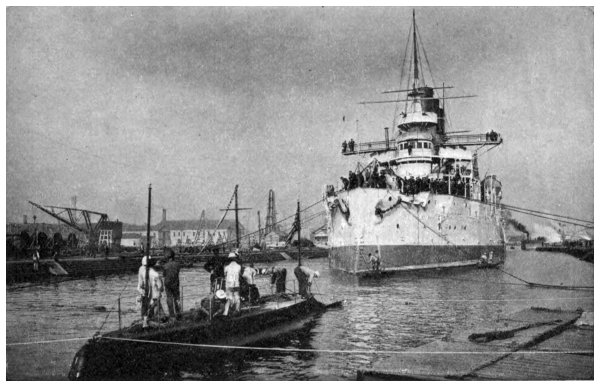
she was the mother-ship of a family of six young submarines.
Built as a coast defense monitor shortly after
the Spanish War, she had long since been retired from the
fighting-line, and was now the floating headquarters, dormitory,
hospital, machine-shop, bakery, and general store
for the six officers and the hundred and fifty men of the
flotilla.
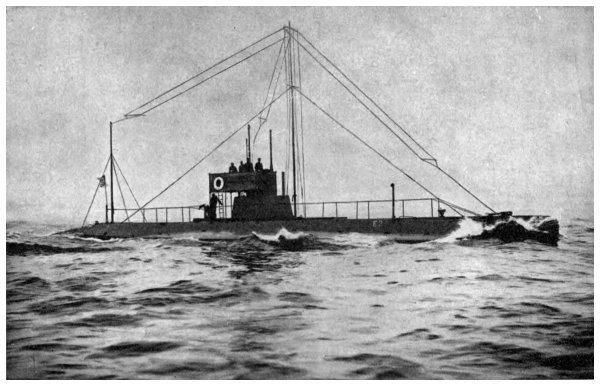
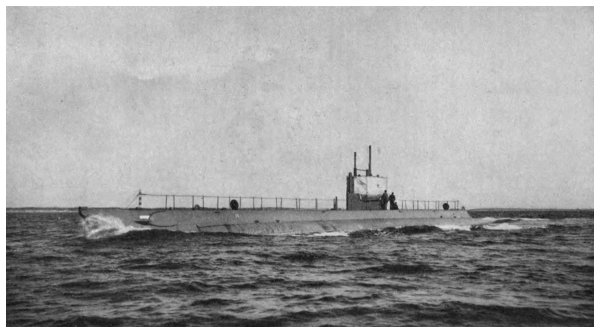
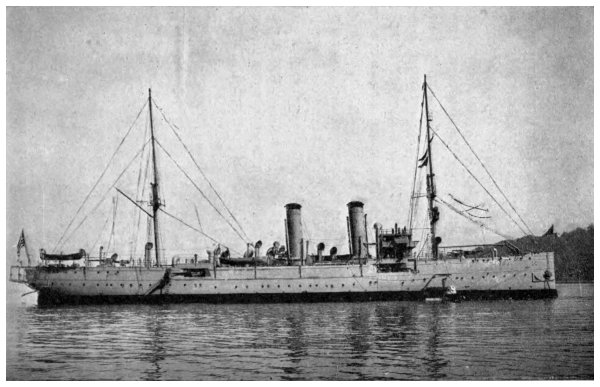
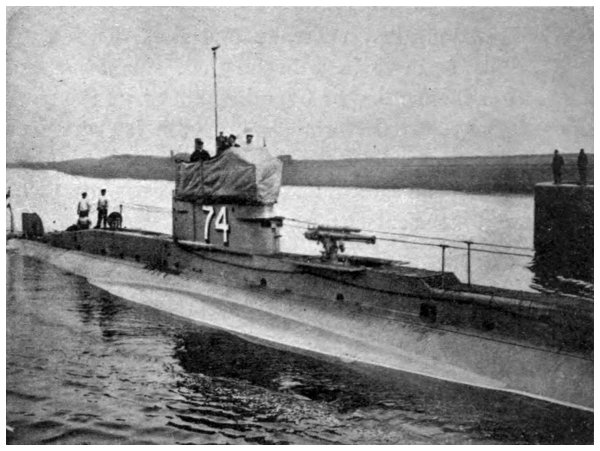
Photo by Brown Bros.
U. S. Submarine E-2.
Note wireless, navigating-bridge, and openings for flooding superstructure when submerging.
Moored alongside the parent-ship, the submarine X-4
was filling her fuel-tanks with oil through a pipe-line, in
preparation for the day’s cruise and target-practice I was
to be lucky enough to witness. Two hundred and fifty
feet long, flat-decked and straight-stemmed, she looked,
except for the lack of funnels, much more like a surface-going
torpedo-boat than the landsman’s conventional idea
of a submarine.
“I thought she would be cigar-shaped,” I said as we
went on board.
“She is—underneath,” answered Lieutenant Scope.
“What you see is only a light-weight superstructure or
false hull built over the real one. See those holes in it,
just above the water line? They are to flood the superstructure
with whenever we submerge, otherwise the
water pressure would crush in these thin steel plates like
veneering. But it makes us much more seaworthy for
surface work, gives us a certain amount of deckroom,
and stowage-space for various useful articles, such as
this.”
Part of the deck rose straight up into the air, like the
top of a freight-elevator coming up through the sidewalk.
Beneath the canopy thus formed was a short-barreled,
three-inch gun.
“Fires a twelve-pound shell, like the field-pieces the
landing-parties take ashore from the battleships,” explained
the naval officer, as he trained the vicious-looking
little cannon all around the compass. “Small enough to
be handy, big enough to sink any merchant ship afloat,
or smash anything that flies.”
Here he pointed the muzzle straight up as if gunning
for hostile aeroplanes.
“And please observe,” he concluded, as the gun
sank down into its lair again, “how that armored hatch-cover
protects the gun-crew from shrapnel or falling
bombs.”
I followed him to the conning-tower, or, as he always
spoke of it, the turret. The little round bandbox of the
Holland has developed into a tall, tapering structure,
sharply pointed fore and aft to lessen resistance when running
submerged. Above the turret was a small navigating-bridge,
screened and roofed with canvas, where a red-haired
quartermaster stood by the steering-wheel, and
saluted as we came up the ladder. The lieutenant put the
engine-room telegraph over to “Start,” and a mighty
motor throbbed underneath our feet. Then the mooring
was cast off, the telegraph put over to “Slow Ahead,”
and the X-4 put out to sea.
“How long a cruise could she make?” I asked.
“Four thousand miles is her radius,” answered her
commander. “Back in 1915, ten American-designed submarines
crossed from Canada to England under their
own power.”
“Yet it is only a few years since we were told that
submarines could only be used for coast defense, unless
they were carried inside their mother-ships and launched
near the scene of battle,” I remarked. “Or that each
battleship should carry a dinky little submarine on deck
and lower it over the side like a steam-launch.”
“People said the same thing about torpedo-boats,”
agreed the lieutenant; “they began as launches—now
look at the size of that destroyer smoking along over
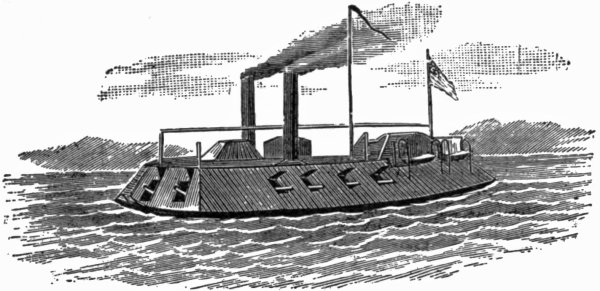
there. Ericsson thought that any ironclad bigger than a
Civil War monitor would be an unwieldy monster. Even
John P. Holland fought tooth and nail against increasing
the length of his submarines. This boat of mine is five
times the length of the old Holland, but she’s only a
primitive ancestor of the perfect submarine of the future.”
“She isn’t a submarine at all,” I replied presently, as
the X-4 swept on down the coast at a good twenty-two
knots, her foredeck buried in foam and the sea-breeze
singing through the antennæ of her wireless. “She’s
nothing but a big motor-boat.”
“And she’s got some big motors,” replied the lieutenant.
“Better step below and have a look at them.”
I went down through the open hatchway to the interior
of the boat and aft to the engine-room. There I found
two long, many-cylindered oil-engines of strange design,
presided over by a big blond engineer whose grease-spotted
dungarees gave no hint as to his rating.
“What kind of machines are these?” I shouted above
the roar they made. “And why do you need two of
them?”
“Diesel heavy-oil engines,” he answered. “One for
each propeller.”
“What is the difference between one of these and the
gasoline engine of a motor-car? I know a little about
that.”
“Do you know what the carburetor is?” asked the
engineer.
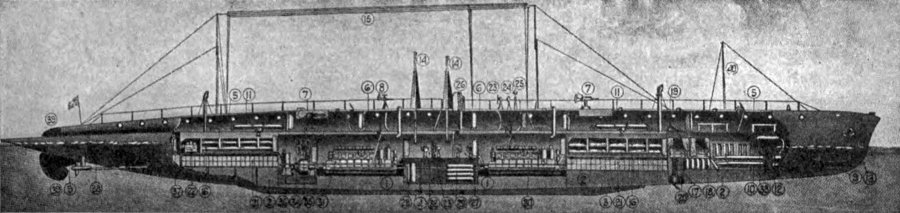
Courtesy of International Marine Engineering.
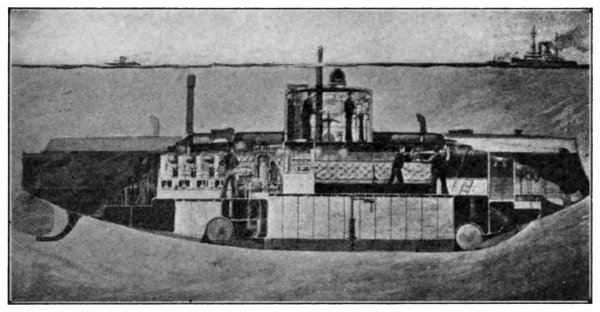
A Submarine Cruiser, or Fleet Submarine (Lake Type).
The parts indicated by numbers in this illustration are as follows: 1, main ballast tanks; 2, fuel tanks; 3, keel; 4,
safety drop keel; 5, habitable superstructure; 6, escape and safety chambers; 7, disappearing anti-air craft guns; 8,
rapid fire gun; 9, torpedo tubes; 10, torpedoes; 11, twin deck torpedo tubes; 12, torpedo firing tank; 13, anchor; 14,
periscopes; 15, wireless; 16, crew’s quarters; 17, officers’ quarters; 18, war-head stowage; 19, torpedo hatch; 20, diving
chamber; 21, electric storage battery; 22, galley; 23, steering gear; 24, binnacle; 25, searchlight; 26, conning-tower;
27, diving station; 28, control tank; 29, compressed air flasks; 30, forward engine room and engines; 31,
after engine room and engines; 32, central control compartment; 33, torpedo room; 34, electric motor room; 35,
switchboard; 36, ballast pump; 37, auxiliary machinery room; 38, hydroplane; 39, vertical rudders; 40, signal masts.
“That’s where the gasoline is mixed with air, before
it goes into the cylinder.”
The engineer nodded.
“The mixture is sucked into the cylinder by the down-stroke
of the piston. The up-stroke compresses it, and
then the mixture is exploded by an electric spark from the
spark-plug. The force of the explosion drives the piston
down, and the next stroke up drives out the refuse
gases. That’s how an ordinary, four-cycle gasoline
motor works.
“But the Diesel engine,” he continued, “doesn’t need
any carburetor or spark-plug. When the piston makes
its first upward or compression-stroke, there is nothing in
the cylinder but pure air. This is compressed to a pressure
of about 500 pounds a square inch—and when you
squeeze anything as hard as that, you make it mighty
hot—”
“Like a blacksmith pounding a piece of cold iron
to a red heat?” I suggested. The engineer nodded
again.
“That compressed air is so hot that the oil which has
been spurted in through an injection-valve is exploded,
and drives the piston down on the power-stroke. The
waste gases are then blown out by compressed air. There
are an air-compressor and a storage tank just for scavenging,
or blowing the waste gases out of every three power-cylinders.”
“What are the advantages of the Diesel over the gasoline
engine?”
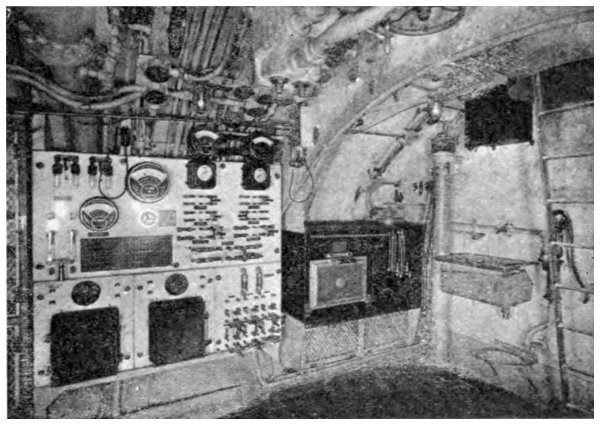
Courtesy of the Electric Boat Company.
Auxiliary Switchboard and Electric Cook-stove, in a U. S.
Submarine.
“In the first place, it gives more power. You see,
three out of every four strokes made by the piston of a
gasoline engine—suction-stroke, compression-stroke, and
scavenging-stroke—waste power instead of producing it.
But the Diesel is what we call a two-cycle engine; its
piston makes only two trips for each power-stroke. In
the second place, it is cheaper, because instead of gasoline
it uses heavy, low-price oil. And this makes it much
safer, for the heavy oil does not vaporize so easily. The
air in some of the old submarines that used gasoline
motors would get so that it was like trying to breathe inside
a carburetor, and there was always the chance of a
spark from the electric motors exploding the whole
business, and your waking up to find the trained nurse
changing your bandages. The German navy refused to
build a submarine as long as there was nothing better
than gasoline to propel it on the surface. They didn’t
launch their U-1 till 1906, after Dr. Diesel had got his
motor into practicable shape. It cost him twenty years
of hard work, but without his motor we couldn’t have
the modern submarine. And they’re using it more and
more in ocean freighters. There’s a line of motor-ships
running to-day between Scandinavia and San Francisco,
through the Panama Canal.
“Aft of the Diesel, here,” continued the engineer, “is
our electric motor, for propelling her when submerged.
Reverse it and have it driven by the Diesel engine, and the
motor serves as a dynamo to generate electricity for charging
the batteries. As long as we can get oil and come to
the surface to use it, we can never run short of ‘juice.’14
“Besides turning the propeller, the electricity from the
batteries lights the boat, and turns the ventilating fans,
works the air-compressor for the torpedo-tubes, drives all
the big and little pumps, runs a lot of auxiliary motors
that haul up the anchor, turn the rudders, and do other
odd jobs, it heats the boat in cold weather—”
“And cooks the grub all the year round, don’t forget
that, Joe,” said another member of the crew. “Luncheon
is served in the palm room.”
We ate from a swinging table let down from the ceiling
of the main- or living-compartment of the submarine,
that extended forward from the engine-room to the tiny
officers’ cabin and the torpedo room in the bows. Tiers
of canvas bunks folded up against the walls showed where
the crew slept when on a cruise. For lunch that day we
had bread baked on the mother-ship, butter out of a can,
fried ham, fried potatoes, and coffee hot from a little
electric stove such as you can see in the kitchenette of a
light-housekeeping apartment on shore. The lieutenant’s
lunch was carried up to him on the bridge. When the
meal was over, most of the men went on deck, and my
friend the engineer put a large cigar in his mouth. I
took out a box of matches and was about to strike one
for his benefit when he stopped me, saying,
“Don’t ever strike a light in a submarine or a dynamite
factory. It’s unhealthy.”
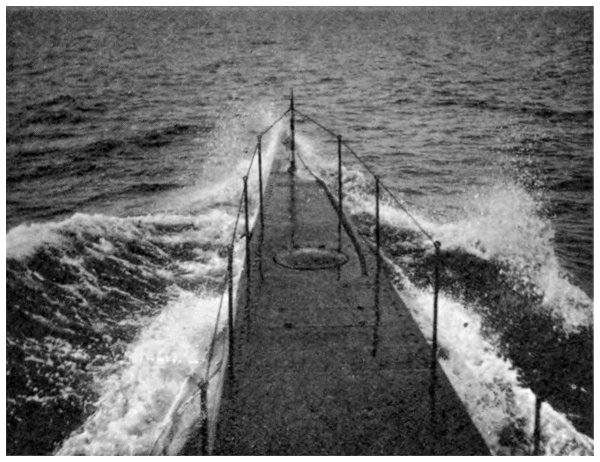
Courtesy of the Electric Boat Company.
Forward deck of a U. S. Submarine, in cruising trim.
I apologized profusely.
“The air is so much better than I had expected that
I forgot where I was.”
“Yes,” said the engineer, chewing his unlighted cigar,
“there is plenty of good air in a big modern boat like
this, running on the surface in calm weather and with
the main hatch and all ventilators open. But come with
us when we’re bucking high seas or running submerged
on a breathing-diet of canned air flavored with oil, and
you’ll understand why so many good men have been invalided
out of the flotilla with lung-trouble. We’re the
only warships without any dogs or parrots or other mascots
on board, for no animal could endure the air in
a submarine.”
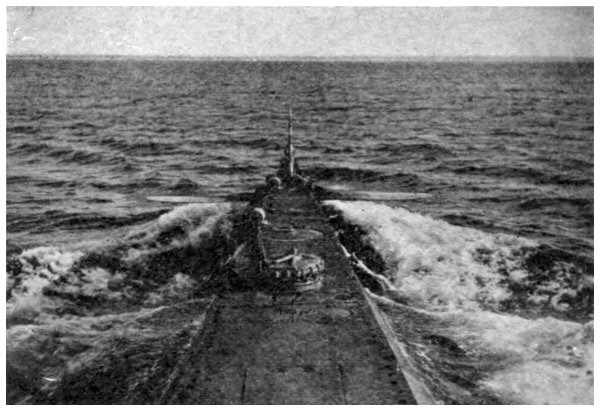
Courtesy of the Electric Boat Company.
Same, preparing to submerge. Railing stowed away and
bow-rudders extended.
“I thought every submarine carried a cage of white
mice, because they began to squeak as soon as the air
began to get bad and so warned the crew.”
“That was a crude device of the early days,” replied
the engineer. “We don’t carry white mice any more,
though I believe they still use them in the British navy.”
I went up on deck, to find that the X-4 had reached
the practice-grounds and was being made ready for a
dive. Her crew were busy dismantling and stowing away
the bridge and the light deck-railing, hauling down the
flag, and closing all ventilators and other openings.
“How long has it taken you to get ready?” I asked
Lieutenant Scope.
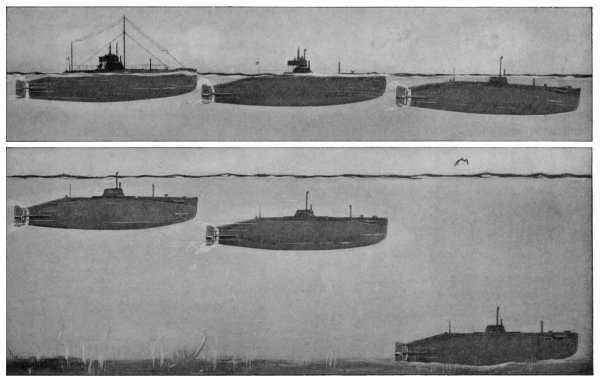
“Twenty minutes,” he answered. “But the real diving
takes only two minutes. We’ll go below now, sink
her to condition, and run her under with the diving rudders.”
“What are those things unfolding themselves on either
side of the bows?” I asked. “I thought the diving rudders
were carried astern.”
“Modern submarines are so long that they need them
both fore and aft,” replied the lieutenant. “As you see,
the diving rudders fold flat against the side of the boat
where they will be out of harm’s way when we are running
on the surface or lying alongside the mother-ship.
Better come below now, for we’re going to dive.”
We descended into the turret and the hatch was closed.
The Diesel engines had already been stopped and the
electric motors were now turning the propellers.
“Why are those big electric pumps working down
there?” I asked.
“Pumping water into the ballast-tanks.”
“But doesn’t the water run into the tanks anyhow, as
soon as you open the valves?” I asked the lieutenant.
“Turn a tumbler upside down and force it down into
a basin of water,” he replied, “and you trap some air
in the top of the tumbler, which prevents the water from
rising beyond a certain point. The same thing takes
place in our tanks, and to fill them we have to force in
the water with powerful pumps that compress the air in
the tanks to a very small part of its original bulk. This
compressed air acts as a powerful spring to drive the
water out of the tanks again when we wish to rise. By
blowing out the tanks, a submarine can come to the surface
in twenty seconds or one sixth the time it takes to
submerge.”
“When are we going under?” I asked him. The lieutenant
looked at his watch and answered,
“We have been submerged for the last four minutes.”
I experienced a feeling of the most profound disappointment.
Ever since I had been a very small boy I had
been looking forward to the time when I should go down
in a submarine boat, and now that time had passed without
my realizing it.
“But why didn’t I feel the boat tilt when she dived?”
I demanded.
“Because she went down a very gentle slope, between
two and three degrees at the steepest. The only way you
could have noticed it would have been to watch these
gages.”
Large dials on the wall of the turret indicated that the
X-4 was running on what was practically an even keel at
a depth of sixteen feet and under a consequent water-pressure
of 1024 pounds on every square foot of her hull.
“How deep could she go?”
“One hundred and fifty feet—if she had to. The
strong inner hull of a modern submarine is built up of
three quarter inch plates of the best mild steel and well
braced and strengthened from within. But as a rule
there is no need of our diving below sixty feet at the
deepest, or far enough to clear the keel of the largest
ship. You will notice how the depth-control man is
holding her steady by manipulating the forward horizontal
rudders, just as an aviator steadies his aeroplane.”
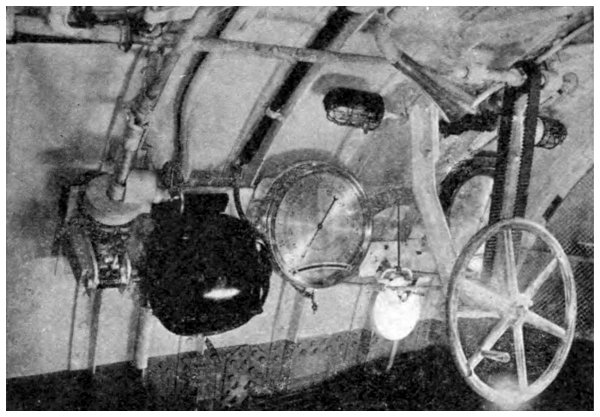
Courtesy of the Electric Boat Company.
Depth-control Station, U. S. Submarine.
Wheel governing horizontal rudders, gages showing depth, trim, etc.
“He must be a strong man to handle those two big
horizontal rudders.”
“He has an electric motor to do the hard work for him,
as has the quartermaster steering the course here with
the vertical rudder.”
The same red-headed petty officer that I had noticed
on the bridge now grasped the spokes of a smaller steering-wheel
inside the conning-tower.
“What is that queer-looking thing whirling round and
round in front of him?” I asked.
“A Sperry gyroscopic compass,” replied the lieutenant.
“An ordinary magnetic compass could not be relied on
to point in any particular direction if it was shut up in
a steel box full of charged electric wires, like the turret
of a submarine. We tried to remedy this by building conning-towers
of copper, till Mr. Sperry perfected a compass
that has no magnetic
needle, but operates on
the principle of the
gyroscope. You know
that a heavy, rapidly
rotating wheel resists
any tendency to being
shifted relative to
space?”
“Yes.”
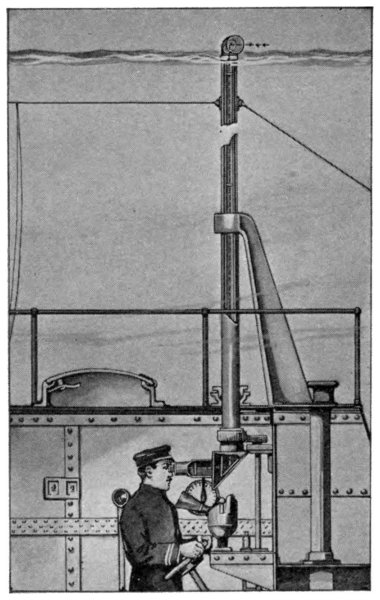
Cross-section of a Periscope.
“The earth, revolving
on its axis, is nothing
but a big gyroscope—that
is why it stays
put. The little gyroscope
on this compass
spins at right angles to
the revolution of the
earth and so keeps in a
due north and south
line. But the frame it is mounted on turns with the
ship, so the relative positions of the frame and the gyro-axis
show in what direction the submarine is heading.”
“And you can see what’s ahead of you through the
periscope. Who invented that?”
“The idea is a very old one. Certain French and
Dutch inventors designed submarines with periscopes as
long ago as the eighteen-fifties. In the Civil War, the
light-draft river-monitor Osage had attached to her turret
a crude periscope made by her chief engineer, Thomas
Doughty, out of a piece of three-inch steam-pipe with
holes cut at each of its ends at opposite sides, and pieces
of looking-glass inserted as reflectors. By means of
this instrument her captain, now Rear-Admiral, Thomas
O. Selfridge, was able to look over the high banks of the
Red River when the Osage had run aground in a bend
and was being attacked by three thousand dismounted
Confederate cavalry, who were repulsed with the loss of
four hundred killed or wounded by the fire of the monitor’s
11-inch guns, directed through the periscope.15
“But as late as 1900 the periscope was so crude and unsatisfactory
an instrument that John P. Holland would
have nothing to do with it. The credit for bringing it
to its present efficiency belongs chiefly to the Germans,
who kept many of their scientists working together on
the solution of the difficult problems of optics that were
involved.
“By turning this little crank,” the lieutenant continued,
“I can revolve the reflector at the top of the tube. This
reflector contains a prism which reflects the image of the
object in view down through a system of lenses in the
tube to another prism here at the bottom, where the observer
sees it through an eyepiece and telescope lenses.”
I looked into the eyepiece, which was so much like that
of an old-fashioned stereoscope that I felt that it, too,
ought to work back and forth after the manner of a
slide trombone. I found myself looking out over the
broad blue waters of a sunlit bay. I noticed a squall
blackening the surface of the water, a catboat running
before it, and the gleam of the brass instruments of the
band playing on the after deck of a big white excursion
steamer half a mile away.
“I can almost imagine I can hear the music of that
band,” I exclaimed. “The optical illusion is perfect.”
“It has to be,” rejoined the lieutenant. “If the image
were in the least distorted or out of perspective, we
couldn’t aim straight.”
“What do you do when the periscope is wet with
spray?” I asked him.
“Wash the glass with a jet of alcohol and dry it from
the inside with a current of warm air passing up and
down the tube. A periscope-tube is double: the outer
one passing through a stuffing-box in the hull, and the inner
tube revolving inside it. The old-fashioned single
tubes were too hard to revolve and the resistance of the
water used to bend them aft and cause leakage. We can
raise and lower the periscopes at will, and all our larger
boats have two of them, so that they can keep a lookout
in two directions at once, besides having a spare eye
in case the first is put out.”
“What are those two little things that big naval tug
is towing over there?” I inquired.
“The target for our torpedo practice,” replied Lieutenant
Scope. “We shall try to put four Whiteheads
between those two buoys as the tug tows them past at an
unknown range and speed. If you step forward to the
torpedo room you can see them loading the tubes.”
As I walked forward it occurred to me that the twenty-odd
men on board the X-4 seemed to be moving about
inside her with perfect freedom, without disturbing her
trim. I mentioned this to one of the crew.
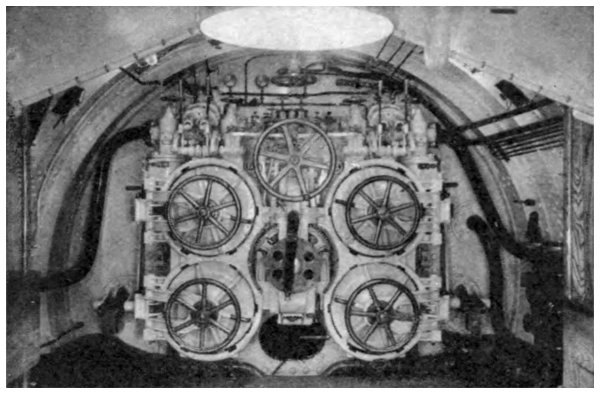
Courtesy of the Electric Boat Company.
Forward torpedo-compartment, U. S. Submarine, showing breech-mechanism
of four tubes. Round opening above is the escape-hatch.
“It’s the trimming-tanks that keep her level,” he explained.
“As we’re walking forward, our weight in
water is being automatically pumped from the trimming-tank
in the bow to the one astern. A submarine is just
one blamed tank after another. Stand clear of that
chain-fall, sir; they’re loading No. 1 tube.”
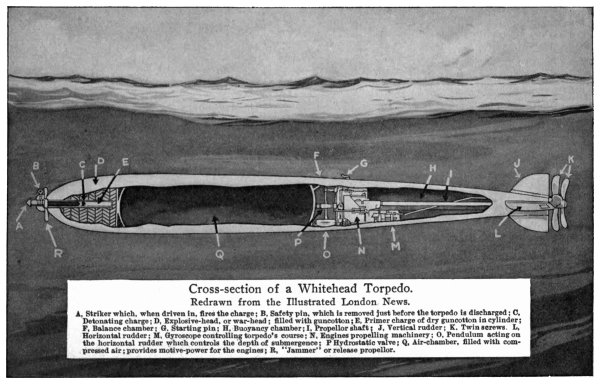
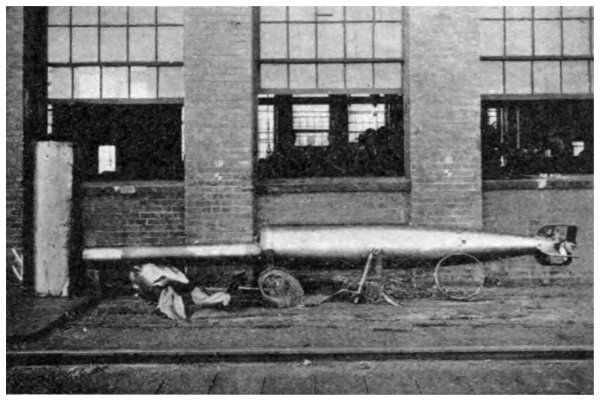
Stripped to the waist like an old-time gun-crew, four
beautifully muscled young gunner’s mates were hoisting,
with an ingenious arrangement of chains and pulleys, a
torpedo from the magazine. The breach of the tube was
opened and the long Whitehead thrust in, two flanges on
its sides being fitted into deep grooves in the sides of the
tube, so that the torpedo would not spin like a rifle-bullet
but be launched on an even keel. The breach was closed,
and the men stood by expectantly.
“Skipper’s up in the conning-tower, taking aim
through the periscope,” explained the man who had told
me about trimming-tanks. “The tubes being fixed in the
bow, he has to train the whole boat like a gun. Likewise
he’s got to figure out how far it is to the target and how
fast the tug is towing it, how many seconds it’s going to
take the torpedo to get there, and how much he’s got to
allow for its being carried off its course by tide and currents.
When he gets good and ready, the lieutenant’ll
press a little electric button and you’ll hear—”
“Thud!” went the compressed air in the tube, and the
submarine shuddered slightly with the shock of the recoil.
But that was all.
“There she goes!” said my friend the tank-expert.
“As soon as the Whitehead was expelled, a compensation-tank
just above the tube was flooded with enough water
to make good the loss in weight.”
“What keeps the sea-water from rushing into the tube
after the torpedo leaves it?” I asked.
“A conical-shaped cap on the bow of the boat keeps
both tubes closed except when you want to fire one of
them. Then the cap, which is pivoted on its upper edge,
swings to port or starboard just long enough for the torpedo
to get clear and swings back before the water can
get in.”
Four of the ten torpedoes carried in the magazine were
sped on their way to the unseen target. I returned to
the turret as the wireless operator entered and handed a
typewritten slip to Lieutenant Scope, who smiled happily
and said to me,
“The captain of the tug reports that all four shots
were hits and all four torpedoes have been safely recovered.”
I was too astonished to congratulate him on his marksmanship,
as I should have done.
“How in the name of miracles!” I gasped. “Can
you receive a wireless telegram under the sea?”
“By the Fessenden oscillator,” he replied, and added
to the wireless man,
“Take this gentleman below and show him how it
works.”
“Did you ever have another chap knock two stone together
under water when you were taking a dive?” asked
the operator. I nodded in vivid recollection.
“Then you have some idea how sounds are magnified
under water. It is an old idea to put submarine bells
down under lighthouses and fit ships with some kind of
receiver so that the bells can be heard and warning given
when it is too foggy to see the light. The advantage over
the old-style bell-buoy lies in the fact that sound travels
about four times as fast through water as through air,16
and goes further and straighter because it isn’t deflected
by winds or what the aviators call ‘air-pockets.’ The
man who knows most about these things is Professor
Fessenden, of the Submarine Signal Company of Boston,
who first realized the possibility of telegraphing through
water.17
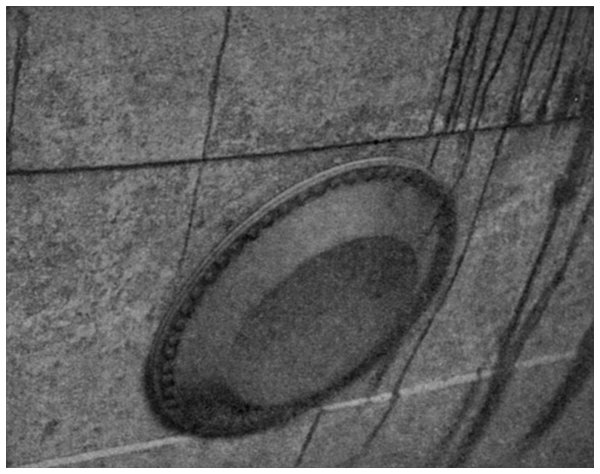
Courtesy of the American Magazine.
Fessenden oscillator outside the hull of a ship. The “ear” of
a modern vessel.
“Fastened outside the hull of this boat is one of the
Fessenden oscillators: a steel disk eighteen inches in
diameter, that can be vibrated very rapidly by electricity.
These vibrations travel through the water, like wireless
waves through the ether, till they strike the oscillator on
another vessel and set it to vibrating in sympathy. To
send a message, I start and stop the oscillator with this
key so as to form the dots and dashes of the Morse code.
To receive, I sit here with these receivers over my ears
and ‘listen in,’ just like a wireless operator, till I pick up
our call ‘X-4,’ ‘X-4.’”
“How far can you send a message under water?”
“Ten miles is the furthest I’ve ever sent one. Professor
Fessenden has sent messages more than thirty miles.
The invention only dates back to 1913 and what it will
do in the future, there is no telling.”
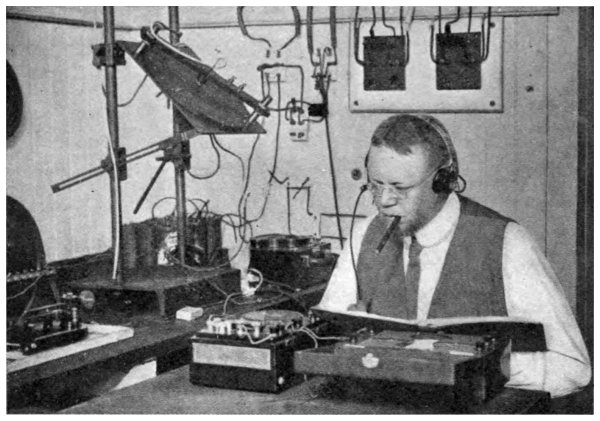
Courtesy of the American Magazine.
Professor Fessenden receiving a message sent through several
miles of sea-water by his “Oscillator.”
“Even now, couldn’t a surface vessel act as eyes for
a whole flotilla of submarines and tell them where to
go and when to strike by coaching them through the
Fessenden oscillator?”
The operator nodded.
“We’re doing it to-day, in practice. But don’t forget
that an enemy’s ship carrying a pair of oscillators can
hear a submarine coming two miles away. You can
make out the beat of a propeller at that distance every
time.”
“But how can you tell how far away and in what
direction it is?”
“I can’t, with a single oscillator like ours. But a ship
carries two of them, one on each side of the hull, like the
ears on a man’s head. And just as a man knows whether
a shout he hears comes from the right or left, because
he hears it more with one ear than the other, so the
skipper of a surface craft can look at the indicator that
registers the relative intensity of the vibrations received
by the port and starboard oscillators and say,
“‘There’s somebody three points off the starboard
bow, mile and three quarters away, and heading for us.
Nothing in sight, so it must be one of those blamed submarines.’
“And away he steams, full speed ahead and cutting
zigzags. Or maybe he gets his rapid-fire guns ready and
watches for Mr. Submarine to rise—like the X-4’s doing
now.”
Freed of the dead weight of many tons of sea water
blown from her ballast-tanks by compressed air, the submarine
rose to the surface like a balloon. Ventilators
and hatch-covers were thrown open and we swarmed up
on deck to fill our grateful lungs with the good sea air.
Three motor-boats from the tug throbbed up alongside
with the four torpedoes we had discharged.
“Those boats wait, one this side of the target, one near
it and the third over on the far side, to mark the shots
and catch the torpedoes after they rise to the surface at
the end of their run,” said Lieutenant Scope. “We very
seldom lose a torpedo nowadays. They tell a story about
one that dived to the bottom and was driven by the force
of its own engines into forty feet of soft mud, where
it stayed till it happened to be dug up by a dredger.”
The four torpedoes were hoisted aboard, drained of
the sea water that had flooded their air-chambers, cleaned
and lowered through the torpedo hatch forward down
into the magazine. By this time the bridge and railing
were again in place and the flags fluttering over the
taffrail as the X-4, her day’s work done, sped swiftly up
the coast to home and mother-ship.