THE COMING OF THE WATERTOWN & ROME
The first successful transportation venture of the North Country was still
ahead of it. The efforts of these patient souls, who struggled so hard to
establish the Northern Railroad as an entrance to the six counties from
the east, were being echoed by those who strove to gain a rail entrance
into it from the south. Long ago in this narrative we saw how as far back
as 1836 the locomotive first entered Utica. Six or seven years later there
was a continuous chain of railroads from Albany to Buffalo—precursors of
the present New York Central—and ambitious plans for building feeder
lines to them from surrounding territory, both to the north and to the
south. The early Oswego & Syracuse Railroad was typical of these.
Of all these plans none was more ambitious, however, than that which
sought to build a line from Rome into the heart of the rich county of
Jefferson, the lower valley of the Black River and the St. Lawrence River
at almost the very point where Lake Ontario debouches into it. The scheme
for this road, in actuality, antedated the coming of the locomotive into
Utica by four years, for it was in 1832—upon the 17th day of April in
that year—that the Watertown & Rome Railroad was first incorporated and
Henry H. Coffeen, Edmund Kirby, Orville Hungerford and William Smith of
Jefferson County, Hiram Hubbell, Caleb Carr, Benjamin H. Wright and Elisha
Hart, of Oswego, and Jesse Armstrong, Alvah Sheldon, Artemas Trowbridge
and Seth D. Roberts, of Oneida, named by the Legislature as commissioners
to promote the enterprise. Later George C. Sherman, of Watertown, was
added to these commissioners. The act provided that the road should be
begun within three years and completed within five. Its capital stock was
fixed at $1,000,000, divided into shares of $100 each.
The commercial audacity, the business daring of these men of the North
Country in even seeking to establish so huge an enterprise in those early
days of its settlement is hard to realize in this day, when our transport
has come to be so facile and easily understood a thing. Their courage was
the courage of mental giants. The railroad was less than three years
established in the United States; in the entire world less than five. Yet
they sought to bring into Northern New York, there at the beginning of the
third decade of the nineteenth century, hardly emerged from primeval
forest, the highway of iron rail, that even so highly a developed
civilization as that of England was receiving with great caution and
uncertainty.
These men of the North Country had not alone courage, but vision; not
alone vision, but perseverance. Their railroad once born, even though as a
trembling thing that for years existed upon paper only, was not permitted
to die. It could not die. And that it should live the pioneers of
Jefferson and Oswego rode long miles over unspeakably bad roads with
determination in their hearts.
The act that established the Watertown & Rome Railroad was never permitted
to expire. It was revived; again and again and again—in 1837, in 1845,
and again in 1847. It is related how night after night William Smith and
Clarke Rice used to sit in an upper room of a house on Factory Street in
Watertown—then as now, the shire-town of Jefferson—and exhibit to
callers a model of a tiny train running upon a little track. Factory
Street was then one of the most attractive residence streets of Watertown.
The irony of fate was yet to transfer it into a rather grimy artery of
commerce—by the single process of the building of the main line of the
Potsdam & Watertown Railroad throughout its entire length.
These men, and others, kept the project alive. William Dewey was one of
its most enthusiastic proponents. As the result of a meeting held at
Pulaski on June 27, 1836, he had been chosen to survey a line from
Watertown to Rome—through Pulaski. With the aid of Robert F. Livingston
and James Roberts, this was accomplished in the fall of 1836. Soon after
Dewey issued two thousand copies of a small thirty-two page pamphlet,
entitled Suggestions Urging the Construction of a Railroad from Rome to
Watertown. It was a potent factor in advocating the new enterprise; so
potent, in fact, that Cape Vincent, alarmed at not being included in all
of these plans, held a mass-meeting which was followed by the
incorporation of the Watertown & Cape Vincent Railroad, with a modest
capitalization of but $50,000. Surveys followed, and the immediate result
of this step was to include the present Cape Vincent branch in all the
plans for the construction of the original Watertown & Rome Railroad.
These plans, as we have just seen, did not move rapidly. It is possible
that the handicap of the great distances of the North Country might have
been overcome had it not been that 1837 was destined as the year of the
first great financial crash that the United States had ever known. The
northern counties of New York were by no means immune from the severe
effects of that disaster. Money was tight. The future looked dark. But the
two gentlemen of Watertown kept their little train going there in the
small room on Factory Street. Faith in any time or place is a superb
thing. In business it is a very real asset indeed. And the faith of Clarke
Rice and William Smith was reflected in the courage of Dewey, who would
not let the new road die. To keep it alive he rode up and down the
proposed route on horseback, summer and winter, urging its great
necessity.
Out of that faith came large action once again. Railroad meetings began to
multiply in the North Country; the success of similar enterprises, not
only in New York State, but elsewhere within the Union, was related to
them. Finally there came one big meeting, on a very cold 10th of February
in 1847, in the old Universalist Church at Watertown. All Watertown came
to it; out of it grew a definite railroad.
Yet it grew very slowly. In the files of the old Northern State Journal,
of Watertown, and under the date of March 29, 1848, I find an irritated
editorial reference to the continual delays in the building of the road.
Under the heading “Our Railroad,” the Journal describes a railroad
meeting held in the Jefferson County Court House a few days before and
goes on to say:
“... Seldom has any meeting been held in this county where more unanimity
and enthusiastic devotion to a great public object have been displayed,
than was evidenced in the character and conduct of the assemblage that
filled the Court House.... Go ahead, and that immediately, was the
ruling motto in the speeches and resolutions and the whole meeting
sympathized in the sentiment. And indeed, it is time to go ahead. It is
now about sixteen years since a charter was first obtained and yet the
first blow is not struck. No excuse for further delay will be received.
None will be needed. We understand that measures have already been taken
to expend in season the amount necessary to secure the charter—to call in
the first installment of five per cent—to organize and put upon the line
the requisite number of engineers and surveyors—and to hold an election
for a new Board of Directors.
“We trust that none but efficient men, firm friends of the Railroad, will
be put in the Direction. The Stockholders should look to this and vote for
no man that they do not know to be warmly in favor of an active
prosecution of the work to an early completion. This subject has been so
long before the community that every man’s sentiments are known, and it
would be folly to expose the road to defeat now by not being careful in
the selection. With a Board of Directors such as can be found, the autumn
of 1849 should be signalized by the opening of the entire road from the
Cape to Rome. It can be done and it should be done. The road being a great
good the sooner we enjoy it the better.”
So it was that upon the sixth day of the following April the actual
organization of the Watertown & Rome Railroad was accomplished at the
American Hotel, in Watertown, and an emissary despatched to Albany, who
succeeded on April 28th in having the original Act for the construction of
the line extended, for a final time. It also provided for the increase of
the capitalization from $1,000,000 to $1,500,000—in order that the new
road, once built, could be properly equipped with iron rail, weighing at
least fifty-six pounds to the yard. It was not difficult by that time to
sell the additional stock in the company. The missionary work—to-day we
would call it propaganda—of its first promoters really had been a most
thorough job.
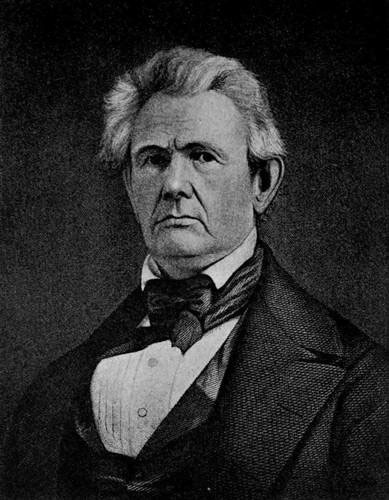
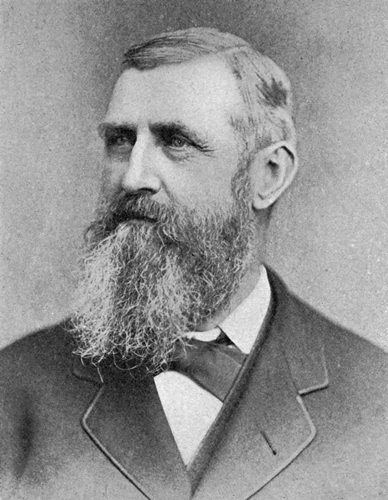
ORVILLE HUNGERFORD
First President of the Watertown & Rome Railroad.
The original officers of the Watertown & Rome Railroad were:
| President, Orville Hungerford, Watertown |
| Secretary, Clarke Rice, Watertown |
| Treasurer, O. V. Brainard, Watertown |
| Superintendent, R. B. Doxtater, Watertown |
| |
| Directors |
| S. N. Dexter, New York |
|
Clarke Rice, Watertown |
| William C. Pierrepont, Brooklyn |
|
Robert B. Doxtater, New York |
| John H. Whipple, New York |
|
Orville Hungerford, Watertown |
| Norris M. Woodruff, Watertown |
|
William Smith, Watertown |
| Samuel Buckley, Watertown |
|
Edmund Kirby, Brownville |
| Jerre Carrier, Cape Vincent |
|
Theophilus Peugnet, Cape Vincent |
The summer of 1847 was spent chiefly in perfecting the organization and
financial plans of the new road, in eliminating a certain opposition to it
within its own ranks and in strengthening its morale. At the initial
meeting of the Board of Directors, William Smith had been allowed two
dollars a day for soliciting subscriptions while Messrs. Hungerford,
Pierrepont, Doxtater and Dexter were appointed a committee to go to New
York and Boston for the same purpose. A campaign fund of $500 was allotted
for this entire purpose.
The question of finances was always a delicate and a difficult one. In the
minutes of the Board for May 10, 1848, I find that the question of where
the road should bank its funds had been a vexed one, indeed. It was then
settled by dividing the amount into twentieths, of which the Jefferson
County Bank should have eight, the Black River, four, Hungerford’s, three,
the Bank of Watertown, three, and Wooster Sherman’s two.
Gradually these funds accumulated. The subscriptions had been solicited
upon a partial payment basis and these initial payments of five and ten
percent were providing the money for the expenses of organization and
careful survey. This last was accomplished in the summer of 1848, by Isaac
W. Crane, who had been engaged as Chief Engineer of the property at $2500
a year. Mr. Crane made careful resurveys of the route—omitting Pulaski
this time; to the very great distress of that village—and estimated the
complete cost of the road at about $1,250,000. It is interesting to note
that its actual cost, when completed, was $1,957,992.
In that same summer, Mr. Brainard retired as Treasurer of the company and
was succeeded by Daniel Lee, of Watertown, whose annual compensation was
fixed at $800. Later, Mr. Lee increased this, by taking upon his shoulders
the similar post of the Potsdam & Watertown. The infant Watertown & Rome
found need of offices for itself. It engaged quarters over Tubbs’ Hat
Store, which modestly it named The Railroad Rooms and there it was burned
out in the great fire of Watertown, May 13, 1849.
All of these were indeed busy months of preparation. There were
locomotives to be ordered. Four second-hand engines, as we shall see in a
moment, were bought at once in New England, but the old engine Cayuga,
which the Schenectady & Utica had offered the Rome road at a
bargain-counter price of $2500 finally was refused. Negotiations were then
begun with the Taunton Locomotive Works for the construction of engines
which would be quite the equal of any turned out in the land up to that
time; and which were to be delivered to the company, at its terminal at
Rome—at a cost of $7150 apiece. Horace W. Woodruff, of Watertown, was
given the contract for building the cars for the new line; he was to be
paid for them, one-third in the stock of the company and two-thirds in
cash. His car-works were upon the north bank of the Black River, upon the
site now occupied by the Wise Machine Company and it was necessary to haul
the cars by oxen to the rails of the new road, then in the vicinity of
Watertown Junction. Yet despite the fact that his works in Watertown never
had a railroad siding Woodruff later attained quite a fame as a builder
of sleeping-cars. His cars at one time were used almost universally upon
the railroads of the Southwest.
Construction began upon the new line at Rome, obviously chosen because of
the facility with which materials could be brought to that point, either
by rail or by canal—although no small part of the iron for the road was
finally brought across the Atlantic and up the St. Lawrence to Cape
Vincent. Nat Hazeltine is credited with having turned the first bit of sod
for the line. The gentle nature of the country to be traversed by the new
railroad—the greater part of it upon the easy slopes at the easterly end
of Lake Ontario—presented no large obstacles, either to the engineers or
the contractors, these last, Messrs. Phelps, Matoon and Barnes, of
Springfield, Massachusetts. The rails, as provided in the extension of the
road’s charter, were fifty-six pounds to the yard (to-day they are for the
greater part in excess of 100) and came from the rolling-mills of Guest &
Company, in Wales. The excellence of their material and their workmanship
is evidenced by the fact that they continued in service for many years,
without a single instance of breakage. When they finally were removed it
was because they were worn out and quite unfit for further service.
Construction once begun, went ahead very slowly, but unceasingly. By the
fall of 1850 track was laid for about twenty-four miles north of Rome and
upon September 10th of that year, a passenger service was installed
between Rome and Camden. Fares were fixed at three cents a mile—later a
so-called second-class, at one and one-half cents a mile was added—and a
brisk business started at once.
It was not until May of the following year that the iron horse first poked
his nose into the county of Jefferson. The (Watertown) Reformer
announced in its issue of May 1 that year that the six miles of track
already laid that spring would come into use that very week, bringing the
completed line into the now forgotten hamlet of Washingtonville in the
north part of Oswego county. Two weeks later, it predicted it would be in
Jefferson.
Its prediction was accurately fulfilled. On the twenty-eighth day of the
month, at Pierrepont Manor, this important event formally came to pass and
was attended by a good-sized conclave of prominent citizens, who
afterwards repaired to the home of Mr. William C. Pierrepont, not far
from the depot, where refreshments were served. The rest your historian
leaves to your imagination.
At that day and hour it seemed as if Pierrepont Manor was destined to
become an important town. The land office of its great squire was still
doing a thriving business. For Pierrepont Manor then, and for ten years
afterwards, was a railroad junction, with a famous eating-house as one of
its appendages. It seems that Sackett’s Harbor had decided that it was not
going to permit itself to be outdone in this railroad business by Cape
Vincent. If the Harbor could not realize its dream of a railroad to
Saratoga it might at least build one to the new Watertown & Rome road
there at Pierrepont Manor, and so gain for itself a direct route to both
New York and Boston. And as a fairly immediate extension, a line on to
Pulaski, which might eventually reach Syracuse, was suggested.
At any rate, on May 23, 1850, the Sackett’s Harbor & Ellisburgh Railroad
was incorporated. Funds were quickly raised for its construction, and it
was builded almost coincidently with the Watertown & Rome. Thomas Stetson,
of Boston, had the contract for building the line; being paid $150,000;
two-thirds in cash and one-third in its capital stock. It was completed
and opened for business by the first day of January, 1853. It was not
destined, however, for a long existence. From the beginning it failed to
bring adequate returns—the Watertown & Rome management quite naturally
favoring its own water terminal at Cape Vincent. By 1860 it was in a
fearful quagmire. In November of that year, W. T. Searle, of Belleville,
its President and Superintendent, wrote to the State Engineer and Surveyor
at Albany, saying that the road had reorganized itself as the Sackett’s
Harbor, Rome & New York, and that it was going to take a new try at life.
But it was a hard outlook.
“The engine used by the company,” Mr. Searle wrote, “belongs to persons,
who purchased it for the purpose of the operation of the road when it was
known by the corporate name of the Sackett’s Harbor & Ellisburgh, and has
cost the corporation nothing up to the end of this year for its use. All
the cars used on the road (there were only four) except the passenger-car,
are in litigation, but in the possession of individuals, principally
stockholders in this road, who have allowed the corporation the use of
them free of expense....”
Yet despite this gloom, the little road was keeping up at least the
pretense of its service. It had two trains a day; leaving Pierrepont Manor
at 9:40 a. m. and 5:00 p. m. and after intermediate stops at Belleville,
Henderson and Smithville reaching Sackett’s Harbor at 10:45 a. m. (a
connection with the down boat for Kingston and for Ogdensburgh) and at
6:30 p. m. The trains returned from the Harbor at 11:00 a. m. and 7:00 p.
m.
Reorganization, the grace of a new name, failed to save this line. The
Civil War broke upon the country, with it times of surpassing hardness and
in 1862 it was abandoned; the following year its rails torn up forever.
Yet to this day one who is even fairly acquainted with the topography of
Jefferson County may trace its path quite clearly.
Here ended then, rather ignominiously to be sure, a fairly ambitious
little railroad project. And while Sackett’s Harbor was eventually to have
rail transport service restored to it, Belleville was henceforth to be
left nearly stranded—until the coming of the improved highway and the
motor-propelled vehicle upon it. Yet it was Belleville that had furnished
most of the inspiration and the capital for the Sackett’s Harbor &
Ellisburgh. And even though in its old records I find Mr. M. Loomis, of
the Harbor, listed as its Treasurer, Secretary, General Freight Agent and
General Ticket Agent—a regular Pooh Bah sort of a job—W. T. Searle, of
Belleville, was its President and Superintendent; and A. Dickinson, of
the same village, its Vice-President; George Clarke and A. J. Barney among
the Directors. These men had dared much to bring the railroad to their
village and failing eventually must finally have conceded much to the
impotence of human endeavor.
In the summer of 1851 work upon the Watertown & Rome steadily went forward
and at a swifter pace than ever before. All the way through to Cape
Vincent the contractors were at work upon the new line. They were racing
against time itself almost to complete the road. There were valuable mail
contracts to be obtained and upon these hung much of the immediate
financial success of the road.
In the spring of 1922, by a rare stroke of good fortune, the author of
this book was enabled to obtain firsthand the story of the construction of
the northern section of the line. At Kane, Pa., he found a venerable
gentleman, Mr. Richard T. Starsmeare, who at the extremely advanced age of
ninety-five years was able to tell with a marvelous clearness of the part
that he, himself, had played in the construction of the line between
Chaumont and Cape Vincent. With a single wave of his hand he rolled back
seventy long years and told in simple fashion the story of his connection
with the Watertown & Rome:
Young Starsmeare, a native of London, at the age of twenty had run away to
sea. He crossed on a lumber-ship to Quebec and slowly made his way up the
valley of the St. Lawrence. The year, 1850, had scarce been born, before
he found himself in the stout, gray old city of Kingston in what was then
called Upper Canada. It was an extremely hard winter and the St. Lawrence
was solidly frozen. So that Starsmeare had no difficulty whatsoever in
crossing on the ice to Cape Vincent. That was on the sixteenth day of
January. Sleighing in the North Country was good. The English lad had
little difficulty in picking up a ride here and a ride there until he was
come to Henderson Harbor to the farm of a man named Leffingwell. Here he
found employment.
But Starsmeare had not come to America to be a farmer. And so, a year
later, when the spring was well advanced, he borrowed a half-dollar from
his employer and rode in the stage to Sackett’s Harbor. That ancient port
was a gay place there at the beginning of the fifties. Its piers were so
crowded that vessels lay in the offing, their white sails clearly outlined
against the blue of the harbor and the sky, awaiting an opportunity to
berth against them. But the vessels had no more than a passing interest
for the young Englishman who saw them in all the rush and bustle of the
Sackett’s Harbor of 1850. For men in the lakeside village were whispering
of the coming of the railroad, of the magic presence of the locomotive
that so soon was to be visited upon them.
At these rumors the pulse of young Richard Starsmeare quickened. He had
seen the railroad already—back home. He had seen it in his home city of
London, had seen it cutting in great slits through Camden Town and Somers
Town, riding across Lambeth upon seemingly unending brick viaducts. His
desire formed itself. He would go to work upon this railroad.... The
master of a small coasting ship sailing out from Sackett’s Harbor that
very afternoon offered him a lift as far as Three Mile Bay. At Three Mile
Bay they were to have the railroad. Yet when he arrived there were no
signs whatsoever of the iron horse or his special pathway.
“At Chaumont you will find it,” they told him there. Off toward Chaumont
he trudged. And presently was awarded by the sight of bright yellow stakes
set in the fields. He followed these for a little way and found teams and
wagons at work. Here was the railroad. The railroad needed men.
Specifically it needed young Starsmeare. He found the boss contractor; and
went to work for him. He helped get stone out of a nearby quarry for
Chaumont bridge. That winter he assisted in the building of Chaumont
bridge; a rather pretentious enterprise for those days.
Steadily the Watertown & Rome went ahead. On the Fourth of July, 1851, it
was completed to Adams, which was made the occasion of a mighty
Independence Day celebration in that brisk village. Upon the arrival of
the first train at its depot, a huge parade was formed which marched up
into the center of the town, where Levi H. Brown, of Watertown, read the
Declaration of Independence, and William Dewey, who had made the building
of the Watertown & Rome his life work, delivered a smashing address.
Afterwards the procession reformed and returned to the depot where a big
dinner was served and the drinking of toasts was in order. There were
fireworks in the evening and the Adams Guards honored the occasion with a
torchlight parade.
For some weeks the line halted there at Adams. A citizen of Watertown
wrote in his diary in August of that year that he had had a fearful time
getting home from New York “... The cars only ran to Adams, and I had to
have my horse sent down there from Watertown. I had a hard time for a
young man....” he complains naïvely.
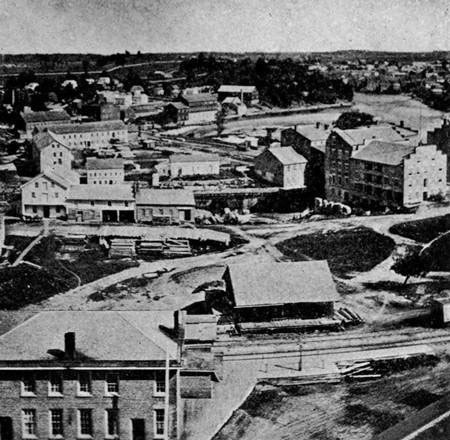
The railroad was, however, opened to Watertown, its headquarters, its
chief town, and the inspiration that had brought it into being, on the
evening of September 5, 1851. At eleven o’clock that evening, up to the
front of the passenger station, then located near the foot of Stone
Street, the first locomotive came into Watertown. I am not at all sure
which one of the road’s small fleet it was. It had started building
operations with four tiny second-hand locomotives which it had garnered
chiefly from New England—the Lion, the Roxbury, the Commodore and
the Chicopee. Of these the Lion was probably the oldest, certainly the
smallest. It had been builded by none other than the redoubtable George
Stephenson, himself, in England, some ten or fifteen years before it first
came into Northern New York. It was an eight-wheeled engine, of but
fourteen tons in weight. So very small was it in fact that it was of very
little practical use, that Louis L. Grant, of Rome, who was one of the
road’s first repair-shop foreman, finally took off the light side-rods
between the drivers—the Lion was inside connected, after the inevitable
British fashion, and had a V-hook gear and a variable cut-off—and gained
an appreciable tractive power for the little engine.
But, at the best, she was hardly a practical locomotive, even for 1851.
And soon after the completion of the road to Cape Vincent she was
relegated to the round-house there and stored against an emergency. That
emergency came three or four years after the opening of the line. A
horseman had ridden in great haste to the Cape from Rosiere—then known as
LaBranche’s Crossing—with news of possible disaster.
“The wood-pile’s all afire at the Crossing,” he shouted. “Ef the road is a
goin’ to have any fuel this winter you’d better be hustling down there.”
Richard Starsmeare was on duty at the round-house. He hurriedly summoned
the renowned Casey Eldredge, then and for many years afterwards a famed
engineer of the Rome road and Peter Runk, the extra fireman there.
Together they got out the little Lion and made her fast to a flat-car
upon which had been put four or five barrels filled with water to
extinguish the conflagration. It would have been a serious matter indeed
to the road to have had that wood-pile destroyed. It was one of the chief
sources of fuel supply of the new railroad. The Lion, with its tiny
fire-fighting crew, went post-haste to LaBranche’s. But when it had
arrived the farmers roundabout already had managed to extinguish the
flames.... Casey Eldredge reached for his watch.
“Gee,” said he, “we shall have to be getting out of this. The Steamboat
Express will be upon our heels. Peter, get the fire up again.”
Peter got the fire up. He opened the old fire-box door and thrust an
armful of pine into it. The blaze started up with a roar. And then the men
who were on the engine found themselves lying on their backs on the grass
beside the railroad....
They plowed the Lion out of the fields around LaBranche’s for the next
two years. Her safety-valve was turned out of the ground by a farmer’s boy
a good two miles from the railroad. Starsmeare got it and carried it in
his tool-box for years thereafter—he quickly rose to the post of engineer
and in the days of the Civil War ran a locomotive upon the United States
Military Railroad from Washington south through Alexandria to Orange Court
House.
So perished the Lion. The little Roxbury’s fate was more prosaic. With
the flanges upon her driving-wheels ground down and her frame set upon
brick piers she became the first powerhouse of the Rome shops. The
Commodore and the Chicopee were larger engines. With their names
changed they entered the road’s permanent engine fleet.
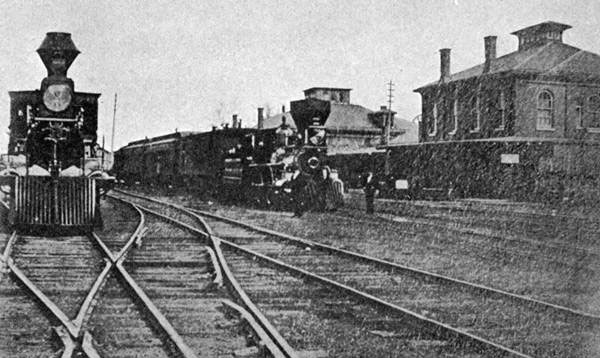
In the meantime the Watertown & Rome was having its own new locomotives
builded for it in a shop in the United States. Four of the new engines
were completed and ready for service about the time that the road was
opened into Watertown. The fifth engine, the Orville Hungerford, built
like its four immediate predecessors, by William Fairbanks, at Taunton,
Mass., was not delivered until the 19th day of that same September, 1851.
The Hungerford was quite the best bit of the road’s motive-power, then
and for a number of years thereafter. She was inside connected—her
cylinders and driving-rods being placed inside of the wheels; always the
fashion of British locomotives—and it was not until a long time
afterwards that she was rebuilt in the Rome shops and the cylinders and
rods placed outside, after the present-day American fashion. She was but
twenty-one and a half tons in weight all-told, while her four
predecessors, the Watertown, the Rome, the Adams and the Kingston,
each twenty-two tons and a half.
I have digressed. It still is the evening of the fifth of September, 1851.
A great crowd had congregated that evening in the neighborhood of that
first, small temporary station at Watertown. The iron horse was greeted
with many salvos of applause, the waving of a thousand torches and, it is
to be presumed, with the presence of a band. Yet the real celebration over
the arrival of the railroad was delayed for nineteen days, when there was
a genuine fête. It was first announced by the Reformer on the 4th of
September, saying:
“... We are informed by R. B. Doxtater, Esq., the gentlemanly and
efficient Superintendent of the Watertown & Rome Railroad, that the public
celebration in connection with the opening of this road will take place on
Wednesday, the 24th September. This will be a proud day for Jefferson
County and we trust that she may wear the honor conferred upon her in a
becoming manner. The known liberality of our citizens induces the belief
that nothing will be left undone on their part to contribute to the
general festivities and interest of the occasion....”
Nothing was left undone. The morning of the 24th of September was ushered
in by a salute of guns; thirteen in all, one for each member of the Board
of Directors. At 10 o’clock a parade formed in the Public Square, under
the direction of General Abner Baker, Grand Marshal of the day, and in the
following formation:
Music
Watertown Citizens’ Corps
Order of The Sons of Temperance
Fire Companies of Watertown and Rome
Order of Odd Fellows
Committee of Arrangements
Corporate Authorities of Watertown, Kingston, Rome and Utica
Clergy and the Press
Officers, Directors, Engineers and Contractors
of the
Watertown & Rome Railroad
Specially Invited Guests
Strangers from Abroad and the Stockholders
Citizens
The procession marched down Stone Street to the passenger depot of the new
railroad where the special train from Rome arrived at a little after
eleven o’clock and was greeted by a salvo of seventy-two guns—one for
each mile of completed line. There it reformed, with its accessions from
the train and returned to the Public Square where there was unbridled
oratory for nearly an hour. After which a return to the depot in which a
large collation was served, before the return to the special train for
Rome.
So came the railroad to Watertown. By an odd coincidence, the Hudson River
Railroad from New York to Albany was finished in almost that same month.
It was with a good deal of pride that the resident of Watertown
contemplated the fact that he might leave his village by the morning
train at five o’clock and be in the metropolis of the New World by six
o’clock that same evening. Such speed! Such progress!
In the meantime the Watertown & Rome Railroad had sustained a real loss;
in the death, on the morning of Sunday, April 6, 1851, of its first
President, the Hon. Orville Hungerford. As the son of one of the earliest
pioneers of Watertown, Mr. Hungerford had played no small part in its
development. Merchant, banker, Congressman, he had been to it. And to the
struggling Watertown & Rome Railroad he was not merely its President, but
its financial adviser and friend. It was due to his personal endorsement
of the project, as well as that of his bank, that hope in it was finally
revived. Then it was that foreign capitalists had their doubts as to its
final success dispelled and gave evidence of their faith in the new road
by substantial purchases of its securities.
Mr. Hungerford was succeeded as President of the Watertown & Rome by Mr.
W. C. Pierrepont, of Brooklyn, who, while in one sense an alien to
Jefferson County, was in another and far larger one, not only one of her
chief residents but one of her most loyal sons. He, too, had been a
powerful friend and advocate of the new road, had worked tirelessly in
its behalf. It was his rare opportunity to stand as its President when the
locomotive first arrived at Pierrepont Manor, the center of his land
holdings, and a very few months later in the same enviable post at
Watertown. It was his patient habit to go down to the depot at the Manor
evening after evening and with a spy-glass in hand watch the track toward
Mannsville for the coming of the evening train. There was no telegraph in
those days, of course, and the locomotive’s smoke was the only signal of
its pending arrival. Neither was there any standard time. Finally it was
Pierrepont, himself, who fixed the official time for the road,
ascertaining by a skillful use of his chronometer that the suntime at
Watertown was just seven minutes and forty-eight seconds slower than that
of the City Hall in New York. And so it was officially fixed for the
railroad.
Under Mr. Pierrepont’s oversight the Watertown & Rome Railroad was
finished; through to the village of Chaumont in the fall of 1851, and then
in April of the following year to Cape Vincent, its original northern
terminal. At this last point elaborate plans were made for a water
terminal. Even though the harbor there was not to be protected by a
breakwater for many, many years to come, the town was recognized as an
international gateway of a very considerable importance. A ferry steamer,
The Lady of the Lake, which had attained a distinction from the fact
that it was the first upon these northern waters to have staterooms upon
its upper decks, was engaged for service between the Cape and the city of
Kingston, in Upper Canada. Extensive piers and an elevator were builded
there upon the bank of the St. Lawrence, and the large covered passenger
station that was so long a familiar landmark of that port.
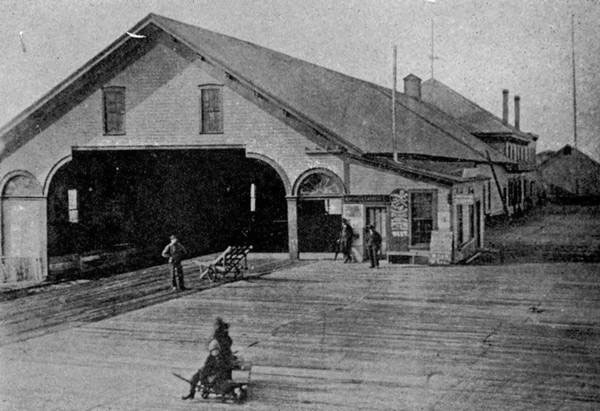
THE CAPE VINCENT STATION
A Real Landmark of the Old Rome Road, Built in 1852 and Destroyed by a Great Storm in 1895.
For forty years this station stood, even though the span of life of the
large hotel that adjoined it was ended a decade earlier by a most
devastating fire. But, upon the evening of September 11, 1895, when
Conductor W. D. Carnes—best known as “Billy” Carnes—brought his train
into the shed to connect with the Kingston boat, a violent storm thrust
itself down upon the Cape. In the rainburst that accompanied it, the folk
upon the dock sought shelter in the trainshed, and there they were
trapped. The wind swept through the open end of that ancient structure and
lifted it clear from the ground, dropping it a moment later in a thousand
different pieces. It was a real catastrophe. Two persons were killed
outright and a number were seriously injured. The event went into the
annals of a quiet North Country village, along with the fearful disaster
of the steamer Wisconsin, off nearby Grenadier Island, many years
before.
With the Cape Vincent terminal completed, the regular operation of trains
upon the Watertown & Rome began; formally upon the first day of May, 1852.
Six days later the road suffered its first accident, a distressing affair
in the neighborhood of Pierrepont Manor. A party of young men in that
village had taken upon themselves to “borrow” a hand-car, left by the
contractor beside the track and were whirling a group of young women of
their acquaintance upon it when around the curve from Adams came a “light”
locomotive at high-speed, which crashed into them head-on and killed three
of the women almost instantly; and seriously wounded a fourth.
The first employe to lose his life in the service was brakeman George
Post, who, on October 13th, of that year, was going forward to lighten the
brakes on the northbound freight, as it reached the long down-grade, north
of Adams Centre, when he was struck by an overhead bridge and died before
aid could reach him.
These men of the North Country were learning that railroading is not all
prunes and preserves. They had their own troubles with their new
property. For one thing, the engines kept running off the track. There
were three locomotive derailments in a single day in 1853 and the
Directors asked the Superintendent if he could not be a little more
careful in the operation of the line. They also officially chided, quite
mildly, one of their number who had contributed twenty-five dollars to the
Fourth-of-July celebration in Watertown that summer without asking the
consent of the full Board. On the other hand, they quite genially voted
annual passes for an indefinite number of years to the widows of Orville
Hungerford and of Edmund Kirby as well as their daughters.
It was only two years later than this that there was a change in the
Superintendent’s office, Job Collamer, who had succeeded its original
holder Robert B. Doxtater, being succeeded by Carlos Dutton who was paid
the rather astonishing salary, for those days, of $4000 a year. A year
later R. E. Hungerford, of Watertown, succeeded Daniel Lee, who was
compelled to retire by serious illness as the company’s Treasurer and was
paid $1500 a year, with an occasional five-hundred-dollar bond from the
sinking fund as special compensation at Christmas time. It was about this
time also, that John S. Coons, now of Watertown, became station-agent at
Brownville, a post which he held for four or five years.
These events were, perhaps, to be reckoned as fairly casual things in the
life of a railroad which, to almost any community is life itself. From the
beginning the Watertown & Rome played a most important part in the life of
the steadily growing territory that it served. Northern New York was
finally beginning to come into its own. More than a hundred thousand folk
already were residing in Jefferson, St. Lawrence and Lewis counties. No
longer was it regarded as a vast wilderness somewhere north of the Erie
Canal. Horace Greeley had visited it in the fifties, had lectured in what
was afterwards Washington Hall, Watertown, and had been tremendously
impressed by Mr. Bradford’s portable steam engine. And in 1859 the eyes of
the entire land were focused upon Watertown and its immediate
surroundings.
That was the year of the big ballooning. John Wise, of Lancaster,
Pennsylvania, a well-famed aeronaut, together with three companions—John
La Mountain, of Troy, and William Hyde and O. A. Geager, both of
Bennington, Vermont—had set forth from St. Louis in the evening in the
mammoth balloon, Atlantic, with the expressed intention of sailing to
New York City in it. All night long they traveled and sometime before
dawn La Mountain fancied that they were over one of the Great
Lakes—probably Erie. He awakened his sleeping companions and pointing far
over the basket-edge told them that they were passing over the surface of
a large body of water.
“You can see the stars below you now,” he explained.
And so they were, over Erie. They continued to sail between the stars
until dawn, and sometime just before noon they crossed the Niagara River,
well in sight of the Falls. Winging their flight at a rate that man had
never before made and would not make again for many and many a year to
come, the Atlantic traveled the whole length of Ontario before four
o’clock in the afternoon and finally made a forced landing not far from
the village of Henderson.
The fame that arose from so vast an exploit literally swept around the
world. Hyde and Geager had had enough of ballooning and returned to their
Vermont home. Wise went back to Lancaster, but La Mountain found an
intrepid and a fearless companion in John A. Haddock, at that time editor
of the Watertown Reformer, who once had been into the wilds of Labrador
and had returned safely from them. Together these men rescued the
Atlantic from the tangle of tree-tops into which it had fallen. On
August 11th of that same year they announced an ascension from the Fair
Grounds in Watertown, accompanied by La Mountain’s young cousin, Miss
Ellen Moss. And on the twenty-second of the following September the two
men made what was destined to be the final ascent of the great Atlantic.
The balloon rose high—from the Public Square, this time—and floated off
toward the north in a strong wind. In a little less than three hours it
traversed some four hundred miles. Then a quick landing was made, in the
vast and untrodden Canadian forest, some 150 miles due north of Ottawa, a
region even more desolate then than to-day.
For four days the men were lost, hopelessly. Their airship was abandoned
in the trees and they made their way afoot as best they might until they
came into the path of a party of lumbermen bound for Ottawa. It was
another seven days before they had reached the Canadian capital and the
outposts of the telegraph—in all eleven endless days before Watertown
knew the final result of the foolhardy ascension, and prepared a mighty
welcome for them, whom they had given up as dead.
To these really tremendous events in the history of the North Country the
Watertown & Rome and the Potsdam & Watertown railroads—of this last,
much more in a moment—ran excursions from all Northern New York. Vast
throngs of people came upon them. The effect upon the passenger revenues
of the two railroads was appreciable upon the occasion of the balloon
ascension, just as it had been three summers before, when the first State
Fair had been held in Watertown—in a pleasant grove very close to the
site of the present Jefferson County Orphans Home. At that time the Rome
road had taken in nearly $11,000 in excursion receipts and the Potsdam
road, although at that time only completed from Watertown to Gouverneur,
more than $5,000. This was used as an argument by the promoters of the
second State Fair at Watertown—held on the present county fair grounds in
the fall of 1860, for a subscription of a thousand dollars from each of
the roads—which was promptly granted.
Yet the Watertown & Rome Railroad needed no excursions for its prosperity.
It had prospered greatly; from the beginning. Its four passenger trains a
day—two up and two down—were well filled always. Its freight train which
ran over the entire length of the line from Rome to Cape Vincent each day
did an equally good business. Already it had the third largest freight-car
equipment of any railroad in the state. Its success was a tremendous
incentive to all other railroad projects in the North Country. From it
they all took hope. We have seen long ago the serious efforts that were
being made to build a road direct from Sackett’s Harbor up the valley of
the Black River to Watertown and Carthage and thence across the
all-but-impenetrable North Woods to Saratoga. Yet nowhere was it more
obvious that a railroad should be builded than between Watertown and some
convenient point upon the Northern Railroad, which already was in complete
operation between Lake Champlain and Ogdensburgh. Such a railroad
presently was builded; taking upon itself the appellation of the Potsdam &
Watertown Railroad. And to the consideration of the beginnings of that
railroad, a most vital part of the Rome, Watertown & Ogdensburgh, that was
as yet unborn, we are now fairly come.