One of the things which history should teach
us is how to make the future better than
the past has been. History teaches people
about the brave deeds done by their ancestors,
and about what has been suffered for the good of
the land by those who have passed away. It is well
for a people to consider from time to time what manner
of country theirs has been. Only by doing this can
they know how to serve its interests, and to secure for
it the best future that is possible.
For the Philippine Islands a very bright future may
be hoped. How soon prosperity and happiness will
come to the country depends, however, more largely
upon its own people than upon any outside influence.
The Americans in the Philippines can only advise and
teach; the actual work of building up the country, and
of making it a power in the Orient, must be done by
the Filipinos.
Let us take a look at the country as it is to-day,
222and learn something of its nature and of its resources.
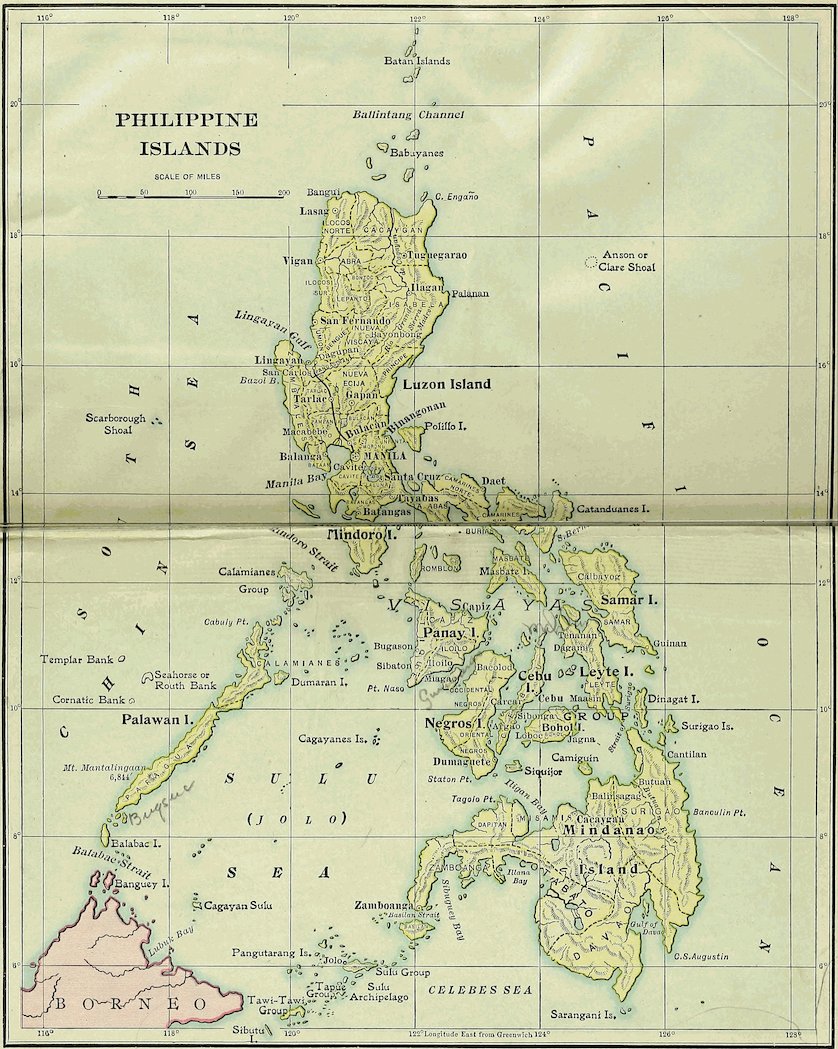
Of all the islands, Luzon is the largest, and, at the
present time, the most important. It is a delightful
place, with lofty mountains, fertile plains, and beautiful
rivers. But beautiful as it is to-day, it possesses possibilities
which, if developed, will make it indeed what
the Spanish were wont so proudly to call it, “the Pearl
of the Orient.”
On the west coast of Luzon are two important bays,
Lingayen (lin gī ān´) and Manila, with several smaller
ones, as Subig (sö´big), Balayan (bä lī´än), Batangas,
and Tyabas, on the west and south. On the northern
side most of the great mountain ranges sweep down to
the sea, sending out spurs of land that form little coves
or harbors; while on the south coast lies the safely
sheltered harbor of Sorsogon (sȯr sō gōn´).
The mountains in the western part of the island are
broken up into practically three ranges, none more
than thirty or forty miles long, and all known by one
name, Sierra de Ilocos (sē e´rä dā ē lō´cos). Short
spurs of hills run out from all these, so that there is
very little level land in this section. A plain of small
extent lies about Vigan (vē gän´), and there is also the
valley of the Abra (ä´brä), which is long and narrow.
East of the central cordillera and stretching out toward
the Sierra Madres (mä´drās) hills, is a beautiful valley
over a hundred miles long, and in some parts very wide.
Through it runs the Rio Grande de Cagayan (kä gī än´),
with several smaller streams emptying into it.
Here is some of the best tobacco land in the country,
and tobacco is about the only crop raised. It was
made the main crop during the years of government
223monopoly, so that the cultivation of rice, of cocoa, and
of all the native products was driven out. This has
been a great misfortune to the country. The land is
adapted to a variety of crops. It is rich and fertile,
and could be made to raise nearly all the food crops
needed by its inhabitants. The people have come,
however, to depend entirely upon one crop, and in
years when the tobacco crop fails there is great need
in the country.
Another great valley, the finest and richest in Luzon,
stretches from the bay of Lingayen to Manila Bay. It
has some 3,000 square miles of fine farming land. The
provinces of Pangasinan, Tarlac, Nueva Ecija, Pampanga,
and Manila lie in this valley. It is a well
watered region. The Rio Grande, the Chico, the
Agno, and the Dagupan rivers flow through it, besides
numerous smaller streams.
In the central part of the plain rises Mount Arayat
(ä rī ät´), a volcanic mountain which in a clear day can
be seen from Manila. It is claimed that this mountain
rose suddenly from the plain in a single night, during
some earthquake disturbance in the year 1700. We
find this statement made in apparent good faith by
some scientific authorities. We know that the mountain
is of volcanic origin, and that it was formed only
a few hundred years ago; but there is no reliable record
of when it made its appearance, or of how long it
was in forming.
Southward, in Batangas Province, is Lake Bombon.
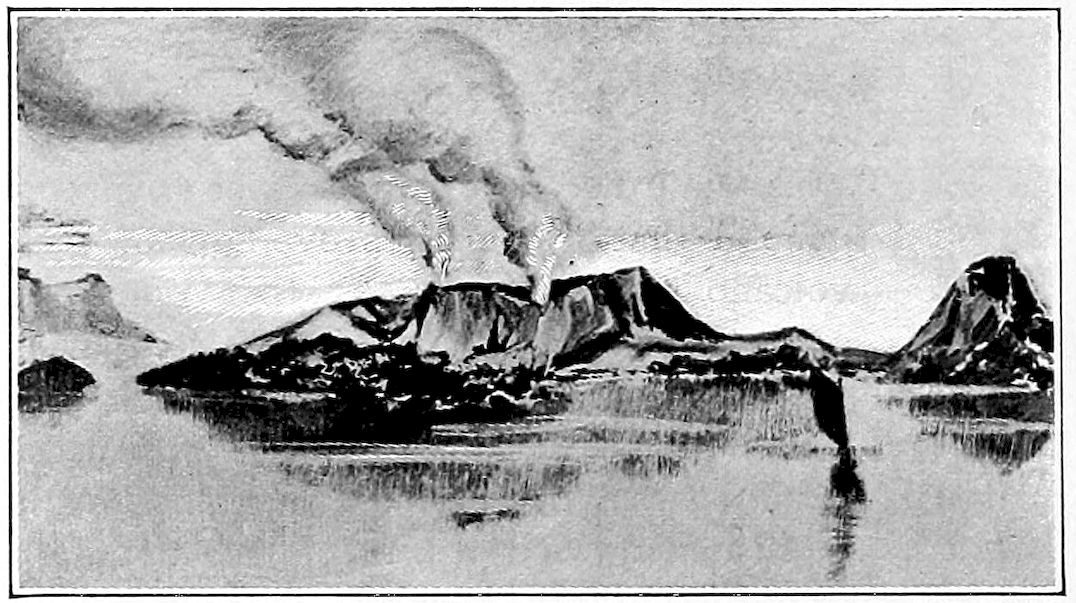
In the middle of this lake is Taal volcano, whose many
eruptions have in times past worked destruction in that
neighborhood. The lake, also, is of volcanic origin.
224There must once have been a great mountain here,
which sank during some upheaval, forming the lake
and the present volcano of Taal.
The country all about the lake is very fertile, and
under good cultivation. The principal crop there is
coffee, of which an excellent quality is grown; and formerly
it was produced in very great quantities. Rice,
Indian corn, cotton, and all kinds of vegetables common
to the tropics, grow there in great abundance.
These can be made a source of profit in supplying the
markets of Manila. There is a great deal of alum about
Taal volcano, and it is said that a good quality of iron
is found in the mountains of this province.
In Laguna Province is Bay (bī) Lake, or Laguna de
Bay. This is a body of fresh water, with an outlet
by the Pasig River, which flows down to Manila Bay.
Light draft steamers run up the Pasig and through the
lake, and on this beautiful waterway is a constant
throng of craft, going up and down with produce for
the different ports.
There is very fine timber in the island of Luzon,
particularly in Tayabas, Camarines Norte, and Ilocos
Norte. Some gold has been found in the mountains
about these provinces, and specimens of many other
minerals have been brought to Manila.
In Camarines Sur lies the valley of the Vigan, in
which are several small lakes. There are large rice
fields here, and the quality of the rice is very fine.
Large quantities of it are sent to Manila.
One of the richest and most fertile parts of the whole
island is Albay (äl bī´) Province, in the southeastern
corner. This is a particularly beautiful part of the
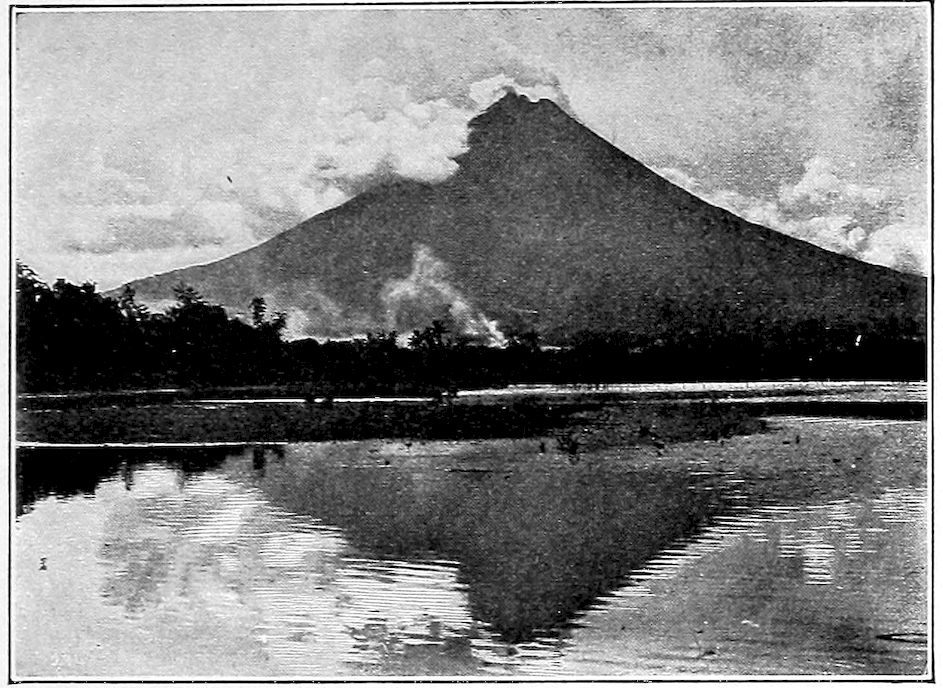
225island. Here is Mayon volcano, which is called by
scientists the most beautiful volcano in the world. It
is the most perfectly formed and symmetrical, but it is
no more desirable a neighbor than are volcanoes anywhere.
In past years it has wrought great destruction
in the country, but of late has been quiet, and seems
to be on its good behavior.
The rich volcanic soil of this district will produce
almost anything that can be made to grow in a tropical
country. Very fine hemp grows here, probably the
best that the islands produce. Cocoa, coffee, sugar,
and rice all do well. Cocoanuts, bananas, all the fruits
and vegetables of the islands, grow in Albay, with
scarcely any cultivation. The climate is mild, and very
226healthful, and near Tibi are hot sulphur springs which
are said to cure rheumatism and numerous other ills.
The most important of the smaller islands lying out
from Luzon are Mindoro (mēn dō´rō) and Masbate
(mäs bä´tā). These are small and very mountainous.
Mindoro is deeply wooded, but only a little is known
of the interior of the island.
The great bay of Manila is twenty miles long and
thirty-two miles wide. It has a depth in some places
of seventy feet. It is entered by two channels, one on
either side of Corregidor Island. The main one is called
the Boca Grande (bō´kä grän´dā); the other, which is
smaller, the Boca Chica (bō´kä chē´kä). The bay is so
large that it is more like an inland sea than a bay; in
fact, it is too large to afford secure anchorage for vessels
during great storms.
The Visayas form the second large division of the
Philippine archipelago. This is a group of islands, six
in number, which lie between Luzon and Mindanao.
They are very thickly populated. The Visayan people
seem almost a distinct race—different from those of
Luzon, and from their neighbors of Mindanao. They
speak a language of their own, and are inclined to regard
themselves as a separate people. Now that new
conditions prevail in the islands, and there is better
communication between the Visayas and Luzon, much
of this feeling of separation among the people will
probably soon be overcome. It is to be hoped that
it will be. The people of the Philippines must come
to feel that they are one people, with common interests,
and that all must work together to develop the
whole country.
227Iloilo, the principal city of the Visayas, is on the
island of Panay. It is an open seaport, and will in
time become a very important city. It was destroyed
during the insurrection, but is now rapidly building
up again. Under good management it will some day
be one of the main shipping centers of the archipelago.
Iloilo Province is a great sugar and rice growing
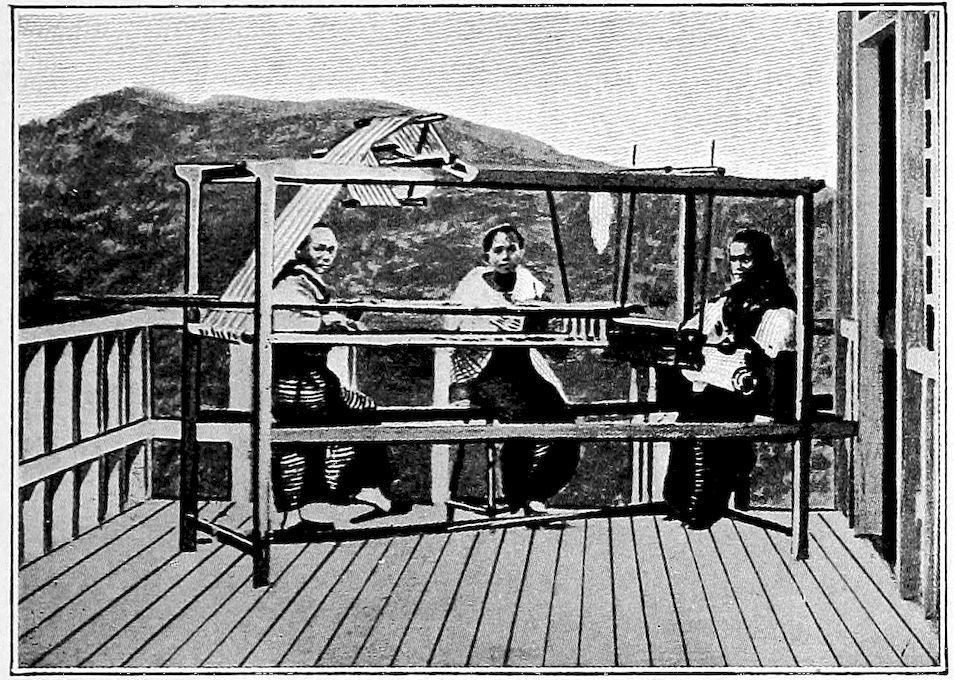
district. It is, besides, noted for the fine fabrics which
its people make. This is the center for the manufacture
of the cloth known as jusi. The women manufacture
also most exquisite piña cloth. Some of this
is of so fine a quality that it has to be woven in closed
rooms, for the slightest breeze would serve to break
the delicate threads of which it is made. Very beautiful
silk and cotton goods are also made in this province.
228Since the American occupation there has come
to be a large demand in America for these goods, so
that the people engaged in the industry are kept very
busy.
The island of Negros, which lies to the southeast
of Panay, is an important agricultural island. A great
deal of sugar is grown here, and there is much wealth
in the island. Many of the large sugar estates are
owned by Filipinos. Considerable modern machinery
has been introduced into the island. Steel plows are
in use, and in many places sugar is manufactured by
improved modern methods. All of these things have
helped to make Negros very prosperous. If the planters
here would combine and introduce machinery for
refining their own sugar they would come in time to
an even greater measure of prosperity and independence
than they now enjoy. Rice, hemp, and some
tobacco are raised in Negros, and fine cocoanuts and
bananas grow wild.
The island of Cebu is little more than the top of a
mountain rising from the sea. A good deal of historic
interest centers here, however. The city of Cebu was
the first seat of Spanish government, and remained
the capital of the archipelago until Legaspi went to
Luzon and set up his government in Manila. Cebu
was made an open seaport by the Spanish, and although
its exports are not large now, when the resources of
this island are developed the city will become an important
shipping center. There is a large Malay population
in the island. There are no rivers or valleys;
the land is broken up into small farms, and hemp is
the principal crop. The island produces also a good
229deal of copra and raw sugar, and the people raise most
of their own foodstuffs.
Bohol, Leyte, and Samar are all volcanic islands.
They are mountainous, and subject to frequent
earthquakes and similar disturbances. There is not
much agricultural land in Bohol, and the soil is poor
and thin; but a good deal of hemp is raised, and
some cocoa. The people are fishermen and sailors,
and earn their living from the sea. Although Bohol
is much smaller than Cebu, it has a larger population.
Leyte ships more hemp than does any other of the
Visayan islands. There are several good harbors on
this island, but Tacloban is the chief shipping point.
Very little is known of the interior of Leyte, for the
country has not been developed.
Samar is the largest of the Visayan islands, but has
the smallest population. It is a very mountainous
country, wind-swept and beaten upon by the sea. It
lies directly in the track of the northeast monsoons,
which visit it with great fury. Its chief port, Catbalogan,
is well sheltered and a safe harbor.
Between the north of Samar and the southern end
of Luzon lies the famous Strait of San Bernardino.
This is one of the principal entrances into the archipelago
from the Pacific Ocean. It has been the scene
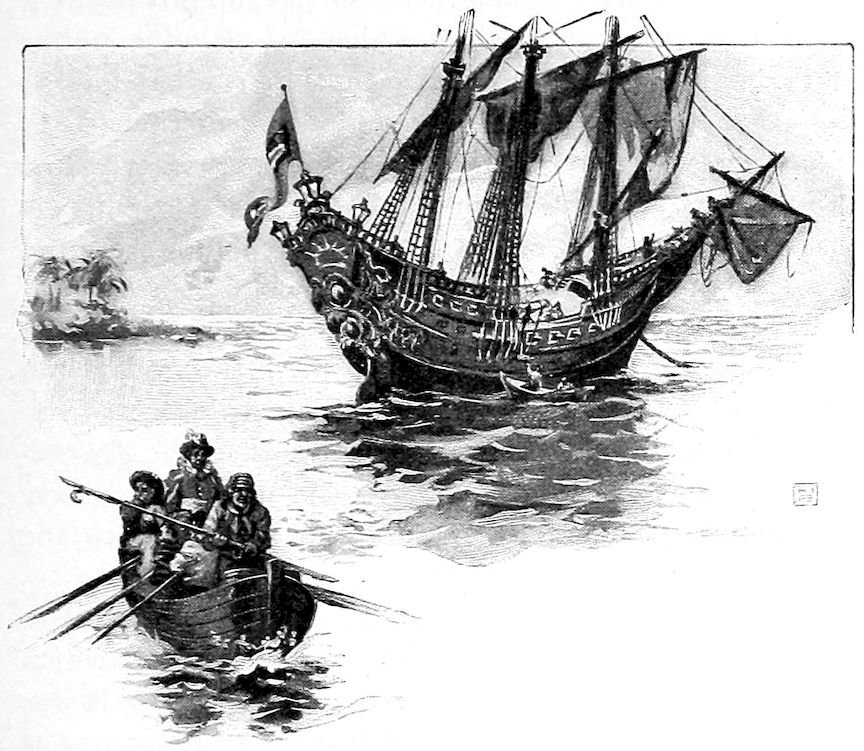
of many a famous sea battle, for here the Dutch and
the English ships used to lie in wait for the galleons
of Spain which brought treasure from Mexico to the
Philippines and carried out rich freights for Acapulco.
Next in size to Luzon is the island of Mindanao. It
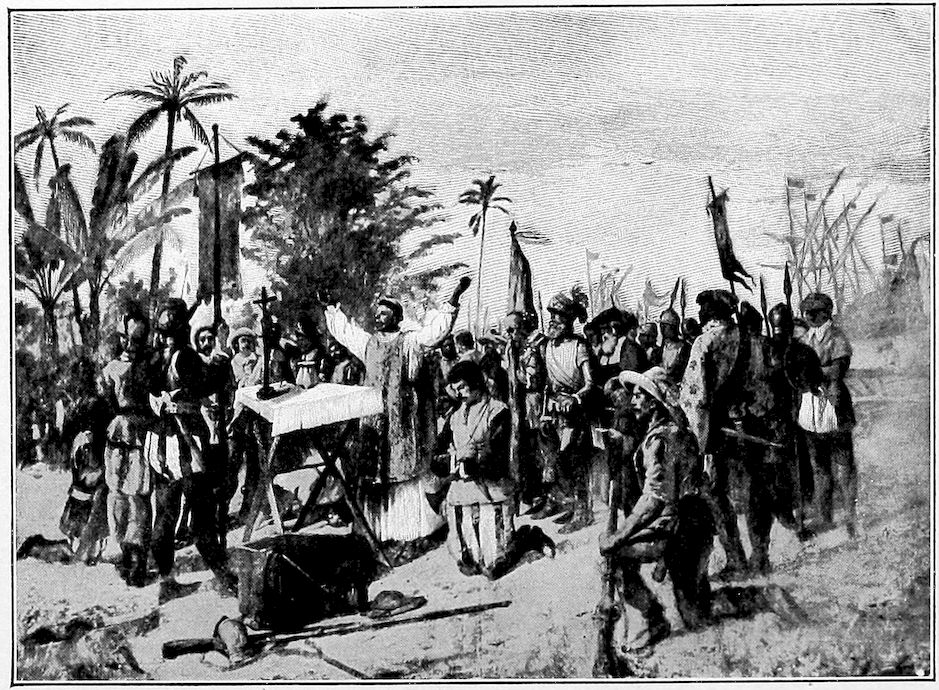
was on the north coast of this island that Magellan
made his first landing in the Philippines. There are
230four great mountain ranges in Mindanao, with many
high peaks. The island is rich in vast forests, and
some day the world will draw its main supply of fine
building lumber from them.
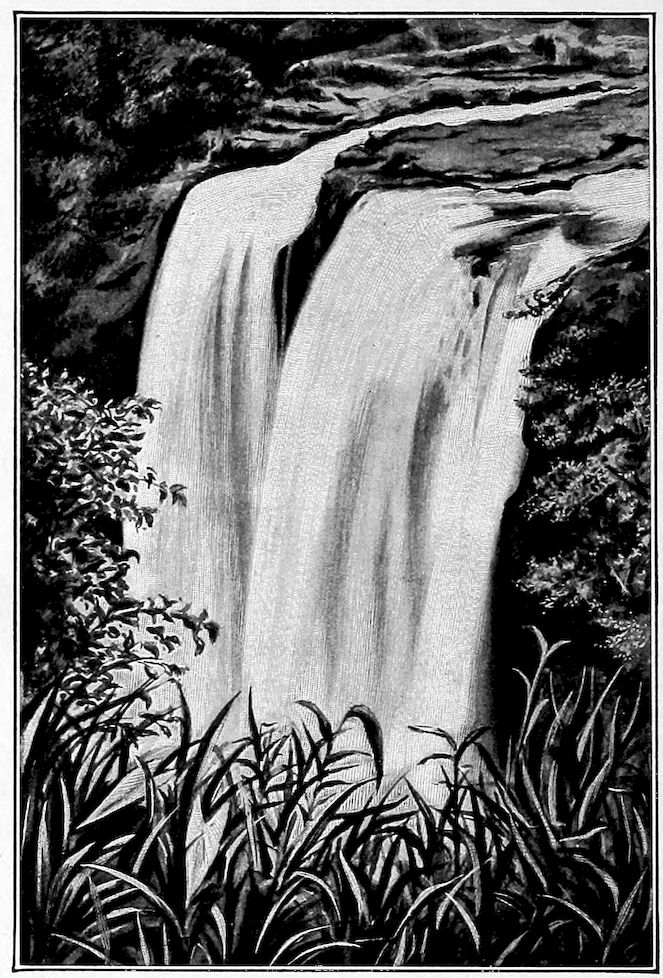
THE FALLS OF BOTOCAN IN LUZON.
231Although Mindanao is of volcanic formation, and has
even within historic times undergone great changes,
there is only one active volcano in the island. This
is Mount Apo (ä´pō), a few miles from the coast of
Davao (dä vä´ō) Gulf. The mountain has three peaks.
The top is covered with sulphur, which sometimes
gleams white as snow in the sunshine and at other
times makes Apo look like a mountain of gold.
There are a number of fine rivers and lakes on Mindanao.
The best port in the island is Balanag (bä lä-näg´),
in the Gulf of Davao. The harbor of Zamboanga
is very good, and there is a still better harbor at Lindangan
(lēn dän´gän). Nowhere on the island, however,
are there such sheltered harbors as are found on
the southern coast of Luzon.
Very few storms visit this part of the archipelago.
The typhoons only touch one corner of it in the far
northeast. The climate of Mindanao is more healthful
than it has in the past been supposed to be. The
soil is very rich and fertile, and almost any tropical
crop can be readily grown there. Hemp, sugar-cane,
tobacco, coffee, cocoa, rice, Indian corn, and many
other things are raised, and all do well; but the island
is backward as regards development. No serious attempt
has ever been made to build up its agriculture
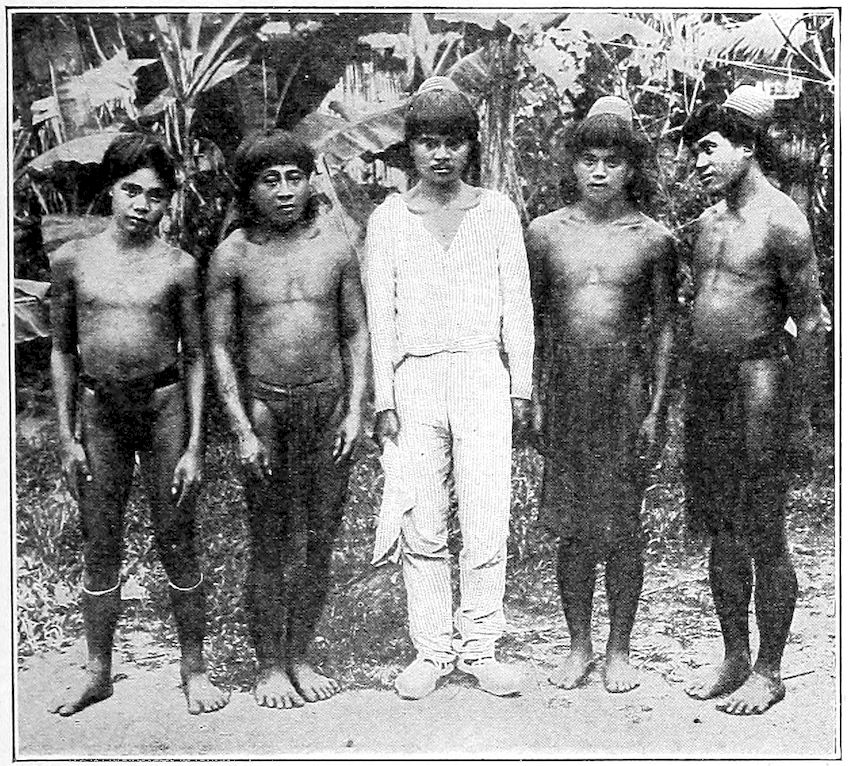
or its commerce. There are many tribes living among
its mountains whose names, even, are not known to the
civilized people of the archipelago. There are few
Malays in Mindanao, and their manufactures and industries
have never been encouraged. Some gold has
been found in the hills, and silver is plentiful. Coal
has also been discovered in the mountains.
232It is likely, however, that when Mindanao is opened
up and its resources are better known, it will be found
that its wealth consists less in minerals than in vegetable
growths. We already know that the vegetation
of the island, little as it has been developed, surpasses
that of Luzon and the Visayas. The soil is of
excellent quality, and the rains are so abundant and
the climate is so favorable that the entire island is covered
with vegetation. In the forests are found India
rubber vines, mahogany, ironwood, teak, ebony, and
other trees of great value. There are immense tangles
of bamboo and rattan; hemp and banana trees grow
well, and cloves, nutmegs, and cinnamon.
This great island is divided into seven districts—Zamboanga,
Misamis, Suragao (sö rä gä´ō), Davao,
Cottabato (kot tä bä´tō), Basilan (bäs ē län´), and Lanay
(län ī´). Although the population is small in comparison
with the great extent of the island, seventeen different
dialects are spoken among its people. Zamboanga
is the capital town of Mindanao. It has a good
port, although somewhat open to the sea, and in the
river Masdong, three miles to the southeast, is safe
anchorage, protected from all winds.
South of Mindanao lies the Sulu archipelago. It is
made up of four groups. The population of this archipelago
is estimated at between 20,000 and 30,000; but
so very little is known about it that this estimate is not
likely to be correct. Joló, the capital city, on the
island of Sulu, is the residence of the sultans. It is
a beautiful town, clean and well-kept. It has a good
port, and a line of steamers runs direct from Joló to
Singapore, and another to Manila. The vegetation of
233this archipelago is very like that of Mindanao. There
is abundance of teak, mahogany, cedar, and other
highly prized woods. Horses, cattle, buffaloes, and
goats are plentiful. The people of Joló manufacture
fine knives and chisels. The pearl fisheries of the archipelago
are also very important.
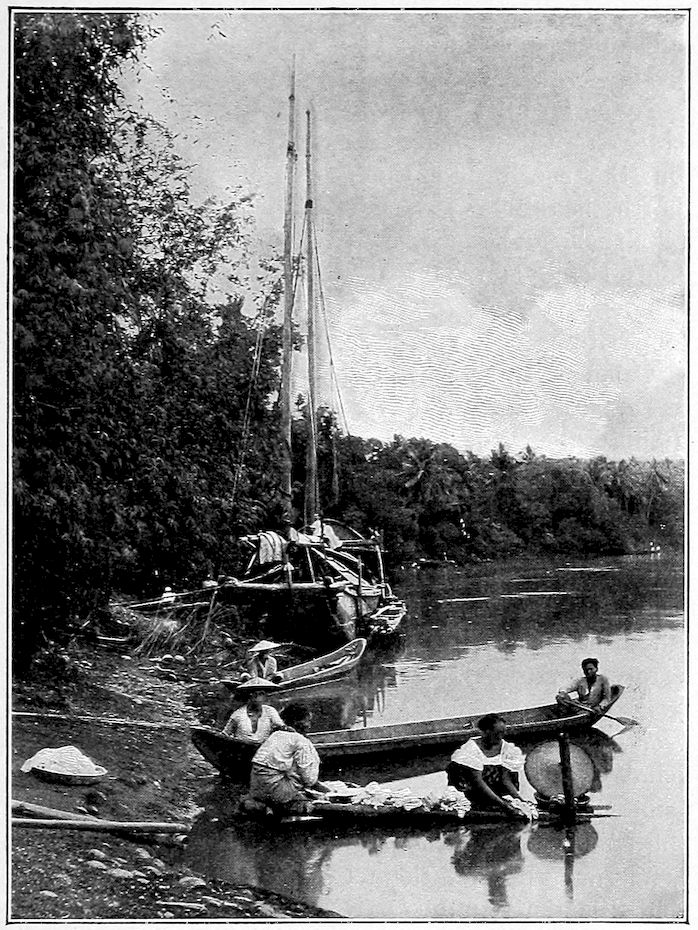
A RIVER SCENE ON THE ISLAND OF LUZON.
234Lying far off to the west, with the Sulu Sea on one
side and the China Sea on the other, with Borneo
on the south and the island of Mindoco to the
north, is the long, narrow island of Palaúan (päl ä-wän´).
The Spanish called it Paragua (pär´a gwā).
This island is inhabited chiefly by the wild tribes.
There are some 10,000 or more of the native Christian
population, and perhaps 10,000 Moros.
Palaúan, on account of its geographical position, is
very important to the archipelago. It will become
important also from a commercial point of view, as it
forms, with the island Balabac (bäl´ä bäk), the Strait
of Balabac. At certain times of the year sailing vessels
are compelled to pass through this strait to enter
the archipelago.
The rattan grown in this island is very fine. It is
the best that comes to Manila, and the trade in it is
enormous. The tree from which gum mastic is obtained
grows there in great abundance, as well as other
trees producing resin. The island has fine pasture
lands, with large numbers of cattle, carabao, goats,
and wild hogs; and there are found the famous edible
birds’ nests so much prized by the Chinese that they
sometimes pay for them twice their weight in silver.
The island has not been very well explored, but it is
said to be rich in minerals.
South of Palaúan lies the little island of Balabac.
It is only thirty-six miles long and eight or ten wide,
with a population of 3,000 or 4,000. Its only town is
235Balabac. Its forest growths are like those of Palaúan,
and there is said to be an abundant deposit of coal
there.
Questions.—Name some of the principal rivers of Luzon.
Where is the best tobacco land in this island? Where does
the finest hemp grow? What minerals are found on Luzon?
Where is Laguna de Bay? What is its outlet? Where on
Luzon is the best timber found? How large is Manila Bay?
What are the Visayas? What is the principal city of this
group? Where is it? What are its manufactures? What
are the principal products of Negros? Why is Cebu of interest
historically? What is the principal crop on this island? What
sort of soil has Bohol? How do the people live there? What
is the principal crop on Leyte? What is its chief city?
Which is the largest of the Visayan islands? How does its
population compare with that of the other islands of the group?
What sort of country is it? Where is the Strait of San Bernardino?
Why is it famous?
Where is Mindanao? Where, on Mindanao, did Magellan
first land? Are there any active volcanos on the island?
What sort of climate has Mindanao? Is it a well watered
country? What are its products? What is its capital city?
Has it any good harbors? Where is the Sulu archipelago?
What is its capital city? What sort of town is it? What do
the people manufacture? Where is Palaúan? Where is the
Strait of Balabac? Why is this strait important? Where
is the island of Balabac?
236

Chapter XXII. THE FUTURE.
We have now learned something of the different
islands of the Philippine archipelago
and of the possibilities that lie in them.
Much has been done in the past to make
this country a source of income to the Spanish crown;
much, however, remains to be done, to make of the
islands a country whose prosperity shall help the
people themselves.
The wealth of a country is not to be estimated by
the amount of its exports, or by the number of its
great buildings, fine harbors, or splendid cities. A
nation may have all of these while the people themselves
are poor. The United States is a great and rich
nation, not because of the value of its national possessions,
but because the great mass of the people are
fairly well off. There can be no real prosperity in a
country unless the people themselves share it; there
can be no just government if that government is considered
as something apart from the people. The
237people must have a part in it before it can be a good
government.
But before a people can take any real part in the
government of a civilized land, they must understand
something of the principles on which good government
is based. They must know something of the world’s
history and of the government of other countries.
They must have a common language, and must be
a united people, all ready to work for the common
good. That country can never prosper which is divided
by a feeling of race difference, or by jealousies
that make hard feeling among its people.
It is because the United States has learned these
things by experience that it has opened public schools
in the Philippine Islands. It seeks to have all the
people learn English, because only by means of a common
language can the Americans and the Filipinos
come to understand one another; only by means of
such a language can the different peoples among the
Philippines come into real harmony.
The time is coming, too, when English will be the
language of the whole commercial world. Already the
people of other great countries know that they must
learn to speak it for business uses, and it is taught as
a matter of course in most of the schools of Europe.
238
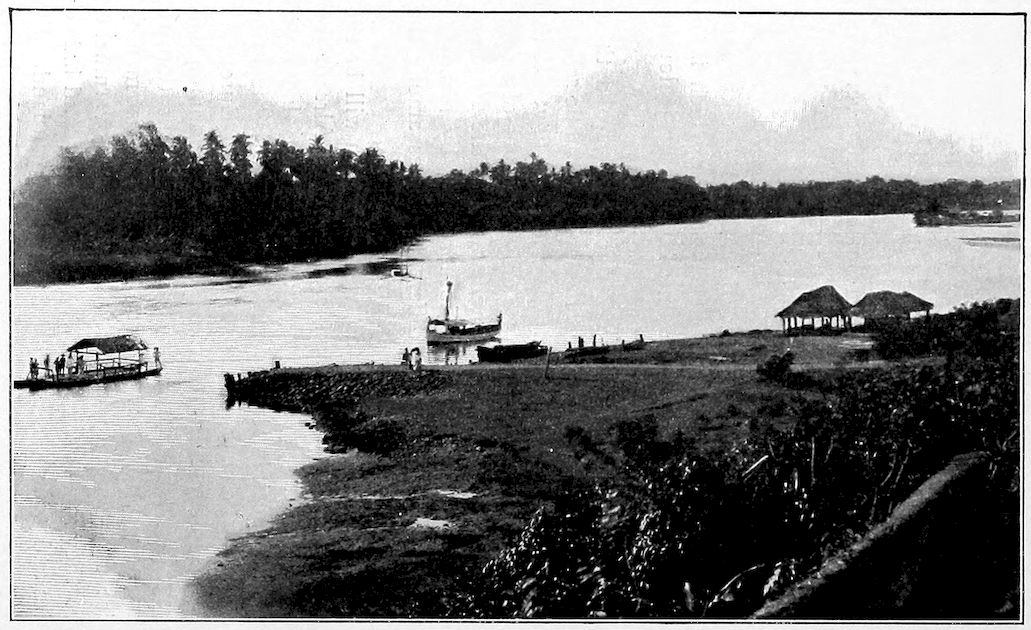
THE CAGAYAN DE ORO RIVER.
239A people must have even more than a common language,
common interests, and modern education, to
become a prosperous people. Not only must men be
wise enough to take part in their own government,
but they must have control of the trades and industries
and commercial ventures of their own land. So
long as the commercial business of a country is almost
wholly carried on by foreigners, that country will never
become rich. It is not meant by this that foreigners
should not be allowed to do business in the country;
that is an idea which belongs to dark ages of the
world’s history. But there should be no need for
them in the country. The people should have such
patriotic pride in the welfare of their own land as
to conduct its business themselves.
Nevertheless, wherever there is a demand for anything
in the commercial world, there will surely, in
time, be a supply. There must be merchants in the
Philippine Islands. There must be tradesmen, artisans,
mechanics, workers in wood, iron, and leather,
and followers of the arts and crafts known to civilization.
If the Filipino people do not take up these
lines of work, and carry them out well and wisely,
outsiders will come in and monopolize them. They
have already come to the archipelago. Moreover,
they will continue to come, from China and Japan,
from India and Ceylon, and from all the countries of
Europe, if the people of the country do not themselves
learn to take their places. So long as the foreigners
are here, there will be nothing for the native people to
do but to work as laborers, or as clerks and servants.
The great resource of the Philippine Islands must
always be agriculture. When modern methods of
farming are adopted here, and modern machinery has
taken the place of the wooden implements and the out-of-date
tools now in use; when we have large sugar
mills and refineries in place of the small and primitive
ones now here, we shall see great progress made.
With peace in the country, and good government
240making every man secure in his right to life, liberty,
and the pursuit of happiness, farm work will be very
different here. Nearly the entire population of the
archipelago ought then to draw a good living from
the land. When all the good land is brought under
cultivation, the crops raised in the islands ought to
increase tenfold over what are now grown.
Before much can be accomplished, however, a great
deal of government work must be carried out. This
the Americans have in view; already some millions
of dollars have been set aside by the civil government
to make roads, harbors, and bridges, and for public
works of many sorts in the archipelago. A day of
hope seems opening, not merely for the Americans
to whom the task has fallen of carrying on the work,
but for the whole Filipino people. They and the
Americans must work together to bring the promises
of this day into full fruitage.
No word about the islands can be complete unless it
touches upon the wonderful beauty of this country.
This is a great part of the good inheritance of the
people. It ought to quicken the pleasure and pride
of every Filipino in his beautiful land. Its lofty
mountains, its lovely plains and noble rivers, the rich
verdure that clothes the country, all go to make up
beautiful pictures everywhere. There is much that can
and must be done to make the cities and towns more
fit and beautiful places for people to live in; but for
the outside country nature has done great things.
The banana plants and the nipa and cocoanut palms
are beautiful as well as useful. So are the great mango
trees and the fields of growing rice. In all nature there
241is nothing more graceful than the giant bamboos that
grow by every stream. Their beauty is of a very
perfect sort. This plant does more than delight the
eye; of all tropical growths it is the most useful to
man. In a little composition which was written by a
Chinese schoolboy in his own country, a fine account
is given of the many uses to which the bamboo can be
put. He says:
“We have a bamboo hedge in our grounds, and
nothing could be better. I am writing with a bamboo-handled
pencil; I have seen bamboo masts on vessels.
On the whole, the bamboo is one of the most precious
possessions of China. Its tapering stalks supply joists
242for houses, ribs for sails, shafts for spars, tubes and
buckets for water, fishing-rods, and the handles and ribs
of our fans. The great bamboo, split, makes an excellent
roof. Rafts are made of the bamboo; baskets are
woven of it. The Chinaman sits in a bamboo chair at
a bamboo table; and he may rest himself, in the heat
of the day, beneath the bamboo tree, with a bamboo
hat upon his head. When I have been all about the
edges of the world, and have seen all kinds of strange
people, I ask nothing better than to come back home
and sit under the shade of a bamboo veranda, and
when my life is finished, to go to heaven from a bamboo
bed.”
To how many other uses than even these do the
Filipino people put bamboo! They make the sails of
ships from it; they build bridges of it; boats, rafts,
water-pipes, scaffolds for building houses, and all kinds
of baskets and furniture. Indeed this plant, with the
India rubber plant and the bijuca, would enable almost
any Filipino to build and furnish a house that would
answer all the needs of the climate.
We have now studied the main facts in the history
of these islands. The Story of the Philippines has
many sad chapters, but there need be no more such.
The Filipino people have been patient under trial.
They have been forbearing through much injustice
and misrule. They have been brave and patriotic
always. Now we may hope that a new day has
dawned upon the land. What this day will bring
forth depends, to a great extent, upon the Filipino
boys and girls who are now growing up. They must
243learn to be good citizens. They must be able, when
they are men and women, to take a wise part in governing
the country.
The night before José Rizal was shot, he said to a
friend: “What is death to me? I have sown; others
are left to reap.”
Rizal would have been glad to see this new day.
He would have been glad to see schoolhouses opening
everywhere in the country, for he knew that knowledge
is power. The seeds which he helped to sow
are those of liberty, justice, and peace. The Filipino
people must be wise enough to cherish these seeds into
strong, healthy growth. If they do this the country
will surely reap the harvest which he foresaw, of peaceful
days, full of hope and happiness.