FIGHTS OF THE SUBMARINES
When, on the 5th of February, 1915, the German admiralty proclaimed
a "war zone" around the British Isles and announced that it would
fight the sea power of the Allies with submarines, a new era in
naval warfare had opened. In all previous wars, and in the earlier
months of the Great War, submarines were employed as auxiliaries
to the larger naval units. The Germans were the first to use them
as separate units. The idea of sending a fleet of submarines out
on to the high seas was a new one, and had been impossible in the
last war in which they had been used—that between Russia and
Japan. But the improvements which had been made in their design and
equipment since then had made an actual cruising submarine possible,
and made possible the new phase of naval warfare inaugurated by the
German admiralty.
While Germany was the last great sea power to adopt the submarine
as a weapon, both England and Germany, in the years immediately
preceding the war, had spent the same amounts of money on this
sort of craft—about $18,000,000—but while the Germans
had later given as much attention to them as to any other sort of
naval craft, the British authorities did not figure on employing the
submarine as a separate offensive tactical unit being sufficiently
equipped in large ships carrying large guns. And being weaker in
capital ships Germany was compelled to rely upon underwater warfare
in her campaign of attrition. Not only were the naval authorities of
the rest of the world uninformed about the improvements that German
submarines carried, Page
1410 but they were fooled even as to the actual number
which Germany had built.
The most modern of the German submarines at the time had a length
of 213 feet and a beam of twenty feet, these dimensions giving
them sufficient deck space to mount thereon two rapid-fire guns,
one of 3.5 inches and another of 1.4 inches. Their displacement was
900 tons, and they could make a speed of 18 knots when traveling
"light" (above water), and 12 knots when traveling submerged. These
speeds made it possible for them to overtake all but the fastest
merchantmen, though not fast enough to run away from destroyers,
gunboats, and fast cruisers. Their range of operation was 2,000
miles, and in the early months of 1915, it was possible for Germany
to send two or three of them from their base in the North Sea to
the Mediterranean. Germany was at the same time experimenting with
a larger type, with a displacement of 1,200 tons and an operating
distance of 5,000 miles.
The ordinary submarine in service at the beginning of the war could
remain below the surface for twenty-four hours at least. Reserve
amounts of air for breathing were carried in tanks under pressure,
and in the German type there were also chemical improvements for
regenerating air. Contrary to the opinion of laymen, submerging
was accomplished both by letting water into ballast tanks, and
also by properly deflecting a set of rudders; every submarine had
two sets of rudders, one of which worked in vertical planes and
pointed the prow of the ship either to the left or the right; the
other pair worked in horizontal planes and turned the prow either
upward or downward. A pair of fins on the sides of the hull assisted
action in both rising and diving. The action of water against the
fins and rudders when the ship was in motion was exactly the same
as that of the air against the planes of a kite; to submerge one
of the craft it was necessary to have it in motion and to have
its horizontal rudders so placed that the resistance of the water
would drive the ship downward; the reverse operation drove it upward.
And here lay a danger, for if the engines of a diving submarine
stopped she was bound to come to the surface. Her presence, while
Page 1411 moving
entirely submerged could be detected by a peculiar swell which
traveled on the water above; if submerged only so much as to leave
the tip of her periscope still showing, the latter left an easily
discernible wake.
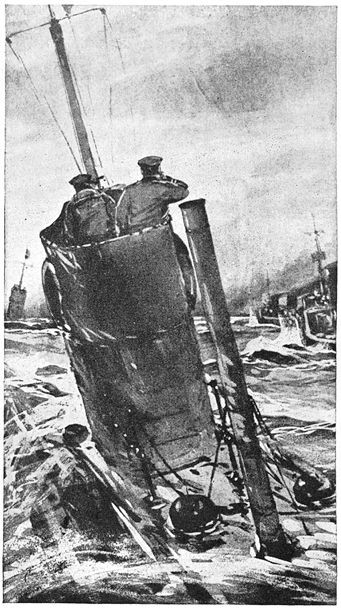
The periscope was merely a tube in which there were arranged mirrors
so that anything reflected in the first mirror, the one above the
surface of the water, was again reflected till it showed in a mirror
at the bottom of the tube, within the hull of the vessel, where
its commander could observe it safely. A crew of about twenty-five
men was necessary to operate one of these crafts, and theirs was
an unpleasant duty, first because of the danger that accompanied
each submergence of their vessel; second because of the discomforts
abroad. The explosive engines which drove the craft, whether burning
oil or the lighter refinements such as gasoline, gave off gases
that caused headaches and throbbing across the forehead; and it
was almost impossible to heat the interior of the craft.
Though merchantmen had gone to the bottom as victims of German
submarines before, the proclamation of a "war zone" was issued
they were individual cases; the first instance of a merchant ship
being sunk as a result of the new policy of the German admiralty
was the sinking of the British steamer Cambark on the 20th
of February, 1915. This ship was bound for Liverpool, from Huelva,
Spain. While off the north coast of Wales, on the morning of the
20th, the periscope of a hostile submarine was sighted only 200
yards ahead. The engines of the steamship were immediately reversed,
but she had no time to make off, for a torpedo caught her amidships
and she started to sink immediately. Her crew managed to get off
in small boats, but all of their personal belongings were lost.
The small Irish coasting steamer Downshire was made a victim
on the 21st of February, 1915, but instead of sending a torpedo
into her hull, the commander of the U-12, the submarine
which overhauled her, resorted to boarding. After trying to elude
the submarine by steering a zigzag course, the Downshire
was finally overtaken. The crew was ordered to take to the small
boats, while nineteen men of the submarine, which had come above
Page 1412 water,
watched the operations from the deck. A crew from the submarine
took one of the small boats of the steamship and rowed toward her.
They placed a bomb in a vital spot and set it off, sinking the
merchantman. In this way the submarine's commander had saved a
torpedo. A conversation which took place between the captains of
the two craft revealed the methods by which the submarine commanders
were able, not only to steal up on their intended victims, but
to elude being sighted by the patrolling British warships. Some
fishing smacks had been in the vicinity while the Downshire
was sunk, and the British captain asked the German captain why they
had not been attacked. The latter hinted that his plans worked
best if the fishing boats were unmolested. When asked whether he
had hidden behind one these little boats he changed the subject,
but it was learned later that the commanders of the submarines
made a practice of coming to the surface right near fishing boats
and bade them act as screens while they lay in wait for victims.
By keeping the small boats covered with a deck gun or by putting
a boarding crew aboard, it was possible for the commanders of the
submarines to keep their periscopes or the hulls of their vessels
behind the sails of the fishing boats, unobservable to lookouts
on larger ships.
By the 23d of February, 1915, the success of German submarines
had been so marked that the insurance rates on merchantmen went
up. Lloyd's underwriters announced that the rate on transatlantic
passage had gone up nearly one per cent. And on the same day it
was announced that the British Government would thereafter regulate
steamship traffic in the Irish Sea. Certain areas of the Irish
Sea were closed to all kinds of traffic; lines of passage were
defined and had to be followed by all merchantmen, and vessels
of all descriptions were ordered to keep away from certain parts
of the coast from sunset to sunrise.
The comparatively small size of the submarines made it possible
for the German admiralty to load them on to trains in sections
and transport them where needed, and in this manner some were sent
from the German ports on the North Sea to Zeebrugge, there assembled
and launched. Others were sent to Page 1413 the Adriatic, arriving at Pola
on the 25th of February, 1915. These were intended for use in the
Mediterranean as well as in the Adriatic Sea.
Neutral ships, in order to escape attack by German submarines had
to resort to unusual methods of self-identification. The use of flags
belonging to neutral countries by the merchantmen of belligerent
powers made the usual identification by colors almost impossible,
the German admiralty claiming that the commanders of submarines were
unable to wait long enough, after stopping a vessel, to ascertain
whether she had a right to fly one flag or another. Consequently
the ships belonging to Dutch and American lines had their names
painted with large lettering along their sides. At night, streamers
of electric lights were hung over the sides to illuminate these
letterings; and on the decks of many of the neutral ships their
names and nationalities were painted in large letters so that they
might be identified by aircraft. Owing to such precautions the
Dutch steamship Prinzes Juliana escaped being sunk by a
torpedo on the 3d of March, 1915. A submarine ran a parallel course
to that followed by the Dutch ship, but after examining the lettering
on her sides the commander of the German craft saw that she was
not legitimate game and turned off.
Not always did the German submarines themselves succeed in escaping
unharmed in their raiding of allied merchantmen. Rewards were offered
in Great Britain for the sinking of German submersibles by the
commanders of British merchantmen. Instructions were issued in
the British shipping periodicals, showing how a submarine might
be sunk by being rammed. It was officially announced on the 5th
of March, 1915, by the British admiralty, that the U-8 had
been rammed and sunk by a British warship. The crew of twenty-nine
was rescued and brought to Dover. For the British this was a stroke
of good fortune, for while the U-8 was of an earlier type
it was a dangerous craft, having a total displacement of 300 tons,
a radius of operation of 1,200 miles, a speed of 13 knots when
traveling "light" and a speed of 8 knots when submerged. On the same
day the French minister of marine announced that a French warship
had come Page 1414
upon a German submarine of the type of the U-2 in the North
Sea and that after firing at the hull of the vessel and hitting
it three times it was seen to sink and did not reappear.
During the last week of February and the first week of March, 1915,
bad weather on the waters surrounding the British Isles hampered
the operations of German submarines to an extent which led the
British public to believe that the submarine warfare on merchantmen
had been abandoned, but they were disillusioned when on the 9th
of March, 1915, three British ships were sunk by the underwater
craft. The steamship Tangistan was torpedoed off Scarborough,
the Blackwood off Hastings and the Princess Victoria
near Liverpool. Part of this was believed to be the work of the
U-16.
In the three days beginning March 10, 1915, eight ships were made
victims of German submarines in the waters about the British Isles.
Most novel was the experience of a crowd gathered on the shore of
one of the Scilly Islands on March 12, 1915, when two of these
eight ships, the Indian City and the Headlands, were
torpedoed. At about eight in the morning the islanders on St. Mary's
Island saw a German submarine overtake the former and sink her.
The German vessel then remained in the adjacent waters to watch
for the approach of another victim, while two patrol boats near by
put out and opened fire on her. The crowd saw the enemies exchange
shots at a distance of ten miles off shore. But neither side put
in any effective shots, and the combat ended when the submarine
dived and retired.
The steamship Headlands was then sighted by the commander of
the submarine and he immediately started to pursue her. The steamship
steered a zigzag course, but the submarine got in a position to launch
a torpedo, and at about half past ten in the morning the crowd on
the shore saw steam escaping from her in large quantities. Some time
after they saw a large volume of black smoke and débris fly
upward and they knew that another torpedo had found its mark. She
then settled, her crew and the men from the Indian City
reaching St. Mary's in small boats.
To keep British harbors free from the German submarines the British
admiralty had to set their engineers to work to devise Page 1415 some method
of trapping the underwater craft automatically, for there seemed
to be no sort of patrol which they could not elude. Steel traps,
not unlike the gill nets used by fishermen, were finally hit upon
as the best thing to use against the submarines, and by March 13,
1915, a number of these were installed at entrances to some of
the British harbors. They were made of malleable iron frames, ten
feet square, used in sets of threes, so arranged that they might
hold a submarine by the sides and have the third of the set buckle
against its bottom. They were suspended by buoys about thirty feet
below the surface of the water. When a submarine entered one of
these it was held fast, for the frame which came up from the bottom
caught the propeller and made it impossible for the submarine to
work itself loose. The disadvantage to the submarine was that,
while traveling under water, it traveled "blind"; the periscopes
in use were good only for observation when the top of them were
above water; when submerged the commander of a submarine had to
steer by chart. By the end of March, 1915, a dozen submarines had
been caught in nets of this kind.
By the 18th of March, 1915, three more British ships had been made
the victims of German torpedoes. The Atlanta was sunk off
the west coast of Ireland only a day before the Fingal was
sunk off Northumberland. And the Leeuwarden was sunk by
being hit from the deck guns of a German submarine off the coast
of Holland. There was no loss of life except during the sinking of
the Fingal, some of whose men were drowned when she dragged
a lifeboat full of men down with her.
By way of variety the Germans attempted to sink a British ship
in the "war zone" with bombs dropped from an airship, the news
of which was brought to England by the crew and captain of the
Blonde when they reached shore on March 18, 1915. This ship
had been German originally, but being in a British port when the
war started was taken over and run by a British crew. Two or three
mornings before the men landed they had noticed a Taube aeroplane
circling over their ship at about 500 feet altitude. It then swept
downward and took a close look at the vessel. Two bombs, which
fell into the water Page
1416 near the ship, were droppd by the German aviator.
The captain of the Blonde ordered that the rudder of his ship
be fastened so that she might drive in a circle and her engines were
set at full speed, with the intention of making a more difficult
target for the airship's bombs. The whistle of the ship was set
going and continued to blow in the hope of attracting help from
other ships. More bombs were near the vessel, but none of them
found its mark. After one more attempt, when only 300 feet above
the ship's deck, the aviator let go with his last supply, but again
being unsuccessful he veered off to the north and allowed the
Blonde to escape.
The naval attack on the Dardanelles is told in another chapter,
but the work of the Allies' submarines there included the use of
French submarines, which is not narrated elsewhere. On the 19th
of March, 1915, Rear Admiral Guepratte of the French navy reported
that one of his submarines had attempted, without success, to run
through the Dardanelles. The object of the attempt was to sink
the Turkish battle cruiser Sultan Selim, formerly the
Goeben. The submarine submerged and got as far as Nagara.
But she had to travel "blind" and her captain, being unfamiliar
with those waters, struck some rocks near the shore and immediately
brought her to the surface. She became a target for the land guns
of the Turks at once and was sunk, only a few of her men, who were
taken prisoners, escaping death.
On the 19th of March, 1915, the British admiralty reported that
the three British ships, Hyndford, Bluejacket, and
Glenartney had been torpedoed in the "war zone" without
warning, with the loss of only one man. Beachy Head in the British
Channel had been the scene of most of the operations of German
submarines against British ships, and consequently, when on the
21st of March, 1915, the collier Cairntorr was torpedoed in
that region, no unusual comment was made by the admiralty. Heretofore
the scene of the latest attack had been thought worthy of mention
on account of the unusual and unexpected places that submarines
chose for action.
A new phase of the submarines' activities was opened on March 21,
1915, when two Dutch ships Batavier V and Zaanstroom
Page 1417 were
held up and captured. The U-28 had for some days been hiding
near the Maas Lightship, and had been taking shots with torpedoes
at every ship which came within range. The Batavier V had
left the Hook of Holland on March 18, 1915. At about five o'clock
that morning she came near the Maas Lightship on her way to England,
whence she was carrying provisions and a register of fifty-seven
persons, including passengers and crew; among the former there
were a number of women and children. Suddenly a submarine appeared
off her port bow, and her captain was ordered to stop his ship.
This he did readily, for he had been thus stopped before, only to
be allowed to proceed. But this time the commander of the submarine,
the U-28, shouted to him through a megaphone: "I am going
to confiscate your ship and take it to Zeebrugge."
While the two commanders were arguing over the illegality of this,
the Zaanstroom was sighted, and was immediately overtaken by
the submarine. An officer and a sailor from the submarine had been
placed on the Batavier V, and this prevented her escaping
while the pursuit of the Zaanstroom was on. A similar detail
was now placed on the latter, and her captain was ordered to follow
the U-28 which returned to the Batavier V. "Follow me
to Zeebrugge" was the order which the commander of the submarine
gave the two ships, and their captains obeyed. They arrived at
Zeebrugge at noon, and were immediately unloaded. Those of the
passengers and crews who were citizens of neutral countries were
sent to Ghent and there released, while all those aboard, such
as Belgians and Frenchmen, were detained.
When possible, the commanders of the German submarines saved their
costly torpedoes and used shell fire instead to sink their victims.
This was done in the case of the steamship Vosges, which
was sunk on March 28, 1915. For two hours, while the engines of
the steamship were run at full speed in an attempt to get away from
the submarine, she was under fire from two deck guns on board the
submersible. Though the latter made off at the approach of another
vessel, her shells did enough damage to cause the Vosges to
sink a few hours later.
Page 1418 Up to
the middle of March, 1915, all the ships which had become victims
of German submarines had been of the slower coasting variety. There
had been numerous unconfirmed reports that the faster transatlantic
ships had been chased, but no credence had been given to them. On
the 27th of March, 1915, however, when the Arabic arrived
at Liverpool it was reported by those on board that she had given a
submarine a lively chase and had gotten away safely. At about nine
o'clock the evening before the submarine was sighted off Holyhead.
She was only 200 yards ahead, and while her commander jockeyed for
a position from which he could successfully launch a torpedo, the
commander of the Arabic gave the order "Full speed ahead."
His passengers lined the rail of the ship to watch the maneuvers.
Soon the steamship had up a speed of 18 knots, which was a bit too
fast for the submarine, and she fell to the rearward. Her chance
for launching a torpedo was gone, but she brought her deck guns
into action, firing two shots which went wild. The Arabic
proceeded to port unmolested.
At times even the cost of shell fire was figured by the commanders
of German submarines, and pistol and rifles were used instead.
This was done in the case of the Delmira on the 26th of
March, 1915. This steamship was sunk off Boulogne. Ten minutes were
given by the crew of the submarine to the crew of the steamship
for them to get off. The submarine had come up off the bow of the
Delmira, and men standing on the deck of the former had
fired shots toward the bridge of the latter to make her captain
bring her to a stop. The latter ordered his engines started again
at full speed, with the intention of ramming the enemy, but his
Chinese stokers refused to obey the order, and his ship did not
move. The crew of the steamship got into their small boats, and
for an hour and a half these were towed by the submarine so that
their row to shore would not be so long. Though torpedoed, the
Delmira did not sink, and was last seen in a burning condition
off the French coast near Cape de la Hogue.
The sinking of the steamship Falaba, which is mentioned,
though not narrated in full, in another chapter, was the last act
of German submarines during the month of March, 1915. This Page 1419 ship on
the 29th of March, 1915, was overtaken by a German submarine in St.
George's Channel. She was engaged in the African trade, voyaging
between the African ports and Liverpool. On her last journey she
carried a crew of 90 men and some 160 passengers, many of the latter
being women and children. The commander of the submarine brought
his craft to the surface off the bow of the Falaba, and
gave the captain of the steamship five minutes in which to put
his crew and passengers into lifeboats. A torpedo was sent against
her hull and found the engine room, causing a tremendous explosion.
One hundred and eleven persons lost their lives because they had not
been able to get off in time, or because they were too near the liner
when she went down. This was the most important merchantman which
had been sent to the bottom by a submarine since the proclamation
of February 15, 1915.
The next two victims of this sort of warfare were the steamships
Flaminian and the Crown of Castile, one of which was
sunk by the U-28, and the other by an unidentified submarine
on April 1, 1915. They went down off the west coast of England with
no loss of life, though the Crown of Castile was torpedoed
before her crew could get off. The Flaminian had tried to get
away, but had to stop under fire from deck guns on the submarine.
The shells did not hit her in vital spots, however, and it was
necessary to send a torpedo into her hull to sink her.
The ease with which submarines had been able to bob up in unexpected
places and to sink British merchantmen, in spite of the patrols
maintained by British warships, caused the captains of merchant
vessels to petition the British Government to be allowed to arm
their vessels on April 1, 1915. This was not granted, because their
being armed would have made the steamship legitimate prey for the
submarines, nor was any attention paid to the demand made by the
British press that the crews and officers of captured German submarines
be treated, not as prisoners of war, but as pirates. Reprisals on
the part of the Germans was feared.
Beachy Head on the 1st of April, 1915, was again the scene of two
successful attacks on merchantmen by submarines. On that day the
French steamship Emma, after being torpedoed, went to Page 1420 the bottom
with all of the nineteen men in her crew. The same submarine sank
the British steamer Seven Seas, causing the deaths of eleven
of her men.
In order to indicate the amount of harm which the submarine warfare
caused British shipping, the admiralty on April 1, 1915, announced
that though five merchantmen had been sent to the bottom and one
had been only partially damaged by submarines during the week ending
March 31, 1915, some 1,559 vessels entered and sailed from British
ports during the same period.
Efforts were made to damage the base, from which many of the German
submarines had been putting out at Zeebrugge, with aircraft. On the
1st of April, 1915, the British Government's press bureau announced
that bombs had been dropped, with unknown success, on two German
submarines lying there, and that on the same day a British airman
had flown over Hoboken and had seen submarines in building there.
The steamship Lockwood, while off Start Point in Devonshire,
was hit abaft the engine room by a German torpedo on the morning
of April 2, 1915, and though she went down almost immediately,
her crew was able to get off in small boats and were picked up by
fishing trawlers.
The U-28, which had done such effective work for the Germans
during the month of March, 1915, was relieved of duty near the
British Isles during the first week of April by the U-31,
which sank the Russian bark Hermes and the British steamship
Olivine off the coast of Wales on April 5, 1915.
The British admiralty decided in April, 1915, to use some other
means besides the employment of torpedo boats and destroyers to
keep watch for German submarines, and innocent-looking fishing
trawlers were used for the purpose. While these could give no fight
against a submarine, it was intended that they would carefully make
for land to report after sighting one of the hostile craft. The
Germans, discovering this strategy, then began to sink trawlers when
they found them. On the morning of April 5, 1915, one of these small
craft was sighted and chased by the U-20. After a pursuit
of an hour or more the German ship was near enough for members of
her crew to fire on the trawler with Page 1421 rifles. Her crew got into the
small boat and were picked up later by a steamer. The trawler was
sent to the bottom.
The U-20 still kept up her raiding. On the 5th of April,
1915, she overtook the steamer Northland, a 2,000-ton ship,
and torpedoed her off Beachy Head. The crew of the steamer were
able to escape, although their ship went down only ten minutes
after the submarine caught up with it.
The use of nets to catch submarines was vindicated, when on the 6th
of April, 1915, one of these vessels became entangled in a steel
net near Dover and was held fast. The loss of the U-29, which
was commanded by the famous Otto von Weddigen, who commanded the
U-9 when she sank the Hogue, Cressy, and Aboukir
in September, 1914, was confirmed by a report issued by the German
admiralty on April 7, 1915, after rumors of her loss had circulated
throughout England and France for a number of weeks.
In order to encourage resistance on the part of crews of British
vessels attacked by German submarines, the British Government rewarded
the crew of the steamship Vosges. It was announced on April 9,
1915, that the captain had been given a commission as a lieutenant
in the Royal Naval Reserve and the Distinguished Service Cross;
the remaining officers were given gold watches, and the crew were
given $15 per man.
Rumors had reached the outside world that the German submarines
were using hidden spots to store fuel and provisions so that they
might go about their raiding without having to return to German
ports for reprovisioning. Neutral nations, such as the Netherlands
and Norway, found it necessary, to maintain their neutrality, to
keep watch for such action. On the 9th of April, 1915, Norwegian
airmen reported to their Government that such a cache had been
discovered by them behind the cliffs in Bergen Bay. Submarines
found there were ordered to intern or to leave immediately, and
chose to do the latter.
Certain acts of the commanders of German submarines seemed to make it
evident that their intention was to sink ships of every description,
no matter where found, in order to make the "war zone" a reality, and
to make it shunned by neutral as well as Page 1422 belligerent ships. Thus the Dutch
steamship Katwyk, which lay at anchor seven miles west of
the North Hinder Lightship off the Dutch coast, was sunk. This
lightship was maintained by the Netherlands Government and stood
at the mouth of the River Scheldt, forty-five miles northwest of
Flushing. The Katwyk was stationary there on the night of
April 14, 1915, when the crew felt a great shock and saw that their
ship was rapidly taking water. They managed to reach the lightship
in their lifeboats just as their vessel sank. The same submarine
sank the British steamer Ptarmigan only a few hours later.
Among victims flying the flags of neutral nations the next ship was
of American register. This was the tank steamship Gulflight,
which was torpedoed off the Scilly Islands on the 29th of May, 1915.
The hole made in her hull was not large enough to cause her to
sink, and she was able to get to port. But during the excitement
of the attack her captain died of heart failure and two of her
crew jumped into the sea and were drowned. Three days later the
French steamship Europe and the British ship Fulgent
were sent to the bottom, probably by the same submarine.
The month of May, 1915, had opened with greater activity on the part
of German submarines than had been shown for many weeks previous.
Between the 1st and the 3d of that month seven ships were torpedoed,
four of them being British, one Swedish, and two Norwegian. By
the 5th of May, 1915, ten British trawlers had been sunk; some of
these were armed for attack on either German submarines or torpedo
boats.