STRENGTH OF THE RIVAL NAVIES
Sea fights, sea raids, and the hourly expectation of a great naval
battle—a struggle for the control of the seas between modern
armadas—held the attention of the world during the first
six months of the Great War. These, with the adventures of the
Emden in the waters of the Far East, the first naval fight
off Helgoland, the fight off the western coast of South America,
the sinking of the Lusitania, and the exploits of the
submarines—held the world in constant expectancy and threatened
to involve neutral nations, thus causing a collapse of world trade
and dragging all the peoples of the earth into the maelstrom of
war.
This chapter will review the navies as they gather for action. It
will follow them through the tense moments on shipboard—the
days of watching and waiting like huge sea dogs tugging at the leash.
Interspersed are heroic adventures which have added new tales of
valor to the epics of the sea.
The naval history of the great European conflict begins, not with the
first of the series of declarations of war, but with the preliminary
preparations. The appointment of Admiral von Tirpitz as Secretary
of State in Germany in 1898 is the first decisive movement. It
was in that year that the first rival to England as mistress of
the world's seas, since the days of the Spanish Armada, peeped
over the horizon. Two years before the beginning of the present
century, Von Tirpitz organized a campaign, the object of which
was to make Germany's navy as strong as her military arm. A law
passed at that time created the present German fleet; supplementary
laws passed in 1900 and 1906 through the Reichstag by this former
plowboy caused the German navy to be taken seriously, not only
by Germans but by the rest of the world. England, jealous of her
sea power, then began her maintenance of two ships for each one
or her rival's. Germany answered by laying more keels, till the
ratio stood three to two, instead of two to one.
Two years before the firing of the pistol shot at Sarajevo, which
precipitated the Great War, the British admiralty announced that
henceforth the British naval base in the Mediterranean would be
Gibraltar instead of Malta. Conjectures were made as to the significance
of this move; it might have meant that England had found the pace
too great and had deliberately decided to abandon her dominance
of the eastern Mediterranean; or that Gibraltar had been secretly
reequipped as a naval base. What it did mean was learned when the
French Minister of Marine announced in the following September
that the entire naval strength of France would thereafter be
concentrated in the Mediterranean. This was the first concrete
action of the entente cordiale—the British navy, in the
event of war, was to guard the British home waters and the northern
ports of France; the French navy was to guard the Mediterranean,
protecting French ports as well as French and British shipping
from "the Gib" to the Suez.
What was the comparative strength of these naval combinations when
the war started?
From her latest superdreadnoughts down to her auxiliary ships, such
as those used for hospital purposes, oil carrying and repairing,
England had a total of 674 vessels. Without consideration of ages
and types this total means nothing, and it is therefore necessary
to examine her naval strength in detail. She had nine battleships of
14,000 tons displacement each, built between 1895 and 1898—the
Magnificent, Majestic, Prince George, Jupiter, Cæsar,
Mars, Illustrious, Hannibal, and Victorious—with
engines developing 12,000 horsepower that sent them through the
water at 17.5 knots, protected with from nine to fourteen inches
of armor, and prepared to inflict damage on an enemy with torpedoes
shot from under and above the water, and with four 12-inch guns,
twelve 6-inch guns, sixteen 3-inch guns, and twenty guns of smaller
caliber but of quicker firing possibilities.
Her next class was that of the Canopus—the Goliath,
Vengeance, Ocean, Albion, and Glory—2,000 tons
lighter than the first class named above, but more modern in equipment
and construction, having been built between the years 1900 and
1902. Their motive power was heavier, being 13,500 horsepower,
and their speed was almost a knot faster. Increase in the power
of naval guns had made unnecessary any increase in the thickness
of their armor, and consequently ranged from 6 to 12 inches in
thickness. Their armament was about the same as that of the older
class, but each carried two more torpedo tubes.
|
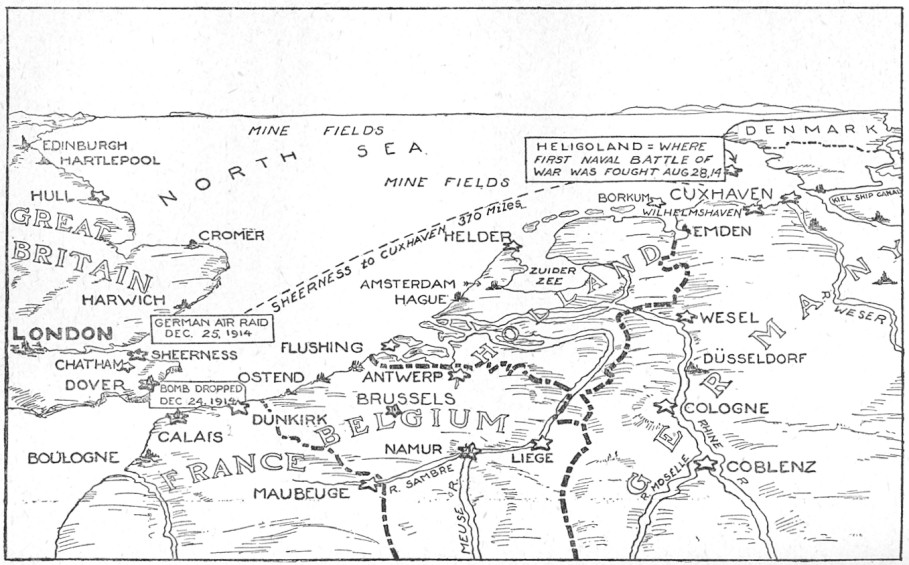
| GERMAN AND ENGLISH NAVAL POSITIONS |
Discussion in naval circles throughout the world turned then to
the question of whether it were better to build heavier ships with
heavier armament, or to build lighter and faster ships designed to
"hit and get away." The British authorities inclined toward the
former view, and between 1901 and 1904 the British navy was augmented
with the Implacable, London, Bulwark, Formidable, Venerable,
Queen, Irresistible, and Prince of Wales—each of
the heretofore unheard-of displacement of 15,000 tons. In spite of
their size they were comparatively fast, having an average speed of
18 knots; they did not need, and were not equipped with heavier armor,
having plates as thin as 3 inches and as thick as 12. They were built
to "take punishment," and therefore they had no greater armament than
the vessels previously named. The naval program of 1903 and 1904
also included the Duncan, Albemarle, Russell, Cornwallis,
and Exmouth, each 1,000 tons lighter than the ships of the
Implacable type, but with the same equipment, defensive
and offensive, and of the same speed. And in the same program, as
if to offset the argument for heavier and stronger ships, there
were included the lighter and faster ships, Swiftsure and
Triumph, displacing only 11,500 tons, but making 19 knots.
Their speed permitted and necessitated lighter armor—10 inches
through at the thickest points—and their armament was also of
a lighter type, for their four largest guns were capable of firing
10-inch shells.
Germany was becoming a naval rival worthy of notice, and the insular
position of England came to be a matter of serious concern by 1906.
Britain has never considered the building of land forts for her
protection—her strength has always been concentrated in floating
war machines. She now began to build veritable floating forts,
ships of 16,350 tons displacement. By the end of 1906 she had ready
to give battle eight ships of this class, the King Edward VII,
Commonwealth, Dominion, Hindustan, Africa, Hibernia, Zealandia,
and Britannia. Speed was not sacrificed to weight, for they
were given a speed of 18.5 knots, developed by engines of 18,000
horsepower. Their thinnest armor measured 6 inches, and their heavy
guns were protected with plates 12 inches thick. The 12-inch gun
was still the heaviest piece of armament in the British navy, and
these eight ships each carried four of that measurement, as well
as four 9.2-inch guns, ten 6-inch guns, fourteen rapid-fire guns
of 3 inches, two machine guns, and four torpedo tubes.
Now that it was seen that ships of enormous displacement could also
be swift, England committed herself to the building of ships of even
greater size. In 1907 came the first of the modern dreadnoughts,
so-called from the name which was given to the original ship of 17,900
tons displacement. The Dreadnought made the marvelous speed
(for a ship of that size) of 21 knots, which she was enabled to
do with turbine engines of 23,000 horsepower. Her armor measured
from 8 to 11 inches in thickness, and her great size enabled her
to carry as high as ten 12-inch guns. Her minor batteries were
strong in proportion.
Then, as if taking her breath after a stupendous effort, England
in the following year built two ships of 16,000 tons displacement,
the Lord Nelson and the Agamemnon, with speed, armor,
and armament much lower than those of the Dreadnought. But
having taken a rest, Britain was again to make a great effort,
launching in 1909 the Temeraire, Superb, and Bellerophon,
monsters displacing 18,600 tons. With engines of 23,000 horsepower
that could drive them through the seas at 21 knots, ready to ward
off blows with armor from 8 to 11 inches thick, firing at the same
time volleys from ten 12-inch guns down to sixteen 4-inch rapid
firers.
Naval architecture had now taken a definite turn, the principal
feature of which was the tremendous size of the destructive floating
machines. England, a leader in this sort of building, in 1910 built
the Vanguard, Collingwood, and St. Vincent, each
displacing 19,250 tons. Nor were they lacking in speed, for they
made, on an average, 21 knots. The 20,000-ton battleship was then
a matter of months only, and it came in the following year, when
the Colossus, Hercules, and Neptune were launched.
It was only in the matter of displacement that these three ships
showed any difference from those of the Vanguard class;
there were no great innovations either in armament or armor. But in
the same year, 1911, there were launched the Thunderer, Monarch,
Orion, and Conqueror, each of 22,500 tons, and equipped
with armor from 8 to 12 inches thick, for the days of 3-inch armor
on first-class warships had gone forever. These had a speed of 21
knots, and were the first British ships to have anything greater
than a 12-inch gun. They carried as a primary battery ten 13.5-inch
guns, and sixteen 4-inch guns, along with six more of small caliber
as their secondary battery.
In 1912 and 1913 there was only one type of warship launched having
23,000 tons displacement with 31,000 horsepower, a half a knot
faster than previous dreadnoughts, and carrying, like the previous
class, ten 13.5-inch guns, along with some of smaller caliber. The
ships of this class were the King George V, Ajax, Audacious,
and Centurion.
The year 1914 saw even more terrible machines of death launched.
Two types were put into the water, the first that of the Iron
Duke class, of which the other members were the Benbow,
Emperor of India, and Marlborough. They showed great
improvement in every point; their speed was 22.5 knots, their
displacement 25,000 tons, and their torpedo tubes five. Like their
immediate predecessors, they carried a primary battery of ten 13.5-inch
guns, along with the smaller ones, and their armor measured from 8
to 12 inches in thickness. The second type of the year was that of
the Queen Elizabeth and Warspite class. They surpassed
all the warships when they were built. Their speed for their size
was the greatest—25 knots. They had the largest displacement
among warships—27,500 tons; they had the thickest armor,
ranging from 8 to 13.5 inches; they had the most improved form
of engines—oil burners, developing 58,000 horsepower; and
most marvelous of all was their primary battery, which consisted of
eight 15-inch guns. The largest gun yet made had been the 16-inch
gun, for use in permanent position in land forts, and, with the
German army, for a mobile force. It now was shown that the modern
warship could carry a gun as heavy as any on land. There were in
the course of construction when the war broke out eight more such
monsters, the Malaya, Valiant, and Barham, sister ships
of the Queen Elizabeth, and the Royal Oak, Resolution,
Royal Monarch, Ramillies, and Renown, each of 29,000
tons displacement, but having the same armament as the Queen
Elizabeth. All of these were hastened to completion as soon
as war was declared.
At the time of the declaration of war England had, in addition
to these greatest ships, a number of supporting ships such as the
ten battle cruisers, Indomitable, Invincible, Indefatigable,
Inflexible, Australia, New Zealand, Queen Mary, Princess Royal,
Lion, and the Tiger. Their displacements ranged from
17,250 to 28,000 tons, and their speeds from 25 to 30 knots, the
last being that of the Tiger. Their speed is their greatest
feature, for their armament and batteries are much lighter than
those of the first-line ships.
Next, there were ready thirty-four high-speed cruisers of quite light
armament and armor. There were six of the Cressy type, four
of the Drake type, nine of the same type as the Kent,
six of the same class as the Antrim, six like the Black
Prince, three of the same class as the Shannon, together
with seventeen heavily protected cruisers, of which the Edgar
was the prototype. The rest of the British navy needs no detailed
consideration. It consisted at the outbreak of the war of 70 protected
light cruisers, 134 destroyers, and a number of merchant ships
convertible into war vessels, together with submarines and other
small ships.
The navy of France stood fourth in the list of those of the world
powers at the time the war started. There were eighteen old vessels,
built between 1894 and 1909, including the Carnot class
(corresponding to the British ship Magnificent), the
Charlemagne, Bouvet, Suffren, République, and
Democratie classes. The most modern of these types displaced
no more than 14,000 tons, made no more than 18 knots, and carried
primary batteries of 12-inch guns.
Some improvement was made in the six ships of the Danton
class which were built in 1911 and 1912. They displaced 18,000 tons,
had armor from 9 to 12 inches thick and carried guns of 12-inch
caliber. They correspond to the British ship Temeraire. In
1913 and 1914 were launched the Jean Bart, Courbet, Paris,
and France of the dreadnought type, but much slower and not
so heavily armed as the British ships of the same class. In eight
ships which were incomplete when war was declared the matter of
speed received greater attention, and they are consequently faster
than the older vessels of the same type. It is in the nineteen French
armored cruisers—France has no battle cruisers—that the
French showed better efforts as builders of speedy ships, for they
made 23 knots or more. In the list of French fighting ships there
are in addition two protected cruisers, the D'Entrecasteaux
and the Guichen, together with ten light cruisers. But the
French "mosquito fleet," consisting of destroyers, torpedo boats
and submarines, is comparatively large. Of these she had 84, 135,
and 78, respectively.
After the Russo-Japanese War the battle fleets of Russia were entirely
dissipated, so that when the present conflict came she had no ships
which might have been accounted worthy aids to the navies of England
and France. In so far as is known, her heaviest ships were the
Andrei Pervozvannyi and the Imperator Pavel I, each
displacing only 17,200 tons, and of the design of 1911.
Against these fighting naval forces of the allied powers were ranged
the navies of Germany and Austria-Hungary. The former had, at the
outbreak of hostilities, 36 battleships, 5 battle cruisers, 9 armored
cruisers, and 43 cruisers. Instead of giving attention to torpedo boats
she gave it to destroyers, of which she had 130. And of submarines
she had 27.
In detail her naval forces consisted, first, of the Kaiser Friedrich
III, Kaiser Karl der Grosse, Kaiser Barbarossa, Kaiser Wilhelm
II, and Kaiser Wilhelm der Grosse, all built as a result
of the first agitation of Von Tirpitz, between the years 1898 and
1901. They each displaced 10,614 tons, had a speed of 18 knots,
required 13,000 horsepower, were protected with from 10 to 12 inches
of armor, and carried four 9.4-inch guns, fourteen of 5.9 inches,
twelve of 3.4-inches, and twenty of smaller measurement. Roughly
they corresponded to the British ships of the Canopus class,
both in design and time of launching.
Following this class came that of the Wittelsbach, including also
the Wettin, Zähringen, Mecklenburg, and Schwaben,
built between 1901 and 1903, displacing 11,643 tons, making 18
knots, protected with from 9 to 10 inches of armor and carrying
a primary battery of four 9.4-inch guns, eighteen 5.9-inch guns,
and a large secondary battery. The similar type in the British
navy was the Canopus—for England was far ahead of
Germany, both in the matter of displacement and primary battery.
During the same years England had launched ships of the type of
the Implacable.
In 1904 came the German ships Hessen, Elsass, and
Braunschweig, and in 1905 and 1906 the Preussen and
Lothringen. They were well behind the English ships of the
same years, for they displaced only 12,097 tons, made 18 knots,
carried armor of from 9 to 10 inches in thickness, and a primary
battery of four 11-inch guns, fourteen 6.7-inch guns, and twelve
3.4-inch guns, together with rapid firers and other guns in a secondary
battery. England at this time was putting 12-inch guns in the primary
battery of such ships as the King Edward VII.
Still Germany kept up the race, and in 1906, 1907, and 1908 launched
the Hannover, Deutschland, Schlesien, Schleswig-Holstein, and
Pommern, with 12,997 tons displacement, 16,000 horsepower,
a speed of 18 knots, and only ll-inch guns in the primary batteries.
Whereas England, at the same time, was building ships of the dreadnought
type.
Next came four ships of the Vanguard class—the
Westfälen, Nassau, Rheinland, and Posen, built
in 1909 and 1910. Their heaviest guns measured 11 inches, while
those of the English ships of the same class measured 12 inches.
The displacement of these German fighting ships was 18,600 tons. In
point of speed they showed some improvement over the older German
ships, making 19.5 knots. Germany, like England, was now committed to
the building of larger and larger ships of the line. The Helgoland,
Thüringen, Oldenburg, and Ostfriesland, which were
put into the water in 1911 and 1912, were consequently of 22,400
tons displacement, with a speed of 20.5 knots and carrying twelve
12-inch guns, fourteen 5.9-inch rapid-fire guns, fourteen 3.9-inch
rapid-fire guns, a few smaller guns, and as many as six torpedo
tubes.
While England was maintaining her "two to three" policy, and while
the United States stood committed to the building of two first-class
battleships a year, Germany, in 1913, put five of them into the
water. These were the König Albert, Prinz Regent Luitpold,
Kaiserin, Kaiser, and Friedrich der Grosse, each capable
of speeding through the water at a rate of 21 knots, displacing
23,310 tons and carrying an armament of ten 12-inch guns, fourteen
5.9-inch guns, and a large number of rapid-fire guns of smaller
measurement. Their armor was quite heavy, being 13 inches thick
on the side and 11 inches thick where protection for the big guns
was needed.
The largest ships in the German navy which were launched, fitted,
and manned at the time that the war began, were those which were
built in 1914 and which had a displacement of 26,575 tons. These
ships were the König, Grosser Kurfürst, and the
Markgraf. The corresponding type in the British navy was
that of the Iron Duke, built in the same year. The British
ships of this class were 1,000 tons lighter in displacement, a
bit faster—making 22.5 knots to the 22 knots made by the
German ships—and their armament was not so strong as that
of the German type, for the German ships carried ten 14-inch guns,
whereas the English carried ten 13.5-inch guns.
In addition to these first-class battleships, Germany had certain
others, individual in type, such as the Von der Tann, Moltke,
Goeben, Seydlitz, Derfflinger, Fürst Bismarck, Prinz Heinrich,
Prinz Adalbert, Roon and Yorck, Scharnhorst and Gneisenau,
Blücher, Magdeburg, Strassburg, Breslau, Stralsund, Rostock,
and Karlsruhe. These may be reckoned as scout cruisers,
for they showed much speed, the fastest making 30 knots and the
slowest 19 knots. The oldest dates from 1900, and the newest from
1914. Germany had, also, thirty-nine more fast protected cruisers
which were designed for scout duty.
In destroyers she was well equipped, having 143 ready for service
when war was declared. Her twenty-seven submarines were of the most
improved type, and much about their construction and armament she
was able to keep secret from the rest of the world. It is probable
that even their number was greater than the intelligence departments
of foreign navies suspected. The best type had a speed on the surface
of 18 knots and could travel at 12 knots when submerged. The type
known as E-21, of the design of 1914, measured 213 feet
8 inches in length and had a beam of 20 feet.
Austria, though not renowned for her naval strength, had certain
units which brought up the power of the Teutonic powers considerably.
She had nine first-class battleships, the Erzherzog Karl, Erzherzog
Ferdinand Max, Erzherzog Friedrich, Zrinyi, Radetzky, Erzherzog Franz
Ferdinand, Teggethoff, Prinz Eugen, and Viribus Unitis.
These, at the time Austria went to war, ranged in age from nine
years to one year, and varied in displacement from 10,000 tons
to 20,000 tons. The largest guns carried by any of them measured
12 inches, and the fastest, the Prinz Eugen, made 20 knots.
Of secondary importance were the battleships Kaiserin Maria
Theresia, Kaiser Karl VI, and St. Georg. The register of
battleships was supplemented with ten light cruisers of exceptionally
light displacement, the highest being only 3,966 tons. Scouting
was their chief function. Austria had, also, 18 destroyers, 63
torpedo boats, and 6 submarines.
Such were the respective strengths of the opponents on that day
in July, 1914, when the Crown Prince of Austria-Hungary lost his
life. For ten years the officers of the navy created by the German
Admiral von Tirpitz had at all dinners come to their feet, waved
their wine glasses and had given the famous toast "Der Tag"—to
the day on which the English and German naval hosts would sally
forth to do battle with each other. "Der Tag" found both forces
quite ready, though the British naval authorities stole a march
on their German rivals in the matter of mobilization.
It had been the custom for years in the British navy to assemble
the greater part of the British ships during the summer at the
port of Spithead, where, decorated with bunting, with flags flying,
with visitors in holiday spirit, and with officers and men in smart
dress, the vessels were reviewed by the king on the royal yacht.
But in the eventful year of 1914, perhaps by accident, perhaps by
design, for the truth may never be known, the review had a different
aspect. There was no gaiety. The number of ships assembled this
time was greater than ever before—216 actual fighting ships
passed slowly before the royal yacht—there were no flags,
no bunting, no holiday crowds, no smart dress for officers and
men. Instead, the fleet was drawn up ready for battle, with decks
cleared, guns uncovered, steam up, and magazines replenished. During
the tense weeks in which the war clouds gathered over southern Europe
this great fighting force remained in the British home waters, and
when, at fifteen minutes after midnight on August 4, "Der Tag"
had come, this fleet sailed under sealed orders. And throughout
the seven seas there were sundry ships flying the Union Jack which
immediately received orders by cable and by wireless.
Of the disposition of the naval forces of Germany less was known.
Her greatest strength was concentrated in the North Sea, where the
island of Helgoland, the Gibraltar of the north, and the Kiel Canal
with its exits to the Baltic and North Seas, furnished excellently
both as naval bases and impenetrable protection. Throughout the rest
of the watery surface of the globe were eleven German warships,
to which automatically fell the task of protecting the thousands of
ships which, flying the German red, white, and black, were carrying
freight and passengers from port to port.
The first naval movements in the Great War occurred on the morning
of August 5, 1914. The British ship Drake cut two cables off
the Azores which connected Germany with North and South America,
thus leaving these eleven German fighting ships without communication
with the German admiralty direct. And the war was not a day old
between England and Germany before the German ship Königin
Luise was caught sowing mines off the eastern English ports
by the British destroyer Lance.


