THE MACMILLAN COMPANY NEW YORK · BOSTON · CHICAGO
ATLANTA · SAN FRANCISCO
MACMILLAN & CO., Limited LONDON · BOMBAY · CALCUTTA
MELBOURNE
THE MACMILLAN CO. OF CANADA, Ltd. TORONTO
BY
EDWARD CHANNING
PROFESSOR OF HISTORY IN HARVARD UNIVERSITY
AND
MARION FLORENCE LANSING
EDITOR OF THE “OPEN ROAD LIBRARY”
WITH MAPS AND ILLUSTRATIONS
New York
THE MACMILLAN COMPANY
1909
All rights reserved
Copyright, 1909,
By THE MACMILLAN COMPANY.
Set up and electrotyped. Published March, 1909.
Norwood Press
J. S. Cushing Co.—Berwick & Smith Co.
Norwood, Mass., U.S.A.
PREFACE
For three hundred years the Great Lakes
have been the centre of an immensely varied and
interesting history. They were originally the
home of savages; they were discovered and explored
by Frenchmen; they became the scene
of a century-long struggle for possession by Indians
of many tribes and white men of three
nations; and they have been finally occupied
and developed by Americans. In every epoch
they present a rich field for study.
No minute and exhaustive chronicle has been
attempted in this volume, but important events,
with the customs and life of each period, have
been brought together and presented. Changes
have come with such rapidity that the conditions
of fifty years ago seem remote to-day. In this
swift progress the heritage of the past must not
be forgotten. The picturesqueness of the early
life, the courage and hardihood of the explorers
and settlers, and the tale of thrilling adventures
and noble deeds should be treasured, as should
the achievements of the builders of cities and
captains and soldiers of industry of our own
day.
Standing in Lake Park, Chicago, beside
the statue of General Logan, the supporter
of Douglas and, later, of Lincoln, one has
behind him the most marvellous city of modern
times, and before him the southwesternmost of
the Great Lakes. In front, glitter the waters
over which La Salle journeyed three centuries
ago. As in those days, they respond to the play
of wind and weather, now calm as a sheet of glass,
and now swept by sudden gales into turbulent
waves and breakers; but the aspect of the land
is such that were La Salle to visit it he would not
recognize the spot. In place of a wilderness with
an occasional group of low-lying Indian wigwams
he would see a mighty city of buildings towering
one hundred and fifty feet above the street and
reaching down from twenty-five to fifty feet below
ground. In place of a few canoes with their loads
of furs and crews of savages, emerging from the
narrow mouth of the Chicago River, seven thousand
freighters and steamers with an aggregate
tonnage greater than that floated in any other
port in the world touch annually at the wharves
along her splendid harbor front. These vessels
and thousands of trains, running on tracks whose
mileage is more than a third of that of the whole
railway system of the United States, bring to her
stockyards, her grain elevators, and her markets
the herds and flocks of the western plains, the
crops of the wheat-fields of the Northwest, and
the merchandise of Europe and of Asia.
Chicago is the greatest distributing centre of
this region, but the ports of Lake Erie handle
many important industries whose traffic never
enters Lake Michigan. The copper of the upper
Michigan peninsula, the iron ore of the Wisconsin
and Minnesota ranges, the coal of Ohio and
Pennsylvania, and many a minor industry have
had their share in building up the modern empire
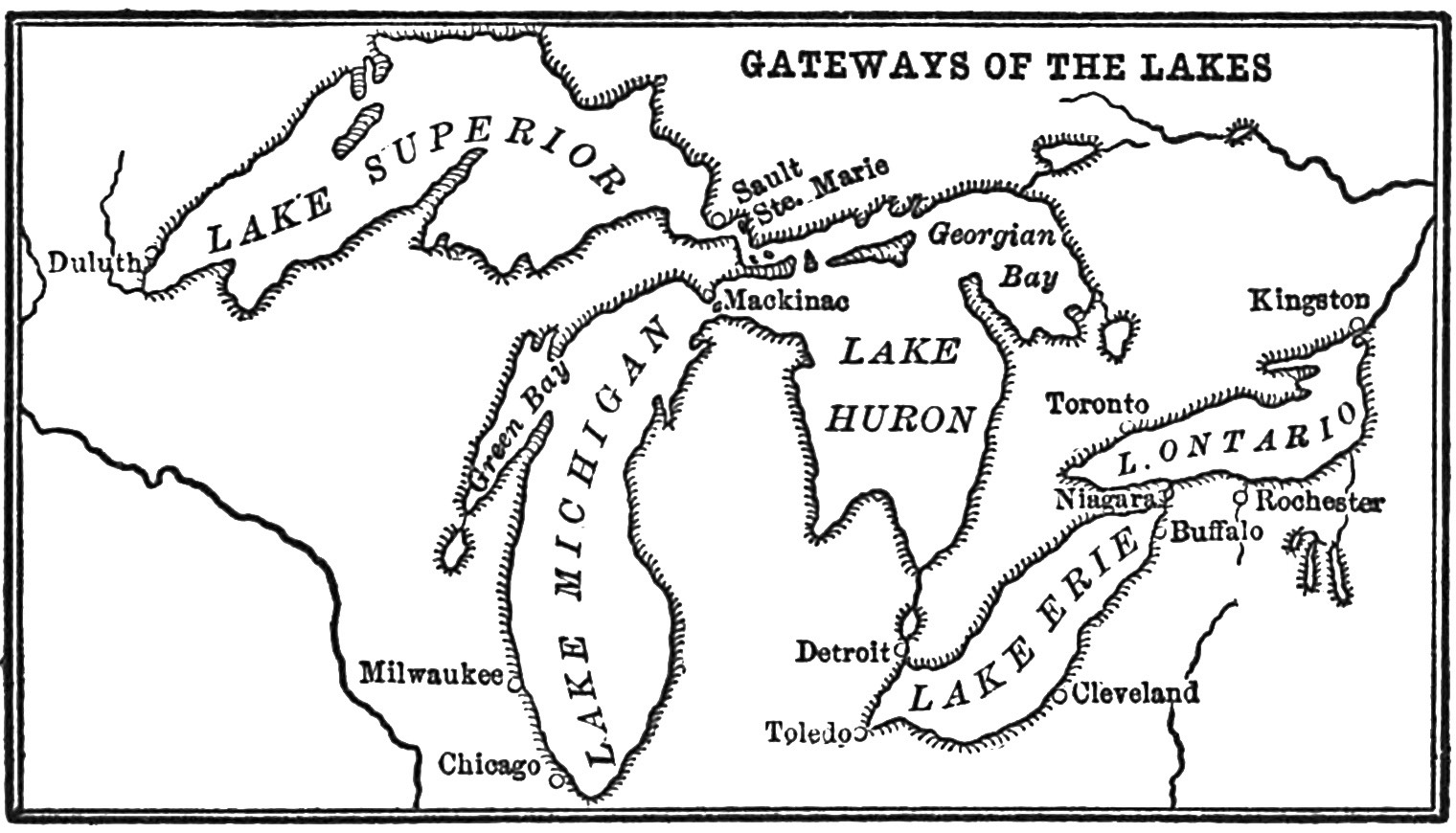
of the Great Lakes. The body of water about
which this empire has risen is made up of five
lakes: Superior, Huron, Michigan, Erie, and
Ontario, which together form the greatest inland
waterway of the world. These lakes have an area
of more than half that of the Black Sea or the
Caspian, while Lake Superior is the largest body
of fresh water on the globe. The four upper
lakes are so nearly level that one canal with a
single lock has given them a navigable length
of over fourteen hundred miles. Lake Ontario,
however, is effectively separated from the others
by Niagara Falls and its attendant rapids. Other
great inland bodies of water are directly connected
with the ocean by navigable straits. The Mediterranean
Sea is entered from the Atlantic by the
Strait of Gibraltar, the Black Sea is connected in
its turn with the Mediterranean by the Dardanelles
and the Bosphorus; but Niagara closes
direct navigation between the Great Lakes and
the sea.
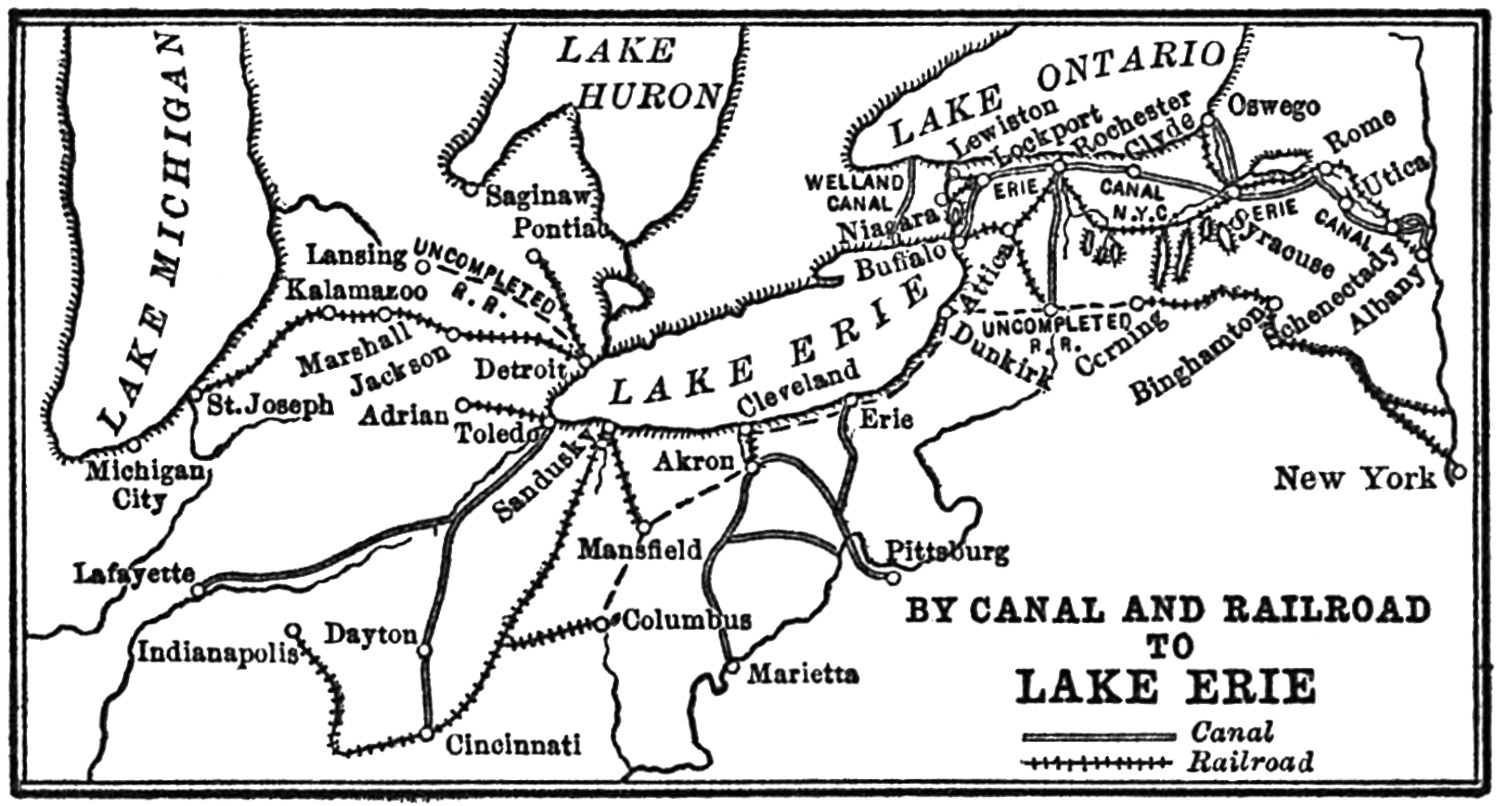
Canals have done much in the last hundred
years to alleviate the natural inaccessibility of
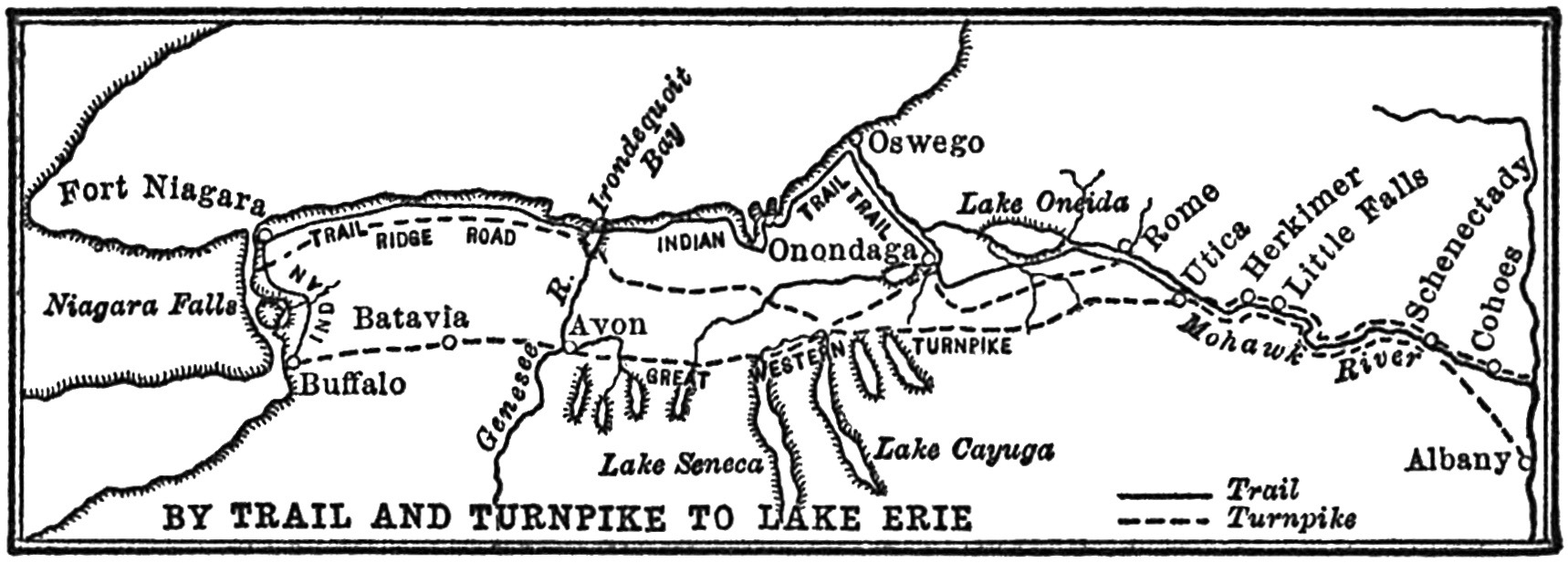
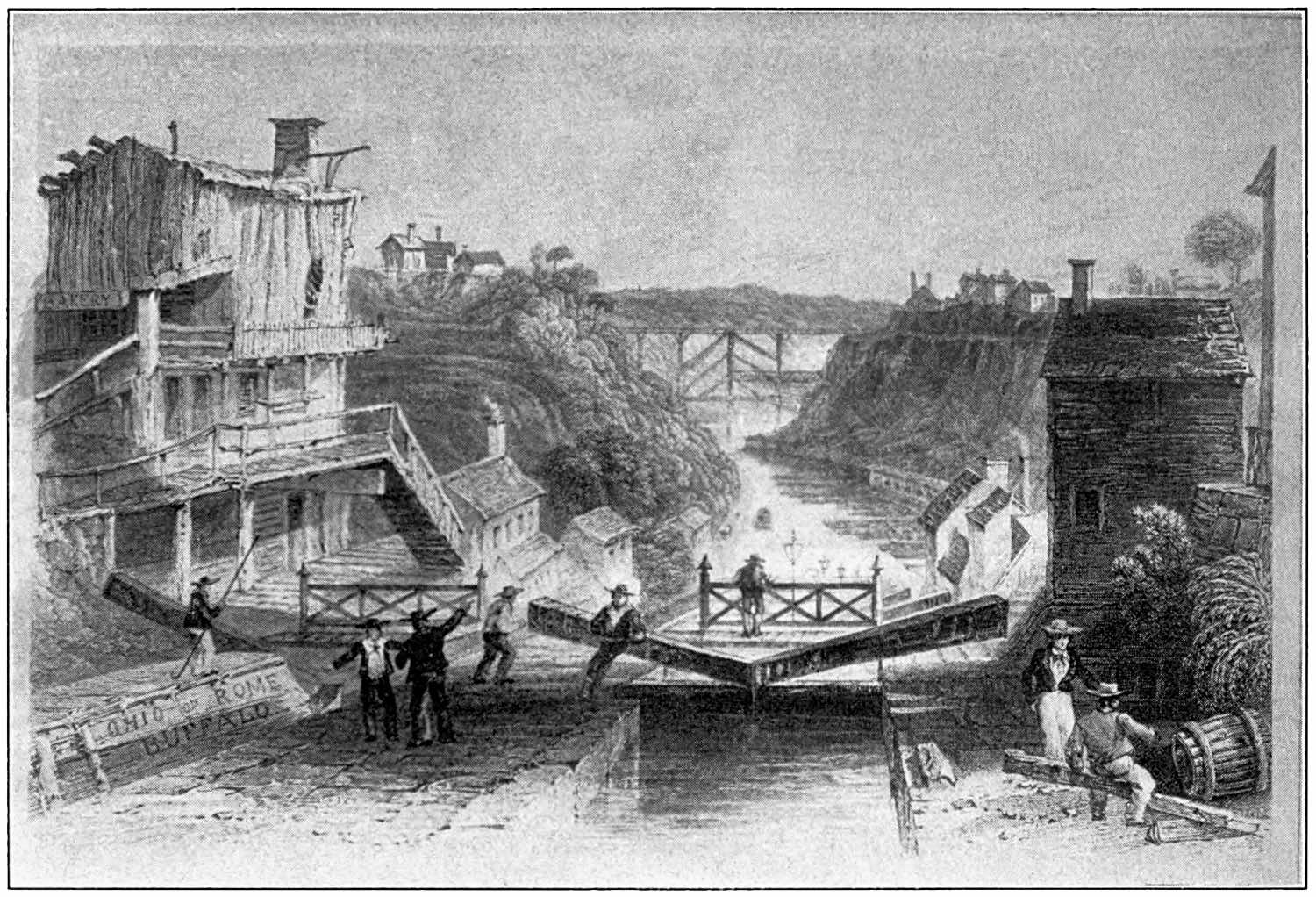
the lake system. Eighty-five years ago the Erie
Canal gave a water route from the eastern end of
Lake Erie to the Hudson River and thus to the
Atlantic Ocean. Five years later the Welland
Canal passed round Niagara Falls and connected
Lake Erie with Lake Ontario, and a third canal
soon connected Lake Erie with the Ohio River.
To-day a second era of canal building is upon us.
The Welland Canal has been widened, making it
possible for boats of moderate draught to go from
Lake Erie to Lake Ontario and thence by numerous
small cuts around the rapids of the St.
Lawrence to the Atlantic. The Erie Canal is
being enlarged, and engineers dream of a time
when it will be made sufficiently wide and deep
for sea-going vessels to pass from the Atlantic
Ocean to Lake Erie. The Hennepin Canal at
Chicago will open a route from Lake Michigan
by the Illinois and Mississippi rivers into the
Gulf of Mexico. Each state bordering on the
Great Lakes as well as every province of the
Dominion of Canada is to-day planning extensions
of this canal system.
On the lonely shores past which La Salle and
later explorers voyaged have been built villages,
towns, and cities. This region is to-day the clearing-house
of the commerce of the central plain of
North America. From the western terminals of
the lake routes railways pass over the plains and
mountains of the Northwest to the Pacific; from
their eastern ports stretch lines to the seaboard
cities of the Atlantic. The farms of the Northwest
send yearly one hundred and fifty million
bushels of wheat, six hundred million bushels of
oats, and a billion bushels of corn to Chicago and
Buffalo and thence to the eastern states and
Europe. Coming from the west, the transcontinental
roads pay tribute at Chicago and then
choose between the route north of Lake Erie via
Detroit, or south via Cleveland. They unite at
Buffalo and follow the Mohawk Valley to the
Hudson and then to New York or Boston; or
they pass the Alleghanies farther south and reach
the coast at Philadelphia, Baltimore, or Norfolk.
In any case, by land or water, from the north or
from the west, these products come to the Great
Lakes, and are carried from their ports to the factories
and markets of the East, or to steamers
bound for Europe. This combination of land
and water transportation makes the Great Lakes
the keystone of American industry.
We have spoken of the four upper lakes as
united commercially into one great sea. Before
Lake Superior could be entered from the others
one formidable obstacle had to be overcome.
Between Lake Superior and Lake Huron was a
ledge of rocks half a mile long over which the
waters ran in swirling rapids, forming the Sault
(or Rapids of) Ste. Marie. At this point the
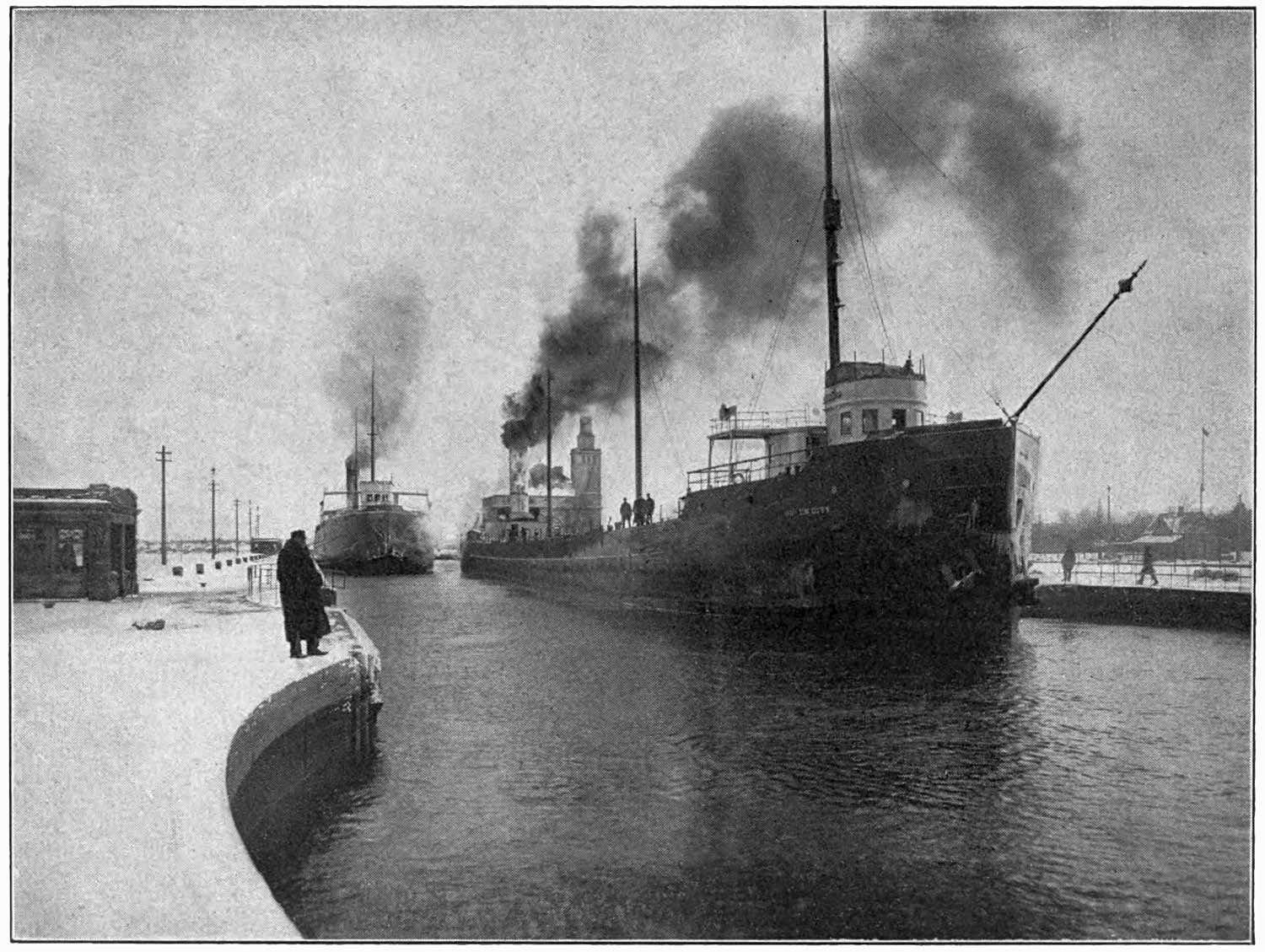
famous “Soo” Canal has been constructed with
a single lock which is the largest and costliest in
the world, though it will soon be surpassed by
those at the entrance of the Panama Canal. This
canal was built in 1855, when the presence of iron
and copper deposits in Michigan, Wisconsin,
and Minnesota was first discovered. To-day the
tonnage passing yearly through it runs up into
figures that are almost beyond belief; but these
figures form the best single index of the traffic of
the Great Lakes. In the seven open months of
1907 there passed through the “Soo” one hundred
million tons of freight valued at four
hundred and fifty million dollars. This tonnage
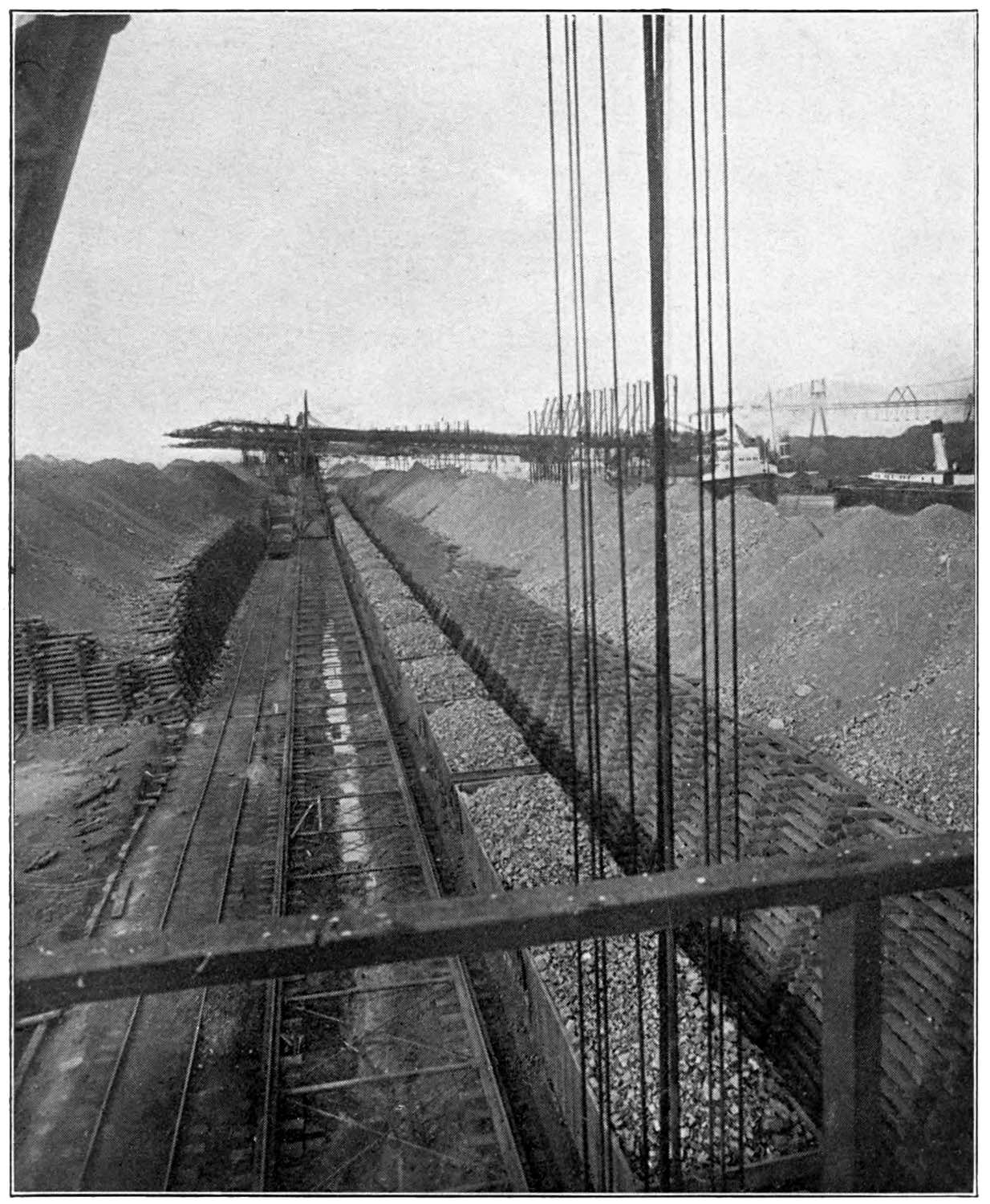
is nine times that of the Suez Canal. The mines
whose discovery made necessary the cutting of
the “Soo” Canal supply a large part of this
freight. Of iron ore alone they send thirty-three
million tons to the foundries and furnaces of
Pittsburg and other centres, where the raw material
is manufactured into articles of iron and
steel which form the basis of modern civilized
existence. From the deposits of the upper Michigan
peninsula comes yearly one-seventh of the
world’s supply of copper.
These figures give some idea of the importance
of the Great Lakes in the economic development
of the United States. Three hundred years have
seen this region converted from a wilderness
peopled by Indian tribes to the uses of modern
civilization. This time might well be shortened,
since at the beginning of the nineteenth century
the Great Lakes and bordering lands were still
occupied by the red man and a few small villages
and trading stations of the whites. It is indeed
wonderful what changes a century has witnessed.
Copyright, 1904, by Detroit Photographic Co.
The “Soo” Canal
CHAPTER II CHAMPLAIN ON THE GREAT LAKES
On the 28th of July, 1615, Samuel de
Champlain paddled out of the mouth
of the French River into the waters
of Georgian Bay, an arm of Lake Huron; or,
as he named it from its great expanse, the
“Mer Douce,” or “Freshwater Sea.” With
him was a young interpreter, Étienne Brulé, who
had been sent by Champlain when a mere lad to
winter in the Huron country, and to learn from
the Indians their languages and customs. As a
member of this Huron party, in 1610, he had
been the first white man to look upon the waters
of Lake Huron, the central of the five Great
Lakes. Now Champlain himself had come,
journeying from Montreal with a trading party
of Indians. Some of the Indians had slipped
away before the rest of the expedition was ready,
taking with them a missionary. Father Joseph
Le Caron had, therefore, made the journey a few
days before his leader, but at last Champlain had
reached the marvellous sea of Indian story, and
was on the point of exploring the region of the
Great Lakes.
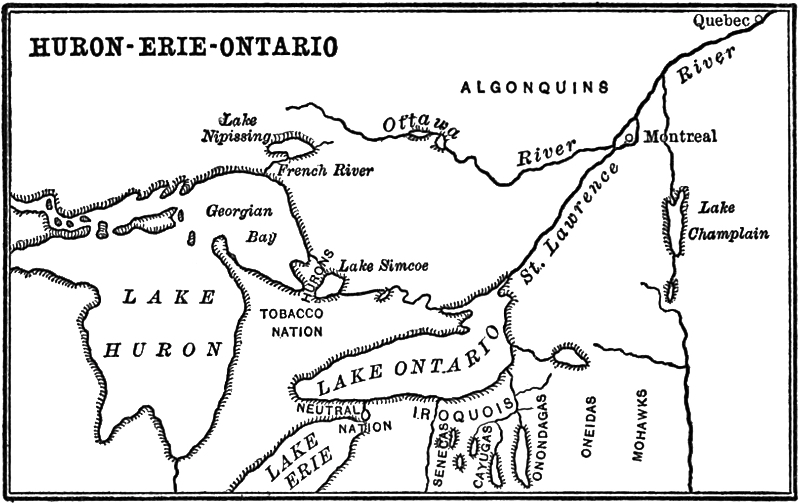
He found the lands bordering the lakes occupied
by three groups of Indians: the Iroquois,
who were closely banded together into a league
known as the Five Nations; the Hurons, who
were related to them, but were always at war with
them; and the Algonquins, who belonged to one
great family, but were now divided into many
widely scattered and independent tribes.
The Five Nations of the Iroquois were joined
in a loose but effective confederacy. Originally
they had formed one great tribe, but internal
dissension had split them into five,—the Mohawks,
Oneidas, Onondagas, Cayugas, and Senecas.
Legend states that Hiawatha had counselled
union and had thus brought about the League
of the Iroquois, which was the most important
Indian organization north of Mexico. The confederation
was governed by fifty sachems, ten
from each nation, who made up a grand council.
Unanimity was required in all decisions, but
when these were once arrived at the tribes were
obedient. The Iroquois lived in a wide strip
of country extending from Lake Erie and Lake
Ontario eastward across central New York.
They called this section of country “The Long
House” from its resemblance in shape to one
of their oblong dwellings.
The Algonquins occupied the greater part of
the country from the St. Lawrence to Lake
Superior and the Mississippi, and included the
Illinois, Wisconsin, Chippewa, Ottawa, and other
tribes of the lake region. In the centre of the
Algonquin country, in a narrow district extending
eastward from Georgian Bay toward Lake
Ontario, lived the Huron nation, a strong and
prosperous tribe. Between them and the Iroquois
there was constant enmity, and for a time
after the coming of the whites it was by no means
certain which group of Indians would come out
victorious. It was while this contest was at its
height that Samuel de Champlain came to the St.
Lawrence and in 1608 founded Quebec. It was
to the Huron settlements he was journeying in
the summer of 1615.
Champlain was born in southern France and
had already won fame as an explorer. He had
visited the West Indies, Mexico, and Central
America, and had suggested the building of a
ship canal at Panama. He had coasted the
shores of New England and had been one of the
first French colonists at the Bay of Fundy.
After the founding of Quebec he had traversed
the lake which now bears his name and had journeyed
far and wide in the surrounding region.
In these expeditions he had allied himself with
the Indians of the St. Lawrence and had supported
them in their battles with the Iroquois.
In the summer of 1615, yielding to the clamors
of the Hurons gathered at Montreal for their
yearly traffic with the French, Champlain agreed
to accompany them on an inroad into the Iroquois
country. He departed for Quebec to
make needful preparations, but when he returned
after a delay of a few days he found that the
impatient Indians had set out for their villages,
taking with them Father Joseph Le Caron, a
Recollect friar who had come out with him from
France that spring as a missionary to the Indians.
Champlain embarked immediately with ten natives,
Brulé, and another Frenchman on the
journey to the Huron villages. He approached
Lake Huron by the hard northern route, travelling
up the Ottawa River, along the portage path
to Lake Nipissing, across which he sailed, and
down the French River. Indian tribes along the
way encouraged the voyagers, telling them that
the Lake of the Hurons was at hand. At length
they came out from between the banks of the
river into the waters of the lake. For more than
a hundred miles they coasted southward along
its eastern shores, working their way in and out
among countless islands, till they reached the
lower end of Georgian Bay. There they landed
and proceeded by a well-beaten trail into the
heart of the Huron country.
From the moment when he entered the first
Huron village Champlain recognized that this
was an Indian community different from any
that he had heretofore seen. He had come upon
one of the most remarkable savage settlements
on the continent. The people lived in permanent
villages protected by palisades of crossed
and intersecting trunks of trees. Not only was
the land naturally fertile, but in the clearings
between the stretches of heavy forests were cultivated
fields of maize and pumpkins, and gay
patches of sunflowers from the seeds of which
the Indians made oil for their hair. To Champlain
coming from the roving Algonquins of the
St. Lawrence and the barren country along the
Ottawa, where the Indian population lived by
hunting and fishing, the social advancement of
this group of tribes seemed very great.
The Hurons welcomed him with eager hospitality
and took him from village to village, entertaining
him with lavish feasting and celebration,
for he was the champion who was to lead them
to victory against their hated foe the Iroquois.
At the principal Huron village Carhagouha, a
settlement of two hundred bark lodges enclosed
in a palisade thirty-five feet high, Champlain
found Father Le Caron.
The priest had feared that his leader would
not follow the Hurons, or that if he did he
would be captured by the Iroquois. When he
looked up one morning and saw Champlain
standing in the doorway of his dwelling his joy
knew no bounds. He showed him the bark
wigwam which the Indians, to prove the joy
that they felt at his coming, were building for
him. They had offered at first to lodge him in
one of their common cabins, but Father Le
Caron had remonstrated with them, representing
that “to negotiate with God affairs so important,
involving the salvation of their whole nation,”
he needed a place where he could be alone, far
from the tumult of their families. So they had
brought poles and bark and erected this lodge
at the edge of the forest. Here he had raised
an altar, and here on the 12th of August was
celebrated the first mass ever held in the country
of the Hurons. Curious Indians crowded about
as the priest stood before his rude altar and led
the devotions of the kneeling band of Frenchmen
with Champlain at their head. For the first time
the solemn chant of the “Te Deum Laudamus”
rang out on the listening air, and a volley of
muskets proclaimed the planting of a cross outside
the priest’s lodge. The symbol of Christianity
had been raised in the country of the heathen!
Before they set out on the war-path the Huron
chiefs insisted on a weary succession of feastings
and dancings, rejoicing in their serene conviction
of victory to come. Champlain spent the time
going from village to village, gratifying his insatiable
curiosity over everything which he saw. At
last the savage war-party was ready to set out.
They crossed Lake Simcoe and paddled, making
the necessary portages, down the chain of intervening
lakes to the river Trent, which flowed
into Lake Ontario. The country through which
the long line of canoes passed was singularly
beautiful. Champlain found it hard to believe
that the groves of walnut trees, whose branches
were twined with hanging grapevines, had not
been set out by the hand of man to form a beautiful
artistic picture. The party stopped once
and encamped for a grand deer-hunt, and then
proceeded on its way, well-stocked with provisions
for the first days in the enemies’ country.
Out upon Lake Ontario the frail canoes ventured,
and crossed it in safety, landing on the eastern
side of the lake, thirty miles or so from Oswego.
Now a change came over the warriors. Silently
they hid their canoes in the woods, and
with stealthy and rapid steps they filed in silence
through the borders of this hostile country. For
four days they marched inland through the forest,
crossing the Oneida River at the western end
of the lake, and on the 9th of October some of
their scouts brought in a captured fishing party
of eleven Iroquois, men, women, and children.
A Huron chief took possession of the prisoners
and began to torture them, cutting off a finger
of one of the women. Champlain met this
method of celebration with angry protest, declaring
that it was not the act of a warrior to treat
helpless women with cruelty. The chief agreed,
since it was displeasing to Champlain, to do
nothing more to the women, but added that he
would do to the men what he pleased. It was
a curious position in which Champlain had placed
himself, aiding one group of savages against
another, nor did he find it to his liking.
The next day the war-party came out into a
clearing in the forest, from which they could see
the Iroquois fort. A number of Iroquois were
gathering corn and pumpkins in the adjoining
fields. With a rush the impetuous young Hurons
who were in advance screamed their war-cry and
fell upon them. The Iroquois seized their arms
and defended themselves with such success that
their assailants began to fall back. Only the
timely aid of Champlain and the Frenchmen with
their terrifying muskets saved the invaders from
defeat.
Champlain saw that this irregular way of fighting,
each person according to his whim, would
result in utter ruin. The Hurons withdrew into
the forest to encamp for the night, and there
he addressed them angrily, showing them their
foolishness and instructing them in the best
methods of war. He found the Iroquois village
to be far more strongly defended than any that
he had seen among the Indians. Four rows of
palisades, made of trees thirty feet high, supported
a kind of gallery, which was provided
with wooden gutters for quenching fire and piled
high with a goodly supply of stones to hurl at the
enemy. This was a stronghold that could not
be captured by the haphazard methods of the
Hurons. Champlain set the Indians to work the
next morning building a wooden tower, high
enough to overlook the palisades and large
enough to shelter four or five marksmen. In
four hours the work was done, and two hundred
of the strongest warriors dragged it forward to a
position from which the musketeers could pour a
deadly fire into the crowded galleries. The rank
and file of the Hurons were meanwhile equipped
with huge wooden shields to protect themselves
against the arrows and stones of the enemy. As
the deadly bullets fell among them the Iroquois
rushed headlong from the gallery, and the result
of the battle would have been very different had
the Hurons followed out Champlain’s well-conceived
plans; but they were ungovernable. With
reckless fury they threw away their shields, and
yelling their war-cry so shrilly that no command
could be heard, they poured out into the open
field, discharging their own arrows but exposing
themselves meanwhile to a rain of stones and
arrows from the Iroquois. One Huron, bolder
than the rest, ran forward with firebrands to burn
the palisade, and others followed him with the
dry wood which they had gathered for the
purpose. But they set the fire on the leeward
side of the fort, where the wind was against it,
and torrents of water poured down from above
soon put it out. In vain Champlain shouted
commands and made every effort to restore
order. He soon decided that his shouting would
only “burst his own head” and have no effect
on any one else. So he and his Frenchmen set
to work picking the Iroquois off the rampart
with their shots. After three hours of this kind
of fighting the Hurons fell back.
Only eighteen men had been wounded, but
among them were two chiefs and Champlain
himself. He had received one arrow in the knee
and another in the leg. He urged the Indians
to renew the attack, but they refused. From
extreme overconfidence the warriors had passed
to the deepest discouragement. The next day
a violent wind offered them an opportunity to
set fire to the fort, but the Hurons sat silent in
their camp. For five days they waited to see
if the five hundred allies which Brulé and twelve
Hurons had started a month ago to fetch would
appear. During this time they ventured out
occasionally for imprudent skirmishes, each time
running back under the cover of the French
musket fire, amid taunts from the Iroquois on
the palisade that the Hurons had very little
courage to require French assistance. Then
they hastily began to retreat, carrying their
wounded in the centre, while the Iroquois harassed
the flanks and rear of the company. The
wounded, Champlain among them, were packed
in rude baskets made on the spot, and bound
on the backs of stout warriors. Champlain gives
a vivid picture of the suffering he endured, while
he was thus “bundled in a heap, and doubled
and strapped together in such a fashion that it
was as impossible to move as for an infant in
swaddling-clothes.” The torment from the
cramped position and constant jolting was so
much worse than even the pain of his wound
that as soon as he could possibly bear his weight
on his leg he got out of “this prison.”
Snow and hail overtook the party on their
dismal march to the lake. They were relieved
to find their hidden canoes safe, and embarked
once more on Lake Ontario. In his vain efforts
to get the Indians to renew the attack after their
first defeat, Champlain had come to see that he
had lost some of his peculiar influence over them.
They had fancied that his presence would ensure
victory. Now they saw him wounded, and by
Indian weapons. Their superstitious reverence
for the “man with the iron breast” was weakened.
Here on the shores of Lake Ontario he was to
experience a very practical consequence of his
loss of prestige. The Hurons had promised him
an escort to Quebec; but each warrior found a
reason why he should not be able to lend his
canoe for the journey. The chiefs who had made
the promises had little control over their men,
and Champlain found that he must winter with
the natives. The great war-party broke up.
Some went to hunt deer and bears, others to
trap beavers, others to fish in the frozen lakes
and streams, and still others returned to their
villages. One of the chiefs offered Champlain
the shelter of his cabin, which he was glad to
accept, and he settled down to get what comfort
and information he could from his forced
visit.
Fifty pages of Champlain’s minute and wonderfully
illustrated account testify to the fact that
he was not idle during the winter months. He
records many interesting customs of his Indian
hosts. He watched their deer-hunts, visited their
villages and those of neighboring tribes, was
umpire in their disputes, and at last turned his
face homeward in the early spring. With him
went Darontal, his Huron host. At Quebec
Champlain was welcomed as one risen from the
dead, for the Indians had long since brought in
word that he had been killed. A solemn service
was held, and all united in rendering thanks to
God for protecting the travellers in their many
perils and dangers. Upon this service and the
various acts of welcome Darontal gazed in bewildered
astonishment. Champlain showed him
all the marvellous details of civilization. With
the usual Indian stolidity he observed everything
carefully and calmly; but at last his wonder
broke down his reserve. Before he departed he
told Champlain that he should never die contented
until he had told his friends of the French
way of living and seen them adopt it. With
valuable presents and a warm invitation to come
again with some of his friends, Darontal paddled
back to his lodge in the woods with a story that
must have taken months in the telling.
This was Champlain’s last long trip of exploration.
For the remaining years of his life the
needs of the colony at Quebec held him fast.
His writings, sold in the book-stalls of France,
inspired others to cross the seas and to continue
the exploration and settlement of the wilderness.
CHAPTER III THE JESUIT MISSION TO THE HURONS
From 1615, when Father Joseph Le Caron
celebrated the first mass among the Hurons,
for fourteen years a few intrepid
priests braved the difficulties of savage life, and
endeavored at various times to set up missions in
the populous Huron villages south of Georgian
Bay. They suffered almost incredible hardships,
and in 1629 Jean Brébeuf was the only one who
was left in the region. He was recalled to
Quebec, but five years later, a year before Champlain’s
death, he set out with two Jesuit companions
to found, in the villages where Champlain
had wintered eighteen years before, the greatest
Jesuit mission in the history of New France.
No man in the annals of Church history has
shown greater personal heroism than Father Jean
Brébeuf. He was tall and strong, well fitted to
withstand the hardships of his chosen calling and
to impress the Indians with his power. The
square cap and surplice which he donned when
he assembled them for instruction, in order, as
he naïvely writes, to “give more majesty” to his
appearance, were never less needed. With natural
dignity he combined the power of a life consecrated
with the utmost fervor to God and his
Church. Never during long years of service did
he waver in his devotion nor shrink from anything
that lay before him in his work. From
his reports sent home to his superiors it is evident
that he made a deep impression on the
Indians. In these detailed accounts of his experiences
and of the savages among whom he
worked we get a clear idea of the man. We see
him on the long canoe journeys, sharing in the
labor of paddling and portages, till even he, who
already knew, as he says, “a little what it is to
be fatigued,” was so weary that his body could
do no more. But he tells us how at these very
times his soul experienced a deep peace such as
it had never known before. In the most matter-of-fact
way he accepts and records the continual
hardships, never complaining of his lot, but writing
with rare modesty because his whole attention
is centred on the work instead of on himself.
From his vivid pictures we learn, however, the
truth of one of his casual statements. “Truly,”
he says, “to come here much strength and patience
are needed; and he who thinks of coming
here for any other than God will have made a
sad mistake.”
In 1634 Father Brébeuf and his companions
started on the northern journey by the Ottawa
River and Lake Nipissing to the Huron country.
They accompanied a party of Hurons who were
returning from their annual summer trading visit
to Quebec. This nine-hundred-mile trip took
thirty days. Brébeuf kept count and found that
they carried their canoes thirty-five times on
portages one, two, and even three leagues long,
covering the distance three and four times to
transport even their small amount of baggage,
and that they dragged the canoes through rapids
at least fifty times, plunging into the icy water
and cutting their feet on the rocky bottom. At
night they slept on the bare earth or on hard
rocks, stung by clouds of mosquitoes. Their
only food was a small portion of Indian corn
coarsely broken between two stones, which,
though better than fasting, was regarded by the
Jesuits as “no great treat.” Yet, denying themselves
the ordinary necessaries of life, these priests
transported the precious vessels for the mass over
all this weary way.
The other Jesuits suffered even more than
Brébeuf. Their goods were stolen; they were
separated from the rest of the Huron party,
and deserted midway in the journey. It was
weeks before the worn-out travellers rejoined
their superior in the Huron village. After a few
experiences like this in reaching the mission these
wise priests composed a set of instructions to the
brethren who should follow them on this Ottawa
route. This code of behavior is highly characteristic
of the methods of the French Jesuits.
In every detail,—from not keeping the Indians
waiting when they were ready to embark and not
asking too many questions, to being careful that
in the canoe the brim of the priest’s hat did not
annoy those who sat nearest him,—these Jesuit
fathers aimed “not to be troublesome, even to a
single Indian,” and to “love them like brothers
with whom you are to spend the rest of your
life.” In this spirit lay the success of all French
effort among these savage peoples.
At length Brébeuf landed on the southern
shores of Georgian Bay, only to be deserted at
the last moment by his Huron guides and left
standing in the midst of his baggage on the lonely
shore. He knew the place well, for he had lived
three years in a neighboring village. This settlement
had, however, been destroyed and its inhabitants
had built their huts on another spot
several miles away. Brébeuf hid his goods in
the woods and set out alone by one of the gloomy
forest paths, which brought him, to his great
relief, to the new village. At sight of him some
one cried out, “Why, there is Echom come
again,” and at once every one ran out to salute
and welcome him, calling, “What, Echom, my
nephew, my brother, my cousin, hast thou then
come again?” His goods were fetched from the
shore, and Brébeuf was established in the house
of a leading chief. As soon as his brother priests
had arrived the Indians set about building a house
for the Jesuits. Bad crops and famine had
afflicted the people of late, and they rejoiced
doubly at the coming of Brébeuf, feeling sure
that now the crops would no longer fail. They
wished, therefore, to provide for his staying in
their village instead of that of their neighbors.
The house which the missionaries had built
for them was a constant wonder to the Indians.
It was thirty-six feet long and twenty wide, and
looked from the outside like any Huron bark
house. But within, the “black-robes” had made
innovations which were the marvel of all their
visitors. They divided the house into three
apartments, separated by wooden doors such as
the natives had never seen. The first room
served as antechamber and storm door to keep
out the cold. The second was that in which
they lived. It was at once kitchen, carpenter
shop, place for grinding wheat, dining room, parlor,
and bedroom. Beneath high wooden platforms,
on which they placed their chests of
goods, the missionaries slept on sheets of bark
or beds of boughs covered with rush mats, with
skins and their clothing for covering. The third
part was their little chapel where they set up their
altar, pictures, and sacred vessels, and celebrated
mass every day.
The house itself attracted scores of visitors,
but when the clock and the mill were set going
the astonishment of the Indians knew no bounds.
No guest came who did not beg to be allowed to
turn the mill, and as for the clock, they sat in
expectant silence by the hour, waiting for it to
strike. They all thought it some living thing,
and when it began to strike they would look
about to make sure that all the “black-robes”
were there and that no one was hidden to shake
it. They named it “Captain of the Day,” and
inquired for it as they would for a person, wishing
to know what its food was and how many
times it had spoken that day. The first time
they heard it they asked what it said, and the
clever Jesuits told them two things. “When he
strikes twelve times, he says, ‘Come, put on the
kettle.’” This speech they remembered particularly
well, for their own scanty meals were usually
in the morning and evening, and they were
very glad during the day to take a share of the
Fathers’ repast. “But when he strikes four times,
he says, ‘Go out, go away, that we may close the
door,’” the Jesuits told their guests, and immediately
they rose and went out, leaving the weary
Fathers free from the constant noise and chatter.
The missionaries gathered the Indians for instruction
on every possible occasion, teaching the
children their prayers in Huron rhymes and
preaching and explaining the faith to their elders.
The converts, save those baptized on the point
of death or in some fear of deadly peril, were few,
but the worthy Fathers persisted and won the
gratitude of the people by their help in time of
famine and their kindly ministrations to the sick.
Other Jesuits joined them and founded additional
missions in neighboring villages. The Indians
never understood these mysterious white men, but
regarded them with superstition, holding them
answerable for bad weather, famine, and the like,
and on the other hand honoring them when all
was prosperous. The medicine men and sorcerers
were constantly against them, and in 1637
Father Isaac Jogues, one of the leading Jesuits,
heard the rumor that the white men were reported
to have bewitched the nation and must therefore
be cut off. The assembly of Huron chiefs met,
and the Jesuit fathers addressed them as usual on
their unfailing topic, the joys of heaven and the
fires of hell, the latter being always the only part
of the instruction that seemed to make any impression
on the stolid audience. For the time
being the Fathers escaped; but they were still in
great peril. Brébeuf wrote a letter of farewell to
his superior at Quebec, and no Jesuit left the
house without the expectation of having a tomahawk
crash into his head before he returned.
The unflinching courage of the Fathers won the
Indian respect. The Jesuits even went so far as
to give, according to the usual Indian custom for
one on the point of death, a farewell feast to all
the savages, an act which was regarded as a declaration
that they knew their peril and faced it
boldly. From that time forth their supporters
rose in defence of them. For the moment the
danger was averted and the Jesuits walked abroad
once more. From now on, however, their persecution
as sorcerers continued at intervals in
different places, rising now and then to a storm
of superstitious frenzy.
During the next five years the Jesuits extended
their missions among the Hurons till almost
every town had resident priests. They established
on the shores of the river Wye a central station,
which by 1648 had grown into a prosperous community
with buildings which would accommodate
sixty persons. Pioneers went out to neighboring
nations. Brébeuf and a companion journeyed to
the Neutral Nation which lived north of Lake
Erie and west and south of Lake Ontario, but
were met with strong opposition stirred up by the
superstitious Hurons, who conceived that it would
be an easy and safe method of getting rid of the
priests to have their neighbors kill them. The
two escaped after great hardship and danger.
Isaac Jogues and Charles Garnier went with attendants
to the Tobacco Nation, which lived two
days’ journey distant to the southwest, but were
as rudely repulsed. Jogues was a young man of
indomitable will to whom hard tasks seem always
to have been assigned because of his complete
self-surrender and consequent power. To him
fell, nevertheless, in the autumn of 1641 the
pleasant duty of visiting a tribe in the far west
who had invited the priests to come to them. At
Lake Nipissing in September the Jesuits met
certain savages called Ojibways, who urged the
“black-gowns” to visit them in their homes, and
gave directions for the journey. In accordance
with this invitation Jogues and Raymbault, with
a small Huron escort, set sail on Lake Huron
and after a voyage of seventeen days reached the
rapids where dwelt their friends at the location of
the modern Sault Ste. Marie. Here they found
about two thousand savages who welcomed them
cordially and looked and listened with awe as the
priests celebrated mass and explained their doctrines.
They invited the Fathers to take up
their abode with them, saying that they would
“embrace them like brothers and profit by their
words,” but the Jesuits could not be spared from
their other work. Jogues listened with interest
to tales of a great lake beyond the Sault, which it
took nine days to cross, and of a great river beyond,
where dwelt mighty nations, “who,” the
Fathers reported to Paris, “have never known
Europeans or heard of God.” They could not
stay, but sailed away, naming the place of their
sojourn Ste. Marie after the mission from which
they came. They were not the first white men
to visit this strait. Nicolet, a voyager and trader,
had travelled with Brébeuf in 1634 as far as the
Huron mission and had then pushed on alone to
the foot of these rapids and thence along the
shores of Lake Michigan, greeted everywhere by
crowds of wondering savages. It was left, however,
to these pioneer missionaries to give to this
important waterway the name which it still bears.
Jogues returned to the Huron mission and
wintered there, starting in the spring of 1642 for
Quebec with the Huron traders to bring supplies
to the mission, which was in a state of destitution.
As he was returning up the St. Lawrence River
he and his companion, Goupil, were captured by
the Iroquois, who led them to the Mohawk towns.
There most of the Hurons of the party were
killed, and Jogues and his white companion were
tortured and terribly mutilated. Goupil lost his
life in the Iroquois camp, but Jogues was finally
rescued by Dutch allies of the Mohawks and sent
to Europe. From there he returned to New
France and was tortured and killed by the Iroquois
in 1646.
Isaac Jogues was the first Jesuit to fall in the
progress of that warfare which was to bring to a
tragic end the Jesuit mission to the Hurons by
wiping out the towns in which the missionaries
labored. The journey from Quebec to the
Huron country was now fraught with peril from
the marauding bands of Iroquois warriors. Two
years after the first capture of Jogues an expedition
led by Brébeuf relieved the needs of the
missionaries by bringing supplies. That same
year another Jesuit on his way to the mission
was taken by the Iroquois, but in 1645 a temporary
peace rekindled the hopes of the Fathers.
Three years later the warfare broke out with
renewed fury, and it soon became evident that
the Huron nation was doomed. Large bands of
Hurons, deserting their towns, fled into the
interior. The Jesuits aided those who remained
to defend their homes, but town after town was
taken and one after another Jesuit fell into the
hands of the Iroquois and suffered martyrdom
with cruel tortures. The story of the tragic
death of Jean Brébeuf, the founder of the mission,
is one of wonderful strength and endurance amid
most revolting tortures. The few remaining
Jesuits withdrew with the terrified Indian survivors
to an island in Lake Huron, which they were
able for a time to defend, but the Iroquois lay in
an ambuscade and captured the fugitives whenever
they went ashore. At the earnest entreaty
of the chiefs of the doomed nation the Jesuits
gathered the remnant of their people and abandoned
with them the desolated country which
had been for thirty-five years the seat of missionary
labors. Sadly they proceeded on the long
journey to Quebec, passing everywhere deserted
villages which had been partially destroyed by
fire. Once they were attacked by the Iroquois,
but at length reached Quebec in safety. The
Iroquois had driven the Hurons from their homes
to perish by famine and pestilence until the whole
nation was practically wiped out, and the most
important field of Jesuit missions was turned into
a solitude and a desolation. The future for
French missions looked dark indeed, and for a
time western exploration was also abandoned.
Within four years hope of better success in
converting the heathen appeared in an unexpected
spot. The crafty Iroquois, attacked by their
southern neighbors, sent overtures of peace to
Quebec and invited to their villages the once
hated Jesuit priests. Father Le Moyne was the
first to respond, and others followed, eager to
convert this savage people. The first mission
was brought to a speedy end by the uprising of
the Iroquois against the remaining Hurons and
their former white allies in 1658, but by 1665
the government of New France was strong enough
to mete out deserved punishment to the marauding
parties of Iroquois warriors, and by 1668
a mission was established in each of the Five
Nations.
CHAPTER IV THE PAGEANT OF SAINT LUSSON
With the destruction of the Huron missions
western exploration ceased for a
few years. In 1660 Father Ménard
passed through the Sault Ste. Marie and spent a
winter ministering to the Indians on the southern
shore of Lake Superior. In the following
summer he set out on an inland journey from the
lake and was never heard from again. In the
same year, however, two fur-traders, Radisson
and Groseilliers, coasted along the shore of Lake
Superior and Lake Michigan and were followed
by many Jesuit missionaries whose names have
become famous. Two principal mission stations
were established, one at Sault Ste. Marie, the
other at La Pointe at the western end of Lake
Superior. At these places missionaries and
traders heard many tales of a great river to the
south and of rich copper deposits in the lake
region, which in turn led to more exploring expeditions.
At Sault Ste. Marie, in 1671, there was a picturesque
ceremony when Daumont de Saint Lusson,
agent of Louis XIV, took possession of the
interior of North America in the name of his
king. For months the French and the Indians
had been preparing for this pageant. Messages
had been sent to all the Indian tribes living within
one hundred leagues of Ste. Marie, urging them
to attend, and Nicholas Perrot, a Canadian voyager
and interpreter, had visited many of the tribes in
person to make sure of their coming. With a
large Indian following, he paddled up the Strait
of Mackinac from Lake Michigan and landed at
the foot of the rapids. Saint Lusson was already
there with fifteen men. The French leaders were
housed at the mission station, while the savages
made themselves comfortable in temporary lodges
erected along the stretch of shore and in the
fields. Gradually tribe after tribe from the north
and the west arrived, and on the 14th of June,
when fourteen tribes or their representatives had
come, Saint Lusson announced that the ceremony
would take place.
The Frenchmen, led by Saint Lusson, assembled
in the village, and crowds of curious
Indians gathered about the small group of white
men. The French soldiers had brought out their
gayest uniforms and had polished their swords
and muskets till they shone in the sunlight.
Coureurs de bois—runners of the woods—and
other Indian traders stood about in
their rough picturesque costumes. At the head
of the line walked four Jesuits arrayed in the
impressive vestments of the priesthood. The
names of these four men stand to-day as they
signed them at the foot of the instrument which
records this act of taking possession. They were
a group of priests noteworthy in the history of
the lakes. At one end stood Father Claude
Dablon, the Superior of the Missions of the
Lakes; next him came Gabriel Druilletes, a veteran
missionary, whose experience with the Indians
exceeded probably that of any Frenchman in
Canada, and who had been sent by the government
years before on a mission to the English colonists
on the Atlantic to invite their coöperation
against the Iroquois. Father Claude Allouez had
followed Father Ménard in the Lake Superior
country and founded the La Pointe Mission, and
Father Louis André was establishing a station
among the Ottawas at Manitoulin Island.
Father Allouez had been obliged to leave the
young Jesuit missionary Marquette in charge at
La Pointe. Had he been with his brother
priests, the circle of famous names would have
been complete.
Led by these four men, the line of Frenchmen—a
motley company of soldiers, priests, explorers,
and traders—marched up the hill to a height
which had been selected because it overlooked
the surrounding country. On either side of the
column and behind it hovered the vast throng
of dusky Indians. As the Frenchmen halted and
grouped themselves about a huge cross of wood
that lay on the ground, the Indians fell into position
behind them and stood silent, waiting to see
what the “white faces” would do. When all
was quiet, Father Dablon, as Superior of the Lake
Missions, stepped forward and blessed the cross
with all the ceremonies of the Church. At a
sign from Saint Lusson the holy wood was lifted,
and as the foot of the standard fell into the
opening prepared for it, the Frenchmen sang
with all their hearts the ancient hymn of their
church:—
“The royal banners forward go,
The Cross shines forth in mystic glow:
****
Fulfilled is all that David told,
In true prophetic song of old;
How God the heathen’s King should be,
For God is reigning from the tree.”
As they looked from the mighty cross to the
horde of assembled savages the Frenchmen felt
that to-day as never before these words were fulfilled.
The uncomprehending Indians, who
gazed at the pageant with wondering delight in
its pomp, little knew how the minds of these
white men were filled with the vision of a time,
of which this was the forerunner, when these red-skinned
savages should be followers of the
heavenly King of the French and the obedient
retainers of their earthly monarch.
Beside the cross was erected a cedar pole to
which was nailed a metal plate engraved with the
royal arms of France. As this was being raised
the Frenchmen chanted the twentieth Psalm, “In
the name of our God we will set up our banners,”
and one of the Jesuits, even “in that far-away
corner of the earth,” as the record says, offered a
prayer for the French king in whose name all this
was being done. Thus side by side the standards
of the two monarchs were raised in the wilderness,
and Saint Lusson, stepping forward amid
an expectant hush, with a sword in one hand and
a sod of earth in the other, took formal possession
of the soil with these words:—
“In the name of the most high and redoubtable
sovereign, Louis the Fourteenth, Christian
King of France and Navarre, I now take possession
of all these lakes, straits, rivers, islands, and
regions lying adjacent thereto, whether as yet
visited by my subjects or unvisited, in all their
length and breadth, stretching to the sea at the
north and at the west, or on the opposite side extending
to the South Sea. And I declare to all
the people inhabiting this wide country that they
now become vassals of His Majesty, and bound to
obey his laws and follow his customs. He will
protect them against all enemies. In his name I
declare to all other princes and sovereigns and
potentates of whatever rank,—and I warn their
subjects,—that they are denied forever seizing
upon or settling within the limits set by these
seas; except it be the pleasure of His Most
Christian Majesty, and of him who shall govern
in his behalf; and this on pain of incurring his
resentment and the efforts of his arms. Long
live the King!”
As the last words fell from his lips the Frenchmen
responded with a loud shout, “Vive le Roi!
Long live the King!”; guns were fired, and the
Indians shouted and yelped with delight. “The
astonishment and delight of those people,” says
the chronicler, knew no bounds, “for they had
never seen anything of the kind.” If words and
the planting of symbols could do it, the king of
France had taken possession of the continent of
North America, extending his dominion to the
shores of seas of which he had no knowledge.
But the dream of the French was not fulfilled.
To-day a rival people, which then occupied only
a small strip of the Atlantic seaboard, has swept
away almost every trace of the empire thus proclaimed.
In order to impress upon the Indians more
clearly the meaning of this august ceremony,
Father Claude Allouez had been appointed to set
forth the glory of the monarch to whom they
were that day submitting themselves. He had
spent many hours listening to flowery Indian
harangues, and was familiar with the style of
speech which suited their comprehension and met
with their approval. What the Indians gathered
from his curious address we do not know. After
reading the part of it which has been preserved
we cannot wonder that, as the record tells, “they
had no words with which to express their
thoughts.”
As soon as the wild uproar of shouts and musketry
was hushed Father Allouez stepped forward
on a slight eminence and began his speech. With
a few words he dismissed the usual subject of his
priestly discourses, the cross and its significance,
and turned to the other post on which, as he explained
to them, were fastened the armorial bearings
of the great “Captain of France.” To him
all the captains whom they had seen were mere
children, or little herbs which one tramples underfoot
as compared to a great tree. Even Onontio,—the
governor of New France,—whose name
was a daily terror to that mighty nation, the
Iroquois, was but one of ten thousand captains
who lived beyond the seas. When this great
captain said, “I am going to war,” all obeyed
him. Those ten thousand captains raised companies
of a hundred warriors each, disposing them
according to his orders, on sea or land. Those
who were needed at sea embarked on great ships
which held four or five hundred or even a thousand
men, while their Indian canoes held only four
or five, or at best ten or twelve. Thus did this
king with his vast numbers of followers prepare
for war, and when he came to attacking the enemy
he was more terrible than thunder, and the earth
trembled beneath him, while air and sea were set
on fire by the discharge of his cannon. He had
been seen in the midst of his warriors covered
with the blood of his enemies whom he killed in
such numbers that he set flowing rivers of blood.
But all this was now long past. No one dared
to make war on him; all nations had submitted
to him and begged humbly for peace.
In this warlike guise Father Allouez presented
Louis XIV till the Indian admiration was fully
aroused and all were “astonished to hear that
there was any man on earth so great and rich and
powerful.”
The day closed with a “fine bonfire,” lighted
toward evening, around which the Frenchmen
sang the “Te Deum,” thanking God on behalf
of “those poor peoples,” who did not know
enough to do it for themselves,—that they were
the subjects of so great and powerful a monarch.
The Indians departed to their homes, traders
and coureurs de bois disappeared into the forests,
the Jesuits returned to their self-sacrificing life
of ministry, and adventurous French pioneers set
out across lake and wood to explore and claim
the vast wilderness thus appropriated by France.
The pageant of Saint Lusson was over, and Sault
Ste. Marie relapsed into its usual life; but thus
early in the history of the Great Lakes this place
had been singled out as a strategic spot.
CHAPTER V THE BUILDING OF THE GRIFFON
The next noteworthy event in the story
of the Great Lakes is the building and
the launching of the Griffon, and the
voyage of La Salle from the Niagara River to
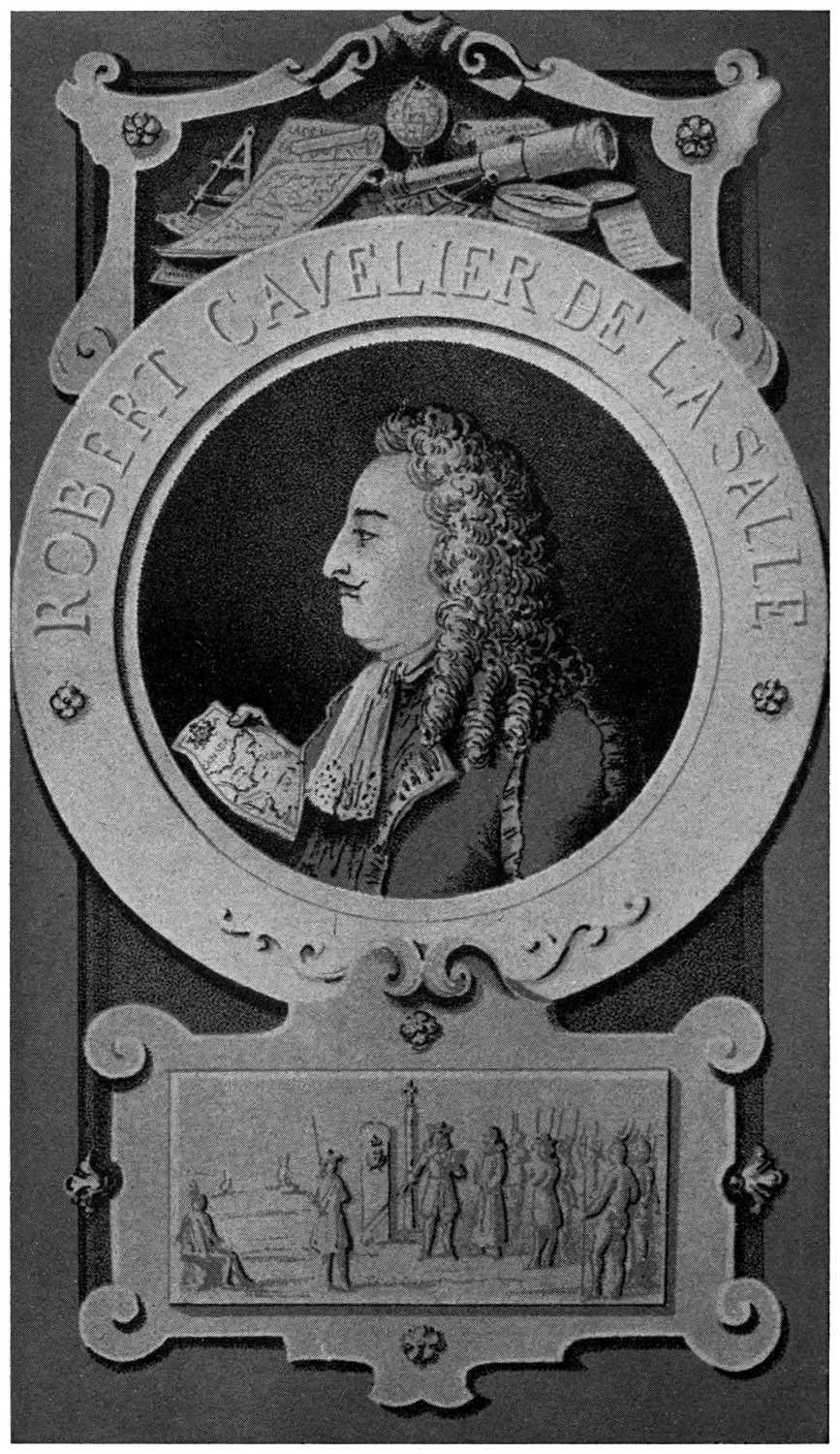
the southern end of Lake Michigan. Robert
Cavelier, Sieur de la Salle, or La Salle as he is
usually called, came to Canada in 1666, when
he was three or four and thirty years of age.
Outwardly cold and reserved, he was inwardly
consumed with a burning desire for adventure.
After his arrival, he set to work to study the
Indian languages, in which he soon became proficient;
and it was his delight to invite Indians to
his cabin, and to draw from them tales of the far-off
regions in which they dwelt, and especially of
those wonderful rivers, the Ohio and the Mississippi,
by the exploration of which he hoped to
provide a new passage to China and Japan. An
exploring trip which he took in 1669 gave him
the practical experience which was later to be of
value. La Salle was a man of strong prejudices
and personal dislikes, who took little pains to
overcome the jealousy of those who were envious
of him; but he gained one strong friend and
patron, Count Frontenac, the governor of New
France, who recognized a kindred spirit in this
bold, enterprising young man.
To a person of La Salle’s disposition, the lands
to the south of the Great Lakes offered alluring
prospects of immediate gain. Instead of the barren
soil, gloomy forests, and harsh climate of the
lower St. Lawrence Valley, this new country was
largely open and abundantly supplied with meadows,
brooks, and rivers. The soil was so fertile
that everything which could be produced in
France could be easily raised, and there was an
abundance of fish, game, and venison. Colonists
would find it easy to supply their own needs, and
could engage in profitable cattle raising, for flocks
and herds could be left out all winter. La Salle
also reported that there was a species of native
wild cattle, called the buffalo, whose wool was
better than that of any sheep in France. He
sought Louis XIV, king of France, and asked
permission to found colonies and to conduct the
fur trade and explorations on the regions bordering
on the Great Lakes. The French king did
not wish to found new colonies, for those already
in existence had proved very expensive, but he
was willing that La Salle should “labor at the
discovery of the western parts of New France,”
provided that he pay all the expenses of the
enterprise himself, and bring the matter to a
conclusion within five years. With this permission
and such money as he could raise, La Salle
returned to New France, and in the autumn of
1678 set out to put his plans into execution.
Detailed and interesting reports of his voyage on
the waters of the Great Lakes have been preserved
in the entertaining account of the journey which
was written by Father Louis Hennepin, an adventurous
missionary who delighted in telling stories
about himself and his doings. He was also something
of a prophet in foreseeing the time when
there would be an “inconceivable commerce” on
the Great Lakes, and their shores would be lined
with the shops and dwellings of the whites.
Up to this time the French missionaries and
the fur traders had gained the interior by way of
the Ottawa River, or the Toronto, and Georgian
Bay. La Salle decided to build a sailing-vessel
on the shore of Lake Erie, in which he could
transport his men to the stations he intended to
establish, and also carry his trading goods to the
Indians, and bring back the furs which he obtained
in exchange for them. He already had a fortified
post at Fort Frontenac on the northeastern shore
of Lake Ontario; but he could not build his ship
at this point, because the natives told him that
formidable cataracts interrupted the navigation
between Lakes Ontario and Erie. He sent an
advance company to establish a station at the
head of Lake Ontario, and to seek a convenient
site on Lake Erie for the construction of the ship.
With this expedition went Father Hennepin,
whose graphic account of what he saw and of
what he experienced is one of the most interesting
in the annals of American exploration. The
voyagers reached the mouth of the Niagara River
in safety. When the current became too strong
for them to go farther in their canoe, they landed
and pushed forward through the snow. As they
made their way along the edge of the river, they
heard more and more clearly the roar of falling
waters; and, at length, there burst upon their
sight the falls of Niagara, or the “Thunder of
Waters,” as the Indians called it,—that “vast
and prodigious cadence of water which falls down
after a surprising and astonishing manner, insomuch
that the universe does not afford its parallel,
those of Italy and Switzerland being but sorry
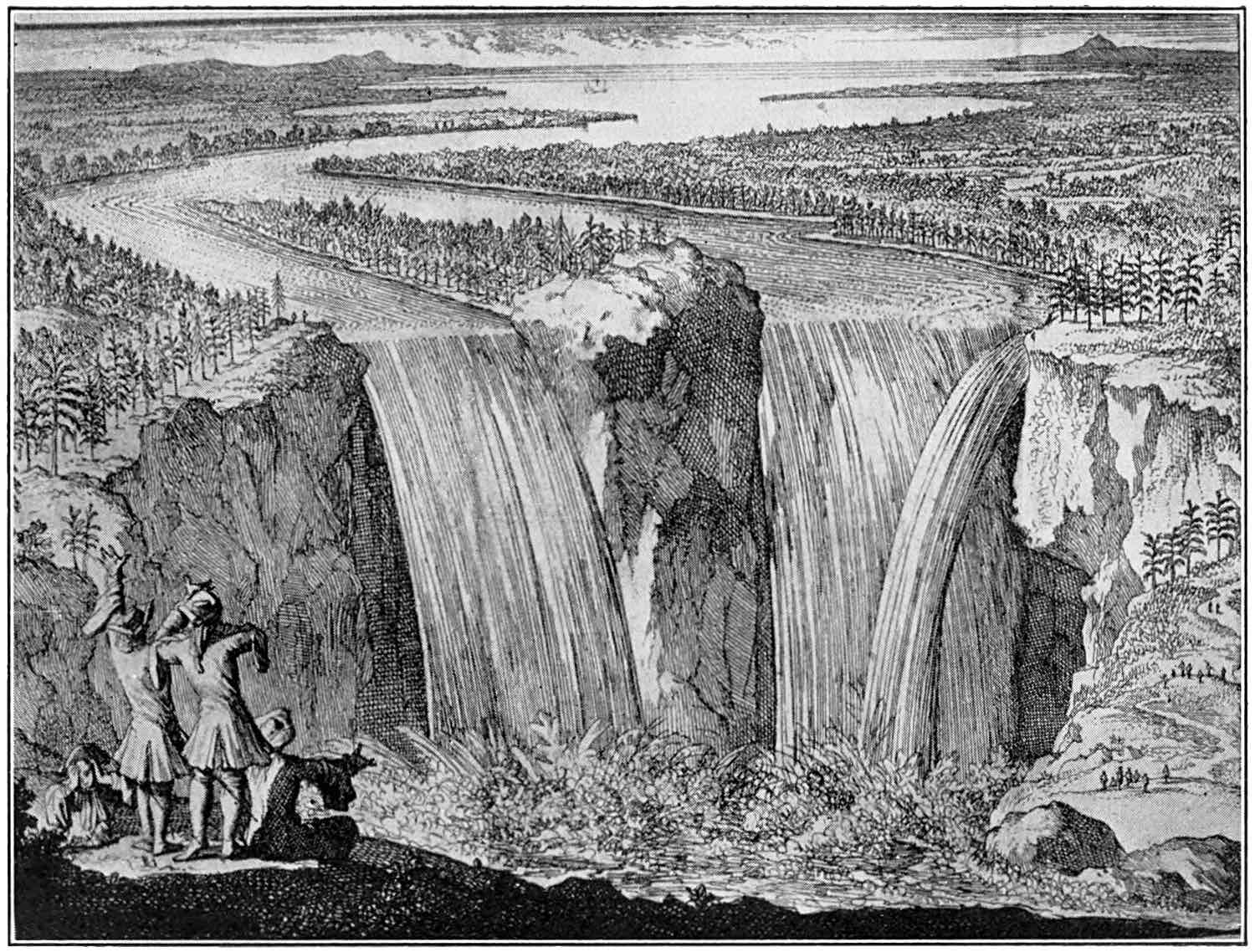
patterns.” Hennepin describes this wonderful
cataract as made up of two great cross-streams
of water and two falls with an island between, and
declares that when this “prodigious quantity” of
water comes to fall, there is a din and a noise
more deafening than the loudest thunder; the
rebound of the waters was so great that a cloud
arose from the foam and hung over the abyss,
even when the sun was at its height. He could
not say enough of this “most beautiful, and at
the same time most frightful cascade” which he
saw for the first time on this December day in
1678.[1]
[1] Lake Ontario is 326 ft. lower than Lake Erie and about 30 miles distant.
For 18 miles the Niagara River flows peacefully along, then suddenly the channel
narrows and the waters rush down 53 ft. in half a mile, and then drop over
a cliff 160 ft. in two separate falls, one 600 and the other 200 ft. wide. Seven
thousand tons of water are thus discharged every second into a narrow gorge
whose nearly perpendicular walls rise 200 ft. on either side. Down its steep
slope the imprisoned waters dash in a succession of boiling rapids, white with
foam, forming in one loop of the channel a curious whirlpool. Issuing from
this gorge at Lewiston, the river flows tranquilly on to Lake Ontario.
Niagara Falls as sketched by Hennepin
While Hennepin and his party were exploring
the Niagara, La Motte, the leader of the expedition,
had selected a site for a fortified house about
two leagues above the mouth of the river and not
far from the present town of Lewiston. He set
his laborers to work, but their task was hard, because
the frozen ground had to be thawed with
boiling water before it was possible to drive down
stakes for a palisade. As the carpenters labored
at their tasks, distrustful and jealous Indians from
a neighboring Seneca village of the Iroquois loitered
about, watching them with sullen looks, and
intimated in a way that could not be disregarded
their unwillingness to allow the work to go on.
And well they might! Niagara was the key to
the four upper lakes from which the Iroquois fur
trade could be controlled, and this fort was being
built expressly to hold in check those vigorous
tribes, and put an end to their trade with the
English and the Dutch in the furs which they
obtained from the Indians of the western territory.
La Salle had realized that difficulty would
probably arise, and had instructed La Motte to go
to the great village of the Senecas and endeavor to
gain their consent to the French plans for building
the fort and the ship. This La Motte now
decided to do. After five days’ journey through
the snowy forests, he and his companions reached
the town which was beyond the Genesee and
southeast of Rochester, not far from the present
town of Victor, New York. The weary travellers
were conducted to the wigwam of the principal
chief, where women and children flocked to gaze
upon the whites. An old man, according to custom,
went through the village announcing their
arrival, and younger savages washed their feet
and then rubbed them with bear’s grease.
The next afternoon, La Motte was summoned
to confer with forty-two old men who made up
the Indian council. These chiefs, clad in robes
of beaver, wolf, or black squirrel, squatted upon
the ground; but, writes Hennepin, “the senators
of Venice do not appear with a graver countenance
and perhaps do not speak with more majesty
and solidity than these ancient Iroquois.”
La Motte’s interpreter harangued the assembly,
stating that the French wished to build a great
wooden canoe and to erect a fort on the banks
of the Niagara River. He endeavored to convince
the natives that this enterprise would be for
their advantage, as it would enable the French to
sell them goods at lower prices than the Dutch
and English traders. He enforced every reason
with wampum belts, and gifts of axes, knives,
coats, and scarlet cloth,—for the best arguments
in the world were not listened to by the Indians
unless accompanied by presents. The shrewd,
savage politicians received the gifts, but were not
convinced. Their replies were general and evasive
and gave no satisfaction. When the council
was over, they proceeded to torture an Indian
prisoner, and La Motte with his men left the
camp in disgust to go back and await the arrival
of La Salle from Fort Frontenac. La Salle and
Tonty, his ever faithful friend and follower, with
men and supplies for the expedition arrived at
the Seneca town not long after the departure of
La Motte and his men. La Salle succeeded in
“so dexterously gaining their affection” that the
Indians consented to permit him to carry arms
and ammunition by the Niagara portage, to build
a vessel above the cataract, and to establish a
fortified warehouse at the mouth of the river.
Armed with this permission, he proceeded to the
encampment of La Motte. The rejoicing at this
success was short lived, for a few days later report
came that a vessel which La Salle had left at the
mouth of the Genesee River had been ship-wrecked
on the southern shore of Lake Ontario.
Of all the equipment for his enterprise with which
this vessel was laden, only the anchors and cables
for the new ship were saved; but La Salle with
his unvarying fortitude went on with the work
as if nothing had happened.
La Salle selected a spot on the banks of the
Niagara River above the falls at the mouth of
what is now called Cayuga Creek, where the water
was quiet, being sheltered by an island from the
current of the river—a little village near that
spot still bears his name. Hither the little company
of thirty men, heavily laden with tools and
provisions, journeyed laboriously through the
snow on one of the last days of January, 1679.
Two Mohegan hunters, who were with the party,
set about making bark wigwams for the men and
a chapel for Father Hennepin, who had travelled
the twelve miles with his portable altar lashed
to his back. The ship carpenters went to work
at once, and in four days the keel of the vessel
was ready. La Salle invited Father Hennepin
to drive the first bolt, “but the modesty of my
religious profession,” he says, “compelled me to
decline this honor.” So La Salle himself drove
the first nail in the ship.
Fortunately the majority of the Iroquois warriors
had gone on the war-path beyond Lake
Erie; but although those who had remained at
home were less insolent because of the absence
of the rest, yet they did not fail to visit the shipyard
frequently, loitering sullenly about and exhibiting
their displeasure. One of them, pretending
to be drunk, attacked the blacksmith,
and tried to kill him; but the blacksmith vigorously
defended himself with a red-hot bar of iron.
This, together with the severity of the reprimand
administered by Father Hennepin, who always
represents himself as indispensable on every occasion,
induced the savages to depart for the moment.
The work went rapidly on, and as the
great “wooden canoe” began to show its proportions
the Indians became more and more alarmed.
A few days later a squaw told the French that
they meant to burn the vessel on the stocks, and
had not a very close watch been kept they would
undoubtedly have done so.
These frequent alarms, the steady cold, and
the shortage of supplies owing to the loss of La
Salle’s vessel and the enmity of the Iroquois,
who refused to sell them food, discouraged the
shipbuilders. They would certainly have deserted
had not La Salle and Hennepin taken
great pains to reassure and cheer them on.
Toward spring La Salle set out on foot for Fort
Frontenac to procure food and supplies and to
attend to his personal affairs. His presence was
needed there because his enemies had persuaded
his creditors that the undertaking was a rash one,
and had instigated them to seize all his goods,
although Fort Frontenac alone was more than
sufficient to pay his debts. During La Salle’s
absence from Niagara one of the workmen endeavored
to stir up the others to desert. “This
bad man,” announces Hennepin, “would infallibly
have perverted our carpenters, had not I
confirmed them in their good resolution by the
exhortations I made them after divine service.”
The Mohegan hunters brought in deer and
other game, warmer weather arrived, and cheerfulness
once more prevailed. The shipbuilders
went on with their work more briskly, and in the
early spring of 1679, before La Salle returned,
the vessel was ready to be launched. Father
Hennepin blessed the ship and christened it the
Griffon, for on the prow La Salle had placed a
roughly carved figure of this mythical monster,
taken from the coat of arms of Count Frontenac.
The assembled company sang a hymn of praise;
three cannon were fired; and amid loud acclamations
from both French and Indians, the Griffon
glided into the Niagara River. All haste had
been made to get her afloat, even before she was
entirely completed, to save her from the plots of
the Indians, who were determined to burn her.
But the men did not wait for her to be finished
to put her to use. They immediately quitted
their bark wigwams, swung their hammocks
under her decks, and that very night, rejoicing in
their security from the Indians, all slept soundly
on board the ship.
The Iroquois warriors, returning from a hunting
trip, were mightily surprised to see the vessel
afloat, and shouted, “Otkon! Otkon!” which
means “most penetrating wits,” to the triumphant
Frenchmen. For they could not understand how
in so short a time the white men could build
so large a canoe,—although the craft was of
only about forty-five tons. With her five cannon
she was to the savages a wonderful moving fortress,
and inspired in them a wholesome fear and
admiration for the French.
CHAPTER VI LA SALLE ON THE GREAT LAKES
In the summer of 1679, La Salle returned
from Fort Frontenac to Niagara to find the
Griffon finished and ready for her first
voyage. By the completion of this vessel his
enterprise was fairly launched. Behind him at
Montreal were enemies and creditors; before
him stretched the waters of the Great Lakes, and
beyond was the unexplored wilderness. The men
had been unable to sail the Griffon up the Niagara
River to the mouth of Lake Erie because of the
strong adverse current. Now, with the help of
a strong wind and with tow-ropes in the most
difficult places, La Salle brought the vessel
through the turbulent water to the calm outlet of
the lake. There the crew celebrated their safe
passage with religious services and cannonading
and then set sail on the unknown waters.
To deter his men from the voyage, La Salle’s
enemies had declared that the lake was full of
rocks and sands. For the first day and night,
therefore, the men kept their sounding-lines busy,
but navigation proved to be easy. On the fourth
day after leaving Niagara, they reached the mouth
of that wide river called by the French “The
Strait,”—Détroit. Here the current was so
strong that they came to anchor to wait for a
favorable breeze. Soon a brisk wind arose
and the Griffon ploughed her way through the
rapids between Grosse Isle and the mainland,
pioneer of the mighty vessels which to-day make
that strait one of the great commercial highways
of the world. On both sides stretched fine open
fields dotted with fruit trees, and walnut and
chestnut groves, and beyond in the distance were
lofty forests. All were “so well-disposed,” says
Hennepin, “that one would think Nature alone
without the help of art could not have made so
charming a prospect.” Flocks of turkeys and
swans circled about, and from the deck of the
ship herds of deer could be seen roaming the
meadows. The Griffon was soon well stocked
with meat, and the returning hunters united in
heaping praises on this beautiful spot where fruit
and game of every kind abounded, and where
even the bears were not so savage as in other
places. Hennepin urged La Salle to make a
settlement on this “charming strait,” but La
Salle coldly reminded him of the great passion
which he had professed a few months before for
the discovery of a new country, and the priest
was silenced. Amid the later hardships of the
journey all must have looked longingly back
to this time of ease and plenty at the strait of
Detroit.
On the 12th of August, the Griffon passed
by the site of the present city of Detroit. Had
they come here ten years before, the explorers
would have found on the bank of the river a
large stone, rudely fashioned in the likeness of a
human figure and bedaubed with paint, which
the Indians worshipped as a manito, or god.
But in 1670 French priests, making the first
recorded passage through the strait, had come
upon this image, and “full of hatred for this
false deity,” had fallen upon it with their axes,
breaking it in pieces and casting it into the water.
Beyond Detroit the river widened into a beautiful
little sheet of water. As it was St. Claire’s
day, Hennepin’s proposal that the name of the
founder of his order be given to this lake was
carried out, and it received its present name.
When the Griffon had crossed the lake, the
men saw before them wide marshes through which
the swift-moving river had many a winding channel.
They had come to the St. Clair Flats, a
fan-shaped delta of seven channels, on which has
been built to-day a popular summer resort. They
set to work sounding one passage after another,
only to find them shallow and almost barred with
shoals. But at last they came upon an excellent
channel about a league broad, with no sands and
a depth everywhere of from three to eight fathoms
of water through which the vessel sailed
easily toward Lake Huron. At the mouth of
the river, however, they were forced to drop
anchor and remain for several days. A north
wind had been blowing, driving the water of the
three upper lakes into the strait. This had increased
so much the usual force of the current
that it was as violent as that of the Niagara, and
entirely impassable for a vessel like the Griffon.
Even when the wind turned southerly, La Salle
could make no headway against this current until
he sent ashore a dozen men who hauled and
towed the vessel along the beach for half an
hour, dragging her out of the narrow mouth of
the channel into the wave-tossed waters of the
lake. Once more all returned “thanks to the
Almighty for their happy navigation,” and set
sail on the 23rd of August on Lake Huron.
The favoring winds soon died down, and La
Salle lay becalmed for two days among the islands
of Thunder Bay. Starting from there at
noon on his way northward, he was caught in a
furious westerly gale. For hours the little vessel
tossed and drifted over the raging waters of the
lake, lying at the mercy of wind and wave.
Even La Salle gave up hope and told his men
to prepare for death. All fell on their knees
except the pilot, who devoted the time instead
to cursing and swearing against his employer for
having brought him there to perish in a “nasty
lake, and lose the glory he had acquired by long
and happy navigations on the ocean.” But Pilot
Lucas and his brave commander were not destined
to perish in that storm. Hennepin vowed
an altar to St. Anthony of Padua, prudently
agreeing to set it up in Louisiana if they should
reach there. The storm-clouds rolled away, the
waters grew quiet, and the sun shone out on the
wooded cliffs of the islands of Bois Blanc and
Mackinac, and the dense forests of Michigan.
The vessel anchored behind the point of St.
Ignace, in the harbor of Michilimackinac, the
settlement which was at once the centre of Jesuit
missions and of Indian traders.
The sound of the Griffon’s cannon brought out a
varied throng from the wigwams and cabins on
shore. Shouting Indians gazed with wonder at
this huge wooden canoe; lawless French traders,
swarthy from long years in the wilderness, to
whom the distance of this trading post from
civilization was its strongest recommendation,
lounged idly out of their cabins, gazing with
resentment at this invader of their trade and
country; while black-robed Jesuit priests hurried
to the shore to welcome the newcomers. Indians,
traders, and Jesuits united in a show of welcome
to La Salle as he landed, finely dressed and
wearing a scarlet cloak bordered with broad gold
lace. All marched to the little bark chapel in
the Ottawa village, and united with the voyagers
in hearing mass and giving thanks for their safe
passage.
At this settlement La Salle found four of fifteen
men whom he had sent ahead the autumn before
to buy furs, and to go to the tribes along the
Illinois River, making preparations for his coming.
Most of these men had been enticed from
his service, and had wasted the goods given them
to exchange for furs, using them for their own
personal gain. Troubled over his affairs in
Canada La Salle had meant to return from this
point to Montreal, leaving Tonty to conduct his
party to the Illinois River. But he soon felt the
hostile spirit at the trading post, and realized
that his presence was necessary to keep his men
from being drawn away. Even the swarms of
Indians who hovered in their canoes about the
vessel regarded it with wonder and jealousy rather
than friendliness, and La Salle feared that the
Illinois tribes would be tampered with by his
enemies.
He determined to push on at once, and embarked
early in September. The vessel proceeded
across Lake Michigan, called by the
French and Indians Lake Illinois from the name
of the tribes who inhabited its southern shores,
and cast anchor at the entrance of Green Bay.
Here matters took a turn for the better. As the
vessel lay tossing about behind a point of the
bay, an Indian chief came out in his canoe to
greet the Frenchmen. When he learned that
La Salle was a friend of Count Frontenac and
bore his commission, the Indian told him of his
own warm friendship for Frontenac, for whom he
would gladly lay down his life, and welcomed La
Salle with the greatest cordiality. He reported,
too, the presence of Frenchmen near by, and La
Salle found the faithful remnant of his advance
party waiting with a cargo of furs which they had
collected. Eager to satisfy his clamorous creditors,
he determined to send back the Griffon, in
charge of the pilot and five men, with this load
of furs. On the 18th of September, the Griffon
fired a parting shot and started for Niagara, to
return as soon as she had discharged her
cargo; and La Salle, with Hennepin and fourteen
others, embarked in four canoes for the
south.
The canoes had hardly started when a sudden
September storm swept across the lake. The
waves washed into the heavily laden canoes, darkness
fell, and it was only by constant shouting
that the men kept their boats together and got
to shore. For four days the storm raged with
unabated fury. As La Salle and his men waited
from day to day in their cheerless encampment,
living on pumpkins and Indian corn presented
them by the friendly Indian chief and the meat
of a single, porcupine brought in by a hunter, the
thought of the Griffon haunted them. Their
worst fears proved afterward to have been fulfilled;
she was never heard of again. With her
sank the cargo which was to have restored La
Salle’s credit in Montreal; and with her, too,
perished the high hopes that had been set upon
this first vessel on the upper lakes.
Although La Salle feared the worst, he did
not turn back. As soon as the lake grew calm
the four canoes set out again, coasting southward
along the shore of Wisconsin. But the elements
were against them. Storm after storm drove
them ashore, where they spent wretched days and
nights among the rocks and bushes, crouched
around driftwood fires with nothing to shelter
them from snow and rain but their blankets. As
they went southward, steep, high bluffs ran so
close to the lake that it was hard to find a
landing-place. Yet the violence of the wind was
so great that they were compelled at evening to
drag their canoes to the top of the bluffs in order
not to leave them exposed all night to the waves
which would have dashed them to pieces. In
the morning, in order to reëmbark, two men had
to go into the water to the waist and hold a
canoe upright until it was loaded, pushing it out
or drawing it back as the waves advanced or
retreated. Food gave out and the men paddled
from morning till night with nothing to eat but
a daily handful of Indian corn and hawthorn berries
which they picked on shore and devoured
so ravenously that they made them ill. Exhaustion
and famine stared them in the face, but relief
was in sight.
One morning as the men were paddling along
near the site of Milwaukee, they saw upon the
shore a cloud of ravens and eagles hovering over
something. They hastened on land and found
the body of a deer which had been killed by a
wolf. This was the beginning of better things.
As the little fleet advanced toward the south, they
found the country ever fairer and the weather
more temperate. There was an abundance of
game, of which there had hitherto been an exceptional
lack. They passed the Chicago River and
circled the end of the lake, landing at the mouth
of the St. Joseph. Here La Salle waited for
Tonty to join them, employing the time in building
a fort. On the third of December the party
sailed up the river, bound for the villages of the
Illinois. On a later trip in 1682 La Salle reached
the Illinois settlements by a shorter route, crossing
from his fort to the river Chicago, and journeying
from its waters into a northern branch of
the Illinois River.
In four months La Salle had traversed the
length of Lake Erie, had passed through the
strait of Detroit, up Lake Huron, through
the Straits of Mackinac, and down Lake Michigan;
from the sites of Buffalo and Cleveland he
had sailed past Detroit and Milwaukee even to
Chicago, and had then journeyed inland to the
Illinois River. He had lost his vessel and her
crew, as well as all his furs; he had met
with hostility from French and Indian alike; he
had been deserted by most of his advance party,
and had held his own crew only by his presence
and the dominating force of his personality; he
had suffered endless hardships and privations:
but nothing had shaken his purpose. In later
years he followed the Illinois and the Mississippi to
the Gulf of Mexico and led a colony to the limits
of the present state of Texas, where he was murdered
by one of his men. In history, La Salle
stands out as a man whose courage and persevering
fortitude in the face of almost insuperable
obstacles mark him as one of the greatest explorers
the world has ever known. We do well to join
with Hennepin in saying, “Those who shall be
so happy as to inhabit that noble country cannot
but remember with gratitude those who discovered
the way by venturing to sail upon unknown
lakes.”
CHAPTER VII A HAPLESS FRENCH GOVERNOR
Like all strong men Frontenac made
many enemies. He was recalled in 1682,
and General La Barre, a man of about
sixty, was sent out in his place. La Barre had
made a good record in the West Indies, but was
entirely unable to handle the difficult problems
which met him in New France. In an evil hour
for the French, the Iroquois had conquered the
southern neighbors with whom they had long
waged wars that had occupied much of their time
and strength. Now, they were free to turn on
the Indian allies of Canada of whose commercial
gains through the fur trade with the French they
had long been envious. Frontenac before his departure
had found the Iroquois unusually arrogant
and unruly, although they had come to regard
him as the greatest of all “Onontios,” as they
named the governors of New France. The
Dutch and the English had meanwhile made
more or less successful advances to the Iroquois,
who now fully realized their own importance
from the efforts of both French and English to
gain their support.
For two years La Barre struggled on, entangling
rather than helping the situation. At length
an Iroquois chief was murdered in a village of
French Indians, and the crisis came. In the early
spring of 1684, French canoes were plundered by
the Senecas and La Barre felt that he must assert
his power, or the Indians would lose their respect
for the French. After making great preparations,
he started with his soldiers and frontiersmen for
the Seneca country by way of the St. Lawrence
to Fort Frontenac and thence across Lake Ontario.
The opposing current of the river was so
strong that frequently the men could make no
progress by paddling, but were obliged to tow the
canoes or push them along with poles. Every
few miles were rapids around which the canoes
were transported and through which the flatboats
were pulled with the greatest effort. The mosquitoes
were “insufferably troublesome,” hovering
over the men in such clouds that they could
hardly see their way,—so one of the soldiers
wrote. At Fort Frontenac, the men fell ill of a
malarial fever which killed many and disabled
more. La Barre repented more than once of
entering upon an expedition that he now saw
would be disastrous.
Whatever his former warlike purposes, La
Barre was now eager for peace. He sent Le
Moyne, a veteran interpreter whom the Iroquois
called the “Partridge,” to the Onondagas asking
them to meet him on the southern side of the
lake, twenty miles or so north of Oswego. Le
Moyne returned in a few days with the famous
Onondaga chief, “Big Mouth”; in French this
is “La Grande Gueule,” which the soldiers shortened
into “Grangula.” Big Mouth had recently
been conferring with the English, whose arbitrary
demands had offended his pride; he was now in
a haughty mood that boded ill for the French.
The Indian chief was accompanied by a train
of thirty young warriors. As soon as he disembarked,
General La Barre sent him a present of
bread and wine, and thirty salmon-trouts. At
the same time he gave him to understand that
he was pleased at his arrival, and would be glad
to have an interview with him after he had rested
himself. To conceal from Big Mouth the weakness
of the French forces Le Moyne represented
to him that the most of the soldiers had been left
behind at Fort Frontenac, and that the troops
which he saw were the general’s guards; but one
of the Iroquois knew a little of the French tongue.
Strolling noiselessly about the tents by night he
overheard the talk of the soldiers and learned the
true state of affairs.
It was two days after his arrival before Big
Mouth gave notice to La Barre that he was ready
for an interview. The council was held on an
open spot between the two encampments. From
the picture drawn by one of the French soldiers
we see the arrangement. La Barre was seated in
state in an armchair with his Jesuit interpreter
beside him and the French officers ranged on his
right and left. The two lines of French soldiers
formed two more sides of the square. Opposite
La Barre sat the Indians with Big Mouth, their
spokesman, in front, and between them in the
centre of the square was placed the great Calumet
or Pipe of Peace. The stem of this huge pipe
was about four feet long, and the body or bowl
about eight inches high. The bowl was of handsome
red stone, well polished, and the stem of
a strong reed or cane, trimmed with yellow, white,
and green feathers. In shape it resembled a huge
hammer more than anything else. The Indians
used these calumets for negotiations as we use a
flag of truce, holding them peculiarly sacred. To
violate the rights of this venerable pipe was regarded
among them as a flaming crime that would
draw down mischief upon their nations. About
this calumet were piled the wampum belts to be
presented by the speakers.
La Barre and Grangula
La Barre opened the council, speaking boldly
and with apparent assurance. He made no allusion
to his original purpose of making war on
the Senecas, but announced that the king, his
master, had sent him there with a guard to meet
the principal chiefs of the Five Nations at an
appointed council fire. The Five Nations had
made infractions upon the peace concluded between
them and the French. Should Big Mouth
be willing, as their representative, to make reparation
and offer promises for the future, the
great French monarch desired that La Barre and
Big Mouth should smoke together the calumet
of peace.
La Barre recounted the three offences of the
Iroquois. They had robbed and ill-used French
traders; for this he demanded reparation. They
had brought the English to the lakes which belonged
to the French, thus diverting trade from
the latter; this he would forget, provided it did
not happen again. They had attacked the Illinois,
and still held many in captivity. “These people
are my master’s children,” said La Barre, “and
must therefore cease to be your slaves.” They
must be sent home at once. He enforced each
statement with a wampum belt, and ended every
request with an announcement, as bold as though
he had the whole French army at his back, that
should these demands not be complied with, he
“had express orders to declare war,” even going
so far once as to say, “in case of your refusal,
war is positively proclaimed.” He would gladly
leave them in peace, should they prove “religious
observers of the treaties,” but if not he added,
concluding with a statement which he knew to be
false, he would be obliged to join the governor of
New York, who had orders from his king to
assist La Barre in burning the five villages and
cutting off the Iroquois.
While La Barre’s interpreter translated this
speech, Grangula sat silent and attentive, gazing
steadily at the bowl of his pipe. After the harangue
was finished he rose and walked round
inside the square made by the French and savages,
five or six times. Then he returned to his place,
and drawing himself to his full height began to
speak. “Onontio, I honor you,” he said, “and
all the warriors that accompany me do the same.
Your interpreter has made an end of his discourse,
and now I come to begin mine. My voice glides
to your ear, pray listen to my words.”
He thought that the French captain must have
started out from Quebec with some strange idea
that the Five Nations had been wiped out by fire
or flood. Nothing else, he implied, could make
him set out against so powerful a federation with
such an army. The Indian chief ironically assured
the French general of the continued prosperity
of the Five Nations, congratulating him
that he brought the calumet of peace, rather than
the bloody axe that had been so often dyed with
the blood of the French. Then he spoke out
boldly and directly, telling La Barre that he knew
better than to believe the Frenchman’s pretence
that he did not have any other purpose in approaching
the lake than to smoke the pipe of
peace with the Onondagas. He saw plainly that
the Onontio meant to “knock them on the head,”
if the French arms had not been so much weakened.
The French soldiers were to be congratulated
that the Great Spirit had visited them with
sickness, for only thus had their lives been saved
from Indian massacre. Even the women and
old men and children would have attacked the
French camp without fear, had not Akouessan
(Le Moyne) appeared at the Onondaga village
announcing that he was an ambassador of peace,
not of war.
With this bold and telling introduction, in
which he revealed to the French his full comprehension
of their weakness and of their deceit, Big
Mouth proceeded to consider the accusations of
La Barre. The pillage of French traders he justified
on the ground that they were carrying arms
to the Illinois, and for this he flatly refused to
give satisfaction, declaring insultingly that even
the old men of his tribe had long ceased to fear
the French. They had conducted the English to
the lakes to traffic with French allies, just as the
Algonquins conducted the French to the Five
Nations to trade with them. Moreover, he
claimed that they had a perfect right to do as
they pleased in this matter. “We are born free-men,”
he declared proudly, “and have no dependence
either upon the Onontio [governor of
Canada], or the Corlaer [governor of New York].
We have power to go where we please, to conduct
whoever we will to the places we resort to,
and to buy and sell where we think fit.” If the
French chose they might make slaves of their
allies, robbing them of the liberty of entertaining
any other Indians, but the Five Nations would
brook no such interference. The Iroquois attacked
the Illinois because they invaded their
territory, hunting beavers on their lands. Big
Mouth met the reproof of La Barre with a bold
stroke in return. He declared that in defending
their own lands against the Illinois they had done
less than the English and French, who without
any right, had usurped the grounds they now
possessed, dislodging from them several nations
in order to make way for the building of their
cities, villages, and forts.
Big Mouth closed his address with a warning.
A year ago the hatchet had been buried in the
presence of Count Frontenac at his fort, and the
tree of peace had been planted. It was then stipulated
that this fort should be used as a place of
retreat for traders, and not a refuge for soldiers.
Big Mouth warned the French to take care lest
so great a number of soldiers as he now saw
before him “stifle and choke the tree of peace,”
and hinder it from shading both countries with
its leaves. The Iroquois were ready to dance
under its branches the dance of peace, and never
dig up the hatchet to cut it down, unless the
governors of Canada and New York, jointly or
separately, should invade the country given by the
Great Spirit to their ancestors. The Indian orator
presented two wampum belts and sat down.
As soon as he had done, Le Moyne and the
Jesuits interpreted his answer to La Barre, who
thereupon retired to his tent and stormed and
blustered till somebody came and represented to
him that good manners were not to be expected
from an Iroquois. It was little wonder that
La Barre raged. The Indian chief had seen
through his artifices, had yielded to none of his
demands, and had contrived to assert the complete
independence of his own tribes and their
contempt for the French.
Big Mouth entertained some of the French
officers at a feast, which he opened for them by
dancing an Indian dance. There was another
council in the afternoon, and the terms of peace
were settled upon in the evening. These terms
were in the usual form of Indian treaties. A
“word” of the Iroquois was answered by a “word”
of the French accepting it, and all disputed
points were taken up in a series of such “words.”
The Iroquois offered to the French a beverage
devoid of bitterness to purify whatever inconvenience
they had experienced on their voyage, and
to dispel whatever bad air they had breathed
between Montreal and this council fire,—a beverage
of which the malarial French were certainly
in dire need. They reminded the French of the
deep ditch dug the year before, into which all
unkind things that might occur were to be cast,
and requested the French to throw into it the
Seneca robbery, to which the French agreed.
Again the tree of peace was set up, each side solemnly
adjuring the other to sustain and strengthen
it. The French agreed to depart at once, and
then,—and not till then,—did the Iroquois consent
to renew the former treaty, “dispelling all the
clouds that had obscured the Sun from their sight.”
Thus ended the grand expedition of La Barre.
No real satisfaction had been gained by the
French, but a weak truce had been made, and
the Iroquois had taken the opportunity to assert
boldly their independence of French and English
alike, whom they treated as invaders of their
rightful possessions.
Big Mouth and his men returned to their
homes, and the French set out for Montreal.
The few healthy men that remained manned the
General’s canoes and took charge of the flat-bottomed
boats in which the soldiers were carried.
Of the dangers attendant on shooting the rapids
in these boats one of the soldiers draws a vivid picture,
declaring that he and his companions wished
themselves back in the canoes that had brought
them up, when they shot down such precipices of
water as had never been heard of before. The
main current wound its way in and out past eddies
and rocks, dashing along as fast as a cannon ball,
and the men steered as well as they could along
this zigzag course, knowing that a false stroke of
the oar would send them upon the rocks. But in
spite of the discomfort and the danger, this soldier
confesses from the safe shelter of Montreal that,
though the risk was very great, “yet, by way of
compensation one had the satisfaction of running
a great way in a very short time.” And he closes
with a word of sympathy for La Barre. “All the
world blames our General for his bad success....
The people here are busy in wafting to court a
thousand calumnies against him.... But after all
the poor man could do no more than he did.”
PART II THE STRUGGLE FOR POSSESSION
CHAPTER VIII THE FOUNDING OF DETROIT
After the failure which has been recounted
in the preceding chapter, La
Barre was recalled to France, and a new
governor, Denonville, sent over to take his place.
He had not much greater success and was in turn
replaced by Count Frontenac, who returned to
the scene of his former labors. This was in
1689, when England and France were at war.
For the remaining nine years of his life Frontenac
devoted all his energies to defending New
France against the English and the Iroquois and
to holding what the French had already gained
on the Great Lakes. In November, 1698, in his
seventy-eighth year, he died, and was deeply
mourned as a strong governor and beloved
leader. He had come out to New France in
1672, and during his long term of service he had
used his power and influence not only to build
up the settlements on the St. Lawrence, but also
to plant on the shores of the Great Lakes and
the rivers beyond a line of French forts and trading
posts. He had gathered about him a group
of young men who shared his enthusiasm for
expansion and were eager to carry on his work.
Five years before his death, Frontenac had sent
one of his men, Cadillac, to the Straits of Mackinac
to hold that centre of the fur trade.
Cadillac was a rough, forceful soldier who was
summary in his methods and short in his speech.
He was well suited to the command of a frontier
post and did good work in keeping the lake
Indians from alliance with the enemies of the
French. He did not, however, get on well with
the missionaries at Michilimackinac. They
resented his presence and his influence with the
Indians, for whose conversion to Christianity they
were earnestly laboring. Cadillac soon came to
see that Detroit and not Mackinac was the key
to the interior. Whoever held the narrow
channel connecting Lake Erie and Lake Huron
would control the fur trade of the whole lake
region. He hastened to Quebec to gain support
for his scheme of erecting a fort and trading station
on the Detroit River. There he was stoutly
opposed by the Jesuits, who foresaw that the
carrying out of his project would mean the ruin
of their mission, which could not compete commercially
with the new station, and that the
extension of trade would bring the vices of
civilization to the natives. Nothing daunted,
Cadillac went over the seas to France, gained
the favor of the colonial minister, and returned
to Canada with permission to found his colony.
He reached Detroit with a band of one hundred
colonists and soldiers on the 24th of July, 1701.
Cadillac had done well in choosing Detroit as
the situation for the first permanent colony on
the lakes. In the century that was past the
Great Lakes had been discovered and explored;
the eighteenth century was to witness their occupation
and the contest for the possession of this
rich country. In this long strife, first France
and England, and then England and the American
colonies, were to come to blows, while always
on these shores unceasing warfare would be
waged between the advancing white man and the
retreating red man. In the opening years of the
new century Cadillac was taking the first step in
permanent occupation of the country, planting
his settlement on a site so important that a wise
English leader was at that very time urging upon
the New York assembly its colonization by the
English. So long as Lake Erie and Lake Ontario
had been avoided by the French, the northern
Ottawa River-Georgian Bay route had been
the highway of travel and trade. The easier
southern route was now open to the French, but
it was even more convenient and accessible to
their English rivals. The French were brought
face to face with the problem of how to hold the
trade of the upper lakes from the English. In
the solution of this problem Detroit would be
the key.
There rushes through the strait of Detroit
more water than through any other river in the
world, save only the Niagara and the St. Lawrence.
Through this channel, whose average
width is a mile and whose length is only twenty-seven
miles, pour in a steady, even current, unbroken
by rapids or eddies, and with a speed of
over two miles an hour, the waters of three lakes,
Superior, Michigan, and Huron, and of the
hundreds of streams that feed them. This little
river is the natural outlet for eighty-two thousand
square miles of lake surface and one hundred
and twenty-five thousand square miles of land.
Down the swift current floated in those early days
scores of canoes paddled by silent Indians and
swarthy coureurs de bois, bearing to the markets
at Montreal, Quebec, and Albany loads of
beaver, mink, and otter furs of immense value.
They were the forerunners of a tonnage passing
through that strait which to-day exceeds that
of the Thames and London.
Cadillac and his soldiers and settlers, fifty each,
had paddled, pushed, and carried their canoes,
heavily laden with provisions, tools, ammunition,
and supplies, all the way from Montreal. As
they gazed on the beautiful site of their future
homes, their weariness passed away. With shouts
of joy they drew their canoes to the bank and
unpacked their heavy loads for the last time.
No exploring party had ever passed through
the Detroit River without longing to stop. To
appreciate the charm and wealth of that spot, one
must read the vivid descriptions which were
written by men of that time. Such an enthusiast
was Cadillac. Two months after his arrival, he
wrote home the following, which would do credit
to a promoter’s prospectus of the present day.
“The business of war being so different from
that of writing,” he said, “I have not the ability
to make a portrait of a country so worthy of a
better pen than mine; but since you have directed
me to render an account of it, I will do
so.” He described the river and then continued:
“Its borders are so many vast prairies, and the
freshness of the beautiful waters keeps the banks
always green. The prairies are bordered by long
and broad rows of fruit trees which have never
felt the hand of the vigilant gardener. Here
also orchards, young and old, soften and bend
their branches, under the weight and quantity of
their fruit, towards the mother earth which has
produced them. It is in this land, so fertile, that
the ambitious vine, which has never wept under
the knife of the vine-dresser, builds a thick roof
with its large leaves and heavy clusters, weighing
down the top of the tree which receives it, and
often stifling it with its embrace.
“Under these broad walks one sees assembled
by hundred the timid deer and fawn, also the
squirrel bounding in his eagerness to collect the
apples and plums with which the earth is covered.
Here the cautious turkey calls and conducts her
numerous brood to gather the grapes, and here
also their mates come to fill their large and gluttonous
crops. Golden pheasants, the quail, the partridge,
woodcock, and numerous doves swarm in
the woods and cover the country, which is dotted
and broken with thickets and high forests of full-grown
trees.... There are ten species of forest
trees, among them are the walnut, white oak, red
oak, the ash, the pine, whitewood and cotton-wood;
straight as arrows, without knots, and
almost without branches, except at the very top,
and of prodigious size.... The fish here are
nourished and bathed by living water of crystal
clearness, and their great abundance renders them
none the less delicious. Swans are so numerous
that one would take for lilies the reeds in which
they are crowded together. The gabbling goose,
the duck, the widgeon [a kind of duck], and the
bustard are so abundant that to give an idea of
their numbers I must use the expression of a
savage whom I asked before arriving if there
was much game. ‘So much,’ he said, ‘that they
draw up in lines to let the boats pass through.’...
In a word, the climate is temperate, and
the air purified through the day and night by a
gentle breeze. The skies are always serene and
spread sweet and fresh influence which makes one
enjoy a tranquil sleep.”
Cadillac landed at the narrowest part of the
river, where the city now stands, and began to
build the little village which was to survive without
a break the conflicts of the coming century.
In this wilderness, inhabited only by wild beasts
and savages, the first thought must be for defence;
only when that was provided, could the
settlers turn to plans for their own shelter from
wind and weather. On the first rise of ground
back from the river, along the line of the present
Jefferson Avenue, Cadillac marked out a space
of a little less than an acre, with a width of about
two city blocks and a depth of one, which was to
be enclosed by a palisade. Small trees were hewn
in the forest and fashioned into sharply pointed
pickets which were driven into the ground as
closely as possible, thus forming a solid fence
ten or twelve feet high. At the four corners
were bastions of stout oak pickets from which
the soldiers could shoot along the line of the
palisade. Inside the stockade, Cadillac laid out
a street twelve feet wide, and assigned small lots
to the settlers and soldiers. The settlers bought
theirs outright, but Cadillac retained the ownership
of the others.
Fifty hours after their landing, on the day
sacred to St. Anne, they began the foundation
of a chapel on the very spot where St. Anne’s
church stands to-day. In a month the chapel
was completed by a rude cross placed over the
door, and a bell summoned the colonists to daily
prayers. When the storehouse and magazine for
ammunition were also finished the people set to
work on their own log huts. Trees were cut in
the forest, and the rough-hewn logs were hauled
to the spot. There a framework was set up, the
logs were fitted into it, and the cracks were filled
with mortar and mud. Last of all the top was
covered with a roof of birch bark, or was thatched
with grass. Land outside the stockade was assigned
for agriculture, each soldier having a half
acre for cultivation, and the civilians larger tracts.
That very year wheat was sown for the next summer.
With remarkable speed the settlement
sprang up in the wilderness, and before the end
of August took on an appearance of stability and
permanence.
Cadillac now summoned the Indians to council
and urged them to build settlements in the vicinity.
He was wise enough to see that if a sufficient
number of friendly Indians located near by,
traders would come to buy their furs, the colony
could rely on greater numbers in case of attack,
and the scanty three months’ supply of provisions
brought from Montreal could be eked out by
food bought from Indian hunters. Three large
villages sprang up, and within eight months the
population of the strait was some six thousand
people, whites and Indians.
Hitherto there had been on the Great Lakes
nothing looking to family life or permanent residence,
but in the spring of 1702, Madame Cadillac
and Madame Tonty, wife of the captain of the
garrison, started in open canoes, manned by
Indians and Canadians, on the seven-hundred-mile
journey from Montreal to Detroit. At a
season when storms were likely to be frequent
these two women braved the hardships of the
trip, going up the rapids of the St. Lawrence,
across Lake Ontario and around Niagara, and up
Lake Erie to the strait. With her Madame
Cadillac brought her little boy, Jacques, six years
of age; her oldest son was already with his father.
These were the first white women to come to the
Great Lakes. They were soon followed by the
wives and families of other settlers. By 1708 the
settlement had grown so fast that houses were
built outside the stockade, as the twenty-nine huts
within the enclosure were not sufficient to accommodate
the people.
The little colony suffered the usual troubles of
frontier life, but managed to survive them. In
1703 several of the buildings were destroyed by a
fire set by the Indians. For the first few years
the colony was managed by a company, but in
1705 Cadillac succeeded in getting full control
and ruled there with as absolute sway as had any
feudal chief in his turreted castle. He owned the
public buildings and defences and he alone could
grant lots for settlement. From him alone could
the people obtain their liquor, and to prevent
excessive drinking by the Indians and traders he
restricted the amount sold to each person at one
time and charged a high price for it. To him
also all must come for permits to carry on their
different trades and occupations. For every
privilege the people must pay, and right bitterly
did they complain of their commandant to his
enemies, though when he walked along the narrow
street, firm and erect, in soldierly costume
and with clanking sword, every hat was doffed.
Doubtless some of his charges were exorbitant,
but the money was turned back into the improvement
of the colony, as, for instance, to build a
public windmill where the people could pay to
have their corn ground. The blacksmith complained
that he had to pay six hundred francs a
year and two casks of ale for the privilege of
blacksmithing, besides having to keep all Cadillac’s
horses shod. The latter task could not have
been very arduous, for until 1706 there were no
horses in the settlement, and of the three that
Cadillac bought in that year only one, named
Colin, was alive in 1711.
In 1710 Cadillac was ordered to go to
Louisiana to govern the colony there, and his
connection with Detroit and the Great Lakes was
brought to an abrupt end. The settlement which
he handed over to his successor was fairly prosperous.
In the following winter, however, while
the men of the neighboring Indian tribes were
away at their hunting-grounds, a thousand or
more hostile Indians of the Fox-Wisconsin river
tribes descended upon the region and prepared to
settle there. The colonists were powerless to
prevent them, but waited anxiously for the return
of the hunting-parties. In May they came, and
under the leadership of the French finally drove
off the enemy after a hard and bloody siege in
which many lives were lost. For the next ten
years the colony was so weak that its abandonment
was contemplated. Successive governors
mismanaged its internal affairs, demanding tolls
and fees so exorbitant that traders refused to come
there. Cadillac’s demands had been for the advancement
of the colony; these men used their
power to enrich themselves.
In 1720 and 1721, financial distress in France
sent many a ruined Frenchman to Detroit, so
that in 1722 the population was again two hundred,
as it had been at the time of its founder’s
departure. For the next thirty years the story
of Detroit was uneventful. The settlement increased
gradually in numbers and strength. Of
its hardships we may best judge by the large
mortality of children in those years. By the
middle of the century we find the authorities in
Canada so eager to have the colonies on the Great
Lakes strong and permanent, that the following
inducements are offered in a proclamation
posted, by order of the governor-general, in all
the parishes of Canada:—
“Every man who will go to settle in Detroit
shall receive gratuitously, one spade, one axe, one
ploughshare, one large and one small wagon.
We will make an advance of other two tools to
be paid for in two years only. He will be given
a cow, ... also a sow. Seed will be advanced
the first year, to be returned at the third harvest.
The women and children will be supported for
one year. Those will be deprived of the liberality
of the King who shall give themselves up
to trade in place of agriculture.”
In this way men with families were encouraged
to make France strong in her western outposts.
Within a year one hundred persons responded,
and an official census shows a population at
Detroit of nearly five hundred persons, of whom
thirty-three were women over fifteen, and ninety-five
girls under that age. This represents no
mere floating population of traders and adventurers.
The property returns of the inhabitants
show them to have been an agricultural people
who made the most of the rich land on which
they lived. In the census they reported one
hundred and sixty horses in place of the one of
forty years before, and six hundred and eighty-two
cattle. The fertility of the strait of Detroit
seemed to inspire even the roving Canadian, usually
so restless and adventurous, with a desire to
plant and develop a home.
CHAPTER IX NIAGARA AND THE LOSS OF CANADA
The importance of Niagara in trade and
warfare was early recognized by both the
French and the English as well as by the
Iroquois. La Salle and Denonville, in their desire
to monopolize the Indian trade, had built fortified
storehouses on the shore of the river, but both
had been destroyed by the Iroquois. By the
beginning of the eighteenth century, the English
began to make serious inroads on the fur trade
of the interior, and the French became more
anxious than ever to secure a permanent foothold
at Niagara. For twenty-five years French
and English orators harangued at Indian councils,
begging for permission to build forts or trading
houses at that point; governors wrote home for
the necessary funds to purchase the Indians’
consent; and rival traders watched every camp
on the river with suspicion. At length French
diplomacy won the day. In 1720, Joncaire, with
the help of Charles Le Moyne, Chevalier de
Longueuil, gained from the Indians a reluctant
consent to the building of a bark house at Niagara.
He made the most of this permission,
and on the site of Lewiston built a large house,
forty feet wide and thirty long, which could
accommodate fifty traders. This he surrounded
with a high fence or palisade and named the
Magazin Royal. In their turn the English built
a similar, though smaller, house at Oswego
(1722), from which the Indians could go by
portage by the Oswego River to Lake Oneida,
and, gaining the Mohawk, could paddle their
fur-laden canoes to Albany.
In their first permission to the French, the
Iroquois had carefully stipulated that the house
to be built at Niagara should be of bark, for they
had learned the danger of stone forts. Now, Le
Moyne told them that he could not keep his
skins dry in a bark house, and wrung from them
an unwilling consent to the erection of a stone
house, provided it be “no stone fort.” The
authorities at once wrote to the king, asking for
money to defray the expense of building a house
of solid masonry. De Léry, the king’s chief
engineer, who had come out to fortify Quebec
and Montreal, was directed to proceed to Niagara,
and to build this trading house. He
decided not to put it near Joncaire’s station,
which was seven miles up the river, where the
rapids made further navigation impossible, but
to place it at the outlet of the river into Lake
Ontario. On the eastern bank of the Niagara,
near its mouth, he began the erection of the stone
structure which stands to-day as the oldest part
of the government buildings at Fort Niagara. It
took two summers in time and thirty thousand
livres in money to build. When completed, the
house of stone possessed four bastions erected
with a massiveness of construction that makes it
strong after nearly two hundred years have passed
away. Charles Le Moyne, who had gained the
Indians’ consent to the building of this stone
house, was put in command and held it for many
years. The first Charles Le Moyne came to
Canada in 1654, and for a century his sons and
grandsons played most important parts in the
building up of the French power in the New
World. Two of his sons led the attack on
Schenectady, and later founded Louisiana; a third
son fell in the defence of Quebec against Sir William
Phips in 1690, and another in the struggle
with the English for Hudson’s Bay. The second
Charles Le Moyne accompanied La Barre
and Denonville on their expeditions against the
Iroquois, and the third established this fortified
post at Niagara.
In a hundred and forty years, more or less, the
French had made wonderful progress in opening
up the interior of North America to exploration
and trade; they had founded settlements at the
extremities of their dominion on the St. Lawrence
and the lower Mississippi, and had connected
these by a chain of forts on the Great
Lakes and the northern tributaries of the Mississippi;
but they had established only one strong
colony in the interior, the settlement at Detroit.
As the middle of the eighteenth century approached,
they awoke to the need of making
good their claim to the Ohio Valley, building a
line of forts at Presque Isle on Lake Erie, Le
Bœuf, Duquesne, on the route
from that lake to the Ohio River. They also
strengthened themselves by erecting a fort on the
southern shore of Lake Erie at Sandusky, about
halfway between Cleveland and Detroit. The
energy of the French was in part due to the exhibition
of an intention of the English to enter
the great interior basin; but the French activity
aroused the English, and in 1754 the final contest
for the control of the continent began in the
western wilderness of Virginia and Pennsylvania.
With the war elsewhere, this book has nothing
to do; the campaigns for the capture of Duquesne,
Louisbourg, Ticonderoga, Quebec, and
Montreal, all took place far away from the shores
of the Great Lakes; but it was the success of the
English in these other fields that determined the
fate of the interior. From the beginning the importance
of Niagara had been recognized by both
combatants, but the strength of its position deferred
an attack upon it for several years. In
1758 the English captured Fort Frontenac, and
the next summer made a determined attack on
Niagara.
A View of Niagara Fort, taken by Sir William Johnson,
on the 25th of July 1759. Drawn on the Spot in 1758.
The fort at Niagara was now commanded by a
French officer and engineer, Captain Pouchot;
he had strengthened and enlarged the fortifications
and had a garrison of six hundred men well
supplied with food and ammunition. The English
general, Prideaux, marched with a force of
twenty-three hundred men from Oswego and laid
siege to the fort. The English engineers opened
the trenches so near the fort that they were
obliged to withdraw and build a second series.
When the artillery was placed in position and
opened fire, one of the first shells to be discharged
burst prematurely, and a fragment striking
General Prideaux on the head, killed him
instantly. Sir William Johnson took command
in his place and carried on the siege effectively.
In two or three weeks the French garrison was
reduced to the last extremity. The walls and
defences were riddled with shot and broken
through; more than a hundred of the defenders
were killed or seriously wounded, and all were
worn out with the strain of the constant defence
day and night. Captain Pouchot still held out,
for ever since the siege began he had been watching
for expected assistance from the western posts.
An army of thirteen hundred French and Indians
had been gathered from the stations of the Illinois
River and from Detroit, Michilimackinac, Le
Bœuf, and Venango, to defend the Ohio Valley.
As soon as Pouchot heard that the English were
coming to attack Niagara he had sent a summons
to the leaders of this force to come to his aid, and
now he was daily and hourly expecting their
arrival, together with the garrison of Fort Duquesne,
which had abandoned that place on the
approach of an English army under General
Forbes.
The western reënforcement was even now coming
up Lake Erie under the leadership of two
French generals. It was an oddly assorted force,
such as no other time or place could have produced.
A company of well-drilled colonial militia
paddled their boats beside the canoes of a war-party
of Indians who had been induced by traders
to come from their distant homes to take part in
the white men’s strife. Hardly less savage than
the Indian warriors were the western traders and
coureurs de bois, who had lived so long in Indian
wigwams that they had adopted the dress, the
war-paint, and the customs of their neighbors.
All the members of this mixed company were
alike, however, in one thing,—they were skilled
in the warfare of the woods.
From Lake Erie the fleet paddled past the site
of Buffalo and down the swift-moving Niagara
River around Grand Island, and, on the morning
of July 24, 1759, the soldiers and Indians
landed at the head of the portage path, a mile
and a half above the falls. Here the French
found the ruins of their Fort of the Portage, of
Fort Little Niagara, a trading station which had
been fortified in 1750. Joncaire, a son of the
Joncaire who built the first trading house on the
river, had occupied this post till recently, but had
burned it at the approach of the British. The
army made its way up over the rough seven-mile
portage path and down over the rocks to the old
French trading house. From here they proceeded
cautiously along the bank of the river.
Sir William Johnson had meanwhile been informed
by scouts of the approach of the expected
French reënforcement. He divided his twenty-three
hundred men into three bodies,—one to
guard the boats on Lake Ontario, one to hold
the trenches, and the third to cut off the advance
of the southern army. For this last company he
picked the provincial light infantry, two companies
of grenadiers, and a hundred and fifty men
of the Forty-sixth Regiment. They were commanded
by Colonel Massey, under whose orders
they threw up, about a mile and a half up the
river from the fort, a rough breastwork of felled
trees behind which they could stand and pour shot
into the ranks of the advancing enemy. The
Iroquois warriors who had come with Johnson
were placed along the flanks of the English.
They had recently shown signs of disaffection,
and when the French army came in sight they
opened a parley with the Indian allies of the
French. This did not last long, for they could
come to no agreement, and without further delay
the savages threw themselves into the fight with
wild war-whoops.
The French made a gallant fight, but were fatally
hampered by their unprotected position. For
half an hour they made sallies, retreating each time
after heavy losses, but led back for another assault
by those who survived of their heroic officers.
At last their ranks were completely broken, and
they fled along the shore to regain the portage
road around the falls and escape to their boats.
For five miles the English pursued them through
the woods, capturing and bringing back as many
as they could overtake. The bravery of the
French officers and the desperate efforts that
they made to check the retreat are shown by the
fact that nearly all of them were either killed or captured.
Their followers hastened back to their boats
and retreated across Lake Erie, burning, on their
way, Presque Isle, Le Bœuf, and Venango, and
journeying to the safe and distant fort of Detroit.
On the morning of July 24th, Captain
Pouchot, shut up in the fort at Niagara, heard
the sound of distant firing and began to watch
for his allies. Through the open spaces of the
forest, he could see in the far distance, moving
forms and groups of men meeting and parting.
The English had evidently gone out to attack
the advancing army; the cannonading from the
trenches which had sounded for so long in the
ears of the garrison had ceased, and the trenches
seemed deserted. Captain Pouchot called for
volunteers to sally forth from the fort and destroy
the English works; but as soon as they
appeared the English soldiers stationed there by
Johnson sprang up from their hiding places behind
the works and forced the French to retreat
into their fortification.
At last the sound of distant firing stopped and
the smoke of guns ceased to rise from the scene
of the conflict. The garrison waited hour after
hour in anxious suspense. About two o’clock in
the afternoon a friendly Indian slipped through
the lines and told of the utter rout of the relieving
force. Captain Pouchot refused to believe him,
but at four o’clock, after a sharp cannonade from
the English had been answered by a similar discharge
from the besieged garrison, a trumpet was
sounded in the English trenches, and an officer
approached the fort with a demand for its surrender.
He presented also a paper with the
names of the captive French officers. Captain
Pouchot still refused to admit to the enemy his
belief in the disaster, and sent an officer of his
own to see the prisoners. His worst fears were
confirmed when the officer returned with the
report that under a shelter of boughs near Johnson’s
tent were sixteen officers, some of them
severely wounded.
All hope for the French was gone, and Captain
Pouchot could only endeavor to arrange for his
garrison honorable terms of surrender. Such
terms the English, recognizing the gallant conduct
of their enemies, were glad to grant. The
French were accorded all the honors of prisoners
of war, although they must be sent under guard
to New York. Pouchot asked and was granted
a special stipulation that they should be protected
from their Indian enemies, who might take this
occasion to revenge themselves for the massacre
at Fort William Henry three years before. He
signed the articles of surrender and delivered over
to the English the fort with ten officers and four
hundred and eighty-six men, besides women and
children.
The surrender of Niagara broke the line of communication
between Montreal and the interior.
In the next year, 1760, the Marquis de Vaudreuil
signed articles of capitulation by which Canada
and all its dependencies passed into the hands of
the English, and French supremacy on the Great
Lakes was ended. It remained only for the conquerors
to take possession of the other French
posts on the Great Lakes.
CHAPTER X THE CONSPIRACY OF PONTIAC
On the thirteenth day of September, 1760,
five days after the surrender of Montreal,
Major Robert Rogers, the most energetic
Indian fighter of the time, set out from Montreal
with two hundred of his “Rangers,” whose exploits
in war had made his name famous, for the
lakes. He was to take possession of Detroit and
the other lake forts for England. Reaching Niagara
on the first day of October, they crossed by portage
to the site of the modern Buffalo and skirted
the southern shore of Lake Erie, encamping
nightly on its margin and taking every precaution
by day to keep the boats from losing sight of one
another on the rough, stormy waters. One night
on the Cuyahoga River, near where the present
city of Cleveland now stands, a party of Indians
entered the camp and announced themselves to
be ambassadors from Pontiac, “the king and lord
of that country,” who requested them to halt
until he himself should arrive. In a few hours
the great sachem stalked into camp. He was of
medium height, with an active, muscular figure,
and a stern face. His first words were an imperious
demand as to Major Rogers’ business.
“How dare you,” said he, “enter my country
without my leave?” “I do not come with
any design against you or your people,” replied
Rogers, “but to remove out of your country the
French, who have been an obstacle in our way
to mutual peace and commerce.” The Indian
who greeted Rogers so haughtily was the principal
chief of the Ottawa and Ojibway tribes,
a man to whom all the nations of the Illinois
country deferred and whose name was held in
respect even by the distant Algonquins of the
St. Lawrence. Rogers told him of his present
mission, taking occasion to dwell on the total
defeat of the French in Canada, and gave him
several belts of wampum in token of his friendly
intent. These Pontiac accepted with dignity, but
without any sign of unbending. He announced
that he stood in the path the English travelled in
until the next morning, and proffered a string of
wampum to intimate that they must not march
farther without his leave. He inquired whether
the party was in need of anything he or his
warriors could supply, and then withdrew.
The English kept a double force on guard all
night, but in the morning Pontiac came with his
attendant chiefs and declared that he had made
peace with Rogers and his detachment, and that
they might therefore pass through his country
unmolested and expel the French garrison from
Detroit. He was inclined, he said, to live peaceably
with the English while they used him as he
deserved, but if they treated him with neglect, he
should shut up the way and exclude them from his
domains. The pipe of peace was passed around
the council fire and smoked by officers and chiefs
alike.
As Rogers and his men proceeded on their
way, they found the march made easy by the
powerful influence of Pontiac, who dissuaded a
war-party of Detroit Indians from attacking
them, furnished guides and welcome supplies of
venison, turkeys, and parched corn. He even
sent word ahead to the Indians within the limits
of the fort that he was a friend of the English,
making it impossible for the French commander
to get any help from them. In the rôle of
guide, counsellor, and patronizing friend of the
newly arrived strangers, this remarkable savage
comes for the first time into prominence in
history. Three years later he was to make of
what would have been without his leadership a
series of spasmodic and scattering raids a formidable
and sustained Indian uprising of the most
serious kind.
Rogers took Detroit, sent the French commander
and his garrison down to Niagara, disarmed
the Canadian militia, and received the oath
of allegiance from all the inhabitants; and in a
few hours Detroit was, in name at least, an English
town. Within a year all the posts on the
lakes came into English possession; but the
English were far from gaining the hearty support
of either the French-Canadian inhabitants,—who
were naturally not pleased at this change of
hands,—or even of the Indian tribes, who liked
the French.
The French had always had unusual success in
dealing with the Indians. They were friendly
with them, tolerant of their presence, and generous
with their gifts, without any insulting show of
patronage. The previous reputation of the English
was bad among the Indians. They resented
their austere manners, their steady seizure of
forest lands for agriculture, and their ill-concealed
contempt for the red man. This bad name had
been somewhat obscured in these recent years by
the excellent prices paid by the English for furs,
and their lavish gifts to gain Indian support; but
it was now confirmed at every post along the
whole frontier.
When the two rival nations were using the
Indians as allies, both had treated them with
respect and endeavored to gain their friendship.
Now the Indians began to realize that this friendship
was no longer considered valuable, but that
the English were insolently seizing more and
more of their domain with the apparent intention
of driving them out. Their chiefs were no longer
treated with respect as they hung about the white
men’s forts. Owing to a sudden policy of retrenchment
the gifts, too, were cut down or withheld
altogether, until the savages really suffered
from want of supplies which the wise Frenchmen
had seen the necessity of providing for them.
The customary amount of powder was denied
them, and the Indians feared lest their independence
was threatened. The English fur trade was
in lawless hands, and the traders abused and outraged
the Indians while they cheated them out of
their lawful dues. The discontent of the natives
was encouraged and fostered by the French traders
and settlers, who told their sullen audiences incredible
tales of the further evil purposes of the
English, and spread far and wide a rumor that
the armies of the French were even now advancing
up the St. Lawrence and Mississippi rivers to
drive out these pretenders.
Suddenly, in May, 1763, the Indians uprose.
With characteristic secrecy and stealth the tribes
had exchanged wampum belts, spreading the summons
to war and signifying in return acquiescence
in the plan, with hardly a suspicion on the part
of their indifferent English neighbors. Occasionally
in the last month a story was brought in
that roused the anxiety of those who were wise
in the ways of the Indians, but these were laughed
to scorn. Looking backward, one marvels both
at the secrecy with which the uprising was planned,
and at the serene confidence of the scanty garrisons
stationed at these isolated and dangerous outposts.
From contemporary accounts it appears
that at Presque Isle there were twenty-seven
men; at Michilimackinac thirty-five men with
their officers; at the foot of Lake Michigan, on
the St. Joseph’s River, fifteen, and at Fort Miami
ten, while the other posts were held by mere
handfuls of soldiers; Detroit was the only station
that was suitably manned.
In their dealings with white men, the Indians
had never before been banded together under a
single leader. The tribes were restless and jealous
of one another, but Pontiac restrained and
humored them. He made his plans so well, and
they were carried out so secretly and energetically,
that within ten weeks of the time when the first
blow was struck, not a single post remained in
British hands west of Niagara, save only the fort
of Detroit, where he himself conducted the siege
in person.
The garrison at Detroit was commanded by
Major Gladwin, a young British officer, who had
taken an active part in the war with the French,
and had been at Detroit for nearly a year. He
had eight officers and one hundred and twenty
men in his command; and besides the Canadian
residents, whose white cottages lined either bank
of the river, there were about forty fur traders at
the settlement. The original stockade had been
several times enlarged since Cadillac’s day, once
recently during the three years of English occupation.
It contained about a hundred small houses,
a well-built group of barracks, a council house,
and a church. Three rows of pickets, twenty-five
feet high, with large gateways surmounted by
blockhouses for observation and defence, had
taken the place of the original twelve-foot fence.
Within each gateway, which was closed at sunset,
was a small wicket, through which one person
could enter at a time. This was kept open until
nine o’clock. The fort was protected by three
small cannon, one carrying three-pound balls,
the other two six-pounders; but these guns were
badly mounted and better calculated to terrify the
Indians than to render much actual assistance.
Far more effective were the two small vessels,
the Beaver and the Gladwin, which lay anchored
in the stream.
At a council on the 27th of April, 1763, Pontiac
inflamed the minds of his hearers by reporting
a vision vouchsafed to him by the Great Spirit,
who asked him why the Indians suffered these
English,—“these dogs dressed in red,”—to
dwell among them. The first step of his plan,
as he unfolded it to his warriors, was to spy out
the land. On May-day, 1760, forty men of the
Ottawa tribe, purporting to have returned from
their winter hunting-grounds, went to the fort and
asked permission to dance the calumet dance before
the English officers. They were admitted,
and while thirty of them danced, the remaining
ten strolled about and noted every detail of the
defence, all retiring at the close without rousing
any suspicion in the minds of their hosts.
Four days later one of the leading French settlers
brought in word that his wife, while purchasing
supplies in the Ottawa village, had found
the warriors filing off the ends of their gun-barrels
so as to make them only about a yard long,
probably with some treacherous intent of concealing
them more easily. The next day Major
Gladwin was informed of the plot for the destruction
of his garrison on the morrow. Two stories
are told of the source of this information,—one
that an Indian girl to whom he had been kind
made it known to him, and another that a friendly
young warrior told him. We would like to believe
the former, which tells of the reluctance of
the beautiful girl to depart after she had done her
errand of delivering a pair of embroidered moccasins
ordered by Major Gladwin, and of her confession
to him, when he pressed her for the
reason of her sad manner, that danger threatened
him and his men. Gladwin hardly believed the
story, but made all preparations to thwart the
plans of Pontiac if occasion offered.
The next morning the guards in the blockhouse
saw Pontiac and sixty men land from their
canoes and walk in Indian file up the river road
towards the gateway of the stockade. They were
admitted and escorted to the council chamber,
where Major Gladwin and his principal officers
were awaiting them. It is said that even the iron
composure of Pontiac was shaken and that he
gave a momentary start when he saw drawn up
on either side of the gateway and standing about
in watchful groups in the streets the armed soldiers
of the garrison. The officers, too, were in
full uniform with their swords at their sides and
a brace of pistols in their belts. Before he was
seated Pontiac asked, “Why do I see so many of
my father’s young men standing in the street with
their guns?” “To keep them in good discipline
and exercise them,” replied Major Gladwin,
through his interpreter.
When the Indians were seated on the skins
prepared for them, Pontiac began his address.
Holding in his hand the wampum belt which had
been agreed upon as the signal for attack, he
spoke of the friendship of the Indians for the
English. Once, it is said, he raised it as if to
give the signal, but Gladwin signed with his hand
and the soldiers without the open door made a
clattering with their arms. Pontiac trembled and
gave the belt in the usual way instead of in the
manner agreed upon in the council.
Gladwin replied that the Indians should have
the friendship of the English just so long as they
kept the peace, but not one moment longer.
Some writers say that he drew aside the blanket
of the chief nearest to him and showed hidden
in its folds a shortened gun. At any rate, the
English found out that every chief was armed,
and knew that they had narrowly escaped a
frightful massacre. The Indians were awed by
the sharp rebuke of Gladwin into departing
quietly. For two days they attempted to parley
with the English and gain admittance by deceit;
but Gladwin was firm that not more than sixty
might enter the fort at one time, and on the 9th
of May Pontiac threw aside his mask of pretended
friendship. Hostilities were begun by the
Indians murdering an old English sergeant who
lived on a neighboring island.
The Indians moved their camp to the same
side of the river as the fort, establishing themselves
just above the line of the French houses.
One more attempt was made for peace, when two
brave English officers, Captain Campbell and
Lieutenant McDougall, insisted upon risking
their lives in the Indian camp to see if they could
persuade the savages to desist from war. Both
were detained by the Indians in spite of the previous
promises of Pontiac. Lieutenant McDougall
later made his escape, but Captain
Campbell was murdered by the natives in an outburst
of anger. The blockade of Detroit was
begun, and many months were to pass before a
white man could venture in daylight to step
outside the little wicket or to show his head at a
port-hole or window without fear of Indian bullets.
For weeks every one from Major Gladwin down
to the lowest soldier was on the watch night and
day, no man lying down to sleep except in his
clothes and with his gun beside him. The garrison
began to suffer for food and would have been
forced to withdraw from the fort and escape down
the lake, had not a few friendly Canadians smuggled
in supplies. The Indians, too, whose method
of warfare is that of sudden attack rather than of
protracted siege, had not sufficient food, but
began to make raids on the Canadian families,
who, though taking no part in the struggle, were
in general indifferent to the English. At a time
like this the remarkable gifts of Pontiac came out.
With a foresight and method most unusual in a
savage he established a base of supplies, undertook
a systematic levy on those who had provisions,
and gave out a regular amount each day to
every Indian.
On the 29th of May, after the blockade had
been going on for three weeks, the long-expected
boats from Niagara, which had been summoned
by Major Gladwin in the first days of the siege,
were seen rounding the wooded point below the
fort, the red flag of England flying at their sterns.
All was rejoicing within the fort until, as the
boats came nearer, the English saw that they were
occupied and guided by Indians. Three Englishmen
who escaped to the fort brought a mournful
tale of a night attack and seizure of the boats at
the mouth of the Detroit River, and also of the
destruction of Sandusky and Presque Isle. This
was the first of many reports that were to come
during that month of similar successful attacks,
until the little garrison at Detroit was the only
one left on the upper lakes. The remaining
Englishmen of the rescuing party were massacred
that night in the Indian camp.
Towards the end of June Pontiac sent another
summons to surrender, saying that nine hundred
Indians from the north were on their way to join
him. Major Gladwin refused to consider terms
till Captain Campbell and Lieutenant McDougall
were returned to him, and once more hostilities
were resumed. On the 30th of June the Gladwin,
which about the middle of May had eluded the
Indians and slipped down the river to Niagara,
succeeded in making her way up the river and landing
at the fort a force of fifty men, together with
much-needed provisions and ammunition. She
brought the news that peace had been formally
concluded between England and France. While
many of the French-Canadians refused to admit
the truth of this report and continued to romance
to the Indians about large French armies that
were approaching, forty settlers accepted their new
position as English subjects and took service under
Gladwin. Through them the English officers were
kept even better informed of what went on without
the fort than before, but always throughout
the blockade there seem to have been daily
reports from some source of what happened in
the Indian camp, as well as frequent sorties from
the fort.
During the month of July the efforts of the
Indians were directed particularly against the two
armed vessels, which had not only afforded defence
to the fort and brought men and supplies,
but had begun to make trips up the river to a
point opposite the Indian camp, from which they
could pour shot into the wigwams. One night
the attention of the watchful sentries was attracted
by a mass of flames shooting up into the sky
in the general direction of the Indian camp.
Their first thought was that the village was on
fire, but the mass of flame seemed to be moving
and to come nearer. A huge fire-float, made of
four bateaux[2] filled with fagots, birch bark, and
tar, appeared on the water, drifting down to set
fire to the schooners anchored opposite the fort.
The vessels were anchored by two cables, and as
the blazing raft approached, they slipped one
cable and swung to the other side of the river
while the raft floated harmlessly by, lighting up
the fort and the dark shores till it burned itself
down to the water’s edge.
[2]Bateau, the French word for boat, usually applied to a flat-bottomed boat
with pointed ends.
The next event of the blockade came at the
end of that month. On the 29th of July the
garrison heard firing down the river. They waited
anxiously, wondering what new disaster was to
fall upon them, for similar sounds had often been
followed by the arrival of a single survivor from
some abandoned fort with a tale of Indian butchery.
Half an hour later the sentries called to
their officers to come quickly, for the whole surface
of the water was covered with boats. In
breathless suspense the weary garrison waited to
see if the story of two months before was to be
repeated and dusky forms were to appear crouching
in captured English vessels; but they were reassured
by the salute of an English gun. In an
hour two hundred and sixty men had landed
at the little wharf and been welcomed with cheers
and shouts. Captain Dalyell had been sent from
Niagara with companies from two regiments and
with twenty of Rogers’ Rangers, commanded by
Major Rogers himself, to put an end to the siege.
The newcomers were eager to sally forth and
meet the Indians. Gladwin, who had been made
wary by long months of experience with Pontiac,
strenuously opposed Dalyell’s plan of a night
attack, and only gave his consent when the latter
threatened to leave Detroit unless some such bold
stroke was permitted. About two o’clock in the
morning, on the thirty-first day of July, two hundred
and fifty men marched in three detachments
up the bank of the river, past the French cottages,
to a little stream a mile and a half above the fort.
Treacherous Canadians, who had in some way
learned of the plan, had warned the Indians, and
as the advance guard passed across the bridge
which spanned the stream, the Indians dashed
down from the heights above and poured volleys
of musketry into the English ranks. The soldiers
recoiled for a moment; then they pushed on
over the bridge, but the savages vanished yelling
into the darkness beyond. For a time the English
pressed on, shot at from every side; but flesh
and blood could not stand against this invisible
enemy. The remaining troops endeavored to
retreat in orderly fashion, but were soon under
heavy fire again from a rear ambuscade of Indians.
Major Rogers gained entrance to a house on the
road and from its windows commanded the road
with his guns and covered the retreat. The two
bateaux which had followed the party up the
river were loaded with the dead and wounded.
Slowly the English made their way back under
constant fire, and by eight o’clock the survivors
gained the shelter of the fort. Of the two hundred
and fifty who had gone out six hours before,
one hundred and fifty-nine had been killed or
wounded, and Captain Dalyell himself had lost
his life. The victory of Bloody Run, as the
stream was ever afterwards called, restored the
confidence of Pontiac and brought many accessions
to his side; but in spite of this disaster
Major Gladwin, with his reënforced garrison of
over two hundred able-bodied men, was confident
of ultimate success.
The schooner Gladwin made her way again
to Niagara and returned early in September with
a welcome load of forty-seven barrels of flour and
one hundred barrels of pork, but with a tale of
Indian attack and the loss of six of her crew of
twelve. Other attempts from Niagara to relieve
the garrison were unsuccessful, but Pontiac received
in October a heavy blow in a letter from
the French commander at Fort Chartres in the
Illinois country, saying that not only could he
offer Pontiac no help but he was now at peace
with the English and wished the Indians to follow
his example. This message had its effect. Pontiac
had had great hopes of French assistance.
With these hopes dashed he knew he could not
hold out much longer; already his warriors were
wearying of the attack and deserting him. He
sent a letter to Gladwin asking for peace and
agreeing to forget the “bad things that had happened,”
if the Englishman would do the same.
Gladwin replied that he would grant a truce while
he sent Pontiac’s message to his general, who
alone had power to grant pardon.
As it was then late in the season, it was deemed
best to leave matters in this condition until spring,
as it held the Indians in a wholesome state of uncertainty.
Within a few days the encampments
in the vicinity of Detroit were abandoned. After
a confinement of five long months the inhabitants
of the town could venture outside the stockade
without dread of Indian bullets.
A report was sent to General Amherst, the
commander of the British army, and during the
winter plans were made to relieve Detroit and
bring peace to the lake region. A military expedition
was to be sent in the spring to force the
tribes into submission; and in the meantime
Sir William Johnson, the superintendent of Indian
affairs, despatched messages to all the tribes,
warning them of the coming expedition and
urging those who were ready to make peace to
come, while there was yet time, to a grand council
fire at Niagara.
From the St. Lawrence and the Mississippi,
from Lake Superior and eastern New York, the
friendly tribes came up in July to Niagara. When
Johnson stepped ashore from the boat which
brought him from Oswego, he saw dotting the
fields the wigwams of more than a thousand
Indians, and in a few days the number was
doubled. Councils were held at which the representatives
of the tribes promised their friendship
to the English, agreed to restore the forts,
to cede lands, and in so far as their own nations
were concerned to guarantee safe navigation on
the lakes. This convention was the most remarkable
assemblage of Indians that had ever gathered
on the shores of the Great Lakes.
While the council was in progress Colonel
Bradstreet arrived at Niagara with his troops,
and when it was over he proceeded up Lake Erie
to Detroit, for Pontiac and his tribes had not
come to the conference, and Detroit was still in
danger. During the winter the Indians had left
the town in peace, but in the spring warriors had
returned to encamp on the strait and had made
occasional attacks. In August, 1764, fifteen
months from the time when Pontiac and his sixty
chiefs sat in Gladwin’s council chamber, the
English army under General Bradstreet came to
relieve the weary garrison. Pontiac sent a message
of defiance to the English chief, but he sent
it from the safe distance of a village on the
Maumee River, forty or fifty miles away, in what
is now the state of Ohio.
Fresh troops were put in place of the worn-out
veterans of the siege; such Indians as remained
in the vicinity came in and offered their
allegiance to the English; and Gladwin, weary of
fighting the Indians, started down Lake Erie on his
way to England. Now that his defence of Detroit
was honorably ended, he was glad to resign his
commission. Lesser posts had fallen, but Detroit
had been saved, and with it the upper lakes.
Pontiac spent the next two years among the
western tribes of the Illinois region. In the summer
of 1766 he went to Oswego, and as official
representative of the tribes of the West offered
to Sir William Johnson his friendship and theirs.
His conspiracy had failed and he returned sadly
to his home in the Illinois villages. For two
years little is known of him, but in April, 1769,
his name became once more the watchword of
bloodshed and slaughter. From tribe to tribe
runners carried the news that he had been murdered
in an Indian village, and the nations rose in
their wrath to avenge the death of their great
chieftain. The Illinois nation, to which the assassin
belonged, was almost wiped out, and internal
feuds sprang up between the tribes till all the
Indians of the southern lake region were involved,
and the death of Pontiac was avenged among his
people by a period of universal tribal war.
Chronology of the Ending of French Rule
1759.
Capture of Quebec and Niagara.
1760.
Capture of Montreal and surrender of Canada.
Taking possession of Detroit.
1763.
Pontiac’s attack, and the fall of the other posts of the western lakes.
Treaty of Peace.
1764.
Sir William Johnson’s conference at Niagara.
Bradstreet’s expedition up Lake Erie, and the close of the blockade of Detroit.
CHAPTER XI THE ADVENTURES OF A TRADER
A fur trader by the name of Alexander
Henry was the first Englishman
to reach Mackinac after the fall of New
France. His story of his adventures gives a
graphic picture of the course of events on the
upper lakes during the years when the siege of
Detroit and the Indian uprising under Pontiac
left the northern forts isolated and unprotected.
Henry reached Fort Mackinac in September,
1761. For the latter part of his journey from
Montreal he had adopted the disguise of a French
trader, for the Indians stopped every party to
inquire whether any Englishman was coming to
the lakes. As soon as his nationality became
known at Mackinac he was warned by the Canadians
that he should lose no time in making his
escape to Detroit, as the Indians would not tolerate
the presence of an Englishman. Henry
suspected that the Canadians had fostered this
spirit to retain control of the fur trade, and were
exaggerating the dangers of his position in the
hope of frightening him away. Still, it did not
add to his comfort to hear that a party of Indians
was coming to pay him a visit. As he sat in his
house one afternoon the door opened and an
Indian chief, six feet tall, walked quietly in. Behind
him were sixty more, each with a tomahawk
in one hand and a scalping knife in the other.
In absolute silence they stalked into the room in
single file, seated themselves, at a sign from their
leader, on the floor, and began to smoke their
pipes. In the long pause that followed Henry
had time to study his formidable visitors. Their
faces were painted with charcoal mixed with grease,
and their bodies, bare to the waist, were decorated
with white clay plastered on in various patterns.
Some had feathers thrust through their noses;
others had them stuck into their hair. Unless
their purpose was friendly these warriors would
not be safe guests for a single trader to entertain.
After a long time the chief began to address him.
He told him that because of his bravery in venturing
into this country alone he might stay
among them, in spite of his being an Englishman,
the hated enemy of their father, the king of
France. The august assembly ended with a
request that the young men be allowed to taste
his “English milk,” meaning rum, and the trader
was assured of his safety at Mackinac.
That week a detachment of English troops
arrived from the lower lakes, and the trader’s
protection was ensured. Henry fitted out expeditions
to go into the interior to buy furs of the
more remote Indian tribes, and prepared to spend
the winter at the fort. During these months at
Mackinac and the succeeding winter which he
spent at Sault Ste. Marie he was much interested
in the fisheries. In both these straits the whitefish
were very abundant. At Sault Ste. Marie in
the late autumn there was such a run of fish that
two men would go out in a canoe, one paddling
and the other handling a scoop-net on the end of
a ten-foot pole, and would return in two hours
with a catch of five hundred whitefish, each
weighing from six to fifteen pounds. The steersman
would guide the canoe in and out between
the sharp rocks and rushing rapids; the fisherman
would dip his net and throw in a pile of fish;
and before long the canoe would be loaded down
to the water’s edge. During the winter the fish
were cured by drying them in smoke, and packed
for transportation to the nearest frontier posts,
and even for the markets of the St. Lawrence.
In May, 1763, when Henry returned to
Mackinac, he found that the traders, who were
gathering there, brought rumors of Indian hostility.
These reports were disregarded by the officers of
the garrison, who with their force of soldiers and
their fort could not believe there was any cause
for alarm. Henry himself received a warning.
The year before, he had won the friendship of
one of the Chippewa Indians, named Wawatam,
who had surprised him one day by bringing his
whole family to the trader’s house, offering a
present of skins, sugar, and dried meat, and declaring
his wish of adopting him into his family
as a brother. Henry had accepted the honor and
thought no more of the incident until now, in the
spring of 1763, his Indian brother came to his
house in a very sober mood, and begged him to
go back to the Sault the next morning with himself
and his family. He further inquired whether
the commandant of the fort had not heard bad
news, saying that he himself had been frequently
disturbed by “the noise of evil birds.” He
hinted that there were many more Indians about
the fort than the English had seen. Henry paid
little attention to the Indian’s words, but the
next morning he returned with his wife and once
more entreated the trader to go with him. Henry
was not sufficiently familiar with the Chippewa
language to follow all his figurative and elaborate
speech, and unfortunately turned a deaf ear to his
plea. After long effort the chief went sadly away.
He had warned Henry that all the Indians were
coming in a body one day soon to demand liquor
of the commandant, and that before they became
intoxicated he had better be gone. Henry kept
careful watch, but except that a great many
Indians came in the next day to purchase tomahawks,
he saw nothing unusual. The next day,
the 4th of June, was the king’s birthday, and
from this time on we will let Henry tell his own
story.
“The morning was sultry. A Chippewa came
to tell me that his nation was going to play at
baggatiway (called by the Canadians “la crosse”)
with the Sacs, another Indian nation. He invited
me to witness the sport, adding that the commandant
was to be there, and would bet on the side of
the Chippewas. In consequence of this information,
I went to the commandant and expostulated
with him a little, representing that the Indians
might possibly have some sinister end in view;
but he only smiled at my suspicions.
“I did not go myself to see the match, which
was now to be played without the fort, because,
there being a canoe prepared to depart on the
following day for Montreal, I employed myself
in writing letters to my friends; and even when a
fellow-trader, Mr. Tracy, happened to call upon
me, saying that another canoe had just arrived
from Detroit, and proposing that I should go
with him to the beach to inquire the news, it so
happened that I still remained to finish my
letters, promising to follow Mr. Tracy in the
course of a few minutes. Mr. Tracy had not
gone more than twenty paces from my door,
when I heard an Indian war-cry, and a noise
of general confusion.
“Going instantly to my window, I saw a crowd
of Indians, within the fort, furiously cutting down
and scalping every Englishman they found. I
had, in the room in which I was, a fowling-piece,
loaded with shot. This I immediately seized,
and held it for a few minutes, waiting to hear the
drum beat to arms. In this dreadful interval, I
saw several of my countrymen fall.”
At length, realizing that there was no hope of
a call to arms, and that one person could do
nothing against four hundred Indians, Henry
decided to seek shelter for himself. He saw that
many of the Canadian inhabitants of the fort were
calmly looking on, neither helping nor hindering
the Indians, and conceived the hope that he
might be safe in one of their houses. He climbed
the low fence that separated his house from that
of Mr. Langlade, his next neighbor, and found
the whole family at the windows, gazing at the
scene of blood before them. Henry begged Mr.
Langlade to put him in some place of safety, but
he paid no attention. “This,” says Henry, “was
a moment for despair; but the next an Indian
woman, a slave of Mr. Langlade’s, beckoned to
me to follow her. She brought me to a door,
which she opened, desiring me to enter, and telling
me that it led to the garret, where I must go
and conceal myself.” The woman locked the
door after him, and from his hiding-place he
looked out on the horrible scenes that were passing
without. Soon every one who could be
found had been massacred, and there was a general
cry, “All is finished.” At the same instant
Indians entered the house and asked Mr. Langlade
whether there were any Englishmen in the
house. The Canadian replied that he did not
know of any,—for the Indian woman had kept
her secret,—but that they might hunt for themselves.
They were delayed in their search by a
hunt for the key of the garret door, and in those
few moments Henry hid himself under a pile of
birchbark vessels. Four Indians came up with
Mr. Langlade, walked round the dark garret so
near to the fugitive that they might have touched
him, told how many they had killed and how
many scalps they had taken, and went off again,
locking the door after them.
Exhausted by suspense Henry fell asleep, and
was awakened in the evening by Mrs. Langlade,
who came up to the garret and was much surprised
to find him there. She gave him a little
water to drink and told him she hoped he would
escape. The next morning the Indians returned,
and discovered the trader’s hiding-place. An
Indian walked into the garret and seized him
with one hand by the collar of his coat, while
in the other he brandished a large carving-knife
as if he meant to plunge it into him. For some
seconds the Indian looked into Henry’s eyes, and
then dropped his arm, saying, “I won’t kill
you!” He added that he had once lost a brother,
and that he would call his prisoner after him.
He was going to take him to his cabin, but
Henry begged Mr. Langlade to request that he
be allowed to stay in the garret, as the Indians
were so intoxicated that no Englishman would be
safe among them. Once more the trader settled
himself in the garret to await his fate, but in an
hour an Indian came, purporting to be from his
new master, and led him outside the fort among
the bushes, where he tried to murder him.
Henry managed to escape and ran with all speed
to the fort, where he found his master, who gave
him protection. The next morning three other
Englishmen who had escaped massacre were
brought to Mr. Langlade’s house. From them
Henry learned that the game of “la crosse” had
been a device to get as many Englishmen as
possible outside the walls. It had been agreed
that a ball should be tossed as if by accident over
the pickets of the fort, and that it should be
instantly followed by all engaged in the game.
When a sufficient number were inside they could
seize the fort. Twenty Englishmen had survived
the massacre. They consulted together
to see whether there was any hope of their regaining
possession of the station, but were forced to
decide that without the help of the Canadian
inhabitants, who could not be counted upon, it
was impossible.
The next day the prisoners went through a
strange experience. They were put into canoes
and told that they were to be taken to the Castor
Islands in Lake Michigan, but a thick fog came
up and their guards thought it safer to keep near
shore and paddled towards an Ottawa village.
Every half hour the Indians gave their war-whoops,
one for every prisoner in the canoe, in
order to notify all other Indians of the number
of prisoners they were taking. At the Ottawa
village they were greeted by an Ottawa chief, who
made signs to them to land. When they came
within a few hundred yards of the shore warriors
rushed into the water, dragged the prisoners from
the canoes, and carried them ashore. The English
thought that their last moments had come,
but the Ottawas hastened to assure them that they
were their friends. The Ottawas were indignant
because they had not been consulted by the
Chippewas about destroying the English. Therefore
they had rescued the prisoners from the
Chippewas, who were taking them to the Castor
Islands to kill them. Before long the bewildered
prisoners were returning to Mackinac in the
canoes of the Ottawas, and were marched by their
new masters into the midst of the astonished
Chippewas.
While their captives slept the two nations held
a long conference, and the Ottawas were unfortunately
persuaded to relinquish their grievance
and return the prisoners to their former conquerors.
The prospect for the Englishmen was
now dark indeed, and several of them were to
lose their lives that day; but as preparations
were being made for the slaughter, Wawatam,
Henry’s adopted brother, walked into the council.
By presents he bought the trader,—all the
Indians recognizing his right to do so,—and
took him away with him into the interior. There
Henry spent the winter hunting with the Indians.
He was often in danger from hostile tribes who
brought tales of the siege of Detroit and summons
from Pontiac to help in the war, but his
position in the family of Wawatam protected
him, and in the spring of 1764 he returned with
a party of Canadian traders to Sault Ste. Marie.
While Henry was at the Sault a canoe arrived
one day from Niagara. A council was assembled
to meet the strangers and receive their message.
They proved to be the ambassadors of Sir William
Johnson, who warned the tribes of the great
English army that was coming, and advised them
to hasten to Niagara to make peace. Such a
weighty matter could not be settled by mere
human knowledge and wisdom; so the Indians
made solemn preparations to consult their guiding
spirit, the “Great Turtle.”
They built a large wigwam, within which they
placed a small moose-skin tent for the use of the
priest. At nightfall the whole village assembled
in the wigwam. Several fires had been kindled
near the tent, and their flames lighted up the
expectant faces of this strange assemblage. The
priest entered the tent, and as the skins fell over
him many voices were heard. Some were barking
like dogs, some howled like wolves, and others
sobbed as if in pain. After a time these frightful
sounds died away, and a perfect silence followed.
Then a voice not heard before seemed to show
the arrival of a new character in the tent. Henry
describes this as “a low feeble voice, resembling
the cry of a young puppy.” When it was heard
the Indians clapped their hands for joy, for now
the chief spirit, the “Turtle,” the spirit that
never lied, had come to them. The others had
been evil and lying voices. For half an hour
sounds of conversation were heard from the tent,
and then the priest spoke, saying that the “Great
Turtle” was come and would answer such questions
as should be asked. The chief of the
village desired the priest to inquire whether the
English were preparing to make war on the
Indians, and whether there were at Fort Niagara
large numbers of English troops. When the
priest put these questions the tent began to shake
violently, and soon a voice announced that the
“Turtle” had departed.
A quarter of an hour elapsed in silence, and
then the voice of the “Turtle” was heard again.
After it had talked for some time in a language
unintelligible to the audience, the priest gave an
interpretation of what it had said. The spirit had,
during its short absence, crossed Lake Huron,
been to Fort Niagara, and thence to Montreal.
At Fort Niagara he had seen no great number
of soldiers, but on the St. Lawrence he had
found the river covered with boats, and the
boats filled with soldiers, “in number like the
leaves of the trees,” and these were coming to
make war on the Indians. The chief had a third
question to ask, and the spirit, “without a fresh
journey to Niagara,” gave an immediate and
most satisfactory answer. “If,” said the chief,
“the Indians visit Sir William Johnson, will
they be received as friends?” “Sir William
Johnson,” said the spirit, “will fill their canoes
with presents; with blankets, kettles, guns, gunpowder
and shot, and large barrels of rum, such
as the stoutest of the Indians will not be able to
lift; and every man will return in safety to his
family.”
“At this,” writes Henry, “the transport was
universal; and amid the clapping of hands, a
hundred voices exclaimed, ‘I will go, too! I
will go, too!’”
On the 10th of June, Henry embarked with
the Indian deputation of sixteen men, leaving
the scene of his long captivity. The party went
down Georgian Bay, across the country where
the great Huron missions had been built to Lake
Simcoe, and out past the site of Toronto to Lake
Ontario. There they built canoes to take the
place of those they had left on Georgian Bay,
completing two large boats in two days. They
spent their last night encamped four miles from
Fort Niagara. In the morning the Indians
feared to start lest they should be going into a
trap set by the English. Henry assured them
of a friendly welcome, and at length, after painting
themselves in their gayest colors to show
their peaceable intent, and singing the song
which they used on going into danger, they embarked.
“A few minutes after,” says Henry,
“I crossed to the fort; and here I was received
by Sir William Johnson, in a manner for which
I have ever been gratefully attached to his person
and memory.”
The Indians joined in the great council, and
Henry conferred with General Bradstreet, who
with three thousand men was preparing to go up
Lake Erie and raise the siege of Detroit. Bradstreet
informed him that it was his plan when he
reached Detroit to send a body of troops to
Mackinac, and that they should assist the trader
to recover his property there, should he care to
accompany them. Henry was given command
of a corps of Indians of the upper lakes, ninety-six
in number, who were to proceed with the
army. Among them were the sixteen men with
whom he had come to Niagara. Henry comments
on the reversal of conditions which made
him their leader, he “whose best hope it had
very lately been, to live through their forbearance.”
Most of the Indians promptly deserted,
not caring to march against their own nation at
Detroit, but Henry went on with Bradstreet and
landed at Detroit on the 8th of August. He proceeded
up Lake Huron with two companies of
troops and three hundred Canadian volunteers to
Mackinac, where peace was concluded with the
Indians and the fort was reoccupied by English
soldiers.
CHAPTER XII WAYNE’S INDIAN CAMPAIGN
With the turn of a single page of history
and the passage of a single decade
of time, during this century of struggle
for possession, the actors in the drama change, or
if the same actors remain, a new set of circumstances
makes them play a new part amid the old
scenes. Like the bits of glass in a kaleidoscope
they are shaken up and come out in new combinations,
and with them our ideas and sympathies
are shaken up and must be readjusted.
We have followed the fortunes of the little
English garrisons at Detroit and Mackinac in
their struggles against a horde of savages, and
have breathed a sigh of relief when a strong
British army came to the rescue and England
once more resumed possession of her lake posts.
We return to Detroit in twelve years to find
General Hamilton, the British commander of the
French-English town, reading with scorn the
announcement in a stray copy of the Pennsylvania
Gazette of July, 1776, that a new American
nation has been formed and a Declaration of
Independence has been adopted. Within two
years Daniel Boone, the hero pioneer, is brought
to Detroit a British prisoner, taken by Indians
in their raid on Kentucky, and before he has
made his escape from prison, Hamilton is chanting
the war-song and dancing the war-dance at
a grand council of Indians. To them he is offering
his congratulations on the success of their
raids into the southern states of the newly formed
Union, on the number of prisoners they have
taken, and especially on the far greater number
of scalps they have brought. The War of the
Revolution has begun, and with it a period of
bloodshed in the Northwest.
While the main bodies of troops were being
marshalled and the decisive battles were being
fought in the south and the east, the British
carried on upon the western frontier an incessant
Indian warfare. This border campaign was
marked by a horrible series of bloody raids and
massacres, many of which were planned at
Niagara and Detroit. Niagara, wrested in the
past from the Indians and the French, became
at this time a place of refuge for the loyalists
of New York, “a nest of Tories,” and a centre
of British influence so strong that an American
leader could make no more telling expression
of his dread of the threatened loss of a southern
point of vantage than to say that it must be
saved, for if taken by the British it would become
“another Niagara.”
From Detroit, Hamilton set out in the summer
of 1778 with a force of one hundred and seventy-five
men to oust from Kaskaskia and Vincennes
the American “rebel,” George Rogers Clark,
who had taken these British strongholds. But
instead of returning to Detroit triumphant,
Hamilton was taken by that same young rebel
and started on a twelve-hundred-mile journey
to a Virginia prison. Even after this it seemed
to the Americans that plans and conspiracies
came out from Detroit as fast as prisoners and
scalps went into the British prison there. There
were many schemes to take the fort, but all were
abandoned because of its inaccessibility.
When the negotiators met at Paris, in 1782, to
arrange terms of peace between Great Britain and
the American colonies or states, it was difficult to
decide what should be done with the Great Lakes.
At first it was suggested that the boundary line
between the United States and Canada should be
so drawn as to give the territory south of the
Ottawa River and Lake Superior to the United
States, as far west as the Mississippi. At another
time it was proposed that all of the land north of
the Ohio and west of the Alleghanies should continue
to be English. Finally it was arranged
that the Great Lakes, with the exception of
Michigan, should form the boundary line between
the United States and Canada in that part of the
world. This arrangement gave to the United
States the posts at Detroit, Mackinac, and other
points on the lakes; but the English would not
surrender them, justifying their not doing so on
the ground that the Americans had broken the
treaty in other respects. As long as the British
retained the posts in the Northwest, the Indians
of that region looked to them for support and
were inclined to take up an attitude of hostility
to the government of the United States and to
colonists, who now came into the Ohio Valley
in great numbers. Treaties were made with
them, but these the Indians failed to keep,
and there ensued a period of confusion and
bloodshed on the frontier. Into the details
of this petty warfare it is not worth our while
to enter.
At first the British seemed anxious to preserve
peace for the sake of the fur trade, but as time
went on and relations between England and the
United States became more strained, the English
lent undisguised assistance to the Indians. It
was inevitable that there should be constant strife
between the rough, encroaching frontiersman who
overstepped the original boundaries and the jealous,
suspicious Indian who met all wrongs by
treachery and violence. The record of the years
shows a succession of efforts for peace by the
United States government and a series of councils,
treaties, ruptures, and hostilities on the part
of the Indians.
A formal government had been organized in
the Northwest by the Ordinance of 1787, which
created the great Northwest Territory, out of
which were later formed the five states of Ohio,
Indiana, Illinois, Michigan, and Wisconsin. By
1789 and 1790 the United States government
began to realize that it had to deal in this region
with no petty skirmishes with scattered tribes,
but with a widespread Indian uprising. Raids
and counter-raids must be abandoned, and war
with organized armies and carefully planned campaigns
must be waged against the lawless hordes
of savages who were breaking faith with the white
man and murdering whom they pleased.
An expedition under the leadership of General
Harmar, sent north in 1790 from Fort Washington
(Cincinnati), met defeat at the hands of the
Indians at the present Fort Wayne. A similar
expedition, commanded a year later by General
St. Clair, was routed on a battle-ground in central
Ohio, and the whole frontier was terrorized.
Matters had now become serious. Armies of
regulars had been defeated by these savage masters
of the art of treacherous warfare, and the
Indians were becoming more and more aggressive
in their elation at their victories, while the British
were becoming more and more open in their support
of the lake tribes.
Needing a leader who could drive back the
Indians, President Washington turned to a soldier
who had distinguished himself in the Revolutionary
War for hard fighting and daring
bravery. Major General Anthony Wayne had
so often snatched success in the face of almost
certain defeat that he had earned for himself the
nickname “Mad Anthony.” He was the grandson
of a Pennsylvanian pioneer and had had hard
schooling from his Indian-fighting grandfather and
father in the methods of frontier warfare. Above
all else he gloried in difficulty and danger.
In April, 1792, Washington appointed General
Wayne to the command of the army and sent
him to the Ohio to drill his men. Wayne found
there the remnant of St. Clair’s force, to which
were being constantly added hundreds of raw recruits
enlisted under new legislation for the campaign
by Congress. The one stipulation that
Wayne had made when he took command was
that he be allowed to wait to fight until his ranks
were full and his men thoroughly trained. He
knew that he had to deal with the same kind of
men who had failed St. Clair. He attributed this
failure to poor organization and lack of military
discipline. He knew, too, that he had the added
difficulty of meeting the paralyzing discouragement
caused by previous defeats and well-remembered
scenes of horror. Patiently and deliberately
he went to work, and new recruits arriving in the
summer and autumn found themselves living
in a camp where an army was being taught with
all speed the essentials of warfare. By spring
Wayne had twenty-five hundred soldiers who
were eager for the campaign and worthy of their
commander.
Congress was reluctant to begin war and kept
Wayne waiting all through the summer of 1793,
while it made fruitless negotiations with the Indians.
The tribes finally demanded that the
Ohio River should be the boundary of American
advance, and to this the government could
not agree. In October Wayne was given permission
to open his campaign, but with cautions that
on no account was he to run any risks of defeat.
He moved his men from Fort Washington to a
point eighty miles north, which he fortified as
a winter camp and named Greenville in honor of
his former comrade at arms, Captain Nathanael
Greene. Here he spent the winter, sending a
large detachment of his men north to build on
St. Clair’s fatal battle-ground a fort which was
prophetically named Fort Recovery. Several
skirmishes with the Indians took place at Greenville
during the winter, and in the early summer
a large war-party made an unsuccessful attack on
Fort Recovery. On the 27th of July, 1794,
General Wayne started with his “legion” of
troops, more than two thousand men, for the
Miami towns of northern Ohio.
The march of the American army was watched
with wonder and admiration by the Indians, who
reported to the British that the soldiers went
twice as far in a day as St. Clair’s had done, that
Wayne kept scouts out in every direction, and
that he was always ready for attack and guarded
carefully against ambush by day or surprise by
night. At the junction of the Maumee and
Auglaize rivers, where the line of hostile Indian
villages began, Wayne built a strong log stockade
which he christened with the characteristic
name of Fort Defiance, a name perpetuated to
this day. Warned of his approach, the Indians
had fled, leaving their homes and their rich fields
of corn and vegetables, in which the soldiers revelled
after their hard march and short rations.
From Fort Defiance Wayne sent a final offer of
peace to the Indians, declaring that he would
restore to them their lands and villages and preserve
their women and children from famine
should they agree to a lasting peace. The Indians
returned an evasive answer, and Wayne
advanced against them. From scouts he learned
that the natives were encamped near the British
fort on the Maumee River a few miles west of the
present city of Toledo. There were between
fifteen hundred and two thousand warriors in
all, with seventy rangers from Detroit,—the
latter company being made up of French, English,
and other refugees.
On the 20th of August Wayne met the
Indians at a spot some six miles down the river,
known as the Fallen Timbers because there a
whirlwind had overturned the forest and left the
trees piled across one another in rows. Wayne’s
army numbered about three thousand men, two-thirds
of whom were regulars, and one-third
mounted volunteers from Kentucky led by
General Scott. At the front of the line was a
small force of mounted volunteers, and back of
them were the carefully placed lines of infantry
and cavalry. The Indians were secreted as usual
in the woods and tall grass and behind the piles
of trees. From their shelter they poured a
murderous fire into the ranks of the army, but
the volunteers pressed on. The front line of
infantry rushed up and dislodged the savages
from their covert, the cavalry dashed over the
rough ground and the piles of logs, and the
Indians fled before the second line of soldiers
could even come up to the battle-field. Of this
engagement one of the men wrote that there was
not “a sufficiency of the enemy for the Legion to
play upon.” The entire action lasted less than
forty minutes, and not a third of Wayne’s force
took part in it. The army pursued the fugitives
two miles to the shelter of the British fort, and
then burned everything near by. Thirty-three
Americans were killed and one hundred wounded
in this engagement, which closed a forty years’
warfare with the Indians in as many minutes.
Wayne’s carefully drilled troops had won the
most decisive victory ever gained over the
Indians of the Northwest.
General Wayne completed his conquest by
marching back to Fort Recovery, and thence
westward to the Miami towns at the junction of
St. Mary’s and St. Joseph’s rivers, the scene of
Harmar’s disaster. The Indians dared offer no
resistance, but fled before his triumphant army.
Along his route he burned their villages, and at
the meeting-place of the rivers he built the fort
which was to perpetuate his name to the present
day, Fort Wayne. Then he returned to Greenville
for the winter. Meanwhile the anger of
the Indians had been stirred by the inaction of
their British allies, who had urged them on to
war but had furnished no troops from Detroit.
A new respect had been called forth for the
Americans. All the winter Wayne received at
Greenville delegations from various Indian tribes,
and in the summer of 1795 a formal treaty was
signed, in which Wayne, representing the United
States, made peace with all the western tribes.
Eleven hundred and thirty Indians assembled,
making a full representation from all tribes previously
hostile. Gathered about the council-fire
and supplied with a pile of wampum strings, the
chiefs and the American general conferred day
after day as the various groups of Indians arrived
during the months of June and July. The record
of their speeches is eighty pages long and carries
one back to the days when Champlain and Frontenac
conferred with their Indian children and received
their repentant promises of good behavior
in the future; but now Wayne was addressed by
the chiefs as “Elder Brother,” and he called them
always his younger brothers.
By the treaty of Greenville the Indians ceded
to the United States all of what is now southern
Ohio and southeastern Indiana, various reservations
about the forts of Detroit, Michilimackinac,
and those which Wayne had built, a six-mile
tract at Chicago, and a large grant of land near
the Falls of the Ohio. The government, in its
turn, agreed to the Indian title to the remaining
country, and promised to pay the tribes large
annuities. Both sides were to return all prisoners.
Wayne, by his skill at warfare, had brought to the
borders a peace that lasted for fifteen years, when
new conditions brought new difficulties.
While Wayne was fighting for the supremacy
of the United States in the Northwest, John Jay
was representing the government in London in
negotiations for a treaty which should settle disputed
points between the two nations, providing,
among other things, for the settlement by a commission
of any ambiguities in the boundaries and
for the surrender of the lake posts to the Americans.
In 1796 this treaty was ratified by Congress,
and American officers were sent to take
command of the various posts. With appropriate
ceremonies the English flag was lowered
and the American Stars and Stripes were raised
at each of the posts whose history we have followed
under French and later under English
control. General Wayne was sent by a grateful
Congress to conduct the final transfer of the forts.
After a twelve-hundred-mile journey he arrived
at Detroit, where he was received with great
honor by Indians, English, French, and Americans.
Leaving there in November for Presque
Isle, he was taken with his old enemy, the gout,
and died at that place. His remains were later
removed by his son to Philadelphia, but a log-house,
patterned after the one which Wayne himself
built there in 1790, marks to-day the place
of his grave at the present city of Erie, Pennsylvania.
It is worthy of note that the month before
General Wayne started for Detroit to conclude
the ceremonies of taking possession of that post,
Moses Cleveland, with a party of Connecticut
pioneers, set out to found on the shores of Lake
Erie the city which bears his name,—the advance
guard of an army of occupation which the
stipulations of the treaty of Greenville and
Wayne’s intimidation of the Indians made
possible.
CHAPTER XIII THE GREAT LAKES IN THE WAR OF 1812
From the surrender of the northwest posts
and the founding of Cleveland to the year
1812, there is little to note in the history
of the Great Lakes. The forts were gradually
strengthened, the fur trade was continued, and a
few settlements were made on the southern shores
of Lake Erie and Lake Ontario. Travel and
transportation between the Atlantic seaboard and
the Great Lakes were so difficult that few settlers
found their way into the lake region, and there
was no market for such agricultural products as
were raised. In the same period the Ohio Valley
was fast filling up, and settlers were pushing westward
and northward from the Ohio River into
central Ohio and Indiana. The ever increasing
pressure on the Indians of that region aroused
their fears and resentment, and made them listen
to the plans of an able chieftain, Tecumseh, who
banded them together in a strong league for resistance
to the whites. The natives looked for aid
to the British in Canada, but how far these had gone
in encouraging the Indians is unknown. In 1811
matters became so serious that General William
Henry Harrison, Governor of Indiana Territory,
marched against the Indians and defeated them
in the battle of Tippecanoe. When the War of
1812 began, Tecumseh and many of his allies
joined the British.
The opening of the war found the lake frontier
of the United States exposed and almost unprotected.
At Fort Wayne there were eighty-five
soldiers, at Fort Harrison (Terre Haute) fifty,
at Fort Dearborn (Chicago) fifty-three, at Fort
Mackinac eighty-eight, and at Detroit one hundred
and twenty. The last-named post claimed
early attention, because of its great importance,
and also because of its exposed situation. Its loss
to the United States would mean the loss of the
upper lakes, at least temporarily. The problem
was a difficult one because the United States
had no war vessels on the lakes to secure communication
between Detroit and the settlements
on the southeastern shore of Lake Erie. William
Hull, Governor of Michigan Territory, fully
recognized the importance of a naval force, but
he was obliged to do what he could to defend
Detroit without one. In the spring of 1812, with
three regiments of Ohio militia, a troop of Ohio
dragoons, and a regiment of United States infantry,—in
all about sixteen hundred men,—he
set out from the settlements in Ohio to march
overland to reënforce this important post. The
route lay through the wilderness, much of the
way over swampy grounds, but the soldiers cut
roads and advanced with a rapidity that amazed
the British. At Frenchtown, on the River
Raisin, forty miles below Detroit, Hull received
word that war had been declared. Before this he
had sent a schooner to Detroit with supplies and
a letter to the commandant apprising him of his
coming. This vessel was seized by the British
soldiers stationed at Malden, on the Canadian
side of the Detroit River, and some distance
below the American town.
On the 5th of July, 1812, Hull reached Detroit.
Besides its small garrison, the town contained
about eight hundred inhabitants. It was
defensible from Indian attacks, but was within
gunshot of the British side of the Detroit River,
was insufficiently supplied with provisions and
ammunition for a siege, and was liable to be
completely cut off from communication with the
United States should the British gain command
of Lake Erie and the road along the river to the
south. At once, Hull seized the town of Sandwich,
opposite Detroit, and issued a proclamation
to the inhabitants of Canada which brought many
of them over to the American side, but an expedition
which was to have reënforced him from
Niagara came to naught.
On the British side in the spring of 1812,
affairs seemed even more gloomy, but the difficulties
were overcome by the capability and courage
of one man, Brigadier General Isaac Brock,
who exercised entire command in upper Canada.
He had at his disposal barely two thousand men,
who were hundreds of miles from their supplies
and scattered through several posts. When war
seemed imminent, Brock fitted out armed vessels
on Lake Erie and strengthened the defences of
Malden. The moment war was declared, he
directed a subordinate to seize the American post
at Michilimackinac and himself hurried with all
available men to the Detroit River.
Day after day the American army waited at
Sandwich before striking a decisive blow at the
British in their fort at Malden. General Hull
had, indeed, good reason for fear of failure, for
although he had more men than the British, the
English army had in its fortification a base of
attack, and in its fleet a pronounced advantage.
With ineffective sallies into the neighboring
country and prolonged councils of war the days
wore on, and the officers as well as the rank and
file of the army became more and more disheartened.
They had crossed the river July
12. They finally set August 8 for the attack
on Malden; but meanwhile word came that
British reënforcements were on their way to the
fort, and that a party of Indians under Tecumseh
had captured the American supplies and mail-bags
coming from Ohio. Prisoners of war from
Fort Mackinac arrived at the American camp,
announcing that their fort had been surrendered
and that a horde of Indians were coming from
the Northwest to attack Detroit in the rear.
With the British garrison at Malden increased,
Detroit threatened by the Indians, and the line of
communication between the American army and
headquarters in danger, Hull saw nothing to do but
to recross the river; and on the night of the day
when he had planned to attack the British fort he
withdrew with his force to Detroit.
Meanwhile General Brock reached Malden,
held a council of war at which Tecumseh with
his following of a thousand Indians was present,
and sent to General Hull a summons to surrender.
Hull refused to yield and started messengers
to recall an expedition of three hundred
and fifty men which he had despatched under
two Ohio colonels, MacArthur and Lewis Cass,
to the River Raisin to rescue the necessary supplies
for the army. As soon as Hull’s reply was
received two British vessels moved up the river
to Sandwich, where their guns could cover the
American fort. During the night Tecumseh and
six hundred Indians crossed to the American
side of the river and established themselves in
the woods at a point where they could intercept
the returning Ohio colonels with their force. On
the morning of August 16, General Brock
crossed the river with seven hundred soldiers.
The British commander had intended to take up
a position and force Hull to attack him, but
after he reached the American bank of the
river, he learned from Tecumseh that the Ohio
detachment was only a few miles away. Fearing
lest he be surrounded if he delay, Brock determined
to make an immediate attack.
Within his tent General Hull sat debating
what to do. Should he admit to his officers and
men his desire to surrender at once, their undisguised
scorn at his previous delays would perhaps
turn to open mutiny; yet he felt sure that the
fort must ultimately be taken, and he dreaded the
loss of life and possible Indian massacre should
he hold out. The British column began to advance.
Every soldier expected that the heavy
American guns which were pointed toward them
would be lighted and discharged into their midst;
instead, an American was seen advancing from the
fort with a white flag. Within an hour, and without
the firing of a single shot, the surprised British
troops found themselves in possession of Detroit.
Hull included in the terms of capitulation not
only the troops within the fort but the Ohio detachment
now advancing up the river, so that
General Brock gained at least twenty-five hundred
prisoners of war. The mortification of the country
at the whole course of the war vented itself
after this surrender upon General Hull, who was
really the victim of poor management of the army
and lack of support at headquarters. He might
have been forced to give up Detroit within a few
weeks unless he was reënforced, but he could have
kept Brock from returning to harry Niagara in
nine days.
Detroit was surrendered on the morning of
August 16. On the same day and at the same
hour Fort Dearborn at Chicago was being burned
by an Indian war-party, after the members of its
garrison had been massacred. Two weeks earlier
Hull had sent an order to Captain Heald, commander
of the fort, to evacuate it if practicable.
The Indian runner reached Fort Dearborn on
August 9 with this message and with the news of
the fall of Fort Mackinac, the receipt of which
had been the occasion of Hull’s decision in regard
to Chicago.
It had taken the Indian messenger a suspiciously
long time to make the journey, and as
Indians from a distance began to gather about the
fort it was surmised that he had in some way
learned the contents of the message, and in particular
the clause which directed that Captain
Heald deliver up to the Indians all the public
property of the garrison, and had told the news
along the way. Accounts differ as to what Captain
Heald promised to the Indians. According
to the story of Mr. Kinzie, a trader in the fort,
Captain Heald held a council with them, at which
he agreed to divide among them the public property
at the fort on condition that they should
furnish him with a friendly escort. Unfortunately
the two things that the Indians most wanted were
ammunition and liquor. These the white men
considered it an act of madness to put into their
hands, and under cover of night knocked in the
heads of the barrels and poured the whiskey into
the river, threw powder, bags of shot, and cartridges
into the river, and breaking to pieces the
muskets and pistols they could not take with them,
dropped them into a well. An unknown writer,
who was present at the time, distinctly states that
Heald objected to this act and argued that it was
a bad thing to lie to an Indian. The watchful
Indians found out what had been done, and from
that time on the older chiefs were unable to restrain
the anger of their young men. So many
Indians had gathered that the officers became
convinced that the tribes had been notified by the
messenger from Detroit as he made his trip of the
distribution of gifts that was to take place. The
supply of blankets, paints, calicoes, and trinkets
that were given out did not satisfy the warriors.
On the evening of the 13th of August the
garrison was cheered by the arrival from Fort
Wayne of Captain William Wells, a famous Indian
fighter and uncle of Mrs. Heald, the commander’s
wife. This man had had a most romantic
life. Born in Kentucky, he had been stolen
when a boy of twelve by the Indians and adopted
by a chief of the Miamis, whose daughter he had
married. He had grown up with the Indians
and fought their battles with them as a matter of
course, taking part in the engagements with General
Harmar and General St. Clair. Discovered
by his Kentucky kindred and convinced that he
was brother of Captain Samuel Wells, he had been
persuaded after a time to return to his own people.
He had bidden his Indian father-in-law a dramatic
farewell, telling him that in the past they had
been friends, but henceforth they must be enemies;
but as a matter of fact he had always kept
in friendly relation with his former chief and had
on one occasion saved his family from being taken
prisoners. He had been one of Wayne’s most
valuable scouts, and had since occupied the position
of Indian agent, first at Chicago and now at
Fort Wayne, where he was living with his Indian
wife. Hearing of the probable evacuation of
Fort Dearborn he had marched thither with all
haste, bringing a party of thirty friendly Miamis
in the hope that he could be of assistance to
his friends and especially to his favorite niece,
Mrs. Heald.
On the morning of the 15th of August, at nine
o’clock, the soldiers left the fort for their journey
of two hundred and eighty miles to Detroit.
Without a sign of ill-feeling the Indians bade
them good-by, and the little party started along
the lake shore. Captain Wells with half his Miamis,
all mounted on Indian ponies, led the line.
The soldiers of the garrison with the wagons, in
which sat the twelve women and twenty children,
followed directly behind them, and the remainder
of the friendly Miamis brought up the rear.
The escort of five hundred furnished by the
neighboring tribes kept abreast of the troops until
they reached the sand-hills, a quarter of a mile
from the fort. There they struck out suddenly
into the prairie and disappeared, hurrying forward
to prepare an ambuscade.
The little company had proceeded about a
mile and a half when Captain Wells was seen to
turn and ride back, swinging his hat in a circle
above his head, which, in the sign language of
the frontier, meant: “We are surrounded by
Indians.” As he came nearer he shouted, “We
are surrounded. March up on the sand ridges.”
All at once, in the language of Mrs. Heald, who
left a graphic report, they saw “Indians’ heads
sticking up and down again here and there, like
turtles out of water.” As the member of the
party most experienced in Indian warfare, Captain
Wells was immediately put in command. He
led the men in a charge up the bank, and with a
volley of shot they broke the line of the Indians.
A second time they charged, and again the Indians
drew back. But though they were beaten
in front, they poured in from all sides, captured
the horses and baggage, and began to kill the
women and children. For fifteen or twenty
minutes the fight went on. Captain Wells was
here, there, and everywhere. With two pistols
and a gun, which he kept reloading with lightning
rapidity, he sighted and brought down the
warriors in the midst of their wanton work.
Wounded himself and isolated on a mound
with a remnant of his men, Captain Heald saw
that there was no hope but to surrender. The
Indians made signs for him to approach them,
and he offered to surrender in the hope of sparing
further bloodshed. His own wife was slightly
wounded, and Mrs. Helm, the wife of his lieutenant,
had only been saved from being tomahawked
by the friendly chief, Black Partridge,
who seized her from the grasp of her captor, and
took her to the water, where he made feint to
drown her, but kept her head out until the fight
was over. After the surrender Captain Wells
rode up, desperately wounded, to send farewell
messages to his wife, and was killed on the instant
by a group of Indians, who mangled his
body horribly. Of the ninety-three in the party
but thirty-six were still living. Of the sixty-six
fighting men forty-three had been killed, and
only seven women and six children survived.
Some of the prisoners made their escape, finding
their way to safety through a series of hairbreadth
adventures; some died in captivity, and others
were exchanged at intervals during the next two
years. On the spot where the massacre took
place,—then out in open prairie, now at the foot
of Eighteenth Street in the city of Chicago,—there
stands a noble monument to the Fort Dearborn
garrison.
With Fort Dearborn and Fort Mackinac abandoned,
the last American defences on the western
lakes were gone. The boundary line of the
United States became the Wabash and Maumee
rivers, and the surrender of Detroit made it
doubtful whether even that line could be
maintained. The hold of the United States on
the Great Lakes in August, 1812, looked very
uncertain.
CHAPTER XIV THE CONQUEST OF LAKE ERIE
The year 1813 began with another disaster
for the United States. After the
surrender of Detroit, Governor William
Henry Harrison, of the Indiana Territory, placed
himself at the head of a popular movement to
retrieve the defeat at any cost and to recover
Detroit. It was winter before he succeeded in
getting an army within reach of the lake coast.
For months the three divisions of his force of ten
thousand men struggled through the swampy
lands of Ohio, where the movement of troops
and of necessary provisions was rendered well-nigh
impossible by the heavy rains. On the
15th of January two Frenchmen had entered
the camp of the advance division of the army,
which under command of General Winchester was
establishing itself at a point on the Maumee River
twenty miles inland from Lake Erie. They urged
the troops to occupy Frenchtown, a village on the
American shore of Lake Erie but within British
lines. This town on the River Raisin was held by
Canadians and Indians, and its loss, if taken by the
Americans, would be a serious blow to the British.
Six hundred and fifty men, the flower of the Kentucky
regiments, started under the command of
Colonel Lewis for the attack. After considerable
losses the Americans seized the town. General
Winchester hastened to their support with three
hundred more men, making a total American force
at the River Raisin of eight or nine hundred men.
General Proctor, Brock’s successor at Fort
Malden, had under his command over two thousand
soldiers. On the morning of January 22,
1813, he crossed the lake on the ice with a force
of six hundred men and from six to eight hundred
Indians and attacked the Americans in the
ill-fortified village. When the hard-fought engagement
was ended four hundred Americans
were missing, either killed during the battle
by the British or scalped by the Indians in the
horrible massacre that followed the defeat. Only
after the ammunition had given out and retreat
had been proved impossible because of the deep
snow and the position of the enemy, did the
last of the gallant Kentuckians surrender. “Remember
the River Raisin” became the watchword
of a desperate people, and operations on
the Great Lakes were suspended until Commodore
Perry was ready with his navy to retrieve
these defeats and turn the tide of American
fortune.
Oliver Hazard Perry had been brought up in
the naval service. His father was a gallant seaman
who had fought in the Revolution and been
on the sea ever since. When Oliver was ready he
was appointed midshipman on his father’s ship,
and had seen since that day service in the West
Indies, in the Tripolitan war, and off the Atlantic
coast. At the beginning of the War of 1812
he was put in charge of a flotilla of gun-boats
stationed at Newport, but he had petitioned to
be removed from this retirement and placed in
active service, preferably on the lakes. He was
summoned in the winter of 1813 to take charge
of the construction of vessels on Lake Erie. He
found the lake fleet divided. At the Black
Rock Navy Yard on the Niagara River lay several
vessels, unable to get out past the British
fleet and the overlooking British forts. At Erie,
Pennsylvania, two brigs, a schooner, and a gun-boat
were being built. It was for Perry to unite
the two sections of the fleet, to provide them
with a crew of able seamen, and to force the
British fleet into decisive action.
An American victory on the Niagara River
on the 27th of May set free the vessels at Black
Rock. Perry was on hand to superintend their
laborious removal from the navy-yard. Oxen
and men worked day after day dragging the
vessels against the heavy current of the river into
Lake Erie. Once on the waters of the lake
the American ships under Perry’s command
evaded the British cruisers which were sailing
back and forth between Niagara and Erie,
with the sole purpose of intercepting them,
and reached the latter port in safety. For
two months the fleet lay in that harbor while
Perry strained every nerve to get the vessels
into shape and secure sailors to man them.
We get a little idea of his difficulties by the fact
that between the last of May and the first of
August he cut down his requirements in the number
of seamen to one-half his original estimate.
On the sixth day of August all preparations were
completed and the fleet sailed out on Lake Erie.
Commodore Perry was twenty-eight years old;
his antagonist, Barclay, was thirty-two. Barclay
had met as many difficulties as Perry in getting
his fleet ready, and especially in securing provisions
for his men. The American squadron
had, moreover, cut off communication between
Fort Malden and its source of supplies. So in
September, even though his best vessel, the
Detroit, had to be launched unfinished from the
stocks, Barclay saw no choice but to fight at once.
Early on the morning of September 9, the British
fleet sailed to meet the American squadron, which
was anchored at the mouth of the Sandusky River.
Barclay had six vessels with sixty-three guns,
and probably about four hundred and fifty men.
Perry had nine vessels with fifty-four guns, and
about the same number of available men. His
guns, however, were much heavier, and his
vessels larger.
At daybreak of September 10, Perry’s lookout
discovered the approaching British fleet; the
American ships at once weighed anchor, in twelve
minutes they were under sail and standing toward
the enemy. The wind was light and the lake
calm, so that both sides found difficulty in getting
into position, but by noon they were drawn up
for battle. The British vessels were in a single
column, the American in a somewhat more irregular
formation, and each vessel opposed one of its
own tonnage and build in the enemy’s fleet.
Barclay commanded the Detroit, a ship of four
hundred and ninety tons carrying nineteen guns,
and opposite him was Perry’s flagship, the Lawrence,
with twenty guns. At a quarter before
twelve the British opened fire, and the Americans
replied.
Finding the British fire at long range very
destructive, especially to his own vessel, Perry
set more sail and passed the word by hail of
trumpet for the whole line to close up and advance
nearer the enemy. For two hours the
fleets manœuvred in this position, the Lawrence
within two hundred and fifty yards of the Detroit
and both vessels pouring a heavy fire into each
other. A second vessel, the Queen Charlotte,
came to the support of Barclay, and Perry’s flagship,
after sustaining the action for over two
hours, was seriously disabled. Every gun was
rendered useless, the greater part of the crew
killed or wounded, and the rigging shot away.
At 2.30 the English commander saw the Lawrence
drop from her position and a small boat
pass from her to the Niagara, a vessel under command
of Lieutenant Elliot, which had been at
some distance from the main engagement and was
at this time comparatively fresh. As Barclay
wrote in his official report, “The American commodore,
seeing that as yet the day was against
him, made a noble and, alas! too successful an
effort to regain it; for he bore up [in the Niagara]
and supported by his small vessels,
passed within pistol-shot and took a raking position
on our bow.” Up to this time the result
of the action had been in doubt. For some reason
the portion of the fleet under Elliot had pursued
an independent course, and Perry with the
vessels nearest him had been too hard pressed.
A bitter dispute as to the cause of this condition
was waged by Elliot’s friends in the ensuing years
after the close of the war. Whatever the reason,
it was evident to all that the American force was
not in its most effective position because so many
of the vessels were fighting at long range instead
of at close. When Elliot came up near enough
to the disabled flagship to allow Perry to go on
board, the advantage was for the first time on
the American side. Perry was able to bear down
on the Detroit and pour into her volleys of shot
so that, with American vessels on every side aiding
in the attack, she soon became completely
disabled. The topmasts and rigging were cut
away, the hull was shattered, and the vessel became
unmanageable. Within half an hour the
British commander was forced to strike his flag
and surrender.
It had been a desperate alternative for Commodore
Perry to venture into a small boat and
transfer his flag from one ship to another. By
his personal action in thus rushing his own vessel
in at the crisis and exposing himself to a fusillade
from the enemy for several minutes before he
could make any reply to it, Perry had won the
battle for the Americans. He determined to receive
the surrender on his original flagship, the
Lawrence, at whose peak had been flying throughout
the battle the words spoken a few months
before by the hero for whom the vessel was
named, the dying commander of the Chesapeake,
“Don’t give up the ship.” Perry returned to
the ship and the English officers came to him
there. Each presented his sword, and in reply
Perry bowed and requested that their side-arms
be retained by the officers. The deck of the
Lawrence was covered with dead and wounded.
On both sides the battle had been very hard-fought,
and the loss of life, both of officers and
men, was very heavy. Out of one hundred and
three men on the Lawrence twenty-two had been
killed and sixty-one wounded. On both the flagships
every officer save Perry was killed or
wounded, even Barclay being seriously injured,
and the loss on these vessels was probably four-fifths
of the men disabled or killed. When the
ceremony of surrender was over, Perry tore off
the back of an old letter, and using his hat for a
writing-desk, wrote to General Harrison, stationed
with reënforcements on the Sandusky River:
“We have met the enemy, and they are ours;
two ships, two brigs, one schooner, and one
sloop.”
Perry’s victory was immediately followed up
both by himself and by General Harrison. Within
a week the remnant of the fleet was ready to convey
land forces to Malden, where they disembarked
on the 27th of September. The timidity
and incompetence of the British general, Proctor,
gave the Americans a great advantage. To the
utter scorn of Tecumseh and his Indians, who
were supporting the British, General Proctor
evacuated Malden, Detroit, and Sandwich without
a stroke in their defence, and retired along the
road to Lake Ontario even before the Americans
landed. With such a start Harrison thought
that the English with their thousand horses would
be out of his reach, but he prepared to follow
them. This Proctor seems not to have included
in the range of possibilities.
By easy marches the British proceeded to
Chatham, fifty miles from Sandwich on the River
Thames. Here Proctor halted the army while
he himself went on to the Moravian town twenty-six
miles beyond. The American army appeared,
and the British tried to follow their commander
to Chatham. The organization of the whole
army was by this time completely demoralized.
They had, however, no choice but to turn and
fight, as the younger officers and soldiers had
long desired. The British were so stationed as
to give the advantage of position to their opponents;
and the American force was strengthened
by a mounted regiment commanded by Richard
Johnson, who had won a great reputation for
himself and his men in previous battles on the
frontier. The Americans lost only fifteen men
in the engagement, with thirty wounded. The
British list of dead and wounded was also short,
but nearly five hundred were taken prisoners, and
their supply of provisions and ammunition fell
into the hands of the Americans. Only two hundred
of this whole division of the British army
returned to report at headquarters a month later.
The Indian warrior, Tecumseh, was killed in this
battle, and with his death the remote prospect of
an Indian confederacy was gone. After these
two victories the western Indians fell away from
their alliance with the British and took no
active part in the war.
The last year of the war, the year 1814, was
marked by constant and active operations on Lake
Ontario and about Niagara. The naval movements
were not particularly effective on the American
side, nor did they win great results. The
possession of the Niagara River was sharply
contested, and the American troops distinguished
themselves by their bravery at the battles of
Chippewa Creek and Lundy’s Lane. Cut off
from any other lake position, the British could
concentrate their forces at this point and throw
the Americans on the defensive. These battles
concerned, nevertheless, only a small portion
of the Great Lakes, which were again the
northern boundary of the United States. By
Perry’s victory on Lake Erie, the subsequent
recovery of the Detroit River, and the defeat
of the British army at the Thames, Lake Erie
and the whole Northwest were saved to the
United States. The close of the war by the
treaty of Ghent in the winter of 1814 brought
to the lake frontier a well-earned and a lasting
peace.
CHAPTER XV GENERAL LEWIS CASS AND REORGANIZATION
A period of conflict always leaves behind
it changed and unsettled conditions.
Between the close of a war and the
final readjustment of affairs leading up to a settled
and permanent life, there must be a time of
reorganization. Into this period of reconstruction
the western territory about the Great Lakes
passed at the close of the War of 1812. Since
the Ordinance of 1787 the Northwest Territory
had been subdivided. Ohio had become a state
in 1802, and the region west of it had all been included
in a territory under the general name of Indiana,
of which section William Henry Harrison
was the first governor. From Indiana, in its turn,
Michigan was set off in 1805, with William Hull
as its first governor. On Hull’s retirement from
public life, after the surrender of Detroit, Colonel
Lewis Cass was appointed governor of Michigan
Territory. As the man who had most influence
on the Northwest during these years of reconstruction,
Governor Cass deserves detailed notice.
Born in Exeter, New Hampshire, in 1782, Lewis
Cass was the son of a soldier of the Revolution.
During his son’s boyhood Major Cass, the father,
was with Anthony Wayne or in command of
Fort Hamilton, and after the peace of Greenville
he brought his family, as did so many of the
soldiers, to the rich country through which he had
marched in war time. The young man divided
his time between Marietta, where he began the
study of law, and the frontier, where his father was
hewing a home and making a living out of the
wilderness. Under the state constitution of Ohio
the first certificate of admission to the bar was
given in 1802 to Lewis Cass. In the school of
the county court the young lawyer gained a first-hand
knowledge of the practice of the law and
an understanding of the people of the frontier and
how to deal with them, both of which served him
well in his governorship. Even before he reached
the proper age of eligibility he was sent to the
Ohio legislature, and at the outbreak of the War
of 1812 he was given a colonel’s commission.
Cass was one of the three Ohio colonels who
served with Hull in the ill-starred Detroit expedition.
Indeed, he led one of the few successful
minor charges of that campaign. To his great
indignation he was included by his general in that
surrender, although he was not at the fort. For
some months he was prisoner of war on parole.
As soon as he was released he joined Harrison,
under whom he did such efficient service that
Harrison left him after the battle of the Thames
in command of Detroit and the northwest frontier.
The President soon appointed Cass governor
of Michigan Territory, which then included
only the lower peninsula of the present state, but
to which the territory that is now Wisconsin was
added in 1818 under the name of the Huron
District.
Indiana became a state two years after the close
of the war, but as governor of Michigan Territory
and superintendent of Indian affairs General Cass
had control of all Indian posts in the Northwest,
as well as of the whole of Michigan, Wisconsin,
and northern Illinois. Illinois became a state
in 1818, but at that time the only recognized
settlements were in the southern portion of the
territory, and the region about Chicago was practically
left to the care of General Cass. The
management of this vast territory presented many
difficulties. The governor’s immediate residence,
Detroit, was four-fifths Canadian, and of this
population a large proportion was French. It
was only fifty years since Major Gladwin had
taken possession of a Detroit that was wholly
French, and when the Americans took command
in 1796 they had found a large predominance of
French-Canadians. These settlers were in the
best of times poor farmers, and in war times they
had stopped all attempts to cultivate the land.
Governor Cass found among them the most
absolute ignorance of the rudimentary principles
of farming that he had ever encountered.
They used one piece of ground, without the least
attempt to fertilize, until it was exhausted, and
then proceeded to another. As these settlers of
Detroit were typical of the more scattered inhabitants
of the region, and as the Indians were
almost entirely dependent on the gifts and supplies
of the ruling people, Cass found himself
confronted by the problem of how to feed a starving
territory. For its immediate need he sought
and obtained government bounties for the people.
For the remedy of the condition he did everything
in his power to stimulate settlement, urging
the government to survey the land and allot portions
for sale. In this he was hindered by the
false reports of the first surveyors, who for some
reason represented the whole of Michigan as so
swampy, barren, or otherwise unfit for cultivation
that there could be no incentive to immediate
settlement. This, be it remembered, was said of
Michigan, whose rich bottom-lands, fertile prairies,
and timber tracts were soon to be so productive
and whose orchards were to become
among the greatest fruit producers of the states.
Cass did everything in his power to counteract
these statements and to further immigration.
Occupation of the land by thrifty settlers would
solve the difficulties by making the inhabitants
independent as they became capable of producing
what they needed, and would also lessen their
isolation by creating lines of communication with
the East. In these efforts he was successful. A
public sale of lands was held in 1818, and by 1820
the population had nearly doubled since before
the war. The opening of the Erie Canal in 1825
brought in a period of rapid immigration in which
Cass began to see the fulfilment of his hopes.
The population jumped from nine thousand in
1820 to thirty-two thousand in 1830. This
came just before he was called to the position of
Secretary of War at Washington. During his
period of national service he had the satisfaction
of seeing his territory flooded with newcomers, till
in 1837 it entered the Union as a state with one
hundred and seventy-five thousand inhabitants.
It was due to the statesmanship of its governor
that Michigan Territory was so well-ordered and
well-developed a region and was therefore so soon
ready for statehood. He educated the original
settlers to self-government, organized courts and
legislative assemblies and guided their policies,
and furthered the cause of public education.
During the eighteen years of his governorship he
devoted himself to such service with a zeal that
won immediate results.
In his double position as governor and superintendent
of Indian affairs, Cass did much else for
the western lake region. Even after the cessation
of hostilities, he found the British attitude hostile
and aggravating. This showed itself in two ways.
The British were inclined to ignore the rights of
the United States citizens and to interfere with
their liberty when the proximity of the two
nations brought up any disputed question; they
also stirred the Indians to hostility. Governor
Cass stood out boldly, insisting that the United
States must be treated according to the customs
of international law between two equal powers.
In time the British came to realize that they were
dealing with a nation, not with a detached and
feeble territory. Governor Cass could not handle
so openly the British instigation of the Indians
to hostility toward the United States and its
western settlers. There was no law to prevent
the distribution of sixty tons of presents among
the Indians who gathered at Malden from the
American as well as from the Canadian side of
the river. The British did not realize that the
time had come for them to give up their guardianship
of all Indian tribes who did not live within
their lawful jurisdiction.
In the conduct of Indian affairs Governor Cass
showed himself skilled as no leader had been since
the days of the wise French explorers. The
Indians had never forgotten the French missionaries.
“Seven generations,” said a Chippewa
chief, “have passed since the Frenchmen came to
these falls (Sault Ste. Marie), but we have not
forgotten them. Just, very just, were they to us.”
This spirit of fairness now returned in Governor
Cass, who combined with it an insight into Indian
character, a patience that enabled him to deal
with the savages, and an energy which made him
go to endless trouble to arrange matters with
them. The work of this wonderful man held off
raids and massacres,—if not open and continued
war,—which would have retarded settlement in
this exposed wilderness for many years. If the
white men were to occupy the greater part of the
country, agreements must be made and kept with
the Indians. Cass recognized this as his cardinal
principle, and began to act on it even before the
close of the war. He first made treaties with the
Indians near Detroit. From this centre the circle
widened until it included the whole of his vast
territory and parts of more settled regions. At
St. Mary’s in Ohio, at Saginaw in Michigan, and
at Chicago in Illinois, he concluded treaties which
brought to the United States vast stretches of
valuable territory.
With the permission of the government Cass
organized an expedition to go into the remote
sections of its northwestern possessions, investigate
their resources, and come into friendly relations
with the Indians. Of this picturesque and
important expedition made by twenty Americans
into the then unknown Lake Superior country
Mr. Schoolcraft, one of his scientific companions,
has left us a full account. In every transaction
the figure of Cass stands out strong and forceful.
At Sault Ste. Marie he wanted to obtain a piece
of ground which through old British and French
treaties the Indians had previously admitted to
belong to the white men. Adorned with British
medals the Indians greeted him with an independence
of word and gesture that soon became open
rudeness and impudence. Retiring from the
council the chiefs ran up the British flag on their
lodge and cleared the room in preparation for
battle. Governor Cass, with a single interpreter,
walked into the Indian camp, tore down the
British flag, and faced the astonished savages.
The Americans were studious, he said, to render
justice and promote peace with the Indians, but
the flag was the distinguishing token of national
power, and two could not fly over the same spot.
The Indians were forbidden to raise any flag but
the American, and if they should the United
States would put strong feet on their necks and
crush them to earth. With these words he turned
and walked out of the lodge with the British flag
in his hand. In a few hours the Indians signed
the treaty, and the expedition proceeded on its
way.
At the request of Cass mineralogists and geologists
had been sent with him, and they made
such discoveries as he had expected of copper and
other minerals. So valuable were they that the
attention of the whole United States was turned
toward this rich region. Part of the company,
led by Cass, returned by way of Chicago, a village
of only ten or twelve houses outside the limits of
a well-garrisoned fort, but with a location in what
seemed to Cass “the most fertile and beautiful
country that could be imagined.”
Six years later Cass was back on Lake Superior
making on the site of Duluth important
treaties with the tribes of Wisconsin and Minnesota.
In all these treaties with the Indians he
insisted on three points. The chiefs should
understand fully what they were doing; just
remuneration should be made by the Americans;
and the promises made should be faithfully observed
on both sides. The flag that he carried
into the lake region remained during his administration
the symbol of justice and honor, and won
the respect of all.
CHAPTER XVI THE BLACK HAWK WAR
The settlement of northern Illinois and
Wisconsin by American colonists brought
on in 1832 the last serious Indian outbreak
in the lake region. The white men had
been pushing the Indians farther and farther
west. On the banks of the Mississippi the red
men turned and made a desperate attempt to
keep possession of the lands which held the
homes and the graves of their ancestors.
Between Rock River in Illinois and the Wisconsin
River there lay on the eastern bank of
the Mississippi a region which had been known
to the white men ever since the visit of Nicholas
Perrot in 1690 because of its extensive deposits of
lead. Mines had been worked there by the
Indians and Frenchmen for two centuries and
had yielded a considerable output, which had
been bought by French-Canadian traders and in
later years by the British. The United States
concluded in 1804 a treaty with the Sauk and
Fox Indians, who occupied this country, by
which they ceded to the Americans the territory
east of the Mississippi River from the mouth of
the Illinois at the south to the mouth of the
Wisconsin at the north. It had been agreed that
so long as the lands remained the public property
of the United States the Indians might live and
hunt there, but when they were bought by
settlers the Indians must move.
FROM LAKE MICHIGAN TO THE MISSISSIPPI
American mining settlements sprang up after
the close of the War of 1812, and by 1827 an
established coach road, known as Kellogg’s Trail,
ran from Peoria one hundred and twenty miles
north to Galena, which was in the heart of the
mining country. Along this road were occasional
groups of cabins, while on either side trails ran
off into the wilderness which would have led the
traveller who followed them to solitary homesteads
and well-ordered farms. In a rich and
fertile tract at the mouth of Rock River stood the
chief village of the Sauks. It was one of the
largest and most prosperous Indian towns on
the continent, with more than five hundred families,
and was besides the principal cemetery of
the nation. Squatters seized the Indian fields,
built their huts on their clearings, and stole their
harvests. Until the lands were formally sold the
Indians had a right there, and their complaints
were just. In 1828, however, the site of the village
was sold, and the tribes were given notice to
leave. Keokuk, the chief of the Sauks, crossed
the Mississippi with the majority of the tribe and
counselled the rest to yield peaceably. A considerable
number of the Indians remained in the settlement,
living on the high bluff which has since
been known as Black Hawk’s Watch Tower, and
cultivating the few fields which remained to them.
Black Hawk was one of the Indians who did
not share Keokuk’s submissive temper of mind.
He was a warrior about sixty years of age, who
seems always to have been a restless and discontented
member of the tribe. He was a tall,
spare man, with pinched features, high cheek-bones,
and a prominent Roman nose. His
black eyes were piercing; he had practically no
eyebrows, and his hair had been plucked out
save for a single scalp-lock, in which on occasions
was fastened a bunch of eagle feathers. He was
a striking figure, and his history bore out in
interest his appearance. He had begun his warlike
career in early youth. Before he was fifteen
he had won in his tribe the rank of a brave, and
at that age the scalping of an enemy had gained
him the coveted right to paint, to wear feathers,
and to dance the war-dance. Since that time he
had been involved in every tribal skirmish that
had taken place, and he had played a prominent
part in the white men’s wars.
Black Hawk
In the unsettled period before the War of 1812,
Black Hawk had gathered about him a group of
two hundred young warriors, who won for themselves
in the war the name of the “British Band,”
from their support of the British troops. He
had fought at the battle of Frenchtown on the
River Raisin, at the battle of the Thames under
Tecumseh, and after the latter’s death he returned
to Illinois and carried on there a border warfare
which was only ended by his signing at St. Louis
in 1816 a treaty of peace. Since that time he had
made the Rock River village his headquarters,
and when the white men began to take up his
lands, his smouldering hatred of the Americans
blazed out. Returning with a band of warriors
from the winter hunting season of 1831, he was
warned off his land. He refused to cross the
Mississippi River, and appealed to the Indians
to defend the graves of their ancestors. In
spite of Keokuk’s remonstrances the best young
men of the Sauk and Fox tribes flocked to his
standard, and his threats excited such alarm
among the settlers that Governor Reynolds of
Illinois issued a call for volunteers to assist the
regular troops in guarding the frontier. There
was a prompt response, and when the troops
reached Black Hawk’s village the Indians withdrew
during the night to the west side of the
river and signed a treaty never to return to their
former homes without the express permission of
the United States authorities.
Black Hawk did not abide by this treaty.
During the winter of 1832 he recruited a large
force, and in the spring he crossed the Mississippi
at a point just south of his former village, and
began a march up the Rock River Valley. This
invasion of the state by a hostile band of savages
excited great alarm along the frontier. The
settlers came in from their lonely farms
and built about the larger villages stockades and
defences. A call for volunteers was issued, and
the enthusiastic response was a surprise, even to
the governor who summoned them.
One of the first to enlist was Abraham Lincoln,
an Illinois citizen of two years’ standing. He
had come with his family in his seventh year from
Kentucky to Indiana and thence in 1830 to the
newer settlements of Illinois. He was twenty-three
years old, and was a tall, sturdy backwoodsman,
who was to prove himself in the wrestling
matches that were the soldiers’ pastime, the
strongest man but one in the whole army. He
was at once chosen captain of his company, an
honor which brought him more gratification than
most of his greater successes. The volunteers
were organized into four regiments, and started
to follow Black Hawk up the Rock River.
The command of four hundred regulars was given
to Colonel Zachary Taylor, afterwards President of
the United States; and during the months of this
war there served in the army Robert Anderson,
the defender of Sumter, Winfield Scott, Albert
Sidney Johnston, the Confederate hero, and
Jefferson Davis. It was a distinguished group of
men who responded in their youth to the call of
their country.
The marching was difficult. There were no
roads or bridges, only marshy trails and streams
swollen into torrents by the spring thaws. But
the hardy backwoodsmen were used to such conditions.
They marched steadily on, and when
they had gone some ninety miles up Rock River
to Dixon’s Ferry halted to await the arrival of
General Atkinson with the regular troops and the
loads of provisions. They found there two battalions
of horsemen, under the command of
Majors Stillman and Bailey, which had been
gathered in the upper country. They had had
no long march to weary them, but were impatient
to get a chance at the enemy. They set off as
scouts on a dark, threatening morning in May,
with orders to coerce what Indians they met into
submission. “I thought,” says the governor in
his memoirs, “they might discover the enemy.”
And they did.
Black Hawk had been urging the tribes of the
Rock River region to join him, but had received
so little encouragement that he was almost prepared
to make peace with the advancing army.
He was now a little way up the river with a party
of forty or fifty warriors, a body-guard selected
from his eight hundred men, who were encamped
seven miles beyond. As the chief sat
at supper on the evening of the 14th of May, he
was told that a small party of white horsemen
was making camp near by. The creek on whose
banks the Americans had halted was lined with
tall willows, which made a good protection for the
camp. The vanguard of the two brigades had
stopped, tied their horses to the trees, and begun
to build fires for supper when three Indians appeared
on a height nearly a mile away. It afterwards
proved that these Indians were messengers
from Black Hawk and were bearing a white flag of
truce. The scouts at sight of the Indians rushed
out and seized them. Black Hawk and his men,
watching at a distance, saw their men captured and
prepared hastily to meet and attack the whites.
The squads of soldiers who had started in the
chase were scattered without any regular order
along half a mile of the valley. When the foremost
of the pursuers came upon Black Hawk and
his men hidden behind a growth of brush, the
savages dashed out upon them with wild war-whoops.
The soldiers thought that eight hundred
Indians were behind their leader, and scattered
in every direction. Their officers tried to
rally them, but the force was disorganized. The
men leaped on their horses and rode away. The
Indians, astonished at this sudden development,
feared that they were being led into an ambush;
but they pursued the white men, killing those
whom they overtook. At one or two places
companies of soldiers turned and made a gallant
fight, but most of them escaped on their swift
horses. By twos and threes they straggled into
the camp at Dixon’s Ferry, twenty-five miles
away, with a story of defeat that spread a panic
over the whole frontier. The army marched
next day to the scene of the surprise; but Black
Hawk and his men were gone, and it was not
thought wise to pursue them farther north without
a better supply of provisions. The unexpected
and easy victory had encouraged Black
Hawk and had brought many Indians of other
tribes to his side.
A reign of terror followed Stillman’s defeat.
Scalping parties organized by Black Hawk covered
the frontier, making raids on the exposed
northern settlements. Many on both sides lost
their lives, for small parties of American settlers
made gallant defences in their scattered villages
and held the Indians back. Three weeks from
the time of the first attack a new army of volunteers,
four thousand strong, took the field. They
marched to Dixon’s Ferry and then plunged into
the wilderness, taking every precaution as they
proceeded into the enemy’s country to guard
against surprise. On the 30th of June they
crossed the Illinois border near the present city
of Beloit, Wisconsin, and came upon abandoned
camps and other signs of the retreating Indians.
The progress through the wilderness of Wisconsin
was slow and difficult. Day after day the
troops pushed on, wading up to their armpits in
mud and water, or hewing away the trees and
underbrush that barred their course. After three
weeks they came up with the last of the fugitives.
Passing through a forest where stands to-day the
city of Madison, they came to the shores of the
Wisconsin River, and there they fought the battle
of Wisconsin Heights. The loss of life among
the Indians was heavy; among the Americans,
light. During the night after the battle, the
startled soldiers sitting in their camp heard from
the direction of the Indian encampment a loud,
clear voice speaking in an unknown tongue.
They feared that some chief was directing his
men to descend upon the camp and make a night
attack. After a time, however, the voice ceased
and nothing more was thought of the incident.
It proved afterwards that this was the voice of an
orator sent by Black Hawk to beg for peace. He
had used the Winnebago tongue, and as the
members of that tribe had left the camp that very
day, no one understood him. Thus the second
attempt of Black Hawk to make peace failed.
From this time on the story of the campaign
is a tale of relentless pursuit and slaughter of the
fugitives. Black Hawk and his starving war-party
reached the banks of the Mississippi, but
an American steamer prevented their crossing in
safety. The troops came upon them at a point
called Bad Axe, and for three hours the bloody
conflict raged. The white men lost only seventeen
men killed, and twelve wounded. At least
one hundred and fifty Indians were killed in the
battle and as many more men, women, and children
were drowned or shot down in their attempts
to escape. Nearly a thousand Indians had crossed
the Mississippi at Rock River, two hundred miles
below. Barely one hundred and fifty regained
the western bank at Bad Axe.
General Winfield Scott brought home the
remaining troops, who were attacked by cholera
on the journey and suffered great losses. The
Winnebagoes, with whom Black Hawk sought
refuge, delivered him over to the Americans, who
put him under the guardianship of his former
rival, the peace-loving Keokuk. By order of
the war department the fallen warrior was taken
during the time of his captivity on a tour of the
country to see in the east the strength of the
white man and realize the futility of further resistance
by the Indian. On his first trip he went to
Washington, was received by President Jackson,
and was taken to Philadelphia, New York, up the
Hudson, and back by way of the Great Lakes to
Rock River, where he was set free. In 1837
Keokuk, who did not dare leave him unwatched
in his absence, took him to Washington again
with a deputation of Sauk and Fox Indians, and
on this trip he went to Boston. The experiences
of the savage warrior in this eastern city take us
back to the time when Champlain took his Indian
host Darontal to the little settlement at Quebec
in 1616, and showed him the civilization of the
Frenchman. Nothing could portray better the
change in the relations of the white man and the
red man in the two hundred years that had come
between.
The Indian delegation was received by the
mayor, the aldermen, and the common council of
Boston at Faneuil Hall. The armories and the
navy-yard were visited to show the military power
of Bostonians; a levee was held at Faneuil Hall
to receive the ladies who desired to meet the
warriors; and on Monday morning, October 30,
1837, they were formally received in the Hall of
the House of Representatives by Governor
Everett, attended by his staff and other officers.
In flowing and graceful language the governor
welcomed the Indians on behalf of the Commonwealth,
addressing them in the Indian style of
oratory. The chiefs responded, one by one, to
his words, Black Hawk in a shrill, clear voice
that attracted the attention of the audience to the
famous veteran warrior. All thanked the governor
for his kind words and shook hands with
him, expressing their desire for friendship with
the white men. The party then adjourned to the
Boston Common, where they performed a series
of war-dances in the presence of an immense
crowd; and in the evening they went to the
Tremont Theatre to see “The Banker of
Bogota,” which was being played there. With
this scene the picture of the life of the last great
Indian warrior of the lake region ends. Black
Hawk returned to his home and died the next
year at the age of seventy-one, in a reservation at
Des Moines, Iowa, set apart for him and his few
remaining followers. The Indians had been
humbled and defeated.
The Black Hawk War called national attention
to the western country. The troops had explored
a wilderness little known to the Americans, and
the story of their march into Wisconsin had been
published in full in the newspapers of the East.
Guide-books were issued, painting in brilliant
colors the charms of the region, and a tide of
westward immigration followed the sale of public
lands by the government. Northern Illinois
gained a large population, and Wisconsin was
made a territory within four years. The foundation
of the lake states had been laid; the Northwest
had been Americanized.
PART III OCCUPATION AND DEVELOPMENT
CHAPTER XVII GATEWAYS OF THE GREAT LAKES
The Great Lakes are entered from the
outer world by a series of natural gateways
extending from the mouth of the
St. Lawrence to the westernmost end of Lake
Superior. With a shrewd instinct the savages
selected these spots as the centres for their forest
trails and as the crossing places over which they
could carry their boats from river to lake and lake
to river. At these points the French and English
erected stockades and forts around which
gathered small settlements. Americans, entering
at the beginning of the nineteenth century into
possession of the country, built there the towns
and cities which to-day command the commerce
of the Great Lakes. With the founding of these
cities the period of permanent occupation begins.
The French approached the Great Lakes from
Quebec and Montreal. Because of Iroquois hostility
they avoided the southern route by Niagara
and along Lake Erie, and ascended instead the
Ottawa River, crossed Lake Nipissing, and
passed through Georgian Bay into Lake Huron.
At Sault Ste. Marie and Mackinac they built
their missions and trading posts. Here Marquette
and Joliet heard tales of the great river to
the south and the rich copper country to the west,
and from these centres the French explorers started
on their expeditions into Wisconsin, Illinois, and
Indiana. Before the English had explored more
than a narrow strip of seaboard the French were
travelling up the Fox-Wisconsin rivers to the
Mississippi, or by way of the Chicago and Illinois
rivers to the southern country. Returning parties
often proceeded by way of the Kankakee River
to the St. Joseph, or by the Wabash and the
Maumee to Toledo on Lake Erie.
Frontenac saw the importance of occupying the
strategic points on the lakes. He himself went
up the St. Lawrence River and planted on the
site of Kingston the fort that bore his name.
He encouraged La Salle to build a trading post
at Niagara, and did all in his power to gain Lake
Erie and Lake Ontario for the French. Gradually
the French succeeded in making their way
eastward. They occupied the strait of Detroit,
and built forts at Sandusky, Presque Isle (Erie),
Niagara, Oswego, and Toronto. The English
seized these forts and planted many more.
When the Americans in their turn took possession,
and Wayne’s treaty of Greenville gave, in
1796, some assurance of safety in the region, they
sent out not only soldiers but colonists and
settlers. Their story is the tale of the beginning
of our modern civilization.
In the early days of the American Revolution,
Congress suggested to the states that they should
cede their claims to lands west of the Allegheny
to the central government; but many years
elapsed before the United States gained from
the eastern states these cessions. Of all the
states Connecticut had the best claim; in making
its cession it reserved a triangular bit of country
on the southern shore of Lake Erie, west of
Pennsylvania, which was known as the Western
Reserve. Before long a Connecticut land company
bought three million acres in this tract at
forty cents an acre, and in the spring of 1796
Moses Cleveland with fifty associates set out to
plant on the shores of Lake Erie the colony of
New Connecticut. They decided to found their
first settlement at the mouth of the Cuyahoga
River, which was the terminus of several trails,
notably that which led to Akron, Ohio, and
south to Marietta. At this spot, on the 22d
of July, 1796, they began to build their houses,
where stands to-day the city of Cleveland, and
so rapid was the growth of this region that in
four years’ time there were thirty-two settlements
within the limits of the Connecticut Reserve.
Massachusetts ceded to the United States her
claims to lands west of Pennsylvania, but retained
her right to lands in what is now western New
York. In 1788 she sold to a company of New
Yorkers a large part of these lands, including
the Genesee Valley. At this time there was but
one white man’s cabin between Oswego and Fort
Niagara. The falls of the Genesee attracted
settlers, because there they could build mills for
grinding corn and sawing lumber. Colonel
Nathaniel Rochester, with three other Maryland
gentlemen, purchased in 1802 one hundred acres
at this point, including the site of this mill, and
laid out a village, opening the sale of lots in
1811. He moved to his land in 1818, the little
village was named after him, and before many
years became a prosperous town.
Buffalo was founded by Joseph Ellicott,
brother of the first surveyor-general of the
United States. He laid out the town on the
plan of Washington city, with broad, radiating
avenues, and gave to them Dutch names, as Vollenhoven
and Schimmelpennick, calling the village
New Amsterdam. When the town was
incorporated in 1810, the inhabitants renamed
it Buffalo, according to the old Indian name for
the creek which makes into the lake at this point.
The prosperity of Buffalo and Rochester, and
of Oswego, which was incorporated as a village
in 1828, was assured by the building of the Erie
Canal system in 1825.
In spite of her hundred years of history Detroit
began life anew under American rule. In
1805 the town caught fire, and within four hours
the old French settlement was gone. Of two
hundred buildings within the stockade, only one
was left standing. The newly elected officers
of Ohio Territory reached Detroit the day after
the fire to find the town wiped out, and in a
few years the American Detroit was laid out
and built up on the favorite plan of the city of
Washington.
The western lakes had been the first to be approached
by Frenchmen coming from the north;
they were the last to be settled by Americans
coming from the Atlantic seaboard. But when
their importance came to be recognized their
cities sprang up with amazing rapidity. By the
treaty of Greenville the Indians ceded to the
white men, along with other territory, “one piece
of land six miles square at the mouth of the
Checagau River.” This spot had always been a
centre for Indian tribes and for fur trade. In
1821 Governor Cass bought from the Indians
this part of Illinois and the state of Michigan.
Trade with the Indians attracted a few settlers
to Chicago during the next few years, and in
1833 twenty-eight electors met and chose trustees
to administer public affairs. They established
a free ferry across the river, reconstructed and
strengthened the log jail, and built for twelve
dollars an estray pen for lost animals, and thus
the town of Chicago began. Four years later it
became an organized municipality with a population
of four thousand. It was the centre of one
of the land-booms which collapsed in the panic
of 1837, and suffered for many years thereafter
a succession of disasters. Floods swept the low
ground on which the town was built, which has
since been elevated; cholera, droughts, and
financial panics came upon her but were unable
to conquer. From the great fire of 1871 Chicago
rose once more to justify the opportunities of her
location and to become the leading city of the
Great Lakes.
GATEWAYS OF THE LAKES
The Black Hawk War opened up in 1832 the
southern part of Wisconsin. Land along the
Milwaukee River was purchased by the Indians,
and in 1835 the first white owners began their
homes. In the summer of 1836 there was a rush
of immigration. Sixty buildings were put up in
the seven months, and more would have been
erected if lumber could have been obtained.
Streets were graded, ferries established, and on
July 14 the first number of the first newspaper
of Milwaukee issued a call to “all good men and
true” to assemble and petition the governor to
appoint officers of law for the township. That
winter seven hundred people stayed in the town,
and three years later the canal from Rock River
to Milwaukee made the town an eastern gateway
for the trade of the new territory of Wisconsin,
which was at that time notably wealthy in furs.
In 1846 the town became a city.
Through the entire struggle for possession of
the Great Lakes, Mackinac and Sault Ste. Marie
had kept their positions as trading centres
and points for military defence. No permanent
settlement was made west of these posts for many
years. Nearly two centuries before the city of
Duluth was founded, Daniel Greyselon Du Luth
was leader of an expedition organized by French
merchants of Quebec and Montreal to trade with
the Indians. In the course of his dealings with
the tribes he held an important conference at the
head of the lake, where a trading post was later
established on land now a part of the city of
Superior, Wisconsin, opposite the city of Duluth.
This trading station was owned by the Northwestern
Fur Company, and was an important
meeting-place for white men and Indians. In
1826, on his second western trip, Governor Lewis
Cass concluded at this Minnesota outpost a treaty
with the Indians, giving to the United States the
right to explore and carry away any minerals that
might be found in the country bordering on the
lake. To gain this important concession the
commissioners determined to do all they could to
impress the tribes with the power and majesty of
the United States’ representatives. In barges
from which the Stars and Stripes were gayly flying,
and to the tune of “Hail Columbia,” played
by a military band, the treaty-makers sailed into
the harbor amid the shouts and cheers of the
Indians on the shore. The treaty was signed,
and later agreements also made on this spot gave
to the government the remainder of the country.
By 1850 there were permanent settlers at the
head of the lake as well as lumbermen all along
the St. Croix River. Congress appropriated in
1854 money to build a road to connect Lake
Superior by the St. Croix Valley with the Mississippi
River. The settlers at Superior, Wisconsin,
were bitter rivals of those at Duluth. In
order to be sure to get the road they cut a road
southward from Superior to meet it and bring
it out on the Wisconsin side of the St. Louis
River. In this way Superior got the start of
Duluth, but the latter was incorporated in 1857,
and became before many years a prosperous
city.
By the middle of the nineteenth century
Duluth, the most remote gateway of the Great
Lakes, had begun its history as a town. In 1825
Henry Clay, speaking on the bill to grant lands
for the building of the Soo Canal, had mentioned
these great waterways as “beyond the furthest
bounds of civilization,—if not in the moon.”
Six years later Edward Everett enunciated the
principle of the future, declaring that “intercourse
between the mighty interior West and the seacoast
is the great principle of our commercial
prosperity.” The cities of the Great Lakes—Buffalo,
Cleveland, Detroit, Chicago, Milwaukee,
and Duluth—recognized their opportunity to
become the connecting links in this inevitable
chain of intercourse. Their sites were strategic,
but they had much to do to meet the demands of
the rapidly increasing commerce. Their citizens
were alert and eager to fulfil these demands.
Buffalo gained her position as the terminus of the
Erie Canal because public-spirited citizens gave
bonds that her harbor should be improved.
Every city spent large sums in constructing and
improving her natural facilities. The fresh needs
of every new decade have been met, and to-day
the lake system is on the eve of even greater
achievements.
These cities have a background of which they
may well be proud,—a background of men
who, in pioneer times of hardship and poverty,
were men of prescience, of courage, and of action.
To-day the six cities have a population of nearly
four million people. United by their common
bond of harborage on the Great Lakes, but situated
in six states of the Union, these cities and
their smaller neighbors are taking a prominent
part in the nation. Men of vision and of energy
still walk their streets, planning and guiding their
present and future. Their sites are being beautified
and improved; their social and economic
problems are being solved; and they are keeping
themselves fit gateways for the prosperous states
they represent on the great inland seas of North
America.
CHAPTER XVIII THE STORY OF A ROAD
As the Indian read in the signs of the trail—the
depth of a moccasin print or the
direction of a broken twig—the story
of those who had journeyed over the path before
him, so we can find in the tale of successive kinds
of roads the record of the advance of the white
man into the West. For roads the French traders
used those of the original occupants of the land,—the
buffalo tracks and the Indian trails. English-speaking
settlers, coming from the Atlantic seacoast,
used two main routes. They came either
by river and portage up the Ohio and its
various tributaries to Presque Isle on Lake Erie,
or from Albany across western New York to
Niagara. The story of early voyages and of the
founding and life of Detroit gives a picture of
French exploration and settlement; in like manner
there is written in the rapid change of the
land and water thoroughfares across New York
State, from Indian trail and river course to turnpike,
canal, and railroad, the tale of the settlement
of the lake region, and of the change from a wilderness
to a thickly populated country.
As soon as the explorer landed on the southern
shores of Lake Erie, Lake Michigan, and Lake
Superior, he came upon buffalo roads or “traces.”
Sometimes these were narrow ditches, a foot wide
and from six inches to two feet deep, trodden
down by the impact of thousands of hoofs as herd
after herd of buffaloes had stamped along in single
file behind their leaders. When the first path
became too deep for comfort because of repeated
travel, the buffaloes would abandon it and begin
a second path alongside the first, and thus the
frequented traces would be gradually widened.
Again an immense herd of these heavy animals
would crash through the forest, breaking in their
rapid progress a broad, deep road from one feeding-ground
to another. As this route would be
followed again and again by this and other herds,
it would become level and hard as rock, so that
there was great rejoicing in pioneer settlements
when the weary road-makers, struggling with log
causeways and swampy hollows, came upon a
firm, solid buffalo trace. Nor was this an uncommon
experience. The line of many of these
roads is followed to-day by our railroads and
canals as it was followed in the middle period by
log roads and turnpikes. The buffalo was a good
surveyor. He did not reason out why he should
go in a certain direction, but his sure instinct took
him by the easiest and most direct paths over
high lands and low to the salt licks and watercourses
which were his goal. Indeed, he observed
precisely the principles which govern to-day the
civil engineer. He followed the level of the valley;
he swerved around high points wherever it
was possible, crossing the ridges and watersheds
at the best natural divides and gorges; and he
crossed from one side of a stream of water to the
other repeatedly in order to avoid climbing up
from the level, after the fashion of our modern
loop railways.
Not so conspicuous, but more numerous, were
the Indian trails. Where their destination was
the same the Indians used the buffalo roads, but
their own paths were quite distinct. These were
narrow foot-paths, usually from twelve to eighteen
inches wide, through which the Indians travelled
single file. Three things were necessary for an
Indian trail: it must be secluded, hidden if possible
from hostile eyes; it must be direct; and it
must be dry. Over these narrow lanes the trees
and bushes interlaced so closely that it was impossible
to see more than a rod or two ahead, and a
neglected path soon became impassable. To
know which paths could be traversed at each season
of the year, and where storm, flood, or fire were
likely to have had the least effect, and to be able
to follow the forkings and windings of these forest
routes, was to be skilled in the art of the woodsman
and to be valuable as a guide.
Like the buffalo traces the Indian paths were
often worn deep, almost always six inches and
sometimes a foot. So well-travelled was the
Indian trail of our story, the Iroquois trail across
New York, that it was called by the Jesuit fathers
“The Beaten Road.” That buffalo came as far
east as the present city of Buffalo, New York, is
beyond question. Whether they penetrated
farther into the interior of the state is not known,
but in every other respect this region had each
kind of road in turn. It is not only one of the
main thoroughfares of travel, but is also a typical
scene of pioneer adventure and achievement.
The main Iroquois trail led from Albany, the
eastern door of the “Long House,” to Niagara, the
western door. It followed the natural geographical
route along the Mohawk Valley to Schenectady,
Utica, and Rome, where stood the great
Mohawk “castles,” and turned from this point
south to Onondaga (Syracuse), the centre of the
confederacy, and westward by the heads of Lake
Seneca and Canandaigua to Lewiston and Niagara.
It is unusual among Indian trails because it was
notably a peace-path. The Six Nations rarely
quarrelled among themselves, but kept up an
interchange of goods and gossip that was remarkable
among savages. Runners were trained to
carry summonses to councils and to spread the
news. It was said that it took only three days
and three runners to send a message from one
door of the “Long House” to the other, from
Albany to Niagara, a distance of three hundred
miles, each Indian being expected to make in a
day his “century run.”
BY TRAIL AND TURNPIKE TO LAKE ERIE
Along the line of this trail the American
pioneer built, in the twenty years from 1785 to
1815, his log roads and turnpikes. They were
crude, rough affairs, “very grievous to the limbs,”
and called forth the maledictions of the travellers
who ventured off the usual routes into the outskirts
of civilization. As the district grew more
populous the roads came gradually under state
control. Commissioners and improvement companies
connected and made better the separate
stretches of highway. In 1794 the legislature
passed a law, directing the state road to be extended
from Fort Schuyler (Utica) to the Genesee
River, and four years later it was voted to
extend it “westward to the extremity of the
state.” This western end of the road, from the
Mohawk River to Lake Erie, was, as it happened,
incorporated by the state under the name of “The
Genesee Turnpike” in 1800 before that from
Albany to the Mohawk was given formal recognition.
We have thus the unusual spectacle of a
road established in the remote sections of the
country before the connecting road to the nearest
city is completed. To raise money for its construction
all kinds of methods had been used,
from government appropriations to lotteries.
The method of road-building in the pioneer
settlements was one that developed throughout
the colonies, as here in New York, into the
establishment of turnpike roads. At first the
local governments, the townships, or counties,
built the roads. As these became inadequate,
corporations of individuals were given permission
to build roads and charge tolls for their use.
The name of turnpike was given to these private
highways because at the place where toll was to
be collected there was placed a gate hung in such
a way as to turn on a post. This gate was made
of a long pole and could be swung across the
road to stop carriages, animals, and people till
the toll fees had been collected. When a corporation
was given a charter, the legislature prescribed
the number of toll-gates to be set up on
the given length of road, and gave the usual form
for tolls. The directors were left to fill in the
fees in each case. This accepted table of tolls
shows the kind of vehicles in use in New York
at this time. A one-horse two-wheeled carriage
was called a sulky, chair, or chaise. A chariot,
coach, coachee, or phaeton might be drawn by
one horse, but was more commonly specified to
have two. Stage-wagons, stages, and other four-wheeled
carriages drawn by two horses had their
separate fee. Just as our highway commissioners
of to-day encourage wide tires because they put
less wear on the road, so in these days there was a
rule that carriages with tires twelve inches wide
should pay no tolls, nine-inch tires should exempt
the vehicle from three-quarters of the tolls,
and six-inch from one-half. It was required that
the table of tolls be posted in a conspicuous
place over the gate.
In March, 1813, Nathaniel Rochester and
other gentlemen were given permission to form
a turnpike company for a road from Canandaigua
to the falls of the Genesee River. As this was
not a thickly settled region the table of tolls is a
simple one without elaborate specifications as to
the kinds of carriages and with only two toll-gates,
but as part of our historic road it is of
special interest.
Table of Tolls of Rochester Turnpike Company,
March 31, 1813
Cents
For every cart, wagon, or other wheeled carriage, drawn by 2 horses, mules, or oxen
12¹⁄₂
And for each additional horse, mule, or ox
6
For every cart, wagon, or other two-wheeled carriage drawn by 1 horse or mule
9
For every horse rode, led, or driven
6
For every four-wheeled pleasure carriage or wagon drawn by 2 horses
25
And for each additional horse
6
For every sleigh or sled drawn by 1 horse, mule, or ox
6
And for every additional horse, mule, or ox
6
For every score of horses, mules, or cattle
20
And in like proportion for a greater or less number
For every score of sheep or hogs
8
And in like proportion for a greater or less number
In the next chapter the experiences of two
travellers are given, the first in 1796, the second
in 1811. The two accounts of their journeys
show the wonderful transformation wrought along
the line of this highway in fifteen years. By the
end of the first decade of the nineteenth century
New York State had one hundred and thirty-one
turnpikes, and our second traveller was constantly
hearing discussion of a new project to which the
enterprising leaders of the state were turning
their attention. For purposes of trade the new
land route had never supplanted the old waterways.
With the rapid occupation of the region
of the Great Lakes this trade was increasing at a
surprising rate, and much of it was being diverted
to the English merchants of the St. Lawrence
River, because of the greater facility of the
route to Montreal over that to New York. It
cost only a dollar and a half to send a barrel of
flour from Cayuga in western New York to
Montreal, while it took at least two dollars and a
half to get the same barrel from Cayuga only as
far as Albany. If this were true of western New
York, it was even more true of the southern
shores of the Great Lakes.
Only an artificial canal could overcome the
natural obstacles to water transportation, and this
the leading men of New York were urging with
all their power. Since 1792 the Western Inland
Lock Navigation Company had been seeking
systematically to improve the existing water route
by building canals around the worst obstructions
to navigation, the various falls and rapids of the
Mohawk River. From the success of these small
ventures and the no less convincing evidence of
the ability of the canal to solve the whole problem,
came in the minds of Gouverneur Morris,
Jesse Hawley, and others the plan to connect the
Atlantic with the lakes by an artificial waterway.
To Governor De Witt Clinton and his associates
belongs the credit of working out this stupendous
undertaking. The story of its progress and
achievement is too long a tale to be summarized
here, but must be reserved for another chapter.
In 1825 the Erie Canal of three hundred and
sixty-three miles was completed and opened with
appropriate ceremonies.
The turnpike had followed the line of the old
Iroquois trail. The canal had followed it in certain
sections but had swerved off and gone northward
along a minor Indian trail which passed
over a natural highway formed by a wide ridge
from four to six miles inland from the shores of
Lake Ontario. This was what was called by the
pioneers the Ridge Road from Lewiston to
Rochester. One more kind of road was destined
to cross the state, supplanting the lumbering
stage-wagon and the slow canal-boat for the purposes
of travel, and even as time went on for the
carrying of freight. The first piece of railroad
to be built in New York State, and one of the
oldest in the United States, was the Mohawk and
Hudson. It was chartered in 1826, the year
after the completion of the Erie Canal, and work
was begun upon it in 1830. Seventeen miles of
this road, connecting Albany and Schenectady,
were opened in 1831; the remaining part from
Schenectady to Utica five years later. Horses
were used when the road was put into operation,
so that it was in reality little more than a tramway,
but locomotives were soon substituted.
The third engine built in the United States was
sent from the West Point Foundry Works to
this little piece of road. It was called the De
Witt Clinton, and was built in 1831. It weighed
three and a half tons where now two hundred tons
is not considered especially heavy for an engine,
and was fed by anthracite coal. Mr. William H.
Brown, who was one of the passengers on the
first trip, was so impressed by the appearance
of this “singular-looking affair and its equally
singular-looking appendages,” that he sketched
on the back of a letter a drawing of the engine
and the passenger-cars, with correct likenesses,
which he afterwards enlarged to a picture six feet
long which was cut out of black paper in silhouette
fashion and is in possession of the Connecticut
Historical Society. Reproductions of this
picture give a good idea of the first locomotive
and train of passenger-cars ever run in the state
of New York. The cars are those which had
been used for a year with horses on this same
route.
A great crowd assembled on August 9, 1831,
to see the train start. The fortunate guests of
the road climbed into their seats, the engineer
took his place on the tender, a tin horn was
sounded, and the train with its five passenger-coaches
started off. The outside passengers had
no awning or roof to protect them, and as the
sparks and smoke were blown back they began
to fear for their combustible straw hats and
summer garments; but no accident happened.
The passengers had hardly had time to adjust
their high beavers and settle themselves after the
shock of starting, which had been with such a
jerk that they had been knocked into each other
and against the low roof, when the train stopped
abruptly at the first water station on the road.
Here a halt was made and an experiment tried
to avoid these unpleasant jerks. The links in
the couplings of the cars were stretched to their
utmost length, and rails, borrowed unceremoniously
from a neighboring fence, were bound to
these couplings, one between each pair of cars,
to hold the coaches steady. This arrangement
worked well, and in a short time the train pulled
into Schenectady, where thousands of people were
lined up to await its coming.
As in the case of the canal and the turnpike,
small sections of the railroad were built first, and
finally joined into one long highway. Eight
short lines were built in New York along the
line of the road to Lake Erie and were put in
operation at different times. These lines were
owned in 1842 by eleven companies. The tendency
to consolidation reduced the number to
seven by 1850, and then the great era of concentration
brought them all under the New York
Central management.
From the leaf-strewn path for the moccasined
Indian the road of our story has become a part
of a system of seventy thousand miles of highway
which replace the turnpikes in connecting
the towns of New York State. Its turbulent
streams have become the feeders for a great
artificial waterway, and an iron-railed road-bed
stretches along its route, over which flies a limited
train at the rate of seventy miles an hour.
The lumbering stage-wagon has given way to the
smooth-running drawing-room car. The rivers
and swamps are spanned by fine bridges. The
story of the road has been one of swift change
and rapid advance.
CHAPTER XIX BEFORE AND AFTER THE TURNPIKE
Before the nineteenth century, travellers
who visited Niagara generally went there
by way of Montreal and Lake Ontario,
returning to the seacoast by Presque Isle (Erie,
Pennsylvania) and Pittsburg to Philadelphia or
Baltimore. Occasionally an adventurous tourist
struck out from Albany into the “Back Woods”.
Such an one was Lieutenant John Harriott, an
Englishman, who visited whatever parts of the
known world he could reach and recorded his
journeyings in a book with the suggestive title,—“Struggles
Through Life, Exemplified in the
Various Travels and Adventures in Europe,
Asia, Africa, and America”. In June, 1796, he
set out from New York on a “tour to view the
back lands”. He chose the land route to Albany,
going the one hundred and sixty miles in a
“coachee” drawn by two horses. Albany he
describes as a town of “upwards of six thousand
inhabitants, collected from various parts....
It is the storehouse for the trade to and from
Canada and the lakes, therefore likely to flourish
and the inhabitants to grow rich.” The next
morning he set off at half-past five and travelled
forty miles by stage through the fertile country
of the German Flats, every now and then being
obliged to alight and walk for a mile or two as
the wagon floundered through a bit of swampy
road, or up a steep grade.
Across wet places were bits of log causeways.
These were made of trunks of pine and oak trees
laid down crossways layer upon layer, regardless
of uniformity of size or the comfort of those who
might travel over them. This kind of road was
called corduroy because it resembled the French
cloth of that name. In drier places, the settlers
cut down trees on the line of the road. Six or
eight oxen yoked to a plough would stir up the
soil as deeply as possible, pulling out or displacing
stumps or rocks. The cleared surface would then
be smoothed over a little and left to be worn
hard by travel.
The “coachee” or stage-wagon, in which Harriott
travelled over this route, was typical of the
region and was not supplanted on this road
twenty years later, although by that time more
modern ones had been put on the line between
New York and Boston, and New York and Philadelphia.
The body of the coachee was rather
long in proportion to its breadth. It had four
seats, each holding three passengers, who faced
towards the horses. “From the height of the
seat,” writes a traveller of the time, “it is open
all round, and the roof is supported by slender
shafts rising up at the corners and sides; in wet
weather a leathern apron is let down at the sides
and back, to protect the inmates.” The wagon
had no door; the passengers got in by the front,
stepping over the seats as they went backward.
It was said that these coaches had no outside seats
on top, as did those in England, because the vehicle
lurched and jolted so violently that passengers
sitting on them would have been thrown
off. The heavier boxes and trunks were fastened
behind, upon the frame of the carriage, but smaller
articles and the mail-bag were huddled under the
seats, to the great annoyance of the passengers, who
were frequently forced “to sit with their knees
up to their mouths or with their feet insinuated
between two trunks, where they are most lovingly
compressed whenever the vehicle makes a lurch
into a rut.” The body of the wagon was suspended
upon two stout leathern straps passing
lengthwise under it and strongly secured before
and behind. When these straps gave way, as
they sometimes did, the driver selected a stout
rail from a neighboring fence. The passengers
by united effort thrust in this substitute for a
spring and the conveyance jolted on.
At the end of his first day’s journey, Harriott
found that the coach in which he was going to
proceed had been overturned and broken to
pieces, so that he was obliged to stop three days
at German Flats Town. As he continued on
his way to Fort Schuyler (Utica) he found himself
in a rich country with many new settlers, but
as the road steadily became worse and worse,
although, as he says, he and his fellow-travellers
“alighted safe from broken bones, [they were]
most miserably bruised from head to foot.” At
Whitestown, he stayed several days watching
with interest the allotment of land to settlers
and visiting the remnant of the Six Nations,
some sixteen hundred in number, all that were
left of that fierce confederacy that so long had
held this region against the white men.
From this point there was no public conveyance,
and Lieutenant Harriott bought a horse
and proceeded in company with a young farmer
from Massachusetts who was making his third
trip westward to conclude a purchase of land on
the Genesee River and could therefore serve as
a guide. It took the travellers three days to
reach Geneva, from which place they journeyed
fifty miles to the river and thence to Niagara
Falls, seventy miles more through the wilderness
following the Indian trails. By making haste,
they avoided spending more than one night in
the woods. As darkness fell, they made a bed
of boughs and kept two fires burning “as a guard
against wolves and panthers.” Again gaining
the Mohawk, he went down-stream in a bateau,
managed by five men, which he hired for the trip.
On his return, Harriott wrote that “except for
a view of the grand falls,” there was nothing
to reward him for the fatigue of the journey.
Fifteen years after Harriott’s visit, John
Melish, the map-maker, passed over the same
route. He had come from Cleveland, Ohio, and
Erie, Pennsylvania, to the Niagara River and the
town of Buffalo, which had been laid out about
five years previously, but already had five hundred
inhabitants and was rapidly growing. The
buildings were mostly of wood, painted white,
but there were a number of good brick houses
and a few of stone. There were four taverns,
eight stores, two schools, and a weekly paper in
this town, which Melish prophesied would become
a great settlement. Already roads were
being constructed in all directions, and the
Albany turnpike had been brought to within a
few miles of the village. As he travelled along,
he was surprised to find the country so well
settled. The houses were so frequent that the
traveller was seldom out of sight of one, and
every few miles there was an inn. Lands were
all taken up for a mile or so on either side of the
road. He constantly met parties journeying
westward and from inquiry found that a family
of seven could travel in their own wagon at the
rate of twenty miles a day, making the journey
of six hundred miles from Connecticut to Cleveland
at an expense of seventy dollars. The
emigrants would carry their own provisions but
would stop at the inns to feed their horses and
eat their food. In the course of one day’s journey,
he met more than twenty families thus proceeding
westward.
Stage fares would have made the trip much
more expensive. By law these fares could not
exceed seven cents a mile, and no fees to drivers
were expected. Stage travel was at this time
made inconvenient by the number of companies
operating only on short sections of the road.
Each proprietor took up payment for his own
portion of the way,—half a dollar here, seventy-five
cents there,—and turned the traveller out
of his vehicle when he came to the end of his
stretch to wait with what patience he could
summon till the next stage appeared.
As Melish neared Utica, the houses along the
road were so thick that it was for a considerable
way like a continuous village. Yet here as
everywhere on the route, back of the neat white
houses with their green blinds and roomy verandas,
and the fertile, cultivated plots of ground around
them, the land would be covered with stumps
from one to three feet high, and the smoke of
the clearing fires could often be seen in the distance.
The expense of the trip from Buffalo to
Utica had been ten dollars and ninety-one cents.
Melish had made his journey on horseback,
although he met many coaches on the way.
In 1819 an Englishwoman describes a trip which
she made from Albany to Utica in one of the
fifteen coaches that made the trip daily. On her
way she met the man who eighteen years previously
had carried in his coat pocket the weekly
mail between the two towns. She found the
journey rough, but her companions good-humored,
intelligent, and accommodating. She recommended
the stage-coach for the traveller who
wished “to see people as well as things,—to
hear intelligent remarks upon the country and its
inhabitants, and to understand the rapid changes
that each year brings forth, and if he be of an easy
temper, not incommoded with trifles, not caring
to take, nor understanding to give, offence, liking
the interchange of little civilities with strangers,
and pleased to make an acquaintance, though it
should be but one of an hour, with a kind-hearted
fellow-creature, and if too he can bear a few jolts,—not
a few,—and can suffer to be driven sometimes
too quickly over a rough road, and sometimes
too slowly over a smooth one,—then let
him, by all means, fill a corner in the post-coach
or stage-wagon.... But if he be of an unsociable
humour, easily put out of his way, or as the
phrase is, a very particular gentleman—then he
will hire or purchase his own dearborn or light
wagon and travel solus cum solo with his own horse.”
This was turnpike travel in the early nineteenth
century, and this was the route over which thousands
of families made their way to the lakes.
For years the tide of emigration went on until
the story of western New York was repeated in
every part of the region, and the wilderness of
twenty and thirty years before became the seat of
thriving towns and cities.
CHAPTER XX THE ERIE CANAL
Since the beginning of the century there
had been more or less talk of a canal to
connect the Hudson with Lake Erie, and
in 1816 the legislature of New York voted to undertake
the building of the Erie Canal. The
adoption of this plan and its success were due
mainly to De Witt Clinton, who set forth in a
carefully reasoned memorial the advantages of
the proposed waterway. For years thousands
of men had been employed in the work, and
many difficulties had been met and solved.
Commissioners had been appointed to determine
the route which the canal should follow and to
oversee its construction. They conducted operations
in three sections, intrusting the job of digging
and filling to contractors, no contract covering
any large amount of territory.
The eastern section extended along the line of
the Iroquois trail up the Mohawk Valley from
Albany to Rome. On this part of the route
swift streams had to be crossed, and falls and
rapids had to be passed. Where the canal crossed
creeks and streams, guard locks were built to keep
the water from rushing into the canal and overflowing
it. At Little Falls there was such a
narrow space between the mountains that rocks
had to be blasted to make a bed for the canal, and
a wall twenty or thirty feet high, rising from the
channel of the Mohawk River, built to support
it. Other falls on this section required aqueducts
and elaborate series of locks.
The middle section followed the line of trail
and turnpike as far as Syracuse, and then went
northwards to Clyde and Montezuma. It had
the greater part of the “Long Level,” a sixty-nine-mile
stretch from a point east of Utica to
Syracuse, without any locks. At Montezuma,
near the beginning of the third section, the
builders came to the edge of the Cayuga marshes,
and here they erected an embankment, nearly two
miles long and so high that boats were often seventy-two
feet above the level of the swamps. At
Rochester a great aqueduct was built at the
Genesee River. Between Rochester and Buffalo
the canal ran for a long distance inside the great
ridge which rises south of Lake Ontario, but at
Lockport it crossed the mountains. Here was
performed one of the most difficult engineering
feats of the whole construction. An excavation
was made through the three-mile ridge at an
average depth of twenty feet, and five great
locks were built, each twelve feet high, so that
vessels were elevated and dropped sixty feet.
The first surveyors drove along the route of
the canal five lines of stakes. The two outer
rows were sixty feet apart, indicating the space
to be cleared. Between these were two other
rows forty feet apart, which indicated the exact
width of the canal, and in the middle a single
line of stakes marked the centre of the waterway.
It was eight years and four months since the
surveyors had driven these stakes, amid the
mocking laughter of the inhabitants, who thought
these dreamers crazy to plant their bits of wood
in swamps and forests, on rocky ledges and in
watercourses. In spite of swamp fever, which
had at one time laid low a thousand men, and in
spite of rough tools and almost insuperable obstacles,
the three hundred and sixty-three miles
were at length completed. By eighty-three locks
and eighteen aqueducts, covering a descent of
568 feet from Lake Erie to the Hudson, navigation
was made open. Sections of the canal had
been in use since 1819, and now, on October 26,
1825, Governor Clinton had started on the first
trip along the entire length of the waterway which
had long been familiarly known as “Clinton’s Big
Ditch.”
The city of Buffalo was particularly rejoiced
over this occasion because the western terminus
of the canal had long been in doubt and had
only very recently been settled in favor of that
town over her rival, the present suburb of Black
Rock. Buffalo was located on the shore of
Lake Erie at the mouth of the Niagara River.
Black Rock was three miles down the river, and
had a good open harbor, in which its citizens had
recently built a two-mile pier to protect vessels
from the waves of the lake and river. Buffalo
Creek had a troublesome sand-bar which injured
its harbor, and the Black Rock settlers had built
their pier in the hope of stopping the canal at
their town instead of having it run on to Buffalo.
When the canal commissioners came to decide on
the terminus, they were of the opinion that the
current of the river was too swift at Black Rock,
and that the danger from ice and sunken rocks
was too great. They would bring the canal to
Buffalo if that harbor could be improved. When
the public-spirited men of that place heard that,
they agreed together that if the canal was brought
to their town, they would remove the sand-bar.
They clubbed together and on their own personal
notes borrowed from the state twelve thousand
dollars, a large sum in those days, with which
they removed the sand-bar and made a safe
harbor.
A new canal-boat, the Seneca Chief, had been
built of Lake Erie cedar for the opening trip,
and lay moored in the harbor at Buffalo. On
her deck were two paintings, one of the scene
which was soon to be enacted, Buffalo creek and
harbor with the canal-boat moving away along
the canal, and the other representing Governor
Clinton as Hercules, dressed in Roman costume,
and resting from his labors. At nine o’clock in
the morning a grand procession formed in front
of the court-house and marched to the head of
the canal. Governor Clinton and his staff, and
a group of prominent New Yorkers who had
been closely connected with the furtherance of
the project, went on board the Seneca Chief and
an address was given. Upon the boat had
been placed two new kegs containing Lake Erie
water, which was to be mingled at New York with
that of the ocean. The Seneca Chief was to be
followed by four other canal-boats, and a fifth
craft, which was called Noah’s Ark. The last
contained, under the title “Products of the
West,” a bear, two eagles, two fawns, several fish,
and two Indian boys,—the counterparts of the
“beasts, birds, and creeping things” of the Bible
story.
As four magnificent gray horses pulled at the
tow-rope of the Seneca Chief and the vessel began
to move, a signal-gun was discharged, and
all along the route the cannon that had been
stationed took up the sound and passed it on till
the news of the opening was carried to New
York in one hour and thirty minutes. New
York responded, sending the message back to
Buffalo in the same time.
Through the Locks at Lockport
At almost every town and village along the
route the Seneca Chief was met with exercises,
dinners, triumphal arches, and illuminations. So
steadily was the party welcomed and fêted that it
took them six days to make the journey to
Albany. Two or three of the celebrations are of
especial interest. At Lockport the boat was
greeted by a salute of guns which had been captured
by Perry at the battle of Lake Erie, being
discharged by a gunner who was said to have
fought under Napoleon. At Rochester a dramatic
ceremony had been arranged. Rain was
falling when the guests arrived, but this did not
dampen the inhabitants’ zeal. They assembled
in large numbers along the banks of the canal,
headed by eight companies of uniformed soldiers.
As the boat approached the great nine-arch stone
aqueduct over the Genesee River, the Young
Lion of the West, stationed there “to protect
the entrance,” pushed out from the shore and a
voice hailed the Seneca Chief.
“Who comes there?” cried the Young Lion’s
spokesman.
“Your brothers from the West, on the waters
of the Great Lakes.”
“By what means have they been diverted so
far from their natural course?”
“By the channel of the Grand Erie Canal.”
“By whose authority, and by whom, was a
work of such magnitude accomplished?”
“By the authority and by the enterprise of
patriotic people of the state of New York.”
At this answer the Young Lion gave way,
guns were fired, and amid the cheers of the great
crowd the flotilla of boats, with Governor Clinton,
Lieutenant-Governor Talmadge, and other
distinguished men on deck, floated into the spacious
basin at the end of the aqueduct. The
customary procession and address of welcome
were followed by a grand ball and illumination,
and the flotilla, increased by the Young Lion of
the West with several Rochester gentlemen on
board, proceeded.
At Rome, on the 30th of October, the first
sign of unfriendliness was encountered. The inhabitants
of that place were dissatisfied because
the canal did not follow the line of the old waterway
laid out by the Western Inland Locks Navigation
Company, upon which the village of Rome
had been built. On the day when the group of
boats left Buffalo, the citizens of Rome had held
a solemn mourning assembly, and had marched
with muffled drums from the old canal to the
new, bearing with them a barrel of water from the
old which they emptied into the new. Even
this mournful occasion had been closed with an
appropriate celebration and feast at the hotel, but
no warm welcome greeted the travellers on the
thirtieth. At Schenectady rain and a spirit of
marked opposition met them because it was believed
that the Erie Canal would be the ruin of
the town. Hitherto it had been the terminus of
the Mohawk River route and of the western
stage and wagon lines. The opening of a direct
water route to Albany would be fatal to all these
interests. Only the students of Union College
broke through the general disapproval, and did
the honors of the town in the pouring rain.
That afternoon, November 2, the boats entered
the last lock at Albany, and were greeted by a
welcoming salute of twenty-four cannon, followed
by appropriate ceremonies.
From Albany the canal-boats were towed down
the Hudson by steamer to New York, where
great celebrations had been prepared. “Never
before,” writes an enthusiastic onlooker, “was
there such a fleet collected and so superbly
decorated; and it is very possible that a display
so grand, so beautiful, and we may even add,
sublime, will never again be witnessed.”
Governor Clinton poured the Lake Erie water
into the ocean, another gentleman poured in
water from several other places, and the waters of
the Atlantic and the Great Lakes were pronounced
“wedded,” joined in indissoluble union.
A procession a mile and a half long, the greatest
ever formed in America at that date, marched
through the streets, a grand exhibition of fire-works
was held, and a ball was given in a room
made by the joining of an amphitheatre and a
circus building, forming the largest ball-room ever
used in America. All about the hall the great
names of the canal constructors were blazoned,
and in the ladies’ banquet room a boat made of
maple sugar, which had been presented to Governor
Clinton at Utica, floated in a vessel filled
with Lake Erie water. At the end of the celebration
the committee from the West departed
for home, bearing a keg of Atlantic water, ornamented
with the arms of the city of New York
and the following words in letters of gold: “Neptune’s
return to Pan. New York, 4th Nov. 1825.
Water of the Atlantic.” When the committee
reached Buffalo with this gift, they held the
closing scene of the great pageant, mingling the
waters of the Atlantic with those of Lake Erie.
If words, festivities, symbolic ceremonies, and
a waterway of commerce could do it, the Great
Lakes and the Atlantic were united. The importance
of the outcome justified the hopes of
the canal-promoters. The canal cost nearly
eleven million dollars; but the last debts were
discharged in 1836. Commerce increased greatly
and was immensely benefited, and within twelve
years plans were on foot for enlarging the canal,
which were soon carried out.
Travellers soon found great pleasure in making
their western journeys by canal-boat, and the
canal became a thoroughfare of travel as well as
of trade. That bright and interesting raconteur,
Mrs. Anne Royall, went west by this route in
1827–1828, and left a vivid account of the boats
and their method of locomotion. The canal she
describes as having a neat railing outside the tow-path,
painted white and about four feet high.
Within this railing the route was fringed on both
sides with beautiful crimson Canadian thistles,
which flourished in the sandy gravel. Two
kinds of boats passed along this waterway,—packet
boats and freight boats. The packet
boats, accommodating about thirty passengers,
were fitted up with dining-rooms, separate quarters
for ladies and gentlemen, and rooms lined
with berths, as was the custom in all steamboats
of that day. The fare, including board, was
four cents a mile; without board, three cents.
The prices were thirty-seven and a half cents for
dinner, twenty-five for breakfast, and twelve and
a half for lodging. Mrs. Royall made her first
journey from Schenectady to Utica, a distance of
eighty miles, passing through twenty-six locks,
in twenty-four hours. The boat was drawn by
three stout horses, who proceeded at a brisk trot
and were relieved every ten miles by fresh horses
and a new driver. Freight boats were drawn by
two horses or even only one, and took passengers
at the same rate as freight, a cent and a half a
mile.
Whenever her boat met another, and this was
very often, Mrs. Royall sat in dread of a collision,
or at least a tangling of the ropes, but each time
they slipped past each other as if by magic. After
some watching she saw that the boats going west
had the right of way and proceeded as usual, while
the boatman of the vessel going east checked his
horses till the rope fell for an instant very loose
in the water, and the other boat and team could
slip over it. The canal was frequently crossed by
bridges, which made sitting on the upper deck
dangerous; but when they approached one of
these obstructions the helmsman called out in a
loud voice, “Low bridge!” and the passengers
promptly “ducked” their heads. When the tow-path
crossed the bridge instead of going under it,
the driver swung his team over so fast that the
movement of the boat was barely slackened.
These boats carried the mails, were widely advertised
for traffic and travel, and were met at every
important point by stages connecting with the
neighboring towns and villages. This method of
travelling was recommended by all as far preferable
to the jolting, overcrowded stage-coach.
Until 1858 the Erie Canal was the all-important
transportation route between the Great Lakes and
the Atlantic. Even the coming of the railroad
did not take away its trade, and as late as 1862
the ton-mileage of canal traffic was more than
double the combined ton-mileage of the New
York Central and the Erie railroads. Twenty
years later canal tolls were abolished and the canal
became a free waterway, maintained and operated
by the state. Since the 1862 enlargement there
has been no permanent improvement of any importance
of the canal until the present day. With
the increase of railroad traffic and the hampering
effect of the conditions of forty years ago,—even
the same style of boats, and horse towage,—the
canal has not been able to keep pace with the
railroad, and its traffic has gradually fallen off,
until it is to-day only two-thirds that of 1868 and
less than one-tenth the freight tonnage on either
the New York Central or Erie roads.
A committee appointed in 1899 investigated
the condition of the canal and advised enlargement
of its bed. Their recommendations were approved
by popular vote in 1903, and the enlargement
is now in progress. The new canal is to be
navigable by steam-towed barges drawing ten feet
of water and having a carrying capacity of at least
a thousand tons, which is four times that of the
largest boat in use on the existing canal. The
route is also to be considerably changed. River
and lake channels are to be utilized in one-half
the new part of the route, carrying the canal northward
along the line of the Seneca River and Oneida
Lake to the Mohawk, and away from Syracuse
and Rochester. It is interesting to note that in
making use of river and water beds the canal
returns more nearly to the route of the old Indian
trail. Improved methods of engineering will do
away with several locks. At Waterford on the
Hudson five locks will take the place of the sixteen
now necessary at Cohoes; at Lockport two
locks are to be substituted for five. The minimum
depth of the channel is to be twelve feet, and the
locks are to be at least three hundred and twenty-eight
feet long. With all these changes it is estimated
that the trip from Buffalo to New York
will be cut down from ten days to five, and that
a large amount of traffic will turn to the canal as
the cheapest and most satisfactory method of
transportation.
CHAPTER XXI THE GREAT LAKES IN 1840
The decade from 1830 to 1840 witnessed
a rush of people to the country of the
Great Lakes. As pioneers had poured
into New York State twenty years before and
changed the wilderness into a settled country, so
they came now by hundreds and thousands into
Ohio, Michigan, Illinois, Indiana, and Wisconsin,
clearing away the forests and building villages,
towns, and cities with amazing rapidity. The
common phrase of gazetteers of that day about
cities like Toledo, Michigan City, Chicago, and
Milwaukee is that in 1830–1834 this place was
“dense forest,” or “contained a solitary family,”
or “was scarcely known,” but now in 1840 it has
from two to three or four thousand inhabitants,
as the case may be; and the tale might be repeated
in a lesser way for all the villages and
towns of the region.
In a few years Buffalo and Cleveland changed
from “remote settlements” to the well-built,
luxurious eastern gateways through which rushed
a swift and ever-increasing flood of emigrants.
Mere words or even figures can hardly convey
what this movement of population meant to the
country. It was said that in 1838 five thousand
people left Buffalo in one day to go up the lakes,
and the larger part of them went to stay. In
1811 Michigan had only nine principal settlements,
with a total population of under five thousand,
four-fifths of whom were French; in 1837,
when she was admitted as a state into the Union,
she had a population of over 175,000, distributed
over thirty-one counties, nearly two-thirds of
whom were from New England and western New
York. Together the five states of Ohio, Indiana,
Illinois, Michigan, and Wisconsin had come in
1837 to have nearly three million inhabitants.
Another picture of the rapid growth of the
country is given in the successive additions to a
series of “Travellers’ Guides,” published between
1825 and 1840 by Gideon Davison. He wrote
for tourists, not emigrants, and entitled each book
“The Fashionable Tour in 1825” or whatever
the year might be. In the first edition, published
in 1825, he included in the western part of his
journey only an excursion from Albany to Niagara,
and thence to Montreal and Quebec. Five
years later, in the fourth edition, a two-page description
of the western lakes was inserted, with
a mention of Mackinac and Green Bay, military
posts which steamboats from Buffalo occasionally
visited during the summer. A footnote announced
that steamboats left Buffalo for Detroit
every other day, stopping at Erie, Grand River,
Cleveland, and Sandusky (cabin fare $15), and
a line of boats ran daily to Erie. All description
of the lakes is, however, as “the sources of the
Niagara, a river inferior in splendor to none,
perhaps, in the world,” and the account is inserted
to give a more adequate idea of the vast amount
of water united in this “stupendous river.” In
1834 the notice of these steamboats which ran
every other day to Detroit in forty hours is set
in contrast with the conditions of 1811, when a
passage from Buffalo to Detroit required from five
to seven days, and the traveller was liable to wait
ten days for a schooner and a fair wind. In the
seventh and eighth editions, of 1837 and 1840,
even fashion had come to recognize the lakes.
A full western trip on Lakes Erie, Huron, and
Michigan is outlined, and steamers are reported
to leave Buffalo for Detroit daily in 1837 and
twice a day in 1840. Had the editions been
continued for fifteen years, a trip to Lake Superior
would have been included; indeed, it began
to be taken by 1845 by some travellers.
Davison’s guide-books were the most conservative
of the many “Companions,” “Directories,”
and “Gazetteers with Immigrant Guides” published
at that time. Although Davison would
not send his tourist so far, there was in all these
years a rush of western travel on the lakes. A
guide-book of 1825, Davison’s first year, contains
an advertisement of the steamboat Superior, which
ran between Buffalo and Detroit from April to
November, occupying four days each way and
landing passengers at Cleveland and the other
main settlements “unless prevented by stress of
weather.” This steamboat had, besides its principal
cabin, a forward room fitted up especially
for families moving westward, where nothing but
ship room and access to the kitchen was supplied,
and the fare was only seven dollars and a half,
one-half the regular cabin fare.
A landowner from Boston published in 1838 a
little book, “Illinois and the West,” which aimed
to give to others contemplating land purchases
an account of those of his experiences as a western
traveller which might be of value to them.
He explained the simple method by which the
government divided the new territories and states,
and sold lots to newcomers. The whole country
was surveyed by five principal meridian lines running
due north and south, and intersected by
lines running east and west. Parallel in both
directions to these main lines ran lines six miles
apart which divided the country into so-called
townships exactly six miles square. These townships
were mere geographical divisions and had
nothing to do with the political and social system
of villages and towns. Indeed, an actual town
might happen to be in two or even three of these
paper townships. At the government land offices,
of which there were ten in Illinois, were
maps on which these six-mile squares were
divided in their turn into sections a mile square,
and numbered with the section as a unit. The
section was not, however, the unit of purchase,
but might be cut according to the wish of the
buyer and the character of the land into fourths,
eighths, sixteenths, and even “fractions” and
“excesses and deficiencies” as proved necessary.
The latter divisions were only used when the
regular system had to be interrupted by old and
irregular claims, or streams, or parts of established
townships. From the agents the emigrant could
buy a sixteenth of a section, or forty acres, for
fifty dollars. As the western fever sent the first
settlers farther west, partially cultivated farms
came into the market, and by 1835 the prices
of farms ranged from two to ten dollars an acre,
according to the amount of improvement of the
property, and by paying the higher prices a newcomer
could avoid the first clearing of the land
and the erection of a log cabin or frame-house.
Such an opening up of country as came in this
decade between 1830 and 1840 attracted many
travellers to the lake region. By picturing from
their various accounts a “Grand Tour” of the
lakes as it was taken by many a person between
1837 and 1843, we can get the best idea of the
various settlements. The traveller usually came
up the Erie Canal and started from Buffalo,
taking from there one of the well-appointed
steamers of from four hundred to seven hundred
tons which left in the morning and evening for
Detroit. This trip would always be taken in the
summer, for during the four or five months when
the lake was closed Detroit could only be reached
by a stage journey of three hundred and seventy
miles along the shore of Lake Erie. The towns
of Erie, Cleveland, and Sandusky were the main
stops between Buffalo and Detroit, but between
them was a succession of villages which were just
beginning to give signs of their future importance
as the terminus of some railroad or canal. The
steamer sailed along the southern edge of the
lake, keeping always in sight of land, and gave
the passengers a good view of Dunkirk, a little
village which was waiting for the completion of
the New York and Erie Railroad, and of the
towns of Portland and Erie. This last-named
had always been the point at which to turn
southward into Pennsylvania, and was now made
all the more important by the termination there
of the Pennsylvania and Erie Canal, which connected
Lake Erie with Pittsburg. Between
Erie and Cleveland, Conneaut, Ashtabula, and
Grand River were the principal settlements.
Cleveland had been incorporated as a city in
1836, and was rightly considered one of the most
attractive cities of the West. Standing on a plain
eighty feet above the surface of the lake, from
the steamer’s deck it made a beautiful picture.
Above the roofs of the well-built brick blocks
and the residences in their carefully laid-out rows,
towered the white dome of the court-house, four
church spires, and the turrets of its hotels. The
hotels of the city were particularly praised by
travellers. On the roofs of the two principal
ones, the “American” and the “Franklin,” were
towers in which sentinels stood on watch day and
night, keeping a lookout for vessels and notifying
those below of their approach in time to send
runners to the wharf to meet the guests. The
remarkable growth of the town in the last few
years was particularly attributed to its being the
terminus of the Ohio and Erie Canal, making
it one of the principal routes of trade and travel
from the Ohio. Along this canal a side excursion
to Cincinnati and Columbus was often made.
From Cleveland the boat proceeded with only
two stops, at Black River and Huron, to Sandusky
Bay, and steamed past the lighthouse and
up the carefully staked-out channel to the town
of Sandusky, which was at the bottom of the
seven-mile inlet. This town had the fresh, bright
appearance of all the recently built settlements,
with an added air of substantiality which it owed
to the abundance near by of good building material,
which had led the inhabitants to erect fine
stone residences. After a brief stop the steamer
ran out of the bay and northward across the lake
to the mouth of the Detroit River, passing on
the way the islands near which Commodore
Perry won his victory. At the entrance of the
strait on the Canada side was the town of Amherstburgh,
formerly known as Malden, and the
scene of much fighting in the War of 1812. All
the twenty miles of shore from here to Detroit
were lined with pretty villas and gardens, many
of them of the old French style.
To the traveller of 1840 as to the tourist of
to-day, Detroit made from the water a most
pleasing picture. For a mile along the bank
of the river and half a mile back from the water
stretched regular avenues with large white houses
and green patches of gardens interspersed, and
in the centre of the city were the court-house with
its dome and turrets, the churches with their tall
spires, and the blocks of solid brick business
buildings. The low-lying French buildings had
disappeared, and with them the French atmosphere
of twenty years before. Detroit had become in
the last ten years a busy port and thoroughfare
for the emigrants who yearly composed one-half
or even two-thirds of the city population. Even
in 1830 they were arriving by the thousands,—ten,
even fifteen thousand in a single season. In
May of that year the Free Press of the city announced
that besides those arriving by land or by
sailing vessels, over two thousand people had
come in that one week on the seven steamboats.
In 1836 a diligent citizen kept watch of those
who came and went, and computed that, in the
twelve hours between daylight and dark, a wagon
left the city for the interior every five minutes.
The pioneers who had started out from Detroit
in 1832–1834 to found Chicago and the other
towns beyond, had to go in primitive fashion by
mail-coach, by flatboats with Indian guides, by
schooner, or whatever conveyance they could get
for any part of the way. For the traveller of
1840 there were three regular and established
routes by any one of which he would be
reasonably comfortable. One was by steamer
through the lakes, but this he more commonly
took on his return trip. A second
was by railroad to Ypsilanti, thirty-three miles
away, from which a regular line of stages ran to
St. Joseph on Lake Michigan, one hundred and
seventy miles across the state, and thence by
steamer the remaining ninety-two miles to Chicago.
The stages travelled along the government
road (about twenty miles north of the
present boundary of the state) and found the
whole way lined with tiny hamlets and cleared
farms in the midst of dense forests. The most
common route lay just south of this with Toledo
as a starting-point. The traveller would take
the steamer down the Detroit River and along
the western end of the lake and go up the
Maumee River nine miles to Toledo, a town
of three or four thousand people, destined, said
the guide-book, to be a place of much importance.
As by the other route, he could go thirty-three
miles by railroad, this time to Adrian,
which was as far as the road had been built, and
thence across the state through the newly occupied
country to Michigan City, Indiana, which
was then the “commercial depot” for the entire
northern part of that state. This town was soon
to be benefited by a branch from Fort Wayne
of the Wabash and Erie Canal, which was
then in progress and was to find its outlet at
Toledo. This route left only a trip of fifty-five
miles by water to Chicago.
At Chicago the visitor stopped to wonder, as
men have stopped to wonder ever since. The
splendid location of the town as a commercial
thoroughfare between the lakes and the Mississippi
had made it an easy victim to the land-boom
of 1834 and 1835, and Mr. Buckingham,
visiting there in 1840, was told by persons who
had been present at the time that building lots
on streets only marked out on paper had been
sold over and over again in a day, with an
advance of price each time until the evening
purchaser was likely, at the very least, to pay ten
times as much as the morning buyer of the same
lot. Chicago had, however, been able to survive
the succeeding panic in 1837, which swamped for
the time being several smaller towns. It was now
a prosperous trading centre of six thousand
people. The town was planned with the symmetry
of all these newly built cities, and the
streets were of good width with rows of trees
separating the plank sidewalks from the main
road. None of the streets were as yet paved;
and indeed many of them had still the green turf
of the prairie grass in the centre. So scarce was
stone and so high was labor that a small piece of
flagstone pavement around the Lake House
Hotel had cost nine hundred dollars,—an
extravagance which no one else had yet committed.
On the south side of the river were the
stores, many of them built of brick, and the
main street was a busy trading mart. There
were in the city six churches, four hotels, banks,
and insurance offices, and along the water front
stretched a growing line of warehouses. The
fashionable residential district was on the north
side of the river, where were avenues of large
villas surrounded by gardens. Between the two
parts ran a ferry-boat, drawn across the river by
a rope, and passing and repassing every five
minutes. This was maintained by subscription
among the inhabitants, and no fee was therefore
charged for crossing.
Chicago in 1831
Margaret Fuller spent the summer of 1843 on
the lakes, and left a charming account of her
impressions. Chicago she found rather commercial,
“with no provision for the student or the
idler,” but she recognized its commanding position.
“There can be no two places in the world
more completely thoroughfares,” she says, “than
this place and Buffalo.” They were to her two
correspondent valves that opened and shut all
the time, as the life blood rushed from east to
west and back again. Yet, even in this business
place, she saw for the first time in her drives
along the lake shore the beautiful prairie flowers
of the West. To her the most picturesque sight
in all Chicago were the lines of Hoosier wagons,
in which the rough farmers who had driven in
from the country camped on the edge of the city,
living on their own supplies of provisions and
seeming as they walked about the town like
foreign peasantry put down among the “active,
inventive business people” of Chicago. With
the characteristically sharp contrasts of this wonderful
new land, the other sight which interested
her especially was the arrival of the great lake
steamers, magnificent floating palaces of six and
eight hundred tons, which “panted in from their
rapid and marvellous journey” of a thousand
miles from Buffalo. When she went out to
watch the lights of these boats as they came in
at night she heard as she walked along on one
side the Hoosier dialect, on another, cultivated
French, and the very next moment the sounds
of German, Dutch, and Irish. Then as now
Chicago was a cosmopolitan city.
Miss Fuller found the boats so comfortable
that her trip to Milwaukee was a “pleasure
party.” The beautiful situation of this town on
a bluff eighty feet above Lake Michigan made
a great impression on all visitors. If the other
towns had grown up recently and rapidly, Milwaukee
could be seen in the very process. With
a population of only two thousand people, who
were erecting buildings as quickly as they could on
newly laid-out broad avenues, it had received in
one week from Buffalo three thousand emigrants
on their way to the interior, not to mention
the numbers which came weekly from Chicago
and Ohio. Here, as at Chicago, Miss Fuller was
delighted at the gathering of pleasant people
drawn from all over the world. The great
interest of the town was in its new arrivals.
Boats came and went every day, and crowds
swarmed down to the pier to meet them. The
poorer emigrants who landed were taken to rude
“shantees” in a particular part of the town, and
then walked off the next morning into the
country, “the mothers carrying the babies, and
the fathers leading the little children.” She
stayed only a fortnight at Milwaukee, but she
declares that had she been rich in money she
might in that time have built a house or set
herself up in business, so swiftly did matters
move there.
Leaving Milwaukee Miss Fuller went by
steamer, as did all lake travellers, to Mackinac,
crossing Lake Michigan and passing near the
beautiful western shores of the state of that
name. All steamers stopped at Manitoulin Island
for wood. They could not carry the very
large amount of this fuel needed for their thousand-mile
trips without so lumbering the decks as
to lose the necessary space for passengers and
cargo. So they must stop at this way-place and
pay to the twenty wood-cutters who lived there
an exorbitant price for wood enough to carry
them the remaining one hundred miles to Mackinac.
As the engines consumed a cord and a
half an hour, the decks, immediately after the
taking on of a new supply, were heavily loaded
down, so that even the windows of the staterooms
were darkened until the piles began to diminish.
Mackinac, or Mackinaw, was out of the path
of emigration and had scarcely changed in the
last thirty years. Always a centre for Indian
traders and American Fur Company buyers, it
was doubly picturesque when Margaret Fuller
reached there in August, 1843, for over two
thousand Indians had just come in from distant
villages and made their camps, waiting for trade
and for the annual payments made them by the
government. Of the beauty of the scenery and
of the interest of these constantly arriving Indian
parties Miss Fuller could not say enough. She
stayed there nearly a fortnight, and made one
day an excursion by steamer up to Sault Ste.
Marie, where two Indians took her in a canoe
through the rapids. To all travellers the days
on the Strait of Mackinac were among the most
pleasant of the trip, but when the steamer came
from Chicago they reluctantly bade farewell to its
beauties and sailed down the transparent waters
of Lake Huron to the strait which led into Lake
St. Clair and across that lake to Detroit, and
thence back along Lake Erie, as they had come,
to Buffalo.
In taking the “Grand Tour” with one of
these travellers, we have gained a picture of the
beginnings of the western lake states and of the
rapid progress of the eastern ones in a time not
remote and distant, but scarcely seventy years
ago. The accomplishment of so much in so
short a time well deserved the adjectives and
encomiums that were bestowed upon it by admiring
travellers, who little dreamed of the vast
changes that were to take place in the century
to come.
CHAPTER XXII THE COMING OF THE RAILROAD TO LAKE ERIE
Lake Erie became in the nineteenth century
the portal of the Great Lakes. To
her shores came from the east an army of
immigrants pouring into the states beyond, and
from these regions, as they became populated, came
back an immense volume of produce to be carried
to the cities of the east and the south. These
conditions led the citizens of the lake shore
promptly to adopt any new means of transportation.
In its day they had welcomed the turnpike
and built many roads into the interior. During
the era of canal-building the people of New York,
Pennsylvania, Ohio, and Indiana had spent hundreds
of thousands of dollars on artificial waterways.
In 1840 five canals over a thousand miles
in length, not including their many branches,
opened into Lake Erie. The Welland Canal
united it with Lake Ontario, the Erie with the
Hudson, while the Ohio and Erie connected
Cleveland with Columbus and the Ohio and also
with the Pennsylvania Canal and thus with Pittsburg;
and from Toledo and the Maumee River
the Miami Canal went south to Cincinnati, and
the Wabash and Erie west to Lafayette, Indiana.
This remarkable group of canals had been built
in twenty years. No less wonderful was the building
of railroad lines in the next two decades; and
to us who are accustomed to limited trains and
“flyers” the story of the first trains is one of
curious interest.
BY CANAL AND RAILROAD TO LAKE ERIE
Ohio and Michigan were progressive in the
matter of building railroads. Michigan gave a
charter to the Michigan Central in 1830, and in
1832, when there were only two hundred and
twenty-nine miles of railroad in operation in the
United States, the Ohio legislature granted a
charter for the construction of a road from Sandusky
to Dayton, a distance of over one hundred
and fifty miles. These early dates are rather an
exhibition of good intentions and foresight than
a measure of actual achievement, for neither road
was begun until 1837 and then each was carried
but a few miles. All railroad-building about
the lakes until nearly the middle of the century
was a matter of crude and small beginnings, but
it is these very beginnings which make us realize
the transformations that have taken place within
less than eighty years.
The first railroad to be built in Ohio was the
Kalamazoo and Erie from Toledo, Ohio, to
Adrian, Michigan. This was later bought up
by the Michigan Southern road and was the
first link in the route to Chicago, taken, as will
be remembered, by our traveller of 1840. It
was thirty-three miles long and was a typical
early railroad. Seven-eighths of it was built in
unbroken forest, and one-third through a densely
timbered swamp where malaria and mosquitoes
made the lives of the workmen miserable. The
track was built of oak stringers, or long wooden
beams, upon which were fastened strips of iron
five-eighths of an inch thick and two and a half
inches wide. These rails were supported by
wooden cross-ties placed about four feet apart
and resting securely on a heavy foundation of
broken stone. The cars were built after the
fashion of the body of a stage-coach, or rather
of three stage-coaches put together, and were
set on a four-wheeled truck instead of directly
on wheels, to make it possible for them to
swing round on curves. The conductor walked
along an outside footboard to collect fares.
These cars opened at either end and seated
about twenty-four persons, who faced to the front.
On the Toledo road a horse track was laid between
the rails, and the road was used for one
year with horse power. In 1837 a locomotive
was purchased and steam power was substituted.
For ten years American builders had been
experimenting with types of locomotives and had
adopted a pattern which has persisted to this day
in its principles, although it has been much
changed in details and size. The fore part of
the engine was placed on a four-wheeled truck
and fastened to it with a bolt, which allowed
the truck to swing some distance and thus to
round sharp curves safely. The back part rested
on four connected driving wheels. An engine
of this type had been built in 1836 in Philadelphia,
and was speedily adopted elsewhere. It
weighed about ten tons when water and coal
tanks were loaded, and would seem to us to-day
a crude and small affair, but it was better suited
to wooden rails than a heavier engine would
have been. Passengers paid four and a half
cents a mile to be carried on this Toledo railroad
at a speed of less than ten miles an hour.
The leisureliness and timidity of the first trains
would seem to us amazing, did we not remember
how tiny the engine was, how unstable the road-bed,
and how loosely the cars were coupled together
by bolt and pin. Twenty years after this
first road was built one of the printed instructions
to engineers was to be perfectly sure before they
pulled out of the station that they had their entire
train with them and had dropped no cars in
starting. At first it was the custom for the
engineer to stop the train to collect fares, or for
any other urgent business connected with the
road. It was many years before the companies
dared run night trains. The Michigan Central,
which was opened in 1837, found in the autumn
of 1841 that its depots were so loaded with
barrels of flour and cords of wood that they
would not be able to get it all to Detroit before
the close of navigation on the lakes. The directors
conferred together and hired teams to
transport the goods from stations near Detroit to
that place. For the long distances they had no
alternative but to put one of their four locomotives
on for night service, but they considered it
unsafe and hoped that such extreme measures
would not be necessary in the future. When
this road had been opened, four years before, an
adventurous young man who owned a sorrel pony
announced that he was going to race the train for
the last mile before it reached Dearborn. The
crowds who had been assembled to see the first
train come in were much excited over the competition,
and, needless to say, the pony won.
After the completion of these and other short
roads there was a lull in railroad-building, due to
the hard times in the western country which succeeded
the panic of 1837. In 1845 and 1846 the
legislatures began once more to plan internal improvements,
and a great era of railroad-building
began which continued until the opening of the
Civil War. In the history of Lake Erie 1851
stands out as the year when three of the trunk
lines were completed and their opening fittingly
celebrated. In that year the first train came into
Cleveland, and with the thought of the hundreds
of trains that enter its stations daily, let us put
ourselves back into the city of 1851 and watch
the first train arrive.
The state legislature had voted to loan to the
credit of the city $200,000 for the construction
of the Cleveland, Columbus, and Cincinnati
Railroad. In 1851 the road-bed of two hundred
and sixty-three miles was completed, and on the
morning of February 21 was formally opened
by the passage over the road of a party of four
hundred and twenty-eight persons, who took the
train from Columbus and Cincinnati to Cleveland,
the “city of the Lake Shore.” The party was
made up of members of the legislature, officers of
the state, the councils of both cities, and many
citizens. The road over which these people
travelled was a very different one from the
Toledo road of fourteen years before, and from
the number of people accommodated it is evident
that the passenger coaches were very different,
also. Iron rails had taken the place of wooden
ones, and heavier locomotives and more comfortable
cars had been built. When the excursion
train reached the city of Cleveland, thousands of
citizens were lined up along the track and about
the station and the cannon of the city boomed
out a loud welcome to the incoming guests. The
party had arrived late in the day, as it was a
twelve-hour journey. The next morning a
procession of Cleveland people was formed, with
General Sanford as chief marshal, to escort the
guests to the public square in front of the court-house,
where the mayor received them with a
speech of welcome. He was followed by Mr.
Convers, speaker of the senate, Mr. Starkweather,
who spoke for the people of Cleveland, three
gentlemen from Cincinnati, and the governor of
the state, Mr. Wood, who was a Cleveland resident.
Last on the programme came Mr. Cyrus
Prentiss, the president of the Cleveland and
Pittsburg Railroad, forty miles of which were also
opened that day. This road ran to Ravenna,
where passengers could take the canal packet to
Beaver River, and there transfer to a steamboat
for Pittsburg. Mr. Prentiss invited the guests to
take an excursion on that road. After that trip
they returned to a banquet and grand torchlight
procession in the evening.
In their pulpits on Sunday the ministers discoursed
on the wonderful event that had taken
place, the arrival of the railroad, and on Monday
morning the people gathered from all the region
round to see the strange iron horse start back
across the state with its load. Just before the
train pulled out of the station, one of the visiting
party sang a humorous song, describing the effect
of the trip upon the interior regions of the state.
He told of the delight and astonishment of
mothers and children in their log cabins, and of
wood-choppers of the back country as they had
looked up and seen this “snorting iron horse
with the long tail” race through the country.
He ended his song with praise of the governor
Cleveland had given the state and of Cleveland
itself,
“The beautiful city, the forest-tree city,
The city upon the lake shore.”
The opening up of the Venango oil-district in
Pennsylvania in 1858 brought to Cleveland a
large refining and shipping industry, for which
it was well fitted by its advantageous position on
the lake and its railroads and vessels.
Two months later a similar occasion took place
in the little village of Dunkirk, Pennsylvania,
when the New York and Erie road was completed.
This line crossed the state of New
York some seventy miles south of the Albany
turnpike and New York Central route, and with
its completion the Great Lakes and the Atlantic
were once more united and the occasion was
celebrated as if such an idea had never entered
the minds of any one before. President Fillmore
and Daniel Webster, his Secretary of State,
with three other members of the cabinet, came on
from Washington and took the trip on the first
train over the road. In New York City and all
along the way there was great excitement, and in
the little village of Dunkirk grand preparations
had been going on for weeks. The train
arrived at four-thirty on the afternoon of
May 15. As it rolled into the station the
church bells rang, cannon roared, and a salute
of thirteen guns was fired from the United States
steamship Michigan, which was stationed in the
harbor. The cars passed under a canopy of
French, American, and British flags, and beyond
the engine at the very end of the track was an
arch of evergreen and flowers built over an old
plough on which was printed the word “Finis.”
This was the plough used to break ground for
the first ten-mile section of the road at Dunkirk
in 1838.
The distinguished visitors formed in a procession
and marched about the town, to be welcomed
by the mayor before they entered the huge shed
erected for the occasion. Over the table, three
hundred feet long, hung two barbecued oxen suspended
on poles. Upon the table were ten sheep
roasted whole. Bread had been baked in loaves
ten feet long by two thick, which it took two men
to carry. Even the pork and beans were in tin
vessels holding fifty gallons each, and barrels of
cider were set at intervals along the side of the
table. The presidential party looked, admired,
and praised—and then returned to the hotel for a
collation, leaving the sampling of these triumphs
of the culinary art to the other guests of the
occasion.
From the window of the hotel the great men
made speeches in the evening, President Fillmore
and Senator Douglas leading and being followed
by ex-Governor Seward and others. This group
was of great interest to the political world as having
six presidential candidates in its ranks—Fillmore,
Crittenden, Douglas, Seward, Marcy, and
Webster. The last-named was to have spoken
that night, but he was so hoarse from previous
efforts that he could only say a few words in
answer to the calls of the people for him, and
postponed his speech until the next night. With
suitable éclat, the ocean and the lakes were once
more “forever united,” this time in very truth, by
a service which took only twenty hours in contrast
to the three days of the Erie Canal. In the words
of one of the banners in the hall, “’Tis done,—’tis
done, the mighty chain that binds bright Erie
to the main.”
“Bright Erie” was not yet connected as closely
as the public might naturally demand, as was
shown by the famous Erie war of 1853. On all
the roads between what are to-day the great cities
of the country there ran one or at most two trains
a day. Even on the New York and Erie itself,
which was one of the fastest and best equipped in
the matter of service, the mail train ran one-half
the distance in one day, and then stopped overnight
at Elmira before it proceeded on its way.
These arrangements made it very necessary that
the traveller should make good connections and
that the various roads should run in harmony, for
each piece was operated by a separate company.
Besides this there was another complication.
The tracks of different roads were of different
gauges or widths, so that the train of one could
not by any possibility be run on another. This
condition of affairs was particularly bad at Erie,
twenty miles beyond Dunkirk, where all passengers
had to leave the cars, ride across the town
in omnibuses, or walk a mile to the other station,
and if connections failed, as they often did, dine
or even stay overnight in the town. This state
of affairs was satisfactory to the local hotel and
baggage men and others who gained from the
opportunities offered by a large transfer of baggage
and people, but it was very annoying to
travellers. The railroad manager of the eastern
road decided to alter the gauge of his road and
attempt an arrangement by which passengers
could be carried through direct to Cleveland.
He began by buying up all the stock he could of
the other line. This was the pioneer attempt at
a railroad merger and resulted in one of the most
bitter local wars the country has ever known,
involving every one in the region and the people
of both states in a protracted and very serious
struggle. The issue was complicated and intensified
by state and railroad rivalry, but the whole
affair began because the people of Erie were unwilling
to be made a “way-station,” as they termed
it, on a through route and thus lose the commercial
advantages of being a terminus for railroads
and steamboat lines.
On the morning of December 7, 1853, the
citizens of Erie were summoned by the ringing
of the court-house bell. Men rushed to the
centre of the town to find that the eastern railroad
company had begun work at the state line
altering their road from their four-feet-ten-inches
gauge to the six-foot width of the western railway.
As the road ran for a short distance through the
street of the town the municipal authorities had
refused a permit for change, but the company
had begun, nevertheless. After listening to impassioned
speechmaking from the court-house
steps till it was thoroughly roused, the crowd,
led by the mayor, started for the wooden railroad
bridge. They found it guarded by employees
of the railroad, who were soon scattered by a
shower of rotten eggs and other missiles. The
mob then attacked the bridge, tore up the tracks
and the timber, and returned triumphantly to the
city. Two days later a similar mob tore up
the track, destroyed the bridge, and ploughed the
road at Harbor Creek, seven miles east of Erie.
Mob-rule had come in earnest.
It was two months before a single train got
through to any point near these places, and it was
three years before the matter was finally adjusted.
The courts and the state militia became involved.
State feeling ran high between Ohio, Pennsylvania,
and New York over the question of their
local gauges, and the press of the whole country
took sides in the matter. Passengers and freight
had to be transferred during the winter months,
when the lake was closed, by wagon from the
stop east of Erie to the stop west of that town, a
process that was called “Crossing the Isthmus.”
But still the Erie people rallied with the
watchword, “Break gauge at Erie, or have no
railroad.”
Horace Greeley, going west at this time, had
to ride the seven miles across the “Isthmus” in
an open sleigh through a severe storm of wind,
snow, and sleet, and after that the railroad managers
and the townspeople were continually
denounced in the New York Tribune. “Let
Erie be avoided by all travellers,” he wrote on
his return, “until grass shall grow in her streets,
and till her piemen in despair shall move away to
some other city.”
Homes of railroad officers and sympathizers
were mobbed by the “Rippers,” as the opponents
of the road were called because of their violent
methods. The bridge at Harbor Creek was
rebuilt by the company four times, only to have
it burned or torn down. At last when the whole
town was split into bitter factions and all united
local spirit was for the time being destroyed, the
courts and legislature settled the matter. The
railroad company, having made certain concessions
to Erie interests, was allowed to change to
a compromise gauge of four feet eight and a half
inches (that of the New York Central road) and
run trains through Erie on what is now a part of
the Lake Shore and Michigan Southern Railroad.
The great era of consolidation which was to create
our transcontinental lines had begun.
CHAPTER XXIII LINCOLN AND DOUGLAS IN CHICAGO
In the last years before the Civil War, Illinois
became a political storm centre to which
the eyes of the whole nation were turned.
Reaching farther south than any other lake state,
and bounded on the west by the Mississippi
River,—the main artery of trade and travel of
the south,—she was bound geographically and
commercially to the south. But on the other
hand she reached north to Lake Michigan, a
part of the great system of inland waterways of
the North. More than any other state she presented
in miniature the condition of the nation,
divided thus between north and south. Moreover
her settlers, moving westward along the
lines of latitude, had come from both sections.
With a southern sentiment in those counties that
were nearest to Kentucky and Missouri, she
combined in her upper counties men from New
England, New York, and Pennsylvania with the
strongest northern principles. Seeing within her
own bounds the elements of the great national
conflict, she became a state whose strongest
sentiment was for union, for which in the last
analysis all her best political leaders stood.
Into this state came Abraham Lincoln and
Stephen Arnold Douglas when they were young
men, Lincoln from Kentucky after a stay in
Indiana, and Douglas from Vermont by way of
New York State. In Illinois these two men
fought out in the decade before the Civil War
the great contest of the two national parties of
the time. The campaign of 1858, with its
famous series of joint debates between them, was
opened in Chicago by speeches of Douglas and
Lincoln from the balcony of the Tremont House.
In Chicago the National Republican Convention
nominated Lincoln for President on the 16th of
May, 1860. To a royal welcome in Chicago
Douglas returned in the spring of 1861 after his
noble and disinterested support of his elected
rival and his patriotic efforts for the preservation
of the Union. Here within a few weeks he died.
Before we pass to the story of these events in
Chicago we must learn a little more of the condition
of affairs in the lake states during the
interval since the War of 1812. Of the growth of
their cities and of their great prosperity we shall
speak in detail in later chapters. It is sufficient
to say that the movement of population, of wealth,
and of power into the West had become so great
that the Republicans in 1860 considered Chicago
the fitting place for their national convention.
Of the definite problems of the great sectional
contest, the lake states had a concrete as well as a
theoretic knowledge. They were located on the
northern frontier of the United States, and they
dipped down from one hundred and fifty to two
hundred and sixty miles into the south. Inevitably
they became the scene of fugitive slave
migration. In spite of the strict laws of the
United States and the bitter protests of the
South, the escaped slave found friends when he
slipped over the border into the free states, and
was helped by them into Canada, where his safety
was assured. Since 1815 there had been a regularly
organized system of passing these runaways
from one place to another on the northern route,
a system which so baffled and mystified the
unsuccessful masters in their search that they had
given it the name of the “Underground Railroad.”
The route through Ohio was the shortest
of these lines. Only a little more than two
hundred miles lay between the slave states south
of the Ohio River and freedom. Along the river
were twenty-two or twenty-three stations, and
every port on Lake Erie was a point of departure.
The five principal outlets were Toledo, Sandusky,
Cleveland, Ashtabula, and Fairport, and
through these stations there was an ever increasing
procession of fugitives. Within this one
state it has been calculated that there were nearly
three thousand miles of “underground road.”
Western Pennsylvania, Indiana, and Illinois had
their roads, converging at Erie, Detroit, Toledo,
Michigan City, and Chicago. Such was the
anti-slavery sentiment on which Lincoln could rely.
A hasty sketch of the lives of Lincoln and
Douglas before their speeches in Chicago in
1858 will show the typical western conditions
which had put them in their leading positions.
Douglas was forty-five years old, Lincoln four
years older. Born in Brandon, Vermont, Stephen
Arnold Douglas was the son of a young physician,
whose father was Benajah Douglass,[3] a New York
pioneer who had moved to Vermont and there
been prominent in local politics, and whose
mother was Martha Arnold, a descendant of
Governor William Arnold of Rhode Island.
Dr. Douglass had married Sally Fisk, the
daughter of a prosperous farmer. He died when
Stephen was very young, and the widow and
children went to live with their mother’s bachelor
brother on the Fisk farm. Here Stephen lived
the life of a healthy Vermont boy until the
marriage of his uncle and the birth of a son
changed his standing in the family. When the
boy began to propose going to Brandon Academy
to prepare for college, his uncle told him kindly
that he could not provide for his further education.
Stephen in a fit of boyish anger left the
farm and apprenticed himself to a cabinet-maker
in Middlebury. He stayed with him for a year,
delighting in the novelty of the life and in the
companionship with a group of young men with
whom he could discuss politics and eulogize his
favorite hero, Andrew Jackson; but, nevertheless,
he grew weary of the humble position of apprentice.
After two years with this man and with
another cabinet-maker, he gave up the trade and
returned to the home of his mother, enrolling
himself at Brandon Academy.
[3] The elder Douglass spelled his name with a double s.
The marriage of his sister and later of his
mother started the boy at the age of seventeen
on his westward journeying. It put him into
Canandaigua, New York, where he pursued his
studies at its excellent academy for three years,
and prepared for his later career by studying law
out of school in the offices of local attorneys.
The western fever was upon him, and life on one
of the great channels of westward migration induced
him in the spring of 1833, against the
wishes of his relatives and friends, to start for
Buffalo and the tempting world beyond.
Douglas’s first six months in the new country
were marked by hardship and by a serious illness.
Lack of funds drove him to teaching in a little
Illinois village in place of practising law as he had
hoped. Within a year, however, the penniless
boy had been admitted to the Illinois bar, by
what must have been a very simple examination,
and was happily established in a law office in the
court-house at Jacksonville, Illinois. From
this time on law was subordinated to his chosen
pursuit, politics, for which his ready comradeship,
his acute intelligence, and his keen ambition
fitted him admirably. He filled at astonishingly
early ages several minor positions, working his
way into the hearts of the people and into the
councils of the Democratic party. He was secretary
of state for Illinois at the age of twenty-seven,
and in that year was also made a district judge.
At thirty he was sent as a member of Congress to
Washington. Reëlected twice he was promoted
in 1847 to the honor of senatorship, and became
immediately prominent as chairman of a leading
committee. During these years he married a
southern lady and removed to Chicago, with
whose commercial interests he allied himself
closely by investing in real estate, the promise
of which he was quick to see.
To Chicago and northern Illinois Douglas rendered
a great service by contending for the building
of the Illinois Central Railroad through the
upper counties of the state to Chicago as a terminal.
In this measure, whose passage he secured
by making a combination plan with a
southern railroad so that the proposed bill contemplated
in the future a trunk line from the
Great Lakes to the Gulf of Mexico and thus
became a national instead of a local measure,
Senator Douglas showed himself more than a
state and party politician. There was statesmanlike
genius in a plan thus to unite the
North and South industrially and socially at a
time when the tendency was to separate interests
and separate policies. His speech in Congress
was one of the first to set forth the power of
the Great Lakes and the place of the Mississippi
Valley in the national well-being.
Reëlected senator for several successive periods,
he became through the Kansas-Nebraska Bill,
which he himself drafted, the advocate of “popular
sovereignty,” a phrase which he coined to
take the place of the less dignified term “squatter
sovereignty,” that had previously designated the
principle that each state had a right to decide
such questions as slavery for itself. He returned
to Chicago in 1854, to be met by a mob who denounced
his policy, and immediately threw himself
into an active campaign in the hostile counties
of northern Illinois. When he came back to
secure his seat in the Senate for another term,
Douglas had been placed by the course of national
events in an entirely new position. Bitterly
resenting the trickery which had made “popular
sovereignty” a mere name and had given the
state of Kansas at the Lecompton convention
into the hands of the pro-slavery men, Douglas
stood out on the floor of the Senate against his
party and declared his opposition to the Lecompton
constitution. Revolting against his own
party, he was nevertheless representing the sentiment
of Illinois and the Northwest, and he returned
to Chicago in 1858 to an unequalled
popularity.
It was four years since Douglas had been in
Chicago,—since the day when he had been met
by a storm of abuse and his address had been
heralded by the lowering of flags to half-mast and
the tolling of bells as for some public calamity.
Now an enthusiastic delegation met him at
Michigan City and escorted him by special train
to his home. As his train entered Chicago it was
greeted by the booming of cannon, and every sign
of public enthusiasm. Crowds filled the streets
and banners waved from the balconies and
windows. The whole city was brilliantly decorated;
bands of music marched the streets; and
in a carriage drawn by six horses and surrounded
by a military escort Senator Douglas, “The Defender
of Popular Sovereignty,” as the banners
proclaimed him, drove to the Tremont House,
receiving everywhere a welcome that proclaimed
him the idol of his fellow-citizens.
The Tremont House was the finest hotel in
the city. The first house of that name had been
built in 1832. It had been burned, as had its
immediate successor, and the proprietor had
erected on the land a fine brick building five
stories and a half high, containing two hundred
rooms, whose extravagant cost of seventy thousand
dollars and whose magnificence the business
men of Chicago had been inclined to ridicule as
entirely beyond the possible needs of the city at
its erection, but which they were now beginning
to regard as an evidence of great foresight on the
part of its builder. From its balcony Douglas
delivered on the night of his arrival the first address
of the campaign for the senatorship in
which, by the nomination of the Republicans,
Abraham Lincoln was to be his opponent.
While Douglas had been carrying off the
honors of the Democratic party of Illinois, Lincoln
had been rising more slowly to prominence
in the ranks of the Whig and later of the newly
organized Republican party. With the events of
his early life his subsequent career has made
every one familiar. He had been a practising
lawyer as well as politician, had been several
times to the state legislature, and in 1846 had
been sent to Congress. Opposing the Kansas-Nebraska
Act, he had done much to organize the
new Republican party in Illinois, and was recognized
as its strongest man. He was now unanimously
named as “the first and only choice of the
Republicans of Illinois for the United States
Senate.” Yet, although known to the Republicans
of the Northwest as a lawyer of ability and
a political leader, he seemed no match for the
popular and well-known senator from Washington.
With Lincoln standing behind him within the
hotel, Douglas made on the evening of the 9th
of July a long address to the thousands of people
who surged in the street below the balcony.
This speech was a defence of his Lecompton
attitude, and a review of his differences with Lincoln’s
propositions, as expressed in his speech
accepting the nomination, the famous “house-divided-against-itself”
declaration. Douglas was
a short, broad-shouldered, thick-set man, with
great alertness and animation of manner. A
traveller from the East who was staying at the
hotel recorded her impressions of the two
speakers. Of Douglas, she said that in manner
he combined force and unusual grace. His head
was noble, almost Websterian, his voice pleasant,
and altogether he was “a most effective popular
speaker.” The next night Lincoln spoke to a
large and enthusiastic audience from the same
balcony. Because he was not so well-known the
writer described him more fully. In person tall
and awkward, and in manner ungainly, his face
still had such good humor, generosity, and intellect
beaming from it that it made the eye love to
linger there until one almost fancied him good-looking.
As a political speaker she found him
ready, humorous, and argumentative, with a gift
at telling anecdotes with inconceivable quaintness
and effect.
The two candidates had met many times before,
and had debated together as early as 1834.
Lincoln was not underrated by Douglas as a
weak opponent in the campaign. When Douglas
heard of his nomination he had said, “I shall
have my hands full. He is the strong man of
his party—full of wit, facts, dates—and the
best stump speaker, with his droll ways and dry
jokes, in the West. He is as honest as he is
shrewd; and if I beat him, my victory will be
hardly won.”
Immediately after the Chicago speeches the
two candidates set out on the tour of Illinois
which soon became a three months’ continuation
of joint debates. As a result Douglas went back
to the Senate, but he went back a weakened man
to a divided party. Two years later, while he was
being nominated for the presidency by one wing
of his party, Lincoln was being nominated for the
same office by the Republicans at Chicago.
When it was decided to hold the National
Republican Convention in that city, the people
set about providing a building for the occasion.
At Pittsburg in 1856 a hall for two thousand was
large enough. At the corner of Lake and Market
streets the Republicans erected a huge oblong
wooden building which would hold ten thousand
men, and as the event proved it was not large
enough by a third, and twenty thousand more
clamored in the streets for admittance. This
structure was absolutely bare, its walls being
broken by two rows of windows, and its two
front corners surmounted by small square towers
with flagstaffs. Over the door was an arched
front bearing the words “Republican Wigwam”.
It cost seven thousand dollars and its great virtue
was the excellence of its acoustic properties.
Thousands of men came to the city for the
convention and the excitement was tremendous.
During the first two days of the gathering the
time was given up to framing the platform and
to other business, and it was not till the third day
that the four hundred and sixty-five delegates
proceeded to balloting. The New Yorkers were
jubilant in their assurance of the success of their
nominee, Mr. Seward, and had created the same
impression in many circles. As a last demonstration
the Seward men held a great parade on
the morning of the third day, the 18th of
May; but by this act they lost more than they
gained, for while they were marching about with
bands the Lincoln men filled up the Wigwam,
and when the Seward men arrived they had to take
back seats.
When the convention was called to order, there
was not an unoccupied space a foot square in
the building. The three broad doorways were
crowded, and outside tens of thousands of men
thronged the streets. The excitement was tremendous,
and thunders of applause burst forth
at the names of Seward and Lincoln. When
the delegates settled down to voting, the result
of the first ballot was 173¹⁄₂ for Seward and 102
for Lincoln, the rest of the votes going to the six
minor candidates. On the next ballot the states
abandoned their “favorite sons,” turning to one
or the other of the two leaders, with the result
that Seward had 184¹⁄₂ and Lincoln 181. Two
hundred and thirty-three votes were necessary for
a choice. As the delegates were preparing for
the third ballot, the chairman of the Illinois Republican
Committee entered the hall with a large
crayon likeness of “Honest Old Abe,” while
Judge Davis followed, carrying on his shoulders
a long, moss-covered old rail bearing the legend,
“Split by Lincoln.” The dense crowd went
wild with enthusiasm.
On the third ballot Lincoln had 231¹⁄₂, Seward
180. One vote and a half more were needed, and
there was a moment of breathless silence until
the chairman of the Ohio delegation rose and
announced the change of four votes from Chase
to Lincoln. For a moment the hall was still,
and then as every one drew a long breath of
relief the sound in the Wigwam was like the rush
of a mighty wind. Then the thunders of applause
and the shouting broke loose. The man
on the roof who had been reporting the balloting
to the crowds without leaned over the skylight
to find out who had been the man named. One
of the tellers shouted above the din, “Fire the
salute! Abe Lincoln is nominated!” and outside
the waiting thousands took up the cry. So loud
was the uproar that men in the Wigwam could
hardly hear the sound of the cannon discharged
on the roof of the building, or the answering
salute of one hundred guns fired from the roof
of the Tremont House. Votes were promptly
changed over until the number for Lincoln was
three hundred and fifty-four, and then the convention
adjourned. It had been one of the
memorable conventions of the nation, and had
been made up of a large number of leading men.
Sixty of the delegates were later sent by their
respective states to Congress, and many of the
members were made governors. A great man
had been called to lead the nation through a
great crisis.
One more memorable scene in the lives of
these two men took place at the Wigwam, which
had been rechristened National Hall. To Chicago
Douglas returned after war had been declared.
With rare nobility and greatness he had
supported President Lincoln and the administration
in Washington, upholding Lincoln in every
way that the leader of a great party, who had
polled at the last election over a million votes,
could. No leader has ever shown less personal
feeling and more true greatness than Mr. Douglas
in that crisis. He sank the partisan in the patriot
and turned all his energies towards the saving of
the Union. With Lincoln’s approval and gratitude
he left Washington to arouse the sentiment
of loyalty and Unionism in the critical Northwest,
and made in April, 1861, a series of addresses
along his homeward route, closing with
a great plea in the Capitol at Springfield. One
who had never admired him, listening now to
this speech for the support of the government
and the defence of the Union, said that he did
not think it was possible for a human being to
produce a more prodigious effect with spoken
words. Southern as well as northern Illinois
was ready after this for the conflict.
As he entered Chicago Douglas was met with
a remarkable demonstration. He had come home
many times, sometimes for honor and sometimes
for abuse, but never to meet the united
regard and support of men of all parties and all
beliefs. In the Wigwam he made a final address,
setting forth to his hearers the situation,
and announcing that the critical time was come.
“The conspiracy is now known.... There
are only two sides to the question. Every man
must be for the United States or against it.”
For the first time he drew the sharp distinction
setting the two sides in striking contrast, and
calling the people of Illinois to loyalty. The
gentle side of his personality made him foresee
with dread the horrors of war, and he besought
the people to remember that they were a Christian
nation and as such they must prosecute the
war, saving as far as possible the innocent, the
women and children, from suffering.
The Chicago speech was published all over
the country, and Douglas supporters recognized
that their leader had become the first of the
great company of “War Democrats,” of which
General Logan and other distinguished men
were to be loyal members. In a few days he
was taken ill and died at the Tremont House.
His last words were a message to his sons to
“obey the laws and support the Constitution
of the United States.” Chicago, Illinois, and
the nation mourned him as a true patriot.
CHAPTER XXIV THE GREAT LAKES IN THE CIVIL WAR
As the northern frontier of the United
States the Great Lakes, although at some
distance from the decisive battles of the
Civil War, were the scene of strong Confederate
activity, especially in the last year of the struggle.
In April, 1864, Jefferson Davis sent three men
to Canada as “Special Commissioners of the
Confederate Government.” They established
quarters at Montreal and Toronto, and prepared
themselves according to their written and verbal
instructions to use in any way possible the feeling
of hostility to the administration, which existed
in the Northwestern states, and to organize this
sentiment into definite opposition to the further
prosecution of the war. That was where they
began. The most daring Confederate leaders in
Canada and the South had dreams of a Northwestern
Confederacy which should come into
being after a general uprising and should be
matched by the Southern Confederacy and an
Eastern Union. There were at this time probably
one hundred escaped Confederate prisoners
in Canada, as well as many Southern men and
Confederate sympathizers who had come there
when, for some reason, they were better able to
serve their cause at this distance.
Talk with Northern men who visited Canada
disclosed to the commissioners the fact that there
was in all the lake states a large body of disaffected
men who did not support the administration.
These were divided into two classes:
first, the members of secret societies of a political
and semi-military nature, of which the “Sons of
Liberty” was the leading organization; and
secondly, a large number who were actuated
mainly by a general weariness and dissatisfaction
with the war. Especially in Ohio, Indiana, and
Illinois the “Sons of Liberty” had great strength.
It is difficult to find out the exact figures. In
the three states it is thought they may have had
one hundred and seventy-five thousand members.
Chicago had a strong chapter of two thousand
men, which was constantly adding to its numbers.
The latter class, of those who were generally disaffected
with the situation, was strengthened by
Mr. Lincoln’s call in July of 1864 for five hundred
thousand more men for the army. Indeed, it was
along this line that the secret societies did most
harm. When the time for definite action came,
these men were not ready to strike a blow against
the Union; but the sentiment of the bodies was
against volunteering, and by reducing the numbers
of ready volunteers they made drafting, with
its attendant discontent, necessary in these last
years, after these same states had sent out so
many regiments of their best sons to serve gallantly
on the field.
The first project of the Confederates on the
Canadian frontier was to liberate all Confederate
prisoners in the North, and in this purpose their
hopes centred in Chicago, for here there was a
great prison with thousands of men in confinement.
Camp Douglas had been laid out in the
summer of 1861 as a camp for military instruction.
It was located on land belonging to the
Douglas estate, just north of the grounds of the
first Chicago University. In this region, where
stands to-day the Douglas monument, no streets
were then laid out, but the whole was open
prairie, save for the little University building
erected four years before, and one solitary residence.
The camp was first used as a military
station, but in February, 1862, after the battle of
Fort Donelson, it was hastily prepared for the
reception of prisoners and eight or nine thousand
Confederates were placed there. Temporary
quarters were erected to hold them, but the
barracks became so crowded that the United
States regiments were obliged to encamp in tents
on the prairie. During this year Camp Douglas
served as military prison for seventeen thousand
Confederate prisoners and furnished barracks as
well for eight thousand paroled Confederate
troops. In 1863 it was much improved by a
thorough rebuilding which followed a season of
inclement weather, when the unsanitary and
crowded conditions made the men, already weakened
by exposure and army life, a prey to all
kinds of disease. It was in the fall of this year
that many dramatic escapes were made, the prisoners
taking up the floor of their barracks and
digging gradually at night and during the absences
of the guards a long tunnel large enough for one
man to crawl through to the open land beyond
the camp fence. On a dark night eight or ten
men would make their way out, watching from
the outer end of the tunnel to escape between the
rounds of the sentinel. During November some
seventy prisoners made their escape through a
tunnel over fifty feet long, of whom fifty were
afterwards recaptured. The next year the prisoners’
barracks were raised four feet above the
ground to prevent such escapes.
It was no wonder that the thoughts of the
Canadian Commissioners turned to this prison.
During the year 1864, seventy-five hundred men
came to join the five thousand already there, and
in spite of the large death-rate that summer from
smallpox and other contagious diseases, this was a
body of men who, if liberated, could do great
things in the Northwest.
All summer the leaders of the movement tried
to get their Northern sympathizers to move, but
the “Sons of Liberty” set as the first possible
time for action the 29th of August, the date of
the meeting of the National Democratic Convention
in Chicago. At this time, and under the
guise of politics, large numbers of men could be
introduced into the city without suspicion and
it was hoped that the sentiment of the convention
would be one of strong disaffection to further
prosecution of the war. Captain Hines, one of
the leading agents of the Confederacy, and sixty
picked men were ready to head the movement;
arms had been brought into the city, and the
prisoners had been notified to be ready; but the
rank and file of the prospective army did not
materialize. The government had got wind of
the project and had sent extra troops to the city.
These amounted to only a thousand men, but the
convention was not so rabid in its opposition as
had been hoped, and when it came to the moment
the “Sons of Liberty” were not ready to strike
the decisive blow, and the leaders were soon convinced
that the time was not ripe. They could
not count on a sufficiently large number of Northwestern
men for their support, and without them
they could do nothing.
The next step in the programme of the disappointed
Commissioners was to capture the war
steamer Michigan, the only armed vessel on
the lakes, which was now at Sandusky, and to
release the Confederate prisoners on Johnson’s
Island within that inlet. The Camp Douglas
scheme had been to march southward through
Illinois to the support of the Southern army.
The present plan was to go by steamer from
Sandusky to Cleveland, capture that city, and
proceed through Ohio to Virginia. The plot
was worked out to its last detail. Every signal
was arranged. There were conspirators in the
city and on the island, and even on the gunboat
itself. But the plan was disclosed by a spy
to the lieutenant-colonel at Detroit, who telegraphed
an instant warning to the commander of
the Michigan, and Cole, the leader in this part of
the plan, was taken. Mr. Beall, who was to bring
men from Canada, received no word of this misadventure,
but proceeded to execute his share of
the scheme. To disarm suspicion the first of his
party, a Mr. Burley, took passage on the steamer
Philo Parsons, a merchant vessel plying between
Detroit and Sandusky. Mr. Beall and two
others embarked at Sandwich on the Canadian
side of the river, and sixteen men came on at
Amherstburg. This last party embarked in worn
and ragged garments, passing as tramps who had
gone to Canada to better their fortunes, but without
success. Their only baggage was one great
old-fashioned trunk tied with ropes. After the
steamer left Kelley’s Island, outside Sandusky
Bay, Beall announced to the mate in a loud
voice that he hereby took possession of the boat
in the name of the Confederate States. As he
spoke his followers opened the trunk and pulled
out a formidable array of revolvers and hatchets
which they brandished about. The crew and passengers
had no choice but to surrender. As the
boat needed fuel Beall had it put about and headed
for Middle Bass Island, ten miles from the Ohio
shore and about the same distance from Johnson’s
Island. Here the passengers were set on shore
and another steamer, the Island Queen, was
boarded as she came up to make her usual landing,
and taken possession of with much uproar and
some shooting. Her passengers were also landed
after a time of suspense on their part, and she was
towed out into the lake, scuttled, and set adrift
to sink where she might.
Beall again headed the Philo Parsons for
Sandusky Bay and the gunboat Michigan, but
when he reached the inlet there was no sign of
the signal lights and rockets which were to have
guided him. It was bright moonlight, and the
conspirators could see the lights on the gunboat,
and even the outlines of her dark hulk, but all
was quiet and peaceful. Then seventeen of
Beall’s men declared that they would go no
farther. No one of the expected signals had
been shown; Cole had evidently failed, and they
did not mean to rush blindly into battle with a
gunboat already warned of their approach. The
steamer was brought to a stop and Beall and his
assistant, Burley, urged the men on, but in vain.
The seventeen men drew up and signed a formal
protest, in which they stated that they as a crew
would here express their admiration of John Beall,
both as captain and military leader, but being convinced
that the enemy was already apprised of
their approach and so well prepared that their
attack could not possibly succeed, and having already
captured two boats, they declined to prosecute
the enterprise further. Beall and his two
supporters had no alternative but to head about
for the Detroit River. He landed several prisoners
on an island in the river, among them the
captain of the Island Queen, and then went
on to Sandwich on the Canadian shore. He and
his men removed everything of value from the
Philo Parsons, bored holes in her keel and
sides, and left her to sink, while they made their
escape into the interior.
This bold attempt caused great excitement on
the northern borders of the United States and in
Canada. The British government redoubled its
watchfulness, and the United States sent detectives
across the lakes to keep a close lookout on
the Canadian ports. So successful was this care
that the next expedition planned by Beall within
a few weeks failed utterly. He was to start with
a vessel from Canada, capture the American
steamers in Buffalo harbor, take the city if possible,
and then proceed to Cleveland and to the
prisoners at Johnson’s Island. The Confederates
were so closely watched that they could not even
get arms or supplies on the boat.
September had seen these two attempts on the
lakes. The next step was the famous St. Albans
raid, when Confederates descended from Canada
into Vermont, and in a half hour tried to
fire the town, robbed the banks, shot at the citizens,
and were gone again, leaving consternation
in their wake. The whole frontier was aroused
by this time. The citizens of the lakes became
alarmed for their business and commerce, fearing
that such attempts would paralyze trade. The
convention of 1817 with Great Britain had limited
the naval force on the lakes of each of the
two nations to three armed vessels, neither fleet
to be increased without six months’ notice to
the other power. On October 24, four days
after the St. Albans raid, the British were notified
that the United States would now deem
themselves at liberty to increase the armament
within six months if in their judgment the condition
of affairs should require it. Congress in December
authorized the construction of six revenue
cutters on the lakes, but the war was fortunately
drawing to a close and no further action was taken.
The Canadian officials made up their minds
that there should be no more open raids to cast
reproach on the neutrality of their government,
but the Confederates were becoming more desperate
as the end of the struggle drew near.
They had not given up their hopes in Chicago,
but now set the night of election day, November
8, for an attempt on Camp Douglas. The plan
of the leaders, as they afterwards confessed,
was to attack Camp Douglas, releasing the prisoners,
to seize the polls, and stuff the boxes until
the city, county, and state were for McLellan,
the Democratic candidate, and finally to “utterly
sack the city, burning and destroying every description
of property, except what they could
appropriate for their own use and that of their
Southern brethren—to lay the city waste and
carry off its money and stores to Jefferson
Davis’s dominions.” Colonel Sweet, commanding
at Chicago, was warned of this plan by
United States detectives so early that he was able
to break up the conspiracy without open bloodshed.
When, on November 6, the city began to
fill up with suspicious characters, especially the
leaders of the August gathering, and it became
evident that the Confederate sympathizers would
soon outnumber the small garrison at Camp
Douglas, Colonel Sweet caused the arrest of
Colonel St. Leger Grenfell and fourteen other
Confederate officers, and also the heads of the
“Sons of Liberty.” This completely broke up
the conspiracy.
Two more attempts were made by the Confederates
from Canada, one to burn New York City,
and the other to wreck trains on the lake roads.
The Confederate Commissioner, Thompson, received
word in December that seven Southern
generals were to be moved from Johnson’s Island
to Fort Lafayette, New York. He detailed
Beall and ten others to take the train and release
them. They were to stop the train at a lonely
place between Sandusky and Buffalo by putting
rails across the track, and to secure the engineer
and conductor. While Beall and a few men
went to secure the money in the express safe of
the train, others were to arm the generals and
intimidate the passengers. The coaches were to
be detached, the engine derailed, and then the
Confederates were to take such money as they
would need, get into sleighs, and scatter over
Ohio and Pennsylvania, while the leaders drove
to Buffalo and caught the train to Canada. The
detectives discovered their plans, and Beall and
his companion were arrested while they were asleep
in an eating-room near the place of the proposed
attack. When the others failed to find their
leader, they hastened to escape to Canada.
Beall was tried for this and other similar deeds,
and for his capture of the Philo Parsons and the
Island Queen, and sentenced to be hanged for his
conduct as a spy and for carrying on irregular
and guerilla warfare against the United States.
The Camp Douglas leaders were also tried by
military courts. St. Leger Grenfell was sentenced
to death, but this was commuted to imprisonment
for life in Florida, from which he escaped three
years later. The other leaders received sentences
of imprisonment for terms of two, three, and five
years. Camp Douglas had in 1865 nearly twelve
thousand men in its barracks, but at the close of
the war these were gradually sent to their homes,
the property was sold, and the buildings torn down.
CHAPTER XXV THREE GREAT INDUSTRIES OF THE LAKES
No part of the story of the Great Lakes is
more significant than the tale of the
building up of the large enterprises
that have made that region one of the leading
centres of production and consumption in the
United States and the world. The heroes of
exploration and of adventure were the forerunners
of commerce, and the founders of cities
were the leaders of industry. Two of the three
great industries of the early days have persisted
to the present time; all three of them have
contributed largely to exploration and occupation
and deserve to be treated somewhat in
detail.
Washington Irving has well said that two leading
objects of commercial gain have given birth to
wide and daring enterprise in the early history
of America. The precious metals led the Spaniard
to Mexico and Peru, while, as he puts it,
the “adroit and buoyant Frenchman” and the
“cool and calculating Briton” pursued the “less
splendid, but no less lucrative traffic in the
rich peltries of the north.” The pioneer fur
traders were followed only after many, many
years, by what Irving has characterized as “the
slow and pausing steps of agriculture.”
Apart from the land which agriculture might
in times of settled peace make profitable, the
white man found three great natural sources of
wealth. These were animals bearing fur of great
value, enormous deposits of copper and iron,
and primeval forests filled with trees suited to
the uses of civilized man. Profits from these
financed many an enterprise, from the earliest
voyages and the building of the Griffon to the
days of the railroad and the “Soo” Canal. For
two centuries, from 1634 to 1834, the fur trade
was the leading interest and source of profit of
the Great Lakes.
During Champlain’s governorship the French,
through Nicolet, first opened an active system
of trade and barter with the Indians of the lakes,
and the history of French control thereafter is
the history of the fur trade. It paid the bills
of many of the voyages we have chronicled. In
1660 Radisson and Groseilliers returned to Quebec
from their Lake Superior voyage with sixty
canoes loaded with furs valued at two hundred
thousand pounds, in return for which they had
distributed among the Indians kettles, graters,
awls, needles, tin looking-glasses, ivory combs,
and knives. Even the official expedition of
Saint Lusson to take possession of the Northwest
for France was to be paid for by gifts to
the Indians and return offerings of fur.
The fur trade of the Great Lakes supported
not only those who took up their dwelling on
these shores, but the struggling settlements of
Canada as well. It kept up home interest in
the support of these colonies by the rich profit
that it brought across the seas. In 1703 La
Hontan wrote that Canada subsisted only on
the trade of skins and furs. The profits and
the fascination of this pursuit robbed Canada
of its young men while it supplied it with money.
An official reported, in 1680, that eight hundred
men out of a population of ten thousand had
vanished from sight into the wilderness, and
that there was not a family of any condition or
quality that had not children, brothers, uncles, or
nephews among the traders. There came to be
in the woods a distinct class of men known as
coureurs de bois, or rangers of the forest, who had
escaped from the restraints of civilized life and
reported themselves only once or twice a year at
the trading posts.
The government tried to stem the rush
of young men into the wilderness by requiring
licenses for trading with the Indians and limiting
the number to seventy-five a year; but the
country was too large and remote and the government
too feeble to carry out any such policy.
In the end the rulers turned their attention
instead to providing fortified trading posts for
these wanderers, first to afford defence against
the Indians, and more especially to concentrate
and monopolize the trade, protecting it from the
rival Englishmen. These forts also made a claim
of possession in the regions which they commanded.
Thus Mackinac, Detroit, Niagara,
Green Bay, Oswego, and a dozen minor posts
sprang up.
Travellers of the eighteenth century were likely
to meet on any one of the lakes fleets of fifty or
sixty canoes, heavily laden with beaver, otter,
mink, and marten skins, and paddled by Indians
in their paint and feathers, or by hardly less
picturesque coureurs de bois in their blanket coats,
leathern moccasins and leggings, and scarlet sash
and cap. These men were no mere traders whose
knowledge was limited to prices and profits.
They were experts not only in the science of the
woods but also in the arts of diplomacy. The
success of the trade depended on the maintenance
of peace between the various Indian tribes
and groups of tribes; and the life of the individual
trader, as well as his earnings, depended on
his own adaptability. There came in time to be
leaders to whom the most difficult negotiations
with the Indians were left. Daniel de Greyselon
Du Luth, a prince among coureurs de bois, was
the chief hero of the early French period in the
upper country. In the summer of 1679 he
made a tour of Minnesota, planting with all
ceremony the arms of France in the leading
Indian villages, many of which he was the first
Frenchman to visit. At the end of the summer
he held on the shores of Lake Superior, near
the site of the present city of Duluth, a great
Indian council of chiefs from all these villages,
and negotiated a treaty of peace. The city that
bears his name may well be proud of the fact
that after ten years among the Indians he entered
a written protest, still preserved in the archives
of Canada, with his disapproval of the sale of
whiskey and brandy to the natives. These leaders
were very important to the success of the administration
in Canada and were relied on and
treated with all respect. Their names were even
sent across the ocean, as we see in the laconic but
warm commendation of Du Luth sent by the
Governor of Canada in his colonial report of
1710: “Captain Du Luth died this winter; he
was a very honest man.”
After the fall of New France, a time of chaos
followed in the wilderness. With the restraint
of the strictly enforced code of French rule
removed, with a host of French traders in the
woods who did not yield to British control, and
with an opportunity for rivalry and ill-feeling
between every two traders, Indians as well as
white men became demoralized and the profits
decreased greatly. Then twenty-three merchants
of Montreal formed the Northwest Fur Company
(1783) and took into their employ two thousand
French and other fur traders. They traded with
the Indians of the Northwest, with Mackinac as
a centre. A rival company soon started competition
in the southern region of Wisconsin, Illinois,
and the Mississippi Valley. A careful
statement concerning the British trade was sent to
the authorities in Canada in 1790, when the possible
future evacuation of the southern shores
of the lakes was beginning to be considered.
By this estimate the average produce of furs and
skins amounted for ten years to two hundred
thousand pounds a year. How this was distributed
among the various lake posts is shown
in the following table:—
Statement concerning Trade at Detroit and Other Posts
Pounds
The whole Country & Posts below Montreal
30,000
The Grand River, the North Side of the Lakes Ontario, Huron, & Superior
30,000
In the Country generally called the North West
40,000
In the Countries to the Southward of the Lakes, the Trade of which is principally brought to the posts of Detroit and Michillimackinac, there being very little Indian Trade at Niagara
100,000
As above
£200,000
Dividing this general estimate into smaller districts,
the estimate was as follows:—
In the District of the Garrison of Detroit
Packs
The Fort of Detroit, Sagana & the South Side of Lake Huron
1000
Miamis & Wabash Country
2000
Sandusky
400
Say
3400
packs of
Furrs estimated at 12£ each is
£40,800
In the District of Michillimackinac:
On Lake Michigan
Packs
The Grand River
100
St. Josephs
300
Checago
100
Milwaki
120
La Bay or Green Bay, including the upper ports of the Mississippi, the South Side of Lake Superior
300
The Illinois Country
600
Say
3220
packs of
Furrs estimated at £20 each
£60,400
Total of the two Districts
£101,200
This estimate was sent to the colonial office to
show that if the lake posts were ceded to America,
at least half if not seven-tenths of the Indian
trade would be lost.
The Americans were not ignorant of this great
opportunity for trade. When the lake posts
were evacuated by the British in 1796, they
began to take a hand in the competition. The
United States government sent out agents, and
John Jacob Astor found a field for his business
enterprise. In 1809 he organized the American
Fur Company, and two years later he bought out
the Mackinaw Company and the Northwest
Company south of the boundary line. His
plan to unite the Pacific and the Great Lakes
failed for the time being, and the War of 1812
interfered with his schemes; but his organization
of the lake trade did its work in turning the
stream of profits southward of the border and
Americanizing Lake Superior.
The settlements built up by the fur trade were
unique and amazing when we consider their isolation
in the midst of the wilderness. With Mackinac
under French rule we are somewhat familiar,
having visited it with La Salle and Saint Lusson.
At Fort William, at the western end of Lake Superior,
the British merchants built an establishment
that reminds one of the feudal castles of the Old
World. In 1805 the Canadian companies awoke
to the fact that the old Grand Portage, the former
gateway of the North, was on territory claimed
by the American government. They promptly
demolished their old fort there, and built Fort
William, forty-five miles north of the portage.
There they established a village surrounded by a
high palisade, within which stood a big central
building, a counting-house, a doctor’s residence,
stores for merchandise and depots for furs, workshops
for mechanics,—carpenters, coopers,
blacksmiths, tinsmiths, and canoe builders,—boarding-houses
for traders, a powder-house and
guard-house, and not the least necessary of the
many buildings, a jail. Outside the palisade was a
long wharf, a ship-building yard, a cemetery, and a
considerable line of log houses and Indian wigwams.
The great feature of the settlement, however,
was the central building. This wooden edifice
stood in the middle of a spacious square and had
a long balcony, five feet from the ground. In
the centre, flanked by rows of apartments, was a
great dining hall, sixty feet long by thirty wide,
where two hundred agents, partners, clerks, interpreters,
guides, and visitors could dine. Across
the upper end of the hall was stretched a very
large map of the Indian country, with all the
Northwest Company’s posts and routes from the
Great Lakes to Hudson Bay and the Pacific,—probably
the only accurate map of that region
on the continent, save for its smaller copies in
the factories themselves. Along the sides of the
room were portraits of various proprietors of the
company, a bust of Simon McTavish, a pioneer
member of the company and long its head, a
full-length portrait of Nelson, and a painting of
the battle of the Nile.
To this post came every spring from Montreal
two of the directors of the company, with a
retinue of cooks, bakers, clerks, and attendants,
and in the great hall from the last of May to the
end of August there was always high carnival of
feasting and merriment. In this room, too, were
held the parliaments of the fur trade, when with
all solemnity the Scottish chiefs regulated the
affairs of the company and shrewdly made their
bargains and estimated their earnings. About
them gathered a host of traders, coming every
day out of the bleak wilderness to enjoy the good
cheer of this metropolis of the Northwest and
spend their hard-earned gains in the short summer
holiday; and with these came a legion of
half-breeds, Indians, and hangers-on. It was
a picturesque and motley throng. Ross Cox,
visiting there in 1817, found natives of every
part of the British Isles, of France, Germany,
Italy, Denmark, Sweden, Holland, and Switzerland,
and, in the capacity of servants, of Africa,
the Sandwich Islands, and Bengal. “In their features,”
he says, “all shades of the human species,—in
their dress, all the varied hues of the rainbow.”
If the paddle and moccasin of the fur trader
had been the pathfinder for the lake region, the
axe of the lumberman and the pick of the miner
who followed them opened up and cleared the
wilderness. The fur trader had discovered and
explored the wilderness. He was driven out by
the lumberman and miner, who spoiled his field
with such speed that in a decade or two fur
trading as a leading industry was banished to
more distant regions. The newcomers made a
place for their successors, the pioneer farmers and
settlers, by clearing and preparing the country.
Extensive lumbering and mining operations
came only with the Americans. For two hundred
years the French and English tried to keep
the western part of the lake region a wilderness
and preserve for hunting. The French did it by
instinct, for they preferred the wild, free life it
offered them; the English did it by policy. In
the Parliament of Great Britain leading legislators
argued for the restriction of immigration, so that
the hunting-grounds should not be disturbed.
By a royal proclamation of 1763 the valley of the
Ohio and the country about the Great Lakes was
declared closed to settlement or purchase of land
without special leave or license. A forest preserve
was created, and the northwest country was
designated by the English “the habitation of
bears and beavers.” Only with the coming of
the Americans was the lake region developed,
and the first signs of the approaching civilization
were the cutting down of forests and the mining
of copper and iron deposits.
Two great divisions are recognized in the forest
distribution of the United States,—the Atlantic
and the Pacific. These are separated by the
great interior plains and prairies of the continent.
The line of cleavage between timber land
and prairie is nowhere so defined that it does not
have inlets of prairie land in the forest region,
and stretches of wooded land in the plain, but
the Mississippi River is in general the western
boundary of the Atlantic forest area, and the
states of the Great Lakes are all included in
this section. Within this eastern forest there
are several belts of different kinds of woods.
Two of these are in the lake states. The northern
belt, largely of white pine mixed with red or
Norway pine, stretches from New England across
New York State and northern Pennsylvania to
Wisconsin and the eastern part of Minnesota,
and is broken only by Lake Erie. This tract
has been the chief source of supply for the
United States. South of this white pine belt
runs a central hardwood section, where are particularly
valuable forests of hickory, maple, oak,
and walnut. This section extends from Niagara
eastward into New York, and westward across
the northern parts of Ohio, Indiana, and Illinois.
As it was in the natural line of migration both
from the rivers of the south and the lakes of the
north, this central belt was cut long before the
pine sections were touched. It fell out in this
way, therefore, that for three-quarters of a century
these states have been in the main agricultural,
rather than forest lands.
Michigan, Wisconsin, and Minnesota have
had a long history of lumber prosperity. The
first railroads of Michigan were welcomed by the
settlers as a means of transporting lumber from
the logging-camps and sawmills that were springing
up all through the central part of the state.
The northern industry was taken care of by the
lake vessels, which took the lumber from the ports
on the shore through the straits of Mackinac.
Lake Superior, which had long been a centre for
the shifting fur trade, was settled permanently for
the first time by the men who were brought by
lumber interests. The Mackinac region, the
Saginaw and St. Croix rivers, and many smaller
streams became the scenes during the winter
months of a busy and picturesque activity, and
have been associated ever since in fact and fiction
with the romance as well as the profit of the lumber
industry. As Rochester in the East had begun
with a sawmill, so Duluth and Superior in
the West came into being as supply stations for
the rivermen, and their prosperity depended in
1870 so largely on the lumber traffic that the
contest over the railroads, which each place wanted
on its side of the state line, was determined by
the interests and preferences of the lumber kings.
No accurate record of the entire amount of
lumber produced was made in the first decades
of the industry, but in 1890 Michigan, Wisconsin,
and Minnesota were cutting more than one-third
of all the lumber supply of the United
States, and to this Michigan contributed one-half
the amount credited to the three states, and
one-fifth of the whole product of the country.
Four-fifths of Michigan was then reported to be
forested,—a record leading that of any other state.
As early as 1850 the Michigan lumber business
was so large as to attract attention throughout
commercial centres of the country, and it
grew with the amazing rapidity of all western
development. In 1854 there were in the state
sixty-one sawmills with an output of 108 million
feet; in 1872 there were fifteen hundred sawmills,
to say nothing of all the other activities
incident on lumbering, such as making shingles
and planing. By 1881 the amount had jumped
to nearly forty million feet, and it was calculated
that the output of Michigan mills that year would
have loaded a train of cars nearly twenty-five hundred
miles long.
These figures have come from the western
states, but here as everywhere else the cities and
states of the lakes show their interdependence.
Buffalo, at the eastern extremity of Lake Erie,
becomes one of the leading lumber markets of the
world by reason of the immense shipments that
come to it from the upper lakes. In 1907 Buffalo
had one hundred and thirty-two lumber firms, and
an annual output from her yards of over two
hundred million feet of pine and over one hundred
and fifty million feet of hardwood. This
product was made up of the best species of pines,
sought for by all dealers, and the hardwood embraced
every known variety of American trees.
It is beginning to be evident that this pace
cannot be kept up without exhausting the forests.
In 1903 the cut from the three northern states
was not fifty million feet, a smaller cut than any
year since 1878 and hardly more than half that
of 1890. To the danger involved in reckless
cutting without reforesting our people and legislators
have become aroused, and these states are
matching their past leadership in output by a
corresponding activity in protecting their forest
areas. Minnesota led in having an effective
system of fire-wardens, and each state is creating
forestry commissions and buying up preserves.
In thus rescuing from destruction our forests no
one can be too prompt or too energetic. Less
than a hundred years of occupation of the lake
region must not wipe out this industry or destroy
the natural beauty and resources of the country.
The fur trade had to go before the advance of
civilization; the lumber industry must not be
allowed to follow in its wake.
The fur trade was at its height in 1820 and
was seriously on the wane by 1835; the lumber
industry was of a size to be reckoned with by
1830; in the next decade, between 1840 and 1850,
the mineral industry came into existence. The
earliest explorers had known of the presence in
the Lake Superior region of large deposits of
virgin copper. References are made to these deposits
in the Jesuit “Relations.” The first attempt
at mining was made in 1770 by Alexander
Henry, the trader at Mackinac, after the Indian
wars were over, but he was not successful.
With the coming of the Americans, copper
mining began in earnest. Indeed, it was said by
a friend, who told the story twenty years after the
conversation, that Benjamin Franklin told him
that when he was drawing the treaty of peace in
Paris he had access to the journals and charts of a
corps of French engineers who had been exploring
Lake Superior, and that he drew the line
through Lake Superior to include the best and
largest supply of copper in the American possessions.
“The time will come,” said Franklin,
“when drawing that line will be considered the
greatest service I ever rendered my country.”
Copper and silver were the minerals whose
discovery created the most enthusiasm, and
several companies were formed for their mining
in the thirties and forties after the expedition of
Governor Cass. Of these at the time of the
Civil War only two were paying dividends. In
1865 the Calumet and Hecla mines were started
and began to develop that part of the rich upper
peninsula of Michigan known as Keweenaw Point.
From that time the mines have sent out yearly
thousands of tons, and millions of dollars are
realized every year from them. Until 1880, when
copper was found in Montana and Arizona,
Michigan was the only source of supply in the
United States, and sent out five-sixths of the
nation’s whole product. Since that time her output
has trebled, but owing to the great increase of
mining in the West this tremendous tonnage of
copper is to-day only one-fourth of the total, although
still a most important factor in the contribution
of the lake region to the wealth of the
country.
An Early Lake Superior Copper Mine
The presence of iron ore in the Lake Superior
country was hardly suspected until after 1840.
All companies were formed to mine copper, silver,
or gold. The state geologist made no mention
of iron in his first report in 1840, but in September,
1844, a party of government surveyors running
the lines of a township twelve miles west of
Marquette, noticed the deflection of their compass
needle. The party was under the leadership of
Mr. Burt, the inventor of the solar compass, and
he was overjoyed to find his instrument working
according to his predictions. The deflection was
so great that he summoned his party and sent
them out in all directions to search for the iron
which he was convinced must exist in large quantities
in the near vicinity. Every one of them returned
in a short time with specimens of the ore.
Thus was discovered the first of the famous ranges
that to-day produce one-third of all the iron mined
in the United States.
At the time of the discovery of iron deposits
there were not over fifty people in Marquette
County. Expeditions were fitted out in each
succeeding year, and companies began to operate
the mines. They worked against great natural
obstacles in the remote wilderness. It is hard
for us to realize how far out of the world this
country seemed at that time. When Michigan
was admitted as a state in 1837, the reception
of the upper peninsula in compensation for a
cession to Ohio of the well-known Toledo tract
was regarded with the greatest dissatisfaction.
The “State Gazetteer” of that year spoke of
the new possession as a wild tract of twenty
thousand miles of howling wilderness, while one
of the political songs of the time told with scorn
how the people were being coerced into trading
away the southern land for “that poor frozen
land of Michigan.” Within twenty years that
sentiment underwent a swift and radical change.
The first companies struggled along in the
wilderness carrying their ore to a forge on the
Carp River, bringing it first by Indian trail and
then by wagon road twelve miles down to the
waterside, where it was loaded on sailing vessels
by being put on wheelbarrows and rolled up a
steep plank. In 1852 the Marquette Iron Company
shipped six barrels by this laborious method
to Cleveland, which was the first ever received
from Lake Superior. The first considerable
shipment was one of five thousand tons three
years later. Then the great panic of 1857
stopped people for the time being from venturing
their money in new and unproved enterprises;
but the Civil War created a great demand
for iron, and from that time the industry has
flourished.
When transportation facilities were needed, the
“Soo” Canal was built, and at that very time Mr.
Heman B. Ely began an agitation for the building
of a railroad in this region. Owing to his
influence and under his direction the Iron Mountain
Road was built from Marquette to the shore
of Lake Superior, the first road in the whole
northern country. Mr. Ely was well known in
other lake states, as well as being one of the
leading pioneers in the north. He had built
the first telegraph lines from Buffalo to Detroit
and from Cleveland to Pittsburg, had been president
of a railroad company at Cleveland whose
holdings were the foundation of the Lake Shore
and Michigan Southern, and was director of the
Northern Pacific. He was in all his activities
a leader to whom the Great Lakes owe much.
Railroads built during these years in Ohio and
Pennsylvania helped to solve the problem of iron
transportation, while the freight traffic in iron ore
helped these young roads to live. The enormous
demand for iron, due to the great era of
railroad building, made furnaces spring up in the
Cleveland, Mahoning, and Shenango valleys, and
the Michigan industry was fairly launched.
For a long time only the Michigan and Wisconsin
ranges were worked, but in 1875
presence of large deposits in the Vermilion
Range of Minnesota was brought by Mr. George
Stone to the attention of Charlemagne Tower, a
prominent lawyer and business man of Pennsylvania.
Mr. Tower had had large experience in
coal mining, both in the examination of coal
fields in Pennsylvania for his cases in the law
courts, and as an owner and manager of companies.
He sent an expedition to explore the
Minnesota ranges, and becoming convinced of
their wealth proceeded at once to their development.
The friends and business associates whom
he endeavored to enlist in this venture were
sceptical, so Mr. Tower had to proceed single-handed
in his task.
From Stereograph, copyright, 1906, by Underwood & Underwood, New York.
Iron Ore at a Lake Superior Port
It is little wonder that men doubted the
practicability of Mr. Tower’s schemes; it is the
more worthy of admiration that he dared to
undertake them amid the almost insuperable
obstacles. To plant a mining establishment
ninety miles north of Duluth and seventy miles
west in a direct line from Lake Superior in a
region that had no intermediate connections with
even the outskirts of civilization seemed an
impossible task. The country was densely
wooded, with only very small streams and impassable
swamps breaking the forest stretch.
Provisions, supplies, tools,—everything needed
for the camp must be taken either in midwinter
over frozen ground and snow when the temperature
was usually forty degrees below zero, or in
summer on the backs of men and in Indian
canoes over a most circuitous route. A railroad
must be built to carry the ore, and dock and
harbor facilities must be provided on Lake Superior.
All this Charlemagne Tower undertook at
the age of seventy-three, and carried through to
a wonderful success. He built a railroad from
the mines to Two Harbors on Lake Superior;
he selected Two Harbors as the best place for
his docks, roundhouses, machine-shops, and sawmills;
and he opened up his mines in the iron
district.
In August, 1884, the railroad was finished and
the first shipments of ore were made. These
shipments were shrewdly distributed among manufacturers
of three states leading in iron industries,
Illinois, Ohio, and Pennsylvania, instead of being
sent to a single dealer. They met with instant
favor from all the companies. The quality of all
the northern ranges had been found to be very
fine. The percentage of metallic iron contained
in the best red hematites shipped from the
Michigan mines had been over sixty per cent;
this first shipment from Minnesota contained
sixty-eight per cent, and with its success the
future of the country was assured. The country
opened up rapidly, the railroad was carried to
Duluth, and a town sprang up about the docks
at Two Harbors. In the first year 68,000 tons
were shipped; three years later the output had
jumped to 400,000 tons, and Minnesota had
been transformed in four years from a non-mineral
district into one of the foremost iron markets
of the United States. Fifteen hundred men were
working in its mines, and five thousand were
directly or indirectly employed by the industry.
In 1887 the Mesabi Range began to be opened
up, and together the five ranges,—the Marquette,
Gogebic, Menominee, Vermilion, and Mesabi,—located
in Michigan, Wisconsin, and Minnesota,
supply to-day more iron than any single country
in the world.
This is the history of three of the leading industries
of the Great Lakes. In the nineteenth
century there came to be many more which have
contributed much to the prosperity of the region.
From the earliest occupation by the French the
Great Lakes have offered not only a comfortable
means of livelihood to the settler who came to
their shores, but also wealth to the country which
possessed them.
CHAPTER XXVI SHIPPING ON THE LAKES
Nowhere has the life of the Great
Lakes developed more clearly an individuality
of its own than in its shipping.
The conditions which confronted the
navigators on these great inland seas were peculiar
to their environment. The size of the
lakes made types of vessel designed for ocean use
more suitable than river craft; yet the fact that
they were not one inland sea, but a succession of
lakes divided by narrow channels, differentiated
them widely from the ocean both in the needs and
possibilities of their navigation. To meet these
special conditions and to suit the demands of the
commerce in which they were engaged the shipbuilders
of the lakes have designed vessels which
are unique and interesting.
The French found on the Great Lakes a type
of boat which was so well adapted to the exigencies
of combined lake and river travel that it
has persisted to this day. This was the birchbark
canoe. But it was not the small pleasure
canoe of our modern ideas. Even the first
canoes that the Jesuit fathers found the Indians
using before 1630 were large enough to transport
a family of five or six with all their baggage, their
kettles, blankets, and other household goods.
With the development of the fur trade and the
coming of white men in large numbers the canoes
became twenty and thirty feet long, and this style
persisted as the main water craft until well into
the nineteenth century. The merchants from
Montreal went up to Fort William in a fleet of
ninety canoes, each carrying four tons’ burden and
navigated by eight or ten men, and as late as
1820 the furs of Lake Superior were sent south
by John Jacob Astor from his depot at Mackinac
to the trading post at Chicago in similar vessels.
It was no uncommon occurrence to see at Mackinac
and Detroit a flotilla of fifty or sixty canoes
sweep up to the shore, the Indians paddling silently
and the voyageurs singing a gay Canadian
boat-song as they moved their paddles in swift
unison at the rate of forty or even sixty strokes a
minute. These men measured distances by the
number of times they had stopped on the journey to
smoke, and would tell you that a place was
“three or four pipes away,” because the call had
been three times given for “pipes—pipes” by
the steersman, and at the word every paddle had
been drawn in, every pipe lighted, and a few
whiffs taken before the three-minute rest was up
and they started on again. Sometimes these
rests were once in every two miles, sometimes
less frequently, and with their help the men
paddled from morning to night, singing as
cheerily after their forty-mile run as in the
morning.
Other boats were used by the Indians and
French, but not so universally. The Indian
pirogue was a canoe-shaped boat hollowed out
of one of the huge cotton-trees,—a vessel forty
or fifty feet long and holding thirty men, but too
heavy to carry easily around the numerous portages.
The French introduced into the lakes
in the eighteenth century the bateau, a flat-bottomed
boat with sharp-pointed ends, which resisted
the storms better than the clumsy scow
barges, and was the precursor of the present
two-masted Mackinaw boat. On the canoe and
bateau sails were sometimes used, but only in very
favorable weather, and in any of these boats all but
the most experienced navigators hugged closely
the shores of the stormy, wind-swept waters. To
us with our eight and ten and twelve thousand
ton steel vessels, which find the lake storms a
source of dread and danger, it seems incredible
that the greater part of the navigation for three
centuries was in these frail, light canoes and
bateaux.
With the story of the pioneer sailing vessel of
La Salle, the sixty-ton Griffon of the seventeenth
century design, with her high stern deck and her
two masts with clumsy square sails, we are already
familiar. After she was lost in 1679, sailing vessels
did not again appear on the lakes for nearly
seventy-five years. Then there were two on
Lake Superior, one the property of the man
who made the first attempt at copper mining in
that region. The first sailing vessels to come
into historical importance were the Beaver and
the Gladwin, which did such efficient service at
the siege of Detroit in 1763. War brought
out the need of such vessels, and a shipyard
started by the English on Navy Island in the
Niagara River turned out several schooners during
the next few years. At the end of the eighteenth
century, however, the entire fleet of Lakes
Huron, Erie, and Michigan consisted of only
three schooners and six sloops, and no one
dreamed of the commercial changes to come
before another century was over. Under the
orders of the English government a Mr. Collins
had made in 1788 a careful survey of the lakes
and had stated that vessels on Lake Ontario
might be of sixty or even seventy-five or eighty
tons, but those on the other lakes should not
exceed fifteen tons’ burden; but the ship-builders
paid little attention to his instructions.
The steamboat made its appearance on the
Great Lakes in 1818 in the shape of a side-wheeler,
naïvely called the Walk-in-the-Water,
which was launched at Buffalo. Even a contemporary
described her as a “weak but elegant
boat,” and an oil painting shows her to be a
little craft with a curious tiller at the stern, no
pilot-house, a smoke stack of six lengths of stove-pipe
put together, and unboxed wheels. She was
a profitable venture while she lasted, making the
trip from Buffalo to Detroit with forty or fifty
passengers, each of whom paid eighteen dollars,
but often taking thirteen days to do it. For
four years she held a monopoly on the lakes
as the solitary steam-propelled craft, and then one
stormy night in October she went ashore after riding
out a furious gale. None of her passengers were
lost, and there is an old picture portraying this
mournful event, “one of the greatest misfortunes
that has ever befallen us,” as a journal of the day
said. The vessel is depicted as going to pieces
on the shore while its passengers stand up straight
in unruffled silk hats, pointing apparently at spots
of interest in the vicinity,—a very different state
of affairs from that told of by those who spent
that fearful night on the little vessel hoping for
daylight to come before she was knocked to
pieces.
Copyright, 1905, by Detroit Publishing Co.
The Old and the New
General Cass’s Canoe and a Modern Freight Steamer
The steamboat did not disappear from the
lakes, as the journal had feared it would, but in
1827 the first steamboat reached Sault Ste. Marie,
carrying among her passengers General Winfield
Scott, who came to visit the military post there.
She made no effort to pass the barrier of the
rapids, as even the little canal built by the Northwest
Company in 1790 for canoes and bateaux
had been blown up in the War of 1812. The
first steamboat reached Chicago in 1832, and
from that time on they began to multiply on the
lakes. It was not, however, till 1845 that the
need of steam navigation for working successfully
the rich copper mines south of Lake Superior
made it so necessary to have some craft not
dependent on the uncertainties of the wind that
the mine owners combined and bought a little
steamboat which they had hauled laboriously
over the portage on rollers, an undertaking that
occupied seven weeks.
The great need of connecting the rich Lake
Superior region with the other lakes,—urged
upon the people for twenty years,—brought
about in 1855 the building of the “Soo” Canal.
After much discussion Congress voted in 1852
three-quarters of a million acres of land to aid
the state of Michigan in building this canal.
This was done in spite of the opposition of
many Eastern members to spending so much
money on a project for so remote a wilderness.
The type and size of the canal was fought over
by engineers and statesmen, and it was finally
agreed that a lock two hundred and fifty feet
long would provide amply for any vessels that
would ever navigate those waters. A young man
who was visiting at Sault Ste. Marie at the time,
Mr. Charles T. Harvey, became convinced that
this was too small an estimate. Mr. Harvey was
neither an engineer nor a canal builder, but was
a man with foresight. He went before the legislature
with plans, drawn under his direction by a
New York engineer, for a lock at least one hundred
feet longer, and was met with ridicule. The
longest vessel on the lakes was then only one
hundred and sixty-seven feet, and the lock proposed
by Harvey and the Fairbanks Company,
who were backing him, would be the largest lock
in the world. Harvey won his point, and was
given charge of constructing the canal. It was a
tremendous undertaking for those days. The
nearest railroad was many hundred miles away;
the steamboats were slow; it took six weeks to
get a reply to a letter mailed to New York, and
agents had to be sent to that city to get gangs
of laborers from the immigrant population. The
temperature on the Sault was at thirty-five degrees
below zero much of the time during the
winter months, and the men were necessarily
poorly housed and cared for. At one time an
epidemic of cholera killed ten per cent of the
men, but work went on each day. Again two
thousand laborers struck, and Harvey hid all
the provisions in the woods until they returned
to work, which they did in twenty-four hours.
Within two years, and at a cost of less than a
million dollars, the canal was completed. Immediately
the problems of lake navigation were
entirely changed. One of the difficulties of the
cautious Mr. Collins of seventy years before,
who wanted the size of boats limited to fifteen
tons, was removed in the building of a channel
around the rapids of the Sault. In fifteen years
the lock was enlarged and then later enlarged
again, till in 1896 the famous eight-hundred-foot
Poe lock was built by the army engineer of that
name, at the cost of four million dollars. Mr.
Harvey, at the fiftieth anniversary of the building
of his first lock, came to the celebration of
the event and heard discussion of the possible
need of a lock larger than the present one. Thus
in the memory of living men there has been built
up a great commercial marine of over five thousand
vessels, and by the spending of fifty millions
of dollars in deepening all the lake channels
and cutting canals, the four upper lakes have
been united into one great waterway over which
passes a large proportion of the productive wealth
of the United States. Yearly one hundred million
tons of freight pass through this lock, which
is twice the record of London and Liverpool
combined in their twelve-month season.
With the opening of the “Soo” Canal the old
conventional type of lake vessel began to disappear,
and the designs were accommodated to
the special demands of trade and natural conditions.
The sailing vessel is coming to be a thing
of the past, and the men who navigated the turbulent
waters and were caught in gales and ice-jams
in their wooden schooners rejoice in its
disappearance. Since 1873 the shipyards have
built less and less of this type of ship, and in
our own day the steel vessel has come to take
its place.
The canoe served its purpose for fur trade,
and the schooner for lumber; but the mineral
industries of Lake Superior, and a little later
the grain crops of the West, demanded a different
kind of vessel. With the coming of
steam power and the development of the “Soo”
Canal came into being the style of vessel which
has been well described as a “steel trough with
a lid on it.” These vessels are built solely to
carry as much cargo as is consistent with safety.
They are huge steel freighters five and six hundred
feet long, with a hold whose capacity is
from six to twelve thousand tons of iron ore
or a like amount of wheat. Astern is the machinery
with a smoke stack and a row of cabins
visible above the deck, and three or four hundred
feet off—the length of a city block—is
the deck-house, containing officers’ quarters
with the wheel-house and bridge. Within this
house is invariably to be found a man of rare
skill and experience. To the casual observer
the narrow lake passages and the crowded,
winding channels and flats of the rivers would
seem to preclude so long and unwieldy a craft,
but the lake sailor can navigate her with the string
of barges which she often has in tow through any
passage with skill and ease. The bows of these
vessels are high and rounded to meet and part the
heavy waves of the frequent lake storms, and the
whole shell is built with special regard to strength,
both to resist these gales and to bear the impact
of the thousands of tons of wheat and iron which
are to be poured from grain elevators and iron
bins into their holds. A crew of twenty-five men
can handle one of these vessels, but they have no
easy time on long stretches between ports. They
must be ever on the alert in their short, swift
trips from lake to lake.
In the short summer season the motto of lake
transportation is speed, and science has bent its
energies most successfully to that end. Up in
the mines of Michigan and Minnesota a big
steam-operated bucket dips down into the earth
and scoops from the hillside a load of iron ore
which it dumps into steel cars with openings at
the bottom, at a cost of five cents a ton! At the
docks of Lake Superior,—and the total length
of the ore docks on the lake is well over five
miles,—the bottom of the car is turned aside
and the whole load of red earth rushes either
down long chutes directly into the holds of the
vessels, or into big buildings called bins or pockets,
from which it can be poured from a great height
into the vessels filling them at fifteen or sixteen
hatches simultaneously. Such records have been
made as the loading of more than ten thousand
tons of iron ore into a steamer in less than an
hour and a half, and the usual time for the operation
is only three or four hours. The cost of
this loading is made, by the use of this machinery,
less than three cents a ton. After the swiftest
passage that can be made the vessel reaches the
ports of the lower lakes, and there the devices for
unloading are even more wonderful. From a
bridgelike crane hangs a huge scoop shaped like a
clam-shell, which dips down into the vessel’s hold
and pulls out ten tons of ore at a time, swings it
to one side and drops it on a mountainous heap
of red earth. From there it is put into steel cars
which, at the furnaces of Pennsylvania, are picked
off the track by an immense crane as though they
were mere children’s toys and dumped on the ore
piles from which the furnaces are fed. In the
interval while the ore was being unloaded from
the hold of the vessel, coal for the return cargo
has been poured in, and in an incredibly short
time the freighter is started on her northward
journey. So successfully have time and expense
been minimized by the elimination of hand labor
that the freight charges of the lakes are the
wonder of the whole commercial world. Of
some kinds of freight the cost of transporting
a ton from Buffalo to Duluth is only eighty-five
cents. The railroads have given up the
attempt to compete and have bought up instead
the lines of steamers with which they make connection.
The recent tendency on the lakes is
to consolidation of ownership. To-day the Pittsburg
Steamship Company owns a fleet of one
hundred and eight vessels, whose total length
if put in one long line would be over eight
miles. These fleets are many times the size of
those owned by Americans on the ocean. Indeed,
this is one of the striking contrasts between
lake and ocean traffic. A very large proportion
of lake vessels is owned by Americans, while the
reverse is true on the ocean.
Grain is handled in much the same manner as
iron ore. Millions of bushels come into the
ports of Lake Michigan and Lake Superior,—to
Fort William, Duluth, West Superior, Milwaukee,
Chicago, and minor ports,—and are stored
in huge fireproof buildings on the water front,
known as grain elevators. These structures are
of all sizes, holding from thirty and forty thousand
bushels of wheat to a million or more. They
are equipped with machinery for scouring, cleaning,
and drying the grain, and for pouring it
into the vessels. The unloading is done either
by means of an endless chain of buckets which
work on a long spout or “leg” lowered into
the hatch, or by “pipes” or shafts from the elevators
into the fifteen or twenty hatches. Down
these pipes the grain rushes with a buzzing sound
at the rate of one hundred and twenty-five thousand
bushels an hour. For the unloading process
the grain is drawn out by suction through similar
pipes, the force supplied by powerful engines
which give a pressure of several hundred pounds
to the square inch. In 1907 grain came into the
lake ports which would have made, when converted
into flour, forty-three million barrels of
flour. Reckoning that two hundred and fifty
one-pound loaves can be made from a barrel, this
grain would have supplied the world with ten
billion loaves of bread.
Chicago and Buffalo, the principal gateways of
entrance and exit for grain, have large systems of
elevators with a capacity of millions of bushels,
and in the winter months these are not sufficient,
but the ice-bound vessels as they wait in the harbors
of Chicago and Lake Superior become floating
storage warehouses, ready to sail east with
their cargoes the moment navigation is open.
These cargo freighters, with the huge barges
of similar construction that they tow behind them
in lines of two or three, are the most characteristic
vessels of the lakes. Another style of ship,
of which much was expected at the time of its invention,
was the whaleback, a long, cigar-shaped
steel craft whose decks were so low that they
were constantly washed by the waves. These
boats were designed, as are all lake boats, to have
the greatest possible empty space for cargo, a
condition made possible by the fact that in their
short voyages they do not need to carry large
stores of coal or provisions. The whaleback is
a blunt-ended hulk with rounded gunwales, which
from its appearance and from its manner of rooting
and rolling about in the waves has gained the
lake nickname of the “pig.” These vessels are
unique and picturesque, but not so successful as
the usual style of freighters. Moreover, they
have reached their maximum size and cannot be
improved or enlarged without change of shape.
Copyright, 1902, by Detroit Photographic Co.
Grain Elevator and Lumber Jam
The passenger steamers of the lakes are models
of comfort, built more and more on the style, and
even approximating the size of, the ocean liners,
and after them there remains only one other type
of vessel that deserves mention,—the ice-breaker.
The situation of the Great Lakes on the extreme
confines of the region whose climate makes it fit
for the uses of civilized man keeps them ice-bound
and closes their commerce for five months
in the year. Early in April vessel owners begin
to watch with interest the straits of Mackinac,
Sault Ste. Marie, and Detroit. When the channel
at Mackinac shows water instead of ice, navigation
of the lakes has opened. Then strong
ice-breakers force their way through the floating
ice with a string of vessels at their sterns. They
are powerful craft with a screw at the bow as well
as at the stern, the first to suck the water from
under the ice so that the boat climbing upon it
may crush it down, breaking it and throwing it
out of the way, and the second to propel the vessel
through the two or three or even four feet of
solid blue ice that have been broken in this way.
This is an American invention which has been
copied in all northern waters. Russia sent one
of her foremost generals to study its construction,
and it is now in use on her frozen lakes and seas.
The tale of lake shipping is a tale that can
only be begun in the limits of a single chapter.
There are the car-ferries of Detroit, by which
trains are carried across the river. These are
now so crowded that a tunnel under the river is
in process of construction to relieve the congestion.
There are the stories of traffic at the “Soo”
Canal, through which for six months of the year
a big steamer passes in every fifteen minutes of
the night and day, and of the Detroit River, with
a record of a vessel every thirteen minutes, and
of an average of two hundred tons of freight a
minute for a season of two hundred and thirty
days. There are the ship-building yards at
Cleveland, where thirty-one steel freighters were
ordered in a single winter, and more are turned
out every year. The ships of the lakes are built
on the lakes, and the shipyards are among the
busiest centres of all that country. Lastly, there
is the sad tale of wrecks and loss of lives, for since
the first canoes were lost and the Griffon and the
Walk-in-the-Water went down, the waters have
exacted their annual toll, and fishing schooners and
seven-thousand-ton freighters alike have broken
in two or have foundered and been dashed to
pieces on the rocks, while of the tale of hairbreadth
escapes there is no end.
Lake shipping within the limits of its own
waterways has developed in the nineteenth century.
In the twentieth is to come the connecting
of the lakes with the Atlantic by canal and
river, and the story of the twentieth century will
be of vessels going direct from the ports of the
Great Lakes to the ports of the Old World.
With this prophecy the tale would seem to be
complete.
CHAPTER XXVII THE DEVELOPMENT OF THE CITY
The last sixty years of the nineteenth
century witnessed on the shores of the
Great Lakes the development of the
city. The towns which we have traced through
their early stages as forts, trading posts, and
villages began in 1840 to make their appearance
on the census lists with populations that could be
counted in thousands instead of hundreds. If
we reckon a population of eight thousand or over
as the requisite number to raise a town to the
rank of city, Buffalo with eighteen thousand and
Detroit with nine thousand inhabitants were in
1840 the only cities on the lakes. Cleveland
had six thousand, and Chicago and Milwaukee
timidly entered the lists with records of less than
five thousand and two thousand respectively. In
the proportionate size of cities in the whole
United States these five ranged from being sixteenth,
as was Buffalo, to being fifty-fourth, as
was Chicago, and down to Milwaukee, which was
the seventy-ninth on the list. In 1906 these five
cities are among the first twelve on the list, and
their joint population is three million six hundred
thousand, nearly one hundred times the total
population of sixty-five years ago. Figures
express this change as well as anything can, but
even figures can hardly suggest the wonder of
this unparalleled development. It makes this
last era of the life of the Great Lakes one of
great and unique interest.
Immediately after 1840 this swift growth of
the city began. Within twenty years Detroit
was five times as large as in 1840, Buffalo and
Cleveland were seven times as large, while Chicago
and Milwaukee had multiplied their numbers
by twenty and twenty-five. Smaller cities,
too, like Toledo had had a rapid increase in their
population. This sudden tide of immigration
and of urban concentration was the natural result
of the widespread westward movement of the
twenty-five preceding years which had developed
the country and created demands for central
markets, and of the rise of the great industries
described in the preceding chapters with their
attendants, the railroad and the steamboat. No
communities have ever come into being for more
immediate commercial reasons than the cities of
the Great Lakes, and the immense wealth derived
from their great industries has been directly
responsible for their rapid growth and succeeding
prosperity. With this story of the industrial side
of the life of the lakes we are all familiar.
Each city has necessarily passed through a stage
when it spent its time and energy trying with
breathless haste to keep pace with the outside
demands made upon it by commerce. Now that
stage has passed, at least in so far as this industrial
side takes precedence over everything else
and stands out preëminent and alone as the
characteristic spirit of the lake city. Great
fortunes have been and are being made, and
reasonable prosperity has come to thousands of
citizens. The last twenty years have seen these
cities broaden their interests, and stand out as
centres of education, art, sociology, politics, and
religion, till now they are leaders as types of all-round
development, including all these and many
other lines.
Each city claims and has a right to claim an
individual spirit and an achievement of its own.
But to the student of the past and present of
these lake dwellers there comes the evidence of a
broader unity under whose general aims and
purposes, fostered by similar conditions, the local
successes have been accomplished.
In education these cities are preëminent.
They have been willing to expend large sums on
the public school systems, and have adapted high
educational principles to local needs with an
independence that has made for a departure from
many old and conventional methods, but has
resulted almost always in greater efficiency. The
large proportion of foreign-born children in the
public schools has created many problems and
brought the opportunity for great success in
dealing with them. Nor does state and city
interest stop with the usual public school system.
Michigan, Wisconsin, Minnesota, Ohio, Indiana,
and Illinois have strong state universities, for
whose support they give lavishly; and beside
them have grown up three other great universities,
Chicago and Northwestern in Chicago, and
the Western Reserve in Cleveland. There is a
widespread enthusiasm for higher education, and
these educational centres exert a great influence
both as scientific experiment stations, whose discoveries
are hailed with delight by the farmer and
the mechanic, and as dominant centres of thought.
The universities and schools do not wait for the
people to come within their walls. They go out
with exhibitions and instruction of all kinds.
The state legislatures have instituted systems of
travelling and branch libraries, and education is
being diffused among the people.
As a natural result of high average intelligence
and of industrial conditions there has originated
in the region bordering on the lakes a political
unrest which is being worked out, under the
leadership of the cities, into an encouraging independence
of party spirit and a striving for the
improvement of municipal and state conditions.
With the coming of the city there have arisen
problems entirely new to the administrators, and
these each city is working out in its own way.
Cleveland by government by commission, and
the other cities by reform mayors running on
independent platforms, and everywhere by intelligent
open discussion of such questions as
municipal ownership of street railways, control
of corporations, labor questions, and other matters
of public interest which make the party divisions
based on live social and industrial issues, not on
state and national party platforms. The region
of the lower lakes is a political storm centre for
the nation as well as for the immediate locality,
and conditions there are likely to have great influence
throughout the country.
Municipal improvement has long been the
watchword of all parties, and the result has been
the development of splendid water fronts, the
setting apart of land for beautiful park and boulevard
systems, the provision of playgrounds for
children, and the constant beautifying of the cities.
Modern architecture has had its chance here, and
has proved itself. The results have made our
modern lake city the admiration of all visitors,
both from this country and from across the water.
The two periods of rapid industrial growth
and of broadening self-improvement each lake
city has passed through in the last sixty years.
Into the local details of each we have not space
to enter, although each is an interesting story by
itself. One city has come to be in size and standing
the second city of our nation, and in passing
briefly over the steps of her growth we can see
on a large scale what have been the conditions
which have been met in a smaller way by her
neighboring cities.
With our traveller of 1840, we visited Chicago
and found her a flourishing and rapidly increasing
town of nearly five thousand inhabitants. Even
then she was recognized as a centre for the region
immediately surrounding her. The radius of her
influence has extended in a way that would have
seemed at that time inconceivable. Her population
has run up to over two millions, and in
wealth as well she has come to be the second
great financial centre of the United States, ranking
in this as in population next to New York.
She began her city life in 1837 with $1993 in her
treasury. To get money for sanitary drainage,
for paving a few streets, and purchasing two fire
engines the finance committee of the common
council applied to the State Bank of Illinois for a
loan of twenty-five thousand dollars, to be paid
back within five years,—a request which the
State Bank politely but curtly declined to grant.
To-day her bank clearances amount to some
seven thousand million dollars. And so we
might go on with striking and astonishing contrasts.
We have come to take large statements
and superlative adjectives for granted about
Chicago’s size, wealth, and commerce. Do we
realize that she is the leading lake city in the
other lines of which we have spoken?
The public school system of Chicago with its
million of children has been and is being developed
along the best modern pedagogical principles
by men and women who are recognized
leaders in the educational world. As a centre for
higher education the city takes high rank. Besides
its technical schools, like the Armour Institute,
it has two great universities, Chicago and
Northwestern. The former began its career
when John D. Rockefeller decided to take the
name and property of the old denominational
university of that name, sold at auction under
foreclosure, and to found a great institution. To
this end he set apart a large sum of money and
secured as president Dr. William R. Harper of
Yale. With the remarkable growth of the university
since it opened in 1892 with seven hundred
and two students, we are all familiar.
In music and art Chicago is preëminent, both
for its high grade of achievement and for the
widespread diffusion of its culture among its
citizens. In 1905 Orchestra Hall was dedicated
as a home for music, and this building, one of
the finest in the world, had been built by a popular
subscription, to which thousands of the middle
and poorer classes contributed their dollars. The
Chicago Art Institute has an attendance yearly of
over half a million visitors, a number exceeding
that of any art museum in America, and its
library is consulted annually by fifty thousand
people. Such a record is remarkable, and such
enthusiasm has produced and is producing recognized
artists. In architectural excellence the
story is the same. In philanthropy and social
settlement work Hull House, under the leadership
of Jane Addams, is only the most conspicuous
of many powerful agencies for good.
For the Great Lakes to have developed, in the
sixty years that have marked the growth of the
big city throughout the land, five of the twelve
largest cities of the United States is a remarkable
showing. Not only have these cities become
leaders industrially, politically, and socially, but
they are constantly increasing at a rapid rate in
size, volume of commerce, and most of all in
plans and forecasts for the future. From 1880
to 1890 the most rapid growth of the city was in
this region. During these ten years, while the
rate of increase of the ocean ports ranged from
San Francisco’s fourteen per cent to New York’s
thirty-eight per cent, and that of the river cities
from Cincinnati’s nine per cent to St. Louis’
twenty-seven, no one of the six great ports of the
lakes fell below an increase of thirty-seven per
cent, and Chicago’s ran up to fifty-four, and
Toledo’s to sixty-one. This is a striking exhibition
of the movement of population in the wake
of commercial opportunity.
In the Old World such a group of cities situated
close together on immense bodies of water
would create an individual empire of great wealth
and prosperity. In the United States they are
recognized as a leading factor in our prosperity,
and a centre from which not only will great wealth
and natural resources be evolved and distributed,
but great leaders, great policies, and great ideals
will come forth, making the lake region a force to
be reckoned with and depended upon in the
future of the Nation.
A BRIEF LIST OF BOOKS — General Works — Part I. Discovery and Exploration, 1615–1700 — Part II. The Struggle for Possession, 1700–1832 — Part III. Occupation and Development — Gazetteers and Travels
There is no important general work covering the entire field.
The best single book is Charles Moore’s The Northwest under
Three Flags, 1635–1796. B. A. Hinsdale’s Old Northwest
(2 vols.) deals with this region, but with especial emphasis on
the geographical and political phases. Francis Parkman treats
of French and English occupation in his Series of Historical
Narratives, France and England in North America, the nine volumes
of which will be cited under their individual names.
Besides his Narrative and Critical History of America in eight
volumes, Justin Winsor has three books on the history of this
region: Cartier to Frontenac, 1534–1700; The Mississippi
Basin; and The Westward Movement. Under this heading
should be mentioned the publications of the various historical
societies of the lake states, especially the Buffalo, Michigan,
Wisconsin, and Minnesota collections.
This period is taken up in Parkman’s Pioneers of France in
the New World, The Jesuits in North America, La Salle and
the Discovery of the Great West, and Count Frontenac and New
France under Louis XIV. The seventy-three volumes of Jesuit
Relations and Allied Volumes, edited by Reuben Gold Thwaites,
are the source books for accounts of the Jesuits. A modern
book which covers this period is C. W. Colby’s Canadian
Types of the Old Régime, 1608–1698. E. B. O’Callaghan’s
Documentary History of the State of New York (4 vols.), 1849,
and L. H. Morgan’s League of the Iroquois (2 vols.), 1901,
give good accounts of the Indians, while the former has reprints
of valuable maps and documents.
The original accounts of the voyages of the explorers are as
follows: Voyages of Samuel de Champlain, translated by C. P.
Otis, and edited by E. F. Slafter (3 vols.) (a handy one-volume
edition is that of W. L. Grant, 1907); Relation of the
Discoveries and Voyages of Cavelier de La Salle from 1679 to
1681, translated by M. B. Anderson; and Louis Hennepin’s
A New Discovery of a Vast Country in America (2 vols.), and
Lahontan’s New Voyages to North America, both reprinted and
edited by R. G. Thwaites. C. W. Butterfield has written a
History of Brulé’s Discoveries and Explorations, 1610–1626.
The story of the pageant of Saint Lusson comes to us from his
>Procès-Verbal in the Wisconsin Historical Collections, xi, 26,
and in Father Claude Dablon’s account in the Jesuit Relations,
lv, 105–115.
For the struggle between France and England Parkman’s
Half Century of Conflict (2 vols.), Montcalm and Wolfe
(2 vols.), and Conspiracy of Pontiac (2 vols.) give the best
connected account. S. Farmer’s History of Detroit and Michigan,
A. Hulbert’s The Niagara River, and other local histories
of Michigan, New York, Ohio, and Niagara, as well as chronicles
of the war, contribute to this history. Mr. C. M. Burton
has published a very interesting pamphlet on Cadillac’s Village,
or Detroit under Cadillac, which is the result of his own research
in the records of this time. Besides Parkman’s two-volume
story of the Conspiracy of Pontiac, it is well to read
Major Robert Rogers’ Journals of the Siege of Detroit, and
Concise Account of North America, 1765, and also a Diary of
the Siege of Detroit, edited with other documents by F. B.
Hough, and The Gladwin Manuscripts, edited by Charles
Moore. Alexander Henry tells his own story in Travels and
Adventures in Canada and the Indian Territories, 1809.
For the period of the war between England and America,
Henry Adams’ History of the United States, 1800–1817
(9 vols.), is the authority. T. Roosevelt in his The Winning
of the West, 1777–1807 (5 vols.), gives his fifth volume to
St. Clair and Wayne. There are three standard works on the
naval part of the war, J. Barnes’ Naval Actions of the War of
1812, Roosevelt’s The Naval War of 1812, and A. T.
Mahan’s Sea Power in its Relations to the War of 1812
(2 vols.). There are many contemporary accounts of the
battles and defences of the leading participants, such as The
Defence of Brigadier-General Hull Written by Himself, 1814.
Three leading documents of the Chicago massacre are the Narrative
of the Massacre at Chicago, 1844, supposed to be the
Kinzie account, The Chicago Massacre in 1812, which is the
Heald account, written at a much later date by Joseph Kirkland,
and an anonymous document in the Michigan Pioneer and Historical
Collections, viii, 648–652. The Black Hawk War is
treated in all histories of the time. The material about Black
Hawk himself is gathered from B. Drake’s Life and Adventures
of Black Hawk (7th ed., 1846), Life of Black Hawk, Dictated
by Himself, 1834, and S. G. Drake’s Book of the Indians
(8th ed., 1841), which has also accounts of Pontiac and Tecumseh.
R. G. Thwaites’ How George Rogers Clark Won
the Northwest, has an essay on the Black Hawk War, as well
as other interesting essays on this period. Randall Parrish’s
Historic Illinois should be mentioned in this connection as the
best book of its kind on this whole region, with a clear account
of the events that took place in Illinois and a graphic picture of
pioneer conditions.
The biographies of Cass and Wayne are valuable. The two
contemporary books on Cass are W. L. G. Smith’s The Life
and Times of Lewis Cass, and W. T. Young’s Life and Public
Services of Lewis Cass. A. C. McLaughlin has written a good
biography with the title, Lewis Cass, for the American Statesman
Series. John R. Spears is the author of a biography of
Anthony Wayne, 1903.
The bibliography of this section would include all that has
come before, and much from pamphlets, historical society publications,
local histories, and records of anniversary celebrations,
which would make too long a list of sources. There are no
general works on this phase of the life of the Great Lakes.
Archer B. Hulbert’s Historic Highways of America (16 vols.)
contains much that is of interest about roads to the lakes, especially
in volumes 1, 2, 7, 8, 11, 12, and 14. J. F. Rhodes’
History of the United States from the Compromise of 1850
(7 vols.) has in its earlier volumes valuable references and
accounts of happenings in its period. In general, however, one
must turn to the local records and state histories.
L. P. Powell has gathered and edited two volumes entitled
Historic Towns of the Middle States, and Historic Towns of
the Western States. Seven suggestive books are: Parker’s
Rochester, A Story Historical, and H. O’Reilly’s Sketches of
Rochester; The Niagara Book, by W. D. Howells, N. S.
Shaler, and others, and F. H. Severance’s Old Trails on the
Niagara Frontier; Urann’s Centennial History of Cleveland;
W. P. Strickland’s Old Mackinaw, 1860; and A. T. Andreas’
History of Chicago (3 vols.).
The Buffalo Historical Collections have much material about
the Erie Canal, as has W. W. Campbell’s Life and Writings
of De Witt Clinton. J. L. Barton’s Commerce of the Lakes and
the Erie Canal, William Norris’ Map of the Railroads and
Canals in the United States and Canada, August, 1834, Early
Chicago Railroads, 1838, and W. K. Ackerman’s Early
Illinois Railroads, in Fergus Historical Series, No. 23, pp. 3–62,
and a little book, Instructions for Running Railroads, 1862,
are all good for the years of rapid development about the lakes.
Two other books on railroads should be included: F. H.
Spearman’s The Strategy of Great Railroads and Mott’s
Between Ocean and Lakes.
There are two contemporary lives of Stephen A. Douglas,
one by J. W. Sheahan, published in 1860 for campaign purposes,
and another, The Life and Speeches of Stephen A.
Douglas, by a “Member of the Western Bar.” Allen Johnson
has recently brought out a valuable life of this Illinois statesman.
Nicolay and Hay’s Abraham Lincoln, A History (10 vols.) is
the standard work on Lincoln. J. W. Headley has written on
Confederate Operations in Canada and New York, giving an
intimate account of events in which he played an active part.
F. J. Turner is the authority on the fur trade, which he has
described in The Character and Influence of the Indian Trade
in Wisconsin, Johns Hopkins Studies, Vol. IX.
In the numerous guide-books and records of travellers of the
past one hundred and twenty-five years is written most vividly
the story of the Great Lakes. Each one of those we mention
contributes something to the account of the region.
Travels. J. Carver’s Travels through the Interior Parts of
North America in 1766, 1767, 1768; I. Weld’s Travels,
1795–1797; J. Harriott’s Struggles through Life, etc., 1796,
ii, 97–149; Sutcliff’s Travels, 1804, 1805, 1806; John
Melish’s Travels in the United States in 1806 and 1807 and
1809, 1810, 1811 (2 vols.); Schultz’ Travels on an Inland
Voyage, 1807 and 1808; F. Hall’s Travels in 1816 and 1817;
J. M. Duncan’s Travels, ii, 3–120; Views of Society and
Manners in America, 1818–1820, pp. 125–181; H. R. Schoolcraft’s
Narrative Journal of Travels from Detroit Northwest in
1820, which gives an official account of the Cass expedition;
William Dalton’s Travels, 1821; P. Stansbury’s Pedestrian Tour
in 1821, giving an account of a trip from Albany to Niagara;
C. H. Wilson’s The Wanderer in America, 1823; T. L.
McKenney’s Sketches of a Tour to the Lakes, which is very
valuable; Basil Hall’s Travels in North America in 1827
and 1828, treating in vol. i of this region; Anne Royall’s
Black Book, vol. i; John Fowler’s Journal of a Tour in the
State of New York in 1830–1831. We come now to a set
of travels which tell of the western lakes in particular and give a
picture of their towns: A Winter in the West, by a New
Yorker (2 vols.), 1835; Life on the Lakes, telling of a Lake
Superior trip in 1836 by the author of “Legends of a Log
Cabin”; Bela Hubbard’s Memorials of Half a Century, also
of a voyage to Lake Superior. J. L. Peyton’s Over the Alleghanies
and Across the Prairies, 1848, and Captain Mackinnon’s
Atlantic and Trans-Atlantic Sketches, i, 141–233,
give vivid pictures of lake travel. Lillian Foster was in Chicago
in 1860, and tells in Wayside Glimpses, pp. 200–224, her impressions
of Douglas and the political situation. Margaret Fuller
spent a Summer on the Lakes in 1843; Charles Dickens went
to Niagara, which he describes in his American Notes, 1842,
and Harriet Martineau wrote a Retrospect of Western Travel
(3 vols.), 1838, in which she devotes seventy pages of the first
volume to a trip from Albany to Niagara. Two accounts of
travel in Minnesota are E. S. Seymour’s Sketches of Minnesota,
1850, and C. C. Andrews’ Minnesota and Dacotah, 1857.
Gazetteers and Guides (arranged alphabetically). S. R.
Brown’s The Western Gazetteer, 1817; E. Dana’s Description
of the Bounty Lands of Illinois in 1819, and Geographical
Sketches on the Western Country, 1819; William Darby’s Emigrants’
Guide to the Western and Southwestern States and Territories,
1818; G. M. Davison’s The Fashionable Tour, with
several successive editions under the title, The Traveller’s Guide,
1830–1840; J. Disturnell’s The Western Traveller, 1844, and
A Trip through the Lakes of North America, 1857; T.
Dwight’s The Northern Traveller; A. D. Jones’ Illinois and
the West, 1838, which is especially good on pioneer conditions;
John Melish’s Geographical Description of the United States,
Information and Advice to Emigrants, and Traveller’s Directory,
1815–1826; S. A. Mitchell’s Illinois in 1837; J. M.
Peck’s Gazetteer of Illinois, Guide for Emigrants, and New
Guide for Emigrants to the West, 1831–1848; J. C. Smith’s
The Western Tourist, 1840, and Steele’s Western Guide-Books,
1830–1840; H. Spofford’s Pocket Guide of the State of New
York, 1824; H. S. Tanner’s The American Traveller (8th ed.,
1842); and George Temple’s The American Tourist’s Pocket
Companion, 1812.
Tales of 1812, by the author of “Drake and his Yeomen,” “For King
and Country,” etc. Illustrated by R. F. Zogbaum and Carlton T.
Chapman.
Cloth, $1.50
The Wilderness Road
By H. ADDINGTON BRUCE
The central figure in this story of the early development of the
Middle West is Daniel Boone, the man who blazed the famous Wilderness
road. In telling his story Mr. Bruce touches on such matters
as the economic and social factors influencing the movement across
the mountains, and the significance of that movement with relation to
the growth of revolutionary sentiment in the American colonies, etc.
To be illustrated.
In preparation
The Story of the Great Lakes
By EDWARD CHANNING and MARION F. LANSING
The Professor of American History in Harvard University, author of
a number of volumes on the History of the United States, has found
an immense amount of romance centred about the Great Lakes,
from the time of their discovery and early exploration by the French
missionaries down to the present time when they play so important a
part in the industrial progress of the Middle West. This book tells
the story of these great inland waterways, with special reference to
those picturesque aspects of history which interest the general reader.
To be illustrated.
Cloth, $1.50
The Story of Old Fort Loudon
By CHARLES EGBERT CRADDOCK
A Tale of the Cherokees and the Pioneers of Tennessee, 1760, by the
author of “The Prophet of the Great Smoky Mountains.” Illustrated
by Ernest C. Peixotto.
Cloth, $1.50
Southern Soldier Stories
By GEORGE CARY EGGLESTON
Forty-seven stories illustrating the heroism of those brave Americans
who fought on the losing side in the Civil War. Humor and pathos
are found side by side in these pages, which bear evidence of absolute
truth. Illustrated by R. F. Zogbaum.
Cloth, $1.50
Tales of the Enchanted Isles of the Atlantic
By THOMAS WENTWORTH HIGGINSON
Legends showing that the people of Europe were for centuries fed
with romances of marvellous and beautiful countries beyond the
Atlantic. Besides the early Irish, Spanish, and other traditions of the
Happy Islands of the West, there come to us, among others from our
own race, the old stories of King Arthur and his Avalon; of St.
Brandan’s Isle; of the Voyages of Erik the Viking; and of the
vanishing Norumbega, so real a vision to the imaginations of Queen
Elizabeth’s day. Illustrated by Albert Herter.
Cloth, $1.50
De Soto and His Men in the Land of Florida
By GRACE KING
The author of “New Orleans: The Place and the People” has collected
into an entertaining volume stories of the brilliant armada
which sailed westward under De Soto in 1538 to subdue the natives
and bring this country under the Spanish crown. Old Spanish and
Portuguese narratives are the basis of its history. Illustrated by
George Gibbs.
Cloth, $1.50
The Story of the New England Whalers
By JOHN R. SPEARS
Some of the most romantic and adventurous characters in American
history are dealt with in this book, in which Mr. Spears tells the story
of the American whaling industry. He has given us the life stories
of the men who made New Bedford, Nantucket, and Marblehead—the
men to whom more than to any others was due the upbuilding of
the American merchant service in the early days of the Republic.
Illustrated from photographs.
Cloth, $1.50
Buccaneers and Pirates of Our Coast
By FRANK R. STOCKTON
This book is an account—with efforts to sift falsifying legend and
preserve the truth—of the offshoots of the early English, French,
and Dutch combinations against Spanish exactions in West India
waters. From the early buccaneer with a legitimate purpose came
the pirate whose greed of booty was for private gain. Mr. Stockton
has told wild stories of picturesque figures among both types of
leaders, and his characteristic quaint turns of humor set them off
entertainingly. Illustrated by G. Varian and B. W. Clinedinst.
Cloth, $1.50
PUBLISHED BY
THE MACMILLAN COMPANY
64–66 FIFTH AVENUE, NEW YORK
Transcriber’s Note
Abraham Lincoln
The Boy and the Man
By JAMES MORGAN
With Many Interesting Portraits and Other Illustrations, many
of them secured for the book from Private Collections
Cloth, $1.50
You may already know the great events of Lincoln’s life, but you will
still find this simple, clear, straightforward story of the early hard
work, the slow study for the practice of law, the single-minded stand
“for the Union,” and the brave, quiet facing of every difficulty, the
most fascinating record of any human life which you have known.
The Chicago Tribune says of it editorially: “It tells the life story
well. It is interesting. It is well written. It gives the significant
facts one wants to know.”
The Seven Ages of Washington
By OWEN WISTER
Attractively bound, illustrated in photogravure, $2.00 net
The New York Tribune says of it: “‘The Seven Ages of Washington’
... gives a remarkable interpretation of its subject.... It is
plain that the author has been moved to the depths of him by his
hero’s worth, finding in the traditionally ‘cold’ figure of Washington
a type to touch the emotions as vividly as Napoleon touches them in
even his most dramatic moments. He passes on his impression in a
few chapters which gather up everyday traits as they come out in
letters and other records. The salient events in Washington’s career,
military and political, are indicated rather than dwelt upon. The
object of interest is always his character; the things placed in the
foreground are the episodes, great or small, which show us that character
in action or point to the sources of its development.... The
background, like the portrait, is handled with perfect discretion.
The reader who is searching for an authoritative biography of Washington,
brief, and made humanly interesting from the first page to the
last, will find it here.”
PUBLISHED BY
THE MACMILLAN COMPANY
64–66 FIFTH AVENUE, NEW YORK
Some inconsistencies in spelling, hyphenation, and punctuation have been
retained.
The transcriber was born and raised in the Great Lakes region (the
greater Cleveland area) and still lives there as of this writing.