Grandma was on the veranda, knitting, knitting,
always knitting.
“What a bird’s perch this is,” said some one
suddenly, behind her.
She turned round. Grandson Roger was trying
to squeeze his tall frame between the equally tall
frame of an old-fashioned rocking-chair and the
veranda railing.
“How you must miss your big veranda on Grand
Avenue,” he said, coming to sit beside her.
“I don’t,” said Grandma, tranquilly. “It’s wonderful
how one gets used to things. Berty and I
used to enjoy our roomy veranda, but we have
adapted ourselves to this one, and never feel like
complaining.”
“It’s a wonderful thing—that power of adaptation,”
said the young man, soberly, “and I have a
theory that the primitive in us likes to return to small
quarters and simplicity. For instance, I am never
so happy as when I leave my large house and go
to live in my hunting-camp.”
Grandma smiled, and took up her knitting again.
Roger, who had comfortably settled himself in
the corner beside her, frowned slightly. “Grandma,
the girls tell me that you are selling these stockings
you knit.”
“Yes, why not?” she asked, quietly.
“But there is no need of it.”
“They bring a good price. You cannot buy
home-knit silk stockings everywhere.”
“But it is drudgery for you.”
“I enjoy it.”
“Very well, if you enjoy it. But you won’t persist
if it tires you?”
“No, Roger.”
“Who buys the stockings?” he asked, curiously.
“I sell them among my friends. Mrs. Darley-James
buys the most of them.”
His face grew red. “You supply stockings to
her?”
“Why should I not?”
“I don’t know why, but it makes me ‘mad,’ as
Berty says.”
“Didn’t you supply her husband with that new
iron railing for his garden?”
“Yes, ma’am, I did, and it’s a good one.”
“Well, if you sell the husband a garden railing,
why shouldn’t I sell the wife a pair of stockings?”
“I don’t know,” he said, with a laugh. “I suppose
it’s the nonsensical notion about one kind of
labour being degrading, and another ennobling.
We’re all simpletons, anyway—we human beings.
Where is Berty this evening?”
“Listen,” said Grandma, putting up a hand.
Down in the back yard was a sound of hammering.
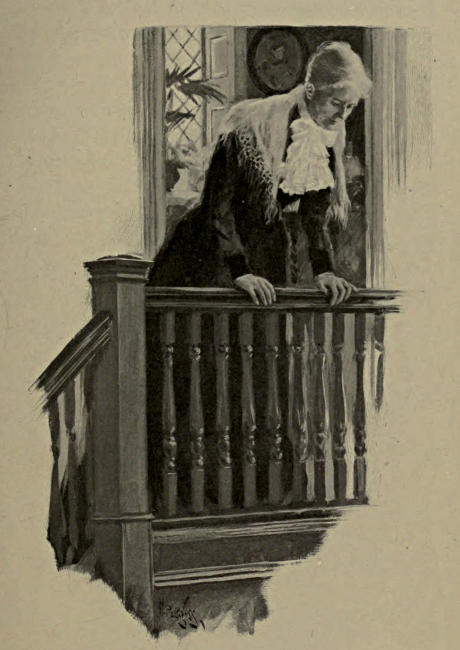
Roger leaned over the railing. “What under the
sun is she doing?”
“Puttering over those pigeons—making new
boxes for them.”
“Who is with her? I see a man’s back.”
“The Mayor.”
“Jimson?”—and Roger fell back in his seat
with a disturbed air.
“The same,” said Grandma, calmly.
Roger wrinkled his forehead. “That reminds
me—came to see you partly about that. It seems
Berty and the Mayor go about a good deal together.”
“How do you know?” asked Grandma, shrewdly.
“Oh, I know, people notice them.”
“Some one has been complaining to you,” said
Grandma. “Who was it?”
Roger smiled. “Well, to tell the truth, Tom
Everest was grumbling. You know he has been
just like a brother to Berty and Margaretta.”
“Yes, I know,” said Grandma, tranquilly. “I
just wanted to find out whether there was any public
gossip about Berty’s friendship for the Mayor.
Friendly inquiry on the part of an old playmate
is another matter.”
“I cannot imagine Berty giving any one any
occasion for gossip,” said Roger, proudly.
“Nor I—well, go on, what did Tom say?”
“He said, ‘What does this mean, Stanisfield?
Berty is for ever on the river with the Mayor, he
is for ever dangling about her house, and that park
she is getting in shape for the children. If I were
you I’d put a word in Mrs. Travers’s ear. Don’t
speak to Berty.’”
“Poor Tom!” said Grandma.
“He’s jealous, I suppose,” said Roger. “Still, if
he talks, some one else may talk. What does it
mean that Jimson comes here so much? You don’t
suppose he has taken a fancy to Berty?”
Grandma smiled. “Yes, I do, a strong and uncommon
fancy. He is perfectly fascinated by her.”
Roger’s jaw fell, and he smote with his fist on
the arm of the rocking-chair. “Get rid of him,
Grandma. Don’t have him round.”
“Why not—he’s an honourable man.”
“But not for Berty—you don’t know, Grandma.
He’s all right morally, but he’s vulgar—none of
our set go with him.”
“I don’t find him unbearably vulgar. He seems
a kind-hearted man, but I am unintentionally deceiving
you. He is over forty years old, Roger.”
“Well, men of forty, and men of fifty, fancy girls
of half their age.”
“Fancy them, yes, but he has no intention of
falling in love with Berty. He is simply charmed
with her as a companion.”
“It’s a dangerous companionship,” grumbled
Roger.
“Not so—they quarrel horribly,” and Grandma
laughed enjoyably over some reminiscences.
“Quarrel, do they?”
“Yes, Roger—my theory is that that man is too
hard worked. Fagged out when he leaves his office,
he is beset by petitioners for this thing and that
thing. At home I fancy he has little peace, for
his mother and sisters are ambitious socially, and
urge him to attend various functions for which he
has no heart. Unexpectedly he has found a place
of refuge here, and a congenial playfellow in Berty.
I think he really has to put a restraint upon himself
to keep from coming oftener.”
“This is Jimson in a new light,” said Roger,
listening attentively.
“In River Street,” continued Grandma, “he is
free. No one comes to find him here. He has
plenty of excitement and amusement if Berty is
about. If she is out, he sits and talks to me by
the hour.”
“To you—” said Roger. “I should not think
he would have anything in common with a lady
like you.”
“Ah, Roger, there is beauty in every human soul,”
said the little old lady, eloquently. “The trouble
is we are all too much taken up with externals. There
is something pathetic to me about this man. Hard-working,
ambitious, longing for congenial companionship,
not knowing just where to get it, he
keeps on at his daily treadmill. He has got to be
a kind of machine, and he has tried to stifle the
spirit within him. Berty, with her youth and freshness,
has, in some way or other, the knack of putting
her finger on some sensitive nerve that responds
easily to her touch. He is becoming quite interested
in what she is interested in.”
Roger was staring at her in great amusement.
“You talk well, Grandma, and at unusual length
for you, but a man convinced against his will, you
know—”
The old lady smiled sweetly at him, smiled with
the patience of one who is willing to wait a long
time in order to be understood. Then knitting steadily
without looking at her work, she gazed far out
over the beautiful river.
It was very wide just here, and, now that evening
was falling, they could barely distinguish the fields
and white farmhouses on the other side. The stars
were coming out one by one—those “beautiful
seeds sown in the field of the sky.” Roger could
see the old lady’s lips moving. She was probably
repeating some favourite passages of Scripture.
What a good woman she was. What a help to him,
and what a valuable supplement to his own mother,
who was a woman of another type.
His eyes grew moist, and for a long time he sat
gazing with her at the darkening yet increasingly
beautiful sky and river.
The hammering went on below, until Berty’s
voice suddenly rang out. “We’ll have to stop, Mr.
Jimson. It’s getting too dark to see where to put
the nails.”
“I’ll come help you to-morrow evening,” replied
the Mayor, in his thick, good-natured voice.
“No, thank you. I won’t trouble you. I’ll get
a carpenter. You’ve been too good already.”
“I like to do it. You’ve no idea how much I enjoy
puttering round a house,” replied Mr. Jimson. “I
never get a chance at home.”
“Why—aren’t there things to do about your
house?”
“Yes; but if I get at a thing I’m sure to be
interrupted, and then my mother doesn’t like to
see me carpentering.”
“You ought to have a house of your own,” said
Berty, decidedly. “It is the duty of every man to
marry and bring up a family and to keep it together.
That helps the Union, but if you have no family
you can’t keep it together, and you are an unworthy
son of this great republic.”
“That’s a fact,” replied the Mayor. “I guess
we’ll have a little talk about it. I’ll just sit down
here on this bench a minute to rest. I’m quite
blown.”
Berty made no response, or, if she did, it was
in such a low tone that the occupants of the veranda
could not hear, and presently the Mayor went on.
“Yes, I’ve often thought of getting married. A
man ought to, before he gets too old. How old
would you take me to be?”
“About fifty,” came promptly, in Berty’s clear
voice.
Her companion was evidently annoyed, for it
was some time before he spoke, and then he said,
briefly, “Fifty!”
“Well,” said Berty, kindly, “I said about fifty.
I dare say you’re not much more than forty.”
“I suppose forty seems like dead old age to you?”
queried the Mayor, curiously.
“Oh, yes—it seems far off like the other side
of the river,” replied the girl.
“Well, I’m forty-five,” said the Mayor.
“Forty-five,” repeated Berty, musingly, “just
think of it! You seem quite young in your ways.”
“Young—I dare say I feel as young as you,”
he replied. “I wish you were a bit older.”
“Why?” asked Berty, innocently.
“Oh, well, I don’t know why,” he replied, with
sudden sheepishness.
Roger glanced at Grandma. It was not like her
to play eavesdropper.
But dear Grandma was not hearing a word of
what was being said below. Her knitting had fallen
from her hand, her head had dropped forward, her
cheeks were gently puffing in and out. She was
quietly and unmistakably asleep.
Roger smiled, and kept on listening. He had
no scruples on his own account, and he wanted his
question answered. Why was the Mayor dangling
about Berty?
Mr. Jimson was still on the subject of matrimony.
The quiet evening, the, as he supposed, secluded
spot, Berty’s amiability, all tended to excite confidence
in him.
In response to something he had said, Berty was
remarking, with gentle severity, “I should think
you would talk this matter over with your mother
rather than with me.”
“Well,” Mr. Jimson said, thoughtfully, “it’s queer
how you can tell things to strangers, easier than
to your mother.”
“I couldn’t,” said Berty, promptly. “If I were
thinking of getting married, I’d ask Grandma to
advise me. She’s had so much experience. She
chose Roger of all Margaretta’s admirers.”
“Did she, now?” said the Mayor, in admiration.
“That was a first-class choice.” Then he asked,
insinuatingly, “And have you ever consulted her
for yourself?”
“Of course not—not yet. It’s too soon.”
“I suppose it is,” said Mr. Jimson, in a disappointed
voice, “and, as I said before, I wish you
were ten years older.”
“You don’t mean to say that you would think of
me for yourself?” asked Berty, in a sudden, joyful
voice.
“Yes, I would,” he replied, boldly.
“Oh, thank you, thank you,” said the girl, gaily;
“that’s my first proposal, or, rather, I suppose it
isn’t a bona fide proposal. It’s just a hint. Still
it counts. I’ve really got out into life. Margaretta
has always kept me down where gentlemen were
concerned. Older sisters have to, you know. I’ll
be just dreadfully interested in you after this. Do
let me pick you out a wife.”
“Well, I don’t know about that,” said the Mayor,
guardedly.
“Just tell me what you want,” continued Berty.
“I know lots of girls, but I suppose you will want
a woman. I know some of them, too—must she
be light or dark?”
Mr. Jimson looked at Berty. “Black hair.”
“Very well—black hair to start with. Not tall,
but short, I suppose.”
“Why short?” asked the Mayor, suspiciously.
“Well, you’re not dreadfully tall for a man, you
know.”
The Mayor seemed to be sulking for some time.
Then he said, “I like a good-sized woman.”
“Tall and black-haired,” said Berty, in a businesslike
way. “Now, do you want a quiet woman, or
a lively woman—a social woman, or a home
body?”
“None of your rattlers for me,” said the man,
hastily. “I want a quiet tongue, good manners,
and no wasteful habits.”
“Do you want to entertain much?”
“Oh, law, no!” said her companion, wearily.
“Upon my word, I think a deaf and dumb wife
would suit me best. Then she couldn’t go to parties
and drag me with her—Look here, there’s a woman
I’ve seen sometimes when I go to church with
my mother, that I’ve often thought was a nice-looking
kind of person. You’d be sure to know her,
for one of her brothers is a great friend of your
brother-in-law.”
“Who is she?” asked Berty, eagerly.
Her companion seemed to have some hesitation
about mentioning the name. At last he said,
“Mother says her first name is Selina.”
“Not Selina Everest—don’t tell me that,” said
Berty, quickly.
“Yes, that’s her name.”
Berty groaned. “And is she the only woman you
have in your mind?”
“She’s the only one I can think of now as cutting
any kind of a figure before me.”
“Selina Everest!” groaned Berty again. “Why
don’t you say the Queen of England and be done
with it? She’s the most exclusive of our ridiculously
exclusive set. She is an aristocrat to her finger-tips.
She wouldn’t look at you—that is, I don’t think—she
probably wouldn’t—”
“How old is she?” asked the Mayor, breaking
in upon her.
“Let me see—Tom, her brother, is six years
older than I am, Walter is twenty-seven, Jim is
thirty, Maude is older than he is, and Augustus is
older than that. Oh, Miss Everest must be nearly
forty.”
“Then she’ll jump at a chance to marry,” said
the Mayor, coolly. “Has she a good temper?”
“Yes,” said Berty, feebly, “but—”
“But what? Does she snap sometimes?”
“No, no, she is always ladylike, but I am just sure
she wouldn’t marry you.”
“Why are you so sure,” asked the Mayor, sharply.
“Because—because—”
“Am I a red Indian or a cowboy?” asked Mr.
Jimson, indignantly.
“No, but—”
“Is she a strong girl?”
“No, she is often in bed—I don’t really think—”
“Airs, probably,” said her companion. “Has
been brought up soft. I’d break her of that.”
“She wouldn’t marry you,” said Berty, desperately.
“Don’t be too sure of that,” and Mr. Jimson’s
voice sounded angry to the man on the veranda
above.
“I tell you she wouldn’t. I’ve heard her just
rave against people who don’t do things just as
she does. If you ate with your knife, she’d think
you were dust beneath her feet.”
The Mayor was silent.
“Why, if you wore carpet slippers in the parlour,
or a dressing-gown, or went about the house in
your shirt-sleeves, she’d have a fit.”
“And who does all these things?” asked the
Mayor, sneeringly.
“You do!” replied Berty, stung into impertinence.
“They say you received a delegation of
clergymen in your slippers and dressing-gown.”
“That’s a lie,” he said, promptly, “got up by
enemies.”
“Well, you don’t talk elegantly,” said Berty,
wildly. “Miss Everest couldn’t stand that.”
“Who says I ain’t elegant?” asked the Mayor,
fiercely.
“I do,” replied his companion. “You say ‘dry’
for thirsty, and ‘I ain’t’ for I am not, and ‘git’
for get, and—and lots of other things, and you
don’t move gracefully. Miss Everest likes tall, thin
men. I once heard her say so.”
“Is it my fault that I’m short?” roared the
Mayor. “I didn’t make myself.”
Roger, convulsed with amusement on the veranda
above, saw with regret that Grandma was waking
up.
“Quarrelling again!” she murmured, moving her
head about restlessly. “Send him home, Berty.
Mr. Jimson, don’t mind her.”
Roger had missed something, for Berty was now
giving the Mayor a terrible scolding. “I think
you are a horrid, deceitful man. You come here
with your mind all made up about a certain woman.
You pretend to like me, then draw me out about the
one you like. I’ll never speak to you again.”
Roger hung entranced over the railing. The back
gate had just slammed on Mr. Jimson, and Berty
was pouring out a flood of eloquent endearment
on the pigeons.
Roger ran down the stairs with a broad smile on
his face. There was no danger of sentimental nonsense
between these two people.
“Hello, Berty,” he said, “want some help with
your pidgie widgies?”
“No, Roger,” she replied, disconsolately, “I
can’t get the boxes up to-night. Still, you might
help me cover them some more. I’m dreadfully
afraid of rats getting at them. There are legions
of them down here.”
“You’ve had some one here, haven’t you?” said
Roger, hypocritically.
“Yes, that miserable Mayor, but he’s so disagreeable
that I shan’t let him help me finish. I’m never
going to speak to him again. He’s too mean to live.”
“I’ll come and help you,” said Roger, bending
over the pigeons to conceal his face. “Where are
these boxes going in the meantime?”
“Up on top of those barrels. Aren’t those fan-tails
sweet? Oh, you lubbie dubbies, Berty loves you
better than the hateful old Mayor.”
Roger laughed outright, helped his young sister-in-law
at the same time, and wondered whether the
breach between her and her new friend would be
final.