HERE beginneth the history of the passing of Arthur, of his Round
Table, and of many of the splendid and glorious knights thereof. With it
comes the conclusion of this history, for no more shall then remain to
be written thereof.
How Queen Guinevere visited Sir Launcelot in the forest; how Sir
Launcelot returned to Court as aforetime, and how he fled once more from
the Court.
NOW it hath been told how that after the quest of the Grail all those
knights who had not died in that quest, or who were able to return did
return to the Court of King Arthur.
Sir Launcelot dwelleth in the forest.
But Sir Launcelot of the Lake did not return with the other knights, for
he abided in the forest not very far distant from the habitation of the
Hermit of the Forest. There he lived a recluse in pious meditation,
considering of his sins and repenting of them.
Several knights had seen him at that place where he was dwelling and
they knew him, and they brought away from that place news of him and of
the life he led. That news became known at the Court of King Arthur, and
there was much talked of, and King Arthur said, “What a pity it is that
so great and so noble a knight as Sir Launcelot should thus deny himself
to the world. For in the world he is the greatest knight of the world,
but out of the world he is as any other man.”
Queen Guinevere sendeth for Sir Launcelot.
All these things Queen Guinevere heard and she meditated upon them as
she sat thoughtfully in her bower. So one day she called to her a page,
and she said to him that he should ride to such and such a part of the
forest, and that there he would find Sir Launcelot. And the Queen said
to the page that he was then to tell Sir Launcelot to return to the
Court of the King. And she said to the page to tell Sir Launcelot that
all the court spake of him continually, and that all desired that he
should return to them.
So the page went to that part of the forest as the Queen had commanded,
and there he found Sir Launcelot in his cell; and the cheeks of Sir
Launcelot were hollow and his limbs and body were thin and shrunken from
continual fasting and meditation. Then the page kneeled down before him
and said, “Sir, the Queen bids you for to return to the Court of King
Arthur; for all the ladies and the lords of the court desire you to
return there and be the ornament of that court as you were aforetime.”
Sir Launcelot said to the page, “Return thou to the Queen and say to her
that I will not return back into the world as she desires me to do. For
here I dwell in peace and quietness and I repent me of all my manifold
sins as it becometh me to do. For those same sins have stood as a shadow
betwixt me and the Grail, so that when the Grail was present I slept,
and when it was gone I awoke and found that it was gone. Wherefore I
repent me of those sins. And so I will abide here and meditate upon them
for all the rest of my life.”
So the page returned to Queen Guinevere and delivered these words of Sir
Launcelot to her, and the Queen said, “How is this? He will not come?
Then will I go myself and bring him.”
Queen Guinevere goeth to Sir Launcelot.
So she procured a great white horse, and she procured rich and gaudy
raiment, such as a knight at court might wear, and with these things and
with a court of knights and ladies and several pages she betook her way
into the forest.
Then all that part of the forest into which she penetrated became gay
and jocund with her coming. For it was as though the sunlight had
suddenly burst through the leaves of the forest. All the silent woodland
was made noisy with the clear sounds of talk and laughter, and of
musical and merry chattering.
So the Queen came to that part of the forest where Sir Launcelot was,
and Sir Launcelot came forth from his hut to meet her. And he stood afar
off from her and said, “Lady, what wouldst thou here?” She said,
“Launcelot, I come to thee to bring thee away from this lonely place,
for the Court of the king is the fittest place for thee to be in. For
thou art the greatest knight in Christendom, wherefore it ill becometh
thee to hide thyself away in this desolate place.”
Then Sir Launcelot lifted up his voice and cried aloud, “Get you gone,
Lady, and trouble me no more, for I know you not. Yet it was because of
you that I cast aside my wife so that she died because of my neglect.
Because of that sin and because of other sins that thou wottest of I
slept while the Grail passed before me, and could not awake until after
it was gone. So lie I here thinking of that and of other misfortunes
that have visited me because of my many sins. Thus it is that here in
the woodlands I endeavor to purify my soul of those sins.”
The Queen speaketh to Sir Launcelot.
Then the Queen drew nearer to him and she said to him, “Launcelot,
thinkest thou that thus thy sins may be remitted unto thee? Wit thou
that thy sins are like an enemy, and that the only way in which thou
canst conquer those sins is to battle manfully with them and not to fly
from them. Arise! shake off this sluggishness and come forth into the
world again, for it awaits thee. There and there only may thy sins be
remitted unto thee.”
Then Sir Launcelot groaned and he hid his face in his arms and anon he
said, “Lady, tempt me not.” Then after another while he said, “I cannot
go with thee, for I have no horse to ride.”
Then Queen Guinevere smiled and she said, “Launcelot, I have purveyed
thee with a horse, and it is here.” Then Sir Launcelot cried out again
as in a sort of despair, “Still I cannot go with thee for I have no
clothes fit to wear at court.”
And again Queen Guinevere smiled and she said, “Also I have provided
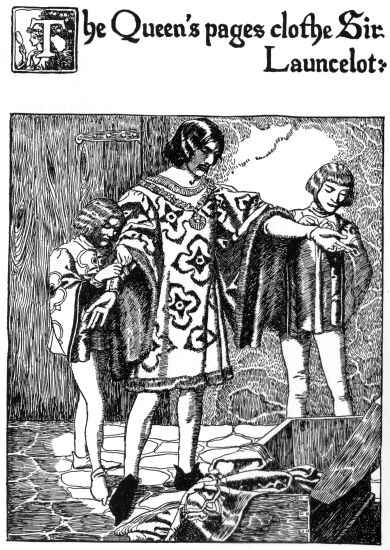
thee with clothes; they, too, are here.” Then she commanded two of her
pages to convey the chest of clothes into Sir Launcelot’s cell and they
did so. Then they opened the chest and Sir Launcelot gazed into it, and
beheld all that noble apparel of silks and velvets, of gold and jewels,
of silver and of lace.
So Sir Launcelot suffered those two pages to clothe him in that raiment,
and presently he came forth from the cell, shining as with great glory.
And he mounted upon the great white horse which the Queen had brought
him, and so they rode away together from that place.
Sir Launcelot returneth to the court.
Now there were at court several who were unfriends to Sir Launcelot;
some of these were unfriends because they were malicious, others because
they were jealous of his fame; others for this reason, and others for
that reason. Two of these were Sir Mordred and Sir Agravaine, who were
brothers to Sir Gawaine. Then there was Sir Kay the Seneschal and Sir
Florence and Sir Lovel, who were sons to Sir Gawaine, and who were
jealous of Sir Launcelot upon Sir Gawaine’s account.
These and several others were unfriends to Sir Launcelot, and they
talked much amongst themselves concerning the return of Sir Launcelot,
saying, “Lo! this knight hath come forth out of the forest and hath
assumed his knighthood again over us all, yet at first he would not
come, but when the Queen went thither then he beheld her and followed
her forth.”
Sir Launcelot heareth unfriendly talk.
These words and words like them came to the ears of Sir Launcelot, and
because of them he withdrew himself from the presence of the Queen, and
consorted with other lords and ladies of the court. This the Queen
observed, and was grieved at it, for she wished for Sir Launcelot to be
with her, and she desired to have him near to her. So one day she sent
for Sir Launcelot to come to her and she gazed at him for some time
without speaking. Anon she said to him, “Launcelot, why dost thou keep
thyself afar off from me?” He replied, “Lady, I avoid thee for thine own
sake and not for my sake.” To the which she said, “How is that?”
He said, “I will tell thee. There is much talk about this court
concerning thee and concerning me, and that talk links our names
together. I fear not this talk upon mine own account. For it cannot hurt
me, but it may do great injury to thee; therefore do I hold myself away
from thee.”
Then Queen Guinevere began weeping, and she said, “Ah, Launcelot,
Launcelot! Thou art not to me as thou one time wert. For one time thou
wert ever ready to come to me, but now thou keepest thyself afar off
from me. That which thou sayst is thy excuse for not being with me, and
is not the cause of that absence.” Then she said of a sudden to him,
“Go! Get thee away from this court, for thou bringest nothing but
disturbance to my soul.”
Then Sir Launcelot said very bitterly, “Lady, it would have been well
for both of us if thou hadst permitted me to remain where I was in the
forest, and not have tempted me to quit my sanctuary.”
Then the Queen cried out upon him, “How now! What is this thou sayst? I
went to thee to save thee and not to tempt thee. If thou longest for thy
husks again, return to them. At any rate, get thee gone from me, and
never come near to me again. For thou bringest naught but sorrow and
great tribulation to me.”
Sir Launcelot departeth again from the court.
So Sir Launcelot bowed and withdrew from where he was, and his heart was
filled with a great despair. So he came to where Sir Bors and Sir Lionel
were and he told them all that had passed. And he cried out to them,
“What now shall I do who have sacrificed my sanctuary and have got
naught by that sacrifice?”
Then quoth Sir Bors, “It would have been well for thee, if thou hadst
never quitted that safe sanctuary within the forest. But as thou now
hast quitted it, so mayst thou not return to it again. For so wouldst
thou strive to walk backward into that which hath passed. No man may do
that in the life which he leads.
“As for the anger of the Queen, soon will she forget that anger, and as
soon as she forgets it, then will she desire to see thee again. For so
hath she done several times before, and so will she do again.”
Said Sir Launcelot, “I will go to my castle of Joyous Gard and there
will I abide until her anger against me hath grown cold again.”
He departeth to the castle of Sir Brasius.
“Not so,” said Sir Bors, “the Queen spake truly in this; that thy place
is in the field, and neither in the hermit’s cell, nor enclosed in the
walls of that castle. But get thee to the castle of Sir Brasius the Good
Knight, and there abide for a little while, seeking such adventures as
may be found around about. For when the Queen’s mind changes toward
thee, then wilt thou easily be found at that place, and either I or Sir
Ector will come to seek thee.”
“Thou sayst well,” said Sir Launcelot. “Thither will I go and there will
I stay until thou or Sir Lionel sendest for me.”
So Sir Launcelot took horse and rode away to the castle of Sir Brasius,
and there took up his inn.
But never, at any time, did anyone ever behold him to smile. For though
in the earlier days of his knighthood he had a happy and jocund spirit
and frequently smiled, yet now that happiness had departed from him and
he never smiled. For many sad things had happened to him in his life,
and those things had destroyed that happiness as a hailstorm destroys
those flowers that to-day are and to-morrow are not, but are withered
and dead like the grass in the fields.
Thus I have told you all those circumstances that led to Sir Launcelot’s
returning to Court, and as to his withdrawing himself thence again. For
so it is that though a man may think to return again into that life from
which he has passed, yet he cannot do so. For the life that is lived in
once and which hath been laid aside for another life, that first life is
dead and cannot be revivified again by the man’s entering into it again,
but remaineth dead for aye.
So it was with Sir Launcelot, for, when he had committed the sin of
leaving the Lady Elaine the Fair, he had committed it, and all that
befell him thereafter became colored by that evil happening. For,
because of that sin he failed to behold the Holy Grail with the eyes of
his body, and now, because of that sin, and of what was said concerning
him and his doings, he was compelled to exile himself again from that
court in which, by grace of his chivalry and force of arms, he truly
belonged.
So let us take warning by this example and let us not try to return to
the life which we may have left, but let us endeavor to live that other
life that now presents itself to us after such a happening, whether of
good or of evil.
Now followeth that which treats of the poisoning of Sir Patrice of
Ireland at the feast given by Queen Guinevere; so if you would hear how
Sir Launcelot saved the life of the Queen at that time, I pray you to
read what followeth.
How Queen Guinevere held a feast, and how Sir Patrice of Ireland was
poisoned at that feast.
NOW after Sir Launcelot had quitted the Court of King Arthur as
aforetold of, the Queen pretended to great joyousness of heart, although
there was no joyousness within her. “I was hasty,” she said to herself,
“and Sir Launcelot was hasty and hath left me again. But this was my
fault and I must show no repining, but must appear to be cheerful to
all. So I will give a feast, that my seeming joyousness may be made
manifest to the world, and no one shall have cause to say that I repine
at the loss of Sir Launcelot.” So said the Queen to herself upon that
occasion.
Queen Guinevere proclaimeth a feast.
So she proclaimed a feast, and she had at that feast the following
knights of the Round Table: there were Sir Gawaine and his brothers, to
wit, Sir Agravaine, Sir Geharis, Sir Gareth, and Sir Mordred. Also there
were Sir Bors de Ganis, and Sir Bleoberis de Ganis, and Sir Blamor de
Ganis, and there were Sir Galahad and Sir Galyhadin and Sir Ector and
Sir Lionel and Sir Palamydes and Sir Safyr; and there were Sir Persavant
and Sir Ironside and Sir Brandiles; and there were Sir Kay the Seneschal
and Sir Mador de la Porte and Sir Patrice of Ireland, and Sir Alyduke
and Sir Artamore.
Now at that time Sir Lamorack of Gales had been slain, and report placed
his death at the hands of Sir Gawaine (although this report was not
true), and of two of Sir Gawaine’s brothers, to wit, Sir Agravaine and
Sir Geharis.
There was at the Court of King Arthur a certain knight hight Sir Pinal
the Savage, who was cousin to Sir Lamorack, and Sir Pinal was very
bitter against Sir Gawaine, and was anxious to be revenged upon him, yet
he wit not how to take that revenge.
Sir Pinal, surnamed the Savage, poisoneth an apple.
Now Sir Gawaine had a custom of eating an apple immediately after he had
dined, and this Sir Pinal was aware of. So Sir Pinal took the fairest
apple he could find, and he introduced into it a very subtle and very
malignant poison, and this apple he placed in the centre of the table,
and in the midst of all the fruit. For he said to himself, “There will
Sir Gawaine find this apple, and he will take it and eat it and will
die.” And he said, “Queen Guinevere will be blamed for that death, for
all the world knoweth that she and Sir Gawaine are unfriends.” So said
Sir Pinal, for he thought thus to be revenged for the death of Sir
Lamorack upon Sir Gawaine, and he knew not how else to achieve that
vengeance. For next to Sir Launcelot, Sir Gawaine was the strongest
knight of the court, and he was besides nephew to King Arthur and of
great importance in the King’s household. Wherefore it was that Sir
Pinal sought to slay Sir Gawaine by that poisoned apple.
Sir Patrice of Ireland eateth the apple, and dieth.
But at the end of that feast Sir Gawaine did not take the apple, but
instead of Sir Gawaine, Sir Patrice of Ireland took it. And Sir Patrice
bit a great bite into that apple, and he ate that piece. Then anon he
cried out in a very loud and piercing voice, “Hah! What is this that
ails me?” And then he cried out in a very terrible voice, “Alas! I am
poisoned and I die from eating this apple!” And he cried out again,
“Friends, see that my death is avenged!”
Therewith he fell down to the ground in great agony, lashing with his
hands and feet and frothing at the mouth, and so in a little while he
died.
Then Sir Gawaine rose up, and he turned his face toward the Queen, and
his face was very white, and he said, “Lady, how is this? This apple was
poisoned! For whom was it intended?”
Sir Gawaine accuseth the Queen.
The Queen hid her face in her hands for horror of what she had beheld,
and she cried out in a very shrill voice, “I knew not that it was
poisoned, and I know not how it was poisoned!” Sir Gawaine said, “That
apple was poisoned, and thou knewest that it was poisoned. Methinks it
was intended for me. Thou hast always borne enmity toward me, wherefore
thou didst place that apple upon the table that I might eat of it. One
time thou wert innocent, but now thou art innocent no longer, but art
full of malice and guile, wherefore thou hadst the will to poison me.”
Then the Queen cried out with a great passion, saying, “Gawaine, thou
and I were never friends, but rather would I cut off my right hand than
to do so evil a thing as this, to seek to poison thee.”
Sir Mador de la Porte also accuseth the Queen.
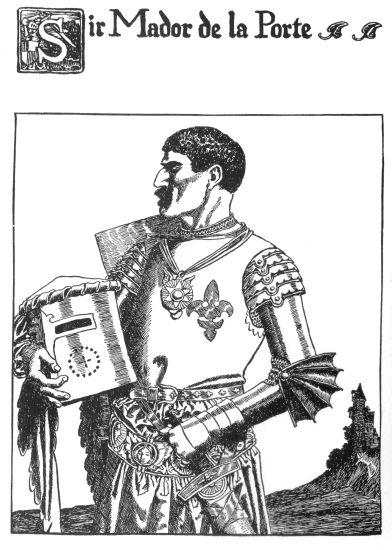
Then Sir Mador de la Porte stood up before them all, and he said, “Lady,
that which thou sayst may deceive some who are here, but it shall not
deceive me. For I know of thy comings and of thy goings, and I know how
thou didst of malice hold Sir Launcelot here at court when he would fain
have followed the Lady Elaine away from this place, and because that Sir
Launcelot remained here the Lady Elaine died. From this I know that thy
heart is full of guile and wickedness, wherefore it is but a step from
that sin to the sin of poisoning.”
The Queen weepeth.
So saying, Sir Mador went out from that place, and all the other knights
followed after him; for Sir Mador was a king’s son, and of great
importance at the court. Then the Queen was left there alone, weeping
with great passion, for she wist not how that poison had been
administered to Sir Patrice. After that came several men who were in the
suite of Sir Mador, and they took up the body of Sir Patrice and they
bore it away from that room.
Sir Mador appeareth before the High Court of the King.
As soon as might be, Sir Mador de la Porte appeared before the King as
he sat in council, and he appealed the Queen of treason in that she was
a murderess; and this he proclaimed before the King and all his council.
Then King Arthur turned very white and he bowed his head and anon he
said, “Sir Mador, what wouldst thou have me do in this case? For lo!
thou dost attaint the Queen of murder, and I do not believe it possible
that she could do so wicked and so evil a thing as this. Wherefore thou
must tell me what thou wouldst have me do in this instance.”
Sir Mador challengeth the Queen of treason.
Quoth Sir Mador, “Lord, I do accuse her of having administered poison at
her feast, whereof my cousin Sir Patrice died. In that she certes hath
committed treason against thee and against us all, for this feast of
hers was held here, in this castle, and we were her guests. So accusing
her, I am ready to defend that accusation with my body.” So saying, he
flung his glove down upon the ground, and he cried out, “Here lieth my
glove in gage of battle, and I will defend my accusation with my own
person, my accusation being that the Queen is a murderess.” Quoth the
King, “Hast thou no pity and no mercy for this lady who is thy Queen?
Hast thou no honor and no regard for me, thy King?” And Sir Mador made
reply, “Not in this case! For in this case I have no regard for anything
but to punish the guilty.”
Then the King arose, and he said, “Send for the Queen to come hither, so
that she may face her accuser.”
The Queen appeareth at the High Court.
So anon the Queen came, and two ladies supported her, one upon one side
and the other upon the other. And the Queen wore her veil over her face
for she had been weeping continually and with great passion ever since
the ending of that feast. Now there were many knights gathered there and
many lords and ladies of several sorts, and some of these were the
Queen’s friends and felt sorrow for her, but some of them felt
satisfaction that she was accused.
The King said, “Arise, Lady, and stand.” And thereupon the Queen stood
up before the King and Sir Mador de la Porte and the entire council.
Then the King said to her, “Lady, this knight, Sir Mador de la Porte,
accuses thee of having used poison at thy feast. What hast thou to say
to that?”
Then the Queen put back her veil and she had ceased to weep, and her
eyes were very hard and proud, albeit her face was extraordinarily
white. “Sir,” she said, “thou knowest me well—no one better—and thou
knowest that with all my shortcomings (and they be many), I could never
do such a thing as that, to poison an enemy at mine own table. For I
have many enemies at this court, and amongst them is thine own nephew,
Sir Gawaine; for he is my bitterest enemy, and hath always been so. It
was he who first accused me at that feast of having used poison, and
because he is thy nephew and because he is so powerful at court, there
be few knights here who will defend mine innocence against mine
accusers, when he stands at the head of those accusers, holding that I
attempted to poison him. Had I Sir Launcelot here at court, then would I
have had a good worthy defender of mine honor, but I have driven Sir
Launcelot away from me by my pride and anger, and he is not now here to
defend mine innocence. Yet I believe that someone will arise to defend
it, wherefore I will accept this knight’s gage of battle and will abide
by it, come life, come death.”
Then the King groaned, and he bowed his head, and at last he said, “Lady
and Queen; thou art the wife of my youth, and I would fain defend thee
myself. But this cannot be, for I am the King, and the head of all the
laws. Nevertheless, I believe that some champion will arise for thee;
for it is not possible that in this court there is no knight who will
arise to defend thine innocence. Wherefore, let it be as thou sayst.
Here shall the glove of Sir Mador de la Porte lie upon the ground, until
some defender arises to take it up, and if no other defender arises,
then will I take it up mine own self. Let us now depart.”
So with that they all arose and left that place, and left Sir Mador de
la Porte’s glove still lying upon the floor of the council chamber.
The Queen asketh Sir Bors to defend her.
That night a messenger came to Sir Bors asking him to come to the Queen,
and Sir Bors went with the messenger, who took him to the bower of the
Queen where she was. When Sir Bors entered that place he found that the
King was with the Queen. Then the Queen arose and stood before him. And
she set her hands together, the palm of one against the palm of the
other, and she said, “Sir Bors, will you not serve as my champion in
this quarrel?”
Then Sir Bors bowed his head, and anon he said, “Lady, I would you had
asked someone else to act as your champion.”
The Queen looked at him very proudly, and she said, “Why do you say
that? Had I known that your feelings were such, then I would not have
troubled you by asking that service of you. But you are the nephew of
Sir Launcelot, and you are a good worthy knight and one of those three
who have achieved the Grail. Wherefore I ask you why you are not willing
to serve as my champion. Do you then also believe that I would poison a
guest at the feast which I prepared for the entertainment of such noble
and worthy champions?”
“Nay,” said Sir Bors, “I think no such thing as that of you, Lady. But
in this quarrel there be many upon either side who are my friends, and
if I fight upon one side then my friends upon the other side would fall
away from me because I did so.”
“Alas!” said the Queen. “The time was when I had many knights upon my
side. For did not Sir Pelles in the days of my youth take a foolish
quarrel upon him for my sake? And did not Sir Launcelot stand ever ready
to defend me? Oh, Launcelot, Launcelot! If thou wert but here to stand
my champion in this quarrel! But thou art not here, for I, in my haste,
have driven thee away from me, I know not whither.” So said Queen
Guinevere, and with that she began weeping as though her heart would
break.
Sir Bors will serve as the Queen’s champion.
Then Sir Bors was very much moved and he said, “Weep not, Lady, for thou
hast yet no cause for weeping. Thou yet hast many good true knights who
would defend thee. Yea; I will serve as thy champion unless a better
champion arise to defend thee. So take thou heart of grace in this, that
thou art innocent of this crime; wherefore, may God defend the right.”
The Queen declareth her innocence.
At this the Queen took comfort and wiped her eyes and smiled, and she
said, “Sir Bors, for thy satisfaction I hereby make thee my solemn vow
that I did not do this thing of which I am accused. And methinks I know
who it was who laid that poisoned apple upon the table, for there was an
attendant at that table who stood behind a screen, and this attendant
beheld a knight come into that room ere others came thither. But I
cannot accuse that knight now, for I myself am accused, wherefore if I
accuse him, all will say that it is to shelter myself that I make that
accusation.”
Sir Bors said, “Lady, if this be true, it shall be as you wish, and I
will certes do all that I am able to defend you.”
Then King Arthur spoke and said, “Sir Bors, there is not any knight in
all the court who is so well fitted to defend my Queen as thou. For as
thou art one of the most virtuous knights who ever lived, so will thy
virtue shine upon any undertaking to which thou settest thy hand. And
besides this high virtue of thine, there is no knight at this court,
unless it be Sir Gawaine, who is so strong and so excellent a knight as
thou.”
So spake they at that time, and after those speeches Sir Bors went to
the council chamber where lay the glove of Sir Mador de la Porte, and he
took up that glove and he thrust it into his belt. With that glove he
paraded the court, and many beheld the glove of Sir Mador in his belt.
Some came to him and proclaimed that they were secretly pleased that he
had assumed the championship of the Queen; but others came and were very
angry that he had assumed it.
Sir Gawaine is angry with Sir Bors.
Amongst these last was Sir Gawaine who said to him, “Sir, what is this
you do? Are you not aware that the poison served to us at dinner was
meant by the Queen for me and not for Sir Patrice who was poisoned by
it?” To him replied Sir Bors, “Friend, in this you are mistook. For
though the poison might have been intended for you and not for Sir
Patrice, yet it was not the Queen who placed it there. For I think I
know who placed it there, and by and by it will be made manifest to all
after that the Queen is freed from this accusation under which she
lieth.”
Then Sir Gawaine smiled very bitterly and he said, “Thou art easily
satisfied, Sir.” “If I am,” said Sir Bors very calmly, “there is this
virtue in my belief; that I cannot believe that my Queen and the wife of
my King should do this thing. Nor do I envy those who so easily believe
evil of their Queen.”
Sir Bors rideth to Sir Launcelot.
Now when the next day was come, Sir Bors took horse and rode to the
castle of Sir Blasius, which place he reached before the sun set. There
he found Sir Launcelot, and he told Sir Launcelot all that had befallen,
and when Sir Launcelot heard it he was very angry. “How is this?” he
cried. “Do they dare accuse the Queen of this offence? They do it
because they know I am absent and cannot defend her.” And Sir Bors said,
“Yet even so it is. For there is a large party at court that is willing
to ascribe that wickedness to her. And that party is headed by several
of those who are of most influence at court.”
Sir Launcelot and Sir Bors talk together.
“Well,” said Sir Launcelot, “I ask not who they are who believe this
evil of her. But I will be there to defend the Queen when her trial
cometh. Meantime, do thou take her championship upon thee till I come;
for if it be necessary to prove the innocence of that noble lady, then
thou, who art one of the three knights of the Grail, can best sustain
it. Besides this, Sir Mador is a very hot and heady knight, wherefore,
if thou wilt keep up this quarrel against him till I come, he will be
the more ready to do battle according to his beliefs. And it is
necessary that the Queen should be defended by arms.”
Then Sir Bors told Sir Launcelot that it was the Queen’s belief that it
was Sir Pinal the Savage who had placed the poisoned apple upon the
table; and he also told how the Queen did not dare to bring this
accusation against Sir Pinal until she herself was cleared of that
accusation.
All this while Sir Launcelot sat frowning as he listened, but at the end
of Sir Bors’s speech he only said, “I will be there as the Queen’s
defender, but tell nobody that thou hast spoken to me.” And Sir Bors
said, “I will not tell of this.”
Sir Bors returneth to court.
So Sir Bors bid adieu to Sir Launcelot, and Sir Launcelot bid adieu to
Sir Bors, and Sir Bors returned that night to Camelot again, reaching
his inn at that place before the dawn of the day.
How Sir Bors was relieved of the defence of the Queen, and of how Sir
Mador de la Porte was overthrown.
SO came the eve of the day of that conflict when the innocence of the
Queen was to be approved by conflict. That evening the Queen sent for
Sir Bors de Ganis, and she said to him, “Sir, what is your mind in this
battle which you are to fight to-morrow?” Quoth Sir Bors, “Lady, it is
even as it was aforetime. For ever I do believe in your innocence and
deem it be impossible that you could administer poison to one of your
guests. So I will do battle for you to the best of my ability as I
promised you I would do. But should another knight, better fitted by
skill at arms than I, appear to assume that honor, then would I
surrender the honor to that knight; yea, even at the last minute.”
The King praiseth Sir Bors.
So after Sir Bors had departed from her, the Queen went to the King and
told him what Sir Bors had said to her. Quoth the King, “Lady, thou hast
one of the best champions that can be found in the entire world to
defend this case in thy behalf. For I know of no knight who could be
better chosen to defend thine honor than Sir Bors, unless it were his
kinsman, Sir Launcelot of the Lake. For even Sir Gawaine is not stronger
nor better, nor was Sir Percival stronger nor better than is Sir Bors de
Ganis.”
So said the King, and at his words the Queen took great comfort and
cheerfulness.
The Queen cometh with the King to the lists.
So came the next day of trial. For at about the eleventh hour of the
morning there came to the open square within the walls of the town the
King and the Queen and the Court of the King. At that place the Lord
Constable was already come, and to one side was a great pile of dried
fagots laid cross wise, the one upon the other, and in the midst of that
pile of fagots was an iron stake with fetterlocks attached to it about
as high as one could reach, standing before that stake. Those high lords
and ladies who were there looked very closely at the Queen, and they
beheld that she smiled as she looked about her, but that her face was
white like to purified wax for whiteness. And the Queen was clad
entirely in white; for her robe was long and spotless of color, and she
wore a belt of white leather, studded with silver, bound about her
waist, and her hair hung down upon either side and was wound about with
ribbons of white and silver. And some of those who looked upon her were
grieved and sorrow-struck at her trouble, but others were pleased and
triumphant to see her thus brought low, even to the trial of her life
and her good fame.
Then King Arthur called the constable to him and he said to him, “Lord
Constable, here do I commit to thee the tender body of this my Queen,
who stands here wrongfully accused of the crime of murder. Take her; she
is thine until after this trial of battle.” So saying, the King took the
Queen by the right hand and led her to the constable, and he gave the
right hand of the Queen into the hand of the constable. And the
constable took the Queen by the hand, and he said, “Lord King; here take
I the body of this lady who is my Queen. But I take that body only to
return it unto thy ward; so hold thou this lady in thy keeping, and may
God keep ye both, amen.”
The King sitteth beside the Queen.
Therewith the constable replaced the hand of the Queen into the hand of
the King, and thereupon withdrew to one side. Thereafter the King
conducted the Queen by the hand up the flight of steps to a high seat
that had been prepared for her beside his own seat. Then the King said,
“Let the accusers of this lady be summoned.”
Sir Mador de la Porte appeareth.
Then came Sir Mador de la Porte, clad all in very brilliantly shining
armor, and riding a red-roan horse, whose coat glistened like red silk.
So he drew rein in front of the King’s pew in the list. And the King
looked at Sir Mador, frowning till his eyes disappeared beneath his
brows; yea, till the veins at his forehead became expanded and knotted,
and until his entire visage became empurpled with blood.
Anon he found his voice, and he said, “Sir, what brings you here? For
you claim to be a gentleman of my court and of my Round Table, and yet
you bring accusation against your Queen, and the lady of all others whom
you should be most called upon by honor to defend.”
Sir Mador challengeth the Queen.
Then Sir Mador spoke up in a very bold voice, both high and loud.
“Sovereign and awful lord,” said he, “here stand I for justice and for
right; without awe and without fear of anyone or of anything. Wit ye
then, that some days ago I and several others sat at feast with the
Queen. What time my near kinsman, Sir Patrice of Ireland, ate an apple
at that feast, and the apple was poisoned and he died of eating thereof.
Now that was the Queen’s feast and we were the Queen’s guests; how,
then, was the poisoning done, saving by the Queen’s orders? So here
stand I now to accuse that Queen of the treason of poisoning; nor will I
rest satisfied from that accusation, saving only as someone shall
overthrow me in this, my coming battle.”
The King challengeth Sir Mador.
Then spake the King, “Sir, did you make research concerning this
accusation, or did you question anyone concerning this affair? For
certes it is very criminal and very wicked to administer poison to
another; but it is none the less criminal and none the less wicked to
utter such treason as you do by accusing the Queen unjustly and without
cause. Wherefore, Sir, you should be very certain of your accusation.”
Quoth Sir Mador, “Sir, I believe the testimony of mine eyes; for they
beheld that which my lips have spoken, and so my hand shall uphold in
this, my just encounter against the Queen’s strong champion.”
Then the King spoke very haughtily. “Sir,” quoth he, “you have entrusted
the verity of your case to the testimony of your eyes, and that
testimony has deceived and misled you. Nevertheless, I shall not answer
you here, for anon you shall be answered to your pain.” Then the King
spake to an esquire who stood below in the tilt yard. “Hasten,” said he,
“and bid Sir Bors de Ganis to come hither.”
Sir Bors appeareth.
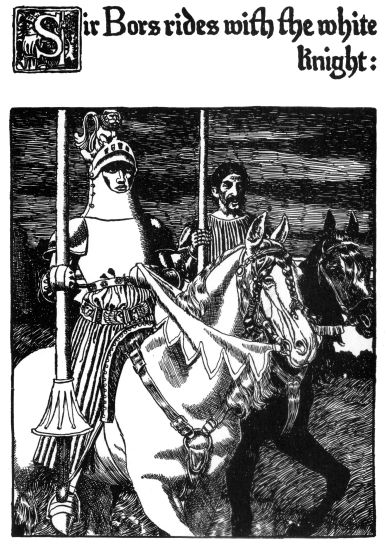
So the esquire departed and anon he returned, leading the white horse of
Sir Bors by the bridle. And Sir Bors was clad all in armor of pure and
virgin white, and all his trappings and the trappings of his horse were
white, so that he shone glistening, like to a figure of pure silver.
Sir Bors appealeth for delay.
“Sir,” said Sir Mador to Sir Bors, “Knowest thou why I am here, and upon
what accusation?” Sir Bors said, “Aye, I know it well.” Then said Sir
Mador, “Dost thou stand for the other side?” Sir Bors said, “Yea, I
stand heart and soul for the other side. But I will tell thee truly. I
said that I would undertake this quarrel upon the Queen’s behalf unless
some better knight than I should take that battle upon him. I know you,
Sir Mador, for a noble and valiant knight, and you know me for what you
have beheld of me, wherefore you know that I fear not to meet you or any
knight in all of the world, and that I would do battle with anyone with
all of my might in a lesser quarrel than this. Wherefore I ask you now
to postpone this battle until the hour of noon, for by that time there
may come more worthy than I to defend this honorable and much abused
lady.”
Sir Mador denieth him any delay.
“Is that all you have to say?” said Sir Mador. “Well, then, Messire,
either come you to battle with me without loss of time, or else withdraw
you from the field for someone else to take your place.”
“Take your horse and your arms,” said Sir Bors, “and as I suppose you
will not tarry long, so also will I not tarry long, but will be with you
anon.” So each knight withdrew from the field, and each busied himself
in preparing for the conflict. In this Sir Mador was the quicker, and so
rode out of his pavilion and around the course, and whilst none
applauded him in that procession, yet there were some who frowned not
upon him.
A new champion appeareth upon the Queen’s behalf.
So Sir Bors, when he was made ready, came forth from his pavilion, and
he cast his eyes toward the forest and immediately he was aware that a
knight was coming thence, riding easily yet swiftly. And this knight was
clad in strange armor, and he bore a shield without any escutcheon, nor
was there any emblazonment about him whatsoever to tell what knight he
was. But Sir Bors knew very well that that knight was none other than
Sir Launcelot of the Lake.
Anon this knight came quickly to where Sir Bors was, and he said to him,
“Messire, I give you grammercy for assuming this quarrel upon behalf of
the Queen. But now I come to assume that quarrel myself and so you are
freed from it.” Sir Bors said, “Come you to King Arthur.” And the knight
said, “Conduct me to him.”
The new knight appeareth before the King.
So Sir Bors conducted the knight to where King Arthur sat, and when he
was come there King Arthur said to him, “Sir, what knight are you? For
that I should know ere I consent to establish you instead of Sir Bors in
this quarrel.” To which Sir Bors made reply, “Lord, I know this knight,
and I know that he is a better knight than I am, so I yield my rights in
this quarrel unto him.”
Then King Arthur said to Sir Mador de la Porte, “Sir, will you accept
this new knight in your quarrel?” To which Sir Mador replied, “Sir, I
will accept him or any.”
Sir Mador is overthrown.
So each knight withdrew to his end of the lists and there they made
themselves ready. And when they were all prepared, then each launched
against the other with all the speed and vehemence that he possessed. So
they met in the midst of the course and in that encounter the spear of
Sir Mador was broken all to pieces, but the spear of the other knight
held so that Sir Mador and his horse were both overturned into the
dust.
But Sir Mador recovered from his fall very suddenly, and drawing his
sword and setting his shield in front of him he came forward to the
assault of his enemy as though this were the very beginning of the
battle. Upon this the other knight leaped very nimbly and quickly down
from his horse, and setting his shield before him, he drew his sword and
came forward as with great eagerness for battle.
Sir Mador is beaten in battle.
Each struck at the other with great fierceness, for Sir Mador was a very
strong and powerful knight, and was further upheld by his indignation.
So they fought for above an hour, and in that time Sir Launcelot held
his strength, but the strength of Sir Mador began to wane so that he
could hardly sustain his arm. Then Sir Launcelot redoubled his strokes
until Sir Mador held his shield full low. At that Sir Launcelot lifted
up his sword and he smote Sir Mador so terribly upon the helm that he
fell grovelling to the earth. Then Sir Launcelot drew near to Sir Mador
to smite him again, but Sir Mador raised himself a little and lifting
his sword he smote Sir Launcelot through the thick of the thigh.
But when Sir Launcelot felt himself to be thus wounded and when he
beheld how that the blood flowed forth in a red stream from the wound in
his thigh, he drew away and waited for Sir Mador to rise again. And when
Sir Mador had arisen he rushed upon him and smote him again, so terrible
a blow that the blade bit through the iron helmet, and the leather coif
and into the bone beneath the coif.
Sir Launcelot spareth Sir Mador.
Then Sir Mador fell down and lay upon the ground like one who was dead,
and Sir Launcelot ran in to where he lay and seizing the helmet that
covered the head, he cut the thongs with his misericordia and rushed it
off from his head. With that the light shone in upon the face of Sir
Mador and aroused him from his swoon; and beholding Sir Launcelot
standing terribly above him, he cried out, in a loud piercing voice,
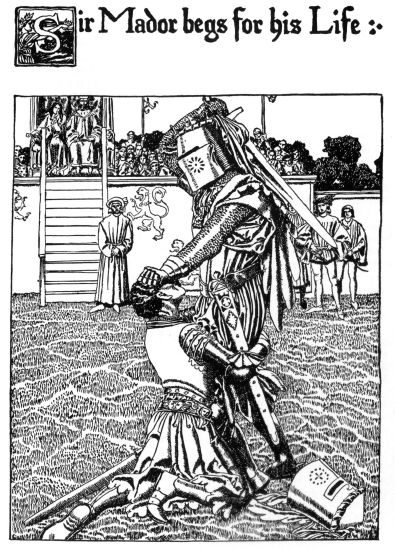
“Spare me my life, Sir Knight! Spare me my life!” Quoth Sir Launcelot,
“I will not spare thee thy life, unless thou dost confess that thou wert
mistaken concerning the guilt of the Queen, and that she is innocent of
evil.” Said Sir Mador, “I do confess it.”
Then Sir Launcelot called the Lord Constable of the lists to him and he
said to Sir Mador, “Confess what thou hast confessed to me to this
gentleman.” And Sir Mador said, “Sir, to this constable I do confess and
acknowledge that I was mistook as to the guilt of the Queen, and that
she is indeed guiltless of that of which I have accused her, and of all
other crimes whatsoever.”
Then Sir Launcelot said, “Bear this knight hence away from this spot.”
Upon that there came several attendants to that place and they lifted
Sir Mador and carried him away from that place.
Then Sir Launcelot and the constable went from that place of conflict to
the presence of King Arthur, and the King and the Queen descended from
their high seats to welcome him. Quoth the King, “Sir, well have you
fought this day, and well may we guess who you are who have done this
battle. We do both give you thanks—I for that you have saved to me my
Queen; she that you have saved to her her life and her honor.”
Sir Mador confesseth a wrong accusation.
“Lord,” said Sir Launcelot, “here have I brought with me this constable
to avouch for it that Sir Mador hath confessed that he hath wrongfully
accused the Queen of this crime, and that she is as guiltless of it as
she is of any other crime at this present.” And the constable said, “I
do avouch for the truth of that.” Then the King said to Sir Launcelot,
“Sir, I perceive that thou art wounded. Wilt thou not refresh thyself
with a glass of wine?” And Sir Launcelot said, “Yea, Lord, for wine
would be exceedingly grateful to me at this present.”
So a little page ran and presently returned, bringing a flagon of
sparkling yellow wine, and Sir Launcelot unlaced his helmet and removed
it from his head, so that all beheld his face and knew him for Sir
Launcelot.
Sir Launcelot pledgeth the Queen.
And then King Arthur said, “Sir, methought that you were Sir Launcelot
of the Lake when I beheld how you did battle a little while ago.
Moreover, when Sir Bors spoke of a better knight than he rising for the
Queen’s defence, I wist he must mean you, for you are the only one who
is better than he. But now we have you, we will not let you go again.”
“Lord,” quoth Sir Launcelot, “I will not leave this court again unless I
am bidden to go. For here may I defend both your honor and the honor of
your Queen. For first of all do I owe my duty to you who made me a
knight; and then do I owe my duty to her who is my revered and honored
lady.” Then, taking the flagon of wine into his hands he turned him
about and lifting that flagon on high, he cried in a loud, clear voice
so that all might hear him, “Here do I drink this flagon of golden wine
to the truth and innocence of my Queen. Health to her friends, confusion
to her enemies, and may harm fall upon those who contemplate harm to
her!”
Then he put the brim of the flagon to his lips and drank off the entire
draught of wine ere he removed it again.
Then King Arthur said, “Let us go visit that wounded knight, for I have
something that I would say to him.” So Sir Launcelot and the constable
and King Arthur went across the meadow of battle to the pavilion of Sir
Mador. And they entered the pavilion and Sir Mador was lying upon a
couch and the surgeon was searching his wounds.
King Arthur dismisseth Sir Mador from the court.
King Arthur said to him, “Sir, who besides yourself were the accusers of
the Queen?” Sir Mador said, “Lord, I was her only accuser.” The King
said, “Thou liest, for there was a conspiracy against her to undo her,
and thou wert but the instrument of that conspiracy. I will ask thee no
further to betray those who were with thee in this affair. Only I have
this to say to thee, that if by to-morrow morning thou art within the
purlieus of this court, or if at any future time thou comest into my
power again, or if ever I meet thee in battle or out of battle, that
time spells for thee thy death. Bear my words well in mind; for though I
spare thee this time upon behest of the Queen, yet will I not spare thee
again upon the beseeching of anyone in all of the world.”
Sir Mador said very bitterly to the King, “My Lord, thou speakest as a
sound man to one who is very grievously wounded and who may not defend
himself.” “Not so,” said the King very calmly, “I speak, first of all,
as a king to his knight, and next I speak as one knight to another
knight who hath wrought him a grievous injury. For thou canst not undo
what thou hast done; for thy quarrel hath sowed dissension and evil
thought among my entire court, so that I, who was one time loved by my
entire court, know not now who are my friends and who mine enemies.”
Then the King turned to the constable, and he said, “Lord Constable,
thou hearest what I have said. If this man is found hereabouts to-morrow
day, cast him immediately into prison and report the same to me. For if
after this day he falleth into my power, then he shall himself suffer
destruction by the flames, as he would have consigned his own Queen to
the flames.”
Thereupon the King turned upon his heel and left Sir Mador de la Porte
gnawing his finger nails.
The servant telleth how Sir Pinal placed the apple.
That day the King held a council of his chief lords and subordinate
kings. And before this council came that servant who had hidden behind
the screen as aforetold of. And this servant told of how he had beheld
Sir Pinal place the apple upon the table whereon the feast was to be
held. This evidence they all heard and listened to, and when it was
ended the King said, “Send for this Sir Pinal and let us hear what he
hath to say to this.”
So they sent for Sir Pinal, but he was nowhere to be found, for the
Queen’s enemies had told him that that evidence was to be admitted and
he had fled away from the court into the wilderness, never to return
again.
Yet is the Queen accused by many.
So was the innocence of the Queen proven. But still there were some who
disbelieved that evidence, for they said, “See ye not how it is? For
first they overthrow Sir Mador and then they drive him away from this
court. Then they bring in this evidence to clear the Queen from guilt
and they lay that guilt upon poor Sir Pinal, who is not of the Round
Table. Thus there is no one to contradict the evidence of this poor
knave, and so the Queen is to be cleared of the suspicion of guilt.”
So spake several, and the news of this was brought to the ears of Sir
Gawaine. But Sir Gawaine would say no word upon the matter, for whilst
he felt bitter enmity toward the Queen, and whilst he suspected the
worst things of her, yet he would not give voice to that which he
suspected. Neither would he give accusation against her, but went his
own way thinking his own thoughts and keeping those thoughts within his
own bosom.
Of the dissensions at the court.
Thus have I told you the history of these things as I myself have read
of them in the ancient books that treat of them. For this was the first
beginning of the end. For now that the Grail had been lifted from the
earth, there was naught to hold together the Court of King Arthur as it
had been held together before. But each knight began now to think of his
own glory and of himself, and not of the glory of the King and the Good
of the world.
So now begin we with the history of those dissensions that presently
broke forth in the Court of the King.
How there came quarrels at the court, and how Sir Launcelot of the Lake
was assaulted by the brothers of Sir Gawaine.
NOW there was at court at that time much dissension and many angry
recriminations back and forth between the one party and the other party.
For the one party maintained that the Queen had been ill-used and had
suffered much, and would have suffered death, saving only for the
defence of Sir Launcelot of the Lake; and the other party maintained
that the Queen possessed an evil soul, and that Sir Launcelot was her
dishonorable lover and that it was for this reason that he had fought
for her.
Sir Mordred and Sir Agravaine accuse Sir Launcelot of
treason.
Of this latter party were some of the brothers of Sir Gawaine, who were
at the head of that party; to wit, there was Sir Mordred and Sir
Agravaine. These knights spoke very boldly and openly, saying that Sir
Launcelot practised treachery with the Queen against the King’s high
honor. Sir Agravaine said, “Well is it that Sir Launcelot is the
greatest knight now living on the earth (for this is true now that Sir
Galahad had departed in glory), yet it is not to be forgotten that he is
not greater in his strength than several knights who might come against
him at once. So when Sir Launcelot next visits the Queen, if a number of
us shall fall upon him, it can scarcely be but that those knights should
overcome him, and that so the King’s honor should be revenged.”
Sir Gawaine will not join with them.
Whilst he so spoke, Sir Gawaine sat at one side gnawing his mustache.
Then he up and spake, saying, “What is this you would do? Would you
practise treachery against Sir Launcelot and against the Queen? God
knows I have no love for the Queen, and never have had love for her, but
neither would I practise treachery against her, but would assail her
openly and against the entire world. As for Sir Launcelot of the Lake;
long hath he been my dearest friend and companion at arms; am I then to
practise treason against him?” Then turning to Sir Geharis and Sir
Gareth, he said, “What say you, my brothers? Speak!” Then Sir Geharis
and Sir Gareth said, “What thou sayst, Gawaine, we also say.” And Sir
Gareth said upon his part, “I cannot now forget and I can never fail to
remember that it was Sir Launcelot of the Lake who made me a knight.
Shall I then sit in judgment upon my godfather in knighthood, and
undertake to practise evil against him?”
Quoth Sir Mordred, “I say with my brother Agravaine that the Queen is
altogether evil and that Sir Launcelot is her lover, and that saying I
am ready to maintain to the peril of my life.”
Sir Mordred declares that he will arrest Sir Launcelot.
Said Sir Gawaine, “I pray you tell me; what is it you seek to do?” Him
answered Sir Mordred, “We seek to spy upon Sir Launcelot and, when next
he visits the Queen in her apartments, we would make assault upon him.
When we have thus espied upon him, then we and several others will fall
upon him and seize him and hale him before the King for trial.” Said Sir
Gawaine, “That is no such easy matter for to do. And when you have done
it, it will be but of little avail; for the King will not condemn Sir
Launcelot upon such uncertain accusation. For what accusation shall you
bring against Sir Launcelot and the Queen that you dare mention to the
King?”
Then Sir Mordred made no immediate answer, but when he was come to a
place apart from those three, he said to Sir Agravaine, “Sir Launcelot
is guilty of thou knowest what treason against the King. Now I told
Gawaine that we would arrest him and bring him to the King. What I
really purpose is this: that we assault Sir Launcelot in the Queen’s
apartments, and that we slay him. For once he is dead the King will
quickly forgive us and will believe the Queen to have been guilty, but
if Sir Launcelot is alive he will never forgive us. Hah, brother, a dead
lion is a less dangerous enemy to a man than a living fox. So it were
best that Sir Launcelot died.” In this Sir Agravaine agreed with him; so
after that they set watch upon Sir Launcelot to take him when next he
should visit the Queen. But Sir Launcelot was warned by one who
overheard them, and for that while he did not visit the Queen in her
apartments.
Sir Mordred betrayeth Sir Launcelot.
So one night Sir Mordred called to him a page of the Queen’s court when
the page was passing, and he said to him, “Lanadel” (for such was the
page’s name)—“Lanadel, go you to Sir Launcelot of the Lake and tell him
that the Queen would fain speak with him in her bower.” Thereupon the
page, suspecting no evil, went to Sir Launcelot, and delivered that
message to him, and Sir Launcelot, suspecting no evil, fulfilled the
terms of that message, and went secretly thither to the Queen’s
apartments.
Sir Launcelot goeth to the Queen’s bower.
Finding the Queen there, Sir Launcelot said to her, “Lady, what is it
thou wouldst say to me?” She looked upon him in astonishment and said,
“Sir, I did not send for you to say anything to you.” Sir Launcelot
said, “How is this? Your page, Lanadel, came to me and brought it to me
as a message that you would speak to me at this place.” She said,
“Launcelot, I sent no such message as that to thee. Yet, in very truth,
it hath been long since thou hast been hither to speak to me. Art thou
affronted with me, Launcelot?”
He said to her, “Lady, thou knowest that I am not affronted with thee.
But there is this: I must consider thine honor and reputation as I do
mine own. But, Lady, touching this message of late delivered to me, here
is treachery of some sort, for certes that message came to me as from
thee, wherefore I know that some treachery is brewing against us, though
I know not what that treachery is.”
Now turn we to those enemies of Sir Launcelot to see what they did upon
this occasion. For Sir Mordred watched at the entrance of the Queen’s
apartments until that he beheld Sir Launcelot enter them. Upon that he
ran to Sir Agravaine, and said to him, “Brother, wit ye that Sir
Launcelot is at this time in the Queen’s chamber. Let us now make haste
to take him.” So those two called about them certain knights who were at
enmity with Sir Launcelot, and they said to them, “Gentlemen, let us
hasten and take that traitor knight who is even now in the Queen’s
bower.”
Now those knights whom they called upon to accompany them were as
follows: There were Sir Colgrance and Sir Gingaline, and Sir Melyot of
Logris, and Sir Galleron of Galway; there were Sir Melion of the
Mountain, and Sir Petypas of Winchelsea; there were Sir Gromer Somerjour
and Sir Astamore, Sir Cuselaine, Sir Florence, and Sir Lovel. And these
last two were sons to Sir Gawaine.
The Queen is warned.
These eleven knights, together with Sir Agravaine and Sir Mordred,
making thirteen in all, went together in a party to the apartments of
the Queen. And the ladies of the Queen beheld them coming, and wist that
they came for no good purpose. Wherefore these ladies ran screaming and
in haste and bolted and barred the door. Then they ran to the Queen’s
apartment and they found that Sir Launcelot was there and they cried
out, “Lady, arouse you, for your enemies are upon you!”
The thirteen knights challenge Sir Launcelot to appear.
By this those knights were at the door, and Sir Agravaine knocked and
cried aloud in a very loud and thunderous voice, “Thou traitor knight!
What doest thou here? Why liest thou behind locked doors in the Queen’s
apartments? Come forth to us who are thy fellows of the court and of
the Round Table, and render an account to us. For we are here to receive
thine account!”
These words were uttered so loudly and so powerfully that they echoed
and re-echoed throughout that entire part of the castle, and when they
struck upon the Queen’s ears, she fell as white as an ash of wood and
sank back upon a couch, placing her hand above her heart.
Then Sir Launcelot stood up from where he sat and he cast his eyes
around him from side to side, but he could see no armor for defence, and
no way of escape. And ever those knights without smote upon the door,
and ever Sir Agravaine cried out, “Sir Launcelot of the Lake; what doest
thou there in the Queen’s chamber? Come forth and deliver thyself to
us.”
Then Sir Launcelot said, “Lady, I prithee tell me, is there ere a suit
of armor in this place as I could clothe myself withal?” She said, “Nay,
Launcelot, there is no armor in this room.” Then Sir Launcelot said to
her, “Then must I defend myself without armor; for I know that these
knights have no purpose for to take me prisoner to the King. Otherwise,
that which they purpose is to take my life.” Then the Queen sank down
terrified upon her knees before him, and said, “Launcelot, go not forth
to them, for assuredly they mean thy death.” He said to her, “Lady, I
must go; but this I beseech of thee, that thou wilt pray for me. And
this also I beseech of thee, that, should I fall in this encounter, thou
wilt go with my relatives, Sir Ector and Sir Bors and Sir Lionel and Sir
Ure, and bid them that they shall take thee to an asylum of refuge at my
castle of Joyous Gard. For there is now no safety for thee at this
place, and only great and continual dangers. For ever there is growing
at this court against thee a rooted jealousy of all that thou sayest or
doest, and if so be I lose my life, then these, mine enemies, will
overwhelm thee.” Then the Queen wept, and she cried out, “Launcelot!
Launcelot! Go not forth to them!”
The thirteen knights threaten to burst in the door.
As thus they spake, those knights without continually beat upon the
door, crying ever in louder and more violent tones, “Traitor! Open to
us!” And the door was not opened, but remained closed. Then they cast
their eyes about and they beheld a great form that stood there in the
hall. And Sir Agravaine said to certain of the others, “Bring hither
yonder form, and let us beat down the door with it. For thus alone may
we hope to come at this traitor!” So they brought that form and they
beat with it upon the door, and the door cracked and bent beneath their
blows.
Sir Launcelot defendeth himself with a cloak.
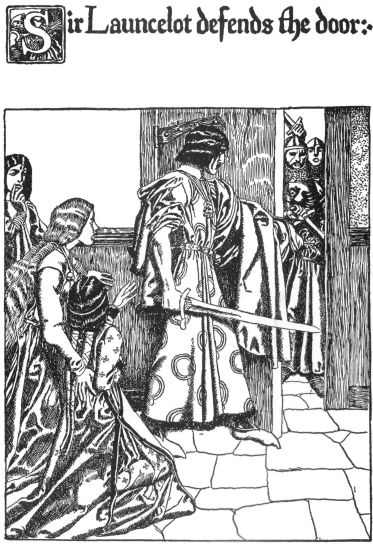
Then Sir Launcelot wrapped his cloak about his arm, and he took his
sword in his hand, and he said to those who were beating upon the door,
“Messire, cease your uproar and I will come forth to you.” Then he
turned the key in the lock of the door, and he opened the door a little,
but not very far, setting his foot against it lest they should burst it
open from without and so rush in, many at once, upon him.
But when the door was opened and they beheld Sir Launcelot standing
there without any armor of defence whatsoever saving only the cloak that
was wrapped about his arm, they took heart of grace that they should
easily overcome him. Then there came forward a tall and very powerful
knight, hight Sir Colgrance of Gore, and he struck a terrible strong and
powerful blow at Sir Launcelot with intent to hew him down. This blow
Sir Launcelot put aside with his sword and immediately delivered a blow
in return.
He slayeth Sir Colgrance.
In that blow he smote Sir Colgrance upon the head, and the blow bit
through the bascinet upon his head and it smote deep into the bone of
the brain so that Sir Colgrance fell down grovelling to the earth, and
immediately he died.
Then Sir Launcelot seized Sir Colgrance’s body by the shoulders and
dragged it into the room ere the others had recovered, and immediately
he bolted and barred the door as it was before. And Sir Launcelot said
to the Queen, “Lady, here hath Providence delivered armor into my hands.
I prithee aid me to arm myself.”
Sir Launcelot armeth himself in Sir Colgrance’s armor.
So the Queen and her affrighted ladies hastened to Sir Launcelot and
together they stripped the armor off the body of Sir Colgrance. And they
assisted Sir Launcelot to clothe himself very quickly and nimbly in that
armor. Then, having thus armed himself in the armor of Sir Colgrance,
Sir Launcelot came to the door of the room and he spoke to those
without, and he said to them, “Messires, what is it you would have with
me?” They say, “We would have you come forth and surrender yourself to
us so that we may take you to King Arthur.” Sir Launcelot said, “I
cannot surrender myself to you, but this I will promise to do: if you
will go hence and leave me in peace, I will surrender myself to King
Arthur to-morrow morning, and will then abide by his justice.” Sir
Agravaine said, “We will not do this. We will not trust thee. Deliver
thyself to us immediately, or we will slay thee.”
Sir Launcelot assaileth his enemies.
Then Sir Launcelot said, “I come!” and therewith he flung wide open the
door. And Sir Launcelot strode out amongst them like to a lion into the
midst of a pack of dogs. And they beheld that Sir Launcelot was clad all
in the armor of Sir Colgrance. And Sir Launcelot fronted Sir Agravaine
and the eyes of Sir Launcelot flashed forth pure fire from under the
vizor of his bascinet. And Sir Launcelot strode to Sir Agravaine, crying
out, “Thou first!” And therewith he smote Sir Agravaine with might and
main.
Sir Agravaine warded the blow, but so wonderfully powerful was it that
it smote down that ward; and it smote Sir Agravaine upon the bascinet;
and it cut through the iron of the bascinet and through the bone of the
brain pan and into the brain itself.
He slayeth Sir Agravaine and several others.
Then Sir Agravaine cried out very terribly and fell down dying to the
earth; and Sir Launcelot put his foot upon the neck of Sir Agravaine,
and wrenched forth the sword out of the cut that he had made. Then Sir
Launcelot smote to the right hand and to the left; and of those eleven
knights who were with Sir Agravaine and Sir Mordred he slew nine in that
little room. And he smote Sir Mordred upon the shoulder so that he
sheared the flesh of the arm, a great slice from the bone, and the other
two knights were more or less wounded, so that anon they fled in tumult
from that place.
And Sir Launcelot was also wounded in many places in that conflict, so
that he was, as it were, all bathed in crimson from head to foot. Then,
having put his enemies to flight, he turned him and re-entered the
Queen’s chamber.
Sir Launcelot is wounded.
But when the Queen beheld him thus all bathed in red, she shrieked
aloud, for she thought him to be mortally wounded. But Sir Launcelot
said to her, “Fear not, Lady, thine enemies are put to flight and I am
not sorely hurt.” And he said to her, “Lady, my love for thee hath ever
been my curse, and now it hath brought us to this end. For in thy
defence and in my defence I have slain the nephew of the King and two of
the sons of Sir Gawaine. So now the King will be my foe, and so I must
quit this place for aye. But I cannot leave thee, Lady, for without me
thou wilt be defenceless. So I prithee prepare thyself for a journey. I
will go forth and gather about me a number of knights of mine own
kindred and friends, and we will take thee hence away from this place.
For to-morrow they will bring thee forth to trial, and when they bring
thee forth, then will we seize thee and carry thee away.”
Then the Queen fell to weeping very bitterly, and she said, “Ah,
Launcelot! Alas and alas! Is this then the end?” And he said, “Aye,
Lady.” Therewith he went forth from that place and left her.
Sir Launcelot adviseth with Sir Bors.
So Sir Launcelot came to Sir Bors’s inn, and when Sir Bors beheld him,
all covered and ensanguined with blood, he cried out, “God save us!
What is this? What aileth thee?” Then Sir Launcelot told Sir Bors all
that had befallen, and when he had told it Sir Bors sent for Sir Ector
and for Sir Lionel and for Sir Ure, and fourteen other knights,
relatives and friends of Sir Launcelot, and Sir Launcelot told unto them
what he had told to Sir Bors.
Then Sir Bors said to those who were there gathered, “Messires his is a
very sad and bitter quarrel. For I do avouch that my relative, Sir
Launcelot, is in all ways perfectly innocent toward the Queen. For we
know that he was deceived into her presence by a false message delivered
unto him by someone who was an enemy to him and who meant to undo him.
So this lady hath also been misused in such a way that it is contrary to
his honor as a knight that we should suffer such harm to approach her.
Now it is my advice that we await to see what shall presently befall.
For if this quarrel is condoned by the King, then is all very well; but
if the King seek to punish Sir Launcelot by bringing the Queen to a
trial, then shall he save her from that trial and shall convey her away
to Joyous Gard where she may remain safe from harm.”
Other knights swear fealty to Sir Launcelot.
Then all those other knights to whom Sir Bors spake held up their swords
with their handles before them, and they said, “Herewith and upon this
holy sign of the crucifix do we swear that we will ride with and aid Sir
Launcelot of the Lake in this undertaking. And, if it be demanded of us,
we will assist him to bring this lady to Joyous Gard, and we will there
aid and defend him and her with our bodies until the last extremity and
until death.”
Sir Mordred accuseth Sir Launcelot to the King.
Meantime, Sir Mordred had had his wound bound up and had taken horse and
had ridden to the inn of King Arthur, and he appeared before King Arthur
in the room when the King was then with several of his court. And when
the King beheld him thus wounded, he started up and cried out, “Hah, Sir
Mordred! What bringeth thee before me in this plight? Where gottest thou
that wound?” Then Sir Mordred kneeled down before the King, and he said,
“Sovereign Lord and Master, I got this wound in thy service. For Sir
Launcelot visited the Queen recently in her bower, and I and twelve
other knights sought to arrest him there and to bring him before thee.
But he resisted that arrest, and of the thirteen who assaulted him nine
are dead and one is like to die.”
Then the King drew his breath very hard between his teeth, at that news,
and anon he said, “Who are dead? Are they any of my friends?” Sir
Mordred said, “All are thy friends, and three are of thy kin.” Quoth
King Arthur, “Who are those of my kin?” And Sir Mordred said, “One of
them is Sir Agravaine, thy nephew, and the others are Sir Florence and
Sir Lovel, the young sons of Sir Gawaine.”
Sir Gawaine sorroweth.
Then the King groaned and Sir Gawaine who was with him covered his head
and also groaned in sorrow. Quoth the King, “To-morrow day this shall be
inquired into, and the Queen shall be brought to trial for this
treason.” And with those words he arose and withdrew from that place,
accompanied only by Sir Gawaine, Sir Geharis and Sir Gareth and Sir
Mordred; and leaving the other knights who were attendant upon him sunk
in silence, not knowing which way to look or what to say.
So when the King was come to a private place, he seated himself and
buried his face in his hands. And he groaned aloud, and he said, “Alas
is me! This is certes the beginning of the end that was foretold by
Merlin!” And anon he said to Sir Gawaine, “To thee, Gawaine, will I
entrust the pushing of that inquiry which must follow. For thou and
Geharis and Gareth shall go with a company of an hundred knights, and ye
shall arrest the Queen, and shall bring her for trial for this offence.”
Then Sir Gawaine kneeled down before King Arthur, and he said,
“Sovereign and lawful Lord and Master, I pray you to spare me from
this.” King Arthur said, “Why should I spare thee?” Sir Gawaine said,
“For these two causes: firstly, I am sworn brother in arms to Sir
Launcelot; secondly, I am not friendly with my lady the Queen and so am
not fit to serve her as her escort.”
Then King Arthur said, “I do not understand your refusal, Messire. Was
not Sir Agravaine your brother? And was not he a strong and noble
knight? And were not Sir Florence and Sir Lovel your sons?”
“Yea, Lord,” said Sir Gawaine. “All this is true; but I suspected evil
in this affair, and I strongly advised them to refrain therefrom. This
they have refused to hearken to and so they have perished, armed and in
fair conflict with Sir Launcelot—he one against many.”
Then King Arthur’s face flushed very red with anger, and he turned to
Sir Geharis and Sir Gareth. “And you, Messires,” said he, “do you also
refuse me this duty?” “Sir,” said Sir Gareth, “if you bid us upon our
duty to undertake this commission, we will do so. Yet wit you that Sir
Launcelot was he who made me a knight; wherefore I will not go in arms
to escort the Queen. But if thou commandest me to go, then will I go
without armor or defence of any sort to protect me. For I will not stand
in arms before the avowed lady of him who made me a knight.”
King Arthur said, “I do command you both to go, so let there be an end
to this argument. But see to it that the Queen shall be brought to her
trial in a plain white robe without a girdle and that she come in her
bare feet like to any criminal. For I shall not believe her to be
innocent until she be proved so.”
Sir Gareth and Sir Geharis go unarmed to arrest Sir
Launcelot.
Now when the next day was come, it being then about the tenth hour of
the morning, Sir Geharis and Sir Gareth took those five score knights
and they rode to the lodgings of the Queen. Meantime, word had been sent
to the Queen that she was to clothe her in such a guise as the King had
said; to wit, ungirdled and in white, and in her bare feet. And it was
said to her that she was to come to her trial like to a
criminal—barefoot in that wise, and without a girdle about her waist.
The Queen weepeth.
Then the Queen wept very many bitter tears, and said, “Alas, my lord,
the King, hath already condemned me in his heart, so that my trial will
mean my death.” And the ladies of the Queen wept with her and they said,
“Lady, alas for thy happiness! For this is certes the end.” Then the
Queen dried her tears and she said to them, “Comfort ye! For I have done
many evil deeds in my life, but ye know that I am innocent of this
deed.” They say, “Yea, we know it and will avouch for it.”
Now word of all these things had also been brought to Sir Launcelot, and
when he heard of them he aroused himself and called his esquires about
him. Then he went forth in his full armor and he found Sir Bors and Sir
Lionel together. And Sir Launcelot said to them, “Messires, do you
remember that you and several others promised to aid me in the rescue of
the Queen? Well, then, the time is come, for she is about to be brought
forth to her trial, for they have sent for her. She shall not come to
the disgrace of trial, for I will bear her hence. Go you and summon all
those who will support me and bring them in haste to the Queen’s inn,
for I go there immediately.” Sir Bors said, “Go not thither from this
place until we summon aid.” Sir Launcelot said, “Then make haste.”
So Sir Bors and Sir Lionel hastened away from that place, leaving Sir
Launcelot walking in great strides up and down the length of the room.
Anon came one running to where Sir Launcelot was, and said to him, “Sir,
the Queen biddeth thee to come to her in haste, for they are taking her
barefoot to her trial.”
Sir Launcelot hasteneth to aid the Queen.
Then Sir Launcelot waited for no further word, but hastened with all
speed to where the Queen was, and when he had come there he found many
of his knights already there, and several came immediately thereafter.
And as Sir Launcelot approached he beheld the Queen seated upon her
horse in her bare feet and surrounded by that armed escort which the
King had sent. Then the Queen beheld Sir Launcelot and she called to
him, saying, “Sir Launcelot, make haste!” And she reached out her arms
toward him.
Sir Launcelot slayeth Sir Gareth.
Then Sir Launcelot emitted a great loud and bitter cry. And therewith he
drew his sword like lightning and his friends drew their swords and they
rushed into the throng smiting from right to left and from left to right
again. And those who were thus assaulted smote back again at those
knights and bore them hither and thither by weight of numbers because
they who fought for the Queen were so few. But the knights of Sir
Launcelot were prepared for this assault and the knights of King Arthur
were not prepared for it, wherefore those latter were quickly separated
and driven back. Now in the fury of that small battle Sir Gareth was
pushed near to Sir Launcelot and he was unarmed as hath been told of,
and Sir Launcelot saw him but knew him not. So Sir Launcelot smote Sir
Gareth upon the head with his sword and he clave asunder the head of Sir
Gareth to the throat and Sir Gareth fell dead beneath the horses’ feet.
And Sir Launcelot thought nothing of what he had done by that blow; for
in his fury and raging he beheld the Lady Queen Guinevere before him.
With that he spurred forward without looking down upon the earth to see
who it was whom he had smitten down, and he catched the Queen up from
her saddle and seated her on his saddle before him. Then he shouted,
“Let us away and escape while there is yet time!”
He slayeth Sir Geharis.
So with that Sir Geharis put himself forward to stay Sir Launcelot, and
Sir Launcelot, beholding him there in the way and not witting who he
was, smote him also with his sword and slew him.
Sir Launcelot escapeth with the Queen.
So with that they all ceased fighting and spurred away from that place,
cleaving their way before them and taking Queen Guinevere with them. And
they rode away from that place and from that city, and they ceased not
to ride until they had come to the confines of Joyous Gard, where there
was an asylum of peace and safety. And in that battle there were lost
twenty-seven knights of the King, and of these there were eleven knights
of the Round Table. And there were lost sixteen knights of Sir
Launcelot’s party and of them there were nine knights of the Round
Table. And in that battle Sir Kay the Seneschal and Sir Gareth and Sir
Geharis and Sir Griflet lost their lives.
How King Arthur attacked Sir Launcelot at Joyous Gard; how Sir Lionel
was slain and how Sir Bors was wounded.
NOW come we to the beginning of the end of this great and glorious reign
of King Arthur of Britain. For so Sir Launcelot stepped between the
Queen and the law as hath afore been told of, and having done so there
was no recession for him from that act. For so was he bound to protect
the Queen and to cherish her if he could do so; and King Arthur was
bound to recover his Queen to bring her back to her duty again if he
could do so.
Concerning Queen Guinevere and Sir Launcelot.
Yet in all this the Queen had not sinned against King Arthur, saving
only that she had escaped from her enemies and from justice at Camelot,
and also because King Arthur supposed that her affections had wandered
from him and toward Sir Launcelot. For in all other respects the Queen
was ever as honorable and as pure as she had been when first she came to
King Arthur that long while before at Camilard (which same hath been
told in full in the Book of King Arthur). Yet there was this, that the
coming of Sir Launcelot from the Lake and the greatness of Sir Launcelot
as a knight, and the beauty of the person of Sir Launcelot, so
fascinated her that she could not let him go his way without meddling
with his fortunes. Wherefore she demanded him for her knight, and she
was angry at any interference that prevented him from serving her as her
knight both singly and in all things.
But now had come to her the end of all this. For now was she escaped
from her lord the King, and from justice, and she was hiding under the
protection of Sir Launcelot of the Lake and of those knights of his
blood and kindred at Joyous Gard. So had the end come to her of all the
joy of her life, for King Arthur could now never condone or forgive her
offence.
King Arthur grieveth.
For when the news of that battle came to the ears of King Arthur, he was
filled with anger and with grief. “Alas!” cried he, “that this quarrel
should have begun, for in it I behold the end of my reign. For already
the joy of the Round Table is past and gone, and never shall it return
again.”
For wit ye that that joy which is gone can never return, but only its
memory shall live in the heart to lend a dim and distant lustre upon the
sorrows of the present, and of that King Arthur was very well aware. So
also he knew that the glory of the Round Table had departed, and he knew
that ere the end of that Round Table should come many knights should die
in that quarrel that was now toward.
Then the King said, “Doth Sir Gawaine, the high prince, know that his
two brothers have been slain?” They say to him, “No, Lord.” (For they
did not then know that Sir Gawaine had already been informed thereof.)
The King said, “Then let him not be told of it, for if he is told of it
now he will, in his haste, vow vengeance against Sir Launcelot who was
his sworn comrade in arms and his very dear friend, and so there will be
added war to this war.” They say to the King, “He shall not be told, but
it shall be kept secret from him.”
The news cometh to Sir Gawaine.
But meantime there had come a messenger hastening to Sir Gawaine, and
said to him, “Lord, the Queen hath escaped and is now upon her way to
Joyous Gard with Sir Launcelot of the Lake.”
At this Sir Gawaine gazed at the messenger and for a little while he
said nothing, though he thought many things. And the face of Sir Gawaine
grew white like to wax for whiteness, for he feared what further news
should come to him. Anon he said, “What news is this? Were not my
brethren set as a guard upon her? How then did they suffer her to escape
from them?”
The messenger said, “Sir, Sir Launcelot, and others of his blood,
assaulted that guard and they seized upon the Queen and took her away.
And in the mêlée at that time Sir Gareth was slain unwittingly. And then
Sir Geharis was also slain whilst attempting to stay Sir Launcelot.”
Sir Gawaine grieveth.
Then Sir Gawaine covered his head with his cloak, and he sat there for a
long time with his head covered. And ever he wept beneath the cloak, but
his face was hidden, and no one could behold his tears. And anon he said
in a muffled voice, “Five of them are gone! Five of them are gone!”
meaning by that that his two sons and his three brothers had already
died in that war. And after a little while he said, “There was comfort
for me in that those three of them who died aforetime were armed for
battle. For so I advised them that they should not enter this dispute;
and yet they did enter it, and lost their lives therein. But these
latter two were naked and unarmed, and of one of them Sir Launcelot was
godfather when he was knighted. And he loved Sir Launcelot more than he
loved his own blood and his own brethren. Ah, Gareth! Gareth! All things
could I forgive in Sir Launcelot saving only thy death. For I loved Sir
Launcelot above all others in the world, and to him could much be
forgiven; but this I can never forgive. For those two were his friends
and not his enemies, and they meant him good and not harm; yet he slew
them, all naked and unarmed as they were.”
Sir Gawaine cometh to the King.
And Sir Gawaine said, “Where is the King?” They say, “The King is at
such and such a place.” So by and by Sir Gawaine arose and went to where
King Arthur was. And Sir Gawaine said to King Arthur, “Lord, what now
will you do?” King Arthur said, “I know not what I shall do.” Sir
Gawaine said, “Sir, know you that my two brothers are slain?” And King
Arthur bowed his head and said, “Yea, I know it.” Sir Gawaine said, “I
will tell you what you shall do. You shall wage war to the extremity of
life against this false and traitorous knight, Sir Launcelot of the
Lake. What? Hath he not taken your Queen from you and carried her away
to his own castle? Hath he not slain your blood and kindred? Hath he not
bathed his hands in the blood of your knights of the Round Table? Hath
he not slain Sir Kay, your foster brother, in this last assault? Hath he
not slain Sir Griflet and my kinsman Sir Aglaval and my two sons and my
two other brethren who were all unarmed and defenceless against his
attack? Sir, arouse yourself. Call for your kings and princes, your
earls and barons and knights, and let us set forth as an army and
utterly destroy this nest of traitors and murderers. I myself will call
my dependants around me and will accompany you to that war, for now it
shall either be Sir Launcelot’s life or my life. For never will I
forgive him so long as I have breath in my body.”
The King offers forgiveness.
Quoth the King, “Nephew, if these knights will return the Queen to me,
then I will forgive them, and if I forgive them cannot you also forgive?
For these are Knights of the Round Table, and I must not destroy the
Round Table so utterly as you advise me to do.”
Sir Gawaine said, “I cannot forgive Sir Launcelot, nor shall I ever
forgive the deaths of my innocent brothers. For they were naked and
unarmed, and they loved Sir Launcelot, and yet Sir Launcelot slew them.
Naught can wipe this from my memory saving only the blood of him who
slew those two gentlemen. Wherefore, prepare for war and I will join
you.”
The King summoneth his vassals.
So King Arthur armed himself and he summoned those knights and princes,
earls and barons who were dependent upon him to his assistance. And he
summoned all of those knights who were still allied to him. All this he
did, but he did it very reluctantly, for he wished not to wage war with
Sir Launcelot and his knights.
And news of this call to arms that King Arthur had made came to Sir
Launcelot, and he upon his part gave call to all of those lords and
knights who were allied to him to come to him and to aid him to defend
Joyous Gard. And they or many of them went to him as he bade them.
How the King cometh to Joyous Gard.
Then King Arthur led his army to Joyous Gard and it was so vast and
multitudinous that it covered all the hills and valleys as it advanced.
And red clouds of dust hung over it as it passed forward so that the
bright and tranquil light of the sun was obscured by those clouds. And
great flocks of carrion crows accompanied the army, for they smelt the
blood of many carcasses as from afar, wherefore they flew accompanying
that army. So this army came and settled down and about Joyous Gard, and
it was like an army of locusts that had settled at that place.
And Sir Launcelot and his brother Sir Ector stood upon the parapet of
the castle of Joyous Gard, and they looked out upon the hills and upon
the multitude of the hosts that were there foregathered and that
encompassed them. And when Sir Ector beheld the vast and limitless
extent of that army, his heart failed within him and he said to Sir
Launcelot, “Behold, oh brother! the vast and limitless host that
surrounds us. However shall we withstand such a host as that? Would it
not be better to compromise with the King and to surrender the Queen to
him?” Quoth Sir Launcelot, “How talk you of compromise, Messire, and how
talk you of surrendering the Queen? Wit you that to surrender the Queen
at this time would be to dishonor ourselves in surrendering her to
dishonor? For unless we fight for her, what terms can we now make that
would insure her safety? No, brother, let us abide their coming, and
defend ourselves with all our mights.”
The Queen adviseth Sir Launcelot.
That night the Queen also spoke to Sir Launcelot, and she said,
“Launcelot, why do you suffer for me? Surrender me unto King Arthur and
with that this war will cease. Else will there many worthy knights
perish in this war. For there are a great many knights here foregathered
of the Round Table, and there be many other famous and worthy knights
and nobles and kings here foregathered. Is my one life then worth more
than all their lives?”
Then Sir Launcelot groaned, but he said, “Lady, I will not surrender
you until I am sure that your safety is insured. Let first the King
assure your safety and then we shall consider whether or not you shall
return to him.”
Then the Queen burst out weeping and she cried out, “Oh, woe is me that
I should have brought so much trouble and sorrow upon this world!”
The King assaults Joyous Gard.
Now the army of King Arthur made assault upon Joyous Gard and they made
assault upon assault. And somewhiles they made breaches in the walls;
but ever those breaches were rebuilded at night so that they could not
enter the castle. And the army of King Arthur lost many hundreds of men,
both of knights and yeomen; but the defence of the castle lost many
scores, and those scores were of greater loss to them than the hundreds
that King Arthur lost. For those hundreds could be replaced by other
hundreds, but the scores could not be replaced by other scores.
The friends of Sir Launcelot advise with him.
So the knights who kept the castle held a council of defence, and there
were at that council Sir Bors and Sir Lionel and Sir Ector and Sir
Bleoberis and Sir Blamor de Ganis, and there were other knights and
worthies of the blood of Sir Launcelot. Sir Lionel said, “Why remain we
here within this castle? Ever we grow weaker and weaker, and by and by
our enemies will break within the castle and then we shall all be put to
the edge of the sword. Let us sally forth against those who thus
surround us, for so haply we may cut our way through them and thus
escape to the sea-shore and to France. There we shall be safe from those
who could work for us our undoing.” Sir Launcelot said, “Sir, even if we
could do this thing, what blood would be spilt in doing it, and what
friends would we slay in that attempt!” Quoth Sir Ector, “What matters
that? Are they not seeking our lives and our blood, and are we not
defending ourselves? These men are no longer our friends; they are our
enemies, and are seeking our lives. Let us then go forth and assail
them.” All this Queen Guinevere heard, and she wept many and very bitter
tears as she listened to that council. As for Sir Launcelot, he groaned
very deeply but anon he said, “Let it then be so as you say, only first
I must bespeak King Arthur.”
So that afternoon he appeared upon the battlements of the castle. And he
leaned out over the battlements and called out to those who were below,
saying to them, “Where is King Arthur? I would speak with him.”
Those who heard him ran to King Arthur, and they said to the King,
“Lord, Sir Launcelot asks to speak to thee. Haply he meaneth to
surrender to thee.”
The King speaketh to Sir Launcelot.
So King Arthur hurried to that place where Sir Launcelot was: and Sir
Gawaine and the King of North Wales were with him. King Arthur said to
Sir Launcelot, “What wouldst thou have of me, Messires? Dost thou
surrender this castle?” “Not so,” quoth Sir Launcelot, “I do not
surrender it, but I would speak to you of other things.”
“Sir,” said King Arthur, “concerning what other things have you to speak
to me withal?”
“Lord,” said Sir Launcelot, “this is what I would say to you. What seek
you here in thus assaulting this castle? Here within are many lordly
knights and many knights of the Round Table who were a short time ago
your friends and dependants. Some of them you yourself made knights as
you made me a knight, and all of those would gladly surrender their
lives for your sake. What benefit or what honor can it then be to you to
slay them, who were your support and your defence, and who would be so
again if you would live in peace with them? Would it be to your honor
that you should slay these good, worthy honorable knights?”
“Sir,” said King Arthur, “you forget that you have seized upon my Queen
and that you hold her from me in this castle. First surrender to me my
Queen, and then I will consider all these things that you have to say
and will reply to them as I deem to be fitting.”
“Lord,” said Sir Launcelot, “thy Queen is held here in high and
honorable regard. With us she is safe from harm or injury of any sort.
Would she be thus free from danger of harm and dishonor if she were with
you? Pledge me first that you would do her no harm or injury, and then
it will beseem us as true and honorable knights to consider the
surrender of her to you.”
“Am I then,” said the King, “to make treaty with you for the return to
me of that wife with whom I have lived in amity for all these years?
Sir, you do not consider how unfit such a treaty would be upon my part.”
Sir Gawaine accuseth Sir Launcelot.
Then up spake Sir Gawaine. “Also, Messire, you have forgot another
thing, and that is that you have slain my two young brothers who stood
before you defenceless and unarmed. I reckon naught of those whom you
slew, armed and in battle. For I loved you well and truly for many
years, and I advised them not to hazard battle with you; but they would
hazard battle and so they were slain by you. But of those two others,
they did not hazard battle; for they were unarmed and naked, and they
would have stood your friends; yet you slew them as though they had been
enemies. This I will never forgive you, but either you will answer for
it with your blood, or I will answer for it with mine.”
Then Sir Launcelot groaned, and he said, “God pity us all for our sins,
and God pity you, Sir Gawaine, for your unchristian hatred.” And with
that he turned away.
The defenders of the castle sally forth.
So when the next day had come, they of the castle prepared themselves
for battle and for escape. They placed the Queen in their midst and they
surrounded her upon all sides. Then, of a sudden, all the gates upon one
side of the castle were flung wide open and they issued out in full
armor. And at that time the sun shone out very brightly, and it gleamed
and sparkled like flames of fire upon the brightly polished steel of
those knights. Then they, the defenders of the castle, shouted very
loud, and they charged against their enemies, bearing the Queen with
them in their midst.
And for awhile they carried all before them and no one could withstand
them; and so they might have escaped, had it not been that the Queen was
with them and retarded them in their charge and their advance. For, in a
little while, owing to that delay, those of King Arthur’s army armed
themselves, and in another little while the friends of Sir Launcelot
were almost entirely surrounded by that vast multitude.
Then Sir Launcelot beheld that in a short time they would be shut off
from return to the castle, but that as yet the way was still open to
them. Wherefore he lifted up his voice and shouted, “Retreat! Retreat!”
They of the castle retreat into it again.
Then, through the roar and thunder of battle and of blows and of sword
blade upon steel armor, all those who were there heard these words,
“Retreat! Retreat!” And they beheld that that retreat was nearly cut
off, but not quite. So they turned their horses and made their way
slowly backward toward the castle again, with the Queen still in their
midst. Those before turned their horses toward the castle, and those
behind fought with their faces toward their foes. And many who assaulted
that band tried to come to the Queen, but none could do it because of
the close array of horsemen that surrounded her. Many lost their lives
in that attempt, for if they penetrated the first line of horsemen they
were slain by the second line of defence.
Sir Gawaine overthroweth Sir Lionel.
In that mêlée Sir Gawaine sought ever to come at Sir Launcelot, but he
could not do so because that Sir Launcelot remained ever near to the
person of the Queen. But Sir Gawaine charged against Sir Bors and
pierced him with his lance through the shoulder; and then he charged
with great violence against Sir Lionel, and in that charge he pierced
through the body armor of Sir Lionel so that the point of the spear
stood a hand’s breadth out behind his back. Then Sir Lionel would have
fallen from his horse only that the press that surrounded him held him
up and kept him from falling. And with that blow against Sir Lionel, the
end of Sir Gawaine’s spear broke off, and it remained penetrated into
the body of Sir Lionel, a part of it showing in front and a part of it
showing behind.
Then Sir Lionel felt that he had received his death-wound, and he
groaned very dolorously. And Sir Gawaine heard him groan and perceived
how badly he was hurt. And he redoubled his attack, endeavoring to
obtain the body of Sir Lionel. But he could not obtain that body for it
was still held upright upon the horse, supported by several, and others
gathered about to defend it.
Sir Lionel dieth.
Then Sir Gawaine was furious with rage and he fought as though he had
gone wode. For his sword flashed like flashes of lightning, and ever as
he struck he cried out in a loud and terrible voice, “That for Sir
Launcelot!” and “That for Sir Launcelot!” and ever again “That and that
for Sir Launcelot!” And so fierce and terrible were the blows that he
gave that many fell down before them and never moved again. But in spite
of his striving, they bore away Sir Lionel from his endeavor and so
brought him into the castle, where that night he died in a great agony
of thirst and of torment.
King Arthur is overthrown.
In that battle, King Arthur and those who were with him made many
charges against the centre of Sir Launcelot’s array, and anon they had
come so close to where was the Queen that the King could almost have
touched her with his lance. So King Arthur came at last face to face
with Sir Launcelot, and Sir Ector was beside Sir Launcelot. And ever the
King strove to come at Sir Launcelot, but was unable to do so. For
somewhiles Sir Launcelot warded the blows from himself, and otherwhiles
those who were with him took those blows from him. Then Sir Ector
perceived how the King neglected his guard in assaulting Sir Launcelot,
and he arose in his stirrups and smote the King a terrible buffet upon
the helmet. At that blow the King’s brains swam, and he reeled and fell
off from his horse upon the earth. Then Sir Ector leaped from his horse
and he said, “Here will I put a stop to this war at its fountain-head.”
Whereupon he rushed off the King’s helmet and whirled his sword, and
prepared to smite the head off from the King.
They spare the King his life.
But Queen Guinevere perceived the King’s danger and she shrieked out
very dolorously, “Spare the King his life, Sir Ector!” And Sir Launcelot
said to Sir Ector, “Sir, how is this? Would you slay your King? Remember
it was he who made you a knight and who made me a knight. Haply he may
forget that he made us knights, but let us not forget it.”
So with that Sir Ector put up his sword again, and he and Sir Launcelot
lifted the King and set him upon his horse once more. And the King wept
bitter tears to see how noble and knightly was Sir Launcelot, and he
said, “Ah, Launcelot, Launcelot, that this should be!”
So after that Sir Launcelot withdrew into the castle with the Queen and
the gates were closed behind him. But ever King Arthur sat still weeping
and saying, “Ah, Launcelot, Launcelot, that this should be!”
Then the friends of Sir Launcelot wist not what they should do in this
extremity, for there were they within the castle again, and could not
come out thence because of those who besieged them in that place. And
ever they were growing weaker with each assault, but the armies of King
Arthur were not growing weaker.
The Bishop of Rochester cometh to the King.
At this extremity there came the Bishop of Rochester to the camp of King
Arthur, and the purpose of the Bishop was to make peace betwixt these
parties. So the Bishop came to where King Arthur was, and he found King
Arthur sunk in grief. For already three-and-twenty Knights of the Round
Table had lost their lives in these wars and contentions, and King
Arthur grieved for them very sorely. For there were no more knights like
those first knights foregathered about the Round Table, nor have there
ever been such knights as they were from that day to this.
Then the Bishop stood before the King, and the King looked at him
remotely as though he were a great distance away, for his eyes were
dimmed with weeping. And the Bishop said to the King, “Lord, let this
quarrel cease between you and Sir Launcelot, and let there be peace in
the land. For now is the entire land distracted with this quarrel. For
friend fighteth against friend, neighbor against neighbor;—yea, even
brother against brother. As for you, my lord, these knights are of your
Round Table and of your making; what pleasure or what honor then can it
be to you to destroy them?”
The King said to him, “Sir, this war was not of my forming or my
seeking, but of Sir Launcelot’s. For first Sir Launcelot resisted arrest
in a just cause, and then he resisted the arrest of the Queen. So he and
his fellows took the Queen away from me, and they have her in this
castle. Let them then deliver the Queen to me and there shall be peace
betwixt the friends of Sir Launcelot and my friends.”
The Bishop intercedes for the Queen.
The Bishop said, “They will not deliver the Queen to thee, Lord,
excepting thou wilt declare upon thine honor that no harm shall befall
her. For it is said of all that the life of the Queen is in danger from
thee. Yet she is an honorable lady and as pure to thee as the day upon
which she came to thee. For she is free from sin or from guilt of any
sort. Wherefore, unless thou wilt declare that no harm shall befall the
life of the Queen and wilt declare that same in writing, she will not be
returned, but otherwise they will lay down their lives to guard her
safety.”
Then the King sat with his fist upon his forehead, and he considered for
a long time what the Bishop had said, and at last he said, as in a
smothered voice, “Well, then, let the Queen be delivered to me at
Camelot, and I upon my part shall promise that no harm shall be done to
her life, either to threaten it or to deprive her of it.” The Bishop
said, “Let me have that in writing.” And the King said, “I will do so.”
So the King called to him his scribe and he had him write those words;
to wit, that if the Queen would return to him, no harm should befall or
threaten her life in any way. And the King signed and sealed that
document and the Bishop took it with him and entered the Castle of
Joyous Gard.
The Bishop grieveth for the Queen.
Thus the Bishop came before Sir Launcelot and his kindred, and Queen
Guinevere was with them at that time. And the Bishop looked at the face
of the Queen and he beheld that it was all white and wan with sorrow and
that her eyelids were red with continual weeping. And the Bishop was
very sorry for the Queen and for her sadness. So the Bishop came to her
and took her by the hand and he said to her, “Lady, stint thy sorrow,
for the time of sorrow is passed. For here am I with this document that
saith that no harm or injury of any kind shall be meditated against thy
life, but if thou wilt return to the King all shall be forgiven thee.
For wit you well that the King is determined that you shall return to
him, even if it cometh to the tearing down of this castle stone from
stone.”
Then the Queen took the document that the Bishop had and she read it
very carefully, and when she had ended she said, “Lord Bishop, how is
this? I see here that mine own safety is provided for, but that the
safety of no one else is mentioned. How of those good worthy knights and
gentlemen who have endangered their safety in my behalf; where is their
safety provided for in this parchment?”
Quoth the Bishop, “I will bespeak the King that point. Meantime, do you
remain here without endeavoring either to attack or to escape.”
She said, “I will remain here in peace until this time to-morrow.”
So the Bishop returned to the King and he brought that word to him;
that a pledge must also be given for the safety to the life of those
knights who thus guarded and sheltered the Queen. Then the King frowned,
and he said, “What other conditions will they impose upon me; why should
I give this pledge to those who have acted treasonably against me?”
The King promises to spare the knights of the castle.
Then Sir Gawaine plucked the King by the sleeve and the King turned
aside with him. And Sir Gawaine whispered for awhile with the King and
by and by the King turned again to the Bishop and he said to the Bishop,
“Very well, then; take thou this my word to those knights that I will in
no wise do harm to them whilst they are within this Kingdom of Britain.
Take thou that word unto them.”
So the Bishop took that word to them within the castle and they were
very glad of it. And Sir Launcelot said to the Bishop, “Let the King
return to Camelot, and I will bring the Queen to him in three days’ time
surrounded by all the pomp and circumstance that appertain to her lordly
grace.”
So the King withdrew his army from that place and he returned to
Camelot. And Sir Launcelot made ready to bring the Queen to him at
Camelot.
Thus came to an ending that sad and cruel war in the which many good
knights and warriors lost their lives and in which fourteen worthy
knights of the Round Table lost their lives.
For though all those knights were commanders of armies and of
battalions, yet death came to them as to other men of lesser note, so
that many of them, even to the highest, laid down their lives in this
dolorous war.
For so the hand of Fate lay heavy on that great and glorious company,
for though all grieved and made great sorrow over the war, and over
those who had died therein, and though comrade grieved over comrade who
died therein—even over those who were upon the other side and who were
enemies—yet the hand of Fate thrust them forward to do what they were
compelled to do, and to slay and to be slain in that sorrowful battle.
And so it was to the end, for ere that end was reached others who were
the foremost and the greatest of them all laid their bodies down to an
eternal sleep upon the bosom of that earth that gave them shape and
foothold. For yet were there other wars to come until all but a very
few of those who were left had given all that they had of the earth to
give in those wars.
But of this anon, for that which followeth has to treat of those things.
So now followeth the history of those things that remain to be
hereinafter related in that which followeth, as shall now appear.
Sir Launcelot brings the Queen to King Arthur at Camelot. He quitteth
England, and King Arthur and Sir Gawaine pursue him.
SO the King went to Camelot, and upon the third day the Queen was
brought to him at that place.
Thus saith the history of these things when the Queen was brought to the
Court of the King, to wit:
How Sir Launcelot brings the Queen to Camelot.
First there came an hundred knights clad cap-a-pie all in armor and with
fittings and trimmings of green velvet. And these knights wore olive
wreaths upon their heads, indicative of peace. Followed these, four and
twenty esquires clad all in green velvet, and these were also crowned
with olive wreaths. After these came four and twenty ladies in waiting
upon the Queen, and these, like all the others, were clad in green
velvet and were embroidered with pearls and precious stones even to the
heels of their horses, and the bridles of their horses were bound with
wreaths of olive. Then came the Queen and Sir Launcelot clad all in
white samite, and the Queen carried an olive branch in her hand and Sir
Launcelot was crowned with an olive wreath. And the raiment of these two
was all aglitter with the jewels and pearls with which their clothes
were embroidered until they were stiff with that embroidery.
How the King sat at Camelot.
At that time King Arthur received them seated upon his throne with great
dignity in the hall of the Castle at Camelot. And the throne upon which
he sat was of wrought gold and was cushioned and trimmed with crimson
velvet, embroidered in gold with the figures of leopards. And over above
the throne was a great canopy of crimson velvet ornamented with the
figures of leopards, embroidered with threads of gold. The King was
clothed all in white, and he wore a gold chain studded with jewels about
his neck and he wore his royal crown upon his head. Upon the left hand
of the King stood seven bishops in full canonical robes, and upon his
right hand was a throne like to his, and on that throne the Queen
should have been seated. But she was not seated there, for otherwise it
was empty.
Upon the left hand of the King, but upon the second step below the
throne, sat Sir Gawaine, the beloved nephew of the King. And all about
the hall were several hundred knights in full armor and armed cap-a-pie
with sword and lance, so that that hall glittered and gleamed with the
shine of that armor.
So King Arthur sat in state to receive the return of the Queen, and anon
she came to that place where the King awaited her. First came the
knights and esquires of Sir Launcelot, and these drew up in two parties
extending the length of the hall, leaving a line between them. Then came
Sir Launcelot and the Queen walking hand in hand up the length of that
lane, and the faces of Sir Launcelot and of that lady were both of them
exceedingly pale—hers with fear and his with fear for her. Behind these
two came the four and twenty ladies in waiting upon the Queen, and these
stopped in the midst of that lane and waited, whilst she and Sir
Launcelot approached King Arthur.
So Sir Launcelot and the Queen came to the foot of the throne where sat
the King, and when they had come to that spot Sir Launcelot kneeled and
the Queen stood before King Arthur.
Sir Launcelot speaketh.
Quoth Sir Launcelot, “Dread Lord and King, here I bring to you your
Queen as I have promised to do, and if I took her away in sorrow and in
haste, then do I return her to you with ten thousand times the joy as
compared to what was that sorrow, and in ten thousand times the peace
and amity to what was that haste. Lord, for thirteen weeks has she dwelt
at Joyous Gard with all the state and circumstance due to her royalty,
and she cometh to you now as pure and as virginal as she came to you at
Camilard when first you loved her at that place and she loved you. Lord,
I pray you that you will take the Queen to your heart, and will cherish
her there as you one time cherished her, for, excepting that you pledged
me your word that no harm should befall her, she otherwise would not
have been thus brought to you as she is brought to-day.”
The King rebukes Sir Launcelot.
Then King Arthur frowned until his eyes disappeared beneath his
eyebrows. For a little he answered nothing, then in a little he said,
“Messire, one time you were my friend and the best-beloved of all my
knights, but that time is past and gone, never to return again, for now
it is altogether otherwise with me and with you. Messire, I admire at
your coolness and phlegm. For you took my Queen away from me by force
and by force have you held her for all these several months. Many
knights have died by your hand and through your instrumentality, and
several of those knights were knights of my Round Table that one time
held you to it in bonds of love and amity. Yet now you stand before me
and recommend to me that I shall take back my Queen into my heart again.
Messire, wit you not that that which hath been done can never be undone,
but is and must remain altogether finished and completed? So it is with
this thing that you have done; for it also is and must remain altogether
finished and completed. Look you, Messire, here beside me is this
throne, which is empty. So it shall remain forever empty for me, for
never again shall Queen Guinevere or any other queen occupy it, for I
hereby and herewith renounce her utterly and entirely. She hath
withdrawn herself from my court and my bed and so she shall forever
remain withdrawn from them, for never again will I take her to my heart,
or place her in that estate which she once occupied.
The King sendeth the Queen to a convent.
“I have pledged myself that no harm shall come to her through me; but
herewith I give her over to the Church. There she shall remain a recluse
until the day of her death.”
So said King Arthur, and at a motion of his hand the Lord Bishop of
Rochester came forth and took the Lady by the hand and led her away; and
as he led her away, she was weeping very bitterly.
So the Bishop of Rochester took the Queen to the Convent of Saint
Bridget at Rochester, and there she remained the lady abbess of that
convent even to the day of her death, as shall hereinafter be related.
Now all this while Sir Launcelot still kneeled before King Arthur, and
anon the King said to him again, “Messire, your own doom I will not
announce to you; but I will relegate the annunciation of that doom to
this lord, my well-beloved nephew, Sir Gawaine. For the injury which you
did to him is a thousand times greater than the injury which you did to
me. For though you took my Queen away from me, yet you did her no harm.
But with him, you slew five of his blood; to wit, three of his brethren
and two of his sons. And whilst three of them were in arms against you
so that you slew them wittingly and in self-defence, yet two of those
stood unarmed and naked before you, and those two loved you better than
anyone in all the world. One of those two your own hand made a knight
and the other was knit to you with many acts and deeds of friendship and
of love. Accordingly, I commit your doom to Sir Gawaine to announce to
you.”
Sir Gawaine pronounces the doom of banishment against Sir
Launcelot.
Then Sir Gawaine smiled very bitterly upon Sir Launcelot, and he said,
“Messire, this is the doom that I pronounce. The King hath, in his great
clemency, promised you that no harm shall befall you in life or in limb.
So no harm shall come to you in that way if you are reasonable and obey
the commands of the King. This is his command—that in fifteen days from
this you must quit this kingdom, and that you shall never again return
to it whilst I live or while the King liveth.
And against his knights.
“Also I pronounce the doom of banishment against those who have been
associated with you in these late affairs, to wit, against Sir Ector de
Maris, Sir Bors de Ganis and Sir Ure, and Sir Blamor and Sir Bleoberis
de Ganis, against Sir Galahautin, and Sir Galahud, and Sir Menaduke, and
Sir Galahadin, and Sir Hebes, and Sir Lavaine, and Sir Melias de Lisle,
and Sir Palamydes, and Sir Safyr, and Sir Clegis. Upon all of these I
pronounce the doom of banishment upon behalf of this King, and if any of
you be found within this isle of Britain fifteen days from now, you will
be arrested and hanged as traitors. Meantime all your castles, earldoms,
and baronies shall be forfeited to the King.”
Said Sir Launcelot, “Sir, that is a bitter sentence; for here in this
island have I lived all my life, and of it I love every stock and stone
that mine eyes behold. But if I be outlawed and cast forth from this
kingdom, then will I go to my Castle of Chillion in the land of France,
and there I believe I shall be right well welcome and protected. So
come, my lords, and let us be gone to that country whiles there yet
remains time for us to depart.”
Sir Launcelot and his knights withdraw.
So Sir Launcelot and all those lords who were condemned with him
departed from the coast of England and entered into France, where they
took up their lodging with much sorrow and repining.
And King Arthur seized upon all their earldoms, baronies, and estates,
and some of these he bestowed elsewhere and some of them he held for the
crown.
Now after those knights had departed for France, Sir Gawaine urged upon
King Arthur that he should follow them to that kingdom and attack them
there at the Castle of Chillion. King Arthur said, “Sir, why should I do
this thing? Did not Sir Launcelot bring back my Queen to me and did I
not forgive him for what he had done? Is he not now banished from the
land, and is he not then punished for all those things that he has done?
Let him now live and die in peace.”
But to this Sir Gawaine ever answered, “Sir, I cannot reconcile it to
myself thus to surrender my rights in this case. For Sir Launcelot slew
my brothers and my sons, and never will I forgive him for that offence.
Either his blood or my blood shall answer for this; wherefore, if thou
wilt not follow him to France, then I myself will go thither and will
seek him out and punish him. As for thee, thou mayst forgive him as a
man, but yet thou mayst not forgive him as a king. For as a king thou
art the head of the law, wherefore thou mayst not forgive one who hath
broken the law. So with Sir Launcelot of the Lake, for he broke the laws
and he brought these Knights of the Round Table against thee and to
follow him; wherefore it is thy duty under the law to assail him and to
punish him for his treason, and also to punish those who follow him
likewise for their treason.”
The King moveth against Sir Launcelot.
Now by this time King Arthur was growing toward being an old man, and he
was much broken by sorrow and by cares, wherefore these words of Sir
Gawaine so moved him that at last he agreed to sail with an army into
France and to attack Sir Launcelot and his friends at Chillion. So King
Arthur entrusted the government of Britain to his nephew, Sir Mordred
(who was brother to Sir Gawaine), and he and Sir Gawaine departed with a
great army for France.
So this army appeared before the Castle of Chillion, and they shut Sir
Launcelot and his friends up within the castle and besieged them at that
place.
Then said Sir Launcelot, “How is this; hath not King Arthur any mercy
upon us, or doth he seek our lives and our blood? Well, if he seeks
those lives and that blood, then will there be many cruel and bitter
battles betwixt us, and many knights shall fall, and so will come the
entire end of the Round Table. Ah, well, if God willeth that it be so,
so it must be.”
Of the battles about Chillion.
So there were many battles around about Chillion and many lost their
lives. And though the knights of King Arthur lost more lives than did
the knights of Sir Launcelot, yet they could better afford to lose those
lives because new knights were constantly coming from Britain to
replenish the army of King Arthur, but no new knights were coming to the
army of Sir Launcelot, wherefore his losses were not replenished to him.
Now at that time there was a very wise and learned physician in the camp
of King Arthur, and one day Sir Gawaine sent for this learned man to
come to him. When that wise man stood before Sir Gawaine, Sir Gawaine
said to him this, “Sir, can you not produce for me a lotion that shall
render me free from all wounds of any sort?”
The wise man provides medicine for Sir Gawaine.
Quoth the wise man, “Sir, this is impossible. But I can give to you a
medicine of this sort, that if you take it, you will, from the ninth
hour of morning until the prime of noon, have the strength in your limbs
and in your arms as of ten men.” Sir Gawaine laughed, and said, “Provide
me then with that medicine.”
So the wise man prepared that medicine and gave it to Sir Gawaine, and
so it was for him as that physician had promised. For from the ninth
hour of the morning until the prime of noon, Sir Gawaine was uplifted in
arm and body to the strength of ten men.
Sir Gawaine giveth challenge against Sir Launcelot.
So the next day after this medicine had been delivered to him, Sir
Gawaine went to the walls of the castle and he paraded under the walls
of the castle, and he called out, “Sir Launcelot, come forth and do me
battle. For this satisfaction thou owest to me for slaying my kindred.”
But Sir Launcelot would not come forth to do him battle. For Sir
Launcelot still loved Sir Gawaine and he loved King Arthur; both for the
sake of those times that were past and gone, when they had joy and
pleasure together. So because that the one was Sir Gawaine and the other
was King Arthur, he would not come forth to do battle. Nay, because of
his love for those two, Sir Launcelot would not fight in that part of
the battle where Sir Gawaine or King Arthur was, but would do battle at
other parts.
But when the next day had come, Sir Gawaine came again and the strength
of ten men was in his arms and his body. And he paraded back and forth
under the walls of the castle, and ever as he paraded he cried out
aloud, “Sir Launcelot, thou caitiff knight! Come forth and do me battle!
For thy doom is upon thee, and thou shalt die in this war; wherefore,
come and do me battle, or else announce that thou art afraid of me.”
But still Sir Launcelot would not go forth against him, but he sat in
the castle and groaned for sorrow and bitterness of spirit. Then Sir
Ector came to Sir Launcelot, and he said, “Kinsman, suffer me that I go
forth and do battle in thy behalf; for this man sharneth us by this
challenge.”
Then Sir Launcelot wept, and he said, “Thou shalt not go, for wit you
that I loved this man better than mine own blood. And if he should be
slain, then will my heart be filled with grief such as can never vacate
it again. And if thou art killed, then will I be without my brother, and
must take it upon me to fight Sir Gawaine upon the behalf of thy death.
Wherefore, I pray thee go not forth to meet him.”
But ever Sir Ector besought Sir Launcelot saying, “Brother, suffer me to
go!” And at last Sir Launcelot said, “Well go, and may God be with
thee!”
So Sir Ector armed himself and departed out of the castle to meet Sir
Gawaine.
Then Sir Gawaine rode up to Sir Ector and he said to him, “Sir, what
knight are you?” Quoth Sir Ector, “I am Sir Ector de Maris, the brother
of Sir Launcelot of the Lake.” Said Sir Gawaine, “Why come you here?”
And Sir Ector replied, “I come to do battle with you upon my brother’s
behalf.” Then Sir Gawaine laughed and he said, “Sir, you are welcome.
Rather would I have it that you were Sir Launcelot, but failing him I
will accept you as his proxy. So make yourself ready to encounter me.”
Sir Gawaine overthroweth Sir Ector.
So each of those two knights rode to a certain distance and prepared
himself for that encounter. And when they were in all ways prepared they
charged very furiously against one another. In that meeting the spear of
Sir Ector broke into many pieces, but the spear of Sir Gawaine held. And
because he had the strength of ten men behind his spear, it penetrated
the shield of Sir Ector and it penetrated his body, so that it stood a
haeadth out behind his back.
Then Sir Ector fell from his horse and, in passing, the spear of Sir
Gawaine was broken so that the baton of the spear of Sir Gawaine
remained sticking in the body of Sir Ector; a part of it sticking out
before, and a part of it sticking out behind.
Then Sir Gawaine rode back to where Sir Ector lay, and he said to him,
“Sir, how fares it with you?” Quoth Sir Ector, “Alas, Messire! I have
received my death-wound.” Then Sir Gawaine laughed very bitterly, and he
said, “So shall it always be with traitors, such as thou.”
Then with that Sir Gawaine turned his horse and rode away from that
place, leaving Sir Ector lying where he was.
Anon there came forth those from within the castle and they lifted up
Sir Ector where he lay. And they laid him in the hollow of the shield
and bare him into the castle. And all who saw Sir Ector in that
condition wept to behold him so.
So they bore him to a chamber and laid him upon a soft couch and Sir
Ector groaned very dolorously with the agony of his wound, and Sir
Launcelot and several others stood before him, and ever as Sir Launcelot
considered him, the tears welled out of his eyes and rolled like shining
jewels down his cheeks.
So about the eleventh hour of the night Sir Ector said to Sir Launcelot,
“Sir, this wound is my death-wound. I pray you to draw out the baton of
that spear and let me pass.” Sir Launcelot said, “I cannot draw it
forth.” Sir Ector said, “Is there no friend here who will draw forth
this baton, and suffer me to die?”
Then said Sir Bors, “I will draw it forth,” and with that he came to the
bedside of Sir Ector and he laid hold of the baton of the spear. And he
drew very strongly upon that baton and it came forth out of that wound
and with it came a great effusion of blood.
Sir Ector dieth.
Then Sir Ector groaned very deeply and he said, “I pass,” and with that
he closed his eyes and in a little while he was dead. Then they who were
there wept a great passion of tears, for Sir Ector was well-beloved of
all of them.
Now when the next morning was come, Sir Gawaine came again before the
castle and rode there as aforetime. And ever as he rode he cried out,
“Sir Launcelot, thou craven knight, come forth and do me battle.” But
still Sir Launcelot would not come forth against him. Then Sir Bors de
Ganis came to Sir Launcelot and he said to him, “Sir, suffer me to go
forth against this knight, for he bringeth shame upon us all.”
Quoth Sir Launcelot, “I crave you not to go, Sir; for this knight, Sir
Gawaine, is a very strong and powerful knight. Already hath he slain Sir
Ector, and should you also lose your life, what great loss that would be
to us all.” “Nevertheless,” said Sir Bors, “I would fain go forth
against him. For God may give me the victory, in which it will be a
great benefit to us all in that he will no more come to trouble us.”
Then Sir Launcelot turned away his head, and anon he said, “Go, in God’s
name, and may good fortune attend you. As for me, I cannot go against
Sir Gawaine because of the love I held for him. For should he slay me,
that would be a great misfortune for us all, but should I slay him,
never would I cease to sorrow and to repine for his death. Wherefore, I
cannot now go against him, but you may go against him.”
So Sir Bors armed himself and went forth out of the castle, and when Sir
Gawaine beheld him coming he was rejoiced, for he thought that this was
Sir Launcelot.
So Sir Gawaine rode up to him as he approached, and he said to him,
“Messire, what knight are you?” Him Sir Bors made answer, “Sir I am Sir
Bors de Ganis, and I have come forth here against you upon behalf of Sir
Launcelot of the Lake.”
“Sir,” said Sir Gawaine, “you are very welcome; though rather would I
have to do with Sir Launcelot of the Lake than with any other man in
all of the world. For I have no quarrel against you, but against him I
have a quarrel.”
“Nevertheless,” said Sir Bors, “I stand here now upon his behalf to do
battle for him.”
Quoth Sir Gawaine, “Prepare yourself then for battle!” So Sir Bors took
his assigned place and when they were in all wise prepared they rushed
together with great violence and fury.
In that encounter the spear of each knight was broken into many pieces,
even to the very fist that held the spear, and the horse of each
recoiled so that it sunk back upon its haunches and would, perhaps, have
fallen, had not the address of the knight rider recovered it. Then each
knight cast aside the truncheon of his spear and voided his horse, and
each drew his sword with great readiness and rushed to the battle very
furiously, violently and impetuously. Each smote the other many sore
buffets and strokes so that each knight was wounded in several places.
But Sir Gawaine was possessed of the strength of ten, and Sir Bors was
possessed but of the strength of one, so that by and by Sir Bors was
obliged to hold his shield low because of weariness from the redoubled
fury of Sir Gawaine’s attack.
Sir Gawaine woundeth Sir Bors.
So Sir Gawaine perceived that opening which he made in his defence, and,
grinding his teeth together, he whirled up his sword and smote Sir Bors
upon the shoulder of that arm that held his sword. So violent and savage
was the blow that it sheared through the iron of the epulier and it
sheared through the flesh and bone of the shoulder so that the arm of
Sir Bors fell and hung down from the shoulder and his hand dropped the
sword that he held.
Sir Bors asks his life.
Then Sir Gawaine laughed and ran forward and he set his foot upon the
sword of Sir Bors. And Sir Bors sank down upon his knees and he said in
a weak and faltering voice, “Sir Gawaine, I am sorely wounded. If it
please thee to do so, I pray thee to spare my life.”
Quoth Sir Gawaine, “Why should I spare thee thy life? Thou art a traitor
knave, and it is not fit that I should spare thee, but rather I should
slay thee as thou kneelest before me. But I cannot forget our long and
many associations; and I cannot forget that thou wert one of those three
knights who achieved the Grail, and brought the Grail back again to
Sarras. So I will forgive thee, and will spare thee thy life, if so be
that God will also spare it.”
Then Sir Gawaine turned and sheathed his sword, and he mounted his horse
and rode away. And anon there came the friends of Sir Bors from the
Castle of Chillion, and they lifted him up and laid him upon a litter,
and so they bore him away into the castle.
And they took Sir Bors to a room of the castle and stripped off his
armor and beheld the wound that it was very ghastly and dismal. And so
much blood was emitted from that wound that Sir Bors fainted and for
awhile he hung hovering upon the edge of death.
Sir Bors doth not die.
But he did not die then or afterward, but he revived and his wound was
healed so that he, by and by, became well and strong again.
Then Sir Launcelot came to where Sir Bors was, and he said to him, “Sir
Bors, how fared it with thee?” And Sir Bors said in a fainting voice,
“Sir, I know not how it was with Sir Gawaine. For I found him to be so
passing strong that never have I found a stronger. For he smote down my
defences and he smote me this blow that I have received, and from which
I shall maybe die. For mine arm is nearly severed from its shoulder, and
I wit not whether I shall ever be strong and hale again.”
Then Sir Launcelot wept and he said, “Alas, that this is so! For now I
cannot forego this battle with Sir Gawaine any longer. For yesterday he
slew my brother, Sir Ector, and to-day he hath nearly slain thee. So
to-morrow I shall have to have ado with him, or else, by and by, all
shall perish at this place.”
Then Sir Bors said, “Sir, beware of him, for he hath strength more than
human, wherefore I fear that he may prove to thee thy undoing.”
To that Sir Launcelot answereth, “I should be sorry to find it so. But
whether it is thus or not, still must I have ado with him upon the
chance that I may thus save the lives of others within this place.”
So it came that Sir Launcelot was prepared to do battle with Sir
Gawaine.
Now if you would hear more of this famous fight betwixt Sir Launcelot
and Sir Gawaine, I pray you to read that which followeth. For there it
shall be fully and distinctly set forth as it hath been told of in
several ancient histories dealing with these things.
Of the battle betwixt Sir Launcelot and Sir Gawaine. Also how King
Arthur returned to Little Britain.
SO came the next day and Sir Gawaine had his esquires to enclose his
body in full armor of proof, and he mounted his horse and took a good
stout lance of ashwood in his hand, and he set forth once more to seek
Sir Launcelot as aforetime he had done. So Sir Gawaine came beneath the
wall of the castle, and he paraded before the wall, and ever as he thus
paraded he cried aloud and on high, “Come forth, Sir Launcelot of the
Lake! Come forth, thou caitiff knight, and do me battle!”
Then Sir Launcelot wist that now the time was come for him to do that
battle.
Sir Launcelot goeth against Sir Gawaine.
So Sir Launcelot mounted upon his horse and took into his hand a good
stout lance of ashwood for his defence, and thus armed he gave orders
and the portcullis of the castle was raised and the drawbridge was let
fall and Sir Launcelot rode forth all clad in that armor of proof to
meet Sir Gawaine.
Then Sir Gawaine rode up to Sir Launcelot and gave him greeting and he
said to Sir Launcelot of the Lake, “Sir, I pray you tell me, are you Sir
Launcelot of the Lake, or are you another knight than he? For by your
figure and by your conduct and by that device which is upon your shield,
I wit you to be Sir Launcelot, and yet I know not whether you are he or
not he. For this is the third time I have challenged, and heretofore he
would not come out against me.”
Sir Launcelot bespeaks Sir Gawaine.
Quoth Sir Launcelot of the Lake, “Sir, I am Sir Launcelot indeed, and
wit you, Sir Gawaine, I have well tried to avoid this battle, for I fear
me in this battle or in some other battle of its kind, either you or I
shall be slain. And I would not slay you for the love that was of old
betwixt us; for still I remember me of that love, and I hold it very
dear to my heart. Wherefore I would not do battle with you if that
battle could be avoided.”
Quoth Sir Gawaine, “What prate you of love, Sir? This battle cannot be
avoided, for wit you that even if ever I loved you, yet all that love is
now passed away, or rather it is transformed into hate. For you have
wounded me so deeply in my heart that no man can wound me so deeply and
yet live while I live also upon the earth. Wherefore either you or I
shall die by the hand of the other, if not at this time, then at some
other time.”
Quoth Sir Launcelot, “How have I wounded thee, Gawaine, or in what way
have I done thee such hurt as this? Tell me that I may make that wrong
right again.”
Sir Gawaine accuses Sir Launcelot.
Said Sir Gawaine, “Wit you not that I have often told you how that first
you slew two of my sons, and my brother, and how that afterward you slew
two more of my brothers? Is not that injury enough for any man to bear
within his heart and yet to live under that injury?”
Then Sir Launcelot sighed and he said, “Sir, wit you that those two sons
and that brother I slew in battle and they were armed, and assaulting
me, and I knew them not. As for those two of your brothers whom I
afterward slew, them I slew in the press and fury of fighting. For I saw
not their faces in that fury and knew them not. For if I had known them,
wit you that I would have held my hand and spared them? Sir, for that I
am grieved to the heart, for I loved them both very well; more
especially Sir Gareth whom I made a knight in the field.”
Then Sir Gawaine laughed very bitterly, and he said, “Sir, you make a
very good excuse, still you did that which you did, and having done it
you must pay for it. For so every man must pay for that which he hath
done; let it be good or let it be ill. Come, Sir, prepare yourself for
battle, for I am hungry to have battle with you.”
Then again Sir Launcelot sighed, this time so deeply that his heart had
been lifted from its strings within his bosom by that sigh. And with
that sigh he closed his helmet, and reined in his horse and withdrew to
that part of the field which was to be his assigned place of battle.
Many view the battle.
Then many of the defenders of the castle came down to the walls of the
castle and stood there, and looked down from those walls upon the two
who stood so in array of battle. And King Arthur and many others came
from the camp of the besiegers, and also stood them afar off to behold
the battle, so that with those and with these who were there it was as
good an assembly as any knights could have chosen in which to do battle.
And the sun shone very clear and strong—yet not too strong. And the
breeze blew very freely so that all the poplar trees around about the
castle were turned white with its blowing, and the river that ran down
past the castle was dusked and rippled by that wind, and all the reeds
of the river bowed and dipped into the water thereof.
So those two knights prepared themselves for the assault, making their
armor in all ways tight and secure. Then when they were in all ways
ready, they shouted to their horses and so sprang to the charge,
galloping against one another with a noise like to the noise of thunder.
So they met in the midst of the course and smote one another, in the
centre of the other’s shield. And before that shock the spear of each
was split into a great many very small pieces, even to the hand that
held it. And each horse sank quivering back upon its haunches at the
recoil of that blow, and would have fallen, were it not that the
extraordinary address of the knight rider recovered his horse with spur
and rein and voice. Then each knight cast aside the truncheon of his
spear and drew his sword, and each rushed at the other very furiously
and valiantly. Then each smote the other with great power and strength.
Sir Launcelot faileth.
But though Sir Launcelot smote with all of his strength, yet Sir Gawaine
smote with the strength of ten. So that Sir Launcelot was driven
backward, and around and around in small circles, and in that assault he
was altogether astonished at the fury and the strength of Sir Gawaine.
For he wist not that Sir Gawaine had that strength of ten men, and he
knew not that Sir Gawaine had taken that medicine to lend him that
strength.
And Sir Launcelot had much ado to defend himself so that he made no
attack, but only a defence with sword and shield against the attack of
Sir Gawaine. And Sir Launcelot thought that never in all of his life had
he fought with so strong and so powerful a knight as Sir Gawaine—nay,
not even when he fought with Sir Turquine that day at the ford before
the castle of Sir Turquine. For anon the blood began to flow forth from
him in spite of all his defence, so that in a little while the ground on
which he fought was all sprinkled red with that blood, and his armor was
all ensanguined with the crimson streams that bathed it. And in all that
while Sir Gawaine had hardly any wounds at all, but he fought with all
his strength and might, and with the purpose to beat down his assailant.
But though Sir Gawaine fought in that wise, yet, by and by, it reached
the prime of noon, and still he had not struck down Sir Launcelot. Then
that strength of ten that he had with the medicine that he had taken
began to fade and wane away as the flame of a candle flickers and wanes
away when the wax is consumed. So anon Sir Launcelot felt that the
attack of Sir Gawaine was no longer so furious and so violent as it had
been, but that it was weaker. Therewith he redoubled his own battle with
tenfold violence. And now he no longer made defence, but instead of
defence he made attack. And he drave Sir Gawaine backward before him,
for Sir Gawaine could not stand before the fierceness of that attack now
that his strength was waning.
Sir Gawaine faileth and is overthrown.
So Sir Gawaine bore back from before those blows, and by and by he began
to hold his shield full low for weariness. Then Sir Launcelot perceived
his opening, so he rushed the attack with double fury, and anon he swung
his sword and smote Sir Gawaine with it full upon the head. And so
violent was that blow that it clave asunder the helmet and the coif, and
it wounded the head beneath the coif.
Then Sir Gawaine sank down upon his knees, his hand relaxed and the
sword that was in his hand fell out from it upon the ground. Then Sir
Launcelot ran to Sir Gawaine and he set his foot upon the sword and he
rushed off the helmet of Sir Gawaine and he cried out very fiercely,
“Sir, yield yourself to me or I will slay you!” But Sir Gawaine said, “I
will not yield me to thee, so thou mayst slay me at thy pleasure!” Then
Sir Launcelot gazed at Sir Gawaine, and as he gazed at him the fury of
battle passed away from his soul like a mist from before the face of the
sun; and Sir Launcelot felt such great love for Sir Gawaine and such
great pity for him that his eyes ran all with tears.
Sir Launcelot spareth him his life.
Then Sir Launcelot said, “Sir Gawaine, even if you do not ask me for
your life, yet will I grant it to you. Arise and depart!” To this Sir
Gawaine said, “Messire, in this you are foolish. For if you do not slay
me now, then when I am well and healed again, I will come back against
you, and will assail you again as I have assailed you to-day. For wit
you that in this quarrel either you shall die or I shall die.”
Sir Launcelot said, “Sir, this matters not to me! I cannot slay you now
and I will not slay you.”
So Sir Launcelot turned away from that place. And he mounted his horse
and departed thence. And as he rode back to the castle Sir Launcelot
wept so that hardly could he see the way before him because of the tears
that rained down from his eyes.
Then came those from King Arthur’s side who had looked upon the battle,
and they raised Sir Gawaine up and led him away to his tent. And when he
had come to his couch they unarmed Sir Gawaine and searched his wounds
and found that they were very deep and sore. So they dressed the wounds
of Sir Gawaine and put salves and unguents upon them, and so he was made
in all ways as comfortable as could be.
And Sir Gawaine sent for that cunning and learned physician who had
given him the medicine of strength, and he said to him, “Cannot you give
me a stronger medicine than that, and one that will make in me the
strength of twenty?” The physician said, “Sir, I cannot do that, for I
have no such power.” Sir Gawaine said, “Then can you not give me a
medicine that will make me stronger for a longer time than till the
prime of noon?” But the physician said, “Sir, I cannot do that either.”
Then Sir Gawaine sighed and he said, “Woe is me! I fear me I shall never
be able to overcome Sir Launcelot.”
Meanwhile the wounds of Sir Launcelot were being searched at the castle
and also were found to be very sore and very deep. So it was several
weeks before Sir Gawaine or Sir Launcelot recovered from those wounds.
But after those several weeks were over, then each knight was as strong
and as hale as he had ever been.
Sir Gawaine is healed. He challengeth Sir Launcelot.
So, after Sir Gawaine was in all ways healed again, he clad himself in
armor and took in his hand a very strong and powerful lance and mounted
upon his horse once more. And Sir Gawaine rode out to the castle and he
rode up and down before the walls of the castle, and ever as he rode he
called out on high, “Sir Launcelot, come forth, thou caitiff knight, and
do me battle!”
Then they who heard those words went to Sir Launcelot, and they said to
him, “Sir, here Sir Gawaine is riding beneath the walls of the castle,
and he uttereth his challenge against you.” Sir Launcelot sighed and
anon he said, “Send mine armor here to me”; and he said, “Send Galliard
hither” (Galliard being the name of the esquire of Sir Launcelot).
So the esquire came and he aided Sir Launcelot to put his armor upon his
body and his limbs, and so Sir Launcelot was in all wise armed cap-a-pie
in that armor. Then Sir Launcelot took a good stout strong spear in his
hand, and he mounted his horse. And the gates of the castle were opened
to him as they had been aforetime; and Sir Launcelot rode forth into the
sunlight to meet Sir Gawaine as he had aforetime done.
So Sir Launcelot rode up to where Sir Gawaine was and he said to Sir
Gawaine, “Sir, I am here to meet thee.” Sir Gawaine said, “I see that
thou art, and I give thee welcome.” Sir Launcelot said, “Sir, it is with
greater grief than ever that I come forth to meet you to-day. For this
is the fourth challenge that you have given to me, and I cannot receive
any more challenges from you. So it is this day either you or I shall
have to die. For I cannot suffer it that you shall come to me for day
after day as you do, to utter your challenge against me.” Said Sir
Gawaine, “Messire, it is to my mind also that either you or I lay down
our life to-day. If it be I who must die, then am I glad to lay down my
life for my sons and my brothers whom you have slain; if it be you who
are to die, then am I still more glad to sacrifice you to their spirits.
Yet as you slew them unarmed, so it will be a greater pleasure to me to
slay you for their sakes.”
Quoth Sir Launcelot, “Are you ready?” and Sir Gawaine said, “Yea, I am
in all wise ready.”
So once more as it was before so it was now, for many of those of the
castle came and stood upon the walls of the castle to behold that
battle; and also there came many from the camp of King Arthur, and these
stood upon the surrounding hills so that all those hills were covered
with a multitude of men watching that combat.
So each knight having assumed his place of battle, and each being in all
wise prepared, each set his spear in rest and each shouted to his horse
to advance. Then the one charged against the other with great speed and
violence, and so each met the other in the middle of the course with a
crash like to a clap of thunder.
They two do battle together.
As it was before, so now each lance was shivered to splinters, even to
the very truncheon of the spear, and each horse reeled back from that
assault. Then again each knight recovered his horse with spur and voice
so that he did not fall in that recoil.
Then each knight cast aside the stump of his spear, and each leaped from
his horse, drawing his sword from its scabbard for the assault. So they
rushed together as aforetime, striking and lashing with might and main.
But again Sir Launcelot found Sir Gawaine possessed of such strength as
astonished him, for he felt that he was fighting with his own strength
against the strength of ten men.
In that battle he received many wounds that were worse than they had
been before; for this time Sir Gawaine fought with great desperation to
end that battle before high noontide. But ever Sir Launcelot made very
strong and powerful defence, striking but few blows of assault, but
putting himself ever in the posture of defence. Yet in spite of that
defence, both the armor upon his body and the earth upon which he stood
were all ensanguined with the blood that flowed from the many wounds
that he received in that battle.
But at last it came high noontide, and with the coming and passing of
noon the strength of Sir Gawaine reached its height and limit, and then
it began its decline. So Sir Launcelot felt the waning of Sir Gawaine’s
strength and therewith ceased from his defence and began to frame his
attack against the other. Then Sir Gawaine retreated backward, and he
assumed such defence as he was able. But Sir Launcelot rushed upon him
and beat him again and again and yet again with his sword. And Sir
Gawaine was wounded in many places, for the blood gushed in streams out
of many deep cuts through his armor plate.
Sir Launcelot wounds Sir Gawaine mortally.
Then from weariness the shield of Sir Gawaine began to fall full low,
and Sir Launcelot perceived this and ran in upon him. And Sir Launcelot
whirled his sword and smote Sir Gawaine with all his might upon the neck
upon the left-hand side. And the blade of Sir Launcelot’s sword sheared
through the armor at that place, and it sheared through the neck and the
breast, and so deep was that wound that Sir Gawaine suffered from that
blow his death-wound.
Yet Sir Gawaine would have stood to fight if he could have done so; but
he could not stand. Otherwise, he sank slowly down upon his knees and
there rested, with his hand upon the earth. And the blood poured down
his arm and wet the earth beneath him.
Then Sir Launcelot ran in upon him and he rushed the helmet off Sir
Gawaine’s head, and he cried out, “Sir Gawaine, yield thee or I will
slay thee!”
Quoth Sir Gawaine, “Messire, already thou hast slain me. For this wound
which thou hast given to me is my death-wound. So I feel it to be, for
the life is already passing out of me through that wound.”
Then Sir Launcelot wept and he said, “Sir, say not so. Now I pray thee
that thou wilt forgive me for this wound and for all else that I have
done against thee!”
Sir Gawaine will not forgive Sir Launcelot.
But Sir Gawaine looked at the blood that ran in streams down his arm,
and he said, “I will not forgive thee, Launcelot, for otherwise, I will
die in my hatred of thee. For thou hast slain me as thou hast slain my
brothers, and upon thee I voice my curse and their curse as well. For my
curse and their curse is this: that never after this day shalt thou
prosper in anything that thou shalt undertake. Never shalt thou join in
any battle from this time forth; and the dearest wish of thy heart shall
disappear from thy hands when thou closest them upon that wish. Thou
shalt live in sorrow and shall die shut away from all sounds and sights
of knightly battle. This is my curse and my sons’ curse and my brothers’
curse upon thee, so wit you that though I die yet you shall be in a
worse estate than I who am dead.”
Then Sir Launcelot knelt weeping before Sir Gawaine, and Sir Gawaine
said, “Get you hence, Sir knight, for my friends are coming.”
Then Sir Launcelot raised his head and looked and he beheld that the
Knights of King Arthur were coming in that direction. So he turned and
mounted his horse and rode away at a hard gallop toward the castle, and
he entered the castle and the gates thereof were closed behind him.
Sir Launcelot grieveth.
Then many of those knights who were dearest to Sir Launcelot came about
him to give him praise for overthrowing Sir Gawaine. But Sir Launcelot
would not look at them. Otherwise, he turned away his head from them and
withdrew to his own inn. For wit you that Sir Launcelot loved Sir
Gawaine better than any man in all of the world; yea, better than his
own blood and kindred. And now he knew that he had slain that one whom
he loved the best of all; wherefore he lay with his face turned to the
wall and melancholy enclosed him all over, like to a cloak of black.
But meanwhile Sir Gawaine had swooned so that when those knights and
gentlemen, his friends, came to him, he lay on the ground like one who
was dead. Those gathered him up and laid him upon a litter, and they
bore him away in that litter to his tent. There they unlaced the armor
and removed it, and anon the chirurgeon came to him to search his
wounds. But when the chirurgeon beheld that great wound in his neck, he
wit that Sir Gawaine could not live. So the chirurgeon sent for King
Arthur to come hither, and he said to the King, “This man cannot live,
but must die.” King Arthur wept, and he said to the chirurgeon, “How
know ye that he must die?” To which the chirurgeon replied, “Lord, when
I looked in at that wound in the lower part of his neck, methought I
could see his heart beating beneath it. Wherefore, I know that if the
heart groweth cold through his wound, then he must die.”
Then King Arthur hid his face and for awhile he said nothing. Then he
went to the bedside of Sir Gawaine, and he said to him, “Messire, how is
it with you?”
Sir Gawaine advises the King.
Sir Gawaine smiled at him and said to him, “Sir, wit you that I must die
of this hurt.” King Arthur said, “I trow not.” Sir Gawaine said, “In
that you are mistook, for here have I my death-wound, and in a little
while I must die.” King Arthur said, “Sir, keep up your heart.” To this
Sir Gawaine made answer, “My heart faileth not, but my life hangeth
fluttering upon my lips, and soon it must pass away from me.” And Sir
Gawaine said, “Sir, wit ye of this, your own case is as bad as mine.
Return you again to Britain as fast as you are able, for I trust not
more than need be to Sir Mordred’s truth, albeit he is my brother. For
he hath ever had a dark and gloomy spirit. And he hath ambition for the
throne, and now that he hath the power behind that ambition, and now
that you have lost so many good and worthy knights at this castle, he
will certes seize upon your throne unless you are by to wrest it out of
his hands. Wherefore I pray you to return to Britain as soon as may be.”
King Arthur said, “Sir, these are imaginings upon your part. For Sir
Mordred is a Knight of the Round Table, and is bound to me in fealty.
Why, therefore, think you he would be treacherous to me?”
Sir Gawaine said, “Lord, I lie now very close to the edge of death and
all things appear extraordinarily clear and distinct to mine eyes. Sir
Mordred hath no love for any soul save only for himself. Wherefore, I
fear me he will sacrifice you to his desires, and will seize upon your
throne. Lord, I shall not live until to-morrow morning, wherefore, I
charge you that when I am dead, you shall bury me here in haste, and
depart straightway for England, for I fear me for your kingdom in
Britain.”
Sir Gawaine dieth.
So that night in the second hour after midnight, Sir Gawaine drew his
last breath and died. And King Arthur was there at that passing, and
several knights companions of the Round Table were there, so that Sir
Gawaine did not die in loneliness. And after he had passed, King Arthur
wept and he said as follows:
THE LAMENT OF KING ARTHUR
King Arthur’s lament.
“So passeth this dear and faithful friend. There is not of all those who
are left anyone whom I love so well as I loved him. For though he was
passionate in his angers and his indignations, yet to me he was always
loving and full of dutifulness and kindliness. He was the right hand and
support of my throne and its chiefest prop in all of its weaknesses, and
I had hoped that he would have occupied that throne after I had departed
from this earth.
“But now this is past and gone and he is taken who was, next to Sir
Launcelot of the Lake, the brightest and most glorious figure of all my
Round Table.
“He was the companion of my youth. For when I had fought my battles and
come to my throne, he was among the first who came and laid his hands
between my palms. Also he was one of the first of all those
knights-elect of the Round Table to take his seat at that table.
“But now he is gone and I am left alone, like the tree in the forest
that hath been struck by lightning. Yea, like that tree my foliage is
withered and now I stand stark and bare against the sky. For my Queen,
who was the lover of my youth, is estranged from me, and I shall never
behold her more. My Round Table, that was otherwise the chiefest glory
of my reign, is broken and scattered and many of those who were one time
dearest to me in love are now my foes. Where are now the defenders of my
throne? They are gone; and that throne itself totters to its fall.
“All these are sad and woful happenings, but the saddest and most woful
of all is that this good worthy knight hath died. Would that I had died
in his stead and that he had not died, but that I had died for him. What
worse hath Fate in store for me than this that he is dead?”
So in words such as these or in words like to them, King Arthur mourned
for Sir Gawaine; for it seemed that no worse blow could befall him than
this; to wit, the death of Sir Gawaine.
News cometh to the King of Sir Mordred.
That morning King Arthur was aroused very early from his couch of grief
by a messenger that came to him with a message from Britain, and that
message was this: that Sir Mordred had seized upon the throne and the
crown of Britain, and was holding them for his own.
This message came from Sir Constantine of Cornwall, who was the cousin
of Sir Gawaine and who was yet living in England. And Sir Constantine
said, “Hasten! Hasten your return, O Lord King, and let nothing delay
that return!”
Then King Arthur gave command that the siege of Chillion should be
raised, and that after Sir Gawaine was buried they should all return
again to Britain.
Sir Gawaine is buried.
So that day the funeral of Sir Gawaine was held with great pomp and
circumstance. Four bishops conducted the mass for the rest of his soul,
and the whole army knelt to pray for him. And those people within the
Castle of Chillion also kneeled upon the battlements of the castle wall
and prayed for the rest of his soul. For next to Sir Launcelot, he was
the greatest knight in the world.
So they laid him at rest at that place—a good worthy knight and one
well established in all courts of chivalry both then and thereafter. For
if he was violent of temper and if he sought revenge upon Sir Launcelot
for the death of his sons and his brethren, yet he gave his life for
that anger and that revenge, and that the manes of his kindred might be
satisfied.
So endeth the history of Sir Gawaine.
How King Arthur returned to England. How he fought his last battle with
Sir Mordred.
Sir Mordred despaireth.
SO the news came to Britain that King Arthur was returning to that
realm, and that news was conveyed to Sir Mordred where he was. And when
Sir Mordred heard thereof he sat sunk in melancholy, his head bowed upon
his breast, and his food and wine standing untasted beside him.
And several of the friends of Sir Mordred were with him at that time,
and with them was Sir Mador de la Porte, who had, since his battle with
Sir Launcelot, been an enemy to King Arthur. These say to Sir Mordred,
“Sir, why are you so cast down? Wit you that King Arthur is not yet
returned, and that when he doth return he must do battle with you to
regain his kingdom.”
Quoth Sir Mordred, “Yes, that is very true, but wit you that I have
given out word to the world that King Arthur was slain in battle before
the Castle of Chillion, and in that word lay my strength. Wherefore now,
when King Arthur returneth to Britain, and when the people find that he
is yet alive, they will turn to him and will cast me out.”
His friends advise him.
Quoth Sir Mador de la Porte, “Then it behooves you, Sir, to make stir
and to proclaim to the people that with King Arthur there will be
continued wars, but that with you there will be peace and tranquillity.
For wit you that King Arthur for this year past hath been continually at
war against Sir Launcelot, and during that time you have not had one
single war in all of Britain. Wherefore, as people love peace, so they
will cling to you. Beside this, you should summon the Archbishop of
Canterbury to your presence and have him crown you as king. For if you
be a king in your own right, then will you have that much more strength
to do battle for your own rights. Now here at hand is the Archbishop of
Canterbury, and he shall be summoned and shall crown you at your
demand.”
Sir Mordred beseeches the Archbishop to crown him.
So they sent for the Archbishop of Canterbury, and he came to where Sir
Mordred was. Sir Mordred said to him, “Sir, wit you why I have sent for
you? It is that you shall crown me King of Britain.”
The Archbishop refuses.
Quoth the Archbishop, “I cannot do this thing that you ask of me, for
the news is that King Arthur is returning to Britain. How then can you
be crowned King of Britain when the rightful King of Britain is still
alive?”
To this Sir Mordred made reply, “I have not set for you to reason with
me, but to crown me as the King of this realm. For if you crown me, then
do I believe that I shall be well able to defend my crown and my
kingship, but if you do not crown me, then will I do battle with King
Arthur as a usurper to make myself a king instead of him.”
Then said the Archbishop, “Sir, you shall not do this thing. For I, as
the head of the Church in this realm, bid you to surrender your rights
and claims unto the just and lawful king who now returneth. For he
surrendered his kingship to you for a little while whilst he was away
from Britain, and not for a permanency. Yet you would make that
surrender permanent, for you would make yourself king instead of him.
Wherefore, if you do not surrender yourself to King Arthur’s mercy upon
the day of his landing, then will the Church curse you with bell, book
and candle as the usurper of those rights that belong to another.” Then
Sir Mordred was filled with rage against the Archbishop and he cried
out, “Sir, get you gone, or I shall forget myself and draw my sword and
slay you perhaps.”
The Archbishop withdraweth.
So the Archbishop withdrew from the presence of Sir Mordred, and he
called his court about him, and he recounted to that court all that had
passed between him and Sir Mordred. And he said, “Let us fly from this
place. For we are in danger here.” So the Archbishop took him a strong
horse and he mounted upon it and his court also mounted upon horses, and
then he and his court rode with great haste away from that place and to
Dover, where King Arthur was expected to be about to land.
After the Archbishop had gone and when Sir Mordred found that he had
gone, Sir Mordred collected such of his army together as were there at
hand; and he also descended to Dover, taking that army with him; his
intent being to prevent the King from landing if he could do so.
So came King Arthur to Dover, and as one stood upon the cliffs one
beheld that his ships and galleys covered the entire sea as far as the
eye could behold. And as the King approached the shore, he beheld that
there was a considerable army drawn up in array upon the beach where he
was to land, and he knew not whether that array were to welcome him or
to do battle with him. But at length he perceived Sir Mordred in the
forefront of that array, and he wist that that army was there to do
battle with him. Then he groaned aloud and he said, “Is there yet more
blood to be shed? Well, then, it must be shed, for never will I give up
my throne unless I give it up with my life. For eight and twenty years
have I held that throne, and shall I now surrender it to this man, my
nephew Mordred? No; never!”
Of the battle of Dover.
So as the boats drew near to the shore, those who were in them leaped
into the water and waded to the shore. And the army of Sir Mordred came
down to the water and did battle with those who sought to land. And so a
great battle was fought there at the edge of the water, so that the
water was all discolored red with the blood of those who were wounded or
slain and who fell into the flood. Wherefore it was that with each
recurring wave this red water ran upward upon the white sands, and then
receded, leaving the sands all stained red where it had flowed upon it.
But yet Sir Mordred did not prevent that army from landing, for ever
more knights and yeomen and still more leaped from the boats and into
that shallow water, and so at last the army of Sir Mordred was forced
back from the water and King Arthur’s army landed upon the shore.
Then Sir Mordred withdrew his army from that place and King Arthur took
possession of that part of Britain.
After that the Archbishop of Canterbury came to where King Arthur was,
and he gave him greeting, saying, “Greeting, King Arthur, and give thee
joy of landing upon this soil. For here am I who am the head of the
Church and I give thee welcome to thy realm. For wit you that Sir
Mordred would fain have had me crown him king, but I would not crown
him, having heard that thou wert still alive.”
Then King Arthur embraced the Bishop and kissed him upon either cheek,
and said to him, “Sir, I thank you for your welcome. And I thank you
that you have guarded and protected my rights.”
Now, after having been thus driven away from Dover, Sir Mordred withdrew
to Baremdown, and at that place he gathered about him all those of his
followers who had hitherto been tardy in coming to him. And he assembled
with him all those who had been friends to Sir Launcelot (for these were
now at enmity with King Arthur). So at that place Sir Mordred had a very
considerable army to confront King Arthur withal.
Then Sir Mordred stationed that army upon a rise of land where were
three steep hills. For so he could charge down those hills against his
enemies, whilst they must charge up those hills against him.
So came King Arthur, and when he perceived the dispersion of Sir
Mordred’s army, he also arranged his army into three divisions. The
centre division he took himself; the right division he entrusted to the
King of North Wales, and the left division he placed under the
leadership of Sir Ewaine, who had not quitted Britain for all this time.
Of the battle of Baremdown.
Then King Arthur charged his army up those hills against his enemy, but
he could not climb those hills because of the steepness thereof, and
because of the defence of the enemy at the top of the steeps. And
afterward he charged again and again, but still he could not gain the
crest of those hills.
Then Sir Ewaine’s division overlapped the army of Sir Mordred, and he
charged up that hill both before and behind. And he doubled Sir
Mordred’s party up upon itself and threw it into great confusion.
But that wing of Sir Mordred’s army could not retreat to the rear by
reason that Sir Ewaine’s knights were there; wherefore, it fled back
upon the centre of the army and threw that centre also into confusion.
Then King Arthur charged for the fourth time, and this time he took the
centre hill of the three, and with that the army of Sir Mordred broke
and fled. And the army of Sir Mordred fled toward Salisbury, and a great
many knights were slain in that flight. And the army of Sir Mordred took
up its station not far from Salisbury, and not far distant from the sea.
So King Arthur won the battle of Baremdown, but with sad and bitter
loss. For many knights fell in that assault and amongst them was Sir
Ewaine, who was mortally hurt.
Sir Ewaine is wounded.
Now when King Arthur heard that Sir Ewaine was hurt, he went to where
the wounded knight lay in his pavilion. And Sir Ewaine’s face was very
wan and hollow and pale, and the dew of death stood upon his forehead.
Then King Arthur went to the couch of Sir Ewaine and he kneeled beside
the couch and embraced Sir Ewaine about the body with his arms. And the
tears ran down King Arthur’s face and wet the face of Sir Ewaine that
was beneath him. And Sir Ewaine said, “Art thou there, my king? For I
cannot see thee, and yet meseems I feel thee weeping upon me.” And King
Arthur said, “Ewaine, it is I.”
Sir Ewaine biddeth King Arthur to send for Sir Launcelot.
Then Sir Ewaine said, “Sir, send for Sir Launcelot to aid thee in this
war. For Sir Launcelot is the best of all thy knights and he has with
him several knights that are very good and strong. These will come to
thine aid if thou wilt ask it of them, and so thou wilt easily overthrow
Sir Mordred. For many of the knights also are friends with Sir Launcelot
who are now in the army of Sir Mordred, thinking that thou art at enmity
with Sir Launcelot. But if Sir Launcelot cometh to thee, then will
those knights quit Sir Mordred and will cleave to thee. But if thou dost
not send for Sir Launcelot then it may be that Sir Mordred will
overthrow thee. Wherefore I beseech thee to send for Sir Launcelot and
for his knights to aid thee.”
Quoth King Arthur, “How shall I send for him? And by what right shall I
ask him to come to mine aid? Sir Launcelot is my foe, for he took from
me my wife and held her from me for several months. And he hath slain my
nephews and he slew Sir Gawaine, who was my best beloved of all. How,
then, shall I now ask him to come to mine aid?”
Sir Ewaine writeth a letter to Sir Launcelot.
Quoth Sir Ewaine, “Give me parchment and ink.” So they brought ink and
parchment to Sir Ewaine and they propped him up upon his bed. And with
that his wounds burst out bleeding afresh, so that he wist that he had
but a short time to live.
Then Sir Ewaine wrote to Sir Launcelot and he said to him, “Sir, this
day hath been fought a great battle upon Baremdown, and King Arthur,
mine uncle, won that battle. But many knights have died in that battle,
and I in it have received my death-wound. Sir, I pray you let all
bygones pass and be done betwixt you and King Arthur. And I pray you to
forget and forgive any injury you may have received or given; for in
this war King Arthur is put to such a pass that maybe he shall win and
maybe he shall not win; wherefore I pray you to come to him without any
delay, and so make his winning this war a certainty.
“Sir, I myself have been sorely wounded and am dying, and in an hour I
shall have passed and gone from this earth. So, with my dying strength I
write you to come to the aid of your king who made you a knight some
while ago.”
Such as this was Sir Ewaine’s letter, and after he had written it he
signed his name to it.
This letter King Arthur sent by a messenger to Sir Launcelot of the Lake
in France. There Sir Launcelot received it and paid heed to it. For he
summoned his knights about him and he read that letter to them, and he
said to them, “Messires, such as this is the need of King Arthur. Now
who will go with me to Britain and do battle in this for the King of
Britain?” And those knights said, “I will go!”—“And I!”—“And I!”—“And
I!”—until they all of them agreed to go to Britain and fight for King
Arthur.
Sir Ewaine dieth.
Now return we to King Arthur again. For there was he left kneeling
beside the couch of Sir Ewaine. And so he continued to kneel and
presently Sir Ewaine said, “Good, my Lord, are you there?” For Sir
Ewaine’s eyes were now darkening in death and he could not see
anything. And King Arthur said, “Yea, I am here.” And he took Sir
Ewaine’s hand in his, and Sir Ewaine’s hand was cold and very heavy,
like to lead. And Sir Ewaine said, “Hold my hand and do not let it go.”
So King Arthur held the hand of Sir Ewaine. So Sir Ewaine lay for a
little while, breathing deep draughts of death; and by and by he sighed
very deeply and then he lay still; for his spirit had passed from him
with that deep sigh.
Then King Arthur arose and he said, “Alas, that this good worthy knight
is gone. For he was my nephew and he was very faithful to me.” And he
said, “To-day we will bury him, and to-morrow we shall follow Sir
Mordred, and either he shall die or I shall die. For so through him and
his deeds hath this kind and noble gentleman died; wherefore he must pay
the price of that death—he must slay me as well, or else I will slay
him.”
So King Arthur arose and went forth from that place. And when the day
was come, Sir Ewaine was buried at the minster at that place, and it was
said in the history of these things that his skull was to be seen there
even to the very day of the ancient writing of this history.
King Arthur advances against Sir Mordred.
Then after all honors had been paid to the body of Sir Ewaine, King
Arthur gathered his army together and he arose and pursued Sir Mordred
in the direction of Salisbury. And the next day he came to that place
where Sir Mordred was, and there he halted his army.
That night King Arthur lay in his pavilion and he slept very deeply and
profoundly, as sleeps the man who is weary of toil and marching. And
anon while he slept he had a dream and the dream was this:
The King hath a dream.
He dreamed that he sat upon his throne, and that his throne was
established upon a monstrous wheel. And the wheel rose high with him
sitting upon his throne. And anon the wheel rose above the rim of the
earth, and he beheld the sun shining in all his glory. And the sun
glittered upon him and he felt all the joy and all the delight of that
sunlight. And it seemed to King Arthur that he was a great while in that
sunlight, but he was not, for the wheel was turning very slowly with
him. So the wheel reached its highest apex, and then it began to
descend. And the wheel descended more and more swiftly, and anon it
descended below the rim of the world, and so the sunlight had left the
King. And the wheel descended more and more swiftly, so that King Arthur
began to fear he would be cast out of his throne by the turning of the
wheel. And King Arthur dreamed that he looked down beneath him, and he
beheld that the wheel was descending very rapidly to a great pool, as it
were a lake. And this pool was filled with blackness and with blood,
and behold there was no bottom to that pool. And by then the throne of
King Arthur was inclining very greatly toward that pool, and the King
felt that he was slipping from his throne, and at that his soul was
filled with terror. Then he tried to awaken, but he could not. So, in
his terror, he screamed very loudly and shrilly, “Save me! Save me, or I
fall!” And so shrill was his calling that several knights and attendants
ran into the pavilion where he was, and these beheld the King struggling
in his sleep. And they cried out, “Lord, Lord! What aileth thee?
Awaken!” And with that King Arthur awoke.
And King Arthur sat up upon his couch and gazed about him, as one sunk
in great amazement, and he said, “I slept and I dreamed a dream; and it
was a dreadful dream.” And he said to those in attendance upon him, “Do
not go from me yet, for that dream hath affrighted me.”
So they all sat near to him and by and by they beheld that he breathed
very deeply and softly, wherefore they wist that he slept again. Then
all they withdrew from the pavilion, saving only two of his attendants
who still sat beside him.
But King Arthur did not sleep, though it was a manner of sleep, for he
beheld all the things about him as though he were partly awake, yet he
could not move.
The King dreameth again.
Then, while he was in this sleep, King Arthur beheld a vision. For he
saw the flap at the doorway of the pavilion that it moved, and anon it
was raised and Sir Gawaine entered the tent. And Sir Gawaine held the
flap of the doorway aside, and King Arthur beheld that fourteen ladies
entered the tent behind Sir Gawaine.
And when these ladies had all entered the tent, Sir Gawaine let fall the
flap of the doorway, and so he came forward to where King Arthur lay.
And the face of Sir Gawaine was very calm and smiling and cheerful, and
King Arthur felt great peace and happiness when he beheld him standing
there.
Then King Arthur dreamed that he spoke to Sir Gawaine, and he said,
“Sir, how is this? Methought that you were dead, and here I behold you
alive. Was it not then you whom we buried in France some while ago?”
Sir Gawaine said, “Nay, Lord, that was not I, that was but my shell—my
poor, crumbling, perishable carcass that you buried. This is I myself,
and I have come to you from Paradise.”
Quoth King Arthur, “Who are these ladies whom you have with you?” To
this Sir Gawaine made answer, “These are those ladies for whom I one
time did battle. For some of those ladies I saved from grief, some of
them from misfortune, some of them I saved from danger, and of some of
them I saved their lives. So they have accompanied me hither from
Paradise that I might speak to you.”
Said King Arthur, “Sir Gawaine, my nephew, what is it you would say to
me?” To the which Sir Gawaine made reply, “Sir, I come to you to charge
you that you shall not do battle to-morrow-day. For great danger lieth
before you, and if you do battle you will assuredly perish. Wherefore I
come to you to beseech you that you will not enter into war with your
enemies. Wit you that Sir Launcelot will in a little while come to your
assistance, for already the letter from Sir Ewaine hath well-nigh
reached him, and when it reacheth him then will he come to you with all
speed. Wherefore I pray you make such terms with Sir Mordred as you may,
but do not join battle with him.”
King Arthur said, “How shall I know that this that thou tellest me is a
vision of prophecy and not a dream? For if it is a dream, then perhaps
it is mistaken, as many dreams are mistaken; but if it be a vision of
prophecy, then I shall believe that it is sooth.”
“Sir,” said Sir Gawaine, “you may believe it from this sign that will
remain unto you. And from it you may know that what you now behold is
indeed a vision of prophecy, and not a dream.”
Sir Gawaine leaveth a sign.
So with that Sir Gawaine reached forth his finger and touched with it
the back of King Arthur’s hand. And when the finger of Sir Gawaine
touched his hand, lo! upon the hand of King Arthur there was left a spot
as white as wax.
Then the figure of Sir Gawaine melted slowly from his sight, and the
figures of the ladies also melted away and King Arthur awoke from his
sleep. And King Arthur sat up upon his couch and he beheld that the
day-light was streaming into his pavilion, for the sun had already
arisen.
And King Arthur looked at the back of his hand, and he beheld that there
was the spot as white as wax where Sir Gawaine had touched him. Then
King Arthur was very much perturbed in spirit, for he wist that what he
had just beheld was no dream, but that it was a vision of prophecy.
The King advises with his counsellors.
So King Arthur called at him his knights and gentlemen and yeomen, and
he told them to bring to him those bishops who were with him, and also
the wisest of his counsellors. When these were come he told to them the
vision of his sleep, and he showed them the white spot upon his hand,
where the finger of Sir Gawaine had touched him. And he said to those
counsellors, “Sirs, is it better to treat with these our enemies to-day
than to do battle with them? For if it be true that Sir Launcelot cometh
to us, then all those knights who for his sake are now in the army of
Sir Mordred, will leave that army and will join them with us for the
sake of Sir Launcelot. Thus will many lives be spared and much blood
remain unshed, for there will be no battle with Sir Mordred.”
Then all those counsellors agreed with him and they said, “That which
thou sayst is true. Do not fight with Sir Mordred to-day, but treat with
him. For thy dream and thy vision foretell thy death if thou fightest
with him.”
So King Arthur chose him two of those bishops, and he chose him Sir
Lucian the Bottelier and Sir Bedivere, his brother, from all the Knights
of the Round Table, and these two knights and those two worthies he sent
as his ambassadors to Sir Mordred. And he said to them, “Spare not your
promises of land and of estate, but make this treaty for a month and a
day; for by that time we will know how Sir Launcelot standeth toward
us.”
The envoys treat with Sir Mordred.
So those two envoys went to Sir Mordred, and they entered into treaty
with him and his advisers. And they argued for all that day, and against
eventide they had not decided. So the next day they went to Sir Mordred,
and that day it was determined that Sir Mordred should hold Cornwall and
Kent for his own during the life of King Arthur, and that upon the death
of King Arthur all Britain should be his to rule as king.
This treaty they brought to King Arthur, and when he read it he frowned
until his eyes were hidden. “Well,” said he, “this traitor claimeth
much. Let him be thankful that instead of all this land he demandeth, he
hath given to him instead only six feet of earth in which to lie.”
So it was arranged that Sir Mordred and King Arthur should meet upon the
next day at high noontide, at a certain place betwixt the two armies.
And it was there arranged that each of them should sign this covenant,
and that there should then be peace in all the land.
And the place where this meeting was to be held was a certain smooth and
gentle valley, that sloped upward upon either hand. And upon one
extremity of the valley one could behold the distant ocean, and upon the
other side of the valley one could behold the plains of Salisbury. At
this place those two armies were gathered upon the hills looking down
upon the middle of that valley.
Of the meeting of King Arthur and Sir Mordred.
And in the centre of that valley there was a great pavilion of
particolored silk erected for the accommodation of the King and of Sir
Mordred. And a great banner emblazoned with the arms of the King and
another emblazoned with the arms of Sir Mordred flew from the peak of
the pavilion. And King Arthur came with six knights, and Sir Mordred
came with six knights, and these twelve knights—six upon either
side—stood some short distance away separate from one another, and King
Arthur and Sir Mordred entered the pavilion.
There upon the table lay the treaty to be signed, and those two drew
near to the table to sign it.
Now it was understood that none of those twelve knights who had come
with King Arthur and Sir Mordred should draw a weapon of any sort, but
that all should remain with sword in scabbard. For King Arthur did not
trust Sir Mordred, and Sir Mordred did not trust King Arthur. For King
Arthur said, “This man is altogether unnatural. His soul is black and he
is full of treason and guile. Wherefore, if you see any of his knights
draw a sword, then do you draw your swords and fall upon them and upon
Sir Mordred.” And Sir Mordred said, “I trust not this King in any way.
For he giveth too readily of that which he cannot spare. Wherefore, be
you ready, and if you behold any of his six knights draw a sword, draw
your swords and fall on, and, if possible, see to it that you slay King
Arthur himself.”
A knight slayeth an adder.
Now whilst those two parties of six knights each stood talking to one
another, it chanced that an adder that lay hidden in a furze bush came
forth from its hiding. And one of the knights of Sir Mordred’s party
stepped back from his place and trod upon the adder, and the adder stung
the knight in the heel. Then the knight looked down to see what it was
that stung him, and he beheld the adder beneath his heel. So without
thinking of those commands that had been laid upon him, he drew his
sword to slay that adder.
This the knights of King Arthur’s party beheld, and they beheld the
knight draw his sword, and they beheld the bright and trenchant blade
gleam in the sunlight as the knight swung his sword to slay the adder.
Then the knights of King Arthur’s party immediately drew their swords
and they shouted aloud, crying, “Treason! treason! A rescue! A rescue!”
And the knights of Sir Mordred’s party, upon their part also drew their
swords and ran so to the defence of Sir Mordred.
But King Arthur heard the outcry of those knights, and upon that outcry
he thought that Sir Mordred had betrayed him, wherefore he cried out in
a terrible voice, “Hah! Wouldst thou betray me?” And with that he
catched Sir Mordred by the throat and as he catched him thus he drew his
misericordia to slay him. But Sir Mordred tore himself loose from King
Arthur, and he rushed out from the tent, crying aloud, “I come! I come!”
The armies rush to battle.
Then King Arthur also rushed out from the tent and he beheld his six
knights at battle with the six knights of Sir Mordred, and he beheld his
army and Sir Mordred’s army rushing toward them. And the beat of the
hoofs of those approaching armies was like to the sound of distant
thunder ever coming nearer and nearer and louder and louder. And the
cloud of dust behind those armies was like the smoke of a great
conflagration rising up into the sky. And in the midst of those clouds
he could see the flashing and blazing of polished armor catching the
sunlight and flinging it off again as those armies rode rapidly down the
slopes and toward them.
Thus those armies came together with great uproar and thunder and a
flashing like to flaming lightning in the midst of a storm. And King
Arthur ran to his horse and mounted nimbly thereon, and he spurred back
to meet his army, and an esquire who rode with that army gave to him a
good stout spear of ashwood.
So those two armies met with a shock that might have been heard a
league. In that shock of meeting one recoiled from the other by the
force of the assault it had itself delivered. And many knights fell in
that first assault, and most of those that fell died as they fell. For
the horses pressed upon them with their hoofs and many died beneath that
pressure. And after the horsemen came the yeomen afoot, and these ran
hither and thither and slew many who yet lived.
Then those knights who were still a-horseback cast aside their spears,
for they could not longer use their spears in that narrow pass,
wherefore they cast them away and drew their swords. And with their
swords they hewed about them from right to left, and from left to right.
And so, in a while, the ground was littered with cantles of armor and
with men lying dead or dying beneath the hoofs of the horses.
So that fierce battle began a little before the prick of noon, and it
continued for all that afternoon, and it continued through the twilight
of the evening and until the falling of the night.
Sir Mordred is defeated.
For that was the last and the greatest battle that King Arthur ever
fought, and in it were slain twelve thousand knights and gentlemen and
yeomen. But as night descended the army of Sir Mordred broke and fled
from the field, and King Arthur was left the victor of that battle.
But when King Arthur sat his horse in the midst of the battle-field, he
wept so that the tears ran in streams down his face. Yea, he tasted
those tears in his mouth and they were salt to his taste.
For of all those knights who had once surrounded the Court of King
Arthur and had made it so glorious, there were hardly any left. And of
all those Knights of the Round Table who had once been his crowning
honor, there were not twelve who were yet alive. All others had
perished, and the ground was sown thick with them as the sea-shore is
sown thick with the cobbles that lie upon it.
Wherefore, when King Arthur beheld all this ruin of his life, and when
he heard the doleful groans of those who were wounded, and when he
beheld those who were dead lying still in death and gazing with
sightless eyes up into the sky, the tears ran from his eyes in great
streams and traced down his face and into his beard, so that he tasted
the salt of those tears.
For now indeed the glory of his reign was past, and nothing remained for
him but an empty kingdom devoid of all honor and all that was of worth.
“Alas, and woe is me!” cried he, “for my fate hath now overtaken me and
my day is done.”
How King Arthur slew Sir Mordred, and how he himself was wounded so
that he was upon the edge of death. How his sword Excalibur was cast
away, and how three queens came from Avalon and took him away with
them.
The King rideth upon the battle-field.
SO that night, after the battle afore told of, the moon arose very full
and round, and very clearly shining. What time King Arthur rode across
the field of battle, with intent to discover what friends and what foes
had been slain. And the King discovered many knights lying there who
were friends and many other knights who were foes.
For at that time the sky was without any cloud at all upon it; and the
light of the moon was as clear and bright as though it were daylight,
wherefore one could see all things upon the earth and to a great
distance away upon all sides of the earth.
And with King Arthur there rode Sir Bedivere and Sir Lucian the
Bottelier, who was brother to Sir Bedivere. And Sir Lucian was very sore
wounded, even to the death; but of this he made no mention nor any
complaint whatsoever, but ever he rode with King Arthur and his brother,
and neither of those two wist that he had any wound whatsoever.
He perceiveth Sir Mador de la Porte dead.
And amongst many other knights that lay there dead upon the field of
battle, they discovered Sir Mador de la Porte lying dead. Then King
Arthur pointed his finger at the body of Sir Mador and he said, “See you
that man, Messires? That was once a good, strong and very valiant
knight. One time he was my friend, but then he accused the Queen of
treason, and so I exiled him from me and from my court. So he took arms
against me and now he lieth dead here as you perceive. Ah me! That he
should have brought that false accusation, for it was the beginning of
the end that hath been my undoing, and woe for him, for he was a good
strong knight, and a Knight of the Round Table. And one while he was
very dear to me.”
So said King Arthur and they listened to his words.
Now as they progressed still farther upon the field of battle, they
were, by and by, aware of a knight who stood alone beside a bramble
bush. And the knight stood very silent and still, like to a statue of
iron. And the light of the moon shone down upon him and glistened upon
his armor. And at certain places that armor was stained with red, for he
had been wounded in several places.
He findeth Sir Mordred standing alone.
So they came nearer to that knight, and in a little while they knew him,
and they knew that it was Sir Mordred who stood there alone. And all
about Sir Mordred there lay several dead knights; for here Sir Mordred
had made his last stand with several of his knights. And these were of
the dead knights that lay around him, and others of those dead knights
were the knights of King Arthur.
But the horse of Sir Mordred had been slain and Sir Mordred himself had
been wounded in the thighs so that he could not escape with those of his
army who fled away from that field of battle.
Then King Arthur said to Sir Bedivere and Sir Lucian, “Look you! Yonder
is Mordred himself. He is the destroyer of all my court of knighthood
and of all my joy of life. For through him hath come all this later evil
upon me, wherefore he is meet for death at my hands.” And the King said
to Sir Bedivere, “Lend me thy spear and I will go and slay him.”
Quoth Sir Bedivere, “Let him be, Lord, for anon will come those who know
him and will slay him even here where he standeth.”
King Arthur said, “I will not entrust his death to any other hands but
mine own. For as he hath brought all this misfortune upon me, so will I
slay him with mine own hands. Wherefore, Sir, give me your sword that I
may slay him.”
Then Sir Bedivere said to the King, “Look you, Sir, how he stands
looking at us in the moonlight, like a wounded hawk looking upon those
who have wounded him. Beware, Sir, and remember the dream that you had
last night when Sir Gawaine appeared to you in that dream. So far have
you escaped all harm, but should you assail this desperate man, who
knoweth but that you may yet meet your death at this time and at his
hands?”
But King Arthur said, “What is my life to me now, and what have I to
lose in losing my life? Have I not lost my Queen, who was the lover of
my youth? Have I not lost all these knights, who were the chiefest glory
and pride of my reign? What, then, have I to live for, saving it be an
empty throne of royalty? Tide me life, tide me death, I will slay this
man, so give me your spear, Messire.”
Then Sir Bedivere gave his spear to King Arthur and King Arthur took it
into his hands. And he set that spear in rest against Sir Mordred.
Now all this Sir Mordred beheld, and he believed that the King was now
threatening his life. And he heard all that the King said to those
knights who were with him, and he wist that now his life was forfeit to
him.
King Arthur pierces Sir Mordred through with his spear.
So Sir Mordred drew his sword and it flashed like white light in the
moonlight. And he came forward to meet King Arthur and his death, and as
he came he whirled his sword on high. And King Arthur drave his spurs
into his horse and charged against Sir Mordred. And King Arthur directed
the point of his spear against the body of Sir Mordred beneath where the
shield sheltered his bosom, and the point of the spear penetrated the
body of Sir Mordred and it pierced the body and stood an ell out behind
the back of Sir Mordred’s body.
Sir Mordred smiteth the King with his sword.
Then Sir Mordred felt that he had received his wound of death, wherefore
he bethought him only of revenge against King Arthur. So he pressed up
against the spear with all of his might. And he thrust himself up the
length of the spear until he had reached the burr thereof. And when his
body was against the burr of the spear, he took his sword in both his
hands and he swung the sword above his head, and he smote King Arthur
with the edge of the sword upon the helmet.
In that blow was all the last desperation of Sir Mordred’s life, and so
strong was the blow that it sheared through the helmet of King Arthur,
and through the coif beneath the helmet, and it sheared through the
brain-pan of the King and deep into the brain itself.
Then King Arthur reeled upon his saddle and his body swayed this way and
that, and from side to side. And he would have fallen from his saddle
only that Sir Bedivere catched him and held him up upon his saddle.
And Sir Mordred wist that he had given King Arthur his death wound,
wherefore he fell down upon the ground and he laughed and he said, “So I
die, but ere I die I have finished my work, for the King also shall
die.” Therewith he breathed very deep, and it was his last breath, for
with it his spirit left his body.
Sir Bedivere said to King Arthur, “Lord, are you hurt?” And King Arthur,
breathing very heavily, said, “Sir, this wound is the wound of my death
as that knight declared. For the wound, I believe, hath pierced into my
brain and I cannot live. Messires, take me hence to a shelter.” And King
Arthur said, “What building is that yonder?”
Sir Bedivere said, “Lord, it is a chapel upon the field of battle.” King
Arthur said, “Take me thither and let me be at peace, for I cannot live
but a little while.”
Sir Bedivere and Sir Lucian bring the King, wounded, to the
chapel.
So Sir Bedivere dismounted from his horse and he took the horse of King
Arthur by the bridle and he led the horse toward the chapel. And Sir
Lucian held King Arthur up upon the saddle, and King Arthur swayed from
this side to that side, and he would have fallen only that Sir Lucian
held him up in his place.
So they two brought King Arthur to the chapel in safety, and they bore
him into the chapel and laid him upon a bench that was there. And in
thus lifting King Arthur the wounds of Sir Lucian burst out bleeding
afresh. And with that Sir Lucian, after King Arthur had been laid upon
the bench, sank down upon the ground and lay there frothing at the
mouth, and the froth was red.
Sir Lucian dieth.
Then Sir Bedivere cried out, “Ah, my brother! My brother! Art thou
hurt?” And King Arthur said, “Search him and see if he be wounded.” So
Sir Bedivere examined Sir Lucian and felt his face and his hands, and
anon he said, “Lord, my brother is indeed dead. And I knew not even that
he had been wounded; for all this while he hath borne his wounds in
patience, speaking no words of it, or making no complaint of it. Ah, my
brother! My brother! That thou shouldst be dead!”
Then King Arthur groaned very deeply, and he said, “Alas and alas! So
hath another of my noble Knights of the Round Table died and left me!”
And then he said, “So would I weep for him, but I cannot weep; for also
in a little while I shall be with him and with them who are gone.” And
he said to Sir Bedivere, “Remove my helmet, and search my hurt.” So Sir
Bedivere removed the helmet of King Arthur and he beheld the wound upon
his head that it was very deep and bitter, so that the brains of his
head were exposed in that wound. And Sir Bedivere wept when he beheld
that wound; for he wist that of it King Arthur must die.
But King Arthur said, “Weep not, Sir Bedivere, but do straightway as I
tell thee.” And he said, “Beholdest thou Excalibur strapped about my
loins?”
And Sir Bedivere said, “Yea, Lord,” and ever Sir Bedivere wept.
King Arthur said, “Take that sword and carry him to the water and cast
him into the water: then return thou hither and tell me what thou
seest.”
Sir Bedivere taketh Excalibur.
Then Sir Bedivere unbuckled the strap from about the loins of King
Arthur, and he drew the strap from beneath him. Then he folded the
strap around the blade of Excalibur and he took the sword with him and
went away with it. But when Sir Bedivere had come out into the
moonlight, the moonlight shone very brightly down upon the hilt of
Excalibur, and Sir Bedivere beheld how that the hilt and the handle of
the sword were studded all over with jewels, and the gold into which
they were inset flamed and blazed in the moonlight as with a thousand
colors.
And Sir Bedivere said to himself, “Why should I cast this splendid sword
into the sea? Behold how richly it is studded with jewels so that it
flashes and flames with pure light. Certes, the King raves when he
telleth me to cast it into the sea! Rather will I keep this sword, to
show to those generations who are yet to come how great and how splendid
was the estate of King Arthur.”
Sir Bedivere doth not cast the sword away.
So Sir Bedivere looked about him and he beheld a dead and riven tree
that stood there, all stark and leafless in the moonlight. So he took
the sword Excalibur and he hid it beneath the roots of that tree. Anon
he returned to King Arthur, and he said to the King, “Lord, your behest
is done and I have cast that sword into the sea.”
Quoth the King, “What sawest thou, Sir Bedivere?”
Quoth Sir Bedivere, “What should I have beheld, Lord? I beheld nothing
but the waves beating upon the shore. And the moon shone upon those
waves, as it were a path of living and of glittering silver.”
Then King Arthur said, “Ah, liar and caitiff knight! I am undone for
trusting to thee. For thou hast deceived me, who trusted in thee. For
thou hast coveted the jewels set upon the handle of the sword, and hast
refrained from casting it into the water of the sea.” Then Sir Bedivere
said, “Lord, I repent me of this.”
But King Arthur said, “Go now, and do what I bid thee do, and see to it
that this time thou failest not. For my time draweth near and I have now
but a little while to live.”
Sir Bedivere goeth forth again.
He doth not cast away the sword.
So Sir Bedivere went forth again and he went to that place where he had
hidden the sword. And he took the sword from where it lay hidden and
lifted it in his hands. And when he again beheld the light of the moon
illuminating its handle of gold and flaming upon the jewels of the
handle, his heart and his purpose weakened within him, and he said to
himself, “Surely, it would be a sin to cast away this sword. For it is
the most beautiful and noblest sword in all of the world. Wherefore then
should I destroy this sword that belongeth not more to the King himself
than to the world in which he lives? Certes, the King raved in this,
wherefore for the sake of posterity and for the sake of those who are to
come after, I will not cast this sword into the sea.”
So Sir Bedivere returned to the King, and the King said to him, panting
as he spake, “Sir, have you performed that which I have commanded you to
undertake?”
And Sir Bedivere said, “Yea, Lord.”
Quoth the King, “What saw you in doing this thing?”
Said Sir Bedivere, “Lord, I beheld the moon shining on high, and I
beheld the waves of the sea breaking noisily up against the pebbles of
the beach; but naught else did I behold.”
Then the King was silent for a little while and then he cried out, “Oh,
woe is me! that all my authority hath departed from me with my strength!
For it was to be supposed that mine enemies would betray me but not that
my friends would betray me. But here lie I hovering upon the edge of
death, and now this knight who is my sworn knight and vassal will not do
that which I bid him to do because of the jewels that enrich the hilt of
that sword.”
Then Sir Bedivere wept and he said, “Lord, I will do that which thou
biddest me to do.” And King Arthur said, “Do it, and make haste.”
Sir Bedivere casteth away the sword.
So Sir Bedivere ran forth from that chapel. And he ran to where the
sword was hidden and he took the sword and wrapped the belt of the sword
about it. And he ran down the rocks to the sea shore, and when he had
come there he whirled the sword several times about his head and cast it
far out over the water.
An arm catcheth the sword.
And Sir Bedivere beheld the sword that it whirled, flashing in the
moonlight like to pure circles of light, whirling in the darkness. So
the sword described a circle above the water and it descended to the
water, and as the sword descended to the water there emerged from the
water an arm. And around the arm was a sleeve of white samite and about
the arm were many bracelets of gold inset with precious stones. And the
arm catched the sword by the haft and brandished it thrice, and then
drew it down beneath the water. And the water closed over it and the
sword and the arm were gone.
All this Sir Bedivere beheld, and when he had beheld it he returned,
musing, to where King Arthur lay in that small chapel above the cliffs.
And when he returned, King Arthur said to him, “Sir, did you do as I
commanded you to, and did you fling Excalibur into the water?” Sir
Bedivere said, “Lord, I did as you commanded me.”
Quoth King Arthur, “And what did you behold?”
Said Sir Bedivere, “When I thus threw that sword into the water of the
sea, an arm came out of that water. And the arm had to it a sleeve of
white samite and it was enclasped with many bracelets of gold, and the
bracelets were set with many precious stones of various sorts. And the
hand of the arm catched Excalibur by the hilt and it brandished him
three times in the air and then it drew him beneath the water. That is
what I saw.”
Said King Arthur, “Well hast thou served me in this! But the time
groweth short and mine end draweth near. Take me upon thy shoulders and
bear me to the sea shore at that place where thou didst cast Excalibur
into the sea. There thou wilt find a boat with several ladies in it.
That boat is intended for me, and now I know that boat will be there
waiting for me since that arm arose and the hand of the arm seized upon
Excalibur.”
Sir Bedivere beareth the King to the boat.
So Sir Bedivere stooped his shoulders. And he drew the arms of King
Arthur upon either side of his neck, and the arms of the King were very
weak and limp like to those of a little child that is ill. And Sir
Bedivere raised himself and he lifted King Arthur from his couch, and
King Arthur groaned when Sir Bedivere lifted him. And Sir Bedivere bore
King Arthur out of that chapel and into the moonlight. And Sir Bedivere
bore King Arthur in that wise down to the cliffs of the sea. And by now
a chill was upon the night so that the panting breath of Sir Bedivere
came forth from his nostrils like to thin smoke. And ever the iron shoes
of Sir Bedivere smote upon the rocks as he walked, so that the rocks
rang beneath his tread.
So Sir Bedivere bore King Arthur down that cliff to where the sea
splashed and moaned upon the rocks of the sea, and the shadows of Sir
Bedivere and of the King were very black and shapeless upon those rocks,
and the shadows walked with them down to the sea.
So by and by Sir Bedivere perceived that they were coming close to that
place where he had cast the sword into the sea. And as he drew near he
perceived that there was there a boat drawn up to the shore at that spot
where he had stood to cast the sword into the water. And Sir Bedivere
saw that there were several people standing within the boat and that
these people were three queens and their attendants.
The three queens take the King into the boat.
Two of those queens Sir Bedivere knew, for they were the one Queen
Morgana le Fay and the other the Queen of North Wales. But the third of
those queens he did not know. Yet he saw that she was very tall and
straight and that she was clad in garments of green, very thin and
glistering. And her hair was black and glossy, shining in the moonlight
like to fine and very glassy threads of silk. And her face was
exceedingly white, like to wax for whiteness, and her eyes were very
black and brilliant, like to brilliant jewels set into that ivory
whiteness. And around the neck of this lady were many necklaces of
jewels of gold inset with emerald stones, very bright and shining.
This lady stood at the tiller of that strange boat and she was the Lady
of the Lake, though Sir Bedivere wist not who she was. And she held the
tiller very steadily and so held the boat close to the shore.
And in that boat were several other ladies who stood there very silently
and looked ever toward the shore where was Sir Bedivere; but these were
the ladies attendant upon those queens.
Then when Sir Bedivere came thitherward carrying King Arthur upon his
shoulders, those ladies lifted up their voices in piercing lamentation
so that the heart of Sir Bedivere ached to hear that lament. And Queen
Morgana le Fay and the Queen of North Wales arose and reached their arms
for King Arthur; and Sir Bedivere gave King Arthur into their arms and
they two took him—Queen Morgana by the shoulders and the Queen of North
Wales by the knees—and they lifted him into the boat.
And they laid him upon a couch within the boat, and he lay with his head
pillowed upon the lap of Queen Morgana. And Sir Bedivere stood upon the
shore and looked upon the face of King Arthur as it lay within the lap
of Queen Morgana, and he beheld that the face of King Arthur was white
like to the ashes of wood, wherefore he wist that he was dead. And Sir
Bedivere cried out in a loud and wailing voice, saying, “My Lord and
King, wilt thou leave me? What then shall I do? For here am I alone in
the midst of mine enemies.”
The King speaketh to Sir Bedivere.
Then King Arthur opened his eyes and he said, “Hah, Messire, thou hast
no enemies about thee, for thine enemies are put to flight, and in a
little while Sir Launcelot comes who will be thy friend. But go thou
back into the world and tell them all that thou hast beheld at this
place. For wit you that now I know that I shall not die at this place,
but that I shall go in this boat and with my sister, Queen Morgana, to
Avalon. There in the Vale of Avalon I shall live, and by and by and
after many years I shall again return to Britain and no man shall know
of my return. But with that return shall come peace and tranquillity.
And war shall be no more, but the arts of peace shall flourish. So take
that message back with thee into the world, for now I go to leave thee;
and so farewell.”
Then for the third time those ladies lifted up their voices and wailed
in lamentation, and with that lamentation the boat trembled and moved.
And it moved away from the shore; at first slowly, then more and more
swiftly until it disappeared in the moonlight of the night. And for
awhile Sir Bedivere saw it, and then he was not sure that he saw it, and
then it vanished away into the whiteness of the moonlight, and was gone
from his vision.
Then Sir Bedivere moved weeping away from that shore and he wept so that
hardly could he see what next step he took. And so Sir Bedivere came
away from that shore, and in his sorrow he wist not whither he went. But
ever he walked forward for all that night, and when the morning was come
he found himself to be near to a considerable city. So he went forward
to that city and he found that there was a great bustle and turmoil of
people coming and going.
Sir Bedivere cometh to the Archbishop.
So Sir Bedivere entered the city and he said, “Who is here?” They say to
him, “It is the Archbishop of Canterbury who is here.” Sir Bedivere said
to them, “Take me to him.”
He telleth the Archbishop what hath befallen.
So they took him to where the Archbishop was, and several other bishops
were with him. And when the Archbishop beheld Sir Bedivere he said,
“Sir, why are you so pale?” Then Sir Bedivere said, “Sir, I am pale
because of all that I have beheld.” Then Sir Bedivere told the
Archbishop and those who were with him of that great battle they had
fought the day before between Salisbury and the sea. And he told him of
all that had happened in that battle and of the knights who were slain
therein. And he told him how that Sir Mordred was slain and how King
Arthur had been wounded by Sir Mordred and had departed at night in that
boat as aforetold of.
To all this the Archbishop listened with great astonishment and he cried
out, “How is this, and what is this thou tellest me? Is King Arthur
gone, and has that good and wise King disappeared thus mysteriously from
amongst us?” And he said, “What next of kin doth the King leave behind
him?” Sir Bedivere said, “His nighest of kin is Sir Constantine of
Cornwall, who is cousin unto Sir Gawaine.”
The Archbishop said, “Him then shall we crown to be the next King of
Britain. For so will he succeed in rightful line from the strain of King
Uther Pendragon.”
And so it was done as the Archbishop said, for shortly after that Sir
Constantine of Cornwall was crowned King of Britain at Camelot—which
same, saith the history of these things, is Winchester of these present
days.
So I have told you of the Passing of Arthur, which in all the other
histories of those things is told as I have told it. But of that which
happened thereafter there are many distinct and separate histories.
But that history which hath been accepted of old by the people of
England is this: That King Arthur did not die, but that he was taken by
Queen Morgana le Fay and by those two other queens to Avalon, and that
there he was salved so that he did not die. And that history saith that
he lives there yet, and that some day he shall come back to Britain as
he promised to do, and that when he thus shall come there, there shall
likewise come continual peace and plenty and joy and happiness as he
promised.
Concerning Avalon.
And touching Avalon there is this to say—that it is the dwelling-place
of Queen Morgana le Fay, and that it is a strange and wonderful island
that floats forever upon the sea to the westward. And many people
declare that they have beheld that land, but always from a distance. For
sometimes they call it Fata Morgana, and sometimes they call it Avalon.
But always when they see it it is to behold high towers and glittering
pinnacles reaching into the sky; and it is to behold the embowerment of
trees, both of forest trees and of shade trees; and it is to behold hill
and vale of that mysterious country more beautiful than are the hills
and vales of the dark and gloomy earth. For Avalon is sometimes called
the Vale of Avalon and sometimes it is called Avalon the Beautiful.
There in that pleasant country is no snow and no ice; neither is there
the scorching heats and droughts of summer, but all forever and for aye
is the tepid warmth of vernal springtime.
And the people of Avalon are always happy, for never do they weep and
never do they bear enmity to one another, but all live in peace and
tranquillity watching their flocks, which are as white as snow, and
their herds, whose breath smelleth of wild thyme and parsley.
There, people believe, yet liveth King Arthur, and he is not dead nor is
he yet awake, but ever he lyeth sleeping as in peace.
But it is believed by many that the time shall come when he will awake
again. Then he will return once more to this earth, and all shall be
peace and concord amongst men.
And many believe that this time is now nigh at hand. For less and less
is there war within the world, and more and more is there peace and
concord and good will amongst men. Wherefore, let every man live at
peace with other men, and wish them well and do them well, and then will
King Arthur awake from his sleep. Then will his dreadful wound be healed
and then will he return unto his own again.
Of such was the passing of Arthur.
How Sir Launcelot came to Queen Guinevere, and how Queen Guinevere
remained a nun. How Sir Launcelot went into the forest and became a
hermit, and how seven of his fellows joined him there. Also of the death
of Sir Launcelot of the Lake.
NOW it hath already been told how that Sir Launcelot of the Lake
received the note of Sir Ewaine, and of how he and his knights decided
to come to the aid of King Arthur.
Sir Launcelot landeth at Dover.
So Sir Launcelot and his knights to the number of two hundred and twelve
came to England in ships and galleys, and they landed at Dover as King
Arthur had done.
And when Sir Launcelot arrived at Dover there came to him a messenger
and told him of that battle that had been fought upon the plains not far
from Salisbury, and how that Sir Mordred had been slain and how that
King Arthur had died of his wound thereafter. And that messenger also
told him how that Sir Constantine of Cornwall had been crowned King of
Britain, in the room of King Arthur.
All this Sir Launcelot heard and also the knights who were with him. And
Sir Launcelot wept a very great deal and several of those knights who
were with him wept also. And Sir Launcelot cried out, “Ah, my dear noble
and gracious lord, King Arthur! Woe is me that in that first battle I
should have slain Sir Agravaine and not Sir Mordred! For it is now upon
me to believe that Sir Mordred was the instigator of all this mischief.
But now is King Arthur gone and all is turned to ruin and to loss about
us. For here be hardly any of the Knights of the Round Table yet living,
and many of those who were amongst the best and noblest of those knights
have been slain. To wit, Sir Gawaine hath been slain, and Sir Lionel and
Sir Ector have been slain, and Sir Ewaine hath been slain, and Sir
Gareth who was my dear and loving friend hath been slain, and Sir
Geharis hath been slain. All these have died and several others, and had
it not been for Sir Mordred and his treachery these would yet have been
alive. But all these have died because of the treachery of Sir Mordred.
Would that he had died in the beginning, for these would all then have
been saved!”
So Sir Launcelot made his lament, and in making it the tears flowed down
his face in streams. And Sir Launcelot said, “Who of us can now serve
under King Constantine as vassals?” They say to him, “none of us can so
serve him.” Said Sir Launcelot, “nor can I serve him.” Then he said,
“Where is now Queen Guinevere?” They say to him, “Sir, she is at this
present at the convent of Saint Bridget at Rochester and she is the
Abbess of that convent. For since King Arthur gave her to the church she
hath taken up the orders of the church and hath become a nun of black
and white.”
Sir Launcelot goeth to Rochester to seek the Queen.
So that night Sir Launcelot took horse and he rode away alone, and he
rode to Rochester and to the convent of Saint Bridget. And Sir Launcelot
came into the room of that convent and he said to those who were there,
“Let me have speech with the Abbess of this place.”
Then anon came Queen Guinevere to where he was, and Sir Launcelot stood
in the middle of the room and looked toward her. And he beheld that her
face was grown very white and thin and that she was clad in robes of
black and white. And the Queen looked toward Sir Launcelot and she knew
him. And when she beheld him she cried out in a very loud and piercing
voice, “God save me! Is it thou?” And with that she felt around behind
her as though in a blindness. And she felt that there was a form behind
her and she sat down upon the form. And she swooned upon that form so
that her head fell backward across the back of the form. And Sir
Launcelot perceived that she had swooned.
Then Sir Launcelot called to the ladies of that convent in a very loud
voice, “Make haste! Make haste! For the Queen hath swooned!” So several
of those ladies came hastening and they loosened the robes of the Queen
at the throat and they chafed her hands and bathed her temples with
vinegar, and anon she awoke from her swoon and found Sir Launcelot
kneeling before her.
The Queen bespeaks Sir Launcelot.
And the Queen reached out and touched Sir Launcelot and she said, “Art
thou real, or art thou a spirit?” And Sir Launcelot replied, “Lady, I am
flesh and blood as thou art.” Then the Queen said to him, “Sir, what
seek you here?” And Sir Launcelot replied, “I seek thee, Lady. For ever
thou art present with me by day and by night, and never art thou absent
from my thoughts.”
The Queen said, “Ah, Launcelot! It is vain for thee to seek me here, for
ever my heart is here in this place and here it will always remain. For
here have I bethought me of my life and of all the joys and pleasures of
my life, and of all the sinfulness and the evil that I have committed.
And I wit that my lord, King Arthur, is now ever first within my
thoughts and within my heart. For though I fled from King Arthur that
time and betook myself with thee to Joyous Gard, yet there at Joyous
Gard my heart turned ever to my lord and my King. For he was the lover
of my youth, and first and last my heart turned ever to him in all my
joys and in all my troubles. So now my King is passed, and my heart
cleaveth to him in Paradise, and there I will haply rejoin my King and
will dwell with him for aye. For there we shall be together in bliss and
naught that is of sorrow or uncertainty shall ever come betwixt us.”
Then Sir Launcelot cried out, “And I, Lady, is there naught in thy
thoughts for me?”
She said, “Yea, Launcelot, there is great friendship and love for thee,
but not that sort of love. So get thee back to Joyous Gard and there
take thee to wife some fair and gentle lady of that place. For so thou
mayst rear to thee children in the stead of that Sir Galahad who hath
departed from thee some while ago.”
Sir Launcelot said, “Lady, I can never wed any woman in this world but
thee.” And the Queen said, “Ah, Launcelot, that is a pity.”
Sir Launcelot departeth from the Queen.
So that speech between those two came to an end, and Sir Launcelot rode
away from that place with his head bowed low upon his breast. And Sir
Launcelot rode ever toward the forest and anon he rode into the forest.
And when Sir Launcelot had come to that place he kneeled down before
that Hermit of the Forest and he said to him “Sir, I pray you to confess
me and assoil me. For here henceforth and to the end of my days will I
remain a hermit of the forest like as thou art. Several times have I
lived here as a recluse, yet have I ever returned by and by to the
world. But now will I never return to that world again; for all the
pleasure of that world was taken away from me and I am left barren of
hope and of joy.”
Sir Launcelot becometh a forest recluse.
So Sir Launcelot withdrew to another part of the forest, and he took his
armor from off his body and hung his armor up upon the branches of a
tree that was near at hand. And he took the harness and trappings from
off his horse and he turned his horse loose to browse at will upon the
grass that grew there at that place. So Sir Launcelot became a recluse
of the forest with intent never more to be anything else than that
forest recluse.
Now when those knights who were in attendance upon Sir Launcelot at
Dover discovered that he had gone from them, they wist not where he had
gone and they searched for him at all places, and yet they could not
find him. So most of those knights separated and divided, each knight
departing to his own home. But several of those who were kin to Sir
Launcelot joined them together to search for him. And these were the
knights that searched for Sir Launcelot: there were Sir Bors and Sir
Bleoberis and Sir Blamor de Ganis, and there was Sir Galahud and Sir
Galahadin, and there was Sir Villiars, and there was Sir Clarus. These
seven knights searched Britain from end to end and all athwart the land,
and ever they sought for Sir Launcelot. So, at last, they came to that
part of the forest where Sir Launcelot abided.
And those knights beheld a horse browsing in the open parts of the
forest, and Sir Bors said to the others, “Messires, yonder an I mistake
not is the horse of Sir Launcelot.” Then they went a little farther and
they beheld the armor of Sir Launcelot hanging upon the branches of the
tree. And Sir Bors examined that armor and he said, “This, certes, is
the armor of Sir Launcelot. Now he cannot be far distant from this
place.”
Anon they heard the knelling of a little vesper bell, and Sir Bors said,
“Yonder is the bell of the Hermit of the Forest. Let us go thitherward
and mayhap we may hear news of Sir Launcelot.” So they went in that
direction and by and by they came to the chapel of the Hermit of the
Forest. And they looked within the chapel door and they beheld the
Hermit and another anchorite kneeling in prayer. And there were little
birds within the chapel and they hopped about there upon the floor and
about those two kneeling figures and were not afraid of either of them.
The knights companion find Sir Launcelot.
So, by and by, those two ended their prayers, and they arose. Then those
knights beheld the face of the anchorite and they saw that it was the
face of Sir Launcelot. For though the face of Sir Launcelot was covered
with a beard and though it was very thin and peaked from fasting, yet
they knew it for his face. For Sir Launcelot had eaten no meat and but
little food of any sort, but had deprived himself of food for the
betterment of his soul.
Then Sir Bors spake and he said, “Sir Launcelot, is it thou who art
here?” And Sir Launcelot said, “Aye, it is indeed I whom thou
beholdest.” Sir Bors said, “Sir, this life does not beseem thee to lead,
wherefore place upon thee thine armor and come forth with us into the
world again. For thy life is certes of value to that world.” “Nay,” said
Sir Launcelot, “I will not leave this place, for here I dwell in peace
and amity with the world. Why then should I again go forth into strife
as of old?” Quoth Sir Bors, “Sir, this life thou art leading is but the
neglect of duty, for the duty of every knight is to be within the world
and to do the work of the world, be that work to battle or to labor.
Why then shouldst thou rest here in this hermitage and without action of
any sort?”
“Messire,” said Sir Launcelot, “were there a call for me to go forth
into the world, then would I go. For my duty would then demand of me to
assume again the armor of my knighthood. But there is no such call, nor
am I any longer young, as one time I was. Wherefore, now hath come my
time for rest, and so I remain here in quiet within the woodlands.”
The knights companion become recluses.
Sir Bors said, “Sir, we are your knights and your followers, wherefore
if you remain here within the forest, so also do we remain with you. For
your life shall be our life and your fare shall be our fare until the
end.” And Sir Launcelot said, “Let it be that way.”
So all those knights remained there within the forest and all of them
assumed the holy orders of hermits. Thus they remained there for three
years and in that time they dwelt in great peace and concord. And they
disturbed none of those things that were living within the forest, so
that the wild creatures of the forest presently grew tame to them. For
they could lay their hands upon the haunches of the wild doe of the
forest and it would not flee away from them, for the wild thing wist
that they meant it no harm.
Thus they lived there in solitude and they cultivated their plots of
pulse and barley, and the fame of their virtues and of their holiness
spread far and wide, so that many people came thither from the world for
the sake of their prayers and of their benediction.
Now one night as he slept Sir Launcelot had a dream, and the dream came
to him in the second watch of the night. And the dream of Sir Launcelot
was this:
Sir Launcelot dreameth.
He dreamed that he beheld Queen Guinevere standing before him, and her
face smiled and was very radiant as though a bright light shone through
her face from behind. For her face was translated by that light so that
it was all of a glorious and rosy pink in its color. And the Queen was
clad all in a very straight robe of cloth of gold and that robe shone
with a very singular lustre. And around her neck and her arms were many
ornaments of gold and these also shone and glittered as she moved or
breathed. And this vision of Queen Guinevere said, “Rejoice, O Sir
Launcelot! For my troubles and cares are at an end. For now I am in
Paradise and my body sleepeth and is dead.”
Then Sir Launcelot awoke and he found that it was morning and that the
sun was shining.
And Sir Launcelot arose and went forth and he came to where the Hermit
was, and he told the Hermit of that dream. Then the Hermit said to him,
“Sir, meseems from this dream that the Queen is no more, but that she is
dead and that her soul hath been translated unto Paradise. Make haste
and go thither where she is and see if this be so.”
So Sir Launcelot mounted his horse and his seven companions mounted
their horses and together they rode unto Rochester. And Sir Launcelot
rode to the nunnery at that place and he said to them that came to him,
“Where is the Lady Abbess of this monastery?”
They say to him, “Sir, she died last night at the second watch of the
night.” Sir Launcelot said, “Bring me to her.”
He beholdeth the dead Queen.
So they took Sir Launcelot to where lay the body of the Queen, and it
was in a large upper room and the windows were open and the breeze blew
cold through the room. And Sir Launcelot beheld the Queen that her body
lay upon a couch of white linen, and he perceived that the face of the
body was white like to wax. And he saw that the lips of the body smiled
as he had beheld the Queen to smile in the dream that he had had of her
the night before.
Then Sir Launcelot did not weep, only he stood with his hands clasped
very tightly together, and he reviewed in his mind all that had befallen
him and her. And he reviewed the first time that he had come to the
King’s Court at Camelot. And he reviewed how he had sacrificed the life
of his lady for the love of the Queen. And he reviewed how he had done
battle for the Queen, and how he had saved her life by that battle, and
he reviewed how he had fought and slain his friends that he might bring
her away from her trial to Joyous Gard. All those things he reviewed,
and some of those things were of peace to him and some of them were of
torment. Then he spake and he said, “Ah, Lady! Would that I were lying
as thou lyest. For then would I too be at peace, whiles now I am not at
peace.”
So died Queen Guinevere, and at that time she was in the forty-sixth
year of her age and was exceedingly beautiful.
So those eight knights remained there at the nunnery for two days, and
upon the third day the body of Queen Guinevere was interred before the
altar of the nunnery. And upon the stone that covered that body were
these words:
Hir · jaret · Guinevera · Regina
Quondam · Regina · Brittaniæ · erat.
And for many years that entablature was to be seen at Rochester,
wherefore it may be known that Queen Guinevere was indeed there buried.
For so saith the history of those things and so those things must be.
After all those things had passed, those knights again retired to the
forest and there they again took up their abode as of old. And so they
lived there for two or three years longer. Then they left that forest as
shall presently be told.
For now speak we of the Passing of Sir Launcelot, which was as follows:
Sir Launcelot cometh not to prayers.
One morning all they who were there awoke very early and they went to
their matin prayers. That morning was in the May time, all the trees
were in leaf and the apple trees were in blossom. For whensoever the
soft warm wind blew through the trees, then did those blossoms shed
their fragrant pink snow until all the grass around about was spread
therewith. And the birds were singing in every bush and tree so that all
the air was full of their melodious and harmonious jubilation.
That time when they were assembled they looked around and beheld that
Sir Launcelot was not there and they said, “Where is Sir Launcelot, that
he cometh not to matin prayers?” So Sir Bors went to the cell of Sir
Launcelot and he beheld that Sir Launcelot was lying very peacefully
upon his couch. And Sir Bors went to Sir Launcelot to arouse him, and he
saw that Sir Launcelot was dead. And the hands of Sir Launcelot were
folded upon his breast, and there was a smile of great peace and good
content upon the lips of Sir Launcelot.
Sir Bors beholdeth him, dead.
Then Sir Bors went to the door of the cell of Sir Launcelot and he
called those others to come thither and they did so. And Sir Bors said
to them, “Behold! Here lyeth that which was once Sir Launcelot, but
which is that knight no more. But God be praised that he died in such
peace and tranquillity as he hath done.”
And all they, as they gazed upon Sir Launcelot, beheld that it was so,
and that he had indeed died in great peace and tranquillity with his
God.
And Sir Bors said, “Let us take the body of this good knight and carry
it to Joyous Gard that it may be buried there. For so would he have it
that his body should be buried at Joyous Gard.”
So they brought them to that forest place a horse bier and they laid the
body of Sir Launcelot upon that horse bier, and they covered the body so
that no one might see it in passing. And they bore the body thence and
to Joyous Gard, and so, after many tribulations and many sufferings and
sorrows, the body of Sir Launcelot lay in peace and quietness at that
place.
He lyeth at Joyous Gard.
And those knights who were with him did not return to the forest,
otherwise they continued at Joyous Gard. And one of those knights always
sat at vigil beside the tomb of Sir Launcelot and kept burning there
seven waxen tapers. And so the tomb was always illuminated with those
waxen tapers whiles those knights lived.
Of the death of Sir Bors.
And the last of those knights to die was Sir Bors de Ganis, for Sir Bors
was over fourscore years of age when he died. For when the priest came
thither one morning, he found Sir Bors sitting beside the tomb of Sir
Launcelot, and Sir Bors had died at that time. And one of those seven
candles (which same was the candle of Sir Bors) was not lit but was
burned out. For so the life of Sir Bors had flickered out, even as the
light of that candle had departed.
So with this endeth the history of the lives of those knights, and so I
have told it to you.
THUS have I written the history of King Arthur and of sundry of those
knights that comprised his Round Table. For so may you see with what
patience, what labor and what self-devotion those knights served their
king, their Round Table and their fellows.
For those knights were very gallant gentlemen who thought but little of
care and trouble and who practised self-denial when that self-denial
could be of avail to help their friends or to benefit the world.
For ever they brought aid to those who were in trouble and comfort to
those who were afflicted ever they brought food to the hungry and drink
to the thirsty; and ever they destroyed giants and monsters and wicked
men, and so made the world a better and a comelier place in which to
dwell. And wit ye that no man can do better than that in this world: to
bring aid to the afflicted; food to the hungry, and a release from
trouble to those who are in anxiety.
Yea; for seven years have I been engaged in writing these books, which
contain the history of these things. Many other things have I done in
that time. For I have painted many pictures besides having written these
books and other works of a like sort. And these books are four in
number: first, there is the Book of King Arthur; then there is the Book
of the Champions of the Round Table; then there is the Book of Sir
Launcelot and his companions, and now there is this Book of the Grail
and the Passing of Arthur, and this book is the last. For those books
comprise a history of all this time; for though there be many things
left untold in them, yet those things are of small consequence. For all
that is of greater note hath been here told, and that in full.
And I thank God that he hath permitted me to finish this work, for wit
ye that when a man taketh seven years of his life to complete an
undertaking, he knoweth not whether he shall live to complete that
which he hath begun.
But so I have completed it, and for that I thank God who permitted me to
complete it. Amen.
Finished at Wilmington, Delaware,
This 16th day of April
in the year of grace
MCMX.