The illustrations have been moved to fall between paragraphs. Full page
illustrations were counted in the pagination, but, given these
adjustments, are unnumbered here. On several occasions, the order
of the illustrations is reversed, to better follow the text. The page
numbers in the table of illustrations serve as links to the correct locations.
The footnotes, which were marked using the typical symbols (e.g.,
asterisks), have been numbered consecutively for uniqueness, and
placed following the end of the text. They are linked for ease of
reference and navigation. On several occasions (44.8, 48.10, 59.13, 229.59), a single
footnote is referenced multiple times in the text. The reverse navigation
to the page will position the reader at the first of them.
Minor errors, attributable to the printer, have been corrected. Please
see the transcriber’s note at the end of this text
for details regarding the handling of any textual issues encountered
during its preparation.
THE STORY OF THE
EAST RIDING OF YORKSHIRE
A COMPANION VOLUME.
304 Pages, Crown 8vo, with 56 Illustrations.
Cloth Boards, 1/8net.
YORK
IN ENGLISH HISTORY
BY
J. L. BROCKBANK, M.A.,
AND
W. M. HOLMES.
A typical Press Opinion.—"We have nothing but praise
for this charming book. It has well been said that ‘to
master thoroughly the story of the city of York is to know
practically the whole of English history,’ and the authors
of this new history have demonstrated the truth of this
opinion. No pains have been spared by the publishers to
give the letterpress a perfect setting; binding, paper,
illustrations, and general finish are alike admirable."
London: A. Brown & Sons, Ltd., 5 Farringdon Av., E.C.
And at Hull and York.
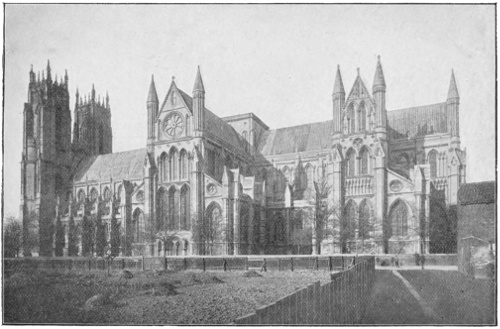
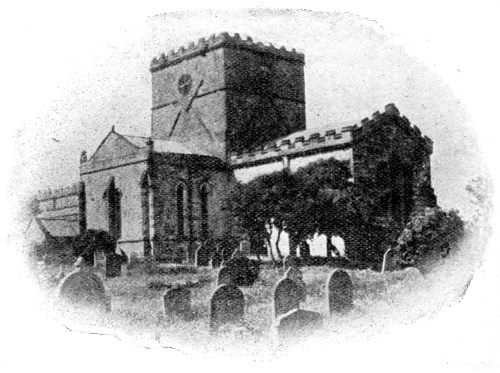
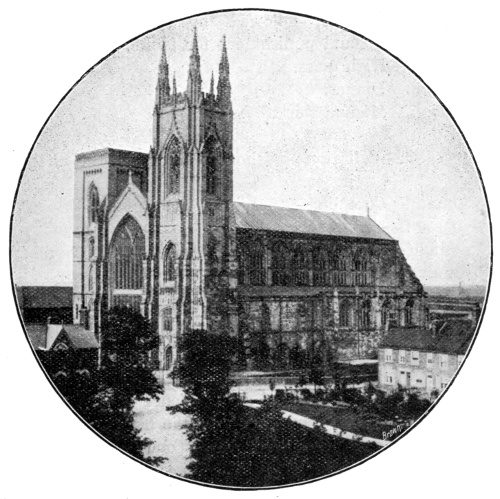
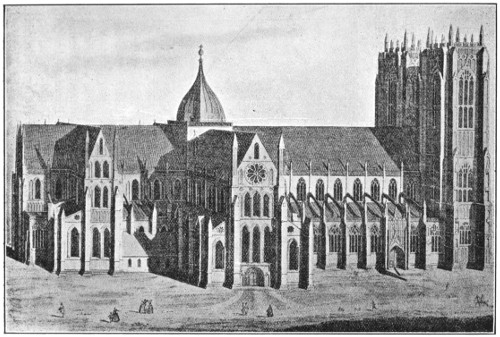
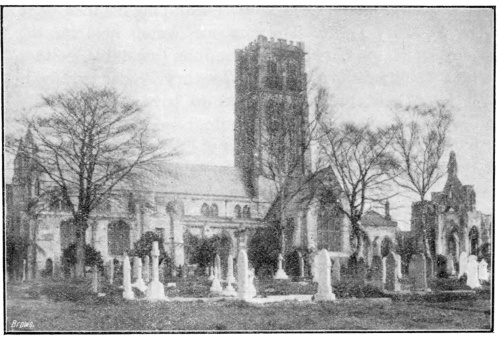
The Pride of the East Riding. Beverley Minster from the South-East.
BY
HORACE B. BROWNE, M.A.
WITH ONE HUNDRED AND SEVENTY
ILLUSTRATIONS
LONDON
A. BROWN & SONS, Ltd., 5 Farringdon Avenue, E.C.
And at HULL and YORK
1912
PRINTED AT BROWNS’ SAVILE PRESS,
SAVILE STREET AND GEORGE STREET, HULL.
TO THE
BOYS AND GIRLS
OF THE EAST RIDING OF YORKSHIRE,
IN THE HOPE THAT THE STORY OF THE LIVES OF THEIR
FOREFATHERS MAY INSPIRE THEM TO HELP IN
ROLLING ONWARDS THE WHEELS OF
PROGRESS THAT HAVE BEEN IN
MOTION EVER SINCE THE
FIRST LIVING BEING
CAME INTO
EXISTENCE.
ACKNOWLEDGMENTS
ix
The author wishes herein to acknowledge his indebtedness:—
(1) To the published works of local historians, and to the
publications of local learned societies, into all of which he
has delved, and from many of which he has ‘lifted’ such
local records as it served his purpose to use.
(2) To Mr. John Bickersteth, of the East Riding County
Council, for valuable help in the chapter on How the East
Riding Governs Itself, and in the general planning of the
book; to Mr. John Suddaby, for much information that
is embodied in Chapters XXIV.-XXVII.; to the Wardens
of the Hull Trinity House, and Mr. E. J. Heseltine
for extracts from the records of the Trinity House; to
Mr. J. H. Hirst, Hull City Architect, for the draft of the
illustration on p. 167; and to Mr. W. G. B. Page, for revising
the proofs of The East Riding Roll of Honour.
(3) To Col. Mark Sykes, M.P., Canon Grimston of
Stillingfleet, Alderman John Brown, Dr. J. Wright
Mason, Mrs. Watson, of Hedon, Mr. W. Morfitt of Atwick,
the Curator of the Hull Museums, and others, for permission
to take photographs of objects in their possession.
(4) To the Editor of the Transactions of the East Riding
Antiquarian Society, the Hull Scientific Club, and the Hull
Museum Publications, for the loan of several blocks; to
xProfessor Collingwood and the Editor of the ‘Yorkshire
Archæological Journal’ for the loan of blocks for the illustrations
on pp. 55, 63, 64; to Mr. T. A. J. Waddington of
York, and the Editor of the ‘Port of Hull Annual’ for that
of the blocks used on pp. 236 and 248; and to the Head-Masters
and Head Mistresses of the East Riding Schools
for that of the blocks used in Chapter XXX.
(5) To his friend, Mr. E. Haworth Earle, and to his
colleagues, Mr. C. Bazell and Mr. J. V. Pugh, for reading
the proofs of the entire book and correcting many errors that
would otherwise have escaped detection.
(6) To his friend and old pupil, Mr. C. W. Mason, for the
great amount of time and care which he has bestowed upon
the taking of special photographs.
(7) To the Publishers of the book, who have placed in
his hands every possible facility for enriching its pages with
whatever illustrations they thought would prove of interest,
and who have thereby produced a book which it is hoped
will reach the high-water mark of excellence in artistic
production.
That an English county which is nearly as large as the
ancient kingdom of Wales should become divided into
separate portions for the purposes of local government is
only what one would expect. But it is not obvious why
the number of these portions should be three, and there is
even an air of mystery about the name given to them.
‘North Riding,’ ‘West Riding,’ ‘East Riding’—what is
this word ‘Riding’?
For the answer to this question we must go back many
centuries, to the time of the hardy Norsemen who, as we
shall see, settled in such large numbers in Yorkshire and
Lincolnshire. It was common among the Norsemen of old
to divide lands into three portions for the purposes of
government, and their name for each portion was thrithjungr.[1]
This mysterious word means in our tongue ‘a third part,’
and from it arose the English word Thriding as companion
to feorthing, another word which we use to-day in a very
slightly altered form. But the difficulty of pronouncing
distinctly and easily the combination ‘North Thriding’ is
2evident, and the troublesome word suffered the same fate
as commonly then befell the troublesome man—it got,
quite naturally, beheaded.
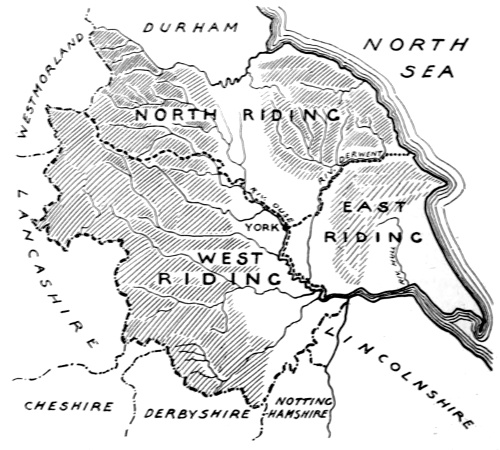
The Three Ridings of Yorkshire.
A glance at the small map on this page will show how the
county of Yorkshire is divided. By no means are the three
Ridings equal in area, the East Riding being far the smallest.
In order of size they stand as follows:—
West Riding
2,766
square miles.
North Riding
2,128
" "
East Riding
1,172
" "
—-—-—-—-—-—-—
6,066
square miles.
3The map shows another point of contrast between the
three Ridings. Whereas the West and North Ridings have
numerous ranges of hills and correspondingly numerous
water-channels, the East Riding is, with the exception of its
northern extremity, an eastward extension of the ‘Vale
of York’ and very nearly as flat as the proverbial pancake.
Its only rivers are the Hull and the Derwent, and the latter
for more than half its course forms the boundary of the
Riding.
An uninteresting part of the county it looks to be, does
it not? But, nevertheless, it has an interesting history
behind it, and men and women have been born and bred
in it—men and women who have helped to make our country
what it is to-day. Who they have been, how they have
lived, and what they have done in the ages before we ourselves
were born, it is the purpose of the following pages to
show.
II. HOW THE EAST RIDING WAS MADE.
Stand on the very highest point of the white limestone
cliffs that stretch northwards from Flamborough Head, and
realise that you are standing on what was once the bed of the
sea.
Strange though this be, it is nevertheless true. Countless
ages ago what now towers up 450 feet above sea-level had
over it the ceaseless rolling of the waters of the ocean, and
during countless ages it was slowly formed out of the shells
and teeth and bones of the creatures that lived in these
waters.
Men who know tell us that the layer of chalk at
the bottom of the ocean to-day is composed principally
4of the remains of creatures so minute as to be visible only
by the aid of a microscope, and that this layer grows in
thickness at the rate of not more than one-tenth of an inch
per year. They tell us also that the layer of chalk which
extends under our county is not less than 1200 feet in
thickness, and thus a simple calculation will help us to form
some idea of the extent of time necessary for its formation.
But however long this time actually was, it came to an end
with a tremendous upheaval of a portion of the ocean bed,
and the formation of a new area of ‘dry land.’
All the coast line of the East Riding, however, does not
consist of chalk cliffs. North of Bempton and Speeton lie
cliffs of sandstone and clay, which have yielded the fossil
remains of living beings that once inhabited the water and
the shore. Such are the belemnites and ammonites—the
‘thunderbolts’ and ‘St. Hilda’s snakes’ we may have
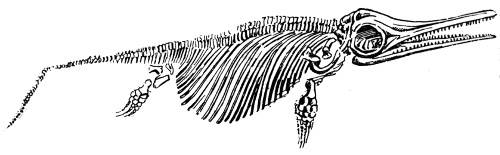
heard them called—and the Ichthyosaurus, whose skeleton
was recently discovered embedded in the clay cliffs at
Speeton and may now be seen in the Hull Museum. Not
a very handsome gentleman in the flesh he must have
been, unless appearances are deceptive.
One of the First Inhabitants of the East Riding. Actual length about twelve feet.
Again, walk southwards from Flamborough Head, and
the chalk cliffs are found to get less and less in height until
5they disappear altogether, and their place is taken by cliffs
of clay. Then these disappear, and are succeeded by the
long, flat bank of sand and shingle which is known as Spurn
Point; and if we round this point and follow the river bank,
we find it nothing but mud and clay until we get past
the mouth of the river Hull. At Hessle the chalk cliffs
break out once more, and we know, from investigations, that
the bed of chalk comes to the surface completely westwards
of a line drawn from Flamborough to this point.
Draw on a map of the East Riding a line from Sewerby,
through Driffield and Beverley, to Hessle, and you are
drawing the line of the old sea-beach when the upheaval
previously mentioned had taken place. This was the shore
of a land inhabited by races of animals now found living
only in tropical regions. The elephant, rhinoceros, hippopotamus
and hyena ranged the land for food, and bones
of these creatures have been found in considerable numbers
in the caves that exist at Kirkdale in the North Riding.
Then came a great change. The climate of Northern
Europe became colder and colder till there prevailed what
scientists call the ‘Great Ice Age.’ This was the time of
formation of huge glaciers which spread from the mountains
of Scandinavia, Scotland, and north-west England southwards
and eastwards into the sea, until they met and made
its whole area a slowly moving mass of ice. With the ice
were carried sand, gravel, clay, boulders torn from
projecting rocks, and bones of Arctic animals, such as the
walrus, the reindeer, and the Irish elk; and as the ice
gradually melted, all these were deposited at the base of the
line of chalk cliffs, or even on the summit of the cliffs
where these were low. From the gravel pits at Burstwick
excavations of ballast for the embankments of the North
Eastern Railway brought to light animal bones in such
6quantities that many tons were sold to chemical manure
manufacturers, and it is probable that many tons still
remain undiscovered.
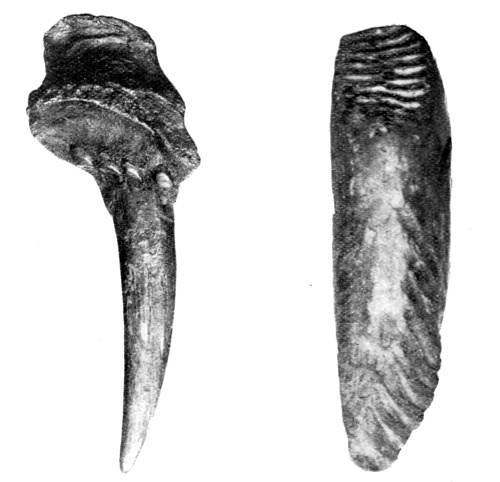
Photo by]
Relics of the Ice Age.
[C. W. Mason
A walrus tusk from Kelsey Hill and the tooth of a mammoth
from the cliffs at Atwick.[2]
In this way was formed the ‘great mass of gravel, clay,
and sand ... east of the Yorkshire Wolds’ which we know
as the Plain of Holderness. Here is what one of our foremost
local geologists has to say of its beginnings:—
‘Let us imagine the probable appearance of East Yorkshire
on the final melting of the ice. Huge fans or sheets
of gravel occur at Bridlington and other places as a result
7of the floods. Rounded hillocks of gravel and clay stand
out in all directions; the hollows in between are filled with
water, forming miniature lakes or meres. Of animal or
plant life there is little or none. The climate gradually
becomes milder; at first Arctic plants and animals exist
in small numbers. Later, the margins of the meres become
clothed in vegetation; peat is eventually formed, and huge
trees of Oak and Fir thrive. The Red Deer, Beaver, Short-horned
Ox, Otter, and Wild Horse, haunt the woods, and
finally primitive man makes his appearance.’
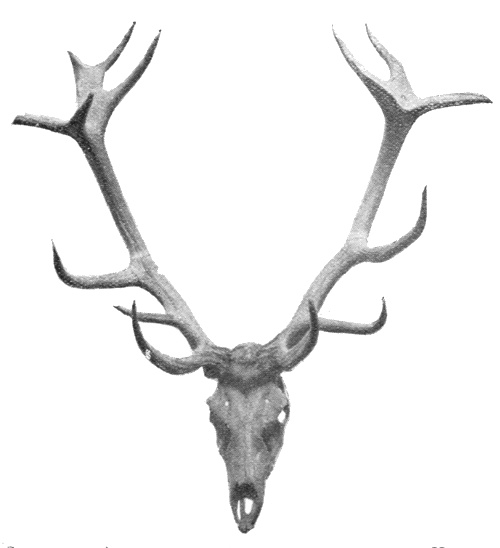
Skull and Antlers of a Red Deer found in the Hornsea Peat-bed.
III. MEN OF THE STONE AGE.
8
What sort of man was it who first inhabited Holderness
and how did he live? Artists in his day were few and far
between, and the few who did exist in Europe gave pleasure
to themselves and to their companions by drawing portraits
of reindeer and horses on pieces of bone. To draw portraits
of their fellows was probably the last thing they would think
of doing. Reindeer and horses are graceful creatures, but
the artists’ fellows were anything but graceful.
As far as we know, the first inhabitants of Holderness
were a race of short, dark-haired men, who
depended for their food and clothing on the animals of the
forest and the mere, who pursued their prey and fought one
another with weapons of stone, and who lived in dwellings
built on piles driven into the bed of a lake in exactly the
same way as the New Guinea islanders live to-day.
Something definite about their dwelling-places we know;
for what is appropriately called a lake-dwelling was discovered
thirty years ago at Ulrome. This was a structure
made of tree trunks laid side by side and held together by
piles driven into the bed of what was then a large mere.
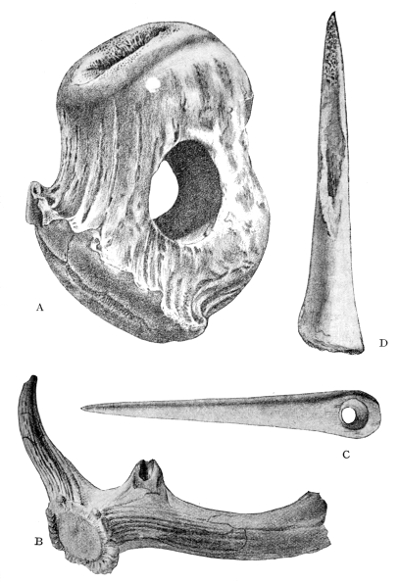
Bone Implements and Weapons from Barrows on the Wolds.
A, B.
Hammer head and pick made from the shed antlers of a red deer (1/1, 1/4).
C.
Bodkin or needle (1/1).
D.
Dagger made from a man’s thigh-bone (1/3).
On this rough sort of platform, which measured
90 feet by 60 feet, dwelling-places had been constructed, and
a ‘popular watering-place’ it must have been; for there
was evidence that it had been built in the first place by a
race of people whose tools were of flint and bone, and that
this race had been ousted many years later by another more
advanced race who had weapons and tools of bronze. That
the dwellers here were mighty hunters and mighty eaters
was proved by enormous accumulations of animal bones
10under and around the platform. That they were also
cannibals is likely from the presence of human bones among
this refuse.
So much for the ‘lake-dwellers’ of Ulrome. Up on the
Wolds there were men living a somewhat different life.
These hunted and ate the same kinds of creatures, and they
used the same kinds of weapons, but their dwellings were
dug out of the soil—shallow circular or elliptical pits each
covered over with a conical roof of branches and turf,
supported on a central post; or deeper troughs covered over
with sods and scrub laid on slabs of chalk, so that the roof
was level with the surrounding earth and indistinguishable
from it.
Of the former kind of pit-dwelling an example has been
discovered in the hollow known as Garton Slack, the pit
measuring rather less than 9 feet by 6 feet in length and
breadth, and 5 feet in depth; while one of the latter kind
has come to light under Kemp Howe, a few miles north of
Driffield.[3] The underground chamber here measured 25 feet
by 4½ feet, had a depth of 6 feet at its deeper end, and was
approached by a sloping passage 11 feet in length, the
entrance to which would doubtless be hidden with scrub.
The roof had been supported on six upright posts, and for
twelve feet along one side of the chamber ran a stone ledge—this
last being evidently a luxury.
It is probable that these two kinds of dwellings may have
been respectively the summer and winter houses of the
same people. For the Roman historian Tacitus says of the
ancient tribes on the other side of the North Sea:—
11Besides their ordinary habitations, they have a
number of subterranean caves, dug by their own labour
and carefully covered over with soil, in winter their
retreat from cold and the repository for their corn.
In these recesses they not only find a shelter from the
rigour of the seasons, but in times of foreign invasions
their effects are safely concealed.
Of the men who lived on the Yorkshire Wolds we know
a great deal; for it was their custom to raise over the burial
places of their chiefs circular mounds of earth, some still
very large, others now only a foot or two high. The relative
size of a burial mound, which we speak of either by the
Latin name tumulus or by the English names barrow and
howe, marks the importance of the chieftain whose body
or ashes once lay under it.
These tumuli, or barrows, are very plentifully strewn over
the Yorkshire Wolds, and for more than fifty years the late
Mr. J. R. Mortimer, of Driffield, devoted all his leisure time
to their excavation. The results of his labours are to be
seen in his private museum—the Mortimer Museum—and
details of his ‘finds’ are recorded in his large book on the
Burial Mounds of East Yorkshire, some of the illustrations
in which are here reproduced.
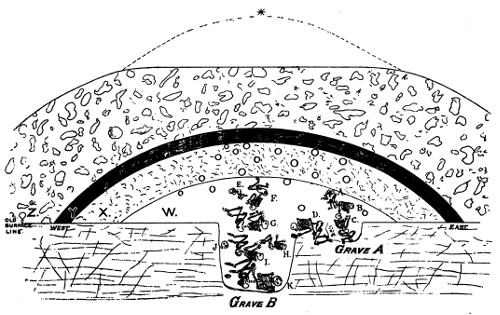
A general idea of how a barrow has been constructed,
and of what it may contain, can be gained from the
illustration on the next page.
Howe Hill, Duggleby, is one of the larger barrows, built
on a sloping hillside, and having at its base a diameter of
125 feet and at its flattened top one of 47 feet.
Section of Howe Hill, Duggleby.
A-K. Skeletons in position as buried.
O. Cremated remains.
Y. Band of blue clay impervious to water.
W. Inner mound of clay.
Z. Outer mound of chalk.
X. Bed of chalk grit.
* Probable summit of the barrow when built.
From the diagram we see that the bodies first
interred have been placed at the bottom of a cavity dug out
of the solid chalk. This hole not proving large enough
for the numbers to be buried, an extension has been
12begun, but not finished. Time was evidently pressing, for
some bodies have been buried above the surface of the
13ground. They have been placed in different positions, but
the legs of all have been bent at the knees and all are enclosed
in a low mound of clay. Above this lie the remains of
numerous other bodies, which have been burnt before
burial; and over them comes a twelve-inch layer of a blue
clay which is impervious to water. Then a large
mound of soil and pieces of chalk has been raised over
all, the mound being originally much higher than it is
to-day.
Such has been the building of Howe Hill. But it must not
be thought that all barrows contain the remains of a large
number of bodies. Most contain one only, and the body
has either been buried as it was when life left it or been burnt
and the calcined bones gathered up in an earthenware
vessel, or pinned in a skin garment. The eight full-grown
skeletons discovered under Howe Hill are those of men, and
we may suppose that they represent a chieftain and his
relatives killed in the onslaught by a hostile clan. The
cremated bodies, forty of which were discovered in the
digging of a trench through the barrow, would be those of
his dependants, who died fighting in defence of their lord
and master.
But the barrow contains evidence of the lives of the
people of the time as well as of their deaths. Scattered
through the soil under the band of blue clay were
found many broken bones of the ox, roebuck, red
deer, fox, goat, and pig, the remains of the burial feast;
and among these were human bones which had quite evidently
been broken and cooked. It is horrible to think of
the people of our East Riding as having once been cannibals,
but the evidence to that effect is indisputable.
Here and there were also found portions of the weapons
with which the defenders of the settlement had fought—the
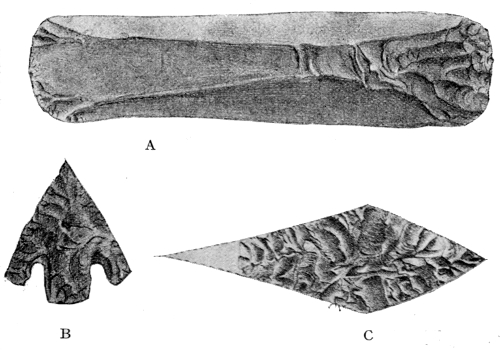
14hammer head shown on page 9, made from the shed
antler of a red deer, and the broken javelin head of flint
shown on page 15. In this barrow was also found the
wonderfully made flint knife represented below—an implement
fashioned out of a piece of flint with no other tools
than such as are mentioned below, and yet fashioned so
delicately that its greatest thickness is only one-sixteenth
of an inch.
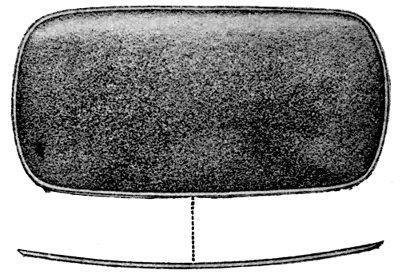
Polished Flint Knife found in Duggleby Howe (1/1).
A clever workman he must have been who made this
wonderful knife. But such beautifully wrought implements
are very rare. Only one similar knife—found in a barrow
at Aldro—was known to its discoverer, and he had himself
superintended the excavation of no fewer than two hundred
and eighty-eight barrows.
The weapons and tools which have been buried with their
owners are more commonly of the rougher types figured on
the opposite page. They include knives, chisels, spear heads,
saws, and arrow heads, all made from flints by the processes
of chipping and flaking, with hammer heads, picks, needles
and daggers of bone.
15Compare the figures A and B given on page 9
with the illustration of the antlers of a red deer on page 7,
and see how cleverly the hammer head and the pick have
been fashioned. Equally clever has been the adaptation
of a bone in the making of the very primitive dagger figured
at D on the same page. But in this case it has been not the
antler of a red deer that has been brought into use, but the
thigh-bone of a man.
Flint Implement and Weapons.
A. Chisel from Aldro (1/1). B. Barbed arrow head from Grimston (1/1) C. Javelin head from Duggleby Howe (1/1).
So far we have spoken of weapons and implements of
bone and of flint. Others were then in use made of whinstone
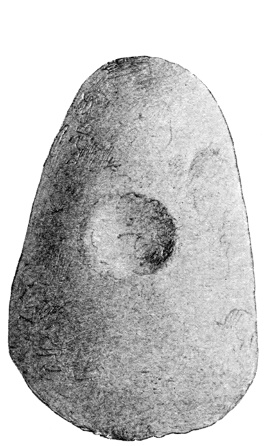
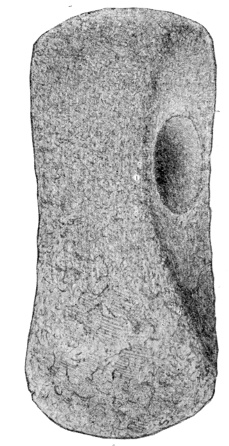
and greenstone, such as the axe heads figured overleaf.
Notice the different arrangement of the cutting
edge in these two implements, and notice also that in the
first one the hole intended for the insertion of a wooden
16handle has, for some reason or other, not been finished.
Perhaps the maker was killed before he had time to finish
it, or perhaps he grew tired of his work and threw it away.
At any rate this unfinished adze head was found loose on the
surface of the ground, and not buried under a howe as
was the other.
Unfinished Stone Adze Head picked up on Acklam Wold (1/1).
Whinstone Axe Head from a Barrow on Calais Wold (2/3).
Weapons and implements of stone! May we not justly
call their makers Men of the Stone Age? They lived
before man knew how to dig metals from the earth, and how,
having obtained them, to melt and mould them to his wish.
17But besides these weapons which have lain buried with
their owners for some thousands of years, there are yielded
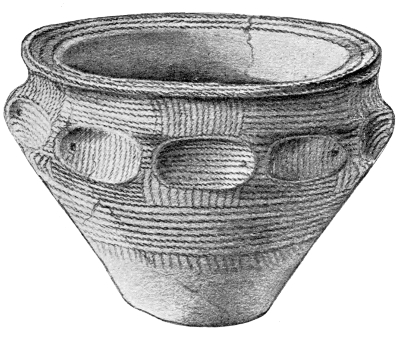
up by the barrows earthenware vessels of different sizes and
shapes. Some, like that shown below, are wide-mouthed
and have a thick rim; others are narrower, and their
rim is not thickened. Then others have an overhanging
rim; and others, again, are small, only an inch or two in
height, and have from two to six holes perforated in their
sides. All are marked with simple patterns, made by
pressing the pointed end of a stick or the thumb-nail into
the moist clay, or by pressing round it a twisted thong of
hide. There has been no glazing and no attempt to make
use of artificial colour.
Food Vessel from a Barrow on Acklam Wold (1/2).
Each of these vessels has had its particular use. The
18first-named vessels, which are by far the most common, are
always found to be stained with some decomposed matter
on the inside of the bottom, and their use has undoubtedly
been as food vessels. So also we may consider the second
group to be drinking vessels. The food and drink which
these two contained when they were buried have been
intended for their owners in the new life to come, when
food and drink would be again required. The vessels of
the third kind are always found to contain remains of a
body which has been cremated before burial—hence their
name cinerary urns—and the last-named and smallest,
which are found with them, have probably been used to
hold the precious spark of fire which lit the funeral pyre.
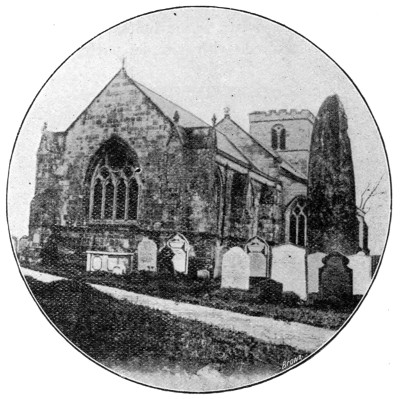
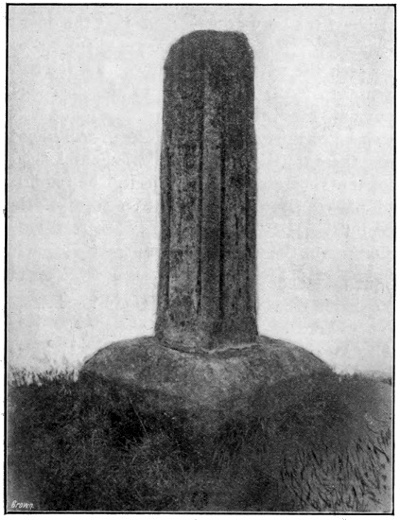
The Rudston Monolith
19Let us leave these howes and barrows and examine another
example of the work of the Men of the Stone Age. Close
to the wall of the village church at Rudston stands a huge
upright stone, or monolith. Twenty-five feet is its height
above the ground, and sixteen feet its girth, while
it is said to be embedded in the ground as deep as it is
high above the surface. Its weight is estimated as not far
short of forty tons. What is it doing in a village churchyard,
and who put it there? When and how was it placed where
it now stands?
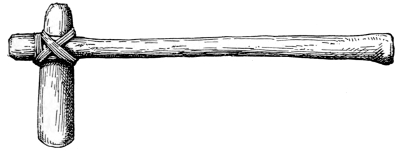
The earliest kind of Axe used in East Yorkshire.
It is impossible to give any definite answers to these
questions. A century ago, however, the village people
answered them all very easily. The Devil, they said,
objected to the building of the church, and flung this
stone to destroy it before its completion. But his aim
was not so accurate as it was intended to be, and the missile
missed its mark. Asked for a proof of their wonderful
story, they would point to the stone itself. There it was for
everyone to see. What further proof could be needed?[4]
Whether we believe this legend or not, two things are
certain. First, that the stone is as old as the barrows in
the surrounding wolds; secondly, that there is no rock
20of the same nature nearer to it than Filey Brig and the
Brimham Rocks. Was it brought down by the great ice
sheet and then erected by the men of the Stone Age to
serve some purpose in their heathen rites, or did they bring
it up from Filey or down from the hills of the North Riding
on wooden rollers? Perhaps it is not more difficult to
conceive of their doing this than of their raising such a huge
barrow as that which stands unopened at the foot of Garrowby
Hill—a mound 250 feet in diameter at its base and 50 feet
in height.
IV. MEN OF THE BRONZE AGE. — The Ancient Britons.
With the coming of Julius Caesar to Britain in the middle
of the first century before the birth of Christ, we reach the
time in the history of our country when definite facts about
its people begin to be recorded.
Thus we know from Caesar’s own writings that the Britons
lived in houses like those of the Gauls, that they had great
numbers of cattle, that they used copper coins, that many
of the inland tribes did not grow corn but lived on milk and
flesh and went clothed in skins, that in war time they dyed
their bodies with a blue stain to give them a more terrible
aspect, and that they wore long hair on their heads and
their upper lips.
So also, with regard to their religion, Caesar tells us
that their priests were called Druids; that if any crime had
been committed, or if there were any dispute about an
inheritance or a boundary, it was the Druids who gave judgment;
21that they had vast stores of learning, all of which
was committed to memory and none committed to writing;
and that their chief doctrine was that the soul of man did
not perish, but passed after death into another body, so
that no man should fear death.
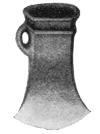
Bronze Celt or Axe Head found at Swine.
From these accounts we see that there had been great
progress made since the times described in the last chapter.
This was due to the migration westwards of a new race of
people—the Kelts—who had gained a knowledge of the use
of metal, and who, consequently, had weapons and implements
made of bronze instead of stone.
Their greater knowledge gave them greater
power, and the extinction of the men of
the Stone Age was only a question of time.
For not often was the bronze-weaponed
warrior slain by a weapon of stone.
But the account written by Julius Caesar
refers to the inhabitants of the southern
parts of our island. ‘Many of the inland
tribes do not grow corn, but live on milk
and flesh and go clothed in skins.’ This
passage may be taken as true of the tribes living north
of the Humber, known—so later Roman writers tell us—as
the Brigantes, the wildest and most savage of the
tribes inhabiting Britain.
Let us see what Mr. Mortimer’s discoveries have to tell
us of these Brigantes. The most interesting discovery, perhaps, was
that made in a barrow on Calais Wold, the highest
point of the Yorkshire Wolds, 807 feet above sea-level.
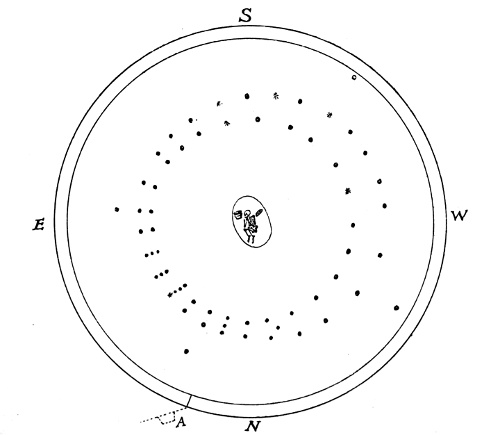
Here, on the mound being removed, a double row of stake-holes
was exposed in the surface of the ground. These were
from 3 to 15 inches in diameter, and were arranged in
circles having diameters of 21½ and 28 feet. Outside these
were four other stake-holes, and beyond these again a
22circular trench 100 feet in diameter, 3 feet 9 inches deep, 9
feet across at the top, and 1 foot across at the bottom.
Within the double circle of stake-holes was a cavity cut
in the chalk and containing a skeleton lying on its side,
with its knees bent.
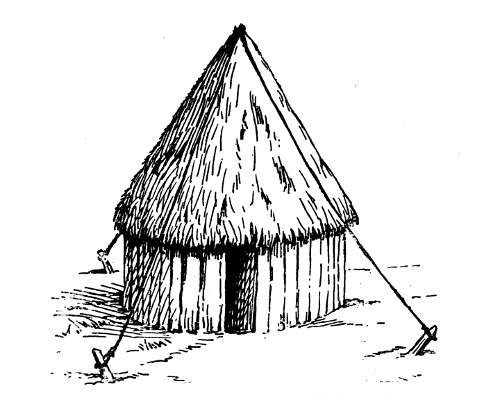
The plan on the opposite page shows the arrangement
exactly, and the drawing which accompanies it gives Mr.
Mortimer’s clever conjecture of the meaning of the stake-holes.
The space enclosed between the inner and outer walls
would be used, Mr. Mortimer thought, as a storage place
for food, skins, and weapons. It would also serve to keep
the inside living-room warm in winter.
Ideal Restoration of the Site of Burial.
Plan of a Barrow on Calais Wold, showing the Encircling Trench and Stake-holes.
‘We will bury our chieftain in his home, which no one
after him shall have power to defile.’ So, probably, thought
those who buried him. But, if so, time has played them
false; for men of a race undreamt of and speaking a tongue
of which he would understand hardly one word, have ruthlessly
laid bare his burial place, and have carted away his
bones to be measured with tape and pencil, and his skull
to have its brain cavity estimated with grains of millet
seed. What an insult added to injury!
A mighty chieftain he had doubtless been, and it must
be his favourite weapon that lies buried with him, so placed
that he should be buried as he slept—grasping its handle
firmly in his right hand. One wonders how many of his
enemies’ skulls that weapon of his had beaten in before its
master ceased to use it. Perhaps it had been wielded against
the Roman legions brought north of the Humber by Ostorius
Scapula in A.D. 50. Who knows? If you would see the
head of the weapon you must go to the museum at Driffield;
its likeness you will find on page 16.
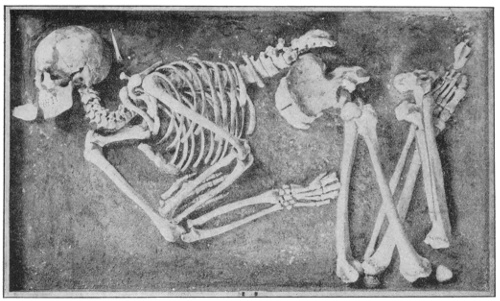
The Brigantes buried their dead chiefs just as the earlier
tribes had done, and the photograph on page 25 shows very
clearly the curious way in which the legs were doubled and
24the head bent back. This skeleton was obtained from a
barrow in Garton Slack, and here is what its discoverer
says of the pains taken to obtain it:—
‘Being desirous of possessing this skeleton in its entirety,
we obtained a quantity of stiff, mortar-like material, scraped
from the adjoining high road, with which we covered the
remains, in order to keep all the bones in position. We then
passed three broad pieces of sheet iron under it without
displacing any of the bones. The remains were then lifted
on a prepared board, and conveyed to Fimber. After being
carefully cleaned, the skeleton was mounted in a glass case,
and now, with its relics, and part of the ground on which it
was found, forms a highly interesting relic in the museum
at Driffield.’
The skeleton is that of a woman, and with it, you will
notice, are two objects. There is no need to say what has
been the use of the bone ornament lying behind the head,
but the use of the flint implement placed before the jaw
is not so obvious. This is one of a class of implements
known to us as scrapers—roughly chipped pieces of flint
used by the women of a household in scraping the insides
of animal skins when preparing them for human wear, and
in scraping the roots that went into the ‘stock-pot’ with
the flesh of the animals that provided also garments and
beds for the household.
How a British Chieftain’s Wife was buried in Garton Slack.
Photo by]
[C.W. Mason
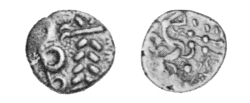
British Gold Coin.
Found at Atwick by Mr. W. Morfitt (1/1).
In neither of these two barrows
was there any sign of a bronze
implement. Weapons and implements
of bronze are rare among
those found in the barrows of East
Yorkshire, and the few discovered
are dagger or knife heads and
prickers. The Brigantes were far
behind the Britons of the south in their knowledge of the use
26of metal; and at the time when the latter were making
use of bronze, the wild and savage tribes of the north were
content still to make use of greenstone and flint.
Personal ornaments, too, are rare, and were found
accompanying only fifty-seven out of eight hundred and
ninety-three burials that Mr. Mortimer excavated. They
include dress-fastenings, such as rings and links of jet,
and buttons of amber, jet and bone. With only one
British interment was gold found, and of silver ornaments
none were discovered at all.
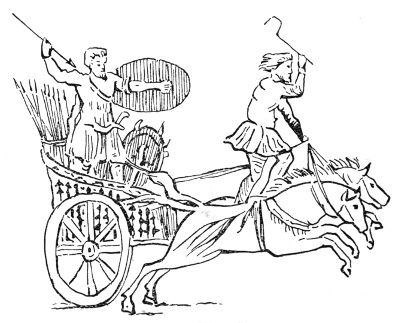
A British War Chariot.
Especially interesting to a Yorkshireman are the
discoveries of what are called ‘chariot burials.’ The
Britons were renowned for their war-chariots, of which the
chieftain Caswallon is recorded to have had 4000 when
he fought against Julius Caesar. To the Briton himself
27his chariot was known as an essa, a word which his Roman
conquerors latinised as essedum. An essedum was drawn
by two horses, and driven by a charioteer who was very
expert at running out along the pole between the horses.
The essedarii, or charioteers, were held in high esteem among
the tribal armies, and when they happened to be captured
by the Roman soldiers were great favourites among the
spectators of the gladiatorial shows.
On the death of a British chieftain who was a renowned
chariot warrior, it was the custom for him to be buried in his
chariot together with his horses and their trappings; and
the East Riding has given more evidence of this custom than
any other part of our country of equal area. The ‘Yorkshireman’
even then, it seems, loved a horse.
Remains of British chariot burials have been discovered
at Hesselskew and Arras, near Market Weighton; at Beverley
Westwood; at Danes’ Graves; and, most recently, at Hunmanby.
In all these instances there have been interred
two horses standing in their harness, and in the barrow
opened at Danes’ Graves in 1897 there were two human
skeletons, proving that in this case the charioteer, as well
as his chieftain, was buried.
Of course in all these interments the remains of the
chariots themselves have been small, little existing but
fragments of the bronze naves and iron rims of the wheels,
and of the bridle bits of the horses. But these have been
sufficient to show that the diameter of the wheels varied
from 2 feet 8 inches to 2 feet 11 inches, and that the horses
themselves were of a much smaller breed than those of
to-day.
With three, at least, of these chariot burials, were
also found remains of an iron mirror, a thing not found elsewhere.
We are accustomed in these days of motor-cars
to make use of mirrors for a knowledge of what is happening
28on the road behind the driver, and these remains point to a
similar practice among the charioteers of the Brigantes.
Really we are not, perhaps, so far advanced in the twentieth
century as we thought we were.
Photo by]
Earthworks at Skipsea Brough.
[C.W. Mason
Further evidence of the Brigantes in the East Riding
is to be seen in the wonderful series of entrenchments that
are so noticeable in the Wold districts. Dikes, double
dikes, and treble dikes once covered the whole of the Wolds,
says Mr. Mortimer; in fact, in the area of 75 square miles
which he explored there are 80 miles of earthworks existing
to-day. These consist sometimes of one ditch and one
rampart only, but commonly of three ditches and four
ramparts; and in one case, in the neighbourhood of Huggate,
the entrenchment consists of a series of six parallel ditches
and seven ramparts.
By far the most remarkable of these ancient entrenchments
is the so-called ‘Danes’ Dyke,’ which, 2½ miles in
length, cut off the rocky promontory of Flamborough Head,
29and converted it into an impregnable fortress 5 square miles
in area. In making it, advantage was taken of a natural
ravine—a relic of the Ice Age—which ran down to the south;
but in its northern portion, where the ground was naturally
level, a huge ditch roughly 60 feet wide and 20 feet deep
was dug, the soil from this being thrown up to form a dyke
or rampart on its eastern face.
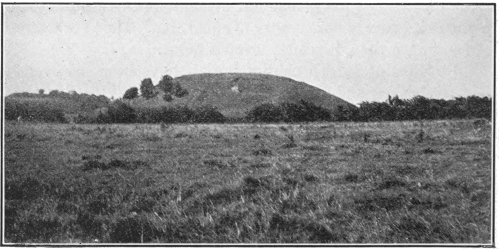
At Skipsea Brough, near Hornsea, may be seen other
British earthworks, consisting of a central mound 70 feet
high, having a flat top one acre in extent, and covering
altogether an area of 5 acres, together with a series of
entrenchments forming the segment of a circle. The outer
rampart is half a mile in length. Other much smaller
earthworks exist at the ‘Castle Hill,’ Sutton, and the
‘Giant’s Hill,’ Swine.
V. MEN OF THE IRON AGE.
The Romans in East Yorkshire.
In the last chapter we saw that the later Britons had some
knowledge of iron, as well as of copper and tin. But with
the Romans the use of iron was much more extensive, and
hence they may be called Men of the Iron Age.
The first Roman general to enter the territory of the
Brigantes was Ostorius Scapula, who came north in
A.D. 50. Twenty-eight years later came Julius Agricola,
who penetrated as far north as the rivers Forth and Clyde.
By Agricola the ancient British camp Caer Eburac—the
camp on the Ebura, or, by its modern name, the Ure—was
30made into a Roman walled city under the latinised
name Eburacum.
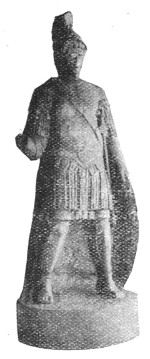
From this time Eburācum,[5] or
Eborācum as later Roman writers
spelt its name, became the proud
capital of Britain—altera Roma, a
second Rome in importance. Here
died the great Roman Emperor Severus
in A.D. 211, and here was born the
still greater Emperor Constantine,
under whose reign Christianity was
established in the Roman Empire.
Statue of a Roman Soldier in the York Museum.
For nearly three and a half centuries
the Roman armies ruled the land of
the Brigantes, during which time
great alterations were taking place in
the lives of its people. Northwards
came troop after troop of German
and Italian soldiers to subdue and
enslave the people of the land north of
the Humber, and to wage incessant war
against Rome’s enemies still farther
north. And southwards marched troop
after troop of the men of the Brigantes, on their way to
Gaul and Italy and Spain, there to serve as Roman soldiers.
In A.D. 117 came to Eboracum the famous Sixth Legion—Legio
Sixta, surnamed Victrix, the ‘All Conquering’—and
Eboracum was its headquarters thenceforth till A.D. 406,
when it was withdrawn to help in defending Rome against
the enemies mustering on her threshold.
For the constant movement of troops the Roman invaders
needed roads, and the military highways which they
31constructed across Britain remain foremost among the
evidences of their occupation of the country. The fact
that their roads have existed for so many centuries—centuries
of hard use but of constant neglect—is due to the
great care bestowed upon their construction.
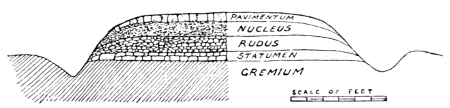
When a Roman road was made, the first thing done
was to mark out its course by the digging of two
parallel ditches. This course was from 15 to 21 feet wide,
and on it as the gremium, or foundation ground, was placed
a layer of large stones 5 inches deep. This, known as the
statumen, was followed by a fifteen-inch layer of broken
stones cemented with lime. The rudus thus formed
was succeeded by the nucleus, a similar layer 10½ inches
thick and constructed of small fragments of brick and
pottery. Last came the pavimentum, made of large
irregularly-shaped blocks of very hard stone fitted together
and cemented with lime so as to form a perfectly even surface.
The pavimentum was 5 inches thick, thus making a solid
road raised about 3 feet above the level of the surrounding
land.
Section of a Roman Military Highway.
Such was the usual method of construction of a Roman
highway. Where the natural surface of the ground passed
over was hard rock, the two lowest layers, or strata, were
dispensed with; but where no safe natural foundation
existed, the labour was increased by the driving of piles
into the soft ground to afford this.
Over hill and down dale were constructed these wonderful
32roads. No obstacle save an impenetrable marsh or an
unbridgeable river baulked the Roman engineer; and the
outward distinguishing mark between the Roman road
constructed sixteen centuries ago and its modern successor
is often the fact that whereas the latter goes round a hill,
and thus makes things easy for the traveller, the former
climbs in a straight line right over the summit.
What engineering skill the Romans must have possessed
to build their roads! Straight from one military station
to another miles distant over the hills did they succeed in
driving their road. How did they judge its direction so
accurately? We know not. And what immense labour
was needed for the construction of their roads! Think of
the cohorts of Roman soldiers engaged in building them,
and of the slave-gangs of Britons toiling under the lash of the
task-master as they quarried the materials for the use of the
soldiers working many miles away. So hard was the work
of the Roman soldiers in Britain, we read, that they ‘wished
for death to relieve them from their insupportable toil.’
But human life stood for little in those days. What
Roman engineer cared whether thousands of lives were
spent in the making of his road? His one concern was to
build it in such a way that for centuries to come the Roman
legions should be able to march, and the Imperial Post to
ride, along its hundreds of miles at the greatest possible
speed. One hundred and sixty-five English miles were
covered by Caesarius, a Roman magistrate, in the space of
one day on a journey from Antioch to Constantinople, the
whole distance of 665 miles taking less than six days. There
is little wonder that Rome had become ‘Mistress of the
World.’
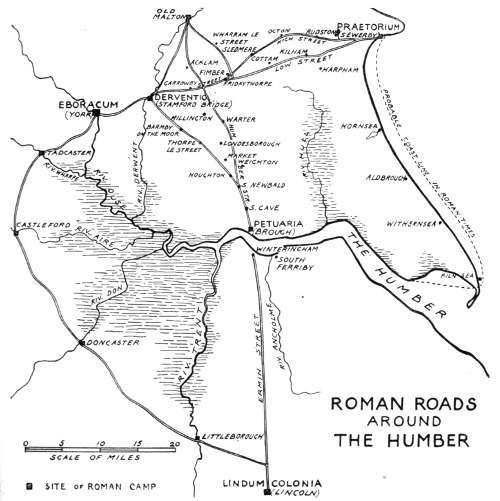
Let us now see what the Roman road-makers did in East
Yorkshire. Stretching north from Londinium ran the
33military highway known in later times as Ermin Street.
At Lindum Colonia this branched in two directions, both
branches meeting eventually at Eboracum. Skirting the
impassable marshes around the meeting-places of the Yorkshire
rivers and the Trent, one branch reached Eboracum
by bridges or fords across the Trent, the Don, the Aire, and
the Wharfe, where now stand Littleborough, Doncaster,
Castleford, and Tadcaster. The crossing-places were protected
by military stations which have since grown into these
towns.
But directly north from Lincoln the second branch
reached the Humber at Winteringham, whence the river
was crossed by ferry to Brough, where also was a military
station, named Petuaria. From Brough to York the road
passed through South Cave, South Newbald, Houghton
Woods, Thorpe le Street, Barmby Moor and Stamford
Bridge. Along this second branch would travel the Roman
Emperors and Generals, the Imperial Post, and the slave-carried
litters and chairs of the Roman aristocracy; round
by the former would march the foreign troops drafted to
Eboracum to replace the wastage in the Sixth Legion, and
the British levies on their way to fight and die in other
parts of the Roman world.
At South Newbald this Roman road branched to the
right, passing by Londesborough, Warter, Millington and
Acklam, to a camp at Old Malton. From Stamford Bridge
eastward ran another road by Garrowby, Fimber, Cottam
and Kilham to a Roman station on the cliffs at Sewerby.
Higher up on the Wolds ran an alternative route by Fridaythorpe,
Sledmere, Octon and Rudston. These two roads
are to-day known as the Low Street and the High
Street.
Smaller roads ran from Stamford Bridge to Old Malton,
and from the latter to Fimber and possibly farther south
34in the direction of Beverley. Round the coast from
Bridlington there was probably a road—long since
washed away—to a military station on the headland
which then existed about a mile to the east of the present
Kilnsea.
In North Lincolnshire Ermin Street is a typical Roman
military road, and for the greater part of its course it is
to-day the ‘king’s highway.’ But its northerly portion
has, since the establishing of the Ferry at New Holland,
been disused, and is now but a green lane, whose very
surface is lost to view as we approach the Humber.
When we enter the territory of the Brigantes the road
is not so distinguishable, and its course is in some parts
uncertain. But even then the name of ‘Street’ given by
the successors of the Romans to the Roman paved way—the
way made of strata—survives; and on the map of the
East Riding we shall find Garrowby Street, Humber Street,
Wharram le Street, and Thorpe le Street, each name being
significant of a Roman road. In some instances the
road itself has been uncovered, as in the building of
Drewton Bridge 60 years ago, and in building operations
at Londesborough Park, where it was found to be
24 feet wide, and to show plainly the marks of wheeled
carriages.
At many places in the East Riding have been discovered
evidences of Roman commerce and domestic life. Bronze
and silver coins buried in vases or boxes have been unearthed
at Cowlam, Warter, Nunburnholme, Skerne, Wetwang, and
Brough. At the first-named place more than 10,000 coins
had been buried in a large black vase, the finds at Warter
and Nunburnholme numbered about half that at Cowlam,
and the Copper Hall Farm at Skerne owes its name to a
similar find.
35So also Roman coins have been unearthed at Hornsea,
Aldborough, Withernsea and Hollym, on the line of a coast
road from Bridlington to Kilnsea, though the road itself
has long since been washed away.
ROMAN ROADS AROUND THE HUMBER
Of particular interest, as pointing to the fact that the
road leading southward to Brough was an export trade
route, is a ‘pig’ of lead weighing 9 stone 9 lbs. discovered
twenty years ago in a field adjoining the road at South Cave.
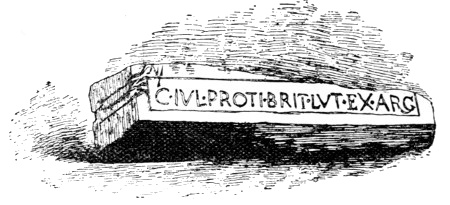
36This bears in raised letters an inscription, which, written in
uncontracted form as
CAII IVLII PROTI BRITANNICUM LVTVDAE EX
ARGENTO
would mean in our tongue [The lead] of Caius Julius Protus,
British [lead] from Lutuda, [prepared] from silver.
Roman Pig of Lead found at South Cave.]
The lead mines of Derby were famous in Roman times,
and much lead was exported from Britain to Italy; so we
may easily suppose that this particular pig was lost in transit
to the place of shipment.
As evidences of domestic life we have hypocausts, or
underground heating-chambers for the supply of hot air
and hot water to the rooms of Roman villas. These must
once have been numerous—for no wealthy Roman could
do without his warm bath—but so far only a few have been
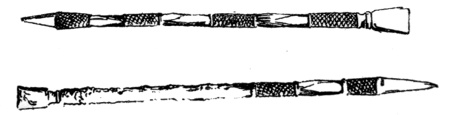
discovered. Again, we have examples of the Roman
writing-implements, styli by name, two of which, found at
Brough, are illustrated below.
Roman ‘Pens’ found at Brough.
37When a Roman wished to write, his implements were
very simple—a tablet of wax and a stylus. With the pointed
end of the latter he scratched his letters on the surface of the
wax; and if he made mistakes he had only to smooth them
out by using the other end, which was flattened for the
purpose. The Roman schoolboy probably found the stylus
a very convenient instrument.
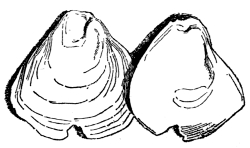
Relics of Roman Feasts found at Easington.
Humbler evidences of domestic life have been discovered
in the ‘kitchen middens,’ or refuse heaps, which the incursions
of the sea have
exposed at Easington
and Kilnsea. From
these have been obtained
numberless oyster
shells and fragments of
pottery, the relics of
dining-room feasts and
kitchen breakages. The
former are very interesting,
because they show the method by which the Roman
cook overcame the natural reluctance of the creatures
within them to ‘come out of their shells.’
How very curiously such discoveries of ancient relics
may be made is seen in the recent case of an inhabitant
of South Ferriby. A half-witted man, by name Thomas
Smith, but known locally by the more familiar name
‘Coin Tommy,’ made it his practice for several years to
walk along the shore of the river just after the periods of
high tide, and to pick up all metal objects which he happened
to see. Whether horse-shoe or brace-button did not matter
to ‘Coin Tommy.’ Into his pocket went everything of
metal which he found; and on his reaching home after each
of these expeditions, his ‘finds’ were transferred to a stock
38of tin canisters, and packed away on the shelves of his
cupboard never again to be looked at by their finder.
Now it was known by Coin Tommy’s associates that his
finds were not all horse-shoes and brace-buttons. But few
of his friends expected that after his death would-be purchasers
of these finds from distant parts of the country
would vie with one another for their possession. Yet so
it happened; for Coin Tommy’s miscellaneous collection included
no fewer than 3000 Roman coins of gold, silver and
bronze, and bronze brooches, finger-rings, bracelets, tweezers,
spoons, earpicks and styli innumerable.
The explanation of the occurrence of all these objects
along this portion of the south bank of the Humber is that
there had been at this spot a Roman cemetery, and that
changes in the currents of the Humber have caused each
high tide during the last few years to wash away some portion
of the bank, and thus bring to light treasures buried
sixteen centuries ago. And though South Ferriby is not in
East Yorkshire, Coin Tommy’s finds may fitly be mentioned
in the story of the East Riding; for it is probable that many
of the owners of the bracelets and brooches and finger rings
had lived at Petuaria, on the Yorkshire side of the river.
Very interesting are the fibulae, or brooches, here discovered.
Some have engraved upon them the name of their
39maker, AVCISSA, and one, having blue enamel let into the
bronze surface, is constructed in the form of a fish.
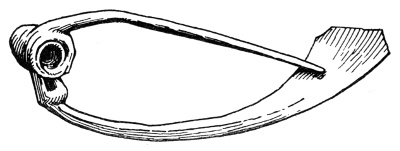
A ‘Safety Pin’ Sixteen Hundred Years Old.
This may be taken as evidence of its wearer’s being
a Christian, for in early days the fish was an emblem of
Christianity. In other cases the brooch is made of a single
piece of bronze wire, twisted to form a spiral spring, and
having one of its ends flattened out and bent over to form
40a catch for the pin—an illustration of the oft-quoted saying
‘There is nothing new under the sun’; for here is an exact
model of the safety-pin invented, or rather re-invented, in
the nineteenth century.
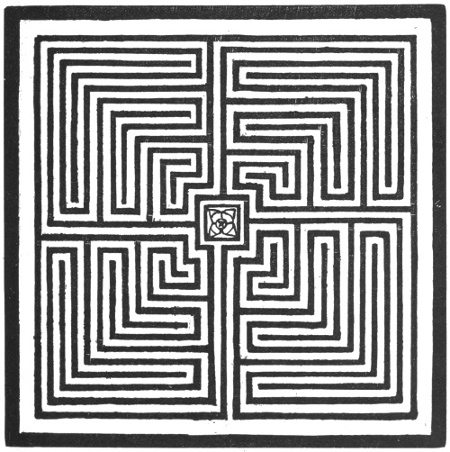
Design of the Pavement of a Roman Villa discovered at Harpham.
To come back to the East Riding, our last mention of
relics of Roman times shall be that of the mosaic pavement
which was discovered in a ploughed field at Harpham
in 1904. This pavement formed the floor of the atrium, or
square hall of a Roman villa, and was in use probably about
the year A.D. 300. It is constructed of small tessarae, or
cubes, of red sandstone and chalk, with a few others of
dark blue clay, red clay, and yellow limestone in the centre-piece
of the design, and makes an ingenious piece of work
in the form of a maze.
This Roman pavement has been removed to Hull
and reconstructed in the Hull museum. On it when
found lay the flat sandstone slabs which had once
formed the roof over it. Many iron nails with large flat
heads were also found, and in one instance the nail remained
fast in position through a hole in one of the slabs.
VI. OUR ANCESTORS.
From the time when Roman soldiers first penetrated
into the territory of the Brigantes, the land which we name
Holderness was troubled by the piratical attacks of a people
from the other side of the North Sea; and in the early years
of the second century the low-lying marshes of this district
were inhabited by a tribe whom the Romans called Parisii.
In our language they would be called Frisians.
41These early Frisian settlers have left us evidence of the
places they chose for settlement in the village names Arram,
Newsom, Hollym, and Ulrome. Their settlements would
probably be peaceful, for the lands taken would be unoccupied
pieces of ground rising just above the level of the
surrounding marsh.
But as time went on, the eastern and southern
shores of Britain were assailed by numerous other bands
of plunderers and would-be settlers; and in the later
Roman times we find that, beside the army stationed at
York under the command of the Duke of Britain to repel
the Picts and Scots of the north, there was an army under
the Count of the Saxon Shore whose duty it was to defend
against invaders the coast from the Wash to the shores
of Sussex.
Under Roman rule Britain as a whole prospered exceedingly.
Agriculture and commerce were extended, so that
we find the lead-merchants of Derby exporting lead to
Italy, the chalk-merchants of Tadcaster exporting chalk,
and the corn-merchants of the Rhine provinces importing
corn from Britain in large quantities.
But beside the export of lead and chalk and corn, another
export of trade was going on—the export of the warlike
youth of the country, who went to furnish with men the
Roman armies in Spain and Gaul and Germany. Those
left at home were forbidden by law to carry arms; so there
is small wonder that when the Roman legions were withdrawn
from Britain Roman towns were sacked and burnt,
and Roman civilisation blotted out by hostile invaders.
‘Tragedies can still be guessed at from heaps of ashes and
from skeletons of men, women and children found ... in
crouching attitudes in hypocausts and other places of
concealment; and the human bones frequently discovered
42at the bottoms of wells ... enable us to see the ruthless savage
removing the traces of a murderous raid.’
Petuaria, Praetorium, Derventio—all were sacked and
burnt by the hosts of Engle who sailed up the Humber
and the Derwent, or landed at Bridlington Bay. Roman
houses were generally one-storied buildings roofed with
tiles or thatch, and the destruction of a town by fire
would be complete. It was also, in most cases, lasting; for
the destroyers were men who cared not for a life passed
within walls and fortifications. ‘They liked better to
hear the lark sing than the mouse squeak.’ So the Roman
cities, towns and camps ‘remained in ruins, to be haunted
by the owl and the fox.’
But an exception was made by the invaders in the case
of the greatest of the Roman cities. Eboracum, Londinium
and Lindum Colonia became the chief centres of life for the
tribes that captured them; and thus the Eboracum of
the Romans became the Eoferwic[6] of the Angles—a
dwelling-place in the haunts of the wild boar. Smaller
towns were blotted out; and their sites are known to
us only by the finding of the family store of coins, or the
personal treasures once placed for safety in a little recess
in the wall or buried in a vase under the floor—to be
overwhelmed with debris, and to remain undiscovered for
many centuries.
The hostile tribes who invaded Britain during the fifth
and sixth centuries in such numbers as to conquer the whole
country from the Isle of Wight to the Firth of Forth, except
the mountainous districts of the west, were known as the
Engle, the Seaxe and the Iute.[7] Angles, Saxons and Jutes
these are to us. The Iute landed on the shores of, and
43established colonies in, Kent and the Isle of Wight, the
former of which developed into a kingdom; the Seaxe
established three kingdoms distinguished from one another
in name by the adjectives South, East, and West; and
separate bands of Engle formed the kingdoms of East
Anglia, Mercia, and Northumbria.
It is with the last-named of these ‘Seven Kingdoms’ that
we are most particularly concerned. The huge kingdom
of Northumbria stretched northwards from the Humber to
the Forth, and was at different times either ruled by one
king or divided into two separate kingdoms—Deira, from
the Humber to the Tees, and Bernicia, from the Tees to
the Forth.
How complete was the conquest of Britain by these invading
tribes is seen in the account written by Bede, the
eighth century monk of Jarrow:—
They burned and harried and slew from the sea on
the east to the sea on the west, and no one was able
to withstand them.... Many of the miserable survivors
were captured in waste places and stabbed in heaps.
Some because of hunger gave themselves into the hands
of their enemies, to be their slaves for ever in return for
food and clothing; some departed sorrowfully over the
sea; some remained fearfully in their native land, and
with heavy hearts lived a life of want in the forests and
waste places and on the high cliffs.
The completeness of the conquest may be seen also in the
fact that the language of the Britons was replaced by that of
the invaders. The Angles, Saxons and Jutes spoke a
language entirely different from the Keltic language of the
Britons; but except in the Highlands of Scotland, in Wales,
and in the Isle of Man—the parts to which the invaders
did not penetrate—the language spoken to-day is English44and the name of the country itself is Engla-land, the land
of the Engle.
Very definite evidence of the places chosen by the Angles
for settlement can be found on the map of the East Riding.
Where the head of the household decided to ‘pitch his
tent’ a piece of land was enclosed with a tūn,[8] or hedge, and
the dwelling erected within it became his new hām,[8] or
home. Such was the origin of our numerous towns and
villages whose names now end in the syllables ton and ham.
In many cases the name of the family is enshrined in the
name of the settlement. Thus the Locings—the sons of
Loc—the Essings, the Brantings, the Eoferings, and the
Hemings gave their names respectively to Lockington,
Easington, Brantingham, Everingham, and Hemingbrough.
Besides the endings ton and ham, others which tell of
Anglian settlements are worth and bald (a dwelling), cote
or coate (a mud cottage), stead (a place), brough or borough (a
fortified place), wick (a village), wold (woodland), field (a place
where trees have been felled), ley (an open place in a wood),
mere (a lake), fleet (the mouth of a river) and ford. Examples
of all these can be found on a map of the East Riding.
In their burial customs the Angles were little different
from the peoples whom they dispossessed. Like them they
often cremated the bodies of their dead, afterwards collecting
the charred bones and burying them in earthen vessels,
accompanied with the weapons or personal treasures which
were to be used again in the life to come. A man was buried
with his spear and shield, or with the long one-edged knife
whose name—seax—gave rise to the tribal name of the
Saxons; a woman with her knife, shears, bronze box containing
45thread and needles, and beads of glass and amber;
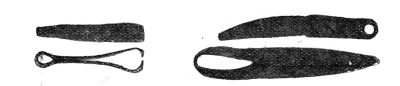
a child with his toys, such as the tiny tweezers, knife and
shears found with a child’s bones in a burial vase at Sancton.
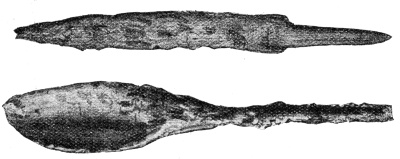
Iron Knife and Bronze Spoon from an Anglian Cemetery near Garton Gate House (1/2).
Not always, however, did the Angles cremate the bodies
of their dead. More often they buried them near the surface
of a British burial mound. From one of the mounds at
Driffield, known as ‘Cheesecake Hill,’ was taken a necklace
consisting of 219 beads, of which 141 were of amber, two of
glass, three of carefully cut crystal, and five of cowrie shells.
Child’s Toys found in a Burial Vase at Sancton.
Not very far from Garton Gatehouse, and near the
memorial to Sir Tatton Sykes some three miles farther
north, were accidentally discovered two Anglian cemeteries,
one of which contained more than sixty bodies of
men, women and children. Here all but a few had been
buried not with their limbs bent, as was the custom among
the Britons, but with their limbs stretched out at full length;
46and all but one had been buried with their heads to the
west. Probably these were Christian burials.
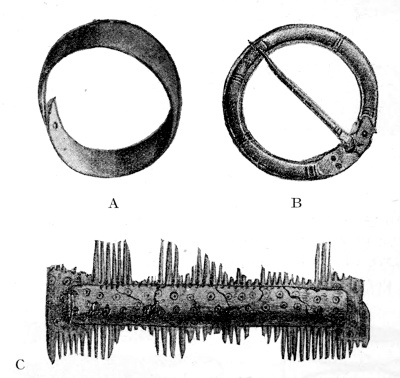
‘Finds’ in an Anglian Cemetery near Garton Gate House. A. Bronze ring (1/1). B. Silver brooch (1/1). C. Bone comb (1/2).
From this Anglian cemetery at Garton were obtained many
implements and personal ornaments—iron knives and bronze
spoons, bronze ankle-rings and buckles, necklaces of glass,
amber and amethyst, silver ear-rings, a gold button set with
a precious stone, and, luxury of luxuries, a bone comb.
What a great advance is thus shown to have taken place
in the centuries between the British burial at Garrowby
and the Anglian burials at Garton! With the former were
weapons of flint and bone; with the latter, implements of
bronze and iron, and personal ornaments of silver, gold, and
precious stones.
VII. HOW THE MEN OF THE NORTH BECAME CHRISTIANS.
47
During later Roman times the worship of God had been
introduced into Britain, and the discovery of the Roman
bronze brooch figured on page 38 shows that Christianity
had reached the shores of the Humber.
But the invaders who were to give a new name to the
country and to become our ancestors were heathens,
and chief among their gods was Woden. We of the
twentieth century still preserve, the names of Wōden, Tīw,
the god of war, and Frīg, the wife of Wōden, in our ‘Wednesday,’
‘Tuesday,’ and ‘Friday’—the Wodenesdaeg, Tiwesdaeg,
and Frigedaeg[9] of our Anglo-Saxon ancestors.
In the passage from Bede’s Ecclesiastical History of the
English People which was partly translated in the last
chapter, we are given an insight into the way in which the
heathen Angles and Saxons despoiled the worshipping-places
of the Christian Britons:—
Everywhere priests were slain and murdered by the
side of the altars. Bishops together with their people
were slain without mercy by fire and sword, and there
was none to give the rites of burial to those who were
so cruelly murdered.
Thus Britain became again a country entirely pagan,
and it was not until the closing years of the sixth century
48that Christian missionaries from Rome once more set foot
in it.
To understand the events leading up to the arrival of
these missionaries, we must bear in mind that among the
Angles and the Saxons slavery was a common custom. Social
ranks of life were very marked, and all men belonged to one
of three distinct classes. He who could trace back his
descent from the gods ranked as an eorl,[10] or man of noble
birth, and all others were divided into two classes—the free
and the unfree. A free man, who had the privilege of
owning land by virtue of his freedom, was known as a
ceorl[10]; but he who was, body and soul, the property of
another was called a theow,[10] or slave.
Slaves must have been very numerous in our country
during Saxon days; for wars were constantly being waged
between the different tribes, and prisoners of war naturally
became the slaves of their captors. So also, a man who had
fallen into debt and who could not release himself became the
theow of the man to whom he owed money; and when he
became a slave, his wife and children became slaves likewise,
and could be sold by his master. Worst of all, a free man had
the right to sell his own children into slavery until they
reached the age of seven.
Now it so happened that this horrible custom of selling
children as slaves was the direct cause of Christianity’s
being re-introduced into our country. A regular export
trade in English children was carried on, and about the
year 580 there were one day standing exposed for sale in the
market of Rome some boys of fair complexion and beautiful
hair. Along the market chanced to pass a monk, who was
struck with their light-coloured hair and blue eyes, so
different from the dark hair and brown eyes of the South
49European peoples. On his asking the slave-dealer from
what country they had been brought, he was told that they
came from Britain, and that the people of that island had
fair complexions. Unsatisfied with this information, he
asked of what race they were, and was told that they were
Angli.
‘Non Angli, sed Angeli,’ replied the monk. ‘For their
look is angelical, and it is meet that they should become joint
heirs with the angels in heaven.’
Then he sought further information concerning them.
‘What do you call the province from which the boys were
brought hither?’
‘Deira,’ was the reply given him.
‘Deira!’ said the monk; ‘that is well said. De ira
eruti—they shall be snatched from the wrath of God!’
Again he asked: ‘What is the name of their king?’
‘Their king is named Aelle.’
‘Alleluia!’ replied the monk, playing on the name of the
king. ‘It is most fit that the love of God our Creator be
sung in those parts.’
Fifteen years after this conversation took place in the
market of Rome, the monk had become famous as Pope
Gregory the First. Then, in fulfilment of the plans he had
formed for rescuing the Angli from the wrath of God, he
chose a monk named Augustine to make a journey to
Britain with some companions. Augustine, with his small
band, set out, but on reaching Gaul was so dismayed by the
reports of the savage character of the people to whom he was
bidden to go, that he turned back, and sought release from
the task which had been imposed upon him. This Gregory
refused, reminding him that ‘the more difficult the task,
the greater is the reward.’
Augustine once more set out, and landed at Ebbsfleet, in
the Isle of Thanet, in the Spring of the year 597. The king
50of Kent was then Aethelberht, who had married a Christian
princess, the daughter of the king of the Franks. Thus
the way had been made clear for the mission of Augustine,
and Kent soon became a Christian kingdom.
King Aelle of Northumbria died in 588, and thirteen
years later his son Edwin became king. Edwin had
married the daughter of Aethelberht of Kent, Aethelburga
by name, and with her there came to Eoferwic Paulinus, a
monk.
For long this monk was unable to persuade Edwin
to become a Christian; but in 626 there was called a meeting
of the king’s Witan, or ‘wise men,’ each of whom was asked
what he thought of the new doctrines then being preached
by Paulinus.[11] After Coifi,[12] the king’s high priest, had expressed
his opinion that the gods they worshipped had no
power, one of the king’s counsellors broke in with these
words:—
‘Thus it seems to me, O my king, that the life of man
on earth, in comparison with the life unknown to us,
is just as if you were sitting at table with your ealdormen
and thegns in wintertide—when the fire was
kindled and your hall made warm, while it rained and
snowed outside—and there came a sparrow and quickly
flew through the hall, coming in by one door and passing
out by the other. During the time that he is passing
through the hall he is safe from the winter’s storm, but
it is only for the twinkling of an eye, and in the shortest
space of time he passes from winter into winter.
‘So seems the life of man—it is ours for a little while,
but what goes before it and what follows after we
know not. Therefore if this teaching makes anything
clearer and more certain, it is meet that we follow it.’
51What an apt comparison—the life of a man is like the
brief flight of a sparrow through a pleasant room! Many
a time must those present when the words were spoken
have seen a bewildered sparrow fly swiftly through the
king’s hall, entering it to seek shelter from the storm without,
and leaving it to seek safety from the smoke of the fire
and the noise of men’s voices within. And what more
suitable illustration of man’s ignorance of the hereafter
could have been chosen? We can imagine its effect upon
Coifi, who, on hearing the words of the king’s counsellor,
exclaimed:—
‘I see clearly that what we have been worshipping
is but naught. For the more earnestly I have sought
the truth through our worship, the less I have found it.
Therefore, O king, I now advise that we speedily destroy
and burn with fire the altars which we hallowed without
receiving any benefit.’
Thus were King Edwin of Deira and his Witan converted
to the true religion, and the temple which contained the
heathen altars destroyed. Coifi himself sought permission
to be the first to cast down the idols it contained, and the
king granted him weapons and a horse for the purpose.
Riding to the temple, he first cast his spear against the
altar, and then called to his companions that they should
pull down the idols and burn them. ‘The place is yet
pointed out,’ wrote Bede one hundred years later, ‘not far
east from Eoferwic beyond the river Derwent, and is to-day
called Godmundingaham, where the high priest, through
the inspiration of the true God, cast down and destroyed
the altars which he himself had previously hallowed.’
‘Not far east from York, beyond the river Derwent’—such
was Bede’s description of the place of this memorable
deed. Godmundingaham, he says, was its new name,
52and Goodmanham it is in our own day. Tradition says
further that the present church, dedicated to All Saints,
stands on the exact site of the heathen temple which Coifi,
the heathen high priest, was the first to profane. But
whether tradition speaks true we have no means of knowing.knowing.
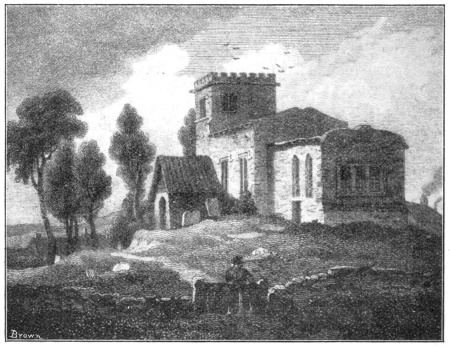
Goodmanham Church. (From an old Engraving).
The immediate results of the adoption of Christianity at
Goodmanham were the building of a wooden church
at York, and the baptism in it of King Edwin on Easter
Day 627. This wooden church, dedicated to St. Peter, was
shortly afterwards succeeded by a larger and loftier church
of stone, which, in its turn, was destined to be succeeded
by another yet larger and loftier—the Minster that we
count to-day as one of the glories of Northern England.
Six years later King Edwin was slain in battle against
53Penda, the heathen king of Mercia, and Cadwallon, a
British king, ‘more fierce and cruel than the heathen, for
he was a barbarian.’ The head of Edwin was taken to
York and buried in the stone church of St. Peter which
he had begun to build; and Paulinus, the first Archbishop
of York, fled by sea southwards to Kent with Edwin’s
widowed queen and their two children. Then for the
whole of an ‘unhappy and godless’ year Northumbria was
wasted by Cadwallon.
At the end of the year Edwin’s nephew Oswald, with an
army small but strengthened by belief in Christ, fought
against Cadwallon. Now Oswald was ‘a man dear to God,’
and before the battle he caused to be made a hastily-constructed
cross of wood, which was erected in a pit
dug in front of his army. With his own hands he set up
this cross and held it till his men had made it firm with
heaped-up soil. Then did Oswald call to him all his men
and gave them his command: ‘Let us all bend the knee
and together ask the almighty, living, and true God to
defend us with His mercy from this proud and cruel foe;
for He knows that we are justly fighting for the safety of our
people.’
This they all did; and in the fight which followed, Oswald
gained a complete victory, and Cadwallon was slain. The
place of Oswald’s victory was called ‘Heavenfield’; and,
says Bede, ‘many people to-day take chips and shavings
from the wood of that holy cross and put them in water,
and sprinkle the water on sick men and beasts, or give them
it to drink, and they are at once cured.’
With the accession of King Oswald Christianity returned
to the people of the north. This time, however, it was
brought not by the monks of Rome, but by British monks
from a monastery which had been established by Columba,
54an Irish saint, on the tiny island of Iona, lying off the west
coast of Scotland.
It was to this monastery that Oswald sent asking for
teachers for his people. In reply there was sent him a monk
of hard and stern nature, to whom the people would not
gladly listen; so that he was able to effect little, but returned
to Iona and reported that he could do nothing because the
people of Northumbria were unteachable. ‘Was it not,
brother,’ said one of his fellow monks, ‘you who were not
sufficiently patient and gentle with those untaught men?’
The question made all present turn to the speaker, and they
quickly decided that he was worthy to be sent as teacher
to their friend, King Oswald.
So came to Northumbria the saintly Aidan, whose success
in converting the heathen Angles was due chiefly to the fact
that as he taught so he himself lived. For, says Bede,
he in no way desired or sought after the things that
are of this world; but all the worldly goods that were
given him by kings or by rich men he gladly gave to the
poor and needy who came to him. Through all the
land he travelled, visiting towns and wayside villages,
and never on horseback, unless there were special
need, but always on foot. And wheresoever he came
and whomsoever he met, whether rich or poor, he
turned to them. If they were unbelievers, then he
invited them to believe in Christ; if they were believers
he strengthened them in their belief, and with word and
deed stirred them up to almsgiving and the performance
of good deeds.
By the labours of Aidan and his fellow monks the men
of the north again became Christians; and such earnest
Christians were they that they hallowed with the ‘Sign of
55the Cross’ the places at which they held their meetings
for the purposes of government.
A British burial mound was often found convenient for an
Anglian mōt, or meeting,—whence the name ‘Moot Hill’—and
its purpose was marked by a large trench in the form
of a cross cut through the mound down into the chalk.
The four arms of the trench were made roughly equal, and
always pointed north, south, east, and west. Cowlam Cross,
near which the village church was afterwards erected, is cut
seven feet deep in the solid chalk, and another similar cross
with arms twenty-one feet long has been discovered at
Helperthorpe.
Two Sides of an Anglian Cross Shaft at Leven.
Where no convenient mound existed, the place of meeting
was sometimes marked in the opposite way. Instead of
cutting a deep trench they raised at right angles two ridges
of earth and stones, entirely surrounded by a shallow ditch.
Such crosses have been named Embankment Crosses,
and eleven have been discovered within a radius of fifteen
56miles from Driffield. A favourite name for them among
the country folk is that of bield, or shelter, because they were
supposed to have been built up to serve as shelters for the
cattle. There is one near East Heslerton, known locally
as the ‘Old Bield,’ the arms of which measure 45 yards
each, north and south, and 50 yards east and west. Another
formerly existed near the site of the ancient village of Haywold.
Ploughing operations have caused this—and probably
many others—to be destroyed; but its name, ‘Christ Cross,’
is still preserved.
With the introduction of Christianity there took place
great development of the arts of peace in home and village
life. ‘The English forged the ploughshare rather than the
sword. They built weirs, and fished, and set up watermills
by the rivers. Boat-building, brewing, leather-tanning,
pottery, dyeing, weaving, the working of gold and
silver, and embroidery, grew and soon began to flourish.
The days of merchandise succeeded the days of plunder;
life became gentler, nearer in spirit to the homes of England
as we now conceive them.’
VIII. THE COMING OF THE NORTHMEN.
Two hundred years pass onwards from the coming of Saint
Aidan to Northumbria, and we are again among scenes of
famine, sword, and fire. Let us see what the records of the
Anglo-Saxon Chronicles have to tell.
57A.D. 787.
In these days first came three ships of the Northmen, and when the bailiff rode down to them, and would take the men to the king’s town—for he knew not who they were—he was slain. Those were the first ships of the Danish men that came to the land of the Angles.
A.D. 833.
In this year King Egbert fought against the crews of thirty-five ships at Charmouth, and there was great slaughter, and the Danish men possessed the battlefield.
A.D. 851.
In this year the heathen men first remained over the winter, and in the same year came three hundred and fifty ships into the mouth of the Thames, and broke into Canterbury and London, and put to flight Beorhtwulf, King of Mercia.
A.D. 867.
In this year the heathen army went from East Anglia over the mouth of the Humber to York ... and there was immense slaughter of the Northumbrians, some within York, and some without, and the survivors made peace with the heathen army.
These records show that the history of the fifth and sixth
centuries was being repeated at the close of the eighth
century, and during the ninth. They tell us of the inroads
of a new race of free-booters, men of Northern Europe—coming
from Denmark, Norway, and Sweden—men among
whom was a passionate love of the sea and an overwhelming
desire for the plunder of other lands. Sea-pirates they are
now often called, but we must remember that among them
what we should call piracy was looked upon as the most
honourable career in life.
Each year as Spring came round these Danish sea-rovers
would gather together their men, take advantage of the
north-east winds, and sail away to Britain, or the northern
coast of France, or even to the shores of the Mediterranean
58Sea, and return laden with plunder on the coming of
Autumn.
One thing the records which have been quoted make very
clear. In 787 ‘first came three ships of the Northmen’;
less than fifty years later King Egbert of Wessex was
fighting against the crews of thirty-five vessels; and in
851 the fleet of ships entering the Thames numbered no
fewer than three hundred and fifty. What does this astonishing
increase in numbers mean? It can mean only
one thing—that the Northmen found their marauding
expeditions to England profitable. England, in other
words, was worth plundering. In fact, England was so
prosperous a country, and its churches and monasteries
contained such treasures of gold and silver, that the Northmen
found it worth their while to build more ‘long-ships’—as
their ships of war were called—in order that they might
plunder it more completely.
But as time passed away the Northmen came not merely
to plunder and return home, but to seek new homes in the
fertile lands of Britain. In later records we find mention
of peace being made between the Angles and the Danes
without the fighting of a battle:—
A.D. 872.
In this year went the heathen army into Northumbria. They also took up winter quarters at Torksey, and the Mercians made peace with the invaders.
A.D. 876.
In this year Healfdene divided the Northumbrian land, and the Danes gave themselves up to ploughing and tilling the land.
Two years after the last record Alfred, King of the West
Saxons, made with Guthrum, the Danish leader, a treaty
59by which all Northern and Eastern England—all England,
that is, north of Watling Street, the Roman road leading
from London to Chester—was ceded to the Danes to be
ruled according to their laws. Henceforth this district
becomes known as the Danelagh.
So history goes on repeating itself. For just as the Angles
and Saxons had warred against the Britons, and then made
settlements and turned to forest-clearing and ploughing, sowing
and reaping; so a few centuries later came the Danes
to make war upon them in turn, and finally to take possession
of uncleared and hitherto unclaimed lands whereon to
make for themselves new homes.
Very numerous settlements were made by the Danes in
the part of England known as the Danelagh, and most of
these may be recognised by the village names of to-day.
What to an Angle were a tūn and a wīc[13] were to a Dane a
bȳr[13] and a thorp. Hence the name-endings by and thorp
denote respectively the sites of a Danish farmhouse and a
Danish village; and it is interesting to pick out such
names on a large-scale map, and see how they occur in
groups or succeed one another along the line of an old
highway.
Thus in the East Riding, within a radius of five miles of
the Anglian settlements of Bridlington and Hessle, we shall
find the Danish names Hilderthorpe, Wilsthorpe, Fraisthorpe,
Haisthorpe, Caythorpe, Carnaby, Bessingby, Sewerby;
and Anlaby, Willerby, Skidby, Wauldby, Tranby, Ferriby.
Other groups will be found round York, Malton, and Pocklington.
The best example of the occurrence of a succession
of Danish names along the line of an ancient highway is
to be found on the other side of the Humber. Here,
along the road from the Humber to the old Roman station
60at Caistor, passing through the Anglian settlements of
Horkstow and Brigg, there are no fewer than fifteen villages
whose names end in by, and one of them has in addition
the suffix Thorpe.[14]
Danish Settlements in a portion of North Lincolnshire.
61Place names ending in by and thorp by no means exhaust
the list of Danish settlements. A complete list of name-endings
which are Norse in origin would include the following:—
beck
a stream.
by
a farmstead.
fell
a hillside.
force or foss
a waterfall.
garth
an enclosure.
gill
a ravine.
holm holme
}
an island, or a piece of firm land rising out of the surrounding marsh.
how
a hill.
lund
a sacred grove.
ness
a headland.
scar
a cliff.
tarn
a small mountain lake.
thorp or thorpe
a village.
thwaite
a forest clearing.
toft
an enclosure.
wick or wyke
a bay or creek.
Examples of all these can be found on the map of Yorkshire,
and most of them occur in the East Riding. But it
must be remembered that the modern place name is not
always a sure guide in this direction. Names have in many
cases changed during the course of centuries. For example,
the name ‘Nunburnholme,’ which looks Danish in origin, was
originally Brunham; while, on the other hand, ‘Kilnsea’
and ‘Withernsea’ have replaced the older Danish names
Hornes and Witfornes.
The two name-endings which conclude the list given above
are very interesting, because it was the Danish word vīk[15]62that gave rise to the name by which the sea-rovers became
generally known in our country. Vikings, or men of the
creeks—so they were called; and so may we call them, if we
remember that their letter v stood for the sound of our w,
and that their name is to be pronounced Wik-ings and not,
as it is so commonly mispronounced, Vi-kings.
A hardy and a daring race were these old Vikings. There
were no ‘wasters’ and few ‘slackers’ among them. When
a Viking’s son was born, the babe was shown to its father
for his approval or disapproval. If the father liked the
look of his babe, and thought that it showed signs of growing
up into a manly and sturdy boy, it was taken back to its
mother to be ‘raised.’ But woe betide the babe that looked
puny and sickly, or that showed signs of deformity! The
father’s orders were that it should be taken outside
his dwelling and exposed to the cold so that it died.
‘What a cruel custom!’ you will think. Yes, so it was.
But the Vikings lived in an age when men looked upon things
very differently from the way in which we look upon them.
In a cruel age the Northmen were so cruel, and the fear
that they inspired in the hearts of the people whose lands
they plundered was so great, that the monks inserted in
their Litany the prayer:—
A furore Normannorum, libera nos, Domine!
(From the fury of the Northmen, O Lord, deliver us!)
There is little wonder that, with such a rearing as the
children of the Vikings received, a race of warriors grew up
among whom was the unwritten law that ‘a Dane who
wished to acquire the character of a brave man should always
attack two enemies, stand firm and receive the attack of
three, retire only one pace from four, and flee from no fewer
than five.’
63Social distinctions among the Danes were similar to those
among the Angles. In place of the Anglian eorl, ceorl, and
theow were the Danish jarl,[16]karl, and thrall; with this
difference—that the Danish
jarl was a military commander
and not a man who
could pride himself on being
descended from the gods. It
is from the word ‘jarl’ that
our English word ‘earl’ has
arisen.
Like their cousins the Angles,
the Northmen were heathens
when they invaded our shores.
The Wōden, Tīw, and Frīg
of the Angles were the Odin,
Tȳr and Freya of the Danes.
But their greatest god was Thor, the Thunderer, whose
name will be recognised in the name for the fifth day of the
week.
Danish Cross Head at North Frodingham.
Like the Angles, also, the heathen Northmen eventually
became Christians, and evidences of their Christianity
have come down to us. In the vicarage garden at
North Frodingham is a broken cross head of Danish
tenth-century workmanship, and in the churchyard
at Nunburnholme is preserved a broken cross shaft
sculptured with figures of men, women, children, and
animals.
But the most interesting relic of Danish Christianity is a
sun-dial now built high up in one of the interior walls of the
64church at Aldbrough. Round it, in Anglian letters, is the
inscription:—
ULF LET ARÆRAN CYRICE FOR HANUM AND
GUNWARA SAULA.
Put into modern English this would read:—
Ulf caused to be built a church for himself and for
the soul of Gunvör.
ALDBROUGH Danish Sun-Dial Built into the Wall of Aldbrough Church.
Though written in Anglian letters, the names Ulf and
Gunvör are both Danish names, and the word ‘Hānum’ is
likewise a purely Danish word. Who this Ulf was we do
not know, for the name was a common one. One jarl Ulf
married the sister of King Cnut, and another was the owner
of lands at Aldbrough and Brandesburton during the
reign of King Edward the Confessor.
IX. IN THE YEAR OF OUR LORD 892.
65
A Picture of Life in the East Riding drawn from
Details in the old Norse Sagas.
The year of Our Lord is eight hundred and ninety-two, and
the scene lies a couple of miles north of the village of Hessle,
on the Yorkshire bank of the Humber.
Twenty-five years before this date a heathen army had
crossed over the Humber on their march to York, and a
good number of broken heads and hewn-off limbs had been
the result of their visit to the province of Deira. Then, like
sensible people, the invaders and the invaded had come to
terms. Villages of the Angles were not too numerous in the
district. At any rate there was plenty of unoccupied land
lying around them, and this was just what the invaders
wanted; for their brothers and sisters had grown so numerous
in the lands across the sea that those who had left their
homes had no great desire to go back to them.
Among the band of heathen Northmen had been a jarl
named Anlaf, and between Anlaf and the ealdorman at
Beverley it had been agreed that the former should choose
land whereon to settle his men somewhere in the four miles
of unoccupied country lying between Hessle and Cottingham.
Also his men were to be allowed to choose wives
from among the maidens of these two villages or the neighbouring
ones of Weighton and Riplingham. In return the
Northmen were to give their attention to clearing and tilling
the land they had chosen, and to conduct themselves, as
66far as could reasonably be expected, in a manner harmless
to the people of all the surrounding villages.
Such had been the beginnings of Anlafsbyr. The land
for settlement was chosen—nice dry land on rising ground
with a natural drainage to the river—rough shelters for
the men were first made, and the ground was then marked
out for the building of Anlaf’s hall. Three times was the
ground measured for this, and each time after the first the
measurements proved slightly larger than the previous
ones. This boded good luck, and the work was therefore
entered upon with spirit.
In the course of time the building of the hall was
finished. Then came the rewards to Anlaf’s men for their
labours. The surrounding land was marked out and divided
up, each karl receiving a portion, large or small in accordance
with his own worth; and a considerable portion was left
over to belong to all the karls in common. The thralls
of course got no land—they did not count as men but as
cattle. Probably some of them were exchanged with the
ceorls of Hessle for four-legged cattle.
In three years’ time Anlafsbyr was a thriving settlement.
The omens had promised good luck and the good luck came.
Meanwhile Ketil, the son of Anlaf, chose himself a wife
from Riplingham. So did others for themselves; and some,
not finding the looks of the maidens of Hessle and Beverley
and Weighton and Riplingham to their liking, went farther
afield and made raids on the villages of Hotham and
Sancton, only to retire with several cracked heads and
broken arms for their pains.
But this was an exception to the general rule. In most
cases the Anglian maidens were quite willing to wed the
handsome strangers, even if their language was at first
difficult to understand, and their methods of wooing somewhat
rough and unpolished. In fact they rather approved
67of the roughness than disapproved of it, and to be singled
out for one’s good looks and carried off by one of those
bold Northmen was something for a maiden to be proud of.
The result of the frequent marriages between the Northmen
and the Angles quickly became apparent. Husband and
wife spoke languages sufficiently alike for one to make out
the other’s meaning in most cases. But the children were,
quite naturally, brought up to speak the tongue of their
mother and not that of their father; so that as time went
on the language of the Northmen disappeared, or rather
became merged in the language of the Angles. Thus
although Anlaf and his karls spoke the Norse tongue, their
grandchildren spoke the English. But for all that, they
lived in the Danelagh, where Danish customs and Danish
laws were observed.
When Anlaf died in 871, Ketil Anlafsson began to rule
his father’s settlement. His two sons, Ulf and Hrafn, went,
as custom decreed they ought to go, on Viking raids as soon
as they reached the manly age of fifteen or sixteen. Four
years of these raids sufficed to prove the prowess of Ulf
Ketilsson, and his right eventually to succeed his father as
jarl. Then he settled down to help his father, who had
become a man past middle age; but Hrafn his brother continued
at sea. In 890 Ketil Anlafsson died, and his son Ulf
was proclaimed jarl. Hrafn was then away. But now in the
Spring of 892 he has just returned, to be honoured by all
men as the first among them to make the perilous voyage to
an island lying far to the north-west, whose name was
spoken of as ‘Iceland.’
Great therefore are the rejoicings at Anlafsbyr. Jarl
Ulf has ridden at full speed to the river-shore on hearing that
three ships have been sighted coming up the river with red,
blue and green sails like those of his brother’s ships. Before
68he leaves home he has given instructions to his wife Helga
that the hall is to be got ready for a great feast in case the
ships are his brother’s. A messenger has quickly brought
back the good tidings, and preparations are being pushed on
rapidly, that the welcome Hrafn and his men receive shall
be one fitting to the occasion.
Let us now glance round the hall built by Anlaf and see
what it is like.
Picture to yourself an oblong hall built entirely of wood,
and with a steep roof supported by upright and cross beams.
It is built east and west and at each end is a door, one the
men’s door, the other the women’s door. Along each side
there is a low aisle, which is partitioned off into small
sleeping-rooms for the jarl’s family and guests.
Down the middle of the hall are long stone hearths on
which are smouldering three fires of wood and turf. Above
each fire is a hole in the roof through which the smoke
makes its escape after eddying round the rafters, which
are covered with a thick layer of soot. The windows are
high up, of just sufficient size for a man’s body to be able to
squeeze through, and the holes are covered with the membrane
obtained from the inside of a cow, which is almost as
transparent as glass.
Along the hall will be two long tables, constructed of
planks resting upon trestles. At the middle of the south
side stands the high seat of the jarl, and opposite it is
another which is always reserved for the most honoured
guest. Thralls in white woollen clothes are now running
hither and thither placing the long tables in position, and
coaxing the smouldering fires into a big roaring blaze; for
the nights are still very cold.
Adjoining the hall are numerous other buildings—the
women’s sleeping rooms and the kitchens and storehouses.
The last two are a scene of bustle. Bondwomen are hurrying
69about in all directions. If you look at this one you will
perhaps notice that she has lost an ear. It has been cut off
for an act of pilfering, but she tries to hide her loss by arranging
her hair over the place where the ear should be. In the
distance is another bondwoman who cannot possibly hide
the marks of her punishment. Three times has she been
caught pilfering, with the result that she now has to manage
as best she can without an ear at all and without a nose.
But outside there is a great noise of shouting and the
trampling of horses and of men. Hrafn Ketilsson has
arrived with his men, and welcome is being given him
by Jarl Ulf and his wife, Helga Eiriksson. It is not
yet time for the meal now being prepared, and Hrafn
declares that he is not hungry one little bit; so sports are
hastily arranged on the green in front of the hall. There shall
be a great horse-fight; for two of Ulf’s karls have horses
which have been thoroughly trained to fight, and neither
of which has yet been beaten.
The horse-fight takes place accordingly. Each karl makes
his horse rise on its hind legs and attack the other, biting it
wherever it can. As the contest goes on, the horses get
enraged and their masters incite them by blows on their
hind quarters. Finally one of the horses gives in and runs
away, leaving the other the victor.
Then there is a running contest. Hrafn the Viking has
among his troop a man from Ireland, named Gilli, whom he
wagers to beat any horse in speed. A dozen horses
are immediately offered, and the best of them, a horse
belonging to a karl named Hrolf, is chosen. Gilli will race
Hrolf’s horse; and if the horse wins, its owner shall have a
gold ring given him by Hrafn. For half a mile they race
along, Gilli being all the while at the horse’s shoulder, and
the result being therefore a dead heat.
70‘But,’ says Hrolf, ‘you had hold of the strap of my saddle-girth,
and my horse pulled you along.’ ‘Then,’ replies
Gilli, ‘we will have it over again.’
This time Gilli starts a yard in front of the horse, and at
the end of the half-mile he is still the same distance in front.
‘Did I this time take hold of your saddle-girth?’ asks
Gilli. ‘No,’ is Hrolf’s answer, ‘but my horse had no chance.
You were just in front of him all the way, and I was afraid
of riding you down.’
‘Very well,’ says Gilli, ‘we will have the race over again.’
So for the third time they race, and this time the horse
is given twenty yards start. But Gilli catches Hrolf up, passes
him, stands still till the horse is again in front, then starts
again, and finishes ten yards in front. There is tremendous
cheering, and Jarl Ulf gives Gilli a gold ring of weight equal
to that offered by his brother to the horse’s owner.
Next a game of ball. Sides are chosen, and a hard
wooden ball and two wooden bats are brought forth. The
bats are given to one man on each side. The ball is thrown
up into the air, and one of the batsmen hits it with all his
force in the direction of the other. The second batsman
tries to hit it back and not let it pass him, but before he can
hit it he is pulled down by the men of the other side. So
the game goes on. It is by no means a gentle game, for
the occasion is a special one and all the players are on their
mettle. When ‘time’ is called and bruises and wounds
are reckoned up, it is found that the players have sustained
three broken arms, a broken thigh-bone, and the loss of one
eye. Lesser injuries go uncounted.
By this time the feast is ready, and so are the men. If
good appetites are any indication of good health, the uninjured
men are all in a state of very vigorous health. Jarl
Ulf Ketilsson leads the way to his high seat, and Hrafn the
71Viking is shown to the high seat opposite. Swords, shields,
and axes are hung on nails driven into the walls above the
side benches. By the side of Ulf sits his wife Helga. The
scene is one of varied colour, the blue, red, green, scarlet,
and purple kirtles of the freemen contrasting strongly with
the white garments of the thralls who serve the food.
Huge joints of beef and pork are brought in from the
kitchens, and there are numerous calls for the former; for
there has been little or no fresh meat since the beginning
of last November, and men’s stomachs have a way of getting
tired of salted pig, when they have fed on it for five months
without a break. Plates are of wood, fingers serve for
forks, and each man cuts off with his knife-dagger the amount
of meat and of bread that he feels himself capable of eating.
Ale is served to the jarl and his family in bullock’s horns
adorned with gold and silver bands, to the others in wooden
drinking-cups. Half-way through the feast Helga leaves
her seat, fills a horn with wine, and offers it to Hrafn. As
the Viking drains it at a draught there is a great cheer, which
takes a long time to die down.
So the meal goes on. There is little variety in the food,
but there is plenty of it, and that is the important thing where
hungry men are concerned. As they eat, all are talking.
This karl is describing to another how he has just been ‘had’
by a fellow at Weighton, who sold him a thrall guaranteed
sound in wind and limb. But the thrall cannot run twice
round Jarl Ulf’s hall without getting the stitch. His
new master is vehemently explaining that he intends to
get his money back.
Another is telling how he has seen a karl’s wife and her
bondwoman take the ordeal at Hundmansbyr. The bondwoman
had accused her mistress of wrong-doing, and the
mistress had challenged her bondwoman to go to the
ordeal.
72So the priests had got ready a bucket of boiling water, at
the bottom of which were placed two sacred stones. In sight
of all, the mistress had plunged in her hand and brought up
one of the stones. And her arm showed no signs of a
hurt. Then the bondwoman had attempted the same.
But her arm had been frightfully scalded. Thus the
innocent had been distinguished from the guilty, and
the bondwoman had been taken to the nearest ditch and
drowned.
Meanwhile Hrafn the Viking’s karls have been pouring
into eager ears tales of their adventures among the snow
and ice of the seas far away to the north. One has a walrus
tooth to show, and others have the claws of a huge white
beast that can walk on its hind legs and can squeeze a man’s
body in its arms till every bone is broken. They have the
skin of one of these fearsome creatures on board down at the
river-shore, intended by their Viking chief as a present to his
brother’s wife. A fine bed it will make, but it cost the
lives of three men to obtain. Would their listeners hear
wonders? There are plenty to tell. In the seas from
which they have returned they sailed for four days without
a night, while the sun went round and round in a great
fiery ring.
While this talk is going on, a shame-faced fellow is trying
to slink in unobserved at the men’s door. But he is greeted
with cries of ‘Nithing!’[17] and receives a volley of beef bones
that first bowls him over and then makes him depart more
hurriedly than he had come in. Some of Hrafn’s men follow
him, for he has been guilty of stealing from a comrade on one
of the ships. His head will be shaven to-morrow, then
dipped in tar and covered with eider down, so that he may
remember for the future that honourable karls do not steal
the belongings of their comrades.
73Tables are eventually cleared much more quickly than
they were filled. Places are now changed. The jarl and
his brother play chess, others play at dice. A wrestling-match
is soon fixed up, in which the combatants are strapped
together at the waist and each will try to throw the
other.
Following this there is a tug-of-war across the fire. An ox-hide
is brought in and an end seized by each of two men
standing on opposite sides of the hearth stones. Each tries
to pull the other into the fire. But they are fairly equally
matched, and for some time neither succeeds. Then
tempers rise. The shouts of the supporters of each urge
them on, and one succeeds in pulling the other on to the fire.
As he has drunk deeply of strong ale, he is not content with
his victory, but throws the ox-hide over his fallen opponent
and then jumps upon him to mark his defeat. When the
defeated karl’s friends succeed in pulling him out of the
fire, he is, naturally, somewhat scorched.
Now comes in a juggler. He can perform many tricks,
and among them is that of keeping three daggers in motion,
so that one is always in his hand and the two others in the
air. Further, he offers to show his skill on the following day
by stepping from oar to oar on the outside of a ship while
it is being rowed. He will step thus from stem to stern and
back again, and moreover will keep his three daggers moving
all the time. The challenge is accepted and he shall have
his choice of presents from Hrafn if he can succeed in doing
what he says he will.
Challenges are in the air, it seems. Here is Bersi, one of
Hrafn’s karls, challenging Egil, a karl of Ulf, because he
finds that while he has been away from home Egil has married
the maiden to whom he was betrothed. And Bersi is not
at all pleased with the course of events, so he has challenged
the other karl for his wife. To-morrow they will go to the
74holmgang,[18] and fight it out; and if Egil is not the victor, he
will lose his wife and Bersi will gain one.
The excitement caused by Bersi’s challenge is dying
down when further excitement arises from the entrance of a
karl with news of a strange sight to be seen in the sky. It
had been a dark, cloudy night, but suddenly the clouds
broke up and there between two clouds appeared a star
with a long light streaming from it like a tail of fire. It is
there for all to see if they don’t believe him.
So a rush is made for the men’s door and the hall is left
deserted. Outside there are groups of wondering men
looking upwards at a bright ‘hairy star,’ and asking one
another with bated breath what evil fortune to their land
this marvellous sight portends.
X. TWO FAMOUS BATTLES OF LONG AGO.
In 901 died Alfred, King of the West Saxons, and Edward,
his son, succeeded him, to be succeeded in turn by his son
Aethelstan in the year 925. King Alfred had, it will be
remembered, agreed with Guthrum the Dane to divide England
into two parts, one of which each of them should
rule.
But Alfred’s son Edward enlarged his power so greatly
that he was in 924 ‘chosen to father and lord by the Scots
King and all the Scots people, by all the men of Northumbria—both
English and Danes and Northmen—and by the
75King of the Strathclyde Welsh.’ To Aethelstan was accorded
still greater honour, for it fell to his lot to be the first
king crowned as ‘King of England.’
Now in the reign of Aethelstan there took place the greatest
battle that had yet been fought between the English and the
Northmen. The compact of Edward’s reign was short-lived;
for in 937 the Danes of Northumbria entered into
a league with Constantine, King of the Scots, and Owen,
King of the Strathclyde Britons, against the King of England.
Their league was joined also by two Norse Kings from Ireland,
named Anlaf, one of whom had married the daughter
of Constantine. To meet these disturbers of the peace
Aethelstan marched north, and at a place known as
Brunanburh the famous battle between them was
fought.
So great was the victory here won by King Aethelstan
that the chronicler who records it bursts into song when he
tells how
Aethelstan the King, the lord of Earls,
The bestower of gifts, and his brother also,
Edmund the Prince, life-long honour
Won in combat, with the edges of swords,
At Brunanburh.
All day, from the rising of ‘God’s candle’ until its
setting, went on the fight; so that the battlefield
streamed with blood, and many a Northman lay on the
ground struck down with spears. Weary and sated
with the fight fled the Scots, pursued by the West
Saxons with swords new-sharpened on the grindstone.
To none of those who, doomed to death, accompanied
Anlaf over the sea did the Mercians refuse the hard
hand-play. On the battlefield there lay five young
kings put to sleep by the sword, with seven of Anlaf’s
76jarls and an uncounted host of shipmen and of Scots.
Then fled the Northmen to the shore of the yellow flood;
and so also fled Constantine, who had left behind his
son, borne down with many wounds.
Thus departed in their nailed ships those of the
Northmen whom the spears had left alive, and the
King and his brother sought again the West Saxon land,
exulting in victory. Behind them they left the dusky-coated
kite, the swart, horny-beaked raven, the white-tailed
eagle, and the grey wolf—all eager to feast upon
the corpses of the slain.
Such is the picture of the battlefield painted in words by
the Saxon chronicler. And when we read it we wonder to
ourselves: ‘Where was Brunanburh, at which this great
battle was fought?’ But the question is one to which no
certain answer can be given. The name ‘Brunanburh’
is lost, and the nearest approach to it among the village
names of to-day is Bromborough, on the Cheshire shore of
the Mersey.
This may possibly be the site of the battle; but it
is curious that two writers of old chronicles, both living
within two hundred years of the actual date of the battle,
agree in saying that the Norse fleet invaded England by
the Humber. So also said the Bridlington monk, Peter
of Langtoft, who certainly ought to know; and a Lincolnshire
hermit, who translated Peter’s Norman-French
into English, is very definite about it:—
At Brunesburgh on Humber thei gan tham assaile,
Fro morn unto even lasted that bataile.
If Brunanburh did lie ‘on Humber,’ on which side of the
river was it? Some claim that the battle took place at
Kirkburn near Driffield, and others put it at Little Weighton,
nearer the river.
77But one thing is certain. King Aethelstan and his men
must have marched north by either the Watling Street or
the Ermin Street. If the Norse fleet did come into the
Humber, he must have come north by the Ermin Street,
and his army could hardly have crossed the river under the
circumstances. However much, therefore, we should like to
assert that the greatest battle of olden times was fought in
the East Riding of Yorkshire, it would be wiser not to do so,
but to let our somewhat despised sister-county of Lincolnshire
have the benefit of the doubt.
A glance at the map given at the end of this book will
show about four miles from the Humber, on the road
from Barton to Caistor, a village named Burnham. At this
village there are still to be seen the remains of an ancient
entrenchment enclosing a space of about 64 acres. One
of the half-dozen ancient spellings of the name of the manor
of Burnham is Brunan, and the suffix burh means ‘a fortified
place.’
Further, men’s bones, Saxon coins, and a Saxon sword
have been ploughed up on the adjoining fields; while just
south of Burnham there was in the eighteenth century a
road known as ‘Bloody Gate’ and just north of it there is
still a ‘Dead Man Dale.’ So we shall have to concede that
the southern bank of the ‘yellow flood’ has some considerable
claims to the possession of the site of the famous battle
of Brunanburh.
Let us pass on to the middle of the next century. For
twenty-eight years England had been ruled by Danish
Kings, when, in 1042, the Saxons came into their own again
and the third Saxon Edward began to rule in London.
But Danish jarls still ruled at Jorvik[19] and Jarl Siward,
the eighth of these, was the greatest of them all. In 1054
78he took a large army and a fleet into Scotland, where he
fought against the Scots in Aberdeenshire, and slew their
king Macbeth. Siward’s son Osbern was also slain in the
battle, and when news of his son’s death was brought to the
old jarl, he rejoiced that his son had died a worthy death.
In Shakespeare’s play Macbeth it is put thus. Ross, a
Scots nobleman, has just broken to Siward the news that his
son ‘has paid a soldier’s debt’:—
Siward. Had he his hurts before?
Ross. Ay, on the front.
Siward. Why then, God’s soldier be he!
Had I as many sons as I have hairs,
I would not wish them to a fairer death.
One year later Siward’s own death took place, and these
were his words when he felt that he was fated to die not on
the battlefield but in his bed:—
‘I feel shame not to have fallen in one of the many
battles that I have fought, and to have been preserved
to die like a cow. Close me in my mail of proof, gird my
sword on me, fit the helmet on my head, and put a
shield in my left hand and a gilded axe in my right,
that I may die like a soldier.’
So died the lord of the manors of Barmston and Holmpton,
and the greatest of the Anglo-Danes of Northumbria. After
his death his earldom was given by King Edward to Tostig,
the son of Earl Godwin the West Saxon; and if one-half of the
stories told about him by the old chroniclers are true, the
Northumbrians must have felt the change acutely.
One of Tostig’s little jokes was played at his half-brother
Harold’s hall at Hereford. The two had quarrelled at
Windsor in the presence of King Edward, and Tostig, expelled
from the Court in disgrace, had ridden to Hereford,
79where he found his brother’s servants busily making ready
for a visit from the King. To vent his anger on his brother
he killed the servants—so the story goes—chopped up their
bodies, threw the legs, arms and trunks into hogsheads of
wine and barrels of cider, and gaily sent word to the King
that ‘he had provided against his coming plenty of salt
meat.’
Small wonder that the proud Anglo-Danes of the north
refused to submit for long to such a one of the despised
West Saxons. In 1064 they rebelled against their unpopular
jarl, outlawed him, slew his servants, both English
and Danes, seized all his weapons and his gold and silver
in Jorvik, and sent for Morcar, the son of Jarl Aelfgar, to be
their jarl. Tostig fled to Baldwin, Count of Flanders, vowing
vengeance on his half-brother Harold, who had advised the
King to fall in with the wishes of the Northumbrians.
Two years passed away. Edward had died and Harold,
Tostig’s half-brother, had been chosen by the Witena-gemōt
to be King of England. Now was the time for Tostig
to have his revenge. So he enlisted the aid of another
Harold—Harold Hardrada, King of Norway, a warrior
huge of stature and dauntless in courage, who had, when an
exile from Norway, won fame in Sicily, Greece and Africa,
and who had formed at Constantinople a bodyguard to
the Emperor, consisting of five hundred Northmen. Together
they would conquer England, and Harold of Norway
should be its king, as Cnut, King of Denmark, had been
before him.
With a fleet of 240 warships Harold of Norway set out
for the conquest of England, his royal banner, the ‘Land-Waster’
proudly flying aloft. But omens of misfortune
to come were not wanting; for he and his men had bad
dreams at night—dreams of the English host marching down
to the sea-shore led by a wolf on whose back was seated a
80‘witch-wife.’ Moreover, the witch-wife fed the wolf with
the corpses of Northmen; and as fast as one was eaten,
another was ready.
To a superstitious people, such as the Northmen were,
these omens must have seemed to bode terrible ill-luck.
But Harold had never yet turned back from an expedition,
and he did not mean to start turning back now. So over
the sea to the Shetlands and the Orkneys his fleet sailed,
then down the eastern coast of the mainland till they
reached the mouth of the Tyne. Here they were joined
by Tostig, and soon afterwards the ‘Land-Waster’ was
unfurled in the North Riding of Yorkshire.
So far Harold of Norway had met with no resistance.
But the fisherfolk of Scarborough did withstand the attack
made upon their little town; whereupon, so the old Norse
account of Harold’s invasion tells us—
He went up on a high rock near the town, and set
fire to a large pile which he made. They took large
poles and lifted it up and threw it down into the town;
soon one house after the other began to burn, and the
whole town was destroyed. The Northmen slew many
people, and took all the property they could get.
Then southward along the coast the fleet sailed, until
they reached a place called by the Northmen Hellornes,
which was probably our Hornsea. Here a pitched battle
was fought; but the men of the East Riding were no match for
the invaders, and Harold and his Northmen got the victory.
Next the mouth of the Humber was reached. Sailing
up this and up the Ouse they cast anchor at Riccall. Here
one-third of the Norwegian host was left to guard the
ships while the remainder set out on a march to Jorvik.
BATTLE OF STAMFORD BRIDGE SEPᵀ. 25ᵀᴴ 1066.
But at Fulford, two miles from the city, they were met
by the forces of Morcar and his brother, Edwin of Mercia.
82The ensuing battle was fought on a strip of land lying between
the river Ouse and a ditch which was ‘deep, broad, and full
of water.’ As at Hellornes, victory lay with the North
men; and so great was the slaughter of the Northumbrian
and the Mercians that the Northmen walked across the
ditch ‘with dry feet on human bodies.’ Four days later—September
24th—Jorvik surrendered, and the Northmen
moved their forces along the Roman road leading to the
Derwent, and took up their quarters at Stanfordbrycg.
Meanwhile news of the invasion had reached Harold of
England. Gathering together what forces he could muster,
Harold hurried north. Up the Ermin Street, and round by
Doncaster, Castleford and Tadcaster, he marched. On the
day on which York surrendered he was at Tadcaster; the
next day he had passed through York and had surprised
the Northmen at Stamford Bridge.
The battle that took place between the two Harolds was
preceded by negotiations. To his half-brother, Tostig,
Harold of England sent envoys offering peace:—
‘Harold thy brother sends thee greeting, and the
message that thou shalt have peace and get Northumberland;
and rather than that thou shouldst not join
him he will give thee one-third of all his realm.’
‘Then something else is offered than the enmity and
disgrace of last winter,’ answered Tostig. ‘If this had
been offered then, many who are now dead would be
alive, and the realm of the King of England would stand
more firm. Now if I accept these terms, what will my
brother Harold offer to the King of Norway for his
trouble?’
‘He has said what he will grant King Harold of
Norway. It is a space of seven feet, and it is so long
because he is taller than most other men.’
83Tostig’s reply to his half-brother’s terms was a noble
one:
‘Go and tell my brother, King Harold, to prepare for
battle. It shall not be said among Northmen that
Jarl Tostig left Harold, King of Norway, and went into
the host of his foes when he made warfare in England.
Rather will we all resolve to die with honour, or win
England with a victory.’
After the failure of these negotiations, both sides made
ready for battle. And then happened another omen boding
ill-luck for the Northmen; for their King, who was riding
a black horse with a white mark on its forehead, was thrown
to the ground by the stumbling of his horse.
In Roman times the passage across the Derwent at the
spot where the battle took place had been made by a stone-paved
ford; but this had, in later times, been replaced by a
wooden bridge, whence the name it then bore—‘Stone-ford-bridge.’
At the outbreak of hostilities some of the Northmen
were on the right bank of the river, and were gradually
forced back over the bridge by Harold of England’s men.
The last of them to cross was a second Horatius, for he
kept the bridge against the whole English army. Wielding
his huge battle-axe, he had slain no fewer than forty of his
enemies before he was himself slain by a soldier in Harold’s
army, who floated down the river in a tub and stabbed him
with his spear through one of the spaces between the wooden
planks of the bridge.
The old Norse account of the battle reads very much like
the accounts of the battle of Hastings, which was so shortly
to follow. Harold of Norway ordered his men to take up
their positions with shield against shield on all sides. The
outer rank were to press the spikes of their spears into the
84ground and to point the heads against the breasts of the
attacking horsemen; the next rank were to point their
spear heads against the breasts of the horses. If all of them
stood firm and took care not to break away, Harold of
England’s onset might be completely checked.
But what the English would be unable to do in the battle
to come, the Northmen were unable to do at Stamford
Bridge. They broke their lines in pursuit of the English,
and the battle was lost. Harold Hardrada rushed hither
and thither dealing such blows with his battle-axe that
‘neither helmet nor coat of mail could withstand him; he
went through the ranks of his foes as if he were walking
through air, for all who came near him fell back.’ But to
no purpose, and an arrow which struck him in the throat
brought him his death-wound. Soon afterwards fell Jarl
Tostig, and though the Northmen who had been left in
charge of the fleet at Riccall hurried to the battle, they were
not able to prevent the ‘Land-Waster’ from falling into the
hands of Harold of England.
When darkness had set in, the victorious army was on its
way back to York. Thither came Olaf, the son of Harold
Hardrada, and the Jarls of Orkney to swear peace and
give hostages. And thither also came at full speed a
messenger who brought news that William of Normandy
had landed with his army on the southern coast of Harold’s
kingdom.
XI. HOW THE NORMANS CAME TO YORKSHIRE.
85
The tale of the Northmen’s invasions of England could be
matched by the tale of their invasions of the northern coasts
of France. Early in the tenth century a Viking known among
his people as Rolf the Ganger[20] made a descent upon Rouen
and entered into a treaty with Charles the Simple, King of
Paris, by which a large tract of land around Rouen was
ceded to him and his followers, in return for their aid against
Charles’ enemies.
Such was the beginning of the province of Northern
France known in later history as Normandy. After forty
years of sea-roving Rolf settled down to rule his new and
fertile dukedom; and as with the Northmen in England, so
with him and his men in France. The Northmen married
wives of their new country, and their children grew up to
speak the mother’s tongue rather than the father’s. Thus
the descendants of heathen Northmen became Christian
Frenchmen.
To Rolf the Ganger’s dukedom there succeeded in
turn William Longsword, Richard the Fearless, Richard the
Good, Robert the Devil, and William, whom his enemies
called William the Bastard—‘the Tanner’s Grandson’—but
who was destined to become famous as William the Conqueror
of England.
86How Harold of England, after hearing of William’s landing
on the coast of Sussex, marched southward to his death at
Hastings, and how William of Normandy was crowned
King in his stead at Westminster on Christmas Day in the
same year, does not concern us here. But what we are
concerned with is the course of events that led to William’s
coming north to the city of York.
The events of the last three months of the fateful year
1066 by no means proved that England was a conquered
country. True, the Witena-gemōt had accepted William as
their king; but that was only because there was no one else
fit to lead the Saxon forces, and because Anglo-Danes and
Saxons mistrusted each other. Edwin of Mercia and his
brother Morcar submitted to William and were allowed
to retain their earldoms. Oswulf, who now ruled Northumbria,
did not submit, so William appointed a certain
Copsige[21] to supplant him. Copsige came north to dispossess
Oswulf, and was immediately slain.
In 1067, during William’s absence in Normandy, rebellions
broke out in the south and west of England; and when the
King returned, he began the conquest of the western portions
of the country. Exeter submitted after a siege lasting
eighteen days, but no sooner had the western rebellion been
subdued than Mercia and Northumbria were in revolt.
Next year the King marched north and reached York, the
inhabitants of which rather unexpectedly surrendered their
city; and on William’s departure he left William de Malet,
one of his Norman knights, in charge of it. But after a few
months the men of York again rose in revolt and Malet was
hard pressed, although he succeeded in holding out till
relieved by the King.
All over England these rebellions were going on. But
87none was more than partly successful; and for the reason
that ‘Englishmen could not agree to act together. One
district rose at one time and one at another. Some were
for Sweyn, some for Edgar, some for the sons of Harold;
Edwin and Morcar were for themselves. So there was no
common action against William, and the land was lost
bit by bit.’
In the autumn of 1069 it seemed as if there really was
to be made in the North of England a united effort to throw
off the yoke of the Frenchmen. Sweyn Ulfsson, King of
Denmark, sent a large fleet of ships into the Humber under
the command of Jarl Asbiorn, his brother. Outside the
walls of York the Danish shipmen were joined by Edgar
the Aetheling, by Gospatric, the dispossessed successor of
Oswulf, and by Jarl Waltheof, Siward’s son.
Then began a second siege of York. The French
garrison, under William de Malet and Gilbert of Gaunt, retreated
to the two wooden castles which William had caused
to be erected, and set fire to the portions of the city surrounding
these in order to give themselves greater security.
For two days the flames raged, destroying many houses and
the Minster of St. Peter. Meanwhile the allies entered the
city. Then the Normans attempted a sally from their
castles, but unsuccessfully. Their forces were cut to pieces,
and William de Malet and Gilbert of Gaunt were taken
prisoners.
So far all had gone well with the armies of Jarl Asbiorn
and Jarl Waltheof, and had they only held the city when
taken and awaited the arrival of King William, they would
have had every chance of repeating their success. But
a fatal dissension once more broke out, and Asbiorn’s men
went back to their ships and sailed first to North Lincolnshire
and then to Holderness, while Waltheof withdrew his
men to the marshes between the Trent and the Ouse.
88For the third time King William marched north to
York; and this time he determined on vengeance. ‘Par
splendeur Dex,’ he swore that he would utterly root out
the Northumbrian people; and in fulfilment of his oath he
carried out that ‘Wasting of the North’ which changed the
fertile Plain of York into a desolate waste. For sixty miles
north of York every town and village was sacked and burnt,
every inhabitant slain or driven out, all farming-stock and
farming-implements destroyed, and nothing spared save
only what belonged to St. John of Beverley. Then, having
wreaked his revenge, William caused himself to be re-crowned
at York, and there he kept his Christmas feast.
The system followed out by William the Conqueror after
his subjugation of a district was everywhere the same.
Lands were taken from their English owners and given to
the King’s Norman followers, while strong castles were
built to afford protection to the Norman lords.
Thus Drogo de Bevrere, a Flemish knight who had married
the King’s niece, was rewarded for his services with
the Isle of Holderness, and built himself a castle at
Skipsea, where the earthworks of a long-dead chieftain were
still standing. No remains of Drogo’s castle now exist, nor
have we in the East Riding the remains of any Norman castle
such as those existing at Knaresborough, Helmsley, Pontefract,
Scarborough, York, and elsewhere in the other
Ridings of Yorkshire.
With this parcelling out of the land among William’s
Norman followers there became fixed two principles on
which the whole ‘Feudal System’ was based:—
(1) All land belonged to the King by virtue of his
conquest of the country;
(2) All land was held in return for services rendered.
89Under the Feudal System the King would make a large
grant of land to one of his followers, who thus became a
tenant-in-chief of the King. This tenant-in-chief would
sub-divide his land among his particular followers, each of
whom might sub-divide his portion. Thus Drogo de
Bevrere was a tenant-in-chief, and one of his tenants was a
certain Lanbert, who held lands at Sutton ‘two miles long
and a half a mile broad.’ Drogo, Earl of Holderness, was a
vassal of the King; Lanbert, a vassal of Drogo.
For these lands no regular rent was paid. Instead,
there was the obligation of military service, each holder
of land being bound to serve the King in war for forty days
every year as his services were required. This service had
to be performed at the vassal’s own cost, and with proper
equipment. By this means the King could always be
assured of an army equipped at short notice, and at no cost
to himself.
In addition to this military service there were money
payments to be made at certain irregular intervals. An aid
was due from a vassal to his overlord on each of three occasions:—
(1) The knighting of the lord’s eldest son;
(2) The marrying of his eldest daughter;
(3) The ransoming of his own person.
Of these occasions the first and second would, as a rule,
occur only once in a vassal’s life-time, while the third might
not occur at all. For all tenants-in-chief it did occur
when King Richard I. had to be ransomed from his enemy,
the Emperor Henry VI., into whose hands he had happened
to fall. The monks of the Abbey of Meaux, being tenants-in-chief,
then found themselves called upon to pay, as their
share of the total ransom of 150,000 marks, the sum of 300
marks; to raise which they were compelled to sell their
stock of wool and their church plate.
90On the death of a vassal and the succession of his heir,
another money payment became due to the vassal’s overlord.
This was known as a relief. Again, if on a vassal’s
death his heir or heiress had not yet come of age, his estate
passed for the time being into the hands of the overlord,
who managed it and took the profits. This right was
known as wardship, and it might be rather dangerous for the
ward.
Thus, in the early years of the thirteenth century, Thomas,
the parson of Routh, held certain lands under William de
Stuteville, the lord of the manor. Thomas died, and the
lord of the manor claimed wardship over his young daughter
Agnes. But before Agnes had come of age, William de
Stuteville died also, and the wardship passed into the hands
of his widow Cecilia. Unfortunately for Agnes her new
guardian was not overburdened with principles of honour;
for, having two daughters of her own—who were, we may
suppose, not sufficiently good-looking to find husbands
readily—she offered with them as dowry the lands of Agnes.
Thus two lucky bridegrooms, Stephen of Pokthorpe and
Henry of Hutton, were enriched by Dame Cecilia, each with
one-half of the lands of Agnes, the parson’s daughter. And
poor Agnes never succeeded in getting her lands back,
though she tried her best.
The various money payments due to a vassal’s overlord
depended as to their amount on the value of the estate
held. Therefore, in order that the King should know exactly
what sums were due to him from his tenants-in-chief, he
caused a great survey of England to be made. The vastness
of the undertaking may be gauged by the fact that
each estate in all the counties of England except Northumberland,
Cumberland, Westmorland, Durham, and Monmouth—which
last was then reckoned as a Welsh county—was
91to be reported on by the King’s officers, who were instructed
to make enquiries as to its value and to record the
result of their enquiries.
These officers were to set down the area of each
estate, great or small, the area of that part of it which was
ploughed land, the area of that part which was grass land,
the name of its holder, the name of its holder in the last year
of the reign of King Edward the Confessor, the amount of
stock and of farming-implements on it, the number and condition
of the people living on it, its annual value in the time
of King Edward, and its annual value at the time of the
investigation—the last two items being the most important
of all.
In this manner was constructed what is known as The
Domesday Book—the book by which a judgment could be
made as to the amount of the money payments due to the
King from each of his tenants-in-chief. The work was
planned at the Witena-gemōt held at Christmas 1085, and
was carried out during the following year.
The Domesday Book is one of the most valuable historical
records possessed by the nation, and much information as
to the England of 1086 has been gleaned from its parchment
leaves. The entries in it are of course in Latin, and the
following translation of the portion dealing with the
manor of Patrington will serve as an example of the facts
recorded in it.
LANDS IN HOLDERNESS.
Land of the Archbishop of York.
In Patrictone with the four berewicks Wistede,
Halsam, Torp, Toruelestorp, there are thirty-five carucates
and a half, and two oxgangs and two parts of an oxgang
to be taxed. There is land to thirty-five ploughs.
92This manor was, and is, belonging to the Archbishop
of York.
There are now in the demesne two ploughs and eight
villeins and sixty-three bordars, having thirteen ploughs.
There are six sokemen with two villeins and twenty
bordars, having five ploughs and a half. There are
thirty-two acres of meadow there. Two knights have
six carucates of the land of this manor; and two
clerks two carucates and three oxgangs, and the third
part of an oxgang. They have there four sokemen and
five villeins, and three bordars with five ploughs.
In the time of King Edward the value was thirty
pounds, at present ten pounds and five shillings.
Arable land three miles long and one mile and a half
broad.
All this reads very strangely to us living in the twentieth
century. Put into present-day language it would read something
like the following:—
The manor of Patrington, with the neighbouring hamlets
of Winestead, Halsham, [Welwick] Thorp, and Tharlesthorp,[22]
measures 4300 acres,[23] and its thorough cultivation would
provide work for thirty-five teams of oxen, reckoning eight
oxen to each team.
It belonged to the Archbishop of York in the reign of
King Edward the Confessor, and is still held by him.
Attached to the lands of the manor-house there are eight
serfs who have among them sixteen oxen, and sixty-three
cottagers, who own 104 oxen. There are also six small
94farmers who have under them two serfs and twenty cottagers,
and work forty-four oxen. Parts of the manor lands are
held by two knights and two parsons. The former are
tenants of 720 acres, the latter of 290 acres. On their lands
there are four small farmers, three cottagers and five serfs,
possessing among them forty oxen.
HOLDERNESS IN THE DOMESDAY BOOK
The land on which wheat, barley and oats are grown
measures three miles by one and a half miles, and there are
thirty-two acres of meadow land.
In King Edward’s time the annual value of the manor
was £600, but is now only £205.[24]
The value of the manor of Patrington was, in 1086, only
just over one-third of its value twenty-five years earlier.
This is one example of the results of the ‘Wasting of the
North.’ Others are to be found in the records given of the
manors of Burstwick and Kilnsea, each of which had been
worth fifty-six pounds, but was then worth only ten pounds.
The manors of Withernsea and Hornsea had similarly
decreased in value from fifty-six pounds to six pounds. All
these belonged in 1086 to Drogo de Bevrere, Lord of Holderness.
The manor of Beeford had experienced a still
greater decrease in value; for it had sunk from twenty
pounds to ten shillings. Others again, such as estates at
Barmston, Drypool, Routh, and Sigglesthorne are recorded
by the ominous word ‘waste.’ Such entries tell a very
sure tale of the effects of King William’s vengeance.
On the map on page 93 are shown most of the manors
and a few of the hamlets recorded in that part of the Domesday
Book which deals with the Holderness division of
Yorkshire. In many cases the spelling is very quaint;
but most of the names are recognisable if we remember
95that U and V are different forms of the same letter, and that
our letter W was then what, according to its name, it ought
still to be. We must remember also that the men who
took down the records were Frenchmen, who found it
difficult in many cases to pronounce the names they heard
the English witnesses use, and who had to spell these names
as best they could according to their sound.
For more than nine hundred years the Domesday Survey
remained the only survey made of English lands as a whole,
and not till 1910 was an attempt made to compile the
second Domesday Book. In that year commissioners
started on the same task as was performed by
the King’s officers in the year 1086; and the task has been
undertaken for the same purpose—to enable the King’s
taxes to be gathered in correctly.
XII. HOW OUR ANCIENT PARISH CHURCHES WERE BUILT.
In these days of bicycles most of us have experienced the
pleasure of seeing, over the tree-tops in the distance, the
spire or the square-capped tower of one of our village
churches. For us on that occasion, perhaps, it marked the
goal of a long journey, and we therefore hailed it gladly.
Then probably we thought no more about it.
Yet that village church was worth a few minutes of
our thoughts. To one who knows how to see it was worth
walking round, and worth also looking into. For it had
a tale to tell—a tale that stretches back into the centuries
96long past, a tale of the joys and sorrows of the people whose
places we now fill, a tale which ought to make us realise
that we of the twentieth century are not the only clever
people who have lived in the East Riding of Yorkshire.
Photo by]
[C.W. Mason
A Norman Font in Kirkburn Church.
Let us learn how to read the tale aright. In the first
place we must know the names of the different parts of a
church. If it is small, it will be simply a rectangular building,
running east and west, and divided by an open arch
or by a woodwork screen
into two parts, a nave
and a chancel. The former
is, on service days,
occupied by the congregation
of worshippers,
the latter by the clergy
and the choir. At the
east end of the chancel
is the altar or communion-table,
at the east end of
the nave are the lectern
and pulpit, at the west
end of the nave is the
font.
If the church boasts a
tower, this will be at the
west end, where also
will probably be the main entrance door. This may,
however, be on the south of the nave near the west
end. On the south of the chancel may be another smaller
door, once the priests’ door; and by it in the wall may be the
sedilia, or priests’ seats, three in number. Close to these
may be the piscina, or drain, at which the holy vessels were
once washed; and in the wall on the opposite side may be the
aumbry, or cupboard, in which the holy vessels once stood.
97But such small churches are not common. Generally
the nave has along each side what is called an aisle, in which
case its central roof is supported on a double row of pillars.
Possibly the chancel also has aisles. The walls above the
lines of pillars may be pierced with windows, which thus
look out above the roofs of the aisles. These windows are
known as clerestory windows.
Photo by]
[C. W. Mason
A Piscina in Patrington Church
In cathedrals and very large churches there is a story
which runs along each
side of the nave and
chancel, between the
capitals of the pillars
and the clerestory. This
is called the triforium.
Beverley Minster has a
triforium, but there is no
passage round it, and it
is really a blind story.
A portion of it can be
seen in the photograph
of the Percy Tomb on
page 230. Bridlington
Priory Church has a
triforium on the north
side only.
In churches of large
size the building is not simply a rectangular one with
or without aisles, but is formed of two rectangular
buildings crossing each other at right angles. The
nave and chancel have added to them a north transept
and a south transept, and above the crossing-place rises a
central tower on four huge piers.
These transepts, as well as the nave and chancel, may
have aisles. But this is customary only in cathedrals.
98Holy Trinity Church, Hull, the third largest church in
Britain,[25] has aisles only to the nave and chancel; Patrington
Church—the ‘Queen of Holderness’—has aisles to
the nave and to each transept; and Hedon Church—the
‘King of Holderness’—now has aisles only to its nave,
though its transepts formerly had an aisle on the east.
Many were the difficulties that the builders of our ancient
churches had to overcome. In the East Riding one difficulty
was the obtaining of suitable building-material.
Stone blocks were costly, for these had to be brought by
water from the quarries of the West Riding. So usually
the builders had to make the best use they could of the
materials they obtained locally—boulders from the cliffs
of the sea-shore, blocks of chalk from the Wolds, or clay
bricks from the low-lying bank of the Humber.[26]
Another difficulty was sometimes encountered in obtaining
suitable foundations. The clay soil on which the church
of Holy Trinity, Hull, is built was not of sufficient depth
to afford foundations for the heavy central tower which it
was intended to build.
Twentieth-century builders would drive piles down into
the clay to make a firm foundation; the fourteenth-century
builders solved the problem by constructing four huge rafts
of trimmed oak trunks, each consisting of two rows of
trunks crossing at right angles. On these rafts they raised
the piers for their tower; and when, in 1906, it became necessary
99to take out the tree-trunks and replace them with
steel girders and cement, many of the trunks were found to
be as sound as on the day that they were placed in position
six hundred years ago.
Photo by]
[J. Ball
Part of the Foundations of the Tower of Holy Trinity Church, Hull.
The greatest charm of our ancient churches lies in the
fact that, except in a very few instances, a church is not
built in the same style throughout. It is quite evident, if
we have a seeing eye, that additions and alterations have
been made at different times. The nave and the chancel
were plainly not designed by the same architect; the north
side of the church differs from the south; here has been
added a new door, there a new window; the roof has been
taken off, the worn ends of the rafters sawn away, and the
100rafters used again, so that the roof has to be of less slope
than it was before.
Filey Church, showing the lines of the original roof.
All these are the signs of life and growth. If we wish,
we can read by them how our forefathers prospered in their
worldly business, and how they gave thanks to God for their
prosperity; or how the coming of the Plague brought them
poverty and distress, and perhaps put a stop to their building
operations, which were not completed till many years
afterwards, and then in a style quite different from that in
which they had been begun.
Often these alterations and rebuildings were put on
record, and some of the records remainremain to our day. Thus
John Skinner, of Westgate, Hedon, by his will made in 1428,
left the sum of forty shillings towards the building of the
new tower of St. Augustine’s Church. On the south face
101of the tower of Aughton Church is an inscription which is
now illegible, but which once told in the Anglo-French language
that Christopher Aske, the second son of Sir Robert
Aske, rebuilt the tower in 1536.
Photo by]
[C.W. Mason
The ‘Beverley Imp’—St. Mary’s Church, Beverley.
Cut into the stone of the same tower is in two places the
likeness of an aske or newt, a punning allusion to the name
of the builder. In the same way, the tower of Hemingbrough
Church is ornamented with a row of ‘dolly-tubs’
or ‘weshing-tuns’—an allusion to the name of Prior
Wessington, in whose period of rule the tower was rebuilt.
Most interesting of all such records are the inscriptions
on the pillars of the north side of the nave in St. Mary’s,
Beverley. They show that when the tower fell in 1520 and
destroyed that side of the nave, the destruction was repaired
by a combined effort on the part of the parishioners. A
family named Crosslay provided the wherewithal for rebuilding
the half pillar at the west end, and the two pillars
102next to it towards the east; the ‘good wives’ of the parish
rebuilt the next two pillars; and, as will be shown later,
the remaining pillar was rebuilt by the Gild of Minstrels.[27]
Hence the inscriptions which we may read to-day high
up on the pillars:—
XLAY AND HIS WYF TO PYLLORS
FE MADE THES AND A HALFFE
THYS TO PYLLO WYFFYS GOD
RS MADE GVD REWARD THAYM
But though no written or inscribed record may exist,
it is yet possible to tell approximately the date at which
either a church was built, or some particular portion of it
was rebuilt. This is so because men built in different styles
at different times—the fashionable mode of building changed
as the centuries went on. Let us see how we can recognise
these styles.
When the Normans came to England, they brought with
them great zeal for church-building, and many churches
built by them remain to our day on the Wolds of the East
Riding.
The Norman style of building was one of round-headed
arches and of narrow round-headed windows with the sides
widely splayed, so that the window-opening inside is very
much larger than the narrow slit which appears on the
outside of the wall. The walls were very thick, the masonry
was rough, the joints between the stones were very clumsy,
and the buttresses, if used at all, did not project more than
a few inches from the walls. The early Norman churches
had very plain chancel or tower arches, such as we see at
Speeton, Reighton, and Rudston; but those built later
103had arches magnificently carved with zigzags or chevrons, and
with animal forms. Good examples of these may be seen
at North Newbald, Kirkburn, Nunburnholme, Etton, and
Garton-on-the-Wolds.
Different Forms of Arches.
The Norman style of building lasted from 1066 to 1190.
Then came a change. Instead of using a semi-circular
or one-centred arch, architects found out the advantages
of a two-centred arch. They also made the discovery that
104the walls need not be so thick, if the thickness of the
buttresses was increased. Thus came about what we call
the Early English or Lancet style of building, which was
fashionable for the ninety years from 1190 to 1280. Beautiful
examples of this style can be seen in the churches of
Filey, Hedon, Middleton-on-the-Wolds, and Kirk Ella.
Again came a change, a growth of ideas. Men grew tired
of the simple form of Lancet window, which we to-day consider
so beautiful because of its simplicity. First they
experimented by piercing an ornamental hole through the
stonework above a group of lancets. This gave what we
call Plate Tracery, examples of which are not numerous in
our Riding.
Then a further experiment was made. Instead of building
the head of a group of lancets in solid stone, some architect-builder
hit upon the idea of making a pattern of shaped bars
of stone, and of filling in the pattern with glass cut to fit
the spaces. This at once proved popular, and an entirely
new fashion in window designs set in.
At first the patterns made in stone were simple Geometrical
ones, such as those in the chancel windows at Rudston.
But gradually, as one set of builders vied with another in
building the most beautiful church, the patterns became
more complicated and Curvilinear in form. These last two
styles together made up what is usually known as the
Decorated style of building, and were in fashion from
1280 to 1380.
‘Norman’ and ‘Early English’ South Doors.
Stillingfleet. Hessle.
Lastly came another great change, due to the discovery
of methods for producing stained glass. The windows of
Norman churches had been very small, and the interiors
of the churches had been very dark. How dark they were
may be judged from the present interior of the church of
Garton-on-the-Wolds when the doors are both shut. Very
early the worshippers experienced a desire for more light,
106and at Garton they solved the problem by knocking down
some of the wall and inserting a much larger Decorated
window.
Photo by]
[C. W. Mason
Part of the South Wall of the Church at Garton-on-the-Wolds.
But when stained glass became reasonably cheap, there
were few church-people who could endure the thought that
some neighbouring church had stained-glass windows when
their church had none. So there began a competition
among them as to who should be able to show the greatest
area of stained glass in their church windows. Walls were
therefore pulled down, and windows enlarged, or perhaps
a nave or chancel was entirely rebuilt, for the reception of
this glass; until where there had once been a stone wall with
a few narrow slits in it, there was now a series of wide expanses
of glass separated with narrow strips of wall.
For convenience also, the bars of stone which formed the
107window tracery were made straight instead of curved.
This is the style which we call the Perpendicular style, and
it grew in popular favour from 1380 until 1547, when the
Reformation put an end to further growth.
All the three styles, Early English, Decorated, and Perpendicular,
make up what is known as Gothic architecture.
The name is unfortunately a meaningless one; for it does
not in any way refer to the architecture of the Goths, as the
name Norman does to the architecture of the Normans.
The great difference between the two styles is that whereas
the roof of a Norman building was supported by the walls,
the roof of a Gothic building was supported not by the walls,
but by the buttresses, some of which might be constructed
in the form of bridges. Such buttresses are known as
flying buttresses.
It would be almost true to say that we might knock down
every inch of wall in Beverley Minster or Patrington Church
and yet leave standing the framework and roof of the
buildings, with the western towers of the one and the
central spire of the other. Such buildings are perfect in
design, and their perfectness is due to the knowledge and
skill which were possessed by their architect-builders.
Gothic architecture grew like a plant, and reached its
full development in the Perpendicular style, when the
enthusiasm for church-building was at its height. Most of
our village churches show signs of having been in part
rebuilt during the period when the Perpendicular style
flourished, and one of its most marked features is a lofty
central or western tower, such as we see at Hedon, Howden,
and Driffield.
For a long time after the Reformation there was no fresh
church-building, and little church-repair. What little
attention our ancient parish churches had at the repairers’
108hands was often of the kind that is called ‘churchwarden’
restoration, an example of which we see in the accompanying
photograph of a portion of Welwick Church. Now, happily,
such is a thing of the past, and our church restorers aim at
a restoration which is true to its name.
Photo by]
[C.W. Mason
‘Churchwarden’ Restoration at Welwick Church.
It is unusual to find an ancient parish church built in one
style throughout. But Filey Church is almost entirely on
the border-line between Norman and Early English;
Patrington Church is almost entirely Decorated; and Skirlaugh
Church, which was built by Walter Skirlaw, Bishop
of Durham, about 1403, is entirely Perpendicular.
Modern churches are, on the other hand, usually in one
style throughout. The churches of Kilnwick Percy, East
Heslerton, and Sledmere will serve as good examples of
modern Norman, modern Early English, and modern
Decorated styles.
109
Photo by]
[C.W. Mason
A Grotesque ‘Poppy-Head’ at Holy Trinity, Hull.
In and about many of our ancient parish churches are
preserved features which remind us of the customs and
beliefs of long-past days. At Easington we may see the
ancient tithe barn, in which was stored the parson’s tithe
of corn when tithes were paid not in money but in kind.
At Barmby-on-the-Marsh, North Frodingham and Swine
are preserved the church chests
in which the parish records
were kept. Holy Trinity, Hull,
has only recently parted with the
library of which its parishioners
enjoyed the use long before the
days of ‘Free Libraries.’
In the churches at Barmston,
Burstwick, Goodmanham and
Thwing may be seen the squint,
or hole cut through a pier of the
tower so that the people worshipping
in the transept might see
the ‘elevation of the host’ before
the high altar. At Millington,
Nunburnholme and Sancton there
remain the low-side or lepers’
windows, so built that the poor
unfortunates outside the walls of
the church might not be deprived
of the sight of the same.
Brass of Thomas Tonge, Rector of Beeford. a.d. 1472.
Just within the south door of the church at Great Givendale
stands the stoup or holy-water vessel, from which
all worshippers were once sprinkled; and across the
chancel arches at Flamborough and Winestead stand
the ancient rood screens. At Kirkburn we may see a
modern replica of an ancient rood screen in all the glory
of brilliant colours; and the interior surface of the walls
110and roof of the church
at Garton-on-the-Wolds
reproduces the
ancient custom of
painting in colours
every square inch of
available space within
a church.
In several churches
there are grotesque
carvings in wood and
stone—gargoyles, corbels,
poppy-heads,
and misericords—carvings
so grotesque
and irreligious that
we can only wonder
at the feelings which
prompted their construction.
Brasses and altar
tombs show us plainly
how the lords and
ladies were dressed
in former days, and
an occasional brass
of a parish priest
serves to point out
the differences between
the parish
priest of the fifteenth
century and his successor,
the ‘parson’
of to-day.
XIII. THE BIRTH OF HULL AND THE ROMANCE OF THE DE LA POLES.
111
Arms of Kingston-upon-Hull.
To say exactly the date of birth of the city which to-day
the inhabitants proudly call ‘The Third Port’ is one of the
things that are beyond man’s power. It
used to be thought that Hull was founded
by King Edward I., but we know now that
this was wrong; for there are in existence
old title deeds which show that the city
goes back in point of time more than one
hundred years before ‘Edward of the Long
Shanks’ became King of England.
On the other hand, we are certain that
there was no town of Hull in the time of
William the Conqueror. Had there been, we should find
mention of it in the Domesday Book. Hessle is mentioned
in this, and so is Ferriby. But, though we find in the
Domesday Book no mention of Hull, we do find mention
of Myton, a hamlet belonging to the Manor of North
Ferriby, and recorded at the time of the survey as ‘waste.’
Later on we find this hamlet grown into a manor, and
meanwhile there was growing up alongside it another small
settlement to which became attached the names Wyke,
Wyke-upon-Hull, and Hull. Its position was the angle
formed where the small river Hull empties itself into the
mighty Humber, and its first inhabitants would doubtless
be fishers and other sea-faring men, who found the place
112convenient for beaching their boats. Whether they were
Angles or Danes we cannot definitely tell, for its name,
Wyke, might have been given by either of these peoples.
The first mention of Wyke is in a grant of land made in
the year 1160, and after this date its growth must have
been rapid. Less than forty years later it was one of the
ports to which was given the privilege of exporting wool;
and in 1203 the taxes collected on wool and other exported
goods at Hull amounted to no less than £344, while those
collected in London amounted to only £836.
Silver Penny coined at Hull in the Reign of Edward I.
The export trade in wool
grew by leaps and bounds
during the thirteenth century,
and Hull was the
port in the north of England
that derived most
benefit from this growth.
At the close of the century
there were ‘some sixty houses in the town, mostly built
of clay and timber, and one-storied, with perhaps a chamber
or two in the thatched roof; a gaol; a court-house; a
church[28] ...; a monastery of White Friars; with some
seven acres of land set apart for markets and fairs, and
lying around and about where the Market-place now runs.’
Such was Wyke, or Hull, when in 1293 the monks of
Meaux Abbey, its owners, sold the greater part of it to
King Edward I., in exchange for other lands. Its annual
value was £81 12s. 4d., and that of the part sold was £78 14s.
8d. With it were sold some farm lands and buildings at
Myton, worth not quite half as much.
When the town thus passed into the King’s hands, he had
113to appoint a Warden to collect his rents, and the first King’s
Warden rejoiced in the name of Richard Oysel. Six years
later the townsmen obtained from the King a charter granting
them all the privileges belonging to the inhabitants
of a ‘Free Borough.’ Among these was the right of holding
a market twice weekly, and a fair lasting for thirty
days each year.
Photo by]
[J.R. Boyle
Photograph of the Charter granted by Edward I. to the Townsmen of Hull in 1299.
(One-fifth actual size).
114Under its new name of the King’s Town upon Hull the
port naturally drew to itself merchants from the less-privileged
towns of the neighbourhood, and among those
who came to take advantage of its privileges was a wealthy
merchant of Ravenser named William de la Pole. With
the migration of this Ravenser merchant began an uninterrupted
course of prosperity both for his family and for
the King’s Town.
William de la Pole’s two elder sons, Richard and William,
came into great prominence as merchants. The ‘great
Hull Firm of De la Pole Brothers’ has been a modern
description of their business enterprise, and the adjective
‘great’ is rightly used. For not only was Richard de la Pole
King Edward III.’s wine merchant, but the two brothers
were also for many years the King’s bankers. As royal
wine merchant, Richard had some twenty deputies in other
ports of England, and as royal bankers the ‘Firm’ lent
large sums of money to the King for the carrying on of his
wars with Scotland and France.
In 1327, for instance, these Hull merchants lent the King
sums amounting to £10,200; and in February of the next
year the King, while at York, paid two wine bills, one of
two thousand marks and the other of £1,200. Later on
in this year, the brothers undertook to find £20 per day for
the upkeep of the King’s household, and as much wine as
was necessary.
In 1337 Edward declared war against France, and that war
was carried on mainly with supplies of money provided by
the De la Pole Brothers.
Within two years of the opening of war, the King had
borrowed money on the crown jewels, on the crown itself,
and even on his own person. Edward was actually stranded
in France unable to move for lack of money, when his
‘beloved merchant,’ William de la Pole, came to his assistance
115with new supplies; and the King acknowledged
himself bound to him for the astonishing sum of £76,180,
a sum equal to more than a million pounds in our money.
‘How was this immense sum raised?’ we may quite
naturally ask. Probably a large portion of it was borrowed
by the lender from others who were quite ready to put their
spare cash into the hands of such a far-sighted and reliable
man of business as William de la Pole. And how was the
loan repaid by the King?
The answer to the second of these questions gives the
secret of the wealth of the ‘Hull Firm.’ Edward repaid
his loans not with money but by grants of the customs and
duties payable on exported goods at the various ports of
the kingdom. In other words, if the King borrowed £1000,
he gave to the lender of this sum permission to collect all
the dues at, say, the port of Bristol, for the next five years;
and as the trade of Bristol was then rapidly growing, the
lender very probably received during those five years twice
as much value in dues as he had lent in money to the King.
Such services as these, rendered at a critical moment, did
not go unrewarded in other ways. In 1332 Edward
visited his new ‘King’s Town’ on his way to Scotland, and
was the guest of William de la Pole, whom he knighted before
his departure.
At the same time the townsfolk were granted
the dignity of having a Mayor and four Bailiffs instead of a
Warden, and Sir William was, naturally, the man chosen
by them to hold this office.office. Thus the long line of Mayors
of the city of Hull goes back to Sir William de la Pole, who
was Mayor for three years, 1332–1335. Later on other
honours were showered upon him, and when he died his
body was buried in the church of the Holy Trinity, where
the alabaster effigies of himself and Dame Katherine his
wife may still be seen.
116As William de la Pole was a great favourite of King
Edward III.Edward III., so his son Michael was equally a favourite of
Edward’s grandson, King Richard II. Michael de la Pole
had gone to Spain in the train of John of Gaunt, Edward’s
third son, and his retinue had consisted of 140 men-at-arms,
140 archers, 1 knight banneret, 8 knights bachelor, and 130
esquires.
In 1376 Michael was not only Mayor of Hull but also
‘Admiral of the King’s Fleets in the Northern Parts.’
Seven years later he became a Knight of the Garter
and Lord Chancellor of England. In another two years
he was raised to the peerage as Earl of Suffolk, the first
example in our history of a prosperous merchant becoming
a peer of the realm. As Earl of Suffolk, Michael began the
building at Kingston-upon-Hull of a mansion which was
known when finished as Suffolk Palace, and which stood on
the ground where has recently been built the General
Post Office.
But the first Earl of Suffolk was by no means a favourite
with Parliament, whatever he might be with the young King;
and though he had as Lord Chancellor advised the members
of Parliament to ‘avoid all corruptions,’ he was accused by
them of enriching himself at the expense of the nation.
As the result of the charges laid against him by his many and
powerful enemies he was exiled, and died at Paris four years
after the creation of his peerage.
Effigies of Sir William de la Pole and Dame Katherine in Holy Trinity Church, Hull. From Gough’s ‘Sepulchral Monuments.’
Arms of the De la Poles.
Richard II.’s deposition by Parliament followed ten years
after his favourite’s death, and Henry IV. became King.
This King’s son, Henry V., attempted to rival in France the
exploits of his great-grandfather; and in his retinue when
the English army sailed from Harfleur were two Michael
de la Poles, father and son. Both were of high honour in
the King’s train, both set out in hopes of winning still
higher honour in the glorious conquest that was to be, but
118both were fated to die a soldier’s death on the soil of the
country which they had hoped to conquer. The elder
Michael, second Earl of Suffolk, died
of dysentery before the walls of
Harfleur in September 1415; the
younger Michael, third Earl of Suffolk,
fell mortally wounded in the
battle of Agincourt, five weeks after
the death of his father. His body
was brought home to England, and
lay in state in Saint Paul’s Cathedral
before it was buried in Oxfordshire.
You will find an account of the
Earl of Suffolk’s death in Act IV., Scene 6, of Shakspeare’s
playplay Henry the Fifth; and when you next read of the
wars of Edward III. and Henry V. in France, do not fail
to remember, if you yourself belong to the city of Hull,
that good silver crowns from Kingston-upon-Hull provided
the wherewithal for the battle of Crecy, and that good
honest men from Kingston-upon-Hull fought, and—in one
case at least—died in the battle of Agincourt.
Two years after this battle, King Henry was again fighting
in France, and in his retinue was again an Earl of Suffolk.
This was William, the fourth Earl, brother of him who
had been slain at Agincourt. ‘Thirty lancers and four score
and ten archers’ was the portion of the army furnished by
this Earl, and for seventeen consecutive years he served in
France as a soldier of the King. While Henry VI. was the
infant King of England, Suffolk was in command of the
English army in France, and it was his misfortune to be
beaten by the ‘Maid of Orleans.’ In this war he was taken
prisoner by the French, and ransomed for the sum of £20,000.
119After Suffolk’s return home as a defeated soldier we find
him playing the part of a successful ambassador. The
marriage of King Henry with Princess Margaret of Anjou
was arranged by him, and for his services he was raised
to the dignity first of a Marquis and secondly of a Duke.
At the same time his heirs were granted the privilege of
carrying at the coronation of all the King’s successors a
golden sceptre with a dove upon the top—a privilege embodied
in the design of the Common Seal of the Corporation
of Kingston-upon-Hull.
Common Seal of the Corporation of Kingston-upon-Hull.
But this marriage brought the newly-created Duke of
Suffolk into great disfavour with Parliament; for he was
accused of having delivered the important province of
Maine into the hands of the French, this being one of the
120conditions of the marriage treaty. His enemies also accused
him of having murdered the Duke of Gloucester.
To save his favourite Duke the King banished him for
five years, but his enemies were determined that he should
not escape their vengeance. Realizing the danger he was in,
he set sail from Ipswich, and hoped to reach Calais in safety.
Before his departure he wrote, on the 30th of April, 1450,
the following letter to his young son:—
My dere and only welbeloved sone, I beseche oure
Lord in Heven, the Maker of alle the world, to blesse you,
and to sende you ever grace to love hym, and to drede
hym; to the which, as ferre as a fader may charge his
child, I both charge you and prei you to ... do no
thyng for love nor drede of any erthely creature that
shuld displese hym....
Secondly, next hym, above alle erthely thyng, to be
trewe liege man in hert, in wille, in thought, in dede,
unto the Kyng ... to whom bothe ye and I been so
moche bounde to....
Thirdly, in the same wyse, I charge you, my dere sone,
alwey, as ye be bounden by the commaundement of God
to do, to love, to worshepe youre lady and moder, and
also that ye obey alwey hyr commaundements, and to
beleve hyr councelles and advises in all youre werks....
Wreten of myn hand,
The day of my departyng fro this land.
Your trewe and lovying fader,
SUFFOLK.
It was indeed the day of Suffolk’s ‘departyng fro this
land,’ as the following portion of a letter written in London
on the 5th of May of that year will show. The writer tells
first how news had then reached London that on April 31
121the Duke of Suffolk had been captured off Dover by a ‘shippe
callyd Nicolas of the Towre,’ whose master ‘badde hym
“Welcom, Traitor.”’ Then—
Yn the syght of all his men he was drawyn ought of the
grete shippe yn to the bote ... and oon of the lewdeste
of the shippe badde hym ley down his hedde, and he
should be fair ferd wyth, and dye on a swerd; and toke
a rusty swerd, and smotte of his hedde withyn halfe a
doseyn strokes, and toke awey his gown of russet, and
his dobelette of velvet mayled, and leyde his body on the
sonds of Dover.
Although the first Duke of Suffolk suffered this ignominious
death, the tide of fortune for his family still rose. John,
his son, the second Duke, married the sister of King Edward
IV.; and in the year 1484 their son John, Earl of Lincoln,
was declared heir-presumptive to the throne of England.
Seal of Edmund de la Pole Earl of Suffolk.
This is the high-water mark of the family fortunes. The
battle of Bosworth, and the accession of King Henry VII.
a year later, altered everything.
The Earl of Lincoln
took up arms against King
Henry on behalf of the pretender,
Lambert Simnel, and
was killed at the battle of
Stoke in 1487. His younger
brother, Edmund de la Pole,
Earl of Suffolk, was considered
a man too dangerous to be
allowed to live and was beheaded
by Henry VIII. in
1513; and his remaining
brother, Sir Richard de la Pole, having fled to Italy, was
killed in the battle of Pavia in 1525.
122
Sir WILLIAM DE LA POLE.
A merchant of Ravenserodd, who migrated to Hull.
┌──────────────┴──────────────┐
Sir Richard de la Pole. A merchant of Hull; d. 1346. │
Sir William de la Pole. A merchant of Hull, founder of the Hull Charterhouse and first Mayor of Hull (1332–5); d. 1366.
│
Michael de la Pole, Earl of Suffolk. Mayor of Hull 1376, and Admiral of the King’s Fleets in the Northern Parts; Italian Ambassador and Lord Chancellor of England; d. 1389 in exile at Paris.
│
│
Richard, Duke of Buckingham and Chandos. d. 1889.
Michael, Earl of Suffolk. Fought at Harfleur, and died of dysentery, Sept. 18, 1415.
┌────────────────┬──────┘
Michael, Earl of Suffolk. Slain at Agincourt, Oct. 25, 1415.
William, Earl of Suffolk. Commander of the English army in France; became Marquis, and later Duke, of Suffolk; was accused of various crimes, exiled, and murdered at sea, 1450.
│
John, Duke of Suffolk. Married Elizabeth, sister of Edward IV. and of Richard III.; d. 1491.
┌─────────────────┬────────┴─────┐
John de la Pole, Earl of Lincoln. Declared heir-presumptive to the English throne 1484; Commander-in-Chief in Lambert Simnel’s rebellion; killed at Stoke 1487.
Edmund de la Pole, Earl of Suffolk. Beheaded by Henry VIII., 1513.
Sir Richard de la Pole. Fled to Italy, and was killed at Pavia, 1525.
PEDIGREE OF THE DE LA POLES.
123In all English history there is no stranger family history
than that of the De la Poles. For had there been no battle
of Bosworth, the great-great-great-great-grandson of a Hull
merchant would, in all probability, have become King
John II. Such, however, was not to be, and there is
now living no descendant of the first William de la Pole
in the male line. A few years ago the female line was
represented in the Duke of Buckingham and Chandos, who
was lineally descended from Richard de la Pole, the elder
partner in the ‘great Hull Firm of De la Pole Brothers.’
XIV. MONKS, NUNS, AND FRIARS.
Arms of Bridlington Priory.
Scattered over some of the pleasantest parts of Yorkshire
are to be found the ruined homes of men and women who
centuries ago formed a very distinct class
among the people of our country. These
men and women were the monks, friars, and
nuns of mediæval England, and their homes
were known as monasteries and friaries.
The foundation of monasteries was due to
the growth of an idea that men and women
could serve God better by withdrawing entirely
from worldly affairs, and by giving
themselves up to a life of continual prayer
and worship. Many were established in England during
the tenth and eleventh centuries, but the great period of
their foundation was that from 1066 to 1216. During
these years no fewer than 556 monasteries were founded in
our country, and 65 of these were in Yorkshire.
A Cistercian Monk.
According to whether a monastery was independent of all
124others or not, it ranked as an Abbey or a Priory; and according
to the particular code of rules under which its inmates
lived, it was inhabited by Benedictines, Cistercians, or
Carthusians. The monks of the Order of St. Benedict were
popularly known as Black
Monks, and their three
Abbeys in Yorkshire were
at Whitby, Selby and York.
They had no House in the
East Riding, but there were
Benedictine nunneries at
Nunburnholme, Nunkeeling,
Wilberfoss and Yedingham.
The Order of the Cistercians,
or White Monks, received
its name from the
Abbey of Citeaux in Normandy.
In this the rules
were stricter and the life
harder than among the
Benedictines. The Cistercians
believed that the work
of a man’s hands was as
acceptable an offering to
God as the recitation of
prayers and the chanting of
psalms, and hence they became
great farmers and
wool-growers.[29] Yorkshire
was particularly their
county, and the great Abbeys of Fountains, Rievaulx,
Jervaulx and Byland were some of the wealthiest and most
125powerful in England. In the East Riding the Cistercians
had an Abbey at Meaux and a nunnery at Swine.
A Benedictine Nun.
A still stricter Order of monks was that of the Carthusians,
who received their
name from the Abbey of
Chartreuse in the south-east
of France. From the
popular corruption of the
word ‘Chartreuse’ into
‘Charterhouse,’ their monasteries
became generally
known as Charterhouses.
One of these was established
at Hull by Sir Michael
de la Pole,[30] and there was
in the North Riding another
at Mount Grace, near Northallerton.
The life of a monk or a
nun was one spent apart
from the world but, at the
same time, in common with
all other inmates of the
monastery or nunnery.
The inmates worked together,
prayed together,
had their meals together,
and slept in a common
dormitory.
Their life was also one of absolute devotion to carrying
126out the rules of their Order. Each inmate took, on entering
the religious life, the three vows of poverty, chastity, and
obedience. By the first, no monk or nun might own separate
possessions except the necessary clothing and bedding.
Thus, one mattress, two pairs of blankets, two counterpanes,
one cowl and frock, two tunics, two pairs of vests, four pairs
of breeches, two pairs of shoes, four pairs of socks, two pairs
of day-boots, one pair of night-boots, one night-cap, two
towels, one soiled-linen ‘pokett,’ and one shaving cloth
formed the wardrobe of a Black Monk. In addition
he might possess a silver spoon, and then his outfit was
complete. By the second vow he bound himself never to
marry, and by the third to obey implicitly the orders of his
superiors.
The Houses of these monks and nuns were, with slight
exceptions here and there, constructed on certain definite
lines, which can best be illustrated by a plan of the Cistercian
Abbey of Kirkstall, near Leeds. Surrounding all
was a wall, not shown in the plan.
The arrangement of the various buildings was very
simple. Foremost in importance ranked the church, which
was always the first building to be erected and that on which
the greatest wealth was lavished. To the south of this were
attached the domestic buildings, grouped round a central
cloister court. Of these the most important were the chapter
house, in which the monks assembled each morning to hear a
chapter from the Latin rules of their Order; the four
cloisters or covered walks in which the daily tasks of the
monks were performed; the frater or refectory, in which
their midday meal was served; and the dorter or dormitory, in
which they slept. This last ran above the line of buildings to
the south of the south transept, and had a staircase leading
directly into this as well as one leading into the east cloister.
127
THE CISTERCIAN ABBEY OF KIRKSTALL.
From ‘Transactions of the East Riding Antiquarian Society,’ Vol. III.
128The other buildings included the sacristy or treasure-house;
the library; the locutorium or parlour, which
was a meeting-place for conversation as well as a
school for the novices; the infirmary for sick monks; the
calefactory, or warming-house, where a fire was kept burning
from the first day in November till the following Easter;
the kitchen; the cellarium or store-room; the hospitium or
guest-house; and the Abbot’s house.
Attached to each House of the Cistercians was a band of
conversi, or lay brethren, the uneducated portion of the
community, who did all the rough work of the House.
Their frater and dorter were separate from the other buildings,
the dorter running over the cellarium; and they
attended service in the nave of the church, whereas the
monks used the choir or chancel.
Such was the general plan of a Cistercian monastery or
nunnery. That of the Benedictines did not differ from it
except that their churches were larger and more magnificently
built than those of the Cistercians, and their
fraters ran east and west instead of north and south.
Look at the outer wall of the south aisle of Bridlington
Priory Church, and you will at once notice something strange.
The windowless wall and blocked arches are due to the fact
that the Abbot’s house adjoined the church at this spot.
Look along the wall farther to the east, and you will see
plainly the brackets on which once rested the roof beams of
one of the four cloisters.
In some cases the domestic buildings lay to the north of
the church, but this was exceptional. Advantage was usually
taken of the protection afforded by the church against the
biting north winds of winter, an advantage not to be despised
by those who had to live in unwarmed stone buildings
on the bleak moorlands of Yorkshire. One can imagine a
shivering monk returning from his two hours’ service in the
129church at two o’clock on a cold winter’s morning, and
piling on the bed his whole wardrobe in a vain endeavour
to keep the marrow of his bones from freezing into solid
ice. It was worth something to be an Abbot. For the
Abbot’s house had fire-places, and there would be little
fear of his forgetting to make use of such a comfortable
privilege.
The Priory Church, Bridlington.
As was mentioned earlier in the chapter, the monk lived
130in common with his fellows. In winter his time-table was
as follows:—
7 a.m.—Prime—a prayer,[31] hymn, and three psalms.
8 a.m.—Mixtum or breakfast.
8–30 a.m.—Morning mass.
9 a.m.—Chapter, followed by confession of sins and punishment for faults.
10 a.m.—High mass.
11 a.m.—Dinner.
12 noon.—Manual work.
5 p.m.—Vespers.
6–30 p.m.—Collation—a short reading in the chapter house.
7 p.m.—Compline—a service in the church.
7–30 p.m.—Bed.
12 midnight—Matins and Lauds—services in the church.
2 a.m.—Bed.
Strict regulations were made with regard to the church
services, manual work, and meals. Each monk had some
definite occupation for his working hours. He was a stonemason,
a carpenter, a worker in metals, a scribe, or a farmer;
and his work must be carried out in silence—a very needful
exception being made in the case of the blacksmiths.
Each monk’s dinner allowance was one pound of bread
and a pint of wine or ale, with two cooked dishes and fruit
or salad. Mondays, Wednesdays, Fridays, and all the
days in Lent were fast days, when no meat might be eaten.
On these fast days there were allowed as cooked dishes to
every two monks either two plaice or mackerel, or four
131soles, or eight herrings or whiting, or ten eggs. No breakfast
was the rule on fast days, and to avoid excess of blood
due to good living, each monk was ‘cupped’ four times a
year.
Table manners were also looked after. ‘No one was to
clean his cup with his fingers, nor wipe his hands, or mouth,
or knife, upon the tablecloths.... Salt was to be taken with
a knife, and the drinking-cup was to be held always in both
hands.’
A Corner of the Cloister Court at Kirkham Priory.
The two arches at the back formed the lavatory, where the monks washed their hands before passing into the frater by the door on the left.
More severe by far was the life of the Carthusians. They
lived solitary lives, each in his separate two-roomed cell,
never talking to others, and not even seeing others except at
matins and vespers. A Carthusian never ate meat and
always wore a hair shirt next his skin. It is therefore not
132surprising that this Order did not become a popular
one.
So far we have been dealing with monks and nuns.
Besides these there were the Regular Canons—men who
lived under a regula, or rule, as did the monks, and who took
the same three vows, but who were generally priests, while
the monks were generally laymen. The Augustinian
Canons had priories at Bridlington, Haltemprice, Kirkham,
North Ferriby and Warter, and there was a Gilbertine
nunnery at Ellerton and a House for both Gilbertine Canons
and Benedictine Nuns at Watton. Here the canons and
nuns had each their separate domestic buildings, but they
shared the church, the canons using one half of it and the
nuns the other half.
The Bayle Gate, Bridlington.
Formerly one of the gateways to the Priory grounds.
Quite distinct from monks and canons were the Friars.
133Monks were concerned with one thing only—the salvation
of their own souls. Hence their monasteries were, as a
rule, built in desolate spots, far removed from the centres
of population. The churches of the canons were, in most
cases, partly used as parish churches, the prior of the convent
being also the rector of the parish. Friars were concerned
134with the salvation of the souls and bodies of other people,
hence they established themselves in populous towns.towns.Fratres, or frères, they were to all poor people, whether
they were Dominican Friars, Franciscan Friars, Carmelite
Friars, or Austin Friars.
A White Friar in his Study. (From Abbot Gasquet’s ‘English Monastic Life.’)
The followers of St. Dominic were the teachers, the
followers of St. Francis the doctors, of the middle ages.
Black Friars and Grey Friars they were in the
language of the common people. Beverley had its Dominican
and Franciscan Friaries, while Kingston-upon-Hull had its
Carmelite and Austin Friaries—the names of the two latter
remaining to-day in our ‘Whitefriargate’ and ‘Blackfriargate.’
It is difficult for us to realise what enthusiasm there was
in the olden days for that which was called ‘the religious
life.’ ‘It is good for us to be here, for here a man lives
more purely, falls more rarely, rests more safely, and dies
more happily’ was the honest thought of each of the religious
in early days.
But as with all other human institutions, these
good ideals perished in the course of time. Men did
not continue to live up to the rules of their Order. Even
in Chaucer’s time—that is, before the year 1400—the typical
monk had travelled far away from his vows of poverty and
obedience.
Full many a dainty horse had he in stable.
* * * * * *
Greyhounds he had as swift as fowls in flight;
Of riding and of hunting for the hare
Was his delight, for no cost would he spare.
* * * * * *
He was not pale as a tormented ghost,
A fat swan loved he best of any roast.
135Chaucer’s friar was likewise a wanton and merry man, who
knew the taverns well in every town.
Each of two East Riding villages, Harpham and Cherry
Burton, claims to be the birthplace of Saint John of Beverley.
His date of birth is even more uncertain
than his place of birth; but we know that
he was sent to school at the monastery at
Canterbury, and afterwards became an
inmate of the famous monastery of St.
Hilda at Whitby. Then he was for nineteen
years Bishop of Hexham, and finally,
in 705 or 706, was ‘translated’ to York,
and thus became the fifth in the long line
of eighty-nine Archbishops from Paulinus to Cosmo Lang.
While John was Bishop of Hexham he purchased a plot
of ground in Beverley, and on it built a church which he
placed in charge of a small number of canons. The surrounding
country was then nothing but swamp and forest—the
swamps of the river Hull and the wild woodland whose
name has come down to us as ‘Beverley Westwood.’ So
fond of this church was John, that in 718 he gave up his
Archbishopric and retired to Beverley, where he died three
years later.
136John’s church suffered the fate which came to nearly all
the monasteries and churches of those far-off times. The
ravaging Northmen fell upon it, and it was not till the reign
of King Aethelstan that it recovered from their attacks.
Then its fame began to grow. In 934 Aethelstan was
marching north to make war upon the Scots, and when at
Lincoln met—so the story runs—a band of pilgrims who
joyously declared that they had been healed of all manner of
diseases by visiting the tomb of the blessed John of Beverley.
Their story induced the King to pay a visit to the same tomb;
so he journeyed directly north, crossed the Humber, and
went on to Beverley, while his army went round by the
longer branch of the old Roman road to York.
Arriving at Beverley, Aethelstan besought the aid of the
holy Bishop John, and placed his knife on the high altar
as a pledge of the rewards that he would bestow upon the
church if he were successful in his journey. Thereupon a
vision of John of Beverley appeared before his eyes, and he
heard the words, ‘Pass fearlessly with your army, for you
shall conquer’—words which certainly came true enough.
Believing that his success was due entirely to the power
of the holy Bishop whose banner he had brought with him
from Beverley, the King, on his return, liberally fulfilled his
pledge, and endowed John’s church with grants of lands,
tolls, and the right of Sanctuary.
Swa mickel fredom give i ye,
Swa bert may think or egbe see—
is the way in which a charter of much later date than the
time of Aethelstan describes the King’s gifts to John of
Beverley’s church.
Beverley Minster in the Eighteenth Century, from the North-East.
So great after this became the fame of the miracles performed
at the tomb of the founder of the church, that in
1037 the Pope ordered that John of Beverley should thenceforth
be ranked as a Saint. His bones and other relics were
138then laid in a magnificent shrine in front of the high altar,
and the story of the fate which came upon the sacrilegious
Toustain in 1069 is sufficient evidence of their power.[33]
The charter of Aethelstan was renewed by Edward the
Confessor, Henry I., and Stephen; and in the reign of the
last-named King the banner of St. John was for the second
time in the forefront of a battle against the Scots. This
was the Battle of the Standard, when the banners of the four
northern Saints—St. Peter of York, St. Cuthbert of Durham,
St. Wilfrid of Ripon, and St. John of Beverley—brought
victory to the English host.
Photo by]
[C.W. Mason
‘Early English.’ Doorway in the South Transept of Beverley Minster.
Once again an English King visited Beverley and carried
north with him the banner of St. John. The King was
Edward I., the ‘Hammer of the Scots,’ and the Household
139Accounts of his reign show that in 1299 there was
paid:
To master Gilbert de Grimsby, vicar of the collegiate
church of St. John de Beverley, for his wages,
from the 25th day of November, on which day he left
Beverley to proceed, by command of the King, with
the standard of St. John, in the King’s suite aforesaid,
to various parts of Scotland, until the 9th day of
January, both computed, 46 days, at 8½d. per diem ...
£1 8s. 9d.
Photo by]
[C.W. Mason
Small ‘Decorated’ Doorway at the west end of Beverley Minster.
Edward II., Henry IV., Henry V., and Henry VI. all paid
visits to the shrine of
St. John of Beverley,
and his power was
once more demonstrated
in the victory
of the English army
at the battle of Agincourt.
For during the
time that the battle
was being waged, did
not the tomb of the
Saint sweat drops of
holy oil? So at least
said the pilgrims to
the shrine, and certainly
they ought to
have known whether
it did or not.
Royal gifts and
pilgrims’ offerings
brought great prosperity
to the church
of St. John of Beverley.
140But evil days were fast approaching, and in 1547 Royal
Commissioners were sent to report on it. They reported that
there were attached to the church a Provost, 9 Canons,
7 Parsons, 9 Vicars, 15 Chantry Priests, 4 Sacristans, 2
Incense Bearers, 8 Choristers, and 22 others, a total of 77
officers, who shared among them an income of £900 derived
from lands and tithes. Two years later its revenues were
declared confiscated to the Crown, and its inmates reduced
in number to 1 Vicar and 3 Assistants.
Of the building as it was in its earliest days we know little.
In Aethelstan’s time it was probably entirely of wood. The
erection of a stone church is believed to have taken place in the
reign of Edward the Confessor, but we know that in 1188 the
chancel and transepts of this church were destroyed by fire.
Rebuilding was commenced shortly afterwards, and
a lofty tower was built on the weak foundations of the
older one. As a result the new tower soon fell, and about
1225 the building of an entirely new church was taken in
hand. This was the time when what we call the Early
English style of building was in vogue, and there is nothing
of this style in all England finer than the chancel and
transepts of Beverley Minster.[34]
If you look at the old engraving of the Minster given on
page 137 you will notice that this one style of building
was not followed throughout the church. Just past the
transepts the style changes into the Decorated style. The
reason is that there was a long interval of nearly one hundred
years during which the canons had not enough money to
continue their building operations, so that the work came
to a standstill. Meanwhile the Norman nave was still
141standing; and when at last money again became plentiful,
a larger nave in the new and fashionable style was built
around the old one. A curious result of this mode of
building is seen to-day in that the pillars of the nave are not
exactly opposite to one another, because the builders were
not able to measure directly across from one to the other.
Photo by]
[C.W. Mason
Part of the Arcading on the south side of the Nave in Beverley Minster, showing the change of style from ‘Early English’ to ‘Decorated.’
Another glance at the old engraving will show that a
further change in men’s ideas of building took place before
the church was finished. The ravages of the ‘Black Death’
stopped progress for a time; and when the great twin towers
of the west end were built, the Perpendicular style of building
had become fashionable. Then, in order that the east window
should be in fashion with the west window, it was rebuilt
‘in the latest style.’ Thus we have in the church three
successive styles of building, quite different from one another,
142and yet so blended that they make one harmonious
whole.
After the confiscation of the church property in 1549, the
Minster fell, naturally, into sad disrepair. Its beautiful
octagonal chapter house was sold and pulled down. One
hundred and ten years ago the Minster was reported to be
almost a ruin. So bad was its condition that the beautiful
gable of the north transept had bulged outwards no less
than four feet, and was saved from destruction only by the
skill of a carpenter named Thornton, who erected a huge
screen of timber, and forced the wall back to its upright
position.
‘Hey-diddle-diddle, The cat and the fiddle.’
A Wood-Carving in Beverley Minster.
In 1886 a great architect, Sir Gilbert Scott, was employed
to make necessary restorations. First of all he took down
the dome-like roof,
with gilded ball above
it, seen in the old
engraving of the Minster.
True, the Minster
still lacks the
central tower which,
like the cathedrals of
York, Durham, and
Lincoln, it was originally
planned to have;
but better none at all
than the unsuitable
dome which our ancestors
built a century
ago. The beautiful
choir screen was designed also by Sir Gilbert Scott, and
was carved by a Beverley craftsman, Mr. James Elwell.
Since 1886 the main work of restoration has been the
filling in of the numerous niches around the walls,
144each of which before the Reformation had its statue, great
or small. Only one of these ancient statues remains, a
statue of one of the Percy family, on a buttress of the
north face of the north tower. There are now in position
on the walls of the Minster 182 statues—108 outside and 74
inside—most of which have been provided through the
generosity of Canon Nolloth.
PLAN OF BEVERLEY MINSTER
There is much of interest to see around the Minster.
The best view of the great towers is obtained from the
entrance to Minster Moorgate; that of the interior of the
nave from the upper floor at the west end, which is reached
by a staircase in the north tower.
Climb to the top of the tower and you will, if
the day is fine, be rewarded with a wide-reaching view
over Beverley Westwood and the Plain of Holderness.
Go into the chancel and examine the Percy Tomb.
You are looking at the most magnificent stonework of the
fourteenth century in the whole of Europe. Lift up the
seats in the canons’ stalls and you will see the best collection
of carved miserere seats in England. Sit in the ancient
Frith-Stool and you can imagine yourself to be either an
innocent victim of oppression or a criminal of the deepest
dye—whichever you prefer. Stand before the great east
window, and admire the beauty of the old stained glass
of which it is composed. Or stand before the great west
window and you will see portrayed in its coloured glass
Augustine and Aethelberht of Kent and St. John of Beverley,
the marriage of Edwin and Ethelburga, the baptism of
Edwin by Paulinus, and Coifi, the heathen high priest, with
his broken idols—an epitome of the early church history of
our country.
XVI. SANCTUARIES.
145
The Church in the Middle Ages had a tremendous hold over
people’s minds, and this was largely due to the power which
it wielded over their bodies. Foremost amongst the
rights then possessed by it was the right of ‘Sanctuary,’ by
which the poor and injured could gain safety from the attacks
of their oppressors, and one who had unwittingly committed
a crime might save himself from a criminal’s death. This
right belonged, in greater or less degree, to all the churches
scattered up and down the country.
Let us imagine a by-no-means uncommon event in the
years just after the Black Death. A husbandman is working
for his master as a free labourer and small cottager. His
father before him had also been a free labourer, but his
grandfather had in his youth been a serf of the lord of a
neighbouring manor. This grandfather of his, because
the serfs had increased beyond their lord’s requirements,
had been allowed with others to go free; and taking advantage
of his freedom he had sought and obtained work as a
free labourer under a new master. But now, after the Black
Death, labourers are scarce; and the present lord of the
manor is causing to be looked up all the descendants of those
serfs whom his ancestor had set free. Thus the lord’s
bailiff has been making enquiries about our freeman, and
has sent two servants to arrest him and take him back to the
serfdom that his grandfather had once suffered.
But our freeman is a man of spirit, and will not be taken
without resistance. Knives are drawn, and he defends
himself. In the scuffle one of his assailants stumbles and
146falls, and unluckily for himself and for our freeman, he
happens to fall upon his own weapon, which pierces his body
and so causes his death. His comrade, chicken-hearted,
fears to continue the struggle alone, and makes off to the
village for help.
What is our freeman to do? If he remains where he is
and allows himself to be taken, not only will he be claimed
as a serf by the lord of the neighbouring manor, but he will
also be charged with causing the death of the lord’s servant.
Little chance is there of his proving himself innocent of
his assailant’s death; for the dead man’s companion will
not fail to swear that the death-blow was struck by him.
In any case he will be thrown into the town jail for an
indefinite length of time, perhaps not to come out alive,
or to come out maimed for life. Were not three prisoners,
two men and a woman, thrown into the jail last year on
suspicion of having been concerned in a murder, and were
they not kept there till one of the men died, the other lost a
foot, and the woman lost both feet, from disease produced
by the foul condition of the cell into which they were cast?
So thinks our freeman to himself. It is little comfort
to him to remember that when the two prisoners who
remained alive were eventually tried, they were found ‘not
guilty’ of the charge laid against them, and were told by
the justices that they could depart.
What can our freeman do? In a short while the lord of
the manor’s other servant will come up with help against
him, and he must then be overpowered. He can only flee.
But whither? In the distance he can just distinguish the
outline of the great church of St. John of Beverley. If
he can only reach that church and knock on the small
door that holds the sanctuary knocker he will be safe.
Photo by]
Sanctuary Cross at Bishop Burton.
[C. W. Mason
So off he sets on a six-mile run, with life before him and
147death behind. He has a good start over his pursuers, whom
he can just make out half-a-mile or so away, but will he be
able to hold out till he reaches the goal set before him?
Nearer and nearer becomes the church, and although his
pursuers are gaining on him, yet his heart is cheered by the
sight of the boundary cross which tells him he has little
more than a mile now to run, and which in itself gives him
148a certain amount of protection. For should he now be taken,
he is under the protection of St. John, and his pursuers will
lay hands on him at the risk of a fine of eight pounds payable
to the Church.
Spurred on by fresh hope he reaches his goal, and has
just sufficient strength to clang the knocker before he falls
heavily against the heavy door. ‘Oh that the door may be
opened quickly!’ His prayer is answered; for a watching
priest has seen the pursuit. He draws back the bolt, drags
in the senseless form, and clangs to the door again just
as the pursuers reach it.
For a space of thirty days our freeman will now be safe,
and during these thirty days he will be fed and lodged by the
canons of the Minster. But first he will be required, with
his hand placed on the great written copy of the Bible
possessed by the Minster, to take an oath read out to him
by the Coroner in the following words:—
‘Sir, take hede on your oth—
Ye shalbe trew and feythfull to my Lord Archbisshop
of York, Lord off this towne....
Also ye shall bere gude hert to the Baillie and xij
governars of this town....
Also ye shall bere no poynted wepen, dagger, knyfe,
ne none other wapen, ayenst the Kynges pece.
Also ye shalbe redy at all your power, if ther be any
debate or stryf, or oder sothan case of fyre within the
towne, to help to surcess it.
Also ye shalbe redy at the obite[35] of Kyng Adelstan
... at the warnyng of the belman of the towne, and
doe your dewte in ryngyng....’ryngyng....’
Then having taken the oath he will be required to ‘kysse
the book.’
149But in the eyes of the law our freeman is a felon—a man
over whose head there hangs a charge of murder, and
who will have little chance of proving his innocence of this
charge. He must avail himself of the law established of
old and confirmed by King Edward II.—
Let the felon be brought to the church door, and there
be assigned unto him a port, near or far off, and a time
appointed to him to go out of the realm, so that in
going towards that port he carry a cross in his hand,
and that he go not out of the King’s highway, neither on
the right hand nor on the left, but that he keep it always
until he shall be gone out of the land; and that he shall
not return without special grace of our lord the King.
Such were the rights of sanctuary possessed by the
Minster at Beverley. For the space of a mile around the
church in every direction the peace of St. John extended, and
within this circle—the boundaries of which were marked
by the erection of a ‘sanctuary cross’ on each of the roads
entering Beverley—partial safety was assured to all fugitives.
But the nearer a fugitive got to the high altar of the Minster
the safer he became. Seated in the Frith-Stool that stood
by the side of the altar he was absolutely safe; for none—not
even the King himself—dare violate its sacred peace.
The Beverley frith-stool now stands in the chancel near
the north-east transept. A plain, massive seat of stone
it is, so massive and so simple in design that its age seems
greater than that of the Minster itself. Possibly it dates
back to the days of the Saxon King Aethelstan. It was
once engraved, we know, with a Latin inscription, the
translation of which ran thus:
This stone seat is called FREEDSTOLL, that is,
chair of peace, on reaching which a fugitive criminal
enjoys complete safety.
150A frith-stool very similar to the Beverley one exists at
Hexham Abbey in Northumberland, and in the village church
of Halsham in our East Riding there is what is thought to be
another. Here, however, the ‘chair of peace’ is built
into the wall of the chancel between the sedilia and the
priests’ door. No other examples are known in Yorkshire.
The Beverley Frith-Stool.
Of sanctuary knockers still existing the finest is the
Norman one on the north door of Durham Cathedral, but
nearer home there is a good example on a door of All
Saints’ Church at York. That which once existed, and
which was so freely used, on a door of Beverley Minster has
long ago disappeared, nor is there any known example in the
East Riding.
151
Photo by]
[W. Watson
Sanctuary Knocker on a Door of All Saints’ Church, York.
As an instance of the protection afforded to the people
by the existence of this right of sanctuary, and of the power
of the Church over the minds of even such Kings as William
the Conqueror, may be given the story told by Alured,[36] a
152priest of the Minster of St. John in the reign of William’s
son, Henry I.:—
At the time when William was engaged on his ‘Wasting
of the North’ he had once pitched his camp seven miles
from Beverley, and had caused all the people of the district
to flee to the church for protection. Certain soldiers
coming up intent on plunder made their way to the church,
and their leader, Toustain by name, did not hesitate to
spur his horse within its open door. But the vengeance
of St. John came down upon him for his impious deed, his
horse stumbled on the threshold, and Toustain fell with
broken neck. Moreover, when his men picked him up, his
head was found to be twisted towards his back, and his feet
and hands were distorted like those of a mis-shapen monster.
Fear came upon all the Norman soldiers, and when William
was informed of the miracle that had happened, fear came
also upon him; so that he confirmed all the privileges of the
church, gave it a grant of lands at Sigglesthorne, and decreed
that the lands of the blessed Saint John should be everywhere
spared from the ‘Wasting.’
In affording protection to the innocent, the injured, and the
oppressed, the Church was carrying on a good work. But
we must remember that the same protection was afforded
to those actually guilty of all possible crimes. The
registers kept at Beverley show that during a space of
sixty years in the reigns of King Edward IV., Richard III.,
Henry VII. and Henry VIII., those who claimed the right
of sanctuary included:—
186
who were charged with murder,
54
” ” ” ” felony,
1
” was ” ” horse-stealing,
1
” ” ” ” treason,
1531
who was charged with receiving stolen goods,
7
” were ” ” coining,
208
” ” ” ” debt,
35
” ” ” ” other crimes.
—--
493
who were charged with various offences.
In the Beverley registers there are 469 entries, of which
all but a few are written in Latin. One of the English
entries will give an idea of the kind of record kept:—
John Spret, Gentilman.
Memorandum, that John Spret, of Barton upon
Umber, in the Counte of Lyncoln, gentilman, com to
Beverlay, the ferst day of October, the vij yer of the
reen of Keing Herry the vij, and asked the lybertes
of Saint John of Beverlay, for the dethe of John Welton,
husbondman, of the same town, and knawleg[37] hymselff
to be at the kyllyng of the saym John with a dagarth,[38]
the xv day of August.
It is evident from these 469 entries that the Beverley
Sanctuary must have been of special repute. For the
criminals who asked the liberties of Saint John of Beverley
came from parts of Britain as wide apart as Lowestoft,
Honiton, Haverfordwest, Anglesey, and Durham. No fewer
than thirty came from London, Beverley itself provided five,
Preston in Holdernes three, and Kyngestone super Hull ten;
while others came from Heydon, Hezell, Hoton Cransewik,
Hogett super le Wolde, Otteryngham, Wetherwyk, and fifty
other towns and villages in the East Riding.
All ranks and conditions of life are represented among these
entries, from the armiger or knight, and generosus or person
of noble birth, down to the common laborer. The goldsmyth,
154the surgyon, the grosiar—an alderman of London—the yoman,
the chapman, the shepard, and the husbondman are there.
So, sad to relate, is the capellanus, or chaplain; and among
the tradesmen there are the berbrower, bocher, bowyer, brykemaker,
capper, coke, flecher,[39]fysshemonger, payntour, pewterer,
plommer, pursor, pynner, saddiler, salter, syngyngman, and
tawlowchaunler.
XVII. HOW TWO KINGS OF ENGLAND LANDED AT SPURN.
155
In the old Norse account of the life of Harold Hardrada
it is stated that after the battle of Stamford Bridge Olaf,
the King’s son, ‘led the fleet from England, setting sail from
Hrafnseyri.’ This is the earliest mention that we have
of the bank of sand and shingle which is known to-day as
Spurn Point, and the name of the place—‘Hrafn’s gravel-bank’—is
evidence of both its general appearance and its
ownership in the year 1066.
For two centuries after this we have no mention of it,
but in the meanwhile there had grown up two settlements
to each of which the name Ravenser was attached. Ald
Ravenser—that is, Old Ravenser—was ‘inland, distant
both from the sea and the Humber’; while Ravenserodd, or
as we should write it, Ravenser Point, lay ‘between the waters
of the sea and those of the Humber,’ and was ‘distant from
the main land a space of one mile and more.’ Connecting
the two was a sandy road ‘covered with round and yellow
stones, thrown up in a little time by the height of the floods,
having a breadth which an archer can scarcely shoot across,
and wonderfully maintained by the tides of the sea on its
east side, and the ebb and flow of the Humber on its west
side.’
Of the birth of the former of these towns we know nothing,
but the birth of the latter was described by one of the
jurors in a lawsuit brought in the year 1290 by the men of
Grimsby against the men of Ravenserodd. Several years
before a ship had stranded on a sand bank, and the wreck
156had been taken possession of by an enterprising fellow who
used it as a store for meat and drink which he sold to sailors
and merchants. Then others came to dwell on the sand-bank,
and in 1235 or thereabouts the Earl of Albemarl, Lord
of Holderness, began there the building of a town.
The growth of this town must have been rapid; for in
1251 the King granted to the Earl of Albemarl the right to
hold in Ravenserodd a weekly market and a fair lasting
sixteen days. Then trouble began between the men of the
town and the men of Grimsby, and the latter complained that
the men of the said town of Ravenserodd go out with
their boats into the high sea, where there are ships
carrying merchandise, and intending to come to Grimsby
with their merchandise. The said men hinder those
ships from coming to Grimsby, and lead them to Ravenser
by force when they cannot amicably persuade them
to go thither.
So we see that ‘peaceful picketing’ was not altogether
unknown in these parts six hundred years ago.
At intervals during the reigns of Edward II. and Edward
III. the men of Ravenser were called upon to provide a
ship for the King’s wars against Scotland. In each case
the ship was to be furnished with from thirty to a hundred
of ‘the stoutest and strongest men of the town, with armour,
victuals, and other necessaries.’ In 1332, also, an expedition
of five hundred men-at-arms and two thousand archers set
sail from Ravenser for Scotland, having on board Edward
Baliol, Lord Beaumont, Lord de Wake, and others who
wished to see Baliol crowned as King of Scotland. Their
wishes were fulfilled, for the expedition was successful and
Baliol was crowned at Scone.
From about this time the fortunes of Ravenser began to
157decline. Probably the superior privileges granted by King
Edward to his Kyngstown-svper-Hvll provided very largely
the cause of the decline. The climax of its misfortunes
came with a succession of extremely high tides about
the year 1356—tides which ‘sometimes exceeding beyond
measure the height of the town, and surrounding it like a
wall on every side,’ caused its absolute destruction. In
1400 Ravenserodd was recorded to be ‘altogether consumed,’
while nothing remained of Ald Ravenser but a single manor-house.
Such was the condition of the once prosperous port when
in the month of June, 1399, Henry, Duke of Lancaster, and
grandson of King Edward the Third, landed on its site with
sixty followers. As Henry of Bolingbroke, Earl of Hereford,
he had in 1398 been banished by King Richard II.
for a term of six years, in order that a duel between him
and the Duke of Norfolk might be prevented. As Henry,
Duke of Lancaster, he now returned to claim the estates of
his father, John of Gaunt, which estates Richard had confiscated
on their holder’s death.
When Henry of Lancaster landed at Ravenserespourne,
he found its sole occupant to be a hermit, by name Matthew
Danthorpe. This hermit was engaged in building a chapel
on the desolate bank of shingle; and great must have been
his surprise when a ship carrying a company of well-armed
men bore down upon his hermitage instead of passing up
the river, as ships were accustomed to do.
Still greater must his surprise have been when he found
that the ship belonged to a royal Duke, and that its arrival
was shortly followed by arrivals from inland of the great
Henry Percy, Earl of Northumberland, and the Earl of Westmorland.
His surprise was, probably, not unmixed with
fear. For he was building his chapel without having obtained
158a license from the King, and rumours were soon flying
about that Henry of Lancaster had come to claim something
more than the estates which were his by right of descent.
These flying rumours soon became certainties. Other
lords and barons rallied round the standard of Henry, and
before long his sixty followers had become as many thousands.
At the time of his landing King Richard was in Ireland;
and when, after being long delayed by contrary winds, he
landed on the coast of Wales, he soon fell into the hands of
Henry and was taken a prisoner to the Tower of London.
On the 30th of September Henry, addressing the Members
of Parliament, spoke as follows:
‘In the name of the Father, Son, and Holy Ghost,
I, Henry of Lancaster, challenge this realm of England
... as I am descended by right line of the blood
coming from the good lord King Henry the Third.’
Then Parliament declared the abdication of King Richard
the Second and the accession of King Henry the Fourth.
And what meanwhile of the hermit of Ravenserespourne?
Had Henry forgotten him? On the last day of September
Henry was proclaimed King, on the first day of October he
signed at Westminster a royal license making known that:
Of our special grace we have pardoned and remitted
to the said Matthew all manner of trespasses and mistakes
committed by him in this matter....
And moreover, of our more abundant grace, we
have given and granted to the said Matthew the aforesaid
place, to hold to his successors, the hermits of the
aforesaid place, together with the chapel aforesaid,
when it shall be built and finished, and also the wreck of
the sea, and waifs, and all other profits and commodities
contingent to the sands for two leagues round the same
place, for ever.
159The landing of King Henry IV. at Ravenser Spurn was
commemorated by the erection of a cross at the place of
landing. Was it a grateful Matthew Danthorpe who erected
it? Very possibly. At any rate it was erected within
fourteen years of Henry’s landing. Many years afterwards
it was removed to Kilnsea; later still it was removed to
Burton Constable, and finally to Hedon, where it stands
to-day in the garden of Holyrood House.
The reign of Henry IV. was followed by that of his son
and that of his grandson. Then came in 1471 one of the
most curious parallels in history that it is possible to imagine.
The ‘Wars of the Roses’ had been discomforting the land
for sixteen years. Henry VI. had been deposed in 1461, and
Edward IV. had been elected in his place. But in 1470
Henry had once more been placed upon the throne and
Edward had fled to Holland. A year later the latter returned,
and landed on the same spot where Henry Bolingbroke
had landed seventy-two years earlier.
The parallel, however, does not end with his landing. As
Henry of Lancaster proclaimed that he had come merely
to claim his ancestral lands, so Edward of York proclaimed
that he had returned for this same purpose only. As a
Henry Percy, Earl of Northumberland, was the chief supporter
of Henry of Lancaster, so a Henry Percy, Earl of
Northumberland, came to the support of Edward of York.
And as Henry of Lancaster was fated to depose and put
to death King Richard II., so Edward of York was fated
to overthrow and cause to be murdered King Henry VI.
It had been Edward’s intention to land on the coast of
Norfolk. But finding a landing there impossible because of
the guard kept by the Earls of Warwick and Oxford, he had
headed his four large and fourteen small ships for the mouth
of the Humber. The following is part of the account of
160his landing given by Ralph Holinshed, a chronicler living
in the reign of Queen Elizabeth:—
The same night following, a great storme of winds
and weather rose, sore troubling the seas, and continued
till the fourteenth day of that moneth being thursday,
on the which day with greater danger, by reason of
the tempestuous rage and torment of the troubled
seas, he arriued at the head of Humber, where the
other ships were scattered from him, each one seuered
from other; so that of necessitie they were driuen to
land in sunder where they best might, for doubt to be
cast awaie in that perillous tempest. The king with
the lord Hastings his chamberleine, and other to the
number of fiue hundred men being in one ship, landed
within Humber on Holdernesse side, at a place called
Rauenspurgh, euen in the same place where Henrie
erle of Derbie, after called king Henrie the fourth
landed, when he came to depriue king Richard the
second of the crowne, and to vsurpe it to himselfe.
Richard, duke of Glocester, and three hundred men
in his companie, tooke land in another place foure
miles distant from thence, where his brother king
Edward did land. The earle Riuers, and with him
two hundred men, landed at a place called Pole, fourteene
miles from the hauen where the king came on
land. The residue of his people landed some here, some
there, in place where for their suerties they thought
best. On the morrow, being the fifteenth of March,
now that the tempest ceased, and euerie man being got
to land, they drew from euerie of their landing places
towards the king, who for the first night was lodged in
a poore village, two miles from the place where he first
set foot on land.
Photo by]
[C.W. Mason
Henry of Lancaster’s Cross.
Now in the garden of Holyrood House, Hedon.
162The landing of Edward IV. at Ravenser Spurn was not
entirely to the liking of the men of Holderness. At first
he was opposed by forces raised by ‘Syr John Westerdale,’
the vicar of Keyingham, and by a certain Martin atte See,
or Martin de la Mare, a descendant of the first inhabitant
of Ravenserodd. The vicar of Keyingham was afterwards
cast into a London prison for his opposition, but Martin de
la Mare was won over to Edward’s side, and was knighted
eleven years later.
By his will Sir Martin de la Mare directed that he should
be ‘beried in the queere of the parissh churche of Alhalowes
in Barneston in Holdernes;’ and on the left-hand side of the
chancel in this church there is an altar tomb, with a beautiful
alabaster effigy, which until recently was thought to be his.
It is, however, now known to be that of another knight who
was buried at Barmston some fifty years before the
death of Sir Martin de la Mare.
XVIII. LIFE IN A MEDIÆVAL TOWN.
Present Seal of the Borough of Hedon.
What sort of life did the townsfolk lead five centuries ago?
Suppose the townsfolk of to-day could
suddenly be transported back five hundred
years, what would be the things
likely to strike them as most strange?
One of these would certainly be the
way in which the town was cut
off, as it were, from the surrounding
district. Thus Hedon was cut off
by two Havens, one natural, the
other artificial, and by another artificial watercourse called
163the Town Moat. Beverley was entirely surrounded by a
similar moat, part of which remains in our own day, and
entrance to the town was gained by Bars spanning the roads.
Those at Beverley were known respectively as the North
Bar, Newbiggyn Bar, Keldgate Bar, Norwood Bar, and
South Bar.
Photo by]
North Bar Without, Beverley.
[C.W. Mason
How early these Bars were built we do not know, but
there have recently been discovered the complete accounts
for the rebuilding of North Bar in 1409. This is the Bar
which exists to-day, and it has, in its five hundred years’
existence, undergone little change, except for the cutting
through it of two side-passages for foot traffic. It still
164has the massive oak folding doors which were shut every
night at sunset, and the groove can yet be seen in which
the portcullis worked. If you ride on through the Bar to
York, you will enter that city by the Walmgate Bar, and
above your head as you pass through this you may see the
bottom spikes of its still remaining portcullis.
Hull was defended even more strongly than Beverley;
for in 1322 the King granted to its townsfolk leave to defend
themselves with a wall as well as a moat. A portion of the
wall which they built is represented on the old plan of Hull
reproduced in part on the opposite page.
This plan shows the town as it was about the year 1380,
and makes very clear the difference between a town and a
village five centuries ago. On the left bank of the river Hull
is the village of Dripole, with its church and few scattered
houses; on the right bank is the town of Kyngeston-upon-Hull,
with its churches, houses, and gardens closely packed
together within a castellated wall, and protected by a
riverside battery armed with three small cannon. The
shipping on the river is seen to be also protected, and this
with an iron chain drawn across the mouth of the river.
In the part of the plan not here given, there is shown a
more ominous sign of authority. Outside the Beverley
Gate stands a gibbet on which hang the bodies of three
culprits as warnings of the fate that comes to evil-doers.
To those accustomed to the wide and well-paved streets
of our modern towns, the streets of a mediæval town would
appear very strange. On the plan of Hull the two main
streets, then known as Aldgate and Lowgate, are shown
fairly wide. But High Street, which follows regularly in its
course the windings of the river Hull, is much narrower;
and the by-streets of the town are so narrow as not to appear
at all.
165
Part of a Fourteenth-Century Plan of Hull.
166
High Street, Hull. Showing the ancient King’s Head Inn, now pulled down.
Streets in mediæval times were astonishingly narrow.
The ‘High Street’ of Hull has changed little during the last
five hundred years, and to-day there are portions in which
two carts cannot pass each other. The extreme width of
the western half of Grimsby Lane, one of the by-streets
connecting High Street and the Market Place, named after
Simon de Grymesby, Mayor of Hull in 1391, is only nine feet.
So also the main street in Beverley now barely allows two
167vehicles to pass each other, and some of the side lanes entering
it, such as Laundress Lane and Tindall Lane, are even
narrower than the Grimsby Lane just mentioned.
In all these cases the roadway has remained practically
the same width for a space of five centuries. But five
centuries ago the condition of the road and the amount of
air-space above it were very different from what they are
to-day. Mediæval houses were built of thick beams of
timber, with the intervening spaces filled in with brick and
plaster, and security of the floors was obtained by making the
second story project a foot or two beyond the first, and the third
project similarly beyond the second. The result was a very
firmly built house, but a very narrowly confined roadway.
Sections of a Mediæval and a Modern Street.
The difference between the mediæval and the modern
style of road planning is shown in the above diagram,
which gives to scale the building-lines of High Street and
King Edward Street—the oldest and the newest business
streets in the city of Hull.
168Mediæval streets were paved with round cobble stones—such
stones as still form the pavement of the market-places
of Beverley and Hedon. It is on record that in the year
1400 two Dutch ships brought into Hull cargoes of these
stones amounting to 56,000 in number. But the method
of drainage was then exactly the opposite of what it is
to-day; for the middle of the road was the gutter, or
kennel. If we imagine that there were then no ‘dust-carts,’
and that each householder got rid of refuse by the
simple process of casting it out into the kennel for the next
shower of rain to wash away, we shall come to some idea
of the general condition of the streets in a mediæval town.
Little wonder that in mediæval towns were bred foul
diseases that broke out at intervals and sometimes carried
off half the population in the course of a few months. In
1349—the year of the ‘Black Death’—1361, 1369, and
1451 the Plague visited the East Riding, and there are to be
seen in the chancel floor of Holy Trinity Church, Hull, the
tombstone and brasses of a merchant named Richard Byll,
who was one of its victims in the last-mentioned year.
Five centuries ago one of the privileges of a free borough
was the holding of a market for the sale of goods by people
who were not burgesses of the town. Every free borough
had its market-place, which usually lay under the shadow
of the parish church, as it does to-day at Beverley, Driffield,
Hedon, Howden and Hull. The markets were held on
certain fixed days of the week, and Tuesdays and Fridays
have been the market-days at Hull since the granting of
King Edward I.’s charter in the year 1299.
While the position of the market, and probably also
its general appearance, have not altered during all these
centuries, certain of its adornments have entirely disappeared.
Beverley is the only town in the East Riding that
169has preserved its market cross. From all the towns of the
East Riding have disappeared the stocks, the pillory, and
the ducking-stool.
Parish Stocks preserved in Beverley Minster.
To the stocks and the pillory went in former times such
men and women as ‘John Fleshewer, butcher,’ of Hedon,
who in 1420 was brought before the town bailiffs on the
charge that he ‘did sell flesh not useable, old, useless, and
worthless,’ and ‘Agnes, wife of John Piese, schipman,’ also
of Hedon, who ‘did sell two penny wheat loaves of bread,
not useable and fusty.’ In the ducking-stool went to the
170town moat or the river the scolding woman whose temper
and tongue were equally beyond their owner’s control. So
the stocks, pillory, and ducking-stool proved themselves to
be not only ornamental but also very useful.
The daily work of wage-earners five hundred years ago
was very different from what it is to-day. There were then
no such things as our huge factories in which thousands of
‘hands’ are employed day after day at the same monotonous
toil. Work was more varied and the conditions were much
freer. But hours were longer and pay was considerably
less. The legal hours of the day labourer from March to
September were 5 a.m. to 7 p.m., with two hours allowed for
breakfast and dinner. On the other hand, ‘Bank Holidays’—or
Holy-Days, as they were then called—were far more
numerous. Holy-days, in fact, reduced the working-days
of the year to only 264 in number.
The building-accounts for the Beverley North Bar in 1409
give a record of all the wages paid; and from these we find
that the wages of a bricklayer were 6d. per day, of a
labourer 4d., and of a carter with his horse and cart 12d.[40]
What would the ‘British workman’ of to-day think of the
following scale of wages, which formed the statute yearly
wages in 1444:—
With food and clothing.
s.
d.
s.
d.
Bailiff of husbandry
23
4
or
5
0
Hind, carter, shepherd
20
0
”
4
0
Labourer
15
0
”
3
4
Woman servant
10
0
”
4
0
Child under 14
6
0
”
3
0
The work of the Trade Gilds in regulating the trade and
171industries of a town will be described in another chapter,
but here is the place to refer to the work of the Religious or
Social Gilds which were so prominent a feature of mediæval
town life. These were voluntary associations of men and
women, who undertook to pay sums of money into a common
fund, on which all members could draw during old age or
during periods of sickness. In other words they were the
Friendly Societies—the ‘Hearts of Oak,’ ‘Ancient Order
of Foresters,’ and ‘Oddfellows’—of our own times.
At Hull there were six of these Gilds, the most important
being the Gild of St. John Baptist, the Gild of Corpus
Christi, and the Gild of the Holy Trinity. In the case of the
first of these a member undertook to pay two shillings of
silver each year, in four instalments, and derived the following
benefits, on becoming ‘infirm, bowed, blind, deaf, dumb,
maimed, ... either in youth or age.’:—
(1) weekly, one halfpenny of silver;
(2) at the Festival of St. Martin in winter 5s. of
silver for one garment.
The entrance fee to this Gild was 13s. 4d., but that to the
Gild of Corpus Christi was 3 lbs. of silver. Here, however,
the ‘sick pay’ was correspondingly higher, being 14d.
weekly; and if any brother or sister was in need 20s. was
‘granted on loan.’
In the reign of Edward VI. nearly all the Religious Gilds
came to an end. Henry VIII. had intended their suppression,
but it fell to the lot of Protector Somerset to be their
actual destroyer. On the plea that they were engaged in
religious services not in accordance with Government ideas,
they suffered the fate of the monasteries; and their property
in lands, houses, and plate—their invested funds we should
call it to-day—was diverted to other purposes.
Of the Gilds at Hull the sole one to survive was the Gild
172of the Holy Trinity, which was founded in 1369 and later
became identical with the Shipman’s Gild. This identity
with the Shipman’s Gild in 1547 saved its life, and in place
of being swept away its privileges were increased. It had
many private benefactors, chief among whom was Thomas
Ferries, who in 1631 gave it the estate of the Whitefriars
on which its buildings now stand. King Charles II. granted
it a charter in which it is stated that the Gild
hath much tended to the furtherance of Navigation,
the increase of shipping, and the well breeding of
Seamen in that Town and Port.
Arms of the Hull Trinity House.
The Corporation
of the Hull Trinity
House consists of
twelve Elder Brethren,
six Assistants,
and an indefinite
number of Younger
Brethren. From the
Elder Brethren two
Wardens are chosen
annually. They
maintain several
almshouses for mariners
and their dependents,
and one of
the best navigation
schools in the
country; they also
grant out-pensions
to a large number of worn-out seamen.
We have dealt with the work of the townsfolk in the
173fifteenth century, but what of their amusements? Here
they were certainly nothing like so well off as their descendants
of the twentieth century. Of theatres and kinematograph
shows they had none. Football matches they
had occasionally. But it was with this difference—that a
football match then was not one in which thirty men played
while thirty thousand looked on and yelled their applause or
disapproval. A football match in those days meant one
in which the ‘field’ was the main street of the town, the
‘goals’ were the town wall or moat at either end of the
street, and the ‘players’ were the whole body of townsfolk.
Such a match is still played annually in at least one town of
Northern England.
For the rest the people had their Church-Ales, their
Miracle Plays, and their Fairs. Church-Ales were parish
feasts held in and around the church on the eve of the
church’s saint’s-day; and to them each parishioner contributed
his share—a dozen loaves, a cheese, or a few gallons
of ale—the whole being then sold as required, while all
present made merry. Church-Ales were, in other words, the
‘Parish-Teas’ and the ‘Knife-and-Fork Suppers’ of our
own degenerate days.
As has been said, there were in mediæval towns no theatres.
Still the townsfolk had their plays. In very early times the
play-house was the church, the plays were representations
of events recorded in the Scriptures, and the performers
were the clergy.
In the thirteenth century, however, it became the custom
for these Miracle-Plays, as they were called, to be performed
no longer in the church, but on moveable platforms, known
as ‘pageants,’ in streets and market-places, or on village
greens, at the different fairs and festivals throughout the
country. Yorkshire seems to have taken a prominent share
in their creation; for we have to-day a manuscript of
174forty-eight plays performed regularly at York for two
hundred years, and another of thirty plays performed at
Wakefield. We know also that at Beverley such plays were
produced each year on the festival of Corpus Christi—the
Thursday after Trinity Sunday—from 1407 to 1604, and
that at Hull the play of Noah was performed in the streets
once each year for a space of three centuries.
A Miracle Play in the Olden Time.
What the performance of a Miracle Play was like may be
judged pretty well from the accompanying illustration.
The pageant was a large ‘two-decker’ vehicle, which
could be drawn by men or horses from one ‘station’ to
another.
175
Noah’s Ark. (From an old French Miracle Play).
It was the custom at York for the first play in the series—God
the Father Almighty Creating and Forming the Heavens—to
begin on Corpus Christi morning at 5 o’clock. This was
at the gates of the Priory of Holy Trinity. When this part
of the Creation had been satisfactorily got through, its
pageant passed on to take up its second station ‘at the
door of Robert Harpham’; while another play showing
God the Father Creating the Earth took its place. And so
on through the whole series,
each play being thus performed
at twelve different
stations during the course
of the day.
The performers of these
plays were the members
of the various Trade Gilds
of a town. So far as the
number of plays allowed,
each Gild might have its
own play, and the plays
were as far as possible
appropriately distributed.
Thus at York the Goldsmiths
had allotted to them
The Three Kings Coming
from the East, the Vintners
had The Turning of Water
into Wine, and the Butchers
had The Crucifixion. At
both York and Hull the Shipmen, or Mariners, had the
play of Noah.
Stage properties were well looked after. The ‘ark’
used in a French performance of The Deluge is here
shown, while that used in the corresponding play produced
176each ‘Plough Monday’[41] by the Hull Shipmen was equally
elaborate though built more in resemblance to an ordinary
ship. It had mast and rigging, and pictures of the animals
that ‘went in two by two’ hung round its sides painted on
boards. From one festival to another it remained suspended
from the roof of Holy Trinity Church.
Some curious items occur in the old accounts of the Hull
Trinity House in this connection:—
To Robert Brown, playing God
6d.
To Noah and his wife
1s. 6d.
To a shipwright for clinking Noah’s ship, one day
7d.
For three skins for Noah’s coat, making it, and a rope to hang the ship in the kirk
2s. 5d.
When, in 1494, the Gild of the Holy Trinity had to purchase
a new Ark, the accounts show also that the cost
amounted to the tremendous sum of £7 4s. 11d.
The lower stage of the pageant is, in the illustration,
shown to be curtained off. This lower stage was the actors’
dressing-room, and also served very conveniently as the
‘lower regions’ from which through a trap-door the Devil
would emerge with horns and tail complete. God was stationed
on a raised platform at the back of the upper stage,
and appeared in the full dress of a Pope, saints had gilded
hair and beards, and angels were dressed in white surplices
through which their gilded wings projected.
Most impressive and realistic these must have seemed
in the eyes of the beholders. But there were also ‘realistic
effects’ to be seen—lightning, earthquakes, and the destruction
177of the world by fire—as the following items
show:—
Payd for the baryll for the yerthequake
iiijd.
Payd for starche to make the storm
vjd.
Payd for settynge the world of fyer
vd.
How realistic also must have been the crossing of the
Red Sea! For the children of Israel did actually cross it
in the sight of all. ‘Halfe a yard of Rede Sea’—there it
is down in black and white among the properties belonging
to Israel in Egypt.
A Fourteenth Century ‘Show.’ (From an old Manuscript).
The mediæval Miracle Plays have long been dead in our
country, but we still have with us the remains of the great
mediæval Fairs. In the days when few people travelled
if they could possibly stay at home, and when for the whole
of the winter months the state of the country roads prohibited
all travelling except that on horseback, fairs were
a necessity. The right to hold an annual fair was therefore
an eagerly sought privilege.
178Thus Beverley, Bridlington, Hedon, Howden, Hull—all
these towns very early obtained the right to hold annual
fairs. The Hedon townsfolk had their fair every year ‘on
the feast of St. Mary Magdalen, and for seven days after,’
from the year 1162; and this fair continued to be held on
Magdalen Hill down to 1878. The charter for the holding
of a fair at Hull was granted in 1299, and the eleventh day
of October, 1911, saw Hull Fair still in full swing.
To these mediæval fairs would come a large concourse
of merchants, minstrels, pedlars, jugglers, and rogues. To
them would come also householders and the stewards of
manor-house and castle, eager to buy cloth, silks, ribbons,
pots and pans, boots and shoes, wine, wax, malt, a store of
butter to last over the winter, or a store of salt for preparing
the winter meat supply.
Bear-Baiting. A fifteenth century wood-carving in St. Mary’s Church, Beverley.
Among the entertainment providers would come the
owner of the ‘wild beast show’—the show consisting of a
solitary elephant or dromedary, or, much more frequently,
an ape and a bear. If it is a bear that is the showman’s
stock-in-trade, then there will be a chance for dogs that
have grown sated with indulgence in the sport of bull-baiting
to experience a new sensation.[42]
179Hither also would come that strange product of the middle
ages—the pardoner. He professes to have from the Pope
power to grant pardons for sins committed, or even for
sins to be committed, if only satisfactory payment is forthcoming.
To prove his genuineness he has a wallet full of
parchments, brought straight from Rome, and all duly
stamped with large seals. And if that is not enough for
his credulous audience he has holy relics to show—a piece
of the sail of St. Peter’s boat, and a feather from the wing
of the angel Gabriel.
He has also the shoulder bone of a holy Jew’s sheep, which
is guaranteed to cure disease in any cow, calf, ox, or sheep,
if the bone be but washed in a bucket of water and the sick
animal’s tongue well cleaned with this water. ‘One penny’
is all his charge. ‘Bring your buckets full of water. Now’s
your chance! If you lose it, your sick cow, calf, ox, or
sheep may be dead in the morning, and you’ll be sorry
ever afterwards that you didn’t take my advice.’
Thus does the rascal do a roaring trade.
XIX. THE TRADE UNIONS OF THE MIDDLE AGES.
With the Trade Unions of our days almost everyone is to
some extent acquainted. Certainly everyone who lives in
a town is acquainted with them. For, in the first place,
most workmen in a town belong to a trade union; and, in the
second place, many who are not ‘workmen’, in the usual
meaning of the word, are made uncomfortably aware of the
existence of one or other of the Trade Unions when what is
called a ‘Strike’ takes place.
180Many people, if asked their opinion, would say that Trade
Unions are a purely modern institution—that it is only
in our own times that workmen have found the usefulness
of binding themselves together in a ‘Union’ for the obtaining
of benefits which singly they could not expect to gain.
But such an opinion would be wrong. Trade Unions,
though called by a different name, existed in our country
six, seven, and even eight hundred years ago.
What we call by the name of Trade Unions were in former
times known as Craft Gilds. They had this name because
they were clubs, or fraternities, or brotherhoods, of men who
were engaged in some branch or branches of handicraft,
and who paid a fine—originally known as gildi—to obtain
the privileges of membership.
In all towns there were found these Craft Gilds. Thus
in 1406 Beverley had thirty-eight, and the Craft Gilds of
Kingston-upon-Hull in the sixteenth and seventeenth
centuries included those of the Weavers, the Tailors, the
Glovers, the Joiners, the Carpenters, the Shipwrights, the
Bricklayers, the Cobblers, the Shoemakers, the Coopers, the
Brewers, the Innholders, the Bakers, and the Barber Chirurgeons.
Each of these crafts had its own Gild. But, on the
other hand, the Goldsmiths, Pewterers, Plumbers, Glaziers,
Painters, Cutlers, Musicians, Stationers, Bookbinders, and
Basketmakers had to be content with one Gild among them;
and a strange medley their Gild must have been.
There was one great difference between these Craft Gilds
and our Trade Unions. Whereas the men who belong to the
latter are the employed workmen, those who belonged to the
former were both the employers and the employed, both
the masters and the men. Hence the rules of the Gilds
were framed not only to protect the workmen against hard
and unjust masters, but also to protect the masters against
dishonest and careless workmen, and, in addition, to protect
181the public from being defrauded by either dishonest
masters or idle workmen. How each of these good results
was effected will be seen from the following extracts, taken
from the rules of different Craft Gilds belonging to Kingston-upon-Hull.
First, we will consider the protection of the workman.
Before a Weaver might set up in business for himself he
must pay xijd. to the Alderman of his Gild for the inspection
of his workhouse by the searchers, who would search whether
his workhouse were ‘good and able’ or not. If they were
satisfied on this point, then the owner was permitted to
begin business on payment of an ‘upsett’ of iijs. iiijd.
No woman was allowed to work at this trade within the
town upon pain of xls. Nor might a Tailor keep any
manner of workman tailor employed within his dwelling-house.
Again, no Joiner might withhold his servant’s
wages over the space of six days after the same were due.
If he did, the servant could get from the Warden an order
for their payment, and the master’s penalty for disobeying
this order was xijd.
For the protection of the masters there were corresponding
laws:—
If any of the brotherhood of the Bricklayers, being
at work with any man, do, in the time of his work, resort
unto the alehouse or do play at dice, cards, or any
other unthrifty game, he shall forfeit and pay for every
time so doing viijd.
So also, in the rules of the Shipwrights, a very heavy
penalty was imposed upon the workman who for mere
caprice threw down his tools and left his work unfinished:—
If any person shall be lawfully retained in work by
the day, and shall unjustly and unlawfully leave or
182depart from the same until such time as the same work
shall be fully finished, he shall forfeit and pay to the
master warden for every such offence forty shillings
of lawful money of england.
The protection of the public was equally well looked after.
No person might set up or keep an Inn, unless he could
make and furnish four comely and decent guest beds;
and every Innholder was obliged to have in his house, ready-made,
four bottles of hay, to be shown to the searchers at
all times when they came to make search. Thus the comfort
of both man and beast was ensured to travellers.
All manufactured goods were to be open to inspection by
the searchers of the particular Gild, and any scamped or
fraudulent goods were ‘seized and forfeited.’ Thus a rule
of the Shoemakers’ Gild stated that—
The searchers shall well and diligently search and
try all boots, shoes, buskins, slippers and pantoufles,[43]
whether they be made of leather well and truly tanned
and curried, and well and substantially sewed with
good thread, well twisted and made and sufficiently
waxed with wax well rosined, and the stitches hard
drawn with hand leathers.
Boots and shoes made under these regulations were intended
to last in wear for a substantially long time, and
brown paper inner soles and wooden heels would stand a
poor chance of passing the inspection of the searchers. On
the shelves of the Hull Museum may be seen some pairs of
boots made and worn two hundred and fifty years ago,
and still almost ‘as good as new.’
A rule of the Brotherhood of Cobblers reads quaintly. But,
doubtless, it proved a very useful rule:—
If any cobbler shall keep any work brought to him
183longer than two days, without consent of the owner,
he shall forfeit for every offence the sum of two shillings
and sixpence.
One is bound to imagine that there was in those days a
brisk trade in ‘Boots Mended While You Wait.’
Prices were also well looked after. ‘That no one presume
to sell a pound of candles for more than one penny, or a
gallon of the best ale for more than the same, or a gallon
of small ale for more than a half-penny’—so runs one of the
laws as to prices. Bakers’ charges were regulated according
to the price of wheat. A farthing and a half-penny were
fixed as the price of loaves, but the weight of the loaf varied.
Thus in 1267, when wheat was one shilling a quarter—
The employment of cheap unskilled labour was expressly
guarded against. In general, no master might keep more
than one or two apprentices, and each apprentice must serve
for a space of seven years. By the latter rule there was a
kind of guarantee that an apprentice would learn his craft
thoroughly before becoming a journeyman. No alien
might be taken as an apprentice, and in many towns night-work
was forbidden, as being usually inferior to day-work.
When an apprentice had ‘served his time’ and
learned his craft, he might, in his turn, become free of his
Gild and so earn the right to sell the product of his hands.
But this right to sell was carefully guarded, as the following
regulations of the Coopers and the Bakers show:—
No cooper, unless he be first free burgess of this town
184and free of this company, shall keep any shop in this
town upon pain of 5s. weekly.
No person or persons dwelling without this town shall
sell any bread or cakes within this town otherwise than
on the Tuesdays and Fridays, market days, in open
market.
If a craftsman was thus protected against undue competition
from outsiders, so he was protected against undue
competition from those who had a desire to encroach on
someone else’s preserves. Carpenters might not work as
joiners or as shipwrights, cobblers might not work as shoemakers,
nor might shoemakers work as cobblers. ‘Every
man to his own trade’ was a maxim of the middle ages,
and there was then no call for a ‘William Whiteley’ or a
‘Selfridge’s, Ltd.’
Sunday labour and Sunday trading were expressly forbidden
in all Gilds:—
No shopwindows of the fraternity of Shoemakers
shall be opened upon the sabbath days in pain of
every default viijd.
No brother exercising the crafts or mysteries of a
Barber or Peruke-maker shall upon the Lord’s day,
commonly called Sunday, either out or in time of
divine service, work, or keep open his shop, on pain
to forfeit for every time he shall be found so doing the
sum of ten shillings.
Again, it is interesting to find that ‘Sunday Closing’ was
provided for in the following regulation:—
No Vintner or Aleseller shall sell any ale or wine unto
any one before 11 o’clock on Sunday, unless to strangers,
under penalty of vjs. viijd.
Most interesting of all the thirty-eight Craft Gilds of
185Beverley is that of the Minstrels. The charter of this Gild
was confirmed by ‘the gracious goodness of our most
virtuous sovereign Lord and Lady, King Philip and Queen
Mary,’ and is said to date ‘from the time of King Aethelstan,
of famous memory.’
The Beverley Minstrels.
In 1520 the tower of St. Mary’s Church, Beverley, fell,
and destroyed in its fall the greater part of the nave of
the church. Various families of the town undertook the
rebuilding of some portion of this, and one portion—the
north-east pillar and the wall and roof above it—was rebuilt
at the expense of the Gild of the Minstrels. This fact is
recorded on a tablet placed high up on the pillar, where
may be read these words:—
THYS PYLLOR
MADE THE
MEYNSTYRLS.
Attached to the east face of the pillar are also figures of
five ‘meynstyrls,’ each gaudily coloured and holding his
particular musical instrument—a tabor and pipe, a large
viol, a shawm, a cittern, and a wait or hautboy.
186Besides these numerous Craft Gilds there were Merchant
Gilds, or, as we should call them to-day, ‘Trading Companies.’
The distinction between the two kinds of Gilds
is not always clear, and in some cases a trader belonged
to both. But in general the Craft Gilds contained men who
by their daily work changed the form of a thing, while the
Merchant Gilds contained those whose daily work consisted
of trading in a thing without changing its form. Thus,
the Merchant Tailors bought and sold cloth, but the
Tailors made the cloth into clothes. And just as to-day it
is ‘much more respectable’ to be an egg-merchant than to
be a pastry-cook, so, five centuries ago, it was equally ‘more
respectable’ to be a merchant-tailor than a tailor pure and
simple.
Arms of the Hull Merchants’ Company.
Chief among the Merchant Gilds of
Kingston-upon-Hull were the Gild of the
Merchant Adventurers, originally known
as the ‘Brotherhood of St. Thomas of
Canterbury,’ and the Hull Merchants’
Company. During the reigns of the
Tudor and Stuart Kings, these did much
to foster the trade of Hull with the great
ports on the other side of the North Sea.
A charter was granted to the Hull Merchants’ Company
by Queen Elizabeth, and King Charles II. renewed it on
receipt of ‘fifty pounds of good and lawful money of England.’
The members of the Company met in the Merchants’
Hall—the upper story of the red-brick building on the south
of the Market Place, now known as the Choir School—and a
‘merchant’s mark’ is still to be seen cut in three stone
panels in the front wall of the building.of the building. They were a wealthy
Company, and at one time had much power. Fines or ‘upsetts’
for the privilege of membership ranged from 6s. 8d. to £20.
187It is interesting to find that the Hull Merchants’ Company
acted as a Post Office for foreign correspondence. ‘Masters
of ships’—so ran one of the laws governing their Exchange—must
hang up a bagg a week before their sailing, that
merchants may putt their letters therein, and soe the
masters to take the same away the night before they
intend to saile.
Equally interesting is it to find that the Hull merchants
of the seventeenth century were, evidently, firm
believers in the modern doctrine of ‘Protection.’ For, by
one of the statutes regulating the trade of the port, all
alien merchants must bring their goods to the Exchange
and must pay one penny in the pound for the privilege of
sale.
What an insight into the working-lives of the townspeople,
whether traders or craftsmen, we have given us in the
ancient documents of the Merchant Gilds and Trade
Gilds! As Canon Lambert says in his Two Thousand
Years of Gild Life, they ‘bring back into view the everyday
life of the town in the centuries of which they treat.
As we study them we can mingle again in the vigorous life
of the narrow streets. We can learn how it was that the
men of that time built houses of which the mortar stands
to-day as hard as stone; we can picture the barber looking
askance at the upstart man who presumed as surgeon to
molest his ancient right of letting the blood of his customers
at the fall of the leaf; we can look into the mysteries of the
brewing-vat as it was before tea had usurped the time-honoured
place of the pewter at the breakfast tables of
society; we can see the shipwrights who made the ships
of Elizabeth at work; we can walk, as it were, along the
188small booths and shops, and judge of the quality of the goods
which had come from Hamburg or Muscovy, or which had
been fashioned with such care in the workshop behind the
parlour.’
Of the Religious or Social Gilds, which existed at even
earlier times than the Merchant and Craft Gilds, something
was said in Chapter XVIII. The fate which overwhelmed
the Religious Gilds during the reign of Edward VI. had,
doubtless, some effect on the Trading Companies and
Brotherhoods of Craftsmen. But the last-named were very
largely excepted from the Suppression of the Gilds in 1547,
and their gradual decay and final extinction were due to the
introduction of new industries and new methods of working.
The Hull Merchants’ Company became extinct in 1706,
there was still existing at Beverley in 1752 the Brotherhood
of the Barkers or Tanners, and the last entry in the Book
of the Hull Fraternity of Coopers is dated 1788.
XX. THE SUPPRESSION OF THE MONASTERIES AND THE PILGRIMAGE OF GRACE.
In a previous chapter were described the various buildings
of a monastery and the mode of life of its inmates. And
at the end of the chapter reference was made to the
gradual loss of those high ideals which had been the origin
of the many hundred monasteries that existed in our country
at the beginning of the sixteenth century. The results of
that loss will now be described.
The benefits to the country at large arising from the
189establishment of these religious houses had been great.
They served as hotels for the rich and as almshouses for the
poor. The Cistercian monks were pioneers in agriculture.
Both monks and friars got together libraries of books—that
at Meaux Abbey contained 324 volumes in 1539—and
were mostly diligent scribes. Thus they helped to
spread the means of learning.
But by the beginning of the sixteenth century many
Houses had outlived their usefulness. Their inmates had
decreased in numbers until only six monks remained where
sixty had once been. Laxity of discipline crept in with
this decrease of numbers. Hence it seemed right to suppress
the small and useless religious houses, and to apply
their revenues to other useful purposes.
This was the thought in the minds of both Cardinal Wolsey
and the Pope of Rome when in 1524 the one applied for a
certain Papal Bull and the other granted it. It was to the
effect that various small monasteries to the annual value
of three thousand ducats should be suppressed, and their
revenues used to endow the new ‘Cardinal College’ which
Wolsey was then planning to build at Oxford. Four years
later permission was granted to suppress others to the annual
value of eight thousand ducats. In the following year King
Henry VIII. was given permission to suppress others to the
annual value of ten thousand ducats, and to apply their
revenues to the foundation of new cathedrals.
‘Very right and proper,’ you will probably think. ‘The
money was going to be put to a better use.’ Yes, but these
suppressions might point out to some unscrupulous adviser
of the King a means whereby large supplies of money could
easily be obtained; and if the King happened to be in need
of money and was not very scrupulous as to the manner in
which that money were obtained, it might become a
very dangerous precedent.
190
Photo by]
The Gateway of Kirkham Priory.
[H.F. Farr
This is just what it did become. King Henry VIII. was
not a particularly scrupulous man in more ways than one,
and his chief adviser after Cardinal Wolsey’s death was
particularly unscrupulous. Acting on the advice of Thomas
Cromwell, Parliament, at the close of 1535, ordered a
‘Visitation’ of the monasteries throughout the country,
and the presentation of a report based on the results of
this. Accordingly, two ‘Visitors’ were appointed,
who in the short space of six weeks visited, or were said to
have visited, eighty-eight monasteries in the dioceses of
Coventry, Lichfield and York.
Photo by]
[C.W. Mason
Ruins of the East End of the Church of Kirkham Priory.
The report presented to Parliament was named The Black
Book, and its nature was such that in February, 1536,
Parliament ordered the suppression of all monasteries that
191had an annual income of less than £200. As a result 376
religious houses were suppressed, their inmates were transferred
to the larger houses
or left to shift for themselves,
and their lands, to
the annual value of £32,000,
were forfeited to the King.
All the monasteries and
nunneries in the East Riding
thus came to an end
except those at Kirkham,
Meaux, Watton and Bridlington,
whose annual incomes
amounted to £269,
£299, £360 and £547 respectively.
In most parts of the
country this suppression of
the smaller monasteries
caused no great stir. Undoubtedly
some of them
needed suppression. Undoubtedly,
too, the report
which got about, that the confiscation of the wealth of the
religious houses would provide so much money for the
government that there would thenceforth be no taxes for
the common folk to pay, tended to prevent an outcry from
being raised by the people. But in two counties there were
rebellions. The first, in Lincolnshire, proved of little
account; but the second, which had its origin in Yorkshire,
was a formidable rising to which was given the name of The
Pilgrimage of Grace.
In this rising all the north of England was concerned.
192The great Abbeys of Yorkshire exercised a powerful influence
over the minds of the people, and a widespread religious
ferment broke out. Lord Darcy, Earl of Holderness, Sir
Robert Constable of Flamborough, Sir Thomas Percy,
brother of the Earl of Northumberland, and many other
northern nobles threw in their lot with the rebellious commoners.
Soon forty thousand men were enrolled under the
command of Robert Aske, a Westminster lawyer and brother
of John Aske, the lord of the manor of Aughton-on-Derwent.
The demands of Aske and his followers were:—
(1) The restoration of the suppressed monasteries;
(2) The expulsion of counsellors of low birth from
the King’s court;
(3) The holding of Parliament and of a Court of
Justice at York as well as at London.[45]
Thus the rebellion had both a religious and a political
aspect, but the former was that which was most apparent.
The suppression of the smaller monasteries was to be followed
by the closing and pulling down of the smaller parish churches,
and the church plate was to be confiscated as had been that
of the abbeys and priories. That was—so people said—the
intention of Thomas Cromwell, the counsellor of low birth
against whom their second demand was aimed. So the men
of the North were up in arms in defence of their religious
liberties; and as they marched behind the processional
crosses brought from their parish churches, they wore on their
sleeves a roughly-made badge of the ‘five wounds of Christ.’
Badge of the Pilgrimage of Grace. The letters ‘I G’ stand for the Latin words Itinerarium Gratiae—the Pilgrimage of Grace.
Robert Aske had been crossing by the ferry from Brough
to Barton at the close of the ‘long vacation’ of 1536 when
he was told by the boatmen that the Commons were ‘up’
193in Lincolnshire. Another London barrister, William Stapleton,
the son of Sir Brian
Stapleton of Wighill,
similarly heard of the
Lincolnshire rising while
he was waiting at Hull
to cross the river. He
had been staying with
his eldest brother, ‘a
very weake, craysid and
ympotent man’, in the
Grey Friary at Beverley.
This was apparently a
much-frequented health
resort; for his brother
was ‘lying there for
chaunge of ayer as he
had doon the somer
before from Maye till
after Mydsommer.’
It was three o’clock
on the morning of October
5th when Christopher
Stapleton’s servant
brought word to William
that
all Lyncolnshere was up from Barton to Lincoln ...
and that Grauntham way was stopped as well as Lincoln,
so that no man could passe to london vntaken.
So William Stapleton had perforce to remain waiting in
Hull.
Meanwhile Robert Aske was sending out letters to the
men of the East Riding, and on Sunday, October 8th, the
194town bell at Beverley was set ringing and the townsmen
‘took oathe to the comons.’ Then
with greate noyse, showtes, and cryes they made proclamation
everye man to appere at Westwood grene the
morrowe after with suche horse and harnes as they had
upon payne of death.
Great was the alarm of the ‘weake, craysid’ Christopher
at these doings, and he gave orders to his people that they
should keep themselves within doors. But his wife had
determined otherwise, and went out to talk over the hedge
and learn what was happening. ‘Where is your husband
and his folkes that he cometh not as other dooth?’ she
was asked, and her reply made quite clear which way her
sympathies lay. ‘They be in the freers, goo pull them oute
by the heddes.’
Christopher Stapleton’s wife had evidently paid more
heed to the advice of a certain Carthusian monk, ‘Sir Thomas
Johnson, otherwise called Bonadventure,’ who was at that
time an inmate of the Grey Friary, than she had to the
commands of her husband.
The lady’s suggestion came very near being carried out
on the following morning. But appearances were saved by
William Stapleton and his brother Brian’s coming out on
the ‘Westwood grene’ to take their oath, while ‘certayne
honnest men’ were sent to record the oath of Christopher.
Whereat Christopher’s wife and the Carthusian monk were
‘very joyous and merye,’ while outside on the ‘grene’ there
were unanimous cries: ‘Maister William Stapulton shelbe
our Captayne.’
William Stapleton thus became one of the leaders of the
insurgents. By his orders Hunsley beacon and Tranby
beacon were fired; men came in from Newbalde and North
195Cave, Brantyngham, Cottingham and Hassell; and a small
army of nine thousand marched to Wighton Hill, there to
meet Robert Aske, who had ‘raysed all Howdenshire and
Marshelande.’
Following the plan of campaign decided upon at Weighton,
Aske with the main part of the army of insurgents marched
to York, which surrendered on October 16th, and thence
to Pontefract, which he captured four days later. Meanwhile
Stapleton laid siege to Hull, encamping his men close
to the Beverley Gate. The city was being held for the
King by Sir Ralph Ellerker and Sir John Constable, neither
of whom would hear of surrender; for they were determined,
as Sir John Constable put it, rather to ‘dye with honneste
than lyve with shame.’
An easy way to effect the capture of the town was pointed
out by one of Stapleton’s men, who said that
with one barell of pyche fiered and sent downe with
the tyde he would sett on fyer all the shippes in the
haven.
But Stapleton would have none of such methods, and,
much to the disgust of the more unruly of his men, he even
forbade the firing of the windmills near the Beverley Gate.
The leader of this besieging force was a strict disciplinarian.
He would allow no pillaging, and gave orders that every man
must pay honestly for what he took. But ‘spoylinges and
prevy pickinges’ did happen, nevertheless;
wheruppon he badde watche and take some therewith,
and prove what he shuld doo. And theruppon they
toke one Barton a fletcher whiche the said William
had put in trust to kepe their vittall, and also one
nawghty fellow a saynetewary[46] man of Beverley and
a comen picker taken with picking muche thinges.
196Wheruppon ... he cawsed to take the same twoo, and
made them beleve they shulde dye, and theruppon
assigned a freer to them being in his companye, advysing
them to make them clene to God ...; after the
whiche so doon the said William callid for one Spalding
a waterman and in the presence of all men causede them
to be called oute, and the seyntuary man was tyed by
the middell with a rope to thende of the bote and so
haled over the water and seuerall tymes put downe with
the oore over the hedde. And thother seeing him
thought to be so handiled, howbeit at the request of
honest men he being a howsekeper, he was suffered to
goo unponyshed and so bothe bannyshed the hoost.
Photo by]
[C.W. Mason
Howden Church from the South.
Showing how the east end of the church has been destroyed.
A very satisfactory mode of punishment it turned out
197to be. For after this ‘there was never spoile in the company
of the said William.’
The conclusion of the Pilgrimage must be briefly told.
The defenders of Hull finally surrendered on honourable
terms. Aske, after taking Pontefract, went south to Doncaster,
where negotiations were opened with the Duke of
Norfolk, Commander-in-Chief of the King’s forces. As a
result of these negotiations Aske was granted a safe-conduct
to visit the King in London, and returned home on January
8th, with a promise that the King would visit York next
Whitsuntide and hold there a Parliament at which all
grievances should be considered. Satisfied with this success
Aske disbanded his men.
All might now have gone well. But unfortunately for
those who had been concerned in the rebellion, a certain
Sir Francis Bigod and John Hallam, a servant of Sir Robert
Constable, formed plans for seizing the towns of Scarborough,
Beverley, and Hull, and beginning the rebellion again. Their
attempts failed, and were made the occasion of a withdrawal
of the terms previously offered by the King, and the taking
of ruthless measures to stamp out the insurrection.
The results of the Pilgrimage of Grace proved terrible for
the ringleaders. Robert Aske was decoyed to London,
arrested, tried at Westminster, exhibited as a traitor in each
of the towns where he had been welcomed as a deliverer of
the people, and finally hanged, drawn, and quartered at
York. Sir Robert Constable was hanged in chains on the
Beverley Gate of Hull, Lord Darcy was beheaded on Tower
Hill, Sir John Bulmer was hanged at Tyburn, and his wife
was burnt at the stake. The abbots of Fountains, Rievaulx,
and Jervaulx, together with the Prior of Bridlington, were
also hanged at Tyburn; and an excuse was thus made for the
forfeiture of their Houses to the King.
198
Photo by]
[C.W. Mason
Howden Church—Ruins of the Chapter House.
When, in 1536, the decree for the suppression of the smaller
monasteries was issued, Parliament thanked God that ‘in
divers and great solemn monasteries of the realm, religion
is right well kept and observed.’ The Abbots of some of
these were induced to surrender voluntarily—‘willingly
to consent and agree’ to the destruction of their Abbeys and
the confiscation of all their property. The Abbots of others
were convicted of high treason, and their Abbeys declared
forfeited. One hundred and fifty surrendered during
1538–9, and by 1540 all had been suppressed.
199The sale of the Abbey lands realised a sum of money equal
to £8,500,000 in the money of to-day, and the value of the
plunder from the shrines—gold, silver gilt, and silver crosses,
chalices, and candlesticks—was not less than another
million pounds. The total cash value to the King amounted
to nearly £15,000,000 in our money. Of this huge sum about
one-half was spent on public purposes—the foundation of
new bishoprics, the building of schools, and the organisation
of harbours and other national defences.[47] The remainder
went into the pockets of the King’s courtiers, many of whom
rose from comparative poverty to a position of wealth.
What the Suppression meant to the religious houses of the
East Riding may be judged from the following letter, written
in 1538 by a servant of Thomas Cromwell to his master:—
Pleasythe your good Lordshipp to be advertysed.
I have taken downe all the lead of Jervayse,[48] and made
itt in pecys of half-foders, which lead amounteth to the
numbre of eighteen score and five foders,[49] with thirty
and foure foders, and a half, that were there before.
And the said lead cannot be conveit, nor caryed unto
the next sombre, for the ways in that contre are so foule,
and deep, that no carrage can passe in wyntre. And
as concerning the raising and taken downe the house,
if itt be your Lordshipps pleasure I am minded to let
itt stand to the Spring of the yere, by reason of the
days are now so short it wolde be double charge to do
itt now. And as concerning the selling of the bells, I
cannot sell them above 15s. the hundreth,[50] wherein
I would gladly know your Lordshipps pleasor, whether
200I should sell them after that price, or send them up to
London. And if they be sent up surely the carriage
wolbe costly frome that place to the water. And as
for Byrdlington I have doyn nothing there as yet, but
sparethe itt to March next, bycause the days now are so
short, and from such tyme as I begyn I trust shortly to
dyspatche itt after such fashion that when all is fynished,
I trust your Lordshipp shall think that I have bene
no evyll howsbound in all such things, as your Lordshipp
haith appoynted me to doo. And thus the Holy
Ghost ever preserve your Lordshipp in honor. At York
this fourteenth day of November by your most bounden
beadsman.
Richard Bellycys.
That Cromwell’s ‘most bounden beadsman’ faithfully
kept his promise we see to-day in the condition of Bridlington
Priory. What we call the ‘Priory Church’ is merely the
nave of the church of the Augustinian Priory. Chancel and
transepts have equally disappeared. So have the cloisters,
chapter house, frater, dorter, Abbot’s house, and the numerous
farm buildings which once stood within the Priory
walls. Of the walls themselves nothing remains but the
‘Bayle Gate.’
A worse tale has to be told of the wilful destruction of the
other monasteries, nunneries, and friaries in our Riding.
Of Kirkham Priory, on the bank of the river Derwent,
there are remains only of the once beautiful gateway,
the cloister court, and the east end of the church. What
is now the Swine parish church was once the chancel of
the nunnery church. Of the Black Friary at Beverley
there are remains of the boundary wall. The oriel
window of the Prior’s house is to be seen built into the
modern ‘Watton Priory,’ and a few stones of the Priory
of Haltemprice are built into a farmhouse which now
201occupies part of its site. Of the great Abbey of Meaux—founded
in 1150 by William le Gros, Earl of Holderness, in
redemption of a vow that he would make a pilgrimage to
Jerusalem, and rebuilt four times during the next hundred
years—there now remains not one stone in place above
ground. And of the Friaries once flourishing in Hull
nought remains but their mere names.
Photo by]
[C.W. Mason
All that remained of Meaux Abbey in 1900.
‘Even where the dogs licked the blood of Naboth, even
there shall the dogs lick thy blood also, O King.’ Such was
the text which a certain Grey Friar used when he had
occasion to preach before King Henry. A bold man he must
202have been thus to take his fate into his hands. What the
fate of Friar Peto actually was is not recorded, but we know
that the Grey Friars and the Carthusian Monks were treated
with particular brutality.
Of the monks of the London Charterhouse five were
hanged at Tyburn, and their bodies afterwards cut up. Ten
were removed to Newgate on May 29th, 1537. Sixteen
days later the following report was issued:—
There are departed
5
There are even at the point of death
2
There are sick
2
There is healed
1
Later on all but one are reported as dead, and three years
afterwards that one was hanged at Tyburn. With his name
we are already acquainted—‘Sir Thomas Johnson, otherwise
called Bonadventure.’ Surely never was monk given a
less appropriate name than his turned out to be.
XXI. HOW THE GREAT CIVIL WAR BEGAN AT HULL.
In four different centuries has England suffered the pangs
of that deplorable kind of war which we are accustomed to
describe by the adjective ‘Civil.’ And in each case has
the cause of the war been the same—a disagreement as to
who should be the ruler of the country’s destinies. In the
twelfth century it was a struggle between the King and a
would-be Queen, in the thirteenth a struggle between the
King and his barons, in the fifteenth a struggle between two
royal families, and in the seventeenth a struggle between
King and Parliament. It is the fourth of these wars that
203has gained, from the bitterness of the struggle and the
catastrophe which ended it, the additional description of
‘Great.’
Both King and Parliament are among the oldest of our
national institutions. In the days of the Angles and Saxons
the head of the Government was the King, but his power
had not been absolute. There was a body of King’s Counsellors,
the Witena-gemōt, who had power to depose the
King if necessary, and in whose hands rested the elections
to the throne.
No idea of hereditary right to the throne then existed,
and after the Norman Conquest the same right of election
by the people—expressed through the Great Council—remained.
It was not, in fact, till the accession
of Edward I. that the principle of hereditary succession
to the throne of England became firmly recognised. Edward I.
was the first of our sovereigns to become King simply because
he was the son of his father, and without an expression of the
will of the nation.
On the death of Queen Elizabeth it happened that the
throne of England fell to the King of Scotland—a King who
may be described as one-fourth English, one-fourth French,
and one-half Scots, in blood. It is, therefore, not
altogether strange that James I., ‘the wisest fool in Christendom,’
should fail to see things from an Englishman’s point
of view, or that he should be unable to understand English
customs and English institutions.
Thus it was that the King began to quarrel with his
Parliament, and when Charles I. became King in his father’s
stead things grew rapidly worse. According to his view,
he was King of England by the manifest will of God, and as
the elect of God he was bound to consult none but God;
while all his subjects were bound to obey his will, as they
would the will of God.
204But according to the view taken by Parliament, the King
was one factor only in the Government. Commons, Lords
Temporal, Lords Spiritual—the ‘Three Estates of the
Realm’—had the King for their head. He was, as it were,
the keystone of the arch, of no power by himself, but of very
great power when fitted into his place in the government
of the country. Such was the view of Parliament in the
early years of King Charles’ reign. Later on the Members
of Parliament thought they had made a new discovery—that
the arch would hold itself up without the help of its keystone.
When Charles came to the throne, England was engaged
in a war upon the Continent. From his first Parliament
the King demanded supplies of money to carry on this war,
but was told that he must first redress the ‘grievances’
under which the nation suffered. This not being the reply
that he had expected, he dissolved Parliament and began
to raise money by a system of compulsory loans obtained
from all townsfolk who were deemed wealthy enough to
provide them. From the town of Hull the two Commissioners,
who attended at the Town Hall for the purpose,
demanded and received the sum of £332 13s. 4d.
At the same time seaport towns were ordered to provide
armed vessels towards a fleet of one hundred ships which
was being equipped. Hull’s share was three ships large
enough to transport 1350 men.
As his second Parliament proved no more tractable than
his first had been, the King now decided to govern without
a Parliament at all; and this he did from 1629 to 1640.
During this time he continued to raise money by what many
people considered to be illegal taxes—such as ship money,
or money provided by seaport and inland towns for the
fitting out of imaginary fleets; and tonnage and poundage, a
205levy on every tun of wine imported and every pound’s
worth of merchandise bought and sold.
It was only to be expected that some people would object
to pay taxes which were said to be illegal. In fact many
people were to be found who said, ‘We will pay no taxes
which we, through our Members of Parliament, have not
sanctioned.’ The famous John Hampden was one of these;
and when the King’s Judges said to Hampden, ‘You and
everybody else must pay,’ there were scores of people up and
down the country who proclaimed openly in the market-places,
'Well, we won’t pay, that’s all.’
Matters were thus getting into a very unpromising
condition when, in 1639, the King levied an army of 22,000
men to make war upon the Scots, who had shown just as
strong objections to using the King’s prayer-book as the
English people had shown to paying the King’s taxes. At
the head of this army Charles marched north, and took up
his quarters for a time at York, from which place he paid a
visit to Hull.
Let us now see what Hull was like when Charles visited
it for the first time.
The plan of Kyngeston-vpon-Hvll given overleaf is reproduced
from the very carefully drawn plan of a famous Dutch
engraver named Hollar, and shows the appearance of
the town in 1640. Surrounding the town to the north and
west are the town wall and the moat, repaired and cleaned
out by royal orders the previous year. North Gate and
Hessle Gate span the moat and thus prevent ingress from
both the Humber and the Hull. At each of the intervening
three gates—Low Gate, Beverley Gate, and Myton Gate—the
moat is spanned by a draw-bridge, and at the ends of
Postern Gate Street and Blanket Row there are in the moat
stakes for the support of bridges.
A Bird’s-Eye View of Kyngeston-vpon-Hvll (From Hollar’s Plan. A.D. 1640.)
208Within the town wall are plainly to be seen the chief
streets and buildings. What was called The Ropery is our
Humber Street, which then formed the actual bank of the
Humber. Holy Trinity Church is far and away the largest
of the buildings. St. Mary’s Church has now no tower,
this having fallen in 1540—or, as tradition puts it, having
been ‘pulled down to ye bare ground’ by order of the King.
The sites of the Black Friary and White Friary are yet
unbuilt upon.[51] The Suffolk Palace, begun by Michael de la
Pole in 1384, confiscated to King Henry VIII., and converted
by him into a ‘Sitidell and a special kepe of the hole town,’
rented of the Hildyards of Winestead by King Charles I. in
1639, and used as a magazine for military stores, forms an
imposing pile of buildings. Its gardens stretch almost
as far as the Beverley Gate.
On the opposite side of the river Hull, the ancient village
of Dripole has disappeared, and its place is taken by a new
line of fortifications consisting of a ditch and wall, the
latter strengthened by the addition of two ‘Blockhouses’
and a ‘Castle.’
This line of fortifications, together with a strong bridge
over the Hull, was constructed by order of King Henry VIII.
when he visited Hull in 1541; and its cost, £23,000, was
provided by the King from the revenues of the suppressed
monasteries. Large quantities of building materials from
the White and the Black Friaries were used in its construction.[52]
The welcome accorded to King Charles on this his first
209visit to Hull was most cordial. Outside the Beverley Gate
he was met by the Mayor, Aldermen, and Recorder, who
delivered to him the keys of the town, to be received back
from the King’s hands with gracious words. In the speech
made by the Recorder to his ‘Most Gracious Sovereign’
occurs this promise:—
‘We make bold, with the utmost zeal and fidelity that
can be, to give your Majesty a full assurance of our
most sincere loyalty, and will adhere to you against
all your enemies with the utmost of our lives and
fortunes.’
Then came the turn of the Mayor, who, in presenting the
King with a long ribbon, which Charles at once tied in a
knot and placed in his hat, said:—
‘Vouchsafe, great Sir, to accept the emblematic bond
of our obedience, which is tied as fast to your Majesty,
your Crown, and the Church, as our souls are to our
bodies, and we are resolved never to part from the
former until we part from the latter.’
But how hollow and insincere these words were was very
shortly to be made apparent. Probably Charles himself
recognised their tone of insincerity, and was doubtless
much better pleased with the ‘purse of curious workmanship,
containing one hundred guineas’ which accompanied
the giving of the ‘Hull favour.’ That night the King
lodged at the house of Sir John Lister[53] in High Street—that
known to us as ‘Wilberforce House’—the next night he
lodged at Beverley, and the following day he again reached
York.
These events were happening in the month of April, 1639.
On the twenty-third of the same month three years later,
210Charles paid his second visit to Hull. And what a different
reception was then to await him!
During these three years the relations between King and
Parliament had been steadily growing more strained. Each
recognised the possibility of there being in the future an
appeal to arms; and each recognised, too, the importance
of possessing ‘the most important fortress in the whole
kingdom, and its vast magazine, which far exceeded the
collection of warlike stores in the Tower of London.’[54]
It was the King’s misfortune that Parliament, and not he,
secured possession of Hull. Early in 1642 the Commons appointed
Sir John Hotham, Member of Parliament for
Beverley, to be Governor of Hull; and sent him down to take
possession of the town, with orders not to deliver it up without
the King’s authority ‘signified by both Houses.’ On
April 23rd the King himself set out from York on the same
errand, taking care to send forward from Beverley an officer
charged with the message that the King would shortly arrive
to dine with the Governor of the town.
But the result of this message was not what the King
had expected it to be. Having consulted Mr. Pelham, one
of the two Members of Parliament for the town, Sir John
Hotham caused the bridges to be drawn up, the gates to be
closed, and the walls to be lined with soldiers. The Mayor
and townsfolk were ordered to keep within their houses.
It was eleven o’clock in the morning when the King,
with a bodyguard of some three hundred soldiers, arrived
before the Beverley Gate, where only three years before he
had received such a cordial welcome. Now, when he
212commanded Sir John Hotham to open the Gate, he was met
with a polite refusal. The Governor was very sorry to have
to disobey the King’s command, but ‘he durst not open the
gates to him, being intrusted by the Parliament with the
safety of the town.’
King Charles I. at the Beverley Gate, Kingston-upon-Hull, A.D. 1642.
To the offer of the King, that he would leave all his train
outside the Gate, with the exception of twenty horse, the
Governor proved equally unresponsive.
From eleven o’clock till four o’clock the parleying of King
and Governor went on. Then the King ‘retired to a little
house without the walls, and after an hour’s stay returned’
and demanded a final answer. Would Sir John Hotham
admit the King to ‘a town and fort of our own, wherein our
own magazine lay;’ or would he forthwith be proclaimed a
traitor?
Sir John chose the latter alternative, and was at once
proclaimed guilty of high treason by the King’s heralds.
Then the King withdrew to Beverley, and the first act of
open hostility between Parliament and King was ended.
The Great Civil War had, in fact, begun.
XXII. HOW HULL WAS TWICE BESIEGED.
The events of April 23rd, 1642, were immediately followed
by the sending of letters to Parliament. Sir John Hotham
forwarded an account of how he had obeyed the orders of
Parliament to the best of his ‘understanding and utmost
endeavours, though with some hazard of being misconceived
by His Majesty’; while the King wrote demanding that
‘his said town and magazine might be immediately delivered
213up unto him, and that such severe exemplary proceedings
should be taken against those persons who had offered him
that insupportable affront, as by the law was provided.’
To the King’s letter no reply was given. But in reply to
that of Sir John Hotham a deputation of members was sent
to thank him and the soldiers under him for their services.
Two warships were ordered to sail immediately to Hull
under the command of the Earl of Warwick; and the following
resolutions were passed by the two Houses:—
(1) That Sir John Hotham has done nothing but in
obedience to the commands of both Houses of
Parliament.
(2) That this declaring Sir John Hotham a traitor—being
a Member of the House of Commons—is a
high breach of the privilege of Parliament.
Copies of these resolutions, and of the ‘Declaration’
which accompanied them, were printed and spread abroad
among the people. So also, from a printing-press established
in St. William’s College at York, were issued pamphlets
giving the King’s version of recent affairs. In one of these
King Charles states his views in these words:—
We would fain be answered, what title any subject
of our kingdom has to his house or land that we have
not to our town of Hull? Or what right has he to his
money, plate, or jewels, that we have not to our magazine
or munition there? If we had ever such a title
we would know when we lost it? And if that magazine
and munition, bought with our own money, were ever
ours, when and how the property went out of us?
The answer of the Houses of Parliament to the King’s
questions was contained in A Declaration of the Lords and
Commons on the 26th of May:—
By the known law of the kingdom, the very jewels
214of the Crown are not the King’s proper goods, but are
only intrusted to him for the use and ornament thereof;
as the towns, forts, treasure, magazine, offices, and
people of the kingdom, and the whole kingdom itself,
are intrusted to him, for the good and safety, and best
advantage thereof; and as this trust is for the use
of the kingdom, so ought it to be managed by the advice
of the Houses of Parliament, whom the kingdom has
trusted for that purpose.
While letters, pamphlets, and declarations were thus being
composed, both King and Parliament were making preparations
for actual warfare. And herein are seen the far-reaching
effects of the prologue to the drama of the Great
Civil War. The King had not—so the Royalist historian,
the Earl of Clarendon, tells us—‘one barrel of powder, nor
one musket, nor any other provision necessary for an army;
and, what was worse, was not sure of any port to which
they might be securely assigned; nor had he money for the
support of his table for the term of one month.’
To purchase a supply of arms and ammunition by the sale
of her own jewels, as well as of the Crown jewels, which
Parliament was shortly to declare were ‘not the King’s
proper goods,’ the Queen had sailed to Holland; and as the
result of her journey a small ship, named the Providence,
arrived in the Humber and was run ashore in Keyingham
Creek. Sir John Hotham, hearing of its arrival, sent out
from Hull a party of soldiers to seize its cargo. But his men
were unsuccessful, and thus a small supply of military stores
reached the King at York.
Meanwhile Parliament was busy in borrowing money ‘to
raise forces which should defend the Protestant religion ...
and the privileges of Parliament.’
These few words show us what was really the cause of the
215trouble. There had been growing up in the country a strong
religious spirit which we call Puritanism, and the Puritans
hated everything that savoured of Roman Catholicism.
The Queen, Henrietta Maria, was a Roman Catholic, and the
King was thought to have leanings to ‘idolatry’ himself. It
was feared, in fact, that King Charles’ intention of raising an
army of 22,000 soldiers for service in Ireland, and of arming
them from the magazine at Hull, was only a subterfuge.
What he really intended, so the Puritans said, was to overawe
Parliament, and make England again a Roman Catholic
country.
By the judicious spreading abroad of such pamphlets as
the following—
More news from Hull; or a most happy and fortunate
prevention of a most hellish and devillish plot,
occasioned by some unquiet and discontented spirits
against the town of Hull, endeavouring to command
their admittance by casting balls of wild fire into the
town, which by policy and treaty they could not obtain
—Parliament succeeded in borrowing a large sum of money,
and large quantities of plate.
On June 3rd there assembled on Heworth Moor, close to
the walls of York, a huge gathering of the King’s adherents,
whose help was asked in ‘the defence of true religion, and
of the laws and constitutions of this kingdom.’ The King
was here accompanied by his son, Prince Charles, a bodyguard
of 150 knights in armour, and some 800 soldiers. A
month later the Court was moved to Beverley, where the
King took up residence in the house of Lady Gee, a short
distance within the North Bar.
Sir John Hotham.
Now began the first of two sieges which the town of Hull
sustainedsustained during the war. The King’s forces are said to have
216amounted to 3,000 foot soldiers and 1,000 horsemen. Two
hundred of the latter, under the command of Lord Willoughby
de Eresby and Sir Thomas Glemham, were sent to
establish forts at Paull and Hessle, on the shore of the
Humber, above and below the town. A similar number of
the former were
employed in digging
trenches to
divert the stream
which gave the
town its water-supply.
But the Royalists
were no
match for the
defenders of the
town. The Governor
called a
Council of War,
and the Council
decided on a
bold stroke of defence—nothing
less than the cutting
of the banks
of the Humber
and the Hull.
This was immediately
carried out, with the result that the low-lying
lands surrounding the town were submerged, and any
widely-planned measures of attack were rendered impossible.
Sir John Meldrum, a Scots officer whom Parliament
had sent down to assist the Governor, also organised
a surprise attack on the King’s forces. The foot soldiers
217fled at the first blow, and the horse soldiers, thus left unsupported,
were compelled to retreat to Beverley.
Luck was, it seemed, entirely against the King. Off
Paull one of the Earl of Warwick’s ships of war fought with
and sank a vessel bringing guns and ammunition to him,
and in an engagement in the village of Anlaby a barn was
set on fire which contained a large portion of the ammunition
which he then possessed. These reverses caused the King
to decide on raising the siege, and on retiring to York.
The measures adopted by the Governor for the defence
of Hull thus proved entirely successful. But an interesting
side-light on these measures is thrown by The Humble
Petition of the Gentry and Inhabitants of Holderness, which
was signed by ‘neer three hundred’ of his ‘Majesties most
loyall and oppressed subjects,’ and ‘delivered to His
Majestie at Beverley the sixth of July, 1642.’ The petitioners
declare that they have
for the space of four moneths (with much patience and
prejudice) endured great and insupportable Losse ...
They further complain that the cutting of the river banks
Drowning part, and indangering the rest of the Levell
of Holderness, is a Presumption higher than was ever
yet attempted by any Subject.
The answer of ‘the Kings most excellent Majestie,’ signed
by Lord Falkland, contains many fair words, and a promise
that he will
by drawing such Forces together as he shall be able to
leavie, endeavour the Petitioners Relief in their present
sufferings—
a promise which the ‘Gentry and Inhabitants of Holderness’
probably did not consider altogether satisfactory.
218Queen Henrietta Maria, who had during all this time been
raising supplies of money for her husband, set sail from
Holland on February 2nd, 1643, bringing with her a supply
reckoned by popular rumour at £2,000,000. For nine days
the small fleet accompanying her battled against a storm,
and the Queen’s personal bravery was shown when she
kept up the spirits of her terrified attendants with the jest
that ‘Queens of England are never drowned.’
After a second start she eventually reached Bridlington
Quay, and slept once more on land. But in the early hours
of the February morning the little seaport was awakened
with the noise of guns, and the crashing of shot among the
houses. Four ships of the Parliamentarians were outside
the harbour firing at the Dutch vessels which had brought
over her and her supplies.
Once again the Queen showed her courage. For, hurrying
to a place of safety in what scanty clothing she could lay
hands on, she remembered that she had left behind her little
lap-dog, and would not rest content until she had returned
to her bedroom and rescued it. The rest of that night the
Queen spent taking refuge in a ditch, but the morning
brought to her aid some of the forces of the Earl of Newcastle,
and the journey to York was accomplished in safety.
Less than twelve months after the first siege of Hull, the
town came within an ace of falling into the hands of the
King, and this through treachery on the part of its former
defender.
Sir John Hotham, who had on more than one occasion
shown a certain amount of indecision, and who was credited
by some with secret leanings to the King’s party, was greatly
angered by the decision of Parliament that its forces in the
North of England should be under the command of another
Yorkshireman, Ferdinando, Lord Fairfax. Considering himself
219and his services slighted, he now, with his son, Captain
Hotham, plotted to give up the town to the Queen.
But the plot was discovered, owing to counter-treachery
on the part of one of his relatives; and on June 29th Captain
Mayer, in command of the Hercules, then lying in the Humber,
landed a hundred men and seized the castle and block-houses.
Medal Struck in Memory of Sir John Hotham.
Meanwhile the Mayor, Mr. Thomas Raikes, had placed
a guard over the Governor’s house, and had secured
possession of Captain Hotham. The Governor himself
effected his escape, passed out of the town by the Beverley
Gate, attempted unsuccessfully to cross the river Hull at
Stoneferry and at Wawne, decided to attempt to reach his
house at Scorborough, was met in Beverley by his nephew,
Colonel Boynton, and was knocked off his horse and captured
by one of the latter’s soldiers.
Both father and son were sent to London on board the
Hercules, and were then committed to the Tower. After
an imprisonment lasting for seventeen months they were
tried at the Guildhall, and condemned to death on a charge
of ‘traitorously betraying the trust imposed upon them by
Parliament.’ New Year’s Day, 1645, saw the execution
of Captain Hotham on Tower Hill, the following day saw
that of his father.
220To return to the events of 1643—Lord Ferdinando Fairfax
was appointed Governor of Hull in place of Sir John Hotham,
and to raise money for the payment of his soldiers sold
to the Trinity House his store of family plate. The agreement
made on the occasion runs as follows:—
Whereas I Ferdinando Lord Fairfax, Lord Gen̄all of
the Northerne forces raised for the Kinge, & Parlmᵗ;
and Governor of the Towne of Kingston upon Hull,
have received the some of ffoure hundered pownds, &
foure shillings of the Guild, or Brotherhood of Maisters
Pilotts, & seamen of the Trynity howse of the said
Towne, for the use of the King, & Parlmᵗ: I doe
hereby grant, bargaine, & sell sev̄all peices of silver
plate conteining in weight one thousand six hundered
ffiftie six ownces, to the said Trynity howse, & their
successours for ever and have delivered the said plate
to Willm Peck, & Willm Rayks Wardens of the said
howse to the use thereof. In witnesse whereof, I have
hereto sett my hand & seale the 4th day of September,
Anno dni 1643
Fer: fairfax.
Two days before the signing of this agreement the second
siege of Hull had been begun by the Marquis of Newcastle,
with a force of 4,000 horse soldiers and 12,000 foot. This
had been rendered necessary by the fact that Newcastle’s
Cavaliers would not leave their Yorkshire homes on a march
southward, while the hated Roundheads remained in possession
of a stronghold from which they could with ease ravage
the surrounding country. Hence Newcastle wanted, above
all things, to gain possession of the town.
The second siege of Hull was very largely a repetition of
the first. The besiegers cut off the water-supply, and
also succeeded in mounting guns within half-a-mile of the
221town walls. With these guns much damage was at first
done; for by constructing a furnace for the heating of
balls, the gunners were enabled to fire red-hot balls over
the walls of the town. But this was not for long, Lord
Fairfax’s erection of a flanking battery soon putting these
guns out of action.
At the beginning of the siege the Governor’s son, Sir
Thomas Fairfax, who had been driven out of Beverley,
had taken refuge within the walls with a large body of
cavalry. But horse soldiers are not of much use in repelling
a siege, and their horses are likely to be a severe hindrance.
So it was in this case; and when the opportunity was afforded
by the arrival of some
of Oliver Cromwell’s
soldiers at Barton, Sir
Thomas and his ‘twenty
troops of horse’ were
ferried across to Lincolnshire.
On the 22nd of September—a
day being
held in the town as one
of fasting and humiliation—Cromwell
himself
crossed over the Humber,
bringing a fresh supply
of muskets and powder.
The town was now
once more entirely surrounded
by water. For
a fortnight before this the former Governor’s plan of
222cutting the rivers’ banks had been carried out, and the
Royalists thus compelled to abandon their positions.
Things were going badly for the besiegers. On September
28th their powder magazine at Cottingham was blown up,
but whether by accident or by treachery is not known.
On October 5th a reinforcement of 500 men crossed over
to Hull from Lincolnshire, and six days later the garrison
made a successful sally and captured one of a pair of huge
guns known familiarly as ‘the Queen’s pocket pistols.’
That night the Marquis of Newcastle determined to raise
the siege, and on the 12th of October the besieging army
withdrew to York, smaller by one-half than it had been six
weeks earlier.
The importance of the two sieges of Hull cannot be overestimated.
Had the first been successful, the King would
have been in the position to strike a decisive blow before
the forces of Parliament were organised. In 1643 the
King’s plan of campaign was that his three armies—his own
at Oxford, that under Sir Ralph Hopton in Cornwall, and
that under the Earl of Newcastle in Yorkshire—should
converge on London, the headquarters of Parliament.
But for this plan to succeed two obstacles must be removed.
The Parliamentarians held the seaport towns of Plymouth
and Hull. The siege of each was undertaken; and the
siege of each failed, mainly because Parliament held ‘the
command of the sea.’ Thus, in the words of the great
historian of the Great Civil War, ‘Hull and Plymouth
saved the Parliamentary cause.’
XXIII. SOME ANCIENT EAST RIDING FAMILIES.
223
‘My ancestor came over with William the Conqueror,’
boasts one who is proud of his long line of ancestors. ‘So
did mine’—‘and mine’—‘and mine’—might say a good
number of us. Perhaps we could not prove our statement,
but never mind. If we cannot prove that an ancestor of
ours did come over with William the Conqueror, no one
can prove that he didn’t.
Of course we all of us had ancestors living somewhere or
other in the year 1066, but there are very few who can
identify those ancestors. How many of us can trace back
our pedigree for a couple of hundred years? Few probably.
But the family descent of some of our countrymen and
countrywomen can be traced back for several hundred
years. These are our nobles and landed gentry.
Thus the descent of the present Baron Hotham of South
Dalton can be traced back, through the Sir John Hotham
who defied King Charles I., to an ancestor who in the twelfth
century changed his name from De Trehouse to Hotham;
that of Major Chichester-Constable of Burton Constable to
an Ulbert Constable who lived in the reign of Henry I.;
that of the Duchess of Norfolk to a William Fitz Nigel, who
was Lord of Flamborough in the same reign; that of Mr.
W. H. St. Quintin of Scampston Hall to a Sir Herbert de St.
Quintin who was one of the companions-in-arms of William
the Conqueror; and that of the Duke of Northumberland
and Earl of Beverley to a Willelmus de Perci, who ‘came
over with the Conqueror’ in the year 1067.
Proudest of all the proud nobles of the North were the
224Percys, whose descent from Willelmus de Perci has just
been mentioned. Willelmus took his surname from the
village of Perci in Normandy, and himself boasted a descent
from one of the companions of that Rolf the Viking who
sailed up the Seine in the year 912. Als Gernons he was
nicknamed, from his habit of wearing whiskers, whence the
name ‘Algernon’ which was given generation after generation
to the male members of the family.
In the Domesday Book Willelmus de Perci is recorded as
the tenant-in-chief of more than a hundred manors in
Yorkshire, and of twenty-three in Lincolnshire. Among the
former were Leconfield, Scorborough, and Nafferton; among
the latter Immingham. Willelmus was one of the Norman
knights who accompanied Duke Robert of Normandy in the
First Crusade, and he died at Mountjoy within sight of the
Holy City.
Century after century the Percys took part in all great
affairs of state. A Percy fought in the Battle of the Standard,
another took part in the signing of Magna Carta at Runnymede,
another was taken prisoner with the King at the
battle of Lewes, another fought in the great naval victory
of Sluys, and helped to win the battle of Neville’s Cross
six years later.
The thirteenth Baron Percy was created Earl of Northumberland
on the day of Richard II.’s coronation. But he and
his son ‘Harry Hotspur’—the hero of the famous battle
known as ‘Chevy Chace’—befriended Henry of Lancaster
when he landed at Ravenser Spurn. Afterwards, however,
both father and son rebelled, and Hotspur met his death
at Shrewsbury, while his father was slain at Bramham Moor,
in Northumberland. Hotspur’s son, the second Earl, fell
at the battle of St. Albans which opened the ‘Wars of the
Roses,’ and his grandson, the third Earl, fell at Towton
six years later. Such a race of fighters were the Percys.
225Most princely of the line was Henry Algernon Percy,
the fifth Earl, nicknamed ‘Henry the Magnificent.’ He
took part in the Field of the Cloth of Gold, and ruined himself
by the expense there entailed. This Henry Percy
possessed a castle at Wressle, and a fortified manor-house
at Leconfield—the latter a large house standing ‘withyn a
great Mote,’ and built ‘three partes ... of tymbere,’ the
fourth part being ‘of stone and some brike.’ The ‘Mote’
remains, but all traces of the ‘large House’ with its
eighty-three rooms have disappeared.
Photo by]
Wressle Castle.
[C.W. Mason
Wressle Castle, or rather a part of it, still exists—the
only ancient castle in the whole of the East Riding. Built
in the closing years of the fourteenth century, it remained
the chief Yorkshire seat of the Percys till the time of the
Great Civil War; when orders for its destruction were
issued by a Parliamentary Committee at York, although the
owner—the tenth Earl of Northumberland—had sided with
Parliament against the King.
226The castle was built round a central courtyard, and in
1650 three sides of the square were pulled down, only the
south side being left standing. A fire which broke out
about 120 years ago completed the destruction of the interior
of this remaining side, so that what exists to-day is a
mere shell.
This block of buildings contained the Great Chamber or
Dining Hall, the Drawing-Chamber, and the Chapel. The
last was afterwards used as the Parish Church. On its
ceiling was painted the Percy motto:—
Esperance en Dieu ma Comforte.
Above the chapel was a small chamber which is thus
described by a visitor in the reign of Henry VIII.:—
One thing I likid exceedingly yn one of the Towers,
that was a Study, caullid Paradise; where was a Closet
in the midle, of 8 squares latised aboute, and at the
Toppe of every square was a Desk ledgid to set Bookes
on Cofers withyn them, and these semid as yoinid
hard to the Toppe of the Closet; and yet by pulling,
one or al wold cum downe briste higthe in rabettes,[56]
and serve for Deskes to lay Bokes on.
Much interesting information as to life in a mediæval
castle can be gleaned from what is known as The Northumberland
Household Book.[57] The original manuscript of this
was prepared in 1512 by the orders of Henry the Magnificent,
and gives a detailed account of the estimated household
expenditure for a year and of the regulations of the household.
From this book we learn that the staff at Wressle Castle
consisted of 166 persons, of whom eleven were priests, and
227that ‘the Hole Expensys ... for oone hole Yere amounted
to DCCCCXXXIIJL. VJS. VIIJD.’ It is strange to find
that beds, hangings, and furniture were moved from one
residence to another when the Earl travelled, and that
there is no mention of glass among the table requisites,
vessels for eating and drinking being solely of wood or
pewter.
For travelling and for hunting the Earl’s stables contained
vj Gentle Hors, iiij Palfreis (one for my Lady and three for
my Lady’s gentlewomen), iij Naggs, iij Sumpter Hors and
Mail Hors (for carrying the bed, coffers, and coats of mail),
vij Hors for the use of servants, and vij Charriot-hors to
drawe in the Charriot.
Very precise rules are given for the serving of meals.
Breakfast was served at eight, and dinner at eleven, each
morning. Among the rules to be observed for the serving
of meals are these:—
First when they go to Cover, Hee [the Usher] must
go before them through the Hall, crying ‘By your
leaves Gentlemen, stand by.’
If any unworthy Fellow do unmannerly sett himself
down before his Betters, he must take him up and
place him lower.
Let the best fashioned and apparrelledapparrelled Servants
attend above the Salte, the Rest belowe.
If one Servant have occasion to speak to another
about Service att the Table, let him whisper, for noyse
is uncivil.
What my Lord and Lady had to eat for breakfast is
shown in the following extracts:—
Braikfastis of Flesch Days Dayly
thorowte the Yere.
228Braikfastis for my Lorde and my Lady.
Furst a Loof of Brede in Trenchors ij Manchetts[58]
j Quart of Bere a Quart of Wyne Half a Chyne of
Mutton or ells a Chyne of Beif boilid.
During Lent no breakfast was allowed on Mondays,
Wednesdays and Fridays, but on the other days of the week
there were provided in place of ‘meitt’:—
ij Pecys of Saltfisch vj Baconn’d Herryng iiij White
Herryng or a Dysche of Sproits.
What the Earl’s children had for breakfast in the nursery
is similarly shown:—
Braikfasts for the Nurcy for my Lady Margaret
and Mr. Yngram Percy.
Item a Manchet j Quarte of Bere and iij Muton Bonys
boilid.
Or, during Lent:—
Item a Manchet a Quarte of Bere a Dysch of Butter
a Pece of Saltfisch a Dysch of Sproits or iij White
Herryng.
Among the household necessaries to be provided are:—Wheet,
Malte, Beefis, Muttuns, Gascoin Wyne, Poorks,
Veelis, Lambes, Stokfish, Salt Fishe, Whyt Hering, Rede
Herynge, Sproits, Salmon, Saltt Elis, Fieggs, Great Rasins,
Hopps for Brewynge, Hony, Oile, Waxe, Weik for Lightys,
Bay Saltte, White Saltte, Parishe Candell, Vinacre, Lynnon
Clothe, Brass Pottis, Mustarde, Stone Crusis, Rughe Pewter
Vessel, and All Manner of Spices—Piper, Rasyns of Corens,
Prones, Gynger, Clovvez, Sugour, Allmonds, Daytts, Nuttmuggs,
Rice, Safferon, and Coumfetts—See Cholys, Char
Cholis, Fagoots, and Greet Woode, ‘bicause Colys will not
byrne withowte Wodd.’
229For the great feasts during the year xx Swannys were to
be provided from the Earl’s Carr at Arram, in addition to
xxix Does and xx Bukks from his Parks at Leconfield and
elsewhere. So also for my Lord’s table were to be bought
Capons, Geysse, Chekyns, Pegions (‘iij for jd.’), Cunys
(‘ijd. a pece’), Pluvers (jd. a pece’), Mallardes, Woodcokes,
Seegulls (‘jd. a pece so they be good and in season’),
Styntes (‘vj for jd.’), Quaylles, Snypes, Pertryges, Redeshankes,
Dottrells, Bustardes and Larkys (‘xij for ijd.’).
Hearonsewys,[59]Bytters,[59]Fesauntes and Kyrlewes were
to be paid for at the rate of ‘xijd. a pece’; but the most expensive
dish was one of Cranys, which cost ‘xvjd. a pece.’
What high junketings there must have been at Wressle
Castle in the days of ‘Henry the Magnificent’! Did the
feasters afterwards pay for their over-indulgence in rich
food? An answer may perhaps be supplied from the purchase
of ‘xxx Saks of Charcoill for Stilling of Bottells of
Waters’—Water of Roses, Water of Harts Tonge, Water of
Parcelly, Water of Walnott Leeffs, Water of Prymeroses,
Water of Cowslops, Water of Tandelyon, Water of Marygolds
and many others—‘all worth,’ each penitent would doubtless
declare, ‘xxjs. a bottell.’
In chapter XV. mention was made of the Percy Tomb in
the chancel of Beverley Minster. The magnificent canopy
of this was built in memory of Eleanor Fitz Alan, wife of
Henry Percy of Alnwick, who died in 1328. Henry Percy,
fourth Earl of Northumberland, lies buried in the Percy
Chapel at the extreme east end of the Minster, and the wife of
another Henry Percy lies buried in Hessle Church. But of her
burial there is no record but a simple brass inscribed:—
Here vnder lieth Daim an percy wyff
to sir Henry percy....
230
Photo by]
[C.D. Holmes
The Percy Tomb, Beverley Minster.
Other proud nobles of our Riding were the Wakes and the
Cliffords. Hugh Wac married the daughter of Gilbert
of Gaunt, the first Earl of Lincoln, and his son Baldwin
assisted at the coronation of King Richard I. A descendant,
the first Baron Wake, fought in the Scots wars of Edward I.
Thomas, the third Baron, was granted by Edward III.
231leave to convert his manor-house at Cottingham into a
castle. From him the Wakes of Somerset claim descent.
On the chancel floor of Londesborough church may be
seen the brass of Margaret, Lady Clifford and Vescy, the
wife of the Lord Clifford whom Shakspeare calls ‘bloody
Clifford.’ This Lord Clifford fought on the Lancastrian
side at the disastrous battle of Towton, and was one of the
many nobles there slain. During twenty-four years after the
battle Henry, Lord Clifford’s son, lived in disguise as a
shepherd on the moors round Londesborough and on
the hills of Cumberland, thus earning the name of ‘shepherd
lord.’ But the battle of Bosworth Field restored the fortunes
of the family, and the ‘shepherd lord’ then regained
‘the estates and honours of his ancestors.’
The descendants of Henry, Lord Clifford, became Earls
of Cumberland, and the heiress to the Earldom married
Richard Boyle, the first Earl of Burlington. Their great-grandson,
the third Earl of Burlington, was famed for
the rebuilding of Burlington House, London, and for the
planting of the ‘Londesborough Clumps.’ This was between
the years 1703 and 1753.and 1753.
From the third Earl of Burlington the Londesborough
estates passed in descent to the Dukes of Devonshire, one
of whom pulled down its ancient Hall, and afterwards sold
the estates to George Hudson, the ‘Railway King.’ By
further purchase they devolved upon the present Earl of
Londesborough.
Older than the Cliffords are the Constables, of whom there
are in the East Riding two distinct families. Robert
Constable, the son of Ulbert, possessed the manor of Halsham
in the reign of King Stephen; and from him is descended
Major Chichester-Constable, Lord of the Seigniory
of Holderness, and owner of Burton Constable Hall.
232
Burton Constable Hall.
In the year 1133 was living a certain William Fitz Nigel,
Constable of Cheshire and Lord of Flamborough. From
him descended Sir Marmaduke Constable of Flamborough,
who, when seventy-one years of age, fought together with
his four sons in the battle of Flodden. Sir Marmaduke
lies buried in the church at Flamborough, where, on his
tomb, is a brass inscription recording his exploits. Part
of it is here given:—
Here lieth Marmaduke Cunstable, of fflaynborght, knyght,
Who made aduentore into ffrance, and for the right of the same
Passed over with Kyng Edwarde the fouriht, yt noble Knyght;
And also with noble King Herre, the seuinth of that name.
. . . . . . . .
But for all that, as ye se, he lieth under this stone.
Brass of Sir Thomas de St. Quintin in Harpham Church. About a.d. 1420.
The Sir Robert Constable who took part in the Pilgrimage
233of Grace and was hanged in chains
over the Beverley Gate at Hull
was Sir Marmaduke Constable’s
eldest son. With his execution
the fifty-one manors that he held
were forfeited to the King, but
some of these were restored to his
descendants by Edward VI. and
Queen Elizabeth. The last of the
Constables of Flamborough took
the side of the Parliamentarians
in the Great Civil War, and signed
the death-warrant of the King.
From the second son of Sir
Marmaduke Constable descended
the Constables of Everingham, to
which house belongs the Duchess
of Norfolk, daughter of the late
Baron Herries. From Sir Marmaduke’s
nephew descended the
Constables of Wassand, whose representative
to-day is Mr. Henry
Strickland Constable of Wassand
Hall.
Another East Riding family
whose ancestor ‘came over with
the Conqueror’ is that of the St.
Quintins, whose name is derived
from a town in the north of
France. Sir Herbert de St.
Quintin held the manors of Skipsea,
Mappleton and Brandesburton
in the reign of Henry I.
234On the floor of the chancel of Brandesburton church are
the brasses of Sir John de St. Quintin, who died in 1397,
and his wife Lora.
Several members of the family lie buried in Harpham
Church, where are the altar tombs of Sir William de St.
Quintin, who died in 1349, and his wife; the brasses of Sir
Thomas de St. Quintin and his wife Agnes, dating from
about 1420; and the brass of another Thomas de St.
Quintin, who died in 1445.
Sir William St. Quintin was Member of Parliament for
Hull in the reigns of William III., Anne, and George I.; and
Mr. William Herbert St. Quintin, of Scampston Hall and
Lowthorpe Lodge, is the present representative of the family.
Burton Agnes Hall.
Effigy of a Knight in Plate Armour in the Hilton Chapel at Swine Church. About a.d. 1350.
The ancient family of Boyntons took its name from
the East Riding village of Boynton. By marriage with the
heiress of the Sir Martin de la Mare mentioned at the close
235of Chapter XVII., the family became
possessed of the manor of
Barmston; and in 1614 Matthew
Boynton married Frances, daughter
of Sir Henry Griffith of Burton
Agnes. Four years later he was
created a baronet by James I.,
and forty years later his son, Sir
Francis Boynton, succeeded to
the Burton Agnes estates. Sir
Griffith Henry Boynton of Barmston,
and Mrs. T. L. Wickham-Boynton
of Burton Agnes Hall,
are his descendants.
Burton Agnes Hall is famed as
being ‘one of the most beautiful
Tudor houses in Yorkshire.’
Parts of a building to the west
of the Hall go back to about the
year 1170, and some of its woodwork
dates from the middle of the
fifteenth century. But the Hall
itself was built in the early years
of the seventeenth century, and
the date 1601 and the initials of
Sir Henry Griffith and his wife
are carved in the stonework over
the main doorway.
Taking part in the Wars of the
Roses was a Robert Hildyard of
Winestead, famed widely as
‘Robin of Redesdale.’ Winestead
came into possession of the Hildyards
by the marriage of this
236Robert with the heiress of the Hiltons, three of whose
altar tombs remain to-day in the Hilton chapel of the
church at Swine.
Another Robert Hildyard had command of a King’s
regiment of horse in the Great Civil
War, and for his services in this was
knighted and afterwards created a
baronet. There are in Winestead
Church fragments of large brasses, an
altar tomb, and a wall monument, to
different members of this family; to a
younger branch of which belong the
Hildyards who have for many generations
been rectors of Rowley.
Effigy of a Knight in Chain Armour in the Saltmarshe Chapel at Howden Church. About a.d. 1280.
How early the Saltmarshes of Saltmarshe,
near Howden, took their name
is not definitely known. Sir Edward
de Salso Marisco was Member of
Parliament for Beverley in 1299, and
a Geoffrey de Saltmersc held lands at
Swinefleet about 1170. Their ancestor
is said to be Lionel Saltmarshe, who
was knighted by William the Conqueror
in 1067. Colonel Philip Saltmarshe
is the representative of the
family to-day.
Last to be mentioned here are the
Stricklands of Boynton. The family
had its origin at Marske, in the North
Riding, and a Sir Thomas de Strickland
bore the banner of St. George at the battle of Agincourt.
237William Strickland, who purchased the manor of Boynton
in 1549, sailed when a youth to the New World with Sebastian
Cabot, and helped to
discover Labrador and
Newfoundland. He is
said to have introduced
the turkey into our
country—a deed commemorated
in the family
crest. His descendant
was created a baronet
by King Charles I., and
the present Sir Walter
William Strickland, of
Boynton Hall, is the
ninth holder of the title.
Coat-of-Arms of the Stricklands.
Readers of Tom
Brown’s School-Days will
all remember the hero’s
friend Martin, his second
in the historic fight with
Slogger Williams. ‘The
Madman’ was his name
among his fellow school-boys,
but it was as Sir
Charles Strickland that he was known in the neighbourhood
of Boynton.
XXIV. STAGE COACH AND RAILWAY.
238
Travelling for pleasure is something that we all understand.
But our forefathers a few centuries ago would have
thought a person mad if he had said he was going to take
a journey for pleasure. Merchants had to travel, and so
had messengers; but ordinary folk stayed at home, unless
the burden of their sins moved them to undertake a pilgrimage
to some far-off shrine. Such journeys were performed
on horseback or afoot, but invalid women and infirm
old men might use a horse-litter.
On the Road in 1812. An East Riding Stage Waggon.
Until the reign of Queen Mary I. there was in England
no such thing as a coach. The lumbering stage waggon with
wheels ten or twelve inches wide, and drawn by eight or
ten horses attended by a driver who rode on the back of a
pony, came into use during the reign of Queen Elizabeth.
Its successor, the stage coach, was not invented till the time
when King Charles paid his first visit to Hull.
239Two years before the accession of Charles II., a regular
coach service from London to York was announced, the
coaches to make the journey three times a week in the advertised
time of four days. But this time was largely exceeded
as a rule, and at nearly the close of the century we find the
coach taking six days to reach London from York.
The development of road travel may be said to date
from the year 1662, when an Act of Parliament was passed
for improving the condition of the main roads, permission
being granted to those local authorities that desired it, to
erect toll bars and charge travellers for the privilege of
using the roads when put into repair. Yorkshire roads
in particular were notoriously bad, as the letter written to
Thomas Cromwell in 1538 shows.[60]
But few local authorities stirred themselves in the matter
of road improvement, and an old coach bill still preserved
at the Black Swan in Coney Street, York, has a very significant
reminder of the dangers attending the journey to
London in 1706:—
All that are desirous to pass from London to York,
or from York to London ... may be received in a Stage
Coach every Monday, Wednesday, and Friday, which
performs the whole Journey in Four Days (if God
permits).
As an example of the Turnpike Acts which became
numerous as the eighteenth century slipped away, may be
taken the ‘Act for Repairing the Road between the Town
of Kingston upon Hull, and the Town of Beverley in the
East Riding of the County of York.’ This came into force
on May 1st, 1744. By it Trustees were appointed
for the surveying, ordering, amending, and keeping in
Repair, the said Road ... and they ... shall and may
240erect, or cause to be erected, a Gate or Gates, Turnpike
or Turnpikes, in or cross any Part or Parts of the said
Road, and also a Toll-house or Toll-houses in or upon
the same; and shall receive and take the Tolls and
Duties following, before any Horse, Mare, Gelding,
Mule, Ass, Cattle, Coach, Chariot, Landau, Berlin,
Chaise, Calash, Chair, Hearse, Litter, Waggon, Wain,
or Cart, or other Carriage whatsoever, shall be permitted
to pass through the same.
The tolls payable varied from one-and-sixpence for a
six-horsed coach, or a waggon drawn by five or more oxen,
to three half-pence for an ‘Ass, not drawing.’ A drove of
oxen was charged tenpence, and one of swine or sheep
fivepence, per score.
Thus the users of a road paid for its upkeep, the very
necessary reservation being made that no tolls were to be
demanded in the case of men and vehicles engaged in farming
operations; nor for waggons carrying hay or straw to
be laid in the houses of the people in the neighbouring
parishes and townships;[61] nor from persons attending the
funeral of a parishioner, or attending ‘Church, Chapel, or
other Place of Religious Worship on Sundays’; nor from
voters going to and returning from the poll.
As the result of such Turnpike Acts’ being enforced, stage
coaching increased considerably; and the year 1760 saw the
birth of Flying Machines on Steel Springs, that got through
the journey from Leeds to London in the short space of
three days. But the journey was still accomplished at
some considerable amount of personal discomfort; for the
‘outside’ passengers had to stand all the time in a kind of
huge basket slung behind the body of the coach.
From 1785, in which year the Royal Mails began to be
242conveyed by stage coach, travel increased by leaps and
bounds; and stage coaching may be said to have reached the
height of its prosperity about 1835.
The old coaching roads of the East Riding are shown on
the map given on the opposite page. Most frequented of
all was that from Hull to York—in part the Roman road
over Barmby Moor. From Beverley to Bridlington there
were alternative routes used by rival coach proprietors.
The announcement of one of these reads as follows:—
The BRITISH QUEEN leaves the Stirling Castle,
Bridlington Quay, at Seven every morning (Sundays
excepted), by way of Brandsburton and Beverley,
and arrives at the Kingston and Vittoria Hotels, the
George and Bull and Sun Inns, Hull, at Eleven in the
Forenoon. The Coach returns in the afternoon, at
four, by the same route, after the arrival of the Barton
Packet with the Express Passengers from London, and
arrives at the Stirling Castle, Bridlington Quay, at
Eight o’clock in the evening.
The BRITISH QUEEN will be found a delightful conveyance
to Bridlington Quay, on account of the Road
for the last Six Miles being close to the Sea Side, and
passing through a most beautiful part of the country.
So say the proprietors of the British Queen. But what
have those of the rival coach to tell us?
The Public are respectfully informed that the WELLINGTON
leaves the Cross Keys General Coach Office,
Hull, every morning, at Six, to Beverley, Driffield,
Bridlington and Quay, Hunmanby, and Filey, and
arrives at the Bell Inn and Blacksmith’s Arms, Scarbro’,
at Twelve; proceeds at Four to Whitby, Guisbro,
243Stockton, Sunderland, Shields, Durham, Newcastle,
and Edinbro’. Seats secured at any time.
COACHING ROADS AND EARLY RAILWAYS
The Road by Driffield is so well known as to be
universally recommended. The Sea having made such
244dreadful havoc of the Brandsburton Road during the
last few years as to render it dangerous travelling that
way, being, for five or six miles, quite at the edge of the
cliff.
Both these advertisements appeared in the columns of the
Hull Packet in 1833; and timorous old ladies who wished
to journey from Hull to Bridlington in that year were no
doubt very thankful to the proprietors of the Wellington for
making so clear the dangers of the road traversed by that
‘delightful conveyance,’ the British Queen.
Still standing by the side of what is now Cardigan Road
at Bridlington, there is a mile stone informing all who desire
the information that Beverley is distant 22 miles. It is
on the old coaching road once traversed daily by the British
Queen. But a few hundred yards past this relic of the old
coaching days the road now reaches the sea-shore, and the
remaining portion as far as Barmston has long since disappeared
under the waves of the North Sea.
Very pleasant it must have been in the ‘Thirties’ to
travel by a well-appointed stage coach—say the Rockingham,
Rodney, Trafalgar, Wellington, True Briton, Express,
Telegraph, King William, or Queen Adelaide, all of which
coaches were running from Hull in 1832.
But this would be, of course, provided the weather were
fine, and one could afford to travel ‘first class.’ It would
not be pleasant to have to get out and walk uphill as the
‘second class’ passengers were expected to do in the case
of a coach running from North Cave to Hull through Brantingham
and Hessle; and it would be decidedly unpleasant
to have to get out and push behind, as was demanded of the
‘third class’ passengers by this coach.
But there was always the danger of highwaymen to be
245faced, and the Royal Mail travelled ‘with a guard well
armed,’ as the coaching bill reproduced on page 241 shows.
And what of winter travelling, with the thermometer
down below freezing-point and the risk every minute of the
coach’s being stuck fast in a snow-drift on a part of the road
‘five miles from anywhere’? Here are two local records
which testify to the existence of such discomforts:—
Photo by]
[C.W. Mason
Pistols and Holsters formerly used on the Hull and Patrington Stage Coach.
(Now in the possession of Dr. J. Wright Mason, Hull)
1839. Jan. 7. A dreadful storm visited the country....
For an hour and a half the Scarbro’ mail coach
horses could not contendcould not contend against the wind. The
inside passengers of the Beverley coach had to get
out and support the vehicle from being overturned.
2461846. Dec. 15. Turnpike roads impassable with snow.
Scarborough mail coach unable to proceed beyond
Bridlington. Narrow escape of several persons
from being frozen to death on the highways.
Ten years before stage coaches reached the height of
their prosperity, a new era had begun—the era of the Railway.
The first railway to be used for passenger traffic
was one between Stockton and Darlington, and in the year
of its opening another from Leeds to Selby was being planned
by the great engineer, George Stephenson.
This, as originally planned, was to be of a length of 20
miles. Near Leeds there were to be three inclines, up each
of which the train was to be hauled by a fixed engine
stationed at the summit. The rest of the line was to be
worked either by a travelling engine or by a horse.
The latter could, it was calculated, be very profitably
employed. For his work would only be needed on the flat
and up the slight inclines; and for six or seven miles on the
journey from Leeds to Selby he could be ‘thrown off’ and
could ride ‘in his own carriage behind the train of waggons,’
until his services were again required. Such was Railway
Engineering in its infancy.
The Leeds and Selby Railway Company having been
formed, work was proceeded with on plans drawn up by
another engineer, Mr. James Walker, and the line was
declared open for traffic in 1834.
In the following year a new Company, known as the
Hull and Selby Railway Company, was formed, with Mr.
Henry Broadley as Chairman. An Act of Parliament ‘for
making a Railway from Kingston-upon-Hull to Selby’ was
then obtained, and the work of constructing the new railway
was pushed forward rapidly.
This, the first terminal railway to be constructed in the
247Riding, was expected to bring with it great advantages.
By it Hull would be linked to Manchester, and Manchester
was already linked to Liverpool. Thus there would be
direct railway communication across England from the
North Sea to the Irish Sea.
But, for all this, the scheme met with great opposition.
Hull and Selby were already served by steam packets travelling
along the Humber and the Ouse, and this service was
deemed so satisfactory that there was little chance of the
new railway’s proving a commercial success.
Objections were also raised by some of the large landowners,
who feared that the introduction of the railway
would very largely decrease the value of their properties
along its route. Such objectors had, of course, to be conciliated—as
was Mr. Raikes of Welton, by a gift of £10,000
and an undertaking to build a station at Brough instead
of at Welton.
July 2nd, 1840, saw the opening of the first terminal railway
in our Riding, amid scenes of wild enthusiasm at both
Selby and Hull, as well as at the various stations along the
line. The first train from Hull to Selby—as reported in the
Hull Packet—‘started about a quarter past twelve, and was
nearly two hours in going to Selby. In returning, however,
the Prince performed the trip, 31 miles, in one hour and
five minutes.’[62]
The first East Riding time-table was a very modest
affair, as will be seen from the reproduction overleaf.
The order of arrangement of the train is seen to
be:—Engine and tender, goods waggon, second-class
carriage, first-class carriage, and third-class carriage; but
248the last-named is on this occasion occupied by four-legged
passengers. It is recorded that when the passengers in
this were two-legged cattle, ‘a great number of hats
were lost’ and many ‘colds and inconveniences’ were
caught—facts at which we shall probably not be surprised.
Several of the regulations of the Hull and Selby Railway
seem very quaint. It was the duty of a station-keeper ‘to
conduct himself civilly,’ and ‘to enter on a waybill the
number, class, and destination of the passengers sent by
each train.’
The guard’s duties were very numerous. Among them—
He shall not allow any of the passengers to smoke in
249the trains, nor in any manner to endanger themselves
by imprudent exposure. No passenger shall be allowed
to ride on the outside of a carriage without leave from
the general superintendent. In the event of any
passenger being intoxicated, or disorderly, so as to
annoy other passengers, the guard shall use all gentle
means to stop the annoyance, and if he does not succeed,
he shall set him down at the next or most convenient
station, and report the circumstance.
The new method of travelling proved very popular. In
1841 the number of passengers carried by the Hull and Selby
Railway amounted to 212,000, ‘without the slightest
accident to any of them.’ This was the beginning of the
days of the ‘cheap tripper,’ and it is recorded that on
August 22nd, 1844—
A pleasure train from Hebden Bridge and Luddington
Foot brought 3,200 persons [to Hull] in 82 carriages;
being the longest train that ever visited the town.
In many cases the railway train, steam packet, and stage
coach ran in conjunction. Thus the journey from Hull
to Knaresborough was completed in the following three
stages:—
Hull to Selby by steam packet,
Selby to Micklefield by railway,
Micklefield to Knaresborough by stage coach.
The fares for this journey were ‘6s. 6d. outside and fore-cabin,’
and ‘10s. 6d. inside and best cabin.’ Certainly
the traveller could not complain that he did not get plenty
of variety for his money.
As an instance of the success of the new Railway in
250transporting ‘live stock’ may be given another extract
from the Hull Directory:—
1842. December 9. A cow, which arrived here by the
same steamer as the Post Office bags, outstripped
those bags, 14 hours in her arrival at Manchester.
It is to be presumed that the cow travelled from Hull
to Manchester by train, while the Post Office bags went
by mail coach. But this is left to the imagination of the
readers of the Directory.
In 1845 the Hull and Selby Railway was leased to the
York and North Midland Company, a powerful company
under the control of Mr. George Hudson, the ‘Railway
King.’
This year and the next saw what was called the ‘Railway
Mania,’ when promoters vied with one another in preparing
schemes for new railways which people with money to
invest were only too anxious to support. Two hundred and
seventy-two Acts of Parliament authorizing new railways
were obtained during the ‘boom;’ and when the ‘crash’
came, many lost the whole of the money they had so rashly
invested.
The Hull and Bridlington Branch Railway was opened
in 1846, and continued to Scarborough the following year.
In 1847, also, the York and Market Weighton Branch
Railway was opened; and the following year saw the
opening of the Manchester, Sheffield, and Lincolnshire
Railway ferry from Hull to New Holland. Hull and
Withernsea were joined by the Hull and Holderness Railway
in 1854.
The Hull and Beverley Stage Coach—Wilson’s ‘Safety.’
Among the projected railways not carried out were the
Hull and Market Weighton Railway, via Brough, and the
Hull, South and West Junction Railway. One of the
252objectors to the former was the Vicar of South Cave, whose
objection was that if there were a station at South Cave, ‘the
scum of Hull would make it one place for their Sunday
revels.’ His summary of the results of the introduction
of railways was that—
The country youths go to some neighbouring town for
a ‘lark,’ and the tag-rag-and-bob-tail of towns come
into the country, not for sober enjoyment, but for
Sunday dissipation.
Although this line of railway was not built, an alternative
route from Hull to Market Weighton has long been
provided. But the Hull, South and West Junction Railway,
which was to cross the Humber by a tunnel at Hessle
nearly forty years ago, remains as a project which will some
day be successfully carried out.
On the Road in 1912. The Beverley and Beeford Motor Omnibus.
XXV. ENGLAND’S THIRD PORT.
253
The Modern Growth of Hull.
We have seen in some of the foregoing chapters how the
small town of Wyke, or Hull, was born early in the twelfth
century, how it received a charter of privileges from King
Edward I., and how it was afterwards fortified with walls
and ditches that withstood successfully a couple of sieges
during the Great Civil War. It remains to see how the
small, insignificant ‘King’s Town upon Hull’ has grown
into a city so important as to take rank after London and
Liverpool as ‘England’s Third Port.’
Six hundred years ago Hull was much smaller than, and
nothing like so important as, its neighbours, Beverley
and Hedon. Yet to-day its inhabitants number twenty-one
times those of Beverley, and two hundred and thirty-nine
times those of Hedon. Why should this be?
The answer is that in the first place Hull owes its greatness
to its position on the northern shore of the mighty Humber.
When ships were small, they could pass up the river Hull
to Beverley, and could reach Hedon by its Haven. But as
ships grew in size this became no longer possible, and
Beverley and Hedon were left behind in the race, while
Hull, because of its deep water, went ahead. For it is
situate at the only spot on the north bank of the Humber
where there is water sufficiently deep to allow large ships
to approach the shore.
But there is one remarkable thing about the growth of
Hull. This has taken place almost entirely within the
254last two hundred years. For 450 years after its walls were
built, its inhabitants lived within them. Not till nearly
the close of the eighteenth century did their houses begin
to stretch out beyond its walls. In 1812 the area of the
town was about three times that within these walls. But
in 1912 the city has extended its arms so far beyond them
that there are along its main roads six tram routes, each
measuring from one and three-quarters to two and a half
miles, while the houses of its inhabitants extend still farther.
The rapid growth of Hull within the last hundred years
may be seen also by comparing the numbers of its inhabitants
in different years:—
In 1811 its inhabitants numbered
37,000
” 1841 ” ” ”
67,000
” 1871 ” ” ”
122,000
” 1901 ” ” ”
241,000
” 1911 ” ” ”
278,000
These figures show that during each period of thirty
years from 1811 to 1901 the population almost doubled
itself, and that the greatest actual increase was between
the years 1871 and 1901.
And why this sudden growth? Because of the introduction
and perfection of the railway and the steamship,
which together have enabled merchants to reap full benefit
from the great advantages that nature herself bestowed
upon their city.
If you turn to the fourteenth-century plan given on page
165, you will see that trading ships are moored in the river
Hull—the ‘Old Harbour,’ as we call it to-day—on the
right bank of which are the cranes for removing their
cargoes. For another four centuries the river continued
to be the only place for the mooring of ships.
Whitefriargate Bridge and the Victoria Square, Hull.
256But when, by the revival of the whale-fishing industry
in 1765, the amount of shipping greatly increased, need was
felt for more accommodation. An Act of Parliament was
therefore obtained in 1774 giving permission to ‘the Dock
Company, of Kingston-upon-Hull,’ to make a dock extending
from the river Hull to the Beverley Gate along the line
of the town moat.[63]
The first stone of this dock was laid in the following year,
amid scenes of great enthusiasm. Saluted with the firing
of nine cannon and accompanied by ‘a large band of music,
constables and flags,’ the Mayor and Corporation walked in
procession to the Cross Keys, where they had, we read,
‘an excellent dinner.’ Nor did they forget their humbler
townsfolk, for the workmen were given ‘fifteen guineas to
drink.’
In 1778 the work of building the dock was finished, and
Hull had the honour of possessing the first enclosed trading
dock in Great Britain. It proved a great success, paying
to its 120 shareholders good dividends out of the dues which
were collected from the owners of vessels using it.
These varied from two pence per ton for a coasting vessel
trading as far north as Holy Island or as far south as Yarmouth,
to one shilling and ninepence per ton for vessels
trading with Greenland, Africa and America—foreign vessels
paying in all cases double dues.
The Dock measured nine acres in water area. In 1809
another dock was built, with an entrance direct from the
Humber. This became known as the New Dock, the
corresponding adjective ‘Old’ being then applied to the
earlier one. In 1829 a Junction Dock was built between
the two. The line of the town moat was now entirely
replaced with a line of docks.
257In 1840 the railway came to Hull. The station was at
that time in Kingston Street—on the site of the present
Goods Station—and to give greater access to it for ships,
the Railway Dock was built off the New Dock.
But the four docks that Hull then possessed proved quite
incapable of dealing with the volume of trade to which they
gave rise. So new ground was tapped, and in 1850 the
Victoria Dock, with a water area of 20 acres, was built.
At the same time the names of the three old docks were
changed, and became thenceforth the Queen’s Dock,
Humber Dock, and Prince’s Dock.
For nineteen years this provision was sufficient. Then
there was opened the Albert Dock, four acres larger than
the Victoria Dock, and in 1880 and 1883 this was followed
by the William Wright Dock[64] and the St. Andrew’s
Dock.
All this building of new docks was intended to provide
greater facilities for shipping, and as these were provided
the volume of trade went on increasing. Meanwhile new
shipping companies were formed to cope with the increase
of trade.
Most famous of all the shipping companies is that known
to us as ‘Thos. Wilson, Sons & Co., Limited,’ which was
started by Mr. Thomas Wilson about the time of the opening
of Junction Dock. ‘Beckinton, Wilson & Co.’—as the
firm was then called—possessed one or two sailing ships and
traded with Sweden in iron ore. ‘Thos. Wilson Sons & Co.’
possess a fleet of nearly one hundred steamships, and trade
with all the chief ports of the world.
Plan of Docks West of the River Hull.
Plan of Docks East of the River Hull.
The history of the Wilson Line has been called a romance
of the shipping world. Trade with Sweden was followed
260by the opening out of trade with Russia. When the building
of the Suez Canal gave added importance to the Mediterranean,
the Wilson Line began to trade with the ports of the
Adriatic Sea, and later with Odessa and Constantinople.
Next came trade with India, the Orlando, built at Hull in
1870, being the first steamship to arrive at Hull from India
direct.
After this was laid the foundation of trade with New York.
The success of the new venture seemed very doubtful at
first, but the Wilson Line now carry more cargo to and from
England and New York than the vessels of any other line
of steamships. Together with all these new enterprises
has gone the organisation of weekly services to the Belgian
ports, and of fortnightly services to the ports of the
Mediterranean Sea.
The Wilson Liner ‘Eskimo’ getting up Steam.
Early in this chapter it was stated that in the first place
Hull owes its greatness to its geographical position. It is
261this position which has made it a great distributing centre
for imported goods, and a great collecting centre for exported
goods. The Port of Hull has thus become ‘the gateway
262for the world to the great manufacturing centres of Yorkshire,
Lancashire, and the Midlands.’
Grain Ships Discharging their Cargoes into Lighters.
Much of the transfer and despatch of goods is carried on
over the side of the ocean-going steamships into or from
the river-going lighters and keels, which are able to make
use of two systems of inland waterways. One of these, the
Aire and Calder Navigation, dates from the year 1698, and
is the oldest as well as the most up-to-date waterway in
Great Britain. The other system is known as the Trent
Navigation.
The relative cheapness of transit by water makes these
inland waterways of very great importance for all heavy
traffic in which speed is not required. For fast traffic Hull
is served by three railway systems, the North Eastern Railway,
the Hull and Barnsley Railway, and the Great Central
Railway; and other Companies have running powers over
the lines of the North Eastern.
The coming of the first railway to Hull in 1840 was
described in the preceding chapter. Five years after this
event the merchants of Hull sought to establish a Hull and
Barnsley Junction Railway; but the project fell through,
and it was not till 1885 that the line now known as the
Hull and Barnsley Railway was constructed.
With this new line was also constructed a new dock. This,
the Alexandra Dock, is the deepest dock on the east coast
of Great Britain, and has a water area of 53½ acres.
The opening of this huge dock gave a great impetus to
the export trade in coal. In 1884 not more than 600,000
tons were exported, but in 1910 the quantity exported
reached the enormous total of 5,000,000 tons.[65] Most of
263this went to North Russia, Germany, Holland, Sweden and
South America.
Let us take a walk round some of the Hull docks, and
try to realise what the import and export trade really means.
Here, in the Alexandra Dock, is a huge iron steamship into
which coal is being shipped by means of electric coal hoists
or by transporter belts. Its cargo of 5,000 tons is being
taken on board at the rate of ten tons a minute. From the
hold of another equally large ship grain is pouring into
lighters ranged alongside. It will require five working-days
of ten hours each to discharge its cargo of 6,000 tons. Then
the ship will take its place under the coal hoists, and its
empty hold will be filled with an outgoing cargo of ‘black
diamonds.’
The Victoria Dock is mainly given up to vessels unloading
timber from the White Sea and the Baltic, a large proportion
of it being ‘pit props’ for the coal mines of Yorkshire
and Lancashire.
In the Albert and William Wright Dock, as well as in
the Alexandra Dock, are vessels discharging hundreds of
cases of bacon and hams from the United States, or of
frozen carcasses of sheep from South America. From the
hold of another vessel are being brought up crate after
crate of eggs from North Russia, from another bale after
bale of wool from Australia. Lined up alongside another
big steamship are dozens of agricultural engines and machines
made by workmen in Gainsborough and Lincoln. In a
few weeks’ time they will be at work in the corn-fields of
Russia.
Agricultural Machinery on the way to Russia.
Every day of the week we shall find ships giving up their
cargoes of linseed and cottonseed from India, Egypt, or
South Russia. But if we want to see the ‘butter boats’
emptied, we must be on the spot in the very early hours
264of a Monday morning. For these boats arrive from Denmark
during the Sunday, and the work of transporting their
cargoes to the lines of railway waggons that await their
265arrival begins with the last stroke of midnight. By four
or five o’clock on the Monday morning the butter is on its
way to all parts of the north of England. The cargo of one
ship alone is sometimes consigned to as many as 300 separate
stations.
A Steam Trawler.
Come for a walk along the Humber Dock or on the Riverside
Quay and, according to the season of the year, we shall
see unshipped cargoes of plums from Germany; new potatoes
and other vegetables from Jersey, France, and Holland;
cranberries from Russia; bananas from the Canary Isles;
apples from Australia, Canada, and the United States;
oranges, lemons, grapes, nuts, tomatoes and onions from
Spain, Portugal and Italy.
Last of all we will pay a visit to the St. Andrew’s Dock,
and watch the entrance and unloading of the steam
trawlers and steam carriers of the Hull fishing fleets. From
the fishing-grounds of the North Sea, the White Sea, and the
266stormy seas around Iceland each brings its ‘catch.’ As
quickly as it can be brought up from the hold—tubs of
plaice, turbot, halibut, codfish, ling, hake or herring—it
is sold at auction to the fish buyers who attend from all
the large towns of the north of England; and as quickly
it is packed on board the waiting ‘Fish Trains,’ which will
distribute it among the fifteen million people who live
within reach of the port of Hull.
We shall now be able, perhaps, to understand what is
meant when we call Hull ‘England’s Third Port.’ The
following table shows the position of Hull in comparison
with the other large ports of Great Britain:—
Name of Port.
Annual Value of Imports and Exports in 1910.
London
360
million
pounds.
Liverpool
341
"
"
Hull
73
"
"
Manchester
47
"
"
Southampton
46
"
"
Glasgow
44
"
"
Grimsby
32
"
"
The growth of Hull’s shipping industry has meant a
corresponding growth of its manufacturing industries.
Most of these find their home on the banks of the river
Hull, along whose winding course we can find oil and cake
mills, flour mills, saw mills, paint, colour and varnish works,
starch, blue and black-lead works, coal tar works, and
cement works—all one after another.
Among these mills and works are some that rank as the
largest in the British Isles. Thus the ‘British Oil and Cake
Mills, Ltd.’ have the largest oil refinery, the ‘Hull Oil
Manufacturing Co.’ are the largest producers of castor-oil,
and the firm of ‘Blundell, Spence & Co.’ own the largest
267paint works. There are forty different firms engaged in the
saw-milling industry, and an equal number in the manufacture
of paints, colours and varnishes.
The N.E.R. Riverside Quay.
That ‘England’s Third Port’ is still going ahead may be
seen in recent shipping and industrial developments. One
of these has been the building of a new Riverside Quay,
available for large ships at any state of the tide, and the
inauguration of a daily service of steamers to and from the
Belgian ports. Another is the construction of a new Joint
Dock by the North Eastern and the Hull and Barnsley
Railways. This is planned to have eventually a water
area of 83 acres, and to be thus an imposing rival of the
Great Central Railway’s new dock at Immingham on the
Lincolnshire shore of the Humber.
The year 1910 saw the beginning of a new direct
steamship service between Australia and Hull, a service
which is expected to open out a large trade in the import
of Australian wool for the looms of the West Riding. March,
1909, saw the arrival in Hull of the first large cargo of soya
beans sent out from China, and the beginning in Europe
268of a new industry—the crushing of soya beans and the
manufacture of soya oil and feeding cake.
Another new industry was started in 1907, when the
‘National Radiator Co.’ opened a branch of their American
works. They have extended their buildings each year
since the opening, and now employ nearly 1000 hands.
Photo by]
The Garden Village, Hull.
[C. Bennett
Most noticeable of all recent developments in Hull, however,
have been the destruction of slum districts and the
opening out of wide thoroughfares in the heart of the
city—a work that was carried out during the five years’
mayoralty of Sir Alfred Gelder—the securing of an unfailing
supply of pure drinking-water; the construction of a tramway
system that is one of the cheapest, if not the cheapest,
in Great Britain; and the planning of Garden Villages and
Public Parks on the outskirts of the city.
XXVI. FAMOUS SONS OF THE EAST RIDING.
269
First in the list of those who may justly be called ‘Famous
Sons of the East Riding’ stand the names of Roger of
Howden, William of Newburgh, and Peter of Langtoft.
All these were men of learning in an age when knowledge
was difficult to obtain, and each devoted himself to the
work of spreading the knowledge of which he became
possessed. The work that each of them bequeathed to us
is a history of our country, the histories of the first and
second being written in Latin, and that of the third in
Norman-French rimed verse.
Roger of Howden and Peter of Langtoft took their surnames—i.e.,
additional names—from the places at which
they were born. But William of Newburgh was born at
Bridlington in 1136, and gained his surname from the fact
that he became an inmate of the monastery at Newburgh
in the North Riding. Peter of Langtoft was a Canon of the
Priory at Bridlington.
Peter of Langtoft’s History of English Affairs takes
rank as the ‘finest historical work left us by an Englishman
of the twelfth century.’ It is interesting because there
are introduced several of the songs sung by the peasantry
and the townsfolk of Yorkshire in the thirteenth century.
But most interesting to us is the Annals of Roger of
Howden. Roger was a clerk, or secretary, to King Henry II.,
and later became one of the King’s Justices in Yorkshire.
He records several facts about his birthplace—among them
that King John spent Christmas, 1191, as a guest of Hugh
Pudsey, Bishop of Durham, at the latter’s palace or manor-house
270at Howden, and that in 1200 the King granted Bishop
Hugh the right to hold there an annual fair.
Next in our list come the names of two famous churchmen,
John Alcock and John Fisher, who were both destined to
become Bishops of Rochester.
John Alcock, Bishop of Ely.
John Alcock was born at Hull about 1428, and became
Bishop of Rochester in 1472. Four years later he was promoted
to the see of Worcester, and after another ten years
received further promotion to the see of Ely. In his time
it was customary for churchmen to be at the head of all
affairs of the State, and twice was Bishop Alcock appointed
by the King to be Lord Chancellor of England. On the
second occasion he had the duty of opening the first Parliament
of Henry VII.
271Hull folk have reason to be proud of the memory
of their great townsman, John Alcock. For not only did
he reach the highest position in the country next to the
King himself, but he was also famed as a great architect
and a great patron of learning. As ‘Comptroller of the Royal
Works’ he designed the wonderful ‘Henry VII.’s Chapel’
in Westminster Abbey, and as a patron of learning he
founded Jesus College, Cambridge, and the Hull Grammar
School.
Bishop Alcock died in 1500 at Wisbech Castle, the palace
of the Bishops of Ely, and was buried in the chapel of Ely
Cathedral which he caused to be built, and which is to this
day known as ‘Bishop Alcock’s Chapel.’
John Fisher was twenty-nine years younger than the
Bishop of Rochester whose life has just been described. He
is said to have been the son of a Beverley mercer, and to
have owed his high office in the Church to the favour of
Margaret, Countess of Richmond.
So eager was he for the advancement of learning that
he started to study Greek when quite advanced in years;
and so upright and sincere was he that when confessor to
Queen Catherine of Aragon he was ‘the only adviser on
whose sincerity and honesty she could rely.’
Fisher was the only bishop who opposed the divorce of
Henry VIII. and Catherine of Aragon, and hence he incurred
the enmity of the King. This was increased fourfold when,
further, he refused to recognise Henry as the ‘Supreme Head
of the Church of England.’ And when, as a result of this
refusal, the Pope sent Fisher a Cardinal’s hat, Henry’s
wrath became ungovernable fury.
‘Yf the Cardinal’s hat were layed at his feete, he wolde
not stoupe to take it up, he did set so little by it,’ were
Fisher’s words when he heard of the Pope’s present to
himself. But for all that he was declared to be guilty
272of treason, and was sentenced by the King to be hanged at
Tyburn as a common felon.
John Fisher, Bishop of Rochester.
Nothing would move Fisher from the position he had
taken up. Come what might, the King was not in his eyes
the ‘Supreme Head of the Church.’ So at the age of 76
he suffered the fate of most of those who ventured to
oppose the will of Henry VIII. The indignity of a death
at the hangman’s hands was spared him, and he was beheaded
on Tower Hill, his head being afterwards spiked
on London Bridge, and his body buried in St. Peter’s Chapel,
by the side of that of his friend, the great statesman Sir
Thomas More.
‘A pure-minded patriot in the most corrupt times.’
273Such has been the description of Andrew Marvell—son
of a rector of Winestead and master of the Hull Grammar
School—who was assistant to John Milton, the Latin Secretary
to the Council of State in the time of the Commonwealth,
and Member of Parliament for Hull during nineteen
years.
Andrew Marvell was born in 1621 at his father’s rectory,
and, as an ‘old boy’ of the Hull Grammar School, passed
on to Cambridge at the age of fifteen. When he was nineteen
years old, his father was drowned in crossing the
Humber by the ferry-boat, and as a result he was adopted
by a Mrs. Skinner of Thornton, in North Lincolnshire.
In 1657 Marvell entered the service of the Commonwealth,
274and two years later he was elected a Member of Parliament
for Hull, which post he continued to hold until his death.
It was then the custom for Members of Parliament to be
paid for their services by their constituents, and Marvell
thus received from the townsfolk of Hull the sum of six
shillings and eightpence per day ‘for knight’s pence.’ It
is curious to notice that he was the last member for Hull
to be paid for his services in Parliament until the year 1911.
Notwithstanding this payment Marvell’s means were
always very limited, and for some years he lived in a state
bordering upon actual poverty. But the scantiness of his
means did not cause him to swerve from what he considered
to be the path of honesty, and the tale is told of how Danby,
the Lord Treasurer, tried unsuccessfully to bribe him with the
offer of £1,000. ‘Up two pair of stairs in a little court in the
Strand’ Marvell was found by the Lord Treasurer’s messenger.
And there he was also left, incorruptible in his
honesty.
Marvell earned considerable fame as a writer of political
satires, and also as a poet. The poems by which he is best
remembered are probably those entitled Thoughts in a
Garden and An Horatian Ode upon Cromwell’s Return from
Ireland.
In the latter poem occur the famous lines in which the
author, himself a strong Parliamentarian, honours the way
in which King Charles I. met his death:—
He nothing common did or mean
Upon that memorable scene,
But with his keener eye
The axe’s edge did try;
Nor called the gods, with vulgar spite,
To vindicate his helpless right;
But bowed his comely head
Down, as upon a bed.
275Marvell died in 1678, so poor that his funeral expenses
were paid by the Corporation of Hull. How great his worth
was may be judged from the words of the great statesman
William Pitt:—‘Every man has his own price; I know of
but one exception, and that is Marvell, in the past.’
Wilberforce House, High Street, Hull. The Birthplace of William Wilberforce.
The house in which Sir John Lister entertained King
Charles on his visit to Hull in 1639 was also that in which
was born Hull’s greatest son, William Wilberforce.
Tradition states, further, that he was born in the room in
which the King had slept.
William Wilberforce was born on August 24th, 1759, the
grandson of another William Wilberforce, who had been a
276Baltic merchant and an alderman of the town. Delicate
as a child, and reared in luxury, he yet grew up filled with
an understanding of the earnestness of life; and after
leaving Cambridge he entered Parliament at the age of
twenty-one, as a member for Hull. Four years later he
was chosen a member for both the county of York and the
town of Hull. The former of these distinctions was the
one that he selected, and thenceforth for twenty-eight years
he remained one of the two members of Parliament for the
‘Shire of Broad Acres.’
Just at that time the minds of thoughtful Englishmen were
beginning to be stirred by feelings of horror at the evils
of the slave-trade. It had been an English seaman of
Queen Elizabeth’s time who had started the traffic in
human beings. And, curious as it may seem to us,
that traffic had been blessed by the Church; since the
negroes who were taken across the Atlantic to the West
Indies were being given a chance to learn the truths of
Christianity.
It had been, also, an English crew of seamen who
had on one occasion thrown overboard a hundred and forty
‘niggers’ to lighten their vessel. But it was also Englishmen
who first set to work to put an end to the unholy traffic.
In 1787 a small band of thinkers—Thomas Clarkson,
Granville Sharp, William Wilberforce, and a few others—started
to labour with this end in view. The great statesmen
of the time, Pitt, Burke, and Fox, all supported their efforts,
and piles of information were obtained.
William Wilberforce.
They got together details of the bartering of prisoners by
African chiefs for supplies of rum; details of voyages across
the Atlantic during which the slaves lay chained on decks
which had only a couple of feet of space between them, and
were so closely packed together that they had hardly room
to move their limbs; details of the cruel treatment meted
278out to them when they were eventually sold to work in the
sugar plantations of the West Indies.
But the slave-trade was a very profitable one. Merchants
did not feel anxious to give up profits of one hundred and
twenty per cent.; so the opposition met by Clarkson,
Sharp, and Wilberforce was great. Eleven times during the
years 1791–1805 was a Bill introduced in Parliament
for the abolition of the slave trade, only to be either rejected
by the House of Commons, or thrown out by the House of
Lords.
However, in 1806, the Bill was passed by the Lords, and
afterwards carried in the House of Commons by two hundred
and eighty-three votes to sixteen. Royal assent to the Bill
followed on March 25th, 1807.
Almost immediately after this the Ministry resigned, and
a General Election took place. This was the occasion of the
historic contest between William Wilberforce, the Hon.
Henry Lascelles (son of the Earl of Harewood), and Viscount
Milton (son of Earl Fitzwilliam). Wilberforce and Lascelles
stood as Tories, Viscount Milton as a Whig.
For fifteen days the polling went on in the Castle
Yard at York, to which the voters from the whole county
had to travel by stage coach or post chaise, on horseback, or
afoot. From the East Riding there were 3,556 voters, and
at the close of the poll the figures stood:—
Wilberforce
11,806
Milton
11,177
Lascelles
10,989
Thus William Wilberforce and Viscount Milton became
the two members for Yorkshire. The defeated candidate
owed his position at the bottom of the poll largely to the
fact that his father owned slaves on his West Indian estates,
279and one of the election cries against him was ‘No Yorkshire
votes purchased with African blood!’ The election cost
Wilberforce £28,000, and each of the other two candidates
about £100,000—a striking example of the difference that
has come over our political life during the last century.
In 1812 Wilberforce retired from his old constituency, and
thenceforth sat for a small borough in Sussex until 1825,
when he withdrew from Parliament. But the good work
which he had helped to start was continued by others, and
two weeks after his burial in Westminster Abbey—August
5th, 1833—an Act of Parliament was passed for the Abolition
of Slavery in the British Colonies, the sum of money paid
as compensation to slave-owners being £20,000,000.
The memory of our great philanthropist has been perpetuated
at York by the building of the Wilberforce School
for the Blind, and at Hull by the erection of the Wilberforce
Monument near Whitefriargate Bridge, and the opening
of his birthplace in High Street as a Public Museum of
Local Antiquities. The Wilberforce Monument, which
towers up 102 feet above the roadway, bears on one of its
sides the simple yet effective inscription:—
NEGRO
SLAVERY
ABOLISHED
I. AUGUST
MDCCCXXXIV.
From William Wilberforce we turn to Sir Tatton Sykes—‘t’owd
Squyer’ of Sledmere. Sir Tatton was born in
1772, the second son of Sir Christopher Sykes, and succeeded
to the title and the family estates on the death of his brother,
Sir Mark Masterman Sykes, in 1823.
Before this he had become widely known as a breeder
of sheep and racehorses, and as a fearless sportsman. At
280the age of twenty-three he rode his first race at Malton,
at the age of sixty he rode his last; and on both occasions
he came in the winner.
Under Sir Christopher Sykes the cultivation of the bleak,
desolate Wold country was successfully begun, and under
Sir Tatton Sykes great improvements were wrought by
the introduction of bone manure. Sir Tatton was for
forty years a master of fox-hounds, and the discovery of the
usefulness of bone manure was due to his observing that on
the places near his kennels at Eddlethorpe where the hounds
were fed, the grass grew more luxuriantly than it did elsewhere.
Throughout his long life of ninety-one years Sir Tatton
Sykes continued to dress in the fashions of his early days—‘a
long frock coat, drab breeches, top-boots, and a frilled
shirt.’ And such was his reputation that sixty years ago
the three things best worth seeing in the county were said
by Yorkshiremen to be ‘York Minster, Fountains Abbey, and
t’owd Squyer.’
Absolutely ‘straight’ in all that he did, he takes rank
as a true specimen of ‘The Fine Old English Gentleman’—the
Sir Roger de Coverley of the nineteenth century.
Photo by]
[Henry Thelwell
Sir Tatton Sykes.
Last on our list of Famous Sons of the East Riding stand
the names of Charles and Arthur Wilson.
The younger sons of Thomas Wilson, founder of the great
shipping firm of ‘Thomas Wilson, Sons & Co., Limited,’ they
were born at Hull in 1833 and 1836 respectively. On the
retirement of their eldest brother David in 1867, the control
of the firm came into their hands, and how it grew and prospered,
and how the town of Hull grew and prospered at the
same time have been described in a previous chapter.
The parallel between the ancient family of the De la Poles
and the modern family of the Wilsons has been noted by
282more than one writer. It may rightly be said that as the
former were the founders of the commercial prosperity of
the town of Kingston-upon-Hull, so the latter were the
founders of the commercial prosperity of the city of Hull.
For thirty-two years—from 1874 to 1906—Charles Wilson
sat in Parliament as a representative of the burgesses of his
native place. Then his political services were recognised
by the Ministry, and he became the first Baron Nunburnholme
of Kingston-upon-Hull.
Photo by]
[Barry, Hull
Charles Wilson, First Baron Nunburnholme.
Arthur Wilson did not, like his brother, enter political
life, but became widely famed as a sportsman. For twenty-five
years he was Master of the Holderness Hunt, and the
most famous Meet under his rule was that at Brantingham
Thorpe, then the residence of Mr. Christopher Sykes, in
283January 1882, when more than four thousand people assembled
to greet the Prince of Wales.
Charles, Baron Nunburnholme, died at Warter Priory,
on October 27th, 1907, and his brother, Mr. Arthur Wilson,
at Tranby Croft, on October 21st, 1909. The body of the
latter was drawn to its resting-place in Kirkella Churchyard
on a farm rulley by a team of farm horses, and public
feeling at the time may be gauged from the following passage
in one of the newspaper reports of his death:—
In Hull Mr. Wilson was known and respected as a
just and honourable merchant and a philanthropist;
in the county he was known and admired as a model
landlord, and a keen and fearless sportsman.
Photo by]
Arthur Wilson.
[Barry, Hull
XXVII. SHIPS OF THE HUMBER.
284
Let us ask ourselves what is our idea of a ship. However
we express this in words, it will be vastly different from
the idea of a ship that possessed the minds of those early
inhabitants of Holderness of whom we read in Chapter III.
Theirs was that of a tree-trunk hollowed out partly by fire
and partly by hand labour with implements of flint, until
it would balance itself on the water, and could be pushed
along by its occupants with some sort of paddle.
Such were the ships that men first used on the Humber.
Not long ago one of them was found buried six feet below
the surface of the ground at Brigg in North Lincolnshire.
At a time when the river Ancholme spread widely over
the surrounding land, this boat had been deserted on the
river bank, and as years went by it sank into the mud of
which the bank was composed. Then the river gradually
silted up, so that what had once been a wide expanse of
water became merely a narrow water-channel.
This ancient ‘dug-out’ is now one of the treasures of the
Hull Museum. It has been constructed of the trunk of an
oak tree, split lengthwise, and is nearly forty-eight feet long
from stem to stern. Its width is from four to five feet, and
its depth roughly two feet six inches. There is probably no
oak tree growing in our country that would be tall enough
to make a similar boat of equal length.
The stern board of the boat is a separate piece of timber,
fitted into a groove along each side; and originally the sides
were bound across with leathern thongs to keep the board
in position.
285
An Ancient ‘Dug-out’ found in North Lincolnshire.
Think of the immense amount of labour that the making
of this early ‘ship of the Humber’ cost. The patience that
its makers must have displayed would put some of us to
utter shame in our frantic haste to finish a thing in the
shortest possible space of time after its beginning.
Long after the days of the builders of this boat, the
Romans and the Angles came to our shores. With them
the knowledge of shipbuilding had greatly increased, and
their ships were propelled with both oars and sails.
Later again came the Northmen, against whose attacks
the Angles prayed in vain. A true sea-faring race were these
Vikings of old, and they could boast, as their lineal descendants
in Norway boast to-day, that they possessed more
ships than any other nation in the world.
Long-ships was the name given to the Northmen’s ships
286of war, they being thus distinguished from the wider and
clumsier merchant ships. But the Northmen were a poetic
race, and to a Viking his ship was a ‘black horse of the sea,’
a ‘deer of the surf’ or a ‘raven of the wind.’
The largest ships of the Vikings were ornamented with a
dragon’s head at the stem, and often a dragon’s tail at the
stern, whence their name Dragons. The dragon’s head and
tail might be covered with thin sheets of gold, if its owner
were a great king. Its prow and sides might also be coated
with iron to aid in ramming other vessels.
A Viking Ship on a Church Door. Norman Ironwork at Stillingfleet.
These ships were driven along by the use of a large square
sail, and also by the use of oars. Twenty or thirty rowers’
benches was the usual
number allowed for,
and the space between
two benches was known
as a ‘room.’ Each
‘room’ would hold seven
or eight men; so that
a thirty-seater, which
would be in length about
150 feet, would have
a crew of something over two hundred men. Cnut the
Great had a monster ship 300 feet long, and containing sixty
‘rooms.’
The Norsemen were very fond of bright colours, and the
sails of their long-ships were made of woollen material
striped red, blue, green, and white. The sides were painted
red, purple, and gold, and along each were ranged the warriors’
shields, alternately yellow and black.
Picture to yourself what a fleet of some two or three
hundred of these long-ships must have looked like when it
sailed up the Humber. What terror it must have struck
into the hearts of those who watched its arrival!
287Then picture another scene. A single ship, the home of
a renowned Viking, drifting slowly down the Humber on an
ebb tide, with sail set, bearing in its bosom the dead bodies
of its owner and his favourite horses, and alight from stem
to stern with blazing tallow, tar, and oil. This is the picture
that a great English poet has painted for us in his poem called
Balder Dead:—
Soon, with a roaring, rose the mighty fire,
And the pile crackled; and between the logs
Sharp, quivering tongues of flame shot out, and leapt,
Curling and darting, higher, until they licked
The summit of the pile, the dead, the mast,
And ate the shrivelling sails. But still the ship
Drove on, ablaze above her hull with fire.
The Ancient Seal of the Corporation of Hedon.
With the passing of centuries came more peaceful times,
when the ships that passed up and down the Humber were
no longer ships of war,
but ships of peace.
They were ships ‘that
sailed from Hull ... to
Bergen with English
wares, and brought back
cargoes of salt fish; that
fetched iron from Sweden,
and wine from the Rhine
vineyards, and oranges
and spices and foreign
fruits from Bruges; and
that carried out the English
woollen cloths to
Russia or the Baltic ports,
and brought back wood, tin, potash, skins and furs.’
What the ships of the fourteenth century were like we can
judge from the old plan of Hull on page 165, and from the
288drawing of the seal of the Corporation of Hedon here shown.
The Humber was then noted for its ships, and in the
year 1346 furnished the following ships and men to the
expedition fitted out by King Edward III. for the siege of
Calais:—
Towns
Ships
Mariners
Kingston-upon-Hull
16
466
Grimsby
11
171
Barton
3
30
Ravenser
1
27
For the same expedition London provided only twenty-five
ships and 662 mariners.
Gradually the ships of the Humber increased in size;
and when in 1598 the seamen of Hull first engaged in
whale fishing, the kind of ship they had was one much
more seaworthy than the ‘cockle-shells’ of previous
centuries.
In the hall of the Hull Trinity House hangs a strange relic
of the early days of the whale fishery. This is an Esquimaux
canoe, built entirely of whalebone and sealskin, and picked
up off the Greenland coast by the captain of a Hull whaler
in 1613.
When sighted, the canoe held the dead body of its owner
sitting strapped upright with his paddle across his knees. The
‘Bonny Boat’ the English sailors christened it, and there
in the Trinity House it may be seen to-day, with what
at first glance appears to be its owner still sitting as
he sat when he died of starvation on the wide Atlantic
Ocean.
During the time of the Dutch wars of the reign of Charles
II., the whaling industry passed into the hands of the Dutch,
but a century later—in 1765—it was resumed by the Hull
289seamen. A shipowner named Captain Standidge took a
great part in this revival of the Greenland fisheries, and for
his services in this direction received the honour of
knighthood.
English Warships in the Time of the Armada.
From 1772 to 1852 the Whaling Industry flourished.
To the icy seas around Spitzbergen, or to the Greenland
seas and the Davis Straits, there went each year ships of the
Humber in number from three to sixty-five. Often they
290were unlucky, and had to return ‘clean’—that is, with
nothing in their holds to repay their owners and their
crews. Sometimes they were still more unlucky, and did
not return at all, having been gripped in the ice or captured
by French privateers. Out of ten ships that sailed from
the Humber in 1775, six came back ‘clean,’ and two
were lost.
One of the most disastrous years known was 1835, when
five of the Hull ships were frozen up, three of them being
eventually lost, one with all hands.
In the following year a Hull vessel, named the Swan,
was frozen up much farther north than the whalers usually
went; so that it was the midsummer of 1837 before she
got free. Meanwhile she had been given up as lost; and
on Sunday, July 2nd, a memorial service was held on the
Dock Green, and a collection of £47 taken on behalf of
the families of the crew. In the midst of the service,
however, news arrived that the ‘missing’ vessel was
entering the mouth of the Humber.
We can imagine the excitement caused by her arrival.
Among other things it meant, of course, a ‘Hextra Speshul’
edition of the News Sheet, as the photograph on the opposite
page shows.
As a rule, however, a voyage resulted in fair profits
for both owners and crews. The thirty-one ships that
went to Greenland in 1821 took between them 204 whales,
and the twenty-one that went to Davis Straits took 294
whales. These 498 ‘fish’ produced whalebone and oil to
the value of £150,000. The average return per ship was
here slightly lower than that for the whole period 1772–1852,
which works out to £3,500.
A News Sheet of 1837. (Presented to the Wilberforce Museum, Hull, by Mr. John Suddaby).
Occasionally a ship would be particularly fortunate. In
the Greenland Sea in one day the Gibraltar killed eleven
whales, the Manchester ten, and the Molly six. In 1794,
292also, the Egginton arrived from Greenland with the produce
of fifteen whales, 3,021 seals, and five bears. She had
been away from home only a hundred days, and created a
record by afterwards making two trading voyages to St.
Petersburg the same season.
Such luck as this was quite exceptional. Usually the
capture of a single whale meant much hard work and many
dangers for the boats’ crews. In 1821 the Baffin
struck a whale which ran out fifteen lines of 240 yards
each, and dragged two boats and fifteen men for a long
time. When the ‘fish’ was killed, it was found to have
been also dragging under water six similar lines and a
boat belonging to the Trafalgar, of Hull. The 5,040
yards of line weighed a ton and a half.
Most famous of the ships of the Humber that passed to and
fro in the whaling industry was the Truelove. This was a
three-masted barque with a length of 96 feet and a width
of 27 feet. Built at Philadelphia in 1764, the Truelove
was captured by the English in the American war, and
eventually sold to a merchant of High Street, Hull.
The Truelove’s first whaling voyage was to Spitzbergen
in 1784. From that year till 1868 she made seventy-two
voyages to Spitzbergen, Greenland, or the Davis Straits,
and accounted for about 500 whales. In 1873 she was taken
to her birthplace, where the captain and crew were fêted;
and for several years afterwards she made trading voyages
to Norway until eventually she was broken up as no longer
seaworthy.
The peculiar build of the Truelove accounted to a large
extent for her many hair-breadth escapes from the danger
of being ‘nipped’ in the ice. Her sides bulged outwards
like a barrel; or, as sailors put it, they ‘tumbled home’ to
the deck.
One of the saddest events in the Hull whaling industry
293was the return home of the Diana in 1867. This was the
first steamship to go to the whaling-grounds, and in her
voyage of 1866 she had the misfortune to become locked in
the ice for six months. The sufferings of her crew can be
imagined. Captain Gravill died in December, one of her
crew died in February, five died in March, and five more
died in April.
The Hull Whaler ‘Truelove’.
The Truelove was sent out from the Humber as a relief
ship for the Diana, but the two vessels passed each other.
With thirty-six men down with the scurvy, and only seven
left fit to work the ship, the unfortunate Diana eventually
reached home, her dead captain’s coffin on the ship’s bridge.
The following year this ill-fated vessel was wrecked on
294the treacherous flats of Donna Nook, off the Lincolnshire
coast at the mouth of the Humber. With her loss the
whaling industry of the Humber seamen came to an end.
During many of the years when the whale fisheries were
providing work for East Riding seamen, France and England
were at war. Men were consequently needed to man the
English navy, and such notices as the following were frequently
issued in seaport towns:—
RECRUITING FOR THE NAVY.
WANTED.
For the parishes of Sculcoates, Cottingham, and Little
Weighton, A few able-bodied SEAMEN or LANDMEN
to serve in His Majesty’s Navy during the present War
ONLY.... The Families and Friends of Volunteers
will receive Monthly Pay, and the Volunteers
themselves will have a bountiful supply of Cloathing,
Beef, Grog, Flip, and Strong Beer, also a certainty of
Prize Money, as the men entered for this service will
be sent to capture the rich Spanish Galleons, and in
consequence will return loaded with Dollars and Honour,
to spend their Days in Peace and Plenty.
May the constitution of England endure for ever, and
the Parishioners of Sculcoates, Cottingham and
Little Weighton live to see it.
Hull, November 28th, 1796.
But the results of this ‘Recruiting for the Navy’ were not
always satisfactory, notwithstanding the ‘certainty of Prize
Money’ and the ‘bountiful supply of ... Grog, Flip,
296and Strong Beer.’Beer.’ So recourse was had to the Press Gang,
and many were the tricks practised by the captains and
crews of Hull whalers to reach home safely.
The First Steamship Built on the Humber.
A ship of war was stationed in the Humber to board
incoming whalers and impress men for service in the navy.
To escape, numbers of the men were landed at Easington or
at lonely spots farther north, and these would make their
way home as best they could by land.
Another very ingenious trick was worked successfully
by the captain of a whaler which was boarded by a revenue
cutter off Flamborough Head. This is how Captain Barron
in his Old Whaling Days tells the story:—
A revenue cutter hove in sight off Flambro’ Head
when Captain Scoresby was returning home with a
full ship. When he saw it in the distance, he let four
or five feet of water into the hold through a large brass
tap which some whalers had in their counters on purpose
to fill their casks for ballast. This was kept
running, so that the pumps could not gain upon it,
and when the officer boarded the ship he was told she
made so much water that the crew would not be able
to keep her afloat if he took any away. The officer
sounded the pumps, and was satisfied in finding when
they stopped pumping the water rose in the hold. He
took his departure. The tap was at once turned off,
and the water pumped out. This clever trick saved
his men from being forced on board His Majesty’s
ships.
On another occasion—in 1798—the Blenheim was boarded
in the Humber by H.M.S. Nonsuch, and a free fight followed,
in which two of the warship’s crew were slain. For this
the captain of the whaler was brought to trial at York.
But he was acquitted on the charge of murder laid against
297him; and when the York coach brought him safely home to
Hull, ‘the crowd took out the horses, dragged it to the
Market Place, and ran it three times round the statue of
King William’ by way of showing their joy.
The warships of this period, were, of course, vastly different
from the battleships of which English seamen are so proud
to-day. Many were built in the Humber; the largest being
the Humber, an eighty-gun ship, launched at Hessle Cliff
in 1693. H.M.S. Hector was built by Hugh Blaydes fifty
years later. During the years 1739–1774 three warships
were built at Paull, six at Hessle, and fifteen at Hull. A
memento of the Hyperion, built at Hull in 1806, still exists
in the name of a small street running off Great Union Street,
and a neighbouring street bears the name of a very popular
whaler, the Aurora.
A Humber Pilot Boat.
The first steamship used on the Humber was one built
298in Scotland, and hence appropriately named the Caledonia.[66]
This steam packet ran between Hull and Selby in 1815.
Five years later the Rockingham was built at Thorne, and
the following year the Kingston began the ‘expeditious and
easy conveyance’ of passengers from Hull to London.
The Kingston was, of course, looked upon as a wonderful
vessel. Its owners proudly announced to the public:—
In the construction of this elegant vessel, which
will be propelled by an engine of sixty horse power
every attention has been paid to render the conveyance
expeditious, commodious, and safe.
‘Expeditious’, however, it did not prove to be—at any rate
on its first voyage. For when twenty miles from the
Humber, the axis of the paddles broke; and instead of
reaching London in thirty hours, as the passengers had
expected, the Kingston found its way back to Hull some
forty-eight hours after its triumphant start.
These early steam packets were somewhat different from
the ocean liners of our own day. Compare the portrait of
the Rockingham on page 295 with that of the Bayardo on
page 299. Launched in 1910 from Earle’s Shipbuilding
Yard, at a cost of £67,000, the latter was for its short life the
‘Queen of the Wilson Line.’
The fate of the Diana and the Bayardo illustrates the
dangers of the Humber. The latter vessel left Gothenburg
on a Friday evening in January, 1912, with a cargo worth
£30,000 and a small number of passengers. On the Saturday
evening she was making her way up the Humber in a dense
fog when she ran hard aground on a sandbank almost opposite
300the dock which was her destination. By the following
evening her back was broken, and the ‘Queen of the Wilson
Line’ was a hopeless wreck.
The ‘Southampton.’
The ‘Bayardo.’ Ships Old and New.
Photo by]
[C.W. Mason
The Entrance to the ‘Old Harbour.’
Stand on the Victoria Pier at Hull on a clear day, and
watch the ships of the Humber. Of all sizes and shapes and
speeds they are. There we see the keel, with its one square
sail, making its
way slowly
along, the peaceful
descendant of
the square-sailed
long-ship of Viking
days. There
are the schooners
and barques that
are survivals
from the days
when all ships
depended on the
wind for their
motive power.
There is a tug-boat
taking out
to its moorings
the light-ship on which the safety of many other ships will
depend.
There also are the ‘fast-sailing’ steam trawlers and
carriers coming from, or going to, the fishing-grounds off
Iceland and north of the White Sea—the representatives of
the whalers of a hundred years ago—there the scurrying pilot
boats and revenue cutters. And there is a great ocean liner
riding at anchor and waiting the turn of the tide to allow it
to enter the dock and discharge the cargo it has brought
from the other side of the world.
XXVIII. FOLK-SPEECH OF THE EAST RIDING.
301
There is a tale told of a Yorkshireman on a visit to London
that he fell into argument with a bus conductor over the
correct way of pronouncing the simple word ‘road.’ The
cockney bus-conductor had, in his usual way, called out
‘’Toria Rowd; ’Toria Rowd!’ and the Yorkshireman was
highly displeased with this obvious murder of the King’s
English. ‘Rowd!’ said he in his disgust; ‘whah dooant
ya speeak English? R-o-a-d—that’s hoo it’s spelt, beeant
it? Whah dooant ya ca’ it Roo-ad?’
The story will serve to illustrate the fact that a man born
and bred in the heart of England’s biggest shire, and one
born and bred in the heart of England’s biggest city, do not
sound all their words in the same manner, though they
may at the same time spell them alike. Moreover, neither
of the two will perhaps sound his words in the way in which
custom says it is correct to sound them.
Such differences are to be found in many parts of the
country. The Northumberland miner, the Sheffield steel-worker,
the Nottingham lace-worker, the Norfolk grazier,
and the ‘Zummerzet’ farm-labourer all speak ‘English’;
but yet they would have no little difficulty in making one
another understand what their respective English words
meant. In other words, the districts to which they belong
have each a Dialect or Folk-Speech of their own.
Let us see what are some of the peculiarities of the Folk-Speech
of our East Riding:—
(1) An East Yorkshireman sounds his vowels in his own
peculiar way. With him I is pronounced as ah, warm as
302wahrm, night as neet, road as rooad, cow as coo, know as
knaw, pound as pund, come as coom, and ought as owt.
He is, moreover, very fond of the EEA sound; for he makes
cake into keeak, meat into meeat, home into heeam, sure into
seear, school into skeeal, look into leeak, enough into eneeaf,
and plough into pleeaf.
(2) He finds it too much of an effort to sound the whole
word ‘the,’ and therefore clips it into t’; so that with him
‘the cow is in the close’ becomes t’ coo is i’ t’ clooase. If
he is a Holderness man even that effort will probably be
too great for him, and what he will say is coo is i’ clooase.
(3) In the same way he finds it much easier to drop the
final G of words ending in ING and to drop an initial H. To
make up for the latter, however, he may very possibly put
in an occasional H somewhere where it would not be expected.
Thus he may tell us, speaking of his companions, that
hivvry yan on em is gannin t’ ’Ool t’ morn.
(4) He has a very simple method of dealing with the inflections
of the verb. I am, thou art, he is; and I do,
thou dost, he does, are levelled into:—
Ah is
Ah diz
Thoo is
Thoo diz
He is
He diz
—while, in speaking of his sheep, he may even tell us that
Them’s good uns.
(5) The plural words cows, eyes, children, are not at all
to his liking. He much prefers to speak of such things as
ky, een, and childer. Nor does he take kindly to the ‘apostrophe s’
as a sign of the possessive case; but will tell his
boy to stan bi t’ hoss heead.
(6) He is very fond of doubling his negatives, and occasionally
he is not even satisfied with the doubling process.
It is said of an East Yorkshireman whose apple trees were
303the aim of many a schoolboy’s stone, that his lamentation
took the form of neeabody’s neea bisniss ti thraw nowt inti
neeabody’s gardin.
(7) He is also very fond of ‘strong’ past tenses and of
past participles ending in EN. The past tenses beat, crept,
snowed, are with him bet, crop, and snew; while the past
participles burst, fought, got, held, let, put, become brussen,
fowten, gotten, ho’dden, letten, and putten. So firmly fixed
in popular favour are these forms in EN that it is told of a
small boy who had been receiving a lesson on their incorrectness,
that in a state of momentary excitement he informed
his mistress: Pleease, miss, Billy Jooanes ha’ putten ‘putten’
wheer he owt ti ha’ putten ‘put.’
(8) The East Yorkshireman has a host of words that are
all his own. Thus he will tell us that theer war nobbut yah
coo i’ t’ helm at t’ far-end o’ t’ pastur; and that he doots t’
awd meer’s boon ti dee, but happen she mud live whahl Moon
da.[67]
(9) He has likewise his own way of expressing his thoughts,
and no other will serve his purpose so well. ‘Well, my boy,
who are you?’ a country parson freshly arrived from the
South is said to have asked a village boy. Ah’s weel, hoo’s
yersen? was the unexpected reply that the parson received.
But, of course, he should have known that in East Yorkshire
the correct way of asking his question is ‘What do they call
you?’
There are very many of these special modes of expression.
To spread a report is to set it aboot, to scold a person is to
call him, to call a person is to call of him, to pour hot water
on tea-leaves is to mash t’ tay, to be going to the bad is to be
304at a loose end, to leave off doing a thing is to give ower, and to
give good promise of success is to fraame middlin.
If an East Yorkshireman wishes to make known that he
saw his brother Sam, he will say Ah seed oor Sam. Of one
who cannot look after himself he will say that t’ awd chap
canna fend for hissen, and of one who is not getting better
from an illness it will be said that he dizn’t mend onny.
Sometimes the result of the change of expression becomes
ludicrous, as it was in the case of the cottager who, telling
of a lodger that he prepared his own food and she did his
washing for him, explained: He meeats hissen an’ ah
weshes him.
The East Yorkshireman, like many other people, likes
making comparisons; but he has his own idea of what
forms a fit and proper comparison. Thus, in speaking of
the steepness of a cliff he will tell us that it is as brant as
a hoose sahd, or he will explain that his grandfather is as
deeaf as a yat-stowp.[68] Concerning a person of whose capabilities
he does not think highly, he will tell us that he is
as fond as a billy-gooat, or as green as a yalla cabbish, or even
as soft as a boiled tonnap.
Many other examples of the peculiarities of the East
Yorkshire Folk-Speech might be given. What shall we say
about them? Shall we smile at what we are pleased to
consider mis-pronunciations and awkward attempts to
speak the English language? When the farm-labourer,
who had been beguiled into buying a ‘solid gold-plated
keyless watch jewelled in seven holes’ from a cheap-jack
in Beverley Market Place, was told by his companion to
ax where the key was, and proceeded to bawl out Wheer’s
t’ kay? was he to be laughed at for murdering the King’s
English?
305If we wish to laugh at those who thus speak ‘broad
Yorkshire’ let us do so. But at the same time let us remember
that what we are pleased to call ‘broad Yorkshire’
is often much truer English than what we ourselves customarily
use.
A thousand years ago our ancestors called a key cæg
(pronounced kaig), and used the verb acsian where we
should use ‘ask.’ They also used the word cy (pronounced
kee) for the plural of cu (pronounced koo), and the word
cilder (pronounced kilder) for the plural of cild.
So really the East Yorkshire farm-labourers are speaking
the language of their ancestors much more truly than we
who mis-pronounce words and make them into cows and
ask, and who manufacture such a double plural as the word
child(e)r-en.
In numerous instances is the East Yorkshire Folk-Speech
nearer to the true English than is the commonly accepted
‘English’ of to-day. The following examples might be
multiplied indefinitely:—
Old English Words.
Standard English Words.
East Yorkshire Words.
(IN USE A.D. 912).
(IN USE A.D. 1912).
AFYRHT (pron. afeert)
afraid
AFEEARD
GIF
if
GIF
GRAFAN (pron. grahvan)
to dig
GRAAVE
HAGOL
hail
HAGGLE
HRYCG (pron. hrig)
back or ridge
RIG
LICGAN (pron. liggan)
to lie
LIG
SETL
seat
SETTLE
SWELAN
to gutter (of a candle)
SWEEL
THAEC (pron. thak)
thatch
THAK
WANCOL
unsteady
WANKLE
306At Beverley there are three very interesting examples
of the survival of old English words, which have elsewhere
dropped entirely out of use. The Beverley Frith-Stool has
preserved its name unchanged from the days when the word
which meant peace was frith. The street known to-day
as Toll Gavel preserves memories of the time when gafol
meant a tax or toll, and it is clear that tolls continued to
be paid in it long after the original meaning of this word
had become forgotten. Similarly the Hurn, or freemen’s
pasture which was once a corner of Beverley Westwood, has
kept its name from the days when hyrne meant a corner.
Another example of how the original meaning of a word
may be kept in one instance only occurs in the descriptive
name which is so commonly applied to England’s largest
shire. Yorkshire is known far and wide as the ‘Land of the
Broad Acres.’ But to how many who use this expression
does it convey any meaning? Are the acres in Yorkshire
‘broader’ than they are elsewhere in Britain? If they are
not, what sense is there in the expression?
As a matter of fact, the expression is a most suitable one.
But it is so only if we know that the word aecer (pronounced
akker)[69] originally meant not a certain area of land, but
merely a ploughed field. Yorkshire is still the ‘Broad-acred
Shire,’ for in no other part of our country shall we
find fields of waving corn that measure as much as a hundred
acres in extent.
In Chapter VIII. we read how the fierce Northmen
settled in our land, and on pages 59–61 it was shown how
numerous are Danish place-names in the East Riding of
Yorkshire. But it is not only in the place-names of the
district that we find proofs of the presence of the Northmen.
307There are in common use among the inhabitants of the
East Riding scores of words that are purely Danish words,
handed down from father to son, almost or quite unchanged
during more than a thousand years. Some are as follows:—
Other proofs of the great influence of the Old Norse
tongue on the language of East Riding folk are seen in their
liking for the sound of K where modern standard English
demands that of CH. The words benk (or bink), birk, breeks,
caff, kirk, kist, pickfork, and thack, are commonly heard
used in place of the Southern English forms bench, birch,
breeches, chaff, church, chest, pitchfork, and thatch. So
also hask or ’ask is the East Riding pronunciation of harsh,
and brig is universally used for the different meanings of
the word bridge.
In the Rev. M. C. F. Morris’s history of Nunburnholme
the author gives an amusing example of the East Riding
Folk-Speech. But it is really something more than this.
For we can see from it very clearly how much truer English
is spoken by the East Yorkshire farm-labourer than by the
fine fellow who prides himself on his knowledge of the
English language.
Let us take Mr. Morris’s story—the Fable of ‘The Bear
and the Bees’—in two forms. Here is one of them:—
‘A bear happened to be stung by a bee, and the
pain was so acute that in the madness of revenge he ran
into the garden and overturned the hive. This outrageprovoked their anger to a high degree, and brought the
fury of the whole swarm upon him. They attacked him
with such violence that his life was in danger, and it was
309with the utmost difficulty that he made his escape,
wounded from head to tail.
‘In this desperatecondition, lamenting his misfortunes
and licking his sores, he could not forbear reflecting how
much more advisable it had been to have acquiesced
patiently under one injury than thus by an unprofitableresentment to have provoked a thousand.’
Now this version of the fable contains just over eighty
different words; and, if we turn over the pages of a
French dictionary, we shall find that twenty-one of the
twenty-five words printed in italics were not originally
English words at all, but are words introduced into our
language from the French. Some of them ‘came over with
the Conqueror’ undoubtedly. Others were introduced in
more recent times. The remaining four words—acute,
desperate, reflecting, and acquiesced—are purely Latin words.
Let us now take the East Yorkshireman’s account of what
happened:—
‘Yah daay yan o’ them girt beears gat hissen sadly
tenged wi’ a bee. He wer seea despe’tly ho’tten was t’
beear at he wer wahld ommeeast. Noo, they’re a varry
lungeous thing is a beear, an’ seea ti mak ’em think on
t’ next tahm, he maks nowt ti deea bud he off ti t’
gardin an’ clicks t’ beeskep ower wi sikan a bat. Noo,
by that, mun, ther was a bonny ti-deea; t’ bees was
sairly putten aboot, an’ seea they all com at t’ beear,
an’ leeted on him; an’ he wer that tenged all ower,
whahl it leeaked agin they wer boun ti rahve him i’
bits; an’ he wer hard set ti ger awaay frev ’em wick.
‘Varry seean he was swidgin’ an’ warkin’ awhahl
he could hardlins bahd; bud, hooivver, he set
hissen doon upo’ t’ grund an’ started ti beeal, an’ he
shakk’d his heead an’ scratted his lugs an’ sike leyke.
310Eftther he’d gotten sattled doon a bit, thinks he tiv
hissen, ah mebbe mud as weel ae tae’n neea noatis
eftther t’ fo’st bee tenged ma, as ti a’e meead sikan a
durdam amang t’ others, awhahl they were fit ti modther
ma; an’ it wer all ti neea use at t’ finish.’
All the long French words have disappeared, and in the
whole account only five French words and one Latin word
are used. The difference is striking, and the reason for
the difference is not far to seek.
The language of the former version is that which has come
down to us from the Court, and the Court language was for
centuries Norman-French. The words used by the East
Yorkshire farm-labourer are those of his humble forefathers
who knew no bewk-larning, and who learned their English
tongue by word of mouth, picking up here and there only
an occasional French word.
In other words, the language of the farm-labourer is almost
exactly the same as that used by his ancestors four or five
centuries ago. In fact, as Mr. Morris puts it, ‘if old Tommy
Smith who died in 1500, aged 80, and old Willie Ward who
died in 1900, aged 80, could come to life again and hold converse
with one another, they would understand each other
perfectly.’
XXIX. HOW THE EAST RIDING GOVERNS ITSELF.
311
Every ten years a census is taken of the people inhabiting
the British Isles. The latest counting of the people took
place in 1911, when it was found that
there were living in the East Riding of
Yorkshire 432,804 persons. This large
number of people is made up of men,
women, and children who live in groups or
communities very greatly varying in size.
The number of persons living in the great
city of Hull was 278,024; the number
living in the little village of Wilsthorpe was
only one.
Ancient Arms of Beverley.
But whether the inhabitants of the East Riding are living
together in large communities or in small ones, they live at
peace with one another; and any disorderly person who
disturbs the peace of the community is quickly brought to
book. Now, seeing that man is by nature somewhat inclined
to be a quarrelsome animal, how is this very desirable
state of affairs brought about?
The answer to this is that all the men, women, and children
of the East Riding are living under certain wise laws by
which their lives are governed. Probably they do not often
recognise the fact that their lives are being governed or
ruled. If they did, they would almost certainly begin to
kick against the rules and say that it is an Englishman’s
privilege to do just as he likes.
But that is just the secret of the quiet, peaceful lives led
by the great majority of English people. They submit to
312be governed without their knowing it; and they do not
realise that they are being governed because, very largely,
they govern themselves.
The laws by which the lives of the inhabitants of the
East Riding are ruled are made at Westminster by the
British Parliament. This consists of two ‘Houses’—the
House of Commons and the House of Lords.
Among the 670 men who make up what is called the House
of Commons there are six who are chosen by the people of
the East Riding to represent them in Parliament. The city
of Hull supplies three of these; and the remaining portion
of the East Riding supplies the other three. For voting
purposes, when the elections of these Members of Parliament
are held, Hull is split up into three Divisions—East Hull,
West Hull, and Central Hull; and the rest of the East Riding
is similarly split up into the Buckrose Division, the Holderness
Division, and the Howdenshire Division.[71]
In what is known as the House of Lords the East Riding
is represented—though not through the process of election—by
the Earl of Londesborough, Baron Middleton of
Settrington House, Baron Leconfield, Baron Deramore of
Heslington Hall, and Baron Nunburnholme of Ferriby Hall.
But the British Parliament only says what the laws of
the whole country shall be. To see that these laws are
rightly administered, there are in London what are called
‘Government Departments,’ such as the Board of Trade
and the Board of Agriculture. A great deal of the work
of these Departments, however, cannot be conveniently
carried on from London, and the country is therefore split
up into Shires, or Counties, to each of which is given the
313work of seeing that certain of the laws made by Parliament
are properly kept.
The East Riding of Yorkshire is one of these counties,
and in addition to seeing that the laws of
the country are properly kept, it has the
duty of making less important laws which
concern only its own inhabitants. The
latter are known as by-laws, or, as the
word is often written, bye-laws.
Modern Arms of Bridlington.
Again, just as Britain is split up into
different counties, each of which makes
for itself the by-laws which it considers
best, so the East Riding is split up into different portions,
each of which makes its own by-laws.
This sort of arrangement is by no means a modern invention.
A thousand years ago each ‘town,’ or group of
farm dwellings, in the East Riding had its meeting to arrange
the rules by which it should be governed. So also each
‘wapentake,’ or wider district, had its meeting, which was
attended by representatives from the different ‘towns’
composing it. Lastly the whole ‘shire,’ the East Riding
itself, had its meeting, attended by representatives from the
different wapentakes.
Now we will see how this very ancient system is followed
out to-day; but first we must put on one side the city of
Hull, and the towns of Beverley, Bridlington, and Hedon.
Taking the rest of the East Riding, what was the tūn mōt
of the Angles is our Parish Council. There are in the East
Riding 131 Parish Councils, each of which is attended by
chosen representatives of the village or township, and each
of which looks after its own good management of affairs.
Similarly the waepentac or hundred mōt of the Angles is our
Urban or Rural District Council. In the East Riding
there are eight groups of townships to which the name
314‘Urban District’ is given; these have for their respective
centres Cottingham, Driffield, Filey, Hessle, Hornsea, Pocklington,
Norton, and Withernsea. There are also twelve
groups of townships which we know as ‘Rural Districts.’
LOCAL GOVERNMENT AREAS IN THE EAST RIDING
As you will see from the map on this page, the
difference between an Urban and a Rural District is that
315in the latter the people are spread over a much wider area
than in the former. The Urban Districts are, in other
words, the more thickly populated parts of the country.
Similarly, too, the scīr mōt of the Angles is the
County Council of our day. This exercises authority over
both the smaller Councils.
The East Riding County Council is made up of representatives
from different districts throughout the County,
and consists of:—
/*
Members elected for Beverley 4
Members elected for Bridlington 3
Members elected for the rest of the East Riding 45
—
Total of Elected Members 52
County Aldermen 17
—
Total of Members 69
*/
For purposes of local government the city of Hull is
entirely, and the towns of Beverley, Bridlington, and
Hedon are partly, outside the East Riding. Hull ranks as
a County Borough, its full title being the ‘City and
County of Kingston-upon-Hull,’ and it is governed by a
Corporation, consisting of a Mayor, sixteen Aldermen, forty-eight
Councillors, a Recorder, and a Sheriff.
Beverley, Bridlington, and Hedon rank as Municipal
Boroughs. That is equal to saying that at some time or
other each has received from the reigning Sovereign a charter
granting it the right to rule its own affairs. Each Municipal
Borough has a Mayor for its chief townsman.
In addition to their Mayors, Beverley and Bridlington
have each six Aldermen and eighteen Councillors, while
Hedon is governed by its Mayor, three Aldermen, and nine
316Councillors. For the election of Councillors Bridlington is
divided into three wards—Bridlington Ward,
Quay Ward, and Hilderthorpe Ward—and
Beverley into two. The latter are named
respectively Minster Ward and St. Mary’s
Ward.
The work to be got through by a County
Council or a Town
Council is so large in
amount that the
members would not
be able to carry out
their duties satisfactorily
if they did
not arrange themselves
in groups or
Committees, each of
which can undertake
one kind of work.
Often these Committees
are again
arranged in Sub-Committees.
The Hedon Mace—the Oldest Civic Mace in England.[72]
Thus the sixty-nine members of the East
Riding County Council arrange themselves in
the following nine groups, each of which has
its Chairman and Deputy Chairman:—
1. Finance Committee.
2. Highways and Bridges Committee.
3. Asylum Committee.
4. Cattle Plague Committee.
5. General Purposes Committee.
3176. Public Health Committee.
7. Small Holdings Committee.
8. Education Committee.
9. Old-Age Pensions Committee.
Each Committee conducts the affairs entrusted to it, and
makes reports to the whole Council at stated intervals.
The Finance Committee examines and recommends for
payment all bills and accounts; it also has the management
and control of all County Council buildings.
The Cattle Plague Committee deals with the outbreak of
contagious diseases on farms—such as swine fever, foot and
mouth disease, sheep scab, and the most dreaded anthrax.
It has to see that the various Acts of Parliament concerning
these are fully carried out. Hence it may have to order
the immediate slaughter of all the cattle or sheep on a farm,
or perhaps to order that no animals are moved from one
farm to any other. Should there be during a hot summer
a plague of destructive insects, it issues instructions to
farmers how to fight the plague, and moreover it can compel
farmers to carry out these instructions.
The work of the General Purposes Committee is very
varied. It is concerned with the protection of wild birds
during the nesting-season, the testing of the weights and
measures used in some seven thousand shops, the inspection
of places where ‘Living Pictures’ are shown, the granting
of licenses for these, and the choice of places at which men
and women shall record their votes at the time of an election.
Under the notice of the Public Health Committee come
all proposals for the planning of new town-districts and all
those dealing with sanitation; under the Small Holdings
Committee come all requests for allotments. The applicant
for an old-age pension must prove to the Old-Age Pensions
Committee that he or she is seventy years old, and has not
a greater income than £31 10s. a year. The control
318and repair of roads and bridges, and the management of the
County Asylum at Walkington, are in the hands of the
Highways and Bridges Committee and the Asylums
Committee.
But of greatest influence over the lives of schoolboys and
schoolgirls is the work of the Education Committee. The
work is felt to be so important that the Committee is divided
into Sub-Committees. These are called respectively:—
The Higher Education Sub-Committee.
The School Management Sub-Committee.
The School Attendance Sub-Committee.
The School Buildings and Sites Sub-Committee.
The Finance Sub-Committee.
Crest of the East Riding County Council.
Each of these Sub-Committees has its particular work,
the nature of which can be recognised from its name. The
Sub-Committee which exercises,
perhaps, the greatest
amount of influence is that
whose name stands first in
the list. It is the Higher
Education Sub-Committee,
which provides funds for the
carrying on of the Bridlington,
Pocklington, and Beverley
Grammar Schools; which
founded the Bridlington and
Beverley High Schools for
Girls; which provides the
villages of the East Riding
with lectures on Dairy Farming,
Poultry Keeping, Gardening, and Beekeeping;
which organises classes for Cookery, Laundry-Work,
319Dressmaking, Carpentry, Wood-Carving, and Domestic
Economy; which grants Scholarships to deserving boys and
girls who wish to continue their education at a Secondary
or a Technical School.
A very special kind of work carried on by the East Riding
County Council is that known as the Registration of Deeds.
As a result of this work the Council possesses a record of all
sales of land in the East Riding since the year 1706. There
are only two counties in Britain that keep such records,
Yorkshire being one and Middlesex the other.
For carrying on its numerous branches of work the County
Council needs large supplies of money. In the year 1901–2
its total receipts were £61,760; in the year 1910–11 they
had grown to £190,927. These figures show how the work
of the Council increased during the nine intervening years.
About one-fifth of this large sum of money is provided
by the Government, the rest of it by the inhabitants of the
Riding. The latter is made up of rates, rents, licenses for
traction engines and motor cars, fees for pedlars’ and chimney
sweeps’ certificates, fines imposed by magistrates, and
so on.
Of course very accurate accounts have to be kept of all
items of Income and Expenditure. In the accounts for
1910–11 there are such items as the following:—
Income Account:—
£
s.
d.
Charge for Loan of Hose Pipe
0
15
0
Sale of Old Hurdles, etc.
0
8
3
Cash found on Drowned Person
0
16
6
Expenditure Account:—
Caution Posts—Painting and Repairing
18
9
6
Skerne—Tree-Topping
2
9
0
Taking Samples of Bread and Expenses
0
0
1
All moneys received and all moneys paid away must be
320accounted for, and the accounts for 1910–11 show that for
the whole year the Receipts amounted to £190,927, while
the Payments amounted to £191,161. You may, perhaps,
think that you see in these figures something like a mathematical
impossibility; but that is only because you have
not reached the higher stages of commercial arithmetic.
The meetings of the County Council and those of its
different Committees and Sub-Committees are held at the
County Hall, Beverley.[73] That is the reason Beverley,
though only a small town, is called the ‘Capital of the East
Riding.’
The Council Chamber at the County Hall, Beverley.
The full meetings of the Council take place in the
Council Chamber four times each year—in the months of
321January, May, July, and October. Each meeting is presided
over by the Chairman, or in his absence, by the Deputy-Chairman;
and the conduct of the meeting is in accordance
with a set of rules known as the Standing Orders of the East
Riding County Council. To each resolution brought forward
and put to the vote the members give their assent,
or refuse it, by the words Aye and No.
Both the County Council and the Town Councils have a
body of officers to see that their wishes are properly carried
out. They comprise a Clerk, Treasurer, Accountant, Surveyor,
Medical Officer of Health, Inspector of Weights and
Measures, Analyst, and so on, down perhaps, to the Gardener.
In the case of the County Council the adjective County is
prefixed to the name of the office; in the case of a city or
town, the word Borough. The chief officer in each is known
as the Clerk of the Council and the Town Clerk.
The Urban and Rural District Councils, and also the
Parish Councils, have each a smaller body of officers whose
duties resemble those of the officers mentioned above.
XXX. EAST RIDING SCHOOLS.
To have behind it a history that goes back certainly for eight
hundred years, and in all probability for a thousand, is something
of which a school may be proud. Such is the rightful
boast of the Beverley Grammar School.
Arms of Beverley Grammar School.
As far back as the year 1100 there is mention of the
schoolmaster in the Minster records. But the earliest
known mention of the school is contained in a letter written
in 1276 by Walter Giffard, Archbishop of York, to his bailiff
at Beverley. In this letter the bailiff is directed to
maintain John Aucher and his two companions
attending school at Beverley from Michaelmas last,
322with 2s. a week, and their small necessaries in fitting
style; and pay 36s. for three gowns for their use.
But centuries before this the Beverley Grammar School
must have been in existence.
For it was part and
parcel of the Collegiate
Church of Saint John of
Beverley, and one of the
first duties of a collegiate
church was to establish and
maintain a school for the
education of youth. Therefore,
just as the Minster of
St. Peter at York maintained
a school—and a very
famous one too—as early
as the year 730, so the
Minster of St. John of
Beverley will undoubtedly have maintained a school for
many years before the Norman Conquest. Its foundation
is, in fact, believed to date from the eighth century.
Arms of Howden Grammar School. (Originally the Arms of Bishop Skirlaw)
Beverley Grammar School is, far and away, the oldest
school in the East Riding. But not
long after, if not before, the date of the
first written evidence of it, there was in
existence another East Riding School—the
Howden Grammar School. Its
origin was similar to that of the
Beverley school, for in 1265 the parish
church of Howden was turned into a
collegiate church, and the rector was
replaced by a body of canons, whose
duty it became to establish a school.
This duty they fulfilled, and the
323Howden Grammar School thus came into being some time
before 1312.
Arms of Bridlington Grammar School.
The beginnings of Bridlington Grammar School are
shrouded in mystery. It was originally a school attached
to the Bridlington
Priory, and its
earliest mention
occurs in a document
promising
that a royal grant
formerly paid to
the ‘Prior and
Convent of St.
Marie, Byrdlington,’
should be continued,
whereas
other similar grants
were then being
withdrawn. This
was in the year
1450.
The fact that
this document was
issued by King Henry VI. gives the Bridlington Grammar
School some claim to the title of ‘A Once Royal School.’
The royal grant was made—using the King’s words—‘for
the great affection and singular devotion that we have to
the glorious confessor, Saint John of Bridlington’; and by
it the Prior and Canons of Bridlington were bound
as in finding of XII. Quarasters, and a maister to
teach them both gramer and song.
The Hull Grammar School is a notable example of a
chantry school. It owes its existence to the piety of John
324Alcock, Bishop of Rochester, who in 1482 founded ‘The
Chauntrie of Bisshoppe Alcocke in the parish churche of
the Trinities in Hull.’
Arms of the Hull Grammar School.
This means, in other words, that the founder purchased
lands and gave them to the Church,
on the understanding that the rent
of these lands was for ever to be
used for the stipend of a priest who
should each day
at th’aulter of Our Ladie and
St. John the Evangelist ...
pray for the soules of King
Edward IV., the founder, and
all christien sowles.
But Bishop Alcock’s chantry
priest was to do more than this.
For the license granted by the King states that he
is bounde to kepe a fre scole of grammer within
the saide towne of Hull, and teche all scolers within
the saide towne of Hull, and teche all scholersscholers thither
resorting, without taking any stipend or wages for the
same, and should have for his own stipende £10, and
shoulde paie yerelie to the clarke to teche children to
sing 40s., and to 10 of the best scolers in the scole every
of them 6s. 8d. by yere.
The Grammar Schools of Hull and Pocklington resemble
each other in that each was founded by a distinguished
churchman and associated with a parish church. As John
Alcock, Bishop of Worcester, founded the one, so John
Dowman, Canon of St. Paul’s and Archdeacon of Suffolk,
founded the other.
But whereas the Hull school was founded in connection
with a chantry, the Pocklington Grammar School was
325closely associated with a Religious Gild. Its foundation
deeds—dated 1514—speak of it as the foundation of
the Master, Wardens and
Brethren of the Brotherhood
or Gild of the Name of Jesus,
the Blessed Virgin Mary and
St. Nicholas in the parish
church of Pocklington.
Arms of Pocklington Grammar School.
The same deeds state that the
founder, John Dowman, endowed
the school with lands sufficient to
pay £13 6s. 8d. a year to the
Master and Wardens of the Gild
for
finding with the same a fit man sufficiently learned
in the science of grammar to teach and instruct all and
singular scholars resorting to the town of Pocklington
for the sake of education.
At School in the Fourteenth Century. (From an old Manuscript).
Each of the five East Riding Schools mentioned has been
spoken of as a Grammar School. This name exactly
326describes their purpose; for they existed in order that boys
might learn the mysteries of Latin Grammar. Together
with the study of this went the reading of Latin authors,
usually taken in the following order:—Aesop and Terence,
Vergil, Cicero, Sallust and Cæsar, Horace and Ovid.
If you should find yourself wondering why this great
attention to the study of Latin, there is a very simple explanation
to be given. Latin was then the universal
language of professional men. It was written, spoken, and
read by all those of the educated classes. Priests, doctors,
lawyers, merchants—all used it. The building-accounts for
the Beverley North Bar are written in Latin, the Minster
records are written in Latin, the Town records are written
in Latin. A knowledge of Latin Cwas the gateway to a
commercial as well as a professional career.
Part of the Seal of a Lincolnshire Grammar School, a.d. 1552.
Until 1349 it was the custom for boys to translate their
Latin authors into Norman-French, this being the ordinary
language of ‘gentlefolk.’ But then the change of making
English the medium of translation
was introduced; and
thirty-six years later an
English chronicler lamented
that, because of the change,
‘grammar-school children
knew no more French than
did their left heel.’
What a lively time the
schoolboy had in those ‘good
old days’! Hours of study,
from early morning till bedtime;
subjects taught, Latin
grammar and Latin authors—these
being plentifully varied with such pleasant interludes
as that pictured in the seal of Louth Grammar School. Little
327wonder that Shakespeare, himself an ‘old boy’ of the
Stratford-on-Avon Grammar School, had memories of
... the whining schoolboy, with his satchel
And shining morning face, creeping like snail
Unwillingly to school.
Little wonder, also, that in the churchwardens’ accounts
for Howden there occur numerous payments for ‘glasse
for repairing the schollehouse windows.’ Boys will, of
course, be boys, as long as the world lasts, and even in the
seventeenth century they had to work off their excess of
high spirits somehow or other.
Grammar Schools were not the only class of schools in
existence during former days. There were two other kinds.
Song Schools were closely connected with the services in
large churches. They ranked below the Grammar Schools,
and their scholars were taught to read, write, and figure, as
well as to sing the various portions of the church service.
The Choir School attached to Holy Trinity Church, Hull,
is a modern representative of the mediæval Song School.
Of less rank, again, were the Reading Schools. Populous
towns might possess a school of each kind, as did Howden
in 1401. But often the Song School and the Reading School
were combined in one; and sometimes, as at Bridlington,
the Grammar School was also a Song School.
But generally the vicar or the chantry priest was the
master of the Grammar School, while the parish clerk was
the master of the Song School. Any decrepit old man who
had sufficient learning, but who had fallen on evil days,
might be the master of the Reading School; where it would
be his duty to teach the petits, or little ones, their ABC.
Sometimes the petits had their name changed into English,
and were then known as the Petties, or as the ABCies.
328The latter of these two names was usually written in a very
quaint form—abseies.
In the extracts from the foundation deeds of the Hull
and Pocklington Grammar Schools given on pages 325
and 326 are two noticeable points. First, in both the
master is to teach all boys who may come to the school,
and in the one first quoted it is expressly stated that he is
not to take ‘any stipend
or wages for the same.’
The school was to be a
Free Grammar School.
This does not mean
that no charges at all
were to be made. The
teaching was free; but
all boys were expected
to pay for luxuries, such
as fires, candles, writing
and washing materials,
cock-fights, and birchings.
Cock-fights, especially
on Shrove Tuesday,
were a regular school
institution, and Pocklington Grammar School still preserves
its silver cock-fighting bell. Doubtless school cock-fights
were well worth a special fee, but fancy having to pay a
fee for the privilege of being birched—a sure case of insult
added to injury!
Ancient Cock-Fighting Bell of Pocklington School, a.d. 1666.
Boarders, too, were not kept for nothing. Far from it.
John Aucher and his two companions at Beverley Grammar
School had their board paid for at the rate of 8d. each per
week, and they were also provided with pocket-money for
their ‘small necessaries.’
329The foundation of a Free Grammar School was looked
upon as a great benefit to the town in which it was established.
This we see clearly in the complaint made in 1660
by the Vicar of Pocklington on behalf of the inhabitants of
the town. The complaint stated that there were then
not above eight or nine little boys in the school,
whereas formerly, by the pains and industry of some
former masters, there had been six or seven score scholars
in our school, of which three or four score of them hath
been tablers, gentlemen’s sons, which was a great benefit
to this our town.
Secondly, the salaries paid to the masters of the Hull and
Pocklington Grammar Schools are interesting. The Pocklington
master was to be paid £13 6s. 8d. a year, the Hull
master £3 6s. 8d. less. But in a few years’ time the salary
of the latter had risen to be almost as high as that of the
more-favoured master at Pocklington.
In 1548, ‘John Olyver, Bachelor of Artes, incumbente,
being of thaidge of 46 yeres, of honeste conversacione and
lyvinge, and well lerned,’ was to receive a ‘yerely stipend of
£13 2s. 3d.’ Shameful to say, this was not paid in full,
the amount actually received by John Olyver being first
£13 2s. 2¾d., and later £13 2s. 2½d. Then, the source of
income becoming stopped, the poor master got nothing,
until the Mayor and burgesses took up his cause and successfully
sued the Court of Exchequer for the amount due yearly.
With the Reformation there came in 1548 what was called
the Chantries Act. This, by confiscating their revenues,
put an end to all such chantries as that founded by Bishop
Alcock. It proved also a death-blow to all Song Schools
and to many Grammar Schools. Their ancient endowments
were seized by the Government, which engaged itself to
replace the endowments of the Free Grammar Schools with
330fixed annual payments; but as it promptly forgot all about
its engagements these did not prove of much value.
A Boys’ Play-Ground in the Seventeenth Century.
Under these circumstances the inhabitants of Beverley
made known their grievances to King Edward VI. Their
town was, they said—
a market towne and the greatest within all Estryding
of your Majesties countie of York, having a grete nombre
of youthe within the same, and fife thowsaund persons
and above, whereof some of them be apte and
mete to be brought up in learning, whiche are not,
for so much as there is neither gramer schole, or any
other schole, as yet founded, wherewith they might
be brought up in any vertuous studdie.
No satisfactory reply was forthcoming to the inhabitants’inhabitants’
petition that the King would, out of the confiscated revenues
331of the Minster of St. John, found ‘one Fre Gramer Scole’
in their town. So it was left to the Town Governors to
take over the finances of the old school. The school which
had its origin in the Minster was thus re-established by
the Town—an historic event which is embodied in its modern
coat-of-arms.
The town records contain mention of many interesting
payments made on behalf of the school by the Town Governors.
In 1567 there occur the following:—
Item gyven to the Schole maister his players
17s.
Item payd to the waits for playing when the Schole maister’s players played
3s.
4d.
In 1606 a new school was built in the Minster Garth, and
during the following years there are several records of the
purchase of books for the school:—
Item for a dictionary for the Schollers
3s.
4d.
Item for another booke bought at Crossfaier, and for bringinge one fro Cambridge
6s.
6d.
Item for a booke and for chaines for two other bookes in the schole
18s.
10d.
The Beverley Grammar School still possesses its ancient
library of books; among which are an edition of Vergil
printed in black letter at Florence, one of Terence printed
at Paris in 1552,1552, one of Cicero printed at Basle in 1553,
and a very early edition of Foxe’s Book of Martyrs, containing
gruesome illustrations of practical methods of
torture. But there is now no need for chains to preserve
these books from being surreptitiously ‘borrowed.’
The Grammar School at Hull also had its revenues confiscated,
but these were afterwards in part restored. In
the reign of Queen Elizabeth the school was rebuilt, mainly
at the expense of Alderman Gee, who contributed for the
332purpose the sum of eighty pounds and twenty thousand
bricks. In his will, Alderman Gee put a further bequest
thus:—
I give and bequeath to the schoole of Hull which I
builded through God’s goodnes, two houses in the
Butchery.... I give these houses for ever for
and towards the said Schoolmaster’s fee for his good
teachinge and bringinge upp youth.
Pocklington Grammar School was saved through the
efforts of Thomas Dowman, the nephew of its founder, who
obtained a private Act of Parliament to continue the existence
of the school.
What happened to Bridlington Grammar School is uncertain.
But we know that in 1636 an inhabitant of Bridlington,
by name William Hustler, gave ‘forty pounds yearly
out of his estates for the maintenance of a schoolmaster and
usher in a school-house, by him to be founded and erected.’
This endowment still forms a part of the revenues of the
school.
Howden Grammar School also managed to survive, and
lives to-day in the side chapel of the parish church that has
been its home for several centuries.
Other smaller Grammar Schools, founded by private
individuals, formerly existed in the East Riding. Marmaduke
Langdale founded one at Sancton in 1610, Lord
D’Arcy founded another at Kilham in 1633, and John
Blanchard in 1712 left funds for the salary of a grammar
school master at Barmby-on-the-Marsh.
We have now reached the beginning of the eighteenth
century, and there has so far been no mention made of Girls’
Schools. The reason is not far to seek. There were no
schools for girls in the far-off days when the Grammar Schools
of Beverley, Howden, Bridlington and Hull came into being.being.
The Old Grammar School, Hull. Built 1583.
334Girls were then not considered to need any more education
than that which they could get at home. To know how to
cook a meal, to make wool into cloth, and to make cloth
into clothes—what more was it possible for girls to learn?
These very useful lessons they could learn at home. A few
specially favoured girls of high birth were probably brought
up and taught book-learning in some of the nunneries of
the East Riding; but of this there are no records.
The first endowed school for girls as well as boys was
founded in 1655, and from this date onward numerous girls’
schools came into existence. Some of these were styled
Boarding Academies for Young Ladies; others of a humbler
nature were known as Charity Schools.
One of the latter was that founded by Alderman Cogan
at Hull in 1753. This provided clothing and instruction
for twenty poor girls, each of whom could remain at the
school for three years. The number of girls was afterwards
increased to sixty. They wore white straw bonnets, brown
merino frocks, and blue cloth cloaks, all trimmed with
orange. The Cogan Charity School still flourishes, but
the old-time charity costume is no longer worn.
Several old charity schools formerly existed in the towns
of the East Riding. Bridlington had a Spinning School
in which twelve poor girls were taught ‘carding, spinning,
and knitting.’ Beverley had its Blue-Coat School for
boys, a school afterwards amalgamated with the Grammar
School; and three other Spinning Schools were in existence
in Hull at the close of the eighteenth century.
Photo by]
[Turner & Drinkwater
The High School for Girls, Bridlington.
(Founded 1905).
Of the same class is the Marine or Navigation School
belonging to the Hull Trinity House. This, founded in 1786,
now provides board, clothing, and education for about 150
boys, who are intended for a sea-faring life. So valuable
is the education they receive in all that belongs to a sailor’s
life, that each of the ‘white-ducked’ boys is said to ‘carry
336a captain’s certificate in his pocket’ when he leaves the
school.
Seal of the Girls’ High School, Hull.
A school of a very special kind was that conducted on
board the H.M. Training Ship ‘Southampton.’ The Southampton,
an old ‘three-decker,’ after serving as a battleship
in the early years of
last century, was
sent to the Humber
to become a floating
Industrial School.
For forty-three
years it fulfilled its
duty, during which
time some 2,600
boys were educated
on it for a life at
sea.[74]
In towns private
schools of all classes
were increasing rapidly
when the nineteenth
century
opened. A Directory
of Hull for the
year 1831 shows
that there were
then in the town seven Ladies’ Boarding Academies,
four Gentlemen’s Boarding Academies, twelve Classical
and Commercial Academies, and no fewer than seventy-four
Day Schools.
The following is the advertisement issued by the Principal
of a Commercial and Mathematical Academy in
337the year 1787. In it the mysterious letters appended to
the Principal’s name may be taken to stand for ‘Writing
Master.’
HULL, July 11th, 1787.
At the Commercial and Mathematical Academy.
On the SOUTH-SIDE of the DOCK,
Facing the NEW-BRIDGE;
GENTLEMENS’ CHILDREN are instructed in the first
principles of English, so as to be enabled to read and
write their native Language with elegance and propriety;
the English Grammar agreeable to the strictest rules of
Syntax, resolving a sentence into its different parts of speech.
The free and natural method of Writing, and striking by
command of hand; Arithmetic, Merchants’ Accounts, or
the Italian Method of Book-Keeping; Mensuration;
Gauging; Surveying of Land; Plain and Spherical Trigonometry;
Euclids Elements; Navigation; Algebra, and
the Use of the Globes.
By J. WATSON, W. M.
YOUNG GENTLEMEN are Boarded and taught Geography,
by familiar lectures, founded on rational principles
and demonstration, and such as are of age and capacity
taught to read Milton and Young, with proper emphasis and
cadence.
N.B. A separate Apartment for Young Ladies.
Meanwhile many of the old Grammar Schools in England
had fallen on very evil days. In 1840 some of those to which
the term ‘decayed’ could be most fitly applied were
338converted into Elementary Schools. Twenty-four years later
a Schools’ Enquiry Commission was appointed by the
Government to enquire into the condition of the Grammar
Schools throughout the country. The following are details
from the report of the Commissioners.
At Beverley in 1865 there were only fifteen boys, and the
school premises were ‘dirty and the furniture out of repair.’
At Hull no classics were taught; only two boys out of sixty-seven
were learning French, and two German; Algebra and
Euclid were ‘not attempted.’ At Sancton the children
paid nothing, and ‘received instruction which was worth
nothing.’ At Barmby-on-the-Marsh the vicar was receiving
£97 from the Grammar School endowment, and out
of it paying £2 to the village school.
Bridlington Grammar School was, we know, held in 1866
in a room near the Corn Exchange in the ‘Old Town’;
and some eight or ten scholars were in attendance. It
was then temporarily closed, and its funds were carefully
nursed by Mr. Thomas Harland, who meanwhile succeeded
in interesting others in its refoundation.
As the result of Mr. Harland’s labours, various funds
were amalgamated, including those of the Spinning School
previously mentioned; and eventually a site for the school
was obtained, and new buildings were erected. These were
opened in 1899 by Lord Herries, the Lord Lieutenant of
the East Riding, and have since been twice enlarged.
It has been shown how Hull and Pocklington owe their
Grammar Schools to pious founders. That the days of
pious founders are not wholly past and gone, we have proved
to us in the existence of Hymers College at Hull.
‘Hymers’ owes itself to two brothers, John and Robert
Hymers, each a native of the North Riding and an ‘old
boy’ of Sedbergh School.
Photo by]
[Turner & Drinkwater
Bridlington Grammar School.
340
Arms of Hymers College.
The elder of these two brothers, who was born in 1803
at Ormesby in Cleveland, became a distinguished mathematical
scholar, and a Fellow of
St. John’s College, Cambridge.
Somewhat late in life he was
appointed rector of Brandesburton,
where he spent his last thirty-five
years. On his death in 1887 it
was discovered that he had left
almost his whole fortune for the
foundation of a Grammar School.
The wording of a portion of his
will ran as follows:—
And, subject to the payment of my debts ... I
give and bequeath all the residue of my real and personal
estate and effects whatsoever and wheresoever to the
Mayor and Corporation of the port of Kingston-upon-Hull,
in the county of York, wherewith to found and
endow a Grammar School in their town on the model
of the Grammar Schools at Birmingham and Dulwich,
for the training of intelligence in whatever social rank
of life it may be found amongst the vast and varied
population of the town and port of Hull.
The amount of money thus bequeathed was roughly
£200,000. But, unfortunately for the testator’s wishes, the
will was declared to be null and void, because by the use of
the words ‘found and endow’ it violated an ancient law.
By the Statute of Mortmain, passed by Parliament in the year
1279, money might not be left to found and endow what
was really a religious institution. Had the will said ‘to
found or endow,’ things would have been all right. But,
as it was, the Statute of Mortmain, though passed six hundred
years before, was then still the law of the land; and in the
eyes of the law the testator’s wishes counted for nought.
Photo by]
Hymers College.
[Turner & Drinkwater
342However, by the goodwill and generosity of the younger
of the two brothers, a sum of £50,000 was devoted to the
carrying out of Dr. John Hymers’ wishes. With this the
estate known as the Botanic Gardens was purchased and the
College buildings erected, a portion being set aside to provide
the necessary endowment for carrying on the school. Within
the last few years the Mayor and Corporation have provided
funds for the addition of a wing devoted to the teaching
of Science and Art.
A Typical School on the Yorkshire Wolds—Luttons Ambo.
Right through the nineteenth century efforts were being
made to give a real education to the poorer classes. The
great force at work during the early years of the century
was the National Society for Promoting the Education of the
Poor. This Society was established in 1809, and by 1831
had more than 1300 schools; all of which were not only
built but also carried on by voluntary subscriptions. Ten
years ago there were 173 National Schools in the East
Riding.
By the Education Acts of 1870 and 1880 a system of
elementary education was established, and in 1891 this
education became free.
Photo by]
[Parrish & Berry
A Modern City Council School, Southcoates Lane, Hull.
344Since the last-mentioned year the strides made have been
enormous. The education of the children of the East
Riding has been taken in hand by the East Riding Council,
the Hull City Council, and the Town Councils of Beverley
and Bridlington. Old and useless schools have been
replaced by new and up-to-date ones; new Elementary,
Secondary and Technical Schools, and High Schools for
Girls have been built and equipped; and a School of Art
and a Navigation School for adults have been established.
Most important of all, however, is the system of
Scholarships by which many boys and girls are now climbing
from the village school to the ‘Varsity’ college.
XXXI. THE EAST RIDING ROLL OF HONOUR.
A brief record of the most famous lives in local history.
Each of the persons named was born in the East Riding, and
living persons are excluded.
Saint John of Beverley. Born at Harpham, and died
in A.D. 721. Became Bishop of Hexham and of York.
Was canonised by the Church in 1037, and afterwards became
one of the most famous saints of the north of England. See
pages 135–140.
Alured, or Alfred, of Beverley. Born at Beverley
in 1109. Became Treasurer of the Church of St. John of
Beverley, and Abbot of the Cistercian Abbey of Rievaulx.
Wrote a history in Latin, entitled Annals of the Deeds of the
Kings of Britain, and a Life of St. John of Beverley.
345Roger of Howden. Born at Howden, and died in 1201.
Became a Clerk, or Secretary, to Henry II., and later a
King’s Justice for Yorkshire. Was the author of a Latin
history of England from A.D. 732 to A.D. 1201.
William of Newburgh. Born at Bridlington in 1136.
Was brought up at the Priory of Newburgh, and wrote in
Latin a History of English Affairs, which takes rank as
‘the finest historical work left to us by an Englishman of the
twelfth century.’ See page 269.
Peter of Langtoft. Born at Langtoft, and died in 1307.
Was a Canon of Bridlington Priory, and author of a Chronicle
of England, written in Anglo-Norman verse. See page 269.
John Hotham. Born at Scorborough, and died in 1336.
Became Bishop of Ely, and twice Lord Chancellor of England.
John of Bridlington. Born at Thwing about 1324.
Was successively Precentor, Almoner, Sub-Prior, and Prior
of Bridlington Priory. Became so famed for his piety that
after his death many miracles were believed to be wrought
at his tomb.
Sir Michael de la Pole, first Earl of Suffolk. Born
at Hull, and died in 1389. Became, successively, Mayor of
Hull and Admiral of the King’s Fleets in the Northern
Parts, a Knight of the Garter, Lord Chancellor of England,
and the first Earl of Suffolk. His is the first example in
British history of a prosperous merchant’s becoming a peer
of the realm. See page 116.
Walter Skirlaw, LL.D., Born at South Skirlaugh,
and died in 1406. Became Bishop, successively, of Lichfield,
Bath, and Durham. Built the tower and chapter
346house of Howden, and Skirlaugh Chapel—now the parish
church. Also built several bridges in the north of England,
and helped to build the central tower of York Minster.
John Alcock, D.D. Born at Hull about 1428. Became
Bishop, successively, of Rochester, Worcester, and Ely. Was
a Privy Councillor and twice Lord Chancellor of England.
Founded the Hull Grammar School and Jesus College,
Cambridge. See pages 270–271.
John Fisher, D.D. Born at Beverley in 1459. Became
Chancellor of the University of Cambridge, and Bishop of
Rochester. Was famed for his ‘grete and singular virtue,’
and was beheaded on Tower Hill for refusing to acknowledge
Henry VIII. as the ‘Supreme Head of the Church.’ Was
largely instrumental in founding St. John’s College, Cambridge,
and formed a library which was considered to be ‘the
finest in Christendom.’ See pages 270–272.
Sir John Pickering, Kt. Born at Flamborough in
1544. Was the son of very poor parents, yet became a
Privy Councillor and Lord Keeper of the Privy Seal. Was
twice chosen Speaker of the House of Commons, and was
knighted by Queen Elizabeth.
Sir John Lister, Kt. Born at Hull in 1585. Became
twice Mayor of Hull, and was five times elected M.P. for his
native city. Entertained King Charles I. on his visit to
Hull in 1639. Founded in 1642 the ‘Lister Hospital’ for
six poor men and six poor women.
Luke Fox. Born at Hull in 1586. Was a Younger
Brother of the Trinity House, and revived the attempt to
discover the North-West Passage, whence he gained the
nickname ‘North-West Fox.’ Explored in 1631 the
Channel west of Baffin Land which now bears his name.
347Thomas Lamplugh, D.D. Born at Octon, near Thwing,
in 1615. Was a Fellow of Queen’s College, Oxford, and
became successively Dean of Rochester, Bishop of Exeter,
and Archbishop of York.
Sir Philip Monkton, Kt. Born at Cavil, near Howden,
about 1620. Was a devoted supporter of King Charles I.,
for whom he fought bravely at the battles of Atherton Moor,
Naseby, and Rowton Heath. Was knighted for his bravery
in 1644.
Andrew Marvell. Born at Winestead in 1621. Was an
‘old boy’ of the Hull Grammar School, became Assistant
Latin Secretary to the Council of State, and was M.P. for
Hull for nineteen years. Also gained considerable reputation
as a poet, but is best remembered as ‘a pure-minded
patriot in the most corrupt times.’ See pages 272–275.
Christopher Nesse. Born at North Cave in 1621.
Was the son of a husbandman, but became a notable Non-conformist
preacher, and suffered much persecution after the
Restoration.
Thomas Watson, D.D. Born at North Ferriby in 1637.
Was the son of a seaman, and an ‘old boy’ of the Hull
Grammar School. Became a Fellow of St. John’s College,
Cambridge, and afterwards Bishop of St. David’s. Was a
liberal benefactor to his old school, and rebuilt the alms-houses
known as ‘Watson’s Hospital.’
Richard Boyle, K.G., third Earl of Burlington. Born
at Londesborough in 1695. Was Lord Lieutenant of the
West Riding of Yorkshire, and Lord High Treasurer of
Ireland. Became famous as an amateur architect. Rebuilt
Burlington House, London, and carried out large
schemes of plantation at Londesborough Hall.
348Richard Osbaldeston, D.D. Born at Hunmanby, and
died in 1764. Became successively Dean of York, Bishop of
Carlisle, and Bishop of London.
John Green, D.D. Born at Beverley in 1706. Was an
“old boy” of Beverley Grammar School, and became Dean
of Lincoln and later Bishop of Lincoln. In 1772 was the
only Bishop in the House of Lords ‘to vote in favour of the
Bill for the relief of Protestant Dissenters.’
William Mason. Born at Hull in 1724. Was a son of
the Vicar of Holy Trinity and became a Fellow of Pembroke
College, Cambridge, and Chaplain to the King. Gained
considerable renown as a poet, and would have been appointed
Poet Laureate but for his political opinions.
Sir Samuel Standidge, Kt. Born at Bridlington Quay
in 1725. Took a leading part in establishing the Greenland
Fishery Trade, and fitted out a ship for the discovery of the
North Pole. Was knighted when Mayor of Hull in 1795, and
was four times elected Warden of the Hull Trinity House.
Sir Christopher Sykes, Bart. Born at Roos in 1749.
Was distinguished as a mathematician, architect, banker, and
M.P. for Beverley. Refused a baronetcy from Mr. Pitt, but
asked that it should be given to his father, the rector of Roos.
Robert Thew. Born at Patrington in 1758. Was the
son of an innkeeper, and became engraver to the Prince
of Wales.
William Wilberforce. Born at Hull in 1759. Became
M.P. for his native town at the age of twenty-one, and was
for twenty-eight years one of the two M.P.’s for Yorkshire.
Devoted his whole life and all his wealth to obtaining the
Abolition of Slavery in the British Colonies, the Act for
which was passed a few days after his death in 1833. See
pages 275–279.
349Adrian Hardy Haworth. Born at Hull in 1767.
Became a renowned botanist and entomologist, and formed
a collection of 40,000 insects, the most important of which
are now in the British Museum.
Sir Benjamin F. Outram, Kt., M.D. Born at Kilham
about 1770. Entered the Medical Naval Service, and became
Medical Inspector of Naval Hospitals. Was knighted in
1850.
Sir Mark Masterman Sykes, Bart. Born at Sledmere
in 1771. Was M.P. for the city of York for thirteen years.
RaisedRaised in 1802 two squadrons of Yeomanry, known as the
‘East Yorkshire Wold Yeomanry.’ Was a great lover of
books, and formed at Sledmere ‘one of the finest private
libraries in England,’ which in 1824 was sold for £20,000.
Sir Tatton Sykes, Bart. Born at Sledmere in 1772.
Devoted himself to sheep-farming and the breeding of race-horses,
and, by the introduction of bone manure, wrought
great improvements in the cultivation of the Wolds. Was
a fearless sportsman, and a true specimen of ‘The Fine Old
English Gentleman.’ See pages 279–281.
Thomas Jackson. Born at Sancton in 1783. Was the
son of a farm labourer, and became ‘in spite of the adverse
circumstances of poverty and lack of education,’ a famous
Wesleyan divine. Was twice elected President of the
Wesleyan Conference.
William Spence, F.R.S. Born at Bishop Burton in
1783. Was an ‘old boy’ of Beverley Grammar School,
and became one of the founders of Blundell, Spence, &
Co., Ltd., Hull. Was deeply interested in Entomology,
and was one of the authors of Kirby and Spence’s Introduction
to Entomology, the most popular natural history book
of its day.
350Sir James Alderson, Kt., M.D., F.R.S. Born at Hull
in 1795. Succeeded his father as physician of the Hull
Royal Infirmary, and became President of the Royal
College of Physicians. Was knighted by Queen Victoria
in 1869.
Frederick Huntingdon, M.D. Born at Hull in 1796.
Was surgeon of the Hull Royal Infirmary for thirty-four
years, and is recorded on his monument in Christ Church,
Hull, as ‘one of Nature’s gentlemen, whose life was passed
in doing good.’
James Hall. Born at Scorborough in 1801. Was a
‘model country squire ... and a devoted upholder of
English field sports,’ and held the Mastership of the
Holderness Hunt for thirty years.
Sir Henry Cooper, Kt., M.D. Born at Hull in 1807.
Was physician of the Hull Royal Infirmary for twenty-seven
years, and as Mayor of Hull was knighted when Queen
Victoria visited the town in 1854. Was the first Chairman
of the Hull School Board, and has his memory perpetuated
in the ‘Sir Henry Cooper Schools.’
Thomas Earle. Born at Hull in 1810. Was a gold
medallist of the Royal AcademyAcademy, and designed the statue of
George the Fourth in Trafalgar Square, London, and that of
Queen Victoria in Pearson Park, Hull, beside many others.
Sir James Hudson, K.C.B. Born at Bessingby in 1810.
Entered the Government Service and held many important
posts in the United States, South America and Italy.
Was created a Knight Commander of the Bath in 1855.
Henry Dawson. Born at Hull in 1811. Was the son of
poor parents, and became a self-taught artist. Struggled
hard against adversity, and gained renown as a landscape
painter only towards the end of his life.
351Hugh Edwin Strickland. Born at Reighton in 1811.
Was a notable student of natural history, and became
Reader in Geology at the Oxford University. Was accidentally
killed in a railway tunnel.
Charles Henry Bromby. Born at Hull in 1814. Was
a son of the Vicar of Holy Trinity, and an ‘old boy’ of
the Hull Grammar School. Became the first Bishop of
Tasmania.
Sir Joseph Henry Gilbert, LL.D. Born at Hull in
1817. Became a distinguished scientist, and was knighted
by Queen Victoria for his discoveries in agricultural chemistry.
Humphry Sandwith, C.B., D.C.L. Born at Bridlington
in 1822. Travelled widely, became Inspector-General of
Hospitals in the Russo-Turkish War, and helped to defend
the fortress of Kars. Was decorated by Queen Victoria
as a Companion of the Order of the Bath.
John Bacchus Dykes, Mus. Doc. Born at Hull in
1823. Was a grandson of the Vicar of St. John’s, and became
Minor Canon and Precentor of Durham Cathedral. Composed
more than two hundred hymn tunes, and was joint
editor of Hymns, Ancient and Modern. After his death, a
public subscription of £10,000 was raised in his honour to
found musical scholarships.
Charles Alfred Lee, M.D. Born at Hull in 1825.
Took a large share in the support of the Hull Royal Infirmary
and the Newland Orphan Homes, and, on his death
in January 1912, bequeathed £150,000 for the foundation
of ‘Rest Houses’ for the aged poor.
Sir William Christopher Leng. Born at Hull in
1825. Was an ‘old boy’ of the Hull Grammar School.
352Took up journalism after some years spent as a chemist, and
became the editor of the Sheffield Daily Telegraph. Was
knighted for his public services in 1887.
The Hon. Sir John Hall, K.C.M.G. Born at Hull in
1824. Emigrated to New Zealand, entered Parliament,
and became Premier in 1879. Was decorated by Queen
Victoria as a Knight Commander of the Order of St. Michael
and St. George.
John Robert Mortimer. Born at Fimber in 1825.
Devoted more than fifty years of a long life to the most
thorough exploration of the earthworks and burial mounds
around Driffield, and did more than anyone else to extend
our knowledge of the early inhabitants of the East Yorkshire
wolds.
Charles Henry Wilson, first Baron Nunburnholme.
Born at Hull in 1833. Became, in 1867, senior partner in
the shipping firm of Thomas Wilson, Sons & Co., and built
up the largest privately-owned fleet of steamships in the
world. Sat in Parliament as M.P. for his native town for
thirty-two years, and was raised to the peerage in 1906.
See pages 280–283.
Arthur Wilson. Born at Hull in 1836. Became a
partner in the firm of Thomas Wilson, Sons & Co. in 1867.
Was a great sportsman, and was M.F.H. to the Holderness
Hunt for twenty-five years. See pages 280–283.
PRINTED AT BROWNS’ SAVILE PRESS,
SAVILE STREET AND GEORGE STREET, HULL.
THE EAST RIDING OF YORKSHIRE
Copyright of A. BROWN & SONS, LTD., HULL AND LONDON.
2. The weight of this tooth is 9½ lbs. One side has been worn down
and polished smooth by the friction of the ice in passing over it.
3. Groups of circular pit-dwellings have been discovered at Bempton
and at Atwick—the latter by Mr. William Morfitt, whose house at
Atwick contains many ‘treasures’ which he has unearthed in the
district around Hornsea.
4. The ‘Devil’s Arrows’ is the name by which three similar huge
stones are known at Boroughbridge.
14. There are more Danish place names in Lincolnshire than in all the
rest of England south of the Humber. North of the Humber the
largest number is to be found in the East Riding.
18. The holmgang was a duel fought according to fixed rules on a
piece of ground specially marked out for the purpose. In earlier times
it was fought on a holm, or island, whence the name.
20. To ‘gang’ meant to walk, and Rolf the Ganger was given this
nickname because, being extra tall, he found it more comfortable to
walk when on land than to ride one of the small ponies of his native
country.
22. Tharlesthorp is one of the ‘lost towns of the Humber.’ Its
probable site is marked on the map on the opposite page.
23. A ‘carucate’ was the amount of land that a team of eight oxen
could plough each year. It varied in size according to the nature of
the soil, but may be roughly taken as being equal to 120 acres. An
oxgang was one-eighth of this.
24. The value of money was in 1086 approximately twenty times its
value at the present day. The Domesday ‘pound’ meant, not a coin,
but a pound weight of silver.
25. The following are the internal areas of the three largest churches
in Britain:—
St. Nicholas’, Great Yarmouth
25,023
sq. ft.
St. Michael’s, Coventry
24,015
"
Holy Trinity, Hull
21,756
"
26. The brickwork of the chancel and transepts of Holy Trinity, Hull,
is probably the ‘earliest existing example of mediæval brickwork in
England.’ These portions of the church were built during the first
quarter of the fourteenth century.
28. This was a chapel, dedicated to the ‘Holy Trinitie,’ which James
Helward, a townsman, founded in 1285. It stood where the chancel
of Holy Trinity church now stands, and was pulled down when the
present transepts and chancel were built a few years later.
29. In 1280 the monks of Meaux owned 11,000 sheep and 1000 beasts.
30. Close to this Carthusian monastery Sir Michael also built—in 1384—a
Maison Dieu, or Hospital, for twenty-six poor men and women,
‘feeble and old.’ Its buildings were pulled down during the second
siege of Hull, but afterwards replaced by others. This is the ‘Charterhouse’
that exists to-day, the present buildings dating from 1780.
31. The prayer with which the daily life began was this: ‘O Lord
God Almighty, Who hast brought us to the beginning of this day, so
assist us by Thy grace, that we may not fall this day into sin, but that
our words may be spoken and our thoughts and deeds directed according
to Thy just commands.’
34. The name Minster became attached in mediæval times to the great
churches which were not parish churches but were governed by a
College, or body of secular canons.
35. A service held in memory of the death of a benefactor.
Under such circumstances as these, it is not wonderful
that complaints of the misuse of sanctuary rights became
frequent. In 1324 ten prisoners escaped from Newgate
Jail, of whom five took refuge in one or other of the London
churches, and thence escaped out of the country. In 1376
Parliament complained to the King that certain people
got money or goods on loan, made pretended gifts of all
their property to their friends, then went into sanctuary, and
stayed there till their creditors were glad to accept some
small portion of the debt in payment for the whole; after
which they came out, received back their pretended gifts,
and lived merrily on their ill-gotten wealth. Cases even
occurred in which thieves and murderers left their place of
sanctuary at nightfall, committed fresh crimes during the
night, and returned to the ‘chair of peace’ again before
daybreak.
So great did the scandal of this misuse of the privileges
afforded by sanctuaries eventually become, that in 1623
Parliament passed a law that:
No sanctuarie or priviledge of sanctuary shal be hereafter
admitted or allowed in any case.
The law was again passed in 1697, but it was not until
the reign of George I. that the last sanctuary in our country
was demolished.
40. The total cost of the building operations, from the surveying of
the ground to the ‘roseynyng’ of the doors, was £96 17s. 4½d.—about
£2000 in our money.
41. The first Monday after ‘Twelfth Night,’ i.e. the Monday following
January 6th.
42. The old ‘bull ring’ to which bulls were tethered at a bull-baiting
in the market-place of Kilham is now built into the bank of the churchyard
wall.
51. The church of the Black Friary and the tower of St. Mary’s Church
are very plainly shown in the older plan given on page 165.
52. In 1681 the North Blockhouse was abandoned, and a new Citadel
built enclosing the Castle and the South Blockhouse. The whole was
demolished about the middle of last century, with the exception of
a small turret, which still remains built into the walls of the Humber
Transport Company, but is shortly to be taken down and rebuilt in
the West Park.
54. In 1639 the military stores at the King’s Manor in Hull included
50 cannon, 200,000 muskets, carbines, pistols, and swords, 1,800
spades, shovels, and wheelbarrows, with powder, shot, and match to
the value of upwards of £6000. Other stores of armour, powder,
cannon balls, and musket shot purchased in Holland were added in
the same year.
55. This passage, which connects Blackfriargate and Little Humber
Street, was, in the seventeenth century, the only entrance to the town
from the landing-place on the Humber. It is less than seven feet wide.
56. Rabbets are grooves cut in the edge of a piece of wood.
57. A reprint was published in 1905 by A. Brown & Sons, Ltd.
61. The floor of the Council Chamber at the Hull Trinity House is still
strewn with rushes, these being changed about every six weeks.
62. The Prince was one of the five engines employed on the new line.
The fastest non-stop run in the British Isles to-day is that made on the
N.E.R. from Darlington to York, when 44-1/4 miles are covered in 43
minutes—an average speed of 61.7 miles per hour.
63. The Hull Dock Company became extinct in 1893, when its property
was purchased by the North Eastern Railway Company.
64. The Albert Dock and the William Wright Dock are now combined
into one, known as the Albert and William Wright Dock.
65. It is expected that this amount will be greatly increased within
the next few years by the opening of new collieries around Doncaster,
and the tapping of a new ‘Eastern Coalfield,’ which is believed to
extend deep down under the Humber and the Wash, right out into the
North Sea.
66. The first steamboat built in England was constructed in a yard
off Wincolmlee, Hull, and was launched in the river Hull. This was
in the year 1787, and the engine was patented the next year. The
makers, Messrs. Furness & Ashton, afterwards built a larger steam-boat,
which was put together in London and bought by the Prince
Regent, who rewarded them with a pension of £70 each.
69. The local pronunciation of ‘acre’ in the East Riding is yakker; so
that the old sound of the word has been here kept, even though its
meaning has universally changed.
70. In reading these, it should be remembered that the Norse J=y,
AU=ow, EI or EY=ai, and V=w.
71. Hedon sent two members to Parliament from the time of Edward
I. until 1832, when it was disfranchised as one of the ‘rotten boroughs.’
Beverley also was represented by two members till 1870.
72. This mace dates from the reign of Henry VI. In the enlarged portion
are shown the lions of England quartered with the fleur-de-lis of France.
73. The meetings of the Hull City Council, and the Beverley, Bridlington
and Hedon Town Councils are held in their respective Town
Halls.
74. A photograph of the Southampton is given on page 299.
Sets out every Day about Half-past Three in the Afternoon, from
Mr. BAKER’s, the Cross-Keys, in the Market-Place, HULL, and
arrives at Mr. PULLEINE’s, the Tavern in YORK, in SIX HOURS;
returns from thence about Half-past Twelve at Night, or immediately
after the Receipt of the London Mail, and arrives at HULL early
in the Morning.
No more than Four Inside and Two Outside Passengers will be taken.
Fare, 10s. 6d. INSIDE; OUTSIDE 5s. 3d.
Short Passengers Threepence-halfpenny per Mile.
Parcels from 3d. to 6d. if above a Stone Weight One Halfpenny
per Pound.
For Places or Entry of Parcels, apply to Henry Cawood, at the Post-Office,
Hull, Mr. Pulleine, York; Mr. Bland, Beverley, and to Mr. Gill,
King’s Arms, Market-Weighton, from those Towns respectfully for
Hull, York, London, orEdinburgh.
Conveyance may be secured for Passengers and Parcels from Hull to
London (Fare 3l. 13s. 6d.) by the Mail Coach, the whole Way, except
the Places be previously disposed of at York, in which Case Mr.
Pulleine engages to send the Passengers forward in a Post-Chaise at the
same Expence and accompanying the Mail Coach; the same from
Hull to Edinburgh, 3l. 13s. 6d. or any intermediate Places at Fares in
the Proportion of Distance.
⁂ The Proprietors give Notice, that they will not be accountable for any Parcel exceeding
HULL AND SELBY, OR HULL AND LEEDS JUNCTION, RAILWAY.
OPENING OF THE LINE
FOR PASSENGERS AND PARCELS ONLY,
ON THURSDAY, JULY THE 2nd, 1840
The Public are respectfully informed that this RAILWAY will be OPENED THROUGHOUT
from HULL to the JUNCTION with the LEEDS and SELBY RAILWAY, at Selby, on
WEDNESDAY, the First Day of July next, and that PASSENGERS and PARCELS only will be conveyed
on THURSDAY, July 2nd; thus presenting a direct Railway Conveyance from Hull to Selby, Leeds, and
York without change of Carriage.
TRAINS WITH PASSENGERS WILL START FROM HULL AS UNDER
AT SEVEN O’CLOCK, A.M.
AT THREE O’CLOCK, P.M.
AT TEN O’CLOCK, A.M.
AT SIX O’CLOCK, P.M.
ON SUNDAYS, AT SEVEN O’CLOCK, A.M., AND SIX O’CLOCK, P.M.
The Trains from LEEDS and YORK, for HULL, will depart from those Places at the same Hours; and
Passengers and Parcels may be Booked through at the Leeds, York, and Hull Stations. Arrangements are
also in progress for Booking Passengers to Sheffield, Derby, Birmingham, and London.
THE FARES TO BE CHARGED ARE AS UNDER:
First Class.
Second Class.
Third Class.
Hull to Selby
4s. 6d.
4s. 0d.
2s. 6d.
Hull to York
8s. 0d.
6s. 6d.
4s. 6d.
Hull to Leeds
8s. 0d.
6s. 6d.
4s. 6d.
No Fees are allowed to be taken by the Guards, Porters, or any other Servants of the Company.
The Trains, both up and down, will call at the Stations on the Line, viz.:—Hessle, Ferriby, Brough,
Staddlethorpe, Eastrington, Howden, and Cliff.
Arrangements for carrying Goods, Cattle, Sheep, &c., will be completed in a short time, of which due
Notice will be given.
By Order,
GEORGE LOCKING, Secretary.
Railway Office, Hull, June 24th, 1840.
Transcriber’s Note
The table of illustrations has the wrong page (p. 116) for the image on
p. 117, and has been corrected.
On pp. 206 and 207, a double-page view of Kingston-upon-Hull has been
joined. A larger version of it can be viewed by
clicking on the image..
Likewise, the map printed on the inside of the back cover, spanning two pages, has
been joined, however imperfectly, given the original images. A larger
version of it can be viewed by clicking on the image.
On pp. 241 and 248, there are facsimiles of documents. The caption of each
serves as a link to a text transcription, which is included at the end
of the text.
Errors deemed most likely to be the printer’s have been corrected, and
are noted here.