TOLD IN DETAIL FOR THE FIRST TIME
BY THE AID OF CONTEMPORARY MEMOIRS, ORIGINAL
LETTERS, AND OFFICIAL AND OTHER DOCUMENTS;
AND COMPRISING
A SKETCH OF THE LIFE OF THE COUNTESS DE LA MOTTE, PRETENDED CONFIDANT
OF MARIE-ANTOINETTE, WITH PARTICULARS
OF THE CAREERS OF THE OTHER ACTORS IN THIS REMARKABLE DRAMA.
By HENRY VIZETELLY, Author of “Berlin Under the New Empire,” etc.
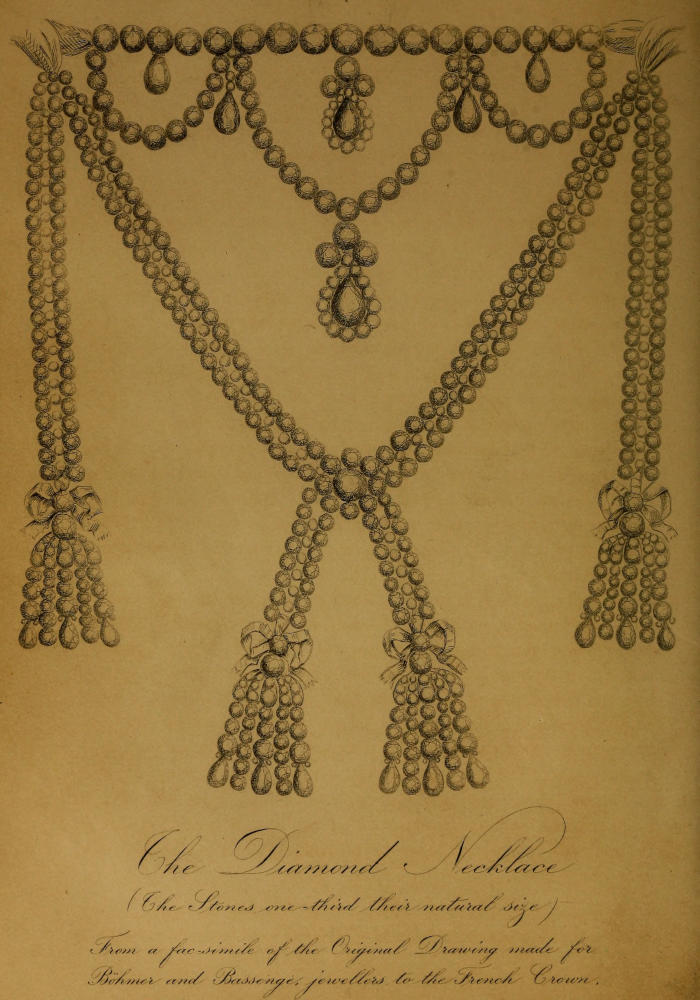
Illustrated with an exact representation of the Diamond Necklace, from a contemporary
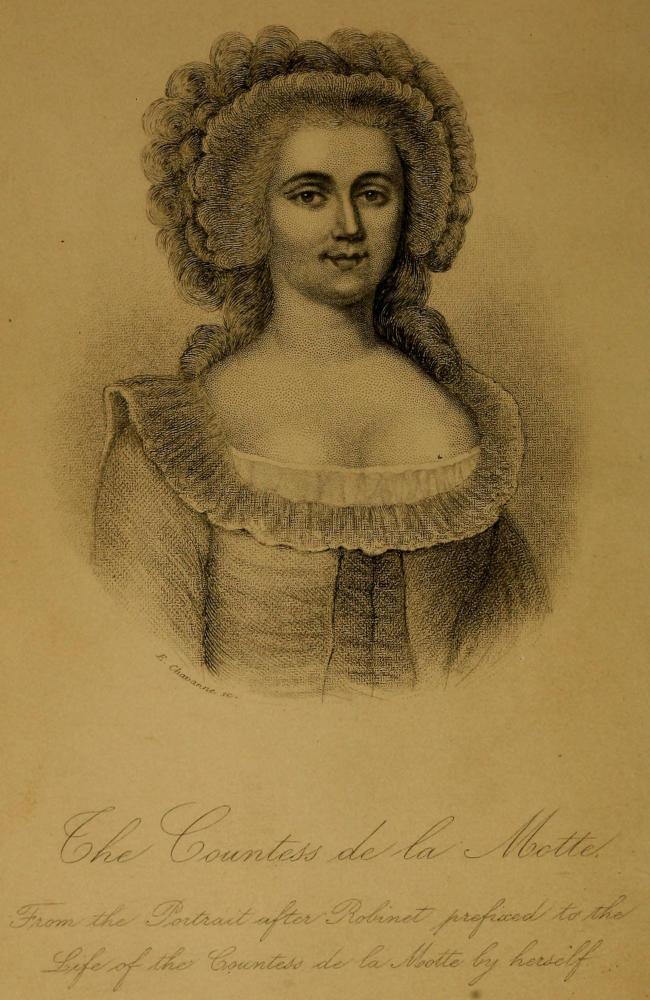
drawing, and a portrait of the Countess de la Motte, engraved on steel.
TO A. E. V.
THE LIGHT OF MY HOME, THE HAPPINESS OF MY LIFE,
I DEDICATE,
WITH MUCH AFFECTION,
THIS RECORD OF AN ERRING WOMAN’S CAREER.
H. V.
Paris, 1867.
ADVERTISEMENT.
“The Story of the Diamond Necklace,” which met with marked
success at the time of its first appearance—two editions in an
expensive form having speedily become exhausted—has been out
of print for some years. The author was unwilling that it should
be re-issued until it had been subjected to a complete revision, and
this more pressing occupations have obliged him continually to
postpone. Having at length found the necessary leisure, he has
thoroughly revised the work, availing himself of a new study of
the documents preserved in the French National Archives for this
purpose, and incorporating in the present volume such additional
facts relative to his subject as the investigations of recent years
have brought to light. If the work in its new form meets with
anything like the favour which was accorded to the early editions,
the author will feel himself amply rewarded for the extra labour he
has expended in rendering it more complete.
London, October, 1880.
Several critics of the first edition of this work took the author to task for
regarding as genuine the autograph letters of Marie-Antoinette and others,
comprised in the collection of M. Feuillet de Conches, and expressed their
surprise at his ignorance of the controversy which had taken place on the
subject of their authenticity, and had resulted, they said, in the almost
universal condemnation of these documents by both French and German
critics. The author was not only fully acquainted with all the details of
the controversy in question, but he had carefully examined the letters
themselves—not their contents merely, but the character of the handwriting,
and had studied its variations at different periods of Marie-Antoinette’s
career; and he had come to the conclusion, in common with the
majority of French writers who are regarded as authorities on matters pertaining
to the history of France during the latter half of the eighteenth
century, that the impugned documents are, with certain exceptions, perfectly
genuine. The above remarks, it should be noted, apply exclusively to the
autograph letters in M. Feuillet de Conches’ collection, and not to the
exceedingly dubious letters published by Comte d’Hunolstein.
PREFACE TO THE FIRST EDITION.
The great scandal of the Diamond Necklace, which to the clear
vision of Goethe presaged the coming Revolution, and in which the
quick-witted Talleyrand saw the overthrow of the French throne,
possesses an interest akin to that of the French Revolution itself.
The story is one of which the world does not seem to tire, for it has
been told scores upon scores of times, and more or less recently, by
historians, biographers, essayists, memoir-writers, anecdotists,
novelists, and dramatists, and in well-nigh every European language.
In the form in which it appears in the Memorials and
Judicial Examinations of the parties accused of complicity in the
fraud, it has been pronounced “the greatest lie of the eighteenth
century,” and numerous active brains have essayed to unravel its
tangled web of truth and falsehood; nevertheless, there are many
persons who still think that a certain mystery envelops the transaction
which all the research hitherto bestowed upon it has failed
to satisfactorily clear up.
The writer of the present work has diligently studied all the contemporary
evidence, bearing in the smallest degree on the subject,
which an active search enabled him to discover, and the bulk of
which he has availed himself of in the course of the subjoined
narrative. This includes, for example, unpublished autograph
letters and documents, written either by actual actors in the drama,
or else by persons intimately associated with it, and derived chiefly
from the valuable collection of M. Feuillet de Conches; the official
records of the judicial proceedings to which the affair give rise;
the various memorials put forth on behalf of the accused, and
the memoirs subsequently issued by them, including the exceedingly
scarce Mémoire by Rétaux de Villette, which the
present writer is the first to quote from, and the curious Autobiography
written in his old age by Count de la Motte; the
discussions in the Paris Parliament; and the numerous memoirs
penned by persons living at the time, some of which, and these of
the highest importance—such as the interesting Memoirs of Count
Beugnot—having been only recently made public, were not at the
command of previous writers. In addition to the foregoing sources
of information may be mentioned the different biographies, and the
various critical disquisitions of historians and essayists in which the
subject has been so exceedingly fruitful, and of which considerable
use will be found to have been made.
With such materials at his command, the writer has been able
to tell the story for the first time in all its fulness, and as he believes
more in accordance with the truth, in small matters as well
as great, than any previous narrative of the transaction. He conceives
that he has completely exonerated the French queen from
the slightest suspicion of complicity in the miserable fraud. He
has made a point of supplying missing dates to the more trivial as
well as to all the more important incidents, of vouching every
statement of the smallest consequence, and of giving the very
language of the witnesses to the various facts which they are called
upon to prove. He has, moreover, visited most of the scenes with
which the chief incidents of the story are mixed up, and has
described them with more or less minuteness in the course of his
narrative.
It is proper to mention, with regard to some few of the authorities
referred to in the following pages, such as Madame Campan’s
and Weber’s “Memoirs of Marie-Antoinette,” Madame de la Motte’s
“Mémoires Justificatifs,” and the “Mémoire pour le Comte de
Cagliostro,” that the French and English versions of these works
have been indiscriminately used, and that the references given, if
they do not apply to the one, will be found to belong to the other
edition of the works in question.
AUTHORITIES REFERRED TO IN THIS WORK.
Mémoire des joailliers Böhmer et Bassenge, du 12 Août, 1785. Paris, 1786.
Mémoire pour Louis-René-Édouard de Rohan, cardinal, contre M. le Procureur-Général,
en présence de la dame de la Motte. Paris, 1786.
Pièces justificatives pour M. le Cardinal de Rohan, déclarations authentiques
selon la forme Anglaise. Paris, 1786.
Requête au Parlement, les chambres assemblées, par M. le Cardinal de
Rohan. Paris, 1786.
Réflexions rapides pour M. le Cardinal de Rohan, sur le sommaire de la
dame de la Motte. Paris, 1786.
Mémoire pour la dame Jeanne de Saint-Remy de Valois, épouse du Comte
de la Motte. Paris, 1786.
Réponse pour la Comtesse de Valois-Lamotte au Mémoire du Comte Cagliostro.
Paris, 1786.
Sommaire pour la Comtesse de Valois-Lamotte accusée, contre M. le Procureur-Général,
accusateur, en présence de M. le Cardinal de Rohan et
autres co-accusés. Paris, 1786.
Mémoires justificatifs de la Comtesse de la Motte, écrits par elle-même.
London, 1789.
Ditto, English translation.
Mémoire pour la demoiselle le Guay d’Oliva, fille mineure, émancipée d’âge,
accusée, contre M. le Procureur-Général. Paris, 1786.
Seconde mémoire et pièces justificatives, pour Mademoiselle le Guay d’Oliva.
Paris, 1786.
Requête pour le sieur Marc-Antoine Rétaux de Villette, ancien gendarme,
accusé, contre M. le Procureur-Général. Paris, 1786.
Mémoire pour le Comte de Cagliostro, accusé, contre M. le Procureur-Général,
accusateur, en présence de M. le Cardinal de Rohan, de la
Comtesse de la Motte et autres, co-accusés, Paris, 1786.
Requête au Parlement, les chambres assemblées, pour le Comte de Cagliostro,
signifiée à M. le Procureur-Général, le 24 Février, 1786. Paris, 1786.
Mémoire pour le Comte de Cagliostro contre Maître Chesnon fils et le Sieur
de Launay. Paris, 1786.
Memorial for the Count de Cagliostro. London, 1786.
Mémoire pour Jean-Charles-Vincent de Bette d’Étienville, bourgeois de
Saint-Omer en Artois. Paris, 1786.
Deuxième Mémoire pour le sieur Jean-Charles-Vincent de Bette d’Étienville.
Paris, 1786.
Collection complète de tous les Mémoires qui ont paru dans la fameuse
affaire du Collier, avec toutes les pièces secrètes qui y ont rapport et qui
n’ont pas paru. Paris, 1786.
Compte-rendu de ce qui s’est passé au Parlement relativement à l’affaire de
M. le Cardinal de Rohan. Paris, 1786.
Jugement rendu par le Parlement de Paris sur l’affaire du Collier de
diamants, avec le détail de ce qui s’est passé aux séances du Parlement
les 30 et 31 Mai, 1786, et les ordres du Roi après le jugement. Paris,
1786.
Archives de la République. Series X², Nos. 2576, 18576. Series Y, Nos.
11514, 12076, 13125. Procès du Collier.
Unpublished autograph letters and documents relative to the Diamond
Necklace affair, in the collection of M. Feuillet de Conches.
The Life of Jeanne de Saint-Remy de Valois, heretofore Countess de la
Motte, written by herself. 2 vols. London, 1791.
Authentic adventures of the Countess de la Motte. London, 1787.
Mémoires Inédits du Comte de la Motte-Valois, publiés d’après le manuscrit
autographe, par L. Lacour. Paris, 1858.
Mémoire historique des intrigues de la Cour et de ce qui s’est passé entre la
Reine, le Comte d’Artois, le Cardinal de Rohan, Madame de Polignac,
Madame de la Motte, Cagliostro, et MM. de Breteuil et de Vergennes,
par Rétaux de Villette. Venise, 1790.
Mémoires pour servir à l’histoire des événements de la fin du XVIIIᵉ siècle,
par l’Abbé Georgel, vol. ii. Paris.
Marie-Antoinette et le procès du Collier d’après la procédure instruite
devant le Parlement de Paris, par E. Campardon, archiviste des archives
de l’Empire. Paris, 1863.
Mémoires sur la vie privée de Marie-Antoinette, par Madame Campan.
2 vols. London, 1823.
Ditto, English translation.
Mémoires concernant Marie-Antoinette, Reine de France, par J. Weber.
2 vols. London, 1805.
Ditto, English translation.
Histoire de Marie-Antoinette, par E. et J. de Goncourt. Paris, 1863.
La Vraie Marie-Antoinette, par M. de Lescure. Paris, 1863.
Maria-Theresia und Marie-Antoinette, von A. Ritter von Arneth. Paris
und Wien, 1865.
Lettres et documents inédits de Louis XVI., Marie-Antoinette, et Madame
Elisabeth, par M. Feuillet de Conches, 3 vols. Paris, 1864.
Correspondance inédite de Marie-Antoinette, par le Comte P. Vogt d’Hunolstein.
Paris, 1864.
Procès de Marie-Antoinette, ci-devant Reine des Français. Paris, 1865.
Correspondance secrète inédite sur Louis XVI., Marie-Antoinette, la cour
et la ville, de 1777 à 1792, publiée d’après les manuscrits de la Bibliothèque
Impériale de Saint-Pétersbourg, par M. de Lescure, 2 vols. Paris,
1866.
Les derniers jours de Trianon, par M. Capefigue. Paris, 1866.
Mémoires du Comte Beugnot, ancien ministre, vol. i. Paris, 1866.
Mémoires de Mademoiselle Bertin. Paris.
Mémoires de M. le Baron de Besenval, écrits par lui-même, vol. iii. Paris,
1805.
Mémoires de la Baronne d’Oberkirche, vol. i. Paris, 1853.
Mémoires posthumes du Feld-Maréchal Comte de Stedingk, par le Comte
de Bjornsjerna, vol. iii. Paris, 1844.
Souvenirs de la Marquise de Créqui, par le Comte de Courchamps. Paris,
1834-5.
Mémoires relatifs à la Famille Royale de France, pendant la Révolution
accompagnés d’anecdotes inconnues et authentiques sur les princes contemporains
et autres personnages célèbres de cette époque. Publiés
pour la première fois d’après le journal, les lettres, et les entretiens de la
Princesse de Lamballe, par une dame de qualité attaché au service confidentiel
de cette infortunée princesse, vol. i. Paris et Strasbourg, 1826.
La Princesse de Lamballe, Marie-Thérèse-Louise de Savoie-Carignan: Sa
Vie—Sa Mort; d’après des documents inédits ou peu connus, par M. de
Lescure. Paris, 1864.
Mémoires secrets pour servir à l’histoire de la dernière année du règne de
Louis XVI., par A. F. Bertrand de Molleville, ministre d’état à cette
époque, vol. ii. Londres et Paris, 1797.
Mémoires historiques et politiques du règne de Louis XVI., par l’Abbé
Soulavie, vol. vi. Paris, 1801.
Histoire de la décadence de la monarchie Française, par l’Abbé Soulavie,
vol. iii. Paris, 1803.
Anecdotes du règne de Louis XVI., contenant tout ce qui concerne ce
monarque, sa famille, et la Reine, etc., par M. Nougaret, vol. i. Paris,
1791.
Correspondance secrète de la cour de Louis XVI. Paris.
L’Histoire de France pendant le XVIIIᵉ siècle, par C. Lacretelle, vol. vi.
Paris, 1819.
Louis XVI., par M. Alexandre Dumas, vol. iii. Paris, 1851.
Louis XVI., son administration et ses relations diplomatiques avec l’Europe,
par M. Capefigue, vol. iii. Paris, 1844.
Correspondance inédite de la Comtesse de Sabran et du Chevalier de Boufflers,
de 1778 à 1788. Paris, 1875.
The Journals and Correspondence of William, Lord Auckland, vol. i.
London, 1860-2.
Souvenirs de M. Berryer, doyen des avocats de Paris, de 1774 à 1833,
vol. ii. Paris, 1839.
Cagliostro’s Stammbaum, von Wolfgang von Goethe.
Mémoires sur les prisons de Paris sous Robespierre, vol. ii. Paris.
Les Crimes de Marat et des autres égorgeurs, ou Ma Résurrection, par P.
A. L. Maton de la Varenne. Paris, 1795.
Histoire de la Révolution Française, par M. Louis Blanc, vol. ii. Bruxelles.
The French Revolution, a history; by Thomas Carlyle. 3 vols. (Leipzig
edition), 1851.
Histoire monarchique et constitutionnelle de la Révolution Française, par
Eugène Labaume, vol. ii. Paris, 1834.
Critical and Miscellaneous Essays, by Thomas Carlyle, vol. iv. (Art.—Diamond
Necklace). London, 1857.
Biographie Universelle (Articles—De Rohan and Cagliostro).
Le Moniteur, No. 220. Paris, 1792.
Morning Chronicle, Dec. 29, 1786.
Journal de Paris, Nov. 12, 1831.
Gentleman’s Magazine, vol. lxi. London, 1791.
Julie philosophe, ou le bon patriote, vol. ii. London.
Histoire de Bar-sur-Aube, par L. Chevalier. Bar-sur-Aube, 1851.
Essais historiques sur la ville de Bar-sur-Aube, publiés d’après un manuscrit
inédit portant la date de 1785, par J. F. G. Troyes, 1838.
Letter from the Curé of Bar-sur-Aube, July 17, 1866.
Saverne et ses environs, par C. G. Klein. Strasbourg, 1849.
Histoire anecdotique des Rues de Versailles, par J. A. Le Roi. Versailles,
1854.
Histoire du Bois de Boulogne, par J. Lobet. Paris, 1856.
Paris Herself Again, by G. A. Sala. London, 1879.
CONTENTS.
“Though the descendant of a king, I have been a beggar, a servant, a
mantua-maker’s apprentice, and the favourite of royalty.... The
names of a great queen and of a prince-cardinal unhappily united with mine
have spread a blaze around it to attract general notice; and as if I was
doomed to be the victim of painful splendour, the ingenuity of my enemies
have found means to forge the chains of my dishonour out of a Diamond
Necklace.”—“Life of the Countess de la Motte, by herself,” vol. i. p. 267,
and p. 6 of Preface.
“Faites attention à ce misérable Collier, je ne serais nullement surpris
qu’il renversât le trône.”—Talleyrand to Chamfort. “Histoire Monarchique
et Constitutionnelle de la Révolution Française,” par E. Labaume, vol. ii.
p. 139.
“I would caution them to despise those who, hacknied in systematic
scandal, feast upon the bleeding reputations of their sisters mangled and
torn by calumny; let them demand of those who convey such vile insinuations
some proof of the circumstances which they relate; let them sift
them thoroughly to the bottom; let them inquire the character of the tale-bearer;
let them ask how, where, and when, and whether she knows the woman
whom she has so eagerly attempted to disgrace.”—“Life of the Countess de la
Motte, by herself,” vol. ii. p. 410.
“Do not the critics teach us: ‘In whatsoever thing thou hast thyself
felt interest, in that or in nothing hope to inspire others with interest.’ In
partial obedience to all which and to many other principles shall the following
small Romance of the Diamond Necklace begin to come together. A
small Romance let the reader again and again assure himself, which is no
brain-web of mine, or of any other foolish man’s, but a fraction of the mystic
‘spirit-woven web’ from the ‘Loom of Time.’ It is an actual Transaction
that happened in this Earth of ours. Wherewith our whole business is
to paint it truly.”—“Carlyle’s Critical and Miscellaneous Essays,” vol.
iv. p. 5.
THE STORY OF THE DIAMOND NECKLACE. — I. 1764. A SCION OF ROYALTY IN TATTERS.—“TAKE PITY ON THE ORPHAN DESCENDANTS OF HENRY II., KING OF FRANCE.”
Rather more than a century ago, in the year 1764, just as death
had closed the career of the once all-powerful Madame de Pompadour,
who had long since exhausted all her arts in vain endeavours
to revive the jaded passions of her royal lover, and when the star
of the notorious Dubarry was gaining the ascendant, the Marquis
and Marchioness de Boulainvilliers, attended by servants and outriders
in the gayest of liveries, were driving one day in a carriage and
four from their hôtel at Paris to the château of Passy, of which
pleasant river-side village the marquis was seigneur. All at once
their attention was attracted to a little girl about eight years of
age, clad in the beggar’s accustomed livery—rags and tatters,
who, carrying a younger sister on her back, ran beside the carriage,
at that moment proceeding up the hill at a slow pace, and appealed
for charity after the following strange fashion:—“Kind lady and
gentleman, pray take pity on two poor orphans descended from
Henry the Second of Valois, King of France.”
The marchioness, struck by the singularity of this appeal, stopped
the carriage and commenced questioning the child, much to the
annoyance of her parsimonious husband, who petulantly remarked
she ought to know well enough that it was a common trick of
poverty to forge lies to excite compassion. The marchioness, however,
persisted in her inquiries, and ascertained from the child
whereabouts she lived, then, after promising to see into the truth
of her statement and telling a servant to give her a few pieces
of silver, the lady, greatly to the satisfaction of her impatient
husband, gave directions for the carriage to proceed.
The next day, in accordance with her promise, the marchioness
despatched a trusty servant to the place where the children lodged,
at the adjacent village of Chaillot, facing the river between Passy
and the then fashionable Cours la Reine, where the commonality—in
other words, those who wore “frieze, woollen stockings and
cloth hoods”—were forbidden to show themselves. At Chaillot
the people of the house, and the neighbours generally, confirmed,
so far as they were able, the truth of the little beggar girl’s story,
which, as this partakes largely of the romantic, and exercised
moreover an important influence on our heroine’s subsequent remarkable
career, we propose recounting here in all the necessary
detail.
II. 1717–1764. THE SAINT-REMIS OF VALOIS.—A TRAMP UP TO THE CAPITAL.
For a couple of centuries there had resided at Bar-sur-Aube, in
the Champagne, certain Barons de Saint-Remi, the first of whom
was Henri de Saint-Remi, an illegitimate son of Henri II. of
Valois, King of France, lover of the beautiful Diana of Poitiers;
the same who had the ill luck to be accidentally killed at a tilting-match
by a lance thrust in his right eye from the captain of his
Scottish guards, the Count de Montgomerie, ancestor of our Earls
of Eglinton. This son of his, Henri de Saint-Remi, was, in heralds’
language, “High and Puissant Lord and Knight, Baron and
Seigneur of the Manors of the Chatellier, Fontette, Noez and
Beauvoir, Knight of the King’s Order, Gentleman of the Bedchamber
in ordinary, Colonel of a regiment of horse and a regiment
of foot, and Governor of Château-Villain.” In the course of a few
generations, however, the Saint-Remis appear to have fallen from
their high estate, and their broad manors to have become entirely
alienated from them, inasmuch as we find that Nicolas de Saint-Remi,
the great-grandson of the Henri before mentioned, instead
of being styled “High and Puissant Lord and Knight,” and
Seigneur of various extensive domains, and the holder of numerous
offices about the person of the sovereign, was merely one of the
king’s body-guard in the Duke de Charost’s company. He married
the daughter of Nicolas-François de Vienne, a great man in the
royal bailiwick of Bar-sur-Aube, who seems at this period to have
been the possessor of two of the Saint-Remi manors, namely, Noez
and Fontette. The children that sprung from this marriage were
two sons, the elder of whom was slain in battle, while the younger,
Jacques de Saint-Remi, was father of the little beggar girl whom
we found running beside the Boulainvilliers’ carriage asking alms.
Jacques de Saint-Remi de Valois, in spite of his illustrious descent,
seems to have gradually sunk to the level of the peasant
class, and the indigence to which he found himself reduced was
aggravated by his imprudently marrying a young girl with a
pretty face, but of vulgar manners and somewhat loose morals, the
daughter of his concierge at the time he had a house to shelter
him. The offspring of this union was a son and two daughters, born
respectively in the years 1755, 6, and 7, but small as his family was,
Jacques de Saint-Remi seems to have been unable to support it.
One who knew him well describes the last of the barons of Saint-Remi
as a man of athletic build, who lived partly by poaching and
by depredations in the adjoining forest, partly by plundering his
neighbours’ fields, and partly on the charity of the benevolent.[1]
The vast estates which formerly belonged to the now impoverished
family had gradually dwindled away, some having been sold to
meet the demands arising from the extravagance of successive
owners, while others had passed into the hands of lawyers and
money-lenders. At this period there nevertheless remained three
domains of considerable extent, deeply encumbered, it is true, with
debts, but still open to some real or fancied claim, which, although
the beggared heir of the house of Valois had no means of enforcing
it, was nevertheless the reverie and abstraction of his life. A few
sheets of musty parchment, the surviving title-deeds of his house,
the last wreck, so to speak, of the vast landed property of the
Saint-Remis of Valois, were kept by him carefully stowed away
under the straw thatch of his miserable hut. To pore at times
over these old parchments was the one act of worldly vanity in
which Jacques de Saint-Remi permitted himself to indulge, but the
woman he had married was not so easily satisfied. The continual
display of these mysterious documents kindled her ambition, until
at length it was raised to such a pitch, that she prevailed on her
husband to set out for Paris, there to endeavour to make interest
among the great for the restoration of those rights to which as
heir of the house of Valois she conceived him to be entitled.
After disposing of such few movables as they possessed, the
wretched family set forth and literally tramped up to the capital,
a distance of nearly a hundred and fifty miles. That they might
not be burthened on the way by their youngest child, then about
three years old, the unnatural parents left it behind them, exposed
on a window-sill of the house of one Durand, “a wealthy and
avaricious farmer,” to quote the eldest sister’s own words, “who,
being in possession of a great part of my father’s estate, and having
stood sponsor to this unfortunate infant, was therefore deemed the
most proper person to be her future protector.”[2]
On their arrival in Paris, in a state of extreme destitution, the
Saint-Remi family shifted their place of residence from one suburb
to another until they eventually settled down at Boulogne, then
merely a small village on the banks of the Seine, opposite to St.
Cloud. Here they lived upon such charity as the gentry of the
neighbourhood, attracted by the singularity of their story, from
time to time bestowed upon them. The father at this period had
fallen into a stage of dotage, and the mother’s pet idea of an appeal
in high quarters for the restoration of the family estates had to be
sacrificed to the powerful struggle which they were forced to make
for their daily bread. Months thus passed away, until one day
Jacques de Saint-Remi, for some cause or other—most likely an
unpaid baker’s bill—was arrested by an officer of the marshalsea
(mounted police) of Boulogne, and locked up in a loathsome cell,
where he remained for six weeks. Here the poor man contracted
a serious illness, and on his release, which was brought about by
the intervention of the curé of the parish, the only retreat which
the efforts of his neighbours, for friends he had none, were enabled
to provide for him—a descendant of the blood-royal of France—was
a pallet in one of the wards of the Hôtel Dieu. Here he died,
a couple of days afterwards, on the 16th February, 1762.
Within a few days of the death of Jacques de Saint-Remi his
wife gave birth to another daughter, and as soon as she was recovered
from her confinement, the family removed to Versailles,
where the mother made a practice of sending the children into the
streets to beg. Jeanne, the eldest daughter, and the heroine of
our story, appears to have been treated with great harshness by
her mother; for unless the child brought home ten sous on ordinary
days, and double that amount on Sundays and fête days, as
the fruits of her mendicity, she was subjected, she tells us, to the
cruellest punishment. The mother had at this time formed a disreputable
connection with a disbanded common soldier—one Jean-Baptiste
Raymond, a native of Sardinia—with whom mendicancy
was a positive passion; for, in disregard of the authorities, he
made it his daily practice to beg in the most public places of
Paris, having with him the young Jacques de Saint-Remi, and the
family documents, which he boldly exhibited to the passers-by in
support of a pretended claim which he himself set up to the
honours of the house of Valois. Jean-Baptiste was arrested by the
police time after time, for plying his nefarious trade with such
marked audacity, and sentenced to various terms of imprisonment.
He was, however, incorrigible, and the authorities at last determined
upon getting rid of him. After sending him to prison for a
further term of fifteen days, they ordered him to be exposed for
four-and-twenty hours in the Place de Louis Quinze—subsequently
the Place de la Révolution, where for two years the guillotine did
its bloody work, and now the handsome Place de la Concorde—with
an inscription setting forth the nature of his imposture, and
copies of the titles he had falsely assumed hung round his neck.
This public exhibition at an end, Jean-Baptiste Raymond was
banished for five years from the capital.
When the day arrived for his departure, the unnatural mother
of the young Saint-Remis set out with her paramour, leaving behind
her three children, whom she promised to rejoin in eight days
at the very outside, to shift for themselves. Five weeks, however,
elapsed without any tidings of her, and it was at this particular
moment that the poor children, deserted by their only remaining
protector, and reduced almost to a state of starvation, had the
good fortune to attract the notice of the kind-hearted Marchioness
de Boulainvilliers.
III. 1764–1779. MANTUA-MAKER’S APPRENTICE.—PENSIONER UNDER THE CROWN.—BOARDER IN A CONVENT.
The Boulainvilliers’ lacquey, satisfied with the inquiries he had
made, directed the children to take leave of those kind neighbours
who had so constantly befriended them, and afterwards to come on
to Passy, where they were to inquire for the château, which stood,
by-the-way, on the precise spot where the pleasant “Hameau de
Boulainvilliers” now stands. But few preparations being necessary
for their departure, they were soon on their road, and reached the
château in the course of the afternoon. Their arrival being
announced, they were conducted “into a grand hall, in the centre
of which rose a magnificent staircase richly ornamented with gold,
where a large company of ladies and gentlemen were waiting to
view them.”[3] The marchioness descending to the middle of the
staircase, asked young Jeanne whether she remembered her
again, an inquiry which it is almost needless to say the child
promptly answered in the affirmative.
The company having gratified their curiosity at a distance, for
no one dared venture into too close proximity with these wretched
outcasts, covered as they were with rags and dirt, the marchioness
gave orders for them to be cleansed, and for other clothes to be
supplied them. A good scrubbing having brought to light indications
of various diseases, the usual concomitants of poverty, steps
were taken for their speedy eradication; and in the course of a few
weeks, thanks to the attention the children received, and to the
generous food provided them, all traces of their former wretched
condition were effaced.
The marchioness’s next care was the education of the young
orphans, and Jeanne and her sister were sent to a boarding-school
in the neighbourhood, where they made rapid progress. In less
than two years, however, the youngest girl died of the small-pox,
at that time a disease not only very prevalent, but commonly
fatal. Jeanne remained at school for several years longer; but
during the latter period of her stay, her governess, she tells us,
unknown to the marchioness (whom the young Saint-Remi saw but
rarely), compelled her to perform the common offices of a domestic
servant. “This employment,” she observes, “against which it
was useless to remonstrate, was but ill adapted to those elevated
notions which reflections on my birth had inspired me with. Was
it not,” she asks, “painful to feel that, descended as I was from
the first family in France, I was yet reduced to be a servant to
people of the very lowest rank, nay, even to servants themselves?”[4]
At length, at her own request, Jeanne was removed from school,
but the marquis, who was half a Jew—his mother being a daughter
of Samuel Bernard, the rich Hebrew banker, whom even the
“Grand Monarque” would condescend to take by the arm when he
was hard up and wanted to coax a loan out of him, and whom the
court ladies used to cheat at the queen’s card-table—objected to
her continuing a pensioner on the Boulainvilliers’ establishment.
With the view therefore of placing her in a position to provide for
herself, Jeanne was articled to a Parisian mantua-maker for a term
of three years. Ill-health, however, compelled her to leave before
completing the engagement, and she filled one situation after
another, subject to constant attacks of illness, until at length a
change in the fortunes of the family made it no longer necessary
for her to labour for her daily bread.
The young Jacques de Saint-Remi had received his education
under the care of M. Leclerc, the husband of his sister Jeanne’s
governess, and on its completion had been sent to sea. About this
time he returned home from his first voyage, and the marchioness,
having got together various documents in support of the claim of
the family to the honours of the house of Valois, consulted with
the Marquis de Chabert (the admiral under whom the young
Saint-Remi had recently served, and who had interested himself a
good deal in the young sailor’s history) as to the best course to be
adopted to get this claim recognised at court. The marquis at
once caused a genealogical tree of the family to be drawn up, which
he transmitted with the necessary confirmatory documents to his
cousin, M. d’Hozier de Sérigny, grand genealogist and judge-at-arms
of the nobility of France, that the same might receive the sanction
of his authority.[5]
When this was returned to M. de Chabert, accompanied by a
certificate of M. d’Hozier’s attesting its accuracy, the marquis forwarded
the various documents to the proper quarter, and in due
course obtained the appointment of a day for the reception of young
Saint-Remi by Louis XVI., who had only recently ascended the
throne. The youth was introduced to the king as the Baron de
Valois by the Marquis de Boulainvilliers, the Marquis de Chabert,
the Count de Maurepas, and M. Necker. The king was pleased to
recognise the title which the friends of the young Jacques de Saint-Remi
had persuaded him to assume, but desirous, it was believed,
that this should become extinct in the person of its present
possessor, recommended the newly-acknowledged Baron de Valois
to devote himself to the service of the church.[6] Jacques respectfully
ventured to suggest that his predilections were in favour of
the army or the navy. The king thanked the young Saint-Remi
for his inclination to serve him, but recommended him again, still
more strongly, to dedicate his days to the service of his Maker.
“Sire,” replied the young man, with a sprinkling of blasphemy
which only a Frenchman would have ventured on, “I am serving
God when I am serving my king.”[7]
The members of the Saint-Remi family had now their several
titles awarded them. Jacques, as we have already seen, was
henceforth to be styled Baron de Valois; his sister Jeanne was to
be known as Mademoiselle de Valois; and Marianne, the poor child
who had been left exposed outside Farmer Durand’s window-sill,
and who was now sent for to Paris, was for the future to be called
Mademoiselle de Saint-Remi. But as “fine words butter no
parsneps,” so empty honours will not suffice to keep the pot
boiling. It was therefore imperative that the necessary steps
should be taken to procure some sort of provision for these
destitute off-shoots of the blood-royal of France. It is true the
national finances were in a most lamentable condition, still everybody
agreed that something must be done, which something finally
resolved itself into a pension to each member of the family of
Valois of eight hundred livres (francs) equivalent to thirty-two
pounds sterling per annum, commencing from December, 1775.
In addition to this, through the intervention of M. Necker, the
young Baron de Valois had a commission in the navy given him,
with a grant of four thousand livres for his outfit, and shortly
afterwards received orders to join his ship at Brest.
We have already mentioned that Jeanne, or, as we must now
style her, Mademoiselle de Valois, during the period she was toiling
as a mantua-maker’s apprentice, was subject to frequent attacks
of illness. On these occasions it seems an apartment was set apart
for her at the Hôtel de Boulainvilliers[8] where every care was bestowed
upon her until she was completely restored to health.
During the period of her convalescence she was constantly persecuted
by the marquis with attentions the object of which it was
impossible to mistake. These advances, moreover, were subsequently
renewed on every occasion that presented itself; in fact,
whenever mademoiselle found herself under the Boulainvilliers’
roof; and if we can credit her own statement, more than one daring
assault was made by the old reprobate upon her virtue. To
rid herself of the marquis’s importunities she was forced, she tells
us, to complain to his wife, who decided upon taking the necessary
steps to remove mademoiselle beyond the sphere of her husband’s
dangerous influence. She and her sister Marianne were accordingly
sent as boarders to the Abbey of Yères, in the neighbourhood
of Montgeron, some dozen miles or so from Paris, on the road
to Lyons. Here she asserts that for a time she contemplated taking
the veil, a resolution, however, which, if ever seriously entertained,
was very soon abandoned.
About this time the Marquis de Boulainvilliers was detected
defrauding the excise by means of an extensive secret distillery
which he carried on in some vaults beneath his Paris hôtel. The
discovery of this fraud caused, as might be supposed, considerable
sensation among the haute noblesse, and neither the marquis nor the
marchioness dared show themselves at court, and hardly even in
the vicinity of the capital. They decided, therefore, to retire for a
time to their château at Montgeron, no great distance from the
Abbey of Yères, and, as a matter of course, the sisters Valois were
invited to spend the holidays with them. At the château they
would probably have continued to remain had not the marquis renewed
his system of persecution. It is, however, tolerably certain
that something very like encouragement was given to him by
Mademoiselle de Valois, for the pair were surprised one day in a
somewhat equivocal situation by the Marquis de Brancas and the
Abbé Tacher, and although the lady in her “Memoirs” has the
effrontery to speak of “the blush of conscious innocence which
coloured her cheek” on this occasion, the result was that she was
packed off by the marchioness to the well-known Abbey of Longchamp
near Paris—of course, as she says, at her own earnest entreaty.
Of this once handsome pile of conventual buildings, all
that has survived the fury of the revolutionists of 1793, is a round
ivy-mantled tower and an adjacent windmill, both familiar objects
at the present time in this favourite locality. In the days of St.
Vincent de Paul, the disorders which reigned in the Abbey of Longchamp
were such as to call forth severe animadversions from this
earnest and conscientious priest,[9] and even when the sisters Valois
entered it as boarders, the discipline was inclined to be lax; nevertheless
the marquis made so many morning calls that the other
boarders were scandalised at his constant visits, and the abbess was
constrained to give orders that no gentleman should be allowed to
visit Mademoiselle de Valois on any pretence whatever. At this
abbey the sisters remained for about a year, only quitting it, say
they, on the death of the abbess. Other accounts state that they
left the convent surreptitiously early one morning, carrying with
them a very light bundle, and with thirty-six francs jingling in their
pockets, their departure being due to the pertinacity of the abbess
in pressing them to embrace a religious life, a course to which the
young ladies, who were by this time sufficiently partial to worldly
vanities, were by no means inclined.[10] The abbess is supposed to
have received her instructions from high quarters, and it is further
suggested that the object of them was the gradual extinction of
the race of the Valois, together with all their troublesome claims.
IV. 1773–1778. THE DIAMOND NECKLACE: ORDERED, BUT NOT SOLD.
While our heroine was being initiated into the mysteries of
mantua-making by the most distinguished of Parisian modistes, the
“chains of her dishonour,”[11] as she styles them, were unknown
to her being forged in the form of a Diamond Necklace, such as
the world never saw before, and the like of which it can hardly
hope to look upon again. Here is a description, penned by a
master-hand, of this regal jewel, this unique gem, long an object of
desire with queens and women, which caused a nine months’ convulsion
of the world of Paris, and the remarkable story connected
with which was for a time the talk of every city in Europe, while
the mystery enveloping it is thought by many to be hardly cleared
up even now. “A row of seventeen glorious diamonds, as large
almost as filberts, encircle, not too tightly, the neck a first time.
Looser, gracefully fastened thrice to these, a three-wreathed festoon
and pendants enough (simple pear-shaped, multiple star-shaped or
clustering amorphous) encircle it, enwreath it a second time.
Loosest of all, softly flowing round from behind in priceless catenary,
rush down two broad threefold rows; seem to knot themselves,
round a very queen of diamonds, on the bosom; then rush on,
again separated, as if there were length in plenty: the very tassels
of them were a fortune for some men. And now, lastly, two other
inexpressible threefold rows, also with their tassels, will, when the
Necklace is on and clasped, unite themselves behind into a doubly
inexpressible sixfold row; and so stream down, together or asunder,
over the hind neck,—we may fancy like lambent zodiacal or
Aurora-Borealis fire.”[12]
This matchless jewel had its origin in a freak of Louis XV., the
“Well-Beloved,” as he was endearingly called at the early part of
his reign, whose infatuation in later years for the notorious Countess
Dubarry led him into all kinds of extravagance, and caused him to
dissipate with more than his accustomed recklessness the already
seriously impaired revenues of the State. We learn from the Abbé
Soulavie that, during the last sixteen months of the “Well-Beloved’s”
reign, the sum of two million four hundred and fifty
thousand francs, or nearly one hundred thousand pounds sterling—a
far larger sum in those days, be it remembered, than at the
present time—was paid out of the royal exchequer in hard cash
to this one favourite alone. And to satisfy us that his statement
is accurate, the abbé furnishes us with his authority, and gives the
details of the eight several instalments of which the grand total is
composed.[13] This, it should be borne in mind, was entirely independent
of all manner of royal grants and gifts of places and
houses and lands, which had been flung, whenever asked for, into
the lap of this frail beauty. Startling as this example of royal
prodigality in the days of the decadence of the French monarchy
may appear, it is nevertheless indisputable that the infatuated
libertine who then controlled the destinies of France, by no means
wanted the will to indulge in still wilder schemes of extravagance.
For instance, on one occasion, whilst visiting with his architect the
costly pavilion of Louveciennes, lately erected for Madame Dubarry,
he expressed his regret that he could not present her with a palace
constructed entirely of gold and precious stones. Unable to
realize this extravagant whim, he resolved to bestow upon his mistress
the most costly set of diamonds which could be collected
throughout Europe. The result was the world-renowned Diamond
Necklace.[14]
Louis XV. gave the commission to the crown jewellers, Böhmer
and Bassenge[15] who entered heart and soul into the undertaking.
The execution of so rare an order was of course an affair of time.
Not only had the jewellers to raise funds to enable them to secure the
largest and finest diamonds that were in the market, but they had
to hunt out and employ the most skilful lapidaries to fashion them
to their several shapes. Every important city in Europe, and
others far more remote, were ransacked to collect these matchless
gems. Some of the finest were met with in Germany, others in Spain,
others again in Russia, a few in Brazil, and a very fine one indeed was
picked up in the city of Hamburg. “But,” says Carlyle, “to tell the
various histories of these various diamonds, from the first making
of them, or even omitting all the rest, from the first digging of
them in far Indian mines.... How they served as eyes of
heathen idols, and received worship; how they had then by fortune
of war, or theft, been knocked out, and exchanged among camp-sutlers
for a little spirituous liquor, and bought by Jews; and worn
as signets on the fingers of tawny or white majesties; and again
been lost, with the fingers too, and perhaps life (as by Charles the
Rash among the mud ditches of Nancy), in old forgotten glorious
victories; and so through innumerable varieties of fortune had
come at last to the cutting-wheel of Böhmer, to be united in strange
fellowship with comrades also blown together from all ends of the
earth, each with a history of its own. Could these aged stones—the
youngest of them six thousand years of age and upwards—but
have spoken, there were an experience for philosophy to teach by.
But now, as was said, by little caps of gold and daintiest rings of
the same, they are all being, so to speak, enlisted under Böhmer’s
flag,—made to take rank and file in new order, no jewel asking his
neighbour whence he came; and parade there for a season. For a
season only, and then to disperse and enlist anew ad infinitum.”[16]
For many of their purchases credit was obtained by the
crown jewellers for a limited period; for others, when they
had exhausted their own capital, they were obliged to have
recourse to their friends. But they were full of confidence,
for two millions of livres (francs)—eighty thousand pounds
sterling—was the sum fixed to be paid by the king for this jewel
beyond price. The work went bravely on at the Böhmer and
Bassenge establishment, “Au Grand Balcon,” Rue Vendôme. The
jewellers, their friends, their working lapidaries, their trustful
creditors, were all in the highest spirits, when suddenly evil tidings
cast dismay into the Böhmer and Bassenge camp. One day comes
the intelligence that the king is ill; three days afterwards the news
arrives that he is in danger; another week brings the report that
he is dead, and the late favourite for whom the rich ornament was
destined banished for ever beyond the precincts of the court.
Alas! what was to be done now with the magnificent bauble
commissioned by one who, at the time, spite of all his low grovelling
debauchery, was nevertheless a king, but is now only so much
corruption? Böhmer and Bassenge, crown jewellers, find themselves
deeply involved; their creditors become clamorous, for their
bills as they fall due are returned protested. They have nothing
to fall back upon but the Diamond Necklace, which is worth, or at
any rate valued at, two million livres. But where is a purchaser
to be found for it? Böhmer and Bassenge, crown jewellers though
they be, must still pay their debts. Kings, according to a certain
fiction of state, never die—“Le Roi est Mort! Vive le Roi!”
Böhmer and Bassenge, however, learn by sad experience not only
that kings do die, but that creditors, alas, do not.
What is to be done? Only one course suggests itself. A young
and lovely queen has just ascended the throne. Will it not be
possible to induce her to become the purchaser of this unrivalled
specimen of bijouterie? The office of crown jeweller carries with it
the privilege of entrée to the presence of royalty at all times and
seasons; while “other jewellers, and even innumerable gentlemen
and small nobility, languish in the vestibule. With the costliest
ornaments in his pockets, or borne after him by assiduous shop-boys,
the happy Böhmer sees high drawing-rooms and sacred ruelles
fly open as with talismanic sesame, and the brightest eyes of the whole
world grow brighter: to him alone of all men the Unapproachable
reveals herself in mysterious négligée, taking and giving counsel.”[17]
It was to Versailles that Böhmer betook himself, carrying with
him the Diamond Necklace in its case of richest velvet, and ere
many hours have elapsed he is displaying its matchless variegated
brilliancy—its “flashes of star-rainbow colours” to the admiring
gaze of the beauteous Marie-Antoinette, then just twenty years of
age, of a gay and lively disposition, verging, some say, on to giddiness,
yet perfectly innocent; fond of pleasure, and, like other fair
young creatures in this world, not indifferent to those personal
ornaments which help to enhance the charms which Nature has
bestowed upon them with so liberal a hand. Still, pleased as she
was with the gem, she nevertheless felt that the times were unpropitious;
or else she scorned, may be, to wear an ornament,
however beautiful, the original destination of which was, to say
the least of it, unfortunate. But be this as it may, one thing is
quite certain, the purchase of the Necklace was declined.
Thus in a moment, as it were, all those fond hopes with which
the crown jewellers had buoyed themselves up for many months
past were dissipated, and they were again constrained to ask each
other, “what is now to be done?” Poor men, they were not to
blame, for how could they have foreseen that their royal customer,
full of health in November, 1773, when he gave the order, should
be dead of small-pox on the 10th of May following? After several
days spent in deliberation the partners decided that a drawing of
the Necklace should be made and an engraving executed, and that
printed copies of this should be sent to all the courts of Europe, to
see whether a customer could not be obtained for a jewel which,
ransack the entire world through, would be found without its equal.
This scheme, however, clever as it was, proved abortive; for
what kind of idea could the cunningest graver and the most
liquescent of printing inks possibly give of brilliants of the very
finest water? The jewellers next resolved that one of the firm—Bassenge
being the younger and more active was eventually fixed
upon—should devote himself to travelling over Europe, and to
visiting the various courts, where he might personally solicit the
different empresses, queens, princesses, landgravines, margravines,
electresses, infantas, and grand and arch-duchesses, to purchase
this costly jewel, which only a neck flushing with the blood of
royalty was worthy to wear. During this time Böhmer was to remain
in Paris, to avail himself of any opportunity that might offer
for reopening negotiations with Marie-Antoinette. One circumstance,
however, rendered the prospect of success doubtful. The
queen had become indebted to the crown jewellers in the sum of
348,000 livres (francs), for a pair of diamond earrings, of which
amount she had herself only been able to pay some 48,000 livres,[18]
leaving 300,000 livres still due.
In this way several years went by. Shortly after the birth of
Madame Royale, the Necklace was again offered to the queen, but
although the reduced price of one million eight hundred thousand
livres was named for it, there was a more serious obstacle than
ever in the way of its purchase. France was at this period engaged
in a war with England on behalf of the American Colonists, and
her navy was in a most crippled condition. No sooner did the
crown jeweller name the subject of the Necklace, than Marie-Antoinette
interrupted him with this queen-like remark, “Monsieur,
we have more need of men-of-war now than of diamonds.”[19] What
reply could a crown jeweller make to so pertinent an observation
as this? All he could do was to feel affronted, and hastily making
his obeisances, he flung himself into the corner of his carriage, and
set off down the long Avenue de Paris on his return to the Rue
Vendôme in no very amiable mood.
V. 1779–1780. AT BAR-SUR-AUBE.—COURTSHIP AND MARRIAGE.
While Monsieur Bassenge Calaphibus-like is wandering up and
down Europe trying to dispose of the ill-fated Diamond Necklace,
let us see what our heroine is doing now that she has freed herself
from the restraints of a conventual life in order to launch forth
into the great world with no one to direct, no one to control her.
On leaving the abbey of Longchamp the two sisters decided upon
making their way to Bar-sur-Aube, and embarked on board one of
the Seine barges plying between Paris and Nogent, from which
latter place they proceeded up the river Aube to their destination.[20]
The youngest sister, it seems, was possessed with a certain longing
to return to the place of her birth. Whether this arose from a
feeling of vanity, a desire to show off before the simple rustics of
Fontette, or whether love was the actuating principle—for she had
left a sweetheart behind her when she was summoned to Paris—is
more than we can tell. Arrived at Bar-sur-Aube, our heroine informs
us that she and her sister at once entered a convent, where
many visitors called upon them, and invited them to a round of
entertainments at which every one present vied with his neighbour
as to who should pay them the greatest amount of attention. She
even asserts that they received invitations from the different noble
families in the neighbourhood, and, in pursuance of these, entered
upon a series of visits varying from a few days to a week in extent.
When these visits were over, we are told that a Madame de Suremont
enticed them to board at her house, where they were “very
elegantly entertained” for four hundred livres (sixteen pounds)
per annum.[21]
Other accounts, which we believe to be more trustworthy, assert
that the sisters arrived at Bar-sur-Aube with merely a few livres in
their pockets, and a single change of linen beyond the clothes they
had on, and that, instead of entering a convent, they put up at a
miserable little inn called “La Tête Rouge,” where they made
good their footing by their high titles and the claims they set up
to the manors of Essoyes, Fontette, and Verpilière, in the neighbourhood.
The great expectations they announced soon became
generally known in a small country town, and the consequence was
that the good people round about flocked to see them out of
curiosity, and it was then that Madame de Suremont, touched by
their distress, offered the fugitives the use of her house for a few
days until they could manage to provide some other lodging for
themselves.
On retiring for the night their hostess, a very stout lady, kindly
lent them two of her own dresses to wear, observing, however, that
she was afraid they would be too large to fit them. What was
Madame de Suremont’s astonishment to see her young guests enter
the sitting-room the following morning with the dresses, which
they had spent the night in cutting and adapting to their own
slim figures, fitting them to perfection! Instead, too, of stopping
merely a week at this hospitable house, according to the terms of
their invitation, the Demoiselles de Valois managed to remain in
it for twelve months, flirting with all the young fellows who visited
there, and exhibiting more levity and freedom than was becoming
to their sex.[22] The ladies, naturally enough, all shrank aghast
from this bold behaviour, but the gentlemen were more or less
amused at it.
In due course several of these young fellows became smitten
with our heroine, and amongst those who contested for the honour
of her smiles were two who stood out in advance of the rest. One
was M. Beugnot, the writer of the Memoirs we have been quoting,
and son of a well-to-do citizen of Bar-sur-Aube. The latter, however,
was so alarmed at the mere idea of having Mademoiselle de Valois
for a daughter-in-law that he packed off his son to Paris to study
law, politics, and human nature, which he did to such good purpose
as to escape the guillotine, and get created a councillor of
state and a count by Napoleon, by whom he was appointed administrator
of one of the Rhine provinces. At the Restoration he
was named ad interim minister of the interior, then minister of
police, next minister of marine, afterwards postmaster-general,
and finally director-general of the administration of finances; and
was altogether so eager a place-hunter, that a pamphleteer of the
time said of him that he would have hired himself out to the
plague if the plague only gave pensions. The other was M. de la
Motte, a nephew of Madame de Suremont’s, and son of a chevalier
of St.-Louis killed at the battle of Minden. This young gentleman,
an officer, or as Madame Campan and the Abbé Georgel say, a
private in the gendarmerie, and destitute of any fortune whatever,
had already managed to involve himself deeply in debt. Previous
to the Revolution the gendarmerie, very different from the force
now known by that name, was the first cavalry regiment in France,
and the usual refuge for young men of good family but poor
estate.
Let us hear what the lady herself has to say respecting this
young man (who had only his sword with which to cut his way to
fortune), and his pretensions to be considered the accepted suitor
of a descendant of the royal house of Valois.
“Amongst many other species of amusement, we frequently performed
comedies, in one of which I engaged to take a part. M. de
la Motte, an officer in the gendarmes, and nephew of Madame de
Suremont, being on a visit to Bar-sur-Aube, acquired great reputation
for his performance, and became remarked for his assiduity
and attention to please. The part of a valet was assigned to him,
and that of a waiting-maid to me. We divided the applause of the
company, for having, as they pleased to express, sustained our
characters with so much propriety.
“From the moment of our first interview M. de la Motte paid
me very pointed attention. He eagerly seized every opportunity
of showing me how solicitous he was to please. His compliments
were not glaring, but of that delicate nature which could only proceed
from the genuine dictates of an honest heart. Elegant in
person and manners, and insinuating in address, the honourable
intention which he manifested could not prove disagreeable to
me. I listened, and, as I believe, is generally the consequence
where any of our sex listen to the persuasions of youth, elegance,
and accomplishments in the other, I was soon not far from loving
him.
“Madame de Suremont perceived the growing attachment of her
nephew, and afforded him every opportunity of urging his suit.
She frequently left us together when the company were gone, engaging
M. de la Motte to remain and write out my parts, and give me
instructions in acting them.
“I will ingenuously confess that I loved M. de la Motte. He
possessed a sincerity of heart, seldom to be found excepting in the
country, blended with those polished manners which mark the
habitué of the metropolis. He seized every opportunity of rendering
himself agreeable, and I had every reason to suppose he entertained
favourable sentiments towards me, at least I wished so, and
the gradation is so natural that it will not appear strange if I
believed it.
“M. de la Motte, I had remarked for some days, appeared
thoughtful and melancholy; but as he had never communicated
to me the cause, though I was uneasy at the effect of it, I forebore
to make inquiry. He advised me to go to Paris to see my brother,
and to make known his pretensions to Madame de Boulainvilliers,
my worthy mother, and endeavour to obtain her consent to our
union. Fearful that breaking this matter suddenly to the
marchioness, after having carried it on so far without her knowledge,
might give her offence, I hesitated some time ere I could
form a resolution to acquaint her; but, trusting to her goodness, I
at length yielded to M. de la Motte’s arguments in favour of a
determination which was also consonant to the dictates of my own
heart.
“When I had resolved on a journey to Paris, which highly gratified
M. de la Motte, I at once wrote a letter to Madame de Boulainvilliers,
informing her that having heard of my brother’s arrival, and
being anxious to see him, I should be at Paris the Saturday following
by eight o’clock. The interval was occupied by M. de la Motte
in giving me directions for my behaviour, and earnestly pressing
me to return as soon as possible, and complete his happiness by
the celebration of our nuptials. Not a single person in the house,
not even my sister, was acquainted with what was in agitation.
The attentions of M. de la Motte had long been observed, but our
marriage was whispered of only as a conjecture.
“On the Wednesday following, about three in the morning, I set
off in the diligence, and after a very tedious and disagreeable
journey, over roads which at once prove the neglect of the government
and the patience of the people, I arrived near Paris, and found
Julia, the marchioness’s first woman, waiting with a coach at the
Porte Saint-Antoine. I was not a little pleased at being so near
the end of my journey, and felt no regret at quitting my disagreeable
vehicle for the one which conveyed me to the Hôtel de
Boulainvilliers.
“I was impatient to see my brother, but I was disappointed; he
had received orders to join his squadron at Brest. Madame de
Boulainvilliers received me with that cordiality and affection with
which the tenderest of mothers would receive her daughter after a
long absence. She told me that my brother would not have written
to inform me of his arrival if it could have been foreseen how
soon he was to depart. This information gave me much uneasiness,
which Madame de Boulainvilliers used the utmost assiduity
to dissipate.
“The evening was occupied by many questions which the
marchioness asked me relative to Bar-sur-Aube, concerning our
reception and the diversions and entertainments of the place. I
took advantage of this opportunity to mention the comedy. I perceived,
from a sign she made to Madame de Tonneres, her daughter,
that she had some private correspondent in that place, who had
informed her of more than I knew, and that the information
I had to give was by no means novel. This surprised me not a
little.
“A day or two after they resumed the topic, and Madame de
Tonneres asked me what character I played. I told her that of a
waiting-maid. She seemed surprised that I should choose a part
like that, when there were many others for which I was much
better adapted. ‘But who,’ said Madame de Boulainvilliers, ‘was
the young man who played the part of Jasmin? Is he a young
man? Pray how old is he?’ I could not well comprehend the
drift of these questions, which, nevertheless, I found myself constrained
to answer. ‘He is a young gentleman,’ I replied, ‘who has a
commission in the gendarmes,’ and I then proceeded to give them
information respecting his family. ‘And what do you think of
him?’ ‘That he has a pleasing address, is much of a gentleman,
and has received a very good education; understands music, and
dances to perfection: everybody gives him the credit of being a
very accomplished young man, and all admit that he played his
character like an experienced actor.’ Perceiving me growing warm
in my encomiums, the marchioness smiled. Her daughter observed
it, and they exchanged some very significant glances with each
other, and then, to avoid giving me any suspicions, changed the
subject of the conversation.
“On another occasion Madame de Tonneres, with whom I was
frequently left alone, examined me yet more closely respecting M.
de la Motte. ‘What!’ inquired she, in a tone of raillery, ‘did this
presumptuous wretch ever aspire to be your husband?’ ‘Oh, yes!
he proposed demanding me in marriage through his mother, at the
same time informing me of his fortune and expectations.’ ‘And
what answer did you make, my dear?’ ‘That I would beg Madame
de Boulainvilliers to give her consent,’ replied I. ‘But did you
give no promise of your own accord, and are you really partial to
him?’ I answered these questions in the affirmative. ‘Well, then,
my dear,’ replied she, ‘from your approbation, I will believe him
worthy of your love.’ ‘Then do me the favour,’ replied I, ‘to
represent my affections to my dear mother, at some convenient
opportunity when I am not present; and you may, if you please,
inform her, at the same time, that M. de la Luzerne, bishop of
Langres, can give her every information concerning the family with
which he is well acquainted: indeed, he has been requested by the
mother of M. de la Motte to demand me in marriage.’ The result
was that Madame de Tonneres kindly undertook my cause with
the marchioness, who, having my happiness at heart, wished me, in
a matter which could but once be resolved on, to take time for deliberation.
“Though Madame de Boulainvilliers seemed rather to dissuade
me from my purpose than consent to its accomplishment, she
nevertheless consented to write to the Bishop of Langres, who the
very next evening paid her a visit. As soon as he arrived I made
my obedience and retired, leaving him and the marchioness to their
private conference.
“I was in no small state of anxiety to learn the result of a
negotiation to me of such importance, yet was at a loss of whom to
inquire. The next morning I was relieved from suspense, for I received
a letter from the reverend prelate, informing me of their
conversation the evening before. He gave me some hopes of obtaining
the consent of the marchioness, and this was all; as for
the marquis, I learnt that he positively refused his consent to the
match.
“In a few days I departed for Bar-sur-Aube: my regret at parting
with the marchioness was increased by my having to return
home without obtaining her consent to our marriage, which, though
this had been the express object of my journey, I could not consistently
with delicacy or duty press any further, lest I should
appear too precipitately to reject the prudent advice which she had
given me.
“My return to Bar-sur-Aube was much more agreeable than my
journey to Paris. I had written to my sister and M. de la Motte
to apprise them of it, and was met by them about two leagues from
Bar-sur-Aube, at a beautiful seat, the residence of M. de la Motte’s
mother.
“The news of my departure, and the object of my journey, had
transpired and spread through the village; every one spoke of my
marriage with M. de la Motte. It was whispered that Mademoiselle
de Valois had returned with the consent of her brother
and Madame de Boulainvilliers to solemnize this marriage; all
welcomed me with as much pleasure as if, instead of a week, I had
been absent a year.
“M. de la Motte received me with heartfelt satisfaction, but his
countenance seemed to speak a degree of anxiety; he feared that
it was the intention of Madame de Boulainvilliers to have married
me to some other husband, and trembled for the success of my embassy:
he read in my looks that all was not as it should be, while
the words which dropped from Madame de Boulainvilliers made
me doubtful whether I should be able to obtain her consent. The
uneasiness which on this account overspread my countenance was
intelligible only to M. de la Motte, by whose advice I was prevailed
upon to take the only steps prudence dictated in so delicate and
embarrassing a position.
“My pen was the instrument by which I disclosed a secret my
timidity could never suffer my tongue to discover; I immediately
wrote to Madame de Boulainvilliers three successive letters, entreating
her to compassionate my distress, and to let her consent
grace our union. I also wrote to the Bishop of Langres, asking
that worthy prelate, who before had done me signal service, to intercede
with the marchioness in my behalf. The intercession of
the bishop I was confident would have its due weight, and indeed
it at length produced that consent so essential to my future
happiness.
“The approbation of Madame de Boulainvilliers having now
given a sanction to our proceedings, an early day was appointed,
by the advice of the friends of M. de la Motte, for the celebration
of our nuptials, which took place, according to the custom of the
province, at midnight on the 6th of June, 1780.
“The day after our marriage a grand dinner was given by
Madame de Suremont. The entertainment was profusely elegant.
There were two tables, one in the antechamber, and the other in
the dining-room. Every apartment was open and very soon
crowded; the health of the bride was an apology for drinking wine
as though it had been water. When the company quitted the table,
all were desirous to salute and wish me joy. The remainder of the
day was spent in dancing.
“The banns of marriage had been published at Fontette, which
made the peasants of that place curious to know the day. They
came in great numbers to Bar-sur-Aube, with the intention of
witnessing the ceremony, and remained there some days. Amongst
them was a young peasant, a comely young fellow, who came to
Madame de Suremont and inquired bluntly for Mademoiselle
Filliette, a name by which my sister had formerly been known in
the country. ‘I know no such person,’ replied she: ‘whom do you
mean by Mademoiselle Filliette?’ ‘Why, madame,’ replied the
clown, ‘the sister of mademoiselle who is just married. Please tell
her I am Colas, of Fontette; she will recollect me.’
“Madame de Suremont communicated this to my sister, who,
out of compassion for the unfortunate rustic, refused to see him lest
such an interview should make him more unhappy. Durand, indeed,
to detain my sister in the country, had promised her in marriage to
this peasant, whose appearance was greatly in his favour, but the
recognition of her birth by the people in the neighbourhood had
kindled in the bosom of Marianne hopes of an alliance more consonant
to her ideas, more consistent with her present station. Far
from despising this poor creature, she wished to avoid giving him
pain. She begged me, therefore, to speak to him: I did so.
‘Good day, my dear friend,’ said I, ‘what are your commands for
my sister?’ ‘I wish, madame,’ replied he, ‘to have the honour of
paying my respects to her. She is of the same age, we have stood
sponsors together, and M. Durand, her godfather, promised me that
I should marry her. But her fortune is changed; she is now
Mademoiselle de Valois; and I am not quite such a fool as to think
that she will have me for her husband, as she is descended from the
blood-royal; but I wish to have the pleasure of seeing her in her
fine clothes, for I am sure,’ continued he, bursting into tears, ‘she
is very handsome!’[23] I could not help shedding a tear of pity for
this honest rustic. His grief, however, was not to be alleviated;
the presence of my sister would but have increased his misery; at
least she thought so, and could not be prevailed upon to see him.
Finding himself without hope, he went home again, murmuring at
what he termed the false-heartedness of his mistress.
“Some few days after I accompanied my sister to Fontette,
where, it being Sunday, we went to mass. All the peasants rose
from their seats at our entrance, and desired the curate should do
us honour, as the children of the Baron de Saint-Remi their late
lord. We received the holy water and the consecrated bread in the
seat of honour; the bells were rung, and every one testified their
joy on our arrival. They crowded about the house where we
were staying; we ordered them six livres a-piece, for which they
testified their gratitude by drinking our healths, and the health of
the Baron de Saint-Remi de Valois, and his safe return. They
then conducted me to the mansion of my ancestors, and round the
grounds of the patrimonial estate. This mansion, this noble estate,
thought I to myself, might have been possessed by the descendants
of those who acquired it by valour,[24] and enjoyed it with hospitality.
I lamented the ravages of luxury: I thought of the credulity and
easy temper of my father, who sacrificed everything to the extravagance
of his wife. Had it not been for these he might have
sustained the dignity of his ancestors, and his miserable offspring
have maintained that position to which they were by birth entitled.”[25]
To provide herself with a suitable trousseau, Mademoiselle de
Valois had been obliged to raise one thousand livres on a mortgage
of her pension for two years; while, to defray the expenses incident
to the wedding, M. de la Motte, on his part, sold for six hundred
livres a horse and cabriolet which he had only bought a short time
previously on credit at Lunéville, where his corps was doing garrison
duty.[26]
We will close this chapter with a pair of portraits of Monsieur
and Madame de la Motte, which their friend Beugnot has sketched
for our benefit. “M. de la Motte,” observes his rival, “was an
ugly man, but well made and skilled in all bodily exercises, whilst,
despite his ugliness, the expression of his face was amiable and
mild. He did not exactly lack talent, still what he possessed was
frittered away on trifles. Destitute of all fortune, he was clever
enough to get head over ears in debt, and only lived by his wits
and on the trifling allowance of three hundred francs a year which
his uncle, M. de Suremont, was obliged to make him to enable him
to retain his position in the gendarmerie.”
With regard to Madame de la Motte, Beugnot says: “She was
not exactly handsome, was short in stature, slender, and well
formed. Her blue eyes were full of expression and over-arched with
black eyebrows; her face rather long; her mouth wide, but adorned
with fine teeth, and, what is the greatest attraction in such a face
as hers, her smile was enchanting. She had a pretty hand, a very
small foot, and a complexion of dazzling whiteness. When she
spoke her mind exhibited no sign of acquired knowledge, but she
had much natural intelligence, and a quick and penetrating understanding.
Engaged in a perpetual conflict with society from the
time of her birth, she had learned to disdain its laws, and had but
little respect for those of morality.”
M. Beugnot adds the following anecdote:
“When I returned home that evening my father mentioned to
me that fifteen or twenty years previously, whenever he went to
collect his rents in the parish of Essoyes, the curé of Fontette never
failed to tax his purse for the poor children of Jacques de Saint-Remi,
who were huddled together in a dilapidated hovel with a trap-hole
in front, through which soup, vegetables, broken victuals, and
other charitable doles were passed by the neighbours.”[27]
VI. 1780–1782. COUNTESS DE LA MOTTE.—IN BARRACKS AT LUNÉVILLE.—ON A FIFTH FLOOR IN PARIS.—ENSNARES THE GRAND ALMONER.
From the day of her marriage, in the summer of 1780, our heroine
assumed the title of Countess de Valois de la Motte, though on
ordinary occasions she dropped the former portion of it, retaining
only the name of De la Motte, by which she afterwards became so
notorious. The wedding did not take place a day too soon, for in
the course of the same or following month the countess gave birth
to male twins, that died a few days afterwards. Thereupon Madame
de Suremont, glad of an excuse for getting rid of her new relation—the
old lady used to say to Beugnot that “the most unhappy
year of her life was the one she spent in the society of this demon,”—turned
the newly-married couple out of her house.[28] They took
refuge for a time with Madame de la Tour, a married sister of the
count’s—the young gendarme following the example of his wife,
had likewise assumed a title—but were finally obliged to rely on
their own resources, which, as may be supposed, were of the
narrowest. De la Motte himself had nothing but his sword, and
the countess had not even her scanty pension to depend upon.
Now commenced with them that life of shifts and expedients, which
is certain in the long run to disappoint those who are unhappily
reduced to enter upon it, which subverts the principles, destroys
the best habits of even the firmest characters, and too frequently
culminates in crime. By borrowing money from friends and
neighbours so long as they were disposed to lend it, by occasional
loans from money-lenders at exorbitant rates of interest, by running
into debt with the tradespeople, and by certain small bounties
received from Paris, to assist the descendants of Henri II., in
answer to supplicatory letters written by the countess, the newly-married
couple dragged on as best they could.
The count’s leave of absence having at length expired, he was
summoned back to garrison duty at Lunéville, a dull, decaying,
fortified town, composed of straight streets and regular buildings,
where in subsequent years the treaty of peace was signed between
France and Austria which gave to the former the coveted frontier
of the Rhine. The palace built by Philip, duke of Lorraine,
grandfather of Marie-Antoinette, was then, as now, a caserne de
cavalerie, and it was to this barrack that Count de la Motte took
his wife to share with him his incommodious quarters. Here madame’s
“lively complexion” and “excess of vivacity,” as she styles
them, were not long in exercising their sway over the more susceptible
of her husband’s comrades. In September of the following
year the count and his wife had determined upon proceeding
to Paris to urge the Marchioness de Boulainvilliers to interest herself
in their behalf, a project which was knocked on the head by
the count’s commanding officer, the Marquis d’Autichamp,—whose
too familiar intimacy with Madame de la Motte was the talk not
merely of the corps, but of the town,[29] and who had himself contemplated
escorting madame on her journey to the capital,—peremptorily
refusing the count any further leave of absence. Just at
this time intelligence reaches the De la Mottes that the Marquis
and Marchioness de Boulainvilliers are at Strasbourg, only some
threescore miles or so away. Commanding-officer d’Autichamp, we
suppose, relents; for the count gets a few days’ leave, and to Strasbourg
the pair hasten as fast as a French diligence of the eighteenth
century will carry them, which is, however, not fast enough, for on
their arrival they learn from the great charlatan of the age, Count
Cagliostro, who just then happens to be showing off in the capital
of Alsace, that the Marquis and Marchioness de Boulainvilliers
have departed for Cardinal Prince Louis de Rohan’s Palace at
Saverne. There was nothing else but to give chase, so off the De
la Mottes start, and on their arrival in the vicinity of the episcopal
château, put up at some little inn, whence the countess writes to
Madame de Boulainvilliers, apprising her that she is in the neighbourhood,
and asking when she may be permitted to call upon her.
The next day she is honoured by a visit from the marquis, who
escorts her over to his wife. Some few days afterwards, while the
marchioness and madame are taking a carriage drive together, they
meet the Cardinal de Rohan, Grand Almoner of France, to whom
Madame de Boulainvilliers introduces her protégée, and strongly
recommends her to this powerful prelate’s kindly notice.[30]
On her return home to barrack quarters, if home indeed they
could be called, the countess harped, day after day, upon her
fancied claims to the three estates that formerly belonged to her
family, and no wonder if she at length came to the conclusion that
Paris and Versailles, rather than a dull garrison town like Lunéville,
were the proper spheres for her enterprise and ambition. To
Paris, therefore, she resolved to go; but, alas! how was she to
obtain the means of defraying the expenses of her journey and of
her sojourn in the capital? Commanding-officer d’Autichamp
would willingly escort her there, and pay all travelling expenses,
but just then her husband is jealous and cannot be brought to consent.
Fortunately for the countess, one of her Bar-sur-Aube
friends—the father of the M. Beugnot, of whom we have already
spoken—came to the rescue with a loan of one thousand livres, and
to her honour it may be recorded, that whenever afterwards she
spoke of this service she was always much moved, and, what is
perhaps more to her credit, during the period of her dishonest
prosperity she paid the money, as she paid all the debts she had
contracted at Bar-sur-Aube, her adopted home. However corrupt
her general character may have been, she was certainly not wanting
in gratitude.
This thousand livres she and her husband divided equally between
them, and they then set forth in different directions it is true,
but still with the same object at heart, namely, to procure the
restitution of the Saint-Remi estates. The countess went to Paris
to press her claims on the attention of those in power. The count
resigned his post in the gendarmerie, never to do, from that hour
forward, another day of honest work during the remainder of his
long life, and betook himself to Fontette to search for evidence on
the spot, and to ascertain the exact nature of the steps requisite to
be taken to recover possession of this and the adjacent Saint-Remi
domains. Arrived at his destination, he caused a Te Deum to be
chanted in the church, and, as the congregation were leaving,
scattered handfuls of silver among the gaping crowd, who, on experiencing
this mark of favour, did not hesitate to hail him as their
lord; and lord of Fontette he was by courtesy, so long as his
money lasted, which, unfortunately for the rustics of the place, was
not long. His last livre dissipated, the count was only too glad to
get back again to Bar-sur-Aube to such a home as his sister was
able to offer him.[31]
The countess, on her part, so soon as she arrived in Paris, proceeded
to set to work. She wrote at once to young Beugnot, who
was then prosecuting his legal studies in the capital, informing him
that she had a letter for him from his father, and asking him to
call upon her. Beugnot lost no time in complying with her request,
and found the purport of the letter was to urge him
thoroughly to examine the countess’s claims to the Fontette, Essoyes,
and other estates, and see if there was any real foundation for
them. “I took the affair,” says Beugnot, “seriously in hand as
my father desired me, and readily enough found the letters patent
of Henri II. which conferred the domains in question on his natural
son, but I could not trace the various deeds diverting the possession
of them from the Saint-Remis into the hands of the different
proprietors who were in nowise connected with the family. One of
the latest of these, a M. Orceau de Fontette, superintendent of
Caen, had exchanged the lands held by him with the king. This
was a favourable circumstance for us in the prosecution of our
claim, as the king had only to forego his hold upon the property
to restore to the Saint-Remis one of the possessions of their forefathers.”[32]
The young lawyer now proceeded to compose a “Mémoire,”
wherein, in true French style, he spoke of his client’s case as “one
more insult of fortune to the Valois, the hard lot of a branch detached
from that ancient tree which had so long covered with its
royal shade France and other European states. I interspersed my
composition,” says Beugnot, “with those philosophical reflections
then so much in fashion, and asked the Bourbons to pay the
natural debt of those from whom they had received so magnificent
a heritage. I submitted my composition to M. Elie de Beaumont,
a celebrated advocate, and also a man of taste. ‘It is a pity,’ remarked
he, ‘that we cannot bring this business before the Parliament;
it would make your reputation.’ Alas! I did not even
receive for my labour the honours of print. People said it was
entirely a matter for the royal favour, and that to print the
‘Mémoire’ would be contrary to the respect due to the king.”[33]
Beugnot thereupon composed a new “Mémoire,” or rather petition
to the crown, which was in due course presented, though without
producing the result which the sanguine expectations of the countess
and her advocate anticipated from it.
Early in November, 1781, either by previous invitation from the
marchioness or of her own accord, Madame de la Motte presented
herself at the Hôtel de Boulainvilliers, bent upon jogging the
marchioness’s memory with reference to a commission in the
dragoons which she had made a half promise to obtain for the
count, her husband, and intending to say a few words respecting
her own claim to the Saint-Remi estates, when, to her surprise and
grief, she found her benefactress lying dangerously ill. She remained
and tended her until her death, which took place in about
three weeks; yet, strange to say, she was unable to forego her
passion for intrigue even at a time like this, for she admits, while
the marchioness was lying past hope of recovery, having had a
tête-à-tête interview with the marquis, on the length of which she
was rallied by the gentlemen staying at the hôtel. During this
interview the marquis, she tells us, made her “a downright proposal”
to the effect that on his wife’s death she should reside with
him as his mistress, he engaging to procure for her husband a post
in some regiment which should “prevent him from troubling them
too often.” All this she calmly listened to, and when the marchioness
was dead still continued to reside under the same roof
with the man who had made this disgraceful proposition to her,
exposed, as she herself admits, to his daily persecutions. The old
reprobate, too, was always upbraiding her, she says, with “loving
other men better than him,” and openly accused her of carrying on
an intrigue beneath his roof with the old Bishop of Langres, who
visited her much more frequently than the marquis thought
necessary or prudent.
After a while the count, who had been rusticating ever since his
Fontette expedition at Bar-sur-Aube, turned up at the Boulainvilliers
hôtel to look after his wife, when the marquis, in revenge,
as madame says, for the contempt with which she invariably
treated him, endeavoured to arouse the jealousy of her husband by
accusing her—falsely, of course—with being too intimate with his
son-in-law, and of sundry unbecoming familiarities with the count’s
cousin, who had pawned his watch to defray the expense of a three-days’
frolic with the countess at Versailles. However, Count de
la Motte, according to his wife, “had too much good sense to give
any credit to these insinuations; he listened attentively, but did
not believe a single iota of them.”[34]
While the countess was residing under the Boulainvilliers roof
she was constantly on the look-out to push her own or her husband’s
fortunes, and eventually succeeded in talking over the Baron
de Crussol, son-in-law of the Marquis de Boulainvilliers, to procure
M. de la Motte a post in the Count d’Artois’s body-guard. This
necessitated the count’s removal to Versailles; so, turning their
backs on the Hôtel de Boulainvilliers, where the marquis had for
some time past adopted an unpleasant system of retrenchment in
order to bring madame to “his way of thinking”—in other words,
had placed the descendant of the house of Valois and her tall and
hungry spouse on exceedingly short commons—the pair went forth
in search of whatever Fortune might please to send them.
From certain hints dropped by the countess it is evident that she
had grown disgusted with the avarice and meanness rather than
with what she styles the “detested attentions” of the marquis,
who, had he only loosened his purse-strings, and dispensed his
bounty with a liberal hand, had been looked upon favourably
enough, and possibly had been the means of saving Cardinal Prince
de Rohan from getting entangled in the countess’s toils.
It is not to be supposed that at this epoch of her career Madame
de la Motte had forgotten her introduction to this prelate, or that
she omitted to remind him of it, and of Madame de Boulainvilliers’
recommendation of her to his notice and sympathy. Was he not,
in fact, Grand Almoner of France, and, by virtue of his office,
dispenser of the king’s and a nation’s bounties? and humiliating
though she might pretend it to be for one who had the blood of
the Valois in her veins to have to appeal to the servant of the
sovereign instead of to the throne itself, the pill, if a trifle bitter,
must nevertheless be swallowed.
Cardinal Prince Louis de Rohan, at this time in his eight-and-fortieth
year, is described as a tall, portly, handsome-looking man,
with a slightly ruddy complexion, bald forehead, and almost white
hair. There was a noble and easy bearing about him,[35] and his
manners are said to have been singularly agreeable so long as he
kept his temper, of late grown exceedingly choleric, under restraint.
He was weak and vain, and credulous to a degree; anything
but devout, and mad after women.[36] Unrestricted by his
priestly office, he led a notoriously dissolute life, which scandalized
even the loose moralists of that loose epoch; still, he was commonly
looked upon as a good-enough sort of man so far as little
acts of kindness and generosity were concerned, more especially,
too, when the suppliant happened to be of the fair sex, and
youthful, and a beauty withal. It is not to be wondered at,
therefore, that he responded favourably to the countess’s first and
second appeals. This gave her hope; and, the better to profit by
the grand almoner’s liberality, and to secure his influence in
support of her claims, she took an apartment in Paris during the
summer of 1782 within a short distance of his hôtel. It was a
poor sort of a lodging, consisting merely of two ill-furnished rooms
on the topmost étage at the Hôtel de Reims, in the Rue de la
Verrerie, a narrow, ill-paved, irregularly-built street—devoted at
the present day, not to glass factories or warehouses, as its name
would imply, but to grocery, soap, candle and dried fruit stores,
and to locksmiths’ shops, every one of which hangs out its monster
red or golden key by way of sign—running from the Rue des
Lombards into the Rue de Bercy, which intersects the Rue Vieille-du-Temple,
where the Hôtel de Strasbourg, or Palais-Cardinal, as
it was sometimes called, in which for the moment all the countess’s
hopes are centred, was situated.
This hôtel built in the year 1712 by Cardinal Constantine de
Rohan, uncle of the grand almoner, on a portion of the gardens of
the Hôtel de Soubise, is now the National Printing Office, and internally
retains no traces of what it was when Prince Louis de Rohan
lived here in state befitting the dignity of a prince of the German
empire and a cardinal of the Holy Roman Church. The entrance
gateway and the buildings forming the external boundaries of the
court in front of the hôtel are, with the exception of some evident
alterations, much the same as they were in the days when the
Countess de la Motte was a frequent visitor at the Palais-Cardinal.
The court itself is divided by parallel ranges of buildings at right
angles with the principal front, and a gateway on the right-hand
side leads to what was evidently the stable-court, where a noble
bas-relief by Couston, representing the watering of the horses of
the sun, with the animals full life-size, may be seen over one of the
arched entrances to the stables—those stables where the horse of
one of the cardinal’s heyducs dropped down dead on a memorable
occasion of which we shall by-and-by have to speak.
The principal façade of the De Rohan hôtel has undergone only
some slight alteration since the grand almoner’s time, but it is far
different with the interior; the grand staircase has been removed,
and the magnificent salons de réception have been converted into
bureaux for the officials attached to the national printing establishment.
In the principal waiting-room are four paintings by Boucher,
said to have formed part of the original decorations of the Palais-Cardinal:
one represents Mars attiring for the wars, with Venus
holding his shield and Cupid handing him his helmet; another
shows Mars reposing, with Venus, who looks wonderfully like a
French marchioness of the eighteenth century, with even a scantier
allowance of drapery than usual, reclining beside him on a cloud;
a third portrays Juno with her peacock, the immortal Jove facing
her, and Boreas and Æolus at his feet, blowing as though they
would burst; while in the fourth subject we have Neptune ruling
the waves with his trident, and a trio of lusty sea-gods spurting
water out of long conch-shaped shells.
The garden front of the Palais-Cardinal is far more elegant than
the one which looks upon the court; being decorated with lofty
columns surmounted with enriched capitals, and having sundry
emblems as well as the armorial bearings of the house of Rohan
sculptured on the projections of the façade. Only a small portion
of the palace garden now remains to it, the chief part being
covered over with long ranges of offices in which the workpeople
attached to the national printing establishment ply their several
callings.
The Countess de la Motte was woman of the world enough to
know that much may be accomplished by personal solicitation when
written applications are of little or no avail. The Cardinal de
Rohan too had a reputation for gallantry; and as for the countess
herself, she tells us in her “Memoirs” that “her face, if not exactly
handsome, had a certain piquancy about it which, combined
with her vivacity (Beugnot admits her smile was perfectly enchanting),
supplied in her the want of beauty so far as to lay her open
to the importunities of designing men.” She therefore sought an
audience of the grand almoner, and, finding that this would be
accorded her, called upon young Beugnot the day before to beg
three things of him—his carriage, his servant to follow her, and
himself to accompany her. “All these,” said she, “are indispensable,
since there are only two good ways of asking alms—at the
church door, and in a carriage.” “I did not,” observes Beugnot,
“raise any difficulties as to the first two points, but I peremptorily
refused my arm, as I could only have presented myself with her
before the Cardinal de Rohan in the character of her advocate, after
his eminence had been notified of my coming, and had given his
permission.”[37] Madame was, therefore, constrained to present herself
at the cardinal’s hôtel without any other escort beyond the footman
lent to her by her friend.
At the first interview Madame de la Motte had with the cardinal,
the latter, as might have been expected from his well-known character
for gallantry, proved incapable of resisting the countess’s artful
allurements, and she, bent on completing the conquest which
she felt she had made, was careful on the occasion of subsequent
visits to the Hôtel de Strasbourg, to pay the utmost attention to
her toilet—decking herself out in her finest feathers, putting on
her most coquettish airs, and making the magnificent saloons of the
Rue Vielle-du-Temple redolent with the odour of her perfumes.[38]
VII. 1783. OSCILLATES BETWEEN PARIS AND VERSAILLES.—SENDS OUT BEGGING LETTERS AND PETITIONS.—FAINTS IN MADAME’S SALLE D’ATTENTE.—DESPAIR.
At the time the countess was engaged in setting her snares for the
Cardinal de Rohan, she dined one day with our young Bar-sur-Aube
advocate, who saw that she was in most excellent spirits,
which every now and then exhaled in malicious remarks respecting
their common acquaintances. “I tried in vain,” says Beugnot,
“to lead her to more serious talk. Irritated at last, I threatened
to abandon her entirely to her folly. She answered me gaily that
she no longer had need of me. My brow contracted; she saw that
she was likely to lose me, and took the trouble to explain to me
that I had been exceedingly useful to her in unravelling the
particulars of her claim, in composing ‘mémoires’ and petitions
for her—in a word, in all the duties of an advocate—but that she
had now arrived at a point where she required counsel of a
different kind. She wanted some one who could point out to her
the way of getting at the queen and the contrôleur-général, and
who knew equally well what was necessary to be done as to be left
undone—in a word, one who was alike capable of concocting a good
intrigue, and of carrying it successfully through. It was necessary
that I should now hear from her lips, without making an ugly
grimace with my own, that in an affair of this kind she looked
upon me as the most foolish of men; she had, indeed, already taken
several steps without asking my advice. Her husband’s condition,
she went on to say, was one of ridicule to all the world, and consequently
an obstacle to her advancement. She had made him enter
as supernumerary into the Count d’Artois’ body-guard, which
would give him a sort of standing, which the gendarmerie did not.
She had found means, moreover, to get him to Versailles to perform
his duties there, and where, at least, he would not be so sorry a
sight as he was in the country. She observed that she was about
to reside at Versailles herself, in order to secure an opportunity of
getting at the queen, and of interesting her majesty in her favour.
This was the first time,” remarks Beugnot, “that she pronounced
the name of her sovereign in my presence.”[39]
At Versailles, which at this period was crowded with intriguers
and adventurers, living for the most part by their wits, the
countess resided, first of all with the widow Bourgeois, in the
Place Dauphine, whence she speedily removed to the Hôtel de
Jouy, in the Rue des Récollets, a long narrow street leading on to
the immense Place d’Armes, in front of the château. Some of its
houses—built in strict accordance with the edict promulgated by
the grand monarque at the time a new Versailles was springing up
in the neighbourhood of his vast palace, namely, only a single
storey high, with attics, and roofed with slate—evidently date back
to the days of Louis XIV. The Hôtel de Jouy, where the countess
had her quarters, is now an ordinary dwelling-house, lofty and
narrow, with a certain air of respectability about it, situated at the
far end of the street (No. 23),[40] in an opposite direction to the
château.
Having next to nothing to live upon, it is not to be wondered at
that the De la Mottes were soon deeply in debt The countess, it
is true, converted her apartment into a kind of office, whence she
periodically sent forth letters of supplication to the nobility for
relief, and petitions to the crown praying for the restoration of the
Saint-Remi domains; but although she urged her suit with
audacious pertinacity, the result seems to have fallen far short of
her expectations. Fortunately for her there was always the
Cardinal de Rohan to fall back upon, and the snares which she
laid for him appear to have been set to some purpose, for ere six
months had gone by, Madame de la Motte had so far improved her
acquaintance with the grand almoner, who even assisted her in
the composition of her petitions and memorials,[41] as to become convinced—in
accordance with the rule she had laid down, that alms
could be only effectively asked for at the church-door or from a
carriage—that a more respectable lodging was indispensable to
enable her to profit by the opportunities which this intercourse
seemed to open out to her. There were, moreover, other and most
pressing reasons for quitting the Hôtel de Reims. The De la
Mottes were fifteen hundred and eighty francs in debt to their
landlord, who had latterly not only lodged, but boarded them; in
addition to which the countess had quarrelled with the landlady,
and had attempted, it was said, to throw her downstairs.[42] The
result was a police case, and their ejectment from the premises.
A “spacious appartement” the rent of which was twelve hundred
francs, was therefore hired by them in Paris, in the Rue Neuve-Saint-Gilles
(No. 13), at that time a quiet and very respectable
street leading out of the Rue Saint-Louis, now the Rue Turenne,
and consisting entirely of private houses, within sight, too, of the
Place Royale, where three centuries ago stood the ancient Palais
des Tournelles, at the tournament in front of which Madame de la
Motte’s royal ancestor, Henri de Valois, lost his life, and almost in
a direct line (in an opposite direction to the Rue de la Verrerie)
with the cardinal’s hôtel, from which it was distant only a couple
of short streets, or some five or six minutes’ walk. Owing to their
straitened means the De la Mottes were unable to furnish their
new appartement until the month of May, 1783, and in the meantime
madame, when not at Versailles, was obliged to live au
cinquième with the mother of her femme de chambre,[43] and yet she
pretends that at this time she kept five servants, male and female,
and a couple of carriages.[44]
This was mere vain boasting. She was not yet in a position to
ask alms from a carriage, but was still obliged to send her begging
letters through the post, or be herself the bearer of them. One of
these missives, written at this particular epoch, and evidently
addressed to some person in an official position—possibly to M.
d’Ormesson, the then controller-general, or to M. de Breteuil,
minister of the king’s household—has been preserved, and furnishes
a fair specimen of her style of appeal to persons in power—a little
flattery, more or less hypocrisy, allusions to her high descent, and a
covert threat or two. We extract its main passages, which we have
translated as closely as the bad handwriting and worse spelling of
the original document admitted of our doing.
“You have done me the honour, sir, of informing me that you
have caused to be remitted to M. Lenoir several notes which I have
sent you; but I believed that you, sir, would have had the goodness
to oblige me, who am more sensible than any one of the confidence
which the king has in you. You are too just to see any harm in
there being granted me so small a sum as has, to my knowledge,
just been accorded to a person who is not so much to be pitied as
I, nor with so much right. I cannot think who it is that has
usurped the place due to my misfortunes.... I know that M.
de Forge [intendant of the royal fisheries and forests, of which one
or more of the Valois estates was part] is very much opposed to my
having the estate which I ask by right; still I cannot conceive that
it matters to him whether I or another am tenant of the king....
I have the honour of assuring you that I had yesterday only
a single livre (franc), consequently I may well hope to improve my
fortunes.... It is you, sir, and your good faith that console
me. I am very sensible that you are not unmindful of my misfortunes.
I believe that you told me you would speak to
M. de Vergennes. I have inquired if this matter is under his control,
and am assured it is on you alone that it depends. I recommend
myself, therefore, to your kindness.... It is not my intention
to offer a menace to any one in declaring that I shall end
by throwing myself at the feet of the king, and acquainting him
with all my misfortunes. If you, sir, cannot lend me your assistance,
I beg you to have the goodness to cause to be returned
to me the documents which I have had the honour to send you. I
shall see, on the day of the audience, whether it will not be possible
for me to change my lot, and for my efforts to get me accorded the
trifling sum I have asked. M. Lenoir sent me yesterday a safe conduct,
which M. Amelon requested of him on my behalf, for a large
sum which I have owed these two years past, but which has not
yet reduced me to sell my furniture, and thereby cause scandals
which would assuredly have been aimed at me. Nevertheless,
there is no help for it; I shall be forced to make away with it so
that I may live. God has not yet determined my fate, and, if
Providence does not show pity on me, people will have to reproach
themselves at seeing me come to a most miserable end. I am not
ashamed to tell you, sir, that I am going out into the world to beg.
I have borrowed from the Baron de Clugny, of the Ministry of
Marine, three hundred livres to enable me to live, which, counting
on your goodness, I have promised to return him in a week’s time.
No one, sir, has so much reason to complain as I have—my
husband without a post, my sister for a long time on my hands,
has, of course, contributed to my debts. People may do as
they please with me; still, I say it is frightful to abandon a
relation of a king, whom he has himself recognised, and who is in
the most frightful position. You will, doubtless, sir, consider me
very unreasonable, but I cannot keep myself from complaining,
since not even the smallest grace is accorded me. I am no longer
surprised that so many people are driven into crime, and I can
say, moreover, that it is religion alone that keeps me from doing
wrong....
“I have the honour to be, with all the attachment of which you
are deserving, Sir,
Unless she desired to have a couple of strings to her bow, we
can hardly imagine the “safe conduct” referred to in the foregoing
letter being required by Madame de la Motte, since in her Memoirs
she tells us that the Countess de Provence interested herself to procure
for her an arrêt de surséance, or writ under the king’s sign
manual, which not only protected the person named in it from
arrest, but saved him or her from being harassed by suits at law
as well. Madame de la Motte at the same time obtained a “safe
conduct” for her husband, the count. Convenient documents,
both of these, for individuals of their stamp. The count’s “safe
conduct” was not procured before there was pressing need of it,
for at this time the ex-gendarme was hiding from his creditors in
a little auberge at Brie-Comte-Robert,[46] famous now-a-days for its
beautiful roses, a score or so of miles from Paris on the Lyons road,
and close to the Abbey of Jarcy, where his sister-in-law, Mademoiselle
de Saint-Remi, afterwards went to reside. The chances
are that he had already lost his post in the Count d’Artois’ body-guard,
although Madame de la Motte pretended that the countess
was her protectress, and that the count used to notice her “in a
particular manner” whenever she went to church at Versailles—a
notice which, by the way, it has been insinuated, subsequently
ripened into a too familiar intimacy.[47]
The furniture which, on the guarantee of a Jew, the De la Mottes
eventually succeeded in obtaining for their new appartement in the
Rue Neuve-Saint-Gilles, was far from splendid, and it was, moreover,
every now and then being sent to some neighbour, notably to
Burlandeux, the count’s barber, to save it from being taken in
execution,[48] and not unfrequently to the pawnbrokers to provide the
family with meat and bread.[49] The countess of course kept up
her intimacy with the cardinal, on whose liberality, or call it
charity if you will, she could to a certain extent depend. If we
believe the cardinal’s statement, the donations he bestowed upon
her at this period were far from being of that prodigal character
which the countess afterwards asserted them to have been, and
were more consistent with his character of priest and grand almoner
than that of lover and man of gallantry, which latter Madame de
la Motte openly insinuated was the nature of the cardinal’s then
relations towards her. The cardinal asserted that four or five louis
at a time, and at irregular and somewhat distant intervals, was the
extent of the benefactions she received from him; but he was forced
to admit that he had given her twenty-five louis on one occasion,
and it eventually oozed out that he had also made himself personally
liable to a Jew money-lender of Nancy for five thousand five
hundred livres (francs), a debt contracted by the count when he
was stationed at Lunéville, and which amount the cardinal of
course eventually had to pay.[50] These facts would seem to prove
that at this period the countess had succeeded in ensnaring her
victim, preparatory to making him, as she afterwards did, her dupe
and then her instrument.
Madame de la Motte was very much in the habit of exaggerating
the amount of the charitable gifts bestowed upon her by members
of the royal family and some few of the French nobility, and even
claimed to have received certain apocryphal sums from persons of
distinction who never once assisted her. The reason for this will
be apparent enough in the course of our narrative. In the
memorials and reports published in 1786 are various disclaimers on
the part of people of rank, among others the Duke de Chartres
(afterwards Orléans Égalité), the Duke de Penthièvre, the Duke
de Choiseul, the contrôleur-général, &c., showing that these exceedingly
liberal benefactors, as the countess had made them out
to be, had either given nothing at all, or else that a huge disparity
existed between the sum really given and the amount pretended to
have been received. Her friend, Beugnot, moreover, speaks at
this period of sundry treats of an evening on the Boulevards, consisting
of cakes and beer, a beverage for which she had a particular
liking, while, as regards cakes, she would devour two or three dozen
of these at a sitting, making it evident that she had dined but
lightly on these occasions, if, indeed, she had dined at all.[51] She,
however, most astonished Beugnot by the voracity of her appetite
when she dined with him, as she every now and then did, at the
“Cadran bleu” a noted tavern in the Champs Élysées, whence on
a memorable occasion, some eight years later, five hundred and
odd Marseillais, who had marched up to Paris in defence of their
fellow “patriots,” and whose march inspired the composition of
the world-renowned Marseillaise hymn, rushed forth on the grenadiers
of the Filles Saint-Thomas section, and drove them pell-mell
over the drawbridge of the Tuileries. Other friends of the countess’s
tell, too, of frequent loans of ten, fifteen, or twenty livres at
a time, all of which is tolerable evidence of semi-starvation and
penury rather than of an abundance or even a sufficiency of means.
Spite, nevertheless, of the limited nature of their resources, there
is no doubt but that when the De la Mottes had regularly settled
down in the Rue Neuve-Saint-Gilles, they made pretensions to
something like display. They borrowed, for instance, a service of
silver plate of a friend—a M. de Vieilleville; and according to the
countess’s own statement, M. de Calonne, at one of the interviews
she succeeded in obtaining with him just after his appointment to
the office of contrôleur-général, plainly told her that she was only
“shamming poverty,” and commenced twitting her respecting her
hôtel at Paris, her cabriolet, her coach, her travelling-carriage, and
her servants in livery. To convince Calonne that whatever might
be her style of living, she was nevertheless in great pecuniary
difficulties, she took him one day the tickets for numerous articles
of furniture pledged by her at the Mont de Piété, and by this ruse
succeeded in securing some small amount of official sympathy,
which developed itself in a gift of six hundred livres from the
royal treasury, on the express condition, however, that she was to
make no further appeals.
Soon after the countess had become regularly resident in the
Rue Neuve-Saint-Gilles, she was a frequent attendant at mass at a
convent of Minimes, on the opposite side of the way, which has
long since been demolished, and barracks for gendarmerie erected
on its site, but the remembrance of which is still preserved in the
nomenclature of several of the adjacent streets. A certain Father
Loth having his eye upon so interesting an addition to the common
fold, made her an offer of a key by means of which she might let
herself into the chapel to the ten o’clock mass, attended, as he explained
to her, only by persons of her own condition. The countess
accepted the offer, and a kind of acquaintanceship sprang up between
Father Loth and her, which resulted in the former becoming
a constant visitor at the De la Mottes, and insinuating himself
into the confidence of the family; and subsequently, when brighter
days dawned upon them, officiating as a sort of steward of their
household.
Although the countess went constantly to Versailles, in the hope
of obtaining by some lucky chance access to the queen, she seems
to have been baffled in all her efforts. She had scraped acquaintance
with Desclos, one of the queen’s pages, at a man-midwife’s at
Versailles,[52] and was on gossiping terms with the gatekeeper of
the Little Trianon, but could make no further advance at court,
until by a lucky chance she one day succeeded in penetrating into
the apartments of one of the princesses. Here, whilst waiting
among other visitors for her turn to be introduced, she suddenly
fell down like a person fainting from weakness, and otherwise exhibited
symptoms of great suffering. Her poverty being known,
there was instantly a rumour afoot that sheer hunger was the
cause of this debility. The incident produced considerable excitement
in the court circle, and news reaching the ears of the Countess
de Provence that a lady of rank had fainted in the salle d’attente,
from lack of sustenance, she flew to her assistance, and after treating
her with all the tenderness that humanity dictated, gave her
some twelve or fifteen louis to relieve her necessities. The countess,
much affected by the occurrence, is said to have mentioned it on
the following day to Marie-Antoinette, who was about to yield to
the impression it made upon her sensibility; but Louis XVI., who
had received so many of Madame de la Motte’s petitions, and had
been sufficiently bored thereby, had conceived a strong prejudice
against both her and her pretensions, and pronounced her swoon
to be a mere ruse to extort money. The result was that the queen
closed her purse-strings, and Madame de la Motte took little or
nothing by her move. Most persons in her situation, after this
signal failure, would have considered their struggle for court
favour as fairly concluded, but it was far from being so with her.
She was one of those indomitable spirits gifted with a pertinacity
which no mere rebuff could check, no disappointment discourage.
For some time past the countess had made a point of laying
siege to one controller-general after another—first to M. Joly de
Fleury, then to M. d’Ormesson, and finally to M. de Calonne, in
whose antechamber she was a constant attendant, and whom she
so pestered with her petitions and memorials and personal appeals
for relief, spite of the understanding come to when the six hundred
livres were given to her, that she became at length a kind of
terror to the minister, who showered gold around him with easy
facility from a bankrupt exchequer, while, as a courtier said, “All
the world held out its hand, but I held out my hat.” To rid himself
of the countess’s importunities, and urged by Madame Elisabeth
and the Countess de Provence (who since the fainting scene had
taken some kind of interest in her) to do something towards her
relief, M. de Calonne obtained an augmentation of seven hundred
livres (twenty-eight pounds) to the De la Motte pension. Instead,
however, of feeling in any degree grateful for this act of favour,
the countess tells us that when the minister communicated the
intelligence to her she indignantly refused this “pitiful addition,”
as she called it, “to her income.” Visions of the restoration of
the Essoyes, Fontette and Verpilière estates had been floating
before her eyes, and in the heat of her passion she exclaimed, “I
will oblige you, sir, to speak of my demands to the king. Tell
him, sir, that I will fix myself in this house”—the palace of Versailles—“until
he thinks proper to provide me with another
home.” And the irate countess in accordance with her threat did
actually remain for several hours, but at last took her departure,
because, as she naïvely remarks, her further stay there “would
have answered no purpose.”[53]
It must have been about this period that the countess, harassed
by pecuniary difficulties, and determined to exhaust every chance
of relief that suggested itself, ventured upon an appeal to Madame
Dubarry, the late king’s banished mistress, who clung as close upon
the skirts of the Court as she dared do, residing in her charming
pavilion at Louveciennes, within eye-shot of Versailles. Thither
Madame de la Motte drove over one day ostensibly to offer herself
as dame de compagnie to the dowager queen, as she used ironically
to style the once all-powerful favourite of Louis the Well-Beloved;
but Madame Dubarry, judging from the absurd pretensions she put
forward with regard to her name and birth, thought her little fitted
for the post she sought to fill, and told her that she was not at that
moment in want of a companion, adding sarcastically that if she
were, she was not great lady enough to engage one of so high a
quality as a descendant of the house of Valois. Nothing disconcerted,
the countess called a second time a few days afterwards, and
made a pitiable appeal to the Dubarry to support her claims at
court, shedding floods of tears as she spoke. But as soon as her
back was turned, “La Faiblesse,” as Marie-Antoinette was accustomed
to style the Dubarry, whose heart was none of the most
susceptible, bored by the countess’s melting display, and caring not
a straw for the house of Valois or any of its bastard descendants,
flung both petition and memoir, which the countess had presented
to her, into the fire.[54]
The countess now addressed herself to the well-known favourite
of Marie-Antoinette, the Duchess de Polignac, whose influence over
her royal mistress, whenever she chose to exercise it, was believed
to be supreme. The duchess, however, got rid of her once for all
with this freezing reply: “Madame the duchess is too much engaged
for other persons to oblige Madame de la Motte in any claim
which she may have to make of the king or the queen, who are
already fatigued with numberless applications.” The descendant
of the house of Valois was cut to the quick at the treatment she
received at the hands of “this imperious woman, whose haughty
demeanour sufficiently characterises her grovelling extraction. Was
this the woman,” she exclaims, “whom in my humble station of
mantua-maker’s apprentice I had so frequently waited upon from
Madame Boussel’s to obtain payment, and who then instead of
money could only pay me with courtesy and fair promises? Is this
she who before the smile of royal favour no tradesman chose to
trust, and even her mantua-maker refused to work for any longer,
and who had not even a dress in which she could be presented
at Court?”[55]
Sick at heart, weary almost unto death, the wretched woman saw
no escape from the pecuniary embarrassments that threatened to
overwhelm her, except in suicide. Providing herself, she tells us,
with a couple of loaded pistols she bent her steps towards a wood
about a league distant from Versailles, and passing through the
park, came to a large and deep pit, which had formerly been a
stone quarry. Here she prepared to carry her resolution into effect,
and had placed one of the pistols to her right ear when thoughts
of her husband stayed her hand. Flinging herself on the ground
she wept long and bitterly, and then offered up a fervent prayer.
On becoming more calm she returned home, still however mourning
her unhappy fate.[56]
VIII. 1781–1783. THE DIAMOND NECKLACE AGAIN.—STILL NOT SOLD.
While the events narrated in the last chapter have been transpiring,
let us see how it has fared with our friends the crown
jewellers and their Diamond Necklace. M. Bassenge, after scouring
Europe through, and ascending and descending principal and
back staircases innumerable, and dancing wearying attendance in
court saloons and antechambers, has returned home without effecting
a sale. “Not a crowned head of them can spare the eighty
thousand pounds. The age of Chivalry is gone, and that of
Bankruptcy is come. A dull deep-presaging movement rocks all
thrones: Bankruptcy is beating down the gate, and no chancellor
can barricade her out. She will enter, and the shoreless fire-lava
of Democracy is at her back. Well may kings a second time ‘sit
still with awful eye,’ and think of far other things than necklaces.”[57]
Bassenge’s mission having been without result, let us turn to M.
Böhmer, and see what kind of luck has attended his efforts. On
the 22nd of October, 1781, the Queen of France gave birth to a
dauphin. Böhmer, who felt this to be a favourable opportunity
for him to renew his application, flew to the palace with his casket
under his arm, and saw the king, at that moment the happiest
man in the land. Louis XVI. received the jeweller with much
condescension, and taking the casket from him, carried it to the
queen, telling her, with animated looks, that he had got a present
for her. But Marie-Antoinette had no sooner recognised the
gorgeous gem which she had formerly rejected than she refused
to receive it, even at the king’s hands; nor could the most earnest
solicitations on his part abate in the smallest degree the feeling of
antipathy with which, guided by her prophetic instincts, she seems
to have regarded the fatal jewel.
“Is it,” asked she, “that Böhmer may take girls covered with
diamonds to the opera, that you would pay him for his folly in
manufacturing this Necklace?”
While uttering these words the queen was greatly excited. Her
nurse felt her pulse, and finding it very high begged the king not
to insist further. Louis XVI. withdrew completely disconcerted.[58]
Now Böhmer, the crown jeweller, was a Saxon, and we all know
that the Saxons are a persevering race who do not readily desist
from a pursuit. Besides, he had gained a step; the king had as good
as sanctioned the purchase; he was won over, and in due time the
queen might be brought to relent and consent to become the possessor
of the most splendid set of brilliants in the world. Moreover
she was known at one time to have entertained a woman’s
partiality for costly jewels. What could be the reason of her
present antipathy? Was it natural in one so young and handsome?
Was it consistent? Was it, indeed, sincere?
This persecution of Marie-Antoinette, which had begun in 1774,
was continued for ten years; and every time the palace guns
announced a new accouchement the indefatigable Böhmer, his casket
under his arm, was the first to carry his loyal congratulations to
the feet of his sovereign. In due time the crown jeweller became
noted for this kind of loyalty, so that whenever he was met with in
the streets of Versailles, certain wags used to point him out and ask
each other, “Serait-ce la Reine qui accouche?”
Madame Campan, in her well-known work, assures us that this
persistent Saxon was for a long time the plague of the queen’s life.
She relates, among other instances of Böhmer’s persecution, that
he one day presented himself before her majesty, who had the
young princess her daughter with her at the time, in a state of
unusual excitement. Throwing himself at the queen’s feet, he
burst into tears, and exclaimed that he could put off his creditors no
longer, that he was a ruined man unless she took compassion on
him and became the purchaser of his Necklace, and that if she rejected
his appeal he would throw himself into the Seine, and so
put an end to his misery. The queen reproved him mildly for his
rash threat, but at the same time told him that if he were madman
enough to put an end to his existence, it would not be she who was
responsible for the misfortune. She reminded him that she had
not given the order for the jewel, and advised him to extricate
himself from his difficulties by taking the Necklace to pieces and
disposing of the diamonds piecemeal.[59]
Mademoiselle Bertin, the queen’s milliner, asserts that at the
time she was engaged in preparing the wedding trousseau of the
bride of the Infant of Portugal, M. de Souza, the Portuguese
ambassador, confided to her that he was commissioned by his sovereign
to buy for the future Infanta the most magnificent present
which could be met with in all Paris, and that he had decided
upon purchasing the crown jewellers’ Diamond Necklace. Mademoiselle
Bertin mentioned the circumstance to Marie-Antoinette
the following day, while engaged with her at her toilette.
“I am very glad of it,” observed the queen. “I shall send for
Böhmer, and will certainly thank M. de Souza for having relieved
me of this hateful Necklace.”
When Böhmer entered, the queen took up a book and read for
some minutes before speaking, as her habit was when she wished
to evince her displeasure, which, on this occasion, must have been
the result either of inexplicable caprice or feminine jealousy at a
foreign princess becoming the possessor of that jewel to which the
negotiations and travels of Böhmer and Bassenge had given a kind
of European celebrity, and which had caused such a sensation
among queens and women. At length, laying down her book and
casting on Böhmer a severe glance, she observed:
“I am very glad to hear, sir, that you have sold your Necklace.”
“My Necklace, madame!” replied the astonished Böhmer.
“Yes, your Necklace, that M. de Souza is about to send to
Lisbon.”
Böhmer having given an emphatic denial to the story, the queen,
we are told, cast on Mdlle. Bertin a withering look as if to reproach
her for having needlessly alarmed her.
There was a reception that day, and when M. de Souza appeared,
the queen, contrary to all the rules of court etiquette, went straight
up to him and said, briskly:
“I have to inform you, M. de Souza, that you will not have the
Necklace; it is sold.”
M. de Souza appearing astonished,
“You will not have it, sir,” continued she, in a tone of triumph.
“I am sorry for it.” Saying which she returned to her ladies.[60]
Thus matters stood at the close of 1783, ten years after the
order for this ill-fated jewel had been given by the infatuated lover
of Madame Dubarry. Although all France was at this time wildly
rejoicing over the recently concluded peace between France and
England, there was gloom and depression at the Grand Balcony in
the Rue Vendôme, for creditors were still urgent and even threatening,
and the question again arose: “What is now to be done?”
IX. 1784. SOI-DISANT CONFIDANT OF THE QUEEN.—AT VERSAILLES AND LITTLE TRIANON.
In the preceding chapters we have measured the period between
the year 1756, when Jeanne de Saint-Remi, now Countess de la
Motte of her own creation, was born, and the close of the year
1783, when she had reached the age of twenty-seven years. We
have witnessed the destitution of her early days, the dependence
of her youth on the kind bounty of a noble benefactress, and the
career of adventure and precarious means suddenly plunged into
to avoid a life of religious seclusion. We have seen her making
her escape from flagrant shame by an improvident marriage; have
seen the opening of her conjugal life darkened by a new term of
penury and privation, mitigated only by a system of constant
appeals for charity. We have also seen that a long and patient
probation in the same course had proved barren and abortive in
the end, her condition being then precisely the same as it was in
the beginning. We can readily conceive that her name and her
pretensions had at length come to be regarded as little else than a
by-word and a nuisance, and that the time was at hand when the
former would have no other influence beyond provoking indignation
and contempt.
The family resources proved so far insufficient, that early in the
year 1784 household goods and wearing apparel were alike in
pawn at the Mont de Piété, which is hardly to be wondered at, as
the winter was one of unprecedented severity. Heavy and constant
falls of snow rendered any kind of traffic through the streets
of Paris impracticable. The Seine, too, was frozen over, so that
the transport of provisions and firewood to the capital was entirely
stopped.[61] The times were of the hardest: the winter extended far
into the year, and in the month of April the countess solicited and
obtained permission to alienate her own and her brother’s pension—the
sister, we presume, was obstinate, and would not dispose of
hers, hence her being sent adrift to shift for herself, and becoming
an inmate of the Abbey of Jarcy—to a goldsmith and money-lender,
named Grenier, for the sum of nine thousand livres.[62] This
amount, however, was insufficient to liquidate the whole of their
debts, and at midsummer the countess was forced to borrow three
hundred livres from Father Loth to pay her quarter’s rent.[63] The
two pensions utterly gone, beggary and open vagrancy loom in the
distance, for the cardinal’s gifts, however handsome they may have
been at this period, go but a small way now that ever-increasing
debt is supplemented by habitual extravagance. In a few months
more the wretched adventurers will be forced to quit their
“spacious appartement” in the Rue Neuve-Saint-Gilles, and go
forth into the streets and highways, and in the name of Valois
again implore charity of the passing stranger. What remedy—what
desperate remedy could be devised to prevent this?
The countess’s interview with the Countess de Provence, after
the fainting scene, had made some little noise, and reports were
spread to the effect that Madame Elisabeth, the king’s sister, had
since received her on several occasions, and had promised to
support her claim for the recovery of the Valois estates, and to
recommend her case again to the queen. We have no means of
judging whether these reports were true, but as Madame Campan
admits Madame Elisabeth to have been the countess’s “protectress,”
there was in all probability some real foundation for
them. Shortly afterwards, however, other reports, which were undoubted
fabrications, got into circulation. The purport of these
was, that Madame de la Motte had been honoured by the notice of
Marie-Antoinette, that she was received privately at the Petit
Trianon, and was rising rapidly in the royal favour. To give an
air of probability to this assertion, the countess, who had contrived
to scrape acquaintance with the gatekeeper of the Trianon,
managed to be seen occasionally stealing out from thence, as
though returning from one of these pretended interviews with
royalty.
No sooner did it get bruited abroad that the Countess de la
Motte had credit at court than she was applied to by that busy
and motley group of suitors—some of them in search of places and
appointments, others in quest of patronage for new inventions, or
on the look-out for opportunities to submit new schemes of taxation
and finance, and others again seeking redress of real or fancied
grievances—who gather together in the vicinage of royalty. The
daring woman saw her chance, and entering boldly on a career of
imposture, began to traffic on a credit that had no foundation, and
to sell an influence which she could not exercise. This new vocation
bid fair to prove a much readier source of emolument than
her state petitions for relief. People came to her of their own
accord, waited in her antechamber for an interview, conjured and
supplicated her to lend them her protection, and in the meantime
to permit them to show their gratitude by anticipation, and in a
substantial form.
In this new line of business she was assisted by an old acquaintance
and former comrade of her husband’s in the gendarmerie, one
Rétaux de Villette, son of a late director-general of excise at
Lyons, and at this time about thirty years of age. Villette
left Lyons when a lad, and accompanied his mother to
Troyes, where he completed his education. His sister having
married a captain of artillery, and being himself inclined to
a military career, he followed his brother-in-law to the schools of
Douai and Bapaume, and when this latter establishment was suppressed,
entered the gendarmerie, where he formed a sort of intimacy
with M. de la Motte—an intimacy which was afterwards
renewed at Bar-sur-Aube, whither his mother had removed from
the neighbouring town of Troyes. Villette having exhausted the
paternal patrimony, had come to Paris to push his fortunes. His
ambition was to obtain a sub-lieutenancy in the marshalsea, still
he was not averse to turning his hand to anything that offered
itself. He was not deficient in talent, and had a certain facility of
expression; for he wrote smartish articles in the Gazette, could
compose pleasing enough verses, and was a very fair musician.[64]
Nevertheless he was one of those indolent, careless men, without
the slightest forethought, who cannot follow any regular calling,
because they are only stirred into activity by sudden caprices, and
who too often serve no other purpose beyond replenishing the
world’s stock of rascaldom, and doing their best to save it from
dying out. Finding that he was a suppliant for court favour,
Madame de la Motte first of all persuaded him that she could advance
his interests, then that she would procure for him some
better post than a sub-lieutenancy in the marshalsea, and finally
engaged him as her secretary, and by dint of “her piquant face,
her bright and piercing eyes, her white and transparent skin, her
fine teeth, her enchanting smile, her pretty hand and little foot,
her graceful manner, and natural wit,” soon enrolled him as one of
her lovers.[65]
We will here let the countess give her own account of her pretended
intimacy with Marie-Antoinette, an intimacy which it is
impossible to believe in for a single moment, since those who lived
in the queen’s service and society were unanimous in maintaining
that the countess was never once admitted to the queen’s presence,
nor seen in the company of any lady of her court.
“One day,” she observes, “as I was paying my court to Madame
(the Countess de Provence), I was attacked with a sudden indisposition
(the fainting fit of which we have already spoken), which
made some noise at the palace; the queen, having become acquainted
with the incident, deigned to evince some interest in me;
her majesty even sent for Madame Patri, the principal femme de
chambre of Madame, to ascertain the particulars.
“Nothing can escape the eyes of courtiers. They remarked
from that hour, that her majesty always distinguished me by a
gracious look, whenever I appeared in her presence. The cardinal
(de Rohan) surpassed everybody in giving full rein to his conjectures.
“As I had received his benefits, the most natural gratitude
linked me to his fate ... for him I had no secrets; he had none
for me ... his ambition was to be prime minister, mine to be a
lady of influence at Fontette....
“Nothing could equal the astonishment into which I was thrown
one day, when having placed myself in the line of the queen’s
passage, her majesty condescended to honour me with one of those
smiles which are so hard to be resisted. I remember that the next
moment, having chanced to raise my eyes towards him (the cardinal),
I saw his own sparkle with delight. ‘Do you know, countess,’
said he, ‘that my fortune is made? it is in your hands along with
your own.’... He told me I ought not to hesitate to throw myself
at the queen’s feet on the 2nd of February, during the procession
of the blue ribbons (the order of the Holy Ghost)....
Accustomed to be guided entirely by him, I promised to do what
he enjoined me.
“The important day arrived.... I went to the palace in full
dress, and waited in one of the saloons for the return of the procession.
When the queen was passing, I flung myself at her feet,
and delivering my petition, said to her, in a few words, that I was
descended from the house of Valois; that as such I had been acknowledged
by the king; that the fortune of my ancestors not
having been transmitted to me along with their title, I had no other
resource than the king’s munificence; that having found every one
of the avenues leading to her majesty unrelentingly closed against
me, despair had driven me at last to take the present step.
“The queen raised me up with kindness, took my petition, and,
perceiving that I trembled, deigned to bid me be of good cheer.
She then passed on, telling me to be at ease, and assured me that
due attention should be paid to the object of my request.”
In the first private interview she pretends to have had with the
queen, the countess relates that Marie-Antoinette said to her:
“‘I have read your memorial, the object of which is to urge the
minister to act and bestir himself with respect to the property
which belonged to your house. Having some private reasons not
to second your views ... I cannot reconcile the desire I may have
to serve you publicly, with the inclination I feel to see you in private ...
but I shall still be able to render you indirectly the
services you wish to obtain from me.’... Her majesty concluded
by presenting me with a purse.”[66]
A few days afterwards, she tells us, she was summoned to repair
to the Little Trianon, between eleven and twelve o’clock at night!
when she received fresh proofs of the queen’s generosity. “She
presented me at parting,” says the countess, “with a pocket-book
containing ten thousand livres (francs) on the caisse d’escompte, and
concluded by saying: ‘We shall meet again.’”[67] Madame de la
Motte then goes on to state that it is needless to tire the reader
with a repetition of the frequent interviews she had with the queen,
of whose munificence on these occasions she received numerous
proofs. “The Cardinal de Rohan,” she says, “marked her growing
favour, and insisting that his fortune was in her hands, conjured
her to let no opportunity slip of mentioning his name to his
sovereign.”
Let us turn now to the other side of the picture, and see what
is said by persons likely to be well informed, as well as by Marie-Antoinette
herself, respecting this pretended intimacy.
Lacretelle, whose truth and honesty are beyond question, says
“the Countess de Valois never had the least access to this
princess,” and that “one cannot read this libel (the countess’s
Memoirs) without being convinced that the queen never had any
kind of communication with these creatures, whose presence would
have defiled the throne.”[68]
The Baron de Besenval speaks of the countess in his Memoirs
as “one of those creatures who live by intrigue and the sale of
their charms.”[69] Was such a person likely to have been received
privately at the Trianon? The Baron de Besenval was a regular
visitor there himself, and would have heard of this strange and
familiar intercourse if it had ever existed.
What does Madame Campan, first femme de chambre to the
queen, who enjoyed the confidence of her royal mistress, and was,
moreover, constantly in her company, and who, biased though she
may seem to be in her favour, invariably speaks what she believes to
be the truth—what does she say respecting this tissue of invention?
“Neither the queen herself, nor any lady about her, ever had
the slightest connection with the swindler, and during her prosecution
she could only point out one of the queen’s servants (a man
named Declos or Leclos), a page of the queen’s chamber, to whom
she pretended she had delivered Böhmer’s Necklace ... Declos,[70]
on being confronted with the woman La Motte, proved that she
had never seen him but once, which was at the house of the wife
of a surgeon-accoucher at Versailles, and that she had not given
him the Necklace.” Madame Campan further states that the
countess “had never even been able to make her way into the
room appropriated to the queen’s women.” The same lady also
furnishes this additional piece of testimony:
“The queen,” she says, “in vain endeavoured to call to mind the
features of this person, whom she had so often heard spoken of as
an intriguing woman, who came frequently on Sundays to the
gallery at Versailles; and at the time when all France was taken
up with the prosecution against the cardinal, and the portrait of
the Countess de la Motte-Valois was publicly sold, her majesty desired
me one day when I was going to Paris to buy her the engraving,
which was said to be a tolerable likeness, that she might
ascertain whether she could recollect in it any person whom she
had seen in the gallery.”[71]
Marie-Antoinette herself, when questioned by Louis XVI. on the
subject of this intimate acquaintance, assured the king that she
had never seen the woman. In a few simple words she repeats her
denial when confronted with the Cardinal de Rohan, immediately
preceding his arrest. And in a private letter to her sister, written
at a time when the affair of the Diamond Necklace was making a
great noise throughout Europe, Marie-Antoinette thus denies all
previous knowledge of her pretended confidant:
“I have never seen this woman La Motte; it seems she is an
adventuress of the lowest class, with a good address and a bold
air; she has been seen two or three times on the back staircase of
the Cour des Princes; this is a scheme agreed on to deceive her
dupes and to spread the belief that she is received in my closet.
The Duke de Nivernois on this occasion told me that an adventuress
from Paris had made her fortune in the days of Madame
de Maintenon by seating herself twice a week on the stairs; one
day she found the drawing-room of that lady open; she went in,
and seeing no one near she walked up to the balcony over the
Place d’Armes, thus proclaiming to every one that she was in
favour with Madame de Maintenon. We are surrounded in this
place by persons of that class.”[72]
Again, at the very last, only a few hours before her head was
severed from her body by the guillotine, she still firmly repudiated
all knowledge of any such individual. Let us refer to the report
in the Moniteur of the “Procès de Marie-Antoinette,” and see what
transpired in reference to the matter.
“The president to the accused: Was it not at the Little Trianon
that you first met with the woman La Motte?
“The accused: I never once saw her.
“The president: Was she not your victim in the business of the
famous Necklace?
“The accused: She could not have been, since she was unknown
to me.
“The president: So then you persist in denying that you were
acquainted with her?
“The accused: Mine is not a system of denial; what I have
said is the truth, and that I will persist in.”
Of course it was the truth; had it not been, Fouquier Tinville
had abundant means of proving the contrary; all France in these
days was overrun with spies and informers. The public accuser
had really no facts to allege against the prisoner in regard to
Madame de la Motte, and confessed he had not when ordered to
bring the queen to trial. Had there been the least particle of
evidence to prove Marie-Antoinette’s intimacy with so abandoned
a woman, the attorney-general of the Revolutionary Tribunal
would have been only too glad to have brought it forward. He
had not far to go, for among the witnesses actually produced were
the Count d’Estaing, formerly in command at Versailles, who
knew both the queen and the countess, and was a frequent dinner-guest
of the latter in the Rue Neuve-Saint-Gilles; and Renée Sévin,
for six years under-femme de chambre to Marie-Antoinette, yet to
neither of these did he put a single question upon the subject.
Again, there was Reine Millot, another old servant at Versailles,
“bonne citoyenne, excellente patriote,” who did her best to sacrifice
her unhappy mistress, deposing that the Count de Coigny had told
her that the queen had sent two hundred million francs to her
brother, the Emperor Joseph, to enable him to make war upon the
Turks, and that she would end by ruining France; and further,
that she knew from different people that the queen had conceived
the design of assassinating the Duke d’Orléans, which when the
king heard of, he ordered her to be immediately searched, and two
pistols being found upon her, he commanded her to remain in her
own apartment for the space of fifteen days.[73] A witness such as
this would have been only too eager to repeat all the scandal
current at Versailles respecting the Countess de la Motte and the
queen. Moreover, Count de la Motte himself was known to be
living at Bar-sur-Aube at the time of the queen’s trial, and could
have been readily enough produced, only Fouquier Tinville was
perfectly well aware that he could depose to nothing in the
slightest degree incriminatory of her whose death, though already
determined on, the revolutionary party would have been glad
enough to have justified on such a poor pretence even as complicity
in the Necklace fraud.
X. 1772–1774. HIS EMINENCE CARDINAL, COMMENDATOR, GRAND ALMONER, PRINCE-BISHOP LOUIS-RENÉ-ÉDOUARD DE ROHAN.
Among the tribe of solicitors who put faith in the report of Madame
de la Motte’s intimacy with Marie-Antoinette, and sought to turn
it to their own advantage, certainly by far the most sanguine of
them all, was her “friend” and benefactor, Louis-René-Édouard de
Rohan, Cardinal of the Holy Roman Church, Bishop and Prince of
Strasbourg, Prince of Hildesheim, Landgrave of Alsace, Grand Almoner
of France, Commander of the Order of the Holy Ghost,
Commendator of St. Waast d’Arras, Superior-general of the Royal
Hospital of the Quinze-Vingts, Abbé of the Chaise-Dieu, Master of
the Sorbonne, Member of the French Academy, &c., &c. The very
man who had been wont to bestow alms upon a descendant of the
house of Valois was now almost ready to cringe to the former recipient
of his bounty for favour and support. This dissolute and
intriguing prelate, who was destined to attain such unenviable
notoriety through his connection with the Countess de la Motte,
was born on the 27th of September, 1734, and at this period was
consequently verging on his fiftieth year. He was, as we have
already mentioned, a tall, stout, handsome-looking man, with a fresh-coloured
complexion, bald forehead, and whitish grey hair. His
manners were amiable; he was fluent in conversation, and though
his talents, as the upshot proves, were of a very inferior order, still
he was not deficient in that dexterity which goes a long way towards
fitting a man for the conduct of public business—he having,
with the help of his shrewd secretary, the Abbé Georgel, rather
cleverly filled the post of Ambassador at the court of Vienna for
between two and three years. He had been sent to that court in
January, 1772, to supersede the Baron de Breteuil, thereby making
a mortal enemy of that minister, now in high favour with the
sovereign. But this was not all. He had also incurred the dislike,
and even hatred, of the Queen of France, partly in consequence
of having repeated to the Empress Maria Theresa certain
scandals current at the French court respecting the unbecoming
levity of her daughter, then dauphiness—who, by-the-way, by
virtue of his office of coadjutor at Strasbourg, he had had to receive
on the occasion of her first entry into France—and partly in consequence
of a letter written by him in an unguarded moment, wherein
he reflected strongly on the duplicity of the empress with respect
to Poland. In this letter he remarked that “Maria Theresa stands,
indeed, with a handkerchief in one hand, weeping for the woes of
Poland, but with a sword in the other, ready to cut Poland into
sections, and take her share,”[74] an observation in which there was not
only point, but far too much truth for it to pass unregarded. This
letter was read and laughed over by Louis XV., and by him repeated
to the Countess Dubarry at one of her petits soupers, and the
countess, in her turn, gossiped about it, until at length the affair
became a court joke and reached the ears of the dauphiness, who,
whilst repressing her indignation at the time, did not fail to treasure
up the circumstance in her memory.
In spite of the queen’s aversion, which, by-the-way, was fully
shared by Louis XVI., the cardinal, whose ambition led him to
covet the office of prime minister, fondly hoped, sooner or later, to
recover his ground. When therefore he heard, as very good care
was taken he very quickly should hear, that a lady who stood in
certain tender relations towards himself, and was under certain
pecuniary obligations to him, was in favour with the queen, the
credulous dotard suspected neither deception nor exaggeration in
the report; which perhaps was hardly surprising, for Nature, we
are told, had given the soi-disant new favourite a frank and honest
face in spite of her proficiency in the arts of deceit. “Without
possessing the full splendour of beauty,” observes the Abbé
Georgel, “the Countess de la Motte was gifted with all the graces
of youth, her countenance was intelligent and attractive, and she
expressed herself with fluency; moreover, the air of truth that pervaded
her recitals invariably carried conviction along with it.” The
cardinal, only too ready to be blinded and deluded, counselled his
protégée how to proceed in order to retain and improve the position
which he imagined she had already acquired, intending, without
doubt, to avail himself of her interest to recover the good
opinion of the queen, whose deep-rooted prejudice against him was
the bane of his life.
Madame Campan speaks of the cardinal as a spendthrift, and a
man of the most immoral character, whose mission to Vienna
opened under the most unfavourable auspices, in consequence of
the nature of the reputation which preceded his arrival at that
court. “In want of money, and the house of Rohan being unable
to make him any considerable advances, he obtained a patent which
authorised him to borrow the sum of six hundred thousand livres
(twenty-four thousand pounds) upon his benefices; nevertheless he
ran into debt for upwards of another million, and thought to
dazzle the city and court of Vienna by the most indecent, and, at
the same time, the most ill-judged extravagance. He formed a
suite of eight or ten gentlemen of names sufficiently high sounding,
twelve pages equally well-born, a crowd of officers and servants,
together with a company of chamber musicians, and various other
retainers. But this idle pomp did not last; embarrassment and
distress soon showed themselves; his people, no longer receiving
pay, abused the ambassadorial privileges, and smuggled with so
much effrontery that Maria Theresa, to put a stop to it without
offending the court of France, was compelled to suppress the
privileges in this respect of the entire diplomatic corps.”[75]
In those days an ambassador was not only required to be an
adept in duplicity, but he was expected, by means of bribery, or
other modes of corruption more or less dishonourable, to make
himself master of all the secrets of the court to which he was accredited.
The cardinal proved himself in this respect equal to the
mission with which he was intrusted. At the commencement of
the year 1774 he discovered that the Austrian minister, Prince von
Kaunitz, had succeeded in purchasing keys of the ciphers in which
the despatches that passed between the French king and himself
and the ambassadors at Constantinople, Stockholm, Dantzic, and
St. Petersburg were written. He also discovered that the court
of Vienna had obtained copies of and had deciphered all the despatches
sent by the Duke d’Aiguillon to the various representatives
of the court of Versailles throughout Northern Europe. He
learnt, too, that the main work of interception was done at Liege,
Brussels, Frankfort, and Ratisbon. At these places copies of
despatches were taken and forwarded to what was styled the
“Cabinet of Decipherers,” a department of which Baron Peckler
was the head.[76]
How it was that the cardinal came to make this important discovery
and to profit largely by it, as he eventually managed to do,
is quite a piece of romance. The Abbé Georgel, at that time
secretary to the French embassy at Vienna, shall tell the story in
his own words.
“Returning one evening to the hôtel, the porter gave me a note
carefully sealed up, and addressed to me. I read in it as follows:—‘Be
to-night, between eleven and twelve, at a particular place upon
the ramparts, and you will be informed of matters of the very
highest importance.’ An anonymous note of this tenor, sent so
mysteriously, and the unseasonable hour appointed, might have appeared
to some persons altogether dangerous and suspicious. But
I was not aware that I had any enemies, and, desirous not to have
to reproach myself with having missed an opportunity that might
never occur again of promoting the king’s service, I determined to
attend at the appointed place. But I took some prudential
precautions, by placing within a certain distance, where they could
not be seen, two persons on whom I could rely, to come to my
assistance upon a signal agreed on. I found at the place of
meeting a man wrapped in a cloak, and masked. He put some
papers into my hands, and said in a feigned undertone: ‘You
have my confidence; I will therefore contribute to the success of
M. the Prince de Rohan’s embassy. These papers will inform you
of the very essential services which it is in my power to render you.
If you approve of them, come again to-morrow to’ another place
which he mentioned, ‘and bring me a thousand ducats.’ On my
return to the Hôtel de France, I hastened to examine the papers
confided to me. Their contents gave me the most agreeable
surprise. I saw that we had it in our power to procure twice
a week copies of all the discoveries made by the secret cabinet
of Vienna, which was the best served cabinet in Europe. This
secret cabinet possessed in the highest degree the art of deciphering
quickly the despatches of ambassadors and of the governments with
whom they corresponded. I was convinced by the deciphering of
our own despatches and the despatches of our court to us—even
those written in the most complicated and the newest ciphers—that
this cabinet had found means to intercept and obtain copies of
the despatches of several European courts, through the treachery
and audacity of the frontier directors and postmasters, bribed for
that purpose.
“Furnished with these documents and armed with unquestionable
proofs of their authenticity, I instantly went post haste to communicate
them to the ambassador. I laid before him the samples
of the political magazine, from which we might supply ourselves.
The Prince de Rohan felt the value of it, especially to himself personally,
inasmuch as this important discovery must necessarily
efface the unpleasant impressions which the Duke d’Aiguillon had
not failed to make upon the king’s mind, by representing to him
that Prince Louis, too frivolous, and too much taken up with the
pursuits of pleasure, was not so watchful at Vienna as the service
of the state required.
“I met the masked man the following night, and gave him the
thousand ducats: when he handed to me other papers of increasing
interest, and during my whole stay at Vienna he faithfully performed
his promise. Our meetings took place twice a week, and
always about midnight. The ambassador wisely decided that the
occupation arising from this discovery should be confined to him
and to myself, with an old secretary whose discretion we knew
would stand any trial. The secretary was employed in copying for
our court the papers of the masked man, to whom we were obliged
to return them.
“A courier extraordinary was at once despatched to Versailles
with the first-fruits of our newly-discovered treasure. He was
ordered not to go to bed on his way, and to carry about his person
the special packet of secret despatches to the very end of his
journey. A separate letter communicated the manner in which
this disclosure had been made to us. Our courier returned
promptly, the bearer of a despatch from the Duke d’Aiguillon,
which contained this acknowledgment of the cardinal’s services:
‘I sincerely and feelingly share,’ said the minister, ‘both in the
satisfaction with which the king acknowledges your services, and
the credit which this discovery throws upon your mission.’ From
the time of this discovery an extraordinary courier was sent off
to Versailles every fortnight with new communications, and always
with the same precautions as before.”[77]
Soulavie tells us it was through the Austrian ambassador at
Versailles, who, like the rest of his fraternity, had a whole host of
traitorous officials in his pay, that the court of Vienna got scent of
what was going on. The Prince von Kaunitz, suspecting that the
treachery was perpetrated in his office, had the locks of his cabinet
changed, and made a point of intrusting all the most important
despatches to no one except his private secretary. He even went
the length of having one of his clerks, of whom he entertained
some suspicion, drowned in the Danube; but all was of no avail;
the masked man, according to the Abbé Georgel, redoubled his zeal
at each succeeding interview.
Two months after the death of Louis XV. the cardinal was
superseded in his post. He had hurried off to pay his court to
the new king at Compiègne, where he was not long in becoming
acquainted with the fact that the queen was his avowed enemy.
He obtained an audience of Louis XVI., but it was brief, and by no
means satisfactory. The king listened for a few minutes to the
cardinal’s explanations, and then abruptly said, “I will let you
know my pleasure.” As for Marie-Antoinette, she positively
declined to receive him, although he had a letter from her mother
the empress to deliver. The only notice she took of him was to
desire that this letter might be sent to her. As a last resource he
addressed a written communication to the king, which Louis XVI.
did not condescend to answer. The cardinal had now no longer
any doubt that his disgrace was determined upon.
Although his downfall was really to be ascribed to the joint animosity
of Maria Theresa and her daughter, the grounds publicly
put forward for it were these. “First, the public gallantries (at
Vienna) of Prince Louis with women of the court and others of less
distinction; secondly, his surliness and haughtiness towards other
foreign ministers, which it was stated would have been attended
with more serious consequences if the empress herself had not interfered;
thirdly, his contempt for religion in a country where it
was particularly necessary to show respect for it (he had been seen
frequently to dress himself in clothes of different colours, assuming
the hunting uniforms of various noblemen whom he visited, with
so much publicity that one day in particular, during the Fête Dieu,
he and all his legation, in green uniforms laced with gold, broke
through a religious procession which impeded them, in order to
make their way to a hunting party at the Prince von Paar’s); and
fourthly, the immense debts contracted by him and his people,
which were tardily and only in part discharged.”[78]
After the cardinal’s return to Paris from his Viennese mission,
although his manners may have mended somewhat, his morals remained
as loose as ever. He is reported to have kept up in
different quarters of the city various small establishments to which,
it is said, he was in the habit of retiring to emulate in secret the
vices of the Roman emperors. His conduct in public appears to
have been hardly more reputable, for one day the king when hunting
with the Count d’Artois in the neighbourhood of Fontainebleau,
came upon Cardinal Prince Louis de Rohan with a handsome young
abbé, his hair elegantly dressed and powdered, seated beside him
in his carriage. The king remarked to his brother that the abbé
only required a little rouge to pass for a woman, but the more
quick-sighted Count d’Artois had already discovered that the pretended
abbé was a woman in disguise—none other, in fact, than
one of the cardinal’s mistresses—the notorious Marquise de
Marigny.[79]
XI. 1784. PRETENDED MEDIATOR BETWEEN THE CARDINAL AND THE QUEEN.—A FORGER ON THE PREMISES.—BILLETS-DOUX BORDERED WITH “VIGNETTES BLEUES.”
Before the close of spring in the year 1784, the Countess de la
Motte has effectually built up her grand fabrication. Although
she neglects no opportunity of giving out that the queen desires
this pretended intimacy to be kept a profound secret, yet, like most
other profound secrets, it becomes pretty generally known; the
imposture is established as a reality, and the Grand Almoner of
France has been caught in the net. This singularly credulous individual,
weighed down with places and honours, but ambitious of
more, is led to believe, quite as much by his own folly as the
countess’s craft, that a channel has at length been opened for his
reinstatement in the queen’s favour, and his elevation to the office
of prime minister. All the machinery set in motion by the impostor
and her confederates to make money by the abuse of the
queen’s name is now directed with both energy and skill upon the
Prince de Rohan, whose paternal hand is employed to diffuse the
charities of a kingdom upon those suppliants who best understand
how to represent their wants, and whose own annual revenue exceeds
a million of livres (£40,000).
Gradually, step by step, the vigilant schemer advances, her
dupe’s fancy and conceit outstepping the measured tread of the
inventor, whose falsehoods are not poured forth fast enough to
fill the wide throat of this insatiable gull. First she assures him
that she has spoken and interceded for him with the queen, who
listened to her with attention but evident suspicion; but that
after having heard of several instances of his benevolence to herself
and other persons, the royal prejudice had given way. The
cardinal of course takes heart at this assurance, and waits resignedly
for the happy progress of a negotiation which had opened
so promisingly. The countess thus describes this pretended interview
with Marie-Antoinette in her Memoirs:
“In one of my interviews with her majesty, the queen inquired
how I had supported myself before I was introduced to her. This
was the moment for naming my benefactor, but it required some
caution, lest the queen should discover that I was deeper in his
confidence and counsels than it was proper for me to appear. I
attempted, if possible, to avoid giving the least cause for suspicion,
and expatiated largely, in general terms, on the cardinal’s beneficence,
charity, and benevolence; enumerated the services he had
rendered to almost every one that applied; that from his generosity
he had acquired the esteem he merited; and spoke with a grateful
warmth of the favours he had heaped upon me.
“Her majesty regarded me with a curious and penetrating eye:
she paused for some minutes, and appeared buried in thought.
This was the first moment of my mentioning the cardinal’s name,
and I had an opportunity of reading in her majesty’s face such a
degree of aversion that gave me a very unfavourable omen of success:
the strength of her antipathy I was then first acquainted
with. At length, awakening from her reverie, she expressed her
surprise at the information I had given her. She did not think
the cardinal capable of such actions.”[80]
In due time the grand almoner is informed that majesty has at
last relented, having been of course won over by the countess’s
continuous praises of him, and by her assurances that he was far
less culpable than he was represented to be by his enemies; that
he was full of penitence and remorse for any errors he might have
committed; that her majesty’s aversion to him was his constant
affliction; and that his health was yielding to this sorrow.
“I am authorised by the queen,” the countess one day calmly
said to him, “to request you to furnish her with a written explanation
of the faults imputed to you.”
In compliance with this demand, the cardinal delivered to
Madame de la Motte a lengthy exculpatory statement, the main
purport of which was to accuse his niece, the Princess de
Guéménée, of having intrigued to add to his disgrace at court
while pretending to act as intercessor on his behalf. From time
to time the princess appears to have allured him with specious
promises of his ultimate restoration to royal favour, and the kind
of return she exacted for her pretended good offices may be judged
of from the following passage, which, as will presently appear,
Madame de la Motte did not fail to note and profit by: “The
princess was sensible of the excessive joy she gave me,[81] and availed
herself of it to request of me the loan of a pretty considerable sum.
I would have parted with my whole fortune, thinking myself too
happy in being useful to a woman to whom I was so greatly beholden.
The easy compliance she had met with enticed her to
make further demands, which I could not refuse, she always knowing
how to accompany them with hopes, with soothing promises,
and at the same time with difficulties she would find ways to
overcome.”[82] It is inconceivable how, after feeling convinced that
he had been the dupe of one designing woman, the cardinal could
have been such a dotard as to have been again deluded by an
intrigante who used precisely the same arts, and who exacted from
him precisely the same kind of return. Such, however, was the
case.
About three weeks after the delivery of his written justification
into the hands of Madame de la Motte, the grand almoner received
a note, bordered with “vignettes bleues” and purporting to be
written by Marie-Antoinette. This stated that she had read with
indignation of the manner in which he had been deceived by his
niece, assured him that she had forgotten all that had passed, and
desired him never again to make the slightest allusion to a matter
so unpleasant—a convenient way of tabooing a subject, the discussion
of which might have proved extremely embarrassing to the
countess, and have sooner or later exposed the fraud then being
practised upon the cardinal. The note wound up with the following
passage, the motive of which the reader will be at no loss to
divine: “The account which the countess has given me of your
behaviour towards her has made a stronger impression on me than
all that you have written to me. I hope that you will never forget
that it is to her you are indebted for your pardon.”[83]
The plot thickens: all at once we find ourselves in deeper water.
Before we had false rumours and reports; now we have forged
letters. The cardinal having received the first one as genuine,
what is to prevent the success of others? Nothing, it would seem,
so long as the countess exercises her customary discretion. Letters
and replies thereupon follow each other in quick succession,
amounting in course of time to something like a couple of hundred
in number. Of these the countess pretended she preserved copies
of thirty-one, which she subsequently printed by way of appendix
to her autobiography. Judging from these samples, the communications
which, according to her assertions, passed between the
queen and the cardinal, were not merely tender and familiar, but
occasionally touched upon subjects that were positively indelicate.[84]
It is needless to inform the reader that, so far as the letters attributed
to Marie-Antoinette are concerned, they were one and all
of them vile fabrications. They were penned, in fact, by the
prospective sub-lieutenant of the marshalsea, of whom we have
already spoken, Rétaux de Villette, who was attached to the
countess in the double capacity of “cavalier servente” and secretary,
and whose chief occupation seems to have consisted in forging
letters on gilt-edged paper, or paper bordered with blue flowers
(vignettes bleues). His cabinet de travail was madame’s bedchamber,
and he worked at a little table by the bedside, on which was a
writing-case with a stock of note-paper, such as the queen was
known to be in the habit of using.[85] Monsieur de Villette resided
regularly under the De la Motte roof, for Jeanne de Saint-Remi,
Countess de Valois de la Motte, having considerable traffic in
forgery, found it necessary to keep a forger on the premises, just
as other people find it requisite to keep a secretary or a clerk.
If we glance behind the scenes, we cannot help being impressed
by this daring woman’s strength of mind, which enables her to
work so calmly and leisurely while all the time the wolf is at the
door. Not only has she her idle husband and herself to support,
but there is at times her brother, whose pension she has sold, and
her “secretary,” and she not possessed of a single sou of regular
income! To add to all this, she is in debt to the landlord, the
tax-gatherer, and the tradespeople; duns are calling upon her
every hour—duns are even waiting in the ante-room while she is
dictating forged letters to Villette. Her own pension and that of
her brother being utterly gone, the family have literally no bread
to eat but that of charity, and the bread of charity is so scanty
and bitter that the descendant of the house of Valois has become a
liar and a forger, and is preparing to become a thief, in order to
add to and sweeten it. And all this while, with her thread of life
drawn, so to speak, to a single hair, she is the emblem of composure,
advancing “stealthily, steadfastly, with Argus eye and
ever-ready brain—with nerve of iron, on shoes of felt!” whilst
Cardinal Prince de Rohan, her father in years, who lives in palaces
surrounded by every luxury, holds one of the highest offices in the
state, is superior of numerous important religious establishments
and seigneur of countless manors, and has a revenue of upwards
of a million livres, is feverish with impatience.
According to his usual practice, the Cardinal, with Versailles
and the Little Trianon closed against him, is spending the sultry
summer-time in retirement at his stately palace of Saverne, a huge
building of red sandstone in the Italian style of architecture, for
the most part newly erected by himself in place of a former edifice
consumed by fire a few years previously. At Saverne the Cardinal
Prince Louis de Rohan exercises all the authority of a petty sovereign,
and keeps up a well-nigh regal state. Gentlemen of high
birth do not disdain his service; and such is the prodigality that
rules in his establishment, that he has no less than fourteen
maîtres d’hôtel and twenty-five valets de chambre![86] Situated at the
foot of the eastern slope of the Vosges, and almost within sight of
the valley of the Rhine, Saverne has its upper and lower towns,
in the former of which are situated the cathedral, the chancellerie,
the hôtel de la régence, the ancient château, and, adjoining this last,
the palatial residence of the once all-powerful De Rohans. The
principal front of this vast building looked over charming gardens,
laid out in the French style, with handsome terraces and arcades,
geometrically-shaped beds of brilliant flowers, trees trimmed to
pattern, green shady alleys, trellises covered with vines, arbours,
statues, fountains, rivulets, broad sheets of water, islands, grottos,
and kiosques, while beyond all this extended a beautiful park, at
the outskirts of which was a pheasantry, bounded by a dense
forest, whose glades in the pleasant autumn months were alive
with piqueurs and packs of dogs and sportsmen in the great gold
uniform of the cardinal, while the huntsman’s horn might be heard
incessantly resounding.
The palace, on the garden side, presented one long façade
ornamented with fluted Corinthian pilasters and richly-carved
cornices and mouldings, and having countless windows of a uniform
character. Its somewhat unpleasing regularity was broken by a
projecting centre part with a row of open columns and balustrades,
which formed a kind of gallery, handsomely decorated in its different
stages with ornamental friezes, statues and bas-reliefs, and
having the elaborately-sculptured armorial bearings of the family
of De Rohan and its many alliances prominently displayed at
either end.[87]
The principal entrance to the episcopal palace conducted to a
handsome vestibule, from whence the grand staircase led to the
magnificent suite of reception rooms where the Prince de Rohan,
banished from Versailles, assembled around him a little court of
his own, composed of some few members of the old nobility related
to his house, discontented courtiers who disliked the young queen,
certain too complaisant beauties, and petits-maîtres from the Paris
salons, philosophers, prelates, and provincial magnates, military
officers from the neighbouring garrison at Strasbourg, and the
usual complement of fools and flatterers that invariably dance
attendance on the powerful and the wealthy.
The once stately palace of Saverne is now-a-days divested of all
its former splendour. It serves alike for the mairie, the court of
the justice of the peace, and the corn-market; and as barracks,
guard-house, forage-stores, farriery, and stables for the troops composing
the garrison of the town.[88]
In the summer of the year 1784 couriers bound for Paris would
every now and then sally forth from the palace gates with bags of
letters, among which there was invariably one elaborately-sealed
packet addressed to the Countess de la Motte. Enclosed in this
would be a letter for the queen, begging, entreating, praying for an
interview at which the writer might plead his cause and regain
complete possession of his royal mistress’s favour. Days and weeks
go by while he is waiting and watching for a response. Judge
however, of the cardinal’s agitation when one day the countess
herself arrives unexpectedly at Saverne—having travelled post all
the way from Paris—and announces to him that the long and
eagerly-sought interview is at length accorded to him; that the
queen has consented to a midnight meeting with him in the Park
of Versailles. The countess thought, and thought rightly, that a
journey of nearly three hundred miles, undertaken on purpose to
be the bearer of this welcome intelligence, would give it all the
greater weight, and would effectually dispel any unpleasant doubts
that might perchance by this time have taken possession of the
cardinal’s mind.[89]
XII. 1784. June–July. THE COUNTERFEIT QUEEN.
Counterfeit billets-doux having been palmed off on the infatuated
cardinal as genuine with such complete success, the countess now
ventures on a singularly bold step, nothing less than the personation
of majesty itself, and actually succeeds in foisting upon the
purblind prelate une belle courtisane of the Palais Royal as the
beautiful, high-born Marie-Antoinette.
This incident of the nocturnal interview—the most daring of the
many daring schemes of which the long intrigue was composed—is
so fully and clearly, and, moreover, so artlessly, described by the
“fille du monde,” who was bribed to perform the character of
Marie-Antoinette on the occasion, in her memorial published at the
time of the Necklace trial, as to completely exonerate the queen
from having been in any way a party to it. Prior, however, to
laying this statement before the reader, we have something to say
respecting the new character whom we are about to introduce upon
the scene.
This young person, commonly known as Mademoiselle d’Oliva,
but whose real name was Leguay Designy, was born in Paris
in 1761, and was consequently younger than the queen by seven
years. Although her reputation was anything but spotless, she was
by no means the common creature she is ordinarily represented to
have been. M. Leguay Designy, her father, had been a respectable
citizen, who at his death was found to have saved money, and when
her mother died, a few years before the event which rendered the
daughter an object of so much notoriety, Mademoiselle Leguay
Designy was left with a competent provision deposited for her in
the hands of trustees. These guardians however abused their
trust, and after dissipating the bulk of the young woman’s property,
compromised the matter by the payment of four thousand
livres, which money she received in the early part of 1784, only a
few months before the day rendered memorable by the midnight
meeting in the park of Versailles.
Mademoiselle Leguay Designy, in her memorial, drawn up by her
advocate, M. Blondel—who, perceiving that the very simplicity of
his client was her best defence, had the sagacity to let her tell her
story in her own way—thus describes how it was that she first became
acquainted with the De la Mottes, husband and wife.
“In the month of June, 1784, I lodged,” she says, “in a small
apartment in the Rue du Jour, in the Quartier St. Eustache.[90] I
was not very far from the Palais Royal, where I used frequently to
go of an afternoon for two or three hours with a neighbour’s child,
about four years old, of whom I was very fond.
“One afternoon, in the month of July, when I was sitting in the
Palais Royal, this child being along with me, I observed a stranger
pass by several times; he was a tall young man, and quite alone.
He looked at me fixedly, and I noticed as he came near to me that
he slackened his pace as if to survey me more attentively. There
was a vacant chair two or three feet from mine, in which he seated
himself.
“I could not avoid bestowing my attention upon him, for his
eyes kept repeatedly wandering over my person. The expression
of his countenance becomes grave and earnest, and he appears
agitated by a painful and anxious curiosity as he scans my entire
figure very narrowly, whilst not a feature of my face escapes him.
“We met in this way in the gardens of the Palais Royal for
several successive days, until at last he addressed me, and I committed
the error of replying to him.
“One evening on leaving him I returned home, when I found
that he had followed me without my perceiving it. Suddenly he
stood before me in my apartment. He introduced himself with
every sign of respectful politeness, and requested me to allow him
occasionally to visit me. I could not take upon myself to deny his
request, and after obtaining my consent, he was most assiduous in
his calls. But I had no reason to complain of these visits, for the
young man never passed the limits of propriety. He questioned
me, however, with the kindest concern respecting my income and
future prospects, taking a lively interest in my fate. He also
spoke of powerful protectors of his own, to whom he could recommend
me, and who might be able to serve me.
“Doubtless you are eager to know who this stranger was. It is
time to name him; it was M. de la Motte, who represented himself
to be an officer of distinguished rank, with great expectations, and
supported by illustrious patrons.[91]
“It was, I think, on the occasion of his ninth visit, one morning
at the beginning of August, 1784,[92] that I observed his countenance
overspread with joy and satisfaction, such as he had never
exhibited before. He had, he said, the most agreeable, the most
interesting things to tell me.
“‘I have just left,’ continued he, ‘a person of very great
distinction, who spoke a great deal about you. I shall bring the
lady to see you this evening.’
“I awaited that evening with eagerness, counting every hour
and every moment, for I longed to see this lady of very great distinction.
“M. de la Motte returned at night, telling me that in a few
moments I should see the person about whom he had spoken in
the morning. Whereupon, and without any further explanation,
he withdrew.
“Scarcely had he left me, before I saw a lady enter my chamber;
she was all alone—no servant was attending her. She approached
me with politeness, and with looks full of affability.
“‘Madame,’ said she, smiling, ‘you must be rather surprised
at my visit, unknown to you as I am.’
“I replied that the surprise could not be otherwise than agreeable
to me.
“This person was the wife of my pretended patron; she was
Madame de la Motte, but she took good care not to say so then. I
offered the lady a chair, she drew it herself close to my own, and
sat down. Then leaning over towards me, with a look at once
cautious and confiding, whilst her eye appeared to gleam with an
expression of benevolent regard, she said to me, in a low voice,
what I am about to relate.
“‘Confide, my dear pet, in what I am going to say, I am a
gentlewoman belonging to the court.’
“At the same time she drew out a pocket-book, and having
opened it, showed me several letters, which she declared to me
were written to her by the queen.
“‘But, madame,’ answered I, ‘all this is a mystery to me; I
cannot understand it.’
“‘You will soon understand it, my pet. I possess the queen’s
full confidence; we are like hand and glove together. She has
just given me another proof of this trust, by commissioning me to
find her a person to do something which will be explained at the
proper time. I have made choice of you, and, if you like to
undertake it, I will make you a present of 15,000 livres (francs);
but the present that you will receive from the queen will be much
more considerable. I cannot tell you my name just yet, but you
shall soon be informed who I am. If, however, you do not think
my word sufficient, and desire to have security for the 15,000
livres, we will go directly to a notary’s.’”
[In the following paragraph the pen of the advocate has
evidently been at work.]
“Ye simple and trustful hearts, pause for a moment after reading
this artful speech from the boldest and most audacious
intriguer that ever lived. Fancy yourselves in my place, deign
to consider what my feelings must have been, what I must
have thought and imagined, I, a poor girl of twenty-three, unacquainted
with either intrigue or business. What would you
have said? What would you have done under similar circumstances?
“From that moment I was no longer myself. I answered
Madame de la Motte that I should be proud to be able to do anything
that would be agreeable to the queen, without any motive of
personal interest to prompt me.
“She replied immediately, ‘The Count de la Motte will call for
you to-morrow evening in a carriage, and will carry you to Versailles.’”[93]
The reader will not fail to observe the precision with which the
countess enters on her course of action; the quickness with which
she manages to come to the point. Her husband takes a fortnight
to bring about the introduction of his wife, while she settles everything
at a single interview.
The next day the count, who is accompanied by Rétaux de
Villette, takes Mademoiselle Leguay to Versailles at the appointed
time, and leaves her with his wife in their apartments at the Hôtel
de la Belle Image, kept by the Sieur Gobert, and situated in the
Place Dauphine, at that time one of the most aristocratic quarters
of the royal town. This place is octagonal in shape, and the
houses, which range from four to five storeys high, all have some
sort of pretension about them; they have either open balustrades
running along the parapets, or carved cornices with enriched
mouldings surmounting the windows, or ornamental iron balconies.
Most of them too have large portes cochères. The Place, which in
Madame de la Motte’s days was a large open space, where the
public sedan-chairs—the chaises bleues and the brouettes—used to
ply for hire, is to-day laid out as a flower garden, and has in the
centre a bronze statue of General Hoche, after whom the Place is
now named. The house where the countess lodged was formerly
known as “La Belle Image,” but it no longer preserves its sign.
It is, however, easily recognisable, being the first house (No. 8)[94] in
the angle on the right hand, on entering the Place from the Rue
Hoche. All the apartments, with the exception of the attics, must
have been of a superior class. Now-a-days the ground floor is
appropriated to a “Magasin Anglais,” where English cutlery, and
needles and pins, and reels and balls of cotton, and patent
medicines and pickles, and old brown Windsor soap, and biscuits
are exposed for sale. To return, however, to Mademoiselle
Leguay, whose memorial thus proceeds:
“It was only then I learnt the name and condition of Madame
de la Motte, that she was the wife of Count de la Motte, that she
went by the title of Countess de Valois at Versailles, and that the
queen used to write to her in that name.”
The belle courtisane of the Palais Royal, whose resemblance to
Marie-Antoinette is said to have been singularly striking,—she was
remarkable for the elegance of her figure, had blue eyes and chestnut-coloured
hair[95]—is now dressed and tricked out in coquettish
négligé—a white robe en chemise, bordered and lined with rose
colour, and a white lace hood—for the famous interview which the
Cardinal de Rohan had so earnestly solicited of the queen, with
whom the miserable dupe flattered himself he had been all this while
corresponding. The memorial continues:
“Madame de la Motte delivered to me a small note, folded in the
usual way, but without telling me either what it contained or to
whom it was addressed, or even by whom it was written. Neither
she nor her husband spoke to me on the subject. Madame de la
Motte merely said, ‘I will take you this evening into the park,
and you will deliver this letter to a great nobleman whom you
will meet there.’”[96]
XIII. 1784. July. THE MIDNIGHT INTERVIEW.—“YOU KNOW WHAT THIS MEANS.”
The memorial of the Demoiselle Leguay Designy thus proceeds:—
“Between eleven and twelve o’clock I went out with Monsieur
and Madame de la Motte. I had on a white mantle and a white lace
hood. I do not remember whether I carried a fan in my hand or not;
I cannot say for certain. The small note was in my pocket.
“They took me into the park; there a rose was put into my
hand by Madame de la Motte, who said to me: ‘You will give this
rose, along with the letter, to the person who shall present himself
to you, and say to him these words:—You know what this means?
The queen will be there to see how your meeting passes off; she
will speak to you. She is there yonder, and will be close behind
you. You shall presently speak to her yourself.’
“These last words made such an impression on me, that I
trembled from head to foot. I could not help telling them so: I
observed to them that I did not know I was to speak to the queen.
I asked them, in a stammering voice, what was the proper mode of
form of speech.... M. de la Motte answered me: ‘You must always
say, Your majesty.’
“I need hardly, I think, break off here to declare that, far from
having had the honour of speaking to the queen, or her having
done me the honour to speak to me, I did not even see her at all....
“We were still walking along when M. de la Motte met a man,
to whom he said: ‘Ah! is that you?’... Afterwards, when I
dined with the La Mottes, I recognised in Villette, their friend,
the same person who was thus addressed by M. de la Motte....
“Madame de la Motte then accompanied me to a hedge of yoke
elms, leaving me there whilst she went to fetch the great nobleman
to whom I was to speak.
“I remained waiting.... The noble unknown came up, bowing as
he approached me, whilst Madame de la Motte stood aside a few paces
off, and appeared to watch the scene. I knew not who the great nobleman
was, and although the Cardinal de Rohan now acknowledges
that he was the person, I am still ignorant upon the point.
“It was a dull night, not a speck of moonlight; nor could I distinguish
anything but those persons and objects which were familiar
to me. It would be quite impossible for me to describe the state
I was in. I was so agitated, so excited, so disconcerted, and so
tremulous, that I cannot conceive how I was able to accomplish even
half of what I had been instructed to do.
“I offered the rose to the great nobleman, and said to him, ‘You
know what this means,’ or something very similar. I cannot affirm
whether he took it or let it fall. As for the letter it remained in
my pocket; I had entirely forgotten it.
“As soon as I had spoken, Madame de la Motte came running up
to us, saying in a low hurried voice: ‘Quick, quick, come away!’
“I left the stranger, and after proceeding a few steps found myself
with M. de la Motte, whilst his wife and the unknown went off
together and were lost to our view. Count de la Motte conducted
me back to the hotel, where we sat talking together until the return
of his lady.
“She came home about two in the morning, when I explained to
her that I had forgotten to give the note. I was afraid she would
have scolded me for this negligence, but instead of doing so she
evinced the greatest satisfaction, assuring me she had just left the
queen, and that her majesty was in the highest degree delighted
with my performance.”[97]
Such appears to have been the famous scene in the park of
Versailles at midnight, when the Prince de Rohan, deluded by an
artful woman, was fain to believe that he had been honoured with
an interview with the Queen of France, and might soon expect to
be openly received at court. The countess knew perfectly well
that the cheat would run the risk of being detected if the dialogue
were suffered to proceed too far, she therefore frightened away her
dupes almost as soon as she had brought them together.
The Countess de la Motte’s own account of this interview in the
park of Versailles, though at variance with that given by Mademoiselle
d’Oliva, nevertheless agrees sufficiently with it to prove
that the statement of the latter was perfectly sincere. The
countess alleges that the idea of practising this deception upon the
cardinal originated with Marie-Antoinette herself—that the choice
of the actress who was to personate her, the place appointed for the
interview, the young girl’s embarrassment before the meeting, were
all known at the time to the queen, who was present in an adjoining
arbour.
Nay, more. According to the same account, the Cardinal de
Rohan was also privy to the trick played upon himself, and
connived at the deceit in order to humour her majesty. Madame
de la Motte’s narrative of the transaction is too long to be
transcribed throughout, but it concludes in this manner:—
“The poor girl was dressed and adorned like a shrine....
Judging from the questions she had put to me since her arrival at
Versailles, it was easy to see that she expected some great adventure,
and had made her preparations accordingly.... Nothing
could be more diverting than the embarrassment of this creature,
whose real anxiety was about the issue, since she knew she was going
to play her part before the queen.
“The scene was the arbour at the lower end of the grass-plot.
This arbour is encompassed on its left-hand path by a hedge of
hornbeam, supported by a strong lattice-work fence. At a distance
of three feet from the inner part of the arbour is a second hedge,
and the space between the two quicksets forms a walk which leads
round the enclosure without conducting to the arbour itself.
“At the hour appointed I gave the signal by putting into
Mademoiselle d’Oliva’s hand the rose which Marie-Antoinette had
told me to deliver to the cardinal through her means. Having
placed her at her post, I withdrew. The queen was not ten paces
from me. I was distressed by d’Oliva’s timidity, and the queen
doubtless experienced the same feeling, for in spite of all her
reserve and watchfulness she could not contain herself, but cried out:
‘Take courage. Don’t be afraid!’ D’Oliva admitted this in her examination.
The cardinal having come up, the conversation began.
“The cardinal, whose mind was at ease, since he was in the
secret, exerted himself to compose the poor girl, by putting none
but simple questions to her, and saying courteous things. What
chiefly disconcerted her was, that he spoke of former errors forgiven,
of his gratitude, and made fine promises for the future. Of
all this she understood nothing, answering Yes or No at random.
But the cardinal took advantage of these monosyllables to dwell
upon his happiness with exaggeration, saying the prettiest things
in the world ... raising her foot at the close of this speech, and
respectfully kissing it. It was then Mademoiselle d’Oliva gave him
the rose, which he placed against his heart, protesting that he
would preserve this token all his life, and calling it the rose of
happiness.
“Everything having been said that was to be said, I came
forward hurriedly, and announced that Madame and the Countess
d’Artois were approaching the spot. Every one vanished with
lightning-like rapidity. D’Oliva returned to the seat where my
husband was expecting her, the cardinal having rejoined the
Baron de Planta, whom he had left at some distance on the watch,
came, accompanied by him, to me, and induced me to follow him
beyond the avenue, behind which he stopped to see the queen pass.
Having caught sight of her as she was stealing out from the corner
of the grass-plot and taking the walk leading to the terrace, he
urged me to follow her majesty, and try to ascertain whether she
was satisfied. Accordingly I did follow her, with light measured
steps, and having overtaken her at the entrance to the château,
she made me go in along with her, told me in substance that she
had been much diverted, paid me a few compliments on my own
account, and enjoined me not to tell the cardinal that I had seen
her that evening.”[98]
In this account there is much that is false, and but little that is
true. A counterfeit queen, and no other, was present at the interview.
The cardinal was imposed upon by the trick to which of
course he was not privy; and having left the park with the full
conviction that he had spoken to his sovereign, was committed
to the tender mercies of the countess and her confederates, who
quickly proceeded to plunder him of his money.
XIV. 1784. July–Nov. A GOLDEN HARVEST.—HISTORY REPEATS ITSELF.—BARONESS D’OLIVA IS GIVEN THE COLD SHOULDER.
The evening following that on which the cardinal was so cleverly
duped, young Beugnot happening to find himself in the neighbourhood
of the Rue Neuve-Saint-Gilles, looked in at the countess’s
hôtel on the chance of finding her at home. At this period it was
no longer a spacious appartement that she rented, but the entire
house; and yet, with the view of deceiving the cardinal, on whose
bounty she was now in a large measure dependent, whenever he
called upon her she used invariably to receive him in some mean
apartment on one of the upper floors.[99] “I was told,” says Beugnot,
“that the master and mistress were absent, and that only Mademoiselle
Colson was within. This made me the more inclined to
stay. Mademoiselle Colson was a relation of Madame de la Motte’s,
whom madame had qualified for and raised to the rank of dame de
compagnie. She was wanting neither in wit nor malice, and whenever
I met her we always made a point of laughing together at the
foolishness and extravagance of the heads of the house. They used
to tell her nothing; nevertheless she managed to find out everything.
‘I think,’ she remarked to me on this occasion, ‘that their
royal highnesses are occupied with some grand project. They pass
their time in secret counsels, to which the first secretary (Villette)
is alone admitted. His reverence the second secretary (Father
Loth) is consequently reduced to listening at the door: he makes
three journeys a day to the Rue Vieille-du-Temple (to the Palais-Cardinal),
without guessing a single word of the messages they
confide to him. The monk is inconsolable at this, since he is as
curious as an old devotee.’
“We passed two hours in thus slandering our neighbours and in
making guesses and prophesying. When I wished to leave, Mademoiselle
Colson pointed to the clock: it was midnight, and there
was no chance of finding a voiture on the stand. Since I had remained
so long, the only thing to do now, she said, was to await
the return of Madame de la Motte, who would send me home in
her carriage. I consented. Between twelve and one o’clock we
heard the sound of a vehicle entering the court, and saw alight
from it Monsieur and Madame de la Motte, Villette, and a woman
from twenty-five to thirty years of age—a blonde, very pretty, and
of a remarkably fine figure. The two women were dressed with
elegance, but simplicity; the men wore dress-coats, and had the
air of having just returned from a country party. They began by
joking me on my tête-à-tête with Mademoiselle Colson, and spoke
of the regret we must both have felt at having been so soon disturbed.
They talked any amount of nonsense together, laughed,
hummed, and seemed as if they could not keep their legs still.
The stranger shared the common mirth, but she restrained herself
within due bounds, and displayed a certain timidity. They seated
themselves at table, the merriment continued, it increased, and
finally became noisy. Mademoiselle Colson and I wore dull and
astonished looks, such as one is forced to put on in the presence of
very gay people when one is ignorant of what they are laughing at.
Meanwhile the party indulging in this excess of hilarity seemed inconvenienced
by our presence, as it prevented them from speaking
openly of the subject of their mirth. M. de la Motte consulted
Villette as to whether there would be any risk in speaking.
Villette replied that ‘he did not admit the truth of the adage that
one is betrayed only by one’s own people; in fact, anybody and
everybody were ready to betray you, and discretion——’ Here
Madame de la Motte, by whose side the first secretary was sitting
at table, suddenly put her hand on his mouth, and said in an imperative
tone: ‘Hold your tongue; M. Beugnot is too upright a
man for your confidence.’ I give her own words without changing
a syllable. The compliment would have been a flattering one if
the countess had not been ordinarily in the habit of using the
words ‘upright man’ and ‘fool’ as though they were synonymous.
“Madame de la Motte, following her usual practice whenever I
was present, turned the conversation upon Bar-sur-Aube and on
my family, and inquired when I contemplated returning thither.
Every one was wishing the supper to come to an end. I asked
Madame de la Motte to lend me her horses to take me home.
She raised only a slight difficulty: it was necessary that she
should send home the stranger, and eventually decided that the
one living farthest off should set down the other on the way. I
objected to this arrangement, and asked permission of the lady to
escort her to whatever quarter she lived in, expressing my regret
at the same time that however distant this might be, it would still
be too near. This woman’s countenance had at the first glance
caused me that kind of uneasiness which one feels when one is
conscious of having seen a person before, but cannot remember
when or where. I addressed several questions to her on our way,
but was unable to draw anything out of her; either Madame de
la Motte, who had spoken to her in private before her departure,
had recommended her to be discreet with me, or, what seemed
more probable, she had naturally more inclination for holding her
tongue than for talking. I set down my silent companion in the
Rue de Cléry. The uneasiness which I felt in her presence was, I
afterwards called to mind, due to her striking resemblance to the
queen. The lady proved to be no other than Mademoiselle d’Oliva,
and the mirth of my companions was occasioned by the complete
success of the knavish trick which they had played off only the
night before in the park of Versailles upon the Cardinal de
Rohan.”[100]
This meeting, at which the cardinal was so cleverly fooled, took
place, be it remembered, either at the end of July—the countess
fixes it on the 28th—or at the commencement of August. His
eminence the cardinal was so much elated with his good fortune,
in having thus recovered, as he hoped, the favour of the queen,
and felt so well assured that he was now in a fair way of becoming
prime minister, the great object of his ambition, that the Countess
de la Motte resolved at once to reap the first-fruits of his fond
hallucination. So great was her decision of character, so thorough
her assurance, so precise and prompt her mode of action,
that before many days had elapsed she had applied for, by means
of a billet bordered with vignettes bleues, penned of course by the
forger Villette—and obtained the moderate sum of 50,000 livres,
in the queen’s name, assuring her dupe that the queen required
the loan for certain charitable purposes.[101] Ere another three
months had gone by, by the aid of another forged billet purporting
to have been penned by the queen, madame succeeded in obtaining
100,000 livres more. Both these amounts she received at the
hands of the cardinal’s equerry, the Baron de Planta. Thus the
Prince de Rohan, who in the month of July had been duped by an
interview with a counterfeit queen, had been swindled, ere the
year had gone by, out of no less a sum than 150,000 livres, or
£6,000 sterling.
This is all the more extraordinary, and only proves the intensity
of the infatuation under which the old dotard must have been
labouring, for no very long time previously there had been much
talk within the purlieus of the court of a daring act of swindling,
perpetrated by means of a scandalous misuse of the queen’s name,
which ought to have put him on his guard. It seems that one
Béranger, a fermier-général had been induced to advance a sum of
200,000 livres, to a certain Madame Cahouet de Villers, a lady
said to be in attendance on the queen, for the use as he believed
of her royal mistress. When first the lady applied to him, M.
Béranger observed that he should be proud to furnish the sum required,
provided her majesty would condescend to say one word to
him—only one little word. But the lady only laughed at his unreasonable
demand. If the queen, she said, chose to apply in so
open a manner, of course the contents of every strong box in the
kingdom would be at her disposal. Then where would be the
merit of lending so small a sum on such security?
Poor Béranger was ashamed of himself for having been so unreasonable,
and consented to lend the money if the queen would
only show him by a look, or even by a nod, that she desired it.
This compact was agreed upon.
A few days afterwards, therefore, when the queen with her
train of ladies had to pass along the famous Galérie des Glaces at
Versailles on some occasion of pleasure, the cautious fermier-général
posted himself in a quiet corner where he could be seen,
and by-and-by Marie-Antoinette swept by full of “nods and becks
and wreathed smiles,”—cunningly provoked by some smart observations
made by Madame Cahouet de Villers, and which the
delighted financier applied entirely to himself. A few hours
afterwards the two hundred thousand francs were handed to the
lady in question. The duped fermier-général, who, when the affair
came to be commonly known, was toasted as a gallant financier at
all parties and in all societies for a month or two afterwards,
ultimately put the affair into the hands of the police, and my lady
was arrested and sent to Sainte-Pélagie, whilst her husband was
brought to ruin through having to reimburse the fermier-général
the amount of which he had been defrauded.
The above transpired in 1777. Five years later another imposture
of a somewhat similar character was brought to light, but
owing to its having been comparatively harmless in its results, it
did not make any particular noise. A female boasted that she was
honoured with the confidence of the queen, and exhibited letters—sealed
with a seal belonging to Marie-Antoinette which had been
stolen off a table in the apartment of the Duchess de Polignac—inviting
her to Trianon. She gave out that she could influence
the favour of the Princess de Lamballe, and pretended that she
had been the means of disarming the resentment of the Princess
de Guéménée (the Cardinal de Rohan’s niece) and Madame de
Chimay against Madame de Roquefeuille. Here we have the same
falsehoods, the same sort of dupes, the same farce, and, what is
strangest of all, the same name; for the impostor of 1782 was also
named De la Motte!—Marie-Josephe-Françoise Waldburg-Frohberg,
wife of Stanislas-Henri-Pierre de la Motte, formerly administrator
and inspector of the royal college of La Flèche.[102] Thus does
history, even in its most insignificant byways, repeat itself.
For some time after the incident of the midnight interview,
Mademoiselle Leguay Designy was a constant visitor at the De la
Mottes’ both at Paris and Versailles, and subsequently at their
country house at Charonne; for immediately the countess had
gathered the first-fruits of her successful fraud a petite maison de
campagne was added to their other establishments. The demoiselle
of the Palais Royal was presented to the somewhat mixed company
she met on these occasions under the title of the Baroness d’Oliva,
which the countess had herself conferred upon her, deriving, it is supposed,
“Oliva” from “Olisva,” an anagram of “Valois.” We learn
from her that at the De la Motte table, which was served, by-the-way,
by footmen in elegant liveries, there were to be seen officers
of rank, such as the Baron de Villeroy, chevaliers of St.-Louis and
of Malta, retired notaries and their wives, a relative of madame’s,
one Valois, a bootmaker, Rétaux de Villette, the countess’s secretary,
and Father Loth, her homme d’affaires,—altogether a
tolerably free-and-easy sort of society, we have no manner of
doubt.
On one occasion the Baroness d’Oliva accompanied the Countess
de la Motte, the Baron de Villeroy, and Rétaux de Villette to the
Théâtre Français to see Beaumarchais’ comedy, “The Marriage of
Figaro,” then running its hundred nights; but as time wore on,
the countess became less pressing in her invitations, and the intercourse
between the two ladies grew gradually less intimate, until
some time in the ensuing November, when the Countess de la
Motte and the Baroness d’Oliva were no longer on visiting terms.
With regard to the 15,000 livres which the counterfeit queen was
to have received for her single night’s performance, and on the
strength of which brilliant engagement she had contracted debts
which were a source of great future embarrassment to her, this is
what she says to the countess in her “Mémoire:”—
“Some days after your return from Versailles, you and your
husband came at midnight in a voiture de place to the Rue de Jour,
and gave me four hundred livres on account.
“On another day you came to me in the evening in your carriage,
having only your footman with you, and gave me seven
golden louis.
“Another day you drove up to my door in your carriage and
sent your footman to inquire for me. I came down and saw Father
Loth and the Baron de Villeroy with you in the carriage. I asked
you for four hundred livres, which I wanted to pay to Gentil, my
upholsterer. Some days afterwards, Father Loth called for me, and
we went together to Gentil and paid him the money.
“On another occasion your friend Villette brought me three
hundred livres from you.
“Another day I sent my servant to you, according to previous
arrangement, when you paid her three thousand francs in notes of
one thousand francs each.”[103]
Thus it will be seen that she was only paid 4,268 of the 15,000
livres promised to her, and that by bit-by-bit instalments. Schemers
and sharpers, if they had gold mines at their disposal, would never
pay in any other way.
XV. 1784. Nov. GRAND DOINGS AT BAR-SUR-AUBE.
The sudden possession of a large sum of money produced in the
countess an invincible desire to return for a time to Bar-sur-Aube,
where a few years previously she had suffered so much poverty, but
where she could now display a little pomp. Late in the autumn of
1784, young Beugnot received a very amiable letter from Madame
de la Motte, in which she announced to him that having several
days to spare, she was about to spend them at Bar-sur-Aube with
her friends. “She informed me, in an easy off-hand manner,” observes
the count, “that she had sent in advance her carriage and
saddle-horses, which would be five days on the road, as she had been
recommended not to fatigue them, and that she herself would
arrive two days afterwards. She apprised her sister-in-law, Madame
de la Tour, of her coming in much the same terms, and gave her
certain particular directions as to the lodging of herself and suite.
Madame de la Tour came to me quite bewildered, and asked me
what it all meant, to which I replied that I was as much in the
dark as she was. Having compared letters, we agreed that there
was a mystification of the worst kind about the affair, but resolved
that we would not be duped, and that no preparations should be
made for lodging the princess and her suite, and moreover that we
would both preserve strict silence with reference to the letters we
had received.
“How great was our joint astonishment when on the appointed
day we beheld a large heavily-laden waggon, drawn by a fine
team, and followed by two led horses of great value, drive into
the town. A steward who arrived with the waggon instantly gave
orders for more provisions than would have sufficed to victual the
best house in the town for a period of six months. People stared
at each other when they met in the streets, and wondered what this
new chapter in the ‘Arabian Nights’ could possibly mean, and
were still wondering when the Count and Countess de la Motte,
preceded by two outriders in handsome liveries, drove leisurely
through the main street of Bar-sur-Aube in a very elegant berline.”[104]
Two years before they had left the place with borrowed
money and no other clothes but those they had on; now they
returned in their own carriage, with their couriers and saddle-horses,
and actually required a waggon to convey their wardrobe!
The town of Bar-sur-Aube, on the banks of the river, the name
of which it bears, is built partly on the slope of a mountain and
partly in a valley, and has on its mountain side the remains of
some extensive Roman fortifications said to have been constructed
by Cæsar during his invasion of Gaul. In by-gone times the town
was encompassed by a massive stone wall, and had its moats, ramparts,
and four ancient gateways, with a garrison of arquebusiers
and militiamen. Its fortifications, however, have been long since
demolished, and pleasant gardens now occupy their site. At the
present day Bar-sur-Aube boasts several ancient churches and
chapels containing handsome carved altar-pieces, and many curious
antique monuments, and has also its convents, hospitals, college,
and theatre.
The one object of historical interest that commonly attracts the
attention of strangers is the little Gothic chapel in the centre of the
old stone bridge of seven arches which spans the river Aube, built
to mark the spot where, upwards of four centuries since, Charles
VII. caused the Bastard de Bourbon, chief of the gang of écorcheurs
(flayers)—so called because they stripped the unfortunate
wretches that chanced to fall into their hands of every particle of
clothing, and who had for a long time ravaged the Champagne—to
be sewn up in a sack and drowned in the river beneath. In the old
parts of the town the houses are chiefly of wood, and some of the
more picturesque among them have large figures of saints forming
their supports. Most of those erected during the last eighty or
ninety years, however, are built entirely of stone. The outskirts
of Bar-sur-Aube are planted with trees, and laid out in public
walks, gardens, and orchards; beyond which a chain of low hills,
covered with vines or dense plantations of foliage, gives a picturesque
aspect to the surrounding country. Owing to the favourable
situation of the town and the productive nature of the adjacent
districts, Bar-sur-Aube does an extensive trade in various kinds of
grain, horses, cattle, wine, brandy, fruit, wool, leather, linen, iron,
glass, pottery, and stone and timber for building purposes.
Bar-sur-Aube has something of a history of its own, for it has
been the scene of several stirring historical events. It was occupied
by the Romans during their invasion of Gaul, was ravaged by
Attila, and was pillaged by our own Edward III. in 1360. About
four centuries later the inhabitants of Bar-sur-Aube welcomed with
great display Louis the Well-Beloved when he passed through the
town on his return from the siege of Fribourg. In January, 1814,
the Allies, then marching upon Paris, appeared before Bar-sur-Aube,
and after a series of hard-fought engagements forced Marshal
Mortier, who held the town, to beat a rapid retreat under cover of
the night. While in the occupation of the Allies, a conference of
the ministers of the different powers was held at Bar-sur-Aube,
when Lord Castlereagh resolutely refused all subsidies to the vacillating
Bernadotte unless he agreed to support Marshal Blucher with
two corps d’armée, and so enable the Allies to continue their march
upon Paris. At this period there were three crowned heads, the
Emperors of Russia and Austria, and the King of Prussia, installed
in comparatively humble lodgings in this second-rate provincial
town. After the battle of Montmirail, on the 11th of February,
the Allies, who were retreating, turned and made a stand, and
compelled the French army to retire across the river Aube. On
this occasion the town was twice taken and retaken after several
severe engagements. In the year following, about three weeks
after the battle of Waterloo, the Allies, to the number of 200,000
strong, again appeared before Bar-sur-Aube. This time there was
no enemy to face them, so they quietly took possession of the
place, and levied heavy contributions on the inhabitants, leaving a
garrison of a couple of thousand men behind them, when they pursued
their unopposed march upon Paris.[105]
The De la Mottes spend several weeks at Bar-sur-Aube, give
grand dinner and supper parties to those who consent to visit them,
discharge all their debts with the cardinal’s money, and assume all
the airs of genuine nobility. Most of the inhabitants eat their
meat and drink their wine without instituting any curious inquiries
as to the source of their strange prosperity; but there was
one whose piercing intelligence penetrated every outward vanity,
whose keen eye discerned the truth then more distinctly than
others have done since, after the exposure of a long trial by the
Court of Parliament, and the still more searching investigations of
fifty historians. This sagacious man was M. de la Tour, who had
married the count’s sister. When he dined at the De la Motte
table, the countess herself, to whom all others submitted, quailed
beneath his cutting sarcasms.
“I chanced to be alone with M. de la Tour,” says Beugnot,
“on the day of Madame de la Motte’s arrival. ‘Am I not a
thousand times right,’ said he to me, ‘when I assert that Paris
contains the worst persons in the world? In what other place, I
ask you, would this little vixen and her big lanky husband have
been able to obtain by swindling the things which they are displaying
before our astonished eyes? Your good father excepted’—Beugnot’s
father, it will be remembered, had lent the De la
Mottes a thousand livres a few years previously—‘whom would
they have found here willing to lend them a crown? and yet in
half an hour they have unpacked more silver plate than there is
in the whole town besides, not even excepting the chalices and
ornaments of the altar.’... ‘Do you not know,’ remarked I,
‘that Madame de la Motte is protected by the queen?’ ‘I’ll say
nothing as to the queen’s protection,’ replied La Tour. ‘Between
you and me, the wife of our lord the king is not the most prudent
person in the world; still she is not such a fool as to have anything
to do with people of their stamp, I warrant.’”
The evening after the De la Mottes’ arrival they gave a supper
to a few intimate friends, which, according to Beugnot, would have
been considered magnificent for any kind of guests even in Paris.
“Although the town of Bar-sur-Aube,” observes he, “is one of the
most ancient cities of the Gauls, never perhaps had such luxury
been seen in it before, not even when Cæsar did it the honour of
stopping there to hang—as they say—the mayor and councillors
of that epoch. Faithful to an understanding we had previously
come to, La Tour and I ate with good appetites, and without taking
particular notice of anything, as though, in fact, we were both
accustomed to such festivities. We kept the conversation in our
own hands, taking care to confine it to subjects which rendered it
difficult for the most expert talker to interpose a remark in praise
of any of the things spread before us. M. de la Motte did not like
this; he wished to make us admire the dinner-service, which was
of a new pattern, and of very fine workmanship. La Tour contended
that services of this kind had been known for a very long
time, but had gone out on account of their clumsiness. The nil
admirari was persevered in with respect to everything, and to the
very end.
“At last Madame de la Motte thought she had found grace in
our eyes in praising a fowl, one of the finest which had just been
removed from the table, informing us at the same time that she
had ordered the courier to bring her a supply of this kind of
poultry so long as she remained at Bar-sur-Aube, because to her
taste ordinary country fowls were not eatable. ‘I ask your
pardon, madam,’ interposed La Tour, in a serious tone, ‘but I
am by no means of your opinion. I consider a country capon such
as you have been speaking of, when properly fattened, to be vastly
superior to all your Normandy and Mans cocks and pullets, the
flesh of which is soft, insipid, and dripping with fat. But after the
capon has been fed on a good plan, it must be roasted in a proper
manner, and for this purpose I care little about the jack. I very
much prefer to have the spit turned by a boy of the family, or even
by a dog.’
“Madame de la Motte lost patience at the sort of honour paid
to her by her husband’s relation before four tall footmen who had
been brought from Paris clothed in liveries covered with gold lace.
‘Sir,’ said she to La Tour, in a spiteful manner, ‘I feel edified at
your preference; it is the result of a country taste which we know
you carry to its fullest extent.’ ‘I agree with you there, madam,’
replied La Tour; ‘country taste or family taste are much the
same, and you know, madam, I value one just as much as I do the
other.’
“This conversation shortened supper. ‘How do you think I
have paid my score?’ inquired La Tour of me in a low tone of
voice. ‘You have been almost too liberal,’ replied I. ‘Not at
all; only I was resolved to put down both husband and wife should
they have the impertinence to ask me to admire anything. The
masquerade which has commenced this evening is a sort of triumph
for these people, and I reserve for myself the part of the soldier
who on the way tells wholesome truths to the hero of the festival!’”[106]
Madame de la Motte called Beugnot into her room, and began
complaining to him of the insolence of her husband’s brother-in-law.
“She told me,” says Beugnot, “that her fortune had changed, that
she was now in a good position, both as regarded herself and those
belonging to her, and that we were all interested in adopting a
different manner towards her. She hinted something of the very
high connection she was keeping up at Versailles, and ended by
remarking that she did not think she could remain with us the
fortnight she had promised herself. I proffered her a first example
of the new style of behaviour which she desired by not asking her
a single question. I merely undertook to beg her brother-in-law
to be more prudent for the future, without, however, anticipating
much success from my intervention.”
The third day of the countess’s sojourn at Bar-sur-Aube was
occupied by her in paying visits to people in the neighbourhood.
She dressed herself out with all the taste which can result from an
excess of magnificence, her robes being of the finest Lyons embroidery,
and she herself sparkling with diamonds. She had, moreover,
a complete set of topazes, which she also took care to display.
“She made herself,” says Beugnot, “almost ridiculously engaging
and familiar with the neighbouring nobility and gentry. Great
and small were alike enchanted with her. They returned her
visits, but when she wished to go further, and give some little fêtes,
the respectable women of the place excused themselves under various
pretexts, and Madame de la Motte found herself reduced to the
young men and the women of her husband’s family, so thorough
was the respect for manners at this time in a little provincial town.
‘Madame de la Motte,’ said these good ladies to me, ‘is a charming
woman, and we like her very much; but why do you wish us to
give our girls ideas of which they have no need, and which will
perhaps awaken in them desires they can never gratify?’
“I was wanting,” resumes Beugnot, “neither in respect nor discretion
towards Madame de la Motte. She seemed to have
completely forgotten our old relations, and on this point I was in
unison with her. I had become to her simply a well-bred man with
whom she could speak on any subject. She told me of the secret
vexations she endured through the deplorable position of her
husband’s family. I consoled her as well as I could, always
observing to her that a residence in a little town was in her case
quite a mistake—that she ought to have an hôtel at Paris and
a château in the country. She replied that she did not wish
to buy land, because she was about to obtain the estates belonging
to her family, on which she proposed to build. The hôtel in Paris
she allowed to pass without notice, but she admitted that she
wished to possess one at Bar-sur-Aube, where she could spend the
summer months until her projected château was built. I took the
liberty of opposing this idea of purchasing a house at Bar-sur-Aube,
and maintained that it would be in far better taste to
inhabit a cottage while the château was being built by its side;
but Madame de la Motte, who had already received many valuable
lessons on this subject, did not the less persist in her desire to
display her magnificence in those places which had been witnesses
of her former misery. She purchased, in spite of my remonstrances,
a house at Bar-sur-Aube, for which she paid twice as much as it
was worth, and then gave it up to architects, who considered it
their duty to commit all the stupidities which the property admitted
of, and a few more.”[107]
“As the period of the countess’s sojourn at Bar-sur-Aube drew
to a close, people grew angry with those who had held aloof from
visiting her. M. de la Tour alone underwent no change. I had
begged of him to consider the notable alteration which opulence,
though sudden, had wrought in the manners and behaviour of both
the count and countess. ‘I half agree with you,’ replied he.
‘The wife is a hussy who has gained in penetration; but the
husband has lost in every way—he left us a fool and comes back
to us a coxcomb. I persist in thinking badly of them, and even in
speaking badly of them, so long as they do not reveal to me
by what honest means they have acquired in the short space of six
months what we now know them to be possessed of. Whom will
they or you persuade that the king, the queen, the Count d’Artois,
the contrôleur-général—in a word, I know not what powerful
persons—have thrown heaps of gold to people who simply asked
for bread? The age I know is fertile in extravagance, but not
exactly of this kind. Husband and wife have spread a little report
around that madame is in favour with the queen. I have noticed
them at this for the last fortnight, and if they had mentioned
a single word of it in my presence, I had a little story ready
for them about the Countess de Gazon[108] and the Queen of Congo
with which I should have made all the lookers-on laugh at their
expense.
“‘My dear friend,’ continued La Tour, ‘they are altogether
far too impertinent, and it is really shameful that people should
be duped so cheaply. Believe every word they say if you please,
but for my part I adhere to what I know. Now I know, through
you, that madame has relations with the Cardinal de Rohan,
since she has been conveyed five or six times to his eminence’s
hôtel at your expense. Possibly she has since been transported
there on her own light foot. Of all the acquaintances of this fine
lady, the Cardinal de Rohan is the only one to whom prodigality
on a grand scale is not impossible. There are then two conclusions—either
he has supplied the money for all that we see, or
else it has been stolen from him. I ask your pardon for the
second horn of my dilemma, but only on condition that you grant
me the first; and yet I confess I can only with great difficulty
understand how a little village hussy like her can have succeeded
in seducing a prince, a prelate, and a scape-grace of such importance.’”[109]
A few days before her departure from Bar-sur-Aube the countess
placed in the hands of young Beugnot a rouleau of fifty louis in
discharge of certain small loans which he had at various times
accommodated her with. “I explained to her,” remarks Beugnot,
“that I could not say exactly what she owed me, but that I was
quite certain the amount was below 1200 livres.[110] ‘Nevertheless
take it,’ replied she; ‘and if there is anything over, give it to your
mother for her poor pensioners.’” Beugnot, on making up the
account, found he had been paid twenty louis too many, which in
accordance with the countess’s instructions he handed over to his
mother. So favourable and lasting an impression did this act of
generosity make on Madame Beugnot, that she could never afterwards
be brought to believe in the truth of any of the crimes
charged against this unhappy woman.
XVI. Dec. 1784–Jan. 1785. THE DIAMOND NECKLACE IS SOLD AT LAST.
The countess and her husband, the steward and the four tall footmen,
the led horses and the baggage waggon, the outriders and the
elegant berline, returned to Paris at the close of November, 1784,
when the De la Mottes proceeded, after all their desperate
struggles towards this end, to enter at last into the coveted gaieties
of the rank and fashion of the most brilliant capital in Europe.
At the outset they did not share their good fortune with their
sister, who was still passing a dull time of it at the Abbey of Jarcy.
All they seem to have done was to resign to her the right of petitioning
in the name of Valois, for on the 30th of November in this
same year we find her making one of those stereotyped appeals for
assistance, for which the family had now become notorious, to the
Abbé Bourbon, natural son of Louis XV.[111] Irritated no doubt at
her having refused to part with her pension, husband and wife determined
to leave her to herself to enjoy in retirement its extremely
slender benefits.
Suddenly grown rich in the queen’s name, after having successfully
established a very general belief in her pretended intimacy
with royalty, the countess’s instinctive tact led her to perceive
that a new style of living was indispensable on her part to maintain
the delusion, and keep alive that credit which she intended
employing as the basis of still larger operations. The very extravagance
to which she was naturally inclined became consequently
one of the chief elements in her system of deceit. It was
no longer “alms” that she contemplated asking from a carriage,
since she had made the discovery that credulity was a mine which,
properly worked, would furnish a far richer yield than charity was
ever likely to do.
Beugnot tells us that on his return to Paris he was confirmed
in his opinion that the opulence of Madame de la Motte was due
to her intimate connection with the Cardinal de Rohan, and that
he regulated his conduct towards her accordingly. “I presented
myself,” remarks he, “at her door with discretion: I went to dine
at her house only when she did me the honour of inviting me;
and I took care to put her at her ease by affecting respect towards
her. On her part she made me acquainted with her various projects,
setting them out before me with that negligence which presupposes
the certainty of success. She intended, for instance, to
withdraw her brother from the navy—an ungrateful and stupid
service in times of peace; a regiment had been promised her for
him. As for her husband, she had purchased him a step which
would at once give him captain’s rank, and she would by-and-by
see if she could not get him named second colonel. With regard
to her sister, she would not hear of her doing as she herself had
done—in other words, contracting some stupid marriage. If agreeable
to her, she should be canoness at Douxières or Poulangy, as
all the places at Remiremont were bespoken for ten years to come.
‘If,’ remarked she, ‘I had espoused a man of name, and one who
frequented the court, that would have been of some use to me. I
should then have got on much quicker; as it is, my husband is to
me rather an obstacle than a means. It is necessary that I should
do something to make my name rank before his, which is, you
know, contrary to all decorum.’
“When I visited Madame de la Motte, she never failed to introduce
me to the company as a young magistrate, and always placed
me immediately after the titled people. The tone of the house
was, at least in those days, that of good company. I met there
the Marquis de Saisseval, then a great gambler, rich, and currying
favour with the court; the Abbé de Cabres, councillor in the Paris
Parliament; Rouillé d’Orfeuil, intendant of the Champagne; the
Count d’Estaing, one of the heroes of the American war, and
subsequently in command of the National Guards of Versailles,
when the château was stormed by the mob; the Baron de Villeroy,
an officer of the king’s body-guard; the receiver-general Dorcy;
and Lecoulteux de la Noraye, who, while aspiring to the post of
director of the countess’s affairs and finances, dreamed of being one
day appointed contrôleur-général of the finances of the nation, and
who considered himself altogether ‘a most important personage,
though he had only just wit enough to be nothing worse than a
fool.’” La Noraye was no favourite with Beugnot, who in after
years knocked him down on a particular occasion for playing him
some shabby trick when they were fellow-prisoners in La Force during
the days of the Terror.[112]
All the while that madame and her husband were showing off at
Bar-sur-Aube, the cardinal was moping at Saverne, fretfully pacing
up and down a favourite walk in the episcopal pleasure-grounds,
which he had named the “Promenade de la Rose,” in honour of the
gracious gift of counterfeit royalty at the midnight interview in
the park of Versailles. This walk, which led from the palace to
the neighbouring woods, had gone by the name of the “Route de
Bonheur” (road of happiness), until the cardinal, to whom happiness
still seemed hovering in the future, gave it its new designation.[113]
He had been banished to Saverne in remote Alsace by one
of those billets bordered with vignettes bleues, penned by the forger
Villette, so that he might be out of the way while the De la Mottes
were enjoying themselves in their country retreat.
On the countess’s return to Paris, the correspondence between
the cardinal and the phantom queen is speedily resumed. The
letters that are now interchanged are more familiar and are even
tender. The amatory prelate, we may be certain, complained that
the last meeting was too brief, implored permission to return to the
capital, and begged for another interview. Replies were doubtless
sent, exhorting him to be discreet, and promising to comply with
his request at some future period. One thing, however, is quite
certain: it was at this time that madame applied for and obtained
in the queen’s name from the cardinal the 100,000 livres, of which
we have already spoken, for of the 50,000 livres received in August
last every sou of course was spent.
All this while plans are being perfected for the successful carrying
out of that grand scheme of fraud, which not only caused the
greatest commotion throughout France, but may be said to have
startled the entire civilized world by its audacity. The first incidents
of the new intrigue appear to have been congenial. Some
hanger-on of the countess’s would seem to have sought out an
emissary of the crown jewellers, employed to find a purchaser for
the famed Diamond Necklace with the prospect of a commission for
himself, and whispered in his ear that the Countess de la Motte was
privately received by the queen, with whom she had both credit
and influence, but that unusual reasons existed for not speaking
publicly of this intimacy. He thought, however, that the countess,
if she could only be induced to undertake the negotiation, was a
very likely person to prevail upon the queen to buy the Necklace.
This suggestion was duly reported to Böhmer and Bassenge, after
which it appears the former waited on Madame de la Motte at her
own house and exhibited the matchless jewel. Everything else
followed in due course.
Though evidently interwoven with those strange fabrications in
which the countess delighted to indulge, her own relation of this
first stage in the great fraud has a certain air of probability about
it, and furnishes us with the ends of some of the threads in this
entangled web. After citing the name of a speculator and schemer
named Laporte, who was always hatching new projects for making
money, and whom she had been the means of introducing to the
cardinal with the view of drawing him into some of Laporte’s grand
undertakings, she observes: “This Laporte was a very active
person, and constantly at my house; I had stood godmother to one
of his children. Achette, his father-in-law, was an intimate friend
of Böhmer’s. One day, when the two latter were at Versailles,
Achette said to Böhmer, ‘Are you still saddled with your Necklace?’
‘Unfortunately I am,’ answered Böhmer; ‘it is a heavy
burden to me—I would gladly give a thousand louis to any one
who could find me a purchaser for it.’ It is most probable that
from the date of this conversation my name was mentioned, Achette
explaining to Böhmer how his son-in-law, Laporte, had access to
me, and through me to the cardinal.
“One day Laporte having dined at my house, mentioned to me,
for the first time, the fatal Necklace, observing that he rested all
his hopes on me; that if I would only say a word to the queen, he
was convinced her majesty would make the purchase, and that the
jewellers were ready to enter into any arrangements that might be
agreeable to her.”
On this occasion, as well as on a subsequent one, the countess
informs us that she declined to interfere, and though urgently
pressed, would not listen to the suggestion. A third attempt to
induce her to undertake the negotiation was afterwards made, she
tells us, when Böhmer came to her house with Achette, bringing
the Necklace along with him.
“‘Is it not a pity,’ said Achette to me, ‘that so magnificent a
jewel should leave the kingdom whilst we have a queen whom it
would so well become, and whom, I am sure, must at heart long to
possess it?’
“‘I don’t know that,’ answered I; ‘nor can I understand why
you have applied to me to transmit your proposals to her majesty.
I protest to you I have no opportunity of submitting them to her,
not having the honour of approaching her.’
“‘Madame,’ replied Achette, with a look full of meaning, ‘we
are not come hither to pry into your secrets, still less to evince any
doubt respecting what you do us the honour to tell us; but believe
me I am well acquainted with Versailles; I know what is going on
there; and when I took the liberty of introducing my friend to
you, it was because I felt convinced that if you would honour him
with your support, nobody at court is better able to render him the
service we make bold to solicit.’
“Böhmer’s mouth was open: I saw he was going to speak to me
of his gratitude; so, to get rid of them both, I told them I would
see if, by means of my connections, I could contrive indirectly to
render them some service.”[114]
These visits took place at the end of December. In January,
1785, the countess contrives to insinuate to the crown jewellers,
through some of her high-class connections, that the queen really
does desire to have the Necklace. She openly states as much to
the cardinal, whom, in the very depth of a bitterly-cold winter, she
has summoned to Paris by the aid of a courier armed with one of
those well-known and highly-prized billets, gilt-edged, or bordered
with vignettes bleues, in which the queen is made to say: “The
wished-for moment has not yet arrived, but I desire to hasten your
return on account of a secret negotiation which interests me personally,
and which I am unwilling to confide to any one but yourself.
The Countess de la Motte will explain the meaning of this
enigma.”
After reading this letter the cardinal longed for wings; still he
was obliged to content himself with such fleet coursers as the
maîtres de poste along the line of road to the capital could provide
him with. So, well wrapped up in furs, and snugly ensconced in
the corner of a comfortable close travelling carriage, he is soon
rolling rapidly over the two hundred and eighty miles of frost-bound
road that intervene between the episcopal palace of Saverne
and the Rue Neuve-Saint-Gilles; and, no sooner has he learned the
solution of the enigma, and procured from the countess the address
of the crown jewellers—at the sign of the “Grand Balcony,” Rue
Vendôme—than, puffed up with the importance of the commission
intrusted to him, he hies to Böhmer and Bassenge to open negotiations
with them for the purchase of the costly gem. The cardinal
had not far to go, for the Rue Vendôme (now the Rue Béranger)
was only some ten minutes’ walk from his hôtel, being situated
but a single street from the junction of the Rue Vieille-du-Temple
with the Rue St. Louis (now the Rue Turenne). At the present
day many of the houses have been rebuilt, and of those which were
in existence at the time of our narrative[115] only a couple in any way
answer to the sign “Au Grand Balcon,” adopted by the crown
jewellers. These are Nos. 11 and 22; the former—for the time
being the Mairie of the 3rd Arrondissement—is a handsome building
with an ornamental ironwork balcony in front, and having
before it an open court, which one has no difficulty in picturing
filled with the grand equipages and liveried lacqueys of the
customers of our friends Böhmer and Bassenge.
In the excitement of conversation the grand almoner indiscreetly
blurted out what he believed to be the fact, although he had been
strictly enjoined to keep it secret, namely, that the queen was the
actual purchaser of the jewel, but her name was on no account to
transpire in the business. The price eventually agreed upon for
the Necklace was 1,600,000 livres (£64,000), to be paid in four
instalments of equal amount at intervals of six months: the first
instalment of 400,000 livres to fall due in August. But the
crown jewellers, who had been advised to be cautious in dealing
with the cardinal, required that the contract should be authorized
by the royal signature. To account for this demand, they explained
to the cardinal that they had heavy debts and liabilities
which prevented them from parting with an asset of so much
value without replacing it with adequate vouchers to satisfy their
creditors—notably M. Baudard de Saint-James, treasurer-general
of the navy, to whom they were indebted in no less a sum than
800,000 livres,[116] and who had waited so long and so patiently.
Strange to say, the person who had cautioned the jewellers to
act so guardedly was the great intrigante herself. Accompanied
by her husband she had called upon Böhmer and Bassenge at
seven o’clock on a raw January morning, a couple of hours or so
before the cardinal, to announce his coming, when, after having
reminded them that she had been no party to the transaction, she
proceeded to recommend them not to come to terms without
binding down the cardinal in such a manner as to make themselves
secure.[117] That she took this step, so likely to frustrate her own
object, was afterwards proved at the trial. Most persons would
have thought that the probability of such a proceeding being fatal
to her plans would have prevented her, if she meditated a fraud,
acting in the way she did; but does not the reader perceive that
this most subtle of impostors had thereby secured, by anticipation,
a strong plea in her favour to disprove her guilt?
The obtaining the queen’s signature to the contract necessarily
gave rise to some delay. The cardinal sent the deed as he
believed to Marie-Antoinette through Madame de la Motte, with
the intimation that it was only a form, and would be merely
shown to the jewellers, and not delivered up to them. The
countess, however, returns with the deed unsigned. Royalty is in
dudgeon at its sacred name having been made use of. The grand
almoner was greatly distressed at this new obstacle, which he
thought her majesty was inclined to aggravate; but what was to
be done?
Madame de la Motte returns a second time from Versailles, and
pretends to have had a second audience with Marie-Antoinette.
The queen, she says, was very angry with the cardinal for having
introduced her name into the transaction, but had insinuated:
“If inspiring confidence is all that is requisite, could not the
cardinal have devised some other mode? The cardinal is perhaps
not aware of it, but I may tell you that I have bound myself by a
formal engagement with the king not to sign any deed without his
knowledge. So the thing you see is impossible. Contrive between
you what you can do, or else renounce the purchase altogether....
It seems to me that, as this document is only a formality, and
as these people do not know my handwriting.... But you will
reflect upon it; still, once for all, I cannot sign it. At all events,
tell the cardinal that the first time I shall see him I will communicate
to him the arrangements I intend to make with him.”[118]
The countess then explains that, returning home after this interview,
and not reflecting on the serious consequences of using
the queen’s name in the manner suggested, she resolves to counterfeit
the royal signature, and for that purpose applies to Rétaux de
Villette, the forger of the letters which to the last the countess
always maintained to be genuine.
“I explained to M. de Villette,” she says, “the new aspect
which this affair had assumed, the cardinal’s perplexity, the queen’s
dissatisfaction, the interview I had had with her majesty, and the
meaning I attached to her expression that the jewellers were unacquainted
with her handwriting.
“Villette said, if I was certain that the queen had made use of
the express words I had just repeated, it would appear to him, as
it had appeared to me, that she wished me to understand it did
not much signify whose hand inscribed the attestation, since the
jewellers did not know her handwriting. ‘But,’ added he,
‘neither the queen nor yourself suspect the risk a person runs by
counterfeiting writings. That is an act which the law has included
in the list of crimes under the name of forgery. We can
however do this. Taking for granted the statement of the queen,
that these people do not know her handwriting, it may be fairly
supposed that they are equally ignorant of her form of signature.
To sign Marie-Antoinette alone, according to your idea, would be a
positive forgery; but the metamorphosis of an Austrian princess
into a French one—to say, for instance, Marie-Antoinette de France—would
really be unmeaning. If our object was to obtain this
Necklace by a swindle, when the imposture came to be exposed
such a signature would serve as a proof of it; but as we have
no reasonable doubt but that the jewellers will be paid, since they
will have the cardinal’s guarantee privately supported by that of
the queen, I think we may, without much fear of committing ourselves,
submit to the necessity; I will therefore do what I now
explain to you.
“‘First, I shall not disguise my own writing; and, secondly, I
will give the queen the incorrect title of Marie-Antoinette de
France. The contract being exhibited by the cardinal to Böhmer
and Bassenge, they will not examine it too minutely, I’ll be bound;
and you must promise me to burn it in my presence when the
jewellers have been paid and the matter is at end.’
“I gave him my word of honour that I would do this, and he
signed the deed according to our covenant. I left him directly
afterwards and drove at once to the cardinal. At first I intended
to give him the contract approved and signed, without telling him
how I had settled matters; but I reflected that Villette and I
were not the safest judges; that the affair might be more serious
than we imagined, and that if such were the case the cardinal
might be placed in an embarrassing position. So I resolved to
tell him all.”
Thereupon, according to Madame de la Motte’s version, the
cardinal was informed of the forgery, and of the incorrectness of the
signature, after he had seen the contract without detecting either.
He acquiesced, we are told by the countess, in the fraud, merely
observing that “since he had been deceived by it, it would be the
same with the jewellers.”[119]
Such is the specious explanation given by Madame de la Motte
of the forgery of the queen’s signature to the contract. But
amidst this farrago of falsehood—for there can be no doubt the
queen’s signature was appended in the absurd form described, owing
to the ignorance of this pair of sharpers[120] the simple truth remains
that the deluded cardinal, hoping thereby to please the queen, had
bought the Necklace of the jewellers on his own guarantee for one
million six hundred thousand francs, backed with this fraudulent
signature of Marie-Antoinette’s. The contract had been drawn up
with great care by the cardinal himself, and was written with his
own hand, since the matter was of course of too secret a nature to
be intrusted to a professional engrosser; and, after having been
exhibited to Böhmer and Bassenge for their private satisfaction, it
was left in the cardinal’s keeping. The unfortunate dupe of
course believed he still held possession of the royal guarantee, the
grotesque inventions to the contrary of Madame de la Motte,
which we have just laid before the reader, being of no further
moment than to expose her own duplicity. The confidence and
mental satisfaction of the jewellers when they read the contract,
ratified by majesty itself, was equal to that felt by the cardinal.
“They read it,” says the Rohan memorial, “and appeared full of
joy; they then returned it, but the cardinal requested them to
take a copy of it, which they had not thought of doing. This
copy they made themselves without the slightest doubt being
raised in their minds by the strangeness of the signature.”
We may instance as another proof of the countess’s prompt
mode of action, that by the end of January, 1785, the whole affair
was settled—in fact within six weeks after she had promised “to
see if she could not contrive indirectly to render the jewellers
some service;” the famous Diamond Necklace which had been to
them a source of grave anxiety for years was off their hands.
XVII. 1781–1785. CHARLATAN COUNT CAGLIOSTRO.
When, in the autumn of the year 1781, the De la Mottes were
chasing the Marchioness de Boulainvilliers, who they had heard
was at Strasbourg, the notorious Cagliostro was astonishing the
good people of that famous town as much by his singular conduct
as by the extraordinary cures he was represented to have performed.
“Curious to behold so remarkable a personage, the
cardinal,” who was then at his episcopal palace of Saverne, “went
over to Strasbourg, but found it necessary to use interest to get
admitted into the presence of the illustrious charlatan. ‘If monseigneur
the cardinal is sick,’ said he, ‘let him come to me and I
will cure him. If he is well, he has no business with me nor I
with him.’ This reply, far from offending the cardinal’s vanity,
only increased the desire he had to become acquainted with this
new Esculapius. Having at length gained admission to his sanctuary,
the cardinal fancied he saw impressed on the countenance
of this mysterious and taciturn individual, a dignity so imposing
that he felt himself penetrated with an almost religious awe, and
the very first words he uttered were inspired by reverence. The
interview, which was but brief, excited more strongly than ever in
the mind of the cardinal the desire of a more intimate acquaintance.
This gradually came about, the crafty empiric timing his
conduct and his advances so skilfully, that without seeming to desire
it he gained the grand almoner’s entire confidence, and obtained
the greatest ascendency over him.”[121]
During the next two years or so, Cagliostro seems to have made
the episcopal palace at Saverne his home whenever he felt so
inclined. When the cardinal happened to be there, the count
amused him by performing experiments in the laboratory which
had been fitted up in a private part of the palace for his especial
use—making, so the cardinal maintained, not only gold, but diamonds,
under his very eyes.[122] But when the cardinal was away
the crucibles were no longer in request, and the count would indulge
in carousals, prolonged far into the night, with the Baron de
Planta, the cardinal’s equerry and confidant, and a black sheep of
the choicest breed, carousals at which his eminence’s matchless
Tokay flowed like water.[123]
In the memorial published in his behalf at the time of the
Necklace trial, Cagliostro gives a most romantic account of himself.
He is ignorant, he says, of the place of his birth, but was brought
up while a child in the city of Medina, where he went by the name
of Acharat, and lived attended by servants in a style of great
splendour in apartments in the palace of the Mufti Salahayn, the
chief of the Mussulmans. From Medina, he pretends, he was
taken when quite a youth to Mecca, where he remained for three
years petted by the scherif. He is next taken to Egypt, visits the
chief cities of Africa and Asia, and eventually sails from Rhodes
for Malta, where apartments are provided for him in the palace of
the grand master. Here, he says, he assumed the name of Cagliostro
and the title of count. From Malta he proceeds to Sicily
and Naples, thence to Rome, where he makes the acquaintance of
several cardinals, and is admitted to frequent audiences of the
Pope. He professes to have next visited Spain, Portugal, Holland,
Russia, and Poland, and gives a list of the nobles of these countries
with whom he had become acquainted. At length, in September,
1780, he goes to Strasbourg, where his fame as a physician
had already preceded him. Here, he asserts, with perfect truth,
he cured the poor generally, and particularly sick soldiers and
prisoners, without fee or reward. Strasbourg was soon crowded
with strangers, who came either to see him or to consult him. It
is now that he makes the acquaintance of the Cardinal de Rohan,
whom he accompanies to Paris to prescribe for the Prince de
Soubise, suffering at the time from an accident to his leg. After
a short sojourn in the capital he returns to Strasbourg, when being
persecuted by a party in the town, it is quite certain that letters
are written to the authorities in his behalf by the Count de Vergennes,
minister for foreign affairs, the Marquis de Miroménil,
keeper of the seals, and the Marquis de Ségur, minister of war, who
desire that every protection shall be afforded him.
Cagliostro’s story about his residence in Medina and Mecca, and
Egypt, Rhodes and Malta, was a tissue of impudent lies. The
truth is, his real name was Joseph Balsamo, and he was the son of
a small tradesman of Palermo, in which city he was born in 1743.
The family were of Jewish origin, and he derived the name of Cagliostro
from a great uncle. In his early youth he belonged to the
religious order of Charitable Brethren, and as he grew older became
remarkable for his intelligence, cleverness, and cunning.
Later on, he appears to have studied medicine with advantage.
Growing tired of the obscurity of his lot, he forged the title-deed
to some considerable estate, and on the fraud being discovered
precipitately embarked for Catalonia where he married a young
and pretty girl. With her he proceeded to Rome, and having conferred
on himself the title of Prince Pellegrini, with that audacity
which never deserted him, he returned to Palermo under this assumed
appellation. There a genuine prince became infatuated
with Donna Lorenza and took her husband under his powerful protection.
The false Pellegrini, however, was soon recognised as the
escaped forger and arrested. But on the day appointed for his
examination, his friend the prince forced the doors of the tribunal,
assaulted the counsel for the prosecution, and overwhelmed the
president with reproaches. The consequence was that the terrified
court set the prisoner at liberty, and Cagliostro, leaving his wife in
the care of the prince, again started on his travels,[124] in the course
of which he visited many of the chief cities of the Continent.
He was picked up, it is commonly asserted, while still a young
man—being little over thirty years of age—by the sect of Illuminati,
who thought, and correctly thought, that they had discovered
in him a willing and able instrument for the dissemination of their
doctrines. His initiation into the mysteries of Illuminism took
place in a cave some little distance from Frankfort-on-the-Main,
when he learnt for the first time that the object of the society of
which he was now a member, was to overturn the thrones of
Europe, and that the first blow was to be struck in France; that
after the fall of the French monarchy it was proposed to attack
Rome; that the society had extensive resources, and was in the
possession of enormous funds, dispersed among the banks of Amsterdam,
Rotterdam, Basle, Lyons, London, Venice, and Genoa, the
proceeds of the annual subscriptions of its members. A considerable
sum of money, which he afterwards pretended he had acquired
by the practice of alchemy, was at once placed at his disposal, to
enable him to propagate the doctrines of the sect in France.
This was the origin of his first visit to Strasbourg in the autumn of
the year 1780, when he adopted for his device the letters L. P. D.
signifying Lilia pedibus destrue—Trample the lilies under foot.[125]
Cagliostro was one of those individuals who, for reasons of their
own, envelop themselves in a maze of mystery, and are rarely seen
through during their lives, because they address themselves to
men’s imaginations alone. By exciting wonder they disarm
reason. He laid claim to many gifts and acquirements; had studied
medicine, was an adept at alchemy, and knew something of natural
magic. The acts which he performed were so contrived by his
arts and wiles, that all his visitors (and they comprised persons of
the highest rank and the utmost intellectual attainments) considered
them to be marvellous, whilst the gaping multitude magnified
every feat until it went far beyond this ideal. He set no price
on his public exhibitions, and darted looks of wounded honour at
those who, he pretended, degraded him by offering him gold;
whilst his hand was constantly open to the indigent, whom he
waited on in their humble homes with advice, medicine, and money.
His widespread acts of benevolence, and the luxurious style in
which he lived, proved him to be rich, and yet none were able to
discover the sources of his wealth. The houses of the most opulent
citizens were thrown open to him, and without seeking the
great, but seeming rather to avoid them, he constantly found himself
in their company. Among this class he had many proselytes,
but none who believed in him so implicitly as the Cardinal Prince
de Rohan, who, spite of the count’s “perfect quack face,” seems to
have worshipped him as a being something more than human. Indeed
in one of the salons of the Palais-Cardinal there was a marble
bust of Cagliostro, with a Latin inscription on the pedestal signifying
“God of the Earth.”[126]
A friend of the grand almoner’s, the Baroness d’Oberkirche, who
met Cagliostro at Saverne at this epoch, sketches his portrait for
us in her “Memoirs,” and furnishes us with convincing proofs of
the singular influence which the count had succeeded in acquiring
over his credulous patron. “Cagliostro was anything but handsome,”
she observes, “still I have never seen a more remarkable
physiognomy; above all, he had a penetrating look which seemed
almost supernatural. I know not how to describe the expression
of his eyes: it was at once fire and ice; attracted and repelled you
at the same time; made you afraid and inspired you with an irrepressible
curiosity. One might draw two different portraits of
him, both resembling him, and yet totally dissimilar. He wore on
his shirt-front, on his watch-chain, and on his fingers, diamonds of
large size, and apparently of the purest water. If they were not
paste, they were worth a king’s ransom. He pretended that he had
made them himself. All this frippery showed the charlatan miles
off.
“When Cagliostro perceived me he saluted me very respectfully.
I returned his salutation without affecting either hauteur or condescension.
There were fifteen of us at dinner; nevertheless, the
cardinal occupied himself almost exclusively with me, using a sort
of refined coquetry to bring me over to his way of thinking with
regard to Cagliostro, with whom he was perfectly infatuated. I
was placed on the cardinal’s right hand, and during dinner he tried
by every means to enforce his convictions upon me. I resisted,
politely but firmly; he grew impatient, and on leaving table volunteered
me his confidence. Had I not heard him with my own ears
I could never have believed that a prince of the Roman church, a
Rohan, an intelligent and honourable man in so many respects,
could have allowed himself to be brought to the point of abjuring
both his dignity and free will at the bidding of a chevalier d’industrie.
“‘In truth, baroness, you are very hard to convince,’ remarked
the cardinal; ‘what! has not all that he has told you, all that I
have just related, satisfied you? I must then avow everything.
Understand, at least, that I am about to confide to you a secret of
importance.’ I was greatly embarrassed. I did not wish to be
the depositary of any of the cardinal’s secrets, and was about to
excuse myself when, divining my intention, the prince exclaimed:
‘Do not say no! but listen to me. You see this?’
“The cardinal showed me a large solitaire which he had on his
little finger, engraved with the arms of the house of Rohan; it was
a ring worth 20,000 francs at least. ‘It is a fine stone, my lord,’
observed I; ‘I have been already admiring it.’ ‘Well, it was he
who made it; created it out of nothing. I saw him myself. I
was present, with eyes fixed upon the crucible, and assisted at the
operation. Is this science? What do you think of it, baroness?
They tell me that he is only luring me on, that he cheats me; the
jeweller and engraver have valued this brilliant at 25,000 francs.
You will at least admit that he is a strange sort of sharper to make
such presents as this.’
“I acknowledge I was stupefied. The Prince de Rohan perceived
it, and continued, certain of his victory: ‘But this is not
all: he makes gold; he has made in my presence, in the crucibles
of the palace, five or six thousand francs’ worth. I shall have
more of it—I shall, in fact, have any quantity—he will make me
the richest prince in Europe. These are not dreams, madam,
these are certainties. Think, too, of his prophecies fulfilled; of
the miraculous cures he has performed. I tell you that he is not
only a most extraordinary, but a sublime man, and one whose
goodness has never been equalled; the charities he bestows, the
benefits he confers, pass all imagination.’
“‘Am I to understand your eminence,’ inquired I, ‘that you
have given him nothing for all this—have not made him the smallest
advance, have made him no promise, given him no written
document which compromises you? Pardon my curiosity, but
since you wish to make me a confidant of these mysteries, I——’
‘You are right, madam,’ replied the prince, ‘but I can assure you
that he has asked nothing, has received nothing from me.’ ‘Ah!
my lord,’ I exclaimed, ‘it must be that this man reckons on obtaining
from you many dangerous sacrifices since he buys your unbounded
confidence so dearly. Were I in your place I should be
extremely cautious; one of these days he will lead you too far.’
The cardinal only answered by an incredulous smile; but I am
certain that later, at the time of the Necklace affair, when Cagliostro
and the Countess de la Motte had cast him to the bottom of
the abyss, he recalled my words.”[127]
Singularly enough, Cagliostro arrived in Paris just at the time
the cardinal was making the final arrangements with the crown
jewellers for the purchase of the Necklace. Whether or no he
was summoned thither by the cardinal himself we are unable to
say, but if the Abbé Georgel’s statement is to be relied on, it is
quite certain that the grand almoner consulted Cagliostro respecting
the business of the Necklace prior to concluding the negotiations.
The abbé says: “This Python mounted his tripod; the
Egyptian invocations were made at night in the cardinal’s own
saloon, which was illuminated by an immense number of wax tapers.
The oracle, under the inspiration of its familiar demon, pronounced
that the negotiation was worthy of the prince, that it would be
crowned with success, that it would raise the goodness of the
queen to its height, and bring to light that happy day which would
unfold the rare talents of the cardinal for the benefit of France
and of the human race.”[128]
The Countess de la Motte, who it will be remembered had formerly
met Cagliostro at Strasbourg, renewed her acquaintance
with him in the salons of the Palais-Cardinal, where she was now
a constant visitor. For a time it was an affair of diamond cut
diamond between them. She flattered the arch impostor with the
finest art, appeared to be his dupe, and broke out into loud exclamations
of surprise when he performed his tricks and practised his
delusions in her presence. The crafty cheat was himself cheated.
By degrees he became persuaded that she was really a confidant of
the French queen, that she had credit at court, and would soon
have power. Fully convinced of her influence, and perceiving, as
he thought, that his patron the cardinal would by her assistance
retrieve his political fortune, he encouraged that sanguine prelate,
and worked, as we have seen, upon his imagination, with a view to
dispel any lingering doubt he might chance to entertain. So infatuated
did Cagliostro become under the influence of his own delusions
on the one side, and the spell of this enchantress on the
other, that the countess would appear to have controlled the crafty
necromancer even in the performance of his own spells.[129]
Cagliostro, after he was regularly settled in Paris, became a frequent
visitor at the countess’s house—he and madame, we are told,
were like two fingers on one hand—where he was received with
an amount of respect verging on to reverence. The De la Mottes
and he were close neighbours, for he lived at the Hôtel de Chavigny,
in the Rue Saint-Claude, only a couple of streets off. “The
house which he occupied, and which was afterwards the residence
of Barras, was one of the most elegant of the quarter.[130] In the
salon, decorated with oriental luxury, and bathed in a kind of semi-daylight
when it was not resplendent with the blaze of a hundred
lights, the pursuits of the philosopher and conspirator might be
divined by the side of the projects of the quack. There one saw
the bust of Hippocrates, and, in a black frame, inscribed in letters
of gold, a literal translation of Pope’s Universal Prayer.”[131] Here
Cagliostro lived in state, giving balls, assemblies, and audiences at
which he insolently offered his hand to his fair disciples to kiss,
while he treated his male visitors, and at times even the cardinal
himself, with marked disdain.[132]
Young Beugnot, who met Cagliostro at one of Madame de la
Motte’s petits soupers, tells us that the countess previously warned
him that she would be obliged to disarm the inquietude of Cagliostro,
who, for no reason whatever, invariably refused to sup if he
thought that any one had been invited to meet him. Moreover,
she begged Beugnot to ask him no questions, not to interrupt him
when he was speaking, and to answer with readiness any inquiries
he had addressed to him. “I subscribed,” says Beugnot, “to
these conditions, and would have accepted even harder ones to
gratify my curiosity. At half-past ten the folding doors were
thrown open, and the Count de Cagliostro was announced. Madame
de la Motte precipitately quitted her arm-chair, rushed up to him
and drew him into a corner of the salon, where I presume she
begged him to pardon my presence. Cagliostro advanced towards
me and bowed, without appearing at all embarrassed at perceiving
a stranger. He was of medium height, rather stout, had a very
short neck, and a round face ornamented with two large eyes
sunken in his head, and a broad turn-up nose; his complexion was
of an olive tinge; his coiffure was new in France, his hair being
divided into several little tresses, which, uniting at the back of the
head, were tied up in the form known as the ‘club.’ He wore a
French cut coat of iron grey embroidered with gold lace, and
carried his sword stuck in the skirts, a scarlet vest trimmed with
point d’Espagne, red breeches, and a hat edged with a white feather.
This last article of dress was still necessary to mountebanks,
dentists, and other medical artistes who made speeches and sold
their drugs out of doors. Cagliostro’s costume was relieved by
lace ruffles, several costly rings, and shoe-buckles of an old pattern
but brilliant enough to pass for very fine diamonds.
“There were at supper only the members of the family, among
whom I include Father Loth, minime of the Place Royale, who
reconciled, I know not how, his sacred functions with the place of
second secretary to Madame de la Motte. He used to say mass
for her on Sundays, and charged himself during the rest of the
week with commissions at the Palais-Cardinal which the first secretary
thought beneath his dignity. Neither must I count as a
stranger the Chevalier de Montbreul, a veteran of the green rooms,
and still a good conversationalist, who was prepared to affirm almost
any mortal thing, and was found, as if by chance, wherever Cagliostro
appeared, ready to bear witness to the marvels he had performed,
and to offer himself as a positive example miraculously
cured of I know not how many diseases, of which the names alone
were sufficiently startling.
“There were then nine or ten of us at table; Madame de la
Motte had on one side of her Cagliostro and Montbreul, and I was
on her other side, facing the former, whom I made a point of examining
by stealth, and still did not know what to think of him;
the face, the style of dressing the hair, the whole of the man, impressed
me in spite of myself. I waited for him to open his mouth.
He spoke I know not what jargon, half Italian, half French, plentifully
interlarded with quotations in an unknown tongue, which
passed with the unlearned for Arabic. He had all the talking to
himself, and found time to go over at least twenty different subjects
in the course of the evening, simply because he gave to them
merely that extent of development which seemed good to him.
Every moment he was inquiring if he was understood, whereupon
everybody bowed in turn to assure him that he was. When starting
a subject he seemed like one transported, raised his voice to
the highest pitch and indulged in the most extravagant gesticulations.
The subjects of his discourse were the heavens, the stars,
the grand arcanum, Memphis, transcendental chemistry, giants,
and the extinct monsters of the animal kingdom. He spoke, moreover,
of a city in the interior of Africa ten times as large as Paris,
and where he pretended he had correspondents.” Beugnot further
mentions, that in between his rhapsodies he would chatter the
most frivolous nonsense to the Countess de la Motte, whom he designated
his dove, his gazelle, and his white swan. After supper
he addressed numerous questions to Beugnot, one following another
with extraordinary rapidity. To all the count’s catechising the
young advocate invariably replied by a respectful avowal of his
ignorance, and subsequently was surprised to learn from Madame
de la Motte that Cagliostro had conceived a most favourable
opinion, not merely of his deportment, but likewise of his knowledge.[133]
XVIII. 1785. Feb. THE DIAMOND NECKLACE IS DELIVERED.
The Cardinal de Rohan obtained possession of the Necklace early
on the morning of the 1st of February, 1785, and had not long to
wait ere he was honoured with the queen’s commands to deliver
it into her royal custody. We shall give two accounts of how this
delivery was effected—namely, the story told by the countess, and
the statement made by the cardinal in his memorial.
The cardinal of course expected, from having rendered the queen
a service for which she could not feel otherwise than grateful, that
he would have been permitted to deliver the rich jewel to Marie-Antoinette
in person, and when he received from Madame de la
Motte the following note, purporting to be written by the queen,
he imagined his expectations were on the point of being realized:—
“This evening (Feb. 1), at nine o’clock, you must be at the
countess’s house (at Versailles) with the casket and in the usual
costume. Do not leave until you hear from me.”
The countess lodged, as the reader will remember, at “La Belle
Image,” in the Place Dauphine, and thither, on this sharp winter’s
night—it was a hard frost, and the ground was almost like glass—the
cardinal proceeded, wrapped up in a long great-coat, and
wearing a slouched hat that concealed his features. One can
imagine the countess’s nervous state on this eventful evening—can
see her posted at the window on the watch, peering through the
frost on the panes into the dark and almost silent Place, eager for
a glimpse of the grand almoner with the coveted treasure. At last
two figures are seen crossing the broad square from the Rue de la
Pompe, at the end of which is the Hôtel de Rohan—one is the
cardinal, the other a man-servant he has brought with him, who
carries the casket, and whom he dismisses a few doors off “La
Belle Image.”
“At half-past eight o’clock,” says Madame de la Motte, “the
cardinal called upon me in his disguise, carrying under his arm the
casket containing the Necklace, which he set down on a chest of
drawers. At half-past nine Lesclos,[134] that faithful messenger of
her majesty, whom she so often employed in delicate missions—Lesclos,
a man perfectly well known to the cardinal, and the necessary
confidant of all the little irregularities mentioned in the
correspondence between him and the queen—called upon me with
a letter from her majesty which ran thus:—
“‘The minister (the king) is at present with me, and I cannot
tell how long he will stay. You know the person I send. Deliver
the casket to him, and stay where you are. I do not despair of
seeing thee to-day.’”
“The cardinal,” continues the countess, “having read this note,
delivered to the faithful Lesclos, with his own hands, the casket
containing the Necklace which he had himself deposited on the
chest of drawers. Lesclos went out.”[135]
Such is Madame de la Motte’s statement. Let us compare it
with the cardinal’s, which we extract from one of the memorials
produced in his defence at the trial:—
“On his (the cardinal’s) arrival at Versailles he called upon
Madame de la Motte, who was living in the Place Dauphine; he
took with him Schreibert, his valet de chambre, who had charge of
the casket. The cardinal, when they had reached the house, took
it from him and went up-stairs by himself. He found Madame de
la Motte alone, and presented to her the rich burden he was
carrying.
“Some time after a man, who announced himself as a messenger
from the queen, entered the apartment. The cardinal withdrew
cautiously into an alcove which was half open. The man delivered
a note. Madame de la Motte sent him for a moment outside the
room, then came towards the cardinal and read to him the letter containing
the order for delivering up the casket to the bearer. The
man was then called in again, the casket was given into his hands,
and he took his departure.... Who was that man? To the
cardinal he seemed to be the same that he had descried in the park
of Versailles on the night of the 11th of August, 1784, close to
Mademoiselle d’Oliva.”[136]
We will undertake to answer the cardinal’s interrogatory. The
messenger was an accomplice of the countess’s: none other than
the forger Rétaux de Villette, made up for the occasion “with large
black eyebrows, and pale face,” and the letter of which he was the
bearer was one of his own numerous forgeries. At any rate the
countess’s femme de chambre, Rosalie Briffaut, deposed to having
opened the door to him at the precise hour on that particular night,
when he immediately entered the countess’s apartment.
Success is attained at last! The great fraud is consummated!
The woman who when a child we have seen running along the
streets with naked feet, the tatters of poverty her only covering,
and begging of lords and ladies to “bestow a few sous on a
descendant of Henry II. of Valois, King of France,” has at length
obtained possession of the famed Diamond Necklace, valued at
1,600,000, livres, or £64,000, sterling! The jewellers, delighted at
having got the troublesome piece of bijouterie off their hands, invite
the countess to a grand dinner, and madame being pleased to
accept the invitation, the affair came off on the 12th of February,
when doubtless both the countess and her absent friend the
cardinal were toasted in bumpers of the choicest Burgundy, and
more than one fine speech was made which, had it been accurately
reported, would have read rather curiously a few months afterwards.
It had been arranged, it seems, between the jewellers and
Laporte, Achette, some baron—name unknown, but said to be a
relative of the cardinal’s—and a money-lending goldsmith named
Grenier,[137] the same who had purchased the De la Motte pension,
and who, we expect, had got mixed up in the Necklace affair
through his connection with the countess, that a commission of
200,000 livres was to be paid to the negotiators, of which amount
madame says it was proposed she should receive one-half in articles
of jewellery, such as diamond rings and earrings, a couple of solitaires,
a locket set with diamonds, and a watch and chain for herself,
with a couple of diamond rings and a watch and chain set with
diamonds for her husband. When Laporte sent her a written
memorandum of these conditions, and begged her acceptance of
them, she declined, and desired him to say no more on the subject,
as she had done so little towards effecting the sale of the Necklace,
and as, moreover, it was not her habit to receive presents for
services rendered![138]
When the count, who had not yet been let into the secret of his
wife’s intention with regard to the Necklace, came to hear of this
refusal, he blamed her very much, and it was arranged with Grenier
that he should inform the other negotiators of the countess’s willingness
to accept the proposed presents. It does not appear,
however, that she ever received them. The commission was
probably dependent on the payment of the purchase-money for the
Necklace, and as this was never paid, the arrangement with regard
to the commission most likely fell to the ground.
Baudard de Saint-James, treasurer-general of the navy, and
principal creditor of the crown jewellers, is equally delighted with
the latter at the Necklace being at last sold. He has now before
him the pleasant prospect of receiving twenty-four livres in the
louis on his large debt, and from a feeling of gratitude presses,
through Böhmer and Bassenge, the offer of his services upon the
cardinal, to whom, he said, he should be proud to be of use. The
cardinal, who, with all his large resources, is continually in want
of money, knew, we suppose, what this meant, for he forthwith
borrowed 50,000 livres from the treasurer-general of the navy on
his simple note of hand.[139]
This celebrated financier’s real name was Baudard; but when he
had grown rich he made an addition to it, and called himself Saint-James,
after the village from whence he came. This name he in
his turn bestowed on a celebrated château and park still existing
at the end of the Avenue de Neuilly, the same in which the Duke
of Wellington and his staff took up their quarters when the Allies
entered Paris after the battle of Waterloo. It had formerly been
the residence of the famous Cardinal de Retz, afterwards of Le
Normand (uncle of Madame de Maintenon, and the richest fermier-général
of his time), by whom the château was rebuilt, and subsequently
of our treasurer-general of the navy, who dissipated his
immense fortune upon it in fancies of the wildest kind. He first
enlarged the château, then redecorated and furnished it in the
most magnificent style; next extended and relaid out the park,
planted miniature woods, constructed artificial grottos and waterfalls,
erected Chinese temples and Turkish kiosques, and formed a
superb winter-garden, in which he accumulated all the rare flora
of Asia and America. The feature of the park, however, was its
grand rock, the quarrying and transit of which is said to have
cost Saint-James the incredible sum of 1,600,000 livres, or
£64,000[140]—exactly the price of the Diamond Necklace—and
which is known even at the present day by the name of “Saint-James’s
Folly.” What with his reckless expenditure upon this
château and park, his expensive mistresses, his jobbing in the
funds, his allowing himself to be drawn into all manner of wild
undertakings, the promoters of which, knowing alike his stupidity
and his greed, invariably had recourse to him, and his subsequent
losses by Böhmer and Bassenge and others, it is not to be
wondered at that Baudard de Saint-James came to grief at last—failed,
in fact, for a million sterling, got sent to the Bastille, and
only left it to die of poverty and grief a short time afterwards.
XIX. 1785. Feb.–Aug. THE DIAMOND NECKLACE VANISHES!
The gigantic swindle it must be confessed had been effected in a
masterly manner. Weeks, and even months, passed by, and no
one seemed to entertain the slightest suspicion that any fraud had
been perpetrated. But this was only the calm that precedes the
storm. The crown jewellers, Böhmer and Bassenge, made it no
secret that they had succeeded in disposing of their Necklace.
They, however, gave out that it had been purchased by the Sultan
of Turkey for a favourite sultana. Böhmer afterwards stated that
they did this at the request of the cardinal, who had received the
queen’s commands to that effect. Of course Madame de la Motte
was the real person who caused this report to be spread to allay
impertinent curiosity. The cardinal, flattering himself that he had
placed his sovereign under an obligation, was expecting both
favour and power, and was confiding these hopes rather incautiously
to his friends. The De la Mottes were openly living in almost
Oriental luxury. Nobody would have supposed that any great
wrong had been done.
On the 3rd of February, two days after the Necklace had been
delivered to the cardinal, he met Böhmer and Bassenge at
Versailles. “Well,” said he to them, “have you made your very
humble acknowledgments to her majesty for having purchased
your Necklace?” The jewellers, careless upon this point now the
Necklace was fairly off their hands, had not done so; the cardinal
upbraided them with their neglect, a fact admitted at the trial.[141]
Months glide by without the slightest suspicion arising, although
the grand almoner is somewhat puzzled at the queen never wearing
the Necklace in public. Every time he meets the jewellers
he repeats his inquiry whether they have humbly thanked the
queen, and renews his very earnest recommendation for them to do
so. At length, in the last week of June, after the countess has
more than once hinted to him that the queen thinks the Necklace
dear, the cardinal receives a letter written in her majesty’s name
by the forger Villette, complaining of the excessive price of the
jewel, and demanding a reduction of 200,000 livres, in which case
700,000 instead of 400,000 livres would be paid on the 1st of
August, “otherwise,” the letter went on to say, “the article will
be returned.”[142] The crown jewellers murmur, as well they might,
at this unexpected demand, but rather than be again burthened
with the Necklace, after consulting with Saint-James, they give an
unwilling consent to the new arrangement. When all is finally
settled, by the advice of the cardinal they address to the queen the
following letter, the very words of which are dictated by the grand
almoner himself:
“Madame,
“We are extremely happy to think that the last
arrangements which have been proposed to us, and to which we
have submitted with respectful zeal, will be received as a new instance
of our submission and devotedness to your majesty’s commands,
and we feel truly rejoiced to think that the most beautiful
set of diamonds in the world will be worn by the best and greatest
of queens.
When the above letter was written, some slight feelings of uneasiness
respecting the Necklace had taken possession of the minds
of the two partners; for Marie-Antoinette had appeared in public
on several occasions when such an ornament might very properly
have been worn, but without displaying it. Böhmer had sought
interviews with the queen, who had carefully avoided him, fearing
to be again pestered with his importunities, and, since his threat of
committing suicide, regarding him as partially deranged.
The cardinal, as we have already remarked, was perplexed by
the circumstance that the queen did not wear the Necklace, and
still more so by the freezing aversion she continued to manifest
whenever they met in public. The fictitious letters too had become
more rare, as well as much briefer than heretofore, and very
cold. The apprehension mutually shared by the cardinal and the
crown jewellers may be traced in the letter just quoted, in which
“the most beautiful set of diamonds in the world” is pointedly
alluded to, and something like a hint given that they ought to be
“worn by the best and greatest of queens.”
This letter was delivered by Böhmer to Marie-Antoinette with a
diamond epaulette and buckles which the king had ordered of the
crown jewellers as presents to the Duke d’Angoulême on the day
of his christening. The queen, who had just returned from mass,
went at once into her library, where Madame Campan was present.
“She held the note in her hand; she read it to me,” says Madame
Campan, “observing that as I had in the morning guessed the
enigmas in the Mercure, I could no doubt discover the meaning of
this, which that madman Böhmer had just handed to her. These
were her very words. The note contained a request not to forget
him,[144] and expressions of his happiness at seeing her in possession
of the most beautiful diamonds that could be found in Europe.
As she finished reading the note she twisted it up and burnt it at
a taper which was standing lighted in her library for sealing letters,
and merely recommended me, when I should see Böhmer, to request
an explanation of it. ‘Has he assorted some new ornaments?’[145]
added the queen. ‘I should be very vexed if he has
done so, for I don’t intend to make use of his services any longer.’”[146]
In the middle of the month of July, but a very short time before
the first instalment fell due, the countess, feeling the necessity for
gaining time, called upon the Cardinal de Rohan, and told him that
the queen would be constrained to devote the 700,000 livres, which
she had put aside for the payment of the moiety of the purchase-money
due on the 1st of August, to other purposes. She begged
that the cardinal would see the jewellers and obtain a postponement,
which the queen thought could not be at all difficult,[147] until
the 1st of October. The cardinal received this message with
evident consternation, whereupon Madame de la Motte, to reassure
him, told him that she had seen in the queen’s hands notes to the
amount of 700,000 livres, which her majesty had designed for the
payment of the instalment in question, and a day or two afterwards
she would appear to have brought him a letter from the queen on
the subject.[148] There is no help for it—for needs must when such a
charioteer as the countess drives—so the cardinal does as he is bid,
somewhat out of temper, it is true, by this time with her majesty’s
unbusiness-like ways, which bid fair, he tells the jewellers, “to turn
his head.” Böhmer and Bassenge show such evident signs of dissatisfaction
at this new variation of the contract, that to quiet them
the prince feels constrained to tell them a fib, namely, that he had
himself seen in the queen’s hands the 700,000 livres in question.
This statement he repeats to Baudard de Saint-James, whose
interest in the matter we know, and who makes it his business to
be kept informed of any hitches that arise in this troublesome
Necklace affair. Prompted, no doubt, by Madame de la Motte, the
cardinal seems to have hinted to the financier that it would be a
good opportunity for him to secure the queen’s favour, and with it
the cordon rouge, of which Saint-James was particularly ambitious,
by lending her majesty this 700,000 livres, for the payment of the
first instalment. Saint-James was not unwilling; still he was over
cautious, and said that on hearing one word from the queen the
amount should be forthcoming.[149] Georgel says that the reason the
affair fell through was because the forger Villette was, as will afterwards
appear, away at that particular juncture at Bar-sur-Aube,
and the written word consequently was not forthcoming until it was
too late,[150] owing to which lucky accident Saint-James saved his
700,000 livres, which the countess would certainly have spirited
away in her usual fashion if the chance had only been afforded her.
After consulting with their most pressing creditors, Böhmer and
Bassenge gave a reluctant consent to the postponement asked for;
but while the affair is still under consideration, the countess, getting
alarmed, brings the cardinal 30,000 livres, which she tells him
the queen has sent as interest on the retarded payment. Thirty
thousand francs as interest on seven hundred thousand francs for
two months, or at the rate of nearly twenty-six per cent., and the
client, too, a queen! Madame de la Motte had evidently foreseen
the famous axiom of Field Marshal the Duke of Wellington, though
in an inverted form. With her, bad security implied high interest.
This 30,000 livres, we are told by the Abbé Georgel, only confirmed
the most credulous of mortals in the conviction he entertained
of the entire truth of all that Madame de la Motte had
asserted. He at once hastened to the jewellers, who accepted the
amount, not as interest, but on account of the principal. A few
days afterwards, namely, on the 3rd of August, Böhmer, who
occasionally visited the father-in-law of Madame Campan, went
down to his country-house at Crespy—whether or not by invitation
from Madame Campan does not appear—when Madame Campan
repeated to him all that the queen had desired her to say. Böhmer,
she tells us, seemed petrified, and asked how it was that the queen
had been unable to understand the meaning of the letter he had
presented to her.
“I read it myself,” replied Madame Campan, “and I could make
nothing of it.”
Böhmer observed that he was not surprised at that, as there was
a certain mystery in the affair respecting which she was ignorant,
but of which he would inform her fully if she would accord him a
private interview.
“When I had got rid of the persons who required my presence
in the drawing-room,” says Madame Campan, “I went with Böhmer
down one of the garden-walks.” Here the promised explanation
was given, on hearing which Madame Campan was “so struck with
horror,” “so absorbed in grief,” that a storm of thunder and rain
came on while they were talking together without exciting her attention.
During this conversation Böhmer stated that the queen,
having changed her mind respecting his “grand Necklace,” and
having determined to purchase it, had employed the Cardinal de
Rohan as her agent in the transaction.
Madame Campan at once told the crown jeweller that he was deceived,
for the queen had never spoken to the cardinal since his
return from Vienna, and there was not an individual at court less
favourably looked upon than the grand almoner.
“You are deceived yourself, madame,” replied Böhmer; “the
queen must see him in private, for it was to his eminence that she
gave 30,000 livres which were paid me on account; she took them
in his presence[151] out of the little secrétaire of Sèvres porcelain next
the fireplace in her boudoir. This the cardinal told me himself.”
Böhmer further stated that he had in his possession all the notes
signed by the queen, and that he had even been obliged to show
these to various bankers in order to induce them to grant him an
extension of time for his payments.
Madame Campan, thunderstruck at what she heard, assured
poor Böhmer that he was the victim of a detestable plot; whereupon
the jeweller confessed that he began to feel alarmed, as the
cardinal had declared to him that the queen would be certain to
wear the Necklace on Whit Sunday, and he, Böhmer, was greatly
astonished when he saw that she did not have it on. On asking
Madame Campan what she thought he ought to do, she advised
him to go at once to the Baron de Breteuil, and tell him candidly
all that had passed, and be ruled entirely by him. Instead of doing
this Böhmer hurried off to the cardinal. What transpired at this
interview is not known, but the following memorandum, in the
grand almoner’s handwriting, was said to have been found in a
drawer at the Hôtel de Strasbourg at the time a search was made
for the cardinal’s papers:
“On this day, 3rd August, Böhmer went to Madame Campan’s
country house, and she told him that the queen had never had the
Necklace, and that he had been cheated.”
Böhmer must have spoken to the cardinal beforehand of his contemplated
visit to Crespy, for the cardinal admitted that, having
regard to the queen’s injunction to keep her name a perfect secret
in the affair of the Necklace, he had urged Böhmer not to speak to
Madame Campan on the subject, and in the event of any questions
being asked him to say the Necklace had been sent abroad.[152]
The half-crazy jeweller next hastened to the Little Trianon, but
failed in obtaining an interview with Marie-Antoinette. A day or
two afterwards, the queen having sent for Madame Campan to
rehearse with her the part of Rosina, which she was to play in
Beaumarchais’ comedy, “The Barber of Seville,” at her private
theatre at the Little Trianon, took an opportunity of asking her
why she had sent Böhmer to her (who had been to speak to her,
saying that he came at Madame Campan’s request), when she did
not wish to see him.
“The expression,” remarks Madame Campan, “which this man’s
name produced on my features must have been very marked, for
the queen observed it, and commenced questioning me. I begged
her to see him; I assured her that it was necessary to her tranquillity;
that an intrigue was being carried on of which she was
ignorant; that it was a grave one, since agreements signed by her
had been shown to people who had lent money to Böhmer. Her
surprise and annoyance were great. She made me relate several
times the whole of my conversation with him, and complained
bitterly of the vexation she felt at the circulation of forged notes
signed with her name; but she could not conceive how the cardinal
could be involved in the affair. This was a labyrinth to her, and
her mind was lost in it. She ordered me to remain at Trianon,
while she sent off a courier to Paris, under a pretext which I have
now forgotten. He returned the next morning, the very day of
the representation of the comedy, which was the last amusement
the queen allowed herself in this retreat.”[153]
XX. 1785. Feb.–June. THE DIAMONDS ARE DISPERSED.—COUNT DE LA MOTTE GOES TO ENGLAND ON BUSINESS.
The De la Mottes had spirited away the Necklace it is true, but
how were they to turn it into hard cash? Every working jeweller
in France knew this famed piece of bijouterie by repute almost as
well as if he had had a hand in its manufacture. The only plan,
therefore, was for them, somehow or other, to remove the diamonds
from their settings, and to dispose of them piecemeal. The first
the De la Mottes contrived to do after a fashion by means of a
knife or some such instrument; the last they found a difficult and
even dangerous undertaking.
On the 15th of February[154] the countess’s first secretary and the
forger of the queen’s signature to the contract with the jewellers,
Rétaux de Villette, who was of course as deep in the plot as the
De la Mottes themselves, was intrusted with about forty of the
smaller stones to sell to two Jew diamond-merchants named Adam
and Vidal for four hundred francs a-piece. Vidal, believing the
diamonds to be stolen, gave information to the police, and the consequence
was that Villette was arrested and subjected to an
examination, in the course of which he was constrained to give up
the name of the Countess de la Motte as that of the person who
had intrusted him with the diamonds to sell. Madame being well
known of old to M. Lenoir, lieutenant-general of police, to whom it
will be remembered one of her begging letters was referred,[155] and
her reputation being of the shadiest in her particular “quartier”
M. Lenoir gave directions to the inspector who had arrested
Villette to make diligent search at the “Bureau de Sureté” for information
respecting any recent robbery of diamonds. Nothing
whatever being discovered to implicate Villette in the least degree,
he was discharged, and the diamonds were restored to him.[156]
This was a narrow escape for Villette, who naturally enough declined
putting his liberty in jeopardy a second time. The consequence
was that, burdened though the De la Mottes now were with
diamonds, they were unable to turn them to profitable account.
If attempting to dispose of a few of the smallest stones excited all
this suspicion, whatever would come to pass, thought they, if any
quantity of the larger brilliants were publicly offered in the
market? The thieves are for the moment at their wits’ ends, and
do not appear to have been particularly fertile in their expedients,
for what next suggests itself to them is to get hold of a young
fellow of dubious character calling himself Jean-Charles-Vincent de
Bette d’Étienville, whom Rétaux de Villette has met with at some
café—singularly enough the Café Valois—and under the assumed
characters of the Dame de Courville, personated by Madame de la
Motte, the Sieur Augeard, her steward, personated by Villette, and
the Councillor Marsilly, personated by the Count de la Motte, to
make him their pretended confidant in a cock-and-bull story about
the lady desiring with a view of legitimatizing a child she has had
by some very great nobleman, to get married to some gentleman of
title, to whom a bonus of one hundred thousand livres would be
given on the day of the wedding. They represented, however,
that before this arrangement could be carried into effect, it would
be necessary to dispose of the lady’s diamonds, which were valued
at four hundred and thirty-two thousand livres; and it was proposed
to Bette that he should take them to Holland, and sell
them to the diamond merchants of Amsterdam—madame of course
either accompanying him, or dogging his footsteps to ensure his
not giving them the slip. Bette, although he found out a gentleman
of title ready and willing to save a lady’s reputation at the
price of one hundred thousand livres, cash down, seems to have
drawn back at this latter suggestion, which foreboded danger he
fancied; and all madame’s powers of fascination and persuasion
proving of no avail, this abortive scheme had to be abandoned.[157]
All this was of course very disheartening. To have plotted and
schemed, and watched and waited, and after doubts and misgivings,
and positive fears and dangers, to have at length achieved success,
and then for success to prove barren, was something awful. For
the moment it seemed as though there was nothing to be done except
to barter away as many diamonds as they could, and to have
others reset to wear as personal ornaments. It was certainly no
use hiding so much brilliancy under a bushel. At the commencement
of March we find the Count de la Motte strolling into the shop
of Furet, clockmaker to the king, Rue Saint-Honoré, with whom
he had had previous dealings, and buying from him three clocks,
price three thousand seven hundred and twenty livres, and giving
him a couple of diamonds, which the jeweller values at two
thousand seven hundred livres, on account. A day or two afterwards
madame herself calls with a number of diamonds, which she
wishes to have mounted encircling a watch; but Furet explains
to her that the stones are too large for this purpose, and suggests
mounting them as bracelets.[158] She also exchanges a diamond with
a Jew for a couple of china pomade pots, and pays a visit to the
goldsmith Regnier—of whom she had bought a pair of diamond
bracelets and the handsome service of silver plate with which it
will be remembered she astonished her Bar-sur-Aube connections
in the preceding year, paying for the same with the cardinal’s
money—and commissions him to set a couple of large diamonds,
which she brings with her, in rings, one for herself and the other
for her husband.[159]
Transactions of this character, however, did not put them in
possession of the one thing needful—namely, ready cash.
Diamonds were with them as plentiful as blackberries, but
diamonds are not meat and drink, and are at best but an indifferent
circulating medium, and the De la Mottes were getting
painfully hard up. The countess, however, proved herself as
usual equal to the occasion.
Unknown to her husband, she sells a parcel of twenty-two
diamonds to one Paris, a jeweller—to whom she had been introduced
by M. Filleul, a lawyer of Bar-sur-Aube, and an occasional
visitor at the Rue Neuve-Saint-Gilles—for the sum of fifteen
thousand livres, and subsequently disposes of sixteen more
diamonds to the same person for the sum of sixteen thousand
livres.[160] This furnished her with sufficient funds to pack the
Count de la Motte over to England with a letter of credit for a
couple of thousand crowns,[161] and the bulk of the larger diamonds
belonging to the Necklace. These diamonds, which the countess
had first declared were sold at the request and on behalf of the
Cardinal de Rohan, she afterwards pretended she had received as
a gift from the queen, and it will be noticed at the outset of the
following narrative that the count takes up this cue, although he
stated to the English jewellers that the gems were a family heirloom.
This narrative of the count’s is not wanting in circumstantiality,
still, like everything else emanating from the De la
Motte mint, it has the customary false stamp upon it, more particularly
in that portion relating to the amount said to have been
received for the diamonds which the count succeeded in disposing
of, as we shall by-and-by show. It should be remembered that
this statement was not made public until long after the fact of the
sale and purchase of the diamonds in question had been proved
beyond a shadow of doubt by the English jewellers concerned in
the transaction.
“I arrived in London,” says the count, “on the 17th of April,
1785, with the Chevalier O’Neil, who was perfectly acquainted
with the object of my journey. As he knew the countess was
admitted to the queen, I made no mystery to him of the present
she had received from her majesty, nor of my motive for parting
with the diamonds in London. I had a letter of credit on Messrs.
Morland and Co., to whom I went the day after my arrival. On
making inquiry for the most noted jewellers, I was directed to
Jefferys and to Gray; I first saw Jefferys, who lived in Piccadilly,
told him I had some diamonds to dispose of, and left him my
address. The next morning he came to my lodgings, where I
showed him the eighteen oval stones that belonged to the Necklace,
and acquainted him with the price which the cardinal had fixed.
He requested me to let him take them home in order to examine
them, and offered me his acknowledgment, which I accepted.
He promised to bring me an answer in four days; the next day I
set out with the Chevalier O’Neil for Newmarket. During five
days that we remained there, I gained by betting nine hundred
and sixty guineas, sixty of which I expended in travelling expenses,
the purchase of clothes, and various other articles.
“On my return to London, I went to Jefferys, who told me that
a gentleman had offered four thousand pounds sterling; that he
could not pay ready money, but would give notes at six and
twelve months’ date, and would find ample security. I told him
I would consider of it, took back my diamonds, and returned him
his acknowledgment. The same day I went to Gray’s in New Bond
Street,[162] left with him the largest oval stone, and directed him to
come to me the next day, when I would let him see a greater
quantity; the same day I purchased of him a self-winding watch.
The next day he came with a Jew named Eliason. I intrusted
him with the same stones I had left in Jefferys’ hands; he told me
he had already examined them, and that a broker whom Jefferys
employed had brought them to him. I then let him know the
offer that Jefferys had made me, and the terms of payment, adding,
that not knowing Jefferys, nor the person he had recommended to
me, I did not choose to part with so considerable a property upon
credit. That besides, I proposed staying but a few days in
London, whither I might probably never again return, and that I
did not think proper to leave anything behind me that might
create any anxiety.
“He answered that I was perfectly in the right, and that if we
agreed on the price he would pay me ready money. I told him
my price: he took away the diamonds, and promised to bring an
answer the following day; which he did, but still accompanied by
Gray. He made me an offer of three thousand guineas, which I
would not accept. After pointing out stones that had flaws and
other defects they left me, with an assurance that the offer they
made me for ready money was very adequate; and that I should
not meet with a more eligible one. I let them go away, telling
them I would keep my diamonds rather than part with them at
that price.
“Next morning they returned, and asked to inspect the
diamonds a second time: I permitted them. O’Neil was present,
as well as my valet de chambre. Eliason then drew out of his
pocket a pearl necklace, consisting of two very beautiful rows, a
snuff-box set with brilliants and pearls, with a medallion on the
lid, and several parcels of pearl seed. He valued these several
articles at about five hundred and sixty pounds sterling. I said
that if he would give me four thousand pounds, together with
those articles, the bargain was struck. He exclaimed loudly, and
then made a motion to go, offering three thousand pounds and the
articles I had selected—a proposal which I rejected.
“In the interim Jefferys made a second application; I told him
my resolution was to sell them for ready money only. I then
delivered to him thirteen stones of the first quality I possessed;
the two finest, which belonged to the Necklace, not having been
given to the countess; and no doubt but the queen made a present
of them to Mademoiselle Dorvat, or some other woman in her intimacy,
for there were several which were similar. I had selected
two, one intended to be set in a ring for the countess, the other for
myself. Regnier, my jeweller at Paris, set them before my departure
for London.[163] Both myself and the countess commonly
wore them. The cardinal has seen them both.
“I called the next day at Gray’s to purchase several articles in
steel; there I found Eliason, who told me I was over-tenacious,
that his offer was a very fair one. He showed me some very fine
pearls for a pair of bracelets, and a ring forming a neck-button;
I went into a separate apartment, where we entered into a bargain.
After two hours’ difficulty on both sides we at length agreed
upon a price for the eighteen oval stones, viz., three thousand
pounds sterling ready money; the pearl necklace of two rows,
valued at two hundred pounds, the snuff-box one hundred and
forty, the pearl-seed one hundred and twenty, and a diamond star
which I took in Gray’s shop, valued at three hundred.
“This was the first bargain. When I had received the money
and jewels, he told me that Jefferys’ broker had brought him other
diamonds which were no doubt my property; that if I chose to
sell them, I had better do business with him than with another:
that I should gain by it the commission and some ready money.
I went the same day and took out of Jefferys’ hands the thirteen
stones I had left in his possession. He had come to the knowledge
of my dealing with Gray, and being vexed at having missed the
opportunity of making the purchase himself, he upon that account
pretended, as will be seen hereafter, that he had acted respecting
the diamonds with more propriety than Gray, for that he, Jefferys,
surmising the diamonds to have been stolen, had given notice at a
police office (which in fact was a falsehood[164]), and had refused to
buy them. He afterwards the more readily made a declaration to
this purpose before a certain notary named Dubourg, at the request
of M. de Carbonnières, agent for the cardinal, as he said he believed
me to be in Turkey, and depended upon never seeing me
again in England. His behaviour to me when I returned to
London will show how delicate this Jefferys was in his conduct;
since he came to me after judgment was passed to ask me whether
I had not any diamonds to dispose of, telling me he would be the
purchaser, and allow me a greater advantage than Gray would. It
will soon be seen what answer I made him, and the method I took
in order to make apparent what the justificatory writings produced
by the cardinal consisted in.
“The thirteen stones taken from Jefferys I carried to Gray, telling
him I would come the next day to his shop myself, and that
he might appoint Eliason to be there at the same hour. The
departure of the Chevalier O’Neil prevented my keeping the appointment.
He had received a letter from his brother and another from
his colonel, requiring his return with all possible speed to join his
regiment by the 15th of May. He had not been able to obtain a
longer leave of absence as he hoped; the troops the emperor was
then marching towards Holland were the occasion of the orders he
had received: he was therefore forced to leave me in London. He
took charge of several purchases I had made, and of the parcel of
pearls I had got in exchange. As he went by the coach, he took
his place the day before at Mr. Guyon’s office, where he found the
Capuchin McDermott, a professed spy, who for the things made
known to me by his own confession (and those certainly are the
most harmless) deserves to be made an example of. The Capuchin
knew the Chevalier O’Neil, with whom he renewed acquaintance;
and finding in the course of conversation he had come over with
me, he begged he would introduce him to me, which the chevalier
did. He told me that as I did not understand English he would
be my interpreter, and do me all the little services in his power.
I accepted his obliging offer, and that day he dined with me. He
had been procurator of his order at Vassy, six leagues distant from
Bar-sur-Aube; he knew my family, and had seen me, by his
account, a child.
“In this, my first interview, I did not communicate to him anything
relative to my having diamonds to dispose of; in short, I
acquainted him with no particulars beyond that I had money to
remit to Paris. He answered that he knew a merchant in the City
named Motteaux, that if I negotiated through his means he would
allow me the same advantage as to traders, whereas Mr. Hammersly
would deal with me as with a nobleman. He calculated the benefit I
should reap by placing that sum with Mr. Motteaux, and as it seemed
to me rather considerable, and he persuaded me that Mr. Hammersly
would not make me the same allowance, I determined to go to
Mr. Motteaux, whither he accompanied me. I delivered to him
the three thousand pounds sterling I had already received on the
former bargain.”
McDermott, it seems, when he and the Count de la Motte were
taking a stroll together in Kensington Gardens, questioned the
count, in an off-hand Irish way, as to the sources of his wealth,
and hinted that he must have made some lucky coups at the
gaming-table—one had not to know the count long to discover
that he was a practised gambler—whereupon the count replied, in
the coolest manner possible, that he was not partial to “play.”
“The truth is,” said he, “I married Madame de la Motte, with
her slender income of eight hundred francs, against the wishes of
my family, as I had not a single franc of my own; but we came
up to Paris, when Madame and the Countess d’Artois recommended
us to several of the ministers, who in their turn recommended the
countess to lay her case before the queen. She did so, was taken
into favour, and hence our present affluence.”[165]
“Let us return now to the thirteen diamonds I had left with
Gray. When the Chevalier O’Neil was gone I went to that
jeweller, who immediately sent into the City to let Eliason know
I waited for him at his house. He came, but we made no bargain;
eight or ten days passed away in fruitless meetings and considerations.
They often told me they wondered how a gentleman
should have such a knowledge of diamonds as to ascertain the
exact value of them; but that I certainly must be sensible that
such articles were difficult to dispose of; that they should perhaps
be obliged to keep them two or three years upon their hands, during
which time the interest of the money was lost, and other things to
the same purport. At length, after much trouble and delay, we
came to a settlement for the thirteen stones, for the sum of two
thousand pounds sterling, ready money; a ring, convertible into a
neck button, valued at two hundred pounds sterling, and for which
I lately got but one hundred; a parcel of very fine pearls for the
mounting of a pair of bracelets, valued at a hundred and fifty
pounds; another parcel of pearls for sixty pounds, and a pair
of girandole earrings, valued at five hundred pounds. Such were
the two bargains I made with Eliason in presence of Gray. Six
diamonds, which formed the trefoil of two oval ones, I exchanged
at Gray’s for a medallion set round with brilliants, two steel swords,
a shirt-pin, a pair of asparagus tongs, and a wine syphon. Four
more diamonds which were between the rose and the four tassels
were likewise exchanged at Gray’s for a ring, still in my possession,
a small hoop of diamond-seeds, a lady’s pocket-case, in satin
and gold, with all its fittings, a pair of steel buckles, and a
miniature.
“I had sixty diamonds left, arising from the tassels, twenty-two
from the festoons, and the stone which formed the button. Out
of the sixty I selected twenty-eight, which I gave to Gray to set in
drop earrings; and the two-and-twenty of the festoons to make
into a necklace of one single row. I then had left only thirty-two
stones arising from the tassels, and stone forming the button. I
chose the sixteen finest, which I kept unmounted, and the remaining
sixteen I parted with to Gray, at the rate of eighty livres the
carat, out of which I bought in his shop sundry small matters not
worth mentioning. Thus terminated all my negotiations for diamonds
in London.
“I had still remaining the button stone, which I showed to Mr.
Morland, asking him whether he could not find an opportunity of
selling it to my advantage. He said he would let an acquaintance
inspect it, and let me know his answer in two or three days.
He did so by telling me he had the stone in his bank, and that one
thousand guineas had been offered for it, which he believed might
be increased to twelve hundred. He proposed my calling in Pall
Mall to take the diamond, and from thence go into the city to Mr.
Duval’s, the person who made the offer; but that he believed it
was not for himself. We met with Mr. Duval, who showed me
several articles in jewellery. I told him my design was not to purchase
any, since I was, on the contrary, come to treat with him
about a diamond which Mr. Morland had given him to inspect.
After surveying it a second time, he told me that the person to
whom he had shown it offered but one thousand pounds, which he
(Duval) looked upon to be its full value. I took back the diamond,
and resolved to keep it till I found a means to dispose of it
more advantageously. The same day I gave it to Gray to set in a
ring.
“Let us now proceed to the enumeration of those stones that
were sold and exchanged in Paris. Before my departure for England,
the countess had delivered to M. Filleul some diamonds,
which she had kept privately, that had formed part of the festoons
and knots of the tassels; she desired him to sell them for her, and
pay her the money, charging him not to make me acquainted with
it. He sold the whole parcel to one Paris, a jeweller, for the sum
of twenty-eight thousand French livres (francs). Two stones, part
of the festoons, were exchanged by me for two pendulum clocks at
one Furet’s, in the Rue St. Honoré, with twenty-five louis-d’or in
addition. One diamond, in like manner from the festoons, was set
in a ring by Regnier, my jeweller. I had a chain in small brilliants
which Franks the Jew had sold me; that I gave to Regnier, adding
a few small diamonds which belonged to the knots of the tassels,
the whole of which he made into a chain, which the cardinal’s
counsel valued at forty thousand livres. I with much difficulty
parted with it for sixty pounds sterling in London. It was nearly
the same with every particular; they were, in order to obtain their
ends, obliged to multiply the price for which every article sold in
a like proportion; and thus, from this false estimation, endeavour
to prove that the whole of the Necklace had been in my possession.
“I had now left in all sixteen diamonds which I had brought
back from London, four-and-twenty very small ones, which were on
the sides of each oval stone at the bottom of the tassels, twenty-eight
encircling the two large oval stones, two small ones on each
side of the button, eighteen of the small size, six of which held the
two oval stones between the festoon, and the twelve others which
were immediately adjoining to the ribbon at top. The rose and
what held the tassels were not yet taken to pieces. I delivered
the whole to Regnier, out of all which he selected the best diamonds,
and nearly of an equality, to encircle the top of a bonbonnière
and mount a small pair of drop earrings which the countess
wanted to make a present of. The remainder I directed him to
sell, for which he got thirteen or fourteen thousand livres. These
made up the number of what I sold, as well at Paris as at London.
Let us now recapitulate.
“I received in ready money in London five thousand pounds
sterling from Mr. Eliason, and fifty or sixty pounds from Mr. Gray.
“In exchange I received a medallion, a pair of girandole
earrings, a ring, a shirt-pin, a hoop, two steel swords, a pair of
steel buckles, one pound of pearl-seed, two rows of pearls forming
a necklace, a mount for bracelets, a small parcel of pearls, a neck-button
convertible into a ring, a snuff-box, a pair of asparagus
tongs, a wine syphon, a lady’s pocket-case in satin and gold with
its fittings, a miniature, and a pen-case of roses valued at sixty
pounds sterling.[166] Some few other small articles I had from Gray’s
shop, as needles, knives, steel forks, spring-pincers, scissors, a pair
of silver buckles, an opera glass, a small steel watch-chain.
“I sold at Paris to M. Paris several diamonds to the amount of
twenty-eight thousand livres, and I received nearly fifty louis-d’or
for a part of the pearl-seed carried from London by the Chevalier
O’Neil. The remainder of the pearl-seed was sold to Mordecai, a
Jew residing in the Rue aux Ours.
“I have already said I had delivered to Gray twenty-two stones
to set in a necklace, and twenty-six[167] for drop earrings. I had acquainted
him with the day of my departure, and he had promised
the work should be completed; yet the day previous thereto he
showed me all the pieces, only sketched, assuring me there was a
great deal more work than he had at first imagined, and that if I
would leave them with him he had an opportunity of conveying
them to Paris within a fortnight. I left him the diamonds with
my address, and set out upon my journey on a Sunday morning
with the Capuchin McDermott, who attended me as far as Dover.
At parting with him I made him a present of a snuff-box with a
very handsome painting on the lid, and defrayed his journey back
to London.
“When I left Paris I had taken credit for two thousand crowns;
I won at Newmarket near a thousand pounds sterling: out of both
which sums I expended a hundred guineas in saddlery, harness,
and race-horse body-cloths, a hundred guineas more for a phaeton,
a hundred and fifty guineas in English stuffs and clothes for myself
and servants; the rest was spent in travelling, and during my six
weeks’ stay in London, which will not appear extraordinary when
it is known I had taken up my residence at one of the principal
hotels in that town, that I kept two servants, a hired coach, and
two saddle horses, that I often gave entertainments, and that
keeping the most fashionable company, I was obliged to play and
enter into expensive pleasures.
“All I now had left of the famous Necklace were two rings—one
for myself, the other belonging to the countess—a small
diamond mounted on a plum-coloured stone, a pair of drop earrings,
and a circle on a black tortoiseshell-box, and what I had left
with Gray—namely, the necklace of twenty-two stones and the
earrings.
“Thus I have given a minute detail of the diamonds I possessed
and of the manner in which I had disposed of them.
“From the account I have kept and have just set forth of all
the diamonds I had in my possession or that of the countess belonging
to the Necklace, and by comparing it with an exact representation
thereof engraved on a scale of the size of the diamonds,
it appears that the queen had kept two hundred and fifty-six diamonds
of the same magnitude, ninety-eight smaller ones of the
same form, and the two finest diamonds of the first size. The two
hundred and fifty-six diamonds were what composed the most
beautiful part of the Necklace, on account of the assemblage and
the regularity of so great a number of stones.”[168]
Unfortunately for the count’s reputation for accuracy, a sworn
affidavit of Gray’s, setting forth a true extract from his ledger, and
produced at the time of the trial, gives the following version of his
dealings with the count. This not only shows a considerable
variation of price in respect to several articles received in exchange,
but yields in round numbers a total of nearly three thousand
pounds in excess of the amount admitted by the count to have
been received:—
Monsieur le Comte de Valois, of London, Dr. to Robert Gray. May 20th, 1785.
£
s.
d.
Prices quoted by Count de la Motte.
A medallion set with diamonds
230
0
0
A diamond ring
94
10
0
A pearl knot for a lady
52
10
0
A hand fire-screen
1
4
0
A funnel and glass
0
6
0
A purse
4
14
6
A handsome steel sword
100
0
0
Ditto ditto
45
0
0
Two toothpick-cases
12
12
0
A carving-knife and fork
1
4
0
A pair of blue steel buckles
0
18
0
2000 needles
1
10
0
A strong casket
5
5
0
A diamond hoop ring
13
13
0
Four razors
1
0
0
Setting a diamond ring
1
8
0
A ring-case
0
8
0
A silk pocket-case, with fittings complete
12
12
0
A corkscrew
0
12
0
A handsome star-shaped diamond brooch
400
0
0
300
0
0
A pair of asparagus tongs
2
12
6
A gold watch
38
0
0
A purse
4
14
6
A cord for a cane
1
1
0
A pair of scales for diamonds
1
1
0
A wine syphon
5
5
0
A pair of spring pincers
0
10
6
A pearl necklace
170
0
0
200
0
0
1800 pearls
270
0
0
120
0
0
A diamond aigrette in the form of a rose
60
0
0
60
0
0
A pair of steel buckles
18
18
0
A watch-chain
6
16
6
A handsome pair of diamond girandole earrings
600
0
0
500
0
0
A brilliant ring
100
0
0
200
0
0
A diamond snuff-box
120
0
0
140
0
0
A diamond shirt-button
28
0
0
A pair of buckles
7
7
0
Ditto ditto
3
13
6
A parcel of pearl-seed and other pearls, for embroidery
While the count was away leading a life of ease and pleasure—bargaining,
it is true, about diamonds to-day, but “betting at
Newmarket” on the morrow, riding about town in his “hired
coach” or on his “saddle horse,” with his groom behind, giving
“occasional entertainments at the principal hotels,” “keeping the
most fashionable company,” “playing deeply,” and “entering into
the most expensive pleasures,”—while all this was going on,
madame the countess was putting off troublesome inquiries respecting
her husband’s whereabouts as best she could, saying one
day that he was in Berry looking after a legacy, at another time
that he was in Poictou, and finally that he was in England, where
he had won £1000 on a horse-race.[170] Still she managed to enjoy
herself after her own fashion. Cardinal Prince de Rohan reluctantly
admitted that she visited him at the episcopal palace at
Saverne at the end of May, dressed in man’s clothes, and moreover,
that he had sent one of the episcopal carriages to fetch her.[171] One
can fancy the high jinks between the countess and Cagliostro, and
black-sheep Baron de Planta, and the Prince de Rohan, and “la
petite comtesse,” as Cagliostro’s wife was called, over the cardinal’s
matchless Tokay on this notable occasion.
XXI. 1785. June 22–Aug. 6. THE GATHERING OF THE STORM.
On the 22nd of June, Count de la Motte finds himself in Paris
again, with a letter of credit for the sum of 122,896 livres in his
pocket-book on Perregaux the banker—the same shrewd Perregaux
who, according to the popular story, after refusing the services of
young Jacques Lafitte, engaged him the instant afterwards from
observing him pick up and carefully preserve a common pin as in
dejected mood he crossed the courtyard of the banker’s hôtel, and
who subsequently took him into partnership and gave him his
daughter in marriage, and so enabled him to found the great house
of Lafitte and Co., of which he was so many years the distinguished
head.
The count turns his letter of credit into hard cash on the following
day,[172] and then calls upon Regnier with some of the stones he
had failed to get rid of in England, commissions him to mount the
best of them round the lid of a circular box (a bonbonnière), to set
others for a small pair of drop earrings which the countess intends
making a present of,[173] and sells him the remainder—namely,
twenty brilliants, weighing in the aggregate forty-two carats, one
weighing four and a quarter carats, and thirty-nine weighing fifty-nine
and a half carats—for 27,000 livres, discharging at the same time
Regnier’s claim for setting the two diamond rings for himself
and madame, and also an old debt due for either jewellery or
plate.[174]
The De la Mottes now make no secret of the affluence which,
after years of watching and waiting, is theirs at last. Madame,
they confidentially admit, is in high favour with the queen, who,
they insinuate, showers gifts upon her confidant with no niggard
hand. The countess’s ambition was to be lady of the manor of
Fontette. She has the means of gratifying it now; nevertheless,
it is not to Fontette that she goes, but to Bar-sur-Aube, which,
with its somewhat free and pleasant society, has greater charms
for her. On retirement for a time to Bar-sur-Aube, her heart is
fixed. She and the count had been long looking forward to spending
the present autumn in their new abode, which by the aid of
the Parisian decorator, who for months past had been exercising
his talents upon the principal apartments, was rapidly becoming a
model of elegance and taste.
One little thing, however, was somewhat troubling the De la
Mottes at this moment and casting its shadow across their anticipated
enjoyment—namely, the affair of the Necklace, the first
instalment in respect of which would soon be falling due. Still
the countess, having accomplished what she had, would surely
find it no very difficult task to arrange a postponement which
would leave her husband and herself at liberty to enjoy their
autumn holiday in peace and quietude. It is with this view that
the countess calls upon the cardinal, as we have already stated,
while the count, looking upon the affair as good as settled, hies
down to Bar-sur-Aube to await the arrival of several waggon-loads
of furniture which were on their way from Paris. Among these
we may be certain there were some handsome suites of the very
latest fashion, supplied, we know, by Héricourt, Fournier, and
Gervais, the crack upholsterers of the period, at the cost of 50,000
livres. There was no lack of clocks too from Furet, of marble
groups from Adams and Chevalier, nor of mirrors, and chandeliers,
and table-glass, and Wedgwood ware, then getting into fashion in
Paris, from Sikes.[175] A little automaton bird too, that flew about
the room all alone, and for which madame had given 1500 livres,[176]
would certainly not be forgotten.
It must have been at this particular juncture that the cardinal
chanced to see some two or three letters actually written by
Marie-Antoinette, and that, struck by the dissimilarity of the
handwriting of these letters and those received from Madame de
la Motte, he communicated his doubts upon the subject to the
countess.[177] She, with her active brain and ever ready tongue, had
of course a hundred reasons to prove to the credulous cardinal
that he was mistaken, and so set his mind at rest. Not so as regarded
her own; she felt none of that confidence with which she
could so readily inspire her dupe. She feared the mine was on the
point of being sprung, and that the explosion would take place before
she could make good her retreat. To reassure alike
the cardinal and the jewellers she goes with her casket of
jewels,—which Regnier tells her are worth 100,000 livres to her
notary, one Mainguet, with whom she pawns them for a loan of
35,000 livres, 30,000 of which she takes to the Prince de Rohan
to give to Böhmer and Bassenge. Then she packs off Rétaux de
Villette post-haste to Bar-sur-Aube, and so much is she taken up
with these urgent matters that she neither dines nor sups nor sleeps
at home on that day.[178]
One can imagine the consternation of the Count de la Motte as,
while superintending the arrangement of the new furniture and
chatting with the decorator respecting the extremely satisfactory
effect of the tout ensemble of madame’s boudoir, he catches sight of
Villette driving up to the house in hot haste, and looking far more
grave than is the fellow’s wont. The count rushes down the steps
to meet him—they turn aside for a few minutes’ conversation, and
after a hurried lunch, and some hasty instructions to the workpeople,
the order is given to put fresh horses to the carriage, and
the pair are soon rattling over the road to Paris. By dint of
handsome “pourboires” to postillions, and considerable wear and
tear of horseflesh, the hundred and forty miles that intervene between
them and the Rue Neuve-Saint-Gilles are got over in less
than the four-and-twenty hours. At noon on the following day
(August 3) a council is held, at which it is decided that madame
shall send a message to Bassenge, requesting him to favour her
with a call. The jeweller, in the belief that the summons can only
refer to the Necklace, takes the Hôtel de Strasbourg in his way,
sees the cardinal, speaks to him of his own and his partner’s inquietude
at the queen having taken no notice whatever of the
firm’s letter of July 12, and informs him of the message he has received
from Madame de la Motte, to whom he now hastens.
Bassenge finds the countess alone, with no other furniture in the
apartment beyond a bedstead and a couch, and everything about
the house betokening a sudden “flitting.” The jeweller simply
thought he was dreaming when, after the ordinary compliments
had passed between them, madame, with the calmest
of countenances and the firmest of voices, said to him: “I
have sent for you to let you know that you have been deceived—the
word ‘approuvé’ and the signature attached to the paper containing
the conditions of sale of the Necklace are forgeries—the
queen’s handwriting has been counterfeited. As for the rest, the
cardinal, you know, is very rich; you had better look to him, and
insist upon his rendering himself personally liable.”[179]
Bassenge, as soon as he recovered his self-possession, hurried
home to communicate to his partner the astounding intelligence he
had just received, but Böhmer, it will be remembered, was at
Crespy with Madame Campan on this very day.[180] The jeweller
therefore resolved to look in again on the cardinal, and ask an explanation
from him. The Prince de Rohan, on being apprised of
what the countess had said, shared in the fears of the jeweller,
though he dared not avow as much. He hesitated for some time
ere he made a reply; then he strove to reassure Bassenge by affirming
that he had in his own possession a written agreement of the
queen’s, and he bade the jeweller go home and make himself perfectly
easy; and home, and somewhat easier in his mind, Bassenge
went. Great stress was laid at the trial on this mis-statement of
the cardinal’s, still we can very well understand it to have been
nothing more than an exaggeration of the fact that he was in
possession of letters which he believed to be written by the queen,
authorising the purchase of the Necklace on her behalf.
When Böhmer returns home from Crespy on the following day,
the two partners compare notes, and decide that the queen ought
to be seen without a moment’s delay. To Versailles, therefore,
Böhmer hastens, but, as we have already stated, is refused an
audience by Marie-Antoinette. A day or two afterwards, however,
he finds himself summoned by courier to wait upon the queen, who
has by this time learnt from Madame Campan the result of her
conversation at Crespy with the crown jeweller, and is anxious to
hear the astounding recital from his own lips. Böhmer, disregarding
all that Madame Campan has told him, and in the full belief
that the cardinal holds the queen’s written agreement for the purchase
of the Necklace, proceeds to Versailles in all confidence, determined
to be no longer trifled with, even by royalty itself. On
his arrival he is ushered into the queen’s private cabinet, when
Marie-Antoinette at once inquires of him: “By what fatality it is
that she is still doomed to hear of his foolish pretensions about
selling her an article which she had steadily refused for several
years?” Böhmer, reassured by what the cardinal had told Bassenge,
no longer felt any doubt as to the queen being really a
party to the purchase of the Necklace, and replied, “that he was
compelled, being unable to pacify his creditors any longer.”
“What are your creditors to me?” inquired the queen. Böhmer
then related to her seriatim all that, according to his deluded
imagination, had passed between them through the intervention of
the Cardinal de Rohan. She was equally thunderstruck, incensed,
and surprised at everything she heard. In vain did she speak; the
jeweller, alike importunate and dangerous, repeated incessantly:
“Madame, this is no time for feigning; deign to confess that you
have my Necklace, and order me some assistance, or else a bankruptcy
will soon bring the whole affair to light.”[181]
Marie-Antoinette, driven almost frantic by this flagrant imposture
and by the wanton manner in which her name had been abused and
trifled with, immediately sent for the Abbé de Vermond, “her private
secretary, her confidant, and her counsellor;”[182] and subsequently
for the Baron de Breteuil—the cardinal’s two bitterest enemies.
Delighted at the prospect they saw of crushing the grand almoner,
not merely by effecting his utter ruin at court, but by disgracing
him in the eyes of all Europe, they never for a moment thought of
the consequences of permitting the name of the second personage
in the kingdom to be mixed up in a swindling transaction and
associated with those of a profligate ecclesiastic, a wholesale forger,
a Palais Royal courtesan, a sharper, and an abandoned woman and
thief.
Hardly had Böhmer made his partner acquainted with what
transpired at his interview with the queen, ere another courier in
the royal livery dashes up to the door of the jewellers’ establishment—“Au
Grand Balcon,” in the Rue Vendôme—this time with
a letter from the Baron de Breteuil, minister of justice and of the
king’s household, and the Prince de Rohan’s declared enemy, again
requiring Böhmer’s attendance at Versailles. On the receipt of
this new summons, Böhmer hurries off to the cardinal for instructions
and finds his eminence by this time pretty well crazed with
this same Necklace business. Nevertheless he enjoins the jeweller
not to breathe a word about the queen, for should the minister discover
that her majesty had purchased the detested jewel, he would
certainly inform the king, and they would all be involved in one
common disgrace. Should the Baron de Breteuil question him as
to the meaning of the letter which the firm had sent to the queen,
he had better reply that it referred to some new set of diamonds
which they desired to sell to her majesty.
Primed with these equivocal instructions, the crown jeweller
proceeds nervously to his interview with the minister; but
whether he was as reticent as the cardinal bade him be on the subject
of the sale of the Necklace we have our doubts. Böhmer’s
object was to get his money; but then he dared not fly in face of
the instructions he received from the minister. He therefore
played fast and loose with the cardinal, not daring to break with
him for fear he should loose his 1,400,000 livres, but betraying him,
so far as he thought he might safely venture to do, to his acknowledged
enemy. The result was that a few days afterwards, on the
recommendation of the Baron de Breteuil, who assured the jewellers
that they should be paid for the Necklace, a memorial was drawn
up and forwarded to the queen by the crown jewellers, wherein was
set forth a complete history of the negotiations which had been
entered into with the cardinal, and which had resulted in the sale
to him of the Necklace, as they believed, on her majesty’s account.
At this point the arch intrigante seems to have lost her head,
for on the morning of the 4th, the day after she had made her
damaging admission to Bassenge respecting the signature to the
contract, she sends her maid to the Hôtel de Strasbourg to beg
the cardinal to call upon her. He does so, when she receives him
seemingly all in tears, and tells him that she is a victim to the
malevolence of the courtiers of Versailles, who are jealous of the
favour shown her by the queen; that she is obliged to fly to avoid
their attacks, and entreats of him to afford her an asylum until
she can provide herself with some safe retreat. The stupid
cardinal, not even yet convinced that he has been duped, or, if so,
fearing to admit as much, hesitates at first, but eventually consents
to receive her, her husband, and her maid at his hôtel.[183] The
countess afterwards pretended that it was the cardinal who sent
for her and the count; that he kept them almost prisoners, and
used every argument to induce them to cross the frontier into
Germany with all speed, so as to be out of the way when the
storm burst forth. She even went so far as to say that the count
was obliged to threaten to use force ere he could get released.[184]
Only one motive can be suggested for the countess taking refuge
at the Palais-Cardinal. She knew, or she suspected, that the
police were watching her house and tracking her footsteps, and
she did not know how soon the outstretched hand of justice might
be upraised to strike, and she may have thought from the cardinal’s
high position, and the power and influence of his friends and connections,
that the police would not dare to violate the sanctity of
the episcopal domicile. For two entire days the De la Mottes
remained in close seclusion at the Hôtel de Strasbourg, when
finding the confinement irksome, or thinking possibly that the
affair would be certain to be hushed up, or that the law if put in
force would not trouble itself about a couple of fugitives hidden in
some far-away country town in the Champagne, they left the
cardinal’s on the evening of the 5th of August for their own house
in the Rue Neuve-Saint-Gilles.
Arrived there the De la Mottes without a moment’s loss of time
appear to have made arrangements for sending the forger Villette
out of the way. Madame, calling him aside, confides to him
what he is already well aware of, namely, that her affairs are
somewhat embarrassed, and that she and the count propose retiring
to Bar-sur-Aube until the storm has blown over and the
atmosphere is a trifle clearer. Placing 4000 livres in bank-notes
in her faithful secretary’s hand, “Go you,” said she, “to Italy for
a time;” and then to console the lover, whom hard necessity forced
her to abandon, she added, “I will soon recall you near me again.”
The docile Villette promised to do as he was bid. A cabriolet
seems to have been in waiting for him in the courtyard of the
countess’s house, and into it Villette got, and a little after two
o’clock in the morning he was presumed to be on his way to self-exile.[185]
The following morning, while the count was giving some
directions respecting the last van-load of furniture, which was
then being packed in the courtyard of the hôtel, Bassenge looked
in, and in answer to his inquiries after madame’s health was informed
by the count that she had been at Versailles for the last
three days pleading for the cardinal. De la Motte added that he
had only returned from Bar-sur-Aube three days before, when he
heard about the Necklace business for the first time. “If,” remarked
he in a jocular way, “the queen should ask you the
meaning of the letter of thanks which I hear you have addressed
to her, why not say it merely meant that the Necklace had always
been at her disposition, and that it was only a renewal of the
offers of it which had been previously made?”[186]
No sooner had the count seen the last van-load of furniture
safely off than he went with Father Loth to Mainguet the notary,
paid him his 35,000 livres, and took away the jewels which
madame had deposited with him a few days previously.[187] These
were necessary to the coming display which the De la Mottes were
bent upon making at Bar-sur-Aube. Determined to lose no
further time, the count and countess set out the same evening for
their country retreat; and it is said that at the moment the
countess stepped into the carriage she consoled the cardinal by
promising to return the very instant he should have need of her.[188]
XXII. 1785. August 8–17. TWELVE DAYS’ STATE AT BAR-SUR-AUBE.
The countess had informed Beugnot, who had called upon her a
short time previously to inquire if she had any commands for Bar-sur-Aube,
whither he was about returning to spend his holidays,
that it would not be until the commencement of October, that she
would again have the pleasure of seeing him. “I was therefore
very much surprised,” observes he, “to see Madame de la Motte
arrive at Bar-sur-Aube in the early part of August, bringing with
her her entire establishment, husband included. Villette alone remained
in Paris as a forlorn sentinel, and, what appeared most
strange, every day there arrived waggons loaded with furniture—a
far larger quantity in fact than the house would hold—and
magnificent furniture too. There were numerous handsome
mirrors and looking-glasses with which the walls of the salon,
already resplendent with a profusion of gilding, were decorated;
the chairs and couches, covered with beautiful tapestry, were also
gilt.[189] Furet’s clocks, and Adams and Chevalier’s marble groups
and bronzes ornamented the mantelpieces, and scattered about the
salon were some of those costly fancies with which the arts contrive
to tempt the extremest opulence, such as a pair of automatic
canaries that sang a duet together, and another automaton bird,
which flew about the room of itself. There were likewise two gold
musical boxes—things which have become common enough since,
but were still rare at that time; and clocks which by means of
certain mechanical arrangements displayed different scenes every
hour they struck. On seeing these things, one divined that they
could only have been bought by people tired of their money and
anxious for the first opportunity of flinging it out of window. In
the dining-room were two magnificent buffets on which were displayed
a profusion of valuable porcelain and two complete services
of silver plate.”[190] The hangings of the countess’s bed were of
crimson velvet trimmed with gold lace and fringe and embroidered
with gold and spangles, while the counterpane was worked all over
with pearls[191] brought, it will be remembered, by the count from
England, and for which Gray had charged him over two thousand
two hundred pounds, and which, according to the countess, were
reported in the neighbourhood to be of the value of one hundred
and fifty thousand livres. “As a consummation of imprudence,”
remarks Beugnot, “the De la Mottes exhibited a casket containing
more than two hundred thousand livres worth of diamonds, the
count himself being supplied with a far larger quantity than
seemed proper for an honest man.”
“In the De la Mottes’ stables were twelve splendid horses, and
in their coach-house no fewer than five or six handsome carriages,
made in England,” says Beugnot, “with a care and intelligence
which showed that expense was the last thing these people troubled
themselves about.” Among these vehicles was a light and beautiful
cabriolet in the form of a balloon, and upwards of ten feet high.
In this singular vehicle the Count de la Motte used to drive about
the neighbourhood, stared at by the gaping peasants and townspeople.[192]
The countess when paying visits of ceremony rode in a
carriage drawn by six horses with little silver bells jingling at their
collars and foxes’ brushes flopping at their ears. She was invariably
preceded by a couple of outriders, and one day greatly
astonished the Abbot of Clairvaux—who, though a little king in
these parts, only sported four horses himself—by driving up to the
abbey gateway in this unwonted state. The number of servants
on the De la Motte establishment was considerable, and their
liveries were as a matter of course extremely rich. Among them
was one of those little negro pages called “jokeis,” then much in
fashion, engaged for madame’s special service. In short, the count
and countess at this period of their career displayed in all their
appointments a magnificence and a profusion more than rivalling
that of the wealthiest families in France.
Madame’s superb embroidered robes and her valuable point lace
were only in keeping with the splendour of her household display.
As for her jewels, she no longer depended on a pair of diamond
bracelets to attract attention, for had she not now the magnificent
pair of girandole earrings for which Gray the jeweller had charged
the count six hundred pounds sterling, and the diamond star-shaped
brooch which had cost another four hundred pounds, and one of
the handsomest diamonds in the whole Necklace set as a ring by
Regnier, besides other diamond rings innumerable? The necklace,
formed of “twenty-two of the very finest diamonds from the festoons,”
which Gray had mounted in accordance with the count’s
instructions, was flashing at this moment in the jeweller’s shop
window, 13, New Bond Street, dazzling the eyes of Piccadilly and
Bond Street loungers, and exciting the envy of high-born English
beauties; for Gray, hard man that he was, would not part with the
handsome jewel to the Capuchin McDermott—whom the count had
commissioned to procure it, and who had made application for it to
Gray on the count’s behalf—until he had been paid the expense of
setting.
“We used to think,” remarks Beugnot, “that the Cardinal de
Rohan paid for all this brilliant extravagance, and we admired the
good use which his eminence made of the funds of the grand almonry.
The first representation we had witnessed of the magnificence
of the De la Motte household had astonished us; at this
fresh display we felt uneasy and well nigh indignant. Neither
husband nor wife showed the least inquietude. Their dinners were
excellent; and fête followed upon fête. They endeavoured to attract
the neighbourhood to their house and get invited out in return,
and to a certain extent they succeeded.”[193]
Within about ten miles or so of Bar-sur-Aube is Brienne, famous
for its military school, where the young Bonaparte it will be remembered
studied mathematics and the art of war; and where, in
the neighbouring château, lived Louis Loménie de Brienne, last
Count of Brienne, who was brother of the Archbishop of Sens,
prime minister of France just before the outbreak of the Revolution,
and himself war minister for a time under Louis XVI. The ends
of both brothers were alike untimely. One, the archbishop, died
from a midnight carouse in which he was forced to join by the
Jacobin emissaries who came to carry him off from his palace at
Sens to the guillotine; the other by the guillotine itself, going
thither in the same set of tumbrils as Madame Elisabeth, the king’s
sister. At the Château de Brienne—a splendid edifice built by the
count with the large fortune he received with his wife, the daughter
of a rich fermier-général—as at almost every other château of importance
at this period, private theatricals appear to have been in vogue.
“M. de la Motte one day mentioned to me,” remarks Beugnot,
“that he had received an invitation to one of these entertainments
at the Château de Brienne, and would be pleased if I would accompany
him and accept of a seat in his carriage. Being well known to
M. de Brienne, I acceded to the count’s request without hesitation,
and on the appointed day we set forth in a gorgeous equipage
drawn by four splendidly-caparisoned horses, and with three footmen
behind us. Prior to our starting I felt strongly inclined to
recede, as I foresaw that I should have to undergo my share of
ridicule for this ostentatious display. On our arrival at the château
we alighted to the great scandal of those who saw us arrive.
Happily for us the preparations for the play absorbed almost everybody’s
attention, and among others that of the master and mistress
of the house. We entered the salon so that we might be seen, and
passed from thence into the salle de spectacle. I was seated by the
side of M. de la Motte, and soon perceived that he was the object
of malevolent glasses, which were passed from hand to hand with
shruggings of shoulders and mocking smiles. He certainly
furnished a good subject for them, for he was dressed in a most
singular style, and, what was in the worst of taste, diamonds were
displayed in every part of his toilette at a period when the greatest
simplicity already reigned in male attire.”
One can picture the count with one side of his three-cornered
hat looped up with the magnificent diamond aigrette which he had
bought of Gray, and with the medallion set with diamonds for
which he had given two hundred and thirty pounds attached to a
ribbon round his neck; with his diamond watch-chain, his various
diamond rings, and his diamond snuff-box, value one hundred and
twenty pounds; and with one or other of the very handsome steel
swords which he had brought over with him from England swinging
at his side.
“The count wore a dress coat of sky-blue cloth, a white waistcoat
embroidered all over, and breeches of canary-colour taffeta.
Still this only indicated the somewhat antiquated elegant; but here
is what completed the absurdity. Madame de la Motte had taken
it into her head to have the left facing of her husband’s coat embroidered
over with a fine bouquet of lilies and roses intermixed.
Nothing of the kind had been worn by any one up to that time,
and most certainly not since. Everybody was asking what it could
possibly mean: there were some who professed to see in it a sort of
parody upon the united escutcheons of monsieur and madame, one
of which contained fleurs-de-lis, the other roses. Stupidity and
self-conceit could hardly have gone further.
“When the play was over we returned to the salon. The
assembly was composed of the distinguished families of the neighbourhood
and of men of letters from Paris—of the Abbé Morellet,
la Harpe, Masson de Morvilliers, &c. I saluted Madame de
Brienne, who scarcely condescended to nod to me in return, and
then turned her back upon me. My reception by the master of
the house was reduced to a ‘Good evening, sir,’ uttered in a dry
tone. One feels ill at ease in the midst of a numerous circle after
having been coldly received by the host and hostess. I continued
standing, not knowing whither to bend my steps in the midst of
this hostile camp, when my good star brought to the salon the
Count de Dampierre, a great bore, who relieved me of my difficulty
by at once seizing hold of me. He profited by the opportunity to
speak to me of innovations of every kind which were already fermenting
in his brain; and under the circumstances it was quite a
treat to me to listen to him. In order that we might not be
separated during supper, he dragged me at once to table, and
seated me by his side, when he offered me in his own person the
example of an individual capable of speaking with warmth and eating
with avidity at one and the same moment. I was occasionally a
trifle inattentive, owing to my desire to observe how my travelling-companion
was faring; but M. de Dampierre always brought me
back to the subject of his discourse. ‘Never mind him,’ he would
say, ‘he’s only some poor devil of a swell at whose expense people
have been amusing themselves for the last two hours. Do you
know him?’
“‘Yes, a little.’
“‘Well, what is he? Is he one of us? Does he know where
we are?’
“‘Not the least in the world.’
“‘Well, then, let them do what they please with him;’ and M.
de Dampierre forthwith resumed his dissertation.
“I only knew from the tales told by some of the guests of the
tricks which had been played upon M. de la Motte at the supper-table.
It seems that in spite of the splendid repast spread before
his eyes he had been debarred from partaking of the slightest
nourishment, and that he rose from the table as badly ballasted
as Sancho Panza at the conclusion of the first feast served to him
under his own government. This could only have been brought
about by a concert of ‘good turns,’ the success of which enraptured
the originators who came to relate the affair to us. The
Count de Dampierre inveighed against this interruption:
“‘Ah! well, well! but leave us alone; we have neither diamonds
nor canary-coloured breeches, nor bouquets embroidered at
our button-holes. There is your man cowering in the chimney-corner:
go and laugh at his expense, since he is in the humour to
submit to it, and permit us to talk sense!’
“After a time M. de la Motte grew bold, and came to me to
propose that we should leave. I consented with all my heart;
but there still remained a dreg at the bottom of the cup for me to
swallow.
“When I went in all humility to salute M. de Brienne, and to
ask him almost tremblingly if he had any commands to give me
for Bar-sur-Aube, he signalled to me to advance, so that in getting
clear of the hands of M. de Dampierre I fell into those of M. de
Brienne, who was quite M. de Dampierre’s equal in holding fast to
a good listener. M. de Brienne had not been at table, and had
had of course nothing to do with the practical jokes of which M. de
la Motte had been the victim. Indeed, he had listened with suppressed
anger to the account which had been given him of the
tricks played off upon the count, still he did not approve of my
having presented myself at his house in such company. I excused
myself as well as I could, assuring him M. de la Motte had informed
me that he was invited for that particular day. M. de
Brienne proved to me that whether M. de la Motte was invited or
not, I did very wrong to accompany him. I agreed with him, and
asked his pardon, as the shortest way of terminating the discussion,
whereupon he immediately opened a conversation upon
another subject. There were scarcely any affairs in the commune
in which M. de Brienne did not take a lively interest, and he did
me the honour to consult me upon many of them, consequently
there were plenty of materials for a lengthened conversation.
“Poor M. de la Motte remained at a distance, watching our
gestures, and awaiting the moment when I should be at liberty.
During all this time people passed and repassed him with expressions
of contempt or pity. I did not dare utter his name, though
I had observed he had been waiting for me fully an hour. I risked
a first salute to M. de Brienne, as if about to take my leave, but
he paid no attention whatever to it, and continued speaking. A
few minutes afterwards I made a new attempt to release myself,
whereupon my host proposed to me to sleep at Brienne. As our
discussion continued I could see that my travelling-companion was
on live coals. At last, by a courageous effort, I succeeded in disengaging
myself, and left with M. de la Motte. We stepped into
his magnificent carriage, having behind us two footmen with lighted
torches, and a negro covered from head to foot with silver lace.
The windows of the salon looked out upon the court of honour of
the château; Madame de Brienne and every one present were at
the windows to observe the magnificence of our departure, and
saluted us by clapping their hands, laughing, and indulging in
mocking remarks which distinctly reached our ears. The carriage
only rolled on the faster.”[194]
A day or two afterwards Madame de la Motte proposed to Beugnot
to accompany her on a visit she was about to pay to the Duke
de Penthièvre, but Beugnot, not wishing to place himself in a
ridiculous position a second time, very decidedly declined the honour.
He however accepted the countess’s offer to set him down at Clairvaux,
where he had been invited, and which was on the road from
Bar-sur-Aube to Château-Villain, and to call and fetch him on her
return in the evening.
“In accordance with this arrangement,” says Beugnot, “we left
Bar-sur-Aube at eight o’clock in the morning of the 17th of August,
1785, a day I shall never forget. Madame de la Motte having set
me down at Clairvaux, as had been agreed, went on to Château-Villain,
where she dined and met with a reception which astonished
those who composed the Penthièvre court. The duke himself re-conducted
the countess at her departure to the door of the salon
opening on to the grand staircase, an honour which he did not pay
even to duchesses, but reserved exclusively for princesses of the
blood-royal, so strongly were the lessons of Madame de Maintenon
on the honours to be paid to illegitimacy impressed upon his
mind.”[195]
XXIII. 1785. August 15–23. LETTRES-DE-CACHET IN THE ŒIL-DE-BŒUF—IN THE RUE SAINT-CLAUDE—AND AT BAR-SUR-AUBE.
At noon on the 15th of August, 1785, on the festival of the Assumption,
and the fête-day of Marie-Antoinette, the Cardinal de Rohan,
attired in his sacerdotal robes, was waiting in the Salle de l’Œil-de-Bœuf
the arrival of the king and queen, before whom he was about
to celebrate high mass in the chapel of the Château of Versailles.
Conspicuous among the cardinal’s vestments was his gorgeously-embroidered
alb—worn by him only upon grand occasions, and
valued at upwards of one hundred thousand livres, with his arms
and device, in the form of medallions, crowning the larger and more
brilliant flowers of which the rich and elaborate design was composed.[196]
The handsome Salle de l’Œil-de-Bœuf, which takes its
name from the two bull’s-eye windows level with the ceiling, was
thronged, according to custom, with noblemen of every degree of
rank, grand court ladies, great officers of State, soldiers and
dignitaries of the Church, all watching for the doors communicating
with the royal apartments to be thrown open, and for the king
and queen to make their appearance. As it was in the days of the
Grand Monarque—as it was in Louis XVI.’s time—as it was on
that eventful morning of October 7, 1789, when the château was
stormed and the terror-stricken Marie-Antoinette fled across it for
life, when the loud cry arose of “Save the queen”—so the Salle de
l’Œil-de-Bœuf is now. Round the ceiling, from which hang suspended
three magnificent chandeliers of rock-crystal, runs a handsome
deep-gilt frieze of cupids, some with hunting-horns, and dogs
engaged in the chase; others either reaping or binding sheaves of
corn, or snaring birds or playing at see-saw. At the sides of the
doorway leading into the grand looking-glass gallery, where those
not having the entrée of the Œil-de-Bœuf were accustomed to congregate
to see the royal procession pass, are two equestrian portraits,
the one of Louis XIV. in the costume of a Roman warrior,
wearing, however, his customary full-bottomed wig, with Fame
crowning him with a wreath of laurel; the other of the king’s
brother, the Duke d’Orléans. Facing the same doorway is an
elaborate mythological picture representing the Grand Monarque
surrounded by his family, all being robed in exceedingly scanty
draperies, the wigs of the men forming their principal article of
attire, and all having that unpleasant leer in the eyes which the
painters of the seventeenth century seemed to have considered
peculiarly bewitching, if not quite becoming.
Suddenly the doors are flung open, but, instead of the tall suisse
shouting out the customary announcement, “Messieurs, le Roi!”
the Cardinal Prince de Rohan is summoned to attend the king in
his private cabinet.
On proceeding thither, the grand almoner found the king and
queen together. Louis XVI., without any preliminary observations,
thus abruptly addressed him:
“I hear you have purchased some diamonds of Böhmer?”
“Yes, sire,” replied the cardinal.
“Pray, what have you done with them?” inquired the king.
“I thought they had been delivered to her majesty.”
“Who commissioned you to make the purchase?”
“A lady called the Countess de la Motte-Valois, who handed
me a letter from the queen, and I thought I was performing my
duty to her majesty when I undertook this negotiation.”
“How, sir,” exclaimed the queen, “could you believe that I
should select you, to whom I have not spoken these eight years,
to negotiate anything for me, and especially through the mediation
of such a woman—a woman, too, whom I do not even know?”
“I see plainly that I have been cruelly duped,” replied the
grand almoner, darting upon the queen as he said so a look of indignation
and disdain.[197] “I will pay for the Necklace: my desire
to be of service to your majesty blinded me. I suspected no trick
in the affair, and I am sorry for it.”
The cardinal then took from his pocket-book a letter purporting
to be written by the queen to Madame de la Motte, and intrusting
her with the commission. This letter he handed to the king, who
after looking at it held it towards the cardinal, saying: “This is
neither written nor signed by the queen. How could a prince of
the house of Rohan, and a grand almoner of France, ever think
that the queen would sign herself Marie-Antoinette de France?
Everybody knows that queens sign their baptismal names only.”
Louis XVI. then produced the copy of a letter sent by the
cardinal to Böhmer, and inquired whether he had ever written such
a letter. After glancing over it, the grand almoner replied that
he had no recollection of having done so; but when the king asked
him what he would say if the original letter, signed by himself,
were shown to him, the cardinal could not but confess that the
letter was genuine.
“‘If this be the case,’ observed the king, ‘explain to me the
whole of this enigma. I do not wish to believe you guilty; I had
rather you would justify your conduct. Account, therefore, for
these manœuvres with Böhmer, these securities, and these notes.’
“In reply to the king’s remarks, the grand almoner, who was
extremely confused, kept continually repeating: ‘I have been deceived,
sire. I will pay for the Necklace. I ask pardon of your
majesties.’ Then turning pale, and leaning against the table, he
said: ‘Sire, I am too much agitated to answer your majesty in a
way——’
“‘Compose yourself,’ interposed the king, ‘and retire into the
adjoining closet. You will there find pens, ink, and paper; write
down what you have to say to me.’
“The grand almoner retired as directed, and returned in about a
quarter of an hour with a written statement of a somewhat incoherent
character. After receiving it, Louis XVI. commanded him
to withdraw.”[198]
De Besenval says that at this moment the king warned the cardinal
he was about to be arrested. “Oh, sire!” exclaimed the
prince, “I shall always obey the orders of your majesty, but deign
to spare me the shame of being arrested in my pontifical habit
before the eyes of the entire court.” “It is necessary it should be
so,” replied the king. The cardinal wished to insist, but the king
abruptly quitted him.[199] On leaving the royal cabinet the grand
almoner encountered his deadly enemy, the Baron de Breteuil, who
had been lying in wait for him, and who at once called out to a
sub-lieutenant of his majesty’s body-guard, “In the king’s name,
follow me! Arrest the Cardinal de Rohan!” The officer proceeded
to take charge of his prisoner, who, precipitated as it were in a
moment from his high pinnacle of fortune, was conducted on foot
in his rich pontifical vestments, guarded on all sides, and pressed
upon by an amazed crowd of court idlers and hangers-on, to his
hôtel looking upon the north wing of the château. The distance
he had to go was not great, through the long looking-glass gallery—every
eye in the immense throng with which it was lined being
turned inquisitively upon him—through a few apartments and down
the marble staircase, and across the marble court and the broad
“Cour Royale,” with the noonday sun shedding its burning rays
upon his head, and gilding as it were his gorgeous vestments; past
the gaudy, gilded, and over-decorated chapel in which he, Grand
Almoner of France, was never more to officiate with a king and
queen and a brilliant court appearing to give ear to his ministrations;
thence through the iron gate leading into the Rue des Réservoirs,
where the Hôtel de Rohan—a singularly plain-looking
building, with rather a pretty garden approached from a balustraded
terrace in the rear, and easily identified at the present day
from the circumstance of its being the residence of the receiver-general
of the district—was situated.[200] So soon as the necessary
preparations could be made, the cardinal, guarded like a common
criminal, was whisked off to Paris to the Hôtel de Strasbourg,
from whence he was speedily transferred to the Bastille.
Ere, however, he quitted the palace of Versailles, “notwithstanding
the escort that surrounded him, and favoured by the attendant
crowd, the grand almoner stopped for a few moments, and
stooping down with his face towards the wall, as if to fasten his
buckle or his garter, snatched out his pencil and hastily wrote a few
words on a scrap of paper placed under his hand in his square red
cap. He rose again and proceeded. On entering his hôtel he contrived
to slip this paper unperceived into the hand of a confidential
‘heyduc’ who waited for him at the door of his apartment.” The
heyduc posts off to Paris, and arrives at the Palais-Cardinal early
in the afternoon. His horse falls dead in the stable, and he himself
swoons in the apartment of the Abbé Georgel after exclaiming
wildly, “All is lost; the prince is arrested.” The slip of paper
which drops from his hand is caught up and read with eagerness
by the abbé, and in accordance with the instructions contained in
it, the scarlet portfolio which held all the cardinal’s secret correspondence,
including the letters—gilt-edged or bordered with vignettes
bleues—penned by the phantom queen, and on which the
Prince de Rohan set such store, is forthwith committed to the
flames.[201]
While the foregoing events were transpiring the Count and
Countess de la Motte were receiving and returning visits in tranquil
security at Bar-sur-Aube. It was two days after the arrest of
the cardinal that the countess set out on her visit to the Duke de
Penthièvre at Château-Villain, and Beugnot was awaiting her
arrival at Clairvaux in the evening. The abbot had pressed the
young lawyer to pass three days there if the ensuing fête of Saint-Bernard
would not frighten him, and had promised him as a reward
that he should hear the famous Abbé Maury from Paris preach the
saint’s panegyric. “I agreed,” says Beugnot, “with all my heart.
The day of Saint-Bernard was a grand affair at Clairvaux. The
poor who presented themselves at the door of the abbey received
charity, and the bourgeoisie of Bar-sur-Aube and its environs were
entertained at dinner in the refectory, at which the abbot presided.
I desired to be present at this banquet to laugh at the abbot, who
had spoken to me of this old custom as a piece of tomfoolery he
was about to suppress, and had mentioned with contempt the
guests who would be present at it.
“The Abbot of Clairvaux was above the middle height, and of a
fine and graceful figure. When after his election he had the
honour of being presented to the king at Versailles, the queen,
struck with his handsome person and the dignity with which he
wore the costume of his order, could not refrain exclaiming, ‘What
a handsome monk!’ Dom Rocourt was polite with men and
gallant with women, and with all this, or in spite of it, very
stupid. I was never able,” says Beugnot, “to make him comprehend
when the Revolution arrived that the age had done with him,
his abbey, and his monks, who would have been only too happy to
abandon him.”[202] The Abbey of Clairvaux, founded in the year
1114, was one of the richest and most magnificent abbeys in
France. Its annual revenue was between three and four hundred
thousand francs. Situated in a picturesque glen, the conventual
buildings comprised the abbot’s residence, a handsome church, said
not to have been inferior to Nôtre Dame de Paris, and where
several early French kings and princes lay buried, with a treasury
for its ornaments and relics, an infirmary, a refectory and dormitories:
besides which there were a valuable library and beautiful
gardens.[203] Lastly, one must not forget its gigantic wine-vat, which
held upwards of 200,000 gallons. To-day the abbey is a house of
detention for criminals; the site of its magnificent church—demolished
during the first year of the Restoration—being now a
prison-yard. The abbot usually drove out with four horses to his
carriage, and had an outrider to precede him. He caused himself
to be addressed as “my lord” by his monks and dependents, and
by the many persons who had need of his assistance. He governed
despotically numerous convents of monks and nuns that were
dependent on his abbey, and it is said that he took especial pleasure
in visiting the nunneries subject to his sway.[204]
We left Beugnot at Clairvaux waiting Madame de la Motte’s
return. Soon after eight o’clock she made her appearance, when
he at once acquainted her with the engagement he had entered
into. She wished to share it and remain for the fête of Saint-Bernard,
but the abbot excused himself, explaining to her that the
fête was altogether a religious one, and that the ladies who
commonly inhabited Clairvaux fled from it on that day, abandoning
it to the religious of Saint-Bernard and to their children.
They returned, however, on the following day, and the abbot, who
was lost in reverence and adoration of Madame de la Motte, pressed
her to augment their number. He was no doubt aware of the
intimate connection which existed between the countess and the
Cardinal de Rohan, and he treated her accordingly like a princess
of the church.
A large company was assembled at the abbey on this particular
evening in anticipation of meeting the Abbé Maury, whose arrival
from Paris was now momentarily expected. The clock having
struck nine without the looked-for guest making his appearance,
the company sat down to the supper-table. Scarcely had they
taken their seats, however, before the sound of carriage-wheels
announced some new arrival. This proved to be the Abbé Maury,
with “his Jesuitic eyes, his impassive brazen face, image of all
the cardinal sins,” who, after being welcomed by his brother
ecclesiastic, and introduced to the guests in the supper-room,
without being allowed time to change his travelling-dress, took his
seat at table, when, as a matter of course, he was at once assailed
by the inquiry as to whether there was anything stirring in Paris—in
fact, any news.
“‘What mean you?—any news?’ replied the Abbé Maury;
‘why, where do you all come from? There is a piece of news
which none can understand, which has astonished and bewildered
all Paris. The Cardinal de Rohan, Grand Almoner of France, was
arrested last Tuesday, the festival of the Assumption, in his
pontifical vestments, as he was leaving the king’s cabinet. They
talk of a Diamond Necklace which he was to have bought for the
queen, but which he did not buy at all. Is it not inconceivable
that for such a bauble as this a grand almoner of France should
have been arrested in his pontifical vestments—do you understand,
in his pontifical vestments?—and on leaving the king’s cabinet?’
“As soon as this intelligence reached my ear,” says Count
Beugnot, whose narrative we are quoting, “I glanced at Madame
de la Motte, whose napkin had fallen from her hand, and whose
pale and rigid face seemed as it were immovably fixed above her
plate. After the first shock was over she made an effort and
rushed out of the room, followed by one of the chief attendants.
In the course of a few minutes I left the table and joined her.
The horses were already put to her carriage, so we at once set forth.”
“‘I have perhaps done wrong in leaving so suddenly, above all
in the presence of the Abbé Maury,’ remarked Madame de la Motte.
‘Not at all,’ replied I; ‘your relations with the cardinal are
known, and almost avowed. He may have to forfeit his life perhaps;
your plan is to run away in advance of couriers, letters, or
news. You would have done wrong in losing time by supping at
Clairvaux—but can you explain this arrest to yourself?’ ‘No,—at
least only through some trick of Cagliostro’s: the cardinal is infatuated
with him: it is not my fault, I have warned him a
hundred times.’ ‘So much the better,’ remarked I; ‘but what is
this story about a Necklace which the cardinal has been buying for
the queen? How is it that a cardinal is charged with such a
purchase? and how comes it about that the queen should choose
for such a commission Prince Louis, whom she openly detests?’
‘I repeat to you, it is all Cagliostro.’ ‘But you have received this
charlatan at your house. Are you not compromised in any way
with him?’ ‘Absolutely not in the least, and I am perfectly
tranquil; I did very wrong to leave the supper-table.’ ‘It was
not wrong. If you are tranquil on your own account, you ought
not to be so on account of an unfortunate friend.’ ‘Ah! bah! you
do not know him; only see him in a difficulty; he is capable of
abusing a hundred persons, of saying a hundred foolish things to
get himself out of it.’ ‘Madame de la Motte,’ replied I, ‘you have
just said more than I wished to hear; I have a last service to propose
to you; it is now ten o’clock at night, we are approaching
Bayet. I am going to leave you there in care of a friend for
whom you know I can answer. I will return with your carriage
to Bar-sur-Aube, and will warn M. de la Motte, who in an hour’s
time can come and fetch you in a post-chaise drawn by your best
pair of horses. He will take charge of your most valuable effects,
and you will together take, this very night, the road to Châlons,
since that to Troyes would not be safe for you. Do not go to
Boulogne, Calais, or Dieppe, at which places instructions perhaps
have been already given to stop you; between these ports there
are twenty places where for ten louis they will land you in England.’
‘Sir,’ replied Madame de la Motte, ‘you are wearying me;
I have allowed you to go on to the end because I was thinking of
something else. Is it necessary to repeat to you ten times running
that I have nothing to do with this affair? I repeat it, I am very
sorry at having left the table, as though I were an accomplice in
your cardinal’s fooleries.’ ‘Madame,’ observed I, ‘let us say no
more on the subject. Still I should like to add once more—after
your avowal—that you will repent not having followed my advice.
May Heaven grant in this case that your repentance may not be
more poignant than usual.’
“We drove along in silence for half a hour. As we entered the
town I entreated her to at least burn any papers which might compromise
her or the cardinal. ‘It is,’ said I, ‘a measure dictated by
honour on the one side and by prudence on the other.’ She consented;
I offered to assist her, and as she did not refuse, on leaving
the carriage I accompanied her to her room. Her husband,
who had left home early in the morning to join a hunting party, had
not yet returned. We opened a large chest of sandal-wood filled
with papers of all colours and dimensions. Being nervously
anxious to make quick work of the matter, I inquired if there were
amongst them any bills of exchange, bonds, bank-notes, or drafts,
and on receiving an answer in the negative I proposed to throw the
entire heap into the fire. She insisted on at least a cursory
examination being made of them. We proceeded with it, very
slowly on her part, very precipitately on mine. It was whilst
casting furtive glances upon some of the hundreds of letters from
the Cardinal de Rohan, that I saw with pity the ravages which the
delirium of love, aided by that of ambition, had wrought in the
mind of this unhappy man. It is fortunate for the cardinal’s
memory that these letters were destroyed, but it is a loss for the
history of human passions. What must have been the state of
society when a prince of the church did not hesitate to write, to
sign, and to address to a woman letters which in our days a man
who respects himself the least in the world might commence reading,
but would certainly never finish?
“Among these motley papers there were invoices, offers of estates
for sale, prospectuses and advertisements of new inventions, &c.
Some of the letters were from Böhmer and Bassenge, and made
mention of the Necklace, spoke of terms expired, acknowledged the
receipt of certain sums, and asked for larger ones. I consulted
Madame de la Motte as to what should be done with them. Finding
her hesitate, I took the shortest course, and threw them all
into the fire. The affair occupied a considerable time. When it
was over I took my leave of Madame de la Motte, urging her more
strongly than ever to depart. She only answered me by promising
to go to bed immediately. I then quitted her apartments, the
atmosphere of which was poisoned by the odour arising from burning
paper and wax impregnated with twenty different perfumes.
It was three o’clock in the morning; at four o’clock she was
arrested, and at half-past four was on her way to the Bastille.
The examination which I had made of her papers, although a superficial
one, had settled my doubts. I had observed so much extravagance
in the letters of the cardinal, that I believed both he
and the countess lost, and the one through the other.”[205]
The countess was sound asleep when the officers of justice
arrived. An inspector of police drew aside the bed curtains, and
arousing her, showed her the lettre-de-cachet for her arrest.[206] From
this moment until her departure from Bar-sur-Aube the countess
was closely guarded by exempts and cavalry of the marshalsea,
while other exempts compelled her husband, who had returned home
in the meantime, to accompany them while they made a strict search
throughout the house.[207]
“M. de la Motte,” observes Beugnot, “was very little affected at
the arrest of his wife. He had been hunting the day before, and
contemplated devoting several more days to this amusement. He
called on me at six o’clock in the morning, and told me in a quiet,
confidential sort of way, of the countess’s arrest. He assumed a
calmness in my presence that surprised me. ‘Madame,’ said he,
‘will only be away for three or four days at the utmost. She is
going to give the minister some explanations which he requires of
her. I reckon that she will return on Wednesday or Thursday,
when we will go and meet her, and bring her home in triumph.’
‘Sir,’ I replied to him, ‘you are I dare say unaware that last night
I advised your wife to start at once for England, and by the quickest
route. Had she followed my counsel, she would not be as she now
is, on the high road to Bastille. I now advise you to follow the
course I suggested to her, which will be much safer for you than
losing precious time and deceiving yourself by vain illusions.’ The
count shrugged his shoulders and left me, humming a tune. On
the same day he took his place in the diligence, and gained England
without delay. It was on the 18th of August that he left.
Four days afterwards the police came to arrest him,”[208] but found
their bird had flown.
Neither the forger Villette nor the counterfeit queen D’Oliva
were objects of suspicion even until several weeks had elapsed;
but eight days after the arrest of the cardinal, the Count de Cagliostro
and his wife were arrested and sent to join the grand almoner
and the Countess de la Motte in the Bastille. In a
memorial prepared by Cagliostro, wherein he puts forward a claim
for damages on account of the losses sustained by him in consequence
of this arrest, he says: “On August 23, 1785, the Commissary
Chénon came to my house, attended by a bailiff and eight
police-officers. He told me that he had orders to escort me to the
lieutenant of police. He asked me for my keys, and obliged me to
open my escritoire, which contained various medicines, amongst
others six bottles of precious balsam. The bailiff in my presence
seized upon the articles he chose to take, and particularly four
bottles of the balsam. The sbirri that accompanied him followed
their chief’s example, and the pillage began.”
The count then proceeds to estimate the amount of this pillage
item by item, and ends by bringing it up to the considerable sum
of 100,000 livres (£4000 sterling). Amongst these items he cites
a green pocket-book containing forty-seven bank notes of 1000 livres
each, besides which he asserts there were gold and silver coin—double-louis,
sequins, and Spanish quadruples—plate, jewels, diamonds,
&c., taken away.[209]
The cardinal’s equerry and particular confidant, the Baron de
Planta—a man of shady character, who had held a commission in
a Swiss regiment in France, had been broke for some misconduct,
and had been for years under a cloud at the time he was picked
up by the Prince de Rohan during his Vienna embassy—was likewise
arrested, but had the luck to get released after undergoing a
brief examination.[210]
XXIV. 1785. Aug. 19–Sept. 13. A DREARY DAY AND NIGHT’S DRIVE.—THE BASTILLE.—A “VALOIS” SERVED OFF PEWTER.
As we have already mentioned, the Cardinal de Rohan immediately
after his arrest was conducted, closely guarded, to his hotel at
Versailles. In the afternoon of the same day he was removed to
Paris, to the Palais-Cardinal, where he remained during the night;
the officer commanding the escort of royal body-guards, having
been solemnly cautioned to that effect, slept in the same apartment
as his prisoner, whom he never trusted out of his sight for a single
instant.
The day following the Marquis de Launay, governor of the
Bastille, came to receive the grand almoner into his custody, and
to transfer him to the iron grip of that mysterious state prison
which rarely rendered up its victims until they were snatched away
by the icy hand of Death. The cardinal wished to go thither on
foot under cover of the night, so as to be free from observation.
This favour was granted him, and, what is far more remarkable,
he was allowed to take with him a couple of valets de chambre and
a secretary, and was informed that he would be permitted to see
his friends at stated times in the hall of this gloomy fortress.[211] At
a later period of his confinement, he was allowed to drive of an
evening along the Boulevards in the Governor’s carriage, strictly
guarded of course, and to give grand dinners in his rooms.[212]
The Countess de la Motte was arrested, it will be remembered,
at four o’clock on the morning of the 18th of August, and was at
once hurried off to Paris, distant about one hundred and forty miles
from Bar-sur-Aube, “entirely ignorant,” she remarks, “whither I
was intended to be conveyed, and so little anticipating the event
that I was dozing in the carriage. In the course of our journey the
vehicle was stopped, and questions asked by some person without,
to whom the person within said: ‘Don’t you know this carriage?’
‘Oh, yes,’ replied the other. ‘Don’t stop us then; we have nothing
but a state prisoner;’ upon which the vehicle proceeded. Hearing
this conversation I awoke; the termination of it roused all my
faculties. ‘What do you say?’ exclaimed I in a tone of extreme
agitation. ‘A state prisoner! alas! then am I a state prisoner?’
‘Oh, no, madame, no such thing;’ and these people swore that I
was not one. But there is some excuse for them; they belonged
to the police, and perjury and bearing false witness is no small part
of their employment. Yet they used such kind expressions that,
knowing my innocence, I flattered myself I was not deceived. One
of them said to me: ‘Madame, it is so very early, I’m afraid we
shall not be able to get an interview with the Baron de Breteuil,
who has given me orders if we arrived too early to conduct you to
my house, and to wait upon him about eleven; therefore be composed
and try to sleep a little.’ All this time I remained upon my
seat; but soon after, they desired me to conceal myself in the
bottom of the vehicle; this was when we arrived at the Porte St.-Antoine,
where they endeavoured as much as possible to place themselves
in such positions before me that I might neither be seen by
any one nor observe the turning of the Bastille. Finding myself
rather warm, ‘Let me see,’ said I; and looking out I discovered
the Bastille. ‘How!’ exclaimed I, with agitated surprise; ‘is it to
the Bastille then that I am going? Oh! you are all impostors!’
They endeavoured to pacify me, and begged me not to make a disturbance;
told me that they were not their own masters; that they
had received their orders, but that they were absolutely ignorant of
the motive for which I was taken to the Bastille, and that they were
persuaded in a very few days I should be liberated.
“By this time we arrived at the first bridge leading to the
governor’s house. The postillion knocked, and many invalides came
out. The post-chaise belonging to the police drove up to the
governor’s door, who came out himself in a robe de chambre to the
carriage to give me his hand, begging me at the same time to excuse
his déshabille. He then conducted me into a large hall. Soon
afterwards, the king’s lieutenant arrived with a large book, wherein
he entered the date of my arrival, and afterwards presented it to me
to sign my name, which request I complied with. During this
ceremony, which only occupied a few minutes, the governor was in
the court with the exempts, who were giving him an account of
every circumstance which occurred in the execution of their orders.
This over, the governor returned, and asked me if I would take any
refreshment, adding: ‘We shall take great care of you, madame.’
I then asked him into which apartment I should go to receive the
Baron de Breteuil, remarking at the same time that I hoped he
would come at eleven, as the exempts had informed me. ‘Oh, there
is not the least doubt of it, madame,’ replied the governor. He
then called Saint-Jean, the turnkey, to whom he gave my papers,
to place them, as I have since heard, in the archives; after which
the governor desired the king’s lieutenant to conduct me to my
apartment. Some little conversation passed relative to the place
of my destination, of which the lieutenant seemed uncertain.
‘Oh,’ said the governor, ‘La Comtée is the best; it is very light.’
He then put me in charge of the king’s lieutenant, whose arm I
took, persuaded that I should be shown into some other apartment,
and for a far different purpose. As I went along I saw some soldiers
(invalides) enveloped in blue cloaks, with large hoods over their
heads, and long bands hanging down. As I passed them I was not
a little surprised to see them turn their backs towards me, it being
the rule when any prisoner arrives for them to turn themselves
round lest they should take too much notice. I began to laugh
with the lieutenant at the novelty of this, and particularly at these
grotesque figures in their masquerade....
“We passed on till we arrived at the court, the staircase of
which led to the tower of La Comtée. After ascending this we
arrived at the apartment destined for my reception, all the gates of
which were very large, and moreover open. St. Jean, who was to
be my turnkey, attended me thither.
“Struck with such a dismal change of situation, so very different
from what I had ever been accustomed to, I could not help expressing
my dissatisfaction to the lieutenant. ‘If this is the place,’ said
I, ‘which the governor pleases to call my apartment, be sure I am
greatly obliged to him.’ I then went to look at the bed, which was
indeed a wretched one; told him that it would be impossible for
me to sleep in so miserable a bed as that, and demanded if he could
not accommodate me with one as good as the cardinal’s? He replied,
very politely, that he really did not comprehend my meaning....
“My disapprobation of the bed, however, was attended with
favourable results, for the turnkey substituted for the one which I
had great reason to complain of an excellent feather bed with fine
sheets and curtains. Thus accommodated, and extremely fatigued,
I attempted to get some rest; but I was scarce in bed when the
lieutenant, with my own and another turnkey, arrived. The two
turnkeys examined my clothes and my pockets, out of which they
took all the contents, consisting of several little articles, particularly
a gold étui set with pearls, another of tortoiseshell, a small
ivory box ornamented with gold, having on its lid a miniature
with a gold rim, containing a small mirror and some rouge, an
English pocket-knife, a knife with a tortoiseshell handle and gold
blade, my purse, containing eighteen louis and about nineteen
livres, and a gold repeating watch with a diamond chain.
“Indignant at such humiliating treatment, which I could not
patiently endure, I remonstrated with some asperity, and threatened
to inform the Baron de Breteuil, whom I was simple enough
to believe I should see. They were, however, regardless of my
threats, and having executed their orders, departed through those
dreadful doors which with their horrid bolts were closed upon me,
and the sound pierced my very soul....
“About eight o’clock the turnkey came to my door. I spoke
to him, but he paid no attention to me, and departed without
saying a word. I rose to examine my dismal habitation, and
traversed the room in every direction backwards and forwards. I
opened the window to see if I could discover anybody, or make
myself sufficiently conspicuous for any one to see me. I climbed
upon the sill, and held my face close to the bars, but I could discover
nothing; as for people, it was impossible to distinguish
them.”[213]
At noon the lieutenant of the Bastille came to fetch the countess
to an interview, as she asserts she thought, with the Baron de
Breteuil, instead of which she was conducted into the presence of
the lieutenant of police and the Commissary Chénon, who commenced
examining her respecting the Diamond Necklace, and
ended by accusing her of having first obtained possession of, and
afterwards absconding to a foreign country with the missing
jewel. Madame de la Motte, perfectly unabashed, says that she
laughed outright in the commissary’s face at what she styles the
“ridiculous absurdity” of such an accusation. Her examination
was continued day by day, and when completed, the commissary,
as the countess artfully states, “gabbled over something which she
scarce understood,” but which she nevertheless signed. “It was
this cunning dissembler,” she remarks, “who made me sign those
odious things which I was supposed to have said myself, and
which were so detestable that when they were read by his majesty
he spat upon them, saying, ‘Fie upon the filthy creature!’”[214]
The countess, who in early life was glad to feed upon broken
victuals passed through a trap-hole in the miserable hovel that
sheltered the Saint-Remi family at Fontette, appears not to have
entirely approved of the cuisine of the Bastille. What more particularly
annoyed her, however, was that she, who had been latterly
accustomed to gold and silver plate, should now be expected to
dine off vulgar pewter. According to her own account, she preferred
enduring the pangs of hunger to submitting to such an
indignity, and sent the dishes away untouched. The turnkey, she
tells us, somewhat surprised at this proceeding, “said in a rude
manner, ‘So then you don’t choose to eat, don’t you?’ ‘No,’
replied I, ‘I don’t choose to eat, and I desire to know if you serve
the cardinal off pewter? Inform the governor that the Valois are
quite as nice as and entitled to equal respect with the Rohans.’
The turnkey was astounded. He looked at me respectfully, and
mildly answered that he was ignorant who I was; then begging
my pardon he departed, and returned shortly afterwards with a
better dinner served in beautiful dishes with silver covers.”[215]
Poor Madame de la Tour, Count de la Motte’s sister, having
applied to the Marquis de Launay for permission to visit the countess
in the Bastille, was arrested by two exempts on leaving the
governor’s house, and forthwith conducted to a cell in the gloomy
old fortress, where she was kept confined for a period of six months,
in spite of the efforts of her husband and family to procure her
release. This was paying rather a heavy penalty for her feelings
of sympathy towards an incriminated sister-in-law.
Before the countess had been immured in the Bastille a fortnight,
we find her attempting a rambling exculpation of herself in
a document which bears no address, but was no doubt intended
to produce an impression on the Baron de Breteuil, and which she
describes as “Explanatory reflections on the accusations made by
Monseigneur le Cardinal de Rohan.”
“Does Monseigneur le Cardinal de Rohan believe me ass
enough not to have disappeared immediately if I had desired to
retain the Necklace under some pretext, as he accuses me of
doing?
“Does Monseigneur le Cardinal believe that I caused the Necklace
to be sold here under the eyes both of the vendor and of
himself, and that I should have been able, had I been guilty, to
have so far deluded them as to remain at Paris so tranquilly as I
did, knowing all the while the date of payment? Should I not
rather have taken a safe departure before the moment of payment
arrived? Monseigneur le Cardinal de Rohan was at Saverne for
six weeks. Could not I have profited by his absence to join my
husband in England, with my whole household and have remained
there?
“Instead of which my husband was there by his orders, and returned
as agreed upon with Monseigneur le Cardinal. Would it
have been possible, with me living almost at his door, for him not
to have given me something during four years, or at least to have
taken care of me and mine, since all I had was my pension of 800
livres? The expenses of my house were always heavy enough to
make it requisite for the cardinal to give me large sums to keep it
up; and at this time I solicited more than ever both at Versailles
and at Paris. Every day I required voitures de remise, which were
very dear; I had, too, a house at Versailles to reside in when
there. How, moreover, let me ask, should I have done the bidding
of a sovereign without anticipating great returns from it, since
sooner or later this intimacy would certainly have been discovered?
How could I have exercised so little precaution, I say, as to remain
in Paris, where, if guilty, I should have taken the utmost care on
the contrary to appear more at my ease than under ordinary circumstances,
fearful of being suspected by Monseigneur le Cardinal,
whose people, and especially M. le Baron de Planta (whom he also
brought as a witness against me), came continually to my house?
“Will Monseigneur le Cardinal dare to deny all the facts which I
have advanced in my examination, and which will at least convince
him that I have been forced to this, and that it has only been in
self-defence? But he accuses me wrongfully. I must tell the
truth to prove my innocence, and to prove that he was not in a
position to use me as a servant, as Monseigneur le Cardinal pretends,
in an affair of such importance, since it concerned the
person of the queen. Moreover I do not know any one who is
attached to her.
“I have the honour to be, with submission,
“Comtesse de Valois de la Motte de la Pénicière.
“At the Bastille this Monday, 29th August, 1785.”[216]
Another letter is extant, bearing date Sept. 13, 1785, evidently
written by the countess during her confinement in the Bastille, though
it has no signature to it, and which, couched in terms of extreme
familiarity, is addressed to the Duke de Guines, a very grand
gentleman of the court, and, what is more, one of the queen’s most
intimate friends. In this letter, in the midst of the most absurd
and nonsensical details, the countess introduces the names of her
sister and of Cagliostro and his wife, on the two last of whom she
seeks to turn the accusation directed against herself.[217] The duke,
who pretended not to understand the drift of the letter, sent it to
the Baron de Breteuil.
XXV. EFFECT PRODUCED ON THE PUBLIC MIND BY THESE ARRESTS.—THE ENEMIES OF THE QUEEN.
It is impossible to conceive the sensation produced throughout
France, and indeed throughout Europe generally, by these arrests
and the extravagant rumours to which they gave rise. Marie-Antoinette
in various ways had unfortunately made numerous
enemies—through her persistent efforts, for instance, to get the
Duke de Choiseul appointed prime minister; through her too decided
partiality for particular favourites, for whom she secured
both places and pensions; and through what was affectedly styled
her want of prudence—in other words, her open disregard of the
rigid formalities of French court etiquette. Arrayed against her
were many of the oldest families in France, each of whom
cherished some particular grievance of its own. The consequence
was, there were many hostile interests at work intent upon
destroying her reputation and bringing about her ruin if need be,
even at the expense of the monarchy itself, so that the great fraud
of the Diamond Necklace was altogether regarded in the light of
a political event, and no time was lost by the different inimical
factions in twisting it to serve their own purposes, without the
slightest regard being paid by any one of them to the real character
of the act itself.
We will here interrupt the course of our narrative to examine at
some length into the origin of this widespread animosity against
the queen, and to trace the causes of its rapid extensions through
all classes of French society. To do this it will be necessary for
us to go back to the very outset of her career.
When Marie-Antoinette, then a young girl of fifteen, first set
foot on French soil, nothing could exceed the enthusiasm with
which she was welcomed. Her progress from Strasbourg to Versailles
was one long ovation. At Versailles, save the dauphin’s old
maiden aunts, who made themselves sufficiently disagreeable, and
the king’s mistress, Madame Dubarry, who could not tolerate this
fair and pure young spirit, every one was more or less charmed
with her. The old king, worn out by excesses, and weary of the
deceptive flattery which he daily had to listen to, was captivated,
not merely by her personal graces, but by her frank and lively
nature, her open unaffected ways. The women may have secretly
envied her, but the men could not help adoring her. She far excelled
the young female members of the royal family in beauty.
At the time of her marriage her form was not fully developed: her
stature was short, and her figure altogether small, though perfectly
proportioned; her arm was finely rounded and of a dazzling whiteness,
her hand plump, her fingers tapering, her nails transparent
and rose-coloured, her foot charming. When she grew taller and
stouter the foot and hand remained perfect, her figure only became
a little inelegant, and her chest a trifle too broad. Her face
formed a rather long oval; her complexion, which was really dazzling,
displayed the most tender shades of colour, from pearly white
to delicate rose tint; her eyes were blue, soft, and animated, and
shaded by long, full lashes; her nose was aquiline, and slightly
tapered at the end; her mouth was small and delicate and well
arched, her lower lip prominent, after the Austrian type; her neck
was slender and a trifle long, but well set; her forehead was convex,
and furnished with too little of her beautiful chestnut-colour
hair. The coiffure of the empire would have accomplished marvels
for her, for the hair turned down over her forehead would have
given to her face a regular beauty.[218]
Though the young dauphiness was addicted to reverie, and displayed
a fondness for retirement in the society of a few chosen
friends, she was far from being of a reserved disposition; indeed,
she was a good deal given to gaiety of that light, playful, almost
pert character which imparts movement and life to all around.
She forced every one to laugh with her. She cared nothing for
the restraints imposed by the barriers of etiquette. If it did not
please her to walk in stately fashion, she would run and skip
about, regardless of her train or her ladies of honour. In winter-time
she would scamper over the slippery ground, dragging after
her the youngest lady of her court, whose duty it was to hold up
her train, and delighted while glancing behind at the score of
racing trains which etiquette required should follow in procession.
In the old king’s days she was known to have even laughed out
loud in the royal box at Preville’s funny face, to the great scandal
of those who only deigned to smile.[219]
At the very first court she held after she became queen, provoked
by some pleasantries on the part of one of her ladies, and the
ridiculous figures cut by certain ancient court dames who had come
to pay their respects to her, she could not refrain from laughing at
them behind her fan. This naturally enough gave great offence
to these antiquated dowagers, who vowed the queen had mocked
at them, that she had not a proper respect for age, and was utterly
wanting in propriety. The name of “moqueuse” was given to her
in consequence.[220]
The young queen, with the full sanction of her husband, went
early one morning to see the sun rise from the highest point of
Marly gardens—a harmless enough proceeding, one would think,
but which nevertheless gave rise to most disgraceful calumnies.
On another occasion she displayed her skill as a charioteer, by
driving about Marly in a cabriolet, preceded merely by a single
officer of the king’s body-guard. This spectacle astonished the
old courtiers, who had never seen a queen handle the reins before,
and who therefore pronounced the proceeding highly unbecoming,
if not, indeed, improper. At Marly, too, Marie-Antoinette
established a kind of café, to which the lords and ladies of the
court betook themselves in their morning gowns. All etiquette
was set aside, and people enjoyed here the same kind of liberty
which was ordinarily to be met with in establishments of this class.
Every one had his own little table, at which he was served with
whatever he asked for.[221]
Marie-Antoinette, who was fond of dancing, organized a series of
fancy dress balls in the Salle de Comédie at Versailles, into the
spirit of which her brothers-in-law and their young wives entered
most heartily. Being herself a good dancer, she was glad to secure
good dancers for these entertainments, but had to undergo no end
of reproaches because she, a young queen of twenty years of age,
had appealed to the minister of war to grant leave of absence to
certain officers, favourites at these fêtes, who had been ordered to
rejoin their regiments. Everything she did was wrong. She was
blamed for being present at the summer promenades on the terrace
of the château of Versailles, then open to the general public, when,
attired in a plain white cambric dress and a simple straw hat, she
and Madame Elisabeth, and perhaps her married sisters-in-law,
would mix unobserved among the crowd, or seated on a bench,
would listen to the music performed by the king’s guards; watching
and commenting meanwhile on the secret flirtations which
under cover of the night were carried on on these occasions.
The foregoing incidents seem to have been harmless enough, but
the same can hardly be said of her excursions to the bals de l’opéra,
when “lost in their vortex, she was happy or trembling under her
mask,” and whither she would resort attended merely by a single
lady of the court and with her servants in undress grey liveries.
On one of these occasions her carriage broke down, and she was
obliged to have recourse to a public vehicle. On entering the
theatre she is reported to have exclaimed to her friends, “It is I,
come in a fiacre! Isn’t it droll?” One can well conceive an incident
like this giving rise to much unpleasant scandal, and can
sympathise in the reproaches which her brother the Emperor
Joseph addressed to her on her frequent presence at these entertainments.
It was the misfortune of Marie-Antoinette to have made for herself
a host of enemies almost from the very first day she was called
upon to share a throne. Among others, of her brother-in-law, the
Count de Provence, who, attached to her at the outset of her career,
took to quizzing her, and criticising her conduct, and even to
caricaturing her, while preserving an outward appearance of friendship
towards her, soon after she became a queen. The Prince de
Condé, allied to the Cardinal de Rohan by marriage, was embittered
against her because she very properly declined to receive his mistress,
Madame de Monaco, at court. A warm friendship had sprung
up between Marie-Antoinette and the young Duke de Chartres,
afterwards Orléans Égalité, on her first arrival in France; but after
a time, Louis XVI., who disliked the duke, and made a point of
insulting his friends whenever he got the chance, availed himself
of the duke’s known immorality to forbid the queen associating
with him on the same familiar terms as heretofore. The consequence
was, the duke, who was unaware of the real cause of his
disgrace, conceived a strong dislike for the queen, who on her part
retaliated by saying many spiteful things respecting him. Dislike
grew into hatred, and hatred grew bitter and more bitter, until at
last the duke pursued Marie-Antoinette with a relentless vengeance
that was positively diabolic, and which only terminated with her
life. Dissolute, gouty old De Maurepas, prime minister, and all
his kin, and more particularly his nephew, the Duke d’Aiguillon, a
former creature of the Dubarry’s, and now a creature of the Duke
d’Orléans, and whose disgrace at court had been brought about by
the queen’s influence, were arrayed against her on account of the
persistent exertions she made to get her favourite, De Choiseul—whom
Catherine of Russia used to style the coachman of Europe,
as when in power he directed all the cabinets—appointed prime
minister in De Maurepas’ stead. M. de Vergennes too, whose
handsome Greek wife the queen would not consent to receive,
cherished a steady hatred of her—all the more dangerous because
it was concealed—and even wrote regular reports respecting her to
Louis XVI, which the king kept secret, and which only came to
light on the discovery of the famous “armoire de fer” in the wall
of the royal closet in the Tuileries, a few months before the king’s
death.
At the head of the enemies the queen had succeeded in making
among her own sex were, Mesdames Adelaide and Louise, two of
the king’s aunts, the former of whom had for a while exercised a
control over her nephew, and was now jealous and irritated beyond
measure at the influence which the young queen had acquired over
her husband. Since their exile to Lorraine, however, these old
ladies had been comparatively powerless for mischief. The partiality
which Marie-Antoinette displayed for the society of the Countess
Jules de Polignac, had had the effect of estranging her sisters-in-law
from her. Count d’Artois, wishing to bring about a reconciliation,
said one day to the queen, on kissing her hand, “My little
sister, for a very long time you have slighted your sisters-in-law,
who are much attached to you, and who feel much afflicted at your
behaviour. I beg you to bestow on them your warmest friendship,
for they are worthy of it.” The queen replied somewhat petulantly,
“These ladies do not render me the deference which is my
due; they ought to remember that I am queen, and, moreover, that
I belong to the House of Austria, which takes precedence of all.”
The Count d’Artois could not help smiling, and, pressing the
queen’s hand, said, “My little sister, since you jest about the affair,
I am enchanted, as it proves to me that, whatever rancour may
exist at present, will not last long.”[222] The count, however, did not
prove himself a true prophet, for the ladies never became completely
reconciled, and showed merely a distant regard for each
other. Perhaps the most dangerous enemy the queen had was the
stiff old Countess de Marsan—herself a Rohan, and cousin of the
cardinal, for whom in past years she had secured the post of grand
almoner—who during the late reign had been governess to the
king’s grandchildren, and who had been from the very first greatly
scandalized at Marie-Antoinette’s freedom of manners: the dauphiness’s
most innocent acts being magnified by this old prude into
crimes. If she glanced at any one, it was set down to coquetry;
if she chanced to laugh, it was either unbecoming, or else her
gaiety was all forced; if she wore her hair loose, she was compared
to a bacchante; and even her simple white muslin dresses were
pronounced to be stage costumes, worn solely to create an effect.
The Duchess de Noailles, who had been Marie-Antoinette’s chief
lady of honour from the moment of her arrival in France, and
Madame de Cossé, her lady of the bedchamber, threw up their
posts on the Princess de Lamballe being appointed mistress of the
queen’s household, and both enlisted themselves among the malcontents,
which comprised, in addition to those we have already
mentioned, the powerful families of Conti, Montmorency, Clermont-Tonnerre,
La Rochefoucauld, and Crillon.
XXVI. LITTLE TRIANON, AND THE QUEEN’S SOCIETY THERE.
The enemies of the queen at the moment the Necklace scandal
burst upon the public were many and formidable; the real friends
that she had capable of defending her were but few. The Baron
de Breteuil was well enough disposed towards her, still it was not
so much the shielding of the queen’s reputation as compassing the
downfall of his enemy, the Cardinal de Rohan, that he had at
heart. The Abbé de Vermond, who had been Marie-Antoinette’s
instructor, and was now a sort of secretary to her, had only his
fidelity to recommend him. He could influence the queen, but
wanted the head to direct her wisely. Specious M. de Calonne
was too busy raising new loans to supply a continually emptying
royal exchequer to trouble himself about necklaces or cardinals;
besides, no particular friendship existed now between the queen
and him. He no longer gallantly told her that if what she required
was simply difficult it was already done, and that if it was
impossible, it should be done. The Duke de Choiseul had been
dead these several months past. Those intimate friends of Marie-Antoinette’s
with whom her daily life was chiefly spent, and who
formed what was styled her society, shared her unpopularity to
some extent, for it was the favours heaped upon certain members
of the Trianon set which had estranged so many of the old nobility
from her. Moreover, with the exception of the Count d’Artois
and the Duke de Coigny, there was not a man of influence among
them who could do her real service in the hour of need.
The habitués of the Little Trianon—“the queen’s society,” as
they were styled—comprised, first, her youngest brother-in-law,
the Count d’Artois, who danced with her, hunted with her, acted
with her, and entered generally into the spirit of her amusements;
then there was his wife, the countess, exceedingly short of stature,
with a complexion as fresh as a rose, and a prepossessing if not a
pretty face, yet with a nose which, as Marie-Antoinette wickedly
remarked, had never been finished; at one time, too, there were
the Count and Countess de Provence, the latter an elder sister of
the Countess d’Artois, and the reverse of good-looking. Louis
XVI. in his blunt way once told his brother that his wife was by
no means handsome, to which the Count de Provence quietly replied,
“Sire, I find her to my taste, and that is quite sufficient.”[223]
Then there was the queen’s sister-in-law, Madame Elisabeth, her
true and loving friend until death; next there were the Polignacs,
foremost among whom was the Countess Jules, the queen’s most
particular favourite, who was very handsome, with expressive blue
eyes, a ravishing mouth, beautiful small white teeth, a nose just a
trifle retroussé, a forehead perhaps a little too high, magnificent
brown hair, a skin almost as white as alabaster, low shoulders and
a well set neck which seemed to give height to her small figure.
A touching sweetness formed the foundation of her physiognomy—looks,
features, smiles, everything with her partook of the angelic.
She had, moreover, wit and grace, and a natural ease and abandon
which were positively charming. Negligence was her coquetry,
dishabille her full dress. It has been said of her that she never
looked better than when in a loose morning gown, and with a simple
rose, perhaps, in her hair. When the queen first took notice
of her, she and her husband, with their two young children, were
living in a very humble style (we have heard what Madame de la
Motte had to say of her poverty)[224] on a miserable income of three
hundred and twenty pounds a year. A pension of six thousand
livres was immediately granted her, and ere long she was
appointed governess of the royal children, with a salary of fifty
thousand livres and her husband named postmaster-general, and
master of the horse to the queen, with a salary of eighty thousand
livres; in addition to which a joint pension of eighty thousand
livres was conferred upon them, besides other considerable emoluments
which brought their income almost up to three hundred
thousand livres.[225] The count, who through the influence of the
queen had been raised to the dignity of a duke, seems to have been
an amiable sort of man, very generally liked, for he had not
allowed his good fortune to spoil him. His sister, the Countess
Diane, one of Madame Elisabeth’s ladies of honour, was given, we
are told, to gallantry and intrigue; her son by the Marquis
d’Autichamp—the same wicked rake who was so anxious to escort
Madame de la Motte from Lunéville to Paris—entered the Russian
service, and was killed at the battle of Austerlitz.[226] Her personal
appearance was the very reverse of engaging. She was compared
to a brown owl (she was a southern brunette), with all its feathers
in disorder, and to a paroquet, with a crooked beak and round eyes
surrounded by dark circles.[227] Nevertheless, she had only to open
her mouth to have face, form, toilette, the little she had received
from nature, and the little that she herself did to render herself
pretty, entirely forgotten. It was impossible to know her and not
to be prepossessed in her favour. Her arch way of looking at a
subject, her piquant turn of thought, which was almost epigrammatic,
her sudden changes from gaiety to sadness, from irony to
sensibility, her audacity, which nothing could intimidate, her
daring and contagious recklessness, made her a general favourite
in the society over which she to some extent dominated. A
woman like her was invaluable to a court already depressed with
melancholy, to put life into the conversation, to dissipate dull
thoughts, to defy alarm, to prophesy fine weather, and display a
perfect disregard for the future.
The young Princess de Lamballe, one of the earliest friends
Marie-Antoinette made in France, ranked next to the Countess
Jules de Polignac in her favour. She was a trifle jealous at having
been supplanted by her rival, and rather held aloof from the
Trianon coterie. Extremely beautiful, as amiable as she was
handsome, and left a widow when she was only eighteen—her
husband, son of the old Duke de Penthièvre, who received Madame
de la Motte so courteously at Château-Villain, having fallen a
victim to early debauchery—a peculiar interest attached to her.
A native of the sunny south, she nevertheless possessed all the
northern graces. The sweet serenity of her countenance was its
great charm: there was tranquillity even in the flash of her eye.
On her beautiful forehead, shaded by her long fair hair, not a
cloud, not a trace existed of the early grief she had been called
upon to suffer. Her mind had all the serene beauty of her face.
She was gentle, affectionate, full of caresses, always just, always
ready to make sacrifices, devoted even in trifles, and disinterested
above everything. Who has not felt pity for her subsequent unhappy
fate?
No one occupied a more prominent position in the queen’s
society at the Little Trianon than the Baron de Besenval, a handsome-looking
man past middle age, tall and well proportioned,
with sharply-defined profile and large well-formed nose, quick,
intelligent eye, and a small mouth curled up in a mocking and disdainful
pout. Of cultivated tastes, full of insolent grace, perfectly
content with himself and ever ready to laugh at others, pleasure
was the sole pursuit of his life until the death of Louis XV. brought
him into closer contact with the Count d’Artois, colonel-general of
the Swiss guards, in which corps Besenval, himself a Swiss, held a
command. Of the count he made a friend, got presented through
his influence to the queen, whose confidence he secured and
whom he almost directed; was appointed lieutenant-general of the
army, grand cross commander of St.-Louis, and inspector-general of
the Swiss guards, without seeming at all astonished at his good
fortune. In the hour of danger, however, he was found singularly
wanting, and it was soon evident that he was not the man to save
the monarchy or stem the tide of revolution. His conduct while
in command of the army of Paris has been very generally and
deservedly condemned.
M. de Vaudreuil was another prominent member of the Trianon
coterie, who, entering early in life the highest and most exclusive
society of Versailles, had come to the conclusion that human
nature, as it was to be found in courts, was neither so very beautiful
nor so very great as was commonly represented. Intellect
charmed him, and above all that intellect which sparkled with wit.
He was the friend of all clever men, spoke but rarely himself, but
would lie in wait behind the hubbub of the talkers and suddenly
discharge his arrow right at the mark. What made him a
favourite with the queen was the fact of his being the best private
actor of his day. When young he had been remarkably handsome,
but the small-pox had destroyed his good looks. Suffering from
disease of the lungs, and subject to nervous twitchings of the
body and to frequent fits of depression, he had all the immunities
of a sick person accorded him. The good nature of the Duchess
de Polignac and the indulgence of his friends caused them to
tolerate his caprices and whims. His disposition changed daily
according to his bodily ailments; still he was not without certain
vigorous virtues, for he was noble, generous, frank, loyal, and a
devoted and constant friend.
Next on the list of the queen’s favourites comes M. d’Adhémar,
whose musical skill and admirable voice had procured him the
applause of the master of the king’s music. He wrote verses and
songs, acted well, and accompanied himself on the harpsichord.
His was but a little mind; nevertheless, under a guise of modesty
and humility he nourished grand schemes of ambition, and eventually
succeeded in securing for himself the English embassy, in connection
with which we shall hear of him again. His complaisance
was proverbial; he courted every one, offended no one, made
innocent jokes in an undertone of voice, and never lost his temper.
It will be understood what manner of man he was when we remark,
that the women spoke to him when they had nothing to say,
the men when they had nothing to do. Harmless as he appears
to have been, he did not escape the notice of the lampooners of
the time, who characterized him as—
The remaining habitués of the Little Trianon were the three
Coignys: the Duke de Coigny, the queen’s most constant friend,
whom the Trianon set desired to make her lover, which the Duke
d’Orléans maintained he already was—styling the young dauphin
“Le fils de Coigny;”[229] the Count de Coigny, a big, good-tempered
man; and the Chevalier de Coigny, an agreeable flatterer, whom
all the women strove to secure to themselves, and who was a
favourite wherever he went; the Duke de Guines, the “Versailles
Journal,” as he was styled, who knew and repeated all the scandal
of the court, ridiculed everybody, and was consequently disliked
by everybody, who was an excellent musician, and prided himself
immensely on having played the flute with the great Frederick;
the Prince d’Henin, a philanthropist at court like a fish out of
water; the Bailli du Crussol, who made jokes with a most serious
air; the Count de Polastron, who played the violin in a ravishing
style, and his pale and languishing wife—the amiable “Goddess of
Melancholy,” as she was called; the Count and Countess de
Châlons; the Count and Countess d’Andlau; the sensible, witty,
and good-natured Madame de Coigny; the Duke de Guiche,
captain of the king’s guards, and his young and lovely duchess,
daughter of the Duchess Jules de Polignac.[230] Besides the foregoing,
there were a few distinguished foreigners, such as Prince
Esterhazy, the Prince de Ligne, the Count de Fersen, a prominent
member of the Swedish aristocracy, who was styled by the women
the “Beau Fersen,” and who in subsequent years drove the berline
in which the royal family sought to escape from France, and
eventually lost his life in an émeute at Stockholm in the year 1810;
and the Baron de Stedingk, the intimate friend of Fersen and a
great favourite with Marie-Antoinette, who said to him, on parting
with him in 1787: “Remember, M. de Stedingk, that under no
circumstances can any harm happen to you;”[231] implying that her
influence, which she believed to be paramount, would be exercised
for his protection in whatever quarter of the world he might chance
to be, and little dreaming that in a very few years there would not
be another woman in all France so powerless as she.
Having made acquaintance with the queen’s society at the
Trianon, let us now see what the Trianon itself was like; that
Little Trianon to which Marie-Antoinette retired to escape the
splendours, the restraints, the intrigues, and, most of all, the
slanders of the court, and enjoy the society of friends of her own
choosing; a retirement which unhappily gave rise to new calumnies—calumnies
which it does not seem in nature for one woman to
invent or propagate of another, but which Madame de la Motte more
than insinuates in her lying “Mémoires Justificatifs,” and which
have outlived the other hideous slanders of which Marie-Antoinette
was the victim; that Little Trianon, where Madame de la Motte
asserts most of her pretended interviews with the queen took place,
and where she affirms Marie-Antoinette was accustomed to receive
the Cardinal de Rohan, who, according to the countess’s statements,
would come late at night disguised as a valet, and spend hour after
hour with the queen in a small pavilion in the gardens while she
remained outside on the watch.[232] On one occasion the Cardinal de
Rohan certainly did go to the Little Trianon, and in a partial disguise,
but it was by bribing the gatekeeper that he gained admission
to the grounds. It was at the time when both building and gardens
were brilliantly illuminated in honour of the visit of the Grand
Duke Paul of Russia—afterwards the mad and luckless Emperor
Paul—and his Grand Duchess, who were travelling about Europe
under the titles of Count and Countess du Nord. The cardinal,
who professed great anxiety to see these illuminations, promised
the gatekeeper to remain in his lodge until all the company had left
for Versailles; instead of which, when the man’s back was turned,
he slunk into the gardens, and, with his cardinal’s red stockings
showing below his overcoat, took up the most prominent position
he could select, where he waited for the royal family and its suite
to pass. The queen saw him and recognised him, and next day
gave orders for the instant dismissal of the gatekeeper; but
Madame Campan, who had been informed of all the circumstances,
appealed to Marie-Antoinette in the man’s behalf, and succeeded in
getting him retained in his post.[233]
To console Marie-Antoinette for not having appointed her
favourite, the Duke de Choiseul, prime minister, Louis XVI. is
said to have given her the Little Trianon, which skirts the park of
Versailles and adjoins the gardens of the Great Trianon, to do as
she pleased with. “You love flowers,” said he: “ah! well, I have
a bouquet for you—the Little Trianon.”
The repairing and embellishing of this miniature palace, the
alteration and enlargement of its grounds, with a host of artists
and gardeners subject to her sway, was for the next year or two
Marie-Antoinette’s greatest delight. The building, erected by the
architect Gabriel, for Louis XV., is of a square form, and each of
its sides has a frontage of only seventy feet. It is in the Italian
style, and its different façades are ornamented with Corinthian
columns or pilasters and enriched friezes and cornices. The depraved
old king in the last years of his life was enamoured with
this “little corner of his grand Versailles.” It was to his taste, for
here he could live in retirement and at his ease. In addition to its
flower garden, laid out in the formal French style, there was a
botanical garden, which Louis XIV., at the time he lived at the
Great Trianon, caused to be planted with exotic trees and shrubs
of multifarious tints and perfumes then almost unknown in
France.
The principal entrance to the Little Trianon leads immediately
to the grand staircase with its handsome gilded balustrade, in the
interlacings of which the initials M. A. are prominently displayed.
Facing the landing, as if in menace, is a head of the Medusa,
which proved powerless however to keep out scandal. After a
small antechamber comes the salle-à-manger, decorated with
paintings of the four seasons by Dejeune, and bathing and fishing
subjects by Pater, and the re-joined parquet of which shows traces
of the opening through which Loriot’s flying table was accustomed
to ascend at the orgies of Louis XV. In this apartment commence
the ornaments upon the panelling—crossed quivers surmounted
by wreaths of roses and garlands of flowers—executed by order of
Marie-Antoinette. The little salon near the salle-à-manger displays
in relief upon its sides emblems of the vintage and the attributes
of the genius of comedy. Hanging from festoons of grapes are
bunches and baskets of fruit, masks and tambourines, flutes and
guitars, and beneath the marble beards of the goats that support
the mantelpiece more bunches of grapes are entwined. At the
four corners of the cornice of the grand salon are groups of cupids
at play. Each panel, surmounted by the emblems of literature
and the arts, springs from a stalk of triple flowering lilies, garlanded
with laurel and with a wreath of full-blown roses by way of
crest. Four paintings by Watteau—of those graceful Decameron-like
subjects in which he excelled—are on the walls of this
apartment. In the little cabinet which precedes the queen’s bedchamber
the finest arabesques run over the woodwork; here are
cupids bearing cornucopias overflowing with flowers, cooing doves,
smoking tripods, and crossed bows and arrows hanging to ribbons.
Bouquets of poppies intermingled with thousands of small flowers,
all most delicately rendered, are scattered over the panels of the
bedroom; the bed with its light blue silk hangings, the chairs
and couches en suite, and the console tables, looking-glasses, clock
and chandeliers being, it is said, much as they were in the days
of Marie-Antoinette.
The most elegant façade of the little palace, with its four fluted
Corinthian columns and its four flights of steps in the form of an
Italian terrace, looks over the French garden, with its flower beds
of geometric form and the flowers themselves planted in straight
lines. In the centre of this garden, which is bordered by cool
green arcades formed of trees clipped into shape, is a small pavilion
with groups of cupids surmounting each of its four entrances. This
was the summer dining-room of both Louis XV. and Marie-Antoinette.
At the end of one of these leafy arcades is the theatre,
where the queen and her friends performed alike comedies and
operas. Sculptured in high relief above the principal entrance is a
cupid grasping a lyre and a crown of laurel, with torches, trumpets,
and rolls of music lying at his feet. The interior decorations of
the theatre are white and gold; the orchestra stalls and fronts of
the boxes are covered with blue velvet, the panels being decorated
with cupids suspending garlands of flowers. On either side of the
stage two gilded nymphs gracefully twist themselves into candelabra,
and above the curtain two other nymphs support the
escutcheon of Marie-Antoinette.
At the back and to the right of the little palace is the queen’s
production, the English garden as it is called, laid out with an
absence of formality which almost rivals the productions of
Nature’s self. The waters apparently wind according to their own
fancy, the trees and shrubs seem to have been sown at the will of
the wind. Nearly a thousand varieties of trees, some among them
being most rare, join their shade and mingle the different tints of
their leaves, which vary from the lightest and deepest greens to
dark purple and cherry red. The flowers appear to have been
planted at hazard; the ground rises and falls at its will; paths
wind and go out of the way with provoking pertinacity; stones
have been converted into rocks, and small patches of grass made to
resemble meadows.
From a hillock in the midst of a thicket of roses, jasmine, and
myrtle, rises a belvidere, from whence the queen was accustomed
to take in a view of the whole of her domain. This octangular
pavilion, with its four windows and its four doors, and its eight
sphinxes crouching upon the steps, has repeated eight times over,
in figures upon its skirtings and in emblems over its entrances,
the allegory of the four seasons, carved by perhaps the cleverest
chisel of the century. The interior is paved with coloured marbles,
and coloured arabesques run along its walls, with more bows and
arrows and quivers, more bouquets and garlands of flowers and
musical instruments, together with cameos and cages hanging
from ribbons, and little monkeys and squirrels that scratch the
sides of a crystal vase or play with the fishes. In the centre of
the pavilion, a table, from which hang three rings, rests upon three
claws of gilt bronze; this is the table at which Marie-Antoinette
breakfasted, for this belvidere was her morning salle-à-manger.
From here she could overlook her grotto and the group of
artificial rocks; the waterfall, and the trembling bridge thrown
across the little torrent; the lake, and, under the shade of the
shrubs, the embarking and landing-places, with the galley dotted
all over with fleurs-de-lis; the temple of love open to all the winds,
with its statue, by Bouchardon, of Cupid trying to trim for himself
a bow out of the massive club of Hercules; the groves that skirt the
river’s bank; and, finally, at the most remote part of the garden—the
background, so to speak, of the picture—the hamlet where
Marie-Antoinette had the king disguised as a miller, and the Count
de Provence as a schoolmaster. Here are the little houses of the
village nestled together like members of one family. The queen’s
is the prettiest of them all, for it has vases filled with flowers, and
grape-vines in front of it. On the opposite side of the lake, and
near to the water’s edge, is the white marble dairy, with its four
goat’s-head fountains, and close beside it, and near to a weeping-willow
planted by the queen’s own hand, is the tower of Marlborough,
so called from the nursery song which the young
dauphin’s bonne used to sing to him. Nothing is wanting to this
pretty village of the stage, neither the curé’s house nor that of the
bailiff; nor the mill, with its wheel which actually turns; neither
the farmhouse, with the stone troughs for the cattle, and the little
barns to store away the corn; nor the thatched roofs, the wooden
balconies, the little diamond-paned windows, and the flights of
steps at the sides of the cottages. Marie-Antoinette and Hubert
Robert, the painter, had thought of everything, even of painting
rents in the stone work, cracks in the plaster, with here and there
beams and bricks jutting out of place, as if time would not wither
with sufficient rapidity this pleasantry of a queen.[234]
Marie-Antoinette put aside all regal authority at the Trianon.
Here she was no longer queen, but merely the mistress of the
establishment, which was like an ordinary country-house, with its
small retinue of servants and all its unrestrained habits. When
the queen entered the salon, the ladies neither quitted the piano
nor their embroidery-frames, nor the men their games at billiards
or backgammon. The king would come to Trianon on foot, and
unattended. The queen’s guests arrived at two o’clock to dinner,
and returned to Versailles at midnight. Marie-Antoinette’s occupations
and amusements were exclusively those of a country life.
Attired in a white muslin dress, a lace shawl, and a straw hat, she
would run about the gardens, or visit her farm, where she would
take her guests to drink her milk and eat her new-laid eggs; or
she would conduct the king to a summer-house, where he could
read his book undisturbed until she summoned him to a lunch on
the grass; after which she would amuse herself by watching the
milking of her cows, or with fishing in the lake, or, seated on a
rustic seat, would occupy herself by winding up the distaff of
some young villager. Now and then she would give some grand
ball, to which all the courtiers from Versailles would be invited,
when dancing would go on under a large tent on the lawn in the
day-time until the sun set, and at night-time almost until it rose
again.
All this must have been a great relief from Versailles and Marly
and the troop of intriguing courtiers that migrated backwards and
forwards according as royalty pitched its tent at one château or
the other. There was something too morally foul in the atmosphere
of both these places. Most of the evenings not given up to
dancing were spent at play, which some letters of court gossip of
the time characteristically describe as being “murderous.” The
Count d’Artois, after losing two million francs, was exiled by the
king to Fontainebleau. On one occasion a certain M. de Chalabre
lost as much as 42,000 louis at a sitting, and being without sufficient
ready cash to discharge the whole of his obligations, had to
hand over debts due to him from the Countesses de Provence and
d’Artois, for fifty thousand and twenty-five thousand crowns respectively.
The queen, who was a winner of 7000 louis of poor
Chalabre’s money, sent the next day, we are told, for Mdlle.
Bertin, her milliner, and paid her account. Among the persons of
rank and position admitted to these assembles there seem to have
been both sharpers and pickpockets, for on one occasion a rouleau
of fifty counterfeit louis was placed on a card by M. du Luc
d’Andilly, an ex-mousquetaire, and son of Count du Luc of
Picardy. On the cheat being discovered, the king ordered the
culprit to be degraded from his nobility and declared incapable of
serving him in future. At another time, Count Arthur Dillon, one
of the queen’s intimate friends, had his pocket picked of his purse
filled with bank notes. It was suggested that everybody in the
salon—some forty in number—should be searched, but nothing
was done, and the count never saw his purse again.[235]
Private theatricals were at this time in great favour with the
queen, whose Trianon troupe comprised the Count d’Artois, who is
said to have danced passably well on the tight rope, but only acted
in a manner that was just bearable,[236] M. de Vaudreuil, M.
d’Adhémar, the Duke and Duchess de Guiche, the Countess
Diane de Polignac, and M. de Crussol: occasionally the Baron de
Besenval, the Countess de Polastron, and Counts Esterhazy and
de Coigny had parts assigned them. The Count de Provence and
his wife considered these diversions beneath their rank, and the
king, moreover, disapproved of them. Out of politeness to the
queen, he was now and then present at the representations, when
he habitually hissed the actors. On one occasion, when the
“Devin du Village” was being played, and the queen was singing
an air with more than her accustomed taste, all at once a whistle
was heard from the back of one of the boxes. Marie-Antoinette
soon perceived that it was from the king himself that this interruption
proceeded. Advancing to the footlights, she bowed profoundly,
and said, with a smile: “Sir, if you are dissatisfied with
the performers you can leave, and your money will be returned to
you.”[237] She then resumed her song, which she was permitted to
finish without further interruption. Beaumarchais’ comedy of the
“Barbier de Seville,” for which, Madame Campan tells us, Marie-Antoinette
was studying her part at the time she made the disclosure
to her of the conversation she had had with Böhmer
respecting the Necklace, was the last piece performed by this
aristocratic troupe. It was played on the 19th of August, 1785,
the very day on which the Countess de la Motte was lodged in the
Bastille.
XXVII. 1785. CALUMNIES AGAINST THE QUEEN.—HER ANIMOSITY AGAINST THE CARDINAL DE ROHAN.
From the day she became queen, to the very hour of her death,
and even after the grave had closed over her headless corse, the
unhappy Marie-Antoinette was fated to be the victim of calumny.
Her youthful levity was magnified into natural vice. Her most
innocent amusements were made the objects of dark suspicion.
Her friendships were so many criminal attachments. From Marly
to Versailles, and from Versailles to Marly, slander pursued her.
It penetrated the groves of Trianon, and insinuated that secret
orgies, rivalling those of the “Parc aux cerfs,” were carried on in this
now favourite retreat. Indecent pamphlets referring to her, written
by hireling scribes, were circulated all over France. Libels against
her were even forged in the police bureau. Scandalous songs were
thrown at the king’s feet, in the “Œil-de-Bœuf.” Scandalous libels
were placed under his dinner-napkin. Courtiers repeated the last
foul epigram, the last lying report against the queen, in the royal
antechambers, whispered it and chuckled over it even in the
queen’s presence; carried it from Versailles or Marly, post haste
to Paris, to the different hostile salons, to the green-rooms of the
theatre and the opera, and to the cafés, thence to be disseminated
all over the capital, even to the halles; carried it to their country
châteaux, and laughed over it at their dinner-tables, whence it
spread among their tenantry and the inhabitants of the adjacent
towns:
“And they who told it added something new,
And they who heard it made enlargement too,
In ev’ry ear it spread, on every tongue it grew.”
Fancy what a perfect fund of scandal this affair of the Necklace,
enveloped as it was at first in such an impenetrable mystery, provided
for these despicable minds! What an arsenal for defamation
and calumny it furnished to the avowed enemies of Marie-Antoinette!
The Orléans faction professed to look upon it as a state
crime, pretending to believe that the real culprit was the queen,
who had secured the Necklace through the medium of the cardinal,
he having been her dupe in the first instance, and afterwards her
victim. They gave out, through their herd of itinerant agents—men
without characters, without homes, without bread, without
settled occupations, fitted only for scandalous adventures, and living
only by dishonourable expedients—that it was Marie-Antoinette
herself, “la louve Autrichienne,” as they styled her, who had met
the grand almoner in the park of Versailles at midnight; that it
was she who had heard his exculpation, and had listened to his new
promises of fealty, which had been sealed by embraces and the gift
of a rose; and further, that she had subsequently granted him
several secret interviews at the Little Trianon. On this false basis
they raised their broad superstructure of defamation, and pursued
the queen with every species of malignant slander in pasquinades,
epigrams, and songs,[238] “unfit for print or pen, the brutality of which
nothing can exceed; but which, nevertheless, found believers—increase
of believers, in the public exasperation—and did the queen,
say all her historians, incalculable damage,”[239] until finally the hideous
fabrications culminated in the epithet of Messalina, hurled
at her by the furies of the halles on her way to the guillotine.
To this body of antagonists must be added those retailers of
gossip and small talk who, in a country like France, where most
men are mixed up in intrigues, (and no reputation is too sacred for
the inuendo, the smart sally, and the bon-mot,) delight and revel in
scandals enveloped in some degree of mystery. There was certainly
no lack of mystery in the affair of the Necklace, and these quick-witted
individuals, thinking only of the entangled web offered them
to unravel, displayed their ingenuity in suggesting clue after clue,
regardless as to whether this or that clever explanation which they
put forward compromised the queen or no, for the old loyal feeling
of the nation was by this time utterly dead.
The lower classes of society in France had for some time past
been brought to believe, and not without reason, that kings and
queens were their natural enemies; that they despised, if they did
not hate, their poorer subjects, whom they only valued as so much
food for powder, or for what they could furnish to the exchequer
through the hard extortion of the tax-gatherer. Marie-Antoinette
was deservedly blamed for her thoughtless acquisition of the
château of St. Cloud, at an outlay of six million francs, at this
particular period when several bad harvests had imposed new hardships
on the people; when provisions were frightfully scarce, prices
correspondingly high, and tillage employment, save as “statute
labour,” hardly to be had. The peasants in certain parts had even
been reduced to live “on meal, husks, and boiled grass.” In the
towns, the distress, if not so great, was still considerable, and large
numbers of men were out of work. Crowds of idlers, as a matter
of course, filled the cafés and cabarets—men with fermenting minds,
and only too ready to believe any new calumny against the objects
of their disaffection, and to lend their busy tongues to circulate the
foulest slanders through the land. Upon the quick fancies of these
thoughtless men, who never paused to examine what they heard,
the enemies of Marie-Antoinette, who went about inflaming the discontented,
encouraging the angry, and imposing on the thoughtless
and the credulous, made a lasting and fatal impression.
Whilst the numerous enemies of the queen were thus at work
turning the Necklace scandal to the best account, the Baron de
Breteuil, whose hatred of the cardinal knew no bounds, was straining
every nerve to convert it into an instrument for the effectual
ruin of his enemy. The Abbé Georgel assures us that this animosity
went so far as to induce the minister to promise Böhmer—who,
according to some accounts, had in the first instance been
arrested in conjunction with Saint-James and others on suspicion of
being privy to the abuse of the queen’s name[240]—full payment for
the Necklace if he would aggravate his evidence against the cardinal.
De Breteuil also sent emissaries to the Bastille, to communicate
with Madame de la Motte, offering to save her if she would
furnish sufficient proof to inculpate his old enemy.
Beugnot, at this period a rising young barrister of four-and-twenty,
understood to be an intimate acquaintance of the De la
Mottes, and known to have been the person last in company with
the countess previous to her arrest, fully expected to be sent to join
her in the Bastille. The Baron de Breteuil, however, far from
ordering Beugnot’s arrest, instructed M. de Crosne,—recently appointed
lieutenant of police in place of M. Lenoir, promoted to the
presidency of the administration of finances—to send privately for
the young barrister, when, playing on his vanity, he recommended
him to take the countess’s brief, as the trial was certain to attract
the eyes of all men, and could hardly fail to push forward a young
advocate in his career. But Beugnot, who knew his proposed client
too well, declined to avail himself of the opportunity. “The next
day,” observes he, “I received a new message from M. de Crosne,
which involved another visit on my part. The lieutenant of police
gave me an opened letter of Madame de la Motte’s, who, not understanding
the difficulties which I felt in charging myself with her
defence, begged me to come and see her. M. de Crosne backed up
her request with some pressing solicitations of his own; then judging
from my obstinate refusal, or possibly from something that
Madame de la Motte had said to him, that I thought there was
danger attached to the post proposed to me, he sought to reassure
me on this point, and urged me to see the Baron de Breteuil. I
declined. ‘I could say nothing to the minister,’ I remarked,
‘which I had not already said to him, neither would the former
obtain from me what I had refused to the lieutenant of police.’
M. de Crosne insisted still more strongly, and gave me to understand
that more condescension on my part to the views of the authorities
would be neither prejudicial to my professional advancement nor
to my fortune; his favourite refrain always being—‘See the Baron
de Breteuil.’ I gave M. de Crosne to understand that I should not
have that honour, since I did not see to what it could lead, and I
left him, after obtaining permission to address to him a letter in reply
to the one he had delivered to me.
“When recalling this scene, I can scarcely doubt the nature of
the political interest which the Baron de Breteuil took in Madame
de la Motte. He knew from one of his confidential emissaries, with
whom I had been conversing, that I treated the stealing of the
Necklace as comparatively a pitiful incident; but that I regarded
the scene in the park almost in the light of a capital crime. This
was apparently in precise accordance with his own views, and made
him anxious that Madame de la Motte’s counsel should share to the
fullest extent in his opinions. In replying to the countess’s letter,
I grounded my refusal on my want of talent and experience for so
grave a business, and I added, that it would be useless for her to
insist further, as my refusal being dictated to me by my conscience,
nothing she could urge would induce me to revoke it.”[241]
On her side, Marie-Antoinette, deeply and very naturally incensed
against the Prince de Rohan, and, truth to tell, quite as
eager for his destruction as the minister Breteuil, refused likewise
to look elsewhere for a culprit. Both she and the king believed the
grand almoner to be guilty of the peculation of the Necklace, and
of an impertinent abuse of the queen’s name. They knew he had
contracted enormous debts; they knew, too, that he had been
charged with tampering with the funds of a rich hospital, the
Quinze-Vingts, of which he was treasurer, and that he had hitherto
led a most dissolute life. Was he not, therefore, precisely the man
who would be likely to perpetrate such a crime? Already branded
in public opinion for an alleged malversation of a million of francs
in the matter of the Hospital of the Quinze-Vingts, his office of
grand almoner, and his dignity as a prince of the Church, could not
raise him above suspicion. The aversion first excited in the queen’s
mind by the cardinal’s private letter against her mother, and his
injurious representations respecting herself at the court of Vienna,
was increased to positive hatred by the description of the scene in
the park of Versailles, by the frequent association of her own name
with his in people’s mouths, as well as by the offensive commentaries
provoked by that association. This burning abhorrence,
continually fed by fresh reports similar in character to the foregoing,
so blinded Marie-Antoinette to the strict rules and rigid
formalities of justice, that in her first moments of passion she is
said to have demanded the cardinal’s life of the king, and the king,
moreover, is believed to have promised her that he should not
escape the scaffold.
XXVIII. 1785. Sept.–Oct. PREPARATIONS FOR THE TRIAL.—CAPTURE OF THE COUNTERFEIT QUEEN.
The Cardinal de Rohan, who in the first instance was looked upon
as the grand criminal in the Necklace affair, was no sooner in safe
keeping than the somewhat difficult question arose what should be
done with him. It is true that the queen, in her first moments of
anger, urged on by her adviser, the Abbé Vermond, and the
cardinal’s enemy, the Baron de Breteuil, was for doing swift execution
upon the grand almoner; but fortunately for the latter there
were certain tedious forms of law to be gone through before a
prince of the holy Roman Church could be consigned to the scaffold.
Irresolute Louis XVI. had, of course, no opinion of his own upon the
subject, and it is quite certain that much indecision on the subject
prevailed among his chief advisers. Phlegmatic M. de Vergennes,
though no friend of the queen, seems to have thought it
best to hush the matter up, and let the scandal die out if it
would, and he well-nigh convinced the king that this would be the
proper course to pursue. While the affair was under discussion,
Louis XVI. wrote to M. de Vergennes as follows:
“I thank you, sir, for your new interview with M. de Breteuil.
I have weighed your reasons; come to-morrow before mass, and I
will hear you upon this subject once more. It is necessary that a
decision should be arrived at, so as to end with this intrigue of a
needy man, who has so scandalously compromised the queen, and
who, in order to clear himself, has no other recourse than to allege
his connection with an adventuress of the worst kind. He dishonours
his ecclesiastical character. Being a cardinal, he is none
the less a subject of my crown.”[242]
This interview seems to have resulted in a proposal to the cardinal,
offering him the option of throwing himself upon the clemency
of the king, or of being arraigned before the parliament, not
doubting that he would be only too ready to accept the first of
these two alternatives. The cardinal, however, decided upon consulting
his friends and advocates; and among the latter were two
of the ablest members of the Paris bar, the one, M. Target, robust
of brain and body, pompous in speech, learned as intense study
could render him, versed in the treasures of literature, fiery, impetuous,
an athlete redoubtable to all,[243] who, as member of the
National Assembly, subsequently busied himself a good deal in
framing the constitution, and was in after years applied to to undertake
the defence of Louis XVI. himself—a duty which he declined
on the plea that he was getting old; the other, M. Tronchet, who,
though ten years older than Target, did undertake to defend the
king, although he knew he was engaging in a hopeless cause—Tronchet,
whose natural phlegm disposed him to listen with attention,
and whom a healthy judgment directed aright even in the
most difficult matters.[244] The cardinal’s friends were all of them
in favour of the parliament; while his advocates were divided
in opinion. Nevertheless, by the parliament he decided he would
be judged, and made known his election to the king in the following
terms:
“Sire,—I respectfully thank your majesty for the alternative
you have been pleased to offer me. I have no hesitation in preferring
the parliament, as affording me the surest way of unmasking
the intrigue of which I am the victim, and of proving my
innocence before the world.”[245]
On receiving this reply, and exactly three weeks after the
cardinal’s arrest, the king issued his royal letters patent, addressed
to the Parliament of Paris, formally apprising it of the great fraud
that had been committed in the queen’s name, and of the arrest of
the supposed authors of it, and requiring the parliament to investigate
and judge the affair. The cardinal having selected the
parliament as the tribunal before which he desired to be arraigned,
now protested, in his character of bishop and prince of the holy
Roman Church, in a somewhat mild way, against the competency
of the judges he had himself chosen, and humbly besought the
parliament that he might be tried by an ecclesiastical tribunal,
composed of his peers or brethren in the episcopacy, in accordance
with the recognised rights and privileges of the Catholic Church.
This request being refused, the cardinal had no option but to
accept the tribunal named by the king. On the pope hearing of
this, he summoned a consistory, which unanimously declared that
the Cardinal de Rohan had acted contrary to his dignity as a
member of the sacred college in recognizing the authority of the
parliament, and at once directed his ecclesiastical suspension for a
period of six months, at the end of which time, in the event of his
persisting in his course, he was to be struck off the list of
cardinals.[246] In this dilemma, the Abbé Lemoine was despatched to
Rome by the cardinal’s friends, and succeeded in proving to the
pope that the Prince de Rohan had made the protests which his
dignity required, though without avail, and that he only accepted
a secular tribunal because he was compelled to subscribe to the
will of the king. The interdict was thereupon removed, and the
cardinal reinstated in all his functions.
While these formalities were being discussed, and the affair still
partook of the character of a political contest between the adherents
and friends of the house of Rohan united with the enemies
of Marie-Antoinette on the one hand, and the court and government
and partizans of the crown on the other;—while people were
eagerly devouring the statements circulated on behalf of the
accused, and were now blaming, now seeking to exculpate the
cardinal, and were either attacking or sympathising with Madame
de la Motte, and ridiculing Cagliostro,—an individual whom no
one was particularly regarding, was silently, but none the less
earnestly, labouring to overthrow the cold calculations of political
animosity, and dissolve all those dreams of private vengeance of
which the Prince de Rohan was the object. This was the Abbé
Georgel, the cardinal’s vicar-general, who had taken upon himself
the task of disentangling the threads of this complicated affair.
With the sanction of the grand almoner, he went first of all to the
jewellers, and arranged with them that they should receive payment
for the Necklace in full, with all interest then due or that
might hereafter accrue, and he gave them as security an assignment
under the cardinal’s hand, of the revenues of the Abbey of
St. Waast, to the amount of three hundred thousand livres per
annum. Thus this able man of business, by a single wrench, so to
speak, drew out the most envenomed shaft, converting the
jewellers from enemies, if not into friends, at any rate into very
harmless antagonists. The cardinal’s other creditors, whose claims
amounted to nearly two millions of livres, on hearing of this
assignment, became clamorous, and had also to be successfully
arranged with.[247]
The abbé directed his attention to the state prosecution, in
order to see whether it could not be diverted from the cardinal,
the actual victim of the fraud, to the countess and her confederates,
the perpetrators of it. Night and day, with the pertinacity of the
true Jesuit, did the Abbé Georgel pursue his plan; now visiting
the Bastille and interrogating the cardinal next examining his
friends, his visitors, and his domestics, and then again the different
individuals to whom these referred him, and taking notes of every
scrap of information he obtained. For many weeks his industry
seemed to yield him no result, for as yet he was without anything
like a positive clue. At length, from hints given him by the Abbé
de Juncker, he tracked out Father Loth, one of the countess’s
minor instruments, and so far privy to, if not an actual accomplice
in, her misdeeds as to judge it prudent on his part to keep entirely
in the background until the Necklace inquiry was brought to a
close.[248] For a long time he was a most unwilling witness, but
eventually the Abbé Georgel skilfully extracted from him all that
he knew, and learned for the first time the names of Mademoiselle
d’Oliva and of Rétaux de Villette, and the rôles they had been engaged
to play. The announcement of this discovery demolished
in a moment the subtle political intrigue, the object of which had
been to send the Cardinal de Rohan to the scaffold.
Encouraged by this stroke of good fortune, the abbé proceeded to
track the fugitives, for Mademoiselle d’Oliva, and Rétaux de
Villette, had both turned their backs upon Paris soon after the
countess’s arrest. Through the good offices of the Count de Vergennes,
who prevailed on the king to consent to a demand being made
in his name, for the surrender of the “jolie demoiselle” of the Palais
Royal she was arrested at Brussels on the 16th of October in the
middle of the night by the sub-lieutenant of police, three civic officers,
a greffier, and some half-dozen of the town guard—rather a formidable
force to take an unprotected female of four-and-twenty into
custody. It is supposed to have been owing to the exertions of Marie-Antoinette’s
sister, the Duchess of Saxe-Teschen, then gouvernante
of the Austrian Netherlands, that the Demoiselle d’Oliva and her
lover, a certain M. de Beausire, formerly attached to the household
of the Count d’Artois, were routed out. In a letter of the queen’s,
written to her sister, she says, “Your government, I am certain,
will second me in searching for the woman who played the part in
the garden scene, and who has taken refuge with you.”[249] D’Oliva
was at once brought to Paris, and lodged in the Bastille. She,
however, knew nothing beyond what related to the nocturnal scene
in the park of Versailles, when she had been tricked out to play
the part of queen.
Yet what Mademoiselle d’Oliva did know she told with frankness
and with an air of perfect truth. A memorial, ostensibly on
her behalf, was brought out by the indefatigable abbé, containing
the announcement of the important fact, now proved beyond a
doubt, that it was the humble individual now in custody, and not
the Queen of France, who took part in the famous interview which
had given rise to so much scandal. The story was so clear, the
incident so fully explained, that the malice of ten thousand
tongues was in a moment deprived of its nutriment, and the great
figure of Marie-Antoinette was suddenly withdrawn from the scene—too
late, alas! for her subsequent reputation,—while the innocence
of the cardinal was everywhere beginning to be felt.
Before D’Oliva’s memorial made its appearance, however, and indeed,
before the counterfeit queen’s capture, Madame de la Motte
had been engaged in furnishing her counsel with the materials for
a memorial on her own behalf, which was made public early in
November, when, in all probability, she had not heard of D’Oliva’s
arrest. This formed number one of that series of lying
“Mémoires” issued by the countess, which, in their endeavour to
explain away certain new evidence that had come to light, contradicted
former statements made by her, contradicted each other, and
at times contradicted themselves. The countess avers that so
great was the excitement on the occasion of the issue of her first
memorial, that M. Doillot, her advocate, was obliged to have a
guard at his house during the distribution of the copies, six
thousand of which were sold in the course of a day or two.[250]
The countess, who had been in the Bastille for several months,
feeling by no means dissatisfied with the turn her case was
apparently taking, and contenting herself with denying all knowledge
of the Necklace, experienced a certain degree of disquiet on
learning of the arrest of Mademoiselle d’Oliva; still, her fertile
brain was soon at work to concoct some kind of explanation of the
circumstances to which this new witness might be expected to depose.
Besides, if it came to the worst, could she not fall back
upon her system of general denial? and was not D’Oliva a person
of notoriously bad character, whose word would weigh as nothing
against that of a descendant of the house of Valois? It must have
been about this time that she would have also heard from her
counsel of the rumours afloat respecting the depositions which
Carbonnières, intendant of the cardinal’s household, had procured
in England from the jewellers Gray and Jefferys, and have seen
how necessary it was that the more complete story which she would
now be constrained to tell should fit in all its parts with this new
and unexpected evidence. It was more than ever requisite that
she should be wakeful, since she had heard, like the rest of the
world, that the prosecution would be a contest between the queen
and the Baron de Breteuil on the one hand, and the Prince de
Rohan and his powerful partisans on the other; and there are
strong reasons for believing that the home secretary and other
enemies of the cardinal had insinuated to her, through various
channels, that if she could only produce good evidence against the
grand almoner, no other victim would be required. If we can believe
her own statement, that “mercenary hireling,” as she calls
him, Commissary Chénon, “made use of every argument to exasperate
me against the cardinal,” and wound up by saying, “He
indeed may lay all manner of things to your charge, but make
yourself easy, we shall take care to saddle him with everything.”
XXIX. 1786. Jan. THE TRIAL: EXAMINATION OF THE ACCUSED.
At length, after the law had exhausted its customary period of
delay, the examination of the accused commenced. The Cardinal
de Rohan was first questioned, and told his story much the same
as the reader has already gathered it from the preceding pages.
Mademoiselle d’Oliva was next examined, and simply confirmed all
that she had stated in her published memorial, from which we have
quoted the chief passages. Pecuniary embarrassment, she said,
was the sole reason of her leaving Paris within a few weeks of the
time that Madame de la Motte was arrested, for it was then that
her creditors began to press her for payment of their claims. She
went to Brussels by the recommendation of a person who lived in
the same house that she did, and whom she knew to be a native of
that place. It was now the countess’s turn, for as yet Rétaux de
Villette had proved more than a match for the sleuth-hounds of
the Abbé Georgel, and was still skulking in some safe retreat. As
for Cagliostro, his examination was to be deferred until after the
countess’s had been brought to a close.
Madame de la Motte commenced by detailing the chief incidents
in her career, from the time she was taken notice of by the Marchioness
de Boulainvilliers until the moment of her first introduction
to the Cardinal de Rohan, with something like a regard for
truth. When questioned respecting her pretended intimacy with the
queen, she said she had not the honour of being known to her, and
denied ever having represented that she had access to her; averred
that she had never shown any letters purporting to be from her
majesty; that she had never been honoured with letters from her,
and consequently could not have shown any such letters.
With regard to Mademoiselle d’Oliva, the countess stated that all
she knew of her arose from casually meeting her in the Palais Royal,
when she learnt from her that her husband, who was a friend of
Monsieur de Choiseul, had left her, and gone to America. Compassionating
her lonely condition, and finding her to be, to all
appearances, a well-conducted young person, she had asked her to
her house, “and had taken her on one occasion to Versailles, where
she stayed with her for three days.” When asked if she had not
told D’Oliva that she was a lady of the court, on terms of close
intimacy with the queen, by whom she was charged to find a person
who would render her majesty some service, for which a reward of
fifteen thousand francs would be given, she ridiculed the entire
affair. She maintained it to be an invention on the part of the
cardinal and Father Loth, who both knew of the unpleasantness
that had arisen between her husband and herself with regard to
the woman D’Oliva, whom she afterwards found by her behaviour
to be anything but the respectable person she represented herself,
being, in fact, a common courtesan who had been receiving the visits
of Count de la Motte for some time past. She admitted that
D’Oliva walked in the park of Versailles with her husband and
Villette, on some evening in July of the year 1784, while she was
promenading with the Cardinal de Rohan, but she utterly denied
the whole story of dressing her up to personate the queen, and then
conducting her to the park and instructing her what she was to say
on being addressed by a great personage to whom she was to hand
a letter and a rose. The countess protested that she felt highly
indignant at the mere suggestion of these “numerous falsehoods,”
these “horrible reports;” that “the entire thing was most absurd,
and nothing but a foolish and incredible fable, most wretchedly
concocted by its author, the Prince de Rohan.” She said, of course
it was false that she had ever told D’Oliva that the queen was
pleased at the way in which she had acquitted herself, or that she
had read a letter to her, purporting to be from the queen, saying the
same thing; and as for having given D’Oliva one thousand or three
thousand livres, or any money whatever, after this affair, she had
certainly done nothing of the kind.
When asked if she had obtained from the Cardinal de Rohan two
sums of 50,000 livres and 100,000 livres, in the months of August
and November, 1784, in the queen’s name, she simply ridiculed the
suggestion, and pertinently asked, was it likely the cardinal would
have been so mad as to have handed over to her such considerable
amounts as these without receiving orders perfectly well known to
have come from the queen, or, at any rate, without taking some kind
of acknowledgment from her for them?
On being questioned with respect to the Necklace, the countess
denied having had anything whatever to do with its purchase.
She said she only saw the jewellers once before it was sold to the
cardinal, on which occasion she peremptorily declined meddling in
the affair. When asked if she had carried or had shown to the
cardinal a letter purporting to be from the queen, wherein the
queen expressed a wish to possess the Necklace, she ingeniously
observed, that if it were intended to be suggested that she had been
the bearer of any such letter as that alluded to, she desired the
letter might be produced, for it was the cardinal’s duty to have
preserved a document of such importance. She admitted having
casually spoken to the cardinal about the Necklace the day
after the jewellers had shown it to her, but the cardinal appeared
to pay no attention to what she said, although he afterwards sent
to her for the jewellers’ address. She certainly showed his note
to Böhmer and Bassenge, but never said or hinted to them that
he was acting on behalf of the queen, whose name was never once
mentioned. With regard to the actual purchase of the Necklace
she knew positively nothing until several days afterwards, when
the cardinal told her that he had bought it for the queen.
As to the contract, the countess declared it had not been given
to her to show to the queen, and consequently she could not have
returned it to the cardinal “approved” and signed. When the
contract was first shown to her she immediately recognised the
body of it as being in the cardinal’s handwriting, but she did not
know the writing of the signature: she positively denied having
written it herself, or that it had been signed by any person she
knew.[251]
In reply to further questions, Madame de la Motte stated that
she did not know when the Necklace was handed over, and could
not say whether she saw the cardinal at Versailles on the 1st of
February, 1785, although she saw him most days when he was
there. She had no hesitation in declaring the story about the
cardinal bringing the Necklace to her house, and the casket being
handed over to a person who came with a note from the queen, to
be absolutely false from beginning to end. The countess indignantly
denied ever having had the Necklace in her possession, or
having had it taken to pieces; but, knowing well enough that
there was evidence forthcoming of her and her husband having
sold some of the diamonds forming part of it, she endeavoured to
make her admission fit, as it were, with the evidence she thought
likely to be brought forward. She maintained, however, that she
was merely acting as agent for the cardinal, who, she said, sent her
first of all twenty-two diamonds in a little box, with a note bidding
her sell them as soon as she could. Subsequently he sent her a
second box, containing a number of small diamonds which she was
likewise to dispose of. The first parcel of diamonds Villette, she
said, endeavoured to sell, but was unsuccessful, and they were
eventually sold to the jeweller Paris for fifteen thousand livres, by
recommendation of Monsieur Filleul,[252] advocate of Bar-sur-Aube,
and this amount she duly remitted to the cardinal, who afterwards
sent her sixteen other diamonds, which she sold to the same person
for sixteen thousand livres, and forwarded the amount to the
cardinal in the early part of May. The small diamonds, she said,
she sold to Regnier, together with one of larger size which the
cardinal had given her, for the sum of five thousand five hundred
and forty francs. The two diamond rings which, it will be remembered,
were set by Regnier, were set, she said, for the cardinal,
and she asserted the same with respect to a bonbonnière which
Regnier had encircled with diamonds for the count.
During the same month, while the Cardinal de Rohan was at
Saverne, she said, one Carbonnières, a member of the cardinal’s
household, came to her in the Rue Neuve-Saint-Gilles, at six
o’clock in the morning, and inquired if it would be possible for her
to undertake a journey to Saverne in four days’ time, some urgent
business which he had in hand preventing him from going himself.
He had something of great value and importance to transmit to
the cardinal, who, he knew, would be very much pleased with her
if she but did what he asked. At the expiration of the four days,
Carbonnières, she said, brought her a large sealed packet, and lent
her his walking-cane, and directed the coachman to proceed by
the Porte St. Martin as far as Pantin, the first stage. On reaching
Saverne she put up at an inn, and apprised the cardinal of her
arrival, whereupon he sent over one of his own carriages to fetch
her. Immediately she saw the cardinal she gave him the sealed
packet, and he asked her to stay and dine with him, but as she
was dressed in man’s clothes she was obliged to decline. The
cardinal, after thanking her for the trouble she had been at on his
account, then made her a present of the bonbonnière which Regnier
had mounted with diamonds for him. “Open it,” he said, “and
you will find something.” She did as directed, and saw it was full
of unset diamonds. On leaving the cardinal intrusted her with a
packet of letters for Carbonnières, which, on her arrival at Paris,
she duly forwarded to the Hôtel de Strasbourg, together with the
walking-cane which had been lent to her.
At this point of her examination the countess essayed what she
thought would prove a grand coup, which, bewildering and
astonishing her judges, would make her innocence apparent with
due melodramatic effect. She stated that in the month of March
of the year before she went, accompanied by her niece, a little girl
of ten or twelve years of age, daughter of Madame de la Tour, to
the Hôtel de Strasbourg to meet that great, that extraordinary
man, as the cardinal invariably called him, the Count de Cagliostro,
whom she had seen at Strasbourg four years previously, and who
was on the present occasion to exhibit some of his marvellous performances.
She and her niece were conducted to the cardinal’s
sleeping apartment, which was lighted up with twenty or thirty
candles, when Count Cagliostro, calling her niece to him, took her
upon his knee, and made her promise never to reveal to any one
what she was about to see. He then dressed her out with
a blue, green, and black ribbon, and also a white ribbon, to
which was attached a cross and a star, and put on her a white
apron covered over with different orders, and ornamented with
beautiful silver lace. He next placed his naked sword upon her
head, and pronounced these words: “I command thee, in the
name of the Great Cofte and of the angels Michael and Raphael
to show me what I shall presently tell thee;” and, taking her
niece by the hand, he led her behind a screen where there was a
table and a bottle of very clear water, on which he made her place
her hand. The count then passed to the other side of the screen,
where Madame de la Motte and the cardinal were seated, and
commanded them to keep strict silence. He then pronounced
certain words, of the meaning of which she understood nothing—but
which the cardinal told her were to drive away the evil spirit—and
said to her niece: “Say, ‘I command thee to make me see
all that I desire.’ Strike! What dost thou see? Hold thy hand
always upon the bottle. What dost thou see?” “Nothing,
monsieur.” “Strike again. Strike! strike! What dost thou
see? Dost thou not see a woman dressed in white, with a long
fair face?” “Yes, monsieur.” “Who is it? Dost thou not see
the queen? Dost thou know her?” “Yes, monsieur; it is the
queen.” “Say again, ‘In the name of the Great Cofte I command
thee to show me all that I shall desire.’ Strike! What dost thou
see, little one? Seest thou not an angel on thy right, who turns
towards thee as though to embrace thee? Seest thou?” “Yes,
monsieur.” “Ah well! embrace him!”
Some days afterwards the Count de Cagliostro, who was not
satisfied with this séance, at which all had not been made visible
that he desired, directed that her niece should be dressed entirely
in white, with her hair hanging loosely down, when he recommenced
the same ceremony. The cardinal, on this occasion, forced
her to go behind the screen, and Cagliostro made her and her
niece go upon their knees, after which he said to the latter: “I
ordain thee, &c. What seest thou, little one? Look at the point
of my sword. Dost thou not see some one kneeling? Who is it?
Name them!” “It is my lord cardinal and my aunt.” “What
does my lord do?” “He takes a crown of six livres from a snuff-box
which you hold in your hand.” “What further does he do?”
“He takes a crown of three livres out of the same box.” “What
more dost thou see at the point of my sword? Dost thou not see
a magnificent palace and gardens?” “Yes, monsieur.” “Whom
dost thou see there?” “No one, monsieur.” “Look again; look
well.” “I see nothing, monsieur.” Then Cagliostro, finding that
she saw nothing, said to the cardinal: “She is too old, she is not
pure. I must have another child.” To which the cardinal remarked:
“I understand, one of those you know well.”
Eight days afterwards, Cagliostro went through a similar performance
with two young children by turns, and in the following
month there was another séance at the cardinal’s hôtel, when Cagliostro
directed a table to be taken to one end of the saloon, and a
large number of lighted candles to be placed upon it. He then
laid his naked sword, crossing it with a poignard, in the centre,
and arranged around it a quantity of medals, and the crosses of
Jerusalem and St. Andrew, and commanded the countess to lay her
hands upon them, and swear that she would never divulge what she
was about to see and hear, and what was going to be proposed to
her. Then, turning to the cardinal, Cagliostro said to him:
“Prince, go now; go now, prince.” They spoke together in a low
tone, and the cardinal went to his secretary, which stood by the
side of his cabinet, and brought from it a rather large oval-shaped
box of white wood, whereupon Cagliostro said to him: “There is
still another; bring it forth.” On opening these boxes they were
both found to be full of diamonds, and the cardinal then said to
her: “Will your husband go to England if I send him? I will
give him two thousand crowns, which he can place with some
banker here for a draft upon London.” Whereupon she asked the
cardinal the name of this banker and his address, to which he replied:
“It is Bergaud (Perregaux), Rue du Sentier; he is my
ordinary banker. Here, take the diamonds; I will settle the price.
Impress upon your husband on no account to sell them without
first of all having them set, and tell him he must not bring any
unset ones back with him.”
The count went to England as the cardinal had suggested, and
shortly afterwards the cardinal said to her, “Write to your husband
to send me what money he has received, for I have some pressing
payments to make. You remember seeing a lady with me during
Holy week. I have promised her five hundred thousand livres.
She is a German, and is about to marry a gentleman of Versailles
so as to legitimatise a child of which I am the father.” On being
written to, her husband hastened home again, bringing with him
drafts upon Bergaud (Perregaux) for 121,000 livres, a medallion
set with brilliants valued at one thousand crowns, a pair of girandole
earrings valued at two thousand crowns, a diamond pin, and
two large diamond rings, which, together with the drafts for one
hundred and twenty-one thousand livres, were handed to the cardinal,
who returned the earrings, the pin, and the medallion, saying,
“Here, keep these for your trouble.” She told the cardinal that
her husband had left behind him, in England, a quantity of diamonds
to be sold or else set, to which the cardinal replied, that he
would prefer their being sold, but would see about this on his return
from Saverne.[253]
One can very well understand that on the conclusion of this
marvellous narrative the sitting of the court was adjourned, and
that on the following day Madame de la Motte was asked by her
judges what witnesses she could bring forward in support of the
extraordinary statements she had made. The countess replied
there was only the servant who brought her the first box of diamonds
from the cardinal, as the note which accompanied it had
been taken possession of by the Prince de Rohan with all his other
letters to her, when she was confined under lock and key at the
Palais-Cardinal.
On being asked to account for the opulence which she was known
to have displayed at the very time that she and her husband were,
as she said, selling these diamonds on the cardinal’s behalf, she recapitulated
various presents of money which she affirmed the
cardinal had made her; in addition to which, she said, she had received
considerable gifts from the royal princes and princesses and
from ministers of the crown. She stated that the diamonds which
had been handed to her by the cardinal, including those remaining
unsold in England, were of the value of three hundred and seventy-seven
thousand livres; nevertheless these did not comprise all
that belonged to the Necklace sold to the queen, as the cardinal
had given numbers away; and among them, some of the most
beautiful to the lady, whom he wanted to marry to a gentleman
attached to the suite of the Count de Provence, and others to the
Countess de Cagliostro. After having expressly stated that the
diamonds she and her husband disposed of did not comprise all
that belonged to the Necklace sold to the queen, Madame de la
Motte maintained, in reply to questions asked her, that she neither
knew nor suspected that any of the diamonds sold by them formed
any portion of the Necklace in question; otherwise she would have
had nothing to do with them, but would have felt it her duty to
have warned the jewellers. When her husband, on seeing such a
large number of unset stones, asked the cardinal where they came
from, the prince replied that they belonged to an old set of jewels
which he had no longer any occasion for now that he was getting
old. When reminded that it was at this very time Laporte had
spoken to her of the jewellers’ inquietude at finding the Necklace
was not worn by the queen, Madame de la Motte observed, that in
this case the jewellers ought to have addressed themselves to the
cardinal, particularly as she had warned them to be cautious. She
denied that the cardinal had at any time expressed astonishment
to her at her majesty not wearing the Necklace; the reverse,
indeed, was the fact, it was she who had expressed her astonishment
to the cardinal.
The countess, as a matter of course, denied having shown to the
cardinal a letter purporting to be from the queen respecting the
payment of the sum of seven hundred thousand livres to the
jewellers; she also denied having given thirty thousand livres to
the cardinal to be handed over to them as interest for the delay
in the payment of the instalments. When asked what she borrowed
from thirty to forty thousand livres from her notary for at this
precise date, she was ready with her answer. It was to oblige the
Marchioness de Crussol (the same who went to the guillotine with
Madame Elisabeth, the king’s sister, when these two poor ladies
embraced each other at the foot of the scaffold), who came to her,
and told her of the embarrassing position in which the ambassadress
of Portugal was placed through having pledged her diamonds,
which she was unable to redeem, and which would have been sold
if Madame de la Motte had not furnished the money to take them
out of pawn.
She tried to persuade her judges that the cardinal had called
upon her one morning, and complained to her that he had been
duped in the affair of the Necklace; that he had shown her a
letter which he imagined had come from the queen, containing
these words, “Send by the little countess[254] a sum of money—the
amount of which she could not recollect—for these unfortunates.
I should be annoyed if they get into trouble.” He suspected, however,
that the letter was not in the queen’s handwriting, and that
he had been made a dupe of. He paced up and down the room
exclaiming, “Has she deceived me, this little countess? has she
deceived me? Oh, no! I know Madame de Cagliostro too well;
she is not capable of this.”
On being asked if she knew a certain Dame de Courville, she
replied that she had seen her with the cardinal in holy week the
year previous, and that she knew her as a neighbour living within
a few doors of her own house. She then proceeded to say that
this was the same lady the cardinal desired to marry to a gentleman
belonging to the suite of the Count de Provence, and to whom
he had promised to give five hundred thousand livres. When
asked if she knew an individual named Augeard[255] or one Bette
d’Étienville, or one Marsilly, a counsellor, she replied that she knew
none of those persons. This concluded the countess’s first examination,
which lasted from the 20th to the 26th of January, an
entire week, and of which we have given all the chief points to enable
the reader to see the scope and power of Madame de la
Motte’s inventive faculties, and her proficiency in the arts of falsehood
and deceit.
It was now Cagliostro’s turn to be examined. In answer to
questions put to him, he said that he was a professor of medicine,
of noble birth, and had travelled largely in Asia and Africa, as
well as Europe, most of the chief cities of which he had visited.
He was intimately acquainted with the Prince de Rohan, and since
his (the count’s) arrival in Paris, on the 30th of January in the
past year, had been in the habit of seeing him generally three or
four times a week. During this period the prince and his friends
had occasionally dined with him at his house in the Rue Saint-Claude.
The Necklace, respecting which so much had been said,
was purchased before this time. He remembered the cardinal
expressing certain doubts to him with regard to the genuineness of
the signature affixed to the contract, when he, sharing in them,
advised the grand almoner to throw himself at the king’s feet and
confess everything that had transpired; but this he resolutely
refused to do.
With regard to the scene at the Hôtel de Strasbourg, described
by the Countess de la Motte, Cagliostro asserted this was merely
an attempted experiment in animal magnetism, in which he was
no great believer. The ribbons which the child was dressed out
in were some that were lying about the apartment. He denied
having placed his drawn sword on the child’s head, and having
made use of the words ascribed to him; but admitted there was a
bottle of clear water on which the child placed her hand. The
affair was got up entirely at the instigation of Madame de la Motte,
who displayed great anxiety respecting the forthcoming accouchement
of some great lady, and he performed the experiment in the
hope of calming her. The countess’s story about the table with a
large number of lighted candles upon it, and the naked sword and
poignard, and the crosses of Jerusalem and St. Andrew, had not a
particle of truth in it. He never placed Madame de la Motte’s
hand upon these things, and nothing of what she had described
took place. The cardinal did not fetch any diamonds from his
secretary, and, indeed, the whole affair was a pure piece of invention.
The cardinal had given him and his wife a few articles of
jewellery as presents; all these things, and whatever other
diamonds he possessed, had been seized by the police, and were
still in their custody, and could be produced. The cardinal had
never given the Countess de Cagliostro any diamonds forming part
of the Necklace, nor any sum of money arising from the sale of
the diamonds. He had never told the cardinal that his wife was
intimate with the queen. She had never seen the queen, and was
never once at Versailles, and could have had no correspondence
with any one for the best of all reasons—she could not write.[256]
Cagliostro, in his examination, having stripped the countess’s
highly inventive narrative of its marvellous character, and exposed
her falsehoods with respect to the diamonds, and having, moreover,
previously stated in his memorial that he had cautioned the
Cardinal de Rohan to be on his guard against Madame de la Motte,
whom he stigmatized as a wretch, but that the cardinal would not
believe him, the countess’s indignation knew no bounds. Knowing
the doubtful kind of reputation that attached to Cagliostro, and
the peculiar nature of the relations commonly believed to subsist
between him and the cardinal, who, it was thought, aided and
abetted him in his endeavours to discover the philosopher’s stone—it
was commonly reported that Cagliostro had prevailed on the
cardinal to obtain possession of the Necklace, that he might experiment
upon the diamonds and centriple their value[257]—the
countess believed she could readily have diverted not merely suspicion
towards the “low empiric,” as she was now in the habit of
styling him, but have induced a firm conviction of his guilt. This
had been her aim from the outset, as is evident from the insinuations
in which she indulged in her memorial with regard to
Cagliostro, whom she, or rather her counsel, introduces in the
following grandiloquent style:
“His name, his surname, his quality? he and the woman
attached to his fortunes?—The Count and so-called Countess de
Cagliostro!
“His age?—One of his valets said that he knew not the age of
his master, but for himself he had been one hundred and fifty
years in his service. As for the master, he sometimes gave three
hundred years as his age, at other times he said he had assisted at
Galilee at the marriage of Cana.[258]
“His country?—A Portuguese Jew, or Greek, or Egyptian from
Alexandria, who had brought with him to Europe the sorceries
and allegories of the East.
“His habits and his religion?—Doctor of the cabalistic art; one
of those extravagant members of the Rosy Cross who profess to
raise the dead, and make them hold converse with the living—masters
of all the sciences, skilled in the transmutation of baser
metals into gold—beneficent spirits who attend the poor for
nothing, and sell immortality to the rich.
“His fortune? in short, his means of supporting that luxurious
ostentation which he has displayed before our eyes?—A sumptuous
hôtel, elegant furniture, a well-supplied table, servants in all
sorts of liveries; and the court of this hôtel always noisy with
carriages, announcing in the midst of an intelligent nation visionaries
of every rank—in a word, Cagliostro, without inheriting anything,
without purchasing anything, without selling anything,
without acquiring anything, is possessed of all. Such is this man.
“What are his great deeds?—Many are known in the different
courts of Europe, others are known to Madame Böhmer;[259] but let
us confine ourselves to the third filtration of the Necklace, when it
is needful to dispose the Count de la Motte to carry to a foreign
country a considerable quantity of diamonds. This is the grand
result furnished by the crucible of the operator.”[260]
Cagliostro, it may be observed, was greatly excited on hearing
of the arrest of his wife, and on afterwards learning that she was
ill, became perfectly frantic. He pretended to believe that she
was dead or at her last extremity, and threatened to kill himself
if he were not permitted to see her, or she were not immediately
set at liberty.[261]
XXX. 1786. Feb.–March. THE TRIAL: THE CONFRONTATIONS OF THE ACCUSED WITH EACH OTHER AND WITH THE WITNESSES.
The examinations having at length terminated, the confrontations
of the accused with each other, and with the principal witnesses,
now commenced. At the time these were going on, the accused,
in accordance with custom, were deprived of the assistance of their
counsel, who were not permitted to hold any intercourse whatever
with them. Madame de la Motte and the cardinal were first confronted
with each other. The countess describes being ushered
into the hall of the Bastille, and the cardinal making his appearance
shortly afterwards. The oaths having been administered, the
opponents surveyed each other attentively; though, says Madame,
the cardinal, “pretending to amuse himself with his pencil, which
he twirled about in his fingers, affected not to regard me,” and the
duello of words at once began. And it was a mere duello of
words, for the real points of the affair seem hardly to have been
touched upon. At the outset the countess evidently thought she
was getting much the best of the contest, for she observes in her
“Life,” that in her replies to the cardinal’s interrogatories her
expressions “were so strongly pointed, so pertinent and forcible,
that every one present gave smiles of approbation.”[262] When
questioned as to whence she derived the means for such an unwonted
display of opulence as she was known to have exhibited,
she pointed to the cardinal, and gave the judges distinctly to
understand that the relations subsisting between them were those
of lover and mistress, and not benefactor and supplicant as had
been commonly supposed; hence the motive for the liberal gifts
which she had received at the hands of the Prince de Rohan.[263]
As the contest went on, the cardinal, according to Madame’s
version, got some further awkward thrusts which touched him to
the quick, and made him “look uneasy, and turn suddenly pale,
and complain of a violent headache,” which stayed the proceedings
for a time. When these were resumed, the countess thought it
necessary to object to what she styles some impropriety on the
part of the cardinal—he put some pertinent question which it was
not convenient for her to answer—whereupon a three hours’
altercation ensued, during which the plethoric cardinal grew
“red as fire,” while madame, less excited “came off,” she tells us,
“with flying colours,” the judges bestowing upon her “smiles of
encouragement.” Thus ended the first day’s confrontation.
The day following, the cardinal entered the hall quite chapfallen;
“instead of his former fierce and haughty demeanour, his eyes
appeared to ask pardon, and his countenance was sweet and engaging.”[264]
His “mildness” gave the countess “fresh spirits, and
increased her hopes,” but a scene of wrangling began immediately—each
accused the other of having had the Necklace, and of
knowing what had become of it. “At this moment,” remarks the
countess, “I was not mistress of my temper, and loaded them all
with reproaches,” which brought down upon her a severe reproof
from the judges, which did not, she confesses, “in the least tend
to abate her violence.”[265] The second day’s proceedings terminated,
therefore, in a greater tempest than the first had done.
If we believe what Madame de la Motte says, the cardinal, as the
confrontations progressed, grew quite sentimental. Weak and
foolish to the extreme point of folly we know the grand almoner to
have been, still, now that the film was removed from his eyes, we
can hardly credit that he acted the old dotard’s part as the countess
would have us believe. “He blew me over kisses,” she says, “and
when he discovered my eyes turned aside upon any other object,
he played with his pencil to attract my notice.” At another time,
“he clasped his hands eagerly together, and lifting up his eyes to
heaven, ‘Ah!’ exclaimed he, ‘how unhappy we are!’ He even
shed tears.”[266]
On a subsequent occasion the countess pretends that when they
were by themselves at one end of the hall the cardinal approached
her, took her by the hand, and led her to the fireplace, and that
while they were there standing in an attitude of the most friendly regard,
engaged in earnest conversation, she suddenly rang the bell,
which brought in De Launay, governor of the Bastille, and two of
his officers, who surprised them in the attitude above described.
“The lieutenant, De Losme,” she observes, “could scarce pardon me
to see me holding discourse with my executioner, ‘a person,’ said
he, with indignation, ‘that endeavours to prove you a thief;’” and
who did, indeed, in due course, not only prove her to be a thief,
but procured her a felon’s punishment.
Although, according to her own account, these confrontations
opened so triumphantly for her, the countess at their close had
lost much of that confidence which her overweening vanity had
led her to feel, and tried hard to prolong the proceedings by
urging that application should be made to the king for permission
for her to send a letter to her husband, “to engage him to come
in person to confront and disprove this preconcerted system of
lying accusations which pretends that he has gone off with a part
of the necklace.” As if the count could not have come forward,
and done all this of his own accord, as he might possibly have
been tempted to do had he not entertained a wholesome fear of the
scourge and the branding-iron, and of being chained to the oar as
a galley slave for the rest of his life.
Judging from the countess’s report of these confrontations, they
would seem to have been merely a series of wordy wranglings; it
is, however, quite certain that in the course of them many facts
damaging to her in the last degree were brought to light. Her
wretched poverty, up to the very moment when she touched the first
fifty thousand livres of the cardinal’s money, was proved beyond a
doubt, as well as the comparative affluence which she displayed
immediately afterwards. And the same with respect to the almost
Oriental style of luxury in which the De la Mottes commenced to live
immediately after the count had returned from England with the proceeds
arising from the sale of the diamonds to the jeweller Gray.
The countess in her confrontation with Laporte—who had first
mentioned the Necklace to her, and had introduced her to the
crown jewellers—tried to wheedle him by such a shallow manœuvre
as thus addressing him: “I believe you to be an honest man, Monsieur
Laporte. Forget for a moment that you have made any deposition,
and distinctly answer my questions.” Laporte, however, stuck
to his text, and nothing favourable to the countess could be extracted
from him.[267] When she and the Baron de Planta, the cardinal’s equerry,
are brought face to face, he declines to swear black to be white, and
persists in saying that he had himself carried to her the two several
sums of fifty thousand livres and one hundred thousand livres, for
which she had applied to the cardinal in the queen’s name. “I swear
in the presence of justice, and on my honour and my head,” exclaimed
the indignant baron, “that I myself gave you these amounts from
the Cardinal de Rohan to be remitted to the queen;”[268] whereupon
madame pronounces him to be mad, and in proof of her assertion
recounts, with evident unction, the particulars of an attempted indelicate
assault upon her by the baron in the month of October,
1784.[269] Regnier, the goldsmith and jeweller who supplied the De
la Mottes with a service of plate, &c., and received diamonds in
discharge of his account, having given his version of his transactions
with the count and countess, the latter, following her usual
system of denial, contradicts Regnier point blank, whereupon he
exhibits the entries in his books made at the time. She then
admits everything, and asks herself, with seeming astonishment,
how it was possible in less than a year for her to have so far lost
her memory.[270]
The countess, when confronted with Father Loth, loaded him
with a shower of reproaches. “You bad man,” exclaimed she, “it
is you who have led my husband astray; you have introduced him
to disreputable women. You have persuaded him to live on bad
terms with me. You have robbed me.”[271] Grenier, the goldsmith
and money-lender, had deposed that Madame de la Motte had
ordered of him two superb robes of Lyons silk, saying she intended
making a present of them to the queen; in reply to which he had
told her point blank that it was not likely she would dare to take
the liberty of making presents to her majesty. Whereupon the
countess remarked, that there was no such ceremony as he supposed
between relations! She had, moreover, told him that she
had reinstated the cardinal in the queen’s good graces, and that her
majesty dared refuse her nothing, and had also shown him a letter
which she said had been written to her by the queen, but which she
would not allow him to read.[272] When brought face to face with
Grenier, she exclaimed, “He has been in the Bastille for fifteen
days, and when he comes out his first act is to depose against me
out of revenge, because I once had him put outside my house, and
because it was in relation to me that he was imprisoned.”[273]
With regard to her confrontations with the Demoiselle d’Oliva,
the countess complains that questions were put to the latter in such
a form that she had only to answer yes or no. “I did not let this
escape me,” she remarks, “but desired Dupuis de Marcé, one of
the reporters of the case, appointed by the parliament, to suffer her
to speak, and not to be her mouthpiece. He turned red, was stung
with rage, and getting up like a demoniac, put an end to the sitting.”[274]
When it was resumed, and that portion of D’Oliva’s declaration
was read which spoke of the letters, purporting to have
been written by the queen, which the countess had shown her,
Madame de la Motte cannot conceal her agitation. She makes
signs to D’Oliva, winks her eyes at her, and finding that she takes
no notice, keeps repeating the action. When charged with this,
she replies in a furious tone of voice, “I make signs to you? Yes,
I make you a sign that you are a monster for having said such a
thing.” She then proceeds to charge D’Oliva with having behaved
immodestly when on a visit to her at Charonne, says she was guilty
of positive indecencies, that she was only a common courtezan, who
had been for some time her husband’s mistress, and who had
usurped a title to which she had no claim. She next enlarged
upon D’Oliva’s affairs generally, and spoke of her pecuniary embarrassments,
and of the real and supposed disappointments she had
experienced, with “audacity, arrogance, and fury;” for all of which
she was duly taken to task by D’Oliva’s counsel in a new edition of
his client’s “Mémoire.” “Proud and vile woman,” the memorial
proceeds to say, “who caressed me when I could serve you, who
disdained me when I exposed you, who hate me when I confound
you, descend, descend from the supreme height of your genealogical
tree, from whence you brave the law, impose upon its administrators,
and insult by turns your unfortunate co-accused.”[275]
As for Cagliostro, on whom and on whose wife the countess had
tried her utmost to shift a portion of her own guilt—out of revenge,
we suppose, for the count having been the first to suggest to the
cardinal that she had tricked him in the Necklace business—he is
“this oracle who bewitched the cardinal’s understanding,” a low
alchemist, a false prophet and profaner of the true religion, a
mountebank and a vagabond. To which Cagliostro pertinently replied,
“Not always a false prophet, for had the Prince de Rohan
taken my advice he would have seen through the artifices of the
countess, and neither of us been where we are. To her numerous
calumnies I will content myself with making a laconic reply,
the same that was made by Pascal under parallel circumstances—a
reply which politeness forbids me to make in the vulgar tongue,
but which madame’s counsel will translate for her, Mentiris impudentissime.”[276]
The countess, not knowing the meaning of the
phrase, imagined, correctly enough, that it was something exceedingly
offensive, and to use her own language, “put an end to the
scene by throwing a candlestick at the quack’s head! Cagliostro,
enraged and foaming at the mouth, said to me, ‘He will come, thy
Villette! he will come! it is he that will speak!’”[277]
Referring to her confrontation with Madame Dubarry, the
countess observes, “I cannot withstand the temptation of saying a
few words concerning the part assigned to the ‘queen dowager,’
the immaculate Dubarry of monastic memory. She stated that I
had been at her house to solicit her protection, and that I had left
with her a memorial, signed ‘Marie-Antoinette de France.’ The
fact is, I only went to her house out of curiosity in a good coach
and four. Upon her signifying to me that she thought the branch
of Valois had been extinct, I gave her a memorial of my genealogy,
signed ‘Marie-Antoine d’Hozier de Sérigny, Judge of the Nobility
of France.’ When confronted with me she assumed an air of
haughtiness and insolence, but I hastened to make her sensible of
the distance between her birth and mine.”[278] This wrangling between
such a pair of demireps must have been highly amusing to
all who chanced to be witnesses of it.
The cardinal, alluding to the confrontations in one of his
memorials, says that Madame de la Motte generally either cried or
went into convulsions at them, and that with her, audacity, gaiety,
and tears succeeded each other by turns, according as she found
herself capable of sustaining a part, or felt herself forced to succumb
to feelings of remorse and fear.[279]
During Lent of 1786, while the public excitement with reference
to the Necklace trial was at its height, the Abbé Georgel, grand-vicar
to the cardinal, whose office of grand almoner gave him
spiritual jurisdiction over the royal chapel at Versailles, the
Hospital of the Quinze-Vingts, and the Assumption, caused to be
printed and posted on the doors of the churches and sacristies
dependent on the grand almonry, a charge, wherein he quoted the
words of St. Paul to his disciple Timothy, exhorting him to blush
neither for his captivity nor for his bonds. Copies of this charge
were even posted in the royal chapel itself.
The zeal of the Abbé Georgel here carried him a little too far.
The king and queen were deeply irritated, and the Baron de
Breteuil sent for the offender and spoke sharply to him on the
subject. Instead of expressing regret, the faithful grand-vicar, intoxicated
with the success he had already met with in thwarting
the enemies of the cardinal, his master, ventured to brave the
minister of justice, replying to his remonstrances with firmness,
and insisting on his right to exercise the powers which the cardinal
had delegated to him. The minister, taken aback at so much
assurance on the part of a mere abbé, required Georgel to furnish
him with an explanation in writing. This the grand-vicar did in
the following terms:
“I had the honour to observe to you, sir, that monseigneur the
cardinal not being under the bonds of a legal decree, enjoyed, even
where he was, his rights as citizen, bishop, and grand almoner in
all their fulness; that a detention which had not been pronounced
by law did not take away from a prisoner the right to exercise his
civil and ecclesiastical functions; that such an interdiction could
be the consequence only of a decree of banishment or imprisonment;
that the grand-vicars of monseigneur the Cardinal de
Rohan, furnished with his powers, were legally authorized to
exercise in his name and under his orders their respective functions;
and that our legal code was precise on the application of
these principles.
“You then tell me, sir, to send you all these details in writing.
I obey the minister of the king, and shall await with the profoundest
respect the orders of his majesty respecting the conduct which
I ought to show in my quality of grand-vicar.”[280]
This was another false step on the abbé’s part, for the minister
retaliated by a lettre-de-cachet, and the only order the grand-vicar
received from his majesty was a command, dated March 10, 1786,
to depart from Paris within four-and-twenty hours for Mortagne in
Brittany. Thus at a most critical point in the proceedings instituted
against him was the cardinal suddenly deprived of the services
of his able and energetic grand-vicar.
On the 26th of March, owing to the exertions of Counsellor
D’Epréménil, who pressed her case on the attention of the parliament,
the Countess de Cagliostro succeeded in regaining her liberty
after upwards of seven months’ confinement in the Bastille; and
about this time the women of Paris, who were great partisans of
the cardinal’s during the entire period of his imprisonment, took
to wearing in their toilettes a combination of scarlet and straw-colour
ribbons, jocularly entitled “cardinal on the straw”—meaning
the cardinal in prison. Grand dames of fashion, too, at the Easter
promenade of Longchamp, came out in straw bonnets with scarlet
crowns, and trimmed with scarlet ribbon, which Mademoiselle
Bertin, the queen’s milliner—at this moment out of favour at
court—had introduced under the name of chapeaux au Cardinal.[281]
XXXI. 1786. April–May. ARREST OF THE FORGER VILLETTE—HIS EXAMINATIONS AND CONFRONTATIONS.
It is now that Rétaux de Villette is unearthed with the Abbé
Georgel’s sleuth-hounds in full cry. Tracked from town to town,
and from village to village, he is at length run down at Geneva,
having, says one account, since the news of the Necklace affair,
crossed the Swiss frontier, assumed various disguises, and turning
his musical talents to account, acted the part of a vagrant musician,
playing on his mandoline along the streets and highways to amuse
the passers-by. One version of his capture represents him as having
been trepanned in some low Geneva tavern, whilst overcome by
drink, into enlisting in some phantom regiment, by which adroit
manœuvre he was enticed from off the “sacred republican soil,”
and carried away to Paris in triumph.[282] Another version affirms
that he had got mixed up in a local brawl at the time the abbé’s
emissaries pounced upon him, which is likely to be the truer
statement of the two, as it is corroborated by his own account of
his arrest. “A disturbance,” he says, “probably brought about by
design, arose in the public streets between two Geneva watchmakers.
A Frenchman, witness of the affair, interposed as peace-maker;
whereupon he was seized, together with the two disputants. ‘Where
do you come from?’ was asked of him. ‘From Lyons.’ ‘Ah!
there has been a great robbery recently committed there. What
brought you to Geneva?’ ‘Nothing.’ ‘What is your name?’
‘Rétaux de Villette.’ ‘To prison with him!’ A few days afterwards
an inspector of police arrived from Paris, and carried off the
prisoner to the Bastille.”[283]
This must have been about the commencement of April, and no
sooner did Villette find himself within the grip of the French police
for the second time than he became quite chapfallen. On the road
to Paris he was low-spirited to a degree, constantly speaking of
himself as a lost man, as a victim about to be sacrificed. His distress,
he tells us, was “aggravated by the jokes of the officers, in which
they appeared to take a malicious pleasure.”[284] Now and then when
cheered with wine he would chat confidentially with police-inspector
Quidor concerning his liaisons with Madame de la Motte, and would
let fall scraps of information respecting the “belle demoiselle” of
the Palais Royal, the part she played at the midnight meeting at
Versailles, and the influence which the countess exercised over the
Prince de Rohan; but with regard to everything that related to
the Necklace, and the billets-doux—“gilt edged,” or bordered with
“vignettes bleues,”—and the forged signature to the contract with
the jewellers, he preserved a discreet silence.
When housed within the gloomy walls of the Bastille he became
slightly, but only slightly, more communicative. He railed at his
former mistress for having been the cause of his ruin; described
how he came to Paris to obtain a situation in the marshalsea, when,
unfortunately for him, he fell into the snares of the siren, who, by
pretending to have influence in high quarters, won his confidence,
and by promising to do something better for him than his modest
expectations led him to hope for, induced him to relinquish all idea
of the post he was on the point of securing. Being frequently at
her house, the countess employed him in drawing up and copying
memorials setting forth the claims of the house of Valois, and asking
sometimes for restitution, and at others for pecuniary assistance;
also memorials on behalf of individuals in whom Madame de la
Motte took an interest, addressed either to the ministers, or to
persons in high official positions, from whom places were solicited
for the applicants.
At his first examination Villette confessed absolutely nothing
but what he was well aware was already known beyond the possibility
of doubt. For instance, he admitted that he was acquainted
with Mademoiselle d’Oliva, and that he accompanied the count and
her to Versailles on a particular day, in the evening of which she was
dressed out, and went with the countess to the park, where he and the
count also proceeded. In substance he admitted the acting of the
part of the queen by D’Oliva, who left the park with him and the
count—the countess going off with the Cardinal de Rohan and the
Baron de Planta. Villette scrupulously avoided everything like an
admission of having written any letters for the countess. He
denied having written a letter for D’Oliva to give to the cardinal,
or one for the countess to read to D’Oliva as though it were from
the queen. He believed D’Oliva was paid for the part she acted,
but did not know the amount; he himself carried her three hundred
livres on one occasion. When questioned respecting the Necklace,
he replied that he knew absolutely nothing about it, nor of the
negotiation for its purchase, nor of the letters said to have passed
between the cardinal and the queen relative to this purchase. He
confessed he was very frequently at Versailles, but could not tell
whether he was there on the particular day the Necklace is said to
have been delivered. At any rate he knew nothing of the circumstances
connected with its delivery, was not the bearer of any letter
respecting it, and certainly did not write any such letter. Was not
aware of the Necklace being taken to pieces, though he admitted having
had some diamonds given to him to sell. Did not know the object
of the count’s journey to London; was not aware that he sold any
diamonds there, or that he returned to Paris with letters of credit
for a considerable amount. He admitted having assumed the name of
Augeard, but only as a disguise for carrying on intrigues with women.
Villette of course utterly denied all knowledge of the signature
to the contract, but when asked if he thought the cardinal was
able to discern whether the signature was genuine, he replied, that
for his own part, without possessing the intelligence of the cardinal,
had he been in his place he would not have been duped.
During the time he was in familiar intercourse with the De la
Mottes they appeared, he said, to live like persons of means, but
he knew nothing of their sources of income. With respect to
their opulence, although he had witnessed it, he had never shared
it, save as a hanger-on—a guest who always had a seat at their
table. With regard to the De la Mottes’ motive for leaving
Paris in August last, he understood from madame that her circumstances
were embarrassed. He admitted having received four
thousand livres from madame, but only as a loan to enable him to
visit Italy, where he had long desired to go; and confessed to
having slept part of the night in a cabriolet in the courtyard of
the De la Motte hôtel ere setting forth on his journey early on the
following morning. Finally he stated that he had had no correspondence
with the De la Mottes subsequent to his departure.[285]
Less than a month’s reflection in the Bastille seems to have
sharpened Rétaux de Villette’s memory on several essential points,
for he writes a letter to the Count de Vergennes, in which he confesses
everything except the receipt of the casket containing the
Necklace; this he persisted in denying to the last. In consequence
of this letter he is again brought up for examination, when, the
contract being produced and shown to him, he admits the words
“approuvé” and the signature to have been written by himself
alone, not in imitation, however, of the queen’s handwriting, but
in his own ordinary hand.[286] It was done, he said, at the request of
Madame de la Motte, and on her assurance that it was to oblige the
cardinal. He also confessed to having written, at the countess’s dictation,
all the billets-doux—gilt-edged, or bordered with vignettes bleues—which
purported to have been addressed by the queen to the Prince
de Rohan, and two letters in particular, in which the queen charged
Madame de la Motte to ask the cardinal, in her name, first of all for
sixty (fifty) thousand livres, and secondly for one hundred thousand
livres, for an immediate payment the queen had to make.[287] Villette
positively denied having been the bearer of a billet purporting to have
been written by the queen on the evening of the 2nd of February,
and of receiving the casket containing the Necklace, and he complacently
referred to the striking difference that existed between
the individual indicated by the Cardinal de Rohan and himself.
The former, he remarked, had big black eyebrows, a pale thin face,
and slender figure; whereas his eyebrows were light, his face full
and somewhat rubicund, and his figure inclined to be portly.
With regard to the Necklace, he knew that it had been broken
up, and that the diamonds intrusted to him to sell formed part of
it, but he denied having had any of the diamonds given to him,
or of having received money from Madame de la Motte for appending
the forged signature to the contract. “It is true she has lent
me money,” observed he, “and I have kept a note of it, but
whenever I have spoken to madame on the subject she has always
been polite enough to say that she did not wish the matter mentioned.”
Finally, he expressed his firm belief that Cagliostro was
entirely innocent of any complicity in the affair.[288]
The countess now undergoes a second examination at which she
denies that Villette wrote any letters to the cardinal in the name
of the queen. Having had time to reflect upon the weight of
evidence against her, she now admits the truth of the statement
with respect to the meeting between the cardinal and D’Oliva in
the park of Versailles, but pretends the affair was a mere pleasantry
got up to quiet the restless cardinal. She still denied that
she had applied to him for the several sums of fifty thousand and
one hundred thousand livres, and maintained that she had never
received these amounts. Denied, moreover, having ever seen the
contract with the jewellers, and having got Villette to sign the
same. When told that Villette had confessed, she simply replied
that she could not conceive his motive for stating the signature to
be his; said she first knew of the signature being forged when the
cardinal showed her part of a note written by the queen. Next
day, after having again reflected, we find her adhering to her
text, and contenting herself with remarking that Villette had been
overpersuaded to say that he signed the document, and by her
orders.
At Rétaux de Villette’s first confrontation with the countess,
after making the damaging admissions which he had done, he
seems to have given way to feelings of remorse at having betrayed,
as he says, “a woman whom I loved to adoration, and who had
loaded me with benefits.” He declared that De Launay, Dupuis
de Marcé, Fremyn, the Count de Vergennes, and others, had
forced him to assert, with the view of saving himself, that the
countess alone had instigated him to write the false signature of the
queen so as to cheat the cardinal, whereupon the sitting was immediately
broken up without giving him time to finish what he was
about to say.[289]
When confronted, however, with Madame de la Motte on a subsequent
occasion, he tries his hardest, though in vain, to induce her
to speak the truth. He told her that her denials could be no longer
accepted as proofs while he, the principal agent, and other
witnesses were giving her the lie. “You will not see,” he continued,
“that everybody accuses you, and that your voice necessarily
loses its power. It is useless to deny that the cardinal, you,
and I are culpable in this affair. You seek to destroy the avowal
which I make of my own guilt. You say that I lie when I accuse
myself of forgery. You ruin yourself in acting thus, and evidently
do not understand your own interests.”[290]
Madame, however, conceived that she did, and was prepared
with her rejoinder, which she made with all the tact and vehemence
of the professional advocate. “The observations,” remarked
she, “that M. Villette has made are only made to frighten me. I
fear nothing, and am perfectly calm. To all his remarks I persist
in replying that I neither urged him to write the signature nor the
‘approuvés,’ nor any other similar writing purporting to come from
the queen. If M. Villette is good enough to say that he has
written the signature and the ‘approuvés,’ it is owing to the fear
with which he has been inspired on being told that his ordinary
handwriting bore so striking a resemblance to the signature appended
to the document, and that he would be certain to be condemned,
by reason of this resemblance alone, to corporal punishment. He
has been told that if he confessed to this, his punishment would
be materially lightened. This is what has caused him to make the
confession, which I maintain is false.... I repeat that I am in
nowise guilty. I await with calmness the punishment that may be
awarded me, and I ask no grace.
“With regard to M. le Cardinal, whom M. Villette has just said
he believed to be as guilty as we two, I shall not charge myself
with his defence, nor with that of any other person, not knowing
whether he is guilty or no. If I were in possession of any secret
that would tell against the cardinal in the Necklace affair I should
not hide it, because for a long time past he has caused me much
suffering. As for myself, I again say that I have no confession to
make, as M. Villette pretends I have, for I am not guilty, and I
am persuaded that he is no more guilty than myself. If I were
guilty I would make a confession, in the hope that my punishment
would be less grave. As it is, I could only make a false confession;
and although M. Villette tells me that every proof has been obtained
against me, and that I have only my bare assertions to
oppose to these, I repeat again that I leave my judges at liberty to
find me guilty, still asserting that I am innocent and free from
crime.”[291]
With this smart peroration of madame’s the confrontations were
brought to a close, and the accused were remanded back to their
several quarters in the gloomy old fortress to await the next step
which the law would in due course take. The revelations of
D’Oliva, and more particularly those of Villette, by utterly changing
the aspect of things, had sadly weakened the countess’s confidence
in her line of defence, and the hold which she believed she
had on the sympathy of the public. To retain so much of the
latter as was possible, she published a third memorial, or summary,
as it was called—her second was simply a rejoinder to Cagliostro—made
up, as was her custom, of an artful combination of ingenious
fallacies well calculated to perplex, if not to delude, the understanding.
M. Feuillet de Conches has, among his collection of autographs,
an extensive MS. in the countess’s handwriting, consisting of her
observations upon the various “Mémoires” issued on behalf of her
co-accused, and of reports of what passed at her own examinations
and confrontations. This was evidently prepared for the use of
her advocate, M. Doillot, who drew up her memorials from materials
she supplied him with, and whom it is quite certain, from the evidence
furnished by this MS., Madame de la Motte did not scruple
to attempt to deceive, just as she tried to deceive her judges, and,
indeed, every one else with whom she came in contact.[292]
“Her foot on earth, her forehead in the skies,
Things done relates, not done she feigns,
And mingles truth with lies.”
In neither of the countess’s memorials does she seek in any way
to implicate Marie-Antoinette, nor make the least claim to that intimacy
with royalty which she subsequently maintained in her
“Mémoires Justificatifs” with such wanton audacity, and again in
her “Life, written by herself,” but lays everything to the charge
of the cardinal, fascinated, deluded, and overruled by Cagliostro.
As a type of the depravity of the human heart when no moral laws
restrain its licence, a book more astounding and impudent than
“The Life of Jeanne de St. Remi de Valois, Countess de la
Motte,”—from which, in the course of our narrative, we have extracted
everything of the least importance wearing an air of truth—was,
perhaps, never written.
New memorials, however, were of no use now. Her game, which
had been most audaciously played, was played out. People of
every class turned against her. The queen and the cardinal were
no longer victims to that prejudiced and hastily-formed opinion
which, without waiting for the pleadings of the lawyers or the verdict
of a jury, passes sentence beforehand. Alone and apart from
even her fellow-prisoners, this powerful impostor stood detected as
the liar, the swindler, the thief, the contriver of the plot, the
single and crafty director of a complicated fraud. And the man
who was the first to betray her, and “whose villany and diabolical
machinations,” to quote the countess’s own words, had caused all
this to come to light, had been one of her familiars—friends she
could hardly be said to have had—a constant hanger-on at her
house, an almost daily guest at her table, “who, by way of rendering
himself necessary,” says the countess, “pretended that, as my
husband and I were young people, it was requisite we should have
some trusty person to superintend our domestics. He superintended,
and had the disposal of everything in the house, and when
I went into the country he had all the keys, and the care of paying
my servants.”[293] Recalling all this to mind in her “Life,” the
countess heaps on Father Loth some of her choicest expletives—“serpent”
and “viper” being the most favourite. He is, for instance,
“the serpent that stung me to the heart;” “the serpent
that darted his envenomed sting against me;” “the dangerous
viper that stung the bosom that cherished it;” “this disgrace to
human nature;” “this iniquitous monk, who embezzled my money
and my watch;” “this perjured and malignant monk;” “this
solitary savage;” “this dexterous hypocrite;” “this hypocritical,
this notorious villain;” “this monster,” “this profligate and
abandoned wretch;” “this wretch who has violated every moral
obligation.”[294]
The countess’s confederates had confessed themselves guilty, but
there was this excuse for them—they were merely her tools and
instruments. Villette, in his time of tribulation, might well protest
that he was not that great friend and confidant of Madame de
la Motte which he was represented to be, for, said he, “she had no
friends, and her confidence never was bestowed absolutely on any one.”
She merely instructed her instruments in what was necessary to
the parts they had to perform, and kept the secret of the combinations
entirely to herself.[295] D’Oliva had captivated the public
by her ingenuous explanation of a stratagem which, it was evident
to every one, she had had no share in conceiving or conducting to
its issue, although she had taken a part in it. And as to the
forger Villette, he had rendered so great a service to the law by his
complete exposure of the crime which had been committed, and had
so disarmed resentment by his apparent contrition, as to call forth
towards himself a kind of latent pity, in which contempt and disgust
were to some extent mingled.
With regard to the countess, nothing seemed capable of subduing
the wanton energy of this bold bad spirit. Confronted
alternately with the cardinal, with the girl D’Oliva, with Cagliostro,
and with Rétaux de Villette, besides several minor witnesses, she
stood, as we have seen, face to face with them, unabashed against
them all. At first she denied everything; accused them of the
very crimes she had herself committed; charged them with inventing,
conducting, and executing the fraud from first to last; even
swore that her two chief confederates, standing there as witnesses
against her, had been suborned by the relations of the cardinal,
and had formed a conspiracy to shift their own dishonour upon
her. She told her judges to remember that she was a Valois, descended
from the princes who had formerly reigned over them.
Perching herself on this imaginary pedestal, she seemed to forget
that she was a prisoner on her trial before the country, and
thundered her denunciations against her fellow-prisoners in the
loudest key, every eye shrinking and quailing beneath her own.
Her judges were for the moment amazed and overawed by an
assurance which far surpassed anything hitherto seen in a court of
justice, whilst the cardinal respectfully styled her “madame” whenever
he addressed her.
Every time she was called upon to explain some circumstance
with reference to which the statements of the rest of the accused
tallied and directly contradicted her own assertions, those present
glanced at one another expecting that she would be mute at last,
and yield to the weight of evidence against her. But no; her
fertile invention, like that of Napoleon at Marengo, supplied her at
a moment’s warning with some new combination. When asked to
explain the source whence she had derived the means of supporting
her extravagant expenditure during her twelve months of display,
she replied that she had met with princely benefactors. The
Cardinal de Rohan had alone given her 203,720 livres. Observing
the looks of incredulity with which this statement was received, to
account for the cardinal’s unheard-of liberality, she explained to
her judges that relations of a very tender nature existed between
her and the grand almoner.[296] She asserted, moreover, that she
had got up the scene with D’Oliva in the park of Versailles to revenge
herself upon the cardinal for an infidelity of which he had
been guilty.[297] Among her other “princely benefactors” she
enumerated Madame, the Countess de Provence, who, she stated,
had given her 13,200 livres, while the Duke d’Orléans had given
her 12,000 livres, the Duke and Duchess de Chartres 26,000, the
Duke de Choiseul 12,000, the Duke de Penthièvre 8,400, M. de
Castries 3,000, and the contrôleur-général 6,000. All these statements
were of course false. For instance, the Countess de Provence
had only given her twelve or fifteen louis, and this immediately
after the fainting scene, we imagine; the contrôleur-général
had given her about fifty louis; and M. de Castries eight hundred,
instead of three thousand livres. M. d’Ormesson, whose name
she does not mention, said he had sent her a few louis by the
hands of the police; while, as regards the eight thousand four
hundred livres which she pretended she had received from the
Duke de Penthièvre, the chief of his council, the Abbé de Noir,
who happened to be present, rose up and indignantly declared the
countess’s assertion to be false.[298] Being asked to explain what she
had done with the 150,000 livres extorted from the Cardinal de
Rohan in August and October, 1784, in the queen’s name, Madame
de la Motte calmly smiled, and with a look of offended dignity and
wounded innocence, vowed that she had never so much as seen the
money.
As each damaging fact came to light the countess did not content
herself with launching tirades of abuse merely against the
witnesses, “who swore,” she tells us, “precisely what the cardinal’s
advocates pleased to put into their mouths.” According to her
own admissions, she on more than one occasion abused her judges
to their faces,[299] while behind their backs she heaped upon them
every variety of vituperative epithet. Commissary Chénon was
“a wretch and a cunning dissembler;”[300] Fremyn was her “inveterate
enemy;”[301] Dupuis de Marcé was “bought over,” was a
“creature of the house of Rohan,” was “a monster,” “a sly and
venomous serpent,” “a perfidious miscreant,” and “prevaricated
to a scandalous excess.”[302] Both he and Fremyn were “dissemblers,”
both “would convict the innocent rather than hear the truth;”
“every ray of evidence which would have made in my favour was
refracted and broken by the medium through which it passed;”[303] both
had “the villany to alter and interpolate the records.”[304] She further
accused the deputy procureur-général and the judges of having
“caballed against her;”[305] maintained that even the registrar, Le
Breton, was “in the cardinal’s interest.”[306] So, too, was the
governor of the Bastille, rigorous old De Launay, to whom she
moreover applies the epithet of “this perfidious governor.”[307]
While these examinations were proceeding, and when it was
perfectly well known that Count de la Motte was residing in
security on the other side of the Channel, an abundance of legal
formalities were gone through to ensure his arrest, had he only
happened to have been within the jurisdiction of the Paris Parliament.
For instance, on the 15th of December, 1785, a writ of
capture of the count’s body was decreed, and on the 15th of the
following January, Regnault, “huissier of our said court,” was despatched
to Bar-sur-Aube to execute the writ in question. On the
13th of February it was ordered that the said Marc-Antoine-Nicolas
de la Motte should be summoned that day se’nnight by
public proclamation, to have law and justice done upon him, which
summoning accordingly took place in the town of Bar-sur-Aube,
and subsequently at Paris, “by Simonin, sole sworn crier of the
king, provost and viscount of Paris, and huissier of the Châtelet
of Paris, accompanied by Regnault, huissier of our said court.”[308]
Count de la Motte, however, failed to put in an appearance at
either place.
XXXII. 1786. May 29, 30. THE CONCIERGERIE.—BEFORE THE COURT OF PARLIAMENT, GRAND CHAMBER, AND “TOURNELLE.”
At eight o’clock on the night of the 29th of May, 1786, while the
countess was quietly seated at supper, the gaoler of the Bastille
burst into her room with the disagreeable intelligence that her
business, “which looked a devilish bad affair indeed, was likely to
be terminated à la grève” (that is, by the gallows). “Hold you in
readiness at eleven o’clock,” said he, “for they will begin with you.”
At eleven, accordingly, she was conducted to the council hall, where,
after being searched by the huissiers de la chaîne, she was taken in
a coach to the Conciergerie, that grim, grey stone building, at the
river’s brink, on the Ile de la Cité, whose time-worn, massive, conical-capped
round towers frown disdainfully upon the crowd of handsome
modern buildings around,—the one unrestored specimen of
mediæval architecture of the least importance in all Paris.[309] To this
same dismal prison some six years subsequently, Marie-Antoinette
herself was sent, quitting it only when she went forth to die upon
the scaffold.
“Released from the Bastille,” says Madame de la Motte, “Paris
appeared to me superb, but our journey seemed extremely short.
It was near midnight. All the front yard before the court of the
Palais de Justice was illuminated, as well as the court itself; it was
as light as day. The palace was amazingly crowded; all the guard
were under arms. An officer came to give me his arm to alight
from the carriage. I was conducted to a large hall, which they call
the greffe, whither I was attended by four or five hundred persons.
All the passages, the tables, every place was crowded.... I
listened with pleasure to a profusion of civil things that were said
to me by the surrounding multitude, many of whom expressed very
warm and sincere wishes for my success, and seemed much pleased
at the manner in which I returned their civilities. About two
o’clock, finding myself fatigued, I expressed a desire to take some
rest; and after paying my respects to this numerous company, the
keeper’s wife conducted me to the apartment prepared for my reception.”[310]
At six o’clock the Parliament, both Grand Chamber and Tournelle,[311]
began to assemble. The princes and princesses of the house
of Condé, allied to that of the cardinal, and of the houses of Rohan,
Soubise and Guéménée, had gone into mourning, and thus significantly
attired, placed themselves in a line in the corridor along
which the councillors of the Grand Chamber had to pass, so that
they might salute them as they entered the hall.[312] When they
arrived, Madame de Marsan, pointing to the cardinal’s assembled
relatives, said to the councillors—“Gentlemen, you are about to
judge the whole of us.”[313] Upwards of sixty judges took their seats.
The sittings were long and numerous, as it was necessary to read
over the reports of the previous proceedings. A master of requests,
a friend of the cardinal’s, took notes of all that the judges said while
this was going on, and passed them to the cardinal’s counsel, who
found means of communicating with the prisoner, and of advising
him as to the course he should pursue when under examination.
The counsellor d’Epréménil too, a warm partisan of the grand
almoner’s, likewise apprised his friends of many particulars which
it was important for them to be acquainted with.[314]
The countess was in readiness, in the event of being summoned,
by about half-past six o’clock. “It has been said,” remarks she,
“that I was tricked out and dressed; but the truth is, I had plain
cambric linen, a cambric cloak, and for a bonnet a half-undress
gauze, without ribbons, and was even without powder in my hair.
The gauze cap which I wore on my head very little squared with
the ridiculous assertion that I was dressed. They began with poor
Oliva,[315] who was delayed with her child. [She had given birth to
an infant since her arrest.] The keeper’s wife, to whom I expressed
a desire to see her, brought her to my chamber, which was very
near. I consoled the mother, but I gently reproved her for the
wrongs she had done me in following so blindly the advice of her
advocates relative to the supposed letter of the queen which she said
I had shown her.”[316]
The countess is mistaken in supposing that D’Oliva was the first
to be interrogated. It was Villette who had that honour. He
entered the hall and took his place on the sellette with “his eyes
bathed in tears,” and during his examination showed more good
faith and repentance than he had heretofore done, avowing all his
crimes without the slightest reserve. It was remarked, however,
that for the first time he seemed anxious to accuse the cardinal,
whom he had previously sought to shield, by maintaining that he
had been the dupe of the falsehoods and intrigues of Madame de la
Motte. Villette’s examination was soon over, and between ten and
eleven o’clock the keeper of the Conciergerie and his son conducted
the countess up “the little staircase,” which all criminals were
obliged to ascend. Fremyn, “the dissembler,” then came forward
and took her hand, and led her to the hall where the judges were
assembled. In this well-known apartment of the ancient Palais de
Justice, where in the early days of the French monarchy the kings
of the Capetian race were accustomed to keep their court, the
Grand Chamber of the Paris Parliament had held its sittings for
upwards of a century; and here it was that, under the presidency
of the king, the famous lits de justice were likewise held. At the
present day the Court of Cassation, the supreme court of appeal in
France in matters criminal as well as civil, holds its “solemn
audiences” in this celebrated chamber, the interior of which, in
this renovating age, has not a single trace of its ancient mediæval
character remaining to it.[317]
“The appearance of the hall, crowded as it was in every part,
was to me,” remarks Madame de la Motte, “a most tremendous
sight; it was an awful, an alarming crisis. It is here that, accused
without guilt, I was tried without justice, and condemned without
proof, the accusation against me being supported on the narrow
foundation of false testimony, apparent even to my very judges as
contradictory and replete with absurdity. Too soon I understood
the ambiguous meaning of my counsel, who, in attempting to prepare
me for the occasion, had spoken to me of the ‘sellette.’ I
heard a number of voices tending to encourage me, and striving to
inspire me with confidence. ‘Must I then occupy this seat?’ exclaimed
I; ‘must I be forced into this sellette, formed only for the
reception of the guilty?’ Agitated by the most heartrending sensations,
I remained a long time in a most dreadful situation, my
knees knocking together, and my whole frame trembling with
agitation, and feeling myself unable to articulate a single syllable.
At length, but I scarce know how, I found myself seated, overwhelmed
with shame at finding myself surrounded by such a
number of judges, by such a crowd of spectators.”[318]
Such is the account which the countess herself gives of this
incident. A contemporary record of the proceedings states, however,
that she seated herself in the sellette with an impudent air,
which she maintained throughout the two hours she was under
examination, and indeed until she quitted this seat of shame.[319]
After she was seated she heard, she says, “a general cry, which
was re-echoed throughout the hall: ‘Proceed, proceed, madame;
take courage!’ This encouragement, from so many of my judges,
supported my sinking spirits; their looks animated me, and by
degrees I was in a condition to answer them with that consistency
of truth and energetic fortitude which innocence alone inspires.
“So great was the malice of Fremyn against me that he could
not help exhibiting, even in the very face of my judges, a degree
of rudeness and indelicacy which, upon such an occasion, in such a
situation, but ill became him. This man came up to me rudely
and desired me to take off my hood. I looked at him very attentively,
and said, ‘Even before this august assembly you prove at
this very moment how much you are my enemy.’ The assembly
applauded what I said, and remonstrated with an air of disapprobation,
‘Oh! why do you so? Let the lady wear her calash.’
“The chief president, M. d’Aligre, now read to me my first
interrogatory, which was expressed in so very few words that my
judges could not determine from my reply whether I was innocent
or not. ‘I should wish,’ I remarked, ‘that my judges would
interrogate me upon those points which have relation to the
Necklace; to these I am particularly anxious to reply, that I may
have an opportunity of demonstrating what I have already advanced,
what I have above a hundred times repeated, and what I
have never swerved from.’ The judges all exclaimed that I was
right, and were unanimously agreed to make some additions to
the first interrogatory, which did not mention a syllable of the
leading point of accusation—the Diamond Necklace. ‘The
cardinal has stated,’ said they, ‘that he brought the Necklace himself
to your house at Versailles, and that he waited in an alcove
till the arrival of a person who was to fetch it on the part of the
queen; that you insinuate it was one of her majesty’s pages; that
this man, as described by the cardinal, is very dark, has large
black eyebrows, thin and tall, with large black eyes, his figure
extremely slender. The cardinal observes also, that the alcove
was about half open.’
“‘Absurdities like these, gentlemen,’ rejoined I, ‘raise my
indignation, and I am convinced they will have a similar effect
upon you.’ I then pointed out the contradictions in the cardinal’s
assertions, explaining how, when he saw M. Villette at the confrontation,
he immediately said that he recollected his profile, and
that he was the very same person to whom I gave the Necklace;
M. Villette being, in every respect, diametrically the reverse of the
cardinal’s description. I called the particular attention of my
judges to this circumstance, as it showed them the kind of reliance
they could place on the remainder of the cardinal’s allegations.
‘Even if there did come a man, as the cardinal pretends,’ I went
on to say, ‘does it wear a semblance of propriety, that if he
brought a letter or note written to me, the cardinal should act upon
that, even although the note should say the bearer was to be trusted
with the jewels in question? Now the cardinal ought not to have
returned me this note, which would then have become a receipt
for him; both this note and the other, which mentions the receipt
of the jewel, saying, “it is superb,” and which MM. St. James,
Bassenge, and Böhmer, all depose to having seen in the cardinal’s
hands. I request him to bring these letters before my judges, as
well as two hundred others which he has read to me, and told me
that they all came from the queen; and ask that he should be called
upon to declare whether these letters were written by M. Villette.
I hope you will emphatically insist that the cardinal shall produce
them to the court, to be compared with that same approuvé of the
contract with the jewellers, which Villette himself confesses to have
written. If my judges will take the trouble to examine these, I
dare affirm that they will find letters in three different hands, but
not a single one in the hand of M. Villette.’
“‘Messieurs St. James and Böhmer have deposed that they
have read a letter in the hands of the cardinal upon the terrace at
Versailles, containing this expression: “I am perfectly contented
with the jewel; it is superb,” &c. These persons have further
deposed that the cardinal at the same time informed them that
this letter came from the queen; and I, for my part, gentlemen,
repeat what I have previously deposed,[320] and do now positively
affirm and most solemnly declare, that I have also seen—that I
have also myself read that letter.’
“The president then asked me if I really believed that letter
came from the queen as well as the two hundred other letters
which the cardinal showed me. I replied, that ‘the cardinal had
given me his confidence and trusted me with his secrets. During
the whole time I was so intrusted, he told me that he had seen the
queen, and received letters from her;’ which was all I could, consistent
with delicacy and propriety, permit myself to say.
“I had scarce uttered these words, when four abbés all rose up
at once, though at some distance from each other, and began their
speeches together. Nothing was to be heard but the hoarse
jargon of contention. At length the discord abated, and the three
gave way to the first; but as his question was of no consequence,
I did not condescend to make any reply. At this, many persons
present significantly shrugged their shoulders. The second and
third were of a piece with the first; the fourth, as having more
pretension to wit, I thought it necessary to reply to. This was the
Abbé Sabattier, whose stentorian voice almost shook the foundations
of the hall. ‘The countess,’ said he, ‘pretends that she has
not interfered in any way concerning the sale of the Necklace.
Why, then, when she was asked, “Who those persons were she
had at her table?” did she reply that “They were persons with
whom she had business?” I maintain that this answer goes to
prove that she has been concerned in the sale of the Necklace; for
if it were not to treat with them respecting it, why should she
have any business with them?’ I looked at this great and
penetrating genius with all that admiration which so shrewd a remark
was entitled to. ‘The question,’ said I, ‘that the Abbé
Sabattier puts to me is destitute of common sense; it is, therefore,
unnecessary to reply to it.’ All the voices then raised themselves
with one accord, bawling to the registrar, ‘Write down what
madame says, that the Abbé Sabattier’s question is unworthy an
answer, and has in it neither reason nor common sense!’
“The abbé, a good deal nettled, exclaimed, loudly, ‘Gentlemen,
I have a right to speak without being an object of derision, however
much what I may have said may amuse you.’ At this they
all burst into a roar of laughter. As soon as they had finished
exercising their risibility, ‘Gentlemen,’ said I, ‘the questions of
Messieurs the abbés do not in the least surprise me. I am forewarned
that these gentlemen, who are about five in number, have
had some hopes of recruiting their party by the addition of a
sixth, and that all will give their votes in favour of the cardinal.’
The registrar was now ordered, with a great deal of solemnity, to
read to me the question of this aforesaid sagacious abbé, whom I
answered in the following manner:—
“‘Gentlemen, the jewellers have indeed charged me in their
depositions, but in their confrontations, where they were with me
face to face, they have discharged me, since in carrying them the
cardinal’s note which requested their address, Bassenge admits
that I desired him to use particular caution in dealing with the
cardinal. I ask my judges if the jewellers are under no obligation
to me, however slight it may be? Am I not the primary cause of
the sale of the Necklace [no doubt of it, and the jewellers must
indeed have felt greatly obliged to the countess for the share she
had altogether in the business], since it was to the cardinal I spoke
of it, who purchased it, he says, for the queen? Laporte himself
positively deposed that I had told him above a hundred times that I
would have nothing to do with the sale of the Necklace, and even
that I absolutely rejected the offer of two hundred thousand livres
in diamonds. I would further observe to my judges, that if I had
wished to have appropriated the Necklace to my own use, I should
certainly, in that case, have accepted the jewellers’ offer, so as to
conceal my intention of stealing the Necklace.’
“M. de Bretignières, honorary counsellor, who sat near me, now
asked me a question. ‘Since then, madame,’ said he, ‘you have
read and seen such a great number of letters in the cardinal’s
hands, you can tell us what they contained, and if the cardinal
answered them?’ I replied, that the question was extremely indiscreet
and dangerous, and that it had better be put to the
cardinal, who could be commanded to produce these letters, in
which case the counsellor could satisfy his curiosity by reading
them himself. My judges still insisting on clear categorical
answers respecting these letters, I was obliged to reply as to their
contents. ‘Yes, gentlemen,’ answered I, ‘one of them makes
mention of an appointment broken—of their pleasure at meeting;
others “thee’d” and “thou’d” the cardinal.’ ‘Does madame
really believe that these letters came from the queen—were
written by the queen herself?’ ‘I do not know whether I ought to
declare my thoughts concerning the acts of a queen, whom I am
bound to honour and respect.’ ‘But did not madame think these
expressions very strong—too strong to induce her to believe that
they came from the sovereign?’ ‘That was the reason of my first
expressing astonishment to the cardinal.’ ‘What answer did he
make?’
“I was at length obliged to answer fully the questions which
were put, feeling, after being so persecuted, that I could not retreat;
but I cannot now remember the immense number of
questions I was asked, nor the answers I gave. ‘Bravo! bravo!’
frequently exclaimed many of my judges. ‘Certainly, certainly,’
said they, clapping their hands, ‘’tis well replied.’ ‘Let the lady
alone,’ cried out numerous voices.”
The “Compte rendu” of the Necklace case fortunately enables
us to supply the deficiency in the countess’s memory with respect
to the foregoing incident. It seems that, in referring to a particular
letter which she first of all stated commenced with the words
“Send to the little countess,” and which letter she asserted had
been shown to her by the cardinal as written by the queen, she
continually misquoted the opening phrase, converting it into
“Send by the little countess.” M. Barillon, after pointing out this
variation in her evidence, asked of her the reason of it—a simple
enough question, not requiring, one would think, much consideration
to answer. The countess, however, after much hesitation,
remarked with an air of mystery that she did not wish to reply to
it; because, by doing so, she would offend the queen. Whereupon,
several of the judges represented to her that the sacred persons of
their majesties could not suffer by any statement she might make,
and that she owed the whole truth to justice. Then, getting
angry, she exclaimed, that the letter really commenced with the
words, “Send thou the little countess,” and she added that the
cardinal had shown her upwards of two hundred letters in which
the queen “thou’d” and “thee’d” the grand almoner, and made
assignations with him, several of which had taken place.[321]
The countess tells us that she now made observations on the
whole of the accusation against her. “All the questions which
had been addressed to me,” she goes on to say, “together with my
answers, were written down and read over to me. The president
then asked me if I had anything more to add, to which I replied
in the negative, only I particularly entreated that my judges would
condescend to examine thoroughly into this business with an impartial
eye, from whence I could not but entertain the strongest
hopes that their definitive judgment would be in my favour.”
“My enemies,” remarks Madame de la Motte, “have laboured to
convey the impression that before my judges I was bold and loquacious.
They accused me, too, of pride. They were also kind
enough to put words into my mouth which I never made use of,
making me say, with respect to the cardinal, ‘I am going to confound
this great knave.’”[322]
Whether these accusations are true or false, we have no means
of judging. It is quite certain, however, that the countess considered
she had acquitted herself in rather a smart manner before
her judges; and when they laughed at and cheered her sallies
against the abbés, she no doubt thought she had succeeded in hoodwinking
not a few of them, quite forgetting that though mankind
may be ready enough to be amused, it is not invariably at the expense
of its reason and its judgment.
“After I had made my obeisances to the assembly,” continues
the countess, “I withdrew, and was conducted by the keeper of
the Conciergerie and a great many gentlemen whom I did not
know, to his wife’s apartment. All paid me their compliments, all
expressed their approbation, observing that I defended myself well,
and that even an experienced advocate could not have pleaded my
cause better.”[323]
As soon as the countess had retired, the first president gave
orders for the sellette to be removed, and sent to inform the cardinal
that, this having been done, he could present himself before
the court.[324] The Prince de Rohan entered, attired in a long purple
robe, the mourning colour of cardinals, and with scarlet stockings
and cap, and wearing his orders round his neck, saltier-wise. “He
had,” says his admiring grand-vicar, in his most grandiloquent
style, “the noble presence of a man profoundly affected, but calm,
in the midst of his troubles; his countenance expressed alike respect,
modesty, and dignity, which disposed his judges favourably
towards him. He held himself erect at the bar, his pallid complexion
indicating the ravages of a recent illness which had nearly
proved fatal to him. The first president, at the request of several
of the councillors, invited him to be seated during the long examination
which he was about to undergo. The prince marked his
sensibility of the proffered favour by a profound bow, and only
availed himself of it at the third invitation. Questioned successively
by certain of his judges, who hoped to obtain satisfactory information
on points not perfectly plain, he astonished them by the
clearness, the precision, and the force of his answers. He perceived
the great interest which his humiliating situation inspired,
and profited by it frankly to develop the various false steps which
his good faith and credulity had caused him to take. ‘I was completely
blinded,’ exclaimed he, ‘by the intense desire which I felt
to regain the good graces of the queen.’ This touching scene excited
a profound sensation in the breasts of the members of this
august tribunal which was about to decide the fate of one of the
highest personages in the kingdom.”[325]
When the examination of the cardinal was concluded, Cagliostro
was summoned before the court. He presented himself before his
judges dressed in a green velvet coat, embroidered over with gold
lace; his hair, plaited from the top of his head, fell in small curls
over his shoulders, which gave him a singular appearance, not altogether
inconsistent with the character of the charlatan he was
commonly believed to be. “Who are you?—whence do you come?”
was asked of him. “I am a noble traveller,” he replied. At these
words the countenances of the judges brightened up, and observing
that they seemed well disposed towards him, Cagliostro entered
boldly upon his defence, intermingling his bad French with Greek,
Arabic, Latin, and Italian. His expression, his gestures, and his
vivacity were as amusing as the subject-matter of his discourse, and
he quitted the hall perfectly satisfied with having made his judges
smile.[326]
The Demoiselle d’Oliva was examined the last. As she had
already confessed all she knew, and had nothing to add to her previous
testimony, the interrogatories addressed to her were not
many, and she was soon permitted to retire.
XXXIII. 1786. May 31. DEBATE IN THE COURT OF PARLIAMENT.—THE SENTENCES.
From half-past four in the morning of the 31st of May all the members
of the cardinal’s family, women as well as men, were assembled
at the door of the parliament chamber, in order to be in the way of
the judges as they passed into the hall. “They employed,” we
are told, “no other means of solicitation beyond preserving a mournful
silence, in which might be discerned alike their grief, their
firmness, and their respect for the throne and for the laws. This
mode of solicitation, so noble, so worthy of the illustrious houses of
Rohan, Soubise, Guéménée, and Lorraine, and at the same time so
perfectly conformable to the nature of the affair in which the cardinal
was implicated, made a more profound impression upon his
judges than all the eloquence which was exercised in his behalf.”[327]
If the members of the cardinal’s family did not, on this occasion,
publicly appeal to his judges in his favour, it is certain that during
the course of the proceedings every effort had been made by the
grand almoner’s relatives and friends to increase the number of his
adherents among the councillors who had to judge the case. Mesdames
de Marsan and de Brionne, and the Prince de Soubise, visited
all the members of the Grand Chamber in turn, and solicited them
in the cardinal’s behalf;[328] besides which, on the very morning of the
trial, Madame de Brionne, dissatisfied with the attitude of the first
president, did not scruple to reproach him in his own house with his
partiality and bad faith, and to plainly tell him that it was well
known he had sold himself to the Court.[329] We know that the prime
minister, the Count de Vergennes, was a secret partisan of the grand
almoner’s, and we know also, that M. de Laurencel, the procureur-général’s
deputy, drew up a list of names of members of the Great
Chamber, wherein he set forth against each the means that had
been employed to gain that particular councillor’s vote. This list
was found in after years among the papers which Marie-Antoinette
intrusted to M. Campan during the Revolution, and which his
daughter-in-law, Madame Campan, afterwards had under her charge.
From this document it would seem that ladies of the highest
position did not scruple to accept large bribes to exercise their
powers of seduction in the cardinal’s behalf, and it was by these
means, we are told, that some of the most venerable and most respectable
among the judges had been corrupted.[330]
Between five and six o’clock the Parliament, Grand Chamber,
and Tournelle, had assembled. The number of members present
amounted to sixty-two, which subsequently became reduced to
forty-nine, when the loquacious clerical councillors had retired, as
they were obliged to do, on its being found that the judgment
involved afflictive punishments.[331]
The proceedings were opened by the procureur-général, M. Joly
de Fleury, who, when contrôleur-général in former years, had experienced
his share of persecution at the hands of Madame de la
Motte, with whom he had now the opportunity of clearing off a
few old scores. In a most able speech he submitted to the Parliament
the following extremely fair proposition: First, that the
Parliament should adjudge the “approuvés” and the pretended
signature of the queen to be forgeries; secondly, that Count de la
Motte should be sentenced to the galleys for life, by reason of his
contumacy; thirdly, that Villette should undergo a similar sentence,
and further, that he should be whipped and branded, and
his effects be confiscated; fourthly, that Madame de la Motte should
be confined for life in the prison of the Salpêtrière, after being
whipped and branded, her effects to be likewise confiscated; fifthly,
that the Cardinal de Rohan should ask pardon of the king and
queen for having been wanting in respect towards their sacred persons;
that he should be banished the precincts of the Court, and
that, during a period to be fixed by the Parliament, he should be
suspended from his office of grand almoner; that he should be sentenced
to such alms-giving as the Parliament might direct; and,
finally, that he should be kept in confinement until he had obeyed
and satisfied the judgment now given. Sixthly, that D’Oliva be
put out of court. Seventhly, that Cagliostro be acquitted.[332]
The party opposed to the queen at once rejected these proposals.
No sooner had M. Joly de Fleury done speaking, than M. de
Barillon, a partisan of the cardinal’s, started up and exclaimed that
the conclusions to which they had just listened were not those of a
procureur-général, but rather those of a minister whom it was not
difficult to recognize; alluding, of course, to the Baron de Breteuil.
The advocate-general, M. Séguier, to the surprise of the excited
councillors, joined in this attack upon his colleague, whom he personally
denounced.[333] Hereupon quite a scene ensued and accusations
were bandied backwards and forwards between the legal officers
of the crown. M. de Fleury reproached M. Séguier with his loose
and disorderly life, with his nightly rambles in the Palais Royal,
and the money that these cost him. “It may be so,” replied the
other, “out of my house I do what I please, but no one has known
me to sell my opinion basely to fortune.” The procureur-général
made no reply to this insinuation but remained stupefied as it
were with his mouth open.[334]
The incident having terminated, M. de Mineres passed in review
all the various impostures of Madame de la Motte, maintained
that the cardinal was not her only victim, that the jewellers had
been equally deceived, for they loaded her with thanks for the exertions
she had made in their behalf, and offered her presents, whereas,
neither thanks nor presents were offered to the cardinal, whom the
jewellers regarded simply as an instrument chosen by the countess
to conduct the negotiation: other speakers instanced the letter of
thanks which the cardinal had repeatedly advised the jewellers to
send to the queen, as a convincing proof of his good faith. M. de
Jonville, third master of requests, attributed the evidence which
appeared to tell most against the cardinal entirely to the bad
memory of Böhmer, of which he gave several proofs.[335]
The speeches of Councillors D’Epréménil and Fretteau, and the
Abbé Sabattier, produced however the greatest effect. This celebrated
trio showed the utmost boldness in attacking the court and
braving its anger, and spoke vehemently in favour of the cardinal’s
complete acquittal.[336] Singularly enough, it was these very same
three men who, a year or two afterwards, stirred up the Parliament
to refuse to register the royal edicts, and were among the first to
demand the convocation of the States-general, for which acts of
temerity the two last were packed off by lettres-de-cachet—the one
to the Castle of Ham, the other to dreary Mont St.-Michel, and
D’Epréménil, a few months later to the Isle of Sainte-Marguerite
(Calypso’s enchanted island,) whence he returned—the Revolution
having made rapid strides meanwhile—“a red-hot royalist,” to
finish his career under the axe of the guillotine. M. Robert de
St.-Vincent was another of those who spoke in favour of the Prince
de Rohan, who, he maintained, had been deceived by the most
plausible lies. He denied the legality of the procureur-général’s
conclusions, and the power of the Parliament to incorporate them
in its judgment, and asked for the cardinal’s acquittal. He condemned,
too, the publicity given to the proceedings, and expressed
his regret that the king and queen had not been advised by some
wiser minister, who would have been more regardful of the dignity
of the crown. The president, D’Ormesson—the same who
sent the countess a few louis “by the hands of the police”—offered
an amendment to the procureur-général’s proposition,
to the effect that the cardinal should retain his offices
and dignities, but that he should be required to ask pardon of the
queen for the offence he had committed. There was no difference
of opinion among the judges as to the measure of punishment
to be meted out to Madame de la Motte, excepting that MM.
Robert de Saint-Vincent and Dyonis du Séjour pressed the
passing of sentence of death upon her. As her crime, however, had
been unforeseen by the laws, this penalty could not be legally inflicted.[337]
The discussion, which was very animated, continued throughout
the day. At two o’clock in the afternoon the sitting was suspended,
in order that the judges might dine at a table which the
first president had had set out for them in the hall of St.-Louis;
the greater number, we are told, ate standing, and by half-past
three the sitting was resumed. Between nine and ten o’clock at
night, after the final voting had taken place, the following judgment
was delivered.[338]
“The Court, the Great Chamber assembled, in the exercise of its
jurisdiction and on the conclusions of the procureur-général of the
king, declares that the words ‘approuvé’ and the signature, ‘Marie-Antoinette
de France,’ have been fraudulently appended to the margin
of the document, entitled, ‘Propositions and Conditions of
Price and Payment’ for the Necklace brought in question at this
trial, and which are falsely attributed to the queen; orders that
the said words ‘approuvé,’ and the said signature, ‘Marie-Antoinette
de France,’ shall be struck out and erased from the said document,
and that mention shall be made of the present decree on the same,
which will be and shall remain deposited in the criminal registry
of the Court,[339] of all of which affirmation shall be made by the court
registrar.
“Adjudging the consequences of the contumacy declared good
and valid by the decree of the Court of the 10th of April, 1786,
against Marc-Antoine-Nicolas de la Motte accused, absent—
“For the facts proved by the proceedings condemns the said
Marc-Antoine-Nicolas de la Motte to be flogged and beaten naked
with rods, and branded with a hot iron on the right shoulder with
the letters ‘G. A. L.’ by the public executioner; this done to be
led and conducted to the galleys of the king, there to be detained
to serve our said king as convict for life.[340]
“Declares all the goods of the said Marc-Antoine-Nicolas de la
Motte acquired and confiscated to the king, or whomsoever he may
appoint, a fine of two hundred livres to the king being previously
levied thereon: which sentence, by reason of the contumacy of the
said De la Motte, shall be written upon a tablet, which shall be
affixed to a post planted for this purpose in the Place de Grève
(place of execution).
“Banishes Louis-Marc-Antoine Rétaux de Villette from the
kingdom for life.
“Condemns Jeanne de Valois de Saint-Remi de Luz, wife of
Marc-Antoine-Nicolas de la Motte, while having a halter round her
neck, to be flogged and beaten naked with rods, and branded with
a hot iron upon both shoulders with the letter ‘V,’ by the public
executioner; this done, to be led and conducted to the prison of
the Salpêtrière, there to be detained and confined for life.[341]
“Declares likewise all the goods of the said De la Motte, and
the said Rétaux de Villette, acquired and confiscated to the king,
or to whomsoever he may appoint; a fine of two hundred livres to
the king being previously levied upon each.
“Upon the complaint and accusation brought at the request of
the procureur-général of the king against Marie-Nicole Le Guay,
alias d’Oliva or Dessigny, puts the parties out of court and discharges
the process.
“Discharges Alexandre de Cagliostro and Louis-René-Édouard
de Rohan from the complaint and accusation brought against them
at the request of the procureur-général of the king.
“Orders, that the memorials printed for Jeanne de Saint-Remi
de Valois de la Motte shall be and shall continue to be suppressed,
as containing false statements, injurious and calumnious alike
against the said Cardinal de Rohan and the said De Cagliostro.
“Upon the remainder of the request of the said De Cagliostro,
alike against Commissary Chénon and De Launay, governor of
the Bastille, puts it out of court, without prejudice to his
appeal when and how he may be advised; upon the rest of the
demands, requests, and conclusions of the parties puts these out
of court.
“Gives permission to the Cardinal de Rohan and the said De
Cagliostro to cause the present judgment to be printed and posted
up wheresoever it may seem good to them.”[342]
Contemporary accounts agree in stating that something like ten
thousand people were assembled in the courts and passages of the
palace and in the neighbourhood of their approaches, all anxious to
learn the judgment of the Parliament.[343] Crowds streamed across
the Pont Neuf, the Pont Saint-Michel, the Pont-au-Change, and
the Ponts Notre-Dame, coming from all parts of Paris. There
were courtiers, men of letters, financiers, abbés, avocats, avoués,
shopkeepers and their wives, students, working men, soldiers,
police agents, men and women from the halles, and idlers of every
description. “About nine o’clock at night,” says Madame de la
Motte, “I heard a report like that of acclamation in the courtyard.
I ran to look out of one of the windows which commanded a view
of the court, and saw crowds of people running very fast by the
great staircase. I could not distinctly understand what they said,
except that one of them, who was very near the window, cried out,
‘Bravo! bravo! Upon my word, it is very fortunate for the
cardinal; but what will become of poor Madame de la Motte?’
The moment these words vibrated in my ear, they were like an
electric shock. Unable to sustain myself, my legs bent under me:
I tottered and sank into a chair. When I was a little recovered,
the keeper of the Conciergerie, assisted by his son, conducted me
to my apartment, where having left me for a few minutes, with a
view of gaining authentic information of the definitive sentence of
the court, they soon after returned. ‘The cardinal,’ said they, ‘is
put out of court, and delivered from further process; Cagliostro
and D’Oliva are the same; Villette, madame, is banished, as well
as you.’ ‘For how long?’ ‘I believe, for three years; but everybody
blames the judges. We think there will be some alteration.’”[344]
It is likely enough that, out of consideration for the countess
and her well-known violent temper, the foregoing innocent piece of
deception was practised upon her by the keeper of the Conciergerie,
who soon afterwards prevailed upon her to retire to rest. Meanwhile
the judges were leaving the palace, pressed upon by an immense
crowd of people, who made the walls of the old building
ring again with their acclamations. A thousand voices shouted
out, “Vive le Parlement!” “Vive le Cardinal!” The market
women, throwing themselves in the way of the departing councillors,
vociferated their applause, and offered them bouquets of
flowers. M. Titon, one of the reporters of the case, who, with his
fellow-reporter, Dupuis de Marcé, had adopted the conclusions of
the procureur-général, threw the flowers back again with marked
ill-humour, to let the people see that he merited no share of this
popular ovation. Something, however, more substantial than
flowers were in store for M. Titon, for the king conferred on him
the post of civil lieutenant in reward for his zeal.[345]
When MM. Target and De Bonnières, the advocates who had
advised the cardinal to take his trial before the Parliament, sought
to enter the record office to communicate the judgment to their
client, curt old De Launay, governor of the Bastille, who had the
Prince de Rohan in his charge, informed them that he had received
specific orders from the Baron de Breteuil not to allow any one to
speak to his prisoner. On its being represented to him that the
cardinal was no longer in legal custody, since he had been formally
discharged of the accusation against him by the judgment of the
Parliament just rendered, and on the bystanders expressing their
disapprobation by loud murmurs, he eventually permitted the two
advocates to enter. “The cardinal, robed in the Roman purple,”
says Cagliostro, “was carried off in triumph;”[346] and so he was,
but to the Bastille. As soon as the interview between the grand
almoner and his counsel had terminated, De Launay informed him
that, the Parliament having separated, he would have to return to
that gloomy state prison. Hearing this, the cardinal proceeded to
follow his gaoler to the carriage, while the people rushed forward,
and kissed both his hands and his garments. To impose upon the
crowd De Launay gave orders for the vehicle to be driven “to the
hôtel,”[347] and the people, imagining the Palais-Cardinal to be intended,
ran beside the carriage, shouting their congratulations, and only
quitted it when it disappeared within the walls of the grim old
fortress, every stone of which was destined in little more than three
short years to be razed to the ground.
XXXIV. 1786. June. THE SENTENCES CARRIED OUT.—“WHAT IS RESERVED FOR THE BLOOD OF THE BOURBONS?”
The evening following that on which judgment was pronounced, the
gates of the Bastille were opened to the cardinal, who returned to
the Palais-Cardinal at half-past ten o’clock at night. There he
found the members of his family and the people of the quartier
waiting to receive him, and testify their joy at his acquittal.[348]
Cagliostro shared the popular ovations. He, too, was conducted
back in a sort of triumph to the Bastille, where he remained until
he recovered possession of the portfolio and other effects, minus,
however, the one hundred thousand francs in cash and bills seized
in his house, he tells us, by Commissary Chénon. He left the
Bastille late at night in a hackney coach. The evening, he says,
was dark, the part of the city he lived in retired, but when he arrived
at his house in the Rue Saint-Claude he found himself
welcomed by the acclamations of thousands. The doors of his
hôtel had been burst open; the courtyard, the staircase, the very
apartments—indeed, every corner of the house was crowded with
people.[349]
As for Rétaux de Villette, he himself tells us that he was recommended
by both the gaoler and the executioner to take his departure
as rapidly as possible—advice which he was only too ready to follow.
“Outside the city gate,” he says, “a great man, who belonged, I
believe, to the cardinal, took me on one side, and gave me a purse
of fifty-five louis, and a note to the Abbé d’Aimar, to whom, he told
me, I was to make known my future wants. When, however, I
desired to profit by these instructions, I could obtain no reply.”[350]
Cagliostro says that Villette was banished in the ignominious sense
of the term—that is, led out of prison, with a rope round his neck,
by the executioner, who, when they arrived together at the city
gate, gave him, first of all, a loaf, and then a kick behind, with
strict injunctions never to return.[351] The fifty-five louis, however,
were some sort of salve to the indignity offered to the person of
the ex-gendarme.
Mademoiselle d’Oliva, on being told that she was adjudged “hors
de cour,” thought it to be a prohibition against her going to Versailles
any more, and faithfully promised to observe it.[352]
It will be readily understood that the sentences of the Parliament
excited the indignation of both the king and the queen. The
former inveighed against the judgment as being a most outrageous
one. The cardinal, he said, knew too well the usages of the Court
to have been idiot enough to believe that Madame de la Motte was
admitted near the queen, or was charged with any such commission
as that of the purchase of the Necklace.[353]
As for Marie-Antoinette, she was profoundly afflicted. “Come
and weep with me, come and console your friend, my dear Polignac,”
she writes; “the judgment which has just been pronounced is a
shameful insult. I am bathed in tears of grief and despair. One
can flatter oneself with nothing when perversity exhausts every
means to crush my spirit. What ingratitude! But I shall triumph
over the wicked by tripling the good which I have always tried to
do. They will feel greater pleasure in afflicting me than I shall in
revenging myself upon them. Come, my dear heart.”[354]
In writing to her sister, the queen does not restrain her indignation
that the cardinal, whom she believed to be the most guilty in
the affair, should have been allowed to escape. It is thus she expresses
herself:—
“1st June, 1786.
“I need not tell you, my dear sister, how indignant I feel at the
judgment which has just been pronounced by the parliament. It
has no respect for royalty; it is a shameful insult, and I am bathed
in tears of despair. What! a man who had the audacity to lend
himself to that indecent and infamous scene in the arbour, who
supposed that he had an assignation with the Queen of France, with
the wife of his king, that the queen had received a rose from him,[355]
and had suffered him to throw himself at her feet, should not, when
a throne is concerned, be held guilty of high treason, but should be
simply regarded as one who had been deceived! It is odious and
revolting. Pity me, my good sister; I did not merit this injury, I
who have endeavoured to do good to all who surround me, and who
only remember that I am the daughter of Marie-Thérèse, to show
myself, as she recommended me when embracing me at my departure,
French to the very bottom of my heart. To be so sacrificed
to a perjured priest, to a lewd intriguer, how grievous! But
do not think that I shall allow myself to do anything unworthy of
me. I have declared that I will never seek to revenge myself
beyond doubling the good which I have already done. I need not
tell you that the king is indignant like myself; he exiles the cardinal
to La Chaise-Dieu, and Cagliostro is expelled from France.
Adieu! My children are well. We all embrace you, and press you
to our hearts.”[356]
To Madame Campan, who knew more of the particulars of the
intrigue than any one else about the queen, Marie-Antoinette
mournfully said: “Make me your compliments of condolence; the
intriguer who wished to ruin me, or to obtain money by abusing
my name, and forging my signature, has just been acquitted. But
as a Frenchwoman, also receive my compliments of condolence.
A people is indeed unhappy to have for supreme tribunal a set of
men who are swayed by their own passions, many of whom are
susceptible of corruption, while the remainder are possessed of an
audacity which they are only too ready to manifest against authority,
as they have just shown in so marked a manner.”[357]
“At this epoch,” says Madame Campan, “the happy days of the
queen terminated. Adieu for ever to the peaceful and simple
pleasures of Trianon, to the fêtes where once shone the magnificence,
intellect, and good taste of the court of France; adieu, above all,
to that consideration and respect, the forms of which surround the
throne, but of which the reality alone is its solid base.”[358]
Spite of the judgment of the Parliament, the cardinal was not
allowed to go entirely scot-free. The king at once wrote to the
Baron de Breteuil, requiring him to demand from the cardinal the
resignation of his office of grand almoner, and the surrender of the
various orders the king had conferred upon him. Accompanying
this letter was a lettre-de-cachet banishing the cardinal within three
days to his abbey of the Chaise-Dieu, in the midst of the Auvergne
mountains, where the king sarcastically intimated he would not be
likely to receive much company. Until his departure he was commanded
to see no one, except his relatives and counsel. If nothing
else could be done, a stop could, at any rate, be put to receptions
and ovations at the Palais-Cardinal.
On receiving the above instructions, the Baron de Breteuil who
was suffering from gout in the stomach, rose, it is said, from his
bed completely resuscitated at the prospect of being the bearer to
the cardinal of such agreeable news.[359] He presented himself to the
Prince de Rohan, on the morning after the release of the latter
from the Bastille, and just as he had ordered his carriage intending
to go round and thank his judges. The prince without appearing
the least disquieted informed the minister that he would
observe two of the orders of the king with the fidelity, the exactitude,
and the submission which the Rohans had always shown for the
sovereign’s commands; but, with regard to his resignation of the
office of grand almoner, he could not confide this to M. de Breteuil,
as he had had the honour of sending it to the king an hour ago
through the Count de Vergennes.[360] The minister pressed the
prince to sign some further paper in reference to this resignation,
observing that he did so with regret, but was obliged to obey the
orders of the king his master. “Monsieur,” replied the cardinal,
in a nettled tone, “the king himself has already done justice on
me. I have no need of an executioner.” This mot speedily circulated
all over Paris, and the minister was henceforth styled “Bourreau
(executioner) Breteuil.”[361] Louis XVI.’s minister of justice experienced
a more severe rebuff when charged, a few years later,
with carrying out the terms of a lettre-de-cachet banishing the Duke
d’Orléans to his château of Villers-Cotterets for his famous protest
at the “royal session,” when, as Carlyle remarks, he “cut his court
moorings.” The baron wished to accompany the duke in his carriage,
in order that, in accordance with the king’s commands, he
might not lose sight of him, whereupon the duke observed, with
disdainful pride, “Ah, well! jump up behind.”
On June 2, the day after Cagliostro’s release from the Bastille,
police-inspector Brugnières entered his apartment and addressed
him “in the king’s name,” at which ominous words his heart, he
says, sank within him. The order of which Brugnières was the
bearer was dated on the day preceding, and enjoined the count to
leave Paris in three days, and the kingdom within three weeks.
Next day Cagliostro removed to Passy, and some few days after to
St.-Denis, whence he started with his wife to Boulogne-sur-Mer.
On the 16th they embarked for England under circumstances the
most sentimental, if we can credit the count’s narrative of the
affair. “The shores that I quitted,” observes he, “were lined by
a crowd of citizens of all classes, who blessed and thanked me for
the good I had done their brethren, addressing to me the most
touching farewells. The winds carried me far away from them,
and I heard them no more, but I saw them again on their knees,
with their hands raised towards heaven, and it was my turn to
bless them, and to cry out and repeat, as though they could hear
me: ‘Adieu, Frenchmen! adieu, my children! adieu, my country!’”[362]
The Countess de la Motte remained for three weeks in the Conciergerie
ignorant of the true nature of her sentence, and hoping,
whatever it might be, that it would not be carried out. “At
length,” she tells us, “the twenty-first of June arrived, that eventful
day which will live in my remembrance as long as memory
itself shall live—that day the most accursed in the calendar of my
misfortunes.
“One of the gaolers came to my chamber, and told me that he
had come from my counsel M. Doillot, ‘who,’ said the deceiver, ‘is
now in the greffe, (the record office,) and desires to see you as he is
going immediately into the country, which is the reason why he
comes so early in the morning. It is to read you a letter which
he has received from Versailles. It will be unnecessary for you to
regard your dress, because he is in so great a hurry.’ I threw on
hastily a morning gown, and followed this impostor, who made me
descend a small staircase which I used to pass every morning to
go to the lodge of the concierge. He went before me and entered
first. I pushed the door from me to get through, which I had
scarce half effected when I found the door forcibly pushed to by a
person on the other side with as much violence as if he wished to
secure an ox, whom he was fearful would escape. Some one immediately
seized me by the right arm, and dragged me into the
greffe, where another laid hold of my other arm, and bound me fast.
The first thing I observed was the huissier Breton holding some
papers in his hand, which I conceived, as the concierge had told
me, would be read, announcing my pretended banishment. ‘No,
certainly,’ said I to Breton, ‘I will not endure to hear so unjust a
sentence, nor fall upon my knees to receive the condemnation of an
iniquitous cabal, predetermined to sacrifice me!’ A great number
of strange persons were present, many of whom seized me rudely
round the waist, and others by the legs to oblige me to kneel down,
but not being able to succeed they held me suspended at a distance
from the ground. While I was in this posture the huissier read
my sentence, but the cries I uttered almost drowned his voice.
“Overpowered by superior strength my resistance became more
feeble, and in this condition I was dragged to the place where the
sacrifice was to be completed. Weary and faint, exhausted by my
cries and the ineffectual struggles I had already made, entreating
those around me to avenge the innocent and the blood of their
good King Henry II.! I at length lost all sense of reason. I
could see nothing, could feel nothing which could serve to show me
what they intended to do.”[363]
We will supplement Madame de la Motte’s own account of the
infliction of the sentence passed upon her, by some extracts from
contemporary memoirs which furnish several curious additional
particulars.
“Madame de la Motte,” writes the Hon. Mr. Eden to Mr. Pitt,
“was called up at five, and informed that the Court wished to see
her. She had no suspicion of the judgment, which is not communicated
here to the accused, except in the case of a capital
sentence. She went in an undress, without stays, which proved
convenient. Upon the registrar reading the sentence, her surprise,
rage, and shrieks were beyond description. The bourreau (executioner)
and his assistants instantly seized her, and carried her into
an outer court, where she was fastened to a cart with a halter round
her neck. The bourreau talked to her like a tooth-drawer, and
assured her most politely that it would soon be over. The whipping
was slight and pro formâ, but the branding was done with some
severity. It is a good idea that the ‘V’ (voleuse—thief) on her
shoulders stands also for Valois.”[364]
The Countess de Sabran, writing on the day of the occurrence to
the Chevalier de Boufflers, says—“Madame de la Motte was
punished to-day, at 6 o’clock in the morning, in order to avoid too
great a concourse of curious people. The unfortunate woman was
sleeping profoundly when they came to tell her, that her lawyer
was waiting to talk with her about her affairs; they had adopted
this course the more easily to effect their object. She got up, not
fearing anything, put on a small petticoat and a cloak, and descended
quickly to the room where she beheld eight men and M.
Le Breton, the registrar, who held her sentence in his hand. At
this sight she was much agitated, and tried to fly; whereupon they
threw themselves upon her, and tied her little delicate hands,
which people called charming and which are certainly very dexterous.
‘Why such precautions?’ she boldly asked. ‘I shall not escape
you; if you were executioners, you could not treat me worse.’ She
believed that it was only a question of removing her to a convent,
there to pass a few years. They told her to go down on her knees,
and as she was not inclined to do so, one of the executioners gave
her a blow on the ham-strings which brought her to the ground.
M. Le Breton then read her sentence. At the moment she heard
she was going to be whipped and branded, she went into convulsions
and into a fearful fit of passion, biting everything that was near
her, tearing her clothes, pulling out her hair, &c. In spite of this
the executioners seized her and carried her to the place of punishment.
There, they put the rope round her neck, and tried in vain
to undress her; she defended herself like a lion, with feet, hands,
and teeth, and so obstinately that they were obliged to cut her
clothes and even her chemise in order to make an end of the affair;
which was very indecent, as in spite of the unreasonable hour
which had been chosen with the object of keeping people away,
spectators were present in very great numbers.
“She uttered loud cries, always saying: ‘Spare the blood of the
Valois.’ She hurled forth curses against the Parliament, the cardinal,
and even some one more sacred, and struggled so that the
executioner could not perform the operation of branding her as
perfectly as he wished, and scored her all down the back. After the
infliction of this sanguinary punishment, they conveyed her in a
hackney coach to the Salpêtrière.”[365]
Nougaret, author of the “Anecdotes of the reign of Louis XVI.,”
says, that “on the countess being conducted before her judges,
the registrar proceeded to read her sentence; on hearing which,
astonishment, fury, rage, and despair seemed all of a sudden to take
possession of her. Determined not to hear her sentence to the
end, she flung herself on the ground and rolled about like a person
convulsed, giving vent to the most horrible yells. The executioner
and his assistants had the greatest difficulty in removing her to the
court of the palace, where her sentence was to be inflicted. Immediately
she perceived the instruments of punishment, she seized
one of the executioners by the collar, and in a moment of frenzy bit
a piece out of his hand, then sunk on the ground in convulsions far
more violent than those she had recently recovered from. It was
found necessary to tear her clothes off from her to mark her with the
red-hot iron on her shoulders. During this operation, her cries
and imprecations were redoubled. A few hours afterwards there
circulated all over Paris the following epigram on the countess’s
pretensions to the honours of the house of Valois”—the fleur-de-lis,
(the arms of the Valois,) it should be remembered, invariably formed
part of any mark with which culprits were branded:
Louis Blanc, in his “History of the French Revolution,” quoting
mainly the Baron de Besenval and the Abbé Georgel, says: “Tied
with cords, and dragged into the court of the Palais, she commenced
to utter cries, not of terror, but of fury. Addressing herself
to the people, she exclaimed, ‘If they treat thus the blood of the
Valois, what is the lot reserved for that of the Bourbons?’ And
in the midst of the groans which indignation drew from the crowd,
these characteristic words were heard:—‘It is my own fault that I
suffer this ignominy; I had only to say one word, and I should
have been hung.’ [She not only said this word, but launched forth
a succession of impure and calumnious charges against the queen,
couched, too, in the foulest language.] Then like as was done to
Lally Tollendal, they placed a gag in her mouth, and as she was
struggling with despair in the hands of the executioner, the red-hot
iron, which ought to have marked her on the shoulder, glanced off
and marked her on the breast.”
Rétaux de Villette asserts that “people were posted in the court
of the palace to make a great noise, so that none of the public who
chanced to be present might hear what Madame de la Motte said.
The sentence executed, she was thrown half dead into a coach, and
driven at full gallop to the
Salpêtrière,”[367] the prison where abandoned
women were confined. One of the doors of the vehicle having
flown open on the road, the officers in charge of the countess were
only just in time to save her from springing out and throwing herself
under the wheels. When she arrived at the Salpêtrière, she
made a further attempt to destroy herself by forcing the coverlid of
her miserable truckle bed into her mouth.[368]
On the day the Countess de Valois de la Motte underwent the
infliction of the first portion of her sentence, Louis XVI. set out on
a royal progress to Cherbourg, to be present at the submerging of
the first cone for the foundation of the gigantic breakwater there.
As this was being slowly lowered into the sea amidst shouts of
Vive le Roi! from thousands of lusty Norman throats, we may be
quite certain that, what might chance to be “in reserve for the
blood of the Bourbons” was one of the very last things the king
was likely to trouble himself about.
XXXV. Aug. 1785–June 1786. COUNT DE LA MOTTE’S FLIGHT—COLD STEEL AND POISON.
We must now go back a little in our narrative and see what has
become of Count de la Motte since his flight from Bar-sur-Aube.
Beugnot mentions that he took his place in the diligence, but he seems
to have gone in one of his own carriages, and posted as fast as he
could, day and night, to Boulogne, where he arrived on the night
of August 20, having accomplished the journey of three hundred
miles, all stoppages included, in little more than forty-eight hours,
and whence at noon on the 22nd he crossed over to England.[369]
The authorities, who had shown such remissness in not having
him arrested earlier, now that he was beyond their reach began to
bestir themselves, and sent orders to the officers of the marshalsea,
at Boulogne and other ports, to overhaul all vessels leaving
the harbour, and capture the count if they only got the chance.
The officer of the marshalsea at Boulogne was lucky enough to
capture the count’s carriage, which had been left behind at the
“Hôtel du Lion d’Argent,” and in his simplicity set a man to
watch it, for we know not how many days and nights, in the vain
hope that the count would return and claim it.[370] This we need
hardly say he had not the remotest intention of doing.
Of the various dangers and mishaps which befel the count on
this, his second visit to England, full particulars are to be found in
the narrative which he himself has written of his adventures.[371] He
started, he tells us, with merely a hundred louis in his purse, and
made with all speed for England, where, on the occasion of his
former trip, he had left some diamonds, “which it was natural,”
he observes, “he should procure.” His first call, therefore, was
on Gray the jeweller, from whom he obtained the diamonds in
question, and ere long was living on the proceeds arising from
their sale. While waiting for intelligence as to the turn affairs
were taking in Paris, he tells us that he visited the Haymarket
Theatre one evening, and that while returning home in a hackney
coach a daring attempt was made to assassinate him. His hat
fortunately saved his skull. A sword was then thrust through the
little window behind, and nearly spitted him to his seat. However,
he seems to have escaped without bodily injury.
Under the pretence that his life was not safe in London, the
count takes a journey to the north. Whether his life were really
in danger it is impossible to say, but it is quite certain that his
liberty was; for there were serious thoughts at this time of kidnapping
him and carrying him over to France. The proposal
emanated from a spy in the pay of the French government named
Le Mercier. “If,” reports he, “in order to carry the individual
off, cunning should not suffice, we will employ force to conduct
him to some isolated spot on the banks of the Thames, where we
will take care to have stationed for a fortnight previously, if necessary,
one of those vessels which bring coal to London from the
north. Their hulls are so thick, that it would be impossible for
any one confined in the hold to make himself heard, let him cry out
as loud as he will.”[372]
Before this amiable suggestion of the spy Le Mercier could be
acted upon, Count de la Motte had taken up his quarters in Lancaster,
whence he went to Dublin, next to Glasgow, and finally to
Edinburgh. Here, he says, he made the discovery that an attempt
had been made to poison him, as he believed, at some Dublin
dinner party. At any rate, he was so ill that he was obliged to
keep his bed for three months. On his recovery he found that he
was watched whenever he went abroad, which was likely enough
to have been the case, as at this time Count d’Adhémar, ambassador
of France in England, wrote, it is said, to a great personage at
the French court, stating that Count de la Motte had withdrawn
among the mountains of Scotland, where the so-called privileges of
the Scotch prevented any legal seizure of his person being made;
nevertheless he, the ambassador, had found ten well-disposed hardy
mountaineers who would undertake to capture the count and carry
him over to France, for which service, as they would probably have
to employ as much force as seduction in the accomplishment of it,
and incur the risk of being hanged, they demanded a thousand
louis each. The queen, having heard of this letter, at once said
that even if it were necessary to give double this amount, there
ought not to be a moment’s hesitation, since the presence of the
Count de la Motte was the one thing wanting to thoroughly unveil
a most abominable conspiracy and to punish the authors of it.
Orders were thereupon given to place the requisite sum at the
ambassador’s disposal.[373] By this time, however, the count had left
Edinburgh, and gone south to Newcastle-on-Tyne, where, he pretends,
the capuchin, McDermott, whose acquaintance he made
when last in England, bribed by the handsome offer of ten thousand
pounds, attempted to poison him on several occasions.[374] We
do not believe a word of this; the French government were no
doubt anxious to secure the count’s presence at the approaching
trial, and would have been only too glad of a chance of kidnapping
him; but that they, or indeed any one else, wished to put him out
of the way, is extremely improbable, for it was his evidence, and
not his silence, that they desired to ensure.
About this time, namely, early in April, 1786, a woman named
Costa, wife of one of the ambassador’s spies, who had succeeded
in scraping acquaintance with Count de la Motte, crossed over to
Paris with a letter from the count to M. Doillot, Madame de la
Motte’s counsel, in which he stated that he could make the innocence
of his wife clear as day if he only dared come forward. The
count insinuated that he had a letter of the cardinal’s, inquiring of
him whether he had succeeded in disposing of the diamonds.[375] On
the woman Costa’s return to England she went, according to her
own account, by direction of the Paris police to Count d’Adhémar,
who bade her tell her husband to take a house at Newcastle-on-Tyne,
so as to facilitate the drugging of the count and conveying
him on board a French ship which was lying ready in the harbour
under the command of one Surbois, an exempt of the French police.
Madame Costa asserted that her husband had already received a
bribe of a thousand guineas for this purpose (less a commission of
sixty guineas which the ambassador’s secretary deducted for his
little pickings out of the affair), and had been promised nine thousand
guineas more when the count was safe on board.[376] Costa,
however, seems to have let the count into the secret, and they came
up to London together to work upon the ambassadorial exchequer
as best as they could.
Arrived there on the 18th of May, Count de la Motte tells us
that shortly afterwards he meets the French ambassador at Lady
Spencer’s and proceeds to draw him out. From what the ambassador
lets fall, the count comes to the conclusion that the government
now wish to get him out of the way simply to ensure his
silence. “Your presence and deposition,” remarks the ambassador,
“would entirely overthrow all that has hitherto been done, and
the business would take quite a different turn.” He tells the
count that, according to the advice of the Duke of Rutland, they
could have seized him when he was at Dublin. They thought,
however, they had sufficient evidence to convict the cardinal without
his testimony. Next day the ambassador observes to him:
“It was feared that you would have espoused the cardinal’s cause
in preference to that of the queen. You know your position: the
De Rohans accuse you of having run away with the remainder of
the Necklace.” He then suggests that the count, by surrendering
himself can do himself no harm, and might do the queen some
service, and undertakes to procure him a passport in eight or ten
days at the farthest. De la Motte of course wants money, or, at
any rate, hints that he does, and D’Adhémar promises him five or
six thousand livres. It is then arranged between them what the
count is to say in his defence. He is on no account to state that
the countess had access to the queen; neither is he to mention
anything about the letters said to have been sent by the queen to
the cardinal. De la Motte, playing with the ambassador like a cat
does with a mouse, does not see how he can acquit the queen; whereupon
the ambassador glides off to the cardinal, tells the count to
repeat all the indecent speeches he has heard him make respecting
her majesty, who will not be displeased at his so doing. He next
advises him to say nothing about De Polignac, Coigny, Vandreuil,
Dillon, or Fersen—all belonging to the queen’s society. “As to the
Necklace,” continues D’Adhémar, “I would advise you to say that
you are persuaded the cardinal gave it, partly or wholly, to your
wife. The countess will never allow that to be the case, but I am
certain it really was so. Finally, you must not say a single word
respecting the Baron de Breteuil.” The count suggests giving up
the countess’s necklace which Gray had set, and which by this
time must certainly have been in pawn, if not sold outright. This,
D’Adhémar says, would certainly please the king. Then advising
the count to change his name, and to avoid the tattling of the
Courrier de l’Europe, the ambassador brings the interview to a
close.
Other interviews follow; the count no doubt bleeding the ambassador
from time to time pretty freely. Although he talked
enough about surrendering himself, it is tolerably certain he had
no intention of running that risk. Vergennes, moreover, believing
that the count’s presence might damage the cardinal’s cause, received
the proposition with coldness, and did not send the required
passport. D’Adhémar on one occasion showed Count de la Motte
the draft of a letter which he had sent to the king through the
Count de Vergennes, wherein he informed his majesty that the
count desired to surrender himself and justify the proceedings of
his wife. “I have, however, been tricked and betrayed by Vergennes,”
he remarked, “who kept back the letter until it was too
late, for judgment has now been pronounced.” D’Adhémar tells
the count that his presence in Paris is now more necessary than
ever. “The procureur-général is going to prefer a fresh complaint
against the cardinal for ‘criminal attempts’ upon the queen, for
the language he has used, the letters he has exhibited, the pretended
meetings by night, &c., and the Parliament will be by statute
obliged to try the Necklace affair over again in connection with the
new charge.” On leaving the ambassador the count hastened to a
neighbouring coffee-house, where he sees a copy of the judgment
to which M. d’Adhémar had just referred, in the Morning Post
newspaper, and at once writes a savage letter to M. de Vergennes,
copies of which he sends to the English and French press.
A few days afterwards, the ambassador’s secretary tells the count
that the queen has determined to abandon the new prosecution, on
account of the scandal it would create, but will contrive to deprive
the cardinal of his blue ribbon and places at court, and banish him
to herd with monks in the savage parts of Auvergne. At this
news, which indicates a stoppage of further supplies, Count de la
Motte is inconsolable, and feels, moreover, that he has been duped.
To let him down as gently as possible, the court protection is promised
him. For the future, however, the ambassador is “not at
home” to the count’s morning calls; neither does he take any
notice whatever of the count’s numerous letters.[377]
The count, now grown indignant, threatens all manner of exposures,
and with his letters to the newspapers becomes a complete
nuisance to the representatives of the French government in England;
the ambassador, however, escapes further persecution, for
just at this moment he is summoned to Paris by his government,
who, after a time, relieve him of his diplomatic functions, and
appoint the Marquis de la Luzerne, brother of the old Bishop of
Langres, in his stead.
XXXVI. 1786. June–Dec. THE SALPÊTRIÈRE.—TRUCKLE-BED AND PRISON FARE.—THE COUNT THREATENS THE FRENCH COURT.
“As soon as Madame de la Motte arrived at the Salpêtrière,”
remarks Madame Robin, the then superior general of the hospital,
“she was taken to the registry where all our prisoners are enrolled
before they are sent to their several prisons: she remained near
three-quarters of an hour apparently without any knowledge of
what passed—totally insensible. A little after she came to herself,
I begged her to search her pockets and let me take her earrings.
She presented to me her right ear; she could not speak, and she
was so disfigured that her shape scarce appeared to be human,
yet she seemed patient as a lamb going to the fold. The huissiers
then crammed her into the same hackney-coach, and conveyed her
to the hall of the Salpêtrière. Before she entered the prison itself,
she was taken extremely ill, and we thought she would never
recover.
“We seized the first moment when she appeared to be recovering,
and caused her to be placed by some of the sisters in a bed
one of the prisoners had given her, which was fortunate for Madame
de la Motte, otherwise she would have been under the necessity
of lying in a bed full of vermin with six of the poor old
women.”
“The next day,” says Madame de la Motte, “a number of girls,
habited in the dress of daughters of charity, came to visit me in
crowds; they appeared and disappeared like lightning. The officiating
sister, Geneviève, whom I shall never forget, conducted me
to a small court to take the air, and left me to return to her business.
I was scarcely seated when I saw a very great number of
poor women coming out of a gate into this same court, making a
most dreadful clattering with their wooden shoes. As soon as they
saw me they exclaimed, ‘Oh! there she is; there is the lady in
the court.’ These poor creatures, whose appearance spoke a variety
of wretchedness, approached and invited me to see the place destined
for my reception. Some of these women took me by the arm
and led me to what they called the dormitory, the place where
they slept and where they worked. I had no sooner entered the
door of this infernal mansion, than I recoiled with terror, but there
were many women behind, who prevented me from running back,
otherwise I should have fallen, so great was my horror at sight of
this hall, containing one hundred and twenty-seven women, whose
wretchedness may more easily be imagined than described. I
shrunk back at the sight of this hideous spectacle, while big tears
rolled down my cheeks, and with a voice stifled by the effect of
grief, I said, like a child insensible to what passed around me,
‘Poor Valois! oh, poor Valois!’
“It will be extremely difficult for me to paint the horrors of this
dreadful mansion; every effort is inadequate to give with sufficient
strength of colouring the interior description of this house of
misery and its wretched inhabitants. One would have imagined
from their conduct and behaviour that these women had been
reared in the forests, for they were almost as wild and savage as
tigers, having always in their hands either stones, bottles, or chairs,
ready to throw at the head of any one that displeased them.
Every day teemed with new squabbles; they frequently fought
together, and would sometimes beat one another almost to death.
This prison was moreover a seminary of vice and depravity even
too shocking to mention, and, instead of a house for the salutary
correction of their souls, may more justly be denominated the
place of their destruction.
“I will attempt to give a description of this abode of horrors.
The entry is by a small court about twenty feet broad and forty-four
in length. Opposite the entrance doors are seven dark cabins
under a gallery built upon pilasters. These cabins, or rather
dungeons, are in general between five and six feet long and four
and a half broad; in each there is a straw bed, a mattress, without
any furniture, not so much as a chair. Those women who
come thither, and have money, may purchase these cabins of the
old prisoners. In each of these cabins is a window about a foot
and a half square, with no glass, but very thick wooden shutters,
fastened with massive iron bolts. Below these shutters is another
small opening to let the air into these cabins. At the bottom of this
court, to the right, are four stone steps, after which is a little
passage which divides the great dormitory from the little court.
On the right is a small court leading to the great one, to serve as a
walk for one hundred and twenty-seven females, eighty feet long
and near sixty wide: the walls about sixty-two feet high. Opposite
the entrance gate of the court leading to the dormitory is a chamber
for one sister, to which there is an ascent of five steps.
“Facing the little court is the gate of the dormitory, which is
very low. This dormitory is sixty feet long and thirteen broad:
the ceiling fortified with large strong joists; the wall strengthened
in the same manner. In this dormitory are six beds about five
feet in length, composed also of a truss of straw, a mattress, and
two coarse cloth coverings. Round the beds are benches and
some chairs. The right side of the window is filled with women
at work, who have purchased these places, as I also paid for mine,
for I had been obliged to sit down on the ground in the court, all
the places, forty in number, being occupied. The walls are entirely
surrounded with thick shelves, on which the women put their
victuals. Beneath this dormitory is another, the half of which is
below ground, where there are three or four beds in a better air
than the others. Upon the right is a corridor, three feet broad and
about seventy-five feet long, in which there are thirteen cabins
much the same as those of which I have before spoken, with low
unglazed windows and iron bars, so that the miserable inhabitants
have no defence from the inclemency of the seasons, but the
rain, wind, hail, and snow beat in upon the cabins. By mounting
upon the window sills, you may see even to the fourth court, which
is called the Court Sainte-Claire, where there are always a great
number of people. Facing the dormitory is a small staircase conducting
to a particular little court which leads into a square opposite
to the chapel of this same prison. On the right is the cell
of the superior sister, Martha. Going out on the right you come
to a court leading to the kitchen, where are three doors to enter
the Salpêtrière, on both sides of which there are turnkeys. As you
come out from the Salpêtrière there are seven courts, and in every
court there are a great number of turnkeys. On the left, opposite
the entrance passage by the Court Sainte-Claire, are two porticos,
leading to the three gates of the Salpêtrière. There are in all nine
courts, which you have to pass before you can leave the hospital.
“The inhabitants of this den have an old petticoat for clothing,
and a gown of course grey cloth, stockings of the same kind, a
coarse shift, a pair of wooden shoes, and a cap. Every woman is
allowed thrice a week three ounces of boiled beef, on the other
days about two pennyworth of cheese, with fat broth, and five
pounds of bread each day. Such is the regulation allowance for
the sustenance of these wretches. Women, who before have scarce
ever had a needle in their hands, are here taught to work in a
short time. Some are taught to stitch wrist-bands, others to make
shirts and all kinds of plain work; their labours are, however, of
no advantage to them.”[378]
Whilst the countess is doing dreary penance in the Salpêtrière,
and her husband is haunting the London “hells,” waiting the return
of the French ambassador from Paris, to know whether it was
intended to do him what he styles “justice,” a paragraph, no
doubt instigated by the count himself, appears in some of the
London newspapers, reproaching him for his timidity in not publishing
a certain justificatory memoir which had been talked about
for some time past. Indeed, so notorious had the matter become,
that the Duke of Dorset writes to Mr. Eden (afterwards Lord
Auckland), special envoy at the French court, under date December
7, 1786—a week before the appearance of the paragraph in
question—informing him that the Count de la Motte was about to
publish a memoir in England respecting the Necklace affair, which,
as it would be certain to contain nothing but falsehoods and
calumny, he advises the French government to get answered immediately
on its appearance by some clever fellow, and suggests
the editor of the Courrier de l’Europe, who is understood to be in
their pay, as a likely sort of person for the task.[379]
The count, who is getting rather fond of using his pen, finding
it a convenient weapon wherewith to insinuate his threats,
addresses a long letter to the papers in reply to the aforesaid paragraph,
and stating in explicit terms what he intends to do if this
“justice,” for which he is so anxious, is not speedily done him. It
did not, perhaps, occur to the count that the only justice he was
entitled to demand was that already meted out to him by the
highest legal tribunal in his country, namely, the Court of Parliament,
which had sentenced him to the scourge, the branding-iron,
and the galleys. This letter of the count’s we subjoin:
“To the Printer of the Morning Chronicle.
“Sir,
“In consequence of a letter inserted in your print of the 13th
instant, I think myself called upon to interrupt a silence which I
meant to keep till the return of Comte d’Adhémar; but such a
conduct, in the actual state of affairs, would only serve to give
weight and add importance to the groundless reproaches of
timidity and indifference laid to my charge. It is incumbent on
me, in this answer to your correspondent, first to account for the
motives that have hitherto engaged me to silence, and then to
give a slight idea of the memorial I propose to lay before the public
for my justification.
“I arrived in London on the 18th of last May, and have never
since moved from this capital. At that period—previous, as it
appears from the above date, to the conclusion of the famous process—I
had frequent interviews with the French ambassador. My
memorial will contain a circumstantial detail of what passed between
us at each appointment. From the line of conduct which
his excellency struck out for me, as well with respect to M. de
Vergennes as to my comportment before the Parliament of Paris,
and from the secret motives imparted to me of the various attempts
of taking me forcibly away, it will self-evidently appear
that the ambassador looked upon my departure not only as certain,
but that my presence, earnestly desired, and zealously solicited by
the most illustrious personages (whose names I shall mention),
would undoubtedly delay the sentence, and make the whole affair
wear a different aspect. What was the result? The very personages
alluded to, like Comte d’Adhémar, were imposed upon by a
minister who, in appearance, and for form sake, feigned to second
their endeavours, but who in reality overturned the structure, and
brought it to the ground by his wily manœuvres and contributed
alone to extricate the cardinal from the disagreeable situation in
which he was implicated. May a complete disgrace reward the
former for his officiousness! This is my ardent wish, and his
enemies will not fail to accelerate it by their reiterated solicitations.
But I resume the thread of my subject.
“Notwithstanding all the instructions he had received, the
ambassador could not, no more than myself, foresee a sentence such
as has been awarded. He was the first to acquaint me with it,
and at the same time hinted at plans which could not but turn
greatly to my advantage, since they tended to give me an
opportunity (which was the first wish of my heart, and for the obtaining
of which I exerted every nerve) of appearing before the
Parliament, and entering upon my justification. His excellency
further assured me, that I should meet with powerful friends,
whose patronage would counterpoise all the credit and combined
efforts of the house of Rohan.
“As those projects were never called into execution, and as the
supreme power, apprehensive of a minute explanation, pronounced
the cardinal’s fate, I thought it expedient, considering the promises
made to me, to wait the ambassador’s arrival, no ways doubting
but that, in consequence of his account of my conduct throughout
the whole business, some regard would be paid to it, and justice
done me. But if the answer I expect from his excellency be not
satisfactory—if my just demand be not acceded to, then I shall look
upon myself as free to act, and demonstrate by a detail, equally
true and well supported, by letters which I fortunately have in my
possession, and which will corroborate my assertion, why Mademoiselle
d’Oliva was chosen by me to play a part for half an hour,
not on the terrace, as was purposely given out, but in the interior
of the garden of Versailles. The world shall be informed of the
grand object of this rehearsal, as well as the catastrophe projected
for the first night’s representation, which, by-the-by, did not take
place, on account of the principal performer having been warned,
not indeed of all the snares laid to entrap him, but secretly put on
his guard, not to expose himself imprudently in places where he
was liable to be surprised by his enemies, who would snatch at every
opportunity to effect his ruin. It will appear that, in consequence
of this caution, it was thought desirable to alter the plan, that it
gave rise to the purchasing of the Necklace (for which I shall
account in the clearest manner by making special mention of its real
owner, who made my wife a present of some of the most brilliant
diamonds, which I sold in London as my property), and kept by
much the more considerable part, which may be worn in different
manners, without ever being known by the jewellers: and why?
By the concatenation of those circumstances, which happened
pending the process, my wife and I were abandoned and inhumanly
sacrificed. These illustrations will convince the public that
certain caricature print-makers whom I know, and consequently
despise, aimed at deceiving the judgment, and prepossessing them
against me, by putting in my hand a Necklace, of which I had a
very small share.
“That the readers may have nothing to wish for, and in order
to point out to them the causes of so tardy a revenge (which was
hatching without success, ever since the death of Louis XV.), I begin
my account at the era of the cardinal’s embassy at Vienna, and
trace every event that has taken place till the final decision of the
famous affair.
“I am not to be told that my memorial, if published, will, by
the secret and curious anecdotes it contains, raise against me a
host of powerful foes, who will not fail to seek for, and meet with,
sufficient opportunity to wreak their vengeance on me. But what
of that? My intentions shall be fulfilled; and, whatever be my
fate, I shall have the comfort of having left behind me an authentic
justification, and of having unveiled the whole of the intrigue.
And who knows but I may be fortunate enough to hear one day
or other, for the good of my country, that my memorial has opened
the eyes of him who has been kept so long in the dark! But for
that I shall be told the memorial must not reach him, and all the
avenues will be strongly beset. I am aware of it. But on the
other hand, I shall observe that there exists a powerful party,
whose interests it is to forward it, who have been long employed in
working a mine, which only waits a favourable opportunity for explosion.
To hasten this, if my memorial has, as it were, the effects
of a match, I shall look upon all the misfortunes I have encountered
as the path leading directly to that event, and shall
think myself sufficiently rewarded for the injuries and persecutions
I have experienced.
“After this declaration, sir, I trust I shall be no longer reproached
with a timidity unknown to me; and that, considering
the infamous manner in which I have been treated, no one will
blame my just resentment.
“I am, very sincerely, Sir,
“Your very humble servant,
“Count de la Motte.
“No. 10, Charlotte Street, Rathbone Place.”[380]
That this letter may not fail in its effect, it is again published
in the same newspaper, two days afterwards, in the original French.
One can well conceive that the mail-bags that day carried a goodly
number of copies of the journal in question to the French capital,
and there can hardly be a doubt but that the count’s letter,
coupled with the note which the Duke of Dorset had addressed to
the English ambassador at the court of Versailles, and which had
been communicated to the French government, created considerable
consternation among the party of the queen.
XXXVII. Dec., 1786–June, 1787. MYSTERIOUS HINTS GIVEN TO THE COUNTESS TO EFFECT HER ESCAPE.—SHE RESOLVES ON ATTEMPTING IT.
It must have been about this time that hints were given to
Madame de la Motte with reference to attempting to escape from
her confinement. Her own version of the manner in which these
hints were given is like most of her statements about herself,
strongly tinged with the romantic; still it is tolerably certain that
hints of some kind or another were given to her. She fixes the
date when these overtures commenced not later than the beginning
of December, 1786; but considering that she deferred her
attempt to escape until July of the following year, we should be
inclined to fix it at some later period, and certainly subsequent to
the time when the French court were made acquainted with the
letters just referred to. However, we will let her tell the story
in her own words:
“It was about the latter end of November or the commencement
of December, 1786, that one of the soldiers, doing duty as
sentinel in the court of the Salpêtrière, to see that the women
made no holes in the dormitory to escape by the aqueducts, passed
the end of his musket through a broken part of the wall and
attempted to touch Angelica, who waited upon me as a servant,
and who was sentenced to be confined for life in the Salpêtrière.
‘What do you want with me?’ asked Angelica. ‘Is not your name
Angelica?’ said he, softly; ‘are you not the person who waits upon
Madame de la Motte?’ ‘Yes,’ replied she. ‘Very well,’ said he;
‘I heard many lords and ladies yesterday, in the Palais Royal,
mention your name as being the person who is so attentive to her.
Tell me if you want anything. I always carry about me an ink-stand,
paper, &c., which I will furnish you with, as I know you
have not permission to write. Prepare your letters, if you wish
to write to anybody, and I will take charge of them.’
“Angelica thanked him for his kindness, but frankly confessed
she could neither read nor write.
“‘No matter,’ replied he, ‘there is your mistress, Madame de
la Motte; I would advise you to get her to write for you to the
different ladies who come here, and beg her to recommend you to
their goodness.’
“Two days after this, about three in the morning, the same
soldier again touched Angelica with his musket, and gave her a
packet of gilt paper, a large bundle of quills, a bottle of ink, and
a letter for herself. ‘Madame de la Motte will read it to you,’
said he. Next day Angelica brought me the letter, at every line
of which I was struck with such astonishment that I could scarce
believe my eyes. This mysterious letter was as follows:
“Assure yourself, Mademoiselle Angelica, that I shall be extremely
happy if I can be instrumental in procuring your liberty.
Command me, and believe that I shall seize every opportunity of
being useful to you [and, immediately preceding the last line,]
‘Unfortunate, put this letter before the light—’tis understood—be
sure to be discreet.’
“After having read to Angelica so much of this letter as concerned
her, I made use of some pretext to send her to the dormitory,
and the moment I was alone put the letter to the light, when
writing began to appear as if by the power of magic. At length
all was visible, and the following words astonished my eyes:
“‘You are earnestly exhorted to keep up your spirits, and to
take proper nourishment, that you may have sufficient strength to
support the fatigue of your journey. People are now intent upon
changing your condition. Speak your wishes, and mention the
day you are willing to depart, that a post-chaise may be prepared,
which you will find at the corner of the king’s garden. Be discreet;
’tis your interest to be so. Confide implicitly in the bearer,
without entertaining the smallest suspicion.’
“Judge of my astonishment on perusing this mysterious paper!
Surely, said I to myself, I am awake, and in sober certainty of the
truth of what I see. But who can be the persons who have thus
interested themselves in my misfortunes? This singular expression,
‘It is understood,’ was never used by any person but myself,
the cardinal, and the queen. Perhaps they both, repenting of
what they have done, ashamed of having the weakness to suffer me
to be sacrificed, at this moment wish to give me liberty.”
To this letter Madame de la Motte tells us she wrote an answer
to the effect that she was anxious to escape from her confinement,
and begged her unknown correspondent to aid her in the attempt.
In due course, she received the following reply:
“People have reflected; endeavour to procure the model of the
key that will open easily that side where you wish to go out. Act
for the best, and compose yourself.”
“For two months,” she says, “I laboured at the attempt, and
at length succeeded in making two designs—one small and the
other large—in which I thought I had fortunately delineated the
wards of the key, and which, the moment I perceived to be perfect,
I enclosed in a letter, which I gave to Angelica to convey to the
soldier, who, about a fortnight afterwards, brought a key made exactly
after the paper model. I had the patience to wait two whole
days without sufficient resolution to make the experiment; but on
Sunday, between six and seven in the morning, when Angelica and
myself were together in the gallery, the opportunity seeming
favourable, with a trembling hand and palpitating heart I applied
the key to the lock, when, gracious heaven! what was my surprise
and joy at finding the door open! We both endeavoured as much
as possible to conceal our emotions, and proceeded to try whether
this same key would open the other three doors. In the afternoon
of the same day I pulled off my shoes and crept softly along to the
second door, which, to my great joy, was also obsequious to my
touch. I shut it again, ascended the steps softly by three at a
time, all in a tremble for fear of discovery, found, as I wished, all
was fast and everything quiet. I then attempted to open the door
on the other side of the gallery near the second dormitory. This
I did with wonderful facility, and with as little trouble as I had
opened the others.”[381]
Strange to say that although, according to the countess’s own
account, she was in possession of the means of escape by the end
of February (1787) at the latest, she took no steps to profit by them
until three months afterwards, pretending that, in the interim, she
had been engaged in using her influence with persons of condition
to procure the release of her attendant, Angelica, when all the
while she had the means of releasing her in her own possession.
However, the girl eventually obtains her pardon, and madame has
now leisure to attend to her own affairs.
It was on the 1st of May that Angelica was set at liberty. On
the 13th the countess, who has long since found means of carrying
on communications with her former friends, sends a letter by the
hands of “a young confidante,” whom she has managed to gain
over, to an old lover of hers, the Baron de Crussol, the same who
procured the Count de la Motte his post in the Count d’Artois’
body-guard, and who, with his brother, the Bailli de Crussol, were
of the queen’s set at Little Trianon. The baron played Basile in
Beaumarchais’ comedy, “The Barber of Seville,” at the private
theatre there, when Marie-Antoinette performed the part of Rosina.
This letter, which is all love and tenderness, contains the customary
appeal of the De Valois for pecuniary assistance. In the course
of it the countess tells the baron that the Duchess de Duras, “dame
du palais” to the queen, “a very virtuous and worthy woman,” is
going to pay her a visit next week, and then follows this characteristic
passage: “I shall see her alone; the public must not know
of it, as it might get talked about on account of my being forbidden
to see any one for fear I should speak.”[382] To return, however, to
the countess’s narrative. “I reflected within myself,” says she,
“that if I should run the hazard of going out in the dress of the
Salpêtrière, I should be easily discovered in the event of being met
by any of the sisters. I conceived also that a male habit would
be more favourable for my escape, and communicated this to my
unknown correspondent, to whom I wrote:
“‘I wish to have a large blue coat, a flannel waistcoat, black
breeches, a pair of half-boots, a round high-crowned hat, to make
me appear taller, a switch, and a pair of leather gloves.’
“All these the guard brought me about ten or twelve days after;
he carried the great-coat under his cloak, the waistcoat in his
pocket, and the switch in the barrel of his musket; and about two
nights after he brought the half-boots and a man’s shirt. Thus
furnished with wings for my flight, I was wholly intent on my
game, and, what is not a little singular, without the least fear of
not being able to effect my escape; not one shadow of doubt presented
itself to my imagination, nothing gave me the least uneasiness;
I felt myself quite confident of success, and I found myself
much happier than I had been for a long time. I reflected that I
was under the immediate protection of the queen, and would not
suffer myself to entertain a doubt that it was the queen herself,
and no one else, who had taken this interest in my behalf.
“After a time, however, a feeling of apprehension came across
my mind and led me to suspect the sincerity of my unknown correspondent.
Surely, I thought to myself, this cannot be a plot concerted
to lull me to security that I may afterwards be more easily
got rid of. It cannot be so; they really wish to render me service,
there can be no doubt of it, since I have the key and the proper
dress; but whither will this post-chaise conduct me?—probably to
some convent; and does the queen suppose that I can be happy
there? I will never consent to go to a convent, and only to some
place where I can be free—where I am at liberty.
“About this time I was not a little surprised by a visit from M.
de Crosne, lieutenant of police. About six o’clock one afternoon I
was conducted to Sister Martha’s apartment, where I saw M. de
Crosne, with M. Martin, secretary, and another person who was a
stranger. M. de Crosne at first did not know me; he appeared
much surprised and affected to find me so reduced, so altered for
the worse, and his sensibility deeply affected me. I read in his
face, as in a mirror, how different I then was from what I had been
when he formerly knew me. Affliction had worn me down almost
to a skeleton; my eyes were languid and inanimate. [The countess
used to pride herself on the killing effect of her eyes.] I was, as
it were, but the fleeting shadow of what I had once been in the
days of my prosperity. I stood for some moments unable to
articulate a single syllable. At length, awaking from my reverie,
I saluted him, when the amiable man kindly inquired if there was
anything I was in want of, as if so, he would give the necessary
orders.
“At these words I quite lost myself, and forgetting every consideration
that should have restrained me, I drew near him, and repeated,
‘Want anything? Oh, sir, it is too much to bear—that I
should be thus confined!’ M. de Crosne, greatly affected, would
not suffer me to recite the melancholy catalogue of my woes, which
I was entering into with all the energy that grief inspired.
“I could not help thinking that M. de Crosne was sent hither
expressly to see me, and the more I reflected upon this visit of his,
the more suspicious I became. I began to see that they were
fearful I should say too much, and that it was judged expedient
rather to endeavour to soothe than drive me to extremities; for if
I had really any ill-will, any grudge towards the queen, I thought
to myself, neither the Baron de Breteuil nor the lieutenant of
police would take the pains to favour me with the slightest attention.”[383]
It should be noted that it was at this period, namely, early in
the month of May, that the Duchess de Polignac and her sister-in-law,
the Countess Diane, went to England, ostensibly to drink the
Bath waters, but really, it is believed, to come to terms with Count
de la Motte through the medium of their intimate friend the
Duchess of Devonshire.[384] One may here quote a bit of court
gossip contained in a letter dated Versailles, June 27, 1787, and
written to Stanislaus Poniatowski, king of Poland, to the effect
that, on the occasion of this visit, the Duchess de Polignac paid
Count de la Motte four thousand louis for certain letters said to
have been written by the queen. If there is any truth in the story,
these were in all probability copies of the letters purporting to
have been written by Marie-Antoinette, together with the cardinal’s
replies, and which were afterwards published in the Appendix to
the Countess’s Life.[385] Of this visit of the Duchess de Polignac we
shall again have occasion to speak.
At length the countess takes her final resolution, and fixes upon
some day between the 8th and the 11th of June, either at eleven
o’clock in the morning or six o’clock in the evening, for her escape.
The arrangement was this: the guard was to disguise himself as a
waggoner, and with a whip in his hand, was to walk round the
King’s garden (the Jardin des Plantes) at the times specified on
each of the above-mentioned four days. The attendant who had
succeeded Angelica, and whom the countess was obliged to take into
her confidence, begged that she might be permitted to accompany
her. After some hesitation, the countess gave her consent.
XXXVIII. 1787. June–July. THE COUNTESS’S ESCAPE.—A LAST VISIT TO THE NEIGHBOURHOOD OF BAR-SUR-AUBE.
On the morning of the 11th of June, the last of the four appointed,
days, “Marianne and I, before our departure, took each of us a cup
of coffee to revive our spirits and give us courage. I then proceeded
to open the doors, three of which I fastened again with my
key, and the fourth Marianne pulled towards her. Marianne, who
knew the house perfectly well, took the shortest turnings she could
find, believing that I was following her. I, however, managed to
lose sight of her; nevertheless, I did not lose my courage, but
passed on until I found myself in a large hall wherein were a great
number of small beds in each of which was a child. After having
cast my eyes round me, I inquired of the sisters the way out. I
did not well understand the directions they gave me, but, after
traversing many courts, found myself at length in a spacious court
among a number of people who had come to gratify their curiosity
with a sight of this prison. I followed a party who entered the
chapel to view it, taking care to mix myself up with the rest of the
company. After addressing a fervent prayer to heaven to inspire
me with courage, I soon had the gratification of finding myself
outside those doors which I had always looked on as impassable.
Here I saw no one but the sisters, to whom I gave some money as
though I were an ordinary visitor, and at length fortunately
reached the high road. Here after some delay I discovered my
good Marianne waiting for me near the river.[386]
“The King’s garden was crowded with people, but I fortunately
managed to escape observation, and leaped into the boat to Marianne,
who was already there with two strange gentlemen. Fearful
of a discovery, I made signs to her not to speak to me. The two
gentlemen were seated; but lest my awkwardness in my new habiliments
should be discovered, I remained standing. At length we
gained the opposite bank, and upon our landing near the arsenal,
that hideous place, the Bastille, opposed itself to my view. Marianne
conducted me through byways and narrow streets until we
found a hackney-coach which took us to Charenton. On arriving
there we stopped at a bootmaker’s to exchange my half-boots for a
pair of shoes, after which we hired a cabriolet, which conveyed us a
distance of seven leagues. We then alighted, and walked till half-past
eleven o’clock at night.
“We slept at a village called Maison-Rouge, and at six the next
morning pursued our journey on foot till ten in the evening, when
we stopped a few hours to repose ourselves. Here I inquired
whether I could have a cabriolet. I could not, however, be thus
accommodated. We were, therefore, obliged to take a cart, which
conducted us about two miles from Provins. About five in the
evening we stopped at the first cabaret and dined, and after dinner,
fearful of being suspected by the marshalsea, I despatched Marianne
to purchase women’s apparel. She returned with a jacket of
narrow-striped red cotton, an apron of the same stuff, a petticoat
striped blue and white, a pair of leather shoes, such as are worn by
peasants, and a pair of very small buckles. We departed from this
inn at six the same evening.
“The town of Provins was about sixteen leagues from Paris, but
I did not judge it prudent to take the coach from here, there being
no other conveyance besides the post, which I wished as much as
possible to avoid. We proceeded towards the back of the town,
where we met a great number of officers walking together, one of
whom I overheard say: ‘Oh! there’s a woman in man’s clothes.’
When they drew nearer they pulled off their hats, and begged permission
to accompany me. One of these gentlemen’s professions of
service were so very profuse that I found it extremely difficult to
engage him to desist from following me. ‘You are,’ said he, ‘some
young girl but just escaped from a convent, and your lover is certainly
near at hand waiting for you in a post-chaise.’ ‘If such is
your opinion, sir,’ replied I, ‘it is very impolite of you to think of
following me, particularly as you have no right to expect that I
should confess to you, if you should be right in your conjecture.’
At this he withdrew. I turned towards the left, under a hill, and
not being able to find a place more retired, we concealed ourselves
under a verdant recess, where a brook of water ran down towards
the meadow. Here Marianne and I assumed our new disguise,
which made us appear exactly like peasants, each of us holding in
our arms a little basket of eggs, and a pound of butter neatly
covered with a piece of linen, which was bought for that purpose.
I threw my former apparel into the brook, putting stones into the
coat pockets and the hat, that they might sink more easily, and
that no trace of my flight might be discovered. We went five
leagues on foot the same evening, and stopped, about eleven o’clock,
at the first house of entertainment in the suburbs of Nogent,[387] which
is about two-and-twenty leagues from Paris. Here again I was so
much fatigued that, after our supper, poor Marianne was obliged to
put me upon her shoulders, and bring me into the cow-house, and
lay me on the straw, for there was neither bed nor chamber.
“The day after, about seven, we hired a cart, which conveyed us
directly to Troyes, about nine leagues from Nogent, where we slept
till four the next morning, when we again pursued our journey on
foot. On our road we met a waggoner, who civilly asked us to get
up into his cart, a proposal which we readily accepted. He conveyed
us to the town where he lived, about two leagues distant,
but this honest rustic would receive no money;[388] he would have no
other recompense than a promise of marriage, which I was constrained
to give him. I told him that I and my cousin Marianne
had lived at Chaumont, in Champagne, and gave him a fictitious
name and address. On parting with him we were fortunate enough
to procure a farmer’s cart, which took us to Vendeuvre, where we
dined, and about two we set forward again in a covered carriage,
which conveyed us seven leagues further. We passed through Bar-sur-Aube,
and at six we were put down at a village about three
leagues from there.
“When I arrived at this place I wrote letters to some of my husband’s
relations, with which I sent Marianne, who could not find
many of the persons in whom I confided. She went to seek a friend
of Madame de la Tour, sister of M. de la Motte, to whom she sent
in my note. This lady immediately knew my writing, and ran to
her wardrobe, and gave Marianne petticoats, shifts, handkerchiefs,
with half a louis, which was all she had in her pocket, and greatly
regretted that she had it not in her power to do more. She then
accompanied her to M. de Suremont, M. de la Motte’s uncle. This
gentleman’s wife, after having coldly received Mdlle. Charton,
which was this young lady’s name, and Marianne, refused to come
and see me. M. de Suremont sent Marianne to desire me to meet
him half way. A place was appointed, and it was about midnight
when we met. The night was extremely dark, and we sat
down on the bank of a ditch. M. de Suremont appeared very glad
to see me, but expressed his extreme regret that he could not accommodate
me with more than four louis, telling a very lamentable
story that his buildings had cost him so much money, and that he
was very much in debt. ‘But pray where are you going?’ said he
to me. ‘I am going to London,’ replied I, ‘for the English newspapers
have for a long time mentioned my husband’s name; I dare
say he is there.’”[389]
The countess makes no mention in her narrative of another of
her Bar-sur-Aube friends coming to see her while she lay concealed
in the stone quarries outside the town—the mother of young
Beugnot, to whom, in her days of affluence, the countess had given the
surplus of twenty louis for her poor pensioners. This noble-hearted
lady came out at night to comfort the wretched wanderer whom
she believed to be innocent, and gave her all the consolation which
a pious mind could suggest in a case so deplorable, returned her
the twenty louis with some addition of her own, and parted with
her like a Christian sister.[390] Such was the singular hold which this
extraordinary woman seems to have had on the human heart, which
began when she was a barefooted beggar on the public highway,
and continued even when she was a branded outcast.
“I did not,” continues the countess, “consider it prudent to
return to the same inn which we had quitted at midnight, as I
feared our being suspected, or taken for thieves, with which all the
environs of Chaumont are greatly infested, I therefore chose to walk
the remaining part of the night. The moon, which was at full,
made it extremely pleasant. We proceeded nearly a mile and a
half, but had not advanced far into the forest before we determined
to return again towards the town. We knocked at the first carbaret
we came to, but the people not only refused to open the door, but
threatened to shoot us, taking us, without question, for thieves.
Shivering with cold, we were necessitated to take up our lodging
on the steps of their door till the next morning, and at this season
the nights were extremely cold, and the country wore almost the
appearance of winter. About six in the morning three peasants
and a woman passed by, who had two large dogs with them. I
related to them our situation, and we traversed the forest together
as far as Columbey, where we parted. Having breakfasted, we took
the post, which conveyed us seven leagues further. At six the
next morning we recommenced our journey on foot. The day was
terribly hot, and we suffered severely in climbing the mountain,
which is extremely steep, and very high, without any shelter from
the intense heat. Marianne, who was very much troubled with
shortness of breath, and incapable of proceeding any farther, sat down
and wept bitterly till, fortunately, a good old peasant, who was on
horseback, offered to take her behind him, to which she would not
consent; but, as his house was but a short distance, she agreed to
take the good old man’s arm, while I seated myself on the horse.
Taking Marianne’s bundle, I gave the reins to the horse, who
brought me to the house before his master, where the old man’s
daughter, who was lately married, recognized the beast. I briefly
related to her the circumstance which procured me the pleasure of
seeing her, whereupon she despatched one of her sisters to the
curate’s house to fetch some fish, and some of the best wine from
another neighbour. Marianne was also well received. We were
afterwards presented to the husband; and this good family lodged
us with kindness. Not only did they regale us with a good supper
of pigeons, and excellent fish, and delicious wine, but they accommodated
us with their own bed, where we slept soundly for six
hours. After a good breakfast we departed at ten in their cart to
reach Joinville, these good people refusing to receive a single
son for their entertainment.
“The keeper of a carbaret where we had sought shelter from a
violent storm consented to conduct us as far as Nancy; and the
rain having subsided, we availed ourselves of this proposal of our
host, and continued our journey till we came into the midst of the
most dismal forest I ever saw. It seemed a place perfectly adapted
for the black business of robbery or murder. Here another terrible
storm came on, and we travelled in the midst of a heavy shower
for almost two hours and a quarter. It was now near ten o’clock,
and we were still in a hollow, one side of which bordered another
forest reputed to be most dangerous, and along the skirts of which
our road lay for a distance of some miles. I could not but feel
alarmed, and what added to my fears was, that I had not the least
knowledge of that road. Our conductor was also a very ill-looking
fellow, and his conduct was such, that though I cannot say he had
really any bad design, yet his behaviour was sufficiently equivocal to
make me suspicious. After a dreary ride of a couple of hours I
discovered a light: it is impossible to express how welcome that
discovery was, as it dispelled those apprehensions which the darkness
of the night had made more terrible. Our guide now composed
himself a little, and told me he was going to bait his horse,
after which we might pursue our journey. ‘Most certainly,’ replied
I; but when we arrived at the inn, which was at about midnight,
I determined to take some rest.
“We sat down to supper, and I told our guide that we did not
choose to expose ourselves any more that night, as his horse seemed
to be so much fatigued. This determination did not seem agreeable
to him; he stormed and swore, but all to no purpose. ‘I am
determined,’ said I resolutely, ‘not to proceed till six o’clock in the
morning.’ We did, indeed, set out an hour sooner, but then there
was no danger; though, when he put us down upon an eminence
on the side of Nancy, I really thought he seemed to quit us with
an air of regret at having failed of his prey. After having dined at
Nancy, we took a voiture, which conducted us to Lunéville, where
we stopped and slept at the Hôtel du Saint-Esprit, from whence the
next morning I wrote to M. Aminot, my cousin, an officer in the
gendarmes. I took the precaution not to sign my name to this
billet, in which I merely mentioned that a lady, one of his father’s
acquaintances, wished to communicate some news from his family.
Upon the receipt of my billet he did not lose a moment, but
followed Marianne, who introduced him to my chamber. He approached
me: ‘Really, madame,’ said he, ‘I have not the honour
to recollect you.’ ‘Do you not know your unhappy cousin?’ said I.
I could utter no more; my sensations checked my tongue. He also
appeared greatly astonished. ‘Is it possible, my dear cousin,’
said he, ‘that this can be you?’ He then embraced me affectionately,
but his joy at meeting me could only be equalled by his surprise.
The evening before my arrival, he had received letters from
Paris, one of which he showed me, which mentioned my surprising
escape from the Salpêtrière, observing, that there were flying reports
that the queen had facilitated my escape. My cousin and I
spent two or three days together; and as I communicated to him
my desire to pass through Switzerland, though without explaining
my motive, he gave me in writing the plan of my route, which
was by Luxembourg. After this interval of rest, Marianne and I
pursued our journey, at five in the morning, on foot. We went
eleven leagues this day; and the next, not being able to procure a
coach, we were obliged to walk nine leagues further. After this
fatigue I really was fearful that I should lose my companion, who
was most violently attacked with asthma; and for five days the
physician and surgeon were doubtful of her recovery. As soon as
Marianne was in a condition to support herself, we took a voiture
for Metz, where we slept, and the next day departed for Thionville,
about ten leagues from thence. The diligence put us down at the
sign of the ‘Three Kings,’ kept by one Phillips.”
This inn appears to have been a regular place of resort for the
officers quartered in the town, and the countess pretended that,
owing to certain consequential airs she indiscreetly gave herself, her
incognito was more than suspected by these gentlemen, who importuned
her with their visits and invitations to prolong her stay in
the town, which of course only made her the more anxious to get
away.
“We proceeded on our journey,” resumes Madame de la Motte,
“and slept at Etauche; and the next day we departed in a tilted
carriage. My intention was to go into Switzerland, and to remain
a short time at some frontier town, from whence I could write to
M. de la Motte, conceiving this was the only chance of being
secure, and that Providence, which had so long guided and supported
me, now granted me my wish, and directed me to an hospitable
mansion inhabited by the most worthy, the most charitable of
beings.”
Here they stopped to bait their horses, and were pressed by the
hostess to stay. “‘If, madam,’ observed she, ‘you have any fears
of being upon French ground, instantly dismiss them; nobody has
any power over you here.’ ‘I have no fear,’ replied I; ‘but I am
in want of money, and wish to write to my family.’ ‘Very well,’
replied this good creature, ‘for that very reason I insist that you
shall remain with me; you can write from hence.’ About two
days after I wrote to M. de la Motte, under cover to Mr. McMahon,
his friend in London, to which I received an answer in about ten
days, to the effect that he would make inquiries for some proper
person that he could trust, whom he would send to fetch us as
soon as possible. Three weeks, however, passed away without any
emissary from my husband. At this time my good hostess had
no idea who I was: a report gained ground, and even reached the
military society at Luxembourg, that there was a person at the
house of Madame Schilss with a tall, stout girl, who perfectly
answered the description of Madame de la Motte and the girl Marianne.
I was every day visited by a great number of officers,
both old and young, then residing in the village, who constantly
prefaced their visits with expressions of condolence, observing how
very dull it must be for me to be alone in a place so destitute of
amusement. The Chevalier de Curel, of a family at Langres, appeared
to be one of those most officious in circulating the report
that I was the Countess de la Motte, which made me tremble for
the consequences, and I conceived that, by associating my hostess
in my confidence, she might find some means of silencing these
reports. I therefore trusted her, leaving everything to her discretion.
This good lady rendered me very essential service; for when
persons came to make inquiries of her, she amused them with
different stories, and at the same time enjoyed the most profound
secrecy on every one of them.
“These reports made me extremely unhappy, particularly as I
had not received any further news from London, though the letter
which I had received led me to hope that I should shortly have
another to apprise me of the day when somebody would come to
fetch me. At length, about the 27th of July, in the afternoon, a
lady and gentleman came to inquire for me. Madame Schilss, informed
that I had been long in expectation of some persons from
England, was very well pleased. She introduced them as persons
she could trust, and my own confidence was increased when the
lady presented me with a letter from M. de la Motte.”
Accompanied by this lady, who proved to be Mrs. McMahon,
Madame de la Motte travelled first of all to Brussels and from
there to Ostend, whence, after a forty-two hours’ passage, the pair
arrived safe at Dover.
“At seven we took the route for London,” continues Madame de
la Motte, “where we arrived at seven the next morning, and at
nine my eyes were greeted by the sight of M. de la Motte. It is
not my intention,” remarks the countess in her most sentimental
vein, “to attempt to describe those mutual transports which
glowed in either bosom at this interview. The situation, the circumstances
of the parties, will raise corresponding emotions in the
bosom of sensibility which will convey my idea more strongly than
all the pomp of diction that may captivate the ear, but not impress
the soul.”[391]
XXXIX. Aug. 1787–April, 1789. IN LONDON.—THE COUNTESS GIVES UP FORGERY AND TAKES TO CALUMNY.
“I remained a fortnight,” continues Madame de la Motte, “at
the house of Mrs. McMahon, in the Haymarket, without venturing
abroad to take the air, fearing lest I should be discovered. Every
coffee-house in the neighbourhood of this place was filled with persons,
many of whom were foreigners, eager to gratify their curiosity
by seeing me. To prevent the inconvenience of being stared and
pointed at, my friend, Mrs. McMahon, contrived to take me out
about nine or ten o’clock in the evening.”
The countess tells us that she found her husband in great distress,
waiting impatiently the moment when his unfeeling uncle
and aunt, Monsieur and Madame de Suremont, would send over
such property of his as remained in their hands. The count had
not long to wait, it appears, for the De Suremonts arrived in London
a few days after Madame de la Motte, when they delivered to
him a “ring, which had formed the stud of the Necklace; a watch-chain
which,” says the count, “I sold for fifty pounds sterling;
and a box I had taken in exchange, and which I sold to Gray for
sixty pounds. Restoring these three articles, they told me that
they were all they had been able to preserve of our jewels. Having
had full leisure to invent these falsities, and persuaded that I could
not have been informed of their conduct and the depredations they
had committed on my property, they spared no pains to convince
me of the truth of what they said, which would indeed have appeared
reasonable had my intelligence not been so well founded.
“Affecting to be satisfied with what they had delivered to me,
I, the same day, procured a writ to be issued, hoping thereby to
frighten them into a surrender of the remaining jewels; but they
imagining, from the inquiries they had made, and the advice they
had received, that I could not by any means molest them, pretended
to show the utmost indignation at my conduct, and finally
declared that they had nothing left belonging to me; that they had
sold every article; and that, could they have foreseen the ingratitude
I now evinced towards them, they would have given up all my
jewels to the government.
“Judging from their resolute tone that something more than
words was requisite to bring them to a sense of justice, I insisted
no farther, but, urged by necessity, put the writ into the hands of
a sheriff’s officer, who soon after, though much to my regret,
arrested my uncle, a man of property, childless, enjoying the first
offices in the place of his residence, and possessing the esteem of
all its inhabitants, and whom I really respected. The case was
otherwise with his beloved consort, a despicable woman, detested
by all who knew her, who, I am certain, had prevailed upon her
husband to be guilty of such a piece of meanness and injustice.
The moment she saw him arrested she came to me, urging my acceptance
of bills to the amount of my claims, still assuring me she
had nothing of mine, and that she was going to part with some of
her own property to purchase her husband’s release. Finding she
could not make me accede to the terms she proposed, she ended
by acknowledging everything, and departed to fetch what she had
asserted upon oath had been surrendered to government.
“On her return she gave up two rings that had belonged to the
Necklace, a pair of drop earrings (out of which she had taken four
diamonds, which I only perceived after we parted), a hoop ring, a
neck-button, a hair-ring, set round with stones, and another ring
of small value. The day after this forced restitution my relations
returned to their own home, where they have shared the remainder
of the spoil; I have not heard of them since, excepting being informed,
in a circumstantial manner, of all the havoc they have
made in my house at Bar-sur-Aube, and of the contempt they have
drawn upon themselves by their behaviour to me.”[392]
The count informs us that he sold the articles which he so fortunately
recovered to Gray the jeweller, who, spite of the part he
took in the Necklace trial, was still ready enough to buy any more
diamonds that the De la Mottes had to sell. The amount which
the count received for these trinkets—all that remained to them of
the famous Necklace—was two thousand two hundred pounds, a
mere per-centage on the sixty thousand pounds at which the matchless
jewel was originally valued, but still a nice enough little sum
of money for people in a “hard-up” condition. True, it would not
go very far in supporting even an approach to that state to which
the De la Mottes had accustomed themselves, and which the hard
fare and dismal cells of the Salpêtrière had not entirely destroyed
madame’s taste for. Unfortunately “some people having learned
that the count’s relations had brought him nearly sixty thousand
livres’ worth of diamonds, eager to share the spoil, swore false
debts against him. I myself,” says madame, “saw him arrested
five times for different sums. M. de la Motte’s attorney availed
himself of this, and advised him, to use his own expression, to rid
himself at once of these troublesome scoundrels by giving a gratuity
of two hundred louis to one and one hundred and fifty louis
to another, while eighty louis were given to an attorney who had
never once appealed to the laws in favour of his unfortunate client,
from whom he had frequently received different sums to extricate
him from real or fictitious embarrassments.”
Such being the state of affairs means have to be found to replenish
the almost empty exchequer. The count has recourse, no
doubt, to the gaming-table, for all his life he has been an inveterate
gambler. The countess, on whom her sentence has had this
wholesome effect, it had cured her of her propensity for forgery and
theft, bethinks herself that calumny, if the envenomed shaft be
only skilfully aimed, might yield a golden prize. This contemplated
slandering of the queen “was an arrow I still preserved,”
says Madame de la Motte, “as the best in my quiver, resolving to
threaten, but not to shoot till reduced to the very last extremity.”[393]
In pursuance of this resolution, rumours are wafted abroad—care
being especially taken that they shall cross the Channel and penetrate
to the royal apartments at Versailles—to the effect that the
Countess de la Motte is engaged in writing her “Mémoires,”—the
very titles of the chapters of which she had managed to get published
in the English newspapers,—wherein she intends to give “an
exact detail of the extraordinary events which contributed to raise
her to the dignity of confidant and favourite of the Queen of
France, with some further particulars relative to the mysterious
transaction of the Diamond Necklace.”[394]
If Count de la Motte is to be believed, the Duchess de Polignac
made at this period a second visit to England, again “to drink the
Bath waters.” Our opinion, however, is that, either by accident or
design, he has put forward the date of the visit (which it is quite
certain the duchess made early in May, returning to France at the
end of June)[395] for upwards of a month; for Madame de la Motte,
according to her own statement, did not arrive in England until
the early part of August. Either the case is as we have suggested,
or else the countess arrived in England more than a month earlier
than she represents herself to have done. Supposing this to be
the fact, the visit of the duchess now alluded to would be the
same visit of which we have already spoken.[396] The count in his
autobiography states that, soon after his wife arrived in London,
he received a message from the Duchess of Devonshire (the beautiful
Georgiana), begging him to call upon her at Devonshire House.
The count goes there, and on being introduced into the drawing-room
is presented to the Duchess de Polignac and her sister the
Countess Diane, who observe to him that, having come over to
drink the Bath waters, and having heard that Madame de la Motte
proposed publishing some memoirs, they thought they might perhaps
be of service to her—in other words, might save her from
fresh persecutions, and insure her the means of an honourable existence
for the future.
On the count communicating all this to his wife, she immediately
resolved, he says, to leave London with the least possible delay,
for she feels certain that the intention is to kidnap her and
take her back to the Salpêtrière, and threatens she will throw herself
into the Thames if her husband will not leave London with her
that very day. The count, knowing that she was quite capable of
carrying out her threat, wrote to the Duchess of Devonshire, explaining
his wife’s fears, and informing the duchess of her resolution.
De la Motte, in answer to the Abbé Georgel’s assertion that
Madame de Polignac bought the MS. of the “Mémoires,” affirms
that at this time not a line of them was written, and never would
have been written, had it not been for M. de Calonne (madame’s
old friend and ex-controller-general), who called a few days afterwards
and suggested that the “Mémoires” should be at once
written, so as to profit by the offer of the queen. With this view he
introduced to them a M. de la Tour, a writer in the Courrier de
l’Europe to throw their rough notes into shape; and in consequence
the countess at once set to work, and produced her
celebrated “Mémoires Justificatifs.” Supposing this statement
to be true, the chances are, that the Duchess de Polignac, in the
settlement she made with the De la Mottes, provided for these
memoirs never seeing the light. In one of those letters of court
gossip, from which we have made frequent quotations, it is explicitly
stated that Madame de Polignac was assured that “these
writings would not appear.” The queen, who was no doubt gratified
at the success which she believed had attended the Duchess’s
negotiations, had all the apartments of the latter newly furnished
at her own expense just before the duchess’s return from her
mission, and went, accompanied by the king, to sup with her on
the evening of her arrival.[397] One can plainly see that the spirit
which pervades this book of Madame de la Motte’s was prompted
by an axiom of which she is herself the author, and which is to be
found in the second volume of her “Life.” “No calumny,” says she,
“is so certain to be believed as that which one woman propagates
against another.”[398] In the midst of the long string of infamous
slanders in these so-called Justificatory Memoirs, with which the
writer has sullied for all time the name of a noble-hearted, if somewhat
erring woman, there occurs this passage: “If the Queen of
France were not what she is, should I have been to her what a defenceless
bird is in the hands of a froward child, who, after being
amused with it for a few moments, strips it of its feathers one by
one, and then throws it into the destructive talons of a devouring
animal?” Most people, after reading these “Mémoires Justificatifs,”
will be inclined to reverse the application of the above
simile, and will look upon poor Marie-Antoinette as the defenceless
bird, and seek for the devouring animal, with its destructive talons,
in Jeanne de St. Remi de Valois.
When the MS. of these “Mémoires” was completed, it was sent
to M. de Calonne, who, according to the count, altered it to suit
his own purposes. Madame says that the ex-minister even added
indecent expressions against the queen—his aim being to get recalled
to France and to secure the restoration of the blue ribbon of
which he had been deprived. With this object in view, armed
with the De la Motte libel, the ex-minister writes to Versailles,
offering terms. The queen, however, rejects his proposal with disdain.
Calonne now desires to have the MS. printed without delay,
and for this purpose orders type and presses to be sent to the
house where the De la Mottes reside, so that the work may be done
in all secrecy.
During its progress, the ex-controller-general seems to have
carried on an intrigue of another kind with the countess, and one
which was, moreover, so notorious as to be openly referred to in
the scandalous publications of the time.[399] He used to twit her
about the branding she had received, and on one occasion, when the
countess was boasting in a large assembly of the capital hand she
held at picquet, he spitefully observed she had better be careful,
or she would certainly be marked.[400] Some little misunderstanding
which occurred between the pair made them thenceforth at daggers-drawn
with each other.
Just about this time, a new ambassador from the French court
arrives in England—the Marquis de la Luzerne, brother of the
Bishop of Langres, the countess’s early patron, and reputed lover.
He has heard of Calonne’s proceedings, and loses no time in sending
an envoy to the De la Mottes, to point out to them that
Calonne will be certain to play them false, and to make arrangements
for an interview. Calonne gets scent of what is going on,
and tries to carry off the MS., but does not succeed. The interview
with the ambassador takes place; Count de la Motte shows
M. de Luzerne the MS., with Calonne’s corrections and interlineations,
and it is arranged that the ambassador shall make a definitive
proposition so soon as he has received instructions from
Paris. Calonne hears of this interview, goes to the De la Mottes,
and demands the restitution of the MS.; threatening all the
terrors of the law if they do not comply. The count remains
firm, and madame, by the aid of an English naval officer, who subsequently
translated her “Mémoires” into English, shows up the
ex-French minister of finance in a pamphlet, which she styles, “A
Scourge for Calonne,” and which goes off like wildfire, copies
fetching as much as six louis each in Paris on its first appearance.[401]
The Marquis de la Luzerne, having received his instructions,
communicates them to the count. He is commissioned to make
an offer of ten thousand livres a year, with fifty thousand livres
down, to enable the De la Mottes to discharge their more pressing
debts. The countess, according to her husband’s account,
is opposed to accepting this very liberal offer, talks very big about
her position before the world, clearing her character, &c.; the
count, however, thinking that the solid pudding is to be preferred
to all this, over-persuades his wife, and they give their
acquiescence. The money is to be speedily forthcoming; but, unfortunately,
one of those proverbial slips between the cup and the
lip now chances. Cardinal-Archbishop Loménie de Brienne is dismissed
from his office of prime minister, and M. Necker is summoned
to occupy his place, and M. Necker will have nothing whatever
to do with a De la Motte negotiation in any shape or form.
Such is the count’s version of this affair of the “Mémoires,” but,
like everything else from the De la Motte mint, it must be received
with suspicion.[402]
When or how the MS. of these “Mémoires,” of Madame de la
Motte’s was sold to the French court, we have no means of ascertaining;
but that it was sold, and that after the sale the
“Mémoires” were published in breach of good faith, is a moral
certainty. In all probability the Duchess de Polignac negotiated
the purchase, which was likely enough carried out through the
medium of the French ambassador, the statement about M. Necker
being a falsehood concocted to conceal the fact of any sale of the
MS. taking place. Madame Campan asserts, in the most solemn
manner, that she herself had seen, “in the queen’s hands, a
manuscript of the infamous memoirs of the woman Lamotte, which
had been brought to her from London, and which were corrected
by the very hand of M. de Calonne in all those places where a
total ignorance of the usages of the court had made this wretch
commit the most palpable errors.”[403]
In the doubtful Lamballe Memoirs this Princess is represented
as giving a most circumstantial account of her having become the
purchaser of a printed copy of Madame de la Motte’s “Mémoires
Justificatifs” corrected by the hand of M. de Calonne, and of the
existence of which she was first made acquainted by a letter
addressed to her by Sheridan. This occurred immediately subsequent
to a visit paid by her to England where she went on two
occasions—once during July 1787,[404] and a second time in June
1791.[405] On the receipt of the work in question she delivered it,
she says, to the queen, who at once brought it beneath the notice
of Louis XVI. in proof of Calonne’s villainy. Had the princess’s
narrative stopped here we might have felt disposed to put faith in
it, but, unfortunately for its claims to be regarded as authentic, it
goes on to say that the king forthwith indignantly ordered
Calonne to resign his portfolio, and that the minister begged permission
to return it to the king with his own hands. On this request
being granted, the book was produced, and a scene ensued
which ended in the king leaving the room, and Calonne falling
upon his knees before Marie-Antoinette and imploring her to
pardon him.[406] Now as Calonne was dismissed from office, and
exiled from Paris in April 1787, three months before the Princess
de Lamballe’s first visit to England, and more than four years before
her second, and was never called upon to serve the king afterwards,
and as moreover Madame de la Motte’s first libel, her
“Mémoires Justificatifs,” was not printed until 1789, it is quite
certain that there is not a particle of truth in the above narrative,
which induces us to believe that the so-called “Mémoires relatifs
à la Famille Royale de France” claiming to be based on a private
journal of the Princess de Lamballe’s, are, like many other
pretended Memoirs of the time, nothing more than a clumsy
forgery.
Madame de la Motte herself indirectly admits that it was the
desire of pecuniary gain rather than any particular anxiety to
“clear her character before the world,” which induced the publication
of her “Justificatory Memoir.” “My husband,” says she,
“standing on the very brink of ruin”—they had received since
they had been in England two thousand two hundred pounds for
their diamonds, and at least as much more we should suppose for
the MS. of the “Mémoires,” so that if this statement is true, they
must have dissipated between four and five thousand pounds in
the course of a couple of years—“was necessitated to have recourse
to printing my ‘justification’ as the only means of satisfying
the craving demands of his creditors, whom he was obliged to
avoid, as they made every effort to arrest him; while I, with
misery like a vulture gnawing at my heart, and poverty chasing
even at my very heels, detesting that burden of life which it is yet
my duty to support, and, God forgive me! cursing the hour of my
birth, remained defenceless—unable to protect myself from insult,
or to ward off the blows which malice aimed at my reputation.
“M. de la Motte printed five thousand ‘Mémoires’ in French
and three thousand in English, confident, from the advice he had
received, that the queen would not suffer them to be published,
though I constantly represented to him the absurdity of this belief....
How could he hope the government would make terms
with us, when they knew that the original MS. of the ‘Mémoires’
was in the possession of M. de Calonne, who could make it public
whenever he thought proper?[407] It never accorded with my sentiments,”
continues the countess, “to enter into any pecuniary
negotiations with the government; the only thing I had at heart
was the vindication of my honour; and, had I been left to my own
discretion, neither sceptres nor crowns should have purchased my
silence.”
This was a safe enough reservation, as neither sceptres nor
crowns were likely to be offered even to a descendant of the house
of Valois; but we question whether madame could have withstood
the temptation of a certain number of billets of the bank of France,
had these been tendered to her, for times were hard with the De
la Mottes, and it was necessary above all things to “put money in
the purse.” At any rate, she would have promised to keep silence,
would have taken the money, and then have broken her word.
It must be remembered that all the time this bargaining is going
forward for the sale and purchase of these wretched libels,
Paris—nay, France itself—is in a state of ferment, what with the
meeting of its states-general, the quarrels of its first and third
orders, the braving of the royal authority, the dismissal of Necker;
with troops constantly under arms, riots out of which bloodshed
arises in the streets, the tocsin sounding from all steeples, attacks
upon the prisons, the states-general in permanent session, to be
followed ere long by the storming and capture of the Bastille—in
other words, a Revolution!
XL. April, 1787–May, 1792. THE COUNT HAWKS THE LIBELS ABROAD.—IS IMPRISONED IN LA FORCE AND THE CONCIERGERIE.—THE LAST OF THE DE LA MOTTE LIBELS.
Count de la Motte, having circulated copies of his wife’s
“Mémoires Justificatifs” among the London booksellers and in
other directions, and being, as usual, involved in debt, thinks it
prudent to make an excursion to Holland, where he believes some
business in these libels may be done; for it is, reasons he, just as
easy to smuggle copies of them into France over the Flemish
frontier as across the British Channel, and we all know that
Mynheer has never been particular as to the character of the
wares he trades in. To Holland, therefore, the count goes in the
month of April, 1789. In tracing his career from this date we
have but few materials to guide us beyond his own posthumous
“Mémoires,”[408] which abound in evident exaggerations, and no less
evident falsehoods. The reader is therefore cautioned to accept
the count’s statements with the same reserve which we have already
asked of him in respect to many of the assertions of the
countess. Truth would seem to have held no place in the De la
Motte system of morals.
Before the count had brought his negotiations respecting an
edition of his wife’s “Mémoires” to a close, news comes across the
Low Countries of a rising of the people of Paris and the fall of the
Bastille. The count forthwith borrows fifteen louis from one of his
Dutch acquaintances, with whose daughter he has been flirting up
to a point that her father speaks seriously to him of matrimony,
and hurries off to Paris, where he arrives on the 18th of August.
He at once addresses himself to Bailly, the newly-elected mayor,
from whom he asks a safe-conduct until the judgment against him
in the Necklace affair can be brought before the new tribunals.
He next has an interview with Mirabeau, who, he says, had already
heard of his arrival, and informed the Duke d’Orléans of it, telling
the duke at the same time they might reckon upon the count joining
them in the attack which they contemplated making upon the
“Austrian she-wolf” (Marie-Antoinette). The count thereupon
calls on the duke, who proposes to him that he shall present a
petition at the bar of the National Assembly, and subsequently
supplies him with funds through Mirabeau.
The count tells a mysterious story of some unknown individual
calling upon him at this period, and making an appointment for
him to be, between twelve and one o’clock at night, in the Avenue
de Paris, at Versailles, near the iron railings of the château, where
he would find Mirabeau, disguised in a long blue cloak and round
hat. The count keeps the appointment, and meets with Mirabeau
as described, and receives from him a form of petition, which he is
to copy out by six o’clock in the morning, and then return the
original draft. Mirabeau, he says, called at his hôtel at the time
named, when he handed him the copy of the petition, and pretended
that the draft was destroyed, pointing at the same time to
some fragments of burnt paper in the grate, as proof of the fact.
Out of this draft petition, in Mirabeau’s handwriting, the count
sees his way to make some money. Without loss of time he takes
it to M. de Montmorin, minister for foreign affairs, informs him of
the nature of the intrigue which is going on, and explains who
are the prime movers in it. By this means he gains over the
minister, who is, of course, all affability, and speaks to him of the
offer made some time back by M. de la Luzerne, which offer, he says,
he is quite prepared to carry out. From this moment the count is
in clover; for he obtains bribes from both parties, each of whom he
of course sells to the other. After a time, matters being considered
ripe, Mirabeau urges him to come to the bar of the National
Assembly, and present his petition; but this the count is indisposed
to do. He pretends, therefore, that he has consulted two advocates,
both of whom advise him that the Assembly is not competent to
deal with his case, and so manages to shuffle out of the affair,
thereby however cutting himself adrift from the Orléans party.
Count de la Motte, it seems, has an old score to clear off with
Father Loth for what he professes to regard as his contemptible
betrayal of the countess in the Necklace affair. He ascertains that,
as a reward for his treachery, the De Rohan family have got Loth
appointed one of the brotherhood of the Knights of Malta, with
comfortable quarters in the Temple. To the Temple, therefore, the
count hies, armed with a stout club, with which he proposes knocking
out poor Father Loth’s brains. “I know not,” says the count,
“whether he was warned, or whether he recognised me wandering
about the Temple, but the fact is he quitted the place abruptly,
and I could never find out what became of him;” a lucky result for
Father Loth, who thereby preserved his customary modicum of
brains in an uncracked skull.
The famous march of women to Versailles took place at this
period, and the Paris papers announced that Madame de la Motte
led the column of Mœnades, who went to storm the château. This
was a piece of pure invention, for the countess was still residing in
England, where, according to the count, overtures were from time
to time made to her by the agents of the Duke d’Orléans. M. de
Montmorin, hearing of this, proposes furnishing an apartment for
the countess, and providing her with funds to come to Paris, so
that she may be beyond the duke’s influence; but the countess,
having a wholesome dread of the branding-iron, and fearing that a
“C” (calomniatrice) might be added to the “V” (voleuse) which
already graced her shoulders, and having, too, the terrors of the
Salpêtrière before her eyes, prefers remaining where she is, spite of
Orléanist agents and other ills by which she is beset, a resolution
which, as we shall presently see, proved most unfortunate for her.
Some short time after the receipt of the countess’s letter wherein
she expresses the above determination, news reaches the count of a
most frightful accident having befallen his wife, and almost immediately
afterwards comes a long letter from herself, written on
her bed of suffering, corroborative of the dismal intelligence. The
count—who is openly living with a notorious courtesan of the
period, la belle impure Seymour, as she was styled[409]—takes the
matter very coolly; writes, no doubt, a short sympathizing note in
reply, but as for hastening to the bedside of his dying wife, to watch
beside it even for a few hours, and speak to her those few kind
words of comfort which might have helped to assuage her sufferings
and lighten the gloom of her departing moments, this never enters
into the man’s thoughts. The summer days pass pleasantly enough
with him; he can lounge in the Palais Royal gardens in the morning,
and in the Palais Royal gambling saloons at night, and it is
only from the hawkers in the streets that he gains intelligence of
his wretched wife’s death. Hearing the news shouted out on the
boulevards, he buys one of the broadsides and turns into a neighbouring
café to read it, takes it all for granted, and, so far as we can
discover, troubles himself no further on the subject.
Deprived of his helpmate, the miserable woman on whose mendicancy,
vices and crimes he had lived from the very day that he
married her, the count has now to labour single-handed against the
government, and after a time against society itself, for the means
of subsistence. He obtains an audience of M. Duport du Tertre,
minister of justice, whom he presses with reference to a rehearing
of the process against him in the Necklace affair, and from whom
he asks, and eventually obtains, a letter d’ester à droit, which confers
the right of appearing before a court of law spite of the judgment
of the Parliament of Paris, still hanging over him. Of course
if the count can get the case reheard, and the judgment set aside,
all the De la Motte property seized at Bar-sur-Aube would be
restored to him. Duport du Tertre was by no means opposed to
this course, for though a minister of the crown, he sympathised
with that party who wished to bring Marie-Antoinette before the
new tribunals with reference to her share—for they persisted in
believing her to have had a share—in the Necklace transaction.[410]
Meanwhile, by some skilful manœuvring of his own, the count is
brought into communication with M. de Laporte, intendant of the
civil list, keeper, in fact, of the king’s privy purse, who, he says,
tells him that the king, having heard so good an account of his
opinions, and conduct, and devotion to his person, has accorded him
a certain credit on the civil list, and has commanded Laporte to
say that justice shall certainly be done him in the Necklace affair.
And as a sort of earnest of what the count is to expect in future,
M. de Laporte at parting places in his hand a sealed packet, containing
two thousand four hundred francs in assignats.
Time wears on, the troubles of the court increase, and the flight
of the royal family from Paris is decided on. The count asserts
that it was arranged for him to accompany an old friend of his, ex-mayor
of Lyons, in a carriage, in which a large amount of specie
was to have been stowed away, and that they were to have kept a
short distance ahead of the royal party. For some reason not
given, this arrangement, which we do not believe was ever made, is
not carried out.
The count, with whom the revision of the Necklace process has
become a fixed idea, persistently bores the minister of justice to order
a rehearing before one of the new courts, and in November, 1791, by
the king’s direction, according to the count, a sort of council is
held, at which M. Duport du Tertre presides, when it is decided
that the count shall appeal to the third tribunal. The president
of this is a certain M. de Plane—believed to be amenable to court
influence,—who, the count tells us, fought by the side of his father
at the battle of Minden, and promises to do all he can to assist the
son of his old comrade.
No sooner is this decision arrived at than the count obtains one
thousand crowns from Laporte, who asks him to call upon him at
the Tuileries that evening. The count goes, and to his astonishment
finds himself in the presence of the king. His first movement,
he tells us, is to throw himself at his sovereign’s feet. On
his rising, the king informs him that, from what he has heard,
and the good opinion which he has himself formed of him, he has
decided to grant him all that he asks. He then inquires of the
count whether he happens to have with him the original draft of
the petition drawn up by Mirabeau. Of course, the count has
brought his portfolio, and instantly produces the document in
question. “Le misérable!” exclaims the king, “he deserved his
fate;” which observation of his majesty satisfies the count
Louis XVI. was not ignorant that Mirabeau had been poisoned.
The son of the Chevalier of St. Louis, and former gendarme at
Lunéville, having declared to his sovereign that he was ready to
shed his last drop of blood for him, now makes his obeisance, and
retires from the royal cabinet.
On January 4, 1792, Count de la Motte, having taken the precaution
to go the day beforehand to La Force, and choose his cell
just as a man might engage the most convenient vacant room at
an hotel, proceeds to constitute himself a prisoner. His apartment
being somewhat damp, he orders a large fire to be made, and retires
to rest for the night, but is, by-and-by, aroused from his sleep by
a sense of suffocation. Springing out of bed, he finds his cell on
fire, and shouts loudly for assistance. After a time he is rescued,
but not until his hair is singed half off his head, and his great-coat
burnt, more or less, to tinder. Hébert’s “Père Duchesne” came
out the next day with an accusation against the “Austrian she-wolf,”
of having caused the prison to be set on fire to consume
both M. de la Motte and the documents he was on the eve of producing
implicating her in the Necklace affair. From La Force the
count is transferred to the Conciergerie, and on the second day of
his arrival there his old friend and former barber, Burlandeux—he
to whom the De la Motte furniture was wont to be consigned to
save it from being taken in execution[411]—pays him a visit in company
with some seven or eight others, whom Burlandeux introduces
as Manuel (afterwards procureur of the commune), Sergent (one
of the “killers” at the ensuing September massacres), Panis (a
friend of Danton’s), Robespierre, Marat, Hébert, etc., all of them
having come to compliment the count upon his courage and to
offer their aid, while vilifying poor Marie-Antoinette in most
offensive language. De la Motte then has his say, tells his visitors
that he is a voluntary prisoner, and exclaims vehemently against
the old Paris parliament for having “sacrificed an innocent woman,
deprived of the means of defence, that they might save a debauched
prelate.” At the conclusion of the count’s harangue, his new
friends, seemingly very well satisfied with what he has said to them,
take their leave.
The hearing of the appeal for the revision of the Necklace
process at length comes on. De la Motte pretends that the public
excitement is intense, the hall being packed from floor to ceiling
with Jacobins—ragged men and slatternly women for the most part—in
the midst of whom he recognizes Burlandeux. According to
the count, the judgment which the third tribunal eventually pronounces,
at the suggestion of the president, would have had the
effect of restoring to him all his property seized by the crown, if at
this moment the minister of justice had not given orders for all the
documents relating to the process to be remitted to the procureur
du roi, who afterwards brings the whole affair before the first tribunal.
The following letter, written by the count to the king, puts
the matter, however, in a somewhat different light:—
“Sire,—When I voluntarily constituted myself a prisoner I
should, in accordance with the promise made to me by M. Duport
(du Tertre), and after the precautions which he had taken, have obtained
my liberty and the entire restitution of my property within
the week. For four months have I been detained and persecuted
by a cabal which, disregarding all prudential considerations, seeks
to give an annoying éclat to this affair. M. de Plane, president
and judge of the third tribunal, was appointed to examine me,
which he did in the most indecent manner, his questions having no
other object than to try and compromise the queen, and principally
to find the means of confronting her with me in open court,
as a necessary witness and deponent of facts set forth in this horrid
process.
“M. A. de la Motte.
“From the Conciergerie of the Palace of Justice, May 5th, 1792.”[412]
At the time the foregoing letter was written, unless there is a
mistake in the month—May instead of April—judgment had
actually been pronounced by the third tribunal exactly one month
previously, namely on the 5th of April, a circumstance, one would
imagine, of which the person most concerned could hardly have
been ignorant.[413]
The count’s old friend Burlandeux pays him another visit at
this particular juncture. “Dog of an aristocrat!” exclaims the
enraged barber, thrusting his fist in the count’s face, “Capet and
the Austrian she-wolf will never help you to get out of this
prison.” After thus abruptly delivering himself, Burlandeux, to
the count’s great relief, quietly retires.
While the De la Motte appeal was going forward, one day a
stranger asks to speak to the count. He proves to be a bookseller
named Gueffier, who has received, he says, from his correspondent
in London the whole of the French edition of the last “Mémoires”
of Madame de la Motte,[414] which “Mémoires,” the count avails himself
of this opportunity of stating (believe him, who pleases), were
written against his advice. The count says that he communicated
the above information to M. de Laporte, who obtained the king’s
authority for him to treat with Gueffier for the purchase of the
work. The fact, however, is that De la Motte wrote direct to the
king upon the subject, as may be seen by the extract which we are
enabled to give from his letter, which, curiously enough, bears the
same date as his other letter to the king—namely, May 5th, 1792:
... “There has just been bought up by a bookseller of
Paris, named Gueffier, ‘the Life of Madame de la Motte, written
by herself,’ and printed in London. Before constituting myself a
prisoner, I informed M. Duport (du Tertre) of the existence of this
work, which is really by Madame de la Motte, and which she sold
on certain conditions, in order to maintain herself, to a printer in
London, who ought, after having received what he has advanced
and his own charges, to deliver up the complete editions of the
work in French and English. Your majesty has, without doubt,
been informed of these facts by M. Duport, who some time since
endeavoured to buy up the work, and prevent its being made
public. It appears that these endeavours were without result, as
the French copies have arrived at Rouen, and are to be published
in a few days at the shop of this Gueffier. This is what the London
printer, whom I saw two days ago, assured me.
“I have informed my counsel of these details, and they seem
much alarmed for the public tranquillity, and that of your majesty
and the queen, on account of the dangers of the publication of this
work. They have imperatively counselled me to have it seized
before it arrives in Paris, as the property of Madame de la Motte,
and now belonging to me by the right of succession. But as the
booksellers who have purchased it, and who advanced Madame de
la Motte the money, claim what is due to them, I shall either be
forced to abandon the seizure or to pay them their demand. I
cannot myself make a sacrifice of twenty thousand francs. I
therefore beg your majesty to put yourself to the necessary expense
in order to frustrate the projects of these evil-disposed persons.
My plan, if it meets with your majesty’s approval, is to
seize and seal up this work at Rouen, and to offer the holders of
it the amount due to them from Madame de la Motte. The
whole will then be sealed up and delivered by my counsel to M.
de Laporte, who will dispose of it according to your majesty’s
orders.”[415]
Negotiations are opened with Gueffier, who offers to surrender
the whole of the copies on receiving a sum of twenty-five thousand
francs. The count suggests eighteen thousand, which Gueffier
eventually agrees to accept, whereupon M. de Laporte forwards
the count twenty thousand francs, with an intimation that he need
not trouble himself to return the balance.[416]
An attempt, of which the king and M. de Laporte evidently
knew nothing, had, it seems, been previously made to sell the
manuscript of this edition of the countess’s life to Marie-Antoinette.
But the queen, guided by past experience, saw clearly enough
that, whether she bought the manuscript or not, the libel was
equally certain to be published, and indeed it must have been
printed off at the time the manuscript was offered to her. She
therefore peremptorily refused to enter into any negotiation. “At
the commencement of 1792,” writes Madame Campan, “an
estimable priest asked of me a private interview. He had heard
of a new libel of Madame de la Motte’s, and told me he had remarked
that the people who came from London to get it printed in
Paris[417] were actuated only by the desire of gain, and that they were
ready to deliver up the manuscript for one thousand louis, if some
friend of the queen could be found disposed to make this sacrifice
to ensure her tranquillity.
“I communicated this proposition to the queen, who declined
it, and commanded me to reply that, at the time when it was
possible to punish the circulators of those libels she had considered
them so atrocious and so improbable that she had disdained to
take any steps for arresting their course, that if she now were imprudent
enough to buy up one only, the active espionage of the
Jacobins would not fail to discover it, and the libel so bought
would not the less be printed, and would become much more
dangerous when the public learnt the means she had adopted to
keep it from their knowledge.”[418]
M. de Laporte had the edition of the countess’s life, which had
been purchased from Gueffier, conveyed to his hôtel; but after a
time, growing alarmed at the daily increasing excesses of the population
of Paris, and fearful that at some moment when he least expected
it, an irruption might be made into his house, and these
“Mémoires” carried off and distributed among the people, he gave
an order for them to be burnt with all necessary precaution and
secrecy. Unfortunately, the person who received this order confided
the execution of it to one Riston, a dangerous intriguer, and
former advocate of Nancy, escaped, a year previously, from the
gallows, by favour of the new tribunals, although he had been
proved guilty of fabricating impressions of the great seal, and forging
decrees of the council in proceedings undertaken at the request
of the king’s household. “I had,” says Bertrand de Moleville,
minister of marine, “to read over to the witnesses their depositions,
and to confront them with the accused, at the peril of
being assassinated, not only by Riston, who, at one of the sittings,
threw himself upon me with a knife, but also by the brigands in
his pay, with whom the hall of audience was filled, and who were
enraged at finding their threatening outcries did not prevent me
from repressing the insults which the accused offered unceasingly to
the witnesses who came to depose against him.
“This same Riston, who a year previously was in the toils of a
capital accusation, instituted against him in the name and by order
of the king, finding himself charged with a commission which interested
his majesty, and the importance of which was apparent
from the mystery attaching to it, troubled himself less about the
best way of executing it than in making a parade of this mark of
confidence. On May 30th, 1792, (at ten o’clock in the morning),
he had the printed sheets conveyed in a cart, which he himself
accompanied, to the porcelain manufactory at Sèvres, and caused a
great fire to be made of them in the presence of all the workmen
belonging to the establishment, who were expressly forbidden to
approach near it. All this parade, and the suspicion to which it
gave rise in these critical times, caused the matter to be publicly
talked of and discussed; and the same evening it was brought before
the Assembly, when Brissot, and others of the Jacobin party
argued with as much effrontery as vehemence that these papers,
burnt with so much secrecy, could have been nothing else but the
registers and correspondence of the Austrian committee. M. de
Laporte was called to the bar, and gave a most exact account of the
facts. Riston was also summoned, and confirmed the account given
by M. de Laporte. But these explanations, however satisfactory
they ought to have been, did not appease the violent feeling which
this affair had excited in the Assembly.”[419]
Madame Campan tells an interesting anecdote in connection with
this unfortunate casualty. “One day,” observes she, “M. d’Aubin
came and said to me, ‘the National Assembly has been engaged
with a denunciation made by the workmen of the manufactory of
Sèvres, who brought to the president’s desk a pile of pamphlets,
which they said was the life of Marie-Antoinette. The director of
the manufactory was called to the bar, and declared that he had received
orders to burn these printed works in the kilns used for baking
the porcelain.’ Whilst,” says Madame Campan, “I was giving
an account of this to the queen, the king coloured and hung his
head over his plate. The queen said to him, ‘Do you know anything
of this, sir?’ The king did not answer. Madame Elisabeth
asked him to explain what it all meant. Still the same silence.
I promptly retired. A few minutes afterwards the queen came to
me, and told me it was the king who, out of regard for her, had
caused the whole of the edition printed from the manuscript of
which I had spoken to her, to be purchased, and that M. de Laporte
had not thought of any more secret way of destroying the work
than having it burnt at Sèvres, in the presence of two hundred
workmen, one hundred and eighty of whom were certain to be
Jacobins. She told me that she had concealed her grief from the
king; that he was dismayed, and that she could say nothing when
she found that his tenderness and goodwill towards her had been
the cause of this accident.”[420]
Such was the end of the last of the De la Motte libels, which were
nevertheless reprinted in subsequent years, and even so recently as
the year 1846, more than half a century after their first dissemination,
so thorough is the vitality of calumny!
Marie-Antoinette, in reply to questions put to her at her trial,
with reference to the papers burnt at Sèvres, said: “I believe it
was a libel. I was not, however, consulted on the matter. I was
told of it afterwards. Had I been consulted, I should have opposed
the burning of any writing which was against me.”[421]
XLI. May, 1789–Aug. 1791. RETRIBUTION.—THE CRIMINAL AND HER ACCOMPLICES.
We must now go back in our narrative to the point of time when
Count de la Motte left England to traffic in his wife’s “Mémoires”
abroad, with what success we have already seen. Judging from
the countess’s dolorous account of their dealings with them in
England, it is evident that trouble as well as profit resulted from
these “Mémoires Justificatifs.” Neither she nor her husband
were satisfied with disposing of copies of them through the
ordinary channels, but sought to force a trade among merchants,
and even hatters. It seems that nine hundred copies of the
French, and two hundred and fifty copies of the English edition of
the “Mémoires,” together with two hundred and eighty-three
copies of the countess’s “Scourge for Calonne”—published at the
several prices of one guinea, half a guinea, and five shillings—were
intrusted to a French hatter in New Bond Street, named Coup,
who advanced the count, at various times, something like three
hundred pounds upon them. “Without any previous demand,”
says Madame de la Motte, “Coup came one day (May 14, 1789),
in the absence of my husband, at the head of half a dozen bailiffs,
and lodged an execution at my house in Chester Place, where he
for the first time told me he had sufficient authority, my husband
never having even mentioned the circumstance to me.
“This was another disagreeable attack, and I saw my house and
furniture sold on the 21st of May, without being able to procure
any account from this man of the books he had sold, which would
have been more than double his demand, as at that particular
juncture the sale of these books must have been at once rapid and
extensive. He even had the meanness to put an execution upon
four or five hundred ‘Mémoires’ which remained with him, and
which were sold for only six guineas, and were resold by the purchasers
at half a crown and three shillings each.
“Of the five thousand ‘Mémoires’ which had been printed,
Coup had received only nine hundred. I proceed to mention what
became of the remaining ones. My credulous husband, profuse of
confidence, notwithstanding he had been formerly deceived by a
man pretending to be a capital merchant, trusted this man with a
certain number of ‘Mémoires,’ French as well as English, which he
was to dispose of as merchandise to his correspondents in different
countries, from whom, in a short time, he would receive remittances.
“M. de la Motte, though formerly deceived, yet gave him his
confidence, and delivered to him nine hundred and nine French
‘Mémoires,’ valued at a guinea each, three hundred and eighty-six
English ditto, valued at half that sum, and a number of the
‘Scourge for Calonne,’ for all of which we never received one
farthing. This man’s wife, upon whom I took pity, remained in
my house during the time of the execution, under the specious
pretext of rendering me service. Alas! what service did she
render me? Small miniature paintings of great value, and other
valuable articles to the amount of forty or fifty guineas, she put
into her pocket, and when I reclaimed these effects, she made me
a most audacious and impertinent reply, to the effect that when
M. de la Motte should pay them, they would then give an account.
Against their injustice I have no remedy. They have no property,
and I am heartily sick of having any business with attorneys, who
have already had too much to do with my unfortunate husband.
“Mr. Ridgway, who was the publisher of all these ‘Mémoires,’
had, upon supposition, about four hundred. These he sold for
about one hundred and eighty pounds, out of which there was
eighty pounds for expenses. I have scarce received one hundred
pounds, and I have remaining, out of eight thousand copies, eight
hundred French, and three hundred English ‘Mémoires,’ for which
I have received no money.
“Very soon after this execution was levied against me, my servant,
Angelica (the same who was with the countess in the
Salpêtrière, we suppose) got into bad company, and was advised to
sue for her wages, to the amount of twenty guineas. She applied
to an attorney, who threatened me with arrest. Alas! I that am
nobly descended, that have been the favourite of a queen, that
have basked in the sunshine of affluence and felt the smiles of distinction,
am now nothing; and were it not for the benevolence of
some respectable characters, I might probably be reduced to the
dire necessity of returning to my former mean situation, and of
imploring charity of every passing stranger.”
And this is what ten years of struggling, scheming, intriguing,
and petitioning; of lying, swindling, forgery, theft, slander, and
depravity—and all to be lady of the manor of Fontette—have
brought this wretched woman to at last! “Misery, like a vulture,
gnawing her heart,” she says, “and poverty chasing at her very
heels;” her household goods sold for debt incurred with respect to
her malicious libels; herself threatened with arrest by the very
servant whose release she procured from the Salpêtrière, while her
husband is flirting in Holland with some flaxen-haired young frau.
Either to console herself in the midst of these accumulated
troubles, or else—and which is by far the most likely reason—with
the view of pecuniary gain, she now writes her “Life,” in two
volumes, octavo, taking care to reiterate therein all her previous
malignant slanders against the French queen.
“Nothing,” says she, almost prophetically, “could have induced
me to undertake a task like this—to retrace a life which has already
been too long, and which, if my ideas of it are as just as I could wish,
is drawing fast to a close; nothing,” she continues, in her most high-flown
style, “could have roused me from this lethargy of grief but
the desire of rescuing my memory, when this fluttering pulse shall
cease to beat, and the hand that now guides my pen be mouldered
into dust, from the detractions of malice. Abused, insulted, and
disgraced, the wounds of bleeding honour are too deep to be closed.
Do they call for vengeance? No; there is a just and righteous
Judge, before whose tribunal I shall again meet my enemies, where
neither the strong arm of oppression nor the ‘gilded’ hand of
offence will be sufficiently powerful to vanquish innocence.”[422]
Such were the motives which inspired the countess to write her
“Life.” Curiously enough, the Duke d’Orléans chances to be in
England at this precise period—he arrived in London during
October, 1789, and did not return to France until the following July—and
it is believed that he encourages madame, by liberal bribes, to
prosecute her task, even if he does not have a hand himself in its
production.[423] The count, too, is by this time in Paris, and in communication
with the government, and there are the best of reasons
for believing that the countess’s main object in writing this work
was to extort more money from a well-nigh bankrupt royal exchequer.
Be this as it may, the work is completed towards the
close of the year 1790, when the Count de la Motte is receiving
bribes both from the French ministry and the Orléans party; but
“its publication is delayed,” we are informed, “from overtures
being made for its suppression by a person pretending to be charged
with a commission for that purpose from the then highest powers
in France. Some months were wasted in fruitless negotiation, till
the unexpected flight and consequent embarrassments of the royal
fugitives destroyed that flattering prospect and pleasing hope of
the countess’s being relieved from the difficulties in which the most
vindictive persecutions had involved her. The speedy flight of the
negotiator, who had impressed her with an idea that she would
soon be placed beyond the reach of fortune by the immediate
settlement of an annuity upon herself, and the liquidation of her
husband’s debts, on condition of giving up the manuscript and
printed copies of her ‘Life,’ left her to struggle with these new-created
difficulties which his flattering assurances had tended so
greatly to increase.”[424]
The struggle was but a brief one, for a very few days afterwards
a catastrophe occurred which speedily placed this wretched woman
beyond the reach of worldly trouble. According to the count,
certain agents of the Duke d’Orléans, finding themselves frustrated
in their efforts to induce Madame de la Motte to quit England, conceived
the idea of having her arrested, in the belief that, when they
had her in their power, they could by promises, and the prospect of
a brilliant revenge, prevail upon her to allow herself to be conducted
to Paris. “Among these infamous agents,” says the count, “there
was one who went before a justice of the peace and swore on the
Scriptures that Madame de la Motte owed him a hundred guineas,
when he was immediately furnished with the necessary order for
her arrest. Armed with this document, the officers presented
themselves at her house, and requested her to accompany them—she
being ignorant all the while of even the name of the villain
who had sworn to the debt. Even had the debt been real, no one
had the right to arrest a married woman, and Madame de la Motte
was sufficiently acquainted with the laws of the country to be
aware of this circumstance. Still, it was necessary that she should
furnish proofs of her marriage, which she could not do, as, when
she quitted Paris, all her papers remained at the Bastille. These
scoundrels, therefore, insisted upon carrying her off; whereupon
she declared to them that, if they used violence, she would put
herself under the protection of the passers-by, who would come to
her rescue. She told them, however, that she was going to send
for her lawyer, who would, if requisite, find the necessary bail, and
she despatched her servant for that purpose, cautioning her beforehand,
that if the lawyer was not at home, she was, on her return,
to make her a certain sign, and to say that he was coming, so that
she might settle within her own mind what course to pursue in
this emergency. Angelica had no sooner left, than the countess,
with the view of keeping her vile persecutors in a good humour,
served them with some luncheon and a bottle of port wine. While
they were seated at table she walked about the room, conversing
with them, and looking out of the window to watch for the return
of Angelica, who, seeing her mistress at the window, and not having
found the lawyer at home, made her the sign agreed upon.
“Madame de la Motte, seizing a favourable moment, abruptly
opened the door and double-locked the scoundrels inside the room.
The window being open, one of them looked out to see whether she
left the house. Her extreme anxiety, and the state of confusion she
was in owing to this unjust aggression, were, no doubt, the reason
of her not remarking the hackney-coaches stationed before the
house, into one of which she might have got, and been driven in a
few minutes into another county, when, in the event of her persecutors
discovering her retreat, it would have been necessary for
them to have procured a new writ before they could have again
arrested her. But instead of adopting this very obvious course, and
not, perhaps, imagining the fellows would be on the watch to see
what became of her, she took refuge in a neighbouring house, the
people belonging to which were known to her.
“In the meanwhile these infamous tyrants, by dint of kicking at
the door of the room, succeeded in getting themselves released. They
immediately made for the house which they had seen the countess
enter, and demanded of the owner that she should be surrendered
up to them. The owner replied that he knew no such lady, and refused
to allow them to make a search. They, however, insisted,
declaring that if Madame de la Motte were not there, they would
take upon themselves all the consequences of the trespass. Thereupon
they proceeded to search the house. Not finding the object
of their search on the ground or first floors, they ascended to the
second story, the proprietor following them and renewing his protestations.
At last they arrived at a room, the door of which
being locked they demanded to have it opened. In vain they were
told that it was let to a lodger who always took his key with him
when he went out; not doubting but that Madame de la Motte
was concealed here, they threatened to burst the door open if the
key were not immediately forthcoming.
“The countess, who was really in this room, had persuaded herself
that a plot had been got up to carry her back to France, and
there imprison her again. She was consequently in a most bewildered
state. Opening the window, which looked into a yard, she
got out and suspended herself by her hands to an iron bar which
served as a guard, determined to precipitate herself to the ground
if these fellows should succeed in breaking in the door. Unfortunately
it was of common deal, and a few kicks sufficed to start the
panels. The instant the countess caught sight of the head of one
of her pursuers she let go her hold and fell with violence upon the
pavement It was her misfortune not to have been killed on the
spot: her thigh was broken in two places, her left arm was fractured,
and one of her eyes was knocked out; in addition to which,
her body was a mass of bruises. In this state she lived for several
weeks, during which time I received from her a long letter giving
me a detailed account of this tragical event.
“Thus died, at the age of thirty-four, a woman whose whole life
was one long career of misery, but which might have ended happily
had not the privilege of her birth, by over-exalting her imagination,
developed beyond measure those sentiments of pride and ambition
which conducted her to her fall.”[425]
The editor of “The Life of Jeanne de St. Remy de Valois, heretofore
Countess de la Motte, written by herself,” furnished, in a supplement
to that work, a few additional particulars of the melancholy
termination of her career. He says, that “she received most of
her injuries through falling against the trunk of a tree, and that,
while the feelings of the surrounding spectators were agonized at
the sight of the dreadful spectacle which her bleeding and mangled
form presented, the sheriff’s officer, with a disgraceful apathy, was
only intent to maintain the legality of his caption, and refused
to surrender the almost lifeless body until he had good bail for its
security.”[426]
Spite of the prominent place which the countess and her doings
had recently occupied in the public mind of Europe, the English
journals of the day notified the fact of her decease in such brief terms
as the following:
“August 26, 1791.—Died at her lodgings, near Astley’s Riding
School, Lambeth, the noted Countess de la Motte, of ‘Necklace’
memory, who lately jumped out of a two pair of stairs window, to
avoid the bailiffs.”[427]
Of the last surviving representative of the royal house of Valois,
Mademoiselle de Saint-Remi, the Countess’s youngest sister, a few
meagre particulars have been preserved. In Madame de la Motte’s
days of grandeur she was engaged to be married to a certain Paul
François de Barras, nephew of the Count de Barras, and a particular
friend of her brother’s, the young Baron de Valois, and who was
subsequently better known as commandant of the Convention
forces against the Robespierre faction on the 9th Thermidor, as the
friend and patron of young Bonaparte, and chief of the Directory.
“My disaster,” (her sentence in regard to the Necklace affair)
naïvely observes the countess, “prevented the nuptials.”[428] In July,
1786, we find the Abbess of Jarcy, to which convent Mademoiselle
de Saint-Remi had again retired, writing to the Baron de Breteuil
on her behalf, and thanking him for the assistance which he had
accorded to “virtue in distress.” A couple of months afterwards,
when this assistance is required to be renewed, the baron is favoured
with a second letter in the following terms:
“I consider my requests on behalf of Mademoiselle de Saint-Remi,”
writes the abbess, “founded as much on justice as on
charity. The innumerable examples of the goodness of our
monarchs in such cases authorizes my prayers. And although the
example of a foreign sovereign ought not to influence the will of our
august master, I do not see that it is wrong of me to dwell upon
what the Emperor, brother of the best of queens, has just granted
to the wife and children of Count de Székély, condemned to the
pillory, the galleys, and other punishments. His goods were confiscated,
and the sovereign gave them back to his wife and children.
He did more: he preserved to them, even to the last survivor, the
perquisites which the culprit enjoyed as first lieutenant of the
Hungarian gardes nobles.
“Is the position of Mademoiselle de Valois less deserving of
pity? Alas! she deserves it much more. There remained some
fortune to the Countess Székély, whereas our unfortunate is alone
in the world. Lastly, she is of the blood of our kings—very respectable
blood, M. le Baron, in the estimation of both you and I.
“Shall I tell you, M. le Baron—and why should I hide it any
longer? Poison has twice failed to conduct the unhappy one to the
tomb she longs for. Without the most prompt help—without the
assistance of antidotes administered for twelve hours in succession,
the unfortunate wretch would have expired in the most frightful
torments: less frightful, however, than those which she is menaced
with suffering without the alms which I claim for her, and which
you cannot refuse—I do not hesitate to say it—to her extreme
misfortunes.”[429]
Exactly one year subsequently, namely, in September, 1787, we
find a certain Abbé Phaph interesting himself very warmly in the
young lady’s affairs, and writing to the countess, who has only recently
arrived in England, urging her to sign some document
which he has prepared, the effect of which would be to give the
sister a charge upon the De la Motte property at Bar-sur-Aube.
This the countess very decidedly declines to do, and writes back
requesting her sister to send her over “three gowns which she
fetched away from the mantua-maker’s”[430] just after her arrest, and
which she has ever since detained!
The next we hear of Mademoiselle de Saint-Remi is that she is
living openly with the aforesaid abbé as his mistress.[431] In April,
1787, we find her engaged in a process against the domain for the
restitution of the family papers and deeds of succession, which she
stated were under the seals affixed to the effects of her sister; but
orders having come from Versailles for all proceedings in the
matter to be suspended, the suit had to be abandoned.[432] From this
time we lose sight of Mademoiselle de Saint-Remi until January,
1794, the height of the Terror, when, caught up in the revolutionary
vortex, she is sent to the Port Libre prison as a suspect. Here
she is at first mistaken for her sister, until people call to mind that
the countess has been dead some years.[433] Six months afterwards
she is transferred to the Carmes, and in less than another month—namely,
on the 22nd of August, three days before the arrest and
execution of Robespierre—she has the good fortune to regain her
liberty.[434] What subsequently became of her, and the precise date
at which she died, are involved in obscurity. Beugnot speaks of
her as having retired to some convent in Germany,[435] and a paragraph
in Count de la Motte’s “Mémoires” would lead us to suppose
that her death took place about the year 1817.[436]
But little is known of the future careers of the countess’s two
Accomplices, the forger Villette, and the counterfeit queen
D’Oliva. Villette, on being banished from France, proceeded to
gratify that longing which he pretended he had to visit Italy where
he seems to have lived for some years, apparently not caring to
profit by the opportunity which the Revolution afforded him to return
once more to the land of his birth. He published at Venice,
in the year 1790, as his contribution to the lying literature of the
Diamond Necklace affair, a small octavo volume, of less than one
hundred pages, under the title of “Mémoire Historique des Intrigues
de la Cour, et de se qui s’est passé entre la Reine, le Comte
d’Artois, le Cardinal de Rohan, Madame de Polignac, Madame de
la Motte, Cagliostro, etc.”[437] In this work he informs us that he
forged the queen’s signature under the eyes of the cardinal—a
prince who overawed him, and who had so many opportunities of
benefiting him—and of Madame de la Motte, a woman whom he
adored; a pension of six thousand livres a year being promised him
for his compliance, one thousand crowns of which he received, the
following day, on account. The words “of France,” were added,
he says, by the cardinal’s express directions. Villette pretends
that Cagliostro, the cardinal, and Madame de la Motte, were
equally concerned in the plot; Cagliostro, whom at the trial he
emphatically declared to be innocent of all share in the fraud,
being the most guilty of all. The Necklace was obtained, he
said, with the sole view of selling it, so that the trio might replenish
their bankrupt exchequers, the cardinal having exhausted
his resources in supplying Cagliostro with funds to carry on his
experiments for the discovery of the philosopher’s stone, which experiments
they hoped might turn out successful by the time the
Necklace had to be paid for. Villette pronounces all the
“Mémoires” put forth at the time of the trial to be merely so
many romances, fabricated for the sole purpose of concealing the
truth. Of the countess’s liaisons he speaks in the most open terms.
“Abandoned,” he says, “by her husband, a depraved libertine and
gambler, she sought to captivate other men, and to render them
slaves to her charms.” What these charms were, Villette himself
shall tell. “Strong natural wit, a graceful figure, a white and
transparent skin, and eyes bright and piercing.” He says that he
possessed the countess’s entire confidence, and knew of all her intrigues,
and particularly her liaisons with the cardinal; he then
proceeds to say that she was seduced in the first instance by the
Marquis de Boulainvilliers, and that she afterwards admitted the
Bishop of Langres to her embraces, that the Marquis d’Autichamp
was her next lover, that she had a liaison with the Count d’Artois
even, and reckoned the Count de Dolomieu and M. de Coigny on the
list of those she had ensnared. “I have described her,” concludes
Villette, “as she was—amiable, pretty, and over-complaisant; too
good not to have been a trifle weak, too passionate not to have
been somewhat of a libertine. This woman, whom I loved to
adoration, and who had loaded me with benefits, I dared to
betray.”
The termination of the career of Rétaux de Villette would
appear to have been even a more sorry one than that of the woman
he so adored, if the statement is true that he died by the hands of
the hangman, swung off on the leads of the Castle of Saint Angelo,
at Rome.[438]
The Demoiselle d’Oliva married her old lover Beausire, the same
who accompanied her to Brussels at the time of her flight. He
was an offshoot of nobility, and, as we have already stated, was formerly
attached to the household of the Count d’Artois. D’Oliva’s
married life was but brief, and anything but happy, for she died,
it is reported, in 1789, in the greatest misery.[439] Next year her
husband became commandant of the National guard of the Temple
section, but finding his influence rapidly declining, he retired to
Choisy, near Paris, and managed to get appointed procureur of the
commune; finally he pursued the despicable calling of mouton,
or informer, and drew up the lists of proscription in the Luxembourg
prison, when it was choke-full of persons suspects. Against
the majority of these there was not a shadow of evidence, but as
evidence must be forthcoming in some form or other, the poor
wretches were accused of having plotted in prison. It was remarked
that Beausire’s old acquaintances who had had the ill-luck
to win money of him at play were certain to be on his list of
victims, and it was said that he spoke privately to the public
accuser to have them guillotined.[440] “This Plot in the Prison,”
remarks Carlyle, “is now the stereotype formula of Tinville;
against whomsoever he knows no crime, this is a ready-made
crime. His judgment-bar has become unspeakable, a recognized
mockery, known only as the wicket one passes through towards
death. His indictments are drawn out in blank; you insert the
names after. He has his moutons, detestable traitor jackals, who
report and bear witness, that they themselves may be allowed to
live—for a time.”[441]
Beausire was at the head of these moutons, was, in fact, the chief
spy of the detestable Boyenval, who gloated over the number of
victims he was instrumental in bringing to the guillotine. He
said of Beausire, that he made use of him, but that Fouquier
Tinville did not like him, and that he could have him guillotined
whenever he pleased.[442] And it pleased Boyenval at last to put this
covert threat of his into execution, and “D’Oliva’s husband was
hurled in.”[443]
XLII. 1786–1793. DUPE AND VICTIM.
What became of the Dupe—Cardinal Prince Bishop Louis-René-Édouard
de Rohan? Finding the bleak air of the Auvergne
mountains sorely trying to his constitution, broken as it was by
excesses and long confinement in the Bastille, the cardinal asked
and obtained permission of the king to choose another place of
residence. Either he or the Baron de Breteuil fixed upon the
Abbey of St. Bénoît, on the Loire, near Orléans, but the lady superior
of this establishment, alarmed at the prospect of the cardinal
and his large retinue of servants coming there and eating them out
of house and home, besides being very backward in his payments,
protested that she was unable to afford the cardinal the necessary
accommodation.[444] Eventually he was taken in at the Abbey of
Marmontier, near Tours, where, we are told, he was ever lamenting
the mad hopes in which he had permitted himself to indulge with
regard to the queen, and the blind confidence he had reposed in
Madame de la Motte.[445] Growing tired after a time of his new home,
the cardinal made various efforts to obtain permission to return to
his diocese, and even sent medical certificates to his old enemy,
the Baron de Breteuil, setting forth that the air of his native
Alsace was absolutely necessary to the restoration of his health.
The king at last gave an unwilling consent, and for a time the
cardinal lived in something like his old accustomed luxurious state
at pleasant Saverne. On the approach of the Revolution he was
nominated, by the influence of the popular party—who thought
that his desire to be revenged upon the court would secure him to
their side—a deputy of the clergy of Alsace. Being still under
sentence of exile he did not dare accept the nomination, and a
certain Abbé Louis was elected in his place. The abbé dying, the
cardinal was again chosen, and the National Assembly having
cancelled his sentence of exile, after some delay he came to Paris
and took his seat, amidst loud shouts of applause—much, however,
against the wish of his illustrious relatives, who, one and all, hated
the Revolution as a certain individual is said to hate holy water.
For a time the cardinal, with the view of self-preservation, went
with the revolutionary current, and even took the civic oath; but
when his co-reformers began to meddle with the property of the
clergy, decreeing the sale of their lands and superfluous edifices, he
cut himself adrift from them, and retired once more to his loved
Saverne, to dream, however, no more mad dreams of love and
ambition while pacing up and down his once-favourite “Promenade
de la Rose.”
Any mere wordy formula the cardinal was willing enough to
swallow, but he could not tolerate sacrilegious hands being laid
upon church property, and particularly church property that he was
interested in. “Messieurs of the clergy,” said a wag of the time,
“it is your turn to be shaved; if you wriggle too much you will be
certain to get cut;” and cut the cardinal, and with him the unfortunate
crown jewellers, certainly did get, for the latter’s security
on the rich revenues of the Abbey of St. Waast, of which the nation
had taken possession, was now only so much waste paper, and bankruptcy
was the result. Shortly after the grand national oath-taking
ceremony in the Champ de Mars, the cardinal was summoned by
the Assembly to resume his functions as deputy within fifteen days,
but instead of doing so, he wrote a letter, stating that as it was impossible
for him to give his adhesion to the new civil constitution
of the clergy, he placed his seat at the Assembly’s disposal. The
cardinal was now looked upon as one “suspect,” and had ere long to
retire to Ettenheim, a dependency of his Strasbourg bishopric,
lying beyond the French frontier on the opposite bank of the
Rhine. Here, in his capacity of prince of the German empire, he
caused levies of troops to be made to swell the army under the
command of his relative, the Prince de Condé, whom he aided in
every possible way. These proceedings of his greatly exasperated
the revolutionary party; he was constantly being denounced in the
National Assembly, and on one occasion Victor de Broglie brought
forward a proposition to indict him before the national high court;
but the Assembly, knowing the cardinal to be beyond its reach,
sensibly enough refused to entertain the proposal, although it was
renewed again and again. It contented itself, on first hearing of
the cardinal’s flight, with instructing the municipality of Strasbourg
to seize and make an inventory of his effects, of which they were to
retain custody until further orders.[446] “Deprived of his vast
revenues,” says the cardinal’s biographer, “he lived a modest and
frugal life, intent only on securing the happiness of his diocese, now
reduced to a small patch of territory on the right bank of the
Rhine.”[447] This life of virtuous restraint which the old spendthrift
and debauchee, stripped of his fat benefices, was compelled to lead
in his declining years, was perhaps as severe a punishment as could
have been meted out to him. He died on the 16th of February,
1803, having attained an age only a little more than a year short
of the allotted three score years and ten.
The cardinal and his “familiar” do not appear to have met again
on this side of the grave. Cagliostro, as we have seen, had to
make a rapid retreat to England, and here he remained for about
a couple of years. Then he went to Switzerland, to Savoy, and
finally to several of the chief cities of Italy. On December 27th,
1789, when the proceedings of the revolutionary party in France
were exciting the utmost alarm in the minds of members of the
sacred college, Cagliostro had the ill-luck to get arrested, denounced,
it is said, by his wife as chief of a society of Illuminati. He was
confined in the Castle of St. Angelo, and after fifteen months detention,
was found guilty of practising freemasonry, and sentenced
to death, which sentence was commuted to perpetual imprisonment
in the Castle of St. Leo, where he is believed to have died in 1795.
His wife was condemned to a life of religious seclusion in the Convent
of Ste. Apolline.[448]
And what became of the Victim?—the Austrian she-wolf!—the
Austrian tigress!—the Iscariot of France! Messalina, Brunehaut,
Frédégonde, and Médicis! as she was indifferently called by her relentless
persecutors? A more powerful pen than our own shall
record her cruel fate:—
“On Monday, the 14th of October, 1793, a cause is pending in
the Palais de Justice, in the new Revolutionary Court, such as
these old stone walls never witnessed—the trial of Marie-Antoinette.
The once brightest of queens, now tarnished, defaced, forsaken,
stands here before Fouquier Tinville’s judgment-bar, answering for
her life. The indictment was delivered her last night.[449] To such
changes of human fortune what words are adequate? Silence alone
is adequate.
“There are few printed things one meets with of such tragic,
almost ghastly, significance as those bald pages of the Bulletin du
Tribunal Révolutionnaire, which bear title ‘Trial of the Widow
Capet.’... The very witnesses summoned are like ghosts: exculpatory,
inculpatory, they themselves are all hovering over death
and doom; they are known, in our imaginations, as the prey of the
guillotine. Tall, ci-devant Count d’Estaing, anxious to show himself
patriot, cannot escape; nor Bailly, who, when asked if he knows
the accused, answers, with a reverent inclination towards her, ‘Ah,
yes! I know madame.’ Ex-patriots are here sharply dealt with, as
Procureur Manuel; ex-ministers shorn of their splendour. We
have cold aristocratic impassivity, faithful to itself even in Tartarus;
rabid stupidity of patriot corporals—patriot washerwomen—who
have much to say of plots, treasons, August tenth, old insurrection
of women,—for all now has become a crime in her who has lost.
“Marie-Antoinette, in this her utter abandonment and hour of
extreme need, is not wanting to herself, the imperial woman. Her
look, they say, as that hideous indictment was reading, continued
calm; ‘she was sometimes observed moving her fingers as when
one plays on the piano.’ You discern, not without interest, across
that dim revolutionary bulletin itself, how she bears herself queen-like.
Her answers are prompt, clear, often of laconic brevity;
resolution, which has grown contemptuous without ceasing to be
dignified, veils itself in calm words. ‘You persist, then, in denial?’
‘My plan is not denial: it is the truth I have said, and I
persist in that.’ Scandalous Hébert has borne his testimony as to
many things—as to one thing concerning Marie-Antoinette and her
little son, wherewith human speech had better not further be soiled.
She has answered Hébert; a juryman begs to observe that she has
not answered as to this. ‘I have not answered,’ she exclaims with
noble emotion, ‘because nature refuses to answer such a charge
brought against a mother. I appeal to all the mothers that are
here.’ Robespierre, when he heard of it, broke out into something
almost like swearing at the brutish blockheadism of this Hébert,[450]
on whose foul head his foul lie has recoiled. At four o’clock on
Wednesday morning, after two days and two nights of interrogating,
jury-charging, and other darkening of counsel, the result
comes out: sentence of Death! ‘Have you anything to say?’
The Accused shook her head, without speech. Night’s candles are
burning out; and with her, too, time is finishing, and it will be
Eternity and Day. This Hall of Tinville’s is dark, ill-lighted, except
where she stands. Silently she withdraws from it, to die.
“Two processions, or royal progresses, three-and-twenty years
apart, have often struck us with a strange feeling of contrast.
The first is of a beautiful arch-duchess and dauphiness, quitting
her mother’s city, at the age of fifteen, towards hopes such as no
other Daughter of Eve then had. ‘On the morrow,’ says Weber,
an eye-witness, ‘the Dauphiness left Vienna. The whole city
crowded out, at first with a sorrow which was silent. She appeared:
you saw her sunk back into her carriage, her face bathed
in tears; hiding her eyes now with her handkerchief, now with her
hands; several times putting out her head to see yet again this
Palace of her Father’s, whither she was to return no more. She
motioned her regret, her gratitude to the good Nation which was
crowding here to bid her farewell. Then arose not only tears, but
piercing cries, on all sides. Men and women alike abandoned themselves
to such expression of their sorrow. It was an audible sound
of wail in the streets and avenues of Vienna. The last courier
that followed her disappeared, and the crowd melted away.’[451]
“The young imperial maiden of fifteen has now become a worn,
discrowned widow of thirty-eight, gray before her time. This is
the last procession: ‘Few minutes after the trial ended, the drums
were beating to arms in all sections. At sunrise the armed force
was on foot, cannons getting placed at the extremities of the
bridges, in the squares, crossways, all along from the Palais de
Justice to the Place de la Révolution. By ten o’clock numerous
patrols were circulating in the streets; thirty thousand foot and
horse drawn up under arms. At eleven Marie-Antoinette was
brought out. She had on an undress of piqué blanc. She was led
to the place of execution in the same manner as an ordinary criminal,
bound on a cart, accompanied by a constitutional priest in lay
dress, escorted by numerous detachments of infantry and cavalry.
These and the double row of troops all along her road she appeared
to regard with indifference. On her countenance there was visible
neither abashment nor pride. To the cries of Vive la République
and Down with Tyranny, which attended her all the way, she
seemed to pay no heed. She spoke little to her confessor. The
tricolour streamers on the house-tops occupied her attention in the
streets du Roule and Saint-Honoré; she also noticed the inscriptions
on the house fronts. On reaching the Place de la Révolution,
her looks turned towards the Jardin National, whilom Tuileries;
her face at that moment gave signs of lively emotion. She mounted
the scaffold with courage enough. At a quarter past twelve her
head fell; the executioner showed it to the people amid universal,
long-continued cries of Vive la République.’”[452]
And this was the fate reserved for her of whom Burke had said
that he thought “ten thousand swords would have leapt from
their scabbards to avenge even a look that threatened her with
insult;”—who, on her first entry into Paris, was welcomed by a
wild sea of human beings, that surged along her line of route and
filled the vast space of the Place du Carrousel;—the fair young
dauphiness, to whom, as she looked forth from the gallery of the
Tuileries upon the swaying mass beneath, the old Duke de Brissac
gallantly said, “Madame, you have under your eyes two hundred
thousand lovers;”—the young queen who, when called upon to
share her husband’s throne, with mixed feelings of gratitude and
pride wrote thus respecting her adopted country to her mother:
“Though God caused me to be born in the rank I now occupy,
I cannot but admire the order of His providence which has selected
me, the last of your children, for the finest realm in Europe. I
feel more than ever how much I owe to the tenderness of my
august mother, who took so much pains and care to procure for
me this great establishment.”[453]
“Beautiful Highborn that wert so foully hurled low!...
Oh! is there a man’s heart that thinks, without pity, of those long
months and years of slow wasting ignominy: of thy Birth, soft-cradled
in Imperial Schönbrunn, the winds of heaven not to visit
thy face too roughly, thy foot to light on softness, thy eye on
splendour; and then of thy Death, or hundred Deaths, to which
the Guillotine and Fouquier Tinville’s judgment-bar was but the
merciful end? Look there, O man born of woman! The bloom of
that fair face is wasted; the hair is grey with care; the brightness
of those eyes is quenched, their lids hang drooping; the face is
stony pale, as of one living in death. Mean weeds, which her own
hand has mended, attire the Queen of the World. The death-hurdle,
where thou sittest pale, motionless, which only curses
environ, has to stop; a people, drunk with vengeance, will drink
it again in full draught, looking at thee there! Far as the eye
reaches, a multitudinous sea of maniac heads; the air deaf with
their triumph-yell! The Living-dead must shudder with yet one
other pang; her startled blood yet again suffuses with the hue of
agony that pale face, which she hides with her hands. There is
no heart to say, God pity thee! O think not of these; think of
HIM whom thou worshippest, the Crucified,—who, also treading
the wine-press alone, fronted sorrow still deeper; and triumphed
over it, and made it holy; and built of it a ‘Sanctuary of Sorrow,’
for thee and all the wretched! Thy path of thorns is nigh ended.
One long last look at the Tuileries, where thy step was once so
light—where thy children shall not dwell. The head is on the
block: the axe rushes—dumb lies the World. That wild-yelling
World, and all its madness, is behind thee!
“Beautiful Highborn that wert so foully hurled low!...
Thy fault in the French Revolution, was that thou wert the
Symbol of the Sin and Misery of a thousand years; that with
Saint Bartholomews, and Jacqueries, with Gabelles, and Dragonades,
and Parcs-aux-cerfs, the heart of mankind was filled full,
and foamed over in all-involving madness. To no Napoleon, to no
Cromwell wert thou wedded; such sit not in the highest rank, of
themselves; are raised on high by the shaking and confounding of
all the ranks! As poor peasants, how happy, worthy had ye two
been! But by evil destiny ye were made a King and a Queen of;
and so both once more are become an astonishment and a by-word
to all times.”[454]
XLIII. 1792–1831. “NESTOR DE LA MOTTE.”—ILL GOTTEN GAIN NEVER PROSPERS.—GREEN OLD AGE.
Count de la Motte survived all the actors in the Necklace
drama, and lived to see France once more in the throes of a Revolution
and the Bourbons again dethroned—lived in fact, to the
commencement of our own era, and heard of, if he did not see,
steam-vessels daily crossing the Channel, and railways carrying
passengers upwards of twenty miles an hour.
We left the count pursuing his second appeal with reference to
the Necklace case. He had not long to wait for a decision, for we
find that on July 27, 1792, the first tribunal gave judgment “on
the appeal lodged by Marc-Nicolas la Motte from the judgment
given against him on the 5th of April last by the third tribunal
established at the Palais de Justice” in the following terms:—
“Whereas the complaint remitted by the procureur-général to
the former Parliament of Paris on September 7, 1785, is only
signed at the end and not on each sheet, which is contrary to law,
the present appeal is annulled, together with the judgment given
by the former Parliament of Paris on December 5, 1785.
“Nevertheless, having regard to the gravity of the offence, it is
ordered that the said La Motte shall remain in custody, and that
the documents in the suit shall be hereunto annexed to serve as a
record of the proceedings, and that the same shall be brought before
the director of the jury to decide upon as he may be advised.”[455]
The count pretends that in the first instance the judgment
said nothing whatever about his remaining in custody, and that it
was only on the Jacobin public accuser (?) rising and stating that
as no notice had been taken during the proceedings of the letters
patent issued by the king, he opposed the count’s being set at
liberty, that the unpleasant addendum was made. According to
the count, the king at once offered to withdraw the letters patent,
but was overruled by the minister. In a few days it was too late;
Louis XVI. was dethroned and a prisoner at the Temple, his own
keeper of the seals, Duport du Tertre, sealing with the great seal
the order for his arrest.
About this time poor M. de Laporte is also arrested and sent to
join the count in the Conciergerie, and in a week or two, after a
swift trial before the newly constituted tribunal of August 17th,
the harmless old man is sent to the guillotine. Swiftly as the new
tribunal does its work with the suspects, and swiftly as the newly
invented guillotine seconds it, still it is not sharp enough for revolutionary
patriotism, with Verdun fallen and the Duke of
Brunswick in full march upon the capital. By Marat and Billaud,
and Sergent and Panis and some few others, the hideous September
massacres are planned, and De la Motte is horrified at learning
that his name, with the fatal red cross against it, stands second on
the list of proscribed prisoners in the Conciergerie. The count
pretends that he and a party of fellow-prisoners secretly arm themselves
and decide upon making a desperate resistance, though
where they got their weapons from is by no means clear. According
to his version, he is provided with a dagger and a couple of
pistols, and takes up his post at the grating at the end of the
corridor, where he remains on the watch, and from whence, not
only did he see the prisoners tried, but slaughtered as well.
Throughout the night nothing is heard but the unlocking of doors
and drawing of bolts, followed by shouts, shrieks, and groans;
and an hour or so before daybreak comes the sound of heavy footsteps,
of loud voices demanding the keys, and sharp blows against
the door at the entrance to the corridor leading to their cells. All
at once the count hears his own name shouted out, and thinks the
time has now come to battle for his life. A few more blows and
the door gives way, and a band of strangers rushes in—friends,
however, and not enemies, who caress the count, clasp him to their
breasts, and carry him off triumphantly in their arms. The outside
of the prison gained, they entertain him at a neighbouring
café, and then summoning a vehicle, three of his liberators accompany
him to the Rue de Choiseul, where they insist upon his going
and at once making his demand upon the “domain” for the entire
value of his effects seized at Bar-sur-Aube in virtue of the sentence
passed upon him by the Parliament of Paris.
The count of course does as he is bid, and what is most
surprising, according to his own statement, without previous notice
or proving his identity, or even the shadow of a legal claim, he
succeeds in obtaining from the “domain” a sum of thirty thousand
francs on account, twenty-seven thousand francs of which he stows
away in his pocket-book, and the remaining three thousand, which
are in assignats, he hands to his deliverers to dispose of as they
may think proper.[456]
It was lucky for the count that he had been transferred to the
Conciergerie, for at the time the foregoing scenes were being enacted
in this prison, this is what was transpiring at La Force, where the
count was originally confined. “At one o’clock in the morning of
September 3rd,” writes Maton de la Varenne,[457] “the gate leading
to our quarter was again opened. Four men in uniform, each with
a drawn sabre and blazing torch, mounted our corridor, preceded by
a turnkey, and entered a room close to ours to search a box which
we heard them break open. This done, they halted in the gallery
and began questioning one Cuissa to know where La Motte was.
La Motte, they said, under a pretext of finding a treasure which
they were to share in, had swindled one of them out of three
hundred livres, having asked him to dinner for that purpose. The
wretched Cuissa, whom they had in their power, and who lost his
life that night, answered trembling that he remembered the circumstance
well, but did not know what had become of La Motte.
Determined to find La Motte, and confront him with Cuissa, they
ascended to other rooms and made further search there, but
evidently without success, for I heard them say, ‘Let’s look
among the corpses then, for in God’s name he must be found!’”
The count had not long regained his liberty before he was discovered
by his niece, daughter of Madame de la Tour, she who as
a child had taken part in the famous incantation scene enacted by
Cagliostro at the Palais-Cardinal, and of which the countess made
so much at the Necklace trial. The game of appealing and petitioning
against the judgment rendered in the Necklace trial being
now up, and it being the duty of all patriots to hurl back foreign
invasion, Count de la Motte returns to his old profession of arms,
raises a company of cavalry, composed chiefly of former friends in
the gendarmerie, gets appointed captain, has his troop reviewed by
the colonel on the Boulevards, and next day finds himself denounced
by patriot Burlandeux, who charges him with being both
royalist and aristocrat, and swears that the company he has joined
is composed entirely of men of his own stamp, with not a single
sans-culotte among them. The count not desiring to return to his
old quarters in the Conciergerie—for again there with Danton as
minister of justice, the chances are that he would only leave them
for the guillotine—is glad enough to return his sword to its
scabbard, and accept a passport for his native town of Bar-sur-Aube.
On his arrival there he finds the great pavilion attached to his
house occupied by the provincial directory, which necessitates his
furnishing a few rooms in the house itself for his own accommodation.
Having done this, he proceeds to Tonnerre to fetch his
sister and niece, who have taken up their residence there. At
Tonnerre the count stays for several weeks, smitten with the
charms, or possibly the expectations, of a young lady, only
daughter of a rich proprietor. “I was thirty-six,” remarks he—he
was upwards of thirty-eight—“but I did not look so old; she
was eighteen.” The count finding himself favoured in his suit, asks
the hand of mademoiselle in marriage, and is accepted.
Time passes pleasantly enough for the next month or two; the
count is installed in the old house at Bar-sur-Aube, and has his
sister and niece residing with him. The shooting season is on, and
only give the count his dog and his gun and he will not lack for
amusement. Of course he makes frequent journeys to Tonnerre,
although something like fifty miles of cross roads intervene between
the two places; but what are these to a man in love, who has been
accustomed to the saddle too all his life? How he manages to live
at this time he does not condescend to tell us. There are no more
sealed money packages from poor old Laporte. Was it on the balance
of the assignats which he received from the domain?—if he
ever did receive what he states—or was it upon his sister, Madame
de la Tour? We think the latter the most probable. M. de la
Tour had emigrated, and the count’s anxiety that his sister
should live with him arose, we expect, from his desire to live on her.
It is at this time, November, 1792, that the king is brought to
trial; the count is nervously anxious for news of the result of the
proceedings, simply because, as he admits, he still entertained some
faint hopes of being able to obtain a further supply of cash from the
dethroned monarch. Louis XVI. dead, the count is reduced to his
shadowy claim on the domain.
During the next eighteen months, De la Motte leads the life of a
country gentleman at Bar-sur-Aube. He hunts, and shoots, and
fishes, and cultivates his little plot of land, and rides constantly
over to Tonnerre. The queen is now brought to trial, and he is
appealed to, he says, to come to Paris and depose against her, but
declines to do so. “In my opinion,” observes this contemptible
hypocrite, professing to believe in his wife’s pretended intimacy
with Marie-Antoinette, “the queen was not so blamable (in the
Necklace affair) as Madame de la Motte believed. In her position
it was difficult to interfere between the law and its victim. I was
persuaded this sacrifice had cost the queen much, and I had had
proofs of the goodness of her heart.”[458] In May, 1794, the count
proceeds to Paris to urge his claim against the domain, which claim
of his has now become as much his fixed idea as the revision of his
sentence in the Necklace trial was a year or two ago. He met,
however, with no success; and after two months spent in wearying
appeals, returns home again, balked in all his plans, and thoroughly
disgusted to find that Bar-sur-Aube has now its revolutionary committee,
and its denouncers of suspects, and is by no means a secure
place to reside in. Tonnerre, he thinks, will be more preferable, so
to Tonnerre he hies, but only to find that it also has its denouncers.
The count hastens home again, and finds his sister and niece already
arrested as the wife and daughter of an émigré; thinking his turn
will not be long in coming, he keeps his horse ready saddled in his
stable, puts a pair of pistols in the holsters, and prepares to ride
away at the first signal of danger.
With the view of keeping in with the revolutionary party, the
count gives a supper to the members of the committee, after which
proof of patriotism they grant him a certificate of citizenship in
proper form. Protected by this, he returns to Tonnerre, and proceeds
to take the necessary steps for his marriage. But the municipality
will not permit the banns to be published until the count
produces a certificate of the countess’s death, and this, owing to the
war with England, he is unable to procure. Back to Bar-sur-Aube
the count rides again and obtains such certificate as he can from
the authorities there—his uncle, M. de Suremont, the same that
had to disgorge the jewels belonging to the count which he had
appropriated—being mayor at the time. Ere, however, the count
can return to Tonnerre he is arrested by order of a government
commissioner, and carried off by a couple of militaires to Troyes, to
the same prison where his sister and niece are already confined.
Here the time seems to have passed pleasantly enough with music,
singing, reading of plays and flirtations between the male and female
prisoners. Among the latter is the “wife of an émigré, with a
charming daughter of eighteen”—eighteen seems to have been
an irresistible age with the count. “Not having,” says he, in the
coolest manner, “any further relations with the people of Tonnerre”—although
he was about setting out to his wedding at the very
time he was arrested—“I decided upon marrying this young
person.”
Fortunately for the count, Robespierre’s fall takes place at this
period, and he and his fellow-prisoners regain their liberty. On
returning to Bar-sur-Aube he finds that all his arms and horses have
been appropriated by the officers who arrested him, and that they
and his servants have pretty well stripped his house between them.
He at once institutes proceedings in the local courts, obtains a
judgment by default, and the two militaires are cast in damages for
fifty thousand francs, which damages the count of course hopes to
get some day or other. At any rate, thenceforward these fifty
thousands francs become his fixed idea, and we hear no more of his
claim against the domain.
The count, being sadly in need of ready cash, sells his house—that
house on which so large a portion of the proceeds from the
sale of the famous Necklace had been squandered, to the postmaster
of Bar-sur-Aube. The commodious stables serve admirably for the
post-master’s stud of horses, the elegantly decorated salons and
chambres à coucher furnish handsome reception and sleeping rooms
for his guests. The great pavilion is reserved for the count’s own
use for the space of a year; and here he, his wife—for he has
married the charming young lady of eighteen—and his mother-in-law,
for a time reside. At the commencement of 1796 they remove
to what the count describes as a charming hermitage, surrounded
by woods and waterfalls and lovely views, and where they farm their
own land, and live a life of country ease. Several years—happy
ones after a fashion, one would suppose—thus glide by, until at
length the count’s mother-in-law, weary of the woods and the waterfalls
and the charming views, urges him to go to Paris. Horses,
bullocks, cows, pigs, poultry, and standing crops are forthwith sold,
and to Paris the family betake themselves. Bonaparte is now first
consul; the count obtains an audience of him, presents a petition,
and is told by the great man that he remembers seeing him years
ago at Brienne. Nothing, however, comes of the petition, and spite
of all his efforts the count cannot find the two officers against whom
he has the judgment for fifty thousand francs. For some years he
seems to live in Paris agreeably enough—no doubt on the resources
of his mother-in-law—spending his time between the Palais Royal
and the Boulevards, and ever on the look-out for the two militaires
who plundered his house at Bar-sur-Aube. At last, by a lucky
chance, he tracks out one of them, has him arrested, and after various
legal proceedings, is disgusted at seeing him set at liberty on the
ground that the government had granted a general amnesty for
all acts done in service of the state at this period of national
trouble.
Year after year rolls by, and the count witnesses the establishment
of the Empire, the fall of Napoleon, and his consignment to
the Isle of Elba, and the return of the Bourbons to France, to bring
about which latter event he took most energetic steps. Beugnot,
whom the reader will remember as the young barrister of Bar-sur-Aube,
and who has managed to keep his head upon his shoulders
during the revolutionary whirl, finds himself appointed minister of
police, having already had the title of count conferred upon him by
Napoleon. De la Motte loses not a moment in appealing to his
former rival to serve an old friend and fellow-townsman, and
Beugnot, knowing perfectly well the count’s tastes, and precisely
what he is fitted for, gets the farmer of the gambling tables in the
Palais Royal—the leases of which Beugnot, in his capacity of
police minister, had to renew—to give him some congenial berth.
The count pretends that it was simply a pension of two hundred
francs a month which he received from Bernard, the lessee of the
gambling saloons, and that he accepted this with great repugnance.
It is far more probable that he had to do something for his paltry
pittance—act, for example, as decoy duck, and entice all the game
he could to fowler Bernard’s net. Whichever it may have been,
post or pension simply, the count lost it before a year was over,
when Napoleon was again ruler of France.
At the second return of the Bourbons after the battle of Waterloo,
Count Beugnot is named postmaster-general. De la Motte again
seeks him out, and obtains a letter from him to Bernard, who reinstates
him in his former position, and such as it was, the count
manages to hold it for a couple of years or so, when he gets his dismissal.
Of course he flies off to complain to Beugnot, but Beugnot
can do nothing for him; he however promises to see if he can serve
the count in some other way. Eventually he appoints the count’s
sister, Madame de la Tour, postmistress at Bar-sur-Aube, but to the
count himself he gives no sort of place.
“At this epoch” (1817), writes the count, in dolorous strain,
“I had just lost successively my sister-in-law (Mademoiselle de
Saint-Remi), my wife, and my mother-in-law. My son, aged fifteen,
had determined upon proceeding to Guadaloupe with the first battalion
ordered to that colony. I was therefore alone in the world,
without consolation, without help, without even the means of
existence. Sent away from one hotel after another through default
of payment, humiliated at being obliged to receive from my acquaintances
the smallest pittance, that too frequently proved insufficient
for my most pressing wants, I felt my courage forsake me, and all
I thought of was putting an end to a life of so much misery.”[459]
Being without the means of procuring a pistol, the count informs
us that he resolved on throwing himself into the Seine. Instead,
however, of doing this from one of the quays, or from the banks of
the river in the immediate suburbs, he makes a long country
journey to Franconville-la-Garenne, several miles away from the
Seine at its nearest point. This gives him opportunity for reflection,
and he abandons his suicidal intentions and returns to Paris determined
to present a petition to the king. It is curious to find the
count in his old age returning to the old De la Motte de Valois
practice of memorializing the crown. Times, however, had changed,
and there were too many petitioners with real grievances pressing
their claims upon the Bourbons for any of the De la Motte de Valois
kith or kin to stand a shadow of a chance. As luck would have it,
when the count reached Paris, after a tramp of at least twenty miles,
he encountered a friend who gave him a good breakfast, and made
him some fair promises which put him in spirits again. He now
prepares his petition, and sends it to Marshal Beurnonville with a
letter for the Duke de Chartres. In a few days the count receives
a reply. The duke has forwarded his petition to his majesty, who
has remitted it, accompanied by a recommendation of his own, to
the minister of his household. The count rubs his hands at this
good news, and anxiously waits for further intelligence. At last a
friend undertakes to make inquiries for him at the ministerial
bureau, and learns Sacré Dieu! that all petitions accompanied by
special recommendations from the king are stowed away in pigeonholes
on their receipt, and are never seen or heard of more. The
count hastens to the marshal in a frantic state of mind; the
marshal does what he can to pacify him, and, as a matter of course,
exhorts him to be patient. Patient! poor comfort this to a man
reduced “to live upon horse-beans and boiled potatoes without
seasoning, and rarely tasting even bread,”[460] and whose span of life
is well-nigh drawn out to the allotted three score years and ten.
The count, in his depth of misery again resolves upon suicide,
and again sets forth on a long journey before executing his purpose.
When night sets in he is almost twenty miles from Paris. Selecting
a favourable spot, the old man proceeds to put his design into
execution. First of all he ties up his pocket-book, containing the
letters of the duke and the marshal, in his handkerchief, to which
he attaches a heavy stone or two, and then sinks it in the stream.
He next flings in his hat and cane, and prepares to follow them,
but his courage forsakes him. Even at well nigh three score and
ten the love of life proves too strong. In the dark waters before
him the count sees, he says, only waves of blood, and suddenly
visions of the hideous night of September 2nd rise vividly before
his eyes. Rushing from the river’s brink he gains a meadow, where
he lays himself down and sleeps. On awaking he walks for upwards
of a couple of hours in the direction of Paris, and eventually
finds himself on the road to Choisy. Seeing a light in one of the
houses of the village he makes for it, and fortunately finds a man
stirring, of whom he begs a draught of water, telling him that he
has been attacked and robbed by thieves. The man, compassionating
his miserable appearance, gives him a glass of wine instead,
and a stout stick to help him forward on the road, and after a brief
rest the count resumes his journey. He goes again to his old friend,
the same who gave him the breakfast on his return from a similar
expedition, tells him of his second adventure, and is again relieved
by him.
After having allowed his process against the two militaires to
slumber for some years, the count revives it again, and
applies to a matrimonial agent to take it up, but it being quite
out of this man’s line of business, he, on the tanner’s principle of
there being nothing like leather, suggests matrimony to the count
as the best way of surmounting his misfortunes—informing him
that he has an old dowager on his books who is mad to marry one of
the ancien régime. The count is nothing loth; so an interview is
arranged, and an invitation to dinner follows; and the count, got
up for the occasion, presents himself at the old lady’s house, of
which he already looks forward to being master. He is shocked,
however, at the number of children and grandchildren he is introduced
to, and still more shocked at the want of manners of the
little brats, and especially at an episode which transpires at the
dinner-table, and which delicacy will not permit us to describe.
The dinner, which was of the noisiest, in due course comes to an
end, and with it the count’s brief courtship of the dowager who
was mad to marry a man of the ancien régime.
For a year or two longer the old count drags on a miserable
existence. He succeeds in getting a lawyer to take up his case
against the two officers, and obtains from him an advance of five
hundred francs. Five hundred francs! why the old count must
have been as delighted as he was in the old days when he came
over from England with drafts on Perregaux for between two and
three hundred times five hundred francs. This slice of luck puts
him once more in clover for a time, but only for a time, for although
the case prospers at the outset, it is finally decided against
him, and starvation again stares him in the face. At this moment
a dislocated limb forces the wretched old man to take refuge in the
Hôpital de la Charité, and here he remains for many weary months.
“It was while I was in this hospital,” says the count, “that M.
Panisset came to see me, and found me on my bed of suffering, and
made me certain proposals on the part of M. de Lavan, prefect of
police.” [461]
When the count was sufficiently recovered to come abroad, his
first visit was to M. de Lavan, at the prefecture. “In 1825,” says
M. Feuillet de Conches, “a man bowed down by age and misery
presented himself at M. de Lavan’s bureau, and was received by
the chief of his cabinet, a person of rare merit and distinguished
character, M. Duplessis. It was Count de la Motte, who came to
ask bread. M. Duplessis conversed with him respecting the Necklace
affair, and suggested that he should write his memoirs, including
his reminiscences of this mysterious incident. La Motte
thereupon wrote what was suggested, and with every appearance
of good faith. His notes only confirmed the details which were
already known. The queen’s memory had no need of being cleared
by a poor broken-down wretch who, after having helped to cast
dirt upon her august fame by contributing to the atrocious calumnies
of his wife, now came forward to deny them under the stroke
of misery, in presence of a royalist government. Still it was no
less precious to have an authentic denial written by one of the
principal actors in this too famous drama, an old man, worn down
by misfortune, but retaining all his intelligence, understanding the
character of the atonement, and accepting it, according to the
opinion of M. Duplessis, with resignation and good faith. Out of
respect to memories, become almost saint-like; out of respect,
above all, to the daughter of Louis XVI., (to whom the resuscitation
of the name of La Motte, upon which evil-disposed people would
have been certain to comment, would have been the cause of considerable
grief,) M. de Lavan thought it best to envelop in obscurity
the few days this unfortunate being had still to live.”[462]
“The pretensions of M. de la Motte,” remarks M. Campardon,
“were exceedingly modest. All he asked was an annuity of from
three hundred to four hundred francs for life, and his admission
into the Hospice de Chaillot.” During the last years of his existence,
the count, who was commonly known by the nickname of
“Valois-Collier,”[463] is said to have taken his daily stroll beneath the
famous “Galeries de Bois” of the Palais Royal, which stood where
the present handsome Galérie d’Orléans now stands, and from
being a favourite resort of the Russian officers belonging to the
army of occupation had come to be derisively styled the Tartars’
Camp. To the very last, therefore, the Count affected the neighbourhood
of his old haunts, the gambling saloons of the Palais
Royal. Overwhelmed by infirmity and misery, he died in the
month of November, 1831, having almost attained his eightieth
year.[464]
XLIV. 1786–1866. THE CROWN JEWELLERS.—THE END OF THE NECKLACE CASE.—HISTORY AGAIN REPEATS ITSELF.
To render our narrative complete, it is necessary we should inform
the reader how it fared with the crown jewellers—Böhmer and
Bassenge, “Au Grand Balcon,” Rue Vendôme—and what was the
final upshot of the famous Necklace case. In the first place the
jewellers never received a single sou of the rich revenues of the
abbey of Saint Waast—computed to produce 300,000 livres a
year, and really yielding 225,000 livres, which had been assigned to
them. Among their many creditors was M. Nicolas Deville, the
king’s secretary, to whom they owed 900,602 livres, and to whom
they re-assigned the aforesaid revenues for the liquidation of their
debt; but unfortunately the Revolution came, and with it the sale
of the property of the church for the benefit of the nation, so M.
Nicolas Deville in his turn did not receive a sou. Meanwhile,
Böhmer and Bassenge became bankrupt. The Cardinal de Rohan
at his death left behind him a will by which he appointed the Princess
Charlotte de Rohan-Rochefort his residuary legatee, and she
accepted administration of the estate on condition that she should
not be held responsible to the creditors for any deficiency that
might exist.
At the time of the cardinal’s decease he possessed considerable
landed property in Baden, and personal property to a large
amount, consisting in part of money lent to his relatives, the
Prince and Princess de Guéménée, and the Duke de Montbazon,
which the princess neglected to recover, and which was consequently
lost. The princess sold the lands in Baden, and divided the proceeds
among a few favoured creditors, but Deville obtained little or nothing.
After the Restoration—when all the property remaining
unsold was returned to its former owners or their heirs, and an indemnity
was granted for what had been sold—the princess, it is
said, neglected the interests of the creditors by omitting to recover
the sums due to the cardinal’s estate, and especially those owing by
the Guéménée family.
For this evident neglect of her duty as executrix, it was maintained
that the princess was responsible in the persons of her heirs,
notwithstanding the conditions under which she had undertaken to
administer the cardinal’s will. In accordance with this view, so
recently as the year 1864 an action was brought before the Civil
Tribunal of the Seine by the heirs of M. Deville against the Princes
de Rohan-Rochefort, as representatives of the Princess Charlotte
de Rohan-Rochefort, to recover the principal sum for which
the assignment of the Saint Waast revenues had been given, together
with cumulative interest, amounting in the whole to upwards
of 2,000,000 francs; but it was argued for the defence that
the cardinal’s estate had been properly administered by the princess,
that the plaintiffs had received the same share as the other
creditors, and that they had no legal claim on the defendants.
The tribunal took this view of the case, and accordingly rejected
the plaintiff’s demand with costs. Such was the end, after the
lapse of nearly four score years, of perhaps the most famous cause
célèbre of all time, known in the annals of French jurisprudence as
the Affaire du Collier.
Just as the Countess de la Motte was, to some extent, the imitator
of certain female swindlers of her own era, so has she found
imitators in this our own time. Almost at the moment we are
writing[465] Paris is talking about an act of swindling which bears a
certain resemblance to the Diamond Necklace fraud. It seems
that, in the month of February, 1866, a jeweller in Paris, M.
Cramer, received a letter sealed with the Prussian arms, and signed
“Comte de Schaffgotsch,” chamberlain of her majesty the Queen
of Prussia, in which he was asked if he was willing to undertake
the execution of some models, in brilliants, of a new order which
the Queen of Prussia intended to create. The jeweller immediately
accepted the commission, and several days afterwards there
arrived some drawings understood to have been executed by the
queen herself. The jeweller set to work forthwith, and in the
course of a few weeks he transmitted to Berlin a magnificent cross
surrounded with diamonds. In reply, he received a letter of congratulation
accompanied by an order for a dozen more diamond
crosses, with a further promise of an order for the crown of the
Prince of Hohenzollern as sovereign of the Danubian Principalities.
The jeweller was the happiest of men. His fortune was evidently
made; but when and how was he to forward the crosses? The
count replied that he was just then charged with a diplomatic
mission, and would be at Cologne on a particular day, when the
decorations could be awaiting him at the chief banker’s in that
town.
The jeweller accordingly sends the crosses to the house of Oppenheim
and Co., informing them that they were to be delivered to the
chamberlain of the Queen of Prussia. Some days afterwards the
count informed the bankers by letter that he would pass through
the town at a certain hour, and begged of them to forward to him
the jeweller’s parcel by the hands of one of their clerks. This was
accordingly done, and the jeweller is subsequently informed by
letter that the Queen of Prussia is delighted with the crosses, some
more of which her majesty requires.
But nothing was said as to payment, and the jeweller, uneasy in
mind, did at last what he should have done at first. He called
upon the Prussian ambassador at Paris, who informed him that he
had been dealing with a knave, and that the letters were all forged.
The jeweller, in a state of great consternation, sets out, under the
advice of the ambassador, for Baden, where the Queen of Prussia
then is, and obtains an audience of her majesty, by whom he is
assured that she is an entire stranger to the whole story of the
diamond crosses.
On his return to Paris M. Cramer receives another letter from
the pretended count, who insinuates this time that he might himself
be decorated with the order of the Red Eagle. The jeweller,
however, was now on his guard. The police were communicated
with, and they managed to draw the fox into the trap. He was
found to be a man of good family, the son of an old general, and
holding rank and title at the Prussian court, but whom a passion
for gambling had ruined. The police seized, at the hotel where he
put up in Paris, all the jeweller’s letters, some diamonds detached
from the crosses, with several visiting cards, having the name of the
Count von Schaffgotsch on them, together with a blank stamp bearing
the arms of the Queen of Prussia. Owing possibly to the
high connections of the culprit, the case would appear to have
been compromised, for nothing more was heard of this last Diamond
swindle.
XLV. SUMMING UP OF THE EVIDENCE AGAINST MARIE-ANTOINETTE.
The reader who has accompanied us step by step in our narrative,
who has weighed our statements one by one, and noted the authorities
on which these are based, is perhaps already satisfied of
Marie-Antoinette’s complete innocence of any kind of participation
in the great fraud of the Diamond Necklace, and is convinced of
the falsity of the charges brought against her with regard to her
presumed intercourse with the Cardinal de Rohan. Should any
doubt still linger in his mind, this will be removed, we imagine, on
an examination of the annexed summary of facts. If we prove two
things, that the queen was in no degree mixed up in the Necklace
affair, and that she held no kind of intercourse with Madame de la
Motte, then the whole of the countess’s calumnies respecting the
correspondence carried on between the queen and the cardinal,
and their secret meetings at the Little Trianon, necessarily fall to
the ground.
Whatever may have been the follies, or say the crimes even, if
you please, of which Marie-Antoinette was guilty, and which she
more than expiated by her cruel death, complicity in any shape in
this contemptible Diamond Necklace fraud is most certainly not
one of them.
In the first place, if the Countess de la Motte had been that intimate
confidant of the queen which she pretended she was, however
secret their relations may have been, she would still have been
able to have brought forward some shadow of proof of their existence,
some trifling souvenir, for instance, the former possession of which
might have been traced to Marie-Antoinette, some little scrap of
her handwriting, even though undated and unsigned, some single
witness who had once seen her in the queen’s presence, or in the
queen’s apartments, even though this had been a discarded servant,
such as the “bonne citoyenne,” the “excellente patriote,” Reine Millot,
who deposed against her royal mistress at her trial.[466] Evidence
directly compromising the queen in the Necklace affair would perhaps
not have been forthcoming at the time of the trial before the
Court of Parliament, even if it had been the interest of either party
to have produced it; but during the long years of the Revolution,
when the name and memory of Marie-Antoinette were objects of
the bitterest hate and scorn, some one among the many individuals
acquainted with the intrigues of the court might have been expected
to have broken this forced silence, if from no other motive than
personal vanity.
And yet not a scintilla of evidence, true or false, against the
queen has come to light. In none of the memoirs or letters of the
time, written by those who had opportunities of knowing something
of the facts, do we find the slightest accusation against the queen
with regard to the Diamond Necklace. No one has stated that she
was ever seen either with the Necklace itself, or any of the loose
diamonds composing part of it, in her possession. No one connected
with the court, neither Besenval nor De Lauzun, both on
terms of closest intimacy with, and both, to some extent, detractors
of the queen, has stated that Madame de la Motte was ever once
seen in the queen’s company, but all who have made allusion to
her, like Lacretelle, Besenval, and Madame Campan, have stated
precisely the reverse.[467] If she was in almost daily communication
with the queen, as she pretended was the case, she must have been
constantly seen by some of the inferior servants; her friend the
gatekeeper of the Little Trianon, for instance, or the valet de
chambre, Desclaux, who, when the queen had perished by the
guillotine, and there was no longer any motive for preserving
silence, would have talked of the affair for talking’s sake.
What, we may ask, could have been the motive that instigated
Marie-Antoinette to obtain possession of the Necklace? It was
certainly not for the purpose of wearing it, for no one ever pretended
to have seen it on her person. It was not with the object
of selling it piecemeal, to stave off some pressing pecuniary difficulty,
for the De la Mottes had the whole of the proceeds; and in
none of the contradictory statements made by them did they ever
pretend they were selling the diamonds on the queen’s behalf.
The statement the count made to the jewellers was, that he inherited
the diamonds from his mother; then their joint statement
was, that they sold them on behalf of the cardinal; while their final
statement was, that they were a present to the countess from the
queen, the wage in fact for the dishonourable service which she so
unblushingly asserts she rendered to Marie-Antoinette. Supposing
the queen to have had some motive for possessing the Necklace which
we cannot penetrate, would she have purchased it through such a
doubtful pair of agencies as the Countess de la Motte and the
Cardinal de Rohan? The French court’s resources may have been impoverished,
still the royal credit was not yet at a discount, and even if
the queen could not have acquired the Necklace on her own terms of
credit, yet, considering the readiness with which fermier-général
Béranger parted with his two hundred thousand livres, she would
have had no difficulty in raising whatever amount she required
among men of his stamp, such as Baudard de Saint-James and others.
As there is no direct evidence of the queen’s having ever had the
Necklace, or any of the diamonds belonging to it, let us see what
indirect evidence there is that they were never in her possession.
On the 1st of February, 1785, Böhmer and Bassenge deliver the
Necklace to the cardinal, who states that it was handed over the
same evening to some man professing to be the bearer of a note
from the queen, by Madame de la Motte in his presence. The
cardinal asserts the man to have been Rétaux de Villette, and the
countess’s maid-servant deposes to having admitted him to her
mistress’s apartment just about the hour named. On the 8th of
February, within the week, the negotiation with Bette d’Étienville
is opened, and he is soon after applied to to go to Holland, and
dispose of a large quantity of diamonds. On February 12, the
countess commissions Villette to sell some of the diamonds which
belonged to the Necklace, and on the 15th he is found offering
them for sale. Early in March the count gives Furet, the clockmaker,
two diamonds, on account of some clocks he purchased of
him; and shortly afterwards the countess is found selling diamonds
to both Paris and Regnier, the jewellers, and leaving other diamonds
with the latter to have reset. On the 10th of April the count goes
to London, having with him, according to Gray, fully half of the
diamonds belonging to the Necklace, and among them all the more
valuable ones. Of this half, Gray states that he bought upwards
of two-thirds.
Count de la Motte, in his narrative, admits having sold to Gray
what he calls the eighteen oval stones, also thirteen stones of the
first quality, six stones forming the two trefoils, four stones between
the rose and tassels, sixteen stones from the tassels, in all
fifty-seven stones. But Gray, in his declaration, states that he
bought eight stones from the fil autour (the row of diamonds that
encircled the neck), the large pendant brilliant suspended to the
centre festoon, eighty of the stones forming the esclavage, some
(say one-half) of the brilliants forming the two bands at the sides,
namely, forty-eight; also four stones at the heads of the tassels,
twelve stones from the lower part of the tassels, and thirty smaller
stones also belonging to the tassels, in all one hundred and eighty-three
stones (instead of fifty-seven according to the count’s version),
and for which Count de la Motte received in money and goods
about two hundred and sixty thousand livres. The count admits
having given to Gray twenty-eight stones to set as drop earrings,
twenty-two stones from the festoons to make into a necklace, and
the button stone to set as a ring, in all fifty-one stones. Gray
however declared that he received sixty-one stones for these
various purposes.
Madame de la Motte admits having sold to Paris first twenty-two
and then sixteen stones, in all thirty-eight stones, for which
she received thirty-one thousand livres. She moreover exchanged
one stone with a Jew for some china pomade pots and gave
Regnier a couple of large stones to mount in rings. The count
admits having changed with Furet two of the festoon stones, for
which he was allowed two thousand seven hundred livres, having
sold or given to Regnier to mount sixteen stones from the tassels,
twenty-four very small stones from the sides of the oval stones at
the bottom of the tassels, twenty-eight stones encircling the oval
pendants, two small stones on each side of the button, six small
stones supporting the oval stones between the festoons, and twelve
small stones immediately adjoining the ribbon at the top, in all
eighty-eight stones. The eight stones encircling the button, and
the four stones which supported the tassels, the count admits
having in his possession, but they were not at this time unmounted.[468]
In addition to the foregoing we must not omit to note
the forty small stones which were intrusted to Rétaux de Villette
to sell, and for which, no doubt, a market had been long since
found in Paris.
The diamonds, therefore, which the De la Mottes themselves
admitted the possession of, and those which were proved to have
been in their hands, seem to have been as follows:
Sold to Gray
183
Mounted by Gray
61
Sold to Paris
38
Exchanged with Furet
2
Exchanged with a Jew
1
Mounted by Regnier in rings
2
Sold to, and mounted by Regnier
88
Remaining in Count de la Motte’s possession
12
Intrusted to Villette to sell
40
427
As the Necklace contained six hundred and twenty-nine stones,
and four hundred and twenty-seven of these were traceable to the
De la Mottes, leaving simply two hundred and two, or less than
one-third to be accounted for, it follows that Count de la Motte’s
statement, to the effect that the queen, or say anybody else even,
had “kept two hundred and fifty-six diamonds, comprising the
most beautiful part of the Necklace, with ninety-eight small
diamonds, and the two finest diamonds of the first size,”[469] in all
three hundred and fifty-six diamonds, was, like the generality of
his statements respecting the Necklace, a gross lie.
The diamonds parted with seem to have realized the following
amounts:
Gray
260,000
livres or francs.
Paris
31,000
”
Furet
2,700
”
Regnier
27,000
”
320,700
livres, or about £12,800.
Madame de la Motte, in her second memorial, puts down the
amount received from Paris at 38,000 livres and from Regnier, in
money and goods, 58,000 livres, equivalent to an increase of
38,000 livres or upwards of £1,500 to the foregoing amount,
bringing up the sum total to £14,300 sterling. If to this we
add the value of what the count calls the button stone, for which
one thousand guineas were offered him in England, and of the two
large brilliants set by Regnier as rings, and valued by him at twenty-five
thousand livres, together with the value of the necklace and
earrings set by Gray, of the diamond-mounted bonbonnière,[470] of the
pair of drop earrings set by Regnier, of the eight diamonds encircling
the button, and the four others which supported the
tassels, together with the forty small stones which Villette tried to
sell, we shall arrive at a gross total little short of £20,000.
The Countess de la Motte states that, during one of her confrontations
with the Cardinal de Rohan, she said out loud to him,
in presence of the judges: “Ever since these gentlemen have
been putting interrogatories to us, you know that neither you nor
I have told them a word of truth:”[471] so far as she was concerned,
possibly about the truest thing she ever said. To show how unworthy
of credit the generality of her statements at the trial were,
we will run rapidly through her examinations, and pick out simply
such of her assertions as are contradicted by independent testimony,
or which she subsequently contradicted herself. Of those
numerous statements made by her which the cardinal maintained to
be false, we shall say nothing.
Lie 1. That she had never represented she had access to the
queen (p. 220).[472] She told Grenier that she had reinstated the
cardinal in the good graces of the queen, who dared refuse her
nothing (p. 237).
2. That she had never shown any letters purporting to be from
the queen, for she had never been honoured with any such letters
(p. 220). Putting aside D’Oliva’s evidence on this subject (p. 237),
we have that of Grenier, who expressly states that she showed him
a letter which she said had been written to her by the queen, but
would not allow him to read it (p. 237).
3. That all she knew of D’Oliva was from casually meeting her
in the Palais Royal (p. 220). She never met her in the Palais
Royal, as she herself subsequently admitted.
4. That she had never told D’Oliva she was a lady of the court,
on terms of intimacy with the queen (p. 221).
5. That she had never shown D’Oliva letters purporting to have
been written by the queen (p. 221). If not, why, at the confrontation,
did she wink at D’Oliva, and make signs to her, at this part
of her evidence? (p. 237).
6. That the entire story of dressing up D’Oliva to personate the
queen, and of the midnight meeting in the park, was a foolish and
incredible fable, most wretchedly concocted by the cardinal (p. 221).
Subsequently she admits its truth, but pretends the meeting was a
mere pleasantry got up to quiet the cardinal (p. 245). Afterwards,
in her “Mémoires Justificatifs,” she says it was all arranged at the
suggestion of the queen (p. 87).
7. That she never gave one thousand or three thousand livres,
or any money whatever, to D’Oliva (p. 221). Putting aside D’Oliva’s
circumstantial statement, with dates and figures (p. 95), Villette
admitted having taken her three hundred livres on behalf of the
countess, and Father Loth proved having taken another four hundred
livres to her for her upholsterer.
8. That she never received either the fifty thousand or the
hundred thousand livres which the Baron de Planta conveyed to
her from the cardinal (p. 221). The Baron de Planta swore that he
handed her both these amounts (p. 236). If she did not receive
them, how else did she support her extravagant expenditure at this
period of her career? Her stories about the liberal gifts she had
received from distinguished persons were one by one proved to be
false.
9. That the contract was never given to her to obtain the
queen’s approval and signature to it (p. 222).
10. That the said approval and signature were not written by
any person she knew (p. 222). Villette confessed to having written
them by her direction (p. 244), and thereby admitted he had been
guilty of forgery, which he would hardly have done had it not
been the truth. Although Madame de la Motte adhered to her
denial of these facts at all her examinations, in her “Life” (vol. i.
p. 345) she admits that Villette forged both signature and
approuvés in her presence.
11. That the story about the cardinal bringing the Necklace to
her house, and the casket containing it being handed over to a
person who came with a note professing to be from the queen, was
absolutely false from beginning to end (p. 223). She subsequently
admits the truth of all this in her “Mémoires Justificatifs.” (See
p. 127.)
12. That she received two boxes of diamonds from the cardinal
in the presence of Cagliostro (p. 226). Cagliostro denied this, and
Villette emphatically stated that Cagliostro was entirely innocent
of any complicity in the Necklace affair (p. 245).
13. That the Count de la Motte went to England to sell the
diamonds on behalf of the cardinal, and having done so, handed
the cardinal on his return drafts for one hundred and twenty-one
thousand livres and various articles of jewellery received in exchange
(pp. 226-7). The countess in her “Life” says not a word
of this, but asserts (vol. i. p. 355 et seq.) that she received the
diamonds as a present from the queen, and showed them to the
cardinal, by whose advice she sent her husband abroad to sell them
on her own, certainly not on the cardinal’s account.
14. That she neither knew nor suspected that any of the
diamonds sold by her and her husband formed portions of the
Necklace (p. 228). She had previously stated the diamonds sold
did belong to the Necklace.
15. That she never gave thirty thousand livres to the cardinal
to be handed to the jewellers (p. 228). For what purpose, then, did
she borrow thirty-five thousand livres from her notary on the very
day? It is true she states that she borrowed this amount to lend
to Madame de Crussol, but why did she not call Madame de Crussol
to prove the fact?
16. That she had no such transactions with Regnier as those
deposed to by him (p. 236). When Regnier produces his books in
support of his statement, she admits the whole of them, and attributes
her former denial to her bad memory.
17. That Villette did not write any letters to the cardinal in the
name of the queen (p. 245). Villette himself confessed to having
written a considerable number (p. 244).
18. That she had previously deposed to having seen a letter in
the hands of the cardinal, purporting to be from the queen, and
saying, “The jewel is superb” (p. 259). She had never deposed to
anything of the kind.
19. That Laporte deposed she had told him a hundred times
she would have nothing to do with the sale of the Necklace
(p. 260). No such assertion as this is to be found in Laporte’s
deposition.
Of recent writers on the subject of the Diamond Necklace whose
versions of the affair are considered damaging to the reputation of
the queen, M. Louis Blanc,[473] is the one to whom the most frequent
reference is made. But M. Louis Blanc, no matter in whatever
direction his sympathies may lie, is too honest a writer to wilfully
misrepresent the truth. He does not assert, therefore, that the
queen was a party to the fraud, although he insinuates that there
are certain grounds for believing she was mixed up with the transaction.
We propose, therefore, to examine the arguments which
he brings forward inculpatory of the queen, and to see how far
these are capable of being refuted.
In the arguments which M. Louis Blanc advances to prove that
an intimacy subsisted between Madame de la Motte and the queen,
and that the latter carried on an intrigue with the Cardinal de
Rohan, and was a party to the purchase of the Necklace, although
he does not exactly maintain the genuineness of the letters said to
have passed between the queen and the cardinal, he insinuates as
much, and entirely ignores the fact of Villette’s confession that
these letters were written by him. The same may be said with
regard to Madame de la Motte’s presumed intimacy with Marie-Antoinette.
She boasted, observes M. Louis Blanc, of her relations
with the queen, which she would not have done had there been no
foundation for them, for fear of the imposture being discovered;
which is equivalent to saying that people will not tell lies for fear
they should be found out, a proposition which the amount of falsehood
current in the world proves to be untenable.
M. Louis Blanc dwells upon the fact of Madame de la Motte
having desired the jewellers to be very cautious in their dealings
with the cardinal, but he says nothing of the excellent use she put
this to in her defence, and which proves she had an ulterior object
in acting as she did. In like manner she made all she could of
the circumstance of her having declined a commission on the sale
of the Necklace. But what did she want with a commission?—she
meant to have the Necklace itself. To receive a commission from
the jewellers for having cheated them out of their property was a
little too much for even the Countess de la Motte.
The box containing the Necklace, says M. Louis Blanc, was
given to Lesclaux [Desclaux], the queen’s valet de chambre. The
supposition is, that he was known to the cardinal, who parted with
the box without taking any receipt for it.
The cardinal declared that Villette was the person to whom the
box was given; and Villette was certainly there at the time, for
the countess’s femme de chambre proved having opened the door to
him, and admitting him to Madame de la Motte’s apartment. It
is true that a striking difference existed between the individual
described by the cardinal and Rétaux de Villette; but this proves
but little, for if the countess could trick out a Palais Royal
courtesan with sufficient art to palm her off upon the cardinal as
Marie-Antoinette, whom the cardinal did know, she would certainly
have been competent to transform the forger Villette into
the fair-complexioned, light-haired, slim valet de chambre Desclaux,
whom the cardinal did not know.
M. Louis Blanc states Madame de la Motte informed the cardinal
that the queen would acknowledge the receipt of the Necklace
the next day by a secret sign, which was given, an important fact
admitted by the Abbé Georgel himself.
We do not find that Madame de la Motte made any such statement.
She says the queen wrote a note on the following day acknowledging
the receipt of the Necklace.[474] As to the secret sign no
one besides the Abbé Georgel, whose narrative M. Louis Blanc admits
is full of grave errors, says a word about it, not even the cardinal.
As the time approached for the payment for the Necklace, Madame
de la Motte, says M. Louis Blanc, manifests no anxiety.
She manifests every anxiety. She borrows thirty-five thousand
livres from her notary on the security of her jewels, thirty thousand
of which she takes to the cardinal for him to hand to the
jewellers as interest on the purchase money, and thereby induce
them to wait. She neither dines, nor sups, nor sleeps at home on
that day, her anxiety is so great.
The cardinal declared to M. Baudard de Saint-James, says M.
Louis Blanc, that he had seen in the queen’s hands the seven hundred
thousand livres destined for the first payment on account of
the Necklace. Böhmer, too, informs Madame Campan that the
cardinal had told him he had seen the queen take the money from
a portfolio in a Sèvres porcelain secretary.
Presuming the cardinal to have said what is stated, it proves
nothing against Marie-Antoinette. It was an exaggeration on his
part of something which Madame de la Motte had told him; in
plain language a lie, told by him to reassure the jewellers and
Baudard de Saint-James, who was one of their largest creditors.
M. Louis Blanc tells us that the cardinal hides Madame de la
Motte, for fear she should let out the secret of the correspondence,
and presses her to fly beyond the Rhine.
All this is denied by the cardinal, and his word is equally worthy
of credit with that of the Countess de la Motte, whose statement
M. Louis Blanc has adopted.
M. Louis Blanc mentions as a point in the Countess’s favour, that
after the arrest of the cardinal she refuses to fly.
It was three o’clock in the morning when, worn out by excitement
and fatigue, she had great need of rest, and when she did not
believe the danger so imminent as it proved to be, that she refused
to fly. What she would have done a few hours later, had she not
been arrested in the meanwhile, is another question.
According to M. Louis Blanc the authorities refused to arrest
Count de la Motte.
The police agents who arrested the countess had no instructions
to arrest her husband, whose complicity in the fraud was not then
suspected. The count, however, took good care not to allow them
a second opportunity, for in a very few hours he made for the coast
as fast as post horses could convey him. M. Louis Blanc complains
that Madame de la Motte’s explanations of the confessions
of D’Oliva and Villette, and of the deposition of Gray the jeweller,
are not allowed to figure in the report of the trial.
M. Louis Blanc has fallen into a grave error here. The
countess’s explanations of these different matters figure at full
length in the verbatim reports of her two examinations, preserved
in the National Archives.[475] Gray’s declaration, too, published in
the cardinal’s “Pièces Justificatives,” was, we should imagine, filed
by the registrar of the Court.
The silence of the queen on receiving the jeweller’s letter of
July 12th is regarded by M. Louis Blanc as evidence of her guilt.
Marie-Antoinette read this letter with no particular attention,
and burnt it, says Madame Campan, the moment afterwards in her
presence. There was a certain mystery in the language—the
Necklace itself not being even mentioned—which, though it
might have been clear enough to the queen had she been the
purchaser of the jewel, was otherwise full of ambiguity. Besides,
she had a firm conviction that Böhmer was somewhat touched in
his head—a conviction, by the way, very generally entertained by
persons about the court, and openly alluded to during the discussion
on the sentence in the Court of Parliament (p. 268).
The cardinal’s well-known diplomatic skill, says M. Louis Blanc,
made it impossible for him to have been deceived.
Diplomatic skill counts for little against the arts and wiles of an
intriguing woman, and one with whom, it must be remembered,
her dupe was madly infatuated; for does not Beugnot tell us that,
whilst glancing over some of the hundreds of letters from the
Cardinal de Rohan to Madame de la Motte, he saw with pity “the
ravages which the delirium of love, aided by that of ambition, had
wrought on the mind of this unhappy man?”[476] This is the keynote
to much that may seem inexplicable in the cardinal’s conduct
in the latter stages of the Necklace affair.
According to M. Louis Blanc Madame de la Motte endeavours to
screen the queen.
Whatever she may have done at her preliminary examination,
she did not screen the queen before the Court of Parliament, but
pretended she had seen in the cardinal’s possession two hundred
letters written to him by Marie-Antoinette. All the countess’s
aim was to screen herself, no matter whom she sacrificed to attain
this object.
M. Louis Blanc says that the Count de la Motte proclaims his
intention of speaking the truth, but M. de Vergennes will not
consent to his being brought to Paris.
When the trial was over, the count made a great parade of the
evidence he could have given. He was too good a judge, however,
to come forward at the trial. M. de Vergennes, moreover,
could hardly have refused his consent to the count’s coming to
Paris out of consideration for the queen, as he had long been her
secret enemy, and was an admitted partisan of the cardinal’s.
It is asserted by M. Louis Blanc that the Princess de Lamballe visits
the Salpêtrière, and gives alms to the superior for the countess.
M. Louis Blanc does not state whence he derived this information,
which we find repeated by another writer on the dubious
authority of an anonymous journal written prior to March, 1801.[477]
The countess herself, however, makes no allusion to this circumstance
either in her “Mémoires Justificatifs” or in her “Life.”
Finally, M. Louis Blanc asserts that the Count de la Motte is
paid two hundred thousand livres to suppress the publication of
the countess’s “Mémoires Justificatifs.”
No authority is given for this statement, and we doubt if any
such large amount, or indeed anything approaching to it, was ever
paid. Still, whatever may have been the sum paid for the suppression
of these “Mémoires,” even if the queen were a party to
the transaction, it proves really nothing against her. Our own
criminal records abound in instances of victims submitting to extortion
for a long series of years, to save themselves from threatened
exposure—to escape being accused of some degrading crime of
which they are known to have been perfectly innocent.
It is no part of our plan to enter upon a defence of Marie-Antoinette
against those other accusations which the bitter hatred
of individuals and the fierce passions of the time laid to her charge.
One of her ablest defenders has said, that “all of youth, all of the
woman, all of humanity in the unfortunate Queen of France, is explained
by these words of the Prince de Ligne: ‘The queen’s pretended
gallantry was nothing more than a sentiment of profound
friendship for a few individuals and a queen’s womanly coquetry,
that aimed at pleasing every one.’” Time, which rights all things,
is at last doing Marie-Antoinette justice, and “she whom patriotism
accused, and demagogism condemned, humanity has well nigh
absolved.”
APPENDIX. — DETAILED DESCRIPTION OF THE DIAMOND NECKLACE, WITH ITS “ESCLAVAGE” AND TASSELS;
Based on the description given in the “Pièces Justificatives pour
le Cardinal de Rohan,” corrected by careful comparison with a
facsimile of the drawing of the Necklace prepared by the
crown jewellers.
1. The fil autour (the row of diamonds encircling the neck), composed
of seventeen brilliants, weighing from 18 to 33 grains each.
Count de la Motte says thirteen of these stones were bought by
Gray (see ante, p. 146), but the latter states that he only purchased
eight. Two were set by Regnier as rings (see ante, p. 140).
2. Forty-one brilliants, forming the three festoons suspended
from the fil autour above, weighing from 12 to 20 grains each,
estimating one with another.
Twenty-two of these were set by Gray, as a necklace for the
countess (see ante, p. 147); two were exchanged with Furet; one
was set as a ring for the count; the remainder were sold to Paris
(see ante, p. 148).
3. Two pendant brilliants hanging within the side festoons, each
weighing 50 grains.
The count says these were bought by Gray. Together with the
other pendant brilliants, they formed part of the eighteen oval stones
(see ante, p. 144).
4. Two pendant brilliants hanging between the large and smaller
festoons.
The count says these were also bought by Gray (see ante, p. 144).
5. Six small stones supporting the above.
These were among the diamonds delivered by the count to Regnier
(see ante, p. 148).
6. A pendant brilliant, suspended from the fil autour above by a
trefoil, and weighing 34 grains. A stone of superb quality.
8. Three brilliants, forming the trefoil, each weighing 13 grains.
These with the stones of the second trefoil, must have been the six
diamonds which the count speaks of as forming the rose of two oval
ones, and which he says he exchanged with Gray (see ante, p. 146).
9. A pendant brilliant, at the lower part of the centre festoon,
hanging from a trefoil, and weighing 45 grains.
12. One hundred and twenty-eight fine brilliants, forming the
esclavage from the fil above to the knots of the two centre tassels;
the stones all matching, and weighing 8, 9, 10, 11, and 12 grains
each.
Gray bought eighty of these.
13. Sixty-two small brilliants, inserted in the esclavage, weighing
3 and 4 grains each.
14. A brilliant, forming the centre of the rose in the middle of
the esclavage. A very handsome stone, without the slightest flaw,
weighing 45 grains.
This was the button stone valued at one thousand guineas, which
Gray set for the count as a ring (see ante, p. 147).
15. Eight brilliants surrounding the above, weighing 12 and 13
grains each.
Retained by the count.
16. Ninety-six brilliants, forming the two side bands: the stones
assorted, and weighing 6, 7, 8, and 9 grains each.
Half, or thereabouts, of these stones, were bought by Gray; twelve
were delivered by the count to Regnier (see ante, p. 148).
17. Forty-six small brilliants, inserted in the said bands, weighing
2 and 3 grains each.
These must have been the stones intrusted to Villette to dispose of.
18. Eight brilliants, at the heads of the tassels. Superb stones
matching with each other, and weighing 14 and 15 grains each.
Four of these were bought by Gray.
19. Twelve pendant brilliants, hanging at the bottom of the
tassels, remarkable for their whiteness, and weighing from 16 to
26 grains each.
Bought by Gray. They formed part of the eighteen oval stones
(see ante, p. 144).
20. Twenty-four very small stones at the sides of the above.
22. Twelve round-shaped brilliants in the tassels, weighing from
8 to 10 grains each.
23. Thirty round-shaped brilliants in the tassels, weighing from
6 to 8 grains each.
Gray states that he bought the whole of these. The count says he
only parted with sixteen (see ante, p. 147).
24. Thirty round-shaped brilliants in the tassels, weighing from
4 to 6 grains each.
Twenty-eight of these were given to Gray, to mount as drop earrings
(see ante, p. 147).
25. Fifty-two small round-shaped brilliants in the tassels.
Twenty-two of the largest of these were sold to Paris; others the
count had mounted for a watch-chain (see ante, p. 148).
A SELECTION FROM THE LETTERS WHICH THE COUNTESS DE LA MOTTE PRETENDED HAD PASSED BETWEEN THE QUEEN AND THE CARDINAL DE ROHAN. — FROM THE QUEEN TO THE CARDINAL. — FROM THE CARDINAL TO THE QUEEN. — FROM THE QUEEN TO THE CARDINAL. — FROM THE CARDINAL TO THE QUEEN. — FROM THE QUEEN TO THE CARDINAL. — FROM THE QUEEN TO THE CARDINAL. — FROM THE QUEEN TO THE CARDINAL. — FROM THE QUEEN TO THE CARDINAL.
April 28, 1784.
“I read with indignation the manner in which you have been
deceived by your niece. I never had any knowledge of the letters
you mention to me, and I question whether they ever existed.
The persons you complain of have in reality contributed to your
disgrace, but the methods they used to effect it were very different
from those you suppose. I have forgotten all, and require of you
never to speak to me of anything that has reference to what is
past. The account which the countess has given me of your behaviour
towards her has made a stronger impression on me than all
you have written to me. I hope you will never forget that it is to
her you are indebted for your pardon, as also for the letter I write
to you.
“I have always looked upon you as a very inconsistent and indiscreet
man, which opinion necessarily obliges me to great reservedness;
and I own to you, that nothing but a conduct quite
the reverse of that you have held can regain my confidence and
merit my esteem.”
May 6, 1784.
“Yes; I am the happiest mortal breathing! My master pardons
me: he grants me his confidence; and, to complete my happiness,
he has the goodness to smile upon his slave, and to give him public
signals of a right understanding. Such unexpected favours caused
in me so great an emotion, that I for a moment was apprehensive
lest the motive should be suspected by the extraordinary answers
which I made. But I soon recovered when I saw my absence of
mind was attributed to quite another motive; upon which, I assumed
an air of approbation, in order to divert observation from
the real object. This circumstance is a warning to me, to direct
henceforth my words and actions in a more prudential manner.
“I know how to appreciate all the obligations I am under to the
charming countess. In whatever situation I may chance to be, I
shall be gratefully mindful of all that she has done in my behalf.
So much for that. All depends on my master. The facility he has
of making beings happy, makes his slave wish for the means of
following his footsteps and being the echo of his good pleasure.”
May 15, 1784.
“I cannot disapprove of the desire you have of seeing me. I
could wish, in order to facilitate you the means, to remove all
obstacles that oppose it; but you would not have me act imprudently,
to bring about more compendiously a thing which you must
be persuaded you will shortly obtain.
“You have enemies who have done you much disservice with the
minister[478] (the countess will tell you the meaning of that word,
which you must use for the future). The turning of them out
cannot but be advantageous to you. I know the changes and
revolutions that are to happen, and have calculated all the circumstances
which will infallibly bring forward the opportunities which
I desire. In the interim be very cautious, above all, discreet; and,
as there is no foreseeing what may happen, be reserved, and greatly
perplexed in what you hereafter write to me.”
July 29, 1784.
“My adorable master, permit your slave to express his joy for
the favours you have conferred upon him. That charming rose lies
upon my heart. I will preserve it to my latest breath. It will
incessantly recall to me the first instant of my happiness.
“In parting from the countess, I was so transported, that I
found myself imperceptibly brought to the charming spot which
you had made choice of. After having crossed the shrubbery, I
almost despaired of knowing again the place where your beloved
slave threw himself at your feet. Destined, no doubt, to experience
during that delightful night none but happy sensations, I
found again the pleasing turf, gently pressed by those pretty little
feet. I rushed upon it as if you had still been there, and kissed
with as much ardour your grassy seat, as that fair hand which was
yielded to me with a grace and kindness that belong to none but
my dear master. Enchanted, as it were, to that bewitching spot,
I found the greatest difficulty in quitting it; and I should certainly
have spent the night there, had I not been apprehensive of making
my attendants uneasy, who knew of my being out.
“Soon after my return home, I went to bed, but pressed for a
considerable time a restless pillow. My imagination, struck with
your adorable person, was filled during my slumbers with the most
delightful sensations. Happy night! that proved the brightest
day in my life! Adorable master, your slave cannot find expressions
to describe his felicity! You yesterday witnessed his embarrassment,
his bashfulness, his silence, the natural effects of the most
genuine love! You alone in the universe could produce what he
never before experienced. Enveloped in these pleasing sensations,
I sometimes imagine it to be only a visionary felicity, and that I
am still under the influence of a dream; but, combining all the
circumstances of my happiness, recalling to mind the enchanting
sound of that voice which pronounced my pardon, I give way to an
excess of joy, accompanied with exclamations, which, if they were
overheard, would argue distraction. Such is my condition, which
I deem supremely happy, and wish for its continuance the remainder
of my life.
“I shall not depart till I have heard from you.”
August 16, 1784.
“An observation made to me yesterday, with an air of curiosity
and suspicion, will prevent my going to-day to T—— (Trianon),
but will not, for all that, deprive me of seeing my amiable slave.
The minister sets out at eleven, to go a-hunting at R——
(Rambouillet): his return will be very late, or, to speak more
properly, next morning. I hope, during his absence, to make
myself amends for the tediousness and contradiction I have experienced
for these two days past. Imprudent conduct has
brought me to that pass, that I cannot, without danger, remove
objects that are displeasing to me, and who haunt me. They have
so thoroughly studied me, and know so little how to feign and
dissemble, that they attribute my change to nothing but a discretion,
which to them appears blameworthy; it is therefore very
essential to be on one’s guard, to avoid all surprise.
“The daring question put to me, persuades me that my confidence
has been abused, as well as my good-nature, and that advantage
has been taken of circumstances to fetter my will. I
have a way of coming at information concerning it, but I will first
consult thee. As thou wilt play the principal part in the scheme
I have devised, we must needs agree as well on this point as we
did last Friday on the S——. This comparison will make thee
laugh, no doubt; but, as it is a just one, and I desire to give thee
a proof of it to-night, before we talk of serious matters, observe
exactly what follows: Do thou assume the garb of a messenger,
and, with a parcel in thy hand, be walking about at half-past
eleven under the porch of the chapel: I will send the countess,
who shall serve thee for a guide, and conduct thee up a little
back staircase to an apartment, where thou wilt find the object of
thy desires.”
January 15, 1785.
“If it had not been my intention there should be a mystery in
the purchase of the jewel, I certainly should not have employed
you to procure it for me. I am not accustomed to enter thus
into treaty with my jewellers, and this way of proceeding is so
much the more contrary to what I owe to myself, as two words
were sufficient to put me in possession of that object. I am surprised
that you dare to propose to me such an arrangement; but
let there be no more said about it. It is a trifle that has occasioned
me to make a few reflections, which I will impart to you
when opportunity offers. The countess will deliver to you your
paper. I am sorry you have given yourself so much trouble to no
purpose.”
January 29, 1785.
“How is this? Affectation with me? Why, my friend, ought
people in our predicament to act under restraint, to seek for
shifts, and deal with insincerity? Dost thou know that thy reserve,
and thy false pride, drew upon thee the letter thou hast received;
and that but for the countess, who has told me all, I should have
attributed that pretended arrangement to quite a different motive.
Fortunately, all is cleared up. The countess will deliver thee the
writing, and explain the motives by which I have been actuated
in this matter. As I am supposed ignorant of the confidence
thou hast shewn her, as also of the token of trust that thou wilt
give her, by laying before her our particular engagements, that is
a more than sufficient reason to make thee secure, and remove all
difficulties. Thou wilt keep the writing, and deliver it to none
but me.
“I hope, notwithstanding my disorder, to see thee before the
holiday. I expect the countess to-morrow. I will tell her
whether I shall be able to receive from my slave the object which
had nearly set us at variance.”
July 19, 1785.
“I believe I have informed you of the disposal of the sum which
I destined for the object in question, and that probably I should
not fulfil the engagements till my return from Fontainebleau.
The countess will remit to you thirty thousand livres, to pay
the interest. The privation of the capital is to be taken into consideration,
and this compensation will make them easy.
“You complain, and I say not a word: a very extraordinary
circumstance; time will, perhaps, acquaint you with the motive
of my silence. I do not love suspicious people, especially when
there is so little reason for it. I possess a principle I never will
recede from. Your last conversation is very opposite to what you
related to me at a preceding period. Reflect upon it, and if your
memory serves you faithfully, by comparing the eras, you will
judge what I am to think of your pressing solicitations.”
AN EPITOME OF THE “FIRST PROCÈS-VERBAL DESCRIPTIVE OF THE DOCUMENTS TENDING TO ESTABLISH CRIMINALITY. SEP. 9, 10, 11, 1785.” [479]
(Preserved in the National Archives—Section, Procès
du Collier, Series X², No. 18,576.)
The procès verbal in question is drawn up in the quaint legal
phraseology of the ancien régime, and abounds not only in the
tautological repetition and iteration in which lawyers have ever delighted,
but in queer sounding scraps of the obsolete jargon of
eighteenth century procedure.
It commences by setting forth that in the year 1785 on Friday
the 9th September at three in the afternoon, Jean Baptiste
Maximilien Pierre Titon, king’s councillor in his High Court of
Parliament, commissioner in the present case, assisted by Maître
Etienne Fremyn, barrister of the court, and one of the chief clerks
of the criminal registry of the said court, was applied to by
Maître Pierre de Laurencel, one of the deputies of the king’s
procureur-général. The latter stated, with the customary prolixity
of gentlemen of the long robe, that by virtue of royal letters
patent, issued at St. Cloud on September 5th, empowering the
High Court to take cognizance of the facts therein set forth and
all matters appertaining thereto, and in accordance with a decree
pronounced by the said High Court on September 7th, empowering
the procureur-général to proceed “against the authors, abettors,
participators, accomplices and adherents as well of the transaction
itself as of the forgery of the queen’s handwriting and signature,”
it had been ordered that the documents tending to prove
criminality or to throw light on the case which should be produced
by the king’s procureur-général, should be deposited at the criminal
registry of the court, and should there remain, and that a procès-verbal
descriptive of the said documents should be drawn up in
presence of the deputies of the king’s procureur-général. Both
classes of documents had been duly deposited by the king’s procureur-général
at the criminal registry of the court on the 7th
September. Consequently he (Maître de Laurencel) now appeared
to assist in drawing up the descriptive procès-verbal of the documents
tending to prove criminality only.
Titon, having duly certified this application, gives orders to
Maître Fremyn to at once produce the said documents tending to
prove criminality.
Here follows a minute description of each of the bundle of
fifteen documents produced. The size of the paper, the number
of pages written on, the number of lines on each page, the words
with which each page begins and finishes, the style of the signatures,
the fact whether or not there were any interlineations, or
words struck out or underlined; all these particulars are minutely
recorded in every instance.
The first document, entitled “Mémoire instructif,” written on
two sheets of paper à la Tellière, contains four full pages and three
lines and three words on the fifth page, all apparently written by
the same hand, and is signed “Bohmer, Bassenge, le Card. de
Rhoan,” (sic). It is noted that there is nothing scratched out or
written over, but that on the twenty-eighth line of the second page,
are added in parentheses and in a smaller hand the words “which
was the 1st February.”
The second document is “a declaration made to the king by
Mgr. the Cardinal de Rohan” consisting of fifteen lines written
on one side of a large sheet of letter paper, beginning with the
words, “A woman whom I have believed” and terminating
“Md. la Mothe d. Vallois.” This must be the statement written
by the cardinal at the suggestion of the king immediately prior to
his arrest.
The third is a receipt dated the 30th July 1785, for the sum of
30,000 livres, written on half a sheet of letter paper folded in two,
and signed Bôhmer & Company.
The fourth is an envelope, consisting of a large sheet of letter
paper, outside of which is written “This paper, in case of my death,
belongs and must be handed to M. Bôhmer, jeweller to the Queen ...
this 18th February 1785.”
The next document which is worthy of a more detailed notice
is described in the following minute terms in the procès-verbal.
“The fifth document, inclosed in the said envelope and headed
‘Propositions and conditions of price and payment,’ is written half
way across the front and the back of the first leaf of a sheet of
letter paper. The first page on the front side containing eighteen
lines, the first of which consists of the word ‘Proposals’ and the
eighteenth of the words ‘4th, one might facilitate,’ remarking that
below the third line of the said first front page, is a flourish and
that at the margin of the said page, which is left blank, is written
three times the word ‘approved’ in a very fine handwriting,
differing from that filling the page; namely, the first time in front
of the sixth line, the second time in front of the eleventh line, and
the third and last time in front of the sixteenth line. The second
page on the back containing twelve lines, the first of which consists
of these words ‘calm in the matter,’ and the twelfth line of
these ‘later on,’ remarking likewise that on the marginal half of
the said back page is written twice in a very fine handwriting the
word ‘approved,’ the first time in front of the third line, and the
second in front of the tenth: remarking likewise that at the side
of the said writing, written in three lines on half the right hand
margin, are these words, ‘Accepted the above arrangements, the
29th January 1785,’ and below the signature, ‘Böhmer & Company,’
and still lower down a flourish: remarking besides that on the half
margin to the left in front of the word ‘accepted’ are written these
words, ‘Approved, Marie-Antoinette de France,’ in a very fine handwriting,
apparently similar to the other words ‘approved’ contained
in the said document, and below a dash of the pen, and still lower
down a flourish; that besides there is no erasure, interlineation, or
word written above another in the said document.”
The sixth is a short letter of three lines and two words, apparently
from the cardinal to Böhmer, as it commences, “I should
like, M. Bohmer,” and bears a memorandum in another hand,
beginning, “Received this letter from monseigneur.” It is addressed
to “Monsieur, Monsieur Bemer (sic), jeweller to the Queen,
Rue de Vendosme, near the Tennis Court at Paris,” and is countersigned
“Card. de Rohan,” and to it is attached a seal unbroken,
and apparently bearing the arms of a cardinal.
The seventh is a letter of ten lines dated Paris the 1st February,
1785, commencing, “Monsieur Bôhmer, her Majesty,” and signed
by the cardinal.
The eighth is a more lengthy document, filling three and a half
pages of paper à la Tellière. It is a memorandum dated Paris,
August 17th, 1785, signed Ste. James (who thus spells his
name), and appears to explain his financial transactions with
Böhmer. It is carefully noted with regard to this document that
although there are neither erasures, interlineations, nor words
written over others, that certain specified portions are underlined.
The ninth, enclosed in the former, is a copy of Böhmer’s acknowledgment
of his debt to Saint James, and is dated the 16th
March, 1785.
It being now nine in the evening, the completion of the procès-verbal
was adjourned to the following day, when, with the same
formality and a due amount of signing and countersigning Maître
de Laurencel renewed his application, and Councillor Commissioner
Titon ordered that Maître Fremyn should comply with it. Whereupon
the last named at once produced
The tenth document, filling four full pages of paper à la Tellière,
containing a statement of the cardinal’s examination in the Bastille,
dated the 18th August, and conjointly signed “Le Card. de Rohan,
Thiroux de Crosne, Delauney and Delachapelle.” The procès-verbal,
which gives as usual the words at the beginning and end of every
page and the number of lines, notes that the two first words of the
sixth line of the first page and sixth word of the seventh line of
the third page are struck out, and that the sixth word of the
thirteenth line of the fourth page is underlined.
The eleventh “is a document on a sheet of large letter paper
containing three pages, the first of which of twenty-three lines
begins with these words ‘Confidential Declaration of Monseigneur
the Cardinal de Rohan,’ and finishes at the twenty-third line by
these, ‘in the month of July 1784, I.’ The second page is of
twenty-five lines, the first beginning with these words, ‘met in
effect at the hour appointed,’ and the twenty-fifth ending with these,
‘that they have even wished.’ We have remarked that the seventh
word which seems to be the word ‘woman,’ is struck out, and there
has been substituted for it above, the word ‘person.’ We have
also remarked in the fourth line, between the word ‘this’ and the
word ‘person,’ is written by way of insertion and above, the word
‘same.’ We have further remarked that between the eighteenth and
the nineteenth line are written as an interlineation the words, ‘my
absurd,’ and that in the nineteenth line the fifth word is struck
out. The third and last page is of twenty-one lines, the first
beginning with these words ‘to refuse and that I have forced them
to accept,’ and the twenty-first line ending with these, the ‘Sieurs
Bôhmer.’ We have remarked that in the tenth line, the ninth
word is written over, that in the eleventh (line) the third and
fourth words are likewise written over, that the last word of the
sixteenth line is also written over, that in the seventeenth line
the first and the third words are also written over. We have
further remarked that under the twenty-first line of the said third
page are three lines, and the date of the year 1785, forming the
fourth line, in a different handwriting from that comprising the
above written document, the first of which lines begins by these
words, ‘I approve the writing,’ and the third line ends with these,
‘done at the Bastille this 20th August,’ and below the signature ‘Le
Card. de Rohan,’ with flourish.”
The twelfth consists of fourteen lines written on the first page of
a sheet of paper à la Tellière beginning “I the undersigned confess,”
and ending “of diamonds,” beneath which is the signature,
“Louis Jean Marie Desclaux.” This is the Lesclos or Desclos,
belonging to the queen’s household, to whom Madame de la Motte
pretended she handed the casket containing the Necklace.
The thirteenth, filling two and a half pages of paper à la Tellière
and commencing, “To-day the seventeenth August,” appears from
words referring to drawers and articles of furniture, quoted as
commencing and ending the second page, as those of “procès-verbal,”
with which it concludes to have been a procès-verbal of the
search made at the Palais-Cardinal, for the grand almoner’s papers.
It bears the signature of the Cardinal de Rohan, the Marshal de
Castries, the Count de Vergennes, the Baron de Breteuil, and the
lieutenant of police, Thiroux de Crosne.
The fourteenth, closed and fastened to the preceding with a
blue ribbon, fills two pages of a small sheet of letter paper, and
commences, “Send for B. this morning,” but the few words quoted
afford no clue as to what it refers to. It is merely signed with a
flourish, and headed on the first page “No. 1.”
The fifteenth, also closed and fastened to the two preceding
ones with blue ribbons, is likewise written on a small sheet of
letter paper. It is headed “No. 2,” and the words quoted—“The
last price shall be fixed,” “in six months,” “shall be carried to,”
and “in the afternoon,”—seem to indicate some note referring to
the purchase and delivery of the Necklace, found in all probability
amongst the cardinal’s papers.
These documents being thus described were numbered in succession,
initialled and deposited in the criminal registry at nine in
the evening, the procès-verbal being again signed by Titon, De
Laurencel and Fremyn.
On the following day, the 11th, the commissioners again met to
examine three documents which Titon had previously weeded out
from a bundle of papers already classed as merely tending to
throw light on the case, in order that they might be added to those
tending to prove criminality.
“The first,” written on two sheets of paper à la Tellière, which
we have fastened together with red thread, contains six pages and
six lines. It commences with the words, “Observations to the
Court by M. de la Csse de Valois,” and the sentences preserved are
“to go into Champagne,” “the Prince raised alarms,” “to calm his
agents,” “like madmen and that he would take us as far as the gate
of Meaux,” “they do not serve to make the king believe all that
I wish,” “and have begged the Prince to tell him,” “I have never
shown any one,” “my pension,” “and perhaps my unhappy husband
despairing at having wedded,” “if I have wrongs, his Majesty.”
Every word altered, struck out or inserted, is noted by the commissioners,
and attention is called to the fact, “that in the date
of the year, 1776, the second 7 seems to have been written over
the figure 6,” and that at the bottom of the seventh page are
written the following words, “Jeanne Marie De Valois de St. Remy,
ensuite de Caze Csse de la Motte, de la pénicière,” and lower down,
“at the Bastille, Saturday, 29th August, 1785.”
The second, written on a sheet of paper à la Tellière, and containing
a page and a half, is the letter which we have quoted on
page 187 et seq.
The third and last “is a note which seems to us to have been
written by the hand of the said De la Motte, at the back of the
list of linen given by her to her washerwoman, the twenty-fifth
August, which note has been initialled and signed by the said De
la Motte, and by the Commissioner Chénon, and runs as follows,
‘M. Filliau of Bar sur Aube, being at my house four months ago,
sold for me to a large jeweller, his cousin, to the amount of 30
thousand livres, which I also handed to Monseigneur. There
were 22 small ones at 500 livres a-piece, ... then 52 at 400 livres
a-piece, which I begged M. Filliau to sell for me, unknown to my
husband.’ To which last document we have pasted a piece of white
paper to inscribe the number of the said document, and to append
our signature and that of the said Maître de Laurencel, as well as
those that may have to be appended in course of the instruction.”
The procès-verbal is then formally wound up and signed by Titon,
De Laurencel, and Fremyn.
SOME SATIRICAL VERSES, TO WHICH THE NECKLACE AFFAIR GAVE RISE. — I. — II. — III. — IV. — V. — VI.
(From “Correspondance Secrète Inédite sur Louis XVI.,
Marie-Antoinette, la Cour et la Ville.”)
Voici venir le temps pascal,
Que pensez-vous du cardinal?
Opinez-vous qu’il chantera
Alleluia?
Le Saint-Père l’avait rougi,
La cour de France l’a noirci,
Le Parlement le blanchira:
Alleluia!
Que Cagliostro ne soit rien,
Qu’il soit Maltais, Juif ou Chrétien,
A l’affaire que fait cela?
Alleluia!
De Versailles comme à Paris,
Tous les grands et tous les petits
Veulent élargir Oliva:
Alleluia!
Planta, du fond de sa prison,
Demande grâce au bon Baron,
Qui lui dit qu’il y restera:
Alleluia!
De Valois le conte insensé,
Par un Collier fut commencé,
Un Collier le finira:
Alleluia!
Survient Villette l’écrivain,
Confus d’avoir prêté sa main
Comme La Motte l’exigea:
Alleluia!
Pour d’Étienville au teint vermeil,
A la Grève un coup de soleil
Sur l’épaule le frappera:
Alleluia!
Voilà l’histoire du procès
Qui de Paris cause l’accès;
Nous dirons, quand il finira:
Alleluia!
Illustre prisonnier, tirez-nous d’embarras:
Êtes-vous cardinal, ou ne l’êtes-vous pas?
Hélas! serait-ce vrai, que la cruelle Rome
Ait pu dans sa fureur dégrader un saint homme?
Un Rohan! Répondez. Vous détournez les yeux;
Ah! vous pleurez le sort de vos tristes cheveux.
Vous voilà donc réduit à la simple calotte!
Ce n’est pas le seul mal que vous ait fait La Motte.
Target, dans un gros mémoire,
A traité tant bien que mal
La sotte et fâcheuse histoire
De ce pauvre cardinal,
Où sa verbeuse éloquence
Et son froid raisonnement
Prouvent jusqu’à l’indécence
Que c’est un grand innocent.
J’entends le sénat de France
Lui dire un de ces matins:
Ayez un peu de décence,
Et laissez là vos catins.
Mais le Pape, moins honnête;
Pourra dire à ce nigaud:
Prince, à qui n’a pas de tête,
Il ne faut pas de chapeau.
Cagliostro, homme savant,
Enseigne au Prince la magie.
Ils n’étaient que deux seulement,
Mais par tour de sorcellerie,
Les voilà trois: Qui l’eût prédit?
De surprise ôtant sa calotte,
Le bon cardinal vit La Motte,
Et La Motte le vit.
Malgré ce gros factum si souvent refondu,
Et l’arrêt de la cour si lestement rendu,
L’innocente candeur du prélat de Saverne
Brille comme un étr... au fond d’une lanterne.
Des Valois La Motte est la fille,
On n’en peut douter:
Car un arrêt va lui faire porter
Les armes de sa famille.
MEMORIAL CONCERNING THE HOUSE OF SAINT-REMI DE VALOIS, SPRUNG FROM THE NATURAL SON WHOM HENRI II., KING OF FRANCE, HAD BY NICOLE DE SAVIGNY, LADY AND BARONESS DE SAINT-REMI. — ARMS OF THE HOUSE DE SAINT-REMI DE VALOIS.
Argent, a fess azure charged with three fleurs-de-luce or.
Henri the Second, King of France, had by Nicole de Savigny,[480]
Henri de Saint-Remi, who follows. The said Nicole de Savigny,
styled High and Puissant Lady, Lady of Saint-Remi, Fontette, du
Chatellier and Noez, married Jean de Ville, Knight of the King’s
Order, and made her last will on the 12th of January, 1590, in
which she declared, “That the late King Henri the Second had
made a donation to Henri Monsieur, his son, the sum of 30,000
crowns sol. which she had received in 1558.”
II. Degree.Fourth Progenitor.] Henri de Saint-Remi, called
Henri Monsieur, is styled High and Puissant Lord, Knight, Lord
of the Manors and Baron du Chatellier, Fontette, Noez and
Beauvoir, Knight of the King’s Order, Gentleman of the Bedchamber
in Ordinary, Colonel of a regiment of horse, and of foot,
and Governor of Château-Villain; married by contract October 31,
1592, articled at Essoyes, in Champagne, Dame Christiana de Luz,
styled High and Puissant Lady, relict of Claude de Fresnay, Lord
of Loupy, Knight of the King’s Order, and daughter of the Hon.
Jacques de Luz, also Knight of the King’s Order, and of Lady
Michelle du Fay, Lord and Lady of Bazoilles; died at Paris on the
14th of February, 1621, and had of his marriage the son who
follows:
III. Degree.Third Progenitor.] Renatus de Saint-Remi, styled
High and Puissant Lord, Knight, Lord and Baron de Fontette,
Gentleman in Ordinary to the King’s Bedchamber, Captain of a
hundred men-at-arms, died March 11, 1663, and had married, by
articles entered into April 25, 1646, at Essoyes, Jacquette Brevau,
by whom, amongst others, he had the following son:
IV. Degree.Great Grandfather.] Pierre Jean de Saint-Remi de
Valois, styled High and Puissant Lord, Knight, Lord of Fontette,
Major of the regiment of Bachevilliers’ horse, was born September
9, 1649, and baptized at Fontette, October 12, 1653; married first
to Demoiselle Reine Marguerite de Courtois, and a second time by
articles passed on January 18, 1673, at St. Aubin, in the Bishopric
of Toul, to Demoiselle Marie de Mullot, daughter of Messire Paul
de Mullot, and of Dame Charlotte de Chaslus, died before the 14th
of March, 1714; and of his second marriage had a son, who follows:
V. Degree.Grandfather.] Nicolas Renatus de Saint-Remi de
Valois, styled Knight, Baron de Saint-Remi, and Lord of Luz, was
baptized at Saint Aubin-aux-Auges, in the Bishopric of Toul, the
12th of April, 1678, served the King during ten years, as garde-du-corps
to his majesty, in the Duke de Charost’s company, quitted
the service to marry by articles of the 14th of March, 1714,
Demoiselle Marie Elisabeth de Vienne, daughter of Nicolas
François de Vienne, Knight, Lord and Baron de Fontette, Noez,
&c., counsellor to the King, president, Lieutenant-general in
matters both civil and criminal, in the royal Bailiwick of Bar-sur-Seine,
and of Dame Elisabeth de Merille, died at Fontette, on the
3rd of October, 1759; and of his marriage had two sons: first,
Pierre Nicolas Renatus de Saint-Remi de Fontette, born at Fontette,
June 3, 1716, received in 1744, a Gentleman cadet in the
regiment of Grassin, where it is assured he was killed in an engagement
against the king’s enemies; and second, Jacques, who
follows:
VI. Degree.Father.] Jacques de Saint-Remi de Valois, first
called de Luz, and afterwards de Valois, styled Knight, Baron de
Saint-Remi, was born at Fontette, December 22, 1717, and
baptized January 1, 1718. In his baptismal attestation which
contains his name and condition, his father, thereat present, is
called and styled, “Messire Nicolas Renatus de Saint-Remi de
Valois, Baron de Saint-Remi;” and his aunt, who was one of the
sponsors, is therein called “Demoiselle Barbe Thérèse, daughter of
the late Messire Pierre Jean de Saint-Remi de Valois.” Both of
them signed their names to it, Saint-Remi de Valois. He
espoused, in the parish church of St. Martin, at Langres, on the
14th of August, 1755, Marie Jossel, by whom he already had a
son, who follows: and died at the Hôtel Dieu, in Paris, February
16, 1762, according to the register of his death, in which he is
called and styled, “Jacques de Valois, Knight, Baron de Saint-Remi.”
VII. Degree.Procreating.] Jacques de Saint-Remi de Valois,
born February 25, 1755, and baptized the same day in the
parochial church of St. Peter and St. Paul, in the city of Langres;
acknowledged and baptized by his father and mother in the act of
their espousals of the 14th of August, of the same year.[481]
Jeanne de Saint-Remi de Valois, born at Fontette, July 22, 1756.
Marianne de Saint-Remi de Valois, born also at Fontette, October
2, 1757.
We, Antoine Marie d’Hozier de Sérigny, Knight, Judge at Arms of
the Nobility of France, Knight Honorary Grand Cross of the Royal
Order of St. Maurice of Sardinia, do certify unto the King, the truth
of the facts certified in the above Memorial drawn up by us from
authentic records.
In witness thereof we have signed the present certificate, and
caused it to be countersigned by our Secretary, who has put to it
the seal of our arms.
Done at Paris, on Monday, the 6th day of the month of May, in
the year 1776:
SignedD’Hozier de Sérigny:
By Monsieur the Judge at Arms of the Nobility of France. SignedDuplesis.
We, the undersigned Judge at Arms of the Nobility of France,
&c., do certify that this copy of the present Memorial is conformable
to the record preserved in our repository of Nobility; in witness
whereof we have signed it, and caused it to be countersigned by
our secretary, who has affixed to it the seal of our arms.
Done at Paris, on Thursday, the 13th day of the month of
October, in the year 1785,
SignedD’Hozier de Sérigny:
By Monsieur the Judge at Arms of the Nobility of France. SignedDuplesis.
ABSTRACT OF THE DECLARATION MADE BY BETTE D’ÉTIENVILLE IN THE NECKLACE AFFAIR.
When the examination of the parties accused of being concerned
in the Necklace fraud had terminated, an individual calling himself
Bette d’Étienville, detained for debt in the prison of the
Châtelet, wrote to the Procureur-Général to announce that he had
revelations to make in connection with the affair whereby a new
inquiry on the part of this official became necessary.
Jean-Charles-Vincent de Bette d’Étienville, bourgeois of Saint-Omer,
living nobly and on his own resources, as he described himself
as doing, was an adventurer of the worst kind; his name was only
Bette, and it was from pure fancy that he had made the fantastic
addition of ‘d’Étienville;’ he was not a bourgeois of Saint-Omer,
but simply a surgical student of Lille; neither did he live nobly
and on his own resources, since his father was only a workman, a
stone-quarrier, in fact; and with regard to himself, he had
espoused at Lille, against the wish of his family, an old maid sixty
years of age, whose property he wasted in a very short space of
time, when he abandoned her, and repaired to Paris to solicit the
privilege des almanachs chantants. Such were the antecedents of
this individual, who made before the examining magistrates a
declaration of which the following is the substance; and which
gave an entirely new interest to the Necklace affair, producing, as
it did, almost a score of declarations in reply, and numerous
memorials drawn up with the view of confuting it. On a very
slight substratum of fact Bette d’Étienville managed to raise a pile
of falsehood which served to complicate for a time in the eyes of
the bewildered public the already sufficiently intricate affair of the
Necklace.
About the 8th of February, 1785, Bette made the acquaintance,
at the café de Valois, of a Sieur Augeard, who called himself the
steward of a Dame de Courville. This Augeard proposed to him
to mix himself up with a marriage; he spoke to him of a lady who
had formerly had a child by a very great lord, and who desired to
give a position to her offspring. The lady wished to marry a
gentleman of title. Bette refused at first to have anything to do
with the business, but the steward having promised him numerous
advantages, he eventually consented, and set forth in search of a
husband. He first addressed himself to the Count Xavier de
Vinesacq, captain of infantry, and chevalier of the order of Saint-Louis,
to whom he was in the habit of selling eau de Cologne; but
this individual, distrusting the morality of the intermediary, gave
an absolute refusal to the proposition made to him.
On the Monday in Holy Week of the same year, a certain Baron
de Fages, belonging to the body-guard of the Count de Provence,
sought out Bette, and proposed himself for the marriage in
question; he added that he was a real gentleman, and that his
titles to that rank had been left by him with the Abbé Mulot,
Grand Prior of Saint-Victor. D’Étienville went to the abbé, received
from him the titles in question, and gave them to Augeard,
that he might show them to the lady of quality; she was satisfied
with them, and some days afterwards intimated that she accepted
the Baron de Fages for her future husband, and that the union
should take place after Quasimodo (the Sunday after Easter).
When this epoch had arrived, Augeard told Bette that, owing
to various circumstances, the marriage must be delayed; but as
Bette did not appear to believe what he said, Augeard proposed to
take him to the lady, exacting from him, however, a promise of the
most profound secrecy. Three days before Quasimodo, Augeard
conducted him to a house, where he saw a lady about thirty-four
years old, of a fine figure, but inclined to embonpoint, and having
black eyes. This lady confirmed what Augeard had said, and
after having required secrecy from him, confided to him that the
child’s father was, after the princes of the blood, one of the greatest
lords in the kingdom, and that this affair would be the means of
making Bette’s fortune. The next day Bette went again to the
lady’s, accompanied by Augeard, and found there a person, whom
he did not know, who was sometimes called Marsilly, and sometimes
Councillor, and who had directed the affair throughout its
entire course. Marsilly made inquiries of him respecting the
Baron de Fages, his conduct, manners, &c., and then went out.
The lady now showed d’Étienville her jewels and unmounted diamonds,
which belonged, she told him, to a rivière of diamonds
which she used formerly to wear, and which had been valued at
432,000 livres (francs). She added that she wished to sell them
before her marriage, but had reasons for not disposing of them in
Paris, and proposed to him to go to Holland with some one she
would name, and to sell them there; from the proceeds of this
sale 100,000 livres were to be given as a bridal present to the
Baron de Fages. But Bette, fearful of arrest for being found in
possession of such valuable property, refused, and communicated
all these details to the Baron de Fages, on the part of Madame
Méla de Courville, as the lady styled herself. Bette, who felt disquieted
at the mystery which seemed to overhang these interviews,
took particular notice of the house and street to which Augeard
conducted him, and on going there alone, discovered that the
house was Madame de la Motte’s, and that the Cardinal de Rohan
was in the frequent habit of going there. Feeling at that time
persuaded that Madame de la Motte and the Dame de Courville
were one and the same person, and being unaware that Madame de
la Motte was married, he remained quiet; but events soon undeceived
him, since the public prints apprised him of Madame de
la Motte’s arrest at Bar-sur-Aube, on the very day that he was at
Arras with the Dame de Courville.
The day of Quasimodo having passed, the marriage was fixed for
the 10th or 12th of April. At this period Augeard told Bette that
the Cardinal de Rohan wished to see him. Bette betook himself to
the Dame de Courville’s where he found Marsilly and the Cardinal;
the latter attired in a grey frock-coat, and a round hat with gold
tassels. The Cardinal expressed to him his satisfaction at the zeal
he had shown, and assured him that he would charge himself with
his future fortune. After having spoken to Marsilly and the Dame
de Courville in private, he came back to him and told him that, for
reasons of the highest importance, the marriage could only take
place from the 1st to the 15th of July. He charged Bette to inform
the Baron de Fages of this; whereupon a letter was written immediately,
according to Marsilly’s dictation. The Baron de Fages
accepted the delay, and it was agreed that, in order to compensate
him, in case the marriage should not take place, the Dame de Courville
should bind herself to pay him 30,000 livres, in three separate
sums: the first on the 15th of August; the second on the 15th of
October; and the third on the 15th of December. The bond was
given to Bette, sealed with the Dame de Courville’s seal; he, afraid
of losing it, gave it to the Abbé Mulot, who was perfectly willing
to take charge of it. It was at this period that the Dame de
Courville told him in confidence that she was a baroness, and of
high birth, and ex-canoness of a chapter in Germany, where she
first became acquainted with the Cardinal, who had seduced her;
that she had afterwards lived with him, and had a child by him;
that she had followed the Grand Almoner to Paris, Strasbourg, into
Germany, to Vienna, and elsewhere; and lastly, that she was the
Baroness de Sollebercg, or Salleberg. The Baroness spoke German,
Italian, and French well. In the month of May, 1785, she made
fresh proposals to Bette to go and sell her diamonds in Holland;
but on his refusing, she no longer insisted. Some time after she
told him she had sold a part of them, and had had the others
mounted; she also showed him a snuff-box, with her portrait surrounded
with brilliants, a watch and chain set with diamonds, a
ring, and a solitaire, begging him to speak of them to the Baron de
Fages, for whom they were intended. On the 1st of July, Bette
asked Madame de Courville if she thought the marriage would take
place on the 15th; she replied in the affirmative, and added that
the Cardinal would remain in Paris for the purpose. Nevertheless,
the 15th went by, and Madame de Courville, observing Bette’s inquietude,
promised to procure him a new interview with the Cardinal.
On the 18th or 20th of July, about eleven o’clock at night,
he met the Cardinal at Madame de Courville’s, dressed this time in
a short violet frock-coat. He told Bette not to blame him if the
marriage did not take place, since it would be entirely Madame de
Courville’s fault. Then this lady assured him that the Cardinal
had promised her 500,000 livres (francs) on her marriage, and that
until the 500,000 livres were counted down, she would proceed no
further in the matter. Bette took care to inform the Baron de
Fages of all that transpired at this interview.
About this time, Madame de Courville went to pass a few days
in the country, and invited Bette, as well as the Abbé Mulot and
the Baron de Fages, to visit her. The marriage ought to have
taken place on the 12th of August, the day appointed for the payment
of the 500,000 livres. On the 7th, Bette returned from
Chantilly, where the Baron de Fages then was, when he received a
note requesting him to go to Madame de Courville’s. Arrived
there, he found her in tears, when she asked him to return the
bond for 30,000 livres signed by her. Bette thereupon withdrew
it from the Abbé Mulot’s possession, and returned it to her.
Madame de Courville immediately tore it up and burnt it, adding,
that if she did not leave Paris she was lost; she begged him to go
with her, promising that her absence should not be long. Overcome
by her entreaties, he agreed. Madame de Courville then sent him
to engage a place in the diligence for Saint-Omer, in the name of
Wanin, this being the name he passed under in her house. She
observed to him that it would not be prudent for them to leave
together; that she would travel in her chaise, and would stop at
Arras, where she would await him. Arrived there, she told him
that she was going to leave France, and that, if he was prudent, he
would do the same, because he was mixed up in a grave business,
the Cardinal having been arrested the previous evening and conducted
to the Bastille; she even offered to take him with her to
London. Bette then inquired the causes of the Cardinal’s detention,
and learnt from Madame de Courville that he had bought
a Diamond Necklace, and had introduced into the negotiation for
the purchase the name of the Queen, and that his aim was to procure
the 500,000 livres necessary for her marriage portion, and to
put himself in funds, and that the diamonds she had shown him,
and was showing then at that very moment in a box, formed part
of the Necklace in question.
Bette refused to accompany Madame de Courville to London, for
fear lest this journey might compromise him. He asked her for
payment of the 30,000 livres; she replied that the demand was a
just one, and that she would satisfy it at Saint-Omer, if he did not
consent to follow her. But one time when they had stopped to
change horses, he all at once saw Madame de Courville returning
towards Paris, in company of a man clad in a blue frock-coat. He
believed she was arrested, and on his arrival at Saint-Omer the
truth of the Cardinal’s misadventure was confirmed to him. He,
for his part, betook himself to Dunkerque, where he remained till
the 16th of September, 1785.
The bourgeois of Saint-Omer, living nobly and on his own resources,
having made the aforesaid deposition, estimated it at the
price of three livres, and was re-conducted to the prison of the
Châtelet.[482]
FOOTNOTES
[1] “Mémoires du Comte Beugnot, ancien Ministre,” (Paris, 1866,) vol. i. p. 7.
[2] “Life of the Countess de la Motte, by herself,” (London, 1791,) vol. i. p. 7.
[3] “Life of the Countess de la Motte, by herself,” vol. i. p. 41.
[4] “Life of the Countess de la Motte, by herself,” vol. i. p. 47.
[6] Roman Catholic ecclesiastics not being permitted to marry, the title of
course could not have been transmitted by descent.
[7] “Life of the Countess de la Motte, by herself,” vol. i. p. 87.
[8] Now the Messageries in the Rue Notre Dame des Victoires.
[9] “Never was there a more aristocratic, or, if the chronique scandaleuse
is to be believed, a naughtier nunnery than that of Longchamp. It was
Rabelais’ Abbey of Thélèma, with additions and emendations, and ‘Fay ce
que vouldras’ might have been written over the conventual gates. The excellent
St. Vincent de Paul was in a terrible way about the ‘goings-on’ among
these exceptionally vivacious nuns, and in a letter to Cardinal Mazarin
indignantly denounced the irregularities which had become habitual in the
establishment. The Archbishop of Paris remonstrated with the naughty
nuns; but they snapped their fingers metaphorically in the archiepiscopal
face, and continued their fandangos. But they were eventually punished
for their peccadillos. The pious world ceased in disgust to make pilgrimages
to the tomb of Ste. Isabelle de Longchamp, and to deposit rich offerings
on her shrine. At the beginning of the eighteenth century the convent had
grown comparatively poor, when, in 1727, a renowned opera singer, Mademoiselle
le Maure, having taken the veil at Longchamp, the happy thought
occurred to the abbess of giving concerts of sacred music on the three last
days of Lent. These concerts were a prodigious success. The Parisian
world, fashionable and frivolous as well as devout, flocked, as fast as their
coaches-and-six could carry them, to hear the Longchamp oratorios; and
these concerts remained in vogue for nearly fifty years. It came at last to
the ears of another Archbishop of Paris, Monsigneur Christophe de Beaumont—a
prelate celebrated for his enmity to theatrical entertainments, and
his quarrel with Jean Jacques Rousseau—that the attractions of the choir at
the Abbey of Longchamp were enhanced by the voices of a number of
artistes from the opera who had not taken the veil. So the church was closed
to the public. There was an end of the cause, but the effect remained.
“Out of the fashionable pilgrimages grew the world-famous Promenade de
Longchamp, which began in the Champs Élysées, and wound its course right
athwart the Bois de Boulogne to the gates of the Abbey itself. It was
found that the setting-in of the spring fashions might be fitly made to coincide
with the eve of Easter; and every year during three days in Passion-week
there was an incessant cavalcade of princes, nobles, bankers, fermiers-généraux,
strangers of distinction, and the ladies then known as ruineuses,
to Longchamp. It became not a Ladies’ Mile, but a Ladies’ League. The
equipages of the grandest dames of the Court of Versailles locked wheels with
the chariots of La Duthé and La Guimard; and the legends whisper that the
ruineuses made, as a rule, a much more splendid appearance than the grandes
dames did.”—“Paris Herself Again,” by George Augustus Sala, vol. ii. p.
253, et seq.
[11] See Extract from the Countess’s Life on page xvi. of the present volume.
[12] Carlyle’s “Critical and Miscellaneous Essays,” vol. iv. p. 9. See also
Appendix to the present work for a more minute and technical description
of the famous Necklace.
[13] “Histoire de la Décadence de la Monarchie Française,” par l’Abbé
Soulavie, vol. iii. p 330.
[14] “Mémoires Historiques et Politiques du règne de Louis XVI.” par
l’Abbé Soulavie, vol. iii. p. 71.
[15] Misspelt “Bassange” in all the Mémoires both written and printed, and in
most of the official records of the “Affaire du Collier.” Such, however, of the
latter, as were signed by the individual in question, are invariably signed
“Bassenge.” There is some doubt as to whether Böhmer and Bassenge
were crown jewellers at this period. One or two contemporary writers who
are regarded as authorities say they were; but the writer of the letters
published under the title of “Correspondance Secrète Inédite sur Louis
XVI., Marie-Antoinette, la Cour et la Ville,” says (vol. i. p. 548) that
Böhmer was jeweller to Stanislaus, king of Poland, Louis XV.’s, father-in-law,
and also to Madame Dubarry, and that it was owing to his holding this
latter appointment that the order for the Diamond Necklace was confided
to him. The same writer asserts that it was not until early in the year 1785,
shortly after the perpetration of the Necklace fraud, that Böhmer was appointed,
through the instrumentality of Marie-Antoinette, jeweller to the
French crown. Although Böhmer may not have been officially appointed
until this date, it is quite certain he had been employed by the queen almost
from the very moment she ascended the throne of France.
[16] Carlyle’s “Critical and Miscellaneous Essays,” vol. iv. p. 8.
[17] Carlyle’s “Critical and Miscellaneous Essays,” vol. iv. p. 6.
[18] In the livre rouge of Louis XVI., under the date December, 1776, there
is an entry, in the king’s own hand, “Given to the queen 25,000 livres,
the first payment of a sum of 300,000 livres which I have engaged to pay
with interest to Böhmer in six years.”—See Archives of the Republic.
[19] “Correspondance Secrète de la Cour de Louis XVI.”
[21] “Life of the Countess de la Motte, by herself,” vol. i. p. 146, et seq.
[22] “Mémoires du Comte Beugnot,” vol. i. p. 10, et seq.
[23] M. Beugnot says Mademoiselle de Saint-Remi was a fat, handsome girl,
extremely fair, and very dull and stupid, with just sufficient instinct to
divine that she was a great lady.
[24] Acquired it rather by the accident of being born bastard offspring of a
king.
[25] “Life of the Countess de la Motte, by herself,” vol. i. p. 151, et seq.
The reader must take this glowing description of the wedding and what
transpired subsequently at Fontette, subject to large allowances for Madame
de la Motte’s habitual exaggeration, to make use of no stronger term.
[27] “Mémoires du Comte Beugnot,” vol. i. pp. 11-14.
[28] “Mémoires du Comte Beugnot,” vol. i. p. 13. Rétaux de Villette, one
of the countess’s many lovers, and of whom we shall by-and-by have occasion
to speak, professes to have heard the story of the countess’s numerous
liaisons from her own lips. He says that the reprobate Marquis de Boulainvilliers
succeeded in seducing both the countess and her sister, and that the
former was moreover enceinte by the Bishop of Langres at the time of her
marriage with M. de la Motte, which is the reason why this “worthy prelate,”
as the countess styles him, interested himself in hastening forward the
ceremony. This may seem a startling statement, but those who are aware
of the extreme immorality which pervaded the upper classes of French
society at this period, and especially the clerical section of it, will have no
difficulty in believing it. If such things were done in the green wood,
what might we not look for in the dry?—See “Mémoire Historique des
Intrigues de la Cour,” etc., par Rétaux de Villette, p. 4, et seq., also post,
p. 35.
[29] “Mémoire Historique des Intrigues de la Cour,” etc., par Rétaux de
Villette, p. 5. Villette was in the same corps as Count de la Motte, and
on duty at Lunéville at the time we are speaking of.
[30] “Premier Interrogatoire du Cardinal de Rohan.”
[31] “Mémoires du Comte Beugnot,” vol. i. p. 17, 19.
[44] “Premier Interrogatoire de Madame de la Motte.”
[45] Unpublished Autograph Letter of the Countess de la Motte in the collection
of M. Feuillet de Conches. This letter is endorsed “M. Lenoir. The
concession asked is impossible. Can they obtain other help? 18th May,
1783.” M. Lenoir was lieutenant-general of police at this period, but—owing,
it is said, to the despotic way in which he acted while occupying this
position, coupled with his abject devotion to the resentments of the great,
which induced the Duke de Nivernois to style him the first slave in the
kingdom—he was subsequently rewarded with the post of president of the
administration of finances, and eventually with the more lucrative one of
librarian to the king, a position for which it may be supposed his antecedents
had hardly qualified him.
[46] “Confrontations du Cardinal avec Madame de la Motte.”
[47] “Mémoire Historique des Intrigues de la Cour,” etc., par Rétaux de
Villette, p. 8, and “Anecdotes du Règne de Louis XVI.” vol. i. p. 367.
[48] “Confrontations du Cardinal avec Madame de la Motte.”
[59] “Memoirs of Marie-Antoinette,” by Madame Campan, vol. ii. pp. 5, 6.
[60] “Mémoires de Mdlle. Bertin,” p. 99, et seq. Certain French bibliographers
have pronounced these memoirs to be forged. In quoting from
them, however, we are only following in the steps of M. Louis Blanc, who we
presume considers them authentic. From the “Mémoire” forwarded to the
queen by the crown jewellers on August 12, 1785, it would appear that
negotiations for the sale of the Necklace had been opened with the Court of
Spain and not the Court of Portugal, as stated in the Bertin “Mémoires,”
which circumstance certainly goes a good way to impugn the authenticity
of the latter.
This celebrated milliner, whose name and fame have become historic,
was, it seems, employed by the Spanish court, and went to Madrid in performance
of her duties as milliner to the Spanish crown. When, preparatory
to her return to France, she presented her account to the Minister of
Finance for settlement, that functionary, who had not the slightest
knowledge of the details of her important art, strongly objected to the
amount which she claimed—some 8000l. The king, equally astonished with
his minister, proceeded to settle with the indignant milliner, by giving
orders to his chargé-d’affaires in Paris to have the account taxed. Mdlle.
Bertin protested that her account would not admit of reduction, and said
that Spain was very far from being civilized, since there was all this cavilling
about such an essential matter as articles of feminine attire. Marie-Antoinette,
it seems, interfered in her milliner’s favour, and eventually the
account was settled without abatement.—See “Correspondance Secrète
Inédite sur Louis XVI., Marie-Antoinette,” etc. vol. ii. p. 21.
[61] “Louis XVI.” par Alexandre Dumas, vol. iii. p. 1, et seq.
[62] “Mémoire pour le Cardinal de Rohan,” p. 11; and Déposition de Grenier.
[71] “Memoirs of Marie-Antoinette,” by Madame Campan, vol. ii. pp. 17,
19, 291.
[72] “Correspondance Inédite de Marie-Antoinette,” par Comte P. Vogt
d’Hunolstein, p. 141.
[73] “Procès de Marie-Antoinette,” Paris, 1865, pp. 40, 64, 65.
[74] “Mémoires pour servir à l’Histoire des Événements de la fin du
XVIIIᵉ siècle,” par l’Abbé Georgel, vol. ii. p. 220.
[75] “Memoirs of Marie-Antoinette,” by Madame Campan, vol. ii. p. 42.
[76] “Mémoires Historiques et Politiques du règne de Louis XVI.,” par
l’Abbé Soulavie, vol. iii. p. 277, et seq.
[77] “Mémoires pour servir à l’Histoire des Événements de la fin du
XVIIIᵉ siècle,” par l’Abbé Georgel, vol i. p. 269, et seq.
[78] “Memoirs of Marie-Antoinette,” by Madame Campan, vol. i. p. 65.
[79] “Correspondance Secrète Inédite sur Louis XVI., Marie-Antoinette,”
etc., vol. i. pp. 229, 591.
[80] “Life of the Countess de la Motte, by herself,” vol. i. p. 294.
[81] She had informed the cardinal that the queen had deigned to accept of
a white Spanish dog which the cardinal had offered to her through the
princess. Of course Marie-Antoinette had done nothing of the kind.
[82] “Life of the Countess de la Motte, by herself,” vol. ii. p. 12, Appendix.
[83] “Life of the Countess de la Motte, by herself,” vol. ii. p. 17, Appendix.
[84] A few of these letters are given in the Appendix to the present work.
[85] “Confrontation du Cardinal avec le Père Loth.” The latter described
the paper on which Villette wrote as being bordered with “vignettes bleues,”
and in M. Feuillet de Conches’ unique collection of autographs of Marie-Antoinette
are several notes written by the queen on paper with coloured
borders.
[86] “Mémoires de la Baronne d’Oberkirche,” vol. i.
[88] This refers to the year 1866. What changes the former palace may
have undergone since Saverne has been under German domination I am
unable to say.
[90] The Rue du Jour is a narrow street close to the “Halles Centrales,”
and at the western end of the church of St. Eustache. It contains at the
present day several Hôtels meublés of a seedy kind, but the “petit hôtel
Lambesc,” where Mdlle. Leguay Designy had her small apartment on the
premier étage, no longer exists under its original name.
[91] The count being, according to Rétaux de Villette, a notorious gambler,
the Palais Royal, where the salons de jeu most abounded, would naturally
have been one of his accustomed haunts.
[130] It is the corner house looking on to the Boulevard Beaumarchais.
[131] “Histoire de la Révolution Française,” par Louis Blanc, vol. ii. p. 82.
[132] “Réponse pour la Comtesse de la Motte,” p. 27.
[133] “Mémoires du Comte Beugnot,” vol. i. p. 59, et seq.
Cagliostro laid claim to being possessed of the power not only of transmuting
metals and curing all diseases, but of calling up spirits from the
other world. His evocations were certainly not without an element of art.
On one occasion the spirit the company desired to commune with was that
of D’Alembert, and from notes furnished by an eye-witness, Lady Mantz,
the actor Fleury gives the following account of the ceremony in his
Mémoires:—
“The spectators or, as Cagliostro preferred to call them, guests sat in arm-chairs
along the wall on the east side of the apartment. Before these chairs
was drawn an iron chain,” lest some foolish person should be impelled by
curiosity to rush upon destruction. “On the other side was placed the
chair intended for the reception of the apparition. The Grand Koptha—the
name assumed by Cagliostro on such occasions—chose the unusual hour
of 3 a.m. for his evocations. Shortly before that time a voice was heard to
order the removal from the scene of cats, dogs, horses, birds, and all
reptiles, should any be near. Then came a command that none but free
men should remain in the apartment; the servants were accordingly dismissed.
A deep silence followed, and the lights were suddenly extinguished.
The same voice, now assuming a louder and more authoritative
tone, requested the guests to shake the iron chain; they obeyed, and an
indescribable thrill ran through their frames. The clock at length struck
three—slowly, and with a prolonged vibration of the bell. At each stroke
a flash, as sudden and transitory as lightning, illumined the apartment, and
the words ‘Philosophy,’ ‘Nature,’ and ‘Truth’ successively appeared in
legible characters above the empty arm chair. The last word was more
brilliant than the others. The lustres were suddenly relighted, how no one
could tell. Stifled cries were heard as from a man whose mouth was
gagged—a noise like that of a man struggling to break loose from persons
detaining him;—and Cagliostro appeared.
“The Grand Koptha wore a costume to which it would be difficult to find
anything analogous. Flowing drapery set off his figure to advantage, and
the glow of enthusiasm in his face made him look really handsome. He
delivered a short but comprehensive address, commenting on the words
just seen over the chair. Then, turning successively to the four cardinal
points, he uttered some cabalistic words, which returned as if from a distant
echo. The lights having been extinguished, he commanded the guests again
to shake the chain, and as they did so the strange feeling previously
alluded to was renewed. The outline of the arm-chair now became gradually
perceptible in the darkness, as though the lines had been traced on a
black ground with phosphorus. The next moment, and as if by the same
process, a winding sheet could be seen, with two fleshless hands resting
upon the arm of the chair. The winding sheet, slowly opening, discovered
an emaciated form; a short breathing was heard, and two brilliant piercing
eyes were fixed upon the spectators.”
The illustrious philosopher, the author of the Preface to the “Encyclopédie,”
had been called from the dead. He would answer questions put to him,
but Cagliostro alone was privileged to hear him speak. “And what
questions were put to him?” asked Fleury of Lady Mantz. “He was
asked whether he had seen the other world.” “And what did he say?”
“Ah, Monsieur Fleury, it was a terrible reply, especially to one who, like
me, looks forward to a better future. He said, ‘There is no other world.’”
“And did no one reply?” “Reply! who could venture to reply to the
ghost of M. d’Alembert, returned from—ah, whence?” “That is precisely
the thing. You should have said, ‘M. d’Alembert, if there is no other
world, where may you happen to come from now?’”
[134] According to the official documents relating to the “Affaire du Collier”
the correct name of this individual was Desclaux.
[135] “Mémoires Justificatifs de la Comtesse de la Motte,” p. 99.
[136] “Mémoire pour le Cardinal de Rohan,” p. 39. All the persons concerned
in the famous nocturnal meeting differed with regard to the date at
which it took place. Madame de la Motte, as we have already stated, fixes
it on the 28th of July.
[137] Miswritten “Regnier” in the official records. Regnier was another
goldsmith with whom the De la Mottes had considerable dealings, bought
their service of plate of, etc.
[138] “Premier Interrogatoire de Madame de la Motte.”
[139] “Premier Interrogatoire du Cardinal de Rohan.”
[140] “Histoire du Bois de Boulogne,” par J. Lobet, p. 141.
[141] “Premier Interrogatoire du Cardinal de Rohan.”
[142] “Life of the Countess de la Motte, by herself,” vol. i. p. 350, and
“Premier Interrogatoire du Cardinal de Rohan.”
[144] Madame Campan’s memory appears to have been at fault here.
[145] The reader will have observed that specific mention is not made in the
jewellers’ letter of the Necklace itself, which Marie-Antoinette, in common
with everybody else, had no doubt heard had been sold to the Sultan.
Besides, only some two months previously the queen had purchased of
Böhmer a magnificent pair of diamond earrings at the cost, it was reported,
of 800,000 livres, and why might not this letter in the queen’s mind have
borne reference to these rather than to the Diamond Necklace? See
“Correspondance Secrète Inédite sur Louis XVI., Marie-Antoinette,” etc.,
vol. i. p. 562.
[146] “Memoirs of Marie-Antoinette,” by Madame Campan, vol. ii. p. 227.
[147] “Mémoires pour servir,” etc., par l’Abbé Georgel, vol. ii. p. 92.
[149] “Premier Interrogatoire du Cardinal de Rohan.”
[150] “Mémoires pour servir,” etc., par l’Abbé Georgel, vol. ii. p. 80.
[151] This, if true, was a piece of vain boasting on the cardinal’s part, for it is
quite certain that he received the thirty thousand livres from Madame de
la Motte, who professed to have brought them from the queen.
[152] “Deuxième Interrogatoire du Cardinal de Rohan.”
[153] “Memoirs of Marie-Antoinette,” by Madame Campan, vol. ii pp. 9,
12, 279.
[154] It is important that this date should be noted; for the circumstances
which transpired on it, and which are chronicled in the police records,
effectually dispose of the theory advanced by certain writers—such as M.
Alexandre Dumas, in his “Louis XVI.” (vol. iii. p. 194, et seq.)—who
maintain that Marie-Antoinette really purchased the Necklace, through the
instrumentality of the Cardinal de Rohan, and, after keeping it something
like three months, returned it to the jewellers by the hands of Madame de
la Motte, on finding that she was unable to raise the money to meet the first
instalment. While asserting that Madame de la Motte was really the
queen’s confidant, the writers referred to are forced to admit that she betrayed
her trust, and converted the Necklace to her own use.
[156] Déposition de Vidal, and Déposition de Brugnières, inspecteur de police.
Brugnières was the police agent who arrested Mirabeau and Madame de
Monnier in Holland, after their elopement from France.
[157] “Mémoire pour Bette d’Étienville,” and Déposition de Bette d’Étienville.
See also Appendix, p. 409.
[162] Gray’s shop was No. 13, and the largest in New Bond Street. The
house, which is within two doors of Long’s hotel, must have been quite a
new building at the time the Count de la Motte had dealings with the crack
London jeweller of that day.
[181] “Memoirs of Marie-Antoinette,” by Madame Campan, vol. ii. pp. 283-4.
Madame Campan is the single authority for this reputed interview between
Böhmer and the queen. Other accounts agree in stating that the queen
invariably refused to see the crown jeweller, under the pretence that his
threats of suicide alarmed her. Still, as Madame Campan was so intimately
mixed up with the affair at this particular juncture, she could hardly be
mistaken on so important a point as this interview. If it really did take
place, Böhmer must have kept the cardinal in ignorance of it, for had he
known of it he would hardly have counselled the jeweller to attempt to
throw dust in the eyes of the astute De Breteuil. See the next page.
[182] “Memoirs of Marie Antoinette,” by Madame Campan, vol. ii. pp. 284.
[184] “Life of the Countess de la Motte, by herself,” vol. i. p. 375, et seq.,
and “Premier Interrogatoire de Madame de la Motte.”
[185] “Mémoire pour le Cardinal de Rohan,” p. 83. Villette evidently
lingered for some time on French soil, for his passport for Italy was not
dated until August 20, two days after the countess’s arrest.
[188] “Mémoire Historique des Intrigues de la Cour,” etc., par Rétaux de
Villette, p. 59.
[189] “Some of the De la Mottes’ fine furniture may still be seen at Bar-sur-Aube,
in the salon of the son of a former postmaster of the place, who
subsequently bought the house itself of the count. To-day, improvements
in the town of Bar-sur-Aube have necessitated the partial destruction of the
De la Motte abode, fragments of which exist in no less than three separate
streets.”—Letter from the Curé of Bar-sur-Aube to the author, 1866.
[190] “Mémoires du Comte Beugnot,” vol. i. pp. 70, 71.
[191] “Authentic Adventures of the Countess de la Motte,” p. 119.
[192] Ibid. p. 120. The author of this work states that he was at Bar-sur-Aube
at this particular period, and saw the count riding about in the
balloon-shaped carriage above mentioned. Balloons, it should be remembered,
were then a recent invention, Montgolfier having made his first
ascent in December, 1783, some twenty months previously.
[194] “Mémoires du Comte Beugnot,” vol. i. p. 71, et seq.
[195] “Mémoires du Comte Beugnot,” vol. i. pp. 76-77.
[196] “Mémoires de la Baronne d’Oberkirche,” vol i. p. 127.
[197] See Georgel, who attributed this movement of the cardinal’s to his firm
belief at the time that the queen had really employed Madame de la Motte
as her intermediary in the Necklace affair.
[198] “Memoirs of Marie-Antoinette,” by Madame Campan, vol. ii. pp. 13,
14, 15, 286-7. Madame Campan has extracted the foregoing narrative,
nearly word for word, from a newspaper of the time—the Journal des
Débats. See the Abbé Soulavie’s “Mémoires Historiques et Politiques du
règne de Louis XVI.,” vol. vi. p. 81, et seq., where the same account will
be found quoted.
[199] “Mémoires du Baron de Besenval,” vol. iii. p. 127. The baron adds
that he heard the whole of this detail told to the queen, but nothing was
said of the contents of the paper written by the cardinal.
[200] It is No. 6 in the Rue des Réservoirs. Vide “Histoire Anecdotique
des Rues de Versailles,” par J. A. Le Roi.
[201] There are other versions of this incident: we have, however, preferred to
follow the Abbé Georgel’s. See “Mémoires pour servir,” etc., vol. ii. pp.
103-4. Madame Campan says that the cardinal borrowed the pencil which
he used from the sub-lieutenant into whose custody he was given, and who,
when reprimanded for having permitted the cardinal to write, excused
himself by saying that the orders he received did not forbid his doing so;
and that, moreover, being himself in great pecuniary difficulties, he thought
the unaccustomed summons, “In the king’s name, follow me,” addressed
to him by the Baron de Breteuil, concerned him personally, which for the
moment so unnerved him that he hardly knew what he was doing. See
“Madame Campan’s Memoirs,” vol. ii. pp. 15, 16, 284.
[203] “Essais Historiques sur la ville de Bar-sur-Aube,” par J. G. F.
[204] “Mémoires du Comte Beugnot,” vol. i. pp. 79, 80.
[205] “Mémoires du Comte Beugnot,” vol i. p. 80, et seq.
[206] “Anecdotes du règne de Louis XVI.,” vol. i. p. 385.
[207] “Premier Interrogatoire de Madame de la Motte.”
[208] “Mémoires du Comte Beugnot,” vol. i. pp. 85, 86.
[209] “Mémoire pour le Comte de Cagliostro contre Maître Chesnon fils et le
Sieur de Launay,” p. 4, et seq. In several of the earlier documents filed in
the “Affaire du Collier,” the prefix “Count” has been marked through
with a pen, both where it occurs in the body of the instrument and also as
part of Cagliostro’s signature. After a time, the registrar or reporter seems
to have grown tired of making this excision, and to have allowed the disputed
title to pass unobliterated.
[210] “Mémoires pour servir,” etc., par l’Abbé Georgel, vol. ii. pp. 49, 108.
[211] M. Feuillet de Conches has, among his curious collection of autographs
relating to the affair of the Diamond Necklace, a series of reports from the
Marquis de Launay to the Baron de Breteuil, which give, day by day, a list of
the persons who visited the cardinal during his confinement in the Bastille.
[212] “Correspondance Secrète Inédite sur Louis XVI., Marie-Antoinette,”
etc., vol. i. pp. 600, 616.
[213] “Life of the Countess de la Motte, by herself,” vol. i. p. 389, et seq.
[214] “Life of the Countess de la Motte, by herself,” vol. i. p. 408.
[225] “Weber’s Memoirs of Marie-Antoinette,” vol. ii. p. 263.
[226] “Lettres et Documenta Inédits de Louis XVI. et Marie-Antoinette,”
par M. Feuillet de Conches, vol. iii. p. 318.
[227] “Souvenirs de la Marquise de Créqui,” par le Comte de Courchamps.
[228] “Correspondance Secrète Inédite sur Louis XVI., Marie-Antoinette,”
etc. vol. i. p. 355.
[229] “Louis XVI.,” par Alexandre Dumas, vol. iii. p. 167.
[230] “Histoire de Marie-Antoinette,” par E. et J. de Goncourt. Most of
the foregoing particulars respecting the queen’s society at the Little Trianon
have been derived from this work.
[231] “Mémoires Posthumes du Feld-Maréchal Comte de Stedingk,” vol.
iii. pp. 17, 74.
[232] “Life of the Countess de la Motte,” by herself, vol. i. p. 312, et seq.
[233] “Memoirs of Marie-Antoinette,” by Madame Campan, vol. i. p. 242.
[234] “Histoire de Marie-Antoinette,” par E. et J. de Goncourt, to which
interesting work we are indebted for the larger portion of the present
chapter.
[235] “Correspondance Secrète Inédite sur Louis XVI., Marie-Antoinette,”
etc., vol. i. pp. 238, 330.
[237] “Les derniers jours de Trianon,” par M. Capefigue p. 84.
[238] M. de Lescure, in his “La Vraie Marie-Antoinette,” brings forward
evidence of the existence of a private printing press in the cellars of the
Palais Royal, at which these foul libels were struck off.
[239] “Carlyle’s Critical and Miscellaneous Essays,” vol. iv. p. 36, note.
[240] “Correspondance Secrète Inédite sur Louis XVI., Marie-Antoinette, la
Cour et la Ville,” vol. i. p. 587.
[241] “Mémoires du Comte Beugnot,” vol, i. pp. 97-8.
[242] Unpublished autograph letter of Louis XVI. in the collection of M.
Feuillet de Conches.
[243] “Souvenirs de M. Berryer, doyen des avocats de Paris, de 1774 à
1838,” vol. ii. p. 51.
[249] “Correspondance Inédite de Marie-Antoinette,” par Comte P. Vogt
d’Hunolstein, p. 133. It should be mentioned that the majority of the
letters in this collection are considered to be of doubtful authenticity.
[250] “Life of the Countess de la Motte, by herself,” vol. i. p. 426.
[251] In the French State paper office a minute description is preserved of
the documents, put in on behalf of the prosecution in the “Procès du
Collier.” An epitome of this will be found in the appendix to the present
volume.
[252] This name occurs as Filliau in the written record of the proceedings,
preserved in the National Archives.
[253] “Premier Interrogatoire de Madame de la Motte.”
[254] Cagliostro’s wife was known by this designation.
[257] “Correspondence Secrète Inédite sur Louis XVI., Marie-Antoinette, la
Cour et la Ville,” vol. i. p. 592.
[258] As an example of Cagliostro’s audacity in this respect, it may be mentioned
that, when first questioned by the lieutenant of police, who, in
allusion to the Necklace affair, inquired if he had nothing to reproach himself
with—he coolly replied, Nothing but the death of Pompey, and that
even with regard to this he acted under the orders of Ptolemy. The
lieutenant of police, not taken in the least aback, quietly observed they
would refrain from going into any matters that occurred under his predecessors
in office. See “Correspondance Secrète Inédite,” etc., vol. ii.
p. 18.
[259] We have been unable to fathom the meaning of this allusion. All we
have succeeded in discovering about Madame Böhmer is, that she was the
“famous Demoiselle Renaud,” but whence she derived her celebrity we are
left in the dark.
[260] “Premier Mémoire pour la Comtesse de la Motte,” p. 27, et seq.
[261] Autograph Report of the Marquis de Launay, governor of the Bastille,
in the collection of M. Feuillet de Conches.
[262] “Life of the Countess de la Motte, by herself,” vol. ii. pp. 19, 20.
[263] Confrontations du Cardinal de Rohan avec Madame de la Motte.
[264] “Life of the Countess de la Motte, by herself,” vol. ii. p. 30.
[280] Autograph Letter of the Abbé Georgel, in the collection of M. Feuillet
de Conches.
[281] “Correspondance Secrète Inédite sur Louis XVI., Marie-Antoinette,”
etc., vol. ii. p. 31.
[282] “Carlyle’s Critical and Miscellaneous Essays,” vol. iv. p. 57.
[283] “Requête pour le Sieur Marc-Antoine Rétaux de Villette,” p. 5. See
also “Correspondance Secrète Inédite sur Louis XVI., Marie-Antoinette,”
etc., vol. ii. p. 26.
[284] “Mémoire Historique des Intrigues de la Cour,” etc., par Rétaux de
Villette, p. 60.
[285] Premier Interrogatoire de Rétaux de Villette.
[286] If this statement was true it is difficult to conceive how the cardinal
and the jewellers could have been deceived by the signature affixed to the
contract, for there is not the slightest resemblance between Villette’s bold
upright style of penmanship as it appears in the numerous signatures
appended to his depositions, etc., and the cramped, slanting, handwriting of
Marie-Antoinette. Even if the cardinal was unacquainted with the precise
character of the queen’s handwriting at this epoch, it is most improbable
that Böhmer was in a like state of ignorance.
[287] “Compte rendu de ce qui s’est passé au Parlement,” etc., p. 103.
[288] Deuxième Interrogatoire de Rétaux de Villette.
[289] “Mémoire Historique,” etc., par Rétaux de Villette, pp. 65-72.
[290] Confrontations de Madame de la Motte avec Rétaux de Villette.
[291] “Sommaire pour la Comtesse de la Motte,” pp. 17, 18.
[292] See note, p. 164, vol. i. of “Lettres et Documents Inédits de Louis XVI.
et Marie-Antoinette,” par M. Feuillet de Conches.
[293] “Life of the Countess de la Motte, by herself,” vol. ii. p. 330.
[302] Ibid. vol. ii. pp. 18, 51, 77; and “Mémoires Justificatifs.”
[303] “Life of the Countess de la Motte, by herself,” vol. ii. pp. 24, 27, 29.
[304] “Mémoires Justificatifs,” p. 237. To have tampered with the records,
would have been exceedingly difficult, as the reader will perceive by referring
to the extract from the National Archives, given at p. 395et seq. of the
Appendix to this volume.
[305] “Life of the Countess de la Motte, by herself,” vol. ii. p. 90.
[308] Arrêt du Parlement. “Collection complète de tous les Mémoires qui
ont paru dans la fameuse Affaire du Collier,” etc., p. 24.
[309] This refers to its condition in the year 1867. It has since been renovated.
[310] “Life of the Countess de la Motte, by herself,” vol. ii. p. 93, et seq.
[311] The “Tournelle” was the Chamber that had the judging of criminal
matters.
[312] “Mémoires de Marie-Antoinette,” by Madame Campan, vol. ii. p. 290.
[313] Correspondance Inédite de la Comtesse de Sabran et du Chevalier de
Boufflers (Paris 1875), p. 121.
[314] “Mémoires pour servir,” etc., par l’Abbé Georgel, vol. ii. pp. 179, 196.
[315] “Life of the Countess de la Motte, by herself,” vol. ii. p. 96.
[316] “Compte rendu de ce qui s’est passé au Parlement,” etc., p. 114.
[317] “To-day,” writes M. Berryer, in 1837, “when my fancy carries itself
back to fifty years or so ago”—the very date of the Necklace trial—“towards
the Palais de Justice, I recognize neither the same antique structure,
nor the same internal divisions, nor those innumerable jurisdictions of
which it was the seat, nor that inconceivable flood of persons interested,
whose tumultuous waves were agitated every day for hours together, and
more especially from noon until two o’clock.
“Outside the edifice was a large staircase, crowded with shops piled one
above the other, flanked by the offices of writers, starting from the angle
of the handsome railings, on the side of the Pont-au-Change, extending to
the circle of the old Cour du Mai, and serving as a girdle to the Sainte-Chapelle,
a confused mass of steps and stalls pictured with such animation
in the Lutrin of Boileau. Who does not recollect the inquiry made by the
countryman of an avocat, laden with several bags of briefs, on catching sight
of this grotesque staircase, ‘Sir,’ said he, ‘will you be kind enough to tell
me what that building is?’ ‘It is a mill,’ replied the over-worked avocat.
‘Ah! I guessed as much,’ remarked the countryman, ‘from seeing so many
donkeys carrying their sacks to it.’
“Under the immense vaulted galleries, and also surrounding all the
columns of the great hall, were more rows of shops filled with merchandise
of all kinds, which had caused the name Palais Marchand to be given to
this temple of justice. The Parliament alone occupied seven large halls—the
grand chamber, the tournelle, the three halls of inquests, and the halls
of requests. The grand chamber, with its arched roof springing from gilded
brackets, was an austere-looking place. Perched above were two galleries
reserved for the accommodation of great personages, and which I have seen
occupied, among others, by the Emperor Joseph II., the unfortunate
Gustavus, king of Sweden, and by the Count and Countess du Nord, since
Emperor and Empress of Russia.”—Souvenirs de M. Berryer, vol. ii. p. 25,
et seq.
[318] “Life of the Countess de la Motte, by herself,” vol. ii. pp. 96-9.
[319] “Compte rendu de ce qui s’est passé au Parlement,” etc., p. 115.
[320] Nothing of the kind is to be found in the records of the countess’s
examinations.
[321] “Compte rendu de ce qui s’est passé au Parlement,” etc., p. 115.
[322] “Life of the Countess de la Motte, by herself,” vol. ii. p. 100, et seq.
[323] “Life of the Countess de la Motte, by herself,” vol. ii. p. 118.
[324] “Anecdotes du règne de Louis XVI.,” vol. i. p. 410.
[325] “Mémoires pour servir,” etc., par l’Abbé Georgel, vol. ii. p. 197.
[326] “Anecdotes du règne de Louis XVI.,” vol. i. p. 400.
[327] “Compte rendu de ce qui s’est passé au Parlement,” etc., p. 118.
[328] “Correspondance Secrète Inédite sur Louis XVI., Marie-Antoinette,”
etc., vol. i. p. 615.
[329] “Correspondance Inédite de la Comtesse de Sabran et du Chevalier de
Boufflers” (Paris 1875).
[330] “Memoirs of Marie Antoinette,” by Madame Campan, vol. ii. p. 295.
In the doubtful Memoirs of the Princess de Lamballe, we find that Princess
asserting she had had in her possession documentary evidence of the immense
sums spent by the Princess de Condé in corrupting the judges and other
persons. More than a million francs were expended, she says, by the
families of Rohan and Condé in this way. See “Mémoires relatifs à la
Famille Royale de France,” etc., vol. i. pp. 306-7.
[331] “Anecdotes du règne de Louis XVI.,” vol. i. p. 412.
[332] Extract from the Imperial Archives given in M. Campardon’s “Marie-Antoinette
et le procès du Collier,” p. 149.
[333] “Mémoires du Baron de Besenval,” vol. iii. p. 135.
[334] “Correspondance Inédite de la Comtesse de Sabran,” etc., p. 123.
[335] “Compte rendu de ce qui s’est passé au Parlement,” p. 123.
[336] “Memoirs of Marie-Antoinette,” by Madame Campan, vol. ii. p. 293.
[337] “Compte rendu de ce qui s’est passé au Parlement,” etc., p. 121.
[338] “Anecdotes du règne de Louis XVI.,” vol. i. p. 412.
[339] Spite of this express order the document is not to be found among the
other papers relating to the “Affaire du Collier,” preserved in the National
Archives.
[340] The letters G A L, with which Count de la Motte was sentenced to be
branded, were doubtless intended as an abbreviation of the word Galérien,
or galley slave.
[341] This branding of the Countess with the letter V, was designed to
signify Voleuse, or thief.
[342] “Arrêt du Parlement,” preserved in the National Archives, X² 2576.
[343] “Mémoires Historiques et Politiques du règne de Louis XVI.,” par
l’Abbé Soulavie, vol. vi. p. 73.
[344] “Life of the Countess de la Motte, by herself,” vol. ii. pp. 120-1.
[345] “Correspondance Secrète Inédite sur Louis XVI., Marie-Antoinette,”
etc., vol. ii. p. 63.
[347] “Correspondance Inédite de la Comtesse de Sabran,” etc., p. 125.
[348] “Compte rendu de ce qui s’est passé au Parlement,” etc., p. 153, et seq.
[349] “Memorial for the Count de Cagliostro,” p. 27.
[350] “Mémoire Historique des Intrigues de la Cour,” etc., par Rétaux de
Villette, p. 70.
[351] “Memorial for the Count de Cagliostro,” p. 27.
[352] Hon. W. Eden to Mr. Pitt, in “Lord Auckland’s Journals and Correspondence,”
vol. i. p. 132.
[353] “Memoirs of Marie-Antoinette,” by Madame Campan, vol. ii. p. 293.
[354] Autograph letter from Marie-Antoinette to the Duchess de Polignac, in
the collection of M. Feuillet de Conches.
[355] An inadvertent mistake has been here made by the queen. It was the
cardinal who received the rose. This incidental error of the queen’s
furnishes a convincing proof, if any were needed, that she played no part in
the midnight interview with the cardinal.
[356] “Lettres et Documents Inédits de Louis XVI. et Marie-Antoinette,”
par M. Feuillet de Conches, vol. i. p. 161.
[357] “Memoirs of Marie-Antoinette,” by Madame Campan, vol. ii. p. 23.
[363] “Life of the Countess de la Motte, by herself,” vol. ii. pp. 139-142.
[364] “Journals and Correspondence of Lord Auckland,” vol. i p. 132. A
wit of the time observed, in allusion to the countess’s descent from an illegitimate
branch of the Valois, “that she ought not to have been marked
on the left shoulder, as it was on this side that she hung on to the Bourbons.”—See
“Correspondance Secrète Inédite sur Louis XVI., Marie-Antoinette,”
etc., vol. ii. p. 52.
[365] “Correspondance Inédite de la Comtesse de Sabran et du Chevalier de
Boufflers,” pp. 142-3.
[366] “Anecdotes du règne de Louis XVI.” vol. i. p. 415, et seq.
[367] “Mémoire Historique des Intrigues de la Cour,” etc., par Rétaux de
Villette, p. 69.
[368] “Mémoires du Baron de Besenval,” vol. iii. p. 140.
[369] “Mémoires Justificatifs de la Comtesse de la Motte,” p. 134.
[370] Autograph letter from the officer of the marshalsea at Boulogne to the
Baron de Breteuil, in the collection of M. Feuillet de Conches.
[371] See the Countess’s “Mémoires Justificatifs,” and “Mémoires Inédits
du Comte de la Motte.”
[372] Report dated September, 1785, in the archives of the French Police,
quoted by Louis Blanc in his “History of the French Revolution.”
Brussels, vol. ii. p. 129.
[373] “Compte rendu de ce qui s’est passé au Parlement,” etc., pp. 65, 66.
[374] “Mémoires Justificatifs de la Comtesse de la Motte,” pp. 103, et seq.
[375] “Correspondance Secrète Inédite sur Louis XVI., Marie-Antoinette,”
etc., vol. ii. p. 33.
[376] “Life of the Countess de la Motte, by herself,” vol. ii. pp. 393-4.
[377] “Mémoires Justificatifs de la Comtesse de la Motte,” pp. 152, et seq.
[378] “Life of the Countess de la Motte, by herself,” vol. ii. p. 143, et seq.
The Salpêtrière at the present day is a refuge for aged and infirm women,
and accommodates no less than 4369 inmates. Madame de la Motte’s cell
is one of the lions of the place shown to visitors.
[379] “Journals and Correspondence of Lord Auckland,” vol. i. p. 397.
[380]Morning Chronicle newspaper, December 29, 1786.
[381] “Life of the Countess de la Motte, by herself,” vol. ii. pp. 143-197.
We suspect the whole of this key business to be fudge.
[382] “Lettres et Documents Inédits de Louis XVI. et Marie-Antoinette,”
par M. Feuillet de Conches, vol. i. p. 171.
[383] “Life of the Countess de la Motte, by herself,” vol. ii. pp. 205, 212.
[384] “Journals and Correspondence of Lord Auckland,” vol. i. p. 420.
There are certain discrepancies with respect to the date of the duchess’s
visit. Mr. Storer, writing to the Hon. Mr. Eden, on May 11, 1787, says,
“the Polignacs have arrived; on Tuesday they went to the opera,” etc. In
contradiction to this we have a letter written by Marie-Antoinette, and
dated April 11, exactly a month previous, evidently addressed to the
duchess while she was in England, and inquiring whether she had found
any benefit from the Bath waters. It is possible that a wrong date has
been affixed to the last-mentioned letter subsequently to its having been
written, for Marie-Antoinette left most of her letters undated. See
“Lettres et Documents Inédits de Louis XVI. et Marie-Antoinette,”
vol. i.
[385] “Correspondance Secrète Inédite sur Louis XVI., Marie-Antoinette,”
etc., vol. ii. p. 157.
[386] It was commonly believed at the time, that the authorities not only
connived at the countess’s escape, but abetted it. It is said that at the
moment of her departure from the Salpêtrière, the superior jokingly said to
her, “Farewell, Madame, take great care you are not remarked” (meaning
also re-marked with the branding-iron).
[387] Nogent-sur-Seine in the department of the Aube.
[388] It will be noticed that the countess makes no mention of how she
obtained the necessary funds to undertake this journey.
[389] “Life of the Countess de la Motte, by herself,” vol. ii. pp. 219-230.
[397] “Correspondance Secrète Inédite sur Louis XVI., Marie-Antoinette,”
etc., vol. ii. pp. 157, 166.
[398] “Life of the Countess de la Motte, by herself,” vol. ii. p. 412.
[399] See “Julie Philosophe, ou le Bon Patriote,” vol. ii. p. 17.
[400] “Correspondance Secrète Inédite sur Louis XVI., Marie-Antoinette,”
etc., vol. ii. p. 237.
[401] “Journals and Correspondence of Lord Auckland,” vol. i. p. 304.
[402] “Mémoires Inédits du Comte de la Motte,” par L. Lacour.
[403] “Memoirs of Marie-Antoinette,” by Madame Campan, vol. ii. pp.
107-8.
[404] “Correspondance Secrète Inédite sur Louis XVI. Marie-Antoinette,”
etc., vol. ii. p. 163.
[405] “La Princesse de Lamballe: Sa Vie—Sa Mort,” p. 246.
[406] “Mémoires relatifs à la Famille Royale de France,” vol. i. p. 315,
et seq.
[407] Husband and wife here contradict each other point blank. The count
in his posthumous “Mémoires” maintains that the MS. was not surrendered
to Calonne; the countess says it was—in all probability another falsehood,
concocted by her, to induce the public to believe that the MS. had not
been already sold to the French court.
[408] “Mémoires Inédits du Comte de la Motte-Valois,” Paris, 1858. This
work, edited by M. Louis Lacour, is stated by him to have been printed
from a duplicate copy of the manuscript Mémoires written by M. de la
Motte in 1825, at the instigation of the French minister of police. Everything
referring to the Necklace affair had been abstracted from these
manuscripts while they were in possession of the authorities. See
post, p. 366.
[409] “Correspondance Secrète Inédite sur Louis XVI., Marie-Antoinette,”
etc., vol ii. p. 481.
[410] “Histoire de Marie-Antoinette,” par E. et J. de Goncourt, p. 293.
[414] “Vie de Jeanne de St.-Remi de Valois, Comtesse de la Motte, écrite par
elle-même.”
[415] Extract from an autograph letter from Count de la Motte to Louis XVI.,
in the collection of M. Feuillet de Conches.
[416] “Mémoires Inédits du Comte de la Motte,” pp. 237-9.
[417] The work was really printed in London, and, with the exception of its
supplement, before the death of the countess in August, 1792.
[418] “Memoirs of Marie-Antoinette,” by Madame Campan, vol. ii. p. 194,
et seq.
[419] “Mémoires Secrets pour servir à l’Histoire de la dernière année du
règne de Louis XVI.,” par A. F. Bertrand de Moleville, vol. ii. p. 218,
et seq.
[420] “Memoirs of Marie-Antoinette,” by Madame Campan, vol. ii. p. 194.
[422] “Life of the Countess de la Motte, by herself,” vol i. p. 221.
[423] “Carlyle’s Critical and Miscellaneous Essays,” vol. iv. p. 37.
[424] “Life of the Countess de la Motte, by herself,” Supplement, vol. ii. p.
58. The Princess de Lamballe was in England in June 1791, and not improbably
set on foot the negotiations here referred to.
[425] “Mémoires Inédits du Comte de la Motte,” par L. Lacour, p. 190,
et seq.
[426] “Life of the Countess de la Motte, by herself,” vol. ii. Supplement,
p. 61.
[437] Though it bears the imprint of Venice on the title-page, this “Mémoire”
was possibly a production of the unlicensed Paris press of the period.
[438] So stated by Carlyle in the rhapsodical prophecy which he puts into
the mouth of Cagliostro, and which he subsequently says all turned out
“literally true.” See vol. iv. pp. 57, 60, of his Essays.
[439] “Lettres et Documents Inédits de Louis XVI. et Marie-Antoinette,” par
M. Feuillet de Conches, vol. i. p. 165.
[440] “Mémoires sur les Prisons de Paris sous Robespierre,” vol. ii. p. 88.
[441] Carlyle’s French Revolution, Leipzig, vol. iii. p. 341.
[442] “Mémoires sur les Prisons de Paris,” etc., vol. ii. p. 78.
[443] “Carlyle’s Critical and Miscellaneous Essays,” vol. iv. p. 58.
[444] Autograph letters of the Abbess of St. Bénoît to the Baron de Breteuil,
in the collection of M. Feuillet de Conches.
[445] “Marie-Antoinette et le Procès du Collier,” par E. Campardon, p.
156, note.
[446] “Correspondance Secrète Inédite sur Louis XVI.,” etc., vol. ii. p. 463.
[470] Beugnot in his “Mémoires” furnishes us with a description of this
bonbonnière, to which, it will be remembered, both the Count and Countess
make allusion. (See ante, pp. 153, 223-4.) It would appear, from what Beugnot
says, that it was never in the cardinal’s possession, though it had been
got up to play a part in the fraud which was being practised upon him.
Beugnot insinuates that had the officers of justice been more expeditious in
their movements, they would have found in Madame de la Motte’s jewel-box
this bonbonnière, which he tells us he had admired there a dozen times.
“It was,” remarks he, “a black tortoiseshell box, surrounded by large
diamonds, exactly alike, and of the finest water; the subject on the top of
the box was a rising sun which dispersed the mists on the horizon; you
touched a spring, and under this first subject was found a portrait of the
queen, clothed in a simple white robe (without any other ornament on her
head than her hair, raised up in the fashion of the period, and two earrings
falling on her neck one on either side), and holding a rose in her hand,
precisely in the same attitude and costume as the character played by
Mdlle. d’Oliva in the park of Versailles. They would, moreover, have
found in this box two of the cardinal’s letters, from which they would have
seen that the De la Mottes had made him hope for it, as a token of reconciliation
with the queen, and would have seen, too, that they had given
him all the details of this magnificent jewel.”—Mémoires du Comte Beugnot,
vol. i. p. 89.
Beugnot is apparently wrong in supposing that this bonbonnière escaped
the vigilance of the officers of justice, as among the documents relating to
the “Affaire du Collier,” preserved in the National Archives (X² 2576), is a
memorandum without heading, date, or signature, which sets forth, that
“among the effects found at Bar-sur-Aube in the house of Madame de la
Motte, was a box with a portrait of the queen holding a rose,” which portrait,
it goes on to say, the Sieur Malus, treasurer of finance, pretended he
had orders to withdraw, but having been challenged by the Sieur Guichard,
the procureur-général’s substitute, to produce his orders, he could only
bring forward a letter addressed to him by the contrôleur-général; whereupon
the Sieur Guichard notifies that on the morrow he will render an
account of the above facts to the procureur-général, who there is every
reason to believe will bring them to the notice of his majesty’s keeper
of the seals and the Baron de Breteuil.
[471] “Mémoires Justificatifs de la Comtesse de la Motte,” p. 39.
[479] It should be mentioned that with a single exception—a letter of Madame
de la Motte’s, which is given on page 187et seq. of this work—none of the
documents herein referred to are now in existence. They are believed to
have been destroyed during the Revolution.
[480] “Genealogical History of the House of France,” by Father Anselme,
vol. i. p. 136; “History of France,” by the President Henault, third
edition, in quarto, p. 315.
[481] In accordance with French law this proceeding rendered him legitimate.
[482] “Marie-Antoinette et le procès du Collier,” p. 109, et seq.
THE END.
In 2 vols., Square 8vo. Handsomely Bound, 25s.
Uniform with the Author’s “Paris Herself Again.”
AMERICA REVISITED.
From the Bay of New York to the Gulf of Mexico, AND
From Lake Michigan to the Pacific.
By GEORGE AUGUSTUS SALA,
Author of “Twice Round the Clock,” “Paris Herself Again,” &c.
ILLUSTRATED WITH UPWARDS OF 200 ENGRAVINGS, Many of them from Sketches by the Author.
By the Author of “The Member for Paris,” “That Artful Vicar,” &c.
In 2 vols., Post 8vo, Cloth Gilt, 21s.,
SIDE-LIGHTS ON ENGLISH SOCIETY, OR,
SKETCHES from LIFE, SOCIAL and SATIRICAL.
By E. C. GRENVILLE MURRAY.
ILLUSTRATED WITH NUMEROUS ENGRAVINGS.
CONTENTS.
I. Young Widows.
II. Noble Lords.
III. Flirts.
IV. On Her Britannic Majesty’s Service.
V. Semi-Detached Wives.
VI. Our Silvered Youth, or Noble Old Boys.
VIZETELLY & CO., 10 Southampton Street, Strand.
During APRIL 1881 will be published, No. 1 of
THE SOCIAL ZOO, SATIRICAL and HUMOROUS SKETCHES of
THE HUMAN CARNIVORA.
COPIOUSLY ILLUSTRATED IN MANY STYLES.
The Social Zoo will be written by George Augustus Sala, Sutherland
Edwards, Grenville Murray, F. C. Burnand, Charles Townley, Dyne
Fenton, &c., and will be issued in Sixpenny Numbers, each comprising a
complete Subject.
Office—10 SOUTHAMPTON STREET, STRAND.
Pocket Novels for Home, the Railway Journey, the Country, and the
Seaside.
POPULAR FRENCH NOVELS,
TRANSLATIONS of the BEST EXAMPLES of RECENT FRENCH
FICTION of an UNOBJECTIONABLE CHARACTER.
ONE SHILLING EACH.
Novel-readers owe the publishers a deep debt of gratitude for providing an
entirely new and harmless source of literary enjoyment, a fountain flowing
with the milk and honey of culture, sparkling with wit and humour, having
the flavour of real life and the colour of romance.—Illustrated London News.
ADVERTISEMENT.
London Managers run eagerly after the plays of modern French Dramatists,
and produce them with much success at our principal Theatres, whereas
London Publishers rarely venture upon issuing Translations of new
French Novels. Yet the latter are equally good with the former, which
indeed they commonly suggest. To test whether English novel readers,
unconversant with the French language, are not as appreciative of clever
works of fiction as English playgoers are of clever dramas and operas bouffes,
this series of Translations of some of the very best and newest French
Novels has been undertaken. It may be mentioned that especial care has
been bestowed on the selection, only those works of an unobjectionable
character, and which can be presented to the English reader in an unabridged
form, having been chosen.
The following list of the earlier volumes of the series comprises several
works which have met with an immense sale in France, and have been
translated into most European languages:—
FROMONT THE YOUNGER AND RISLER THE ELDER. By
A. Daudet.
SAMUEL BROHL AND PARTNER. By V. Cherbuliez.
DRAMA OF THE RUE DE LA PAIX. By A. Belot.
MAUGARS JUNIOR. By A. Theuriet.
WAYWARD DOSIA, and THE GENEROUS DIPLOMATIST. By
Henry Gréville.
A NEW LEASE OF LIFE, and SAVING A DAUGHTER’S DOWRY.
By E. About.
COLOMBA, and CARMEN. By P. Mérimée.
A WOMAN’S DIARY, and THE LITTLE COUNTESS. By O. Feuillet.
ODETTE’S MARRIAGE. By A. Delpit.
THE TOWER OF PERCEMONT. By George Sand.
BLUE-EYED META HOLDENIS. By V. Cherbuliez.
THE GODSON OF A MARQUIS. By A. Theuriet.
ARIADNE, THE YOUNG CANTATRICE. By H. Gréville.
THE NOSE OF A NOTARY, and other Stories. By E. About.
JACK. By A. Daudet, author of “Fromont and Risler.”
DOCTOR CLAUDE. By Hector Malot.
A DAUGHTER TO MARRY. By Henry Gréville.
REMORSE. By Th. Bentzon.
JEAN TÊTEROL’S IDEA. By V. Cherbuliez.
GERARD’S CHOICE OF A WIFE. By A. Theuriet.
VIZETELLY & CO., 10 Southampton Street, Strand;
AND AT ALL BOOKSELLERS’ AND RAILWAY BOOKSTALLS.