It is a long night which has no morning. At last the day is breaking.
While weary eyes are watching the East, daylight comes over the sea.
Five years have passed away, and though the time seemed long as an
Arctic winter, that only made more bright the rising of the sun. Those
years of patient experiment, when scientific men were applying tests
without number, and submarine lines were feeling their way along the
deep-sea floor in all the waters of the world, at last brought forth
their fruit in that renewed confidence which is the forerunner of
victory.
So strong was this feeling, that as early as August, 1863, although the
capital was not raised, the Board advertised for proposals for a cable
suitable to be laid across the Atlantic Ocean; and in order to leave
invention entirely unfettered, abstained from any dictation as to the
form or materials to be adopted, merely stipulating for a working speed
of eight words a minute.
To this request they received, in the course of a few weeks, seventeen
different proposals from as many companies, many of them firms of large
wealth and experience. These different tenders, with the numerous
specimens of cable and materials, were at once submitted to a Consulting
Committee composed in part of members of the Committee which had already
rendered such service by its advice. It consisted of Captain Douglas
Galton, William Fairbairn, Professor C. Wheatstone, William Whitworth
and Professor William Thomson. There were no more distinguished
engineers and electricians in the world. They examined all the
proposals, and then, taking up one by one the different samples of
cable, caused them in turn to be subjected to the severest tests. This
took a long time, as it required a great number of experiments; but the
result was highly satisfactory. The Committee were all of one mind, and
recommended unanimously that the Board should accept the tender of
Messrs. Glass, Elliot & Co., and the general principle of their proposed
cable; but advised that before settling the final specification, every
portion of the material to be employed should be tested with the
greatest care, both separately and in combination, so as to ascertain
what further improvements could be made. To this the manufacturers
readily consented, feeling a noble ambition to justify the confidence of
the Committee and the public. They provided abundant materials for fresh
experiments. New cables were made and tested in different lengths; and
experiments were also tried upon different qualities of wire and hemp,
that were to compose its external protection. The result of all these
investigations was the selection of a model which seemed to combine
every excellence, and to approach absolute perfection.
Such was the cable which this eminent firm offered to manufacture, and
to lay across the Atlantic, and that on terms so favorable, that it
seemed as if it could not be difficult to raise the capital and proceed
with the work. Indeed, a contract was partially made to that effect. So
confident was Mr. Field, who was then in London, that an expedition
would sail the following summer, that he insured his stock, part of it
only against ordinary sea-risks, but part also to be laid and to work!
But hardly had he left England before there was some unforeseen hitch in
the arrangements, the money was not forthcoming, or some of the
conditions were not complied with, and he had the mortification to
receive letters, saying that the whole enterprise was postponed for
another year!
This was indeed discouraging. Yet this sudden dropping of the scheme did
not imply a loss of interest or of faith on the part of those embarked
in it. They believed in it as much as ever. But the general public did
not respond to the call for more capital. Alas that the noblest
enterprises should so often be delayed or defeated by the want of money!
Capital is always cautious and timid, and follows slowly in the path of
great discoveries. If Columbus, instead of the patronage of a Queen full
of womanly enthusiasm, had depended on a stock company for the means for
his expedition, he might never have sailed from the shores of Spain.
Happy was it for mankind that his faith and patience did not wear out,
while going from court to court, and kingdom to kingdom, and almost
begging his way from door to door!
But it is not in human nature—least of all in American nature—to
despond long. Though ten years of constant defeat would seem to have
wrought a lasting discouragement, yet again and again did the baffled
spirit of enterprise return to the attempt. In January, 1864, Mr. Field
was once more on his way to England. He found the Directors, as before,
deeply interested in the enterprise, and wishing it success. With a
grateful heart he bore witness to their unfaltering courage. But mere
courage and good wishes would not lay the Atlantic Telegraph. Yet what
could they do? They could not be expected to advance all the capital
themselves. They had already subscribed liberally, and he could not ask
them to do more. But with all the efforts that had been made in England
and America, not half the capital was yet raised. The machinery was in a
dead lock, with little prospect of being able to move. It was the
misfortune of the enterprise that there was no one man who made it his
sole and exclusive charge. The Board of Directors contained some of the
best men in London. But they were, almost without exception, engaged in
very large affairs of their own, with no leisure to make a public
enterprise their special care. To insure success, it needed a trial of
the one-man power—one brain, planning night and day; one agency
incessantly at work, stirring up directors, contractors, and engineers;
and one will pushing it forward by main strength. This was the force now
to be applied.
The first element needed to put life into the old system was an infusion
of new blood—new capital and new men. While the enterprise was in this
state of collapse, Mr. Field addressed himself to a gentleman with whom,
until then, he had no personal acquaintance, but who was well known in
London as one of the largest capitalists of Great Britain—Mr. Thomas
Brassey. Their first interview was somewhat remarkable. Referring to it
a few months after, Mr. Field said:
"When I arrived in this country, in January last, the Atlantic
Telegraph Company trembled in the balance. We were in want of
funds, and were in negotiations with the government, and making
great exertions to raise the money. At this juncture I was
introduced to a gentleman of great integrity and enterprise,
who is well known, not only for his wealth, but for his
foresight, and in attempting to enlist him in our cause he put
me through such a cross-examination as I had never before
experienced. I thought I was in the witness-box. He inquired
of me the practicability of the scheme—what it would pay, and
every thing else connected with it; but before I left him, I
had the pleasure of hearing him say that it was a great
national enterprise that ought to be carried out, and, he
added, I will be one of ten to find the money required for it.
From that day to this he has never hesitated about it, and when
I mention his name, you will know him as a man whose word is as
good as his bond, and as for his bond, there is no better in
England."
Having thus secured one powerful ally, Mr. Field took courage in the
hope to find another. He says:
"The words spoken by Mr. Brassey in the latter part of January,
'Let the Electric Telegraph be laid between England and
America,' encouraged us all, and made us believe we should
succeed in raising the necessary capital, and I then went to
work to find nine other Thomas Brasseys (I did not know whether
he was an Englishman, a Scotchman, or an Irishman; but I made
up my mind that he combined all the good qualities of every one
of them), and after considerable search I met with a rich
friend from Manchester, Mr. [now Sir] John Pender, and I asked
him if he would second Mr. Brassey, and walked with him from 28
Pall Mall to the House of Commons, of which he is a member.
Before we reached the House, he expressed his willingness to do
so to an equal amount."
This was putting strong arms to the wheel. A few days after, a
combination was formed to carry on the whole business of making
Submarine Telegraphs, by a union of the Gutta-Percha Company with the
firm of Glass, Elliot & Co., the principal manufacturers of sea cables,
making one grand concern, to be called The Telegraph Construction and
Maintenance Company. These two great capitalists entered into the new
organization, of which Mr. Pender was made Chairman. The Gutta-Percha
Company brought in still further strength to the joint enterprise, in
the person of Mr. Willoughby Smith, their electrician, and of Mr. John
Chatterton, the inventor of the insulating material known as
Chatterton's Compound. The union of all these men made a combination of
practical skill and financial ability, such as could be found in few
companies in England or in the world. Mr. R. A. Glass was chosen
Managing Director—a gentleman who seemed born to be a manager, such
power had he of gathering about him talent in every department and
combining all into one organization. Reënforced by such powerful aid,
the new Company now came forward, and offered at one stroke to take all
the remaining stock of the Company. This was more than half the whole
capital. As yet, of the £600,000 required, but £285,000 had been
subscribed. Now this princely Company offered to take the balance
themselves—£315,000. They did more, they took £100,000 of bonds; and so
by one dead lift these stalwart Englishmen took the whole enterprise on
their broad shoulders. From that hour the problem was solved. Thus after
a dead lock of six months the wheels were unloosed, and the gigantic
machinery began to revolve.
This was a triumph worthy to be honored in the way that Englishmen love,
by a little festivity; and as it chanced to be now ten years since Mr.
Field had embarked in the enterprise, the pleasant thought occurred to
him of getting his friends together to celebrate the anniversary.
Accordingly, on the fifteenth of March, he invited them to dine together
at the Buckingham Palace Hotel. It was a joyous occasion, and called
forth the usual amount of toasts and speeches. Of the latter, those of
Mr. Adams, the American Minister, and of John Bright, were widely copied
in the United States. The next day was the annual meeting of the
Atlantic Telegraph Company, when the Chairman, the Right Hon. James
Stuart Wortley, thus referred to the gathering of the night before:
"Without saying any thing to detract from my deep gratitude to
the other Directors, I cannot help especially alluding to Mr.
Cyrus Field, who is present to-day, and who has crossed the
Atlantic thirty-one times in the service of this Company,
having celebrated at his table yesterday the anniversary of the
tenth year of the day when he first left Boston in the service
of the Company. Collected round his table last night was a
company of distinguished men—members of Parliament, great
capitalists, distinguished merchants and manufacturers,
engineers and men of science, such as is rarely found together
even in the highest house in this great metropolis. It was very
agreeable to see an American citizen so surrounded. It was
still more gratifying, inasmuch as we were there to celebrate
the approaching accomplishment of the Atlantic Telegraph."
This was a congratulation on an escape from death, for their cherished
scheme had just passed through a critical period of its history. The
enterprise had been in great danger of abandonment—at least for years,
a peril from which it had been rescued only by the most prompt and
vigorous effort.
Thus after infinite toil, the wreck of old disasters was cleared away,
and the mighty task begun anew. The works of the Telegraph Construction
and Maintenance Company were the largest in the world, and all their
resources were now put in requisition. Never did greater care preside
over a public enterprise. It was a case in which the motive of interest
was seconded or overborne by pride and ambition. A cable was to be made
to span the Atlantic Ocean, and to join the hemispheres; and they were
determined to produce a work that should be as nearly perfect as human
skill could make it. The Scientific Committee, that had so long
investigated the subject, had approved a particular form of cable, as
"the one most calculated to insure success in the present state of our
experimental knowledge respecting deep-sea cables," but at the same time
recommended the utmost vigilance at every stage of the manufacture.
These precautions deserve to be noted, as showing with what jealous care
science watches over the birth of a great enterprise, and prescribes
the conditions of success. They recommended:
That the conductivity of the wire should be fixed at a high
standard, certainly not less than eighty-five per cent; that
the cable should be at least equal to the best ever made; that
the core should be electrically perfect; that it should be
tested under hydraulic pressure, and at the highest pressure
attainable in the tanks at the Company's works; that after this
pressure, the core should be examined again, and before
receiving its outer covering, be required to pass the full
electrical test under water; that careful and frequent
mechanical tests be made upon the iron wire and hemp as to
their strength; that special care be given to the joints, where
different lengths of cable were spliced together; and that when
completed, the whole be tested under water for some length of
time, at a temperature of seventy-five degrees.
This was higher by forty degrees than the temperature of the Atlantic.
The insulation is improved by cold; so that, if it remained perfect in
this warm water, it could not fail in the icy depths of the ocean.
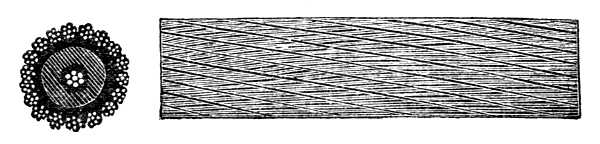
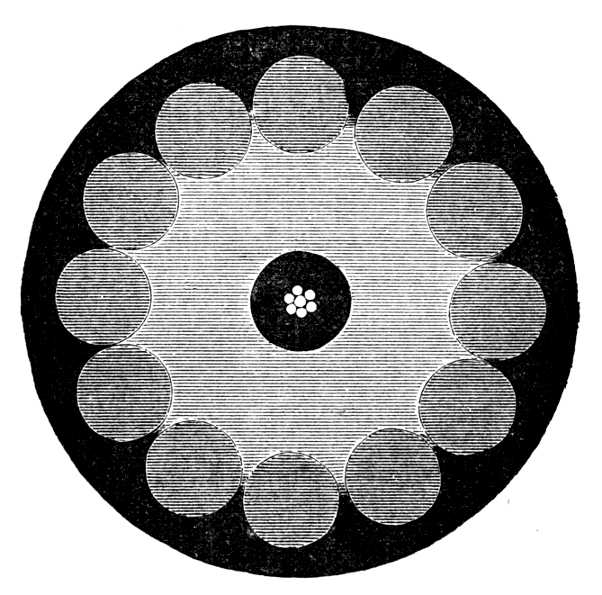
OLD ATLANTIC CABLE, 1858.
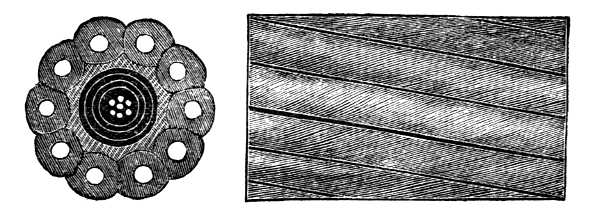
NEW ATLANTIC CABLE, 1865.
After passing through such elaborate tests, all will be glad to see the
final product of so much care and skill. As the long line begins to reel
off from the great wheels and drums, we may examine it in its completed
and more perfect form. It is only necessary to compare it with the cable
laid in 1858, to show its immense superiority. A glance at the two as
they appear on the preceding page will show that the cable had grown
since first it was planted in the ocean, as if it were a living product
of the sea. This growth had been in every part, from core to
circumference.
First, the central copper wire, which was the spinal cord, the nerve
along which the centre current was to run, was nearly three times as
large as before. Prof. Thomson had long seen that this was a condition
of success. While joining heartily in the attempts of 1857-58, he felt
that an error was committed in the smallness of the cable; that the
copper conductors and the gutta-percha covering should both be much
larger. The old conductor was a strand consisting of seven fine wires,
six laid round one, and weighed only one hundred and seven pounds to the
mile. The new was composed of the same number of wires, but weighed
three hundred pounds to the mile. As it was made of the finest copper
that could be obtained in the world, it was a perfect conductor. Next,
to secure insulation, it was first imbedded for solidity in Chatterton's
compound, a preparation impervious to water, and then covered with four
layers of gutta-percha, which were laid on alternately with four thin
layers of Chatterton's compound. The old cable had but three coatings of
gutta-percha, with nothing between. Its entire insulation weighed but
two hundred and sixty-one pounds to the mile, while that of the new
weighed four hundred pounds.
But a conductor ever so perfect, with insulation complete, was useless
without proper external protection, to guard it against the dangers
which must attend the long and difficult process of laying it across the
ocean. The old cable had broken a number of times. The new must be made
stronger. To this end it was incased with ten solid wires of the best
iron, or rather, of a soft steel, like that used in the making of
Whitworth's cannon. This made the cable much heavier than before. The
old cable weighed but twenty cwt. to the mile, while the new one reached
thirty-five cwt. and three quarters. But mere size and weight were
nothing, except as they indicated increased strength. This was secured,
not only by the larger iron wires, but by a further coating of rope.
Each wire was surrounded separately with five strands of Manilla yarn,
saturated with a preservative compound, and the whole laid spirally
round the core, which latter was padded with ordinary hemp, saturated
with the same preservative mixture. This rope covering was important in
several respects. It kept the wires from coming in contact with the salt
water, by which they might be corroded; and while it added greatly to
the strength of the cable, it gave it also its own flexibility—so that
while it had the strength of an iron chain, it had also the lightness
and flexibility of a common ship's rope. This union of two qualities was
all-important. The great problem had been to combine strength with
flexibility. Mere dead weight was an objection. The new cable, though
nearly twice as heavy as the old in air, when immersed in water, weighed
but a trifle more; so that it was really much lighter in proportion to
its size. This increased lightness was a very important matter in laying
the cable, as it caused it to sink slowly. The old cable, though
smaller, was heavy almost as a rod of iron, so that, as it ran out, it
dropped at an angle which exposed it to great danger in case of a sudden
lurch of the ship. Thus in 1857 it was broken by the stern of the
Niagara being thrown up on a wave just as the brakes were shut down. Now
the cable, being partially buoyed by the rope, would float out to a
great distance from the ship, and sink down slowly in the deep waters.
By this combination of rope and iron, a cable was secured two and a
half times as strong as the old—the breaking strain of the former
having been three tons five cwt., and of the latter seven tons and
fifteen cwt. Or, to put it in another form, the contract strain of the
former was less than five times its own weight per mile in water; so
that if the cable had been laid in some parts of the Atlantic, where the
ocean is more than five miles deep, it would have broken under the
enormous strain. But the contract strain of the new cable was equal to
eleven times its weight per mile in water, which, as the greatest
depth of water to be passed was but two and a half miles, rendered the
cable more than four times as strong as was required.
This great chain which was to bind the sea was to be 2,300 nautical
miles long, or nearly 2,700 statute miles! But where could this enormous
bulk be stowed? Its weight would sink the Spanish Armada. In 1858, the
cable loaded down two of the largest ships of war in the world, the
Niagara and the Agamemnon. Yet now one much larger and bulkier was to be
taken on board. This might have proved a serious embarrassment, but that
a few years before there had been built in England a ship of enormous
proportions. The Great Eastern, whose iron walls had been reared by the
genius of Brunel, had been for ten years waiting for "a mission." As a
specimen of marine architecture she was perfect. She walked the waters
in towering pride, scarce bending her imperial head to the waves that
broke against her sides, as against the rocks of the shore. But with all
her noble qualities, she was too great for the ordinary demands of
commerce. Her very size was against her; and while smaller ships, on
which she looked down with contempt, were continually flying to and fro
across the sea, this leviathan,
Hugest of all God's works
That swim the ocean stream,
could find nothing worthy of her greatness. Here then was the vessel to
receive the Atlantic cable.
Seeing her fitness for the purpose, a few of the gentlemen who were
active in reviving the Atlantic Telegraph combined to purchase her, as
she was about to be sold. One of them went down with all speed to
Liverpool, and the next day telegraphed that the big ship was theirs.
The new owners at once put her at the service of the Atlantic Company,
with the express agreement that any compensation for her use should
depend on the success of the expedition.
Next to the good fortune of finding such a ship ready to their hands,
was that of finding an officer worthy to command her. Captain James
Anderson, of the China, one of the Cunard steamers, had long been known
to the travelling public, both of England and America, and no one ever
crossed the sea with him without the strongest feeling of respect for
his manly and seamanly qualities. A thorough master of his profession,
having followed the sea for a quarter of a century, he was also a man of
much general intelligence, and of no small scientific attainments. But
it was something more than this which inspired such confidence. It was
his ceaseless watchfulness. He always carried with him a feeling of
religious responsibility for the lives of all on board, and for every
interest committed to him. A man of few words, modest in manner, he was
yet clear in judgment and prompt in action. This vigilance was
especially marked in moments of danger. When a storm was gathering, all
who saw that tall figure on the wheel-house, watching with a keen eye
every spar in the ship and every cloud in the horizon, felt a new
security from being under his care. Such was the man to be put in charge
of a great expedition. He was recommended by Mr. Field in the strongest
terms, and was chosen unanimously by the Board. The Cunard Company, with
great generosity, consented to give up his services, valuable as they
were, to forward an enterprise of such public interest. Being thus free,
he accepted the trust, and entered upon it with enthusiasm. How well he
fulfilled the expectations of all, the sequel will show.[A]
The work now went on with speed. The wheels began to hum, and the great
drums to reel off that line which, considering the distance it was to
span, was hardly to be measured by miles, but rather by degrees of the
earth's surface. Mere figures give but a vague impression of vast
spaces. But it is a curious fact, ascertained by an exact computation,
that if all the wires of copper and of iron, with the layers that made
up the core and the outer covering, and the strands of yarn that were
twisted into this one knotted sea-cable, were placed end to end, the
whole length would reach from the earth to the moon!
As it came from the works in its completed state, it was plunged in
water, to make it familiar with the element which was to be its future
home. In the yards of the Company stood eight large tanks, which could
hold each a hundred and forty miles. Here the cable was coiled to
"hibernate," till it should be wanted for use the coming spring.
Seeing the work thus well under way, with no chance of another
disastrous check, Mr. Field left England with heart at rest, and
returned to America for the winter. But the first days of spring saw him
again on the Atlantic. He reached England on the eighteenth of March.
His visit was more satisfactory than a year before. The work was now
well advanced. It was a goodly sight to go down to Morden Wharf at
Greenwich, and see the huge machinery in motion, spinning off the
leagues of deep-sea line. The triumph apparently was near at hand. It
seemed indeed a predestined thing that the cable should finally be laid
in the year of grace 1865—the end for which he had so faithfully toiled
since 1858—seven weary years—as long as Jacob served for Rachel! But,
less fortunate than Jacob, he was doomed to one more disappointment. At
present, however, all looked well, and he could not but regard the
prospect with satisfaction.
Having no more drudgery of raising money, he had now a few weeks'
leisure to take a voyage up the Mediterranean. The canal across the
Isthmus of Suez, which had been so long in progress, under the
supervision of French engineers, was at length so far advanced that the
waters of the Mediterranean were about to mingle with those of the Red
Sea, and delegates were invited to be present from all parts of the
world. An invitation had been sent to the Chamber of Commerce in New
York, and Mr. Field, then starting for Europe, was appointed as its
representative. The visit was one of extraordinary interest. The
occasion brought together a number of eminent engineers from every
country of Europe, in company with whom this stranger from the New World
visited the most ancient of kingdoms to see the spirit of modern
enterprise invading the land of the Pyramids.
He returned to England about the first of May to find the work nearly
completed. The cable was almost done, and a large part of it was already
coiled on board the ship. This was an operation of much interest, which
deserves to be described. The manufacture had begun on the first of
September, and had gone on for eight months without ceasing, the works
turning out fourteen miles a day even during the short days of winter.
As the spring advanced, and the days grew longer, the amount was of
course much increased. But by the last of January they had already
accumulated about nine hundred miles of completed cable, when began the
long and tedious work of transferring it to the Great Eastern. It was
thus slow, because it could not be made directly from the yard to the
ship. The depth of water at Greenwich was not such as to allow the Great
Eastern to be brought up alongside the wharf. She was lying at
Sheerness, thirty miles below, and the cable had to be put on board of
lighters and taken down to where she lay in the stream. For this purpose
the Admiralty had furnished to the Company two old hulks, the Iris and
the Amethyst, which took their loads in turn. When the former had taken
on board some two hundred and fifty tons of cable, she was towed down to
the side of the Great Eastern, and the other took her place.
This was an operation which could not be done with speed. With all the
men who could be employed, they coiled on board only about two miles an
hour, or twenty miles a day—at which rate it would take some five
months. The work began on the nineteenth of January, early in the
morning, and continued till June, before all was safely stowed on board.
The Great Eastern herself had been fitted up to receive her enormous
burden. It was an object to stow the cable in as few coils as possible.
Yet it could not be all piled in one mass. Such a dead weight in the
centre of the ship would cause her to roll fearfully. If coiled in one
circle, it was computed that it would nearly fill Astley's theatre from
the floor of the circus to the roof—making a pile fifty-eight feet wide
and sixty feet high. To distribute this enormous bulk and weight, it
was disposed in three tanks—one aft, one amidships, and one forward.
The latter, from the shape of the ship, was a little smaller than the
others, and held only six hundred and thirty-three miles of cable, while
the two former held a little over eight hundred each. All were made of
thick wrought-iron plates, and water-tight, so that the cable could be
kept under water till it was immersed in the sea.
Thus with her spacious chambers prepared for the reception of her guest,
the Great Eastern opened her doors to take in the Atlantic cable; and
long as it was, and wide and high the space it filled, it found ample
verge and room within her capacious sides. Indeed, it was the wonder of
all who beheld it, how, like a monster of the sea, she devoured all that
other ships could bring. The Iris and the Amethyst came up time after
time and disgorged their iron contents. Yet this leviathan swallowed
ship-load after ship-load, as if she could never be satisfied. A writer
who visited her when the cable was nearly all on board, was at a loss to
find it. He looked along the deck, from stem to stern, but not a sign of
it appeared. How he searched, and how the wonder grew, he tells in a
published letter. After describing his approach to the ship, and
climbing up her sides and his survey of her deck, he proceeds:
"But it is time that we should look after what we have mainly
come to see, the telegraph cable. To our intense astonishment,
we behold it nowhere, although informed that there are nearly
two thousand miles of it already on board, and the remaining
piece—a piece long enough to stretch from Land's End to John
O'Groat's—is in course of shipment. We walk up and down on the
deck of the Great Eastern without seeing this gigantic chain
which is to bind together the Old and the New World; and it is
only on having the place pointed out to us that we find where
the cable lies and by what process it is taken on board. On the
side opposite to where we landed, deep below the deck of our
giant, there is moored a vessel surmounted by a timber
structure resembling a house, and from this vessel the
wonderful telegraph cable is drawn silently into the immense
womb of the Great Eastern. The work is done so quietly and
noiselessly, by means of a small steam-engine, that we scarcely
notice it. Indeed, were it not pointed out to us, we would
never think that that little iron cord, about an inch in
diameter, which is sliding over a few rollers and through a
wooden table, is a thing of world-wide fame—a thing which may
influence the life of whole nations; nay, which may affect the
march of civilization. Following the direction in which the
iron rope goes, we now come to the most marvellous sight yet
seen on board the Great Eastern. We find ourselves in a little
wooden cabin, and look down, over a railing at the side, into
an immense cavern below. This cavern is one of the three
'tanks' in which the two-thousand-mile cable is finding a
temporary home. The passive agent of electricity comes creeping
in here in a beautiful, silent manner, and is deposited in
spiral coils, layer upon layer. It is almost dark at the
immense depth below, and we can only dimly discern the human
figures through whose hands the coil passes to its bed.
Suddenly, however, the men begin singing. They intone a low,
plaintive song of the sea; something like Kingsley's
'Three fishers went sailing away to the West,
Away to the West as the sun went down—'
the sounds of which rise up from the dark, deep cavern with
startling effect, and produce an indescribable impression.
"We proceed on; but the song of the sailors who are taking
charge of the Atlantic Telegraph cable is haunting us like a
dream. In vain our guide conducts us all over the big ship,
through miles of galleries, passages, staircases, and
promenades; through gorgeous saloons, full of mirrors, marbles,
paintings, and upholstery, made 'regardless of expense;' and
through buildings crowded with glittering steam apparatus of
gigantic dimensions, where the latent power of coal and water
creates the force which propels this monster vessel over the
seas. In vain our attention is directed to all these sights; we
do not admire them; our imagination is used up. The echo of the
sailors' song in the womb of the Great Eastern will not be
banished from our mind. It raises visions of the future of the
mystic iron coil under our feet—how it will roll forth again
from its narrow berth; how it will sink to the bottom of the
Atlantic, or hang from mountain to mountain far below the
stormy waves; and how two great nations, offsprings of one race
and pioneers of civilization, will speak through this wonderful
coil, annihilating distance and time. Who can help dreaming
here, on the spot where we stand? For it is truly a marvellous
romance of civilization, this Great Eastern and this Atlantic
Telegraph cable. Even should our age produce nothing else, it
alone would be the triumph of our age."
As the work approached completion, public interest revived in the
stupendous undertaking, and crowds of wonder-seekers came down from
London to see the preparations for the expedition. Even if not admitted
on board, they found a satisfaction in sailing round the great ship, in
whose mighty bosom was coiled this huge sea-serpent. It had also many
distinguished visitors. Among others, the Prince of Wales came to see
the ocean girdle which was to link the British islands with his future
dominions beyond the sea.
At length, on the twenty-ninth of May, almost the last day of Spring,
the manufacture of the cable was finished. The machines which for eight
months had been in a constant whirl, made their last round. The tinkling
of a bell announced that the machinery was empty, and the mighty work
stood completed. It only remained that it should be got on board, and
the ship prepared for her voyage. Hundreds of busy hands were at work
without ceasing, and yet it was six weeks before she was ready to put to
sea.
It may well be believed that it was no small affair to equip such an
expedition. Beside the enormous burden of the cable itself, the Great
Eastern had to take on board seven or eight thousand tons of coal,
enough for a fleet, to feed her fires. Then she carried about five
hundred men, for whom she had to make provision during the weeks they
might be at sea. The stores laid in were enough for a small army.
Standing on the wheel-house, and looking down, one might fancy himself
in some large farm-yard of England. There stood the motherly cow that
was to give them milk; and a dozen oxen, and twenty pigs, and a hundred
and twenty sheep, while whole flocks of ducks and geese, and fowls of
every kind, cackled as in a poultry-yard. Beside all this live stock,
hundreds of barrels of provisions, of meats and fruits, were stored in
the well-stocked larder below. Thus laden for her voyage, the Great
Eastern had in her a weight, including her own machinery, of twenty-one
thousand tons—a burden almost as great as could have been carried by
the whole fleet with which Nelson fought the battle of Trafalgar.
As the time of departure drew near, public curiosity was excited, and
there was an extraordinary desire to witness the approaching attempt.
The Company was besieged by applications from all quarters for
permission to accompany the expedition. Had these requests been granted,
on the scale asked, even the large dimensions of the Great Eastern could
hardly have been sufficient for the crowds on board. The demand was most
pressing for places for newspaper correspondents. These came not only
from England, but from France and America. Almost every journal in
London claimed the privilege of being represented. The result was what
might have been expected. As it was impossible to satisfy all, and to
discriminate in favor of some, and exclude others, would seem partial
and unjust, they were finally obliged to exclude all. Of course this
gave great offence. There was an outcry in England and in the United
States at what was denounced as a selfish and suicidal policy. But it is
doubtful whether any other possible course would have given better
satisfaction.
Whether the Managers erred in this or not, it should be said that they
applied the same inexorable rule to themselves—even Directors of the
Company being excluded, unless they had some special business on board.
It should be borne in mind that the expedition was not under the control
of the Atlantic Telegraph Company at all, but of the Telegraph
Construction and Maintenance Company, which had undertaken the work in
fulfilment of a contract with the former Company to manufacture and lay
down a cable across the Atlantic, in which it assumed the whole
responsibility, not only making the cable, but chartering the ship and
appointing the officers, and sending its own engineers to lay it down.
Of course it had an enormous stake in the result. Hence it felt, not
only authorized, but bound, to organize the expedition solely with
reference to success. It was not a voyage of pleasure, but for business;
for the accomplishment of a great and most difficult undertaking. Hence
it was right that the most strict rules should be adopted. Accordingly
there was not a man on board who had not some business there. As the
voyage promised to be one of the utmost practical interest to
electricians and engineers, several young men were received as
assistants in the testing-room or in the engineers' department; but
there was no person who was not in some way engaged on the business of
one or the other company, or connected with the management of the ship.
Except Mr. Field, not an Atlantic Telegraph Director accompanied the
expedition; and he represented also the Newfoundland Company. Mr. Gooch,
M.P., was at once a Director of the Telegraph Construction and
Maintenance Company, and Chairman of the Board that owned the Great
Eastern, and so represented both those companies which had so great a
stake in the result.
Thus the whole business was in the hands of the Telegraph Construction
and Maintenance Company. It had its own officers to man the
expedition—the captain and crew to sail the ship—its engineers to lay
the cable—and its electricians to test it. Even the eminent
electricians, Professor Thomson and Mr. Varley, who were on board in the
service of the Atlantic Telegraph Company, were not allowed to
interfere, nor even to give advice unless it were asked for in
writing, and then it was to be given in writing. Their office was only
to test the cable when laid, to pass messages through it from
Newfoundland to Ireland, and to report it complete.
So rigorous were the rules which governed this memorable voyage. The
whole enterprise was organized as completely as a naval expedition.
Every man had his place. As when a ship is going into battle, everybody
is sent below that has not some business on deck, so it is not strange
that in such a critical enterprise they did not want a host of
supernumeraries on board.
Yet the Company was not unmindful of the anxiety of the public for news,
and since it could not give a place to many correspondents, it engaged
one, and that the best—W. H. Russell, LL.D., the well-known
correspondent of the London Times in the Crimea and in India. This
brilliant writer was engaged to accompany the expedition—not to praise
without discrimination, but to report events faithfully from day to day.
He was accompanied by two artists, Mr. O'Neill and Mr. Dudley, to
illustrate the scenes of the voyage. Thus the Company made every
provision to furnish information and even entertainment to the public.
Several of these gentlemen afterward wrote accounts for different
magazines—Blackwood, Cornhill, and Macmillan's. Their different
reports, and especially the volume of Dr. Russell, which combines the
accuracy and minuteness of a diary kept from day to day, with brilliant
descriptions, set off by illustrations from drawings of Mr. Dudley,
furnish the public as full and complete an account as if there had been
a special correspondent for every journal of England and America.
But if the public at large were very properly excluded, the organization
on board was perfect and complete. At the head was Captain Anderson, of
whom we have already spoken. As his duties would be manifold and
increasing, he had requested the aid of an assistant commander, and
Captain Moriarty, R. N., who had been in the Agamemnon in 1858, was
permitted by the Admiralty to accompany the ship, and to give the
invaluable aid of his experience and skill. The government also
generously granted two ships of war, the Sphinx and the Terrible, to
attend the Great Eastern. Thus the whole equipment of the expedition was
English. Of the five hundred men on board the Great Eastern, there was
but one American, and that was Mr. Field.
The engineering department was under charge of Mr. (now Sir) Samuel
Canning, who, as the representative of the Telegraph Construction and
Maintenance Company, was chief in command of all matters relating to
laying the cable. For this responsible position no better man could have
been chosen. Before the voyage was ended, he had ample opportunity to
show his resources. He was ably seconded by Mr. Henry Clifford. Both
these gentlemen had been on board the Agamemnon in the two expeditions
of 1858. They had since had large experience in laying submarine cables
in the Mediterranean and other seas. It was chiefly by their united
skill that the paying-out machinery had been brought to such perfection,
that throughout the voyage it worked without a single hitch or jar. They
had an invaluable helper in Mr. John Temple.
The electrical department was under charge of Mr. De Sauty, who had had
long experience in submarine telegraphs, and who was aided by an
efficient corps of assistants. Professor Thomson and Mr. Varley, as we
have said, were there to examine and report for the Atlantic Company.
All these gentlemen had been unceasing in their tests of the cable in
every form, both while in the process of manufacture and after it was
coiled in the Great Eastern. The result of their repeated tests was to
demonstrate that the cable was many times more perfect than the
contract required. With such marvellous delicacy did they test the
current of electricity sent through it, that it was determined that of
one thousand parts, over nine hundred and ninety-nine came out at the
other end!
To complete this organization and equipment caused such delays as
excited the impatience of all on board. But at length, when midsummer
had fully come—at noon of Saturday, July fifteenth—the song of the
sailors sounded the chant du départ. The Great Eastern was then lying
at the Nore, and she seemed to cling to the English soil which she had
griped with a huge Trotman weighing seven tons, held fast by a chain
whereof every link weighed seventy pounds! To wrench this ponderous
anchor from its bed required the united strength of near two hundred
men. At last the bottom lets go its hold, the anchor swings to the bow,
the gun is fired, and the voyage is begun. A fleet of yachts and boats
raise their cheers as the mighty hull begins to move. But mark how
carefully she feels her way, following the lead of yonder little
steamer, the Porcupine, the same faithful guide that seven years before
led the Niagara up Trinity Bay one night when the faint light of stars
twinkled on all the surrounding hills. Slowly they near the sea. Now the
cliffs of Dover are in sight, and bidding her escort adieu, the Great
Eastern glides along by the beautiful Isle of Wight, and then quickening
her speed, with a royal sweep, she moves down the Channel. Off Falmouth
she picked up the Caroline, a small steamer, which had left several days
before with the shore end on board. She was laboring heavily with her
burden, and made little headway in the rough waves. But the Great
Eastern took her in tow, and she followed like a ship's boat in the wake
of the monarch of the seas.
Thus they passed round to the coast of Ireland, to that Valentia Bay
where, eight years before, the Earl of Carlisle gave his benediction on
the departure of the Niagara and the Agamemnon, and where, a year
later, the gallant English ship brought her end of the cable safely to
the shore.
The point of landing had been changed from Valentia harbor five or six
miles to Foilhommerum Bay, a wild spot where huge cliffs hang over the
waves that here come rolling in from the Atlantic. On the top, an old
tower of the time of Cromwell tells of the bloody days of England's
great civil war. It is now but a mossy ruin. Here the peasants who
flocked in from the country pitched their booths on the green sward, and
looked down from the dizzy heights on the boats dancing in the bay
below. At the foot of the cliff, a soft, sandy beach forms a bed for the
cable, and here, as it issues from the sea, it is led up a channel which
had been cut for it in the rocks.
As the shore end was very massive and unwieldy, it could not be laid
except in good weather; and as the sea was now rough, the Great Eastern
withdrew to Bantry Bay, to be out of the way of the storms which
sometimes break with fury on this rock-bound coast.
On Saturday this preliminary work was completed, the heavy shore end was
carried from the deck of the Caroline across a bridge of boats to the
beach, and hauled up the cliffs amid the shouts of the people. When once
it was made fast to the rocks, the little steamer began to move, and the
huge coil slowly unwound, and like a giant awakened, stretched out its
long iron arms. By half-past ten o'clock at night the hold was empty,
the whole twenty-seven miles having been safely laid, and the end buoyed
in seventy-five fathoms water. A despatch was at once sent across the
country to Bantry Bay to the Great Eastern to come around with all
speed, and early the next morning her smoke was seen in the offing.
Passing the harbor of Valentia, she proceeded to join the Caroline,
which she reached about noon, and at once commenced splicing the massive
shore end to her own deep-sea line. This was a work of several hours, so
that it was toward evening before all was completed.
Thus, so many had been the delays of the past week, that it had come on
to Sunday before the Great Eastern was ready to begin her voyage.
This—which some might count a desecration of the holy day—the sailors
rather accepted as a good omen. Had the shore end been laid forty-eight
hours sooner, the voyage might have begun on Friday, which sailors, who
are proverbially superstitious, would have thought an unlucky beginning.
But Sunday, in their esteem, is a good day. They like, when a ship is
moving out of sight of land, that the last sound from the shore should
be the blessed Sabbath bells. If that sacred chime were not heard
to-day, at least a Sabbath peace rested on sea and sky. It was a calm
summer's evening. The sun was just sinking in the waves, as the Great
Eastern, with the two ships of war which waited on either hand, to
attend her royal progress, turned their faces to the West, and caught
the sudden glory. Says Russell: "As the sun set, a broad stream of
golden light was thrown across the smooth billows toward their bows, as
if to indicate and illumine the path marked out by the hand of Heaven."
What a sacred omen! Had it been the fleet of Columbus sailing westward,
every ship's company would have fallen upon their knees on those decks,
and burst forth in an Ave Maria to the gentle Mistress of the Seas. But
in that manly crew there was many an eye that took in the full beauty of
the scene, and many a reverent heart that invoked a benediction.
In other respects the day was well chosen. It was the twenty-third of
July. From the beginning, Captain Anderson had wished to sail on the
twenty-third of June, or the twenty-second of July, so as to have the
full moon on the American coast. He desired also to take advantage of
the westerly winds which prevail at that season, for in going against
the wind the Great Eastern was steady as a rock. Every expectation was
realized. To the big ship the ocean was as an inland lake. The
paying-out machinery—the product of so much study and skill—worked
beautifully, and as the ship increased her speed, the cable glided into
the water with such ease that it seemed but a holiday affair to carry it
across to yonder continent. Such were the reflections of all that
evening as the long summer twilight lingered on the sea. At midnight
they went to sleep, to dream of an easy triumph.
Yet be not too confident. But a few hours had passed before the booming
of a gun awoke all on board with the heavy tidings of disaster. The
morning breaks early in those high latitudes, and by four o'clock all
were on deck, with anxious looks inquiring for the cause of alarm. The
ship was lying still, as if her voyage had already come to an end, and
electricians, with troubled countenances, were passing in and out of the
testing-room, which, as it was always kept darkened, looked like a
sick-chamber where some royal patient lay trembling between life and
death.
The method used by the electricians to discover a fault is one of such
delicacy and beauty as shows the marvellous perfection of the
instruments which science employs to learn the secrets of nature. The
galvanometer is an invention of Professor Thomson, by which "a ray of
light reflected from a tiny mirror suspended to a magnet travels along a
scale, and indicates the resistance to the passage of the current
through the cable by the deflection of the magnet, which is marked by
the course of this speck of light. If the light of the mirror travels
beyond the index, or out of bounds, an escape of the current is taking
place, and what is technically called a fault has occurred." Such was
the discovery on Monday morning. At a quarter past three o'clock the
electrician on duty saw the light suddenly glide to the end of the scale
and vanish.
Fortunately it was not a fatal injury. It did not prevent signalling
through the cable, and a message was at once sent back to the shore,
giving notice of the check that had been received. But the electric
current did not flow freely. There was a leak at some point of the line
which it would not be prudent to pass over. They were now seventy-three
miles from shore, having run out eighty-four miles of cable. The tests
of the electricians indicated the fault to be ten or a dozen miles from
the stern of the ship. The only safe course was to go back and get this
on board, and cut out the defective portion. It was a most ungrateful
operation thus to be undoing their own work, but there was no help for
it.
Such accidents had been anticipated, and before the Great Eastern left
England, she had been provided with machinery to be used in case of
necessity for picking up the cable. But this proved rather an unwieldy
affair. It was at the bow, and as the paying-out machine was at the
stern, the ship had to be got round, and the cable, which must first be
cut, had to be transferred from one end to the other. This was not an
easy matter. The Great Eastern was an eighth of a mile long, and to
carry the cable along her sides for this distance, and over her high
wheel-houses, was an operation at once tedious and difficult.
But at length the ship's head was brought round, and the end of the
cable lifted over the bow, and grasped by the pulling-in machine, and
the engine began to puff with the labor of raising the cable from the
depths of the ocean. Fortunately they were only in four or five hundred
fathoms water, so that the strain was not great. But the engine worked
poorly, and the operation was very slow. With the best they could do, it
was impossible to raise more than a mile an hour! But patience and
courage, though it should take all day and all night![B] The Great
Eastern did her duty well, steaming slowly back toward Ireland, while
the engine pulled, and the cable came up, though reluctantly, from the
sea, till on Tuesday morning at seven o'clock, when they had hauled in a
little over ten miles, the cause of offence was brought on board. It was
found to be a small piece of wire, not longer than a needle, that by
some accident (for they did not then suspect a design) had been driven
through the outer cover of the cable till it touched the core. There was
the source of all the mischief. It was this pin's point which pricked
the vital cord, opening a minute passage through which the electricity,
like a jet of blood from a pierced artery, went streaming into the sea.
It was with an almost angry feeling, as if to punish it for its
intrusion, that this insignificant and contemptible source of trouble
was snatched from its place, the wounded piece of cable was cut off, and
a splice made and the work of paying out renewed. But it was four
o'clock in the afternoon of Tuesday before they were ready to resume the
voyage. A full day and a half had been lost by this miserable piece of
wire.
But the vexatious delay was over at last, and the stately ship, once
more turning to the West, moved ahead with a steady composure, as if no
petty trouble could vex her tranquil mind. Throughout the voyage the
behavior of the ship was the admiration of all on board. While her
consorts on either side were pitched about at the mercy of the waves,
she moved forward with a grave demeanor, as if conscious of her mission,
or as if eager to unburden her mighty heart, to throw overboard the
great mystery that was coiled up within her, and to cast her burden on
the sea.
The electricians, too, were elated, and with reason, at the perfection
of the cable as demonstrated by every hour's experience. At intervals of
thirty minutes, day and night, tests were passed from ship to shore,
and to the delight of all, instead of finding the insulation weakened,
it steadily improved as the cable was brought into contact with the cold
depths of the Atlantic.
All now went well till Saturday, the twenty-ninth, when a little after
noon there was again a cry from the ship, as if once more the cable were
wounded and in pain. This time the fault was more serious than before.
The electricians looked very grave, for they had struck "dead earth,"
that is, the insulation was completely destroyed, and the electric
current was escaping into the sea.
As the fault had gone overboard, it was necessary to reverse their
course, and haul in till the defective part was brought up from the
bottom. This time it was more difficult, for they were in water two
miles deep. Still the cable yielded slowly to the iron hands that drew
it upward; and after working all the afternoon, about ten o'clock at
night they got the fault on board. The wounded limb was at once
amputated, and joining the parts that were whole, the cable was made new
and strong again. Thus ended a day of anxiety. The next morning, which
was the second Sabbath at sea, was welcomed with a grateful feeling
after the suspense of the last twenty-four hours.
On Monday, the miles of cable that had been hauled up, and which were
lying in huge piles upon the deck, were subjected to a rigid
examination, to find out where the fault lay. This was soon apparent.
Near the end was found a piece of wire thrust through its very heart, as
if it had been driven into it. All looked black when this was
discovered, for at once it excited suspicions of design. It was remarked
that the same gang of workmen were in the tank as at the time of the
first fault. Mr. Canning sent for the men, and showing them the cable
pierced through with the wire, asked them how it occurred. Every man
replied that it must have been done by design, even though they
accused themselves, as this implied that there was a traitor among them.
It seemed hard to believe that any one could be guilty of such devilish
malignity. Yet such a thing had been done before in a cable laid in the
North Sea, where the insulation was destroyed by a nail driven into it.
The man was afterward arrested, and confessed that he had been hired to
do it by a rival company. The matter was the subject of a long
investigation in the English courts. In the present case there were many
motives which might prompt to such an act. The fall in the stock on the
London Exchange, caused by a loss of the cable, could hardly be less
than half a million sterling. Here was a temptation such as betrays
bold, bad men into crime. However, as it was impossible to fix the deed
on any one, nothing was proved, and there only remained a painful
suspicion of treachery. Against this it was their duty to guard.
Therefore it was agreed that the gentlemen on board should take turns
in keeping watch in the tank. It was very unpleasant to Mr. Canning thus
to set a watch on men, many of whom had been with him in his former
cable-laying expeditions, but the best of them admitted the necessity of
it, and were as eager as himself to find out the Judas among them.
But accident or villainy, it was defeated this time, and the Great
Eastern proudly continued her voyage. Not the slightest check
interrupted their progress for the next three days, during which they
passed over five hundred miles of ocean. It was now they enjoyed their
greatest triumph. They were in the middle of the Atlantic, and thus far
the voyage had been a complete success. The ship seemed as if made by
Heaven to accomplish this great work of civilization. The paying-out
apparatus was a piece of mechanism to excite the enthusiasm of an
engineer, so smoothly did its well-oiled wheels run. The strain never
exceeded fourteen hundred-weight, even in the greatest depths of the
Atlantic. And as for the cable itself, it seemed to come as near
perfection as it was possible to attain. As before, the insulation was
greatly improved by submergence in the ocean. With every lengthening
league it grew better and better. It seems almost beyond belief, yet the
fact is fully attested that, when in the middle of the ocean, the
communication was so perfect that they could tell at Valentia every time
the Great Eastern rolled.[C] With such omens of success, who could but
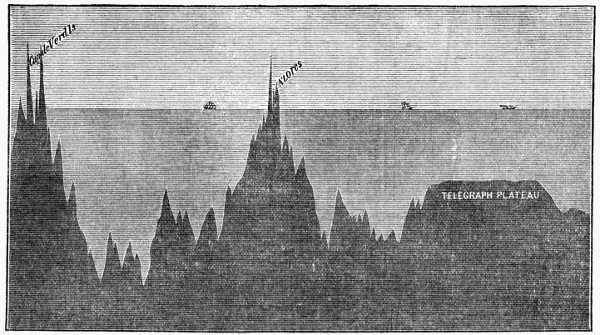
feel confident? And when on Monday they passed over a deep valley, where
lay "the bones of three Atlantic cables," it was with a proud assurance
that they should not add another to the number.
But Wednesday brought a sudden termination of their hopes. They had run
out about twelve hundred miles of cable, and were now within six hundred
miles of Newfoundland. Two days more would have made them safe, as it
would have brought them into the shallow waters of the coast. Thus it
was when least expected that disaster came. The record of that fatal day
may be given in few words. In the morning, while Mr. Field was keeping
watch in the tank, with the same gang of men who had been there when the
trouble occurred before, a grating sound was heard, as if a piece of
wire had caught in the machinery, and word was passed up to the deck to
look out for it; but the caution seems not to have been heard, and it
passed over the stern of the ship. Soon after a report came from the
testing-room of "another fault." It was not a bad one, since it did not
prevent communication with land; and much anxiety might have been saved
had a message been sent to Ireland that they were about to cut the
cable, in order to haul it on board. But small as the fault was, it
could not be left behind. Down on the deep sea-floor was some minute
defect, a pin's point in a length measured by thousands of miles. Yet
that was enough. Of this marvellous product of human skill, it might in
truth be said, that it was like the law of God in demanding absolute
perfection. To offend in one point was to be guilty of all.
This new fault, though it was annoying, did not create alarm, for they
had been accustomed to such things, and regarded them only as the
natural incidents of the voyage. Had the apparatus for pulling in been
complete, it could not have delayed them more than a few hours. But this
had been the weak point of the arrangements from the beginning—the
bête noire of the expedition. The only motive power was a little
donkey engine, (rightly named,) which puffed and wheezed as if it had
the asthma. This was now put in requisition, but soon gave out for want
of more steam. While waiting for this a breeze sprang up, which caused
the Great Eastern to drift over the cable, by which it was badly chafed,
so that when it was hauled in, as the injured part was coming over the
bows and was almost within grasp, suddenly it broke and plunged into the
sea!
It came without a moment's warning. So unexpected was such a
catastrophe, that the gentlemen had gone down to lunch, as it was a
little past the hour of noon. But Mr. Canning and Mr. Field stood
watching the cable as it was straining upward from the sea, and saw the
snapping of that cord, which broke so many hopes. The impression may be
better imagined than described. Says a writer on board: "Suddenly Mr.
Canning appeared in the saloon, and in a manner which caused every one
to start in his seat, said, 'It is all over! It is gone!' then hastened
onward to his cabin. Ere the thrill of surprise and pain occasioned by
these words had passed away, Mr. Field came from the companion into the
saloon, and said, with composure admirable under the circumstances,
though his lip quivered and his cheek was blanched, 'The cable has
parted and has gone overboard.' All were on deck in a moment, and there,
indeed, a glance revealed the truth."
At last it had come—the calamity which all had feared, yet that seemed
so far away only a few hours before. Yet there it was—the ragged end on
board, torn and bleeding, the other lying far down in its ocean grave.
In America, of course, nothing could be known of the fate of the
expedition till its arrival on our shores. But in England its progress
was reported from day to day, and as the success up to this point had
raised the hopes of all to the highest pitch, the sudden loss of
communication with the ship was a heavy blow to public expectation, and
gave rise to all sorts of conjectures. At first a favorite theory was,
that communication had been interrupted by a magnetic storm. These are
among the most mysterious phenomena of nature—so subtle and fleeting as
to be almost beyond the reach of science. No visible sign do they give
of their presence. No clouds darken the heavens; no thunder peals along
the sky. Yet strange influences trouble the air. At this very hour,
Professor Airy, the Astronomer Royal at the Observatory at Greenwich,
reported a magnetic storm of unusual violence. Said a London paper:
"Just when the signals from the Great Eastern ceased, a
magnetic storm of singular violence had set in. Unperceived by
us, not to be seen in the heavens, nor felt in the atmosphere,
the earth's electricity underwent a mysterious disturbance. The
recording instruments scattered about the kingdom, everywhere
testified to the fury of this voiceless tempest, and there is
every reason to suppose that the confusion of signals at midday
on Wednesday was due to the strange and unusual earth-currents
of magnetism, sweeping wildly across the cable as it lay in
apparently untroubled waters at the bottom of the Atlantic."
Said the Times:
"At Valentia, on Wednesday last, the signals, up to nine a.m.,
were coming with wonderful distinctness and regularity, but
about that time a violent magnetic storm set in. No insulation
of a submarine cable is ever so perfect as to withstand the
influence of these electrical phenomena, which correspond in
some particulars to storms in the ordinary atmosphere, their
direction generally being from east to west. Their action is
immediately communicated to all conductors of electricity, and
a struggle set up between the natural current and that used
artificially in sending messages. This magnetic storm affected
every telegraphic station in the kingdom. At some the wires
were utterly useless; and between Valentia and Killarney the
natural current toward the west was so strong along the land
lines that it required an addition of five times the ordinary
battery power to overcome it. This magnetic storm, which ceased
at two a.m. on Friday, was instantly perceptible in the
Atlantic cable."
But these explanations, so consoling to anxious friends on land, did not
comfort those on board the Great Eastern. They knew, alas! that the
cable was at the bottom of the ocean, and the only question was, if any
thing could be done to recover it.
Now began a work of which there had been no example in the annals of the
sea. The intrepid Canning declared his purpose to grapple for the cable!
The proposal seemed wild, dictated by the frenzy of despair. Yet he had
fished in deep waters before. He had laid his hand on the bottom of the
Mediterranean, but that was a shallow lake compared with the depths into
which the Atlantic cable had descended. The ocean is here two and a half
miles deep. It was as if an Alpine hunter stood on the summit of Mont
Blanc and cast a line into the vale of Chamouni. Yet who shall put
bounds to human courage? The expedition was not to be abandoned without
a trial of this forlorn hope. There were on board some five miles of
wire rope, intended to hold the cable in case it became necessary to cut
it and lash it to the buoys, to save it from being lost in a storm. This
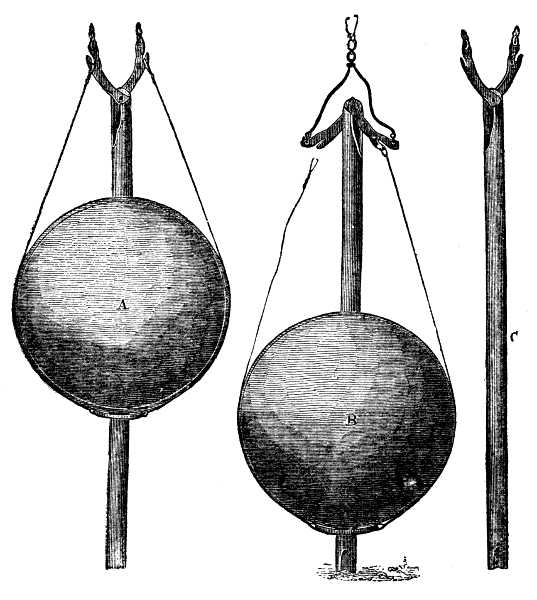
was brought on deck for another purpose. "And now came forth the
grapnels, two five-armed anchors, with flukes sharply curved and tapered
to a tooth-like end—the hooks with which the Giant Despair was going to
fish from the Great Eastern for a take worth, with all its belongings,
more than a million." These huge grappling-irons were firmly shackled to
the end of the rope, and brought to the bows and thrown overboard. One
splash, and the whole has disappeared in the bosom of the ocean. Down it
goes—deeper, deeper, deeper still! For two full hours it continued
sinking before it struck the earth, and like a pearl-diver, began
searching for its lost treasure on the bottom of the sea. What did it
find there? The wrecks of ships that had gone down a hundred years ago,
with dead men's bones whitening in the deep sea caves? It sought for
something more precious to the interest of civilization than gems and
gold.
The ship was now a dozen miles or so from the place of accident. The
cable had broken a little after noon, when the sun was shining clear, so
that Captains Anderson and Moriarty had just obtained a perfect
observation, from which they could tell, within half a mile, the very
spot where it had gone down. To reach it now, with any chance of
bringing it up, it would be necessary to hook it a few miles from the
end. It had been paid out in a line from east to west. To strike it
broadside, the ship stood off in the afternoon a few miles to the south.
Here the grapnel was thrown over about three o'clock, and struck bottom
about five, when the ship began slowly drifting back on her course. All
night long those iron fingers were raking the bottom of the deep but
grasping nothing, till toward morning the long rope quivered like a
fisherman's line when something has seized the end, and the head of the
Great Eastern began to sway from her course, as if it felt some unseen
attraction. As they began to haul in, the rapidly increasing strain soon
rendered it certain that they had got hold of something. But what
could it be? How did they know it was their lost cable? This question
has often been asked. They did not see it. How did they know that it was
not the skeleton of a whale, or a mast or spar, the fragment of a
wrecked ship? The question is easily answered. If it had been any loose
object which was being drawn up from the sea, its weight would have
diminished as it came nearer the surface. But on the contrary, the
strain, as shown by the dynamometer, steadily increased. This could
only be from some object lying prone on the bottom. To an engineer the
proof was like a mathematical demonstration. Another fact observed by
Captain Anderson was equally decisive:
"The grapnel had caught something at the exact hour when by
calculation the ship was known to be crossing the line of the
cable; nor had the grapnel upon this or any other occasion even
for an instant caught any impediment from the time of its being
lowered to the bottom, until the hour indicated by calculation,
when the cable ought to be hooked."
Having thus caught the cable, they had good hopes of getting it again,
their confidence increasing with every hundred fathoms brought on board.
For hours the work went on. They had raised it seven hundred fathoms—or
three quarters of a mile—from the bottom, when an iron swivel gave way,
and the cable once more fell back into the sea, carrying with it nearly
two miles of rope.
The first attempt had failed, but the fact that they had unmistakably
caught the prize gave them courage for a second. Preparations were at
once begun, but fogs came on and delayed the attempt till Monday, when
it was repeated. The grapnel caught again. It was late in the afternoon
when it got its hold, and the work of pulling in was kept up all night.
But as the sea was calm and the moon shining brightly, all joined in it
with spirit, feeling elated with the hope of triumph on the morrow.
That was not to be; but each attempt seemed to come nearer and nearer to
victory. This time the cable was drawn up a full mile from the bottom,
and hung suspended a mile and a half below the ship. Had the rope been
strong enough, it might have been brought on board. But again a swivel
gave way, and the cable, whose sleep had been a second time disturbed,
sought its ocean bed.
These experiments were fast using up the wire rope, and every expedient
had to be resorted to, to piece it out and to give it strength. Each
shackle and swivel was replaced by new bolts, and the capstan was
increased four feet in diameter, by being belted with enormous plates of
iron, to wind the rope around it, if the picking-up machinery should
fail. This gave full work to all the mechanics on board. The ship was
turned into a very cave of Vulcan, presenting at night a scene which
might well take the eye of an artist, and which Russell thus describes:
"The forge fires glared on her decks, and there, out in the
midst of the Atlantic, anvils rang and sparks flew; and the
spectator thought of some village far away, where the
blacksmith worked, unvexed by cable anxieties and greed of
speedy news. As the blaze shot up, ruddy, mellow and strong,
and flung arms of light aloft and along the glistening decks,
and then died into a red centre, masts, spars, and ropes were
for the instant touched with a golden gleaming, and strange
figures and faces were called out from the darkness—vanished,
glinted out again—rushed suddenly into foreground of bright
pictures, which faded soon away—flickered—went out—as they
were called to life by its warm breath, or were buried in the
outer darkness! Outside all was obscurity, but now and then
vast shadows, which moved across the arc of the lighted
fog-bank, were projected far away by the flare; and one might
well pardon the passing mariner, whose bark drifted him in the
night across the track of the great ship, if, crossing himself,
and praying with shuddering lips, he fancied he beheld a
phantom ship freighted with an evil crew, and ever after told
how he had seen the workshops of the Inferno floating on the
bosom of the ocean."
While preparing for a third attempt, the ship had been drifting about,
sometimes to a distance of thirty or forty miles, but it had marked the
course where the cable lay by two buoys, thrown over about ten miles
apart, each bearing a flag which might be seen at a distance, and so
easily came back to the spot. On Thursday morning all was ready, and the
line was cast as before, but after some hours of drifting, it was
evident that the ship had passed over the cable without grappling. The
line was hauled in, and the reason at once appeared. One of the flukes
had caught in the chain, so that it could not strike its teeth into the
bottom. This was cleared away, and the rope prepared for a fourth and
final attempt.
It was at noon of Friday that the grapnel went overboard for the last
time. By four o'clock it had caught, and the work of hauling-in
recommenced. Again the cable was brought up nearly eight hundred
fathoms, when the rope broke, carrying down two miles of its own
length, and with it the hopes of the Atlantic Telegraph for the present
year.
Their resources were exhausted. For nine days and nights, for the work
never stopped for light or darkness, had the great ship kept moving
round and round like some mighty bird of the sea, with her eye fixed on
the place where her treasure had gone down, and striving to wrest it
from the hand of the spoiler. Three times had they grasped the prize,
and each time failed to recover it, only for want of ropes strong enough
to bring it on board. The cable itself never broke. This proof of its
strength was a good omen for future success.
But for the present all was over. The attempt must be abandoned for the
year 1865, but not for ever; and with this purpose in her constant mind,
the Great Eastern swung sullenly around, and turned her imperial head
toward England, like a warrior retiring from the field—not victorious,
nor yet defeated and despairing, but with her battle-flag still flying,
and resolved once more to attempt the conquest of the sea.