IN 1866, just after the end of the Civil War, the American
steam fleet registered for foreign trade, measured
198,289 tons. The steam vessels enrolled for coasting
traffic measured 885,223 tons. In 1879 the steam tonnage
in the foreign trade had fallen to 156,323, while the coasting
tonnage had passed the million mark. In 1896 the
coasting fleets measured more than 2,000,000 tons, while
the foreign trade ships measured 264,289 tons. In 1908
the coasting steamers reached a tonnage of 4,055,295,—double
the figures of 1896, and the registered tonnage was
598,737,—more than double that of 1896, but so far below
that of the coasting tonnage as to warrant a serious inquiry
into the causes which had created the contrast.
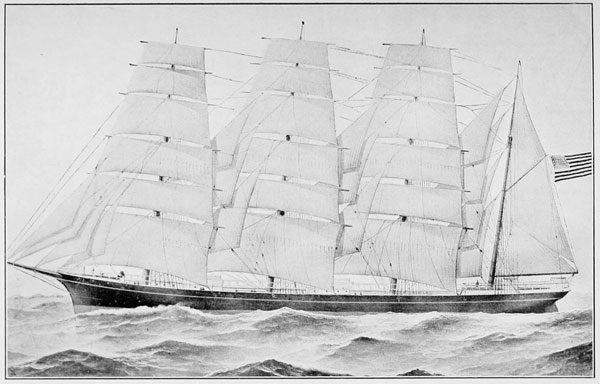
Four-master DIRIGO
First steel ship built in the United States
Before entering into this inquiry, however, it will be of
interest to consider several features of the growth of the
coasting traffic. First note that the cheap rates of transportation
afforded by the ships running from such Southern
ports as Savannah, Charleston, and Norfolk to Boston and
New York have had a most remarkable influence upon
the agriculture of the Southern coast States. Where once
cotton only was raised, or cotton and tobacco, the land-owners
are producing cargoes of vegetables at a season
when such truck can be produced at the North only by the
use of hothouses. The health of millions of people at the
North, and the prosperity of other millions at the South,
have been greatly promoted by the coasting steamers.
At the same time the coast lines of railroads, to secure a
share of the traffic which was originated by steamers, have
improved their service so far that strawberries and string
beans have right of way over passengers.
A natural evolution of traffic alongshore has been seen in
the extension, so to speak, of the railroads across both salt
and fresh water. Soon after the Boston and Providence
Railroad was opened (June 15, 1835), its directors made
an agreement with a line of steamers to New York under
which the vessels of rival lines were excluded from the terminal
facilities of the railroad, and the passengers from the
rival lines had to wait hours for a train on which to continue
their journey. In 1845 Daniel Drew, a director of the
Providence and Stonington Railroad, became the president
of the line of steamers running from Stonington to New
York, and the two companies, for the purposes of traffic,
were operated as one.
The railroads that terminated on the shores of Lake
Erie engaged in the Lake traffic at an early date by establishing
ship lines that gathered freight at all Lake ports of importance
for transportation to the East, and, of course,
carried the traffic from the East to the farthest points
on the Lakes. These steamers had a marked influence on
the development of the West. Of such lines as that which
runs from Galveston and New Orleans to New York in
connection with the Southern Pacific Railroad, only mention
need be made, but the fact that the extension of railroads
in this way across wide stretches of the waters of the
country, has had a marked influence upon the prosperity
of the country as well as upon that of the railroads, is
memorable.
Another notable feature of the coasting trade is a revival
of the old system, practised by such merchants as Derby,
of Salem, when they built ships especially to carry their own
goods to market. Thus, when petroleum was found in
Texas, the Standard Oil Company built many vessels to
carry the crude oil from the wells to the refineries at New
York. The oil was taken through pipes from the wells to
the ship, and it was pumped from the ship into tanks at the
refineries. With the aid of such port facilities the cost of
transportation was reduced to the lowest figure.
The United States Steel Corporation, owning ore beds near
Lake Superior and mills near Pittsburg, built a fleet of
ships to carry the ore to points on Lake Erie whence it could
be shipped on a private railroad to the mills. The ore in
the beds was scooped up with steam shovels and dumped
into cars, by which it was transported to high trestles on the
edge of the harbor. On the trestles it was dumped into
pockets, from which it fell through chutes into the vessel,
the hatches of which were spaced to correspond with the
spaces of the chutes. A cargo of more than 10,000 tons
has been loaded in two hours. At the port of discharge
other scoops (a sort of dredge), made to operate through
the hatches, lift the cargo out of the ship at a rate of more
than a thousand tons an hour.
The great coal companies of the East deliver their coal
in similar pockets on the coast, but they transport a large
portion of it thence to the consumer by means of tugs and
barges. In proportion to the coal carried, the tug-and-barge
system costs less than cargo-carrying steamers. The
tugs, with their high-priced crews, are kept moving; they
tow the barges in "strings" to their destinations, dropping
one here and another there, until the last is at the pier.
Then they return, picking up the barges that have been unloaded,
and take them to the pockets for more coal. The
barges have small crews of low-priced men. The expense of
waiting for the discharge of the coal is therefore less than
if a steamer had carried the coal; it is even less than the
expense of a schooner lying thus. The systems of handling
cargoes in coarse freight trades of the American coast
are, perhaps, the most perfect in the world.
Naturally, extensions of the railroad lines have been
made across deep water. The Pennsylvania Railroad established
the American line from Philadelphia to Liverpool
in 1871. The Baltimore and Ohio established the Atlantic
Transport line to Europe. The Louisville and Nashville
created lines from Pensacola to several countries, including
Japan and China. The Illinois Central has lines
from New Orleans. The Occidental and Oriental Steamship
Company was organized to carry the freight of the
Pacific railroads from San Francisco to the Far East.
Near the end of the nineteenth century the Southern Pacific
Railroad bought an interest in the Pacific Mail. The
Northern Pacific was served for years by the Boston Steamship
Company, and the Great Northern Railroad built two
of the largest cargo carriers in the world for an extension of
service across the Pacific. Most of the ships in these extensions
of railroads have been of American build.
In oversea traffic the through bills of lading and special
terminal facilities gave the ships owned by railroads special
advantages in the world's traffic. A great corporation is
able to purchase supplies at the lowest prices. Further
than that, it is not infrequently advisable to carry freight
on ships at an actual loss in order to provide freight for the
cars in which it can be carried with profit.
Another American adventure at sea that is of interest
here was the evolution of the United Fruit Company. Individual
dealers in perishable products of the tropics found
it profitable to unite in gathering bananas and other fruits,
and in chartering ships to bring them to the United States.
As the business continued to increase, the need of swift
ships, and for fittings to preserve the fruit in the best condition,
led to the building of special kinds of ships (chiefly
under foreign flags) and of machinery for loading and unloading
the cargoes at the terminals. In the meantime, the
speedy ships employed had proved attractive to passengers,
and because passengers could be carried without
decreasing the efficiency of the ships as fruit carriers, efforts
were made to increase this branch of the traffic. In time
the company built hotels for the comfort of the passengers
at points in the tropics where a comfortable hotel was
a surprise to the experienced traveller. Then because the
well-contented fruit farmers of the tropics were unwilling
to keep up with the demands of the trade in either the
quantity or the quality of the fruit, the company bought
land and produced the cargoes needed by their ships.
The Standard Oil Company employs nearly a hundred
ships (chiefly under foreign flags), which it has built for
the purpose, to transport its products to foreign countries.
And there are other corporations that own ships as parts
of their business equipment.
These American enterprises are of the utmost importance
to the story of the American merchant marine, because
they are the most modern features of our water-borne
traffic. The great corporation is doing an ever growing
share of the world's work, and the growth is an economic
evolution that must be forwarded as well as controlled.
In spite of the prevailing fear of great aggregations of
wealth, it is worth while to inquire whether a further combination
of corporate interests might not help on a revival
of the American merchant marine. Suppose that a ship-building
"trust" were united with the steel-making "trust"
and the aggregation were to make a traffic agreement with
a combination of railroads extending from the Atlantic
to the Pacific, under which special low freight rates were
obtainable; is it not conceivable that this powerful corporation
might solve the problem of ships able to compete on
deep water? Although the law now prohibits such combinations
as this, may we not hope that the American
people will yet learn how to preserve themselves from
oppression, and the fear of it, without hampering the
men who are able and eager to do the world's work on
the world's terms?
In any consideration of a revival of the American merchant
marine, it is necessary to view candidly the conditions
which our ships must face. Emphasis is laid upon the need
of candor, because in such discussions of the matter as have
been had in periodicals, and before committees of Congress,
the plainest facts of history have been frequently
misstated, and, at times, deliberately misrepresented. If
one-half the ingenuity and energy that have been used in
arguing for the subsidy policy had been expended in evolving
a revolution-making type of ship, we should have had,
long since, a merchant marine worthy of the flag. Further
than that, while an appeal to sentiment is justified, the
matter ought to be viewed first as a cold matter of business.
Is the deep-water carrying trade worth the attention of
American capitalists? It is a curious fact that in the
hearings before the committees of Congress that have investigated
the state of our shipping since the Civil War,
not one word has been said about the dividends paid by
the ocean carriers of the world. The reports of the committees
assume that there is great profit in such shipping.
One adroit advocate of the subsidy system says "the
European steamship combinations ... now derive an
income of about $200,000,000 a year from their control
of our carrying trade" (Atlantic Monthly, October, 1909),
leaving the reader to suppose that that great sum is divided
as net profits.
As a matter of fact, the International Mercantile Marine
Company, one of the larger corporations thus engaged
(it is largely in the hands of American capitalists, too),
has paid no dividends as yet (1909), and even its bonds
sell below par. When the Cunard Company wished to
build two ships to excel the swiftest of the German liners,
it was unable to do so until the British government loaned
it the necessary capital under conditions that amounted
to a gift of the total cost of the ships. According to the
Financial Times (London), dated Wednesday, April 14,
1909, the highest dividend paid by this most highly favored
of all the British subsidized lines during the last fourteen
years (1895-1908) was 8 per cent, which was distributed
in 1900. The average distribution for the fourteen years
has been 3.17 per cent a year. In 1895, instead of making
a profit, the company lost £40,000. In 1904 there was a loss
of £66,700. In 1908, while operating the two splendid
and thoroughly well-advertised record breakers which
it had received as a free gift from the British government
(the Mauretania and Lusitania), it made the enormous
loss of £249,800. A letter from the company to the writer
admits that these figures are correct.
Said James A. Patton, then one of the foremost grain
exporters of the United States, in a hearing before the
Merchant Marine Commission of Congress in 1904 (Sen.
Rep. 2755, 58 Cong. 3 sess. p. 714):—
"The ocean freight market has been so low during the
past two years that at times the ship agents have offered
to transport grain to Liverpool and London for nothing,
to take it as ballast. Recently we have shipped corn from
Boston to London at a price less than that ... less than
nothing, owing to duties the port dues in London, which
absorbed more than the freight rate received."
The conditions described by Mr. Patton are out of the
ordinary, of course, but conditions which have kept the
dividends of the well-subsidized Cunard Company under
3 per cent have prevailed for thirteen years. The company
was able to earn the 8 per cent dividend in 1900 only
because the war with the Boers created an extraordinary
demand for ships to be used as transports, and these having
been taken from the general carrying-trade freight rates
rose to an abnormal point. Leaving out the abnormal
dividend of 1900, the average distribution has been but
2.8 per cent.
The ocean carrying-trade is performed by two distinct
classes of services; the line traffic, like that of the Cunard
Company, and the independent cargo carrier or tramp service.
The tramp will go anywhere and at any time for a
charter price. The income received by the tramps is as
uncertain as that of a prospector in the mining region.
In spite of the ease with which the demand for tonnage is
telegraphed around the world the tramps accumulate on
this or that coast in numbers far beyond all needs of the
trade, and rates drop to a point where many of them are
glad to get away in ballast. At such a time, however, a
lucky (perhaps a far-seeing) owner has a ship at a port
barren of tonnage, and receives for a cargo that must go
quickly a price that pays half the cost of the ship. It is
the lucky stroke that keeps the seafaring people hoping
against hope, just as the prospector remembers how
Creede, of Colorado, made a million out of the Amethyst.
Then consider the effect of the tides in the business
world upon the carrying-trade. After the war with the
Boers the freight rates went to pieces. Owners ceased
building new tonnage. The ship-builders, to keep their
forces together, offered to construct the best of modern
vessels at cost of construction. Thereupon new capital
came into the trade, and some men of experience also
placed orders. In this way an excess of tonnage was kept
afloat. Meantime much old tonnage in the progressive
countries like England and Germany was placed on the
market at forced sale, and these ships were bought by
continental owners who patched them up ("cheap repairs
for the cheap ones"), and sent them, with cheap
crews, looking for cargoes. It must be kept in mind that
Chinese owners, who can hire stokers at $6 a month, are
competing in the world's traffic, as well as owners who have
to pay $40 a month for the same kind of work. Where
the Chinese owner can make money, and the owner of the
best of modern freighters can live, and even make a lucky
stroke, now and then, the owner of the average tramp keeps
her running because the losses while she is in commission
are less than when she is laid up in ordinary. The tramp
traffic is precisely like mining in that the luck of the few
keeps the many trying. Moreover the trend of business
has been, for some time, away from tramps and into regular
line ships, and that is a fact worth serious consideration.
The average profit of the lines of steamers is well set
forth in the statement of the Cunard Company, unless,
indeed, that statement is more favorable than the average
facts warrant. The Hamburg-American Line dividends
during the past fourteen years have averaged 5¾ per cent
per annum, and it is likely that but one other ship-owning
corporation has done as well on deep water. It is a
world's traffic even for a line that plies between New York
and Liverpool only. The price that a Swedish tramp will
accept for wheat in the River Plate, and the rate which the
Japanese will accept on the coast of China, both affect the
North German Lloyd at Bremen. A few lines, especially
those having special trades, make good dividends. The
United Fruit Company's ships are among the exceptions
because of the peculiarities of the business. But every
ship-owner knows that on the average there is no great part
of the world's work that pays smaller dividends than carrying
cargoes across deep water.
The people of the United States, before taxing themselves
to add to the congestion upon the high seas, should
ask themselves whether success, when attained, will be
worth the cost. Would a sensible American farmer,
able to earn $3 a day grafting orchards, work overtime
in order to compete with a foreign ditch digger receiving
$1.50?
If we decide to make the fight for a share of the business
of the sea it will then be of the utmost importance to consider
the strength of the opposition to be overcome. In
this inquiry no account will be taken of ships of the sail.
For while schooners fit to carry from 3000 up to perhaps
10,000 tons' dead weight came into use in the coast coal
trade at the end of the nineteenth century, and proved
profitable, it is absurd to think of any kind of sailing
ship in connection with future traffic on deep water.
According to the last Report of the Commissioner of
Navigation (1908), the United Kingdom had, in 1907,
4105 steamships, measuring 9,156,356 tons, with crews
aggregating 185,867 men (this "includes masters as well
as Asiatics and Lascars"), in the foreign trade, besides
239 ships of 240,983 tons, manned by 5362 men, engaged
partly in the home, and partly in the foreign, trade. The
tonnage of 1907 was about four times as great as it was
in 1880.
The German Empire had, in 1908, 2521 steamships,
of 4,070,242 tons, manned by 65,568 men. This tonnage
was twice as large as the tonnage of 1900.
In 1908 the Japanese had 626 steamships of 1,076,070
tons, which was twice the tonnage registered in 1900. The
number of men in the fleet is not given, but it was at least
16,000.
The steamships of the world, exclusive of those of the
United States, measured, in 1906, more than 30,000,000
tons. Perhaps 800,000 men were employed on these
ships, and there was an experienced force of owners and
managers on shore to look after the interests of the fleet.
The quality of this vast sea power must now be considered.
In this point of view it is a most discouraging fact
that about all important improvements of recent years in the
steam engine have been made by Europeans. Between 1855
and 1865 steam pressures in boilers ranged from 20 to
35 pounds per square inch, and the consumption of fuel
was about 3 pounds per horse-power-hour. Compound
engines came into general use between 1865 and 1875,
when boiler pressures rose to 125 pounds, and the consumption
of fuel decreased to 2.2 pounds and even less.
Between 1885 and 1895 twin screws and quadruple expansion
engines were adopted for the swiftest ships, and
the improved engines were used on many cargo carriers.
Boiler pressures reached 225 pounds and upward, and
the coal consumption dropped as low as 1.4 pounds.
Then came the far-reaching change to the steam turbine,
on ships of 14 knots and upward. For slower ships the
turbine in combination with reciprocating engines has
been found more efficient than the old-style engines, while
a combination of the turbine with the dynamo for still
slower ships is now in hand and sure to make headway.
In all these matters Europe has taken the lead.
In the turbine, with its combinations, it is believed that
the steam-engine reaches its highest possible efficiency,
just as sails reached their highest efficiency as used on the
American clipper. But a new machine, still more economical,
has been invented—the gas motor. Coal is used
for the generation of gas, which drives internal-combustion
motors, much like those seen on automobiles. The consumption
of fuel is thereby reduced far below that of steam
engines.
While the marine steam-engine has been perfected in
Europe, it is worth noting by the way that the producer-gas
engine, though yet in the experimental stage for ship
use, has been brought to a higher state of perfection for
land use in America than in Europe. Magazine articles
by marine engineers have been published, urging American
ship-owners to adopt this new method of propulsion,
because it is to make a revolution almost as far-reaching
as the iron screw steamer made in 1855. But the American
ship-owner refuses to see his opportunity. Having certain
profits with old-style engines in the coasting trade, he is
willing to let foreigners do the experimenting.
All of this is to say that the ship-owners of foreign
countries are at least as far-sighted and enterprising as
those of the United States.
Some of the facts in the story of our coasting steamer
trade are of interest in this point of view. The most
interesting division of this fleet is found upon the Great
Lakes. The screw propeller and the compound engine
were successfully introduced on the Great Lakes before
1850—several years before the iron screw steamer of
the British began its deadly inroads upon our salt-water
trade—but the Atlantic coast remained indifferent.
After the Civil War tugs came into use for towing the
sailing vessels through the Detroit and Huron rivers,
and from these the use of barges in "strings" behind
steamers that carried cargoes as well as served as tugs,
was developed. This system ruled upon the lakes until
the evolution of the iron ore trade led to the building of
ships so large that they were unable to handle barges. In
1902 the ship able to carry 10,000 tons arrived.
Still larger ships have been built since 1902. A ship
that can carry 12,000 tons' dead weight needs but thirty-five
men, all told. The average cost of carrying freight on the
best ships of the lakes is less than .8 of a mill per ton-mile.
Through natural development this splendid efficiency has
been attained, and the fleet in 1908 numbered 1942 ships
measuring 2,341,686 tons.
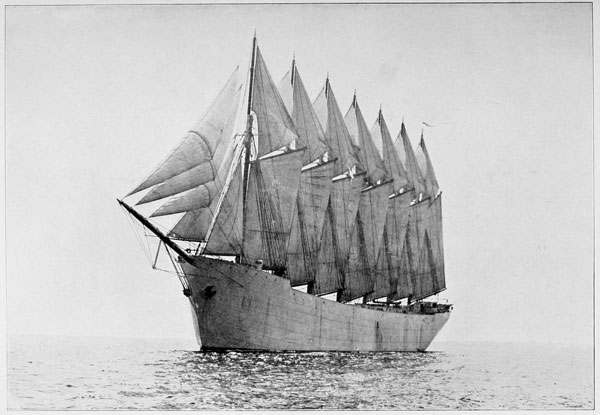
Seven-masted Schooner THOMAS LAWSON
A feature of these ships to be considered is that they are
all built for passing through certain shoal channels, the
Welland Canal, and the canal at the rapids at the outlet of
Lake Superior, for example. These channels have compelled
the designers to adopt one cross-section of hull for
all ships (at least below the water-line), and that cross-section
is the largest that will pass through the channels.
Because of this similarity of models the lake builders have
been able to carry specialization in the work of construction
as far as any builders in the world, and much further than
it is carried in the Atlantic coast yards, where builders may
have a battleship, a harbor tug, and a side-wheel passenger
boat on adjoining ways. The lake ships can be built for
the lowest price of any in the United States.
Contemplation of these facts, and upon the further
fact that lake engineers seemed to be about the best the
world had ever seen, led the lake capitalists to organize
the American Navigation Company, which built two large
cargo carriers, sent them down to salt water, and entered
the general cargo trade. Those vessels were among the
most economical ever built in the United States, all things
considered, but they were unable to compete with the European
ship.
A story told by A. B. Wolvin to the Merchant Marine
Commission is significant here. A company of which
he was president operated a line of steamers from Duluth
and Chicago to Montreal and Quebec. The steamers
numbered ten of the maximum size for passage through
the Welland Canal—250 by 42 feet large, with a draft
of fourteen feet, and a carrying capacity of 2200 tons.
The cost of these ships, built under the best American
conditions of specialization, was $140,000 each, and the
operating expense was $135 a day each. While the company
was engaged in its work, a steamship man from
Sweden came and offered to put on twelve ships of the
same size, each at a charter price of $2900 per month.
His ships cost but $90,000 each, and the wages of crew
and other operating expenses were so much lower than
the American standard that he could make money at a
charter price of $1000 a month less than the cost of operating
the American ships. Having used these Swedish
ships long enough to know them (for it was necessary to
accept the offer to keep the Swede from starting in opposition),
Captain Wolvin testified:—
"They are better from the standpoint of construction....
The vessels carry well; they run well. We have
no trouble with the crews."
The crew of the Swedish ship numbered seventeen;
that of the American, twenty-two. And the Swedish wage
was far less.
The bearing of these facts in any consideration of the
power of the ship-owners who are now in control of the
deep water traffic of the world is obvious.
Other views of the world's carrying trade are of interest
here. The Hamburg-American Company runs steamships
in sixty-eight different lines. There is a line of its
ships from Europe to each port of importance from Montreal
to Newport News. It maintains other lines to the
important ports of the West Indies, to Ports Limon and
Colon on the narrow mainland, and to every important
port on the north, the east, and the west coasts of South
America. It reaches nearly every port of importance on
the coasts of Europe, and down the west coast of Africa.
Indeed, on the west coast of Africa the natives see two
German steamers to one under the British flag. It sends
other ships through the Suez Canal to skirt the coast of
Asia as far as Vladivostok; it maintains cargo gatherers
among the islands along shore, and then, from Japan, it
reaches across to Portland, Oregon, where it connects
with our Northern Pacific Railroad. It runs every kind
of ship from the 23-knot passenger packet to the economical
cargo carrier that uses perhaps little more than ten
tons of coal a day. The traffic of the world is, in a way,
within the touch of this one corporation. The worldwide
tides of commerce are felt and noted daily in the
home office, and while losses are suffered, here and there,
through depressions in business, or through competition,
the profit made by the vast fleet as a whole is sufficient
to yield regularly the modest dividends that satisfy the
owners.
The fact that the powerful North German Lloyd is
allied with the Hamburg-American in all matters that
affect German commerce and trade is also a matter of
interest in this place.
To show now how an effort to force a new company
into an established trade affects freight rates, it is necessary
only to refer to such an instance as the "war" that prevailed
in the trade from New York to South Africa in
1902. As Smith notes in The Ocean Carrier, the rival
steamships lost from $10,000 to $15,000 on every trip.
Moreover, the low rates were of no advantage to commerce,
for commerce demands stability first of all. It is worth
noting, too, by the way, that in the course of this war,
goods were carried by English steamers from New York
to Africa for less than was charged by the same companies
on ships from London to the same destination.
When American capitalists tried to establish a line of
ships from New York to Brazil some years ago, the venture
failed. One reason for this was the higher cost of American
ships and crews. Another was extravagance, especially
in providing terminal facilities at Rio de Janeiro. Old
merchants in Brazil still smile when they talk of what the
American line did in that way. But the most important
reason for failure was the advantage enjoyed by British
rivals in the triangular line route followed by their steamers.
In the currents of commerce on the Atlantic the British
manufacturer ships large quantities of goods to South
America, the South American producer ships large quantities
of coffee to the United States, and the American producer
ships large quantities of food-stuffs to Great Britain.
The British ships had profitable cargoes from home to Brazil.
At Rio de Janeiro and Santos they cut the rates far below
cost, and then on arrival in the United States they secured
cargoes for home at a profitable rate. The profits on
the two trips enabled them to endure the cut on the middle
passage. But because American manufacturers had little
to ship to Brazil the American ship lost money on both
passages.
Every business man understands the advantages of
one who is well-established in any trade, over one who
is just beginning, but one method by which established
lines of ships hold their trade must have mention. The
merchant who sends all his goods by the established line
receives a rebate of 10 per cent on the amount of his
freight bill, the rebate being calculated once in six
months, say, and the payment being made six months
later. If the merchant ships an ounce of stuff by a rival
line he loses all the rebate, and he may be punished in
addition, if the rival is a new line. The merchant, having
rivals in trade, feels the loss of the rebate seriously; his
rivals by loyalty to the established line continue to enjoy
the rebate even when rates are cut below those of the new
line, and below cost. In such trades as that between
New York and Rio de Janeiro, where a number of lines
are plying, the established lines unite their entire resources
to kill off a new line trying to enter the trade.
When the American people have before them any proposition
for the revival of the American merchant marine,
they should keep in mind that ships designed for the
purpose and at least in sufficient numbers, are afloat in
every trade of the world; that the freight rates are maintained
at a point where the profits are as low as any
afforded by any branch of the world's work; that the men
doing the work have been developed with the steam
carrying trade, just as the splendid American sailor of the
sail was developed by his environment, and they are therefore
at once well-informed, alert, enterprising, resourceful,
persistent, and merciless. Observe, too, that in the work
of the high seas man faces primeval conditions, brute force
prevails as nowhere else, and the fittest survives.
Perhaps a definition of terms is needed here. By fitness
we mean the ability to do the world's work on the terms
which the world offers. We have learned to build bridges
and locomotives on those terms, but, in spite of the fact
that our ship-builders and ship-owners are fully protected
in the "home market," they have not yet learned how to
combine the locomotive and the bridge into a ship fit to
compete with the unsubsidized ships—the cargo carriers—now
in the world's traffic.
In connection with the known degree of efficiency of
the world's merchant marine, as now afloat, consider
a statement that can be found on page 1248 of the Report
of the Merchant Marine Commission. It is, perhaps, the
most discouraging statement that has been made in connection
with our merchant marine.
"The statistics of loss of ships at sea afford matter for
reflection.... They show, as the United States Commissioner
of Navigation has summarized them, that
out of every 100 American seagoing steamships over 100
tons, for the past seven years, on the average 2.24 have
been lost each year; that out of every 100 foreign seagoing
steamers over 100 tons, for the same period on the average
1.98 have been lost each year." (See also An. Rep. Com.
Nav., 1904, p. 19.)
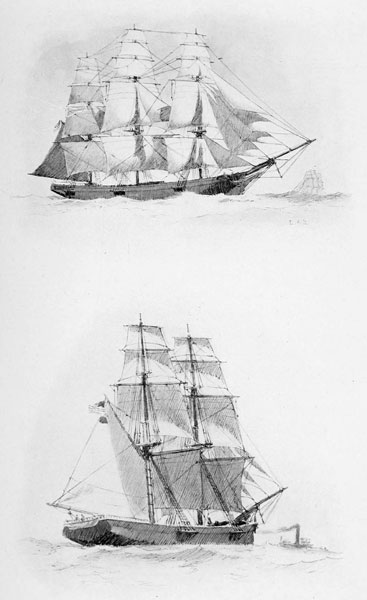
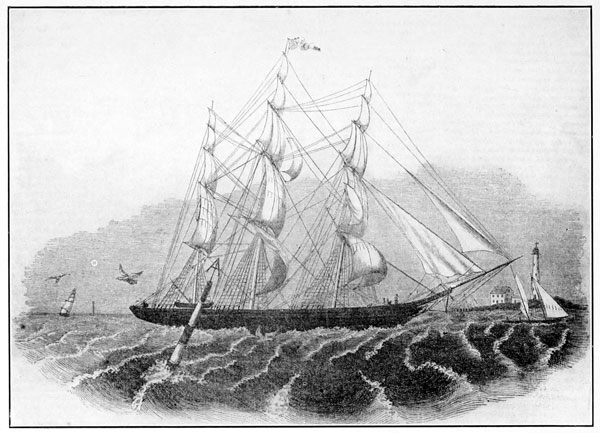
A Modern Clipper Ship and a Modern Brig
By courtesy of Munsey's Magazine
When American ships were supreme they were insured
at a less rate than those of any other nation, and the insurance
was placed, to a large extent, in England. Because
the American sailor of the sail, who had been
evolved by 200 years of American environment, was able
to handle his ship better than any other, he paid lower
premiums to the underwriters. But if this be true (and no
one disputes it), it follows that the higher percentage of
losses among modern American steamers proves that the
American environment, since the steamer era, has produced
a steamship sailor who is less efficient in his work
than our old-time sailor of the sail was in his, and less
efficient, too, than the foreign steamship sailor of the
present day. It is an important fact that a man may win
laurels upon the weather yard-arm in reefing topsails and
yet be of no particular value as an oiler or an assistant
engineer in the engine-room. At any rate, any effort
to revive the American merchant marine will have to be
made in the face of the record of American losses, and the
influence of that record upon insurance rates.
Then in spite of the "boundless resources of our country,"
and "the intelligence of the masses," and a "protective
tariff" of twenty-five cents a bushel, the farmers of "the
overcrowded nations of Europe" are able to sell potatoes
in New York at a profit. And millions of dollars' worth
of factory goods made in Europe pay ocean freights, pay
the tariff tax, pay the commissions of agents, pay the
freight rates on our railroads, pay the margin of our retail
merchants, and are then sold at our doors in competition
with the products of our workmen.
The fact that the tariff wall fails to keep out foreign
goods is a matter for serious attention in every point of
view, but it seems especially necessary here to consider
the influence of "protection," as it is called, upon those features
of American character which we call self-reliance
and the spirit of enterprise. Under the prevailing system
how is it possible for the American people to develop the
aggressive manhood that is needed?
One other feature of the opposition that will be encountered
in any effort to create a new American merchant
marine is yet to be described—the support which the existing
carriers will receive from their governments during
the conflict; but before that is considered it may be well to
review the means by which it has been proposed to increase
our shipping.
Naturally a people accustomed to "protection"—a
people who make boast of a system that is at best a confession
of a lack of ability to meet open competition—have
turned, first of all, to "government aid."
Among the first provisions of Congress for the benefit of
American shipping after the adoption of the Constitution
was a 10 per cent discriminating duty on all goods imported
in foreign ships. It is asserted that this discriminating
duty supplied our ships with cargoes from foreign ports
to American, and was thus a feasible and satisfactory
"protection." A 10 per cent duty amounted then, and it
would amount now, to more than the whole freight, upon
some goods. It is also asserted that this discrimination
was made in order to "protect" our shipping. But in an
extended argument, which was made before the Merchant
Marine Commission (in the Report of which the curious
reader can find it), by Hon. E. T. Chamberlain, Commissioner
of Navigation, it was proved that "in the minds of
those that applied" it (Jefferson, Clay, Gallatin, John
Quincy Adams, etc.), the law was provided as a means of
retaliation only—for the purpose of preventing discrimination
against American shipping. The fact that our
government anxiously strove from the first to secure fair
reciprocity confirms this view. Further confirmation is
found in the fact that our old-time ship-owners were
unanimous in their support of the government in its efforts
to secure reciprocity.
Those who advocate the policy of discrimination for
modern application assert that our shipping reached supremacy
at sea while the discriminating policy prevailed
as to Great Britain, and that is true, because the British
did not accept our offers of reciprocity until 1849. But
the assertion that our shipping became supreme because of
this policy is made only by those who are unable to appreciate
in full the facts of the case. For our ships that
were engaged in the trades between foreign countries,
beyond the reach of any "protection" afforded by "discrimination"
or any other artificial stimulation, at one
time measured a million tons. Why were those ships
favored beyond all others by the merchants who loaded
them? Why did merchants of rival nations—why did
the British merchants, for instance—charter these "Yankee"
ships, if it were not because they were the most efficient
in the world?
It is a slander upon the American sailor of the sail to say
that he won the long pennant through coddling.
As a system for modern adoption "discrimination" is
objectionable for three reasons. One is that it provides
at best for keeping our ships in trades between home and
foreign ports only; it does not provide for trade between
foreign ports. Next it is a system for supporting ships
that are confessedly inferior to those already in the trades—it
places a premium upon inefficiency. Last of all it is a
system that must excite all foreign governments to retaliation;
and that those governments will be eager to retaliate,
and that they will find ways enough for doing so, is beyond
doubt. In connection with this statement it is necessary
to keep in mind that we shall soon cease to export wheat in
any form, and the growth of population is so great that we
shall soon cease to export other, perhaps all other, food
products. Before inviting retaliation we must look ahead.
Indirect discrimination has been proposed. Under this
the ships of any country were to be permitted to bring in
without discrimination goods produced under their flag; but
goods brought from any other country were to be subjected
to a discriminating tax. Any analysis of our imports,
however, shows that if British goods were taxed when
brought here in any but British ships, all such goods would
be forced into British ships at once, to the great advantage
of the British shipping. They could not at present, nor
for years to come, be forced into American cargo carriers.
As the system would in like manner help German shipping,
the policy would but make our task the harder.
Before considering the policy of paying direct subsidies a
glance at the oft-repeated assertion that our shipping is
"our one unprotected industry" seems necessary. What
does "protection" provide for any industry, or what does
it pretend to provide? Simply the home market—this
and nothing more, at best. This is done by laying a tariff
upon imports. But the American shipping is now and always
has been protected that far—absolutely protected,
in fact, by prohibition. The importation of ships has been
forbidden, and the use of foreign ships in the "home
market" has been reserved to home-built ships for nearly
100 years. If "protection" could enable any industry
to expand from the "home market" to the foreign, then
the coasting trade industry should have expanded long
since over all the world. Unhappily, however, the profit
found in well-protected industries does but tend to make
the beneficiaries contented, and willing to let well enough
alone.
Ever since the Civil War efforts have been made to induce
Congress to modify the navigation laws far enough to
enable Americans to buy ships in the cheapest market and
sail them under the flag. It is said that this would give
our shipyards so much employment in repairing the foreign
fleet so to be purchased that our builders would soon
learn how to set afloat ships as cheap as any in the world.
It is not easy to treat seriously one who supposes that repairing
tramps would develop the distinctive type of ship
able to produce results in ton-miles, which is imperatively
needed; but when it is remembered that free trade in ships
quickly drove the British from the sailing ship to the screw
steamer, the proposition looks attractive. For free trade—the
necessity of swimming unaided in rough water or
drowning—might compel the American builder to produce
the revolution-making ship for which we are to hope.
We now come to the policy of paying direct bounties as a
means of creating a merchant marine; and nowhere are
candor and accuracy of statement more important.
Bounties were paid in the colonial days. Virginia gave
a subsidy of tobacco to induce her people to build ships,
and they built one ship. When the whale fishery was depressed,
just after the Revolution, Massachusetts gave a
bounty on Massachusetts oil, with the result that the market
was flooded, and the fishery was depressed more than ever.
In spite of a bounty paid on oil by Rhode Island, her sailors
continued to favor the slave-trade. For some reason those
who favor subsidies as a means of reviving our shipping
never quote these facts.
Of the effect of subsidies upon the Collins Line and of
other subsidies, something has already been said. The
first grant to the Cunard Company was made for military
and diplomatic purposes only, but when subsidized American
ships appeared, the Cunard grant was increased to
maintain the British flag in the trade. That is a fact beyond
dispute.
It is manifest that the subsidy was of benefit to the
receiver. It helped the company to build improved ships.
It gave the builders some experience. It provided schools
for the instruction of seamen in the art of handling steamships.
The subsidizing of the Royal Mail, and of the lines
to other parts of the world, where private enterprise was
unequal to the occasion, created an increase of commerce
as well as some addition to the shipping of the country.
With equal candor the evils of the system apparent in
those days ought to be told. The subsidized Cunarders
not only drove off the American subsidized lines but they
drove away the unsubsidized Great Western line. They
depressed all British shipping that entered the trade to New
York and Boston. If they had had a larger subsidy they
would have spread to Philadelphia, and thus would have prevented
or delayed the establishment of the Inman Line. The
British shipping in the trade to the northern ports of America
was not increased by the subsidy to the Cunard Company;
it was, on the contrary, restricted. Paying a subsidy to
establish a line where no steamers had traded before, and
none could trade without government aid, was a very different
thing from forcing a new line of steamers into trade
already supplied with shipping, and even congested. Paying
a fair price per pound to a ship for carrying the mail
ought not to be confused with paying a subsidy. The
first Cunard mail pay was not a subsidy; it was a low
price for the work done. Senator Rusk declared, in the
document already quoted, that the British Post Office
Department "derived a clear income of no less than
$5,280,800" from the contract in the first six years it was
in force. After Collins began running his ships by aid
of a subsidy the British subsidized Cunard to enable him
to compete.
When the Collins Line reduced freights from £7 10s
to £4, commerce was certainly benefited, but the reduction
was ruinous to shipping. It was especially injurious to
the American packet lines. The advent of the subsidized
Collins Line did more to injure the American shipping of
its day than any other influence except that of the iron screw
steamer.
Then the effect of admiralty supervision upon the subsidized
ships was an incubus upon progress. Naval men
are usually conservative, and conservatism often means
stupidity. Thus, after the British Dreadnought had demonstrated
the efficiency of the turbine engine our American
naval engineers provided one battleship with turbines
and another of the same model with reciprocating engines
in order to learn whether the turbine was worth installing
in future ships! The Cunard ships were built of
wood, long after iron was known to be a better material,
because of naval stupidity. Worse yet, when the requirements
of the merchant service became imperative
the rules of the admiralty were evaded—ships were reported
to be fit for war cruisers when in fact they were
useful as transports only.
After the Civil War, Congress provided subsidies by
which a line from New York to Rio Janeiro, another from
San Francisco to China and Japan, and a third from San
Francisco to Hawaii, were established. Under these contracts
the policy did not have quite a fair trial. The beneficiaries
by activity in politics created so much opposition
that the subsidies were withdrawn before the effect was
fully apparent.
By the Act of March 3, 1891, a subsidy was again provided
under the thin disguise of paying for carrying the
mail—a reprehensible plan, because if subsidies are justified,
they ought to be paid openly. The fact is that the
methods of indirection employed by the advocates of subsidy
have done much to discredit their system. Under this
act ships of 8000 tons and a speed of 20 knots receive $4 a
mile "by the shortest practicable route for each outward
voyage." Ships of 5000 tons and a speed of 16 knots
receive $2 a mile. Ships of 2500 tons and a speed of 14
knots receive $1 a mile, while those of 1500 tons and
a speed of 12 knots receive "two-thirds of a dollar a mile."
This act was designed to maintain lines of ships which
would be useful as scouts, transports, etc., in time of war.
Before stating the effect of this law upon American shipping,
certain facts in connection with the subsidizing of
ships by the continental nations of Europe will be useful. It
is a curious fact that while the annual reports of our Commissioner
of Navigation have for years given much space
to the "progress" of the British, the German, and the
Japanese shipping, nothing has been said about the "progress"
of the shipping of France, of Italy, or Austria. The
progress of the shipping of England, Germany, and Japan
is stated because government aid is given to shipping in
those countries and shipping makes progress; but in the
other countries, where still more liberal aid is given to
shipping, no progress worth mention is made. The annual
report of the Commissioner of Navigation is made a
vehicle for the dissemination of arguments in favor of the
subsidy policy.
A candid examination of the policy of Germany shows
that some aid has been given to lines of ships in the form
of liberal pay for carrying mails. The North German
Lloyd receives $1,330,420 per annum for its service to
China, Japan, Australia, and the German possessions in
the Pacific. The Germans thought it better policy to subsidize
a line of merchantmen than to maintain a line of
transports to its colonies as the United States has been
doing in connection with the Philippines. The payment
to the North German Lloyd is properly called a subsidy;
to give the name of subsidy to all payments made to
German steamers for carrying the mail is to misrepresent
the facts in a way that injures the cause of the subsidy
advocates materially in the eyes of all who know the
facts.
The German railroads, which are owned by the government,
not only give low rates on goods intended for export,
but extremely low rates are provided for all materials
used in building ships. The fact that special rates on
railroads are used to promote the German merchant marine
is worth serious consideration in the United States,
even though such rates are here viewed with suspicion.
The national laws governing our railroads, as enforced
now (1910), are in some respects an incubus upon legitimate
and praiseworthy enterprise. Through ignorance
and prejudice the efforts of our transportation lines to
increase our export trade have been seriously hampered.
Unquestionably subsidies and special rates were provided
to extend German influence by means of shipping.
The payment of bounties has been one feature of the expansion
of German shipping. To assert that the bounty
has been the sole, or even the chief, cause of that expansion,
however, is to misstate the facts. The experience of
France, for instance, shows conclusively that a subsidy in
itself is not enough to create a merchant marine. Although
the French subsidy is so liberal that French cargo
carriers are able to sail half-way around the world in ballast
to get a cargo at rates that would be less than cost of
maintenance for any other ship, the French merchant
marine grows so slowly as to justify the assertion, made by
the late Captain John Codman, that the French mariners
are working against a fiat of nature. The tonnage of 1881,
914,000, was but 1,952,000 in 1908.
Further than that the German subsidies have been less
than those paid by the British (especially those paid to the
Cunard Company), and yet German steamers are steadily
encroaching upon those of the British. The reason for
the progress of German shipping is readily found in the
spirit and habits of the people. Consider the work of the
patient, spectacled scientist in his laboratory—his methods
and his aims; consider the growth of the factory system;
consider the effect of the training which all men receive in
the army or navy—how the whole people learn to move
as one man, and as comrades, for the attainment of a
worthy national object; consider how all the people—the
men with the hoe as well as the men behind the guns—are
stirred by an attack, or a seeming attack, upon the
Fatherland.
The effect of government bounties upon German shipping
is like that seen when the spectacled German professor
of agriculture applies inorganic fertilizers to crops planted
in well-cultivated, humus-filled soils. The effect in France,
and other nations not well prepared for expansion, is like that
when those fertilizers are applied to arid, acid, uncultivated
land. In Germany the soil for the production of shipping
was in excellent condition before the fertilizer was applied.
What is the condition of that soil in the United States?
The American subsidy law has been in operation since
1891. For the service rendered it provides more liberal
compensation than that given to any German ship. The
American Line (now operated as a part of the fleet of the
International Mercantile Marine Company), owns two
American ships that were built for the line and two British
ships that were placed under the American flag by special
act of Congress. The subsidy maintains this line in existence
but does not increase it. The Mallory line has been
extended somewhat since the subsidy was given to it.
Elsewhere ships that were maintained under the subsidy
have been driven from their route by foreign competition.
The ships run in connection with the Great Northern Railroad,
for instance, were unable to compete with the Japanese
line between the same ports, partly because the Japanese
subsidy was more liberal, and partly because of the greater
expense of running American ships. In short, the law of
1891 has failed to provide an American merchant marine.
Further measures for providing subsidies have therefore
been proposed. The Merchant Marine Commission,
after a lengthened inquiry, offered a bill to Congress which
was to provide a line from "a port of the Atlantic coast
of the United States to Brazil," with "ships of not less than
fourteen knots speed," at a subsidy rate of $150,000 a year,
"for a monthly service," or $300,000 for a fortnightly service.
A similar line to the River Plate was to receive
$187,500 and $350,000 according to the service. The
same subsidy was to be paid to a 12-knot line to South
Africa. Three lines from Gulf ports to Cuba, Brazil, and
Mexico were to be paid sums in proportion to the service
rendered, and three lines were to be provided for the Pacific
on similar terms.
In addition to providing these lines an attempt was to be
made to set afloat cargo carriers by giving an annual bounty
of $5 a ton gross measurement to all cargo ships continuously
in service. On the whole ten new lines of ships
were to be established at an expense of $2,590,000, and it
was supposed that $10,000,000 might be the necessary
limit of the subsidy for the tramps. In the meantime it was
supposed that the existing lines working under the law of
1891 would continue in the service for the compensation
provided.
Passing over the claptrap in the bill about the use of
these liners as scouts,—fancy a 16-knot merchantman
scouting around a squadron of Dreadnoughts!—the bill
ought to be considered on its merits because it sets forth
the amount of subsidy supposed to be sufficient to create
a real revival of our shipping, and thus gives an idea, perhaps,
of what sum would be adequate.
Accepting the Commission's statement that the subsidies
would prove sufficient to place the more expensive
American ships upon an equality with the foreign, and "a
little more," as was said, it may be assumed that the new
lines would eventually employ sixty or seventy ships. At
$5 a ton the $10,000,000 might put afloat from 300 to 400
modern cargo carriers. Thus we should, at best, about
double our present registered fleet, which, in 1908, numbered
478 ships. But if we compare that fleet with the
German, which now numbers more than 2500 ships, or
with the British, which now numbers more than 4000,
we shall see that even under the best circumstances we
should yet be a far cry from the supremacy of which we
made boast in other days. Indeed, the fleet of liners
would not number as many ships as the Standard Oil
Company now employs to carry abroad its products,
while the fleet of cargo carriers could not be compared,
with any satisfaction, to the fleet now in use by the allied
German companies of which mention has been made.
And the ships thus to be set afloat, as they crossed the
seas, would proclaim to the world that they were in the carrying
trade, not by right of efficiency, but by grace of a subsidy.
But now we are to consider whether any subsidy heretofore
proposed would really be sufficient to sustain either
liner or tramp. The effect of such ships upon freight
rates, for instance, was stated before the Merchant Marine
Commission, by B. N. Baker, formerly president of the
Atlantic Transport Company, and an advocate of the
subsidy system. He said:—
"If you added any more to the open sea traffic (the foreign
traffic) of the United States than 100,000 tons a year
you would so demoralize the general carrying business in
rates, both as to freight and passengers, it would be so unprofitable
that no one could go into it, unless you would
double, and triple that compensation."
The effect of that building programme upon the organized
mechanics of our shipyards—the strikes for higher
wages, and the consequent increase of prices—need only
be mentioned.
Then figure up the expense of the war between the lines
from New York to South Africa in 1902, wherein ships lost
$15,000 in a single voyage. Manifestly the American
liners would need all of their subsidy ($15,625, per voyage)
to meet the reductions in freight rates which the opposition
would make. They would thus be no better off than they
would be if they were permitted to enter the trade on even
terms with the present lines—without war and without
subsidy. The line to Brazil would yet have to face the disadvantages
due to the triangular service which British
ships maintain, though the decreasing exports of American
food products would reduce those disadvantages somewhat.
In short, one may well doubt whether the proposed subsidy
would enable our ships to overcome the opposition of
the powerful foreign interests that are already in the trade.
But if we suppose it to suffice that far, we have yet to inquire
what the governments behind those powerful corporations
would do. Recall the story of the Cunarders
Mauretania and Lusitania. The British government gave
those two ships to the company outright on the understanding
that it should operate and maintain them in a condition
fit to cross the Atlantic at a speed of 25 knots an
hour. This was done at the time that American capitalists
acquired control of a number of British lines, under the
name of the International Mercantile Marine Company,
and formed a working agreement with the two leading
German companies. This combination threatened British
supremacy on the North Atlantic, or was believed to
threaten it, and the whole British nation rose up to defend,
figuratively speaking. If that were possible under those
circumstances, it is certain that the "subventions" now
given to the British lines would be increased the moment
any American subsidized ships began to cut into the British
carrying trade. Increased subsidies would then be needed
by the American ships. If the American people were to
enter into a subsidy war it is likely that they could endure
the strain longer than any other nation; but is such a war
worth while to secure a part in a traffic that pays the well-subsidized
Cunard line no higher profit than 2.8 per cent a
year?
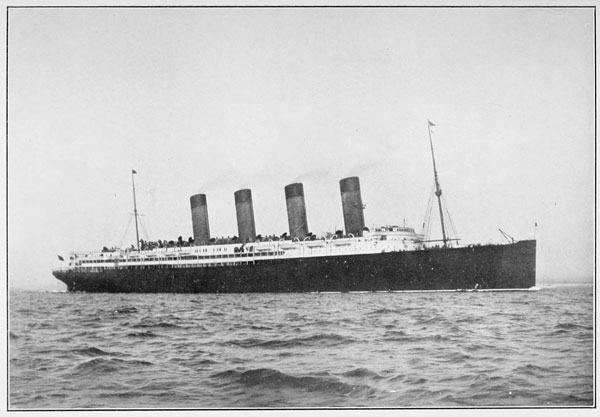
Cunard S. S. LUSITANIA
By courtesy of the Cunard Steamship Company
One more argument in favor of subsidy is yet to be
considered. With the Panama Canal and the Monroe
Doctrine to defend, it is necessary to provide sufficient
transports and colliers for the exigencies of war. The
spectacle of our splendid war fleet steaming around the
world with its fuel carried in ships under foreign flags,
was humiliating to the nation. Congress should build
auxiliaries more rapidly by direct appropriation, or it
should give ample subsidies, however great the sums needed,
to maintain auxiliary ships in the merchant service. Many
Americans would gladly pay their share of the tax for the
pleasure of seeing the American flag above a ship's taffrail,
now and then on salt water, in spite of the humiliation of the
fact that it was the tax and not efficiency that kept the flag
in place. A merchant fleet so provided would be a kind of
insurance against the exigencies of war, and even against
war itself. With a thousand American merchant ships
afloat on deep water there would be less danger of an aggressive
nation of Europe invading Rio Grande do Sul or
menacing the Panama Canal.
Whether to provide the auxiliaries by direct appropriation
or by subsidy is, or should be, a question of
relative expense and efficiency. Such a question, one would
think, might be solved by the rules of arithmetic; at any
rate it is not necessary in the discussion to misrepresent
the attitude of senators from Southern States, nor to say
that the former American supremacy was due to "protection"
instead of the ability of the sailor of the sail.
There are excellent and perhaps imperative diplomatic
and military reasons for maintaining at least one line of
swift steamers from the Pacific coast to the coast of Asia
and the Philippine Islands. The ships of this line, if
established, should be fitted, as battleships are, for a
cruising speed of say sixteen knots, with a reserve of power
for an emergency, when they should be able to develop real
scout speed—should be able to run away from the modern
twenty-one knot battleships. The value of a fleet of ships
of this kind, in a military point of view, and especially
upon the Pacific, is obvious. A dozen ships of the kind
would not be too many. A fleet of smaller ships, fit for
use as naval colliers, might well be maintained to gather
and distribute cargo along the Asiatic coast and among
the islands. We have undertaken the work of developing
civilization in the Far East, and we need to do everything
possible to prevent an attack upon our position there.
After squadrons of war-ships nothing will create a
higher respect for our flag among the people of that region
than a fleet of superior merchantmen avowedly maintained
for diplomatic and military reasons. In fact a
fleet so maintained would impress other peoples than those
of the Far East.
The same argument may be made for the maintenance
of swift lines to both coasts of South America, where we
have the Monroe Doctrine and the Panama Canal to defend.
If we establish these lines, a war of subsidies is
to be expected, and the well-established and powerful
companies already in the trades will be wholly unscrupulous
in their opposition, not because their present profits are
high, but because they are low; a division of the traffic
will still further reduce the profits which are already too
narrow for comfort. We may be sure, too, that extravagance
and inefficiency of the Collins kind will be found in
the management of some of our companies; but as a diplomatic
and military measure the experiment seems to be
worth making. We have a very good precedent in the
action of Germany in establishing a line to its Pacific
possessions by a subsidy of a million a year, which is given
for the precise reasons urged herein. It will cost the United
States many times as much as it does Germany, but one
who looks at the matter broadly may well suppose that
such an increase of expenses, avowedly made as a measure
for increased military efficiency, might be worth while, in
the end, as a peace measure. For we shall be obliged in
any event, to go on increasing our naval budget to keep
even with the growth of European navies, until the war
burden becomes intolerable in Europe as well as in the
United States; and then we shall have measures for
preserving peace more rational than those now in vogue.
The sooner the burden is made intolerable the better.
But while we can provide an ample fleet of naval auxiliaries
by means of subsidies, if we are willing to pay the
price, let no one suppose that such a measure will give the
country any share of the world's traffic worth consideration,
not to more than mention supremacy upon deep
water.
One method by which the Merchant Marine Commission
thought to increase American sea power is memorable.
A heavy tonnage tax was to be laid upon all ships coming
from foreign countries to American ports, and the
money so raised was to be paid to American ships in the
foreign trade in return for carrying a certain proportion
of American citizens enrolled as members of a corps of
naval volunteers. The measure looked toward an increase
in the number of American seamen, but it did not
become a law.
The communities that have supported nautical schools
(New York and Boston, for example) have had the end
in view for which the measure of the commission was
designed. Graduates of these schools are among the best
officers in our merchant marine, and this, too, in spite of
the fact that antiquated ships of the sail formerly served
as school rooms, and the boys were taught to handle the
obsolete marline-spike instead of the throttle. But, at best,
these efforts to turn ambitious young Americans from the
opportunities they find on land are inadequate. Congress
might have turned the naval academy into a splendid
nautical university for the education of all Americans who
wish to learn the ways of the sea. We appropriate millions
a year for the farmers, not as bounties on their products,
but to teach them, through experiment stations, how to do
their work. No one seems to have thought it worth while,
however, to make a national appropriation for the education
of merchant seamen.
To confess the truth we have done nothing adequate to
the situation since the Civil War, nor has anything adequate
been attempted; but the people who have promoted the
work of our nautical schools have seen dimly what the whole
story of the American merchant marine proclaims. The
pretty pinnace Virginia thirty feet long, as she crossed and
recrossed the Atlantic; the Trial in the Azores and the
West Indies; the Mount Vernon as she dodged pirates,
privateers, and war fleets in her seventeen-day passage from
Salem to Gibraltar; the Empress of China in her venture
to the Far East; the sealers among the icy rocks of the
Antarctic; the whalers beyond Bering's Straits; the packets
of the sail as they crossed from New York to Liverpool;
and the clippers that flaunted the Stars and Stripes off
the weather beam of every ship they met on the Seven
Seas,—in short, the whole story of the American merchant
marine has been worth consideration here because it
sets forth unmistakably that the superior intrinsic efficiency
of the American sailor of the sail, during the contest that
culminated with the perfection of the ship of the sail, gave
supremacy to the American flag. We can buy ships—whole
fleets of them—if we are willing to pay the price,
and we can maintain them upon the high seas in like
manner; but we shall never again see the Stars and Stripes
triumphant upon the high seas until the American environment
evolves, once more, by natural process, the nautical
unit as efficient for the modern day as was our ship of
the sail in the days long past.
Transcriber's Note:
Obvious typographical errors have been corrected.
Inconsistent spelling and hyphenation in the original
document have been preserved.