MEMORY-AIDS AND PICTURE-WRITING
The printed letters or sound-signs which compose our alphabet
are about two thousand five hundred years old. "Roman type" we call them, and
rightly so, since from Italy they came. They vary only in slight degree
from the founts of the famous printers of the fifteenth century, these
being imitations of the beautiful "minuscule" (so called as being of
smaller size) manuscripts of four hundred years earlier. Minuscule
letters are cursive (i.e. running) forms of the curved letters about
an inch long called "uncials" (from Latin uncia, "an inch," or from
uncus, "crooked"), which were themselves derived from the Roman
letters of the Augustan age. These Roman capitals, to which those in
modern use among us correspond, "are practically identical with the
letters employed at Rome in the third century b.c.;
such, for instance, as are seen in the well-known inscriptions on the tombs of
the Scipios, now among the treasures of the Vatican. These, again, do
not differ very materially from forms used in the earliest existing
specimens of Latin writing, which may probably be referred to the end
of the fifth century b.c. Thus it appears that our
English alphabet is a member of that great Latin family of alphabets, whose
geographical extension was originally conterminous, or nearly so, with
the limits of the Western Empire, and afterwards with the ancient
obedience to the Roman See." (Canon Isaac Taylor's History of the
Alphabet, vol. i. p. 71.)
The age of our own alphabet being thus indicated, we may
postpone further remark on its lineal descent, and pass to inquiry into the
primitive forms of which all alphabets are the abbreviated descendants,
and also to reference to some primitive methods for which they are substitutes.
A survey of the long period which this development covers
shows four well-marked stages, although in these, as in aught else appertaining
to man's history, there are no true lines of division. The making
of these, like the apparent lines of longitude and latitude of the
cartographer, is justified by their convenience. These stages are:—
(a) The Mnemonic, or memory-aiding,
when some tangible object is used as a message, or for record, between people at a
distance, and also for the purpose of accrediting the messenger. As will be
seen, it borders on the symbolic; indeed, it anticipates that stage.
(b) The Pictorial, in which a picture
of the thing is given, whereby at a glance it tells its own story.
(c) The Ideographic, in which the
picture becomes representative, i.e. is converted into a symbol.
(d) The Phonetic,
in which the picture becomes a phonogram,
or sound-representing sign. The phonogram may be—(1) verbal, i.e.
a sound-sign for a whole word; (2) syllabic, i.e. a sound-sign for
syllables; or (3) alphabetic, a sound-sign for each letter.
To recapitulate stages (b), (c), and (d):—
In stage (b) the sign as eye-picture suggests the thing;
In stage (c) the sign as eye-picture suggests the name;
In stage (d) the sign as ear-picture suggests the sound;
and it is in the passage from (c) to (d), whereby
constant signs are chosen to stand for constant sounds, that the progress of the human
race was assured, because only thereby was the preservation of all that
is of abiding value made possible.
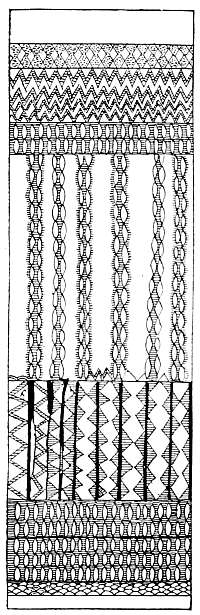
Fig. 7.—Quipu, for Reckoning, &c.
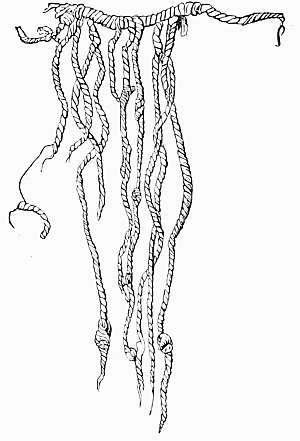
(a) The Mnemonic Stage.—This
is well represented by "quipus" or knotted cords, and by wampums or shell-ornamented
belts. The quipu (Fig. 7) has a long history, and is with us both in the rosary on
which the Roman Catholic counts his prayers, in the knot which we tie in
our handkerchief to help a weak memory, and in the sailor's log-line.
Herodotus tells us that when Darius bade the Ionians remain to guard
the floating bridge which spanned the Ister, he "tied sixty knots in
a thong, saying: 'Men of Ionia ... do ye keep this thong and do as I
shall say:—so soon as ye shall have seen me go forward against the
Scythians, from that time begin and untie a knot on each day; and if
within this time I am not here, and ye find that the days marked by the
knots have passed by, then sail away to your own lands'" (iv. 98). And
the same obviously handy device is of widespread use, reaching its more
elaborate form among the ancient Peruvians, from whose language the
term "quipu," meaning "knot," is borrowed. It consists of a main cord,
to which are fastened at given distances thinner cords of different
colours, each cord being knotted in divers ways for special purposes,
and each colour having its own significance. Red strands stood for
soldiers, yellow for gold, white for silver, green for corn, and so
forth, while a single knot meant ten, two single knots meant twenty,
double knots one hundred, and two double knots two hundred. Such
simple devices served manifold purposes. Besides their convenience in
reckoning, they were used for keeping the annals of the empire of the
Incas; for transmitting orders to outlying provinces; for registering
details of the army; and even for preserving records of the dead, with
whom the quipu was buried, as in old Egypt the biography or titles of
the deceased were set forth in hieroglyph and deposited in the tomb.
Quoting from Von Tschudi's Peru, Dr. E. B. Tylor says that each
town had its officer whose special function was to tie and interpret
the quipus. They were called Quipucamayocuna, or knot-officers; but
although they attained great facility in their work, they were seldom
able to read a quipu without the aid of an oral commentary. When one
came from a distant province, it was necessary to give notice with
it whether it referred to census, tribute, war, and so forth. But by
constant practice they so far perfected the system as to be able to
register with their knots the most important events of the kingdom,
and to set down its laws and ordinances. Although vain attempts to
read the quipus have been made in the present day, Dr. Tylor adds
that there are still Indians in Southern Peru "who are perfectly
familiar with the contents of certain historical quipus preserved
from ancient times; but they keep their knowledge a profound secret,
especially from the white men." (Early History of Mankind, p. 160.)
This knot-reckoning is in use among the Puna herdsmen of the Peruvian
plateaux. On the first strand of the quipu they register the bulls,
on the second the cows, these again they divide into milch-cows and
those that are dry; the next strands register the calves, the next
the sheep and so forth, while other strands record the produce; the
different colours of the cords and the twisting of the knots giving the
key to the several purposes. Akin to this is the practice among the
Paloni Indians of California, concerning whom Dr. Hoffman reports that
each year a certain number are chosen to visit the settlement at San
Gabriel to sell native blankets. "Every Indian sending goods provided
the salesman with two cords made of twisted hair or wool, on one of
which was tied a knot for every real received, and on the other a
knot for each blanket sold. When the sum reached ten reals, or one
dollar, a double knot was made. Upon the return of the salesman, each
person selected from the lot his own goods, by which he would at once
perceive the amount due, and also the number of blankets for which the
salesman was responsible." The natives of Ardrah, in West Africa, use
small cords, each knot in which has a meaning; and among the Jebus, the
objects knotted into strings tell their separate tale, cowrie shells
placed face to face denoting friendship; an arrow, war; and so forth.
Other tribes have devised message-sticks somewhat after the well-known
native Australian type. More highly-developed knot-reckoning is found
among the Mexican Zuni, and in more primitive form among some North
American Indians; but, not tarrying to detail these, we cross the
Pacific, noting, on our passage, that a generation ago the Hawaiian
tax-gatherers kept accounts of the assessable property throughout the
island on lines of cordage from four to five hundred fathoms long.
Knots, loops, and tufts of different shape, size, and colour indicated
the several districts, and the amount of tax to be paid by each
inhabitant was defined by marks of the same character as those now
specified, with such variety as to prevent confusion. The Shû-King, a
sacred historical book of the Chinese, records the use of knotted cords
prior to the invention of writing. The number and distances of the
knots served as conventional mnemonics, and also as imperial records,
until written characters replaced them. "Legend refers the tying of
knots in strings to about 2800 b.c., when Fo-hi invented
eight symbols, and at the same time pictorial representations of these
knotted strings were taken to indicate the object thereby symbolised."
These Morse-like symbols are:—
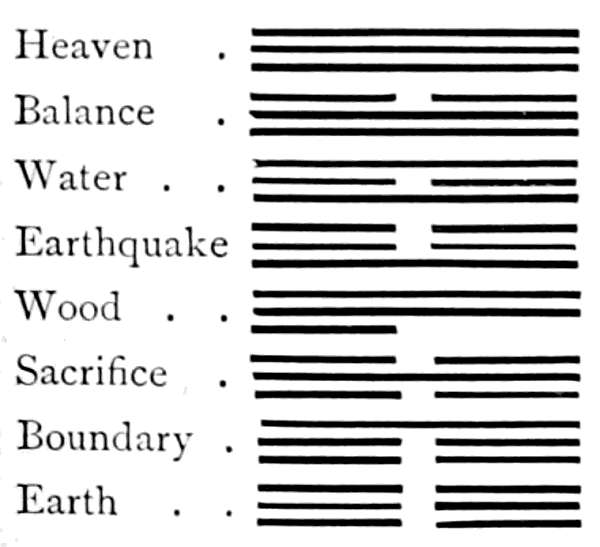
(C. Gardner, Journal Ethnological Society, 1870, vol. ii. p. 5)
Another Chinese legend says that "the most ancient forms
were five hundred and forty characters, formed by a combination of knotted
strings and the eight symbols, made in the form of birds' claws in
various states of tension, and that all these five hundred and forty
characters were suggested to the inventor by the marks (left by the
claws) upon the sand." The use of looped or knotted cords is depicted
in Egyptian hieroglyph, and among other tribes of the African continent
the Jebus of to-day evidence the survival of this primitive memoria
technica, while from Melanesia to Formosa the knotted cord, as in
Australia and Africa the message-stick, render service as means of
communication between man and his fellows. The nine incisions, with a
longer cut across them to denote ten, is a mode of decimal reckoning
and of record found alike among Red Indians and London bargees. The
same purpose explains the custom, in force well within the present
century, of our Exchequer in keeping certain accounts by means of
notched tallies. The tally was a squared stick of well-seasoned
hazel or willow, in one side of which notches of different breadth,
indicating pounds, shillings, and pence, were cut to mark the amount
of money lent by any person to the Government, the same amount being
cut in Roman numerals, together with the lender's name and date of
the loan, on the two opposite sides. The stick was then split down
the middle, and one half handed to the lender, the other half being
kept in the Exchequer. When the money fell due, the lender surrendered
his half for comparison with its fellow, and the two being found to
"tally," the loan was repaid. It was through the overheating of stoves
in the burning of heaps of accumulated tally-sticks that the Houses of
Parliament were destroyed in 1834. Fifty years ago in Scotland (and
the like may happen in out-of-the-way hamlets to-day), the baker's boy
took a "nick-stick" with his bread, and made a notch in the stick for
every loaf he left on his rounds. So it was, Dr. Hoffman tells us,
with the Pennsylvanian dairyman, who kept account of the milk which
he sold by marking notches for pints and quarts on a stick. As these
notches correspond to entries of transactions in our daybooks and
ledgers, so the once widely-used Clog Almanack corresponded to our
modern Whitaker. It consisted of a square-shaped "clog" or "block"
of wood (sometimes of metal), and was designed chiefly to show when the
Sundays and holidays fell, certain symbols or hieroglyphs being drawn
against saint and other festal days—as, for example, an axe for Saint
Paul, a true-lovers' knot for Saint Valentine, and a harp for Saint
David. With this may be compared the hieroglyphic wheels named "record
of the gods," formerly in use for recording time among the Indians
of Virginia. "These wheels had sixty spokes, each for a year, as if
to mark the ordinary age of man, and they were painted on skins kept
by the priests. They marked on each spoke or division a hieroglyphic
figure to show the memorable events of the year." (Tylor, p. 93.)
Wampum-belts are of much narrower geographical distribution
than quipus. They consist of hand-made beads or perforated shells arranged
in various more or less conventionalised patterns on bark filaments,
hemp, or deerskin strips or sinews, the ends of the belts being
selvedged by sinews or hempen fibres. The patterns are pictorial
symbols recording events in the history of the tribe or treaties
between tribes; the belts being also used to note land boundaries
or personal property, sometimes even passing, in the old days, as
shell-money in all parts of New England from one end of the coast
to the other. As illustrating a common purpose for which the wampum
record was used, Peter Clarke tells us, in his Origin and Traditional
History of the Wyandotts (a tribe of the Huron-Iroquois stock),
that "in the last decade of the eighteenth century, the king or head
chief, Sut-staw-ra-tse, called a meeting at the house of Chief Adam
Brown, who had charge of the archives, which consisted of wampum
belts, parchments, &c., contained in a large trunk. One by one they
were brought out and shown to the assembled chiefs and warriors. Chief
Brown wrote on a piece of paper and tacked it to each wampum belt,
designating the compact or treaty it represented, after it had been
explained from memory by the chiefs appointed for that purpose. There
sat before them the venerable king, in whose head were stored the
hidden contents of each wampum belt, listening to the rehearsal, and
occasionally correcting the speaker and putting him on the right track
whenever he deviated." Clarke goes on to say that "when the majority
of the people removed to the south-west, they demanded to have the
belts, as these might be a safeguard to them. Some of these belts
recorded treaties of alliance or of peace with other tribes which
were now residing in that region, and it might be of great importance
to the Wyandotts to be able to produce and refer to them. The justice
of this claim was admitted, and they were allowed to have the greater
part of their belts." And modern inquirers tell us that, in so far as
the wampums still possess utility, it is as evidence of a subsisting
treaty or a title-deed. Few examples, however, of the vast number of
belts once in the possession of the North American tribes (and these
almost exclusively confined to the Iroquois country) survive, since
in the displacement of the red man by the white their value from the
land-right point of view has disappeared. Four interesting specimens,
known as the "Hale Series of Huron Wampum Belts," which were presented
by Dr. Tylor to the Pitt-Rivers Museum at Oxford in 1897, form the
subject of lengthy memoirs by the donor and the late Horatio Hale in
the Journal of the Anthropological Institute (xxvi. 3, pp. 221-54).
Of these only the barest summary is needful. The first and oldest
example, dating from before the middle of the seventeenth century, is
named the "Double Calumet Treaty Belt" (Figs. 8, 9). It is nine beads
in width, and although imperfect, is still nearly four feet long. On
a dark ground of the costly purple wampum there is the device of a
council-hearth in what was probably the centre of the belt, flanked on
one side by four and on the other side by three double calumets, i.e.
double-headed peace-pipes, each possessing a bowl at both ends. Of
course a pipe of this sort is of no use for smoking. It is a creation of
the heraldic imagination, like the double-headed eagle of some
modern European powers. This, first appearing on the arms of the German
Emperor in the middle of the fourteenth century, may have been derived
through contact with the East from Hittite bas-reliefs, as the cherub
of our grave-stone cutters is derived through the Hebrews from the
Assyrians, and the symbolic design of the Good Shepherd from the old
type of Hermes, the ram-bearing god.
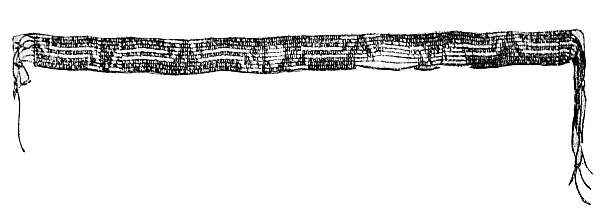
Fig. 8.—Double Calumet Wampum
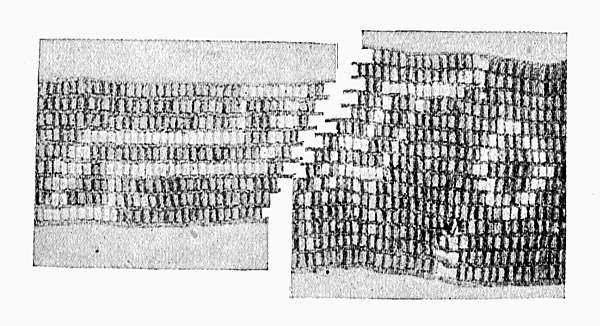
Fig. 9.—Double Calumet Council Hearth
Returning to the "double calumet," Mr. Hale was told
by Mandorong, an Indian chief, that it was a peace-belt, representing an important
treaty or alliance of ancient times. The second example is called
Peace-Path Belt, which name indicates its purpose; the third, of which
a good portion has probably vanished, is named the Jesuit Missionary
Belt (Fig. 10), and is believed "to commemorate the acceptance by the
Hurons of the Christian religion" as taught by the Jesuits.
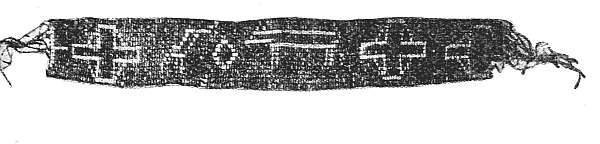
Fig. 10.—Jesuit Missionary Wampum
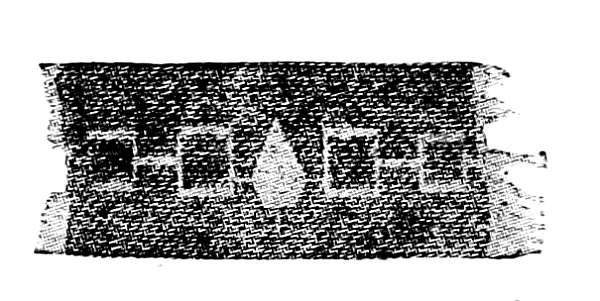
Fig. 11.—Four Nations' Alliance Wampum
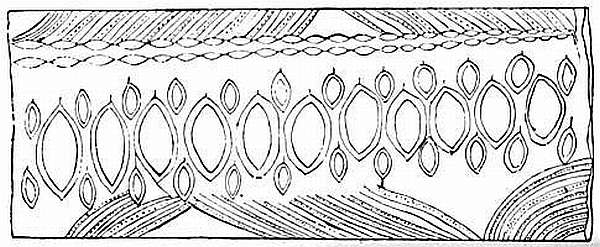
The figures are worked on fifteen rows of white beads on a
dark ground, the oval or lozenge-shaped design near the centre representing a
council. On each side of this are religious emblems—on one side the
dove, on the other side the lamb—and beyond each are Greek crosses
representing the Trinity. "The latest date which can be ascribed to
this belt is the year 1648, the eve of the expulsion of the Hurons by
the Iroquois." The fourth example (Fig. 11), called the "Four Nations'
Alliance Belt," is sixty years younger, and, as denoted by the four
squares forming the chief device, is a
land-treaty made between the Wyandotts and three Algonquin tribes.
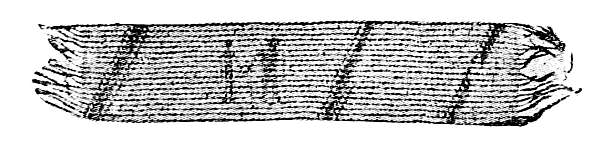
Fig. 11a.—Penn Wampum
This reference to records which mark a certain approach
to the ideographic stage of writing would be incomplete if no account was
given of the most celebrated wampum record in existence (Fig. 11a),
the Penn Belt, preserved in the archives of the Historical Society of
Pennsylvania. It derives its name from a well-authenticated tradition
that it is the identical belt given, probably in 1701, to William Penn
by the Iroquois "to confirm the friendly relations then permanently
established between them." It is composed of eighteen strings of white
wampum, thus evidencing its relation to an important transaction,
and has in the centre two figures delineated in dark-coloured beads,
one an Indian grasping the hand of a man who, as wearing a hat, is
doubtless intended to represent a European. The oblique bands are the
symbol of the federation of Iroquois known as the "Five Nations,"
and represent by synecdoche (or the putting of a part for the whole)
the entire native Iroquois "long-house," as the communal dwelling is
called. "The Iroquois league is spoken of in their Book of Rites as
Kanastat-sikowa, the 'great framework.' It was this mighty structure,
which, when the belt in question was given, overshadowed the greater
part of North America, that was indicated by the rafters, shown as
oblique bands." (Hale, J.A.I. xxvi. p. 244.)
(b) The Pictorial Stage.—The necessity of
identifying personal as well as tribal property, especially in land and live stock,
led to the employment of various characters more or less pictographic, which
have their representatives in signaries used in ancient commerce and in
manufacturers' trade marks. Professor Ernst of Caracas believes that he
can recognise survivals of Indian picture-writing in the marks used for
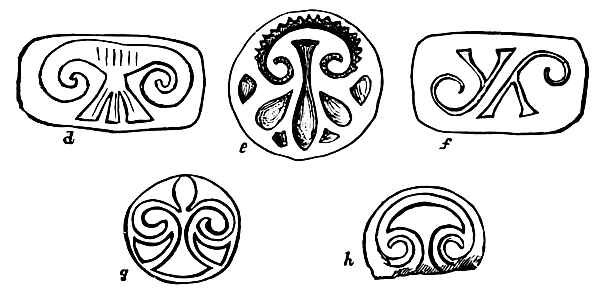
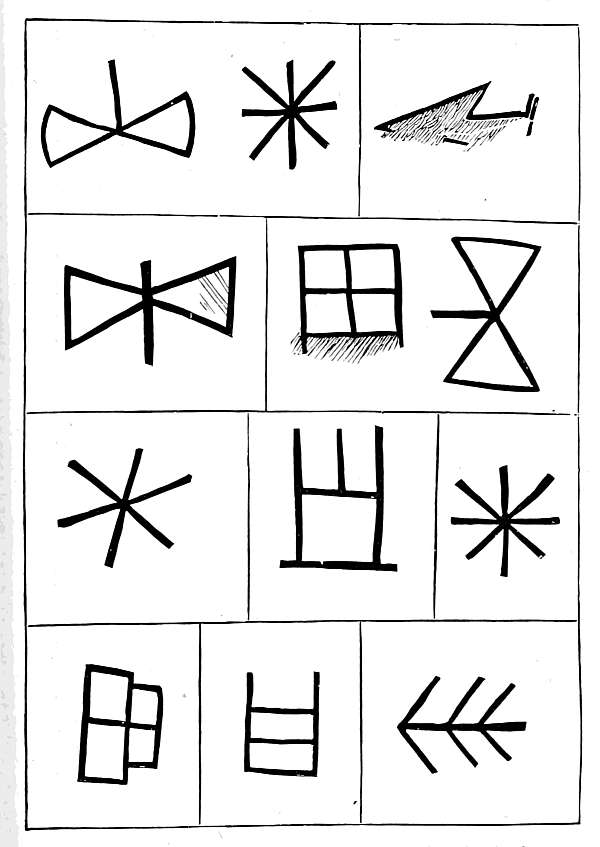
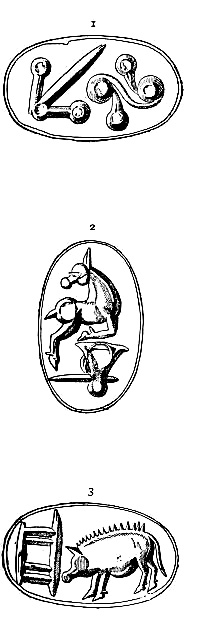
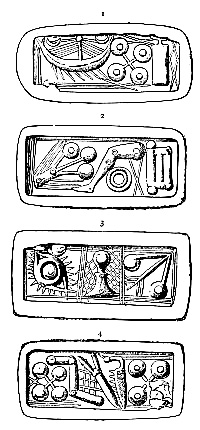
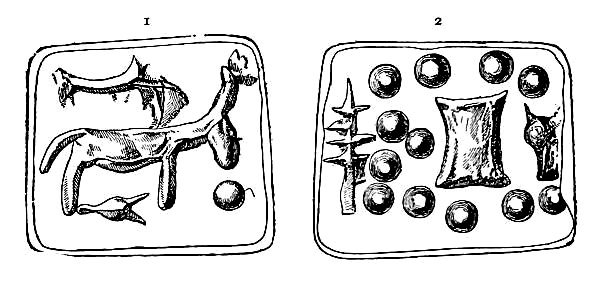
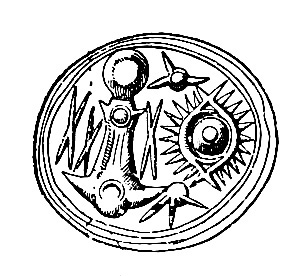
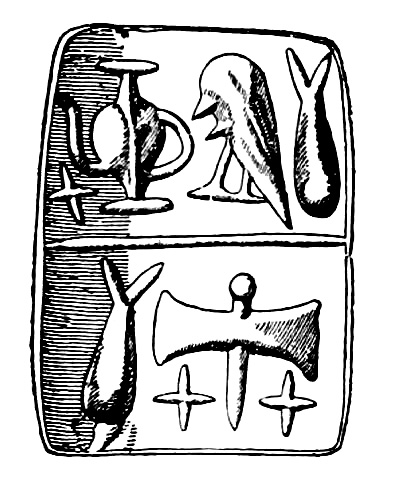
branding cattle; and among Mr. Arthur Evans's remarkable discoveries
of pre-Mycenæan relics in Crete, the significance of which will be
dealt with later on, are seal-stones engraved with signs which are
not merely fanciful or ornamental, but designed to convey information
about their owners. "For example, a boat with a crescent moon on either
side of the mast may have been the signet of an ancient mariner who
ventured on long voyages;" perchance a feat to be proud of, since even
a one-moon voyage seems to have been too much for the average Homeric
mariner (cf. Iliad, II. 292-4). "Another signet, with a gate
and a pig on one of its faces, would be proper to a well-to-do swineherd."
Other seals bearing the device of a fish may indicate a fisherman; of a
harp, a musician, and so on. (The Mycenæan Age, p. 270: Tsountas and
Manatt.) The painful operation of tattooing is known to have symbolic
and religious, even more than decorative, significance, as marking the
connection of the man with his clan-totem or individual totem. But it
has also a utilitarian purpose, as among certain Red Indian tribes,
who tattoo both sexes, so that in case of war the captured individuals
may be identified and ransomed. Totemic and mythic animals are
tattooed upon various parts of the body; in one case the design worn
by a landowner among the Kavuya Indians of California was used as his
property mark by being cut or painted upon boundary trees and posts, so
that his title to his possessions was proved by the portable title-deed
which he bore, reminding us of the leading incident in Rider Haggard's
Mr. Meeson's Will. "In New Zealand the facial decorations of a dead
man were reproduced upon the trees near his grave; while among the
Yakuts and Bushmen the facial marks, or even totems, were furthermore
employed as property marks, the Bushmen carving them upon growing
squashes and melons." (Hoffman, p. 39.) The various Indian tribes
appear to have made more frequent use of the totem name rather than of
the personal name, perhaps because of the common barbaric notion that
a man's name is an integral part of himself, through which, whether he
be living or dead, mischief may be wrought by the sorcerer who knows
the name—a notion the force of which would be lessened where the name
is generic and shared in common. On the grave-posts of both Australian
black fellows and North American Indians the totem symbol is reversed,
as in our mediæval chronicles the leopards of English kings are
reversed on the scutcheon drawn opposite the record of their death.
With this we may connect the classic symbol of the inverted torch which
the modern sculptor depicts on funereal monuments. In his great work on
the History, Condition, and Prospects of the Indian Tribes, published
over fifty years ago (a work, however, which needs checking from other
authorities), Schoolcraft gives some illustrations of the red man's
grave-posts, of which three are here reproduced.
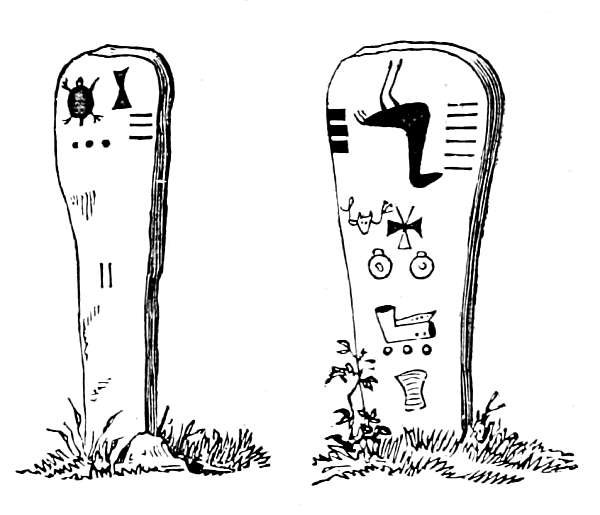
Figs. 12, 13.—Indian Grave-posts
Fig. 14.—Tomb-board
of Indian Chief
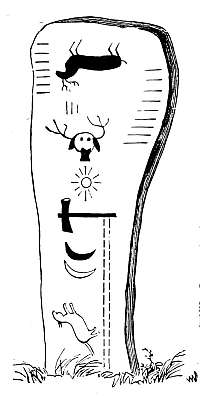
Fig. 12 shows the dead warrior's totem, a tortoise, and beside
it a headless man, which is a common symbol of death among Indian tribes.
Below the trunk are three marks of honour. The next and more elaborated
figure (13) records the achievements of Shingabawassin, a celebrated
chief of the St. Mary's band. His totem, the crane, is shown reversed.
The three marks on the left of the totem represent important general
treaties of peace to which he had been a party; the six strokes on the
right probably indicate the number of big battles which he fought.
The pipe appears to be a symbol of peace, and the hatchet a symbol of
war. In like manner head-boards erected over a woman have the
various articles used by her in life, as cutting and sewing instruments and
weaving utensils, depicted upon them. The third example (14) represents
the adjedatig or tomb-board of Wabojeeg, a celebrated war chief, who
died on Lake Superior about 1793. His totem, the reindeer, is reversed,
and his own name, which means the White Fisher, is not recorded. The
seven strokes note the seven war parties whom he led; the three upright
strokes as many wounds received in battle. The horned head tells of a
desperate fight with a moose.
Fig. 15.—Hunter's
Grave-post
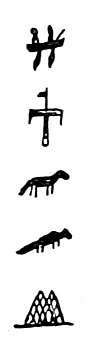
Fig. 15 is a reduced copy (Hoffman) of the grave-board of
an Innuit hunter. The vocation of the dead man is shown in the baidarka,
or boat, in which he is depicted as rowing with a companion. The object
beneath represents a rack for drying fish and skins. Next to this are
figures of a fox and a land otter, and the network drawing at the
bottom is a copy of the hunter's summer dwelling. These temporary
structures denote the abode of a skin-hunter, those used by fishermen
being dome-shaped. Hoffman adds that "this differentiation in the shape
of roofs of habitations applies to their pictorial representation and
not to their actual form." In close connection with these mortuary
boards there is the ornamentation of door-posts which we find among
British Columbian, Polynesian, and Maori tribes; also the carvings on
canoes and other personal effects to mark ownership or to identify the
property with the totem. But to pursue this would take us into the
domain of savage art generally, reference to which is warranted here
only in its mnemonic uses as keeping alive knowledge of events which
would otherwise perish. Obviously, the examples given above can fulfil
only a limited purpose, because only the initiated can know their
meaning. As Dr. Tylor remarks, such mode of record "may be compared
to the elliptical forms of expression current in all societies whose
attention is given specially to some narrow subject of interest, and
where, as all men's minds have the same framework set up in them, it is
not necessary to go into an elaborate description of the whole state
of things; but one or two details are enough to enable the hearer to
understand the whole. Such expressions as 'new white at 48,' 'best
selected at 92' ('futures fairly active' is a good example), though
perfectly understood in the commercial circles where they are current,
are as unintelligible to any one who is not familiar with the course
of events in those circles, as an Indian record of a war-party would
be to an ordinary Londoner." (Early History of Mankind, p. 86.)
This applies with even greater force to the large group of symbolic
mnemonics whose purpose is more restricted, whether it be as help to
the singer in his verses, to the medicine-man in his incantation,
to the hunter in his quest, or, as among ourselves, to the tramp on
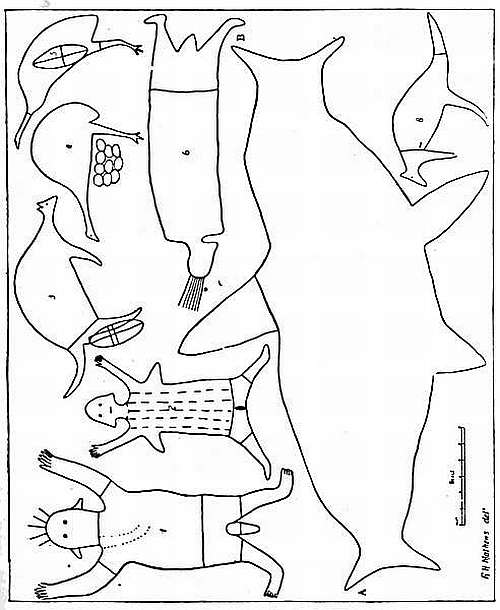
his rounds. The subjoined copy of a cadger's map (Fig. 16), given in
Hotten's Slang Dictionary (1869), is an addition to the number of
survivals which are found in so-called civilised communities, and has
fit place among the examples of pictorial mnemonics in matters of 1,
love; 2, sorcery; 3, the chase; 4, war; and 5, politics which follow it.
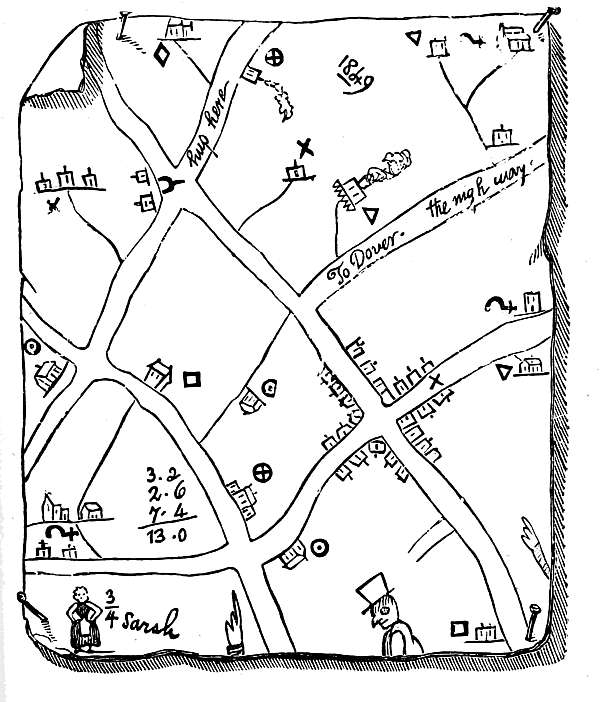
Fig. 16.—A Cadger's Map of a Begging District
Explanation of the Hieroglyphics
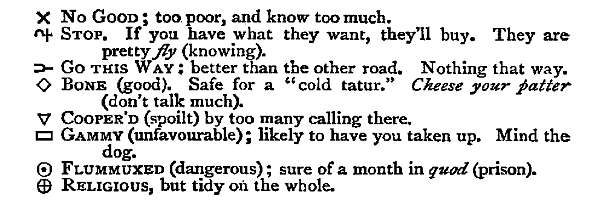
1. Love.—Fig. 17 is a reduced copy of a love-letter,
drawn upon birch bark (a material used elsewhere, as among the Yukaghirs of
Siberia), which an Ojibwa girl sent to her sweetheart at White Earth,
Minnesota. She was of the "Bear" totem, he of the "Mud Puppy" totem;
hence the picture of these animals as representing the addresser and
the addressee. The two lines from their respective camps meet and are
continued to a point between two lakes, another trail branching off
towards two tents. Here three girls, Catholic converts, as denoted by
the three crosses, are encamped, the left-hand tent having an opening
from which an arm protrudes with beckoning gesture. The arm is that
of the writer of the letter, who is making the Indian sign of welcome
to her lover. "This is done by holding the palm of the hand down and
forward, and drawing the extended index finger towards the place
occupied by the speaker, thus indicating the path upon the ground to be
followed by the person called."
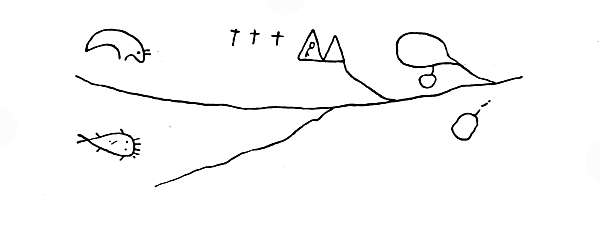
Fig. 17.—Ojibwa Love-letter
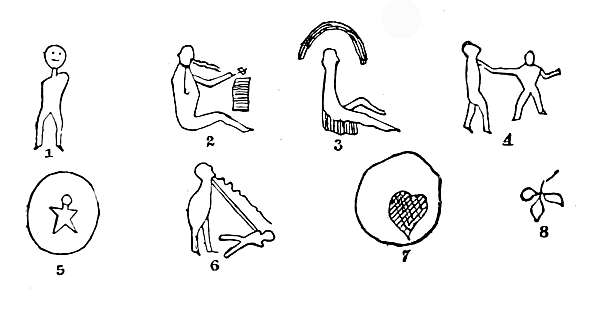
Fig. 18.—Love-song
Fig. 18 is the record of a love-song. 1, represents the lover;
2, he is singing and beating a magic drum; in 3, he surrounds himself with a
secret lodge, denoting the effects of his necromancy; in 4, he and his
mistress are joined by a single arm to show that they are as one; in
5, she is on an island; in 6, she sleeps, and as he sings, his magical
power reaches her heart; and in 7, the heart itself is shown. To each of
these figures a verse of the song corresponds.
1. It is my painting that makes me a god.
2. Hear the sounds of my voice, of my song; it is my voice.
3. I cover myself in sitting down by her.
4. I can make her blush, because I hear all she says of me.
5. Were she on a distant island I could make her swim over,
6. Though she were far off, even on the other hemisphere.
7. I speak to your heart.
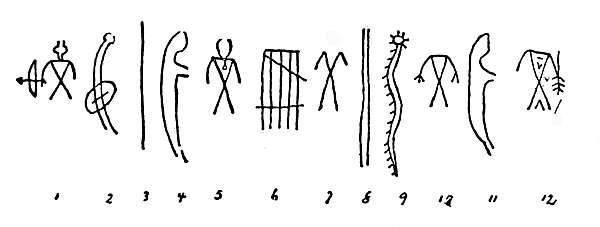
Fig. 19.—Mnemonic Song of an Ojibwa Medicine-man.
2. Sorcery.—Fig. 19 is the song of an Ojibwa medicine-man
incised upon birch bark. These conjurers, who correspond to the Siberian
shamans, affect the usual mystery of the priestly craft all the
world over, and affirm, like those who know better, that their
thaumaturgic powers are the direct gift of the god. Him they name
Manabozho—probably some ancestral deity, since he is the great uncle
of the anish'inabēg or "first people." In 1, Manabozho holds his bow
and arrow; 2, represents the medicine-man's drum and drumsticks used
in chanting and in initiation ceremonies; 3, a bar or rest observed
while chanting the incantation; 4, the medicine-bag, made of an otter
skin, in which is preserved the white cowrie shell as the sacred
emblem of the cult; 5, the medicine-man himself, horned to show his
superior power; 6, a funnel-like object, known as a "jugglery," used in
legerdemain and other hocus pocus; 7, a woman, signifying the admission
of her sex to "the society of the grand medicine"; 8, a bar or rest,
as at 3; 9, the sacred snake-skin medicine bag, which has magic power;
10, another woman; 11, another otter-skin "bag o' tricks," showing
that women members are allowed to use it; 12, a female figure, holding
a branch of some sacred plant used in the exorcism of the demon of
disease. In any reference to savage therapeutics it cannot be too often
insisted upon that diseases are never ascribed to natural causes. "The
Indians believed that diseases were caused by unseen evil beings and
by witchcraft, and every cough, every toothache, every headache, every
fever, every boil, and every wound, in fact all their ailments, were
attributed to such a cause. Their so-called medical practice was a
horrible system of sorcery, and to such superstition human life was
sacrificed on an enormous scale.... In fact, a natural death in a
savage tent is a comparatively rare phenomenon; but death by sorcery,
medicine, and blood-feud arising from a belief in witchcraft is
exceedingly common." (Professor Powell's Indian Linguistic Families of
America North of Mexico, p. 39.)
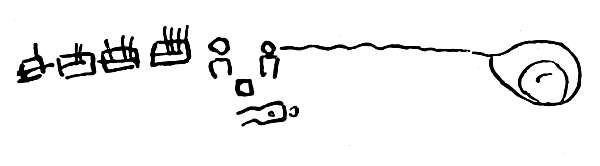
Fig. 20.—Wâbeno destroying an Enemy
Fig. 20 records the destruction of an enemy by an Ojibwa
wâbeno or bad medicine-man. The box-like objects represent the four degrees
of the cult society to which the wâbeno belonged, the number of
posts indicating the series. The figure next to these is that of the
assistant to the wâbeno, who is shown with a waving line extending from
his mouth to the oval-like object intended to represent a lake upon an
island in which the victim lives. He is shown prostrate beneath the
wâbeno with a spot upon his breast, the small oblong figure between the
two being the sacred drum. (See 2 in the foregoing illustration.) The
meaning of the pictograph is that the wâbeno was employed to work black
magic on the man. He took a piece of birch bark and cut upon it the
effigy of the victim, then, after beating the drum to the chanting of
incantations, he pierced the breast of the effigy, applying red paint
to the puncture. This, under the principle of "sympathetic magic," was
believed to bring about the death of the victim, whom, through
his living on the island, the wâbeno could not reach.
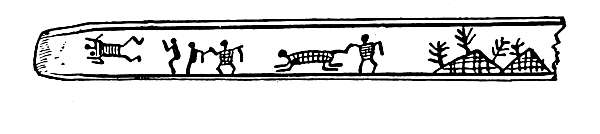
Fig. 21.—Etching on Innuit Drill-bow
White magic, in which the beneficent powers are at work, is
illustrated by the Innuit pictograph on an ivory drill-bow (Fig. 21), on the
right of which are two huts, nearest to which stands the medicine-man who
has been called in to exorcise the disease from a couple of sufferers.
He is catching hold of the animal by whose help the disease-demon is
expelled, or to whom, mayhap, as a sort of scapegoat, the disease is
transferred. In the second exorcism, the medicine-man is grasping the
patient by the arm, while he chants the formulæ wherewith to cast out
the demon. The figure on the left is making a gesture of surprise at
his relief, while beyond him are two demons struggling to escape beyond
the power of the medicine man.
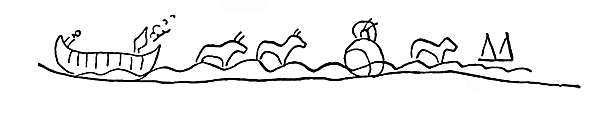
Fig. 22.—Ojibwa Hunting Record
3. The Chase.—Fig. 22 records a hunting expedition.
The two lines represent a wave-tossed river, on which floats a bark canoe, guided by
the owner. In the bow a piece of birch bark shields a fire of pine
knots to light up the course taken by the steersman. By this means the
game, as it comes to the water to drink, can be seen from the shaded
part of the canoe, in front of which two deer are shown. Next to these
is a circle representing a lake, from which peep the head and horns
of a third deer. To the right of the lake a doe appears, and beyond
her the two wigwams of the hunter. The four animals may represent the
quarry secured.
Fig. 23.—Hidatsa
Pictograph on a
Buffalo Shoulder-blade
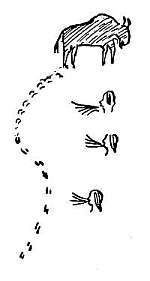
Fig. 23, drawn on a buffalo shoulder-blade by a Hidatsa Indian,
tells his efforts to track companions who had gone buffalo-hunting. The trail
of the animal and the pursuers is shown in the dotted lines. Of the
three heads the lowest is that of the seeker, who is depicted shouting
after his missing friends; then he is shown advancing and still
shouting, till his call is returned from the spot where the hunters
have camped.
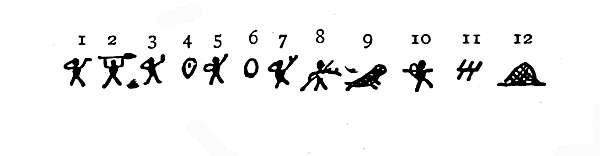
Fig. 24.—Alaskan Hunting Record

Fig. 25.—Record of Starving Hunter
Fig. 24, incised on an ivory drill-bow, is a pictograph of
an Alaskan sea-lion hunt. In 1, the speaker points with his left hand in the
direction to be taken, and, 2, holds a paddle to show that a voyage is
intended. In 3, the right hand to the side of the head denotes sleep,
while the left hand with one finger elevated means one night. The
circle with two dots in the middle, 4, signifies an island with huts;
5 is the same as 1; 6 is another island; 7 is the same as 3, but with
two fingers elevated to indicate two nights. In 8 the speaker with
his harpoon makes the sign of a sea-lion with his left hand, which he
thrusts outward and downward in a slight curve to represent the animal
swimming; 9, 10, a sea-lion shot at with bow and arrow; 11, two men in
a boat, the paddles pushed downwards; and 12, the speaker's hut. The
native account, as translated, reads thus: "I there go that island,
one sleep there; then I go another that island, there two sleeps; I
catch one sea-lion, then return mine." (Colonel Mallery, quo. Hoffman,
Transactions of the Anthropological Society, Washington, vol. ii.
p. 134, 1883.) "Hunters who have been unfortunate, and are starving,
scratch or draw upon a piece of wood characters like those in Fig. 25,
and place the lower end of the stick in the ground on the trail where
it is most likely to be discovered," the stick being inclined towards
the hunter's dwelling. The horizontal line 1, denotes a canoe,
2, the gesture of the man with both arms extended, signifies "nothing,"
while the uplifting of the right hand to the mouth, 3, means "food"
or "to eat," and the left hand outstretched points to 4, the hut of
the famished man. Here we are actually within the ideographic stage,
and, as will be shown in due course, handling material identical in
character with that found in Egypt and other nations of antiquity. But,
as already remarked, and as will be evidenced in abundance throughout
these pages, there are no well-marked divisions between the stages of
development.
A varied interest attaches to Fig. 26, which depicts some
general features of Alaskan life on a piece of walrus tusk. In 1, a native
is resting against his house, and on his right stands a pole surmounted by
a bird, apparently a totem-post. 2. A reindeer. 3. One man shooting at
another with an arrow. 4. An expedition in a dog-sledge, and, 5, in a
boat with sail and paddle. 6. A dog-sledge, with the sun above; perhaps
indicating the coming of summer. 7. A sacred lodge. The four figures
at each outer corner represent young men armed with bows and arrows to
keep off the uninitiated from the forbidden precincts. The members of
the occult society are dancing round a fire in the centre of the lodge.
8. A pine tree up which a porcupine is climbing. 9. Another pine tree,
from which a woodpecker is extracting larvæ. 10. A bear. 11, 12. Men
driving fish into, 13, the net, above them being a captured whale, with
harpoon and line attached.
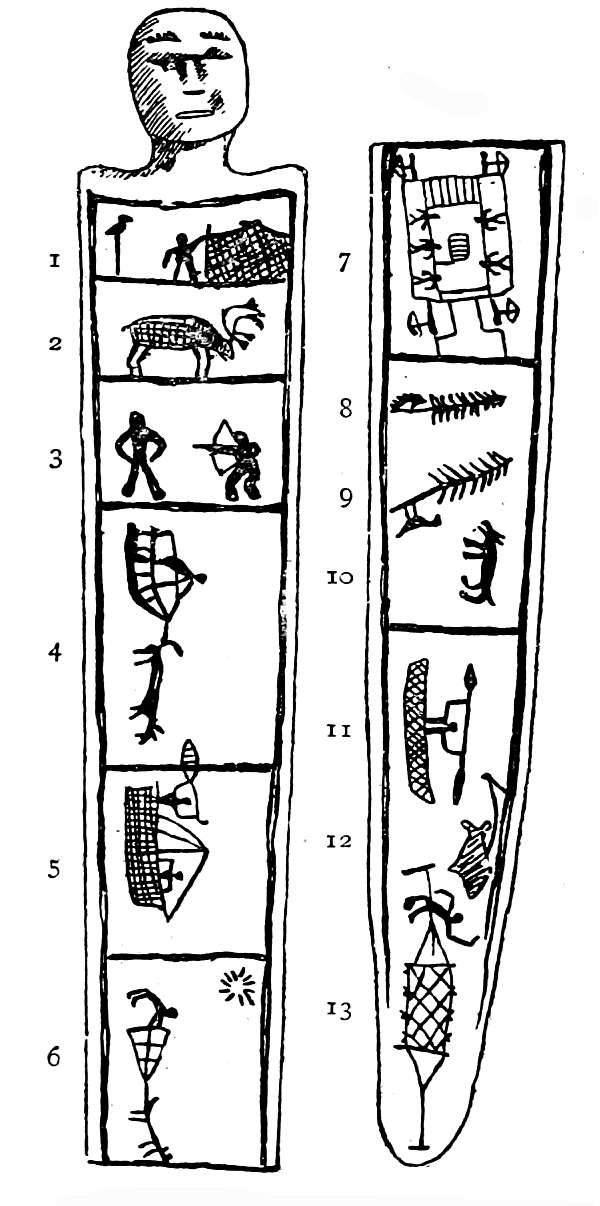
Fig. 26.—Alaskan Hunting Life
4. War.—Schoolcraft, who has been already drawn upon
for an example (page 53), records the finding of the bark letter copied in Fig. 27.
It was fastened to the top of a pole so as to attract the notice of other
Indians who might happen to be passing. Beginning on the right of the
middle row we have 1, the officer in command, sword in hand; 2, his
secretary, and 3, the geologist of the party, indicated by his hammer.
Then follow 4, 5, two attachés; 6, the interpreter; and 7, 8, two
Chippewa guides. In the top row is 9, 10, a group of seven soldiers,
armed with muskets. A prairie hen and tortoise, 11, 12, represent the
animals secured for food.
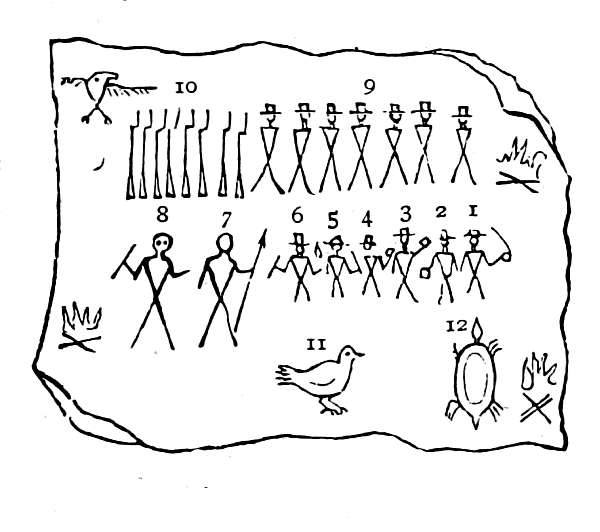
Fig. 27.—Indian Expedition
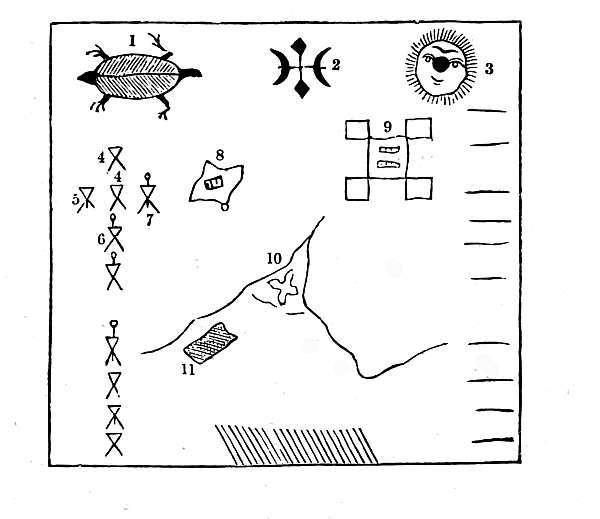
Fig. 28.—Biography of Indian Chief
Fig. 28 gives the biography of Wingemund, a noted Delaware
chief. To the left is 1, the tortoise totem of the tribe; then 2, the
chief-totem; and 3, the sun, beneath which are ten strokes representing
the ten expeditions in which Wingemund took part. On the opposite side
are indicated, 4, 5, 6, 7, the prisoners of both sexes taken, and also
the killed, these last being drawn as headless. In the centre are the
several positions attacked, 8, 9, 10, 11; and the slanting strokes at
the bottom denote the number of Wingemund's followers.
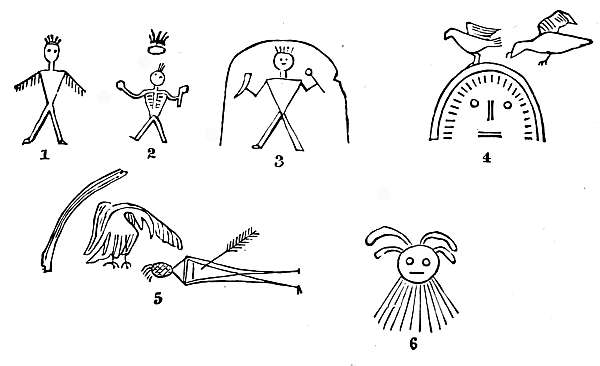
Fig. 29.—War-song
Fig. 29 is a war-song. Wings are given to the warrior,
1, to show that he is swift-footed; in 2 he stands under the morning star,
and in 3 under the centre of heaven, with his war-club and rattle; in
4, the eagles of carnage are flying round the sky; in 5, the warrior lies
slain on the battlefield; while in 6 he appears as a spirit in the sky.
The words of the song are as follows:—
1. I wish to have the body of the swiftest bird.
2. Every day I look at you; the half of the day I sing my song.
3. I throw away my body.
4. The birds take a flight in the air.
5. Full happy am I to be numbered with the slain.
6. The spirits on high repeat my name.
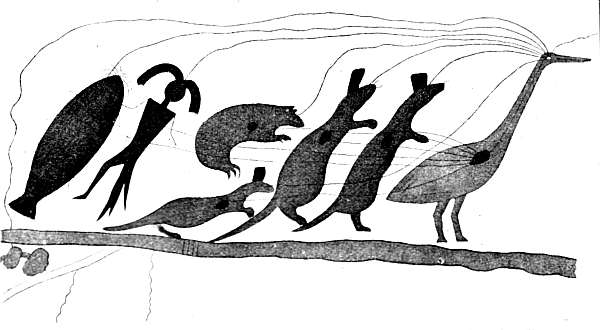
5. Political and Social.—The
frontispiece is a copy of a petition sent by a group of
Indian tribes to the United States Congress for fishing rights in certain small
lakes near Lake Superior. The leading clan is represented by Oshcabawis,
whose totem is 1, the crane; then follow 2, Waimitligzhig; 3, Ogemagee;
and 4, a third, all of the marten totem; 5, Little Elk, of the bear totem;
6, belongs to the manfish totem; 7, to the catfish totem.
From the eye and heart of each of the animals runs a line
connecting them with the eye and heart of the crane to show that they are
all of one mind, and the eye of the crane has also a line connecting it
with the lakes on which the tribes want to fish, while another line runs
towards Congress.
Fig. 30 is a copy of a letter found above St. Anthony's Falls
in 1820. "It consisted of white birch bark, and the figures had been carefully
drawn. 1, Denotes the flag of the Union; 2, the cantonment then
recently established at Cold Spring, on the western side of the cliffs;
4 is the symbol of Colonel Leavenworth, the commanding officer, under
whose authority a mission of peace had been sent into the Chippewa
country; 11 is the symbol of Chakope, the leading Sioux chief, under
whose orders the party moved; 8 is the second chief, named Wabedatunka,
or, 10, the Black Dog, who has fourteen lodges, 7 is a chief also
subordinate to Chakope, with thirteen lodges, and 9 is a bale of goods
devoted by the Government to the objects of the peace. The name of 6,
whose wigwam is 5, with thirteen subordinate lodges, was not given."
The letter was written to make known the fact that Chakope
and his followers, accompanied or supported by the American officer, had come
to the spot to make peace with the Chippewa hunters. "The Chippewa
chief, Babesacundabee, who found the letter, read off its meaning
without doubt or hesitation." (Schoolcraft, vol. i. p. 352.)
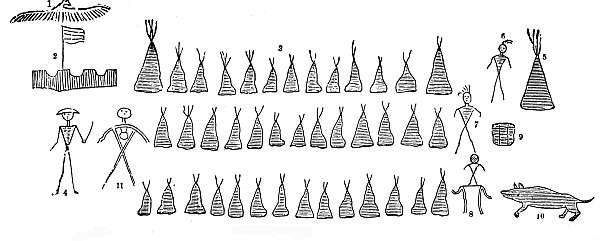
Fig. 30.—Letter offering Treaty of Peace
Fig. 31 represents the census roll of an Indian band at
Mille Lac, in the territory of Minnesota, sent in to the United States agent
by Nagonabe, a Chippewa Indian, during the annuity payments in 1849.
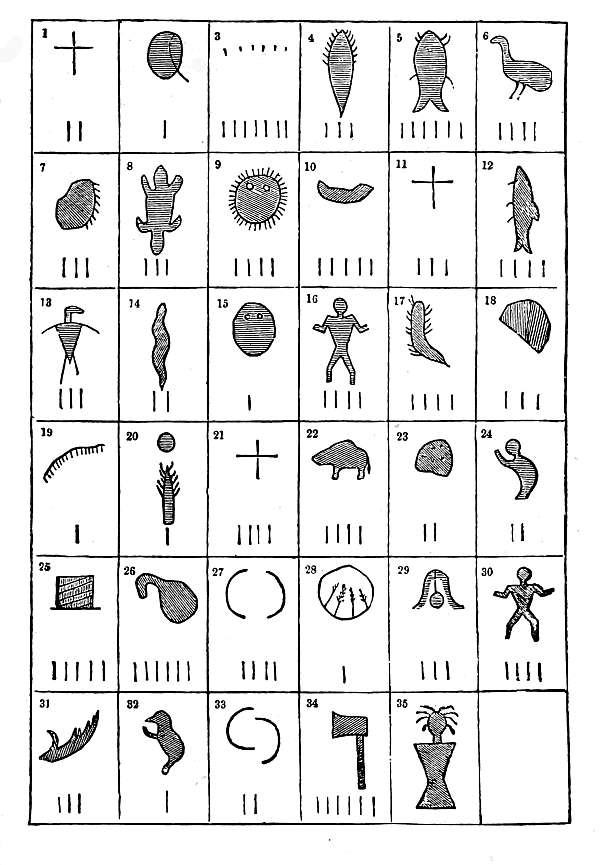
Fig. 31.—Census Roll of an Indian Band
As the Indians were all of the same totem, Nagonabe "designated
each family by a sign denoting the common name of the chief. Thus 5 denotes
a catfish, and the six strokes indicate that the Catfish's family
consisted of six individuals; 8 is a beaver skin; 9, a sun; 13, an
eagle; 14, a snake; 22, a buffalo; 34, an axe; 35, the medicine-man,
and so on." (Lubbock, Origin of Civilisation, p. 47.)
Fig. 32.—Record of Departure (Innuit)
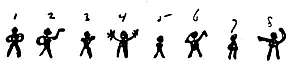
Fig. 32 supplies a striking example of the cumbersomeness
of the pictograph as contrasted with the sound-symbol. It is a copy of
a record which an Innuit placed over the door of his dwelling to
notify to his friends that he had gone on a journey. The persons thus
notified are indicated in 1, 3, 5, 7; 2 is the speaker, who denotes the
direction in which he is leaving by his extended left hand; 4 is the
gesture sign for "many," and 6 for sleep, the upraising of the left
hand showing that he will be some distance away; 8, his intended return
is denoted by the right hand being pointed homeward, while the left arm
is bent to denote return.
(c) The Ideographic Stage.—As the characters
pass from the pictorial to the emblematic or the symbolic, their meaning, obviously,
becomes more obscure, save to the initiated. "They do not," as Colonel
Mallery remarks, "depict, but suggest objects; do not speak directly
through the eye to the intelligence, but presuppose in the mind
knowledge of an event or fact which the sign recalls. The symbols of
the ark, dove, olive-branch, and rainbow would be wholly meaningless to
people unfamiliar with the Mosaic or some similar cosmology, as would
be the cross and the crescent to those ignorant of history." And even
in pictography, as the same excellent authority observes, "it is very
difficult, if not impossible, to distinguish between historical and
traditional accounts obtained from Indians. The winter counts (i.e.
the reckoning of time by winters, and the applying of names instead of
numbers to them, as, e.g., 'catching-wild-horses winter,' the device
for which was a lasso), while having their chief value as calendars,
contain some material that is absolute and verifiable tribal history."
The difficulties of interpretation, as the examples given evidence,
are in the larger number being "merely mnemonic records, and treated
in connection with material objects formerly, and perhaps still, used
mnemonically." (Mallery, "On the Pictographs of the North American
Indians," Fourth Annual Report of the Bureau of Ethnology, 1886.)
The signs of advance from the pictorial to the ideographic
stage which are to be noted among the Red Indians, are more sharply marked in
the hieroglyphs and phonetic characters on the stone monuments and manuscripts
found among the relics of the vanished peoples of Mexico and Yucatan.
A number of fatuous theories about the connection of Central
American culture with that of the Old World have been broached, from the time
when Lord Kingsborough published his lavishly-illustrated book to prove
that the ancient Mexicans were the descendants of the lost Ten Tribes
of Israel to the present day, when Dr. Augustus Le Plongeon brings us
his "proofs" that Yucatan was the primitive home of Adam, and avers
that he has discovered not only the grave of Abel, but disinterred his
heart therefrom, and found the knife wherewith Cain slew him! (Queen
Moo and the Egyptian Sphinx, p. 138.) Now, among the certainties
which modern research has reached is that of the independent origin
and development of civilisation in the New World. Man himself, whether
or not descended from a single pair, had his origin in one region,
probably the Indo-Malaysian, since there we find his nearest congeners,
the anthropoid apes, while the pliocene beds of Java have recently
yielded a remarkable corroboration of the theory in the fossil bones
which bring man near to the common stem whence the highest animals have
diverged. At a period when the general temperature of the globe was
milder than now, the ancestors of the existing four leading groups—the
Ethiopic, Mongolic, American, and Caucasic—spread themselves over the
several zones of the habitable world, the American group migrating from
Asia and Europe across the then existing land-connection between those
continents and the New World, where those various stages of development
which are still to be witnessed from the Arctic regions to Cape
Horn were reached. Of these the Mexican plateau affords interesting
and valuable material in the chipped flint implements evidencing a
Stone Age, and in the marvellous buildings which vie both in their
cyclopean dimensions and ornamented features with the palaces, tombs,
and temples of Egypt and Assyria, testifying to the relatively high
culture of the races that raised them. These peoples, usually grouped
together as the ancient Mexicans, are known as Mayas and Aztecs. The
duration of the empire or confederation of the Mayas is unknown, but
about two hundred years before the Spanish conquest of America they
appear to have been invaded and subdued by the Aztecs, whose rule
extended from the Atlantic to the Pacific in the countries now forming
Mexico and portions of the United States. The remains of the two
races are both imperfect and entangled, so that any coherent story is
not to be extracted from them. But the evidence points to the Mayas
as the intellectually superior race; the Aztecs, who still form the
bulk of the population of South Mexico, borrowing largely from them,
especially in the matter of the gods. "If written language be a test of
intelligence, the Mayas were ahead not only of the Mexican people, but
also of the Peruvians. The latter are believed to have made no nearer
advance towards writing than the tying of tally-knots on strings, and
the Mexicans, while they had invented paper, wrote down their ideas,
save in the cases of a few phonetic signs, as children would, by means
of pictures; but the Mayas, like the Egyptians, had proceeded beyond
pictures to hieroglyphs, where symbols, more or less arbitrary, stand
for words or syllables, and the mind prepares itself to invent an
alphabet." (Mercer's Hill Caves of Yucatan, p. 73.) Some of the more
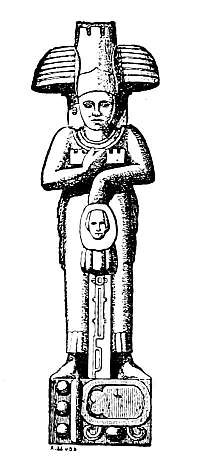
remarkable hieroglyphic-bearing monuments of the Mayas have been found
in the palace of Palenque, the Spanish name of the old Yucatan capital.
They are on stucco slabs above figures some of which show curious
correspondence to Egyptian statues, wearing the pleasant but immobile
expression of the latter, and decorated with a similar headdress, while
in one case (Fig. 33), a cartouche enclosing an inscription is carved
on the plinth. The concluding panels of one of the codices form what
may be called the Mexican Book of the Dead. It enforces the scheme of
duty which precedes by vividly depicting the trial and judgment of the
soul after death, and detailing the perils of the journey on the way to
Mictlan (Payne, ii. 407).
Fig. 33.—Statue from Palenque
Time and fanaticism have made sad havoc with the manuscripts,
and no satisfactory key to their decipherment has been found, only a few words
here and there being interpreted. They were executed in bright and
varied colours, with a feather pencil, on prepared skins, paper, or
rolls of cotton or aloe-fibre cloth, and the pictographic system thus
created was applied to the purposes of ordinary life, and served as a
species of writing. Matters of only passing importance were recorded
on fibrous paper made from the leaves of the maguey plant; "records
intended to be permanently kept were painted on the prepared skins of
animals, those of the deer and bear being more commonly used. These
paintings or 'pinturos' are usually executed on both sides of the
skin, which was oblong in shape and often of great length, having the
ends protected by boards." (Payne's History of the New World called
America, vol. ii. p. 404.) These boards are called analtees, a word
which may be translated annals. The earlier hieroglyphic characters
were executed by priests, who were required to be old men, widowers,
and under vows of chastity and seclusion. Such writing was known only
to the initiated.
Tradition says that the Aztecs destroyed many of the Maya picture
records because they recalled the grandeur of the conquered people. But
the Spaniards in their turn destroyed much more. Zumárraga, Bishop of
Mexico, and Landa, Bishop of Yucatan, made such bonfires of carvings,
statues, paintings on wood, and of priceless picture and hieroglyph
writings on native paper and deerskin, that only about half-a-dozen
fragments of the Yucatan books have ever been found since. Bishop
Landa, probably from knowledge obtained from Maya priests, attempted
the framing of a key of interpretation, his aim being the translation
of certain religious and devotional writings for the use of converts.
In this he indicates a certain number of alphabetic characters, but
the key did not work, and Dr. Isaac Taylor draws the conclusion that
"the systems of picture-writing which were invented and developed
by the tribes of Central America are so obscure, and so little is
really known about their history, that they must be regarded rather as
literary curiosities than as affording suitable materials for enabling
us to arrive at any general conclusions as to the nature of the early
stages of the development of the graphic art." (Hist. Alph., i. 24.)
Notwithstanding this somewhat sweeping verdict, the Maya-Aztec scripts
have value, if only for purposes of comparison. There is preserved in
the museum at Mexico a whole series of pictographs exhibiting incidents
as varied as the migrations of tribes, the annals of the people,
sacrifices to the gods, and the education of children, the tasks set
them, the punishments inflicted on them, and the food given them. To
the hieroglyph there succeeds the gradually conventionalised sign, of
which examples from Red Indian scripts have been given:—the arrow,
to denote an enemy; several arrows, several enemies; the direction
of the arrow's point, the direction taken by the enemy; a piece of
maize cake protruding from the mouth, to denote eating; the symbol
for water between the lips, to signify drinking; horizontal lines,
with arrow-headed characters on them, to denote the hoed or cultivated
ground, some of these ideographs being coloured to correspond with the
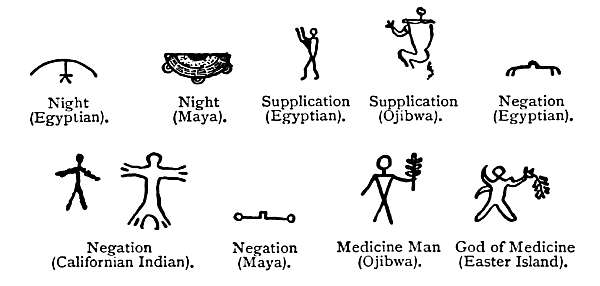
thing suggested; and, as an example of the more abstruse, the extended
arms, probably to denote negation,—all marking the advance to phonetic
syllabic writing. The names of persons and places are sometimes
indicated by symbolic figures; e.g. Chapultepec, or "grasshopper
hill," is represented by a hill and a grasshopper; Tzompanco, "the
place of skulls," by a skull on a bar between two posts, as enemies'
skulls used to be set up; and Macuilxochitl, the "five flowers," by
five dots and a flower. Sometimes we find the species of pun known as
the rebus adopted. A picture is made to stand for the sound of the
word, as e.g. among ourselves in guessing games, when a whisk broom
and a key stand for "whiskey," or in the series of pictures of an eye,
a saw, a boy, a swallow, a goose, and a berry, which stand for the
sentence, "I saw a boy swallow a goose-berry." In Abbot Islip's Chapel
in Westminster Abbey his name is rebused as an eye and the slip of
a tree with the hand apparently of a slipping man hanging to it. In
Bishop Oldham's chantry in Exeter Cathedral his name is represented by
an owl (Owle-dom, the old spelling of the name); and in St. Saviour's
Church the name of Prior Burton is sculptured as a cask with a thistle
on it, "burr-tun."
Fig. 34.—Itzcoatl
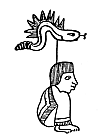
(d) The Phonetic Stage.—The ancient Mexican
script supplies examples of the change from the pictographic to the phonetic stage.
The name of one of the kings was Itzcoatl, or "Knife-Snake." In the
manuscript known as the Le Tellier Codex this king's name (Fig. 34) is
represented by a serpent (coatl) with stone knives (itzli) upon its
back. This is mere picture-writing, but in the Vergara Codex we find
the rebus form (Fig. 35). "The first syllable, itz, is represented by
a weapon armed with blades of obsidian, itz (tli), but the rest of
the word, coatl, though it means snake, is written, not by a picture
of a snake, but by an earthen pot, co (mitl), and above it the
sign of water, a (tl). Here we have real phonetic writing, for the
name is not to be read, according to sense, 'knife-kettle-water,' but
only according to the sound of the Aztec words, Itz-co-atl." Dr. Tylor
adds that there is no sufficient reason to make us doubt that this
purely phonetic writing was of native Mexican origin, and that after
the Spanish Conquest it was turned to account in a new and curious way.
The Spanish missionaries, when embarrassed by the difficulty of getting
the converts to remember their Ave Marias and Paternosters, seeing
that the words were, of course, mere nonsense to them, were helped out
by the Indians themselves, who substituted Aztec words as near in sound
as might be to the Latin, and wrote down the pictured equivalents for
these words, which enabled them to remember the required formulas.
Torquemada and Las Casas have recorded two instances of this device.
Fig. 35.—Rebus
of Itzcoatl
Pater noster was written by a flag (pantli) and a prickly pear
(nochtli), while the sign of water, a (tl) combined with that
of aloe, me (tl), made a compound word, ametl,
which would mean "water-aloe," but in sound made a very tolerable substitute
for Amen. M. Aubin found the beginning of a Paternoster of this kind
in the metropolitan library of Mexico (Fig. 36), made with a flag,
pan (tli), a stone, te (tl), a prickly pear, noch
(tli), and again a stone, te (tl), which would read
Pa-te-noch-te, or perhaps Pa-tetl-noch-tetl. After the conquest, when the
Spaniards were hard at work introducing their own religion and civilisation
among the conquered Mexicans, they found it convenient to allow the
old picture-writing still to be used, even in legal documents. It
disappeared in time, of course, being superseded in the long run by
the alphabet, and it is to this transition period that we owe many,
perhaps most, of the picture documents still preserved. "One of the
picture-writings in the museum at Mexico is very probably the same that
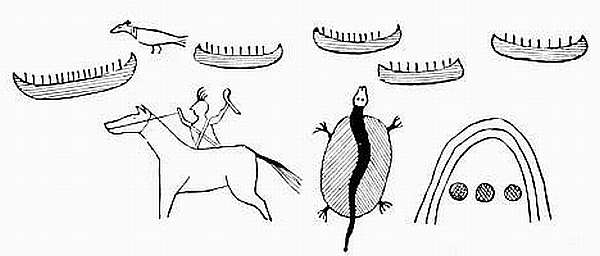
was sent up to Vera Cruz, to Montezuma, with figures of newly-arrived
white men, their ships and horses, and their cannon with fire and smoke
issuing from their mouths." (Tylor, Anahuac, p. 232.) In the general
history of the development of writing, the Mexican script therefore
supplies us only with an example of approximation to the phonetic
system, its advance to the final alphabetic stage being probably
arrested by the subjugation of the Mayas to an intellectually inferior
conqueror, who, borrowing much, and contributing nothing of advantage,
himself yielded to the superior force of Spain.
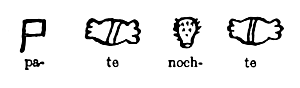
Fig. 36.—Paternoster Rebus
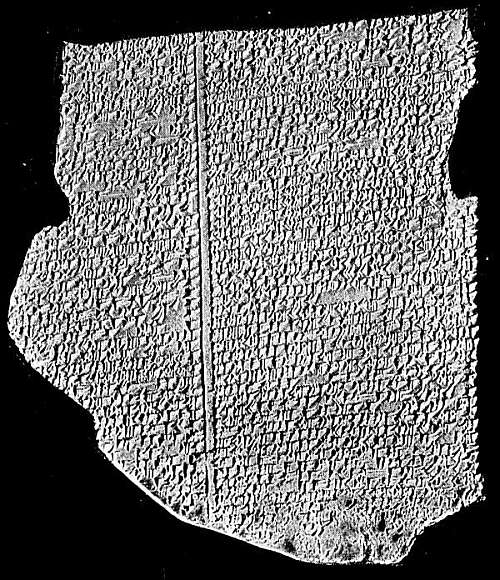
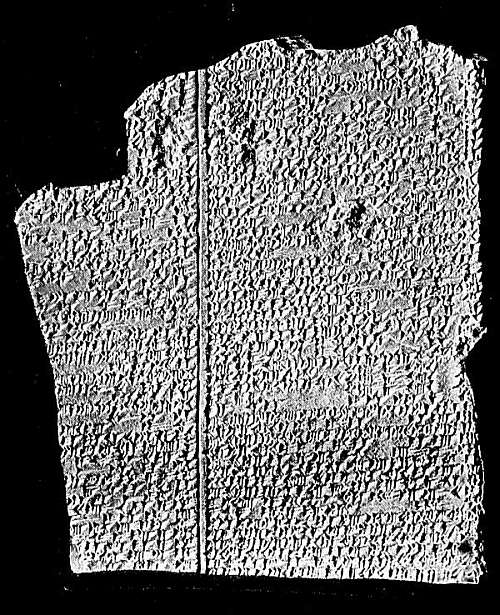
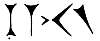 but with these elements combined in wonderful variety.... But no record of
the language or its import had survived, and the ignorant inhabitants
of the neighbourhood looked upon the texts with greater awe than
they did the winged monsters that loomed over the plain. They were to
them symbols of magic import, which, if duly pronounced, would unlock
the hidden treasures guarded by the lions and the bulls." (Mahaffy's
Prolegomena to Ancient History, p. 168.)
but with these elements combined in wonderful variety.... But no record of
the language or its import had survived, and the ignorant inhabitants
of the neighbourhood looked upon the texts with greater awe than
they did the winged monsters that loomed over the plain. They were to
them symbols of magic import, which, if duly pronounced, would unlock
the hidden treasures guarded by the lions and the bulls." (Mahaffy's
Prolegomena to Ancient History, p. 168.) ,
which occurred frequently, was a sign for the
separation of words, and, next, he discovered the vowel signs, which,
as distinct characters, are absent from the Hebrew and other Semitic
languages. This was a great step towards final decipherment. Herodotus
(i. 125, &c.) speaks of the Achæmenid dynasty of Persian kings who were
the lords of Asia in the sixth and fifth centuries
,
which occurred frequently, was a sign for the
separation of words, and, next, he discovered the vowel signs, which,
as distinct characters, are absent from the Hebrew and other Semitic
languages. This was a great step towards final decipherment. Herodotus
(i. 125, &c.) speaks of the Achæmenid dynasty of Persian kings who were
the lords of Asia in the sixth and fifth centuries 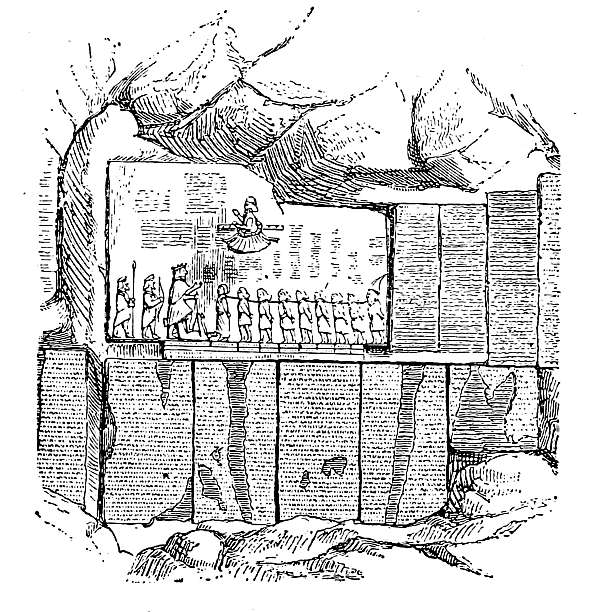
 which later on became
 ,
and in the latest cuneiform,
,
and in the latest cuneiform,
 .
Evidently the earliest sign was a circle, which could not be easily
traced on the stone or clay, and hence appears as the angular character
shown above. The annexed table, which is a copy of one supplied by Mr.
Pinches to Professor Keane, and published in his admirable monograph,
Man Past and Present, gives a set of typical examples of the
derivation of cuneiform characters from the earliest known pictographs.
.
Evidently the earliest sign was a circle, which could not be easily
traced on the stone or clay, and hence appears as the angular character
shown above. The annexed table, which is a copy of one supplied by Mr.
Pinches to Professor Keane, and published in his admirable monograph,
Man Past and Present, gives a set of typical examples of the
derivation of cuneiform characters from the earliest known pictographs.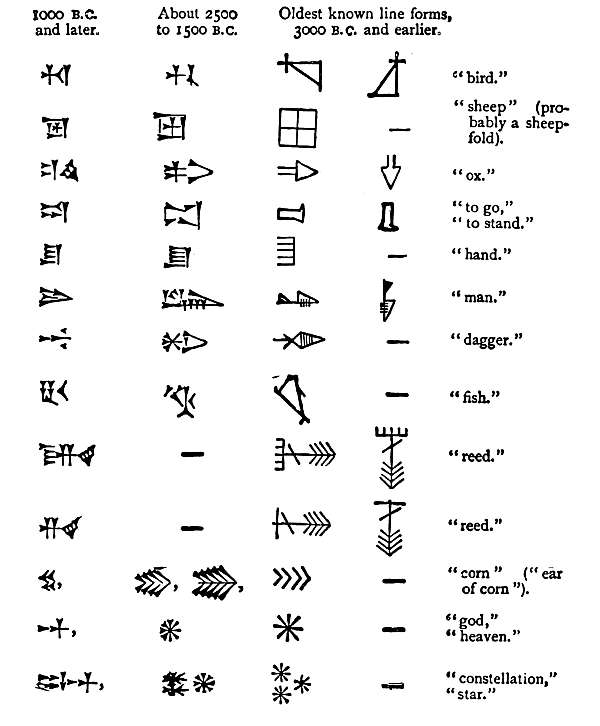
 .
The archaic form of this character
.
The archaic form of this character
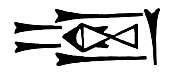 proves that it was compounded of the ideographic
picture of a house, enclosing the ideogram of the fish
proves that it was compounded of the ideographic
picture of a house, enclosing the ideogram of the fish
 ,
thus preserving record of the instructive fact that imperial Nineveh
was at first, as its name implies (nun, "fish," is the name of the
fourteenth letter of the Semitic alphabet), a collection of fishermen's
huts (cf. Taylor, i. 41). The frequent mixture of old and new forms
in cuneiform writings and the different values sometimes given to the
same sign, have increased the difficult task of interpretation. As
in the earlier stages of other languages, determinatives were used;
e.g. all names of men were preceded by a single upright
wedge, of countries by three horizontal wedges, and so on. But in the
examples given in the table, the gradual conventionalising of the
signs is seen, as in that for "ox," wherein the modification of the
head and horns of the animal into the phonogram is obvious, while
the Behistun inscription exhibits well-defined stages of approach to
simplification. The cumbrous cuneiform which fills the third column
has five hundred symbols, ideograms, phonograms, and homophones; the
Medic, which occupies the second column, is written in ninety-six
pure syllabic signs; while the Persian tells the same story in
thirty-six alphabetic signs, four only of the primitive ideograms
being retained. This survival of use of ideograms, it may be noticed
in passing, has illustration among ourselves in many ways. As certain
parts of the body, e.g. hand, foot, bosom (in Anglo-Saxon fæthem,
i.e. "fathom," or the space of both arms extended), and forearm
(Latin ulna, Anglo-Saxon eln, whence "ell"), became and remain
standards of measurement, so it is with certain modes of reckoning. The
digits,
,
thus preserving record of the instructive fact that imperial Nineveh
was at first, as its name implies (nun, "fish," is the name of the
fourteenth letter of the Semitic alphabet), a collection of fishermen's
huts (cf. Taylor, i. 41). The frequent mixture of old and new forms
in cuneiform writings and the different values sometimes given to the
same sign, have increased the difficult task of interpretation. As
in the earlier stages of other languages, determinatives were used;
e.g. all names of men were preceded by a single upright
wedge, of countries by three horizontal wedges, and so on. But in the
examples given in the table, the gradual conventionalising of the
signs is seen, as in that for "ox," wherein the modification of the
head and horns of the animal into the phonogram is obvious, while
the Behistun inscription exhibits well-defined stages of approach to
simplification. The cumbrous cuneiform which fills the third column
has five hundred symbols, ideograms, phonograms, and homophones; the
Medic, which occupies the second column, is written in ninety-six
pure syllabic signs; while the Persian tells the same story in
thirty-six alphabetic signs, four only of the primitive ideograms
being retained. This survival of use of ideograms, it may be noticed
in passing, has illustration among ourselves in many ways. As certain
parts of the body, e.g. hand, foot, bosom (in Anglo-Saxon fæthem,
i.e. "fathom," or the space of both arms extended), and forearm
(Latin ulna, Anglo-Saxon eln, whence "ell"), became and remain
standards of measurement, so it is with certain modes of reckoning. The
digits,  is found to preserve the whole outline of Capricornus, the
small circle being the head of the goat, with the forelegs below, and
the body and tail extending to the left." Then in such entries in the
almanack as "
is found to preserve the whole outline of Capricornus, the
small circle being the head of the goat, with the forelegs below, and
the body and tail extending to the left." Then in such entries in the
almanack as "
 rises 4h. 25m.," "
 11h. 54m.," "
 10th 9.32 morn.," "
 3420" in tables of the configuration of
Jupiter's satellites, as also in the symbols for money, weights,
measures, and so forth, the not wholly dispensed with picture-writing
may be detected. The well-nigh vanished trade signs doubtless served a
useful purpose as pictographs in guiding the illiterate to the shops
of which they were in quest; and here and there the barber's pole
with its spiral bandages reminds us of the phlebotomy of the past;
the golden balls of the great financiers of Florence hang out from
pawnbrokers' shops their delusive signal to the thriftless; while the
"grasshopper" of Messrs. Martin, the "leather bottell" of Messrs.
Hoare, and other remnants of goldsmiths' trade signs, remind us how
many of these swung before the shops of Cheape and Lombard Street in
olden time.
3420" in tables of the configuration of
Jupiter's satellites, as also in the symbols for money, weights,
measures, and so forth, the not wholly dispensed with picture-writing
may be detected. The well-nigh vanished trade signs doubtless served a
useful purpose as pictographs in guiding the illiterate to the shops
of which they were in quest; and here and there the barber's pole
with its spiral bandages reminds us of the phlebotomy of the past;
the golden balls of the great financiers of Florence hang out from
pawnbrokers' shops their delusive signal to the thriftless; while the
"grasshopper" of Messrs. Martin, the "leather bottell" of Messrs.
Hoare, and other remnants of goldsmiths' trade signs, remind us how
many of these swung before the shops of Cheape and Lombard Street in
olden time.

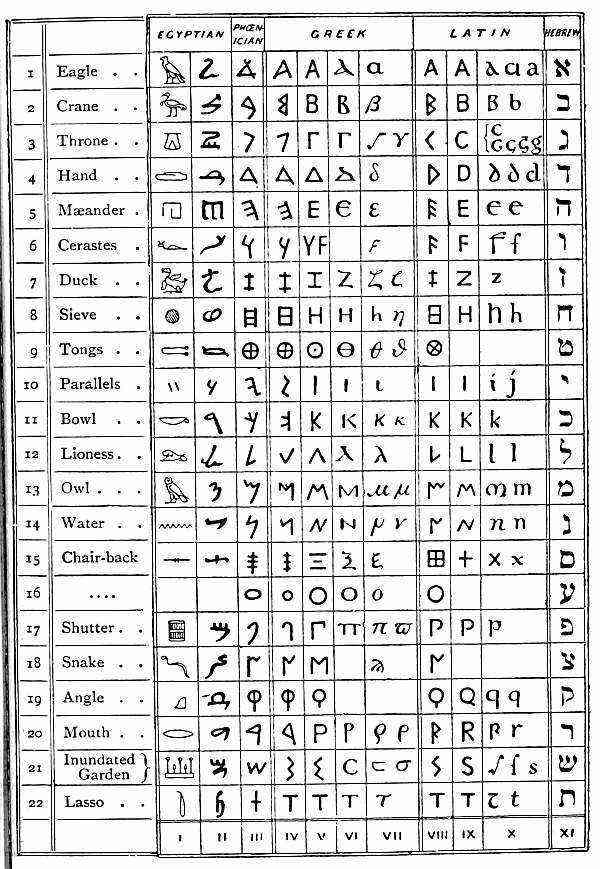
 which is the normal sign, and the "crane" (see Fig. 2 in foregoing table),
which letter should be taken as the prototype of the Phœnician (see
Fig. 2, col. iii.). The reason may be that the sound of the first
symbol seems to have been nearer to v than to b, the "crane" being
used as the equivalent of beth in the translation of several Semitic
names, such as Berytus (Beyrout) and Khirba. The hieratic trace of
the "leg" would, moreover, be easily confused with that of some other
letters, such as the "chick" and the "arm," and would therefore be
inconvenient for adoption. The Semitic character
which is the normal sign, and the "crane" (see Fig. 2 in foregoing table),
which letter should be taken as the prototype of the Phœnician (see
Fig. 2, col. iii.). The reason may be that the sound of the first
symbol seems to have been nearer to v than to b, the "crane" being
used as the equivalent of beth in the translation of several Semitic
names, such as Berytus (Beyrout) and Khirba. The hieratic trace of
the "leg" would, moreover, be easily confused with that of some other
letters, such as the "chick" and the "arm," and would therefore be
inconvenient for adoption. The Semitic character
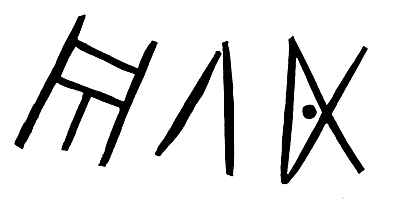
 differs from its hieratic prototype
 in having acquired a closed loop. The
closed form is so much easier to write that the change presents no
difficulty. But there is a curious bit of indirect evidence which seems
to show that the Semitic in its earlier form was open, something in the
shape of an
in having acquired a closed loop. The
closed form is so much easier to write that the change presents no
difficulty. But there is a curious bit of indirect evidence which seems
to show that the Semitic in its earlier form was open, something in the
shape of an .
The Greek alphabet used at Corinth, one of the
earliest Phœnician colonies in Hellas, must have been derived from a
type of the Semitic alphabet more archaic than that which appears on
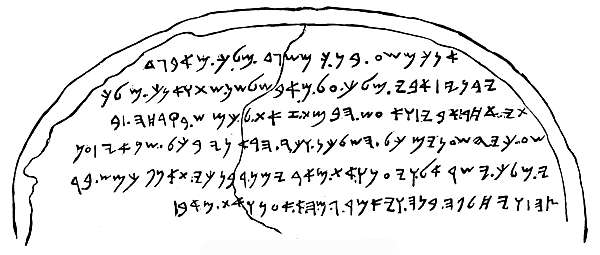
the Moabite Stone (
.
The Greek alphabet used at Corinth, one of the
earliest Phœnician colonies in Hellas, must have been derived from a
type of the Semitic alphabet more archaic than that which appears on
the Moabite Stone ( ,
its form being almost identical with the hieratic prototype.
,
its form being almost identical with the hieratic prototype.
 ,
and corresponds to the Moabite
,
and corresponds to the Moabite
 .
It is much more usual, however, to
find the character completely closed. The name of the Semitic letter,
which is generally supposed to mean a "window," would indicate that the
previous form of the letter agreed with the more usual hieratic trace.
This conjecture is curiously confirmed by the evidence afforded by the
early inscriptions of Corinth, which, as we have seen in the case of
beta, occasionally preserve alphabetic forms of a more archaic type
than those found on the Moabite Stone itself. Now, in the primitive
alphabet of Corinth we find, instead of the usual form of epsilon, a
closed character
.
It is much more usual, however, to
find the character completely closed. The name of the Semitic letter,
which is generally supposed to mean a "window," would indicate that the
previous form of the letter agreed with the more usual hieratic trace.
This conjecture is curiously confirmed by the evidence afforded by the
early inscriptions of Corinth, which, as we have seen in the case of
beta, occasionally preserve alphabetic forms of a more archaic type
than those found on the Moabite Stone itself. Now, in the primitive
alphabet of Corinth we find, instead of the usual form of epsilon, a
closed character
 which is nearly identical with the form of
the "mæander," most usual in the Papyrus Prisse. (Taylor, i. pp. 102, 114.)
which is nearly identical with the form of
the "mæander," most usual in the Papyrus Prisse. (Taylor, i. pp. 102, 114.)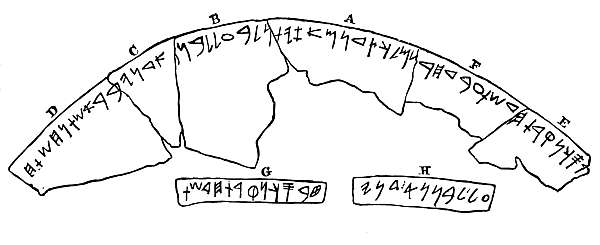
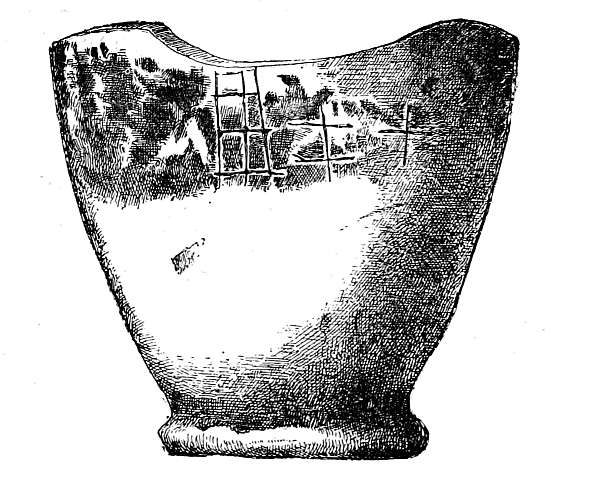
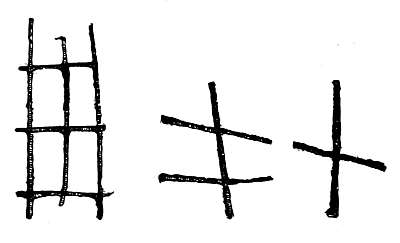
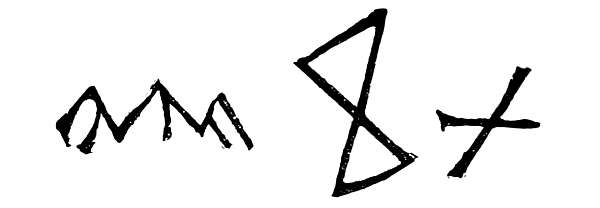
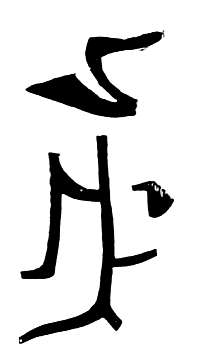
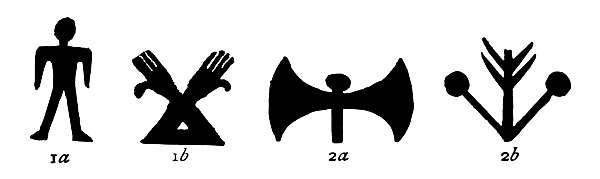
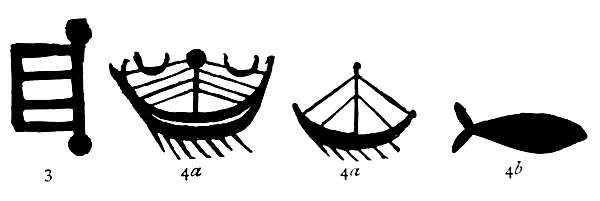
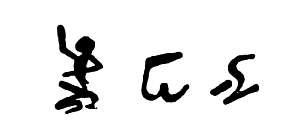
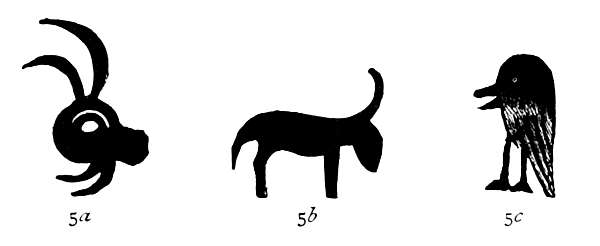
 The Egyptian
goat's-head sign is of a different character, the neck being given as
well as the head, which is beardless.
The Egyptian
goat's-head sign is of a different character, the neck being given as
well as the head, which is beardless.

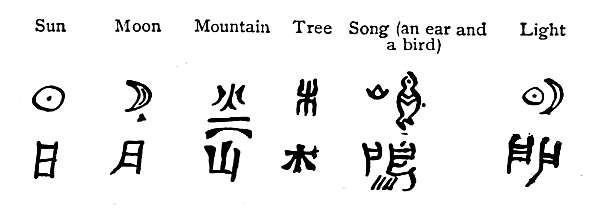
 ,
Sun with twelve rays, Sep=times, and with the Chinese
hieroglyph for sun with its central dot.
,
Sun with twelve rays, Sep=times, and with the Chinese
hieroglyph for sun with its central dot.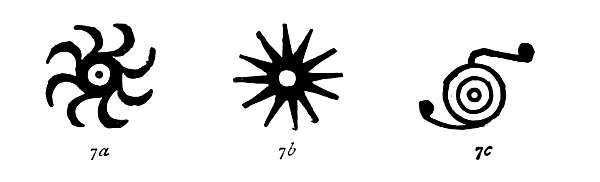
 men=mountain, is applied in the
same way as a determinative for "districts" and "countries." As
men=mountain, is applied in the
same way as a determinative for "districts" and "countries." As
 snut=granary, it reappears, with one or two heaps of
corn in the middle, in the simple sense of a "plot of ground." The
Akkadian symbol, which also means a plot of ground, exhibits a form
snut=granary, it reappears, with one or two heaps of
corn in the middle, in the simple sense of a "plot of ground." The
Akkadian symbol, which also means a plot of ground, exhibits a form
 similar to the above.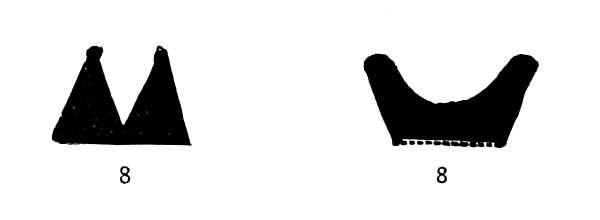
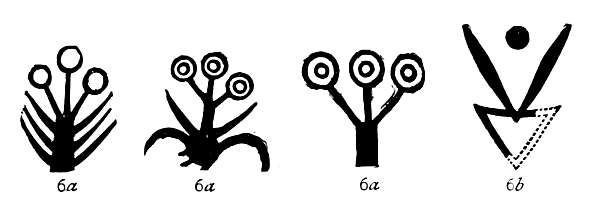
 shows a sun above the symbol of the ground
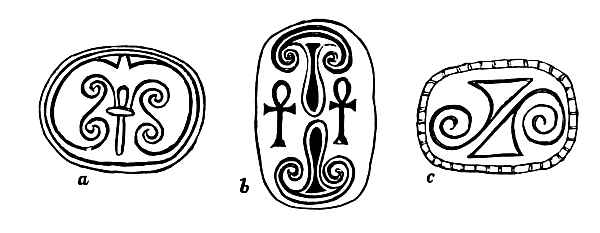
with a plant growing out of it. But on specimens of Mycenæan gems
observed by me in Eastern Crete are seen symbolic or conventional
representations of the plant growing out of the ground." (Jo. Hell. Stud., p. 313.)
shows a sun above the symbol of the ground
with a plant growing out of it. But on specimens of Mycenæan gems
observed by me in Eastern Crete are seen symbolic or conventional
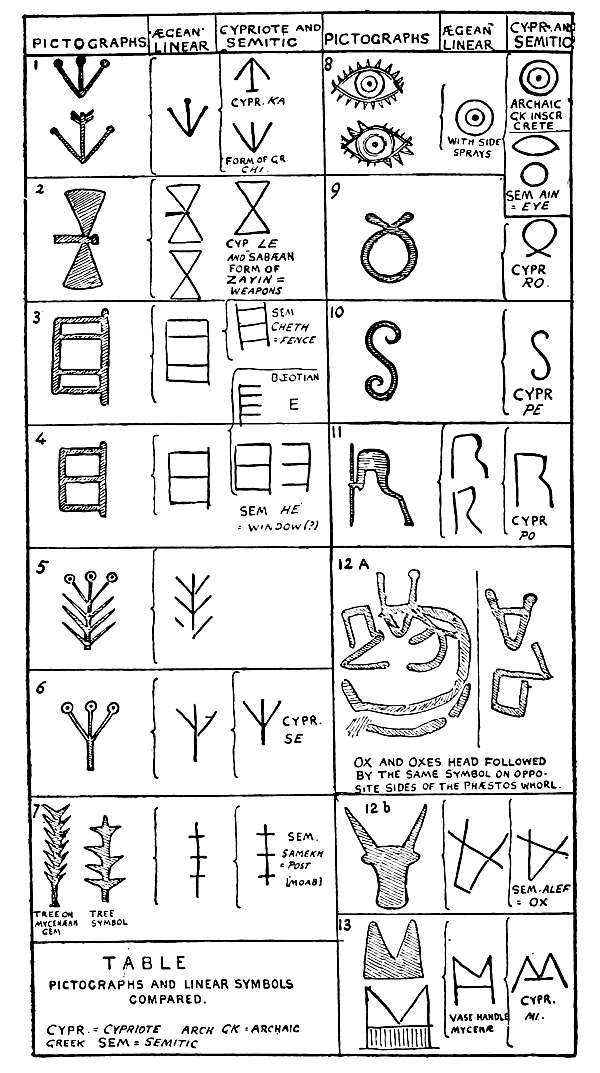
representations of the plant growing out of the ground." (Jo. Hell. Stud., p. 313.)