 It appalled Pierre to see how much of the little fortune received from
the Bretton homestead had to be expended in reaching America. The money
which had seemed such a fabulous sum in Bellerivre evaporated in the new
land like the dew before the sun. Madame Bretton was too independent to
consent to live with her brother's family and be a burden to them longer
than was absolutely necessary, and therefore the renting and furnishing
of a simple apartment became unavoidable. After this expenditure but a
small bank account remained, and this the family agreed must not be cut
in upon; something must be left in case of illness or disaster. In
consequence the only way left to meet the expenses of daily living was
for all three of them to take positions in the great silk mills, where
so many hundreds of others were employed.
It appalled Pierre to see how much of the little fortune received from
the Bretton homestead had to be expended in reaching America. The money
which had seemed such a fabulous sum in Bellerivre evaporated in the new
land like the dew before the sun. Madame Bretton was too independent to
consent to live with her brother's family and be a burden to them longer
than was absolutely necessary, and therefore the renting and furnishing
of a simple apartment became unavoidable. After this expenditure but a
small bank account remained, and this the family agreed must not be cut
in upon; something must be left in case of illness or disaster. In
consequence the only way left to meet the expenses of daily living was
for all three of them to take positions in the great silk mills, where
so many hundreds of others were employed.
This was a great mortification to Pierre. Not that he was ashamed to
have his family rated as working people. Every one in the world, at
least those who were useful, worked in one way or another. His
humiliation lay in the fact that he who had thought himself able to be
the breadwinner for both mother and sister, was in reality nothing but
an unskilled laborer, whose services for the present commanded but
slight remuneration. The discovery was not only disconcerting but
galling. It was bad enough to have Marie enter the mill. But his
mother——! To think of his mother, at her age, becoming a mill
operative!
If the step was as repugnant to Madame Bretton as to Pierre she at least
made light of it. They must all live, she cheerily explained, and living
in America was a far different problem from what it had been in the
green valley of Bellerivre. And after all they were but doing what many
another household in Paterson was doing. Why should it be any less
dignified for her to labor in a mill than at raising silkworms? Besides,
it might not be for long. When Marie and Pierre learned and became more
expert maybe they would earn enough so that she could retire and stay
within doors like a lady of fortune, keeping the home and—she jestingly
added—dressing in some of the very silk she had helped to make. Thus
with affectionate banter Pierre's objections were quieted if not
overcome, and through the influence of Mr. Gautier, Madame Bretton's
brother, who was a superintendent in one of the larger mills of the
plant, good positions were found for the entire family.
Fortunately both Marie and Pierre were of an age to pass the Child Labor
Laws of the State, an important detail of which Pierre had previously
been in ignorance. Many children who applied for places, he learned,
were constantly being turned away because they were too young; and
because much of the work formerly done by them was now performed by
women or girls.
Among the toilers in the vast manufactory almost every country was
represented. There were more Italians than any other nationality; and
ranking after them came Germans, Irish, and Dutch, with a scattering of
French and Poles. It made the Brettons feel quite at home to find
themselves among some of their own countrymen.
But what a different place Paterson was from the fertile valley they had
left behind them! There were the great blackened factories—a city in
themselves—with their tall chimneys and whirring wheels, which one came
to hear almost in one's sleep. And there were the homes huddled closely
together into which humanity was herded. Even the blue of the sky was
dimmed by a veil of heavy smoke. What wonder that it took all the
Brettons' courage to be cheerful under such conditions; or what marvel
that many a time they sighed in secret for that far-away land where they
had been born? But there must be no looking backward. Resolutely they
crushed the homesickness that surged up within them, and began to learn
all they could of this strange new country which in future was to be
their home.
Paterson, their Uncle Adolph explained, had become the greatest silk
centre of the United States, because it was so near New York, the city
where most of the raw silk from European ports was received.
"But I do not understand why the factories are not built in New York
itself," remarked Pierre.
"Taxes are too high and land is too expensive to afford the necessary
area for such great mills as these," explained his uncle. "Small silk
goods which can be made in little space are manufactured in New York; in
fact, the headquarters for American laces, fringes, trimmings, and
tassels is there. To have an ideal location factories must be so
situated as to be near a large city which will assure the selling of
goods, their shipment, and the chance to secure plenty of labor for the
mills. Moreover, they must be built where, as I said, land is
comparatively low priced and plentiful, and the taxes moderate. Such a
combination is not easy to find. It explains why so many cities have in
them the kinds of manufactures they have. It is an interesting study to
follow out. Here in New Jersey, for example, we have throwing and
spinning mills, large dyeing establishments, and we weave the finest of
ribbons as well as broad goods."
"What do you mean by broad goods?"
"The term applies to dress materials and the silks that are sold in the
shops by the yard," answered his uncle.
"Pennsylvania, too, is a large silk-making community," went on Mr.
Gautier, "because fuel is cheap in that State; and because, since so
many of the Polish, Irish, and German men work in the mines silk mills
afford a livelihood for the great numbers of unemployed women, girls,
and young boys in their families. In fact the State of Pennsylvania
often gives to companies that will come into the mining districts and
put up silk mills not only the land for their factories, but also sites
for the homes of their employees. That is one thing that has brought so
many silk mills into Pennsylvania. Quantities of ribbons and broad silks
are made there, as well as velvets and upholstery goods. It is a great
throwing and spinning centre."
"Tell me something about the other States," demanded Pierre, his eyes
wide open with interest.
"Well, there is Connecticut—that is a large silk-making district. About
two-thirds of the machine twist is manufactured there; and they turn out
both narrow and broad goods—silks, velvets, plushes. At South
Manchester some of the finest and most artistic American silks are made.
Massachusetts stands at the front in the manufacture of sewing-silks,
which require finely equipped plants and much heavy machinery;
embroidery silks, wash-silks, and trimmings are made there, too."
Mr. Gautier paused a moment.
"Then there is Rhode Island," he continued. "That is a silk
manufacturing State also, although it does not turn out anywhere near so
much material as do the others that I have mentioned. If you want to be
in the largest silk-making spot in America Paterson is the right place,"
he added, smiling down at his nephew. "There is no end of chance for a
bright boy to rise in these mills. But you must be quick and work hard.
You seem to be able to do both those things, Pierre. Just go to it, my
boy, and you need not fear but you will be earning good wages soon."
In spite of his French ancestry Monsieur Gautier had caught the American
slang.
Pierre glanced up into his face.
"I shall do my best for my mother's sake, if for no other," he replied.
"Well, you'll certainly have your chance to work here," laughed his
uncle. "There is variety enough to please you, too. We have throwing
mills; a place where we dye silk in the skein; a winding and weaving
plant; another plant for dyeing goods in the piece; and a big printing
and finishing plant. If you do not find something to suit you by the
time you have worked through all these it will be your own fault. Of
course women have the monopoly of certain parts of the work; but there
is plenty left to go 'round, so do not worry."
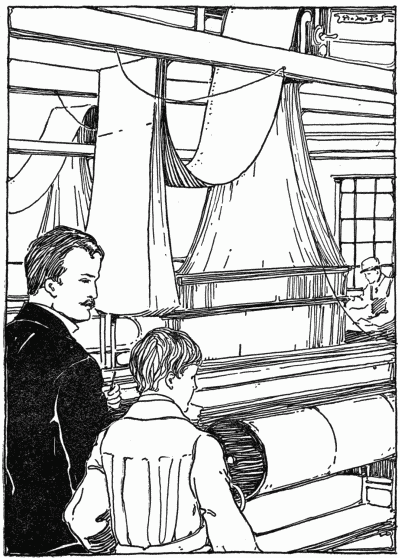
"I SHALL DO MY BEST"
With a twinkle in his eye Monsieur Gautier went into his office.
During the weeks that followed many new experiences did the Bretton
family have, and much did they learn of silk-making. From every source
available they gleaned information, for being versed in silk-raising
they were eager to know all they could of the rest of the process,
especially Pierre. He found there were hand-looms for the making of
finer varieties of silks which were manufactured in smaller quantities
and were of individual design. On American power-looms, which were
surprisingly light of construction and were handled with great ease,
most of the other goods were made. It was remarkable that a machine
costing comparatively little and so simple to operate should be so
accurate in weave, and turn out so much work. As for the old Jacquard
loom that in a former day had transformed the industrial world—it had
been so altered and improved as to be hardly recognizable. Formerly, he
learned, looms of Swiss and German manufacture had been employed in
America; but these had speedily given place to the American high-power
automatic loom, especially for the making of ribbons which were woven
the same way as were broad goods, except that the shuttle was not a
flying but a fixed one, that moved from side to side like a
sewing-machine. So clever was the construction of these looms that they
seemed to be little short of thinking creatures; when plain ribbon was
to be turned out the operatives who were paid so much for the cut or
ten yard piece, had little to do beyond seeing that there was plenty of
thread on the spools, and that the ends were tied when broken.
For the more expensive and elaborate ribbons, however, more involved
machinery was required. One device after another had been added to
eliminate human labor, but even then these machines needed more persons
to operate them. As a result of their complexity the speed of these
intricate machines was less, and in consequence the price of making the
goods was increased. Nevertheless there was a vast improvement over past
conditions, when all overshot and embroidered effects had to be worked
out on hand-looms. It enabled Americans to turn now to home manufacture
for their ribbons. It was nevertheless true, Mr. Gautier explained, that
much of the home market was created by the high tariff on the French
ribbons still manufactured on hand-looms; these continued to be of
choice design and of greater variety of pattern than were the American
goods that had to be turned out in larger quantities on power-looms.
Were it not that the American ribbons could be bought cheaper the French
ones would probably, in many cases, be preferred.
About one half of the total silk output of America, Pierre was told, was
in dress goods. Many of these were rich in quality, but many were not.
The American women eagerly followed the fashions and were, as a class,
far more concerned about having silk of a fashionable color than
possessing that which would wear a long time. In fact, they did not wish
materials to wear too long. Most of them were fairly well-to-do and were
able to discard a garment when a passing fancy had been gratified, and
after a thing was passé they would rather toss it aside than wear it
out. In consequence shopkeepers, who studied the market as if it were a
thermometer, refused to cumber their counters with expensive goods which
must only be shelved after their color or design was out of date. Such
conditions had created an American market for cheap silks such as was
unknown in Europe where quality was a far greater factor in the sale of
silk materials. In the United States these flimsy dress goods could be
turned out with little expense on American power-looms by unskilled
workmen, whereas in other countries experienced men were needed to make
them.
As for the soft satins or messalines, they were made almost entirely in
Europe because the cost of American labor was too great for them to be
produced here. The operatives making them were paid by the piece and the
process of weaving was a slow one. The heavy brocades and tapestries for
upholstery were usually of such elaborate design and so interwoven with
gold thread that to manufacture them on power-looms was practically
impossible; and as hand-looms were required European hand-loom work was
cheaper than American.
"The flaw in our power-loom is that double threads cannot be handled,"
explained Mr. Gautier to Pierre. "Any goods requiring such treatment
must of necessity be made on hand-looms."
So little by little Pierre's knowledge grew.
Military and upholstery trimmings, he ascertained, could be turned out
in large quantities on power-looms; but dress and cloak trimmings, which
were more elaborate, were made in America only in comparatively small
quantities and again because of their intricate patterns and gold
threads Europe could produce them cheaper on hand-looms. If, however,
the pattern desired was sufficiently simple, and a large enough quantity
of it was ordered to make it pay the manufacturer to bother with setting
it up it could be made on the American power-loom. Fancy braids were
made chiefly in Europe from the floss or spun silk taken from the
outside of the cocoon; but plain braids, Pierre was interested to know,
were made in America as cheaply and well as in Europe, most of them
being manufactured from artificial silk.
It was a great surprise to Pierre to find there was such a thing as
artificial silk.
"I knew there were artificial flowers and artificial—well, almost
everything," laughed Pierre to his mother. "But artificial silk!"
He gasped.
"What is it made of, Pierre?" questioned Madame Bretton, who had come to
regard with wonder the fund of information her big son was acquiring.
"The man who told me about it said that cotton and the pulp from soft
wood were used for one sort," he answered. "Another kind comes from
dissolving cellulose in chemicals, and forcing this mixture through long
tubes into some sort of a bath that makes the material come out in
threads; these threads can then be wound, spun, washed, soaked, and
dyed. Here in America most of the artificial silk which, by the way, is
known as viscose, has cellulose in some form as its base, afterward
being treated with different combinations of chemicals."
"What shall we do with you, Pierre, if you learn so much?" questioned
Madame Bretton mischievously.
Pierre smiled.
"I'm going to learn every bit I can, so that I may soon work up to
earning lots of money," he said. "Then you and Marie can leave the
mills, and I can take care of you."
"You are a good son," his mother answered with an odd little catch in
her voice. "But do not be distressed because we are in the mills. Indeed
we are very happy there."
"You would make the best of anything you had to do, Mother; you're that
sort," replied the boy, taking her hand in his. "But I know well it is
hard for you to work at a machine all day when you have never been
accustomed to it, and I do not mean you shall do it one moment longer
than I can help."
"There, there, son——" his mother's eyes filled, and to change the
subject she said briskly:
"And these artificial silks of which you were telling me—are they good
for anything else but for making braids?"
"Yes, indeed. Nitro and viscose silks are more brilliant and lustrous
than are real silks. They have no such soft feeling, however. They feel
more like the harsh, loaded silks made from thread which has been
chemically weighted. But they are coming into demand more and more for
such purposes as the warp and filling of various sorts of fabrics, rugs,
silk stockings, and upholstery materials. Here in this country, where
electricity is in general use, artificial silk is a blessing, for it
serves as a substitute in the insulating of electric light wires, and
the manufacture of mantles for lights."
"How clever people were to find anything that could be used instead of
the real, carefully nurtured cocoon silk," mused his mother.
"I know it. I suppose chemists worked at the problem a long time before
they solved it. That is the way most of the great discoveries were made.
Still, the wild silk made by the moths of India is not carefully grown.
From it the Oriental Tussah silk is made; then there is Eria silk, also
an uncultivated product from India; the Fagara silk from China; and the
Yamamai silk from Japan, which is next to domestic silk in value. All
these are manufactured from silk spun by silkworms that have had no
care. The foreman was telling me about it the other day."
There was a pause.
"What did you mean, Pierre, when you spoke of loaded silk?" questioned
his mother. "I have heard the term used many times, but I have never
understood it."
Pierre looked at her with amusement.
"Anybody would think that I was your schoolteacher, Mother mine!" he
returned. "I feel very silly telling you things when you are so much
older and wiser than I."
"I certainly am older; and I used to be a little wiser," replied his
mother humorously, "but I shall not be so long. You see, dear, I never
had much education and I am now too old to learn. But you are
accumulating knowledge every day. You are like a sponge, Pierre. You
seem to soak up every bit of information that you hear."
"I must get my schooling this way, Mother, since I can secure it in no
other," answered the boy soberly. "And perhaps it is a good way after
all, for since I am eager to know something I try and remember every
scrap I hear. I may want to use it later."
"Your father used to say that no knowledge comes amiss," was his
mother's soft answer. "How proud your father would be of you, Pierre!"
"But I must know more, and more, and still more, Mother, before I can
get to the top!" exclaimed the boy eagerly. "And now to tell you of
weighted silks. You see, in dyeing silk the material shrinks and loses
about a quarter of its weight. Manufacturers found that by adding
chemicals, or sugar and glucose during the boiling off, they could make
up for this loss. That is how the custom started. Black silks, which
shrunk the most, were treated first. Later the practice spread to
colored, and even to white silks. Now, alas, the evil seems to have come
to stay. Salts of tin in varying degrees are used in the dyeing of most
silks, and the result is that the material becomes crisp and harsh so
that it cracks when folded, and does not wear long."
"What a pity!"
"Yes. And yet perhaps the Americans, who are none too anxious to wear
out their old clothes, are quite as well satisfied," chuckled Pierre.
"In what an endless number of ways silk is used!" reflected Madame
Bretton.
"Yes. And when you have done with the ribbons, and trimmings, and
braids, and silks, and upholstery brocades, and satins, think of the
velvets and plushes that can now be made in this country in all sorts of
fancy designs on power-looms instead of on hand-looms as formerly. Of
course it is still cheaper to import certain kinds of velvets and
plushes; but a great many of them are made here, as are the larger
proportion of the velvet ribbons which are easily turned out on
high-power machines."
"What about silk hosiery and underwear?" questioned his mother, much
interested.
"Silk stockings and silk gloves, Uncle Adolph says, are a big American
product. There is little finishing to them except putting the buttons on
the gloves. In fact I read the other day that the silk used for them was
only slightly adulterated, and that they were made even better than in
Europe. But making underwear seems to be another story. Each garment
manufactured has to be shaped as it is made, and therefore the process
is a special one and the knitting is slow. This results in expensive
labor, and a very limited output. After the seams are finished, the
buttons on, the fancy braid and facings in place, and the final
trimmings stitched where they belong, the profit is small. All this can
be done much cheaper in Europe, and were it not for the protection of a
high tariff, Uncle Adolph says, Americans would buy all such goods
abroad. The tariff protects the American silk industry at every turn. I
don't know where the United States would be without it! Then you must
remember that after this silk underwear is done it is not sold to
individual customers in any considerable quantity. Instead it retails
piece by piece, and therefore every piece has to be folded and packed
separately. No wonder such things are expensive here!"
"I never realized before how interesting the problems of making things
were," said Madame Bretton, glancing up at Pierre.
"It is all fascinating when you take it as a whole. But if you just do
one part of the work over and over and never connect it with the entire
process, it is tiresome enough. Every workman should consider himself a
link in the big chain, and try to make himself familiar with the other
links. Then he will feel as if he is really doing something, and not
just pegging away day after day as if he were a machine. That is why I
want to learn all I can about silk as a complete industry. It makes
winding bobbins and reeling thread a more important matter. Some firms,
Uncle Adolph says, have moving picture lectures and by means of them
explain to their employees the entire process of their particular
industry so they will be more intelligent about what they are doing. I
think that is a fine thing. Nobody likes to do some uninteresting thing
over and over, week after week and year after year, unless he
understands what he is doing. Even the money you earn doesn't help to
make your work less monotonous. How can employers expect their men to
have any ambition, or any desire to turn out flawless products unless
they realize that each detail of a process makes the perfect whole? I
mean to know every step of the road I am traveling so when I get to the
top——"
"So when you get to the top you can make silk all by yourself,"
interrupted his mother, completing the sentence with a smile.
"Well, I'm going to know how, anyway," nodded Pierre. "And I wish to
learn not only of silks and velvets, but laces, too. Laces are fussy,
difficult, and expensive to make. I want to find out all about them. I
know they have to have the strongest and most perfect thread. In Europe
such goods are made either by hand, or on hand-looms. It is a slow
process at best. But the power machines here, slowly as they are forced
to work, can of course turn out lace much faster than it can be made in
Europe on hand-looms. Consequently the commoner kinds of laces are made
in this country, used, and worn out while they are in fashion; for the
Americans shift their fashions in laces quite as fast as they do their
fashions in silks. Before a certain design can be sent to Europe,
manufactured, and sent back again the vogue for that particular pattern
will have ceased and Americans will be wearing something else. That is
what saves the lace trade for America. It is the same with the making of
lace veils."
"There seems to be no keeping up with these Americans," laughed Madame
Bretton. "Certainly there is no keeping up with their cost of living!"
CHAPTER XV THE GREAT SURPRISE
 During the next few months the Bretton family prospered in their careers
in the Paterson mills. Madame Bretton, whose deftness and care in
handling material was quickly recognized, was promoted to a position
much better suited to her age and refinement, and also one that was more
lucrative. In addition Marie, skilful too of touch, was put in the
labeling department. But with undaunted spirit Pierre still drudged at
the heavier work of the mill, mastering one step after another of its
dull processes. To another boy the slow climb to the top of the ladder
might have been tedious; but to the French lad, with eyes fixed
constantly on the great industry of silk-making as a whole, every part
in the ingenious art became interesting.
During the next few months the Bretton family prospered in their careers
in the Paterson mills. Madame Bretton, whose deftness and care in
handling material was quickly recognized, was promoted to a position
much better suited to her age and refinement, and also one that was more
lucrative. In addition Marie, skilful too of touch, was put in the
labeling department. But with undaunted spirit Pierre still drudged at
the heavier work of the mill, mastering one step after another of its
dull processes. To another boy the slow climb to the top of the ladder
might have been tedious; but to the French lad, with eyes fixed
constantly on the great industry of silk-making as a whole, every part
in the ingenious art became interesting.
Despite the fact that Mr. Gautier was his uncle the boy received no
favors. In such a vast group of factories one superintendent had small
jurisdiction over individual workers; nor was Mr. Gautier a man to
promote unjustly. Whatever progress Pierre made he made on his own
merits. On entering the mills he had been employed at lacing, one of
the simpler tasks usually given to beginners. His duty was to run short
threads in and out through the skeins of silk in order to divide them
into four parts, and prevent them from becoming tangled in the dyeing.
Many young boys and girls known as lacers were set at this task for
the first month or two. But Pierre did not remain a lacer. He went on to
being a learner in other departments.
He saw how the raw silk which arrived at the factories in bales ranging
from eighty to a hundred twisted skeins were weighed; sorted as to
quality; soaked in oil so that the gum might be extracted, and the ends
freed for winding. He witnessed the drying, or rather the partial
drying, of the silk. All this was an old story, for he had seen every
step of the process before when at the Gaspard throwing mills. Then
followed the winding on big, three-inch spools; and the first spinning.
Afterward if the thread was for tram it went direct to the doublers, to
be made stronger; but if it was for organzine it was spun again after
leaving the doubling frames, and was given a much tighter twisting. It
was then reeled into skeins again, this form being found the most
convenient one for dyeing. The tying, or lacing of these skeins, had
been Pierre's work. The skeins after being laced were then bundled, or
packed tightly, to be sent to the dye-house. This finished the work of
the throwing mills and Pierre was interested to see that the process was
practically the same in America as in France.
But from the time the dyed silk came back to the weaving mills
everything was new. The weaving of broad goods such as dress materials,
mufflers, handkerchiefs, and necktie silks took place on the broad
looms; while narrow goods such as ribbons were woven on the narrow
looms. It was a long time, alas, ere Pierre came to understand the
complex weaving machinery; and before he half comprehended it a most
unexpected happening befell the Bretton family.
It was heralded by a letter from far-away Bellerivre—a letter from
Monsieur le Curé; and before the amazing tidings in the missive could be
assimilated another letter—a feeble scrawl—followed.
Monsieur Bretton lived!
The beloved father they had given up as lost was actually alive!
He had been wounded, captured, and kept a prisoner in a hostile camp
from which it was impossible to communicate with his family. As soon as
he was able he had been forced to work for his captors, and there he had
remained cut off from all knowledge of his family or friends. By and by
he had succeeded in escaping and reaching his own lines, only to be shot
down in the next battle in which he had taken part. Then had followed a
long illness in a French hospital where under the care of the kind
sisters he had hovered 'twixt life and death. There had been no letters
home because he had been too delirious to tell his nurses where to
write. At length out of the chaos had come sanity, and now because his
wounds were such that he could do no more fighting he had come home to
Bellerivre. Monsieur le Curé and Josef were nursing him, and he hoped to
join his dear ones in their new home as soon as he was able.
It was a wonderful story!
Some day, the doctor said, he would regain his strength and be well
enough to do some simple work so that he could still earn a livelihood
and not be a burden to his family.
How good the tidings were! How almost unbelievable!
Over and over again the jubilant Brettons rehearsed the tale and framed
new plans for the future. It took all Madame Bretton's resistance not to
draw from the bank the treasured nest-egg still reposing there and go
home to France to nurse her husband back to life. But Monsieur le Curé
bade her not to come. The invalid was in good hands and progressing
rapidly. Soon she might send money for the journey, and the kind priest
himself would see the wounded Frenchman aboard a ship that would carry
him to America. It was the wisest plan. Both he and Monsieur Bretton
thought so. Then when peace was restored to the weary world, and the
family had sufficient money they might all come back together to
Bellerivre, never again to leave its sunny valley.
Thus argued the old priest.
But that day never came.
Pierre rose to a fine position at Paterson, enabling him to establish a
pretty home there in which his father and mother lived in comfort.
Marie, in the meantime, married an American and settled next door.
Thus the new land, once but a haven to a tempest-tossed household,
became the permanent dwelling place of the Bretton family.
Affectionately they remembered the green valley of Bellerivre; and the
friendship of the old priest and the faithful Josef. Tenderly they
spoke of their neighbors in the old home and ever loyally they loved La
Belle France, the soil that had given them birth.
But the spell of America was upon them. They did not wish to go back.
The golden path of opportunity lay in the country of their adoption and
in exchange for all that it was giving them they resolved to return a
devoted citizenship.
And so between the two great sister Republics another bond was
established—a humble bond to be sure, but one that linked in loving
ties the old world and the new; and daily spanned the distance between
them with many a kindly thought, and a speeding message of good-will.
- The Stories in this Series are:
- THE STORY OF COTTON
- THE STORY OF GOLD AND SILVER
- THE STORY OF LUMBER
- THE STORY OF WOOL
- THE STORY OF IRON
- THE STORY OF LEATHER
- THE STORY OF GLASS
- THE STORY OF SUGAR
- THE STORY OF SILK
- THE STORY OF PORCELAIN
 Madame Antoinette Bretton went for the third time to the door of her
tiny cottage and, shading her eyes, looked anxiously up the side of the
ice-capped mountain that flanked the garden. There was still no one in
sight, and with a shake of her head she returned to the coarse grey
socks she was knitting.
Madame Antoinette Bretton went for the third time to the door of her
tiny cottage and, shading her eyes, looked anxiously up the side of the
ice-capped mountain that flanked the garden. There was still no one in
sight, and with a shake of her head she returned to the coarse grey
socks she was knitting. When Madame Bretton and the children returned from their inspection of
the silk-house they were surprised to find Monsieur le Curé, good Father
Benedict, awaiting them. The priest was sitting contentedly in the
sunshine, his walking-stick in his hand, and the gentle breeze stirring
his white hair. Beside him stood Hector with nose on the Curé's knee and
great brown eyes looking into the kindly face of the old man.
When Madame Bretton and the children returned from their inspection of
the silk-house they were surprised to find Monsieur le Curé, good Father
Benedict, awaiting them. The priest was sitting contentedly in the
sunshine, his walking-stick in his hand, and the gentle breeze stirring
his white hair. Beside him stood Hector with nose on the Curé's knee and
great brown eyes looking into the kindly face of the old man.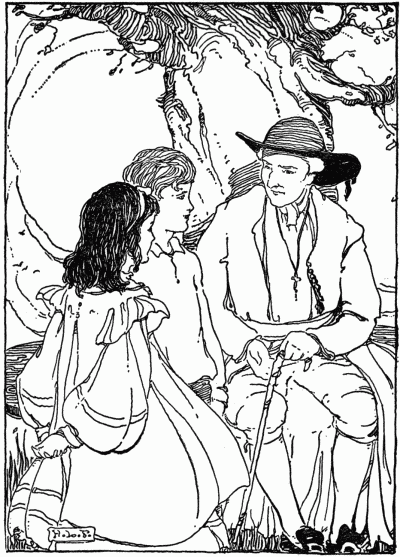
 The interior of the Bretton home was extremely simple; and simple, too,
was the supper laid out upon the sand-scoured table. In war time even
the more well-to-do families were living on the plainest of rations,
that all the food which could possibly be spared should be sent to the
men on the fighting lines. There was no sugar, little salt, a scant
quantity of flour, and no meat to be had in the village. Still no one
complained. Was not each serving his country by denying himself those
things which, after all, could easily be done without? Healthy boys and
girls were as well off—nay, better—without cakes and candies, the
grown-ups said; and even the children themselves had come to admit this.
The interior of the Bretton home was extremely simple; and simple, too,
was the supper laid out upon the sand-scoured table. In war time even
the more well-to-do families were living on the plainest of rations,
that all the food which could possibly be spared should be sent to the
men on the fighting lines. There was no sugar, little salt, a scant
quantity of flour, and no meat to be had in the village. Still no one
complained. Was not each serving his country by denying himself those
things which, after all, could easily be done without? Healthy boys and
girls were as well off—nay, better—without cakes and candies, the
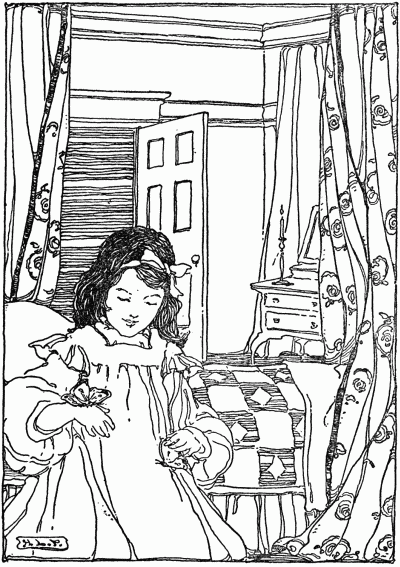
grown-ups said; and even the children themselves had come to admit this. The next few weeks were such busy and exciting ones for the Bretton
family that not only did Marie and Pierre find no time for play but
Madame Bretton herself could scarcely snatch the necessary moments to
cook the meals. Josef, the old servant who had always helped Monsieur
Bretton about the silk-house, and who had been too feeble to go to the
war, started low fires in the building where the eggs were to be hatched
and kept the great rooms at an even temperature in readiness for their
coming occupants. The eggs when exposed to the air were so small it
seemed incredible that out of them could come the hungry little
caterpillars who would spin that delicate silken filament.
The next few weeks were such busy and exciting ones for the Bretton
family that not only did Marie and Pierre find no time for play but
Madame Bretton herself could scarcely snatch the necessary moments to
cook the meals. Josef, the old servant who had always helped Monsieur
Bretton about the silk-house, and who had been too feeble to go to the
war, started low fires in the building where the eggs were to be hatched
and kept the great rooms at an even temperature in readiness for their
coming occupants. The eggs when exposed to the air were so small it
seemed incredible that out of them could come the hungry little
caterpillars who would spin that delicate silken filament.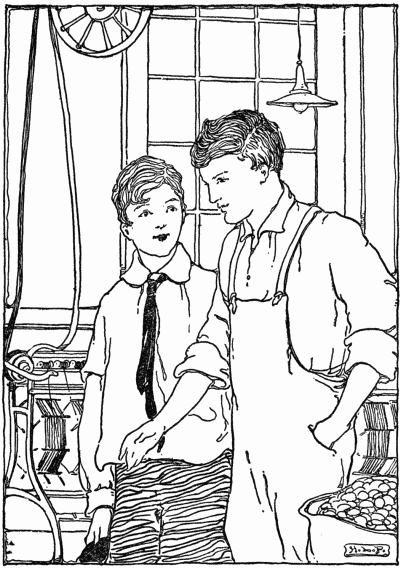
 During the next few weeks many a letter passed between Pierre and his
new friend Henri St. Amant; and by and by came an invitation for Pierre
to come again to Pont-de-Saint-Michel and spend the day visiting the
Gaspard throwing mills, where the raw silk was twisted and prepared for
weaving. The boy was all eagerness to go and his mother, too, favored
the trip, for Pierre had been working very steadily and now had few
pleasures. It seemed impossible to complete the never-ending round of
duties, although with uncomplaining zeal Pierre kept patiently at them.
Marie, it is true, helped with some of the lighter work; but she was
not strong enough to do much outside the house. As for Josef, faithful
as he was, the old man was aging rapidly and could do little more than
potter about the place and direct things. Therefore the cutting of trees
for fuel, the drawing of water, the building of fires all fell to
Pierre's lot.
During the next few weeks many a letter passed between Pierre and his
new friend Henri St. Amant; and by and by came an invitation for Pierre
to come again to Pont-de-Saint-Michel and spend the day visiting the
Gaspard throwing mills, where the raw silk was twisted and prepared for
weaving. The boy was all eagerness to go and his mother, too, favored
the trip, for Pierre had been working very steadily and now had few
pleasures. It seemed impossible to complete the never-ending round of
duties, although with uncomplaining zeal Pierre kept patiently at them.
Marie, it is true, helped with some of the lighter work; but she was
not strong enough to do much outside the house. As for Josef, faithful
as he was, the old man was aging rapidly and could do little more than
potter about the place and direct things. Therefore the cutting of trees
for fuel, the drawing of water, the building of fires all fell to
Pierre's lot.
 Silently Pierre received the news. He neither trembled nor cried out. In
a vague way he realized that ever since that day long ago when Henri St.
Amant had first presented this possibility to his mind he had
unconsciously been bracing himself to meet with courage some such
emergency. And now the blow had fallen, and it was he who must break the
news to his mother, and be the strong prop on which she might lean. So
busy was he with these thoughts that he scarcely sensed the presence of
the faithful old priest who walked beside him. A score of confused
reveries were surging over the boy, and out of the chaos of grief,
reminiscence, and wonder, clearer ideas began to form themselves.
Silently Pierre received the news. He neither trembled nor cried out. In
a vague way he realized that ever since that day long ago when Henri St.
Amant had first presented this possibility to his mind he had
unconsciously been bracing himself to meet with courage some such
emergency. And now the blow had fallen, and it was he who must break the
news to his mother, and be the strong prop on which she might lean. So
busy was he with these thoughts that he scarcely sensed the presence of
the faithful old priest who walked beside him. A score of confused
reveries were surging over the boy, and out of the chaos of grief,
reminiscence, and wonder, clearer ideas began to form themselves.