'All the intellect of the country which was not employed in the
service of the church was devoted to the profession of arms.'
Buckle, History of Civilisation.
IN
1023 Abu el Kásim Mohammed, then Cadi of Seville, raised a revolt
against the Berber rulers of Andalusia. The rising was successful, and
the town once more became a capital. Under the Abbadid dynasty, and the
rule of Motadid and Motamid, Seville was secure and peaceful. Stirring
days came with the rise of the Almoravides in the eleventh century. In
Morocco, Yussuf, son of Tashfin, had been inspired to wage battle in the
name of a reformed religion. The Almoravides, or Mourabitins, i.e.,
'those who are consecrated to the service of God,' were a fanatical sect
led by an intrepid warrior. They had made havoc in Northern Africa,
deposing sovereigns and seizing territory. Now they were to make history
in Spain.
Under Alfonso III. the Spaniards of the northern and central parts of
the Peninsula had prospered in their arduous task of stemming the
advance of the Moors northwards. Spain had won back Asturias, Galicia,
and part of Navarre, and in time León and Castile were restored to
Christian rule. But under Almanzor, a most redoubtable commander, León
fell, and the whole population of its capital was slaughtered. The death
of Almanzor, in 1002, brought about vast changes for the Moorish
kingdom in the south of Spain. There was no great leader to control the
fortunes of Islam. The territorial governors were in constant dispute,
and often at war one with the other. It was a golden opportunity for the
soldiers of the Cross.
In 1054 Fernando I., a sagacious ruler of León and Castile, made a
crusade against the Moors of Portugal, and brought the King of Toledo to
his knees. He besieged Valencia and brought his troops into Andalusia.
Under Alfonso VI., Toledo was recovered, amid the rejoicings of the
Christian host, who anticipated a speedy delivery from the Morisco
domination. The coming of Yussuf and his fierce Almoravides dashed the
hopes of Alfonso's army. Finding themselves encompassed with growing
dangers, the Moors of Spain begged the assistance of the powerful
Almoravides. A conference of the Moorish rulers was held at Seville, and
a message sent to Yussuf. The Almoravide King was astute. At first he
displayed but little sympathy for his brethren in Spain. But the offer
of Algeciras induced him to promise aid, and he came with a strong army
of Moors and Berbers. Alfonso was informed that a profession of belief
in the creed of Mahomet would spare him from certain death. The
Christian sovereign replied by allying himself with Sancho of Navarre,
and bringing a force to meet Yussuf. Between Badajoz and Merida the
armies met in a terrible conflict. Alfonso was forced to retreat, and
for the present Yussuf offered no further demonstration of his military
skill.
Next year the King of Morocco returned to Spain with his army, and
exhorted the Moors of Andalusia to unite with him in a war of
extinction. The petty sovereigns showed but little enthusiasm for a
campaign. Probably they distrusted Yussuf's motives. Such suspicion was
not without a basis, for when the Almoravides came for the third time,
the monarch plainly stated that he purposed to annex all the remaining
Mohammedan region. With a hundred thousand men, Yussuf took Seville and
Granada. Alfonso came to the assistance of the Sevillians with a force
of twenty thousand; but the Almoravides seized the city, and held it
until the days of the Almohades in 1147.
Alfonso then sought the alliance of France to assist his nation in
expelling the African invaders. But the power of the Almoravides grew.
Córdova was their seat of government, and Seville was one of their most
important cities. The Moriscoes in Spain were no longer an independent
race, but under the sway of Morocco. Motamid II. doubtless rued the hour
when he sought aid from Yussuf. Fair Seville had passed out of his
hands.
At this time there arose the famous Cid, the revered warrior and type of
Spanish chivalry. Many are the legends and ballads extolling the bravery
of this champion of Christendom. Some of the stories of his deeds are so
improbable that certain historians of Spain have regarded the hero as a
character of fable; but Professor Dozy has investigated the old
chronicles, both Spanish and Moorish, and reached the conclusion that
there was a Cid, a mighty soldier and a devout Catholic, named Rodrigo
Diez de Bivar. There is no doubt that the Cid loved the field of battle
from his youth, and that he was ever ready to fight, sometimes for the
Christians, and sometimes for Moorish chieftains at war with one
another. In the end he became a valorous freebooter, with a following of
the sons of noble families. The Cid came at least on one occasion to
Seville as an emissary of King Alfonso to Motamid, to collect sums due
from the Arab ruler. Motamid was then at strife with Abdallah, King of
Granada, who was assisted by certain Christian caballeros, including
Garci Ordoñez, formerly standard-bearer to Fernando. The Cid endeavoured
to restrain the King of Granada from making war upon Motamid's city, but
Abdallah was not to be influenced for peace. He went forth and was met
by the combined armies of the Cid and Motamid of Seville, and defeated
with much loss. Ordoñez and the Christian cavaliers were taken
prisoners. The Cid took his tribute, and certain costly gifts for
Alfonso from Motamid, and departed. Soon after this episode in
Andalusia, Alfonso heard that Rodrigo, the Cid, had retained some of the
presents sent by the King of Seville. This report was set going by Garci
Ordoñez in revenge for his defeat at the hands of the Cid and Motamid,
and the tale was credited by King Alfonso. There was already prejudice
against the Cid in the royal mind, and Alfonso was still further
displeased when his general went to attack Abdallah without permission.
When he heard that, to crown all, the Cid had exhibited dishonesty,
Alfonso was wroth, and banished Rodrigo from the kingdom. But the Cid
gained immense power and homage as an independent sovereign, and when
Alfonso was in sore need of a general to fight for him against the
Almoravides, he approached the gallant Rodrigo with assurances of
friendliness, and solicited his aid. Perhaps the missive of Alfonso went
astray; at anyrate, the Cid did not at once respond to the King's call
for help. This apparent apathy incensed Alfonso. Again he sought to
punish the Cid, confiscating his estates and imprisoning his wife and
children. And again the invincible Rodrigo proclaimed himself a king on
his own account. He died in 1099, and at his death his territory was
taken by Yussuf, the Almoravide. The Cid's bridle, worn by his steed,
Babieca, hangs in the Capilla de la Granada, in the south-east corner of
the Court of the Oranges at Seville.
The Almoravides appear to have been an exceedingly energetic and
turbulent race. They were, indeed, too fond of warfare, for they were
constantly fighting amongst themselves when they were not at war with
the Christians. Under their dominion every ruler of a city who could
raise troops called himself sovereign, and made attack upon the governor
of the nearest wealthy centre. The Almoravide rule was not so just and
prudent as that of the Moors who preceded them, and the people groaned
under its despotism. Conquest by the Almohades came as a redemption from
the tyranny of the Almoravides.
In Northern Africa, the land of prophets and of new sects, Mohammed, son
of Abdalla, proclaimed himself the Mehdi, and gained the adherence of
a great horde of devotees. These Unitarians were even more fervent in
piety than the Almoravides. The Mehdi's general, Abdelmumen, soon
became the victor of Moorish Spain. Seville was secured by the invaders
in 1147, and remained under the Almohade rule till 1248. The Almohades
built the great mosque, with its high minaret, part of the structure
being formed of stonework of the Roman period; the Alcázar, a huge
palace, which extended as far as the bank of the Guadalquivir to the
Golden Tower, and many other magnificent edifices. The palace of the
Moorish sovereigns at Seville was erected in the form of a triangle,
with the chief gate at the Torre de la Plata (Silver Tower), which stood
in the Calle de Ataranzas until 1821, when it was taken down.
Trade revived in the city after its capture by the Almohades; the
weavers, the metal-workers, and the builders and the decorators of
houses found constant employment under the new ruler, Abu Yakub Yussuf.
The Christian Spaniards saw a revival of the Mohammedan fortunes, and
lamented the influx of this vigorous infidel host. Earnest prayers were
addressed to the knights of the Cross in all the nations of Europe
beseeching succour for the faithful in Spain. Pope Innocent III.
declared a crusade, and called upon foreign Christian rulers to aid the
Spaniards, with the result that a number of French and English crusaders
travelled to Spain. A memorable battle was fought in the Sierra Morena,
the range dividing Castile from Andalusia, and the Almohade army was
almost destroyed. After this repulse the Moors never made a military
demonstration of any importance in Castile, but remained in Andalusia
and the southern districts. Seville and Córdova each had a different
governor; the Almohade unity was ruptured, and the empire was crumbling.
We have now reached the last days of the Morisco rule in Seville. The
deliverer, Fernando III., the adored Saint Fernando, came to the throne
at an auspicious hour, and upon his accession made ready for war upon
the Mohammedans. In 1235 Córdova was taken by Fernando, and Jaén and
other towns fell into his hands. Assisted by Aben Alhamar, King of
Granada, who had been compelled to yield allegiance to the victorious
Fernando, the Christian monarch marched upon Seville. The inhabitants
prepared for a stubborn defence. A Moorish fleet guarded the mouth of
the Guadalquivir, while the troops of the Almohades awaited attack
within the city. Fernando sent war vessels from the Biscayan coast to
San Lucar to attack the Moorish fleet. The navy was in the command of
Admiral Raymond Boniface (Ramon Bonifaz), and in an engagement the
Moorish ships were driven from their position. Bonifaz lived in Seville
after the capture of the town. On the front of a house in Placentines,
now the shop of a dealer in antiquities, there is this inscription in
Spanish and French: 'Esta casa fué cedida por el Santo Rey D. Fernando
III. à su almirante D. Ramon Bonifaz cuando conquesto à Sevilla
libertando del dominio Sarraceno.'
The infidels next made a stand on land, but failed to overcome the army
of Fernando. For fifteen months Seville was besieged. Provisions were
brought into the town from the surrounding district of Axarafa, thirty
miles long, on the right bank of the Guadalquivir. This
highly-cultivated region is said to have contained a hundred fertile
farms. Seville was connected with the suburb of Triana (the town of
Trajan) by a bridge of boats and a chain bridge. The boat-bridge was
broken by Fernando during the siege by launching heavy vessels upon it.
But still the defenders held out behind their high, broad walls, driving
back the charges of the Christians against the sturdy gates, and raining
missiles from the towers. At length, when Triana and Alfarache were in
the hold of Fernando's force, and all food supplies cut off, the
defenders were forced to yield. On 23rd November Fernando made a
triumphal entry. The vanquished ruler, Abdul Hassan, who had proved a
most courageous defender, was offered territory and money if he would
continue to live in Seville, or in a city of the kingdom of Castile, as
a dependent officer of the King. The Moor proudly rejected these terms;
he preferred to leave the scene of his defeat, and with thousands of his
people he departed for Africa. It is stated that three or four hundred
thousand Moors had quitted Seville before its capture. If this is true,
only a few Almohades remained in the place. Those who elected to stay
were bade to render the same tribute to Fernando as they had been in the
habit of paying to their princes. Such as desired to return to their
country were offered the means of travelling and protection.
The triumphant King, escorted by his troops, the loyal inhabitants and
the clergy, proceeded to the mosque. Christian bishops purified the
temple, and dedicated it to the service of God and the Virgin, and a
high and imposing Mass was celebrated. Amid festivities and ceremonies,
Fernando took possession of Seville and all its rich treasure. He
occupied the Alcázar, then in its pristine splendour, and divided the
houses and land around the city among his knights.
The Christian King was brave, and his treatment of the conquered shows
that he had a strain of mercy in his nature. He was, however, an
intensely bigoted pietist, for at Palencia he set fire with his own
hands to the faggots to burn heretics. His austerities were excessive,
and fasting is said to have weakened his body. Fernando died from dropsy
at Seville, four years after his conquest of the town. On his deathbed
he called his son Alfonso, bade him farewell, and exhorted him to follow
justice and clemency. Then, amid deep sorrow in the city, the King took
the Mass, and passed away. In 1671 Fernando III. was canonised by Pope
Clement X.
The keys of Seville, which were given up by the Governor at the
surrender of the city, may be seen in the cathedral. One key is of
silver, and bears the inscription: 'May Allah grant that Islam may rule
for ever in this city.' The other key is made of iron-gilt, and is of
Mudéjar workmanship. It is lettered: 'The King of Kings will open; the
King of the Earth will enter.' San Fernando's shrine is on view in the
cathedral on May 30, August 22 and November 23, when honour is paid to
the body of the sainted monarch by the soldiers of the Seville garrison,
who march past with the colours lowered.
In the collection of paintings in the house of Señor Don Joaquin
Fernandez Pereyra, 86, Calle Betis, Triana, there is a picture
attributed to Velazquez, and said to have been painted by him at the age
of twenty-eight, representing the Sultan of Seville handing the keys of
the city to San Fernando.[A] It is said that Velazquez painted himself
as model of the King. If the work is not that of the master, it is by an
artist of parts. The colour is good, and the horse well drawn and
painted.
Fernando III. was succeeded by his son Alfonzo X., El Sabio, 'the
Learned.' He occupied the Palace of the Alcázar, and devoted his leisure
to the study of geometry, ancient laws, history and poetry. The King
wrote verse to the Virgin in the Galician dialect, which resembles the
Portuguese tongue, and was, for his age, a versatile and accomplished
scholar. His ambition was great, and though he was called 'the Learned,'
he was prone to serious error in the conduct of the affairs of
government. He attempted to take Gascony, which was then in the
possession of Henry III. of England, and governed by Simon de Montfort.
The King's military enterprises were costly, and as they failed, the
people resented the increase of taxes, and especially the measure of
direct taxation. When Alfonso presented Algarve to the King of Portugal,
with his natural daughter, Beatrice de Guzman, the nobles rebelled under
the King's brother, Felipe, and were aided by the King of Granada.
Alfonso invited the malcontent party to a conference of arbitration at
Burgos. The knights were appeased; but the King was forced to yield his
ground, and to make many concessions. Upon the death of Alfonso's eldest
son, Fernando, a dispute arose concerning the heir to the crown.
Fernando left two sons, born to him by Blanche, sister of Philip IV. of
France. The second son of Alfonso, Sancho, was announced as rightful
successor, but this proclamation was a cause of offence to Philip IV.,
who claimed that the eldest child of his sister was the lawful heir to
the throne of Castile. The King of France demanded that Alfonso should
restore the dowry to Blanche, and allow her and the children to come to
France. Alfonso refused the request. War was then declared by Philip of
France; and further anxiety was caused by the disloyalty of Sancho, who
took the lead of the discontented party, and laid siege to Toledo,
Córdova, and other towns. The King was at his wit's end. He begged aid
from Morocco, from the infidels, while, at the same time, he desired the
Pope to excommunicate Sancho. Eventually the quarrel between King and
Prince was patched up. Alfonso appears to have cherished affection for
his unruly son, for upon hearing, soon after the reconciliation, that
Sancho was seriously ill, the King died of grief.
So closed the troubled career of Alfonso el Sabio. He was a type of the
bookish student, a great reader, but without a knowledge of human
nature, and devoid of aptitude for governing a nation. In his fondness
for book-learning, and his incapacity for ruling, Alfonso may be
compared to James I. of England. It is claimed to the credit of the
learned monarch that he encouraged the arts and education in the royal
city of Seville, and founded the university. He loved the retirement of
his study in the beautiful Alcázar rather than the council seat; but, at
the same time, he had a craving for power and wished to extend his
realm. Alfonso the Learned presented a reliquary to the chapter of the
cathedral, which may be seen among the treasures. His body rests in the
Capilla Real (Royal Chapel), where it was interred in 1284.
There is but little of interest to record in the annals of Seville until
the time of Pedro I. Under Alfonso XI., a great council was held in the
city to discuss plans for defending Andalusia from the Emperor of
Morocco, who had landed in Spain with a powerful army. The King of
Portugal attended the conference and promised his support, and in a
battle fought near Tarifa the invading force was driven back. During the
reign of Alfonso XI., the Earl of Derby and the Earl of Salisbury came
to Spain, to fight for Christianity, and to offer amity to the martial
King.
With the death of Alfonso XI., we come to the days of his son, Pedro I.,
the most renowned of all the Christian sovereigns who made court at the
capital of Andalusia. The reign of Pedro el Cruel abounds with so much
'incident' from the story-teller's point of view, that many tales,
ballads and plays of Spain are concerned with the exploits of this
remarkable King. In some of the narratives he is portrayed as a
veritable monster of cruelty and perfidy; in others he is represented as
a severe, but just, monarch, with sympathy for the lower classes. Pedro
was sixteen when he came to the throne. Fearing an attempt on the part
of Enrique (son of Alfonso XI. by his mistress, Leonora de Guzman) to
seize the crown, Pedro contrived to lure Leonora to Seville, and to
imprison her in the Alcázar. From this dungeon the wretched woman was
sent to other prisons, until she was done to death. There was no limit
to Pedro's ferocity when his malignity was aroused. His deeds suggest an
insane lust for bloodshed, and a delight in the infliction of suffering.
He killed with his own hand, or by the aid of bravoes, all relatives,
rivals and dangerous persons who came within his power. His first wife
was Blanche of Bourbon, niece of King John of France; but he deserted
her in two days, to return to his mistress, the lovely Maria de Padilla.
When Pedro's fancy fell upon the handsome Juana de Castro, he declared
that his union with Blanche was invalid, and induced the Bishops of
Salamanca and Avila to perform a marriage service. Soon after the
wedding Pedro left his bride, and insolently avowed that he had only
experienced a passing passion for her.
One day Abu Said, King of Granada, wrote to Pedro of Seville, begging an
audience of him that he might seek his help in resisting an enemy,
Mahommed-ibn-Yussuff. To this request Pedro acceded. Abu Said, escorted
by three hundred of his court, and a number of menials, journeyed to
Seville, and was received most graciously by the King, who gave orders
that the visitor and his retinue should be well cared for in the
Alcázar. The Red King, Abu Said, possessed a splendid treasure of
jewels. Among the precious stones was the famous ruby which now
decorates the royal crown of England. It is possible that the Moorish
King intended to present certain of his gems to Pedro, for we read that
he brought his treasure with him to Seville. But his host, hearing how
fine a store of jewels lay within his reach, commanded a number of hired
murderers to purloin the treasures by force. The guest and his nobles
were surprised in their apartments; they were stripped of their
valuables and money, while the Red King was deprived of the very clothes
that he wore. Dressed in common raiment, and seated upon a donkey, the
unfortunate Abu was taken, amid the derision of the rabble, to a field
without Seville, and there executed with thirty-six of his courtiers.
Pedro's excuse for his treachery and cruelty was that the King of
Granada had betrayed him in his war with Aragon, a charge that could not
be founded.
Among the beauties of Seville of that date was the Señora Urraca Osorio.
When Pedro saw her, he vowed to bring her within his power. At first he
paid her compliments and endeavoured to win her favour by flattery and
gifts. Urraca was a proud woman. In all likelihood she recoiled from
this brutal flatterer and deceiver of women, and not even his kingly
rank could induce her to pay the least heed to his addresses. No one
dared to foil Pedro; the señora doubtless surmised the revenge that
the King would plan against her. Yet she bravely refused to lend her ear
to his proposal, preferring death to the forfeiture of her self-respect.
Then Pedro threatened a terrible punishment. Urraca still refused.
Faggots were piled in the market square of the town, and the persecuted
lady was led forth and burned to death in public.
The people of Seville seem to have been hypnotised by their cruel
sovereign. For these horrible deeds they even offered pleas of
extenuation, and, according to some Spanish historians, Pedro was one of
the most popular of the kings that lived in the city after its
restoration to the Christians. A certain Bohemian strain in the King's
character no doubt appealed to a mass of his subjects. He was credited
with sympathy for the labouring class and a desire to protect the people
against the tyranny of the nobles. Where his own personal interests were
not concerned, Pedro the Cruel sometimes evinced that sense of equity
that led Felipe II. to describe him as 'the Just.' But in private
matters Pedro displayed no trait of justice and no hint of magnanimity.
Now and then Pedro would muffle himself in his capa, don his sword,
and wander from the palace after dark to the low quarters of Seville.
He liked to study the life of the Mudéjares, the Jews, and the
artisans, and to rub shoulders with his subjects when they were scarcely
likely to recognise him. One night the King was roaming in the alleys of
the city, keeping an eye upon all who passed by, and probably hoping
that he might find an unlucky watchman off his guard and neglecting his
duty. Suddenly a passing hidalgo pushed against the King. Pedro abused
the stranger; there was an altercation, and swords were whipped out of
their sheaths. In the dim light of the thoroughfare the combatants
clashed blades, and engaged in a duel to the death. Presently the King's
opponent received a thrust in a vital part of the body, and falling to
the pavement, he lay bleeding to death. A few weeks before this night's
encounter Pedro had forbidden street-fighting, on penalty of capital
punishment for the unwary custodians of order in the city.
With a grim smile, the King sheathed his weapon and went home to the
Alcázar, musing upon the consternation of the authorities when the
corpse of the caballero was discovered. Next morning he sent for the
Alcalde, or Mayor of the city. 'Sir,' said Pedro, 'you fully understand
that I hold you accountable for any breach of the peace that occurs in
the streets of Seville?' The Mayor humbly responded that he knew the
fresh regulation which his majesty had been pleased to enforce. At that
moment a page brought word to the King that the dead body of a hidalgo
had been found, early that morning, in the plaza near where the Casa
Pilatos now stands. 'What means this?' demanded Pedro, turning to the
affrighted Alcalde. 'If the murderer of this gentleman is not found in
two days, understand that you will be hanged.' The Mayor's face was
white as he bowed himself from the royal chamber. With a sinking heart
he prepared himself for his fate. There was scarcely any hope of
tracking the assassin in forty-eight hours.
The wretched Mayor sat down in his room to meditate upon the best means
of tracing the criminal. Meanwhile the story of the murder was abroad,
and people were talking of the affair. The gossip reached the ears of an
old woman, who went at once to the Alcalde, telling him that she had
seen a fight from her bedroom window late during the previous night. The
combatants appeared to be gentlemen, but to make sure, she lit a candle
and leaned out of the window. One man had his back towards her, and she
could not see his face. But of the identity of his opponent she was
quite certain: it was his majesty the King, and no other. When she
saw, beyond a doubt, that it was the King who plunged his blade into the
hidalgo's breast, she felt terrified, blew out the candle, and withdrew
her head from the window.
'Thank God!' cried the Mayor, seizing the old woman's hand. Then he
hurried to the Alcázar, sought a hearing from the sovereign, and said
that he had found the murderer of the hidalgo. The King smiled. 'Indeed,
your majesty,' said the Alcalde, 'I can let you look him in the face
when he hangs on the gallows.' 'Good!' replied Pedro, still smiling
incredulously.
Hastening to the quarter of the Moorish artisans, the Mayor ordered them
to make a cunning effigy of the King, and to bring it to him without
delay. A few days after, the Alcalde requested his majesty to attend the
hanging of the criminal in the Plaza de San Francisco. Greatly curious,
Pedro came to the place of execution. And there, upon the gibbet, he saw
a dummy of himself dangling from the rope. Struck with the humour and
ingenuity of the Mayor's device, the King said: 'Justice has been done.
I am satisfied.' The street where Pedro fought with the hidalgo is
called the Calle della Cabeza del Rey Don Pedro, and the alley where the
old woman lived is known as the Calle del Candilejo, or 'street of the
candlestick.'
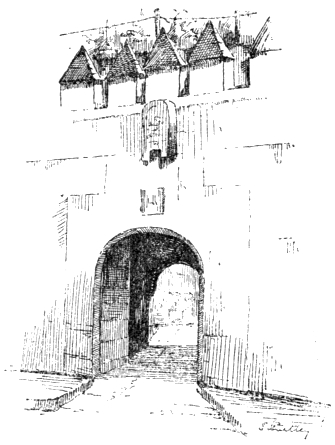 OLD WALLS OF THE ALCÁZAR.
In visiting the Alcázar we shall have more to recall of the career of
Pedro the Cruel. The palace is haunted with memories of the King and of
Maria de Padilla. Pedro was fond of Seville and preferred the Alcázar to
any other residence. He made many alterations in the palace, built the
rooms around the Patio de la Monteria, and brought material for their
construction from the remains of Moorish edifices in Seville, Córdova,
and other places.
When Pedro caused his unfortunate wife, Blanche, to die in prison, from
the dagger, or by poison, his subjects were at length aroused to
indignation. The insensate ruler was bringing the nation to the verge of
ruin by his misdeeds. France resented the dastardly murder of Blanche of
Bourbon, and the King vowed revenge on Pedro. Enrique, brother of Pedro,
was fighting for the crown, and had been proclaimed Sovereign at Toledo;
while the Sevillians, who had long endured their King's severities and
condoned his cruelties, were up in arms and threatening the royal
palace. Pedro fled from Seville, and came eventually into Aquitaine, to
the court of the English Black Prince at Bordeaux. The chivalrous Black
Prince espoused the cause of Pedro against Enrique, pitying the fugitive
King who had been forced to leave his country. In return for his
support, Pedro offered his English ally a large sum of gold, and the
great ruby stolen from Abu Said in the Alcázar of Seville.
The campaign was decided in favour of the King of Spain, but its
hardships cost the Black Prince his life. Pedro was again acknowledged
King. His downfall was, however, fast approaching. Enrique conquered his
brother, soon after the departure of the English army, and came to see
him at Montiel in La Mancha. It is said that Pedro was treacherously
drawn into a trap. In any case, he fell by the dagger of his brother
Enrique; and so ended violently the life of one who had lived in
violence and bloodshed.
As our story is more concerned with the city of Seville than with the
fortunes of the rulers of Spain, we may resume the narration at the time
of Isabella and Fernando. No incidents of signal importance occurred in
Seville between the death of Pedro I. and the accession of the famous
Catholic Queen. With the reign of Isabella, the city became the theatre
of events that influenced the whole of the nation, and indeed the whole
of Christendom.
It was at this time that the arts and letters of Spain began to revive.
In Seville the year 1477 is the date of the first setting up of a
printing press, by one Theodoricus el Aleman (the German). Konrad
Haebler, in his work on The Early Printers of Spain and Portugal, says
that for fifteen years the only printers in the city were German
immigrants. One of the early important books printed in Seville was
Diego de Valera's Cronica de España. In 1490 a firm of printers, under
the title of Four German Companions, opened business, and in three years
published nine volumes, while two years later there was a rival press
owned by another German.
It was in 1493 that the city saw the return of the great Columbus from
his first voyage. For a long time the blue-eyed, dreamy Genoese,
Christoforo Colombo, had mused upon the scientific works of the
cultivated Moors, and speculated upon the existence of other lands far
away across the restless ocean. Sceptics laughed at the dreamer; the
clergy frowned at his impudent theories; but a few bold adventurers were
inspired by his enthusiasm.
The story of his setting forth has been often told. Let us welcome the
sunburnt explorer upon his return to Seville on Palm Sunday 1493. The
wondering people are all anxious to catch sight of Cristobal Colon, the
Italian, who claims to have discovered a New World. He passes down the
streets, a tall, brawny man, bronzed, with red hair, which became white
at the age of thirty. To those who question him he replies with dignity
and courtesy, becoming eloquent as he describes the marvels of the vast
country beyond the sea. The whole city is talking of the great news; the
foreign sailor is the hero of the hour. And now those who doubted
Colon's sanity are singing his praises in all the public meeting-places
of Seville. An office for the administration of this new country is
instituted in the city. From the Queen and her Consort to the seller of
water in the streets, everyone utters the name of the explorer with
admiration. The ecclesiastics, who declared that it was impious to
assert that the earth is a globe, are vexed that they have been found
wrong in their arrogant statements. They continue to quote from the
Pentateuch, and the writings of St. Chrysostom, St. Jerome and St.
Augustine to show that pious authority was on their side.
Queen Isabel had encouraged the Genoese sailor in his project, and the
wealthy Pinzon family, of Palos, had assisted him with means, some of
them also accompanying the explorer on his first voyage. Columbus was
made an admiral, and promised further support in his expeditions. In May
1493 he started again, having with him fifteen hundred men and a fleet
of fifty vessels. The crews of these ships were made up of adventurers,
gold-seekers, idlers and a sprinkling of scoundrels selected by the
Government. In the company there were priests, and it was through the
machinations of one of them, Father Boil, that Christopher Columbus
incurred the displeasure of Isabel and Fernando. By every ship that was
bound for Spain from the New World, Boil sent complaints of Columbus.
Unfortunately, Isabel lent her ear to these slanders, and sent Francisco
Bobadilla to dismiss Cristobal Colon, and to take his place. Bobadilla
took possession of Columbus's charts and papers, put him into chains,
and sent him, like a felon, in the hold of a ship to Spain.
It is pitiful to read of the degradation of this honest and brave man,
whose energies built up the prosperity of Spain, and made Seville one
of the busiest cities of Europe. He laid his case before the Queen and
Fernando, and vowed that he had in no sense neglected his duty towards
the country of his adoption. We know that he was 'forgiven,' but the
insult offered to him preyed upon the sensitive mind of the explorer.
Yet he again resolved to visit the land that he had discovered; and in
1503 he left Spain with four worn-out ships. A year later Columbus
returned for the last time. The people of San Lucar, at the mouth of the
Guadalquivir, welcomed back a captain in shattered health, and a crew
wearied by hardship and exposure.
Columbus now longed to settle quietly in Seville, and to end his days
there. He found that his popularity was waning, and that his rents had
not been collected properly during his absence. With the death of Isabel
he lost royal patronage. His last voyage had cost him much; but the
people of Seville believed him to be immensely rich, whereas his income
was now meagre. 'Little have I profited,' writes Columbus, in a letter,
'by twenty years of service, with such toils and perils; since, at
present, I do not own a roof in Spain. If I desire to eat or sleep I
have no resort but an inn; and for the most times have not wherewithal
to pay my bill.'
In his last days we picture Christopher Columbus bending over the
manuscripts, which may be seen in the Biblioteca Columbina, the library
at Seville founded by the natural son of Columbus. One of the
manuscripts treats upon biblical prophecy. It was written to appease the
Inquisitors, who, to the last, suspected the discoverer of heresy.
Writing of this Apologia, Washington Irving says that the title and some
early pages of the book are by Fernando Columbus; 'the main body of the
work is by a strange hand, probably by Friar Gaspar Gorricio, or some
other brother of his convent.' There are signs in the hand-writing that
Columbus was old and in poor health when he wrote the work. The
characters are, however, distinct. There are passages from the Christian
Fathers and the Bible, construed by the author into predictions of the
discovery of the New World.
The gallant voyager was now prematurely aged, though he had led an
abstemious life. Disappointment at the neglect of the world no doubt
preyed upon his spirits in these last days of his career, for it is said
that he possessed 'a too lively sensibility.' Upon the whole, Columbus
was ill-used by Spain, though his memory is revered. It is the old, sad
story of worth and genius. In 1506 Cristobal Colon died in a poor
lodging at Valladolid. He left a son, born to him by his mistress,
Beatrix Enriquez. In his will Columbus left money to Beatrix.
Great honour was paid to the body of the famous explorer. Columbus was
buried in the parish church of Santa Maria de la Antigua. Some years
later the Sevillians desired that the remains should be removed to their
city, and they were then carried to the Carthusian monastery of Las
Cuevas, to the Chapel of St. Ann, or of Santo Christo. The house of Las
Cuevas was a fine one, celebrated for its pictures and treasures, and
surrounded with orange and lemon groves. But the bones of Columbus were
not to remain in Seville. They were taken, in 1536, to Hispaniola, and
laid in the principal chapel of the Cathedral of San Domingo. Finally
the remains were removed to Havanna.
While paying due respect to Christopher Columbus, we must not forget the
great services rendered to the country generally, and to Seville, by
Fernando de Magallanes, or Magellan, who embarked at that port in August
1519 with five vessels. Passing the Canary Islands and Cape Verde, the
Portuguese explorer reached Brazil, and went south to Patagonia, 'the
land of giants,' arriving eventually at the dangerous straits which bear
his name. Magellan never returned to Spain. Only two of his ships
reached the Moluccas, and of the five that started but one came back to
Seville on the homeward journey.
These were the days when Seville was a bustling port of embarkation, and
a great storehouse for treasure from America and the Indies. A fever of
emigration seized the adventurous spirits of Andalusia; and Andrea
Navigiero, a Venetian ambassador, who journeyed through Spain in 1525,
says that the population of Seville was so reduced that 'the city was
left almost to the women.'
The discoveries and conquests of Pizarro, who came to Seville after his
first voyage, added to the enthusiasm for emigration. But Pizarro found
it a hard matter to raise money for the expenses of a second expedition.
He contrived, however, to man three ships, and was about to start, when
the Council of the Indies sought to inquire into the state of the
vessels. Fearing that he might be hindered from his scheme, the explorer
set sail at San Lucar, in great haste, and made for the Canary Islands.
It was in January 1534 that Hernando, brother of Francisco Pizarro, was
directed to return to Seville with a great hoard of treasure. The Custom
House was filled with ingots, vases and ornaments of gold, and the
inhabitants were much interested in the splendid spoil. Hernando Pizarro
came later under a charge of cruelty to the subject race of South
America. In his Spanish Pioneers, Mr Lummis tells us that 'Hernando
was for many years imprisoned at Medina del Campo, and that he died at
the age of a hundred. His brother, Francisco, who was born at Truxillo,
in Estremadura, was a swineherd in his boyhood. Fired with the spirit
of romance and adventure, the lad deserted his herd of pigs and ran away
to Seville, where he found scope for his restless energy, and was able
to influence seafaring men to accompany him on a cruise of discovery.
Seville was now at the height of its commercial prosperity. There was a
constant come and go of trading vessels; the silk trade was greatly
developed, and leather was made for the markets of Spain. Isabel took
much interest in the improvement of the commerce of the city. When she
ascended the throne, Seville was notorious for its gangs of thieves and
criminals of all kinds, while the surrounding country was insecure
through the numbers of bandits who waylaid and robbed traders and
farmers on the roads. The Queen determined to stamp out crime by
rigorous measures. She held a court in the salon of the Alcázar, and,
in the Castilian custom, presided over the hearing of criminal charges.
Once a week, Isabel sat in her chair of state, on a daïs covered with
gold cloth. For two months she conducted a crusade against robbery in
the city, recovering a great amount of stolen property, and condemning
many offenders to severe penalties. Her severity struck alarm among the
vagabond and thieving population, and probably terrified a number of the
people who had reason to fear justice. Four thousand subjects left the
town. The respectable burghers grew concerned, dreading that this
depopulation would injure the city and deprive it of workmen. A
deputation of citizens waited upon Isabel and begged her to relax her
austerity. The Queen was therefore prevailed upon to offer an amnesty
for all offenders except those convicted of heresy.
Isabel's fortunes as a ruler were largely determined by her charms. The
Sevillians could not fail to worship the tall, fair young Queen, with
the frank and beautiful countenance and blue eyes. Her very
unconventionality delighted her court and the army; and when she rode at
the head of her troops, in a suit of mail, with a sword by her side,
every caballero was ready to follow the fair commander through blood
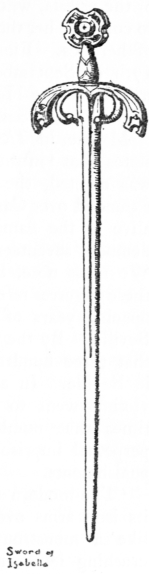
and fire. Isabel's sword, a pretty little weapon, is to be seen in the
Real Armeria at Madrid.
The Queen was one of those magnetic personages to whom all things are
permissible. Even in modern times it is considered unseemly for a
Spanish woman to engage in field sports, or any kind of athletic
exercise; but the Spaniards of Isabel's day not only forgave, but
revered, the Queen who sat on the judicial bench, donned masculine
attire, carried weapons, and took a man's part in the government of her
state. Had it not been for the terrible taint of bigotry, which led
Isabel to sanction deeds of persecution and cruelty, her character would
have presented an example approaching the excellence with which
enthusiastic historians have credited it.
Four years after the accession of Isabel there began the reign of the
Inquisition in Seville. When Alfonso de Hoyeda, Prior of the city, and
Felipe de Barberis, Inquisitor of Sicily, persuaded Fernando that a
crusade against heresy would replenish his exchequer by means of
confiscation, the King was induced to listen to their proposal. At first
Isabel recoiled from this scheme of torture and plunder. But her woman's
mind and heart were not secure against the insidious influence of the
priests, who used their utmost powers of suasion to convince her that
Heaven approved of the destruction of heretics. Finally the Queen gave
way; and the 17th of September 1480 saw the setting up of the tribunal
of the Holy Office in the Dominican Convent of St. Paul at Seville.
M'Crie, in The History of the Reformation in Spain, states that 'in
the course of the first year in which it was erected, the Inquisition of
Seville, which then extended over Castile, committed two thousand
persons alive to the flames, burnt as many in effigy, and condemned
seventeen thousand to different penances.' We must note, however, that
according to Prescott these figures refer to several years and not to
the opening years of the institution of the Holy Office in Seville. By
the end of October 1481 it is recorded that three hundred persons had
been burned to death in Seville. In about thirty-six years, four
thousand victims went to the stake in the city, while many times that
number were condemned to slavery, to perpetual imprisonment, to short
terms, and to other punishments.
'The modern Inquisition,' writes M'Crie, 'stretched its iron arms over a
whole nation, upon which it lay like a monstrous incubus, paralysing its
exertions, crushing its energies, and extinguishing every other feeling
but a sense of weakness and terror.' Many of the Sevillians fled from
the city and sought the protection of the Duke of Medina Sidonia, the
Marquis of Cadiz, and the Count of Arcos.
At this period a frightful pestilence swept over Seville, reducing the
population by thirty thousand, and causing great suffering. The clergy
resorted to prayer; charms and relics of the saints were displayed in
the churches; but little or nothing was done in the way of preventing a
spread of the plague by sanitation, or of alleviating the malady by
medical science. It is a saddening picture—the people dying of the
disease, thousands languishing in dungeons, and a multitude filled with
fear lest they should succumb to the epidemic, or fall into the hands of
the Inquisitors. Puigblanch, author of The Inquisition Unmasked,
states that the number of the banished and the 'reconciled' in Andalusia
from 1480 to 1520 was a hundred thousand. He asserts that forty-five
thousand persons were done to death in the Archbishopric of Seville
during this period.
Without the city, on the Prado de San Sebastian, is the burning ground.
As we stand there, the imagination conjures a procession accompanying a
victim to the awful torture of the stake. The doomed man is an aged and
devout Morisco, who has saved money by his industry. He has been found
guilty of infidelity, and he has refused to partake of the Christian
sacrament. He is dressed in the sanbenito, a yellow garment, with
pictures of devils kindling a fire and burning faggots, and on his head
is a fantastic conical cap of pasteboard, called the coroza. First
comes a troop of soldiers to clear a path for the procession through the
jostling rabble. The soldiers are followed by several priests in
canonical vestments, and the boys of the College of Doctrine, who chant
the liturgy. Then comes the convicted heretic, with a familiar on either
side, and two friars, followed by the judges, ministers of government,
and hidalgoes on horseback. In another procession comes the Inquisitors,
and their standard of red, with the names and insignia of Pope Sixtus
IV. and King Fernando upon it. The members of the Holy Office are
escorted by esquires, and in the rear is a great mob of towns-people.
But enough: imagination is at this point repelled. We turn away from the
scene, and enter the shady gardens that stretch along the Guadalquivir,
to scent the flowers and to listen to the thrush and nightingale.
We cannot, however, close our perceptions to the fact that Seville
played an important part in the Inquisition. In roaming the streets of
the city, it is impossible to forget that this mighty instrument of
fanaticism has left its impress on Spain. We remember that every son of
Seville who dared to exercise his conscience in the matter of religious
belief ran the risk of ending his life upon the Prado de San Sebastian.
The terror of this institution must have blighted the lives of millions
of Spaniards. And we are moved to the reflection that the good which
Isabel performed with one hand was almost destroyed by the evil
inflicted by the other.
The story of Rodrigo de Valer, one of the first to embrace the Lutheran
faith in Seville, is of deep interest. In the fashionable resorts of the
town and at the jousts no youth was more popular than Rodrigo. He had
charming manners, sat a horse gracefully, and could break a lance with
the most skilful knights of the ring. His wealth procured him every
pleasure; he gratified a taste for dress and spent much money upon
horses. Suddenly he was missed from the dance and the tournament. His
friends could not account for this changed mode of life. A passion for
study had taken possession of the young man; and day after day he sat
pouring over the Vulgate, and improving his knowledge of Latin, so that
he might understand the book. In a few months Valer was able to quote
long passages of the Bible from memory. Then he left his study and went
back to his gay companions as an apostle of a new form of faith. He
approached the clergy and the monks, and by argument endeavoured to
convince them of the errors of their creed and ritual, appealing to the
Bible as the criterion of religious truth. The priests were little
inclined to listen to Rodrigo. But when they avoided him, the youth
sought them, engaging them in discussion in the streets and striving to
set forth his new doctrine. At length the indignant clerics of Seville
brought the heretic before the Holy Inquisition. So cogent were his
arguments that some of the members who secretly shared his opinions used
their influence to save him from punishment. Fortunately Valer was of
good family. He was declared to be insane, and spared from an extreme
penalty, but his estates were taken by the tribunal.
Rodrigo's relations now strove to dissuade him from renewing his
endeavours to reform the Church. What could one helpless man achieve
against the whole weight of authority? But Rodrigo was full of zeal. He
began again to denounce the teaching of the clerics, inspired by the
belief that others would soon follow him. For the second time he was
arrested on a charge of heresy and sentenced to imprisonment for life.
In the Church of St. Salvador, where Rodrigo was taken on days of
festival, the fervent youth would rise after the sermon and condemn the
teaching of the pulpit. Only his rank saved him from the flames. He was
eventually imprisoned in a monastery of San Lucar, where he died at the
age of fifty. Valer's sanbenito was displayed for a long time in the
metropolitan church of Seville. It was inscribed: 'Rodrigo de Valer, a
citizen of Lebrixia and Seville, an apostate, and false apostle, who
pretended to be sent of God.'
The teaching of Valer was not without fruit. He was the founder of a
small, but fervent, sect of Lutheran Christians in Seville, whose
doctrines gradually found acceptance among a number of the people. One
of the reformed party was Juan Gil, known as Doctor Egidius, preacher in
Seville Cathedral, who was joined by Vargas and the celebrated
Constantine Ponce de la Fuente. M'Crie says that 'the small society in
Seville grew insensibly, and became the parent stock, from which
branches were taken and planted in the adjacent country.' Persecution
was inevitable. Egidius was denounced and thrown into prison, while
Vargas was murdered, and Ponce de la Fuente banished. After a long
incarceration, Egidius returned to Seville; but he caught a fever, and
died in a few days. De Montes says that the writings of Egidius, which
were never printed, were worthy of praise. The Doctor wrote commentaries
on Genesis and the Psalms, and while in prison he composed an essay on
'Bearing the Cross.'
Protestantism spread in Seville at this time. There was a church under
the care of Doctor Christobal Losada, which met in the house of a lady
of rank, Isabel de Baena, and was attended by the nobles Don Juan Ponce
de León and Domingo de Guzman. In the Dominican Monastery of St. Paul,
in the Nunnery of St. Elizabeth, and especially in the Convent of San
Isidro del Campo, the new doctrines found disciples.
One of the victims of the Inquisition was Torrigiano, the Florentine
sculptor, whose statue of St. Jerome is in the Museo Provincial at
Seville. The monument of Henry VII. in Westminster Abbey is the work of
this artist, who ended his days in the cells of the Inquisitors' prison
in Seville, in 1552. There is no doubt that many of the hapless
prisoners died of diseases contracted in the insanitary dungeons of
Seville and Triana, for Olmedus, one of the sufferers, describes the
dens as vile in 'nastiness and stench.' The ordinary gaols were crowded,
and many persons were immured in the Castle of Triana, and in the
convents of the city.
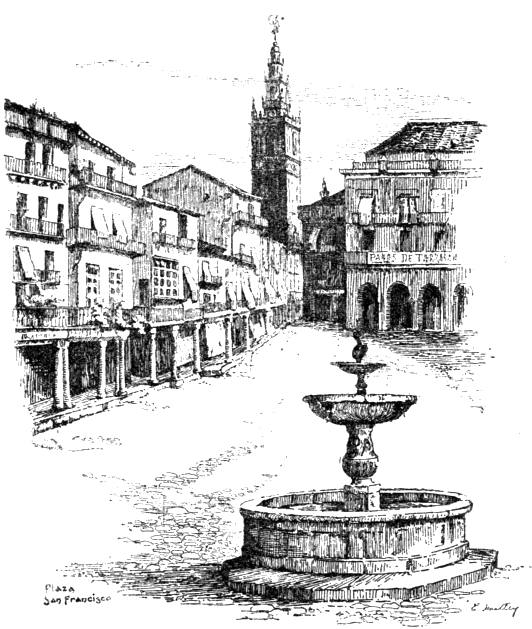
At Triana resided Gonzales-Munebrega, Archbishop of Tarragona, whose
name was coupled with that of Torquemada as a ruthless persecutor. This
officer of the Inquisition might be seen by the trembling populace
walking in the castle gardens, accompanied by a guard of servants.
Munebrega wore rich clothes of purple and silk, and maintained great
pomp. He exhibited extreme cruelty, and scoffed at the sufferings and
cries of the tortured.
Llorente and Bernaldez relate some sickening details of the savage modes
of torment imposed upon the victims of the Inquisition in Seville. It is
not necessary that the tales of horror should be retold here. The first
auto-da-fé celebrated in the city was in 1559, when Don Juan Ponce de
León and several other apostates were committed to the flames in one of
the chief plazas. Ponce de León was described as 'an obstinate Lutheran
heretic.' The heroic Doctor Juan Gonzalez, of Moorish ancestry, was
burnt upon the same day for preaching Protestant doctrines. We see him
leaving the Triana gaol on the morning of execution, 'cheerful and
undaunted,' though he was accompanied by his two sisters, both of whom
were condemned to the stake, and had left behind in the prison his
mother and two brothers. The Doctor sang the 109th Psalm, and attempted
to console his sisters, whereupon a gag was thrust into his mouth.
'When they were brought to the place of execution,' writes M'Crie, 'the
friars urged the females, in repeating the creed, to insert the word
Roman in the clause relating to the Catholic Church. Wishing to
procure liberty to him to bear his dying testimony, they said they
would do as their brother did. The gag being removed, Juan Gonzalez
exhorted them to add nothing to the good confession which they had
already made. Instantly the executioners were ordered to strangle them,
and one of the friars, turning to the crowd, exclaimed that they had
died in the Roman faith.' Doctor Christobal Losada, the pastor of the
Protestant church in Seville, suffered death courageously upon the same
day.
Isabel de Baena, who allowed meetings of the Protestants in her house,
and Maria de Bohorques were among the women of high birth who were
burned in Seville. The story of the last-named lady has been told in a
romance by a Spanish writer, entitled Cornelia Bororquia. Maria de
Bohorques came into the grip of the Holy Office before the age of
twenty-one. She was a pupil of Egidius, and a diligent student of the
Scriptures. When seized and tortured by the Inquisition, she refused to
name those of her friends who shared her belief. Doña Maria was then
sent to the stake.
Llorente recounts that two Englishmen were burned at one of the autos
of Seville. Nicholas Burton, a merchant of London, who traded with
Spain, arrived with his vessel at San Lucar while the persecution was
raging in Seville. Somewhat imprudently, Burton spoke contemptuously of
the Inquisition, though M'Crie states that the accusation of insolence
was false. Burton was burnt alive, together with William Burke, a seaman
of Southampton, and a Frenchman, named Fabianne. The Holy Office then
seized Burton's cargo; but a part of it belonged to a London tradesman,
who sent one John Frampton to Seville, with a power of attorney, to
recover the goods. Frampton failed to make good his claim after four
months of negotiation, and he returned to England to find greater
powers. When he landed again in Spain, the agent was arrested, put in
chains, and thrown into the dungeon of Triana. The charge against him
was that he had a volume of Cato in his bag. He was questioned as to his
creed, and ordered to repeat the Ave Maria. Subjected to the torture of
the rack, the wretched man was forced to confess anything that his
torturers desired. Frampton was imprisoned for two years, and then
granted his freedom. His 'Narrative' is to be found in Strype's
Annals.
The unfortunate Constantine Ponce de la Fuente, who was one of the most
active members of the reformed church in Seville, was seized by the
Inquisition, and confined in an underground cell for two years, when
dysentery put an end to his sufferings. In 1781 the last martyr perished
in the flames at Seville. 'I myself,' writes Blanco White, 'saw the pile
on which the last victim was sacrificed to human infallibility. It was
the unhappy woman whom the Inquisition of Seville committed to the
flames, under the charge of heresy, about forty years ago. She perished
on a spot where thousands had met the same fate.' A traveller in Spain,
named Wiffen, says: 'In the year 1842, whilst travelling in that
country, I found myself in the Alameda Vieja of Seville, in front of the
house formerly occupied by the Inquisition, where several of the
prisoners were confined who were burned at the auto-da-fé of 1560.'
Such is the story of the Inquisition in Seville. I have not willingly
dwelt upon this dark page in the history of the fair city. But it has
been necessary to refer to the chronicles of this reign of terror; for
the institution of the Holy Office in Seville is a matter of historic
importance, and no record of the town could be in any sense complete if
the annals of the Inquisition were overlooked. And in changing to a
happier theme it is necessary that I should point out the repugnance
that masses of the people of Seville exhibited towards the introduction
of this engine of persecution in the city. Llorente, the Spanish
historian of the Inquisition, tells us that when Fernando and Isabel
commanded the Governors of the provinces to supply inquisitors and
assistants to the royal capital, the inhabitants regarded the arrival of
the agents of the Holy Office with extreme dissatisfaction, and that
difficulty was experienced in collecting together 'the number of persons
whose presence was necessary to the legal opening of their assembly.'
Let us view the city of Isabella the Catholic in a brighter aspect. In
the year 1490 an ambassador from Lisbon came to the Alcázar of Seville
to confer with the Queen concerning a proposed marriage between young
Alonso, heir to the Portuguese throne, and Isabel, the Infanta of
Castile, and the dearly-loved namesake of the royal mother. It was with
mingled sentiments of joy and sadness that Isabel consented to the
union. The month of April was chosen for the ceremony of betrothal, and
it was arranged that feasts and tournaments should succeed the official
celebration. Great preparations were made for the festivities. The lists
were constructed on the bank of the Guadalquivir; hangings of costly
material draped the galleries erected for the spectators of the jousts,
and the royal palace was prepared for the reception of noble guests,
knights of prowess, and their dames and daughters. On the first day of
the fêtes a splendid procession passed through the streets to the
lists, where thousands of the nobility were seated, all anxious to
witness a combat in the arena between King Fernando and one of his most
accomplished knights. The charming Infanta delighted everyone as she
came with her seventy ladies-in-waiting, in court dress, and her hundred
gallant pages as bodyguard. It was a scene which the people long
recalled. All the rank and loveliness of Castile and Andalusia were
around the arena when the sports began; the mail and weapons of the
combatants glistened in the dazzling sunlight of the green meadow; and
loud were the plaudits when his majesty broke his first lance in a
furious and exciting tilt with a renowned esquire and champion of the
lists. Throughout the tournament, Fernando acquitted himself as a true
knight of the order of chivalry, displaying much courage and a great
knowledge of the art of the tourney. In the autumn Isabel bade adieu to
her daughter. A great retinue came to the Alcázar, to accompany the
Princess to Portugal, in charge of the Cardinal of Spain and the Grand
Master of St. James.
By the Sevillians, Isabel appears to have been feared as well as
worshipped. The aliens in the city, all except those who chose to
embrace the Catholic faith, had, indeed, good reason to fear their
Queen. Isabel's treatment of the Jews cannot be called humane, but she
enjoined just conduct towards her Indian subjects. The Queen was humble
in her obedience to the Chief Inquisitor, Torquemada, and ever ready to
listen to the counsels of her spiritual guides. Towards heresy she
showed no clemency, and her measures for dealing with bandits and other
criminal offenders were excessively severe. But the romantic personality
of Isabella the Catholic will always appeal to the imagination of the
Andalusians.


