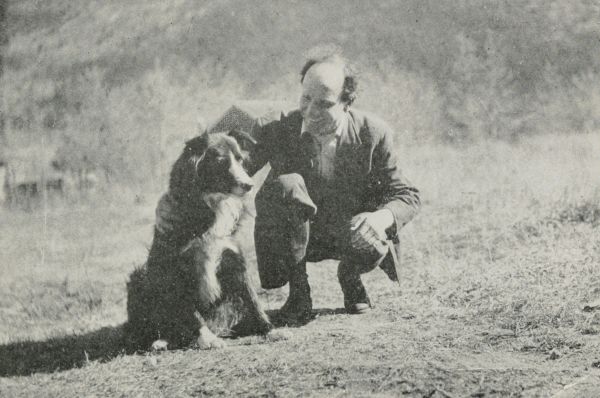
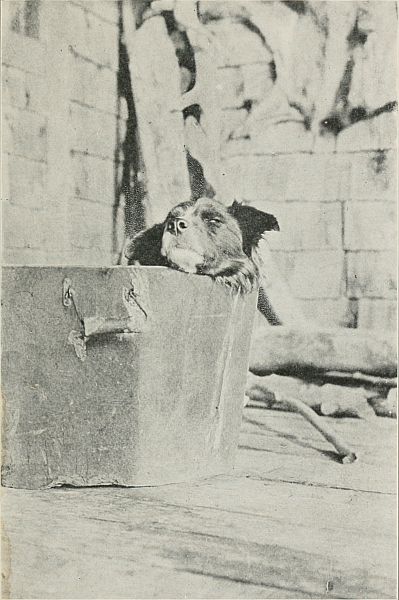
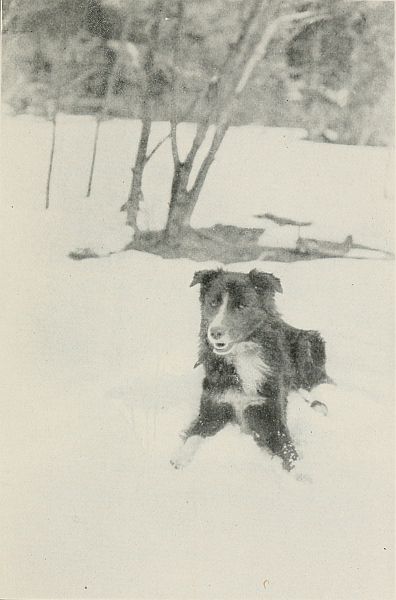
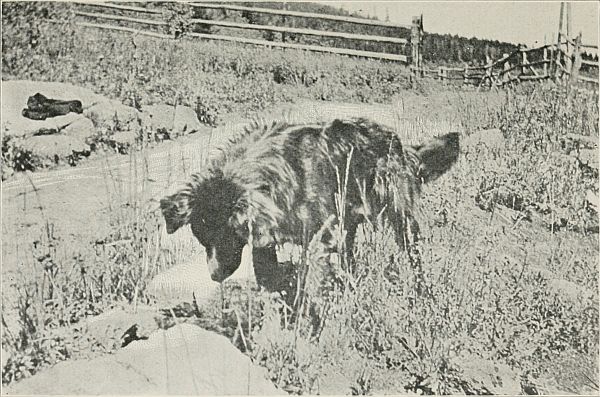
Scotch enjoyed being with me, and great times we had together. Many of
our best days were in the wilds. Here he often suffered from hunger,
cold, hardships, and sometimes from accident; yet never did he complain.
Usually he endured the unpleasant things as a matter of course.
Though very lonely when left by himself, he never allowed this feeling
to cause a slighting of duty. On one occasion he was supremely tried but
did his duty as he understood it and was faithful under circumstances of
loneliness, danger, and possible death.
At the close of one of our winter trips, Scotch and I started across the
Continental Divide of the Rocky Mountains in face of weather conditions
that indicated a snowstorm or a blizzard before we could gain the other
side. We had eaten the last of our food twenty-four hours before, and
could no longer wait for fair weather. So off we started to scale the
snowy steeps of the cold, gray heights a thousand feet above. The
mountains already were deeply snow-covered and it would have been a hard
trip even without the discomforts and dangers of a storm.
I was on snowshoes, and for a week we had been camping and tramping
through the snowy forests and glacier meadows at the source of Grand
River, two miles above the sea. The primeval Rocky Mountain forests are
just as near to Nature's heart in winter as in summer. I had found so
much to study and enjoy that the long distance from a food-supply, even
when the last mouthful was eaten, had not aroused me to the seriousness
of the situation. Scotch had not complained, and appeared to have the
keenest collie interest in the tracks and trails, the scenes and
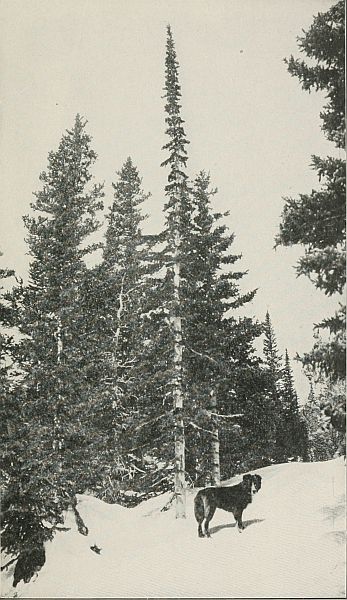
silences away from the haunts of man. The snow lay seven feet deep, but
by keeping in my snowshoe-tracks Scotch easily followed me about. Our
last camp was in the depths of an alpine forest, at an altitude of ten
thousand feet. Here, though zero weather prevailed, we were easily
comfortable beside a fire under the protection of an overhanging cliff.
After a walk through woods the sun came blazing in our faces past the
snow-piled crags on Long's Peak, and threw slender blue shadows of the
spiry spruces far out in a white glacier meadow to meet us. Reëntering
the tall but open woods, we saw, down the long aisles and limb-arched
avenues, a forest of tree-columns, entangled in sunlight and shadow,
standing on a snowy marble floor.
We were on the Pacific slope, and our plan was to cross the summit by
the shortest way between timber-line there and timber-line on the
Atlantic side. This meant ascending a thousand feet and descending an
equal distance, traveling five miles amid bleak, rugged environment.
After gaining a thousand feet of altitude through the friendly forest,
we climbed out and up above the trees on a steep slope at timber-line.
This place, the farthest up for trees, was a picturesque, desolate
place. The dwarfed, gnarled, storm-shaped trees amid enormous
snow-drifts told of endless, and at times deadly, struggles of the trees
with the elements. Most of the trees were buried, but here and there a
leaning or a storm-distorted one bent bravely above the snows.
Along the treeless, gradual ascent we started, realizing that the last
steep icy climb would be dangerous and defiant. Most of the snow had
slid from the steeper places, and much of the remainder had blown away.
Over the unsheltered whole the wind was howling. For a time the sun
shone dimly through the wind-driven snow-dust that rolled from the top
of the range, but it disappeared early behind wild, wind-swept clouds.
At last we were safe on a ridge, and we started merrily off, hoping to
cover speedily the three miles of comparatively level plateau.
How the wind did blow! Up more than eleven thousand feet above the sea,
with not a tree to steady or break, it had a royal sweep. The wind
appeared to be putting forth its wildest efforts to blow us off the
ridge. There being a broad way, I kept well from the edges. The wind
came with a dash and a heavy rush, first from one quarter, then from
another. I was watchful and faced each rush firmly braced. Generally
this preparedness saved me; but several times the wind seemed to expand
or explode beneath me, and, with an upward toss, I was flung among the
icy rocks and crusted snows. Finally I took to dropping and lying flat
whenever a violent gust came ripping among the crags.
There was an arctic barrenness to this alpine ridge,—not a house within
miles, no trail, and here no tree could live to soften the sternness of
the landscape or to cheer the traveler. The way wound amid snowy piles,
icy spaces, and wind-swept crags.
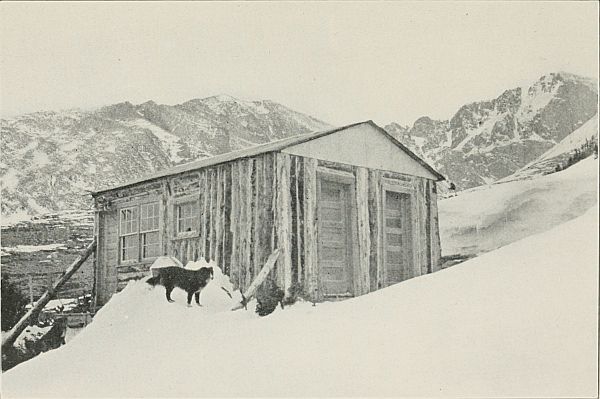 THE MOUNTAINS IN WINTER
Scotch on Guard at the Timber-Line Cabin
The wind slackened and snow began to fall just as we were leaving the
smooth plateau for the broken part of the divide. The next mile of way
was badly cut to pieces with deep gorges from both sides of the ridge.
The inner ends of several of these broke through the center of the ridge
and extended beyond the ends of the gorges from the opposite side.
This made the course a series of sharp, short zigzags.
We went forward in the flying snow. I could scarcely see, but felt that
I could keep the way on the broken ridge between the numerous rents and
cañons. On snowy, icy ledges the wind took reckless liberties. I wanted
to stop but dared not, for the cold was intense enough to freeze one in
a few minutes.
Fearing that a snow-whirl might separate us, I fastened one end of my
light, strong rope to Scotch's collar and the other end to my belt. This
proved to be fortunate for both, for while we were crossing an icy,
though moderate, slope, a gust of wind swept me off my feet and started
us sliding. It was not steep, but was so slippery I could not stop, nor
see where the slope ended, and I grabbed in vain at the few icy
projections. Scotch also lost his footing and was sliding and rolling
about, and the wind was hurrying us along, when I threw myself flat and
dug at the ice with fingers and toes. In the midst of my unsuccessful
efforts we were brought to a sudden stop by the rope between us catching
over a small rock-point that was thrust up through the ice. Around this
in every direction was smooth, sloping ice; this, with the high wind,
made me wonder for a moment how we were to get safely off the slope. The
belt axe proved the means, for with it I reached out as far as I could
and chopped a hole in the ice, while with the other hand I clung to the
rock-point. Then, returning the axe to my belt, I caught hold in the
chopped place and pulled myself forward, repeating this until on safe
footing.
In oncoming darkness and whirling snow I had safely rounded the ends of
two gorges and was hurrying forward over a comparatively level stretch,
with the wind at my back boosting me along. Scotch was running by my
side and evidently was trusting me to guard against all dangers. This I
tried to do. Suddenly, however, there came a fierce dash of wind and
whirl of snow that hid everything. Instantly I flung myself flat, trying
to stop quickly. Just as I did this I caught the strange, weird sound
made by high wind as it sweeps across a cañon, and at once realized that
we were close to a storm-hidden gorge. I stopped against a rock, while
Scotch slid into the chasm and was hauled back with the rope.
The gorge had been encountered between two out-thrusting side gorges,
and between these in the darkness I had a cold time feeling my way out.
At last I came to a cairn of stones that I recognized. I had missed the
way by only a few yards, but this miss had been nearly fatal.
Not daring to hurry in the darkness in order to get warm, I was becoming
colder every moment. I still had a stiff climb between me and the
summit, with timber-line three rough miles beyond. To attempt to make it
would probably result in freezing or tumbling into a gorge. At last I
realized that I must stop and spend the night in a snow-drift. Quickly
kicking and trampling a trench in a loose drift, I placed my elkskin
sleeping-bag therein, thrust Scotch into the bag, and then squeezed into
it myself.
I was almost congealed with cold. My first thought after warming up was
to wonder why I had not earlier remembered the bag. Two in a bag would
guarantee warmth, and with warmth, a snow-drift on the crest of the
continent would not be a bad place in which to lodge for the night.
The sounds of wind and snow beating upon the bag grew fainter and
fainter as we were drifted and piled over with the snow. At the same
time our temperature rose, and before long it was necessary to open the
flap of the bag slightly for ventilation.
At last the sounds of the storm could barely be heard. Was the storm
quieting down, or was its roar muffled and lost in the deepening cover
of snow? was the unimportant question occupying my thoughts when I fell
asleep.
Scotch awakened me in trying to get out of the bag. It was morning. Out
we crawled, and, standing with only my head above the drift, I found the
air still and saw a snowy mountain world all serene in the morning sun.
I hastily adjusted sleeping-bag and snowshoes, and we set off for the
final climb to the summit.
The final hundred feet or so rose steep, jagged, and ice-covered before
me. There was nothing to lay hold of; every point of vantage was plated
with smooth ice. There appeared only one way to surmount this icy
barrier and that was to chop toe- and hand-holes from the bottom to the
top of this icy wall, which in places was close to vertical. Such a
climb would not be especially difficult or dangerous for me, but could
Scotch do it? He could hardly know how to place his feet in the holes or
on the steps properly; nor could he realize that a slip or a misstep
would mean a slide and a roll to death.
Leaving sleeping-bag and snowshoes with Scotch, I grasped my axe and
chopped my way to the top and then went down and carried bag and
snowshoes up. Returning for Scotch, I started him climbing just ahead of
me, so that I could boost and encourage him. We had gained only a few
feet when it became plain that sooner or later he would slip and bring
disaster to both of us. We stopped and descended to the bottom for a
new start.
Though the wind was again blowing a gale, I determined to carry him. His
weight was forty pounds, and he would make a top-heavy load and give the
wind a good chance to upset my balance and tip me off the wall. But, as
there appeared no other way, I threw him over my shoulder and started
up.
Many times Scotch and I had been in ticklish places together, and more
than once I had pulled him up rocky cliffs on which he could not find
footing. Several times I had carried him over gulches on fallen logs
that were too slippery for him. He was so trusting and so trained that
he relaxed and never moved while in my arms or on my shoulder.
Arriving at the place least steep, I stopped to transfer Scotch from one
shoulder to the other. The wind was at its worst; its direction
frequently changed and it alternately calmed and then came on like an
explosion. For several seconds it had been roaring down the slope;
bracing myself to withstand its force from this direction, I was about
to move Scotch, when it suddenly shifted to one side and came with the
force of a breaker. It threw me off my balance and tumbled me heavily
against the icy slope.
Though my head struck solidly, Scotch came down beneath me and took most
of the shock. Instantly we glanced off and began to slide swiftly.
Fortunately I managed to get two fingers into one of the chopped holes
and held fast. I clung to Scotch with one arm; we came to a stop, both
saved. Scotch gave a yelp of pain when he fell beneath me, but he did
not move. Had he made a jump or attempted to help himself, it is likely
that both of us would have gone to the bottom of the slope.
Gripping Scotch with one hand and clinging to the icy hold with the
other, I shuffled about until I got my feet into two holes in the icy
wall. Standing in these and leaning against the ice, with the wind
butting and dashing, I attempted the ticklish task of lifting Scotch
again to my shoulder—and succeeded. A minute later we paused to breathe
on the summit's icy ridge, between two oceans and amid seas of snowy
peaks.
 Cover
Cover