"Les gens de Rouen sont honnêtes,
Grans entrepreneurs d'edifices
De theatres et artifices
Es entrees des grans seigneurs,
Roy prelatz et aultres greigneurs."
THOUGH Henri Quatre could not get through the gates of Rouen while the
town remained faithful to the League, and considered him a heretic,
the sturdy citizens were ready enough to accept a king of their own
religion, and when the "Vert Galant" made his first solemn entry into
the place in 1596, they welcomed him as heartily as any of his
predecessors. You will remember that there were Englishmen with him
when he was trying to get into Rouen a few years before, and it was to
Rouen again that the Earl of Shrewsbury and a brilliant suite brought
the Queen of England's greeting to her cousin of France, and sent him
the famous Order of the Garter. The Ambassador was most appropriately
lodged in a very famous house in Rouen, which itself formed a
remarkably complete memorial of the friendship between the same two
thrones earlier in the century. The Maison Bourgtheroulde, at the
corner of the Place de la Pucelle and the Rue du Panneret, contains
indeed one of the best pictorial records that exists in Europe, not
only of the meeting of the Field of the Cloth of Gold, but also of the
decorations that were displayed there.
The house is a good example of the transition between "Gothic"
domestic architecture and that of the Renaissance. Built about the
same time as the Palais de Justice and the Bureau de Finances, it
formed a part of that brilliant series of beautiful dwellings in which
the early years of the sixteenth century at Rouen were so fruitful.
Its exterior façade upon the Place de la Pucelle is so terribly
changed and mutilated now, that unless you will refer to Lelieur's
drawing, reproduced with Chapter IX., no view of its present condition
can suggest to you the original design. Of that high roof with lofty
crested windows, of the side-turret at the angle of the street, of the
beautifully carved door, not a trace remains. The principal entrance
built on the old Marché aux Veaux was placed between two heavy
pillars, which had statues on them, and even before the traveller had
passed inside, these suggested to him the motive which underlies the
whole decoration of the house; for these are the two pillars which
were on each side of the English King's pavilion at the Field of the
Cloth of Gold. Whereof the one, in the words of the English
chronicler, was "intrayled with anticke works, the old god of wine
called Bacchus birlyng the wine, which by the conduits in the erthe
ran to all people plenteously with red, white, and claret wine, over
whose head was written in letters of Romayn in gold, 'Faicte bonne
chere qui vouldra.'" The other pillar was "of ancient Romayne work,
borne with four lions of gold ... and on the summit of the said piller
stood an image of the blynde God, Cupid, with his bowe and arrowes of
love, by hys seeming, to stryke the yonge people to love." But these
have gone, and so little is left of the beauty of the façade that it
really will require some courage to believe what I have just said, and
go through the wooden door in search of better fortune.
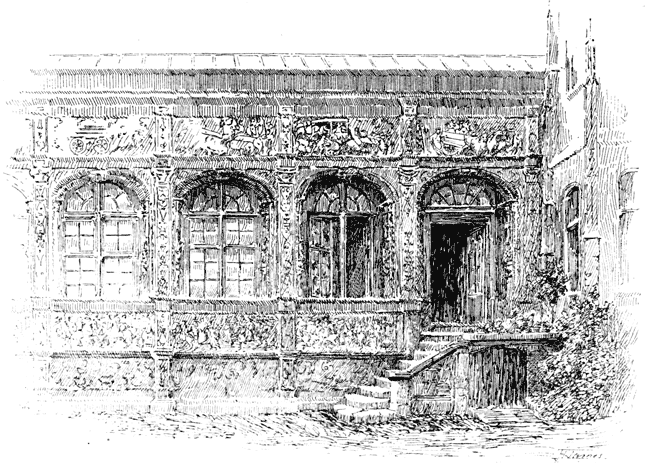
THE GALLERY OF THE MAISON BOURGTHEROULDE, SHOWING THE
CARVINGS OF THE FIELD OF THE CLOTH OF GOLD, AND ABOVE THEM THE
CARVINGS OF PETRARCH'S "TRIUMPH"
It was the town house of the family of Le Roux,[65] a name which
already has artistic associations for any lover of the architecture of
Rouen, though I have found no trace of relationship between the
architect of the Cathedral façade, the Bureau de Finances, and the
Palais de Justice, and the lawyers who built and decorated this
"hôtel." Indeed I cannot imagine it would be likely that a man of so
much originality and power both in architecture and in sculpture would
have lent himself to the methods of decoration employed here, which,
as you will see, are more appropriate to the accurately historical
than to the freely artistic frame of mind. The man who made the
fortune of the family was the second Guillaume Le Roux, husband of
Jeanne Jubert de Vely, and one of the fifteen lay councillors called
to the Perpetual Échiquier created by Louis XII. in 1499. He bought
the estates of Tilly, Lucy, Sainte Beuve, and Bourgtheroulde, and
built the "corps de logis" in the interior courtyard exactly opposite
the entrance. He also began the wings on the north and west, but left
the great southern gallery to be completed by his son Guillaume, "Abbé
d'Aumale et du Val Richer," who held several benefices under the great
Cardinal d'Amboise, and derived his chief claim to importance from
having been employed by François I. in the negotiation of the
celebrated Concordat which that king announced with so much solemnity
on his entry into Rouen in 1517.
These two last facts may largely account for the decoration of the new
wing the Abbé built in Rouen, and the carvings he added to the older
walls; for they are mainly suggested by one of the most magnificent
occurrences in the ostentatious reign of a king whose visit to the
town had no doubt enhanced the importance of the Abbé in the eyes of
his fellow-citizens. At any rate he was not likely to let them forget
that the François whom he had helped in the matter of the Concordat
was also the hero of the "Champ du Drap d'Or." Though the house may
have been begun as early as 1486, when the second Guillaume Le Roux
was married, it was not finished for some time afterwards, and we may
put 1531 as the latest date, because the Phœnix of Eleanor of
Austria shows beside the Salamander of her husband. Abbé Guillaume
died in 1532, before which year the carvings must have been completed,
and they evidently cannot have been begun before 1520, the date of the
Field of the Cloth of Gold, which was their chief inspiration, so that
the carvings certainly have the value of almost contemporaneous
workmanship, and most probably the authority, either directly or
indirectly, of an eye-witness. It may be as well to remember that to
that gorgeous ceremony there was no possibility of any mere loafer, or
any wandering unauthorised artist being admitted, because it is on
record that everyone without a special permit was cleared out of the
country in a circle of some four leagues; and it is not too much to
imagine that even if one who had had a hand in the important
negotiations of the Concordat four years before were not in the King's
suite, he was at least in a position to see and profit by the work of
the artists who accompanied François,[66] to record his splendours and
to make the best use of all their opportunities.
Since 1820 the Maison Bourgtheroulde has practically been a unique
example of the style of decoration for which it is famous. Before that
year "La Grande Maison" existed at Grand-Andely, not far off, with
much the same kind of ornament upon its Renaissance walls; but that
has now vanished utterly, with the exception of some of the large
statues which were bought at three francs the square foot by an
Englishman,[67] and taken across the Channel to decorate a
country-house. It will therefore be well worth while to consider in
some detail what the Bourgtheroulde carvings are, and how they
originated; for even if they do not appeal to us so much as the
original and thoroughly local work of other Rouen sculptors, they have
a value of their own that may be considered entirely apart from any
æsthetic criticism of the sources of the carver's workmanship.
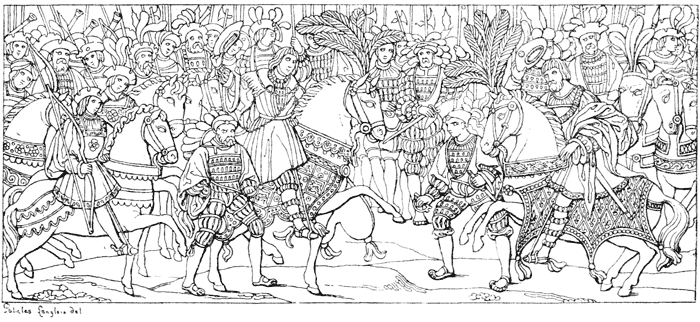
THE MEETING OF HENRY VIII. AND FRANÇOIS I. ON THE FIELD
OF THE CLOTH OF GOLD, FROM THE CARVINGS OF THE MAISON BOURGTHEROULDE
To begin, then, at the beginning, the entrance-door on the inside of
the court is decorated with medallion portraits, surrounded by
garlands, of François I. (whose long nose betrays him) and the stout,
square face of Henry VIII. Both are bearded. The note of historical
suggestion is struck at once. It continues still more unmistakably on
the series of panels immediately beneath the window-sills of the wing
on the left hand as you enter. On these is represented that useless
pageant of the Field of the Cloth of Gold, by which François (who
posed as the protector of art and the Renaissance in France, though he
did singularly little for either) tried to obscure the defeat he had
just sustained by the election of his solemn rival Charles V. as
Emperor. The interview lasted from the 7th to the 24th of June 1520,
and there the chronicler describes how the two Kings "se virent et
parlementerent ensemble après midi environ les vespres, en la terre
dudit Roy d'Angleterre, en une petite vallée nommée le valdoré entre
ladite ville d'Ardres et le château de Guynes."
The third or central panel (which is the best carved and almost the
best preserved) contains the actual meeting of the Kings. At the first
(beginning from the left) is shown the Château of Guynes; from the
windows and galleries men and women are looking out, and on the ground
before the gate are the small saluting-cannon of the period, almost
invisible from the decay of the stone. A few of the last of the
English suite are just issuing from the gates, some a-foot and some on
horseback; both men and horses wear great feathered plumes, and the
men on foot have a circular headdress of feathers like an aureole. In
the second panel, two horsemen bearing maces ride in front of an
ecclesiastic who carries a processional cross. Behind it is the great
Cardinal Wolsey, in violet-coloured velvet, riding on a mule, with
pages. Fisher, Bishop of Rochester, was with him; and the Order of the
Garter, whose motto could be read upon a horseman's knee some sixty
years ago, was worn by Charles Brandon, Duke of Suffolk. It has
disappeared now, and so much has gone with it, owing to the atmosphere
of Rouen, which has more in common with Oxford than its architectural
surroundings, that the careful plaster-casts preserved in Paris (and
photographed by the late M. Paul Robert in his "Trocadéro" Series, iv.
29) will soon be the best memorial of sculptures, as valuable to
England as they are to France, and equally neglected by both. In 1821
M. Delaquérière issued a careful description of them (published by
Firmin Didot, Paris), and to a second edition (published in 1841) he
added a detailed drawing of the whole gallery by Polyclès Langlois,
and five larger drawings of each of the panels originally done, in
1823, for Nodier's well-known "Voyages Pittoresques." It is the
central panel from these that I reproduce here, and Miss James's
drawing will show you the relative position of the procession and of
the frieze of the Triumph above it on the left wing of the house. In
1841, plaster-casts could be bought from M. Rossi in Rouen. But these
exist no longer, and, by comparing the drawing made in 1823 with the
carvings themselves, you will be able to appreciate how rapidly the
stone decays. It will still be possible, however (in 1899 at least),
to discover on the mouldering surface of the wall at least a trace of
nearly everything that was originally there; and your appreciation of
the faithfulness of the sculptor to recorded fact will be still
further increased if you can compare his work with the picture in
Hampton Court, with the English contemporary versions from which I
have occasionally quoted, and with such French accounts as that of du
Bellay or Fleurange.
The third and central panel is the culmination of the splendours of
the whole. Each monarch, with his hat in his right hand, bows low in
salutation. You will notice that François wears his beard, but Henry
is clean shaved like the majority of those present. This is another
detail that is corroborated elsewhere, for the story is well known how
François swore he would not shave till he had seen the English King;
how Henry made a similar oath out of politeness, and broke it in
impatience; how the French ambassadors eagerly enquired whether this
clean chin was to be construed as "an unfriendly act," and were told
that Henry's affection resided not in his beard, but in his heart. The
English King, says the chronicler, on that great occasion "showed
himself some deal forward in beauty and personage, the most goodliest
Prince that ever reigned over the realm of England: his Grace was
apparelled in a garment of cloth of silver of damask, ribbed with
cloth of gold, so thick as might be; the garment was large, and
pleated very thick. The horse which his Grace rode on was trapped in a
marvellous vesture of a new-devised fashion; the trapper was of fine
bullion, curiously wrought, pounced and set with antique work of
Romayne figures." This carving shows that his harness was embroidered
in alternate squares of leopards and roses. Close to him is the
Marquis of Dorset, who bore the sword of State, with the Earls of
Essex and Northumberland and others, besides the pikemen and guards,
and the 400 mounted archers, who were peculiar to the English retinue.
François wears embroidered cloth of gold, and bears a cape of heavier
gold thread, sewn with gems. His chest and sleeves are covered with
diamonds, rubies, emeralds, and pearls. His horse has the fleurs de
lys embroidered on saddle and harness. Before him march the Swiss
guard under Fleurange, who has left an account of the whole matter;
close by are Mountjoy and the other heralds, with the High Admiral and
the great nobles. On the back of the last rider is carved the royal
badge, that salamander which was seen miraculously to appear in effigy
among the clouds while the Cardinal was celebrating High Mass. The
English chronicler describes the scene carved upon this panel as
follows:—"Then blew the trumpets, sackbutts, clarions, and all other
minstrelsy on both sides, and the King descended down towards the
bottom of the valley of Ardres in sight of the nations, and on
horseback met and embraced the two Kings each other; then the two
Kings alighted, and after embraced with benign and courteous manner
each other, with sweet and goodly words of greeting; and after few
words these two noble Kings went together into the tent of cloth of
gold that was there set on the ground for such purpose, thus
arm-in-arm went the French King Francis the First of France, and Henry
the Eighth King of England and France, together passing with
communication."
On the fourth panel, behind four mace-bearers, rides an ecclesiastic
bearing what was once a double cross: the dove that flew above his
head has entirely disappeared. Then comes Cardinal de Boissey, the
Papal Legate, and among the other Cardinals (who may be recognised by
their hatstrings falling on their chests) are those of Bourbon,
Albret, and Lorraine. Much of this has been destroyed, but there is
enough left to realise what Du Bellay says about the ruinous
extravagance of the dresses:—"Many of the Frenchmen," he writes,
"carried the price of woodland, watermill, and pasture on their
backs." Yet the taste of the Englishmen, who had not spent so much,
was acknowledged to have produced as splendid an effect as the
gorgeous outlay of the French; as Fleurange particularly records of
the English pavilion made of wood, and drapery and glass, "elle était
trop plus belle que celle des Français, et de peu de coûtance." In one
point, however, the ladies of Paris asserted a superiority they have
retained almost ever since; the Englishwomen confessed themselves
beaten; but when they followed the fashion of their fair rivals, it
was not much better; for, says the truthful historian, "what they lost
in modesty they did not make up in grace."
Most unfortunately, on the fifth and last panel, though the stair-rail
has preserved some of its details better than any of the rest, the
superiority of these French ladies cannot be sufficiently studied,
though several of their heads may be seen watching the procession from
the windows and balconies of Ardres. The plumed hats and horses of the
escort are particularly clear here, and they are more numerous than in
the famous "Triumph of Maximilian" or in the "Entry of Charles V. into
Bologna." The figure of the courtier just mounting his horse is the
one I like best of all except the dignified personage who bears the
cross before the French ecclesiastics.
If the English ambassador in 1596 was easily able to recognise the
subject of these carvings, no less quickly would the Cardinal de
Florence, the Papal Legate who came to Rouen in the same year, and was
also lodged in this house, remember the originals from which were
taken the carvings on the frieze above the windows on this wall. For
though later generations have misunderstood them, just as they
imagined the lower carvings to be the Council of Trent, it is quite
clear from some words first discovered on the stone in 1875, that the
frieze was inspired by the "Triumphs" of Petrarch. These words are as
follows; and I have added their proper continuation and beginning in
italics:—
"Amor vincit mundum
Pudicitia vincit amorem
Mors vincit pudicitiam
Fama vincit mortem
Tempus vincit famam
Divinitas seu Eternitas omnia vincit."
M. Palustre has pointed out that an edition of these "Triumphs" was
published in Venice in 1545 by Giolito, with woodcuts; and though this
is rather too late for the carvings (unless, as was the case with
Holbein's "Todtentanz," we may imagine the cuts were known long before
the book) it is a matter of common knowledge that the subject was a
favourite one not only for such illustrations but especially for
tapestry; as Agrippa d'Aubigné records of contemporary tapestries at
Lyons: "Elles représentent quatre triomphes, chacun de trois
partis...." And it was also by just such chariots, cars, and
elephants, or other animals, that virtues and vices were represented
in the great processions of the kings and queens at Rouen and
elsewhere, processions which of course were often taken as the subject
for tapestries commemorating their magnificence. In Petrarch's verses
you may read:—
"Quattro destrier via più che neve bianchi
Sopr' un carro di foco un garzon crudo
Con arco in mano, e con saette a' fianchi....
... Vidi un vittorioso e sommo duce
Pur com' un di color, che 'n Campidoglio
Trionphal carro a gran gloria conduce...."
On the third of these upper panels (just above the meeting of the two
kings), is a great car drawn by oxen, whose wheels are crushing
prostrate bodies in the road beneath them. The fourth carving shows a
stage drawn by two elephants. The fleshless head of Death is in the
front, with a serpent coiling round his leg, and on the car is the
figure of a woman blowing a trumpet, with a banner. This is evidently
the fourth line of the verse just quoted, "Fama vincit mortem." On
the fifth car, drawn by four beasts, is a great daïs, and personages
beneath it. Before it walks a figure with a turban, beside it another
figure crowned with branches and carrying a tree. Emblems of the
growth of nature dispersed in the design may perhaps suggest the
passage of the seasons and the lapse of time, for "Tempus vincit
famam." The last line, "Divinitas omnia vincit," is very well
illustrated, over the door. Drawn by a lion, an eagle, an ox and an
angel, to symbolise the four evangelists, a great car supports the
three Persons of the Trinity beneath a daïs; and under the wheels are
crushed various uncouth figures representing heresies. Cardinals,
popes, and bishops accompany the procession.
Though I have only mentioned, so far, two of those great royal entries
into Rouen, for which the citizens were especially famous, the details
given in Chapter XI. will alone suggest that the scenes taken from
Petrarch's verses would be very appropriate to a house in this
particular town. The still more gorgeous festivities arranged for
Henri II. and Catherine de Médicis, which I shall mention later on in
this chapter, are even more like the triumphal cars and set pageants
here represented, which have lasted on in England in the somewhat
debased form of our own Lord Mayor's show, and were perhaps themselves
the symbolical descendants of the Triumphs of the ancient Romans.
This gallery of the Cloth of Gold and the Triumphs, is decorated in
every other part with beautifully designed arabesques, and is joined
to the main façade by an exquisite turret, which rises at the corner
near the short flight of steps, and breaks up the straight line of the
walls in a way that the early Renaissance builders were extremely fond
of doing, before the transition period had advanced so far as to make
them forget the principles of the rising line of "Gothic" and adhere
solely to the horizontal line of the Italian. But this turret is even
more remarkable for the carvings it bears than for the delicate taste
which dictated its position in the whole design. Upon the two sides
visible to the spectator from the courtyard it is covered with
representations of the pastoral scenes that might be seen any summer
in the sixteenth century on the hills near Rouen. To see them all upon
these walls you will need a good field-glass, but they deserve the
closest inspection that is possible.
Standing by the door of the gallery, the first relief above the window
in the turret shows a scene by the banks of Seine, in which men are
swimming about and playing various tricks on each other in the
water. On shore some labourers are cutting grass with long scythes
which have only one handle rather low down in their long straight
stem, and women are piling up what has been cut for hay. In the
distance the same scene is continued, a man stops to drink out of his
flask, a hawk is swooping down upon a heron, and trees and towered
houses fill up the further space. Above it, and beneath the next
window higher up the tower, the country grows more mountainous, and
sheep are pasturing among the fields. In front a gallant shepherd ties
his mistress's garter, while she reproves his rustic forwardness.
Behind them a somewhat similar declaration of affection is going on. A
third shepherd quenches his thirst from a round flask. A traveller on
horseback, with a bundle tied behind him, rides up the winding road,
near which stands a rude shepherd's hut on wheels, which is still used
in many an upland pasture to this day. On the other side of the road
is a windmill. Scattered houses rise above the hills, and among the
clouds is seen a flight of birds. Beneath is written the appropriate
legend, "Berger à Bergere prōptemēt se ingere." Beneath the
small window at the top of the tower on the same side, the game called
"Mainchaude" is in full progress. A shepherdess blindfolds with her
hand the shepherd whose head is resting in her lap, and his comrades
stand ready to take advantage of his helpless position. Various modest
sheep pretend they are not looking, another man calls to his friend in
the distance, and a fifth is pensively playing a hautbois in the usual
miraculous countryside with artistically disposed tufts of clouds
above it. The motto reads:—
"Passe temps legers nous valent argent
Silz ne sont dargent ils sont de bergers."
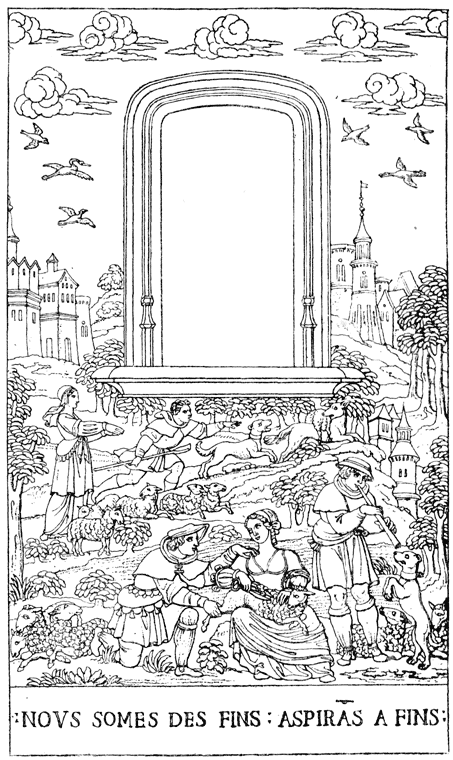
NOVS SOMES DES FINS: ASPIRĀS A FINS
CARVING FROM THE TURRET OF THE MAISON BOURGTHEROULDE
Turning to the other side of the tower, the carving beneath the
highest window represents a jovial picnic under the same idyllic
conditions. Out of a big bowl placed on a tree-stump, a shepherdess
helps her lover with a spoon, another man makes his dog beg for a
morsel of the food; music is provided behind by a self-sacrificing
person with the bagpipes, and a fourth shepherd stands in the distance
with some sheep, like a martyr to his duty. The window beneath this is
decorated with a sheep-shearing scene, which I have reproduced from
the outline drawing by E.H. Langlois, published by Delaquérière in his
"Description Historique des Maisons de Rouen" (Paris: Firmin Didot.
1821). The presiding shepherdess carries on her work with the usual
embarrassing distractions. By her side a musician plays his hautbois
to a dancing dog. Just behind them a spirited chase after a marauding
wolf is in full cry; more houses, clouds, and birds complete the
picture. The motto is "Nous somes des fins: aspirans a fins." The last
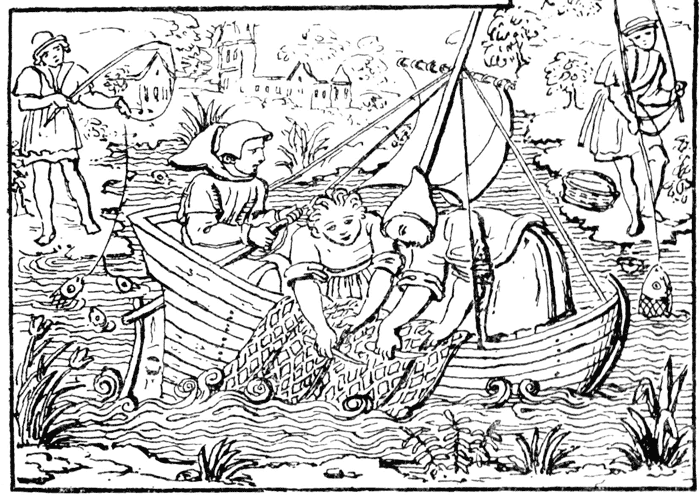
scene represents men fishing, some with nets out of a boat, others on
land with various uncouth patterns of fishing-rod; everyone appears to
be making a fine catch, but the extraordinary occurrence on the bank
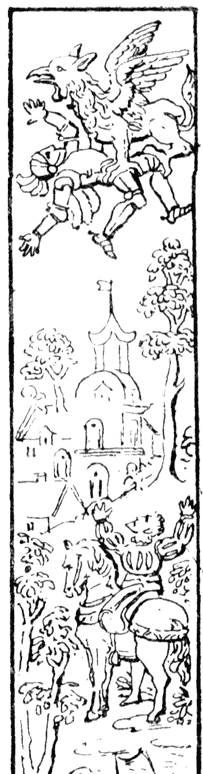
will entirely divert your attention from the fish; for a knight, who
had evidently ridden down to see the sport, has been snatched out of
his saddle by a burly flying griffin, and his servant looks
frantically after his disappearing body in the clouds. Untroubled by
these strange events, a young woman walks calmly towards the castle, a
little further on, carrying a basket of eggs and butter on her head,
and above her some new kind of osprey flies away with a protesting
pike. [See page 361.]
As carvings, these charmingly naïve representations of country life
break absolutely every rule that is supposed to govern the art of
sculpture. Their relief is very slight indeed, they have no definite
limits, for they wander vaguely round the windows, with trees and
running water and clouds and birds and houses all on the same plane,
and all with equal "values." I have not the slightest doubt that just
as the Field of the Cloth of Gold was copied from a historical
tapestry of the event, just as the Triumphs of Petrarch were copied
from tapestries that might well have decorated the town of Ardres on
the occasion of the royal meeting, so these window decorations, which
betray their origin even more than the carvings on the other wing,
were taken direct from tapestries which may have been at Ardres in
June 1520, and certainly might have been seen in any great château of
the period. Their very position on these walls is very like what
tapestries were so frequently used for in the lavish mural decoration
of the time. Every house hung out its best embroideries and tapestries
and gaily coloured cloths; and the way in which these windows break
into the background of each design represents the very probable result
of draping a long piece of tapestry round the window of a house. The
Château of Blois is known to have contained just such "bergeries" in
the rooms of Anne of Brittany; at another château in Touraine, the
Chaumont of Georges d'Amboise (the friend of the builder of this house
in Rouen), may be still seen needlework, in pink and old rose, of
country scenes, in the rooms used by Catherine de Médicis. Finally, in
the inventory of the tapestries of Philip the Bold of Burgundy, drawn
up soon after his death, you may read such entries as the following:—
"Ung autre petiz tapiz de bergerie, sur champ vert, semé de
bergiers et de bergières ... ung autre vielz tapiz de haulte
lice ouvré de jeunes hommes et femmes jouans de plusieurs
jeux ... arbres, herbaiges, ciel fait à faucons."
This might really represent the original needlework from which Abbé
Leroux chose the subjects for his carving, and that the origin was
some tapestry of this fashionable kind I see no reason to doubt,
especially in the town which preserves in the Church of St. Vincent
some of the finest sixteenth-century tapestries in France.
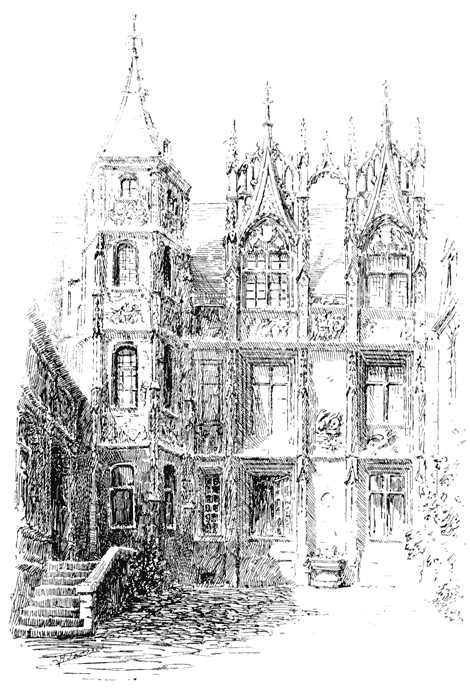
INNER FAÇADE OF THE MAISON BOURGTHEROULDE.
The flat textile kind of carving all over the house, which rises to
excellence of workmanship in relief only in the meeting of the two
kings, lends itself irresistibly to the same conclusion. And for this
reason I have not that extravagant admiration of it, viewed purely as
work of art, which may be better reserved for conceptions that are
more original in the mind of the sculptor, and of more local interest
in the town for which the work was done. As an example of the passion
for processions and decoration, however, few better could have been
chosen in Rouen than this Maison Bourgtheroulde, and I have therefore
dilated on it at some length, to emphasise the spirit of life and
colour that is the main subject of this chapter. But a far more
important reason for these details is the fact that the Field of the
Cloth of Gold carved on this gallery, is of the greatest value and
interest to all Englishmen as one of the few representations of that
famous pageant which exist either in England or out of it.
The only place near London where it can be conveniently studied is in
the gallery of Hampton Court Palace. In that collection you may see,
in No. 337, Henry's embarkation from Dover on the 31st of May in the
Great Harry or Henri Grace de Dieu, as she had been "hallowed" in
1514. And in No. 342 is a large painting 5½ feet high by 13 feet, 3
inches long, of this meeting of the kings between Guinea and Ardres,
which confirms in a very remarkable way many of the details in the
Maison Bourgtheroulde. It is not by Holbein, though he is known to
have done similar work that has not survived, but may have been
painted either by John Browne or Vincent Volpe or John Cruste, all of
whose names are mentioned in connection with court pageants of the
reign. A small outline of this picture is very possibly connected
with our earliest notions of English history, for it is prefixed to
Mr Murray's edition of Mrs Markham's "England." Mr Ernest Law's
catalogue of the Hampton Court pictures gives further details in
connection with it, and for a longer description refers his readers to
the third volume of the State papers of Henry VIII., and to
"Archæologia," iii. 185-230.[68]
I cannot leave this subject without expressing the earnest hope not
only that our own National Portrait Gallery may soon be able to let
the public see some good reproduction of a scene that is of the
greatest historical interest, but that efforts may be made to secure
the better preservation of the original carvings in Rouen. The
connection between that city and England is of long standing. It was
the capital of those Norman dukes who conquered us at Hastings and
flooded us with their art, their learning, and their civilisation. It
was the most cherished foreign possession of our King Henry the Fifth,
who died too soon to wear the crown in Paris. It has been the especial
pilgrimage of our best historians and archæologists and artists almost
from that time until the present day. The "Monuments Historiques" in
which it is so rich are being worthily cared for by an enlightened
government, and I must believe that the sympathy and kindness extended
by every authority in Rouen towards a visitor who honestly confessed
his interest and carefully explored many of its inexhaustible
treasures, would be more than doubled if that interest were expressed
by some representative body like our Society of Antiquaries. That
society would once more deserve well of its country, in the interests
of both history and art, if it would come forward with some suggestion
either to the Ministre des Beaux Arts, or to the local authorities.
The Maison Bourgtheroulde is now in the safe hands of the Comptoir
d'Escompte de Rouen. Every English traveller goes there to change his
notes; and every Englishman must see with regret that the English
portion of these valuable carvings is the one that is most damaged.
This was inevitable from their position; but further injury can at
once be prevented by shielding them with glass. If these modest pages
which bring the subject before the notice of a somewhat wider, and
perhaps a more influential public, succeed in suggesting some movement
that will, I am confident, be welcomed in the best spirit by Frenchmen
on the spot, I shall feel that the "Story of Rouen" has not been told
in vain.
There is another house belonging to a famous citizen in Rouen, which
is very different, but perhaps even more characteristic of the place;
and with our walk towards it we may resume that discovery of the life
of the town which I am just now concerned that you should realise. To
reach the Maison Caradas you have a pleasant choice of paths. As you
stand outside the Maison Bourgtheroulde and look east towards the
Cathedral towers, the first street that goes south towards the river
is the Rue Herbière, on your right out of the Place de la Pucelle, and
that will bring you out by the Douane on the Quais. An even better way
is to take the Rue de la Vicomté, quite parallel to this, but further
east, which passes the western gate of St. Vincent, and is full of
interesting old houses from the Rue de la Grosse Horloge to the
river. As you pass down it now there are some wonderful old houses on
your right, and a fine courtyard at No. 25. Still a third choice is
the Rue Harenguerie, which takes the same direction from the south
door of St. Vincent, and by this I usually passed myself, for the sake
of weaving stories in my mind about No. 21, a house that Balzac would
have delighted to describe, with an open staircase in the corner of
its old courtyard.
The names of streets have often a fascination in themselves, and this
one has probably been called the same ever since the herring market
was set upon the quays in 1408. I wish I had had space to tell you
more of these old names, which nearly all preserve a little local
history, when they have not been stupidly and unnecessarily changed.
But you may take this as a type of what many another will suggest, and
in the laborious pages of the excellent M. Périaux you may discover
much more for yourself. The sale of herrings, which was always a large
and an increasing business on the northern coasts, was organised in
1348, and by 1399 a barrel of "harengs caqués" was sold for 110 sols.
"Brusler tout vifz comme harans soretz," says Rabelais, of the poor
regents of Toulouse University; and your salt herring from Guernsey,
Scotland, and Biscay was in much request at the old market on the quay
between the Porte St. Vincent and the Porte du Crucifix, where on
large tables and slabs of stone the fishwives hired places from the
Sergents de la Vicomté d'Eau to sell their eels from the Marne,
congers from La Rochelle, trout from Andelys, fresh herrings from Le
Havre. You may see the scene still in a stained-glass window of the
Cathedral, and you may well imagine the state of mind of the old
poet:—
"Nul n'orra toute la dyablerie
Ny le caquet de la Pessonnerie."
Like everything else, it was under holy patronage, and fishwives
prayed at the shrine of St. Julien l'Hospitalier, the saint whose
story Flaubert, another child of Rouen, has so wonderfully told. The
wags of the seventeenth century called these ladies "non angéliques
mais harangériques"; but on fast-days every burgess and innkeeper and
monk was glad enough to go to them; for was there not even an "Abbaye
aux Harengs" no further off than Mantes, and what better present could
the Archbishop think of sending to his friend the Archdeacon than 2000
salted herrings in a specially holy barrel?
All the sound of the chaffering and howling of prices has gone into
silence long ago in the old Rue Harenguerie of to-day, and you will be
glad to turn into more lively quarters by taking the corner to your
left, eastwards, down the Rue des Charettes. It is lighted up every
now and then by a break in the houses and a glimpse of the river to
your right, though it is more of masts and sails than water you will
see. As you walk along, the name of a street that turns northwards on
your left hand should be familiar if you have followed me thus far;
for it is called Jacques Lelieur, as is only right and proper, to
commemorate the name and fame of one who did a great deal of good in
the Rouen of his own day, and has made it much more interesting to
ours. His house is No. 18 in the Rue Savonnerie, which continues the
Rue des Charettes in the same direction, and you will know it by the
tablet on the wall. It has two fine gables with excellent woodwork
upon the street-façade; though showing slight traces here and there of
restoration, it was well worth keeping in good order as the house of
an artistic burgess of the sixteenth century who lived up to his
position in the town.
To Jacques Lelieur we owe it that I am able to show you part of the
most complete representation of a town in 1525 which is known to
exist. For he drew the course of the various fountains and
water-conduits in Rouen, not only in plan, but adding the elevation of
the various houses, as may be seen on map F in Chapter IX., so that
you may actually walk down every street and see what he saw three
hundred and seventy years ago. All that part which was lucky enough to
be comprised in his plan of the waterworks is accurately preserved in
his naif and faithful drawings, in which the scaffoldings are put in
as carefully as the finished buildings. The rows of gables that occur
so often are not quite planed away into rectilinear dulness yet, as
you may see along the Rue des Faux, or even Eau de Robec here and
there. But the greater part of what he drew is only a melancholy
memory, and the background of the old life of Rouen can only be
recalled from his drawing now to frame some such sketch as the present
one of the inhabitants who have vanished with it. The view of the town
at the end of this chapter contains a little microscopic vignette in
the centre showing the artist presenting his famous Livre des
Fontaines to the civic dignitaries. It is on four long bands of
parchment, of which the Hôtel de Ville carefully preserves one, and
the fourth is in the City Library. The drawings are done in black ink,
with the houses coloured a pale yellow, the roofs shown with red tiles
or bluish slates, the grass touched with yellowish-green. Besides
being a secretary and notary of the Royal Courts, Lelieur held office
in the town as councillor, sheriff, and finally President of the
General Assembly in the absence of the bailli and lieutenant in 1542.
He was crowned for his poem in the famous poetic tourney of the Puy
des Palinods de Rouen, and he owned two or three fine estates outside
the town.
The object of our little pilgrimage is nearly reached now, and after
you have admired the carvings on the front of No. 41, stop at the
quaint dwelling marked 29. This is the Maison Caradas, and its
position at a corner with the open space of the river beyond it
enables you to see it well all round. The slope of the ground upwards,
which I noticed in earlier chapters, is especially pronounced here,
and shows how much embankment had to be done before the town was
really rescued from the swamps and mud-flats of the Seine. The fashion
of building each upper storey to overlap the one beneath is very
evident here, and the effects I suggested in the last chapter may be
vividly realised; as Regnier[69] puts it with his usual frankness:—
"Et du haut des maisons tomboit un tel dégout
Que les chiens altérés pouvoient boire debout."
This is one of the houses drawn in Lelieur's book at the corner of the
Rue Tuile, with the Fontaine Lisieux near it, that is now merely a
grotesque ruin of its former splendours. So much uncertainty is
exhibited by the best local authorities as to the real owner of the
Maison Caradas that I shall not pretend to solve the problem here. It
is clear, however, that the word is a surname, or one of the by-names
so common in the first years of the sixteenth century when this was
built; and it is possible that it preserves one more suggestion of the
connection between Rouen and Spain, and means "amiable," as in the
phrase, "Bien o mal carado." For the root of the word is evidently in
the Greek χάρις, and is found in the Gaelic "cara" (the
friend or ally), and the Breton "Caradoc," who was the Caractacus of
Roman days.
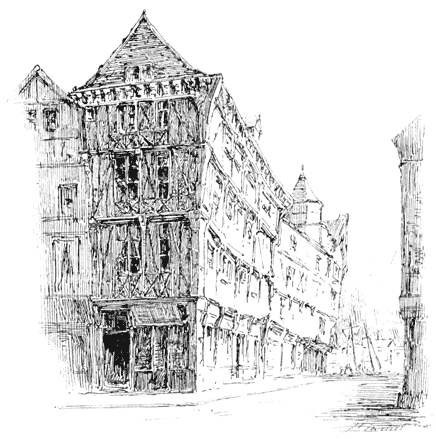
THE MAISON CARADAS IN THE RUE SAVONNERIE
If you will follow me a little further in the same direction, as the
Rue de la Savonnerie becomes the Rue des Tapissiers, you will find the
corner of the aged Rue du Hallage on your left marked by an ancient
parrot in a decrepit cage. He has been living there for so long that
he is certain to be there to blink at any new arrival in the next half
century, and as you pass him you will remember the parrot who was
discovered in Central America, full of years and knowledge, in a
village where not a single inhabitant understood what the bird said.
He had been found among the ruined houses of a people who had vanished
utterly, and he had become the sole repository of syllables that have
been never heard elsewhere. If anyone could really understand him, I
have often fancied that this faded bag of feathers at the corner of
the Rue du Hallage could use the most astonishing language about the
things that he has seen, for he could hardly be in a better place in
Rouen than this strange street that crawls beneath shadowed archways
to the Marché aux Balais and the Rue de l'Épicerie. It takes its name
from the Maison du Haulage, where the merchants paid town dues upon
their goods, and a few steps further in the Rue des Tapissiers will
bring you to the Halles themselves, to which you enter through a huge
black archway that gapes upon the Place de la Basse Vieille Tour. Upon
the left are some of those old "avant soliers" which you have seen in
Jacques Lelieur's drawing of the Place du Vieux Marché, the covered
causeways formed by projecting walls propped up by heavy timbers.
There is much hideously vulgar modern decoration to spoil the full
effect, but the main outlines of the old building are all there, and
you may imagine what it looked like for yourself.
On each side, as you enter the dark tunnel, great warehouses stretch
out to right and left, still on the same spot where Charles V. gave
Rouen the Halle aux Drapiers in 1367. Since then they have been
constantly filled and constantly rebuilt. Beneath your feet are
immense vaults that have been used since 1857 for storing oil and
goods under warrant, and in the South Hall are piled the famous
"Rouenneries" and coloured cottons, and those "draperies" which have
been famous almost since Edward the Confessor allowed the Rouen
merchants to use his Port of Dungeness, and the town was granted the
monopoly of the Irish trade, with the exception of one ship a year
from Cherbourg.
When Warwick the Kingmaker made a memorable visit to Rouen in 1467 as
an ambassador, King Louis XI. ordered the town to furnish the English
with all they wanted at his expense, with the result that "tous les
gens de l'ambassade s'en retournèrent chez eux, vêtus de damas et de
velours, et de ces draps fins et précieux qui asseurent au commerce de
Rouen la supériorité sur toutes les villes du royaume." That
"superiority" lasted well through the sixteenth century, and when
Huguenots fled from Rouen to Westminster and Rye and Winchester, they
were nearly all cloth-makers and silk-weavers. Such names as the Rue
aux Anglais, the Rue aux Espagnols and others preserve the memory of
commercial ventures that are even more picturesquely suggested by the
ships carved here and there upon old house-fronts in the town. Nor did
Rouen commerce stop at England, Spain, Portugal, Ireland, Flanders, or
other countries of the old world. Her citizens, as we have seen, had
known long ago a "King of the Canaries," and it was no doubt at the
suggestion of either Spanish or Portuguese companions that Rouen ships
sailed on towards the Guinea Coast, to the Cape Verde Islands, and
"the Indies," even across the Atlantic to Brazil, whence they brought
back the rare wood called by Jean de Lery "araboutan."[70]
Though various "savages" were seen there earlier, the most famous
occasion of the appearance of real Brazilians in the streets of Rouen
was the particularly magnificent reception given by the citizens to
Henri II. and Catherine de Médicis in October 1550. They were
accompanied by Marie de Lorraine, daughter of the Duc de Guise and
Queen-Dowager of Scotland, who met at Rouen her little daughter Marie
Stuart then eight years old and receiving a perilous education at the
French Court which she was soon to rule during the short reign of
François II. Marguerite de France, daughter of François I. was there
too, and Diane de Poitiers, just over fifty years of age, who
maintained over the King the same influence she had exercised over the
Dauphin when she first came to Court from Normandy. It is interesting
to note that her nephew Louis d'Auzebosc was pardoned by the Fierte
St. Romain seven years afterwards.
Besides the "théatres" and "Mystères," which you will remember were
presented to François I., the citizens determined that in case
mythology and symbolism had lost their pristine charms, an absolutely
novel entertainment should be given to the King on this occasion. So
on the fields between the Couvent des Emmurées and the left bank of
the Seine a great sham fight was arranged between a number of Norman
sailors and fifty "Brazilian savages" of the newly discovered tribe of
Tupinambas, "naivement depinct au naturel," which may be understood as
"clad only in their own skins and a few stripes of paint." They must
have felt the climate of Rouen in October slightly raw, but no doubt
the sham fight kept them warm, and everything seems to have gone off
very pleasantly. The ladies were especially interested in these
unknown creatures, and the King devotedly displayed the triple
crescent of his lady Diana throughout the entire performance. There
was much singing of anthems and decoration of the streets, but the
Indians were evidently the "pièce de resistance."[71]
Besides the music in the town, of which I reproduce an example at the
end of this chapter, an entertainment was provided for the King and
Queen and all the ladies in the great Palais de Justice, with which
those rogues, the gay members of the "Basoche," must have been
heartily in sympathy. For Brusquet, the Court jester, went into the
Advocate's Box, and before the Queen upon the seat of justice, with
all her ladies round her, he pleaded several important causes both for
the prosecution and for the defence, "et faisait rage d'alleguer loix,
chapitres, et decisions, et luy croissoit le latin en la bouche comme
le cresson à la guelle d'un four," the whole being a satire on the
well-known Norman passion for a lawsuit, which was appreciated as
much by the good people of Rouen as by their royal visitors.
But to finish this chapter with a glimpse of the people themselves, I
must take you back to that old Rue du Hallage, in which our memories
of Rouen's trading voyages suggested the festivities of this royal
entry. And I can imagine few greater contrasts than that from the
spacious courtyard of the Palais de Justice to the view of the queer
twisting streets and common habitations that you will get by standing
in the Place de la Calende and looking down the Rue de l'Épicerie
towards the river. As you wander down it you must look at No. 14, an
excellent type of early sixteenth-century building, with its old
figured tiles and high gable, and the division between the ground
floor and the next storey strongly marked by carvings and brackets.
You are now not only in a typical part of the old city, but on ground
that has borne the name since the fourteenth century, and earned it
(as did the Rue Harenguerie) from the kind of commerce carried on
there. You have already passed the Rue des Fourchettes on your right,
and a little further on is a still more fascinating name, the Marché
aux Balais, where brooms were sold in 1644, after their modest
commerce had been forbidden near St. Martin sur Renelle. On one of the
small houses round it is the date 1602, and near it the carving of a
salamander, which evidently gave its name to the Rue de la Salamandre,
which had originally been known as "Mauconseil" ever since 1280, a
name that is almost as appropriate to its darkness now as "Salamandre"
must have been suggestive of its condition in the sixteenth century.
It needs very little imagination to conceive amid these surroundings
just such a "Cour de Miracle" in Rouen as Victor Hugo described in
Paris. And, indeed, it is but quite lately that a conglomeration of
tottering and leprous houses, without owners, and never entered by the
police, was torn down. The Rue Coupe-Gorge, the Rue de l'Aumône,
especially the horrible Clos St. Marc, have not long been swept away.
Every cellar and every attic seemed to communicate by tortuous and
filthy passages with the next. No visitor was admitted who had not the
hallmark of crime visibly upon him, or was not a member of that
loathsome confraternity of thieves and beggars who lived by their
raids upon society at large.
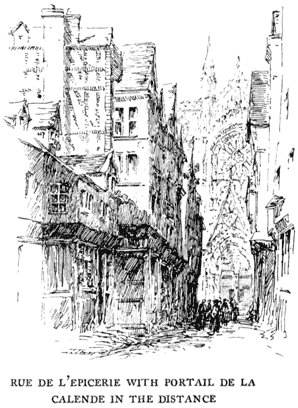 Straight out of the Marché aux Balais the Rue du Hallage burrows under
the ancient houses towards the river, hemmed in by walls on all sides,
that catch up every breath of air that moves, and shut out nearly all
the light. The backs of its crowded dwellings you can see from the
great square into which the Rue de l'Épicerie directly leads, the
Place de la Haute Vieille Tour, where you must go forthwith and see
the beautiful little building that was set up for the great ceremony
of the Fierte St. Romain.
Straight out of the Marché aux Balais the Rue du Hallage burrows under
the ancient houses towards the river, hemmed in by walls on all sides,
that catch up every breath of air that moves, and shut out nearly all
the light. The backs of its crowded dwellings you can see from the
great square into which the Rue de l'Épicerie directly leads, the
Place de la Haute Vieille Tour, where you must go forthwith and see
the beautiful little building that was set up for the great ceremony
of the Fierte St. Romain.
This was the ceremony that gave their one great day in all the year to
the drowsy archways of the Rue du Hallage; for the Marché aux Balais
and the Rue Salamandre and the Rue de l'Épicerie itself, were all
crowded to suffocation. Every Ascension-tide, from the reign of the
Norman dukes until the Revolution, not these streets only, but every
window in the houses, and the very roofs above, were crammed with
people waiting for the great annual procession in which the prisoner
was set free. I have quoted many extracts from the records kept by the
Chapterhouse of these occasions, because the list has provided typical
instances of men and manners in Rouen from the thirteenth century
onwards. And I can close my tale of the most brilliant portion of
Rouen's history in no better way than by suggesting to you something
of the interest and the excitement created by a processional ceremony,
which may itself be taken as typical of the people's life.
From the earliest hour at the breaking of the dawn of Ascension Day,
the whole of Rouen was thinking and talking of nothing else except the
prisoner, and in every quarter of the city the interest in him took a
different form. All the countryside of Vexin and of Caux had trooped
into the town with women and children in their Sunday best. From the
attic windows of the Rue de l'Épicerie girls in flapping white
head-dresses leant across the road and screamed their good fortune to
the neighbours opposite; for these were some of the best places to see
the ceremony, and in 1504 the crowd who scrambled for them was so
great that the roofs fell in. The open square itself was gradually
filling up; the gay Cauchoises who were chambermaids at the Auberge de
la Herche were doing a roaring trade; soldiers of the Cinquantaine in
green velvet doublets were taking their morning draught at the Trois
Coulombs, before each man shouldered his arquebus and went off to keep
his guard; even the Crieurs des Trépassés had come out into the light,
their strange black cloaks all sewn with silver skulls. At last eight
o'clock struck, and there was a general movement towards the Parvis,
for the luckiest in the front rows of the crowd could look through the
Chapterhouse door and actually see the preliminary meeting of the
canons about the choice of their prisoner. But the door was soon shut,
and at last the crowd could only hear the solemn notes of the "Veni
Creator" sounding from within, as the good ecclesiastics prayed for
divine direction in their solemn office. At last a name was written
down, sealed up and given to the Chaplain de la Confrèrie de St.
Romain, who passed solemnly out with the fatal missive in his hand,
and the canons at once proceeded to fill up the interval of waiting
with a huge dinner.
Followed by a number of the citizens the chaplain took his way towards
the Palais de Justice. There, too, ever since eight o'clock everyone
had been extremely busy. Two by two the members of the High Court of
Parliament in their scarlet robes had marched out of the Council
Chamber, with their four state officials in violet preceding them, and
a guard of the Cinquantaine before. In this chapel they all heard the
"Messe du Prisonnier," and then sat down to the enormous repast called
the "Festin du cochon," with which (on a smaller scale), every public
body and every household in Rouen fortified themselves for the doings
of that splendid day. By the end of dinner the chaplain and his cartel
had arrived, and the whole courtyard of the Palais was ringed with
crowds of people. Accompanied by his Prévôt and four other members of
the Confrèrie St. Romain, the chaplain was escorted into the great
hall, the name was solemnly read out, and the officials of the
Parliament went to the particular gaol in which the prisoner happened
to be kept. Bareheaded, with his irons still upon one leg, the man was
brought quickly to the Conciergerie, that his name might be
enregistered as a formal prisoner of the Palais; for all the legal
bodies were particularly touchy about their own prerogatives. When a
man could not walk he was carried, as was Antoine de Lespine in 1602,
who had been wounded in a duel two days before, and could only be got
to the Conciergerie in a clothes-basket.
After certain solemn preliminaries the prisoner was brought into the
great hall, and while all the councillors stood up he knelt before the
president to receive admonition for his past sins and pardon for the
future. Still bareheaded, he was then led out by the "huissiers" of
the court through the great open space in front, and as his foot
touched the pavement of the street beyond, a signal set the great bell
Georges d'Amboise ringing from the Cathedral tower. At the sound,
every steeple in Rouen rocked with answering salutations. "Rura jam
late venerantur omen." From every parish church for miles round the
ringers, waiting for the "bourdon's" note, sent out a joyful peal in
chorus, and every villager drank bumpers to the prisoner's health.
Himself, a little dazed we may imagine with this sudden tumult in the
streets and in his heart too at deliverance from death, he marched
along with the arquebusiers beside him, through a cheering crowd
towards the old Halles. There the authority of the law let go its
grip, and he was handed over to the chaplain and the deputies of the
Confrèrie St. Romain, who took him to an inner room. There he was
given refreshment, his chains were struck off and wound round one arm,
and he was dressed in fresh clothes.
Meanwhile, after the Cathedral choir had sung a solemn Te Deum, the
great procession of the church had moved out of the Portail des
Libraires, chanting in mighty unison "Christe quem sedes revocant
paternæ," down the Rue St. Romain to the western gate of St. Maclou,
where choir-boys met them bearing lighted candles and swinging
incense. And the chaplain brought the prisoner out into the Place de
la Haute Vieille Tour, and leading him up the right-hand steps of the
Chapelle de la Fierte, presented him to the mass of people in front
just before the procession arrived from the Cathedral. So he knelt
bareheaded and kissed the holy shrine which two priests had borne up
to its place; the Archbishop addressed him in the hearing of his
fellow citizens, and before them all he made confession, receiving his
absolution as he raised the shrine of St. Romain thrice by its bars
upon his shoulders, while all the people cried "Noël! Noël!" Then a
confrère de St. Romain put a garland of white flowers upon the
prisoner's head, and holding one end of the shrine himself he gave the
prisoner the other, and all men put themselves in order for the march
back up the Rue de l'Épicerie to the Place de la Calende and so to the
Parvis and the western gate of the Cathedral.
As the first notes of the "Felix Dies Mortalibus" were chanted by the
priests, a hundred and twenty poor orphans moved forward, each
carrying in one hand a wooden cross all wreathed with flowers and in
the other a great loaf of bread. Behind them came the shrines of all
the saints whose churches guarded Rouen, each with the Confrèrie over
whose interests they watched; St. Blaise with his wool-merchants, St.
Jean with the orange-sellers, St. Sebastien with the hatters, and many
more; each marching confrère wreathed in flowers, and every shrine
attended with its special banner and its priests and candles. These
were followed by the archers of the Cinquantaine, and the banner of
their great Dragon, who appeared again upon a lofty pole, swallowing a
fish; by a band of sweet music and of singers chanting melodiously
their "cantiques and motets"; by all the burgesses of Rouen walking
decorously two by two; by the choir-boys of the Cathedral and two
hundred of the clergy, the canons in violet, and the greater
dignitaries in soutanes of red silk; by the officiating canon, and
lastly by the Archbishop himself, blessing the people as he went
along.
As the chanting died away, after a short interval came the beadle all
in violet livery bearing the great "Gargouille" of the town, and
followed by a rabble of laughing, screaming lads in motley, swinging
bladders, and throwing flowers and cakes about the street—that note
of ribaldry without which no such procession was complete—and then
came suddenly a silence, for the most holy shrine of St. Romain passed
by, borne by the prisoner and a priest. The last seven prisoners
followed him, bareheaded and with torches. And then the laughter and
the cheering broke out again as more burgesses tramped along with
bouquets in their hands, and young girls all in white with garlands of
flowers about their bosoms scattered blossoms on the bystanders, and
more guards and soldiers closed up the procession and kept the crowd
from breaking through its ranks.
By this time the first line had reached the Parvis, and as the voices
of two priests singing on the summit of the Tour St. Romain floated
down upon the people, all men passed in through the Portail de St.
Romain of the Western Front, under the great shrine held crosswise, so
that all who went beneath received the blessed influence. When
everyone had entered, and the shrine was once more on the High Altar,
the Grand Mass was sung, and the prisoner was once more publicly
exhorted by the Archbishop, before he was taken away again by the
Confrèrie St. Romain to a great feast in the Master's House which was
the real celebration of his return to freedom.
The life of a sixteenth-century French town has often been described
before, but I am particularly fortunate in being able to sketch you
something of what went on in Rouen, not merely with the background of
Lelieur's drawing, but even with the sound of the music which was
heard in her streets; and, if I mistake not, the one is as unknown to
English readers as the other. It has been said that Guillaume le
Franc, a musician of Rouen, actually composed the tune known as the
"Old Hundredth," originally set to the 134th Psalm in the Geneva
Psalter, and used by English Protestants for the 100th about 1562. It
was Händel's opinion that Luther composed it, and to Claude Goudimel,
who was assassinated in the St. Bartholomew of Lyons, the honour has
also been attributed; but local patriotism insists upon le Franc, and
after reading the specimen of local musical talent I shall give you, I
believe you will be readier to allow that Guillaume le Franc may have
done what his fellow-citizens believe.
 The madrigal I have printed here was written in a rare old book I
found in the Library of Rouen.[72] It was most kindly copied out for
me on the spot by M. Baurain, and Mr J.A. Fuller-Maitland was so good
as to decipher the ancient notation and provide me with a score that
anyone can play and sing to-day. He has also written the last
paragraph of this chapter, and with his learned explanation I may
leave you to the enjoyment of a song that has never been published
since 1551, and that will reproduce for you, for the first time since
then, the sound of the welcome given to Henri II. and Catherine de
Médicis as they entered their good town of Rouen in 1550.
The madrigal I have printed here was written in a rare old book I
found in the Library of Rouen.[72] It was most kindly copied out for
me on the spot by M. Baurain, and Mr J.A. Fuller-Maitland was so good
as to decipher the ancient notation and provide me with a score that
anyone can play and sing to-day. He has also written the last
paragraph of this chapter, and with his learned explanation I may
leave you to the enjoyment of a song that has never been published
since 1551, and that will reproduce for you, for the first time since
then, the sound of the welcome given to Henri II. and Catherine de
Médicis as they entered their good town of Rouen in 1550.
In the history of music this four-part song is interesting as giving
evidence of the general cultivation in music that must have prevailed
among the French people at the time. In the present day we are apt to
think of the madrigal or motet writers as a class of specialists
working at elaborate harmonic and contrapuntal problems for their own
delight, but as having little influence on the national acceptance of
music. Nothing could be further from the truth, as far as England, the
Netherlands and Italy were concerned; and in France, where the art of
the simple tunes of the troubadours represents for us the typical
national music of mediæval times, it is important to have a document
which shows as clearly as this does the kind of music which was
recognized as suitable for a great pageant. In style, the French
school of the sixteenth century differs not at all from that of the
Netherlands, of which it is generally regarded as an off-shoot (see
Grove, "Dict. of Music and Musicians," vol. iii., p. 267). In the
works of Pierre Certon, Claude Goudimel, and others, would be found
many compositions constructed on similar lines to the example here
given; that is to say, that the rules of madrigal writing are strictly
observed, although the preference for massive treatment of the opening
of each line seems to point to the use for which it was intended,
viz., to be sung in the open air. There are not many instances of
works of this class apparently meant for female voices only, and there
may have been some reason for this connected with the general plan of
the ceremony. The little piece is in the Dorian mode, and in the
original is clearly and correctly printed, in four separate parts on
the same double page. In scoring it, the accidentals, which do not
occur in the original, have been added in brackets. It is, of course,
impossible to surmise who may have been the author, but it is certain
that, whoever he was, he had attained to a remarkable skill in writing
effective music. If we consider the prescribed limitations in which he
worked, with nothing lower than the second alto part for his bass, it
is surprising to notice the sonority of sustained tone that is got by
skilful disposition of the harmonies, while the beautiful antiphonal
effect at the point "Vive le Roi" is of a kind that must appeal to
hearers of all classes and periods alike.
A WINDOW IN THE MAISON BOURGTHEROULDE, DESCRIBED ON PAGE 337

 The inner quadrangle, which you reach through the rooms of the Museum,
is the best thing it has to show. Remote from the dust and bustle of
the highway the little cloistered square is gay with flowers upon the
turf, and statues from various churches are set here and there, like
pensioners in Chelsea Hospital, after their active service in
religious wars has left them mutilated and useless, but not without
honour in the days of their old age. From the walls and windows
sculptured saints and angels look down with an air of gentle
approbation on the scene, and in the very middle a little bishop
raises his hand in benediction over pious strangers from the centre
of a rosebed.
The inner quadrangle, which you reach through the rooms of the Museum,
is the best thing it has to show. Remote from the dust and bustle of
the highway the little cloistered square is gay with flowers upon the
turf, and statues from various churches are set here and there, like
pensioners in Chelsea Hospital, after their active service in
religious wars has left them mutilated and useless, but not without
honour in the days of their old age. From the walls and windows
sculptured saints and angels look down with an air of gentle
approbation on the scene, and in the very middle a little bishop
raises his hand in benediction over pious strangers from the centre
of a rosebed.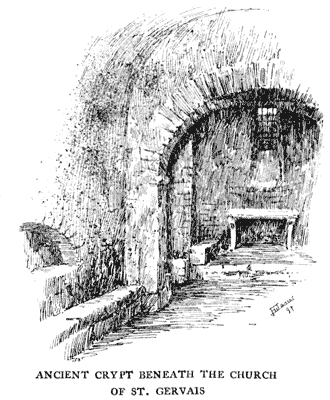 The cold and gloomy little pit is eleven metres forty long, by five
metres forty broad, and five metres thirty high, and in the recessed
arches above the tombs may still be traced the thin red bricks of the
Roman builders and their strong cement between. In the circular apse
opposite the tiny square-headed entrance is the high window, set in
the east, that we saw from the outside, and in the wall on each side
are two square recesses in which the sacred vessels were locked up.
The altar on its raised platform stands upon two rude upright stones,
and is marked with five small crosses incised upon its upper surface.
Behind it, on the rounded wall, are faint traces of carving and of
fresco. All round the walls, except at the altar and the entrance,
runs a low stone seat after the true type of the Christian Catacomb. A
flat projecting rib of stone divides the barrel roof of the nave from
the circular vault of the apse which slopes upwards to the rounded
summit of the tiny window. A few skulls lie in a shadowed hollow near
the altar, but the State has fortunately put a stop to any further
grubbing in the floor for corpses that should never have been
disturbed.
The cold and gloomy little pit is eleven metres forty long, by five
metres forty broad, and five metres thirty high, and in the recessed
arches above the tombs may still be traced the thin red bricks of the
Roman builders and their strong cement between. In the circular apse
opposite the tiny square-headed entrance is the high window, set in
the east, that we saw from the outside, and in the wall on each side
are two square recesses in which the sacred vessels were locked up.
The altar on its raised platform stands upon two rude upright stones,
and is marked with five small crosses incised upon its upper surface.
Behind it, on the rounded wall, are faint traces of carving and of
fresco. All round the walls, except at the altar and the entrance,
runs a low stone seat after the true type of the Christian Catacomb. A
flat projecting rib of stone divides the barrel roof of the nave from
the circular vault of the apse which slopes upwards to the rounded
summit of the tiny window. A few skulls lie in a shadowed hollow near
the altar, but the State has fortunately put a stop to any further
grubbing in the floor for corpses that should never have been
disturbed. The Christian bishops were the shield after Rome fell, between the
trembling conquered races and the first wave of conquering barbarian
invasion. The strength of their faith we have seen already in the
crypt of St. Gervais. This little altar, and the tiny shrine of St.
Godard watched infant Rouen from beyond its walls. An edict in 399 had
destroyed the rural temples of the old Pagan faith. About 450 a new
law recommended the conversion of the old temples within the towns
into churches. So in these years we may suppose that the first
building had risen on the site of the Cathedral, with St. Herbland's
earliest church in front, and upon other eyots in the Seine the
shrines of St. Martin de la Roquette, St. Clément, and St. Eloi. When
Julia Bona was finally deserted, Rouen became the home of a count, who
held, under Clovis, administrative, judicial and military power. By
the next century the town must have grown to a considerable size and
importance. Yet there is absolutely nothing of Merovingian Rouen left
except the few poor ornaments in the glass cases of the Musée des
Antiquités. Here you will see some of the characteristically shaped
bronze axe-heads of the period; but by far the larger part of what is
left is woman's gear. Beside the axes there are a few lance and
arrow-heads; but the finger rings (still on the bones that wore them)
are numerous; there are necklaces too, and bracelets; nails and
buttons, styles for writing, pins, needles, combs, and pottery. By
such pitiful trifles that have survived the pride and strength of all
their owners, you may be fitly introduced to the next chapter in the
pageant of historic Rouen, the tale of Fredegond and Brunhilda.
The Christian bishops were the shield after Rome fell, between the
trembling conquered races and the first wave of conquering barbarian
invasion. The strength of their faith we have seen already in the
crypt of St. Gervais. This little altar, and the tiny shrine of St.
Godard watched infant Rouen from beyond its walls. An edict in 399 had
destroyed the rural temples of the old Pagan faith. About 450 a new
law recommended the conversion of the old temples within the towns
into churches. So in these years we may suppose that the first
building had risen on the site of the Cathedral, with St. Herbland's
earliest church in front, and upon other eyots in the Seine the
shrines of St. Martin de la Roquette, St. Clément, and St. Eloi. When
Julia Bona was finally deserted, Rouen became the home of a count, who
held, under Clovis, administrative, judicial and military power. By
the next century the town must have grown to a considerable size and
importance. Yet there is absolutely nothing of Merovingian Rouen left
except the few poor ornaments in the glass cases of the Musée des
Antiquités. Here you will see some of the characteristically shaped
bronze axe-heads of the period; but by far the larger part of what is
left is woman's gear. Beside the axes there are a few lance and
arrow-heads; but the finger rings (still on the bones that wore them)
are numerous; there are necklaces too, and bracelets; nails and
buttons, styles for writing, pins, needles, combs, and pottery. By
such pitiful trifles that have survived the pride and strength of all
their owners, you may be fitly introduced to the next chapter in the
pageant of historic Rouen, the tale of Fredegond and Brunhilda.

 With this last crime that part of the Merovingian tragedy with which
Rouen is connected comes to a close. Nor have I space here to follow
out the actors to the curtain's fall. In other pages their various
fortunes and their dark calamities may be followed to a conclusion.
The next chapter in the history of the town is that of the Northmen,
and of the founding of that mighty dynasty which was to spread its
rule across the Channel, and to gather the towns of England under the
same sceptre that swayed the citizens of Rouen. But before the coming
of the Northmen, there are a few more slight facts that I must
chronicle if only to explain the desert and the ruins that alone were
Rouen when the first pirate galley swept up to the quay and anchored
close to where the western door of the Cathedral now looks out across
the Parvis.
With this last crime that part of the Merovingian tragedy with which
Rouen is connected comes to a close. Nor have I space here to follow
out the actors to the curtain's fall. In other pages their various
fortunes and their dark calamities may be followed to a conclusion.
The next chapter in the history of the town is that of the Northmen,
and of the founding of that mighty dynasty which was to spread its
rule across the Channel, and to gather the towns of England under the
same sceptre that swayed the citizens of Rouen. But before the coming
of the Northmen, there are a few more slight facts that I must
chronicle if only to explain the desert and the ruins that alone were
Rouen when the first pirate galley swept up to the quay and anchored
close to where the western door of the Cathedral now looks out across
the Parvis.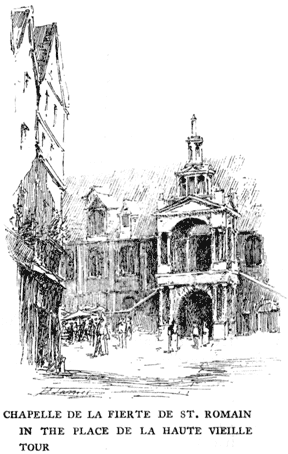 from its earliest days of civic
life until the chaos of the Revolution, in which the old order fell to
pieces and carried so many picturesque and harmless ceremonies into
the limbo where it swept away the ancient abuses of despotic monarchy.
For with the name of St. Romain, who enlarged St. Mellon's primitive
"cathedral" even more than St. Victrice had done, is connected one of
the most extraordinary privileges that any ecclesiastical body ever
possessed. The Chapter of the Cathedral of Rouen every Ascension Day
were allowed by the "Privilège de Saint Romain" to release a prisoner
condemned to death, who was then made to carry the holy relics of the
saint upon his shoulders in a great procession. The list of the
prisoners who bore the "Fierte Saint Romain"
from its earliest days of civic
life until the chaos of the Revolution, in which the old order fell to
pieces and carried so many picturesque and harmless ceremonies into
the limbo where it swept away the ancient abuses of despotic monarchy.
For with the name of St. Romain, who enlarged St. Mellon's primitive
"cathedral" even more than St. Victrice had done, is connected one of
the most extraordinary privileges that any ecclesiastical body ever
possessed. The Chapter of the Cathedral of Rouen every Ascension Day
were allowed by the "Privilège de Saint Romain" to release a prisoner
condemned to death, who was then made to carry the holy relics of the
saint upon his shoulders in a great procession. The list of the
prisoners who bore the "Fierte Saint Romain"
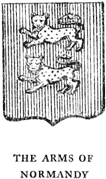 of emphasising the distinctions of blood and climate which were to be
the eternal bars against unnatural union. But the residuum of separate
nations was some time in making its appearance. Their various rulers
would not accept the inevitable without a struggle; and in that
struggle the only power that gained was the Church. France had no
sooner thrown off the German yoke than she professed obedience to her
great ecclesiastics. In Neustria the only life and strength left after
the Empire died was in the Church. For the land was but a waste of
untilled soil, sparsely inhabited by serfs, and divided among the
overlords, and of these latter the richest were the abbots and the
bishops, round whose palaces and monasteries clustered the towns for
their defence. But their temporal power was soon destined to decay.
The empire of the mind they might regain; their leadership of France
was lost the instant that the Northmen's ships appeared upon the
Seine.
of emphasising the distinctions of blood and climate which were to be
the eternal bars against unnatural union. But the residuum of separate
nations was some time in making its appearance. Their various rulers
would not accept the inevitable without a struggle; and in that
struggle the only power that gained was the Church. France had no
sooner thrown off the German yoke than she professed obedience to her
great ecclesiastics. In Neustria the only life and strength left after
the Empire died was in the Church. For the land was but a waste of
untilled soil, sparsely inhabited by serfs, and divided among the
overlords, and of these latter the richest were the abbots and the
bishops, round whose palaces and monasteries clustered the towns for
their defence. But their temporal power was soon destined to decay.
The empire of the mind they might regain; their leadership of France
was lost the instant that the Northmen's ships appeared upon the
Seine.

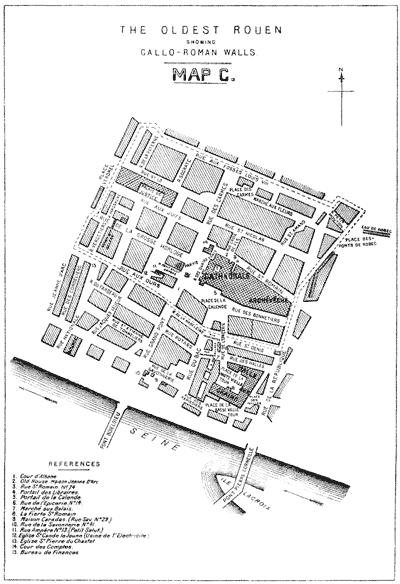

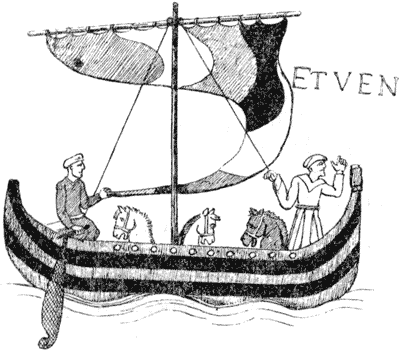

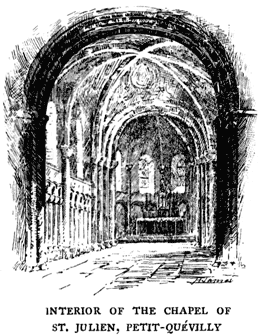 The little building, whose very isolation has perhaps helped to
preserve it, is now very justly classed among the best of the
"Monuments Historiques de France" in Normandy. There is no tower. On
the line beneath the roof round apse and nave, the corbels are carved
with the heads of hairy Franks and Saxons, according to the tradition
of the older Norman architecture at the Church of St. Paul's, which we
shall next visit, near the river. Near the western end, on the
northern exterior, is a dilapidated Madonna, and an old bricked-up
doorway. But it is the inside that will chiefly repay you for your
trouble. Through the triple portal of the west entrance, with plain
round arches set on slightly carved Norman capitals, you pass at once
into the nave. The whole effect is that which can be only given by
simple, honest, and good workmanship. The restoration was carried out
with a reverential conscientiousness that is far too rare, by M.
Guillaume Lecointe, and by him this precious relic of twelfth-century
architecture and art was given to the Commune of Petit-Quévilly. A
small arcade of engaged colonnettes goes right round the whole church;
the larger pillars have carved capitals, and there is the usual
conventional Norman moulding on the round arches.
The little building, whose very isolation has perhaps helped to
preserve it, is now very justly classed among the best of the
"Monuments Historiques de France" in Normandy. There is no tower. On
the line beneath the roof round apse and nave, the corbels are carved
with the heads of hairy Franks and Saxons, according to the tradition
of the older Norman architecture at the Church of St. Paul's, which we
shall next visit, near the river. Near the western end, on the
northern exterior, is a dilapidated Madonna, and an old bricked-up
doorway. But it is the inside that will chiefly repay you for your
trouble. Through the triple portal of the west entrance, with plain
round arches set on slightly carved Norman capitals, you pass at once
into the nave. The whole effect is that which can be only given by
simple, honest, and good workmanship. The restoration was carried out
with a reverential conscientiousness that is far too rare, by M.
Guillaume Lecointe, and by him this precious relic of twelfth-century
architecture and art was given to the Commune of Petit-Quévilly. A
small arcade of engaged colonnettes goes right round the whole church;
the larger pillars have carved capitals, and there is the usual
conventional Norman moulding on the round arches.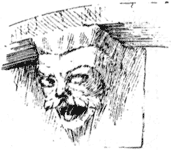
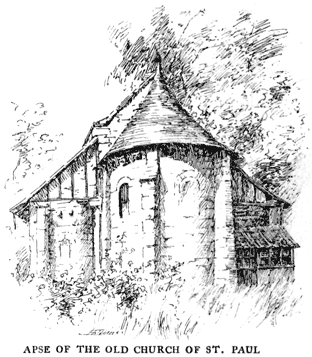 With these few relics the tale of Norman architecture in Rouen is
finished. From a short survey of this town alone, no one who had never
seen Caen or Coutances would imagine that he was in the duchy which
possessed a school of architecture that was developed into Notre Dame,
on the one hand, in the Ile de France, and into Durham, on the other,
in England. In our own island the architecture before the eleventh
century, which it supplanted, known as the Anglo-Saxon, was a
primitive Romanesque of purely Italian origin, as shown in
Bradford-on-Avon Church, which was built by Ealdhelm in Wessex long
before the Conquest. This is the only entire building of the earlier
style that we have, though the towers of Earl's Barton, of Bywell, of
St. Benets in Cambridge, remain to show its affinity to the styles of
Italy and Western Europe, and of the Campaniles. Even when the Norman
work first appears, it is not without a great deal of that Byzantine
element which is expressed by a spreading cupola and a central
lantern. But this early Norman building is very rare, and that is why
the three churches I have just described in Rouen have a value that is
scarcely realised by travellers who are in search for Gothic or
Renaissance architecture only. They are somewhat difficult of access
too, and little known, but they will repay a visit. They show the form
of the Latin cross, with little in its eastern limb besides the apse,
the choir beneath the central tower that replaced the Byzantine
cupola, and a little vaulting in the aisles. Originally they had a
flat ceiling for frescoes. This is a style that was neither that of
Southern Italy nor that of Aquitaine. It may have been a distinctively
national development of the Lombard schools of Pavia or Milan. But in
any case, though purely local at first, it utterly supplanted the
Primitive Romanesque that had hitherto been the common possession of
Western Europe, just as, in later centuries, the pointed style utterly
swept away the round arch in all its forms of expression. And in the
coming chapters it is with the pointed arch that we shall have more
and more to deal. To Italy, who imitated it helplessly, the Northern
Gothic never became even remotely national in its expression. The
native Southern Romanesque was there only appropriately replaced by
the really Italian style developed in the Roman Renaissance. But in
the North, where the early pointed arch had been at first only a
memory of Paynim victories, or a trophy of early Saracenic work, the
pointed style as a school of architecture was destined to triumph
immediately it rose from the position of mere ornament to the
necessity of a constructive feature. It was the problem of vaulting
over a space that was not square, which gave the pointed arch its
reason for absolute existence, its beauty of proved strength and
adequate proportion. Some of the noblest forms of its development are
to be found in the buildings we shall see later on in Rouen.
With these few relics the tale of Norman architecture in Rouen is
finished. From a short survey of this town alone, no one who had never
seen Caen or Coutances would imagine that he was in the duchy which
possessed a school of architecture that was developed into Notre Dame,
on the one hand, in the Ile de France, and into Durham, on the other,
in England. In our own island the architecture before the eleventh
century, which it supplanted, known as the Anglo-Saxon, was a
primitive Romanesque of purely Italian origin, as shown in
Bradford-on-Avon Church, which was built by Ealdhelm in Wessex long
before the Conquest. This is the only entire building of the earlier
style that we have, though the towers of Earl's Barton, of Bywell, of
St. Benets in Cambridge, remain to show its affinity to the styles of
Italy and Western Europe, and of the Campaniles. Even when the Norman
work first appears, it is not without a great deal of that Byzantine
element which is expressed by a spreading cupola and a central
lantern. But this early Norman building is very rare, and that is why
the three churches I have just described in Rouen have a value that is
scarcely realised by travellers who are in search for Gothic or
Renaissance architecture only. They are somewhat difficult of access
too, and little known, but they will repay a visit. They show the form
of the Latin cross, with little in its eastern limb besides the apse,
the choir beneath the central tower that replaced the Byzantine
cupola, and a little vaulting in the aisles. Originally they had a
flat ceiling for frescoes. This is a style that was neither that of
Southern Italy nor that of Aquitaine. It may have been a distinctively
national development of the Lombard schools of Pavia or Milan. But in
any case, though purely local at first, it utterly supplanted the
Primitive Romanesque that had hitherto been the common possession of
Western Europe, just as, in later centuries, the pointed style utterly
swept away the round arch in all its forms of expression. And in the
coming chapters it is with the pointed arch that we shall have more
and more to deal. To Italy, who imitated it helplessly, the Northern
Gothic never became even remotely national in its expression. The
native Southern Romanesque was there only appropriately replaced by
the really Italian style developed in the Roman Renaissance. But in
the North, where the early pointed arch had been at first only a
memory of Paynim victories, or a trophy of early Saracenic work, the
pointed style as a school of architecture was destined to triumph
immediately it rose from the position of mere ornament to the
necessity of a constructive feature. It was the problem of vaulting
over a space that was not square, which gave the pointed arch its
reason for absolute existence, its beauty of proved strength and
adequate proportion. Some of the noblest forms of its development are
to be found in the buildings we shall see later on in Rouen.
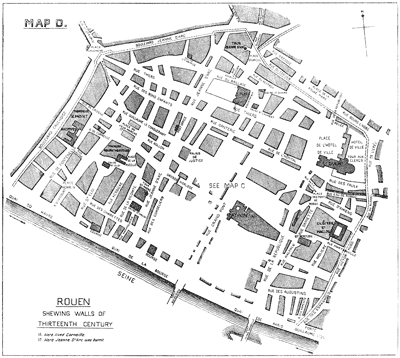
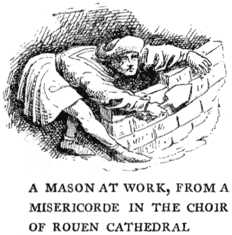 For the masons had gone to their new task with a will. Freed from the
thick and shadowy archways piled upon heavy piers, which had obscured
the old priestly and dogmatic Romanesque, the builders of the new
cathedral revelled in the new found Gothic of the people, and raised
their soaring arches to the sky, and crowned their pinnacles with
wreaths that flamed into the clouds. And upon every inch of wall they
wrote and wrought upon the living stone, "magistri de vivis
lapidibus," until every detail of the world of worshippers was
gathered up and sanctified by this expression of its new found
meaning, as a part of the mystery and the beauty of holiness.
For the masons had gone to their new task with a will. Freed from the
thick and shadowy archways piled upon heavy piers, which had obscured
the old priestly and dogmatic Romanesque, the builders of the new
cathedral revelled in the new found Gothic of the people, and raised
their soaring arches to the sky, and crowned their pinnacles with
wreaths that flamed into the clouds. And upon every inch of wall they
wrote and wrought upon the living stone, "magistri de vivis
lapidibus," until every detail of the world of worshippers was
gathered up and sanctified by this expression of its new found
meaning, as a part of the mystery and the beauty of holiness.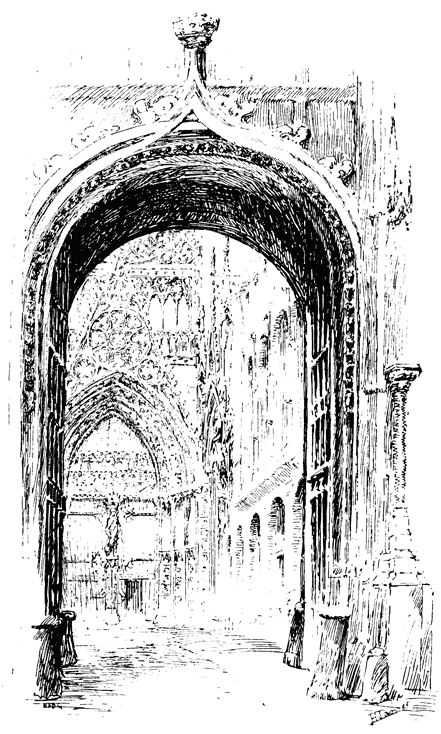
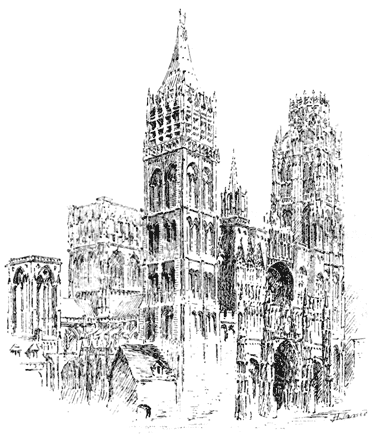
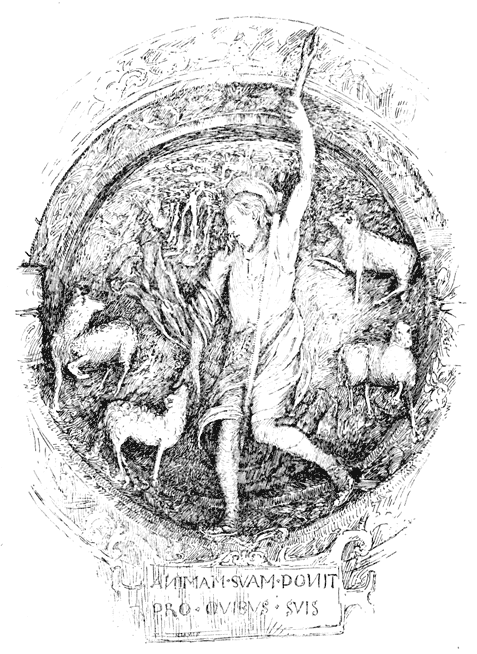
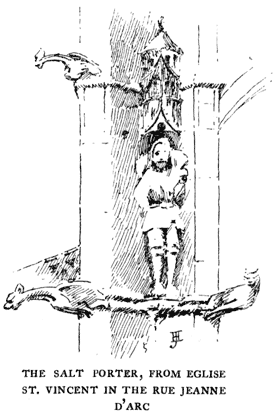 It was not merely in peaceful ways that the expansion of the civic
power may be traced at this time. For the long-drawn misery of the
Hundred Years' War began in 1337, and nine years afterwards the King
had to hurry to Rouen to oppose the advance of Edward III., who was
already at Caen and threatened the capital of Normandy. All the woods
of Bihorel, says the chronicler sadly, had to be cut down to make
"hedges and palisades" around the menaced city. After the defeat of
Cressy, the men of Rouen had a still sharper taste of the realities of
war, for the militia of the town, who had been hurried forward to
reinforce the broken army of the King, while their comrades at home
were strengthening the defences of Rouen, came up with an English
regiment near Abbeville, and contributed a heavy share to that loss
of "six thousand men of the communes" which Froissart chronicles.
It was not merely in peaceful ways that the expansion of the civic
power may be traced at this time. For the long-drawn misery of the
Hundred Years' War began in 1337, and nine years afterwards the King
had to hurry to Rouen to oppose the advance of Edward III., who was
already at Caen and threatened the capital of Normandy. All the woods
of Bihorel, says the chronicler sadly, had to be cut down to make
"hedges and palisades" around the menaced city. After the defeat of
Cressy, the men of Rouen had a still sharper taste of the realities of
war, for the militia of the town, who had been hurried forward to
reinforce the broken army of the King, while their comrades at home
were strengthening the defences of Rouen, came up with an English
regiment near Abbeville, and contributed a heavy share to that loss
of "six thousand men of the communes" which Froissart chronicles.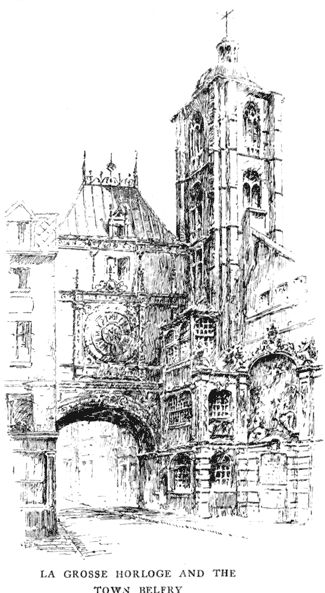 In a tumultuous and cheering crowd, the citizens poured towards the
centre of their civic life, in the Rue de la Grosse Horloge; Robert
Deschamps, the Mayor, was put to instant flight for daring to give
halting counsels, and his private prisons were broken open. "No King
can make the people," cried the mob, "but we are going to make a
King," and forthwith they seized on poor honest Jehan le Gras, a
quiet, seemly draper; they robed him in a cloak that had just served
its turn in the last Mystery Play, and they bore him in raucous
triumph to the open square before St. Ouen. "I forthwith abolish the
taxes!" stuttered the royal phantom in high dismay, while his subjects
cheered vociferously, and every market-place roared approbation. "I
deliver up the tax-gatherers to justice!" and in a trice every
tax-gatherer, and Jew, and usurer, and fiscal agent was haled towards
the bridge and there beheaded, till the Seine ran red beneath. "I
deliver up your cruel Mayors to justice!" went on the quavering
monarch, and forthwith five miserable men who had once been mayors of
Rouen, fled from the Rue du Grand Pont, from the Rue Damiette, and
from the Rue aux Gantiers, and took shelter in the nearest cemeteries,
while their burning houses lighted up the town. "I deliver up the
proud monks of St. Ouen to justice!" continued poor Jehan le Gras,
seeing that the mob had already begun to batter in the monastery
gates,
In a tumultuous and cheering crowd, the citizens poured towards the
centre of their civic life, in the Rue de la Grosse Horloge; Robert
Deschamps, the Mayor, was put to instant flight for daring to give
halting counsels, and his private prisons were broken open. "No King
can make the people," cried the mob, "but we are going to make a
King," and forthwith they seized on poor honest Jehan le Gras, a
quiet, seemly draper; they robed him in a cloak that had just served
its turn in the last Mystery Play, and they bore him in raucous
triumph to the open square before St. Ouen. "I forthwith abolish the
taxes!" stuttered the royal phantom in high dismay, while his subjects
cheered vociferously, and every market-place roared approbation. "I
deliver up the tax-gatherers to justice!" and in a trice every
tax-gatherer, and Jew, and usurer, and fiscal agent was haled towards
the bridge and there beheaded, till the Seine ran red beneath. "I
deliver up your cruel Mayors to justice!" went on the quavering
monarch, and forthwith five miserable men who had once been mayors of
Rouen, fled from the Rue du Grand Pont, from the Rue Damiette, and
from the Rue aux Gantiers, and took shelter in the nearest cemeteries,
while their burning houses lighted up the town. "I deliver up the
proud monks of St. Ouen to justice!" continued poor Jehan le Gras,
seeing that the mob had already begun to batter in the monastery
gates,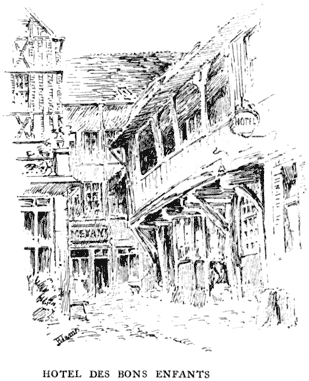 And you will pardon me that for a moment I have listened to that
muttered gossip, to the scandal that one old roof-tree whispered to
another whilst it leant across the narrow street, as some old woman
mumbles secrets to her neighbour with bleared eyes winking beneath her
shaggy brows. There was far more talking in the streets then than
there is now, especially in such crowded little passage-ways as this
old Rue du Hallage, a corruption from the Maison du Haulage where
taxes on the corporations and on goods sold in the market-halls were
levied. For in the fourteenth century for the 228,000 inhabitants of
Paris there were only twenty-four "hotels" and eighty-six "taverns,"
and the similar disproportion in Rouen was only made up for, in the
case of the "genuine traveller," by the unstinted hospitality of such
monasteries and hospitals as those at St. Catherine, St. Vivien, or
St. Martin.
And you will pardon me that for a moment I have listened to that
muttered gossip, to the scandal that one old roof-tree whispered to
another whilst it leant across the narrow street, as some old woman
mumbles secrets to her neighbour with bleared eyes winking beneath her
shaggy brows. There was far more talking in the streets then than
there is now, especially in such crowded little passage-ways as this
old Rue du Hallage, a corruption from the Maison du Haulage where
taxes on the corporations and on goods sold in the market-halls were
levied. For in the fourteenth century for the 228,000 inhabitants of
Paris there were only twenty-four "hotels" and eighty-six "taverns,"
and the similar disproportion in Rouen was only made up for, in the
case of the "genuine traveller," by the unstinted hospitality of such
monasteries and hospitals as those at St. Catherine, St. Vivien, or
St. Martin.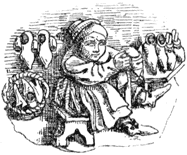
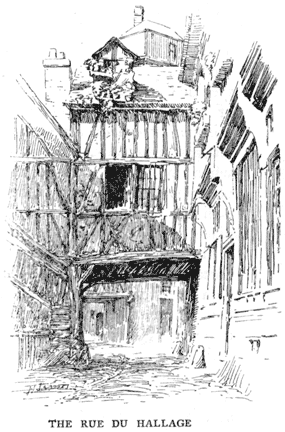 It had been recognised as early as 1269 that all previous crimes were
pardoned, for the act of pardon granted by the bailli to Nicole
Lecordier in that year speaks of him as "délivré franc et quite de
tous forfès ... quielz qil soient, del tens en arrière jusques au jor
dui." And by 1446 the charter of Charles VII., which is still
preserved in the archives of the Cathedral, announces in May of that
year that the prisoner who raises the Fierte "est absolz du cas pour
le quel il l'a levée et de tous crismes précédents." So that we reach
the astonishing proposition that the Chapterhouse of Rouen enjoyed a
far greater power than even the royal prerogative of mercy, which only
pardoned a specified crime; whereas the Chapterhouse by a kind of
baptism and regeneration from sin, started their prisoner afresh on a
new life without any reference to his past misdeeds. What this
involved I shall show when opportunity arises; but the release of the
accomplices as well as the prisoner was an even more extraordinary
extension of powers. It had already taken place before this test case,
in a tavern brawl in 1370, in the crime of two drapers in 1356, and in
a very important example when Guillaume Yon with another man of
Pavilly were released after the slaying of a butcher; and the Seigneur
d'Esneval gave sworn testimony that when a friend of the dead butcher
publicly called the accomplice in the crime "a murderer," that
accomplice would have been delivered up to justice if the principal
had not carried the Fierte. The retrospective action of the pardon on
the principal also extended to his accomplices, who began life afresh
just as he did. And this extension was solemnly confirmed at the
inquiry, from which I have just quoted. There is no doubt, however,
that so excessive a "prolongation" of the powers of pardon cannot have
been allowed throughout the whole history of the Fierte; for public
opinion could scarcely have permitted a gang of ruffians every year to
return to the full privileges enjoyed by their more honest comrades.
So at the end of the fifteenth, and again at the end of the sixteenth
century, we find it laid down that only those crimes named by the
prisoner should be pardoned, if the Chapter thought fit, and that only
those accomplices who appeared with him in the procession should
share in his pardon.
It had been recognised as early as 1269 that all previous crimes were
pardoned, for the act of pardon granted by the bailli to Nicole
Lecordier in that year speaks of him as "délivré franc et quite de
tous forfès ... quielz qil soient, del tens en arrière jusques au jor
dui." And by 1446 the charter of Charles VII., which is still
preserved in the archives of the Cathedral, announces in May of that
year that the prisoner who raises the Fierte "est absolz du cas pour
le quel il l'a levée et de tous crismes précédents." So that we reach
the astonishing proposition that the Chapterhouse of Rouen enjoyed a
far greater power than even the royal prerogative of mercy, which only
pardoned a specified crime; whereas the Chapterhouse by a kind of
baptism and regeneration from sin, started their prisoner afresh on a
new life without any reference to his past misdeeds. What this
involved I shall show when opportunity arises; but the release of the
accomplices as well as the prisoner was an even more extraordinary
extension of powers. It had already taken place before this test case,
in a tavern brawl in 1370, in the crime of two drapers in 1356, and in
a very important example when Guillaume Yon with another man of
Pavilly were released after the slaying of a butcher; and the Seigneur
d'Esneval gave sworn testimony that when a friend of the dead butcher
publicly called the accomplice in the crime "a murderer," that
accomplice would have been delivered up to justice if the principal
had not carried the Fierte. The retrospective action of the pardon on
the principal also extended to his accomplices, who began life afresh
just as he did. And this extension was solemnly confirmed at the
inquiry, from which I have just quoted. There is no doubt, however,
that so excessive a "prolongation" of the powers of pardon cannot have
been allowed throughout the whole history of the Fierte; for public
opinion could scarcely have permitted a gang of ruffians every year to
return to the full privileges enjoyed by their more honest comrades.
So at the end of the fifteenth, and again at the end of the sixteenth
century, we find it laid down that only those crimes named by the
prisoner should be pardoned, if the Chapter thought fit, and that only
those accomplices who appeared with him in the procession should
share in his pardon.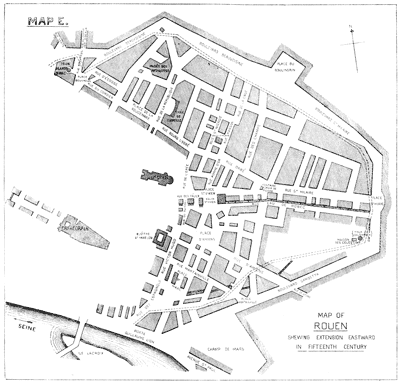
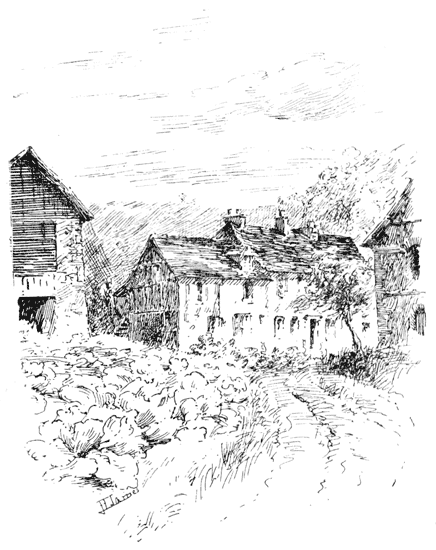
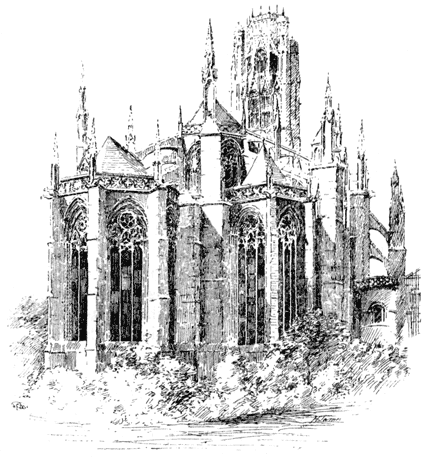
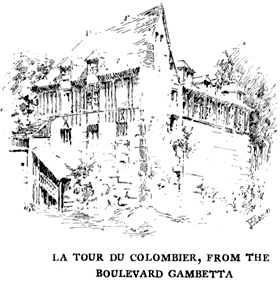 After the conquest of Rouen, one town after another fell into the
English hands. On September 23 in 1419, the last resistance in
Normandy was quelled at Château Gaillard. Mont St. Michael alone
remained free until the English domination ceased and France joined
her in her freedom. The King who took the city of Rouen was seen there
twice again. In 1421, with Catherine of France, his wife, he opened
the Estates of Normandy. In 1422 he was borne through Rouen on his
funeral bier; two months before the crown of France would have been
his.
After the conquest of Rouen, one town after another fell into the
English hands. On September 23 in 1419, the last resistance in
Normandy was quelled at Château Gaillard. Mont St. Michael alone
remained free until the English domination ceased and France joined
her in her freedom. The King who took the city of Rouen was seen there
twice again. In 1421, with Catherine of France, his wife, he opened
the Estates of Normandy. In 1422 he was borne through Rouen on his
funeral bier; two months before the crown of France would have been
his.
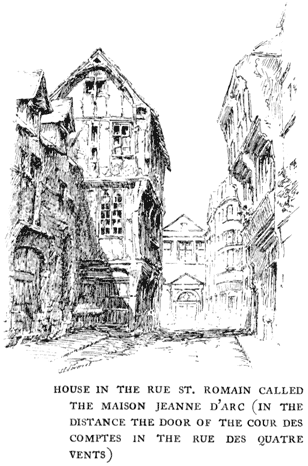 At the siege of Compiègne, on May 24, 1430, Jeanne d'Arc had been
taken prisoner by one of the men of John of Luxemburg, and from the
English camp at Margny she was sent further off to the Château of
Beaulieu. Within two days the Vicar-General of the Inquisition, and
the University of Paris, had demanded that she should be delivered
over to the "Justice of the Church." And behind both was a power
stronger than either, the hatred of the English. They soon found a
ready instrument in Pierre Cauchon, who had been made Bishop of
Beauvais by the Duke of Burgundy, was chased out of it by the party
of Charles VII., and now expected to get the Archbishopric of Rouen by
the help of the English. It was he who bore the King of England's
request to John of Luxemburg that he would give up Jeanne d'Arc for
ten thousand pieces of gold to the Church to be judged. Neither
Charles VII. nor any French ecclesiastic (save the Archbishop of
Reims) made any movement, so she was surrendered at the price of an
army. After being taken to Beaurevoir, to Arras, and to Crotoy, she
was moved by way of St. Valery, Eu, and Dieppe to Rouen. She entered
the town by the valley of Bihorel, past the spot where the Gare du
Havre now stands, and by way of the Rue Verte was led to the castle of
Philip Augustus and placed in an iron cage, so that the smirched
authority of English rule might be re-established by proving her, in
the formal processes of law, a witch.
At the siege of Compiègne, on May 24, 1430, Jeanne d'Arc had been
taken prisoner by one of the men of John of Luxemburg, and from the
English camp at Margny she was sent further off to the Château of
Beaulieu. Within two days the Vicar-General of the Inquisition, and
the University of Paris, had demanded that she should be delivered
over to the "Justice of the Church." And behind both was a power
stronger than either, the hatred of the English. They soon found a
ready instrument in Pierre Cauchon, who had been made Bishop of
Beauvais by the Duke of Burgundy, was chased out of it by the party
of Charles VII., and now expected to get the Archbishopric of Rouen by
the help of the English. It was he who bore the King of England's
request to John of Luxemburg that he would give up Jeanne d'Arc for
ten thousand pieces of gold to the Church to be judged. Neither
Charles VII. nor any French ecclesiastic (save the Archbishop of
Reims) made any movement, so she was surrendered at the price of an
army. After being taken to Beaurevoir, to Arras, and to Crotoy, she
was moved by way of St. Valery, Eu, and Dieppe to Rouen. She entered
the town by the valley of Bihorel, past the spot where the Gare du
Havre now stands, and by way of the Rue Verte was led to the castle of
Philip Augustus and placed in an iron cage, so that the smirched
authority of English rule might be re-established by proving her, in
the formal processes of law, a witch.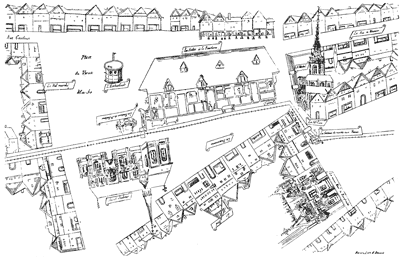
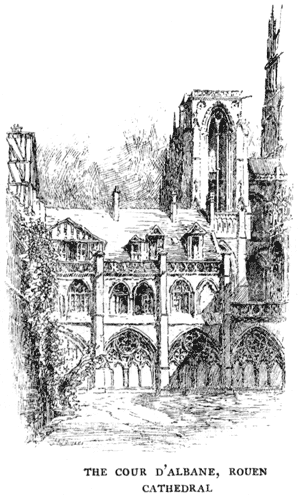 After the canons left the main block of Cathedral-buildings to go into
lodgings in this quarter so near at hand, they still kept their oven,
their granary, and their common cellar in the Cour d'Albane. This
quiet little quadrangle is one of the prettiest nooks of old Rouen,
and I am fortunate enough to be able to show in the drawing on
After the canons left the main block of Cathedral-buildings to go into
lodgings in this quarter so near at hand, they still kept their oven,
their granary, and their common cellar in the Cour d'Albane. This
quiet little quadrangle is one of the prettiest nooks of old Rouen,
and I am fortunate enough to be able to show in the drawing on 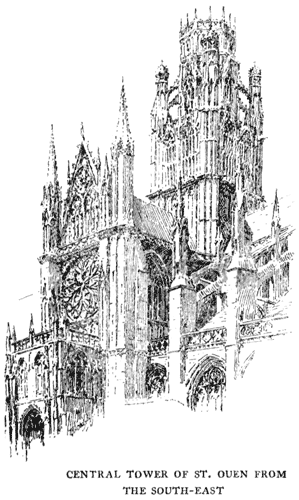 The next place in Rouen that actually saw Jeanne herself was the open
space round the rising nave of St. Ouen, then called the Cemetery,
where we have already watched the farcical royalty of the Révolte de
la Harelle (
The next place in Rouen that actually saw Jeanne herself was the open
space round the rising nave of St. Ouen, then called the Cemetery,
where we have already watched the farcical royalty of the Révolte de
la Harelle ( This remnant barricaded themselves in the Tour Carrée, which Henry the
Fifth had built to the north-west of the old fort, after the siege of
Rouen. Ricarville hastily retired for help to Marshal de Boussac, and
during his absence his companions, attacked by reinforcements of the
English, were obliged to take refuge in the donjon, where they were
hotly besieged by artillery which seriously damaged the second storey
of the tower. Forced to surrender after three weeks of heroic
resistance, the whole hundred were beheaded in the Vieux Marché. For
fifty days this handful of men had held the entire English garrison in
check, and yet not a man had thought of rescuing Jeanne d'Arc scarcely
a year ago.
This remnant barricaded themselves in the Tour Carrée, which Henry the
Fifth had built to the north-west of the old fort, after the siege of
Rouen. Ricarville hastily retired for help to Marshal de Boussac, and
during his absence his companions, attacked by reinforcements of the
English, were obliged to take refuge in the donjon, where they were
hotly besieged by artillery which seriously damaged the second storey
of the tower. Forced to surrender after three weeks of heroic
resistance, the whole hundred were beheaded in the Vieux Marché. For
fifty days this handful of men had held the entire English garrison in
check, and yet not a man had thought of rescuing Jeanne d'Arc scarcely
a year ago.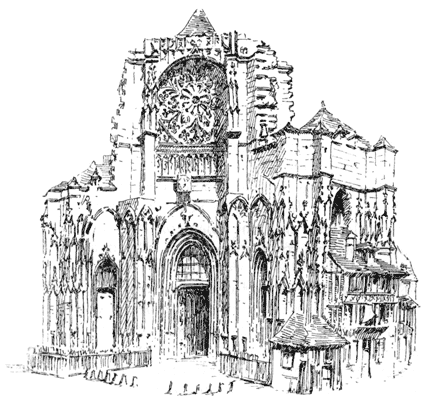
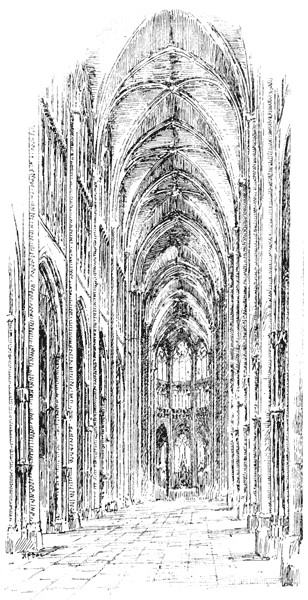
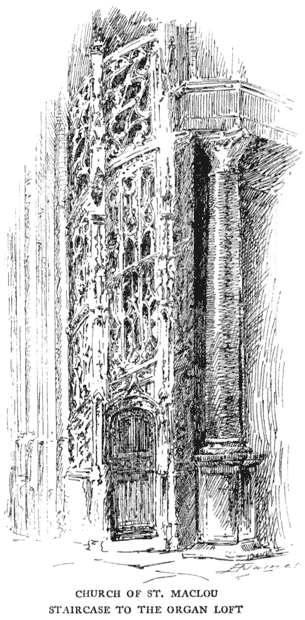 The famous carved doors have been attributed to Jean Goujon, though
there is only one figure (the "Caritas" on the left panel of the
central porch) that I can believe to be his own workmanship. In all
the idea of plan is much the same. There are two divisions, of which
the lower contains the "practicable entrance," and is guarded by a
caryatid on each side supporting two male figures. Along the lintel
runs a line of brackets alternating with cherubs' heads supporting
seven figures, four males in high relief with three females in low
relief behind them. These figures in turn carry a square panel, carved
in high relief above them, representing different scenes on each door,
chiefly suggested by the story of the Good Shepherd which is so
appropriate to the staple industry of the town. They were begun by
1527 and finished before 1560. Jean Goujon was born in 1520, and was
killed during the Massacre of St. Bartholomew while carving on the
Louvre. In 1540 he is known to have been at Rouen, and in the next
year he worked both here and in the Cathedral. So that he may well
have given the design for what he did not personally execute, though
no documents exist to prove either.
The famous carved doors have been attributed to Jean Goujon, though
there is only one figure (the "Caritas" on the left panel of the
central porch) that I can believe to be his own workmanship. In all
the idea of plan is much the same. There are two divisions, of which
the lower contains the "practicable entrance," and is guarded by a
caryatid on each side supporting two male figures. Along the lintel
runs a line of brackets alternating with cherubs' heads supporting
seven figures, four males in high relief with three females in low
relief behind them. These figures in turn carry a square panel, carved
in high relief above them, representing different scenes on each door,
chiefly suggested by the story of the Good Shepherd which is so
appropriate to the staple industry of the town. They were begun by
1527 and finished before 1560. Jean Goujon was born in 1520, and was
killed during the Massacre of St. Bartholomew while carving on the
Louvre. In 1540 he is known to have been at Rouen, and in the next
year he worked both here and in the Cathedral. So that he may well
have given the design for what he did not personally execute, though
no documents exist to prove either.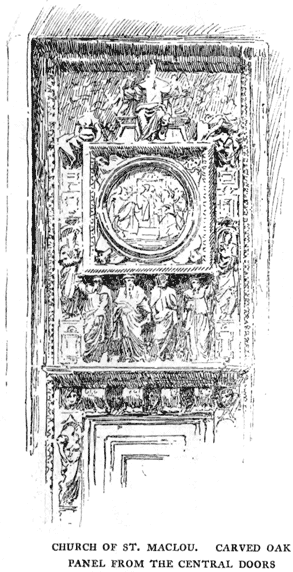 The interior is scarcely less interesting, though it has suffered very
much from modern religiosity. Only forty-seven and a half metres long,
by scarcely twenty-five in width, its height is nearly twenty-three
metres in the three bays of the nave, rising to thirty-nine at the
lantern. Its greatest treasure now is the exquisite Escalier des
Orgues, from which the staircase to the organ loft at Ely was
imitated. This was built in 1519 for two hundred and five livres by
Pierre Gringoire, "Maistre Machon de Rouen." In examining more closely
that fragment of it, of which a plaster cast has been made for the
Musée du Trocadéro in Paris, I could not help being struck with the
general resemblance of its plan to the more famous staircase which
adorns the exterior of the wing of Francis I. at the great château of
Blois in Touraine, which was built almost at the same time, from the
designs (as I have attempted to prove elsewhere) of Leonardo da Vinci,
and was decorated later on with statues by Jean Goujon. This sculptor
was only born the year after St. Maclou's staircase was finished, but
the main lines of the structure are so suggestive of the earlier work
that I cannot but imagine this fine piece of French Renaissance to be
a deliberate copy, by a master strong enough to retain his own
originality of treatment, of the main design that appears in the
courtyard of Blois.
The interior is scarcely less interesting, though it has suffered very
much from modern religiosity. Only forty-seven and a half metres long,
by scarcely twenty-five in width, its height is nearly twenty-three
metres in the three bays of the nave, rising to thirty-nine at the
lantern. Its greatest treasure now is the exquisite Escalier des
Orgues, from which the staircase to the organ loft at Ely was
imitated. This was built in 1519 for two hundred and five livres by
Pierre Gringoire, "Maistre Machon de Rouen." In examining more closely
that fragment of it, of which a plaster cast has been made for the
Musée du Trocadéro in Paris, I could not help being struck with the
general resemblance of its plan to the more famous staircase which
adorns the exterior of the wing of Francis I. at the great château of
Blois in Touraine, which was built almost at the same time, from the
designs (as I have attempted to prove elsewhere) of Leonardo da Vinci,
and was decorated later on with statues by Jean Goujon. This sculptor
was only born the year after St. Maclou's staircase was finished, but
the main lines of the structure are so suggestive of the earlier work
that I cannot but imagine this fine piece of French Renaissance to be
a deliberate copy, by a master strong enough to retain his own
originality of treatment, of the main design that appears in the
courtyard of Blois.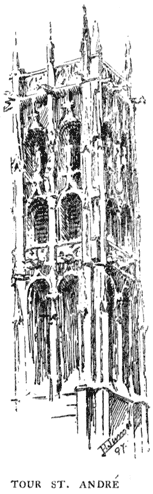 Not all the churches of which Rouen is so full can boast even that
measure of preservation which storm and time and the more devastating
hands of man have spared to the three noblest of her religious
monuments. Of St. André, for instance, only the tower remains, that
stands alone above the Rue Jeanne d'Arc, like the Tour St. Jacques in
Paris, as an admirable specimen of the later Gothic architecture. A
still finer relic of an older past is that old church of St. Pierre du
Chastel, which is now turned into a stable and coach-house at No. 41
Rue Nationale. Unless you look for it, you will miss altogether the
great statue of David and his harp, which is the one massive
decoration of its strong and simple tower, and the carvings which may
still be traced through the neglect and mutilation of centuries upon
its western door. More degraded still, to even baser uses, is the
Church of St. Cande le Jeune, which has become some kind of an
electric manufactory, and may now be chiefly traced by the huge
chimney which obstructs the sky as you look up the Impasse Petit Salut
towards the Tour de Beurre of the Cathedral. Just opposite the
entrance to the public library is another instance of barbarous
neglect: the Church of St. Laurent. Once used as a magazine of shops
of every kind, sometimes a lost home for decrepit carriages, sometimes
a drying-house for laundry-women, these exquisite ruins of Renaissance
architecture have at last been rescued by the civic authorities, if
not from evident decay, at any rate from further mutilation. The tower
alone—but one among so many in Rouen—would be the proudest
possession of many a larger English town. The balustrade is decorated
by a pattern of letters, which pathetically express their hope of
better treatment in the battered legend: "Post Tenebras Spero Lucem."
Not all the churches of which Rouen is so full can boast even that
measure of preservation which storm and time and the more devastating
hands of man have spared to the three noblest of her religious
monuments. Of St. André, for instance, only the tower remains, that
stands alone above the Rue Jeanne d'Arc, like the Tour St. Jacques in
Paris, as an admirable specimen of the later Gothic architecture. A
still finer relic of an older past is that old church of St. Pierre du
Chastel, which is now turned into a stable and coach-house at No. 41
Rue Nationale. Unless you look for it, you will miss altogether the
great statue of David and his harp, which is the one massive
decoration of its strong and simple tower, and the carvings which may
still be traced through the neglect and mutilation of centuries upon
its western door. More degraded still, to even baser uses, is the
Church of St. Cande le Jeune, which has become some kind of an
electric manufactory, and may now be chiefly traced by the huge
chimney which obstructs the sky as you look up the Impasse Petit Salut
towards the Tour de Beurre of the Cathedral. Just opposite the
entrance to the public library is another instance of barbarous
neglect: the Church of St. Laurent. Once used as a magazine of shops
of every kind, sometimes a lost home for decrepit carriages, sometimes
a drying-house for laundry-women, these exquisite ruins of Renaissance
architecture have at last been rescued by the civic authorities, if
not from evident decay, at any rate from further mutilation. The tower
alone—but one among so many in Rouen—would be the proudest
possession of many a larger English town. The balustrade is decorated
by a pattern of letters, which pathetically express their hope of
better treatment in the battered legend: "Post Tenebras Spero Lucem."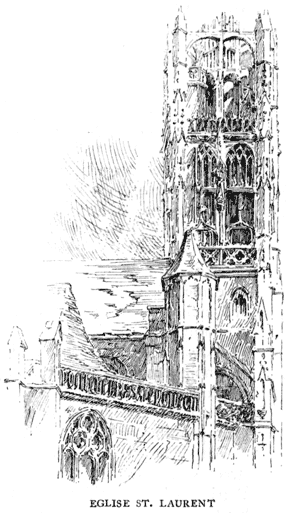 In the Rue Jeanne d'Arc is another church, St. Vincent, that must be
visited. I have spoken already of the little labourer in tunic and
breeches, with a sack of salt upon his back, who stands upon the
outside of the buttress to the south of the choir, and looks towards
the river. It commemorates the fact that, by letters patent delivered
by Charles VI. in 1409, the church (which was then much nearer to the
river) was allowed to take toll of every cargo of salt which came into
the port, a privilege which was exchanged in 1649 for an annual
payment of 140 livres. Begun in 1511—or, as some say, 1480—after the
plans of Guillaume Touchet, St. Vincent certainly comes after St.
Maclou in order of merit. Its choir alone is a magnificent specimen of
the architectural possibilities of the smaller churches, and must have
been finished before 1530, when Touchet's supervision ended. The
splendid flamboyant western porch is not shown in Lelieur's plan of
1525, and was probably a later addition. The name of Ambroise Harel
has also been connected with the work, but I have been unable to
satisfy myself of the exact portions for which he may have been
responsible.
In the Rue Jeanne d'Arc is another church, St. Vincent, that must be
visited. I have spoken already of the little labourer in tunic and
breeches, with a sack of salt upon his back, who stands upon the
outside of the buttress to the south of the choir, and looks towards
the river. It commemorates the fact that, by letters patent delivered
by Charles VI. in 1409, the church (which was then much nearer to the
river) was allowed to take toll of every cargo of salt which came into
the port, a privilege which was exchanged in 1649 for an annual
payment of 140 livres. Begun in 1511—or, as some say, 1480—after the
plans of Guillaume Touchet, St. Vincent certainly comes after St.
Maclou in order of merit. Its choir alone is a magnificent specimen of
the architectural possibilities of the smaller churches, and must have
been finished before 1530, when Touchet's supervision ended. The
splendid flamboyant western porch is not shown in Lelieur's plan of
1525, and was probably a later addition. The name of Ambroise Harel
has also been connected with the work, but I have been unable to
satisfy myself of the exact portions for which he may have been
responsible.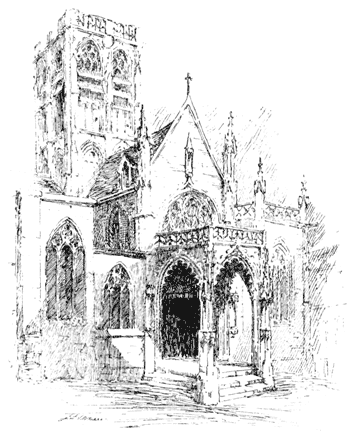
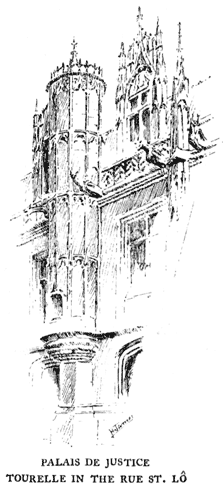 Priests are almost as interesting as the ladies in this extraordinary
record. In 1520 a curate from Marcilly hired Germain Rou for two
sovereigns to hide a baby in a chalk-pit, and then fled to Rome. The
cries of the child were heard two days afterwards by some travellers,
and Germain Rou, condemned to have his hand cut off and then be
hanged, was pardoned. In 1535 an even more flagrant crime is
registered against an ecclesiastic. Louis de Houdetot, a subdeacon,
had been so successful in his courtship of Madame Tilleren, that the
lady's husband sent her out of the town to her father's house. But
this did not stop the priest from continuing to visit her, and while
M. Tilleren was in Rouen news was brought him that Houdetot had
actually beaten M. de Catheville's servants in trying to get into the
house. This was too much; so Tilleren "took a corselet of beaten iron
(hallecrest) and a crossbow with a long bolt, and took a companion,
named Justin, armed with a helmet and a long-handled axe, with five or
six others." The gang, who evidently meant to make sure of their man,
met Houdetot in a street in Rouen; Tilleren fired his crossbow on
sight and shot him through the body; a piece of summary justice which
evidently appealed to the Canons of the Cathedral, in spite of the
fact that the sufferer was an ecclesiastic.
Priests are almost as interesting as the ladies in this extraordinary
record. In 1520 a curate from Marcilly hired Germain Rou for two
sovereigns to hide a baby in a chalk-pit, and then fled to Rome. The
cries of the child were heard two days afterwards by some travellers,
and Germain Rou, condemned to have his hand cut off and then be
hanged, was pardoned. In 1535 an even more flagrant crime is
registered against an ecclesiastic. Louis de Houdetot, a subdeacon,
had been so successful in his courtship of Madame Tilleren, that the
lady's husband sent her out of the town to her father's house. But
this did not stop the priest from continuing to visit her, and while
M. Tilleren was in Rouen news was brought him that Houdetot had
actually beaten M. de Catheville's servants in trying to get into the
house. This was too much; so Tilleren "took a corselet of beaten iron
(hallecrest) and a crossbow with a long bolt, and took a companion,
named Justin, armed with a helmet and a long-handled axe, with five or
six others." The gang, who evidently meant to make sure of their man,
met Houdetot in a street in Rouen; Tilleren fired his crossbow on
sight and shot him through the body; a piece of summary justice which
evidently appealed to the Canons of the Cathedral, in spite of the
fact that the sufferer was an ecclesiastic.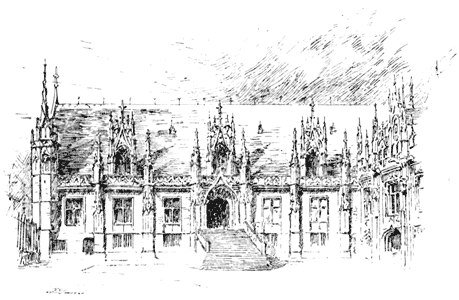
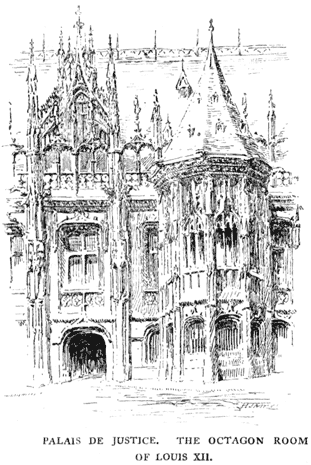 In 1508 Louis XII. established in his new palace the jurisdiction
known as that of the "Table de Marbre," because the Cathedral
Chapterhouse sold for the use of this new Admiralty Court an old
marble tomb, round which the members sat in the great hall. Corneille
and his father were both officers of this jurisdiction later on. In
the same year was begun the "Grand Chambre" in which the President
held his High Court, called now the Cour d'Assises, and decorated with
a magnificently carved ceiling in panels of polished wood. It is just
behind that octagonal turret which juts from the centre of the main
building exactly opposite the entrance from the Rue aux Juifs. Within
this turret is the lovely little circular chamber which was reserved
for the King's own use. Its beautiful proportions break the symmetry
of the long front wall, yet are clasped to the building by the cornice
whence the line of gargoyles spring; and in the same way the long and
steep rise of the roof is broken up by the crests above each window
that rise into the air in a pinnacled tracery of fretwork filled with
carved arabesques and statues. Among them are the arms of France,
supported by two stags, a memorial of the badge used by Charles VI.
according to the story told by de la Mer. It is this central block of
buildings that contains most of the original work of Roger Ango and
Rouland Leroux. The wing on the right of the entrance from the Rue aux
Juifs is modern, and though that part of the left wing which faces the
courtyard is old, the façade upon the Rue Jeanne d'Arc at the Place
Verdrel was rebuilt in 1842. The courtyard was originally enclosed by
a fine crenulated wall like that round the Hôtel de Cluny in Paris.
This has been replaced by a badly designed iron railing. But as a
civic building, in spite of its railing and its new Cour d' Appel, the
Palais de Justice remains the finest of its kind in Europe, and is
superior to the Hôtel de Ville both of Brussels and of Louvain.
In 1508 Louis XII. established in his new palace the jurisdiction
known as that of the "Table de Marbre," because the Cathedral
Chapterhouse sold for the use of this new Admiralty Court an old
marble tomb, round which the members sat in the great hall. Corneille
and his father were both officers of this jurisdiction later on. In
the same year was begun the "Grand Chambre" in which the President
held his High Court, called now the Cour d'Assises, and decorated with
a magnificently carved ceiling in panels of polished wood. It is just
behind that octagonal turret which juts from the centre of the main
building exactly opposite the entrance from the Rue aux Juifs. Within
this turret is the lovely little circular chamber which was reserved
for the King's own use. Its beautiful proportions break the symmetry
of the long front wall, yet are clasped to the building by the cornice
whence the line of gargoyles spring; and in the same way the long and
steep rise of the roof is broken up by the crests above each window
that rise into the air in a pinnacled tracery of fretwork filled with
carved arabesques and statues. Among them are the arms of France,
supported by two stags, a memorial of the badge used by Charles VI.
according to the story told by de la Mer. It is this central block of
buildings that contains most of the original work of Roger Ango and
Rouland Leroux. The wing on the right of the entrance from the Rue aux
Juifs is modern, and though that part of the left wing which faces the
courtyard is old, the façade upon the Rue Jeanne d'Arc at the Place
Verdrel was rebuilt in 1842. The courtyard was originally enclosed by
a fine crenulated wall like that round the Hôtel de Cluny in Paris.
This has been replaced by a badly designed iron railing. But as a
civic building, in spite of its railing and its new Cour d' Appel, the
Palais de Justice remains the finest of its kind in Europe, and is
superior to the Hôtel de Ville both of Brussels and of Louvain.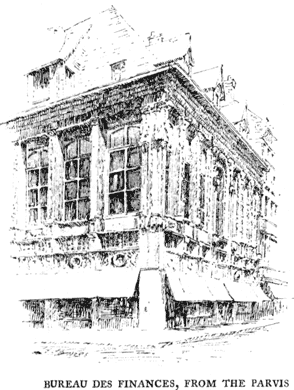 But it must not be thought that the King had come to Rouen merely to
delight his subjects with the sun of his presence and the favours of
his consent. He had certain business of his own to transact, of a
financial nature; and for raising the various sums he needed, both for
personal and patriotic reasons, there was already in existence certain
financial machinery which was housed in very fair quarters in Rouen.
Two of the most beautiful of the sixteenth century buildings have to
do with finance. One of them is the "Bureau des Finances" (as its
latest title ran), opposite the Cathedral at the corner of the Rue
Ampère; the other is the "Cour des Comptes," whose Eastern façade and
courtyard has just been opened to the Rue des Carmes, north-west of
the Tour St. Romain.
But it must not be thought that the King had come to Rouen merely to
delight his subjects with the sun of his presence and the favours of
his consent. He had certain business of his own to transact, of a
financial nature; and for raising the various sums he needed, both for
personal and patriotic reasons, there was already in existence certain
financial machinery which was housed in very fair quarters in Rouen.
Two of the most beautiful of the sixteenth century buildings have to
do with finance. One of them is the "Bureau des Finances" (as its
latest title ran), opposite the Cathedral at the corner of the Rue
Ampère; the other is the "Cour des Comptes," whose Eastern façade and
courtyard has just been opened to the Rue des Carmes, north-west of
the Tour St. Romain.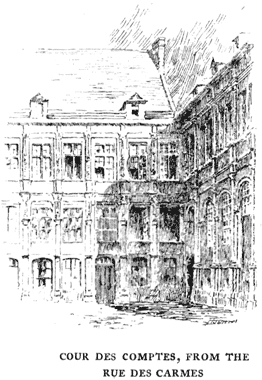 Before you leave the atmosphere of Finance and Justice, which in this
chapter I have striven to realise for you round those monuments that
alone recall the spirit of the age which built them, there is one more
tale of Justice in Rouen which may perhaps leave a more charitable
impression of the Palais de Justice and its officials. It has been
told before by Étienne Pasquier, but it will bear translation (and
even shortening) for an English audience. In the days when Laurent
Bigot de Thibermesnil was first King's Advocate in the Parliament of
Normandy, one of those brilliant intellects of which the sixteenth
century was so full, it chanced that a merchant of Lucca, who had
lived long and prosperously in England, desired to come home and die
in Italy. So he wrote to his relations to prepare a house for him in
six months' time, and started from England with his servant, carrying
his money and bonds with him. On his way to Paris he was known to have
stopped at Rouen, but he was never heard of again.
Before you leave the atmosphere of Finance and Justice, which in this
chapter I have striven to realise for you round those monuments that
alone recall the spirit of the age which built them, there is one more
tale of Justice in Rouen which may perhaps leave a more charitable
impression of the Palais de Justice and its officials. It has been
told before by Étienne Pasquier, but it will bear translation (and
even shortening) for an English audience. In the days when Laurent
Bigot de Thibermesnil was first King's Advocate in the Parliament of
Normandy, one of those brilliant intellects of which the sixteenth
century was so full, it chanced that a merchant of Lucca, who had
lived long and prosperously in England, desired to come home and die
in Italy. So he wrote to his relations to prepare a house for him in
six months' time, and started from England with his servant, carrying
his money and bonds with him. On his way to Paris he was known to have
stopped at Rouen, but he was never heard of again.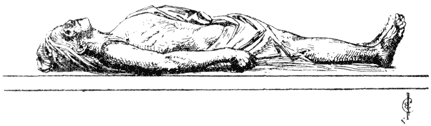
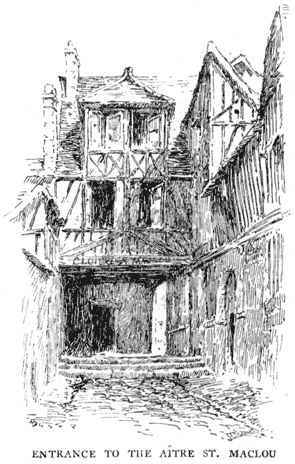 Remembering this man's career, turn out of the Place des Ponts de
Robec, down the Rue Damiette, southwards, and I will show you the
spot in Rouen that has made me tell you something of his history as a
type of the young gallant of the sixteenth century. As you pass the
"Rue du Rosier" (on your left at No. 54), the "Impasse des Hauts
Mariages" appears a little further on. Any budding romance the name
may suggest will not survive a walk of a few yards up its narrow and
noisome recesses. But at the end of the Rue Damiette, behind the vista
of old houses, the arches of St. Maclou will tempt you irresistibly
towards the end of the road that curves out at the north-west corner
of the church, just opposite the famous fountain which has been so
mutilated by the Huguenots. At this point turn sharply to the left,
down the Rue Martainville eastwards. To the south the Rue Molière
flings its quaint legendary shadows towards the river. A little
further on, a dark square opening makes a patch of black beneath the
gabled windows of No. 190. That is the entrance to the Aître St.
Maclou, the oldest cemetery in Rouen, and one of the most interesting
in Europe. Pass through the dark passage into the open space beyond
that is surrounded by old timbered houses, and go straight through to
the little stairway that is opposite the entrance. From that slight
eminence you may look back upon the strangest scene you have yet
visited; if it is an autumn afternoon the little charity children will
be running to and fro beneath the emblems of death carved on the
timbers above their heads, while the religious sisters, in their grey
gowns and wide white head-dresses move slowly to and fro beside them.
It is the picture of another century, in its appropriate setting.
Remembering this man's career, turn out of the Place des Ponts de
Robec, down the Rue Damiette, southwards, and I will show you the
spot in Rouen that has made me tell you something of his history as a
type of the young gallant of the sixteenth century. As you pass the
"Rue du Rosier" (on your left at No. 54), the "Impasse des Hauts
Mariages" appears a little further on. Any budding romance the name
may suggest will not survive a walk of a few yards up its narrow and
noisome recesses. But at the end of the Rue Damiette, behind the vista
of old houses, the arches of St. Maclou will tempt you irresistibly
towards the end of the road that curves out at the north-west corner
of the church, just opposite the famous fountain which has been so
mutilated by the Huguenots. At this point turn sharply to the left,
down the Rue Martainville eastwards. To the south the Rue Molière
flings its quaint legendary shadows towards the river. A little
further on, a dark square opening makes a patch of black beneath the
gabled windows of No. 190. That is the entrance to the Aître St.
Maclou, the oldest cemetery in Rouen, and one of the most interesting
in Europe. Pass through the dark passage into the open space beyond
that is surrounded by old timbered houses, and go straight through to
the little stairway that is opposite the entrance. From that slight
eminence you may look back upon the strangest scene you have yet
visited; if it is an autumn afternoon the little charity children will
be running to and fro beneath the emblems of death carved on the
timbers above their heads, while the religious sisters, in their grey
gowns and wide white head-dresses move slowly to and fro beside them.
It is the picture of another century, in its appropriate setting.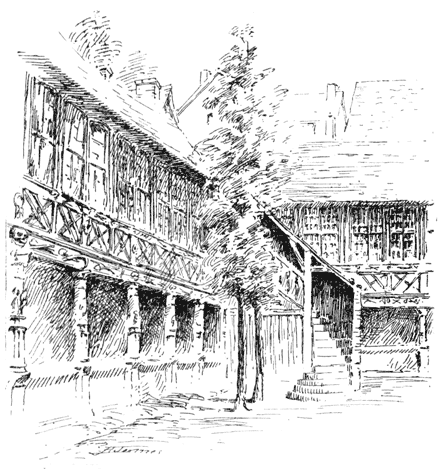
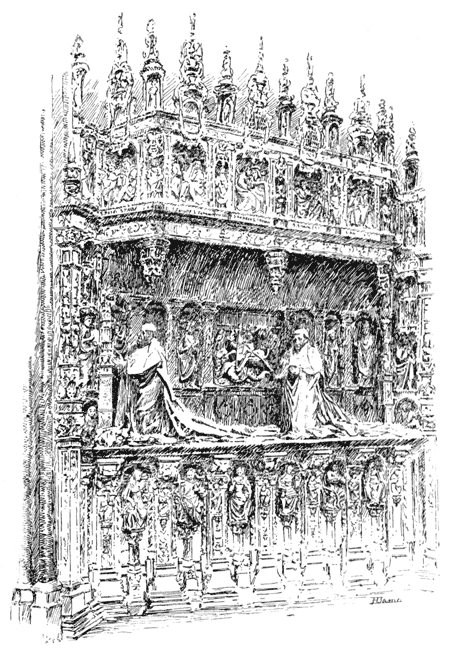
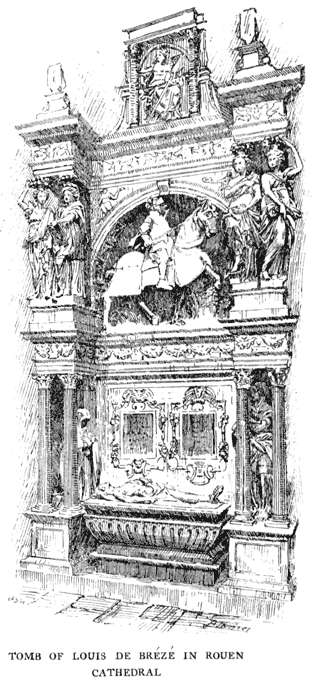 On the opposite side of this chapel is the great tomb of Louis de
Brézé, Grand Seneschal of Normandy, of which I have already spoken. As
an architectural composition it is, to my mind, infinitely finer than
the other, though there is not only a lack of the obvious sincerity
that inspired Leroux, but there is also the too evident appearance of
that triumph of Death which has been described in this chapter. Nor
can I help fancying that it represents too the somewhat sinister
triumph of a widow's cunning. For as I have drawn elsewhere the life
and the ambitions of Georges d'Amboise as the owner of Chaumont on the
Loire, so I have become acquainted with that typical figure of the
sixteenth century, Diane de Poitiers, at the home she took from Bohier
at Chenonceaux; and therefore her kneeling figure in the widow's weeds
of a conventional sorrow suggests nothing better to me than the
fashionable grief of the mistress of Henri II., the ostentation in
mourning of the most rapacious and unfeeling woman of her time.
On the opposite side of this chapel is the great tomb of Louis de
Brézé, Grand Seneschal of Normandy, of which I have already spoken. As
an architectural composition it is, to my mind, infinitely finer than
the other, though there is not only a lack of the obvious sincerity
that inspired Leroux, but there is also the too evident appearance of
that triumph of Death which has been described in this chapter. Nor
can I help fancying that it represents too the somewhat sinister
triumph of a widow's cunning. For as I have drawn elsewhere the life
and the ambitions of Georges d'Amboise as the owner of Chaumont on the
Loire, so I have become acquainted with that typical figure of the
sixteenth century, Diane de Poitiers, at the home she took from Bohier
at Chenonceaux; and therefore her kneeling figure in the widow's weeds
of a conventional sorrow suggests nothing better to me than the
fashionable grief of the mistress of Henri II., the ostentation in
mourning of the most rapacious and unfeeling woman of her time.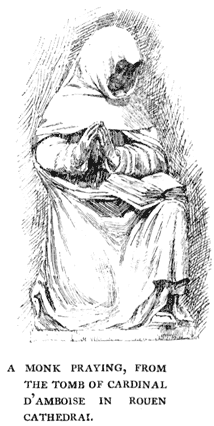 In sketching the more sombre features of this extraordinary century,
it is impossible to omit any reference to those religious troubles
which may have been already suggested to you by the kneeling monks
upon the tomb of Georges d'Amboise. They were as terrible in Rouen as
in almost every other town in France; the violent deaths and tortures
they made so common in the city cannot be omitted in any estimate of
the horrors of the time; and if I do not dilate upon them as their
importance in history might seem to demand, it is because they are
chiefly responsible for the destruction or debasement of most of those
great architectural monuments which it is my chief business to
describe. They were also responsible for the next two sieges in the
story of the town, and in the first of these there is a tale that I
must tell you, if only to show that if these men had the realisation
of death ever present before their eyes, they were also very hard to
kill, and did not yield to the Arch-Enemy so easily as many of their
descendants in an age which tries its hardest to forget him.
In sketching the more sombre features of this extraordinary century,
it is impossible to omit any reference to those religious troubles
which may have been already suggested to you by the kneeling monks
upon the tomb of Georges d'Amboise. They were as terrible in Rouen as
in almost every other town in France; the violent deaths and tortures
they made so common in the city cannot be omitted in any estimate of
the horrors of the time; and if I do not dilate upon them as their
importance in history might seem to demand, it is because they are
chiefly responsible for the destruction or debasement of most of those
great architectural monuments which it is my chief business to
describe. They were also responsible for the next two sieges in the
story of the town, and in the first of these there is a tale that I
must tell you, if only to show that if these men had the realisation
of death ever present before their eyes, they were also very hard to
kill, and did not yield to the Arch-Enemy so easily as many of their
descendants in an age which tries its hardest to forget him.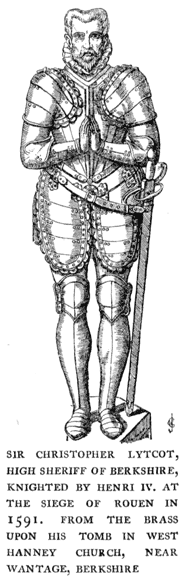 One of the most interesting things about this fighting is the presence
of a numerous body of Englishmen who had joined Biron and Henry of
Navarre, under the Earl of Essex. Their Queen had offered a special
prize for the first man who should make a successful shot at the
defenders of the town; but they do not seem to have distinguished
themselves particularly, and at last a hundred of them (chiefly
squires) were killed. A hardy specimen of the race, however, is
mentioned by Valdory, who evidently kept his eyes open for good work,
whether of friend or foe. This Englishman, after receiving four wounds
from a cutlass on the head, "pretended to be dead, allowed himself to
be stripped by our soldiers, and dragged naked to the ramparts." While
he lay there, desirous to make quite sure of their man, the Rouen
sentinels (who must have been mariners from Dieppe) dropped a small
cannon ball on his stomach, "but he did not seem to feel it," and
continued obstinately to remain alive. However, when the Sieur de
Canonville took him prisoner and bound up his wounds, with the object,
apparently, of getting a ransom from his friends, he seems to have
determined that no foreigner should make money out of him, and died.
One of the most interesting things about this fighting is the presence
of a numerous body of Englishmen who had joined Biron and Henry of
Navarre, under the Earl of Essex. Their Queen had offered a special
prize for the first man who should make a successful shot at the
defenders of the town; but they do not seem to have distinguished
themselves particularly, and at last a hundred of them (chiefly
squires) were killed. A hardy specimen of the race, however, is
mentioned by Valdory, who evidently kept his eyes open for good work,
whether of friend or foe. This Englishman, after receiving four wounds
from a cutlass on the head, "pretended to be dead, allowed himself to
be stripped by our soldiers, and dragged naked to the ramparts." While
he lay there, desirous to make quite sure of their man, the Rouen
sentinels (who must have been mariners from Dieppe) dropped a small
cannon ball on his stomach, "but he did not seem to feel it," and
continued obstinately to remain alive. However, when the Sieur de
Canonville took him prisoner and bound up his wounds, with the object,
apparently, of getting a ransom from his friends, he seems to have
determined that no foreigner should make money out of him, and died.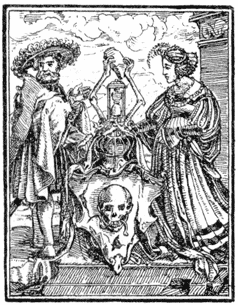
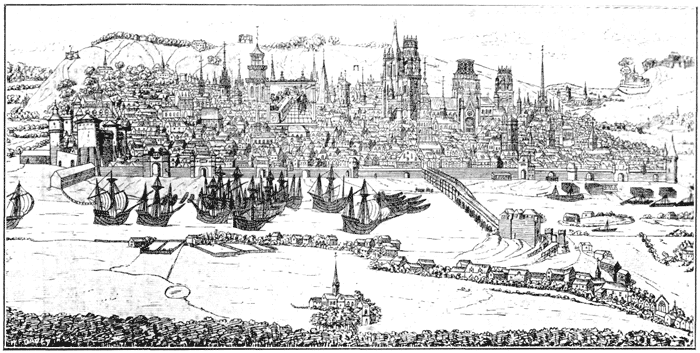
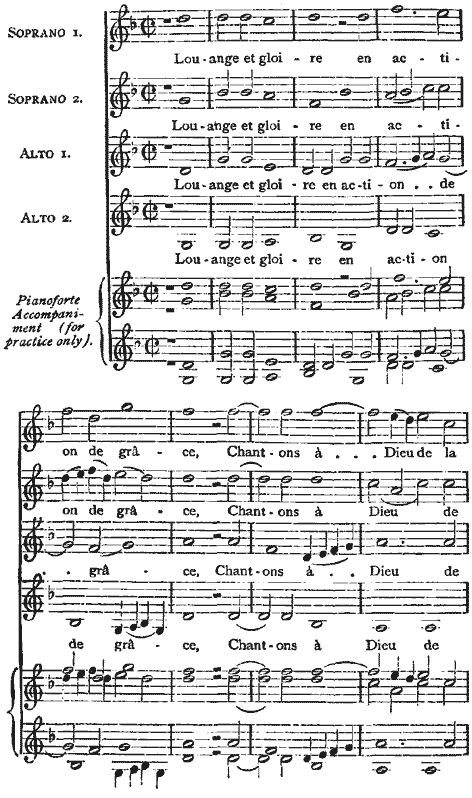
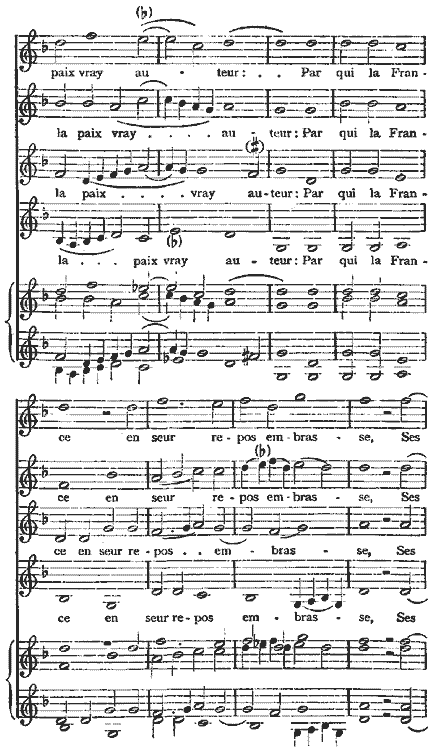
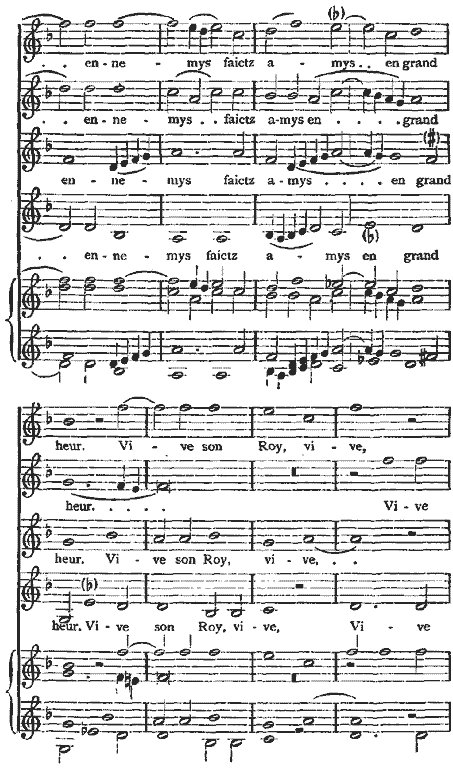
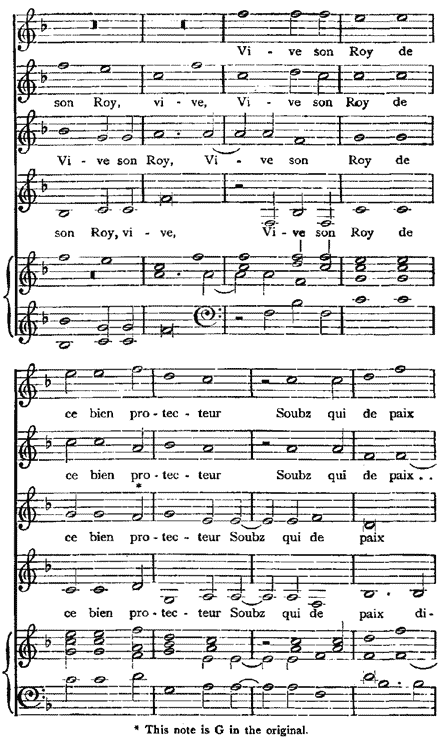
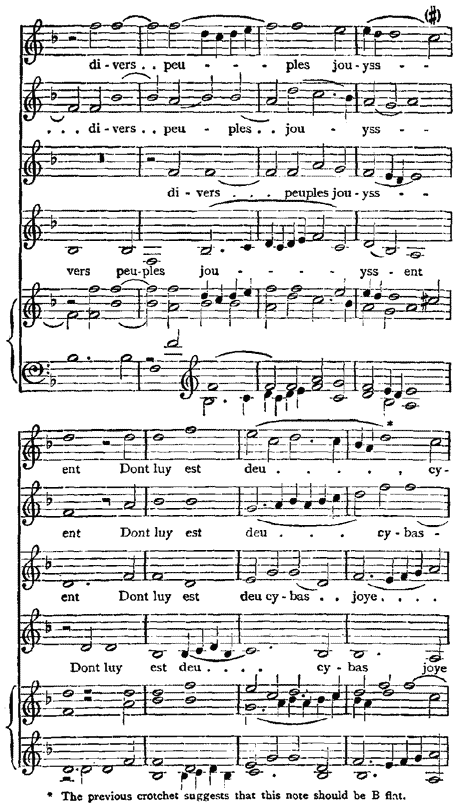
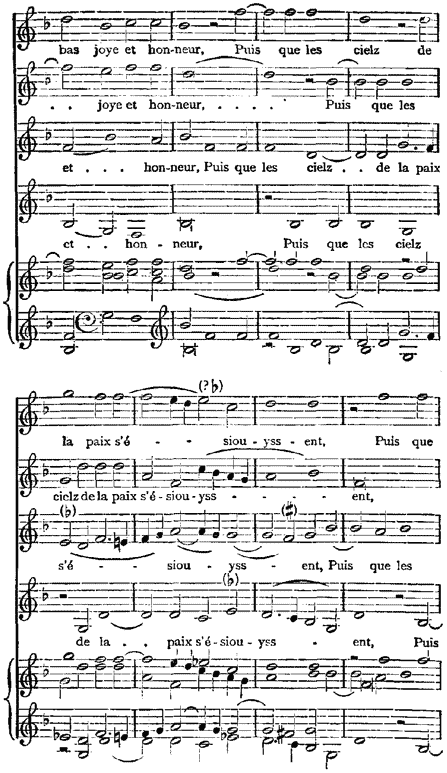
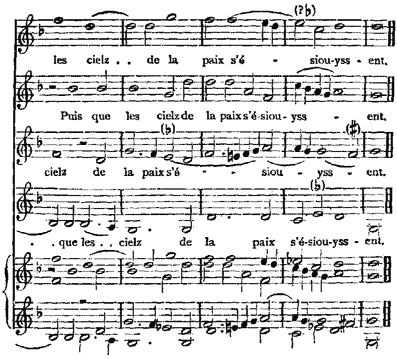
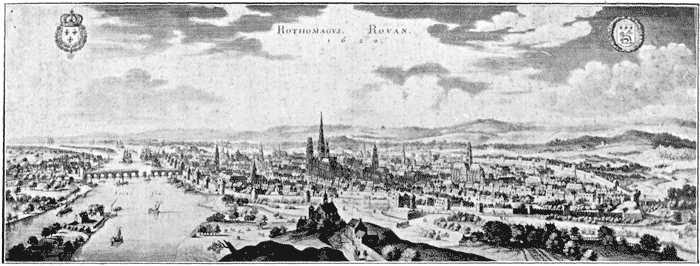
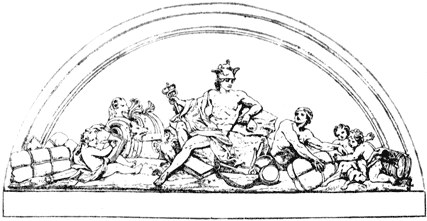
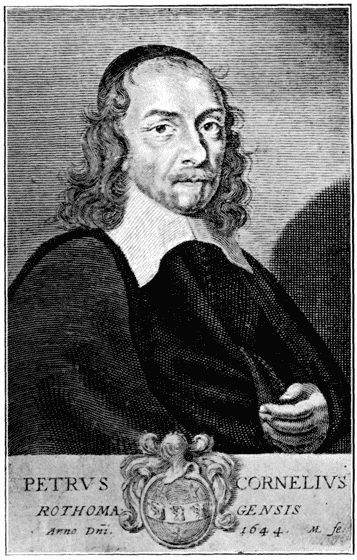
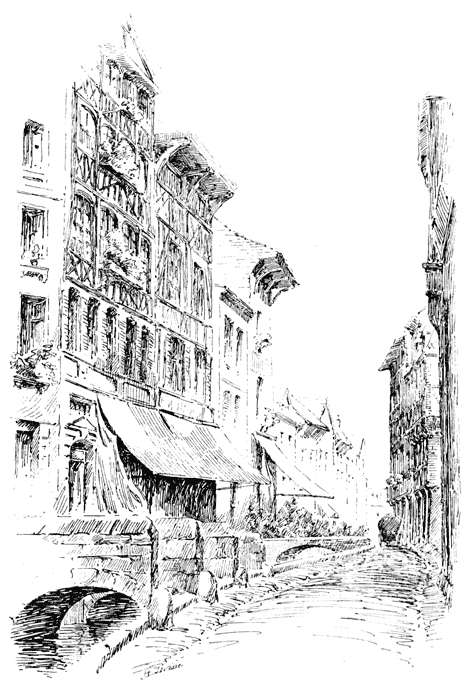
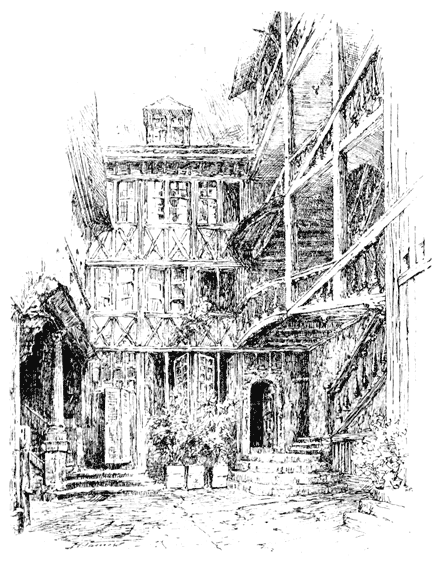
![[Enlarge]](images/mapalg.png)
![[Enlarge]](images/mapblg.png)
![[Enlarge]](images/mapclg.png)
![[Enlarge]](images/mapdlg.png)
![[Enlarge]](images/mapelg.png)
![[Enlarge]](images/mapflg.png)