Larger versions of most illustrations may be seen by right-clicking them
and selecting an option to view them separately, or by double-tapping and/or
stretching them.
The History and the
Modern Development
of Rope-Making.
Compiled and Published by Plymouth Cordage Company
NORTH PLYMOUTH, MASS.
WELLAND, ONTARIO
1916
Copyright 1916, by Plymouth Cordage Company 663-11-15-5-28500
FOREWORD
The matter contained in this book
originally appeared, in substantially
the same form, as a series of articles in
our monthly publication “Plymouth
Products.” The story aimed to make
better known an industry previously little
understood and thereby to advance the
cause of good rope.
First and last this “Story of Rope”
has had many interested and responsive
readers. Encouraged by the large numbers
of requests for it which continually
come to us, we are now led to publish it
anew and with the hope that in its present
improved form it will still further
fulfill its original purpose.
CHAPTER I Ancient, Mediæval and Tribal Rope-Making
How many people have ever given a thought to
the question of where rope comes from and
how it is made, or realize what a variety of
uses it is put to, and how dependent we are
upon it in many of the everyday affairs of life? But
let us suppose for a moment that the world were suddenly
deprived of its supply of this very commonplace
material, and of its smaller relatives, cords and twine.
We should then begin to realize the importance of a
seemingly unimportant thing, and to appreciate the
difficulty in getting along without it.
Longfellow, in his poem “The Ropewalk,” which we
have printed, shows that he recognized the scope of the
usefulness of rope, and appreciated the romance and
pathos connected with the use of a seemingly prosaic
article; for in his brief catalogue of the uses of rope
which passed in pictured procession through his mind,
as he stood in the ropewalk and came under the influence
of the drowsy hum and whir of the spinners’
wheels, he succeeded in covering a good share of the
changing phases in the drama of human life: childhood
in its swing, happy, without a care;
the life of the sailor, which, with its
heroism, its romance, its courageous
meeting of danger or disaster, has always
been the subject of verse and
story; the pathetic picture of the faded
beauty on the tight rope; and the tragic
scene of the criminal dying upon the
gallows.
ANCIENT EGYPTIAN ROPE
“All these and many left untold,” the
poet says, and when we once begin to let
our thoughts run we find uses almost
innumerable, on sea and land, to which
our rope is put. Then, if we allow ourselves
to come more and more under
the drowsy spell of the wheels, we wonder
how long all these things have been
going on, and when, where and how
the first rope was made and used.
A little investigation shows us
that the use of rope is older than
history itself. Back beyond the
time of any authentic record of
events, beyond even the range of
tradition, the first rope-makers
did their work.
In his very earliest days man
must have had something to
serve for cords or lines,—strips of hide or of bark,
pliant reeds and rushes, withes of tough woods, fibrous
roots, hair of animals,—then, as the need arose for
longer, larger and stronger lines, it was met, as human
ingenuity developed, by twisting a number of some of
these elements together and forming a rope or cord.
Just who was the prehistoric genius that first performed
this operation, or in what part of the world he lived,
we have no means of knowing.
Certain it is, according to the best authority, that
not only were the ancient civilized nations accomplished
rope-makers, but savage tribes in all parts of the world,
for unknown thousands of years, have been able to
make ropes and cords from a great variety of materials,
and the beauty of their workmanship in many cases
is little short of marvelous.
The North American Indians, for instance, are
known to have made cordage not only from well-known
fiber plants, as cotton, yucca and agave, but from such
plants as the dogbane and nettle; from the inner bark
of trees, slippery elm, willow, linden; from the fibrous
roots of the spruce and pine; and from the hair, skins
or sinews of various animals.
NOOTKA WHALING LINES
The native Peruvians were good rope-makers, using a
substance known as “totora,” as well as many other materials.
The Island tribes of the South Seas, expert in
making rope, are favored with some very good materials
for its manufacture, obtained from the leaves of various
palms and plantains, from the fiber of the cocoanut, etc.
As, at the present day, the
shipping and fishing industries
are among the principal users of cordage, so it has been
among all tribes and nations from earliest times. The
people who lived on islands or the shores of large bodies
of water, and who thus naturally became fishermen,
have been the larger users of ropes and lines, and we
find they always have been capable of producing a wide
variety of fishing lines and nets of excellent construction,
capable of capturing all sorts of fish, from the smallest
brook trout to the huge sturgeon or halibut.
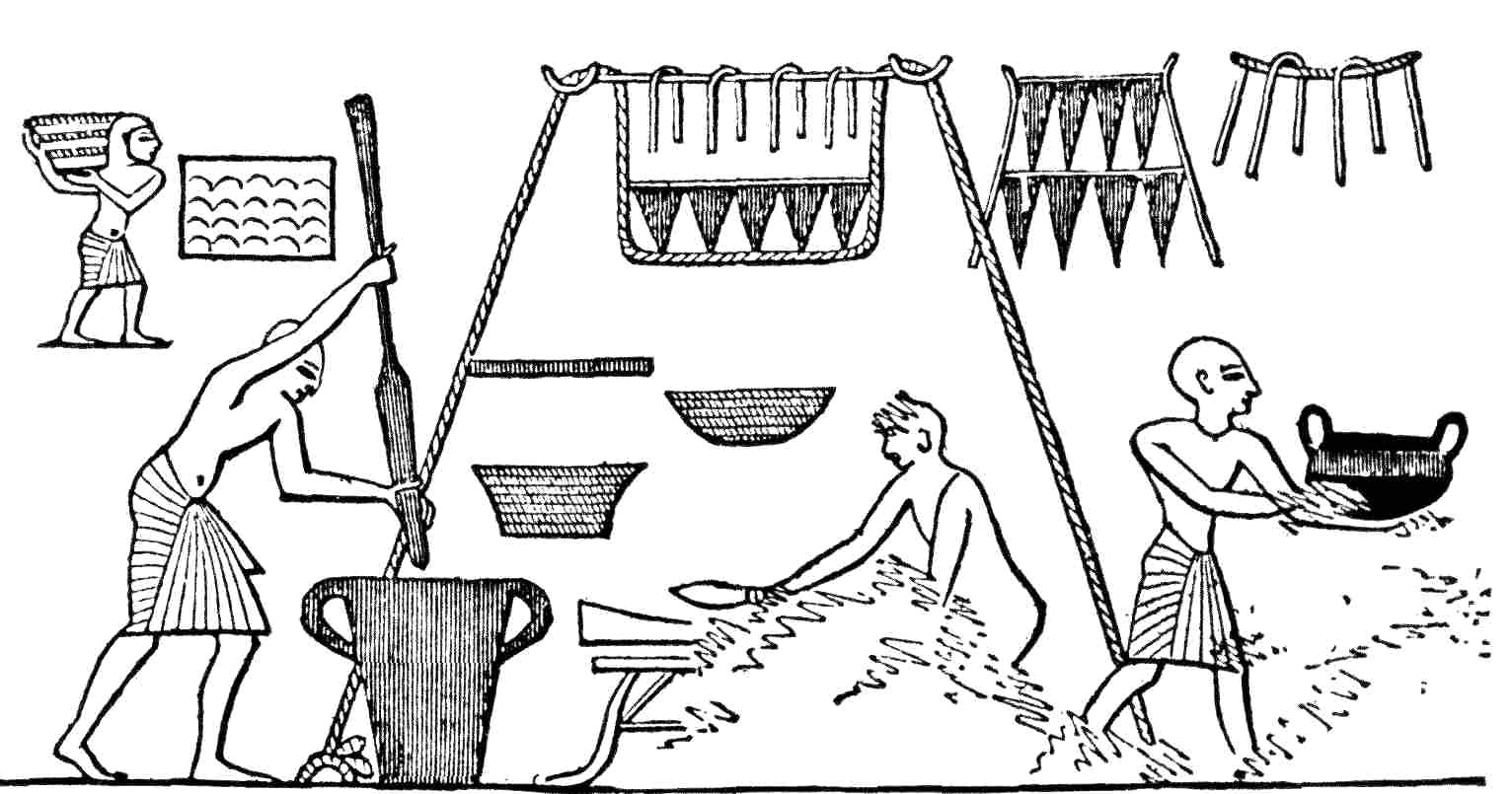
SCENE IN AN EGYPTIAN KITCHEN SHOWING USE OF A
LARGE ROPE TO SUPPORT A SORT OF HANGING SHELF
Even the whale has been successfully hunted by some
adventurous tribes, and we show a picture of lines made
by the Nootka Indians of Vancouver Island,A which
are used by them in harpooning whales. The smaller
rope is made from sinews of the whale, served or wound
with small cord. It is very pliable and exceedingly
strong. The harpoon is fastened to this line, which, in
turn, is fastened to
the larger rope and
that to the boat.
The large rope
shown is made
from spruce roots
and is about two
inches in diameter.
A The photograph shown on
page 13 was taken expressly for us through the
courtesy of the officials of the Peabody Museum, Cambridge, Mass., to whom we
are also indebted for our information concerning the use of rope among the various
primitive tribes.
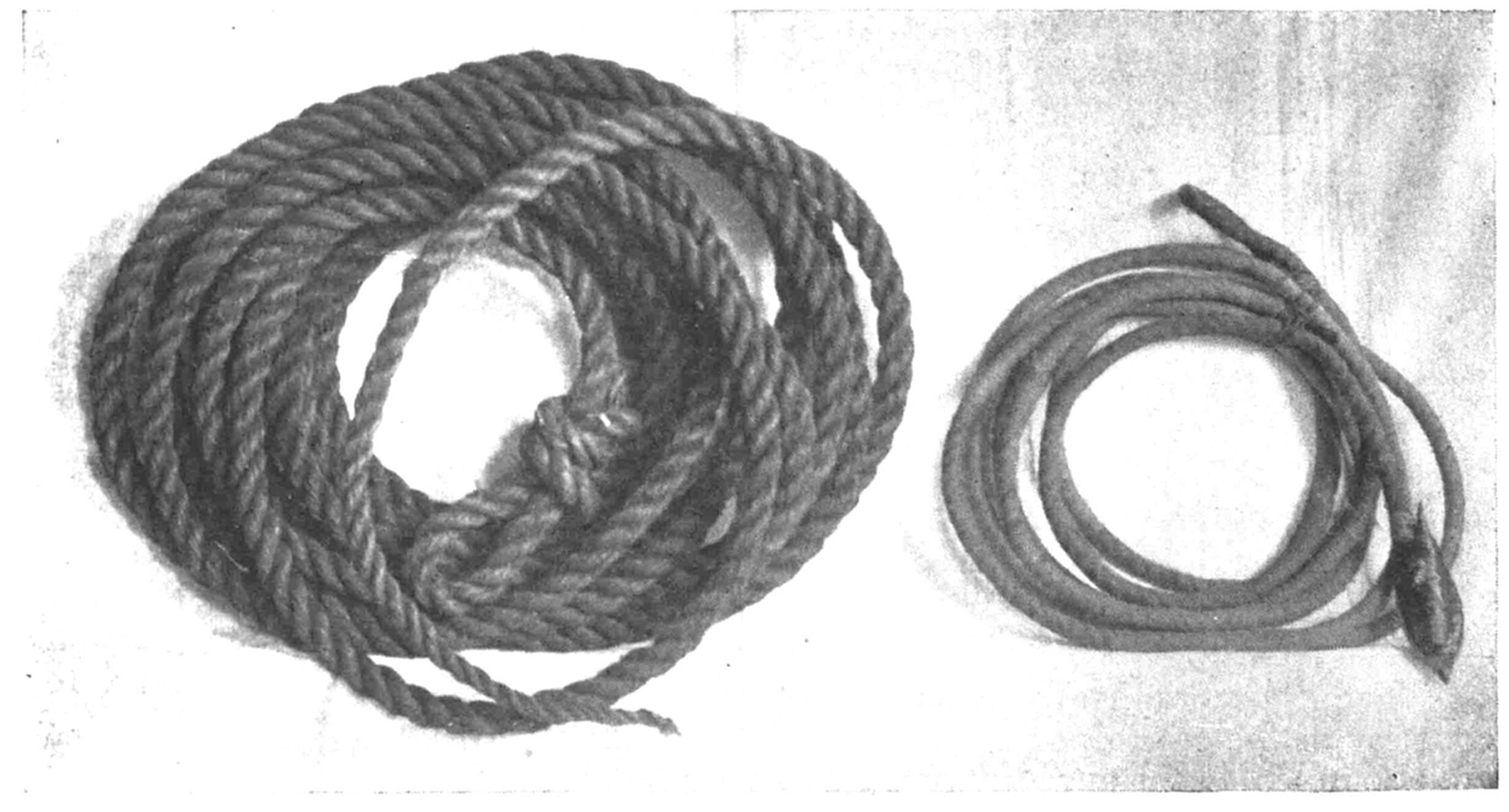
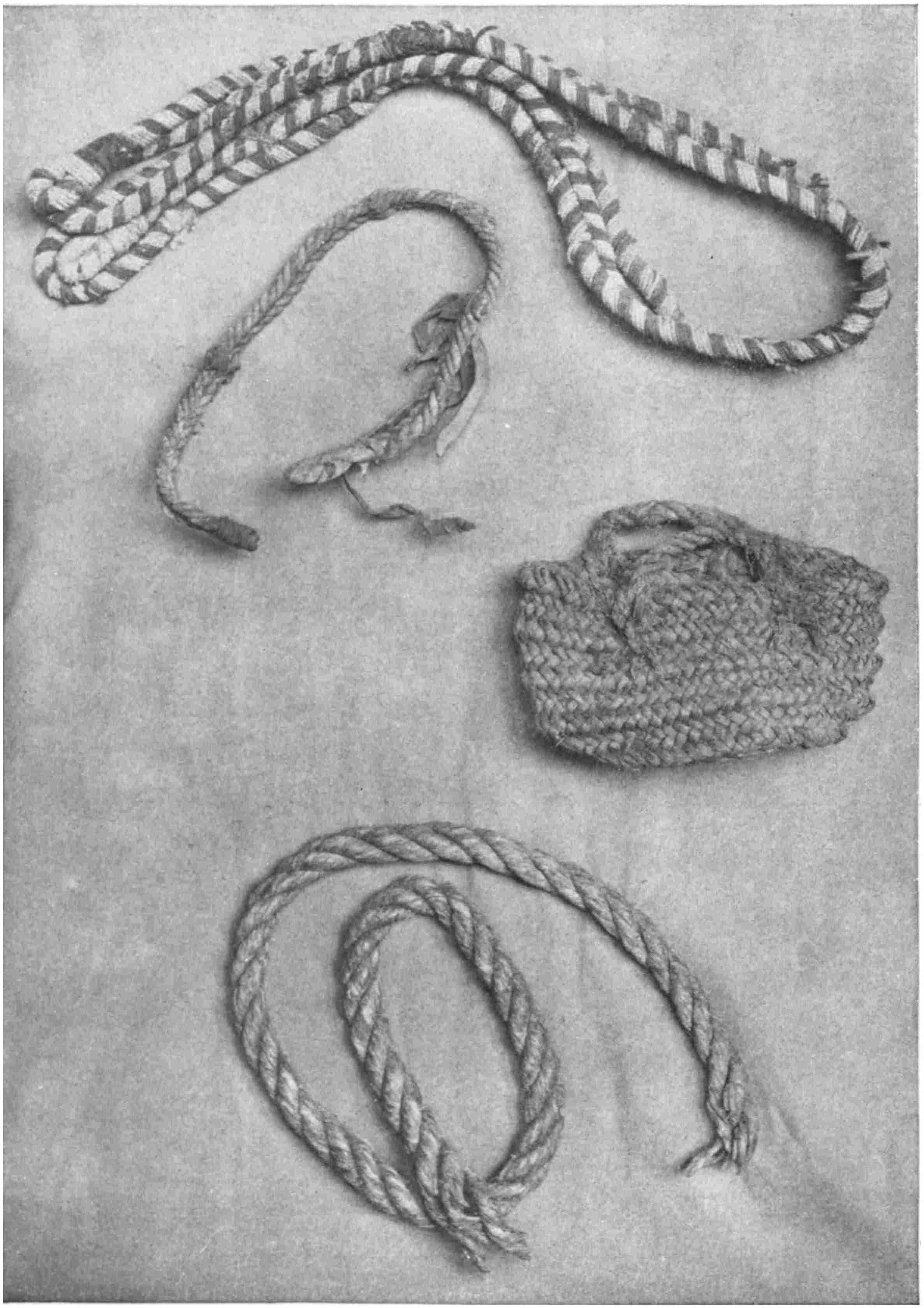
ANCIENT EGYPTIAN RELICS
BRIDLE OF HEMP ROPE COVERED WITH WOVEN COTTON—HALTER OF BRAIDED LEATHER
BASKET WITH ROPE HANDLES—PALM FIBER ROPE
Ancient civilized peoples had their ropes and cordage,
made from such materials as were available in their
respective countries. The Egyptians are said to have
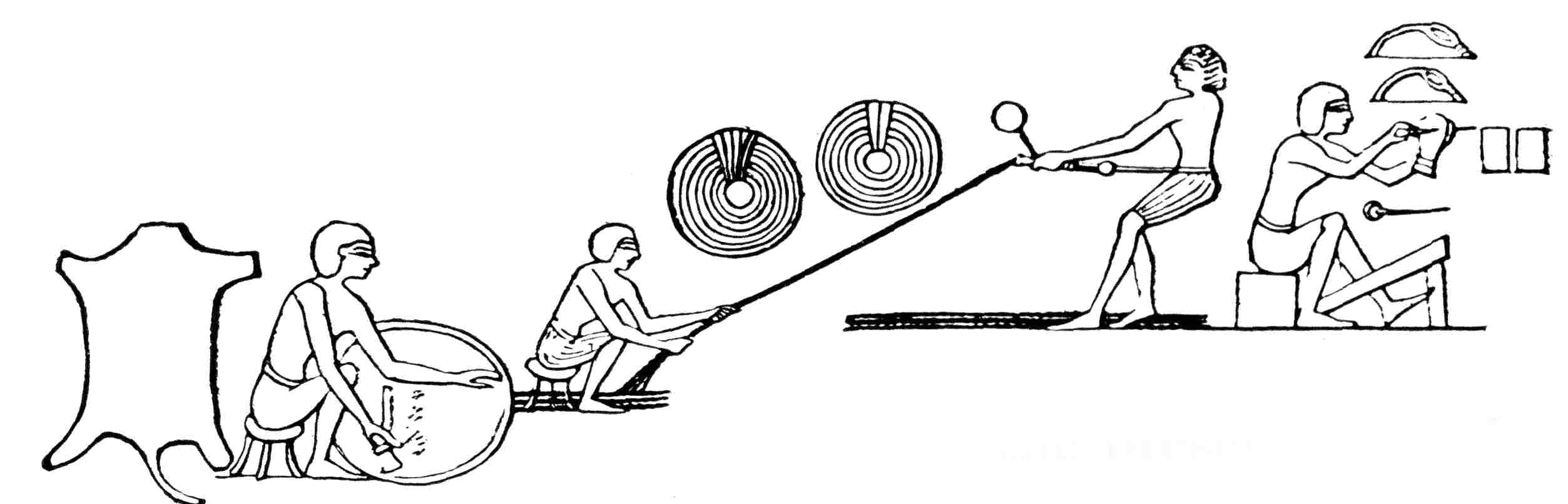
made rope from leather thongs, and our illustration on
page 14 will be found interesting in this connection.
This is from a sculpture taken from a tomb in Thebes
of the time of the Pharaoh of the Exodus.
While this scene is said by the best authority to
represent the preparation of leather cords for use in
lacing sandals, it has been supposed by some to be a
representation of rope-making. In any event, the process
is undoubtedly the same as that used in making
rope.
The scene is depicted with the true Egyptian faculty
for showing details, making words almost unnecessary
to an understanding of their pictorial records. We
see the raw material in the shape of the hide, and also
two well-made coils of the finished product. One of
the workmen is cutting a strand from a hide by revolving
it and cutting as it turns. Anyone who has not
tried it will be surprised to see what a good, even string
can be cut from a piece of leather in this way.
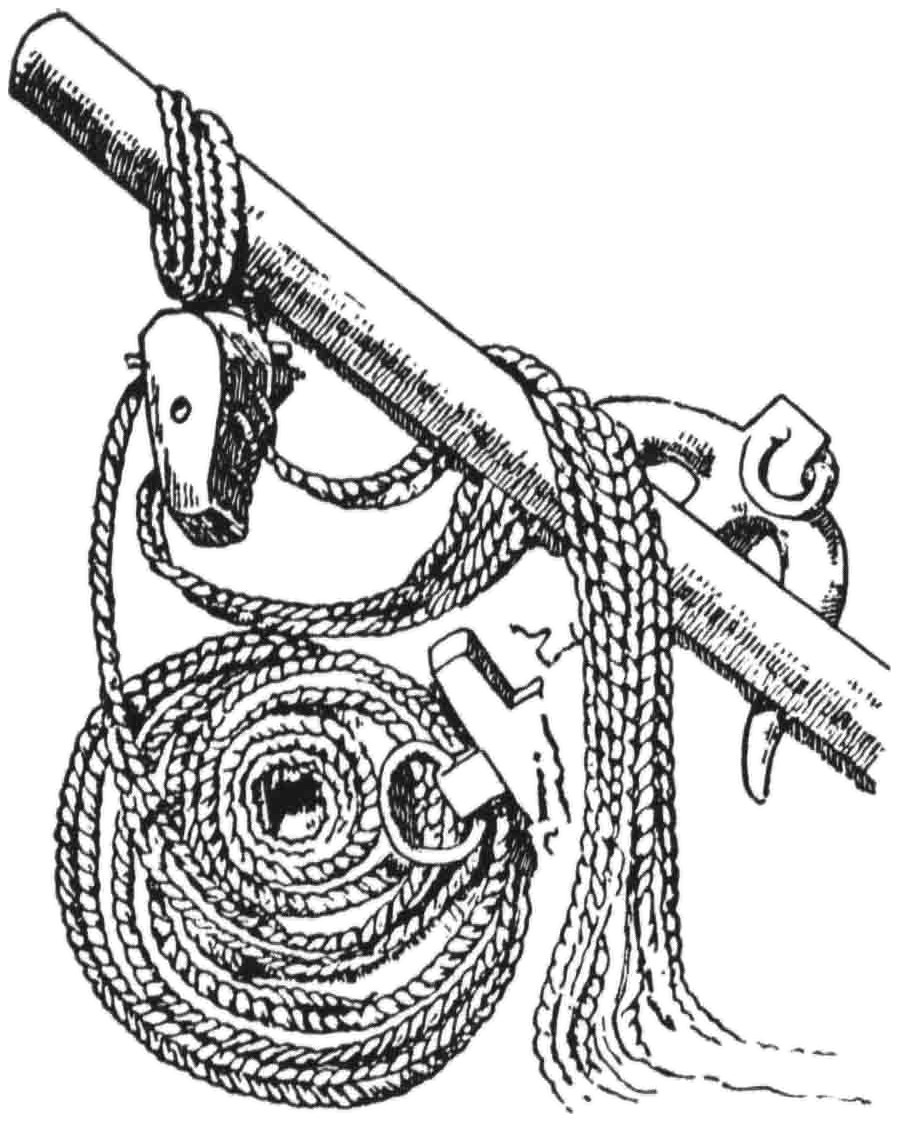
DETAIL OF BAS-RELIEF FROM TRIUMPHAL ARCH AT ORANGE
Another man is arranging and paying out the thongs
to a third, who is evidently walking backward in time-honored
fashion, twisting as he goes. The thongs are
evidently tied to a sort of swivel which is fastened to
the man’s body in such a way that it enables him to
keep a strain upon the strand without interfering with
the twisting, in which process the weight shown upon
the swivel is probably of some assistance.
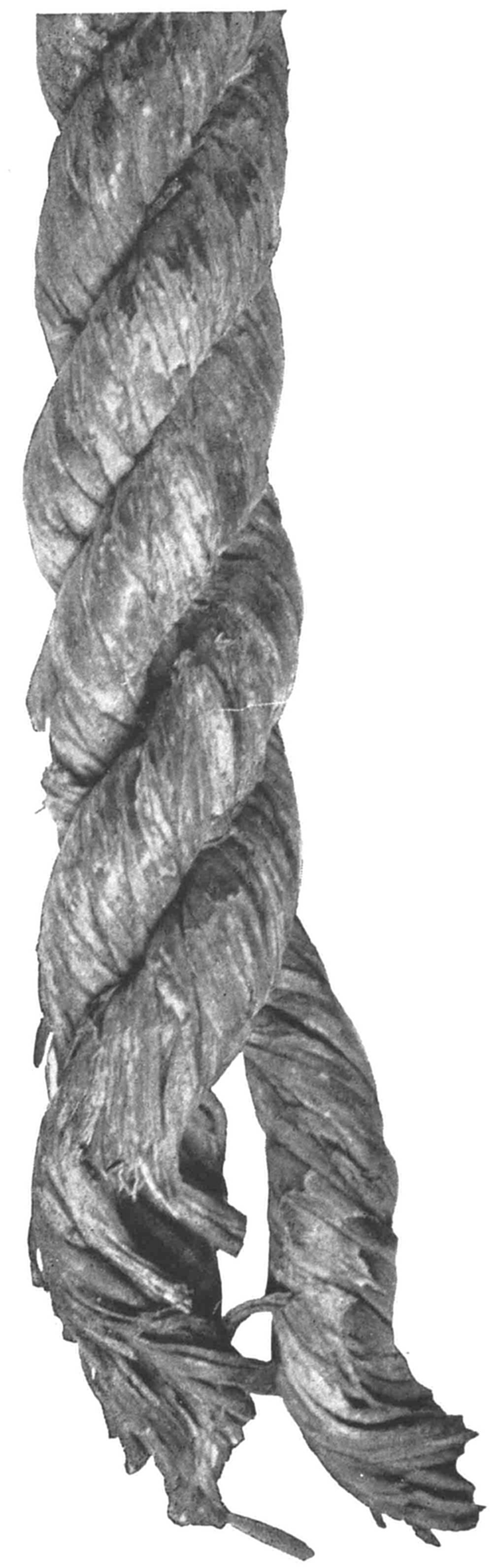
The Egyptians also made rope from papyrus and
from palm fiber. The specimen shown in our illustrationB
is from the latter material, and was made
probably not less than 3,500 years ago, having been
taken from an ancient tomb. It has always been a
puzzling question how the Egyptians were able to
move and put in place the massive stones
used in some of their structures, but it
is certain that rope must have
been an indispensable part of
their equipment. Indeed, some
of the sculptures illustrate the
free use of rope in moving heavy
stone carvings. It is known that
rope was made in China at a very
remote period.
B See page 15. Photograph from the original specimens taken expressly for us
through the courtesy of the Boston Museum of Fine Arts.
It is of course certain that
when men began to propel boats by means of sails, some
sort of rope must have been at hand for rigging such
vessels. The early history of the building of sailing ships
seems to be lost in obscurity, but many of the ancients
were good sailors, there seeming to be some difference
of opinion as to who were the pioneers in undertaking
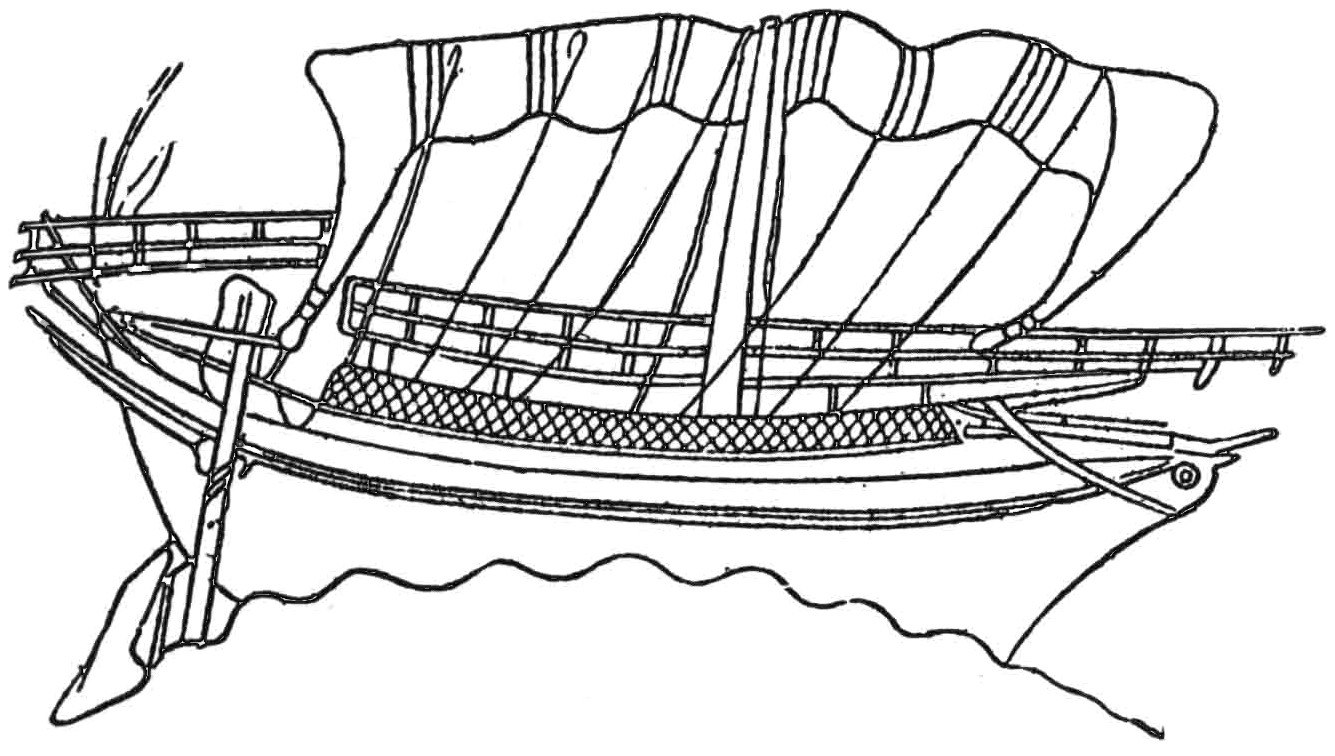
long voyages. We show an illustration of an Attic sailing
ship of the sixth century B.C. The drawing was made
from the painting on a drinking cup in the collection of
the British Museum. We also give a picture illustrating
a detail of the bas-relief from the triumphal arch at
Orange erected about A.D. 41. This shows an anchor
and a coil of rope, evidently a halyard for a good-sized
sail, rove through a pulley. In these and numerous
other cases we have records of the use of rope among
the Greeks and Romans, as well as similar ones from
other nations, handed down to us through their
sculptures and paintings.
ATTIC SAILING SHIP, SIXTH CENTURY B.C.
The historians also
occasionally mention the
use of rope in connection
with some great undertaking.
Herodotus tells
us that Xerxes, during
his invasion of Greece, B.C. 480, crossed his army over
the Hellespont upon two bridges of boats, which were
held together, and the plank roadway supported, by
enormous cables stretched from shore to shore, a distance
of seven-eighths of a mile. It is said that these
ropes, of which there were six to each bridge, were
twenty-eight inches in circumference, two of each set
being made of flax and four of papyrus. It is stated
that the famous galley, the Syracusia, built for Hiero
under the supervision of Archimedes, was furnished
with hempen rope from Rhodes.
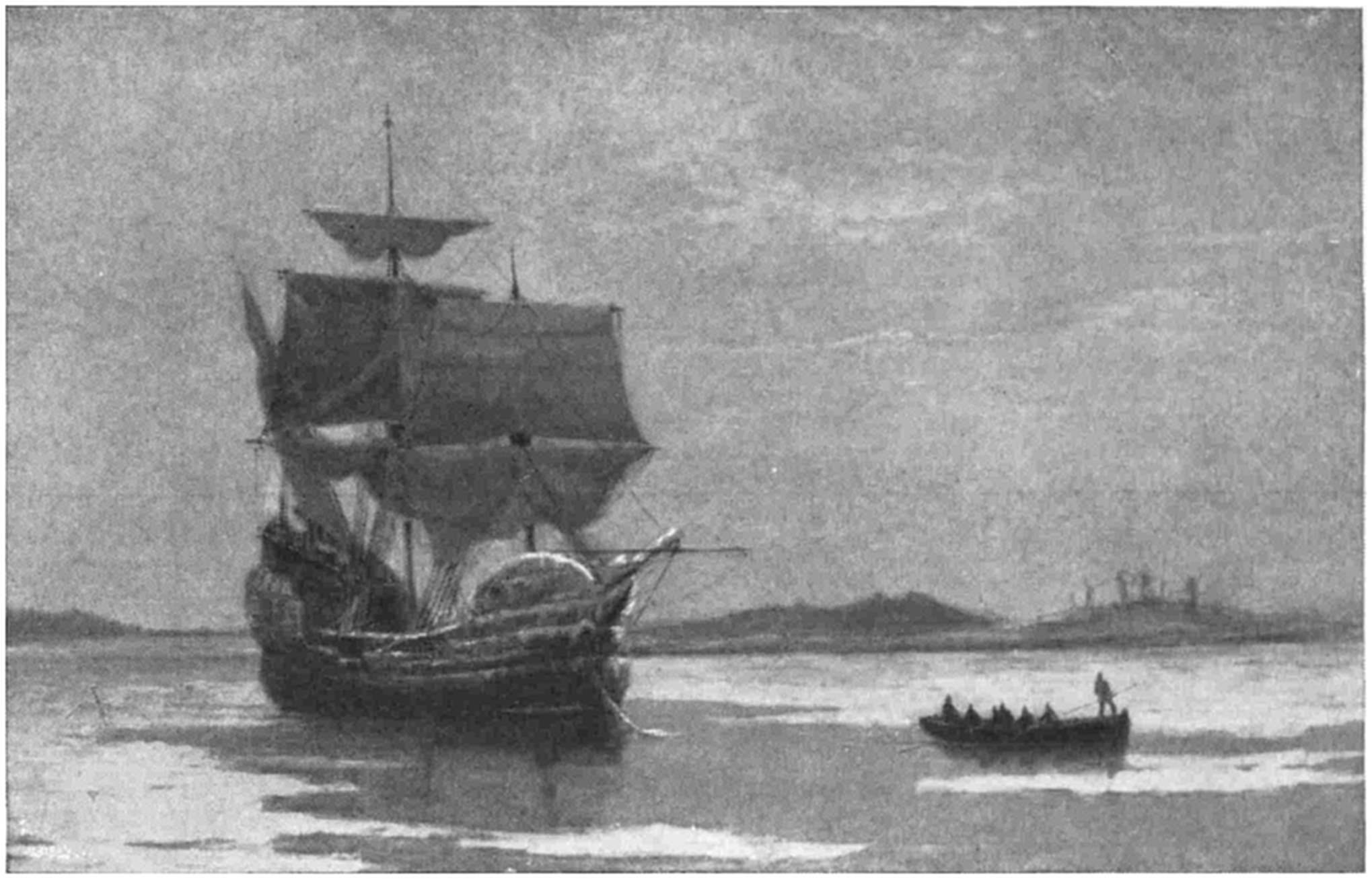
MAYFLOWER IN PLYMOUTH HARBOR
CHAPTER II Rope-Making in the Seventeenth, Eighteenth and Early Nineteenth Centuries — Part II
Coming down to more recent times we find
that rope-making had been going on for centuries
with probably very little change, up
to the time of the introduction of machinery
and the establishment of the factory system. It had
been carried on as a domestic industry, or a trade
handed down from father to son, and naturally was of
most importance in the principal seaport towns where
vessels were built or fitted out.
This was the state of the business at the time of the
settlement of America, and it was not long before the
rope-maker began to be needed as a citizen of the new
Colonies. This need was felt in Boston with the first
efforts at shipbuilding there, and was also suggested by
the great demand for fishing lines, the cod-fisheries being
of great importance upon the Massachusetts coast.
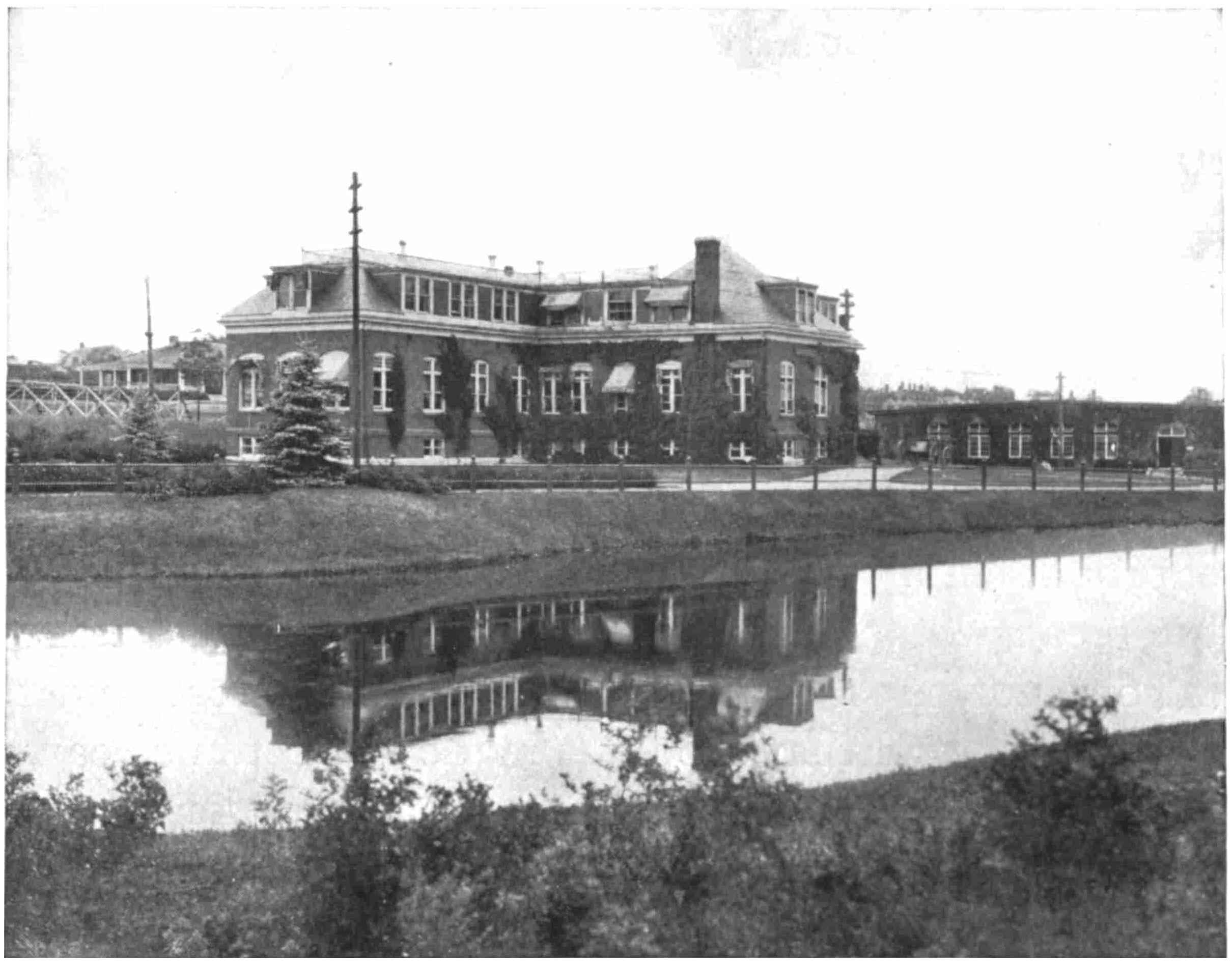
OFFICE OF PLYMOUTH CORDAGE COMPANY
It is recorded that rope was made in Boston as early
as 1641 or 1642. John Harrison, a rope-maker of Salisbury,
England, came to this country at the request of
a number of citizens of Boston, and set up his business
in that village. He seems to have had a monopoly of
the local trade for a good many years, under the paternal
protection of the town authorities, for John Heyman,
to whom permission to make rope in Boston was
given in 1662, was the next year ordered to give up the
work and depart from the town, it being found that
this competition interfered with Harrison’s business to
such an extent as to make it difficult for him to properly
support his family of eleven persons.
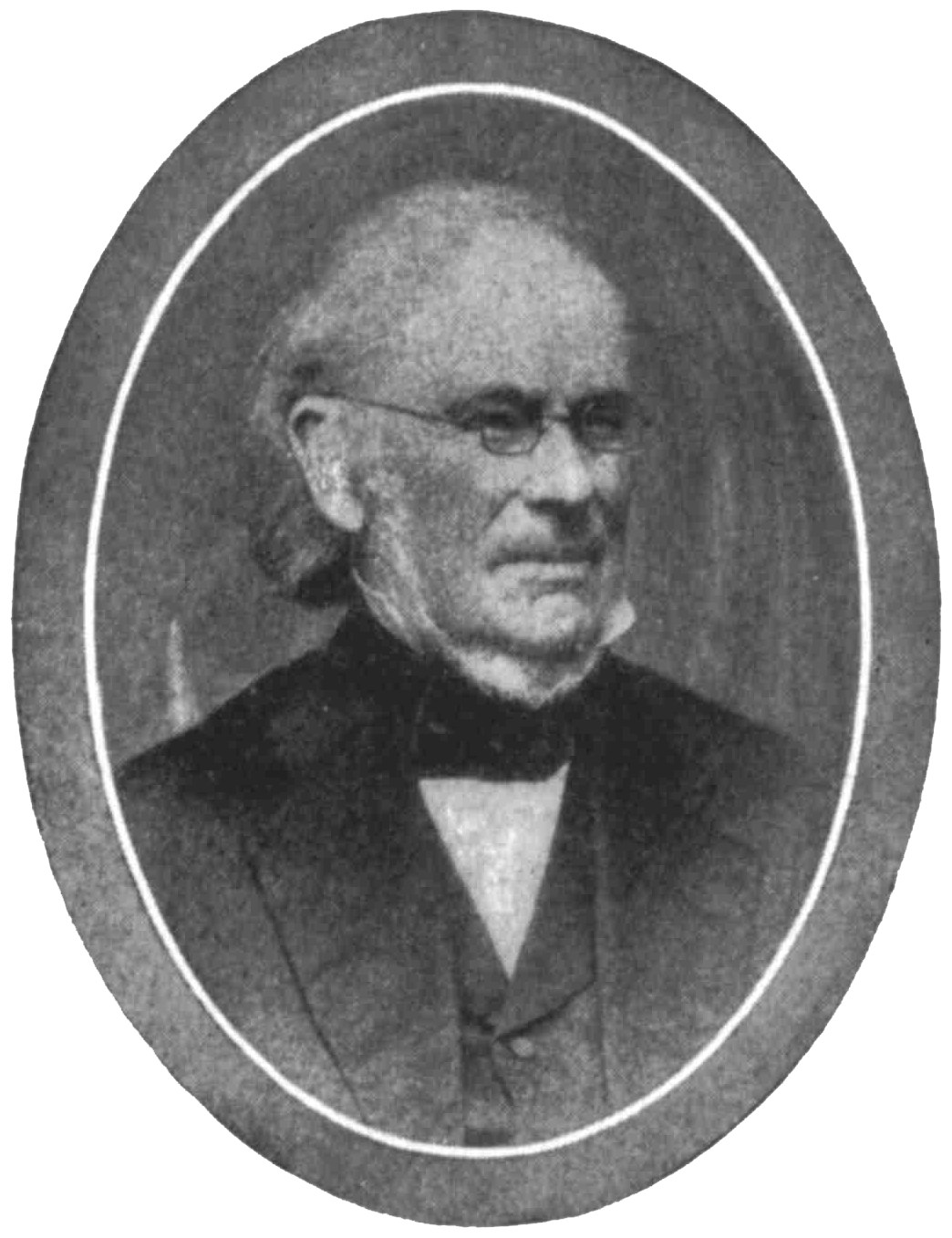
BOURNE SPOONER
However, upon the death of Harrison this monopoly
came to an end, and ropewalks began to multiply in
Boston as well as in other parts of the country. In
1794 there were fourteen large ropewalks in Boston,
the business having steadily increased with the development
of the new country. The importance of
this industry is shown by the report that in the federal
procession in Boston in 1788, the rope-makers outnumbered
any other class of mechanics.
In 1810 there were 173 ropewalks
in the United States, scattered
over the country from Maine
to Kentucky.
In 1824 the infant Plymouth
Cordage Company entered upon
the scene and gradually but surely
became an important factor in
the trade, until today it stands at
the head.
In the first half of the last century
Manila hemp began to take
its place as a cordage fiber. According
to official records, 27,820 bales were imported
to the United States in 1843. This figure looks small
when compared with a recent high figure of approximately
830,000 bales in a single year. The first record
of the importation of Sisal is in 1860, when the United
States received 1,393 bales. This has increased to
1,000,000 bales.
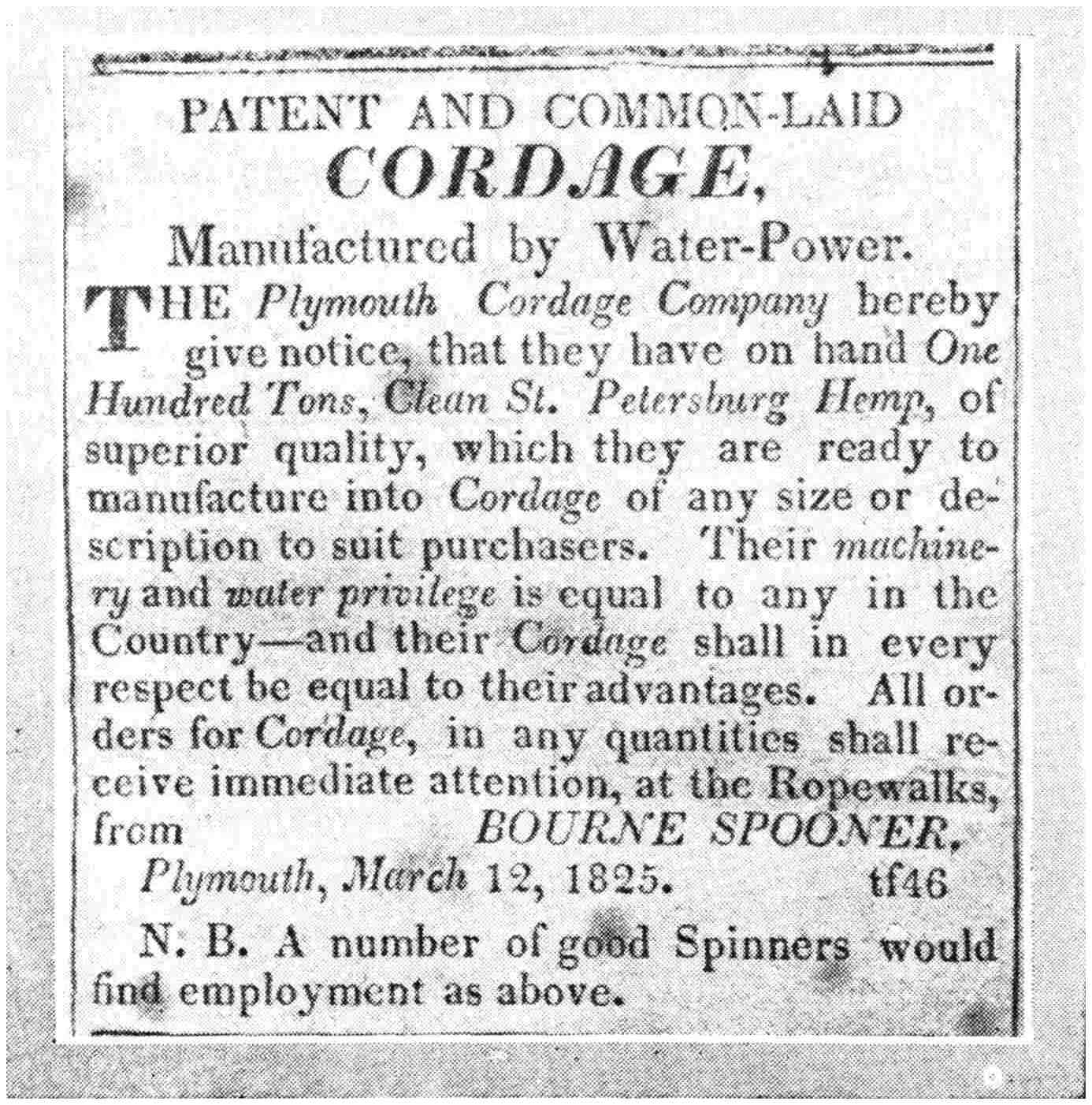
PATENT AND COMMON-LAID
CORDAGE,
Manufactured by Water-Power.
ThePlymouth Cordage Company hereby
give notice, that they have on hand One
Hundred Tons, Clean St. Petersburg Hemp, of
superior quality, which they are ready to
manufacture into Cordage of any size or description
to suit purchasers. Their machinery
and water privilege is equal to any in the
Country—and their Cordage shall in every
respect be equal to their advantages. All orders
for Cordage, in any quantities shall receive
immediate attention, at the Ropewalks,
from
BOURNE SPOONER.
Plymouth, March 12, 1825.tf46
N. B. A number of good Spinners would
find employment as above.
PLYMOUTH CORDAGE COMPANY’S FIRST ADVERTISEMENT
The large consumption of Sisal during recent years
has been caused by the production of binder twine,
which has now become
an important
part of the cordage
business. This company
first made
binder twine in 1882.
In 1899 it completed
its No. 2 Mill, devoted
entirely to this
product, and by the
completion of the
Welland (Ontario)
factory in 1906 was
enabled to supply its
large Canadian trade
from that point. The
Sheaf of Wheat trademark
and the name
“Plymouth” on binder
twine are now known
the world over and, as
in the case of the Ship
brand on rope, are always
recognized as
standing for quality.
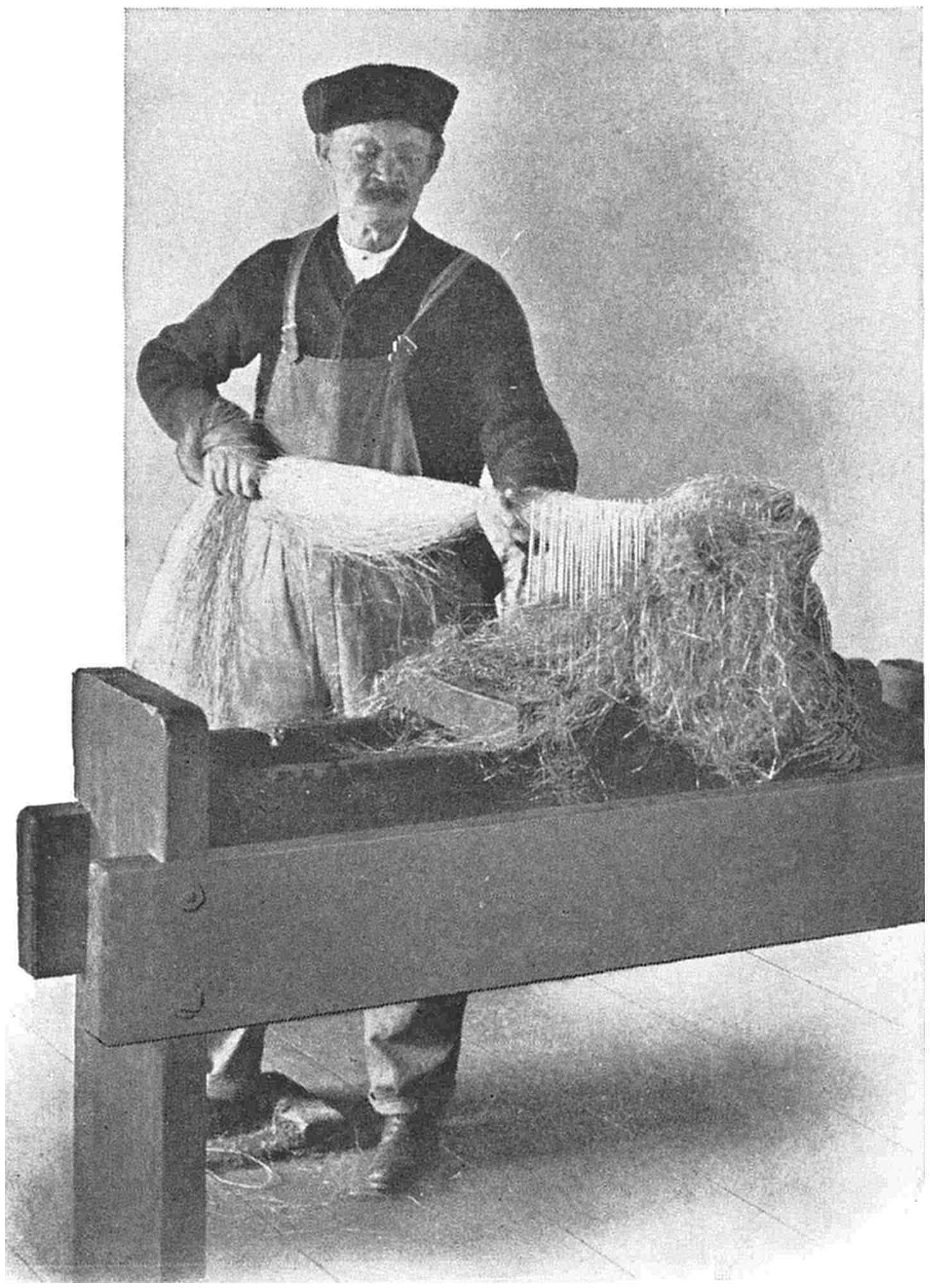
OLD-TIME METHOD OF HACKLING
In the early days to
which we have referred,
all the yarn for rope-making
was spun by
hand in the time-honored
way. We are able
to represent to our readers,
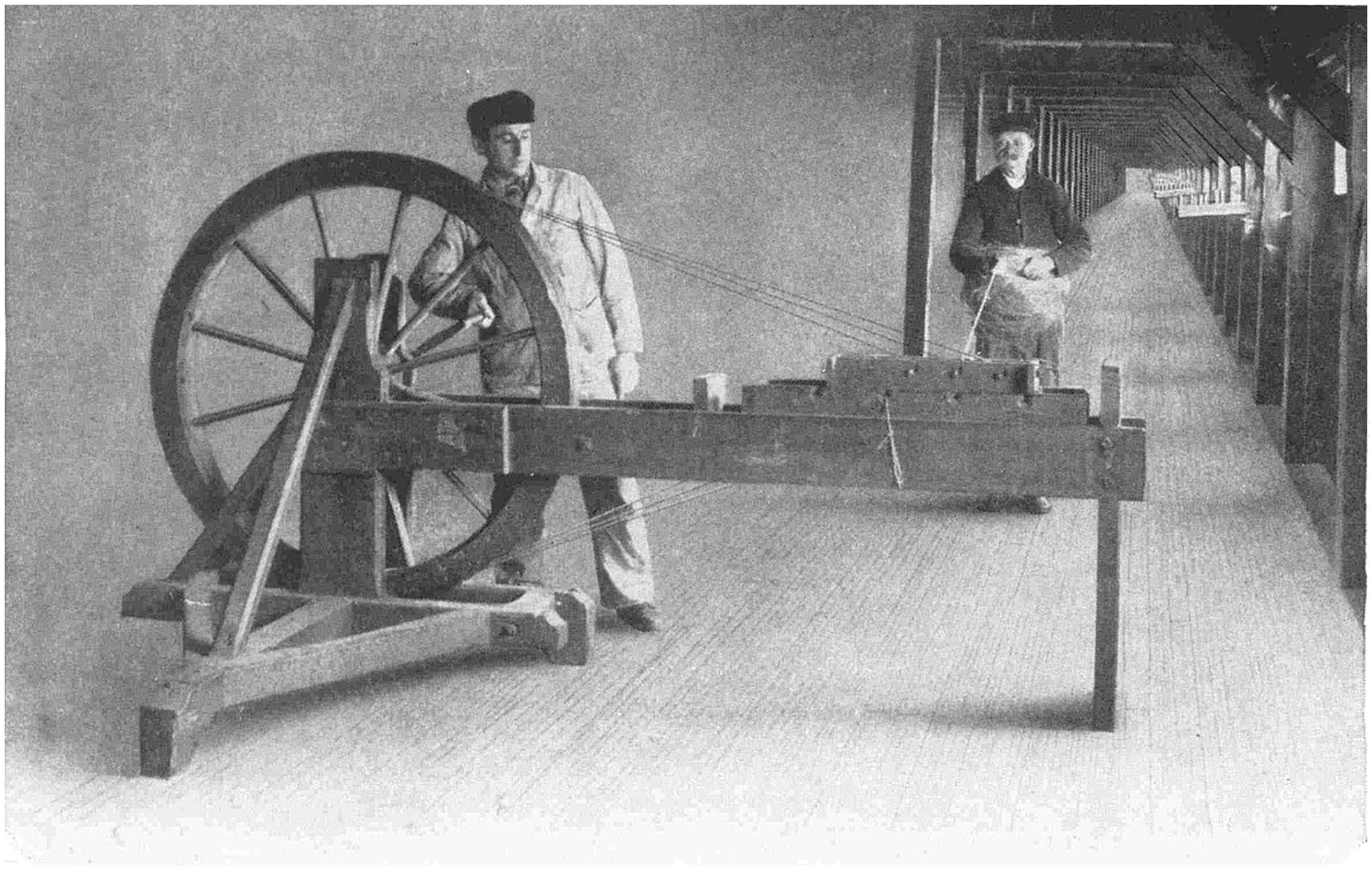
by the photographs shown, this now almost lost art.
The material shown in the pictures is American hemp,
which, because the earlier machines were not adapted
to working this softer fiber, continued to be spun by
hand long after Manila was spun chiefly on machines.
The hemp was first hackled, as is also shown by our
photograph, the hackle or “hechel” being simply a
board having long, sharp steel teeth set into it. This
combed out the tow or short, matted fiber, leaving the
clean, straight hemp. This “strike” of hemp the
spinner wrapped about his waist, bringing the ends
around his back and tucking them into his belt, thus
keeping the material in place without knot or twist,
and allowing the fibers to pay out freely.
The workman in our picture is Johnny Moores, an
old-time expert hand-spinner, who could walk off
backward from the wheel with his wad of hemp,
spinning with each hand a thread as fine and even as
could be asked for. In the photograph, in order to show
the process more clearly, one large yarn is being spun.
The large wheel, usually turned by a boy, is used to
convey power to the “whirls” or small spindles carrying
hooks upon which the fiber is fastened. These
whirls, revolving, give the twist to the yarn as the spinner
deftly pays out the fiber, regulating it with skillful
fingers to preserve the uniformity and proper size of
the yarn. As he goes backward down the long walk
through the “squares of sunlight on the floor” he
throws the trailing yarns over the “stakes” placed at
intervals along the walk for the purpose.
The spinning “grounds” were usually arranged with
wheels at either end, so that spinners, reaching the
farther end, could go back to their starting point spinning
another set of yarns.
HAND SPINNING
Then, in the case of small ropes, the strands could
be made by attaching two or more yarns to the “whirl”
and twisting them together, reversing the motion to
give the strands a twist opposite to that given the yarns.
These strands were twisted together, again reversing
the motion, making a rope. Thus it will be seen that,
reduced to its lowest terms, rope-making consists simply
of a series of twisting processes. The twisting of the
yarns into the strand is known as “forming” or putting
in the “foreturn.” The final process is “laying,”
“closing” or putting in the “afterturn.” Horse power
was used in old times for forming and laying rope
which was too large to be made by hand.
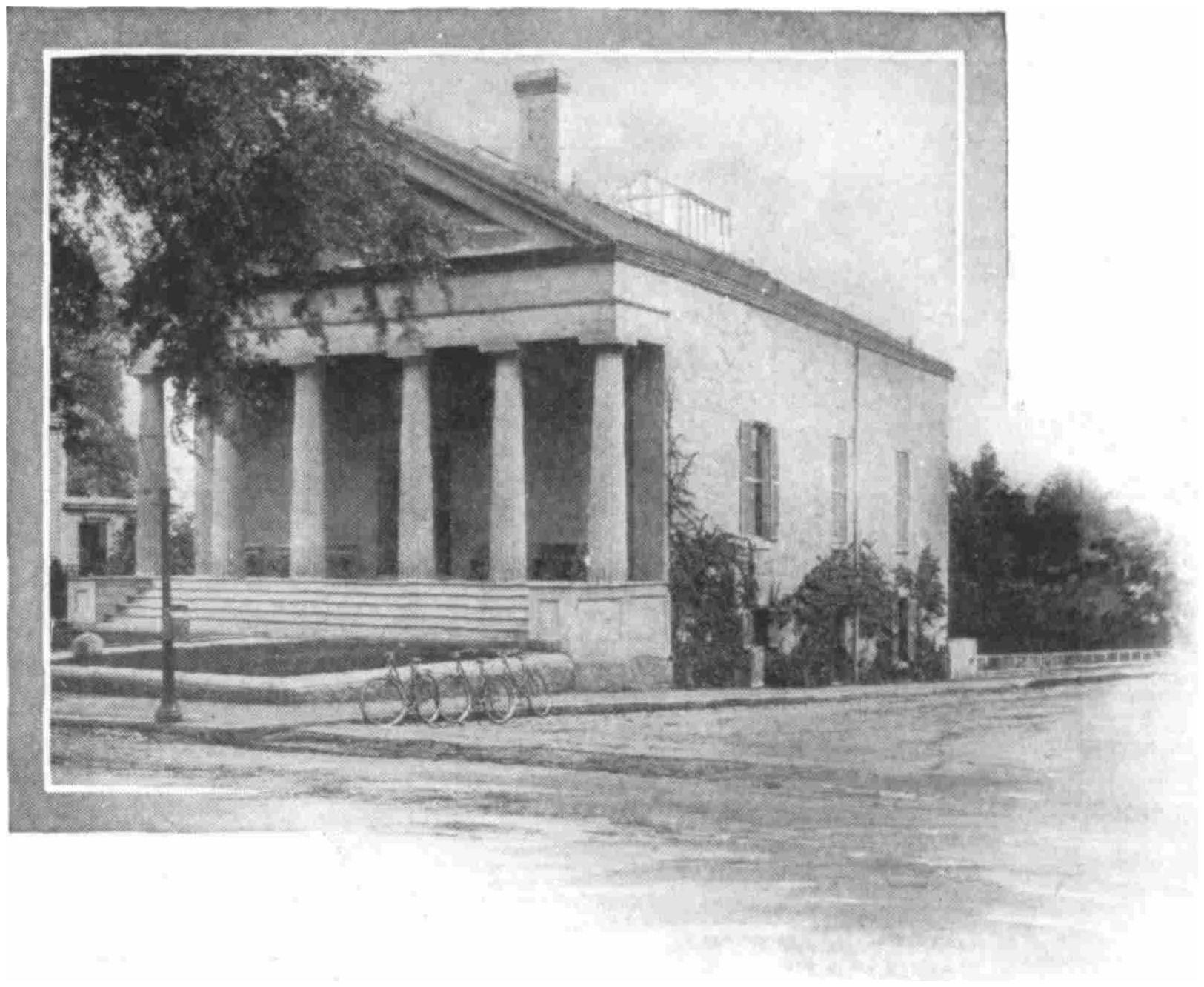
PILGRIM HALL, PLYMOUTH
CHAPTER I Manila Fiber
In any manufacturing enterprise the question
of raw materials is one of the highest importance.
No manufacturer can become
extensively successful without an intimate
knowledge of the material entering into his product.
He must be an expert judge of its quality to be able
to determine for himself the exact value of what is
offered him and its adaptability for his particular purposes;
he must be closely in touch with all the markets;
he must know all the conditions surrounding the production
and marketing of the material; he must be
fully posted as to all causes, natural and speculative,
affecting the supply or the demand.
To be most valuable, this knowledge must not only
cover matters affecting the present, but must forecast
the future with the greatest possible degree of certainty.
Such foresight is particularly valuable in the cordage
business, where material must be provided for many
months before it is used. This factor has always been
conspicuous in the management of the Plymouth
Cordage Company, and has contributed not a little
to its continued and increasing
growth and prosperity.
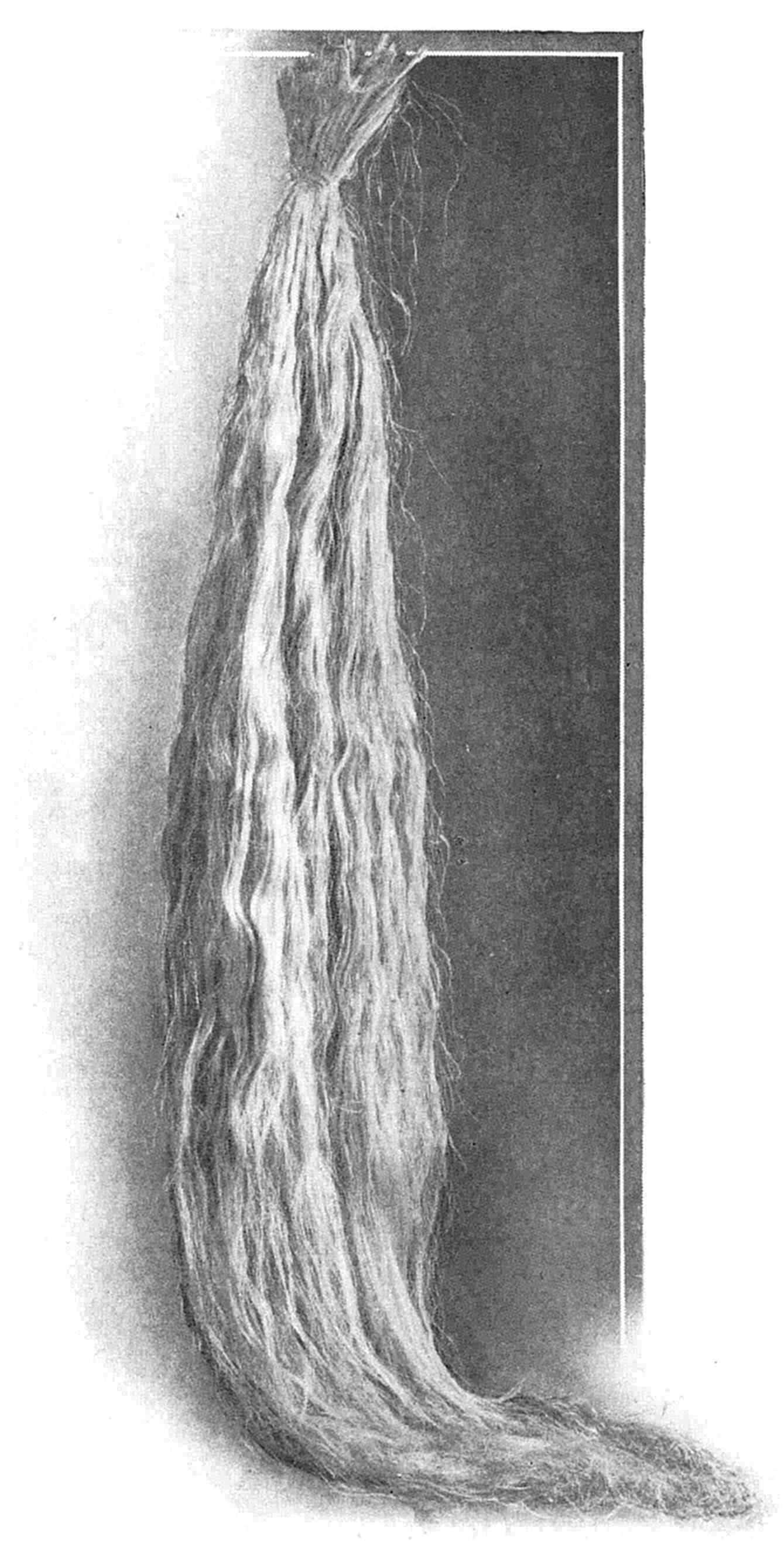
HANK OF MANILA 12 FEET LONG
For the rope-maker the raw material
par excellence is the so-called
“Manila hemp.” Strictly speaking
this is not a hemp at all, being a
fiber obtained from the wild banana
plant of the Philippine Islands.
The botanists tell us to call this
plant Musa Textilis, but the Filipino,
who ought to know, calls both
the plant and its fiber “Abacá.”
The Philippines have a monopoly
of this very important plant, as it
has never been successfully cultivated
elsewhere. So it will be seen
at the start that the user of Manila
hemp is dependent entirely upon
our foreign possessions in
the far East for his supply.
Like most monopolists, the
Filipino is not particularly
susceptible to the wishes of
his customers, and the procuring
of hemp produced and prepared in the way to
make it most valuable for rope-making is attended with
some difficulty.
The Abacá is cultivated by setting out shoots
of the plant after a suitable tract of land has been
cleared. When the field has had proper cultivation
for a period of two or three years some of the plants
will be ready to cut. They will then be tree-like in
shape, and from fifteen to twenty-five feet in height.
The stalk, some fifteen feet long, and a foot or
more in diameter, is composed of the separate leaf
stems growing compactly together in overlapping
layers.
The fiber is contained in the outer bark of these leaf
stems, their inner portions being of a soft, pulpy
nature. After the stalk is cut the native peels off strips
of this fibrous bark, and after stripping the outer layer
of stems, scrapes off its remaining pulp and proceeds
to strip the next inner layer. This process is kept up
through all the successive layers. The fiber from the
inner layers of stems is finer and whiter than that from
the outside.
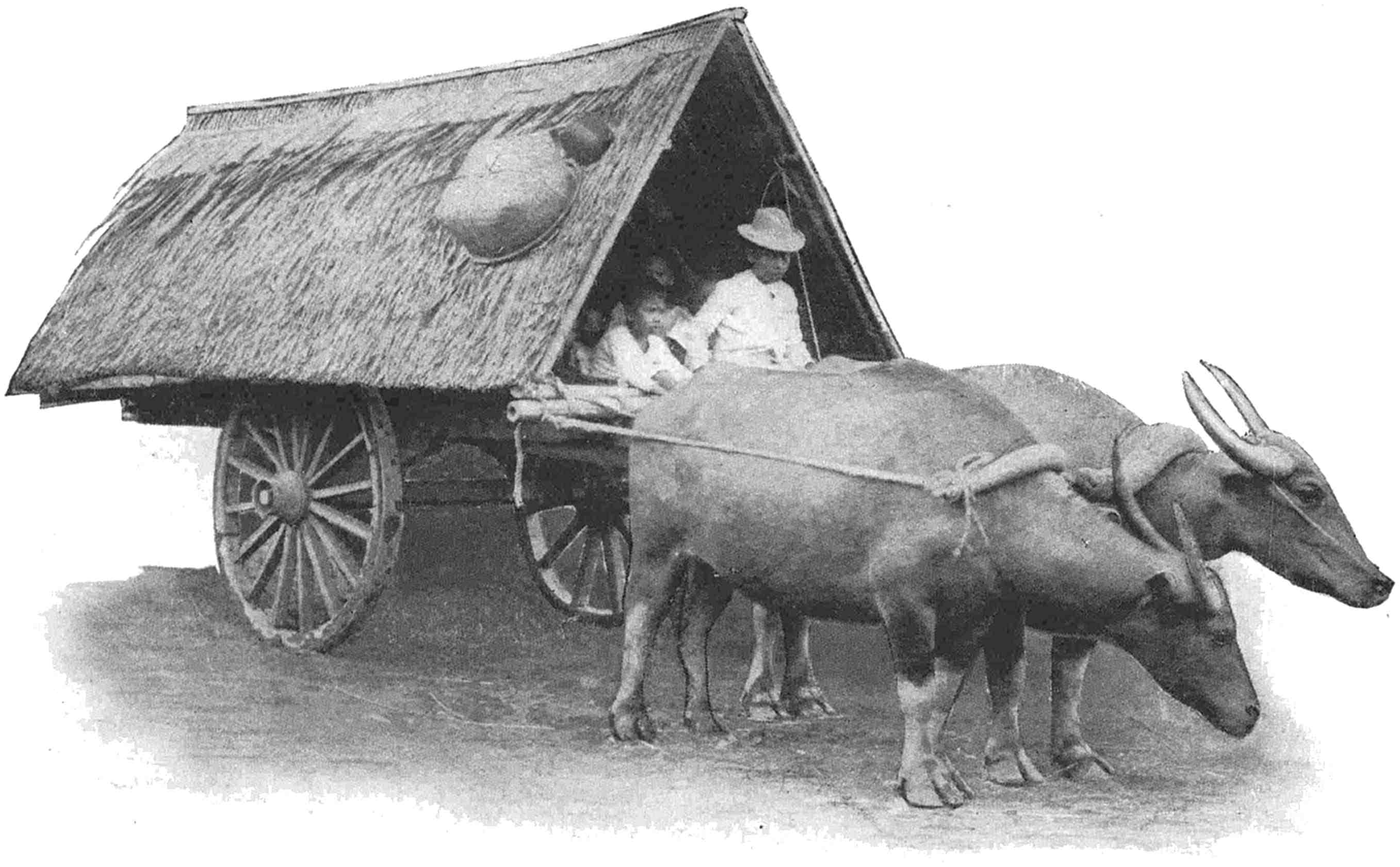
PHILIPPINE HEMP CART
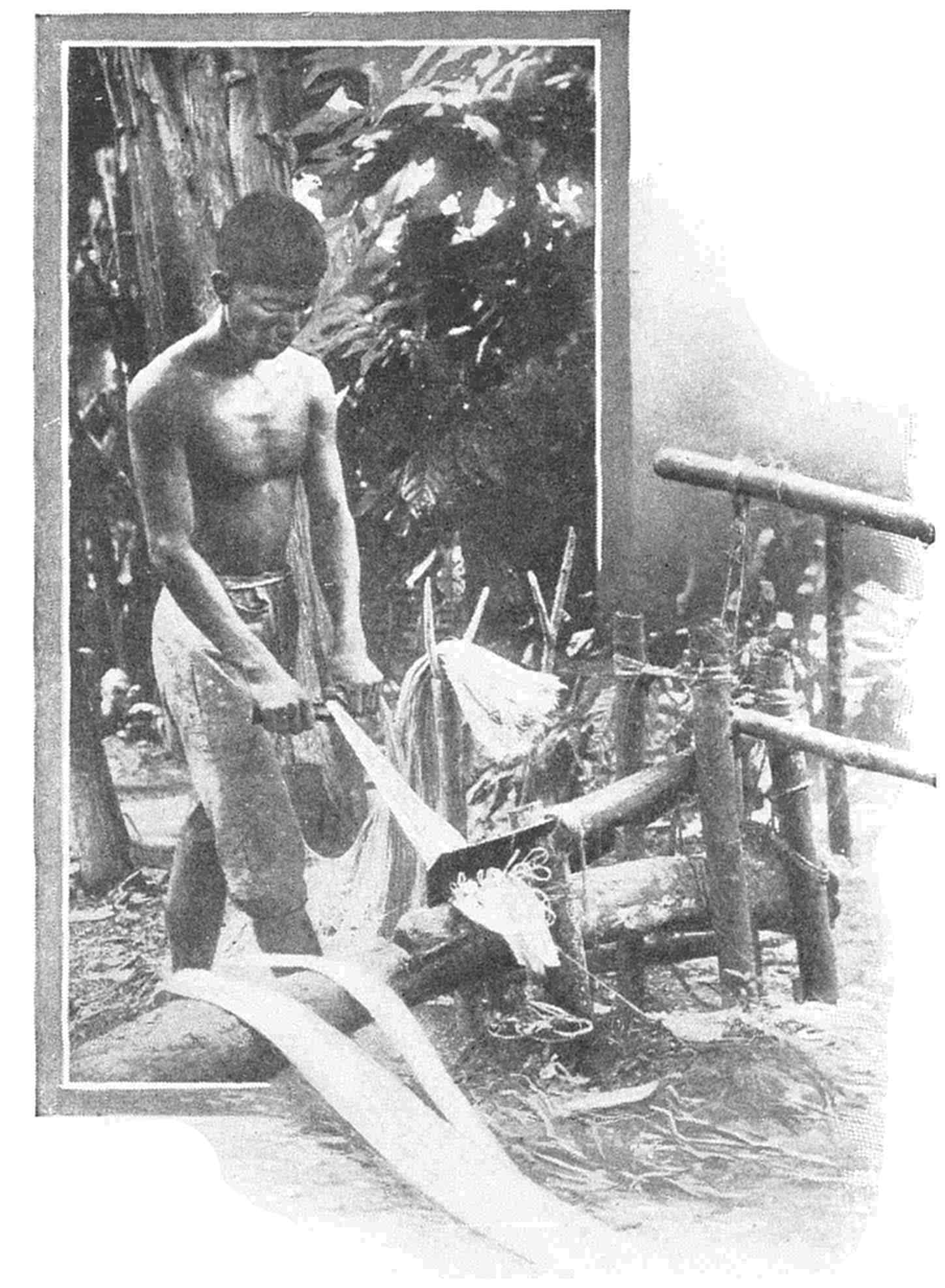
The fibrous strips are then cleaned by drawing them
under a knife hinged over a block of wood. This
scraping frees the fibers from the surrounding pulp.
The quality of the hemp depends very much upon the
thoroughness with which this cleaning is done. By
using a smooth-edged knife and putting considerable
pressure upon it during the operation, a fiber is secured
of high strength and good color. However, this means
strenuous work on the part of the operator, and our
brown fellow-citizen, like many of his white brethren,
is averse to tiring his
back; consequently the
bulk of the fiber put
upon the market is
cleaned under
knives with rough edges and loosely held against the
material. This makes the workman’s task easier and
enables him to turn out a larger product, but of an
inferior quality. Hence one of the worries of the manufacturer
of high-grade cordage.
“STRENUOUS WORK”
This, briefly, is the way Manila hemp is extracted
from its parent stalk. A fortune awaits anyone who
will perfect machinery capable of superseding these
antiquated hand methods.
After scraping, the fiber is hung over bamboo poles
to dry. When thoroughly dried, it is tied up in hanks
and carried to market. In the warehouse of the exporter
the fiber is sorted and graded and then packed
in bales of 275 pounds. In this form it eventually
reaches the cordage factory.
With this description, let us sum up some of the elements
entering into the quality of various parcels of
hemp, which will be of interest as showing the task
imposed upon the manufacturer
in selecting the quality of fiber
necessary to furnish
rope of the required
standard. It must be
strongly impressed
upon the mind that the
fact that a certain rope
may be honestly called
“Manila” is no proof
of its strength, durability
or general value.
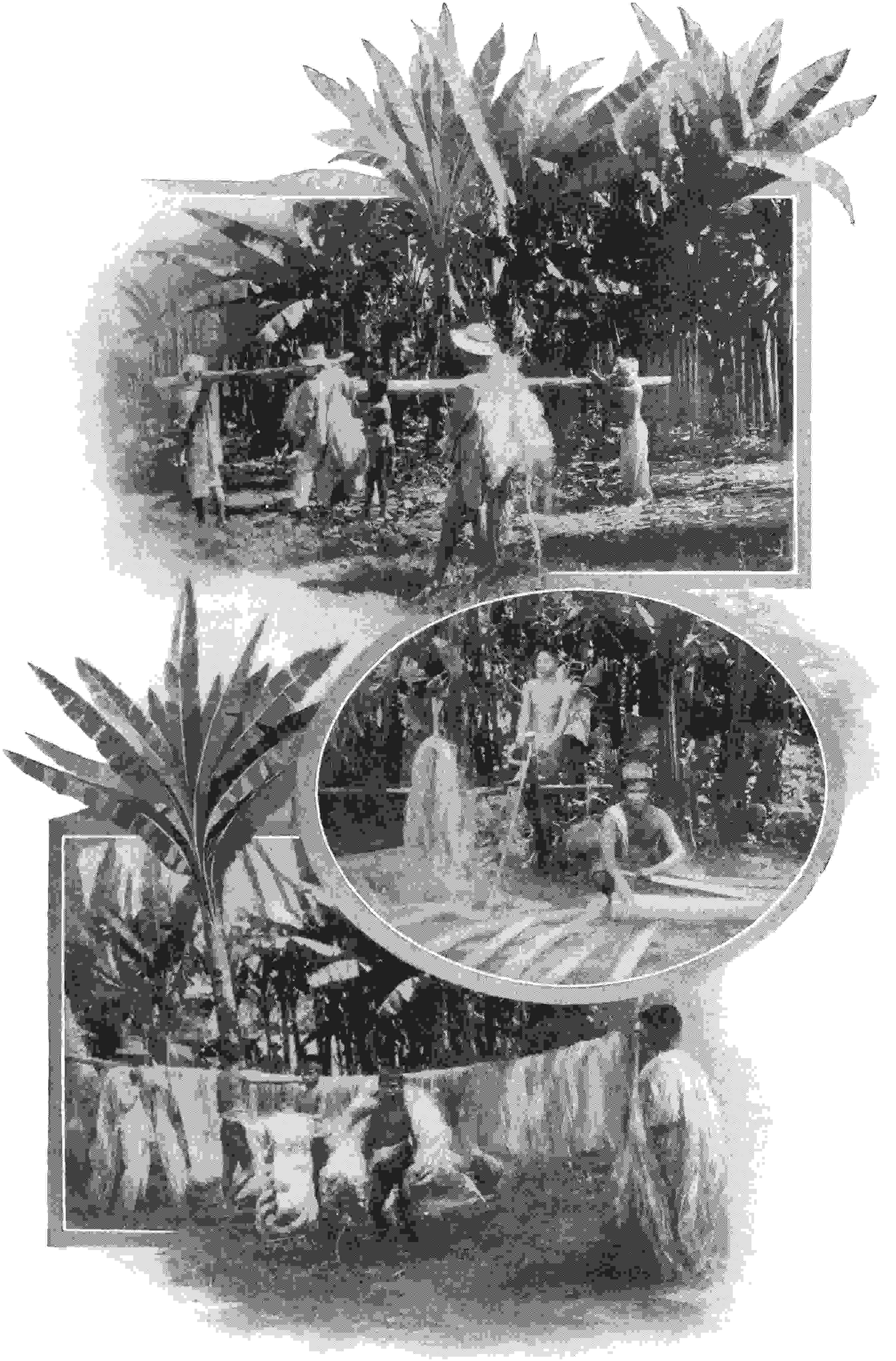
COLLECTING THE STALKS
STRIPPING AND SCRAPING
DRYING—TYING IN HANKS
FILIPINOS PREPARING MANILA FIBER
In the first place,
there are some fourteen
varieties of the Musa
Textilis, presenting a
like range in the quality
of fiber produced. Then each process of gathering and
preparation presents opportunities for deterioration:
the plant must be cut at just the right time, and if,
after cutting, the stalk is allowed to remain too long
before it is stripped, the fiber is injured. We have
already seen that quality is largely dependent upon
the character of the knife used in cleaning and the
care given to this operation. Likewise, for best results,
the fiber must have proper care while drying.
As all these operations are in the hands of people
not noted for industry or carefulness, it will be easily
understood that the resulting output contains but a
small percentage of really first-class material.
To get an idea of the wide range in quality of Manila
hemp, we have but to refer to any broker’s list of offerings,
which will show prices varying from six to thirteen
cents, or in similar proportion.
EXAMINING MANILA FIBER AT DOCK
For a number of years past prices of Manila hemp
have ruled much higher than previously.
This great increase in price has placed the rope manufacturer
in a difficult position. He must either use a
poorer grade of material in his goods or must raise his
prices to a point which, to his customers, may seem
excessive.
The reluctance on the part of manufacturers to
accept the latter alternative has led to the use of low-grade
Manila, and to mixing Manila with inferior
fibers (Sisal, New Zealand, etc.), to a greater extent
than at any other period in the history of the industry.
The Plymouth Cordage Company, however, has
steadily held the opposing position, and has continually
been on the alert to secure the grade of hemp
necessary to maintain its long-established standard
of quality. Not a particle of any other fiber has
entered into our Manila rope.
This is because of our knowledge that a high-grade
rope can be produced, with the proper facilities, to sell
at a price relatively lower than one made from cheaper
materials. This, of course, because the advantages of
lightness, strength and durability more than outweigh
the difference in price per pound. This is true
from a strictly dollars-and-cents standpoint, to say
nothing of the greater satisfaction in using the better
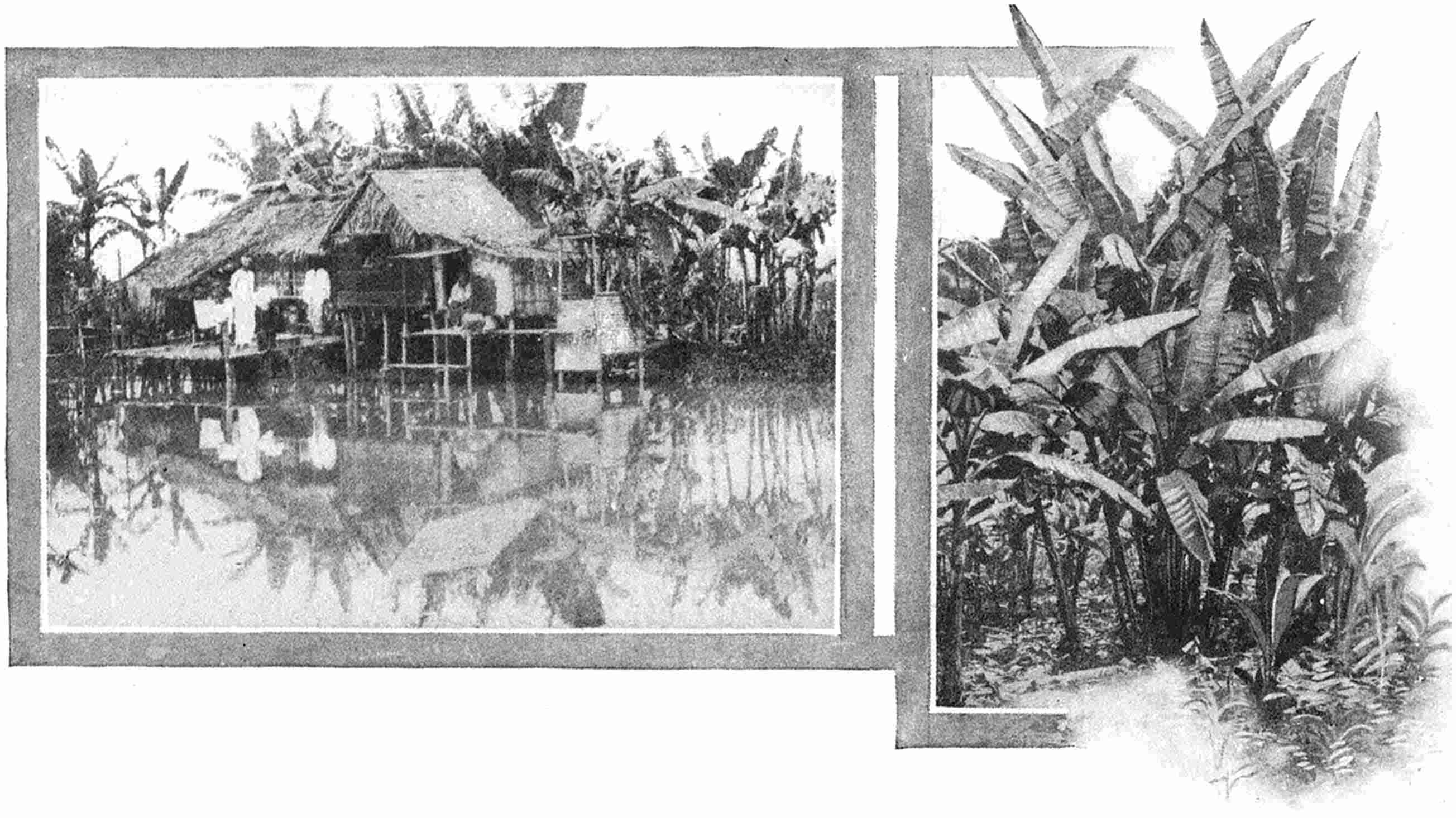
article.
“SUBURB OF MANILA”
ABACÁ GROWING
The making of cheap Manila (or so-called Manila)
rope has been carried to such an extent that recently
signs of a reaction have been apparent. Writers in
trade journals are protesting against the lengths to
which the cheapening of rope is being carried; buyers
are learning that quality and economy are close companions
in the rope trade; and so the correctness of
our position is being more fully demonstrated every
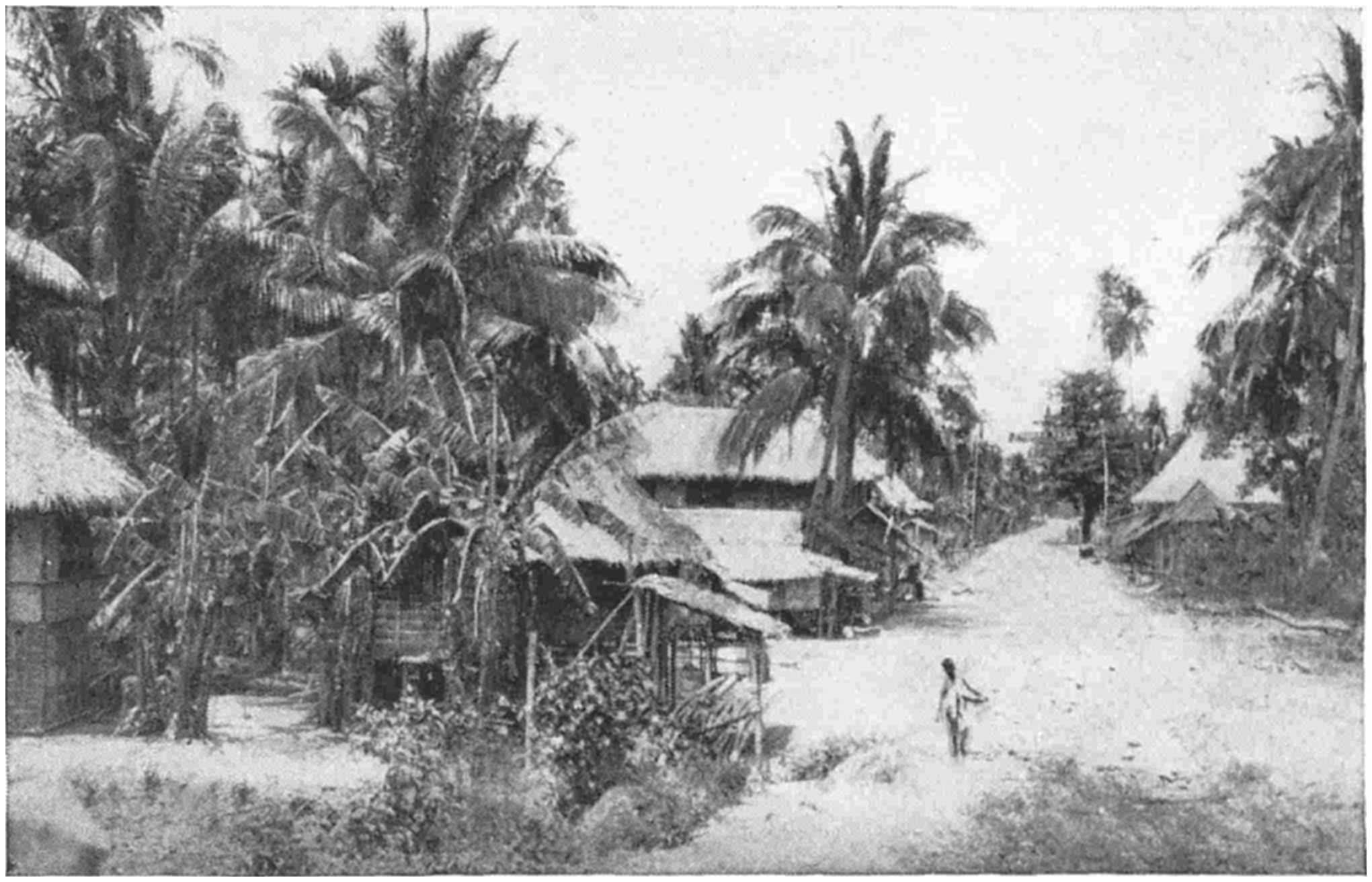
day.
PHILIPPINE STREET SCENE
CHAPTER II Sisal Fiber
The American cordage manufacturer is an
importer; very little of the fiber entering
into his product is grown at home. We
have already seen how the principal cordage
fiber—Manila—is brought from the Philippines.
Fiber is also imported from Russia, from Italy, and
from New Zealand, but we wish to speak now of the
material which, next to Manila, is most used in hard-fiber
cordage—Sisal—and which is secured from
one of our nearer neighbors. This fiber is obtained
from the leaves of a cactus-like plant belonging to
the Agave family. While varieties of this plant grow
in many parts of the world, it is cultivated most
extensively in Mexico, the state of Yucatan being the
chief center of production and Merida the capital
of the state the principal market. Several railroads
connect Merida with its seaport, Progreso, whence the
fiber for export is shipped.
As Sisal more than any other fiber is used as a substitute
for, or competitor of, Manila, we may make a
brief comparison of the two.
The length of Manila fiber is usually from six to ten
feet, while that of Sisal is only from two to four feet.
The tensile strength of Sisal is not more than three-fourths
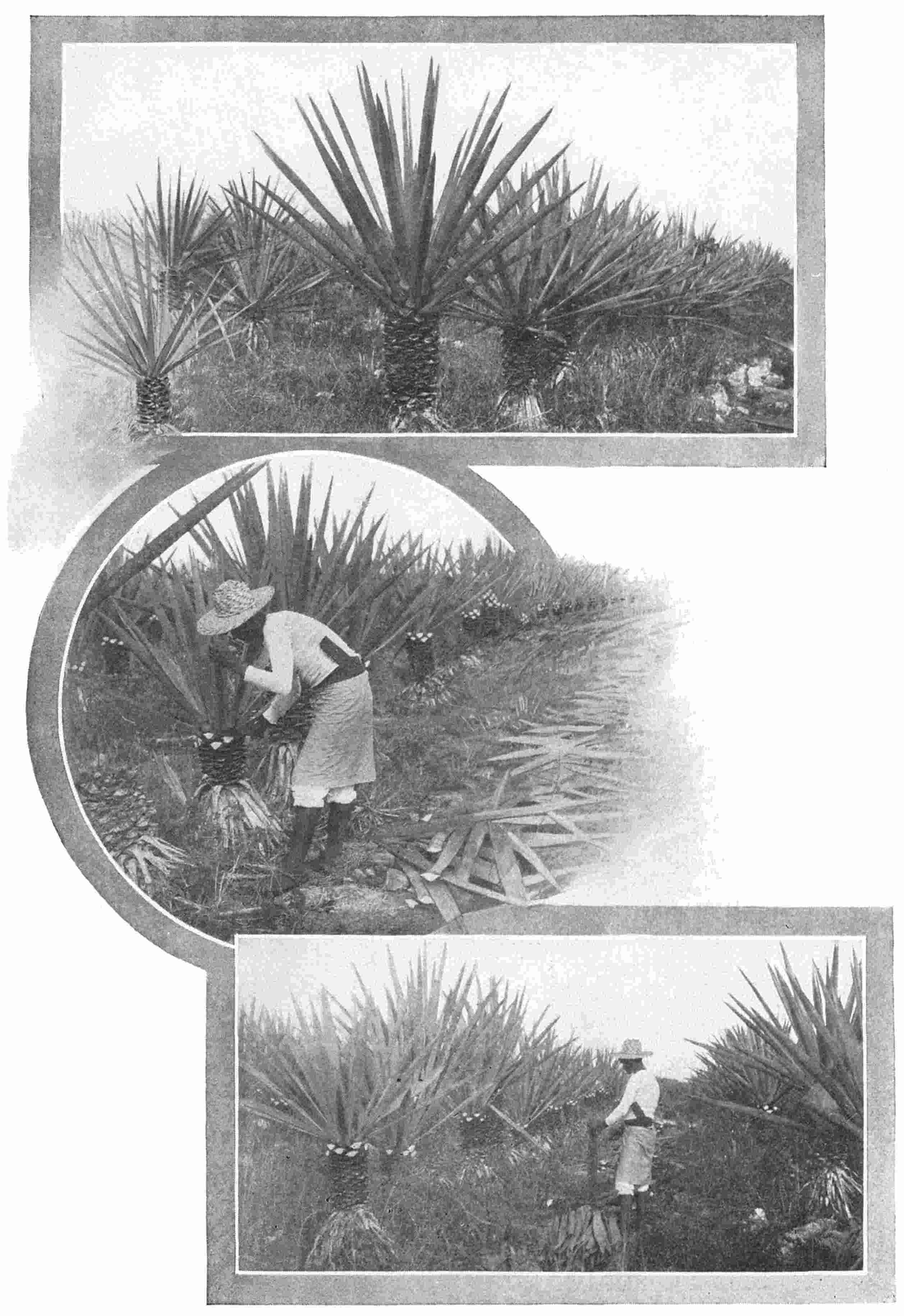
that of Manila.
FIELD OF SISAL PLANTS
CUTTING LEAVES
TRIMMING OFF THORNS
The color of Sisal is quite attractive, being a yellowish
white, with sometimes a slight greenish tinge.
Some fine lots of the fiber are very nearly white, but it
all lacks the gloss and brilliancy which are characteristic
of good quality Manila.
Manila is noted for its smoothness and pliability,
which make it an ideal fiber for rope-making. Sisal,
on the other hand, is without this flexibility, and is
much more stiff and harsh. This accounts for the presence
of the unpleasant “splinters” in a Sisal rope, and
their appearance in so-called Manila rope is an indication
of the use of Sisal as an adulterant. Sisal is
also more easily injured by exposure to moisture and
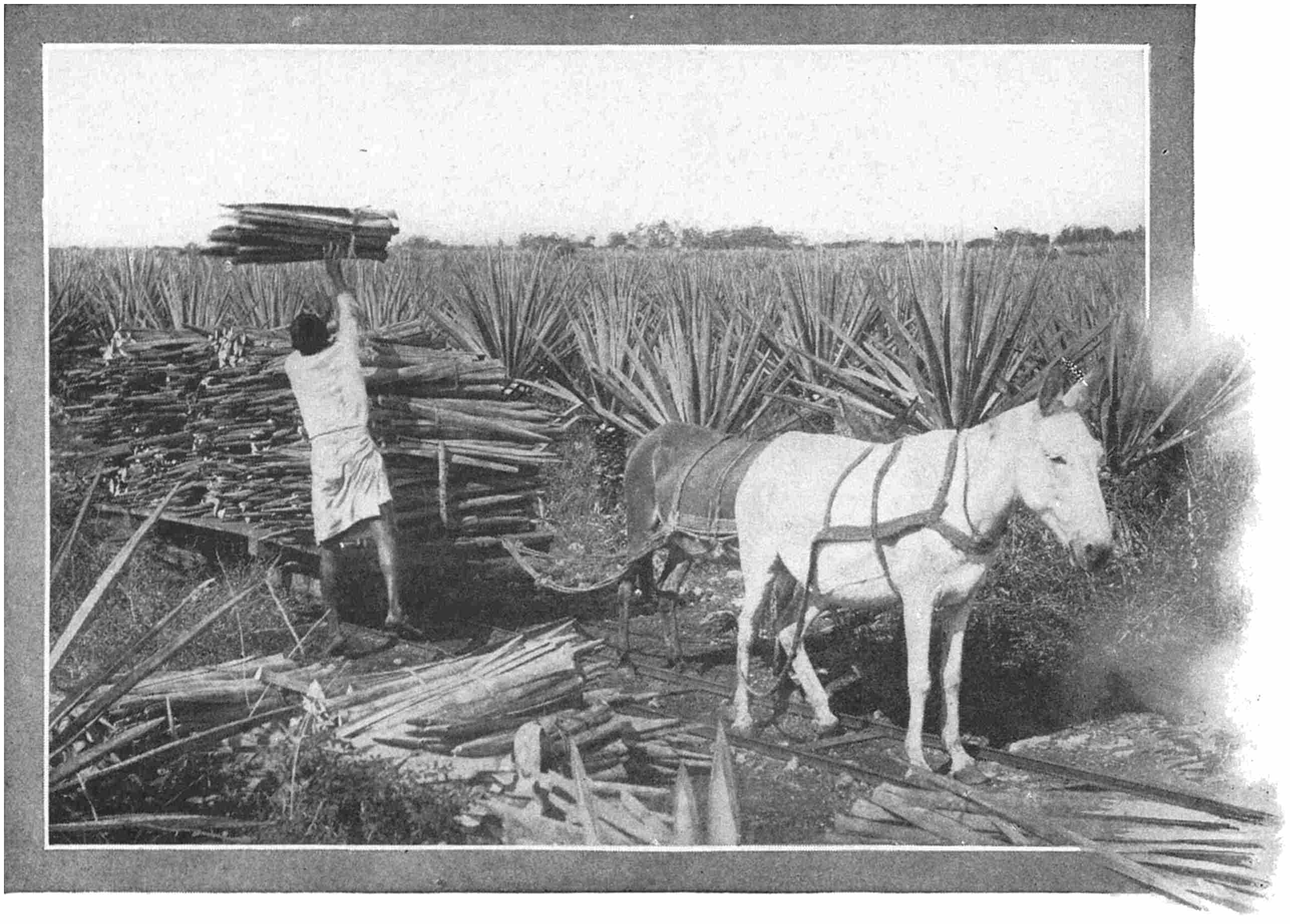
varying atmospheric conditions than Manila.
LOADING LEAVES ON CAR
While some of these qualities work against the use of
Sisal in rope for general purposes where the question
of durability is a factor, or even when softness and ease
of handling are considered, this fiber is not without
uses which it admirably
serves. When a rope or
yarn is wanted for tying
purposes, where it is
used as a band and then
discarded, Sisal can be
used to advantage, as it
is of sufficient strength
and can be spun with
a fair degree of smoothness.
It may be readily
treated with tar, which is an advantage when the material
upon which it is used is to be stored out of doors.
LEAVES READY FOR CLEANING
ELEVATOR TAKING LEAVES UP TO MACHINE
Sisal is largely used by this company for making
Lathyarn and tie ropes of various kinds used for bundling
laths, shingles, lumber, kindling wood, cooperage
stock, hides, leather, nursery stock, for tying grain
and cement sacks, for baling cloth in textile mills and
for similar purposes almost innumerable.
But the greatest use we make of this fiber and the
use which has done much to place Sisal in its high
position in the fiber family, and has helped to make the
Mexican state of Yucatan wealthy in a comparatively few
years, is in the making of binder twine. The advent and
development of the self-binding reaper have opened a
veritable gold mine for the Mexican Sisal growers, and
a large proportion of the more than 300,000,000 pounds
of Sisal annually imported to this country eventually
finds its way to the wheat fields, not only of our own
great West, but of all the world’s grain-raising countries.
A fiber so largely used can hardly help being a factor
in the markets, and some account of its production
should be of interest. This story we shall tell briefly,
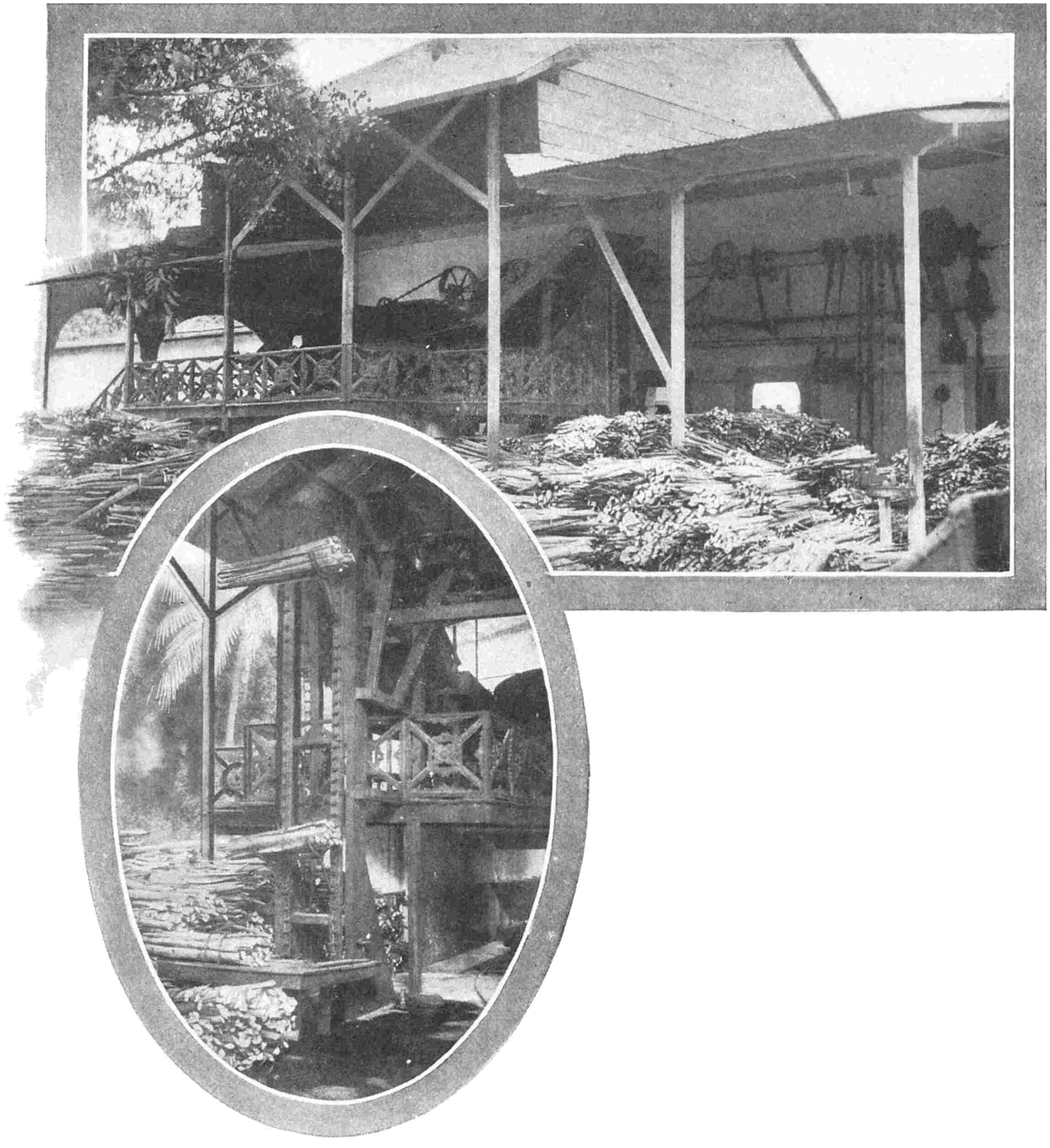
and largely by the use of pictures. These illustrations,
to which we draw particular attention, are from photographic
negatives in our possession which were taken
in Yucatan expressly for us.
BALES WEIGH ABOUT 370 POUNDS
The Sisal or heniquen plant of Yucatan has been
used for its fiber for many centuries, but, as we have
stated, the present enormous development of the industry
dates back but comparatively few years, during
which time great progress has been made in putting
it upon a highly practical basis as regards both the
cultivation of the plant and the preparation of the fiber.
Labor-saving machinery is used in place of the old
hand methods for extracting
the fiber; indeed, the business
is now so thoroughly up to
date that reports are frequently
circulated of the organization
or contemplated
organization of a “Sisal trust.”
Apparently, however, the right
“Napoleon of Finance” has
not yet come to the fore to
accomplish this.
The cultivation of the heniquen is now carried on
principally upon large farms or plantations known as
haciendas, many of which have made their owners
enormously wealthy. In starting a field of plants the
suckers or hijos are set out in rows, and cultivation is
carried on once or twice a year to keep down the weeds.
The appearance of the fields of Sisal and of the growing
and matured plants may be seen from our illustrations.
When the plant has been growing about five
years some of the long, sword-like leaves will be ready
to cut, those around the base of the plant maturing
first. The time for cutting is indicated by the leaves
assuming a nearly horizontal position instead of the
more upright one of the younger leaves, at which stage
the fiber is at its best. Then the natives, with their
corbas go through the fields and cut off the matured
leaves, trim the sharp thorns from the sides and ends,
and tie up the leaves in bundles of fifty, ready to be
carried to the cleaning mill.
The plant continues to yield a supply of leaves for a
period of from ten to twenty years. The end of its
usefulness is marked by the appearance of the flower
stalk or “pole,” and the plant soon dies.
CLEANED FIBER COMING OUT OF CLEANING MACHINE
Most of the large
haciendas are supplied
with portable
tracks, and small
cars carry the
bundles of freshly
cut leaves from the
fields to the cleaner
house, where the
pulp is scraped from
the fiber by the
powerful cleaning
machinery.
SISAL DRYING
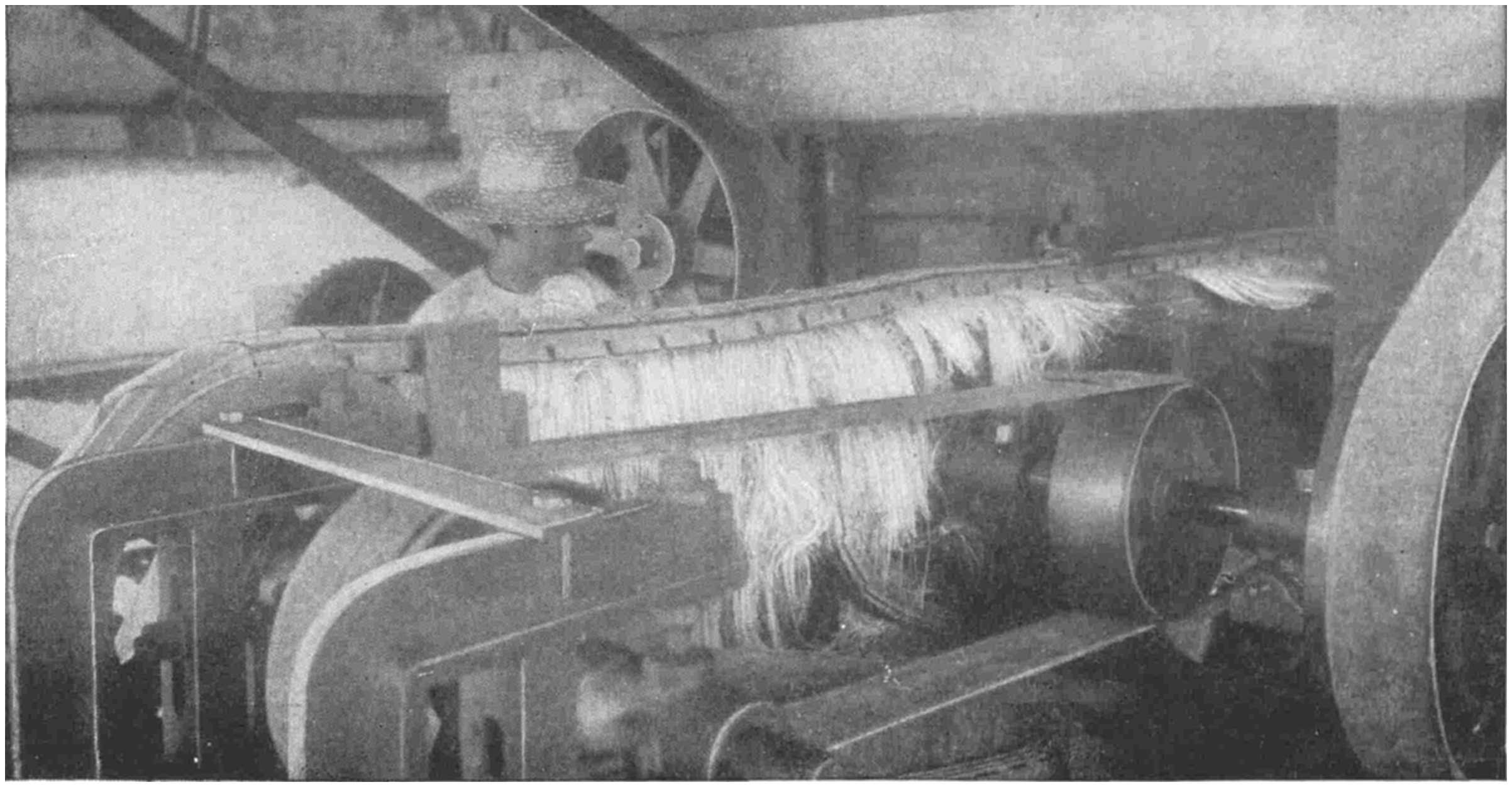
As will be seen in the photographs, the bundles of
leaves are taken up on an elevator and along a carrier,
which feeds them into the machine. The grip chains
of the carrier hold the leaves, while the scraping wheels
clean the pulp from the fiber, first one end of the leaves
being cleaned and then, as they are carried farther
along, the second wheel cleans the other end. This
leaves the bundles of the fiber still in the grip of the
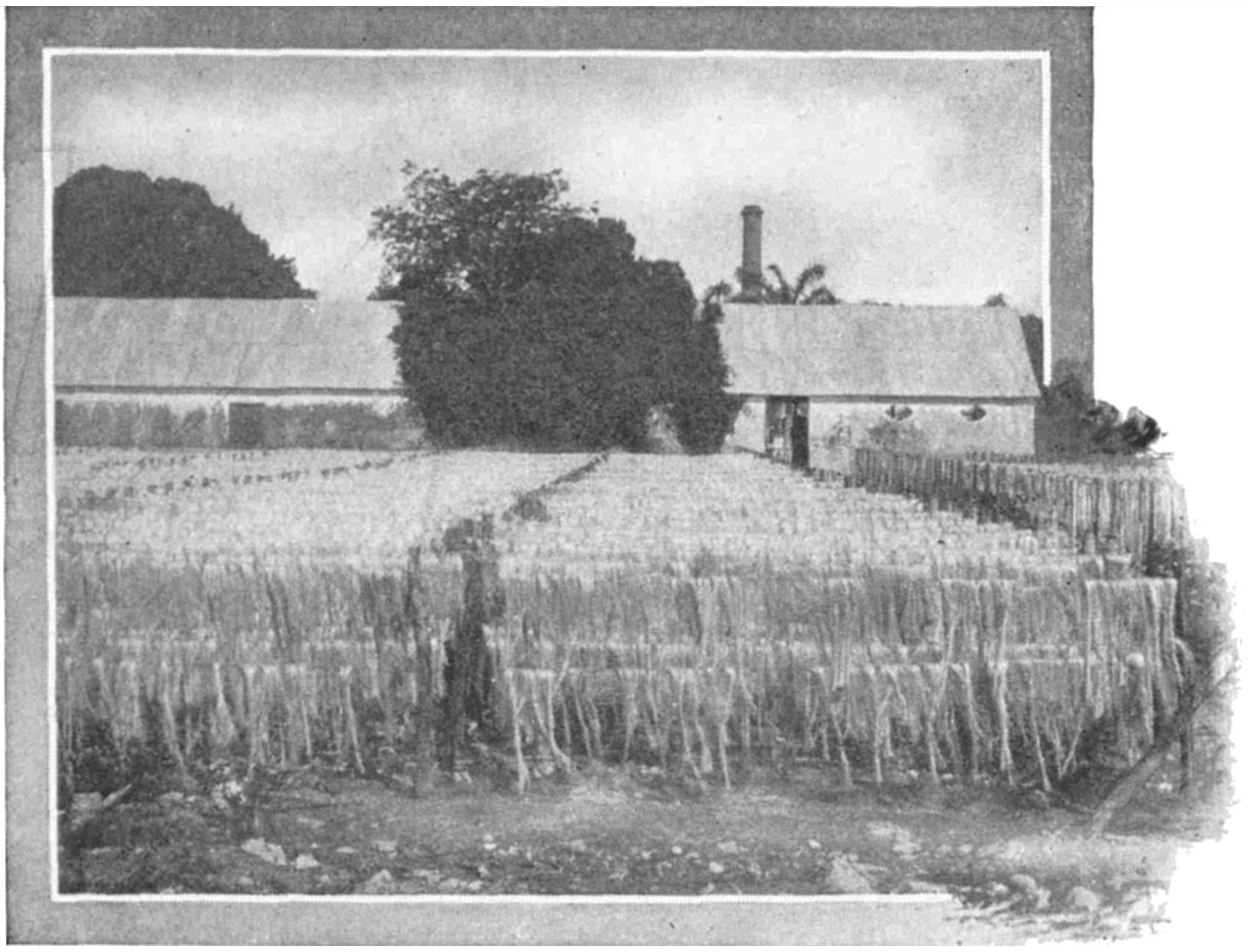
carrier, which takes it out of the machine as shown in
the picture. It is then carefully hung in the sun to
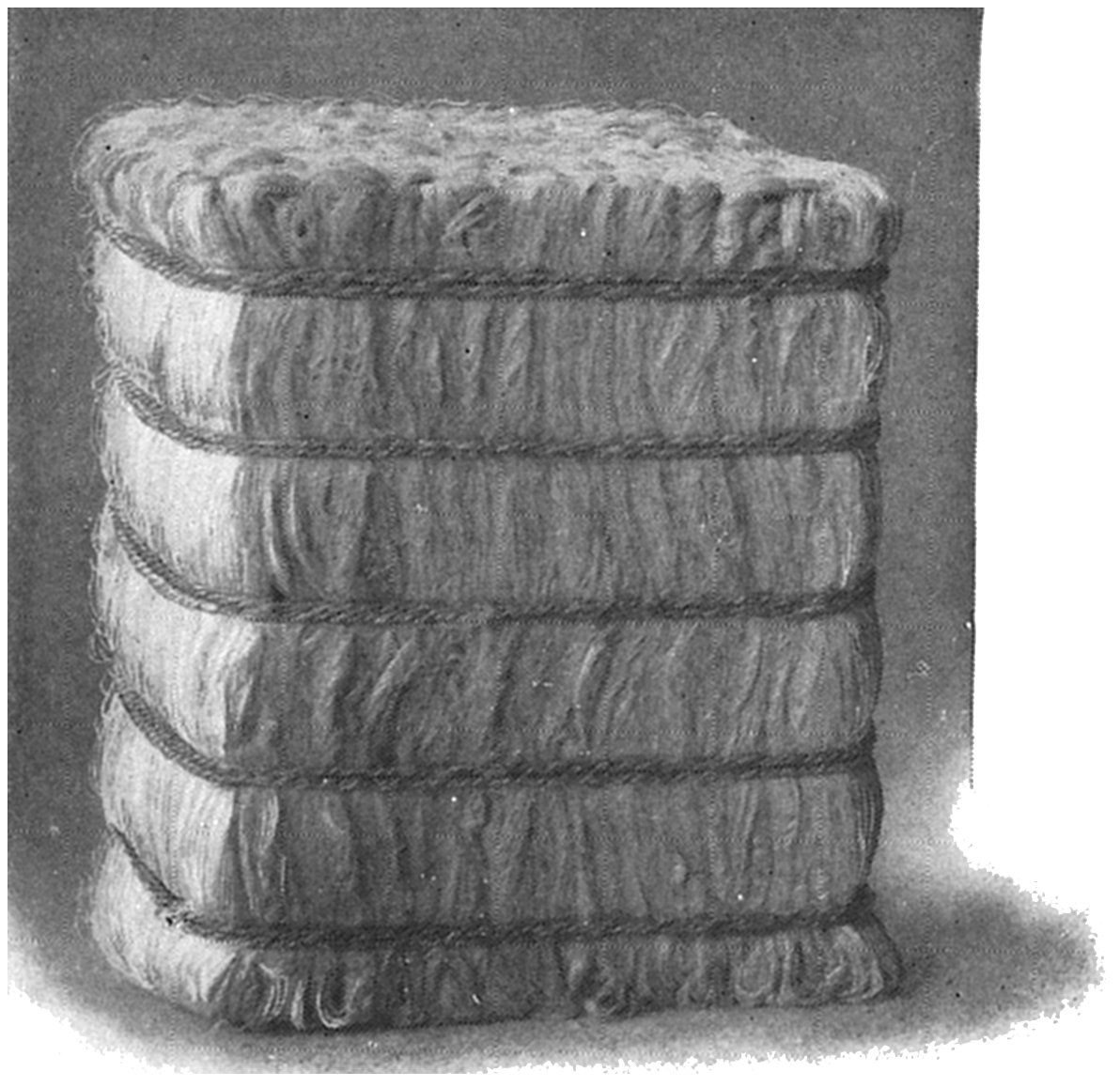
dry. When thoroughly dry the fiber is taken to the
press and made into bales weighing about 370 pounds
each.
We have already mentioned the fact that Manila
rope is frequently adulterated with cheaper and inferior
fibers, and so Sisal in its turn has its inferior
imitators, the most common of which is known as
Istle, a fiber which also grows in Mexico as well as in
other parts of the world. A recent government publication,
speaking of the use of Istle in cordage, states,
“this fiber has been regarded heretofore as suitable
only for use in the manufacture of brushes.”
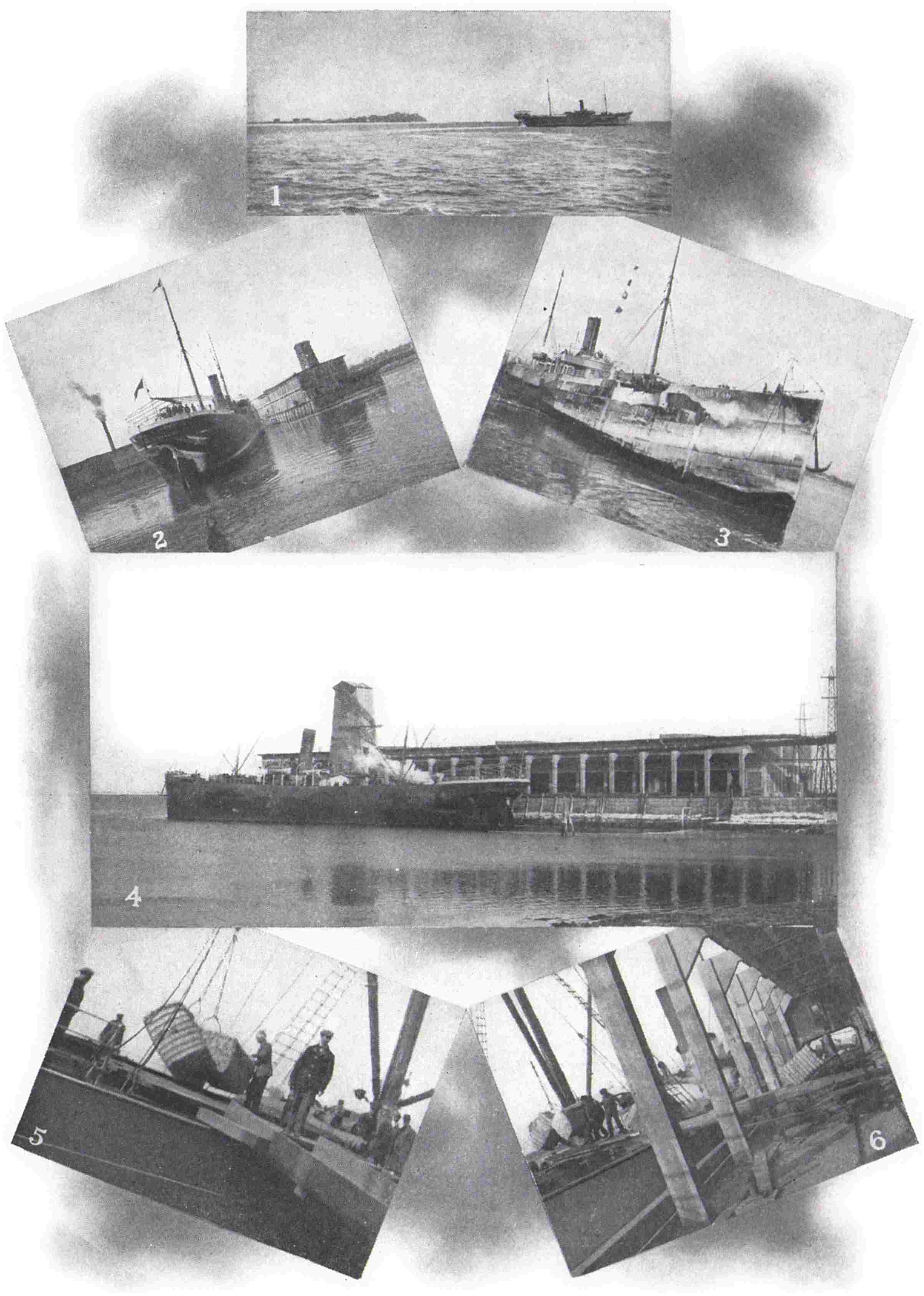
1. WAITING FOR THE PILOT
2. APPROACHING PLYMOUTH CORDAGE CO. PIER
3. COATED WITH ICE FROM THE STORM
4. LYING ALONGSIDE PIER
5. FIRST BALES COMING FROM HOLD
6. UNLOADING INTO WAREHOUSE
SISAL STEAMER FROM YUCATAN ARRIVING AND DISCHARGING AT
PLYMOUTH CORDAGE COMPANY’S PIER
CHAPTER III The Hemps—American, Russian, Italian. Other Fibers
While the fibers we have already discussed—Manila
and Sisal—comprise by far the
greater part of the raw material of cordage,
we wish to mention in this chapter a fiber
which, while now of comparatively slight importance,
has the interesting feature of being a home product,
and the cultivation of which at one time formed an industry
of considerable magnitude in this country. This
is the American or Kentucky hemp.
Most of the cordage fibers are commonly known as
hemp, but strictly speaking this name applies only to
the fiber of the hemp plant (Cannabis sativa), of which
the American hemp is an example. This hemp plant,
while a native of Asia, has for many years been grown
in the different countries of Europe as well as in America.
Its fiber in commerce takes the name of the
country from which it comes, as Russian hemp, Italian
hemp, etc.
The character of the plant and of its fiber varies
considerably, depending upon the conditions of climate
and soil in the various sections where it is produced.
The fiber is also more or less affected by the varying
methods of preparation used in different places. The
Italian hemp, particularly, is finer, lighter colored and
stronger than American or Russian, and commands a
higher price in the market.
Hemp differs from Manila and Sisal by being what
is known as a bast fiber, being obtained from the bark
of the plant, which necessitates altogether different
methods of treatment in extracting the fiber.
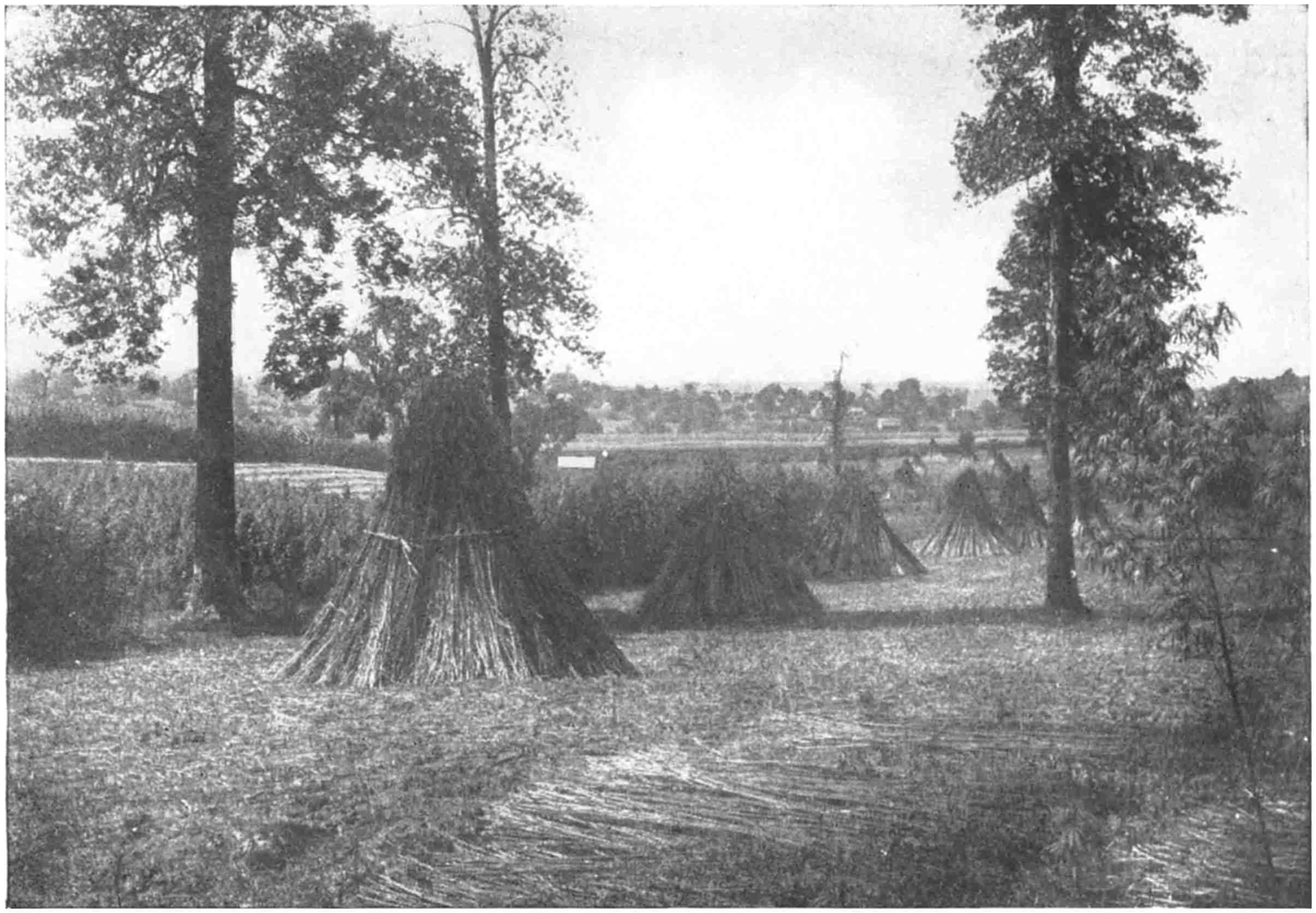
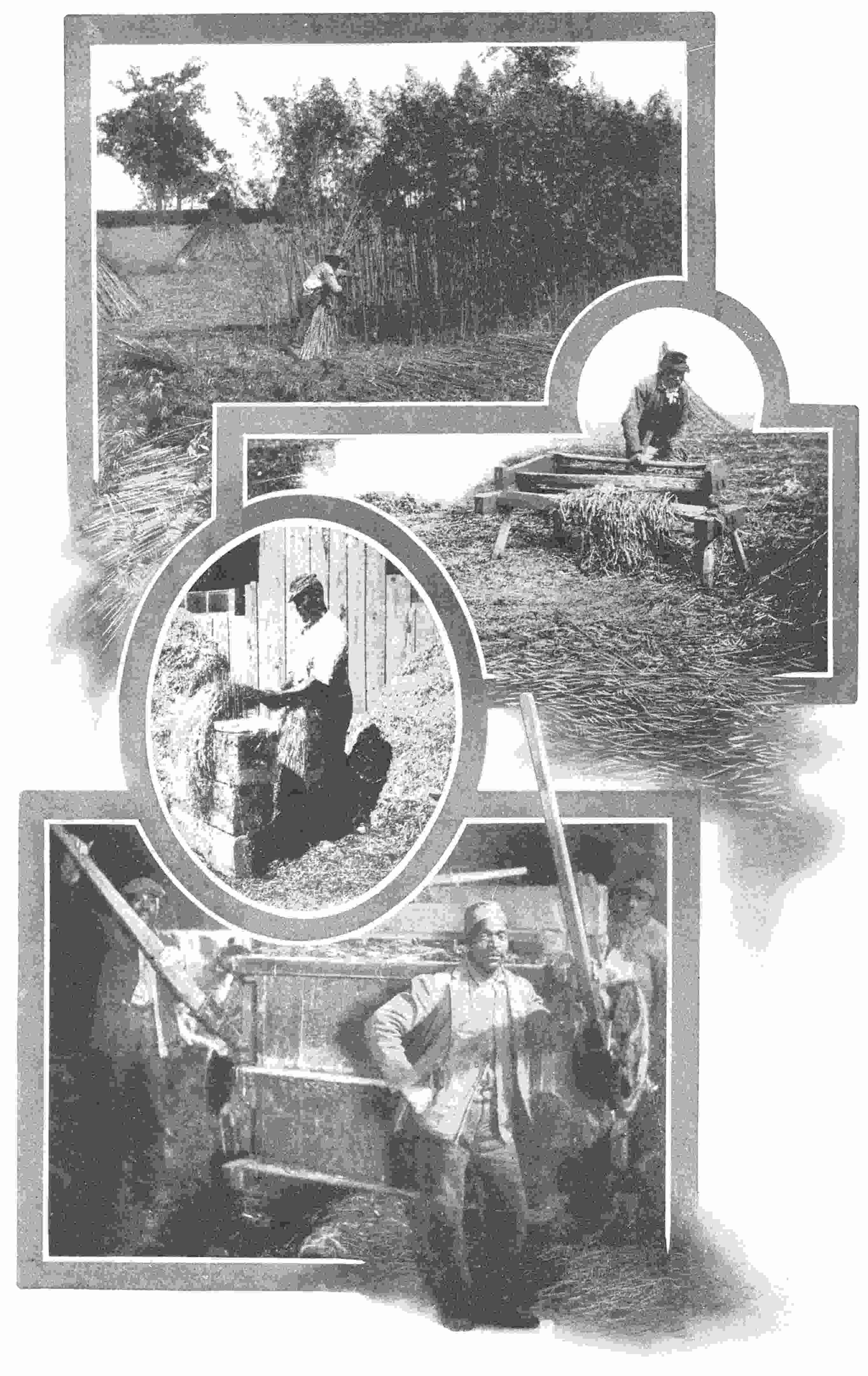
The pictures below and opposite, which are from
photographs secured through the courtesy of Messrs.
T. P. Curry & Son, Danville, Ky., give an interesting
glimpse of the Kentucky hemp industry. The plants
are cut and spread out to dry, after which they are
gathered together in bundles and carefully stacked.
Later the stacks are opened and the hemp again spread
out for exposure to the action of the dew, frost and sun
during the retting process which rots the gums holding
the filaments together. The inner, woody part of
the stem also becomes dry
and brittle by this treatment
so that it breaks and falls
away during the “breaking”
which follows. This process
of breaking leaves the fibrous
strips or bands in such shape
that they can be readily
hackled, thus cleaning out
any remaining fragments of
wood, short fibers and dirt,
leaving the long, smooth fiber
ready to be bunched together
and pressed into bales.
AMERICAN HEMP STACKED IN FIELDS
CUTTING THE HEMP—BREAKING—HACKLING—BALING
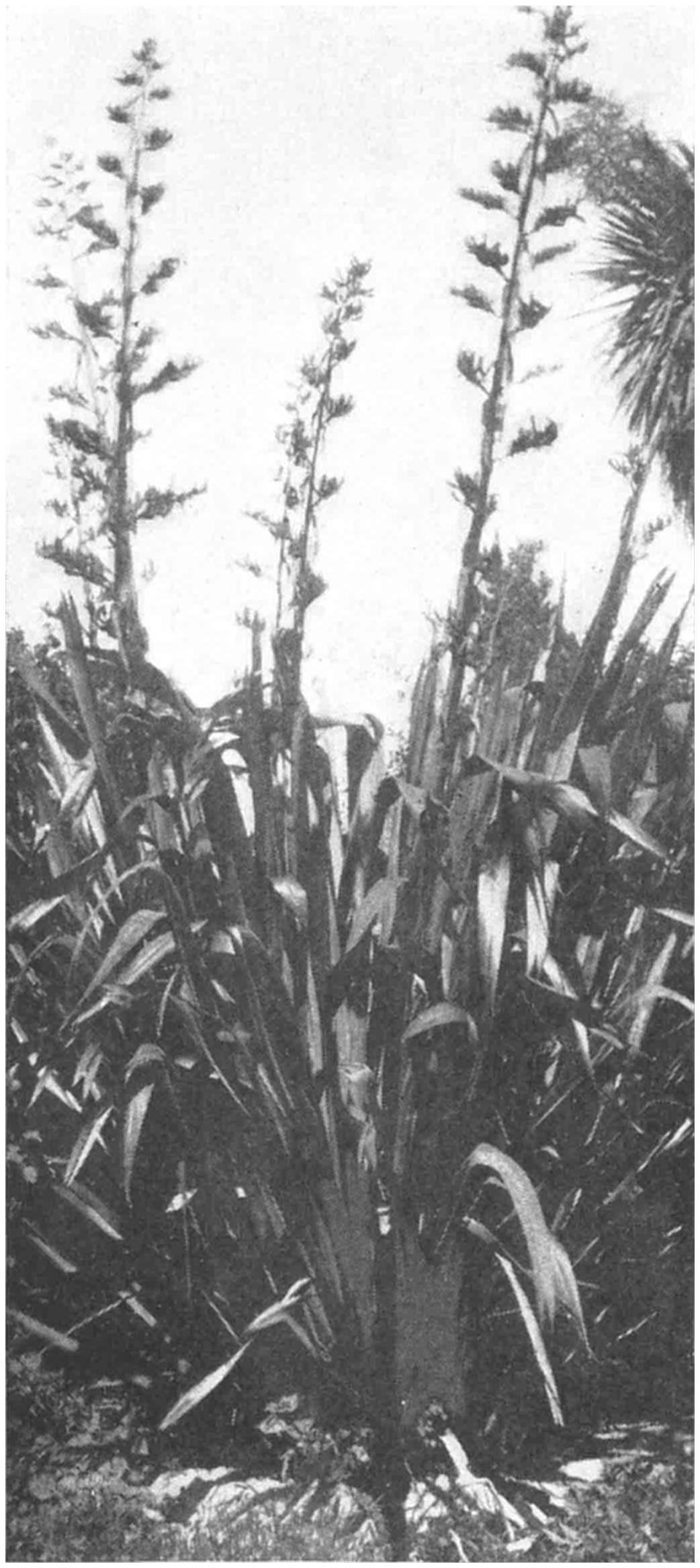
NEW ZEALAND FLAX
American hemp differs from
Manila by being much softer
and of a dark gray color, and
is sometimes known as black
hemp. Like the Russian and
Italian varieties, it is used by
cordage manufacturers principally
for making various
tarred goods, such as ratline, marline, houseline and
other products. Before the Manila fiber was so
largely used in this country for rope-making, the
Kentucky hemp business was of considerable importance,
but it has of late years declined very greatly
and is now of interest chiefly as representing that class
of industries which have been robbed of their former
importance by changing conditions. Years ago the
American hemp went into the rigging of many a
famous vessel, both merchantman and man-of-war,
and was a source of pride to its patriotic producers
and users. But the substitution of steam vessels for
sail and the use of other fibers and of wire for rigging
have taken away the great field of usefulness once
open to this home product.
Besides the hemps—-American, Russian and Italian—another
cordage fiber used to some extent in this
country is known as New Zealand hemp or flax, taking
its name from the country where it is produced. This
is not strictly a hemp, although so called like many
other fibers. It is obtained from the leaves of a plant
belonging to the lily family, the cultivation of which
forms an important New Zealand industry. The extracting
of the fiber is done by special machinery and,
contrary to the former practice, much attention is
now given to properly grading and packing the
product, these matters being subject to government
inspection.
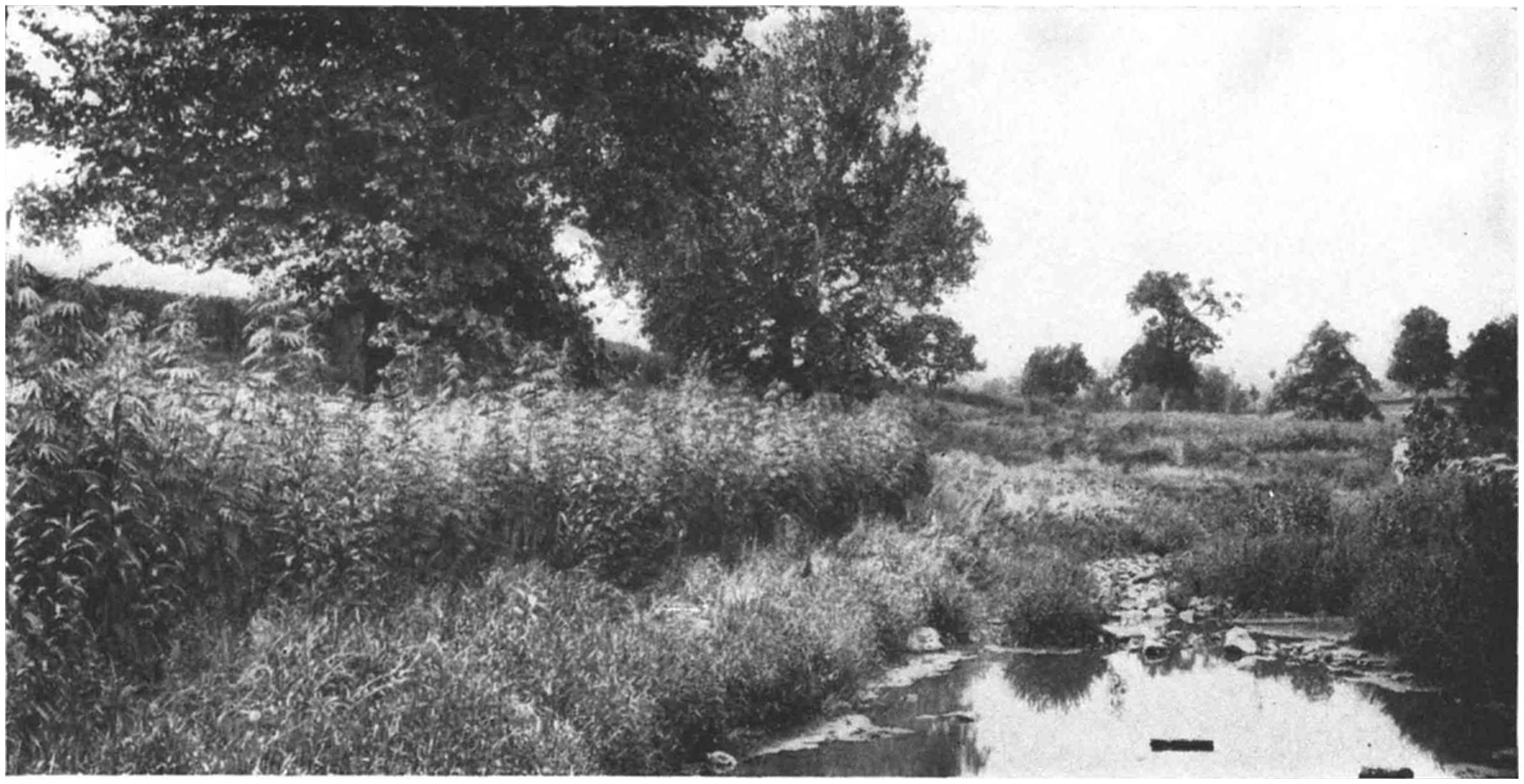
HEMP GROWING BY THE WATER
New Zealand hemp in general appearance resembles
Manila more closely than does any other cordage fiber,
and, although it is far inferior in strength and other
practical qualities, it is sometimes used as an adulterant
in making the cheaper grades of so-called Manila
rope. Its presence in a rope sold for Manila is
sometimes difficult to detect, which emphasizes the
necessity of care on the part of the buyer in getting
positive assurance of the purity of the goods offered
him.
The only other cordage fibers of much consequence
are the so-called African and Java hemps—the first
named a product of German East Africa and of British
East Africa, the Java hemp a product of the island of
the same name.
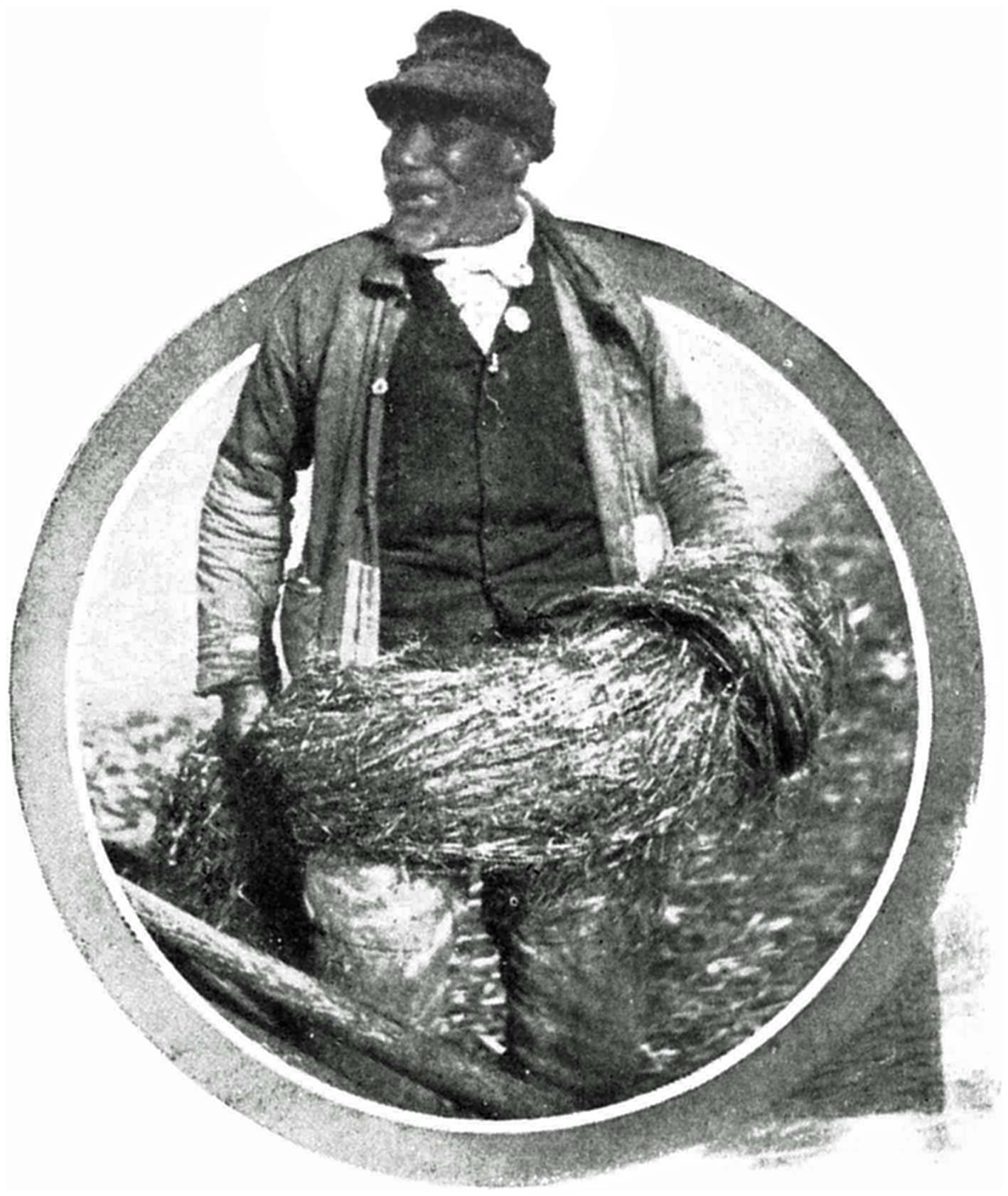
UNCLE BEN, HEMP BREAKER
CHAPTER IV Pine Tar — Part III
Who does not know of the tarred rigging
which once meant so much to the rope-maker?
Its very odor seemed to cling to
the pages of seafaring books. Its use naturally
declined with the development of steam power,
yet how few people, perhaps, realize that tarred goods
for quite different purposes form an important though
incidental branch of the rope business today! Lathyarn—to
mention but one class—is consumed annually
by the lumber industry in quantities that
would surprise many persons. Today’s buyers, furthermore,
need goods of high quality just as did the
old-time sea captains, and in the manufacture of such
goods the tar itself is an important factor.
Pine tar—the kind best suited for cordage—comes
from various members of the pine-tree family, and is
secured by a distillation process. The principal producing
sections are northern Europe and the south-eastern
United States—the yellow, long leaf or Georgia
pine, which ranks first in this country for tar-making,
growing in a territory about one hundred and twenty-five
miles wide along the coast from North Carolina
to Texas.
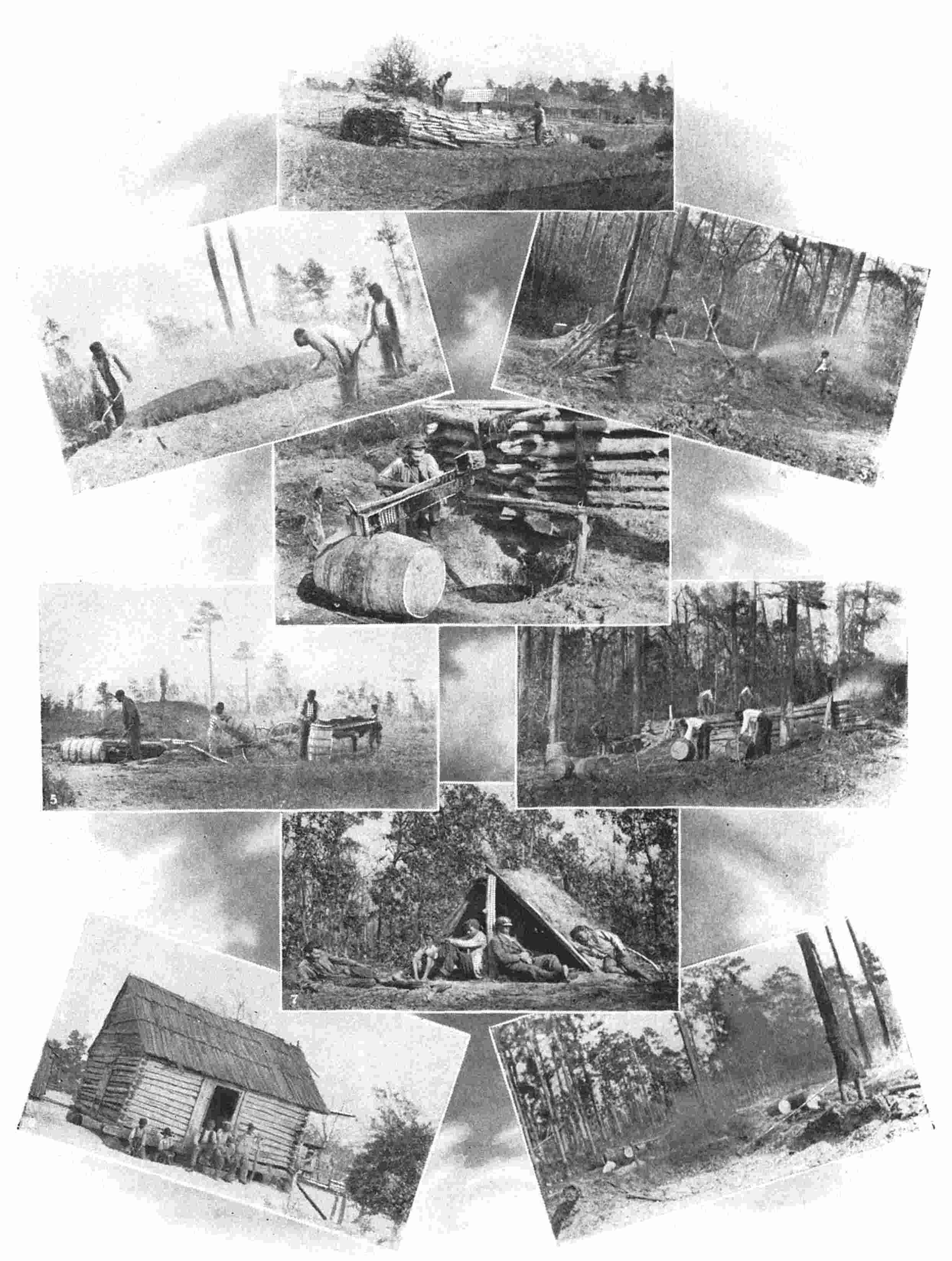
HOW PINE TAR IS MADE IN THE SOUTH ATLANTIC STATES
1. BUILDING THE KILN
2. STARTING FIRE
3. RAKING BACK COALS
4. TAR COMING FROM KILN
5. DIPPING AND BARRELING
6. WORKING AROUND KILN
7. AFTER HARD DAY AND NIGHT
8. TAR-MAKERS AT HOME
9. BURNING COMPLETED
Of the two methods for extracting the tar—the
old kiln and the modern retort processes—the second
yields the greater supply, largely because of the more
systematic manner in which the industry is carried on.
As yet, however, no way has been perfected for obtaining
by this newer method a tar that measures up
to Plymouth Cordage Company standards, and for
this reason we have continued to use the kiln-made
article only.
Tar-kiln burning is conducted so far out in the
country and in such a desultory fashion that few
people have the opportunity to become acquainted
with the process. A brief description may, therefore,
be of interest. Only dead wood is used, as the green
tree does not yield the quality or quantity of tar
necessary to make the work profitable. Among the
tar-makers the material is known as fat lightwood, possibly
from the fact that it ignites easily and burns
rapidly. In weight and color it is anything but a light
wood.
The wood is cut into convenient lengths and then
laid up, with the ground as a floor, to form a pile about
twenty-five feet long by five high and tapering in
width from eight to five feet. The soil, if soft or sandy,
is first covered with clay to lessen the loss of tar, and
the pile is usually built on a slope so that the liquid
will flow toward the pipe which serves as an outlet.
The kiln is completed by covering the wood with
“pine straw” and sand. This prevents air currents
and keeps the fire, which is on the back end, from drawing
through and consuming the wood without producing
tar. Moreover, while the kiln is burning—a period
of two weeks or more for a twenty-five cord pile—it
must be watched day and night so that straw and
sand blown off by the gases within may be replaced
at once.
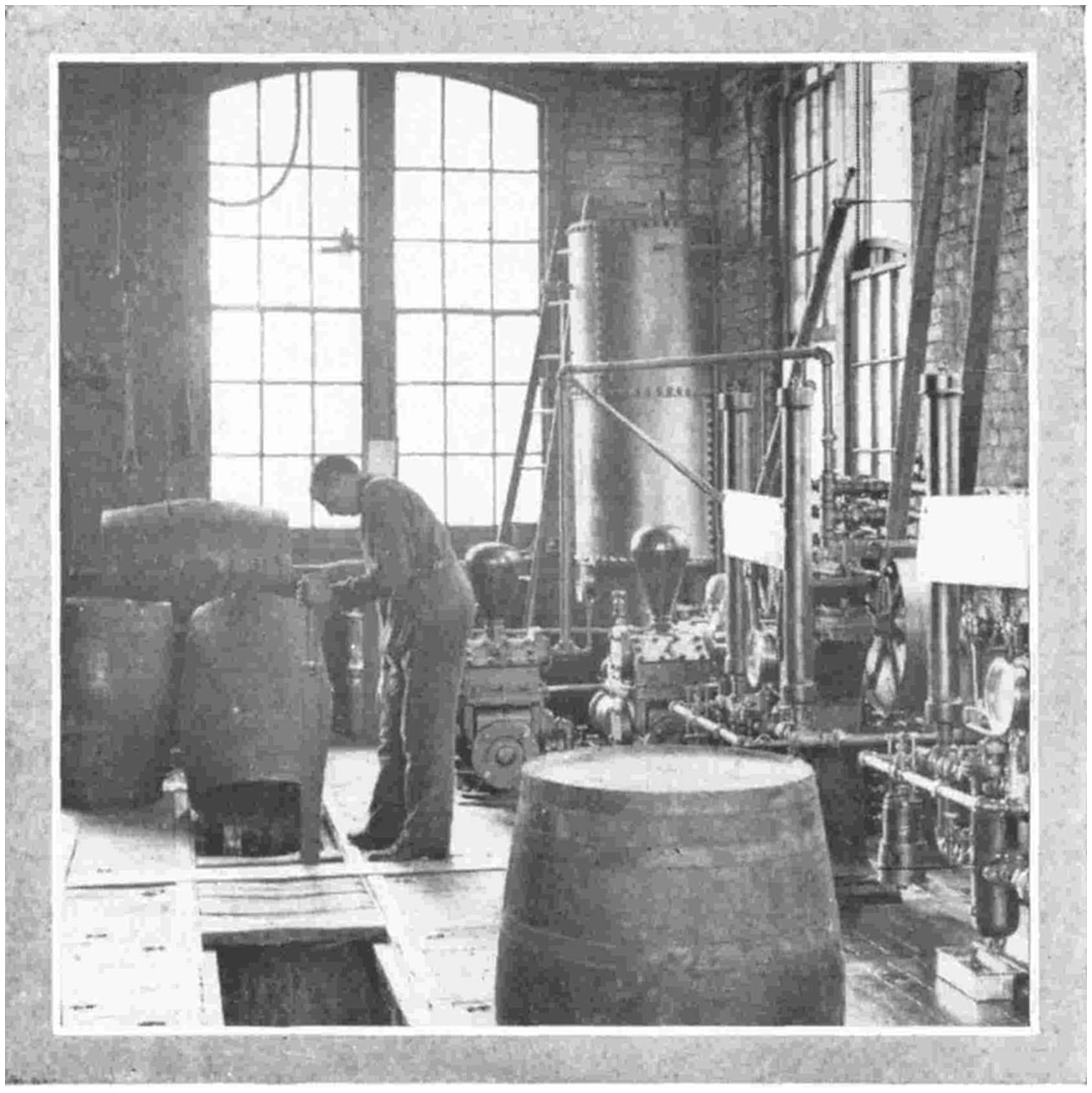
As the tar comes from the kiln it is caught in a hole
dug beneath the outlet and is dipped up and poured
into barrels—the average yield being one barrel to
the cord. The tar is then hauled by cart to water or
railroad, thence to be transported to the various naval
stores yards.
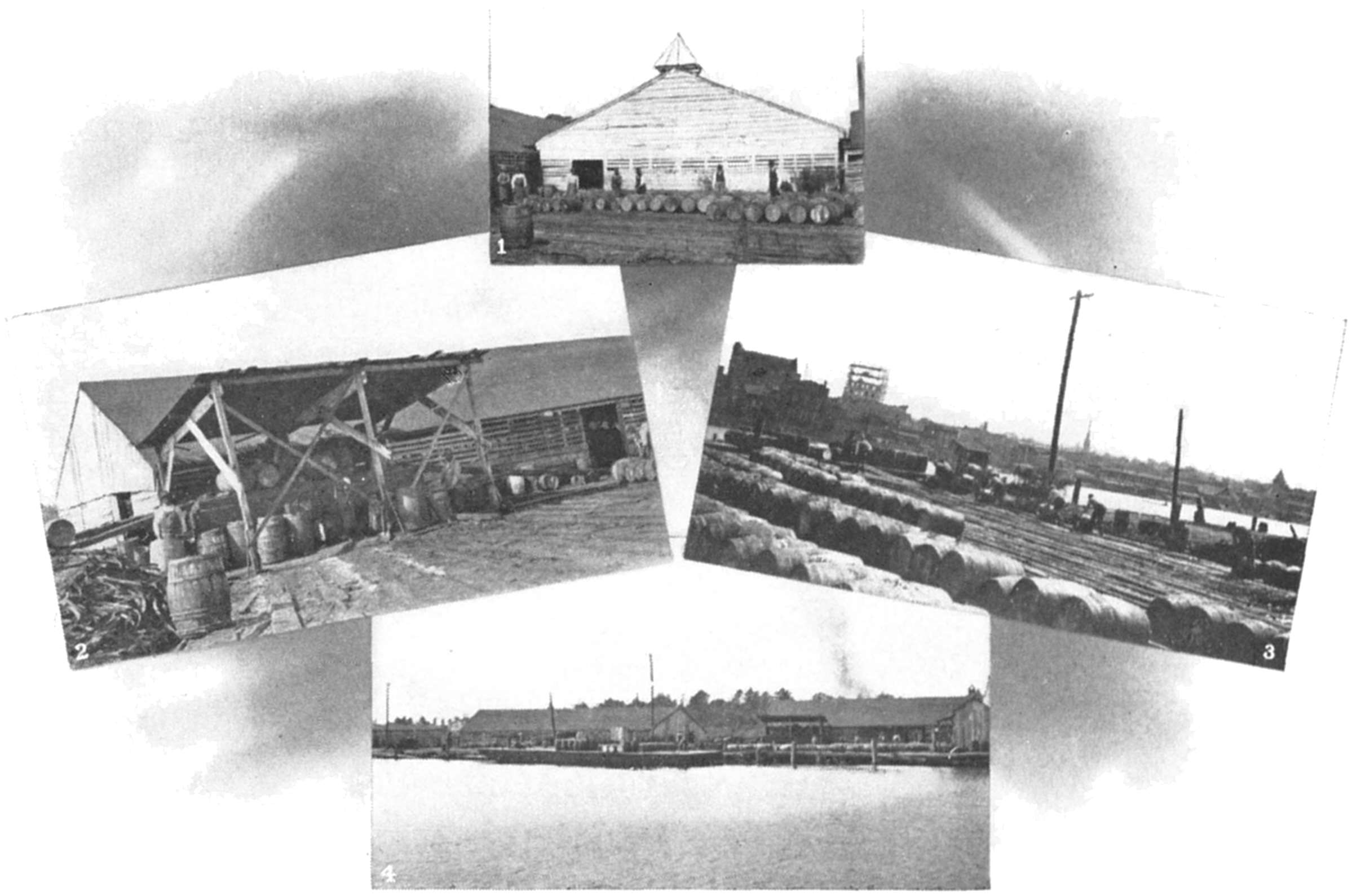
For the foregoing description and the accompanying
illustrations of tar manufacture we are indebted to the
American Naval Stores Company. The pictures showing
kiln operations are very unusual and were secured
only after several trips. The others were taken at the
Company’s yards at Wilmington, North Carolina,
where the tar is carefully inspected, strained and then
re-barreled for shipment to our two factories.
TAR HANDLING AT NAVAL STORES YARD
1. INSPECTING
2. STRAINING
3. LOADING FOR SHIPMENT
4. TAR YARD FROM RIVER
CHAPTER I Buying, Grading and Storing of Fiber
In Part II we described the various fibers
from which rope is made and pointed out
the importance of expert knowledge and
foresight in the buying of these raw materials.
Purchasing power and the resources for grading
and using each bale of fiber with strict regard to
its particular fitness for his products are also of special
value to the rope manufacturer.
We have already shown that Manila fiber or hemp,
as it is commonly called, is the principal and for most
purposes the best cordage material. Including the
numerous commercial grades and the brands of individual
packers, the market designations or marks of
Manila hemp run into the hundreds and cover a wide
range in the four important qualities of strength, texture,
length and color. A single mark may, furthermore,
vary greatly in one quality or another from time
to time, so that the market designation alone is not a
safe sign of the fiber’s fitness for a certain purpose.
Because of these facts the only way a manufacturer
can be sure of sufficient fiber of the character required
to insure uniform quality in each of his products is by
examining and re-grading, according to his own standards,
the hemp delivered to him and by combining
selections of different marks in the right proportions to
give the desired results. To do this successfully requires
a thorough knowledge of fibers, large stocks
always available and special storage facilities.
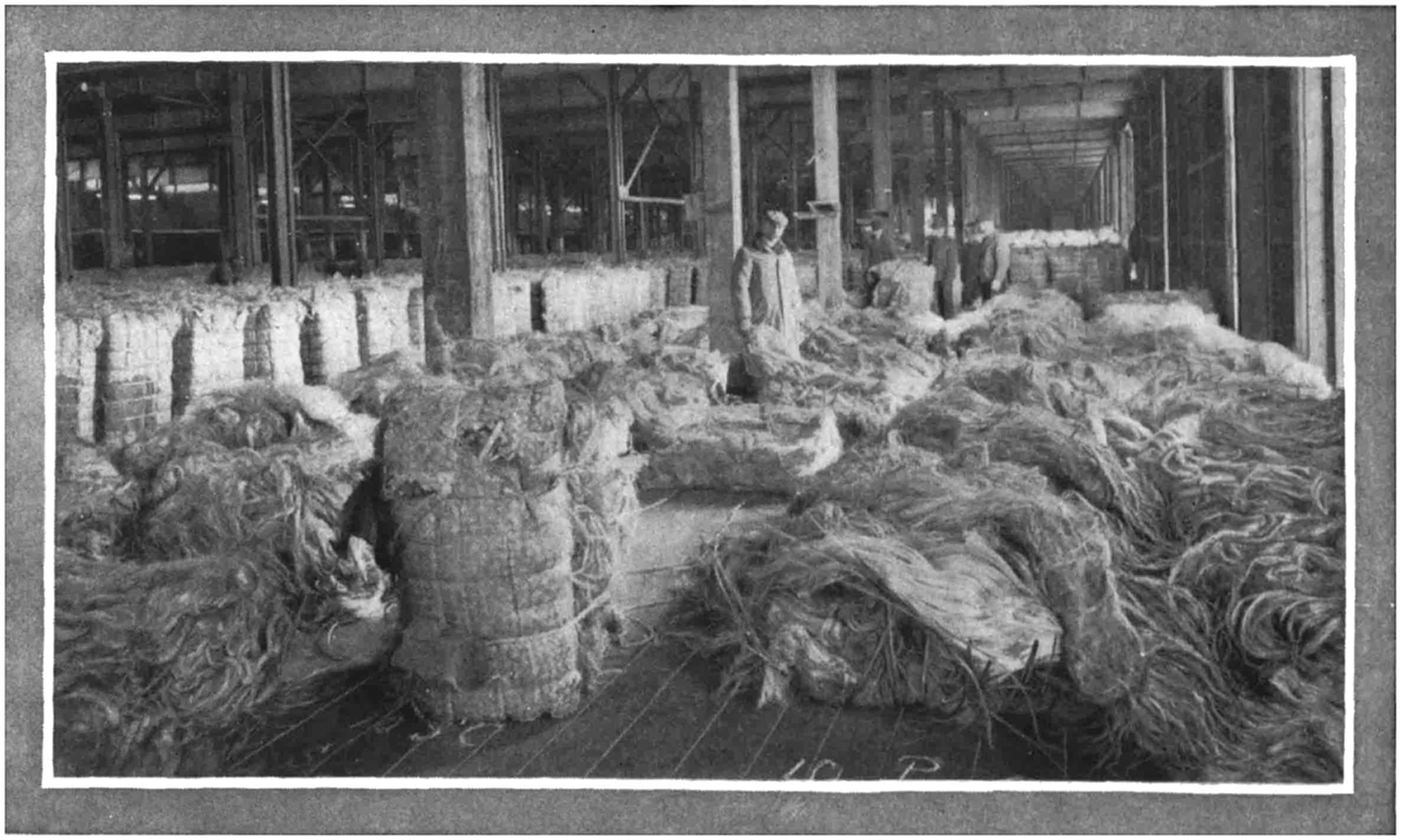
EXAMINING AND RE-GRADING MANILA FIBER
The steadily increasing demand for our products
and our large scale of production warrant our buying
yearly more Manila hemp than any other single manufacturer—more
than many combined. Our purchases
are governed, furthermore, by the knowledge
gained through more than ninety years’ experience
with the fiber markets and rope-making. These facts
explain why we are able to secure the choicest marks so
consistently and in such quantity.
We have also erected warehouses capable of holding
large quantities of fiber for months at a time so that
we can store such as is not necessary for our immediate
wants. This helps us to take full advantage of
specially favorable offerings in the fiber markets. In
addition, we maintain a system of fiber examination
and classification by our own experts together with
warehouse records that insure each bale being put to
the particular use its quality fits it for.
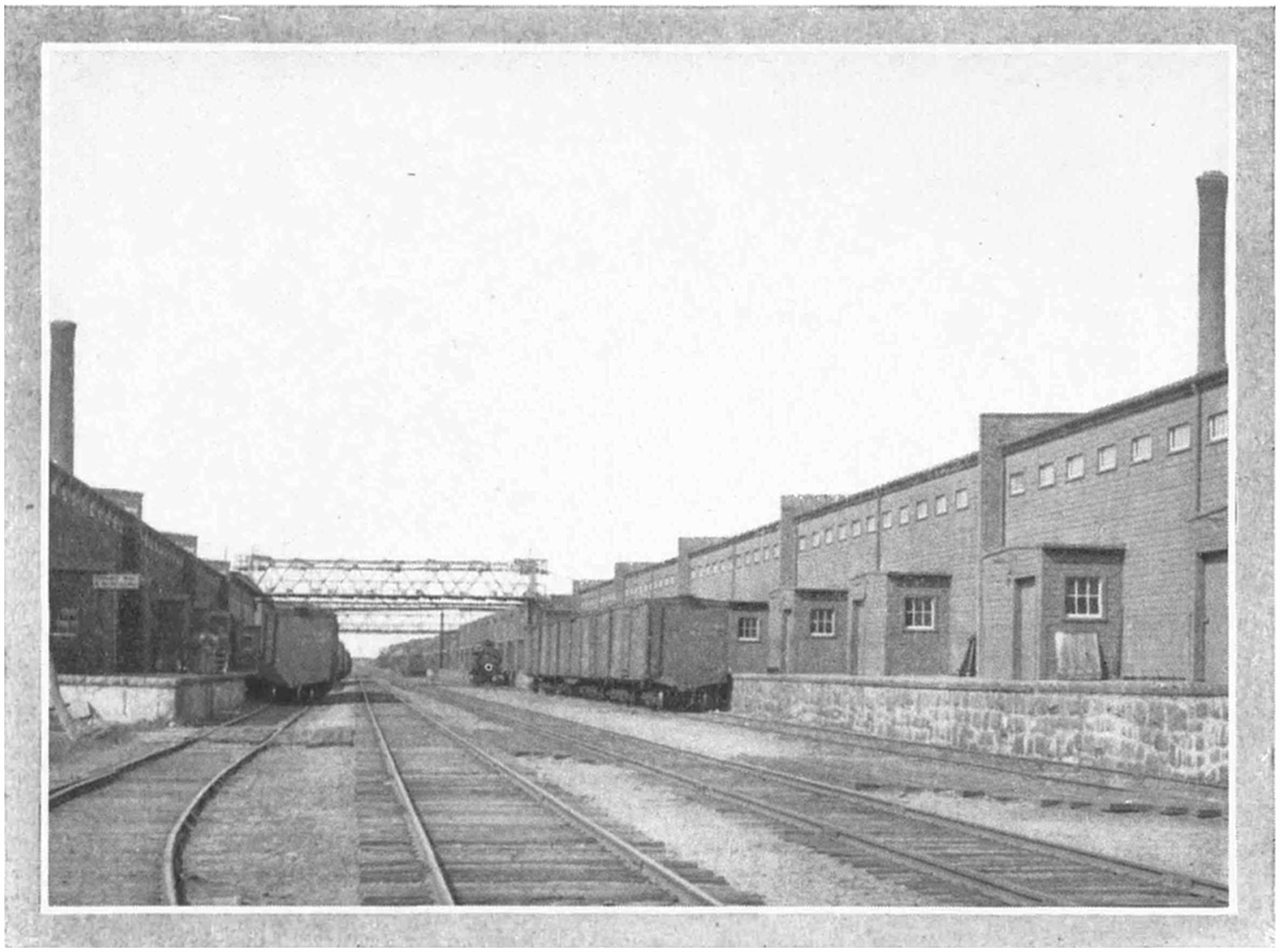
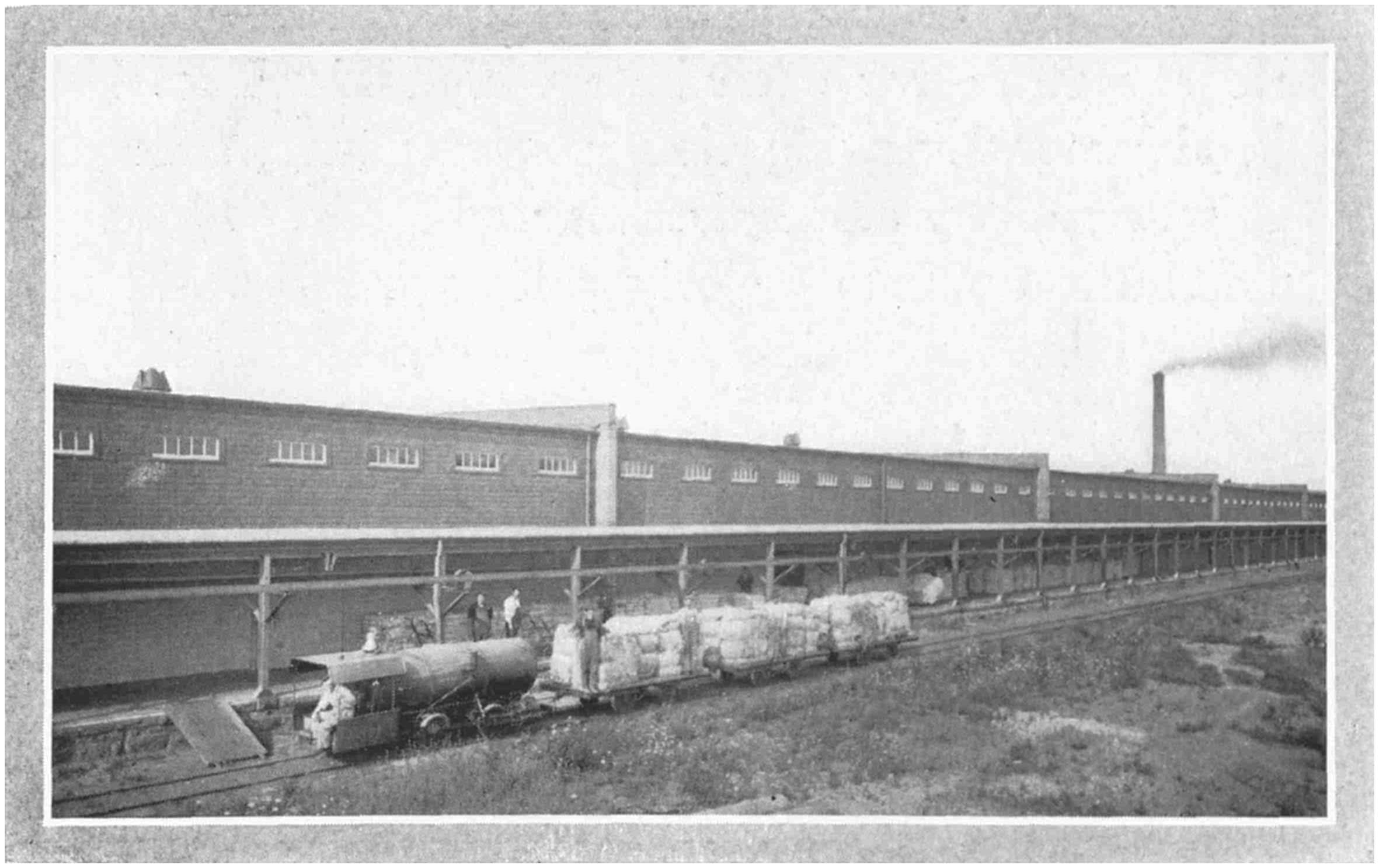
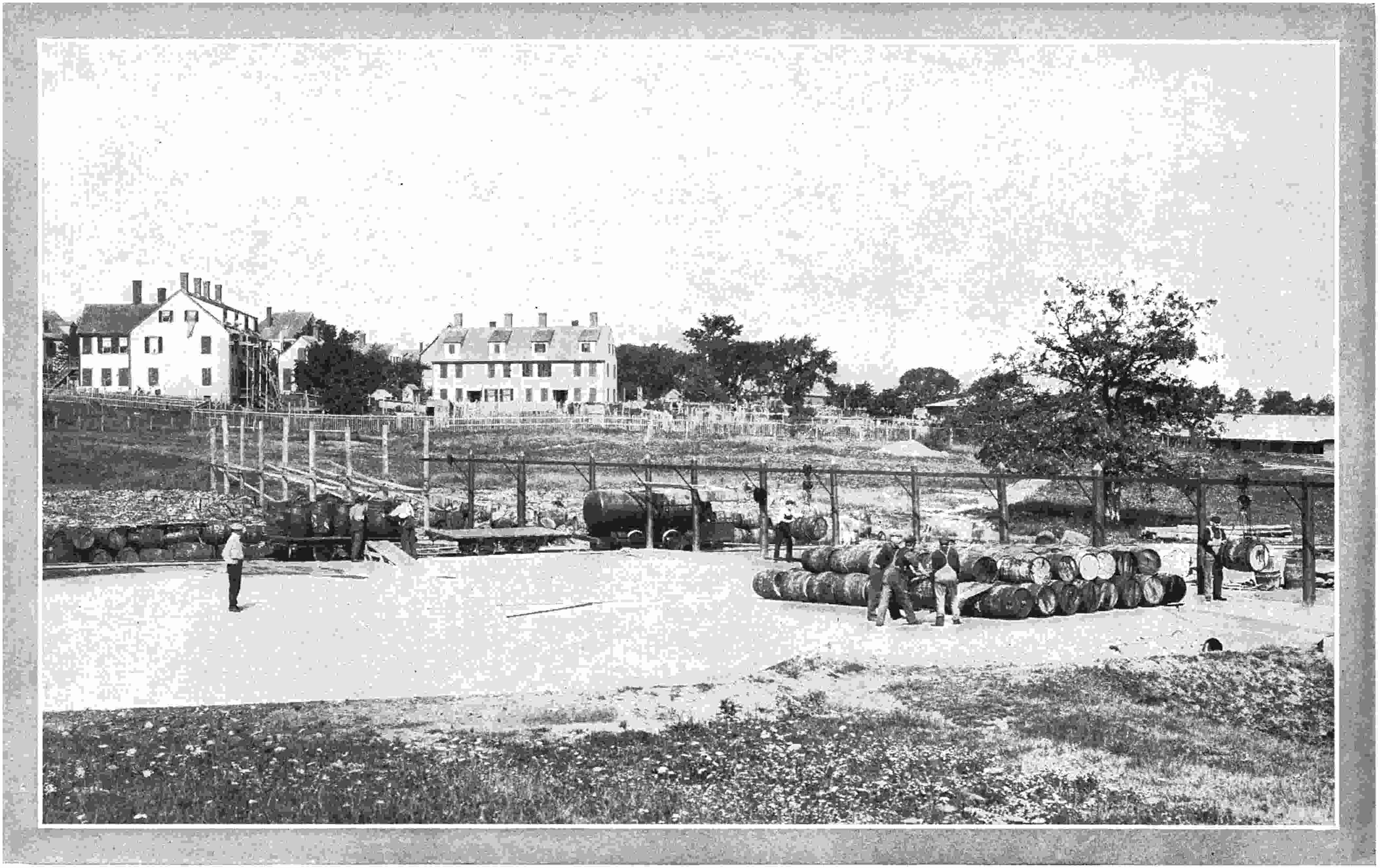
TRACK AND WAREHOUSE FACILITIES, PLYMOUTH CORDAGE COMPANY
The important question of quality is determined
when the hemp first reaches us. The carloads of
Manila from Boston, New York, Seattle and other
ports are brought directly alongside our warehouses
and after the hemp has all been transferred to the
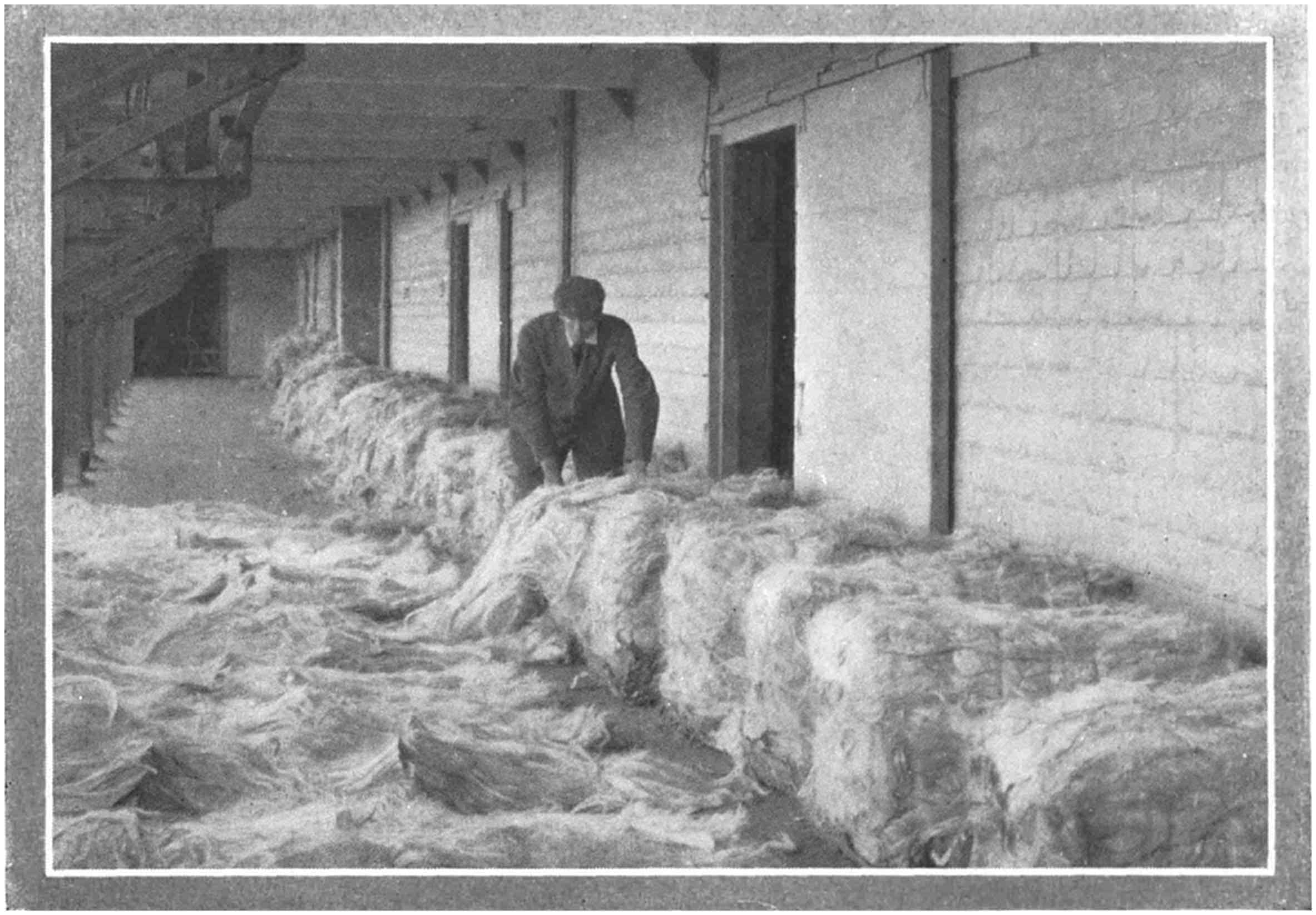
platforms every mark is carefully gone over. Bales
are opened, the hanks laid out flat, the fiber minutely
examined and each mark given our own grading. This
examination is conducted purely from the manufacturing
standpoint and is entirely in addition to the one
made on the dock. The expert ability to judge fiber
and the constant care required can be imagined from the
fact that single
shipments
frequently contain
as many
as seventy-five
marks.
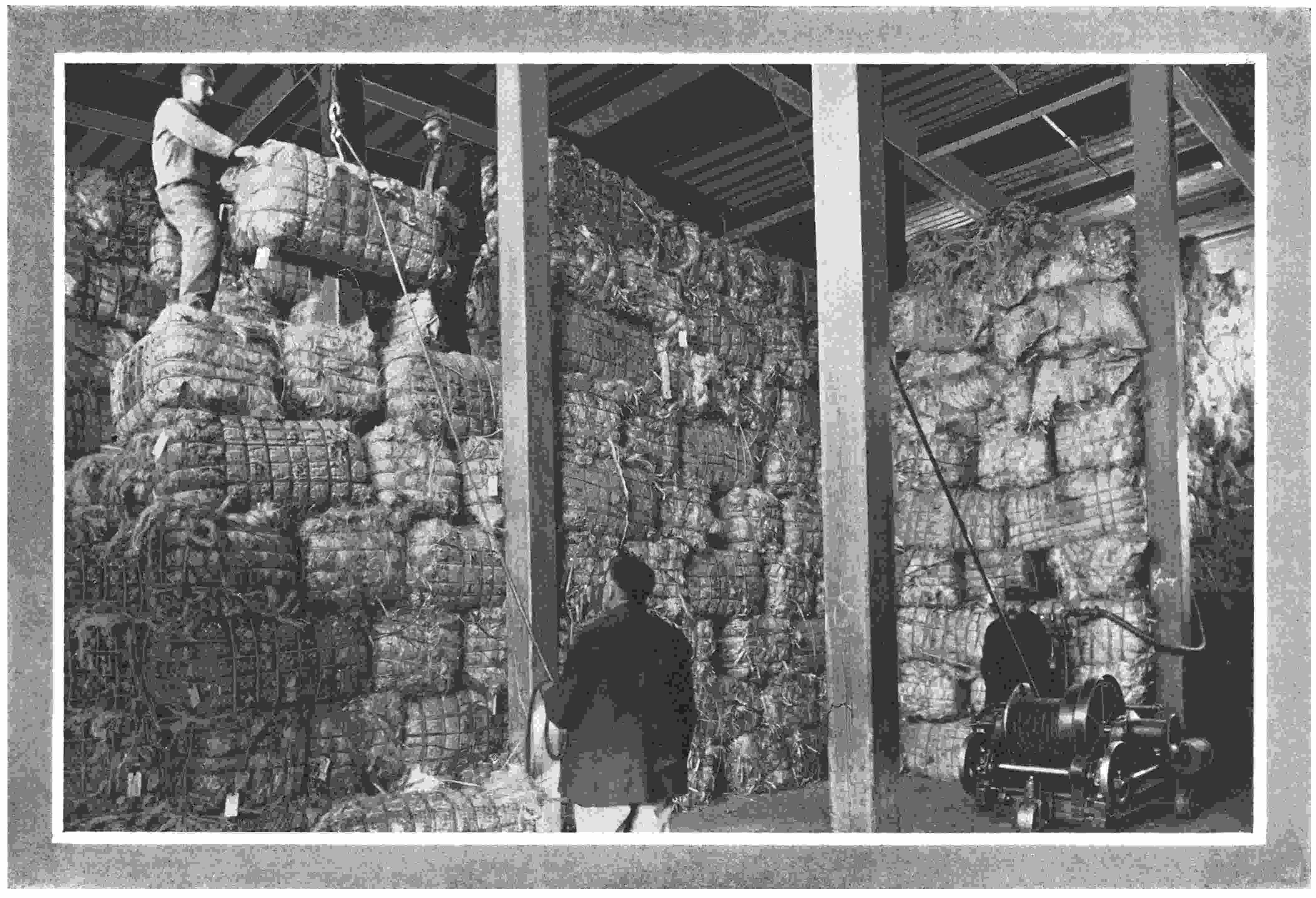
STACKING MANILA FIBER WITH PORTABLE, COMPRESSED-AIR ENGINE
The weighing
and storing
of the fiber follow
next, and
the latter is a
task of considerable
magnitude,
for our
warehouses
contain a floor
space of over
370,000 square
feet and each mark must be so placed that it will
be readily accessible as needed. When the bales are
put on the scales and an entry made of the weight—always
close to 275 pounds on Manila—a record
is also set down for each bale which identifies it by
mark, shipment and location in warehouse, according
to the section, bay and hoist selected for it. The hemp
is then built up into orderly piles with the aid of a
portable compressed-air engine, each mark being
placed by itself.
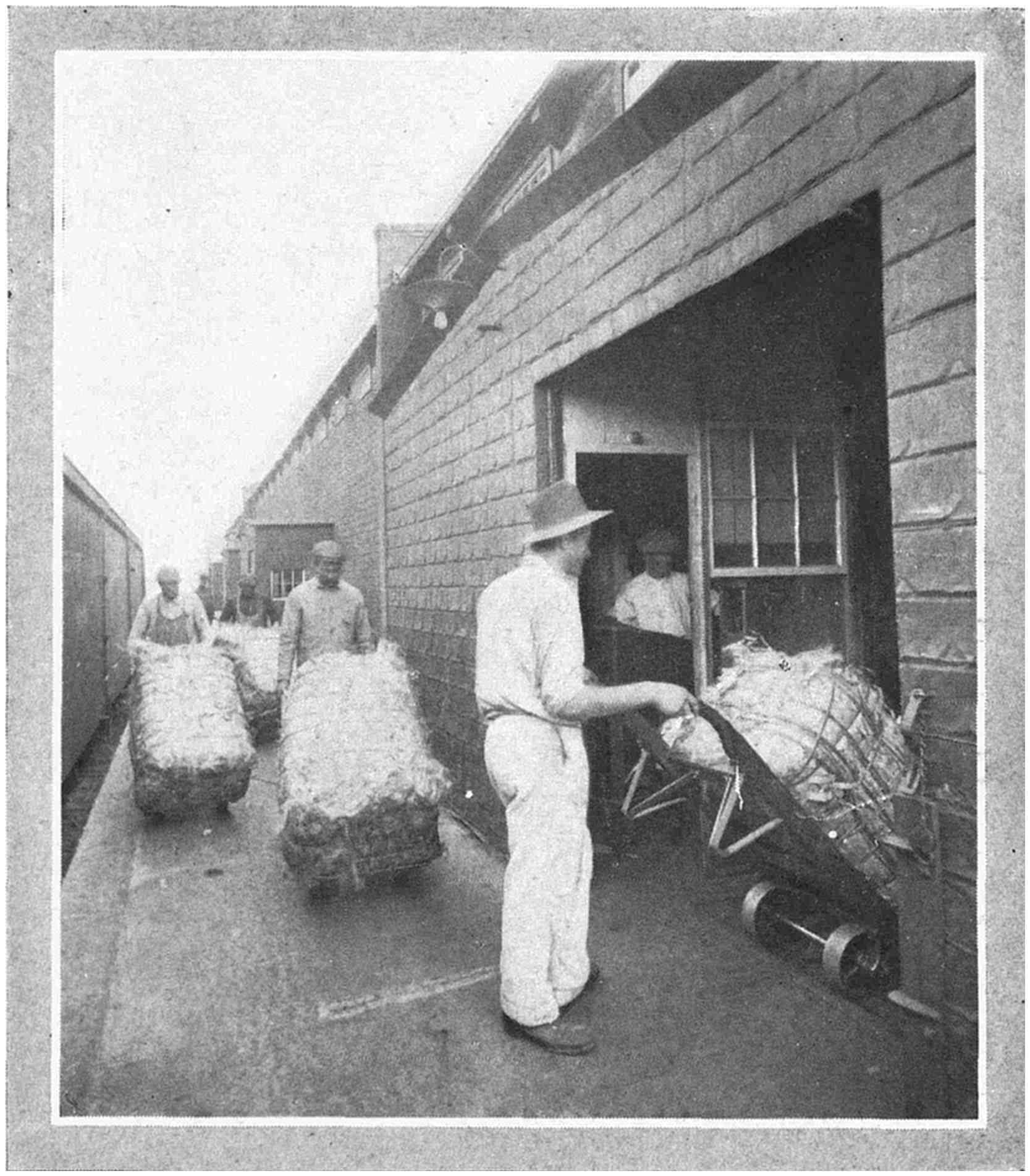
TRUCKING MANILA FIBER INTO FACTORY WAREHOUSE
By means of this warehouse system and the separate
record showing the proper use for every mark in each
shipment, the qualities and quantities of fiber needed
by any mill for the regular day’s work or for a particular
job can be gotten out at a moment’s notice and
with very small chance of error. As an additional
safeguard, however, against accidental use of the wrong
lot of fiber, we maintain a checking system which would
reveal at once any mistake in delivery from warehouse
to mill.
The careful methods we have just described are indicative
of the watchfulness maintained with each of
the many fibers we use, although in none of them is
there as great range of quality as in Manila, nor is
purchasing power so important a factor.
A recent and interesting development in connection
with our Sisal importations is the direct steamship
service now in effect between Yucatan and North
Plymouth, and because of which cargoes of this fiber
can now be brought directly alongside our own pier,
unloaded by our own employees and trucked at once
into our own warehouse.
SISAL FIBER BEING TRANSFERRED FROM WAREHOUSE TO MILL
Every user of rope naturally expects that under equal
conditions he will receive the same service from one
rope that he does from another of the same kind and
size made by the same manufacturer. The Plymouth
Cordage Company aims to have each of its products
give that sort of service; first, by possessing the best
materials, facilities and workmen obtainable; second,
by utilizing each of these factors to the best advantage.
This policy, so well illustrated in our buying and
selecting of fiber, finds its expression in every phase
and department of our business, and herein lies one of
the vital reasons why Plymouth Rope has always been
so popular and is becoming increasingly so among discriminating
rope buyers.
Speedy transfer of the fiber from warehouse to mill
is made by an industrial railroad operated by compressed
air, which carries the bales directly into the
various opening rooms.
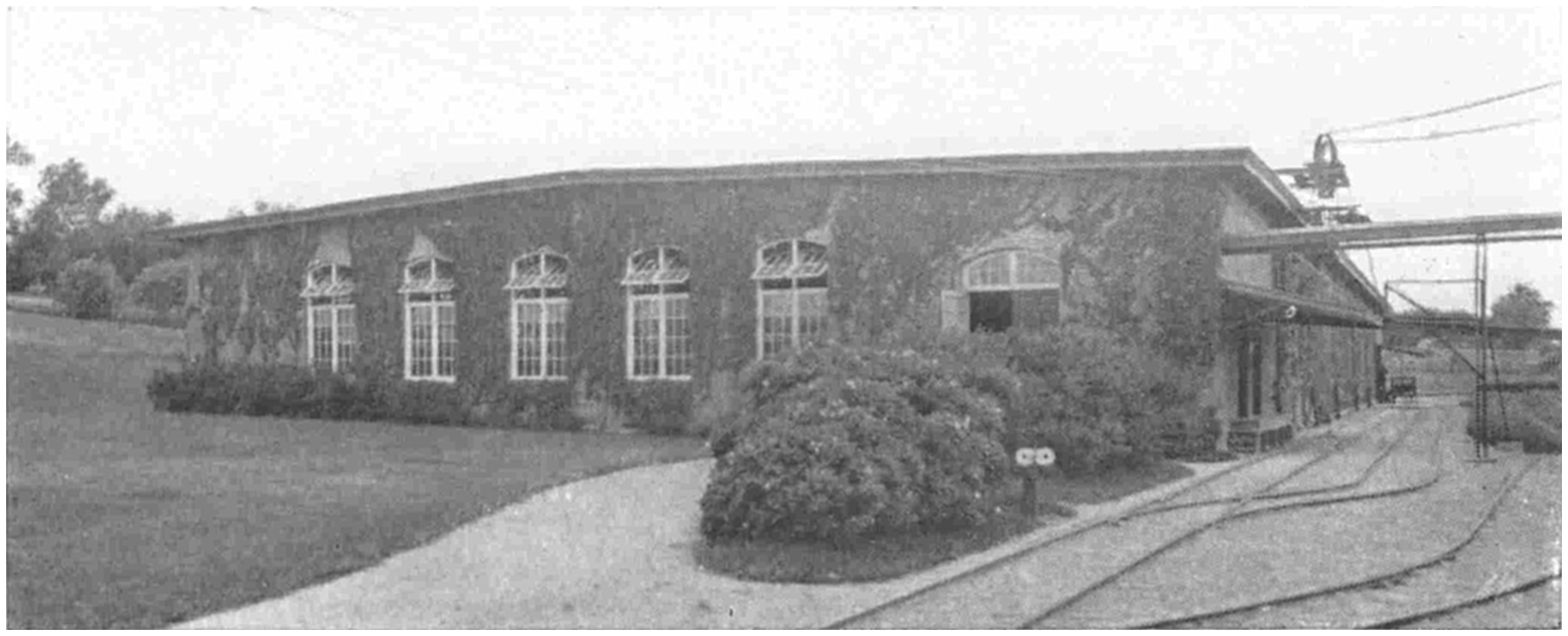
NO. 2 TAR HOUSE, PLYMOUTH CORDAGE COMPANY
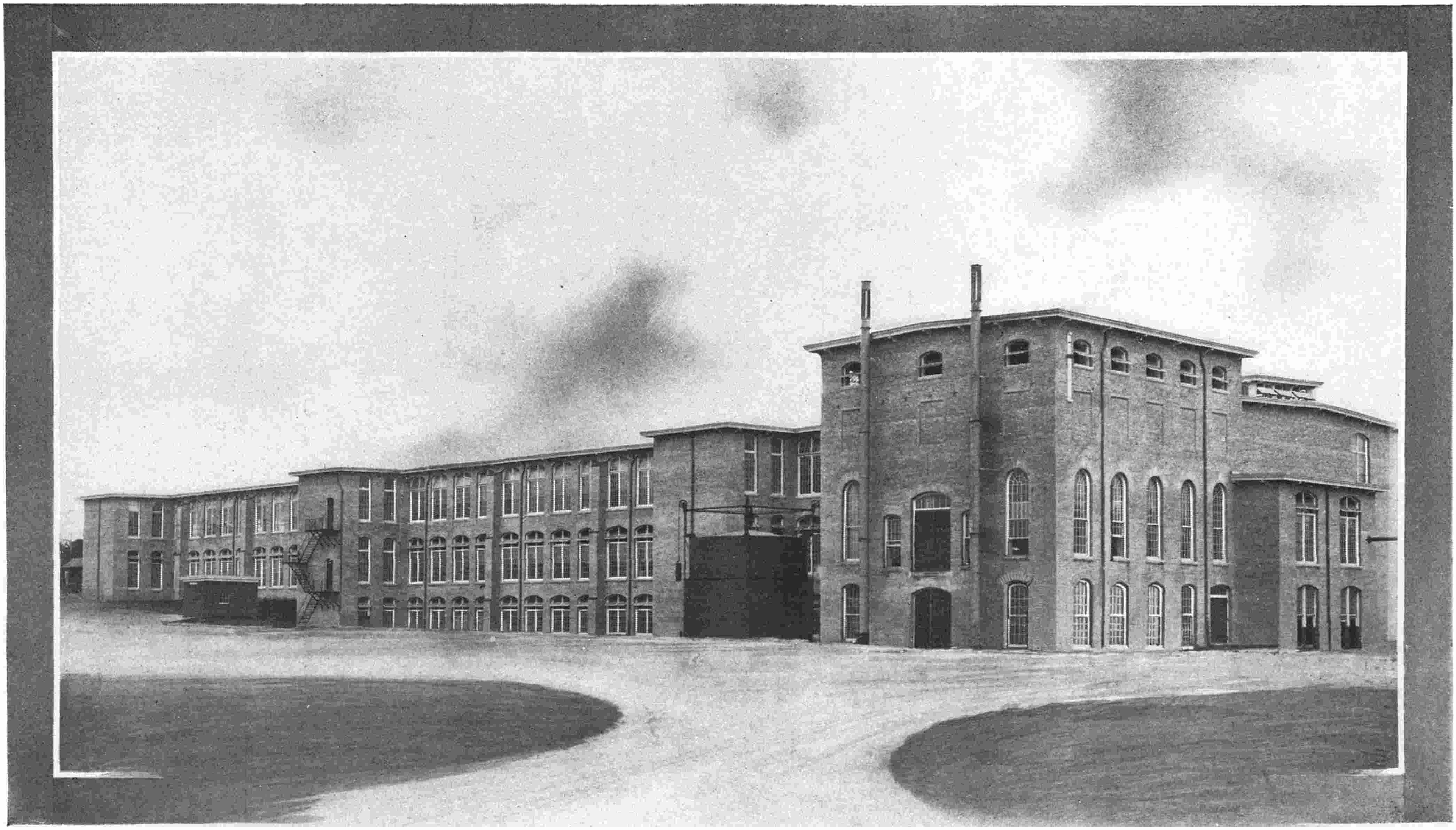
REAR VIEW NO. 3 MILL, PLYMOUTH CORDAGE COMPANY
CHAPTER II Preparation of Fiber for Spinning—Formation of “Sliver”
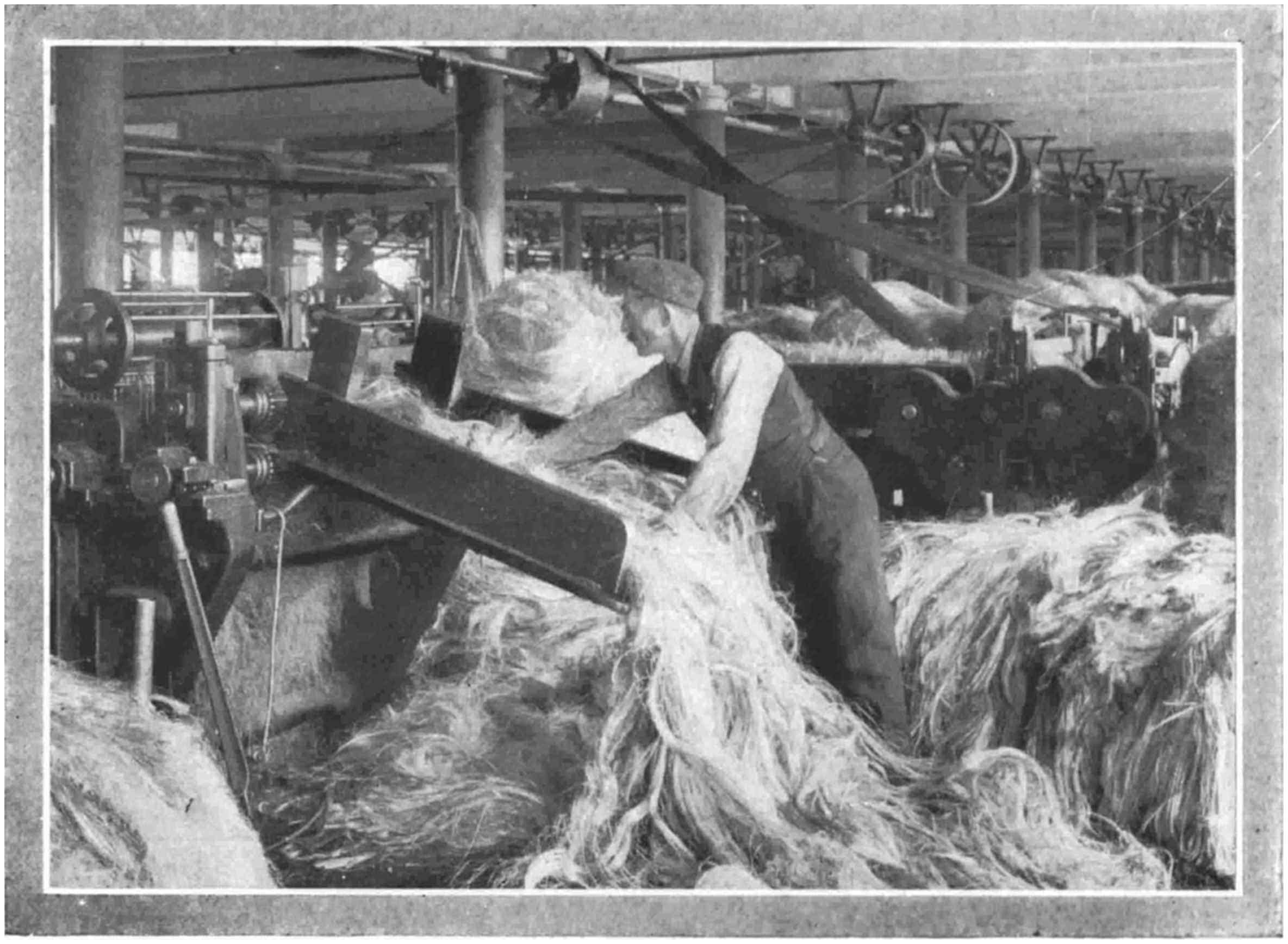
The opening room where the fiber is made
ready for the preparation machinery is a reminder
of the days when all rope-making
processes were hand work. The bales are
first opened up. In the case of Manila this means
cutting away the straw matting put on to protect the
fiber in shipment. Then the hanks which are packed
in various ways—sometimes doubled, sometimes
twisted—are taken out and straightened and the
band at the end of each hank removed.
No machinery has yet been perfected for doing the
work just described, but the first of the preparation
processes, a short step beyond, tells quite a different
story. Here the hanks of such fibers as require a special
cleaning treatment are placed on fast-working hackling
machines which comb away most of the snarls, loose
tow and dirt.
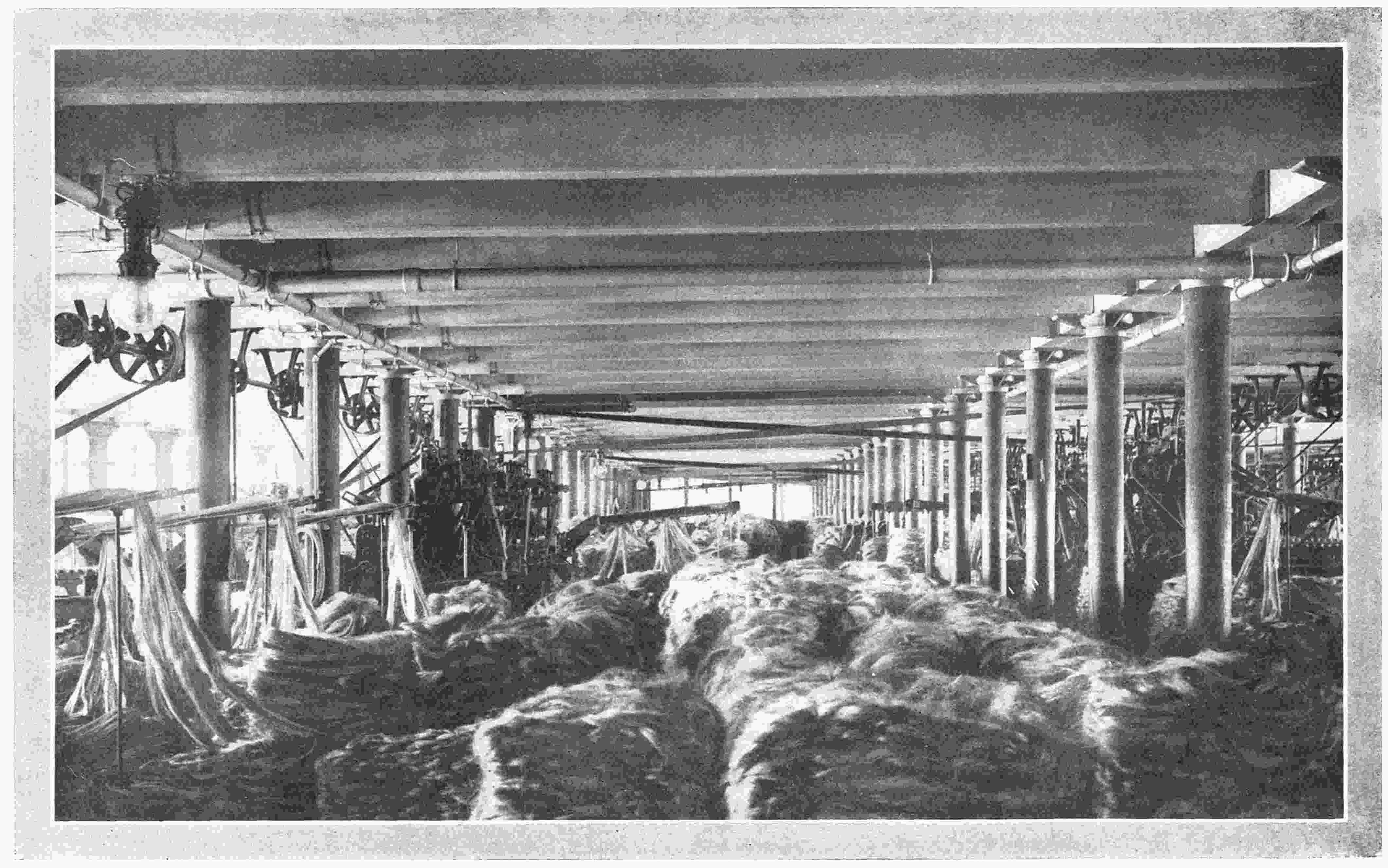
PREPARATION ROOM, NO. 3 MILL, PLYMOUTH CORDAGE COMPANY
At this point hard fibers—Manila, Sisal and New
Zealand—are usually oiled to soften them and to make
them more workable for the operations that follow.
The oil, furthermore, acts as a preservative. It is a
matter of importance
to the
buyer, however,
that the
fiber should not
be too heavily
oiled, for that
merely increases
the
weight and cost
of the rope
without improving
its
quality. Our
experts have
determined
through long experience the amount of oil that should
be used to best serve the interests of both manufacturer
and buyer, and have perfected a process which
insures a perfect distribution over all the fibers, while
frequent tests on each machine, in which definite
quantities of fiber are weighed before and after oiling,
prevent any excess.
WHERE THE LUBRICATING OIL IS MIXED
The quality of oil used is also important, for grades
containing acids have a harmful effect on all vegetable
fiber. We compound our own oils and we also take
great care to prevent acids from entering our grounds
or factories and so coming in contact with our products.
Long ago the Plymouth Cordage Company learned
that in the methods employed in the preparation of
fiber for spinning lay one of the secrets of fine rope-making.
To secure a more effective and special treatment
in this process, we have added to the regular
machines many improvements of our own. So highly
perfected is the apparatus that by machine work entirely
the separate hanks of fiber are combed and elongated
into a soft, continuous sliver of any size desired
and of convenient length, glossy in appearance,
perfectly clean, and with each fiber lying as nearly as
possible in the straight position which gives it maximum
strength. These operations, in which the entire
character of the comparatively short vegetable fiber
changes seemingly, are wholly a development of modern
rope-making, since in the days of hand spinning
no sliver was necessary.
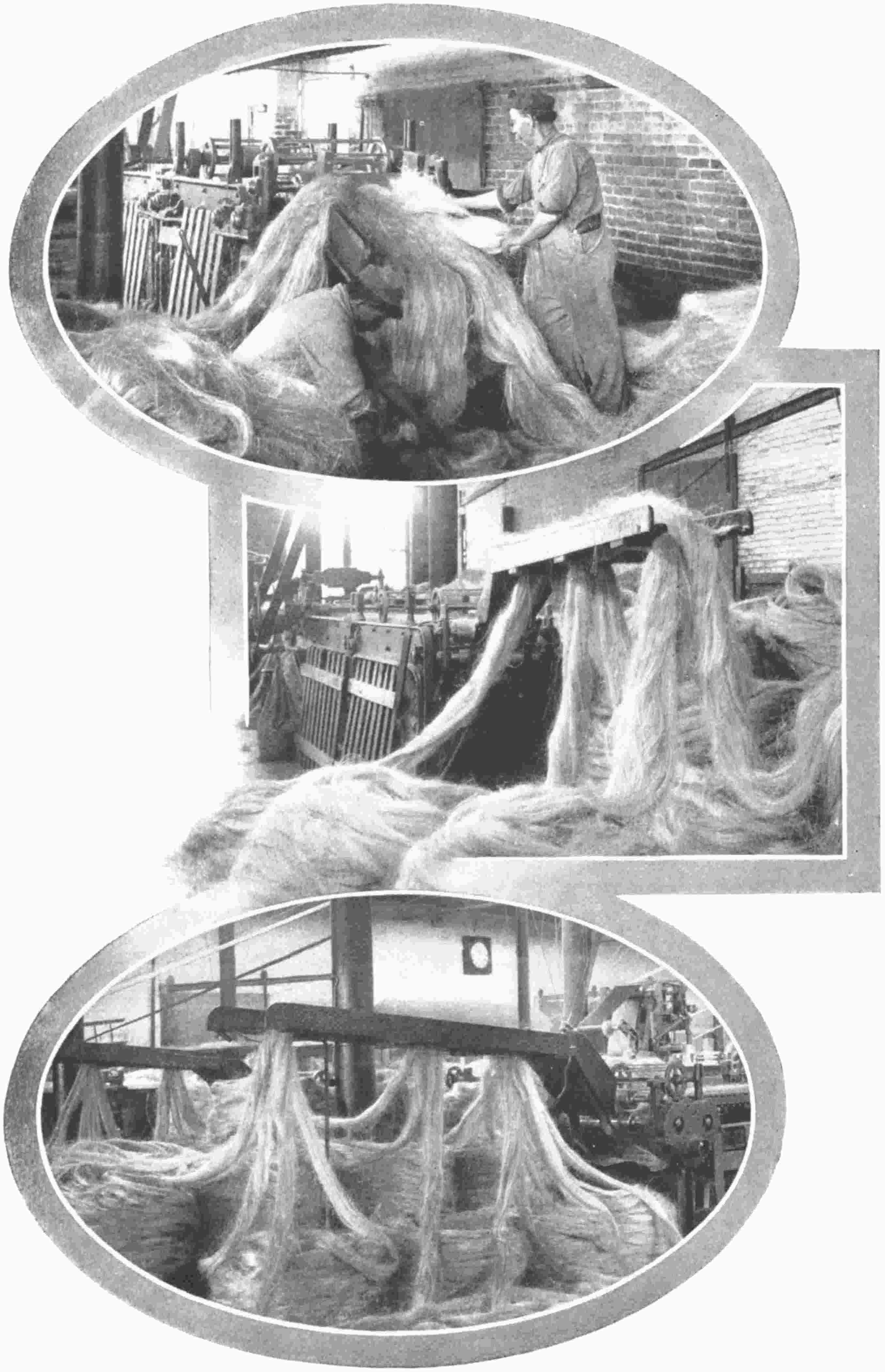
FORMATION OF SLIVER—FIRST BREAKER
The machines are arranged in series, usually as follows:
a first and second breaker, a coarse and a fine
spreader and a draw frame. The treatment is varied
to suit the particular requirements of different hemps
or ropes by a prolonging or shortening of the series
and by the adjusting of individual machines, but the
method is always essentially the same.
SECOND BREAKER
SPREADER
DRAW FRAME
REDUCING SIZE OF SLIVER FOR SPINNING
The purpose of the first breaker is to form the primary
sliver or “roping” as it is sometimes called. The
hanks of fiber—somewhat matted if they have been
oiled—are fed by hand into the machine, several at
a time. Steel pins fitted to a slowly revolving endless
chain grasp the mass while a second set of pins, moving
more rapidly, draws out the individual fibers and combs
them into a continuous form.
GROUP OF DRAW FRAMES
The operations which follow are very similar. A
number of “ropings” are allowed to feed together into
a first, slowly revolving set of pins and are drawn out
again by a high-speed set into a smaller sliver, the pins
becoming finer on each succeeding machine until the
draw frame is reached. Here the fiber is pulled from
a single set of pins between two rapidly moving leather
belts called aprons. On all of these machines the fiber
passes between rollers as it goes onto and leaves the
pins and the sliver is given its cylindrical form by being
drawn through a circular opening.
A finished sliver must conform to the special size
desired for spinning. Different sizes are secured by
changing the number of “ropings” which are allowed
to feed into the fine spreader. When “rule of thumb”
standards of measurement were practiced the size of
the sliver was tested by the number of turns which
could be clasped in the hand between the ends of the
thumb and forefinger. If the workman’s hand chanced
to be different from the official hand, he made allowances
accordingly. At best this was a rough and ready
method, but through long practice the men could become
surprisingly expert. Mechanical grips or clasps
are now used because they are more convenient and
afford greater accuracy.
The wonder of modernism in rope-making is nowhere
more striking than in the preparation room.
To pass from one end, where the raw hemp is received
just as it left the hands of the native Filipino laborer
with his crude methods, down through the long rows
of machines to the draw frames from which the sliver
is delivered in a form that can be likened to a stream
of molten metal, is to cover decades of inventive
genius and mechanical development.
The mechanism performs its work so accurately that
at first glance the man feeding the fiber into the machine
and all the other men, busy about their various
duties, would appear to be playing very minor parts
in modern rope-making. In reality, expert workmanship
and watchfulness are very important factors.
Good rope depends no more upon scientific machine
processes than upon ceaseless attention to the little details.
And the attention paid to the details of the
preparation room is especially important.
A rope expert once said, “Any manufacturer can
make rope—it is a simple operation; but very few
can make good rope because few are willing to devote
the necessary amount of pains to each of the little
operations in the process.”
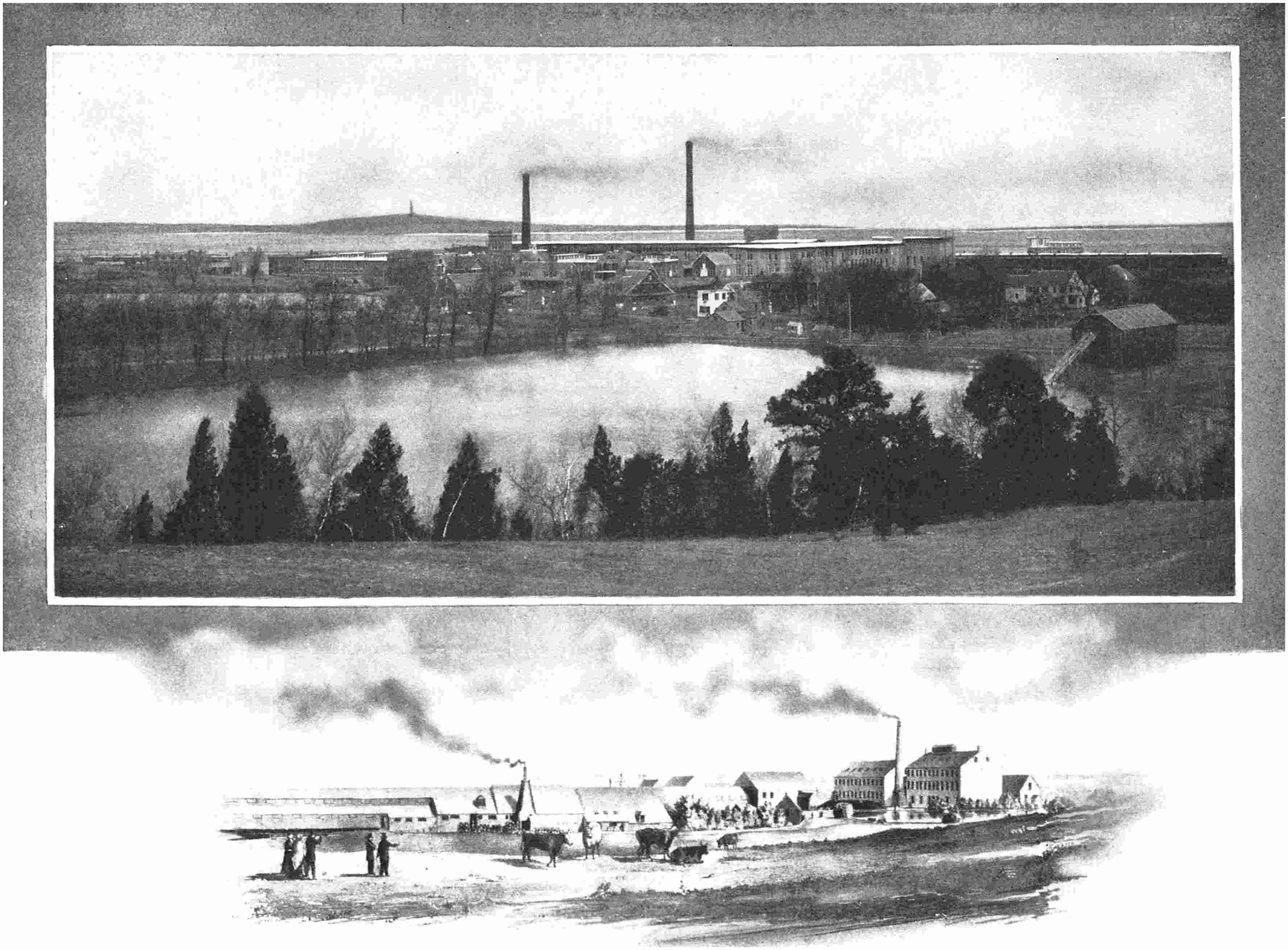
PLYMOUTH CORDAGE COMPANY FACTORY TODAY AND IN EARLY DAYS
CHAPTER III Spinning of Rope Yarn and Binder Twine
Hand spinning, as practiced in the early days
of the Plymouth Cordage Company, yielded
a remarkably good rope yarn, but large production
was very expensive and laborious.
The length of the spinning grounds, which with the
buildings protecting them were known as the ropewalk,
determined the length yarn that could be spun. Hand
and water power had to suffice, and even the best spinner
could make but two yarns at a time.
Steam-driven spinning machines were introduced,
however, as early as 1838, for our records show that
near the close of that year Bourne Spooner, founder
of our company, wrote to one of the directors as
follows:
“Our new spinning concern has consumed more time in the
work of preparation than was expected, but we are now ready—this
being the second day of steam spinning. It affords
me much gratification to say that everything connected with
this enterprise has gone comfortably on, and my faith in the
utility and expediency of the measure is unabated.”
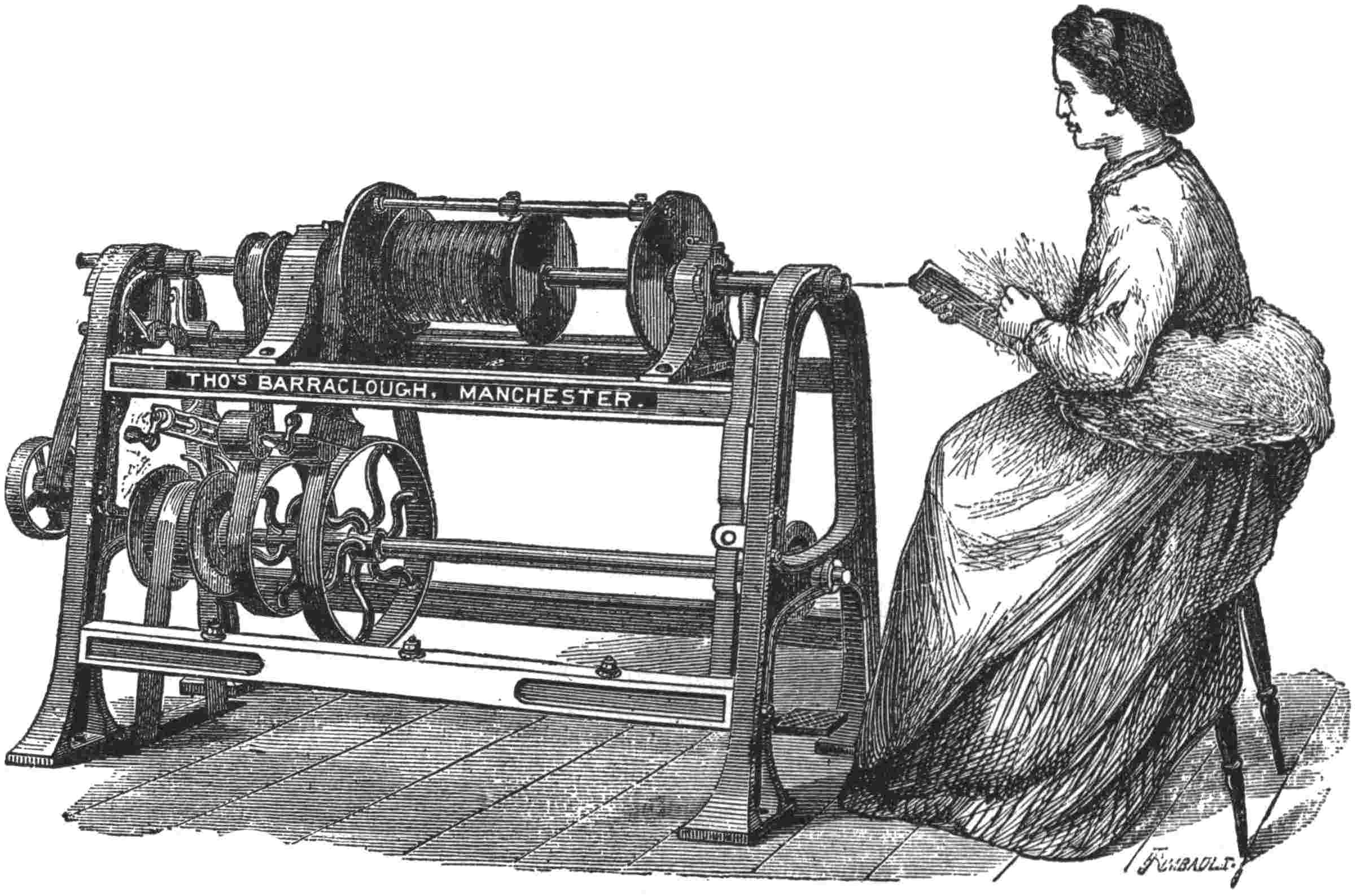
Through the courtesy of the Watson Machine Co.
of Paterson, N. J., we are able to
show an excellent picture of one of
these earlier-type machines which, it
will be noted, is tended by a woman. Those familiar
only with the present factory practice of putting none
but men on the spinning machines may be surprised
to know that during this first period in the modern
development of the process women spinners were regularly
employed by the Plymouth Cordage Company
and other concerns.
SPINNING ON EARLY-TYPE MACHINE
Our founder’s belief in the new method was speedily
justified. A way was found to adapt the machines to
the spinning of Russian and American hemps which
could not at first be handled as successfully as Manila
because of their somewhat softer texture. About 1848
the self-feeding device came into use. As the years
passed, still other improvements were invented and
utilized, giving us the highly perfected machine of
today.
Under favorable working conditions the only interruption
in the spinning process, as now carried on, is
the removal of the full bobbin and the substitution of
an empty one. A bobbin will hold as much as half a
mile of yarn which will weigh in the neighborhood of
ten pounds—the length and weight of the load varying
with different sizes of yarn.
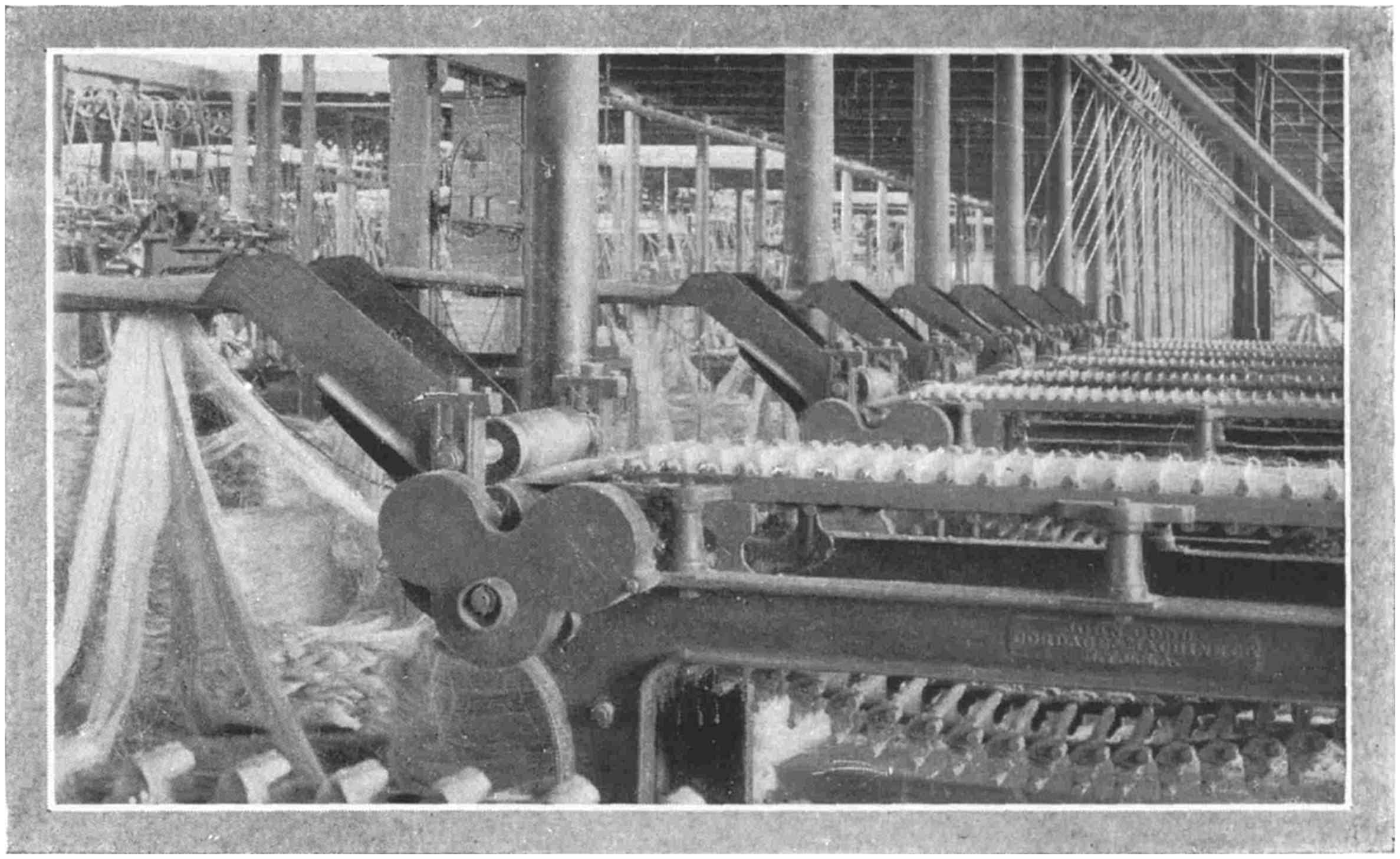
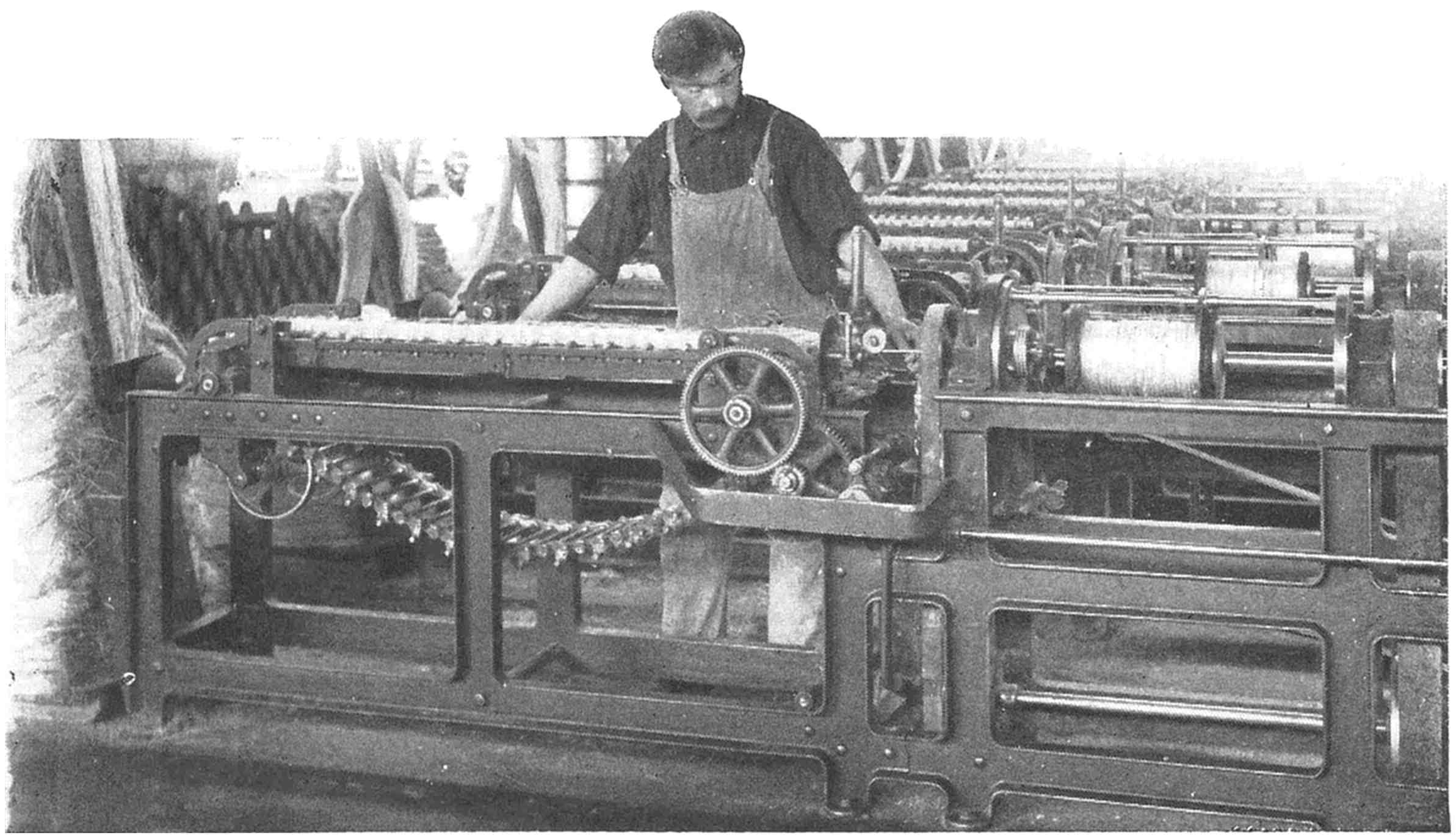
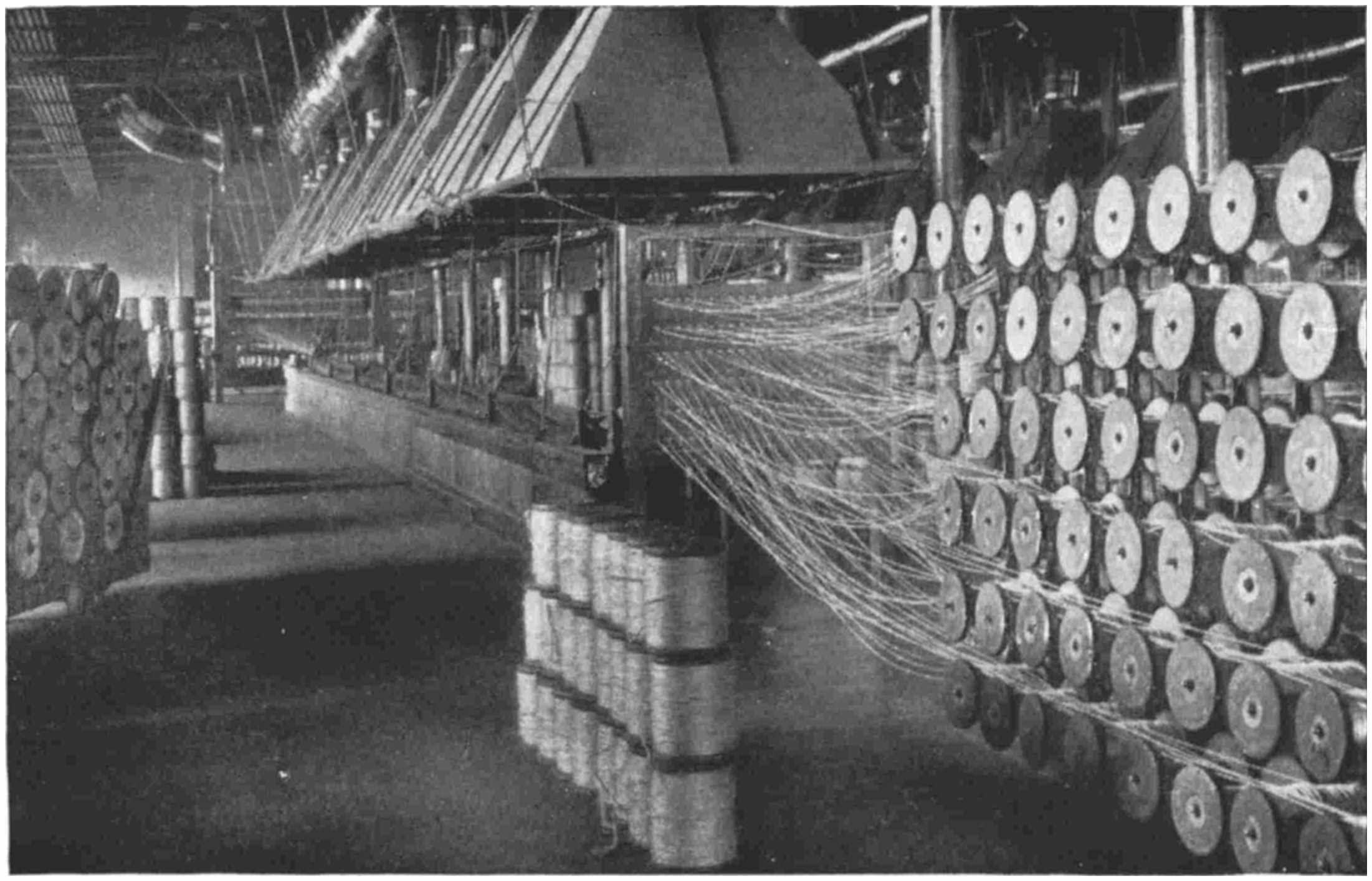
The feed portion of the machine, as can be seen in
the picture below, consists of a revolving endless chain
fitted with fine steel pins, and by these the fiber—now
in the sliver form given it in the preparation room—is
drawn from its bundle and carried toward a tube
which can be adjusted to regulate the size of the yarn
as desired. Into this tube the fiber disappears in
a fashion only to be described by the single word
“whisked.”
THE MODERN SPINNING PROCESS
In the preceding chapter we spoke of the importance
of an even sliver in the securing of a good yarn and
pointed out the care with which our sliver is prepared.
We have still further lessened the possibility of bunches
or thin spots in our yarns by perfecting and installing
on all spinning machines a device which insures a
uniform amount of feed to the tube at all times.
The two capstans which pull the fiber from the pins
and through the tube show in our picture directly at
the left of the bobbin. Their revolution also imparts
the twist to the yarn. The amount of
this twist—the number of turns per foot—depends
on the capstan’s speed and is fixed in a way best
explained by describing the flyer—the first part of
the machine to be perfected.
The closed flyer, as the present-day type is called, is
composed of two discs joined by stay rods and carrying
through their centers a spindle which holds the wooden
bobbin. The capstans are set into the disc at the left
and revolve with the flyer, at the same time receiving
a lesser reverse power from an independent gearing.
Their speed is, therefore, equivalent to the difference
in speeds of these two drivers.
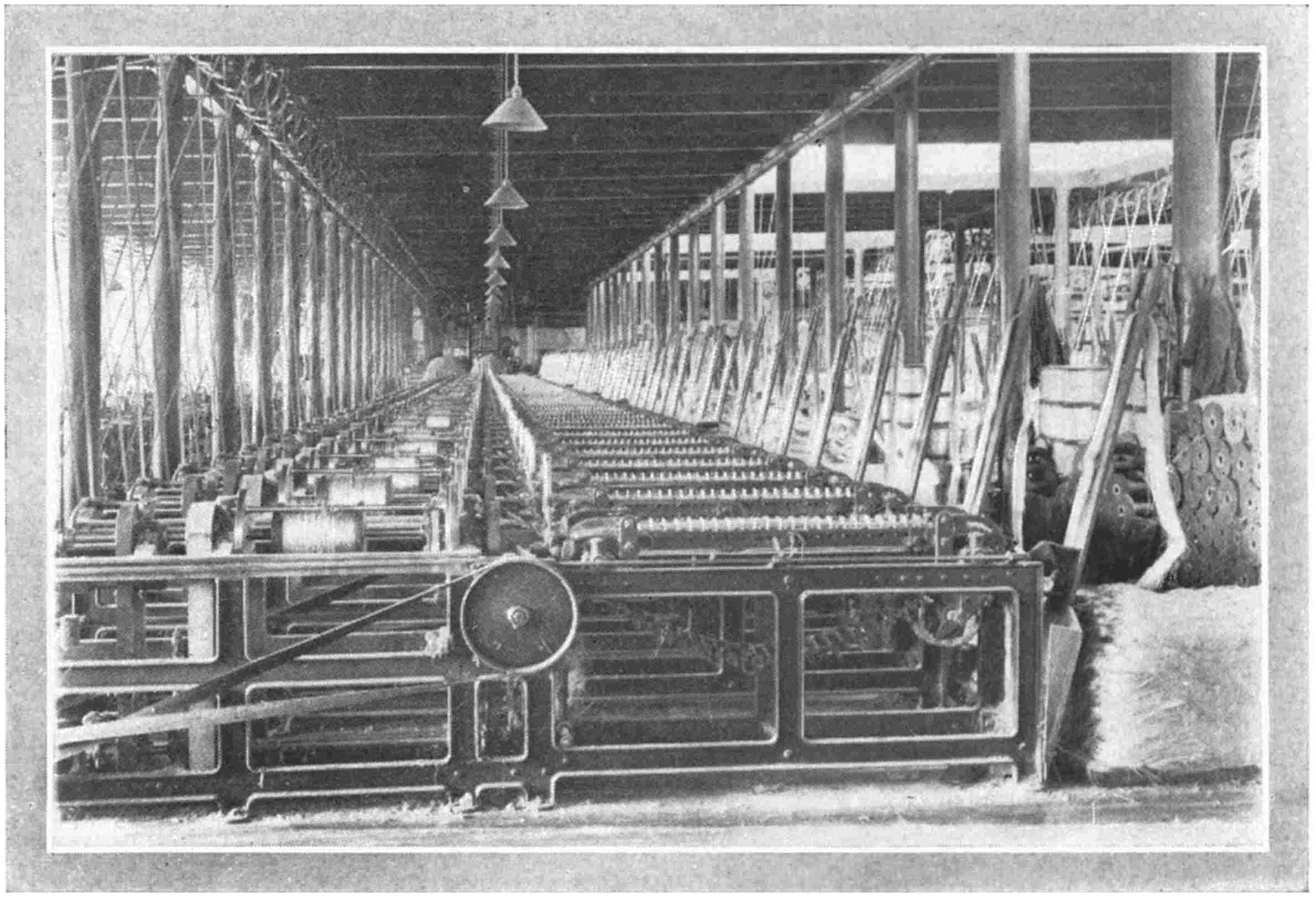
“WITH ITS HUNDREDS OF FLYERS.” SPINNING ROOM, NO. 1 MILL
To insure an even twist these speeds, once they are
set, should not be allowed to vary, and to obtain this
steady running, the Plymouth Cordage Company uses,
almost entirely, machines of a special type, so constructed
as to guarantee the best possible results.
Binder twine is always given what is known as a
right-hand twist, but rope yarns must, for certain kinds
of rope, be given a left-hand twist. This is accomplished
by reversing the direction of the capstans. The
flyer carries four grooved wheels—two for the right,
the others for the left-hand yarn—and by these the
yarn is guided from the capstans to the revolving
bobbin.
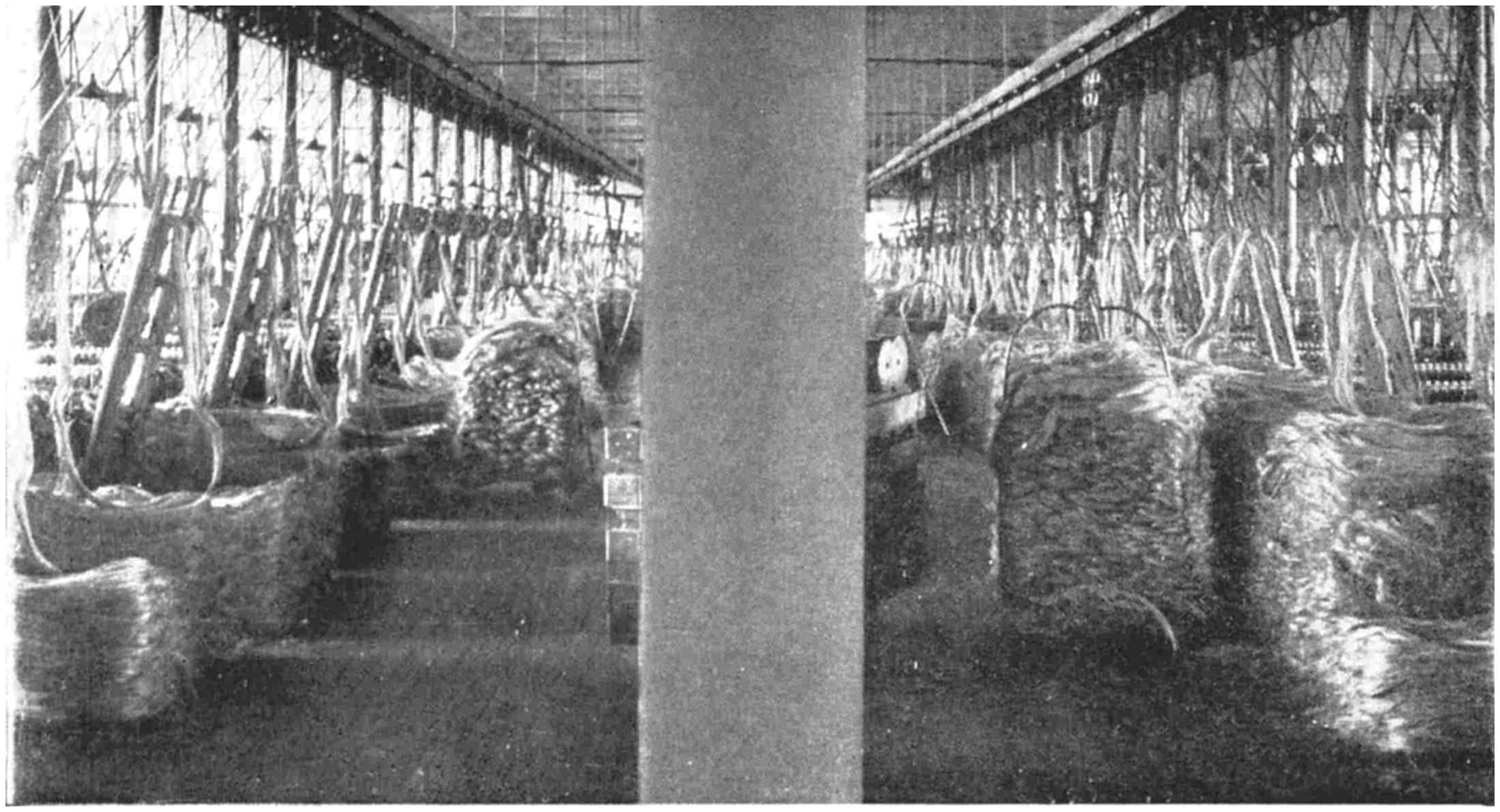
The spinning room, with its hundreds of flyers, each
running in the neighborhood of 1,500 revolutions a
minute, speaks eloquently of the years’ changes. Gone
is the “drowsy dreamy sound” of the wheel in Longfellow’s
“Ropewalk,” and in its place we hear the high
singing noise of the gears—the voice of modern industry.
And with the changes have come more rapid
and economical production, better hours and pay for
the workman, better rope for the consumer.
SPINNING ROOM, NO. 3 MILL, PLYMOUTH CORDAGE COMPANY
PLATFORM AND APPARATUS FOR STORAGE AND HANDLING OF TAR SUPPLY,
PLYMOUTH CORDAGE COMPANY
CHAPTER IV Tarring of Rope Yarns and of Small Ropes
In the last chapter we described the spinning
of rope yarn. Let us now turn to the process
where, for certain ropes, this yarn is
treated with the tar, the manufacture of
which we have already discussed.
To penetrate and adhere to the yarn the tar must be
heated to 200° or over. This work is begun in tanks
from which the liquid feeds into the long copper-lined
troughs where the tarring takes place. Through these
“coppers,” so called, run steam pipes to further regulate
the temperature. Excessive heating would cause
the loss of the tar’s good qualities, and to prevent
this the supply in the “coppers” must be freshened
frequently.
The picture on the next page illustrates how the
yarns unwind from the bobbins, onto which they have
been wound in the spinning process, and pass on into the
“copper.” The plates which keep the yarns under the tar
are shown elevated above the surface to give a clearer
idea of their operation. As the heavily saturated
yarns come from the “copper,” they are compressed
between two rollers, adjusted to leave in the yarn as
much or as little tar as needed for the particular goods
being made and to turn back the surplus.
The pull which carries the yarn through the tar
and between the rollers comes from two large drums
around which the yarns travel preparatory to reeling
onto friction-driven receiving bobbins.
Goods of nine-thread size and under are usually
tarred in the completed rope form, but the process is
essentially the same as with the yarns.
Visitors to our tar-houses frequently remark upon
the rich golden brown of our tarred goods. Those who
use and sell them have come to look upon that color—an
outward sign of right materials and methods—as
the Plymouth mark of the weather-resisting qualities
contained in the goods.
YARNS ENTERING THE “COPPER”
CHAPTER V Forming and Laying of Ropes and Cables—Ropewalk Method
Before taking up the strictly modern
machines so largely used now in the final
processes of rope-making—the forming of
strands, laying of common ropes and closing
of cable-laid goods—we shall describe the ropewalk
method of performing these operations as it is practised
today.
For making tarred goods in all but the smaller sizes
the walk has certain advantages not afforded by more
advanced methods. It also provides efficient equipment
for turning out the largest ropes, which would
otherwise require special machinery.
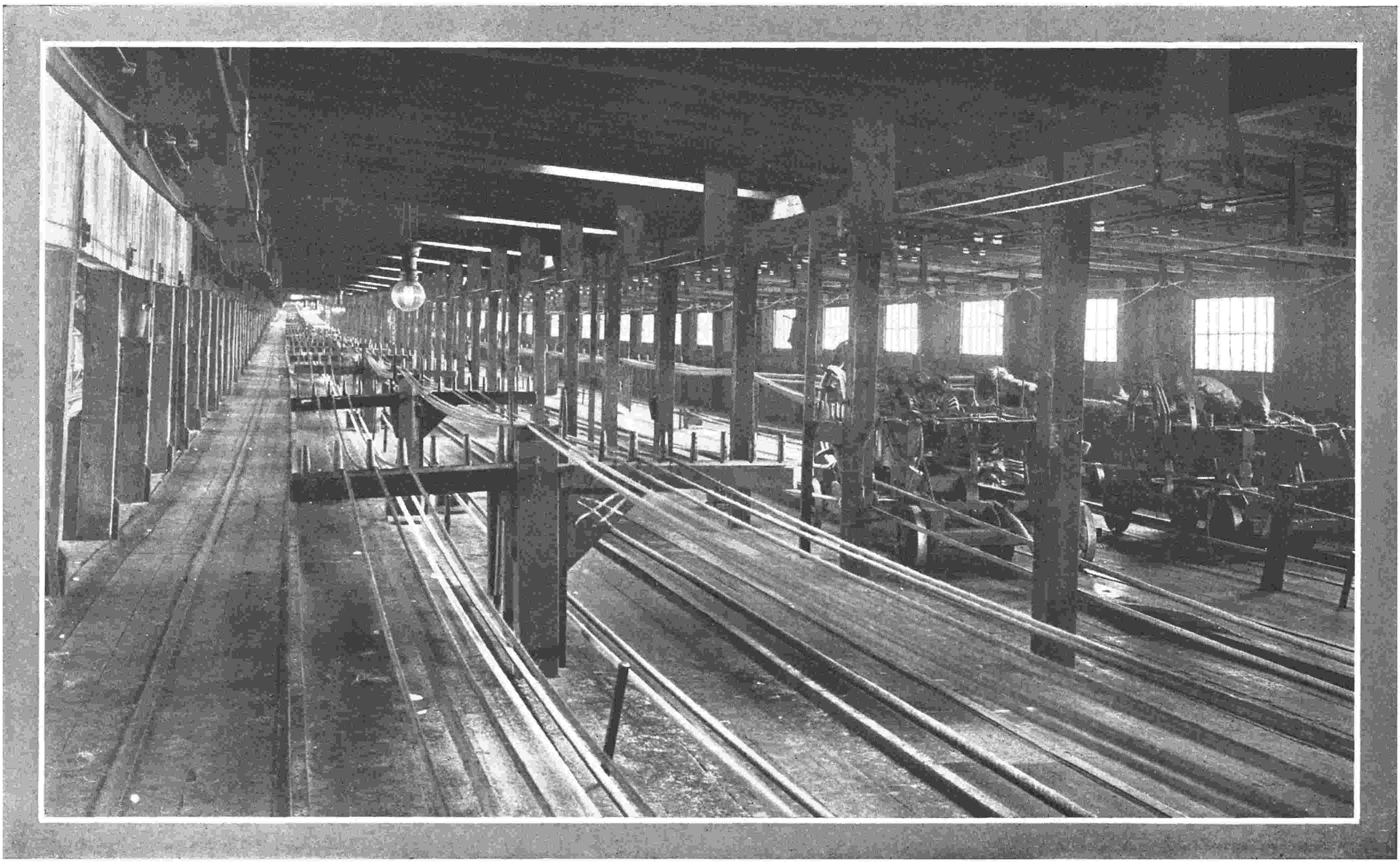
The long alleys or grounds where the work takes
place are usually laid out in pairs, one for forming,
the other for laying and closing. Each ground has a
track to accommodate the machines and an endless
band-rope which conveys the power.
At the head of the forming ground stand frames
holding the bobbins of yarn. The yarns for each
strand first pass through a plate perforated in concentric
circles. This arrangement gives each yarn
the correct angle of delivery into a tube where the
whole mass gets a certain amount of compression.
CORDAGE MANUFACTURE BY THE ROPEWALK METHOD
YARNS PASSING FROM BOBBINS THROUGH PERFORATED PLATES
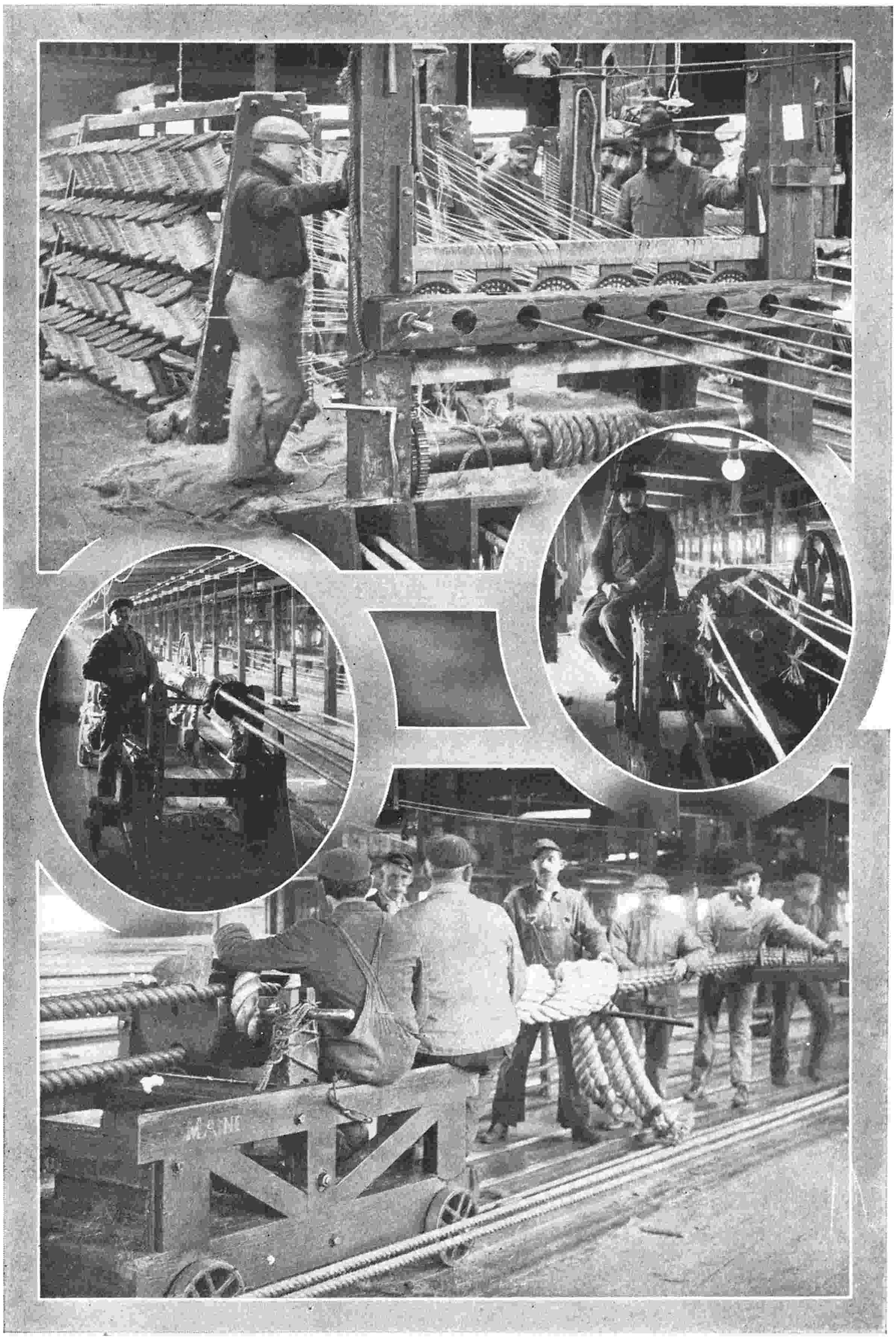
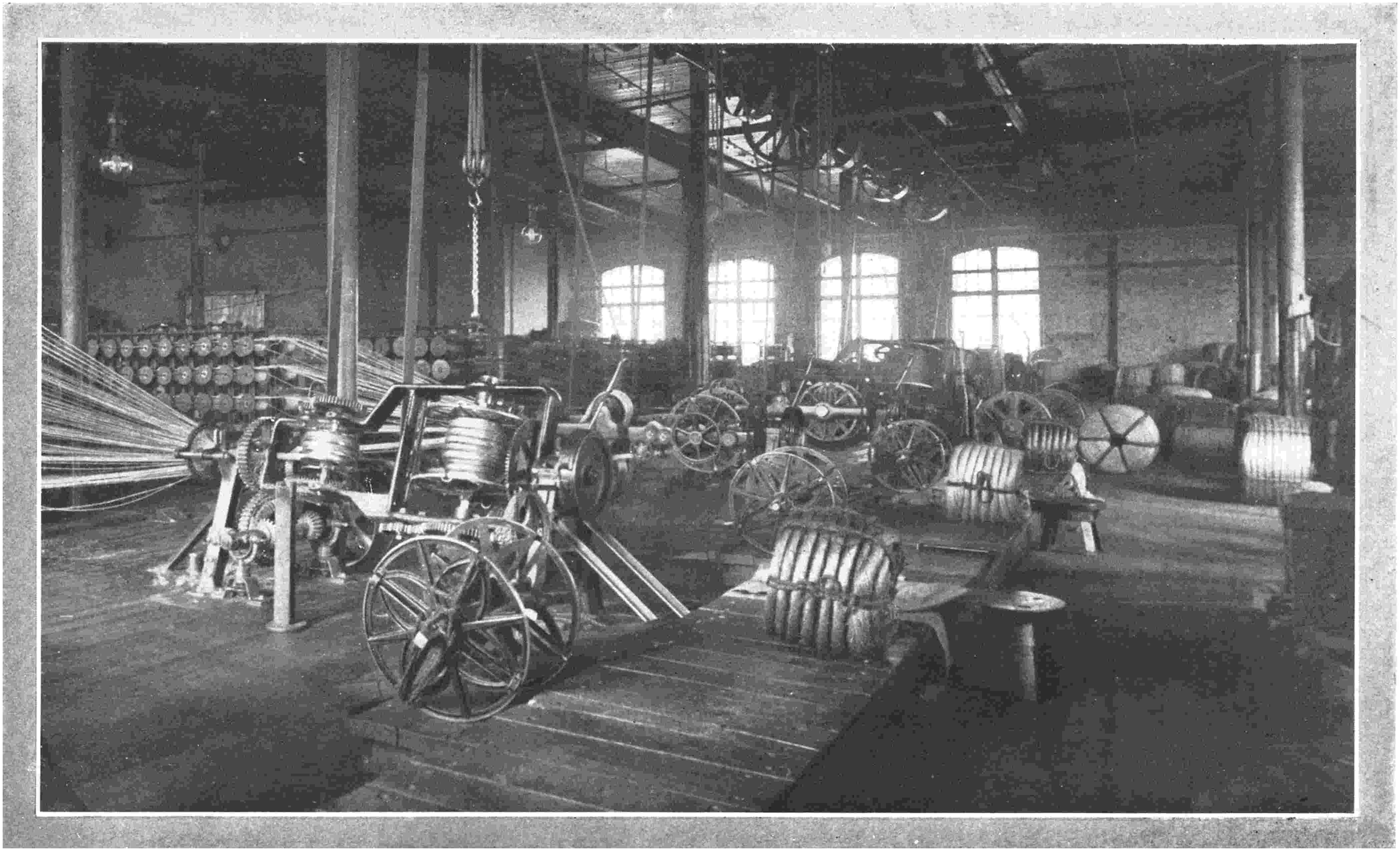
The forming machine—a heavy carriage surmounted
by the band-rope wheel into which are geared
several spindles and a driving drum—is now drawn
up, and each group of yarns is attached to a separate
spindle as shown opposite. A rope made fast at either
end of the walk is given a few turns around the drum,
the band-rope is set in motion and the machine moves
off, leaving in its wake the compactly twisted strands.
In the case of a common right-laid rope, the forming
twist is left hand. A change to right hand can be
made simply by shifting clutches. The amount of turn
or twist depends on the diameter of the drum, which
is adjustable.
Behind the machine follows a man who swings out
the stakes, placed at intervals along the walk, and
throws the strands over them. When the process is
completed the strands are cut away at either end and
transferred to the laying ground, the stakes being
pushed back to allow the return of the forming machine
for another trip.
INTERIOR OF ROPEWALK, PLYMOUTH CORDAGE COMPANY
The two laying machines stationed at opposite ends
of the walk greatly resemble the forming machine.
One—usually the “afterturn,” so called—is made
fast; the other, or “foreturn,” is braked down but not
secured. The strands are attached to separate spindles
on each machine and given a little extra twisting from
both ends—left hand as in the forming. During this
process of putting in the “hard,” so called, as well as
in the laying itself, the foreturn machine is drawn
slowly ahead by the shortening of the strands.
For the laying, the ends of the strands at the afterturn
machine are transferred to a single spindle. The
“top”—a cone-shaped block containing a groove for
each strand and mounted on a light truck—is backed
up to the machine, the strands are inserted and the
twisting recommenced, the direction of the afterturn
spindles now being reversed. The resulting tendency
of the strands to untwist is counteracted, partly by
a left-hand revolution of the foreturn spindles, and
partly by the presence of the “hard” or surplus twist
just described.
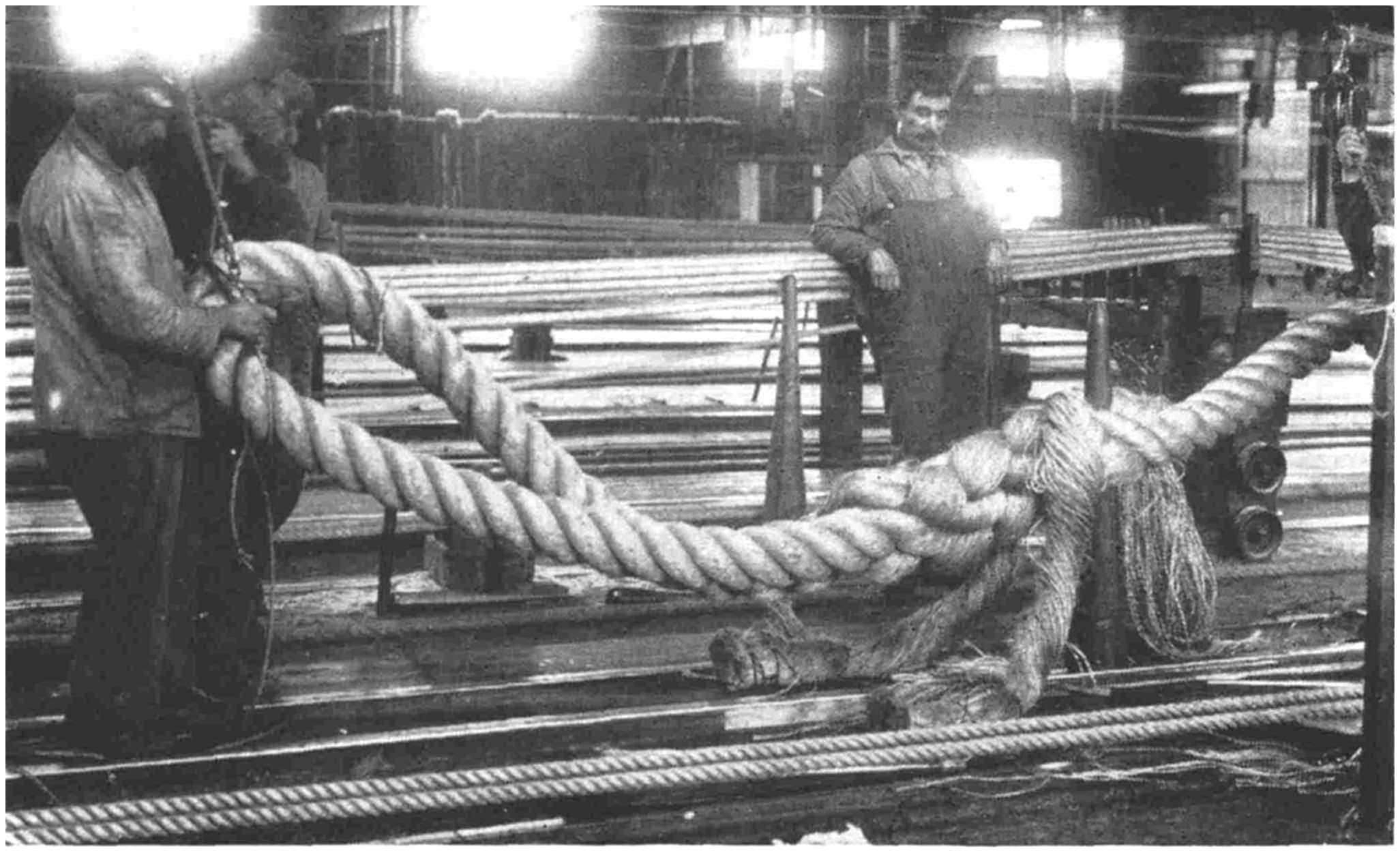
As the top truck is forced ahead by the twisting
process, the rope-maker preserves a correct lay in the
rope by means of greater or less leverage on the “tails”—the
loose ropes shown in our picture. The stakes
on which the strands rest are removed one by one to
allow the top truck to pass and are then replaced to
support the rope until the laying is finished and the
reeling in of the rope begun.
The closing process on cable-laid goods is like the
laying except that the twist is reversed. The work
being with three complete ropes—frequently very
large—a heavier top truck is necessary, and this
must often be ballasted, as shown in our illustration
on page 80, to keep down the vibration which would
otherwise tend to lift the truck off the track.
SIXTEEN-INCH TOWLINE WITH EYE-SPLICE
LATHYARN AND TIE ROPE MACHINES, NO. 2 TAR HOUSE, PLYMOUTH CORDAGE COMPANY
CHAPTER VI Forming and Laying of Ropes and Cables—Factory Method, Two-Machine System
Unlike the ropewalk system of making
strands, ropes and cables described in the
preceding chapter, the factory method, so
called, is a development of the last few decades
only. From the first this company has been a
leader in purchasing the best stock machines obtainable
and in designing devices to fulfill special requirements—a
policy which has given us unequalled production
facilities.
To describe this equipment in detail would require
an entire book. We shall attempt, in this chapter and
the next, to give an idea of the principal machines only.
There are two methods to the modern system: that
in which the strands are formed on one type of machine
and twisted into a rope on another; and that in
which both operations are performed on a single machine.
The second method carries with it the advantage
of economy in space and equipment, but is not
followed so generally with the larger sizes of rope as
is the first.
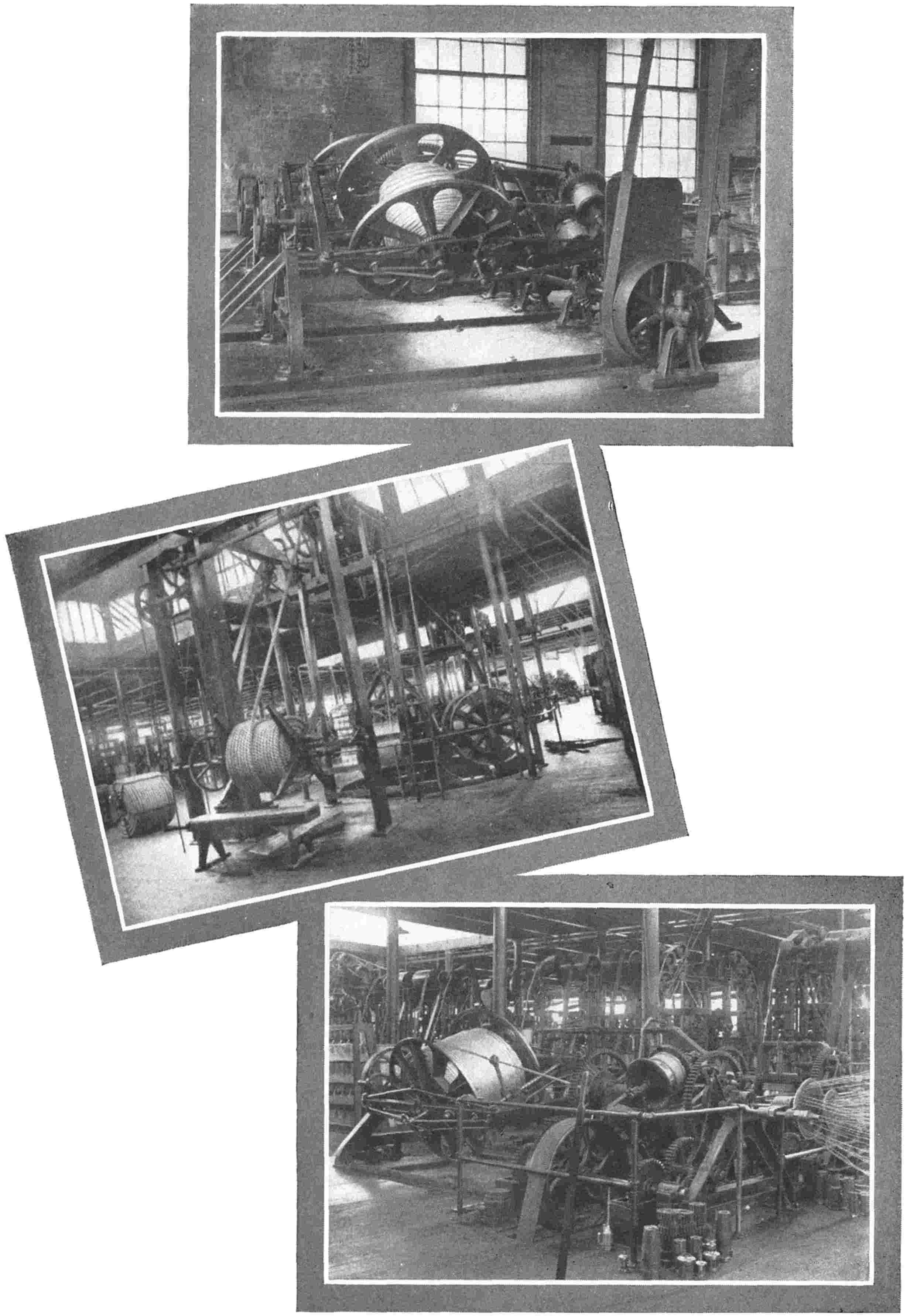
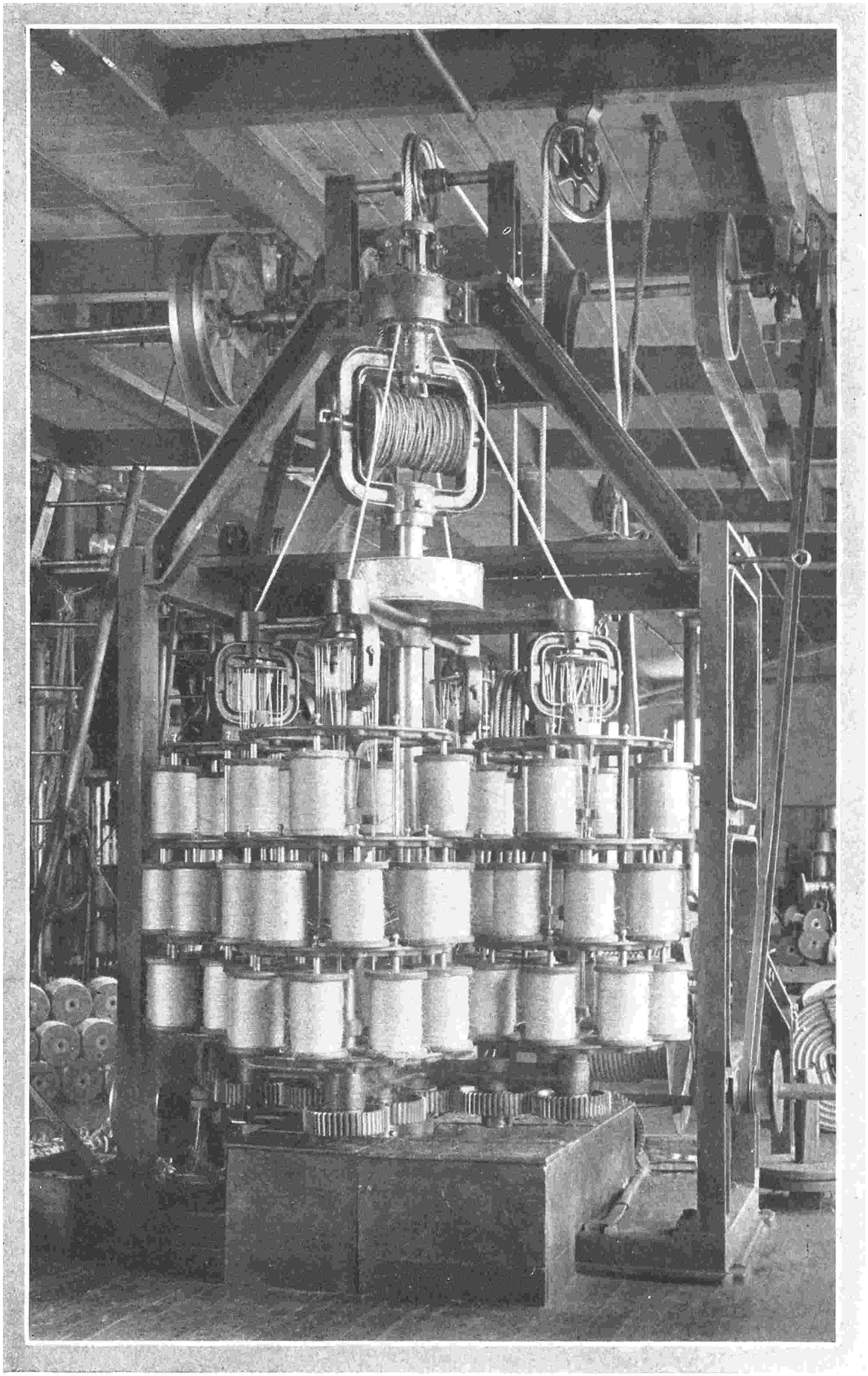
A complete set for the two-part method comprises
two or more horizontal strand-forming machines, several
bobbin frames and a vertical laying-machine. In
our illustration, the latter is shown making three ropes
into a cable—a process essentially the same as where
three strands are united into a single rope.
Three men usually suffice on the strand-making—one
to tend the machines, the others to tend the bobbins
which turn on fixed posts and can be renewed as needed
without interrupting the process.
The yarns are first drawn from the bobbins through
the perforated plates seen in the lower section of the
picture, the entire number being so distributed as to
converge in layers and at the proper angles around
one central yarn. They next pass into a tube. Here
the whole mass is compressed and at the same time is
twisted by the revolution of the long carriage or flyer,
which, as our picture shows, supports a winding-reel
and two capstans.
The strand can be twisted right or left hand as called
for. The amount of twist is regulated by the flyer’s
speed—easily varied by the use of different gears.
The two capstans are geared to pull the strand
through the tube and, by holding it taut, keep the twist
uniform. The reel also has its separate gears and
revolution. Whenever the increasing diameter of the
load tends to make it exert too much strain on the
strand, the reel is slowed down by an ingenious friction
device. The strand is guided into even layers on the
reel by an arm which is made to travel from side to
side.
Here, then, are four distinct operations going on at
once and all in perfect harmony. From this may be
judged the many difficulties which had to be overcome
before strands could be manufactured in such small
space.
HORIZONTAL
FORMING MACHINES
MAKING STRANDS
VERTICAL LAYING-MACHINE
MAKING
OIL-WELL CABLE
FORMING MACHINES
(WINDING REEL ON
FARTHER MACHINE
REMOVED)
ROPE-MAKING MACHINERY, PLYMOUTH CORDAGE COMPANY
The illustration opposite page 85 shows the machines
which make Plymouth Lathyarn and Hide Rope.
Although somewhat smaller than the type just described,
these machines are constructed and operate
in practically the same manner. The speed of their
flyers is naturally much slower, however, since the
goods they work on need not be twisted so hard as a
rope strand.
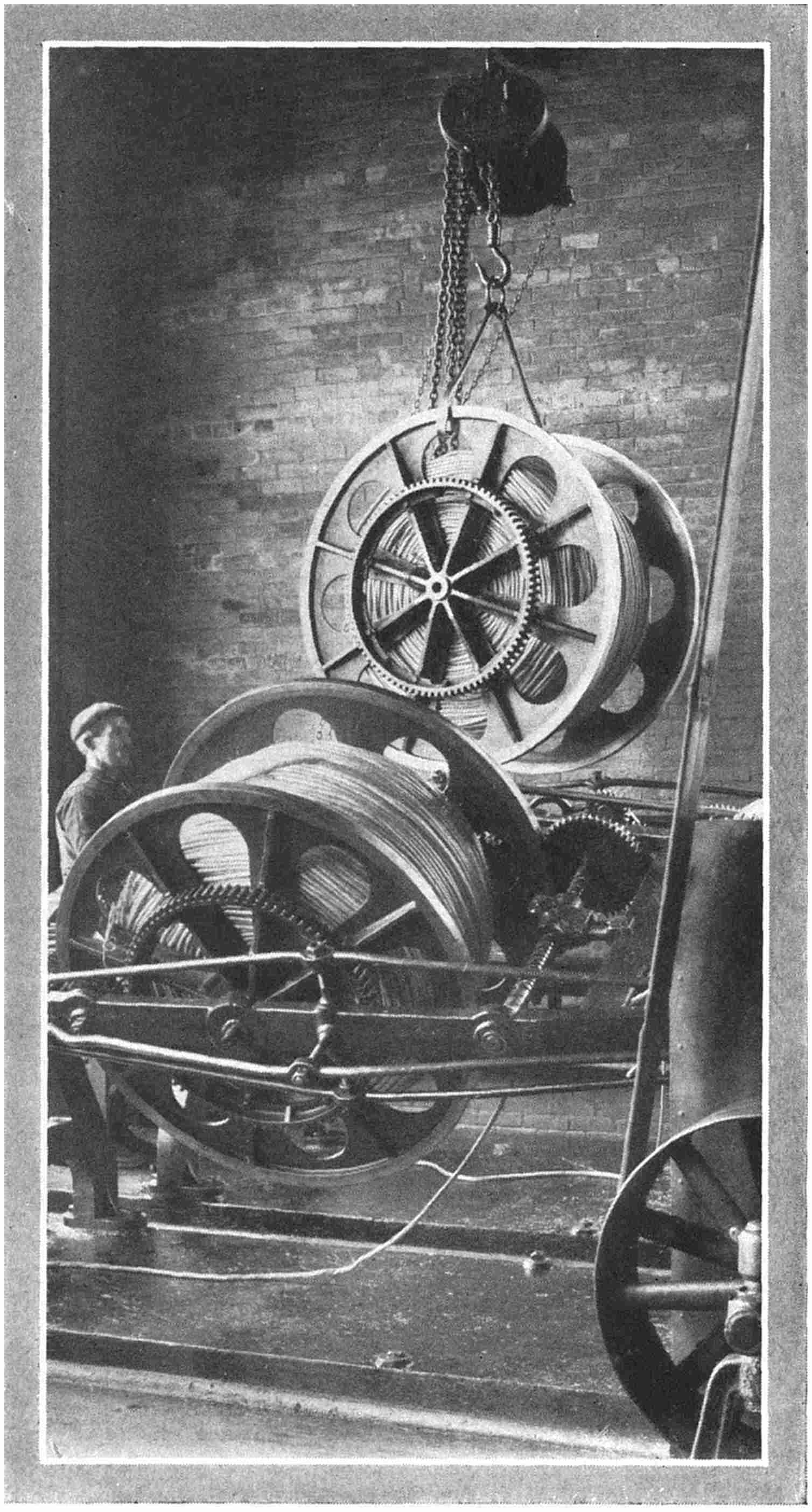
For the laying process, in which the strands are
united to make a rope, the full reels are removed from
the forming machines by overhead chains, as shown on
the opposite page, and by like means are placed in
the vertical flyers of the laying-machine. The strands
pass through openings in the top-piece just above the
flyers and converge into a central tube still higher up
to form the rope.
REMOVING REEL WITH STRAND FROM FORMING MACHINE
When the machine is in operation the whole lower
portion, from the tube down, revolves, either to the
right or left as the goods require, and thus puts the
twist into the rope. This twist being opposite, always,
to that of the strands, the natural tendency of the latter
as they are laid together would be to loosen up. To
regulate this, each flyer is made to revolve on its own
axis—in a direction opposite to the general direction
of the machine. Each reel revolves also on its axis to
feed out the strand—the effect of the changing load
being met as before by a friction attachment.
The overhead pulleys, which perform the same
mission for the rope that the capstans previously did
for the strands, deliver the finished product onto a
belt-driven coiling reel where it is guided into even
layers by the workman tending the machine.
As already explained, the laying-machine is used in
the same way when three ropes are made into a cable.
When a four-strand rope is to be turned out the machine
has four strand-reels. If the strands are to be laid
around a heart rope, as in transmission goods, the heart
feeds directly into the twist tube from a smaller reel
placed on the top-piece previously mentioned.
All the foregoing machines are equipped with ingenious
devices for measuring the strand or rope as it is
made, so that the attendant can tell instantly from the
gauge how many feet have been run. The features we
have here touched on are only a few of the many that
have transformed
the final stages of
rope-making from
a laborious task—dependent
for its
success on the skill
of the individual
expert—into quick,
sure operations
where every problem
is met with the
unfailing accuracy
of a perfect machine.
Rope nowadays
is, generally
speaking, made
more scientifically,
more uniformly
than it was in the
days of strictly
hand processes.
And the end is not
yet. Better and
still better rope
should mark the
years to come.
FOUR-STRAND COMPOUND LAYING-MACHINE
CHAPTER VII Forming and Laying of Ropes—Factory Method, Single-Machine System — Transcriber’s Notes
Modern rope-making ingenuity reaches its
high-water mark in the compound laying-machine
where the two operations of forming
the strands and laying them into a rope
are combined. Up to a certain point this method is
more economical than that in which the forming and
laying are unconnected as already described. Fewer
machines are required for a given output,—hence
less floor space and fewer workmen. The time-saving
element also enters in.
The compound laying-machine must, however, be
stopped each time that the supply of yarn on any
bobbin is so low as to call for a fresh one. This would
occur so frequently in the case of the larger ropes as to
offset the advantages just mentioned, and the machine
is therefore used on a limited range of sizes only.
As can be seen in the picture opposite, the machine
contains a vertical shaft with upper and lower projecting
arms which support the bobbin-flyers—four
in number in this particular case. The bobbins within
each flyer turn on separate spindles, allowing the yarns
to pass up through small guide plates and thence into
a tube.
Each flyer is geared to revolve on its own axis, thus
twisting its set of yarns into a compact strand. At
the same time all the flyers revolve with the main shaft
in an opposite direction and form a rope out of the
strands as the latter come together in a central tube
still higher up.
The rope is drawn through this tube by a series of
pulleys which exert a steady pull and so keep the proper
twist in the rope. From these pulleys the finished product
is delivered onto a separately driven coiling reel,
an automatic device registering meanwhile on a dial
the number of feet run.
The small reel, seen near the head of the main shaft,
holds the small heart rope which is fed into the center of
certain four-strand ropes to act as a bed for the strands.
The compound laying-machine can be had in many
sizes of differing bobbin capacity, and the extent and
variety of a manufacturer’s equipment on this type is
one important indication of his ability to turn out
promptly and at a reasonable price the sizes of rope in
most common demand.
SHIPPING PLATFORM, PLYMOUTH CORDAGE COMPANY
THE
UNIVERSITY
PRESS
CAMBRIDGE
MASS
Punctuation, hyphenation, and spelling were made
consistent when a predominant preference was found
in the original book; otherwise they were not changed.
Simple typographical errors were corrected; unbalanced
quotation marks were remedied when the change was
obvious, and otherwise left unbalanced.
Illustrations in this eBook have been positioned
between paragraphs and outside quotations. In versions
of this eBook that support hyperlinks, the page
references in the List of Illustrations lead to the
corresponding illustrations.
The uncaptioned illustrations at the beginning
of each chapter are identical decorative
headpieces.
Read The Story of Rope (1916) — Full Text Online Free | Open Old Books