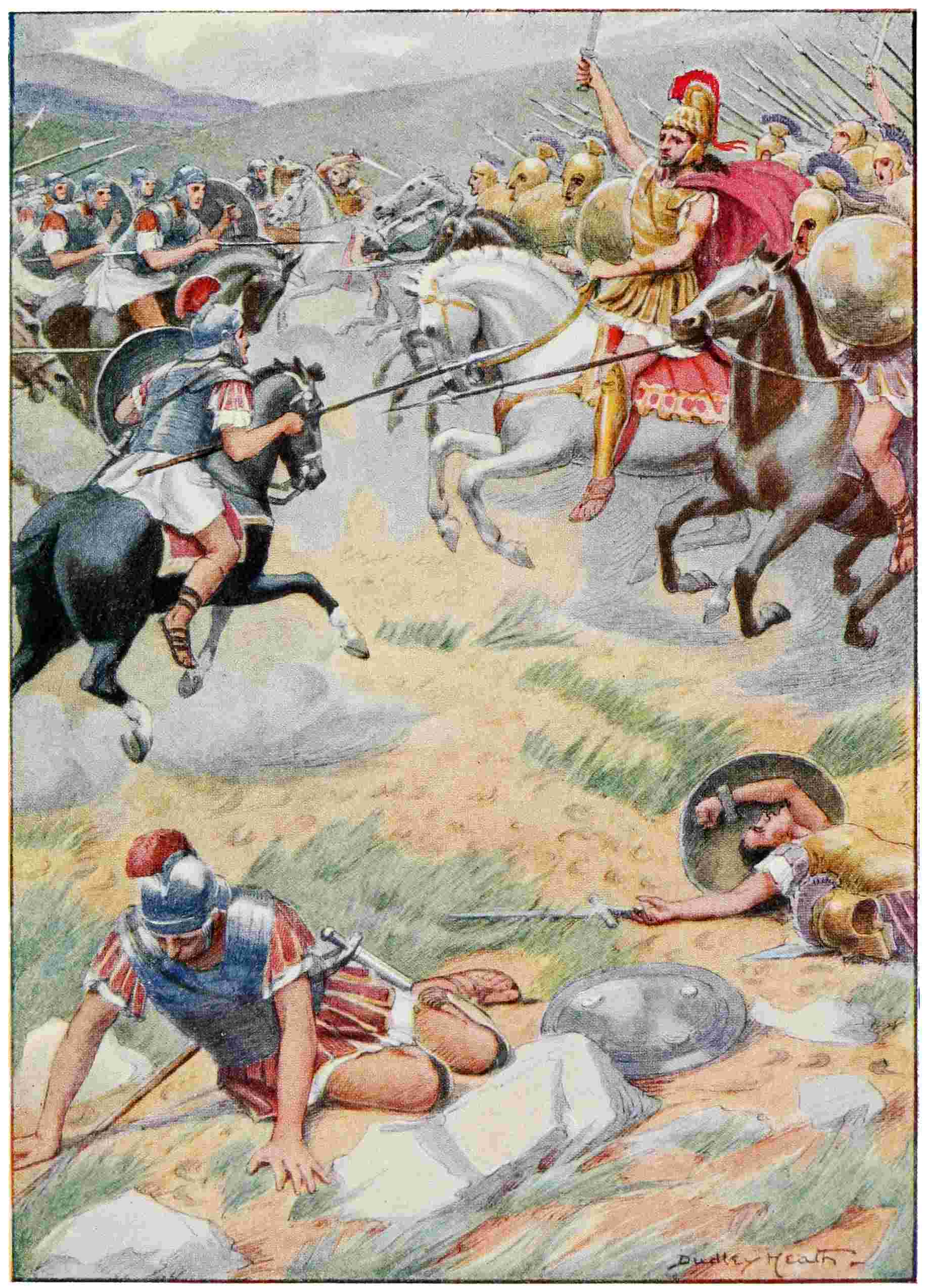
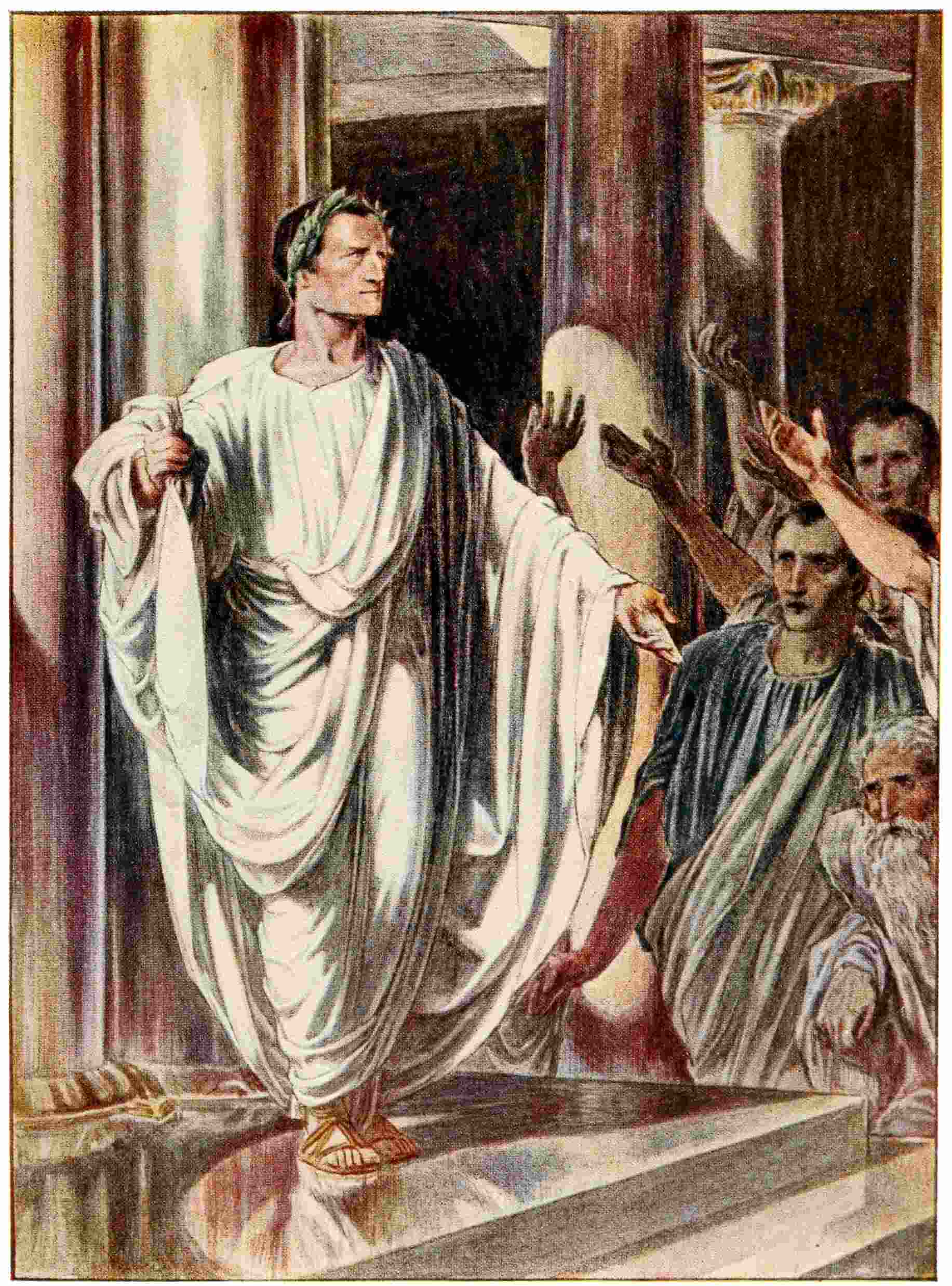
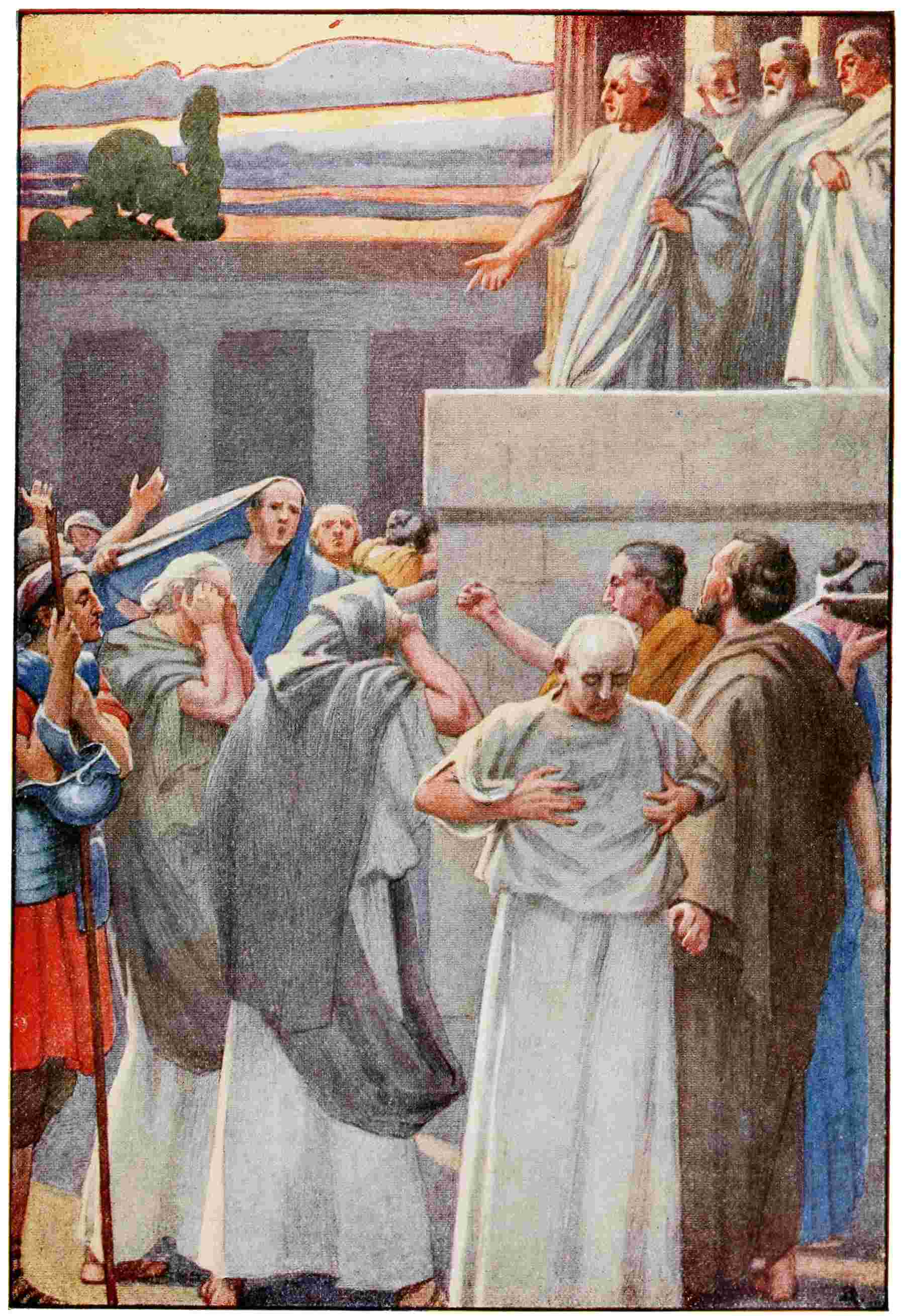
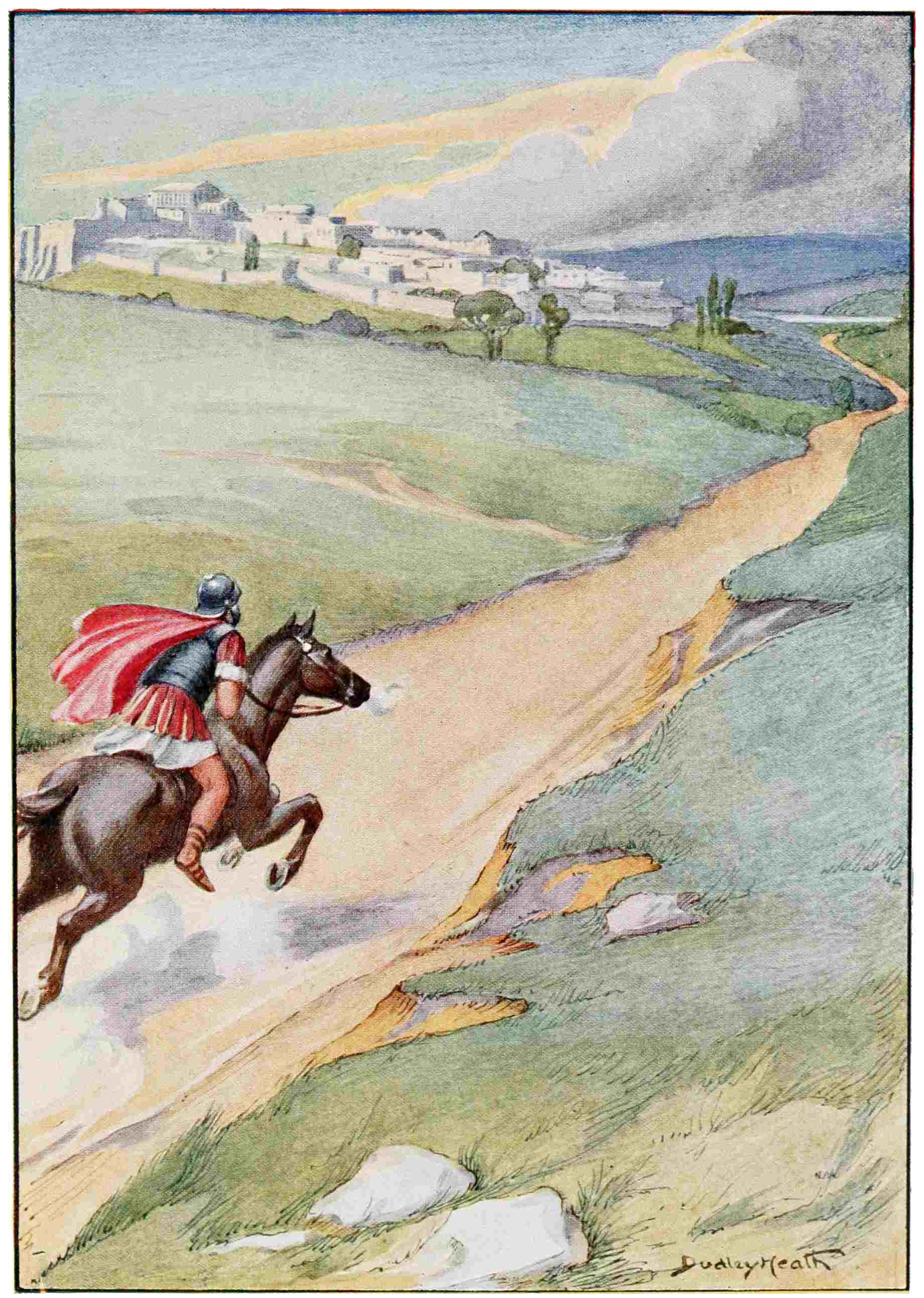
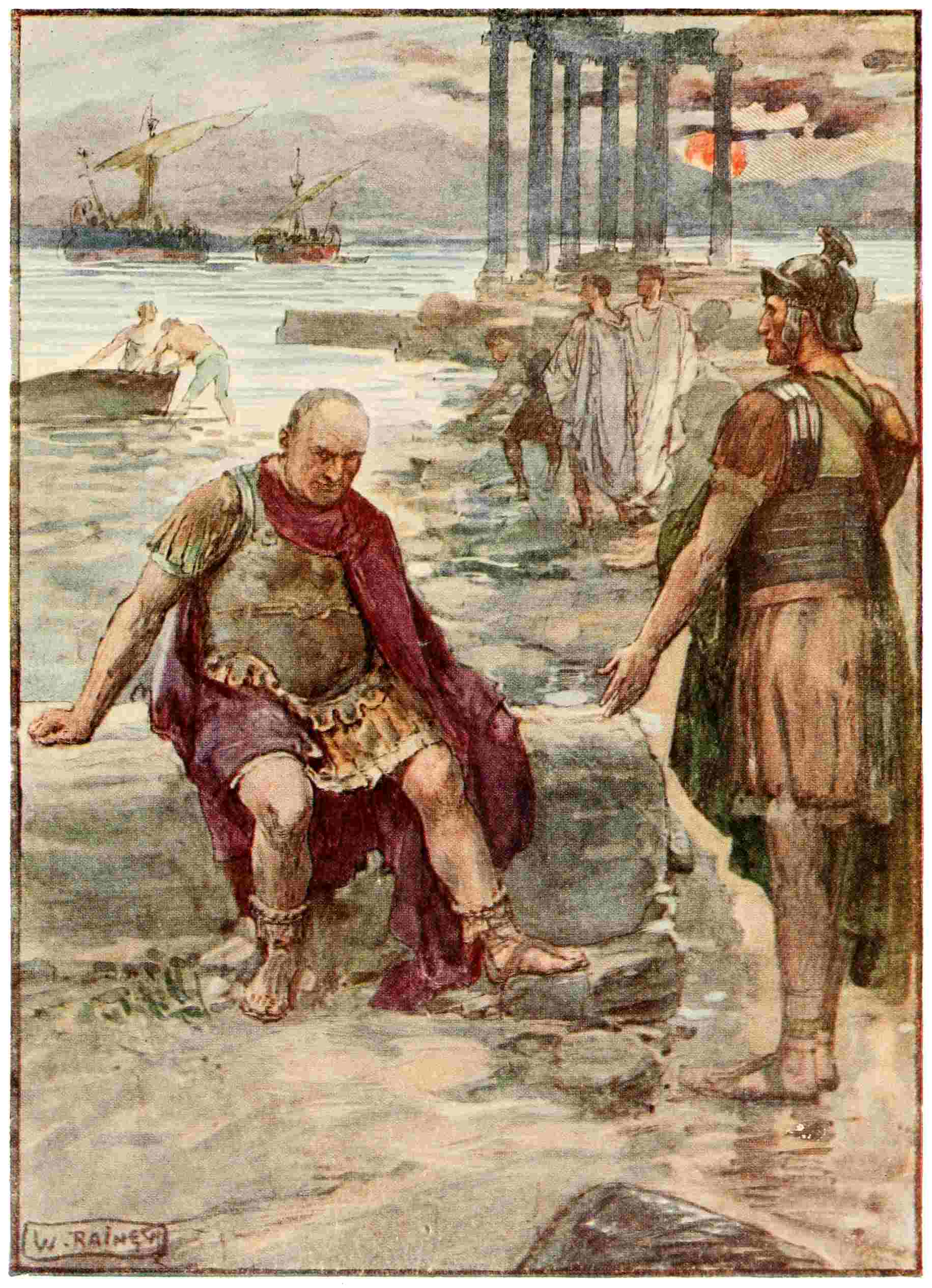
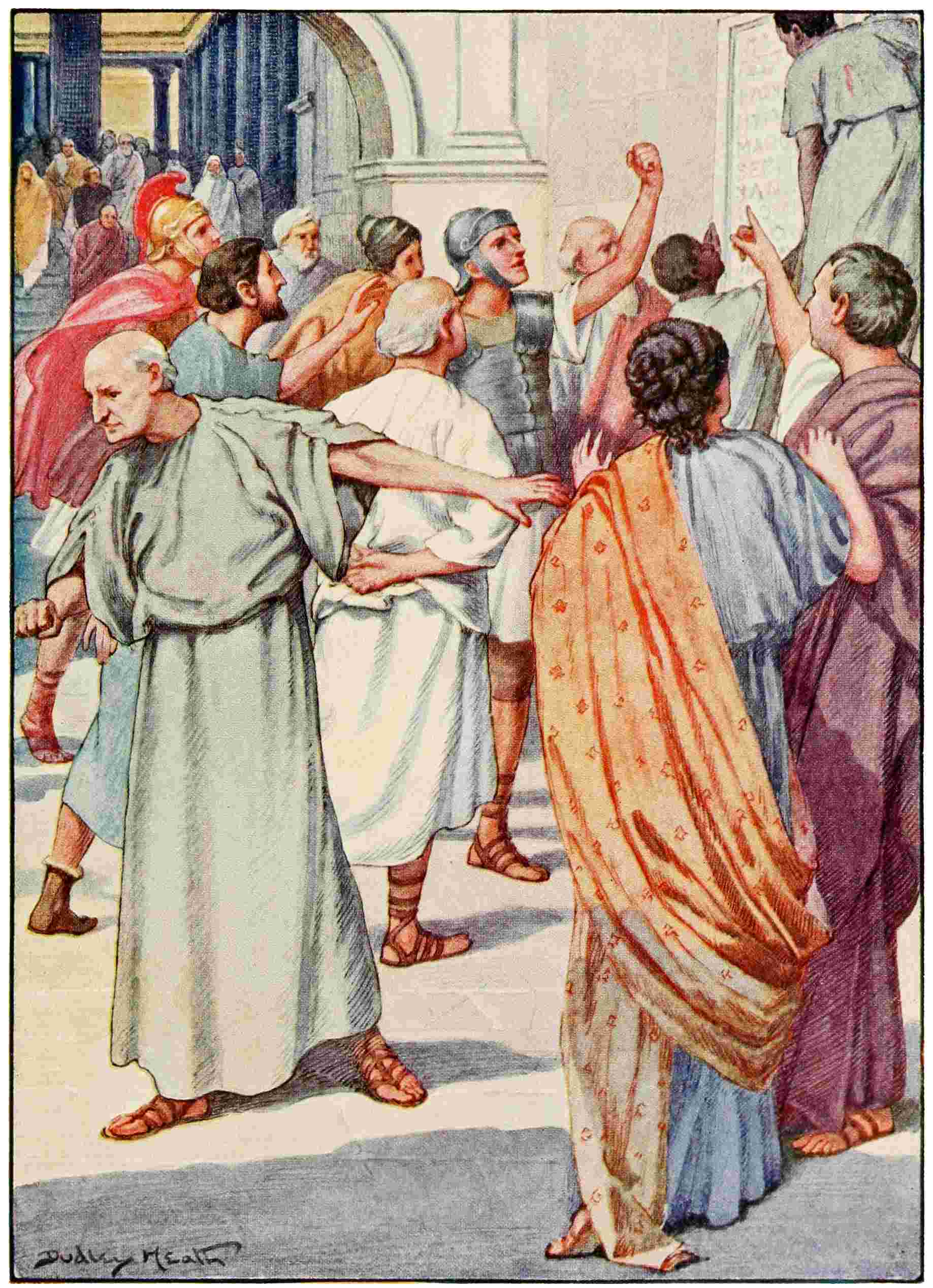
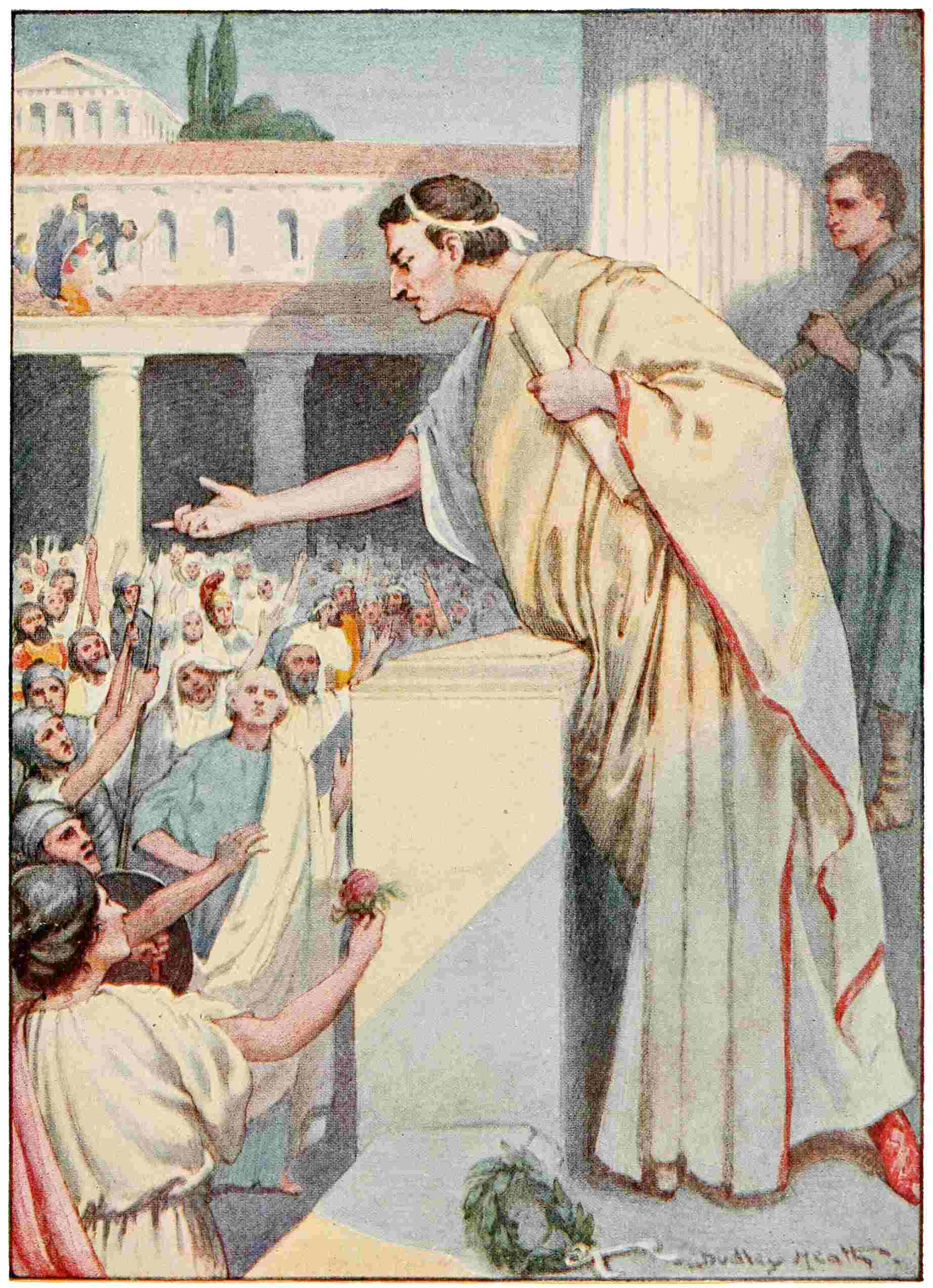
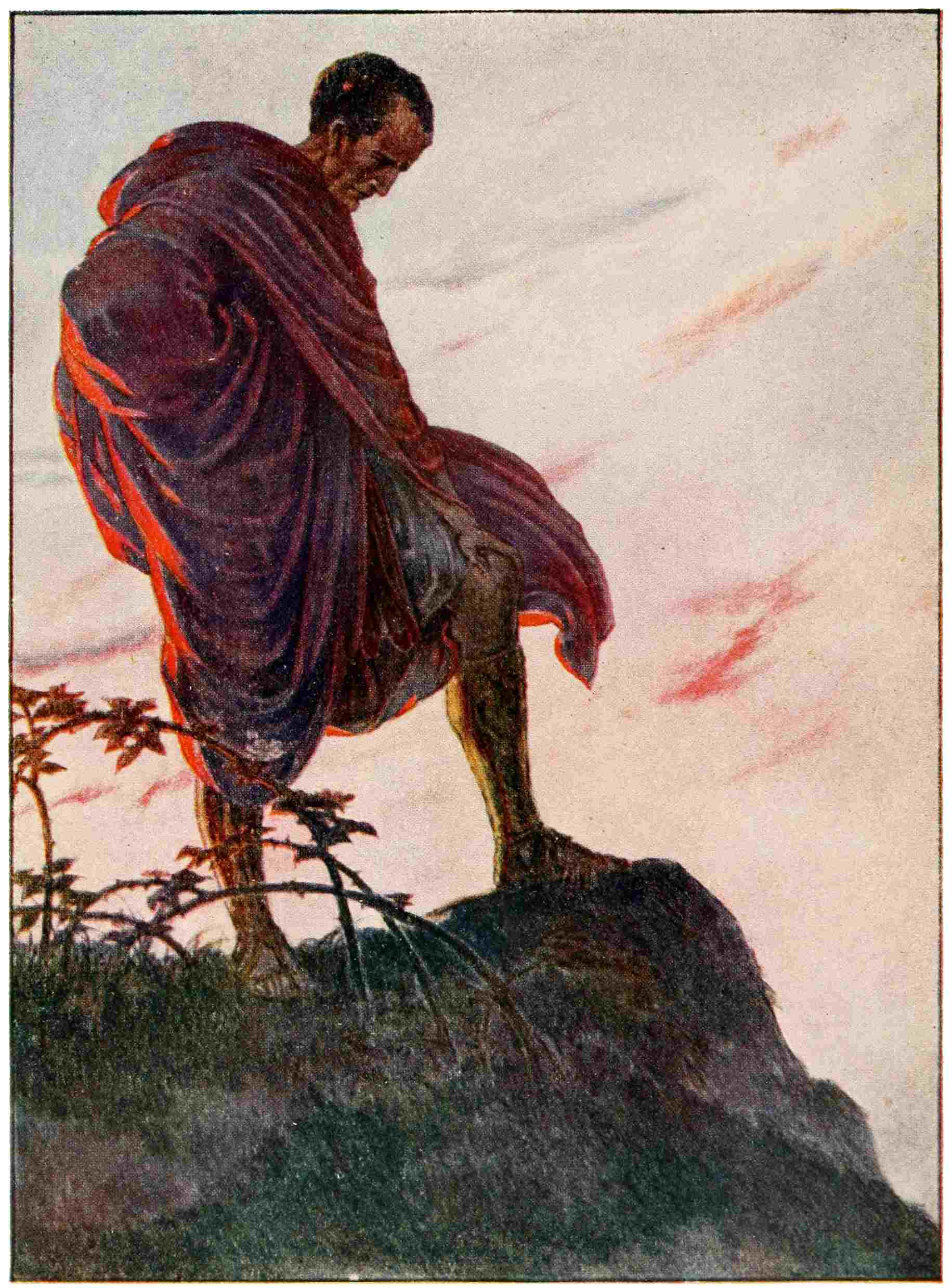
Larger versions of most illustrations may be seen by right-clicking them
and selecting an option to view them separately, or by double-tapping and/or
stretching them.
Cover created by Transcriber
and placed into the Public Domain.
THE STORY OF ROME
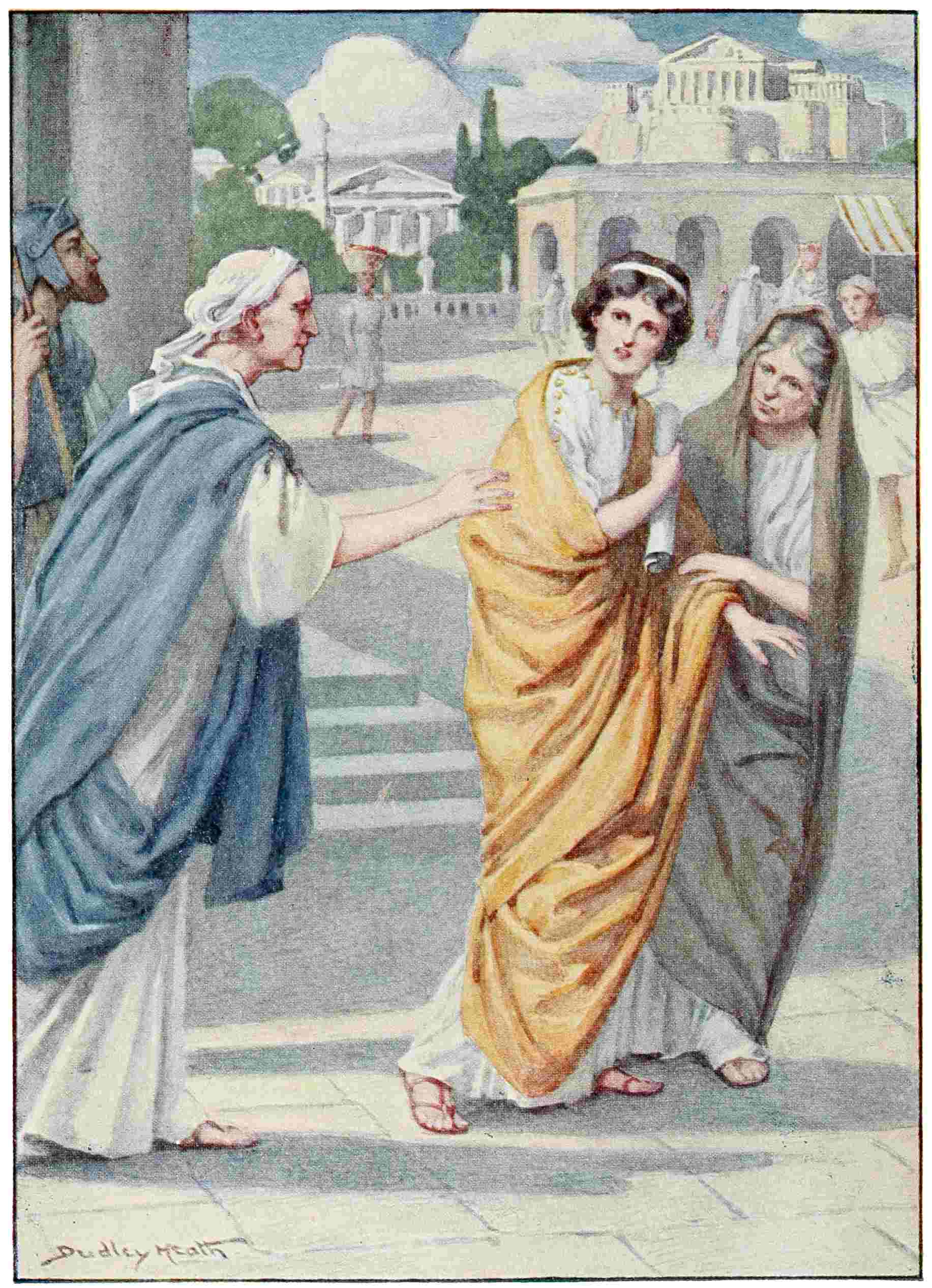
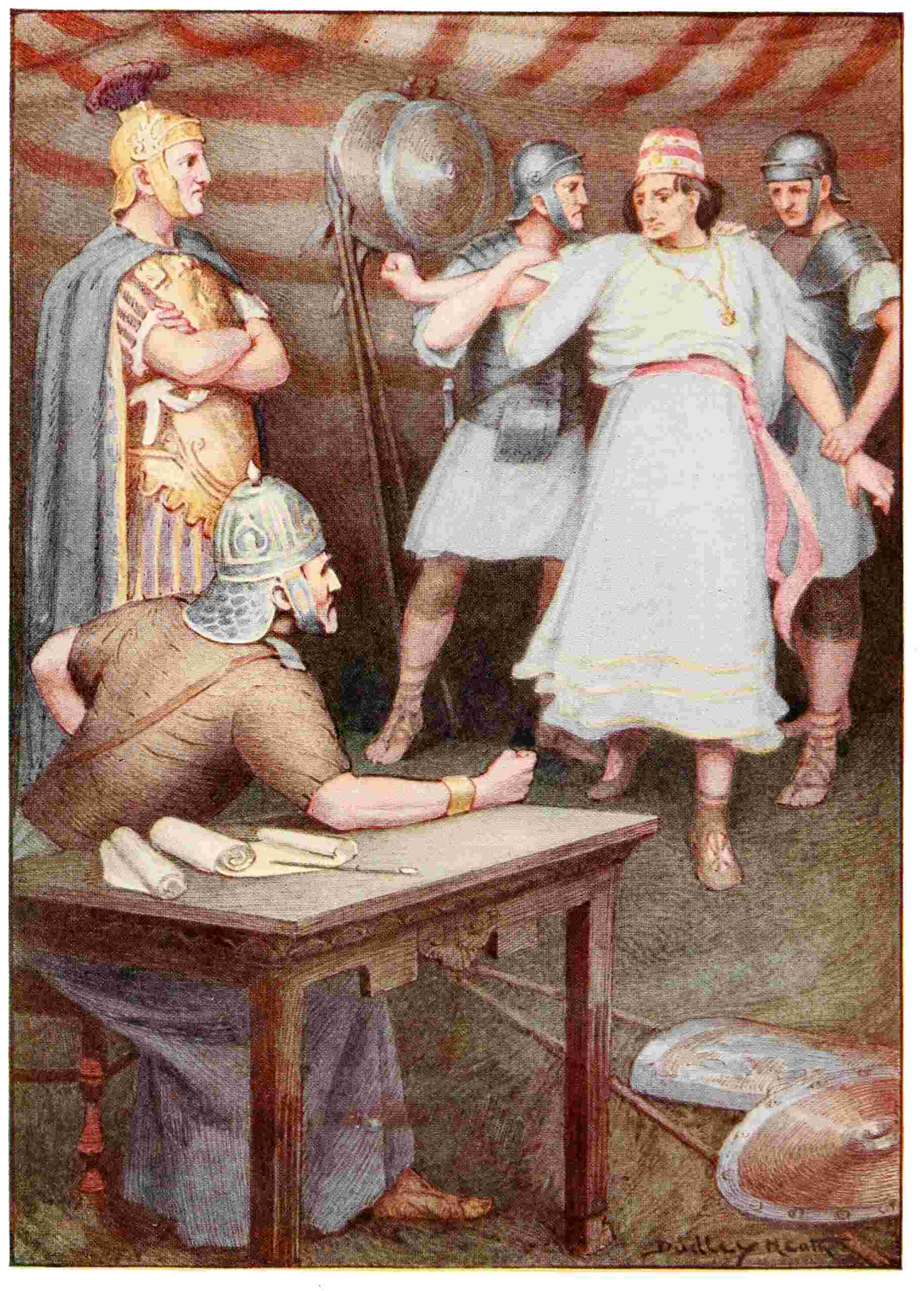
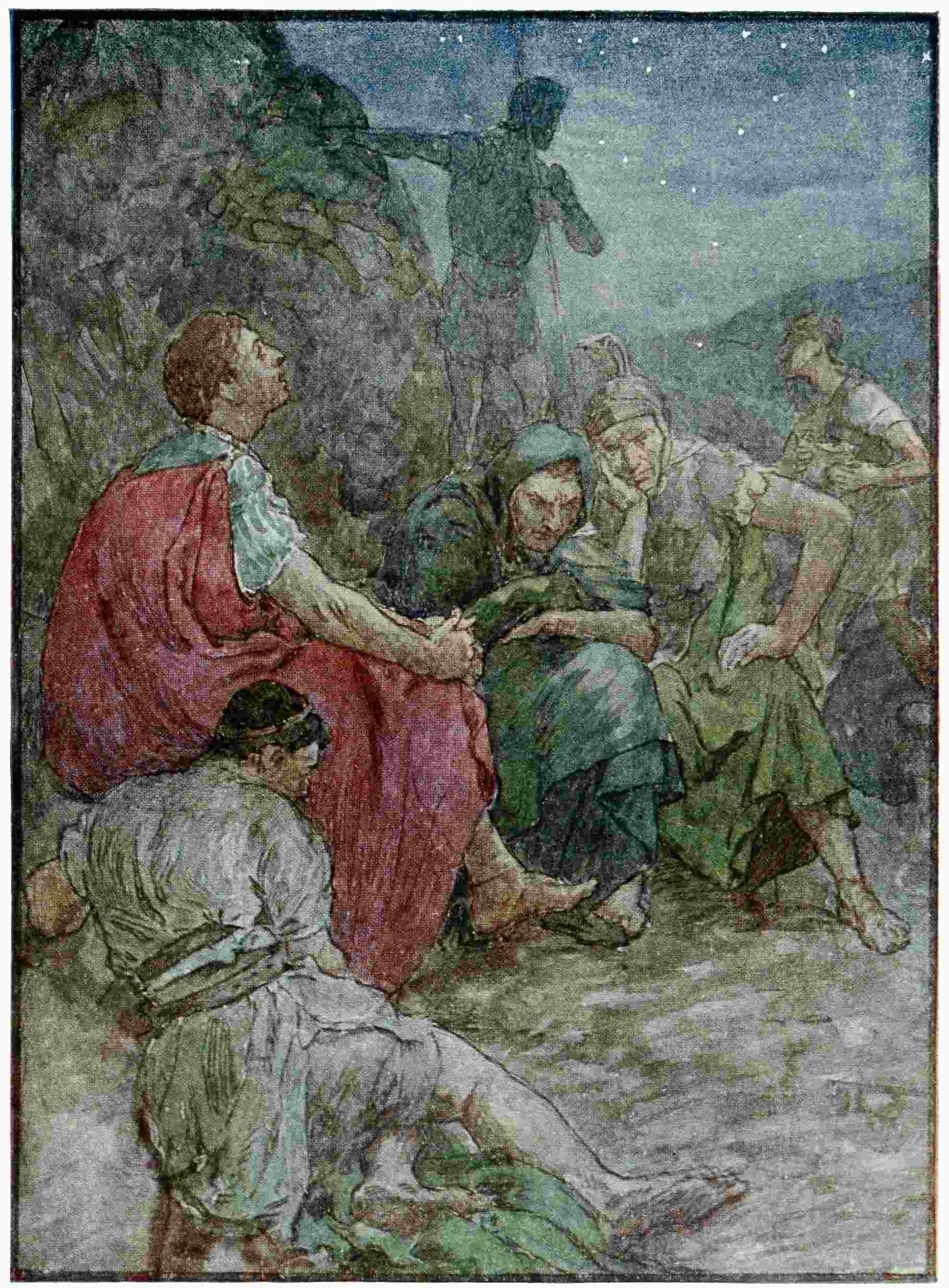
Verginius left his beautiful young daughter Verginia in the care of her nurse
FROM THE EARLIEST TIMES
TO THE DEATH OF AUGUSTUS
TOLD TO BOYS AND GIRLS BY
MARY MACGREGOR
AUTHOR OF ‘THE STORY OF FRANCE,’ ETC.
WITH TWENTY PLATES IN COLOUR
BY PAUL WOODROFFE, W. RAINEY
AND DUDLEY HEATH
LONDON: T. C. & E. C. JACK 67 LONG ACRE, W. C.
AND EDINBURGH
TO IAN AND WILLIE TAYLOR
Dear Ian and Willie,—The Story of Rome has been
written, as you know, in your beautiful, quiet old garden.
And as the story grew, the short cold days of winter
passed and the long warm days of summer were here.
In the garden a miracle had been wrought. It had
become alive.
After slow, persistent struggle with storm and frost, the
delicate bare branches were no longer bare, but clothed in
living green. The hard black earth too had stirred, and
shoots and blades appeared, until at length the garden was
ablaze with gold, purple, crimson.
Sometimes I dreamed that, in its own different way, the
Story of Rome too was a miracle, wrought out of the tears
and throes of a brave and ambitious people.
For the story tells of the birth of a city and of its growth
through storm and struggle, until it became a great world
empire.
The city which Romulus founded was built upon a single
hill; soon seven hills were not great enough to contain her.
And when Augustus, the first Emperor of Rome, began to
reign, part of Europe, Asia Minor, Egypt, Syria, and a large
portion of Africa formed his kingdom.
Although the story was written in the quiet of your
garden, little of its peace has stolen into the tale, and for
that you boys may care for it the more.
As you read, fierce battle-cries will ring in your ears, and
the clash of arms will startle you. You will hear the tramp
of armies marching to new lands to conquer them and their
treasures for Rome, the city of their love.
Sometimes you will catch your breath in horror as you
read of terrible and cruel deeds, for the Romans were often
pitiless, showing little mercy to those they conquered.
But at other times your breath will come quick with
wonder as you read of the dauntless courage, the rare
endurance of these mighty men of old.
And if there are many things which you do not admire
in the people of Rome, yet they possess one virtue which
you and every British boy and girl may not only admire,
but gladly imitate.
What that virtue is I will leave you to find out for yourselves
as you read The Story of Rome.—Yours affectionately,
Long, long years ago, Troy, one of the great cities in Asia
Minor, was taken by the Greeks.
Many mighty Trojans had defended their city well,
and among them all none had fought more bravely than
the prince Æneas.
But when Æneas saw that the Greeks had set fire to
the city, he fled, carrying, it is said, his father on his shoulders,
and grasping by the hand his son Ascanius.
Moreover, so precious to him was the sacred image of
the goddess Pallas, that he saved it from the burning city.
The gods, pleased with his reverence, helped him in his
flight by building a ship. So when Æneas reached the sea
he at once embarked in it, with his followers and their
wives, and sailed away to seek for a new land in which to
build a new city.
As the Trojans sailed they saw a bright star shining
above them. Day and night the star was always to be
seen, showing the seafarers the direction in which to
steer.
At length the Trojans reached the western shore of Italy,
and here, at a town called Latium, they disembarked.
The women were weary of the sea, and no sooner had they
landed than they began to wonder how they could persuade
their husbands to journey no farther, but to settle in the
pleasant country which they had reached.
Among these women was a lady of noble birth, who was
wise as she was good.
Roma, for that was the lady’s name, proposed that they
should burn the ship in which they had sailed. Then it
would be impossible for their husbands to go any farther
in search of a new home.
The other women agreed to Roma’s daring plan, and
with mingled hope and fear the ship was set on fire.
When the men saw the flames devouring the vessel they
were troubled, but when they found out how it had been set
on fire, they were angry.
Yet, as anger could not give them back their ship, and
as Italy was a pleasant land, the men did as the women
wished. They settled near a hill called Mount Palatine, and
there they built a city.
Some old stories tell that the city was called Rome after
Roma, the noble lady who had first thought of setting the
ship on fire.
But other stories say that the country in which Æneas
landed belonged to a king named Latinus, who welcomed
the Trojan, and gave him ground on which to build. Æneas
married Lavinia, the daughter of the king, and called the
city which he built after her Lavinium.
Soon after this, King Latinus was killed in battle, and
then for three years Æneas ruled well and wisely not only
over his own Trojan followers, but also over the subjects of
his royal father-in-law. His people he now called Latins,
in memory of King Latinus.
When the three years were passed, war broke out against
the Etruscans, who were at that time the most powerful
tribe in Italy.
One day a terrible storm overtook the armies on the
battlefield; so dark grew the clouds that the soldiers could
not see each other.
When at length the sky cleared Æneas had disappeared,
and was seen no more on earth.
‘The gods have taken him away,’ said the Latins. So
they built an altar, and henceforth worshipped their king as
the god Jupiter.
Ascanius, who had escaped from Troy with his father,
now ruled in Lavinium. But he soon found that the city
was not large enough for all his people; so, leaving Lavinium,
he built a new city, and called it Alba Longa, or the Long
White City.
Alba Longa stood in the midst of the Alban hills, not
far from the site on which Rome itself was soon to be built.
CHAPTER II THE SHE-WOLF
After the death of Ascanius nearly three hundred years
passed away, and then a king named Proca died, leaving
behind him two sons. The name of the elder was Numitor,
the name of the younger Amulius.
The crown belonged by right to Numitor, the elder son,
but Amulius, who was ambitious, was not willing that his
brother should reign. So he said to Numitor, ‘One of us
shall wear the crown, and to the other shall belong the
gold and treasures left by our father Proca.’
The story does not tell if Numitor was indignant with
his brother, and said that the crown belonged to him; it
only tells that Numitor chose to reign, as was indeed his
right.
Amulius then seized the gold and treasure, and bribed
his followers to drive Numitor from the throne and to make
him king.
This, in their greed, they were soon persuaded to do.
Ere long Numitor was banished from the city, and
Amulius, to his great content, began to reign.
But the king was soon surprised to find that the crown
rested uneasily upon his head.
It might be that the children of Numitor would some
day wrench the crown from him, even as he had wrenched
it from their father.
That this might never be, Amulius, thinking to get rid
of fear, ordered Numitor’s son to be slain, while his daughter
Silvia was kept, by the command of the king, in a temple
sacred to the goddess Vesta. Here the maiden tended the
altar fire, which was never allowed to die.
But the god Mars, angry, it might well be, with the cruelty
of Amulius, took pity upon the maiden and sent twin sons
to cheer her in her loneliness. Such strong beautiful babes
had never before been seen.
As for the king, when he heard of the birth of these little
boys he was both angry and afraid, lest they should grow
into strong men and wrest his kingdom from him.
In his fear Amulius ordered Silvia to be shut up in a
prison for the rest of her life, and her beautiful boys he
commanded to be thrown into the river Tiber.
Heavy rains had fallen of late, and, as the king knew, the
river had overflowed its banks, but of this he recked not at
all, although, indeed, the flood was to be his undoing.
Two servants, obeying the cruel order of Amulius, placed
the baby boys in a basket, and going to the Tiber, flung their
burden into the river.
Like a boat the basket floated hither and thither on the
water, until at length, carried onward by the flood, it was
washed ashore at the foot of a hill called Mount Palatine.
Here, under the shade of a wild fig-tree, the basket was
overturned, and the babes lay safe and sound upon the
dry ground, while the river stole softly backward into its
accustomed channel.
Before long the babes awoke hungry and began to cry.
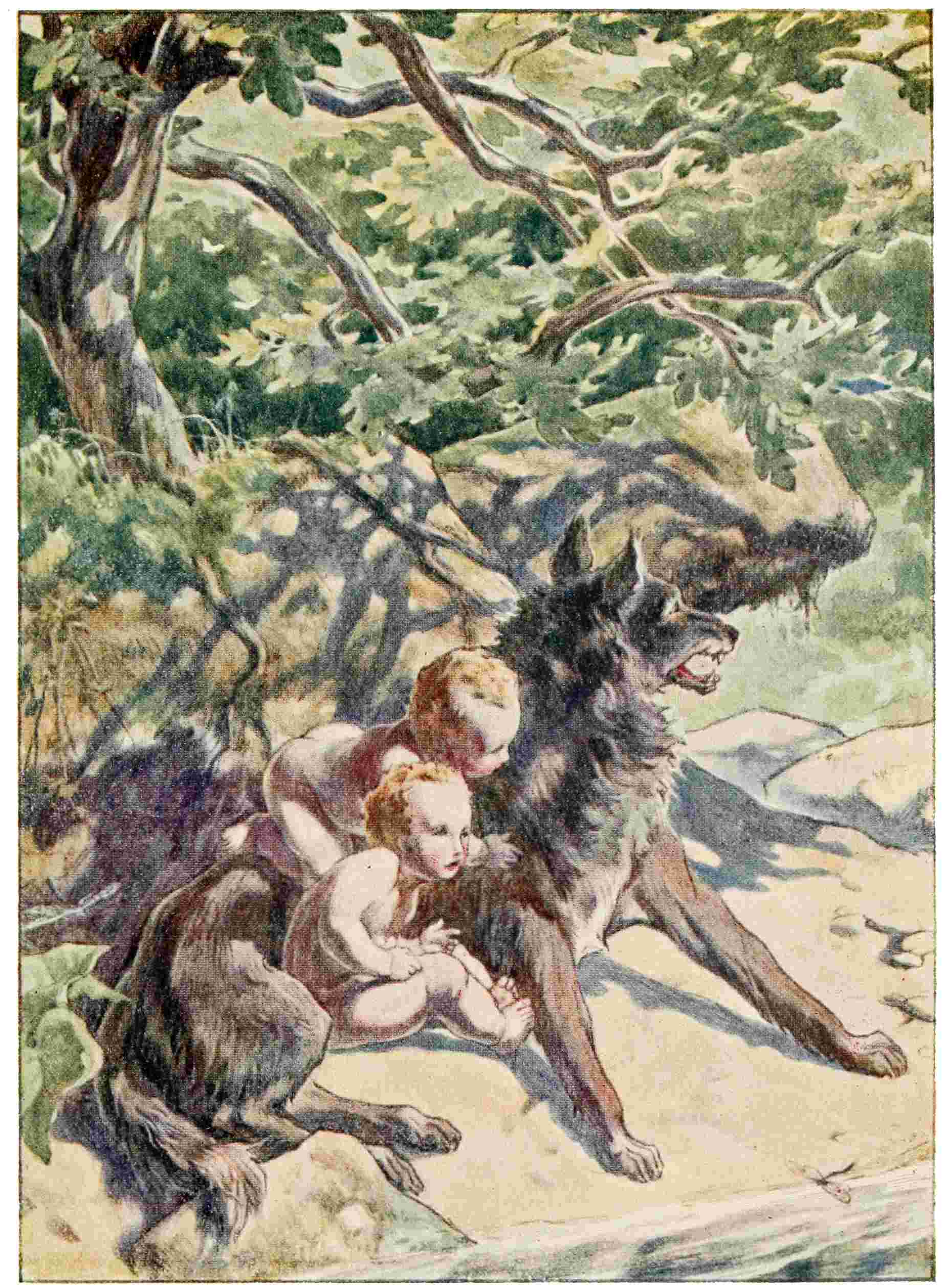
A she-wolf coming to the edge of the river to drink heard
their cries, and carried them away to her cave, where she
fed them with her milk, just as she would have fed her lost
cubs. She washed them, too, as she was used to wash her
own children, by licking them with her tongue.
CHAPTER III THE TWIN BOYS
The twin boys, it was said, were guarded by the god Mars.
So it was not strange that, as they grew older, the god
should send his sacred birds, the woodpeckers, to feed the
children. In and out of the cave the birds flew each day,
bringing with them food for the little boys.
But neither the wolf nor the birds could do all that was
needful, so before long, the god who watched over the
children sent Faustulus to their aid.
Faustulus was one of the herdsmen of King Amulius.
He had often seen the wolf going in and out of the cave,
and had noticed, too, how the woodpeckers came and
went each day. So when the wolf went off to prowl in the
woods, Faustulus ventured into the cave, where to his
amazement he found two beautiful and well-fed children.
He took them in his arms and carried them home to his wife.
She gladly welcomed the little strangers, and, naming them
Romulus and Remus, brought them up as though they
had been her own sons.
As the years passed the boys grew ever more beautiful.
Stronger and braver, too, they became, until the rough
herdsmen among whom they dwelt called them princes.
The lads soon showed that they were fitted to lead the
herdsmen. If wild beasts attacked the flocks, or if robbers
tried to steal them, Romulus and Remus were ever the first
to attack, and to drive away either the robbers or the wild
beasts.
A she-wolf, coming to the edge of the river to drink, heard their cries.
Faustulus lived on Mount Palatine, near to the spot
where the boys had been washed ashore when they were
babes.
This hill belonged to the cruel king Amulius, and it was
his sheep and cattle that the princes, unwitting of the evil
the king had done to them, defended from danger.
Not far from Mount Palatine was another hill, named
Mount Aventine, and here also were herdsmen guarding
flocks, but these herdsmen belonged to the dethroned King
Numitor. Numitor was living quietly in the city of Alba.
Now it chanced that the herdsmen of Amulius began to
quarrel with the herdsmen of Numitor. One evening,
forgetting all about their enemies, the shepherds on Mount
Palatine were merrymaking at a festival in honour of the
god Pan.
Then the herdsmen on Mount Aventine said one to the
other, ‘See, here is our chance. We will lay an ambush
for these unwary merrymakers.’
As the gods willed, they captured none other than Remus,
and well pleased with their prize, they carried the prince
a prisoner to their master Numitor.
CHAPTER IV NUMITOR RECOGNISES HIS GRANDSONS
The young prisoner was brought before Numitor in the
city of Alba. No sooner had the old man’s eyes fallen on
the lad than he threw up his hands in amaze, and gazed
more keenly at the prisoner.
‘No herdsman this,’ muttered the old king to himself,
‘rather does he bear himself as a prince.’
Scanning the face before him even more closely, it seemed
to Numitor that the features were not unknown to him.
Dreams of his lost daughter Silvia gladdened his heart.
Gently the old man tried to win the confidence of the
lad, asking him who he was, and whence he came.
Remus was touched by the kindness of Numitor, and
answered: ‘I will hide nothing from you, sire, for you seem
of a princely temper, in that you give a hearing and examine
before you punish.’
Then he told the old man the story that Faustulus had
often told to him and Romulus, of how the wolf had found
them as babes on the banks of the river Tiber, and had carried
them to her cave and fed them with her milk.
Long before Remus had ended his story, Numitor knew
that it was his grandson, his daughter Silvia’s child, who
stood before him, and his old heart beat quick with joy.
Here at length was one who would take his side against
the cruel King Amulius.
At this moment Romulus, leading a rough band of herdsmen,
approached the city gate, determined to rescue his
brother from the hands of Numitor.
In the city were many folk who groaned under the
tyranny of Amulius. These, hearing that Romulus was
without the city gate, stole noiselessly away to join the
prince, believing he had come to punish the king.
Meantime Romulus had divided his followers into companies
of a hundred men. At the head of each company
was a captain, carrying a small bundle of grass and shrubs
tied to a pole.
These rough standards were called ‘manipuli,’ and it
was because they carried these manipuli that captains in
the Roman army came to be called Manipulares.
When Amulius heard that Numitor had recognised in
the prisoner one of his long lost grandsons he was afraid.
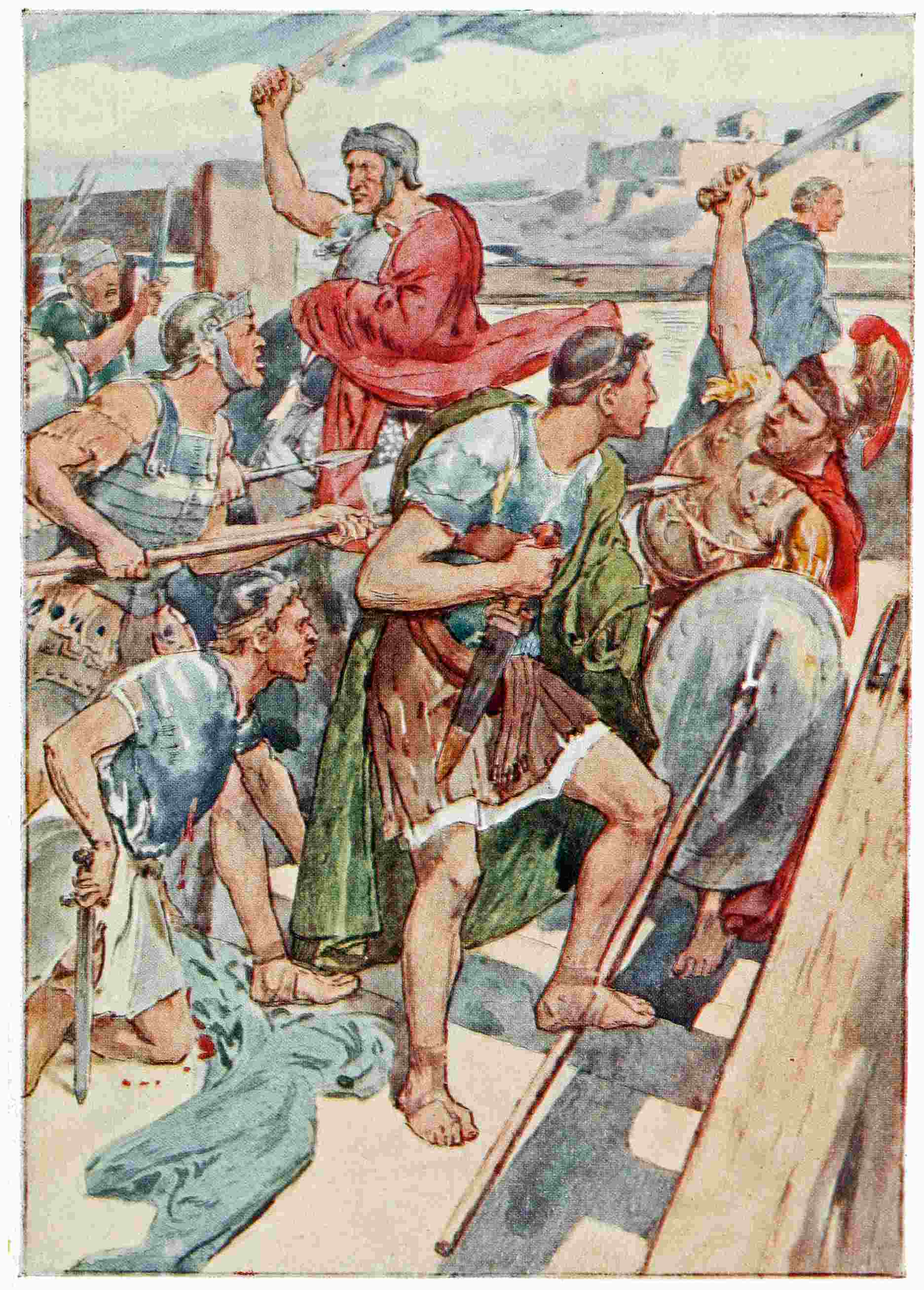
Then, hearing the shouts and blows of Romulus and his
men as they attacked the city gate, he rushed to defend
it, determined that the second prince should not enter
the city.
But Romulus captured the gate, slew the king, and
entered the city in triumph.
Here he found Remus, no longer a prisoner as he had
feared, but the acknowledged grandson of Numitor.
The old king welcomed Romulus as joyfully as he had
welcomed his brother, and the two princes, eager to please
the gentle old man, placed him upon the throne from
which he had so long ago been driven.
They then sped to the prison where their mother Silvia
had lain since the princes had been born. Swiftly they set
her free, and cheered her by their love and care as good sons
ever will.
CHAPTER V THE SACRED BIRDS
The grandsons of Numitor could no longer live as shepherds
on Mount Palatine, which they had learned to love. Nor
could they dwell quietly in Alba, for all their lives they
had been used to live free among the mountains, nor had
they been subject to any king.
So the princes made up their minds to leave Alba, and
to build a city for themselves on the hills they loved.
But the brothers could not agree on which hill to build
their city, Romulus choosing the Palatine, Remus the
Aventine.
Not knowing how to settle their dispute, they asked
Numitor to help them. He bade them, as the custom was,
to appeal to augury—that is, to watch for a sign or omen
from the gods. These signs were given in many different
forms, sometimes by the flight of birds, as happened now.
The princes determined to follow their grandfather’s
advice. Romulus went to Mount Palatine, Remus to
Mount Aventine, and patient through one long day they
watched for a sign.
But no sign appeared. The slow hours passed, and
night drew on apace, yet still the brothers never stirred.
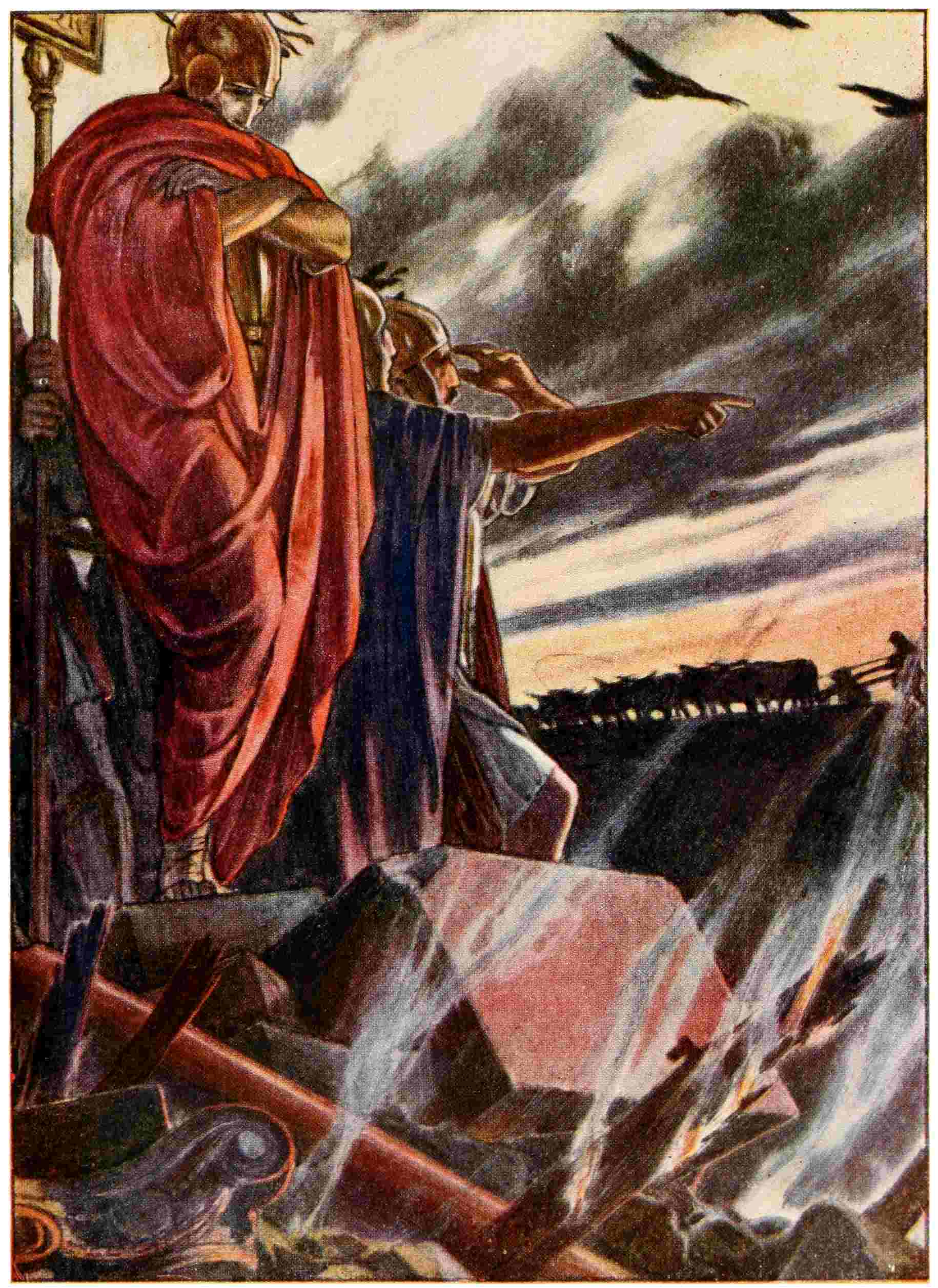
Then, as darkness faded before the dawn, Remus saw,
far off, dark, moving shapes. Were the gods going to be
gracious, the prince wondered, and after so many hours
send a sign?
Nearer and nearer drew the dark shapes.
‘Ah!’ Remus cried sharply, ‘it is a good omen.’ For
now he could see that the moving forms were six vultures
winging their way toward the west. These birds were sacred
to the gods, and did no harm to corn, fruit, or cattle, nor
would they, indeed, wound any living thing.
Swiftly Remus bade a messenger to go tell his brother
of the good omen vouchsafed to him. But even as his
messenger sped to do his will, Remus was crestfallen. For
before him stood one of the servants of Romulus to tell him
that his brother, too, had seen a flight of vultures, but while
Remus had seen six birds, Romulus had seen twelve.
What was to be done? It seemed now that the brothers
were not thinking on which hill the city should stand, but
of which of them should build the city. Remus believed
that the augury proclaimed him as the founder of the new
city. Romulus was sure that it was he who was intended
by the gods to build it; for had not he seen twelve vultures
while his brother had seen but six?
The princes turned to their followers, demanding who
should be their king. Then loud and lusty was the answering
shout: ‘Romulus, Romulus, he shall be our king!’
CHAPTER VI THE FOUNDING OF ROME
It was in the year 753 B.C. that Romulus was chosen king.
He at once began to make preparations to build a city on the
Palatine hill. The foundation he wished to lay on the twenty-first
of the glad month of April, for, as Romulus knew, this
was a feast-day among the shepherds.
Often he, with his brother, had joined the herdsmen
on that day, to offer cakes to the goddess Pales, to beseech
her blessing on themselves and on their flocks. And when
the prayers and sacrifices were over, how gladly he had joined
in the shepherds’ games and jollity! No better day could
be found on which to lay the foundation of the new city.
When the feast-day arrived, a hole was first dug on the
spot where the city was to stand.
Into this hole the king flung the first fruits of the earth,
corn and fruit.
Each of his followers then took a handful of earth which he
had carried with him from his own, perhaps distant, home, and
flung it also into the hole, which was then filled to the top.
Here, too, an altar was built, on which the people laid
offerings to the gods. From henceforth the spot, where the
temple had been erected, was to be the hearth or centre of
the new city.
Romulus then throwing his toga, or as we would say, his
mantle, around him, with one end covering his head, took
a white bull and a cow and yoked them to a sacred plough,
the share of which was made of brass.
With this ploughshare the king then made a furrow
to mark the boundary of the city, bidding his followers
watch that the upturned earth fell inward to the hearth
of the city. Not a clod must be allowed to lie without the
furrow. When the plough reached the different spots at
which the gates of the city were to stand, it was carefully
lifted over the spaces.
As he guided the plough, Romulus cried to his gods that
his city might become strong and endure, and ever grow
more powerful in the great world.
Out of a clear sky thunder crashed, lightning flashed
over the hills as Romulus uttered his petitions, and the
people believed that the storm was the answer of the god
Jupiter to the prayers of their king.
When these sacred rites were ended, Romulus bade his men
begin at once to build the wall which was to surround his city.
The wall itself was sacred. None might enter the city, save
by the gates. So the king bade one of his followers, named
Celer, to guard the sacred furrow, and to see that no one dared
to scale the wall or jump across it, as it was being built.
Remus, who was still angry that he had not been chosen
king, had been standing near to Romulus as he laid the
foundation of the city. Then, as the wall began to rise before
him, a swift rage sprang up in his heart, and he leaped across
it, crying: ‘Shall such defences as these guard your city?’
Celer, the watchman, seeing that Remus had scorned
the order of the king, raised his spade in sudden fury and
struck the young prince dead to the ground.
Then, fearing lest Romulus should punish him for his
hasty deed, he fled. Fear lent him wings, and his name
from that day became a byword to betoken great speed.
Our own word, ‘celerity,’ comes from Celer, the swift-footed
servant of Romulus.
When Romulus was told that his brother had been slain,
he showed neither grief nor anger. ‘Thus perish every one
who may attempt to cross these walls,’ were his stern words
to those who brought the sad tidings.
Celer, it was plain, had fled in needless haste.
CHAPTER VII THE SABINE MAIDENS
When Romulus had built his city and surrounded it with
a wall, he began to fortify the hill on which it was built.
This was necessary because hostile tribes held the neighbouring
hills, and might at any moment attack the new city.
The king ordered his followers to scrape the steep slopes
of the Palatine until they were smooth. Then great slabs
of stones, fitted into each other without mortar, were built
into the sides of the hill, from the base to the summit.
Romulus was pleased when he saw this great fortification
finished, for he knew that it was almost impossible that an
enemy should scale the smooth surface of the hill and lay
siege to the city.
Not far from the foot of the Palatine flowed the river
Tiber, a safe highway to the sea. So the king as he gazed,
first at his well-fortified city and then down to the swift
flowing river, felt that he had indeed chosen his site with
wisdom.
The Palatine was only one of seven hills, and each of
the other six was added to the city during the reign of the
six kings who ruled after Romulus. Five of these hills
were called montes or mountains, while the other two,
being only spurs that jutted out from the tableland, were
called colles or hills.
But I have not yet told you the name of the city! Amid
the shouts of his people the king named it Rome, after its
founder Romulus.
Rome was built and fortified, yet the king was dissatisfied,
for now he found that he had not enough people to dwell
in the city.
The king must by this time have taken possession of the
Capitoline hill, which was close to the Palatine, for here
he resolved to build a city of refuge, that those who fled
to it might gradually be removed to Rome.
Asylum, which is the Greek word for refuge, was the
name of this city, and it was open to all those who had been
forced by crime or misfortune to flee from their own homes.
To this Asylum hastened robbers, exiles, slaves who had
fled from their masters, as well as those who had stained
their hands with blood.
The city of refuge was soon crowded, and many of these
rough and criminal folk were then sent to Rome, until
Romulus had as many subjects as he wished.
But there were no women among those who fled to the
king for protection, and Romulus saw that he would have
to find wives for his new subjects.
So he begged the neighbouring tribes, among which was
a tribe called the Sabines, to allow their daughters to marry
his new subjects. But the king’s request was refused. Give
their daughters to robbers and murderers, to men who had
been outlawed! The tribes did not hesitate to mock at
Romulus for thinking that such a thing could be.
Romulus was not a king to be lightly thwarted. He
was determined at any cost to gain wives for his subjects.
So, as his neighbours had proved churlish and refused
his request, he made up his mind to capture their daughters
by guile, or by a trick, as we would say. Nor did he take
long to lay his plans. He invited his neighbours, among
whom were the Sabines, to a feast and games which he
wished to celebrate in honour of the god Consus.
They, eager to enjoy the feast and the great spectacle
of the games, came flocking into Rome on the appointed
day, bringing with them their wives and daughters.
Fearlessly they came, and were greeted with great
hospitality by the king, who knew that he must hide his
anger until his plot had been successful.
The feast began with solemn rites, sacrifices being offered
to the gods, and especially to Consus, in whose name the
festival was held.
When the sacrifices were ended, the guests mingled
carelessly with the Romans, thinking only of the games
and races.
The king, seeing that the moment had come, gave the
signal for which his people were waiting.
A band of armed men at once rushed in among the guests,
and in spite of their screams and struggles, carried away the
Sabine maidens.
The parents of the maidens hastened to leave the city
where the laws of hospitality had been so cruelly transgressed.
As they went, they called down the anger of the
gods upon Romulus and his people.
CHAPTER VIII THE TARPEIAN ROCK
The tribes who had been at the feast of Consus were so
angry with the king that many of them went to fight against
him, without waiting to gather together a large army.
Thus Romulus soon defeated and scattered his foes.
Moreover, having slain one of the kings with his own
hand, he stripped him of his armour, and tying it to a pole,
carried it back to Rome, where he offered it to Jupiter.
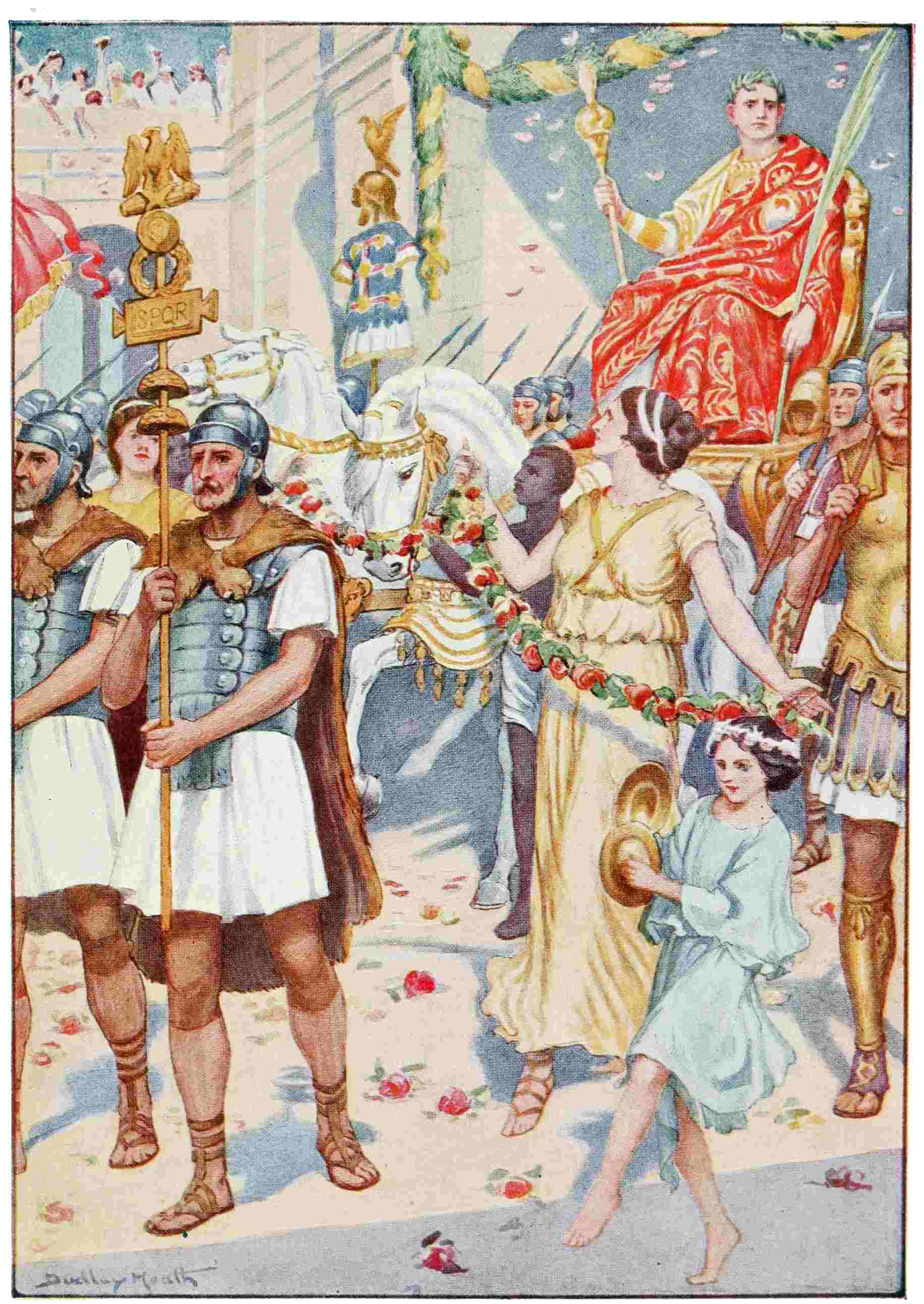
This was the earliest Triumph celebrated at Rome. In days
to come the Triumphs of the Roman generals became famous.
They were held when the soldiers returned victorious from
a great battle. The general at the head of his army rode
into the city in a chariot drawn by beautiful horses. Other
chariots followed, filled with the treasures and spoils of war,
while the most noble prisoners, often loaded with chains,
were dragged along behind the chariots. The day on which
a Triumph was celebrated was always held as a holiday
by the citizens of Rome.
Now, among the tribes which Romulus had robbed,
none had suffered so heavily as the Sabines. But they,
more wary than the king’s other foes, did not attempt to
avenge their wrongs until they had had time to collect
a large and powerful army. Nearly two years had passed
before this army was led by Tatius, the King of the Sabines,
against the Romans.
The fortress on the Capitoline hill Romulus had entrusted
to the care of a chief named Tarpeius. Now Tarpeius had
a daughter named Tarpeia, and she loved ornaments and
jewels of gold and silver.
As the Sabines, led by Tatius, drew near to attack the
fortress, Tarpeia looked out of a spy-hole and saw that the
enemy was adorned with beautiful golden bracelets. The
longer she looked, the greater became her desire to possess
these dazzling ornaments. What would she not do to wear
such splendid jewels? She would—yes, she would even
betray the fortress into the hands of the Sabines, if only
she might hear the tinkle of the golden bracelets on her arms.
So, leaving the spy-hole, Tarpeia slipped secretly out of
the fortress and spoke to the Sabines, offering to show
them how to take the citadel if they would give her in
reward ‘what they wore on their left arms.’
The Sabines agreed to do as Tarpeia wished, but in
their hearts they despised the maiden for her treachery.
But she, heedless of all save the ornaments that would
soon be hers, hastened back to the fortress.
Then, when it grew dark, she stealthily opened the gate,
outside of which stood the waiting foe.
As the Sabines marched into the fortress, Tarpeia cried
to them to remember their promise and give her her reward.
Then Tatius bade his men not to refuse ‘the least part
of what they wore on their left arms,’ and himself taking
off his bracelet, threw it to her, together with his shield,
which he also bore on his left arm.
His men did as their king had done, so that Tarpeia
soon fell to the ground and was killed by the weight of the
shields that covered her.
The traitress was buried on the hill which she had
betrayed. From that day traitors were punished by being
thrown over the steepest rock on the Capitoline hill, which
was named after the maiden who betrayed her city, ‘The
Tarpeian Rock.’
CHAPTER IX THE MYSTERIOUS GATE
The fortress on the Capitoline hill was now in the hands
of the Sabines, but they had still to fight with the Romans
who dwelt on the Palatine hill.
Romulus was, indeed, already to be seen leading his
men into the valley that lay between the two mountains.
The battle was long and fierce, and disaster well-nigh
overtook the Sabines.
In the valley was a swamp, and in this swamp the
whole of the enemy’s army would have been engulfed, had
not Curtius, one of their most gallant soldiers, warned them
of danger.
He himself had been carried by his horse into the mire.
Nobly he tried to free his steed, but his efforts were all in
vain. The more the animal struggled, the deeper it sank
into the swamp, until at length Curtius was forced to leave
his horse that he might save himself. This swamp was ever
after known as the Curtian Lake.
Hour after hour the battle raged, until at last Romulus
and his followers were driven backward. In their dismay
the Roman army rushed through one of the gates into their
city, hastily shutting it behind them, that the foe might not
also enter.
But lo! so says the legend, the gate would not remain
shut, but opened, as it seemed, of its own accord.
Twice again the terrified Romans tried to close it, and
twice it opened as mysteriously as before.
The Sabines reached the gate as it opened for the last
time.
In through the open gate pushed the triumphant enemy,
when suddenly a great flood of water gushed forth from the
temple of the god Janus, which stood near to the gate.
Overwhelmed by the force of the water, the Sabines
were swept, not only out of the gate, but far away from the
city, and Rome was saved.
But although the Sabines had been forced to flee, they
had not been conquered. Again and again they marched
against Romulus, for they could not forgive him for the
loss of their daughters.
In one of these battles Romulus was wounded by a stone
and fell to the ground. His followers, seeing that their
king was wounded, lost courage and began to retreat.
But the king was soon on his feet, calling to his men to
stand and fight. But it seemed as though they dared not
turn to face the foe.
Then, in his great need the king stretched out his hands
to heaven and besought Jupiter to come to his aid, promising
that he would build a temple to his name, so only he would
stay the flight of his army.
Even as he prayed the answer came. No voice from
heaven commanded them to stand, yet the Romans were
suddenly ashamed of their cowardice and turned once more
to face the foe.
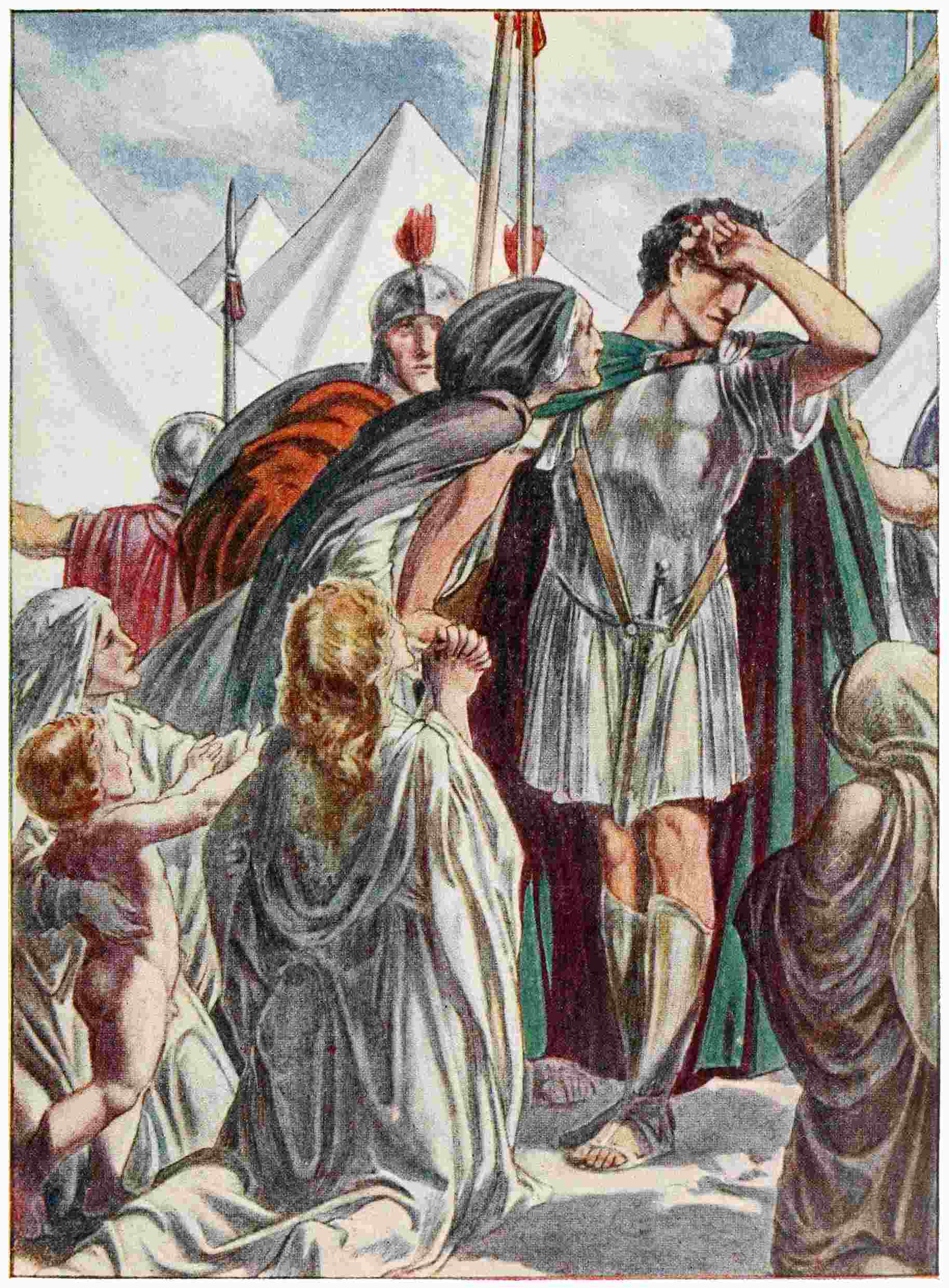
But as the battle was about to begin with redoubled
fury the Sabine women rushed in between the two armies
with loud cries, entreating now their fathers and brothers,
now their husbands to end this cruel slaughter.
They even begged that they themselves might be slain,
for, ‘Better it is that we perish,’ said the women, ‘than live
as widows and orphans.’
In their arms the women carried their little sons, and
these babes stretched out their tiny arms toward their
grandsires, as though they too would beg for peace. The
lamentable cries of their daughters, the sight of their little
grandchildren made the Sabines hesitate, and soon the
warriors in either army let their weapons fall to the ground
in mood no longer warlike. ‘Then fathers and sons-in-law
clasped hands in friendship. The old men embraced their
daughters, and carried their baby grandsons on their shields.
Surely a sweeter way was that to use the shield.’
Peace was then made, and the Romans and Sabines
agreed to become one, while Romulus and Tatius ruled
together over their united people.
Five years later Tatius was killed in a quarrel, and
Romulus again ruled alone.
CHAPTER X THE KING DISAPPEARS
As the years passed, the city of Rome became ever larger
and more powerful. The king, too, grew haughty, and as
his greatness increased, careless of the welfare of his people.
His subjects, who had formerly loved Romulus, now began
to hate him, so insolent seemed to them his behaviour.
Dressed in a scarlet robe, the king spent his days lying
on a couch, while young lads, called Celeres, waited upon
him. This name was bestowed upon them because of the
swiftness with which they sped to do the king’s behests.
Nor was this all, but when Romulus at times roused
himself to walk through the streets of the city, the Celeres
went before him, bearing staves. These they used, to thrust
aside any of the common people who dared to disturb the
king by their presence.
The staves angered the people, but even more did they
resent the leather thongs which the Celeres wore, for these were
used to bind and take prisoner whoever displeased the king.
After he had reigned forty years a strange thing happened.
Romulus ordered the people to assemble on the Field
of Mars, which reached from the city to the river Tiber,
for here a festival was to be held. But when the king
and his subjects met, a terrible storm arose. Dark and yet
darker grew the sky, while fierce gusts of wind, blowing now
in one direction, now in another, confused the terrified crowd.
Flashes of lighting gleamed across the faces of the throng,
then darkness, more dense, fell across the field, hiding each
from the other. Thunder rolled until the earth seemed to
shake at the sound.
In terror and distraught with fear, the crowd fled to their
homes, lashed by a ceaseless torrent of rain.
And the king? When the storm was over the king was
nowhere to be found. He had disappeared, and was seen
no more on earth in human form.
‘His enemies have slain him,’ said some among the people.
But others thought that the god Mars had carried the king
to heaven in a chariot.
Proculus, a friend of Romulus, told the people a story,
which made them believe that their king had himself become
a god.
One day, as Proculus was walking from Alba to Rome,
Romulus stood before him, clad in shining armour.
His friend was afraid when he saw the king, so tall and
comely had he become, and he cried: ‘Why, O King, have
you abandoned us, and left the whole city to bereavement
and endless sorrow?’
Proculus did not seem to know that Romulus had lost
the love of his people many years before.
The figure in shining armour answered his friend in these
wise words:
‘It pleased the gods, O Proculus, that we, who came
from them, should remain so long a time amongst men as
we did, and having built a city to be the greatest in the world
for empire and glory, should again return to heaven.
‘Farewell, and tell the Romans that by the exercise of
temperance and fortitude they shall attain the height of
human power. We will be to you from henceforth the god
Quirinus.’
The Romans listened eagerly to Proculus, and when his
story ended, they determined to build a temple on the
Quirinal hill in honour of their new god.
And each year, on the 17th February, the day that
Romulus had been taken from their sight, the Romans held
a festival in honour of Quirinus, calling it the Quirinalia.
CHAPTER XI THE PEACE-LOVING KING
After the disappearance of Romulus, the Romans and
Sabines each wished to appoint a new king.
Romulus had been a Roman, so the Sabines said that
now it was but just that a Sabine king should rule.
The dispute between the people lasted for a whole year,
and then at length it was determined that the new king should
be a Sabine, but that the Romans should be allowed to
choose him.
Now among the Sabines dwelt a man named Numa
Pompilius. He was honoured by the Romans as well as
by his own people, for he was both good and wise. He had
indeed been known for his wisdom since he was a boy.
And if, when he was young, any one ventured to dispute
his wisdom, his friends would point to his grey hair, believing
there was no need to speak. For the hair of Numa Pompilius
had been grey from the day of his birth, and that surely
was a sign from the gods to show that he already was and
ever would be wise.
Often he was to be seen, a solitary man, walking in the
fields and groves which were consecrated to the gods. At
other times he would spend long days and weeks alone in
desert places.
It was to this strangely quiet, thoughtful man, who was
now about forty years old, that the Romans sent ambassadors
to beg him to become their king.
Numa Pompilius had no wish to rule. Moreover, he
deemed that the people would desire a more warlike king than
he was like to be. So he bade the messengers return to
Rome, saying: ‘I should but be, methinks, a laughing-stock,
while I should go about to inculcate the worship of
the gods and give lessons in the love of justice and the
abhorrence of violence and war to a city whose needs are
rather for a captain than for a king.’
In spite of these words, the ambassadors still urged
Numa to return with them to Rome. ‘Your presence,’
said they, ‘will help to put an end to war and discord.’
Then the wise man consulted the gods, and they sent a
flight of sacred birds as a sign that he should reign in
Rome.
So Numa Pompilius set out with the ambassadors, and
when he reached the city he called together the people to
ask them if they were willing to obey his commands.
They, greeting him as ‘a holy king, and one beloved of
the gods,’ promised to obey him in all things. Thus, almost
against his will, the wise man became king. But being king,
he was not the man to shirk the duties belonging to his royal
state.
His first act was to dismiss the band of three hundred
Celeres, which had formed the life-guard of Romulus, for
this king trusted his subjects, and believed that they would
safeguard him from danger.
To train the Romans in the love of truth he built on the
Capitol a temple to the goddess Fides, or Faith, bidding
them invoke this goddess above all others. At the same
time he told them ever to remember as they went about
their daily work that their promises were as sacred as their
oaths.
In the temple no sacrifice of sheep, oxen, or bird was
ever offered, for the good king would not have his gifts to
the gods stained with blood. Fruits, cakes, corn, these
were the offerings he bade the people bring to the temple.
Pompilius himself had loved to work and to walk in the
fields, so now he encouraged the Romans to labour in the
country, dividing among them a large part of the land
which Romulus had conquered.
In these and other ways the king did all he could to curb
the fierce passions of his subjects, who, when left to themselves,
were swift to turn to war and bloodshed, rather than
to peace.
Many of the people reverenced their peace-loving king,
but others mocked at his gentle ways.
Even the feasts of the king were more simple than some
of the Romans liked, and these discontented ones grumbled
at the plain fare of which they were invited to partake.
One day, so the legend runs, the king ordered, as was his
custom, a simple meal to be prepared, and to this meal
he invited many of his friends.
They came, for the king had asked them, but, as they
expected, the food was plain, the plates were of earthenware,
and water was served in bottles of stone.
But no sooner had the guests seated themselves at the
table than behold! as if by magic, the plain food was
changed into the choicest viands, the water became the richest
wine, while the earthenware dishes disappeared, and in their
place stood plates of silver and of gold.
The guests were startled, yet it pleased them well that
the gods should show such favour to their king, for they
never doubted that it was thus the gods treated those who
honoured them.
Henceforth the people grumbled less, and were more
ready to obey their sovereign.
Numa Pompilius ruled for forty-three years, caring,
during his long reign, for the welfare of his people.
Even the enemies of Rome did not venture to disturb
this good and gentle king. So, while he ruled, the weapons
of war were laid aside. The gates of the temple of Janus,
too, which were only opened in time of war, remained closed
during the reign of Numa Pompilius.
It seemed that the gods did indeed show goodwill to
this pious king, for neither sickness nor famine troubled
the country as long as he sat upon the throne, and the
Romans prospered in all that they undertook.
When he was eighty years of age Numa Pompilius passed
away in a death as peaceful as his life.
The Romans mourned his loss, for he had been to them
father as well as king.
Quietly they laid his body to rest, beyond the Tiber,
on the hill Janiculum which looks toward the west.
CHAPTER XII HORATIUS SLAYS HIS SISTER
Tullus Hostilius, the king who succeeded Numa Pompilius
in 672 B.C., loved war as much as Pompilius had loved peace.
He feared lest already the Romans had lost the renown
that had been theirs on the battlefield when Romulus was
king. So he determined to find a pretext for war as soon
as possible, that his soldiers might show that courage was
still theirs, and that their fame might spread as of old to
the neighbouring tribes.
Such was the warlike character of Tullus Hostilius,
that it was soon found necessary to throw wide the gates
of the temple of Janus.
It chanced that shortly after the new king came to the
throne some Roman and Alban countrymen quarrelled,
each saying that he had been robbed by the other.
Tullus at once took the side of his own people, sending
to the King of Alba to demand that the goods which had been
stolen should be restored. The King of Alba at the same
time sent messengers to Tullus, claiming that justice should
be meted out to those who had robbed his subjects.
The King of Rome received the messengers from Alba
so courteously and treated them so well, that they forgot
the errand on which they had been sent, until startled by
the return of the Roman ambassadors.
They, having been refused justice by the King of Alba,
had, ere they left, declared that the Romans would avenge
the wrong done to their countrymen.
Tullus was well pleased with the report of his ambassadors.
He sent away the careless messengers of Alba, bidding them
tell their king that it was he who had provoked the war.
The two kings speedily collected their armies and marched
to the battlefield. But before the war began the King of
Alba died. Then the Albans chose one of their number,
named Mettius, to be Dictator.
He, standing between the two armies, begged that the
victory might be decided by single combat, so that many
lives might be spared.
To this Tullus agreed, sending forth as the Roman
champions three brothers, called the Horatii, while the
choice of Mettius fell upon three Alban brothers, named
the Curiatii.
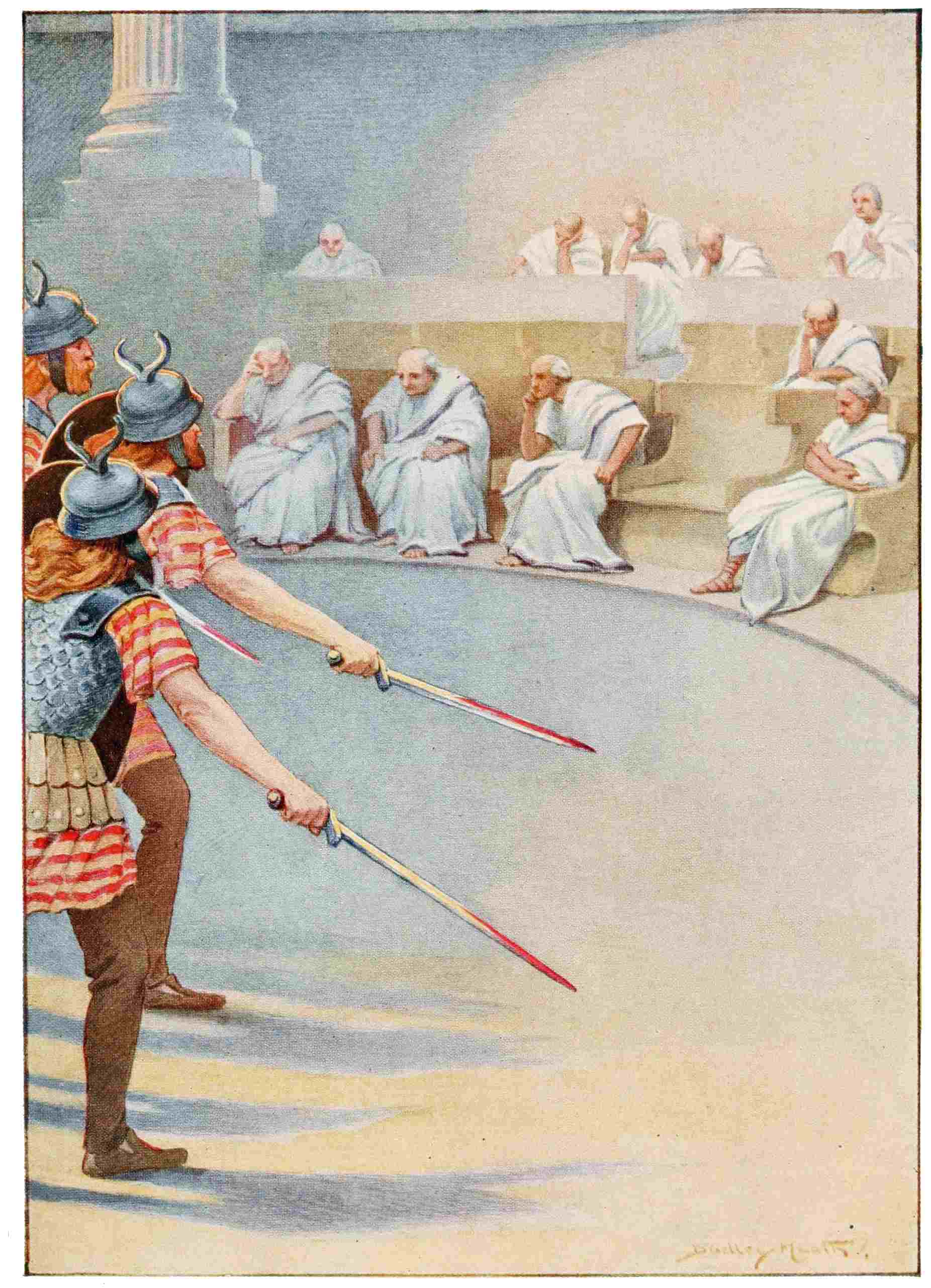
A great silence fell upon the two armies as the combatants
stood forth, armed to the teeth, and the contest
which was to settle the fate of Rome and Alba began.
Should the Horatii win, Rome would seize Alba as its
prize. Should the Curiatii be the victors, Rome would
be forfeit to the Albans.
Fierce and yet more fierce fell the blows of the champions,
until at length, two of the Horatii lay slain on the ground,
while the three Curiatii were wounded.
Then, to the dismay of the Roman army, Horatius, on
whose courage the safety of Rome depended, turned and
fled, pursued by the three wounded men.
But the Romans need not have feared that Horatius
had turned coward. His flight, as they soon saw, was but
a feint to separate his enemies.
As the swiftest of the Curiatii gained upon him, the
Roman champion turned and smote him to the ground.
Without a moment’s pause Horatius then attacked the
second brother, who had now reached his side, and he also
fell before the fury of the Roman’s stroke. The last of
the Curiatii had been forced to follow more slowly, as his
wounds had been severe. He, too, was now stricken down
by the conqueror.
Rome was saved! At the thought great shouts rent
the air, and Horatius was led in triumph toward the city.
As the glad procession drew near to the gate, the sister
of Horatius came out to meet her brother. She was the
promised bride of one of the Curiatii.
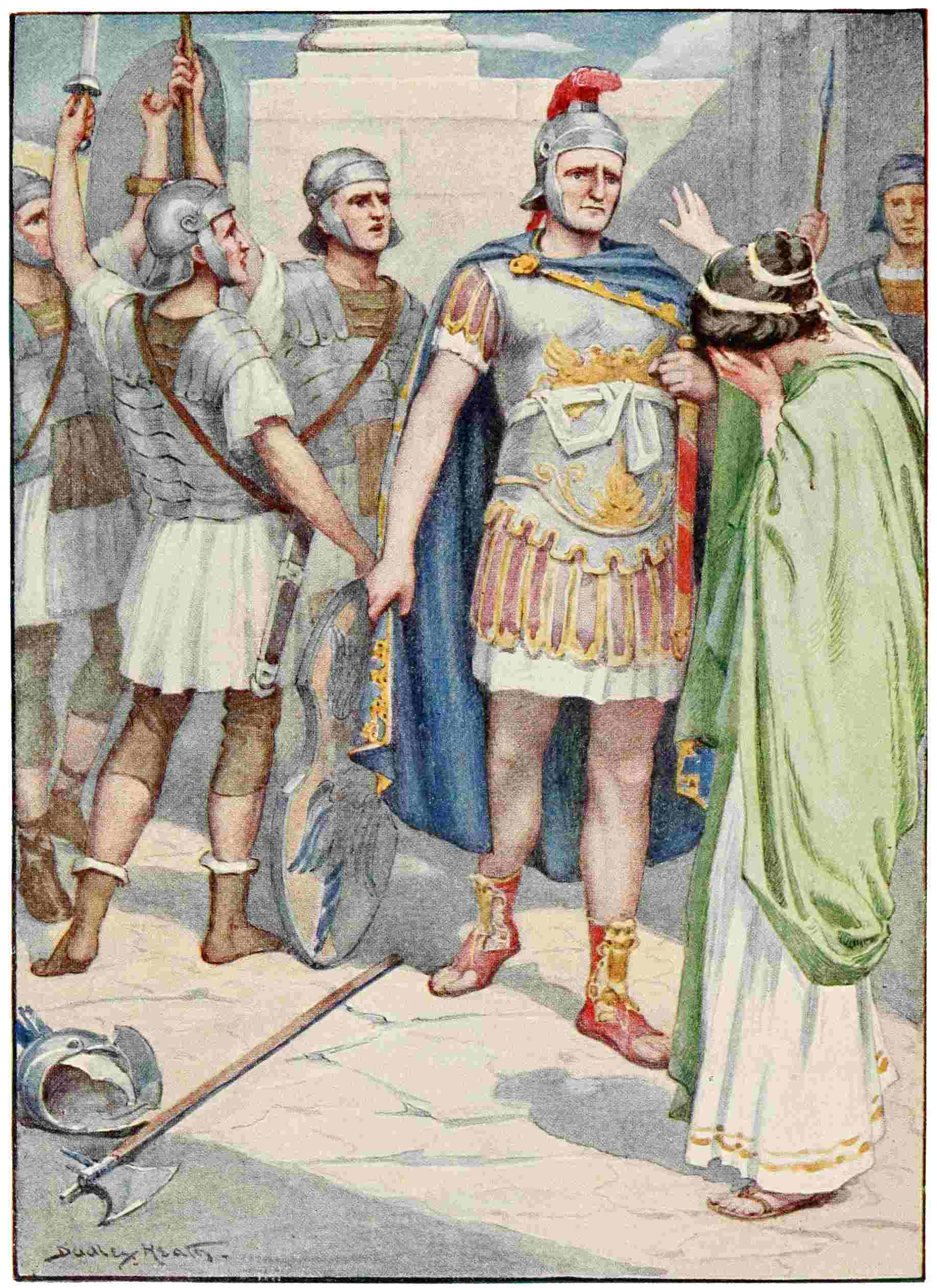
When she saw Horatius, wearing on his shoulders the
cloak of her betrothed, which she herself had embroidered,
she broke into bitter sobs and began to curse him for his
cruel deed.
Then Horatius, in sudden passion, drew his sword and
stabbed his sister, crying: ‘So perish the Roman maiden
who shall weep for her country’s enemy.’
Great was the service Horatius had done for Rome that
day, yet his rash act could not be allowed to pass unpunished.
He was taken prisoner, and brought before two judges,
who condemned him to death.
But Horatius refused to submit to his sentence, and
appealed to the people of Rome to save him. And for the
sake of his old father, who had already that day lost two
sons, as well as because he himself had risked his life for
his country, the people listened to his plea and set him free.
Yet, as a public penance, he was obliged to pass beneath a
yoke and offer sacrifices to the spirit of the sister he had slain.
The yoke under which Horatius had to pass was formed
of two beams of wood which were thrust into the ground,
and across the top of which a third beam was placed. Sometimes
the yoke was made by using three swords in this way.
But it was a wooden yoke under which Horatius stooped,
and one of the beams was treasured for many years, and
named the ‘sister’s beam.’
Yet it was not only the memory of his penance that was
preserved. To recall his courage to the Romans who would
follow him, the arms which Horatius had taken from the
Curiatii were hung on a pillar in the market-place. And
in days to come the citizens would point to this pillar,
saying: ‘It is the pillar of Horatius.’
When she saw Horatius wearing on his shoulders the cloak of her betrothed, she
broke into bitter sobs.
CHAPTER XIII THE PRIDE OF TULLUS HOSTILIUS
By the victory of Horatius, the Albans became subject to
Rome, and were forced to help them in their wars.
But Mettius, the Dictator, never ceased to hope that he
would yet be able to throw off the yoke of Rome.
So when Tullus summoned him to bring an army to
help the Romans in their battle against the Etruscans,
Mettius brought an army as he was bidden, but when the
battle was at its height, he secretly told his men to give
no aid to the Romans.
In spite of the treachery of Mettius, Tullus was victorious.
The Dictator, hoping that the king knew naught of his
deceit, boldly praised him for the victory he had won.
But Tullus knew that Mettius had done nothing to help
him win the battle, and so angry was he with his treachery
that he ordered him to be torn to pieces by horses. Then
the king ordered the Albans to be disarmed, and after burning
their city, he carried off the people to Rome.
The Roman nobles, or patricians as they were called,
welcomed the Alban nobles to their city, while the countrymen
of Alba soon became friends with the common people,
or plebeians.
As in the reign of Romulus the Sabines and the Romans
became one, so now the Albans and Romans were united.
In this way the number of the citizens in Rome was nearly
doubled.
Encouraged by his victories, Tullus spent the rest of
his reign in wars with the Etruscans. His success, instead
of making him humble, made him proud, and he grew careless
of the service of the gods. Moreover, he neglected the wise
and just laws made by the good King Pompilius.
Then, in sign of their displeasure, the gods sent a plague
among the people, and the king himself was smitten with
sickness. In his misery Tullus remembered the gods and
prayed. But Jupiter was angry, and sent a shaft of
lightning from the sky, which killed Tullus and destroyed
his house.
Tullus Hostilius reigned for thirty-two years, and after
his death, in 640 B.C., Ancus Marcius, a grandson of
Pompilius, became King of Rome.
CHAPTER XIV THE KING WHO FOUGHT AND PRAYED
Like his grandfather Numa Pompilius, Ancus Marcius loved
peace.
His first act after he became king was to restore the
service of the gods, which during the last reign had ofttimes
been neglected. The sacred laws of Pompilius, too, he
ordered to be written on tablets of wood and to be shown
to the people.
Now among the enemies of Rome was a tribe named
the Latins. The Latins, knowing that King Ancus spent
his time in prayer and in offering sacrifices to the gods,
began to plunder and destroy the country round about
Rome, thinking to go unpunished. But they soon found
that the king could fight as well as pray.
No sooner, indeed, had Ancus heard that the Latins
were laying waste his dominions, than he commanded the
priests to attend to the temple services. Then, placing
himself at the head of his army, he marched against the
enemy.
The battle was fierce and long, but at length the Latins
were beaten and their towns destroyed. His prisoners the
king took back with him to Rome, bidding them make
their home on the Aventine hill.
Ancus next determined to secure the command of the
Tiber and to join the Janiculum hill to Rome by throwing a
wooden bridge across the river, which was named the ‘Bridge
of the Wooden Piles,’ for it was built entirely of wood. The
beams were placed loosely, one alongside another, so that,
should an enemy approach, it could be quickly taken to
pieces.
Ancus loved peace, but he could not yet lay down his
arms, for he saw that Rome ought to secure the land that
lay between the city and the sea. So he led his army against
the tribes to whom this land belonged, and, taking it from
them, he built a town at the mouth of the Tiber, which he
called Ostia. And here a busy harbour was soon to be
seen, from which Roman ships set sail for the open sea.
For twenty-four years this good king reigned, and then,
calm and content as his royal grandfather, he died. His
name was ever held in honour by his people, for in time of
peace he had been just, in time of war victorious.
The children of the king were still young when their
father died, so they were left to the care of his friend, Lucius
Tarquinius.
CHAPTER XV THE FAITHLESS FRIEND
Lucius Tarquinius, to whom the king had entrusted the
care of his children, was a Greek noble possessing great
wealth. His real name was Lucumo, and being driven from
his native town by a tyrant, he had taken refuge in the
town of Tarquinii in Etruria. It was from this town that
he took the name by which he was known in Rome.
But neither Lucumo nor his wife Tanaquil were content
to spend their lives in such a sleepy little town as Tarquinii
proved to be. So they determined to go to Rome, where,
it was said, strangers were ever welcome.
One day, then, the husband and wife set out on their
journey. As they drew near to the Janiculum hill, an
eagle suddenly swooped down upon the travellers, and seized
the cap which Lucumo was wearing. Then, uttering loud
screams, the bird flew high in the air, only to return in a
few moments to replace the cap on the head of its astonished
owner.
Tanaquil seemed pleased with the strange behaviour of
the eagle, and assured her husband that it was an augury
or sign from the gods that he would rise to honour in the
city to which they were going.
King Ancus heard of the wealth and the wisdom of the
stranger who had come to Rome, and ere long he sent a
messenger to Tarquinius, bidding him attend the king’s
councils. So wisely did Tarquinius behave that the king
soon treated him as a friend.
When Ancus Marcius was dying, he did not fear the
future for his children. They would be safe, he believed,
in the care of Tarquinius. But he, alas! betrayed his trust
that he might satisfy his own ambition.
After the death of the king, Tarquinius, pretending that
he wished to make the sons of Ancus forget their grief,
persuaded them to go away from the city to hunt.
In their absence the false friend appealed to the people
to make him king, and this they did.
Tarquinius had gained his power by a treacherous deed,
but by his courage on the battlefield he won the admiration
of his subjects.
He fought against the Latins, and made many of their
cities subject to Rome. And when the Sabines took up
arms and marched almost to the gates of the city, Tarquinius,
vowing that if Jupiter would come to his aid he would build
a temple in his honour, rushed against the foe and drove
it away.
Flushed with victory, he then went to war with the
Etruscans, and forced them to acknowledge him as their king.
As a sign of their subjection the conquered tribe sent to
Tarquinius royal gifts—a golden crown, a sceptre, an ivory
chair, an embroidered tunic, a purple toga, and twelve axes
tied up in bundles of rods.
These gifts the king sent before him to Rome as a proof
of his victory over the Etruscans.
Then, when peace was at length proclaimed, Tarquinius
remembered the vow he had made to Jupiter, and began to
build a temple on the Capitoline hill.
As the workmen were digging, in order to lay a good
foundation, they found a human head. This was a sign, so
said those who knew, that the spot on which the head had
been buried should become the chief place of worship in Rome.
The temple, when it was finished, was named the Capitol,
and in days to come it was indeed looked upon as the most
sacred building in the city.
Although Tarquinius was but a usurper, yet he did all
that he could to improve the kingdom over which he ruled.
He ordered great drains to be built, that the marshy
valleys between the hills of Rome might become healthier.
He also built a large circus and a racecourse, to encourage
the games of the people, and in course of time the Roman
games became famous.
In the valley between the Capitoline hill and the Palatine
hill the king then began to build the Forum, or market-place.
Round the Forum he set up booths, where the trades-folk
might carry on their business.
Meanwhile, the subjects of Rome had become so numerous,
that the king wished to increase the three tribes into
which Romulus had divided his people.
But a skilful augur, named Attius, forbade Tarquinius
to alter what Romulus had consecrated with rites sacred to
the gods.
The king could ill brook interference, and he mocked
at the augur’s words in the Forum, where the people had
assembled.
Then, thinking to show that Attius was not really as
wise as he was believed to be, he cried: ‘Tell me, O Attius,
can the thing of which I am thinking at this moment come
to pass?’
The augur, undisturbed by the mockery of the king,
consulted the sacred birds. Yes, the omens were good.
The thought in the mind of the king could be put into
action.
Tarquinius pointed to a whetstone which lay before him,
and said: ‘Can you then cut this whetstone in twain with
a razor?’
Undismayed, Attius at once seized a razor, and with one
stroke the stone was split in two.
Then the king was afraid, and dared not disregard the
wisdom of the augur. So the number of tribes ordained by
Romulus was left unchanged.
But Tarquinius doubled the nobles in each tribe, and also
increased the companies of knights.
CHAPTER XVI A SLAVE BECOMES A KING
Among the slaves of the king was a young boy named
Servius Tullius. One day the lad fell fast asleep in the
doorway of the palace.
As he slept, it chanced that Tanaquil, the queen, came
out to walk in the palace grounds. When she saw Servius
she would have roused him, save that a flame of fire was
playing around his head, yet doing him no hurt.
But the attendants of the queen also saw this strange
sight, and at once rushed off in search of water with which
to put out the flame.
Tanaquil, however, called to them to return, saying:
‘Leave the lad to sleep. The flame will not injure him.’
Then, hastening back to the palace, she told the king
what she had seen, adding: ‘The gods have appointed
Servius to great honour.’
From that day the boy was no longer treated as a slave,
but as the king’s son, and when he was older he was married
to the daughter of Tarquinius.
Little by little Servius Tullius was entrusted with the
cares of State, while the Senate or elders of the people
treated him as a prince.
Now the sons of Ancus, from whom Tarquinius had stolen
the crown, were indignant when they saw the former slave
treated with more honour than were they, and they grew
afraid lest the king should appoint Servius to succeed him.
That this might not be, they determined to kill Tarquinius.
Hiring two men, they bade them go kill the king, and
they should be well rewarded for their deed.
So the men disguised themselves as shepherds, and begged
to be admitted to the presence of Tarquinius, that he might
settle their dispute, for, so they pretended, they had quarrelled
with one another while they tended their flocks.
When they stood before the king one of the shepherds
began to tell a piteous tale. While Tarquinius was listening,
the other suddenly raised his axe, and with one great blow
killed the king. The false shepherds then fled from the
palace.
But the sons of Ancus had forgotten that Tanaquil was
left to thwart their plans.
No sooner was the king slain, than she ordered the doors
of the palace to be closed. Then, when the people heard
it rumoured that the king was dead and rushed to the
palace, Tanaquil opened an upper window and spoke to the
crowds below.
‘The king is but wounded,’ she told them, ‘he is not
dead. He has commanded that you should obey Servius
until he is again able to rule.’ But all the while Tarquinius
lay in the palace, dead.
But the people, loyal, as they thought, to the wishes of
their king, allowed Servius to rule. And the sons of Ancus
knew that they had killed the king in vain.
A few days later it was known that the king was really
dead; yet, although neither the Senate nor the people had
chosen Servius to be king, he continued to sit upon the
throne and to rule over Rome. Moreover, he was wise
enough to try to win the hearts of the people by promising
to give them land and to rule justly.
So well did he perform his royal duties, that when he
called together an assembly of the people he was at once
elected king.
CHAPTER XVII THE CRUEL DEED OF TULLIA
Servius Tullius began to reign in 578 B.C. Like Pompilius
and Ancus, he loved peace, and fought against none, save
only the Etruscans.
With the Latins he made a treaty, after which the two
tribes built a temple to Diana on the Aventine hill, and
here every year sacrifices were offered for Rome and for
Latium.
The city which Romulus had built on the Palatine had
long ago become too small for the Romans. Little by little,
cities had grown up on the neighbouring hills, and now
Servius was able to enclose all the seven hills of Rome
within the city, building around her a great wall of stone.
This wall was called after the king the ‘Servian Wall,’ and
so strongly was it built that it was still standing in the
days of Augustus. Beyond the wall a deep moat was then
dug, a hundred feet in breadth.
Having thus strengthened the city, Servius divided it
into four regions, while the people were arranged in numerous
tribes.
Should a citizen be wanted to appear before the king or
the Senate, it was then an easy task to find the tribe to
which he belonged and the region in which he dwelt.
Servius also made a law which pleased the Romans well,
called an ordinance of the king.
This ordinance forbade the nobles to oppress the poor.
It also decreed that, however lowly the birth of a Roman
citizen, if he became rich he might hold positions of power
in the State. This encouraged the poor man to be industrious,
for if he could but gain wealth there was no ambition which
he might not be able to satisfy.
But while the ordinance pleased the common people,
it displeased the nobles, who had no wish to see the plebeians
raised to positions which until now had been sacred to them
and to their sons. They bore Servius no good will for
passing this new law.
Trouble, too, was threatening the king through his two
daughters, both of whom, as the Roman custom was, were
named Tullia.
But although their names were the same, their natures
were as different as summer is different from winter.
Tullia, the elder, was wicked and ambitious; Tullia, the
younger, good and gentle.
Servius determined to marry his daughters to the sons
of King Tarquinius, whose kindness had placed him on the
throne.
The princes, as the princesses, were of strangely different
natures. Lucius was proud, his temper violent; while
Aruns was humble and good-natured.
Now the king thought that if the gentle Tullia married
Lucius, he would become a better man; while he hoped
that if his ambitious daughter married Aruns she would
learn from him the grace of humility.
But Servius made a great mistake when he married his
daughters. For before long Lucius hated his quiet wife,
and killed both her and his brother Aruns, so that he and
Tullia the elder might be free to marry each other.
No sooner had Lucius Tarquinius married Tullia, than,
encouraged by her, he joined the discontented nobles, who
hated Servius.
Day by day Lucius grew more bold, more rude to Servius,
and at length he put on the royal robes and sat on the
king’s seat in the Senate house, unrebuked by the nobles.
Servius was now no longer young, but when he heard
how Lucius had dared to behave he went at once to the door
of the Senate house, and bade the prince come down from
the throne, and lay aside the royal robes.
But Lucius paid no heed to the king’s command. Then,
as the king repeated his words, Lucius seized the old
man and flung him down the stone steps of the Senate
house.
Servius, bruised and dazed by his fall, yet struggled to
his feet, and slowly turned away toward the palace.
Lucius dared not let the king live now that he had defied
him. So, sending his servants after Servius, he bade them
kill the old man.
It was easy to overtake him, and the fellows soon slew
their king, leaving his body lying in the middle of the street.
When Tullia heard what her husband had done, she had
no grief to spare for her father’s cruel death. She ordered
her chariot, and drove quickly to the Forum to greet her
husband as king.
But Lucius did not wish the people to see the triumph
of his wife, and he sternly bade her go home.
Tullia obeyed, heedless of his anger. She had room in
her heart for only one thought. Lucius was king, and she,
she was queen.
So full was her mind of the new honours that would now
be hers, that her chariot had reached the street where the
dead body of her father lay before she was aware. The
driver drew up his horses sharply, seeing his murdered king
lying across his path.
But Tullia angrily bade him drive on, and as he obeyed,
her robe was stained with her father’s blood. The street was
ever after called the Via Scelerata, or the Way of Crime.
Lucius showed no shame for the murder of the king,
and haughtily refused to allow his body to be buried with
the usual rites.
And because of his pride the new king was named
Tarquinius Superbus or Tarquin the Proud.
CHAPTER XVIII THE FATE OF THE TOWN OF GABII
Tarquin, having killed Servius, seized the throne, and
began his reign by condemning to death the chief senators
who had supported the old king. He also ordered the
tablets, on which Servius had written many wise and good
laws, to be destroyed. Refusing to summon the Senate,
Tarquin then attempted to rule alone.
His cruelty was so great that he was soon hated both
by rich and poor. Before many months had passed he was
forced to surround himself with a bodyguard, lest he should
be slain by those whom he had ruined. For, in order to
grow rich, he imposed heavy fines on the wealthy, sometimes
driving the nobles into exile that he might take possession
of their goods. If they ventured to remonstrate, Tarquin
did not hesitate to put them to death that he might seize
their money.
As for the poor people, he forced them to work so hard
that they were more like slaves than freemen. Often in
despair they escaped from the king’s cruelty by killing
themselves.
After he had crushed the spirit of his subjects, Tarquin
went to war with the Latins, conquering many of their cities,
and even enrolling some of his prisoners in the Roman
legions.
One ancient Latin town determined to resist the cruel
king. Gabii, for this was the name of the brave little
town, even opened its gates to the nobles who had been
exiled from Rome.
In vain Tarquin sent legion after legion against the city.
Its defenders still defied him, fighting with all their strength
so as to protect their homes from the cruel hands of Tarquin
the Proud.
Since he could not take the town by force, the king
resolved to take it by treachery, and in this resolve he was
aided by his son Sextus.
Sextus, pretending that he had been forced to leave Rome
by his father’s cruelty, fled to Gabii. Telling the citizens a
piteous tale, he showed them his back, bare and bleeding
from stripes, and begged to be taken into the town that
his father might not capture him.
The citizens did not find it difficult to believe that the
tyrant had ill-used his son, and they willingly opened their
gates to the prince. And not only did they give him shelter,
but, so great was their trust, that before long they gave
him command of a company of soldiers.
One day a Roman legion was seen marching toward
the city. Sextus at once led his soldiers against it, and,
instructed secretly by Tarquin, the Romans fled before the
prince.
This made the men of Gabii still more sure that they
could trust Sextus, so they foolishly gave to him the chief
command of the defences of the town.
Then Sextus sent in triumph to his father to know what
he should do.
Tarquin the Proud was walking in his garden when his
son’s messenger arrived, and he listened in silence to his
words. But he still walked up and down the garden paths,
switching off with his stick the heads of the tallest poppies
in the flower-beds. Then, still without a word, he sent the
messenger back to Gabii.
But when Sextus heard of the fate of the poppies, he
needed no words to explain his father’s silence. He knew
as well as if the king had spoken that as the tallest poppies
had been beheaded, so he was to behead the leading nobles
in Gabii.
The citizens knew nothing of what had happened in the
king’s flower garden, so they were startled and dismayed
when, day after day, Sextus accused one and another of
their nobles of crime or treason, and ordered them to be put
to death. The prince then completed his treachery by
delivering the town into the hands of the king.
Tarquin’s next victory was over the Volscians, a powerful
tribe which dwelt south of Latium. After plundering one
of their richest towns, he determined with his new-found
wealth to finish the great temple on the Capitoline hill,
which had been begun by his father Lucius Tarquinius.
He adorned Rome with many other beautiful buildings,
and ordered the great sewers, also begun by his father, to
be finished. He then completed the Forum, or market-place.
In the Forum the people bought and sold, and here
also were held the great assemblies of the people.
CHAPTER XIX THE BOOKS OF THE SIBYL
One day, when Tarquin the Proud was at the height of his
power, a woman came to the city and demanded to see the
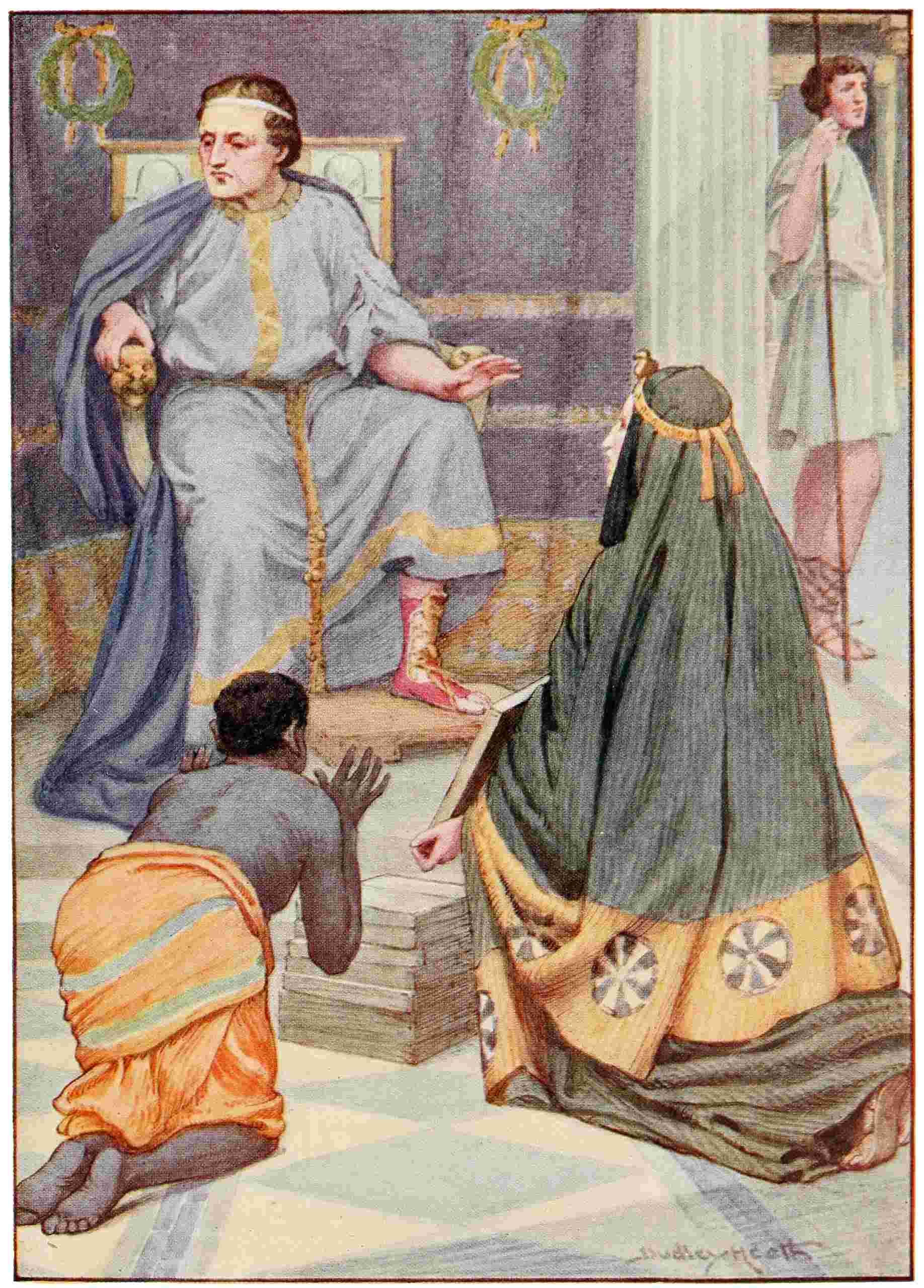
king. She was a stranger, and carried in her arms nine
books.
When she was brought before the king she asked him to
buy the books, telling him that they were the sacred prophecies
of the inspired Sibyl of Cumæ. Cumæ was in the
Campania, and was the most ancient of the Greek towns
in Italy. The prophecies were written on loose leaves,
and in them, said the strange woman, the king would read
the destiny of Rome, and how to fulfil it.
But the stranger asked so large a sum of money for the
nine books that the king laughed and refused to buy.
Quietly, before the king’s eyes the woman burned three
of the nine books. Then, turning to him again, she offered
the six books for the same price as she had before demanded
for the nine.
Tarquin laughed still more scornfully, and refused to
buy the six as he had already refused to buy the nine books.
Quietly as before the woman burned three more books
before the eyes of the king. Then turning to him she offered
the three books that were left for the same sum.
Then the king laughed no more. He began to wonder
if perhaps the gods had sent the books to Rome. So he
consulted the augurs, and by their advice he now bought
the three books for the sum which would have bought the
nine.
She carried in her arms nine books.
The strange woman, having done her work, disappeared
and was seen no more, while the books were put in a chest
and kept in the Capitol, which was now complete.
Two Greeks were appointed to guard the Sibylline books,
for they were written in the Greek language. And ever
when death, pestilence, or war threatened the city, the
books were consulted by the augurs, if perchance Rome might
be saved from destruction.
Many years after the reign of Tarquin the Capitol was
burned, and the sacred books were destroyed in the fire.
To the Romans the loss of the books was a greater blow
than even the destruction of the Capitol.
The Senate sent ambassadors to Greece and to Asia
Minor to beseech the sibyls there to find fresh oracles, that
calamity might still be averted from Rome.
And the ambassadors were successful, for when they
returned they brought with them new scrolls, which, when
a new Capitol was built, were placed within its sacred
precincts.
During the reign of Augustus, the oracles were removed
to the temple of Apollo, which stood on Mount Palatine.
But long after the time of Augustus, in A.D. 400, they
were burned in public by a famous Roman, for he was a
Christian, and cared little for the ancient oracles, believing
them to be but a useless relic of the old pagan days.
CHAPTER XX THE INDUSTRY OF LUCRETIA
As the years passed, Tarquin was disturbed by terrible
dreams. The evil deeds he had done came back to his
memory, and haunted him by day and by night. Even in
the temples of the gods he could find no rest from his fears.
One day, as sacrifices were being offered, the king saw
a serpent stealing down a wooden pillar. Fascinated, he
watched as it dropped slowly on to the altar and devoured
the sacrifice. His fear told him that this was a bad omen,
and, thoroughly alarmed, Tarquin determined to consult
the Greek oracle at Delphi, for this oracle was famous not
only in Greece, but throughout the world.
So he sent his two sons, Titus and Aruns, to Delphi.
With them went the king’s nephew, named Junius, but
called Brutus because he was believed to be stupid. But
Brutus only pretended to be stupid so that his uncle would
not trouble to do him harm.
When the princes reached the dwelling of the priestess,
the king’s sons offered her valuable gifts, while Brutus gave
to her only a simple staff. His cousins mocked at Brutus
as they were used to do, for a priestess would not care for
so poor a gift, they were sure. But Brutus was wiser than
they deemed, for the staff had been made hollow, and then
had been filled with gold.
As the king had bidden, the young princes asked the
oracle the meaning of the serpent that had devoured the
sacrifice on the altar.
It was indeed an evil omen. ‘The fall of Tarquin is at
hand,’ was the sinister answer they received.
‘Which of us shall reign after him?’ demanded the
king’s sons with unseemly eagerness.
‘He who shall first kiss his mother,’ responded the
oracle.
Then the two princes cast lots to determine which of
them should greet their mother first on their return.
But Brutus guessed that the words of the oracle had a
deeper meaning.
As he left the Delphic temple, he pretended to slip, and
falling to the ground, he secretly kissed the Earth, knowing
that she was the mother of all men.
When the princes returned the king was at war, besieging
Ardea, a town in Latium. It seemed that he had forgotten
his fears, nor does the story tell what he thought of the
answer of the oracle.
Meanwhile the siege of Ardea dragged on month after
month, so bravely did the inhabitants defend their town.
In the Roman camp, Prince Sextus and a noble named
Collatinus one day whiled away the hours by wondering
what their wives were doing. Each boasted that his wife
was the more diligent and the more modest of the two
women.
At length one of their friends idly suggested that Sextus
and Collatinus should ride to their homes and find out how
their wives were employed.
So the two officers, accompanied by their friends, ordered
their horses, and rode first of all to Rome.
Here they found the wife of Sextus at a banquet, where
she was dancing gaily, the merriest of all the merry throng.
It was late when they reached Collatia, where they
found Lucretia, the wife of Collatinus, still busy with her
maidens at the spinning-wheel.
The whole company agreed that of the two wives Lucretia
deserved the greater praise. Then the frolic being over,
the prince and his friends rode back to camp.
CHAPTER XXI THE DEATH OF LUCRETIA
The idle suggestion that had made Sextus and Collatinus ride
from the camp to Rome and Collatia led to terrible disaster.
Sextus, having seen how wise and beautiful Lucretia was,
wished to win her from her husband; and one day, leaving the
camp, he again rode to Collatia, but this time he rode alone.
Lucretia, believing the prince was her husband’s friend,
received him with fitting hospitality when he arrived at her
house, hot and tired after his ride. But when she found
that he was not a true friend to Collatinus she was no longer
kind. Then the prince grew angry, and treated Lucretia
so cruelly that she knew she could never again be happy.
The next day she clad herself in black, and sent messengers
to her father and her husband, bidding them come
to Collatia with all possible speed.
When they arrived, she told them how Sextus had
treated her, and making them swear to avenge her wrongs,
she plunged a dagger into her heart and died.
Brutus, the king’s nephew, had ridden from the camp
with Collatinus, and he, too, swore to avenge Lucretia, and
to see that never more should any of the race of Tarquin
sit upon the throne of Rome.
This oath was also taken by the husband and father of
Lucretia, as well as by two brave Romans named Publius
Valerius and Spurius Lucretius.
The dead body of the Roman matron was carried to the
market-place, and when the people were told what had
happened, they broke out into loud cries, and mourned for
her sad fate.
Brutus then hastened to Rome to tell the terrible tale.
In the Forum, amid the assembled people, his voice rang
out clear and fearless as he reminded them of the crimes
of Tarquin the Proud, and denounced the king and his son
Sextus.
‘Will you suffer such a tyrant or any of his race to rule
longer over you, O Romans?’ demanded Brutus sternly.
And the people in a storm of indignation shouted ‘No.’
The Romans were in earnest. An army was at once
enrolled, and, led by Brutus, set out to attack the king
at Ardea.
Tullia, the queen, meanwhile, startled by the tumult
in the Forum, fled from the palace. As her chariot drove
along the streets the people muttered curses, calling down
upon her the vengeance of her murdered father.
Rumours had already reached the camp that Rome was
in revolt, and Tarquin at once marched to the city with a
division of his army to punish the rebels.
Brutus, on his way to Ardea, took care to avoid the king.
He had determined to win over the army that was left before
the besieged town.
When he reached the camp, he quickly roused the soldiers
by the tale of Lucretia’s wrongs.
They swore never again to own Tarquin or any of his
race as king, and at once prepared to march to Rome.
Meanwhile, the king had reached the city only to find
the gates closed, and the citizens, stern and resolute, manning
the walls. No threats, no promises would make them open
to the king whom they had determined to dethrone.
Tarquin, knowing that if he lingered he would have to
face the army led by Brutus, turned away from the city
and hastened to seek refuge in Etruria.
The Romans, having thus expelled their king, appointed
a day to be celebrated as the Feast of Flight, or the Feast
of the Expulsion of the Kings. This feast was held each year
on the 24th February.
CHAPTER XXII THE SONS OF BRUTUS
After Tarquin the Proud had been driven away from
Rome, the people determined that they would never again
be ruled by kings.
They resolved to follow the wise laws of Servius, who had
bidden them choose each year two men to rule, giving them
equal power, the right to make laws, and to see that justice
was done in the land.
The two men, chosen by the Senate and the people,
were called Consuls.
In token of his office, each Consul had at his command
six men, named lictors.
When a Consul went into the Forum or into the street,
he was preceded by his lictors, who carried, as a sign of their
master’s power, rods to chastise and an axe to kill.
Rome had now become a Republic, and the first Consuls
to be elected were Brutus and Collatinus.
But if the Romans expected Tarquin to make no effort
to recover his throne, they soon discovered their mistake.
Before long, the king sent messengers to Rome to ask
that his own private possessions might be sent to him, and
to this simple request the Senate and the people agreed.
As perhaps the Romans might have suspected, Tarquin
had another reason for sending to Rome than the one his
messengers carried to the Senate. He knew that among
the younger patricians were many who wished to place him
again upon the throne, and his messengers had come to talk
secretly with these nobles. They even hoped to arrange
the best time for the king’s return.
But as the conspirators talked together, a slave chanced
to overhear what they said, and he at once went to the
Consuls and told them of the danger that threatened the city.
The conspirators were immediately seized and thrown
into prison, while the slave was set free and made a citizen
of Rome.
Among the prisoners were Titus and Tiberius, the sons
of Brutus.
The brave Consul was dismayed to learn that his sons,
whom he loved well, had been guilty of treason. How
could he bear to pronounce judgment upon them as upon
other traitors?
Yet soon he thrust aside his weakness. A true Roman
must love his country better even than his own children.
So when the conspirators were brought before him he
did not flinch. With stern, set face he condemned Titus
and Tiberius to death along with the other traitors, nor did
he stoop to ask the people to show mercy to his sons.
The young men were bound to the stake before his eyes,
after which the lictors beat them with rods and then cut
off their heads with the axe.
So angry were the Senate and the people with Tarquin
for attempting to plot against the Republic, that they now
refused to send to him his possessions. And not only so,
but they divided his goods among the people, while the
field between the city and the Tiber which Tarquin had
sown with corn was destroyed, the corn cut down and
thrown into the river. The angry citizens then dedicated
the field to the god Mars, and henceforth it was known as
the Field of Mars.
The Senate then made a law banishing for ever from
Rome all who bore the hated name of Tarquin.
So Collatinus, whose other name was Tarquinius, resigned
his Consulship and left the city in obedience to the law. And
this he did, although he was the friend of Brutus, and hated
the exiled king.
Valerius was then chosen Consul in his stead.
Meanwhile, Tarquin was full of wrath because he had
not been able to enter Rome by craft, and he went to
Etruria, and persuaded the Etruscans to help him to recover
his throne.
But when the Etruscans proclaimed war against Rome,
Brutus gathered together an army and led it against the
enemy.
Close to a wood the battle raged. Aruns, one of Tarquin’s
sons, saw Brutus at the head of the Roman army, wearing
the royal robes which he considered belonged to his house
alone. In sudden fury he put spurs to his horse, and with
his spear ready dashed toward his enemy.
Brutus saw Aruns drawing near, and he also spurred
his horse forward and couched his spear.
Onward flew the two warriors until at length they met.
Then each, pierced by the other’s spear, fell from his horse
and moved no more.
All day the battle raged, and still when night fell the
victory was uncertain.
But, during the night, while both armies were encamped
on the battlefield, a loud voice was heard coming from the
direction of the wood.
It was Silvanus, the god of the wood, who was speaking.
‘The victory belongs to the Romans,’ said the god, ‘for
they have slain one more than their enemy.’
Obedient to the voice of Silvanus, the Etruscans on the
following morning withdrew their army, while the Romans
marched back to Rome.
In spite of their victory they were sad, for they carried
with them the dead body of their leader.
Brutus was mourned by all the people. But the Roman
matrons lamented more than others, setting aside a whole
year in which to grieve for his death, because he had so
bravely avenged the matron Lucretia.
CHAPTER XXIII HORATIUS COCLES, OR THE ONE-EYED
After the death of Brutus, Valerius ruled alone. But he
soon displeased the people, for they thought that he behaved
too much as though he were a king.
The Consul had indeed built himself a beautiful house,
from the windows of which, had he wished, he could look
down into the Forum.
When he walked from his house to the market-place,
Valerius, it was true, was preceded by six lictors, bearing
rods and axes, but this was a dignity accorded to the Consuls
by the people themselves.
Valerius had in truth no wish to spy upon the people as
they feared, nor did he try to use his authority unjustly.
Yet the people grumbled, and grew restless and suspicious,
until at length the Consul heard that he had displeased
them.
Valerius was not angry with the foolish citizens, but he
resolved to make them ashamed of their groundless suspicions.
So one evening, when it was dark, he sent for workmen
and ordered them to pull his beautiful house to pieces.
When morning dawned, the people, gazing upward
from the Forum to the Consul’s house, were startled. What
could have happened? There was no longer any house
to be seen.
It was not for some time that they learned that it was
their foolish suspicions that had caused the Consul to destroy
his house.
Then, fickle as the Roman crowd always was, it changed
its mind and hung its head, ashamed of the destruction it
had caused.
But Valerius not only made the citizens ashamed of their
suspicions, he made them love him for his humility.
When he came into the Forum, the Consul now ordered
his lictors to carry the rods and axes in two separate bundles,
while the axes were from this time always lowered when
he entered the Senate-house, or stood before the assembly
of the people.
Valerius also made a law that pleased the Romans well.
When a Roman was condemned to death by a magistrate,
the Consul decreed that he should have the right to
appeal to the people against the sentence. This, you
remember, was what Horatius had done when he was
condemned to death for slaying his sister.
So completely had the Consul endeared himself to the
Romans that they now called him Poplicola, or the Lover
of the People.
Meanwhile, Tarquin the Proud had enlisted the aid of
a powerful king, named Lars Porsenna.
This king now sent to Rome, bidding the people open
their gates to Tarquin. When they refused, he at once
marched against the city with a great army.
The Romans increased the guard and strengthened the
forts on the Janiculum hill. At all costs the enemy must
be prevented from crossing the Tiber by the wooden bridge
that joined the hill to the city itself.
Slaves, cattle, goods—all were brought from the surrounding
country, either within the walls of the city, or into
forts without.
But in spite of all the Romans could do, Lars Porsenna
reached the Janiculum, and storming the heights, drove
the Roman soldiers down the hill toward the river. His
men pursued the fugitives, who seemed to think of nothing
save their own safety.
If the enemy was not to enter the city, the bridge must
be defended until the Roman soldiers on the other side of
the river had cut through the beams that supported it.
Then, as the enemy drew near and ever nearer to the
bank of the river, a brave Roman, named Horatius Cocles,
or Horatius the One-Eyed, whose country was dearer to
him than life itself, cried to the Consul right manfully:—
‘“Hew down the bridge, Sir Consul,
With all the speed ye may:
I, with two more to help me,
Will hold the foe in play.
In yon strait path a thousand
May well be stopped by three.
Now, who will stand on either hand,
And keep the bridge with me?’
There were not lacking Romans to answer the brave
challenge:—
‘“Lo, I will stand at thy right hand,
And keep the bridge with thee,”’
cried Spurius Lartius, one of Rome’s strongest warriors,
while the voice of another brave soldier, named Herminius,
rang out clear above the noise of arms:—
‘“I will abide on thy left side,
And keep the bridge with thee,”
For Romans in Rome’s quarrel
Spared neither land nor gold,
Nor son, nor wife, nor limb, nor life,
In the brave days of old.’
Fully armed, the three brave men sprang to the end
of the bridge farthest from the city, and flung defiance at
Lars Porsenna and his great army.
The king and his army, seeing but three stalwart warriors,
laughed them to scorn, yet ere long their scorn gave way
to amazement.
Before the missiles hurled upon them, before the fiercest
sword-thrusts, Horatius and his comrades stood dauntless
and unafraid, while at their feet rose a ghastly heap of
those the brave Romans slew.
And while they held the bridge thus resolutely, behind
them fell the blows of mighty axes, loosening the great
beams that held the bridge secure.
Soon the axes had done their work. The bridge began
to totter, to sway, and the Romans shouted to the noble
three to come back ere the bridge gave way.
At the call, Lartius and Herminius turned and darted
swiftly across the swaying planks.
But Horatius stayed behind. Not till the bridge fell
into the river would he stir from his post.
Then, with a mighty crash the bridge gave way, and fell
into the rushing torrent beneath.
Horatius, separated from his friends, stood alone, facing
thirty thousand of the foe. Behind him tossed the broad
surging river.
‘“Down with him,” cried false Sextus,
With a smile on his pale face.
“Now yield thee,” cried Lars Porsena,
“Now yield thee to our grace.”
‘Round turned he, as not deigning
Those craven ranks to see,
Nought spake he to Lars Porsena,
To Sextus naught spake he;
But he saw on Palatinus
The white porch of his home;
And he spake to the noble river
That rolls by the towers of Rome.
‘“O Tiber! father Tiber!
To whom the Romans pray,
A Roman’s life, a Roman’s arms,
Take thou in charge this day!”
So he spake, and speaking sheathed
The good sword by his side,
And with his harness on his back,
Plunged headlong in the tide.’
Not a sound was heard from either bank as Horatius,
wounded and bleeding, disappeared in the flood.
Then the enemy, furious that it had allowed the great
warrior to escape, hurled its spears after him.
But not one reached the bold swimmer, who, weighed
down by his armour and weakened by his wounds, often
sank, yet ever rose again and struggled onwards.
At length he reached the bank, where eager hands were
waiting to draw him up into safety.
When the Romans saw that their hero was safe indeed,
although exhausted with his efforts, a mighty shout of
triumph rent the air.
Horatius was rewarded for his brave deed by the Senate,
who gave him as much land as he could plough in a day,
while in later days a monument was erected in memory
of his prowess and placed in the Comitium. The Comitium
was near to the Forum, and was sometimes counted as part
of it.
CHAPTER XXIV GAIUS MUCIUS BURNS HIS RIGHT HAND
Lars Porsenna had been repulsed, but he had not been
defeated. He now besieged Rome so closely, that the people
were soon suffering all the horrors of famine.
Then a youth, named Gaius Mucius, determined to save
Rome by killing Lars Porsenna.
Gaining the consent of the Senate to his scheme, he
disguised himself as a countryman, and found his way into
the camp of the enemy. Beneath the folds of his simple
dress, Mucius had concealed a dagger.
It had been easy to enter the camp, but now the lad was
in a difficult position, for he did not know the king, nor did
he dare to ask any one to point him out.
But seeing a courtier wearing a purple robe and distributing
money to the soldiers, he believed he had found
him. Drawing near, he stealthily drew his dagger and
stabbed—not Lars Porsenna, but his treasurer.
Before he had time to escape, Mucius was seized and
taken before the king.
The king threatened the young noble with torture, even
with death, in order to make him reveal the condition of the
Roman army. But Mucius thrust his right hand into a
flame that was alight on an altar beside him, and held it
there until it was burned to ashes. This he did without
flinching, that Lars Porsenna might see that he feared no
torture. As for death, when it came, he would bear it as a
Roman should.
But the king, amazed at the courage of the youth, forgot
his anger, and bade him return unharmed to Rome.
Then Mucius, touched by the kindness of the king, told
him that three hundred Roman youths had sworn to take his
life, and would not rest until one of them had succeeded
in doing so.
Lars Porsenna was a wise king. He listened to the warning
given to him by Mucius, and offered terms to the starving
city, promising if they were accepted to withdraw with his
army. But the terms were hard, for the king demanded
that Tarquin’s possessions should be sent to him, that the
Romans should give up all their dominions on the right
bank of the Tiber, that they should not use iron save to
cultivate the ground, and that ten noble youths and maidens
should be sent to him as hostages.
With starvation staring them in the face, the Romans
were forced to agree to these terms, and the hostages that
he had demanded were sent to the king as a pledge of good
faith.
Among the hostages was a noble maiden named Clœlia.
In the Etruscan camp she pined for the freedom of her own
home, for the joy of seeing her own friends, and at length
she determined to escape.
So one night, when it grew dark, she slipped out of the
camp unnoticed, and found her way to the edge of the river.
Without hesitation she plunged into the water and swam
across to the other side—to home, to freedom.
But a sad disappointment was in store for the maiden.
The Romans refused to allow her to stay in Rome, for
although they admired her courage, their treaty with Lars
Porsenna must be kept.
So poor Clœlia was sent back to the king. But he, pleased
that the Romans had behaved so honourably, set Clœlia free,
and allowed her to take many of the other hostages back
with her to Rome.
Soon after this, Lars Porsenna refused to help Tarquin
the Proud any longer, and breaking up his camp on the
Janiculum he went back to his own country. His tents,
which were full of corn and provisions, he gave to the
starving city.
So grateful were the Romans for the food that they
rewarded Lars Porsenna with royal gifts—a throne and
sceptre of ivory, a golden crown, and a purple robe.
And these gifts the king well deserved, for he had proved
a generous foe.
CHAPTER XXV THE DIVINE TWINS
Tarquin the Proud was an old man now, but he was not
yet ready to believe that he would never again reign in Rome.
Once more he prepared for battle, invoking the aid of
the Latins, for he believed that the Romans would quail
before this fierce and warlike people.
The Romans did not quail, but they knew that they
would need brave men to lead their army. So they
appointed a Dictator, who was to have supreme command
of the army and power as though he was king in Rome, for
six months.
Aulus Postumius was the name of the Roman who was
chosen for this great trust.
Tarquin, his cruel son Sextus, and a band of Roman
exiles marched to the battlefield, near Lake Regillus in the
region of Tusculum. With them was their ally the King
of the Latins, leading a great army.
The Romans, with Aulus at their head, advanced against
the foe, and a great battle was fought.
Valerius, the Consul was on the field, and when he saw
Sextus anger filled his heart, and he dashed forward to slay
him. But the prince retreated, and Valerius followed until
he was drawn into the lines of the enemy, and perished by
the thrust of a spear.
Fiercely as the Romans fought, the day began to go
against them. Then Aulus vowed that he would build a
temple to the twin brothers, Castor and Pollux, if they
would but come to his aid and give to the Romans victory.
Scarcely had the Dictator ended his prayer, when lo!
two youths of more than human height and majesty appeared,
clad in shining armour, and riding upon white horses.
Going to the head of the army, they led it afresh against
the Latins.
The enemy, terrified by the splendour of the strangers,
and startled at the suddenness of the new attack, were seized
with panic, and fled.
On rushed the Romans in pursuit of the foe, on until
they reached the camp of the Latins, which the strange
horsemen were the first to enter.
The Latin army was now in utter confusion, while a
great victory had been won by the Romans.
Aulus wished to reward the strangers to whom the
victory was really due, but they were nowhere to be seen.
Neither in the field nor in the camp was there any trace of
the riders or their steeds.
But in Rome, where old men and women awaited, with
anxious hearts, news of the battle, there appeared in the
Forum, as the sun went down, two horsemen. They were
mounted on pure white steeds, and they themselves were
‘exceeding beautiful and tall above the stature of men.’
But they bore upon them the stains of battle.
When they reached the spring that rises close to the
temple of Vesta, they dismounted, and washed the foam
from their horses, the stains from their clothes.
Men and women crowded around the strangers, eager to
hear their tidings. Then the brothers told them of the
glorious victory that had been won, after which they mounted
their white steeds, and riding away, were seen no more.
When the Dictator returned to Rome, he told how he
had prayed to the Divine Twins Castor and Pollux, and
how he believed that they had indeed come to his aid.
Moreover, he was sure that it was they who had ridden
to Rome with more than mortal speed to tell of the victory
that had been won.
Then Aulus, with a glad heart, began to build the temple
he had vowed to the Divine Twins, and the Romans kept a
festival each year in honour of Castor and Pollux.
At this festival, sacrifices were offered in the temple,
while a solemn procession of knights, clad in purple and
crowned with olive, rode from the temple of Mars without
the city wall to the temple dedicated by the Dictator to the
Divine Twins. This temple is now being excavated in the
Forum of Rome.
The Latins, after their defeat, refused any longer to
fight for Tarquin, while they hastened to make peace with
his enemies.
Alone and childless, for Sextus had fallen in battle,
Tarquin went away to Cumæ, and there he, the last of the
Kings of Rome, died.
Soon after this, Rome regained her dominions on the
right bank of the Tiber. She had already ceased to regard
the treaty which had forbidden her the use of arms.
CHAPTER XXVI THE TRIBUNES
The people of Rome were divided into two great classes,
the patricians or nobles, the plebeians or common people.
After the death of Tarquin the Proud, the patricians
began to oppress the plebeians even more than they had
done in the time of the kings.
Sometimes the poor were forced to borrow from the rich,
and the rich, although they lent their money, demanded such
heavy interest that the plebeians were often unable to pay
their debts.
Then the patricians swept down upon the miserable
debtors, drove their wives and children from their home,
and carried them away to work as bondsmen.
When at any time war threatened Rome, the plebeians
were called on to fight, and while they were at war their
fields lay untilled, unless they hired labourers to work in
them. In either case the plebeians suffered. Did they hire
labourers, they must borrow money from the patricians to
pay them. Did they leave their fields untilled, they musts
borrow money to buy food and seed.
Driven at length to desperation, the plebeians rose against
their oppressors, and at the very time that a hostile army
was marching against Rome, they left the city, and encamped
on a hill near the river Anio, about three miles away. Here
they determined to build a city for themselves.
But the patricians could not hope to hold Rome against
the approaching foe without the help of the plebeians. So
the Senate sent a messenger to the ‘seceders,’ offering terms
of peace and protection from the patricians, if they would
return to Rome to fight against the common enemy.
The plebeians agreed to go back to the city, and for a
time, at least, the patrician magistrates ceased to treat
them unjustly.
To make them more secure, the plebeians were now, in
493 B.C., allowed to elect two magistrates of their own, who
were to be called tribunes.
As the patricians were able to appeal to the Consuls,
so the plebeians could now appeal to their tribunes against
unjust treatment.
The tribunes were elected for one year, and during that
year they were obliged to live in Rome, while their doors
were to stand open day and night, that the plebeians might
claim their protection at any hour.
This new law was made a sacred law, and the hill on
which the seceders had encamped was named the Sacred Hill.
CHAPTER XXVII CORIOLANUS AND HIS MOTHER VETURIA
Many legends are told of the wars which the Romans now
waged with a fierce tribe named the Volscians.
None, perhaps, is so well known as the story I am going
to tell you of Gaius Marcius, who was named Coriolanus.
Marcius was only a lad of seventeen years of age when he
fought in the great battle of Lake Regillus. For his courage
in saving the life of a comrade on the battlefield he was
crowned with a wreath of oak leaves, as was the Roman
custom.
The young lad loved his mother Veturia well. When the
battle was over, his first thought was to hasten to show her
the wreath that his valour had gained, for he had no greater
joy than to please her.
When the Romans went to war with the Volscians,
Marcius was with the army which was besieging Corioli,
their capital town.
One day, the defenders of the city, seeing that part of
the Roman army had withdrawn from the walls, determined
to venture out to attack those soldiers who remained.
So fierce was their onslaught, that the Romans began to
give way.
Marcius, who was some distance off, saw what had
happened, and with only a few followers rushed to the aid
of his comrades, at the same time calling in a loud voice to
those who were retreating to follow him.
Encouraged by the young patrician, the Romans
rallied, and dashing after Marcius, they soon forced the
enemy to turn and fly back toward the shelter of their
city.
The Romans pursued the Volscians until they reached
the gates, but they did not dream of entering, for within the
city were many more of the enemy. Already the walls were
manned, and a deadly rain of arrows was descending among
them.
But Marcius, crying that the gates were open, ‘Not so
much to shelter the vanquished as to receive the conquerors,’
forced his way into the city.
With only a handful of men, he succeeded in keeping
the gates of Corioli open, until the main body of the army
arrived, when the city was taken without difficulty.
The soldiers said, as was indeed the truth, that it was
Gaius Marcius who had taken the city.
When the war with the Volscians ended, the Consul
wished to reward Marcius for this and many another courageous
deed. So he ordered that of all the booty that had
been taken in the war, the tenth part should be given to the
brave young patrician. He himself gave to Marcius a noble
horse, splendidly caparisoned.
But Marcius refused to receive more than his proper
share of the booty. He begged, however, for one favour.
It was that a Volscian who had shown him hospitality and
was now a prisoner, might be set free.
Shouts of applause greeted Marcius when the soldiers
heard his request.
When all was again quiet, the Consul said: ‘It is idle,
fellow-soldiers, to force and obtrude those other gifts of ours
on one who is unwilling to accept them. Let us therefore
give him one of such a kind that he cannot well reject it.
In memory of his conquest of the city of Corioli, let him
henceforth be called Coriolanus.’
So it was that from this time Coriolanus was the name
of the young soldier.
In Rome, as was usual after war, there was much misery,
for the fields had been left unploughed, and no seed had
been sown while the plebeians were away on the battlefield.
Now the people were starving.
The Consuls sent to Etruria for food, and when it reached
Rome it was divided among the people, but still there was
not enough to satisfy their hunger.
While the people still cried for bread, the time to elect
Consuls for the following year drew near.
Coriolanus was one of the candidates. He came to the
Forum, clad in his white toga only, and drawing it aside
he showed to the people the marks of the wounds he had
received in fighting for his country.
But although at first they meant to elect Coriolanus,
many of them remembered that he often spoke of their
tribunes with bitter contempt. If he were Consul, he might
try to do away with the tribunes altogether, and to whom
then would the people be able to appeal against the oppression
of the haughty patricians?
When the day came to elect the Consuls, the feeling
against Coriolanus had grown so strong that he was rejected.
This made him very angry with the plebeians, nor did he
try to disguise his feelings.
Soon after the elections were over, large ships laden with
corn reached Ostia. The senators were eager to feed the
starving people, and as some of the corn was a gift, they
were ready to give it to them without charging even a
small sum.
But Coriolanus was indignant, and denounced in the
Senate-house those who wished to treat the people so well.
The plebeians had already grown more insolent than was
fitting, owing to the favours bestowed upon them. ‘Before
you feed them,’ said the haughty patrician, ‘let them give
up their tribunes.’
When the plebeians learned what Coriolanus had said,
their anger knew no bounds. They would have forced their
way into the Senate-house and torn him to pieces, had not
the tribunes protected him and calmed the fury of the
people.
‘Do not kill him,’ said the tribunes, ‘for that will only
harm your cause. We will accuse him of having broken
the sacred laws, and you shall yourselves pronounce his
sentence.’
But when the tribunes summoned Coriolanus to appear
before them, he mocked both at them and at the people.
A patrician appear before the tribunes to be judged!
That was to Coriolanus a foolish idea.
But although the patrician ignored the summons, the
tribunes and the people met and declared that Coriolanus
was banished from Rome.
Then Coriolanus was forced to leave the city. Hastening
to the Volscians, he threw himself upon the mercy of their
chief, Attius Tullius.
Tullius was willing to help the banished patrician to
punish Rome, and soon an army, led by the chief and by
Coriolanus, was on its way to the city. Town after town
fell into the hands of the advancing army. At length it
encamped only five miles from Rome.
The Senate, in alarm at the success of the Volscians,
sent to beg for peace.
But Coriolanus sent back the Roman ambassadors, saying
that unless all the towns taken from the Volscians in the last
war were restored to them, peace would not be granted.
Such terms were scorned by the Senate, and it sent
other ambassadors to beg for easier conditions. But
Coriolanus refused even to see these messengers.
Then the priests, clad in their sacred robes, walked in
solemn procession to the camp of the enemy, to try to
appease the anger of the haughty patrician. But the efforts
of the priests were vain.
Meanwhile, the matrons of Rome had been beseeching
Jupiter to come to the aid of the city.
When the priests returned, having accomplished nothing,
one of these matrons said: ‘We will go to Veturia and
Volumnia and beseech them to go plead with Coriolanus.
He cannot refuse to listen to his mother and his wife, for
he loves them well.’
Veturia, who was stricken with grief that her son could
betray his country into the hands of the enemy, needed no
persuasion to go to speak with him.
Clad in black garments, she and Volumnia with her little
children, followed by a band of Roman matrons set out for
the camp of the enemy.
Coriolanus, when he caught sight of his mother, leaped
from his seat, and running quickly toward her, would have
kissed her, as was his wont.
But she, putting him aside, bade him first answer her
question.
‘Am I the mother of Gaius Marcius,’ she asked reproachfully,
‘or a prisoner in the hands of the leader of the
Volscians? Alas! had I not been a mother, my country
had still been free.’ As his mother said these words, his
wife and children fell at his knees and clung to him. His
mother’s words did what nothing else had been able to do,
for the proud patrician could not bear to listen to her
reproaches.
With tears in his eyes he cried: ‘O my mother, thou
hast saved Rome, but thou hast lost thy son.’
Then he led the Volscian army away from the city, and
restored to the Romans the towns which the enemy had
taken.
Some legends tell that the Volscians were so angry with
Coriolanus for deserting them, that they slew him as a traitor;
but others say that he lived in exile until he was an old man.
Weary of exile, he is said to have cried: ‘Only an old
man knows how hard it is to live in a far country.’
“O my mother, thou hast saved Rome, but thou hast lost thy son.”
CHAPTER XXVIII THE ROMAN ARMY IN A TRAP
While the Romans were at war with the Volscians, another
tribe, called the Æquians, poured down from their mountain
fastnesses and plundered and destroyed their land.
In 459 B.C. peace was made with these fierce mountaineers,
and Rome hoped that her borders would no longer
be disturbed.
But the Æquians were a restless people. They soon
broke the treaty, and, led by their chief Clœlius, pitched their
camp on one of the spurs of the Alban hills, and began to
burn and plunder as of old.
The Romans, furious at this breach of faith, sent an
embassy to demand redress.
But Clœlius mocked at the Roman ambassadors, and
laughingly bade them lay their complaints before the oak-tree,
under which his tent was pitched.
The angry ambassadors took the oak and all the gods
to witness that it was not they but the Æquians who had
broken the treaty and begun the war. Then hastening
back to Rome, they told how insolently they had been
treated.
An army, with the Consul Minucius at its head, was at
once dispatched to punish the Æquians.
Clœlius was a skilful general, and as the Roman army
advanced he slowly retreated into a narrow valley. The
Romans foolishly followed the retreating Æquians, as
Clœlius intended that they should.
When the enemy was in the midst of the valley, hemmed
in by steep hills on either side, Clœlius ordered a band of
soldiers to guard the end by which the Romans had entered.
Minucius was caught in a trap.
But before the Æquian general had secured the end of the
valley, five Roman soldiers had escaped, and these, putting
spurs to their horses, rode swiftly to Rome to tell how the
Consul and his army were ensnared.
As the terrible news spread, Rome was stricken with
panic. She feared the enemy would soon be at her very
gates, and their second Consul was far away, fighting against
the Sabines.
In their dismay, the Senate determined to appoint a
Dictator, who would have supreme authority as long as
the country was in danger.
Neither the Senate nor the people had any doubt as to
whom they should turn to in their trouble. There was one
man only who could save the country. He was a noble
patrician who had already held positions of trust in the
State, and he was, too, a proved and experienced general.
Cincinnatus, or the Crisp-Haired, was the name of the
man to whom the Senate now determined to send. This
strange name had been given to him because his hair clustered
in curls around his head. The family of the Cæsars also
received their name from their curls.
When the messengers from Rome reached the home of
the patrician it was still early morning, but Cincinnatus
was already at work in his fields. For he, as many a noble
Roman in the olden days, cultivated his own estate. As the
heat was great, Cincinnatus had thrown aside his toga, and
was digging with bare arms.
One of his household ran to the fields to tell that messengers
had arrived from Rome and wished to speak with
him.
So, putting on his toga that he might receive the messengers
of the State in suitable guise, the simple-minded
patrician hastened to the house.
No sooner did he hear that his country was in danger,
and that he had been chosen Dictator, than he speedily
went to Rome, where the people greeted him with shouts
of joy.
Cincinnatus lost no time in assembling a new army.
Going to the Forum, he ordered that the shops should be
closed, and all business cease until Rome was safe.
All who could bear arms were told to assemble without
delay on the Field of Mars, bringing with them twelve stakes
for ramparts and food for five days.
That same evening, before the sun sank to rest, the new
army had left Rome, and by midnight it was close to the
valley in which Minucius, with his legions, lay entrapped.
Here the Dictator commanded his men to halt and throw
their baggage in a heap. Then he ordered trenches to be
dug round the enemy’s camp, as noiselessly as might be,
and the stakes they had brought with them to be driven
into the ground.
When this was done, Cincinnatus bade his soldiers shout
with all their strength. The noise aroused the Æquians,
who sprang to their feet, and in terror seized their arms.
But the legions of Minucius also heard the shouts, and
recognising their own war-cry, they also grasped their
weapons and attacked the Æquians.
They, seeing that they were surrounded by the enemy,
with no way of escape possible, surrendered to the Dictator,
begging him to be merciful.
Cincinnatus spared the lives of Clœlius and his soldiers,
but he made the men pass under the yoke, after which they
were allowed to find their way back to their mountain
retreats.
The yoke was formed of three spears, and as the soldiers
stooped to pass beneath this rough erection they had to
lay aside their cloaks and surrender their arms.
Clœlius and the other leaders of the Æquians were kept
prisoners.
Then the Dictator having freed his country from danger,
returned in triumph to Rome. At the end of sixteen days
he resigned the Dictatorship, and went back to his home,
honoured by the people and crowned with glory.
Soon he was again to be seen digging or ploughing in his
fields, contented as of yore.
CHAPTER XXIX THE HATED DECEMVIRS
The tribunes, you remember, were appointed to protect the
people from the cruelty of the patricians.
As they were chosen from among the plebeians themselves,
they did not understand the laws of their country
as well as did the nobles, who had ever guarded them as
they might have guarded a mystery.
So when the tribunes tried to gain justice for those who
appealed to them, they often found their plans thwarted by
the patricians, because of their superior knowledge of the
law.
Thus, in spite of all that the tribunes could do, the people
still suffered under the oppressions of the nobles.
So restless and discontented did the plebeians become,
that in 451 B.C. three patricians were sent by the Senate
to Greece to find out how the people were governed in
Athens.
The nobles of Greece were wiser and more cultured than
those of Rome, and may have been supposed to have discovered
how best to rule those under them.
Whether the three ambassadors drank deep of the wisdom
of the Greeks or no, they returned to Rome with a new plan
for the government of the country.
It would be well, said the ambassadors, if, for a time,
there should be neither Consuls nor tribunes. In their place
ten men or decemvirs (decemvirs being the Latin for ten
men) should be chosen from among patricians and plebeians
alike, to rule the country and reform her laws.
Until now the laws had been unknown to the people.
But the ambassadors said that the reformed laws should
be written on tables of brass and be hung up in the place
of assembly, so that the people might read and understand
them.
The new laws were called the Laws of the Twelve Tables,
and for many long years they were obeyed. In the time of
Cicero, schoolboys had to learn these laws as part of their
regular lessons, while they were, as we would say, in the
lower forms.
Like the Consuls, the decemvirs were elected only for
one year, each of them during the year having in turn full
authority.
At first the decemvirs tried to please the people. They
worked hard to reform the laws, and before their year of
office came to an end, ten of the twelve tables had been
revised.
It was determined that the decemvirs should be re-elected
for the following year that they might finish the code of laws
which they had begun.
But Appius Claudius, who had been the chief among the
first year’s decemvirs, was not satisfied that this should be
so, and he saw to it that more plebeians should be elected
among the second year’s decemvirs.
He hoped by doing this to persuade the people that he
was their friend, but before long it appeared that he was
a true friend to neither patrician nor plebeian.
The new decemvirs, with Appius Claudius at their head,
soon struck dismay into the hearts of the people by going to
the Forum, with a band of one hundred and twenty lictors.
The lictors carried with them not only rods, but, as in earlier
days, axes were concealed among the rods, which was a sign
that the decemvirs had power over life and death.
Nor did the decemvirs scruple to use their power, banishing
or putting to death those who displeased or opposed
them, and seizing their property for themselves. When their
year of office was nearly ended, the decemvirs had not finished
the code of laws as they were expected to have done.
It was soon plain why they had seen no reason for haste,
for, when the year came to an end, the decemvirs refused to
resign.
Both patricians and plebeians were indignant, while the
Senate, angry that the decemvirs did not consult it, had
already, for the most part, left Rome.
To add to the confusion in the country, war now broke
out with the Sabines and the Æquians.
One of the Roman armies was to be led by a plebeian
tribune, who was loved by the people, for he had fought for
his country in one hundred and twenty battles. On his way
to join his army, this brave soldier was murdered, it was
said by the order of Appius Claudius. The soldiers were
furious at the loss of their leader, and the hatred against the
chief of the decemvirs increased each day.
CHAPTER XXX THE DEATH OF VERGINIA
Appius Claudius did not go to the war. He stayed in
Rome, and before long roused the temper of the people
beyond control.
Verginius, a brave plebeian soldier, was with the army,
and in his absence he had left his beautiful young daughter
Verginia in the care of her nurse.
One day as the young girl was on her way to school in the
Forum, Appius Claudius saw how beautiful she was, and he
determined to take her away from her father and Icilius, to
whom she was betrothed.
But although he did his utmost to persuade the maiden
to go home with him, Verginia refused to leave her father’s
house.
Then Appius Claudius grew angry, and vowed to himself
that he would take her away by foul means, since fair ones
had failed.
So the tyrant ordered a man, named Marcus Claudius,
to declare that Verginia was not a free Roman maiden, as
Verginius had pretended, but was a slave belonging to
himself.
This Marcus did, and then, seeing the girl one day in
the Forum, he tried to lay hold of her. But her nurse cried
aloud for help, so that a crowd quickly gathered, and hearing
what had happened, it vowed to protect Verginia, until
her father and her betrothed returned from the camp.
Then Marcius did as Appius Claudius had secretly bidden
him. He said that he did not wish to harm the maiden,
indeed, he was even willing to take the matter to law.
So, followed by the crowd, he led Verginia before the
judge, who was no other than Appius Claudius.
Here Marcus announced that he could prove to Verginius
that the maiden was not really his child, but belonged to a
slave who lived in his house. Meanwhile he demanded that
the maiden should be given into his charge.
But the crowd did not believe what Marcus said, nor
did they care to let the young girl leave her home in her
father’s absence.
‘Send to the camp for Verginius,’ cried the people,
heedless of the angry looks of the judge. ‘Verginia is a
free maiden, and shall stay with her friends until she is
proved a slave.’
With an effort, Appius Claudius concealed his real feelings,
and, speaking with the dignity of a judge, he said: ‘The
maiden belongs either to Verginius or to Marcus. As
Verginius is absent, Marcus shall take charge of her until
her father returns, when the case shall again come before me.’
But to such an unfair sentence the people refused to
submit. So fierce was their temper that they would have
forced Claudius to leave the city had he not reluctantly
allowed Verginia to stay with her friends until the following
day. If Verginius did not then appear at his tribunal
Marcus should claim the maiden without delay, said Claudius.
Icilius had by this time returned to the city, and he at
once sent to the camp, beseeching Verginius to let nothing
keep him from at once coming to Rome.
But Claudius also sent a messenger to the camp, bidding
his officers on no account to allow Verginius to leave his post.
Fortunately, the messenger sent by Icilius reached the
camp first, and Verginius was already hastening to the city
when his officers received the order sent by Claudius.
The next morning Claudius went to the Forum, sure that
before the day was over he would have secured Verginia.
What was his surprise and anger to see that Verginius,
whom he had believed to be safely detained at camp, was
already there by the side of his daughter, accompanied by
many Roman matrons and a crowd of people.
The judge could hear the voice of Verginius as he drew
near. He was speaking to the people, and Claudius knew
too well how easily the passions of the mob could be roused.
‘It is not only my daughter that is not safe,’ Verginius
was saying; ‘who will dare henceforth to leave their children
in Rome if I am robbed of my child?’
As the matrons listened they wept, thinking of the fate
that might overtake their own dear daughters.
Claudius was now much too angry to try to humour the
people.
Bidding Verginius be silent, he at once gave his verdict
that the maiden should be given to Marcus, until her father
had proved that she was free-born.
The people stood silent, stunned for the moment by the
wickedness of the judge. But as Marcus drew near to lead
Verginia away, her friends gathered around her, refusing to
let the man come near her.
Then, in his rage, Claudius bade his lictors drive the
people away, and they, raising their axes, soon scattered
the crowd, for it was unarmed.
Verginius, turning quietly to Claudius, asked that he
might at least speak apart for a moment to his daughter
and her nurse. His request was granted. Then the poor
father in his desperate sorrow knew that there was but one
thing to be done. To trust his daughter to these wicked
men was not to be thought of, so, drawing her into his arms,
he snatched a knife from one of the stalls, and whispered
in her ear: ‘My child, there is no other way to free thee.’
Swift and sure, even as he spoke, he plunged the knife into
his daughter’s heart.
Turning to the unjust judge, Verginius cursed him to his
face; then breaking through the crowd, he sped to the city
gates, and mounting a horse, rode in hot haste back to the
camp.
Meanwhile, Icilius lifted the dead body of the maiden,
and bade the people see what the tyrant Claudius had
done.
In fierce anger, the crowd rushed upon the lictors and a
band of armed patricians and drove them from the Forum.
Claudius, covering his face with his toga, fled, and for the
time escaped with his life.
Verginius had no sooner reached the camp than he told
his piteous tale to the army. Willingly the soldiers marched
to Rome, led by the miserable father, and joined by another
army, at the head of which was Icilius.
Together they entered Rome, and the soldiers deposed
the decemvirs, while each army elected ten tribunes. They
then marched out of the city, followed by the people, and
encamped, as once before, on the Sacred Mount, leaving
Rome to the patricians.
The Senate saw that it was time to act, for the decemvirs,
it was plain, still hoped to keep the power they
had grasped. So it forced them to resign, and then sent
to the Sacred Mount to ask the plebeians what sentence
they wished the tyrants to suffer.
Icilius demanded that the decemvirs should be put
to death, the others were content that they should be
banished from Rome. But Appius Claudius was not banished
with the other decemvirs. He was sent to prison, where
some say that he killed himself, but others assert that his
enemies put him to death.
The people were now ready to return to the city, having
obtained from the Senate a promise that they should have
their tribunes as of old, and that the sacred laws should be
again established.
In 445 B.C., about four years later, the plebeians succeeded
in gaining new privileges. A law was passed
allowing them to marry patricians, and this greatly pleased
the people.
For many years the plebeians had wished to be allowed
to stand for the Consulship. Now it was arranged that,
instead of Consuls, from three to six military tribunes should
be appointed, and for this office plebeians might stand.
Two of the duties however that had belonged to the
Consuls were not given to the military tribunes, but kept
for two new officers, called censors. The censors were to be
chosen from among the patricians.
CHAPTER XXXI THE FRIEND OF THE PEOPLE
Ten years after the decemvirs had been banished, there was
a severe famine in Rome. The misery was terrible—men,
women, and little children were dying in hundreds for lack
of bread.
Faint and stricken, those who still managed to exist
looked to the Senate for help.
So Minucius was appointed Master of the Markets, and
did his utmost to succour the people, buying large supplies
of corn from foreign countries and selling it to them for a
small sum.
Should a family be found to have in its possession more
corn than it needed for a month, Minucius ordered the
surplus to be sold to those who were starving. Slaves were
put on the smallest possible allowance of food.
But, in spite of the efforts of Minucius, the misery in the
city was but little less than before. The poor still suffered
the awful pangs of hunger, and many threw themselves into
the river Tiber to escape from their desperate plight.
When the famine was at its height, Mælius, a rich
plebeian, full of pity for the suffering he saw on every side,
sent to Etruria for large quantities of corn and divided it
among the ravenous folk.
Sometimes he gave his bounty freely, at other times he
took a small sum of money for his goods.
The patricians, who, needless to say, were not starving,
were not pleased to hear of the generous gifts of Mælius.
Instead of being glad that the poor hungry people were
being fed, they murmured that he was doing what Minucius
had been appointed to do. The truth was, that the patricians
were seized with an ugly passion called jealousy, and the
more the people showed their gratitude to their benefactor,
the angrier, the more jealous grew the patricians.
It was certain that Mælius was trying to win the favour
of the people for his own ends, said his enemies one to the
other. What was his ambition, they wondered, and how
could they thwart it?
Minucius, who was more suspicious of the good plebeian
than any one else, informed the Senate that Mælius held
secret meetings in his house, where he had concealed a large
number of arms. Moreover, he declared that Mælius had
bribed the tribunes, and soon the Republic would be overturned,
while the traitor would reign as king.
The Senate, alarmed by such a report, did not stay to
find out if it were true or false, but at once determined to
elect a Dictator.
Cincinnatus was once again entreated to leave his plough,
to come to Rome and save his country.
So, lest his country should be betrayed by the honest
plebeian, Cincinnatus hastened to the city, and appointing
one named Ahala master of the horse, bade him summon
Mælius to the Forum. Here the Dictator awaited the traitor,
sitting on his tribunal.
Mælius knew all that had been said against him, and
not wishing to be accused of treason, he refused to go with
Ahala, and appealed to the people he had helped to support
him.
But Ahala, furious that the plebeian dared to ignore
his summons, drew a dagger and stabbed Mælius to
death.
The people, horrified at the fate of their friend, rushed
to the Forum and demanded that the Dictator should
punish Ahala.
But this Cincinnatus refused to do, saying that even if
Mælius had not been guilty of treason, yet he had deserved
death for disobeying the command of the Dictator.
Too weak from want of food to persist that their benefactor
should be avenged, the people, so some stories tell,
soon grew quiet, for Minucius promised that the corn still
stored at the house of Mælius should be sold to them at a
low price.
But other stories say that the people refused to be satisfied
until they had driven Ahala from the city.
It was in such selfish, wicked ways that the patricians
sought to ruin the plebeians when they saw them gaining
power and influence in the State.
CHAPTER XXXII CAMILLUS CAPTURES THE CITY OF VEII
When Rome was in danger, the people, as you know, were
called from their homes, their shops, and their fields to fight
for their country. If the army was sent to besiege a town,
it was one which could be taken in a short time, so that the
soldiers were soon free to go home to plough their fields and
tend their shops.
These soldier citizens received no wages for fighting for
their country. They were but doing their duty in defending
her or in adding to her dominions.
But the Romans were now growing ambitious to win
greater glory by their conquests than they had yet done.
To do this they knew that they must have a regular army
that could stay in the field as long as was necessary. This
army, too, would have to be paid by the State. It was,
partly, at least, through the influence of Camillus, who was
soon to be made Dictator, that a standing army was raised.
Under him the army began to grow in power, nor did it
cease to grow until at length it was able to control Senate
and people alike.
In 406 B.C. the Romans began their more ambitious
wars by besieging a beautiful city called Veii. Veii was
in Etruria, about ten miles north of Rome.
For many years the inhabitants of this city had made
raids along the borders of Rome, plundering and burning
the countryside, until the people fled from their homes
at the slightest rumour of their approach.
To destroy Veii was the only way to put an end to these
constant and irritating border raids, and the siege was
begun.
The town was built on the summit of a steep rock, three
sides of which it was impossible to scale, and she was strongly
fortified. Her population was larger and richer than that
of Rome, while her buildings were grander and more
beautiful.
Camillus was made Dictator during the siege, which lasted
for ten long years.
I need not tell you of all that happened in the course of
these ten years, but of the taking of the city many legends
are told. Here is one of them.
It was autumn, and many of the lakes and brooks were
dry, for little rain had fallen during the summer. But in the
Lake of Alba the water began to rise in a strange, mysterious
way.
First it rose to the foot of the mountains which encircled
the lake, and that was wonderful enough, but when the
water reached the summit of the mountains that was marvellous
indeed.
No waves disturbed the peace of the lake, but by and by
the sheer weight of the water broke down part of the surrounding
mountains, which had acted as a dam.
Then a great flood of water spread over fields and groves,
and the Romans whispered to one another, ‘It is a sign from
the gods,’ yet no one could tell what the sign might portend.
In the camp before Veii and in the city itself every one
talked of the strange omen.
One day a Roman soldier talked with a Veian soldier,
who was said to know the meaning of omens.
It was plain that the Veian did not think that the omen
boded ill to his city, but the Roman did not find it easy to
find out all that the other knew. Until he had done so, he
determined not to let him go.
So, telling the Veian stories about his own country, he
drew the wise man unaware farther and farther from the
gates of Veii. As they drew near to the Roman camp, the
soldier, who was tall and strong, seized the Veian in his
arms and carried him before his captain. Before long the
captive had been persuaded to tell all he knew.
‘The city of Veii shall never be taken,’ said the wise man,
‘until the waters of the Lake of Alba are dried up.’
It seemed to the Romans that the soothsayer should be
sent to the Senate, that it might hear for itself what he had
to say.
But when the Senate had listened to the Veian’s words
it was still uncertain what to do; so it sent messengers to
the oracle of Delphi, which was the highest authority it
knew. The oracle sent back a plain message. ‘Shut up
the water of the lake in its ancient bounds, and keep it from
flowing into the sea’; and the Romans at once began to
carry out its instructions.
Channels were dug, and soon, with the help of great
engineering works, the water of the lake was carried away to
irrigate the plain.
Meanwhile, Camillus, finding that he would never be
able to take Veii by storm, ordered underground passages
to be made between his camp and the centre of the city.
So secretly were the tunnels dug that the enemy never
dreamed what was going on beneath their streets and
temples.
At length the passage was complete, and Camillus led
a picked band of soldiers along the tunnel, until they stood
beneath the temple of Juno, the goddess of Veii.
While the Dictator was stealing underground with his
followers, the walls of the city were being once again
attacked.
The Veians, still ignorant of the mine beneath their feet,
rushed to defend their walls against the enemy.
As the conflict raged, the King of Veii hastened to the
temple of Juno to offer sacrifices, and to beseech the goddess
to grant him victory.
‘The victory will be won by him who lays the sacrifice
on the altar,’ cried the priest who stood by the side of the
king.
Camillus, who was just beneath the altar, heard the
priest’s words. Instantly he broke through the floor of the
temple and entered the sacred building with his followers,
who shouted and waved their weapons above their heads.
The Veians fled from the temple in dismay, while Camillus
hastened to seize the sacrifice and fling it upon the altar.
Then, knowing that victory was assured, the band of
Roman soldiers rushed to the gates of the city and flung
them wide that their comrades might enter.
A little later, and the Veians were overwhelmed, and
Veii was at length in the hands of the Romans.
CHAPTER XXXIII THE STATUE OF THE GODDESS
When Veii had fallen into his hands, Camillus allowed not
only the soldiers, but the citizens of Rome to plunder the
city, for he had agreed with the Senate that all the people
should share in the spoil.
As he stood on a high tower watching the sack of the city
which had resisted Rome for ten years, Camillus wept for
pity. Then, covering his face with his toga, he prayed that
if his great victory had made him proud, Jupiter would
punish, not Rome or the army, but only him, and that
‘with as little hurt as might be.’
Turning then to his right, as was the custom after prayer,
the Dictator slipped and fell to the ground. This, he
believed, was the ‘little hurt’ sent to him by the god.
Many treasures were taken from the conquered city to
Rome, but none more sacred than the statue of Juno.
Camillus ordered some young men to clothe themselves
in white robes, and then to go to the temple to remove the
statue.
It was a solemn moment when the youths stood before
the image, scarce venturing to look upon it, lest they should
be punished for their boldness.
One of them, half mocking, yet, it may be, half in earnest
too, said: ‘O Juno, wilt thou go to Rome?’
Clear through the temple echoed the voice of the goddess:
‘I will.’
Then reverently the young men lifted the image, but to
their astonishment it was so light that they felt as though
their arms were empty, and the goddess was walking by their
side.
In safety they reached Rome with the wondrous image,
and Camillus built a temple on the Aventine hill, in which
henceforth the statue of Juno stood.
When the Dictator returned to Rome he enjoyed a great
triumph. Dressed in the garments of Jupiter, he drove
through the gates in a chariot drawn by four white horses,
his soldiers following him, shouting the praises of their
leader.
But the people of Rome were displeased with the Dictator,
for none but kings might drive in a chariot drawn by four
white horses.
Soon they even hated Camillus, for he sided with the
Senate against those tribunes who had been faithful to the
plebeians. Moreover, he had vowed to give a tenth of the
spoil taken at Veii to the god Apollo. At the time that the
city was sacked, it seemed that the Dictator had forgotten
his vow. When he remembered it, the people had spent
or parted with their share of the spoil, so Camillus forced
them to give up the tenth part of their goods. At this the
poor folk grumbled, as indeed they had some cause to do.
But much as the people hated Camillus, they could not
do without him. When war broke out against a people
called the Falerians, he was elected as a military tribune,
and at once marched away with his army to besiege the
strongly fortified town of Falerii.
In his heart Camillus hoped that if he was successful in
taking the city, the Romans would forget their anger against
him.
CHAPTER XXXIV THE SCHOOLMASTER WHO PROVED A TRAITOR
The Falerians were not disturbed when the Roman army
pitched its camp without their walls, not even although
they knew that so great a general as Camillus was at its head.
Their city was well fortified, and so, sure of being able
to defend it, they guarded their walls, and then went on
with their work and with their play as was their wont.
But there was a traitor within the walls of Falerii, and
through his treachery misfortune well-nigh overtook the
city.
The traitor was a schoolmaster. He thought that it
would be an easy matter to betray the city to the Romans
by the aid, unknown to themselves, of his pupils.
Before the siege began he had been used to take the
children outside the city walls for their daily walks and
exercises.
He continued to do so after the Romans had laid siege
to the city, but at first he did not venture far from the
gates, lest the children should be afraid.
But, little by little, as they became careless of the enemy,
the schoolmaster took them nearer and nearer to the Roman
camp. Then one day, before the boys were aware, their
master had led them close to the enemy’s lines and had asked
to be taken before Camillus.
He was admitted to the presence of the tribune, and
pointing to his pupils the traitor said: ‘I have brought
you the children of Falerii. With them in your power,
you will soon be able to make what terms you please with
the citizens. They will give up their city without a struggle
to secure the safe return of their children.’
But Camillus was not the man that the traitor had
dreamed. He looked with scorn upon the treacherous
schoolmaster, then, turning to those who stood near, he
said: ‘War indeed is of necessity attended with much
injustice and violence. Certain laws, however, all good
men observe, even in war itself, nor is victory so great an
object as to induce us to incur for its sake obligations for
base and impious acts. A great general should rely on his
own valour and not on other men’s vice.’
Camillus then bade his officers strip off the schoolmaster’s
clothes and tie his hands behind him. The children were
then given rods and told to beat their master back to the
city.
Meanwhile, the Falerians had missed the children.
Fathers and mothers, distraught with grief, rushed to the
walls, to the gates, but nowhere was there any trace of their
boys. Cries and lamentations filled the city.
Suddenly the cries were hushed. Hark! that was a
joyful shout! And then another and yet another rent the
air.
The children were there, in sight, running back, merrily
as it seemed, from the direction of the enemy’s camp.
Then silence fell upon the parents, for as the children
came nearer a strange picture was visible.
Their boys had rods in their hands, and they were chasing
and beating a miserable, naked man, who looked like
the honourable schoolmaster. But surely they must be
mistaken....
A moment or two later the children rushed through the
gates, and in breathless haste told to their parents all that
had befallen them, and how Camillus himself had bidden
them chase the traitor schoolmaster back to the city.
Not only the parents, but all the citizens of Falerii were
so pleased with the kindness Camillus had shown to the
children that they sent ambassadors to him, offering to give
up to the Romans whatever he chose to ask.
Again Camillus showed how generous a foe he could be,
for he made peace with the Falerians, and demanding from
them only a sum of money, he took his army back to Rome.
But the soldiers, who had hoped to gain much booty in
Falerii, were angry. When they reached Rome empty-handed,
they grumbled against their general, and told the
people he was not their friend, for he cared for nothing
save his own welfare.
Then his enemies determined to get rid of Camillus.
So they accused him of keeping more than his share of the
spoils of Veii. Even now, so they said, valuable brass gates,
to which he had no right, were in his possession.
Camillus had many friends as well as many enemies,
and he entreated those who trusted him to prove that the
accusations brought against him were false. But all they
could promise to do was to help him pay, should the Senate
insist on fining him.
But this did not satisfy the brave Roman, who knew
that he was guiltless. He determined to leave the city for
which he had done so much, without waiting to hear his
sentence pronounced.
As he passed through the gates, he turned, and stretching
out his hands toward the Capitol, he cried to the gods:
‘If not for evil I have done,’ he cried, ‘but through the
hatred of my enemies I have been driven into exile, grant
that the Romans may soon grow sorry and send for Camillus
to help them when trouble befalls.’
And his prayer was answered. For when, in 390 B.C.,
the Gauls descended upon Rome, soldiers and citizens alike
demanded that the Senate should send to Camillus and
beseech him to come to help them in their dire need.
CHAPTER XXXV THE BATTLE OF ALLIA
The inhabitants of Gaul, who dwelt in the country we now
call France, were tall, fair, blue-eyed warriors. Long before
the time of which I am going to tell you, they had crossed
the Alps and made themselves masters of Northern Italy.
Now, in 389 B.C., they turned to the south, crossed
the Apennines, and came pouring down into the valleys
of Etruria. The city of Clusium, only a few days’ march
from Rome, was the first to attract the barbarians.
There was peace at this time between Rome and Etruria,
and the inhabitants of Clusium, in fear of the fierce-looking
Gallic warriors, besought Rome to come to their aid.
The Senate at once sent three patricians as ambassadors
to the Gauls, warning them not to attack the allies of Rome.
But the haughty barbarians, heedless of the ambassadors’
words, at once demanded from the Etruscans land on which
they and their families might settle. When their request
was refused, they began to fight.
Now the Roman ambassadors had no right to join in
the battle, for just as they were protected by their mission
from being attacked, so they were forbidden to attack others.
But forgetting, in their anger with the Gauls, that they
were ambassadors, the three Romans joined in the defence
of Clusium, and unfortunately slew one of the Gallic chiefs
and took his armour.
Brennus, the King of the Gauls, was so angry with
the envoys that he at once withdrew from Clusium, and
marched with his whole army through the valley of the
Tiber toward Rome. He was determined to punish the city
for the folly of her ambassadors.
The Romans at once marched out to meet the enemy,
and in July, 390 B.C., near the Allia, about ten miles from
Rome, a terrible battle was fought.
Although the Roman army was but forty thousand
strong, while the barbarians numbered seventy thousand,
yet the Romans had no fear. Against such uncouth foes
they were sure to win the victory. Thus in their insolence
and pride spoke the warriors of Rome.
But the battle day—it was the 18th of the month—was
one that was never to be forgotten by the Roman legions.
Shouting their strange, fierce war-cries, the Gauls rushed
upon the foe, while the Romans, dismayed at the wild
appearance of the gigantic Gauls, and distracted by their
war-cries, were seized with sudden panic. Without even
attempting to fight, they turned and fled.
Pursued by the terrible barbarians, many of the fugitives
plunged in despair into the river Tiber, and were drowned
by the weight of their armour; many others were overtaken
and slain. Only a remnant of the army reached Rome, for
most of the fugitives who escaped took refuge at Veii.
The Gauls themselves were astonished at their easily
won victory, for the fame of the Roman legions had reached
even these barbarous tribes.
In Rome the Battle of Allia was henceforth a name of
ill omen, nor would the Romans ever undertake a new
adventure on the 18th of July, lest it should be doomed to
failure, by the evil influence of that fatal day. For many
long years, the Romans, who feared no other foe, trembled
at the name of the barbarians.
CHAPTER XXXVI THE SACRED GEESE
Rome, when she heard of the defeat of Allia was stricken
with terror. Her walls were left unguarded, her gates open,
for the one thought of the citizens was flight.
And in truth, so fearful were they lest the Gauls should
reach the city and find them still there, that they crowded
out of the gates, across the bridge to the Janiculum.
Some few sacred images they stayed to bury, and the
vestal virgins tarried to take with them the sacred fire which
must not be allowed to die, but many of the most sacred
treasures of Rome were left to perish by the hands of the
barbarians.
So the city was left desolate, her gates open to the
enemy. Only in the Capitol, the temple of the gods, a
band of armed men kept guard, and with them stayed
the priests, who refused to leave the sacred building, and
the Senate.
No others were left in Rome save some old patricians,
who long years before had been Consuls, and had led the
legions of the Republic to many a hard-won battlefield.
These clad themselves in their richest robes, then, after
praying to the gods, they walked to the Forum and seated
themselves, each in his ivory chair, there to await what the
gods should send.
Three days after the Battle of Allia, the Gauls, having
feasted as was their custom after a victory, appeared before
the city.
The gates were open, the walls unmanned, and within
the city all was silent as the grave. Was it a trap? Did
an ambush lie in wait? Thus the Gauls hesitated, questioning
one another.
At length they ventured into the city—not a single
citizen was to be seen. On through the desolate streets
wandered the bewildered warriors, until at length they stood
in the Forum.
There, seated in chairs of ivory, silent and still as statues,
sat a number of strange, venerable old men.
King Brennus himself came to the Forum to gaze at
these still images of men, and was amazed to see them thus
unmoved in his presence.
He noticed that ‘they neither rose at his coming, nor so
much as changed colour or countenance, but remained without
fear or concern, leaning upon their staves, and sitting
quietly, looked at each other.’
For a long time the Gauls gazed in silence at the quiet
figures. Then, one of the soldiers, bolder than the others,
drew near to Papirius, stretched out his hand, and slowly
stroked the long white beard of the old patrician.
This was more than Papirius could bear. He, a Roman
senator, to be touched by a barbarian! Quick as thought
he raised his staff and struck the Gaul a blow.
The strange, silent images were alive then! They could
move!
Swiftly the barbarian drew his sword, and a moment later
Papirius fell from his ivory chair, wounded to death.
No longer awed by the silent images, the Gauls now fell
upon the other patricians and killed them too. Then for
days they sacked the city, and at length burned it to the
ground, angry that the Capitol was held against them.
The Capitol stood on a hill, steep and impossible to scale,
save at one point.
Seated in chairs of ivory, sat a number of strange, venerable old men.
Again and again the Gauls tried to storm this one
approach, but the brave defenders drove them back, killing
some of their number. Then the Gauls determined to
besiege the Capitol, but days and weeks passed, and still
they seemed no more likely to take it than before. And
now their provisions were beginning to run short.
Meanwhile, the Roman soldiers who had fled from Allia
and taken refuge in Veii, began to be ashamed of themselves.
Surely they ought to go to the help of their comrades who
were so manfully holding the Capitol. If they had but a
leader they would go.
Then all at once they remembered Camillus, who was still
in exile. They would ask him to come back and lead them
as of old to victory.
So they sent to beg Camillus to come to Veii and take
command of the soldiers. But Camillus refused to come
unless the Senate recalled him and asked him to deliver Rome.
At first it seemed that there was no way to reach the
Senate. It was shut up in the Capitol. But a young soldier,
named Cominius, hoping to retrieve the disgrace of his flight
from Allia, offered to try to scale the rock and reach the
citadel.
Disguising himself as a poor man, and carrying corks
under his old clothes, he reached the Tiber as it was growing
dark. The bridge, as he had expected, was guarded by the
Gauls. To cross it was impossible.
So, taking off his clothes, he tied them on to his head,
and laying the corks he had brought in the river, he swam
with their help safely across and slipped unnoticed into the
city.
Cominius, fortunately, was light and agile. He actually
succeeded in scaling the rock on which the Capitol was built,
as only a bold and skilful climber could. When he reached
the summit in safety he called to the astonished guards and
begged to be taken to the Senate.
It was pleased to see the brave youth, and after listening
to his tale at once bade Cominius return and let Camillus
know that Rome not only recalled him from exile, but
appointed him Dictator. So Cominius hastened back to
Veii with the good news, and because the soldiers were eager
to fight, messengers were sent in hot haste to Camillus to
tell him the decision of the Senate, and to bring him back
to Veii.
Soon Camillus had twenty thousand men ready to follow
him to Rome.
Meanwhile the Capitol was all but taken by the Gauls.
The morning after Cominius had clambered down the
cliff, the barbarians noticed that the shrubs had been
crushed, that bushes had had their branches torn, that the
soil had been loosened on the side of the rock.
It was clear that some one had either climbed up to the
Capitol, or had come down the terrible descent. And if
that was possible, why should not they climb the cliff, and
at last capture the Capitol?
So when night had come, the Gauls began their dangerous
task. Up and up they climbed as noiselessly as might be,
up and up, until they had nearly reached the top.
At the summit there was no wall, no sentinel. Even the
watchdogs heard no sound and slept on undisturbed.
Close to the top of the rock, however, stood the temple
of Jupiter, Juno, and Minerva, the three guardian deities of
Rome. Without the temple, geese, sacred to Juno, had
their home. Although the defenders of the Capitol were
starving, yet they never dreamed of touching the birds
that were sacred to the goddess, ‘which thing proved their
salvation.’
Up and up climbed the Gauls, and no one heard them
as they drew near to the summit of the rock, no one save
the sacred geese. They, divine birds as they were, began
to cackle and to flap their wings, and to make as much
noise as geese can make.
Manlius, the captain of the guard, who slept near the
temple, awoke startled to hear the din caused by the sacred
birds. Springing swiftly from the couch on which he had
lain wrapped in his military cloak, he seized his arms and
ran to the top of the cliff. As he ran he shouted to his men
to follow as quickly as they could.
As Manlius reached the edge of the rock, lo, the face of
a Gaul peered at him over the summit.
The Roman was but just in time. Dashing his shield
at the enemy, he hurled him down the cliff, and he, as he
fell, knocked against those who were behind, so that they
also were carried down the face of the rock, which they had
climbed with so much difficulty. Thus the Capitol was
saved by the sacred geese.
The defenders of the citadel were grateful to Manlius
for acting so promptly, and although they were all suffering
from hunger, each one agreed to give him, from his own slender
store, one day’s allowance of food. This consisted of half a
pound of corn and a measure holding five ounces of wine.
At length a day came when the brave folk in the Capitol
must either die of starvation or surrender. So the senators
sent to King Brennus and offered to pay him a large sum of
money if he would raise the siege.
As the Gauls too were suffering from famine, the king
was willing to accept a ransom, but he demanded the large
sum of one thousand pounds of gold.
Only by borrowing treasures from the temple, and receivings
gifts of golden ornaments from Roman matrons, could
the sum be found.
In bitterness of spirit the Romans went down to the
Forum on the day appointed, and began to lay their treasures
on the scales.
Suddenly they noticed that the weights which the
barbarians were using on their scales, were false.
But when they complained, the king threw his sword
into the scale, crying scornfully, ‘Væ Victis,’ ‘Woe to the
Conquered.’
At that moment, Rome was saved from the shame of
paying a ransom, for Camillus with his army marched into
the Forum.
As Dictator, the supreme power was his, and he had
the right to forbid even what the Senate had allowed.
He looked at the gold ornaments lying in the scales, and
bade the Romans take them back, for, said Camillus proudly,
‘It is usual with Romans to pay their debts, not in gold,
but in iron.’ By these words the Dictator meant that the
Romans used their weapons to settle their quarrels.
Then, forcing the Gauls out of the city which they had
ruined, Camillus and his army fought so fiercely against their
enemy that not a single man was left alive to tell the tidings
to his countrymen.
King Brennus himself was slain, and as he fell he heard
the Romans shout in triumph the words he himself had so
lately used, ‘Væ Victis,’ ‘Woe to the conquered.’
CHAPTER XXXVII THE CITY IS REBUILT
When the Dictator had cut the Gallic host to pieces, he
returned to Rome. The brave defenders of the Capitol
went out to meet their deliverer, tears of joy streaming down
their gaunt, hungry-looking faces. Scarcely yet could they
believe that they were saved.
But when they saw the vestal virgins returning to their
temple, bearing with them the fire they tended, still undimmed,
and the priests also coming back to the city, they
grew quiet and unafraid, for were not the ministers of the
gods again in their midst?
Before aught else, the sacred places that had been
pulled down must be restored. It was difficult amid the
ruins of the city to find the very spot on which the temples
had stood, but they were rebuilt as nearly as could be in
the places where the people had been used to see them.
As the touch of the barbarian had made the sites unholy,
they were dedicated anew to the gods, with solemn rites and
sacrifices.
Under the buildings which had been destroyed some relics
were found, as by a miracle unharmed. One of these was
the staff or crook used by Romulus when he dwelt upon
Mount Palatine, a careless shepherd lad, while another was
the Laws of the Twelve Tables.
But the ancient records of the history of the seven kings
were never found, and this is why the story of the early
days of Rome is so full of fancy as well as of fact.
When the sacred places were restored, many of the poorer
citizens felt that they had done all that was needful. They
shrank from the labour of rebuilding the city. Many of
them, too, had houses of their own in Veii, which they had
built while the Gauls were in Rome. They wished to return
to their new homes and found a new city.
Camillus was grieved that the people should wish to
desert Rome, the city of their birth, and he appealed to them
by the things they held most sacred to remain.
Was it not in Rome that their beautiful temples stood?
Was it not here that they had ofttimes heard the sacred
voices of the gods? The people, touched by the words of
Camillus, wavered. At that moment a band of soldiers
halted without the Comitium or place of Assembly, the
centurion calling to his standard-bearer: ‘Pitch thy standard
here, for this is the best place to stop at.’
Surely such words were not spoken by chance, thought
the citizens. Surely they were words sent by the gods,
bidding them to stay in Rome.
In this strange way the die was cast, and the people,
throwing aside their indolence, began to build, pulling down
the houses at Veii and bringing the stones to Rome to complete
the rebuilding of the city.
Even with the help of material from Veii, the plebeians
were forced to borrow money from the patricians before
their houses were finished, and their shops and farms replenished.
As in earlier days, the patricians showed no mercy to
their debtors, and when they could not pay, threw them into
prison or sold them as bondsmen.
Now Manlius, who had saved the Capitol from the Gauls,
was a rich man, and the troubles of the poor folk made him
sad.
One day he saw a famous centurion, who had fought by
his side in many a battle, being dragged from the Forum
to prison, because he was unable at once to pay some haughty
patrician what he owed.
Manlius could not look on at such cruelty and do nothing.
He hastened to the spot, paid his old comrade’s debt, and
set him free. This was only one of the kindnesses by which
he won from the grateful people the title, ‘Father of the
Commons.’
The patricians soon heard that Manlius was winning the
hearts of the people. Jealous as ever, they determined to
crush him.
On one pretext or another he was arrested, and when he
stood before the assembly of the people he was accused of
treason, for he had, so his enemies said, tried to make
himself king.
Manlius was standing in the Forum when he was accused,
and looking up he could see the Capitol.
Pointing to the temple, Manlius appealed to the gods
and to the gratitude of the Romans to save him. And the
people, remembering all that he had done, refused to condemn
him, in spite of the anger of the patricians.
But the patricians were still determined to destroy the
Father of the Commons. The very name was an offence
to them.
They succeeded in once more bringing Manlius to trial;
but this time they arranged that it should take place in a
grove, from which no glimpse of the Capitol could be caught.
Here he was sentenced to death, and as his crime was
treason, it was decreed that he should be thrown down the
Tarpeian Rock.
The struggle between the patricians and the plebeians
lasted for nearly half a century after the death of Manlius.
But in the year 376 B.C., and for ten years afterwards,
a wise man named Licinius did all that he could to make
better laws for the people. The laws of this tribune were
called the Licinian Laws.
Let me tell you three of the laws by which Licinius tried
to gain fair treatment for the plebeians.
He made it unlawful for the patricians to take an unjust
rate of interest from the poor. As the patricians had grown
rich with the money that they had extorted from the
plebeians, they disliked this Licinian law. But to the poor
it was of the greatest use.
Public land, which belonged to the poor as much as to
the rich, had in the past been seized by the powerful and
already wealthy patricians. This, said the tribune, should
no longer be allowed. The land should henceforth be
divided justly.
And of all these new laws, perhaps the most important
was this, that one Consul should be chosen from among the
plebeians. The patricians did their utmost to prevent this
law from being passed, and when they were forced to yield,
they did so with a bad grace.
To make it clear that they still had privileges which
were not shared by the people, they decreed that certain
new magistrates should be elected. These new magistrates
were called prætors, and only patricians could be chosen
for this new office.
Yet even so, the Licinian Laws improved the position of
the plebeians, and were considered by them to be both wise
and just.
CHAPTER XXXVIII CAMILLUS SETS THE CAMP OF THE VOLSCIANS ON FIRE
While Rome was still at work repairing the damage which
the Gauls had inflicted on her city, the Volscians encamped
within twenty miles of her gates. They hoped to attack
the city while she was unprepared for war.
But an army at once set out to meet the enemy. Before
the Romans were aware, however, their camp was surrounded
by the Volscians, and they were unable either to fight or to
retire.
Camillus, who had again been appointed Dictator, summoned
every Roman who could bear arms to follow him.
He then marched to within a short distance of the camp of
the Volscians. Here he ordered fires to be lighted, that the
imprisoned army might know that help was at hand.
But the Volscians saw the fires as well as the Romans,
and at once began to strengthen their camp with a strong
barricade, made out of the trunks of trees.
Then, knowing that their numbers would soon be
reinforced, they were satisfied that the enemy could do them
no harm.
But Camillus did not mean to wait until their allies
joined them. He determined at once to set fire to the
wooden barricade that the Volscians had built around their
camp.
Ordering part of his force to attack the camp on one
side, the Dictator withdrew the rest of the army to that side
of the camp from which the wind blew. He then bade the
soldiers fling lighted torches in among the wooden defences.
The flames, blown by the wind, quickly spread from
stake to stake until they reached the camp itself.
There was no water at hand to quench the fire, and the
Volscians were soon driven from their tents, to find themselves
in the hands of the Romans, who cut them down
without mercy.
Camillus then ordered the flames to be put out, that the
soldiers might pillage what was still unconsumed by the fire.
Leaving his son to guard the prisoners, the Dictator was
soon marching to Sutrium, which town was besieged by the
Etruscans.
But before Camillus reached the city, he met a pitiful
band of men, women and children, who had already been
banished from the town by the victorious enemy.
Their homes were plundered, their treasures were in the
enemy’s hands. With nothing left, save only the clothes
they wore, they were wandering through the country in
search of shelter.
Camillus was grieved for the misery of these poor folk.
When he saw that his soldiers also pitied them, he determined
still to go to the city, that he might wrest it once
again from the Etruscans, and restore the Sutrians to their
homes.
He foresaw that the victorious soldiers would be feasting,
that the gates would be unguarded.
And so it was. Camillus had no difficulty in seizing the
gates and manning the walls of Sutrium. Then he ordered
his soldiers to fall upon the merrymakers, who were celebrating
their victory with song and feast. Many of the
Etruscans surrendered, while others waited like cowards
to be slain. Sutrium was thus taken twice in one day.
CHAPTER XXXIX THE BATTLE ON THE BANKS OF THE ANIO
The battle on the banks of the Anio took place when Camillus
was no longer young, and when he was attacked with illness.
Yet the Senate, anxious to have his help, would not listen
as he pleaded that he was unable for the duties of a tribune.
But when war broke out with the Volscians and the
Prænestines, it sent another tribune with Camillus, to lead
the army, so that the old man’s strength might be spared.
Lucius Furius was the name of the tribune who accompanied
Camillus.
The two tribunes encamped near the enemy, Camillus
hoping to avoid battle until he was stronger.
But Lucius wished to win glory on the field, and was
impatient to fight.
The old warrior, too generous to thwart the young
tribune, agreed that he should lead the army to the field;
yet he feared that the rashness of Lucius might lead to
defeat.
Owing to his feeble health, Camillus himself stayed in
the camp, with only a small company of soldiers. But he
could see all that was happening on the battlefield.
As he had feared, Lucius proved too rash a leader, and
the Roman army was soon in dire confusion and flying
toward the camp.
Such a sight was more than the brave old warrior could
endure. Leaping from his couch, he bade those who were
near to follow him.
Then as the fugitives saw their old general, who had so
often led them to victory, forcing his way toward the enemy,
shame stayed their flight.
Swiftly they rallied, and turning, followed Camillus, so
that the Volscians and the Prænestines were in their turn
forced to flee.
The next day Camillus led the whole army against the
foe, and fought so fiercely that before long the enemy was
in full retreat. Many of the fugitives sought refuge in their
camp, but the Romans followed, and driving them from the
shelter of the tents, put them to death.
Then, having won these three victories, Camillus returned
in triumph to Rome, carrying with him much plunder.
But the old warrior was not yet to be allowed to rest.
In 381 B.C. war broke out in Tusculum, which town
had long been faithful to Rome, and Camillus was sent
to put down the rebellion. He was told to choose one of
his five colleagues to help him.
Each tribune longed for the glory of accompanying
Camillus, but his choice fell upon Lucius, who had so nearly
lost a battle in the last war. Perhaps the great general
wished to give the tribune a chance to retrieve his mistake.
When the Tusculans heard that Camillus was approaching
their gates with a large army, they speedily repented
of their rebellion and laid down their arms.
Ploughmen hastened back to their fields, shepherds to
their sheep. Tradesmen, too, were soon again busy in their
workshops, children were in their places at school, while the
well-to-do citizens walked about the streets in their usual
dress, unarmed.
When the tribunes arrived at Tusculum, they were welcomed
by the magistrates with every sign of pleasure, and
entertained as hospitably as though they were eagerly
expected guests.
Camillus was too wise to be deceived by these simple
folk, yet seeing their penitence, he was sorry for them.
So, instead of punishing them, he merely bade them
send ambassadors to the Senate to beg for forgiveness,
promising himself to speak on their behalf.
The Senate proved merciful. For the city was forgiven,
and her inhabitants were made Roman citizens.
About five years later, in 376 B.C., the Latins were
defeated so severely by the Romans, that they were glad
to enter into alliance with their conquerors. Then for nearly
ten years Rome enjoyed greater peace than had been her lot
for long. It was during these years that Licinius made the
laws of which I have told you.
But in 367 B.C., the Gauls, who were still dreaded by the
Romans, marched with a large army toward Rome, laying
waste the country through which they passed.
Camillus, although now eighty years of age, was again
made Dictator.
Before leading his army against the dreaded foe, the
Dictator ordered smooth and polished helmets of iron to be
made. In other days he had seen that the swords of the
Gauls swept down with relentless force on the heads and
shoulders of the Romans. Now he hoped that their blows
would glance off the smooth surface of the iron helmets, or
be broken.
The Roman shields, too, were made of wood, but Camillus
ordered their rims to be strengthened with bands of brass.
With his army thus equipped, the Dictator felt that
victory was secure.
The Gauls, already laden with the plunder that they had
taken on their march, were encamped near the river Anio.
Within sight of the camp was a hill with hollows, behind
which it would be easy to hide from the enemy. To this
hill Camillus led his men, carefully concealing the larger
number of them behind these hollows so that from the
Gallic camp the Roman soldiers seemed but a small company.
The Gauls were indeed completely deceived. It seemed
to them that the Romans did not mean to attack them; that
they had fled for safety to the hills.
Camillus, wishing to lure the Gauls into danger, never
stirred, even when the enemy ventured close to his trenches
in search of plunder.
Soon, careless of the enemy, the barbarians scattered
over the country in search of forage, while those left in the
camp spent day and night in song and feast.
Then the Dictator knew that the time for action had come.
He sent a small company of his men to harass the enemy,
while early the following morning he marched with his whole
army to the foot of the hill.
The barbarians were dismayed when they saw so great
a host in battle array, and before they could form into their
proper ranks the enemy was upon them.
Shouting their wild battle-cries, the Gauls then drew their
swords and fought with fury. But their swords were soon
twisted or broken, as they slid off the polished helmets worn
by the Roman soldiers. To complete their discomfort, the
javelins which Camillus now bade his soldiers throw at the
enemy’s shields, stuck fast in them, until they grew too
heavy to wield.
As their swords were useless, the Gauls sought to pull
the javelins out of their shields, that they might use the
Romans’ weapons against the enemy.
But Camillus saw what they meant to do, and ordered his
men to advance swiftly, and cut the Gauls to pieces before
they could carry out their plan. The foremost were speedily
hewn down, while those who could fled over the plains, for
the hills were already held by the Romans.
So sure of victory had the Gauls been, that they had
left their camp unguarded, and it too was soon captured.
Thirteen years before, the defeat at Allia and the sack
of Rome had filled the Romans with a superstitious fear of
the fierce Gallic warriors.
The battle now won by the banks of the river Anio for
ever put an end to their dread of the barbarians.
Camillus returned once more in triumph to Rome, to
find yet another service he could do for the country he had
served so loyally and loved so well.
Civil war was on the point of breaking out, for the people,
acting according to one of the Licinian laws, had chosen
Sextus, a plebeian, to be Consul.
The Senate and patricians were not at all ready to carry
out this law. Indeed, it seemed that they would rather
fight than let the people have their will. As the plebeians
refused to give up their new-won privilege, the city was in
an uproar.
But Camillus had great influence with the Senate, and
he persuaded it to yield to the just demand of the people.
So the angry passions of the patricians and the plebeians
were allayed, and Sextus became the first plebeian Consul.
In the following year, 366 B.C., a pestilence swept over
Italy, and in Rome, among many who perished was the brave
old soldier Camillus.
CHAPTER XL THE CURTIAN LAKE
The pestilence, to which Camillus fell a prey, did not cease
until 361 B.C.
During the second year, the superstitious folk, of whom
there were many, were startled by strange omens.
The Tiber overflowed its banks. This was perhaps not
so unusual as to alarm the citizens of Rome, but when the
waters streamed into the Circus it was certainly strange.
For at that very time games were being held there, in the
hope of propitiating the gods, so that the pestilence might
be stayed.
But the flood speedily put an end to the games, and the
people wondered if this was the answer of the gods.
The flood was alarming, but still more so was an earthquake
that took place before the people had forgotten their
fears. It is supposed that the earthquake gave rise to the
well-known legend of the Curtian Lake.
For it was after the shock that a gulf wide and deep
yawned in the Forum. The Romans believed that the gods
who had sent the pestilence had now opened this terrible
abyss in their market-place.
In vain the terrified people tried to fill up the gulf.
However much they threw into it, there it was, deep,
dark, mysterious as before.
Then the Romans went to their priests and begged them
to learn from the gods how the gulf might be closed.
The answer, when it came, seemed almost as perplexing
as had been the problem. ‘Never will the awful chasm
disappear until into it has been thrown the best and truest
strength of Rome.’
What was the true strength of the city? With grave faces
and anxious hearts the people pondered the answer of the gods.
Suddenly the truth flashed into the mind of a noble
youth named Curtius, who was known among his fellows
as a brave and gallant soldier.
‘The true strength of Rome,’ said Curtius, ‘can lie in
naught save in the arms and in the valour of her children.
To think otherwise would shame us all.’
So, believing that he had discovered the will of the gods,
the noble youth donned his armour, mounted his steed, and
plunged headlong into the abyss.
A great crowd had gathered in the Forum to see what
Curtius meant to do. For a moment the people stood in
silence, awed by the fate of the young Roman, and full of
admiration for his deed.
Then, rousing themselves, they took offerings of gold and
precious ornaments and flung them after the bold rider and
his horse, and as they did so, slowly the gulf closed. And
since that day the place where once the chasm yawned
has been called the Curtian Lake.
Before the plague was subdued, in 361 B.C., the Gauls
once more invaded Roman lands, and a terrible battle was
again fought, near the river Anio.
Titus Manlius engaged in single combat with one of the
barbarians, who was strong and tall as a giant. Yet so
bravely did the Roman fight that the giant was slain. Then
Manlius took from the neck of his foe a gold collar. As
the Latin word for necklet is ‘torques,’ Manlius and his
descendants were ever after called Torquati.
When the Gauls saw that their champion was slain, they
retreated; yet for a year and a half they continued to
harass the Romans. But in 358 B.C. they were defeated
so severely that those who were left after the battle were
glad to escape from the neighbourhood of Rome.
Ten years later, however, the Gauls were once again
laying waste the plains and coasts of Latium.
Furius Camillus, son of the great Camillus, was Consul,
and as his colleague had died, he alone was responsible for
the safety of the State.
He, like his father, was a brave soldier, and his army
soon scattered the Gauls.
During the battle, as Valerius fought in single combat
with one of the strongest of the barbarians, a strange sight
was seen.
A crow circled over the heads of the combatants, then
suddenly it flew down and perched on the helmet of the
Roman.
The clashing of swords, the cries of the barbarians, did
not disturb the bird. It sat on the helmet of Valerius as
still as though it was perched on a tree in the forest.
But by and by this strange crow began to watch what
Valerius and the Gaul were doing. Seizing its chance, it
darted again and again between the combatants, flapping
its wings and tearing with beak and claws at the face and
eyes of the barbarian.
Unable to see what he was doing with his sword, as well
as unable to avoid the thrusts of his foe, the Gaul tried in
vain to get rid of the bird.
At length, worn out with the unequal struggle, the
barbarian fell, and Valerius was hailed as victor.
The crow, as though content with the result of the battle,
now flew away and was seen no more; but from that time
Valerius was called Corvus, corvus being the Latin word for
a crow.
After the victory of Camillus, the Gauls left Rome
undisturbed until the end of the third Samnite war, in
290 B.C.
About the Samnite wars I am now going to tell you.
CHAPTER XLI THE DREAM OF THE TWO CONSULS
The Samnites were a rough and hardy race of warriors,
whose homes were among the mountains of the Apennines.
In 343 B.C. they determined to wrest Campania, in the
south of Italy, from the Romans.
The wars of the Samnites lasted for many long years,
and when at length Rome conquered, she was mistress of
Italy. But before she was victorious, the first, second, and
third Samnite wars had been fought and won.
Of the first Samnite war little is known, save that it
lasted for three years, and that the Romans won three
battles.
During this first war, however, the Latins, who had allied
themselves with Rome, revolted. They wished to be given
the full rights of Roman citizens, and they demanded that
one Consul, as well as half the members of the Senate should
be Latins. Nor was this all. For they refused to be content
unless Latium and Rome were henceforth counted as one
Republic.
The Romans did not for a moment dream of granting
such ambitious demands. Indeed, they resolved to punish
the Latins for their presumption in making such large
requests.
So they went to war and fought, until the Latins lost
their last stronghold and were forced again to submit to
Rome.
The Latins had gained little by provoking their former
allies, for while some Latin cities were granted the rights of
Roman citizens, all were forced to send soldiers to the
Roman army.
Two famous stories are told of the war with the
Latins.
The armies had encamped near to each other on the
plain of Capua, in the south of Italy.
Manlius Torquatus was one of the Consuls, and he, with
his colleague, had given strict orders that no soldier was to
engage in single combat.
But the son of Torquatus chanced to be challenged by
one of the enemy, and the temptation to fight was more
than the young man could stand.
Was he victorious, what glory he would win! Was he
beaten, he could but die! So, despite the strict order of
the Consuls, young Manlius accepted the challenge.
Groups of Roman and Latin soldiers watched the combat
with the keenest interest, and when at length, after a gallant
fight, Manlius slew his opponent, a shout of triumph arose
from his comrades. But the Latins looked on, sullen
and ashamed, while their champion was stripped of his
arms.
Flushed with victory, and thinking that his father would
forgive his disobedience, the youth hastened to the tent of
Torquatus, and laid the arms he had taken from his foe at
his father’s feet.
But discipline was dear to the Consul’s heart, and he
did not greet his son as he entered the tent, but turned
coldly away from him. Had it been any other who had
disobeyed, punishment swift and sharp would have descended
on the culprit.
It made Torquatus angry to think that he should dream
even for a moment of being more merciful to his own son
than to another. He loved discipline, but he loved his son
as well. So it was with a mighty effort that he resolved
that, although it was his own son who had transgressed,
punishment swift and sharp should be inflicted on him.
The youth laid the arms he had taken from his foe at his father’s feet.
Cold and stern, the Consul’s voice rang out, bidding the
soldiers assemble in front of his tent, and there, before them
all, he ordered that his son should be beheaded.
No one dared to dispute the order of the Consul, and
the soldiers looked on in horror while their brave young
comrade was put to death because of his disobedience.
The soldiers hated Torquatus for his severity, and never
forgot it. But if they hated, they also feared, and never
again were his commands disobeyed.
The second story is about a terrible battle that was
fought close to Mount Vesuvius.
It was the night before the battle that the two Consuls,
Torquatus and Decius Mus, both dreamed the same dream.
A man taller than any mortal appeared to each of the
Consuls, and warned him that in the battle which was to
be fought, both sides must suffer, one losing its leader, the
other its whole army.
In the morning, when the Consuls found that each had
dreamed exactly the same dream, they determined to appeal
to the gods. Even as their dreams were alike, so also was
the answer each received.
‘The gods of the dead, and earth, the mother of all,
claim as their victim the general of one party and the army
of the other.’
At all costs the Roman army must be saved. Of that
neither Consul had any doubt. Nor did they shrink when
they realised that to save the army one of them must perish.
So Manlius and Decius Mus agreed that the one whose
legions should first give way before the enemy should give
himself up to the gods of the dead.
When the battle was raging most fiercely, the right wing
of the Latins compelled one of the Roman divisions to give
way. The leader of the division was Decius Mus.
Without a murmur, the Consul prepared to fulfil the
agreement he had made with Torquatus. By doing so he
was sure that he would save the army from destruction.
Turning to a priest who was on the battlefield, he begged
to be told how best to devote himself to the gods.
Then the priest bade Decius Mus take the toga that he
wore as Consul, but which was not usually seen on the battlefield,
and wrap it round his head, holding it close to his face
with one of his hands. His feet the Consul placed on a
javelin, and then, as the priest bade, he prayed to the god
of the dead.
‘God of the dead, I humbly beseech you, I crave and
doubt not to receive this grace from you, that you prosper
the people of Rome with all might and victory; and that
you visit the enemies of the people of Rome ... with terror,
with dismay, and with death.
‘And, according to these words which I have spoken, so
do I now, on behalf of the Commonwealth of the Roman
people ... devote the legions and the foreign aids of our
enemies, along with myself, to the god of the dead and to
the grave.’
When he had prayed, Decius Mus sent his lictors to tell
Manlius what he was about to do.
Then, with his toga wrapped across his face, the noble
Roman leaped upon his horse, and fully armed, plunged into
the midst of the Latin army and was slain.
Inspired by the courage of Decius Mus, and knowing that
the vengeance of the gods would now fall upon their enemies,
the Romans fought with fresh courage.
At first the Latins were dismayed and driven backward.
But they soon rallied, and fought so fiercely that it seemed
as though the sacrifice of the Consul had been in vain.
But just as the Romans were beginning to give way,
Manlius with a band of veterans rushed to their aid, and
with loud cheers dashed upon the enemy.
The Latins, already weary, were not able to withstand
this new shock. So the Romans were soon victorious, and
slaughtered or took prisoners nearly a fourth part of the
Latin army.
Torquatus now returned to Rome, expecting to receive
a great triumph. But the citizens looked on his procession
in silence and dislike, for he had come back from battle
without his colleague.
In this the Romans were unjust to Torquatus, for had
his legions been the first to flinch before the enemy, he would
have faced death as bravely as did Decius Mus.
CHAPTER XLII THE CAUDINE FORKS
One of the chief events of the Second Samnite war took
place in 321 B.C., at a gorge or pass called the Caudine
Forks.
Gaius Pontius, the general of the Samnite army, was
encamped at Caudium. He had hoped to hold the passes
which led from the plain of Naples to the higher mountain
valleys among the Apennines.
But one day he thought of a better plan. If he could
but entice the Roman army into the mountain passes, he
would have them in a trap before they were aware.
So he sent two countrymen to Rome, bidding them report
to the Consuls that the Samnite army had left Caudium and
marched to Apulia, where they were besieging the town of
Luceria.
The Consuls had no reason to doubt the truth of the
countrymen’s words, and as Luceria was held by allies of
Rome, they resolved to send an army to her help, lest she
should fall into the hands of the enemy.
So before long the Roman legions were marching toward
Apulia. As the shortest way lay through the pass of the
Caudine Forks, and as the Consul Postumius, who was at the
head of the legions, believed that the Samnite army was far
away, he did not hesitate to enter the gorge.
It was a deep and gloomy pass, between rugged mountains.
As the Romans advanced, the gorge grew more
narrow and precipitous, and they were glad when at length
they approached the end of the dangerous path. But their
pleasure was soon changed to anxiety, for the exit from
the pass was barricaded with trees and great masses of
stone.
Postumius began to suspect treachery. It was plain
that the trees had but recently been cut down. Suppose the
barricades were the work of the Samnites! The Consul at
once ordered the army to retreat.
But long before the weary legions reached the opening
by which they had entered the pass they felt sure that they
were caught in a trap.
The Samnites were indeed guarding the entrance, and
escape was impossible.
Nevertheless, the Romans made a gallant attempt to
scale the side of the steep mountains that brooded over
the gorge, and when they reached the opening they even
tried to make their way through the enemy. But the
Samnites killed or wounded all who tried to escape.
When night fell, Postumius ordered his army to encamp
in the valley at its broadest point, and here he awaited the
will of Gaius Pontius.
But the Samnite general was in no haste to make terms
with his prisoners. Each day that he delayed, famine would
stare the Roman army more closely in the face. Before
long it would be forced to agree to whatever terms he chose
to dictate.
And, indeed, before many days had passed, the Romans
were compelled to yield, crying to their foes: ‘Put us to
the sword, sell us as slaves, or keep us as prisoners until we
be ransomed, only save our bodies, whether living or dead,
from all unworthy insult.’
It was plain that the Romans feared lest they should be
treated in the same way as they used their captives.
For the Romans dragged their prisoners in chains at the
chariot wheels of their victorious generals. Often, too, their
captives were beheaded in the common prison, and their
bodies refused the rite of burial.
But Pontius used his power generously. If his terms
were hard, yet they were just, and had in them no trace of
cruelty.
‘Restore to us,’ said the Samnite general, ‘the towns
you have taken from us, and recall the Roman colonists you
have unjustly settled on our soil. Then conclude with us
a treaty, which shall own each nation to be alike independent
of the other. If you will swear to do this I will spare your
lives and let you go without ransom, each man of you giving
up your arms merely and keeping his clothes untouched,
and you shall pass in sight of our army as prisoners, whom
we ... set free of our own will, when we might have killed
them, or sold them, or held them to ransom.’
The Consuls and officers of the army vowed to observe
this treaty, and six hundred knights were given as hostages
to the Samnites.
But Pontius, had he been wise, would have gained the
consent of the Senate and people of Rome to his terms,
before he was content.
To the Romans, the demands of Pontius seemed severe,
but yet deeper was the humiliation they were to endure.
The entire army, along with the Consuls, were forced to
pass beneath the yoke, in the presence of, their foe. It was
the only way of escape from the pass of the Caudine Forks.
Giving up their arms, and wearing only a kilt which
reached from their waist to their knees, the vanquished army
filed sullenly out of the gorge beneath the yoke.
This was no unusual humiliation, but was the custom in
those days, and equal to our demand that arms should be
laid down on the surrender of a garrison.
Pontius was indeed strangely kind to his conquered foes,
ordering carriages for the wounded, and giving them food
to eat on the march back to Rome.
But nothing could comfort the Romans, whose pride
had been gravely wounded by being forced to pass beneath
the yoke.
In silence, shame written clear upon their faces, they
marched gloomily along, with no desire to reach the end of
their journey.
When they drew near to Rome, those who lived in the
country slipped away to their homes, hoping that none would
notice them. Those who lived in the city waited until it
was dark that they might enter unseen.
The Consuls were not able to shun the attention of the
crowd, for they entered the city during the day. But
they, too, were so ashamed that they deemed themselves
no longer fit to be Consuls, and escaping from the people
as soon as possible, they shut themselves up in their
homes.
Rome was a gloomy city for days after the return of the
disgraced army.
The senators laid aside their gold rings, and no longer
wore on their robes the red border which was the sign of their
rank. In sombre attire and with grave faces they sat in
the Senate-house, or paced the streets, thinking of the
disgrace that had overtaken their people.
Shops were shut, business was laid aside, while the citizens
mourned alike for those who had returned as for those who
had been slain.
Ere long new Consuls were elected, and they, with the
Senate, agreed that the treaty made with Pontius must not
be kept.
Postumius then offered to go back to the Samnites, with
his colleague and officers, as a punishment for agreeing to so
humiliating a treaty. To this proposal the Senate gave its
approval.
The Consuls and officers were then stripped of all save the
kilt which they had worn when they passed beneath the yoke,
and thus, with their hands tied behind them, they were sent
back to the Samnites.’
‘These men are forfeited to you in atonement for the
broken treaty,’ cried those who accompanied the miserable
penitents, when at length they stood in the presence of
Pontius.
But the Samnite general refused to receive such atonement.
‘Either,’ said he, ‘you must put your army back
in the Caudine Forks, or you must keep the treaty to which
your Consuls agreed.’
As the Romans refused to do this, the second Samnite
war continued to be waged.
CHAPTER XLIII THE DISGRACE OF THE CAUDINE FORKS AVENGED
A year after the Romans had been, as they felt, disgraced
at the Caudine Forks, they determined to blot out their
humiliation.
The old annalists, whose one desire was to increase the
glory of Rome, wrote of great victories and marvellous deeds
achieved by the legions, but historians of a later day say
that not all the stories told by these ancient writers are
true.
It is one of these old annalists who tells that in 320 B.C.
Papirius Cursor marched with an army into Apulia. He did
not venture through the fatal pass of the Caudine Forks,
but took his men along the coast. If this was a longer
way it was at least safer than through the valley.
Reaching Luceria, Papirius took it from the Samnites,
and not only so, but he recaptured all the arms and standards
which the Romans had lost at the Caudine Forks.
The hostages too, who had been taken to Luceria by the
Samnites, the Consul found and set free.
Then, that the enemy might never dare to boast of the
victory which they had won over the Romans, Papirius
made seven thousand Samnite soldiers pass beneath the
yoke.
And, by the favour of the gods, Pontius was commander
of the city, so that the humiliation he had erstwhile forced
upon the Romans he had now himself to endure.
After this victory, the Consul returned to Rome and
enjoyed a triumph.
The chief object of the war was to secure Campania.
After many battles, in which now one army, now the other
was victorious, a decisive one was fought in 314 B.C., when
the Romans utterly defeated the Samnites. The whole of
Campania was now in the hands of Rome.
So as to protect her new possessions, the Romans sent
a colony to Ponza, an island lying off the Campanian and
Latin coasts. A new interest thus arose in the sea: in 312
B.C. commissioners were appointed to look after the ships
of Rome and see that they were in good repair. The
following year the Romans had a small fleet ready to sail
along the coast of Campania.
Rome was not yet prepared to test her fleet by fighting
at sea, but she was now able to send troops to the coast
towns of her enemies.
It was about this time that the Consul Appius Claudius
began to build the great road between Rome and Capua,
which was called The Appian Way.
CHAPTER XLIV FABIUS AMONG THE CIMINIAN HILLS
One of the most famous heroes of the second Samnite war
was Fabius.
Before the disgrace of the Caudine Forks, Fabius, who
was an ardent warrior, had fought a battle against the
command of the Dictator, Papirius. That he was victorious
did not make Papirius less angry with his disobedience.
Indeed so angry was he, that he ordered that Fabius should
at once be beheaded. But the soldiers threatened to mutiny
if the order was carried out, and so for the time the life of the
young soldier was saved.
Knowing that the Dictator would take the first opportunity
to carry out the sentence he had pronounced, Fabius
waited only until it was dark and then fled from the camp
to Rome.
When he reached the city he summoned the Senate to
meet, meaning to beg for protection from the wrath of the
Dictator.
But before the Senate had assembled, Papirius, who
had followed Fabius, dashed into the Forum and ordered
the runaway to be arrested.
The father of Fabius then besought the tribunes to interfere
between his son and the Dictator, declaring that if they
did not do so, he would appeal to the Assembly of the
people.
But although the tribunes disapproved of the severity
of Papirius, they did not dare to interfere, for the power of
the Dictator was supreme.
The people, however, who had now gathered in the
Forum, speedily took the matter into their own hands.
With one voice they begged Papirius to forgive Fabius for
their sake.
Papirius, whose passion had had time to cool, was pleased
that the people should ask him to be merciful, and he
promised to pardon the disobedient soldier.
In 310 B.C., Fabius was elected Consul, along with
Marcius. Together the two Consuls set out, each with
his own army, to the relief of Sutrium, which town had
already been besieged for a year by the Etruscans.
Roman troops had tried again and again, but without
success, to raise the siege.
New hope was aroused in Sutrium when the citizens
heard that both the Consuls were on the way to their
relief. Before they had accomplished anything, however,
Marcius was forced to leave his colleague to march against
the Samnites, who were in Apulia, plundering the allies
of Rome.
Fabius was left alone at Sutrium, but before long he
had forced the Etruscans to raise the siege and had captured
their camp, in which he found thirty-eight standards.
The Consul then pursued the enemy across the Ciminian
hills, which hills we now know as the mountains of Viterbo.
In these days of long ago, the Ciminian hills were densely-wooded,
and strange stories were told of their mysterious
shades.
No pathway was to be found through these hilly forests,
while their unknown terrors were dreaded so much that
even peaceful merchants never attempted to reach Etruria
by passing through the Ciminian hills. This was the way
that Fabius ventured in pursuit of the enemy.
The Senate at Rome no sooner heard of the Consul’s
daring, than it sent messengers to bid him be less reckless.
But long before the messengers reached the edge of the
thicket, Fabius was in the depth of the forests.
For weeks nothing was heard of the Consul and his
army, and the Senate believed that they were lost. Fabius
had, however, escaped from the thickly-wooded hills with
but few adventures, and was safe in the rich plains of central
Etruria. If he had not captured the Etruscans, he was now
at least able to plunder their country.
Meanwhile the dire tidings reached Rome that Marcius
had been defeated by the Samnites, nor was it known
whether the Consul had escaped with his life.
Bereft, for the time at least, of both Consuls, the Senate
resolved to appoint a Dictator, and Papirius, they knew,
was the man to inspire the people with the greatest trust.
But a Dictator must be appointed by one of the Consuls,
and Marcius was either dead or in the hands of his enemies.
Fabius, of whose safety the Senate was now assured,
would scarcely appoint Papirius to the supreme post of
honour, for it was he who had hunted Fabius and condemned
him to death in earlier days.
Nevertheless, the Senate determined to beg Fabius to
forget the treatment he had received from Papirius, and for
the sake of his country to appoint him Dictator. So messengers
were sent to the Consul with the Senate’s request.
Fabius had fought and won many battles, but never had
he had a fiercer one to fight than while he listened to the
message sent to him by the Senate.
His look indeed was forbidding, and gave the ambassadors
little hope of success. Having heard what they had to
say, he gave them no clue to his thoughts, for he dismissed
them without a word.
But in the dead of night, he arose, as was the custom
when a Dictator had to be appointed, and gave to his
enemy the coveted post. By this act he made himself once
more the subordinate of Papirius.
The ambassadors thanked Fabius for his noble deed,
but showing no pleasure in their praise, the Consul, still
without a word, sent them from his presence.
Fabius had won that night a more glorious victory than
any he had ever gained on the battlefield, for he had conquered
himself.
No sooner was Papirius appointed Dictator, than he
marched against the Samnites and defeated them in a great
battle. Marcius, who was alive, was thus set free to return
to Rome. The Samnites were forced back into their own
mountain country, and in 304 B.C. they made an honourable
peace with Rome. Thus the second Samnite war came to
an end.
Fabius meanwhile won victory after victory over the
Etruscans, and in 304 B.C. they also made a peace with
Rome, which lasted for several years.
Rome was now mistress of Italy, and in such respect
was she held that no tribe henceforth dared to attack
her, without first enlisting other powers to help them in
their adventure.
CHAPTER XLV THE BATTLE OF SENTINUM
The peace made with the Samnites in 304 B.C. lasted for six
years, after which the third war with these hardy mountaineers
began.
One of the Consuls at this time was Cornelius Scipio,
the great-grandfather of the famous Scipio who conquered
Hannibal.
Now the Samnites had persuaded the Gauls to join them
in their new attack upon Rome, and they, it is said, surprised
and slew one of Scipio’s legions. So dreadful was
the slaughter that not a single soldier escaped to tell the
Consul, who was some distance off with the main body of
his army, what had happened.
Nor did the Romans know what had befallen their
comrades, until the Gauls, elated with victory, galloped
up to the camp of the enemy shouting their war-cries and
carrying on the point of their lances the heads of those
whom they had slain.
In 295 B.C. the Romans grew alarmed at the forces that
had united against them, for the Samnites had now not
only the Gauls, but also the Etruscans and other tribes to
strengthen them.
Fabius, whose courage had been tested in many a difficult
position, was therefore appointed Consul for the fifth time,
and sent with his colleague Decius to the war.
The leader of the Samnites, Egnatius, was at Sentinum
in Umbria. He was anxious to fight without delay, for
he knew how quickly the Gauls were used to desert their
allies.
So he, as well as his men, was pleased when they saw
that the Roman legions, with the two Consuls at their head,
had reached Sentinum.
Yet for two days no battle took place. But as the
armies faced one another, a stag chased by a wolf ran in
between the two forces.
The Gauls, in their barbarous way, threw their javelins
at the stag and killed it, while the Romans allowed the wolf
to run safely through their ranks, for the beast was sacred
to Mars, and its presence was to them a sign of victory.
‘The Gauls have slain the stag which is sacred to Diana,’
cried the Roman soldiers. ‘It is certain that her wrath will
fall upon them. As for us, the wolf bids us remember
Quirinus, our divine founder. With his aid we have naught
to fear.’
The Consuls could no longer restrain the eagerness of
their legions, and they at once led them against the
enemy.
Fabius commanded the right wing, and faced the Samnites;
Decius was opposite the Gauls. They, as was their
way, rushed with loud war-cries upon the foe, spurring
their horses forward with fury and driving their war-chariots
upon the Roman cavalry.
Startled by the noise of the heavy chariots and by their
strange appearance, the Roman horses turned and fled.
In their flight they encountered the infantry, and dashing
upon it, caused the legions to give way.
Decius tried in vain to rally his men. Then, in despair,
he determined to do as his father had done, and yield himself
up to death, that the army might be saved.
So, spurring his steed, he rode headlong into the midst
of the Gallic warriors and was slain.
The soldiers, seeing that the Consul had sacrificed himself
for their sake, took courage and turned to face the foe.
Decius had, by his death, won a victory for his country.
Fabius meanwhile, had routed the Samnites, who now
added to the confusion by rushing past the Gauls, in a
desperate effort to reach their camp.
As the Samnites fled, the Gauls formed themselves into a
dense mass, for they feared that they would now be attacked
by Fabius.
The Consul, however, contented himself by sending a
detachment of his men to harass the Gauls in their rear,
and another to attack them in front.
Then vowing to build a temple to Jupiter and to offer
him all the spoil if he was victorious, Fabius himself followed
the Samnites and cut them down ruthlessly, until at length
Egnatius, their brave commander, fell. Resistance was
now at an end, yet those who were still alive refused to
surrender. Forming themselves into a compact body, they
marched away and struggled back to their own country.
The Gauls too were utterly crushed, and the glory of the
battle of Sentinum belonged to Rome.
CHAPTER XLVI THE SON OF FABIUS LOSES A BATTLE
The year 295 B.C. in which the battle of Sentinum was
won, was a year long remembered by the Romans for its
glorious victories.
But three years later their armies were defeated by the
Samnites.
Fabius, the son of the Fabius who crossed the Ciminian
hills, led the Roman legions against the foe. The young
Consul believed that the Samnites had been so severely
beaten during the last few years, that he need take no great
precautions before attacking them.
It was after a long march that Fabius encountered a
small detachment of the enemy. His men were weary, but
he determined to pursue the foe, and succeeded in making
it slowly retreat.
The Consul pushed on still more eagerly, to find himself,
before he was aware, close to the entire Samnite army,
which was drawn up ready for battle.
A terrible struggle took place. But the Romans, exhausted
and unprepared, were slain in great numbers.
Indeed had night not fallen, the whole army would have
been destroyed.
At Rome, the dreadful tidings roused great indignation
against Fabius. It was even proposed in the Senate that
the young Consul should be recalled and have his Consulship
taken from him, a disgrace unheard of until now.
But his father pleaded that his son might be spared so
heavy a punishment. If he was allowed to keep his command,
Fabius even offered to go to the war and serve under
his son.
So unselfish an offer could not be refused, and the veteran
general was permitted to join the army. He lost no time in
setting out, and he took with him large reinforcements, for
every man was willing to follow the brave old chief.
The Roman soldiers were themselves anxious to retrieve
their defeat. Encouraged by the presence of the general,
who had so often led them to victory, they fought fiercely
and defeated the Samnites, taking Pontius, their leader,
captive.
When young Fabius returned to Rome, his former
defeat was forgotten in the joy of this great victory, and
he enjoyed a triumph.
Some histories tell that the leader of the Samnites,
whom Fabius had captured, was the same Pontius who
thirty years before had spared the lives of the Roman
soldiers at Caudium.
If that was so the generous treatment of the Samnite
chief was now cruelly requited. For as Fabius drove in
his chariot through the streets of Rome, Pontius, loaded
with chains, walked in the procession. At the foot of the
Capitol he was taken, with other captives, to the prison
beneath the Capitoline hill and beheaded.
A year or two later, in 290 B.C. the third Samnite war
drew to a close. The last battle was won by a famous
Consul, named Dentatus.
The Samnites, hoping to bribe the Roman, sought for
him in his country home. They found him, like Cincinnati,
living quietly on his farm, cooking for his dinner
turnips which he had himself sown in his fields.
Dentatus had little to say to the Samnite ambassadors,
when they offered him bribes to desert his country, save
to tell them that he did not consider it a great thing to
possess gold. ‘To rule those who have it, is what I value,’
he added sternly. And as the ambassadors withdrew they
saw, as in a picture, their own army defeated, and the
Romans, with Dentatus at their head, marching home
victorious.
The Consul did indeed defeat the Samnites, so that they
were forced to sue for peace and retire once again to their
mountain strongholds.
Yet even now their hardy spirits were not subdued, and
again and again you will read of them coming down from
their fastnesses to strike a blow at Rome. And they were
wise in their warfare, choosing always the time when Rome
was already surrounded by other foes.
CHAPTER XLVII PYRRHUS, KING OF THE EPIROTS
Along the southern coast of Italy, many of the towns were
Greek, and had not yet become subject to Rome.
But as Rome became more and more powerful in the
south of Italy, many of these Greek towns, when attacked
by an enemy, appealed to her for help.
Tarentum, the chief of these towns, was jealous of
Rome, and chose to send to Greece or Sicily when help was
needed.
During the second Samnite war, Rome had made a
treaty with the Tarentines, promising that no ships of war
should enter the Gulf of Tarentum.
But in the autumn of 282 B.C. ten Roman warships
suddenly appeared before the harbour, to the indignation
as well as to the dismay of the Tarentines.
Should the warships be allowed to enter the inner
harbour, their town would be in the hands of Rome. So
the Tarentines speedily manned their ships and boldly sailed
to attack the enemy.
On this occasion the Tarentines showed themselves
good fighters, and soon they had sunk four of the Roman
warships and taken one, while the other five escaped.
The admiral of the fleet was killed, and many soldiers
and sailors were made prisoners. Of these, the Tarentines
sold the sailors as slaves, the soldiers they put to death.
Knowing that the defeat of the Roman fleet would be
avenged, the Tarentines grew reckless.
Thurii, a town not far off, had received help from Rome
and had had a Roman garrison imposed upon it. The
Tarentines now marched to Thurii, expelled the garrison,
and prepared to defend themselves from the consequences
of their act.
But Rome was at war with the Samnites, and was not
yet ready to punish Tarentum.
She merely sent an embassy to demand that the prisoners
taken from her fleet should be given up, that the garrison
should be restored to Thurii.
The Tarentines not only refused to do as Rome demanded;
they treated the embassy with insults.
This was more than the Senate could brook. The
Consul Æmilius was at once sent with his legions into the
country of the Tarentines.
Æmilius offered the people peace on the same terms
as the embassy, but again the citizens flouted the offer.
Then knowing that the legions of Æmilius had come to
support the demands of Rome, they sent in hot haste to
Pyrrhus, king of Epirus, begging him to come to their aid.
The Consul seeing that his terms were rejected, did
indeed begin to plunder and lay waste the country, while
the Tarentines looked but the more eagerly for the answer
of Pyrrhus.
Nor was it long in coming. In the early spring of
280 B.C. the king of Epirus reached Tarentum.
Epirus, the region over which Pyrrhus was king, lay in
the north-west of Greece, among wild mountains and
narrow valleys.
The Epirots were proud of their king, and because of his
courage on the battlefield they called him the ‘Eagle.’
Pyrrhus knew the name his soldiers had given to him,
and he said to them, ‘It is by you that I am an eagle, for
how should I not be such, while I have your arms as wings to
sustain me.’
The king had one peculiarity, which added to the terror
he at times inspired. When he opened his mouth no
row of upper teeth was to be seen. Instead of teeth, one
single long bone was visible, with small lines to mark where
the separate teeth should have been. Such was the king
who had hastened to the aid of the Tarentines.
So eager had Pyrrhus been to set out, that he had refused
to wait for a fair wind, and a terrible storm had overtaken
his fleet and scattered it, while he, with only a small part
of his army, had been driven ashore some distance from
Tarentum.
With his army Pyrrhus had brought twenty elephants,
for, the king had been in Africa and had learned there
how useful these huge animals could be on the battlefield.
But he had reached Tarentum with only two elephants and
a few soldiers.
After many difficulties, however, his whole force had
succeeded in rejoining him, bringing with it the other
eighteen elephants. To the Tarentines, as to the Romans
on the battlefield, these elephants were a new and awe-inspiring
sight.
The king had been but a short time in Tarentum before
he found that the people he had come to help were lazy, and
more fond of pleasure than of war.
They would be well pleased to stay at home to feast, to
talk of the great battles they would fight, while their new
ally was in the field, enduring hardships and struggling with
the Roman legions.
The king of the Epirots was used to having real soldiers
around him, and he determined, if it was possible, to turn
the foolish, indolent Tarentines into an army of trained,
resolute men.
So he ordered the theatres, the baths, and the other
places of amusement to be closed, and then he called upon
all who were old enough, to enrol their names for service.
Then began a strange state of affairs in Tarentum. The
city was turned into a military camp. Discipline was
strict, and the recruits grumbled that they were under
arms all day, guarding the walls, or watching in the market-place.
The most indolent actually made up their minds to
escape, forgetting that Pyrrhus was training them that they
might be able to defend their own homes. There seemed
no trace in these indifferent citizens of the spirit that had
made them sail against the Roman fleet and turn the Roman
garrison out of Thurii.
‘Not understanding what it was to be commanded, these
called it mere slavery not to do as they pleased.’
CHAPTER XLVIII THE ELEPHANTS AT THE BATTLE OF HERACLEA
While Pyrrhus was training the lazy Tarentines, the new
Consul, Valerius, was advancing with his army toward the
city, burning and plundering the country through which
he passed. So Pyrrhus resolved to leave Tarentum and
go to meet the enemy. Assembling his troops he marched
away toward the town of Heraclea, which stood on the
bank of the river Siris, where he determined to pitch his
camp.
Across the river lay the Roman army, and the king
rode along the bank on his side of the Siris, admiring the
order and discipline of the enemy.
‘We shall see presently what they can do,’ he said to a
friend who rode by his side.
Wishing to keep the Romans from crossing the river
until his reinforcements arrived, Pyrrhus ordered soldiers
to guard the passage.
But Valerius did not mean to wait for the king to
strengthen his force, and he at once sent his cavalry higher
up the Siris to cross at a ford, while he, with his infantry,
tried to cross the river in spite of the guard set by
Pyrrhus.
The king immediately advanced with three thousand
horse, hoping to scatter the Romans ere they succeeded in
reaching the opposite bank.
But protecting themselves with their shields, the Roman
soldiers were soon scrambling out of the river.
Pyrrhus, ordering his men to form in closer ranks, then
led them against the enemy. His armour, richer and
more beautiful than that of his soldiers, at once attracted
the attention of the Romans and drew on him the most
determined attacks.
His friends, seeing the danger to which the king was
exposed, begged him to beware.
One of them, pointing to a barbarian who rode upon
a black horse with white feet, said, ‘Sire, yonder fellow
fixes his whole attention on you alone, taking no notice
of others. Be on your guard against him.’
The king answered, ‘It is impossible for any man to
avoid his fate, but neither he nor any other Italian shall
have much satisfaction in engaging with me.’
At that moment the Roman, spurring on his horse and
lowering his spear, dashed upon the king.
Pyrrhus fell to the ground, for his steed was pierced by
the enemy’s spear.
Quick as lightning, Leonnatus, who had warned Pyrrhus
of this very soldier, killed the Roman’s horse, and before
he or any other of the enemy could reach the king, his
friends had dragged him to a place of safety. He was
then persuaded to change his armour with one of his officers
named Megacles.
The Romans now fiercely attacked Megacles, and at
length they succeeded in dragging him from his horse and
in wounding him to death.
Then the victors seized his helmet and cloak and hastened
with them to their general, to show that they had indeed
killed the king.
The royal trophies were placed on the point of a spear
and carried along the lines of the Roman army, that all
might see that the king was slain.
While the Romans shouted for joy, the Greeks looked on
in dismay, thinking that their Eagle king was no longer
alive.
The armour of Pyrrhus was richer and more beautiful than that of his soldiers.
But Pyrrhus soon learned what had happened, and
dashing to the front, he rode bare-headed before his men,
shouting to them to follow him.
The Consul now determined to bring forward the force
he had kept in reserve, thinking that it would decide the
day. But Pyrrhus too had a reserve force, and a more
terrible one than his enemy. This was his twenty elephants,
which, with towers on their backs filled with armed men,
he now let loose upon the foe.
The huge beasts, trumpeting loudly, were more than
the Roman horses could stand. Wild with fear at the
sight of such strange monsters, they galloped madly away,
either throwing their riders or carrying them off the battlefield.
Many of the fallen were trampled to death by the
elephants, while the victorious Greeks hastened in pursuit
of the flying legions.
The whole Roman army would have been destroyed save
for an accident.
As he fled, one of the Roman soldiers flung his spear at
an elephant and wounded it. The beast, wild with pain,
turned back upon its own army, making the other elephants
also restive.
Before order was restored and the animals pacified, the
main body of the Romans had escaped across the Siris.
Pyrrhus had gained a victory indeed, but he had lost
a large number of his men. As he looked sadly upon the
hosts of the dead lying upon the battlefield, he cried,
‘Another such victory and I must return to Epirus
alone.’
The sight of the Roman soldiers slain in battle roused
his admiration, for he noticed that their wounds were all in
front. ‘Had I such soldiers,’ said the king, ‘I should soon
be master of the world.’ Pyrrhus must have been thinking
as he spoke of the lazy, undisciplined Tarentines, for his
own brave Epirots were surely the last to turn their backs
to an enemy.
When tidings of the king’s victory became known, many
Greek towns sent tardy recruits to the conqueror.
And Pyrrhus, who had a generous heart, gave to these
a share of the plunder, and rebuked them but lightly for
joining him only after the battle was won.
CHAPTER XLIX PYRRHUS TRIES TO FRIGHTEN FABRICIUS
After the great victory of Heraclea, Pyrrhus sent his
minister Cineas to Rome to offer terms of peace.
Cineas was an orator. By the magic of his word he
could sway men’s minds and wills, and it was said that he,
by his tongue, had won more cities than Pyrrhus by his
sword.
Between the eloquence of Cineas and the fear of another
defeat, the Senate wavered—almost it was tempted to accept
the terms offered by the conqueror of Heraclea.
As the Senate hesitated, Appius Claudius, who was now
old and blind, appeared before the Assembly, leaning upon
the arms of his sons. He had heard that the Senate thought
of accepting the terms of the conqueror, and old and feeble
as he was, he had come to protest against so disloyal a
deed.
‘Hitherto, Fathers,’ said the old man, ‘I used to mourn
that I was deprived of the light of the eye; now, however,
I should consider myself happy, if, in addition to that, I
had lost the sense of hearing, that I might not hear the
disgraceful counsels which are here openly proposed to the
shame of the Roman name.... Whither have your pride
and your courage flown?’
Weak as the old man was, he spoke with such passion
and such wisdom, that when he ended, there was not a single
member of the Senate who was not prepared to vote that
war should continue until Pyrrhus had been forced to
withdraw from Italy.
Cineas, as he listened to the passionate words of Appius
Claudius, knew that his cause was lost. He was indeed
bidden to hasten back to his master and say that the Romans
would never make peace with him, no, not if he ‘should have
defeated a thousand such as the Consul Valerius.’
Meanwhile Pyrrhus had marched north, to Capua,
hoping to seize the town, only, however, to find that Valerius
had already taken possession of it.
Disappointed as he was, the king continued his march
until he was within twenty-three miles of Rome. And as he
marched Valerius followed, harassing his rear on every
possible occasion.
Then Pyrrhus, hearing that a Dictator had been appointed
and was ready to oppose him, retreated to Tarentum,
where he spent the winter months.
The victory of Heraclea had been followed only by a
useless march.
During the winter an embassy, led by Fabricius, came
from Rome to Tarentum, to offer an exchange of prisoners.
Cineas advised the King to try to bribe the Roman.
So Pyrrhus offered Fabricius splendid gifts, but he answered
proudly, ‘If I am base how can I be worth a bribe, if honest
how can you expect me to take one? Poverty with honesty
is more to be desired than wealth.’
Then Pyrrhus, finding that the advice of Cineas had
been useless, determined to try a plan of his own. Perhaps
he would be able to frighten Fabricius into doing as he
wished, and this is the strange way he chose.
He ordered his largest elephant to be placed in the room
in which he and the Roman were to meet. The elephant
was to be hidden by a curtain, which at a signal from the
king was to be drawn aside.
So the next day when Pyrrhus and the ambassador
met, their conversation was suddenly interrupted, and the
Roman to his astonishment found himself standing close to
a huge beast, whose trunk and tusks would have looked
formidable enough even to a strong soldier, while Fabricius
was an old man.
But when the elephant began to trumpet, the Roman
only laughed, and without stirring he said, ‘The beast
cannot move me to-day more than your gold yesterday.’
Fabricius had easily guessed the meaning of the strange
interruption, and of the appearance of the huge animal in the
king’s sitting-room.
Pyrrhus saw that it was hopeless to try to come to terms
with the Roman, and he again prepared for war.
Early in 279 B.C. he marched into Apulia, and there,
near the town of Asculum, another great battle was
fought.
The Romans had learned to dread the terrible war-elephants
which accompanied Pyrrhus on the battlefield.
To cope with them, they had wagons built, with spikes fixed
to the wheels. These wagons were filled with soldiers, who
carried javelins, ready to throw at the dread beasts.
But Pyrrhus made these precautions of little use, for he
sent the elephants to a part of the field where no wagons
had been placed.
Long and terrible was the struggle between the two
armies.
The elephants, with archers scattered among them,
advanced in a closely-formed body upon the Romans, while
the Greeks, using their swords, seemed heedless of their
wounds, so only they might get to close quarters with the
enemy. But here, as at Heraclea, the elephants dashed
upon the Romans before they were aware, and they were
forced to flee.
Pyrrhus and many of his officers were wounded, and
although the day was theirs, they were soon glad to retire
to Tarentum, until their wounds were healed.
The victory of Asculum seemed of as little use as that of
Heraclea, for when his wound was healed, Pyrrhus found
that so many of his men had perished, that he could not
again take the field until reinforcements arrived from
Epirus.
So in the spring of 278 B.C. the king once again tried to
make terms with Rome.
But the Senate still heard the brave words of Appius
Claudius ringing in its ears, and it refused even to discuss
terms of peace with the victor.
Meanwhile the people of Tarentum showed their dislike
to the discipline of the king more and more plainly. Their
ingratitude and the approach of the hostile armies of Rome I
made Pyrrhus glad to leave Tarentum.
So he sailed to Sicily, where the Greek colonies were in
danger from the Carthaginians, who had come from Africa in
hope of new conquests.
He spent two years in the island, where at first he won
great victories. But here, as in Italy, he seemed unable
to reap good from his conquests.
Moreover his officers, although they began by behaving
well to the Sicilians, soon showed themselves to be both
greedy and cruel. In 276 B.C. the people resolved to endure
these foreign soldiers no longer, and they hounded them out
of the island.
Pyrrhus then went back to Italy, where both the Tarentines
and the Samnites were becoming alarmed at the
growing power of Rome.
CHAPTER L PYRRHUS IS DEFEATED
Pyrrhus found it no easy task to return to Italy, for the
Romans had made a league with the Carthaginians, whose
fleet was now watching the shore, to prevent him from
landing.
But the soldier-king was not easily daunted, and although
in a battle with the Carthaginian fleet he lost a number of
his ships, he succeeded in reaching Italy.
When the king now marched for the second time into
Tarentum, it was at the head of as large an army as he had
brought with him from Epirus.
But although in numbers his army was as strong as
before, in real strength it had lost much. For the king’s
own faithful veterans had perished on the battlefields of
Heraclea and Asculum, and their place was taken by hired
soldiers. And of true courage and devotion to their leader,
what did these hired fighters know?
The king himself, too, had lost hope of achieving great
things in Italy, and Cineas was no longer living to cheer
him with his outbursts of eloquence. Yet his name alone,
had he but known it, still awoke terror among the legions
of Rome, and made them shrink from meeting him again
in battle.
Meanwhile the Consul Dentatus, with his army, had
already left Rome, and was marching along the Appian
Way toward Maleventum. Here he took up a strong
position on the hills, hoping to fight as soon as his colleague
joined him.
Pyrrhus knew that his cavalry and elephants could be
of little use on the hilly ground on which the Romans had
taken up their position, yet, rather than wait until Dentatus
was strengthened by the arrival of his colleague, he at once
offered battle.
All might have gone well for the king had not one of his
young elephants been wounded. In its pain and fright it
rushed wildly hither and thither among the other elephants,
seeking its mother.
The beasts were soon thrown into utter confusion, while
the hired soldiers were seized with panic, and proved useless
in quelling the disorder.
Two of the elephants were at length killed by the Romans,
while four were captured and led in the triumph of Dentatus,
when he returned victorious to Rome.
For the king was utterly defeated and forced to escape,
with only a few followers, to Tarentum. In 274 B.C. he
sailed back to Epirus, having lost all hope of gaining a
kingdom in Italy. But he left a garrison in Tarentum,
under one of his officers.
The town, however, was blockaded by the Carthaginian
fleet and besieged by the Consul Papirius, and soon,
being in a sorry strait for want of food, it was forced to
surrender.
Latin colonies were then sent to settle in many towns
that had until now been held by the Greeks, and soon Rome
was mistress from the river Rubicon to the extreme south
of Italy.
CHAPTER LI THE ROMANS BUILD A FLEET
The Romans had conquered Pyrrhus with the help of the
Carthaginians. Now that they no longer needed the help
of their new allies, the Romans would have been glad had
the Carthaginians sailed away to their home in Africa.
But this they did not seem to think of doing.
In Sicily they took possession of many Greek towns, and
this made Rome jealous. Their fleet, too, was often seen
sailing along the coasts of Italy.
Like the Vikings of the North, the Carthaginians would
suddenly swoop down upon some undefended coast town
and plunder it and the surrounding district. Farm-houses
were burned, plantations destroyed, and men and women
dragged away to be sold as slaves, long before the Romans
had been able to gather an army and march to the spot
to punish the offenders.
But such insolence Rome could not brook, and she
declared war against the bold intruders. This was the
beginning of the first Punic war, which was the name given
to the struggle between the Romans and Pœni or
Carthaginians for the empire of the world.
On land the Romans quickly showed that they were more
powerful than their former allies, and in about three
years the Carthaginians had been forced to sail away to the
shores of Africa, while those who stayed behind held only a
few sea-coast towns in Sicily.
But the Carthaginian fleet was as powerful as ever, and
the Romans saw that they would never get rid of their
enemy, until they, too, had a fleet, and could cope with them
on sea as well as on land. So, although they knew little
about ships and none of them were sailors, the Romans
determined to build a fleet.
The Carthaginian warships were large vessels with five
benches, built one above the other. The five benches were
provided for five sets of rowers.
These large five-decked boats were called quinqueremes,
quinque being the Latin word for five, and remus for an oar.
One day, one of these Punic vessels was stranded on the
Italian coast. Here was the very model the Romans needed.
They seized it, and sent it to Rome as a copy for the ships
that were to form the new fleet.
When the quinquereme reached Rome the shipwrights
at once set to work. Forests were hewn down, timber was
sawn, and in two short months the Romans had built and
launched one hundred ships, large and solid as those of the
Carthaginians.
And what was perhaps even more wonderful was that
there were sailors ready to man the fleet. For while the
ships were being built, the men chosen to form the crew
had been placed on benches on dry land. These benches
were arranged in the position they would have on board.
Here the landsmen, who had still to be changed into
sailors, had practised the movements of the oars, and had
learned to keep time as they would have to do when actually
at sea. A musical accompaniment had helped them to pull
the oars together.
But these hastily trained sailors could not hope to
handle their vessels as skilfully as the well-trained mariners
of Carthage. So the Romans added to each ship a solid
wooden bridge, with a spike at the end. When the enemy’s
ship drew near, the Romans meant to drop the bridge,
which was attached to the masts, on to the deck of their
foe. The spike, sinking into the deck by the force of the
fall, would hold the ship, while the Romans would rush
across this rough drawbridge and fight with their enemy
at close quarters, as though they were on land.
In 260 B.C. the new fleet put to sea under the command
of the Consul Duilius, and before long it met the enemy
on the northern coast of Sicily.
The Carthaginians had no fear of the newly built ships
and quickly trained sailors. Their captain even thought
the usual manœuvres unnecessary, and sailed toward the
Roman fleet in a careless way, thinking to charge prow
to prow. To his surprise he found his vessels suddenly
gripped by the ships of the enemy, and unable to move.
The bridges, of which I told you, could be wheeled
round the masts and dropped just where they were needed,
and the Romans, aided by the careless attack of the
Carthaginians, had dropped their bridges at the right
moment and secured the enemy’s ships.
Before the Carthaginians had recovered from their
surprise, the Romans had rushed on board, sword in hand,
and ere long had captured many of the crew and taken
possession of, or destroyed, fifty of the Punic vessels.
Even the flagship, a huge vessel of seven rows of oars,
which the Carthaginians had once taken from Pyrrhus,
was abandoned to the victors.
This, the first great victory at sea, caused much joy in
Rome, and Duilius was awarded a triumph.
It is said that to the end of his life, the Consul was
accompanied by a flute-player and a torchbearer as he
returned home from banquets, in memory of this glorious
victory.
Three years later another great battle was fought at
sea, both sides claiming the victory.
But the Romans were ambitious and inspired by their
success, they determined to sail to Africa and attack the
Carthaginians in their own country.
So they began to build a larger fleet of three hundred and
thirty ships. When it was ready they sent on board two
armies, of about 40,000 men, under the command of the two
Consuls, Regulus and Manlius.
As the Roman fleet sailed along the south coast of Sicily,
it was met at Ecnomus by an even larger Carthaginian
fleet, under the command of Hamilcar and Hanno.
The Punic generals had been sent to scatter or destroy
the Roman fleet before it reached Africa.
CHAPTER LII THE BATTLE OF ECNOMUS
The Romans no sooner saw the Carthaginian fleet than
they knew that it would be necessary to fight before they
could sail on their way.
As the enemy’s ships were drawn out in a long weak
line, the Consuls determined to charge through its centre.
No sooner had the Romans begun the attack, than
Hamilcar ordered his ships to row away, as though they had
been put to flight.
As the Carthaginian had foreseen, two divisions of the
Roman fleet followed, one of them having Regulus on
board.
On sped the Punic ships, eager to separate the Roman
divisions from the rest of the fleet. When the enemy was
some distance off, Hamilcar ordered his ships to turn, to
attack the vessels that had followed them.
But at close quarters, as the Carthaginians should have
known, the Romans were more than a match for their foe.
The bridges of the Roman ships fell, grappling the
enemy’s vessels to their own, and in a fierce hand-to-hand
fight Hamilcar and his ships were soon overpowered.
Regulus then hastened to the help of his fourth
division, which had been attacked by Hanno, and was now
fighting desperately between two divisions of the enemy.
Here, too, the Consul was successful, and forced Hanno to
retreat.
Meanwhile, the third division of the Roman fleet had
been driven toward the coast, but had suffered little damage,
for the Carthaginians feared to approach too near lest they
should find themselves grappled by the Roman bridges.
These they were learning to dread.
The two Consuls soon set the third division free, and
before long they had taken sixty-four of the Carthaginian
ships with their crews, while more than thirty vessels had
been sunk.
As for the Romans, they had lost only twenty-four ships,
and these were sunk not captured.
The victory of Ecnomus left the way to Africa open,
and after putting in on the Sicilian coast for repairs, the
Roman fleet sailed away toward the Gulf of Carthage.
CHAPTER LIII THE ROMAN LEGIONS IN AFRICA
The Roman soldiers did not wish to sail to a strange land.
Their dislike to the voyage grew as they listened to bewildering
tales of these unknown regions.
So they began to grumble, saying that the heat would
overpower them, that they would be lost in the great forests
of which they had been told, and that huge and poisonous
serpents would certainly strangle them. Even one of the
tribunes was disloyal, and encouraged the soldiers to
complain.
But Regulus paid no heed to the distress of the soldiers,
and the fleet sailed on, until it reached the coast of
Africa.
The soldiers disembarked, and in a short time they
found how foolish had been their fears. Instead of being
lost in dark and fearful forests, they found themselves in a
country that was beautiful and glad as a garden.
Figs, larger than the Romans had ever seen, grew in
abundance; harvests, more plentiful than they had deemed
possible, waved golden in the fields. Houses, surrounded
by vineyards, oliveyards and rich pasture land, roused the
envy as well as the delight of the soldiers.
Over this beautiful country the Roman army was soon
scattered to plunder and to destroy. Houses were burned,
fields were trampled down, cattle was stolen, and it is said
that 20,000 persons, many of whom had lived in comfort
all their lives, were now captured and sold as slaves.
And while their land was destroyed and their people
were taken prisoners, the Punic army kept to the hills,
and left the enemy unmolested.
Then the Romans, knowing that on such steep ground
neither cavalry nor elephants would be of much use to the
enemy, attacked the Carthaginian army and defeated it.
After this victory, Manlius, with one army, was recalled
to Rome.
Regulus continued to ravage the country unchecked,
for the Carthaginians, after their defeat, were unable to
hinder his onslaughts. The Consul indeed is said to have
boasted that he had taken and plundered more than three
hundred walled villages.
To add to the misery of the people, the wild tribes of the
desert also began to attack the defenceless village folk, and
to rob their homesteads.
Then, from far and near, the wretched inhabitants
flocked into Carthage for shelter and protection, until the
city was so full that there was scarcely enough bread to
feed the hungry multitude.
The Senate of Carthage sent, in despair, to Regulus, to
beg for peace.
But the Consul received the ambassadors with scant
courtesy, while the terms he offered were intolerable.
Among other things, he demanded that the Carthaginians
should make neither alliance nor war, unless by the permission
of Rome, that they should never send more than
one ship of war to sea for their own ends, while if Rome
demanded help they must be ready to provide her with a
fleet of fifty vessels. The Consul also said that they must
agree to pay, not only the expenses of the war that was
going on, but a yearly tribute to Rome as well.
When the ambassadors protested that it would be
impossible for Carthage to accept such degrading terms,
Regulus drove them from his camp, rudely saying, ‘Men
who are good for anything, should either conquer or submit
to their betters.’
The Senate, with one voice, agreed that the terms
offered by the Consul deserved no consideration.
It was plain that Regulus would not help them, and so
the people, in their despair, turned to their gods. Lest the
city of Carthage itself should fall into the hands of the
enemy, they must be appeased with sacrifices.
In the temple, one of the gods stood with arms outstretched,
while at his feet a furnace flamed. Into the cold
and lifeless arms little children of noble rank were laid.
But the god was unable to hold the treasures given into his
keeping, and they rolled out of his arms and fell into the
furnace below. By such terrible sacrifices the Carthaginians
strove to appease their gods.
After the sacrifices had been offered the Senate determined
to send for hired soldiers to Greece, that the army
might be strengthened. Among those who came to fight for
the Carthaginians was a Spartan officer, named Xanthippus.
As he belonged to Sparta, Xanthippus, like all the
youths of his land, had been trained from the age of seven
to endure hardships, and to suffer pain without a murmur.
CHAPTER LIV REGULUS IS TAKEN PRISONER
Xanthippus had fought in the wars of Greece, and he was
a skilful as well as an experienced soldier.
He had been but a short time in Carthage before he saw
that the Punic army had made a mistake in fighting among
the hills.
So wisely did he speak to the officers, showing them how
they could yet conquer the enemy, that he inspired them
with confidence.
Before long he was appointed, by the Senate, commander
of the entire Carthaginian army. Under the training of the
Spartan, the troops speedily regained their lost courage,
and soon they were clamouring to be led against their cruel
foe.
Xanthippus, secure in the enthusiasm of his troops,
led them to an open plain. Their number was not large,
but he could depend on his cavalry, which was four
thousand strong. A hundred elephants too, if carefully
guided, might well cause havoc among the enemy.
Regulus would perhaps have been glad to avoid a
pitched battle. But if the Punic army was now strong
enough to stop the raids of his followers, his food supply
would soon come to an end. So as a battle was inevitable,
the Consul marched to within a mile of the enemy.
When the Carthaginians saw the dreaded Roman legions
so near, they were wellnigh panic-stricken. But Xanthippus
was at hand to allay their fears, and confident in their leader,
the men’s courage was soon restored.
Then the Spartan gave the signal to advance. At the
same moment, the Romans, clasping their spears, rushed
to meet the enemy that they had grown used to
conquer.
A line of elephants was ranged in front of the Carthaginian
army, but the left wing of the Romans slipped past the
animals and attacked the Punic infantry.
It was on the point of giving way when Xanthippus,
riding quickly up, rallied it. Then flinging himself from
his horse, the Spartan fought in the midst of his infantry,
as a common soldier.
The Carthaginian cavalry meanwhile had swept the
Roman horsemen from the field, and was now charging the
legions at the rear.
Then the elephants, already roused to fury by the
noise of battle, reached the main body of the Roman army
and trampled and crushed the bravest to the ground.
Those who succeeded in escaping from the elephants
found themselves in front of the unbroken ranks of the
Punic infantry, and were soon cut to pieces.
Only two thousand of the Roman army escaped.
Regulus himself fled from the field, followed by about
five hundred soldiers, but he was pursued and taken
prisoner.
In a short time after this great victory, which was
gained in 255 B.C., the Romans lost all that they had
formerly gained in Africa.
In Carthage, and throughout the land, joy and gratitude
were unbounded. People crowded into the temples with
offerings and thanksgiving, for the foe who had used them
so cruelly was crushed.
Xanthippus, to whom the glory of the victory belonged,
went back to Greece, loaded with gifts from the grateful
Carthaginians.
The Consul was kept a prisoner for five years. During
these years the war between the Romans and Carthaginians
was carried on in Sicily, the Romans in the end making
themselves masters of the island.
Then the Carthaginians, disheartened and tired of war,
determined to beg for peace.
Ambassadors were sent from Carthage to Rome, and
with them went Regulus, having first taken an oath that
if he did not prevail on the Senate to grant terms of peace
and an exchange of prisoners, he would return to captivity.
When the ambassadors reached the gates of Rome,
Regulus refused to enter the city, saying that he was no
longer worthy to be counted a citizen. Nor could he be
persuaded to see his wife or his children.
As Regulus would not enter Rome, the Senate agreed
to meet him without the walls. It believed that he
had come to ask that peace should be made with the
Carthaginians.
But the Roman had never meant to urge the Senate
to make peace. Although he knew that he must go back
a prisoner to Carthage if the war was continued, yet he
besought the Senate to fight until Africa was subdued, for
his pride in his country was greater even than his love of
liberty.
And so, the Senate having agreed to carry on the war,
Regulus, true to his oath, went back to Carthage, knowing
that torture and death awaited him.
The legends say that the Carthaginians were so angry
that Regulus had not even tried to make peace, that they
did indeed torture him.
So cruel were they that they shut their prisoner up with
an elephant, so that at any moment he might be trampled
or crushed to death. He was starved, his eyelids were cut
off, and he was laid in the scorching sun, where no shade
tempered the burning rays. At length the unfortunate
Roman was placed in a box, in which he could not move
without his body being torn by the nails with which it was
studded.
It is also told that when the tale of what Regulus had
suffered reached Rome, two noble Carthaginian prisoners
were given to his widow and her sons, that they might
avenge on these the cruelty done to Regulus.
But these terrible stories of vengeance and torture are
now thought by many historians to be untrue.
CHAPTER LV THE ROMANS CONQUER THE GAULS
The first Punic war ended in 242 B.C., leaving the Romans
in possession of Sicily, while the second Punic war did not
begin until twenty-three years later.
For a little time Rome was at peace, and in 235 B.C.
the gates of the temple of Janus were closed for the
first time since the reign of the peace-loving King, Numa
Pompilius.
But ten years later, the Gauls once again threatened to
invade Rome. They were always foes to be dreaded, and
some of the old superstitious fears, which had apparently
vanished for ever, began once more to spread among the
Roman legions.
Omens of ill too were rife. The Capitol was struck with
lightning, so the Sibylline books were opened, and behold,
it was written, ‘When the lightning shall strike the Capitol
and the temple of Apollo, then, must thou, O Roman,
beware of the Gauls.’
After that the simplest event seemed to the Romans
to forebode evil. And while they brooded over the meaning
of a strange light in the sky or a cloud of curious aspect,
a large Gallic army was marching through Etruria, upon
Clusium, a town only three days’ march from Rome. This
was the very way their fathers had taken long years
before.
When the Consuls were absent from Rome, or already
engaged with other matters, prætors were sent to lead the
Romans against the foe.
In this case it was a prætor who was sent with a reserve
corps to track the enemy. He succeeded in following
the Gauls to Clusium, and believed the enemy was in his
grasp.
But during the night, the main body of the Gauls slipped
quietly out of their camp and marched some distance off,
leaving only the cavalry to guard the tents. They hoped
to entrap the Romans.
The prætor, finding only a small force of cavalry in the
camp, ordered an attack. As the Gallic horse retreated, the
Romans followed, to find themselves, almost at once, face
to face with the whole force of the barbarians.
A fierce struggle followed, in which six thousand Romans
were slain. Those who were left alive entrenched themselves
with the prætor on a hill, and were at once surrounded by
the Gauls.
Meanwhile Æmilius, one of the Consuls, found himself
free to hasten to Clusium with a large army. Here he
heard of the disaster that had befallen the arms of Rome,
and he resolved to restore her fortune.
The prisoners on the hill were soon cheered to see the
watchfires of their comrades, and they were sure that in the
morning the Consul would scatter the barbarians.
But the Gauls had no wish to encounter Æmilius while
they were laden with prisoners and booty. So they began to
march northward, followed by the Consul, who harassed
their rear, and wrested what booty he could from the
retreating-foe.
Suddenly the barbarians were ordered to halt. Their
chiefs had seen another army approaching. If they were
Romans, the Gauls saw that they were caught in a trap.
It was indeed a Roman army that was marching toward
them, led by Regulus, the son of the Consul who had perished
at Carthage. He was on his way to Rome when he unwittingly
startled the Gauls by his appearance.
With an army marching straight toward them and
another in their rear, there was nothing left for the Gauls
to do save prepare for battle.
One part of the Gallic army continued to face northward,
ready to destroy, as they hoped, the troops led by Regulus.
The other turned to the south, to face Æmilius, who was
eager to attack the warriors. A short time before it had
seemed as though they were going to escape the punishment
he was anxious to inflict.
Those who advanced upon Æmilius were the fiercest of
all the fierce Gallic tribes. They wore neither armour nor
clothes, but their bodies were covered with ornaments.
The chiefs wore the richest jewels, for they were adorned
with heavy collars and bracelets of twisted gold, the sight
of which filled the Romans with greed. Their savage
war-cries filled them with fear.
Amid the blowing of horns and trumpets, the Gauls,
still shouting their wild battle-cries, dashed upon the enemy,
while they, remembering the dread day of Allia, fought
with all their might.
Toward the north, the battle also raged. Regulus
himself led his cavalry, but he was slain almost at once.
The barbarians cut off his head, and in their savage way
held it aloft on a spear, that his followers might see what
had befallen their leader. With no one to command them,
the cavalry withdrew, to allow the infantry to advance.
But the Gauls soon found that their weapons were of
little use against the shield or helmet of the enemy. Their
swords, of which the steel was badly tempered, bent at the
first stroke and glanced aside, leaving the Roman’s shield
or helmet unglazed.
Fierce was the struggle between the two forces, but ere
long the barbarians found that the day was going against
them. The knowledge made them fight but the more
desperately.
Slowly but steadily the Roman legions now began to
close in, shutting the Gauls together in their midst, until
at length they were hemmed in so relentlessly that it was
not possible for them to use their arms. Then the Romans
slaughtered them without mercy.
Forty thousand were killed, ten thousand taken
prisoners, while one of the Gallic kings was captured alive.
The other perished by his own hand.
All the booty that the Gauls had taken from the Romans,
when they enticed them out of the camp at Clusium, was
now recaptured. The Gauls themselves were robbed of
their ornaments and their land was invaded by the
victorious armies.
Æmilius then led his troops back to Rome and was
given a great triumph, while the people thanked the gods
that their city was safe from the barbarians.
For three years the war with the Gauls continued, until,
from the Apennines to the Alps, the whole plain of Northern
Italy had been subdued and was subject to Rome.
CHAPTER LVI THE BOY HANNIBAL
The Carthaginians, as you know, had been turned out of
Sicily at the end of the first Punic war. They had, too,
lost more than Sicily, and were eager to atone for their
losses by gaining territory in other lands.
Their thoughts turned to Spain, where already they had
a few colonies.
So while the Romans were busy fighting against the Gauls,
and too engrossed with the barbarians to trouble about the
ambitions of the Carthaginians, they sent their general
Hamilcar Barca to Spain, to add to the power and dominion
of Carthage.
This was in time to prove the cause of the second Punic
war.
Before setting out for Spain, Hamilcar went to the
temple to offer a sacrifice to the supreme god of his people,
at the same time beseeching him to grant success to his
adventure.
As he turned away from the altar he caught sight of his
little son Hannibal, then a boy of nine years old, who was
watching his father with eager, awe-struck eyes.
Bidding those who stood near to withdraw, Hamilcar
called the boy to him, and asked if he would like to go with
him to Spain.
To go with his gallant father! To be a soldier like him!
There was no need for the child to answer, his eager face
told his father all he wished to know.
So then the great general solemnly led his little son to the
altar and bade him lay his hands upon it, as he swore never
to be the friend of the Romans.
Hannibal took the oath as his father bade him, and
never, in all the years to come, did he forget it. His hatred
of the Romans grew with his strength, and when he became
a man, his chief aim was to thwart their plans and overthrow
their power. So it happened that when Hamilcar set
out for Spain, Hannibal went with him.
In the camp the boy soon learned to love the hardships
as well as the joys of a soldier’s life.
His father himself saw that he was trained as a good
soldier should be. In the end he gave his life to save his
son from danger on the battlefield. After his father’s death,
Hannibal served under his brother-in-law, Hasdrubal, for
eight years.
While he was still young, he was given a command in
the army, and none was ever loved by his men as was
he.
In battle, the young leader was always to be found at
the point of danger, and every hardship, in the camp as on
the field, he shared with his men. Nothing seemed able to
daunt his spirit. In disaster as in success he remained
cheerful and confident. And he complained of no trouble
when it could help his cause.
Until he was twenty, Hannibal lived his hard and happy
soldier life. Then young as he was, a great responsibility was
laid upon him.
Hasdrubal was killed in his tent by a slave whose master
he had murdered, and the army shouted with one voice,
that no one but Hannibal should become their commander.
And at length, the government of Carthage reluctantly
agreed that the young soldier should be appointed. Until
now this important post had been filled by men of greater
age and wider experience than Hannibal.
But the new general soon showed the stuff of which he
was made. He was young and energetic, and in two years
he had taken many towns and added to the power and
possessions of Carthage in Spain.
But Saguntum, a town on the east coast of Spain,
defied Hannibal’s efforts and remained unconquered. As
the inhabitants watched the growing power of the young
Carthaginian leader, they grew afraid, lest they in the end
should be forced to yield. So they appealed to Rome for
help.
In the winter of 220 B.C. a Roman embassy was therefore
sent to Spain, bearing a message from the Senate for
Hannibal.
The young leader received it with no goodwill. Did it
not come from the country he had sworn to hate, and had
not his hatred grown, until now it had become the burning
passion of his life?
But although the Roman ambassadors found Hannibal
in no pleasant mood, they did not attempt to pacify him.
Haughtily they gave their message that he should not
attack Saguntum, or dare to cross the river Ebro, beyond
which the Carthaginians had not yet advanced.
Hannibal listened with undisguised disdain to the
demands of the Senate, and dismissed the ambassadors
from his camp without an answer.
In the spring of 219 B.C., it was plain that he meant to
defy Rome, for he laid siege to Saguntum.
For eight months the city held out. When their provisions
failed, and starvation stared them in the face,
they still refused to surrender, believing that Rome would
send help.
But at length all hope of relief faded. Then the Spanish
chiefs determined to die rather than fall into the hands of
the enemy. So they ordered a fire to be kindled in the
market-place, and into it they flung all the treasures which
were left in the city. After the treasures were consumed,
they themselves leaped into the flames and were burned to
death.
When tidings of the fall of Saguntum reached Rome,
she sent an embassy to Carthage, at the head of which was
a noble named Fabius.
Fabius demanded that Hannibal and his officers should
be given up, otherwise Rome would declare war against
Carthage.
While the Carthaginians hesitated, Fabius rose, and
gathering up the folds of his toga, as though in them he
held the fate of the city, he cried, ‘I carry here peace and
war. Choose, men of Carthage, which ye will.’
‘Give us whatever ye wish,’ answered the Senate.
Then shaking out the folds of his toga Fabius answered,
‘Then here I give ye war,’ and without another word he left
the Senate-house.
‘With that spirit with which ye give it, shall we wage
it,’ cried the Carthaginians, while the ambassador strode
away.
As the shout of the Assembly followed him, Fabius
knew that the men of Carthage did not dread his gift.
CHAPTER LVII HANNIBAL PREPARES TO INVADE ITALY
The Romans thought it would be an easy matter to send
an army to Spain to punish the young general for his daring
defiance of the Senate. But as they soon found, it was not
so simple as they had deemed.
Hannibal had ambitions beyond the wildest imaginations
of the Romans, and before they had sent an army to Spain,
he had left the country to invade Italy, for this was
his great ambition.
In order to reach Italy, he determined to lead his army
across the Alps, a feat that no one without the genius and
the daring of the Carthaginian general could have ever
hoped to accomplish.
The Gauls, who had so lately been at war with Rome,
promised to join Hannibal’s forces. When he was assured
of the help of the barbarians, Hannibal called his soldiers
together and told them his plans.
‘The Romans,’ he said, ‘have demanded that I and my
principal officers should be delivered up to them as malefactors.
Soldiers, will you suffer such an indignity?
The Gauls are holding out their arms to us, inviting us to
come to them and to assist them in revenging their manifold
injuries. And the country which we shall invade, so rich
in corn and wine and oil, so full of flocks and herds, so
covered with flourishing cities, will be the richest prize that
could be offered by the gods to reward your valour.’
“I carry here peace and war, choose, men of Carthage, which ye will.”
As you know, Hannibal was the idol of his men, and
when he had spoken a loyal shout arose. It was plain that
his soldiers would follow him to death.
Hannibal thanked his troops for their devotion, told
them the day on which they were to march, and then
dismissed them.
He himself went to the temple to pray to the gods for
the success of his invasion of Italy.
Day and night he brooded over his plans, so that even
when he slept his mind was possessed by them.
One night he dreamed that he was in the presence of
the gods of Carthage. The deities bade him invade Italy,
and one of them, they promised, would be with him as his
guide.
In his dream he and his divine leader then set out. ‘See
that thou look not behind thee,’ said the god. But in
spite of this command Hannibal looked back and a terrible
dragon, covered with innumerable scales, met his gaze. As
the monster moved, it dragged in its path, woods, orchards,
houses.
‘What is this that I see?’ asked Hannibal.
‘Thou seest the desolation of Italy,’ answered his
guide. ‘Go thy way straight forward and cast no look
behind.’
Thus encouraged by his dream, Hannibal went back to
his army more confident than before, and marched into
Italy to perform his boyhood’s vow.
CHAPTER LVIII HANNIBAL CROSSES THE ALPS
In the spring of 218 B.C. the Carthaginian army set out on
its great undertaking, thirty-seven elephants in its train.
Hasdrubal, one of Hannibal’s brothers, was left behind
to guard the towns that had been taken in Spain.
Meanwhile the Roman Senate, knowing nothing of
Hannibal’s movements, sent Sempronius, one of the
Consuls, into Sicily with an army, while the other, Cornelius
Scipio, was ordered to lead an army into Spain to punish
Hannibal.
But while Rome was thus hoping to secure the general
who had flouted her, he was already marching through Gaul.
At the river Rhone he was met by his first difficulty, for
some of the tribes that were unfriendly to the Carthaginians
had gathered on the opposite bank to oppose his passage.
Hannibal at once sent a body of his troops higher up the
river, with orders to cross, and, stealing unnoticed into the
camp of the enemy, to set it on fire. When the general
thought that there had been time for this to be done, he
began to cross the river with the main body of his army,
in boats and canoes. On the opposite bank, the barbarians
were drawn up in battle array.
Hannibal did not fear them. Already his quick eyes
had seen a column of smoke rising from the Gallic camp,
and he knew that when the flames burst out, the Gauls
would not stay to oppose his passage across the river.
As Hannibal had foreseen, so it happened. The Gauls,
to their dismay, soon saw that their camp was on fire, and
many of them at once rushed away to try to save their goods.
Those who did not desert their post were too few to prevent
Hannibal and his army from landing in safety.
It was no easy matter to get the elephants across the
river. Huge rafts were moored to the bank and covered with
earth to make them seem part of the land. The animals
were then persuaded to venture on board.
When the rafts began to move, some of the elephants
grew restive and jumped into the river, drowning their
drivers. The beasts themselves, however, reached the
other side in safety.
By this time Rome had discovered Hannibal’s movements.
Scipio, who had not yet sailed for Spain, was sent
toward the Rhone to keep Hannibal from crossing the river.
But as you know, he was already too late to do so.
However, he sent out a company of cavalry to find out
the movements of the enemy and to report to him. The
cavalry soon came across a number of Hannibal’s men,
who, after crossing the Rhone, had been sent forward to
reconnoitre.
Scipio’s horsemen drove them back toward their camp,
then sped swiftly to the Consul to tell him that Hannibal
was across the river and had now encamped on its banks.
No sooner had Scipio heard this, than he hastened in
the direction of the river, only to find that the Carthaginians
had marched away three days earlier. But from the
direction in which the enemy had gone, Scipio learned that
they intended to cross the Alps and descend into Italy by
one of the passes used by the Gauls in other times.
It was incredible, yet it was true. Scipio did not dare
to follow Hannibal into the dangerous passes of the Alps,
so he marched into Italy, to be ready to meet the bold
invader when he descended into the valley of the river Po.
Among the mountain passes, the Carthaginian army was
meanwhile struggling against terrible difficulties.
It was already October, and snow had fallen and lay
thick in the passes, so that often no footpath was to
be seen. Guides proved false, mountain tribes hostile.
It was almost impossible to find food or shelter for the
great army he was leading, yet Hannibal went before his
troops, fearless, undaunted. Neither cold, nor hunger, nor
treachery could change his purpose.
The hostile tribes were guarding many of the defiles
through which the army must pass, but it was only during
the day that they were to be seen. When darkness fell
they slipped away to their own homes, which were scattered
among the mountains.
One evening, Hannibal with a band of lightly armed
troops, seized the posts that had been held by the
barbarians through the day.
When morning dawned, the general ordered his army
to advance along the narrow and difficult defile, while he
stayed above the pass, to keep the enemy in check.
At first the barbarians looked at the slowly moving
army in astonishment; then, seeing how easy it would be to
attack and plunder it, they rushed down the mountains
and dashed upon the startled Carthaginians. Hannibal
had been unable to hinder their descent.
In the narrow pass all was soon in utter confusion. The
cattle, laden with baggage, stumbled, fell and slipped over
the track, while the horses, wounded by the darts of the
enemy and mad with fear, plunged into the depths below.
Hannibal saw the havoc that was being done in the
valley, and despite the danger, he now charged down upon
the barbarians, and succeeded in driving them away. But
in the struggle, as he had foreseen, many of his own men
were lost.
Soon after this desperate adventure, the army emerged
from the pass, and ere long reached a town which Hannibal
took by storm.
Here he found many of his own men, as well as much
baggage, which had been captured by the hostile tribes.
In the town there was also a good supply of corn and
cattle, so that the exhausted army was fed and rested,
before it again began its perilous march.
It seemed as though the natives had now determined to
be friendly. When the army had marched steadily on for
four days, many of the tribes came to meet it, with branches
of trees in their hands and on their heads wreaths, in sign of
friendship. They even brought with them cattle to provide
the army with food, and offered hostages, to prove that
they were sincere.
Yet Hannibal did not trust them. He accepted their
offers of help, but as the army approached another
dangerous pass, he was careful to send the baggage and
cavalry on in front.
The cavalry left the defile safely, but as the foot soldiers
were still toiling along the dangerous way, the faithless
barbarians attacked them from above, rolling huge stones
and great masses of rock upon them.
A great number of soldiers were killed, and it was
with difficulty that Hannibal regained his cavalry on the
following day.
But the worst of the ascent was now over, and the army
reached the summit of the Alps, after a march of nine days.
The soldiers, who had come from the warm and sunny
climates of Africa and Spain, were unused to snow and
frost, and they grumbled at every discomfort.
Hannibal soon roused them to a braver spirit. Calling
them together he bade them look at the valley beneath.
‘That valley,’ he said, ‘is Italy. It leads us to our allies,
the Gauls, and yonder is the way to Rome.’
After resting for ten days, the army began the descent,
and although no hostile tribes added to the difficulties, the
downward way proved even more dangerous than the ascent.
Snow had completely covered the path, and the soldiers
unawares stepped off it, to be hurled down the precipice
into the chasm below.
At one spot it is said that the road was broken away
by an avalanche, and in front of the army yawned a hideous
gulf. But even such a disaster proved powerless to daunt
Hannibal.
Encouraged by their general, the men were soon at
work bridging the chasm. Before a day had passed the
cavalry and baggage were sent across in safety. But it
took three days to make a bridge strong enough and wide
enough to bear the elephants.
At length, all obstacles were overcome, and Hannibal
led his army into Northern Italy. But in the terrible
journey across the Alps he had lost three thousand men.
CHAPTER LIX THE BATTLE OF TREBIA
After the hardships they had endured while crossing the
Alps Hannibal and his army were forced to rest. But in a
short time Hannibal was ready to lead his men along the
left bank of the river Po, having sent a corps of cavalry
forward to reconnoitre.
Scipio, you remember, had determined to await Hannibal
in the valley of the Po, and he was now also marching along
the left bank of the river.
As he crossed the Ticinus, a tributary of the Po, he
suddenly found himself face to face with the cavalry of the
enemy.
A fierce struggle at once took place, but before long the
Roman soldiers turned and fled, in spite of all the Consul
could do to rally them. He himself showed the greatest
courage, fighting in the forefront of the battle and so being
wounded. Had it not been for the bravery of his young
son, he would indeed have been captured or killed.
Seeing that his father was wounded and surrounded by
the enemy, the lad, who was only sixteen years of age,
dashed into their midst. He was followed by his men,
who were ashamed to linger behind their young leader.
His daring attack scattered the foe, and the Consul was
carried off the field in safety. This lad of sixteen was the
Scipio who afterwards became known as Scipio Africanus,
the conqueror of Hannibal.
The battle at the Ticinus was in reality only a skirmish.
But Scipio was warned by this defeat to be cautious, and
he determined to withdraw across the Po. There he would
await his colleague Sempronius, who had been recalled from
Sicily, when it became known that Hannibal meant to
invade Italy.
Although the fight at Ticinus was only a skirmish, yet
the victory of Hannibal’s cavalry encouraged many Gallic
tribes to throw off their fear of Rome and join the
Carthaginians.
Even those Gauls who had joined the Roman camp
were eager to escape, and one night more than two thousand
of them mutinied, and, overpowering the sentinels, left the
Romans to join Hannibal.
After the flight of the Gauls, Scipio thought it would
be wise to move to a safer position, so he marched to the
upper Trebia, another tributary of the Po. Here he was
joined by Sempronius.
Hannibal was eager to fight while the Gauls were still
faithful to him, for he, as well as the Romans, knew their
unstable character. Scipio on the other hand, wished to
delay meeting the enemy, for he was still wounded.
Moreover, he thought that if a battle did not take place
soon, the Gauls would be more than likely to forsake their
new ally.
But Sempronius, who had entire charge of both the
Roman armies since Scipio was wounded, could brook no
delay.
The Carthaginian general had already discovered that
it would be easy to tempt the second Consul to fight. He
therefore determined to entice him to cross the river Trebia.
It was winter. Heavy rains and sleet had fallen, and
the river was flooded, when, early one bleak morning,
Hannibal ordered his brave young brother Mago, with a
large number of troops, to lie in ambush in a dried-up
watercourse, where they were hidden by high banks and tall
bushes. Until a signal bade them dash out upon the enemy,
they were not to stir.
Meanwhile a body of Carthaginian cavalry had been
sent across the river, close to the Roman camp. The
cavalry was to tempt Sempronius to leave his camp and
offer battle.
The Consul no sooner saw the enemy, than without
waiting for his men to have breakfast, he ordered the horsemen
to advance at once, and the infantry to follow as soon
as possible.
Cold and hungry, the Roman army obeyed, and the
Punic cavalry retreated across the river before the enemy.
The Roman foot soldiers were ordered to follow, although
the water was cold as ice, and reached almost to their
shoulders. When they scrambled up on the other bank, they
were chilled to the bone as well as faint for want of food.
More miserable bedraggled Roman soldiers had never been
seen. They were scarcely fit to attack a small body of the
enemy, much less to face the main body of the Carthaginian
army, which, well fed and warm, awaited them in battle array.
Hannibal, with his usual care for his soldiers, had seen
that they had a good meal, after which he had bade them
rub their bodies with oil in front of the camp fires, before
they buckled on their armour.
It was soon plain that the Romans were not fit to cope
with the comfortable Carthaginian troops.
Yet in spite of the elephants, that trampled them underfoot,
and in spite, too, of the Punic cavalry which was
stronger than their own, the Roman legions held their ground.
It was only when the signal had been given, and Mago,
with two thousand men rushed from his ambush, and
attacked them in the rear, that the Romans gave way.
Then they turned and fled towards the Trebia, hoping to
be able to cross it and to regain their camp. But many of
them were cut down before they reached the river, while,
of those who attempted to recross the cold and swollen
waters, many were drowned.
Only ten thousand in the centre of the Roman army
succeeded in keeping their ranks unbroken. These brave
soldiers pushed their way through the enemy and retreated
to Placentia, a town on the river Po, which had already
been taken and fortified by their own legions.
Before the day was over the Carthaginians, too, had suffered
severely from the weather. Showers of rain and snow
forced them at length to give up the pursuit of the Romans
and hasten to their tents for shelter and warmth. Many of
the elephants perished in the storm.
When Rome heard of the defeat of her two armies, and
that both her Consuls were shut up in Placentia with a
remnant of their soldiers, she was dismayed at the greatness
of the disaster. Moreover, she was well aware that this
victory would make the Gauls cleave more steadfastly than
before to the successful general.
Thus the year 218 B.C. drew to a close, while signs of
evil omen added to the anxiety of the citizens of Rome.
Rain fell; no gentle, refreshing showers, but rain of
red-hot stones. In the market-place a bull ran up the third
story of a house and leapt from thence into the street. And
who ever heard of a child of six months old being able to
speak! Yet one of just such tender age was heard to shout
‘Triumph.’
Even the least superstitious saw in these strange portents
the hand of the gods, and they trembled for what might
next befall.
CHAPTER LX THE BATTLE OF LAKE TRASIMENUS
Early in 217 B.C. Hannibal broke up his camp in the
valley of the Po.
The Gauls in large numbers were still with him, but he
had lost many of his own loyal soldiers, since he had crossed
the Rhone a year earlier.
Now, with the first sign of spring, he marched to the
river Arno. Here his difficulties began.
The country through which Hannibal wished to take his
army was in a state of flood. As the snow melted on the
mountains, streams of water poured down into the valley,
and these streams, along with the heavy rains of spring, had
made the ground like a vast swamp.
Many of the Carthaginians sank deep into the marsh,
and they and their beasts perished.
For three days, part of the army was forced to wade
through the floods, and, when night fell, there was no dry
spot on which to pitch its tents. The soldiers had perforce
to rest as well as they could on the bodies of their poor
fallen steeds or amid the baggage which had been left behind
by their comrades.
Damp and hardships of this kind made many of the
soldiers ill, while Hannibal himself lost the sight of one eye,
through an attack of inflammation.
But it was the Gauls who suffered most, and they were
less willing than the well-trained Carthaginian troops to
endure hardship. Had it been possible they would have
deserted, but Hannibal, knowing their fickle ways, had
ordered his brother Mago with the cavalry to ride at the
rear of the army.
As the march continued, it seemed that Hannibal was
on his way to Rome. He passed the Roman camp where
Flaminius, one of the new Consuls, was in command, and
then continued southward, with no army now to hinder his
approach to the city.
But what the great general was really trying to do was,
not to reach Rome and besiege it, since for that he had not
the necessary machines, but to entice the Roman army
from its camp and force it to fight. All unwittingly, the
army fell into the trap which the Carthaginian set.
Flaminius had been sent into Etruria to see that
Hannibal did not march upon Rome. As he had allowed
the enemy to pass his camp unhindered, he determined to
atone for his error as well as might be, by following swiftly
and destroying it.
The Consul was urged to wait until his colleague Servilius
joined him, but this he was much too impatient to do.
Hannibal meanwhile had reached the Trasimenus Lake.
Between the lake and the mountains ran a narrow road.
The general saw at once that this was the very place in
which to entrap the Roman army. So he sent his men
to command the heights that overlooked the path.
That same evening, Flaminius encamped a short distance
from the lake. He could see the narrow road stretching out
before him.
Early in the morning the Romans were again on the
march, hastening after the enemy that was, as they believed,
on the way to Rome.
Unaware of evil, they marched along the narrow road
by the side of the lake, scarce able to see a step before them,
so heavy hung the mist on the pathway and along the foot
of the mountains.
But up on the heights, where Hannibal had posted his
men, the sun was shining bright.
The Consul was glad of the mist. He would be able to
approach the enemy unseen and attack it suddenly, while
it was in marching order and unprepared for battle.
On and on tramped the Roman soldiers, and although they
knew it not, they were tramping to destruction.
Hannibal waited until the rearguard had entered the
defile, and then he gave his men the signal to attack.
Suddenly the Romans seemed to see the mist break
and scatter before their eyes, pierced by the terrible battle-cry
of the Gauls and by the quick tramp of Hannibal’s
cavalry as it dashed out of the silence, upon the startled
foe.
Javelins and arrows, hurled by unseen hands penetrated
the mist as it again closed around them, while great stones
came crashing down upon them, too huge to be withstood by
shield or helmet.
In vain Flaminius strove to rally his panic-stricken
troops. They but rushed the more wildly hither and thither,
falling now upon the enemy, now upon each other, in their
despair. The Consul himself fought bravely, but he soon
fell wounded to death.
Thousands of his soldiers were slain. Some threw
themselves into the lake, hoping to swim to safety, but
their armour weighed them down and they were drowned.
Others waded out as far as they dared into the water, only
to be followed by the cavalry of the enemy and slaughtered
without mercy.
It was useless to cry for quarter that day, for it was
a day of vengeance and of sacrifice to the gods of
Carthage. In three short hours, the Roman army was
not only defeated; it no longer existed.
Only a body of six thousand men escaped. It had been
at the vanguard of the army, and had cut its way through
the enemy to the top of the hills.
Here the survivors stayed until the mist lifted, knowing
nothing of what had befallen their comrades, until it
was too late to go to their aid. So they then entrenched
themselves in a village not far from the lake, but Hannibal’s
cavalry soon surrounded them and forced them to
surrender.
In the battle of Lake Trasimenus the Carthaginians lost
but fifteen hundred men, and of these the larger number
were Gauls.
Fugitives from the army soon reached Rome, and threw
the citizens into consternation by the terrible and different
tales they told.
The following day tidings of the awful slaughter at the
edge of Lake Trasimenus reached the Senate.
Then the people thronged into the Forum and surrounded
the Senate-house, demanding to know what really had
happened.
In the evening, when the people’s patience was all but
at an end, Marcus, one of the prætors, mounted the public
platform and cried in a loud voice, ‘We are beaten, O
Romans, in a great battle, our army is destroyed, and
Flaminius the Consul is slain.’
At the words of Marcus the city became a scene of wild
despair. Many men and women who had lost their
husbands and sons called down the curses of the gods upon
their enemy, others wept and prayed in the temples and
forbore to curse, for all the bitterness of their loss.
Amid the tumult, the Senate alone remained calm. Day
after day, from early morning until late in the evening,
it sat to consider how it might best save the city from the
mighty conqueror.
Three days passed, and then even worse tidings arrived.
The Consul Servilius had sent his cavalry to prevent
Hannibal’s advance on Rome, but it had been either
captured or put to the sword. Servilius without his cavalry
was powerless to prevent the Punic army from advancing
upon the city.
“We are beaten, O Romans, in a great battle, our army is destroyed.”
In a short time indeed, Hannibal, at the head of his
triumphant army, was scarcely two days’ march from
Rome.
Flaminius was dead. Between Servilius and the city was
the Carthaginian army.
Being bereft of both her Consuls, Rome determined to
appoint a Dictator.
CHAPTER LXI HANNIBAL OUTWITS FABIUS
The Senate had restored some sense of confidence to the
stricken people by its gravity and calmness. It had also
reassured them by destroying the bridges by which the city
could be approached and by strengthening her walls.
Soldiers who had been deemed too old to follow the
army were now called together, and armed with weapons
which had hung for years in the temples—trophies these
from many a hard-fought field.
But most important of all, a Dictator was chosen to
guide Rome in the crisis that had befallen her.
Fabius, the noble patrician who was elected, was a wise
man, and one who was not easily swayed by others. He
was, however, neither a brilliant nor an enterprising soldier.
Minucius, one of the people’s favourites, was appointed
to be the Dictator’s master of horse.
Now many of the people believed that disaster had
overtaken the army because Flaminius had marched to
the war without first offering sacrifices to the gods. And
also because he had treated their warnings with contempt.
For as he rode off to join his troops he was thrown from
his horse, while a standard that had been thrust into the
ground was found to be so firmly embedded that the
standard-bearer, with all his efforts, could not dislodge it.
These omens Flaminius had treated with scorn, merely
remounting his steed and ordering the standard to be dug
out of the ground.
Fabius the Dictator, therefore, determined before he
did aught else, to pacify the anger of the gods and at the
same time to please the people.
So he ordered white oxen to be offered in the temples,
as an atonement for the neglect shown to the gods by
Flaminius. The people flocked gladly to these sacrifices,
bringing with them their own offerings to lay on the
altars, while they prayed for the goodwill of the god of
battle.
A vow, too, was made by the whole of the people, to keep
‘A holy spring.’
This vow said that ‘every animal fit for sacrifice, born
in the spring of the year 216 B.C., and reared on any
mountain or plain or river bank or upland pasture throughout
Italy, should be offered to Jupiter.’
There was no need to offer children to the gods in sacrifice,
for they, when they grew old enough, offered their lives,
and that right willingly, on the battlefield to the god of war.
When the religious rites were ended, Fabius prepared to
meet the enemy.
Two new legions were soon raised, and Servilius was
ordered to bring his two legions to Rome, so that Fabius
had four legions to lead to battle.
The Dictator had his own idea of how best to beat
Hannibal, and to this idea he remained faithful, although
his own followers as well as the enemy derided his
policy.
Fabius had determined not to meet the Carthaginians in
a pitched battle. They had already been victorious too
often in such a struggle. He intended to harass the rear
guard of the enemy and to cut off the parties Hannibal sent
out in search of food or forage. This discreet policy
proved pleasing neither to Hannibal nor to his own troops,
but of this Fabius recked little.
After deciding on these tactics, the Dictator led his
legions into Northern Apulia and encamped near to the
enemy. In vain Hannibal tried to tempt Fabius to fight.
He wantonly burned the homesteads and destroyed the
vineyards of the Italians, that the Dictator might grow
indignant and hasten to their help. But seemingly untouched
by the desolation of his country, Fabius continued
to follow his own method of warfare.
This method of delay has since his time become a byword,
and is known as ‘The Fabian Policy.’ He himself was
named, or perhaps I should say he was nicknamed, Cunctator,
The Delayer.
Minucius, the master of the horse, eager for battle,
encouraged the soldiers in their discontent with the Dictator,
until they even dared to say that Minucius was more
fit to command Romans than Fabius.
Then Minucius, seeing the men were in his favour,
grew more daring, and ventured to jest at the Dictator
because he encamped always on the hills, while the enemy
was in the plains. ‘It is,’ said the officer, ‘as if Fabius
has taken us to the hills as to a theatre, to look at the
flames and desolation of our country.’ Or he would mockingly
declare that the Dictator was leading them up to
heaven, having no hopes on earth, or even that he was
trying to hide them in the clouds from the Carthaginians.
These words were told to Fabius, and his friends urged
him, as they had often done before, to fight.
But the Dictator answered, ‘I should be more faint-hearted
than they make me, if through fear of idle
reproaches I should abandon my own convictions.’
Such words showed the true bravery of the Delayer’s
spirit.
Soon after this, Hannibal, who had been despoiling the
beautiful country of Campania, determined to march back
to Apulia, with the booty he had secured. He had with
him great herds of cattle which formed a large part of the
spoil.
To reach Apulia, the Carthaginians would have to march
through a narrow defile, and Fabius believed that now his
patience was going to be rewarded. He would catch
Hannibal in a trap.
But Fabius had scarcely realised the man with whom
he had to deal. Hannibal in a trap like that which he had
himself often set for the Romans! That surely was not
easy to believe.
Knowing the country well, the Dictator did not on this
occasion delay, but sent a company of four thousand soldiers
to guard the exit by which the enemy must leave the
pass, on its way to Apulia. He, with the main body of his
army, stationed himself on the summit of a hill, close at
hand.
Hannibal guessed what the Romans had done, and he
made up his mind to frustrate their plans; moreover, he
determined to do so by a trick. He seemed to treat the
Dictator and his arrangements with scarcely the requisite
gravity.
First he ordered two thousand of the oxen he had
captured to have torches or dry faggots fastened to their
horns.
Then when it grew dark these faggots were lighted, and
the beasts were driven toward the mountains where the
Roman soldiers were encamped. Hannibal and his army
followed slowly behind the oxen.
The beasts moved heavily along, the lights on their heads
making them appear like a mighty army, marching through
the night. By and by the fire burned the horns down to
the quick, and the poor animals, in horrible pain, ran hither
and thither, tossing their heads and thus setting fire to
the trees which they happened to pass.
On the crest of the hill, the Roman army saw the moving
lights, but as Fabius issued no orders, the soldiers stayed in
the camp.
The company guarding the pass also saw the lights
and thought that they were moving toward the mountains.
Thinking their comrades would be in danger, they deserted
their post and ran to give them help.
Hannibal’s soldiers at once seized the forsaken exit,
and the Carthaginian army passed out of the defile
unharmed.
Before morning dawned Fabius discovered how he had
been outwitted by Hannibal. Yet fearing lest his men
should fall into an ambush if he sent them in pursuit of the
enemy before it was light, he still kept his army idle in camp.
When it was daylight it was too late to do the
Carthaginians much harm, although the Dictator ordered
his army to attack them in the rear.
CHAPTER LXII FABIUS WINS TWO VICTORIES
Rome was not long in hearing how Hannibal had tricked
the Dictator, and the people were roused to fury because
Fabius had allowed their great enemy to escape.
Now it was necessary at this time for Fabius to leave the
army and return to Rome to celebrate a religious rite.
Minucius was left in command of the legions during the
absence of the Dictator. Before he left, Fabius bade the
young officer on no pretext to risk a battle while he was
away.
But no sooner had the Dictator gone, than Minucius,
hearing that a large body of the enemy had left their camp
in search of forage, fell upon a company of those that were
left behind. He killed many of them, and retreated without
losing any of his own men.
When tidings of this success, slight though it was,
reached Rome, the people were both excited and elated.
And as was perhaps natural, they began to compare
Minucius and his triumph with the Dictator and his policy
of delay.
If Minucius had been commander, Hannibal would have
been beaten long ago, so grumbled the people. Surely
it was ignoble to camp on the hills in safety, while the
country was being destroyed by the enemy.
So great was the discontent of the people that at length
the Senate decreed that Minucius should be given power
equal to that of the Dictator. This had never been done
before, as the Dictator always held the supreme power alone.
When Fabius returned to camp he showed no chagrin
at the new arrangement, but gave to his former master of
the horse complete control of two legions, while he himself
kept command of the other two. This was, he believed,
wiser than that two generals should rule the entire army.
Hannibal was well pleased when he heard how the
Roman command had been divided. For he foresaw that
it would be easy to draw the young impetuous general
down from the heights.
So, as his way was, he carefully laid an ambush, and
then sent out a small party to take possession of a hill that
lay not far from the enemy’s camp.
Minucius rose, as a fish rises, to the bait. He sent out
his light troops and cavalry to scatter the enemy. Then
when he saw the great Carthaginian general himself march
to the help of his men, he ordered his whole army to hasten
forward to the attack.
No sooner did Hannibal see that his ruse had been
successful than he gave a signal to the men lying in ambush,
and they, springing from their hiding place, with loud cries
attacked the Romans in the rear.
In vain did Minucius try to rally his terrified followers.
They were soon in utter confusion. Nor, now that battle
had actually been given, did the new general show himself
a capable or wise soldier.
Just as the Romans were on the point of flying from the
field, Fabius, who, foreseeing what would happen, had ordered
his army to be ready, cried, ‘We must haste to rescue
Minucius, who is a valiant man and a lover of his country.’
Then speeding to the battlefield with his men, he led
them so bravely, and at the same time so warily, that
Hannibal was soon forced to sound a retreat.
To his friends the Punic general remarked, ‘Did I not
tell you that this cloud which always hovered upon the
mountains, would at some time or other, come down with a
storm upon us?’
After Hannibal had withdrawn his troops, Fabius went
back to his camp without saying a harsh or reproachful
word to Minucius.
He, the more ashamed, that Fabius treated him so
generously, called together his discomfited army, and told
them that he was sorry that he had ever spoken against
the Dictator.
‘Some reason,’ he said, ‘I may have to accuse fortune,
but I have many more to thank her; for in a few hours
she hath cured a long mistake, and taught me that I am not
the man who should command others, but have need of
another to command me.... Therefore in everything
else henceforth the Dictator must be your commander;
only in showing gratitude towards him, I will still be your
leader and always be the first to obey his orders.’
Then he bade his men follow him to the camp of Fabius,
carrying with them their standards.
As Minucius drew near to the tent of the Dictator,
Fabius came out to meet him.
Ordering the standards to be laid at the feet of the man
he had disdained, Minucius said, ‘You have this day, O
Dictator, obtained two victories, one by your valour and
conduct over Hannibal, and another by your wisdom and
goodness to your colleague.’
Then thanking Fabius for saving his life and the lives of
those under him, he flung himself into the arms of the
Dictator, calling him father.
The soldiers of each army, touched by the example of
their leader, forgot their jealousy and also embraced one
another with tears of joy.
CHAPTER LXIII THE BATTLE OF CANNÆ
Winter was nearly over, and spring, the usual time for the
new Consuls to begin their duties, was at hand. Fabius
therefore resigned his Dictatorship, as the Consuls would
be able to carry on the war.
The people had chosen Varro, a man hated by the
patricians, to be one of the Consuls. He was the son of a
butcher, so it was declared; but be that as it may, his birth
had not kept him from holding positions of trust in the
state.
His colleague was Æmilius, a member of a noble family,
who had, three years earlier, held the post of Consul.
Spring passed, and in summer of this same year, 216 B.C.,
Hannibal again marched into Apulia and seized the citadel
of Cannæ, where the Romans had stored a large quantity of
provisions for the army.
This, Hannibal was well aware, would force the Romans
either to retreat or to give battle, for their army now
consisted of eight legions, and without food, and a large
supply of food, the Consuls would be compelled to take
action.
Now Æmilius and Varro commanded the army on alternate
days. The patrician Consul, who before leaving Rome had
said: ‘I will rather seek in my conduct to please and obey
Fabius than all the world besides,’ urged Varro not to fight
on the plains of Apulia.
Fabius, he knew, would never have risked a battle on
the plains, where the cavalry of Hannibal would have every
advantage. And his cavalry was without doubt his greatest
strength.
But Varro refused to listen to the advice of his colleague.
When it was his turn to command, he drew up his army
close to the village of Cannæ, and hung his scarlet coat
outside his tent. This was a signal that the Consul meant
to fight, and Hannibal at once ordered his men to prepare
for battle.
As the wind at the time was blowing violently, carrying
with it a cloud of dust, the Carthaginians took up their
position with their backs to the storm, so that the dust
swept harmlessly past them. But it dashed into the faces
of the Roman legions, wellnigh blinding them.
In the centre of his army, and a little in advance, Hannibal
had placed the soldiers on whom he could least depend.
The bravest and most loyal men were in the wings.
This he did because he foresaw that the Romans would
first attack the centre, and as the less resolute soldiers fell
back, they would press forward. Then, as they continued
to push back the Carthaginian centre, Hannibal meant to
bid the men on the right and left wings to close in and
envelop the enemy.
So when the Romans charged the centre of the Punic
army, pushed it well back and were already beginning to
think of victory, the wings closed in and charged upon
their flanks. Then the centre, seeing how it was supported,
took fresh courage, and charged the front of the enemy
with sudden determination.
Slowly but surely the Roman infantry was pressed closer
and closer together, until they were unable to strike a blow,
unable even to move.
Those on the edge were cut down at once, while thousands
in the centre were compelled to stand and look on, awaiting
their fate.
For a whole day the slaughter never ceased, and when
the sun sank there was no longer any Roman army left.
Hannibal had cut to pieces wellnigh the whole eight legions,
which was the largest army that Rome had ever sent to the
field.
Æmilius had been wounded at the beginning of the
battle. In spite of this he had tried to remount, to rally
his men. But he was too severely injured to be able to sit
in his saddle, and he fell again, unnoticed, and was slain.
Minucius, who was on the field, was also killed, as well
as eighty senators who had taken part in the battle.
The plebeian Consul, Varro, escaped, with about seventy
horsemen, to the town of Venusia, where scattered troops of
soldiers gradually rejoined him.
Maharbal, the master of Hannibal’s cavalry, begged to
be sent at once to Rome. ‘If you will let me lead the horses
and follow quickly, you shall dine in the Capitol in five days,’
he said with perfect confidence.
But Hannibal refused to march on Rome, and offered
her terms of peace instead.
Then Maharbal turned sadly away, muttering, it is said,
these words: ‘You know how to win a victory, Hannibal,
but not how to use it.’
The terms offered by Hannibal, Rome in her pride
refused, although the loss of her eight legions had left her
wellnigh helpless in the hands of her conqueror.
Hannibal seemed indeed not to know how to use his
victory. He turned away from Rome, and marched to the
wealthy city of Capua, in the south of Italy. The gates
were thrown wide to the victorious general, and here he
entered and set up his camp.
CHAPTER LXIV THE DESPAIR OF ROME
After the victory of Cannæ, Hannibal was deemed more
than a mere man. Surely he must be endowed with the
power of the gods, or he would never be able to sweep eight
legions from his path, as he had done on this last dread
battlefield.
Even a number of young Roman knights, of the best
patrician families, were so sure that nothing could now
save their country, that they determined to fly to the coast
and thus escape to another land, where they might yet win
honour by their arms.
But Cornelius Scipio, although but a lad like themselves,
drew his sword and boldly declared that he would
kill any one of them who refused to swear never to forsake
his country. His courage made the young knights so
ashamed that they gave up their selfish plan.
In Rome itself the people had been more confident than
of late years, for was not Varro at the head of their army,
and had he not been heard to say that he would conquer
Hannibal in a day?
Tidings of the disaster at Cannæ reached the city first
as a mere rumour, but even so it filled the hearts of the
people with dread forebodings. Rumour said that the whole
army was annihilated, that both Consuls were slain—the
citizens in despair watched and waited for certain news of
the battle.
At length a horseman was seen riding in hot haste
toward the city. The people’s hopes rose at the sight. For
a moment they forgot the rumours that had made them so
uneasy, forgot all, save that their favourite Varro had been
fighting for them. So they rushed toward the messenger,
shouting with expectant voices: ‘Is it victory of which
you have to tell—victory?’
But even as they spoke the people knew how foolish
were their hopes. For the face of the rider was pale and
stricken with pain, and the folk shrank back, fearful now
to hear the truth. And the messenger seemed in no haste
to tell his tidings.
But Fabius the Delayer came to him and bade him speak,
saying that if he had bad news, they were prepared to listen.
So, amid a sudden silence, the terrible tale was told,
nor when it was ended was there a house to be found in
Rome that was not filled with mourning. Henceforth
the people trembled at the very sound of the conqueror’s
name.
After the first shock of the tidings, the people awoke to
fresh fears. Suppose Hannibal was already marching upon
Rome?
In a panic they flocked to the gates, longing to escape
from the city that they believed was doomed.
Again it was Fabius who came and talked to the terrified
folk, and by his calmness allayed their fears. In these
troublous days the Delayer proved indeed so strong and
wise that, before long, even those who had been used to
mock at his slowness were glad to turn to him for
counsel.
It was Fabius who ordered guards to be placed at the
gates, that the frightened inhabitants might not desert their
city. It was he who ordered the women not to wail and
sob in the streets, but to go quietly to their homes to mourn
there for their dead.
Meanwhile messengers were sent along the Appian and
Latin roads to gather tidings of Hannibal’s movements.
And soon they returned to tell that the conqueror was not
on his way to Rome, but was still in Apulia, dividing the
spoil of the battle.
Varro, who was in Venusia, had with much difficulty
gathered together the remnant of the army. He was now
bidden by the Senate to bring it back to Rome.
It was a command he had dreaded. He had left Rome
in joy, proud of the confidence of the people, he was going
back shamed and, in his own eyes, disgraced. How would
he be received by the Senate, by the people?
When he reached the gates of the city he would not enter,
but awaited without the judgment of his fellows.
Then the Senate, knowing that the Consul loved his
country and mourned for the humiliation he had brought
upon her, went down to the gates to welcome him, followed
by many of the people.
Fabius was among the senators, and from none of their
lips did Varro hear a word of blame for the disaster of Cannæ.
But they praised him for gathering together the remnant
of the army, and thanked him, too, that after so great a loss
‘he had not despaired of the safety of the Commonwealth,
but had come back to Rome to help them in their plans to
deliver their country from the Carthaginians.’
Meanwhile Hannibal had marched to Campania, and
been gladly welcomed to its chief city Capua. Here, after
their many hardships, he and his army enjoyed through the
winter months comfort and ease. It is even said that the
great general relaxed the severity of his discipline for a time.
But Capua was punished for opening its gates to Hannibal,
for two Roman armies, under Fabius and Marcellus,
were sent to besiege the town. The siege lasted during 212
and 211 B.C.
In the latter year Hannibal determined to march to Rome,
for by doing so he thought he would force the Roman
armies to leave Capua.
So at length what the citizens had often feared actually
came to pass. The dreaded Carthaginian was on his way
to Rome, and the people were sure that their city would be
razed to the ground, while they themselves would be carried
away as slaves.
But although Hannibal encamped three miles from the
city, and rode round part of her walls, he did not attempt
to lay siege to her. He knew that he had not the materials
needed to reduce so strong a fortress as Rome.
Hannibal did not achieve all that he had hoped from his
march. The siege of Capua was not raised, although Fabius,
it is true, was recalled from before her walls.
So the Punic general, having accomplished little, set out,
meaning to return to Capua. He was followed by a Roman
army, of which he took no notice until five days later.
Then, hearing that Capua was still besieged, he was
angry, and vented his wrath upon the army at his rear.
Waiting until it was dark and their camp was set up,
Hannibal stormed it, and drove the Romans away in utter
confusion. As he knew he was not strong enough to relieve
Capua, he did not return to the city, and she, thus deserted,
was forced to surrender to the Romans.
But thirty of the noblest senators of Capua resolved to
die rather than fall into the hands of those they had betrayed,
for they feared their vengeance. So they met together for
a last solemn feast, after which they each took poison, and
so escaped from their enemy.
The senators who had chosen to trust to Roman justice
were loaded with chains and sent as prisoners to two different
towns.
Fulvius, who longed for a sterner punishment, determined
to inflict it himself. He followed the prisoners with
a body of cavalry, and reached the first town early one
morning. Twenty-eight of the wretched prisoners were at
once ordered to be brought before him, that they might be
scourged and put to death. Then, hastening to the other
town, he ordered twenty-five senators to be put to death,
without the trial they had a right to expect.
It is told that before his vengeance was complete Fulvius
received a letter from Rome, ordering the punishment of the
senators of Capua to be delayed until she herself was able
to judge them. But Fulvius, suspecting what was in the
letter, left it unread until his horrible work was done.
Meantime, Hannibal was looking for reinforcements from
Africa, and he wished to secure a good harbour where they
might land in safety. So in 210 B.C. he attacked the citadel
of Tarentum, and took it, only, however, to lose it the following
year, when it was retaken by Fabius. Hannibal had
now no port at which troops might land.
If he was yet further to subdue Italy he must wait
until his brother Hasdrubal could bring him fresh troops
from Spain.
CHAPTER LXV THE DEFEAT OF HASDRUBAL
Early in the spring of 207 B.C. Hasdrubal was on his way
from Spain to join Hannibal in Italy. He had with him a
large army and much money to enable his brother to carry
on the war.
Hasdrubal crossed the Alps with less difficulty than
Hannibal, for it was springtime and the passes were not
covered with newly fallen snow. The native guides, too,
proved friendly.
He was also greatly helped by the bridges which Hannibal
had built, and by the cuttings he had made through the
rocks. Even now, after seven years, the bridges were still
trustworthy, the cuttings clear.
While he awaited his brother, Hannibal encamped near
Venusia, on the borders of Lucania and Apulia, and here
he hoped Hasdrubal would join him. But the Romans were
watching the brothers, and they hoped to be able to keep
them apart.
One Roman army, under the Consul Claudius Nero, had
already had skirmishes with the Carthaginians, and was
now encamped not far from Venusia. As Claudius had lost
fifteen hundred men in these skirmishes, he did not again
venture to attack the enemy.
The other Consul, Livius, was stationed near the river
Sena, to stop Hasdrubal should he attempt to march southward
to join his brother.
But Hasdrubal intended to march not to Venusia, but
into the Umbrian country, where he wished Hannibal to
go to meet him. To let his brother know his plans, he wrote
a letter, and entrusting it to four soldiers, he bade them
deliver it to no one save to the Carthaginian general
himself.
The soldiers mounted their horses and rode away,
promising to deliver the letter to Hannibal. They knew
that they were risking their lives, for at any moment they
might fall into the hands of the Roman soldiers, of whom
the country through which they had to pass was full.
They reached Apulia without difficulty, but not finding
Hannibal, they rode toward Tarentum, and were captured
by a band of Roman soldiers, who demanded what they
were doing in that part of the country.
The soldiers’ answers were not very clear, and they were
threatened with torture unless they frankly told the object
for which they were riding toward Tarentum.
In their terror the men acknowledged that they were
looking for Hannibal, and that they carried with them a
letter from his brother Hasdrubal.
The soldiers were then hastily dragged before Claudius,
and in a short time the letter was in the Consul’s hands,
the letter that the men should have guarded with their
lives.
Claudius was exultant! He knew the secret that was
meant only for Hannibal. Now at length the Carthaginians
would meet the fate they deserved. The Consul laid
his plans with care, and carried them out with complete
success.
A messenger was sent to Livius to warn him that Claudius
intended to join him with a company of his army.
When night fell the Consul and his men stole quietly
out of their camp, so quietly that Hannibal did not know
that they had gone. Claudius had left soldiers to guard the
camp, so that the great general might suspect nothing.
As the Consul and his soldiers passed along the road, the
Italian townsfolk and village folk alike, came out to welcome
them. It was plain that they trusted that the Romans
would banish the invaders who had poured down into Italy
from the Alps.
Men left their work, women their homes, children their
play—all were eager to see the Consul pass. To show their
goodwill many of them brought food for the soldiers.
Thousands of men joined the army as volunteers, and
they, and the regular soldiers, were so eager to reach the
camp of Livius that they would hardly interrupt their
march to eat and drink.
The Roman camp lay to the south of the river Metaurus,
and not far off was the camp of Hasdrubal.
Claudius had arranged to reach his colleague at night.
He arrived as quietly as he had left his own camp, and his
men were at once scattered among the tents in which the
soldiers of Livius were already for the most part asleep.
As the camp had not been enlarged, the Consuls thought
that Hasdrubal would not notice that the army of the
enemy had been increased.
But Hasdrubal had fought with Romans in Spain, and
he knew their signals. So the following morning, when he
heard two trumpets sound instead of one, as had been the
case on other days, he was aware that the second Consul
had joined the camp. And when the army was drawn up,
Hasdrubal would have been unobservant indeed if he had
not seen that the number of Roman soldiers was greater
than before. How it was that the camp remained unchanged
may have proved a puzzle which Hasdrubal had no time to
solve.
The new soldiers were haggard and worn, as though they
had marched far and fast, or as though they had been on
the battlefield, and, seeing this, Hasdrubal grew alarmed.
Had Hannibal by some strange chance been at last
defeated, and were these the exhausted but triumphant
troops?
Had his letter failed to reach his brother? Nay, worse
still, had it fallen into the enemy’s hands?
In his uncertainty Hasdrubal determined that when
night fell he would withdraw his army to the other side of
the river. It would be safer there until he heard from
Hannibal.
So when it was dark the camp was broken up, and the
army set out with guides to ford the river.
But the guides proved faithless, and fled, leaving
Hasdrubal and his men to wander up and down the river
bank in search of a ford. Thus much precious time was
wasted.
When morning broke, Hasdrubal was still but a short
distance from the enemy’s camp, and the Romans, who were
early astir, were soon able to overtake him.
Hasdrubal saw that he could not avoid a battle, although
he would fain have done so until his troops had rested.
He had not, indeed, time to throw up fortifications before
the enemy was upon him.
But Hasdrubal was a brave soldier, and he made up his
mind to fight to the death.
His army he arranged in the best possible position,
and his elephants he hoped would prove of great service.
They, however, grew restive, and, as often happened, did
as much harm to their friends as to their foes.
After a fierce struggle, Claudius succeeded in attacking
the brave Spanish soldiers both in the rear and in the flank,
and they, overcome by the numbers that attacked them,
fell, after a bold and desperate struggle.
When Hasdrubal saw that the Spaniards, on whom he
chiefly relied, were being slaughtered, he knew that the day
was lost.
For himself, he resolved neither to leave the field, nor
to be taken alive. Putting spurs to his horse, he galloped
wildly into the midst of the enemy and was slain, still
grasping his sword in his hand.
Not only were ten thousand of Hasdrubal’s soldiers slain,
but many were taken prisoner. The spoil was enormous,
for Hasdrubal had plundered the country as he had passed
through it, and he had also been carrying large sums of
money to Hannibal.
Perhaps it was little wonder that the Romans felt that
even the awful battle of Cannæ was now avenged.
A messenger was seen spurring his horse toward the city.
CHAPTER LXVI LIVIUS AND CLAUDIUS ENJOY A TRIUMPH
Hannibal had not discovered that the Consul had left
Venusia before he had returned.
As soon as the battle of Metaurus was over, Claudius
had marched back to his camp, carrying with him the head
of Hasdrubal. This, with cruelty unworthy of a conqueror,
he ordered to be thrown into Hannibal’s camp.
Two prisoners he also set free, that they might go to the
Carthaginian camp and tell how their comrades had been
slain.
In this terrible way Hannibal first knew what had befallen
his brother and the army he had brought from Spain.
Claudius, before he marched to the camp of Livius had
sent to Rome to tell the Senate what he hoped to do. As
the news of his hasty march became known, the greatest
anxiety was felt.
No one was able to work. The Forum, indeed, was
crowded with people; but they assembled, not to do
business, but to talk of the desperate action of the Consul,
of the hopes and fears that clustered around his deed.
After a time the women betook themselves to the temple,
and spent the hours in prayers to their gods, that now at
length they would send victory to Roman arms.
As hope was changing into fear, a messenger was seen
spurring his horse toward the city. When he rode in at
the gates the people crowded round him to try to gather
his tidings.
Good! It seemed that the news was good. The face,
the whole bearing of the messenger proclaimed it so, yet
the people were afraid to believe. They had grown used to
such evil tidings. How could they believe all at once that
the gods had at length sent them victory! Yet so it was.
The messenger made his way through the crowds to the
Senate-house, and then for a little while the people were
left to their vague hopes and fears.
At length the door of the Senate-house was opened, and
down the steps into the Forum stepped one of the senators,
to tell the breathless multitude that the tidings were good
indeed. Hasdrubal was slain and his army was destroyed.
Then at last the people believed, and a great shout rent
the air, a shout of triumph.
Public thanksgivings were at once ordained, to last for
three days. The people in their joy never stayed to think
that Hannibal was still alive, and in their land unconquered.
Hannibal, indeed, stayed in Italy four years longer, yet
he fought no more great battles there. The towns, too,
that he had won were, one after another, gradually reconquered
by Rome.
After the defeat of Hasdrubal, Hannibal withdrew to
Lacinium with his troops. They remained loyal to their
great leader in his misfortune as in his prosperity.
Claudius and Livius, to whom the great victory was due,
were both given a triumph.
But as the battle had been fought in the province of
which Livius had charge, and as it was he who had commanded
on the battlefield, he entered the city on a triumphal
car drawn by four horses, his army marching in the procession,
while Claudius rode on horseback by the side of the car,
and his army, being needed on the field, was not with him.
But it was the Consul who rode on horseback at whom
the people for the most part gazed, and it was for him
that the crowd cheered its loudest. For the people knew
that it was Claudius whose decision had made the battle so
complete a triumph.
CHAPTER LXVII THE CAPTURE OF NEW CARTHAGE
From the time that Hannibal entered Italy, it seemed as
though the Romans needed all their strength to meet so
powerful a foe. They did, indeed, have as many as eight
legions on the battlefield of Cannæ. Yet, at the same time,
they had sent officers and soldiers to Spain, and were fighting
against the Carthaginians in that country, as well as in
Italy.
Publius Scipio had, you remember, been ordered to
march to Spain in 218 B.C. to punish Hannibal for defying
the demands of Rome. But as he found that Hannibal was
crossing the Alps, he awaited him in the valley of the Po,
sending his brother Gnæus to Spain in his stead.
In about twelve months Publius was able to join his
brother, and for four years they fought together against
the Carthaginians. Then in 213 B.C. the Romans found
that the enemy was making a determined effort to push
their possessions beyond the river Ebro.
Such presumption must be punished, and Publius with
an army set out to repulse the enemy. But in the battle
that followed he fell, mortally wounded. Gnæus also was
slain about three weeks later.
The loss of the Scipios was a serious blow to Rome,
for their influence in Spain had made the Roman name
powerful. Nor was it easy to find an officer to send
to Spain in the place of the brothers, for every soldier
wished to stay in Italy to fight against Hannibal, the arch
enemy.
At length Cornelius, the son of Publius Scipio, offered to
take up the work that had fallen from his father’s hands.
Cornelius Scipio was only twenty-four years of age, but
he had already shown that he was brave and skilful.
On the battlefield of Ticinus he had by his prompt action
saved his father’s life, and after the slaughter at Cannæ he
had prevented a band of young knights from forsaking their
country.
In Rome, Scipio was a favourite with the people,
partly, perhaps, because of his good looks, and partly
because, although he was so young, he was grave and
dignified, and his serious ways became him well.
His offer to serve in Spain was accepted, the people
electing him for the post with goodwill. The few who were
anxious lest he was too young for so great a charge were soon
reassured, for his speech, when he addressed them, was wise
as well as confident. And the trust of the people was
justified.
Scipio arrived in Spain about 210 B.C., and finding that a
town, which the enemy had named New Carthage, was of
great importance, he determined to attack it.
Although the Carthaginians had three armies in Spain,
each of their camps was at some distance from New
Carthage.
So confident, too, were the Punic generals of the strength
of the town, that it was guarded by a garrison of only one
thousand men. As for the inhabitants, they knew little
of the use of arms, being for the most part fishermen and
mechanics.
Yet New Carthage was supremely important. She was
the nearest port to Carthage, and it was at her harbour that
reinforcements and stores from Africa were landed. Here,
too, the Carthaginians kept their magazines, their money,
and their Spanish hostages.
The city was surrounded by high, strong walls, save at
one place, where it was protected by an inland sea or lagoon.
Here the walls were low and guarded less vigilantly, for the
sea was believed to make the city secure from attack.
But Scipio had been talking in his grave and pleasant
way with the fishermen of New Carthage, and he had learned
quite simply what he wished to know—that the sea was
shallow enough at times to make it possible to reach the low
and well-nigh unguarded wall.
When Scipio, his plan determined, ordered his soldiers
to march, they knew nothing of what their young leader
meant to attempt. Only to Lælius, his most trusted
friend, did he confide his scheme, bidding him take the
Roman fleet to the harbour of New Carthage on a certain
day.
Lælius was to join in the assault upon the city; if it
failed, he was to be ready to carry off the troops in his
ships.
Scipio’s orders were obeyed. The fleet reached the
harbour at the same time that the Roman army encamped
without the city walls.
Mago, who was in command of the garrison, was surprised
when he saw the Roman fleet in the harbour, the
Roman army close to his gates. He at once ordered the
walls to be manned, and about two thousand of the
citizens to be armed.
A party of soldiers then sallied out to drive off the
enemy, the armed citizens joining in the attack. They
were, however, beaten back by the Romans. In a panic
the citizens crowded together in the narrow gateway, each
trying to regain the safety of the streets. So foolish was
their haste, that many of them were trampled underfoot
and wounded, if not killed.
The Roman soldiers all but succeeded in pushing their
way into the city, along with the desperate citizens. They
did not quite succeed, but they managed to fix the scaling
ladders against the walls. This proved, however, of little
use, for the ladders, they found, were too short for the height
of the walls, while they suffered greatly from the arrows and
missiles which fell in their midst.
It was afternoon when the Romans withdrew, and the
garrison believed that they were safe for another day. But
a few hours later the besiegers again attacked the walls.
This second attack was only a ruse to distract the
defenders of the city from a more serious undertaking.
Scipio had seen that the water in the lagoon was ebbing,
and would soon be shallow. So he now ordered his men to
step boldly into the water and carry their ladders to the
low and carelessly guarded wall.
His order was speedily carried out. The ladders were
soon in position, and the next moment the Roman soldiers
were climbing up into the city.
Meanwhile the garrison was busy repulsing the attack
upon her high and strongly guarded walls.
But the Roman soldiers, having scaled their ladders,
leaped into the city, killing the few guards whom they
encountered. Quickly they made their way toward the
gate, which was being assaulted from without. When they
reached it they flung it open, and their comrades poured
into the city, the garrison was overcome, and New Carthage
was in the hands of Scipio.
The young general was modest, and refused to claim all
the glory of the victory. Part of it, at least, was due to
Neptune, the god of the sea, for he, said Scipio, had come
to him as he slept and bidden him enter the city by the
lagoon.
There was much booty to be gathered in the conquered
city, and in the harbour a fleet of both warships and merchant
vessels was captured.
But the chief value of the victory was that the Romans
had now possession of a town in the very centre of the enemy’s
country, as well as of its best port.
In 206 B.C. Scipio returned to Rome, able to say that
he had left no Carthaginian soldier in Spain.
But Scipio had done more than drive the enemy out of
Spain. He had tried to win two powerful allies for his
country, in Africa, and he had succeeded in gaining one.
Syphax, King of Western Numidia, had been now on the
side of Rome, now on that of Carthage. Scipio sailed to
Africa to visit Syphax, and before he left him he believed
that he had secured his fidelity to Rome.
But although the king was charmed with the Roman,
and said of him that he was ‘even more admirable in conversation
than in war,’ when Scipio’s influence was removed
he proved fickle as ever. In the end he went over to, and
remained on, the side of the Carthaginians.
The ally whom Scipio gained was an African prince
named Masinissa. He had come to Spain with a body of
Numidian cavalry, and promised that it should be at the
service of Scipio when he landed in Africa.
For this was now the young general’s great ambition—to
carry the war with the Carthaginians into their own
country.
CHAPTER LXVIII SCIPIO SAILS TO AFRICA
It was not usual to award a triumph to a Roman citizen
who had been neither a prætor nor a Consul.
Yet it may be that when Scipio returned to Italy in
206 B.C. he hoped to receive this honour, for he had served
the State loyally and successfully.
The people clamoured for the honour to be given to their
favourite. So the Senate assembled in the temple of
Bellona, which stood outside the walls of the city, to meet
Scipio, and hear what he had accomplished in Spain.
If a triumph was to be awarded to him, he must, as was
the custom, stay without the city gates until he entered it
to celebrate the great occasion.
It was a noble record to which the Senate listened.
Scipio had fought with four generals and four armies, and
had been victor in every battle and over each general. Nor
was a single Carthaginian soldier left in Spain.
In spite of the splendour of his achievements a triumph
was not decreed to the young soldier. Partly, perhaps,
because among the senators were some who did not care to
forsake old customs, while others did not wish to encourage
so ambitious a youth as Scipio. They did not know to what
his ambitions might lead, and they were afraid.
But although Scipio entered Rome as a private citizen,
he did so with all the pomp and splendour that he could
muster. And the people flocked around him, and cheered
him, it may be, the more lustily that he had been denied
the triumph which would have been his had he held the rank
of Consul.
Soon after this the election of Consuls for the year
205 B.C. took place.
From far and near the people flocked to Rome, not only
to vote, but to see the man who had driven the Carthaginians
from Spain.
In spite of the opposition of the Senate, Scipio was one
of the Consuls chosen. The Senate feared that he would now
persist in his wish to carry on the Carthaginian war in
Africa. They had already done their utmost to discourage
this, his great ambition.
Still, as the colleague of Scipio had duties which would
keep him in Rome, it was plain that if one Consul was sent
to a foreign province that one must be Scipio.
Some of the senators hesitated to let the province be
Africa. It seemed to them too great a risk to send an army
to Africa while Hannibal was still in Italy. At the head of
those opposed to Scipio was Fabius the Delayer, who was
as cautious as of old.
To those who feared Hannibal’s presence in Italy, Scipio
explained, that to carry the war to Africa would be the
quickest and surest way to get rid of the great general.
For he would certainly be recalled to help in the defence of
his own country. And in this, as you will hear, Scipio
proved correct.
So determined was the new Consul to go to Africa that
at length he declared that if the Senate refused to send
him, he would appeal to the people in a popular Assembly.
With this threat, for such it really was, the Senate was
indignant. It knew too well what the result of an appeal
to the people would be.
After violent debates between Scipio’s friends and those
who were opposed to him, the Senate reluctantly gave the
province of Sicily to the young Consul. And with Sicily
he was given permission to cross into Africa, should he think
‘the best interests of the State demanded it.’
The permission was shorn of all graciousness, for the
Senate refused to allow Scipio to levy troops. Only the
soldiers already serving in Sicily were put under his command.
But Scipio was not easily thwarted by difficulties. The
Senate could not refuse to let him enrol volunteers. And
no sooner was it known that the Consul wished for soldiers,
than many flocked to his standard. For to fight under so
brave and gallant a captain as Scipio was an adventure all
good soldiers welcomed.
A year was spent in Sicily, where Scipio trained his
volunteers. In the spring of 204 B.C. his ambition was
fulfilled, for he set sail for Africa.
In his fleet the Consul had four hundred transports and
forty warships, while his army was said by some to consist
of twelve thousand five hundred men, by others, to reach
any number within thirty-five thousand.
The fleet had assembled at the seaport town of Lilybæum,
and the citizens were full of interest and excitement at the
novel sight.
A great crowd gathered in the harbour in the early
morning of the day fixed for the departure of the fleet.
Then as a herald commanded silence, a sudden hush fell
upon the people while the Consul offered a solemn prayer
to all the gods and goddesses of Rome, beseeching them to
grant him ‘protection, victory, spoils, and a happy ...
return, after inflicting on the Carthaginian people all those
evils with which they had threatened the Commonwealth of
Rome.’
When the prayer ended, trumpets sounded, and the fleet
sailed away amid the cheers of the onlookers.
The Carthaginians knew that Scipio was sailing to their
country with an army, yet they sent no fleet to stay his
course. Unhindered by the enemy, undelayed by any
storm, Scipio landed on the coast of Africa at the Fair
Promontory, close to the port of Utica.
CHAPTER LXIX THE ROMANS SET FIRE TO THE CAMP OF THE NUMIDIANS
No sooner did Scipio land in Africa, than he was joined by
his ally Masinissa, with about two hundred of his famous
Numidian cavalry.
Masinissa had been expelled from his lands by Syphax,
and he was glad to throw in his fortune with the Romans.
To Scipio he was a valuable ally, for he knew the
war tactics and habits both of the Numidians and Carthaginians.
The Carthaginians had gathered a large army to oppose
the invaders. It was led by Hasdrubal, the son of Gisco.
King Syphax with his Numidian troops had joined Hasdrubal,
and the two armies were encamped near Utica, to
which town Scipio had laid siege.
The Roman general, pretending that it might be possible
to arrange terms of peace, sent ambassadors, during a
short truce, to the camp of Syphax. But his true reason
for doing so was that they might find out something
of the numbers of the enemy and of the position of its
camp.
As was therefore to be expected, the negotiations were of
no use, and were soon broken off.
The Punic army believed that the attack on Utica would
at once be renewed. It did not dream that its camp was in
danger.
But Masinissa knew that the camp was guarded carelessly.
He also knew that the tents in the camp were huts,
built of wood, and covered with branches of trees or with
rushes. So he advised Scipio to plan a night attack on the
camp, and to set fire to the huts.
One night Scipio resolved to do as Masinissa had
suggested. He ordered his men to have supper early.
The bugles sounded at the hour usual for the evening meal,
that the enemy’s attention might not be attracted by any
departure from the daily routine. But on this night the
bugle was not the signal for supper, but the call to
march.
It was cold and dark when, soon after midnight, the
whole Roman army drew near to the camp of the Carthaginians,
having marched a distance of seven miles.
Masinissa at once ordered every exit to be closely guarded,
then he stealthily set fire to the huts on the edge of the camp.
The flames spread rapidly from one wooden hut to
another until, before the Carthaginians were aware, their
whole camp was in a blaze.
Late as it was, some of the officers were still feasting
when the smoke and the noise of crackling wood roused
them to a sense of danger.
They rushed out, still carrying in their hands the cups
out of which they had been drinking, to see the tents blazing
fiercely.
Others sprang out of bed and hastened toward the tents,
and although all were startled and dismayed, none of them
seemed to think that an enemy had done this thing. They
simply imagined that the fire was an accident, caused perhaps
by some careless soldier.
The whole camp was now in confusion. Many perished
in the flames, while many others were trampled to death in
the crowd.
Those who tried to escape were seized by Masinissa and
his men and were slain, almost before they realised that
they were in the hand of the enemy.
Hasdrubal and Syphax saw that it was hopeless to try
to save the camp or the soldiers. Accompanied by a few
horsemen, they succeeded in slipping away unnoticed by
Masinissa or his soldiers.
Carthage was angry with Hasdrubal when she heard of
the loss of her army, and condemned him to death. But
he had ridden into the neighbouring districts, and was
already enrolling volunteers, for he was determined still to
serve his country. In thirty days another army, under
the same leaders, was ready to meet the enemy.
Scipio, leaving troops to support the fleet, which was
now blockading Utica, at once marched against Hasdrubal
and Syphax. On the Great Plains a terrible battle was
fought, in which the Romans were victorious. Hasdrubal
escaped from the field, and Syphax hastened away to his
own kingdom of Numidia.
When Hasdrubal at length ventured to enter Carthage,
his enemies tried to take him prisoner. But he hid himself
in the mausoleum or tomb of his family. Then, determined
never to be taken alive, he took poison and died.
The people, in their rage at being thus cheated of their
victim, dragged Hasdrubal’s body into the street and placed
his head in triumph on the top of a pole.
King Syphax was followed to Numidia by Masinissa and
a detachment of Roman soldiers.
The king again faced his enemies, but once more he was
defeated, and being captured he was taken to the Roman
camp. Masinissa now recovered his own dominions, as well
as part of the kingdom that had belonged to Syphax.
From this time the African prince grew more and more
powerful. Led by him, the Numidians now fought for the
Romans, so that Carthage found herself left alone to fight
against two powerful enemies.
CHAPTER LXX HANNIBAL LEAVES ITALY
Carthage might now have despaired, had not Hannibal
been alive. His name, she knew well, could still inspire
the Roman legions with terror, his presence would, she
believed, ensure their defeat. So messengers were sent to
Italy to bid him hasten to Carthage.
The great general left Italy sorrowfully, for the hopes
with which he had entered her had not been fulfilled.
In spite of all the great victories he had won, Italy had
slipped from his grasp. Perhaps it was true, as Maharbal
had said, ‘Hannibal knows how to win victories, but not
how to use them.’
But if Hannibal left the country reluctantly, the people
rejoiced at his departure. They could never feel secure
while he was in their land. His name, indeed, still made
the Romans tremble.
Before the great general left, he ordered bronze tablets
to be made, and on these he ordered to be engraved the
battles he had fought in Italy, as well as a full account
of the war. These records were written both in the Greek
and the Punic language.
A famous historian, who was a boy when Hannibal was
fighting in Italy, saw these tablets when he grew to be a man,
and so he was able to write a true account of the second
Punic war.
But all the history that Polybius wrote was not carefully
preserved. So that after the battle of Cannæ we have no
records save those given to us by Roman historians. And
what they, in their pride, wrote, was not, many people
think, the same as Hannibal recorded on his bronze tablets.
After the capture of King Syphax, a short truce had
been arranged between the two powers, while an embassy
went from Carthage to Rome to try to obtain peace.
But the truce was broken by the Carthaginians, and for
this the Romans made them suffer heavily.
Some ships, laden with provisions for the Roman army,
were on their way from Sardinia to join Scipio’s fleet, when
a storm blew them on to an island in the Bay of Carthage.
The Carthaginians seized some of the ships, being unable to
resist the temptation to get food, of which they had had but
little for some time.
Scipio was indignant at this breach of the truce, and
he at once sent to Carthage to demand that the booty should
be restored.
But there were some in Carthage who wished the war
with Rome to go on, and they were more powerful than those
who longed for peace. So the war party arranged that the
Roman ambassadors should be sent back by ship to Scipio,
with a safe conduct, indeed, but without an answer to his
demands.
They were taken safe to within sight of their own ships,
then their escort withdrew, while the admiral of the Punic
fleet, having been secretly instructed, at once tried to take
the ambassadors prisoners.
Two of the crew were injured, some were even killed,
while the ambassadors escaped with difficulty.
After so evident an insult to the messengers of Rome,
Scipio at once prepared to carry on the war.
By the autumn of 203 B.C. Hannibal was in Carthage, and
the people, full of confidence in their great general, were
eager that he should at once take the field.
But Hannibal roughly bade the citizens ‘attend to their
own affairs, and leave him to choose his own time of fighting.’
He then begged for an interview with Scipio, and tried
to arrange terms of peace. But the Consul refused to have
anything to do with such terms, saying that the truce had
been broken, his envoys insulted, and the Carthaginians
must suffer the consequences of such deeds.
Scipio was indeed impatient to fight, that the war might
the sooner come to an end.
It was already the month of October, 202 B.C., and
although the people of Rome had decreed that Scipio should
still continue in Africa, the Senate was anxious that one of
the new Consuls should be sent to join him, and share his
power.
Claudius, the hero of Metaurus, was one of the new
Consuls, and he was ordered to cross to Africa with a fleet
of fifty quinqueremes.
Scipio resented this, for if the war with Carthage ended
successfully after Claudius reached Africa, it was he, as
Consul, who would enjoy the triumph at Rome.
Now the invasion of Africa had been Scipio’s own scheme,
and he wished to have the glory of its success himself alone.
So before the end of October he hastened to lead his army to
battle in the neighbourhood of Zama.
CHAPTER LXXI THE BATTLE OF ZAMA
Hannibal was not ready for battle when the Roman army
drew near to him at Zama. He had but just determined
to change his camp and move to a better position in which
to face the enemy.
Before he had time to carry out his plan, the enemy was
upon him, and he was forced to fight in a position with which
he was not satisfied.
The elephants belonging to the Punic army no longer
terrified the Romans as they used to do, for they had grown
accustomed to the animals on many an Italian battleground.
Besides, they had now learned how to elude the onslaught
of the heavy beasts, by simply leaving spaces between their
companies, through which the elephants could run without
causing much damage. These spaces were at the beginning
of the battle filled with soldiers, who irritated the elephants
with darts and then stepped swiftly aside.
But at Zama, the elephants did not even attack the
enemy. Startled by the noise of trumpets and the blowing
of horns, they rushed back, instead of forward, upon the
Numidian cavalry, which was stationed on Hannibal’s left
wing. Masinissa seized the opportunity, and before the
cavalry had rallied from the shock of the elephants, he
charged and put it to flight. The Carthaginian cavalry on
Hannibal’s right was at the same time routed by Lælius.
Two bodies of heavily-armed troops still faced the
Romans.
First came the mercenaries hired by Hannibal. Fiercely
they fought and well, although they were no match for their
enemy. Nor did they once falter until they began to fear
that the Carthaginians were failing to support them.
Then they turned, stricken by sudden panic, and anxious
only to force their way through those behind, who they
believed had betrayed them.
As the Romans followed them in their flight, all was
soon in confusion, the mercenaries and Carthaginians being
slain, not only by the Romans, but by each other.
Hannibal, meanwhile, was with a band of veterans whom
he had held in reserve.
Those soldiers who had escaped from the Romans now
tried to steal in among these veterans, but Hannibal, who
had no mercy for cowards, ordered his men to lower their
spears and push them away. The desperate wretches then
escaped from the battlefield as best they might.
Scipio was now ready to advance against the veterans,
and here the struggle was long and stern. For these Carthaginian
soldiers were inflexible against every attack. Not
one man flinched, but each stood steadfastly at his post
until he was killed. Only when Lælius and Masinissa
returned from pursuing the enemy’s horse and fell upon
Hannibal’s rear was the battle won.
The number of the slain was terrible. Twenty thousand
Carthaginians were said to have fallen, and almost as many
to have been taken prisoner, while the Romans did not lose
more than fifteen thousand men.
Hannibal escaped to Carthage, leaving his camp to be
seized by the enemy.
CHAPTER LXXII SCIPIO RECEIVES A TRIUMPH
After the battle of Zama, in 202 B.C., the war was at an
end, for the Carthaginians had no longer any army.
They had, indeed, no choice now, save to accept the
terms Rome might offer, unless they were prepared to see
Carthage itself besieged.
Since submission was inevitable, the Carthaginians
resolved to yield with as good a grace as possible. So they
decked one of their ships with olive branches, and sent
ambassadors on board to sail toward Utica. They hoped
that the ambassadors would thus meet Scipio, who was on
his way to the town of Tunes.
But the Roman general haughtily refused to receive
them until he reached his destination. Then his interview
with the suppliants was brief, his answer to their petition
for merciful terms, proud.
‘You deserve nothing at our hand but condign punishment’,
he told them, ‘yet Rome has determined to treat you
with magnanimity, on condition that you receive the terms
offered to you.’
The crestfallen ambassadors had no retort to such
imperious words, for they knew that they were helpless to
resist, however hard the terms might prove. But the conditions,
although severe, yet at least still left Carthage a
free nation.
To begin with, the Carthaginians were made to suffer
for their rashness in breaking the truce.
The ships and provisions which they had taken must
be restored. All captives and runaway slaves must be sent
back. The elephants, without which the Carthaginians
would feel uneasy on a battlefield, were all to be given up
to the Romans, as well as the warships, save only twenty.
But this was not all. The conquered people must promise
to wage no war in foreign countries; and, more bitter still,
they must not even fight in Africa itself without first asking
Rome for permission to do so. Masinissa was to have all his
land and property given back to him.
These, with a few other conditions, completed the
demands of Rome.
Among the Carthaginians there were some bold, reckless
spirits who would have refused to accept such terms.
For these would cripple their commerce, and also leave them
powerless to resent the encroachments which Masinissa
would certainly make upon their frontier.
But Hannibal was present at the conference that was
being held, and he told his rash countrymen that they should
be grateful that the terms were not even more severe.
When one of the senators still urged that the Romans
should be defied, Hannibal caught his robe and pulled him
to his seat while he was speaking. His only apology for such
conduct was to say: ‘I have been so long with my army
that I have forgotten the habits of civil life.’
Since no other way was possible, the terms were accepted,
and Scipio, having finished his work in Africa, was now ready
to return to Rome.
When he reached Italy his progress was as that of a
king. In towns and villages he was hailed as the deliverer
of Rome. Had he not forced Hannibal to leave Italy, and
had he not even defeated the bold conqueror of Cannæ?
His triumph was the most magnificent that had ever yet
been seen. For several days, too, games were held in the
city, and for these festivities Scipio himself supplied the
money.
That his great victory might not be forgotten, Scipio
was now given the name of the country which he had
conquered, and he was henceforth known as Scipio Africanus.
His progress was as that of a king.
CHAPTER LXXIII FLAMININUS IS COVERED WITH GARLANDS
Ten years before the struggle with Hannibal ended, Rome
had declared war against Philip, King of Macedonia. This
was the beginning of a war that ended with the conquest of
the East.
But the Romans soon found that, with Hannibal in
Italy, they would have neither time nor troops to spare
for Macedonia. So for a time King Philip was left undisturbed,
although he had dared to defy the Romans, and
in 215 B.C. to make a treaty with Hannibal. Before the
battle of Zama too, he sent four thousand Macedonian
soldiers to help the Carthaginians in their struggle against
Rome.
But when peace was made with Carthage, the day of
reckoning with King Philip speedily came. A Roman army
of twenty thousand men was sent across the Adriatic to
punish him.
The Consul Flamininus was made commander of the
Roman army in Greece in 198 B.C., and in the autumn of
the following year he met Philip at Cynoscephalæ, where a
great battle was fought.
In the morning, before the struggle began, a thick mist
hid the armies from one another. Flamininus, wishing to
find out the position of the enemy, sent a detachment of
cavalry and infantry to reconnoitre.
Suddenly the detachment found itself face to face with
the Macedonian reserves, which were stationed on the ridges
of the hill named Cynoscephalæ, or Dogshead, as the difficult
name is translated in our language.
The Macedonians, being on a higher slope of the hill
than the Romans, were at first the more successful.
In their triumph at having worsted even a detachment
of the Romans, they sent messengers to tell King Philip of
their success, and to urge him to bring up the main body
of his army without delay.
The king hesitated. He had not expected to meet the
enemy that day, and had sent off a large number of his men
to forage. His army, too, was on rough and even precipitous
ground, which was quite unsuitable for the movement of
the phalanx, which needed a wide open space in which to
move.
The Macedonian phalanx was as important a part of
Philip’s army as the elephants had been in that of Hannibal.
It was formed by sixteen thousand men in close order,
sixteen rows deep, and the men were armed with long
spears. These spears were held in such a way that those
of the first five ranks reached to the front row, so that
a wall of solid steel seemed to stare the enemy in the
face.
The eleven ranks behind held their weapons in a slanting
position over the heads of those before them, and thus
shielded their comrades from the darts aimed at them.
Now the men forming the phalanx marched so close
together that they could turn neither to flank nor rear, but
must move straight forward. Their spears, which varied
from sixteen to fourteen cubits, could only be used for the
one forward movement.
In the days of Pyrrhus, the Romans had dreaded the
attack of the phalanx, but now they had lost all fear of this
body. They were lightly armed, could move swiftly, and
had grown used to annoy and defeat it.
On this misty autumn morning, then, in 197 B.C.,
Philip reluctantly yielded to the wishes of his soldiers,
and ordered his army to move to the ground, from which
the advance guard of the Romans had already been driven.
Here he arranged his right wing in the form of a phalanx,
and himself led it to charge the left wing of the enemy.
As the solid mass of men moved down the slope of the
hill, it gathered force, and struck with such weight against
the Romans that they were scattered.
Before, however, Philip’s left wing could form, owing
to its steep and difficult position, Flamininus was upon
it, and his men fought with such vigour and determination
that the Macedonians were put to flight.
Then one of the tribunes ventured on a daring deed, one
which, as it proved successful, really settled the battle.
Instead of joining the rest of the army in pursuit of the
left wing of the enemy, he led his men to the rear of King
Philip’s right wing.
All at once the king saw that something was wrong.
His men, who had scattered the left wing of the Roman
army, seemed in difficulty. They began to throw away
their weapons, to fly from the field. And not only so, but
the Romans, who shortly before had been worsted, had now
once again turned to face the foe.
Quickly Philip climbed higher up the hill, and then he
understood what had happened. For he saw that his men
had been attacked in the rear by the Roman tribune, and
that they had been seized with panic at finding themselves
attacked both before and behind.
It was soon plain that the battle was lost. Rallying the
remnant of his cavalry, King Philip put spurs to his horse
and fled from the fatal hills of Cynoscephalæ.
The king foresaw that this defeat would strike a great
blow at the influence of Macedonia in Greece. Henceforth
Greece would be more likely to appeal to Rome than to
Macedonia when she was in need of help against her foes.
He therefore saw little good in prolonging a struggle
which he felt to be useless. So, collecting the remnant of
his army, Philip withdrew to his own dominions.
When Rome heard of the victory of Cynoscephalæ she
was greatly pleased, but perhaps her people were even
more delighted that after the victory peace was proclaimed.
They were growing weary of incessant war.
Flamininus stayed in Greece during 196 B.C., to arrange
terms of peace, with the aid of commissioners sent from
Rome. It was determined that his decision should be
announced at the Isthmian games, which were held at
Corinth in the month of July.
Crowds always flocked to see the games, but this year
the number of people was greater than ever, for the decree
of Rome was awaited with anxiety.
On the appointed day, while the people stood idly talking
to one another in the Stadium or racecourse, the herald’s
trumpet suddenly rang out. When silence was secured this
is what he read:—
‘The Senate of Rome and Quinctius Flamininus, pro-Consul
and Imperator, having conquered King Philip and
the Macedonians, declare the following peoples free, without
garrison or tribute, in full enjoyment of their respective
countries.’
The list of names which followed was drowned, for the
people, hearing that freedom was to be granted to many of
their towns, burst into loud shouts of joy, which could not
be controlled.
At length there was a pause, and the herald again read
the names of the favoured towns.
Then in their gratitude the people pressed around
Flamininus, until he was in danger of being crushed to death.
Garlands and flowers were showered upon him, so that he
was forced to beg the people not to smother him in their
wild delight. But it was long before the Roman could
escape from the expressions of their joy.
Two years later Flamininus, having finished his work in
Greece, prepared to return to Rome. Before he left he
summoned the free states of Greece to meet him at Corinth,
that he might bid them farewell.
Wisely he spoke, telling them to live in ‘harmony and
moderation.’ Then, as a farewell gift, he promised to
remove the Roman garrisons from three other towns.
As at the Isthmian games in 196 B.C., so now again, the
easily moved people overwhelmed Flamininus with their
gratitude. But when at length the tumult grew less, the
Roman said that there was a practical proof of their goodwill
which he would like them to give to him.
Many Romans had been taken prisoners and sold as
slaves in Greece during the wars with Hannibal. These he
begged them to set free.
The Greeks were eager to show that their gratitude was
sincere. So when Flamininus reached the coast of Epirus,
where his fleet was lying, he found a great band of Roman
captives awaiting him. They had been ransomed by the
grateful citizens.
In Rome, when Flamininus celebrated his triumph, he
had in his procession no more splendid trophies than these
prisoners, who had been redeemed by his unselfish thought.
CHAPTER LXXIV THE DEATH OF HANNIBAL
The Ætolians were once a wild and savage race who lived
among the mountains of Greece and ate raw food. After
long years, when they had left many of their more savage
customs behind them, they became one of the most powerful
peoples in Greece.
In the wars with Macedonia, of which you have just
read, the Ætolians, believing that they were used unfairly
by King Philip, fought on the side of the Romans. After
the battle of Cynoscephalæ, they haughtily said that the
victory was due to them.
They disliked Flamininus, and grumbled that they had
gained nothing by helping him against the Macedonians.
They had, so they said, but changed one master for another,
when Flamininus conquered Philip.
In their foolish discontent they resolved to free themselves
from Roman influence, but to be able to do this they
must, they knew, seek the aid of a foreign prince. So they
turned to Antiochus III., King of Syria, and begged him
to liberate Greece from Roman influence.
Antiochus had already, in Egypt, had his ambitions
frustrated by Rome, and knowing her strength, he hesitated
to respond to the appeal of the Ætolians.
But as he hesitated, the great Carthaginian general
Hannibal arrived at the court of Ephesus, and placed his
sword at the service of the king.
It was now seven years since Rome had made peace
with Carthage, and during that time Hannibal had been
working for the welfare of his country. In spite of the terms
by which Rome had crippled her, his genius had succeeded
in making the city once again both wealthy and prosperous.
Rome began to grow jealous of the restored fortunes of
the city she chose to consider her rival. Influenced by
Cato, of whom I will tell you in another chapter, she began
to think that until Carthage was destroyed, Rome herself
would never be safe.
Certainly Hannibal was a menace to Rome, so an
embassy was sent to Carthage to demand that he should be
given up.
Like other reformers, Hannibal had many enemies, and
he knew that he must escape from Carthage if he would not
fall into the hands of Rome. So he fled from his own
country, and after some adventures by the way, he at
length reached Ephesus, where he offered his services, as I
told you, to Antiochus.
It was perhaps the arrival of the Carthaginian that
determined the king to join the Ætolians in their defiance of
Rome. But although Antiochus welcomed Hannibal, it was
soon evident that he did not care to follow the great general’s
advice.
Hannibal, when he saw the troops of the king, knew that
they were not fitted to cope with the well-trained legions of
Rome. In his blunt soldier fashion he told Antiochus so,
and advised him to attack Italy by sea, offering to command
the fleet himself.
But the king was quite sure that his soldiers were able
to meet the Roman forces. Nor, in any case, did he wish
to place Hannibal at the head of his fleet, lest, should a
victory be won, the glory of it should be given to the
Carthaginian.
It seemed as though Antiochus was jealous of his new
officer.
Hannibal saw that the king had not cared to adopt his
first plan, so he proposed another.
‘Make Philip of Macedon your ally,’ he said, ‘or the
Romans will certainly do so.’
Antiochus was not inclined to follow this suggestion either,
and, as Hannibal had foreseen, the Romans secured the help
of King Philip.
Meanwhile, in 193 B.C., envoys from Rome arrived at
the court of Antiochus. The king was absent, mourning
the loss of a son whom, so ran the report, he had himself
poisoned from jealousy. But Hannibal was there, and he
and the Romans appeared to be so friendly that the courtiers
grew suspicious, and by their tales made the king also suspect
the good faith of the Carthaginian.
When Antiochus returned to his court Hannibal did all he
could to allay his suspicions, telling him of the vow he had
taken when a child—the vow of undying hatred to Rome.
It is said that one of the Roman ambassadors was Scipio
Africanus, and that one day as he chatted with Hannibal
he asked him who he thought was the greatest general
that had ever lived.
‘Alexander,’ said Hannibal, meaning Alexander the
Great, who died in 323 B.C.
‘Who next?’ asked Scipio.
‘Pyrrhus,’ was the answer.
‘Who third?’ then demanded the Roman.
‘Myself,’ answered Hannibal.
‘What should you have said, then,’ asked Scipio, ‘if
you had conquered me?’
‘I should have said that I was greater than either
Alexander or Pyrrhus,’ was the quick retort.
Early in the spring of 192 B.C. the ambassadors had an
interview with the king. He, however, refused to listen to
their demands, which were, that he should not molest the
Greek towns which had appealed to Rome to save them
from the interference of the King of Syria.
War was now inevitable, but before it actually began
his officers had persuaded the king not only to ignore any
advice Hannibal might give, but to offer him no responsible
command in the campaign that was before them.
‘If you follow Hannibal’s advice,’ said one of the king’s
officers, ‘the glory will all be his, and not the king’s, while
if he fails, the fleet and the army will be fatally weakened.
Hannibal is but a soldier of fortune, and may usefully be
employed as a subordinate, but in a position of supremacy
he would be intolerable.’
To such foolish words Antiochus listened, and was so
influenced by them that he gave the general who had led
so many armies to victory only a subordinate naval command.
I need not tell you of all the battles that were fought in
this war, but in the end the King of Syria was defeated.
Peace was made, and one of the conditions of the Roman
Senate was, that ‘above all, Hannibal the Carthaginian
should be given up.’
So once again the great soldier was forced to flee, or fall
into the hands of his lifelong enemies.
He reached Crete in 190 B.C., and before long he was
at the court of Prusias, King of Bithynia. Here he won a
great victory for the king, with whom he had taken service.
Unfortunately his victory happened to be over one of the
allies of Rome, and she at once demanded that Prusias
should deliver the Carthaginian into her hands.
Prusias may have been grateful to Hannibal, but he was
too weak to defy Rome, and he promised that the general
should be surrendered.
Escape was impossible, for the king had ordered his
guards to watch Hannibal’s house before he was aware of
his doom.
But death was better than to be dragged to Rome, to
take part as a prisoner in a triumph. How the Romans
would gloat over such a captive! The Carthaginian determined
that they should never have such a chance, so he took
poison, which he is said to have carried about with him—ever
since his fortunes began to fail—concealed in a ring.
Thus, in 183 B.C., at the age of sixty-four, died the
great warrior whose name had made Rome tremble for
so long.
Twelve years later Antiochus was stirring up strife in
Egypt, whereupon the Ptolemies (Ptolemy was the name of
the Macedonian Kings of Egypt) asked Rome to protect
them from the King of Syria.
So in 168 B.C. Popilius was sent from Rome to remonstrate
with Antiochus.
Four miles from Alexandria the Roman met the king.
Antiochus hoped to disarm the ambassador by his courtesy,
so he greeted him with his royal hand outstretched.
But the Roman did not seem greatly affected by such
condescension. He took no notice of the king, save to offer
him a tablet, on which the Senate of Rome had engraved an
order, forbidding Antiochus to threaten or to attack Egypt.
The king read the tablet, and although he knew that
he would be forced to obey the mandate, pride dictated his
words to Popilius.
‘It is necessary that I should consult my council,’ said
the king, ‘before I can send an answer to the Senate.’
Then Popilius quietly stooped, and with a staff which he
carried he drew a circle in the dust, in which the king stood
enclosed.
‘Before you step out of the circle I have drawn I must
have your answer, O King,’ said the Roman.
Antiochus seems to have been fascinated by the boldness
of Popilius, for without more ado he gave up the struggle.
He was rewarded by being greeted by Popilius with as
great ceremony as though he had just arrived, and been
granted an audience with the king. He was then politely
asked to arrange a time to withdraw his troops to his own
dominions.
CHAPTER LXXV THE HATRED OF CATO FOR CARTHAGE
When Scipio sailed with his fleet from Lilybæum, Cato was
on board one of the ships as quæstor, under Lælius.
It may be that his hatred of Carthage began at this time.
But in any case, in years to come his dislike to the city was
bitter, and it grew to be his one desire that it should be
destroyed.
Cato had served his country as prætor in Sardinia, and
when he was Consul Spain was his province. Wherever he
went he was known as a just and honest Roman, who had
a contempt for luxury, and himself lived frugally.
In 184 B.C. he was appointed Censor, and in that
position he came to be dreaded, so severe was he in his
judgments. His speech, too, was often bitter, and stung
his hearers into indignation.
Scipio, the Censor disliked. For he encouraged Greek
culture, and by his advice many Roman youths were taught
by Greek tutors, and for this new learning Cato had little
care.
He loved the quiet, old-fashioned ways in which his
countrymen had been used to live. Cincinnatus was his
ideal of a Roman citizen, and he would fain have the nobles
still live on their farms, plough their lands, and leave them
only when the State demanded their service. The service
rendered, Cato would have liked to see them hasten back
to their homes, to plough, to sow, to reap.
This was the man who, often as he spoke in the Senate,
never failed to refer to Carthage before he ended. ‘Every
speech which I shall make in this house,’ he sternly
announced, ‘shall finish with these words, “Carthage must
be destroyed.”’
One day as he spoke in the Senate he plucked some fresh
figs from the folds of his toga. Holding them out that all
might see, he said: ‘This fruit has been brought from
Carthage. It grows but three days’ sail from Rome. I say
that it is not well to have so prosperous and so strong a city
near to us. Carthage must be destroyed.’ The reiteration
of these words had its effect.
But a reason for proclaiming war on the Carthaginians
was necessary before Rome could send her armies to destroy
their city. In 149 B.C. she found the pretext she wished.
By the treaty made after the battle of Zama the Carthaginians
had been bound not to take up arms against any
ally of Rome. Yet Masinissa was left to harass them as he
pleased, and he proved as troublesome a neighbour as the
Carthaginians had foreseen.
For half a century Carthage was true to her bond and
raised no army even for her own defence.
In spite of Masinissa’s raids upon her territory, the
city had again become rich and populous. So it was now a
simple matter to form an army and send it against their
troublesome and greedy neighbour. Their army was led
by a general named Hasdrubal. Rome knew all that was
going on in Carthage, but for the time she did not interfere.
She was watching for the time when the city would
be worn out by her struggle with Masinissa.
In 151 B.C. the army of Carthage took the field against
her foe, and a great battle was fought. It lasted for
the whole of one day, yet neither side gained a decisive
victory.
Masinissa, although now an old man of about ninety
years of age, was still a clever general. Soon after the
battle he succeeded in enticing the enemy into a tract of
desert country.
Here he surrounded it with his troops, who watched so
closely, that it was impossible for a soldier to go out to
search for succour or for provisions. Hunger and sickness
soon compelled the Carthaginians to surrender at discretion.
Hasdrubal and those of his men who had not perished
were allowed to return to Carthage, Masinissa promising
that they should go in safety.
But he did not scruple to break faith with the soldiers,
who were weak for want of food and unarmed, after having
passed beneath the yoke. His son Gulussa was allowed to
surprise the miserable men as they crept along toward Carthage,
and scarcely one escaped to tell what had befallen.
Masinissa was triumphant, for now he believed that he
had gained all Africa for himself. The Carthaginians
would certainly not be able to dispute his sway. He would
join Numidia and Carthage, and become a great king.
But, although he might well have known better, he
forgot to wonder what the Romans would have to say to
his plans. He was soon to learn.
Rome sent a peremptory order to her former ally, just
when he was at the zenith of his happiness. Carthage was
not to be joined to Numidia; she was to be left alone, for the
Senate itself would now see that she was destroyed.
CHAPTER LXXVI THE STERN DECREE
Carthage soon learned that it was with Rome, and no
longer with Masinissa, that she had now to deal.
That she would be punished for having taken up arms
against her troublesome neighbour she knew. So she determined
if possible to disarm the anger of Rome.
She therefore condemned Hasdrubal and the leaders of
the war party to death, and sent ambassadors to Rome
to say that they only were guilty of breaking the treaty.
We do not know if Hasdrubal and his fellows were content
to be made the scapegoat of their people.
In Rome, the ambassadors were coldly treated, and told
that not only the leaders, but Carthage herself, must atone
for the broken treaty.
Meanwhile, to the dismay of Carthage, Utica, which was
strongly fortified and almost as rich and powerful as the
capital, surrendered to Rome.
With Utica in their hands, the Romans had a convenient
port at which to land their forces, and they at once declared
war. The two Consuls for the year 149 B.C. were sent to
Sicily with a large force, and ordered to sail from Lilybæum
to Africa, nor were they to think that their work was
ended until Carthage was destroyed.
When the Carthaginians received the declaration of war,
they decided to send another embassy to Rome, with an
offer to surrender.
If the offer was accepted, Carthage could be treated as a
town conquered in war. But this right was often put aside
when a town surrendered of its own free will. It was in the
hope that Rome would prove merciful that Carthage now
offered to submit.
The Roman Senate accepted the surrender of Carthage,
demanding that the city should send three hundred hostages
to Sicily within thirty days. Then these ominous words
were added: ‘Carthage must also obey the further commands
of the Consuls.’ When they had obeyed these
‘further commands,’ Rome promised that the Carthaginians
should be granted liberty, and that their possessions should
not be taken away.
It was with a sinking heart that Carthage complied with
the first condition. Three hundred hostages were sent to
Sicily within thirty days. Many of them were but children,
whose mothers were in despair at being separated
from them.
When the ships which were to carry the hostages away
were ready to sail, the miserable parents gathered at the
water’s edge. In their agony, scarce knowing what they
did, some of the mothers ran into the sea and held on to
the ropes which tied the ships to the harbour. Others, as
the ropes were loosened and the ships began to move off,
swam after the vessels, weeping and uttering pitiful cries
that their children might be restored to them. But the
ships sailed relentlessly on their course.
In spite of the arrival of the hostages, the Consuls sailed
from Lilybæum and landed at Utica.
Here ambassadors from Carthage came to learn the
meaning of the words that had sounded ominous in their
ears. What were the further commands to which they
must bow?
‘The Carthaginians must disarm,’ was the sentence that
fell like lead on the hearts of the ambassadors.
But the Romans had their reason for this demand,
and saw no hardship in it.
‘How,’ said the Consuls, ‘could those want arms who
were resolved to live in peace, who were protected from
their enemies by the strong arm of Rome, and had their
liberty, independence, and possessions guaranteed them?’
It was a hard decree. Yet to appease the wrath of Rome
the ambassadors agreed that this condition also should be
fulfilled. They did not dream that worse could be in store.
So one day a long procession of wagons set out from
Carthage, laden with suits of armour and catapults. Not
catapults as you think of them, small and easily handled,
but great heavy slings for hurling stones at the walls of
besieged cities. Two hundred thousand suits of armour
were carried away and two thousand catapults, and the
walls of Carthage were left defenceless.
The procession was a solemn one. Ambassadors, priests,
members of the Senate, most noble citizens, all went with
the wagons to the Roman camp to deliver their contents
to those who claimed this mighty sacrifice. ‘Surely now,’
they said to one another, ‘Rome will be content, and we
shall be able to go back with glad tidings of certain peace
to our defenceless town.’
But a still more bitter blow was to fall upon the ambassadors,
a blow bitter as death itself. The ‘further commands’
had not yet been exhausted.
Rome now decreed that the Carthaginians should leave
their town, nor would they be allowed to settle within ten
miles of the sea. Carthage herself must be destroyed.
When the ambassadors heard this last terrible sentence,
their distress was profound. No humiliation was too great
could they but obtain mercy.
They threw themselves at the feet of the Consuls, with
tears streaming down their cheeks, and with cries of anguish
pleaded that they might be spared this last bitter ordeal.
But no cries, no tears could change the stern decree.
Nor was Carthage even allowed again to send messengers
to Rome to plead her cause before the Senate.
CHAPTER LXXVII THE CARTHAGINIANS DEFEND THEIR CITY
The ambassadors of Carthage had a hard task before them,
a task it needed all their courage to perform.
Some of them, indeed, were not brave enough to face
their countrymen with the dire tidings of the city’s doom,
and these did not go back to Carthage.
Others begged the Consuls to send a squadron to the
mouth of their harbour, that the citizens might see how
impossible it was to defy Rome. This the Consuls agreed
to do.
Then the ambassadors who had not shirked their mournful
task went back to the city with downcast and gloomy
faces. They knew that the fury of the inhabitants would
be roused when they heard the last cruel demand of Rome.
Even as they entered the gates, the people thronged
around them, and seeing their stricken faces, they clamoured
to be told what had happened. But the ambassadors pushed
their way in silence through the crowds until they reached
the Senate-house. Here, in faltering tones, they told the
cruel sentence that had been pronounced upon their city.
As they listened, a great cry burst from the lips of the
assembly, and was heard by the people without. Then
silence, desperate, despairing silence, settled down upon the
senators, until, unable longer to bear the suspense, the
crowd thrust open the door, rushed into the Senate-house,
and demanded to be told the truth.
It was told. Then the citizens in their anger abused
the senators who had first advised the city to submit to
Rome, while many of them rushed into the streets and ill-treated
every Italian whom they could find. An outlet for
their passion they needs must find.
Some hastened to close the city gates, as though the
Roman legions were already marching upon them, others
crowded into the temples to pray, or to curse the gods who
had failed to save them from this great disaster.
Little by little the frenzy of the rabble died away, and
then senators and people met, and with one voice declared
that they would die in defence of their city, rather than give
her into the hands of their enemy.
It is true that they had no allies to help them, no arms,
no ships. Yet it was better far to die within the walls of
Carthage than to live in exile.
No sooner was their decision made than the people,
knowing that there was not a moment to spare, set to
work.
Day and night men and women toiled without ceasing,
until the whole city seemed turned into a huge workshop.
One hundred shields, three hundred swords, five hundred
missiles, and a large number of catapults were made each
day by the untiring labours of the citizens. It is said that
the women in their zeal cut off their hair and twisted it into
cords for the catapults.
The slaves in the city were all set free, that they might
fight the more whole-heartedly in the struggle that had
now begun in grim earnest.
Hasdrubal, who had been condemned to death in an
attempt to pacify the Romans, but whose sentence had not
been carried out, was now reinstated in favour, and given
the chief command of the army.
Although he had been so harshly treated by the Senate,
Hasdrubal had been, all this time, working for his country,
and had raised an army of twenty thousand men.
Meanwhile, the Consuls had yet to learn that Rome, by
the severity of her conditions, had passed the limits of
Carthaginian endurance.
They made no haste to march to the capital, deeming
that it was already theirs. The last thing they expected
was that the citizens, who had no arms, would offer any
resistance when they appeared before her gates.
But when at length they reached the town they were
speedily undeceived.
Arms the Carthaginians seemed to have in plenty, and
as missiles were hurled at the Roman troops, and a heavy
rain of arrows descended upon them, the Consuls were forced
to attack the town which they had imagined was defenceless,
and ready to receive them.
Twice the Roman army was repulsed. It was plain that
the city would have to be besieged.
For a whole year the Consuls did their utmost to take
the town, but it defied all their efforts. Even on the battlefield
the Roman arms had no greater success than before
the walls of Carthage.
Cato died while the city was still being bravely defended
by its inhabitants. Masinissa who, like Cato, had been a
bitter enemy of Carthage and the source of much of the evil
that had befallen her, was also dead, and still the Romans
remained without the walls of the city.
The year 148 B.C. passed, and the Senate at Rome began
to grow impatient. It was plain that the Consuls would
never be able to take the city, and it determined to find a
general who could, and place him at the head of the army.
There was, indeed, even then, a soldier serving under
the Consuls who was fitted to command. This was Scipio,
the adopted grandson of the great Scipio Africanus.
Already the army was devoted to him, for he had shown
his courage and skill more than once in helping the Roman
legions out of difficult positions in which they had been
placed by their incompetent leaders.
Before his death Cato had heard of the exploits of the
young soldier, and while he scorned his commanders, he
admired Scipio.
‘He alone has the breath of life in him, the rest are but
flitting phantoms,’ said the old man, who had begun to learn
Greek and to love Homer, from whom he was now quoting,
only when he was about seventy years of age.
According to Roman law, Scipio was still too young to
be elected Consul. Nevertheless he returned to Rome in
147 B.C., and in spite of his youth was chosen Consul, and
given the command of the army in Africa.
CHAPTER LXXVIII THE DESTRUCTION OF CARTHAGE
Under the rule of the previous Consuls the discipline of the
army had been slack. When Scipio returned to Africa, his
first work was to restore strict discipline.
The soldiers were no longer allowed to stray out of the
camp when they chose in search of plunder; while bands of
traders and a crowd of idle folk who had followed the
army, also in hope of plunder, were banished. Luxuries
which had abounded in the camp were forbidden by the
young commander. Plain fare and regular drill soon made
the army more anxious to meet the enemy than to plunder
and waste its days in idleness.
Now Carthage stood on a peninsula, a narrow isthmus
joining it to the mainland. Beyond this isthmus lay
Megara, a suburb from which Carthage procured most of
her provisions.
When his army was ready for work, Scipio determined
to cut Carthage off from Megara, so that she might no longer
be able to get food for the city.
Across the narrow isthmus the Consul therefore ordered
trenches to be dug, three miles in length. Along the
trenches, fortifications and towns were speedily built, and
when these were finished it was impossible to get a morsel
of food into the city by land.
Megara was then taken, and Hasdrubal was forced to
retire with his army into Carthage itself, of which he was at
once made governor.
The Carthaginians could now only bring food into the
city by sea, and this was no easy task.
But with a strong wind blowing, there were many brave
sailors daring enough to risk being able to run past the
Roman cruisers, and thus to carry food into the harbour.
So, although Megara was taken, the city was able still to
hold out against the enemy without being starved.
Scipio saw that he must now block the sea passage as
he had already blocked the land, if he meant to starve the
city into submission, and he ordered a strong barricade to
be built across the mouth of the harbour.
The Carthaginians mocked at the Roman soldiers as
they watched them bringing great stones to the harbour,
for they thought that the enemy had undertaken a task it
would never be able to complete.
But as they saw that the Romans worked night and
day, and as the huge embankment rose before their eyes,
they mocked no more. Perhaps after all the Romans would
succeed in blocking the harbour, and if that were done
they must starve.
So they, too, set to work, but in secret, to make a new
opening from the harbour to the sea.
Men and women, and even children, joined in the work,
and at the same time workmen in the city built a new fleet.
It is true the ships had to be built of old timber, or any
wood that could be found, but this was not enough to daunt
the indomitable courage of the besieged.
Noiselessly the work was done, so that Scipio knew
nothing about what was going on, until one day when his
barricade was almost finished.
Then, to his astonishment, he saw a fleet of fifty ships,
which was plainly but just built, sail out of a newly-cut
passage from the harbour.
The Roman was ill-pleased to be thus outwitted by his
foe, yet perhaps he also felt that here was a people worthy
of his skill.
Three days later a great battle was fought at sea. From
morning until evening the battle raged, but neither side
could claim the victory.
At length the Carthaginian fleet attempted to sail
back to its harbour. But the smaller vessels blocked
the passage so that the large ships were forced to stay
without.
The Romans seized their chance, and attacked the enemy
in this position.
A desperate struggle followed, and the Carthaginians,
who were as used to the sea as to the land, fought with
unfailing courage. But at length they were beaten, and
the greater part of the new fleet was destroyed.
Winter was approaching, and Scipio had at length
succeeded in closing every approach to the city. Neither
by sea nor by land could the wretched people now get
food.
As the weeks dragged slowly by, the misery in the
besieged city grew terrible. Many of the citizens killed
themselves rather than endure a day longer the pangs of
hunger, while others in their desperate need even ate the
dead bodies of their fellows. Some gave themselves up to
the Romans, and were then sold as slaves.
In the early spring of 146 B.C. the Carthaginians were so
exhausted that they had little strength left to withstand
the attack which Scipio now made upon the town. Yet
still they would not yield.
Hasdrubal, seeing that the enemy could not be repulsed,
ordered the outer harbour to be set on fire.
But as the flames leaped up, Lælius succeeded in scaling
the wall, and entered the city with his men, unnoticed in
the confusion caused by the fire. They soon reached the
gates, and opened them to their comrades, and in a short
time the Forum was in the hands of the Romans.
From the Forum, three narrow streets led up to the
Byrsa or Castle of Carthage. The houses on either
side of these streets were six storeys high, and to these the
inhabitants of the city rushed.
As the Romans pushed their way along the narrow streets,
the Carthaginians flung down upon them from windows
and roofs every missile or weapon on which they could lay
their hands.
At length Scipio ordered his men to storm the houses.
Then a terrible hand-to-hand fight began with the starving
citizens.
Clambering on to the roofs, which were flat, the soldiers
stretched boards or beams across from one house to another,
and hurled out of the way those citizens who still tried to
hinder their progress.
For six days and nights the desperate townsfolk continued
to baffle the efforts of the Romans to reach their last stronghold,
the Byrsa.
During this awful struggle, Scipio himself sent forward
continually new companies of men, and in his anxiety he
scarcely found time to sleep or to eat.
At length, however, the foot of the citadel was reached,
and Scipio ordered the narrow streets to be set on fire.
Then the Carthaginians knew that they could do
no more, and those who had taken refuge in the Byrsa
surrendered, on being promised that their lives should be
safe.
Fifty thousand men, women, and children, pale and
haggard with all that they had gone through during the
long drawn out siege, left the castle and were carried off as
prisoners.
Hasdrubal, who had defended the city so bravely, was
still untaken. He, with his wife and children, as well as
about nine hundred Romans who had deserted their own
camp, now took refuge in the temple of Æsculapius, and set
fire to it themselves.
But Hasdrubal, feeling, it may be, that he could not
help his country by his death, resolved to save his life.
He escaped from the burning temple, and, with an olive
branch in his hand, threw himself at the feet of Scipio,
begging for life. And the Roman commander granted his
request.
It is told that the wife of Hasdrubal stood on the roof
of the temple and cursed her husband as she saw him
crouching at the feet of the conqueror.
Calling aloud to him that he was a traitor and a coward,
she flung first her two sons and then herself into the flames
before the eyes of her horror-stricken husband.
Meanwhile, with all speed a ship was sent to Rome,
laden with the spoils of Carthage.
Great was the rejoicing in the city when it was known
that her ancient rival was in ruins. Orders were at once
sent to Scipio, bidding him complete his work by destroying
the town.
So Carthage was given to the flames, and for seventeen
days the fire blazed untiringly. Scipio, as he watched the
doomed city, thought of other great countries that had been
destroyed by their enemies—Assyria, Persia, Macedonia. In
the unknown future would Rome fall even as these?
Thinking thus, Scipio murmured the lines of Homer:
‘The day shall come when holy Troy shall fall,
And Priam, lord of spears and Priam’s folk.’
When the flames had at last died out, a plough, drawn
by oxen, was driven over the site of the town, and Scipio
uttered a solemn curse against any one who should venture
to build a new city on the ancient site of Carthage.
CHAPTER LXXIX CORNELIA, THE MOTHER OF THE GRACCHI
Cornelia and her two sons, Tiberius and Gaius, are famous
in the annals of Roman history.
The mother of the Gracchi was the daughter of the first
Scipio Africanus. With her father’s consent, Cornelia
married a young plebeian, named Tiberius Gracchus.
Her husband died while her children were still young,
and from that time Cornelia lived to train and educate her
boys.
Princes in foreign countries heard of the wisdom and
goodness of the noble matron, and journeyed to Rome to
beseech her to bestow her hand upon them. Even King
Ptolemy of Egypt wished to make her his queen.
But Cornelia steadfastly refused each suitor, that she
might be free to watch over her sons. From their childhood
she taught them to love their country, telling them tales of
those who had served Rome well, and had even given their
lives for love of her.
And so the lads grew up longing that they too, like the
heroes of old, might live and die for their country. But
their mother taught them lessons the heroes of old had never
learned, and one of these lessons was to care for the poor and
oppressed.
One day, while her children were still young, a lady
came to visit Cornelia. She was a rich lady, and proud of
her jewels and her wealth.
The City was given to the flames.
Cornelia listened quietly as her guest told her of the
precious stones and ornaments she possessed. When at
length she grew tired of talking of her own beautiful
things, she said she would like to see the treasures of her
hostess.
So Cornelia led the lady to another room. There, in bed,
fast asleep, lay her children. Pointing to the little ones,
she said to the bewildered visitor, ‘These are my jewels; the
only ones of which I am proud.’
Tiberius was nine years older than his brother Gaius.
The elder boy was gentle and deliberate, both in his ways
and in his speech, the younger was vehement and impetuous.
As they grew up, the differences between them grew more
marked.
Both were great orators, but Tiberius spoke without
gestures, and seldom stirred from one spot while he addressed
his audience.
Gaius, on the other hand, was never still for a moment.
His quick, passionate words were emphasised by his gestures,
and as he talked he would walk up and down, sometimes
in his excitement throwing his gown off his shoulders.
The two brothers were known as ‘The Gracchi.’ They
had a sister who was named Sempronia, and she had married
the younger Scipio. Tiberius served under his brother-in-law
in Africa, and he was the first to mount the wall when
the suburb of Megara was attacked.
In 137 B.C., soon after he returned to Italy, he was sent
to Spain to serve with the army there.
On his way he passed through Etruria, where the land
was divided into large estates. These estates belonged to
rich people, who employed gangs of slaves to cultivate
their fields.
Tiberius saw the slaves at work as he journeyed through
the country. He noticed that they were loaded with chains
and bent with the hard tasks that their masters forced them
to do.
The young man looked at these poor creatures with pity,
for Cornelia had taught her boys that slaves were human
beings, and should be treated justly and kindly.
Why should the land belong only to the rich? Tiberius
wondered. Had these very fields and estates not been
won for Rome by her citizen soldiers? Yet many of the
soldiers were now struggling with poverty, instead of owning
part of the soil for which they had fought.
As he thought of the slaves, and of the unfair division
of land, Tiberius remembered that the old Licinian laws
forbade any one man to own large tracts of land.
So he determined that when he went back to Rome
he would plead with the Senate to enforce these old laws,
that the poor might share the land with the rich.
After he had made this resolution, Gracchus went on
his way with happy thoughts.
Soon no chained slaves would be seen toiling in the fields,
but citizen farmers, like Cincinnatus of old, would live on
their own land and till their own fields. And he, Tiberius
Gracchus, would have freed his country from a great evil.
The dreams of the young Roman that night were happy
dreams.
When the time came for Tiberius to return to Rome, his
mind was still full of reform. No sooner did he reach home,
than he told to his noble mother his plans for helping the
slaves and the poorer citizens of Rome, and begged for her
advice.
Cornelia was full of interest in all that her son had to
tell. She was pleased that he should wish to help the
oppressed, and she knew that it was she herself who had
taught him to be thus pitiful.
‘I have been called the daughter of Scipio, but in days
to come I shall be known as the mother of the Gracchi,’
she told Tiberius, for Cornelia believed that both her boys
would be honoured by the country they sought to serve.
So in 133 B.C. Tiberius offered himself as one of the
people’s tribunes. He was young, it was true, but already
the citizens knew that he was their friend, and he was elected
without difficulty.
CHAPTER LXXX TIBERIUS AND HIS FRIEND OCTAVIUS
The Senate and the wealthy landowners were displeased
that Gracchus had been chosen as one of the tribunes.
They knew that he was eager for reforms, which they had
no wish to see carried out.
But Tiberius was too wise not to try to please those in
authority. So his first measure was not so sweeping as his
opponents had expected it to be. The young reformer
even said, that those who would lose great estates, if the
old Licinian laws were enforced, should have compensation.
But although the landowners had not expected this
concession, they were very angry with Tiberius, and they
did all that they could to make the people misunderstand
him. If his wishes were made laws, the lot of the poor
would only become more difficult, they told the plebeians,
who did not know what to believe.
Then, lest the people should begin to think that the
landowners knew better than he what was for their good,
Tiberius determined to tell them plainly what he thought
about their struggles and their poverty.
In the Assembly of the people his fervent words rang
out.
‘The wild beasts of Italy,’ he said, ‘have their caves
and lairs, but to the men who fought and bled for Italy
nothing remains except the open air and the light of heaven.
Bereft of home and shelter, they wander about with their
wives and families. It is a mere mockery and a delusion
in a general to exhort his warriors before a battle by bidding
them fight for the graves of their ancestors and for their
household altars, for not one of them owns an altar bequeathed
him by his father, nor the ground where his fathers
are laid. They fight and fall that others may enjoy affluence
and luxury; they are called lords of the earth, and have not
a single clod which is their own.’
These words, so full of pity for the treatment that they
suffered, touched the hearts of the people, and they would
no longer listen to a word against their tribune.
Among his fellow-tribunes, Tiberius scarcely looked for
support, save, perhaps, from his friend Octavius.
At first, indeed, Octavius refused to oppose the bill
Gracchus now brought forward, but in the end he yielded
to the enemies of Gracchus, and promised to do so.
This was fatal to the success of the bill, for it was the
rule that if one tribune disapproved of a measure, the others
were powerless to do any more in the matter. It was
allowed to drop out of sight. Tiberius was too much in
earnest to be willing that this should happen. He met
his friend and begged him not to persist in opposing the
bill.
Octavius himself was a landowner, and Gracchus, careless,
as it seemed, of his friend’s feelings, even offered to
compensate him for what he would lose if the law was
passed.
But Octavius was neither to be persuaded nor bribed.
He refused to do as Tiberius wished, and so it was still
impossible to pass the bill.
Then Tiberius, who as tribune had exactly the same
power as his friend, resolved to use it.
He opposed every measure brought before the State,
just as Octavius had opposed his bill. He also put his seal
on the treasury, so that no money could be obtained, and
thus it was soon impossible to carry on public business.
The landowners knew that Tiberius would not rest until
he had gained his end. To show their distress they put on
mourning, and walked up and down the streets with a
melancholy mien, for their estates were dear to them.
But they did more than parade their grief; they called
together their followers that they might be ready to resist
Gracchus by force, if it became necessary. Plots, too, were
laid against his life, but Tiberius heard of these, and from
that time he carried a dagger beneath his robe.
The landowners were right in believing that Gracchus
would never be content until his bill had been voted either
for or against by the people.
Not only did the tribune intend to have the vote taken,
but he was resolved that it should be taken without delay.
For the people had crowded into the city from all parts of
the country to support him, and he feared lest they should
have to go back to their homes before their vote had been
given.
So he made another attempt to bring his bill before the
popular Assembly, but again Octavius interfered, while
some haughty nobles led their followers into the Assembly
and overturned the urns in which the votes were placed.
Again Gracchus appealed to his friend, this time in the
presence of the Senate, but once again his friend refused to
yield to his entreaty.
Tiberius felt that he had done his utmost to win Octavius
by kindness. He now determined to appeal to the people
to remove his friend from the tribuneship.
This was to go in the face of law and justice, for a magistrate
when appointed by the people was free to do as he
thought right during his year of office, without interference
from those who had given him authority.
But the influence of Gracchus was so great that seventeen
out of thirty-five tribes had already voted that Octavius
should be deposed, when Gracchus stopped the proceedings.
He saw that he was going to win, and he wished to give
Octavius the chance to resign of his own free will.
But when Octavius disdained to accept this suggestion,
the voting was continued, and Octavius was soon declared
to be no longer tribune.
The unfortunate man was then dragged from his seat
by the servants of Tiberius, and it was not without trouble
that he escaped with his life from the fury of the people.
Now that the obstinate tribune was out of the way,
Gracchus had no difficulty in passing his bill. But he was
so angry with the landowners for the opposition with which
they had treated it, that he dropped the clause saying they
should have compensation for their loss.
Tiberius, his father-in-law Appius Claudius, and his
brother Gaius were now appointed to survey and divide
the land in accordance with the bill.
Summer passed, and soon Tiberius would no longer be
tribune, and his enemies rejoiced. For when he was once
more a private citizen they hoped to punish him for deposing
Octavius.
But Tiberius did not mean to become a private citizen
at the end of his year of office, if it was possible to avoid
doing so.
It was true that it was against the law for a tribune to
be re-elected for a second year. But the people had before
now ignored this law, and Tiberius hoped that they would
do so again for his sake. It may be that Tiberius was
anxious to retain his authority, lest the new land law should
suffer were he not able to see that it was enforced.
But the country folk had got what they wished, and
would not flock to the city for the coming elections in
such crowds as they had done when the passing of the law
had depended on their presence.
Gracchus would have to depend, for the most part, on
the city populace to vote for him. It was influenced, he
was well aware, by the Optimates, that is, by the party that
supported the Senate, so that Gracchus knew that the
chance of re-election was small.
On the day of the election two tribes had, however,
already voted for Gracchus, when the Optimates broke
in upon the Assembly, saying that the proceedings were
illegal.
The other tribunes sided with the Optimates, or at least
they opposed the re-election of Gracchus, and, much against
his will, Tiberius saw the election put off until the following
day.
CHAPTER LXXXI THE DEATH OF TIBERIUS GRACCHUS
Tiberius did all that was possible to influence the people
in the short time that was his before the votes were to be
taken. He appeared before them clad in mourning, and
bade them guard his young son should he not escape from
the coming contest with his life.
The citizens were easily moved, and his eloquent words
and sombre garb appealed to their imagination. They
flocked to his side, escorted him to his home, and promised
to give him their support on the morrow.
That night Tiberius arranged to give his friends a sign—to
raise his hand to his head—should he think it necessary
to use force.
Early the next morning the people assembled on the
Capitol, and Gracchus left his house to join them, although
he was warned that danger would overtake him.
Omens of ill were rife. As he left his house, Tiberius
stumbled and wounded his great toe so severely that the
blood dripped from his shoe. In spite of this accident he
went on, and before long he noticed two ravens fighting
on the top of a house. Gracchus was at the moment
surrounded by people, yet a stone struck from the building
by one of the ravens fell at his feet.
Even the boldest of his friends was daunted by such
occurrences. It was plain that it would be wise for him to
return to his home after such distinct warnings of disaster.
But Gracchus went on toward the Capitol, where he was
joyfully greeted by his friends.
The voting began almost immediately, but again and
again it was interrupted by the enemies of Gracchus, until
at length he determined to settle the matter by force.
He gave the signal he had arranged with his followers,
and they flew to his aid. Before long a riot had begun, and
the opponents of Gracchus were driven away by a fierce
attack of stones and cudgels.
The Optimates were enraged by this rebuff. They
declared in their anger that Gracchus wished to overthrow
the nobles that he might become king.
They had seen him raise his hand to his head. It was
the signal he had arranged to give his friends, but they said
that it was a sign to the people that he hoped to wear a
crown. Some even asserted that he had already been presented
with a royal diadem and a purple robe.
The Consul, they agreed, ought to employ force to scatter
the followers of Gracchus.
But Mucius Scævola was a wise Consul, and refused to
kill a single citizen without a trial.
‘Since the Consul betrays the republic,’ cried Scipio
Nasica, ‘I call upon those men to follow me who desire to
preserve the laws of our country.’ Then, drawing his toga
over his head, Nasica marched against the followers of
Gracchus at the head of a band of senators and knights.
The people saw the officers of state marching towards
them, and stricken with fear they fled, leaving Gracchus,
whom they had promised to defend, alone and unprotected.
Tiberius hastened toward the temple of Jupiter, thinking
that he would find shelter there, but the priest had closed
the door.
As he turned away he stumbled for the second time that
day. But he quickly raised himself, only, however, to be
struck brutally on the head by one of his enemies. Before
he could recover from the blow, a second stroke ended the
life of the unfortunate man. Three hundred of his followers
were slain before the tumult ended, and the bodies of the
victims were thrown into the Tiber.
Gaius begged that he might be allowed to bury his
brother, but his request was refused, and the body of
Tiberius was also dragged to the river and flung into the tide.
Tiberius had paid with his life for his reforms, but he
had been successful in wresting the land laws from the
patricians, and in shaking the power of the Senate by his
appeal to the people. Nor was the law repealed after his
death.
The place left empty on the committee by the murder
of Tiberius was filled by Publius Crassus, the father-in-law
of Gaius, and the division of land for the good of the people
was slowly carried on.
CHAPTER LXXXII THE DEATH OF GAIUS GRACCHUS
There were some citizens who did not fear to show their
regret for the death of Tiberius Gracchus, and one of these
was named Carbo.
That the populace was sorry that it had forsaken Gracchus
at the critical moment was proved by the sympathy it
gave to Carbo, and by its choice of him as their tribune in
131 B.C.
Carbo determined to carry on the reforms of Tiberius
Gracchus, and his first measure was to try to make it legal
for a tribune to be elected for two years in succession.
In the Assembly of the people Scipio Africanus opposed
this, and also declared that Tiberius was put to death justly
for trying to be elected tribune a second time.
Ominous mutterings were heard among the crowd at
these words.
But Scipio was always masterful, and, annoyed at the
interruption, he sternly said: ‘Let no man speak to whom
Italy is but a stepmother.’
He said this to remind the people that many of them
had been conquered by the Romans, and had not even the
full rights of citizens.
Not to have the full rights of citizenship was a sore point
with the Italians, and at so bitter a taunt they grew the
more threatening.
‘Do you think,’ added Scipio scornfully, as he noticed
their attitude, ‘do you think I fear the men whom I brought
here in chains now that they are set free?’
The influence of Scipio was so great that Carbo’s bill
was rejected.
In 129 B.C. Scipio was at the height of his power, and
more popular than ever before. Crowds gathered to watch
and admire him as he went to and fro from his house to the
Senate.
One day as he left the Forum his progress was like a
triumph. He left his admirers early that evening, and took
his writing tablets to his room to prepare a speech which he
intended to give the next day. But when morning came he
was found dead in bed. At his funeral it was plain that
he had been respected not only by his friends but by
those too who did not agree with his views. His great
success at Carthage was never forgotten, and in him
Rome knew that she had lost one of her truest and noblest
citizens.
Meanwhile, after the murder of his brother, Gaius
Gracchus lived quietly in his own home.
The enemies of Tiberius began to hope that Gaius would
prove unlike his brother, and be willing to leave the laws of
his country alone. But they forgot that Cornelia had
trained Gaius even as she had trained her elder son. Gaius
never dreamed of letting his brother’s fate keep him from
serving his country. He was but waiting for the best
opportunity to follow in his footsteps.
In 123 B.C. Gaius was elected tribune. The Optimates,
it is true, did their utmost to defeat him. But, as in the
time of Tiberius, the people flocked from all parts of Italy
to vote for him.
In the place of Assembly many could find no room.
But, rather than be thwarted, the excited people climbed
on to the roofs of the neighbouring buildings, and raised
their voices in favour of Gaius.
The younger Gracchus was even more eloquent than his
brother, and his quick, passionate words swayed the people
this way or that, as he willed.
Sometimes in his earnestness he lost control of his voice,
and spoke more loudly than was pleasant, and he had invented
a curious way to check this habit.
When he spoke in public a slave always stood near to
him, a flute in his hand. Should his master’s voice rise,
the slave would strike a few soft notes on his flute, and
Gaius hearing, would remember, and strive to regain control
of his voice.
After his election Gaius reminded the people of his
brother’s cruel death, and they wept. He told them that he
meant to carry on the reforms for which Tiberius had died,
and they applauded.
The first effort of the young tribune was to try to punish
Octavius for having opposed his brother.
He brought forward a bill proposing that any man who
had been deposed from one office should henceforth be
incapable of being elected to another.
Octavius had been deposed, and if this bill became law
he could no longer hope to serve his country in a public
position.
But Cornelia was wiser than her son, and knowing that
such a law would only anger the people, she persuaded
Gaius to withdraw his bill.
In many ways Gaius tried to keep the affections of the
people. He built bridges, and ordered milestones to be
erected for their benefit. He brought in laws making grain
cheaper for the poor, and this greatly increased his popularity.
Above all, he was eager to give the full rights of
citizenship to all Italians.
The laws passed for these and other measures were called
the Sempronian laws, as Sempronius was the name of the
family to which the Gracchi belonged.
Meanwhile the Senate was growing alarmed. Gaius
Gracchus promised to give more trouble even than his
brother had done. Reforms were being carried out too
rapidly to please either the Senate or the patricians. His
enemies resolved not to kill him as they had killed his
brother, for they believed that they could injure him in
a more subtle way.
From that time, if Gaius proposed a measure for the good
of the people, one of the Optimates would suggest another,
that would be sure to please them more than that of Gaius.
Drusus was the man employed by the enemies of Gracchus
to undermine his influence in this way. He was rich, and
eloquent as Gaius himself, and little by little he wormed
his way into the favour of the people. The more Drusus
grew in favour with the plebeians, the less popular became
Gaius.
Now Gracchus believed that if the poor people in Italy
were sent out to settle in the new lands which the Romans
had conquered they would soon grow more prosperous than
was possible at home.
His colleague had proposed to make Carthage, in Africa,
one of these new colonies, for a city was being built on
the old site, in spite of the curse that had been pronounced
over it by Scipio.
The Senate agreed to make Carthage one of the new
colonies, and gladly sent Gaius out to take charge of the
scheme. He would be forgotten by the people while he was
away.
During his absence, which, after all, only lasted for sixty
days, Drusus introduced a much greater scheme for the
settling of the people in colonies. His colonies were
not to be far away, as were those of Gracchus and his
colleague, but in Italy herself. Besides, Drusus promised
that there should be no taxes to pay in his colonies, while
Gracchus had made no such concession.
It did not matter to the people that it was unlikely, if
not impossible, that Drusus’s plan could be carried out.
That he had proposed it was enough. When Gracchus
came back from Africa he at once saw how coldly the people
welcomed him, how little they trusted him.
But he determined not to be disheartened. He would
yet win back the confidence of the people. So he left his
house on the Palatine, where the nobles lived, and dwelt
near the Forum, in the midst of the poorer citizens of
Rome.
But Gaius was too impetuous to be wise, and his next
move did not win the favour of the citizens, although it
may have pleased the rabble.
One day he noticed that stands were being put up
round the ground where public games were to be held.
These stands were for the rich, who could afford to pay for
them. As they took up a great deal of room, and would
spoil the view of many of the poorer folk, Gaius begged that
they might be removed. But his request was refused, and
he himself was ridiculed by his enemies.
Then Gaius took the matter into his own rash hands.
The evening before the games were to take place he
ordered workmen to pull down the stands and level the
ground, so that on the morrow rich and poor would
be forced to stand side by side if they were to see the
games.
Soon after this the election of tribunes took place, and
although Gaius had done much for the sake of the people’s
welfare, they showed no gratitude. In 121 B.C. he was not
again chosen as their tribune.
What was even more serious was that the Consuls for
the year, Fabius Maximus and Opimius, were leaders of the
Optimates, so that the enemies of Gaius were now powerful
enough to attack him publicly.
First they worked upon the superstitious fears of the
populace. They reminded the people that the site of
Carthage had been cursed, yet here were Gracchus and his
friends venturing to build a new city on the very spot.
Omens, too, had been ignored. His enemies told how
the boundary stones of the new city and the measuring poles
had been torn out of the ground by wild beasts and carried
away. Such things, they said, must portend the wrath of
gods.
Thus they paved the way for the blow which they hoped
to inflict upon Gracchus. For they now called the tribes
together and asked them to repeal the law permitting the
building and colonising of Carthage. The people themselves
had passed the law only the year before.
Gracchus and his friends determined to fight against the
repeal of this law. But while Gracchus hoped to avoid
violence, his friends were ready to use force to gain their
ends.
The anger of both parties was roused, and lest one side
should take advantage of the other, both took up their
position on the Capitol, meaning to spend the night on the
hill. But it was unlikely to be a quiet night. Any moment
a spark might set the flames of anger alight.
As Gracchus walked up and down, speaking to one and
another, the servant of the Consul came from the temple
carrying away part of the sacrifice that had just been offered,
and shouting in a rude manner to the people to leave room
for him to pass.
When he drew near to Gracchus the people imagined that
he threatened their leader.
At once the mob was in a panic. Some one cried that the
life of Gaius was in danger, and in a moment the insolent
servant was killed.
Gracchus was deeply grieved that one of his party should
have been so rash. It gave to his enemies the very opportunity
which they wished.
The Senate, indeed, showed great horror at such a deed
of violence, and ordered the body of the dead man to be held
up to the people. ‘This is how Gracchus and his friends
treat the poor,’ was what the Senate wished the people to
think. It then denounced Gaius and his party as enemies of
the republic.
After this both the parties left the Capitol, Gracchus and
his friends taking up their position on the Aventine hill
early the following morning.
Before he left home Gaius refused to wear armour, but
put on his gown as though he were simply going to an
Assembly of the people. He did, however, wear a short
dagger beneath his tunic.
As he reached the threshold his wife rushed after him
and caught him with one hand, while with the other she
clasped one of her children.
‘You go now,’ she said to her husband, ‘to expose your
body to the murderers of Tiberius, unarmed, indeed, and
rightly so, choosing rather to suffer the worst of injuries than
do the least yourself.’
But Gaius would listen to no more. Gently he withdrew
himself from her hold, and stricken with grief, his wife fell to
the ground.
When Opimius, the Consul, heard of the gathering on
the Aventine, he declared that it was an act of war to seize
a position within the city and hold it against the Senate.
He ordered it to be proclaimed that he would give its weight
in gold to any one who brought him the head of Gaius
Gracchus. Then, with a troop of soldiers and archers,
Opimius prepared to march against those whom he had
declared rebels.
The leader of the mob, for indeed it was little else, was
Fulvius, who had been both tribune and Consul.
He now sent his young son, of eighteen years of age, to
propose to the Senate that peace should be arranged without
having recourse to arms.
The lad was sent back to say that the rebels must
disperse, and Gracchus and Fulvius appear before the
Senate to answer for what they had done, before it was
possible to think of terms.
Gracchus would have agreed to do this, but Fulvius
refused to give way, and sent his son back to the Senate
with other proposals.
This time the messenger was not sent back, but was
kept prisoner by Opimius, who without further delay went
forward toward the Aventine hill.
Fulvius had not courage to face the troops of the Consul,
and he fled and hid himself in a bath, from which he was
soon dragged ignominiously, and put to death.
Gracchus did not attempt to lead his followers against
the soldiers. He may have felt it was hopeless to do so.
His friends urged him to escape, but he, it is said, first
fell upon his knees, and in the bitterness of his heart besought
the goddess Diana to punish the fickle, ungrateful people of
Rome by sending them into unending slavery.
Then he fled down the hill toward the river Tiber, followed
by two of his most faithful friends and a slave.
One of his friends fell and sprained his foot. He
quickly rose and faced the pursuers, resolved to hinder them
as long as might be. But he was soon put to death.
At the bridge that crossed the Tiber the other friend
stopped. Here it would be possible, he thought, to hold
the enemy at bay for a time. Perhaps as he stood at his
post he thought of the old Roman hero, Horatius Cocles,
who had so nobly held the bridge against the foes of
Rome. But ere long he too was slain.
Then Gaius, knowing that all hope was at an end, called
for a horse. But his enemies were watching, and no one
dared to answer his request.
Yet taken alive he would never be! So with desperate
speed he ran on until he reached a little grove, which was
consecrated to the Furies, and here for a few brief moments
he was hidden from his pursuers. Then in a stern voice he
bade his slave, who was now alone with him, to kill him
before he was discovered by his enemies.
His slave obeyed, and, faithful to the end, slew himself
as well as his master.
Here in the grove his enemies found the body of Gaius
Gracchus, covered by that of his devoted slave.
Here it would be possible, he thought, to hold the enemy at bay.
The head of the dead man was cut off, and to increase
its weight was filled with lead. This was done, it is told, by
one who was once his friend. But this we cannot easily
believe. It was, however, taken to the Consul, who gave
for it the promised reward—its weight in gold.
The body of Gaius was then dragged through the streets,
and thrown into the Tiber.
And Cornelia, the mother of the Gracchi?
She bore the loss of her two sons as she had borne all
the disasters of her life, with an undaunted spirit.
Her friends marvelled to hear her speak of her sons
with no outward sign of grief, but Cornelia was too proud
of the service they had done for Rome to weep. Yet she
left the city and lived in retirement, for, with all her fortitude,
she could not bear to meet those who had approved of
the murder of her sons.
In after years the Romans learned to be ashamed of their
treatment of the Gracchi, and in reverence for the noble
matron who had borne them they erected a bronze statue in
the Forum. On it were inscribed these simple words: ‘To
Cornelia, the mother of the Gracchi.’
CHAPTER LXXXIII THE GOLD OF JUGURTHA
Jugurtha was king, King of Numidia. It is true that he
had stolen his kingdom, or at least the greater part of it,
from his two young cousins, the grandsons of Masinissa, yet
he was safely seated on the throne.
One of the princes Jugurtha had murdered, the other
had escaped to Rome and claimed her help.
But Jugurtha was rich, and he knew that at Rome gold
could purchase what he wished. So now he sent large
sums of money to some of the senators, and these could
not resist the wealth that was offered to them.
In this way justice went awry, to the bewilderment of
Adherbal the prince, for the senators who were bribed, voted
that Jugurtha should keep the wealthiest and strongest
part of Numidia, while Adherbal might claim what was
left.
But even this was not enough to satisfy the ambition of
the king. He now wished to wrest from the prince even the
small dominion that had been allotted to him.
Again and again Adherbal appealed to Rome, but her
hands were filled with the gold of the tyrant, and she would
do nothing to help his victim.
At length Jugurtha besieged his cousin in his capital
town of Cirta.
The prince was not strong enough to defy his enemy,
and there was no choice but to surrender, and this Adherbal
did, on condition that his life and that of the inhabitants
should be spared.
But it was vain to trust Jugurtha. He cared little for
the promise he had given, and no sooner had the prince left
the city than his cousin ordered that he should be put to
death, while the inhabitants, Italians as well as Numidians,
were also slain.
The treachery of Jugurtha was known in Rome, but it
was ignored. How could it be otherwise when those who
should have rebuked and punished him were spending his
money.
But among the tribunes there was one man whose hands
were clean, and he, in the Assembly of the people, denounced
the nobles for taking bribes and allowing Jugurtha to go on
his treacherous way unchecked.
So earnest were the words of Memmius that the people
were roused, and the Senate dared no longer refuse to call
the tyrant to account. War was therefore declared against
the King of Numidia in 112 B.C.
But it was useless to send an army to Africa unless the
officers were honourable men.
Bestia, the Consul, when he reached the enemy’s country,
did at first attack and capture several towns, as well as
take many of Jugurtha’s men prisoners.
Then, all at once, the activities of the Consul came to
an end. He fought no more against the enemy. For Bestia
had been offered the gold of Jugurtha and had accepted it,
and the tyrant was again left to use his power as he
chose.
At home, however, Memmius did not scruple to expose
the conduct of Bestia, and to denounce it as unworthy of a
Roman. His persistence won the day.
In 110 B.C. Jugurtha was brought to Rome under a safe
conduct, that he might give evidence against those who had
accepted his gold.
But even now the king still found some willing to handle
his money, and justice was delayed, if it was not altogether
turned aside.
One of the Consuls meanwhile wished to depose
Jugurtha and make a young prince King of Numidia.
When Jugurtha heard this he did not hesitate to order
his slave to go at once to put his rival to death.
Such a deed was more than Rome could tolerate, and
Jugurtha found it necessary to escape from the city.
The Senate saw that the war in Africa must be carried
on. But to do so with any hope of success it was necessary
to find a general who would scorn to take a bribe.
In the summer of 109 B.C. such a man was found in the
Consul Metellus, who was now sent to Numidia as commander
of the army. With him, as his lieutenant or legate,
he took Gaius Marius, of whose boyhood I must tell you.
CHAPTER LXXXIV GAIUS MARIUS WINS THE NOTICE OF SCIPIO AFRICANUS
Gaius Marius was born in 157 B.C. His parents were
humble folk, who had to work for their daily bread.
Marius grew up knowing nothing of the indolence and
luxury that surrounded so many Roman youths of noble
birth.
His boyhood was lived in a mountain village, where, if
his training made him rough and uncouth, it also taught him
to endure hardness, and to eat and drink only what was
needful for his health. It was many long years before
Marius knew anything of the polished manners and indulgent
ways of the city.
From his youth Gaius Marius was bold and active. As
he grew older, his temper would often flash out in ungovernable
passion when there was little to provoke it.
The lad first served as a soldier under the younger Scipio
Africanus. He was used to frugal fare, and to him the simple
manner in which Scipio insisted that his soldiers should live
seemed only natural.
The young soldier’s bravery gained the attention of his
commander more than once, and it is easy to believe that
such notice awoke his pride and roused his ambition.
One evening, as he sat at supper, Scipio was asked where
the Romans would find another leader when he was no
longer with them.
‘Perhaps here,’ answered Scipio, and as he spoke he
touched Marius lightly on the shoulder.
At these words the ambition of Marius leaped to greater
heights than ever before.
When he was thirty-eight years of age he became a
tribune, and he at once set himself to win the favour of the
people by bringing forward a measure to keep the election
of magistrates free from bribery, but the Senate refused to
allow the bill to be put to the vote.
Marius, nothing daunted, threatened that the Consuls
should be imprisoned if they did not compel the Senate to
let the bill take its course. So determined was he that he
gained his end. The bill came before the people, and they,
well pleased that Marius had compelled the Senate to yield,
voted for it, and the bill became law.
In 115 B.C. he became a prætor, and was sent to service
in Spain. Here he showed that he was a leader of men, for
under him the Roman army speedily cleared the land of the
robbers that had for long infested it.
At this time those who rose to fame in Rome were almost
always either rich or eloquent.
But Marius was poor, and he had no gift of speech, yet
these things did not prevent him from looking forward to
the days when he, too, would be famous.
And already the people believed in him. He worked so
hard and lived so simply that they looked on the uncouth
soldier with goodwill.
A little later he married into the family of the illustrious
Cæsars, and this improved his position, and added to his
growing influence in the State. His wife Julia was the aunt
of the great Roman, Julius Cæsar.
This was the lieutenant Metellus took with him to the
war against Jugurtha.
CHAPTER LXXXV GAIUS MARIUS BECOMES COMMANDER OF THE ARMY
When Metellus reached Africa, he found that the discipline
of the army was so lax that it was unfitted to fight with any
hope of success.
So he drilled and trained his men with great strictness
and persistency, until he believed that they were again
worthy to fight for their country.
Meanwhile Jugurtha found that here at length was a
Roman who scorned to touch his gold. This same Roman,
too, had so disciplined his troops that Jugurtha now distrusted
his power to meet them. He therefore offered to
submit, if Metellus would promise to spare his life and the
lives of his children.
But the general paid no attention to this offer, and led
his army into Numidia. Gaius Marius was with the Consul,
in command of the cavalry.
Now Marius did not love his general, and he cared less
that Metellus should be successful in battle than that he
himself should win glory by his deeds.
But already the soldiers adored Marius, for he shared
their life, giving up his own comfortable quarters to sleep, as
did they, on a rough camp bed; often, too, eating their hard
bread. When they found him even digging in the trenches
their enthusiasm knew no bounds.
Jugurtha, meanwhile, had encamped in a strong position,
but Metellus dislodged him, and at length defeated him, so
that he was forced to flee.
The king determined that he would not risk another
battle, so for a time he took refuge among the hills of his
native land.
But even as he had bribed the Romans, so now he found
that Metellus had won some of his officers from their
allegiance, either with gold or with promises. This made
him gradually suspicious of all who surrounded him.
Growing more and more uneasy, Jugurtha at length
marched across the desert to a town named Thala. Metellus,
however, hastened after him and besieged the town, which
after forty days was in his hands. But the Roman general
was not satisfied, for it was Jugurtha himself whom he
wished to capture, and the king and his children had escaped
from the town by night.
Jugurtha knew that Metellus was more than a match
for him alone, but if he could secure a powerful ally the
Romans might yet be driven from his land.
So, in 108 B.C., Jugurtha persuaded his father-in-law,
Bocchus, King of Upper Numidia, to join him, and together
they marched upon Cirta, near which town the Romans
were encamped.
It was here that Metellus learned that he had not been
elected Consul for the following year.
Meanwhile, Marius had begun to show his dislike of his
commander.
The general had entrusted the care of an important town
in Numidia to a friend of his own named Turpulius.
Turpulius was honest and kind, but he was not clever,
and he did not see that the inhabitants of the town were
taking advantage of his kindness.
Before he was aware, they had succeeded in betraying
the town into the hands of Jugurtha, while he, owing to the
goodwill of the townsfolk, was allowed to escape uninjured.
Among the Roman officers there were some ready to
blame Turpulius, not only for negligence, but for actually
giving the town up to Jugurtha.
A council of war was held, and on this council was Marius.
He attacked Turpulius more fiercely than any other officer,
and this he did knowing that he was the trusted friend of
Metellus.
It was due to the influence of Marius that the other
members condemned Turpulius, and Metellus was forced to
sentence his friend to death.
Soon after the unfortunate man was executed it was
clearly proved that he was innocent.
Metellus was overpowered with grief, and his officers did
what they could to comfort him, all save Marius. He was
heard to boast that he had caused the catastrophe, and he
showed no sympathy for the distress of his general.
It was natural that from this time Metellus should look
on Marius with aversion, and the two men were soon open
enemies. Marius did not disguise that he hoped some day
to supplant the general in his command.
During the winter of 108 B.C., Marius applied for leave,
that he might go home to stand for election as Consul.
Metellus was indignant at what seemed to him the
presumption of his officer, and he refused to let him go.
Marius was not disturbed by the refusal. He knew that
in due time he would go to Italy, and meanwhile he wrote
home unfavourable reports of his general, hinting, too, that
if he had been in command of the army, Jugurtha would have
been captured long ago.
The soldiers, he knew well, adored him, and when they
sent messages home would say nothing but good of him.
After some time had passed, Marius again asked for leave
to go to Rome.
Then Metellus scoffed at his desire, saying: ‘Will you
not be content to wait and be Consul with this little son of
mine?’
As the son of the general was a lad of about twenty, and
as Marius was already forty-nine years of age, the taunt was
not easy to bear.
But at length, as Marius persisted in asking leave,
Metellus was forced to let him go. Only a short time was
now left before those who intended to stand for the Consulships
must be in Rome.
The journey from the camp to the coast was a long one,
but Marius accomplished it in two days and a night.
In spite of the need for haste, he waited to offer a sacrifice
before he sailed. And it seemed to him well that he had
done so, for the priest bade him go his way, assured that
success, greater than he had dreamed, would be his.
So in great good temper Marius went on board ship, and
in four days landed on Italian soil.
In Rome he was received with favour, and before long
his ambition was satisfied. He was elected Consul, and
given the command of the army in Africa.
When Marius returned to take up his new position in
Africa, Metellus had already left the army in charge of an
officer. His pride would not let him stay to receive his
erstwhile subordinate, who, as he said in anger, had now
usurped his command.
Soon after this Metellus sailed for Rome, with the miserable
feeling that he had been disgraced. He was, however,
surprised by the welcome the people gave to him. They
had not forgotten that he had refused to touch the gold of
Jugurtha.
CHAPTER LXXXVI THE CAPTURE OF JUGURTHA’S TREASURE TOWNS
Jugurtha and Bocchus knew that they had cause to dread
the new Roman general. Certainly he would move swiftly,
so the king and his ally resolved to march in different directions,
in the hope that one of them would be able to fall upon
Marius when he was least expecting an attack.
But it was Marius who in the end surprised Jugurtha,
near the town of Cirta, and after a skirmish forced him to fly.
Bocchus, at no time an eager ally of his son-in-law,
hearing that he was defeated, determined to forsake him and
make peace with Rome. But Marius was too anxious to
capture Jugurtha to pay much attention to the advances of
King Bocchus.
As the kings had foreseen, Marius moved swiftly. He
marched first to Capsa, a city in which Jugurtha kept many
of his royal treasures.
It was taken without much difficulty and burned, while
the inhabitants were either killed or sold into slavery.
City after city, fort after fort, fell into the hands of the
untiring general, until at length he reached another of the
king’s treasure forts.
The name of the fort is unknown. It was not a town,
but a mere border citadel in the far west of Numidia, and
was built on the top of a high rock, which looked impossible
to scale. The one way of approach to the fort was
by a steep and narrow path.
Marius besieged the fort, but it was strongly defended,
and had a large store of arms, as well as of food and water.
It was here that a reinforcement of Italian cavalry joined
him, under the command of Cornelius Sulla. As Marius had
proved a thorn in the flesh to Metellus, so Sulla was to prove
to his commander. In days to come he was his rival and his
most bitter enemy.
Marius had at length decided to give up the siege of the
border fort, when a way was found to take it.
A soldier from the Roman camp was one day looking at
the steep rock which sloped down from the fort, when he
noticed a ledge on which there were a number of snails.
As snails happened to be his favourite food, he climbed
up to gather them, then clambered farther in search of more.
Higher and higher he mounted, until at length he found
himself near the top of the cliff.
He now saw that he was close to an oak tree, the root of
which was embedded deep in a crevice.
The soldier mounted to the topmost branch, and looking
over into the fort he saw that no sentinels were near. He
had made a great discovery.
Down the rock he clambered as quickly as he dared, and
hastening back to the camp, told Marius that it was possible
to scale the cliff at a point where the citadel was not guarded.
Marius promptly ordered some soldiers to follow the
mountaineer up the face of the cliff.
It was no easy task, for the soldiers were cumbered with
weapons, but by the help of their guide they reached the top
in safety. Not a sentinel was to be seen.
Marius waited until he thought the soldiers had had time
to accomplish their hazardous climb, then he ordered an
attack to be made at the front of the fort.
The garrison rushed to the walls to repel the assault,
but in the midst of their struggle they were startled to
hear behind them the noise of trumpets, the clash of arms.
The soldiers who had scaled the rock had entered the
fort, and the garrison and the wretched inhabitants were
seized with sudden panic at their appearance and fled.
Then the Romans pursued the fugitives, cutting down
all who resisted, and soon the citadel, which had so nearly
defied them, was in their hands.
But Marius was not yet satisfied, for Jugurtha was still
free, and he had promised the Roman people that he would
speedily capture or kill the king.
CHAPTER LXXXVII THE CAPTURE OF JUGURTHA
Sulla, who joined Marius in Numidia, was nineteen years
younger than his commander.
The young officer was a patrician, while Marius was a
plebeian, and he had had many advantages which had been
denied to Marius.
But if the Consul was envious of his subordinate’s accomplishments,
he successfully hid it, and even scoffed at the
attainments he did not possess.
As Sulla had ridden into the Roman camp the soldiers
had looked at him with sudden interest. He was so unlike a
soldier, and indeed he had not then been on a battlefield.
But although he had looked to the troops like a man who
had spent his days in pleasure, they had noticed that his
blue eyes were keen, and gazed at them with fierce mastery.
That he was clever and quick was soon evident to all,
and Marius speedily found that he could count on Sulla’s
brains and on Sulla’s strength. As for the soldiers, they
learned to respect him, although he was so unlike their own
rough, uneducated hero.
Jugurtha had meanwhile again persuaded Bocchus to
join him, although to do so he had been forced to promise
him a large part of his kingdom.
The Roman army soon knew that Jugurtha was again
supported by an ally, for the two kings, each with his army,
followed and harassed it as it marched away from the border-fort
towards Cirta.
Twice, indeed, the enemy had been in front, and the
Romans had found their road blocked, and twice, before
they could go forward, they had been forced to fight with
their foes.
The latter time it was Sulla, who, by a skilful movement,
saved the army from a disastrous defeat. He had proved
an apt pupil in the art of war.
At length, after a tedious and difficult march, Marius
reached Cirta, where he meant to remain during the
winter.
But the campaign of 106 B.C. had convinced him that
it would be well to treat with King Bocchus, if he was
to redeem his promise to Rome and capture or kill
Jugurtha.
So when Bocchus again sent to ask Marius to enter into
negotiations with him, the Consul agreed to do so, and sent
Sulla and his legate Manlius to treat with him.
But Bocchus himself was so treacherous that he distrusted
other people, and after hearing from the Consul’s
officers what he was willing to do, he dismissed them. For
he had determined to send an embassy to the Senate at
Rome, lest it should refuse to confirm the promises of the
Consul.
The ambassadors returned with a reassuring answer, at
least King Bocchus seemed to think it was such, although
the annalists couch it in Rome’s most arrogant manner.
‘The Senate and the people of Rome are wont to remember
kindness and wrong. They pardon the offence of Bocchus
because he repents it, and will grant him alliance and
friendship when he shall have deserved them.’
This sounds as though it were a reproof as well as a pardon
offered to a wilful child, and historians tell us it is not the
answer that was actually sent to the king.
However that may be, Bocchus now determined to cast
in his fortune with Rome, and to betray Jugurtha to his
enemies.
To do this would be no easy task, for Jugurtha was
sure to be on his guard, knowing that his father-in-law had
been negotiating with Marius.
So Bocchus asked the Roman general to send Sulla again
to his tent, that he might ask Jugurtha to meet him. He
intended to tell his victim that Sulla wished to discuss with
him the terms offered by Rome.
Sulla set off for the camp of Bocchus, escorted by a body
of the best Italian soldiers.
On his way he was met by the son of Bocchus, with a
large troop of cavalry. As Jugurtha and his Numidian
army were not far off, Sulla knew that it would be
easy to take him prisoner, should Jugurtha play him
false. However, the Numidians allowed him to pass
unharmed, and Sulla was soon seated in the tent of
Bocchus.
Even here he was in greater danger than he knew. For
the king hesitated whether, after all, he would not give Sulla
to Jugurtha, rather than Jugurtha to the Roman.
But it would have been no easy matter to play fast and
loose with Rome, and Bocchus determined to keep to his
first plan.
So he invited Jugurtha to meet Sulla in his tent, and
made the king believe that Sulla was to be given into his
hands.
Jugurtha’s suspicions had been laid to rest entirely, and
he came to the tent of his father-in-law unarmed, with only
a few servants.
But almost at once he found himself surrounded by troops,
and before he had recovered from his surprise, he and his
son were secured. Sulla then ordered them to be taken to
the Roman camp and delivered to Marius.
Jugurtha was at last in chains, but the joy of Marius in
his capture was spoiled.
Jugurtha came to the tent of his father-in-law unarmed.
It was he, he said to himself, who had made it possible
to secure the dangerous enemy of Rome, yet Sulla seemed
to claim the glory as his own. Marius felt bitter as he
thought of it. And as the days passed his anger against
Sulla grew.
He, Sulla, had dared to have a seal made, with a picture
of Jugurtha being delivered into his hands stamped upon
it. Nor did he scruple to use the seal to stamp his letters, so
that all the world might see.
Moreover, those who were jealous of Marius tried to take
away from his renown, muttering to one another: ‘The
chief battles of the war were fought by Metellus, and its end
is achieved by Sulla.’
These things chafed the pride and ambition of Marius.
CHAPTER LXXXVIII JUGURTHA IS BROUGHT TO ROME IN CHAINS
In 106 B.C., the same year that Jugurtha was captured,
Rome was disturbed by the rumour that a great army of
barbarians was approaching Italy.
They were tall and blue-eyed, these hordes of barbarians,
and were believed to come from the shores of the North Sea,
where the German races had their home.
The Senate sent brave generals and strong armies against
these terrible foes, but the barbarians scattered the Roman
legions and shamed the brave generals.
Their victories made the Teutones and Cimbri insolent
and proud.
‘We can destroy the Roman legions,’ they said, ‘so it
will be an easy task to plunder Italy, and destroy even
Rome herself.’
The Senate and the people grew more and more alarmed,
while those who had sought to belittle the fame of Marius
repented. For was he not the only general who could save
them now?
So Marius, although he was still in Africa, was elected
Consul a second time.
It is true that the law forbade the election of any one
who was absent from Rome. But necessity knows no law,
said the Romans, and Marius was elected.
When Marius was told of the honour that had been
conferred upon him he was well pleased. It was another
step in the ambitious path he was ascending. He at once
sailed for Italy, that he might be ready to defend his country
from the barbarians.
By the 1st January 104 B.C. Marius had reached the
gates of Rome and celebrated a splendid triumph, Jugurtha
and two of his sons being led in his procession loaded with
chains.
Jugurtha had been a dangerous foe, and the people of
Rome could scarcely believe, until they saw, that he was
actually a captive and in chains.
When the triumph was over, many of them ventured to
approach him, to put out their hand to touch the broken-spirited
king. In wanton cruelty they snatched the clothing
off his body, and even wrenched the gold rings from off his
ears.
But soon he was led away and thrust into the prison at
the foot of the Capitoline hill. His misery had confused his
mind, and as he was left alone his foolish laughter echoed
through his prison, while he cried, ‘O Hercules, how cold
your bath is.’
For six days he endured the pangs of hunger, for his
gaolers gave him no food, and so at last the king, shorn of
his strength and power, died.
After his triumph Marius at once set out with his army
to fight against the barbarians. But the Teutones and the
Cimbri had turned away from Rome, and it was a long time
before Marius encountered them.
He was not, however, the kind of general to let his troops
be idle. He kept them at work, and the discipline of the
camp was strict.
If the soldiers marched, each was made to carry his own
baggage, and each had also to cook his own food.
Soon the men, if they carried their loads without
grumbling, were nicknamed ‘Marian mules.’
Another story tells that this nickname arose in quite a
different way.
When Marius first joined the army under Scipio, the
general on a certain day inspected not only the arms and
horses of his men, but their mules and wagons as well.
Both the horse and mule belonging to Marius were in
perfect condition, and had evidently received more care
than those of his comrades.
Scipio commended the beasts, and often reminded the
soldiers of their well-groomed appearance, until at length,
half in scorn and half in mirth, any man in Marius’s army
who worked harder and more persistently than his neighbour
was called by his comrades ‘a Marian mule.’
A year passed, and the barbarians had not yet appeared.
Marius was elected Consul for the third time, for the
Senate still dreaded the appearance of the enemy, and
wished him to be in command when it did descend into Italy.
Another year passed, and still they did not come.
At the end of 103 B.C. Marius went back to Rome. It
was time for the new elections, and Marius pretended that
he did not wish to be Consul again.
But Saturninus, one of the tribunes, said that if he refused
office when his country was in danger he would be a traitor.
This was strong language, but it did not displease Marius,
who in reality would have been greatly disappointed had he
not been elected.
So now he promised to accept the office if it was the wish
of the people that he should do so. Then for the fourth
time Marius was chosen Consul, with Catulus as his colleague.
CHAPTER LXXXIX MARIUS CONQUERS THE TEUTONES
Soon after Marius had been chosen Consul for the fourth
time, the Teutones, and the Ambrones, another of the fierce
barbarian tribes which Rome had feared, did actually
approach Italy.
So Marius marched toward the Rhone, and here, not far
from the river, he set up his camp. His first work was to
secure a safe passage to the sea, so that he could be sure of
getting provisions for his army.
As the mouth of the Rhone was choked with huge banks
of sand and mud, Marius ordered his soldiers to clear the
bank away, and then set them to work to dig a great
canal.
Now soldiers would usually rather fight than dig, and as
the summer passed, and still their general did not lead them
to battle, they began to grumble.
‘Has Marius found us cowards,’ they cried, ‘that he
should thus like women lock us up from encountering our
enemies? Come on, let us show ourselves men, and ask him
if he expects others to fight for Italy. Does he mean merely
to employ us to dig trenches and cleanse places of mud ...
and turn the course of the river?’
These complaints reached the ear of Marius, but they
did not at all displease him. He wished that his soldiers
should be eager to fight, and bade them wait but a little
longer and he would lead them against the enemy.
The Teutones were encamped not far off, and they, seeing
that the Romans did not attack them, began to wonder if
these legions, of which they had heard so much, were, after
all, as brave as they had been told. They would at least
find out what the enemy was worth, and they determined
themselves to attack the Roman camp.
But their attempt was discouraging. Many of them
were killed and wounded, and this although the Romans
were restrained by the orders of their general from rushing
out upon the foe, and could only hurl upon them any missile
on which they were able to lay their hands.
The barbarians now resolved to take no more notice of
the Romans. Since the enemy would not fight, they determined
to break up their camp, cross the Alps, and invade
Italy, as had been their intention before Marius placed his
army in their path.
So the vast hordes of Teutones and Ambrones began to
march slowly past the Roman camp. For six days, it is
said, Marius refused to let his men stir, while the great
procession filed past their tents.
The Roman soldiers were like caged lions, and when
some of the barbarians jeered at them as they passed, asking
if they had any message for their wives in Rome, they all
but broke loose.
At length the long line of the barbarian hosts came
to an end, and then Marius broke up his camp, and to
the undisguised relief of his soldiers marched after the
enemy.
The barbarians had encamped a few days’ march from
the pass into Italy, at a place called Aquæ Sextiæ.
Marius set up his camp near to the enemy, but while
he had not enough water for his army, the barbarians were
close to a river, and had a plentiful supply.
When the Roman soldiers complained that they were
thirsty, Marius pointed to the river which flowed past the
camp of the enemy.
‘There,’ said he, ‘you may have drink if you will buy
it with your blood.’
‘Why, then,’ answered the soldiers, ‘do you not lead
us to it before our blood is dried up in us?’
‘Let us first fortify our camp,’ replied the general, and
reluctantly the men began to obey.
But the servants and slaves belonging to the Roman
army determined to get water at once for themselves and
for the horses. So, carrying pitchers in one hand, and
swords and axes in the other, they went boldly down to the
edge of the river.
On the bank sat a band of the enemy. It had been
bathing, and was now carelessly eating and drinking.
But seeing the Roman servants, the barbarians sprang
to their feet, and with loud shouts fell upon them.
Their cries and the clash of their weapons were heard
in both camps, and, hastily arming, Romans and barbarians
alike rushed to the river. Soon the Ambrones and the
Romans were engaged in a fierce battle.
But the Ambrones were not a match for the strictly-trained
soldiers of Marius. Numbers of them were cut to
pieces, while others turned and fled to the wagons which
surrounded their camp, hotly pursued by the enemy.
When the Ambrones reached the wagons, they met with
neither welcome nor help.
The women, in anger that their men had turned their
back upon the foe, had climbed into the wagons, carrying
with them the first weapon which they had been able to
find. And now, shouting the wild war-cry of their peoples,
they attacked with sword or hatchet all who came within
their reach, were they friends or foes.
The arms of the women were bare, and as they fought
they received many wounds. Then they tried to pull from
the Romans the shields with which they protected themselves.
Still the battle raged, and only when night fell did the
Romans retire, leaving the field strewn with the dead bodies
of the Ambrones.
But there was no rest for the Roman soldiers that night,
nor did they dare to rejoice as though the barbarians were
vanquished. For the Teutones were not yet beaten. Even
then their wild cries and lamentations over the dead, mingled
with threats against their enemy, reached the ears of the
Romans. In the darkness the strong soldiers trembled,
lest they should be attacked that night, while their camp
was defended by neither trench nor rampart.
But although the terrible cries never ceased, the Teutones
did not attempt to attack their enemy.
Next morning Marius saw that it would be easy to set
an ambush beyond the camp of the Teutones.
So he ordered Marcellus, one of his officers, to take three
thousand men and hide them in the thickly wooded hills
behind the camp of the enemy. His orders were strict, that
Marcellus should not stir from the hill until the Teutones
were in the thick of the battle with the main body of the
Romans.
The Roman camp was on a hill, and Marius now ordered
his cavalry to ride down to the plain.
But when the Teutones saw the horsemen coming toward
them, they threw prudence to the winds, and dashed up the
side of the hill to meet the enemy.
Marius, who had followed his cavalry with the main
body of his army, saw that the steepness of the ground
would make the foothold of the Teutones uncertain and
their blows less strong than they would have been on the
plain.
So he bade his troops to stand and await the attack of
the barbarians, and then, after hurling their javelins into
the midst of the foe, to force them steadily backward with
sword and shield.
Marius himself stood by the side of his men, ready to
fight where the danger was greatest.
Against the solid front of the Roman army the Teutones
threw themselves in vain. They could not break its ranks.
Slowly and in disorder they found themselves being pushed
back toward the plain.
At length they were once more on level ground, and
immediately they attempted to form their front ranks
anew, meaning again to attack the enemy.
Suddenly those in front heard behind them wild cries
of despair. Swords flashed in the air, javelins seemed to
fall among their ranks as thickly as a storm of hail.
Marcellus, with his three thousand men, had dashed
out of his ambush, and had fallen upon the rear of the
Teutones.
This was more than the barbarians could bear. With
the terrible enemy before and behind, they yielded to panic,
broke their ranks, and fled.
The Romans followed, determined that the enemy should
not escape, and cut down more than one hundred thousand
men.
For long months the bones of the barbarians were left in
the field, until at length, bleached clean, they were used by
the neighbouring folk to fence their vineyards.
After this great victory, Marius chose the most splendid
treasures from the spoil and laid them aside, to grace his
triumph when he returned to Rome.
He then ordered the rest to be gathered into one great
heap, to be sacrificed to the gods.
Around the huge pile the soldiers were presently gathered,
their arms in their hands, their clothes decked with garlands.
In their midst stood Marius, wearing a robe with the purple
border, and holding aloft a lighted torch with which to set
fire to the sacrifice.
But at that moment horsemen were seen in the distance
spurring their horses toward the assembled army.
What tidings did they bear? No one in the great gathering
stirred until the horsemen rode up, and crying that
Marius had been elected Consul for the fifth time, handed
him letters from the Senate to tell him of this new honour.
The soldiers were well pleased that their general should
be so distinguished, and clashed their shields to show their
delight, while the officers crowned him with a wreath of
laurel.
Marius then touched the pile of treasures with his lighted
torch. The flames leaped up, crackled, and soon the sacrifice
was consumed.
CHAPTER XC MARIUS MOCKS THE AMBASSADORS OF THE CIMBRI
While Marius was carrying all before him, his colleague
Catulus was in a sorry plight.
He had found it impossible to hold the passes of the Alps
against the Cimbri, and had been forced to descend into the
plain of Northern Italy. Here he crossed the river Adige,
and encamped on its bank.
The Cimbri never doubted that they would be able to
conquer the Romans. Already they were elated to find that
the passes were not guarded. No tidings of the terrible battle
of Aquæ Sextiæ had yet come to daunt their courage.
And so, in the sheer pride of their strength, they flung
aside their clothing, and naked, climbed through falling snow
and over ice-clad rocks to the top of the mountain passes.
Then, turning their broad shields into sledges, they boldly
shot down the slopes on the other side.
When they reached the Adige they saw the Roman camp
across the river. Before attacking it they determined to
dam the stream.
The Roman soldiers, as they watched the barbarians at
work, were amazed at their strength.
Giant trees were uprooted and flung into the river as
though they were saplings. Huge rocks, too, that seemed
beyond the strength of man to move, were hurled into the
bed of the Adige as though they were stones. Who could
fight with such men as these barbarians seemed to be?
To the dismay of Catulus, his army decided that they
could not face such foes, and they began to steal out of the
camp. It was evident that soon the whole army would take
to flight before it was attacked.
But the Consul could not let the soldiers so disgrace their
fame. Rather would he take upon himself the blame of
having ordered a retreat. So, seizing the Roman eagle, he
hastened with it to the front of his men, and himself led
them away.
When the Cimbri saw that most of the Romans had left
their camp they crossed the river and captured it, in spite
of the brave defence of those who had scorned to turn their
backs upon an enemy.
The barbarians showed that they could respect courage,
for they spared the lives of these brave soldiers. But before
they let them go they made them swear upon their brazen
bull to observe certain conditions. Now the brazen bull
was to these barbarians sacred as a god.
When, a short time after this, the Cimbri were defeated,
the bull was carried away with other spoil, and treasured by
Catulus in memory of his victory.
After taking the Roman camp, the barbarians wandered
through the plains of Lombardy, burning and plundering
wherever they went.
Marius, meanwhile, after his victory over the Teutones
and Ambrones, was recalled to Rome, and voted a
triumph.
Hearing, however, that Catulus was in danger from the
barbarians, he would not stay to celebrate it, but hastened
to join his colleague.
The two Consuls met near the river Po, and crossing the
river they found the Cimbri at Vercellæ.
Here the barbarians expected each day to be joined by
the Teutones and Ambrones.
As they did not wish to fight until their allies arrived,
they pretended that they were anxious to make terms with
Marius, and sent to ask him to give them land for themselves
and their brethren.
‘Who are your brethren?’ the Consul asked the
ambassadors who stood before him.
‘The Teutones,’ answered they.
Those who surrounded Marius laughed, for well they
knew what had befallen the Teutones.
‘Do not trouble yourselves for your brethren,’ replied
Marius, taunting them, ‘for we have already provided land
for them, which they shall possess for ever.’
Then the ambassadors understood that their brethren
lay slain upon the ground, and their anger rose. Fearless of
danger, they hurled threats at the Consul, saying that the
Cimbri and those Teutones who were still left alive would
avenge the death of their fellows.
‘Their rulers are not far off,’ cried Marius. ‘It will be
unkindly done of you to go away before greeting your
brethren.’
Then the kings of the Teutones, who had been captured,
were brought before the ambassadors, loaded with chains.
Seeing how these mighty chiefs had been humbled, the
ambassadors were silent, and soon after they went back to
the Cimbri to tell them what they had heard and seen in the
Roman camp.
The Cimbri could not restrain their rage when they
knew what had befallen their allies. Three days later they
were on the plains of Vercellæ, impatient to avenge their
defeat.
Marius, too, was eager for battle. His cavalry, strong as
ever, wore that day strange helmets. Each one looked like
the head of some strange beast, while above the head waved
a lofty plume, that added to the height of the soldier. Their
white shields gleamed in the sun, and their breastplates were
of iron.
The day began in discomfort for the Cimbri. Cold
and frost they could endure, as they had shown when
they crossed the Alps, but heat soon made them weak and
stupid.
In vain they tried to shelter their faces with their
shields. The sun shone in their eyes, beat upon their
heads. Clouds of dust, too, were blowing, and hiding them
from the Romans, who, not seeing the great numbers
arrayed against them, fought the more fearlessly.
To help them to keep their ranks unbroken, the front
rows of the Cimbri were fastened together by long chains,
which were slipped through their belts. But when the
battle went against them these chains were a source of
danger.
On this day the Cimbri were worsted, and when the
Romans began to cut them down, the chains made it impossible
for those in the front to escape.
Those in the rear fled to their camp. But here, as in the
camp of the Ambrones, the women, clad in black, mounted
upon the wagons and slew their own husbands, brothers,
sons, if they ventured to seek refuge from the enemy.
Rather than fall into the hands of the Romans, many
of the men and women hanged themselves, after first killing
their little children. Although many of the Cimbri died
in this terrible way, more than sixty thousand were taken
prisoners.
Catulus claimed the victory of Vercellæ as his, and was
dissatisfied with Marius, who, he said, did not wish to share
the honour with any one.
However that may be, when the Consuls returned to
Rome, Marius was offered two triumphs, but he would only
accept one, and that one he shared with Catulus.
CHAPTER XCI METELLUS IS DRIVEN FROM ROME
Marius had been Consul five times already, but he was not
yet content. He wished to be elected for the sixth time,
and he determined to do all he could to gain his end.
But it was no easy task, for now that no enemy threatened
Rome, she was ready to cast Marius aside.
Moreover, although on the battlefield Marius was brave
above all others, in the Senate or the Assembly of the
people his courage deserted him. He knew that he was
not eloquent, and he no sooner stood up to speak than he
grew timid and ill at ease.
Yet he did his best, and to the people he tried to behave
more pleasantly than he felt, and that is at no time
an easy thing to do, nor even, it may be, a right thing to
attempt. But Marius smiled when he would much rather
have frowned, and spoke kindly when a cross answer was
hidden in his heart.
Metellus, from whom he had wrested the command of the
army, was the man he feared most, and he thought if only
he could have him banished from Rome all would be well.
Although Marius at once began to plot and plan, it took a
long time to get rid of Metellus. But this is how in the end
he succeeded.
First, Marius joined Glaucia and Saturninus, who were
popular with the people, but too daring not to be hated by
the Optimates.
Saturninus had been tribune in 101 B.C., and wished to
be re-elected for the following year. When he found that
the people had not voted for him, he was so angry that
he did not scruple to order his successful rival to be put
to death.
The people, subdued by the violence of Saturninus, then
gave him the post he coveted without more ado.
Glaucia became prætor for the same year, while Marius
achieved his ambition, and was made Consul for the sixth
time.
Saturninus now brought forward a bill regarding the
division of land. The people would, as usual, be asked to
vote for or against this bill, but the tribune added an important
clause to his measure, saying that whatever the people
voted, to that the senators must take an oath to agree.
Marius, as Consul, pretended to be very angry with
Saturninus for adding this clause to his bill, and he said that
he, for one, would never take such an oath. The senators,
he added, needed to take no oath to make them agree to
anything that was for the good of the State.
The other members, among whom was Metellus, were
equally indignant, and swore that they would never take
the oath demanded by Saturninus. Marius was now
satisfied that he had entrapped Metellus.
He himself had promised Saturninus secretly that he
would take the oath, and as soon as the people had voted
in favour of the bill he did so. Nor did he make any worthy
excuse for breaking his word, but, as Consul, advised the
other members of the Senate also to agree to the clause
which before they had sworn to reject.
When Marius took the oath the people could not control
their delight, but broke out into loud applause. But the
nobles were angry with the Consul for saying one thing
and doing another, yet, because they were afraid of the
people, they took the oath, all save Metellus, who refused
to break his word.
This was just what Marius had hoped would happen, for
he knew that Metellus was too upright a man to stoop to act
as he and the other senators had done.
Saturninus now demanded that the Consul should punish
Metellus for refusing to confirm the vote of the people. He
wished that the senator should be forbidden to stay under
the shelter of any roof in the city, that he should be refused
the use of fire or water.
The mob went even further, and would have killed
Metellus had his friends not defended him.
But Metellus would not allow his friends to fight, telling
them that he would leave the city rather than cause strife.
‘For,’ said he, ‘either, when the position of affairs is mended
and the people repent, I shall be recalled, or if things remain
in their present position it will be best to be absent.’
Thus Marius, with the help of Saturninus, succeeded in
driving Metellus from the city. But the price he had to
pay for his success was heavy.
For Saturninus and Glaucia were determined that the
bills which they brought forward, for the good of the people
as they believed, should be passed. If any one ventured
to oppose their measures or to become their rivals, they
speedily perished. Saturninus hired assassins to slay such
insolent folk.
At length even the people grew angry with the tribune
and with Glaucia, and threatened to put them to death, so
that the two men were forced to flee for refuge to the Capitol.
The Senate at once condemned them and their followers
as public enemies, and called upon the Consuls to punish
them.
Marius was now in a difficult position. He did not wish
to punish those who had helped him to banish Metellus, yet
as Consul he could not ignore the crimes that these men had
committed. So at length he ordered them to be arrested,
but he still hoped to save their lives.
Saturninus and Glaucia, however, continued to defy the
Senate, until Marius was forced to order the water-pipes on
the Capitol to be cut, and their thirst soon compelled the
rebels to surrender.
Marius sent them for safety to the Senate-house. But
it was useless to try to protect such evildoers. The Consul
found that he was but turning the people’s rage against
himself, without doing his friends any good. For the mob
broke in the door and took the tiles off the roof of the
Senate-house, and rushing in, killed Saturninus and his
friends.
The Senate not only did not punish the people for this
deed, it approved of it.
Marius had now made himself hated by the nobles,
because he had taken the oath he had declared he would
never take, and by the people, because he had been the
friend of Saturninus, and had tried to protect him from
the just punishment of his cruel deeds.
When the Consul found that the people were clamouring
for the return of Metellus, of whose honesty they had had
proof, he left Rome. He could not bear to see the return of
his rival.
He journeyed to Asia, and here he tried to rouse
Mithridates, King of Pontus, to fight against an ally of
Rome. For he thought that if war broke out he would
once more be called upon to deliver his country from her
foes.
CHAPTER XCII SULLA ENTERS ROME WITH HIS TROOPS
During the absence of Marius the influence of Sulla grew
by leaps and bounds. It was this, it may be, that drew
Marius back to Rome.
He came, hoping once again to win the goodwill of the
people, and he even took a house near the Forum so as to
be in their midst.
But the people paid little attention to the general whom
in time of war they had courted and admired. In time of
peace they had no use for one who was above all else a soldier.
Sulla, too, had proved himself a great general, but he,
unlike Marius, was an educated man and an Optimate, and
was useful in time of peace as in time of war.
The ever-ready jealousy of Marius was roused when he
noticed that Sulla was now much more powerful in Rome
than was he.
Nor were his feelings soothed when he saw on the Capitol
a new statue of victory, which had been erected by Bocchus,
King of Numidia. By the side of the chief figure were
others in gold, representing Bocchus delivering Jugurtha to
Sulla.
To Sulla! Marius was very angry when he saw that.
Jugurtha would never have been captured but for him. It
was he, Marius, who should have stood in the place Sulla
had been given!
The old general determined to pull down the statue. But
Sulla heard what Marius meant to do, and refused to allow
it, so that a struggle between them was inevitable. But at
this very time a new war broke out, and all private quarrels
were laid aside.
The war that began in 89 B.C. was called the Social War.
It was caused by the discontent of the Italian people, to
whom the full rights of Roman citizens had not been given.
Marius and Sulla both fought in this war.
As of old, Marius was never to be enticed to fight against
his will. So slow, indeed, was he to lead his men to battle,
that one of the generals on the other side doubted his
courage. ‘If you are indeed a great general, Marius,’ he said,
‘leave your camp and fight a battle.’
But all Marius answered was: ‘If you are one, make
me do so against my will.’
Although Marius was now sixty-six years of age, he was
as good a commander as ever, and won a great battle, in
which six thousand of the enemy was slain. But at the
end of a year, although the war was not yet over, Marius
resigned his command, saying that his health was not good.
Sulla also gained many victories in this Social War,
which came to an end in 88 B.C., for the Senate then granted
the Italians the rights of citizens, and to obtain this had
been the object of the war. But while all the Italian
cities enjoyed new privileges, Rome was still to continue
the centre of the Republic, where magistrates were elected
and laws were ratified.
Sulla returned to Rome in time to be elected Consul for
the year 88 B.C. He was also appointed by the Senate to
take command of the army which was now to go to Asia.
For war had broken out against Mithridates, King of Pontus.
Now one of the tribunes, named Sulpicius, was not satisfied
that Sulla should have this honour, and he proposed that
Marius should be made pro-Consul and general of the war.
Marius, you remember, had laid down his command in
the Social War on account of his health. So now those who
wished Sulla to be commander of the army jeered at Marius,
bidding him stay at home to tend his worn-out frame.
Marius was too eager to oust his rival to give heed to
these taunts. He laid himself, indeed, open to more. For
now he was to be seen out each day taking exercises with
the youths of the city.
He had grown stout and heavy, but he soon showed that,
in spite of this and of his infirmities, he could vault lightly
enough into his saddle, and could claim still to be ‘nimble,’
even when he wore his armour.
Sulpicius now brought forward a series of laws, bribed,
so said some, by Marius. It is certain that one of the laws
proposed that Marius should be commander of the war.
As these laws, if they were passed, would make the
Populares, or party of the people, powerful, the Optimates
determined to overthrow them. But Sulpicius was not a
man to yield without a struggle. He sent armed men to
attack the Consuls, for they were on the side of the Optimates.
Rufus, the colleague of Sulla, escaped from the city, but
in the riot raised by the people his son was killed.
Sulla saved his life only by hiding in the house of Marius,
where no one dreamed of looking for him. When the riot
was over, he escaped to the camp at Nola.
With the Consuls absent, and the Optimates for the time
cowed, the laws which had caused all this trouble were
passed, and became known as the Sulpician Laws.
By one of these laws Marius became commander of the
army, and he at once sent two tribunes to Nola to warn
Sulla that he would soon arrive at the camp to take over
the command.
But, as Marius might have foreseen, Sulla did not mean
to submit to such a defeat.
He, Sulla, had been appointed by the Senate, while it
was by violence that Marius had been proclaimed commander.
Sulla knew that the army was devoted to him, and would
do anything to win his favour. So he assembled the troops,
and told them the story of his defeat, and how Marius was
coming to lead them to Asia.
They at once broke out into loud shouts of protest, crying
that none but he should be their leader. If it was his will
they would follow him to Rome and overcome his enemies.
In the meantime, they would put to death the two tribunes
who had been sent by Marius to the camp.
Thus it was that before long Sulla was marching toward
Rome, at the head of his troops, being joined on the way by
Rufus.
Marius and Sulpicius, when they heard that Sulla had
appealed to the army, had at once tried to raise a force to
oppose him, even offering freedom to the slaves if they would
fight faithfully.
But their efforts were vain, and they fled from the city
before Sulla entered it.
From the people Sulla received but a sorry welcome, for
so angry were they with him for bringing his army within the
walls of the city, that they climbed to the roofs of the houses
and flung stones and every missile that they could find upon
the troops. But the Senate welcomed the Consuls with open
arms.
Marius, Sulpicius, and twelve of their followers were at
once declared public enemies. This meant that it was not
only the right, but the duty, of every one to kill them.
Sulpicius, who had found shelter in a house in the country,
was put to death by a slave.
Sulla gave the slave his freedom, and then, in dislike of
his treachery, he ordered him to be hurled from the Tarpeian
Rock.
CHAPTER XCIII THE FLIGHT OF MARIUS
When Marius fled from Rome, he hastened to Ostia, a seaport
at the mouth of the Tiber. So eager was he to escape
that he sailed without waiting for his son, young Marius,
whom he had sent to procure provisions.
Young Marius, meanwhile, had reached the farm where
his father-in-law lived, and had spent the night there undisturbed.
But when morning dawned a servant rushed into the
house, saying that he had seen soldiers riding in the direction
of the farm. The steward at once ran to his barn, dragged
out a wagon full of beans, and hid young Marius under them.
Then, without any apparent haste, he yoked his oxen to
the wagon and drove off toward the city.
Before he had driven far he passed the search party,
which, unconscious that it had missed its prey, went on at
a sharp trot toward the farm. In this way Marius reached
the coast safely, and sailed to Africa.
But Marius, the father, was no sooner on board the ship,
in which he had so hurriedly embarked, than difficulty after
difficulty beset him.
Before he had sailed far along the coast of Italy a violent
storm arose and blew the vessel to the shore.
Here Marius and his few followers were forced to land,
and to wander about in a desolate country in search of food
and shelter.
At length they met some herdsmen, but they had neither
roof nor bread which they could share with the fugitives.
The herdsmen warned them, however, that horsemen
were scouring the country; so, almost fainting with hunger,
they struggled on, until they came to a wood, and here they
hid themselves for the night.
In the morning, weak as he was, and still famished for
want of food, Marius dragged himself along in the direction
of the sea, for there lay his one hope of escape.
The old soldier still carried with him a brave spirit, and
he believed that he would yet overcome his misfortunes. He
begged his companions not to forsake him, telling them that
he would reward their faithfulness. Had not the diviners
assured him that he would be Consul a seventh time?
The poor little company struggled on, encouraged, it
may be, by the promises of Marius. They were now only
about two miles from the sea, and not far off the coast, ships
under sail were visible. Surely now they would soon be
safe on board one of these vessels!
But just as their hopes began to rise, the sound of horses’
feet struck upon their ears. The sound grew nearer and
nearer.
In desperate fear the wanderers, feeble as they were,
began to run, and at length actually reached the shore, and
plunging into the water, swam toward the ships.
Marius had to be helped by two of his followers, for he
was too heavy to swim with ease. He was only just safe
on board when a troop of soldiers on horseback reached the
edge of the water.
The soldiers shouted to the crew of the vessel on which
Marius had found refuge, bidding them either to send the
fugitive back to the shore, or to throw him into the water.
With tears streaming down his cheeks Marius implored the
sailors to save him from his enemies.
At length, after thinking now that it would send the
unfortunate man to shore, now that it would sail away with
him, the crew made up its mind and put off to sea.
But even then the troubles of Marius were not ended.
In a very short time the sailors again changed their
minds. They were, after all, afraid to keep the man whom
Rome had banned, so, although they had not given him
up to the enemy, they now determined to desert him.
They therefore put in to land near a town called
Minturnæ, and bidding Marius go on shore, they told him
to rest until a more favourable wind arose.
Marius had no suspicion that the sailors intended to desert
him. Perhaps he was too bewildered with the hardships he had
already endured to think of others that might yet befall him.
But the sailors had no sooner got rid of their unwelcome
guest than they sailed away, leaving Marius alone. His
companions had, it seems, gone on board another ship.
When at length Marius realised that the sailors had
played him false, he struggled to his feet and looked around.
The ground was full of bogs and marsh, but he stumbled
on, for shelter he must find. In time he reached the hut of
an old man who worked in the fens.
Marius begged the old man to hide him, and he appeared
willing to do so, for he led the stranger to a secret place in
the fens and covered him with rushes.
Even here, however, Marius was not safe. The horsemen
succeeded in tracing him to the hut, and Marius could hear
their loud voices as they threatened to punish the old man
for concealing an enemy of Rome.
He must escape, and that without delay! So, hastily
stripping off his clothes, Marius plunged deep into the thick
and muddy bog, hoping to find a ditch into which he might
slip and yet baffle his pursuers. But his hope was vain.
The horsemen had dismounted, and were searching
everywhere for their prey. At last one of them caught
sight of the desperate man, and darting into the bog, pulled
Marius out, covered with mire.
Thus, naked and begrimed, he was carried to the magistrates
at Minturnæ.
CHAPTER XCIV THE GAUL DARES NOT KILL GAIUS MARIUS
As you know, Marius had been proclaimed a public enemy,
and it was the duty of any one who captured him to put
him to death. The magistrates of Minturnæ resolved to
do their duty.
But no citizen was to be found who would undertake to
put Marius to death, for his fame made him still terrible in
their eyes.
At length a Gaul, who had seen him as he fought with
the Cimbri, was sent, sword in hand, to kill the prisoner.
Marius had been thrust into a dimly-lighted room. As
the Gaul opened the door he saw nothing save two eyes
which gleamed like fire. As he advanced the eyes seemed
to follow his every movement, until he was conscious of
nothing save the terror of that burning gaze.
The next moment a loud voice cried: ‘Fellow, darest
thou kill Gaius Marius?’ and in a flash the Gaul knew that
in truth he dared not. Throwing down his sword, he rushed
from the room in a frenzy of terror, crying: ‘I cannot kill
Gaius Marius.’ So the magistrates and citizens of Minturnæ
had the prisoner once more on their hands.
It may be that something of the same awe that had
overpowered the Gaul took possession of them, for now
they determined to help their prisoner to escape.
Marius was brought out of his gloomy prison and taken
once more to the seashore and placed on board a ship.
A favourable wind carried the vessel swiftly to Africa,
where Marius landed, to find his son already there and
awaiting him.
After young Marius had listened to the tale of his father’s
adventures, he was sent to Hiempsal, King of Numidia, to
beg for protection for his father and himself.
Marius, meanwhile, went to Carthage. But scarcely had
he reached it when Sextilius, the Roman governor, sent an
officer to bid him leave the province.
‘Sextilius forbids you to stay in this province,’ said the
officer. ‘If you do, he declares he will put the decree of the
Senate in execution, and treat you as an enemy to the
Romans.’
After all he had gone through, must he be persecuted still?
In grief as well as in anger Marius sat silent and dismayed.
At length the officer asked what answer he should take
back to Sextilius. ‘Go tell him,’ answered he, ‘that you
have seen Gaius Marius sitting in exile among the ruins of
Carthage.’
Meanwhile, young Marius had reached the King of
Numidia, and was treated by him with kindness.
But each time that he proposed to go back to his father,
Hiempsal had some polite reason for not allowing him to
leave his court.
The king, indeed, was hesitating as to whether or not he
would send the exiles back to Sulla, and so win the favour
of Rome.
But young Marius grew impatient of these delays, and
one day he made his escape and went back to his father.
It was plain that the King of Numidia could not be
trusted, and that there was no safety for the exiles in Africa.
So father and son hastened to the coast, and hiring a
little fishing-boat, they sailed to an island named Cercina,
which was not far from the continent.
It was well that they had not lingered in Carthage, for
soon after they had embarked in their little boat, horsemen,
sent by the King of Numidia, reached the shore, expecting
to capture both Marius and his son.
CHAPTER XCV MARIUS RETURNS TO ROME
Sulla, you remember, entered the city with his troops as
Marius fled from Rome. He at once revoked the laws of
Sulpicius, and ruled in his own way.
But he was impatient to go to war against Mithridates,
and so, in the summer of 87 B.C., he set out with his army
for Greece.
No sooner was he gone than Cinna, one of the Consuls,
proposed that Marius and his friends should be recalled.
But Octavius, his colleague, was greatly opposed to this,
and determined to frustrate Cinna’s schemes.
The Consul soon gave Octavius the opportunity he
wished. For when the citizens assembled to vote for or
against the return of the exile, Cinna led a band of armed
men to the Forum, that they might be too frightened to
vote save as he wished. He drove away, too, the tribunes
who attempted to speak against him.
This was against all laws of justice, and Octavius did not
hesitate to go to the Forum at the head of an armed force
to punish Cinna’s men.
In the struggle many of the rioters were killed, while
Cinna himself was forced to flee. The Senate then declared
that he was no longer Consul, but had become a public
enemy.
When Cinna heard of the Senate’s decree he was very
angry, and determined to gather together troops to fight
against Octavius. He was speedily joined by Marius, who
was no sooner told what had happened in Rome than he
hastened back to the city.
Gaius Marius sitting in exile among the ruins of Carthage.
When he arrived Cinna received the exile with great
honour, and urged him to wear the robes of a pro-Consul.
But Marius pretended to be too humble to don such
garments, and he persisted in wearing old and shabby
clothes.
His hair, which had not been cut since his banishment, he
left still untouched, although it now reached to his shoulders,
while he walked as though bent with the weight of his seventy
years. It did not seem, to judge from his pitiable appearance,
as if the old man could be of much use to Cinna.
But his enemies muttered that Marius was only trying
in these ways to make the people sorry for all he had suffered.
They needed only to look in his face to see that he was
harbouring grim thoughts of revenge on those who had ever
shown themselves to be his enemies.
Soon Cinna had four armies ready to march on Rome.
One was under Marius, another Cinna himself intended to
lead, while two more were under his legates, Sertorius and
Carbo.
The city walls were in no fit state to stand an attack, for
in many places they were even broken down. Octavius
ordered these weak places to be repaired and strengthened
by fortifications, while at the same time he sent
messengers to the lieutenants of Sulla, bidding them
hasten to the aid of the city.
Two of these officers, Metellus and Strabo, hastened to
obey Octavius. But they did, perhaps, more harm than
good, so many of their troops deserted and joined Cinna’s
army.
Metellus did not stay in the city long, and refused to take
the command of the troops, as Octavius wished.
Strabo did his best, for although his men were suffering
from fever he attacked Sertorius. But the battle was
undecided, and soon after this Strabo was killed by lightning.
Octavius was thus left without the officers on whose help he
had relied.
Marius, meanwhile, had, as it seemed, thrown off the
weight of his years. He was as active and as successful as
in his earlier battles.
Ostia, the port of Rome, was taken by his troops, and
this, as he meant it to do, kept the corn supply from reaching
the city, and Rome began to fear that famine was before her.
Before long Cinna and Marius were able to meet on the
Janiculum. Large numbers of the troops under Octavius
continued to desert and to join their army.
Then the Senate saw that they would gain nothing by
continuing to defy the successful generals. So they bent
their pride, and invited Cinna and Marius to meet them
within the city.
When the generals arrived, the Senate begged that they
would spare the lives of the citizens, even if they saw fit to
punish them.
Cinna did not scruple to promise that all should be as
the Senate wished. Marius, who stood close to the chair
of Octavius, said not a word, but his face was stern and
forbidding. And again those who looked at him foresaw
that dire punishment would overtake his enemies.
Marius and his followers were still under the ban of
exile, so the first thing Cinna demanded was that the sentence
should be withdrawn.
But Marius was now within sight of his revenge, and he
was too impatient to begin his cruel work to wait for the
decision of the people.
When only a few tribes had voted, he dashed into the
Forum, closely followed by a band of slaves, which band he
called his bodyguard.
The slaves were ruffians hired to do his bidding, and now,
at a word or sign from their master, they began to murder
the citizens. The glance of Marius was enough to show
them whom to slay. Soon they did not even look to him
for a sign, but simply fell upon all whose greetings Marius
did not return.
Octavius was cut down as he sat in his consular chair,
and his head was taken to Cinna.
Catulus, too, who had fought side by side with Marius
against the Cimbri, was doomed, although his friends begged
that his life might be spared. Marius answered their petitions
roughly, saying only, ‘He must die.’
But Catulus did not wait for the cruel sentence to be
carried out. He shut himself up in a room, and making a
huge fire, he suffocated himself.
These were days of terror in Rome, for no man knew if
his life was safe.
At length even Cinna grew ashamed of the cruelty of
Marius’s slaves, and he and Sertorius put a number of the
ruffians to death. After this the citizens’ lives were in less
danger.
The time had now come to elect Consuls for the year
86 B.C. As usual the people assembled, but they had no
choice save to vote for Marius and Cinna. To do otherwise
would have been to court death.
Thus, as Marius had believed would happen, even during
the miserable days of his flight, he became Consul for the
seventh time. But he did not live many days to enjoy the
new honour, if honour it could be called, when fear alone
had bestowed it upon him. Worn out with the passion
of revenge to which he had yielded, and attacked by fever,
he died on the 13th January 86 B.C.
Cinna was now the most powerful man in Rome. He
had no difficulty in making the people elect himself and
Carbo Consuls for the years 85 and 84 B.C.
There was but one name Cinna dreaded, and that was
the name of Sulla. But he thought that, if he proclaimed
that the great general who was fighting for Rome in the East
was a public enemy, he soon would have no reason to fear
him. So he did this, and at the same time ordered Sulla’s
house in the city to be pulled down.
Cinna, however, had now gone too far. Many of the
Optimates, who belonged to the best families in Rome, at
once left the city and fled to Greece to the camp of Sulla.
So many senators also joined the general, that Sulla could
act in the name of the Senate more truly than could his
rival in Rome herself. He therefore proclaimed that when
the war was over he would come back to Rome with his
army and overthrow Cinna and his government.
The Consuls, when they heard this, at once began to
enrol troops, that they might be prepared to hold the city
against Sulla when he came.
But Cinna, after all, was not alive to meet his dreaded
enemy. For in 84 B.C. the soldiers of the Consul mutinied
and murdered him. Sulla did not return to Italy until the
spring of 83 B.C.
CHAPTER XCVI THE ORATOR ARISTION
Mithridates, the king against whom Sulla went to fight in
87 B.C., was a brave and skilful commander. His kingdom,
Cappadocia Pontica, was a district on the south shore of
the Black Sea.
The king who ruled before Mithridates came to the throne
had tried to enlarge his kingdom, but more than once the
Romans had thwarted his ambitious plans.
When Mithridates began to reign in 111 B.C., he knew that
no one save the Romans would be strong enough to keep him
from adding to his kingdom.
The king proved himself so strong and so good a general
that the Greek towns in Asia Minor resolved to throw aside
the friendship of Rome and ally themselves with the King of
Pontus. It was this revolt that Sulla, with his five legions,
went to Greece to subdue.
It was ungrateful of Athens to forsake Rome, for she had
been treated most honourably by her in the past, and still
was enjoying many privileges when she rebelled.
But the Athenians wished their city to be more glorious
in the future than she had been even in the past, and they
believed that Mithridates would help them to achieve this
better than Rome. So an ambassador named Aristion was
sent to the King of Pontus to offer him the friendship of
Athens.
The king received Aristion with great respect, and gave
to him gifts of gold. Above all, when he took leave of
Mithridates, he was presented with a ring, on which was
engraved a portrait of the king himself.
When the ambassador returned to Athens and showed
the gifts which he had received, the enthusiasm of the people
knew no bounds. He was escorted by crowds to the
Peiræus, the port of Athens. Here, in the citadel, he was
asked to tell what had taken place at the court of the
king.
Now Aristion was a great orator, and he knew that his
words would influence the people to do as he wished.
So first he reminded them of all the wrongs that Athens
had suffered from the Romans, and if these wrongs were not
all real, Aristion made them seem so by his eloquence.
Then he spoke of Mithridates, and of the king he had
nothing but good to tell, while the magnificence of his court,
Aristion modestly declared, baffled even his powers of
description.
Before Aristion had finished his oration, the magistrates
of Athens had determined to proclaim their republic restored,
and to form an alliance with Mithridates. Aristion
was appointed chief minister of war, and you shall hear
how sadly he failed to do his duty when trouble befell the
city.
Sulla having landed with his army at Epirus, at once
marched to Athens, for by this time both the city and the
Peiræus were strongly fortified, and held by Archelaus, the
general of Mithridates.
The Roman commander determined to besiege the
citadel, and to surround Athens with soldiers, to prevent
the citizens from escaping, or provisions from being sent to
their relief.
As he had neither money nor material for the siege, Sulla
robbed the temples of Greece of their treasures.
Timber was brought from far and near in carts drawn
by mules, ten thousand, it is said, in number. When even
this was found not to be enough, Sulla ordered the sacred
groves to be cut down, as well as the trees which surrounded
the famous academy of Athens.
But, in spite of the forts he built and the trenches he dug,
Sulla could not take the Peiræus.
As they worked, the Roman soldiers were often interrupted
by Archelaus, who with his troops would sally out of
the citadel to attack them.
At length Sulla was convinced that without a fleet he
need not hope to take the citadel, for the harbour was
commanded by the ships of Mithridates.
CHAPTER XCVII SULLA BESIEGES ATHENS
The Peiræus could not, indeed, be starved into submission
as long as the king held the harbour, but Athens was already
suffering from famine.
Now the Athenians were a gay and careless people, little
accustomed to endure hardships, yet no one grumbled at the
lack of food, but each bore his hunger manfully, or tried to
stay its pangs as best he could.
Some fed on herbs, which they gathered painfully, for
they had grown feeble with long fasting. Others hunted for
old leather shoes or pieces of oilskin, and when they found
them, soaked them in oil, and so made a sorry meal.
But while the inhabitants of Athens starved, Aristion,
the orator and minister of war, who was largely responsible
for the misery of the people, lived at his ease, and ate and
drank as much as he pleased. Nor did he feast in secret,
but before the eyes of the famished folk, for he was as
careless of their sufferings as of his own responsibilities.
At length the senators and priests went to the tyrant,
for such had Aristion proved, and begged him to make terms
with Sulla before the citizens died of hunger. But Aristion
did not wish his pleasures interrupted by such solemn
messengers. He drove them from his presence, bidding his
servants to send a flight of arrows after the procession as it
turned sadly away.
A little later, however, he appeared to yield to the wishes
of the senators, and sent two or three of his gay companions
to meet the Roman general.
But they had no serious terms to propose, and were not
commissioned to accept any. All they seemed able to do,
was to talk eloquently about their ancient towns and games,
until at length Sulla grew impatient and said: ‘My good
friends ... begone. I was sent by the Romans to Athens,
not to take lessons, but to reduce rebels to obedience.’
Soon after this, Sulla, by chance, found out how the city
might be taken.
Two old men were talking to each other of Aristion’s
follies, and Sulla overheard them blame him for leaving a
certain weak part of the city walls unguarded.
The Romans at once set to work to find out the weak
spot in the defences, and when it was found an attack was
made at that point.
Only a few sentinels were on duty, and they fled at the
approach of the enemy, so a breach was soon made, through
which Sulla marched into the city at the head of his troops.
In their triumph at having taken the city the soldiers
ran wild, plundering and slaying the wretched inhabitants,
many of whom killed themselves rather than fall into the
hands of their cruel conquerors.
Sulla looked on, heedless of the fate of the citizens,
careless, too, of the destruction of the beautiful city. Only
when two citizens, who had refused to give up their friendship
with Rome, flung themselves at his feet and begged him
to spare the city for the sake of her ancient renown and her
famous Athenians, did he yield.
Even then it was with ungracious voice and sullen face
that he bade his soldiers desist from further plunder. Then,
turning to those who had pleaded with him to save the city,
he said: ‘I forgive the many for the sake of the few, the
living for the dead.’
Soon after this the Peiræus also fell, and Sulla ordered
it to be destroyed, and the docks and magazines to be burnt.
In the same year as Athens and the Peiræus fell, Sulla
met the troops of Mithridates at Chæronea, where a great
battle was fought. Archelaus was defeated, although he had
nearly four times as large a force as Sulla.
Greece now began to repent of her folly in having rebelled
against Rome. Mithridates seemed unable to help them as
much as Aristion and their own hopes had led them to expect.
So, many of the Greek cities in Asia Minor left the king and
submitted to the Romans.
But Mithridates determined to make one more great effort
to regain his power. He met the Romans at Orchomenus,
and here another great battle was fought in the autumn
of 86 B.C.
At first the Romans began to give way before the fierce
attack of the king’s troops. But Sulla saw the danger, and
leaping from his horse he seized a standard and rushed into
the thick of the fight, shouting: ‘To me, O Romans, it
will be glorious to fall here. As for you, when they ask
you where you betrayed your general, remember to say at
Orchomenus.’
Stung by their general’s words his men rallied, and after
a desperate struggle the battle was won, and the power of
Mithridates broken.
In 84 B.C. the king was forced to make terms with the
Romans, while those cities which had fought by his side
had to pay enormous sums of money to Sulla.
The victorious general was now anxious to go back to
Rome, to punish those who had declared him a public enemy.
So, in the spring of 83 B.C., he set out for Italy with his
army.
CHAPTER XCVIII SULLA SAVES ROME FROM THE SAMNITES
Sulla returned to Italy three years after the death of Marius.
During that time the popular party had been in power.
But now it feared that its reign was nearly at an end, for
Sulla was in Italy, and was coming to Rome, and coming
not alone, but with his army.
Carbo was the leader of Sulla’s enemies. He had
gathered together a large army, but it was scattered over
Italy, under his lieutenants. Pompey, who was soon to
be known as Pompey the Great, was fighting for Sulla, and
he, with three legions, kept Carbo’s forces from uniting.
This made Sulla’s victory the easier.
But while Romans fought with Romans, a new danger
threatened the city. An army of Samnites, under a leader
named Pontius, slipped past both the army of Sulla and the
scattered troops of Carbo, and marched straight toward
Rome.
The citizens were in despair. They remembered the
Samnites who long ago had entrapped their army at the
pass of the Caudine Forks, and their leader Pontius, who had
made Roman officers and soldiers pass beneath the yoke, and
they trembled. What if the enemy proved as powerful as
of old?
Private quarrels were forgotten, while all those of military
age in the city armed for her defence.
In their walls the people had no confidence, for here and
there they were broken down and unfit to stand a siege.
So out of the city to meet the terrible foe marched the
valiant band of Romans, only to find the enemy too strong
for it.
When it was known in the city that the army so hastily
enrolled had been defeated, the despair was profound.
Women ran about the streets crying aloud to their gods
and shrieking in terror. At any moment, they believed, the
Samnites might enter their city.
Then, just when hope of relief was faintest, a large
company of cavalry was seen approaching the gates. It
was the vanguard of Sulla’s army, and he himself was close
behind with the main body of his troops.
For the time a feeling of immense relief was felt in the
city. At least the Samnites would not enter Rome now
unopposed.
Sulla’s officers begged him to allow his troops to rest
before attacking the enemy. But he refused, ordering the
trumpets at once to sound for battle.
Crassus commanded Sulla’s right wing, and, unknown to
the general, beat the enemy. The left wing of the Romans
was all but repulsed, when Sulla rode to its help, mounted
on a swift white steed.
He was recognised by the Samnites, and two of them
prepared to fling their darts at the great Roman general.
They thought that if he were slain the battle would soon be
at an end.
But Sulla’s servant saw his master’s danger, and gave
his steed a touch that made him start suddenly forward.
The darts fell harmless to the ground close to the horse’s
tail, so that the servant had just succeeded in saving his
master’s life.
Darkness fell, and the battle was still undecided. But
during the night messengers from Crassus stole into Sulla’s
camp for provisions, and the general heard that the enemy
had been driven to Antemnæ, three miles away, and that
Pontius, the Samnite leader, had been slain. He at once
resolved to join Crassus. In the morning the Samnites
were surprised to find a large army ready to attack them.
But their leader was dead, so they were afraid to fight,
and three thousand offered to submit to Sulla.
The general promised these their lives on one condition—that
they should attack their own comrades. This the
Samnites actually agreed to do, and a large number were
killed in the unnatural struggle.
Six thousand who survived were taken to Rome, and by
Sulla’s orders cut to pieces. The cruelty of the Roman
commander seemed to increase the nearer he drew to Rome.
CHAPTER XCIX THE PROSCRIPTIONS OF SULLA
After his victory over the Samnites, Sulla met the Senate
in the temple of Bellona, without the walls of the city.
Ominous thoughts stole into the minds of the senators
and distracted them, as the general’s speech was suddenly
interrupted by terrible shrieks as of those in agony.
Sulla alone remained undisturbed. But seeing that the
senators were not listening to his speech, he sternly bade them
‘not to busy themselves with what was doing out of doors.’
The cries were those of the six thousand Samnite
prisoners, who were being ruthlessly slain by Sulla’s orders.
At this time, too, young Marius, who had fought against
Sulla, killed himself rather than fall into the hands of his
father’s enemy.
His head was brought to Sulla at Rome. ‘One should
be rower before one takes the helm,’ said the tyrant, looking
with unconcern at the hideous trophy. For he was angry
that young Marius had been chosen Consul when he was
only twenty-seven years of age.
The forebodings of many were now justified, for Rome
became as a city of the dead. Sulla had determined to kill
all who had been his enemies while he was absent in Greece.
Day after day the cruel slaughter went on. Forty
senators and sixteen hundred of the citizens were condemned,
and to add to the consternation among those
who had escaped, there were others yet to be punished.
Sulla said that he could not remember their names. The
suspense in the city was terrible.
One senator, bolder than the others, said to Sulla: ‘We
do not ask you to pardon any whom you have resolved to
destroy, but to free from doubt those whom you are pleased
to spare.’
‘I know not as yet whom I will spare,’ grimly answered
the general.
‘Why, then,’ persisted the senator, ‘tell us whom you
will punish.’
Sulla promised to do this, and henceforth lists of those
who were doomed were hung up in the Forum. These lists
were called the ‘Proscriptions of Sulla.’
In the first list eighty persons were proscribed, and for
a moment Rome dreamed that there would be no more dread
uncertainty, that the end of the death sentences had at least
come in sight.
But the horror in the city was but heightened by the
proscriptions, when the first list was followed by another,
and yet another.
Moreover, an edict was published, saying that if any one
dared to give shelter or food to a proscribed person he would
be punished with death. While, if any one killed a person
whose name was on the list of the condemned, he would be
rewarded. The property of those who perished was forfeited,
and in this way Sulla and his friends soon grew rich.
These cruel proscriptions remain for ever a blot on Sulla’s
fame.
For one hundred and twenty years there had been no
Dictator. But now Sulla determined to become the ruler
of Rome under that name.
In other times a Dictator was elected only for six months,
but Sulla had no intention of abdicating in so short a time.
He meant to remain Dictator as long as he wished.
The tyrant was of course elected, for no one dared to
resist his will. He took the title toward the end of 82 B.C.,
and held it for about three years.
But there was one man in Rome whose influence was
fast increasing, and he was not afraid of Sulla. This was
Pompey.
Pompey had been sent to Africa by Sulla, and in forty
days had defeated the enemies of Rome, and restored the
King of Numidia to his throne.
When the successful general returned Sulla went out to
meet him at the head of a great procession, and welcomed
him as Magnus, or the Great. And the name clung to him,
for from that time he was known as Pompey the Great.
But when Pompey claimed a triumph, Sulla was not
pleased, and refused to grant it.
Pompey knew that he was liked by the people, while
Sulla ruled only because he had inspired them with terror.
It would not be long in the Dictator’s power to refuse his
claim.
‘More worship the rising than the setting sun,’ he murmured,
and those around him who heard these bold words
were startled. Sulla, seeing their amazement, demanded
what Pompey had said.
On being told, he cried out testily: ‘Let him triumph,
let him triumph.’
In 79 B.C. Sulla, to the surprise and relief of Rome, laid
down his Dictatorship, and retired to a beautiful villa he
had built near Cumæ.
Here he employed his time in entertaining men of letters
and artists, and in writing his memoirs. He died in 78
B.C., while his memoirs were still unfinished.
Lists of those who were doomed were hung up in the Forum.
CHAPTER C THE GLADIATORS’ REVOLT
Six years after the death of Sulla, while Pompey was in
Spain, putting down an insurrection, the gladiators revolted.
The gladiators were first heard of in 264 B.C., when their
shows were given only at funerals. Usually they were
criminals or prisoners of war, who, in any case, were condemned
to death. To give them arms and make them
fight until one or other was killed in the arena of some
great building, for the amusement of a crowd of spectators,
was cruel, but not so cruel as what was done in later
years.
For the shows of the gladiators came to please the people
so well that they forsook for them theatres and other places
of amusement. And then rich citizens who wished to win
the favour of the people began to keep bands of gladiators
and train them as in a school.
Each citizen who kept one of these schools vied with one
another to find the most powerful and muscular barbarians,
for the stronger and better trained the gladiator the more
exciting and pleasing to the people was the show. So the
unfortunate men who were forced now to slaughter one
another for the amusement of the people were no longer
criminals already condemned to death.
In one of these large schools at Capua there was a great
number of Gauls and Thracians. Two hundred of these
men resolved to escape, but their plot was discovered, and
only about eighty succeeded in getting away. They first
rushed into a cookshop and frightened the owner, until he
let them take his knives as weapons, so only that they
would depart. Then, seizing a wagon-load of arms, they
made Spartacus, a Thracian, their leader, and encamped on
a spur of Mount Vesuvius.
Other gladiators and slaves soon joined the camp, and
Rome, in fear of what these trained barbarians might do,
sent out two armies against them.
But Spartacus was a skilful general, and the Romans
were defeated, while the army of the gladiators still increased
each day.
Again the Romans sent troops against these rebels, and
one of their leaders was slain. But Spartacus speedily
avenged his comrade’s death, defeating the Roman army,
and forcing three hundred prisoners to fight as gladiators
at the funeral of the barbarian whom they had slain. This is
the one cruel deed of which we are told Spartacus was guilty.
After this the rebels moved across Italy unmolested.
Spartacus wished to cross the Alps and go back to his native
land, but his followers for the most part wished to stay in
Italy to fight and plunder.
During the winter of 72 B.C. Spartacus led his troops near
to the town of Thurii. Here his followers busied themselves
forging weapons for the great adventures they meant to
achieve in spring.
But before spring came, Crassus, the richest man in Rome,
determined to subdue the rebels. He himself trained and
disciplined the soldiers Spartacus had beaten, until they
were fit to face the foe.
The rebels were now driven to the Bruttian peninsula, in
the extreme south of Italy, and here Spartacus shut himself
up with his followers in the town of Rhegium. Yet he
managed to send messengers to the pirates, who at that
time roamed the seas, and often sailed along the coast of
Italy. With heavy bribes he tried to persuade them to
take his army in their vessels to Sicily.
The pirates accepted the money, but proved faithless,
and sailed away from the coast without taking the gladiators
on board.
Crassus thought that Spartacus could not now escape.
He dug trenches and built fortifications across the narrow
neck of land that shut off the Bruttian peninsula from the
rest of Italy. But in spite of all that Crassus could do, the
rebel leader, with a third part of his army, succeeded in
crossing the trenches and climbing the fortifications, and so
escaping from the trap in which the Roman had hoped to
capture him.
Then Crassus, finding that his prey had escaped, had a
moment of panic, lest the gladiators should march on
Rome, and he asked the Senate to recall Pompey from
Spain, that he might be ready to help should his fears be
realised.
Soon after this, however, Crassus won a great victory
over the rebels, killing, it is said, twelve thousand. Out of
this great number only two had wounds in their back.
Spartacus was still undaunted. He had withdrawn to
the mountains, but dashed down unexpectedly upon the
Roman forces, and in his turn defeated them.
His followers were so proud of this victory that they
longed to face the foe again, and bade their captain lead
them once more to battle.
Spartacus believed it would be wiser to keep to the hills
and woods, yet he yielded to the wishes of his followers.
But as he advanced towards Crassus at the head of his
troops, he found that another army, under Lucullus, had
cut him off from the sea.
Victory or death was now before the rebels. Spartacus
killed his horse as a sign that he would scorn to fly.
Then, leading a desperate charge, he attempted to cut
his way through the Roman soldiers. But his followers
proved less brave than was their wont, and deserted him.
In this desperate plight he was struck by a javelin.
Even then his courage did not fail. Though the pain of
his wound forced him to his knees, he still went on fighting,
until at length he fell and was covered by the slain.
Thousands of his followers fled to the mountains. But
Pompey, who was on his way home from Spain, followed
the fugitives, and killed them in great numbers. He boasted
indeed, that although Crassus had beaten the gladiators
in battle, it was he who had brought the rebellion to an
end.
Six thousand slaves were captured and put to a cruel
death, being crucified along the Appian Way.
Spartacus, the barbarian, had been more merciful than
the Romans showed themselves to be. For in his camp were
thousands of prisoners, none of whom had been unkindly
treated.
CHAPTER CI THE PIRATES
Pompey the Great returned to Rome in 71 B.C., to celebrate
his second triumph, and to be elected Consul for the following
year.
The people were eager to see the great general return,
yet they were afraid as well.
Suppose Pompey should do as Sulla had done, and bring
his army to Rome! Suppose he should make himself
Dictator, and destroy his enemies!
But these fears proved groundless, for no sooner had
Pompey reached Italy than he disbanded his army, bidding
his soldiers to go home until he recalled them to grace his
triumph.
He was at once elected Consul, while his colleague was
the wealthy Crassus. The two Consuls did not agree well,
for Pompey’s sympathies were, in these days, with the
people, while Crassus was anxious to please the Optimates.
The general who had just returned victorious endeared
himself to the populace in many ways, but in none, perhaps,
more than by his respect for their ancient customs.
It was usual for each Roman knight, after having served
his appointed time in the wars, to lead his horse to the
Forum, and there, in the presence of two Censors, tell under
what generals he had served and in what battles he had
taken part. According to his achievements he was then
discharged, either with praise or blame.
Pompey, as Consul, might easily have ignored this custom.
But to the delight of the people he was one day seen among
the other knights, clad in his Consul’s robes, indeed, but
leading his horse to the Forum.
As he drew near to the Censors, Pompey bade his lictors
go aside, while he went to stand before the judges.
The Censors were well pleased to be thus honoured by the
Consul, but they behaved as though he were like any other
knight.
‘Pompeius Magnus, I demand of you,’ said one of the
Censors, ‘whether you have served the full time in the wars
that is prescribed by the law?’
‘Yes,’ answered Pompey, and his voice rang out clear
in the Forum, ‘Yes, I have served all, and all under myself
as general.’
The citizens clapped their hands and shouted with
pleasure at the answer of their favourite, while the Censors
rose to accompany him to his house.
When his Consulship came to an end, Pompey spent two
years quietly in his own home, and during this time he
was seldom seen in the Forum. Those who admired him
went often to his house, where he entertained his guests
hospitably.
But at the end of two years Pompey was again called
upon to serve his country.
The pirates, who for long years had ravaged the Mediterranean,
were troublesome foes. Of late these sea-robbers
had seemed more numerous than ever, and there was no
doubt of their increasing boldness.
No vessel, unless its crew was armed, need hope to escape
these desperate men. The coasts of Asia, Greece, Epirus,
and Italy had all suffered from the attack of the pirates;
no temple, no property was safe from their raids.
Two Roman prætors had been carried off by these same
bold robbers, and even Roman ladies of high rank had been
captured, and kept until a heavy ransom had been paid for
their release. In recent days they had even been seen at
the mouth of the Tiber, and in the harbour at Ostia Roman
ships had been set on fire.
King Mithridates had sometimes employed these men,
and encouraged them by gifts to plunder his enemies.
The pirates’ ships were adorned with the spoils which
they had stolen. Their sails were of costly silk, the colour
of which was a rare purple which in time to come was used
only for royal robes. Their oars as they dipped in the water
shone as silver, their masts were gilded with gold. At
their banquets the rough sailors sat down before dishes of
silver.
To thus flaunt their booty before the eyes of those they
had plundered was foolish, for it roused the Italian cities, at
last, to demand revenge.
Besides, there was cause for alarm lest the supply of grain
from Africa and Sicily should be captured, unless the pirates
were banished, and if the grain supply were stopped, famine
would stare Rome in the face.
One day a tribune proposed to the Senate that some one
should be sent to the Mediterranean with absolute power to
deal as he thought fit with the pirates. That the pirates
might be finally banished, the appointment was to be made
for three years, and be not only over the sea, but fifty miles
inland as well.
The Romans would give such great powers to no one but
to Pompey, who had already shown that he knew how to use
them without crushing the people.
So, amid the cheers of the citizens, Pompey was appointed
to this great trust. Julius Cæsar, of whom you are soon
to hear, voted for the favourite, perhaps to gain the goodwill
of the people.
With a large fleet Pompey set out to perform the task
entrusted to him, and his success was speedy.
He divided the sea coast into separate districts, and sent
his officers to sweep the pirates from these regions, while he
himself went in pursuit of them to the shores of Sicily and
Africa. Within the short space of forty days the pirates
were scattered, and west of Greece their dreaded sails were
no longer to be seen.
But in the Archipelago there were many useful inlets in
which the pirates could seek shelter, and thither Pompey
hastened and thoroughly searched and emptied these natural
hiding-places.
Then the pirates assembled all that was left of their
fleet at Cilicia, to make one last stand against the enemy.
But there they were finally defeated by the great Roman
general.
Those who were left alive after the battle surrendered,
with their strongholds and islands. These had been so well
fortified that Pompey would have found them difficult, if not
impossible, to storm.
Many prisoners had been taken, and these the Romans
did not kill. Pompey, indeed, spent the winter in Cilicia to
look after their welfare. For he founded cities in which
the pirates could settle, and, if so they willed, work honestly
to earn their livelihood.
CHAPTER CII POMPEY GOES TO WAR WITH MITHRIDATES
When the Romans heard that the pirates had been scattered
and forced to submit to Pompey their joy knew no bounds.
No longer need they live in dread of the sudden appearance
of the ships with scarlet sails and silver oars along the
Italian coasts, no longer need they fear the sudden capture
of their corn. And this was due to Pompey! In Rome
at this time no one was so popular as he.
His success determined the Senate to send him to take
command of the war that was going on in the East, against
Mithridates.
Lucullus had been in the East at the head of the army
for some time. But the Senate refused to send him money
to pay or to clothe his men, and they had grown rebellious,
and had begun to grumble at his strict discipline. They
wished Pompey the Great to come to take command of them,
and then they would do great deeds. So in 66 B.C. Pompey
was appointed commander of both army and navy in the
East, to the delight of soldiers and sailors alike.
Pompey himself seemed none too pleased at the honour
conferred on him.
‘Alas, what a series of labours upon labours,’ he cried,
frowning as he spoke. ‘If I am never to end my services
as a soldier ... and live at home in the country with my
wife, I had better have been an unknown man.’
These were unsoldierly words, but his friends paid little
attention to them, believing that he did not mean them
seriously. And his deeds were proof that he longed to win
glory for himself and his country, although he never risked
any great adventure on the battlefield.
Mithridates had little hope of withstanding Pompey,
when he had barely been able to hold his own against
Lucullus. However, he encamped in a strong position on a
hill, and hoped that this would make an attack difficult,
perhaps even impossible.
Pompey, leaving his fleet to guard the seas, marched into
Pontus, but not before the king had been driven from the hill
on which he had entrenched himself, by lack of water for
his army.
The Roman general had more discerning eyes than the
old king. For he, noticing that the plants were green and
healthy, encamped on this same hill, and when his soldiers
complained of thirst he bade them dig wells. As he expected,
there was soon abundance of water in the camp.
But Pompey did not linger long on the hill, for he was
eager to follow Mithridates, and soon after this the king
found his camp besieged so closely by the Romans that it
was impossible to get supplies for his army. It was plain
that he and his soldiers must either starve or escape.
So one night Mithridates ordered the sick and wounded
to be killed, for they would have hampered the army in its
flight. The king did not hesitate to give such a cruel order,
for he and his followers had not been taught to pity the weak
and helpless.
The watch-fires were lighted at the usual time, that the
suspicions of the Romans might not be roused. Then when
the camp seemed quiet for the night, Mithridates and the
main body of the army slipped out into the dark, and somehow
succeeded in passing unnoticed through the Roman
lines.
In dread of pursuit, they hid themselves by day in forests,
at night they marched as quickly as possible toward the river
Euphrates.
When Pompey found that Mithridates had escaped, he
blamed his own carelessness and followed swiftly in pursuit.
As he marched by day as well as by night, he was soon in
advance of the king. So it happened that when Mithridates
encamped by the banks of the river Euphrates, the Romans
were already there, and determined that the enemy should
not again escape.
But the very first evening as it grew dark Pompey became
restless. He had set a strict watch, it was true, yet
Mithridates had already shown himself skilful in evading
sentinels. It would be safer to attack the camp without
delay. Pompey summoned his officers, and arranged that
the assault should take place at midnight.
Meanwhile, Mithridates lay asleep in his tent, worn out
with fatigue and anxiety. As he slept, his troubles slipped
from his mind, and the old king dreamed pleasant dreams.
He thought that he had reached the sea, and was in a ship.
The winds blew soft and fair, wafting the vessel quietly
along toward a harbour where no foes could touch him.
In his dream the king began to tell his friends how
pleased he was to have reached so safe a haven, when suddenly
the wind rose, lashing the sea into fury. The king
grasped a spar, but his strength failed, and he was beginning
to sink, when he awoke, and lo! it was a dream.
At that moment his officers rushed into his tent, to tell
him that the Romans were preparing to attack them.
Swiftly the king shook off the effects of his dream, and
ordered his troops to defend their camp to the last.
Now, as the Romans approached the enemy, the
moon rose behind them and cast their shadows on the
ground.
The soldiers of Mithridates saw the black flitting forms
and grew bewildered. In the indistinct light they thought
the shadows were the real soldiers, and they flung their
darts at these imaginary foes.
Then with a great shout the Romans rushed in upon the
puzzled enemy, fear was at once added to their confusion,
and in sheer panic they turned and fled. But more than
ten thousand were killed, and their camp was taken.
Mithridates himself once more escaped. At the head
of about eight hundred horse he made a desperate charge
through the enemy’s lines, and then in the darkness of the
night he was seen no more.
Pompey did not follow the king further. But he stayed
in the East to fight, and by his skill he won many new
territories for Rome.
He even marched to Palestine, where the city of Jerusalem
soon surrendered to the powerful enemy that had surrounded
her walls. But the Jews refused to give up their temple,
and for two or three months they defended their holy place
bravely against every attack.
In December 63 B.C., however, it was taken, and Pompey,
who had entered many temples and seen many pagan gods,
now entered the temple of the Jews.
Nor would he be content until he had penetrated into the
Holy of Holies, where the High Priest alone might enter
once every year. Here he saw the golden table and the
golden candlesticks, of which you have read in Old Testament
stories. But the Roman, although he felt a Presence there,
looked in vain for the God of the Jews, for His dwelling is
in a house ‘not made with hands.’
While Pompey was still in Palestine, he heard that the
king whose rebellion had brought him to the East was dead.
Forsaken by his allies, deserted by the one son who was
still alive, Mithridates had cared to live no longer, and had
taken poison, which he had carried with him in the hilt of
his sword.
After his death there was no one to lead an army against
the Romans. So the rebellion in Asia came to an end, and
Pompey the Great was free to return to Italy.
Once again the Roman citizens wondered what would
happen when he came. Would his many victories have
changed the conqueror into a tyrant? But once again the
people found that their fears were groundless. For as
soon as he landed in Italy Pompey disbanded his army
and set out for Rome, attended only by a few friends.
When the Italian cities saw Pompey the Great journeying
in this simple guise they determined to send him to Rome
in more suitable fashion.
So, in happy, careless mood, the citizens crowded around
him, and themselves became his escort. In such multitudes
did they follow him that they were more in number
than the troops which he had disbanded.
Never was such a triumph as Pompey held! Although,
indeed, he had to wait more than nine months before he was
allowed to hold it.
His long list of victories was written on tablets that all
might read. Kings, princes, chiefs were led in chains in
his procession, while the temples of Rome were enriched by
the treasures that he had brought from the East.
Plutarch, who writes the life of Pompey, says, that he
seemed to have led the whole world captive, for his first
triumph was over ‘Africa, his second over Europe, and his
third over Asia.’
CHAPTER CIII CICERO DISCOVERS THE CATILINARIAN CONSPIRACY
The excitement caused by Pompey’s return to Rome was
soon over. Then the great general found that, in spite of
all that he had done for his country, and in spite of the
splendour of his triumph, there were many in the city who
did not welcome his return.
His very first request to the Senate was refused, and it
may be that Pompey thought half regretfully of his disbanded
army. To it his slightest wish had been law. The
Optimates, too, had grown used to his absence, and were
ready to thwart or ignore him.
So Pompey determined to join the two most powerful
men in Rome at that time. One of these was the wealthy
Crassus, the other was Julius Cæsar, who was destined to
become the greatest man Rome had ever known.
Pompey did not like Crassus, and he soon became jealous
of Julius Cæsar. But in the meantime these three men
formed a secret union, for they thought that then they alone
would govern Rome. This union was afterwards called The
First Triumvirate. When Pompey married Julia, the beautiful
daughter of Cæsar, it seemed probable that the father and
husband would share many interests.
For a time another great man named Cicero threw in his
lot with the three leaders. It is of him that I wish to tell
you now.
Cicero was a great orator and man of letters. In 63 B.C.
he was chosen Consul. During the lifetime of Sulla, Cicero’s
influence was used on behalf of the plebeians. But before
long his reverence for the Rome of the past made him ready
to denounce any side which threatened to disregard the
ancient laws.
In the end he joined the Optimates, because he believed
that if they would cease to live only for pleasure, and would
learn to govern the provinces with justice, the old order of
things might be restored.
By eloquent speeches he tried to rouse the nobles to live
more useful and upright lives. But they paid little heed to
his words, partly, perhaps, because they did not find that his
teaching rang true. For they knew that he did not always
act justly although he bade them do so, that he often used
his eloquence to defend his friend or his party, when it was
plain that the cause of neither was just. And so his words
had not the power which true words always have.
Two years before Cicero became Consul, Rome had been
greatly disturbed by the discovery of a plot to kill the
Consuls, to seize the government, and even to burn Rome.
This plot, which was never proved, was known as The
First Catilinarian Conspiracy, for Catiline, who had belonged
to Sulla’s party, was said to have planned it.
In 63 B.C. Cicero declared that a new plot was being
prepared by the same leader.
Catiline had gathered around him a band of the wildest
of the popular party. His followers hoped that Catiline
would be elected Consul, and that then he would reward
them. One of the ways in which he could do this would be
by passing a law for the abolition of debts.
But Catiline was not chosen Consul, while Cicero was.
It was then, in his rage and disappointment, that Catiline
was said to have made a deliberate plot to assassinate Cicero,
to attack the houses of the senators, and to burn the city.
While this was being done, an invading army was to march
into Rome.
Now there seemed reason to be alarmed, for it was
known that troops were assembling near Fæsulæ, a small
town about three miles from Florence. And not only so,
but their captain was Manlius, an old officer of Sulla. Since
the terrible proscriptions, it was natural that any one who
had been connected with Sulla was feared as well as hated.
Although Cicero had no doubt that a plot was on foot, he
could not find proof enough to arrest the conspirators. Yet
at a meeting of Senate, early in November, the Consul rose,
and in a vehement speech denounced Catiline, who was
present. The conspirator sat apart from the other senators,
for he knew that they were suspicious of him.
When Cicero’s speech ended, Catiline begged the Senate
not to judge him hastily, and then he left the Assembly.
That same night the conspirator left Rome apparently
for Marseilles, where, if a Roman chose to live in exile, he
could escape being impeached by his fellow-citizens.
On his journey, Catiline wrote a letter to a friend, begging
him to protect his wife, and at the same time he assured
him that he, Catiline, was innocent, ‘save only that he wished
to help his countrymen who were poor and downtrodden.’
The following morning Cicero made another speech
against Catiline, and as the people clamoured to know why
the conspirator had been allowed to escape, the Consul confessed
that he had not proof sufficient to arrest him.
Before long the city was startled to hear that the fugitive
had not gone to Marseilles, but to the camp at Fæsulæ, where
he was now in command of the army.
The following morning Cicero made another speech against Catiline.
CHAPTER CIV THE DEATH OF THE CONSPIRATORS
The Senate no sooner knew that Catiline was with the army
than it proclaimed both him and Manlius public enemies.
A messenger was sent to the camp to offer pardon to any
who should leave it within a certain time. But no one
took advantage of this offer, while many soldiers continued
to crowd into it. Rome grew more and more alarmed.
Antonius, the colleague of Cicero, was sent at the head of
an army to Fæsulæ. As he was a friend of Catiline he
pretended to be ill, and his army did the conspirators no
harm. Cicero himself stayed to guard the city, for it was
suspected that there was treachery within her walls.
Soon after this the Consul unexpectedly received the
proof of the conspirators’ guilt.
A Gallic tribe that had been forced to pay a heavy tax
to the Romans now sent envoys to Rome to beg that the
tax might be removed.
As it chanced, the conspirators in the city saw the
envoys, and tried to persuade them to hasten back to their
tribe and send a troop of cavalry to the help of the camp at
Fæsulæ. They were assured that if they would do this
Catiline would see that the money tax was removed.
The envoys promised to aid the conspirators, but they
had scarcely left the city when they changed their minds.
Catiline’s plot might fail, they said to one another, and
then what would happen to their tribe for sending soldiers
to his aid, while, if they told Cicero all that they knew,
the Consul would certainly reward them well? So they
went back into the city and told Cicero what they had
been asked to do.
The Consul knew that he now possessed the proof he had
so long sought in vain. Moreover, the whole city would
rise in fury when she heard that the conspirators had
wished to invade Rome with the aid of Gallic troops. So
he promised to reward the envoys well if they would do as
he bade them.
They were again to leave Rome, and to appear to be
faithful to Catiline. But when they had gone a little
distance they would be arrested. Nor were they to resist
overmuch, while the letters they carried were to be given up
after a mere show of reluctance.
The envoys agreed to do as the Consul wished, and soon
the letters which betrayed the four conspirators within the
city were in the hands of the Consul. They were at once
arrested and put under guard, while one of them, being a
prætor, was forced to resign his office.
Cicero then assembled the people, and delivered his third
speech against Catiline and his fellow-conspirators.
When the people heard of the attempted league with
Gaul they were roused to a frenzy. Their own leaders had
betrayed them, and they were loud in their praise of Cicero
for detecting the traitors’ schemes.
The Consul had power to pronounce sentence of death on
evil-doers, if it seemed necessary for the good of the State.
But he did not use his power, begging the Senate rather to
counsel him as to what sentence they should suffer.
Many of the senators urged that the four guilty men
should be put to death, but Julius Cæsar was more merciful.
‘Their crimes,’ he said, ‘deserve the severest punishment,
but when the excitement is over, severity beyond the laws
will be remembered, the crimes forgotten.’
He then proposed that the four men should be imprisoned
for life, and that their property should be confiscated.
Cæsar’s words almost won the day. But Cato, the great-grandson
of the Censor, spoke violently against mercy being
shown to the conspirators.
Cato was one of the sternest of the Optimates, and his
influence was great enough to sway the Senate. It now
voted by a majority for the death of the prisoners, and the
Consul at once ordered the four men to be strangled.
As Cicero left the Senate-house and hastened through the
crowd in the Forum, he said to the people: ‘They are
dead.’ The citizens seemed satisfied that their city would
now be safe, while Cato and Catulus commended Cicero as
the ‘Father of his country.’
Early in 62 B.C. Catiline tried to march into Gaul with
the troops that had remained faithful to him. But the
Roman army was watching for him. He was forced to fight,
and nearly all his men were slain.
CHAPTER CV JULIUS CÆSAR IS CAPTURED BY PIRATES
Julius Cæsar was born in 100 or 101 B.C., and belonged
to one of the most illustrious patrician families of Rome.
From his boyhood, Cæsar was a favourite with the people.
They liked his frank, bright ways, and then he spent money
lavishly, and that was what they thought the young nobles
ought to do.
But they never dreamed that this youth was different
from the other pleasure-loving youths of Rome, that in his
heart he hid great ambitions, and had already, in his own
way, begun to pave the way toward their fulfilment.
That he was fearless and not easily turned away from
his purpose he soon showed. Even of Sulla in his most
powerful day he felt no dread.
When Sulla commanded that all those who were connected
with the party of Marius by marriage should send
their wives away, Cæsar, who was then only nineteen years
of age, refused to obey. So Cornelia stayed with her husband
in spite of the danger they both knew they would incur by
defying one of Sulla’s commands.
Cæsar would indeed have lost his life, had not powerful
friends begged Sulla to be merciful, adding that it was
surely not necessary to put a mere boy to death.
But Sulla was a reader of character, and he believed
that Cæsar was too clever not to be dangerous to the State.
To those who begged for his life, he said, ‘You know
little if you do not see more than one Marius in that boy.’
When Cæsar heard what Sulla had said, he escaped to
the Sabine hills and hid himself, until Rome should become
a safer city.
Some time after this the young patrician was on his way
to Rhodes to study rhetoric, when he was captured by
pirates. For this was before Pompey had cleared the seas
of the terrible sea robbers.
The pirates did not know how great a prize they had
captured when they took Julius Cæsar prisoner, and they
demanded merely twenty talents for his ransom.
Cæsar laughed, for he valued himself at more than that
modest sum, and offered them fifty talents.
He then sent his followers away to raise the money,
while he stayed alone with the pirates, save for one friend
and two attendants. And this he did, although he knew
that they often put their prisoners to death.
For thirty-eight days he lived with them, sometimes
amusing himself by joining in their sports, sometimes reading
to them poems he had written, or rehearsing speeches he
had prepared.
To these they would listen, indeed, but without giving
any applause. Then Cæsar would grow angry with them,
calling them names, saying that when he was free he would
crucify them.
At other times, if he wished to sleep and the pirates were
making a noise, he would send to bid them be quiet.
The pirates laughed at the strange ways and words of
their captive, and paid no heed to his threats. But Cæsar
was in earnest when he was angry, and no sooner was his
ransom paid and he set free, than the first thing he did was
to hire ships to go in search of these very same pirates.
He soon found and captured them, and in the end he
crucified them, as he had more than once threatened to do
when he was their prisoner.
Cæsar then went to Rhodes to study rhetoric. And
he profited by his studies, for on his return to Rome his
eloquence won him fame.
As for the citizens they still loved him, for he was kind
to them and feasted and spent money as before. But that
he would prove a great soldier, one who would astonish
not only Rome, but the whole world, there was nothing
yet to tell.
Cicero, indeed, as Sulla had done before, saw that Cæsar
was ambitious. Beneath his pleasant smiles and ways,
Cicero sometimes thought that the young patrician had a
hidden purpose, which he would not easily lay aside. At
other times the orator thought that, after all, Cæsar was
a trifler and nothing more. ‘When I see his hair so carefully
arranged,’ says this wise man, ‘and observe him adjusting
it with one finger, I cannot imagine it should enter
into such a man’s thoughts to subvert the Roman State.’
But whatever others thought, there was no doubt that
to the people Cæsar had become an idol. And he was
pleased that this should be so, for he liked well to be popular
and beloved.
About the year 67 B.C., Cæsar was appointed to superintend
the repairs of the Appian Way. On these repairs
he spent large sums of his own, and the people whispered
to one another that this was done for their welfare, and they
smiled more warmly than ever on the young noble.
But he looked after their pleasures as well as after their
more practical welfare. For he held a show of gladiators in
which six hundred and forty took part, to the delight of the
citizens, while the games he celebrated were more magnificent
than those usually seen in Rome.
The height of his popularity in these early days was
reached, however, when he restored the statues of Marius
and of his triumph over Jugurtha and the Cimbri. These
had been banished from the Capitol during the time that
Sulla ruled the city.
In 63 B.C. Cæsar determined to put his popularity to the
test. The high priest had died, and Cæsar wished to succeed
him. It was true that Catulus and another Roman of influence
were known to expect that the appointment would be
given to one of them. But in spite of this Cæsar insisted
on letting the people know that he too was a candidate.
Catulus, dreading a contest with one who was so popular,
offered Cæsar a large sum of money if he would withdraw.
But Cæsar, although he had spent all his money and
was deep in debt, scornfully refused the offer of Catulus.
‘I would borrow a larger sum to carry on the contest,’ he
said, with proud defiance.
On the day that the votes were to be taken, his mother
accompanied him to the door of their house, her tears betraying
her anxiety. But he, as he embraced her, said,
‘To-day you will see me either high priest or an exile.’
The excitement ran high as the different tribes gave
their votes, but it was Cæsar, the idol of the people, who
won the day.
It was what, in his proud confidence he had expected,
but he was pleased, while the people were elated.
But the nobles were exceedingly annoyed. What would
the citizens do next? Would they not be content until
Julius Cæsar reigned supreme in Rome?
CHAPTER CVI CÆSAR GIVES UP HIS TRIUMPH
The Senate and the nobles now began to fear the ambition
of Cæsar. And they were glad to give him the command
of the army in Spain, so that he might, for a time at least,
be away from Rome. They hoped that the people, who
were always fickle, would find a new favourite in his absence,
one whom they might be able to influence. Already they
knew that they could not move Cæsar to do their will.
So in 61 B.C. Cæsar went to Spain. With new duties he
quickly developed new powers. There was now no time
spent in idle pleasures, or even on the more serious joy of
composing poems. His whole energy was devoted to his
soldiers. Soon he had added to the numbers of his army,
and marched into districts as yet unconquered by Rome.
Everywhere he went he was victorious, and when he
returned to Rome it was to claim a triumph.
Now he had arrived before the city gates just in time for
the election of Consuls. To stand for the Consulship it
was necessary to enter the city and proclaim oneself a
candidate. To enjoy a triumph it was necessary to stay
outside the walls until the Senate has decreed that a triumph
was deserved.
Cæsar was thus in a strait, and of this his enemies were
not slow to take advantage. For when he asked the Senate
to allow him to stand for the Consulship without entering
the city, it refused. And more than that, it would not
decide that he should enjoy a triumph until it was too late
to have it and stand for the Consulship as well.
Which should he give up? Cæsar himself, being wise,
had no doubt. But the Senate and the nobles hoped that
he would choose the triumph. That was a glory that
would soon be forgotten, while if he became Consul he would
be more powerful than they cared to think.
But Cæsar gave up the triumph and proclaimed himself
a candidate for the Consulship. And his enemies were
forced to look on as he walked to the assembly of the people
between Pompey and Crassus, the two most powerful men
in Rome. With their support he was elected Consul with
unusual honours.
It was now that Pompey, Crassus, and Cæsar formed the
secret union which became known as The First Triumvirate.
The laws the Triumvirate brought forward were framed
chiefly to please the people and to win their support. One
was regarding the vexed question of allotments of land
for Pompey’s veterans, another was about the distribution
of corn.
When some of the senators and the Optimates tried to
hinder these measures from becoming law, Pompey took
an armed force to the Campus, to keep order it was said.
But every one knew that the real reason was to make the
voters afraid to oppose the Triumvirate.
A year passed and Cæsar’s Consulship came to an end.
He then demanded that the Senate should give him Gaul as
his province. As a rule a province was allotted to an officer
for a year, but Cæsar insisted that he should have Gaul for
five years.
The Senate, again thinking it would be well that he
should be absent from Rome, granted his request. And
so in 58 B.C. Cæsar left Rome to begin his new duties in
Gaul.
But before he left the city he arranged that the chief
offices of the State should be held by friends of his own, so
that his enemies might not grow too powerful during his
absence.
Cicero had shown himself no friend to Cæsar, and he
was now forced either to leave Rome or be brought to trial
for executing the four Catilinarian conspirators.
Rather than be brought to trial Cicero went into exile.
But in sixteen months he was again in Rome, trying to win
Pompey from his secret agreement with Cæsar.
CHAPTER CVII CÆSAR PRAISES HIS TENTH LEGION
The years which Cæsar spent in Gaul were so full of hard-fought
battles and well-earned victories, that even his love
of adventure and glory must surely have been satisfied.
Gaul at this time was divided into two parts, Cisalpine
and Transalpine Gaul.
Cisalpine Gaul was the name given to the Gallic settlements
in northern Italy, and here Cæsar spent only a short
time.
It was in Transalpine Gaul, or Gaul beyond the Alps,
that Cæsar’s great work lay, and the countries that we
now call France and Switzerland were included in this part
of Gaul.
When the Roman army reached Transalpine Gaul it
found that two tribes, the Helvetians and the Ligurini, had
burnt their villages and towns because the land around
their dwellings was covered with marsh and forest.
They were now going to journey in search of a better
country, even thinking that they might invade Italy and
settle there.
The tribes were fierce and brave, but Cæsar determined
to meet them and keep them from setting foot in Italy.
So he sent his chief officer against the Ligurini and they
were defeated. But the Helvetians succeeded in surprising
Cæsar as he was marching, and fell upon him before he had
time to arrange his men in a good position.
As the Romans prepared to repulse the Gauls, Cæsar’s
horse was brought to him, but he refused to mount, saying,
‘When I have won the battle I will use my horse for the
chase.’ He then led the charge on foot.
The struggle was fierce, for the Helvetians were fighting
for all that they counted most dear. But at length
the Romans drove them from the field and pursued them
to their wagons.
Here, not men alone, but women and children joined in
the fight, and fiercely the battle raged once more. It was
only after a desperate onslaught that the Gauls resolved to
submit.
Many of the Helvetians had fallen in the battle, but
Cæsar sent for those who had escaped, and bade them go
back to the country from which they had come, and rebuild
their towns and villages.
The conquered people had expected to be cut to pieces
or to be made slaves for the rest of their lives, and they
could scarcely believe what they heard.
Cæsar saw that they were bewildered, so again he told
them to go and live peacefully in their old homes. And
this he did because he did not wish the Germans, who were
a powerful people, to seize the district the Helvetians had
forsaken and make it theirs.
This victory over the Helvetians made the other Gallic
tribes afraid of Cæsar. Yet perhaps, they thought, as he
was so brave and strong, he would be willing to protect
them from Ariovistus, king of the Germans, who was their
most terrible foe. So some of the tribes sent messengers to
Cæsar to beg for his protection.
This Cæsar promised to give them, but when he had
conquered Ariovistus, he determined that he would next
subdue the tribes that had just appealed to him and make
their land a province of Rome.
Some of the Roman officers were very angry when they
heard that Cæsar meant to march against the German king.
They were young nobles who had been brought up in luxury
and had joined the army, dreaming of the riches that they
would gain, and the victories which would make their names
famous. Of the long terrible marches that would be necessary,
of the hardships of the camp, they had not thought,
and so now they grumbled.
And what was worse, they not only grumbled themselves,
but they tried to make the soldiers dissatisfied. The
example of their brave commander should have shamed
these cowards.
Cæsar was not strong, yet he was always to be found
where the danger seemed the greatest. Nor was he ever
heard to say that because his health was poor he must have
more comfort than his men enjoyed.
Indeed when his soldiers marched, he marched at their
side, if they ate coarse food, he made the same his daily fare,
and often he would share their rough camp bed. He was
much more than the commander of his men, he was their
friend. It was he who taught them too to care for the
wounded and the sick.
Once a fierce storm drove him to seek shelter in the
cottage of a poor man. When he saw that there was only
one room, he ordered it to be given to an officer who was ill,
while he and the troops slept in a shed.
For deeds like this, the soldiers worshipped their
brave general, and were ready to follow where he chose
to lead.
But the pleasure-loving officers grumbled. Cæsar had
no need of such men in his army, and he determined to teach
them a lesson.
So, first assembling the army, he sent for the discontented
nobles, and when they came, he bade them, before all the
soldiers, to go back to Rome, if they were afraid of difficult
marches and battles with barbarians.
‘As for me,’ he added, ‘I will take only the Tenth Legion
with me, and with it I will conquer the barbarians, for I do
not expect to find them more terrible than the Cimbri whom
Marius conquered, nor am I a general inferior to him.’
The Tenth Legion was proud indeed as it listened to these
words. It never forgot how Cæsar had boasted of its
courage and had trusted its devotion. Some of the members
of the Legion were sent to thank him for the words he had
spoken. And from that day, as you will easily understand,
it fought with unfaltering zeal and such fierce determination
that the enemy could seldom withstand its fury.
After the foolish young officers had listened to Cæsar’s
rebuke they were ashamed, and begged him to allow them
to march with him against Ariovistus, that they might
redeem their honour in the eyes of the army.
As for the other legions they had not waited for orders
from their officers, but had already begun to prepare for the
march. For the soldiers had never wished to desert Cæsar,
and now after listening to his praise of the Tenth Legion,
they were more than ever anxious to win his approval.
So it was a united army that set out on the long and perilous
march to the camp of Ariovistus.
CHAPTER CVIII CÆSAR WINS A GREAT VICTORY OVER THE NERVII
Ariovistus was a great warrior and he was not afraid of
the Roman army, but he was startled by the speed with
which it reached his camp. He had thought that the marshlands
through which it must go, and the forests through
which it must penetrate, would have delayed it long on its
way.
But if Ariovistus was unafraid, it was easy to see that
his soldiers were not over glad to see the Roman army.
If they might have attacked the enemy at once, they would
have felt less gloomy. But there were soothsayers in the
camp, and these went from tent to tent, bidding the soldiers
wait until the new moon appeared before they fought.
Cæsar may have known what the soothsayers had said,
but in any case, he saw that the Germans were not ready
to fight, so he determined to attack their camp.
When the Romans began to advance, the Germans were
roused to fury. They forgot the words of the soothsayers,
or, if they remembered, they paid no heed to them, for
they dashed furiously upon the enemy and tried to break
its ranks.
Again and again they hurled themselves upon the foe,
but Cæsar’s legions stood firm, and at length they, in their
turn, attacked the Germans with irresistible force. The
Germans could not stand the onslaught; they broke their
ranks and fled.
If they could but reach the river Rhine and cross it they
would be safe, but the river was about thirty-five miles away.
Still that was the direction in which they fled, followed
and cut down not only by the Romans but by the Gauls,
whose enemies they had always been.
Ariovistus himself was almost captured, but he at length
succeeded in crossing the river with a few troops, and was
then soon beyond the reach of the Roman legions. This
was Cæsar’s second great victory in Gaul.
The Nervii, with whom he fought his next battle, were
perhaps the most terrible foes he encountered during the
many years he spent among the barbarians.
So determined were the Nervii to fight, that they did not
even wait to see if the Romans meant to attack them, but
assembled in great numbers on the left bank of the river
Sambre, a tributary of the Meuse.
The home of this fierce tribe was in the thick forests of
their country, and here they had hidden their wives, their
children, and their property, when they set out to seek for
the Romans.
Cæsar soon reached the right bank of the Sambre, opposite
the enemy, and ordered his men to encamp on a hill which
sloped toward the river.
The Romans had put up their tents and were preparing
to fortify the camp, when suddenly a party of the Nervii,
that had been in ambush, dashed upon them. Almost at
once they were followed by overwhelming numbers, who
had crossed the river and now swarmed up the hill and
passed into the camp.
Amid the wild confusion Cæsar was calm and undismayed.
He ordered the bugle to be sounded to recall those who
had gone in search of wood, then speedily gathering his men
together he gave the signal to advance.
Bravely the Tenth Legion fought that day. Once, when
it was posted on the hill, it saw that its beloved general was
in danger, and swift as an arrow it sped to his side.
When it seemed as though the battle must indeed be
lost, Cæsar snatched a buckler from one of his men and
himself led them on to victory. For seeing their general
before them the soldiers fought with new and grim determination.
They could not indeed force the Nervii to flee, for the
barbarians scorned to turn their back to an enemy, but
they could cut them down as they stood at bay. Out of
60,000, only 500, it is said, were left alive after the terrible
slaughter on the banks of the Sambre.
Belgium and the whole of the north-west of France was
now in the hands of the Romans, for one of Cæsar’s officers
had conquered Normandy and Brittany.
Rome was jubilant with delight when she heard of
Cæsar’s great victory over the Nervii. The Senate resolved
to celebrate it with unusual festivities. For fifteen days
the city was ordered to give itself up to rejoicing, and the
people, who adored Cæsar, were able to show their pleasure
in his success. Feasts and games followed each other day
after day, while bounteous sacrifices were offered to the
gods.
Winter had now come and Cæsar resolved to go to Lucca,
a town near to the river Po. Here he was near enough to
Rome to find out all that had been going on in the city
during his absence.
Many Romans too went to Lucca to visit the victorious
general, and at one time he entertained 200 senators.
Among his visitors in 56 B.C. came Pompey and Crassus,
to renew the Triumvirate.
It was agreed that Pompey and Crassus should be Consuls
the following year, while Cæsar should hold Gaul as his
province for five years longer, from 53 B.C. to 48 B.C.
Toward the end of that time he was to stand for the
consulship and be permitted to do so, without, in the usual
way, first entering the city.
CHAPTER CIX CÆSAR INVADES BRITAIN
In 55 B.C. Cæsar resolved to invade our own island home.
He knew little about Britain, save that she was on good
terms with the Gauls, and carried on trade with them.
When he questioned the traders, they told him that he
would find tin and lead in the ground, as well as precious
stones scattered over the land.
Curiosity, the desire for booty, as well as the wish to
punish all who aided the Gauls, drove Cæsar to the adventure,
and he ordered a fleet to be prepared for the great
enterprise.
It was autumn when he set sail for Britain, with eighty
vessels and an army of 12,000 men. He had not taken a
larger fleet, as he thought that he would have little trouble
in conquering the barbarians of the island.
Rumours had reached Britain of the coming of the great
Roman general with a fleet, and the natives crowded to
the shore, eager to keep the strangers from landing in their
country.
As he drew near to Deal, where he hoped to land, Cæsar
saw that his ships were too big to sail close in to shore, so
he ordered his soldiers to jump into the sea and make their
way to land as well as they could.
The Romans looked at the sea and their hearts misgave
them, brave soldiers as they were, for they were not used
to the sea, nor did they love it as the Britons seemed
to do.
They were already in the water, some on foot, some on
horses, and they seemed to the astonished Romans as undisturbed
as though they were on land.
And Cæsar had bidden them jump into the sea. Still
they hesitated.
Then the officer who carried the eagle of the tenth legion
jumped into the water, crying, ‘Leap, soldiers, unless you
wish to betray your eagle to the enemy.’
The soldiers could not risk their standard being captured
by the barbarians, so now they hastily leaped into the water
and followed their officer.
Then a fierce struggle began, many of the Romans falling
before the battle axes of the Britains, many others slipping
on the treacherous sand and being drowned.
But at length the Romans reached the shore, and the
Briton chiefs were soon forced to submit to Cæsar.
The Roman general was disappointed to find little booty
on the island which he had taken so much trouble to invade,
and to see nothing of the precious stones which he
had been told were strewn in plenty on the ground. And
so he soon sailed back to Gaul.
In the following spring, however, Cæsar again returned to
Britain. This time, instead of eighty vessels his fleet consisted
of eight hundred, while his army numbered many
thousands.
The Britons had again gathered in great strength to
repel the invaders, but when they saw so many ships they
grew afraid and fled to their forests. So Cæsar landed
without difficulty at Romney marsh.
At length, led by a brave chief, called Cassivellaunus, the
tribes determined to try to drive the Romans from their
shore.
Cassivellaunus did not conquer the Romans, but he
proved a brave and skilful commander, and constantly
harassed them. At last, however, his capital was taken,
and he then sent messengers to treat with Cæsar.
Cæsar received the envoys and demanded from them
hostages, and the promise that their tribes would pay a
yearly tribute to Rome.
Then in September 54 B.C., when his fleet, which had been
damaged by a storm, was repaired, he again went back to Gaul.
Here he was greeted with the sad news that his daughter
Julia was dead.
Julia had often smoothed away the jealousies of her
husband, the irritations of her father, and both Pompey
and Cæsar mourned for her loss.
Their friends also were troubled. They foresaw that
now the beautiful Julia was no longer alive, it would not be
long before the two great generals quarrelled. And that
was a grave thought. For the peace of Rome depended on
the friendship of Pompey and Cæsar.
Cæsar’s work in Gaul was not yet finished. In 52 B.C.
the tribes in the south made one more desperate stand
against the power of Rome, which seemed to be pressing
more and more heavily upon them.
The rebellion was led by a young chief named Vercingetorix,
who had seized the town of Gergovia, the capital
of his tribe and his own birthplace.
Cæsar, when he heard that Gergovia was in the hands
of the barbarians, hastened to the town and at once laid
siege to it. But to his surprise the town withstood every
effort he made to take it. For the first time Cæsar was
unable to capture a Gallic town, and not only so, but he was
forced to raise the siege.
When Vercingetorix saw the Romans retreating, he
believed that now was the time to attack them, and he led
his followers against the foe.
But on the battlefield the Gauls were no match for the
legions of Rome, and Vercingetorix was forced to flee from
the field with only a remnant of his army.
The young Gaul succeeded in reaching the town of
Alesia, which he at once began to fortify.
Cæsar speedily followed the enemy to Alesia, and when
he saw the Gauls within the walls of the town, he determined
to keep them there. He at once ordered his men to set
to work to dig trenches, and to build forts round the walls,
that no one might escape.
But one night, when it was dark, the young Gaul sent
messengers to summon the neighbouring tribes to come to
his aid.
The messengers passed the enemy’s lines in safety, and
galloped swiftly away to rouse their people. In a short
time a large army of 300,000 of the bravest men in Gaul
were marching to the aid of Vercingetorix.
Thus it was that one day, as the Romans worked at the
trenches and the forts, they were unexpectedly attacked by
a new Gallic army.
Vercingetorix seized the same moment to sally out of
Alesia with his men, and the Romans were caught between
two foes. For four days a terrible struggle raged, and then,
as was almost always the way, Cæsar and his legions proved
victorious.
To save his army, Vercingetorix gave himself up to the
Romans, flinging first his arms and then himself at the feet
of the conqueror. But Cæsar had no pity for the foe he
had vanquished, and carried off the brave young Gaul to
Rome to adorn his triumph.
For two years longer Cæsar stayed in Gaul, and although
he fought some battles and put down some rebellions, his
chief work was to pass laws that would make the Gauls
content to live under the protection of Rome.
By the end of the two years Cæsar had shown that he
was not only a great general, but that he was also a great
ruler of men.
CHAPTER CX CÆSAR CROSSES THE RUBICON
While Cæsar was winning glory for himself and for his
country in Gaul, Crassus was also fighting against a foreign
foe, and in 53 B.C. he was tricked into leading his men into
an ambush and was slain. Pompey was the only member
of the Triumvirate in Rome.
The more the Senate approved of Pompey’s rule, the
more he wished that there was no Cæsar to come home to
share his power. And however the Senate might receive
the victorious general, Pompey knew that Cæsar was still
remembered and adored by the people.
He himself had gradually withdrawn his sympathy from
the popular party, and he now threw his influence wholly
on the side of the Optimates, who disliked Cæsar, and like
Pompey himself, dreaded his return.
Meanwhile Rome was in need of a strong ruler, for disorder
and lawlessness was rife within the city, and the
Senate seemed unable to restore order.
In the streets riots took place, which often ended in
bloodshed. And while there was violence among the people,
among the nobles there was bribery.
The Senate in despair determined to appoint only one
Consul for the year 52 B.C. If only one person was responsible
for law and justice, it thought that order might be
restored. The choice of the Senate naturally fell upon
Pompey, and through its influence he was appointed sole
Consul. But the people were not pleased, and muttered that
Cæsar should have been elected as the colleague of Pompey.
To avoid this, for he was determined not to share his
power with Cæsar, Pompey, after ruling alone for six months,
arranged that Metellus Scipio should be chosen as second
Consul.
There was no beautiful Julia now at hand to persuade
Pompey to be true to Cæsar, and from this time the Consul
showed plainly that he meant to separate his fortunes from
those of his father-in-law. And what was worse was that
he used his power to undermine the influence of the absent
general to whom his faith was pledged.
Cæsar, who was always in touch with Rome, knew what
was being done. His friends, too, warned him that Pompey
would soon be too strong for him unless he speedily returned
to the city. But Cæsar was not yet ready to leave Gaul.
The Senate soon showed how it meant to treat the absent
general. It proposed, more than once, that Cæsar should
dismiss his army before being elected Consul for the year
48 B.C.
Pompey heard these proposals and at first said nothing,
although he must have remembered the arrangement he
and Crassus had made with Cæsar at Lucca.
When the Senate repeated its wish more decidedly, he
said only, that what the Senate ordered Cæsar would doubtless
do. But this he could scarcely have found it easy to
believe.
While the Senate still hesitated to order Cæsar to lay
down his command, Pompey fell ill. It was believed that
his life was in danger, and throughout Italy prayers were
offered for his recovery. In time Pompey grew better, but
he was deceived by the anxiety the people had shown, and
believed their affection for him was greater than it really
was. He found it pleasant to think that they had forgotten
Cæsar and were devoted to him alone.
Some foolish person told him that even his soldiers were
ready to desert Cæsar. Pompey seemed to believe this also,
and remarked complacently that he, if he but stamped his
foot, would find soldiers ready to follow him from every
town and village in Italy.
At length, in the autumn of 50 B.C., the Senate determined
to act, and accordingly it sent a message to Cæsar,
bidding him lay down his command and dismiss his army.
Cæsar answered without the least hesitation, ‘If Pompey
will give up his command and dismiss his army, I will do
the same.’ But this, as you know, Pompey had not the
least intention to do. The people of Rome began to tremble
at the thought that civil war was drawing near. For if
neither of the two great generals would yield, it seemed
inevitable.
‘There is no hope of peace beyond the year’s end,’
wrote a friend to Cicero. ‘Pompey is determined Cæsar
shall not be chosen Consul till he has given up his province
and army. Cæsar is convinced that he cannot leave his army
safely.’
In Rome, the strife between Pompey’s friends and those
of Cæsar grew daily more bitter. At length the Senate
boldly proposed that Cæsar should be told to give up his
province on a certain day, otherwise he would be denounced
as a traitor.
Mark Antony and another tribune, both of whom were
friends of Cæsar, rose to their feet to protest against such a
decree. But the Senate was in no mood to listen to them,
and the tribunes were expelled from the house.
In the city, they soon found that their lives were not
safe. So they disguised themselves, dressing in old clothes
that had belonged to slaves. Then hiring carts they lay in
the foot of them, covered with sacking, and thus passed
safely through the city gates. Still in this strange garb they
at length reached Cæsar’s camp at Ravenna.
It was at Ravenna, in January 49 B.C., that the great
general was told of the decree of the Senate.
He had only one legion with him, but leaving orders for
the others to follow, he at once began to march toward the
Rubicon. The Rubicon was the stream which divided his
province from Italy.
Should he cross the stream with his army, it would be a
declaration that he had determined on war.
So momentous was the decision, that as Cæsar drew near
to the Rubicon he hesitated. Looking down upon the
stream, he stood for a time deep in thought, while his
soldiers watched him anxiously from the distance.
Turning at length to his officers, he said, ‘Even now we
may draw back.’
At that moment, so it is said, a shepherd on the other
side of the stream, began to pipe carelessly upon his flute.
Over the stream dashed some of the soldiers, perhaps to
dance to the shepherd’s lilting measure.
It was an omen! Cæsar at once made up his mind.
‘Let us go where the omen of the gods and the iniquity
of our enemies call us,’ he cried. ‘The die is cast.’
Then at the head of his army, on the 16th January 49 B.C.,
Cæsar crossed the Rubicon.
So important was the decision, that the words, ‘to cross
the Rubicon,’ grew into a proverb. And still to-day, when
one takes the first step towards a great undertaking, one is
said to have ‘crossed the Rubicon.’
CHAPTER CXI CÆSAR AND THE PILOT
As Cæsar marched through Italy, town after town threw
open its gates to welcome the general who had at last returned
from Gaul, where his victories had covered him with glory.
What Pompey thought as he heard of the triumphal progress
of his rival we do not know. But he could not fail
to see how he had been deceived when he believed that the
affection of the people had been centred on himself alone.
Not a single battle did Cæsar have to fight before he
reached the gates of Rome. Even here he was free to enter
the city, for Pompey, although his army was as large as that
of his rival, had fled.
The defence of the city had been left in the hands of the
Consuls. But they felt unable to face the general, who
came with his army behind him, so they also escaped from
the city and joined Pompey. In their fear they did not
even stay to open the treasury to take from it the money
that would be needed to help Pompey to carry on the war.
Pompey meanwhile crossed the Adriatic Sea and reached
Epirus. He knew that in the East his name was still
powerful, and would draw many brave warriors to fight for
him.
And so it proved, for ere long the numbers of his army
were nearly doubled. But the warriors of the East, even
when they were brave, had neither the discipline nor the
experience of Cæsar’s faithful legions.
Looking down upon the stream, he stood awhile deep in thought.
Cæsar did not stay long in Rome, but after adding to
his army many strong soldiers from Gaul and from Germany,
he went to Spain. Here he found that Pompey had left
officers to guard the Roman provinces, but he forced them
to withdraw and soon won over their troops.
Yet, although he was successful in this, the time he spent
in Spain was beset with difficulties. Often he had not food
enough for his army, while he himself was in danger from
ambushes and from plots that were made by his enemies,
to take his life.
After securing Spain, Cæsar went back to Rome, where
he was at once made Dictator. He only held the position
for eleven days, but during that time he used his power to
recall the exiles whom Sulla’s cruelty had driven away, and
to restore to them, or to their children, their privileges as
citizens of Rome. He also passed a law for the relief of
debtors, which was sure to please the people.
Then having resigned his Dictatorship and been elected
Consul, Cæsar hastened to Brundisium, where he had commanded
his troops to assemble.
Here he found that there were not nearly enough ships
to take his army across to Epirus. But no obstacle could
turn him from his purpose, which just then was to pursue
Pompey. So he determined to sail at once with seven
legions, leaving the others, under Mark Antony, to follow
as soon as a sufficient number of ships could be found.
It was only with great difficulty that Cæsar, with his
seven legions, was able to land, for the coast of Epirus was
being closely watched by Pompey’s fleet.
But by sailing to the south he eluded its vigilance, and
succeeded in landing at a town called Oricum. Here, day
after day, he watched for Mark Antony, with the legions he
had left behind. Months passed and still he did not come.
For after Cæsar had landed, Pompey bade his fleet guard
the coasts still more closely, and Antony was afraid to set
sail.
Cæsar, at length, determined that he would wait no
longer. He would himself go back and bring his army to
Oricum. So he disguised himself as a slave, and hiring a
small boat was rowed away, although the sea was covered
with the ships of the enemy.
Not only his enemies, but Nature herself, threatened to
endanger the life of the great commander. For a storm
arose, and the wind blew more and more violently. The
current too was strong against the boat, and at length the
pilot, thinking that it was impossible to proceed, ordered
the rowers to return.
Then Cæsar went to the pilot, and taking his hand he
said, ‘Go on, my friend, and fear nothing. You carry Cæsar
and his fortune on your boat.’
Cæsar! The name was as magic, and the sailors forgot
their fears, and once again they pulled their hardest against
waves and wind. But their efforts were vain, while each
moment the danger became greater.
When the boat began to fill with water, even Cæsar had
to yield, and bade the sailors pull for the shore.
As he reached the land, his soldiers, who had missed
him, eagerly helped him from the boat, and chid him for
risking his life so heedlessly.
Moreover, it seemed that their pride was hurt, for why,
they said, should he go into danger for the legions who
were at Brundisium? Could he not trust them to gain the
victories he desired?
With the spring, Antony and the legions at length arrived,
and Cæsar determined to force Pompey to fight without
delay.
CHAPTER CXII THE FLIGHT OF POMPEY
In the camps of both Pompey and Cæsar there was great
suffering. The chief strength of Pompey’s army was its
cavalry, which was 7000 strong, and the horses had begun
to die for want of food.
Pompey had many officers of noble rank in his camp, and
they urged him to fight at once, or there would be no horses
left for the soldiers to ride.
But Pompey knew that his large army was undisciplined,
that many of the soldiers were rebellious, and he wished to
avoid a battle. He hoped that the difficulty of providing
food for his army would force Cæsar to retreat.
It was indeed true that Cæsar’s legions were suffering
from hunger, but they would have died rather than let the
enemy know that this was so. They tried their utmost to
mislead them. To stay their hunger they gathered a root
which they found in the fields, and made it as palatable as
they could by adding milk to it.
Sometimes they made the root into loaves of a kind, and
some of these they threw into the enemy’s camp, as though
to say, ‘Whatever you may think, we have food enough and
to spare.’
Not a murmur was heard in Cæsar’s camp. Every man
remained loyal to his general, and cheerful, even when
suffering intensely from the pangs of hunger.
It had been spring when Mark Antony joined Cæsar. It
was now nearly the end of summer, and still the two armies
were encamped near to each other, but no battle had been
fought.
Then, at length, it happened, that Pompey discovered
a weak point in Cæsar’s lines, which he believed he could
attack with success.
His army, pleased to be at last in action, advanced with
alacrity as soon as the order was given.
As Pompey had hoped, Cæsar’s troops were soon driven
back toward their camp in utter confusion, while the camp
itself was in danger of being taken.
In vain did Cæsar try to rally his forces, heedless of his
own danger, if he could but stem the flight of his men. As
one strong active soldier ran past, Cæsar caught hold of
him, to make him turn to face the foe.
Mad with terror, and scarce knowing what he did, the
fugitive raised his sword. He was going to strike his
general.
But, quick as lightning, Cæsar’s armour-bearer struck
off the soldier’s arm, and his sword fell harmlessly to the
ground. Cæsar had narrowly escaped with his life.
Had Pompey followed up his attack, he might have
captured the camp and won a decisive victory, as Cæsar
himself was aware. But Pompey sounded a retreat, and
the decisive battle had still to be fought.
Cæsar wasted no time in bemoaning the losses of the
day, although he must have felt that evening that his
fortunes were at their lowest ebb.
He determined to march without delay into Thessaly,
and so to entice Pompey away from the sea. For then he
would not be able to get provisions for his army and
would be forced to fight. And Cæsar was eager to meet
his enemy fairly on the battlefield.
When Pompey’s officers saw that Cæsar was retreating,
they could scarcely believe their eyes, but their confidence
in their own prowess was confirmed.
They begged Pompey to follow, and he reluctantly
yielded, but for that day alone. Knowing well the strength
of Cæsar’s veterans, he had no wish to fight a regular
battle, and so he ordered his soldiers to set up their camp
again.
The patrician officers were exasperated with the indecision
of their general. They did not cease to taunt him
for not fighting, or to urge him still to follow Cæsar, until
at length Pompey made up his mind that they should have
their way and pit themselves against Cæsar’s well-disciplined
officers and troops.
Both armies accordingly reached Thessaly, although by
different routes, and soon they were encamped on the plain
of Pharsalia, where, in August 48 B.C., a great and decisive
battle was fought.
Pompey’s confidence was placed chiefly on his splendid
cavalry, and he believed that his 7000 horsemen would
speedily scatter the 1000 which was all that Cæsar had to
oppose to his great force.
But if his body of cavalry was small, Cæsar had supported
it well by his infantry and archers.
His horsemen were, it is true, driven back before the
brilliant charge of the enemy, but the infantry and archers
attacked Pompey’s cavalry so furiously, that soon it was
forced from the field in utter confusion.
Cæsar’s infantry then advanced against the main body
of Pompey’s army. The soldiers first hurled their javelins
at the enemy and then closed in upon them, doing deadly
havoc with their swords.
Before long Cæsar sent a reserve troop of soldiers to
their aid, and soon the army of Pompey was put to flight.
For the patrician officers had not proved skilful on the
battlefield, nor had they now any control over their undisciplined
followers.
When Pompey saw that his cavalry was scattered at
the beginning of the day, he lost hope and hastened to his
tent, where he sat, amid the confused noise of battle,
bewildered and dismayed.
Only when the victorious army began to attack the camp
did he seem to realise that he must bestir himself, unless
he would be captured by the enemy.
‘What, into my camp too,’ he is said to have cried
indignantly as he heard the clash of arms and shouts of
victory drawing nearer and nearer. Then swiftly laying
aside his military dress, the defeated general slipped into a
simple garment, and hurrying from the tent, mounted a
horse, and with a few followers fled toward the coast.
It was useless for him to think of meeting Cæsar again, for
his army was slain or scattered. So he resolved to seek
shelter in Egypt.
It was a sad voyage on which Pompey embarked, for
he had been overthrown, and that by his rival, who would
reign supreme.
As the ship drew near to land, Pompey sent a messenger
to Alexandria to beg for shelter.
The king, Ptolemy XII., was only a boy of thirteen, but
the royal council, when it heard Pompey’s request, proved
cruel. It neither welcomed him nor sent him elsewhere
to seek for safety. At first some of the members spoke
on his behalf, but in the end they all agreed that he
must die.
But they did not tell him their decision, they merely
sent a boat to bring him to shore. In the boat was Septimius,
a military tribune of Rome, who had once served in Pompey’s
army.
As Pompey prepared to step into the boat his wife clung
to him, and filled with foreboding would hardly let him go.
But he bade her and his followers farewell, and seated
himself in the stern of the boat. As he did so he noticed
Septimius and spoke kindly to him.
But Septimius had no answer to give to his former
general. He had been unjustly degraded by him in former
days as he believed, and he still owed him a grudge.
In response to Pompey’s words, he only nodded sullenly
and with averted face.
Did a swift dread of what lay before him flash across
Pompey’s mind as he heard the Roman’s gruff response to
his greeting.
He had at least no time to brood over the future, for,
now they had reached the shore, and as Pompey stepped
out of the boat, Septimius, who was behind him, drew his
sword.
As Pompey felt the touch of the steel he swiftly drew his
toga across his face, and then, without a cry for help, he fell
to the ground.
When Cæsar reached Egypt ten days later, he was shown
the head of his rival and his signet ring. From the first
sight he turned away in horror, while, when he saw the
ring, he wept.
CHAPTER CXIII CATO DIES RATHER THAN YIELD TO CÆSAR
Cæsar found that a civil war was raging in Egypt, between
the followers of the boy king and his sister Cleopatra. So
the Roman general sent for the brother and sister, and said
that he would settle their dispute.
Cleopatra was beautiful and charming, and this may
have helped Cæsar to decide that she should reign along
with her brother, Ptolemy.
The brother and sister might have been content with
this arrangement, but the king’s minister was dissatisfied,
and he persuaded the army to side with him, and to besiege
Cæsar in Alexandria.
But Cæsar had not enough troops to defend the city, so
he sent to Asia for reinforcements. While he awaited them
he withdrew from Alexandria to Pharos, which was quite
close to the city, and connected with it by a drawbridge.
King Ptolemy, who was with Cæsar, begged one day to
be allowed to go to Alexandria, where Cleopatra’s sister
had now been established as queen.
Cæsar granted the boy’s request, and he went off gleefully
as if for a holiday. But he did not go to the city. Instead
he joined the army which was fighting against Cæsar, and
tried his boyish best to prevent provisions reaching the
Romans by sea.
But in March 47 B.C., the reinforcements for which
Cæsar had sent arrived in Egypt.
Ptolemy did not hesitate to march with his troops
against this new army before it had joined Cæsar, whereupon
the Roman general hurried swiftly after him. He
speedily took Ptolemy’s camp, and the young king was
forced to flee. In his attempt to escape from the enemy he
was drowned.
Soon after this Cleopatra’s sister abdicated, and Cleopatra
became queen.
Cæsar’s troubles in Egypt were now over and he was
able to return to Rome, where he had already been appointed
Dictator for a year, and Consul for five years.
But although the Dictator’s presence was needed in
Rome, he could only stay three months in the city, for he
was still more needed in Africa. For the leaders of the
Pompeian party had gathered together a new army and
were ready to war against Cæsar.
After Julia’s death, Pompey had married again, and his
father-in-law, Scipio, was at the head of the army. Pompey’s
two sons too, Gnæus and Sextus, were eager to avenge their
father’s death. Cato was in possession of Utica. It was
a formidable army, and Cæsar had not as large a number
of men as the Pompeians. Moreover, he was hampered by
having his supplies intercepted by the fleet of his enemy.
Until reinforcements arrived, Cæsar therefore contented
himself with taking towns that did not make any serious
defence. But in January 46 B.C. his army was reinforced,
and he was eager to draw Scipio into battle.
One day, early in February, Cæsar began to march
toward the town of Thapsus, meaning to attack it. Scipio
followed him, and soon found himself in such a position
that he was forced to fight.
The battle was fierce, but Cæsar in the end defeated
Scipio with great loss. Leaving an officer to carry out the
assault he had planned upon Thapsus, Cæsar himself then
marched towards Utica, which town was held by Cato.
Now Cato might be a philosopher, and indeed such he
was, but he had not the qualities of a soldier.
No sooner did he hear that Cæsar was on his way to
Utica, than he decided that any attempt to hold the town
would be useless, and he made none.
But the philosopher was not afraid of death, and he
determined to die rather than to yield to the conqueror.
So he withdrew quietly to his own room and threw himself
upon his sword. His friends, hearing him fall, rushed to
his aid; as the wound was not fatal, it was dressed and
bandaged.
No sooner was Cato again alone, than he dragged off
the bandages and let himself bleed to death.
Gnæus and Sextus Pompeius had gone to Spain, and
Scipio escaped to a ship and sailed away, hoping to join
the lads.
But Cæsar sent a vessel in pursuit of the defeated general,
and Scipio, seeing that he must be captured, threw himself
overboard and was drowned.
Numidia was now made a Roman province, and Cæsar’s
work in Africa was ended. He returned to Rome in July
46 B.C. as ruler of the great Roman Empire.
CHAPTER CXIV CÆSAR IS LOADED WITH HONOURS
When Cæsar reached Rome in July 46 B.C., he found that
he had already been appointed Dictator for ten years.
In the Senate there was now not a member who was not
eager to agree to his slightest wish. Yet it was but a year
or two since many of them had been ready to brand him
as a traitor. But Cæsar had crossed the Rubicon now, and
was king in all but name.
The conqueror had, however, no wish to remind those
who had been his enemies of their unkindnesses. His
return to Rome was made a joyous season, and was not
spoiled by the punishment of those who had been opposed
to him, much less by their murder.
Indeed, Cæsar not only pardoned those who had been the
friends of Pompey, but he gave them positions of trust in
the State.
If they were still half afraid of his true feelings, suspicion
vanished when the Dictator ordered the statues of Pompey,
which after his defeat had been thrown down, to be again
erected.
His faithful soldiers Cæsar rewarded with gold, and to
the citizens he gave feasts and gifts of corn as well. Games
and shows also celebrated his return.
From this time his birthday was kept each year as a
holiday, and to the month in which it fell was given his
name, Julius, or as we say now, July.
His triumphs were the wonder of the citizens for many
long days to come, for he celebrated his victories over Gaul,
Egypt, Pontus, and Numidia. Many were the strange and
marvellous treasures that adorned the processions.
Of his war with Pompey, as it was against a Roman,
nothing was said, nor was it celebrated in a triumph.
For six or seven months Cæsar now stayed in Rome,
making many good laws. As of old he was loved by the
people, for he proved himself still their friend, taking from
the Optimates the power they often used harshly or carelessly
and giving it to them.
His friends often begged him to have a bodyguard, for
although he was so beloved, he still had enemies. But
Cæsar would take no precautions, saying in answer to the
fears of his friends, ‘It is better to suffer death once, than
always to live in fear of it.’
About this time the Dictator ordered Carthage and
Corinth, which had been destroyed at the same time, to be
rebuilt. When the cities were ready, he sent many of his
soldiers to settle in them, as well as many Italian citizens.
Thus many of those who had lived in poverty had a new
chance given to them, while the overcrowded towns in
Italy became healthier and less full of poverty. Wise men,
too, came from Egypt at Cæsar’s command, and among
other reforms they altered and improved the Roman
Calendar.
In December 45 B.C., Cæsar was again forced to leave
Rome to put down a rebellion in the south of Spain, raised
by Pompey’s two sons, Gnæus and Sextus.
Now it chanced that popular as Cæsar was in most
countries, he was not so in the south of Spain. This was
because he had sent to the province a governor who, unfortunately,
had treated the people badly, and for this Cæsar
was held responsible.
So Pompey’s sons had found it easy to stir up rebellion,
and they had soon gathered together a large army, while
the Pompeian leaders who had escaped from Africa had
joined the lads.
When Cæsar reached Spain, he found Gnæus encamped
in a plain near to the town of Munda.
Here a great battle was fought, Roman fighting against
Roman, for the soldiers in Gnæus’s army were nearly all
veterans who had been trained in the legions of Rome.
At one time it seemed as though Cæsar’s troops were
giving way. Then he himself ran from rank to rank of his
men, asking if they were not ashamed to let their general
be beaten by boys.
Urged by Cæsar’s words to fresh efforts, his brave
veterans fought desperately until the day was theirs.
Gnæus fled, but a few weeks later was captured and put
to death. Sextus, however, escaped, and for many years
was at the head of a fleet that caused great trouble along
the coast of Italy.
When the hard-fought battle of Munda was won, Cæsar
said to his friends, ‘I have often fought for victory, but this
is the first time I have ever fought for life.’
At Rome the tidings of the victory was received with
an outburst of enthusiasm. No honour was too great for
the victor. He had already been made Dictator for ten
years; he was now appointed Dictator for life.
The Romans could not do enough to show their affection
and pride. Honour after honour was heaped upon the
victorious general. He was made Consul for ten years,
was given entire control of the treasury. And to crown
all, the title of Imperator, which carried with it the entire
control of the army, was also bestowed upon him.
Rome had no honour left to give now, unless she gave to
her Imperator the title of King.
There were already some among his friends who said
that it would be well that he should wear the supreme title
in the provinces, if not in Rome.
CHAPTER CXV THE NOBLES PLOT AGAINST CÆSAR
Since the days of Tarquin the Proud, the people of Rome
had hated the very name of king. In some strange and
subtle way, their love for Cæsar and their pride in his
achievements began, from this time, to be touched with the
suspicion that he wished to bear the title Rex, rex being the
Latin word for king.
Slowly but surely the thought grew. Suppose Cæsar
should claim the supreme title and then forget his
gracious ways, and become like Tarquin of old, proud
and cruel!
Cæsar’s enemies were not slow to take advantage of the
mood of the people, and they did all that they could to
encourage their suspicion and dread.
His friends, too, foolishly played into the hands of his
enemies, some of them one day saluting him as Rex.
Cæsar, whether he was pleased or not, was quick to see
that the people standing near were angry. So he replied,
as though to reprove his friends, that his name, as they
knew, was not Rex but Cæsar.
Rex, as well as meaning king, was also the surname of a
well-known Roman family.
It was all very well for Cæsar to pretend that his friends
had mistaken who he was, but rumours were soon rife in
the city—that Cæsar really wished the title, and had not
been well pleased at the evident dislike of the people to hear
him saluted as Rex.
And so gradually his words and movements came to be
watched by his enemies and by the people too, always with
this thought of kingship in their minds.
When, on his return from Spain, the consuls and senators
went to tell Cæsar of the new honours that had been heaped
upon him, he did not, as was his custom, rise to receive
them, but remained sitting.
Not only the Senate, but the people, were indignant at
such haughty behaviour, and Cæsar himself was quick to
see that he had made a mistake.
He tried to excuse himself, saying that his health was
not good, but few believed that that accounted for his action.
It is said that he really was going to rise as usual, had
not one of his flatterers pulled him to his seat, saying, ‘Will
you not remember you are Cæsar, and claim the honour
which is your due?’
Soon after this, in February 45 B.C., an ancient festival
called the Lupercalia was celebrated on the Palatine.
Cæsar sat, clad in a triumphal robe, in a golden chair to
watch the games.
Mark Antony was taking part in the festival, and as he
ran hither and thither amid the merrymakers, he reached
the Forum and saw Cæsar seated on the chair of gold as on
a throne. He stepped before him and held out a crown
wreathed with laurel.
A few persons had been placed near Cæsar, with orders
to applaud when Antony proffered the crown to the Dictator,
and so some feeble cheers rose on the air, while the crowd
looked on coldly and in silence.
But when Cæsar moved the crown aside, loud cheers
burst from the multitude. There was no doubt that the
Dictator’s action had pleased them.
Again Antony offered the crown, while a few persons
clapped their hands, but when once more Cæsar put it aside,
cheer after cheer rent the air.
A third time Antony tried to force the crown upon Cæsar,
but the temper of the people had been shown too plainly,
and the Dictator now bade the crown to be taken to the
Capitol and dedicated to Jupiter, for he alone was king.
A few days later, those who passed the statues of Cæsar
found them adorned with crowns.
This roused the anger of two tribunes, who pulled off
the crowns and arrested those who, they believed, had first
called Cæsar Rex, and sent them to prison.
Whether Cæsar really wished to be king or not, he was
angry with the tribunes for their hasty conduct, and ordered
them to be suspended from the tribuneship.
As I told you, Cæsar’s every act was now watched with
suspicion. He had no sons to follow him, so he began to
bring his great-nephew Octavius, who was eighteen years
of age, to the front, and treat him as a prince and his heir
should be treated. It seemed to the nobles that Cæsar was
acting as a king, who claimed for his heir the respect due to
royalty.
In this, and many other ways, the Dictator incensed
the patricians. Little by little their hatred grew, until
some among them began to think that it would be well if
Cæsar were dead. For as long as he was alive it was not
possible for them to be as powerful as they had been before
he ruled in Rome.
But others, like Decimus Brutus, who was loved by Cæsar
and who loved him, did not wish the Dictator out of the way,
in order to satisfy their own ambitions. They truly believed
that it would be better for Rome not to be ruled by one man,
but by the Senate and the people, as had been the way of
old.
So while different nobles had different reasons for plotting
against Cæsar, they all had agreed at length that Cæsar
must be put to death.
The chief conspirator was Cassius, who like Brutus had
fought for Pompey, and had been pardoned and even
favoured by Cæsar.
Cassius was crafty and ambitious, and his dark lean face
smiled as he thought how soon Cæsar’s power would now
be at an end. Brutus, too, was one of the most active
conspirators.
Before long the plot was complete, and the conspirators
determined that it should be carried out quickly, lest it
should be discovered. For already more than sixty or
seventy people had been told the terrible secret.
CHAPTER CXVI THE ASSASSINATION OF CÆSAR
An important meeting was arranged to be held in the Senate
house on the 15th March 44 B.C. The conspirators fixed this,
the Ides of March, as the day on which they would assassinate
the Dictator. They knew that he would come to the Senate
unarmed and without guards, as was his custom.
On the evening of the 14th, as Cæsar sat at supper, the
conversation, strangely enough, was about the kind of
death that one would wish to die.
The Dictator glanced up from the letters he was reading
and said abruptly, ‘A sudden one,’ and then went on with
his reading.
Rumours of the plot may have got abroad, but whether
that was so or not, Cæsar had for some days been told of evil
omens, and had been warned to beware of danger.
Among other warnings, a soothsayer had told him that
evil would befal him on the Ides of March. Now the Ides
of March fell on the 15th of the month.
The night before the 15th, Cæsar’s wife, Calpurnia, tossed
in her sleep, breaking out at length into sobs as though in
great sorrow. She was dreaming that she held in her arms
the dead body of her husband.
In the morning she begged him with tears not to go to
the Senate-house that day.
At length her tears and the warnings that had reached
him, made him first hesitate and then yield to her entreaties.
Meanwhile the senators had assembled, among them the
conspirators armed with daggers which were concealed in
the cases of their writing stilus.
When Cæsar did not come they grew impatient. What
had happened? Had he perchance discovered their
treachery? The conspirators were uneasy, and they found
it hard to conceal their uneasiness.
At length Decimus Brutus, one of their number, offered
to go to see why Cæsar had not come, and if necessary to
entice him to the Senate.
Decimus found Cæsar at home, cast down by evil omens
and by the fears of Calpurnia.
Then Decimus pretended to laugh at the great Cæsar
for being disturbed by such forebodings. He scoffed at the
soothsayer and his prediction that evil would befall Cæsar
on the Ides of March, he mocked at the story of evil omens.
‘Will Cæsar let it be told that because of such things he
would not come to the Senate-house?’ said the false friend.
Perhaps Cæsar was half ready to laugh at his own fears,
but in any case the words of Decimus hurt his pride, and
in spite of all that Calpurnia could urge, he determined to
go back with Decimus to the Senate.
It was now about eleven o’clock. As Cæsar crossed the
hall of his house, his bust fell and broke in pieces.
Afterwards it was said that perhaps this was done by
some friend or servant to warn him what would befall him
should he leave the house. At the time, the broken bust
seemed but another of the omens of evil with which of late
he had been surrounded.
But he left the house and stepped into the street. As he
walked along he passed the soothsayer, and with an attempt
at gaiety he called to him, ‘The Ides of March have come.’
‘Yes,’ answered the wise man, ‘they are come, but they
are not past.’
As was ever the way, the crowd pressed close to offer
petitions to him as he passed along the street.
One man seemed more eager even than the others to
hand a paper to the Dictator, and when at length he succeeded,
he said hurriedly, ‘Read it without delay, Cæsar,
for it concerns your safety.’ But the paper was never read,
for the Dictator handed it with others to his attendant.
No sooner had Cæsar reached the Senate-house and taken
his seat than the conspirators crowded around him, one of
them, named Cimber, offering him a petition.
It was one which the Dictator had already refused to grant,
and he was annoyed at the persistence shown by Cimber.
Moreover, the other conspirators joined him in his
entreaties, pressing ever closer and closer around the
Dictator, until only those in the plot were near to him.
Cæsar was now really angry and turned away from Cimber,
again refusing his request. As he did so, Cimber pulled
Cæsar’s toga down from his neck. It was the signal upon
which the conspirators had agreed.
Casca, who was to give the first blow, thereupon drew
his dagger and struck Cæsar on the shoulder. Either
through fear or haste he did little harm by his stroke.
In a moment Cæsar had sprung to his feet, and seizing
hold of Casca’s weapon, he cried, ‘Vile Casca, what does
this mean?’
But immediately daggers were drawn on every side of
him, and blow after blow descended upon his body, while
angry faces looked into his.
Unarmed as he was, Cæsar yet struggled desperately with
the assassins, until he caught sight of Decimus Brutus,
whom he loved, among his murderers, ready to strike.
Then crying, ‘Et tu, Brute?’ ‘Thou, too, Brutus?’ he
covered his face with his toga and fell to the ground, his
body covered with many wounds.
Cæsar was dead. And it is said that nature herself
mourned for the great man stricken to death by those whom
he had befriended. For, for a whole year the sun shone
dull and faint, while grey clouds were stretched across the
sky like a funeral pall. Cæsar was dead.
CHAPTER CXVII BRUTUS SPEAKS TO THE CITIZENS
When the terrible deed was done, Brutus wished to tell
those senators, who had known nothing of the plot, why it
had been necessary to murder the Dictator.
But they, horrified with the murder, and dismayed that
they had been unable to aid Cæsar, were in no mood to
listen to the conspirators. They fled indeed from the
Senate-house, not knowing what fate awaited them, and too
sad perhaps to greatly care.
Not far from the Senate-house they met Mark Antony,
Cæsar’s most faithful friend, who had been purposely kept
away from the meeting. They told him what had befallen
Cæsar, and he and many others of Cæsar’s friends hid themselves,
lest the conspirators should wish to murder them also.
But they need not have feared, for it was Cæsar’s life
alone that had been doomed.
As the senators had not stayed to listen to their explanations,
the conspirators now determined to tell the people
that Cæsar was dead.
So they marched through the streets crying that the
tyrant had been killed, and bidding all those who loved
the Republic to join them.
But the citizens turned away, with scarcely concealed
horror, and hurrying into their shops and houses, shut the
doors.
They had seen Cæsar that very morning. It could not
be true that he was indeed dead, as Brutus said. In
awed whispers they spoke of him to one another, and many
wept, for now they forgot their suspicions, and remembered
only that they had loved Cæsar, and that he had been their
friend.
The next day, when the people assembled in the Forum,
Brutus spoke to them. He told them, not of the dead
Cæsar’s faults, but of the Republic and its needs, and the
people listened in silence.
But when Brutus sat down, another of the conspirators
began to speak, accusing Cæsar of one crime after another.
This was more than the people could bear. The interruptions
grew louder and more threatening every moment,
until at length the conspirators, fearing that a riot would
take place, fled to the Capitol for safety.
On the following morning the Senate met, and Antony,
caring no longer to hide, was seen walking through the
streets toward the Senate-house. The people feared for
his safety, because he had been the friend of Cæsar, and
begged him to beware, lest he too was murdered. But he
lifted his toga that they might see that he was clad in
armour.
Even to meet the Senate, the conspirators did not venture
to leave the Capitol, but they sent Cicero to be their spokesman.
Cicero’s eloquence may have moved the senators. In
any case, Mark Antony, who was one of the Consuls, agreed
that the conspirators should be received in peace.
It was also arranged that Cæsar should be given a public
funeral.
Antony was now content. As Consul, he would speak
at Cæsar’s funeral, and he did not doubt his power to rouse
the passions of the people against the murderers of his friend.
Cassius foresaw what Antony would do, and tried to stir
the fears of Brutus. But in this he failed.
As the Senate had agreed to receive the conspirators,
and as the people were in the meantime pacified, they now
ventured to leave the Capitol, and even to enter the Forum.
When the funeral day arrived, before Antony brought
the body of his friend into the Forum, Brutus spoke once
again to the assembled citizens, seeking this time to tell
them why he had had anything to do with the murder of
Cæsar whom he had loved. Here are his words, as Shakespeare
tells them to us:—
‘Romans, countrymen, and lovers! hear me for my cause, and be silent
that you may hear. If there be any in this assembly, any dear friend of
Cæsar’s, to him I say, that Brutus’ love to Cæsar was no less than his.
If then that friend demand why Brutus rose against Cæsar, this is my
answer:—Not that I loved Cæsar less, but that I loved Rome more.
‘As Cæsar loved me, I weep for him; as he was fortunate, I rejoice at
it; as he was valiant, I honour him: but, as he was ambitious, I slew him.
There is tears for his love; joy for his fortune; honour for his valour;
and death for his ambition.’
With these and many other words Brutus so pleased
the people, that it did not seem likely that they would care
to listen to what Antony had to say.
‘Live Brutus, live Brutus!’ shouted the crowds, well
content for the moment with the defence which he had
made.
CHAPTER CXVIII MARK ANTONY SPEAKS TO THE CITIZENS
The people were still shouting ‘Live Brutus!’ when Mark
Antony entered the Forum with the dead body of Cæsar.
Brutus at once prepared to go, bidding the citizens
listen to what Mark Antony had to say.
The body of Cæsar, covered with a purple cloth, had now
been placed where all might see.
Close to Antony lay the toga which his friend had worn
as he went to the Senate-house on the Ides of March. It
was torn and stained, where the daggers had done their
deadly work. It too could be seen by the crowds.
A wax figure of Cæsar, with each wound which he had
received, plainly marked, was placed near the dead body.
Antony, clad in robes of mourning, then began to read
Cæsar’s will aloud. The people listened spellbound. Was
it true that Cæsar had cared for them so much?
What did Antony say? That to each Roman citizen
Cæsar had left a sum of three pounds!
His garden too, his beautiful garden! It also was left
to them and to their children, to walk in when it pleased
them, to be there at all times a retreat from the heat and
the dust of the streets.
To some of those who had slain him too, Cæsar had
willed large sums of money. Already the people were
muttering in a way to fulfil the forebodings of Cassius. It
had certainly been unwise to leave the people alone with
Mark Antony.
They had forgotten that they had applauded Brutus but
a few moments before. Now they were declaring that the
conspirators had killed, not a tyrant, but a friend of the
people, one who had ever served his country well. The
conspirators deserved to be punished for their cruel deed,
and they would see to it that——
But hush! Antony was speaking, was trying to make
himself heard. They must certainly listen to what he had
to say. And here are his words, as Shakespeare tells them
to us:—
‘Friends, Romans, countrymen, lend me your ears;
I come to bury Cæsar, not to praise him.
The evil that men do lives after them;
The good is oft interred with their bones;
So let it be with Cæsar. The noble Brutus
Hath told you Cæsar was ambitious:
If it were so, it was a grievous fault,
And grievously hath Cæsar answer’d it.
Here, under leave of Brutus and the rest—
For Brutus is an honourable man;
So are they all, all honourable men—
Come I to speak in Cæsar’s funeral.
He was my friend, faithful and just to me:
But Brutus says he was ambitious;
And Brutus is an honourable man.
He hath brought many captives home to Rome,
Whose ransoms did the general coffers fill:
Did this in Cæsar seem ambitious?
When that the poor have cried, Cæsar hath wept:
Ambition should be made of sterner stuff:
Yet Brutus says he was ambitious;
And Brutus is an honourable man.
You all did see that on the Lupercal
I thrice presented him a kingly crown,
Which he did thrice refuse: was this ambition?
Yet Brutus says he was ambitious;
And, sure, he is an honourable man.
I speak not to disprove what Brutus spoke,
But here I am to speak what I do know.
You all did love him once, not without cause:
What cause withholds you then, to mourn for him?
O judgment! thou art fled to brutish beasts,
And men have lost their reason! Bear with me,
My heart is in the coffin there with Cæsar,
And I must pause till it come back to me.’
As Antony finished speaking, he turned to pull away
the cloth that covered Cæsar’s body, so that the people
could see his wounds.
Already as they listened to Antony’s words and looked
at the wax figure of Cæsar, with its painted wounds, the
fierce anger of the people had been roused. But now,
when they saw the real wounds in Cæsar’s own body, their
passion knew no bounds.
They shouted that they would be revenged on the
murderers of Cæsar, that not one of the conspirators should
live, that they would burn the houses of Brutus and Cassius.
But first they would themselves make Cæsar’s funeral
pyre. So they rushed into the houses and shops in the
Forum, and pulled out chairs, tables, benches, anything on
which they could lay their hands.
Then they placed these together in a great heap, and
when all was ready, they laid the body of Cæsar reverently
on the top. A moment more and they had set fire to the
funeral pyre with torches.
As the fire blazed, the citizens armed themselves with
faggots which they lighted at the flames. Then they
hurried away to the houses of Brutus and Cassius, shouting
and waving their fiery brands in a frenzy of rage.
But the houses they found guarded, the conspirators
fled.
CHAPTER CXIX THE SECOND TRIUMVIRATE
For a short time Brutus had seemed a hero to the citizens
of Rome, but Antony’s speech had speedily changed their
feelings.
It was now Mark Antony whom they wished to rule,
and with the help of the people he soon made himself master
of Rome.
But he was not left long to enjoy his power undisputed.
For Cæsar’s heir Octavius came to Rome in the month of
May, to claim his inheritance.
Octavius was only eighteen years of age, but he had a
will resolute beyond his years. He had already made up
his mind to punish the assassins of Cæsar, and to make
himself as powerful as might be in the State.
At first he threw his influence on the side of the Optimates,
who were doing all they could to curtail Antony’s
power.
To support his claim to the first place in the kingdom,
Antony soon found it necessary to place himself at the head
of an army. He determined to besiege Decimus Brutus,
who had threatened to seize the province of Cisalpine Gaul,
which Antony wished for himself.
Octavius also gathered together an army, with which to
attack Antony.
The Senate now declared Antony a public enemy, for
taking up arms. When Octavius attacked his camp and
forced Antony to flee, the Senate was greatly pleased.
But it was soon disappointed to find that Octavius
would not support the claim of Decimus Brutus to Cisalpine
Gaul. It had forgotten, if it ever knew, that the young
general had vowed to punish all who had betrayed Cæsar,
and had not this man enticed the great Dictator to his fate?
Octavius even refused to pursue Antony, but demanded
that the Senate should now see that he, Cæsar’s heir, was
elected Consul.
When the Senate hesitated, Octavius marched at the
head of his army to Rome, first sending a message to Antony
to suggest that they should meet and agree to lay aside
their quarrel.
With his army to support him, Octavius had no difficulty
in being made Consul, or in gaining from the Senate
other powers. He then forced it to withdraw the decree
which had made Antony a public enemy, before he set out
to meet him and Lepidus, who was also at the head of
an army.
The three commanders met on a small island in the
river Po, and there they formed an alliance which was
known as The Second Triumvirate. They then gravely
divided among themselves the Roman Empire.
One of the agreements made by the three commanders
was this terrible one, that each should be free to put to
death those senators or Optimates who had displeased them.
The murderers of Cæsar were already doomed, but a
list of seventeen names was drawn up, and in this list was
the name of the great orator Cicero.
Cicero had befriended Octavius it is true, but that
could not save him after the Second Triumvirate had been
formed. For he had drawn upon himself the fierce anger
of Antony, by many bitter speeches. So, one day, early in
December 43 B.C., Cicero was seized by a band of soldiers
and executed by the order of Antony.
When the Triumvirate returned to Rome a reign of
terror began. As in the time of Sulla lists were again hung
in the Forum, with the names of proscribed persons, until
at length two or three thousand were either put to death
or forced to flee from the city.
Many of these fugitives joined Brutus and Cassius, who
had escaped to the East, and had each assembled a large
army. Others fled to Sicily, where Sextus Pompeius was
still at the head of a fleet, and threatening to stop the corn
supply which reached Rome from Sicily, Africa and other
countries.
CHAPTER CXX THE BATTLE OF PHILIPPI
The Triumvirs began to rule on the 1st January 42 B.C.
But neither Antony nor Octavius was able to stay long in
Rome, for Brutus and Cassius had still to be pursued and
punished. So Antony with a large army set out for Greece
to fight against the conspirators, while Octavius, also with
an army, went to Sicily to attack Sextus.
Lepidus was left in Rome to watch over the welfare of
the city.
Octavius did not conquer Sextus, but in August he left
Sicily to join Antony in Greece. They found Brutus and
Cassius, each with his army, encamped in a strong position
at Philippi in the north of the country.
The rebels, for such Rome now called the two conspirators,
were in no haste to fight, for they had a plentiful supply of
food for their armies, which was constantly renewed by
the fleet which they commanded.
Antony and Octavius had no fleet, and their supply of
provisions was uncertain; for it was brought to them by
the country folk, who were not able to give them easily all
that was necessary.
Before the armies met, Brutus was one night sitting
alone in his tent, after his soldiers had gone to their quarters.
It was late and the light was dim, for he was not working,
but brooding, as he had begun to do since the death of
Cæsar.
Suddenly he felt that he was no longer alone in the tent,
and looking up, he saw that a strange figure was standing
close beside him. In silence Brutus and his unknown guest
gazed the one at the other, until at length Brutus spoke.
‘What are you,’ he demanded, ‘of men or gods, and
upon what business come to me?’
‘I am your evil genius, Brutus,’ a sombre voice replied,
‘you shall see me at Philippi.’
The words sounded almost as a threat, but Brutus
answered steadily, ‘Then I shall see you.’
As he spoke the figure vanished. Brutus at once called
his servants and asked them if they had heard any one enter
the camp, but none of them had either heard or seen the
mysterious stranger.
Soon after this Brutus and Cassius resolved to put their
fortune to the test. They hung out a scarlet coat in their
camp as a signal of battle.
The soldiers of Antony were at the time busy digging
trenches, which they hoped would stop provisions from
the sea reaching the enemy.
Cæsar, as Octavius was now called, was not with Antony,
but being ill, was in his camp, a short distance away. His
soldiers seem not to have seen the scarlet coat in the camp
of the enemy, for they made no preparations for battle.
Even when they heard shouts and the clash of arms
coming from the direction of the trenches, they paid no
attention to the confused noises. If they had bestirred
themselves, the result of the battle might have been different.
Cassius had fallen upon Antony’s men as they worked
in their trenches, but he had been repulsed. Then, following
up their advantage, the soldiers of Antony had captured
his camp.
Meanwhile Cassius had drawn up his soldiers behind
the camp, but when the enemy attacked his cavalry, it
suddenly gave way and fled toward the sea.
When his infantry also began to waver, Cassius snatched
an eagle from a standard-bearer who had turned to flee, and
himself thrust it in the ground and tried to rally his men.
But his troops refused to be rallied, and in a short time
Cassius found himself deserted, and was forced to ride off
the field with only a few followers. He halted on a hill
from which he could see the battlefield.
Brutus meanwhile had attacked Cæsar’s army, and all
but captured Cæsar himself. For he had been carried out
of the camp only a few moments before the soldiers of
Brutus dashed into it.
The first thing their eyes fell upon was the litter in which
Cæsar had been resting. Supposing that he was still lying
there, the soldiers hurled their darts at it, and a rumour
at once arose that Cæsar was killed. But it was soon discovered
that the general had fled, that his litter was empty.
And now a sad mistake took place. Brutus, eager to
tell Cassius of his victory, sent off a body of cavalry to find
him and tell him the good tidings.
Cassius saw the horsemen riding across the plain, and
thinking that it might be the enemy in search of him, he
sent one of his followers to reconnoitre.
When the messenger reached the horsemen he was
greeted heartily. Some hastily dismounted to gather
around him and tell the story of their triumph, others
shouted or clashed their arms.
Cassius was watching anxiously from the distance, and
he imagined that his follower had been captured by the
enemy. Then he thought that Brutus must have been
defeated, perhaps even had been slain, and he determined
that he himself would live no longer. Without waiting to
learn the truth, Cassius stole into an empty tent and stabbed
himself.
When the sad news was told to Brutus, he was greatly
grieved. ‘The last of the Romans has fallen,’ he cried in
his sorrow, ‘for it is not possible that the city should ever
produce another man of so great a spirit.’
CHAPTER CXXI THE DEATH OF BRUTUS
The battle of Philippi had decided nothing, as one general
on each side had been victorious.
Cæsar and Antony would willingly have fought again
without delay, for they were finding it always more difficult
to provide food for their armies.
But Brutus seemed loth to take the field, and for
fourteen days his soldiers vainly begged him to lead them
against the enemy. Their persistence at length forced him
to yield, and he placed himself at their head and advanced
against the foe.
A desperate struggle followed, and while the division led
by Brutus was again victorious, the main body of the army
was scattered and put to flight.
As Brutus himself fled with a few friends, a band of
horsemen followed him, determined if possible to capture
him and bring him alive to Antony.
With Brutus was his comrade Lucilius, and he, seeing
what the horsemen wished, determined that he would save
his friend although he himself should perish in the attempt.
As the enemy drew near, Lucilius, apparently unnoticed
by Brutus, dropped behind, and when the horsemen seized
him, he let them believe that they had indeed captured
Brutus. So in great good temper the horsemen carried
Lucilius to Antony. He, hearing that Brutus was a prisoner,
was mightily pleased, and ordered him to be brought before
him.
The prisoner no sooner saw Antony than he said without
any trace of fear, ‘Be assured, Antony, that no enemy has
taken or ever shall take Brutus alive.... As for me, I am
come hither by a cheat that I put upon your soldiers, and
am ready ... to suffer any severities you will inflict.’
But Antony turned to the crestfallen horsemen and said,
‘You have brought me better booty than you sought. For
indeed I am uncertain how I should have used Brutus if
you had brought him alive, but of this I am sure, it is better
to have such men as Lucilius our friends than our enemies.’
From that day Antony and Lucilius were friends.
Brutus meanwhile had ridden on until he reached a little
stream, and here, sheltered by steep cliffs he sat down to
rest. His heart was sad, for many of his friends were slain.
He murmured the long list of their names, sighing heavily
as he did so.
Hour after hour passed, and his people grew anxious
lest the enemy should overtake them, and they urged Brutus
to fly.
‘Yes indeed we must fly,’ answered the stricken general,
‘but not with our feet, but with our hands.’ Then he went
aside with only his friend Strato, and flinging himself upon
the point of his sword, he died.
Antony, when he found the dead body of Brutus, ordered
it to be covered with a beautiful purple mantle of his own.
A soldier, too full of greed to show reverence to the dead,
dared to steal the mantle. Antony did not rest until the
thief was discovered and put to death.
Here, sheltered by steep cliffs, he sat down to rest.
CHAPTER CXXII ANTONY AND CLEOPATRA
Now that Brutus and Cassius were both dead, there was no
one to dispute the division of the empire between Cæsar
and Antony.
Lepidus, although one of the Triumvirs, was not consulted
when the new arrangement was made, for he was
suspected of having joined Sextus in a plot to overthrow
Cæsar.
If it proved that he had been loyal, Antony agreed to
give up Africa to him; if he were proved to have been
disloyal he would have no share in the empire.
Six weeks later, in 36 B.C., Lepidus was accused again
of plotting to slay Cæsar, and from that time he no longer
belonged to the Triumvirate.
After the second battle of Philippi in 42 B.C., Cæsar
took Spain and Numidia as his share of the empire, Antony
Gaul and Africa. Italy was to belong to both, for it was
the centre of the kingdom.
When this was settled, Antony went to Asia to put
down rebellion in the different provinces, while Cæsar
returned to Rome.
Now Cleopatra, Queen of Egypt, had sent generals and
troops to help Cassius in his war against Cæsar and Antony.
One of Antony’s duties was to demand an explanation
of this act. So when he was in Tarsus in the summer of
41 B.C., he summoned the queen to come and explain her
defiance of Rome.
At first Cleopatra paid no attention to the letter Antony
sent to summon her to come to Tarsus. Other letters came
and apparently she heeded them not. But all the while
she was making great preparations for her journey, and at
length ‘as if in mockery of the orders she had received,
she came sailing up the river Cydnus, in a barge with gilded
stern and outspread sails of purple, while oars of silver beat
time to the music of flutes and pipes and harps. She herself
lay all along under a canopy of cloth of gold, dressed as Venus
in a picture, and beautiful young boys, like painted Cupids,
stood on each side to fan her. Her maids were dressed like
sea nymphs and graces, some steering at the rudder, some
working at the ropes.’
Crowds ran along on either bank of the river to gaze at
the magnificent barge. As it drew near to the city, the
people left their work and play and ran to the harbour to
see the marvellous beauty of the Queen of Egypt.
Antony did not run to the river. He stayed where he
was, sitting on the tribunal in the deserted market-place,
but when the queen had arrived, he sent a message asking
her to supper. But Cleopatra refused, begging him rather
to come to the barge to sup with her.
Then Antony, wishing to appear courteous, went to the
barge, and Cleopatra began to weave the spell that was to
be his undoing. Bewitched by her charm, he forgot Rome,
his wife, his duties in the East, and when she went back to
Alexandria he followed her.
In Egypt he became her most favoured courtier, while,
to please her, he laid aside his Roman garb and dressed as
did her people. For a year he lived thus in a mad whirl of
gaiety.
And while Antony wasted his time in Egypt, Cæsar
grew daily more trusted and more beloved in Rome.
Fulvia, the wife of Antony, saw how Cæsar was winning
the hearts of the people, and she determined that she would
alienate them from him, if that were possible. For then
she thought that the people would turn to Antony again.
So she raised an army, and Cæsar was forced to send his
general Agrippa against her.
Fulvia had hoped that Antony, when he heard of her
efforts, would hasten to support her, as he would know that
it was for his sake she had taken up arms.
But her husband still lingered in Egypt. It was not
until the autumn of the year 40 B.C., that he came to Greece.
Even when he did come he showed no gratitude to Fulvia
for what she had done; he even reproached her. Nevertheless
he determined to carry on the quarrel that she had
begun.
Rome was in despair, for it seemed that once again their
land would be distracted by civil war.
But Fulvia, whose influence might have kept Antony
to his purpose, died, while the soldiers themselves did not
wish to fight against their own countrymen. So Antony
agreed to make terms with Cæsar. In this way the Peace
of Brundisium was arranged, and the empire was once
again divided between the Triumvirs.
Antony, to show that he meant to be true to the new
agreement, now married Octavia, the sister of Octavius.
She was a beautiful woman, and as wise as she was beautiful.
Her love for her husband and her brother caused her great
suffering in the years to come. For a time, however, her
influence helped to strengthen the bonds between the two
men.
Soon after the Peace of Brundisium, peace was also
made with Sextus, Cæsar and Antony going to meet him
on one of his own vessels. On being granted certain privileges,
Sextus promised no longer to interfere with the corn
trade, and thus Rome was freed from a long-continued
evil.
Antony and Octavia then went to Greece, where Antony
stayed for two years. He gained little credit in his wars
with the Parthians, who had invaded Syria, while he behaved
so treacherously in his battles against Armenia, that the
people at home said that he had disgraced the Roman
name.
But he grew more and more disliked in Rome because
of his unkindness to Octavia. For after two years he sent
her back to Octavius, pretending that it was not safe
for her to stay with him while he was engaged in the
Parthian War.
But she had no sooner left him than he went to Alexandria,
where he lived as he had done before with Queen
Cleopatra.
The Romans were angry with Antony for making
Alexandria his headquarters. They began to fear lest he
should try to found a new empire in the East, of which this
town would be the capital. And then in time to come the
greatness of Alexandria might eclipse that of Rome.
Cæsar meanwhile was in Rome, doing all that he could
for the welfare of the people. But Sextus had broken his
promise, and was interfering again with the corn trade, and
so making the price of bread ruinous. Thus, in spite of all
Cæsar’s efforts, the distress of the people was great.
At length Cæsar determined that Sextus should not be
allowed to go on injuring the corn trade, and he sent an army
against him. But it was not for three years that Sextus
was at last defeated by Agrippa, the general on whom Cæsar
relied for his victories. Sextus then fled to Asia, where he
was at length captured and put to death.
For this and many other services rendered to the State,
Cæsar was loaded with honours by the Senate. One of
these honours was, that he was allowed to wear the triumphal
robes when he pleased; another that a public
residence was set aside for him on the Palatine, while his
person was declared sacred.
When Antony heard of all that had been bestowed upon
Cæsar, he thought that it was time to bestir himself, unless
he wished to be entirely forgotten by Rome.
So he sent to the Senate an account of his Acta, that is,
an account of what he had been doing in Egypt. There
was indeed little to tell, save that he had been bestowing
kingdoms on his and Cleopatra’s children. He, however,
asked the Senate to confirm his Acta. In his anger and
jealousy against Cæsar, he added that when the Triumvirate
came to an end in 33 B.C., he did not wish to renew it.
From this time the quarrel between Antony and Cæsar
grew rapidly more acute, and at length it was plain that
only war would determine whether Cæsar or Antony was
to rule the empire.
Antony now began to gather together an army and a
fleet, even preparing to attack the coasts of Italy. But
this was more than the Senate would allow, and in 32 B.C.,
war was proclaimed against Cleopatra, who was supporting
Antony in his preparations, while Antony was now treated
as a public enemy.
CHAPTER CXXIII THE BATTLE OF ACTIUM
The great battle which was to decide who was to rule over
the Roman Empire was fought at Actium, on the west
coast of Greece, in 31 B.C.
Here Cæsar and Antony arrived, each with a great fleet
and a great army. Antony was not accustomed to fight
at sea, nor were his generals or soldiers. Yet to please
Cleopatra he had decided that the first battle should be
between the fleets.
The queen herself was at Actium, and had sent sixty
of her own vessels to join Antony’s fleet.
Several skirmishes took place, in which Cæsar was
successful, and Cleopatra grew impatient and anxious.
Then she tried to persuade Antony to withdraw without
risking a battle.
In Alexandria, she said, they would be safe, for her
towers were strong, and could be well garrisoned. If Cæsar
followed and attacked them there they could easily defy him.
To withdraw should have been impossible to a soldier,
yet so strong was the influence of Cleopatra that Antony
at length promised to do as she wished. But for four days
a gale blew so fiercely that it was not possible to leave Actium.
Early on the morning of the 2nd September, Cleopatra
saw with delight that the weather was favourable. She
knew no rest until the signal was given, and Antony’s fleet
began slowly to sail out of the bay.
Cæsar saw that the enemy’s fleet was moving, and
he at once ordered his vessels to follow, and if possible to
surround it.
By yielding to Cleopatra, Antony had really only provoked
battle, and he was now forced to give the signal to
attack. Then as he knew that his soldiers were uneasy at
having to fight at sea, he went in a small boat from one ship
to another and urged them to think of their large decks as
solid earth and to fight for victory.
Antony’s ships were larger than those of Cæsar, and
proved difficult to manage when the sea was heavy, as it
was that day. The smaller vessels of Cæsar were able to
move swiftly, and after hurling darts on to the enemy’s
deck, they could easily withdraw out of reach of Antony’s
missiles. Fiercely the battle raged, but when morning had
passed, neither side had gained the victory.
Cleopatra was not used to the strain of battle, and her
anxiety made her fretful and peevish. She determined to
endure the miserable uncertainty no longer. It was intolerable.
Away from the noise and the confusion, she
could forget that Antony was fighting for an empire.
With no thought save the desire to escape, she gave the
signal for retreat. Her sixty vessels at once hoisted their
sails, and struggling past the ships that were engaged in
battle, they fled for safety and for home.
Antony saw the ships with their sails filled, speeding
away, and he knew that Cleopatra had deserted him.
Perhaps he thought that this would seal the fate of the
battle, that the sight of the flying vessels would soon spread
a panic through the entire fleet, perhaps his one desire was
to follow the queen. In any case, Antony sprang into a
galley and set off in pursuit of Cleopatra.
But when he reached the vessel in which the queen was
seated, happy now and at her ease, and was taken on board,
the thought of his dishonour suddenly took hold of him.
Without a word to Cleopatra or even a look in her direction,
he walked to the prow of the ship, and there, covering
his face with his hands he bemoaned his dastardly deed.
He thought that in the eyes of his army he was disgraced
even now, and he did not hide from himself that he had
become unfit to be a leader of men.
But the soldiers could not believe that the general who
had often led them to battle had fled, and they fought
bravely on, thinking that at any moment he would be
among them to lead them to victory.
And so firm was their faith in Antony, that when the
fight was over, they refused, for seven days, to surrender
to Cæsar, lest their own general should yet appear. The
officers were less loyal than the men, or perhaps they knew
Antony better. They did not hesitate to leave their troops
and to submit to Cæsar. Only then did the soldiers believe
that Antony had indeed gone, and they also went over to
the conqueror.
When the battle of Actium ended, Cæsar had won a
decisive victory. He did not, however, go to Egypt until
winter was over.
Antony, who had resolved if it were possible to redeem
his flight, at once began to gather together an army ready
to oppose Cæsar. But at the same time, both he and
Cleopatra were trying to pacify the victorious general.
The queen sent him a gift of a gold crown, and offered
to abdicate if Cæsar would allow her sons to reign. Antony
also sent a gift of money, and begged to be allowed to live
in Athens as a private citizen. If Cæsar proved ungracious
they both hoped to be able to flee beyond his reach.
To Antony’s request Cæsar paid no heed. But he
encouraged Cleopatra to believe that he would do all that
she wished for herself and for her children, if she would
put Antony to death, or send him away from Egypt.
But even if she proved faithless to Antony and betrayed
him to his enemy, Cæsar still meant to take the queen to
Rome to adorn his triumph.
CHAPTER CXXIV ANTONY AND CLEOPATRA DIE
When Cæsar at length came to Egypt with his army, he
landed at Pelusium. Before the soldiers had rested after
the fatigue of their journey, Antony fell upon them and
won a slight victory, which encouraged him to face a general
battle.
The night before the battle, he feasted with his friends,
in gayer mood than since his flight from Actium, for now
he hoped to conquer or to die honourably on the battlefield.
Early in the morning he led his infantry to a position
from which he could see his fleet, for he believed that two
battles would be fought that day, one on sea and one on
land.
But to his dismay, as his fleet drew near to Cæsar’s
vessels, he saw that his men saluted the enemy and then
joined it. A moment later his cavalry also went over
to Cæsar’s army, while his infantry was soon after utterly
beaten.
Crushed and humiliated, Antony tried to escape on board
a vessel, but finding that he was watched by the enemy he
stabbed himself to death. Such, say the history books, was
the sad end of Mark Antony, but Plutarch, who writes his
life, tells us of his last days in another way.
After his defeat, Plutarch says that Antony went back
to Alexandria, complaining that he had been betrayed by
Cleopatra into the hands of Cæsar.
His anger against the queen was so fierce that she was
afraid and hastened to shut herself into the mausoleum or
tomb which she had built in preparation for her death.
She then bade servants go tell Antony that she was dead.
Such tidings would, she knew, speedily change his anger
into sorrow.
But she had not stayed to think to what desperate
step his grief might drive Antony. He no sooner believed
that she was dead, than he determined that he too
would die.
‘I am not troubled, Cleopatra,’ he said, ‘to be at present
bereaved of you, for I shall soon be with you, but it distresses
me that so great a general should be found of a tardier
courage than a woman.’ Then he called his servant Eros,
who had sworn to put him to death when he should demand
it, and bade him now fulfil his promise. Silently the faithful
servant drew his sword, not to kill his master—that he
found he could not do—but to slay himself.
When Antony saw that his servant was dead, he cried,
‘It is well done, Eros; you show your master how to do
what you had not the heart to do yourself.’ He then threw
himself upon his sword, but the wound did not at once cause
his death.
As Antony lay dying upon his couch, a messenger came
from Cleopatra to tell him that she was not dead, but alive
and in the mausoleum.
The dying man begged to be taken to her, and his
servants carried him to the door of the tomb.
Then the queen, looking out of her window, saw him
lying below wounded and near to death.
She had only her two women Iras and Charmian with
her, and so, instead of tarrying to open the heavy door with
its numerous bolts, she let down cords from the window.
When these had been fastened round Antony, Cleopatra
and her two women, slowly and painfully pulled up the
wounded man and dragged him through the window into
the mausoleum.
Gently the queen laid Antony on her bed and wept over
him, calling him her Emperor and her Lord.
But Antony, after drinking a little wine, bade her not to
mourn for him, for he had ‘fallen not ignobly, a Roman by a
Roman overcome.’ With these words upon his lips he died.
When Cæsar heard of the death of Antony, he wept, for he
thought of the many dangers that they had shared together,
and of the friendship that Octavia had tried to foster between
them.
Then he quickly sent one of his officers named Proculeius
to Cleopatra, bidding him see that she was safe, for he still
cherished the wish to take her alive to Rome, that she might
adorn his triumph.
When he reached the door of the mausoleum Proculeius
found that it was barred, so he took a ladder, fixed it on to
the window and climbed up, and entered the room before
the queen was aware.
‘Miserable Cleopatra, you are taken prisoner,’ cried one
of her women.
Then quick as lightning the queen drew a dagger which
she had hidden in her dress, and would have stabbed herself
had not Proculeius seized her hands, at the same time
reproaching her for not trusting Cæsar to prove a generous
foe.
He then took away the dagger, and shook her clothes
lest she had hidden poison in them.
A few days later, Cæsar himself came to see the queen.
She, grown wise since the visit of Proculeius, deceived
him, making him believe that she had now no desire save
to live. So artful was she that she told Cæsar that she had
kept some of her treasures that she might have gifts to
bestow on Livia his wife and on Octavia his sister, when
she went to Rome. Then Cæsar left her, satisfied that she
would yet adorn his triumph.
Now by the queen’s desire, a basket of figs was brought
to her from the country.
The guards stopped the countryman who brought it to
the gate of the mausoleum, asking to see the contents of his
basket.
He, pushing aside the leaves that lay on the top, showed
them the figs. The men admired their size, and bade him
take them to the queen.
But at the foot of the basket, although the guards did
not suspect it, there lay concealed under the fruit, an asp,
whose bite was deadly poison.
When Cleopatra had the basket safe in her possession,
she wrote to Cæsar to beg that she might be buried beside
Antony. Then she bade her women array her in her royal
robes and set her diadems upon her head.
And when this was done she lifted the asp from the
basket and placed it upon her arm.
No sooner did the queen’s letter reach Cæsar, than he
sent in great haste to the mausoleum, for he feared that
Cleopatra had found a way to die, although she had neither
poison nor a dagger in her possession.
When Cæsar’s messengers reached the guards, they
asked if all was well. ‘All is well,’ answered the soldiers,
but ‘when they had opened the door they found Cleopatra
stark-dead, laid upon a bed of gold, attired and arrayed in
her royal robes, and one of her women, called Iras, dead at
her feet, but her other woman, called Charmian, half dead
and trembling, trimming the diadem which Cleopatra wore
upon her head.
One of the soldiers seeing her, angrily said unto her,
‘Is this well done, Charmian?’
‘Very well,’ she said again, ‘meet for a princess descended
from the race of so many noble kings.’ She said no more,
but fell down dead, hard by the bed.
The queen’s last request was granted, for she was buried
with royal splendour by the side of Antony.
CHAPTER CXXV THE EMPEROR AUGUSTUS
The Roman Republic came to an end after the Battle of
Actium.
Henceforth until his death Cæsar ruled over the great
Roman Empire, and he was now known as the Emperor
Augustus. His reign began in 30 B.C., and ended in 14 A.D.
If he did not add much to his great dominions, he saw
to it that, during his long reign of forty-four years, those
within his realm were able to live at peace with each other
and with foreign peoples. Once again, and for the third
time since Romulus built the city of Rome, the gates of
the temple of Janus were closed.
The Emperor came to be adored by the people of Rome,
because his rule was kind and just. His magistrates were
not allowed to oppress or rob the poor, while his merchants’
ships were able to ply their trade without fear of pirates.
At one time Augustus was away from Italy for three
years. His people longed for his return. Here are the very
words in which the poet Horace expressed their desire.
‘O best guardian of the race of Romulus,’ he wrote,
‘return ... your country calls for you with vows and
prayers ... for when you are here the ox plods up and
down the fields in safety; Ceres and bounteous blessing
cheers our farms: our sailors speed o’er seas infested by
no pirate; credit is kept unspotted; crime is checked,
family life purified, none fears the invasion of the Parthian
or German ... each man closes a peaceful day on his
native hills, trains his vines to the widowed trees, and home
returning, light of heart, quaffs his wine and blesses you as
his god.’
When Augustus knew that the people really believed
what the poet said in language more beautiful than they
could frame, he must surely have felt rewarded for all the
labours which he had undertaken for the sake of his country.
The Emperor died in 14 A.D. His wife Livia was with
him to the end, and as he kissed her for the last time he
said, ‘Good-bye, never forget our married life.’ Nor was
she likely to do so, for Cæsar had ever loved her well, and
treated her with respect. His adopted son, Tiberius, succeeded
him.
Thus from the single city founded by Romulus in the
Palatine Hill in 753 B.C. there grew up through struggle and
victory, the mighty Empire, over which Augustus first ruled
as Emperor. And this mighty Empire held within its
bounds the whole of Europe South of Germany and the
Danube, Asia Minor, Syria, Egypt, as well as a large part of
the northern district of Africa.
‘Thine, Roman, be the task to rule the nations with
thy sway. These shall be thine arts—to impose the laws
of peace, to spare the humbled and to crush in war the proud.’
Printed by T. and A. Constable, Printers to His Majesty
at the Edinburgh University Press
Transcriber’s Notes
Punctuation, hyphenation, and spelling were made
consistent when a predominant preference was found
in the original book; otherwise they were not changed.
Simple typographical errors were corrected; unbalanced
quotation marks were remedied when the change was
obvious, and otherwise left unbalanced.
Illustrations in this eBook have been positioned
between paragraphs and outside quotations. In versions
of this eBook that support hyperlinks, the page
references in the List of Illustrations lead to the
corresponding illustrations.
The index was not checked for proper alphabetization
or correct page references.