CHARLES died in 1378 and was succeeded by his son Wenceslas, who, at
least in his earlier years, certainly does not deserve the exaggerated
censure of German historians. These historical judgments are, to a great
extent, founded on the opinions unfavourable to Wenceslas that were
expressed by strongly Romanist chroniclers, who were influenced by the
favour that the King, and yet more his consort, Princess Sophia of
Bavaria, for a time showed to Hus and the movement in favour of Church
reform. Wenceslas, who was only seventeen when he ascended the throne,
maintained all the trusty councillors of his father in their official
positions, and Palacky is no doubt right in stating that, during the
first years of Wenceslas’s reign, Bohemia was as prosperous as it had
been during that of his father. It was said that such perfect security
prevailed in the country that one carrying a bag of gold on his head
could have traversed Bohemia from end to end without incurring any risk.
Unfortunately for Wenceslas the old councillors of Charles soon followed
their master to the grave, while the difficulties caused by the Papal
schism (which will be mentioned later in connection with the Church
reform movement) from the first confronted the young King. In this case,
as indeed in his foreign policy generally, Wenceslas did not follow the
example of his father, who had been a firm friend of France. He
concluded an alliance with England, which was strengthened by the
marriage of Wenceslas’s sister Anne to King Richard II. of England.
Wenceslas followed his father’s example in mainly residing at Prague,
and he soon became very popular with the citizens. It was said he
visited the shops of bakers and butchers and inquired the prices of
their goods. If these proved higher than was authorised by the
regulations, Wenceslas ordered the goods to be given away to the poor
and the vendors to be severely punished. Less praiseworthy than these
mediæval methods of enforcing justice were the King’s nocturnal
excursions through the streets of Prague, on which he was accompanied by
boon companions not generally chosen from the higher ranks of the
nobility. The King thus became estranged from the proud Bohemian
aristocracy, and civil war eventually broke out. It was, as Dr Tomek has
shown, in consequence of his desire to mix more freely with the citizens
that Wenceslas abandoned the royal residence on the Hradcany and took up
his abode in a building close to the Celetná ulice and the powder tower.
The young King is said to have greatly enjoyed his comparative privacy,
and even to have arranged public festivities on the neighbouring
Staromestské Námesti.
The animosity of the Bohemian nobles against their Sovereign, as already
mentioned, eventually led to civil war. In 1393 most of the prominent
Bohemian nobles formed a confederacy against Wenceslas, which is known
in history as the ‘league of the lords.’ The King’s own cousin, Jodocuo
of Moravia, as well as Albert III., Duke of Austria, and William,
Margrave of Meissen, joined the confederacy. On Wenceslas refusing to
grant the demands of the confederates, who wished to limit his power,
and especially his right to choose his councillors, he was seized by
the lords at his castle near Beroun and conveyed as a prisoner to
Prague. The citizens of Prague, however, with whom Wenceslas was still
popular, took the part of their King and besieged the castle of the
Hradcany, where he was confined. In June 1394 an army, led by Duke John
of Görlitz, a brother of Wenceslas, arrived before Prague to attempt to
liberate the imprisoned Sovereign. The citizens of the new town joyfully
received the Duke of Görlitz and joined his forces, while those of the
old town, who—intimidated by the league of lords—at first attempted
some resistance, were soon forced to capitulate. The lords, no longer
believing their prisoner safe at Prague, conveyed him first to Kruman, a
castle of the lords of Rosenberg, one of the leaders of the league, and
afterwards to Wildberg. A temporary compromise was concluded soon
afterwards, and, after granting most of the demands of the confederates,
Wenceslas regained his liberty.
Discord soon again broke out between the King and the nobles, who were
encouraged by Rupert, Elector Palatine, whom the Germans had chosen as
King after deposing Wenceslas. In 1401 an army led by the Margrave of
Meissen, an ally of the Elector Palatine, entered Bohemia, and, after
devastating a large part of the country, besieged Prague. The city that
had not seen a foreign enemy at its gates for more than a hundred years
was terrified, while the horrible cruelties committed by the Germans
excited the indignation of the people. The young preacher Hus here for
the first time gave expression to the feelings of his countrymen when,
in one of his first sermons in the Bethlehem Chapel, he declared that
the Bohemians ‘were more wretched than dogs or snakes, for a dog defends
the couch on which he lies, and, if another dog tries to drive him away,
he fights with him, and a snake does the same; but us the Germans
oppress without resistance.’
Prague was, however, not captured by the Margrave of Meissen, and
another of the many temporary agreements between the King and the
Bohemian nobles, which were so frequent in the reign of Wenceslas, was
concluded.
In the following year Wenceslas again became a prisoner. By order of his
brother Sigismund, King of Hungary, whom he had foolishly invited to
Prague, Wenceslas was seized in the royal residence, near the powder
tower, and conveyed first to the Hradcany castle and afterwards to
Vienna, where Sigismund entrusted him to the custody of his ally the
Duke of Austria. In the following year, however, Wenceslas succeeded in
making his escape from Vienna. He returned to Bohemia, where he was now
joyfully received by the people, who had suffered greatly during the
time that the rapacious Sigismund had illegally ruled over Bohemia.
King Wenceslas’s nature seems to have deteriorated with increasing
years; his tendency to drink became stronger; his capacity for work
decreased; he became more and more incapable of controlling his always
violent temper. A proof of this is the King’s well-known conflict with
John of Pomuk or Nepomuk. The size of this book—perhaps fortunately for
the writer—precludes entering into controversial matters. I will
therefore only remark that recent historians have thrown some doubts on
the tale of John of Nepomuk. Palacky declared that St. John Nepomucene
belongs solely to legend, in no wise to Bohemian history. Recently even
some Roman Catholic writers have agreed with him. I will now give the
legend in its earliest form, as it appears in Hajek’s chronicle. Hajek
writes under the date of 1383 that ‘King

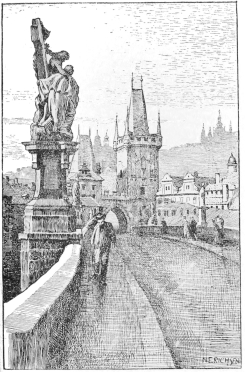
THE BRIDGE TOWER OF THE MALÁ STRANA
Wenceslas gave himself over to much disorder, frequenting various games,
plays and dances. His wife, a very noble and honourable lady, blamed
him....’
In consequence of such reproof the King was incensed against his wife,
and conceived great hatred for her, so that he sought for some cause
enabling him to deprive her of her life. The day after the feast of the
Holy Sigismund he summoned before him the priest, John of Nepomuk, a
master of the University of Prague, canon of the Prague Church, and
confessor of the Queen. He requested him to tell him what sins the Queen
had confessed to him before God. The priest answered, ‘O King, my lord,
I have assuredly not retained this in my memory, and if I had, it would
not be beseeming for me to do this, neither is it beseeming for you to
make such inquiries.’ The King was incensed, and caused him to be thrown
into a grievous subterranean dungeon; then, being unable to obtain
anything from him, he sent for the executioner, and ordered that he
should be cruelly tortured; but being unable even then to obtain any
information from him, he ordered that he should be brought at night to
the bridge of Prague, fettered, and thrown into the waters to drown.
After this had been done, on that night and on the following one many
lights could be seen over the body that was floating on the stream. The
King, hearing of this miracle, left for his Castle of Zebrák, and the
prelates of the cathedral took the body out of the water and carried it
solemnly to the Monastery of the Holy Cross on the citadel of Prague’
(i.e., the Hradcany), ‘then they buried it in St. Vitus’s Cathedral
... afterwards many and manifold wonders took place there, and therefore
many declared that he was one of God’s martyrs and a saint.’
The principal event of the later years of the reign of Wenceslas was the
Hussite movement, of which Prague was the centre. As has already been
mentioned, a strong feeling hostile to the corruption of the Church of
Rome had existed during the reign of Charles. Subsequent events had not
unnaturally strengthened this feeling. Two, afterwards three, rival
candidates claimed the Pontificate, and employed the terrible threats
usual among mediæval theologians against the adherents of their rivals.
It was inevitable that the authority of the Church of Rome should suffer
from this discord, particularly in Bohemia, where Waldhauser and Milic
had left many successors. Of these, by far the greatest was Hus, whose
career is so closely connected with Prague that I shall briefly allude
to it here.
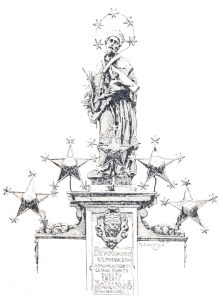 STATUE OF ST. JOHN NEPOMUK ON THE BRIDGE
John Hus, or of Husinec, was born at the village of that name about the
year 1369. The 6th of July was traditionally believed to be the day of
his birth, and as it was also the day of his death, the day was always
celebrated in the Bohemian Church up to the time when the battle of the
White Mountain re-established the Church of Rome in Bohemia. He arrived
at Prague at a very early age, and in September 1393 took the degree of
Bachelor of Arts at the University there. In the following year he
became a Bachelor of Divinity, and in 1396 Master of Arts. His
reputation for great learning spread very rapidly at the University. In
1401 he became Dean of the Faculty of Arts, and in the following year,
at an unusually early age, for the first time Rector of the University.
But it was only from the time that he began preaching in the Bethlehem
Chapel that his name became widely known to those also who were not
connected with the University.
The Bethlehem Chapel, situated in what is still known as the Bethlehem
Place—‘Betlemské Námesti’—was founded in 1391 by John of Milheim, one
of King Wenceslas’s courtiers, together with ‘Kriz the Shopkeeper,’ as
he is called in the contemporary records, a wealthy tradesman of Prague.
Following the example of Milic, whose foundation had been called
‘Jerusalem,’ Milheim and Kriz also gave a Biblical name to the new
chapel. Both founders were favourable to Church reform and partisans of
the national movement. Sermons were always preached in Bohemian at
Bethlehem, and the brilliant eloquence of Hus, of which we can still
judge, as some of his sermons have been preserved, attracted the general
attention of the people of Prague. It is noteworthy that during the
first years of his priesthood—he was consecrated as a priest about the
year 1400—Hus was on good terms with his ecclesiastical superiors. Even
after the first disputes concerning Wycliffe’s teaching had arisen, Hus
was, as he himself mentions, requested by the newly appointed Archbishop
of Prague ‘to bring all irregularities contrary to the rules of the
Church’ to the Archbishop’s notice. It should here already be mentioned
that the teaching of Hus differed from that of Rome far less than was
the case with most Church Reformers. As Dr. Harnack has written,[10]
Hus, like Wycliffe, ‘only denied the alleged right of the clergy to
represent the Church and administer its sacraments even when they did
not fulfil God’s commandments. How—he declared—can the functions of
priests be valid if the presupposition of all they do in the Church and
for the Church, namely, obedience to the law of God, is absent. The
quintessence of that law is the Sermon of the Mount and the example of
the humble life of Jesus; yet the whole of Scripture is the law of God.’
The first disputes between Hus and his ecclesiastical superiors broke
out in 1403. On May 28th of that year a full meeting of the members of
the University, memorable as the beginning of the Hussite struggle, took
place at the Carolinum. It was finally decided that forty-five so-called
‘articles’ culled from the writings of Wycliffe, twenty-four of which
had already been condemned by the Council of Blackfriars, should be
declared heretical, and that all members of the University should be
forbidden to circulate them. Hus and his friends, who were accused of
spreading the heretical opinions of Wycliffe in Bohemia, protested
against this sentence and maintained that the ‘articles’ contained many
statements that were not to be found in Wycliffe’s writings.
Shortly after this first debate, Zbynek Zajic of Hasenburg became
Archbishop of Prague, and it seemed for a time that religious peace had
returned to the country. But in 1408 the clergy of Prague and of the
whole archbishopric of Prague brought forward a protest against Hus’s
preaching at the Bethlehem Chapel,
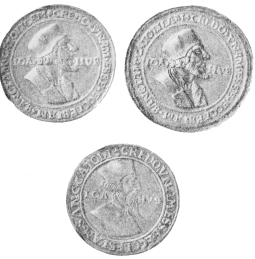
MEDALS OF HUS
stating that he had, ‘in opposition to the decisions of the Holy Church
and to the opinions of the Holy Fathers, and to the injury, shame,
detriment and scandal of the whole clergy and the people generally,’
declared heretics the priests who took payment for ecclesiastical
functions, and blamed the ecclesiastics who held numerous benefices.
Hus, indeed, defended himself eloquently, but he was none the less
deprived of the office of preacher before the Synod, which the
archbishop had conferred on him some time before.
Relations between the archbishop and Hus became yet more embittered when
the latter addressed to his ecclesiastical superior a letter of
remonstrance which Dr. Lechler, a Protestant divine, describes as
‘reaching the extreme limit of what is permissible to a priest when
writing to his ecclesiastical superiors.’ In this letter, written on
behalf of Velenovic, a priest of Prague, who was accused of favouring
Wycliffe’s views, Hus admonished the archbishop ‘to love the good, not
to be influenced by flattery, to be a friend of the humble and not to
hinder those who work steadfastly at the harvest of the Lord.’
At this period the racial and the religious struggle in Bohemia
proceeded simultaneously; those who favoured the movement for Church
reform were also warm friends of the Bohemian nationality. It was
therefore a great triumph for this party, of which Hus was now the
leader, when King Wenceslas, in January 1409, issued the ‘Decrees of
Kutna Hora,’ which secured the permanent supremacy of the Bohemian
nation at the University of Prague. The result was the departure of the
German masters and students from Prague. They left the University
probably in the number of five thousand, though some Bohemian writers
give a much higher figure. After Archbishop Zbynek had recognised
Alexander as the legitimate Pope, the proceedings against Hus had a
much more rapid development. On July 15, 1410, Wycliffe’s writings were
solemnly burnt in the courtyard of the archiepiscopal palace that was
then situated in the Malá Strana, near the bridge.
The burning of Wycliffe’s works met with almost universal disapproval at
Prague. A contemporary chronicler writes: ‘Instantly a great sedition
and discord began. Some said that many other books besides those of
Wycliffe had been burnt; therefore the people began to riot, the
courtiers of the King were incensed against the canons and priests; many
opprobrious songs against the archbishop were sung in the streets.’
Hus, at a meeting of the University, energetically defended Wycliffe’s
teaching; he also, contrary to the positive orders of the archbishop,
continued his sermons in the Bethlehem Chapel. On March 15, 1411, the
sentence of excommunication which had been pronounced against Hus some
time previously was published in the churches of Prague, while the town
itself was placed under interdict. Endeavours to effect a settlement
indeed still continued.
In May 1412, however, the difficulties caused by the Papal schism
brought the reform movement in Bohemia to a crisis. King Ladislas of
Naples, who still recognised Gregory the Twelfth as Pope, had thus
incurred the enmity of John XXIII., who had succeeded Alexander V. as
Roman Pope. John, therefore, resolved to go to war with the King of
Naples, and—a proceeding which it must be added was not exceptional in
those days—to obtain the necessary funds by the granting of
indulgences. It was declared that all those who either took part in the
campaign against Naples, or assisted the enterprise by grants of money,
should receive the same remission of sins which had formerly been
promised to the Crusaders who had liberated the sepulchre of Christ.
The Bohemians, who were not long after to suffer from a ‘crusade’
similar to that now proclaimed against Naples, received the news of the
Papal decision with great displeasure. When Wenceslas Tiem, Dean of
Passau, arrived at Prague, with the purpose of collecting, by the sale
of indulgences, funds for the Papal See, public excitement was naturally
yet greater. Boxes to receive the donations of the faithful were placed
before the Cathedral Church of St. Vitus, the Tyn Church, and on the
Vysehrad. These proceedings caused particular indignation at the
University, where the party favourable to Church reform now had entirely
the upper hand. Hus summoned the members of the University to a
disputatio, according to the mediæval custom. It took place in the
large hall of the Carolinum, and the subject of the disputatio was
formulated in the question ‘whether according to the law of Jesus Christ
it was permissible and befitting for the honour of God, the salvation of
the Christian people and the welfare of the kingdom, that the faithful
of Christ should approve of the Papal bulls which proclaimed a crusade
against Ladislas, King of Apulia, and his accomplices?’ Both Hus and
Jerome of Prague violently attacked the use of indulgences for the
purpose of supplying the Roman See with funds for temporal purposes. The
theological faculty soon after again condemned the forty-five ‘articles’
from Wycliffe’s writings, and added six more that were attributed to Hus
and said to contain the views on indulgences which he had expressed at
the recent disputatio. Pope John also took action against Hus, and
decreed the ‘aggravation’ of the sentence of excommunication that had
already been pronounced against him. The movement had thus taken a
distinctly revolutionary character, and Hus fled from Prague in November
1412, after having published an ‘Appeal from the Sentence of the Roman
Pontiff to the Supreme Judge, Jesus Christ.’ He first retired to Kozi
Hradek, a castle belonging to one of his adherents, John of Usti.
Shortly after his departure from Prague an attempt was made there to
assuage the religious discord. A diocesan synod met there in the
archiepiscopal palace. Hus was not present, but was represented by
Magister John of Jesenic. Little is known of the deliberations of this
assembly, though the documents in which both the Hussite and the
Romanist divines formulated their views have been preserved. This
conference proved abortive, as did also a subsequent attempt of King
Wenceslas to bring the disputed questions before a committee, which was
to consist of four members and over which Albik, then Archbishop of
Prague, was to preside. When it was decided to affirm that both parties
were in accordance with the Church with regard to the doctrine of the
Sacrament of the Altar, the Romanist divines immediately protested,
declaring that they were not a ‘party,’ and demanding that the word
‘Church’ should be defined as the Holy Roman Church, of which Pope John
XXIII. is the head, and of which the cardinals are the members. The
negotiations thus failed from the first, to the great indignation of
King Wenceslas, who, indeed, exiled from Prague some of the German
Romanist divines. The racial struggle, as so frequently in Bohemia,
continued simultaneously with the religious one, and about this time,
through the influence of the King, the majority of the town council of
the old town, which had been German, became Bohemian, and, therefore,
favourable to the cause of Hus.
Hus, who appears to have several times visited Prague secretly at this
time, had meanwhile left the castle of Usti, and was, on the invitation
of Lord
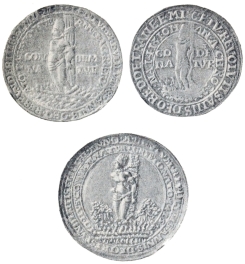
MEDALS OF HUS
Henry of Lazan, one of the King’s courtiers, residing at the castle of
Krakovec, situated considerably nearer to Prague. Contrary to the Papal
commands he frequently visited the neighbouring towns and villages,
preaching in favour of Church reform.
All attempts to settle the religious differences in Bohemia having
failed, the questions raised by Hus were finally brought before a wider
forum. On the suggestion of Sigismund, King of Hungary, and afterwards
German Emperor, Hus proceeded to the council that met at Constance in
November 1414. He had previously, according to the momentous words of
Professor Tomek, received from Sigismund a safe-conduct, according to
which he was ‘to come unmolested to Constance, there have free audience,
and return unharmed, should he not submit to the authority of the
council.’
None the less Hus was imprisoned shortly after his arrival at Constance,
and was—as will be known to most readers—burnt alive on July 6, 1415.
The death of Hus caused general indignation in Prague. Almost all the
parish priests who ventured to praise, or even to excuse the execution
of Hus, were driven from their homes. The Bohemian nobles who met at
Prague in September (1415), and who were joined by many Moravian nobles,
also expressed their indignation strongly. They addressed to the council
a letter known as the ‘Protestatio Bohemorum,’ accusing it of having
‘condemned the venerable magister (i.e., Hus) without having convicted
him of any error, merely on the strength of evil statements of
treacherous enemies and traitors, and of having deprived him of his life
in the most cruel fashion, to the eternal shame and offence of Bohemia
and Moravia.’ They further declared ‘before the council and the whole
world that Magister John Hus was a man of pure life and irreproachable
fame, who taught the law of Scripture according to the doctrine of the
fathers and of the Church, who loathed all errors and heresies, who, by
word, writing and deed, admonished us and all the faithful to desire
peace and to love our neighbours, and by his own quiet and edifying life
guided us in the path of godliness.’
A few days after sending to Constance this declaration that caused great
indignation there, the knights and nobles united in a solemn covenant
for mutual defence. They pledged themselves to defend the liberty of
preaching the word of God, to obey the Pope and the bishops of Bohemia
as long as their commands were not contrary to Scripture, and meanwhile
to recognise the University of Prague as the supreme authority in all
matters of doctrine. The University thus first acquired the important
position of arbiter in matters of doctrine which it held during the
Hussite wars, and, indeed, only entirely lost after the battle of the
White Mountain. The fact that the King and Queen were known to favour
the national movement alone prevented an immediate general outbreak.
Matters became yet more serious when—following the advice of his
treacherous younger brother, Sigismund—Wenceslas endeavoured to stem
the current.
In 1419 the King issued a decree ordaining that all priests who had been
deprived of their livings because of their disapproval of communion in
the two kinds, should be reinstated. Only in three churches were the
Utraquists, as the adherents of the new doctrine were called, to
continue to hold their religious services. The Utraquists, to show their
strength, instituted processions through the streets of Prague, during
which the sacrament was carried before the faithful. One of the most
zealous Utraquists was the priest, John of Zelivo, a former Præmonstrate
monk. On July 30, 1419, he headed a procession which, after violently
interrupting a religious service which was being held in the Church of
St. Stephen, according to the Roman rites, marched to the town hall of
the Nové Mesto, situated in the Karlovo Námesti. The release of some
adherents of the new faith who had been imprisoned there was demanded,
but refused by the burgomaster, who was a Romanist. The Utraquists then,
‘as an affront, called him a German and a hater of the chalice.’[11]
Meanwhile the town councillors had barricaded their hall and threw
stones on the crowd below, one of which struck the monstrance that
Zelivo was carrying. The crowd—led, it is said, by Zizka, afterwards
famous as a Hussite leader—stormed the town hall and threw the town
councillors into the market-place below, where they were killed by the
people.
This ‘defenestration,’ as it was called in Bohemia, marks the beginning
of the great religious struggle in Bohemia, as the defenestration from
the Hradcany windows in 1618 marks its end; for only two years after the
last-named event the battle of the White Mountain established religious
uniformity in Bohemia.
The defenestration was followed almost immediately by the death of
Wenceslas, who succumbed to repeated apoplectic fits on August 16, 1419.
His death was the signal of yet more serious riots, during which many
churches and monasteries were destroyed and many valuable relics of
Bohemian art perished. The Puritan character of the movement is proved
by the fact that no plundering took place and that many houses of evil
fame were destroyed. Temporary quiet was established when it became
known that Queen Sophia, who was favourable to the national movement,
had assumed the Regency. Yet the interval of peace was but short. Armed
meetings of Hussites were held in all parts of Bohemia, and it became
known that such a meeting had been planned at Prague also for November
10. The Queen and her councillors therefore considered it necessary to
take precautions. The Hradcany Castle, the Strahov Monastery and the
archbishop’s palace received strong garrisons of German mercenaries. The
defence of the Vysehrad was entrusted to the former bodyguard of King
Wenceslas. This fortress was carried by assault by the Hussites on
October 25; the soldiers of Wenceslas, who probably sympathised with the
national cause, offering but very slight resistance. The Praguers,
reinforced by allies from the surrounding country, now attacked the Malá
Strana. They stormed the bridge (November 4) and occupied the buildings
immediately beyond it; and it seemed for a time possible that they
should even obtain possession of the Hradcany Castle, from which Queen
Sophia fled hastily. Nightfall for a time put a stop to the fighting,
but all foresaw that the battle would continue. As an ancient chronicler
writes: ‘This night was a dreadful and anxious one for all Prague;
during all night the large bells rang, summoning the citizens to remain
under arms for the continued battle in the Malá Strana; only long after
midnight there was quiet for a short time.’
Fighting was resumed on the following day, and the Royal troops,
commanded by Cenek of Wartenberg, who had replaced Queen Sophia as
Regent, also received reinforcements. The Royal troops destroyed the
town hall of the Malá Strana, and also burnt down the monastery of St.
Nicholas in the same part of the town, while the Praguers entirely
destroyed the archiepiscopal palace that is said to have contained
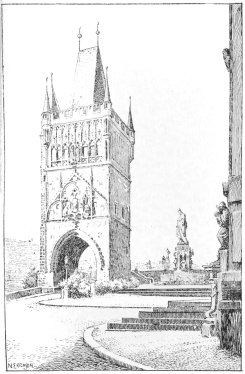
THE BRIDGE TOWER OF THE OLD TOWN
many art treasures. Zizka, the great leader of the Taborites—as the
more advanced Hussites were called, from the name of the town that was
their centre—here first showed his great military ability. The citizens
now became desirous for peace, while the Utraquist nobles who had
remained faithful to the Royal cause were yet reluctant to continue
warfare against those whose creed they shared. A truce was concluded on
November 13, according to which the Praguers were to give up the
Vysehrad to the Royal troops, while the Utraquist nobles promised to aid
their countrymen in defending the Hussite creed. Zizka and the more
advanced Church reformers, distrusting the compromise, left Prague for
the time, proceeding to Plzen, and afterwards to Tabor.
Meanwhile King Sigismund arrived in the Bohemian lands, of which he
claimed the succession as heir of his brother. He first proceeded to
Brünn (or Brno), the capital of Moravia. Many Bohemian nobles and
officials appeared at his court, and a deputation of the citizens of
Prague also appeared before him on December 29. The Praguers assured the
King of their loyalty, begging only ‘to be allowed to remain faithful to
that which they had learnt from the Holy Writ.’ Sigismund received the
envoys most ungraciously, obliged them to continue kneeling longer than
was customary, and overwhelmed them with reproaches and insults. He
finally dismissed them with the solemn command that they should, as a
proof of their obedience, cause the chains that had been placed at the
corners of the Prague streets for purpose of defence to be instantly
removed, and the fortifications which the citizens had constructed
opposite the Hradcany Hill to be destroyed. He also enjoined them to
inflict no further injury on the monks.
The magistrates of Prague did not dare to disobey the Royal commands.
On January 4, 1420, the chains that had been placed in the streets were
deposited in the town hall of the Staré Mesto, and the fortifications
that had been erected on the approaches of the Hradcany were destroyed.
Many monks, priests and Germans who had left Prague during the recent
disturbances returned, believing that the hour of their triumph had
come. A contemporary chronicler[12] tells us that ‘the Germans laughed
and joyfully clapped their hands, saying, “now these heretical Hussites
and Wycliffites will perish, and there will be an end of them.” ’ The
Bohemian and Hussite citizens, on the other hand, not unnaturally looked
forward to the future with great apprehension.
Sigismund did not, as was expected, immediately proceed to Prague. He
for a time took up his residence at Breslau, the capital of Silesia,
where he collected a large armed force. Through his influence Pope
Martin V. issued a bull in which he called the whole Christian world to
arms against ‘the Wycleffites, Hussites, and other heretics, their
furtherers, harbourers and defenders.’
It is not perhaps easy for a modern reader to conceive the effect such a
declaration of war produced on the Bohemians, for a crusade had hitherto
almost always only been preached against heathens, infidels and Turks.
The whole nation rose in arms against Sigismund. The indignation was
particularly great at Prague, where the news was received that, by
orders of Sigismund, John Krasa, one of the leading citizens, had been
dragged through the streets of Breslau by horses and then burnt at the
stake. John of Zelivo, in his sermons, denounced Sigismund violently in
language drawn from the Apocalypse. The audience, inflamed by his
eloquence, swore to sacrifice life and fortune for the cause of the
chalice. Those hostile to Church reform not unnaturally dreaded the
outbreak of hostilities, and we read that seven hundred families from
the old, and seven hundred families from the new town, either sought
refuge in the castles of Hradcany and Vysehrad, that were held by
Sigismund’s troops, or left Prague altogether. The citizens in no way
hindered their departure, which, indeed, in view of the coming siege,
was advantageous to the Hussite cause. Those who remained were yet more
determined to resist Sigismund to the utmost. On the suggestion of John
of Zelivo the citizens who remained in the town, the Hussite preachers,
and the members of the University, met on April 3 (1420) at the town
hall of the Staré Mesto. All present swore to defend, to the last drop
of blood, the right of receiving communion according to the Utraquist
faith, and to resist all, and particularly the so-called ‘Crusaders,’
who might endeavour to harm the Utraquists. As leaders in the defence of
the menaced capital they elected eight captains—four from the old and
four from the new—to whom the keys of the town gates and those of the
town hall were entrusted. The assembly addressed a manifesto to all the
towns of Bohemia, begging them to send envoys to Prague to concert on
the common defence. This manifesto attacked the Church of Rome in the
most violent manner. It was stated that the Roman Church ‘was not their
mother, but their stepmother; that she had poured out her poison like
the most furious serpent, and had raised up the cross, the emblem of
love and peace, for the purpose of inciting to hatred and murder; that
she had, by false promises of absolution, incited the Germans, born
enemies of Bohemia and of the Slav race, to begin the war of
extermination which they had always contemplated.’
Even the Regent, Cenek of Wartenberg, for a time sided with his
countrymen. Together with other great noblemen he summoned ‘all
Bohemians and Moravians who were zealous for the Word of God and the
welfare of the Bohemian nation to join him in opposing the Hungarian and
Roman King Sigismund.’ Continuation of warfare was thus a certainty, and
the Hussites unfortunately again began to destroy the churches and
monasteries belonging to adherents of Rome.
Cenek of Wartenberg and the other Bohemian nobles were naturally
indignant at the conduct of their new allies. They therefore lent a
willing ear to the envoys of Sigismund. Wartenberg, abandoning the
national cause, concluded a private treaty with the King, that at first
remained secret. On the condition that he, his family, and the tenants
on his estates, should be allowed to worship according to the Utraquist
creed, he consented to admit the Royal troops into the castle on the
Hradcany. The citizens, exasperated by Wartenberg’s treachery,
endeavoured to recover possession of the castle, but their desperate
attack was repulsed by the Royal troops. Simultaneously, fighting also
began in the new town, the Royal troops that held the Vysehrad making a
successful sortie and defeating the citizens of the new town.
The Praguers now wished to negotiate with the King, while the Royal
troops had also suffered severe losses. An armistice of six days was
concluded, and the citizens sent another deputation to the King.
Sigismund, who was then at Kutna Hora, received the envoys even more
ungraciously than before. As the Praguers afterwards wrote to the
Venetians: ‘The King became harder than steel; as one stung by fury, he
began to agitate his limbs as a madman.’ He declared that it was his
duty to destroy all heresy by fire and sword, even should he have to
extirpate the whole population of Bohemia and colonise the country with
foreign immigrants.
On the return of the envoys another meeting of the citizens took place
in the town hall of the Staré Mesto, where great enthusiasm prevailed.
It was again decided that all should risk their lives and fortunes for
the cause of religious freedom, and fight to the last. An Utraquist
nobleman, Hynek Krusina of Lichtenberg, was chosen as
commander-in-chief. A message was also sent to Zizka and the other
Taborite leaders, stating that ‘if they wished verily to obey God’s law
they should march to their aid without delay, and with as many men as
they could muster.’ After some skirmishing with the Royal troops, Zizka
and his men arrived at Prague (May 20, 1420), where they were joyfully
received by the citizens. From other parts of Bohemia also many
nationalists hurried to the defence of the menaced capital.
Hearing that the Praguers had received reinforcements, Sigismund did not
march straight on Prague, but proceeded to Melnik, where he halted for
some time. By his orders and those of the Papal Legate, Ferdinand,
Bishop of Lucca, horrible cruelties were committed against the
population of the neighbouring country, and particularly the citizens of
Slané and Litomerice.[13] In a period of intense religious passion such
cruelties inevitably led to reprisals. We read that the Hussites who
were besieging the Hradcany burnt alive nine Romanist monks in view of
the Royal garrison.
Sigismund, whose army had been reinforced by numerous ‘Crusaders,’ now
decided to march on Prague. Almost all countries of Europe contributed
to this vast army. According to a contemporary writer there were
numbered among the Crusaders ‘Hungarians, Croatians, Dalmatians,
Bulgarians, Sicilians, Wallachians, Cumanians, Jazyges, Ruthenians,
Racians, Slovacks, Carniolians, Styrians, Austrians, Bavarians, Francs,
Swabians, Switzers, Frenchmen, Arragonians or Spaniards, Englishmen, men
of Brabant, Dutchmen, Westphalians, men of Saxony, Thuringia, the
Voigtland, Meissen, Lusatia, and the march of Brandenburg, Silesians,
Poles, Moravians and “renégate” Bohemians.’ A letter written by the
Praguers merely states that innumerable men from more than thirty
kingdoms and provinces arrived before their city, while Monstrelet, a
contemporary, writes that ‘Il arriva tant de gens qu à peine se
pouvaient ils nombrer.’ Most of the princes who ruled these countless
countries had accompanied their troops. We read that all the German
Electors, except the Elector of Saxony, Albert Duke of Austria,
forty-three men of princely rank, Brunorius della Scala of Verona, the
Patriarch of Aquileja, many counts of the empire, knights and nobles,
were with the crusading army.
Sigismund and his forces first entered the Vysehrad fortress, and then,
crossing the river, provisioned the Hradcany Castle, the siege of which
the Hussites were obliged to abandon. The vast army—according to the
chroniclers it consisted of 100,000 or 150,000 men, but the latter
figure is probably nearer to truth—now encircled Prague in every
direction. The German soldiers, who were encamped on the left bank of
the Vltava, opposite the Staré Mesto, insulted their enemies by
incessant cries of ‘Ha, ha! Hus! Hus! Ketzer![14] Ketzer!’
The Praguers and their scanty allies meanwhile fearlessly and
confidently prepared to encounter the world in arms against them. With
them, as afterwards
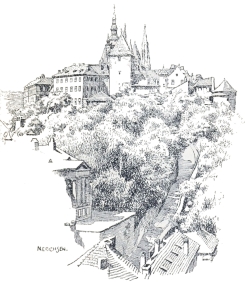
THE HRADCANY
with the Puritans, absolute confidence in Scripture rendered despondency
impossible; for, to borrow the words of Mr. John Morley, ‘No criticism
had then impaired the position of the Bible as the direct Word of God, a
single book one and whole, one page as inspired as another.’ A thorough
knowledge of the Old Testament is evident in all the contemporary
records of those stirring times. No man or woman of Prague doubted that
the Lord, who had once struck down the forces of Sennacherib, would now
strike down those of Sigismund.
The 14th of July was fixed by Sigismund for the general attack. It was
decided that the Royal forces that were quartered in the Hradcany Castle
should attack the adjoining Malá Strana and the bridge tower on the left
bank of the Vltava, while the forces on the Vysehrad would endeavour to
storm the new town, which was at the foot of that fortress. A third army
was to attack the old town from the so-called Spitalské Pole (hospital
field), which was situated on the spot where the suburb of Karlin, or
Karolinenthal, now stands. An attack was also to be made on the hill
then known as the Vitkov, but which has, after the victorious Taborite
leader, since that day been called the Zizkov, or Zizka’s Hill. This
hill was the key of the position of the defenders, who depended on its
possession for maintaining their communications with the country. The
Zizkov was held by Zizka and his Taborites, who had thrown up slight
fortifications. The Germans attacked the hill with a strong force, and,
in spite of the heroism of Zizka, who fought in the front rank, for a
time drove the Bohemians back. One of the small earthworks was held for
a long time by only twenty-six men, two women and one girl, against
several hundred Germans. When the Taborites were for a time forced to
retreat, one of these women refused to leave her post, saying that a
true Christian must never give way to Antichrist. She was immediately
cut down by the Germans. This incident is very characteristic of the
indomitable religious enthusiasm that for a time rendered the Bohemians
invincible. The clanging of all the church bells hastily summoned the
citizens, who, led by a priest carrying the monstrance, hurried to the
aid of their allies. The Germans were completely routed; many were
killed during their flight from the hill—then much steeper than at the
present day—and many perished in the Vltava. As soon as victory seemed
certain, the Taborites and Praguers knelt down on the battlefield and
intoned the ‘Te Deum Laudamus,’ while the whole town was filled with
unspeakable joy.
The other attacks on the city were also unsuccessful. Sigismund had
remained in the rear with part of his army, and returned to his camp as
soon as he saw the defeat of his troops. According to the Austrian
chronicler, Ebendorf of Haselbach, the King ‘smiled—it is said—over
the fate of the brave Christians who had succumbed to the heretics, who
had triumphed over them.’
On Monday, July 15—the battle had been fought on a Sunday—solemn
processions through the streets of Prague, led by the Hussite clergy,
took place in celebration of the great victory. Zizka, however, who
believed a new attack probable, hastily collected a large crowd of men
and women, who, under his direction, strengthened and enlarged the
fortifications on the Vitkov, the scene of the victory of the day
before.
The supposition of the Taborite leader, however, proved erroneous, for
the victory on Zizka’s Hill practically ended the siege of Prague. It is
as impossible to explain this as it is to account for the fact that the
by no means decisive defeat of Marathon should have induced the Persians
to abandon for a time their intention of conquering Greece. It is
certain that dissensions broke out in the vast camps of the Crusaders.
The foreign allies of Sigismund distrusted all Bohemians, even those who
were on the side of the King, while the latter, who had, as Palacky
writes, learnt that ‘even the largest force is insufficient to subdue a
strong and resolute people,’ now felt more disposed to listen to the
words of those Bohemian nobles who, indeed, sided with their Sovereign,
but did not share the German desire to extirpate the whole Bohemian
nation. These men suggested negotiations between the King and his
Hussite subjects. Such negotiations were facilitated by the fact that
the united Hussites had, meanwhile, drawn up a summary of their demands,
which is known as ‘The Articles of Prague.’[15] It will here be
sufficient to state that the Bohemians demanded freedom of preaching,
the use of the chalice at communion, obligatory poverty of the clergy
and severe regulations against mortal sins. It was decided that a
conference should take place in the open air among the ruins of the Malá
Strana, at which the magisters of the University, with the chiefs of the
Praguers and Taborites, were to meet some German nobles, envoys of King
Sigismund, and the Patriarch of Aquilya, and Simon, Bishop of Trace, who
acted as representatives of the Papal See. The meeting led to no result,
as the representatives of the Roman Church declared that no decision of
the Church could be contested or discussed. The magisters of the Prague
University expressed surprise that the Papal envoys attributed greater
authority to the ‘fallible Church than to the infallible words of
Christ.’
The failure of these negotiations no doubt confirmed Sigismund in his
resolution of leaving the neighbourhood of Prague. The dissensions in
his army became more and more envenomed; serious epidemics broke out
among the troops; a great fire destroyed large parts of the encampments.
Before abandoning the siege, however, Sigismund caused himself to be
crowned King of Bohemia in St. Vitus’s Cathedral.
The writers hostile to Sigismund lay stress on the absence of many
nobles whose Court dignities rendered their presence at coronations
necessary. They also mention that no representatives of the Bohemian
cities, none in particular of Prague, ‘the mother of all Bohemian
cities,’ assisted at the ceremony.
Two days afterwards Sigismund broke up his camp and retired to Kutna
Hora, thus giving the signal of departure to the Crusaders, who
hurriedly returned to their countries. Royal troops, however, continued
to hold the castles of Vysehrad and Hradcany.
The citizens now immediately began the siege of the Vysehrad. After a
time the defenders, who were suffering from hunger, were compelled to
conclude a truce for three days, according to which they would
capitulate if they had received no aid by the morning of November 1.
Sigismund meanwhile had returned to the neighbourhood of Prague with an
army consisting mainly of Moravians, and containing many Utraquist
nobles from that country. On the other hand many of the Bohemian nobles,
such as Hynek Krusina of Lichtenberg, who was first in command, Victor
of Podebrad (father of the future King), and many others openly joined
the national cause.
The Vysehrad Castle was now surrounded in every direction. Zavis
Bradaty, with the citizens of Zatec and Loun, and a large force of armed
peasants, were encamped between the Karlov[16] and the Botic stream.
Next to them were the troops of the Utraquist nobles and of the
Orebite[17] community, while the citizens of Prague held the post of
honour nearest to the village of Pankrac, whence the attack of the
relieving army was expected. At the last moment forty Taborite
horsemen, led by Nicholas of Hus,[18] joined the Praguers.
The King arrived at the village of Pankrac on October 31, and sent a
message to the commander of his troops on the Hradcany telling him that
he would attack the citizens on the following morning, and ordering him
also to attack the bridge from the Malá Strana. ‘But’—as a contemporary
chronicler writes—‘God, who is ever an enemy of the haughty and a
friend of the humble, caused this message to fall into the hands of the
Praguers.’ The citizens and their allies therefore spent the whole night
in preparing for battle. The former trenches had, of course, been
constructed for besieging the Vysehrad; but the Praguers, who held the
most important position, hastily threw up earthworks on a spot where the
fish ponds, still frequent in that neighbourhood, rendered the attack
more difficult.
In the morning (November 1) Sigismund rode to the summit of a little
hill beyond the village of Pankrac, and in view of the Vysehrad, and
waved his sword as a signal to the garrison to attack the rear of the
enemy’s army. ‘But, as according to God’s will,’ the chronicler writes,
‘the hour had already passed, the garrison did not stir.’ A few German
soldiers who formed part of the garrison, indeed attempted to come to
Sigismund’s aid, but were held back by their Bohemian comrades. Seeing
that no sortie from the Vysehrad was intended, several of the Moravian
nobles rode up to the King and advised him not to attack the Praguers,
otherwise both he and his people would suffer much evil. The King
answered, ‘I must war with these peasants to-day.’ Then Henry of
Plumlov, Captain of Moravia, said, ‘Be certain that this day will have
an evil end; I dread the fighting-clubs[19] of the peasants.’ The King
answered, ‘I know that you Moravians are cowards and faithless to me.’
Then Lord Henry and the other Moravian lords mounted their horses and
cried, ‘We will obey your order and we shall be there, where you will
not be.’ The nobles attacked the strong position of the Praguers with
great vigour, and for a moment the citizens wavered. Then Krusina
hurried to the spot where they stood, and exclaimed with a loud voice,
‘Dear brethren! turn back again and be to-day brave knights in Christ’s
battle, for it is God’s, not our fight, that we are fighting to-day. You
will see for sure that God will deliver all His and our enemies into our
hands.’ Hardly had he ceased speaking when the cry, ‘The enemy is
flying,’ was heard. The citizens speedily rallied, and, assuming the
offensive, drove the Moravian nobles back into the marshy ground that
extended from the Vysehrad to the village of Pankrac. A great massacre
of the nobles, whose heavy armour impeded their movements, took place,
and flight soon became general. Sigismund himself, who, regardless of
the taunts of the Moravian nobles had again remained with the rear of
his army, did not halt till he had reached the town of Cesky Brod. A
very large number of Moravian nobles fell in this battle, and many also
died of their wounds at the village of Pankrac, after receiving
communion in the two kinds, as the pious chronicler states. It is
touching to note that the Praguers sorrowed over the death of the
Moravian nobles, who, though they had fought against the city, yet
belonged to the same race as the citizens. The citadel of Vysehrad
surrendered on the day of the battle, and on June 7, 1421, the garrison
of the Hradcany—which had unsuccessfully attempted a diversion during
the battle of the Vysehrad—also capitulated.
One of the most important results of the battles of the Zizkov and of
the Vysehrad was the temporary hegemony over Bohemia, or at least the
greatest part of the country, which the city of Prague obtained. The
‘mother and head of the Bohemian cities,’ which had gloriously and
successfully defended the religious and political liberty of the
country, not unfairly claimed the leadership. The once powerful Bohemian
nobility had been weakened by dissension. Some of its members still,
though reluctantly, remained faithful to Sigismund. Others, perhaps also
reluctantly, recognised the city of Prague as their over-lord, though
they never—as was the case in some Italian cities—became merged in the
mass of the citizens. The Taborites, who had taken but little part in
the ‘crowning mercy’ of the Vysehrad, had not yet attained the height of
their power.
The strong attitude assumed by the predominant city appears very clearly
in the manifesto[20] which the Praguers, in union with some of their
allies among the nobles, issued a few days after the victory of the
Vysehrad. This document is a stirring appeal to the national feeling,
and such an appeal has rarely remained unheeded in Bohemia.
After violent denunciations of Sigismund, who, it was stated, had
preferred to the Bohemians ‘the Germans and Hungarians, the cruellest
enemies of our nation,’ and who was ready to sacrifice a kingdom, were
there but no Bohemians in Bohemia, the citizens declared that they would
consider all who favoured such a King as men who desired the ruin of the
country. They would, therefore, consider such men as open enemies of God
and of the nation.
It is interesting to give a brief outline of the
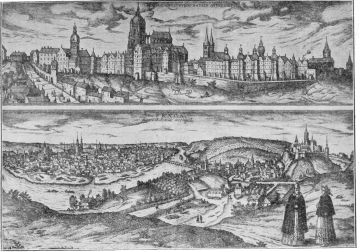
VIEW OF PRAGUE AND HRADCANY CASTLE
constitution of Prague at the moment of her greatest power. This
constitution may be defined as that of a theocratic republic, though
attempts to obtain a new Sovereign in succession to Sigismund always
continued. The principal legislative authority was at this period
concentrated in the ‘great assembly’ (Veliká Obec), of which almost all
citizens formed part, and which met in the open air in the
market-places. The executive power was in the hands of the burgomaster
and of the town councillors, who were elected by the great assembly.
Though the separation between the old town and the new town continued,
it seems at this period to have been an almost nominal one.
Less easy to define, but perhaps yet greater, was the influence of the
preachers, mainly founded on the almost exclusive interest in
theological controversy that was then general in Bohemia. John of
Zelivo, who has already been mentioned, for a time acquired boundless
popularity among the citizens. His influence largely contributed to
securing to Prague the hegemony over Bohemia, and after his downfall and
death, to which I shall presently refer, Prague soon lost its
predominant position.
Warfare with Sigismund continued in spite of his great defeat, and the
citizens of Prague played a prominent part in it. Their party, to
accentuate the hegemony of the city, is generally called ‘the Praguers’
by the old chroniclers, in distinction both from the Romanists and the
Taborites. The scene of the subsequent Hussite warfare was, however,
generally distant from Prague, and therefore requires no notice here. It
is only occasionally that Prague again becomes the centre of events.
Such was the case when, on April 21, 1421, ‘to the surprise and horror
of all Christendom,’ the Archbishop of Prague, Conrad of Vechta,
declared that he accepted ‘The Articles of Prague,’ thus joining the
national Church. The news was joyfully received by the citizens of
Prague. The Te Deum Laudamus was sung and the bells of all the
churches were rung. All swore to obey the archbishop and to defend him.
Only a few of the preachers who were favourable to Tabor looked with
displeasure on the ‘healing of the anti-Christian monster.’ On the other
hand, Conrad was not unnaturally overwhelmed with abuse by the
Romanists. Dr. Tomek writes: ‘Archbishop Conrad was neither better nor
worse than the majority of the Bohemian ecclesiastics of high rank at
that period.’ To the student of the times a certain amount of scepticism
may, in an exalted Bohemian ecclesiastic of the period, appear, though
unpardonable, hardly inexplicable. Shortly afterwards, in accordance
with a decision of a meeting of the Estates at Caslav, a synod of the
Bohemian clergy assembled at the Carolinum in Prague.
Archbishop Conrad was indeed not present, but he had delegated as his
representatives several Hussite clergymen, of whom Magisters Pribram and
Jacobellus were the most eminent. The synod resulted in a failure,
mainly in consequence of the obstinacy of the delegates of Tabor.
Internal discord broke out in Prague not long after the failure of the
synod. Under the leadership of John of Zelivo, the democratic party in
the city acquired ever-increasing strength, and opposed the provisional
government of comparatively moderate views, which had been established
at the assembly of Caslav. The more moderate party firmly believed in
the possibility of securing an agreement with Rome, if the Bohemians but
limited their demands to ‘The Articles of Prague,’ and eschewed
ultra-revolutionary tendencies both in Church and State. That the views
of the moderate Hussites were to a certain extent justified is proved by
the fact that a settlement on the lines they contemplated was eventually
obtained at the Council of Basel. But compromises are as distasteful to
religious as to political fanatics, and Zelivo’s influence rendered all
attempts at conciliation illusory. Zelivo’s undefined power became more
and more pronounced, and it is undoubtedly through his influence—though
evidence is not quite conclusive—that an Utraquist noble of moderate
views, John of Sadlo,[21] who had come to Prague to justify himself
against probably untrue accusations, was, when he appeared in the town
hall, immediately arrested and decapitated without trial or judgment.
Reaction against the ultra-democratic, or rather anarchist, party soon
increased among the citizens, and the influence of their aristocratic
allies was also used to the detriment of Zelivo. An eye-witness of his
fall and death has left us a detailed account of the events. John was
enticed to the town hall of the Staré Mesto, under the pretext of
seeking his advice concerning a new campaign against Sigismund. He was
at first kindly received, but the magistrates suddenly called in their
officials, who seized Zelivo. He attempted to remonstrate, but the
burgomaster of the old town said, ‘It cannot be otherwise, priest John!’
Zelivo was allowed time for confession, and then decapitated. Rioting
almost immediately ensued, particularly after a priest had shown John’s
head to the people. Many houses in the old town, particularly in the
Jewish quarter, were pillaged. The people insisted on the election of
new town councillors, and several men, who were principally
instrumental in plotting Zelivo’s death, were decapitated. His death
none the less greatly diminished the power of the democratic party,
particularly in the old town, as no demagogue of equal ability succeeded
Zelivo.
Order was to a certain extent re-established in Prague during the short
rule of Prince Sigismund Korybut of Lithuania, a nephew of the King of
Poland, whom the Utraquist nobles wished to substitute to Sigismund of
Hungary as their ruler. Korybut arrived at Prague in May 1422, and
remained there to the end of that year. He unsuccessfully attempted the
siege of the Karlstyn that was still held by the Royal troops. This
failure, as well as the influence of the King of Poland, induced Korybut
to leave Prague, though, as events proved, only temporarily.
Shortly afterwards dissensions, ending in civil war, arose between the
Praguers and the Taborites. The internal dissensions were not, however,
of long duration, as the news of a new ‘crusade’ reunited all Bohemia,
and the Treaty of Konopist (1423) for a time restored internal
tranquillity. Unfortunately the truce lasted but for a short time. The
new crusade proved a yet greater failure than those that had preceded
it. The Germans and other crusaders speedily recrossed the frontier
without even having encountered the Hussites on the field of battle, and
we find the Praguers and Taborites again at war in 1424. Through the
intervention of Korybut, who had meanwhile returned to Prague, another
conference took place on the so-called Spitalské Pole (hospital field).
Mainly through the eloquence of a young preacher at the Tyn Church,
Rokycan, afterwards famous as Utraquist Archbishop of Prague, an
agreement was obtained. It is a curious proof of the mutual distrust
that prevailed that an agreement had been previously made, according to
which the party that violated the truce should be fined a considerable
sum, and that a large heap of stones should be placed in the Spitalské
Pole for the purpose of stoning immediately all disturbers of the peace.
After the meetings at Konopist and on the Spitalské Pole, many others
took place, in all of which the minutiæ of theology were discussed with
that intense interest in religious controversy that was characteristic
of the Bohemians of that time; of such meetings we may mention that held
in the Hradcany in 1424, and the somewhat later one at the Carolinum.
Religious dissensions also caused the downfall of Korybut in 1427. The
clergy of Prague were then divided into two parties: the more moderate
one led by Magister Pribram, which Korybut favoured, and the advanced
one, which was more in sympathy with the Taborites, and which had as
leaders Rokycan, Jacobellus, and Peter Payne, who, in consequence of his
English origin, was known as ‘Magister Englis.’ He played a considerable
part in the contest, as a contemporary song tells us that—
‘The devil sent us Englis;
He walks stealthily through Prague,
Spreading doctrines from England
That are not wholesome for the Bohemians.’[22]
In consequence of Korybut’s support of the moderate party the advanced
Hussites resolved to depose him. On April 17, 1427, he was surprised,
captured without bloodshed, and conveyed to the Castle of Waldstein,
near Boleslav. In September some of the nobles of his party attempted to
obtain possession of Prague with the aid of Korybut’s partisans in the
city. They succeeded in entering the town, and penetrated as far as the
Staromestské Námesti. Desperate fighting ensued, but the advanced
Hussites were finally victorious, and almost all the invaders were
killed or made prisoners. Shortly afterwards Korybut was released and
allowed to return to his own country.
It is only quite at the end of the Hussite Wars that the capital again
becomes the scene of strife. After the great defeat of the troops of the
last crusade at Tauss (or Domazlice), the Church of Rome had for a time
abandoned the idea of subduing Bohemia by force of arms. A Council
assembled at Basel, and after prolonged negotiations the Bohemians
consented to be represented there. Their envoys, among whom were
Rokycan, afterwards Archbishop of Prague; Prokop the Great, leader of
the Taborites; Nicholas of Pelhrimov, surnamed Biskupec; Peter Payne,
the ‘English Hussite,’ and many others arrived at Basel on January 4,
1433. The negotiations began there, and afterwards continued at Prague,
where the Council sent envoys, and where the Estates met in the
Carolinum on June 12. Though these negotiations with the Council as yet
proved unsuccessful, the delegates of the Council, before leaving Prague
in January 1434, urgently exhorted the Utraquist nobles to take a more
active part in the politics of their country, and to use their influence
in favour of an agreement with Rome.
These words made a great impression on the Bohemian nobility, which
viewed with great displeasure the almost complete extinction of its
formerly overwhelming power. The struggle in Bohemia now became rather
one between aristocracy and democracy than between contending religious
parties. In direct connection with this new phase of the Bohemian
struggle are the troubles that broke out at Prague. Ever since 1429
great antagonism, founded partly on local, partly on political
differences, existed between the old and the new town. The former
gradually became an ally of the Utraquist, and even of the Romanist
nobles, while the men of the new town drew nearer and nearer to the
Taborites. In 1434 Ales of Riesenburg was elected Regent of Bohemia, and
a league ‘for the restoration of peace and order in the country’ was
formed. It was joined by almost the entire nobility of Bohemia and by
the citizens of Plzen, Melnik, and the Staré Mesto of Prague. The
citizens of the Nové Mesto refused to join the confederacy; guided by
the Taborite general, Prokop the Great, they began to prepare for war,
and barricaded their streets that were nearest to the old town. Called
in by the citizens of the old town, the nobles marched to their aid.
Unable to arrive there directly, they crossed the Vltava to the Malá
Strana, that was then under the rule of the old town. Joining the
citizens here they together attacked the new town, which was subdued
after some fighting. The men of the new town, who defended their town
hall, resisted for some time, but capitulated after receiving permission
to leave the city. A large part of the new town was pillaged by the army
of the nobles, and their allies, the victorious citizens of the Staré
Mesto, henceforth claimed supremacy over the new town.
Prokop hurriedly left Prague and wrote to Prokupek, the commander of the
Taborite forces before Plzen, that ‘by God’s permission the false barons
with the citizens of the old town have attacked our dear brethren, the
citizens of the new town; they killed some and conquered the town.’ A
few months later the great battle of Lipan resulted in the victory of
the aristocratic party, and the ‘fall of Tabor,’ to use the words of
the great Bohemian historian Palacky.
The defeat of the democratic party paved the way to the recognition of
Sigismund as King. After prolonged negotiations at the Council of Basel
and meetings of the Estates at Brno and Jihlava,[23] the Bohemians
recognised Sigismund as their King, while he promised to obtain for them
certain religious concessions, of which the permission to receive
communion in the two kinds was the most important. A document known as
the ‘Compacts’ enumerated these concessions.
On August 23, 1436, Sigismund arrived at the gates of Prague, where he
was met by the magistrates of the three cities.[24] Amidst great
rejoicings of the people, he proceeded to the Tyn Church, where Mass was
celebrated by Archbishop Rokycan according to the Utraquist rites.
On the following Sunday, August 26, the magistrates of the three towns,
in the market-place of the old town, appeared before Sigismund, who was
sitting on a throne in his imperial robes, but wearing the Bohemian
crown. They brought to him the keys of the town gates, which Sigismund
immediately returned to them in proof of his entire reliance on their
fidelity. He also confirmed all the ancient privileges of Prague, and
again granted the men of the Nové Mesto independence from the old town.
The short period during which Sigismund was destined to reign over
Bohemia was yet sufficiently prolonged to witness the destruction of the
short-lived friendship between the King and his Bohemian subjects.
Sigismund, who was during his whole life a fervent adherent of the
Church of Rome, had accepted the Compacts as reluctantly as they had
been granted
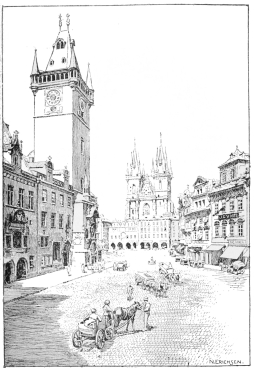
THE TOWN HALL AND MARKET-PLACE
by the Church of Rome. He had also promised to use his influence with
the Papal See to obtain the recognition of Rokycan as Archbishop of
Prague. The Estates had elected him to that office at a meeting which
they held in September 1435, but Rome now, and indeed always, refused to
recognise him as Archbishop of Prague. The attitude of Sigismund in this
matter was undoubtedly propitious. As Dr Tomek writes: ‘Publicly
Sigismund wrote to the Council recommending it to confirm Rokycan’s
nomination as Archbishop; secretly he advised the contrary.’ Bishop
Philibert of Contances, who had taken part in the previous negotiations
between the Council of Basel and the Bohemians, had accompanied
Sigismund to Prague. Though without any recognised position in the
country, Philibert endeavoured to exercise archiepiscopal functions at
Prague, thus encroaching on the rights of Rokycan. Discord between the
two ecclesiastics very soon began, and Philibert, who had assisted at a
religious service held by Rokycan in the Tyn Church, noted with great
displeasure that the sermon was preached in Bohemian, and that several
hymns were also sung in that language.
While Sigismund in these disputes favoured the Roman Church, to the
great displeasure of the Bohemians, other causes also contributed to his
increasing unpopularity. Sigismund had awarded all the State offices
either to Romanists or to such Utraquists as were nearest to Rome, thus
excluding the enormous majority of the Bohemians. The King’s cruelty to
the Taborite lord, John Rohác of Duba, was also viewed with great
displeasure by the people. Rohác had remained in arms even after the
general pacification. His castle, to which he had given the biblical
name of Zion, long resisted the Royal arms. He was finally obliged to
capitulate, and was by Sigismund’s orders executed on the Staromestské
Námesti at Prague. This caused renewed warfare, as John Kolda, lord of
Zampach, who with Rohác was one of the few nobles who was to the last
faithful to Tabor, rose in arms against Sigismund.
Though there was thus no real concord, the short reign of Sigismund was
marked by a ceremony that formally concluded the Hussite Wars. Papal
legates brought the sanction of the Compacts to Prague. On April 13,
1437, a decree was read out in Corpus Christi Chapel, in the presence of
Sigismund, his Consort and the Papal legates, stating ‘that no one
should revile the Bohemians and Moravians for receiving communion in the
two kinds, or for availing themselves of the other right granted by the
Compacts, but that they should be considered true and faithful sons of
the Church.’ Tablets containing this statement were placed in the Corpus
Christi Chapel.[25]
This ceremony hardly even for a time interrupted the religious struggle.
The animosity of the Papal legate and the more veiled hostility of
Sigismund induced Rokycan, who had been deprived of his living at the
Tyn Church, to leave Prague and seek refuge at the castle of one of the
Utraquist nobles. Partly in consequence of incessant political and
ecclesiastical troubles, Sigismund’s already weak health now became
seriously impaired. He resolved to return to Hungary, but died on the
journey at Znaym (December 9, 1437).
Though most of Sigismund’s undertakings proved failures, he was
successful in his principal dynastic ambition, which was to secure the
succession to the Bohemian throne—Sigismund had no male heirs—to his
son-in-law Albert, Archduke of Austria. The
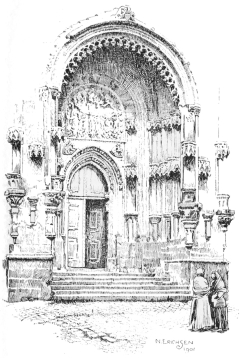
SOUTH PORCH OF TYN CHURCH
Bohemian Estates, though somewhat reluctantly, elected Albert as their
Sovereign, and he was crowned King of Bohemia at Prague on July 29,
1438.
During his short reign Albert obtained but little popularity in Bohemia.
A thorough German and a fervent Roman Catholic, his views, both as
regards racial and religious matters, were in opposition to those of the
majority of his new subjects. Though he had governed Moravia as
representative of his father-in-law, Sigismund, for a considerable
period, he had always declined to learn the Bohemian language, a point
on which the Bohemians have, perhaps not unnaturally, been very
susceptible at all times. Albert, who was also King of Hungary, was soon
obliged to return to that country. Sultan Murad the Second had invaded
Servia and the adjoining districts of Southern Hungary. During the
campaign against the Turks Albert was seized with sickness, and died
(October 27, 1439) after having only reigned two years over Bohemia.
A very tumultuous, almost anarchical, period in Bohemia followed the
death of Albert. The national or Utraquist party, headed by Ptacek, and
afterwards by George of Podebrad, was in constant conflict with the
Austrian or Romanist nobles, whose leader was Ulrich of Rosenberg. On
February 22, 1440, Albert’s widow gave birth to a son, known in history
as Ladislas Posthumus; but as the question whether the Bohemian crown
was hereditary or elective then was still in dispute, this did not
contribute as largely to the stability of the common-wealth as might
otherwise have been the case. Religious strife also continued. In 1448 a
new Papal envoy, Cardinal John of Carvajal, arrived at Prague, and was
at first joyfully received by the people. Public opinion, however, soon
changed. Carvajal declared that the Pope would never recognise Rokycan
as archbishop, and expressed great disapproval when informed that in a
convent he visited communion was administered in the two kinds. His
conduct generally did not tend to give the Puritan Praguers a favourable
opinion of the dignitaries of the Roman Church. When negotiating with
George of Podebrad, the head of the national party, who referred to the
Compacts, the cardinal denied all knowledge of them. Podebrad therefore
sent him the original of that valuable document. Shortly afterwards,
Carvajal, frightened by the hostility of the citizens who threatened him
with the fate of Hus, precipitately left Prague. It was immediately
discovered that the Compacts had disappeared. Rokycan and Magister
Pribram appealed to the magistrates, and the cardinal was pursued by
armed forces. When arrested he was unable to deny the theft, but he
begged to be allowed, to avoid public disgrace, only to open his luggage
on his arrival at Benesov. This was granted to him, and he was escorted
to that town. Here the Compacts were found hidden away among his
luggage, and were brought back to Prague.
The mission of the cardinal thus proved an entire failure, and, indeed,
only envenomed the religious struggle. Civil war was inevitable; it was
only doubtful which party would begin hostilities.
It is probable that George of Podebrad and the other national leaders
had arrived at the conclusion that the differences between their party
and the Austrian one could only be settled by the force of arms, ever
since the failure of the negotiations which had taken place at the great
meetings of the Estates at Prague in 1446. Podebrad appears to have had
evidence proving that the attempts at a reconciliation which the
Bohemians had made through frequent embassies to Rome had been
frustrated by the secret machinations of Rosenberg, the leader of the
Austrian and Romanist party. Still no warlike steps were taken till
after the failure of Carvajal’s mission to Prague. But immediately
afterwards Podebrad assembled an army of about 9000 men near Kutna Hora
and marched on Prague.
Municipal authority in the city was then in the hands of those
Utraquists whose views were nearest to those of Rome, but the large
majority of the citizens of Prague favoured the national party. To
pacify the people the magistrates had, immediately after Carvajal’s
departure, assembled the masters and priests at the Carolinum, and
enjoined on all present not to speak in a derogatory manner of the
Utraquist communion and the Articles of Prague. This decision was made
known to the citizens from the town hall, but it did not lessen the
distrust of the nationalists. After a vain attempt at negotiations, and
after having declared feud to the town, Podebrad obtained possession of
the Vysehrad by surprise and almost without loss of life (September 3).
Continuing their march before daybreak, Podebrad’s troops then took
possession of the adjoining Nové Mesto, and afterwards of the old town.
Here also Podebrad’s men met with little opposition. Their war cry,
‘Kunstat Hr,’[26] terrified their enemies, while it rejoiced the large
majority of the citizens who sympathised with Podebrad. The march of the
national army from the new town to the town hall of the old city, where
Podebrad and his principal generals took up their residence, became a
triumphal procession. The town-captain, Hanus of Kolowrat, and several
of the town councillors succeeded in making their escapes, but the
burgrave, Menhard of Hradec, was captured and imprisoned by order of
Podebrad.
The capture of Prague by Podebrad caused great internal changes in the
capital. Rokycan returned to Prague, and was reinstated in all his
former dignities. On the other hand, the Romanist canons of St. Vitus’s
Cathedral mostly fled to Plzen. Podebrad’s rule did not however remain
uncontested. The lords and cities that were opposed to him formed a
league against him, which, from the town where his opponents met, was
called ‘the confederacy of Strakonic.’ A record of the desultory warfare
that ensued, in which Podebrad and the national party were generally
victorious, is beyond the purpose of this little book. Podebrad
continued to rule the country, and up to the time that Ladislas was able
to exercise, at least nominally, the royal power, he governed Prague
under the title of ‘Gubernator et rector civitatum Pragensium,’ the same
designation that Korybut had formerly assumed.
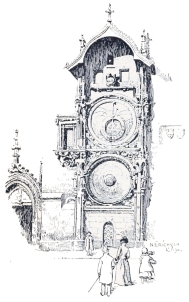 CLOCK TOWER IN TOWN HALL OF STARÉ MESTO
In 1452 the Estates of Bohemia met at Prague and recognised Ladislas as
their King, and in the following year he was, on October 28, crowned as
King of Bohemia in St. Vitus’s Cathedral. The ceremony was performed by
the Bishop of Olmütz, as King Ladislas, then only fourteen years old,
yet refused to be crowned by Rokycan, the Utraquist Archbishop of
Prague. In consequence of the youth of the King, Podebrad continued to
rule Bohemia, not without much difficulty, as the young King’s open
sympathy with Rome and marked hostility to Rokycan embittered the
enormous Utraquist majority of the Bohemian population.
Ladislas, who had proceeded to Hungary in 1456, returned in the
following year to Prague. Shortly after his return the young King, who
was on the point of being betrothed to Magdalen, daughter of Charles
VII., King of France, was attacked by a mysterious illness that was
similar to the Asiatic plague, if not identical with it. That terrible
illness had, since the Turkish invasion, spread widely in Hungary, from
which country Ladislas had just returned. The King summoned Podebrad to
his bedside, took leave of him in touching words, and then died on the
third day of his illness (November 23, 1457).
The body of Ladislas was conveyed to St. Vitus’s Cathedral on November
25. The Romanist chronicler, Eschenloer, who was then at Prague, writes:
‘The sorrow and wailing of the people was very great. Rokycan walked
nearest to the bier with his sacrilegious clergy, carrying the sacrament
and lighted candles. Then the good’ (i.e., Romanist) ‘clergy in small
number followed.’
The premature death of Ladislas again brought the difficult question of
the succession to the throne before the nobles and citizens of Bohemia.
Foreign candidates, such as William, Duke of Saxony, Charles VII. of
France, who endeavoured to obtain the crown for his son Charles, and
Casimir, King of Poland, were represented by envoys when the Estates met
in the town hall of the Staré Mesto on March 1.
The Utraquist members of the assembly had, indeed, from the first
decided to choose one of their number, Podebrad, whom they considered
most worthy of the crown, but the votes of the Romanist envoys were
uncertain. Prolonged debates took place, which on the following day were
continued ‘with great seriousness and conscientiousness.’ Finally the
high burgrave, Sternberg, declared for Podebrad, and kneeling before his
old friend, exclaimed: ‘Long live George, our gracious King and Lord.’
All the other nobles and knights followed his example, and the unanimous
election[27] was enthusiastically received by the crowd that had
assembled outside the town hall. George was then conducted to the
neighbouring Tyn Church, where he was received by Archbishop Rokycan.
Though George had been chosen unanimously, difficulties arose almost
immediately with regard to his coronation, a ceremony to which the
Bohemians have always attached the utmost importance. Finally, through
the intervention of King Matthias Corvinus of Hungary, two Hungarian
bishops undertook to crown the King, and the ceremony was performed with
much splendour in St. Vitus’s Cathedral on May 7, 1458. The chroniclers
state that when the crown was placed on the King’s head one of the
largest jewels fell to the ground. This was afterwards interpreted as
signifying that Breslau, which as capital of Silesia was one of the
greatest towns in the lands of the Bohemian crown, would never be in
Podebrad’s power. During his
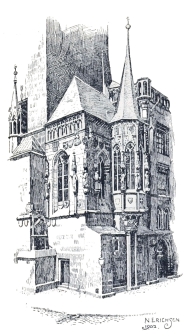
CHAPEL OF TOWN HALL
eventful reign (1458-1471) King George was engaged in constant warfare
with the rebellious Catholic nobles and with King Matthias of Hungary.
That prince had indeed been an ally of George at the beginning of his
reign, but his views changed when it became certain that an agreement
between the Papal See and Podebrad was impossible. The King of Hungary
now declared war against Bohemia, and attempted to supplant George as
ruler of that country.
In 1452 the King assembled the Estates at Prague; the Bohemian envoys,
who had just returned from Rome, the Papal legate and the Romanist
bishops of Breslau and Olmütz were also present. The King presided,
sitting under a baldachin with his consort, Queen Johanna, at his right
and his sons at his left. Podebrad spoke strongly of the treachery of
the Roman Court, and ended by declaring ‘that the Pope should know that
he would not sell his faith for a kingdom, that he, his wife and his
children were ready to risk their kingdom and their lives for the
blessed blood’ (i.e., communion in the two kinds). This speech greatly
affected all present, few of whom could refrain from tears.
The campaigns that occupied the last years of Podebrad hardly belong to
a history of Prague.
On February 22, 1471, Archbishop Rokycan died, only a few weeks before
his old ally King George, who died of dropsy on March 22 of the same
year.
It had, no doubt, originally been a favourite design of Podebrad to
found a national dynasty in Bohemia, but the necessities of his frequent
wars had obliged him to favour the succession of Prince Vladislav of
Poland, thus securing the valuable help of Poland for his country. It
had indeed been tacitly settled during George’s lifetime, but the
Estates maintained their traditional right of choosing their King, and
met for that purpose at Kutna Hora. Besides Vladislav, several other
candidates strove to obtain the Bohemian crown. The most important were
Albert, Duke of Saxony, and King Matthias of Hungary. The whole
influence of Rome was used in favour of the last-named candidate. The
letter which the Papal legate, Rudolph, Bishop of Breslau, addressed to
the Bohemians, and Praguers in particular, is interesting as formulating
the argument against Hussitism, founded on the decline of Prague, that
has been, before and since that time, constantly repeated. After stating
that Christ on leaving the world had appointed St. Peter his
representative, and that the Roman bishops, whom all faithful Christians
should obey, were his successors, the legate admonishes the Praguers to
remember the former glory of their city, which, while it was faithful to
Rome, had surpassed all other towns, even Nuremberg, Cöln and Vienna, in
wealth, power and wisdom; even Florence, Venice and Rome had scarcely
equalled her.[28] The citizens should therefore abandon their Hussite
errors and recognise Matthias as their King. This appeal does not appear
to have impressed the Praguers or the other Bohemians much, for
Vladislav was elected King with but little opposition. He arrived at
Prague on August 19, 1471, and was met outside the town by the clergy
and the people, who conducted him to the Royal residence. He was there
presented with a Bible by the magisters of the University, ‘that reading
it he might learn to rule both himself and his people according to the
will of God.’
Vladislav, as Palacky has noted, was the first Bohemian Sovereign who
was almost constantly absent from the country, while his consort, Anna
de Foix, was the only Queen of Bohemia who never set her foot on the
national soil. Vladislav, as was inevitable in consequence of his
education, favoured the Romanists as far as it was in his power to do
so. Through his influence the principal municipal offices at Prague were
entrusted to men who, though nominally Utraquists, favoured the cause of
Rome in every way. During the absence of the King riots broke out at
Prague in 1483. The more ardent Hussite preachers violently attacked the
government both of the King and of the town magistrates. The magistrates
of Prague therefore resolved to seize these preachers, and it was
rumoured that they had, in union with the magistrates of the Malá Strana
and some Romanist lords, resolved a general massacre of the Utraquists
in the city. One of the magistrates of the old town, Tomasek, surnamed
‘of the Golden Star,’ was reported to have told a neighbour, a fervent
Hussite, that on the Sunday before St. Wenceslas (September 28) ‘they
would give the Utraquists bloody cakes to eat.’ The menace was of course
understood. Both parties began arming, and on September 24 civic warfare
began. The great bells of the Tyn Church were rung, and the people
stormed the neighbouring town hall. The burgomaster was, according to
what may almost be called a national custom, thrown from the windows of
the town hall, and several of the councillors were wounded or
imprisoned. Far more sanguinary were the events in the new town. Here,
also, the town hall was stormed, many of the town councillors were
killed, and a general massacre of Romanists, particularly priests and
monks, ensued. Finally, in the new and in the old town, as well as in
the Malá Strana—where the revolution appears to have been far less
violent—new magistrates were elected, and the magistrates of the three
towns concluded an alliance for mutual defence. King Vladislav, who had
approved of the plans of the former magistrates—it is impossible to
state to what extent—was powerless.
The citizens of Prague, indeed, for a time obtained almost complete
autonomy, which they preserved up to the reign of Ferdinand I., and to a
certain extent up to 1547.
Vladislav died in Hungary in 1516, and was succeeded by his son Louis,
who had already been crowned as King of Bohemia when a child of three
years. Louis, like his father, was King of Hungary also, and spent a
great part of his life in that country.
As his representative in Bohemia, he appointed Leo of Rozmital, but
afterwards replaced him by Duke Charles of Münsterberg, a grandson of
King George, who assumed the title of Regent. Though the latter
attempted somewhat to curb the turbulent citizens, yet Prague enjoyed
almost complete independence, and feuds not dissimilar from those of
ancient Italian cities broke out. Personal ambitions and animosities
masqueraded in the garb of religious differences. We possess a precious
contemporary account of these struggles in the chronicles of Bartos,
surnamed ‘The Writer.’ Two demagogues, Pasek and Hlavsa,[29] contended
for the supremacy over the citizens of Prague; both belonged to the
Utraquist Church, but while the views of Hlavsa, who was largely
influenced by Gallus Cahera, rector of the Tyn Church and a personal
friend of Luther, were more advanced, Pasek belonged to that shade of
Utraquism that was nearest to Rome. Bartos has eloquently described the
conflicts that arose. I can here only allude briefly to the coup
d’état of 1524, by which the reactionary party for a time obtained the
upper hand. On August 9 a crowd of Pasek’s partisans invaded the town
hall of the Staré Mesto and arrested all councillors who were of the
Lutheran creed. Pasek henceforth ruled over Prague as a dictator, and
issued severe decrees against all who ‘favoured foreign heresies.’
King Louis, who was then residing in Hungary, received the news of the
success of the reactionary party with great joy, but the ever-increasing
danger from Turkey did not admit of his interfering actively in the
affairs of Bohemia.
Two years later King Louis perished at the Battle of Mohác, in Hungary,
and the Bohemian throne was again vacant.
The death of King Louis found the lands of the Bohemian crown in a state
of almost complete anarchy, as both Vladislav and Louis had given their
attention mainly to the other countries over which they ruled. Yet the
question as to the hereditary character of the throne still being
undecided, as soon as the news of the death of the King reached Prague,
September 9, 1526, it was rumoured that many princes, undeterred by the
precarious condition of the country, aspired to the Bohemian throne.
These were, besides Archduke Ferdinand of Austria, brother-in-law of the
late King, two Bavarian and two Saxon princes, Sigismund, King of
Poland, and two great Bohemian nobles, Leo of Rozmital and Charles of
Münsterberg. The Estates met at Prague on October 8, and the
deliberations were somewhat prolonged. It was finally decided that each
Estate should choose four electors from their number. The twelve
electors met on October 23 in the Wenceslas Chapel of St. Vitus’s
Cathedral. When they had finished their deliberations, they stated that
they had chosen a King, but that the choice would only be made public on
the following day. On October 24 Leo of Rozmital announced to the
Estates assembled in the Hradcany Castle that Archduke Ferdinand of
Austria had been elected King. All present then sang the national song
‘Svaty Václave.’ On February 24 of the following year Ferdinand was
crowned in St. Vitus’s Cathedral. The following days were spent in great
rejoicings, tournaments and balls in the Hradcany Castle. It was noted
that—the Queen only excepted—the new King danced with no lady but the
wife of Leo of Rozmital, whose exertions had largely aided him in
obtaining the Bohemian crown.
The life of Ferdinand, who was also King of Hungary, frequently ruler of
Germany, and Roman Emperor during the last years of his life, has only
occasional connection with Prague. The fact that he caused the beautiful
Renaissance building known as the Belvedere to be erected at Prague
proves, however, that he was not devoid of interest in his Bohemian
capital. Ferdinand strenuously endeavoured to strengthen the Royal power
in Bohemia. He rescinded the decree of the demagogue Pasek, which had
united the old and the new town in one community; and Pasek, though he
vainly attempted to curry favour with the King, was struck off the list
of the magistrates.
Gallus Cahera, preacher of the Tyn Church, who had now joined the
reactionary party, was exiled from all the Habsburg dominions, and in
1530 Pasek himself was for a short time expelled from Prague. On the
other hand, Hlavsa and some of his Lutheran partisans, who had been
exiled by Pasek, were permitted to return to the Bohemian capital.
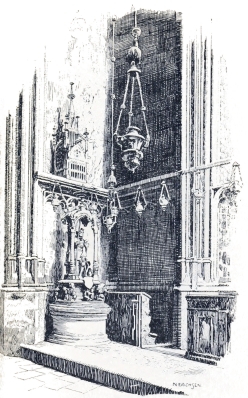
WENCESLAS CHAPEL, ST. VITUS’S CATHEDRAL
Though Ferdinand, as these facts prove, showed more moderation—at least
at the beginning of his reign—than the Bohemians had expected, he was
yet unable to establish religious tranquillity in the country. He was
more successful in his endeavours to strengthen the Royal prerogative
and limit the power of the Estates. That power was to a great extent
founded on their right of electing the Sovereign. It was, therefore, a
great success for the Royalist cause when the King, skilfully using the
circumstance that a great fire in Prague (1541) destroyed all the
ancient State documents, succeeded in persuading the Estates to
recognise a new charter, which declared that Ferdinand had been accepted
as King in consequence of the hereditary rights of his wife, Queen Anna,
who was a sister of King Louis. It must, however, be mentioned that this
curtailing of the privileges of the Bohemian Estates contributed to the
revolutionary movement of 1547.
In that year troubles broke out in Bohemia in connection with the war
that Charles V. and his brother Ferdinand were waging against the
leaders of the German Protestants, John Frederick, Elector of Saxony,
and Philip, Landgrave of Hessé. Ferdinand claimed military aid from his
Bohemian subjects, which the then almost entirely Protestant population
of the country was not unnaturally unwilling to grant. Sixt of
Ottersdorf, who, as clerk, and afterwards chancellor of the old town,
played a considerable part in these events, has left us an interesting
account of these troubles.[30] In 1546 Ferdinand assembled the Estates
and urged them to equip an armed force against the Turks. They
consented, but when it appeared that their levies were to attack, not
the Turks, but Saxony, the largest part of the Bohemian army refused to
cross the Saxon frontier. On January 1, 1547, Sixt of Ottersdorf
presented to King Ferdinand—who, during the then customary interruption
of hostilities in winter, had returned to Prague—the usual new-year
gifts on the part of the citizens, ‘expressing in a Latin speech hopes
that the coming year would end all disturbances and wars in the
Christian world; for they were caused only by some unquiet men.’ In
reply to this ambiguous speech the King stated that he accepted their
gifts and good wishes, and that he hoped that with the aid of the
Praguers and his other subjects he would shortly be able to restore
peace to the empire. On the following day the King ordered the citizens
of the old and new towns to equip 300 armed men each. This, as the
contemporary writers state, caused great displeasure, as the citizens
had no doubt that they were ordered to arm against the men of their own
faith.
A few days later he decreed a general arming of the people, reminding
the Bohemians of an ancient decree, according to which those who did not
give their aid when Bohemia was in danger should lose their lives and
their estates. He therefore summoned all to join him in arms at
Litomerice, but a few Romanist lords alone obeyed the Royal command. The
feeling was general that the Diet’s sanction was necessary for such a
general armament. The Praguers took the lead in the opposition to
Ferdinand, and the movement in their city had a strongly democratic
character.[31] Mistrusting the energy of their magistrates, the
citizens, both of the old and of the new town, at a general meeting on
January 23, 1547, resolved that in future all matters of great
importance should be decided at general meetings of the citizens, who
were to be called together by the town bells. They further declared that
a general arming of the people, without the consent of the Diet, was
contrary to the law of the land. Many Bohemian towns, such as Kolin,
Kourim, Caslav, Cesky Brod, made common cause with Prague, which they
recognised as the ‘head of the Estate of the citizens.’ Many knights and
nobles, particularly those who belonged to the ‘unity’ of the Bohemian
brethren, were in sympathy with the towns, and, indeed, agreed to their
suggestion that a meeting of the Estates should take place. This was
distinctly unconstitutional, as the King alone had the right of
summoning the Estates. On February 13 a private meeting of the nobles
took place at the house of Lord Bohus Kostka, in the Celetná Ulice. All
present agreed to act in accord with the citizens, and after a prolonged
conference ‘proceeded to the Staromestské Námesti singing “True
Christians, let us strongly hope”; they then lifted their hats, berets
and caps when passing the Tyn Church, and retired to their abodes.’
A more formal meeting of the Estates took place in the following month.
King Ferdinand had, indeed, written from Dresden to the high officials
of Prague, ordering them to do everything in their power to prevent this
meeting of the Estates, who had not been summoned by their King. They,
none the less, met on March 18 at the Carolinum, where 800 nobles,
knights and representatives of the Bohemian towns (except Plzen and
Budejovice) were present. They formed a confederacy and formulated their
demands in forty-five articles, which mainly tended to curtailing the
Royal prerogative, securing religious freedom, and affirming the
elective character of the Bohemian throne. It was resolved to bring
these demands before King Ferdinand by a deputation chosen from among
the members of the Diet, and the Estates also entered into negotiations
with the Protestant princes of Germany, and resolved to equip an army.
Shortly afterwards the news of the great Protestant defeat at Mühlberg
(April 24, 1547) reached Prague. The citizens at first discredited the
truth of the reports, but when the evil news was confirmed they, as well
as the other Bohemians, found themselves obliged to confront the
difficult position to which a policy, which was at once venturesome and
timid, had led them; for they had acted in a manner that would
necessarily irritate their Sovereign, while they had done little or
nothing to aid the Protestant cause. It was finally decided to disband
their army—this was one of Ferdinand’s principal demands—to
congratulate Ferdinand on his victory, to alter the instructions that
had been given to the envoys who were to bring their claims before the
King, while still maintaining the grievances of the Bohemians. The
envoys—among them was Sixt, the historian—joined the King, with whom
was his brother, Charles V., in the camp before Wittenberg, which they
were then besieging. They were received both by the Emperor and by
Ferdinand, who told them that they would later signify their pleasure
with regard to Bohemia. The Estates should meanwhile renounce all
alliances that were hostile to their King.
Ferdinand had already decided to avail himself of the momentary position
for the purpose of strengthening the Royal power. Acute politician as he
was, he clearly saw that nothing would so greatly further his purpose as
causing dissension among the Bohemian Estates. He resolved to deal more
severely with the towns than with the knights and nobles. He marched to
Litomerice with a large force, and here issued a proclamation, stating
that he would receive graciously
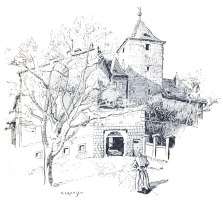
THE EAST GATE OF THE HRADCANY
all knights and nobles, who had been merely misled by others; of the
townsmen no mention was made. On July 2 Ferdinand arrived at Prague, and
first occupied the Hradcany Castle without resistance. His army,
consisting principally of Spaniards and Walloons, then surrounded the
old and new towns, committing great depredations in the outskirts of
Prague. Some fighting took place, and the lower order of the Praguers
began to arm, and decided to defend the bridge. The counsels of the
wealthier and wiser citizens, who knew that resistance was hopeless,
however, soon prevailed, and the cities surrendered. Ferdinand summoned
the more important citizens to appear before him at the Hradcany Castle.
On July 8 he received the deputies, about 600 in number, in the hall of
Vladislav. With the King were the great dignitaries of Bohemia and
Moravia, the Bishops of Olmütz and Breslau, and Prince Augustus, brother
of Maurice of Saxony.
It is a proof of the importance of the town of Prague that it was
customary that the Bohemian King should give his hand to the magistrates
of the city when they appeared before him. On this occasion, however,
Ferdinand omitted to do this, and, indeed, turned his back on the
citizens as a mark of displeasure. Some time elapsed before he ordered a
paper that contained the grievances against the citizens of Prague, who
were accused of being the principal instigators of the recent
disturbances, to be read to the deputies. The townsmen attempted no
defence, and, in their name, Sixt of Ottersdorf declared that the
citizens surrendered unconditionally to their Sovereign. The King
ordered Ludanic, Captain of Moravia, to inform the citizens that he
would shortly convey his decision to them. He had meanwhile ordered
Jacob Fikar, burgomaster of the old town, and one of the town
councillors, who had both not appeared before him, to be arrested. Then
only were the citizens informed of the conditions under which they would
be pardoned. They were to abandon all confederacies, even those between
the Prague cities, to surrender all papers dealing with their
negotiations with the Elector of Saxony, to submit for revision all the
papers containing the ancient privileges of the Prague cities, to give
up all arms, and to return to the Crown all landed estates that belonged
to it, but had been temporarily granted to the citizens. The last
paragraph, in a somewhat veiled manner, stipulated the confiscation of
considerable estates that had long belonged to the Prague cities. The
citizens were, however, obliged to accept all the King’s demands.
The King then convoked the Estates for August 22, but he resolved that,
as a deterrent example, the execution of the four most prominent
national leaders should immediately precede this meeting of the Diet,
which has ever since been known as the Krvavy Snem (i.e., bloody
Diet). On August 20 two knights and two citizens, one of whom was Fikar,
were decapitated on the market-place before the Hradcany Castle. Other
less severe punishments were inflicted on some of the members of the
nationalist leaders, particularly on those who were members of the
community of the Bohemian Brethren, who were suspected of having
strongly favoured an alliance with the German Protestants. The head of
that community, John Augusta, was arrested at Litomysl, imprisoned in
the ‘White Tower’ on the Hradcany, and cruelly tortured there.
The ‘bloody Diet’ accepted all the King’s proposals, though they largely
limited its powers, and comparative quiet continued in Prague during the
remaining years of Ferdinand’s rule.
Ferdinand died in 1564, and the news of his death reached Prague on July
28. His eldest son, Maximilian, who had already been crowned King of
Bohemia, succeeded his father without any opposition. His well-known
inclination to Protestantism rendered the Utraquist majority of the
Estates favourable to him, while the Romanists were traditionally
partisans of the House of Habsburg.
Little need in this sketch of the story of Prague be said of the twelve
years (1564-1576) during which Maximilian reigned over Bohemia. He
visited Prague and held Diets there in 1567, 1571 and 1575. On these
occasions the proceedings were similar and, it may be added, monotonous.
Maximilian invariably demanded grants of money to enable him to carry
on war against the Turks, and the Estates, with equal regularity,
claimed that further concessions should be made to the Utraquists, or
rather Protestants as they should now be called. At the Diet of 1575 the
Lutherans and Bohemian brethren jointly drew up a profession of faith
which is known as the ‘Confessio Bohemica.’ The King did not indeed
recognise it, but he granted the Protestants, now the great majority of
the population, independence from the old Utraquist consistory. They
were allowed to choose fifteen ‘defenders,’ five from each Estate, to
whom the government of the Protestant Church was to be entrusted. No
doubt, largely in consequence of this concession, the Estates accepted
Maximilian’s eldest son, Rudolph, as heir to the throne, and consented
to his coronation during the lifetime of his father. Some objections
were raised with regard to Rudolph’s ignorance of the Bohemian language,
and it was stipulated that he should, in the absence of his father,
reside in Prague, that he might thoroughly learn the language and the
laws of the country over which he was once to rule.
The Estates deputed seven nobles and seven knights, who proceeded to the
Karlstyn on September 20, for the purpose of fetching the Royal insignia
of Bohemia that were preserved there. On their return the coronation
took place, with the same ceremonial as that of Maximilian, who had also
been crowned during the lifetime of his father. According to the custom
Rudolph was crowned in St. Vitus’s Cathedral. He first proceeded to the
Chapel of St. Wenceslas, where the Romanist Archbishop and his clergy
received him. He then entered the main church, and the burgrave, William
of Rosenberg, then asked the assembled Estates whether they consented to
the coronation of Rudolph as King. They all, with loud voices,
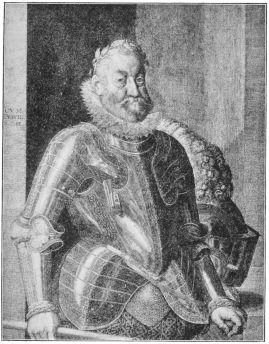
RUDOLPH II.
expressed their consent. Rudolph was then crowned by the Romanist
Archbishop, with the assistance of William of Rosenberg.
The accession of Rudolph to the Bohemian throne followed very closely on
his coronation. Maximilian died in 1576, and his son immediately
proceeded to Prague, where he resided almost continually during his
reign. His life is therefore in closer connection with Prague than that
of almost any other Bohemian ruler, Charles IV. only excepted.
Rudolph’s character was a very singular one, and it is certain that he
occasionally suffered from melancholia. With a thorough knowledge and a
great love of art, he combined an intense dislike of the affairs of the
State. No king did more for the embellishment of Prague. According to a
contemporary epigram, Prague, that had been of wood at the time of
Libussa, afterwards became marble, but golden under Rudolph. Rudolph was
a great collector of paintings, sculpture, and even mere ‘curiosities.’
His agents travelled all over Europe; thus Albrecht Dürer’s ‘Madonna,’
one of the few picture’s from Rudolph’s collection that is still at
Prague, was purchased at Venice and carried ‘by four stout men’ across
the Alps to Prague.
Among the artists who, on Rudolph’s invitation, visited Prague, was the
engraver Sadeler, a native of the Netherlands. His engravings of
Prague—three of which are reproduced in this volume—are among the most
interesting ancient records of the city.
More questionable was Rudolph’s taste for chemistry and astronomy, or
rather for alchemy and astrology. The astronomers Keppler, Tycho Brahe,
and his assistant Tennagel, who afterwards fell in disgrace, were
Rudolph’s guests on the Hradcany. His taste for alchemy attracted many
to Prague who were supposed to be adepts in that science. It must,
however, be stated in defence of Rudolph that alchemy was by no means,
in his day, an utterly discredited science. Even a century later Spinoza
considered it as worthy of consideration. Rudolph by no means hesitated
to punish those alchemists whom he considered as impostors. It is
interesting to note that among these alchemists there were two English
adventurers—Dr. John Dee and Edward Kelley.[32]
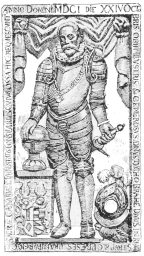 TOMBSTONE OF TYCHO BRAHE IN TYN CHURCH
The earlier years of Rudolph’s reign were a period of peace and
prosperity in Bohemia. His latter years were embittered by the treachery
and perfidy of his ambitious younger brother Matthias. The real cause of
the conflict was that Rudolph, who had no legitimate offspring, refused
to make any arrangements as to the succession to the thrones of Bohemia
and Hungary. It was as a mere pretext that Matthias brought forward the
grievance that Rudolph had refused to sanction a treaty with Turkey that
he had concluded in his brother’s name. Matthias occupied Moravia, and
took possession of that country almost without resistance. He then
entered Bohemia and advanced as far as Caslav. Rudolph, though
reluctantly, summoned the Bohemian Estates to Prague on May 8, 1608.
Though the usual ecclesiastical grievances were brought forward, it soon
became evident that the Bohemians did not wish to abandon Rudolph in
favour of his brother. The latter had meanwhile advanced as far as
Liben,[33] where peace negotiations took place. A treaty was finally
signed there by which Rudolph ceded Upper and Lower Austria and Moravia
to his brother, but retained Bohemia for his lifetime. In the evening
Matthias gave a large banquet in his camp; there were two tables, at
each of which a hundred guests were seated. Many healths were drank, and
a somewhat scandalous contemporary writer tells us that many of
Rudolph’s envoys ‘only returned to Prague about midnight, and very
intoxicated.’
Even the cession of almost all his possessions did not ensure Rudolph’s
tranquillity during the remaining years of his life. Many nobles who had
sided with him against his brother now again brought their demand of
religious freedom before him. The leader of the Protestants was now
Wenceslas of Budova, whose pious and somewhat Puritan character renders
him one of the most interesting figures of the last years of Bohemian
independence. When Rudolph had prorogued the Diet of 1609 the Estates
continued their meetings in the town hall of the Nové Mesto. Budova,
who presided, always began the deliberations by calling on all present
to pray. All then knelt down and sang a hymn.
For a moment civil war seemed inevitable. Rudolph’s attitude, indeed,
had at first been conciliatory. He has been credited by various
historians with a religious fanaticism that was absolutely alien to his
nature. Yet the Spanish ambassador, Zuniga, and Archduke Leopold, a
kinsman of Rudolph’s and a brother of Archduke Ferdinand, afterwards
King of Bohemia, succeeded in persuading the apathetic Sovereign to send
a message to the Estates, in which he promised the Protestants the same
amount of toleration which they had enjoyed under Ferdinand I.; he thus
withdrew even the concessions that had been made to the Protestants by
the more liberal-minded Maximilian. The Protestant Estates considered
this message as a declaration of war; they decided to arm, and chose
thirty ‘directors’—ten from each order—who established themselves at
the town hall of the Staré Mesto, forming, as the historian Gindely
says, a provisional government. Rudolph, however, finally gave way, and
on July 9, 1609, signed the famed ‘Letter of Majesty.’ He recognised the
‘Confessio Bohemica,’[34] granted the Protestants the administration of
the University, and empowered them to elect thirty ‘defenders’ from
their number who were to act as guardians of the rights of the
Protestants.
There is no doubt that Rudolph granted these extensive concessions
reluctantly, and that he sought an opportunity for retracting them. He
entered into negotiations with Archduke Leopold, who was then Bishop of
Passau. Under the pretence of interfering in the religious troubles that
had broken out in Germany, Leopold collected a considerable armed
force, which in 1611 invaded Bohemia. Leopold, no doubt, wished to free
Rudolph from the control of the Protestants, and probably hoped to
obtain the Bohemian crown as a reward, to the exclusion of Matthias and
of his own brother Ferdinand. The men of Passau soon occupied a large
part of Southern Bohemia, marched rapidly on Prague, and encamped on the
White Mountain, immediately outside the city walls. After scaling the
walls of the Malá Strana they attacked the neighbouring Hradcany Castle,
where Leopold was then residing as a guest of Rudolph. Desperate
fighting in the Malá Strana took place between the men of Passau and a
small force that the Bohemian Estates had hurriedly raised, and which
was commanded by Count Thurn. The invaders succeeded in driving the
Bohemians from the Malá Strana, but their attempt to obtain possession
of the bridge, and thus to secure access to the old town, failed.
Leopold, who thought victory certain, now assumed the command of his
troops, and summoned the old and new towns to surrender. This was
declined, and as the army of the Estates received constant
reinforcements, Leopold and his troops were obliged to leave Prague
secretly on the night of March 11. Matthias had meanwhile arrived at
Prague, and Rudolph was forced to abdicate in his favour. He did not
long survive his deposition, but died on January 10, 1612.
During the brief reign of Matthias (1611-1619) the religious troubles in
Bohemia continued and reached their climax in the famous defenestration
of Prague. Matthias, like his brother, was childless, and the question
of the succession to the Bohemian throne was therefore urgent. The
Estates met at Prague in 1617, and through the influence of the
Government officials, Archduke Ferdinand of Styria was accepted as heir
to the throne. Only one of the officials, Count Thurn, burgrave of the
Karlstyn, opposed the acceptation, and was therefore deprived of his
office. The decision which assured the Bohemian crown to Ferdinand, a
determined persecutor of the Protestants, necessarily hastened the
progress of events. The Protestants knew that war to the knife awaited
them; the only question was when hostilities should begin. The
initiative finally, however, came from the Catholics. In direct
violation of the agreements of 1609[35] the Romanist Archbishop of
Prague caused the Protestant church at Hrob (or Klostergrab) to be
destroyed, while the abbot of Broumov (Braunau) ordered the Protestant
church in the town of that name, which was under his jurisdiction, to be
closed.
The Protestant ‘defenders’ took immediate action. They summoned their
Protestant Estates to a consultation, which began on March 6, 1618, in
the Carolinum. Though King Matthias had forbidden the meeting, a large
number of nobles and knights and a few townsmen were present.
Count Thurn now became the leader of the Protestant Estates, and there
is little doubt that he from the first considered war inevitable. He
spoke eloquently of the grievances of the Protestants, alluding
particularly to the recent occurrences at Hrob and Broumov, and
suggested that a remonstrance should be addressed to the Government
officials at Prague. The Protestants agreed to this, and also resolved,
should this step prove ineffective, to address their complaints directly
to King Matthias, who then resided in Vienna. As an answer could not be
immediately expected, it was decided that the Protestants should meet
again on May 21. Before that date, however, the leaders of the movement
issued a manifesto, that was read in all the Utraquist and Protestant
churches of Prague, in which, though the Sovereign was not attacked, the
Royal councillors, particularly the chief judge Slavata, and Martinic,
the new burgrave of the Karlstyn, who had replaced Thurn, were directly
accused of using their influence over the Sovereign in a manner hostile
to the Bohemian people. On May 21, the Estates, as had been agreed, met
again at the Carolinum. They were immediately summoned to the Hradcany
Palace, where a Royal message prohibiting their meetings was read to
them. They none the less met again on the 22nd, when Thurn suggested
that the Estates should, on the following day, proceed to the Hradcany
in a body and in full armour. He threw out dark hints that a small
deputation would not be safe in the vast precincts of the Hradcany; if
the gates were closed after their arrival, they would be separated from
the town, and a general massacre of the envoys might ensue. A more
secret meeting took place late in the evening, at the Smiricky
Palace.[36] Besides Thurn, a few other leaders, Colonna of Fels, Budova,
Ruppa, two nobles of the Kinsky and two of the Rican family were
present. Ulrich of Kinsky proposed that the Royal councillors should be
poniarded in the council chamber, but Thurn’s suggestion that they
should be thrown from the windows of the Hradcany Palace prevailed.
This was, in Bohemia, the traditional death penalty for traitors. As the
Estates afterwards quaintly stated, ‘they followed the example of that
which was done to Jezebel, the tormentor of the Israelite people, and
also that of the Romans and other famed nations, who were in the habit
of throwing from rocks and other elevated places those who disturbed the
peace of the common-wealth.’
Early on the morning of the memorable 23rd of May the representatives of
Protestantism in Bohemia proceeded to the Hradcany; all were in full
armour, and most of them were followed by one or more retainers. They
first proceeded to the hall, where the Estates usually met. The address
to the King which the defenders had prepared was here read to them. All
then entered the hall of the Royal councillors, where a very stormy
discussion arose. Count Slik, Thurn, Kinsky and others violently accused
Martinic and Slavata, the two principal councillors, of being traitors.
Slik particularly accused Martinic of having deprived ‘that noble
Bohemian hero, Count Thurn,’ of his office of burgrave of the Karlstyn.
He added that, ‘as long as old men, honest and wise, had governed
Bohemia the country had prospered, but since they (i.e., Martinic and
Slavata), worthless disciples of the Jesuits, had pushed themselves
forward, the ruin of the country had began.’
What now happened can be best given in the words of the contemporary
historian, Skála ze Zhore:—‘No mercy was granted them, and first the
Lord of Smecno (i.e., Martinic) was dragged to the window near which
the secretaries generally worked; for Kinsky was quicker and had more
aid than Count Thurn, who had seized Slavata. Then they were
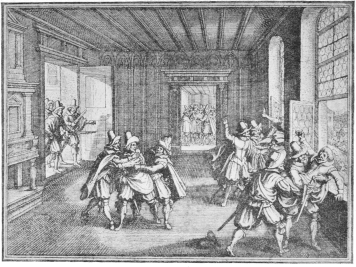
THE ROYAL OFFICIALS ARE THROWN FROM THE WINDOWS ON MAY
23, 1618
both thrown, dressed in their cloaks and with their rapiers and
decorations, just as they had been found in the councillors’ office, one
after the other, head foremost out of the western window into a moat
beneath the palace, which by a wall was separated from the other deeper
moat. They loudly screamed, “Ach, ach, Ouvé!” and attempted to hold on
to the window-frame, but were at last obliged to let go, as they were
struck on their hands.’ It remains to add that neither of the nobles nor
Fabricius, their secretary, who was also thrown from the window,
perished; a circumstance that the Catholics afterwards attributed to a
miracle.
Immediately after the defenestration the Estates elected thirty
‘directors’—chosen in equal number from the three Estates—who were to
constitute a provisional Government. Ruppa, one of the most gifted of
the Bohemian nobles, became head of this Government, while Thurn assumed
command of the army which the Estates hurriedly raised. On March 20,
1619, Matthias died, and though the Estates had recognised Ferdinand as
his successor, the throne became practically vacant; for it was very
unlikely that the Protestants who had risen in arms against Matthias
would now accept a far more intransigent Romanist as their ruler.
On July 8 a general Diet, that is to say one consisting of deputies of
Moravia and Silesia as well as Bohemia, met at Prague. On August 3 this
assembly pronounced the deposition of Ferdinand as King of the Bohemian
lands, and on the 26th the crown was offered to Frederick, Count
Palatine. There were other candidates, but an eloquent speech of Ruppa
decided in Frederick’s favour. He assured the Bohemians that they would
obtain powerful allies if they elected Frederick, and specially referred
to
Inscription on Picture.
The Bohemian leaders—Anhalt the Elder, Hohenlohe, Thurn the Elder and
the Younger, Anhalt the Younger, John of Bubna, Henry Slik (of the
Moravian allies), Stubenvoll (of the German allies), the Duke of Weimar.
The Imperialist leaders—Maximilian of Bavaria, Buguoy, Tieffenbach (of
the German league), Tilly, Pappenheim, Des Fours, Caralli and others.
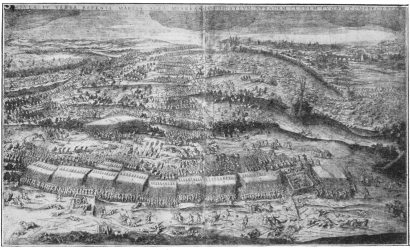 BATTLE OF THE WHITE MOUNTAIN, NOVEMBER 8, 1620
James I. of England, the father-in-law of their new Sovereign.
After some hesitation, Frederick accepted the crown and proceeded to
Bohemia accompanied by his consort. They arrived at the ‘Star’ Palace,
immediately outside Prague, early in the morning of October 31, and on
the same day made their solemn entry into the town. Many Bohemian nobles
who had awaited their new Sovereign at the ‘Star’ joined the procession
to the Hradcany Castle. At the Strahov gate they were met by the guilds
of Prague carrying their banners, and by numerous peasants ‘all clad in
the old Bohemian dress and bearing arms that had been used during the
Hussite Wars.’ On November 4 Frederick was crowned King of Bohemia in
St. Vitus’s Cathedral, and the coronation of Queen Elizabeth took place
there three days later.
The winning manners of Frederick at first obtained for him considerable
popularity, and when Queen Elizabeth gave birth to a son—Prince
Rupert—on December 26 the citizens of Prague greatly rejoiced.
Difficulties, however, soon arose. The King was ignorant of the national
language, and seems to have made no attempt to acquire it. When
Frederick’s Calvinist divines persuaded him to have the altars and
paintings removed from St. Vitus’s Cathedral, Lutherans, Utraquists and
Romanists were equally indignant.
Queen Elizabeth never secured even that limited amount of popularity
that her consort obtained. She was accompanied principally by English
ladies, and was believed to have spoken to them in an unfavourable
manner of her new country. She had hardly any intercourse with the
Bohemian ladies, few of whom knew French, and none English. They
strongly disapproved of their new Queen, who, they said, ‘had no settled
hours either for her meals or for her prayers,’ and even of the low
dresses which she and her English ladies wore.
Frederick remained at Prague up to September 28, 1620, and then only
joined his army in Southern Bohemia that was opposing the advance of the
Austrians. He found his soldiers already entirely disorganised, and was
forced to retreat on Prague. His forces reached the White Mountain,
immediately outside the town, on the evening of November 7. The enemies,
who were in close pursuit, attacked the Bohemians on the following day.
Frederick had meanwhile returned to Prague to join his consort. Neither
this proof of conjugal affection, nor the fact that an immediate attack
of the Catholic forces may not have appeared probable, can in any way
excuse what was practically desertion.
It is certain that the Catholic commanders were not at first unanimous
as to the policy of attacking the Bohemians at a moment when the
Catholic army was exhausted by prolonged marches. Buguoy I., who
commanded the Austrian forces, advised delay, but the opinion of the
Duke of Bavaria and Tilly, who insisted on an immediate attack,
prevailed. The numerous Jesuits and other friars who accompanied the
army also declared that no delay should be granted to the heretics. It
was also taken into consideration that Christian of Anhalt,
Commander-in-Chief of the Protestant forces, was hastily throwing up
earthworks on the plateau of the White Mountain, and endeavouring to
re-establish discipline among his troops, which had been demoralised by
their continuous retreat. A deferred attack might therefore be more
hazardous than an immediate one.
Even before the council of war had decided on an immediate attack, a
small Bavarian force—not yet supported by the mass of the Catholic
army—attacked the right flank of the Bohemians. The younger Count Slik,
who commanded some of the Moravian troops, hurriedly rode up to
Christian of Anhalt, begging his permission to attack the Bavarians on
their march. ‘It was a weighty and fateful moment in the history of the
Bohemian people.’[37] Anhalt at first favoured the suggestion, but on
the advice of Hohenlohe, who was second in command, he finally refused
his consent. The whole Catholic army soon united, and advanced on the
whole line. Though the younger Count Thurn’s infantry successfully beat
back an attack of the Austrian infantry, and the son of Christian of
Anhalt made a successful cavalry charge, the Catholics were soon
victorious, and the earthworks were, after a short defence, carried by
the troops of Austria, Bavaria and Spain. Of the Protestant forces the
Hungarian horsemen, whom Gabriel Bethlen, Prince of Transsylvania, had
sent to Bohemia, first took to flight. They attempted to cross the
Vltava by a ford near the present suburb of Smichov, and many perished
in the river. Flight soon became general, and the conduct of the
Bohemians and their allies was most unworthy of the ancient glory of the
country. There were some exceptions to the well-nigh general cowardice.
A small Moravian force under Count Slik retreated to the wall of the
‘Star’ Park, where they defended themselves with desperate courage.[38]
When almost all had been killed, those who remained surrendered. The
battle, and with it the fate of Bohemia, was then decided. As proof of
the heroism of the Moravians, contemporary writers tell us that along
the ‘Star’ walls[39] the dead at some places lay ten or twelve high.
Inscription above Central Picture.
‘True representation of the executions at Prague. How by the most
gracious order and command of his Roman Imperial Majesty the former
Bohemian Directors, Counts, Lords, Knights and men of the Estate of the
citizens were, on Saturday, the 9th of June of this year 1621, condemned
in the royal castle of the Hradcany, and then, on Monday, June 21,
punished and executed on the market-place of the old town.’
Inscription under Central Picture.
‘This design shows clearly how the 24 men were decapitated one after the
other, and how three others were then hanged.’
Inscription under Upper Engraving Right Side.
‘Here you see the twelve heads exposed on the bridge tower of Prague.’
Inscription under Lower Engraving Right Side.
‘How three men are whipped with rods, while the tongue of one is nailed to the
gallows.’
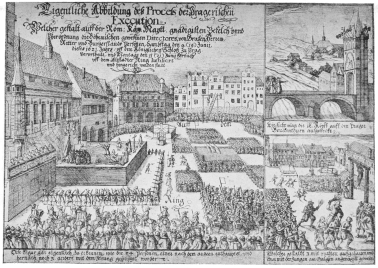 THE EXECUTIONS ON THE MARKET-PLACE OF THE OLD TOWN OF
PRAGUE ON THE 21ST OF JUNE 1621
THE EXECUTIONS ON THE MARKET-PLACE OF THE OLD TOWN OF
PRAGUE ON THE 21ST OF JUNE 1621
The news that the battle had begun reached Frederick in the banqueting
hall of the Hradcany Castle, where he was entertaining the English
ambassadors, whom his father-in-law James I. had sent to Prague. He
mounted his horse and rode to the Strahov gate, only arriving there in
time to witness the rout and flight of his army. The sight of the
battlefield and even, as an eye-witness tells us, the terrible wailing
of the women,[40] greatly impressed Frederick, and he hurriedly returned
to the Hradcany. From here he proceeded with Queen Elizabeth to the old
town, and the defeated army also crossed to the right bank of the river.
A council of war was held late in the evening, at which most of
Frederick’s generals spoke in favour of instant retreat. The King
himself made some pretence of resolution. But when, on the following
morning, Elizabeth left Prague, the King—a modern Antony, without
Antony’s bravery—‘hastily mounted his horse, thus giving the signal for
a general flight.’
The battle of the White Mountain is one of the greatest landmarks in the
history of Bohemia, and of Prague in particular. I will not here refer
to the complete change in the condition of Bohemia which it caused, the
complete suppression of Protestantism, the complete annihilation of the
ancient constitution of the land, the almost complete, though but
temporary, extinction of the national language.
But before ending my account of Prague as the capital of an independent
country, I must briefly refer to the executions on June 21, 1621.
Immediately after the suppression of the national movement it appeared
probable that the Austrian policy would be a lenient one. But sterner
councils soon prevailed at Vienna. In February Slik, Budova, Divis
Cernin, Kaplir, as well as Jessenius, the rector of the University, and
some of the leading townsmen, were arrested. There was no pretence of
conducting the trial according to the ancient legal institutions of the
country, which granted great privileges to nobles. A special tribunal
was constituted, and its members were instructed to judge with the
greatest severity.
The judges arrived from Vienna on March 13, 1621, and the court sat for
the first time at the Hradcany Castle on the 15th of that month. The
judges did not fail to act according to their instructions. Their
decision, which Ferdinand confirmed on May 23, the anniversary of the
defenestration, pronounced the confiscation of the estates of all the
accused. There were twenty-seven death sentences; of the condemned men
twenty-four were to be decapitated, three hanged. In some cases torture
was added to the death penalty. Thus Divis Cernin, captain of the
Hradcany Castle, who had opened the gates of that castle to the
Protestants, Count Slik, Bohuslav Michalovic and others were to have a
hand cut off before execution, while the tongue of Jessenius, rector of
the Prague University, whom the Bohemians had employed in their
negotiations with Transsylvania, and whose eloquence the Imperialists
dreaded, was to be cut out. Not many of these additional punishments
were, however, actually carried out.
Besides these death sentences many Bohemians were condemned to prison
for lengthy periods, while others were expelled from Prague, and it was
ordered that they should be whipped with rods till they reached the city
gates.
THE DUNGEON IN THE TOWN HALL
On June 19 the prisoners were informed of their fate, and on the
following day their wives and children, as well as three Lutheran
clergymen, were admitted to visit them. It is on the narrative of these
clergymen that the great historian Skála has based his account of the
last movements of the prisoners and their execution.[41] The day fixed
for the executions was June 21, and on the previous day all prisoners
who were not already confined in the dungeons of the town hall of Staré
Mesto were conveyed there, as the executions were to take place in the
immediately adjacent market-place. They met their fate with great
fortitude, and spent their time mainly in singing hymns. They conversed
freely with the Lutheran clergymen. Budova said, ‘I am weary of my days.
May God deign to receive my soul, that I may not behold the disaster
that, as I know, has overcome my country.’ Count Slik said, ‘I am before
the tribunal of the world, and expect immediate death. But those who
have judged me will have to appear before the awful tribunal of Him who
will judge more justly.’
Early on the morning of June 21 a cannon-shot was fired as a signal that
the executioners were to begin. One by one the prisoners were conducted
to the market-place, ‘that mournful stage and slaughter-house of
Antichrist,’ as Skála calls it. Each man when proceeding to his death
took leave of his comrades in a pleasant manner, as if he were going to
a banquet or some pastime. ‘I go before you,’ he said, ‘that I may first
see the glory of God, the glory of our beloved Redeemer; but I await you
directly after me; in this hour grief already vanishes, and a new
heartfelt and eternal happiness begins.’ Full preparations had been made
by the Imperial authorities to prevent disturbances. The whole
market-place was lined with troops, and orders had been given that the
drums should beat during the whole time that the executions lasted. A
tribune had been erected, from which the Austrian authorities watched
the executions. Slik was first led forth, and after him twenty-three
others were decapitated. The tongue of Jessenius was cut out before his
execution, and a hand of Michalovic was cut off. Three citizens of
Prague then suffered death on the gallows. To further accentuate the
reign of terror that had begun, the heads of twelve of the nobles who
had been decapitated were exposed on the towers of the bridge of Prague,
six on the bridge tower of the Malá Strana, six on that of the old town.
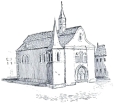
BETHLEHEM CHAPEL