“The throne is established by righteousness,” and
“upholden by mercy.”
“I have made a covenant with my chosen, I have
sworn unto David my servant,” “His seed shall endure
forever, and his throne as the sun before me. It shall
be established forever as the moon, and as a faithful
witness in heaven.”
“For unto us a Child is born, unto us a Son is
given: and the government shall be upon his shoulder:
and his name shall be called ... the Prince of Peace.
Of the increase of his government and peace there shall
be no end, upon the throne of David, and upon his kingdom,
to order it, and to establish it with judgment and
with justice from henceforth even forever.”
The government of Israel was administered in the name and
by the authority of God. The work of Moses, of the seventy
elders, of the rulers and judges, was simply to enforce the laws
that God had given; they had no authority to legislate for the
nation. This was, and continued to be, the condition of Israel’s
existence as a nation. From age to age, men inspired by God
were sent to instruct the people, and to direct in the enforcement
of the laws.
The Lord foresaw that Israel would desire a king, but he did
not consent to a change in the principles upon which the State
was founded. The king was to be the vicegerent of the Most
High. God was to be recognized as the head of the nation, and
his law was to be enforced as the supreme law of the land.[1025]
When the Israelites first settled in Canaan, they acknowledged
the principles of the theocracy, and the nation prospered under
the rule of Joshua. But increase of population, and intercourse
with other nations, brought a change. The people adopted many
of the customs of their heathen neighbors, and thus sacrificed, to a
great degree, their own peculiar, holy character. Gradually they
lost their reverence for God, and ceased to prize the honor of being
his chosen people. Attracted by the pomp and display of heathen
monarchs, they tired of their own simplicity. Jealousy and envy
sprung up between the tribes. Internal dissensions made them
weak; they were continually exposed to the invasion of their
heathen foes, and the people were coming to believe that in order
to maintain their standing among the nations, the tribes must be
united under a strong central government. As they departed from
obedience to God’s law, they desired to be freed from the rule of
their divine Sovereign; and thus the demand for a monarchy
became wide-spread throughout Israel.
Since the days of Joshua, the government had never been
conducted with so great wisdom and success as under Samuel’s
administration. Divinely invested with the threefold office of
judge, prophet, and priest, he had labored with untiring and
disinterested zeal for the welfare of his people, and the nation
had prospered under his wise control. Order had been restored,
and godliness promoted, and the spirit of discontent was checked
for the time. But with advancing years the prophet was forced
to share with others the cares of government, and he appointed
his two sons to act as his assistants. While Samuel continued the
duties of his office at Ramah, the young men were stationed at
Beersheba, to administer justice among the people near the
southern border of the land.
It was with the full assent of the nation that Samuel had
appointed his sons to office; but they did not prove themselves
worthy of their father’s choice. The Lord had, through Moses,
given special directions to his people that the rulers of Israel
should judge righteously, deal justly with the widow and the
fatherless, and receive no bribes. But the sons of Samuel
“turned aside after lucre, and took bribes, and perverted judgment.”
The sons of the prophet had not heeded the precepts
which he had sought to impress upon their minds. They had
not copied the pure, unselfish life of their father. The warning
given to Eli had not exerted the influence upon the mind of
Samuel that it should have done. He had been to some extent
too indulgent with his sons, and the result was apparent in their
character and life.
The injustice of these judges caused much dissatisfaction, and
a pretext was thus furnished for urging the change that had long
been secretly desired. “All the elders of Israel gathered themselves
together, and came to Samuel unto Ramah, and said unto
him, Behold, thou art old, and thy sons walk not in thy ways;
now make us a king to judge us like all the nations.”[1026] The cases
of abuse among the people had not been referred to Samuel.
Had the evil course of his sons been known to him, he would
have removed them without delay; but this was not what the
petitioners desired. Samuel saw that their real motive was discontent
and pride, and that their demand was the result of a deliberate
and determined purpose. No complaint had been made
against Samuel. All acknowledged the integrity and wisdom of
his administration; but the aged prophet looked upon the request
as a censure upon himself, and a direct effort to set him aside,
He did not, however, reveal his feelings; he uttered no reproach,
but carried the matter to the Lord in prayer, and sought counsel
from him alone.
And the Lord said unto Samuel: “Hearken unto the voice of
the people in all that they say unto thee; for they have not
rejected thee, but they have rejected me, that I should not reign
over them. According to all the works which they have done
since the day that I brought them up out of Egypt even unto
this day, wherewith they have forsaken me, and served other
gods, so do they also unto thee.” The prophet was reproved for
grieving at the conduct of the people toward himself as an individual.
They had not manifested disrespect for him, but for
the authority of God, who had appointed the rulers of his people.
Those who despise and reject the faithful servant of God, show
contempt, not merely for the man, but for the Master who sent
him. It is God’s words, his reproofs and counsel, that are set at
naught; it is his authority that is rejected.
The days of Israel’s greatest prosperity had been those in
which they acknowledged Jehovah as their king,—when the
laws and the government which he had established were regarded
as superior to those of all other nations. Moses had
declared to Israel concerning the commandments of the Lord:
“This is your wisdom and your understanding in the sight of the
nations, which shall hear all these statutes, and say, Surely this
great nation is a wise and understanding people.”[1027] But by
departing from God’s law the Hebrews had failed to become the
people that God desired to make them, and then all the evils
which were the result of their own sin and folly they charged
upon the government of God. So completely had they become
blinded by sin.
The Lord had, through his prophets, foretold that Israel would
be governed by a king; but it does not follow that this form of
government was best for them, or according to his will. He permitted
the people to follow their own choice, because they refused
to be guided by his counsel. Hosea declares that God gave them
a king in his anger.[1028] When men choose to have their own way,
without seeking counsel from God, or in opposition to his revealed
will, he often grants their desires, in order that, through the bitter
experience that follows, they may be led to realize their folly and
to repent of their sin. Human pride and wisdom will prove a
dangerous guide. That which the heart desires contrary to the
will of God, will in the end be found a curse rather than a blessing.
God desired his people to look to him alone as their lawgiver
and their source of strength. Feeling their dependence upon God,
they would be constantly drawn nearer to him. They would become
elevated and ennobled, fitted for the high destiny to which
he had called them as his chosen people. But when a man was
placed upon the throne, it would tend to turn the minds of the
people from God. They would trust more to human strength,
and less to divine power, and the errors of their king would lead
them into sin, and separate the nation from God.
Samuel was instructed to grant the request of the people, but
to warn them of the Lord’s disapproval, and also make known
what would be the result of their course. “And Samuel told all
the words of the Lord unto the people that asked of him a king.”
He faithfully set before them the burdens that would be laid upon
them, and showed the contrast between such a state of oppression
and their present comparatively free and prosperous condition.
Their king would imitate the pomp and luxury of other
monarchs, to support which, grievous exactions upon their persons
and property would be necessary. The goodliest of their
young men he would require for his service. They would be
made charioteers and horsemen and runners before him. They
must fill the ranks of his army, and they would be required to
till his fields, to reap his harvests, and to manufacture implements
of war for his service. The daughters of Israel would be taken for
confectioners and bakers for the royal household. To support his
kingly state he would seize upon the best of their lands, bestowed
upon the people by Jehovah himself. The most valuable of their
servants also, and of their cattle, he would take, and “put them to
his own work.” Besides all this, the king would require a tenth
of all their income, the profits of their labor, or the products of the
soil. “Ye shall be his servants,” concluded the prophet. “And
ye shall cry out in that day because of your king which ye shall
have chosen you; and the Lord will not hear you in that day.”
However burdensome its exactions should be found, when once a
monarchy was established, they could not set it aside at pleasure.
But the people returned the answer, “Nay; but we will have
a king over us; that we also may be like all the nations; and
that our king may judge us, and go out before us, and fight our
battles.”
“Like all the nations.”—The Israelites did not realize that to
be in this respect unlike other nations was a special privilege and
blessing. God had separated the Israelites from every other people,
to make them his own peculiar treasure. But they, disregarding
this high honor, eagerly desired to imitate the example of the
heathen! And still the longing to conform to worldly practices
and customs exists among the professed people of God. As they
depart from the Lord, they become ambitious for the gains and
honors of the world. Christians are constantly seeking to imitate
the practices of those who worship the god of this world. Many
urge that by uniting with worldlings and conforming to their customs,
they might exert a stronger influence over the ungodly. But
all who pursue this course, thereby separate from the Source of
their strength. Becoming the friends of the world, they are the
enemies of God. For the sake of earthly distinction they sacrifice
the unspeakable honor to which God has called them, of showing
forth the praises of Him who hath called us out of darkness into
his marvelous light.[1029]
With deep sadness, Samuel listened to the words of the people;
but the Lord said unto him, “Hearken unto their voice, and make
them a king.” The prophet had done his duty. He had faithfully
presented the warning, and it had been rejected. With a
heavy heart he dismissed the people, and himself departed to
prepare for the great change in the government.
Samuel’s life of purity and unselfish devotion was a perpetual
rebuke both to self-serving priests and elders, and to the proud,
sensual congregation of Israel. Although he assumed no pomp
and made no display, his labors bore the signet of Heaven. He
was honored by the world’s Redeemer, under whose guidance he
ruled the Hebrew nation. But the people had become weary of
his piety and devotion; they despised his humble authority, and
rejected him for a man who should rule them as a king.
In the character of Samuel we see reflected the likeness of
Christ. It was the purity of our Saviour’s life that provoked
the wrath of Satan. That life was the light of the world, and
revealed the hidden depravity in the hearts of men. It was the
holiness of Christ that stirred up against him the fiercest passions
of false-hearted professors of godliness. Christ came not with the
wealth and honors of earth, yet the works which he wrought
showed him to possess power greater than that of any human
prince. The Jews looked for the Messiah to break the oppressor’s
yoke, yet they cherished the sins that had bound it upon their
necks. Had Christ cloaked their sins and applauded their piety,
they would have accepted him as their king; but they would
not bear his fearless rebuke of their vices. The loveliness of
a character in which benevolence, purity, and holiness reigned
supreme, which entertained no hatred except for sin, they despised.
Thus it has been in every age of the world. The light
from heaven brings condemnation on all who refuse to walk in
it. When rebuked by the example of those who hate sin, hypocrites
will become agents of Satan to harass and persecute the
faithful. “All that will live godly in Christ Jesus shall suffer
persecution.”[1030]
Though a monarchical form of government for Israel had been
foretold in prophecy, God had reserved to himself the right to
choose their king. The Hebrews so far respected the authority
of God as to leave the selection entirely to him. The choice fell
upon Saul, a son of Kish, of the tribe of Benjamin.
The personal qualities of the future monarch were such as to
gratify that pride of heart which prompted the desire for a king.
“There was not among the children of Israel a goodlier person
than he.”[1031] Of noble and dignified bearing, in the prime of life,
comely and tall, he appeared like one born to command. Yet with
these external attractions, Saul was destitute of those higher qualities
that constitute true wisdom. He had not in youth learned
to control his rash, impetuous passions; he had never felt the
renewing power of divine grace.
Saul was the son of a powerful and wealthy chief, yet in
accordance with the simplicity of the times, he was engaged
with his father in the humble duties of a husbandman. Some of
his father’s animals having strayed upon the mountains, Saul went
with a servant to seek for them. For three days they searched in
vain, when, as they were not far from Ramah,[1032] the home of Samuel,
the servant proposed that they should inquire of the prophet
concerning the missing property. “I have here at hand the fourth
part of a shekel of silver,” he said; “that will I give to the man
of God, to tell us our way.” This was in accordance with the
custom of the times. A person approaching a superior in rank or
office made him a small present, as an expression of respect.
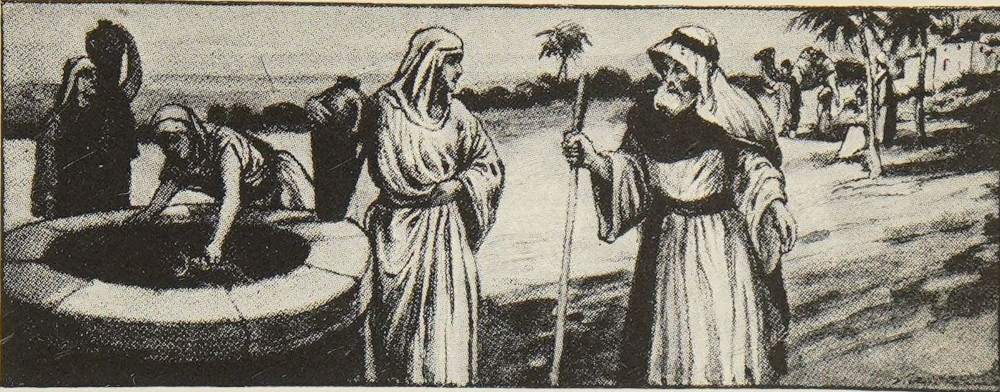
As they drew near to the city, they met some young maidens
who had come out to draw water, and inquired of them for the
seer. In reply they were told that a religious service was about
to take place, that the prophet had already arrived, there was to
be an offering upon “the high place,” and after that a sacrificial
feast. A great change had taken place under Samuel’s administration.
When the call of God first came to him, the services
of the sanctuary were held in contempt. “Men abhorred the
offering of the Lord.”[1033] But the worship of God was now maintained
throughout the land, and the people manifested an interest
in religious services. There being no ministration in the tabernacle,
sacrifices were for the time offered elsewhere; and the cities
of the priests and Levites, where the people resorted for instruction,
were chosen for this purpose. The highest points in these
cities were usually selected as the place of sacrifice, and hence
were called the high places.
At the gate of the city, Saul was met by the prophet himself.
God had revealed to Samuel that at that time the chosen king
of Israel would present himself before him. As they now stood
face to face, the Lord said to Samuel, “Behold the man whom I
spake to thee of! this same shall reign over my people.”
To the request of Saul, “Tell me, I pray thee, where the seer’s
house is,” Samuel replied, “I am the seer.” Assuring him also
that the lost animals had been found, he urged him to tarry
and attend the feast, at the same time giving some intimation
of the great destiny before him: “On whom is all the desire of
Israel? Is it not on thee, and on all thy father’s house?” The
listener’s heart thrilled at the prophet’s words. He could not but
perceive something of their significance; for the demand for a
king had become a matter of absorbing interest to the whole
nation. Yet with modest self-depreciation, Saul replied, “Am
not I a Benjamite, of the smallest of the tribes of Israel? and
my family the least of all the families of the tribe of Benjamin?
wherefore then speakest thou so to me?”
Samuel conducted the stranger to the place of assembly, where
the principal men of the town were gathered. Among them, at
the prophet’s direction, the place of honor was given to Saul, and
at the feast the choicest portion was set before him. The services
over, Samuel took his guest to his own home, and there upon the
housetop he communed with him, setting forth the great principles
on which the government of Israel had been established, and thus
seeking to prepare him, in some measure, for his high station.
When Saul departed, early next morning, the prophet went
forth with him. Having passed through the town, he directed
the servant to go forward. Then he bade Saul stand still to
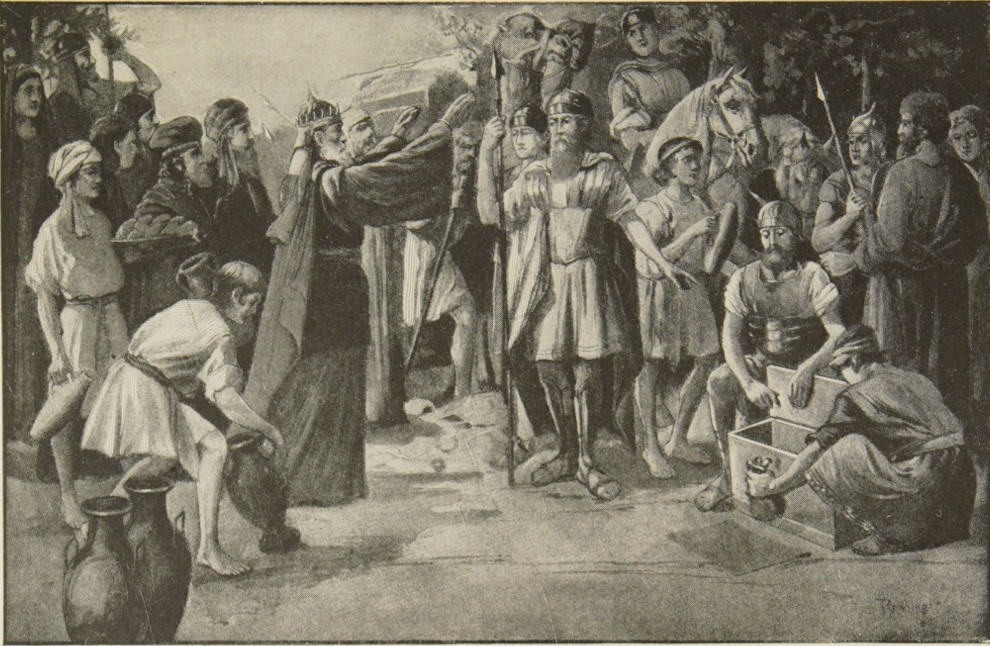
receive a message sent him from God. “And Samuel took a vial
of oil, and poured it upon his head, and kissed him, and said, Is
it not because Jehovah hath anointed thee to be captain over his
inheritance?” As evidence that this was done by divine authority,
he foretold the incidents that would occur on the homeward journey,
and assured Saul that he would be qualified by the Spirit of
God for the station awaiting him. “The Spirit of Jehovah will
come upon thee,” said the prophet, and thou “shalt be turned
into another man. And let it be, when these signs are come unto
thee, that thou do as occasion serve thee; for God is with thee.”
As Saul went on his way, all came to pass as the prophet
had said. Near the border of Benjamin he was informed that
the lost animals had been found. In the plain of Tabor he met
three men who were going to worship God at Bethel. One of
them carried three kids for sacrifice, another three loaves of
bread, and the third a bottle of wine, for the sacrificial feast.
They gave Saul the usual salutation, and also presented him
with two of the three loaves of bread. At Gibeah, his own city,
a band of prophets returning from the “high place” were singing
the praise of God to the music of the pipe and the harp, the
psaltery and the tabret. As Saul approached them, the Spirit of
the Lord came upon him also, and he joined in their song of praise,
and prophesied with them. He spoke with so great fluency and
wisdom, and joined so earnestly in the service, that those who had
known him exclaimed in astonishment, “What is this that is
come unto the son of Kish? Is Saul also among the prophets?”
As Saul united with the prophets in their worship, a great
change was wrought in him by the Holy Spirit. The light of
divine purity and holiness shone in upon the darkness of the
natural heart. He saw himself as he was before God. He saw
the beauty of holiness. He was now called to begin the warfare
against sin and Satan, and he was made to feel that in this conflict
his strength must come wholly from God. The plan of salvation,
which had before seemed dim and uncertain, was opened to his
understanding. The Lord endowed him with courage and wisdom
for his high station. He revealed to him the Source of strength
and grace, and enlightened his understanding as to the divine
claims and his own duty.
The anointing of Saul as king had not been made known to the
nation. The choice of God was to be publicly manifested by lot.
For this purpose, Samuel convoked the people at Mizpeh. Prayer
was offered for divine guidance; then followed the solemn ceremony
of casting the lot. In silence the assembled multitude
awaited the issue. The tribe, the family, and the household were
successively designated, and then Saul, the son of Kish, was
pointed out as the individual chosen. But Saul was not in the
assembly. Burdened with a sense of the great responsibility
about to fall upon him, he had secretly withdrawn. He was
brought back to the congregation, who observed with pride and
satisfaction that he was of kingly bearing and noble form, being
“higher than any of the people from his shoulders and upward.”
Even Samuel, when presenting him to the assembly, exclaimed,
“See ye him whom the Lord hath chosen, that there is none like
him among all the people?” And in response arose from the
vast throng one long, loud shout of joy, “God save the king!”
Samuel then set before the people “the manner of the kingdom,”
stating the principles upon which the monarchical government
was based, and by which it should be controlled. The king
was not to be an absolute monarch, but was to hold his power
in subjection to the will of the Most High. This address was
recorded in a book, wherein were set forth the prerogatives of the
prince and the rights and privileges of the people. Though the
nation had despised Samuel’s warning, the faithful prophet, while
forced to yield to their desires, still endeavored, as far as possible,
to guard their liberties.
While the people in general were ready to acknowledge Saul
as their king, there was a large party in opposition. For a
monarch to be chosen from Benjamin, the smallest of the tribes
of Israel—and that to the neglect of both Judah and Ephraim,
the largest and most powerful—was a slight which they could
not brook. They refused to profess allegiance to Saul, or to
bring him the customary presents. Those who had been most
urgent in their demand for a king were the very ones that refused
to accept with gratitude the man of God’s appointment.
The members of each faction had their favorite, whom they
wished to see placed on the throne, and several among the leaders
had desired the honor for themselves. Envy and jealousy
burned in the hearts of many. The efforts of pride and ambition
had resulted in disappointment and discontent.
In this condition of affairs, Saul did not see fit to assume the
royal dignity. Leaving Samuel to administer the government as
formerly, he returned to Gibeah. He was honorably escorted
thither by a company, who, seeing the divine choice in his selection,
were determined to sustain him. But he made no attempt
to maintain by force his right to the throne. In his home among
the uplands of Benjamin he quietly occupied himself in the duties
of a husbandman, leaving the establishment of his authority
entirely to God.
Soon after Saul’s appointment, the Ammonites, under their
king, Nahash, invaded the territory of the tribes east of Jordan,
and threatened the city of Jabesh-gilead. The inhabitants tried
to secure terms of peace by offering to become tributary to the
Ammonites. To this the cruel king would not consent but on
condition that he might put out the right eye of every one of
them, thus making them abiding witnesses to his power.
The people of the besieged city begged a respite of seven days.
To this the Ammonites consented, thinking thus to heighten the
honor of their expected triumph. Messengers were at once dispatched
from Jabesh, to seek help from the tribes west of Jordan.
They carried the tidings to Gibeah, creating wide-spread terror.
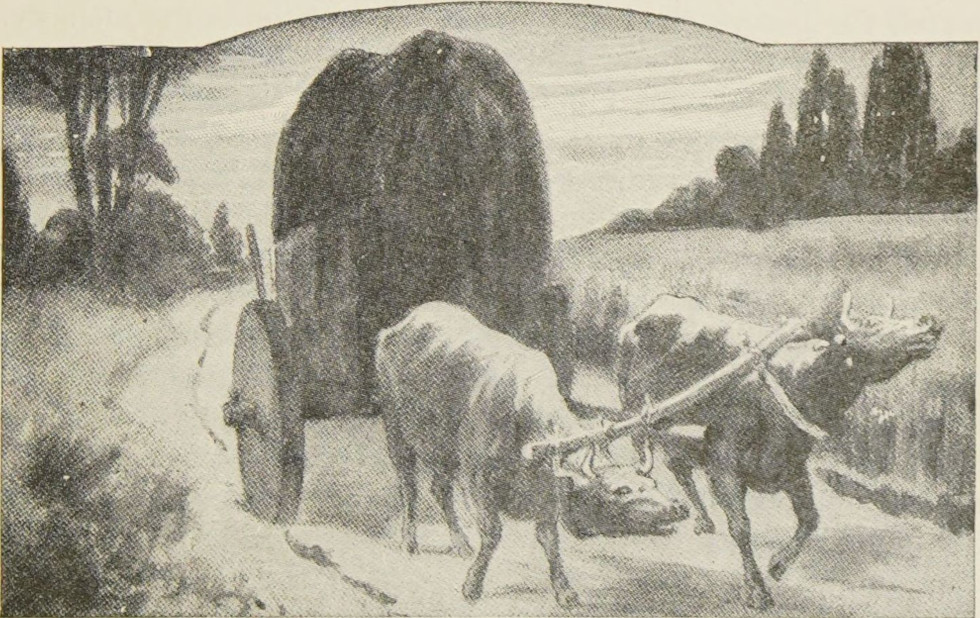
Saul, returning at night from following the oxen in the field,
heard the loud wail that told of some great calamity. He said,
“What aileth the people that they weep?” When the shameful
story was repeated, all his dormant powers were roused. “The
Spirit of God came upon Saul, ... and he took a yoke of oxen,
and hewed them in pieces, and sent them throughout all the
coasts of Israel by the hands of messengers, saying, Whosoever
cometh not forth after Saul and after Samuel, so shall it be done
unto his oxen.”
Three hundred and thirty thousand men gathered on the
plain of Bezek, under the command of Saul. Messengers were
immediately sent to the besieged city, with the assurance that
they might expect help on the morrow, the very day on which
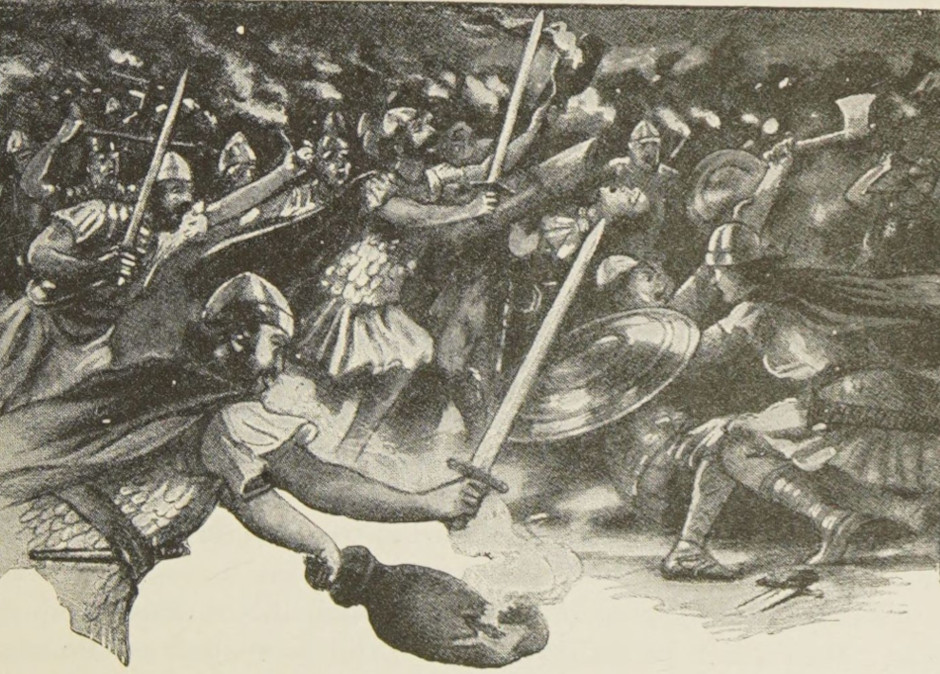
they were to submit to the Ammonites. By a rapid night march,
Saul and his army crossed the Jordan, and arrived before Jabesh in
“the morning watch.” Like Gideon, dividing his force into three
companies, he fell upon the Ammonite camp at that early hour,
when, not suspecting danger, they were least secure. In the panic
that followed, they were routed, with great slaughter. And “they
which remained were scattered, so that two of them were not left
together.”
The promptness and bravery of Saul, as well as the generalship
shown in the successful conduct of so large a force, were qualities
which the people of Israel had desired in a monarch, that they
might be able to cope with other nations. They now greeted
him as their king, attributing the honor of the victory to human
agencies, and forgetting that without God’s special blessing all
their efforts would have been in vain. In their enthusiasm,
some proposed to put to death those who had at first refused
to acknowledge the authority of Saul. But the king interfered,
saying, “There shall not a man be put to death this day; for
to-day the Lord hath wrought salvation in Israel.” Here Saul
gave evidence of the change that had taken place in his character.
Instead of taking honor to himself, he gave the glory to
God. Instead of showing a desire for revenge, he manifested
a spirit of compassion and forgiveness. This is unmistakable
evidence that the grace of God dwells in the heart.
Samuel now proposed that a national assembly should be
convoked at Gilgal, that the kingdom might there be publicly
confirmed to Saul. It was done; “and there they sacrificed
sacrifices of peace-offerings before the Lord; and there Saul and
all the men of Israel rejoiced greatly.”
Gilgal had been the place of Israel’s first encampment in the
promised land. It was here that Joshua, by divine direction, set
up the pillar of twelve stones to commemorate the miraculous
passage of the Jordan. Here circumcision had been renewed.
Here they had kept the first Passover after the sin at Kadesh,
and the desert sojourn. Here the manna ceased. Here the Captain
of the Lord’s host had revealed himself as chief in command
of the armies of Israel. From this place they marched to the
overthrow of Jericho and the conquest of Ai. Here Achan met
the penalty of his sin, and here was made that treaty with the
Gibeonites which punished Israel’s neglect to ask counsel of God.
Upon this plain, linked with so many thrilling associations, stood
Samuel and Saul; and when the shouts of welcome to the king
had died away, the aged prophet gave his parting words as ruler
of the nation.
“Behold,” he said, “I have hearkened unto your voice in all
that ye said unto me, and have made a king over you. And
now, behold, the king walketh before you; and I am old and
gray-headed; ... and I have walked before you from my childhood
unto this day. Behold, here I am: witness against me
before the Lord, and before his anointed: whose ox have I
taken? or whose ass have I taken? or whom have I defrauded?
whom have I oppressed? or of whose hand have I received any
bribe to blind mine eyes therewith? and I will restore it to you.”
With one voice the people answered, “Thou hast not defrauded
us, nor oppressed us, neither hast thou taken aught of any man’s
hand.”
Samuel was not seeking merely to justify his own course. He
had previously set forth the principles that should govern both
the king and the people, and he desired to add to his words the
weight of his own example. From childhood he had been connected
with the work of God, and during his long life one object
had been ever before him,—the glory of God and the highest
good of Israel.
Before there could be any hope of prosperity for Israel, they
must be led to repentance before God. In consequence of sin
they had lost their faith in God, and their discernment of his
power and wisdom to rule the nation,—lost their confidence
in his ability to vindicate his cause. Before they could find
true peace, they must be led to see and confess the very sin
of which they had been guilty. They had declared the object of
the demand for a king to be, “That our king may judge us, and
go out before us, and fight our battles.” Samuel recounted the
history of Israel, from the day when God brought them from
Egypt. Jehovah, the King of kings, had gone out before them,
and had fought their battles. Often their sins had sold them
into the power of their enemies, but no sooner did they turn
from their evil ways than God’s mercy raised up a deliverer.
The Lord sent Gideon and Barak, and “Jephthah and Samuel,
and delivered you out of the hand of your enemies on every
side, and ye dwelled safe.” Yet when threatened with danger
they had declared, “A king shall reign over us,” when, said
the prophet, “Jehovah your God was your king.”
“Now therefore,” continued Samuel, “stand and see this great
thing, which the Lord will do before your eyes. Is it not wheat
harvest to-day? I will call unto the Lord, and he shall send
thunder and rain; that ye may perceive and see that your wickedness
is great, which ye have done in the sight of the Lord,
in asking you a king. So Samuel called unto the Lord; and the
Lord sent thunder and rain that day.” At the time of wheat
harvest, in May and June, no rain fell in the East. The sky
was cloudless, and the air serene and mild. So violent a storm
at this season filled all hearts with fear. In humiliation the
people now confessed their sin,—the very sin of which they had
been guilty: “Pray for thy servants unto the Lord thy God, that
we die not; for we have added unto all our sins this evil, to ask
us a king.”
Samuel did not leave the people in a state of discouragement,
for this would have prevented all effort for a better life. Satan
would lead them to look upon God as severe and unforgiving,
and they would thus be exposed to manifold temptations. God
is merciful and forgiving, ever desiring to show favor to his people,
when they will obey his voice. “Fear not,” was the message of
God by his servant; “ye have done all this wickedness; yet turn
not aside from following the Lord, but serve the Lord with all
your heart; and turn ye not aside; for then should ye go after
vain things, which cannot profit nor deliver; for they are vain.
For the Lord will not forsake his people.”
Samuel said nothing of the slight which had been put upon
himself; he uttered no reproach for the ingratitude with which
Israel had repaid his life-long devotion; but he assured them of
his unceasing interest for them: “God forbid that I should sin
against the Lord in ceasing to pray for you; but I will teach you
the good and the right way. Only fear the Lord, and serve him
in truth with all your heart; for consider how great things he
hath done for you. But if ye shall still do wickedly, ye shall
be consumed, both ye and your king.”
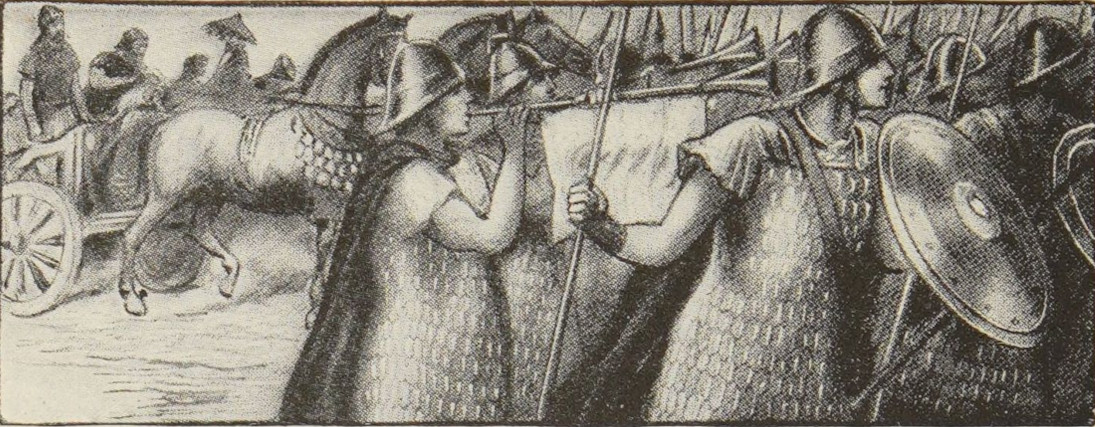
After the assembly at Gilgal, Saul disbanded the army that
had at his call arisen to overthrow the Ammonites, reserving only
two thousand men to be stationed under his command at Michmash,
and one thousand to attend his son Jonathan at Gibeah.
Here was a serious error. His army was filled with hope and
courage by the recent victory; and had he proceeded at once
against other enemies of Israel, a telling blow might have been
struck for the liberties of the nation.
Meanwhile their warlike neighbors, the Philistines, were active.
After the defeat at Ebenezer, they had still retained possession of
some hill fortresses in the land of Israel; and now they established
themselves in the very heart of the country. In facilities, arms,
and equipments, the Philistines had great advantage over Israel.
During the long period of their oppressive rule, they had endeavored
to strengthen their power by forbidding the Israelites to
practice the trade of smiths, lest they should make weapons of
war. After the conclusion of peace, the Hebrews had still resorted
to the Philistine garrisons for such work as needed to be done.
Controlled by love of ease, and the abject spirit induced by long
oppression, the men of Israel had, to a great extent, neglected to
provide themselves with weapons of war. Bows and slings were
used in warfare, and these the Israelites could obtain; but there
were none among them, except Saul and his son Jonathan, who
possessed a spear or a sword.[1034]
It was not until the second year of Saul’s reign that an attempt
was made to subdue the Philistines. The first blow was struck
by Jonathan, the king’s son, who attacked and overcame their
garrison at Geba. The Philistines, exasperated by this defeat,
made ready for a speedy attack upon Israel. Saul now caused
war to be proclaimed by the sound of the trumpet throughout
the land, calling upon all the men of war, including the tribes
across the Jordan, to assemble at Gilgal. This summons was
obeyed.
The Philistines had gathered an immense force at Michmash,—“thirty
thousand chariots, and six thousand horsemen, and people
as the sand which is on the sea-shore in multitude.”[1035] When
the tidings reached Saul and his army at Gilgal, the people were
appalled at thought of the mighty forces they would have to
encounter in battle. They were not prepared to meet the enemy,
and many were so terrified that they dared not come to
the test of an encounter. Some crossed the Jordan, while
others hid themselves in caves and pits, and amid the rocks
that abounded in that region. As the time for the encounter
drew near, the number of desertions rapidly increased, and those
who did not withdraw from the ranks were filled with foreboding
and terror.
When Saul was first anointed king of Israel, he had received
from Samuel explicit directions concerning the course to be pursued
at this time. “Thou shalt go down before me to Gilgal,”
said the prophet; “and, behold, I will come down unto thee, to
offer burnt-offerings, and to sacrifice sacrifices of peace-offering.
Seven days shalt thou tarry, till I come to thee, and show thee
what thou shalt do.”[1036]
Day after day Saul tarried, but without making decided efforts
toward encouraging the people and inspiring confidence in God.
Before the time appointed by the prophet had fully expired,
he became impatient at the delay, and allowed himself to be
discouraged by the trying circumstances that surrounded him.
Instead of faithfully seeking to prepare the people for the service
that Samuel was coming to perform, he indulged in unbelief and
foreboding. The work of seeking God by sacrifice was a most
solemn and important work; and God required that his people
should search their hearts and repent of their sins, that the
offering might be made with acceptance before him, and that
his blessing might attend their efforts to conquer the enemy.
But Saul had grown restless; and the people, instead of trusting
in God for help, were looking to the king whom they had chosen,
to lead and direct them.
Yet the Lord still cared for them, and did not give them up to
the disasters that would have come upon them if the frail arm of
flesh had become their only support. He brought them into close
places, that they might be convicted of the folly of depending on
man, and that they might turn to him as their only help. The
time for the proving of Saul had come. He was now to show
whether or not he would depend on God, and patiently wait
according to his command, thus revealing himself as one whom
God could trust in trying places as the ruler of his people, or
whether he would be vacillating, and unworthy of the sacred
responsibility that had devolved upon him. Would the king
whom Israel had chosen, listen to the Ruler of all kings? Would
he turn the attention of his faint-hearted soldiers to the One in
whom is everlasting strength and deliverance?
With growing impatience he awaited the arrival of Samuel,
and attributed the confusion and distress and desertion of his
army to the absence of the prophet. The appointed time came,
but the man of God did not immediately appear. God’s providence
had detained his servant. But Saul’s restless, impulsive
spirit would no longer be restrained. Feeling that something
must be done to calm the fears of the people, he determined to
summon an assembly for religious service, and by sacrifice entreat
the divine aid. God had directed that only those consecrated to
the office should present sacrifices before him. But Saul commanded,
“Bring hither a burnt-offering;”[1037] and, equipped as he
was with armor and weapons of war, he approached the altar, and
offered sacrifice before God.
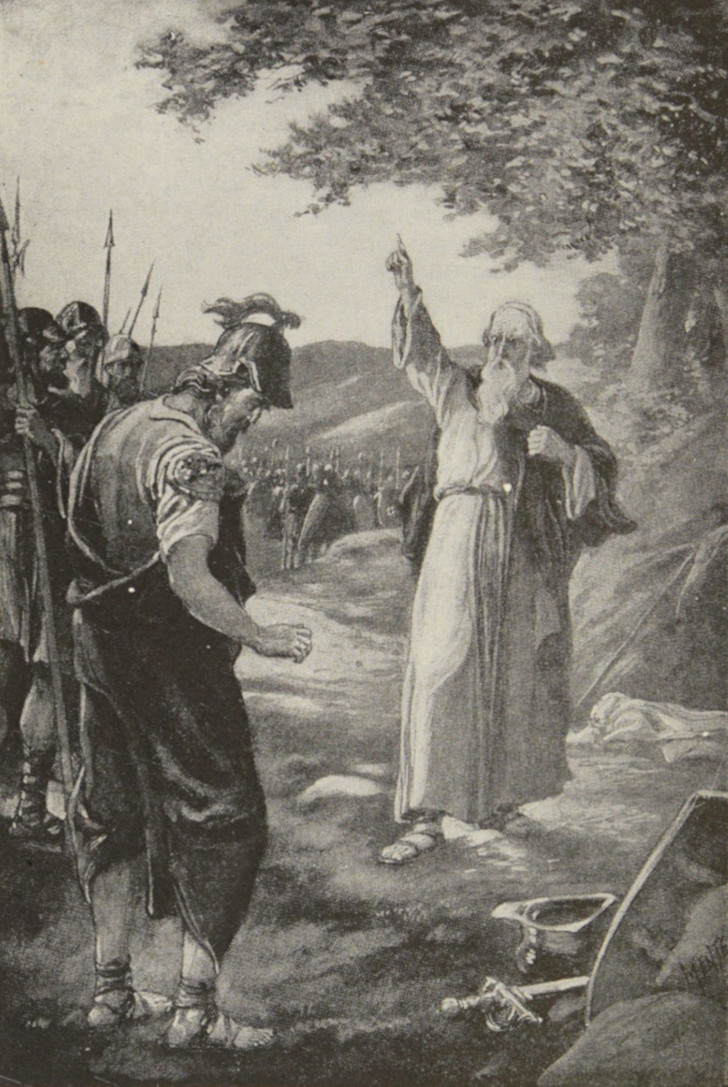
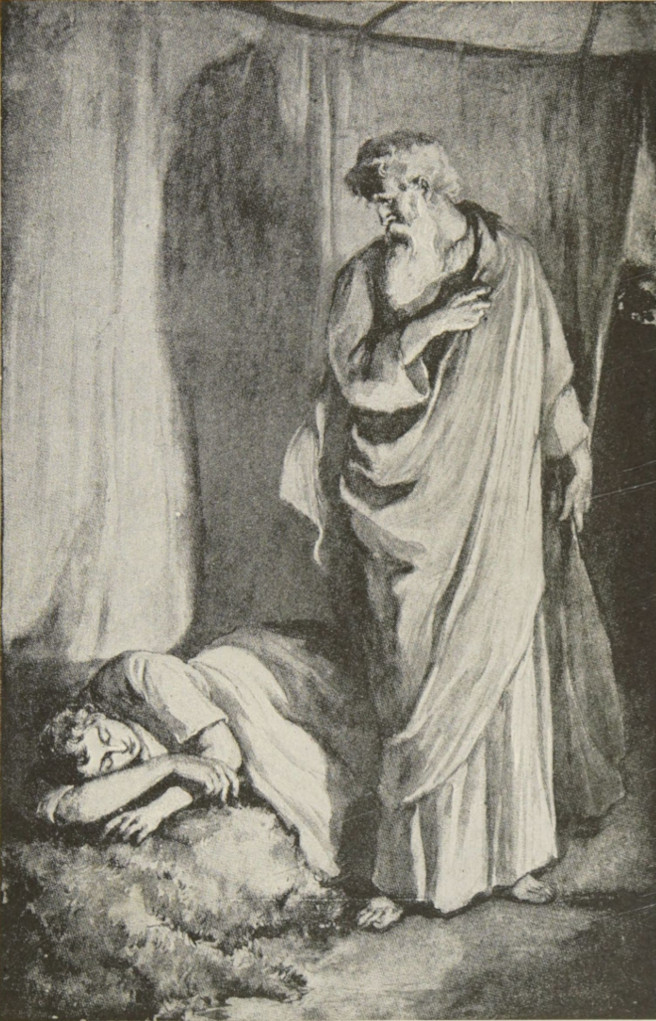
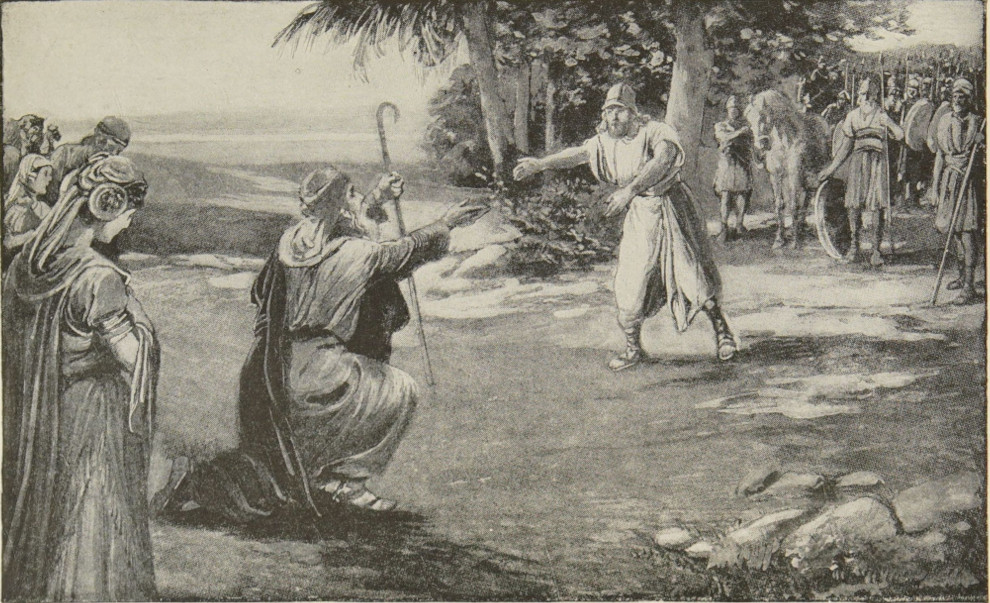
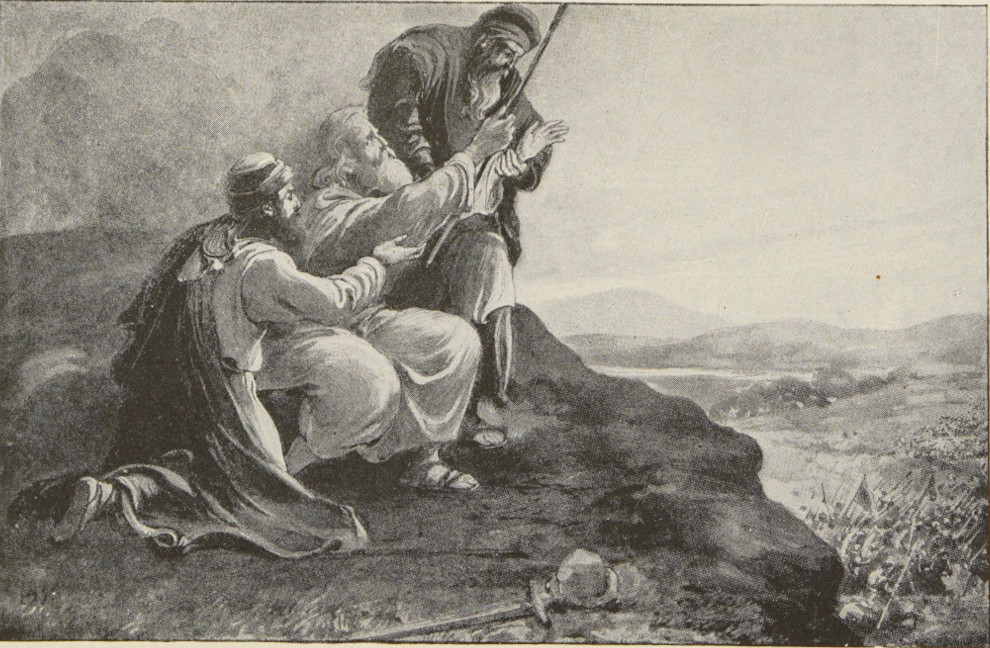
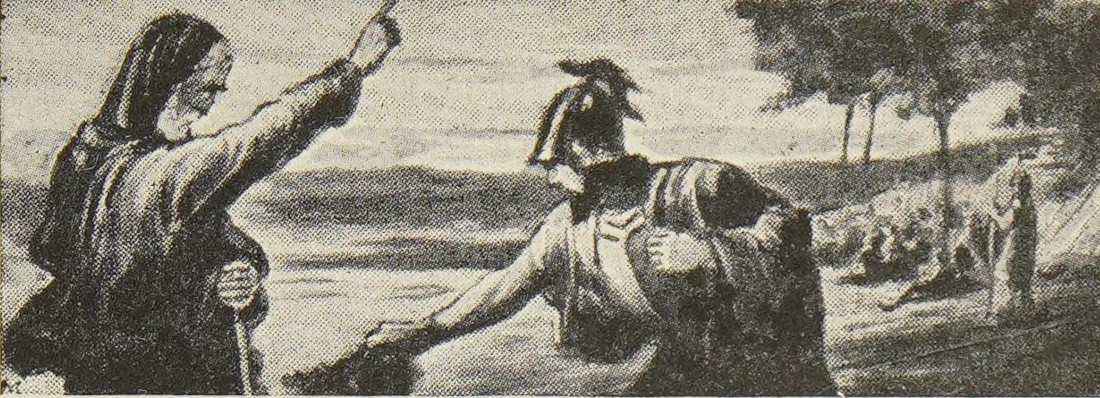
SAMUEL REPROVING SAUL. “Samuel’s countenance was full of anxiety and trouble.... Saul offered excuses for his presumptuous act.”
“And it came to pass, that as soon as he had made an end of
offering the burnt-offering, behold, Samuel came; and Saul went
out to meet him, that he might salute him.” Samuel saw at once
that Saul had gone contrary to the express directions that had
been given him. The Lord had spoken by his prophet that at
this time he would reveal what Israel must do in this crisis. If
Saul had fulfilled the conditions upon which divine help was
promised, the Lord would have wrought a marvelous deliverance
for Israel, with the few who were loyal to the king. But Saul
was so well satisfied with himself and his work, that he went out
to meet the prophet as one who should be commended rather than
disapproved.
Samuel’s countenance was full of anxiety and trouble; but to
his inquiry, “What hast thou done?” Saul offered excuses for
his presumptuous act. He said: “I saw that the people were
scattered from me, and that thou camest not within the days
appointed, and that the Philistines gathered themselves together
at Michmash; therefore said I, The Philistines will come down
now upon me to Gilgal, and I have not made supplication unto
the Lord; I forced myself therefore, and offered a burnt-offering.
“And Samuel said to Saul: Thou hast done foolishly; thou
hast not kept the commandment of the Lord thy God, which he
commanded thee; for now would the Lord have established thy
kingdom upon Israel forever. But now thy kingdom shall not
continue; the Lord hath sought him a man after his own heart,
and the Lord hath commanded him to be captain over his people....
And Samuel arose, and gat him up from Gilgal unto Gibeah
of Benjamin.”
Either Israel must cease to be the people of God, or the
principle upon which the monarchy was founded must be maintained,
and the nation must be governed by a divine power. If
Israel would be wholly the Lord’s, if the will of the human
and earthly were held in subjection to the will of God, he would
continue to be the ruler of Israel. So long as the king and
the people would conduct themselves as subordinate to God, so
long he could be their defense. But in Israel no monarchy
could prosper that did not in all things acknowledge the supreme
authority of God.
If Saul had shown a regard for the requirements of God in
this time of trial, God could have worked his will through him.
His failure now proved him unfit to be the vicegerent of God to
his people. He would mislead Israel. His will, rather than the
will of God, would be the controlling power. If Saul had been
faithful, his kingdom would have been established forever; but
since he had failed, the purpose of God must be accomplished by
another. The government of Israel must be committed to one
who would rule the people according to the will of Heaven.
We do not know what great interests may be at stake in the
proving of God. There is no safety except in strict obedience to
the word of God. All his promises are made upon condition of
faith and obedience, and a failure to comply with his commands
cuts off the fulfillment to us of the rich provisions of the Scriptures.
We should not follow impulse, nor rely on the judgment
of men; we should look to the revealed will of God, and walk
according to his definite commandment, no matter what circumstances
may surround us. God will take care of the results; by
faithfulness to his word we may in time of trial prove before men
and angels that the Lord can trust us in difficult places to carry
out his will, honor his name, and bless his people.
Saul was in disfavor with God, and yet unwilling to humble
his heart in penitence. What he lacked in real piety, he would
try to make up by his zeal in the forms of religion. Saul was not
ignorant of Israel’s defeat when the ark of God was brought into
the camp by Hophni and Phinehas; and yet, knowing all this, he
determined to send for the sacred chest and its attendant priest.
Could he by this means inspire confidence in the people, he
hoped to re-assemble his scattered army, and give battle to the
Philistines. He would now dispense with Samuel’s presence and
support, and thus free himself from the prophet’s unwelcome
criticisms and reproofs.
The Holy Spirit had been granted to Saul to enlighten his
understanding and soften his heart. He had received faithful
instruction and reproof from the prophet of God. And yet how
great was his perversity! The history of Israel’s first king presents
a sad example of the power of early wrong habits. In his
youth, Saul did not love and fear God; and that impetuous spirit,
not early trained to submission, was ever ready to rebel against
divine authority. Those who in their youth cherish a sacred
regard for the will of God, and who faithfully perform the duties
of their position, will be prepared for higher service in after-life.
But men cannot for years pervert the powers that God has given
them, and then, when they choose to change, find these powers
fresh and free for an entirely opposite course.
Saul’s efforts to arouse the people proved unavailing. Finding
his force reduced to six hundred men, he left Gilgal, and retired
to the fortress at Geba, lately taken from the Philistines. This
stronghold was on the south side of a deep, rugged valley, or
gorge, a few miles north of the site of Jerusalem. On the north
side of the same valley, at Michmash, the Philistine force lay
encamped, while detachments of troops went out in different
directions to ravage the country.
God had permitted matters to be thus brought to a crisis, that
he might rebuke the perversity of Saul, and teach his people a
lesson of humility and faith. Because of Saul’s sin in his presumptuous
offering, the Lord would not give him the honor of
vanquishing the Philistines. Jonathan, the king’s son, a man who
feared the Lord, was chosen as the instrument to deliver Israel.
Moved by a divine impulse, he proposed to his armor-bearer that
they should make a secret attack upon the enemy’s camp. “It
may be,” he urged, “that the Lord will work for us; for there is
no restraint to the Lord to save by many or by few.”[1038]
The armor-bearer, who also was a man of faith and prayer,
encouraged the design, and together they withdrew from the
camp, secretly, lest their purpose should be opposed. With
earnest prayer to the Guide of their fathers, they agreed upon a
sign by which they might determine how to proceed. Then
passing down into the gorge separating the two armies, they
silently threaded their way, under the shadow of the cliff, and
partially concealed by the mounds and ridges of the valley.
Approaching the Philistine fortress, they were revealed to the
view of their enemies, who said, tauntingly, “Behold, the Hebrews
come forth out of the holes where they had hid themselves,” then
challenged them, “Come up to us, and we will show you a thing,”
meaning that they would punish the two Israelites for their
daring. This challenge was the token that Jonathan and his
companion had agreed to accept as evidence that the Lord would
prosper their undertaking. Passing now from the sight of the
Philistines, and choosing a secret and difficult path, the warriors
made their way to the summit of a cliff that had been deemed
inaccessible, and was not very strongly guarded. Thus they
penetrated the enemy’s camp, and slew the sentinels, who, overcome
with surprise and fear, offered no resistance.
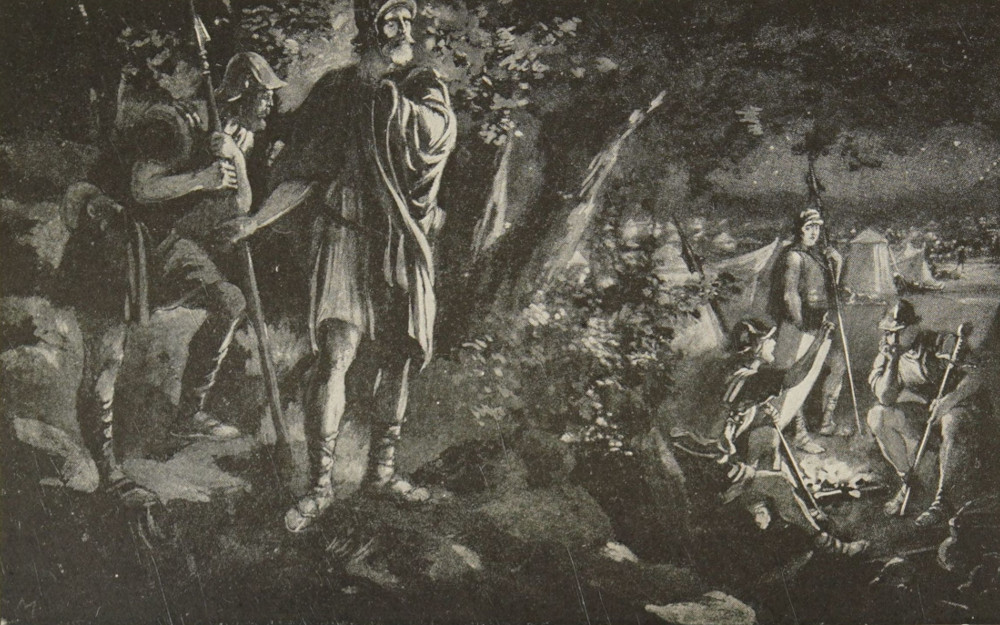
Angels of heaven shielded Jonathan and his attendant, angels
fought by their side, and the Philistines fell before them. The
earth trembled as though a great multitude with horsemen and
chariots were approaching. Jonathan recognized the tokens of
divine aid, and even the Philistines knew that God was working
for the deliverance of Israel. Great fear seized upon the host,
both in the field and in the garrison. In the confusion, mistaking
their own soldiers for enemies, the Philistines began to slay one
another.
Soon the noise of the battle was heard in the camp of Israel.
The king’s sentinels reported that there was great confusion among
the Philistines, and that their numbers were decreasing. Yet it
was not known that any part of the Hebrew army had left the
camp. Upon inquiry it was found that none were absent except
Jonathan and his armor-bearer. But seeing that the Philistines
were meeting with a repulse, Saul led his army to join the assault.
The Hebrews who had deserted to the enemy now turned against
them; great numbers also came out of their hiding-places, and as
the Philistines fled, discomfited, Saul’s army committed terrible
havoc upon the fugitives.
Determined to make the most of his advantage, the king rashly
forbade his soldiers to partake of food for the entire day, enforcing
his command by the solemn imprecation, “Cursed be the man
that eateth any food until evening, that I may be avenged on
mine enemies.” The victory had already been gained, without
Saul’s knowledge or co-operation; but he hoped to distinguish
himself by the utter destruction of the vanquished army. The
command to refrain from food was prompted by selfish ambition,
and it showed the king to be indifferent to the needs of his people
when these conflicted with his desire for self-exaltation. To
confirm this prohibition by a solemn oath showed Saul to be
both rash and profane. The very words of the curse give evidence
that Saul’s zeal was for himself, and not for the honor of God. He
declared his object to be, not “that the Lord may be avenged on
his enemies,” but “that I may be avenged on mine enemies.”
The prohibition resulted in leading the people to transgress the
command of God. They had been engaged in warfare all day,
and were faint for want of food; and as soon as the hours of
restriction were over, they fell upon the spoil, and devoured the
flesh with the blood, thus violating the law that forbade the
eating of blood.
During the day’s battle, Jonathan, who had not heard of the
king’s command, unwittingly offended by eating a little honey as
he passed through a wood. Saul learned of this at evening. He
had declared that the violation of his edict should be punished
with death; and though Jonathan had not been guilty of a willful
sin, though God had miraculously preserved his life, and had
wrought deliverance through him, the king declared that the
sentence must be executed. To spare the life of his son would
have been an acknowledgment on the part of Saul that he had
sinned in making so rash a vow. This would have been humiliating
to his pride. “God do so, and more also,” was his terrible
sentence; “thou shalt surely die, Jonathan.”
Saul could not claim the honor of the victory, but he hoped
to be honored for his zeal in maintaining the sacredness of his
oath. Even at the sacrifice of his son, he would impress upon his
subjects the fact that the royal authority must be maintained. At
Gilgal, but a short time before, Saul had presumed to officiate as
priest, contrary to the command of God. When reproved by
Samuel, he had stubbornly justified himself. Now, when his
own command was disobeyed,—though the command was unreasonable
and had been violated through ignorance,—the king
and father sentenced his son to death.
The people refused to allow the sentence to be executed.
Braving the anger of the king, they declared, “Shall Jonathan
die, who hath wrought this great salvation in Israel? God forbid;
as the Lord liveth, there shall not one hair of his head fall
to the ground; for he hath wrought with God this day.” The
proud monarch dared not disregard this unanimous verdict, and
the life of Jonathan was preserved.
Saul could not but feel that his son was preferred before him,
both by the people and by the Lord. Jonathan’s deliverance was
a severe reproof to the king’s rashness. He felt a presentiment
that his curses would return upon his own head. He did not
longer continue the war with the Philistines, but returned to his
home, moody and dissatisfied.
Those who are most ready to excuse or justify themselves in
sin are often most severe in judging and condemning others.
Many, like Saul, bring upon themselves the displeasure of God,
but they reject counsel and despise reproof. Even when convinced
that the Lord is not with them, they refuse to see in
themselves the cause of their trouble. They cherish a proud,
boastful spirit, while they indulge in cruel judgment or severe
rebuke of others who are better than they. Well would it be
for such self-constituted judges to ponder those words of Christ:
“With what judgment ye judge, ye shall be judged; and with
what measure ye mete, it shall be measured to you again.”[1039]
Often those who are seeking to exalt themselves are brought
into positions where their true character is revealed. So it was in
the case of Saul. His own course convinced the people that
kingly honor and authority were dearer to him than justice,
mercy, or benevolence. Thus the people were led to see their
error in rejecting the government that God had given them. They
had exchanged the pious prophet, whose prayers had brought
down blessings, for a king who in his blind zeal had prayed for
a curse upon them.
Had not the men of Israel interposed to save the life of
Jonathan, their deliverer would have perished by the king’s
decree. With what misgivings must that people afterward have
followed Saul’s guidance! How bitter the thought that he had
been placed upon the throne by their own act! The Lord bears
long with the waywardness of men, and to all he grants opportunity
to see and forsake their sins; but while he may seem to
prosper those who disregard his will and despise his warnings, he
will, in his own time, surely make manifest their folly.
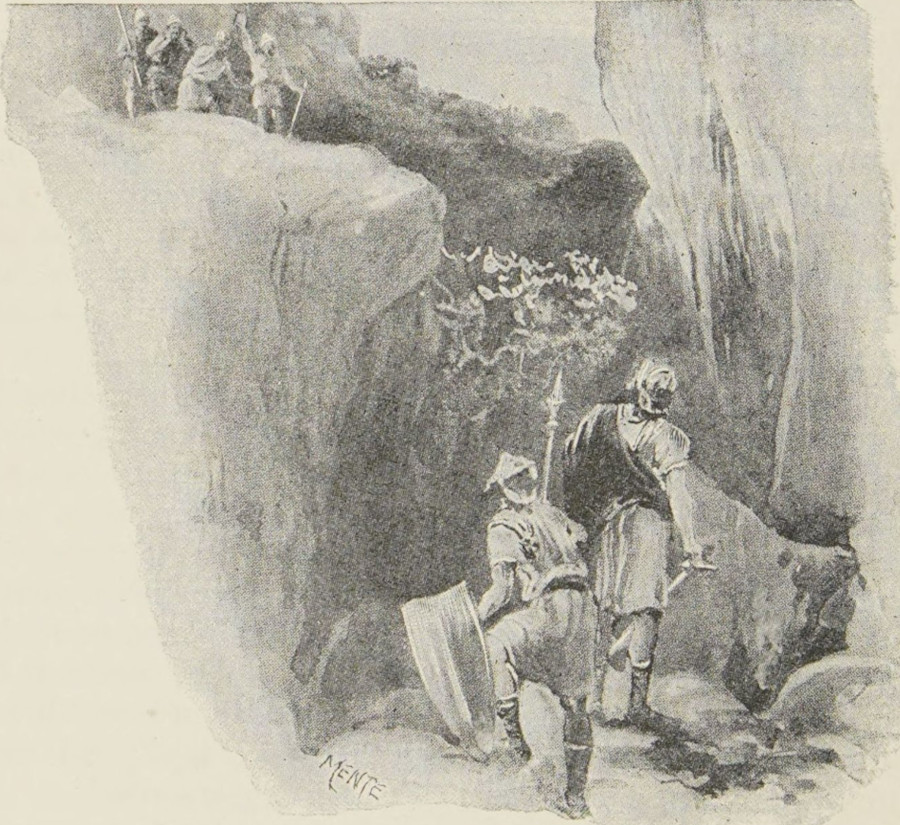
Jonathan and the Armor Bearer. “Come up to us, and we will show you a thing.”
Saul had failed to bear the test of faith in the trying situation
at Gilgal, and had brought dishonor upon the service of God; but
his errors were not yet irretrievable, and the Lord would grant
him another opportunity to learn the lesson of unquestioning
faith in his word and obedience to his commands.
When reproved by the prophet at Gilgal, Saul saw no great sin
in the course he had pursued. He felt that he had been treated
unjustly, and endeavored to vindicate his actions, and offered
excuses for his error. From that time he had little intercourse
with the prophet. Samuel loved Saul as his own son, while Saul,
bold and ardent in temper, had held the prophet in high regard;
but he resented Samuel’s rebuke, and thenceforth avoided him so
far as possible.
But the Lord sent his servant with another message to Saul.
By obedience he might still prove his fidelity to God, and his
worthiness to walk before Israel. Samuel came to the king,
and delivered the word of the Lord. That the monarch might
realize the importance of heeding the command, Samuel expressly
declared that he spoke by divine direction, by the same authority
that had called Saul to the throne. The prophet said, “Thus
saith the Lord of hosts: I remember that which Amalek did to
Israel, how he laid wait for him in the way, when he came up
from Egypt. Now go and smite Amalek, and utterly destroy
all that they have, and spare them not; but slay both man and
woman, infant and suckling, ox and sheep, camel and ass.”[1040] The
Amalekites had been the first to make war upon Israel in the
wilderness; and for this sin, together with their defiance of God
and their debasing idolatry, the Lord, through Moses, had pronounced
sentence upon them. By divine direction, the history of
their cruelty toward Israel had been recorded, with the command,
“Thou shalt blot out the remembrance of Amalek from under
heaven; thou shalt not forget it.”[1041] For four hundred years the
execution of this sentence had been deferred; but the Amalekites
had not turned from their sins. The Lord knew that this wicked
people would, if it were possible, blot out his people and his
worship from the earth. Now the time had come for the sentence,
so long delayed, to be executed.
The forbearance that God has exercised toward the wicked,
emboldens men in transgression; but their punishment will be
none the less certain and terrible for being long delayed. “The
Lord shall rise up as in Mount Perazim, he shall be wroth as
in the valley of Gibeon, that he may do his work, his strange
work; and bring to pass his act, his strange act.”[1042] To our
merciful God the act of punishment is a strange act. “As I
live, saith the Lord God, I have no pleasure in the death of the
wicked; but that the wicked turn from his way and live.” The
Lord is “merciful and gracious, long-suffering, and abundant in
goodness and truth, ... forgiving iniquity and transgression and
sin.” Yet he will “by no means clear the guilty.”[1043] While he
does not delight in vengeance, he will execute judgment upon the
transgressors of his law. He is forced to do this, to preserve the
inhabitants of the earth from utter depravity and ruin. In order
to save some, he must cut off those who have become hardened in
sin. “The Lord is slow to anger, and great in power, and will not
at all acquit the wicked.”[1044] By terrible things in righteousness
he will vindicate the authority of his downtrodden law. And
the very fact of his reluctance to execute justice, testifies to the
enormity of the sins that call forth his judgments, and to the
severity of the retribution awaiting the transgressor.
But while inflicting judgment, God remembered mercy. The
Amalekites were to be destroyed, but the Kenites, who dwelt
among them, were spared. This people, though not wholly free
from idolatry, were worshipers of God, and were friendly to Israel.
Of this tribe was the brother-in-law of Moses, Hobab, who had
accompanied the Israelites in their travels through the wilderness,
and by his knowledge of the country had rendered them valuable
assistance.
Since the defeat of the Philistines at Michmash, Saul had made
war against Moab, Ammon, and Edom, and against the Amalekites
and the Philistines; and wherever he turned his arms, he
gained fresh victories. On receiving the commission against the
Amalekites, he at once proclaimed war. To his own authority was
added that of the prophet, and at the call to battle the men of
Israel flocked to his standard. This expedition was not to be
entered upon for the purpose of self-aggrandizement; the Israelites
were not to receive either the honor of the conquest or the spoils
of their enemies. They were to engage in the war solely as an act
of obedience to God, for the purpose of executing his judgment
upon the Amalekites. God intended that all nations should behold
the doom of that people that had defied his sovereignty,
and should mark that they were destroyed by the very people
whom they had despised.
“Saul smote the Amalekites from Havilah until thou comest
to Shur, that is over against Egypt. And he took Agag, the king
of the Amalekites, alive, and utterly destroyed all the people with
the edge of the sword. But Saul and the people spared Agag,
and the best of the sheep, and of the oxen, and of the fatlings,
and the lambs, and all that was good; and would not utterly
destroy them. But everything that was vile and refuse, that
they destroyed utterly.”
This victory over the Amalekites was the most brilliant victory
that Saul had ever gained, and it served to rekindle the pride of
heart that was his greatest peril. The divine edict devoting the
enemies of God to utter destruction was but partially fulfilled.
Ambitious to heighten the honor of his triumphal return by the
presence of a royal captive, Saul ventured to imitate the customs
of the nations around him, and spared Agag, the fierce and warlike
king of the Amalekites. The people reserved for themselves
the finest of the flocks, herds, and beasts of burden, excusing
their sin, on the ground that the cattle were reserved to be offered
as sacrifices to the Lord. It was their purpose, however, to use
these merely as a substitute, to save their own cattle.
Saul had now been subjected to the final test. His presumptuous
disregard of the will of God, showing his determination to rule
as an independent monarch, proved that he could not be trusted
with royal power as the vicegerent of the Lord. While Saul
and his army were marching home in the flush of victory, there
was deep anguish in the home of Samuel the prophet. He had
received a message from the Lord, denouncing the course of the
king: “It repenteth me that I have set up Saul to be king; for
he is turned back from following me, and hath not performed
my commandments.”[1045] The prophet was deeply grieved over the
course of the rebellious king, and he wept and prayed all night
for a reversing of the terrible sentence.
God’s repentance is not like man’s repentance. “The Strength
of Israel will not lie, nor repent; for he is not a man, that he
should repent.”[1045] Man’s repentance implies a change of mind.
God’s repentance implies a change of circumstances and relations.
Man may change his relation to God by complying with the
conditions upon which he may be brought into the divine favor,
or he may, by his own action, place himself outside the favoring
condition; but the Lord is the same “yesterday, and to-day, and
forever.”[1046] Saul’s disobedience changed his relation to God; but
the conditions of acceptance with God were unaltered,—God’s
requirements were still the same; for with him there “is no
variableness, neither shadow of turning.”[1047]
With an aching heart the prophet set forth the next morning
to meet the erring king. Samuel cherished a hope that, upon
reflection, Saul might become conscious of his sin, and by repentance
and humiliation, be again restored to the divine favor. But
when the first step is taken in the path of transgression, the way
becomes easy. Saul, debased by his disobedience, came to meet
Samuel with a lie upon his lips. He exclaimed, “Blessed be thou
of the Lord; I have performed the commandment of the Lord.”
The sounds that fell on the prophet’s ears disproved the statement
of the disobedient king. To the pointed question, “What
meaneth then this bleating of the sheep in mine ears, and the
lowing of the oxen which I hear?” Saul made answer, “They
have brought them from the Amalekites; for the people spared
the best of the sheep and of the oxen, to sacrifice unto the Lord
thy God; and the rest we have utterly destroyed.” The people
had obeyed Saul’s directions; but in order to shield himself, he
was willing to charge upon them the sin of his disobedience.
The message of Saul’s rejection brought unspeakable grief to
the heart of Samuel. It had to be delivered before the whole
army of Israel, when they were filled with pride and triumphal
rejoicing over a victory that was accredited to the valor and
generalship of their king, for Saul had not associated God with
the success of Israel in this conflict; but when the prophet saw
the evidence of Saul’s rebellion, he was stirred with indignation,
that he, who had been so highly favored of God, should transgress
the commandment of Heaven, and lead Israel into sin. Samuel
was not deceived by the subterfuge of the king. With mingled
grief and indignation he declared, “Stay, and I will tell thee what
the Lord hath said to me this night.... When thou wast little
in thine own sight, wast thou not made the head of the tribes
of Israel, and the Lord anointed thee king over Israel?” He
repeated the command of the Lord concerning Amalek, and
demanded the reason of the king’s disobedience.
Saul persisted in self-justification: “Yea, I have obeyed the
voice of the Lord, and have gone the way which the Lord sent
me, and have brought Agag the king of Amalek, and have utterly
destroyed the Amalekites. But the people took of the spoil,
sheep and oxen, the chief of the things which should have been
utterly destroyed, to sacrifice unto the Lord thy God in Gilgal.”
In stern and solemn words the prophet swept away the refuge
of lies, and pronounced the irrevocable sentence: “Hath the Lord
as great delight in burnt-offerings and sacrifices, as in obeying the
voice of the Lord? Behold, to obey is better than sacrifice, and
to hearken than the fat of rams. For rebellion is as the sin of
witchcraft, and stubbornness is as iniquity and idolatry. Because
thou hast rejected the word of the Lord, he hath also rejected
thee from being king.”
As the king heard this fearful sentence, he cried out, “I
have sinned; for I have transgressed the commandment of the
Lord, and thy words; because I feared the people, and obeyed
their voice.” Terrified by the denunciation of the prophet, Saul
acknowledged his guilt, which he had before stubbornly denied;
but he still persisted in casting blame upon the people, declaring
that he had sinned through fear of them.
It was not sorrow for sin, but fear of its penalty, that actuated
the king of Israel as he entreated Samuel, “I pray thee, pardon
my sin, and turn again with me, that I may worship the Lord.”
If Saul had had true repentance, he would have made public
confession of his sin; but it was his chief anxiety to maintain
his authority, and retain the allegiance of the people. He desired
the honor of Samuel’s presence in order to strengthen his own
influence with the nation.
“I will not return with thee,” was the answer of the prophet;
“for thou hast rejected the word of the Lord, and the Lord hath
rejected thee from being king over Israel.” As Samuel turned to
depart, the king, in an agony of fear, laid hold of his mantle to
hold him back, but it rent in his hands. Upon this, the prophet
declared, “The Lord hath rent the kingdom of Israel from thee
this day, and hath given it to a neighbor of thine, that is better
than thou.”
Saul was more disturbed by the alienation of Samuel than by
the displeasure of God. He knew that the people had greater
confidence in the prophet than in himself. Should another by
divine command be now anointed king, Saul felt that it would
be impossible to maintain his own authority. He feared an
immediate revolt, should Samuel utterly forsake him. Saul entreated
the prophet to honor him before the elders and the people
by publicly uniting with him in a religious service. By divine
direction, Samuel yielded to the king’s request, that no occasion
might be given for a revolt. But he remained only as a silent
witness of the service.
An act of justice, stern and terrible, was yet to be performed.
Samuel must publicly vindicate the honor of God, and rebuke the
course of Saul. He commanded that the king of the Amalekites
be brought before him. Above all who had fallen by the sword
of Israel, Agag was the most guilty and merciless; one who had
hated and sought to destroy the people of God, and whose influence
had been strongest to promote idolatry. He came at the
prophet’s command, flattering himself that the danger of death
was past. Samuel declared: “As thy sword hath made women
childless, so shall thy mother be childless among women. And
Samuel hewed Agag in pieces before the Lord.” This done,
Samuel returned to his home at Ramah, Saul to his at Gibeah.
Only once thereafter did the prophet and the king ever meet
each other.
When called to the throne, Saul had a humble opinion of his
own capabilities, and was willing to be instructed. He was deficient
in knowledge and experience, and had serious defects of
character. But the Lord granted him the Holy Spirit as a guide
and helper, and placed him in a position where he could develop
the qualities requisite for a ruler of Israel. Had he remained
humble, seeking constantly to be guided by divine wisdom, he
would have been enabled to discharge the duties of his high
position with success and honor. Under the influence of divine
grace, every good quality would have been gaining strength, while
evil tendencies would have lost their power. This is the work
which the Lord proposes to do for all who consecrate themselves
to him. There are many whom he has called to positions in his
work because they have a humble and teachable spirit. In his
providence he places them where they may learn of him. He
will reveal to them their defects of character, and to all who seek
his aid he will give strength to correct their errors.
But Saul presumed upon his exaltation, and dishonored God
by unbelief and disobedience. Though when first called to the
throne he was humble and self-distrustful, success made him
self-confident. The very first victory of his reign had kindled
that pride of heart which was his greatest danger. The valor
and military skill displayed in the deliverance of Jabesh-gilead
had roused the enthusiasm of the whole nation. The people
honored their king, forgetting that he was but the agent by whom
God had wrought; and though at first Saul ascribed the glory to
God, he afterward took honor to himself. He lost sight of his
dependence upon God, and in heart departed from the Lord.
Thus the way was prepared for his sin of presumption and sacrilege
at Gilgal. The same blind self-confidence led him to reject
Samuel’s reproof. Saul acknowledged Samuel to be a prophet
sent from God; hence he should have accepted the reproof,
though he could not himself see that he had sinned. Had he
been willing to see and confess his error, this bitter experience
would have proved a safeguard for the future.
If the Lord had then separated himself entirely from Saul, he
would not have again spoken to him through his prophet, intrusting
him with a definite work to perform, that he might correct
the errors of the past. When one who professes to be a child
of God becomes careless in doing his will, thereby influencing
others to be irreverent, and unmindful of the Lord’s injunctions,
it is still possible for his failures to be turned into victories if he
will but accept reproof with true contrition of soul, and return
to God in humility and faith. The humiliation of defeat often
proves a blessing by showing us our inability to do the will of God
without his aid.
When Saul turned away from the reproof sent him by God’s
Holy Spirit, and persisted in his stubborn self-justification, he
rejected the only means by which God could work to save him
from himself. He had willfully separated himself from God. He
could not receive divine help or guidance until he should return
to God by confession of his sin.
At Gilgal, Saul had made an appearance of great conscientiousness,
as he stood before the army of Israel offering up a
sacrifice to God. But his piety was not genuine. A religious
service performed in direct opposition to the command of God,
only served to weaken Saul’s hands, placing him beyond the
help that God was so willing to grant him.
In the expedition against Amalek, Saul thought he had done
all that was essential of that which the Lord had commanded
him; but the Lord was not pleased with partial obedience, nor
willing to pass over what had been neglected through so plausible
a motive. God has given men no liberty to depart from his
requirements. The Lord had declared to Israel, “Ye shall not
do ... every man whatsoever is right in his own eyes;” but ye
shall “observe and hear all these words which I command thee.”[1048]
In deciding upon any course of action, we are not to ask whether
we can see that harm will result from it, but whether it is in
keeping with the will of God. “There is a way which seemeth
right unto a man; but the end thereof are the ways of death.”[1049]
“To obey is better than sacrifice.” The sacrificial offerings
were, in themselves, of no value in the sight of God. They were
designed to express, on the part of the offerer, penitence for sin
and faith in Christ, and to pledge future obedience to the law of
God. But without penitence, faith, and an obedient heart, the
offerings were worthless. When, in direct violation of God’s
command, Saul proposed to present a sacrifice of that which
God had devoted to destruction, open contempt was shown for
the divine authority. The service would have been an insult to
Heaven. Yet with the sin of Saul and its result before us, how
many are pursuing a similar course. While they refuse to believe
and obey some requirement of the Lord, they persevere in offering
up to God their formal services of religion. There is no response
of the Spirit of God to such service. No matter how zealous men
may be in their observance of religious ceremonies, the Lord
cannot accept them if they persist in willful violation of one of
his commands.
“Rebellion is as the sin of witchcraft, and stubbornness is as
iniquity and idolatry.” Rebellion originated with Satan, and all
rebellion against God is directly due to satanic influence. Those
who set themselves against the government of God have entered
into an alliance with the arch-apostate, and he will exercise his
power and cunning to captivate the senses and mislead the understanding.
He will cause everything to appear in a false light.
Like our first parents, those who are under his bewitching spell
see only the great benefits to be received by transgression.
No stronger evidence can be given of Satan’s delusive power
than that many who are thus led by him, deceive themselves with
the belief that they are in the service of God. When Korah,
Dathan, and Abiram rebelled against the authority of Moses, they
thought they were opposing only a human leader, a man like
themselves; and they came to believe that they were verily doing
God service. But in rejecting God’s chosen instrument, they
rejected Christ; they insulted the Spirit of God. So, in the days
of Christ, the Jewish scribes and elders, who professed great zeal
for the honor of God, crucified his Son. The same spirit still exists
in the hearts of those who set themselves to follow their own will
in opposition to the will of God.
Saul had had the most ample proof that Samuel was divinely
inspired. His venturing to disregard the command of God
through the prophet, was against the dictates of reason and
sound judgment. His fatal presumption must be attributed to
satanic sorcery. Saul had manifested great zeal in suppressing
idolatry and witchcraft; yet in his disobedience to the divine command
he had been actuated by the same spirit of opposition to
God, and had been as really inspired by Satan, as are those who
practice sorcery; and when reproved, he had added stubbornness
to rebellion. He could have offered no greater insult to the Spirit
of God, had he openly united with idolaters.
It is a perilous step to slight the reproofs and warnings of
God’s word or of his Spirit. Many, like Saul, yield to temptation
until they become blind to the true character of sin. They
flatter themselves that they have had some good object in view,
and have done no wrong in departing from the Lord’s requirements.
Thus they do despite to the Spirit of grace, until its voice
is no longer heard, and they are left to the delusions which they
have chosen.
In Saul, God had given to Israel a king after their own
heart, as Samuel said when the kingdom was confirmed to
Saul at Gilgal, “Behold the king whom ye have chosen, and whom
ye have desired.”[1050] Comely in person, of noble stature and princely
bearing, his appearance accorded with their conceptions of royal
dignity; and his personal valor and his ability in the conduct of
armies, were the qualities which they regarded as best calculated
to secure respect and honor from other nations. They felt little
solicitude that their king should possess those higher qualities
which alone could fit him to rule with justice and equity. They
did not ask for one who had true nobility of character, who possessed
the love and fear of God. They had not sought counsel
from God as to the qualities a ruler should possess, in order to
preserve their distinctive, holy character as his chosen people.
They were not seeking God’s way, but their own way. Therefore
God gave them such a king as they desired,—one whose
character was a reflection of their own. Their hearts were not
in submission to God, and their king also was unsubdued by
divine grace. Under the rule of this king, they would obtain the
experience necessary in order that they might see their error, and
return to their allegiance to God.
Yet the Lord, having placed on Saul the responsibility of the
kingdom, did not leave him to himself. He caused the Holy
Spirit to rest upon Saul to reveal to him his own weakness, and
his need of divine grace; and had Saul relied upon God, God
would have been with him. So long as his will was controlled
by the will of God, so long as he yielded to the discipline of his
Spirit, God could crown his efforts with success. But when Saul
chose to act independently of God, the Lord could no longer
be his guide, and was forced to set him aside. Then he called
to the throne “a man after his own heart;”[1051]—not one who
was faultless in character, but who, instead of trusting to himself,
would rely upon God, and be guided by his Spirit; who
when he sinned, would submit to reproof and correction.
A few miles south of Jerusalem, “the city of the great King,”
is Bethlehem, where David, the son of Jesse, was born more than a
thousand years before the infant Jesus was cradled in the manger,
and worshiped by the wise men from the East. Centuries before
the advent of the Saviour, David, in the freshness of boyhood,
kept watch of his flocks as they grazed on the hills surrounding
Bethlehem. The simple shepherd boy sang the songs of his own
composing, and the music of his harp made a sweet accompaniment
to the melody of his fresh young voice. The Lord had
chosen David, and was preparing him, in his solitary life with
his flocks, for the work he designed to commit to his trust in
after-years.
While David was thus living in the retirement of his humble
shepherd’s life, the Lord God was speaking about him to the
prophet Samuel. “And the Lord said unto Samuel, How long
wilt thou mourn for Saul, seeing I have rejected him from reigning
over Israel? fill thine horn with oil, and go, I will send thee
to Jesse the Bethlehemite; for I have provided me a king among
his sons.... Take an heifer with thee, and say, I am come to
sacrifice to the Lord. And call Jesse to the sacrifice, and I will
show thee what thou shalt do; and thou shalt anoint unto me
him whom I name unto thee. And Samuel did that which the
Lord spake, and came to Bethlehem. And the elders of the town
trembled at his coming, and said, Comest thou peaceably? And
he said, Peaceably.”[1055] The elders accepted an invitation to the
sacrifice, and Samuel called also Jesse and his sons. The altar
was built, and the sacrifice was ready. All the household of
Jesse were present, with the exception of David, the youngest
son, who had been left to guard the sheep, for it was not safe
to leave the flocks unprotected.
When the sacrifice was ended, and before partaking of the
offering-feast, Samuel began his prophetic inspection of the noble-appearing
sons of Jesse. Eliab was the eldest, and more nearly
resembled Saul for stature and beauty than the others. His
comely features and finely developed form attracted the attention
of the prophet. As Samuel looked upon his princely bearing,
he thought, “This is indeed the man whom God has chosen as
successor to Saul,” and he waited for the divine sanction that he
might anoint him. But Jehovah did not look upon the outward
appearance. Eliab did not fear the Lord. Had he been called
to the throne, he would have been a proud, exacting ruler. The
Lord’s word to Samuel was, “Look not on his countenance, or on
the height of his stature; because I have refused him: for the
Lord seeth not as man seeth; for man looketh on the outward
appearance, but the Lord looketh on the heart.” No outward
beauty can recommend the soul to God. The wisdom and excellence
revealed in the character and deportment, express the
true beauty of the man; and it is the inner worth, the excellency
of the heart, that determines our acceptance with the Lord of
hosts. How deeply should we feel this truth in the judgment of
ourselves and others. We may learn, from the mistake of Samuel,
how vain is the estimation that rests on beauty of face or nobility
of stature. We may see how incapable is man’s wisdom of understanding
the secrets of the heart, or of comprehending the counsels
of God, without special enlightenment from heaven. The thoughts
and ways of God in relation to his creatures are above our finite
minds; but we may be assured that his children will be brought
to fill the very place for which they are qualified, and will be
enabled to accomplish the very work committed to their hands,
if they will but submit their will to God, that his beneficent plans
may not be frustrated by the perversity of man.
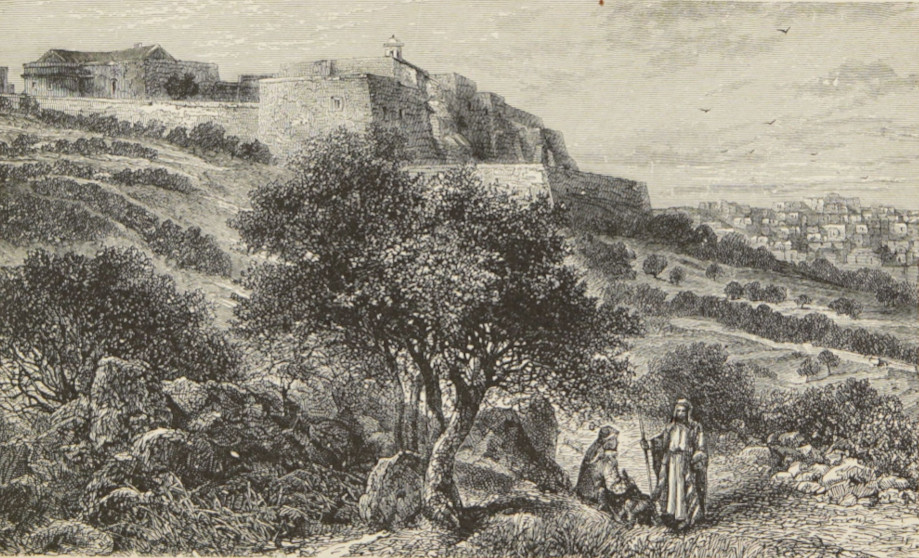
Eliab passed from the inspection of Samuel, and the six
brothers who were in attendance at the service, followed in succession
to be observed by the prophet; but the Lord did not
signify his choice of any one of them. With painful suspense,
Samuel had looked upon the last of the young men; the prophet
was perplexed and bewildered. He inquired of Jesse, “Are here
all thy children?” The father answered, “There remaineth
yet the youngest, and, behold, he keepeth the sheep.” Samuel
directed that he should be summoned, saying, “We will not sit
down till he come hither.”
The lonely shepherd was startled by the unexpected call of
the messenger, who announced that the prophet had come to
Bethlehem and had sent for him. With surprise he questioned
why the prophet and judge of Israel should desire to see him;
but without delay he obeyed the call. “Now he was ruddy, and
withal of a beautiful countenance, and goodly to look to.” As
Samuel beheld with pleasure the handsome, manly, modest shepherd
boy, the voice of the Lord spoke to the prophet, saying,
“Arise, anoint him; for this is he.” David had proved himself
brave and faithful in the humble office of a shepherd, and now
God had chosen him to be captain of his people. “Then Samuel
took the horn of oil, and anointed him in the midst of [from
among] his brethren; and the Spirit of the Lord came upon
David from that day forward.” The prophet had accomplished
his appointed work, and with a relieved heart he returned to
Ramah.
Samuel had not made known his errand, even to the family of
Jesse, and the ceremony of anointing David had been performed
in secret. It was an intimation to the youth of the high destiny
awaiting him, that amid all the varied experiences and perils of
his coming years, this knowledge might inspire him to be true to
the purpose of God to be accomplished by his life.
The great honor conferred upon David did not serve to elate
him. Notwithstanding the high position which he was to occupy,
he quietly continued his employment, content to await the development
of the Lord’s plans in his own time and way. As humble
and modest as before his anointing, the shepherd boy returned to
the hills, and watched and guarded his flocks as tenderly as ever.
But with new inspiration he composed his melodies, and played
upon his harp. Before him spread a landscape of rich and varied
beauty. The vines, with their clustering fruit, brightened in the
sunshine. The forest trees, with their green foliage, swayed in the
breeze. He beheld the sun flooding the heavens with light,
coming forth as a bridegroom out of his chamber, and rejoicing as
a strong man to run a race. There were the bold summits of the
hills reaching toward the sky; in the far-away distance rose the
barren cliffs of the mountain wall of Moab; above all spread the
tender blue of the overarching heavens. And beyond was God.
He could not see him, but his works were full of his praise. The
light of day, gilding forest and mountain, meadow and stream,
carried the mind up to behold the Father of lights, the Author of
every good and perfect gift. Daily revelations of the character and
majesty of his Creator, filled the young poet’s heart with adoration
and rejoicing. In contemplation of God and his works, the faculties
of David’s mind and heart were developing and strengthening
for the work of his after-life. He was daily coming into a more
intimate communion with God. His mind was constantly penetrating
into new depths, for fresh themes to inspire his song, and
to wake the music of his harp. The rich melody of his voice
poured out upon the air, echoed from the hills as if responsive to
the rejoicing of the angels’ songs in heaven.
Who can measure the results of those years of toil and wandering
among the lonely hills? The communion with nature and
with God, the care of his flocks, the perils and deliverances, the
griefs and joys, of his lowly lot, were not only to mould the
character of David, and to influence his future life, but through
the psalms of Israel’s sweet singer, they were, in all coming ages,
to kindle love and faith in the hearts of God’s people, bringing
them nearer to the ever-loving heart of Him in whom all his
creatures live.
David, in the beauty and vigor of his young manhood, was
preparing to take a high position with the noblest of the earth.
His talents, as precious gifts from God, were employed to extol the
glory of the divine Giver. His opportunities of contemplation
and meditation served to enrich him with that wisdom and piety
that made him beloved of God and angels. As he contemplated
the perfections of his Creator, clearer conceptions of God opened
before his soul. Obscure themes were illuminated, difficulties
were made plain, perplexities were harmonized, and each ray of
new light called forth fresh bursts of rapture, and sweeter anthems
of devotion, to the glory of God and the Redeemer. The love that
moved him, the sorrows that beset him, the triumphs that attended
him, were all themes for his active thought; and as he beheld the
love of God in all the providences of his life, his heart throbbed
with more fervent adoration and gratitude, his voice rang out in a
richer melody, his harp was swept with more exultant joy; and
the shepherd boy proceeded from strength to strength, from knowledge
to knowledge; for the Spirit of the Lord was upon him.
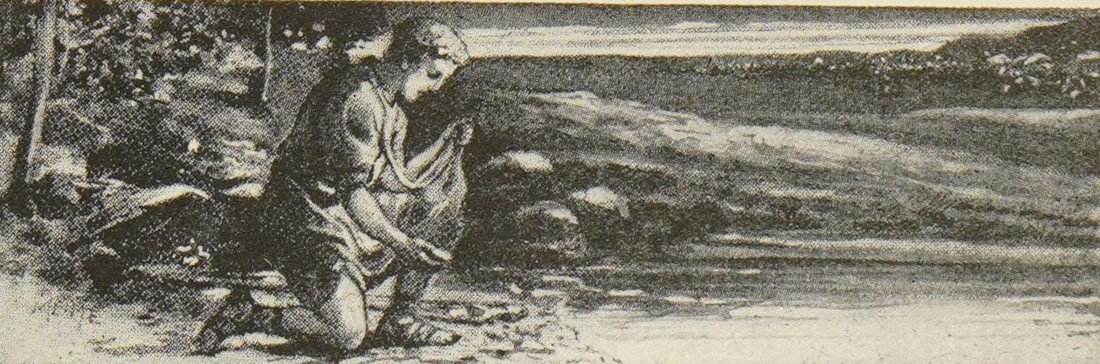
When King Saul realized that he had been rejected by God,
and when he felt the force of the words of denunciation that had
been addressed to him by the prophet, he was filled with bitter
rebellion and despair. It was not true repentance that had bowed
the proud head of the king. He had no clear perception of the
offensive character of his sin, and did not arouse to the work of
reforming his life, but brooded over what he thought was the
injustice of God in depriving him of the throne of Israel, and in
taking the succession away from his posterity. He was ever
occupied in anticipating the ruin that had been brought upon his
house. He felt that the valor which he had displayed in encountering
his enemies, should offset his sin of disobedience. He did not
accept with meekness the chastisement of God; but his haughty
spirit became desperate, until he was on the verge of losing his
reason. His counselors advised him to seek for the services of a
skillful musician, in the hope that the soothing notes of a sweet
instrument might calm his troubled spirit. In the providence of
God, David, as a skillful performer upon the harp, was brought
before the king. His lofty and heaven-inspired strains had the
desired effect. The brooding melancholy that had settled like
a dark cloud over the mind of Saul was charmed away.
When his services were not required at the court of Saul, David
returned to his flocks among the hills, and continued to maintain
his simplicity of spirit and demeanor. Whenever it was necessary,
he was recalled to minister before the king, to soothe the mind of
the troubled monarch till the evil spirit should depart from him.
But although Saul expressed delight in David and his music, the
young shepherd went from the king’s house to the fields and hills
of his pasture with a sense of relief and gladness.
David was growing in favor with God and man. He had been
instructed in the way of the Lord, and he now set his heart more
fully to do the will of God than ever before. He had new themes
for thought. He had been in the court of the king, and had seen
the responsibilities of royalty. He had discovered some of the
temptations that beset the soul of Saul, and had penetrated some
of the mysteries in the character and dealings of Israel’s first king.
He had seen the glory of royalty shadowed with a dark cloud of
sorrow, and he knew that the household of Saul, in their private
life, were far from happy. All these things served to bring
troubled thoughts to him who had been anointed to be king over
Israel. But while he was absorbed in deep meditation, and
harassed by thoughts of anxiety, he turned to his harp, and
called forth strains that elevated his mind to the Author of every
good, and the dark clouds that seemed to shadow the horizon of
the future were dispelled.
God was teaching David lessons of trust. As Moses was
trained for his work, so the Lord was fitting the son of Jesse to
become the guide of his chosen people. In his watchcare for his
flocks, he was gaining an appreciation of the care that the Great
Shepherd has for the sheep of his pasture.
The lonely hills and the wild ravines where David wandered
with his flocks were the lurking-place of beasts of prey. Not
infrequently the lion from the thickets by the Jordan, or the bear
from his lair among the hills, came, fierce with hunger, to attack
the flocks. According to the custom of his time, David was armed
only with his sling and shepherd’s staff; yet he early gave proof
of his strength and courage in protecting his charge. Afterward
describing these encounters, he said: “When there came a lion, or
a bear, and took a lamb out of the flock, I went out after him, and
smote him, and delivered it out of his mouth; and when he arose
against me, I caught him by his beard, and smote him, and slew
him.”[1060] His experience in these matters proved the heart of
David, and developed in him courage and fortitude and faith.
Even before he was summoned to the court of Saul, David had
distinguished himself by deeds of valor. The officer who brought
him to the notice of the king declared him to be “a mighty valiant
man, and a man of war, and prudent in matters,” and he said,
“The Lord is with him.”[1061]
When war was declared by Israel against the Philistines, three
of the sons of Jesse joined the army under Saul; but David
remained at home. After a time, however, he went to visit the
camp of Saul. By his father’s direction he was to carry a message
and a gift to his elder brothers, and to learn if they were still
in safety and health. But, unknown to Jesse, the youthful shepherd
had been intrusted with a higher mission. The armies of
Israel were in peril, and David had been directed by an angel to
save his people.
As David drew near to the army, he heard the sound of commotion,
as if an engagement was about to begin. And “the host
was going forth to the fight, and shouted for the battle.”[1062] Israel and
the Philistines were drawn up in array, army against army. David
ran to the army, and came and saluted his brothers. While he
was talking with them, Goliath, the champion of the Philistines,
came forth, and with insulting language defied Israel, and challenged
them to provide a man from their ranks who would meet
him in single combat. He repeated his challenge, and when
David saw that all Israel were filled with fear, and learned that
the Philistine’s defiance was hurled at them day after day, without
arousing a champion to silence the boaster, his spirit was stirred
within him. He was fired with zeal to preserve the honor of the
living God and the credit of his people.
The armies of Israel were depressed. Their courage failed.
They said one to another, “Have ye seen this man that is come
up? surely to defy Israel is he come up.” In shame and indignation,
David exclaimed, “Who is this uncircumcised Philistine,
that he should defy the armies of the living God?”
Eliab, David’s eldest brother, when he heard these words, knew
well the feelings that were stirring the young man’s soul. Even as
a shepherd, David had manifested daring, courage, and strength
but rarely witnessed; and the mysterious visit of Samuel to their
father’s house, and his silent departure, had awakened in the
minds of the brothers suspicions of the real object of his visit.
Their jealousy had been aroused as they saw David honored above
them, and they did not regard him with the respect and love due
to his integrity and brotherly tenderness. They looked upon him
as merely a stripling shepherd, and now the question which he
asked was regarded by Eliab as a censure upon his own cowardice
in making no attempt to silence the giant of the Philistines. The
elder brother exclaimed angrily, “Why camest thou down hither?
and with whom hast thou left those few sheep in the wilderness?
I know thy pride, and the naughtiness of thine heart; for thou art
come down that thou mightest see the battle.” David’s answer
was respectful but decided: “What have I now done? Is there
not a cause?”
The words of David were repeated to the king, who summoned
the youth before him. Saul listened with astonishment to the
words of the shepherd, as he said, “Let no man’s heart fail
because of him; thy servant will go and fight with this Philistine.”
Saul strove to turn David from his purpose, but the young man
was not to be moved. He replied in a simple, unassuming way,
relating his experiences while guarding his father’s flocks. And
he said, “The Lord that delivered me out of the paw of the lion,
and out of the paw of the bear, he will deliver me out of the hand
of this Philistine. And Saul said unto David, Go, and the Lord
be with thee.”
For forty days the host of Israel had trembled before the
haughty challenge of the Philistine giant. Their hearts failed
within them as they looked upon his massive form, in height
measuring six cubits and a span. Upon his head was a helmet
of brass, he was clothed with a coat of mail that weighed five
thousand shekels, and he had greaves of brass upon his legs.
The coat was made of plates of brass that overlaid one another,
like the scales of a fish, and they were so closely joined that no
dart or arrow could possibly penetrate the armor. At his back
the giant bore a huge javelin, or lance, also of brass. “The
staff of his spear was like a weaver’s beam; and his spear’s head
weighed six hundred shekels of iron; and one bearing a shield
went before him.”
Morning and evening, Goliath had approached the camp of
Israel, saying with a loud voice, “Why are ye come out to set
your battle in array? am not I a Philistine, and ye servants to
Saul? choose you a man for you, and let him come down to me.
If he be able to fight with me, and to kill me, then will we be
your servants; but if I prevail against him, and kill him, then
shall ye be our servants, and serve us. And the Philistine said,
I defy the armies of Israel this day; give me a man, that we may
fight together.”
Though Saul had given David permission to accept Goliath’s
challenge, the king had small hope that David would be successful
in his courageous undertaking. Command was given to clothe the
youth in the king’s own armor. The heavy helmet of brass was
put upon his head, and the coat of mail was placed upon his
body; the monarch’s sword was at his side. Thus equipped, he
started upon his errand, but erelong began to retrace his steps.
The first thought in the minds of the anxious spectators was that
David had decided not to risk his life in meeting an antagonist in
so unequal an encounter. But this was far from the thought of
the brave young man. When he returned to Saul, he begged
permission to lay aside the heavy armor, saying, “I cannot go
with these; for I have not proved them.” He laid off the king’s
armor, and in its stead took only his staff in his hand, with his
shepherd’s scrip, and a simple sling. Choosing five smooth stones
out of the brook, he put them in his bag, and, with his sling in
his hand, drew near to the Philistine. The giant strode boldly
forward, expecting to meet the mightiest of the warriors of Israel.
His armor-bearer walked before him, and he looked as if nothing
could withstand him. As he came nearer to David, he saw but
a stripling, called a boy because of his youth. David’s countenance
was ruddy with health, and his well-knit form, unprotected
by armor, was displayed to advantage; yet between its youthful
outline and the massive proportions of the Philistine, there was a
marked contrast.
Goliath was filled with amazement and anger. “Am I a dog,”
he exclaimed, “that thou comest to me with staves?” Then he
poured upon David the most terrible curses by all the gods of his
knowledge. He cried in derision, “Come to me, and I will give
thy flesh unto the fowls of the air, and to the beasts of the field.”
David did not weaken before the champion of the Philistines.
Stepping forward, he said to his antagonist: “Thou comest to me
with a sword, and with a spear, and with a shield; but I come to
thee in the name of the Lord of hosts, the God of the armies of
Israel, whom thou hast defied. This day will the Lord deliver
thee into mine hand; and I will smite thee, and take thine head
from thee; and I will give the carcasses of the host of the Philistines
this day unto the fowls of the air, and to the wild beasts of
the earth; that all the earth may know that there is a God in
Israel. And all this assembly shall know that the Lord saveth
not with sword and spear; for the battle is the Lord’s, and he will
give you into our hands.”
There was a ring of fearlessness in his tone, a look of triumph
and rejoicing upon his fair countenance. This speech, given in a
clear, musical voice, rang out on the air, and was distinctly heard
by the listening thousands marshaled for war. The anger of
Goliath was roused to the very highest heat. In his rage he
pushed up the helmet that protected his forehead, and rushed
forward to wreak vengeance upon his opponent. The son of Jesse
was preparing for his foe. “And it came to pass, when the Philistine
arose, and came and drew nigh to meet David, that David
hasted, and ran toward the army to meet the Philistine. And
David put his hand in his bag, and took thence a stone, and slang
it, and smote the Philistine in his forehead, that the stone sunk
into his forehead; and he fell upon his face to the earth.”
Amazement spread along the lines of the two armies. They
had been confident that David would be slain; but when the
stone went whizzing through the air, straight to the mark, they
saw the mighty warrior tremble, and reach forth his hands, as if
he were struck with sudden blindness. The giant reeled, and
staggered, and like a smitten oak, fell to the ground. David did
not wait an instant. He sprung upon the prostrate form of the
Philistine, and with both hands laid hold of Goliath’s heavy
sword. A moment before, the giant had boasted that with it he
would sever the youth’s head from his shoulders, and give his
body to the fowls of the air. Now it was lifted in the air, and
then the head of the boaster rolled from his trunk, and a shout of
exultation went up from the camp of Israel.
The Philistines were smitten with terror, and the confusion
which ensued, resulted in a precipitate retreat. The shouts of the
triumphant Hebrews echoed along the summits of the mountains,
as they rushed after their fleeing enemies; and they “pursued the
Philistines, until thou come to the valley, and to the gate of
Ekron. And the wounded of the Philistines fell down by the
way to Shaaraim, even unto Gath, and unto Ekron. And the
children of Israel returned from chasing after the Philistines, and
they spoiled their tents. And David took the head of the Philistine,
and brought it to Jerusalem; but he put his armor in
his tent.”

After the slaying of Goliath, Saul kept David with him, and
would not permit him to return to his father’s house. And it
came to pass that “the soul of Jonathan was knit with the soul of
David, and Jonathan loved him as his own soul.”[1063] Jonathan and
David made a covenant to be united as brethren, and the king’s
son “stripped himself of the robe that was upon him, and gave it to
David, and his garments, even to his sword, and to his bow, and
to his girdle.” David was intrusted with important responsibilities,
yet he preserved his modesty, and won the affection of
the people as well as of the royal household.
“David went out whithersoever Saul sent him, and behaved
himself wisely. And Saul set him over the men of war.” David
was prudent and faithful, and it was evident that the blessing of
God was with him. Saul at times realized his own unfitness for
the government of Israel, and he felt that the kingdom would be
more secure if there could be connected with him one who received
instruction from the Lord. Saul hoped also that his connection
with David would be a safeguard to himself. Since David was
favored and shielded by the Lord, his presence might be a protection
to Saul when he went out with him to war.
It was the providence of God that had connected David with
Saul. David’s position at court would give him a knowledge of
affairs, in preparation for his future greatness. It would enable
him to gain the confidence of the nation. The vicissitudes and
hardships which befell him, through the enmity of Saul, would
lead him to feel his dependence upon God, and to put his whole
trust in him. And the friendship of Jonathan for David was also
of God’s providence, to preserve the life of the future ruler of
Israel. In all these things, God was working out his gracious
purposes, both for David and for the people of Israel.
Saul, however, did not long remain friendly to David. When
Saul and David were returning from battle with the Philistines,
“the women came out of all cities of Israel, singing and dancing,
to meet King Saul, with tabrets, with joy, and with instruments of
music.” One company sang, “Saul hath slain his thousands,”
while another company took up the strain, and responded, “And
David his ten thousands.” The demon of jealousy entered the
heart of the king. He was angry because David was exalted
above himself in the song of the women of Israel. In place of
subduing these envious feelings, he displayed the weakness of his
character, and exclaimed, “They have ascribed unto David ten
thousands, and to me they have ascribed but thousands; and what
can he have more but the kingdom?”
One great defect in the character of Saul was his love of
approbation. This trait had had a controlling influence over his
actions and thoughts; everything was marked by his desire for
praise and self-exaltation. His standard of right and wrong was
the low standard of popular applause. No man is safe who lives
that he may please men, and does not seek first for the approbation
of God. It was the ambition of Saul to be first in the estimation
of men; and when this song of praise was sung, a settled
conviction entered the mind of the king, that David would obtain
the hearts of the people, and reign in his stead.
Saul opened his heart to the spirit of jealousy by which his
soul was poisoned. Notwithstanding the lessons which he had
received from the prophet Samuel, instructing him that God
would accomplish whatsoever he chose, and that no one could
hinder it, the king made it evident that he had no true knowledge
of the plans or power of God. The monarch of Israel was
opposing his will to the will of the Infinite One. Saul had not
learned, while ruling the kingdom of Israel, that he should
rule his own spirit. He allowed his impulses to control his
judgment, until he was plunged into a fury of passion. He
had paroxysms of rage, when he was ready to take the life of any
who dared oppose his will. From this frenzy he would pass
into a state of despondency and self-contempt, and remorse
would take possession of his soul.
He loved to hear David play upon his harp, and the evil spirit
seemed to be charmed away for the time; but one day when the
youth was ministering before him, and bringing sweet music from
his instrument, accompanying his voice as he sang the praises of
God, Saul suddenly threw his spear at the musician, for the purpose
of putting an end to his life. David was preserved by the
interposition of God, and without injury fled from the rage of
the maddened king.
As Saul’s hatred of David increased, he became more and
more watchful to find an opportunity to take his life; but none
of his plans against the anointed of the Lord were successful.
Saul gave himself up to the control of the wicked spirit that
ruled over him; while David trusted in Him who is mighty in
counsel, and strong to deliver. “The fear of the Lord is the beginning
of wisdom,”[1064] and David’s prayer was continually directed
to God, that he might walk before him in a perfect way.
Desiring to be freed from the presence of his rival, the king
“removed him from him, and made him his captain over a
thousand.... But all Israel and Judah loved David.” The
people were not slow to see that David was a competent person,
and that the affairs intrusted to his hands were managed with
wisdom and skill. The counsels of the young man were of a wise
and discreet character, and proved to be safe to follow; while
the judgment of Saul was at times unreliable, and his decisions
were not wise.
Though Saul was ever on the alert for an opportunity to
destroy David, he stood in fear of him, since it was evident that
the Lord was with him. David’s blameless character aroused
the wrath of the king; he deemed that the very life and presence
of David cast a reproach upon him, since by contrast it presented
his own character to disadvantage. It was envy that made Saul
miserable, and put the humble subject of his throne in jeopardy.
What untold mischief has this evil trait of character worked in
our world! The same enmity existed in the heart of Saul that
stirred the heart of Cain against his brother Abel, because Abel’s
works were righteous, and God honored him, and his own works
were evil, and the Lord could not bless him. Envy is the offspring
of pride, and if it is entertained in the heart, it will lead
to hatred, and eventually to revenge and murder. Satan displayed
his own character in exciting the fury of Saul against
him who had never done him harm.
The king kept a strict watch upon David, hoping to find some
occasion of indiscretion or rashness that might serve as an excuse
to bring him into disgrace. He felt that he could not be satisfied
until he could take the young man’s life and still be justified
before the nation for his evil act. He laid a snare for the feet
of David, urging him to conduct the war against the Philistines
with still greater vigor, and promising, as a reward of his valor,
an alliance with the eldest daughter of the royal house. To this
proposal, David’s modest answer was, “Who am I? and what
is my life, or my father’s family in Israel, that I should be son-in-law
to the king?” The monarch manifested his insincerity by
wedding the princess to another.
An attachment for David on the part of Michal, Saul’s youngest
daughter, afforded the king another opportunity to plot against his
rival. Michal’s hand was offered the young man, on condition
that evidence should be given of the defeat and slaughter of a
specified number of their national foes. “Saul thought to make
David fall by the hand of the Philistines;” but God shielded his
servant. David returned, a victor, from the battle, to become the
king’s son-in-law. “Michal Saul’s daughter loved him,” and the
monarch, enraged, saw that his plots had resulted in the elevation
of him whom he sought to destroy. He was still more assured
that this was the man whom the Lord had said was better than
he, and who should reign on the throne of Israel in his place.
Throwing off all disguise, he issued a command to Jonathan and
to the officers of the court to take the life of the one he hated.
Jonathan revealed the king’s intention to David, and bade him
conceal himself, while he would plead with his father to spare the
life of the deliverer of Israel. He presented before the king what
David had done to preserve the honor and even the life of the
nation, and what terrible guilt would rest upon the murderer
of the one whom God had used to scatter their enemies. The
conscience of the king was touched, and his heart was softened.
“And Saul sware, As the Lord liveth, he shall not be slain.”
David was brought to Saul, and he ministered in his presence, as
he had done in the past.
Again war was declared between the Israelites and the Philistines,
and David led the army against their enemies. A great
victory was gained by the Hebrews, and the people of the realm
praised his wisdom and heroism. This served to stir up the former
bitterness of Saul against him. While the young man was
playing before the king, filling the palace with sweet harmony,
Saul’s passion overcame him, and he hurled a javelin at David,
thinking to pin the musician to the wall; but the angel of the
Lord turned aside the deadly weapon. David escaped, and fled
to his own house. Saul sent spies that they might take him as
he should come out in the morning, and put an end to his life.
Michal informed David of the purpose of her father. She
urged him to flee for his life, and let him down from the window,
thus enabling him to make his escape. He fled to Samuel at
Ramah, and the prophet, fearless of the king’s displeasure, welcomed
the fugitive. The home of Samuel was a peaceful place in
contrast with the royal palace. It was here, amid the hills, that
the honored servant of the Lord continued his work. A company
of seers was with him, and they studied closely the will of God,
and listened reverently to the words of instruction that fell from
the lips of Samuel. Precious were the lessons that David learned
from the teacher of Israel. David believed that the troops of Saul
would not be ordered to invade this sacred place; but no place
seemed to be sacred to the darkened mind of the desperate king.
David’s connection with Samuel aroused the jealousy of the king,
lest he who was revered as a prophet of God throughout all Israel
should lend his influence to the advancement of Saul’s rival.
When the king learned where David was, he sent officers to bring
him to Gibeah, where he intended to carry out his murderous
design.
The messengers went on their way, intent upon taking David’s
life; but One greater than Saul controlled them. They were met
by unseen angels, as was Balaam when he was on his way to
curse Israel. They began to utter prophetic sayings of what
would occur in the future, and proclaimed the glory and majesty
of Jehovah. Thus God overruled the wrath of man, and manifested
his power to restrain evil, while he walled in his servant by
a guard of angels.
The tidings reached Saul as he eagerly waited to have David
in his power; but instead of feeling the rebuke of God, he was
still more exasperated, and sent other messengers. These also
were overpowered by the Spirit of God, and united with the first
in prophesying. The third embassage was sent by the king; but
when they came into the company of the prophets, the divine
influence fell upon them also, and they prophesied. Saul then
decided that he himself would go, for his fierce enmity had
become uncontrollable. He was determined to wait for no further
chance to kill David; as soon as he should come within reach of
him, he intended with his own hand to slay him, whatever might
be the consequences.
But an angel of God met him on the way, and controlled him.
The Spirit of God held him in its power, and he went forward
uttering prayers to God, interspersed with predictions and sacred
melodies. He prophesied of the coming Messiah as the world’s
Redeemer. When he came to the prophet’s home in Ramah, he
laid aside the outer garments that betokened his rank, and all
day, and all night, he lay before Samuel and his pupils, under the
influence of the divine Spirit. The people were drawn together
to witness this strange scene, and the experience of the king was
reported far and wide. Thus again, near the close of his reign, it
became a proverb in Israel that Saul also was among the prophets.
Again the persecutor was defeated in his purpose. He assured
David that he was at peace with him; but David had little confidence
in the king’s repentance. He took this opportunity to
escape, lest the mood of the king should change, as formerly. His
heart was wounded within him, and he longed to see his friend
Jonathan once more. Conscious of his innocence, he sought the
king’s son, and made a most touching appeal. “What have I
done?” he asked, “what is mine iniquity? and what is my sin
before thy father, that he seeketh my life?” Jonathan believed
that his father had changed his purpose, and no longer intended
to take the life of David. And Jonathan said unto him, “God
forbid; thou shalt not die: behold, my father will do nothing
either great or small, but that he will show it me; and why
should my father hide this thing from me? It is not so.” After
the remarkable exhibition of the power of God, Jonathan could
not believe that his father would still harm David, since this
would be manifest rebellion against God. But David was not
convinced. With intense earnestness he declared to Jonathan,
“As the Lord liveth, and as thy soul liveth, there is but a step
between me and death.”
At the time of the new moon, a sacred festival was celebrated
in Israel. This festival recurred upon the day following the
interview between David and Jonathan. At this feast it was
expected that both the young men would appear at the king’s
table; but David feared to be present, and it was arranged that
he should visit his brothers in Bethlehem. On his return he was
to hide himself in a field not far from the banqueting hall, for
three days absenting himself from the presence of the king; and
Jonathan would note the effect upon Saul. If inquiry should be
made as to the whereabouts of the son of Jesse, Jonathan was to
say that he had gone home to attend the sacrifice offered by his
father’s household. If no angry demonstrations were made by the
king, but he should answer, “It is well,” then it would be safe for
David to return to the court. But if he should become enraged
at his absence, it would decide the matter of David’s flight.
On the first day of the feast the king made no inquiry concerning
the absence of David; but when his place was vacant the
second day, he questioned, “Wherefore cometh not the son of
Jesse to meat, neither yesterday nor to-day? And Jonathan
answered Saul, David earnestly asked leave of me to go to Bethlehem;
and he said, Let me go, I pray thee; for our family hath
a sacrifice in the city; and my brother, he hath commanded me
to be there: and now, if I have found favor in thine eyes, let me
get away, I pray thee, and see my brethren. Therefore he cometh
not unto the king’s table.” When Saul heard these words, his
anger was ungovernable. He declared that as long as David
lived, Jonathan could not come to the throne of Israel, and he
demanded that David should be sent for immediately, that he
might be put to death. Jonathan again made intercession for
his friend, pleading, “Wherefore shall he be slain? what hath
he done?” This appeal to the king only made him more satanic
in his fury, and the spear which he had intended for David, he
now hurled at his own son.
The prince was grieved and indignant, and leaving the royal
presence, he was no more a guest at the feast. His soul was bowed
down with sorrow, as he repaired, at the appointed time, to the
spot where David was to learn the king’s intentions toward him.
Each fell upon the other’s neck, and they wept bitterly. The dark
passion of the king cast its shadow upon the life of the young
men, and their grief was too intense for expression. Jonathan’s
last words fell upon the ear of David as they separated to pursue
their different paths, “Go in peace, forasmuch as we have sworn
both of us in the name of the Lord, saying, The Lord be between
me and thee, and between my seed and thy seed forever.”
The king’s son returned to Gibeah, and David hastened to
reach Nob, a city but a few miles distant, and also belonging to
the tribe of Benjamin. The tabernacle had been taken to this
place from Shiloh, and here Ahimelech the high priest ministered.
David knew not whither to flee for refuge, except to the
servant of God. The priest looked upon him with astonishment,
as he came, in haste, and apparently alone, with a countenance
marked by anxiety and sorrow. He inquired what had brought
him there. The young man was in constant fear of discovery,
and in his extremity he resorted to deception. David told the
priest that he had been sent by the king on a secret errand, one
which required the utmost expedition. Here he manifested a
want of faith in God, and his sin resulted in causing the death of
the high priest. Had the facts been plainly stated, Ahimelech
would have known what course to pursue to preserve his life.
God requires that truthfulness shall mark his people, even in the
greatest peril. David asked the priest for five loaves of bread.
There was nothing but hallowed bread in the possession of the
man of God, but David succeeded in removing his scruples, and
obtained the bread to satisfy his hunger.
A new danger now presented itself. Doeg, the chief of Saul’s
herdsmen, who had professed the faith of the Hebrews, was now
paying his vows in the place of worship. At sight of this man,
David determined to make haste to secure another place of
refuge, and to obtain some weapon with which to defend himself
if defense should become necessary. He asked Ahimelech for a
sword, and was told that he had none except the sword of Goliath,
which had been kept as a relic in the tabernacle. David
replied, “There is none like that; give it me.” His courage
revived as he grasped the sword that he had once used in
destroying the champion of the Philistines.
David fled to Achish, the king of Gath; for he felt that there
was more safety in the midst of the enemies of his people than in
the dominions of Saul. But it was reported to Achish that David
was the man who had slain the Philistine champion years before;
and now he who had sought refuge with the foes of Israel, found
himself in great peril. But feigning madness, he deceived his
enemies, and thus made his escape.
The first error of David was his distrust of God at Nob, and
his second mistake was his deception before Achish. David had
displayed noble traits of character, and his moral worth had won
him favor with the people; but as trial came upon him, his faith
was shaken, and human weakness appeared. He saw in every
man a spy and a betrayer. In a great emergency, David had
looked up to God with a steady eye of faith, and had vanquished
the Philistine giant. He believed in God, he went in his name.
But as he had been hunted and persecuted, perplexity and distress
had nearly hidden his heavenly Father from his sight.
Yet this experience was serving to teach David wisdom; for
it led him to realize his weakness, and the necessity of constant
dependence upon God. O, how precious is the sweet influence
of the Spirit of God as it comes to depressed or despairing souls,
encouraging the faint-hearted, strengthening the feeble, and imparting
courage and help to the tried servants of the Lord! O,
what a God is ours, who deals gently with the erring, and manifests
his patience and tenderness in adversity, and when we are
overwhelmed with some great sorrow!
Every failure on the part of the children of God is due to
their lack of faith. When shadows encompass the soul, when
we want light and guidance, we must look up; there is light
beyond the darkness. David ought not to have distrusted God
for one moment. He had cause for trusting in him: he was the
Lord’s anointed, and in the midst of danger he had been protected
by the angels of God; he had been armed with courage
to do wonderful things; and if he had but removed his mind
from the distressing situation in which he was placed, and had
thought of God’s power and majesty, he would have been at
peace even in the midst of the shadows of death; he could with
confidence have repeated the promise of the Lord, “The mountains
shall depart, and the hills be removed; but my kindness
shall not depart from thee, neither shall the covenant of my
peace be removed.”[1065]
Among the mountains of Judah, David sought refuge from
the pursuit of Saul. He made good his escape to the cave of
Adullam, a place that, with a small force, could be held against
a large army. “And when his brethren and all his father’s house
heard it, they went down thither to him.” The family of David
could not feel secure, knowing that at any time the unreasonable
suspicions of Saul might be directed against them on account
of their relation to David. They had now learned—what was
coming to be generally known in Israel—that God had chosen
David as the future ruler of his people; and they believed that
they would be safer with him, even though he was a fugitive in
a lonely cave, than they could be while exposed to the insane
madness of a jealous king.
In the cave of Adullam, the family were united in sympathy
and affection. The son of Jesse could make melody with voice
and harp as he sang, “Behold, how good and how pleasant it is
for brethren to dwell together in unity!”[1066] He had tasted the
bitterness of distrust on the part of his own brothers; and the
harmony that had taken the place of discord, brought joy to the
exile’s heart. It was here that David composed the fifty-seventh
psalm.
It was not long before David’s company was joined by others
who desired to escape the exactions of the king. There were
many who had lost confidence in the ruler of Israel, for they
could see that he was no longer guided by the Spirit of the
Lord. “And every one that was in distress, and every one that
was in debt, and every one that was discontented,” resorted
to David, “and he became a captain over them; and there were
with him about four hundred men.” Here David had a little
kingdom of his own, and in it order and discipline prevailed.
But even in his retreat in the mountains, he was far from feeling
secure; for he received continual evidence that the king had not
relinquished his murderous purpose.
He found a refuge for his parents with the king of Moab, and
then, at a warning of danger from a prophet of the Lord, he fled
from his hiding-place to the forest of Hareth. The experience
through which David was passing, was not unnecessary or fruitless.
God was giving him a course of discipline to fit him to become a
wise general, as well as a just and merciful king. With his band
of fugitives he was gaining a preparation to take up the work that
Saul, because of his murderous passion and blind indiscretion, was
becoming wholly unfitted to do. Men cannot depart from the
counsel of God, and still retain that calmness and wisdom which
will enable them to act with justice and discretion. There is no
insanity so dreadful, so hopeless, as that of following human wisdom,
unguided by the wisdom of God.
Saul had been preparing to ensnare and capture David in the
cave of Adullam, and when it was discovered that David had left
this place of refuge, the king was greatly enraged. The flight of
David was a mystery to Saul. He could account for it only by
the belief that there had been traitors in his camp, who had
informed the son of Jesse of his proximity and design.
He affirmed to his counselors that a conspiracy had been
formed against him, and with the offer of rich gifts and positions
of honor he bribed them to reveal who among his people had befriended
David. Doeg the Edomite turned informer. Moved by
ambition and avarice, and by hatred of the priest, who had reproved
his sins, Doeg reported David’s visit to Ahimelech, representing
the matter in such a light as to kindle Saul’s anger
against the man of God. The words of that mischievous tongue,
set on fire of hell, stirred up the worst passions in Saul’s heart.
Maddened with rage, he declared that the whole family of the
priest should perish. And the terrible decree was executed. Not
only Ahimelech, but the members of his father’s house,—“four-score
and five persons that did wear a linen ephod,”—were slain
at the king’s command, by the murderous hand of Doeg.
“And Nob, the city of the priests, smote he with the edge of
the sword, both men and women, children and sucklings, and
oxen, and asses, and sheep.” This is what Saul could do under
the control of Satan. When God had said that the iniquity of
the Amalekites was full, and had commanded him to destroy
them utterly, he thought himself too compassionate to execute
the divine sentence, and he spared that which was devoted to
destruction; but now, without a command from God, under the
guidance of Satan, he could slay the priests of the Lord, and
bring ruin upon the inhabitants of Nob. Such is the perversity of
the human heart that has refused the guidance of God.
This deed filled all Israel with horror. It was the king whom
they had chosen that had committed this outrage; and he had
only done after the manner of the kings of other nations that feared
not God. The ark was with them; but the priests of whom they
had inquired were slain with the sword. What would come next?
After Saul’s atrocious slaughter of the priests of the Lord,
“one of the sons of Ahimelech the son of Ahitub, named Abiathar,
escaped, and fled after David. And Abiathar showed David that
Saul had slain the Lord’s priests. And David said unto Abiathar,
I knew it that day, when Doeg the Edomite was there, that he
would surely tell Saul; I have occasioned the death of all the
persons of thy father’s house. Abide thou with me, fear not; for
he that seeketh my life seeketh thy life; but with me thou shalt
be in safeguard.”[1070]
Still hunted by the king, David found no place of rest or
security. At Keilah his brave band saved the town from capture
by the Philistines, but they were not safe, even among the people
whom they had delivered. From Keilah they repaired to the
wilderness of Ziph.
At this time, when there were so few bright spots in the path
of David, he was rejoiced to receive an unexpected visit from
Jonathan, who had learned the place of his refuge. Precious were
the moments which these two friends passed in each other’s society.
They related their varied experiences, and Jonathan strengthened
the heart of David, saying, “Fear not; for the hand of Saul my
father shall not find thee; and thou shalt be king over Israel, and
I shall be next unto thee; and that also Saul my father knoweth.”
As they talked of the wonderful dealings of God with David,
the hunted fugitive was greatly encouraged. “And they two
made a covenant before the Lord; and David abode in the wood,
and Jonathan went to his house.”
After the visit of Jonathan, David encouraged his soul with
songs of praise, accompanying his voice with his harp as he
sang:—
“In the Lord put I my trust;
How say ye to my soul,
Flee as a bird to your mountain?
For, lo, the wicked bend their bow,
They make ready their arrow upon the string,
That they may privily shoot at the upright in heart.
If the foundations be destroyed,
What can the righteous do?
The Lord is in his holy temple,
The Lord’s throne is in heaven;
His eyes behold, his eyelids try, the children of men.
The Lord trieth the righteous;
But the wicked, and him that loveth violence, his soul hateth.”
[1071]
The Ziphites, into whose wild regions David went from Keilah,
sent word to Saul in Gibeah that they knew where David was
hiding, and that they would guide the king to his retreat. But
David, warned of their intentions, changed his position, seeking
refuge in the mountains between Maon and the Dead Sea.
Again word was sent to Saul, “Behold, David is in the wilderness
of Engedi. Then Saul took three thousand men chosen out
of all Israel, and went to seek David and his men upon the rocks
of the wild goats.” David had only six hundred men in his
company, while Saul advanced against him with an army of three
thousand. In a secluded cave the son of Jesse and his men
waited for the guidance of God as to what should be done. As
Saul was pressing his way up the mountains, he turned aside, and
entered, alone, the very cavern in which David and his band were
hidden. When David’s men saw this, they urged their leader to
kill Saul. The fact that the king was now in their power, was
interpreted by them as certain evidence that God himself had
delivered the enemy into their hand, that they might destroy him.
David was tempted to take this view of the matter; but the voice
of conscience spoke to him, saying, “Touch not the anointed of
the Lord.”
David’s men were still unwilling to leave Saul in peace, and
they reminded their commander of the words of God, “Behold, I
will deliver thine enemy into thine hand, that thou mayest do to
him as it shall seem good unto thee. Then David arose, and cut
off the skirt of Saul’s robe privily.” But his conscience smote him
afterward, because he had even marred the garment of the king.
Saul rose up and went out of the cave to continue his search,
when a voice fell upon his startled ears, saying, “My lord the
king.” He turned to see who was addressing him, and lo! it was
the son of Jesse, the man whom he had so long desired to have in
his power that he might kill him. David bowed himself to the
king, acknowledging him as his master. Then he addressed Saul
in these words: “Wherefore hearest thou men’s words, saying,
Behold, David seeketh thy hurt? Behold, this day thine eyes
have seen how that the Lord had delivered thee to-day into mine
hand in the cave; and some bade me kill thee; but mine eye
spared thee; and I said, I will not put forth mine hand against
my lord; for he is the Lord’s anointed. Moreover, my father, see,
yea, see the skirt of thy robe in my hand; for in that I cut off
the skirt of thy robe, and killed thee not, know thou and see that
there is neither evil nor transgression in mine hand, and I have
not sinned against thee; yet thou huntest my soul to take it.”
When Saul heard the words of David he was humbled, and
could not but admit their truthfulness. His feelings were deeply
moved as he realized how completely he had been in the power of
the man whose life he sought. David stood before him in conscious
innocence. With a softened spirit, Saul exclaimed, “Is
this thy voice, my son David? And Saul lifted up his voice, and
wept.” Then he declared to David: “Thou art more righteous
than I; for thou hast rewarded me good, whereas I have rewarded
thee evil.... For if a man find his enemy, will he let him go
well away? Wherefore the Lord reward thee good for that thou
hast done unto me this day. And now, behold, I know well that
thou shalt surely be king, and that the kingdom of Israel shall be
established in thine hand.” And David made a covenant with
Saul that when this should take place he would favorably regard
the house of Saul, and not cut off his name.
Knowing what he did of Saul’s past course, David could put
no confidence in the assurances of the king, nor hope that his
penitent condition would long continue. So when Saul returned
to his home, David remained in the strongholds of the mountains.
The enmity that is cherished toward the servants of God by
those who have yielded to the power of Satan, changes at times to
a feeling of reconciliation and favor; but the change does not
always prove to be lasting. After evil-minded men have engaged
in doing and saying wicked things against the Lord’s servants, the
conviction that they have been in the wrong sometimes takes deep
hold upon their minds. The Spirit of the Lord strives with them,
and they humble their hearts before God, and before those whose
influence they have sought to destroy, and they may change their
course toward them. But as they again open the door to the
suggestions of the evil one, the old doubts are revived, the old
enmity is awakened, and they return to engage in the same work
which they repented of, and for a time abandoned. Again they
speak evil, accusing and condemning in the bitterest manner the
very ones to whom they made most humble confession. Satan
can use such souls with far greater power after such a course has
been pursued than he could before, because they have sinned
against greater light.
“And Samuel died; and all the Israelites were gathered
together, and lamented him, and buried him in his house at
Ramah.” The death of Samuel was regarded as an irreparable
loss by the nation of Israel. A great and good prophet and an
eminent judge had fallen in death; and the grief of the people
was deep and heartfelt. From his youth up, Samuel had walked
before Israel in the integrity of his heart; although Saul had been
the acknowledged king, Samuel had wielded a more powerful
influence than he, because his record was one of faithfulness,
obedience, and devotion. We read that he judged Israel all the
days of his life.
As the people contrasted the course of Saul with that of
Samuel, they saw what a mistake they had made in desiring a
king that they might not be different from the nations around
them. Many looked with alarm at the condition of society, fast
becoming leavened with irreligion and godlessness. The example
of their ruler was exerting a wide-spread influence, and well might
Israel mourn that Samuel, the prophet of the Lord, was dead.
The nation had lost the founder and president of its sacred
schools; but that was not all. It had lost him to whom the
people had been accustomed to go with their great troubles,—lost
one who had constantly interceded with God in behalf of the best
interests of its people. The intercession of Samuel had given a
feeling of security; for “the effectual, fervent prayer of a righteous
man availeth much.”[1072] The people felt now that God was forsaking
them. The king seemed little less than a madman. Justice was
perverted, and order was turned to confusion.
It was when the nation was racked with internal strife, when
the calm, God-fearing counsel of Samuel seemed to be most needed,
that God gave his aged servant rest. Bitter were the reflections
of the people as they looked upon his quiet resting-place, and
remembered their folly in rejecting him as their ruler; for he had
had so close a connection with Heaven that he seemed to bind all
Israel to the throne of Jehovah. It was Samuel who had taught
them to love and obey God; but now that he was dead, the people
felt that they were left to the mercies of a king who was joined to
Satan, and who would divorce the people from God and heaven.
David could not be present at the burial of Samuel; but he
mourned for him as deeply and tenderly as a faithful son could
mourn for a devoted father. He knew that Samuel’s death had
broken another bond of restraint from the actions of Saul, and he
felt less secure than when the prophet lived. While the attention
of Saul was engaged in mourning for the death of Samuel, David
took the opportunity to seek a place of greater security; so he fled
to the wilderness of Paran. It was here that he composed the one
hundred and twentieth and twenty-first psalms. In these desolate
wilds, realizing that the prophet was dead, and the king was his
enemy, he sang:—
“My help cometh from the Lord,
Which made heaven and earth.
He will not suffer thy foot to be moved;
He that keepeth thee will not slumber.
Behold, he that keepeth Israel
Shall neither slumber nor sleep....
The Lord shall preserve thee from all evil;
He shall preserve thy soul.
The Lord shall preserve thy going out and thy coming in
From this time forth, and even forevermore.”
[1073]
While David and his men were in the wilderness of Paran,
they protected from the depredations of marauders the flocks and
herds of a wealthy man named Nabal, who had vast possessions
in that region. Nabal was a descendant of Caleb, but his character
was churlish and niggardly.
It was the time of sheep-shearing, a season of hospitality.
David and his men were in sore need of provisions; and in
accordance with the custom of the times, the son of Jesse sent
ten young men to Nabal, bidding them greet him in their master’s
name; and he added: “Thus shall ye say to him that liveth in
prosperity, Peace be both to thee, and peace be to thine house,
and peace be unto all that thou hast. And now I have heard that
thou hast shearers; now thy shepherds which were with us, we
hurt them not, neither was there aught missing unto them, all the
while they were in Carmel.[1074] Ask thy young men, and they will
show thee. Wherefore let the young men find favor in thine
eyes; for we come in a good day; give, I pray thee, whatsoever
cometh to thine hand unto thy servants, and to thy son David.”
David and his men had been like a wall of protection to the
shepherds and flocks of Nabal; and now this rich man was asked
to furnish from his abundance some relief to the necessities of
those who had done him such valuable service. David and his
men might have helped themselves from the flocks and herds;
but they did not. They behaved themselves in an honest way.
Their kindness, however, was lost upon Nabal. The answer he
returned to David was indicative of his character: “Who is
David? and who is the son of Jesse? There be many servants
nowadays that break away every man from his master. Shall I
then take my bread, and my water, and my flesh that I have
killed for my shearers, and give it unto men, whom I know not
whence they be?”
When the young men returned empty-handed, and related the
affair to David, he was filled with indignation. He commanded
his men to equip themselves for an encounter; for he had determined
to punish the man who had denied him what was his right,
and had added insult to injury. This impulsive movement was
more in harmony with the character of Saul than with that of
David; but the son of Jesse had yet to learn lessons of patience
in the school of affliction.
One of Nabal’s servants hastened to Abigail, the wife of Nabal,
after he had dismissed David’s young men, and told her what had
happened. “Behold,” he said, “David sent messengers out of the
wilderness to salute our master; and he railed on them. But the
men were very good unto us, and we were not hurt, neither missed
we anything, as long as we were conversant with them, when we
were in the fields. They were a wall unto us both by night and
day, all the while we were with them keeping the sheep. Now
therefore know and consider what thou wilt do; for evil is determined
against our master, and against all his household.”
Without consulting her husband, or telling him of her intention,
Abigail made up an ample supply of provisions, which, laded
upon asses, she sent forward in the charge of servants, and herself
started out to meet the band of David. She met them in a covert
of a hill. “And when Abigail saw David, she hasted, and lighted
off the ass, and fell before David on her face, and bowed herself
to the ground, and fell at his feet, and said, Upon me, my lord,
upon me let this iniquity be; and let thine handmaid, I pray
thee, speak in thine audience.” Abigail addressed David with
as much reverence as though speaking to a crowned monarch.
Nabal had scornfully exclaimed, “Who is David?” but Abigail
called him, “my lord.” With kind words she sought to soothe
his irritated feelings, and she pleaded with him in behalf of her
husband. With nothing of ostentation or pride, but full of the
wisdom and love of God, Abigail revealed the strength of her
devotion to her household; and she made it plain to David that
the unkind course of her husband was in no wise premeditated
against him as a personal affront, but was simply the outburst of
an unhappy and selfish nature.
“Now therefore, my lord, as the Lord liveth, and as thy soul
liveth, seeing the Lord hath withholden thee from coming to shed
blood, and from avenging thyself with thine own hand, now let
thine enemies, and they that seek evil to my lord, be as Nabal.”
Abigail did not take to herself the credit of this reasoning to turn
David from his hasty purpose, but gave to God the honor and the
praise. She then offered her rich provision as a peace-offering to
the men of David, and still pleaded as if she herself were the one
who had so excited the resentment of the chief.
“I pray thee,” she said, “forgive the trespass of thine handmaid;
for the Lord will certainly make my lord a sure house;
because my lord fighteth the battles of the Lord, and evil hath
not been found in thee all thy days.” Abigail presented by
implication the course that David ought to pursue. He should
fight the battles of the Lord. He was not to seek revenge for
personal wrongs, even though persecuted as a traitor. She continued:
“Though man be risen up to pursue thee, and to seek
thy soul, yet the soul of my lord shall be bound in the bundle
of life with the Lord thy God; ... and it shall come to pass,
when the Lord shall have done to my lord according to all
the good that he hath spoken concerning thee, and shall have
appointed thee prince over Israel; that this shall be no grief
unto thee, nor offense of heart unto my lord, either that thou
hast shed blood causeless, or that my lord hath avenged himself:
and when the Lord shall have dealt well with my lord, then
remember thine handmaid.”[1075]
These words could have come only from the lips of one who
had partaken of the wisdom from above. The piety of Abigail,
like the fragrance of a flower, breathed out all unconsciously in
face and word and action. The Spirit of the Son of God was
abiding in her soul. Her speech, seasoned with grace, and full
of kindness and peace, shed a heavenly influence. Better impulses
came to David, and he trembled as he thought what might
have been the consequences of his rash purpose. “Blessed are
the peacemakers; for they shall be called the children of God.”[1076]
Would that there were many more like this woman of Israel,
who would soothe the irritated feelings, prevent rash impulses,
and quell great evils by words of calm and well-directed wisdom.
A consecrated Christian life is ever shedding light and comfort
and peace. It is characterized by purity, tact, simplicity, and
usefulness. It is controlled by that unselfish love that sanctifies
the influence. It is full of Christ, and leaves a track of light
wherever its possessor may go. Abigail was a wise reprover and
counselor. David’s passion died away under the power of her
influence and reasoning. He was convinced that he had taken
an unwise course, and had lost control of his own spirit.
With a humble heart, he received the rebuke, in harmony
with his own words, “Let the righteous smite me; it shall be a
kindness: and let him reprove me; it shall be an excellent oil.”[1077]
He gave thanks and blessings because she advised him righteously.
There are many who, when they are reproved, think it praiseworthy
if they receive the rebuke without becoming impatient;
but how few take reproof with gratitude of heart, and bless those
who seek to save them from pursuing an evil course.
When Abigail returned home, she found Nabal and his guests
in the enjoyment of a great feast, which they had converted into a
scene of drunken revelry. Not until the next morning did she
relate to her husband what had occurred in her interview with
David. Nabal was a coward at heart; and when he realized how
near his folly had brought him to a sudden death, he seemed
smitten with paralysis. Fearful that David would still pursue
his purpose of revenge, he was filled with horror, and sank down
in a condition of helpless insensibility. After ten days he died.
The life that God had given him had been only a curse to the
world. In the midst of his rejoicing and making merry, God had
said to him, as he said to the rich man of the parable, “This night
thy soul shall be required of thee.”[1078]
David afterward married Abigail. He was already the husband
of one wife; but the custom of the nations of his time had
perverted his judgment and influenced his actions. Even great and
good men have erred in following the practices of the world. The
bitter result of marrying many wives was sorely felt throughout all
the life of David.
After the death of Samuel, David was left in peace for a few
months. Again he repaired to the solitude of the Ziphites; but
these enemies, hoping to secure the favor of the king, informed
him of David’s hiding-place. This intelligence aroused the demon
of passion that had been slumbering in Saul’s breast. Once more
he summoned his men of arms, and led them out in pursuit of
David. But friendly spies brought tidings to the son of Jesse that
Saul was again pursuing him; and with a few of his men, David
started out to learn the location of his enemy. It was night when,
cautiously advancing, they came upon the encampment, and saw
before them the tents of the king and his attendants. They were
unobserved; for the camp was quiet in slumber. David called
upon his friends to go with him into the very midst of the foe.
In answer to his question, “Who will go down with me to Saul
to the camp?” Abishai promptly responded, “I will go down
with thee.”
Hidden by the deep shadows of the hills, David and his
attendant entered the encampment of the enemy. As they sought
to ascertain the exact number of their foes, they came upon Saul
sleeping, his spear stuck in the ground, and a cruse of water at his
head. Beside him lay Abner, his chief commander, and all around
them were the soldiers, locked in slumber. Abishai raised his
spear, and said to David, “God hath delivered thine enemy into
thine hand this day; now therefore let me smite him, I pray thee,
with the spear even to the earth at once, and I will not smite him
the second time.” He waited for the word of permission; but
there fell upon his ear the whispered words: “Destroy him not,
for who can stretch forth his hand against the Lord’s anointed,
and be guiltless?... As the Lord liveth, the Lord shall smite
him; or his day shall come to die; or he shall descend into battle,
and perish. The Lord forbid that I should stretch forth mine
hand against the Lord’s anointed; but, I pray thee, take thou
now the spear that is at his bolster, and the cruse of water, and
let us go. So David took the spear and the cruse of water from
Saul’s bolster; and they gat them away, and no man saw it, nor
knew it, neither awakened; for they were all asleep; because a
deep sleep from the Lord was fallen upon them.” How easily the
Lord can weaken the strongest, remove prudence from the wisest,
and baffle the skill of the most watchful!
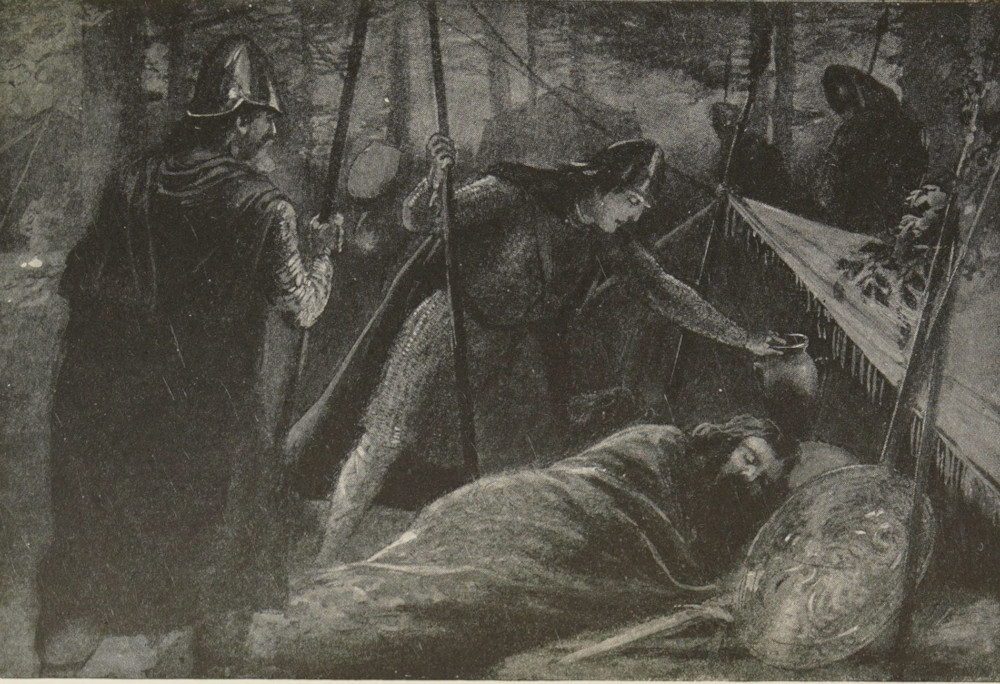
DAVID FINDS SAUL ASLEEP. “Destroy him not: for who can stretch forth his hand against the Lord’s anointed, and be guiltless?”
When David was at a safe distance from the camp, he stood on
the top of a hill, and cried with a loud voice to the people, and
to Abner, saying, “Art not thou a valiant man? and who is like
to thee in Israel? wherefore then hast thou not kept thy lord the
king? for there came one of the people in to destroy the king thy
lord. This thing is not good that thou hast done. As the Lord
liveth, ye are worthy to die, because ye have not kept your master,
the Lord’s anointed. And now see where the king’s spear is, and
the cruse of water that was at his bolster. And Saul knew David’s
voice, and said, Is this thy voice, my son David? And David
said, It is my voice, my lord, O king. And he said, Wherefore
doth my lord thus pursue after his servant? for what have I
done? or what evil is in mine hand? Now therefore, I pray thee,
let my lord the king hear the words of his servant.” Again the
acknowledgment fell from the lips of the king, “I have sinned;
return, my son David; for I will no more do thee harm, because
my soul was precious in thine eyes this day; behold, I have
played the fool, and have erred exceedingly. And David
answered and said, Behold the king’s spear! and let one of the
young men come over and fetch it.” Although Saul had made
the promise, “I will no more do thee harm,” David did not place
himself in his power.
This second instance of David’s respect for his sovereign’s life,
made a still deeper impression upon the mind of Saul, and brought
from him a more humble acknowledgment of his fault. He
was astonished and subdued at the manifestation of such kindness.
In parting from David, Saul exclaimed, “Blessed be thou, my son
David; thou shalt both do great things, and also shalt still prevail.”
But the son of Jesse had no hope that the king would
long continue in this frame of mind.
David despaired of a reconciliation with Saul. It seemed
inevitable that he should at last fall a victim to the malice of the
king, and he determined again to seek refuge in the land of the
Philistines. With the six hundred men under his command, he
passed over to Achish, the king of Gath.
David’s conclusion that Saul would certainly accomplish his
murderous purpose, was formed without the counsel of God.
Even while Saul was plotting and seeking to accomplish his
destruction, the Lord was working to secure David the kingdom.
God works out his plans, though to human eyes they are vailed in
mystery. Men cannot understand the ways of God; and, looking
at appearances, they interpret the trials and tests and provings
that God permits to come upon them, as things that are against
them, and that will only work their ruin. Thus David looked
on appearances, and not at the promises of God. He doubted
that he would ever come to the throne. Long trials had wearied
his faith and exhausted his patience.
The Lord did not send David for protection to the Philistines,
the most bitter foes of Israel. This very nation would be among
his worst enemies to the last; and yet he had fled to them for help
in his time of need. Having lost all confidence in Saul and in
those who served him, he threw himself upon the mercies of the
enemies of his people. David was a brave general, and had
proved himself a wise and successful warrior; but he was working
directly against his own interests when he went to the Philistines.
God had appointed him to set up his standard in the land of
Judah, and it was want of faith that led him to forsake his post
of duty without a command from the Lord.
God was dishonored by David’s unbelief. The Philistines had
feared David more than they had feared Saul and his armies; and
by placing himself under the protection of the Philistines, David
discovered to them the weakness of his own people. Thus he
encouraged these relentless foes to oppress Israel. David had
been anointed to stand in defense of the people of God; and
the Lord would not have his servants give encouragement to
the wicked by disclosing the weakness of his people, or by an
appearance of indifference to their welfare. Furthermore, the
impression was received by his brethren that he had gone to the
heathen to serve their gods. By this act he gave occasion for
misconstruing his motives, and many were led to hold prejudice
against him. The very thing that Satan desired to have him do,
he was led to do; for, in seeking refuge among the Philistines,
David caused great exultation to the enemies of God and his
people. David did not renounce his worship of God nor cease
his devotion to his cause; but he sacrificed his trust in him to
his personal safety, and thus tarnished the upright and faithful
character that God requires his servants to possess.
David was cordially received by the king of the Philistines.
The warmth of this reception was partly due to the fact that the
king admired him, and partly to the fact that it was flattering
to his vanity to have a Hebrew seek his protection. David felt
secure from betrayal in the dominions of Achish. He brought his
family, his household, and his possessions, as did also his men;
and to all appearance he had come to settle permanently in the
land of Philistia. All this was gratifying to Achish, who promised
to protect the fugitive Israelites.
At David’s request for a residence in the country, removed
from the royal city, the king graciously granted Ziklag as a
possession. David realized that it would be dangerous for himself
and his men to be under the influence of idolaters. In a town
wholly separated for their use, they might worship God with more
freedom than they could if they remained in Gath, where the
heathen rites could not but prove a source of evil and annoyance.
While dwelling in this isolated town, David made war upon
the Geshurites, the Gezrites, and the Amalekites, and he left none
alive to bring tidings to Gath. When he returned from battle, he
gave Achish to understand that he had been warring against those
of his own nation, the men of Judah. By this dissembling he
was the means of strengthening the hand of the Philistines; for
the king said, “He hath made his people Israel utterly to abhor
him; therefore he shall be my servant forever.” David knew
that it was the will of God that those heathen tribes should be
destroyed, and he knew that he was appointed to do this work;
but he was not walking in the counsel of God when he practiced
deception.
“And it came to pass in those days, that the Philistines
gathered their armies together for warfare, to fight with Israel.
And Achish said unto David, Know thou assuredly, that thou
shalt go out with me to battle, thou and thy men.” David had no
intention of lifting his hand against his people; but he was not
certain as to what course he would pursue, until circumstances
should indicate his duty. He answered the king evasively, and
said, “Surely thou shalt know what thy servant can do.” Achish
understood these words as a promise of assistance in the approaching
war, and pledged his word to bestow upon David great honor,
and give him a high position at the Philistine court.
But although David’s faith had staggered somewhat at the
promises of God, he still remembered that Samuel had anointed
him king of Israel. He recalled the victories that God had given
him over his enemies in the past. He reviewed the great mercy
of God in preserving him from the hand of Saul, and determined
not to betray a sacred trust. Even though the king of Israel had
sought his life, he would not join his forces with the enemies of
his people.
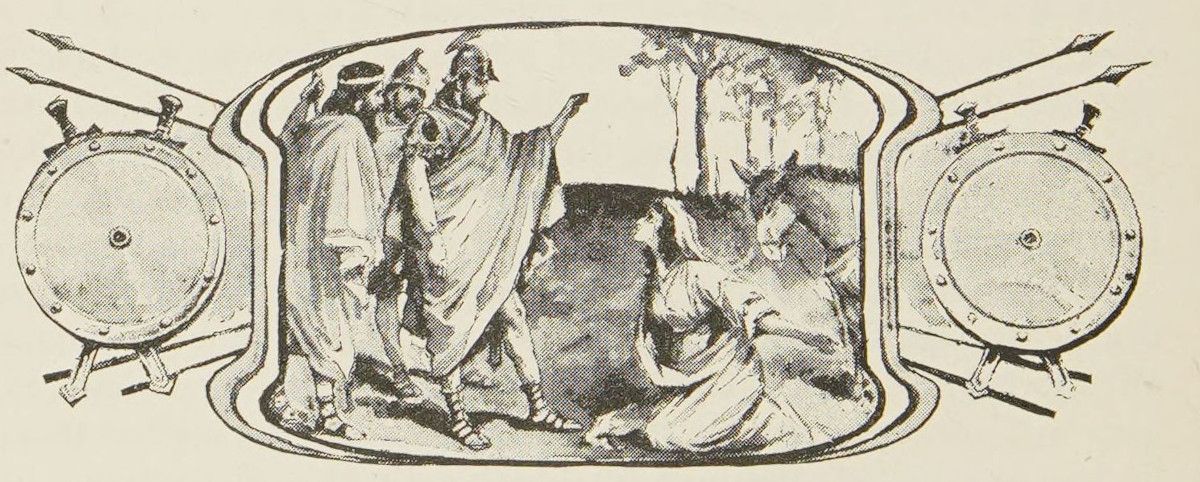
“The piety of Abigail, like the fragrance of a flower, breathed out all unconsciously in face and Word and action.”
Again war was declared between Israel and the Philistines.
“The Philistines gathered themselves together, and came and
pitched in Shunem,” on the northern edge of the plain of Jezreel;
while Saul and his forces encamped but a few miles distant, at the
foot of Mount Gilboa, on the southern border of the plain. It was
on this plain that Gideon, with three hundred men, had put to
flight the hosts of Midian. But the spirit that inspired Israel’s
deliverer was widely different from that which now stirred the
heart of the king. Gideon went forth strong in faith in the mighty
God of Jacob; but Saul felt himself to be alone and defenseless,
because God had forsaken him. As he looked abroad upon the
Philistine host, “he was afraid, and his heart greatly trembled.”[1080]
Saul had learned that David and his force were with the
Philistines, and he expected that the son of Jesse would take this
opportunity to revenge the wrongs he had suffered. The king was
in sore distress. It was his own unreasoning passion, spurring
him on to destroy the chosen of God, that had involved the nation
in so great peril. While he had been engrossed in pursuing
David, he had neglected the defense of his kingdom. The Philistines,
taking advantage of its unguarded condition, had penetrated
into the very heart of the country. Thus while Satan had been
urging Saul to employ every energy in hunting David, that he
might destroy him, the same malignant spirit had inspired the
Philistines to seize their opportunity to work Saul’s ruin, and
overthrow the people of God. How often is the same policy still
employed by the arch-enemy! He moves upon some unconsecrated
heart to kindle envy and strife in the church, and then,
taking advantage of the divided condition of God’s people, he stirs
up his agents to work their ruin.
On the morrow, Saul must engage the Philistines in battle.
The shadows of impending doom gathered dark about him; he
longed for help and guidance. But it was in vain that he sought
counsel from God. “The Lord answered him not, neither by
dreams, nor by Urim, nor by prophets.” The Lord never turned
away a soul that came to him in sincerity and humility. Why
did he turn Saul away unanswered?—The king had by his own
act forfeited the benefits of all the methods of inquiring of God.
He had rejected the counsel of Samuel the prophet; he had exiled
David, the chosen of God; he had slain the priests of the Lord.
Could he expect to be answered by God, when he had cut off the
channels of communication that Heaven had ordained? He had
sinned away the Spirit of grace, and could he be answered by
dreams and revelations from the Lord? Saul did not turn to God
with humility and repentance. It was not pardon for sin, and
reconciliation with God, that he sought, but deliverance from his
foes. By his own stubbornness and rebellion he had cut himself
off from God. There could be no return but by the way of
penitence and contrition; but the proud monarch, in his anguish
and despair, determined to seek help from another source.
Then said Saul unto his servants, “Seek me a woman that
hath a familiar spirit, that I may go to her, and inquire of her.”
Saul had a full knowledge of the character of necromancy. It
had been expressly forbidden by the Lord, and the sentence of
death was pronounced against all who practiced its unholy arts.
During the life of Samuel, Saul had commanded that all wizards
and those that had familiar spirits should be put to death; but
now, in the rashness of desperation, he had recourse to that
oracle which he had condemned as an abomination.
It was told the king that a woman who had a familiar spirit
was living in concealment at Endor. This woman had entered
into covenant with Satan to yield herself to his control, to fulfill
his purposes; and in return, the prince of evil wrought wonders
for her, and revealed secret things to her.
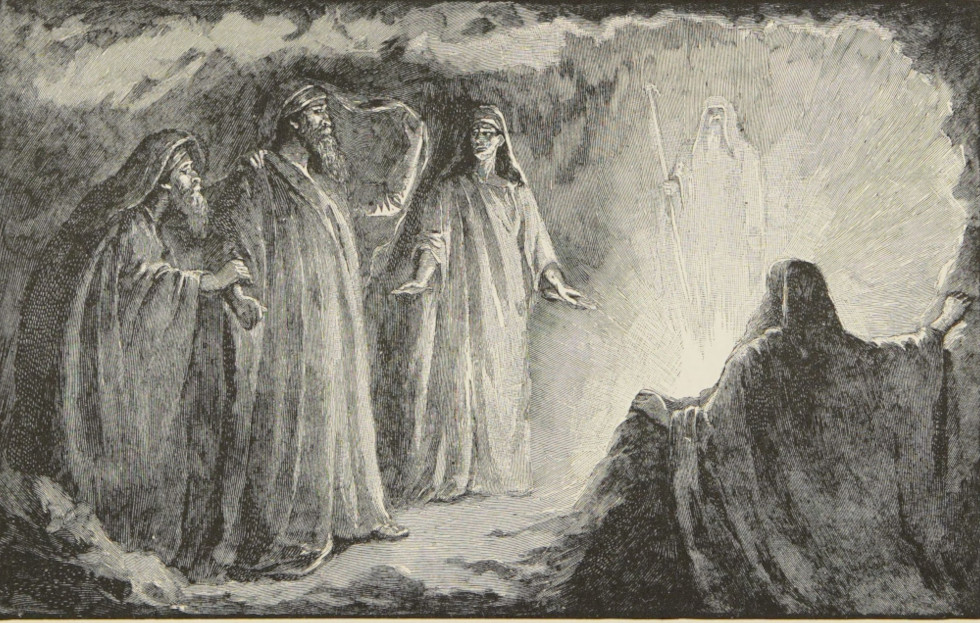
SAUL AND THE WITCH OF ENDOR. “Samuel was not present in that haunt of evil spirits. That supernatural appearance was produced solely by the power of Satan.”
Disguising himself, Saul went forth by night with but two
attendants, to seek the retreat of the sorceress. O, pitiable sight!
the king of Israel led captive by Satan at his will! What path
so dark for human feet to tread as that chosen by one who has
persisted in having his own way, resisting the holy influences of
the Spirit of God! What bondage so terrible as that of him who
is given over to the control of the worst of tyrants—himself!
Trust in God, and obedience to his will, were the only conditions
upon which Saul could be king of Israel. Had he complied with
these conditions throughout his reign, his kingdom would have
been secure; God would have been his guide, the Omnipotent his
shield. God had borne long with Saul; and although his rebellion
and obstinacy had well-nigh silenced the divine voice in the soul,
there was still opportunity for repentance. But when in his peril
he turned from God, to obtain light from a confederate of Satan,
he had cut the last tie that bound him to his Maker; he had
placed himself fully under the control of that demoniac power
which for years had been exercised upon him, and which had
brought him to the verge of destruction.
Under the cover of darkness, Saul and his attendants made
their way across the plain, and safely passing the Philistine host,
they crossed the mountain ridge, to the lonely home of the
sorceress of Endor. Here the woman with a familiar spirit had
hidden herself away that she might secretly continue her profane
incantations. Disguised as he was, Saul’s lofty stature and kingly
port declared that he was no common soldier. The woman
suspected that her visitor was Saul, and his rich gifts strengthened
her suspicions. To his request, “I pray thee, divine unto me by
the familiar spirit, and bring me him up, whom I shall name unto
thee,” the woman answered, “Behold, thou knowest what Saul
hath done, how he hath cut off those that have familiar spirits,
and the wizards, out of the land; wherefore then layest thou a
snare for my life, to cause me to die?” Then “Saul sware to her
by the Lord, saying, As the Lord liveth, there shall no punishment
happen to thee for this thing.” And when she said, “Whom shall
I bring up unto thee?” he answered, “Samuel.”
After practicing her incantations, she said, “I saw gods
ascending out of the earth.... An old man cometh up, and he is
covered with a mantle. And Saul perceived that it was Samuel,
and he stooped with his face to the ground, and bowed himself.”
It was not God’s holy prophet that came forth at the spell of
a sorcerer’s incantation. Samuel was not present in that haunt
of evil spirits. That supernatural appearance was produced solely
by the power of Satan. He could as easily assume the form of
Samuel as he could assume that of an angel of light, when he
tempted Christ in the wilderness.
The woman’s first words under the spell of her incantation had
been addressed to the king, “Why hast thou deceived me? for
thou art Saul.” Thus the first act of the evil spirit which
personated the prophet, was to communicate secretly with this
wicked woman, to warn her of the deception that had been
practiced upon her. The message to Saul from the pretended
prophet was, “Why hast thou disquieted me, to bring me up?
And Saul answered, I am sore distressed; for the Philistines make
war against me, and God is departed from me, and answereth me
no more, neither by prophets, nor by dreams; therefore I have
called thee, that thou mayest make known unto me what I
shall do.”
When Samuel was living, Saul had despised his counsel, and
had resented his reproofs. But now, in the hour of his distress
and calamity, he felt that the prophet’s guidance was his only
hope, and in order to communicate with Heaven’s ambassador, he
vainly had recourse to the messenger of hell! Saul had placed
himself fully in the power of Satan; and now he whose only
delight is in causing misery and destruction, made the most of
his advantage, to work the ruin of the unhappy king. In answer
to Saul’s agonized entreaty came the terrible message, professedly
from the lips of Samuel:—
“Wherefore then dost thou ask of me, seeing the Lord is
departed from thee, and is become thine enemy? And the Lord
hath done to him, as he spake by me; for the Lord hath rent
the kingdom out of thine hand, and given it to thy neighbor,
even to David. Because thou obeyedst not the voice of the
Lord, nor executedst his fierce wrath upon Amalek, therefore
hath the Lord done this thing unto thee this day. Moreover
the Lord will also deliver Israel with thee into the hand of the
Philistines.”
All through his course of rebellion, Saul had been flattered
and deceived by Satan. It is the tempter’s work to belittle sin,
to make the path of transgression easy and inviting, to blind the
mind to the warnings and threatenings of the Lord. Satan, by
his bewitching power, had led Saul to justify himself in defiance
of Samuel’s reproofs and warning. But now, in his extremity,
he turned upon him, presenting the enormity of his sin and the
hopelessness of pardon, that he might goad him to desperation.
Nothing could have been better chosen to destroy his courage
and confuse his judgment, or to drive him to despair and self-destruction.
Saul was faint from weariness and fasting; he was terrified
and conscience-stricken. As the fearful prediction fell upon his
ear, his form swayed like an oak before the tempest, and he fell
prostrate to the earth.
The sorceress was filled with alarm. The king of Israel lay
before her like one dead. Should he perish in her retreat, what
would be the consequences to herself? She besought him to
arise and partake of food, urging that since she had imperiled
her life in granting his desire, he should yield to her request for
the preservation of his own. His servants joining their entreaties,
Saul yielded at last, and the woman set before him the fatted calf
and unleavened bread hastily prepared. What a scene!—In the
wild cave of the sorceress, which but a little before had echoed
with the words of doom—in the presence of Satan’s messenger—he
who had been anointed of God as king over Israel sat down to
eat, in preparation for the day’s deadly strife.
Before the break of day he returned with his attendants to the
camp of Israel, to make ready for the conflict. By consulting
that spirit of darkness, Saul had destroyed himself. Oppressed
by the horror of despair, it would be impossible for him to
inspire his army with courage. Separated from the Source of
strength, he could not lead the minds of Israel to look to God
as their helper. Thus the prediction of evil would work its own
accomplishment.
On the plain of Shunem and the slopes of Mount Gilboa, the
armies of Israel and the hosts of the Philistines closed in mortal
combat. Though the fearful scene in the cave at Endor had
driven all hope from his heart, Saul fought with desperate valor
for his throne and his kingdom. But it was in vain. “The men
of Israel fled from before the Philistines, and fell down slain in
Mount Gilboa.” Three brave sons of the king died at his side.
The archers pressed upon Saul. He had seen his soldiers falling
around him, and his princely sons cut down by the sword. Himself
wounded, he could neither fight nor fly. Escape was impossible,
and determined not to be taken alive by the Philistines, he bade
his armor-bearer, “Draw thy sword, and thrust me through therewith.”
When the man refused to lift his hand against the Lord’s
anointed, Saul took his own life by falling upon his sword.
Thus the first king of Israel perished, with the guilt of self-murder
upon his soul. His life had been a failure, and he went
down in dishonor and despair, because he had set up his own
perverse will against the will of God.
The tidings of defeat spread far and wide, carrying terror to all
Israel. The people fled from the cities, and the Philistines took
undisturbed possession. Saul’s reign, independent of God, had
well-nigh proved the ruin of his people.
On the day following the engagement, the Philistines, searching
the battle-field to rob the slain, discovered the bodies of Saul and
his three sons. To complete their triumph, they cut off the head
of Saul and stripped him of his armor; then the head and the
armor, reeking with blood, were sent to the country of the Philistines
as a trophy of victory, “to publish it in the house of their
idols, and among the people.” The armor was finally put in “the
house of Ashtaroth,” while the head was fastened in the temple of
Dagon. Thus the glory of the victory was ascribed to the power
of these false gods, and the name of Jehovah was dishonored.
The dead bodies of Saul and his sons were dragged to Beth-shan,
a city not far from Gilboa, and near the river Jordan.
Here they were hung up in chains, to be devoured by birds of
prey. But the brave men of Jabesh-gilead, remembering Saul’s
deliverance of their city in his earlier and happier years, now
manifested their gratitude by rescuing the bodies of the king and
princes, and giving them honorable burial. Crossing the Jordan
by night, they “took the body of Saul and the bodies of his sons
from the wall of Beth-shan, and came to Jabesh, and burnt them
there. And they took their bones, and buried them under a tree
at Jabesh, and fasted seven days.” Thus the noble deed performed
forty years before, secured for Saul and his sons burial by tender
and pitying hands, in that dark hour of defeat and dishonor.
The Scripture account of Saul’s visit to the woman of Endor
has been a source of perplexity to many students of the Bible.
There are some who take the position that Samuel was actually
present at the interview with Saul, but the Bible itself furnishes
sufficient ground for a contrary conclusion. If, as claimed by
some, Samuel was in heaven, he must have been summoned
thence, either by the power of God or by that of Satan. None
can believe for a moment that Satan had power to call the holy
prophet of God from heaven to honor the incantations of an
abandoned woman. Nor can we conclude that God summoned
him to the witch’s cave; for the Lord had already refused to
communicate with Saul, by dreams, by Urim, or by prophets.[1085]
These were God’s own appointed mediums of communication, and
he did not pass them by to deliver the message through the agent
of Satan.
The message itself is sufficient evidence of its origin. Its
object was not to lead Saul to repentance, but to urge him on to
ruin; and this is not the work of God, but of Satan. Furthermore,
the act of Saul in consulting a sorceress is cited in Scripture as one
reason why he was rejected by God and abandoned to destruction:
“Saul died for his transgression which he committed against the
Lord, even against the word of the Lord, which he kept not, and
also for asking counsel of one that had a familiar spirit, to inquire
of it; and inquired not of the Lord; therefore he slew him, and
turned the kingdom unto David the son of Jesse.”[1086] Here it is
distinctly stated that Saul inquired of the familiar spirit, not of
the Lord. He did not communicate with Samuel, the prophet of
God; but through the sorceress he held intercourse with Satan.
Satan could not present the real Samuel, but he did present a
counterfeit, that served his purpose of deception.
Nearly all forms of ancient sorcery and witchcraft were founded
upon a belief in communion with the dead. Those who practiced
the arts of necromancy claimed to have intercourse with departed
spirits, and to obtain through them a knowledge of future events.
This custom of consulting the dead is referred to in the prophecy
of Isaiah: “When they shall say unto you, Seek unto them
that have familiar spirits, and unto wizards that peep and that
mutter; should not a people seek unto their God? for the living to
the dead?”[1087]
This same belief in communion with the dead formed the
corner-stone of heathen idolatry. The gods of the heathen were
believed to be the deified spirits of departed heroes. Thus the
religion of the heathen was a worship of the dead. This is
evident from the Scriptures. In the account of the sin of Israel
at Beth-peor, it is stated: “Israel abode in Shittim, and the
people began to commit whoredom with the daughters of Moab.
And they called the people unto the sacrifices of their gods; and
the people did eat, and bowed down to their gods. And Israel
joined himself unto Baal-peor.”[1088] The psalmist tells us to what
kind of gods these sacrifices were offered. Speaking of the same
apostasy of the Israelites, he says, “They joined themselves unto
Baal-peor, and ate the sacrifices of the dead;”[1089] that is, sacrifices that
had been offered to the dead.
The deification of the dead has held a prominent place in
nearly every system of heathenism, as has also the supposed
communion with the dead. The gods were believed to communicate
their will to men, and also, when consulted, to give them
counsel. Of this character were the famous oracles of Greece
and Rome.
The belief in communion with the dead is still held, even in
professedly Christian lands. Under the name of Spiritualism, the
practice of communicating with beings claiming to be the spirits
of the departed, has become wide-spread. It is calculated to take
hold of the sympathies of those who have laid their loved ones in
the grave. Spiritual beings sometimes appear to persons in the
form of their deceased friends, and relate incidents connected with
their lives, and perform acts which they performed while living.
In this way they lead men to believe that their dead friends
are angels, hovering over them, and communicating with them.
Those who thus assume to be the spirits of the departed, are
regarded with a certain idolatry, and with many their word has
greater weight than the word of God.
There are many, however, who regard Spiritualism as a mere
imposture. The manifestations by which it supports its claims to
a supernatural character are attributed to fraud on the part of
the medium. But while it is true that the results of trickery have
often been palmed off as genuine manifestations, there have also
been marked evidences of supernatural power. And many who
reject Spiritualism as the result of human skill or cunning, will,
when confronted with manifestations which they cannot account
for upon this ground, be led to acknowledge its claims.
Modern Spiritualism, and the forms of ancient witchcraft and
idol worship,—all having communion with the dead as their vital
principle,—are founded upon that first lie by which Satan
beguiled Eve in Eden: “Ye shall not surely die; for God doth
know that in the day ye eat thereof, ... ye shall be as gods.”[1090]
Alike based upon falsehood and perpetuating the same, they are
alike from the father of lies.
The Hebrews were expressly forbidden to engage, in any
manner, in pretended communion with the dead. God closed this
door effectually when he said: “The dead know not anything....
Neither have they any more a portion forever in anything
that is done under the sun.”[1091] “His breath goeth forth, he returneth
to his earth; in that very day his thoughts perish.”[1092] And
the Lord declared to Israel: “The soul that turneth after such
as have familiar spirits, and after wizards, to go a whoring after
them, I will even set my face against that soul, and will cut him
off from among his people.”[1093]
The “familiar spirits” were not the spirits of the dead, but evil
angels, the messengers of Satan. Ancient idolatry, which, as we
have seen, comprises both worship of the dead and pretended
communion with them, is declared by the Bible to have been
demon-worship. The apostle Paul, in warning his brethren
against participating, in any manner, in the idolatry of their
heathen neighbors, says, “The things which the Gentiles sacrifice,
they sacrifice to devils, and not to God; and I would not that ye
should have fellowship with devils.”[1094] The psalmist, speaking of
Israel, says that “they sacrificed their sons and their daughters
unto devils,” and in the next verse he explains that they sacrificed
them “unto the idols of Canaan.”[1095] In their supposed worship of
dead men, they were, in reality, worshiping demons.
Modern Spiritualism, resting upon the same foundation, is but
a revival, in a new form, of the witchcraft and demon-worship
that God condemned and prohibited of old. It is foretold in the
Scriptures, which declare that “in the latter times some shall
depart from the faith, giving heed to seducing spirits, and doctrines
of devils.”[1096] Paul, in his second letter to the Thessalonians, points
to the special working of Satan in Spiritualism as an event to
take place immediately before the second advent of Christ. Speaking
of Christ’s second coming, he declares that it is “after the
working of Satan with all power and signs and lying wonders.”[1097]
And Peter, describing the dangers to which the church was to be
exposed in the last days, says that as there were false prophets
who led Israel into sin, so there will be false teachers, “who privily
shall bring in damnable heresies, even denying the Lord that
bought them.... And many shall follow their pernicious ways.”[1098]
Here the apostle has pointed out one of the marked characteristics
of Spiritualist teachers. They refuse to acknowledge Christ as
the Son of God. Concerning such teachers the beloved John declares:
“Who is a liar but he that denieth that Jesus is the Christ?
He is antichrist, that denieth the Father and the Son. Whosoever
denieth the Son, the same hath not the Father.”[1099] Spiritualism,
by denying Christ, denies both the Father and the Son, and
the Bible pronounces it the manifestation of antichrist.
By the prediction of Saul’s doom, given through the woman of
Endor, Satan planned to ensnare the people of Israel. He hoped
that they would be inspired with confidence in the sorceress, and
would be led to consult her. Thus they would turn from God
as their counselor, and would place themselves under the guidance
of Satan. The lure by which Spiritualism attracts the
multitudes is its pretended power to draw aside the vail from
the future, and reveal to men what God has hidden. God has in
his word opened before us the great events of the future,—all
that it is essential for us to know,—and he has given us a safe
guide for our feet amid all its perils; but it is Satan’s purpose to
destroy men’s confidence in God, to make, them dissatisfied with
their condition in life, and to lead them to seek a knowledge of
what God has wisely vailed from them, and to despise what he
has revealed in his holy word.
There are many who become restless when they cannot know
the definite outcome of affairs. They cannot endure uncertainty,
and in their impatience they refuse to wait to see the salvation of
God. Apprehended evils drive them nearly distracted. They
give way to their rebellious feelings, and run hither and thither
in passionate grief, seeking intelligence concerning that which
has not been revealed. If they would but trust in God, and
watch unto prayer, they would find divine consolation. Their
spirit would be calmed by communion with God. The weary and
the heavy-laden would find rest unto their souls, if they would
only go to Jesus; but when they neglect the means that God has
ordained for their comfort, and resort to other sources, hoping to
learn what God has withheld, they commit the error of Saul, and
thereby gain only a knowledge of evil.
God is not pleased with this course, and has expressed it in
the most explicit terms. This impatient haste to tear away the
vail from the future reveals a lack of faith in God, and leaves the
soul open to the suggestions of the master-deceiver. Satan leads
men to consult those that have familiar spirits; and by revealing
hidden things of the past, he inspires confidence in his power to
foretell things to come. By experience gained through the long
ages, he can reason from cause to effect, and often forecast, with a
degree of accuracy, some of the future events of man’s life. Thus
he is enabled to deceive poor, misguided souls, and bring them
under his power, and lead them captive at his will.
God has given us the warning by his prophet: “When they
shall say unto you, Seek unto them that have familiar spirits, and
unto wizards that peep and that mutter; should not a people seek
unto their God? for the living to the dead? To the law and to
the testimony; if they speak not according to this word, it is
because there is no light in them.”[1100]
Shall those who have a holy God, infinite in wisdom and
power, go unto wizards, whose knowledge comes from intimacy
with the enemy of our Lord? God himself is the light of his
people; he bids them fix their eyes by faith upon the glories that
are vailed from human sight. The Sun of Righteousness sends its
bright beams into their hearts; they have light from the throne of
heaven, and they have no desire to turn away from the source of
light, to the messengers of Satan.
The demon’s message to Saul, although it was a denunciation
of sin and a prophecy of retribution, was not meant to reform
him, but to goad him to despair and ruin. Oftener, however, it
serves the tempter’s purpose best to lure men to destruction by
flattery. The teaching of the demon-gods, in ancient times, fostered
the vilest license. The divine precepts condemning sin and
enforcing righteousness, were set aside; truth was lightly regarded,
and impurity was not only permitted but enjoined. Spiritualism
declares that there is no death, no sin, no judgment, no retribution;
that “men are unfallen demigods;” that desire is the highest
law; and that man is accountable only to himself. The barriers
that God has erected to guard truth, purity, and reverence, are
broken down, and many are thus emboldened in sin. Does not
such teaching suggest an origin similar to that of demon-worship?
The Lord presented before Israel the results of holding communion
with evil spirits, in the abominations of the Canaanites:
they were without natural affection, idolaters, adulterers, murderers,
and abominable by every corrupt thought and revolting
practice. Men do not know their own hearts; for “the heart is
deceitful above all things, and desperately wicked.”[1101] But God
understands the tendencies of the depraved nature of man. Then,
as now, Satan was watching to bring about conditions favorable to
rebellion, that the people of Israel might make themselves as
abhorrent to God as were the Canaanites. The adversary of souls
is ever on the alert to open channels for the unrestrained flow of
evil in us; for he desires that we may be ruined, and be condemned
before God.
Satan was determined to keep his hold on the land of Canaan,
and when it was made the habitation of the children of Israel,
and the law of God was made the law of the land, he hated Israel
with a cruel and malignant hatred, and plotted their destruction.
Through the agency of evil spirits, strange gods were introduced;
and because of transgression, the chosen people were finally
scattered from the land of promise. This history Satan is striving
to repeat in our day. God is leading his people out from the
abominations of the world, that they may keep his law; and
because of this, the rage of “the accuser of our brethren” knows
no bounds. “The devil is come down unto you, having great
wrath, because he knoweth that he hath but a short time.”[1102] The
antitypical land of promise is just before us, and Satan is determined
to destroy the people of God, and cut them off from their
inheritance. The admonition, “Watch ye and pray, lest ye enter
into temptation,”[1103] was never more needed than now.
The word of the Lord to ancient Israel is addressed also to
his people in this age: “Regard not them that have familiar
spirits, neither seek after wizards, to be defiled by them;” “for
all that do these things are an abomination unto the Lord.”[1104]
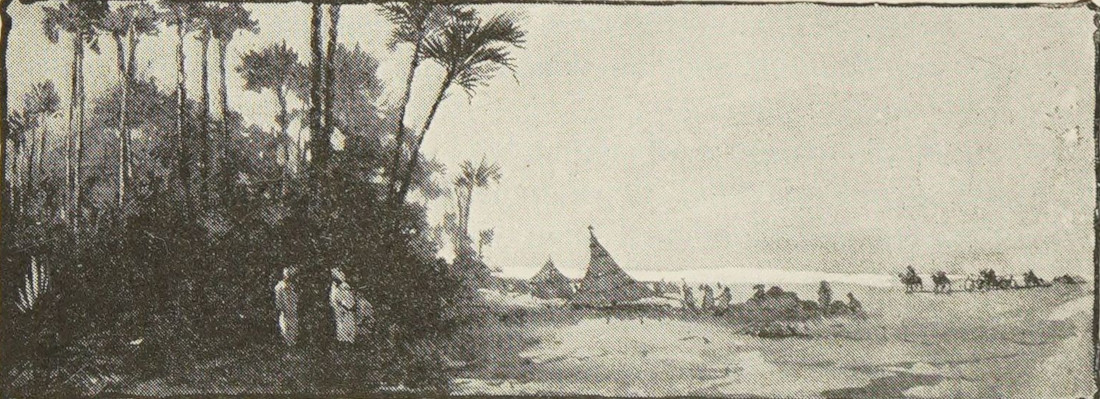
Caravan Crossing the Desert.
David and his men had not taken part in the battle between
Saul and the Philistines, though they had marched with the
Philistines to the field of conflict. As the two armies prepared
to join battle, the son of Jesse found himself in a situation of
great perplexity. It was expected that he would fight for the
Philistines. Should he in the engagement quit the post assigned
him, and retire from the field, he would not only brand himself
with cowardice, but with ingratitude and treachery to Achish,
who had protected him and confided in him. Such an act would
cover his name with infamy, and would expose him to the wrath
of enemies more to be feared than Saul. Yet he could not for a
moment consent to fight against Israel. Should he do this, he
would become a traitor to his country,—the enemy of God and
of his people. It would forever bar his way to the throne of
Israel; and should Saul be slain in the engagement, his death
would be charged upon David.
David was caused to feel that he had missed his path. Far
better would it have been for him to find refuge in God’s strong
fortresses of the mountains than with the avowed enemies of
Jehovah and his people. But the Lord, in his great mercy, did
not punish this error of his servant by leaving him to himself in
his distress and perplexity; for though David, losing his grasp
on divine power, had faltered, and turned aside from the path of
strict integrity, it was still the purpose of his heart to be true to
God. While Satan and his host were busy, helping the adversaries
of God and of Israel to plan against a king who had forsaken
God, the angels of the Lord were working to deliver David from
the peril into which he had fallen. Heavenly messengers moved
upon the Philistine princes to protest against the presence of David
and his force with the army in the approaching conflict.
“What do these Hebrews here?”[1110] cried the Philistine lords,
pressing about Achish. The latter, unwilling to part with so
important an ally, answered, “Is not this David the servant of
Saul the king of Israel, which hath been with me these days, or
these years, and I have found no fault in him since he fell unto
me unto this day?”
But the princes angrily persisted in their demand: “Make
this fellow return, that he may go again to his place which thou
hast appointed him, and let him not go down with us to battle,
lest in the battle he be an adversary to us; for wherewith should
he reconcile himself unto his master? should it not be with the
heads of these men? Is not this David, of whom they sang one
to another in dances, saying, Saul slew his thousands, and David
his ten thousands?” The slaughter of their famed champion and
the triumph of Israel upon that occasion were still fresh in the
memory of the Philistine lords. They did not believe that David
would fight against his own people; and should he, in the heat of
battle, take sides with them, he could inflict greater harm on the
Philistines than would the whole of Saul’s army.
Thus Achish was forced to yield, and calling David, said unto
him, “Surely as Jehovah liveth, thou hast been upright, and thy
going out and thy coming in with me in the host is good in my
sight; for I have not found evil in thee since the day of thy
coming unto me unto this day. Nevertheless the lords favor thee
not. Wherefore now return, and go in peace, that thou displease
not the lords of the Philistines.”
David, fearing to betray his real feelings, answered, “But what
have I done? and what hast thou found in thy servant so long as
I have been with thee unto this day, that I may not go fight
against the enemies of my lord the king?”
The reply of Achish must have sent a thrill of shame and
remorse through David’s heart, as he thought how unworthy of a
servant of Jehovah were the deceptions to which he had stooped.
“I know that thou art good in my sight, as an angel of God,” said
the king; “notwithstanding the princes of the Philistines have
said, He shall not go up with us to the battle. Wherefore now
rise up early in the morning with thy master’s servants that are
come with thee; and as soon as ye be up early in the morning,
and have light, depart.” Thus the snare in which David had
become entangled was broken, and he was set free.
After three days’ travel, David and his band of six hundred
men reached Ziklag, their Philistine home. But a scene of desolation
met their view. The Amalekites, taking advantage of
David’s absence, with his force, had avenged themselves for his
incursions into their territory. They had surprised the city while
it was left unguarded, and having sacked and burned it, had
departed, taking all the women and children as captives, with
much spoil.
Dumb with horror and amazement, David and his men for a
little time gazed in silence upon the blackened and smouldering
ruins. Then as a sense of their terrible desolation burst upon
them, those battle-scarred warriors “lifted up their voice and wept,
until they had no more power to weep.”
Here, again, David was chastened for the lack of faith that
had led him to place himself among the Philistines. He had
opportunity to see how much safety could be found among the
foes of God and his people. David’s followers turned upon him
as the cause of their calamities. He had provoked the vengeance
of the Amalekites by his attack upon them; yet, too confident
of security in the midst of his enemies, he had left the city unguarded.
Maddened with grief and rage, his soldiers were now
ready for any desperate measures, and they threatened even to
stone their leader.
David seemed to be cut off from every human support. All
that he held dear on earth had been swept from him. Saul had
driven him from his country; the Philistines had driven him from
the camp; the Amalekites had plundered his city; his wives and
children had been made prisoners; and his own familiar friends
had banded against him, and threatened him even with death.
In this hour of utmost extremity, David, instead of permitting
his mind to dwell upon these painful circumstances, looked
earnestly to God for help. He “encouraged himself in the Lord.”
He reviewed his past eventful life. Wherein had the Lord ever
forsaken him? His soul was refreshed in recalling the many evidences
of God’s favor. The followers of David, by their discontent
and impatience, made their affliction doubly grievous; but the
man of God, having even greater cause for grief, bore himself with
fortitude. “What time I am afraid, I will trust in Thee,”[1111] was the
language of his heart. Though he himself could not discern a
way out of the difficulty, God could see it, and would teach him
what to do.
Sending for Abiathar the priest, the son of Ahimelech, “David
inquired of the Lord, saying, If I pursue after this troop, shall I
overtake them?” The answer was, “Pursue; for thou shalt surely
overtake them, and shalt without fail recover all.”[1112]
At these words the tumult of grief and passion ceased. David
and his soldiers at once set out in pursuit of their fleeing foe. So
rapid was their march, that upon reaching the brook Besor, which
empties, near Gaza, into the Mediterranean Sea, two hundred of
the band were compelled by exhaustion to remain behind. But
David with the remaining four hundred pressed forward, nothing
daunted.
Advancing, they came upon an Egyptian slave, apparently
about to perish from weariness and hunger. Upon receiving food
and drink, however, he revived, and they learned that he had
been left to die, by his cruel master, an Amalekite belonging to
the invading force. He told the story of the raid and pillage;
and then, having exacted a promise that he should not be slain or
delivered to his master, he consented to lead David’s company to
the camp of their enemies.
As they came in sight of the encampment, a scene of revelry
met their gaze. The victorious host were holding high festival.
“They were spread abroad upon all the earth, eating, and drinking,
and dancing, because of all the great spoil that they had
taken out of the land of the Philistines, and out of the land of
Judah.” An immediate attack was ordered, and the pursuers
rushed fiercely upon their prey. The Amalekites were surprised
and thrown into confusion. The battle was continued all that
night and the following day, until nearly the entire host was
slain. Only a band of four hundred men, mounted upon camels,
succeeded in making their escape. The word of the Lord was
fulfilled. “David recovered all that the Amalekites had carried
away; and David rescued his two wives. And there was nothing
lacking to them, neither small nor great, neither sons nor daughters,
neither spoil, nor anything that they had taken to them;
David recovered all.”
When David had invaded the territory of the Amalekites, he
had put to the sword all the inhabitants that fell into his hands.
But for the restraining power of God, the Amalekites would have
retaliated by destroying the people of Ziklag. They decided to
spare the captives, desiring to heighten the honor of the triumph
by leading home a large number of prisoners, and intending afterward
to sell them as slaves. Thus, unwittingly, they fulfilled
God’s purpose, keeping the prisoners unharmed, to be restored to
their husbands and fathers.
All earthly powers are under the control of the Infinite One.
To the mightiest ruler, to the most cruel oppressor, he says,
“Hitherto shalt thou come, but no further.”[1113] God’s power is constantly
exercised to counteract the agencies of evil: he is ever
at work among men, not for their destruction, but for their correction
and preservation.
With great rejoicing, the victors took up their homeward
march. Upon reaching their companions who had remained
behind, the more selfish and unruly of the four hundred urged
that those who had had no part in the battle should not share the
spoils; that it was enough for them to recover each his wife and
children. But David would permit no such arrangement. “Ye
shall not do so, my brethren,” he said, “with that which the Lord
hath given us, ... as his part is that goeth down to the battle,
so shall his part be that tarrieth by the stuff; they shall part
alike.” Thus the matter was settled, and it afterward became
a statute in Israel that all who were honorably connected with a
military campaign should share the spoils equally with those who
engaged in actual combat.
Besides recovering all the spoil that had been taken from
Ziklag, David and his band had captured extensive flocks and
herds belonging to the Amalekites. These were called “David’s
spoil;” and upon returning to Ziklag, he sent from this spoil
presents to the elders of his own tribe of Judah. In this
distribution, all those were remembered who had befriended him
and his followers in the mountain fastnesses, when he had been
forced to flee from place to place for his life. Their kindness and
sympathy, so precious to the hunted fugitive, were thus gratefully
acknowledged.
It was the third day since David and his warriors returned to
Ziklag. As they labored to restore their ruined homes, they
watched with anxious hearts for tidings of the battle which they
knew must have been fought between Israel and the Philistines.
Suddenly a messenger entered the town, “with his clothes rent,
and earth upon his head.”[1114] He was at once brought to David,
before whom he bowed with reverence, expressing recognition of
him as a powerful prince, whose favor he desired. David eagerly
inquired how the battle had gone. The fugitive reported Saul’s
defeat and death, and the death of Jonathan. But he went
beyond a simple statement of facts. Evidently supposing that
David must cherish enmity toward his relentless persecutor, the
stranger hoped to secure honor to himself as the slayer of the
king. With an air of boasting, the man went on to relate that
during the battle he found the monarch of Israel wounded, and
sore pressed by his foes, and that at his own request the messenger
had slain him. The crown from his head and the golden bracelets
from his arm he had brought to David. He confidently expected
that these tidings would be hailed with joy, and that a rich reward
would be his for the part that he had acted.
But “David took hold on his clothes, and rent them; and
likewise all the men that were with him. And they mourned,
and wept, and fasted, until even, for Saul, and for Jonathan his
son, and for the people of the Lord, and for the house of Israel;
because they were fallen by the sword.”
The first shock of the fearful tidings past, David’s thoughts
returned to the stranger herald, and the crime of which, according
to his own statement, he was guilty. The chief demanded of the
young man, “Whence art thou?” And he answered, “I am the
son of a stranger, an Amalekite. And David said unto him, How
wast thou not afraid to stretch forth thine hand to destroy the
Lord’s anointed?” Twice, David had had Saul in his power; but
when urged to slay him, he had refused to lift his hand against
him who had been consecrated by the command of God to rule
over Israel. Yet the Amalekite feared not to boast that he had
slain the king of Israel. He had accused himself of a crime
worthy of death, and the penalty was inflicted at once. David
said, “Thy blood be upon thy head; for thy mouth hath testified
against thee, saying, I have slain the Lord’s anointed.”
David’s grief at the death of Saul was sincere and deep, evincing
the generosity of a noble nature. He did not exult in the fall
of his enemy. The obstacle that had barred his access to the
throne of Israel was removed, but at this he did not rejoice.
Death had obliterated the remembrance of Saul’s distrust and
cruelty, and now nothing in his history was thought of but that
which was noble and kingly. The name of Saul was linked with
that of Jonathan, whose friendship had been so true and so
unselfish.
The song in which David gave utterance to the feelings of his
heart, became a treasure to his nation, and to the people of God in
all subsequent ages:—
“Thy glory, O Israel, is slain upon thy high places!
How are the mighty fallen!
Tell it not in Gath,
Publish it not in the streets of Askelon;
Lest the daughters of the Philistines rejoice,
Lest the daughters of the uncircumcised triumph.
Ye mountains of Gilboa,
Let there be no dew nor rain upon you, neither fields of offerings:
For there the shield of the mighty was vilely cast away,
The shield of Saul as of one not anointed with oil....
Saul and Jonathan were lovely and pleasant in their lives,
And in their death they were not divided;
They were swifter than eagles.
They were stronger than lions.
Ye daughters of Israel, weep over Saul,
Who clothed you in scarlet delicately,
Who put ornaments of gold upon your apparel.
How are the mighty fallen in the midst of the battle!
Jonathan is slain upon thy high places.
I am distressed for thee, my brother Jonathan;
Very pleasant hast thou been unto me;
Thy love to me was wonderful,
Passing the love of women.
How are the mighty fallen,
And the weapons of war perished!”
[1115]

The death of Saul removed the dangers that had made David
an exile. The way was now open for him to return to his own
land. When the days of mourning for Saul and Jonathan were
ended, “David inquired of the Lord, saying, Shall I go up into
any of the cities of Judah? And the Lord said unto him, Go
up. And David said, Whither shall I go up? And he said, Unto
Hebron.”[1120]
Hebron was twenty miles north from Beersheba, and about
midway between that city and the future site of Jerusalem. It
was originally called Kirjath-arba, the city of Arba, the father of
Anak. Later it was called Mamre, and here was the burial-place
of the patriarchs, “the cave of Machpelah.” Hebron had been the
possession of Caleb, and was now the chief city of Judah. It lies
in a valley surrounded by fertile hill country and fruitful lands.
The most beautiful vineyards of Palestine were on its borders,
together with numerous plantations of olive and other fruit trees.
David and his followers immediately prepared to obey the
instruction which they had received from God. The six hundred
armed men, with their wives and children, their flocks and herds,
were soon on the way to Hebron. As the caravan entered the
city, the men of Judah were waiting to welcome David as the
future king of Israel. Arrangements were at once made for his
coronation. “And there they anointed David king over the house
of Judah.” But no effort was made to establish his authority, by
force, over the other tribes.
One of the first acts of the new-crowned monarch was to
express his tender regard for the memory of Saul and Jonathan.
Upon learning of the brave deed of the men of Jabesh-gilead in
rescuing the bodies of the fallen leaders, and giving them honorable
burial. David sent an embassy to Jabesh with the message,
“Blessed be ye of the Lord, that ye have showed this kindness
unto your lord, even unto Saul, and have buried him. And now
the Lord show kindness and truth unto you; and I also will
requite you this kindness.” And he announced his own accession
to the throne of Judah, and invited the allegiance of those who
had proved themselves so true-hearted.
The Philistines did not oppose the action of Judah in making
David king. They had befriended him in his exile, in order to
harass and weaken the kingdom of Saul, and now they hoped
that because of their former kindness to David the extension of
his power would, in the end, work to their advantage. But
David’s reign was not to be free from trouble. With his coronation
began the dark record of conspiracy and rebellion. David
did not sit upon a traitor’s throne; God had chosen him to be
king of Israel, and there had been no occasion for distrust or
opposition. Yet hardly had his authority been acknowledged by
the men of Judah, when through the influence of Abner, Ishbosheth,
the son of Saul, was proclaimed king, and set upon a rival
throne in Israel.
Ishbosheth was but a weak and incompetent representative of
the house of Saul, while David was pre-eminently qualified to
bear the responsibilities of the kingdom. Abner, the chief agent
in raising Ishbosheth to kingly power, had been commander-in-chief
of Saul’s army, and was the most distinguished man in
Israel. Abner knew that David had been appointed by the Lord
to the throne of Israel, but having so long hunted and pursued
him, he was not now willing that the son of Jesse should succeed
to the kingdom over which Saul had reigned.
The circumstances under which Abner was placed, served to
develop his real character, and showed him to be ambitious and
unprincipled. He had been intimately associated with Saul, and
had been influenced by the spirit of the king to despise the man
whom God had chosen to reign over Israel. His hatred had been
increased by the cutting rebuke that David had given him at the
time when the cruse of water and the spear of the king had been
taken from the side of Saul, as he slept in the camp. He remembered
how David had cried in the hearing of the king and the
people of Israel, “Art not thou a valiant man? And who is like
to thee in Israel? Wherefore then hast thou not kept thy lord
the king?... This thing is not good that thou hast done. As
the Lord liveth, ye are worthy to die, because ye have not kept
your master, the Lord’s anointed.”[1121] This reproof had rankled in
his breast, and he determined to carry out his revengeful purpose,
and create division in Israel, whereby he himself might be exalted.
He employed the representative of departed royalty to advance
his own selfish ambitions and purposes. He knew that the people
loved Jonathan. His memory was cherished, and Saul’s first successful
campaigns had not been forgotten by the army. With
determination worthy a better cause, this rebellious leader went
forward to carry out his plans.
Mahanaim, on the farther side of Jordan, was chosen as the
royal residence, since it offered the greatest security against attack,
either from David or from the Philistines. Here the coronation
of Ishbosheth took place. His reign was first accepted by the
tribes east of Jordan, and was finally extended over all Israel
except Judah. For two years the son of Saul enjoyed his honors
in his secluded capital. But Abner, intent upon extending his
power over all Israel, prepared for aggressive warfare. And
“there was long war between the house of Saul and the house of
David; but David waxed stronger and stronger, and the house of
Saul waxed weaker and weaker.”
At last, treachery overthrew the throne that malice and ambition
had established. Abner, becoming incensed against the
weak and incompetent Ishbosheth, deserted to David, with the
offer to bring over to him all the tribes of Israel. His proposals
were accepted by the king, and he was dismissed with honor, to
accomplish his purpose. But the favorable reception of so valiant
and famed a warrior excited the jealousy of Joab, the commander-in-chief
of David’s army. There was a blood-feud between Abner
and Joab, the former having slain Asahel, Joab’s brother, during
the war between Israel and Judah. Now Joab, seeing an opportunity
to avenge his brother’s death, and rid himself of a prospective
rival, basely took occasion to waylay and murder Abner.
David, upon hearing of this treacherous assault, exclaimed, “I
and my kingdom are guiltless before the Lord forever from the
blood of Abner the son of Ner; let it rest on the head of Joab,
and on all his father’s house.” In view of the unsettled state of
the kingdom, and the power and position of the murderers,—for
Joab’s brother Abishai had been united with him,—David could
not visit the crime with just retribution, yet he publicly manifested
his abhorrence of the bloody deed. The burial of Abner
was attended with public honors. The army, with Joab at their
head, were required to take part in the services of mourning, with
rent garments and clothed in sackcloth. The king manifested his
grief by keeping a fast upon the day of burial; he followed the
bier as chief mourner; and at the grave he pronounced an elegy
which was a cutting rebuke of the murderers. “The king lamented
over Abner, and said:—
“Died Abner as a fool dieth?
Thy hands were not bound.
Nor thy feet put into fetters;
As a man falleth before wicked men,
So fellest thou.”
David’s magnanimous recognition of one who had been his
bitter enemy, won the confidence and admiration of all Israel.
“All the people took notice of it, and it pleased them, as whatsoever
the king did pleased all the people. For all the people and
all Israel understood that day that it was not of the king to slay
Abner the son of Ner.” In the private circle of his trusted
counselors and attendants, the king spoke of the crime, and
recognizing his own inability to punish the murderers as he
desired, he left them to the justice of God: “Know ye not that
there is a prince and a great man fallen this day in Israel? And
I am this day weak, though anointed king; and these men, the
sons of Zeruiah, be too hard for me. The Lord shall reward the
doer of evil according to his wickedness.”
Abner had been sincere in his offers and representations to
David, yet his motives were base and selfish. He had persistently
opposed the king of God’s appointment, in the expectation of
securing honor to himself. It was resentment, wounded pride,
and passion, that led him to forsake the cause he had so long
served; and in deserting to David he hoped to receive the highest
position of honor in his service. Had he succeeded in his purpose,
his talents and ambition, his great influence and want of godliness,
would have endangered the throne of David and the peace and
prosperity of the nation.
“When Saul’s son heard that Abner was dead in Hebron, his
hands were feeble, and all the Israelites were troubled.” It was
evident that the kingdom could not long be maintained. Soon
another act of treachery completed the downfall of the waning
power. Ishbosheth was foully murdered by two of his captains,
who, cutting off his head, hastened with it to the king of Judah,
hoping thus to ingratiate themselves in his favor.
They appeared before David with the gory witness to their
crime, saying, “Behold the head of Ishbosheth the son of Saul
thine enemy, which sought thy life; and the Lord hath avenged
my lord the king this day of Saul, and of his seed.” But David,
whose throne God himself had established, and whom God had
delivered from his adversaries, did not desire the aid of treachery
to establish his power. He told these murderers of the doom
visited upon him who boasted of slaying Saul. “How much
more,” he added, “when wicked men have slain a righteous
person in his own house upon his bed? Shall I not therefore
now require his blood of your hand, and take you away from the
earth? And David commanded his young men, and they slew
them.... But they took the head of Ishbosheth and buried it in
the sepulcher of Abner in Hebron.”
After the death of Ishbosheth, there was a general desire
among the leading men of Israel that David should become
king of all the tribes. “Then came all the tribes of Israel to
David unto Hebron, and spake, saying, Behold, we are thy bone
and thy flesh.” They declared, “Thou wast he that leddest out
and broughtest in Israel; and the Lord said to thee, Thou shalt
feed my people Israel, and thou shalt be a captain over Israel.
So all the elders of Israel came to the king to Hebron; and King
David made a league with them in Hebron before the Lord.”
Thus through the providence of God the way had been opened
for him to come to the throne. He had no personal ambition to
gratify, for he had not sought the honor to which he had been
brought.
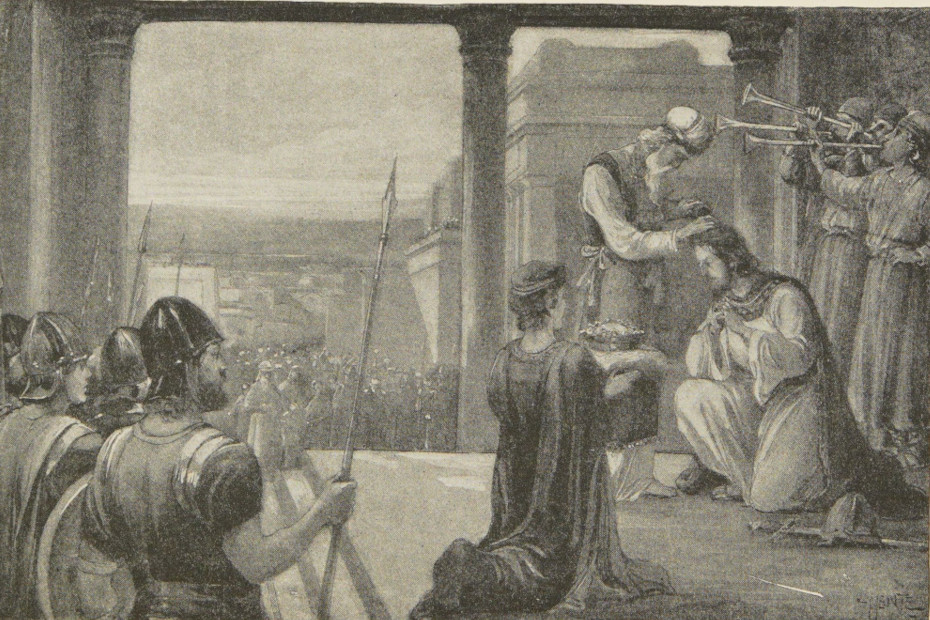
THE CORONATION OF DAVID. “The time had come, and David by solemn rite, was consecrated to his office as God’s vicegerent.”
More than eight thousand of the descendants of Aaron, and of
the Levites, waited upon David. The change in the sentiments
of the people was marked and decisive. The revolution was
quiet and dignified, befitting the great work they were doing.
Nearly half a million souls, the former subjects of Saul, thronged
Hebron and its environs. The very hills and valleys were alive
with the multitudes. The hour for the coronation was appointed;
the man who had been expelled from the court of Saul, who had
fled to the mountains and hills and to the caves of the earth to
preserve his life, was about to receive the highest honor that
can be conferred upon man by his fellow-man. Priests and
elders clothed in the garments of their sacred office, officers and
soldiers with glittering spear and helmet, and strangers from long
distances, stood to witness the coronation of the chosen king.
David was arrayed in the royal robe. The sacred oil was put
upon his brow by the high priest; for the anointing by Samuel
had been prophetic of what would take place at the inauguration
of the king. The time had come, and David, by solemn rite, was
consecrated to his office as God’s vicegerent. The scepter was
placed in his hands. The covenant of his righteous sovereignty
was written, and the people gave their pledges of loyalty. The
diadem was placed upon his brow, and the coronation ceremony
was over. Israel had a king by divine appointment. He who
had waited patiently for the Lord, beheld the promise of God
fulfilled. “And David went on, and grew great, and the Lord
God of hosts was with him.”[1122]
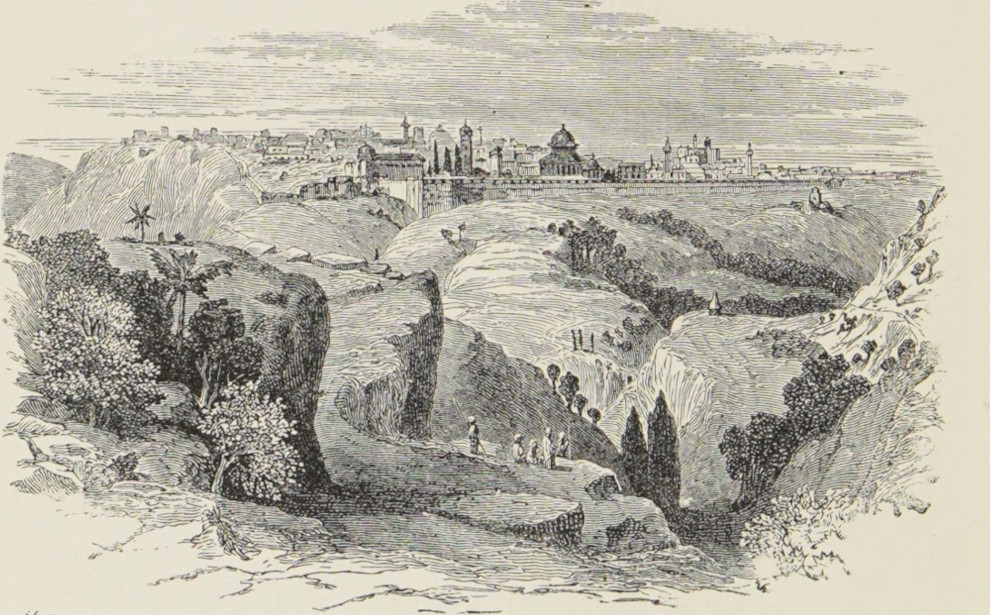
Jerusalem. “As the mountains are round about Jerusalem, so the Lord is round about his people.”
As soon as David was established on the throne of Israel, he
began to seek a more appropriate location for the capital of his
realm. Twenty miles from Hebron, a place was selected as the
future metropolis of the kingdom. Before Joshua had led the
armies of Israel over Jordan, it had been called Salem. Near
this place, Abraham had proved his loyalty to God. Eight hundred
years before the coronation of David, it had been the home
of Melchizedek, the priest of the most high God. It held a central
and elevated position in the country, and was protected by
an environment of hills. Being on the border between Benjamin
and Judah, it was in close proximity to Ephraim, and was easy
of access to the other tribes.
In order to secure this location, the Hebrews must dispossess
a remnant of the Canaanites, who held a fortified position on the
mountains of Zion and Moriah. This stronghold was called Jebus,
and its inhabitants were known as Jebusites. For centuries,
Jebus had been looked upon as impregnable; but it was besieged
and taken by the Hebrews under the command of Joab, who, as
the reward of his valor, was made commander-in-chief of the
armies of Israel. Jebus now became the national capital, and its
heathen name was changed to Jerusalem.
Hiram, king of the wealthy city of Tyre, on the Mediterranean
Sea, now sought an alliance with the king of Israel, and lent
his aid to David in the work of erecting a palace at Jerusalem.
Ambassadors were sent from Tyre, accompanied by architects
and workmen, and long trains laden with costly wood, cedar-trees,
and other valuable material.
The increasing strength of Israel in its union under David,
the acquisition of the stronghold of Jebus, and the alliance with
Hiram, king of Tyre, excited the hostility of the Philistines, and
they again invaded the country with a strong force, taking up
their position in the valley of Rephaim, but a short distance from
Jerusalem. David with his men of war retired to the stronghold
of Zion, to await divine direction. “And David inquired of the
Lord, saying, Shall I go up to the Philistines? wilt thou deliver
them into mine hand? And the Lord said unto David, Go up;
for I will doubtless deliver the Philistines into thine hand.”[1125]
David advanced upon the enemy at once, defeated and
destroyed them, and took from them the gods which they had
brought with them to insure their victory. Exasperated by the
humiliation of their defeat, the Philistines gathered a still larger
force, and returned to the conflict. And again they “spread themselves
in the valley of Rephaim.” Again David sought the Lord,
and the great I AM took the direction of the armies of Israel.
God instructed David, saying, “Thou shalt not go up; but
fetch a compass behind them, and come upon them over against
the mulberry trees. And let it be, when thou hearest the sound of
a going in the tops of the mulberry trees, that then thou shalt
bestir thyself; for then shall the Lord go out before thee, to
smite the host of the Philistines.” If David, like Saul, had
chosen his own way, success would not have attended him. But
he did as the Lord had commanded, and he “smote the host of
the Philistines from Gibeon even to Gazer. And the fame of
David went out into all lands; and the Lord brought the fear
of him upon all nations.”[1126]
Now that David was firmly established upon the throne, and
free from the invasions of foreign foes, he turned to the accomplishment
of a cherished purpose,—to bring up the ark of God
to Jerusalem. For many years the ark had remained at Kirjath-jearim,
nine miles distant; but it was fitting that the capital of the
nation should be honored with the token of the divine presence.
David summoned thirty thousand of the leading men of Israel;
for it was his purpose to make the occasion a scene of great
rejoicing and imposing display. The people responded gladly to
the call. The high priest, with his brethren in sacred office, and
the princes and leading men of the tribes, assembled at Kirjath-jearim.
David was aglow with holy zeal. The ark was brought
out from the house of Abinadab, and placed upon a new cart
drawn by oxen, while two of the sons of Abinadab attended it.
The men of Israel followed, with exultant shouts, and songs of
rejoicing, a multitude of voices joining in melody with the sound
of musical instruments; “David and all the house of Israel
played before the Lord ... on harps, and on psalteries, and on
timbrels, and on cornets, and on cymbals.”[1127] It had been long
since Israel had witnessed such a scene of triumph. With solemn
gladness the vast procession wound its way along the hills and
valleys toward the holy city.
But “when they came to Nachon’s threshing-floor, Uzzah put
forth his hand to the ark of God, and took hold of it; for the
oxen shook it. And the anger of the Lord was kindled against
Uzzah; and God smote him there for his rashness;[1128] and there he
died by the ark of God.” A sudden terror fell upon the rejoicing
throng. David was astonished and greatly alarmed, and in
his heart he questioned the justice of God. He had been seeking
to honor the ark as the symbol of the divine presence. Why,
then, had that fearful judgment been sent to turn the season of
gladness into an occasion of grief and mourning? Feeling that
it would be unsafe to have the ark near him, David determined
to let it remain where it was. A place was found for it near by,
at the house of Obed-edom the Gittite.
The fate of Uzzah was a divine judgment upon the violation
of a most explicit command. Through Moses the Lord had given
special instruction concerning the transportation of the ark.
None but the priests, the descendants of Aaron, were to touch it,
or even to look upon it uncovered. The divine direction was,
“The sons of Kohath shall come to bear it; but they shall not
touch any holy thing, lest they die.”[1129] The priests were to cover
the ark, and then the Kohathites must lift it by the staves, which
were placed in rings upon each side the ark, and were never
removed. To the Gershonites and Merarites, who had in charge
the curtains and boards and pillars of the tabernacle, Moses gave
carts and oxen for the transportation of that which was committed
to them. “But unto the sons of Kohath he gave none;
because the service of the sanctuary belonging unto them was
that they should bear upon their shoulders.”[1130] Thus in the
bringing of the ark from Kirjath-jearim, there had been a direct
and inexcusable disregard of the Lord’s directions.
David and his people had assembled to perform a sacred work,
and they had engaged in it with glad and willing hearts; but the
Lord could not accept the service, because it was not performed
in accordance with his directions. The Philistines, who had not
a knowledge of God’s law, had placed the ark upon a cart when
they returned it to Israel, and the Lord accepted the effort which
they made. But the Israelites had in their hands a plain statement
of the will of God in all these matters, and their neglect of
these instructions was dishonoring to God. Upon Uzzah rested
the greater guilt of presumption. Transgression of God’s law had
lessened his sense of its sacredness, and with unconfessed sins
upon him, he had, in face of the divine prohibition, presumed to
touch the symbol of God’s presence. God can accept no partial
obedience, no lax way of treating his commandments. By the
judgment upon Uzzah, he designed to impress upon all Israel the
importance of giving strict heed to his requirements. Thus the
death of that one man, by leading the people to repentance, might
prevent the necessity of inflicting judgments upon thousands.
Feeling that his own heart was not wholly right with God,
David, seeing the stroke upon Uzzah, had feared the ark, lest some
sin on his part should bring judgments upon him. But Obed-edom,
though he rejoiced with trembling, welcomed the sacred
symbol as the pledge of God’s favor to the obedient. The attention
of all Israel was now directed to the Gittite and his household;
all watched to see how it would fare with them. “And the Lord
blessed Obed-edom, and all his household.”
Upon David the divine rebuke accomplished its work. He
was led to realize, as he had never realized before, the sacredness
of the law of God, and the necessity of strict obedience. The
favor shown to the house of Obed-edom led David again to hope
that the ark might bring a blessing to him and to his people.
At the end of three months, he resolved to make another
attempt to remove the ark, and he now gave earnest heed to carry
out in every particular the directions of the Lord. Again the
chief men of the nation were summoned; and a vast assemblage
gathered about the dwelling-place of the Gittite. With reverent
care the ark was now placed upon the shoulders of men of divine
appointment, the multitude fell into line, and with trembling
hearts the vast procession again set forth. After advancing six
paces, the trumpet sounded a halt. By David’s direction, sacrifices
of “oxen and fatlings” were to be offered. Rejoicing now took
the place of trembling and terror. The king had laid aside his
royal robes, and had attired himself in a plain linen ephod, such
as was worn by the priests. He did not by this act signify that he
assumed priestly functions, for the ephod was sometimes worn by
others besides the priests. But in this holy service he would take
his place as, before God, on an equality with his subjects. Upon
that day, Jehovah was to be adored. He was to be the sole object
of reverence.
Again the long train was in motion, and the music of harp and
cornet, trumpet and cymbal, floated heavenward, blended with
the melody of many voices. “And David danced before the
Lord,” in his gladness keeping time to the measure of the song.
David’s dancing in reverent joy before God has been cited by
pleasure-lovers in justification of the fashionable modern dance;
but there is no ground for such an argument. In our day,
dancing is associated with folly and midnight reveling. Health
and morals are sacrificed to pleasure. By the frequenters of the
ballroom, God is not an object of thought and reverence; prayer
or the song of praise would be felt to be out of place in their
assemblies. This test should be decisive. Amusements that have
a tendency to weaken the love for sacred things and lessen our
joy in the service of God, are not to be sought by Christians. The
music and dancing in joyful praise to God at the removal of the
ark had not the faintest resemblance to the dissipation of modern
dancing. The one tended to the remembrance of God, and exalted
his holy name. The other is a device of Satan to cause men to
forget God and to dishonor him.
The triumphal procession approached the capital, following
the sacred symbol of their invisible King. Then a burst of song
demanded of the watchers upon the walls that the gates of the
holy city should be thrown open:—
“Lift up your heads, O ye gates;
And be ye lifted up, ye everlasting doors;
And the King of glory shall come in.”
A band of singers and players answered,—
“Who is this King of glory?”
From another company came the response,—
“The Lord strong and mighty,
The Lord mighty in battle.”
Then hundreds of voices, uniting, swelled the triumphal
chorus,—
“Lift up your heads, O ye gates;
Even lift them up, ye everlasting doors;
And the King of glory shall come in.”
Again the joyful interrogation was heard, “Who is this King of
glory?” And the voice of the great multitude, “like the sound
of many waters,” was heard in the rapturous reply,—
“The Lord of hosts,
He is the King of glory.”
[1131]
Then the gates were opened wide, the procession entered,
and with reverent awe the ark was deposited in the tent that
had been prepared for its reception. Before the sacred inclosure,
altars for sacrifice were erected; the smoke of peace-offerings and
burnt-offerings, and the clouds of incense, with the praises and
supplications of Israel, ascended to heaven. The service ended,
the king himself pronounced a benediction upon his people.
Then with regal bounty he caused gifts of food and wine to be
distributed for their refreshment.
All the tribes had been represented in this service, the celebration
of the most sacred event that had yet marked the reign of
David. The Spirit of divine inspiration had rested upon the
king, and now as the last beams of the setting sun bathed the
tabernacle in a hallowed light, his heart was uplifted in gratitude
to God that the blessed symbol of his presence was now so near
the throne of Israel.
Thus musing, David turned toward his palace, “to bless his
household.” But there was one who had witnessed the scene of
rejoicing, with a spirit widely different from that which moved
the heart of David. “As the ark of the Lord came into the
city of David, Michal, Saul’s daughter, looked through a window,
and saw King David leaping and dancing before the Lord; and
she despised him in her heart.” In the bitterness of her passion,
she could not await David’s return to the palace, but went out to
meet him, and to his kindly greeting poured forth a torrent of
bitter words. Keen and cutting was the irony of her speech:—
“How glorious was the king of Israel to-day, who uncovered
himself to-day in the eyes of the handmaids of his servants, as one
of the vain fellows shamelessly uncovereth himself!”
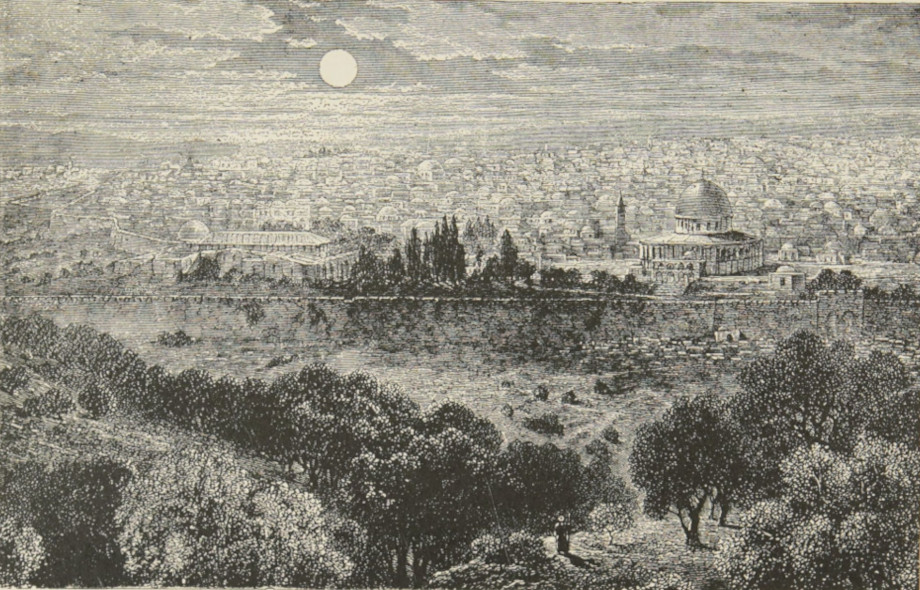
MODERN JERUSALEM BY MOONLIGHT.
David felt that it was the service of God which Michal had
despised and dishonored, and he sternly answered: “It was before
the Lord, which chose me before thy father, and before all his
house, to appoint me ruler over the people of the Lord, over
Israel; therefore will I play before the Lord. And I will yet be
more vile than thus, and will be base in mine own sight; and of
the maid-servants which thou hast spoken of, of them shall I be
had in honor.” To David’s rebuke was added that of the Lord:
because of her pride and arrogance, Michal “had no child unto
the day of her death.”
The solemn ceremonies attending the removal of the ark had
made a lasting impression upon the people of Israel, arousing a
deeper interest in the sanctuary service, and kindling anew their
zeal for Jehovah. David endeavored, by every means in his
power, to deepen these impressions. The service of song was
made a regular part of religious worship, and David composed
psalms, not only for the use of the priests in the sanctuary service,
but also to be sung by the people in their journeys to the national
altar at the annual feasts. The influence thus exerted was far-reaching,
and it resulted in freeing the nation from idolatry.
Many of the surrounding peoples, beholding the prosperity of
Israel, were led to think favorably of Israel’s God, who had done
such great things for his people.
The tabernacle built by Moses, with all that appertained to the
sanctuary service, except the ark, was still at Gibeah. It was
David’s purpose to make Jerusalem the religious center of the
nation. He had erected a palace for himself, and he felt that it
was not fitting for the ark of God to rest within a tent. He
determined to build for it a temple of such magnificence as
should express Israel’s appreciation of the honor granted the
nation in the abiding presence of Jehovah their King. Communicating
his purpose to the prophet Nathan, he received the
encouraging response, “Do all that is in thine heart; for the Lord
is with thee.”[1132]
But that same night the word of the Lord came to Nathan,
giving him a message for the king. David was to be deprived
of the privilege of building a house for God, but he was granted
an assurance of the divine favor to him, to his posterity, and to
the kingdom of Israel: “Thus saith Jehovah of hosts; I took thee
from the sheepcote, from following the sheep, to be ruler over
my people, over Israel; and I was with thee whithersoever thou
wentest, and have cut off all thine enemies out of thy sight, and
have made thee a great name, like unto the name of the great men
that are in the earth. Moreover I will appoint a place for my
people Israel, and will plant them, that they may dwell in a place
of their own, and move no more; neither shall the children of
wickedness afflict them any more, as beforetime.”
As David had desired to build a house for God, the promise
was given, “The Lord telleth thee that he will make thee a house....
I will set up thy seed after thee.... He shall build a house
for my name, and I will stablish the throne of his kingdom forever.”
The reason why David was not to build the temple, was declared:
“Thou hast shed blood abundantly, and hast made great
wars; thou shalt not build a house unto my name.... Behold,
a son shall be born to thee, who shall be a man of rest;
and I will give him rest from all his enemies;... his name shall
be Solomon [peaceable], and I will give peace and quietness unto
Israel in his days. He shall build a house for my name.”[1133]
Though the cherished purpose of his heart had been denied,
David received the message with gratitude. “Who am I, O Lord
God?” he exclaimed, “and what is my house, that thou hast
brought me hitherto? And this was yet a small thing in thy
sight, O Lord God; but thou hast spoken also of thy servant’s
house for a great while to come;” and he then renewed his covenant
with God.
David knew that it would be an honor to his name, and would
bring glory to his government, to perform the work that he had
purposed in his heart to do; but he was ready to submit his will
to the will of God. The grateful resignation thus manifested is
rarely seen, even among Christians. How often do those who
have passed the strength of manhood, cling to the hope of accomplishing
some great work upon which their hearts are set, but
which they are unfitted to perform! God’s providence may speak
to them, as did his prophet to David, declaring that the work
which they so much desire is not committed to them. It is theirs
to prepare the way for another to accomplish it. But instead of
gratefully submitting to the divine direction, many fall back as
if slighted and rejected, feeling that if they cannot do the one
thing which they desire to do, they will do nothing. Many
cling, with desperate energy, to responsibilities which they are
incapable of bearing, and vainly endeavor to accomplish a work
for which they are insufficient, while that which they might
do, lies neglected. And because of this lack of co-operation
on their part, the greater work is hindered or frustrated.
David, in his covenant with Jonathan, had promised that when
he should have rest from his enemies, he would show kindness to
the house of Saul. In his prosperity, mindful of this covenant,
the king made inquiry, “Is there yet any that is left of the
house of Saul, that I may show him kindness for Jonathan’s
sake?”[1134] He was told of a son of Jonathan, Mephibosheth, who
had been lame from childhood. At the time of Saul’s defeat by
the Philistines at Jezreel, the nurse of this child, attempting to
flee with him, had let him fall, thus making him a life-long
cripple. David now summoned the young man to court, and
received him with great kindness. The private possessions of
Saul were restored to him, for the support of his household; but
the son of Jonathan was himself to be the constant guest of the
king, sitting daily at the royal table. Through reports from the
enemies of David, Mephibosheth had been led to cherish a strong
prejudice against him as a usurper; but the monarch’s generous
and courteous reception of him, and his continued kindness, won
the heart of the young man; he became strongly attached to
David, and like his father Jonathan, he felt that his interest was
one with that of the king whom God had chosen.
After David’s establishment upon the throne of Israel, the
nation enjoyed a long interval of peace. The surrounding peoples,
seeing the strength and unity of the kingdom, soon thought it
prudent to desist from open hostilities; and David, occupied with
the organization and upbuilding of his kingdom, refrained from
aggressive war. At last, however, he made war upon Israel’s old
enemies, the Philistines, and upon the Moabites, and succeeded
in overcoming both, and making them tributary.
Then there was formed against the kingdom of David a vast
coalition of the surrounding nations, out of which grew the
greatest wars and victories of his reign, and the most extensive
accessions to his power. This hostile alliance, which really sprung
from jealousy of David’s increasing power, had been wholly unprovoked
by him. The circumstances that led to its rise were these:—
Tidings were received at Jerusalem announcing the death of
Nahash, king of the Ammonites,—a monarch who had shown
kindness to David when he was a fugitive from the rage of Saul.
Now, desiring to express his grateful appreciation of the favor
shown him in his distress, David sent ambassadors with a message
of sympathy to Hanun, the son and successor of the Ammonite
king. “Said David, I will show kindness unto Hanun the son of
Nahash, as his father showed kindness unto me.”[1135]
But his courteous act was misinterpreted. The Ammonites
hated the true God, and were the bitter enemies of Israel. The
apparent kindness of Nahash to David had been prompted
wholly by hostility to Saul as king of Israel. The message of
David was misconstrued by Hanun’s counselors. They “said
unto Hanun their lord, Thinkest thou that David doth honor thy
father, that he hath sent comforters unto thee? hath not David
rather sent his servants unto thee, to search the city, and to spy it
out, and to overthrow it?” It was by the advice of his counselors
that Nahash, half a century before, had been led to make the
cruel condition required of the people of Jabesh-gilead, when,
besieged by the Ammonites, they sued for a covenant of peace.
Nahash had demanded the privilege of thrusting out all their
right eyes. The Ammonites still vividly remembered how the
king of Israel had foiled their cruel design, and had rescued the
people whom they would have humbled and mutilated. The same
hatred of Israel still prompted them. They could have no conception
of the generous spirit that had inspired David’s message.
When Satan controls the minds of men, he will excite envy
and suspicion which will misconstrue the very best intentions.
Listening to his counselors, Hanun regarded David’s messengers
as spies, and loaded them with scorn and insult.
The Ammonites had been permitted to carry out the evil purposes
of their hearts without restraint, that their real character
might be revealed to David. It was not God’s will that Israel
should enter into a league with this treacherous heathen people.
In ancient times, as now, the office of ambassador was held
sacred. By the universal law of nations it insured protection
from personal violence or insult. The ambassador standing as a
representative of his sovereign, any indignity offered to him demanded
prompt retaliation. The Ammonites, knowing that the
insult offered to Israel would surely be avenged, made preparation
for war. “When the children of Ammon saw that they had
made themselves odious to David, Hanun and the children of
Ammon sent a thousand talents of silver to hire them chariots and
horsemen out of Mesopotamia, and out of Syria-maachah, and
out of Zobah. So they hired thirty and two thousand chariots....
And the children of Ammon gathered themselves together
from their cities, and came to battle.”[1136]
It was indeed a formidable alliance. The inhabitants of the
region lying between the river Euphrates and the Mediterranean
Sea had leagued with the Ammonites. The north and east of
Canaan was encircled with armed foes, banded together to crush the
kingdom of Israel.
The Hebrews did not wait for the invasion of their country.
Their forces, under Joab, crossed the Jordan, and advanced toward
the Ammonite capital. As the Hebrew captain led his army to the
field, he sought to inspire them for the conflict, saying, “Be of
good courage, and let us behave ourselves valiantly for our people,
and for the cities of our God; and let the Lord do that which is
good in his sight.”[1136] The united forces of the allies were overcome
in the first engagement. But they were not yet willing to
give over the contest, and the next year, renewed the war. The
king of Syria gathered his forces, threatening Israel with an immense
army. David, realizing how much depended upon the
result of this contest, took the field in person, and by the blessing
of God inflicted upon the allies a defeat so disastrous that
the Syrians, from Lebanon to the Euphrates, not only gave up
the war, but became tributary to Israel. Against the Ammonites,
David pushed the war with vigor, until their strongholds fell, and
the whole region came under the dominion of Israel.
The dangers which had threatened the nation with utter
destruction, proved, through the providence of God, to be the
very means by which it rose to unprecedented greatness. In
commemorating his remarkable deliverances, David sings:—
“The Lord liveth; and blessed be my rock; and exalted be the God of my salvation;
Even the God that executeth vengeance for me, and subdueth peoples under me.
He rescueth me from mine enemies;
Yea, thou liftest me up above them that rise up against me;
Thou deliverest me from the violent man.
Therefore I will give thanks unto thee, O Lord, among the nations.
And will sing praises unto thy name.
Great deliverance giveth he to his king;
And showeth loving-kindness to his anointed,
To David and to his seed, forevermore.”
[1137]
And throughout the songs of David, the thought was impressed
on his people that Jehovah was their strength and deliverer:—
“There is no king saved by the multitude of a host;
A mighty man is not delivered by much strength.
A horse is a vain thing for safety;
Neither shall he deliver any by his great strength.”
“Thou art my king, O God;
Command deliverances for Jacob.
Through thee, will we push down our enemies;
Through thy name will we tread them under that rise up against us.
For I will not trust in my bow,
Neither shall my sword save me.
But thou hast saved us from our enemies,
And hast put them to shame that hated us.”
“Some trust in chariots, and some in horses;
But we will remember the name of Jehovah our God.”
[1138]
The kingdom of Israel had now reached in extent the fulfillment
of the promise given to Abraham, and afterward repeated
to Moses: “Unto thy seed have I given this land, from the river
of Egypt unto the great river, the river Euphrates.”[1139] Israel had
become a mighty nation, respected and feared by surrounding
peoples. In his own realm, David’s power had become very
great. He commanded, as few sovereigns in any age have been
able to command, the affections and allegiance of his people. He
had honored God, and God was now honoring him.
But in the midst of prosperity lurked danger. In the time of
his greatest outward triumph, David was in the greatest peril, and
met his most humiliating defeat.

The Bible has little to say in praise of men. Little space is
given to recounting the virtues of even the best men who have
ever lived. This silence is not without purpose; it is not without
a lesson. All the good qualities that men possess are the gift of
God; their good deeds are performed by the grace of God through
Christ. Since they owe all to God, the glory of whatever they are
or do, belongs to him alone; they are but instruments in his
hands. More than this—as all the lessons of Bible history teach—it
is a perilous thing to praise or exalt men; for if one comes to
lose sight of his entire dependence on God, and to trust to his own
strength, he is sure to fall. Man is contending with foes who are
stronger than he. “We wrestle not against flesh and blood, but
against principalities, against powers, against the rulers of the
darkness of this world, against wicked spirits in high places.”[1140] It
is impossible for us, in our own strength, to maintain the conflict;
and whatever diverts the mind from God, whatever leads to self-exaltation
or to self-dependence, is surely preparing the way for
our overthrow. The tenor of the Bible is to inculcate distrust of
human power and to encourage trust in divine power.
It was the spirit of self-confidence and self-exaltation that
prepared the way for David’s fall. Flattery, and the subtle
allurements of power and luxury, were not without effect upon
him. Intercourse with surrounding nations also exerted an
influence for evil. According to the customs prevailing among
Eastern rulers, crimes not to be tolerated in subjects were uncondemned
in the king; the monarch was not under obligation to
exercise the same self-restraint as the subject. All this tended to
lessen David’s sense of the exceeding sinfulness of sin. And
instead of relying in humility upon the power of Jehovah, he
began to trust to his own wisdom and might. As soon as Satan
can separate the soul from God, the only source of strength, he
will seek to arouse the unholy desires of man’s carnal nature.
The work of the enemy is not abrupt; it is not, at the outset,
sudden and startling; it is a secret undermining of the strongholds
of principle. It begins in apparently small things,—the neglect
to be true to God and to rely upon him wholly, the disposition to
follow the customs and practices of the world.
Before the conclusion of the war with the Ammonites, David,
leaving the conduct of the army to Joab, returned to Jerusalem.
The Syrians had already submitted to Israel, and the complete
overthrow of the Ammonites appeared certain. David was surrounded
by the fruits of victory and the honors of his wise and
able rule. It was now, while he was at ease and unguarded, that
the tempter seized the opportunity to occupy his mind. The fact
that God had taken David into so close connection with himself,
and had manifested so great favor toward him, should have been
to him the strongest of incentives to preserve his character unblemished.
But when, in ease and self-security, he let go his hold
upon God, David yielded to Satan, and brought upon his soul the
stain of guilt. He, the Heaven-appointed leader of the nation,
chosen by God to execute his law, himself trampled upon its
precepts. He who should have been a terror to evil-doers, by his
own act strengthened their hands.
Amid the perils of his earlier life, David, in conscious integrity,
could trust his case with God. The Lord’s hand had guided
him safely past the unnumbered snares that had been laid for his
feet. But now, guilty and unrepentant, he did not ask help and
guidance from Heaven, but sought to extricate himself from the
dangers in which sin had involved him. Bathsheba, whose fatal
beauty had proved a snare to the king, was the wife of Uriah
the Hittite, one of David’s bravest and most faithful officers.
None could foresee what would be the result should the crime
become known. The law of God pronounced the adulterer guilty
of death, and the proud-spirited soldier, so shamefully wronged,
might avenge himself by taking the life of the king, or by exciting
the nation to revolt.
Every effort which David made to conceal his guilt proved
unavailing. He had betrayed himself into the power of Satan;
danger surrounded him, dishonor more bitter than death was
before him. There appeared but one way of escape, and in his
desperation he was hurried on to add murder to adultery. He
who had compassed the destruction of Saul, was seeking to lead
David also to ruin. Though the temptations were different, they
were alike in leading to transgression of God’s law. David reasoned
that if Uriah were slain by the hand of enemies in battle,
the guilt of his death could not be traced home to the king,
Bathsheba would be free to become David’s wife, suspicion could
be averted, and the royal honor would be maintained.
Uriah was made the bearer of his own death-warrant. A
letter sent by his hand to Joab from the king commanded, “Set
ye Uriah in the forefront of the hottest battle, and retire ye from
him, that he may be smitten, and die.”[1141] Joab, already stained
with the guilt of one wanton murder, did not hesitate to obey the
king’s instructions, and Uriah fell by the sword of the children
of Ammon.
Heretofore David’s record as a ruler had been such as few
monarchs have ever equaled. It is written of him that he “executed
judgment and justice unto all his people.”[1142] His integrity
had won the confidence and fealty of the nation. But as he
departed from God, and yielded himself to the wicked one, he
became, for the time, the agent of Satan; yet he still held the
position and authority that God had given him, and because
of this, claimed obedience that would imperil the soul of him
who should yield it. And Joab, whose allegiance had been given
to the king rather than to God, transgressed God’s law because
the king had commanded it.
David’s power had been given him by God, but to be exercised
only in harmony with the divine law. When he commanded that
which was contrary to God’s law, it became sin to obey. “The
powers that be are ordained of God,”[1143] but we are not to obey
them contrary to God’s law. The apostle Paul, writing to the
Corinthians, sets forth the principle by which we should be
governed. He says, “Be ye followers of me, even as I also am
of Christ.”[1144]
An account of the execution of his order was sent to David,
but so carefully worded as not to implicate either Joab or the
king. Joab “charged the messenger, saying, When thou hast
made an end of telling the matters of the war unto the king,
and if so be that the king’s wrath arise, ... then say thou, Thy
servant Uriah the Hittite is dead also. So the messenger went,
and came and showed David all that Joab had sent him for.”
The king’s answer was, “Thus shalt thou say unto Joab: Let
not this thing displease thee, for the sword devoureth one as well
as another. Make thy battle more strong against the city, and
overthrow it; and encourage thou him.”
Bathsheba observed the customary days of mourning for her
husband; and at their close, “David sent and fetched her to his
house, and she became his wife.” He whose tender conscience
and high sense of honor would not permit him, even when in peril
of his life, to put forth his hand against the Lord’s anointed, had
so fallen that he could wrong and murder one of his most faithful
and most valiant soldiers, and hope to enjoy undisturbed the reward
of his sin. Alas! how had the fine gold become dim! how
had the most fine gold changed!
From the beginning, Satan has portrayed to men the gains to
be won by transgression. Thus he seduced angels. Thus he
tempted Adam and Eve to sin. And thus he is still leading
multitudes away from obedience to God. The path of transgression
is made to appear desirable; “but the end thereof are
the ways of death.”[1145] Happy they who, having ventured in
this way, learn how bitter are the fruits of sin, and turn from
it betimes. God, in his mercy, did not leave David to be lured
to utter ruin by the deceitful rewards of sin.
For the sake of Israel also, there was a necessity for God to
interpose. As time passed on, David’s sin toward Bathsheba
became known, and suspicion was excited that he had planned
the death of Uriah. The Lord was dishonored. He had favored
and exalted David, and David’s sin misrepresented the character
of God, and cast reproach upon his name. It tended to lower the
standard of godliness in Israel, to lessen in many minds the
abhorrence of sin; while those who did not love and fear God
were by it emboldened in transgression.
Nathan the prophet was bidden to bear a message of reproof
to David. It was a message terrible in its severity. To few sovereigns
could such a reproof be given but at the price of certain
death to the reprover. Nathan delivered the divine sentence unflinchingly,
yet with such heaven-born wisdom as to engage the
sympathies of the king, to arouse his conscience, and to call from
his lips the sentence of death upon himself. Appealing to David
as the divinely appointed guardian of his people’s rights, the
prophet repeated a story of wrong and oppression that demanded
redress.
“There were two men in one city,” he said, “the one rich, and
the other poor. The rich man had exceeding many flocks and
herds; but the poor man had nothing, save one little ewe lamb,
which he had brought and nourished up; and it grew up together
with him, and with his children; it did eat of his own meat, and
drank of his own cup, and lay in his bosom, and was unto him as
a daughter. And there came a traveler unto the rich man, and he
spared to take of his own flock and of his own herd, to dress for
the wayfaring man that was come unto him; but took the poor
man’s lamb, and dressed it for the man that was come to him.”
The anger of the king was roused, and he exclaimed, “As the
Lord liveth, the man that hath done this thing is worthy to die.
And he shall restore the lamb fourfold, because he did this thing,
and because he had no pity.”[1146]
Nathan fixed his eyes upon the king; then lifting his right
hand to heaven, he solemnly declared, “Thou art the man.”
“Wherefore,” he continued, “hast thou despised the commandment
of the Lord, to do evil in his sight?” The guilty may
attempt, as David had done, to conceal their crime from men;
they may seek to bury the evil deed forever from human sight or
knowledge: but “all things are naked and opened unto the eyes
of Him with whom we have to do.”[1147] “There is nothing covered,
that shall not be revealed; and hid, that shall not be known.”[1148]
Nathan declared: “Thus saith the Lord God of Israel: I
anointed thee king over Israel, and I delivered thee out of the
hand of Saul.... Wherefore hast thou despised the commandment
of the Lord, to do evil in his sight? Thou hast killed
Uriah the Hittite with the sword, and hast taken his wife to be thy
wife, and hast slain him with the sword of the children of Ammon.
Now therefore the sword shall never depart from thine house....
Behold, I will raise up evil against thee out of thine own
house, and I will take thy wives before thine eyes, and give them
unto thy neighbor.... For thou didst it secretly; but I will do
this thing before all Israel, and before the sun.”
The prophet’s rebuke touched the heart of David; conscience
was aroused; his guilt appeared in all its enormity. His soul was
bowed in penitence before God. With trembling lips he said, “I
have sinned against the Lord.” All wrong done to others reaches
back from the injured one to God. David had committed a
grievous sin, toward both Uriah and Bathsheba, and he keenly
felt this. But infinitely greater was his sin against God.
Though there would be found none in Israel to execute the sentence
of death upon the anointed of the Lord, David trembled, lest,
guilty and unforgiven, he should be cut down by the swift judgment
of God. But the message was sent him by the prophet,
“The Lord also hath put away thy sin; thou shalt not die.” Yet
justice must be maintained. The sentence of death was transferred
from David to the child of his sin. Thus the king was
given opportunity for repentance; while to him the suffering and
death of the child, as a part of his punishment, was far more
bitter than his own death could have been. The prophet said,
“Because by this deed thou hast given great occasion to the
enemies of the Lord to blaspheme, the child also that is born unto
thee shall surely die.”
When his child was stricken, David, with fasting and deep
humiliation, pleaded for its life. He put off his royal robes, he
laid aside his crown, and night after night he lay upon the earth,
in heart-broken grief interceding for the innocent one suffering for
his guilt. “The elders of his house arose, and went to him, to
raise him up from the earth; but he would not.” Often when
judgments had been pronounced upon persons or cities, humiliation
and repentance had turned aside the blow, and the Ever-Merciful,
swift to pardon, had sent messengers of peace.
Encouraged by this thought, David persevered in his supplication
so long as the child was spared. Upon learning that it was dead,
he quietly submitted to the decree of God. The first stroke had
fallen of that retribution which he himself had declared just;
but David, trusting in God’s mercy, was not without comfort.
Very many, reading the history of David’s fall, have inquired,
“Why has this record been made public? Why did God see fit
to throw open to the world this dark passage in the life of one so
highly honored of Heaven?” The prophet, in his reproof to David,
had declared concerning his sin, “By this deed thou hast given
great occasion to the enemies of the Lord to blaspheme.” Through
successive generations, infidels have pointed to the character of
David, bearing this dark stain, and have exclaimed in triumph
and derision, “This is the man after God’s own heart!” Thus a
reproach has been brought upon religion, God and his word have
been blasphemed, souls have been hardened in unbelief, and
many, under a cloak of piety, have become bold in sin.
But the history of David furnishes no countenance to sin. It
was when he was walking in the counsel of God, that he was
called a man after God’s own heart. When he sinned, this ceased
to be true of him until by repentance he had returned to the Lord.
The word of God plainly declares, “The thing that David had
done was evil in the eyes of Jehovah.”[1149] And the Lord said to
David by the prophet, “Wherefore hast thou despised the commandment
of the Lord, to do evil in his sight?... Now therefore
the sword shall never depart from thine house; because thou hast
despised me.” Though David repented of his sin, and was
forgiven and accepted by the Lord, he reaped the baleful harvest
of the seed he himself had sown. The judgments upon him and
upon his house testify to God’s abhorrence of the sin.
Heretofore God’s providence had preserved David against all
the plottings of his enemies, and had been directly exercised to
restrain Saul. But David’s transgression had changed his relation
to God. The Lord could not in any wise sanction iniquity. He
could not exercise his power to protect David from the results of
his sin as he had protected him from the enmity of Saul.
There was a great change in David himself. He was broken in
spirit by the consciousness of his sin and its far-reaching results.
He felt humbled in the eyes of his subjects. His influence
was weakened. Hitherto his prosperity had been attributed to
his conscientious obedience to the commandments of the Lord.
But now his subjects, having a knowledge of his sin, would be led
to sin more freely. His authority in his own household, his claim
to respect and obedience from his sons, was weakened. A sense of
his guilt kept him silent when he should have condemned sin; it
made his arm feeble to execute justice in his house. His evil
example exerted its influence upon his sons, and God would not
interpose to prevent the result. He would permit things to take
their natural course, and thus David was severely chastised.
For a whole year after his fall, David lived in apparent security;
there was no outward evidence of God’s displeasure. But the
divine sentence was hanging over him. Swiftly and surely a day of
judgment and retribution was approaching, which no repentance
could avert, agony and shame that would darken his whole
earthly life. Those who, by pointing to the example of David,
try to lessen the guilt of their own sins, should learn from the
Bible record that the way of transgression is hard. Though like
David they should turn from their evil course, the results of sin,
even in this life, will be found bitter and hard to bear.
God intended the history of David’s fall to serve as a warning
that even those whom he has greatly blessed and favored are not
to feel secure, and neglect watchfulness and prayer. And thus
it has proved to those who in humility have sought to learn
the lesson that God designed to teach. From generation to
generation, thousands have thus been led to realize their own
danger from the tempter’s power. The fall of David, one so greatly
honored by the Lord, has awakened in them distrust of self. They
have felt that God alone could keep them by his power through
faith. Knowing that in him was their strength and safety, they
have feared to take the first step on Satan’s ground.
Even before the divine sentence was pronounced against David,
he had begun to reap the fruit of transgression. His conscience
was not at rest. The agony of spirit which he then endured is
brought to view in the thirty-second psalm. He says:—
“Blessed is he whose transgression is forgiven, whose sin is covered.
Blessed is the man unto whom the Lord imputeth not iniquity,
And in whose spirit there is no guile.
When I kept silence, my bones waxed old,
Through my roaring all the day long.
For day and night thy hand was heavy upon me;
My moisture was changed as with the drought of summer.”
[1150]
And the fifty-first psalm is an expression of David’s repentance,
when the message of reproof came to him from God:—
“Have mercy upon me, O God, according to thy loving-kindness;
According unto the multitude of thy tender mercies blot out my transgressions.
Wash me thoroughly from mine iniquity, and cleanse me from my sin.
For I acknowledge my transgressions; and my sin is ever before me....
Purge me with hyssop, and I shall be clean; wash me, and I shall be whiter than snow.
Make me to hear joy and gladness,
That the bones which thou hast broken may rejoice.
Hide thy face from my sins,
And blot out all mine iniquities.
Create in me a clean heart, O God;
And renew a right spirit within me.
Cast me not away from thy presence;
And take not thy Holy Spirit from me.
Restore unto me the joy of thy salvation,
And uphold me with thy free Spirit.
Then will I teach transgressors thy ways;
And sinners shall be converted unto thee.
Deliver me from blood-guiltiness, O God, thou God of my salvation,
And my tongue shall sing aloud of thy righteousness.”
[1151]
Thus in a sacred song to be sung in the public assemblies of
his people, in the presence of the court,—priests and judges,
princes and men of war,—and which would preserve to the latest
generation the knowledge of his fall, the king of Israel recounted
his sin, his repentance, and his hope of pardon through the mercy
of God. Instead of endeavoring to conceal his guilt, he desired
that others might be instructed by the sad history of his fall.
David’s repentance was sincere and deep. There was no effort
to palliate his crime. No desire to escape the judgments threatened,
inspired his prayer. But he saw the enormity of his transgression
against God; he saw the defilement of his soul; he
loathed his sin. It was not for pardon only that he prayed, but
for purity of heart. David did not in despair give over the
struggle. In the promises of God to repentant sinners, he saw
the evidence of his pardon and acceptance.
“For thou desirest not sacrifice; else would I give it;
Thou delightest not in burnt-offering.
The sacrifices of God are a broken spirit;
A broken and a contrite heart, O God, thou wilt not despise.”
[1151]
Though David had fallen, the Lord lifted him up. He was
now more fully in harmony with God and in sympathy with his
fellow-men than before he fell. In the joy of his release he sang,—
“I acknowledged my sin unto thee, and mine iniquity have I not hid.
I said, I will confess my transgressions unto the Lord,
And thou forgavest the iniquity of my sin....
Thou art my hiding-place; thou shalt preserve me from trouble;
Thou shalt compass me about with songs of deliverance.”
[1152]
Many have murmured at what they called God’s injustice in
sparing David, whose guilt was so great, after having rejected Saul
for what appear to them to be far less flagrant sins. But David
humbled himself and confessed his sin, while Saul despised
reproof, and hardened his heart in impenitence.
This passage in David’s history is full of significance to the
repenting sinner. It is one of the most forcible illustrations given
us of the struggles and temptations of humanity, and of genuine
repentance toward God and faith in our Lord Jesus Christ.
Through all the ages, it has proved a source of encouragement to
souls that, having fallen into sin, were struggling under the burden
of their guilt. Thousands of the children of God, who have been
betrayed into sin, when ready to give up to despair have remembered
how David’s sincere repentance and confession were accepted
by God, notwithstanding he suffered for his transgression; and
they also have taken courage to repent, and try again to walk in
the way of God’s commandments.
Whoever under the reproof of God will humble the soul with
confession and repentance, as did David, may be sure that there
is hope for him. Whoever will in faith accept God’s promises,
will find pardon. The Lord will never cast away one truly
repentant soul. He has given this promise: “Let him take hold
of my strength, that he may make peace with me, and he shall
make peace with me.”[1153] “Let the wicked forsake his way, and
the unrighteous man his thoughts; and let him return unto the
Lord, and he will have mercy upon him; and to our God, for he
will abundantly pardon.”[1154]
“He shall restore fourfold,” had been David’s unwitting
sentence upon himself, on listening to the prophet Nathan’s
parable; and according to his own sentence he was to be judged.
Four of his sons must fall, and the loss of each would be a result
of the father’s sin.
The shameful crime of Amnon, the first-born, was permitted
by David to pass unpunished and unrebuked. The law
pronounced death upon the adulterer, and the unnatural crime
of Amnon made him doubly guilty. But David, self-condemned
for his own sin, failed to bring the offender to justice. For two
full years, Absalom, the natural protector of the sister so foully
wronged, concealed his purpose of revenge, but only to strike
more surely at the last. At a feast of the king’s sons, the drunken,
incestuous Amnon was slain, by his brother’s command.
Twofold judgment had been meted out to David. The terrible
message was carried to him, “Absalom hath slain all the king’s
sons, and there is not one of them left. Then the king arose, and
tare his garments, and lay on the earth; and all his servants stood
by with their clothes rent.”[1160] The king’s sons, returning in alarm to
Jerusalem, revealed to their father the truth; Amnon alone had
been slain; and they “lifted up their voice and wept; and the king
also and all his servants wept very sore.” But Absalom fled to
Talmai, the king of Geshur, his mother’s father.
Like other sons of David, Amnon had been left to selfish
indulgence. He had sought to gratify every thought of his
heart, regardless of the requirements of God. Notwithstanding
his great sin, God had borne long with him. For two years he
had been granted opportunity for repentance; but he continued
in sin, and with his guilt upon him, he was cut down by death,
to await the awful tribunal of the Judgment.
David had neglected the duty of punishing the crime of Amnon,
and because of the unfaithfulness of the king and father, and
the impenitence of the son, the Lord permitted events to take their
natural course, and did not restrain Absalom. When parents or
rulers neglect the duty of punishing iniquity, God himself will
take the case in hand. His restraining power will be in a measure
removed from the agencies of evil, so that a train of circumstances
will arise which will punish sin with sin.
The evil results of David’s unjust indulgence toward Amnon
were not ended; for it was here that Absalom’s alienation from
his father began. After he fled to Geshur, David, feeling that
the crime of his son demanded some punishment, refused him
permission to return. And this had a tendency to increase rather
than to lessen the inextricable evils in which the king had come
to be involved. Absalom, energetic, ambitious, and unprincipled,
shut out by his exile from participation in the affairs of the kingdom,
soon gave himself up to dangerous scheming.
At the close of two years, Joab determined to effect a reconciliation
between the father and his son. And with this object
in view he secured the services of a woman of Tekoah, reputed
for wisdom. Instructed by Joab, the woman represented herself
to David as a widow whose two sons had been her only comfort
and support. In a quarrel, one of these had slain the other, and
now all the relatives of the family demanded that the survivor
should be given up to the avenger of blood. “And so,” said the
mother, “they shall quench my coal which is left, and shall not
leave to my husband neither name nor remainder upon the
earth.” The king’s feelings were touched by this appeal, and he
assured the woman of the royal protection for her son.
After drawing from him repeated promises for the young
man’s safety, she entreated the king’s forbearance, declaring that
he had spoken as one at fault, in that he did not fetch home
again his banished. “For,” she said, “we must needs die, and
are as water spilt on the ground, which cannot be gathered up
again; neither doth God respect any person; yet doth he devise
means, that his banished be not expelled from him.” This tender and
touching portrayal of the love of God toward the sinner,—coming
as it did from Joab, the rude soldier,—is a striking evidence of
the familiarity of the Israelites with the great truths of redemption.
The king, feeling his own need of God’s mercy, could not
resist this appeal. To Joab the command was given, “Go, therefore,
bring the young man Absalom again.”
Absalom was permitted to return to Jerusalem, but not to
appear at court, or to meet his father. David had begun to see
the evil effects of his indulgence toward his children; and tenderly
as he loved this beautiful and gifted son, he felt it necessary, as
a lesson both to Absalom and to the people, that abhorrence for
such a crime should be manifested. Absalom lived two years
in his own house, but banished from the court. His sister dwelt
with him, and her presence kept alive the memory of the
irreparable wrong she had suffered. In the popular estimation,
the prince was a hero rather than an offender. And having this
advantage, he set himself to gain the hearts of the people. His
personal appearance was such as to win the admiration of all
beholders. “In all Israel there was none to be so much praised
as Absalom for his beauty; from the sole of his foot even to the
crown of his head there was no blemish in him.” It was not wise
for the king to leave a man of Absalom’s character—ambitious,
impulsive, and passionate—to brood for two years over supposed
grievances. And David’s action, in permitting him to return to
Jerusalem, and yet refusing to admit him to his presence, enlisted
in his behalf the sympathies of the people.
With the memory ever before him of his own transgression of
the law of God, David seemed morally paralyzed; he was weak
and irresolute, when before his sin he had been courageous and
decided. His influence with the people had been weakened.
And all this favored the designs of his unnatural son.
Through the influence of Joab, Absalom was again admitted to
his father’s presence; but though there was an outward reconciliation,
he continued his ambitious scheming. He now assumed an
almost royal state, having chariots and horses, and fifty men to
run before him. And while the king was more and more inclined
to desire retirement and solitude, Absalom sedulously courted the
popular favor.
The influence of David’s listlessness and irresolution extended
to his subordinates; negligence and delay characterized the administration
of justice. Absalom artfully turned every cause of dissatisfaction
to his own advantage. Day by day this man of noble
mien might be seen at the gate of the city, where a crowd of
suppliants waited to present their wrongs for redress. Absalom
mingled with them, and listened to their grievances, expressing
sympathy with their sufferings, and regret at the inefficiency of
the government. Having thus listened to the story of a man of
Israel, the prince would reply, “Thy matters are good and right;
but there is no man deputed of the king to hear thee;” adding,
“O that I were made judge in the land, that every man which
hath any suit or cause might come unto me, and I would do him
justice! And it was so, that when any man came nigh to do him
obeisance, he put forth his hand, and took him, and kissed him.”
Fomented by the artful insinuations of the prince, discontent
with the government was fast spreading. The praise of Absalom
was on the lips of all. He was generally regarded as heir to the
kingdom; the people looked upon him with pride as worthy of
this high station, and a desire was kindled that he might occupy
the throne. “So Absalom stole the hearts of the men of Israel.”
Yet the king, blinded by affection for his son, suspected nothing.
The princely state which Absalom had assumed, was regarded by
David as intended to do honor to his court,—as an expression of
joy at the reconciliation.
The minds of the people being prepared for what was to
follow, Absalom secretly sent picked men throughout the tribes,
to concert measures for a revolt. And now the cloak of religious
devotion was assumed to conceal his traitorous designs. A vow
made long before while he was in exile must be paid in Hebron.
Absalom said to the king, “I pray thee, let me go and pay my
vow, which I have vowed unto the Lord, in Hebron. For thy
servant vowed a vow while I abode at Geshur, in Syria, saying,
If the Lord shall bring me again indeed to Jerusalem, then I will
serve the Lord.” The fond father, comforted with this evidence
of piety in his son, dismissed him with his blessing. The conspiracy
was now fully matured. Absalom’s crowning act of
hypocrisy was designed not only to blind the king, but to establish
the confidence of the people, and thus to lead them on to
rebellion against the king whom God had chosen.
Absalom set forth for Hebron, and there went with him “two
hundred men out of Jerusalem, that were called; and they went
in their simplicity, and they knew not anything.” These men
went with Absalom, little thinking that their love for the son was
leading them into rebellion against the father. Upon arriving at
Hebron, Absalom immediately summoned Ahithophel, one of the
chief counselors of David, a man in high repute for wisdom,
whose opinion was thought to be as safe and wise as that of an
oracle. Ahithophel joined the conspirators, and his support
made the cause of Absalom appear certain of success, attracting
to his standard many influential men from all parts of the land.
As the trumpet of revolt was sounded, the prince’s spies throughout
the country spread the tidings that Absalom was king, and
many of the people gathered to him.
Meanwhile the alarm was carried to Jerusalem, to the king.
David was suddenly aroused, to see rebellion breaking out close
beside his throne. His own son—the son whom he had loved
and trusted—had been plotting to seize his crown, and doubtless
to take his life. In his great peril, David shook off the depression
that had so long nested upon him, and with the spirit of his
earlier years he prepared to meet this terrible emergency. Absalom
was mustering his forces at Hebron, only twenty miles
away. The rebels would soon be at the gates of Jerusalem.
From his palace, David looked out upon his capital—“beautiful
for situation, the joy of the whole earth, ... the city of
the great King.”[1161] He shuddered at the thought of exposing it
to carnage and devastation. Should he call to his help the subjects
still loyal to his throne, and make a stand to hold his capital?
Should he permit Jerusalem to be deluged with blood?
His decision was taken. The horrors of war should not fall upon
the chosen city. He would leave Jerusalem, and then test the
fidelity of his people, giving them an opportunity to rally to his
support. In this great crisis it was his duty to God and to his
people to maintain the authority with which Heaven had invested
him. The issue of the conflict he would trust with God.
In humility and sorrow, David passed out of the gate of
Jerusalem,—driven from his throne, from his palace, from the
ark of God, by the insurrection of his cherished son. The people
followed in long, sad procession, like a funeral train. David’s
body-guard of Cherethites, Pelethites, and six hundred Gittites
from Gath, under the command of Ittai, accompanied the king.
But David, with characteristic unselfishness, could not consent
that these strangers who had sought his protection should be
involved in his calamity. He expressed surprise that they should
be ready to make this sacrifice for him. Then said the king to
Ittai the Gittite, “Wherefore goest thou also with us? Return to
thy place, and abide with the king; for thou art a stranger, and
also an exile. Whereas thou earnest but yesterday, should I this
day make thee go up and down with us? Seeing I go whither I
may, return thou, and take back thy brethren; mercy and truth
be with thee.”
Ittai answered, “As the Lord liveth, and as my lord the king
liveth, surely in what place my lord the king shall be, whether
in death or life, even there also will thy servant be.” These men
had been converted from paganism to the worship of Jehovah,
and nobly they now proved their fidelity to their God and their
king. David, with grateful heart, accepted their devotion to his
apparently sinking cause, and all passed over the brook Kedron,
on the way toward the wilderness.
Again the procession halted. A company clad in holy vestments
was approaching. “And lo Zadok also, and all the Levites
were with him, bearing the ark of the covenant of God.” The followers
of David looked upon this as a happy omen. The presence
of that sacred symbol was to them a pledge of their deliverance
and ultimate victory. It would inspire the people with courage to
rally to the king. Its absence from Jerusalem would bring terror
to the adherents of Absalom.
At sight of the ark, joy and hope for a brief moment thrilled
the heart of David. But soon other thoughts came to him.
As the appointed ruler of God’s heritage, he was under solemn
responsibility. Not personal interests, but the glory of God and
the good of his people, were to be uppermost in the mind of
Israel’s king. God, who dwelt between the cherubim, had said
of Jerusalem, “This is my rest;”[1162] and without divine authority,
neither priest nor king had a right to remove therefrom the
symbol of his presence. And David knew that his heart and life
must be in harmony with the divine precepts, else the ark would
be the means of disaster rather than of success. His great sin
was ever before him. He recognized in this conspiracy the just
judgment of God. The sword that was not to depart from his
house had been unsheathed. He knew not what the result of the
struggle might be. It was not for him to remove from the capital
of the nation the sacred statutes which embodied the will of their
divine Sovereign, which were the constitution of the realm and the
foundation of its prosperity.
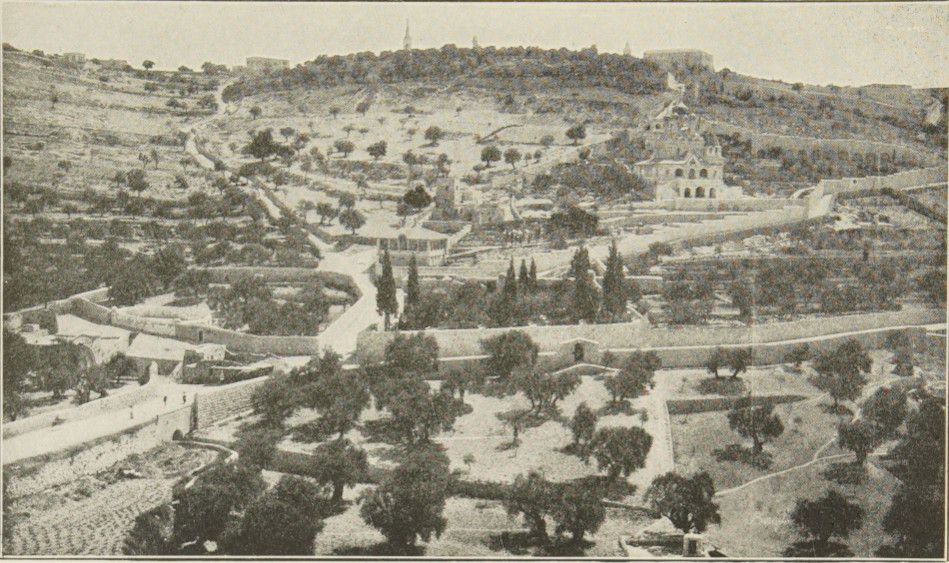
THE MOUNT OF OLIVES. “David went up by the ascent of Olivet, and wept as he went up.”
He commanded Zadok, “Carry back the ark of God into the
city. If I shall find favor in the eyes of the Lord, he will bring
me again, and show me both it and his habitation; but if he thus
say, I have no delight in thee; behold, here am I, let him do to
me as seemeth good unto him.”
David added, “Art not thou a seer?”—a man appointed of
God to instruct the people? “Return into the city in peace, and
your two sons with you, Ahimaaz thy son, and Jonathan the son
of Abiathar. See, I will tarry in the plain of the wilderness, until
there come word from you to certify me.” In the city the priests
might do him good service by learning the movements and purposes
of the rebels, and secretly communicating them to the king
by their sons, Ahimaaz and Jonathan.
As the priests turned back toward Jerusalem, a deeper shadow
fell upon the departing throng. Their king a fugitive, themselves
outcasts, forsaken even by the ark of God;—the future was dark
with terror and foreboding. “And David went up by the ascent
of Olivet, and wept as he went up, and had his head covered, and
he went barefoot; and all the people that was with him covered
every man his head, and they went up, weeping as they went up.
And one told David, saying, Ahithophel is among the conspirators
with Absalom.” Again David was forced to recognize in his
calamities the results of his own sin. The defection of Ahithophel,
the ablest and most wily of political leaders, was prompted by
revenge for the family disgrace involved in the wrong to Bathsheba,
who was his granddaughter.
“And David said, O Lord, I pray thee, turn the counsel of
Ahithophel into foolishness.” Upon reaching the top of the mount,
the king bowed in prayer, casting upon God the burden of his
soul, and humbly supplicating divine mercy. His prayer seemed
to be at once answered. Hushai the Archite, a wise and able
counselor, who had proved himself a faithful friend to David, now
came to him with his robes rent, and with earth upon his head,
to cast in his fortunes with the dethroned and fugitive king.
David saw, as by a divine enlightenment, that this man, faithful
and true-hearted, was the one needed to serve the interests of the
king in the councils at the capital. At David’s request, Hushai
returned to Jerusalem, to offer his services to Absalom, and defeat
the crafty counsel of Ahithophel.
With this gleam of light in the darkness, the king and his
followers pursued their way down the eastern slope of Olivet,
through a rocky and desolate waste, through wild ravines, and
along stony and precipitous paths, toward the Jordan. “And
when King David came to Bahurim, behold, thence came out a
man of the family of the house of Saul, whose name was Shimei,
the son of Gera; he came forth, and cursed still as he came. And
he cast stones at David, and at all the servants of King David;
and all the people and all the mighty men were on his right hand
and on his left. And thus said Shimei when he cursed: Come out,
come out, thou bloody man, and thou man of Belial. The Lord
hath returned upon thee all the blood of the house of Saul, in
whose stead thou hast reigned; and the Lord hath delivered the
kingdom unto the hand of Absalom thy son; and, behold, thou
art taken in thy mischief, because thou art a bloody man.”
In David’s prosperity, Shimei had not shown by word or act
that he was not a loyal subject. But in the affliction of the king,
this Benjamite revealed his true character. He had honored
David upon his throne, but he cursed him in his humiliation.
Base and selfish, he looked upon others as of the same character
as himself, and, inspired by Satan, he wreaked his hatred upon
him whom God had chastened. The spirit that leads man to
triumph over, to revile or distress, one who is in affliction, is the
spirit of Satan.
Shimei’s accusations against David were utterly false,—a
baseless and malignant slander. David had not been guilty of
wrong toward Saul or his house. When Saul was wholly in his
power, and he could have slain him, he merely cut the skirt of
his robe, and he reproached himself for showing even this disrespect
for the Lord’s anointed.
Of David’s sacred regard for human life, striking evidence had
been given, even while he himself was hunted like a beast of prey.
One day while he was hidden in the cave of Adullam, his thoughts
turning back to the untroubled freedom of his boyhood life, the
fugitive exclaimed, “O that one would give me drink of the water
of the well of Bethlehem, which is by the gate!”[1163] Bethlehem was
at that time in the hands of the Philistines; but three mighty
men of David’s band broke through the guard, and brought of the
water of Bethlehem to their master. David could not drink it.
“Be it far from me,” he cried; “is not this the blood of the men
that went in jeopardy of their lives?” And he reverently poured
out the water as an offering to God. David had been a man of
war, much of his life had been spent amid scenes of violence;
but of all who have passed through such an ordeal, few indeed
have been so little affected by its hardening, demoralizing influence
as was David.
David’s nephew, Abishai, one of the bravest of his captains,
could not listen patiently to Shimei’s insulting words. “Why,”
he exclaimed, “should this dead dog curse my lord the king?
Let me go over, I pray thee, and take off his head.” But the
king forbade him. “Behold,” he said, “my son seeketh my life;
how much more now may this Benjamite do it? Let him alone,
and let him curse; for the Lord hath bidden him. It may be
that the Lord will look on mine affliction, and that the Lord will
requite me good for his cursing this day.”
Conscience was uttering bitter and humiliating truths to
David. While his faithful subjects wondered at his sudden reverse
of fortune, it was no mystery to the king. He had often
had forebodings of an hour like this. He had wondered that
God had so long borne with his sins, and had delayed the merited
retribution. And now in his hurried and sorrowful flight, his
feet bare, his royal robes changed for sackcloth, the lamentations
of his followers awaking the echoes of the hills, he thought of
his loved capital,—of the place which had been the scene of his
sin,—and as he remembered the goodness and long-suffering of
God, he was not altogether without hope. He felt that the Lord
would still deal with him in mercy.
Many a wrong-doer has excused his own sin by pointing to
David’s fall; but how few there are who manifest David’s penitence
and humility. How few would bear reproof and retribution
with the patience and fortitude that he manifested. He had
confessed his sin, and for years had sought to do his duty as a
faithful servant of God; he had labored for the upbuilding of his
kingdom, and under his rule it had attained to strength and
prosperity never reached before. He had gathered rich stores
of material for the building of the house of God; and now was
all the labor of his life to be swept away? Must the results of
years of consecrated toil, the work of genius and devotion and
statesmanship, pass into the hands of his reckless and traitorous
son, who regarded not the honor of God nor the prosperity of
Israel? How natural it would have seemed for David to murmur
against God in this great affliction!
But he saw in his own sin the cause of his trouble. The
words of the prophet Micah breathe the spirit that inspired David’s
heart. “When I sit in darkness, the Lord shall be a light unto
me. I will bear the indignation of the Lord, because I have
sinned against him, until he plead my cause, and execute judgment
for me.”[1164] And the Lord did not forsake David. This chapter
in his experience, when, under cruelest wrong and insult, he shows
himself to be humble, unselfish, generous, and submissive, is one of
the noblest in his whole experience. Never was the ruler of Israel
more truly great in the sight of heaven than at this hour of his
deepest outward humiliation.
Had God permitted David to go on unrebuked in sin, and
while transgressing the divine precepts, to remain in peace and
prosperity upon his throne, the skeptic and infidel might have had
some excuse for citing the history of David as a reproach to the
religion of the Bible. But in the experience through which he
caused David to pass, the Lord shows that he cannot tolerate or
excuse sin. And David’s history enables us to see also the great
ends which God has in view in his dealings with sin; it enables us
to trace, even through darkest judgments, the working out of his
purposes of mercy and beneficence. He caused David to pass
under the rod, but he did not destroy him; the furnace is to
purify, but not to consume. The Lord says, “If they break my
statutes, and keep not my commandments, then will I visit their
transgression with the rod, and their iniquity with stripes. Nevertheless
my loving-kindness will I not utterly take from him, nor
suffer my faithfulness to fail.”[1165]
Soon after David left Jerusalem, Absalom and his army entered,
and without a struggle took possession of the stronghold of Israel.
Hushai was among the first to greet the new-crowned monarch,
and the prince was surprised and gratified at the accession of his
father’s old friend and counselor. Absalom was confident of
success. Thus far his schemes had prospered, and eager to
strengthen his throne and secure the confidence of the nation,
he welcomed Hushai to his court.
Absalom was now surrounded by a large force, but it was
mostly composed of men untrained for war. As yet they had not
been brought into conflict. Ahithophel well knew that David’s
situation was far from hopeless. A large part of the nation were
still true to him; he was surrounded by tried warriors, who were
faithful to their king, and his army was commanded by able and
experienced generals. Ahithophel knew that after the first burst
of enthusiasm in favor of the new king, a reaction would come.
Should the rebellion fail, Absalom might be able to secure a reconciliation
with his father; then Ahithophel, as his chief counselor,
would be held most guilty for the rebellion; upon him the heaviest
punishment would fall. To prevent Absalom from retracing his
steps, Ahithophel counseled him to an act that in the eyes of the
whole nation would make reconciliation impossible. With hellish
cunning, this wily and unprincipled statesman urged Absalom to
add the crime of incest to that of rebellion. In the sight of all Israel
he was to take to himself his father’s concubines, according to the
custom of oriental nations, thus declaring that he succeeded to his
father’s throne. And Absalom carried out the vile suggestion.
Thus was fulfilled the word of God to David by the prophet,
“Behold. I will raise up evil against thee out of thine own house,
and I will take thy wives before thine eyes, and give them unto
thy neighbor.... For thou didst it secretly, but I will do this
thing before all Israel, and before the sun.”[1166] Not that God
prompted these acts of wickedness; but because of David’s sin he
did not exercise his power to prevent them.
Ahithophel had been held in high esteem for his wisdom,
but he was destitute of the enlightenment which comes from God.
“The fear of the Lord is the beginning of wisdom;”[1167] and this,
Ahithophel did not possess, or he could hardly have based the
success of treason upon the crime of incest. Men of corrupt hearts
plot wickedness, as if there were no overruling Providence to cross
their designs; but “He that sitteth in the heavens shall laugh;
the Lord shall have them in derision.”[1168] The Lord declares:
“They would none of my counsel; they despised all my reproof.
Therefore shall they eat of the fruit of their own way, and be filled
with their own devices. For the turning away of the simple shall
slay them, and the prosperity of fools shall destroy them.”[1169]
Having succeeded in the plot for securing his own safety,
Ahithophel urged upon Absalom the necessity of immediate
action against David. “Let me now choose out twelve thousand
men,” he said, “and I will arise and pursue after David this
night; and I will come upon him while he is weary and weak-handed,
and will make him afraid; and all the people that are
with him shall flee; and I will smite the king only; and I will
bring back all the people unto thee.” This plan was approved
by the king’s counselors. Had it been followed, David would
surely have been slain, unless the Lord had directly interposed
to save him. But a wisdom higher than that of the renowned
Ahithophel was directing events. “The Lord had appointed to
defeat the good counsel of Ahithophel, to the intent that the
Lord might bring evil upon Absalom.”
Hushai had not been called to the council, and he would not
intrude himself unasked, lest suspicion should be drawn upon
him as a spy; but after the assembly had dispersed, Absalom,
who had a high regard for the judgment of his father’s counselor,
submitted to him the plan of Ahithophel. Hushai saw that if
the proposed plan were followed, David would be lost. And he
said, “The counsel that Ahithophel hath given is not good at this
time. For,” said Hushai, “thou knowest thy father, and his men,
that they be mighty men, and they be chafed in their minds, as
a bear robbed of her whelps in the field; and thy father is a man
of war, and will not lodge with the people. Behold, he is hid
now in some pit, or in some other place;” he argued that, if
Absalom’s forces should pursue David, they would not capture
the king; and should they suffer a reverse, it would tend to dishearten
them, and work great harm to Absalom’s cause. “For,”
he said, “all Israel knoweth that thy father is a mighty man,
and they which be with him are valiant men.” And he suggested
a plan attractive to a vain and selfish nature, fond of the
show of power: “I counsel that all Israel be generally gathered
together unto thee, from Dan even to Beersheba, as the sand
that is by the sea for multitude; and that thou go to battle in
thine own person. So shall we come upon him in some place
where he shall be found, and we will light upon him as the dew
falleth on the ground; and of him and of all the men that are
with him there shall not be left so much as one. Moreover, if
he be gotten into a city, then shall all Israel bring ropes to that
city, and we will draw it into the river, until there be not one
small stone found there.
“And Absalom and all the men of Israel said, The counsel of
Hushai the Archite is better than the counsel of Ahithophel.”
But there was one who was not deceived,—one who clearly foresaw
the result of this fatal mistake of Absalom’s. Ahithophel
knew that the cause of the rebels was lost. And he knew that
whatever might be the fate of the prince, there was no hope for
the counselor who had instigated his greatest crimes. Ahithophel
had encouraged Absalom in rebellion; he had counseled him to
the most abominable wickedness, to the dishonor of his father; he
had advised the slaying of David, and had planned its accomplishment;
he had cut off the last possibility of his own reconciliation
with the king; and now another was preferred before him,
even by Absalom. Jealous, angry, and desperate, Ahithophel
“gat him home to his house, to his city, and put his household in
order, and hanged himself, and died.” Such was the result of the
wisdom of one, who, with all his high endowments, did not make
God his counselor. Satan allures men with flattering promises,
but in the end it will be found by every soul, that the “wages of
sin is death.”[1170]
Hushai, not certain that his counsel would be followed by the
fickle king, lost no time in warning David to escape beyond
Jordan without delay. To the priests, who were to forward it by
their sons, Hushai sent the message: “Thus and thus did Ahithophel
counsel Absalom and the elders of Israel; and thus and thus
have I counseled. Now therefore ... lodge not this night in the
plains of the wilderness, but speedily pass over; lest the king be
swallowed up, and all the people that are with him.”
The young men were suspected and pursued, yet they succeeded
in performing their perilous mission. David, spent with
toil and grief after that first day of flight, received the message
that he must cross the Jordan that night, for his son was seeking
his life.
What were the feelings of the father and king, so cruelly
wronged, in this terrible peril? “A mighty valiant man,” a man
of war, a king, whose word was law, betrayed by his son whom he
had loved and indulged and unwisely trusted, wronged and deserted
by subjects bound to him by the strongest ties of honor and
fealty,—in what words did David pour out the feelings of his
soul? In the hour of his darkest trial, David’s heart was stayed
upon God, and he sang:—
“Lord, how are they increased that trouble me!
Many are they that rise up against me.
Many there be which say of my soul,
There is no help for him in God.
But thou, O Lord, art a shield for me;
My glory, and the lifter up of mine head.
I cried unto the Lord with my voice,
And he heard me out of his holy hill.
I laid me down and slept;
I awaked; for the Lord sustained me.
I will not be afraid of ten thousands of people,
That have set themselves against me round about....
Salvation belongeth unto the Lord;
Thy blessing is upon thy people.”
[1171]
David and all his company,—warriors and statesmen, old men
and youth, the women and the little children,—in the darkness
of night crossed the deep and swift-flowing river. “By the morning
light there lacked not one of them that was not gone over
Jordan.”
David and his forces fell back to Mahanaim, which had been
the royal seat of Ishbosheth. This was a strongly fortified city,
surrounded by a mountainous district favorable for retreat in case
of war. The country was well-provisioned, and the people were
friendly to the cause of David. Here many adherents joined him,
while wealthy tribesmen brought abundant gifts of provision, and
other needed supplies.
Hushai’s counsel had achieved its object, gaining for David
opportunity for escape; but the rash and impetuous prince could
not be long restrained, and he soon set out in pursuit of his father.
“And Absalom passed over Jordan, he and all the men of Israel
with him.” Absalom made Amasa, the son of David’s sister
Abigail, commander-in-chief of his forces. His army was large,
but it was undisciplined, and poorly prepared to cope with the
tried soldiers of his father.
David divided his forces into three battalions under the command
of Joab, Abishai, and Ittai the Gittite. It had been his
purpose himself to lead his army in the field; but against this the
officers of the army, the counselors, and the people vehemently
protested. “Thou shalt not go forth,” they said; “for if we flee
away, they will not care for us; neither if half of us die, will they
care for us; but thou art worth ten thousand of us; therefore now
it is better that thou be ready to succor us out of the city. And
the king said unto them, What seemeth you best I will do.”[1172]
From the walls of the city, the long lines of the rebel army
were in full view. The usurper was accompanied by a vast host,
in comparison with which David’s force seemed but a handful.
But as the king looked upon the opposing forces, the thought
uppermost in his mind was not of the crown and the kingdom,
nor of his own life, that depended upon the wage of battle. The
father’s heart was filled with love and pity for his rebellious son.
As the army filed out from the city gates, David encouraged his
faithful soldiers, bidding them go forth trusting that the God of
Israel would give them the victory. But even here he could not
repress his love for Absalom. As Joab, leading the first column,
passed his king, the conqueror of a hundred battle-fields stooped
his proud head to hear the monarch’s last message, as with
trembling voice he said, “Deal gently for my sake with the young
man, even with Absalom.” And Abishai and Ittai received the
same charge,—“Deal gently for my sake with the young man, even
with Absalom.” But the king’s solicitude, seeming to declare that
Absalom was dearer to him than his kingdom, dearer even than
the subjects faithful to his throne, only increased the indignation
of the soldiers against the unnatural son.
The place of battle was a wood near the Jordan, in which
the great numbers of Absalom’s army were only a disadvantage
to him. Among the thickets and marshes of the forest, these
undisciplined troops became confused and unmanageable. And
“the people of Israel were slain before the servants of David, and
there was there a great slaughter that day of twenty thousand
men.” Absalom, seeing that the day was lost, had turned to flee,
when his head was caught between the branches of a wide-spreading
tree, and his mule going out from under him, he was left
helplessly suspended, a prey to his enemies. In this condition he
was found by a soldier, who, for fear of displeasing the king,
spared Absalom, but reported to Joab what he had seen. Joab
was restrained by no scruples. He had befriended Absalom, having
twice secured his reconciliation with David, and the trust had
been shamelessly betrayed. But for the advantages gained by
Absalom through Joab’s intercession, this rebellion, with all its
horrors, could never have occurred. Now it was in Joab’s power
at one blow to destroy the instigator of all this evil. “And he
took three darts in his hand, and thrust them through the heart
of Absalom.... And they took Absalom, and cast him into a great
pit in the wood, and laid a very great heap of stones upon him.”
Thus perished the instigators of rebellion in Israel. Ahithophel
had died by his own hand. The princely Absalom, whose
glorious beauty had been the pride of Israel, had been cut down
in the vigor of his youth, his dead body thrust into a pit, and
covered with a heap of stones, in token of everlasting reproach.
During his lifetime, Absalom had reared for himself a costly
monument in the king’s dale, but the only memorial which
marked his grave was that heap of stones in the wilderness.
The leader of the rebellion being slain, Joab by the sound of
the trumpet recalled his army from the pursuit of the fleeing host,
and messengers were at once dispatched to bear the tidings to
the king.
The watchman upon the city wall, looking out toward the
battle-field, discovered a man running alone. Soon a second came
in sight. As the first drew nearer, the watchman said to the king,
who was waiting beside the gate, “Methinketh the running of the
foremost is like the running of Ahimaaz the son of Zadok. And
the king said, He is a good man, and cometh with good tidings.
And Ahimaaz called, and said unto the king, All is well. And he
fell down to the earth upon his face before the king, and said,
Blessed be the Lord thy God, which hath delivered up the men
that lifted up their hand against my lord the king.” To the
king’s eager inquiry, “Is the young man Absalom safe?” Ahimaaz
returned an evasive answer.
The second messenger came, crying, “Tidings, my lord the
king; for the Lord hath avenged thee this day of all them that
rose up against thee.” Again from the father’s lips came the
absorbing question, “Is the young man Absalom safe?” Unable
to conceal the heavy tidings, the herald answered, “The enemies
of my lord the king, and all that rise up against thee to do thee
hurt, be as that young man is.” It was enough. David questioned
no further, but with bowed head he “went up to the
chamber over the gate, and wept; and as he went, thus he said,
O my son Absalom, my son, my son Absalom! would God I had
died for thee, O Absalom, my son, my son!”
The victorious army, returning from the field, approached the
city, their shouts of triumph awaking the echoes of the hills.
But as they entered the city gate, the shout died away, their
banners drooped in their hands, and with downcast gaze they
advanced more like those who had suffered defeat than like
conquerors. For the king was not waiting to bid them welcome,
but from the chamber above the gate his wailing cry was heard,
“O my son Absalom, my son, my son Absalom! would God I
had died for thee, O Absalom, my son, my son!”
“The victory that day was turned into mourning unto all the
people; for the people heard say that day how the king was
grieved for his son. And the people gat them by stealth that day
into the city, as people being ashamed steal away when they flee
in battle.”
Joab was filled with indignation. God had given them reason
for triumph and gladness; the greatest rebellion that had ever
been known in Israel had been crushed; and yet this great victory
was turned to mourning for him whose crime had cost the blood
of thousands of brave men. The rude, blunt captain pushed his
way into the presence of the king, and boldly said, “Thou hast
shamed this day the faces of all thy servants, which this day have
saved thy life, and the lives of thy sons and of thy daughters; ...
in that thou lovest thine enemies, and hatest thy friends. For
thou hast declared this day, that thou regardest neither princes
nor servants; for this day I perceive, that if Absalom had lived,
and all we had died this day, then it had pleased thee well. Now
therefore arise, go forth, and speak comfortably unto thy servants;
for I swear by the Lord, if thou go not forth, there will not tarry
one with thee this night; and that will be worse unto thee than all
the evil that befell thee from thy youth until now.”
Harsh and even cruel as was the reproof to the heart-stricken
king, David did not resent it. Seeing that his general was right,
he went down to the gate, and with words of courage and commendation
greeted his brave soldiers as they marched past him.
The overthrow of Absalom did not at once bring peace to the
kingdom. So large a part of the nation had joined in revolt, that
David would not return to his capital and resume his authority
without an invitation from the tribes. In the confusion that
followed Absalom’s defeat, there was no prompt and decided
action to recall the king, and when at last Judah undertook
to bring back David, the jealousy of the other tribes was roused,
and a counter-revolution followed. This, however, was speedily
quelled, and peace returned to Israel.
The history of David affords one of the most impressive testimonies
ever given, to the dangers that threaten the soul from
power and riches and worldly honor,—those things that are most
eagerly desired among men. Few have ever passed through an
experience better adapted to prepare them for enduring such a
test. David’s early life as a shepherd, with its lessons of humility,
of patient toil, and of tender care for his flocks; the communion
with nature in the solitude of the hills, developing his genius for
music and poetry, and directing his thoughts to the Creator; the
long discipline of his wilderness life, calling into exercise courage,
fortitude, patience, and faith in God, had been appointed by the
Lord as a preparation for the throne of Israel. David had enjoyed
precious experiences of the love of God, and had been richly
endowed with his Spirit; in the history of Saul he had seen the
utter worthlessness of mere human wisdom. And yet worldly
success and honor so weakened the character of David that he
was repeatedly overcome by the tempter.
Intercourse with heathen peoples led to a desire to follow their
national customs, and kindled ambition for worldly greatness. As
the people of Jehovah, Israel was to be honored; but as pride and
self-confidence increased, the Israelites were not content with this
pre-eminence. They cared rather for their standing among other
nations. This spirit could not fail to invite temptation. With a
view to extending his conquests among foreign nations, David
determined to increase his army by requiring military service
from all who were of proper age. To effect this, it became necessary
to take a census of the population. It was pride and ambition
that prompted this action of the king. The numbering of the
people would show the contrast between the weakness of the
kingdom when David ascended the throne, and its strength and
prosperity under his rule. This would tend still further to foster
the already too great self-confidence of both king and people.
The Scripture says, “Satan stood up against Israel, and provoked
David to number Israel.”[1180] The prosperity of Israel under David
had been due to the blessing of God rather than to the ability of
her king or the strength of her armies. But the increasing of the
military resources of the kingdom would give the impression to
surrounding nations that Israel’s trust was in her armies, and not
in the power of Jehovah.
Though the people of Israel were proud of their national greatness,
they did not look with favor upon David’s plan for so greatly
extending the military service. The proposed enrollment caused
much dissatisfaction; consequently it was thought necessary to
employ the military officers in place of the priests and magistrates,
who had formerly taken the census. The object of the
undertaking was directly contrary to the principles of a theocracy.
Even Joab remonstrated, unscrupulous as he had heretofore
shown himself. He said, “The Lord make his people a hundred
times so many more as they be; but, my lord the king, are they
not all my lord’s servants? why then doth my lord require this
thing? why will he be a cause of trespass to Israel? Nevertheless
the king’s word prevailed against Joab. Wherefore Joab departed,
and went throughout all Israel, and came to Jerusalem.” The
numbering was not finished, when David was convicted of his
sin. Self-condemned, he “said unto God, I have sinned greatly,
because I have done this thing; but now, I beseech thee, do away
the iniquity of thy servant; for I have done very foolishly.” The
next morning a message was brought to David by the prophet
Gad: “Thus saith the Lord: Choose thee either three years’
famine; or three months to be destroyed before thy foes, while
that the sword of thine enemies overtake thee; or else three
days the sword of the Lord, even the pestilence, in the land, and
the angel of the Lord destroying throughout all the coasts of
Israel. Now therefore,” said the prophet, “advise thyself what
word I shall bring again to Him that sent me.”
The king’s answer was, “I am in a great strait: let us fall
now into the hand of the Lord; for his mercies are great: and let
me not fall into the hand of man.”[1181]
The land was smitten with pestilence, which destroyed seventy
thousand in Israel. The scourge had not yet entered the capital,
when “David lifted up his eyes, and saw the angel of the Lord
stand between the earth and the heaven, having a drawn sword
in his hand stretched out over Jerusalem. Then David and the
elders of Israel, who were clothed in sackcloth, fell upon their
faces.” The king pleaded with God in behalf of Israel: “Is it
not I that commanded the people to be numbered? even I it is
that have sinned, and done evil indeed; but as for these sheep,
what have they done? let thine hand, I pray thee, O Lord my
God, be on me, and on my father’s house; but not on thy people,
that they should be plagued.”
The taking of the census had caused disaffection among the
people; yet they had themselves cherished the same sins that
prompted David’s action. As the Lord through Absalom’s sin
visited judgment upon David, so through David’s error he punished
the sins of Israel.
The destroying angel had stayed his course outside Jerusalem.
He stood upon Mount Moriah, “in the threshing-floor of
Ornan the Jebusite.” Directed by the prophet, David went to
the mountain, and there built an altar to the Lord, “and offered
burnt-offerings and peace-offerings, and called upon the Lord; and
he answered him from heaven by fire upon the altar of burnt-offering.”
“So the Lord was entreated for the land, and the
plague was stayed from Israel.”[1182]
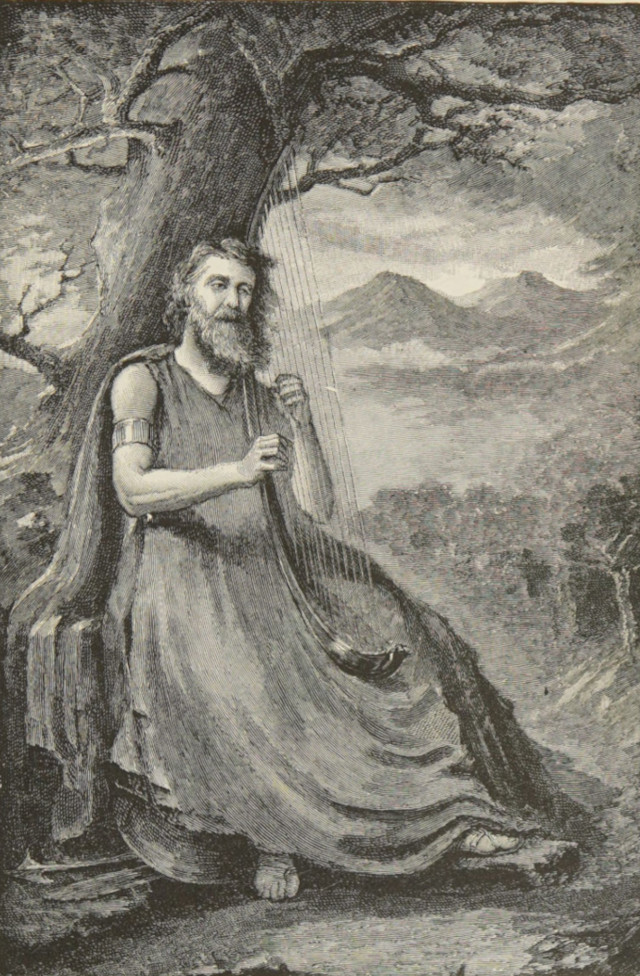
THE SWEET SINGER OF ISRAEL. “He shall be as the light of the morning, ... even a morning without clouds.”
The spot upon which the altar was erected, henceforth ever to
be regarded as holy ground, was tendered to the king by Ornan as
a gift. But the king declined thus to receive it. “I will verily
buy it for the full price,” he said; “for I will not take that which
is thine for the Lord, nor offer burnt-offerings without cost. So
David gave to Ornan for the place six hundred shekels of gold
by weight.” This spot, memorable as the place where Abraham
had built the altar to offer up his son, and now hallowed by this
great deliverance, was afterward chosen as the site of the temple
erected by Solomon.
Still another shadow was to gather over the last years of
David. He had reached the age of threescore and ten. The
hardships and exposures of his early wanderings, his many wars,
the cares and afflictions of his later years, had sapped the fountain
of life. Though his mind retained its clearness and strength,
feebleness and age, with their desire for seclusion, prevented a quick
apprehension of what was passing in the kingdom, and again
rebellion sprung up in the very shadow of the throne. Again the
fruit of David’s parental indulgence was manifest. The one who
now aspired to the throne was Adonijah, “a very goodly man” in
person and bearing, but unprincipled and reckless. In his youth
he had been subjected to but little restraint; for “his father had not
displeased him at any time in saying, Why hast thou done so?”[1183]
He now rebelled against the authority of God, who had appointed
Solomon to the throne. Both by natural endowments and religious
character, Solomon was better qualified than his elder brother
to become ruler of Israel; yet although the choice of God had
been clearly indicated, Adonijah did not fail to find sympathizers.
Joab, though guilty of many crimes, had heretofore been loyal to
the throne; but he now joined the conspiracy against Solomon, as
did also Abiathar the priest.
The rebellion was ripe; the conspirators had assembled at a
great feast just without the city to proclaim Adonijah king, when
their plans were thwarted by the prompt action of a few faithful
persons, chief among whom were Zadok the priest, Nathan the
prophet, and Bathsheba the mother of Solomon. They represented
the state of affairs to the king, reminding him of the divine
direction that Solomon should succeed to the throne. David at
once abdicated in favor of Solomon, who was immediately anointed
and proclaimed king. The conspiracy was crushed. Its chief
actors had incurred the penalty of death. Abiathar’s life was
spared, out of respect to his office and his former fidelity to David;
but he was degraded from the office of high priest, which passed
to the line of Zadok. Joab and Adonijah were spared for the
time, but after the death of David they suffered the penalty of
their crime. The execution of the sentence upon the son of David
completed the fourfold judgment that testified to God’s abhorrence
of the father’s sin.
From the very opening of David’s reign, one of his most
cherished plans had been that of erecting a temple to the Lord.
Though he had not been permitted to execute this design, he
had manifested no less zeal and earnestness in its behalf. He
had provided an abundance of the most costly material,—gold,
silver, onyx stones, and stones of divers colors; marble, and the
most precious woods. And now these valuable treasures that he
had collected must be committed to others; for other hands must
build the house for the ark, the symbol of God’s presence.
Seeing that his end was near, the king summoned the princes
of Israel, with representative men from all parts of the kingdom,
to receive this legacy in trust. He desired to commit to them
his dying charge, and secure their concurrence and support in the
great work to be accomplished. Because of his physical weakness,
it had not been expected that he would attend to this transfer in
person; but the inspiration of God came upon him, and with
more than his wonted fervor and power, he was able, for the last
time, to address his people. He told them of his own desire to
build the temple, and of the Lord’s command that the work
should be committed to Solomon his son. The divine assurance
was, “Solomon thy son, he shall build my house and my courts;
for I have chosen him to be my son, and I will be his father.
Moreover I will establish his kingdom forever, if he be constant to
do my commandments and my judgments, as at this day.” “Now
therefore,” David said, “in the sight of all Israel the congregation
of the Lord, and in the audience of our God, keep and seek for all
the commandments of the Lord your God; that ye may possess
this good land, and leave it for an inheritance for your children
after you forever.”[1184]
David had learned by his own experience how hard is the path
of him who departs from God. He had felt the condemnation of
the broken law, and had reaped the fruits of transgression; and his
whole soul was moved with solicitude that the leaders of Israel
should be true to God, and that Solomon should obey God’s law,
shunning the sins that had weakened his father’s authority, imbittered
his life, and dishonored God. David knew that it would
require humility of heart, a constant trust in God, and unceasing
watchfulness, to withstand the temptations that would surely beset
Solomon in his exalted station; for such prominent characters are
a special mark for the shafts of Satan. Turning to his son,
already acknowledged as his successor on the throne, David said:
“And thou, Solomon my son, know thou the God of thy father,
and serve him with a perfect heart and with a willing mind; for
the Lord searcheth all hearts, and understandeth all the imaginations
of the thoughts: if thou seek him, he will be found of
thee; but if thou forsake him, he will cast thee off forever. Take
heed now; for the Lord hath chosen thee to build a house for the
sanctuary: be strong, and do it.”
David gave Solomon minute directions for building the temple,
with patterns of every part, and of all its instruments of service,
as had been revealed to him by divine inspiration. Solomon was
still young, and shrank from the weighty responsibilities that
would devolve upon him in the erection of the temple and in the
government of God’s people. David said to his son, “Be strong
and of good courage, and do it; fear not, nor be dismayed; for the
Lord God, even my God, will be with thee; he will not fail thee,
nor forsake thee.”
Again David appealed to the congregation: “Solomon my son,
whom alone God hath chosen, is yet young and tender, and the
work is great; for the palace is not for man, but for the Lord
God.” He said, “I have prepared with all my might for the
house of my God,” and he went on to enumerate the materials he
had gathered. More than this, he said, “I have set my affection
to the house of my God, I have of mine own proper good, of gold
and silver, which I have given to the house of my God, over and
above all that I have prepared for the holy house, even three
thousand talents of gold, of the gold of Ophir, and seven thousand
talents of refined silver, to overlay the walls of the houses withal.”
“Who then,” he asked of the assembled multitude that had
brought their liberal gifts,—“who then is willing to consecrate
his service this day unto the Lord?”
There was a ready response from the assembly. “The chief of
the fathers and princes of the tribes of Israel, and the captains of
thousands and of hundreds, with the rulers of the king’s work,
offered willingly, and gave for the service of the house of God, of
gold five thousand talents and ten thousand drams, and of silver
ten thousand talents, and of brass eighteen thousand talents, and
one hundred thousand talents of iron. And they with whom
precious stones were found gave them to the treasure of the house
of the Lord.... Then the people rejoiced, for that they offered
willingly, because with perfect heart they offered willingly to the
Lord; and David the king also rejoiced with great joy.
“Wherefore David blessed the Lord before all the congregation;
and David said, Blessed be thou, Lord God of Israel our
father, forever and ever. Thine, O Lord, is the greatness, and the
power, and the glory, and the victory, and the majesty; for all
that is in the heaven and in the earth is thine; thine is the kingdom,
O Lord, and thou art exalted as head above all. Both riches
and honor come of thee, and thou reignest over all; and in thine
hand is power and might; and in thine hand it is to make great,
and to give strength unto all. Now therefore, our God, we thank
thee, and praise thy glorious name. But who am I, and what is
my people, that we should be able to offer so willingly after this
sort? for all things come of thee, and of thine own have we given
thee. For we are strangers before thee, and sojourners, as were
all our fathers; our days on the earth are as a shadow, and there
is none abiding. O Lord our God, all this store that we have
prepared to build thee an house for thine holy name cometh of
thine hand, and is all thine own. I know also, my God, that thou
triest the heart, and hast pleasure in uprightness.
“As for me, in the uprightness of mine heart I have willingly
offered all these things; and now have I seen with joy thy people,
which are present here, to offer willingly unto thee. O Lord God
of Abraham, Isaac, and of Israel, our fathers, keep this forever in
the imagination of the thoughts of the heart of thy people, and
prepare their heart unto thee; and give unto Solomon my son a
perfect heart, to keep thy commandments, thy testimonies, and
thy statutes, and to do all these things, and to build the palace,
for the which I have made provision. And David said to all the
congregation, Now bless the Lord your God. And all the congregation
blessed the Lord God of their fathers, and bowed down
their heads, and worshiped the Lord.”
With deepest interest the king had gathered the rich material
for building and beautifying the temple. He had composed the
glorious anthems that in after-years should echo through its
courts. Now his heart was made glad in God, as the chief of the
fathers and the princes of Israel so nobly responded to his appeal,
and offered themselves to the important work before them. And
as they gave their service, they were disposed to do more. They
swelled the offerings, giving of their own possessions into the
treasury. David had felt deeply his own unworthiness in gathering
the material for the house of God, and the expression of
loyalty in the ready response of the nobles of his kingdom, as
with willing hearts they dedicated their treasures to Jehovah, and
devoted themselves to his service, filled him with joy. But it was
God alone who had imparted this disposition to his people. He,
not man, must be glorified. It was he who had provided the
people with the riches of earth, and his Spirit had made them
willing to bring their precious things for the temple. It was all of
the Lord; if his love had not moved upon the hearts of the
people, the king’s efforts would have been vain, and the temple
would never have been erected.
All that man receives of God’s bounty still belongs to God.
Whatever God has bestowed in the valuable and beautiful things
of earth, is placed in the hands of men to test them,—to sound
the depths of their love for him and their appreciation of his
favors. Whether it be the treasures of wealth or of intellect, they
are to be laid, a willing offering, at the feet of Jesus; the giver
saying, meanwhile, with David, “All things come of thee, and of
thine own have we given thee.”
When he felt that death was approaching, the burden of
David’s heart was still for Solomon and for the kingdom of Israel,
whose prosperity must so largely depend upon the fidelity of her
king. “And he charged Solomon his son, saying, I go the way of
all the earth; be thou strong therefore, and show thyself a man;
and keep the charge of the Lord thy God, to walk in his ways, to
keep his statutes, and his commandments, and his judgments, and
his testimonies, ... that thou mayest prosper in all that thou
doest, and whithersoever thou turnest thyself; that the Lord may
continue his word which he spake concerning me, saying, If thy
children take heed to their way, to walk before me in truth with
all their heart and with all their soul, there shall not fail thee
(said he) a man on the throne of Israel.”[1185]
David’s “last words,” as recorded, are a song,—a song of trust,
of loftiest principle, and undying faith:—
“David the son of Jesse saith,
And the man who was raised on high saith,
The anointed of the God of Jacob,
And the sweet psalmist of Israel:
The Spirit of Jehovah spake by me:...
One that ruleth over men righteously,
That ruleth in the fear of God,
He shall be as the light of the morning, when the sun riseth,
A morning without clouds,
When the tender grass springeth out of the earth,
Through clear shining after rain.
Verily my house is not so with God,
Yet he hath made me an everlasting covenant,
Ordered in all things, and sure;
For it is all my salvation, and all my desire.”
[1186]
Great had been David’s fall, but deep was his repentance,
ardent was his love, and strong his faith. He had been forgiven
much, and therefore he loved much.[1187]
The psalms of David pass through the whole range of experience,
from the depths of conscious guilt and self-condemnation to
the loftiest faith and the most exalted communing with God. His
life record declares that sin can bring only shame and war, but
that God’s love and mercy can reach to the deepest depths, that
faith will lift up the repenting soul to share the adoption or the
sons of God. Of all the assurances which his word contains, it is
one of the strongest testimonies to the faithfulness, the justice, and
the covenant mercy of God.
Man “fleeth as a shadow, and continueth not,” “but the word
of our God shall stand forever.” “The mercy of Jehovah is
from everlasting to everlasting upon them that fear him, and his
righteousness unto children’s children; to such as keep his covenant,
and to those that remember his commandments to do them.”[1188]
“Whatsoever God doeth, it shall be forever.”[1189]
Glorious are the promises made to David and his house, promises
that look forward to the eternal ages, and find their complete
fulfillment in Christ. The Lord declared:—
“I have sworn unto David my servant, ... with whom my
hand shall be established: mine arm also shall strengthen him....
My faithfulness and my mercy shall be with him: and in
my name shall his horn be exalted. I will set his hand also in
the sea, and his right hand in the rivers. He shall cry unto me,
Thou art my Father, my God, and the rock of my salvation.
Also I will make him my firstborn, higher than the kings of the
earth. My mercy will I keep for him forevermore, and my covenant
shall stand fast with him.”[1190]
“His seed also will I make to endure forever,
And his throne as the days of heaven.”
[1191]
“He shall judge the poor of the people,
He shall save the children of the needy,
And shall break in pieces the oppressor.
They shall fear thee while the sun endureth,
And so long as the moon, throughout all generations....
In his days shall the righteous flourish;
And abundance of peace, till the moon be no more.
He shall have dominion also from sea to sea,
And from the river unto the ends of the earth.”
“His name shall endure forever;
His name shall be continued as long as the sun:
And men shall be blessed in him;
All nations shall call him blessed.”
[1192]
“For unto us a child is born, and unto us a Son is given; and
the government shall be upon his shoulder; and his name shall
be called Wonderful, Counselor, The Mighty God, The everlasting
Father, The Prince of Peace.” “He shall be great, and shall
be called the Son of the Highest: and the Lord God shall give
unto him the throne of his father David: and he shall reign over
the house of Jacob forever, and of his kingdom there shall be no
end.”[1193]