Gallo-Roman Paris
The mediæval scribe in the fulness of a divinely-revealed cosmogony is
wont to begin his story at the creation of the world or at the
confusion of tongues, to trace the building of Troy by the descendants
of Japheth, and the foundation of his own native city by one of the
Trojan princes made a fugitive in Europe by proud Ilion's fall. Such,
he was very sure, was the origin of Padua, founded by Antenor and by
Priam, son of King Priam, whose grandson, yet another Priam, by his
great valour and wisdom became the monarch of a mighty people, called
from their fair hair, Galli or Gallici. And of the strong city built
on the little island in the Seine who could have been its founder but
the ravisher of fair Helen—Sir Paris himself? The naïve etymology of
the time was evidence enough.
But the modern writer, as he compares the geographical position of the
capitals of Europe, is tempted to exclaim, Cherchez le marchand! for
he perceives that their unknown founders were dominated by two
considerations—facilities for commerce and protection from enemies:
and before the era of the Roman road-makers, commerce meant facilities
for water carriage. As the early settlers in Britain sailed up the
Thames, they must have observed, where the river's bed begins somewhat
to narrow, a hill rising from the continuous expanse of marshes from
its mouth, easily defended on the east and west by those fortified
posts which, in subsequent times, became the Tower of London and
Barnard's Castle, and if we scan a map of France, we shall see that
the group of islands on and around which Paris now stands, lies in the
fruitful basin of the Seine, known as the Isle de France, near the
convergence of three rivers; for on the east the Marne, on the west
the Oise, and on the south the Yonne, discharge their waters into the
main stream on its way to the sea. In ancient times the great line of
Phœnician, Greek and Roman commerce followed northwards the valleys
of the Rhone and of the Saone, whose upper waters are divided from
those of the Yonne only by the plateau of Dijon and the calcareous
slopes of Burgundy. The Parisii were thus admirably placed for tapping
the profitable commerce of north-west Europe, and by the waters of the
Eure, lower down the Seine, were able to touch the fertile valley of
the Loire. The northern rivers of Gaul were all navigable by the small
boats of the early traders, and, in contrast with the impetuous sweep
of the Rhone and the Loire in the south and west, flowed with slow and
measured stream:[5]
they were rarely flooded, and owing to the
normally mild winters, still more rarely blocked by ice. Moreover, the
Parisian settlement stood near the rich cornland of La Beauce, and to
the north-east, over the open plain of La Valois, lay the way to
Flanders. It was one of the river stations on the line of the
Phœnician traders in tin, that most precious and rare of ancient
metals, between Marseilles and Britain, and in the early Middle Ages
became, with Lyons and
Beaucaire, one of the chief fairs of that
historic trade route which the main lines of railway traffic still
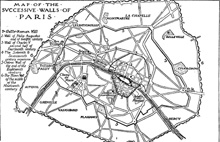
follow to-day. The island now known as the Cité, which the founders of
Paris chose for their stronghold, was the largest of the group which
lay involved in the many windings of the Seine, and was embraced by a
natural moat of deep waters. To north and south lay hills, marshes and
forests, and all combined to give it a position equally adapted for
defence and for commerce.
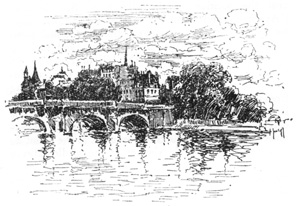
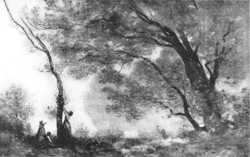
The Cité.
View larger image
The Parisii were a small tribe of Gauls whose island city was the home
of a prosperous community of shipmen and merchants, but it is not
until the Conquest of Gaul by the Romans that Lutetia, for such was
its Romanised name, joins the great pageant of history. It was —
"Armèd Cæsar falcon-eyed,"
[6]
who saw its great military importance, built a permanent camp there
and made it a central entrepôt for food and munitions of war. And
when in 52 B.C. the general rising of the tribes under Vercingétorix
threatened to scour the Romans out of Gaul and to destroy the whole
fabric of Cæsar's ambition, he sent his favourite lieutenant,
Labienus, to seize Lutetia where the Northern army of the Gauls was
centred. Labienus crossed the Seine at Melun, fixed his camp on a spot
near the position of the church of St. Germain l'Auxerrois, and began
the first of the historic sieges for which Paris is so famous. But the
Gaulish commander burnt the bridges, fired the city, and took up his
position on the slopes of the hill of Lutetius (St. Genevieve) in the
south, and aimed at crushing his enemy between his own forces and an
army advancing from the north. Labienus having learnt that Cæsar was
in a tight place, owing to a check at Clermont and the defection of
the Eduans, by a masterly piece of engineering recrossed the Seine by
night at the Point du Jour, where the double viaduct of the girdle
railway crosses to-day, and when the Gauls awoke in the morning they
beheld the bannered host of the Roman legions in battle array on the
plain of Grenelle beneath. They made a desperate attempt to drive them
against the river, but they lost their leader and were almost
annihilated by the superior arms and strategy of the Romans. Labienus
was able to join his master at Sens, and the irrevocable subjugation
of the Gauls soon followed. With the tolerant and enlightened
conquerors came the Roman peace, Roman law, Roman roads, the Roman
schoolmaster; and a more humane religion abolished the Druidical
sacrifices. Lutetia was rebuilt and became a prosperous and, next to
Lyons, the most important of Gallo-Roman cities. It lay equidistant
from Germany and Britain and at the issue of valleys which led to the
upper and lower Rhine. The quarries of Mount Lutetius produced an
admirable building stone, kind to work and hardening well under
exposure to the air, whose white colour may have won for Paris the
name of Leucotia, or the White City, by which it is sometimes known to
ancient writers. Cæsar had done his work well, for so completely were
the Gauls Romanised, that by the fifth or sixth century their very
language had disappeared.[7]
But towards the end of the third century three lowly wayfarers were
journeying from Rome along the great southern road to Paris, charged
by the Pope with a mission fraught with greater issues to Gaul than
were the Cæsars and all their legions. Let us recall somewhat of the
appearance of the city which Dionysius, Rusticus and Eleutherius saw
as they neared its suburbs and came down what is now known as the Rue
St. Jacques. After passing the arches of the aqueduct, two of which
exist to this day, that crossed the valley of Arcueil and brought the
waters of Rungis,[8] Paray and Montjean to the baths of the imperial
palace and the public fountains, they would discern on the hill of
Lutetius to their right, the Roman camp, garrison and cemetery. Lower
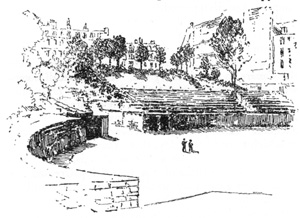
down to the east they would catch a glimpse of a great amphitheatre,
capable of accommodating 10,000 spectators.[9]
Remains of Roman Amphitheatre.
View larger image
On their left, where now stands the Lycée St. Louis, would be the
theatre of Lutetia, and further on, the imposing and magnificent
palace of the Cæsars, with its gardens sloping down to the Seine. The
turbulent little stream of the Bièvre flowed by the foot of Mons
Lutetius on the east, entering the main river opposite the eastern
limit of the civitas of Lutetia, gleaming white before them and
girdled by the waters of the Seine. A narrow eel-shaped island,
subsequently known as the Isle de Galilée, lay between the Isle of the
Cité and the southern bank; two islands, the Isles de Notre Dame and
des Vaches, divided by a narrow channel to the east, and two eyots,
the Isles des Juifs and de Bussy, to the west. Another islet, the Isle
de Javiaux or de Louviers, lay near the northern bank beyond the two
eastern islands. Crossing a wooden bridge, where now stands the Petit
Pont, they would enter the forum under a triumphal arch. Here would be
the very foyer of the city; a little way to the left the prefect's
palace and the basilica, or hall of justice;[10] to the right the
temple of Jupiter. As they crossed the island they would find it
linked to the northern bank by another wooden bridge (the Grand Pont)
replaced by the present Pont Notre Dame.[11] In the distance to the
north stood Mons Martis (Montmartre), villas nestling on its slopes
and crowned with the temples of Mars and Mercury, four of whose
columns are preserved in the church of St. Pierre: to the west the
aqueduct from Passy bringing its waters to the mineral baths located
on the site of the present Palais Royal. A road, now the Rue St.
Martin, led to the north; to the east, fed by the streams of
Menilmontant and Belleville, lay the marshy land which is still known
as the quarter of the Marais.
Denis, who by the mediæval hagiographers is invariably confused with
Dionysius the Areopagite, and his companions, preached and taught the
new faith unceasingly and met martyrs' deaths. In the Golden Legend
he is famed to have converted much people to the faith, and "dyde do
make many churches, and at length was brought before the judge who
dyde do smyte off the hedes of the thre felawes by the temple of
Mercurye. And anone the body of Saynte Denys reysed hymselfe up and
bare his hede beetwene his armes, as the angels ladde hym two leghes
fro the place which is sayd the hille of the martyrs unto the place
where he now resteth by his election and the purveance of god. And
there was heard so grete and swete a melodye of angels that many that
herd it byleuyd in oure lorde."
The work that Denis and his companions began was more fully achieved
in the fourth century by the rude Pannonion soldier, St. Martin, who
also evangelised at Paris. He is the best-known of Gallic saints, and
the story of his conversion one of the most popular in Christendom.
When stationed at Amiens he was on duty one bitter cold day at the
city gate, and espied a poor naked beggar asking alms. Soldiers in
garrison are notoriously impecunious, and Martin had nothing to give;
but drawing his sword he cleaved his mantle in twain, and bestowed
half upon the shivering wretch at his feet. That very night the Lord
Jesus appeared to him in a dream surrounded by angels, having on His
shoulders the half of the cloak which Martin had given to the beggar.
Turning to the angels, Jesus said: "Know ye who hath thus arrayed Me?
My servant Martin, though yet unbaptised, hath done this." After this
vision Martin received baptism and remained steadfast in the faith.
The illiterate and dauntless soldier became the fiery apostle of the
faith, a vigorous iconoclast, throwing down the images of the false
gods, breaking their altars in pieces and burning their temples. Of
the Roman gods, Mercury, he said, was most difficult to ban, but Jove
was merely stupid[12] and brutish, and gave him least trouble.
On the 16th of March 1711, some workmen, digging a burial crypt for
the archbishops of Paris under the choir of Notre Dame, came upon a
wall, six feet below the pavement, which contemporary antiquarians
believed to be the wall of the original Christian basilica over which
the cathedral was built, but which modern authorities affirm to have
been part of the old Gallo-Roman wall of the Cité. In the fabric of
this wall the early builders had incorporated the remains of a temple
of Jupiter, and among the débris were found the fragments of an
altar raised to Jove in the reign of Tiberius Cæsar by the Nautæ, a
guild of Parisian merchant-shippers, and the table of another altar on
whose foyer still remained some of the very burnt wood and incense
used in the last pagan sacrifice. The mutilated stones, with their
rude Gallo-Roman reliefs and inscriptions,[13] may be seen in the
Frigidarium of the Thermæ, the old Roman baths by the Hôtel de Cluny,
and are among the most interesting of historical documents in Paris.
The Corporation of Nautæ Parisiaci, one of the most powerful of the
guilds, among whose members were enrolled the chief citizens of
Lutetia, who dedicated this altar to Jove, were the origin of the
Commune or Civil Council of Paris, whose Provost[14] was known as late
as the fourteenth century as the Prévôt des Marchands d'Eau. Their
device was the Nef, or ship, which is and has been throughout the
ages, the arms of Paris, and which to this day may be seen carved on
the vaultings of the Roman baths.
In the great palace of which these baths formed but a part was enacted
that scene so vividly described in the pages of Gibbon,[15] when, in
355, Julian, after his victories over the Alemanni and the Franks, was
acclaimed Augustus by the rebellious troops of Constantius. He had
admonished the sullen legions, angry at being detached from their
victorious and darling commander for service on the Persian frontier,
and had urged them to obedience, but at midnight the young Cæsar was
awakened by a clamorous and armed multitude besieging the palace, and
at early dawn its doors were forced; the reluctant Julian was seized
and carried through the streets in triumph, lifted on a shield, and
for diadem crowned with a military collar, to be enthroned and saluted
as emperor. In after life the emperor-philosopher looked back with
tender regret to the three winters he spent in Paris before his
elevation to the imperial responsibilities and anxieties. He writes of
the busy days and meditative nights he passed in his dear Lutetia,
with its two wooden bridges, its pure and pleasant waters, its
excellent wine. He dwells on the mildness of its climate, where the
fig-tree, protected by straw in the winter, grew and fruited. One
rigorous season, however, the emperor well remembered[16] when the
Seine was blocked by huge masses of ice. Julian, who prided himself on
his endurance, at first declined the use of those charcoal fires which
to this day are a common and deadly method of supplying heat in Paris.
But his rooms were damp and his servants were allowed to introduce
them into his sleeping apartment. The Cæsar was almost asphyxiated by
the fumes, and his physicians to restore him administered an emetic.
Julian in his time was beloved of the Lutetians, for he was a just and
tolerant prince whose yoke was easy. He had purged the soil of Gaul
from the barbarian invaders, given Lutetia peace and security, and
made of it an important, imperial city. His statue, found near Paris,
still recalls his memory in the hall of the great baths of the Lutetia
he loved so well.
The so-called apostasy of this lover of Plato and worshipper of the
Sun, who never went to the wars or travelled without dragging a
library of Greek authors after him, was a philosophic reaction
against the harsh measures,[17] the bloody and treacherous natures of
the Christian emperors, and the fierceness of the Arian controversy.
The movement was but a back-wash in the stream of history, and is of
small importance. Julian's successors, Valentinian and Gratian,
reversed his policy but shared his love for the fair city on the
Seine, and spent some winters there. Lutetia had now become a rich and
cultured Gallo-Roman city.
The Barbarian Invasions—St. Genevieve—The Conversion of
Clovis—The Merovingian Dynasty
In the Prologue to Faust, the Lord of Heaven justifies the existence
of the restless, goading spirit of evil by the fact that man's
activity is all too prone to flag,—
"Er liebt sich bald die unbedingte Ruh."[18]
As with men so with empires: riches and inaction are hard to bear. It
was not so much a corruption of morals as a growing slackness and
apathy in public life and an intellectual sloth that hastened the fall
of the Roman Empire. Owing to the gradual exhaustion of the supply of
slaves its economic basis was crumbling away. The ruling class was
content to administer and enjoy rather than to govern: unwilling or
incompetent to grapple with the new order of things.[19] For centuries
the Gauls had been untrained in arms and habituated to look to the
imperial legions for defence against the half-savage races of men,
giants in stature and strength, surging like an angry sea against
their boundaries.
The end of the fifth century is the beginning of the evil times of
Gallic story: the confederation of Frankish tribes who had conquered
and settled in Belgium saw successive waves of invasion pass by, and
determined to have their part in the spoils. They soon overran
Flanders and the north, and at length under Clovis captured Paris and
conquered nearly the whole of Gaul. That fair land of France, "one of
Nature's choicest masterpieces, one of Ceres' chiefest barns for corn,
one of Bacchus' prime wine cellars and of Neptune's best salt-pits,"
became the prey of the barbarian. The whole fabric of civilisation
seem doomed to destruction, Gaul had become the richest and most
populous of Roman provinces; its learning and literature were noised
in Rome; its rhetoricians drew students from the mother city herself;
it was the last refuge of Græco-Roman culture in the west. But at the
end of the sixth century Gregory of Tours deplores the fact that in
his time there were neither books, nor readers, nor scholar who could
compose in verse or prose, and that only the speech of the rustic was
understood. He playfully scolds himself for muddling prepositions and
confusing genders and cases, but his duty as a Christian priest is to
instruct, not to charm, and so he tells the story of his times in such
rustic Latin as he knows. He draws for us a vivid picture of Clovis,
his savage valour, his astuteness, his regal passion.
After the victory at Soissons over Syagrius, the shadowy king of the
Romans, Clovis was met by St. Rémi, who prayed that a vase of great
price and wondrous beauty among the spoil might be returned to him.
"Follow us," said the king, "to Soissons, where the booty will be
shared." Before the division took place Clovis begged that the vase
might be accorded to him. His warriors answered: "All, glorious king,
is thine." But before the king could grasp the vase, one, jealous and
angry, threw his francisque[20] at it, exclaiming: "Thou shalt have
no more than falls to thy lot." The broken vase was however
apportioned to the king, who restored it to the bishop. But Clovis hid
the wound in his heart, and at the annual review in the Champ de Mars
near Paris, as the king strode along the line inspecting the weapons
of his warriors, he stopped in front of the uncourtly soldier, took
his axe from him, complained of its foul state, and flung it angrily
on the ground. As the man stooped to pick it up Clovis, with his own
axe, cleft his skull in twain, exclaiming: "Thus didst thou to the
vase at Soissons." "Even so," says Gregory quaintly, "did he inspire
all with great fear."
At this point of our story we are met by the first of those noble
women, heroic and wise, for whom French history is pre-eminent. In the
early fifth century "saynt germayn[21] of aucerre and saynt lew of
troyes, elect of the prelates of fraunce for to goo quenche an heresye
that was in grete brytayne, now called englond, came to nannterre for
to be lodged and heberowed and the people came ageynst theym for to
have theyr benyson. Emonge the people, saynt germayn, by
thenseignemente of the holy ghoost, espyed out the lytel mayde saynt
geneuefe, and made hyr to come to hym, and kyste hyr heed and
demaunded hyr name, and whos doughter she was, and the people aboute
hyr said that her name was geneuefe, and her fader seuere, and her
moder geronce, whyche came unto hym, and the holy man sayd: is this
child yours? They answerd: Ye. Blessyd be ye, said the holy man, whan
god hath gyven to you so noble lignage, knowe ye for certeyn that the
day of hyr natiyuyte the angels sange and halyowed grete mysterye in
heuen with grete ioye and gladnes."
Tidings soon came to Paris that Attila, the felon king of Hungary, had
enterprised to destroy and waste the parts of France, and the
merchants for great dread they had, sent their goods into cities more
sure. Genevieve caused the good women of the town to "wake in
fastynges and in orysons, and bade the bourgeyses that they shold not
remeuve theyr goodes for by the grace of god parys shold have none
harme." At first the people hardened their hearts and reviled her, but
St. Germain, who had meantime returned to Paris, entreated them to
hearken to her, and our Lord for her love did so much that the
"tyrantes approachyd not parys, thanke and glorye to god and honoure
to the vyrgyn." At the siege of Paris by Childeric and his Franks,
when the people were wasted by sickness and famine, "the holy vyrgyne,
that pyte constrayned her, wente to the sayne for to goe fetche by
shyp somme vytaylles." She stilled by her prayers a furious tempest
and brought the ships back laden with wheat. When the city was at
length captured, King Childeric, although a paynim, saved at her
intercession the lives of his prisoners, and one day, to escape her
importunate pleadings for the lives of some criminals, fled out of the
gates of Paris and shut them behind him. The saint lived to build a
church over the tomb of St. Denis and to see Clovis become a
Christian. She died in 509, and was buried on the hill of Lutetius,
which ever since has borne her name.
The faithful built a little wooden oratory over her tomb, which Clovis
and his queen Clotilde replaced in 506 by a great basilica dedicated
to SS. Peter and Paul,—whose length the king measured by the distance
he could hurl his axe—and the famous monastery of St. Genevieve.[22]
The conversion of Clovis is the capital fact of early French history.
Clotilde had long[23] importuned him to declare himself a Christian,
and he had consented to the baptism of their firstborn, but the
infant's death within a week seemed an admonition from his own jealous
gods. A second son, however, recovered from grievous sickness at his
wife's prayers, and this, aided perhaps by a shrewd insight into the
trend of events, induced him to lend a more willing ear to the
teachers of the new Faith. In 496 the Franks were at death grapple
with their German foes at Tolbiac. Clovis, when the fight went against
him, invoked the God of the Christians and prayed to be delivered from
his enemies. His cry was heard and the advent of the new Lord of
Battles was winged with victory.
The conversion of Clovis was a triumph for the Church: in her struggle
with the Arian heresy in Gaul, she was now able to enforce the
arguments of the pen by the edge of the sword. Her scribes are tender
to his memory, for his Christianity was marked by few signs of grace.
He remained the same savage monarch as before, and did not scruple to
affirm his dynasty and extend his empire by treachery and by the
assassination of his kinsmen. To the Franks, Jesus was but a new and
more puissant tribal deity. "Long live the Christ who loves the
Franks," writes the author of the prologue to the Salic law; and when
the bishop was one day reading the Gospel story of the Passion, the
king, qui moult avait grand compassion, cried out: "Ah! had I been
there with my Franks I would have avenged the Christ."
Nor was their ideal of kinship any loftier. Their realm was not a trust, but a
possession to be divided among their heirs, and the jealousy and
strife excited by the repeated partitions among sons, make the history
of the Merovingian[24] dynasty a tale of cruelty and treachery whose
every page is stained with blood.
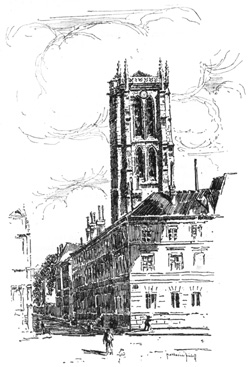
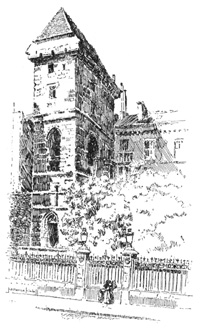
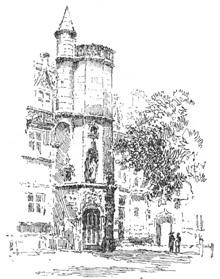
Tower of Clovis.
View larger image
Clovis, in 508, made Paris the official capital of his realm, and at
his death in 511 divided his possessions between his four
sons—Thierry, Clodomir, Childebert and Clothaire. Clodomir after a
short reign met his death in battle, leaving his children to the
guardianship of their grandmother, Clotilde. One day messengers came
to her in the old palace of the Cæsars on the south bank of the Seine
from Childebert and Clothaire praying that their nephews might be
entrusted to them. Believing they were to be trained in kingly offices
that they might succeed their father in due time, Clotilde granted
their prayer and two of the children were sent to them in the palace
of the Cité. Soon came another messenger, bearing a pair of shears and
a naked sword, and Clotilde was bidden to determine the fate of her
wards and to choose for them between the cloister and the edge of the
sword. An angry exclamation escaped her: "If they are not to be raised
to the throne, I would rather see them dead than shorn." The messenger
waited to hear no more and hastened back to the two kings. Clothaire
then seized the elder of the children and stabbed him under the
armpit. The younger, at the sight of his brother's blood, flung
himself at Childebert's feet, burst into tears, and cried: "Help me,
dear father, let me not die even as my brother." Childebert's heart
was softened and he begged for the child's life. Clothaire's only
answer was a volley of insults and a threat of death if he protected
the victim. Childebert then disentwined the child's tender arms
clasping his knees—he was but six years of age—and pushed him to his
brother, who drove a dagger into his breast. The tutors and servants
of the children were then butchered, and Clothaire became at his
brother's death, in 558, sole king of the Franks.[25] The third child,
Clodoald, owing to the devotion of faithful servants escaped, and was
hidden for some time in Provence. Later in life he returned to Paris
and built a monastery at a place still known by his name (St. Cloud)
about two leagues from the city.
In the days of Siegbert and Chilperic, kings of Eastern and Western
France, the consuming flames of passion and greed again burst forth,
this time fanned by the fierce breath of feminine rivalry. Siegbert
had married Brunehaut, daughter of the Visigoth king of Spain:
Chilperic had espoused her sister, Galowinthe, after repudiating his
first wife, Adowere. When Galowinthe came to her throne she found
herself the rival of Fredegonde, a common servant, with whom Chilperic
had been living. He soon tired of his new wife, a gentle and pliant
creature, Fredegonde regained her supremacy and one morning Galowinthe
was found strangled in bed. The news came to King Siegbert and
Brunehaut goaded him to avenge her sister's death. Meanwhile Chilperic
had married Fredegonde, who quickly compassed the murder of her only
rival, the repudiated queen, Adowere. Soon Chilperic drew the sword
and civil war devastated the land. By foreign aid Siegbert captured
and spoiled Paris and compelled a peace. Scarcely, however, had the
victor dismissed his Germain allies, when Chilperic fell upon him
again. Siegbert now determined to make an end. He entered Paris, and
prepared to crush his enemy at Tournay. As he set forth, St. Germain,
bishop of Paris, seized his horse's bridle and warned him that the
grave he was digging for his brother would swallow him too. When he
reached Vitry two messengers were admitted to see him. As he stood
between them listening to their suit he was stabbed on either side by
two long poisoned knives: the assassins had been sent by Fredegonde.
But Fredegonde's tale of blood was not yet complete. She soon learned
that Merovée, one of Chilperic's two sons by Adowere, had married
Brunehaut. Merovée followed the rest of her victims, and Clovis, the
second son, together with a sister of Adowere, next glutted her
vengeance. "One day, after leaving the Synod of Paris," writes St.
Gregory, "I had bidden King Chilperic adieu and had withdrawn
conversing with the bishop of Albi. As we crossed the courtyard of the
palace (in the Cité) he said: 'Seest thou not what I perceive above
this roof?' I answered, 'I see only a second building which the king
hath built.' He asked again, 'Seest thou naught else?' I weened he
spoke in jest and did but answer—'If thou seest aught else, prithee
show it unto me.' Then uttering a deep sigh, he said: 'I see the sword
of God's wrath suspended over this house.'" Shortly after this
conversation Chilperic having returned from the chase to his royal
villa of Chelles, was leaning on the shoulder of one of his companions
to descend from his horse, when Landeric, servant of Fredegonde,
stabbed him to death.
Thirty years were yet to pass before the curtain falls on the acts of
the rival queens, their sons and grandsons, but the heart revolts at
the details of the wars and lusts of these savage potentates.
Battle and murder had destroyed Brunehaut's children and her
children's children until none were left to rule over the realms but
herself and the four sons of Thierry II. The nobles, furious at the
further tyranny of a cruel and imperious woman, plotted her ruin, and
in 613, when Brunehaut, sure of victory, marched with two armies
against Clothaire II., she was betrayed near Paris to him, her
implacable enemy. He reproached her with the death of ten kings, and
set her on a camel for three days to be mocked and insulted by the
army. The old and fallen queen was then tied to the tail of a horse:
the creature was lashed into fury and soon all that remained of the
proud queen was a shapeless mass of carrion. The traditional place
where Brunehaut met her death is still shown at the corner of the Rue
St. Honoré and the Rue de l'Arbre Sec. Thierry's four sons had already
been put to death. In 597 her rival Fredegonde, at the height of her
prosperity, had died peacefully in bed, full of years, and was buried
in the church of St. Vincent[26] by the side of Chilperic, her
husband.
Amid all this ruin and desolation, when the four angels of the
Euphrates seem to have been loosed on Gaul, one force was silently at
work knitting up the ravelled ends of the rent fabric of civilisation
and tending a lamp which burned with the promise of ideals, nobler far
than those which fed the ancient faith and polity. The Christian
bishops were everywhere filling the empty curule chairs in the cities
and provinces of Gaul. At the end of the sixth century, society lived
in the Church and by the Church, and the sees of the archbishops and
bishops corresponded to the Roman administrative divisions. All that
was best in the old Gallo-Roman aristocracy was drawn into her bosom,
for she was the one power making for unity and good government. From
one end of the land to the other the bishops visited and corresponded
with each other. They alone had communion of ideas, common sentiments
and common interests. St. Gregory, bishop of Tours, was the son of a
senator; St. Germain of Auxerre was a man of noble lineage, who had
already exercised high public functions before he was made a bishop;
St. Germain of Autun was ever on the move, now in Brittany, now at
Paris, now at Arles, to crush heresy, to threaten a barbarian
potentate, or to sear the conscience and, if need were, ban the person
of a guilty Christian king.
By the end of the sixth century two hundred and thirty-eight monastic
institutions had been founded in Gaul, and from the sixth to the
eighth century, eighty-three churches were built. The monasteries were
so many nurseries of the industry, knowledge and learning which had
not perished in the barbarian invasions; so many cities of refuge from
violence and rapine, where the few who thirsted after righteousness
and burned with charity might find shelter and protection. "Every
letter traced on paper," said an old abbot, "is a blow to the devil."
The ecclesiastical and monastic schools took the place of the
destroyed Roman day-schools, and whatever modicum of learning the
Frankish courts could boast of, was due to the monks and nuns of their
time; for some at least of these potentates when not absorbed in the
gratification of their lusts, their vengeance, greed or ambition,
were possessed by nobler instincts.
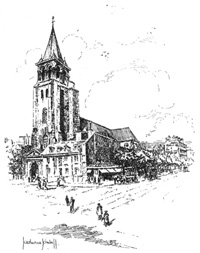
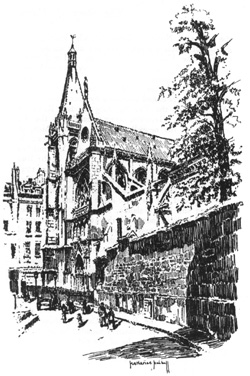
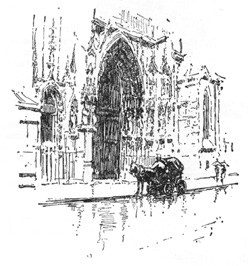
St. Germain des Prés.
View larger image
To St. Germain of Autun, made bishop in 555, Paris owes one of her
earliest ecclesiastical foundations. His influence over Childebert,
king of Paris, was great. He obtained an order that those who refused
to destroy pagan idols in their possession were to answer to the
king, and when Childebert and his warriors, seized by an irresistible
fighting impulse, marched into Spain, and were bought off the siege
and sack of Saragossa by the present of the tunic of St. Vincent, he
induced the king to found the abbey and church of St. Vincent (St.
Germain des Prés), to receive the relic and a great part of the spoil
of Toledo, consisting of jewels, golden chalices, books and crucifixes
of marvellous craftsmanship. In the same reign was begun on the site
of the present sacristy of Notre Dame a great basilica, dedicated to
St. Stephen, so magnificently decorated that it was compared to
Solomon's Temple for the beauty and the delicacy of its art. The
church of Ste. Marie or Notre Dame, already existing in 365, stood on
a site extending westward into the present Place du Parvis Notre Dame.
During this great outburst of zeal and devotion, another monastery
(St. Vincent le Rond), was established and dedicated to St. Vincent,
which subsequently became associated with the name of the earlier St.
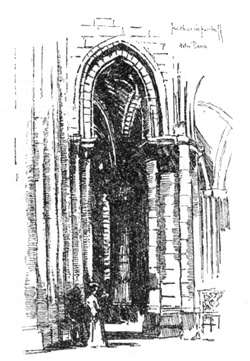
Germain of Auxerre (l'Auxerrois).
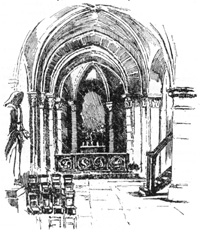
A curious episode is found in Gregory's Chronicle, which is
characteristic of the times, and proves that a monastery and church of
St. Julien le Pauvre were already in existence. An impostor, claiming
to have the relics of St. Vincent and St. Felix, came to Paris, but
refused to deposit them with the bishop for verification. He was
arrested and searched, and the so-called relics were found to consist
of moles' teeth, the bones of mice, some bears' claws and other
rubbish: they were flung into the Seine and the impostor was put in
prison. Gregory, who was lodging in the monastery of St. Julien le
Pauvre, went into the church shortly after midnight to say matins, and
found the creature, who had escaped from the bishop's prison, lying
drunk on the pavement. He had him dragged away into a corner, but so
intolerable was the stench that the pavement was purified with water
and sweet smelling herbs. When the bishops, who were at Paris for a
synod, met at dinner the next day, the impostor was identified as a
fugitive slave of the bishop of Tarbes.
Dagobert the Great, who came to the throne in 628, and his favourite
minister, St. Eloy, goldsmith and bishop (founder of the convent in
Paris which long bore his name), are enshrined in the hearts of the
people in many a song and ballad: St. Eloy, with his good humour, his
ruddy countenance, his eloquence, gentleness, modesty, wit, and wide
charity, singing in the church processions à haute gamme jubilant et
trépudiant like David of old before the ark: Dagobert, the Solomon of
the Franks, the terror of the oppressor, the darling of the poor. The
great king was fond of Paris and established himself there when not
scouring his kingdom to administer justice or to crush his enemies. He
was the second founder of the monastery of St. Denis, which he rebuilt
and endowed with great magnificence, and to which he gave much
importance by the establishment there of a great fair, which soon drew
merchants from all parts of Europe. He was a patron of the arts and
employed St. Eloy to make reliquaries[27] for St. Denis and the
churches in Paris, of such richness and beauty that they were admired
of the whole of France.
The monkish scribes who wrote the Chronicles of St. Denis were not
ungrateful to the memory of good King Dagobert, for it is there
related that one day, as a holy anchorite lay sleeping on his stony
couch on an island, being heavy with years, a venerable, white-haired
man appeared to him and bade him rise and pray for the soul of King
Dagobert of France. As he arose he beheld out at sea a crowd of devils
bearing the king away in a little boat towards Vulcan's Cauldron,
beating and tormenting him cruelly, who called unceasingly on St.
Denis of France, on St. Martin and St. Maurice. Then thunder and
tempest rolled down from heaven, and the three glorious saints
appeared to him, arrayed in white garments. He was much affrighted,
and on asking who they were, was answered: "We be they whom Dagobert
hath called, and are come to snatch him from the hands of the devils
and bear him to Abraham's bosom." The saints then vanished from before
him and sped against the devils and reft the soul from them, which
they were tormenting with threats and buffetings, and bare it to the
joys perdurable of Paradise, chanting the words of the Psalmist
Beatus quem eligisti.
The Carlovingians—The Great Siege of Paris by the
Normans—The Germs of Feudalism
Chaos and misery followed the brilliant reign of Dagobert. In half a
century his race had faded into the feeble rois fainéants,
degenerate by precocious debauchery, some of whom were fathers at
fourteen or fifteen years of age and in their graves before they were
thirty. The bow of power is to him who can bend it, and in an age when
human passions are untamed, the one unpardonable vice in a king is
weakness. Soon the incapable, impotent and irresolute Merovingians
were thrust aside by the more puissant Carlovingian race.
Charles Martel, although buried with the Frankish kings at St. Denis,
was content with the title of Duke of the Franks, and hesitated to
proclaim himself king. He, like the other mayors of the palace, ruled
through feeble and pensioned puppets when they did not contemptuously
leave the throne vacant. In 751 Pepin the Short sent two prelates to
sound Pope Zacchary, who, being hard pressed by the Lombards, lent a
willing ear to their suit, agreed that he who was king in fact should
be made so in name, and authorised Pepin to assume the title of king.
Chilperic III., like a discarded toy, was relegated to a monastery at
St. Omer, and Pepin the Short anointed at Soissons by St. Boniface
bishop of Mayence, from that sacred "ampul full of chrism" which a
snow-white dove had brought in its mouth to St. Rémi wherewith to
anoint Clovis at Rheims. In the year 754 Stephen III., the first pope
who had honoured Paris by his presence, came to ask the reward of his
predecessor's favour and was lodged at St. Denis. There he anointed
Pepin anew, with his sons Charles and Carloman, and compelled the
Frankish chieftains, under pain of excommunication, to swear
allegiance to them and their descendants.
The city of Lutetia had much changed since the messengers of Pope
Fabianus entered five centuries before. On that southern hill where
formerly stood the Roman camp and cemetery were now the great basilica
and abbey of St. Genevieve. The amphitheatre and probably much of the
palace of the Cæsars were in ruins, all stripped of their marbles to
adorn the new Christian churches. The extensive abbatial buildings and
church, resplendent with marble and gold, on the west, dedicated to
St. Vincent, were henceforth to be known as St. Germain of the Meadows
(des Prés), for the saint's body had been translated from the chapel
of St. Symphorien in the vestibule to the high altar of the abbey
church a few weeks before the pope's arrival at St. Denis. The
Cité[28] was still held within decayed Gallo-Roman walls, and the
Grand and Petit Ponts of wood crossed the arms of the Seine. On the
site of the old pagan temple to Jupiter by the market-place stood the
church Our Lady: to the south-east stood the church of St. Stephen.
The devotion of the Nautæ had been transferred from Apollo to St.
Nicholas, patron of shipmen, Mercury had given place to St. Michael,
and to each of those saints oratories were erected. Other churches and
oratories adorned the island, dedicated to St. Gervais, and St. Denis
of the Prison (de la chartre), by the north wall where, abandoned
by his followers, the saint was visited by his divine Lord, who
Himself administered the sacred Host. A nunnery dedicated to St. Eloy,
where three hundred pious nuns diffused the odour of Jesus Christ
through the whole city, occupied a large site opposite the west front
of Notre Dame. Near by stood a hospital, founded and endowed a century
before by St. Landry, bishop of Paris, for the sick poor, which soon
became known as the Hostel of God (Hôtel Dieu). The old Roman palace
and basilica had been transformed into the official residence and
tribunal of justice of the Frankish kings. On the south bank stood the
church and monastery of St. Julien le Pauvre. A new Frankish city was
growing on the north bank, bounded on the west by the abbey of St.
Vincent le Rond, and on the east by the abbey of St. Lawrence. Houses
clustered around the four great monasteries, and suburbs were in
course of formation. The Cité was still largely inhabited by opulent
merchants of Gallo-Roman descent, who were seen riding along the
streets in richly decorated chariots drawn by oxen.
Charlemagne during his long reign of nearly half a century (768-814)
was too preoccupied with his noble but ineffectual purpose of
cementing by blood and iron the warring races of Europe into a united
populus Christianus, and establishing, under the dual lordship of
emperor and pope, a city of God on earth, to give much attention to
Paris. He did, however, spend a Christmas there, and was present at
the dedication of the church of St. Denis, completed in 775 under
Abbot Fulrad. It was a typical Frankish prince whom the Parisians saw
enthroned at St. Denis. He had the abundant fair hair, shaven chin and
long moustache we see in the traditional pictures of Clovis. Above
middle height, with large, bright piercing eyes, which, when he was
angered shone like carbuncles, he impressed all by the majesty of his
bearing, in spite of a rather shrill and feeble voice and a certain
asymmetrical rotundity below the belt.
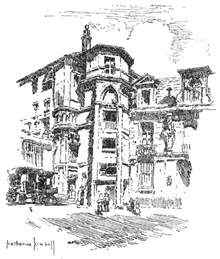
St. Julien le Pauvre.
View larger image
Abbot Fulrad was a sturdy prince and for long disputed the possession
of some lands at Plessis with the bishop of Paris. The decision of the
case is characteristic of the times. Two champions were deputed to act
for the litigants, and met before the Count of Paris[29] in the
king's chapel of St. Nicholas in the Palace of the Cité, and a solemn
judgment by the cross was held. While the royal chaplain recited
psalms and prayers, the two champions stood forth and held their arms
outstretched in the form of a cross. In this trial of endurance the
bishop's deputy was the first to succumb; his fainting arms drooped
and the abbot won his cause.
Paris had grown but slowly under the Frankish kings. They lived ill at
ease within city walls. Children of the fields and the forests, whose
delight was in the chase or in war, they were glad to escape from
Paris to their villas at Chelles or Compiègne. But the civil power of
the Church grew apace. In the early sixth century the abbots of St.
Germain des Prés at Paris held possession of nearly 90,000 acres of
land, mostly arable, in various provinces: their annual revenue
amounted to about £34,000[i] of our money: they ruled over more than
10,000 serfs. From a list of the lands held in Paris in the ninth
century by the abbey of St. Pierre des Fossés,[30] and published in
the Trésor des piéces rares ou inédites, we are able to form some
idea of the vast extent of monastic possessions in the city. The names
of the various properties whose boundaries touch those of the abbey
lands are given: private owners are mentioned only four times, whereas
to ecclesiastical and monastic domains there are no less than ninety
references. These monastic settlements were veritable garden cities,
where most of our modern fruits, flowers and vegetables were
cultivated; where flocks and herds were bred, and all kinds of
poultry, including pheasants and peacocks, reared. Guilds of craftsmen
worked and flourished; markets were held generally on saints' days,
and pilgrimages were fostered. Charlemagne was an honest coiner and a
protector of foreign traders; he was tolerant of the Jews, the only
capitalists of the time, and under him Paris became the "market of the
peoples," and Venetian and Syrian merchants sought her shores.
In Gallo-Roman days few were the churches outside the cities, but in
the great emperor's time every villa[31] is said to have had its
chapel or oratory served by a priest. Charlemagne was a zealous patron
of such learning as the epoch afforded, and sought out scholars in
every land. English, Irish, Scotch, Italian, Goth, and Bavarian—all
were welcomed. The English scholar Alcuin, master of the Cloister
School at York, became his chief adviser and tutor. He would have
every child in his empire to know at least his paternoster, and every
abbot on election was required to endow the monastery with some books.
The choice of authors was not a wide one: the Old and New Testaments;
the writings of the Fathers, especially St. Augustine, the emperor's
favourite author; Josephus; the works of Bede; some Latin authors,
chiefly Virgil; scraps of Plato translated into Latin—a somewhat
exiguous and austere library, but one which reared a noble and valiant
line of scholars and statesmen to rule the minds and bridle the savage
lusts of the coming generations of men. Under Irish and Anglo-Saxon
influences the cramped, minute script of the Merovingian scribes grew
in beauty and lucidity; gold and silver and colour illuminated the
pages of their books. The golden age of the Roman peace seemed
dawning again in a new Imperium Christianorum.
Towards the end of his reign the old emperor was dining with his court
in a seaport town in the south of France, when news came that some
strange, black, piratical craft had dared to attack the harbour. They
were soon scattered, but the emperor was seen to rise from the table,
and go to a window, where he stood gazing fixedly at the retreating
pirates. Tears trickled down his cheeks and none dared to approach
him. At length he turned and said: "Know ye my faithful servants,
wherefore I weep thus bitterly? I fear not these wretched pirates, but
I am afflicted that they should dare to approach these shores, and
sorely do grieve when I foresee what evil they will work on my sons
and on my people." His courtiers deemed they were Breton or Saracen
pirates, but the emperor knew better. They were the terrible Northmen,
soon to prove a bloodier scourge to Gaul than Hun or Goth or Saracen;
and to meet them Charlemagne left an empire distracted by civil war,
and a nerveless, feeble prince, Louis the Pious, Louis the Forgiving,
fitter for the hermit's cell than for the throne and sword of an
emperor.
In 841 the black boats of the sea-rovers for the first time entered
the Seine, and burnt Rouen and Fontenelle. In 845 a fleet of one
hundred and twenty vessels swept up its higher waters and on Easter
Eve captured, plundered and burnt Paris, sacked its monasteries and
churches and butchered their monks and priests. The futile Emperor
Charles the Bald bought them off at St. Denis with seven thousand
livres of silver, and they went back to their Scandinavian homes
gorged with plunder—only to return year by year, increased in numbers
and ferocity. Words cannot picture the terror of the citizens and
monks when the dread squadrons, with the monstrous dragons carved on
their prows, their great sails and threefold serried ranks of
men-of-prey, were sighted. Everyone left his home and sought refuge in
flight; the monks hurried off with the bodies of the saints, the
relics and treasures of the sanctuary, to hide them in far-away
cities. In 852 Charles' soldiers refused to fight, and for two hundred
and eighty-seven days the pirates ravaged the valley of the Seine at
their will. Never within memory or tradition were such things known.
Rouen, Bayeux, Beauvais, Paris, Meaux, Melun, Chartres, Evreux, were
devastated; the islands of the Seine were whitened by the bones of the
victims, and similar horrors were wrought along the other rivers of
France. In 858 a body of the freebooters settled on the island of
Oissel, below Rouen, and issued forth en excursion to spoil and slay
and burn at their pleasure: the once rich city of Paris was left a
cinder heap; the abbey of St. Genevieve was sacked and burnt, Notre
Dame, St. Stephen, St. Germain des Prés and St Denis alone escaping at
the cost of immense bribes. Charles ordered two fortresses to be built
for the defence of the approaches to the bridges, and continued his
feeble policy of paying blackmail.
In 865 St. Denis was pillaged. In 866 Robert the Strong, Count of
Paris, had won the title of the Maccabeus of France, by daring to
stand against the fury of the Northmen and to defeat them; but having
in the heat of battle with the terrible Hastings taken off his
cuirass, he was killed. By order of Charles, St. Denis was fortified
in 869, after another pillage of St. Germain.
In 876 began a second period of raids of even greater ferocity under
the Norwegian Rollo the Gangr[32] (the walker), a colossus so huge
that no horse could be found to bear him. In 884 the whole Christian
people seemed doomed to perish. Flourishing cities and monasteries
became heaps of smoking ruins; along the roads lay the bodies of
priests and laymen, noble and peasant, freeman and serf, women and
children and babes at the breast to be devoured of wolves and
vultures. The very sanctuaries[33] were become the dens of wild
beasts, the haunt of serpents and creeping things.
In 885 a great league of pirates—Danes, Normans, Saxons, Britons and
renegade French—on their way to ravage the rich cities of Burgundy
drew up before Paris; and their leader, Siegfroy, demanded passage to
the higher waters. Paris, forsaken by her kings and emperors for more
than a century, scarred and bled by three spoliations, was now to
become a beacon of hope. The Roman walls were repaired, the towers on
the north and south banks were strengthened. Bishop Gozlin, in whom
great learning was wedded to incomparable fortitude, defied the
pirates, warning them that the citizens were determined to resist and
to hold Paris for a bulwark to the land.
Of this most terrible of the Norman sieges of Paris, we have fuller
record. A certain monk of St. Germain des Prés, Abbo by name, who had
taken part in the defence, was one day sitting in his cell reading his
Virgil. Desiring to exercise his Latin, and give an example to other
cities, he determined to sing of a great siege with happier issue than
that of Troy.[34] Abbo saw the black hulls and horrid prows of the
pirates' boats as they turned the arm of the Seine below Paris, seven
hundred strong vessels, and many more of lighter build. For two
leagues and a half the very waters of the Seine were covered with
them, and men asked into what mysterious caves the river had
retreated. On November 26th, 885, the attack began at the unfinished
tower on the north bank, replaced in later times by the Grand
Châtelet. Three leaders stand eminent among the defenders of the city:
Bishop Gozlin, the great warrior priest; his nephew, Abbot Ebles of
St. Denis; and Count Eudes (Hugh) of Paris, son of Robert the Strong.
The air is darkened with javelins and arrows; bishop and abbot are in
the very eye of danger; the latter with one shaft spits seven of the
besiegers, and mockingly bids their fellows take them to the kitchen
to be cooked. On the morrow, reinforced by fresh troops, the assault
is renewed, stones are hurled, arrows whistle; the air is filled with
groans and cries; the defenders pour down boiling oil and melted wax
and pitch. The hair of some of the Normans takes fire; they burn and
the the Parisians shout—"Jump into the Seine; the water will make
your hair grow again and then look you that it be better combed." One
well-aimed millstone says Abbo, sends the souls of six to hell. The
baffled Northmen retire, entrench a camp at St. Germain l'Auxerrois,
and prepare rams and other siege artillery.
Abbo now pauses to bewail the state of France: no lord to rule her,
everywhere devastation wrought by fire and sword, God's people
paralysed at the advancing phalanx of death, Paris alone tranquil,
erect and steadfast in the midst of all their thunderbolts, polis ut
regina micans omnes super urbes, a queenly city resplendent above all
towns. The second attack begins with redoubled fury. After battering
the walls of the north tower, monstrous machines on sixteen wheels are
advanced and the besiegers strive to fill the fosse. Trees, shrubs,
slaughtered cattle, wounded horses, the very captives slain before
the eyes of the besieged, are cast in to fill the void. Bishop Gozlin
brings down the Norman chieftain, who had butchered the prisoners, by
a well-aimed arrow: his body, too, is flung into the fosse. The enemy
cover the plain with their swords and the river with their bucklers;
fireships are loosed against the bridge. In the city women fly to the
sanctuaries; they roll their hair in the dust, beat their breasts and
rend their faces, calling on St. Germain: "Blessed St. Germain,
succour thy servants." The fighters on the walls take up the cry;
Bishop Gozlin invokes the Virgin, Mother of the Redeemer, Star of the
Sea, bright above all other stars, to save them from the cruel Danes.
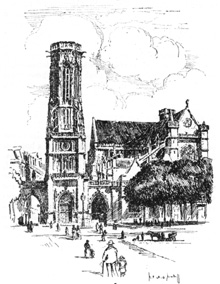
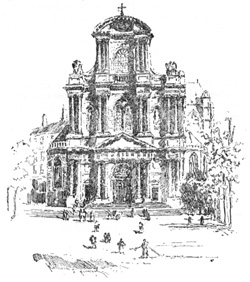
St Germain l'Auxerrois.
View larger image
On February 6th, 886, a sudden flood sweeps away the Petit Pont, and
its tower, with twelve defenders, is isolated. With shouts of triumph
the Northmen cross the river and surround it. The twelve refuse to
yield, and fire is brought. The warriors (a touching detail) fearing
lest their falcons be stifled, cut them loose. There is but one vessel
wherewith to quench the flames and that soon drops from their hands;
the little band rush forth; they set their backs against the ruins of
the bridge, their faces to their foes and fought a hopeless fight. The
walls of the city are lined with their kinsmen and friends impotent to
help; the enemies of God, doomed one day to dine at Pluto's cauldron,
press upon them; they fight till Phœbus sinks to the depths of the
sea, so great is the courage of despair. The survivors are promised
their lives if they will yield, they are disarmed, then treacherously
slain, and their souls fly to heaven. But one, Hervé, of noble bearing
and of great beauty, deemed a prince, is spared for ransom. With
thunderous voice he refuses to bargain his life for gold, falls
unarmed on his foes and is cut to pieces. "These things," writes Monk
Abbo, "I saw with mine eyes," and he gives the names of the heroic
twelve who went to receive the palm of martyrdom: Ermenfroi, Hervé,
Herland, Ouacre, Hervi, Arnaud, Seuil, Jobert, Hardre, Guy, Aimard,
Gossuin. Their names are inscribed on a little marble tablet over the
Place du Petit Pont,[35] near the spot where they fell. Hail to the
brave who across twelve centuries thrill our hearts to-day! They were
examplars to the land; they helped to make France by their desperate
courage and noble self-sacrifice, and to win for Paris the hegemony of
her cities. The city is at length revictualled by Henry of Saxony and
again the Parisians are left to themselves. On the sixth of April
Bishop Gozlin, their shield, their two-edged axe, whose shaft and bow
were terrible, passes to the Lord. On May 12th, Eudes steals away to
implore further help from the emperor, and as soon as he sees the
imperialists on the march returns and hews his way into Paris, to
share the terrors of the siege. Henry the Saxon again appears, but is
ambushed and slain and his army melts away. Yet again Paris is
abandoned by her emperor and seeks help of heaven, for the waters are
low, the besiegers are able to get footing on the island, set fire to
the gates and attack the walls. The body of St. Genevieve, which had
been transferred to the Cité, is borne about, and at night the ghostly
figure of St. Germain is seen by the sentinels to pass along the
ramparts, sprinkling them with holy water and promising salvation.
Charles the Fat, the Lord's anointed, now appears with a multitude of
a hundred tongues and encamps on Montmartre, but while the Parisians
are preparing to second him in crushing their foes, they learn that
the cowardly emperor has bought them off with a bribe and permission
to winter in Burgundy. The Parisians, however, refused to give them
passage and by an unparalleled feat of engineering they transported
their ships overland for two miles and set sail again above the city.
Next year, as Gozlin's successor, Bishop Antheric, was sitting at
table with Abbot Ebles, a fearful messenger brought news that the
acephali[36] were again in sight. Forgetting the repast, the two
churchmen seized their weapons, called the city to arms, hastened to
the ramparts, and the abbot slew their pilot with a well-aimed shaft.
The Normans are terrified, and at length a treaty is made with their
leaders, who promised not to ravage the Marne and some even entered
Paris. But the ill-disciplined hordes were hard to hold in and bands
of brigands, as soon as the ramparts were passed, began to plunder and
slew a score of Christian men. The Parisians in their indignation
sought out and—Hurrah! cries Abbo—found five hundred Normans in the
city and slew them. But the bishop protected those that took refuge in
his palace, instead of killing them as he ought to have done—potius
concidere debens. For a time Paris had respite; cowardly Charles the
Fat was deposed, and in 887 Count Eudes was acclaimed king of France
after his return from Aquitaine, whose duke he had brought to
subjection. He counselled a gathering of all the peoples outside Paris
to make common cause against the Normans, and Abbo saw the proud
Franks march in with heads erect, the skilful and polished Aquitaines,
the Burgundians too prone to flight. But nought availed: the motley
host soon melted away.
At the extreme north-east of Paris the Rue du Crimée leads to a group
of once barren hills, part of which is now made into the Park of the
Buttes Chaumont. Here, by the Mount of the Falcon (Montfaucon[37]) in
892 King Eudes fell upon an army of Northmen, who had come against
Paris and utterly routed them. Antheric, the noble pastor, with his
virgin-like face, led three hundred footmen into the fight and slew
six hundred of the acephali. But Abbo's muse now fails him, for
Eudes, noble Eudes, is no more worthy of his office, and Christ's
sheep are perishing. Where is the ancient prowess of France? Three
vices are working her destruction: pride, the sinful charms of Venus
(fœda venustas veneris) and love of sumptuous garments. Her
people are arrayed in purple vesture, and wear cloaks of gold; their
loins are cinctured with girdles rich with precious stones. Monk Abbo
wearies not of singing, but the deeds of noble Eudes are wanting; all
the poet craves is another victory to rejoice Heaven; another defeat
of the black host of the enemy.
Alas! the noble Eudes was now a king with rebellious vassals. Paris
was never captured again, but the acephali were devouring the land.
The grim spectres of Famine and Plague made a charnel-house of whole
regions of France, while Eudes was fighting the Count of Flanders, a
rival king, and the ineffectual emperor, Charles the Simple. He it was
who after Eudes' death, by the treaty of St. Claire sur Epte in 902,
surrendered to the barbarians the fair province, subsequently to be
known as Normandy. The new prayer in the Litany, "From the fury of the
Northmen, good Lord deliver us," was heard, and the dread name of
Rollo vanishes from history to live again in song. Under the title of
Robert, assumed from his god-father, he reappears to win a dukedom and
a king's daughter; the Normans are broken in to Christianity, law and
order; their land becomes one of the most civilized regions of France;
the fiercest of church levellers are known as the greatest of church
builders in Christendom. They gave their name to a style of Christian
architecture in Europe and a line of kings to England,[38] Naples and
Sicily.
The people of Paris and of France never forgot the
lesson of the dark
century of the invasions. A subtle change had been operating. The
empire had decomposed into kingdoms; the kingdoms were segregating
into lordships. Men in their need were attracted to the few strong and
dominant lords whose courage and resource afforded them a rallying
point and shelter against disintegrating forces: the poor and
defenceless huddled for protection to the seigneurs of strongholds
which had withstood the floods of barbarians that were devastating the
land. The seeds of feudalism were sown in the long winter of the
Norman terror.
The Rise of the Capetian Kings and the Growth of Feudal
Paris
From 936 to the coronation of Hugh Capet at Noyon in 987, the
Carlovingians exercised a slowly decaying power. The real rulers at
Paris were Hugh the Tall and Hugh Capet,[39] grandson and
great-grandson of Robert the Strong. They revolutionized the ideal of
kingship and founded the line of kings of France which stretches
onward through history for a thousand years until the guillotine of
the Revolution cut it in twain. It is Hugh Capet whom Dante, following
a legend of his time, calls the son of a butcher of Paris, and whom he
hears among the weeping souls cleaving to the dust and purging their
avarice in the fifth cornice of Purgatory.
Their patrimony was a small one—the provinces of the Isle de France,
La Brie, La Beauce, Beauvais and Valois; but their sway extended over
the land of the Langue d'oil, with its strenuous northern life, le
doux royaume de la France, the sweet realm of France, whose head was
Paris, cradle of the great French Monarchy and home of art, learning
and chivalry. The globe of the earth, symbol of universal empire,
gives way to the hand of justice as the emblem of kingship. The Capets
were, it is true, at first little more than seigneurs over other
seigneurs, some of whom were almost as powerful as they; but that
little, the drop of holy chrism by which they were consecrated of the
Church, and the support of the French jurists, contained within them a
promise and potency of future grandeur. They were the Lord's anointed,
supported by the Lord's Vicar on earth: to disobey them was to disobey
God: tribal sovereignty was to give way to territorial sovereignty.
The people, long forsaken by their emperors, had in their turn
forsaken them, in order "not to be at the mercy of all the great ones
they surrendered themselves to one of the great ones" and in exchange
for protection gave troth and service. Cities, churches and
monasteries now assumed a new aspect. Paris had demonstrated the value
of a walled city, and during the latter part of the Norman terror,
from all parts of North France, monks and nuns and priests had brought
their holy relics within it as to a city of refuge. Gone were its
lines of villas from Gallo-Roman times extending freely into the
country. The ample spaces within gave place to crowded houses and
narrow streets held in a rigid ring of walls and moats. The might of
the archbishops, bishops and abbots increased: they sat in the
councils of kings and dominated the administration of justice; the
moral, social and political life of the country centred around them.
Armed with the sword and the cross they held almost absolute sway over
their little republics, coined money, levied taxes, disposed of small
armies and went to the chase in almost regal state.
The advent of the year 1000 was regarded with universal terror in
Christendom. A fear, based on a supposed apocalyptic prophecy that the
end of the world was at hand, paralysed all political and social life.
Churches were too small to contain the immense throngs of fearful
penitents: legacies and donations from conscience-stricken worshippers
poured wealth into their treasuries. But once the awe-inspiring night
of the vernal equinox that began the year 1000 had passed, and the
bright March sun rose again on the fair earth, unconsumed by the wrath
of God, the old world "seemed to thrill with new life; the earth cast
off her outworn garments and clothed herself in a rich and white
vesture of new churches." Everywhere in Europe, and especially in
Paris and in France, men strove in emulation to build the finest
temples to God. The wooden roofs of the Merovingian and Carlovingian
basilicas had ill withstood the ravage of war and fire. Stone took the
place of wood, the heavy thrust of the roof led to increased mural
strength, walls were buttressed, columns thickened. Massive towers of
defence, at first round, then polygonal, then square, flanked the west
fronts, veritable keeps, where the sacred vessels and relics might be
preserved and defended in case of attack. Soon spaces are clamant for
decoration and the stone soars into the beauty of Gothic vaulting and
tracery.
The growth of Paris is more intimately associated with the Capets than
with any of the earlier dynasties, and at no period in its history is
the ecclesiastical expansion more marked. Under the long reign of
Hugh's son, King Robert the Pious, no less than fourteen monasteries
and seven churches were built or rebuilt in or around the city; a new
and magnificent palace and hall of Justice, with its royal chapel
dedicated to St. Nicholas, rose on the site of the old Roman basilica
and palace in the Cité. The king was no less charitable than pious;
troops of the poor and afflicted followed him when he went abroad, and
he fed a thousand daily at his table. But notwithstanding his
munificent piety, he was early made to feel the power of the Church.
His union with Queen Bertha, a cousin of the fourth degree, whom he
had married a year before his accession, was condemned by the pope as
incestuous, and he was summoned to repudiate her. Robert, who loved
his wife dearly, resisted the papal authority, and excommunication and
interdict followed.[40] Everyone fled from him; only the servants are
said to have remained, who purged with fire all the vessels which were
contaminated by the guilty couple's touch. The misery of his people at
length subdued the king's spirit, and he cast off his faithful and
beloved queen.
The beautiful and imperious Constance of Aquitaine, her successor,
proved a penitential infliction second only in severity to the
anathemas of the Church. Troops of vain and frivolous troubadours from
her southern home, in all kinds of foreign and fantastic costumes,
invaded the court at Paris and shocked the austere piety of the king.
He perceived the corrupting influence on the simple manners of the
Franks of their licentious songs, lascivious music and dissolute
lives, but was powerless to dismiss them. The tyrannous temper of his
new consort became the torment of his life. He was forced even to
conceal his acts of charity. One day, on returning from prayers,
Robert perceived that his lance by the queen's orders had been adorned
with richly chased silver. He looked around his palace and was not
long in finding a poor, tattered wretch whom he ordered to search for
a tool, and the pair locked themselves in a room; the silver was soon
stripped from the lance, the king hastily thrust it into the beggar's
wallet and bade him escape before the queen discovered the loss. The
poor whom he admitted to his table, despite the angry protests of the
queen, at times ill repaid his charity. On one occasion a tassel of
gold was cut from his robe, and on the thief being discovered the
king simply remarked: "Well, perhaps he has greater need of it than I,
may God bless its service to him." The very fringe was sometimes
stripped from his cloak as he walked abroad, but he never could be
induced to punish any of these poor spoilers of his person. It is in
King Robert's reign that we read of one of the earliest revolts
against the institution of slavery, which was regarded as an integral
part of the divine order of things. It was the custom of the Church at
Paris to send serfs to the law courts to give evidence for their
bishop or prior, or to do battle for them in the event of a judicial
duel. The freemen in the eleventh century began to rebel against
fighting with a despised serf, and refused the duel, whereupon early
in the next century the king and his court decided that the serfs
might lawfully testify and fight against freemen, and whoso refused
the trial by battle should lose his suit and suffer excommunication.
The prelates exchanged serfs, used them as substitutes in times of
war, allowed them to marry outside their church or abbey only by
special permission and on condition that all children were equally
divided between the two proprietors. If a female serf married a
freeman he and their children became serfs. Serfs were only permitted
to make a will by consent of their master; every favour was paid for
and liberty bought at a great price. Merchants even and artizans in
towns owed part of their produce to the seigneur. In the eleventh
century burgesses as well as serfs and Jews were given to churches,
exchanged, sold or left in wills by their seigneurs. The story of
mediæval Paris is the story of the efforts of serf and burgess to win
their economic freedom.
The declining years of King Robert were embittered by the impiety of
rebellious sons, who were reduced to submission only at the price of a
protracted and bloody campaign in Burgundy. The broken-hearted father
did not long survive his victory. He died in 1031, and the benisons
and lamentations of the poor and lowly winged his spirit to its rest.
If we may believe some writers, pious King Robert's memory is
enshrined in the hymnology of the Church, which he enriched with some
beautiful compositions. He was often seen to enter St. Denis in regal
habit to lead the choir at matins, and would sometimes challenge the
monks to a singing contest.
In 1053, towards the end of Henry I.'s almost unchronicled reign, an
alarming rumour came to Paris. The priests of St. Ermeran at Ratisbon
claimed to have possession of the body of St. Denis, which they
alleged had been stolen from the abbey in 892 by one Gisalbert. The
loss of a province would not have evoked livelier emotion, and Henry
at once took measures to convince France and Christendom that the true
body was still at St. Denis. Before an immense concourse of bishops,
abbots, princes and people, presided over by the king, his brother and
the archbishops of Rheims and of Canterbury, the remains of St. Denis
and his two companions were solemnly drawn out of the silver coffers
in which they had been placed by Dagobert, together with a nail from
the cross and part of the crown of thorns, all locked with two keys in
a chest richly adorned with gold and precious stones, and preserved in
a vault under the high altar. After having been borne in procession
they were exposed on the high altar for fifteen days and then restored
to their resting-place. The stiff-necked priests of Ratisbon,
fortified with a papal bull of 1052, still maintained their claim to
the possession of the body, but no diminution was experienced in the
devotion either of the French peoples or of strangers of all nations
to the relics at St. Denis.
The chief architectural event of Henry's reign at Paris was the
rebuilding on a more magnificent scale of the Merovingian church and
abbey of St. Martin in the Fields (des Champs), whose blackened walls
and desolate lands were eloquent of the Norman terror. The buildings
stood outside Paris about a mile beyond the Cité on the great Roman
road to the north, where St. Martin on his way to Paris healed a
leper. The foundation, which soon grew to be one of the wealthiest in
France, included a hostel for poor pilgrims endowed by Philip I. with
a mill on the Grand Pont, to which the monks added the revenue from an
oven.[41] In the eighteenth century, when the monastery was
secularised, the abbot was patron of twenty-nine priories, three
vicarates and thirty-five parishes, five of which were in Paris. Some
of the old building has been incorporated in the existing
Conservatoire des Arts et Métiers. The Gothic Priory chapel, with its
fine twelfth-century choir, is used as a machinery-room, and the
refectory, one of the most precious and beautiful creations attributed
to Pierre de Montereau, is now a library.
Philip I. brought to the indolent habit inherited from his father a
depraved and vicious nature. After a regency of eight years he became
king at the age of fifteen, and lived to defile his youth and
dishonour his manhood by debauchery and adultery, simony and
brigandage. Early in his career he followed the evil counsels of his
provost Étienne, and purposed the spoliation of the treasury of St.
Germain des Prés to pay for his dissolute pleasures. "As the
sacrilegious pair," says the chronicler, "drew near the relics,
Étienne was smitten with blindness and the terrified Philip fled."
Philip after a reign void of honour or profit to France left his son
Louis VI. (the Lusty) a heritage of shame, a kingdom reduced to little
more than a baronage over a few comtés, whose cities of Paris,
Etampes, Orleans and Sens were isolated from royal jurisdiction by
insolent and rebellious vassals. Many of the great seigneurs were but
freebooters, living by plunder. The violence and lawlessness of these
and other smaller scoundrels, who levied blackmail on merchants and
travellers, made commerce almost impossible. Corruption, too, had
invaded many of the monasteries and fouled the thrones of bishops, and
a dual effort was made by king and Church to remedy the evils of the
times. The hierarchy strove to centralise power at Rome that the
Church might be purged of wolves in sheep's clothing: the Capetian
monarchs to increase their might at Paris in order to subdue insolent
and powerful vassals to law and obedience.
In 1097 the Duke of Burgundy learned that Archbishop Anselm of
Canterbury was about to pass through his territory with a rich escort
on his way to Rome. The usual ambush was laid and the party were held
up. As the duke hastened to spoil his victims, crying out—"Where is
the archbishop?" he turned and saw Anselm, impassive on his horse,
gazing sternly at him. In a moment the savage and lawless duke was
transformed to a pallid, stammering wretch with downcast eyes, begging
permission to kiss the old man's hand and to offer him a noble escort
to safeguard him through his territory. It was the moral influence of
prelates such as this and monks such as St. Bernard that enabled the
hierarchy to enforce the celibacy of the clergy, to cleanse the
bishoprics and abbeys, to wrest the privilege of conferring benefices
from lay potentates and feudal seigneurs who bartered them for money,
and to make and unmake kings.
The end of the eleventh and the beginning of the twelfth centuries saw
the culmination of the power of the reformed orders. All over France,
religious houses—the Grande Chartreuse, Fontevrault, Cîteaux,
Clairvaux—sprang up as if by enchantment. Men and women of all
stations and classes flocked to them, a veritable host of the Lord,
"adorning the deserts with their holy perfection and solitudes by
their purity and righteousness."
St. Bernard, the terror of mothers and of wives, by his austerity, his
loving-kindness,[42] his impetuous will and masterful activity, his
absolute faith and remorseless logic, his lyric and passionate
eloquence, carried all before him and became the dictator of
Christendom. He it was who with pitying gesture as of a kind father,
his eyes suffused with tender joy, received Dante from the hands of
Beatrice in the highest of celestial spheres, and after singing the
beautiful hymn to the Virgin, led him to the heaven of heavens, to the
very ecstasy and culmination of beatitude in the contemplation and
comprehension of the triune God Himself. But religious no less than
seculars are subdued by what they work in. Already in the tenth
century Richer complained that the monks of his time were beginning to
wear rich ornaments and flowing sleeves, and with their tight-fitting
garments[43] looked like harlots rather than monks.
In the polluting atmosphere of Philip's reign matters had grown worse.
St. Bernard denounced the royal abbey of St. Denis as "a house of
Satan, a den of thieves." "The walls of the churches of Christ were
resplendent with colour but His poor were naked and left to perish;
their stones were gilded with the money of the needy and wretched to
charm the eyes of the rich."
In 1095 the task of cleansing the Abbey of St. Maur des Fossés at
Paris seemed so hopeless, that the abbot resigned in despair rather
than imperil his soul, and a more resolute reformer was sought. In
1107 the bishop of Paris was commanded by Rome to proceed to the abbey
of St. Eloy and extirpate the evils there flourishing, for the nuns,
it was reported, had so declined in grace, owing to the proximity of
the court and intercourse with the world, that they had lost all sense
of shame and lived in open sin, breaking the bonds of common decency.
The scandal was so great that the bishop determined to cut them off
from the house of the Lord; the abbey was reduced to a priory and
given over to the abbot of the now reformed monastery of St. Maur, and
its vast lands were parcelled out into several parishes.[44] The
rights of the canons of Notre Dame were to be maintained; on St.
Eloy's day the abbot of St. Maur was to furnish them with six pigs,
two and a half measures of wine and three of fine wheat, and on St.
Paul's day with eight sheep, the same quantity of wine, six crowns and
one obole. The present Rue de la Cité and the Boulevard du Palais give
approximately the east and west boundaries of the suppressed abbey,
part of whose site is now occupied by the Prefecture de Police.
But the way of the reformer is a hard one. At the Council of Paris,
1074, the abbot of Pontoise was severely ill-treated for supporting,
against the majority of the Council, the pope's decrees excluding
married clerics from the churches, and the reform of the canons of
Notre Dame led to exciting scenes. Bishop Stephen of Senlis was sent
in 1128 to introduce the new discipline, but the archdeacons and
canons, supported by royal favour, resisted, and Bishop Stephen was
stripped of his revenues and hastened back to his metropolitan, the
archbishop of Sens. The archbishop laid Paris under interdict and the
influence of St. Bernard himself was needed to compose the quarrel.
On Sunday, August 20, 1133, when returning from a visitation to the
abbey of Chelles, the abbot and prior of St. Victor[45] at Paris were
ambushed and the prior was stabbed. Some years later, in the reign of
Louis VII., Pope Eugene III. came to seek refuge in Paris from the
troubles excited at Rome by the revolution of Arnold of Brescia, and
celebrated mass before the king at the abbey church of St. Genevieve.
The canons had stretched a rich, silken carpet before the altar on
which the pontiff's knees might rest, and when he retired to the
sacristy to disrobe, his officers claimed the carpet, according to
usage. The canons and their servants resisted, there was a bout of
fisticuffs and sticks, the king intervened, anointed majesty himself
was struck, and during the scuffle which ensued the carpet was torn to
shreds in a tug-of-war between the claimants. Here was urgent need for
reform. The pope decided to introduce the new discipline and appointed
a fresh set of canons. The dispossessed canons met them with insults
and violence, drowned their voices by howling and other indignities,
and only ceased on being threatened with the loss of their eyes and
other secular penalties.
Louis VI., the noble damoiseau as he is called by the Chronicle of
St. Denis, enthroned in 1108, was the pioneer of the great French
Monarchy, ever on the move, hewing his way, sword in hand, through his
domains, subduing the violence, and burning and razing the castles of
his insolent and disobedient vassals. The famous Suger, abbot of St.
Denis, was his wise and firm counsellor, who led the Church to make
common cause with him and lend her diocesan militia. The king would
have the peasant to till, the monk to pray, and the pilgrim and
merchant to travel in peace. He was an itinerant regal justiciary,
destroying the nests of brigands, purging the land with fire and sword
from tyranny and oppression. Wise in council, of magnificent courage
in battle, he was the first of the Capetians to associate the cause of
the people with that of the monarchy. They loved him as a valiant
soldier-king, destroyer and tamer of feudal tyrants, the protector of
the Church, the vindicator of the oppressed. He lifted the sceptre of
France from the mire and made of it a symbol of firm and just
government.
It is in Louis' reign that we have first mention of the Oriflamme
(golden flame) of St. Denis, which took the place of St. Martin's
cloak as the royal standard of France. The Emperor Henry V. with a
formidable army was menacing the land. Louis rallied all his friends
to withstand him and went to St. Denis to pray for victory. Pope
Eugene and Abbot Suger received Louis, who fell prostrate before the
relics. Suger then took from the altar the standard—famed to have
been sent by heaven, and formerly carried by the first liege man of
the abbey, the Count de Vexin, when the monastery was in danger of
attack—and handed it to the king: the pope gave him a pilgrim's
wallet. The sacred banner was fashioned of silk in the form of a
gonfalon, of the colours of fire and gold, and was suspended at the
head of a gilded lance.[46]
The strenuous reign of Louis was marked by a great expansion of Paris,
which became more than ever the ordinary dwelling-place of the king
and the seat of his government. The market which from Roman times had
been held at the bifurcation of the northern road near the fields
(Champeaux), belonging to St. Denis of the Prison, was extended.
William of Champeaux founded the great abbey of St. Victor,[47] famed
for its sanctity and learning, where Abelard taught and St. Thomas of
Canterbury, whose hair shirt was long preserved there, and St. Bernard
lodged. At the urgent prayer of his wife Adelaide, the king built a
nunnery at Montmartre, and lavishly endowed it with lands, ovens, the
house of Guerri, a Lombard money-changer, some shops and a
slaughter-house in Paris, and a small bourg, still known as Bourg la
Reine, about five miles south of the city. Certain rights of fishing
at Paris, to which Louis VII. added five thousand herrings yearly from
the port of Boulogne, were also granted. The churches of Ste.
Geneviève la Petite, founded to commemorate the miraculous staying of
the plague of the burning sickness (les ardents); of St. Jacques de
la Boucherie; and of St. Pierre aux Bœufs, so named from the heads
of oxen carved on the portal, were also built.
Paris under Philip Augustus and St. Louis
During twenty-eight years of the reign of Louis VII. no heir to the
crown was born. At length, on the 22nd of August, 1165, Adelaide of
Champagne, his third wife, lay in child-bed and excited crowds
thronged the palace in the Cité. The king, "afeared of the number of
his daughters and knowing how ardently his people desired a child of
the nobler sex," was beside himself with joy when the desire of his
heart was held up to him; curious eyes espied the longed-for heir
through an aperture of the door and in a moment the good news was
spread abroad. There was a sound of clarions and of bells and the city
as by enchantment shone with an aureole of light. An English student
roused by the uproar and the glare of what seemed like a great
conflagration leapt to the window and beheld two old women hurrying by
with lighted tapers. He asked the cause. They answered: "God has given
us this night a royal heir, by whose hand your king shall suffer shame
and ill-hap." This was the birth of Philip le Dieu-donné—Philip sent
of Heaven—better known as Philip Augustus. Under him and Louis IX.
mediæval Paris, faithfully reflecting the fortunes of the French
Monarchy, attained its highest development.
When Philip Augustus took up the sceptre at fifteen years of age, the
little realm of the Isle de France was throttled by a ring of great
and practically independent feudatories, and in extent was no larger
than half-a-dozen of the eighty-seven departments into which France is
now divided. The English king held the mouths of all the great rivers
and all the great cities, Rouen, Tours, Bordeaux. In thirty years
Philip had burst through to the sea, subdued the Duke of Burgundy and
the great counts, wrested the sovereignty of Normandy, Brittany and
Maine from the English Crown, won Poitou and Aquitaine, crushed the
emperor and his vassals in the memorable battle of Bouvines, and
become one of the greatest of European monarchs. The king, who had
owed his life to the excellence of his armour,[48] was received in
Paris with a frenzy of joy. The whole city came forth to meet him,
flowers were strewn in his path, the streets were hung with tapestry,
Te Deums sung in all the churches, and for seven days and nights the
popular enthusiasm expressed itself in dance, in song and joyous
revel. It was the first national event in France. The Count of
Flanders was imprisoned in the new fortress of the Louvre, where he
lay for thirteen years, with ample leisure to meditate on the fate of
rebellious feudatories. "Never after," say the chroniclers, "was war
waged on King Philip, but he lived in peace."
Two vast undertakings make the name of Philip Augustus memorable in
Paris—the beginning of the paving of the city and the building of its
girdle of walls and towers. One day as the king stood at the window of
his palace, where he was wont to distract himself from the cares of
state by watching the Seine flow by, some carts rattled along the
muddy road beneath the window and stirred so foul and overpowering an
odour that the king almost fell sick. Next day the provost and the
sheriffs and chief citizens were summoned before him and ordered to
set about paving the city with stone. The work was not however
completed until the reign of Charles V., a century and a half later.
It was done well and lasted till the sixteenth century, when it was
replaced by the miserable cobbles, known as the pavement of the
League. Whether the city grew much sweeter is doubtful; certainly
Paris in the sixteenth, seventeenth and eighteenth centuries was as
evil-smelling as ever. Montaigne, in the second half of the sixteenth
century, complains that the acrid smell of the mud of Paris weakened
the affection he bore to that fair city, and Howell writes in 1620,
"the city is always dirty, and by perpetual motion the mud is beaten
into a thick, black and unctuous oil that sticks so that no art can
wash it off, and besides the indelible stain it leaves, gives so
strong a scent that it may be smelt many miles off, if the wind be in
one's face as one comes from the fresh air of the country." Horace
Walpole in the eighteenth century, called Paris "the beastliest town
in the universe."
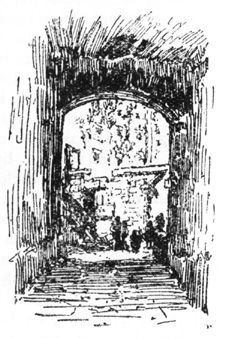
Wall of Philippe Auguste, Cour de Rouen.
View larger image
The great fortified wall of Philip Augustus began at the north-west
water-tower, which stood just above the present Pont des Arts, and
passed through the quadrangle of the Louvre, where a line on the
paving marks its course, to the Porte St. Honoré, near the Oratoire.
It continued northwards within the line of the present Rue Jean
Jacques Rousseau and by the Rue du Jour to the Porte Montmartre, whose
site is marked by a tablet on No. 30 Rue Montmartre. Turning eastward
by the Painters' Gate (135 Rue St. Denis) and the Porte St. Martin,
near the Rue Grenier St. Lazare, the fortification described a curve
in a south-easterly direction by the Rue des Francs Bourgeois, where
traces of the wall have been found at No. 55, and where part of a
tower may be seen at No. 57. The line of the wall continued in the
same direction by the Lycée Charlemagne, No. 101 Rue St. Antoine,
where stood another gate, to the north-east water-tower, known as the
Tour Barbeau, which stood near No. 32 Quai des Célestins. The opposite
or southern division began at the south-east water-tower, La
Tournelle, and the Gate of St. Bernard on the present Quai de la
Tournelle, and went southward just within the Rues des Fossés St.
Bernard and Cardinal Lemoine, to the Porte St. Victor, near No. 2 Rue
des Écoles. The wall then turned westward above the Rue Clovis, where
at No. 7 one of the largest and best-preserved remains may be seen. It
enclosed the abbey of St. Genevieve, continued within the Rue des
Fossés St. Jacques, and, between the Porte St. Jacques and the Porte
St. Michel doubled outwards to enclose the Parloir aux Bourgeois near
the south end of the Rue Victor Cousin. The south-western angle was
turned near the end of the Rue Soufflot and the beginning of the Rue
Monsieur le Prince. Crossing the Boulevard St. Germain, it then
followed within the line of the latter street, and continued within
the Rue de l'Ancienne Comédie. In the Cour de Rouen, entered through
the Passage du Commerce, No. 61 Rue St. André des Arts, an important
remnant may be seen with the base of a tower, and where the Rue Mazet
cuts the last-named street stood the Porte du Buci. We may now trace
the march of the wall and towers within the Rue Mazarine and across
the Rue Guénégaud, where in a court behind No. 29 other fragments
exist, to the south-west water-tower, the notorious Tour de Nesle[49]
whose site is occupied by the east wing of the Institut. The west
passage of the Seine was blocked by chains, which were drawn at night
from tower to tower and fixed on boats and piles just above the line
of the present Pont des Arts. A similar chain blocked the east passage
of the river, drawn from the Tour Barbeau to La Tournelle, crossing
the islands now known as the Isle St. Louis. The wall was twenty years
building and was completed in 1211. It was eight feet thick, pierced
by twenty-four gates and fortified by about five hundred towers. Much
of the land it enclosed was not built upon; the marais on the north
bank were drained and cultivated for market and fruit gardens.
The moated château of the Louvre, another of Philip's great buildings
stood outside the wall, on the site of the old Frankish camp or
Lower, and commanded the valley route to Paris. It was at once a
fortress, a treasury, a palace and a prison. Parts of two wings of the
structure are incorporated in the present palace of the Louvre, and
the site of the remaining wings, the massive keep and the towers, are
marked out on the pavement of the quadrangle.
The king erected also (1181-1183) two great warehouses at the old
market at Champeaux: one for the drapers, the other for the weavers,
that the merchants might sell their wares under cover and lock up
their goods at night. They were known as les Halles, and the market
ever since has borne that name. Here too Philip caused to be burnt at
the stake the first heretics[50] executed at Paris, sparing the women
and other simple folk who had been misled by the chief sectaries, of
whom one, beyond the reach of earthly penalties and buried in the
cemetery of les Innocents, was finally excommunicated, his bones
exhumed and flung on a dungheap. "Beni soit le Seigneur en toutes
choses!" says Pigord the chronicler who tells the story.
Of the impression that the Paris of Philip Augustus made on a
provincial visitor, we were able, fortunately, to give some account.
"I am at Paris," writes Guy of Bazoches, about the end of the twelfth
century, "in this royal city, where the abundance of nature's gifts
not only retains those that dwell there but invites and attracts those
who are afar off. Even as the moon surpasses the stars in brightness,
so does this city, the seat of royalty, exalt her proud head above all
other cities. She is placed in the bosom of a delicious valley, in the
centre of a crown of hills, which Ceres and Bacchus enrich with their
gifts. The Seine, that proud river which comes from the east, flows
there through wide banks and with its two arms surrounds an island
which is the head, the heart, and the marrow of the whole city; two
suburbs extend to right and left, even the lesser of which would
rouse the envy of many another city. These suburbs communicate with
the island by two stone bridges; the Grand Pont towards the north in
the direction of the English sea, and the Petit Pont which looks
towards the Loire. The former bridge, broad, rich, commercial, is the
centre of a fervid activity, and innumerable boats surround it laden
with merchandise and riches. The Petit Pont belongs to the
dialecticians, who pace up and down disputing. In the island adjacent
to the king's palace, which dominates the whole town, the palace of
philosophy is seen where study reigns alone as sovereign, a citadel of
light and immortality."
After Louis VIII.'s brief reign of three years, there rises to the
seat of kings at Paris one of the gentlest and noblest of the sons of
men, a prince indeed, who, amid all the temptations of absolute power
maintained a spotless life, and at death laid down an earthly crown to
assume a fairer and an imperishable diadem among the saints in heaven.
All that was best in mediævalism—its desire for peace and order and
justice; its fervent piety, its passion to effect unity among Christ's
people and to wrest the Holy Land from the pollution of the infidel;
its enthusiasm for learning and for the things of the mind; its love
of beauty—all are personified in the life of St. Louis.
The young prince was eleven years of age when his father died. During
his minority he was nurtured in learning and piety[51] by his mother,
Blanche of Castile, whose devotion to her son, and firm and wise
regency were a fitting prelude to the reign of a saintly king. Even
after he attained his majority, St. Louis always sought his mother's
counsel and was ever respectful and submissive to her will. When the
news of her death reached him in the Holy Land, he went to his
oratory, fell on his knees before the altar, submissive to the will of
God, and cried out with tears in his eyes, that he had loved the
queen, "his most dear lady and mother, beyond all mortal creatures."
The king's conception of his office was summed up in two
words—Gouverner bien. "Fair son," said he one day to Prince Louis,
his heir, "I pray thee win the affection of thy people. Verily, I
would rather that a Scotchman came from Scotland and ruled the kingdom
well and loyally than that thou shouldst govern it ill." Joinville his
biographer tells with charming simplicity how the king after hearing
mass in the chapel at Vincennes outside Paris was wont to walk in the
woods for refreshment and then, sitting at the foot of an old oak
tree, whose position is still shown, would listen to the plaints of
his poorer people without let of usher or other official and
administer justice to them. At other times, clothed in a tunic of
camlet, a surcoat of wool (tiretaine) without sleeves, a mantle of
black taffety, and a hat with a peacock's plume, he would walk with
his Council in the garden of his palace in the Cité, and on the poorer
people crowding round him all speaking at once he would cry: "Silence!
one at a time," and call for a carpet to be spread on the ground, on
which he would sit, surrounded with his councillors, and judge them
diligently.
In 1238 St. Louis was profoundly shocked by the news that the crown of
thorns was a forfeited pledge at Venice for an unpaid loan advanced by
some Venetian merchants to the Emperor Baldwin of Constantinople. He
paid the debt,[52] redeemed the pledge, and secured the relic for
Paris. The king met his envoys at Sens, and barefooted, himself
carried the sacred treasure enclosed in three caskets, one of wood,
one of silver and one of gold, to Paris. The procession took eight
days to reach the city, and so great were the multitudes who thronged
to see it, that a large platform was raised in a field outside the
walls, from which several prelates exposed it in turn to the
veneration of the people. Thence it was taken to the cathedral of
Notre Dame, the king dressed in a simple tunic, and barefoot, still
carrying the relic. From the cathedral it was transferred to the royal
chapel of St. Nicholas within the precincts of the palace. A year
later the Emperor Baldwin was constrained to part with other relics,
including a piece of the true cross, the blade of the lance and the
sponge of the Passion. To enshrine them and the crown of thorns the
chapel of St. Nicholas was demolished and the beautiful Sainte
Chapelle built in its place. The upper chapel was dedicated to the
relics; the lower to the Blessed Virgin, and on solemn festivals the
king would himself expose the relics to the people. St. Louis was
zealous in his devotion and for a time attended matins in the new
chapel at midnight, until, suffering much headache in consequence, he
was persuaded to have the office celebrated in the early morning
before prime. His piety, however, was by no means austere: he had all
the French gaiety of heart, dearly loved a good story, and was
excellent company at table, where he loved to sit conversing with
Robert de Sorbon, his chaplain. "It is a bad thing," he said one day
to Joinville, "to take another man's goods, because rendre (to
restore) is so difficult, that even to pronounce the word makes the
tongue sore by reason of the r's in it."
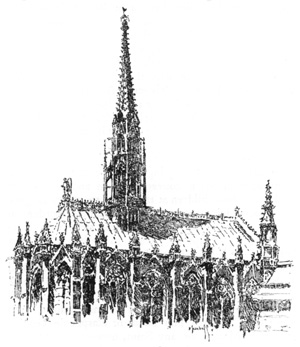
La Sainte Chapelle.
View larger image
At another time they were talking of the duties of a layman towards
Jews and Infidels. "Let me tell you a story," said St. Louis. "The
monks of Cluny once arranged a great conference between some learned
clerks and Jews. When the conference opened, an old knight who for
love of Christ was given bread and shelter at the monastery,
approached the abbot and begged leave to say the first word. The
abbot, after some protest against the irregularity, was persuaded to
grant permission, and the knight, leaning on his stick, requested that
the greatest scholar and rabbi among the Jews might be brought before
him. 'Master,' said the knight, 'do you believe that the Blessed
Virgin Mary gave birth to Jesus and held Him at her breast, and that
she is the Virgin Mother of God?' The Jew answered that he believed it
not at all. 'Then,' said the knight, 'fool that thou art to have
entered God's house and His church, and thou shalt rue it,' Thereupon
he lifted his stick, smote the rabbi under the ear and felled him to
the ground. The terrified Jews fled, carrying their master with them,
and so," said St. Louis, "ended the conference. And I tell you, let
none but a great clerk dispute; the business of a layman when he hears
the Christian religion defamed is to defend it with his sharp sword
and thrust his weapon into the miscreant's body as far as it will go."
St. Louis, however, did not apply the moral in practice. Although
severe in exacting tribute from the Jews, he spent much money in
converting them and held many of their orphan children at the font; to
others he gave pensions, which became a heavy financial burden to
himself and his successors. He was stern with blasphemers, whose lips
he caused to be branded with a hot iron. "I have heard him say,"
writes Joinville, "with his own mouth, that he would he were marked
with a red-hot iron himself if thereby he could banish all oaths and
blasphemy from his kingdom. Full twenty-two years have I been in his
company, and never have I heard him swear or blaspheme God or His holy
Mother or any Saint, howsoever angry he may have been: and when he
would affirm anything, he would say, 'Verily it is so, or verily it is
not so,' Before going to bed he would call his children around him and
recite the fair deeds and sayings of ancient princes and kings,
praying that they would remember them for good ensample; for unjust
and wicked princes lost their kingdoms through pride and avarice and
rapine." When he was in the east he heard of a Saracen lord of Egypt
who caused all the best books of philosophy to be transcribed for the
use of young men, and he determined to do the like for the youth of
Paris. Five thousand scribes were employed to copy the Scriptures and
the writings of the Fathers and classic authors, preserved in various
abbeys in France. He had a convenient and safe place built at the
treasury of the Sainte Chapelle, where he housed the books, for a
church without a library was said to be a fortress without ammunition.
Scholars had free access to them, and he himself was wont in his
leisure time to shut himself up there for study, reading rather the
Holy Fathers than the writings of the best doctors of his own time.
St. Louis was a steadfast friend to the religious orders. On his
return from the Holy Land he brought with him six monks from Mount
Carmel and established them on the north bank of the Seine, near the
present Quai des Célestins; they were subsequently transferred to the
University quarter, on a site now occupied by the Marché aux Carmes.
The prior of the Grande Chartreuse was also prayed to spare a few
brothers to found a house in Paris; four were sent, and the king
endowed them with his Château de Vauvert, including extensive lands
and vineyards. The château was reputed to be haunted by evil spirits,
and the street leading thither as late as the last century was known
as the Rue d'Enfer. St. Louis began a great church for them, and the
eight cells, each with its three rooms and garden, were increased to
thirty before the end of his reign; in later times the order became
one of the richest in Paris and occupied a vast expanse of land to the
south of the Luxembourg. The fine series of paintings illustrating the
life of St. Bruno, by Lesueur, now in the Louvre, was executed for the
smaller cloister of the monastery. The Grands Augustins were
established on the south bank of the Seine, near the present Pont
Neuf, and the Serfs de la Vierge, known later as the Blancs Manteaux,
from their white cloaks, in the Marais. They were subsequently
amalgamated with the Guillemites, or the Hermits of St. William, and
at No. 14 Rue des Guillemites some remains of their monastery may yet
be seen. The church of the Blancs Manteaux, rebuilt in the seventeenth
century, also exists in the street of that name.
In 1217 the first of the Dominicans were seen at Paris. On the 12th of
September seven preaching friars, among whom were Laurence the
Englishman and a brother of St. Dominic, established themselves in a
house near the parvis of Notre Dame. In 1218 the University gave
them a home opposite the church of St. Étienne des Grez (St. Stephen
of the Greeks), in the Rue St. Jacques, and in the following year,
when St. Dominic came to Paris, the brothers had increased to thirty.
The saint himself drew up the plans of their monastery and always
cherished a particular affection for the Paris house. Their church was
opened in 1220, and being dedicated to St. Jacques, the Dominicans
were known as Jacobins all over France. St. Louis endowed them with a
school; they soon became one of the most powerful and opulent of the
religious orders, and their church, a burial-place for kings and
princes. The Friars Minor soon followed. St. Francis himself, in his
deep affection for France, had determined to go to Paris and found a
house of his order, but being dissuaded by his friend, Cardinal
Ugolin, sent in 1216 a few of his disciples. These early friars, true
poverelli di Dio, would accept no endowment of house or money, and
supporting themselves by their hands, carried their splendid devotion
among the poor, the outcast, and the lepers of Paris. In 1230 the
Cordeliers, as they were called,[53] accepted the loan of a house
near the walls in the south-western part of the city; St. Louis
built them a church, and left them at his death part of his library
and a large sum of money.[54] They too soon became rich and powerful
and their church one of the largest and most magnificent in Paris. St.
Bonaventure and Duns Scotus taught at their school of theology; their
monastery in the sixteenth century was the finest and most spacious in
Paris, with cells for a hundred friars and a vast refectory, which
still exists. St. Louis founded the hospital known as the
Quinze-Vingts (15 + 20) for three hundred poor knights whose eyes had
been put out by the Saracens. Subsequently it became a night shelter
for a like number of blind beggars whither they might repair after
their long quest in the streets of Paris. St. Louis at his death left
them an annual rente of thirty livres parisis that every inmate
might have a good mess of pottage daily, and Philip le Bel ordered a
fleur-de-lys to be embroidered on their dress that they might be known
as the king's poor folk. The buildings, now transferred to the Rue de
Charenton, originally covered a vast area of ground between the Palais
Royal and the Louvre, and were sold in 1779 to a syndicate of
speculators by Cardinal de Rohan of diamond-necklace[55] notoriety; an
act of jobbery which brought his Eminence a handsome commission. The
Quinze-Vingts were privileged to place collecting-boxes and to beg
inside the churches. Since, however, the differences in the relative
opulence of churches was great, the right to beg in certain of the
richer ones was put up to auction every year, and those who promised
to pay the highest premium to the funds of the hospital were
adjudicated the privilege of begging there. This curious arrangement
was in full vigour until the latter half of the eighteenth century,
when the foundation was removed. Twelve blind brothers and twelve
seeing brothers—husbands of blind women who were lodged there on
condition that they served as leaders through the streets—had a share
in the management of the institution. Luxury seems to have sometimes
invaded the hostel, for in 1579 a royal degree forbade the sale of
wine to the brethren and denounced the blasphemy with which their
conversation was often tainted. In 1631 they were forbidden to use
stuffs other than serge or cloth for their garments, or to use velvet
for ornament.
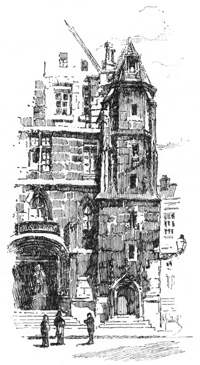
Refectory of the Cordeliers.
View larger image
The establishment of the abbeys of St. Antoine, of the Friars of the
Holy Cross, and of the Sisters of St. Bega or Béguines, were also due
to the king's piety, and the whole city was surrounded with religious
houses. "Even as a scribe," says an old writer, "who hath written his
book illuminates it with gold and silver, so did the king illumine his
kingdom with the great quantity of the houses of God that he built."
St. Louis was, however, firm in his resistance to ecclesiastical
arbitrariness. The prelates complained to him on one occasion that
Christianity was going to the dogs, because no one feared their
excommunications, and prayed that he would order his sergeants to lend
the secular arm to enforce their authority. "Yes," answered the king,
"if you will give me the particulars of each case that I may judge if
your sentence be just." That, they objected, appertained to the
ecclesiastical courts, but St. Louis was inflexible, and they remained
unsatisfied.
Many were St. Louis' benefactions to the great hospital of Paris, the
Hôtel Dieu. Rules, dating from 1217, for the treatment of the sick
poor were elaborated in his reign with admirable forethought. The
sick, after confession and communion, were to be put to bed and
treated as if they were the masters of the house. They were to be
daily served with food before the nursing friars and sisters, and all
that they desired was to be freely given if it could be obtained and
were not prejudicial to their recovery. If the sickness were dangerous
the patient was to be set apart and to be tended with especial
solicitude. The sick were never to be left unguarded and even to be
kept seven days after they were healed, lest they should suffer a
relapse. The friars and sisters were to eat twice a day: the sick
whenever they had need. A nurse who struck a patient was
excommunicated. Viollet le Duc was of opinion that in many respects
the Hôtel Dieu in the Middle Ages was superior to our modern
hospitals. Among many details denoting the tender forethought of the
administrator, we may note that in the ward for the grievously sick
and infirm the beds were made lower, and 60 cottes of white fur and
300 felt boots were provided to keep the poor patients warm when they
were moved from their beds to the chambres aisées. In later times,
lax management and the decline of piety which came with the religious
and political changes of the Renaissance made reform urgent, and in
1505 the Parlement appointed a committee of eight bourgeois clercs
to control the receipts. The buildings were much increased in 1636,
but were never large enough, and in 1655 the priory of St. Julien was
united to the hospital. "As many as 6000 patients," says Félibien,
writing in 1725, "have been counted there at one time, five or six in
one bed." No limitations of age or sex or station or religion or
country were set. Everybody was received, and in Félibien's time the
upkeep amounted to 500,000 livres per annum. The old Hôtel Dieu was
situated to the south of Notre Dame, and stood there until rebuilt on
its present site in 1878.
St. Louis sought diligently over all the land for the grand sage
homme who would prove an honest and fearless judge, punishing the
wicked without regard to rank or riches; and what he exacted of his
officers he practised himself. He punished his own brother, the Count
of Artois, for having forced a sale of land on an unwilling man, and
ordered him to make restitution. The Sire de Coucy, one of the most
powerful of his barons, was summoned to Paris and in spite of his
bravado, arrested, imprisoned in the Louvre and sentenced to death,
for having hanged three young fellows for poaching. The sale of the
provostship of Paris was abolished and a man of integrity, Étienne
Boileau, appointed with adequate emoluments. So completely was this
once venal office rehabilitated, that no seigneur regarded the post as
beneath him. Boileau was wont to sleep in his clothes on a camp bed in
the Châtelet to be in readiness at any hour, and often St. Louis would
be seen sitting beside the provost on the judgment seat, watching over
the administration of justice. The judicial duel in civil cases was
forbidden; the Royal Watch instituted to police the streets of Paris;
the charters of the hundred crafts of Paris were confirmed and many
privileges granted to the great trade guilds.
In 1270 St. Louis put on a second time the crusader's badge, "the dear
remembrance of his dying Lord," and met his death in the ill-fated
expedition to Tunis. So feeble was the king when he left Paris, that
Joinville carried him from the Hôtel of the Count of Auxerre to the
Cordeliers, where the old friends and fellow-warriors in the Holy Land
parted for ever. When stricken with the plague the dying monarch was
laid on a couch strewn with ashes. He called his son, the Count of
Alençon to him, gave wise and touching counsel, and, after holy
communion, recited the seven penitential psalms: having invoked
"Monseigneurs St. James and St. Denis and Madame St. Genevieve," he
crossed his hands on his heart, gazed towards heaven and rendered his
soul to his Creator. Piteuse chouse est et digne de pleurer le
trépassement de ce saint prince, says Joinville, to whom the story
was told by the king's son—"A piteous thing it is and worthy of tears
the passing away of this holy prince."
The bones of the dead king, from which the flesh[56] had been removed
by boiling, were sent for burial to St. Denis, which he had chosen for
the place of his sepulture. Joinville,[57] his friend and companion,
from whose priceless memoirs we have chiefly drawn, ends his story
thus:—"I make known to all readers of this little book that the
things which I say I have seen and heard of the king are true, and
steadfastly shall they believe them. And the other things of which I
testify but by hearsay, take them in a good sense if it please you,
praying God that by the prayers of Monseigneur St. Louis it may please
Him to give us those things that He knoweth to be necessary as well
for our bodies as for our souls. Amen."
King Louis was tall of stature, with a spare and graceful figure; his
face was of angelic sweetness, with eyes as of a dove, and crowned
with abundant fair hair. As he grew older he became somewhat bald and
held himself slightly bent. "Never," says Joinville, when describing a
charge led by the king, which turned the tide of battle, "saw I so
fair an armed man. He seemed to sit head and shoulders above all his
knights; his helmet of gold was most fair to see, and a sword of
Allemain was in his hand. Four times I saw him put his body in danger
of death to save hurt to his people."
Interior of Notre Dame.
View larger image
Art and Learning at Paris
Two epoch-making developments—the creation of Gothic architecture and
the rise of the University of Paris—synchronise with the period
covered by the reigns of Philip Augustus and St. Louis, and may now
fitly be considered.
The memory of the Norman terror had long passed from men's minds. The
Isle de France had been purged of robber lords, and with peace and
security, wealth and population had increased. The existing churches
were becoming too small for the faithful and new and fairer temples
replaced the old: the massive square towers, the heavy walls and thick
pillars of the Norman builders, blossomed into grace and light and
beauty. Already in the beginning of the twelfth century the church of
St. Denis was in urgent need of extension. On festival days so great
were the crowds pressing to view the relics, that many people had been
trodden under foot, and Abbot Suger determined to build a larger and
nobler church. Great was the enthusiasm of the people as the new
temple rose. Noble and burgess, freeman and serf, harnessed themselves
like beasts of burden to the ropes and drew the stone from the quarry.
A profound silence reigned, broken only by the murmur of those who
confessed their sins when a halt was made. A trumpet sounded, banners
were unfurled, and the silent host resumed its way. Arrived at the
building the whole multitude burst forth into a song of praise. All
would lend their aid in raising the new house of God and of His holy
martyrs, and the burial-place of their kings. In 1161 Maurice de
Sully, a peasant's son, who had risen to become bishop of Paris,
determined to erect a great minster adequate to the demands of his
time. The old churches of Notre Dame and of St. Stephen[58] and many
houses were demolished, and a new street, called of Notre Dame, was
made. Sully devoted the greater part of his life and private resources
to the work. The king, the pope, seigneurs, guilds of merchants and
private persons, vied with each other in making gifts. Two years were
spent in digging the foundations of the new Notre Dame, and in 1163
Pope Alexander III. is said to have laid the first stone. In 1182, the
choir being finished, the papal legate, Henri de Châteaux-Marcay,
consecrated the high altar, and in 1185 the Patriarch of Jerusalem
celebrated mass in the choir. At Sully's death, in 1196, the walls of
the nave were erect and partly roofed, and the old prelate left a
hundred livres for a covering of lead. The transepts and nave were
completed in 1235.
In 1240 an ingenious and sacrilegious thief, climbing to the roof to
haul up the silver candlesticks from the altar by a noose in a rope,
set fire to the altar cloth, and the choir was seriously injured.
Sully's work had been Romanesque, and choir and apse were now rebuilt
in the new style, to harmonise with the remainder of the church. By
the end of the thirteenth century the chapels round the apse and in
the nave, the Porte Rouge and the south portal were added, and the
great temple was at length completed. The choir of St. Germain des
Prés and the exquisite little church of St. Julien le Pauvre were
rebuilt at the end of the twelfth century, and the beautiful
refectory of St. Martin des Champs was created about 1220. But the
culmination of Gothic art is reached in the wondrous sanctuary that
St. Louis built for the crown of thorns, "the most precious piece of
Gothic," says Ruskin, "in Northern Europe." Michelet saw a whole world
of religion and poetry—tears of piety, mystic ecstasy, the mysteries
of divine love—expressed in the marvellous little church, in the
fragile and precious paintings of its windows.[59] The work was
completed in three years, and has been so admirably restored by
Viollet le Duc that the visitor may gaze to-day on this pure and
peerless gem almost as St. Louis left it, for the gorgeous interior
faithfully reproduces the mediæval colour and gold. During the
Revolution it was used as a granary and then as a club. It narrowly
escaped destruction, and men now living can remember seeing the old
notices on the porch of the lower chapel—Propriété nationale à
vendre. All that remains of the relics has long been transferred to
the treasury of Notre Dame. The old Quinze-Vingts, the Chartreux, the
Cordeliers, St. Croix de la Bretonnerie, St. Catherine, the Blancs
Manteaux, the Mathurins and other masterpieces of the Gothic builders
have all disappeared.
Gothic architecture was eminently a product of the Isle de France.
"France not only led," says Mr. Lethaby, "but invented. In a very
true sense what we call Gothic is Frenchness of the France which had
its centre in Paris." The thirteenth century rivals the finest period
of Greek art for purity, simplicity, nobility and accurate science of
construction. Imagination was chastened by knowledge, but not
systematised into rigid rules. Each master solved his problem in his
own way, and the result was a charm, a variety, and a fertility of
invention, never surpassed in the history of art. Early French
sculpture is a direct descendant of Greek art, which made its way into
Gaul by the Phœnician trade route, and the Merovingian Franks were
always in touch with the Eastern Mediterranean, and with the stream of
early Byzantine[60] art. French artists achieved a perfection in the
representation of the human form which anticipated by a generation the
work of the Pisani in Italy, for the early thirteenth-century statues
on the west front of Chartres Cathedral are carved with a naturalness
and grace which the Italian masters never surpassed, and the
marvellously mature and beautiful silver-gilt figure of a king, in
high relief, found in 1902 immured in an old house at Bourges and
exhibited in 1904 among the Primitifs Français at the Louvre, was
wrought more than a century before the birth of Donatello. Some
fragments of the old sculptures that adorned St. Denis and other
twelfth and thirteenth-century churches may still be found in the
museums of Paris. The influence of the French architects, as Emile
Bertaux has demonstrated in the first volume of his Art dans l'Italie
Méridionale, extended far beyond the limits of France, and is clearly
traceable in the fine hunting-palace, erected for Frederic II. in the
thirteenth century, at Castello del Monte, near Andria, in Apulia. But
of the names of those who created these wonderful productions few are
known; the great masterpieces of the thirteenth century are mostly
anonymous. Jean de Chelles, one of the masons of Notre Dame, has left
his name on the south portal and the date, Feb. 12, 1257, on which it
was begun, "in honour of the holy Mother of Christ." He was followed
by Pierre de Montereau, "master of the works of the church of Blessed
Mary at Paris," whose name thus appears in a deed of sale dated 1265.
The Sainte Chapelle is commonly attributed to Pierre de Montereau, but
the attribution is a mere guess.
Nor did the love of beauty during this marvellous age express itself
solely in architecture. If we were asked to specify one trait which
more than any other characterises the "dark ages" and differentiates
them from modern times, we should be tempted to say, love of
brightness and colour. Within and without, the temples of God were
resplendent with silver and gold, with purple and crimson and blue;
the saintly figures and solemn legends on their porches, the capitals,
the columns, the groins of the vaultings, the very crest of the roof,
were lustrous with colour and gold. Each window was a complex of
jewelled splendour; the pillars and walls were painted or draped with
lovely tapestries and gorgeous banners: the shrines and altars
glittered like Aaron's breastplate, with precious stones—jasper and
sardius and chalcedony, sapphire and emerald, chrysolite and beryl,
topaz and amethyst and pearl. The Church illuminated her sacred books
with exquisite painting, bound them with precious fabrics, and clasped
them with silver and gold; the robes of her priests and ministrants
were rich with embroideries. "People," said William Morris, "have long
since ceased to take in impressions through their eyes," indeed so
insensible, so atrophied to colour have the eyes of moderns grown amid
their drab surroundings, that the aspect of a building wherein skilful
hands have in some small degree essayed to realise the splendour of
the past dazes the beholder; a sense of pain rather than of delight
possesses him and he averts his gaze.
Nor were the churches of those early times anything more than an
exquisite expression of what men were surrounded by in their daily
lives and avocations. The houses[61] and oratories of noble and
burgess were rich with ivories exquisitely carved, with sculptures and
paintings, tapestry and enamels: the very utensils of common domestic
use were beautiful. Men did not prate of art: they wrought in love and
simplicity. The very word art, as denoting a product of human activity
different from the ordinary daily tasks of men, was unknown. If
painting was an art, even so was carpentry. A mason was an artist: so
was a shoemaker. Astronomy and grammar were arts: so was spinning.
Apothecaries and lawyers were artists: so was a tailor. Dante[62] uses
the word artista as denoting a workman or craftsman, and when he
wishes to emphasise the degeneracy of the citizens of his time as
compared with those of the old Florentine race, he does so by saying
that in those days their blood ran pure even nell' ultimo artista
(in the commonest workman). Let us be careful how we speak of these
ages as "dark"; at least there were "retrievements out of the night."
Already before the tenth century the basilica of St. Germain des Prés
was known as St. Germain le doré (the golden), from its glowing
refulgence, and St. Bernard as we have seen, declaimed against the
resplendent colour and gold in the churches of his time. Never since
the age of Pericles has so great an effusion of beauty descended on
the earth as during the wondrous thirteenth century in the Isle de
France and especially in Paris.[63]
We pass from the enthusiasm of art to that of learning. From earliest
times, schools, free to the poor, had been attached to every great
abbey and cathedral in France. At the end of the eleventh century four
were eminent at Paris: the schools of St. Denis, where the young
princes and nobles were educated; of the Parvis Notre Dame, for the
training of young clercs,[64] the famous Scola Parisiaca, referred
to by Abelard; of St. Genevieve; and of St. Victor, founded by William
of Champeaux, one of the most successful masters of Notre Dame. The
fame of this teacher drew multitudes of young men from the provinces
to Paris, among whom there came, about 1100, Peter Abelard, scion of a
noble family of Nantes. By his wit, erudition and dialectical sublety
he soon eclipsed his master's fame and was appointed to a chair of
philosophy in the school of Notre Dame. William, jealous of his young
rival, compassed his dismissal, and after teaching for a while at
Melun, Abelard returned to Paris and opened a school on Mont St.
Genevieve, whither crowds of students followed him. So great was the
fame of this brilliant lecturer and daring thinker that his school was
filled with eager listeners from all countries of Europe, even from
Rome herself.
Abelard was proud and ambitious, and the highest prizes of an
ecclesiastical and scholastic career seemed within his grasp. But
Fulbert, canon of Notre Dame, had a niece, accomplished and passing
fair, Héloïse by name, who was an enthusiastic admirer of the great
teacher. It was proposed that Abelard should enter the canon's house
as her tutor, and Fulbert's avarice made the proposition an acceptable
one. Abelard, like Arnault Daniel, was a good craftsman in his mother
tongue, a facile master of versi d'amore, which he would sing with a
voice wondrously sweet and supple. Now Abelard was thirty-eight years
of age: Héloïse seventeen. Amor al cor gentil ratto s'apprende,[65]
and Minerva was not the only goddess who presided over their meetings.
For a time Fulbert was blind, but scandal cleared his eyes and Abelard
was expelled from the house; Héloïse followed and took refuge with her
lover's sister in Brittany, where a child, Astrolabe, was born.
Peacemakers soon intervened and a secret marriage was arranged, which
took place early one morning at Paris, Fulbert being present. But the
lovers continued to meet; scandal was again busy and Fulbert published
the marriage. Héloïse, that the master's advancement in the Church
might not be impeded, gave the lie to her uncle and fled to the nuns
of Argenteuil. Fulbert now plotted a dastardly revenge. By his orders
Abelard was surprised in his bed, and the mutilation which, according
to Eusebius, Origen performed on himself, was violently inflicted on
the great teacher. All ecclesiastical preferment was thus rendered
canonically impossible; Abelard became the talk of Paris, and in
bitter humiliation retired to the abbey of St. Denis. Before he made
his vows, however, he required of Héloïse that she should take the
veil. The heart-broken creature reproached him for his disloyalty,
and repeating the lines which Lucan puts into the mouth of Cornelia
weeping for Pompey's death, burst into tears and consented to take the
veil.
A savage punishment was inflicted by the ecclesiastical courts on
Fulbert's ruffians, who were made to suffer the lex talionis and the
loss of their eyes: the canon's property was confiscated. The great
master, although forbidden to open a school at St. Denis, was
importuned by crowds of young men not to let his talents waste, and
soon a country house near by was filled with so great a company of
scholars that food could not be found for them. But enemies were
vigilant and relentless, and he had shocked the timid by doubting the
truth of the legend that Dionysius the Areopagite had come to France.
In 1124 certain of Abelard's writings on the Trinity were condemned,
and he took refuge at Nogent-sur-Seine, near Troyes, under the
patronage of the Count of Champagne. He retired to a hermitage of
thatch and reeds, the famous Paraclete, but even there students
flocked to him, and young nobles were glad to live on coarse bread and
lie on straw, that they might taste of wisdom, the bread of the
angels. Again his enemies set upon him; he surrendered the Paraclete
to Héloïse and a small sisterhood, and accepted the abbotship of St.
Gildes in his own Brittany. A decade passed, and again he was seen in
Paris. His enemies now determined to silence him, and St. Bernard, the
dictator of Christendom, denounced his writings. Abelard appealed for
a hearing, and the two champions met in St. Stephen's church at Sens
before the king, the hierarchy and a brilliant and expectant audience;
the ever-victorious knight-errant of disputation, stood forth, eager
for the fray, but St. Bernard simply rose and read out seventeen
propositions from his opponent's works, which he declared to be
heretical. Abelard in disgust left the lists, and was condemned
unheard to perpetual silence. The pope, to whom he appealed, confirmed
the sentence, and the weary soldier of the mind, old and heart-broken,
retired to Cluny; he gave up the struggle, was reconciled to his
opponents, and died absolved by the pope near Chalons in 1142. His
ashes were sent to Héloïse, and twenty years later she was laid beside
him at the Paraclete. A well-known path, worn by generations of
unhappy lovers, leads to a monument in Père-la-Chaise Cemetery at
Paris which marks the last resting-place of Abelard and Héloïse, whose
remains were transferred there in 1817.
It is commonly believed that Abelard's school on Mont St. Genevieve
was the origin of the Latin Quarter in Paris, but the migration to the
south had probably begun before Abelard came, and was rather due to
the overcrowding of the episcopal schools. Teachers and scholars began
to swarm to the new quarter over the bridge where quiet, purer air and
better accommodation were found. Ordinances of Bishop Gilbert, 1116,
and Stephen, 1124, transcribed by Félibien, make this clear. So
disturbed were the canons by the numbers of students in the cloister,
that externes were to be no longer admitted, nor other schools
allowed on the north side where the canons lodged. The growing
importance of the new schools, which tended to the advantage of the
abbey of St. Genevieve, soon alarmed the bishops, and the theologians
were ordered to lecture only between the two bridges (the Petit and
Grand Ponts.) But it was Abelard's brilliant career that attracted
like a lodestar the youth of Europe to Paris, and made that city the
"oven where the intellectual bread of the world was baked."
Providence, it was said, had given Empire to Germany, Priestcraft to
Italy, Learning to France. What a constellation of great names glows
in the spiritual firmament of mediæval Paris: William of Champeaux,
Peter Lombard, Maurice de Sully, Pierre de Chartreux, Abelard,
Gilbert[66] l'Universel, Adrian IV., St. Thomas of Canterbury, and his
biographer John of Salisbury. Small wonder that the youth of the
twelfth century sought the springs of learning at Paris!
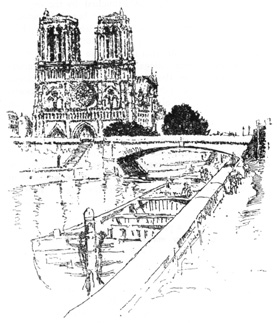
Notre Dame and Petit Pont.
View larger image
There was no discipline or college life among the earliest students.
Each master, having obtained his license from the bishop's chancellor,
rented a room at his own cost, and taught what he knew—even, it was
sometimes complained, what he did not know. We read of one Adam du
Petit Pont, who, in the twelfth century, expounded Aristotle in the
back-room of a house on the bridge amid the cackle of cocks and hens,
and whose clientèle had many a vituperative contest with the
fish-fags of the neighbourhood. The students grouped themselves
according to nationalities, and with their masters held meetings in
any available cloister, refectory, or church. When funds were needed,
a general levy was made and any balance that remained was spent in a
festive gathering in the nearest tavern. The aggregation of thousands
of young men, some of whom were cosmopolitan vagabonds, gave rise to
many evils. Complaints are frequent among the citizens of the
depredations and immoralities of riotous clercs, who lived by their
wits or by their nimble fingers, or by reciting or singing licentious
ballads:—the paouvres escolliers, whose miserable estate,
temptations, debauchery, ignoble pleasures, remorse and degradation
have been so pathetically sung by François Villon, master of arts,
poet, bohemian, burglar and homicide. The richer scholars often
indulged in excesses, and of the vast majority who were poor, some
died of hunger. It was the spectacle of half-starving clercs begging
for bread that evoked the compassion of pious founders of colleges,
which originally were simply hostels for needy scholars. On the return
of Louis VII. from a pilgrimage to Becket's shrine, his brother Robert
founded about 1180 the church of St. Thomas of Canterbury and a hostel
for fifteen students, who, in 1217, were endowed with a chapel of
their own, dedicated to St. Nicholas, and were then known as the poor
scholars of St. Nicholas.[67] In 1171 a London merchant (Jocius de
Londonne), passing through Paris on his return from the Holy Land,
touched by the sight of some starving students begging their bread,
founded a hostel for eighteen poor scholars at the Hôtel Dieu, who in
return for lodging and maintenance were to perform the last Christian
rites to the friendless dead. This, known as the college of the
Dix-huit, was afterwards absorbed in the Sorbonne. In 1200 Étienne
Belot and his wife, burgesses of Paris, founded a hostel for thirteen
poor scholars who were known as the bons enfants. In all, some dozen
colleges were in being when St. Louis came to the throne. In 1253, St.
Louis' almoner, Robert of Cerbon or Sorbon, a poor Picardy village,
founded[68] a modest college of theology, and obtained from Blanche of
Castile a small house above the palace of the Thermæ where he was able
to maintain a few poor students of theology. Friends came to his aid
and soon sixteen were accommodated, to whom others, able to maintain
themselves, were added. In 1269 a papal bull confirmed the
establishment of the pauvres maistres estudiants in the faculty of
theology at Paris. Even when enriched by later founders it was still
called la pauvre Sorbonne. By the renown of their erudition the
doctors of the Sorbonne became the great court of appeal in the Middle
Ages in matters of theology, and the Sorbonne synonymous with the
university. Some of the hostels were on a larger scale. The college of
Cardinal Lemoine, founded in 1302 by the papal legate, housed sixty
students in arts and forty in theology. Most were paying residents,
but a number of bursaries were provided for those whose incomes were
below a certain amount. Each boursier was given daily two loaves of
white bread of twelve ounces, "the common weight in the windows of
Paris bakers."
In 1304, Jeanne of Navarre, wife of Philip the Fair, left her mansion
near the Tour de Nesle and 2000 livres annually to found the college
of Navarre for seventy poor scholars, twenty in grammar, thirty in
philosophy, and twenty in theology. The first were allowed four sous
weekly; the second, six; the third, eight. If any were possessed of
annual incomes respectively of thirty, forty and sixty livres, they
ceased to hold bursaries. The maintenance fund seems, however, to have
been mismanaged, for we soon read of the scholars of the college
walking the streets of Paris every morning crying—"Bread, bread, good
people, for the poor scholars of Madame of Navarre!"
Some forty colleges were in existence by the end of the fourteenth
century and had increased to fifty by the end of the fifteenth; in the
seventeenth, Evelyn gives their number as sixty-five. In Félibien's
time some had disappeared, for in his map (1725) forty-four colleges
only are marked. Nearly the whole of these colleges clustered around
the slopes of Mont St. Genevieve, which at length became that
Christian Athens that Charlemagne dreamt of. Each college had its own
rules. Generally students were required to attend matins (in summer at
3 a.m., winter at 4), mass, vespers and compline. When the curfew of
Notre Dame sounded, they retired to their dormitories. Leave to sleep
out was granted only in very exceptional cases. Tennis was allowed,
cards and dice were forbidden. The college of Montaigu, founded in
1314 by Archbishop Gilles de Montaigu, housed eighty-two poor scholars
in memory of the twelve apostles and seventy disciples. There the rod
was never spared to the fainéant; the discipline so severe, that the
college became the terror of the youth of Paris, and fathers were wont
to sober their libertine sons by threatening to make capetes[69] of
them. This was the Collège de Pouillerye denounced by Rabelais and
notorious to students as the Collège des Haricots, because they were
fed there chiefly on beans. Erasmus was a poor boursier there,
disgusted at its mean fare and squalor, and Calvin, known as the
"accusative," from his austere piety. Desmoulins, the inaugurator of
the Revolution, and St. Just, its fiery and immaculate apostle, sat on
its benches. To obtain admission to the college of Cluny (1269) the
scholar must pass an entrance examination. He then spent two years at
logic, three at metaphysics, two in Biblical studies; he held weekly
disputations and preached every fortnight in French; he was
interrogated every evening by the president on his studies during the
day. If students evinced no aptitude for learning they were dismissed;
if only moderate progress were made, the secular duties of the college
devolved upon them. It was the foundation of these colleges which
organised themselves, about 1200, into powerful corporations of
masters and scholars (universitates magistrorum et scholiarum) that
gave the university its definite character.
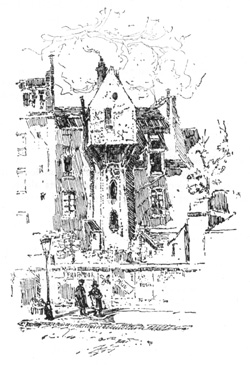
Tower in Rue Valette in which
Calvin is said to have lived.
View larger image
When the term "university" first came into use is unknown. It is met
with in the statutes (1215) which, among other matters, define the
limits of age for teaching. A master in the arts must not lecture
under twenty-one; of theology under thirty-five. Every master must
undergo an examination as to qualification and moral fitness at the
Episcopal Chancellor's Court. Early in the twelfth century the four
faculties of Law, Medicine, Arts and Theology were formed and the
national groups reduced to four: French, Picards, Normans and English.
Each group elected its own officers, and in 1245 at latest the Quatre
Nations were meeting in the church of St. Julien le Pauvre to choose
a common head or rector, who soon superseded the chancellor as head
of the university. The rectors in process of time exercised almost
sovereign authority in the Latin Quarter; they ruled a population of
ten thousand masters and students, who were exempt from civic
jurisdiction. In 1200 some German students ill-treated an innkeeper
who had insulted their servant. The provost of Paris and some armed
citizens attacked the students' houses and blood was shed, whereupon
the masters of the schools complained to the king, who was fierce in
his anger, and ordered the provost and his accomplices to be cast into
prison, their houses demolished and vines uprooted. The provost was
given the choice of imprisonment for life or the ordeal by water. Then
followed a series of ordinances which abolished secular jurisdiction
over the students and made them subject to ecclesiastical courts
alone.
In the reign of Philip le Bel a provost of Paris dared to hang a
scholar. The rector immediately closed all classes until reparation
was made, and on the Feast of the Nativity of the Virgin the curés
of Paris assembled and went in procession, bearing a cross and holy
water to the provost's house, against which each cast a stone, crying,
in a loud voice—"Make honourable reparation, thou cursed Satan, to
thy mother Holy Church, whose privileges thou hast injured, or suffer
the fate of Dathan and Abiram." The king dismissed his provost, caused
ample compensation to be made, and the schools were reopened.
The famous Petit Pré aux Clercs (Clerks' Meadow) was the theatre of
many a fight with the powerful abbots of St. Germain des Prés.[70]
From earliest times the students had been wont to take the air in the
meadow, which lay between the monastery and the river, and soon
claimed the privilege as an acquired right. In 1192 the inhabitants of
the monastic suburb resented their insolence, and a free fight ensued,
in which several scholars were wounded and one was killed. The rector
inculpated the abbot, and each appealed to Rome, with what result is
unknown. After nearly a century of strained relations and minor
troubles, Abbot Gerard in 1278 had walls and other buildings erected
on the way to the meadow: the scholars met in force and demolished
them. The abbot, who was equal to the occasion, rang his bells, called
his vassals to arms and sent a force to seize the gates of the city
that gave on the suburb, to prevent reinforcements reaching the
scholars; his retainers then attacked the rioters, killed several and
wounded many. The rector complained to the papal legate and threatened
to close the schools if reparation were not made and justice done
within fifteen days, whereupon the legate ordered the provost of the
monastery to be expelled for five years. The royal council forced the
abbot to exile ten of his vassals, to endow two chantries for the
repose of the souls of slain clercs and compensate their fathers by
fines of two hundred and four hundred livres respectively, and to pay
the rector two hundred livres to be distributed among poor scholars.
In 1345 another bloody fight took place between the monks and the
scholars over the right to fish there.
Many circumstances contributed to make Paris the capital of the
intellectual world in the twelfth and thirteenth centuries. France has
ever been the home of great enthusiasms and has not feared to "follow
where airy voices lead." The conception and enforcement of a Truce of
God (Trève de Dieu) whereby all acts of hostility in private or
public wars ceased during certain days of the week or on church
festivals; the noble ideal of Christian chivalry; the first
crusade—all had their origin in France. The crusaders carried the
prestige of the French name and diffused the French idiom over Europe.
It was a French monk preaching in France who gave voice to the general
enthusiasm; a French pope approved his impassioned oration; a French
shout "Dieu le veut" became the crusader's war-cry. The conquest of
the Holy Land was organised by the French, its first Christian king
was a French knight, its laws were indited in French, and to this day
every Christian in the East is a Frank whatever tongue he may speak.
The French jurists were famed for their supreme excellence all over
Western Europe. In the thirteenth century Brunette Latini wrote his
most famous work, the Livres dou Trésor, in French, because it was
la parleure plus delitable, il plus commune à toutes gens ("the most
delightful of languages and the most common to all peoples"). Martin
da Canale composed his story of Venice in French for the same reason,
and Marco Polo dictated his travels in French in a Genoese prison.
When St. Francis was sending the brothers to establish the order in
distant lands, he himself chose France, but was dissuaded by his
friend, Cardinal Ugolin. "When inebriated with love and compassion for
Christ," says the writer of the Speculum, "and overflowing with
sweetest melody of the Spirit, ofttimes would he find utterance in the
French tongue; the strains of the divine whisperings which his ear had
caught he would express in a French song of joyous exultation, and
making the gestures of one playing a viol, he would sing in French of
our Lord Jesus Christ."
Never in the history of civilisation were men possessed with such
passion for the spiritual life or such faith in the reasoning faculty
as in the thirteenth century in Paris. The holiest mysteries were
analysed and defined; everywhere was a search for new things.
Conservative Churchmen became alarmed and complained of disputants and
blasphemers exercising their wits at every street corner. The four
camel-loads of manuscripts, the works and commentaries of Aristotle,
brought by the Jews from Spain—a monstrous and mutilated version
translated from Greek into Arabic and from Arabic into Latin—became
the battle-ground of the schools. The Church at first forbade the
study of Aristotle, then by the genius of Aquinas, Christianised and
absorbed him; his works became a kind of intellectual tennis-ball
bandied between the Averroists, who carried their teachings to a
logical consequence, and the more orthodox followers of Aquinas. For
three years the faculty was torn asunder by the rival factions. Siger
of Brabant, whose eternal light Dante saw refulgent amid other doctors
of the Church in the heaven of the Sun, was an Averroist; Siger —
"Che leggendo nel vico degli strami
Sillogizzò invidiosi veri."[71]
The Rue du Fouarre (Straw), where Siger taught and perhaps Dante
studied was the street of the Masters of the Arts. Every house in it
was a hostel for scholars or a school. It was in the Rue du Fouarre
that Pantagruel "held dispute against all the regents, professors of
arts and orators and did so gallantly that he overthrew them all and
set them all upon their tails." The street still exists, though wholly
modernised, opposite the foot of the Petit Pont. Its name has been
derived from the straw spread on the floor of the schools or on which
the students sat, but there is little doubt that Benvenuto da
Imola's[72] explanation, that it was so named from a hay and straw
market held there, is the correct one.
The wonderful thirteenth century saw the meridian glory of the
university. It was the age of the great Aristotelian schoolmen who all
taught at Paris—Albertus Magnus, St. Thomas Aquinas, Duns Scotus and
Roger Bacon, their candid critic, who carried the intellectual
curiosity of the age beyond the tolerance of his Franciscan superiors
and twice suffered disciplinary measures at Paris.
In the fourteenth century the university of Paris was as renowned as
ever. Among many tributes from great scholars we choose that of
Richard de Bury, bishop of Durham, who in his Philobiblon writes: "O
Holy God of gods in Zion, what a mighty stream of joy made glad our
hearts whenever we had leisure to visit Paris, the Paradise of the
world, and to linger there; where the days seemed ever few for the
greatness of our love! There are delightful libraries more aromatic
than stores of spicery; there are luxuriant parks of all manners of
volumes; there are Academic meads shaken by the tramp of scholars;
there are lounges of Athens; walks of the Peripatetics; peaks of
Parnassus; and porches of the Stoics. There is seen the surveyor of
all arts and sciences Aristotle, to whom belongs all that is most
excellent in doctrine, so far as relates to this passing sublunary
world; there Ptolemy measures epicycles and eccentric apogees and the
nodes of the planets by figures and numbers; there Paul reveals the
mysteries; there his neighbour Dionysius arranges and distinguishes
the hierarchies; there the virgin Carmentis reproduces in Latin
characters all that Cadmus collected in Phœnician letters; there
indeed opening our treasures and unfastening our purse-strings we
scattered money with joyous heart and purchased inestimable books with
mud and sand."
In 1349 the number of professors (maistres-regents) on the rolls was
502; in 1403 they had increased to 709, to which must be added more
than 200 masters of theology and canon law. "The University," wrote
Pope Alexander IV. in a papal bull, "is to the Church what the tree of
life was to the earthly Paradise, a fruitful source of all learning,
diffusing its wisdom over the whole universe; there the mind is
enlighted and ignorance banished and Jesus Christ gives to His spouse
an eloquence which confounds all her enemies."
But decadence soon ensued. The multiplication and enrichment of
colleges proved fatal to the old democratic vigour and equality. Some
colleges pretended to superiority and the movement lost its unity.
Scholasticism had done its work and no new movement took its place.
Teachers lost all originality and did but ruminate and comment on the
works of their great predecessors. Schools declined in numbers,
scholars in attendance and ordinances were needed to correct the
abuses covered by the title of scholar. The Jacobin and Cordelier
teachers, moreover, had exhausted much life from the university; but
its fame continued, and Luther in his early conflicts with the papacy
appealed against the pope to the university of Paris. But it made the
fatal blunder of opposing the Reform and the Renaissance, instead of
absorbing them, and the interest of those great movements centres
around the college of France.
In the general decay, however, the Jesuit College of Clermont, known
later as of Louis le Grand, stood forth renowned and exuberant. During
the seventeenth and eighteenth centuries, the erudition of its
teachers, their excellent method and admirable discipline, made it the
premier college of Paris and in the heyday of its fame five hundred
scholars crowded its halls, among them the scions of the nobility of
France. Towards the end of the eighteenth century the university had
its seat in the college and concentrated there the endowments, or such
as had escaped spoliation, of twenty-six suppressed colleges. The
college of Louis le Grand and nine others of the multitude that
clustered around the hill of St. Genevieve, were all that survived
when the Revolution burst forth, and it is not without interest to
note that on 19th June 1781, the central body sitting at the famous
Jesuit college unanimously awarded a prize of six hundred livres to a
poor young boursier of the college of Arras, named Louis François
Maximilian Marie Robespierre, for twelve years of exemplary conduct
and of success in examinations and competitions.
Before we close this chapter a word of acknowledgment is due to the
mediæval church in Paris for her careful fostering of elementary
education. By the Taille of 1292 already referred to, we learn that
schools for children of both sexes were distributed nearly over the
whole of the city radiating from the mother church of Notre Dame. At
the beginning of the fifteenth century twenty-one parishes had one or
two of these schools; in 1449 a thousand schoolboys took part in a
procession to Notre Dame to render thanks for the recovery of
Normandy. The Church inspected the sanitary condition of the schools
and exacted a standard of proficiency for the qualification of masters
and mistresses.
Conflict with Boniface VIII.—The States-General—The
Destruction of the Knights-Templars—The Parlement
In 1302 the eyes of Europe were again drawn to Paris where the Fourth
Philip, surnamed the Fair, a prince who, in Dante's grim metaphor,
scourged the shameless harlot of Rome from head to foot, and dragged
her to do his will in France, was grappling with the great pontiff,
Boniface VIII.—the most resolute upholder of the papacy in her claim
to universal secular supremacy—and essaying a task which had baffled
the mighty emperors themselves.
The king knowing he had embarked on a struggle in which the greatest
potentates had been worsted, determined to appeal to the patriotism of
all classes of his subjects and fortify himself on the broad basis of
such popular opinion as then existed. For the first time the
States-General were summoned, after the burning of the papal bull in
Paris on the memorable Sunday of 11th February 1302. Their meeting
marks an epoch in French history, and for the first time members of
the Tiers État (the third estate, or commons), sat beside the
privileged orders of clergy and nobles, and were recognised as one of
the legitimate orders of the realm. The assembly was convoked to meet
in Notre Dame on the 10th of April. The question was the old one
which had rent Christendom asunder for centuries: Was the pope at Rome
to be supreme over the princes and peoples of the earth in secular as
well as in spiritual matters? The utmost enthusiasm prevailed, and
though the prelates spoke with a somewhat timid voice, the assembled
members swore to risk their lives and property rather than sacrifice
the honour of the crown and their own liberties to the insolent
usurpation of Rome. Excommunication followed, but Philip had ordered
all the passes from Italy to be guarded, so that no papal letter or
messenger should enter France. "Boniface, who," says Villani, the
Florentine chronicler, "was proud and scornful, and bold to attempt
every great deed, magnanimous and puissant," replied by announcing the
publication of a bull deposing the king from his throne and releasing
his subjects from their allegiance. Philip at an assembly in the
garden of the palace in the Cité, and in presence of the chief
ecclesiastical, religious and lay authorities, again laid his case
before the people and read an appeal against the pope to a future
Council of the Church.
The bull of deposition was to be promulgated on 8th September. On the
7th, while the aged pope was peacefully resting at his native city of
Anagni, Guillaume de Nogaret, Philip's minister, bearing the royal
banner of France, Sciarra Colonna and other disaffected Italian
nobles, with three hundred horsemen, flung themselves into Anagni,
crying—"Death to Pope Boniface." The papal palace was unguarded: at
the first alarm the cardinals fled and hid themselves, and all but a
few faithful servants forsook their master. The defenceless pope
believed that his hour was come, but, writes Villani, "Great-souled
and valiant as he was, he said, 'Since like Jesus Christ I must be
taken by treachery and suffer death, at least I will die like a pope.'
He commanded his servants to robe him in the mantle of Peter, to
place the crown of Constantine on his head and the keys and crozier in
his hands." He ascended the papal throne and calmly waited. Guillaume,
Sciarra and the other leaders burst into the apartment, sword in hand,
uttering the foulest of insults; but awed and cowed by the indomitable
old pontiff, who stood erect in appalling majesty, their weapons
dropped as though their hands were palsied and none durst offend him.
They set a guard outside the room and proceeded to loot the palace.
For three days the grand old pope—he was eighty-six years of
age—remained a prisoner, until the people of Anagni rallied and
rescued him, and he returned to Rome. In a month the humiliated
Boniface died of a broken heart, and before two years were passed his
successor in Peter's chair, Pope Clement V., revoked all his bulls and
censures, expunged them from the papal register, solemnly condemned
his memory and restored the Colonna family to all their honours.
Dante, who hated Boniface as cordially as Philip did, and cast him
into hell, was yet revolted at the cruelty of the "new Pilate, who had
carried the fleur-de-lys into Anagni, who made Christ captive, mocked
Him a second time, renewed the gall and vinegar, and slew Him between
two living thieves." But the "new Pilate was not yet sated." The
business at Anagni had only been effected spendendo molta moneta;
the disastrous battle of Courtrai and the inglorious Flemish wars had
exhausted the royal treasury; and the debasement of the coinage
availing nought, Philip turned his lustful eyes on a once powerful lay
order, whose chief seat was at Paris and whose wealth and pride were
the talk of Christendom.
After the capture of Jerusalem and the establishment there of a
Christian kingdom, pilgrims flocked to the holy places. Soon, however,
piteous stories reached Jerusalem of the cruel spoliation and murder
of unarmed pilgrims, on their journey from the coast, by hordes of
roving lightly-armed Bedouins, against whom the heavily-armed Franks
were powerless. The evil was growing well-nigh intolerable when, in
1118, two young French nobles, Hugh of Payens and Godfrey of St. Omer,
with other seven youths of highest birth, bound themselves into a lay
community, with the object of protecting the pilgrims' way. They took
the usual vows of poverty, charity and obedience; St. Bernard drew up
their Rule—and we may be sure it was austere enough—pope and
patriarch confirmed it. Their garb was a mantle of purest white linen
with a red cross embroidered on the shoulder. The order was housed in
a wing of the palace, which was built on the site of Solomon's Temple,
hard by the Holy Sepulchre, and its members called themselves the Poor
Soldiers of Christ and of Solomon's Temple. Their banner, half of
black, half of white, was inscribed with the device "non nobis
Domine." Their battle-cry "Beauceant," and their seal, two figures on
horseback, have not been satisfactorily interpreted—the latter
probably portrays a knight riding away with a rescued pilgrim. Soon
the little band of nine was joined by hundreds of devoted youths from
rich and noble families; endowments to provide them with arms and
horses and servants flowed in, and thus was formed the most famous,
the purest and the most heroic body of warriors the world has ever
seen. Hugh de Payens had gathered three hundred Knights-Templars
around him at Jerusalem: in five years nearly every one had been slain
in battle. But enthusiasm filled the ranks faster than they were mowed
down: none ever surrendered and the order paid no money for ransom.
When hemmed in by overwhelming numbers, they fought till the last man
fell, or died, a wounded captive, in the hands of the Saracens. Of
the twenty-two Grand Masters, seven were killed in battle, five died
of wounds, and one of voluntary starvation in the hands of the
infidel.
When Acre was lost, and the last hold of the Christians in the Holy
Land was wrested from them, only ten Knights-Templars of the five
hundred who fought there escaped to Cyprus. They chose Jacques de
Molay for Grand Master, replenished their treasury and renewed their
members; but their mission was gone for ever. The order was exempt
from episcopal jurisdiction and subject to the pope alone; its wealth,
courage and devotion were rusting for lack of employment. Boniface
VIII., with that grandeur and daring which make of him, despite his
faults, so magnificent a figure in history, conceived the idea of
uniting them with the other military orders—the Hospitallers and the
Teutonic Knights—and making of the united orders an invincible army
to enforce on Europe the decrees of a benevolent and theocratic
despotism. They soon became suspected and hated by bishops and kings
alike, and at length were betrayed by the papacy itself to their
enemies.
In 1304, a pair of renegade Templars,[73] who for their crimes were
under sentence of imprisonment for life in the prison at Toulouse,
sought an introduction to the king, and promised in return for their
liberty to give information of certain monstrous crimes and sacrileges
of common and notorious occurrence in the order. Depositions were
taken and sent to Philip's creature, Pope Clement V. Some
communication passed between them, but no action was taken and the
matter seemed to have lapsed. About a year after these events the
pope wrote an affectionate letter to Jacques de Molay, inviting him to
bring the treasure of the order and his chief officers to France, to
confer with himself and the king respecting a new crusade. Jacques and
his companions, suspecting nothing, came and were received by pope and
king with great friendliness: the treasure, twelve mules' load of gold
and silver, was stored in the vaults of the great fortress of the
Templars at Paris. Some rumours reached de Molay of the delation made
by the Toulousian prisoners, but the pope reassured him in an
interview, April 1307, and lulled him into security. On 14th September
of the same year the royal officers of the realm were ordered to hold
themselves armed for secret service on 12th October, and sealed
letters were handed to them to be opened that night. At dawn on the
13th, all the Templars in France were arrested in their beds and flung
into the episcopal gaols, and the bishops then proceeded to "examine"
the prisoners. One hundred and forty were dealt with in Paris, the
centre of the order. The charges and a confession of their truth by
the Grand Master were read to them; denial, they were told, was
useless: liberty would be the reward of confession, imprisonment the
penalty of denial.
A few confessed and were set free. The remainder were "examined."
Starvation and torture of the most incredible ferocity did their work.
Thirty-six died under the rack in Paris, and many more in other
places; most of the remainder confessed to anything the inquisitors
required. Clement, warned by the growing feeling in Europe, now became
alarmed, and the next act in the drama opens at the abbey of St.
Genevieve in Paris, where a papal commission sat to hear what the
Templars had to say in their defence. All were invited to give
evidence and promised immunity in the name of the pope. Hundreds came
to Paris to defend their order,[74] but having been made to understand
by the bishops that they would be burned as heretics if they retracted
their confessions, they held back for a time until solemnly assured by
the papal commissioners that they had nothing to fear, and might
freely speak. Ponzardus de Gysiaco, preceptor of Payens, then came
forward and disclosed the atrocious means used to extort confessions,
and said if he were so tortured again he would confess anything that
were demanded of him; he would face death, however horrible, even by
boiling and fire, in defence of his order, but long-protracted and
agonising torture was beyond human endurance. Ponzardus was sent back
to confinement and the warders were bidden to see that he suffered
naught for what he had said. The rugged old master, Jacques de Molay,
scarred by honourable wounds, the marks of many a battle with the
infidel, was brought before the court and his alleged confession read
to him. He was stupefied, and swore that if his enemies were not
priests he would know how to deal with them. A second time he was
examined and preposterous charges of unnatural crimes were preferred
against the order by the king's chancellor, Guillaume de Nogaret. They
were drawn from a chronicle at St. Denis, and based on certain
statements alleged to have been made by Saladin, Sultan of Babylon
(Egypt). Again he was stupefied, and declared he had never heard of
such things. And now the Templars' courage rose. Two hundred and
thirty-one came forward, emaciated, racked and torn; among them one
poor wretch was carried in, whose feet had been burnt by slow
fires.[75] Nearly all protested that the confessions had been wrung
from them by torture, that their accusers were perjurers, and that
they would maintain the purity of their order usque ad mortem ("even
unto death"). Many complained that they were poor, illiterate
soldiers, neither able to pay for legal defence nor to comprehend the
charges indicted in Latin against them. It was Philip's turn now to be
alarmed, but the prelates were equal to the crisis. The archbishop of
Sens, metropolitan of Paris and brother of the king's chief adviser,
convoked a provincial court at his palace in Paris, and condemned to
the stake fifty-four of the Knights who had retracted their
confessions. On the 10th of May the papal commissioners were appealed
to: they expressed their sorrow that the episcopal court was beyond
their jurisdiction, but would consider what might be done. Short time
was allowed them. The stout-hearted archbishop was not a man to show
weakness; he went steadily on with his work, and in spite of appeals
from the papal judges for delay, the fifty-four were led forth on the
afternoon of the 12th[76] to the open country outside the Porte St.
Antoine, near the convent of St. Antoine des Champs, and slowly
roasted to death. They bore their fate with the constancy of martyrs,
each protesting his innocence with his last breath, and declaring
that the charges alleged against the order were false. Two days later,
six more were sent to the stake at the Place de Grève. In spite of
threats, the prelates went on with their grim work of terror. Many of
the bravest Templars still gave the lie to their traducers, but the
majority were cowed; further confessions were obtained, and the pope
was satisfied. The proudest, bravest and richest order in Christendom
was crushed or scattered to the four corners of the world; their vast
estates were nominally confiscated to the Knights Hospitallers. But
our "most dear brother in Christ, Philip the king, although he was not
moved by avarice nor intended the appropriation of the Templars'
goods"[77] had to be compensated for the expense of the prosecution:
the treasure of the order failed to satisfy the exorbitant claims of
the crown, and the Hospitallers were said to have been impoverished
rather than enriched by the transfer.
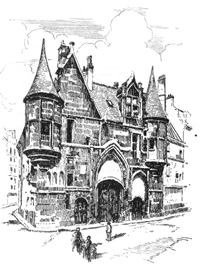
Palace of The Archbishop of Sens.
View larger image
The last act was yet to come. On 11th March 1314, a great stage was
erected in the parvis of Notre Dame, and there, in chairs of state,
sat the pope's envoy, a cardinal, the archbishop of Sens, and other
officers of Christ's Church on earth. The Grand Master, Jacques de
Molay, and three preceptors were exposed to the people; their alleged
confession and the papal bull suppressing the order, and condemning
them to imprisonment for life, were read by the cardinal. But, to the
amazement of his Eminence, when the clauses specifying the enormities
to which the accused had confessed were being recited, the veteran
Master and the preceptor of Normandy rose, and in loud voices, heard
of all the people, repudiated the confession, and declared that they
were wholly guiltless, and ready to suffer death. They had not long to
wait. Hurried counsel was held with the king, and that same night
Jacques de Molay and the preceptor of Normandy were brought to a
little island on the Seine, known as the Isle of the Trellises,[78]
and burnt to death, protesting their innocence to the last.
"God pays debts, but not in money." An Italian chronicler relates that
the Master, while expiring in the flames, solemnly cited pope and king
to meet him before the judgment-seat of God. In less than forty days
Clement V. lay dead: in eight months Philip IV. was thrown by his
horse. Seven centuries later the grisly fortress of the Templars
opened its portals, and the last of the unbroken line of the kings of
France was led forth to a bloody death.
Those who would read the details of the dramatic examination at Paris
before the papal commissioners, may do so in the minutes published by
Michelet.[79] The great historian declares that a study of the
evidence shook his belief in the Templars' innocence, and that if he
were writing his history again, he must needs alter his attitude
towards them. Such is not the impression left on the mind of the
present writer. Moreover it has been pointed out that there is a
suspicious identity in the various groups of testimonies,
corresponding to the episcopal courts whence such testimonies came.
The royal officers, after the severest search, could find not a single
compromising document in the Templars' houses, nothing but a few
account books, works of devotion and copies of St. Bernard's Rule.
There were undoubtedly unworthy and vicious knights among the fifteen
thousand Templars belonging to the order, but the charges brought
against them are too monstrous for belief. The call which they had
responded to so nobly, however, had long ceased. They were wealthy,
proud and self-absorbed. Sooner or later they must infallibly have
gone the way of all organisations which have outlived their use and
purpose. It is the infamy of their violent destruction for which pope
and king must answer at the bar of history.
Philip's reign is also remarkable for the establishment of the
Parlement in Paris. From earliest times of the Monarchy, the kings had
dispensed justice, surrounded by the chief Churchmen and nobles of the
land, thus constituting an ambulatory tribunal which was held wherever
the sovereign might happen to be. In 1302 Philip restricted it to
judicial functions, and housed it in his palace of the Cité, which on
the kings ceasing to dwell there in 1431 became the Palais de Justice.
The ancient palace was rebuilt and enlarged by Philip. A vast hall
with a double barrel-roof decorated with azure and gold, supported by
a central row of columns adorned with statues of the kings of
France—the most spacious and most beautiful Gothic chamber in
France—and other courts and offices accommodated the Parlement. The
tribunal was at first composed of twenty-six councillors or judges, of
whom thirteen were lawyers, presided over by the royal chancellor, and
sat twice yearly for periods of two months. It consisted of three
chambers or courts.[80] The nobles who at first sat among the lay
members gradually ceased to attend owing to a sense of their legal
inefficiency, and the Parlement became at length a purely legal body.
During the imprisonment of John the Good in England, the
Parlement[81]
sat en permanence, and henceforth became the cour
souveraine et capitale of the kingdom. The purity of its members was
maintained by severest penalties. In 1336 one of the presidents was
convicted of receiving bribes and hanged. Twelve years later the
falsification of some depositions was punished with the same severity,
and in 1545 a corrupt chancellor was fined 100,000 livres, degraded,
and imprisoned for five years. The chief executive officer of the
Parlement, known as the Concierge, appointed the bailiffs of the court
and had extensive local jurisdiction over dishonest merchants and
craftsmen, whose goods he could burn. His official residence, known as
the Conciergerie, subsequently became a prison, and so remains to this
day. The entrance flanked by the two ancient tours de César et
d'Argent, is one of the most familiar objects in Paris. There the
Count of Armagnac was assassinated and the cells are still shown where
Marie Antoinette, Madame Roland, and many of the chief victims of the
Terror were lodged before their execution; where Danton, Hébert,
Chaumette, and Robespierre followed each other in one self-same
chamber.
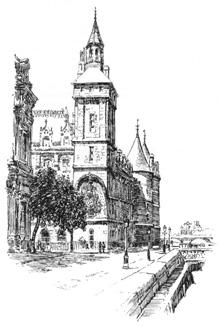
Palais de Justice, Clock Tower and Conciergerie.
View larger image
Étienne Marcel—the English Invasions—The
Maillotins—Murder of the Duke of Orleans—Armagnacs and Burgundians
With the three sons of Philip who successively became kings of France,
the direct line of the Capetian dynasty ends: with the accession of
Philip VI. in 1328, the house of Valois opens the sad century of the
English wars—a period of humiliation and defeat, of rebellious and
treacherous princes, civil strife, famine and plague, illumined only
by the heroism of a peasant-girl, who, when king and nobles were sunk
in shameless apathy or sullen despair, saved France from utter
extinction. Pope after pope sought to make peace, but in vain: Hui
sont en paix, demain en guerre ("to-day peace, to-morrow war") was
the normal and inevitable situation until the English had wholly
subjected France or the French driven the English to their natural
boundary of the Channel.
Never since the days of Charlemagne had the French Monarchy been so
powerful as when the Valois came to the throne: in less than a
generation Crecy and Poitiers had made the English name a terror in
France, and a French king, John the Good, was led captive to England.
In 1346 Paris saw her faubourgs wasted, the palace of St. Germain
and the fortress of Montjoie St. Denis[82] spoiled and burnt, and the
English camp fires nightly glowing. Once again, as in the dark Norman
times, she rose and determined to save herself. Étienne Marcel, the
leader of the movement, whose statue now stands near the site of the
Maison aux Piliers was a rich merchant prince of old family, a member
of the great drapers' guild, and elected Provost of the Marchands
d'Eau in 1355. He it was who bought for 2400 florins of gold the
Maison des Dauphins, better known as the Maison aux Piliers or Hôtel
de Ville, on the Place de Grève and transferred thither the seat of
the civic administration from the old Parloir aux Bourgeois, enclosed
in the south wall of Paris. The Dauphin,[83] who had assumed the title
of Lieutenant-General, convoked the States-General at Paris, but he
was forced by Marcel and his party to grant some urgent reforms, and a
Committee of National Defence was organised by the trade guilds and
the provost, who became virtually dictator of Paris. Marcel's rule was
however stained by the butchery of the Marshal of Champagne and the
Duke of Normandy before the very eyes of the Dauphin in the palace of
the Cité, who, horrified, fled to Compiègne to rally the nobles.
During the ensuing anarchy the poor, dumb, starving serfs of France,
in their hopeless misery and despair, rose in insurrection and swept
like a flame over the land. Froissart, who writes from the distorted
stories told him by the seigneurs, has woefully exaggerated the
atrocities of the Jacquerie."[84] There was much arson and pillage,
but barely thirty of the nobles are known to have perished. Of the
merciless vengeance taken by the seigneurs there is ample
confirmation: the wretched peasants were easily out-manœuvred and
killed like rats by the mail-clad nobles and their men-at-arms.
Meanwhile the Dauphin was marching on Paris: Marcel seized the Louvre
and set 3000 workmen to fortify the city. In less than a year the
greater part of the northern walls, with gates, bastilles and fosses,
was completed—the greatest feat, says Froissart, the provost ever
achieved. A citizen army was raised, whose hoods of red and blue, the
colours of Paris, distinguished them from the royal sympathisers.
Marcel turned for support to the Jacques, and on their suppression
essayed to win over Charles of Navarre. On 30th November 1357, Charles
stood on the royal stage on the walls of the abbey of St. Germain des
Prés, whence the kings of France were wont to witness the judicial
combats in the Prés aux Clercs, and addressed an assembly of 10,000
citizens. Moult longuement he sermonised, says the Grandes
Chroniques, so that dinner was over in Paris before he finished.
After yet another harangue at the Maison aux Piliers on 15th June
1358, he was acclaimed by people with "Navarre! Navarre!" and elected
the Captain of Paris. An obscure period of plot and counterplot
followed which culminated in the ruin of Marcel and his followers.
Froissart accuses the provost of a treacherous intent to open the
gates of St. Honoré and of St. Antoine to Navarre's English
mercenaries at midnight on 31st July, and gives a dramatic story of
the discovery of the plot and slaying of the provost by Jean Maillart,
his friend and associate. We supplement his version from the Chronicle
of St. Denis: on the last day of July, Marcel and his suite repaired
to the bastille of St. Denis and ordered the guards to surrender the
keys to Charles of Navarre's treasurer. Maillart, who had been won
over by the Dauphin, had preceded him. The guard refused to hand over
the keys and an angry altercation ensued between the former friends.
Maillart mounted horse, seized a royal banner, sped to the Halles and
to the cry of "Montjoie St. Denis!" called the royal partizans to
arms: a similar appeal was made by Pepin des Essards. Meanwhile Marcel
had reached the bastille of St. Antoine, where he was met by Maillart
and the royal partizans. "Stephen, Stephen!" cried the latter, "what
dost thou here at this hour?" "I am here," answered the provost, "to
guard the city whose governor I am." "Par Dieu," retorted Maillart,
"thou art here for no good," and turning to his followers, said,
"Behold the keys which he holds to the destruction of the city." Each
gave the other the lie. "Good people," protested Marcel, "why would
you do me ill? All I wrought was for your good as well as mine."
Maillart for answer smote at him, crying, "Traitor, à mort, à mort!"
There was a stubborn fight, and Maillart felled the provost by a blow
with his axe; six of the provost's companions were slain, and the
remainder haled to prison. Next day the Dauphin entered Paris in
triumph, and the popular leaders were executed on the Place de Grève.
The provost's body was dragged to the court of the church of St.
Catherine du Val des Écoliers, naked, that it might be seen of all, on
the very spot where the bodies of the Marshal of Champagne and the
Duke of Normandy had been flung six months before: after a long
exposure it was cast into the Seine. All the reforms were revoked by
the king, but the remembrance of the time when the merchants and
people of Paris had dared to speak to their royal lord face to face of
justice and good government, was never obliterated.
Next year the English peril again threatened Paris. The invasion of
1359 resembled a huge picnic or hunting expedition. The king of
England and his barons brought their hunters, falcons, dogs and
fishing tackle. They marched leisurely to Bourg la Reine, less than
two leagues from Paris, pillaged the surrounding country and turned to
Chartres, where tempest and sickness forced Edward III. to come to
terms. After the treaty of Bretigny, in 1360, the Parisians saw their
good King John again, who was ransomed for a sum equal to about ten
million pounds of present-day value. The memory of this and other
enormous ransoms exacted by the English, endured for centuries, and
when a Frenchman had paid his creditors he would say,—j'ai payé mes
Anglais.[85] ("I have paid my English.") A magnificent reception was
accorded to the four English barons who came to sign the Peace at
Paris. They were taken to the Sainte Chapelle and shown the fairest
relics and richest jewels in the world, and each was given a spine
from the crown of thorns, which he deemed the noblest jewel that could
be presented to him.
The Dauphin, who on the death of good King John in London (1364)
became Charles V., by careful statesmanship succeeded in restoring
order to the kingdom and to its finances[86] and in winning some
successes against the English.
In 1370 their camp fires were again seen outside Paris: but Marcel's
wall had now been completed. Charles refused battle and allowed them
to ravage the suburbs with impunity. Before the army left, an English
knight swore he would joust at the gates of the city, and spurred
lance in hand against them. As he turned to ride back, a big butcher
lifted his pole-axe, smote the knight on the neck and felled him; four
others battered him to death, "their blows," says Froissart, "falling
on his armour like strokes on an anvil."
By wise council rather than by war Charles won back much of his
dismembered country. He was a great builder and patron of the arts.
The Louvre, being now enclosed within the new wall and no longer part
of the defences of Paris, was handed over to Raymond of the Temple,
Charles' "beloved mason," to transform into a sumptuous palace with
apartments for himself and his queen, the princes of the blood and the
officers of the royal household. The rooms were decorated with
sculpture by Jean de St. Romain, tailleur d'ymages and other carvers
in stone, and with paintings, by Jean d'Orléans. Each suite was
furnished with a private chapel, those of the king and queen being
carved with much "art and patience." A gallery was built for the
minstrels and players of instruments. A great garden was planted
towards the Rue St. Honoré on the north and the old wall of Philip
Augustus on the east, in which were an "Hôtel des Lions," or
collection of wild beasts, and a tennis court, where the king and
princes played. The palace accounts still exist, with details of
payments for "wine for the stone-cutters which the king our lord gave
them when he came to view the works." Jean Callow and Geoffrey le
Febre were paid for planting squares of strawberries, hyssop, sage,
lavender, balsam, violets, and for making paths, weeding and carrying
away stones and filth; others were paid for planting bulbs of lilies,
double red roses and other good herbs. Twenty francs were paid to
Gobin d'Ays, "who guards our nightingales of our chastel of the
Louvre." The first royal library was founded by Charles, and Peter the
Cage-maker was employed to protect the library windows of stained
glass from birds—it overlooked the falconry—and other beasts, by
trellises of wire. In order that scholars might work there at all
hours, thirty small chandeliers were provided and a silver lamp was
suspended from the vaulting. Solemn masters at grants gages were
employed to translate the most notable books[87] from Latin into
French; scribes and bookbinders of the university were exempted from
the watch. An interesting payment of six francs in gold, made to
Jacqueline, widow of a mason "because she is poor and helpless and her
husband met his death in working for the king at the Louvre,"
demonstrates that royal custom had anticipated modern legislation.
Charles surrendered the royal palace in the Cité, associated with
bitter memories of Marcel's dictatorship, to the Parlement, and partly
bought, partly erected an irregular group of exquisite Gothic mansions
and chapels which he furnished with sumptuous magnificence and
surrounded with tennis courts, falconries, menageries, delightful and
spacious gardens—a hostel solennel des grands esbattements,
"where," as the royal edict runs, "we have had many joys and with
God's grace have recovered from several great sicknesses, wherefore we
are moved to that hostel by love, pleasure and singular affection."
This royal city within a city, known as the Hôtel St. Paul, covered
together with the monastery and church of the Célestins, a vast space,
now roughly bounded by the Rue St. Paul, the quai des Célestins and
the Rue de Sully, the Rue de l'Arsenal and the Rue St. Antoine.
Charles VII. was the last king who dwelt there; the buildings fell to
ruin, and between 1519 and 1551 were gradually sold. No vestige of
this palace of delight now remains, nothing but the memory of it in a
few street names,—the streets of the Fair Trellis, of the Lions of
St. Paul, of the Garden of St. Paul, and of the Cherry Orchard. To
Charles V. is also due the beautiful chapel of Vincennes and the
completion of Étienne Marcel's wall. This third enclosure, began at
the Tour de Billi, which stood at the angle formed by the Gare de
l'Arsenal and the Seine, extended north by the Boulevard Bourdon, the
Place de la Bastille, and the line of the inner Boulevards to the
Porte St. Denis; it then turned south-west by the old Porte
Montmartre, the Place des Victoires and across the garden of the
Palais Royal to the Tour du Bois, a little below the present Pont du
Carrousel. It was fortified by a double moat and square towers. The
south portion was never begun. In 1370, Charles' provost, Hugues
Aubriot, warned his royal master that the Hôtel St. Paul would be
difficult to defend, and advised him to replace the Bastille[88] of
St. Antoine by a great stronghold which might serve as a state
prison[89] and as a defence from within and without. In 1380 the dread
Bastille of sinister fame, with its eight towers, was raised—ever a
hateful memory to the citizens, for it was completed by the royal
provost when the provost of the merchants had been suppressed by
Charles VI. in 1383.
"Woe to thee O land, when thy king is a child!" During the minority
and reign of Charles VI. France lay prostrate under a hail of evils
that menaced her very existence, and Paris was reduced to the
profoundest misery and humiliation. The breath had not left the old
king's body before his elder brother, the Count of Anjou, who was
hiding in an adjacent room, hastened to seize the royal treasure and
the contents of the public exchequer. No regent had been appointed,
and the four royal dukes, the young king's uncles of Anjou, Burgundy,
Bourbon, and Berri, began to strive for power.
In 1382 Anjou, who had been suffered to hold the regency, sought to
enforce an unpopular tax on the merchants of Paris. A collector having
seized an old watercress seller at the Halles with much brutality, the
people revolted, armed themselves with the loaded clubs (maillotins)
stored in the Hôtel de Ville for use against the English, attacked and
put to death with great cruelty some of the royal officers and opened
the prisons. The court temporised, promised to remit the tax and to
grant an amnesty; but with odious treachery caused the leaders of the
movement to be seized, put them in sacks and flung them at dead of
night into the Seine. The angry Parisians now barricaded their streets
and closed their gates against the king. Negotiations followed and by
payment of 100,000 francs to the Duke of Anjou the citizens were
promised immunity and the king and his uncles entered the city. But
the court nursed its vengeance, and after the victory over the
Flemings at Rosebecque, Charles and his uncles with a powerful force
marched on Paris. The Parisians, 20,000 strong, stood drawn up in arms
at Montmartre to meet him. They were asked who were their chiefs and
if the Constable de Clisson might enter Paris. "None other chiefs have
we," they answered, "than the king and his lords: we are ready to obey
their orders." "Good people of Paris," said the Constable on his
arrival at their camp, "what meaneth this? meseems you would fight
against your king." They replied that their purpose was but to show
the king the puissance of his good city of Paris. "'Tis well," said
the Constable, "if you would see the king return to your homes and
put aside your arms."
On the morrow, 11th January 1383, the king and his court, with 12,000
men-at-arms, appeared at the Porte St. Denis, and there stood the
provost of the merchants with the chief citizens in new robes, holding
a canopy of cloth of gold. Charles, with a fierce glance, ordered them
back; the gates were unhinged and flung down; the royal army entered
as in a conquered city. A terrible vengeance ensued. The President of
the Parlement and other civil officers, with three hundred prominent
citizens, were arrested and cast into prison. In vain was the royal
clemency entreated by the Duchess of Orleans, the rector of the
university and chief citizens all clothed in black. The bloody diurnal
work of the executioner began and continued until a general pardon was
granted on March 1st on payment of an enormous fine. The liberties of
the city met the same fate. The Maison aux Piliers reverted to the
crown, the provostship of the merchants, and all the privileges of the
Parisians, were suppressed, and the hateful taxes reimposed. Never had
the heel of despotism ground them down so mercilessly; yet was no
niggardly welcome given to Isabella of Bavaria, Charles' consort, on
her entry into Paris in 1389. "I, the author of this book," says
Froissart, after describing at length the usual incidents of a royal
procession—the fountains running with wines, aromatic with Orient
spices, the music, the ballets, the spectacles, the sumptuous
decorations—"I marvelled when I beheld such great foison, for all the
grant Rue St. Denis was as richly covered with cloth of camelot and of
silk like as were all the cloth had for nothing or that we were in
Alexandria or Damascus." A curious incident is related by the
chronicler of St. Denis; Charles, desirous of being present incognito
at the wondrous scene, bade Savoisy take horse and let him ride
behind en croupe. Thus mounted the pair rode to the Châtelet to see
the queen pass. There they found much people and a strong guard of
sergeants, armed with stout staves with which the officers smote amain
to keep back the press, and in the scuffle the king received many a
thwack on the shoulders, whereat was great merriment when the thing
was known at court in the evening. Three years later a royal progress
of far different nature was witnessed in Paris. The king, a poor
demented captive, was borne in by the Duke of Orleans to the Hôtel St.
Paul. In 1393, when he had somewhat recovered from his madness, a
grand masked ball was given to celebrate the wedding of one of the
ladies of honour who was a widow. The marriage of a widow was always
the occasion of riotous mirth, and Charles disguised himself and five
of his courtiers as satyrs. They were sewed up in tight-fitting
vestments of linen, which were coated with resin and pitch and covered
with rough tow; on their heads they wore hideous masks. While the
ladies of the court were celebrating the marriage the king and his
companions rushed in howling like wolves and indulged in the most
uncouth gestures and jokes. The Duke of Orleans, drawing too near with
a torch to discover their identity, set fire to the tow and in a
second they were enveloped in so many shirts of Nessus. Unable to
fling off their blazing dresses they madly ran hither and thither,
suffering the most excruciating agony and uttering piteous cries. The
king happened to be near the young Duchess of Berri who, with
admirable presence of mind, flung her robe over him and rescued him
from the flames. One knight saved himself by plunging into a large tub
of water in the kitchen, one died on the spot, two died on the second
day, another lingered for three days in awful torment. The horror of
the scene[90] so affected Charles that his madness returned more
violently than ever. His queen abandoned him and he was left to wander
like some wild animal about his rooms in the Hôtel St. Paul, untended,
unkempt, verminous, his only companion his low-born mistress Odette.
The bitterness of the avuncular factions was now intensified. The
House of Burgundy by marriage and other means had grown to be one of
the most powerful in Europe and was at fierce enmity with the House of
Orleans. At the death of Philip the Bold, Duke of Burgundy, his son
Jean sans Peur, sought to assume his father's supremacy as well as his
title: the Duke of Orleans, strong in the queen's support, determined
to foil his purpose. Each fortified his hôtel in Paris and assembled
an army. Friends, however, intervened; they were reconciled, and in
November 1407 the two dukes attended mass at the Church of the Grands
Augustins, took the Holy Sacrament and dined together. As Jean rose
from table the Duke of Orleans placed the Order of the Porcupine round
his neck; swore bonne amour et fraternité, and they kissed each
other with tears of joy. On 23rd November a forged missive was handed
to the Duke of Orleans, requiring his attendance on the queen. He set
forth on a mule, accompanied by two squires and five servants carrying
torches. It was a sombre night, and as the unsuspecting prince rode up
the Rue Vieille du Temple behind his little escort, humming a tune and
playing with his glove, a band of assassins fell upon him from the
shadow of the postern La Barbette, crying "à mort, à mort" and he
was hacked to death. Then issued from a neighbouring house at the
sign of Our Lady, Jean sans Peur, a tall figure concealed in a red
cloak, lantern in hand, who gazed at the mutilated corpse. "C'est
bien," said he, "let's away." They set fire to the house to divert
attention and escaped. Four months before, the house had been hired on
the pretext of storing provisions, and for two weeks a score of
assassins had been concealed there, biding their time. On the morrow,
Burgundy with the other princes went to asperse the dead body with
holy water in the church of the Blancs Manteaux, and as he drew nigh,
exclaiming against the foul murder, blood is said to have issued from
the wounds. At the funeral he held a corner of the pall, but his guilt
was an open secret, and though he braved it out for a time he was
forced to flee to his lands in Flanders for safety. In a few months,
however, Jean was back in force at Paris, and a doctor of the Sorbonne
pleaded an elaborate justification of the deed before the assembled
princes, nobles, clergy and citizens at the Hôtel St. Paul. The poor
crazy king was made to declare publicly that he bore no ill-will to
his dear cousin of Burgundy, and later, on the failure of a conspiracy
of revenge by the queen and the Orleans party, to grant full pardon
for a deed "committed for the welfare of the kingdom." The cutting of
the Rue Étienne Marcel has exposed the strong machicolated tower still
bearing the arms of Burgundy (two planes and a plumb line), which Jean
sans Peur built to fortify the Hôtel de Bourgogne, as a defence and
refuge against the Orleans faction and the people of Paris. The
Orleans family had for arms a knotted stick, with the device "Je
l'ennuis": the Burgundian arms with the motto, "Je le tiens,"
implied that the knotted stick was to be planed and levelled.
The arrival of Jean sans Peur, and the fortification of his hôtel were
the prelude to civil war, for the Orleanists and their allies had
rallied to the Count of Armagnac, whose daughter Anne, the new Duke
Louis of Orleans had married, and fortified themselves in their
stronghold on the site now occupied by the Palais Royal.
Tower of Jean Sans Peur.
View larger image
The Armagnacs, for so the Orleanists were now called, thirsted for
revenge, and for five years Paris was the scene of frightful
atrocities as each faction gained the upper hand and took a bloody
vengeance on its rivals. At length the infamous policy of an alliance
with the English was resorted to. The temptation was too great for the
English king, and in 1415 Henry V. met the French army, composed
almost entirely of the Armagnacs, at Agincourt, and inflicted on it a
defeat more disastrous than Crecy or Poitiers. The famous oriflamme of
St. Denis passed from history in that fatal year of 1415. The Count of
Armagnac hurried to Paris, seized the mad king and the dauphin, and
held the capital.
In 1417 the English returned under Henry V. The Burgundians had
promised neutrality, and the defeated Armagnacs were forced in their
need to "borrow[91] of the saints." But hateful memories clung to them
in Paris and they were betrayed. On the night of 29th May 1418, the
son of an ironmonger on the Petit Pont, who had charge of the wicket
of the Porte St. Germain, crept into his father's room and stole the
keys while he slept. The gate was then opened to the Burgundians, who
seized the person of the helpless and imbecile king. Some Armagnacs
escaped, bearing the dauphin with them, and the remainder were flung
into prison. The Burgundian partisans in the city, among whom was the
powerful corporation of the butchers and fleshers, now rose, and on
Sunday, 14th June, ran to the prisons. A night of terror ensued.
Before dawn, fifteen hundred Armagnacs were indiscriminately butchered
under the
most revolting circumstances; the count himself perished,
and a strip of his skin was carried about Paris in mockery of the
white scarf of the Armagnacs. Jean sans Peur and Queen Isabella[92]
entered the city, amid the acclamation of the people, and soon after a
second massacre followed, in spite of Jean's efforts to prevent it.
Burgundy was now master of Paris, but the Armagnacs were swarming in
the country around and the English marching without let on the city.
In these straits he sought a reconciliation with the dauphin and his
Armagnac counsellors at Melun, on 11th July 1419. On 10th September a
second conference was arranged, and duke and dauphin, each with ten
attendants, met in a wicker enclosure on the bridge at Montereau. Jean
doffed his cap and knelt to the dauphin, but before he could rise was
felled by a blow from an axe and stabbed to death.
In 1521 a monk at Dijon showed the skull of Jean sans Peur to Francis
I., and pointing to a hole made by the assassin's axe, said: "Sire, it
was through this hole that the English entered France." On receipt of
the news of his father's murder, the new Duke of Burgundy, Philip le
Bon, flung himself into the arms of the English, and by the treaty of
Troyes on May 20, 1420, Henry V. was given a French princess to wife
and the reversion of the crown of France, which, after Charles' death,
was to be united ever more to that of England. But the French crown
never circled Henry's brow: on August 31, 1422, he lay dead at
Vincennes. His body after being embalmed was exposed with great pomp
in the royal abbey of St. Denis before its translation to Westminster
Abbey and an infant son of nine months was left to inherit the dual
monarchy. Within a few weeks of Henry's death the hapless king of
France was entombed under the same roof; a royal herald cried "for
God's pity on the soul of the most high and most excellent Charles,
king of France, our natural sovereign lord," and in the next breath
hailed "Henry of Lancaster, by the grace of God, king of France and of
England, our sovereign lord." All the royal officers broke their
wands, flung them in the tomb and reversed their maces as a token that
their functions were at an end. The red rose of Lancaster was added to
the arms of Paris and at the next festival the Duke of Bedford was
seen in the Sainte Chapelle of St. Louis, exhibiting the crown of
thorns to the people as Regent of France, and a statue[93] of Henry V.
of England was raised in the great hall of the Palais de Justice,
following on the line of the kings of France from Pharamond to
Charles.
Jeanne d'Arc—Paris under the English—End of the English
Occupation
The occupation of Paris by the English was the darkest hour in her
story, yet amid the universal misery and dejection the treaty of
Troyes was hailed with joy. When the two kings, riding abreast moult
noblement, followed by the Dukes of Clarence and Bedford, entered
Paris after its signature, the whole way from the Porte St. Denis to
Notre Dame was filled with people crying, "Noël, noël!"
The university, the parlement, the queen-mother, the whole of North
France, from Brittany and Normandy to Flanders, from the Channel to
the line of the Loire, accepted the situation, and the Duke of
Burgundy, most powerful of the royal princes, was a friend of the
English. Yet a few French hearts beat true. While the regent Duke of
Bedford was entering Paris, a handful of knights unfurled the royal
banner at Melun, crying—"Long live King Charles, seventh of the name,
by the grace of God king of France!" And what a pitiful incarnation of
national independence was this to whom the devoted sons of France were
now called to rally!—a feeble youth of nineteen, indolent,
licentious, mocked at by the triumphant English as the "little king of
Bourges."
The story of the resurrection of France at the call of an untutored
village girl is one of the most enthralling dramas of history, which
may not here be told. When all men had despaired; when the cruelty,
ambition and greed of the princes of France had wrought her
destruction; when the miserable dauphin at Chinon was prepared to seek
safety by an ignominious flight to Spain or Scotland; when Orleans,
the key to the southern provinces, was about to fall into English
hands—the means of salvation were revealed in the ecstatic visions of
a simple peasant maid. Jeanne deemed her mission over after the solemn
coronation at Rheims, but to her ill-hap, was persuaded to follow the
royal army after the retreat of the English from Senlis, and on 23rd
August she occupied St. Denis. She declared at her trial that her
voices told her to remain at St. Denis, but that the lords made her
attack Paris. On the 8th September the assault was made, but it was
foiled by the king's apathy, the incapacity and bitter jealousy of his
counsellors, and the action of double-faced Burgundy. In the afternoon
Jeanne, while sounding the depth of the fosse with her lance,[94] was
wounded by an arrow in the thigh. She remained till late evening, when
she was carried away to St. Denis at whose shrine she hung up her
arms—her mysterious sword from St. Catherine de Fierbois and her
banner of pure white, emblazoned with the fleur-de-lys and the figure
of the Saviour, with the device "Jesu Maria."
Six months later, while Charles was sunk in sloth at the château of
Sully, Jeanne was captured by the Burgundians at the siege of
Compiègne, and her enemies closed on her like bloodhounds. The
university of Paris and the Inquisition wrangled for her body, but
English gold bought her from her Burgundian captors and sent her to a
martyr's death at Rouen. Those who would read the sad record of her
trial may do so in the pages of Mr. Douglas Murray's translation of
the minutes of the evidence, and may assist in imagination at the
eighteen days' forensic baiting of the hapless child (she was but
nineteen years of age), whose lucid simplicity broke through the
subtle web of theological chicanery which was spun to entrap her by
the most cunning of the Sorbonne doctors.
"The English burnt her," says a Venetian merchant, "thinking that
fortune would turn in their favour, but may it please Christ the Lord
that the contrary befall them!" And so in truth it happened. Disaster
after disaster wrecked the English cause; the Duke of Bedford died,
Philip of Burgundy and Charles were reconciled, and Queen Isabella
went to a dishonoured grave. The English were driven out of Paris, and
in 1453, of all the "large and ample empery" of France, won at the
cost of a hundred years of bloodshed and cruel devastation, a little
strip of land at Calais and Guines alone remained to the English
crown. Charles, who with despicable cowardice had suffered the heroic
Maid to be done to death by the English without a thought of
intervention, was moved to call for a tardy reparation of the
atrocious injustice at Rouen; and a quarter of a century after the Te
Deum sung in Notre Dame at Paris for her capture, another, a very
different scene, was witnessed in the cathedral. "The case for her
rehabilitation," says Mr. Murray, "was solemnly opened there, and the
mother and brothers of the Maid came before the court to present their
humble petition for a revision of her sentence, demanding only 'the
triumph of truth and justice.' The court heard the request with some
emotion. When Isabel d'Arc threw herself at the feet of the
Commissioners, showing the papal rescript and weeping aloud, so many
joined in the petition that at last, we are told, it seemed that one
great cry for justice broke from the multitude."
The story of Paris under the English is a melancholy one. Despite the
coronation of the young king at Notre Dame and the rigid justice and
enlightened policy of Bedford's regency, they failed to win the
affection of the Parisians. Rewards to political friends, punishments
and confiscations inflicted on the disaffected, the riotous and
homicidal conduct of some of the English garrison, the depression in
commerce and depreciation of property brought their inevitable
consequences—a growing hatred of the English name.[95] The chapter of
Notre Dame was compelled to sell the gold vessels from the treasury.
Hundred of houses were abandoned by their owners, who were unable to
meet the charges upon them. In 1427 by a royal instrument the rent of
the Maison des Singes was reduced from twenty-six livres to fourteen,
"seeing the extreme diminution of rents."
Some curious details of life in Paris under the English have come down
to us. By a royal pardon granted to Guiot d'Eguiller, we learn that he
and four other servants of the Duke of Bedford, and of our "late very
dear and very beloved aunt the Duchess of Bedford whom God pardon,"
were drinking one night at ten o'clock in a tavern where hangs the
sign of L'Homme Armé.[2] Hot words arose between them and some other
tipplers, to wit, Friars Robert, Peter, and William of the Blancs
Manteaux, who were disguised as laymen and wearing swords. Friar
Robert lost his temper and struck at the servants with his naked
sword. The friar, owing to the strength of the wine or to inexperience
in the use of secular weapons, cut off the leg of a dog instead of
hitting his man; the friars then ran away, pursued by three of the
servants—Robin the Englishman, Guiot d'Eguiller and one Guillaume.
The fugitive friars took refuge in a deserted house in the Rue du
Paradis (now des Francs Bourgeois), and threw stones at their
pursuers. There was a fight, during which Guillaume lost his stick and
snatching Guiot's sword struck at Friar Robert through the door of the
house. He only gave one "cop," but it was enough, and there was an
end of Friar Robert.
A certain Gilles, a povre homme laboureur, went to amuse himself at
a game of tennis in the hostelry kept by Guillaume Sorel, near the
Porte St. Honoré, and fell a-wrangling with Sorel's wife concerning
some lost tennis balls. Madame Sorel clutched him by the hair and tore
out some handfuls. Gilles seized her by the hood, disarranged her
coif, so that it fell about her shoulders, "and in his anger cursed
God our Creator." This came to the bishop's ears, and Gilles was cast
for blasphemy into the bishop's oven, as the episcopal prison was
called, where he lay in great misery. He was examined and released on
promising to offer a wax candle of two pounds' weight before the image
of our Lady of Paris at the entrance of the choir of Notre Dame.
The fifteen years of English rule at Paris came to a close in 1446.
Three years before that date, a goldsmith was at déjeuner with a
baker and a shoemaker, and they fell a-talking of the state of trade,
of the wars and of the poverty of the people of Paris. The
goldsmith[96] grumbled loudly and said that his craft was the poorest
of all; people must have shoes and bread, but none could afford to
employ a goldsmith. Then, thinking no evil, he said that good times
would never return in Paris until there were a French king, the
university full again, and the Parlement obeyed as in former times.
Whereupon Jean Trolet, the shoemaker, added that things could not last
in their present state, and that if there were only five hundred men
who would agree to begin a revolution, they would soon find thousands
leagued with them. Jean Trolet's loose tongue cost him dear, but the
general unrest which this incident illustrates burst forth in plot
after plot, and on 13th April, 1446, the Porte St. Jacques was opened
by some citizens to the Duke of Richemont, Constable of France, who,
with 2000 knights and squires, entered the city and, to the cry of
Ville gagnée! the fleur-de-lys waved again from the ramparts of
Paris. The English garrison under Lord Willoughby fortified themselves
in the Bastille of St. Antoine but capitulated after two days. Bag and
baggage, out they marched, circled the walls as far as the Louvre, and
embarked for Rouen amid the execrations of the people. Never again did
an English army enter Paris until the allies marched in after Waterloo
in 1815.
Louis XI. at Paris—The Introduction of Printing
Paris saw little of Charles VII. who, after the temporary activity
excited by the expulsion of the English, had sunk into his habitual
torpor and bondage to women. In 1461 the wretched monarch, morbid and
half-demented, died of a malignant disease, all the time haunted by
fears of poison and filial treachery. The people named him Charles le
bien servi (the well-served), for small indeed was the praise due to
him for the great deliverance.
When the new king, Louis XI., quitted his asylum at the Burgundian
court to be crowned at Rheims and to repair to St. Denis, he was
shocked by the contrast between the rich cities and plains of Flanders
and the miserable aspect of the country he traversed—ruined villages,
fields that were so many deserts, starving creatures clothed in rags,
and looking as if they had just escaped from dungeons.
It is beyond the scope of the present work to describe the successful
achievement of Louis' policy of concentrating the whole government in
himself as absolute sovereign of France, by the overthrow of feudalism
and the subjection of the great nobles with their almost royal power
and state. His indomitable will, his consummate patience, his profound
knowledge of human motives and passions, his cynical indifference to
means, make him one of the most remarkable of the kings of France. In
1465, menaced by a coalition of nobles, the so-called League of the
Public Good, Louis hastened to the capital. Letters expressing his
tender affection for his dear city of Paris preceded him—he was
coming to confide to them his queen and hoped-for heir; rather than
lose his Paris, which he loved beyond all cities of the world, he
would sacrifice half his kingdom. But the Parisians were far from
being impressed by the majesty of their new monarch. "Our king," says
De Comines, "used to dress so ill that worse could not be—often
wearing bad cloth and a shabby hat with a leaden image stuck in it."
When he entered Abbeville with the magnificent Duke of Burgundy, the
people said "Benedicite! is that a king of France? Why, his horse
and clothes together are not worth twenty francs!" and a Venetian
ambassador was amazed to see the most mighty and most Christian king
take his dinner in a tavern on the market-place of Tours, after
hearing mass in the cathedral. The citizens remembered, too, his
refusal to accord them some privileges granted to other cities; they
were sullen at first and would not be wooed. The university declined
to arm her scholars, Church and Parlement were hostile. The idle,
vagabond clercs of the Palais and the Cité composed coarse gibes and
satirical songs and ballads against his person. Louis, however, set
himself with his insinuating grace of speech to win the favour of the
Parisians. He supped with the provost and sheriffs and their wives at
the Hôtel de Ville. He chose six members from the burgesses, six from
the Parlement and six from the university, to form his Council, and
with daring confidence, decided to arm Paris. A levy of every male
able to bear arms between sixteen and sixty years of age was made, and
the citizen army was reviewed near St. Antoine des Champs, in the
presence of the king and queen. From 60,000 to 80,000 men, half of
them well-armed, marched past, with sixty-seven banners of the trades
guilds, not counting those of the municipal officers, the Parlement
and the university. The nobles were checkmated, and they were glad to
accede to a treaty which gave them ample spoils, and Louis, time to
recover himself. The "Public Good" was barely mentioned.
Louis, when at Paris, refused to occupy the Louvre and chose to dwell
in the new Hôtel des Tournelles, near the Porte St. Antoine, built for
the Duke of Bedford and subsequently presented to Louis when Dauphin
by his royal father; for thither a star led him one evening as he left
Notre Dame. Often would he issue en bourgeois from the Tournelles to
sup with his gossips in Paris and scarcely a day passed without the
king being seen at mass in Notre Dame.
"When King Louis," says De Comines, "retired from the interview[97]
with Edward IV. of England, he spake with me by the way and said he
found the English king too ready to visit Paris, which thing was not
pleasing to him. The king was a handsome man and very fond of women;
he might find some affectionate mistress there, who would speak him so
many fair words that she would make him desire to return; his
predecessors had come too often to Paris and Normandy, and he did not
like his company this side the sea, but beyond the sea he was glad to
have him for friend and brother."
Louis had long desired to punish the Count of St. Pol for treachery,
and as a result of a treaty with Charles of Burgundy, in 1475, had him
at length in the Bastille. Soon on a scaffold in the Place de Grève
his head rolled from his body at a tremendous coup of Petit Jean's
sword, and a column of stone twelve feet high erected where he fell,
gave terrible warning to traitorous princes, however mighty; for the
count was Constable of France, the king's brother-in-law, a member of
the Imperial House of Luxemburg, and connected with many of the
sovereign families of Europe.
Two years later another noble victim, the Duke of Nemours, fell into
the king's power and saw the inside of one of Louis' iron cages in the
Bastille. The king, who had learnt that the chains had been removed
from the prisoner's legs, that he might go to hear mass, commanded his
jailer not to let him budge from his cage except to be tortured
(gehenné) and the duke wrote a piteous letter, praying for clemency
and signing himself le pauvre Jacques. In vain: him, too, the
headsman's axe sent to his account at the Halles.
The news of the humiliating Peace of Peronne, after the king had
committed the one great folly of his career by gratuitously placing
himself in Charles the Bold's power,[98] was received by the Parisians
with many gibes. The royal herald proclaimed at sound of trumpet by
the crossways of Paris: "Let none be bold or daring enough to say
anything opprobrious against the Duke of Burgundy, either by word of
mouth, by writing, by signs, paintings, roundelays, ballads, songs or
gestures." On the same day a commission seized all the magpies and
jackdaws in Paris, whether caged or otherwise, which were to be
registered according to their owners, with all the pretty words that
the said birds could repeat and that had been taught them: the pretty
word that these chattering birds had been taught to say was "Peronne."
Louis' abasement at Peronne was, however, amply avenged by the battle
of Granson, when the mighty host of "invincible" Charles was
overwhelmed by the Switzers in 1476. A year later, the whole fabric
of Burgundian ambition was shattered and the great duke lay a
mutilated and frozen corpse before the walls of Nancy. Louis' joy at
the destruction of his enemy was boundless, but in the very
culmination of his success he was struck down by paralysis, and though
he rallied for a time the end was near. Haunted by fear of treachery,
he immured himself in the gloomy fortress of Plessis. The saintly
Francesco da Calabria, relics from Florence, from Rome, the Holy Oil
from Rheims, turtles from Cape Verde Islands—all were powerless; the
arch dissembler must now face the ineluctable prince of the dark
realms, who was not to be bribed or cajoled even by kings.
When at last Louis took to his bed, his physician, Jacques Cottier,
told him that most surely his hour was come. Confession made, he gave
much political counsel and some orders to be observed by le Roi, as
he now called his son, and spoke, says De Comines, "as dryly as if he
had never been ill. And after so many fears and suspicions Our Lord
wrought a miracle and took him from this miserable world in great
health of mind and understanding. Having received all the sacraments
and suffering no pain and always speaking to within a paternoster of
his death, he gave orders for his sepulture. May the Lord have his
soul and receive him in the realm of Paradise!"
It was in Louis' reign that the art of printing was introduced into
Paris. As early as 1458 the master of the mint had been sent to Mainz
to learn something of the new art, but without success. In 1463, Fust
and his partner, Schöffer, had brought some printed books to Paris,
but the books were confiscated and the partners were driven out of the
city, owing to the jealousy of the powerful corporation of the scribes
and booksellers, who enjoyed a monopoly from the Sorbonne of the sale
of books in Paris; and in 1474 Louis paid an indemnity of 2500 crowns
to Schöffer for the confiscation of his books and for the trouble he
had taken to introduce printed books into his capital. In 1470, at the
invitation of two doctors of the Sorbonne, Guillaume Fichet and Jean
de la Puin, Ulmer Gering of Constance and two other Swiss printers set
up a press near Fichet's rooms in the Sorbonne. In 1473 a press was at
work at the sign of the Soleil d'Or (Golden Sun), in the Rue St.
Jacques, under the management of two Germans, Peter Kayser, Master of
Arts, and John Stohl, assisted by Ulmer Gering. In 1483 the last-named
removed to the Rue de la Sorbonne, where the doctors granted to him
and his new partner, Berthold Rumbolt of Strassburg, a lease for the
term of their lives. They retained their sign of the Soleil d'Or,
which long endured as a guarantee of fine printing. The earliest works
had been printed in beautiful Roman type, but unable to resist the
favourite Gothic introduced from Germany, Gering was led to adopt it
towards the year 1480, and the Roman was soon superseded. From 1480 to
1500 we meet with many French printers' names: Antoine Vérard, Du Pré,
Cailleau, Martineau, Pigouchet—clearly proving that the art had then
been successfully transplanted.
The re-introduction of Roman characters about 1500 was due to the
famous house of the Estiennes, whose admirable editions of the Latin
and Greek classics are the delight of bibliophiles. Robert Estienne
was wont to hang proof sheets of his Greek and Latin classics outside
his shop, offering a reward to any passer-by who pointed out a
misprint or corrupt reading. Their famous house was the meeting-place
of scholars and patrons of literature. Francis I. and his sister
Margaret of Angoulême, authoress of the Heptameron, were seen there,
and legend says that the king was once kept waiting by the
scholar-printer while he finished correcting a proof. All the
Estienne household, even the children, conversed in Latin, and the
very servants are said to have grown used to it. In 1563 Francis I.
remitted 30,000 livres of taxes to the printers of Paris, as an act of
grace to the professors of an art that seemed rather divine than
human. But in spite of royal favour printing was a poor career. The
second Henry Estienne, who composed a Greek-Latin lexicon, died in
poverty at a hospital in Lyons; the last of the family, the third
Robert Estienne, met a similar miserable end at the Hôtel Dieu in
Paris. So great was the reaction in the university against the
violence of the Lutherans and the daring of the printers, that in 1534
all the presses were ordered to be closed. In 1537 no book was allowed
to be printed without permission of the Sorbonne, and in 1556 an order
was made, it is said at the instance of Diane de Poitiers, that a copy
in vellum of every book printed by royal privilege should be deposited
at the royal library. After Gering's death the forty presses then
working in Paris were reduced to twenty-four, in order that every
printer might have sufficient work to live by and not be tempted by
poverty to print prohibited books or execute cheap and inferior
printing.
Francis I.—The Renaissance at Paris
The advent of the printing-press and the opening of a Greek
lectureship by Gregory Tyhernas and Hermonymus of Sparta at the
Sorbonne warns us that we are at the end of an epoch. With the
accession of Charles VIII. and the beginning of the Italian wars a new
era is inaugurated. Gothic architecture had reached its final
development and structural perfection, in the flowing lines of the
flamboyant style;[99] painting and sculpture, both in subject and
expression, assume a new aspect. The diffusion of ancient literature
and the discovery of a new world, open wider horizons to men's minds,
and human thought and human activity are directed towards other, and
not always nobler, ideals. Mediævalism passes away and Paris begins to
clothe herself in a new vesture of stone.
The Paris of the fifteenth century was a triple city of overhanging
timbered houses, "thick as ears of corn in a wheatfield," of narrow,
crooked streets,[100] unsavoury enough, yet purified by the vast open
spaces and gardens of the monasteries, from which emerged the
innumerable spires and towers of her churches and palaces and
colleges. In the centre was the legal and ecclesiastical Cité, with
its magnificent Palais de Justice; its cathedral and a score of fair
churches enclosed in the island, which resembled a great ship moored
to the banks of the Seine by five bridges all crowded with houses. One
of the most curious characteristics of Old Paris was the absence of
any view of the river, for a man might traverse its streets and
bridges without catching a glimpse of the Seine.
The portal of the Petit Châtelet at the end of the Petit Pont opened
on the university and learned district on the south bank of the Seine,
with its fifty colleges and many churches clustering about the slopes
of the mount of St. Genevieve, which was crowned by the great
Augustine abbey and church founded by Clovis. Near by, stood the two
great religious houses and churches of the Dominicans and Franciscans,
the Carthusian monastery and its scores of little gardens, the lesser
monastic buildings and, outside the walls, the vast Benedictine
abbatial buildings and suburb of St. Germain des Prés, with its
stately church of three spires, its fortified walls, its pillory and
its permanent lists, where judicial duels were fought. On the north
bank lay the busy, crowded industrial and commercial district known as
the Ville, with its forty-four churches, the hôtels of the rich
merchants and bankers, the fortified palaces of the nobles, all
enclosed by the high walls and square towers of Charles the Fifth's
fortifications, and defended at east and west by the Bastille of St.
Antoine and the Louvre. To the east stood the agglomeration of
buildings known as Hôtel St. Paul, a royal city within a city, with
its manifold princely dwellings and fair gardens and pleasaunces
sloping down to the Seine; hard by to the north was the Duke of
Bedford's Hôtel des Tournelles, with its memories of the English
domination. At the west, against the old Louvre, were among others,
the hôtels of the Constable of Bourbon and the Duke of Alençon
out in the fields beyond, the smoking kilns of the Tuileries (tile
factories).
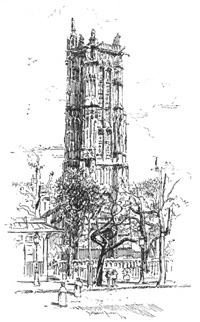
Tower of St. Jacques.
View larger image
North and east and west of the municipal centre, the Maison aux
Piliers, on the Place de Grève, was a maze of streets filled with the
various crafts of Paris. The tower of the great church of St. Jacques
de la Boucherie, as yet unfinished, emerged from the butchers' and
skinners' shops and slaughter-houses, which at the Rue des Lombards
met the clothiers and furriers; the cutlers and the basket-makers were
busy in streets now swept away to give place to the Avenue Victoria.
Painters, glass-workers and colour merchants, grocers and druggists,
made bright and fragrant the Rue de la Verrerie, weavers' shuttles
rattled in the Rue de la Tixanderie (now swallowed up in the Rue de
Rivoli); curriers and tanners plied their evil-smelling crafts in the
Rue (now Quai) de la Mégisserie, and bakers crowded along the Rue St.
Honoré. The Rue des Juifs sheltered the ancestral traffic of the
children of Abraham. At the foot of the Pont au Change, on which were
the shops of the goldsmiths and money-lenders stood the grim
thirteenth-century fortress of the Châtelet, the municipal guard-house
and prison; to the north in the Rue de Heaumarie (Armourers) lay the
Four aux Dames or prison of the abbesses of Montmartre; further on
westward stood the episcopal prison, or Four de l'Evêque. North-west
of the Châtelet was the Hôtel du Chevalier du Guet or watch-house and
round about it a congeries of narrow, crooked lanes, haunts of
ill-fame, where robbers lurked and vice festered. A little to the
north were the noisy market-place of the Halles and the cemetery of
the Innocents with its piles of skulls, and its vaulted arcade
painted (1424) with the Dance of Death. Further north stood the
immense abbey of St. Martin in the Fields, with its cloister and
gardens and, a little to the west, the grisly crenelated and turreted
fortress of the Knights-Templars, huge in extent and one of the most
solid edifices in the whole kingdom. This is the Paris conjured from
the past with such magic art by Victor Hugo in "Notre Dame," and
gradually to be swept away in the next centuries by the Renaissance,
pseudo-classic and Napoleonic builders and destroyers, until to-day
scarcely a wrack is left behind.
With the Italian campaigns of Charles VIII., notre petit roi, as
Brantôme calls him, and of the early Valois-Orleans kings, France
enters the arena of European politics, wrestles with the mighty
Emperor Charles V. and embarks on a career of transalpine conquest.
But in Italy, conquering France was herself conquered by the charm of
Italian art, Italian climate and Italian landscape. When Charles VIII.
returned to Paris from his expedition to Naples he brought with him a
collection of pictures, tapestry, and sculptures in marble and
porphyry, that weighed thirty-five tons; by him and his successors
Italian builders, Domenico da Cortona and Fra Giocondo, were employed.
The latter supervised the rebuilding of the Petit Pont and after the
destruction of the last wooden Pont Notre Dame in 1499—when the whole
structure, with its houses and shops, fell with a fearful crash into
the river—he was made head of the Commission of Parisian artists who
replaced it by a noble stone bridge, completed in 1507. This, too, was
lined with tall gabled houses of stone, and adorned with the arms of
Paris and statues of Notre Dame and St. Denis. On its restoration in
1659 the façades of the houses were decorated with medallions of the
kings of France held by caryatides bearing baskets of fruit and
flowers on their heads. These houses were the first in Paris to be
numbered, odd numbers on one side, even on the other, and were the
first to be demolished when, on the eve of the Revolution, Louis XVI.
ordered the bridges to be cleared.
The French Renaissance is indissolubly associated with Francis I., who
in 1515 inherited a France welded into a compact, absolute monarchy,
and inhabited by a prosperous and loyal people; for the twelfth Louis
had been a good and wise ruler, who to the amazement of his people
returned to them the balance of a tax levied to meet the cost of the
Genoese Expedition, which had been over estimated, saying, "It will be
more fruitful in their hands than in mine." Commerce had so expanded
that it was said that for every merchant seen in Paris in former times
there were, in his reign, fifty. Scarce a house was built along an
important street that was not a merchant's shop or for the practice of
some art. Louis introduced the cultivation of maize and the mulberry
into France, and so rigid was his justice that poultry ran about the
open fields without risk of pillage from his soldiers. It was the
accrued wealth of his reign, and the love inspired by "Louis, father
of his people,"[101] that supported the magnificence, the luxury and
the extravagance of Francis I. The architectural creations of the new
style were first seen in Touraine, in the royal palaces of Blois and
Chambord, and other princely and noble châteaux along the luscious and
sunny valleys of the Loire. Italian architecture was late in making
itself felt in Paris, where the native art made stubborn resistance.
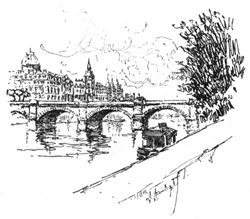
Pont Notre Dame.
View larger image
The story of the state entry of Francis I. into Paris after the death
of Louis XII., as told by Galtimara, Margaret of Austria's envoy, who
witnessed the scene from a window, is characteristic. After the solemn
procession which was belle et gorgiaise he saw the king, clothed in
a glittering suit of armour and mounted on a barbed charger, accoutred
in white and cloth of silver, prick his steed, making it prance and
rear, faisant rage, that he might display his horsemanship, his fine
figure and dazzling costume before the queen and her ladies. It was
all bien gorrière à voir. "Born between two adoring women," says
Michelet, "Francis was all his life a spoilt child." Money flowed
through his hands like water[102] to gratify his ambition, his
passions and his pleasures. Doubtless his interviews with Da Vinci at
Amboise, where he spent much of his time in the early years of his
reign, fired that enthusiasm for art, especially for painting, which
never wholly left him; for the veteran artist, although old and
paralysed in the right hand, was otherwise in possession of all his
incomparable faculties.
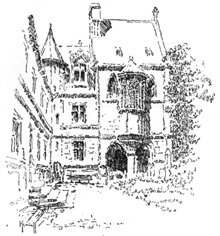
Chapel, Hôtel de Cluny.
View larger image
The question as to the existence of an indigenous school of painting
before the Italian artistic invasion is still a subject of
acrimonious discussion among critics; there is none, however, as to
its existence in the plastic arts. The old French tradition died hard,
and not before it had stamped upon Italian Renaissance architecture
the impress of its native genius and adapted it to the requirements of
French life and climate. The Hôtel de Cluny, finished in 1490, still
remains to exemplify the beauty of the native French domestic
architecture modified by the new style. The old Hôtel de Ville,[103]
designed by Dom. da Cortona and submitted to Francis in 1532, was
dominated by the French style, and not until nearly a century after
the first Italian Expedition were the last Gothic builders superseded.
The fine Gothic church of St. Merri was begun as late as 1520 and not
finished till 1612, and the transitional churches of St. Étienne and
St. Eustache remind one, by the mingling of Gothic and Renaissance
features, of the famous metamorphosis of Agnel and Cianfa in Dante's
Inferno, and one is tempted to exclaim, Ome, come ti muti! Vedi, che
già non sei nè duo nè uno![104]
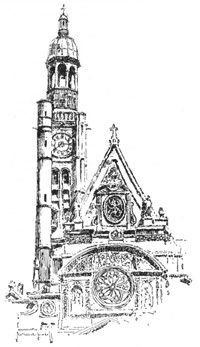
Tower of St. Étienne du Mont.
View larger image
After the death of Da Vinci Francis never succeeded in retaining a
first-rate painter in his service. Andrea del Sarto and Paris Bordone
did little more than pay passing visits, and the famous school of
Fontainebleau was founded by Rosso and Primaticcio, two decadent
followers of Michel Angelo. The adventures of that second-rate artist
and first-rate bully, Benvenuto Cellini, at Paris, form one of the
most piquant episodes in artistic autobiography. After a gracious
welcome from the king he was offered an annual retaining fee of three
hundred crowns. He at once dismissed his two apprentices and left in a
towering rage, only returning on being offered the same appointments
that had been enjoyed by Leonardo da Vinci—seven hundred crowns a
year, and payment for every finished work. The Petit Nesle[105] was
assigned to Cellini and his pupils as a workshop, the king assuring
him that force would be needed to evict the possessor—it had been
assigned to the provost—adding, "Take great care you are not
assassinated." On complaining to the king of the difficulties he met
with and the insults offered to him on attempting to gain possession,
he was answered: "If you are the Benvenuto I have heard of, live up to
your reputation; I give you full leave." Benvenuto took the hint,
armed himself, his servants and two apprentices, and bullied the
occupants and rival claimants out of their wits. It was at this Tour
de Nesle that Francis paid Cellini a surprise visit with his mistress
Madame d'Estampes, his sister Margaret of Valois, the Dauphin and his
wife Catherine de' Medici, the Cardinal of Lorraine, Henry II. of
Navarre, and a numerous train of courtiers. The artist and his merry
men were at work on the famous silver statue of Jupiter for
Fontainebleau, and amid the noise of the hammering the king entered
unperceived. Cellini had the torso of the statue in his hand, and at
that moment a French lad who had caused him some little displeasure
had felt the weight of the master's foot, which sent him flying
against the king. But the artist had done a bad day's work by evicting
a servant of Madame d'Estampes from the tower, and the injured lady
and Primaticcio, her protégé, decided to work his ruin. When Cellini
arrived at Fontainebleau with the statue, Francis ordered it to be
placed in the grand gallery decorated by Rosso. Primaticcio had just
arranged there the casts which he had been commissioned to bring from
Rome, and Benvenuto saw what was meant—his own work was to be
eclipsed by the splendour of the masterpieces of ancient art. "Heaven
help me!" cried he, "this is indeed to fall against the pikes!" Now
the god held the globe of the earth in the left hand, the thunderbolt
in the right. The artist contrived to thrust a portion of a large wax
candle as a torch between the flames of the bolt, and set the statue
up on its gilded pedestal. Madame entertained the king late at table,
hoping that he would either forget the work or see it in a bad light;
but when Francis entered the gallery late at night, followed by his
courtiers, "which by God's grace was my salvation," says Cellini, the
statue was illuminated by a flood of light from the torch which so
enhanced its beauty that the king was ravished with delight, and
expressed himself in ecstatic praise, declaring the statue to be more
beautiful and more marvellous than any of the antique casts around.
His enemies were thus discomfited, and on Madame d'Estampes
endeavouring to depreciate the work, she was grossly mocked by the
artist in a very characteristic and quite untranscribable way.
Benvenuto was more than ever patronised by the king, who did him the
great honour of accosting him as mon ami, and approving his scheme
for the fortification of Paris. Cellini often recalled with pleasure
the four years he spent with the gran re Francesco at Paris.
"The French are remembered in Italy only by the graves they left
there," said De Comines, and once again the Italian campaigns ended in
disaster. At the defeat of Pavia, in 1525—the Armageddon of the
French in Italy—the efforts and sacrifices of three reigns were lost
and the gran re, whose favourite oath is said to have been foi de
gentilhomme, went captive to the king of Spain in Madrid, whence he
issued, stained by perjury, and three years later, signed "the moral
annihilation of France in Europe," at Cambray.
During the tranquil intervals that ensued on this rude awakening from
dreams of an Italian Empire, and between the third and fourth wars
with the emperor, the king was able to initiate a project that had
long been dear to him. "Come," says Michelet, "in the still, dark
night, climb the Rue St. Jacques, in the early winter's morning. See
you yon lights? Men, yea, old men, mingled with children, are
hurrying, a folio under one arm, in the hand an iron candlestick. Do
they turn to the right? No, the old Sorbonne is yet sleeping snug in
her warm sheets. The crowd is going to the Greek schools. Athens is at
Paris. That man with the fine beard in majestic ermine is a descendant
of emperors—Jean Lascaris: that other doctor is Alexander, who
teaches Hebrew."
The schools they were pressing to were those of the Royal College of
France. Already in 1517 Erasmus had been offered a salary of a
thousand francs a year, with promise of further increment, to
undertake the direction of the college, but declined to leave his
patron the emperor. The prime movers in the great scheme were the
king's confessor, Guillaume Parvi, and the famous Grecian, Guillaume
Budé, who in 1530 was himself induced to undertake the task which
Erasmus had declined. Twelve professors were appointed in Greek,
Hebrew, mathematics, philosophy, rhetoric and medicine, each of the
twelve with a salary of two hundred gold crowns (about £80), and the
dignity of royal councillors. The king's vast scheme of a great
college and magnificent chapel, with a revenue of 50,000 crowns for
the maintenance (nourriture) of six hundred scholars, where the most
famous doctors in Christendom should offer gratuitous teaching in all
the sciences and learned languages, was never executed. Too much
treasure had been wasted in Italy, and it was not till the reign of
Louis XIII. that it was partially carried out. The first stone was
laid in 1610, the works were slowly continued under succeeding reigns,
and the project had only been partially carried out when the monarchy
fell. The college as we now see it was not completed till 1842. Chairs
were founded for Arabic by Henry III., for surgery, anatomy and botany
by Henry IV., and for Syrian by Louis XIV. Little is changed to-day;
the placards, so familiar to students in Paris, announcing the
lectures are indited in French instead of in Latin as of old; the
lectures are still free to all, and the most famous scholars of the
day teach there, but in French and not in Latin.[106]
How dramatic are the contrasts of history! While the new learning was
organising itself amid the pomp of royal patronage; while the young
Calvin was sitting at the feet of its professors and the Lutheran
heresy germinating at Paris, Ignatius Loyola, an obscure Spanish
soldier and gentleman, thirty-seven years of age, was sitting—a
strange mature figure—among the boisterous young students at the
College of St. Barbara, patiently preparing himself for dedication to
the service of the menaced Church of Rome; and in 1534, on the
festival of the Assumption of the Blessed Virgin, a little group of
six companions met around the fervent student, in the crypt of the old
church at Montmartre, and decided to found on the holy hill of St.
Denis' martyrdom the first house of the Society of Jesus.
In 1528, says the writer of the so-called Journal d'un Bourgeois de
Paris, the king began to pull down the great tower of the Louvre, in
order to transform the château into a logis de plaisance, "yet was
it great pity for the castle was very fair and high and strong, and a
most proper prison to hold great men."
The tall, massive keep, which darkened the royal apartments in the
south wing, was the tower here meant, and after some four months'
work, and an expenditure of 2,500 livres, the grim pile, with its
centuries of history, was cleared away. Small progress, however, had
been made with the restoration of the old château up to the year 1539,
when the heavy cost of preparing the west wing for the reception of
the Emperor Charles V., induced Francis to consider a plan which
involved the replacement of the whole fabric by a palace in the new
Renaissance style, and the picturesque palace with its high crenelated
walls, its strong towers, high-pitched roofs, dormer windows, and tall
chimneys, its gilded emblazonry, its vanes, splendid with azure and
gold glittering in the sun, as painted in the Duke of Berry's Book of
Hours, was doomed. In 1546 Pierre Lescot, Seigneur de Clagny, was
appointed architect without salary, but given the office of almoner to
the king, and made lay abbot of Clermont. Pierre Lescot was an
admirable artist, who has left us some of the finest examples of early
French Renaissance architecture in Paris. But Francis lived only to
see the great scheme begun, most of Lescot's work being done under
Henry II.
From the same anonymous writer we learn something of Parisian life in
the reign of Francis I. One day a certain Monsieur Cruche, a popular
poet and playwright, was performing moralities and novelties on a
platform in the Place Maubert, and among them a farce "funny enough to
make half a score men die of laughter, in which the said Cruche,
holding a lantern, feigned to perceive the doings of a hen and a
salamander."[107] The amours of the king with the daughter of a
councillor of the Parlement, named Lecoq, were only too plainly
satirised. But it is ill jesting with kings. A few nights later,
Monsieur Cruche was visited by eight disguised courtiers, who treated
him to a supper in a tavern at the sign of the Castle in the Rue de la
Juiverie, and induced him to play the farce before them. When the
unhappy player came to the first scene, he was set upon by the king's
friends, stripped and beaten almost to death with thongs. They were
about to put him in a sack and throw him into the Seine, when poor
Cruche, crying piteously, discovered his priestly tonsure, and thus
escaped.
After the defeat at Pavia, the king became morbidly pious. By trumpet
cry at the crossways of Paris, we learn from the Journal,
games—quoits, tennis, contreboulle—were prohibited on Sundays;
children were forbidden to sing along the streets, going to and from
school; blasphemers[108] were to be severely punished. In 1527 a
notary was burned alive in the Place de Grève for a great blasphemy of
our Lord and His holy Mother. In June of the next year some Lutherans
struck down and mutilated an image of the Virgin and Child at a street
corner near St. Gervais; the king was so grieved and angry that he
wept violently, and offered a reward of one hundred gold crowns, but
the offenders could not be found. Daily processions came from the
churches to the spot, and all the religious orders, clothed in their
habits, followed "singing with such great fervour and reverence that
it was fair to see." The rector, doctors, masters, bachelors and
scholars of the university, and children with lighted tapers, went
there in great reverence. On Corpus Christi day the street was draped
and a fair canopy stretched over the statue. The king himself walked
in procession, bearing a white taper, his head uncovered in moult
gran révérence; hautboys, clarions and trumpets played melodiously;
cardinals, prelates, great seigneurs and nobles, each with his taper
of white wax, followed, with the royal archers of the guard in their
train. On the morrow a procession from all the parishes of Paris, with
banners, relics and crucifixes, accompanied by the king and nobles,
brought a new and fair image of silver, two feet in height, which the
king had caused to be made. Francis himself ascended a ladder and
placed it where the other image had stood, then kissed it and
descended with tears in his eyes. Thrice he kneeled and prayed, the
bishop of Lisieux, his almoner, reciting fair orisons and lauds to the
honour of the glorious Virgin and her image. Again the trumpets,
clarions and hautboys played the Ave Regina cælorum, and the king,
the cardinal of Louvain, and all the nobles presented their tapers to
the Virgin. Next day the Parlement, the provost and sheriffs, came and
put an iron trellis round the silver image for fear of robbers.[109]
Never were judicial and ecclesiastical punishments so cruel and
recurrent as during the period of the Renaissance. It is a common
error to suppose that judicial cruelty reached its culmination in the
Middle Ages.[110] Punishments are described with appalling iteration
in the pages we are following. The Place de Grève was the scene of
mutilations, tortures, hangings, and quarterings of criminals and
traitors, the king and his court sometimes looking on. Coiners of
false money were boiled alive at the pig-market; robbers and assassins
were broken on the wheel and left to linger in slow agony (tant
qu'ils pourraient languir). The Lutherans were treated like vermin,
and to harbour them, to possess or print or translate one of their
books, meant a fiery death. In 1525 a young Lutheran student was put
in a tumbril and brought before the churches of Notre Dame and St.
Genevieve, crying mercy from God and Mary and St. Genevieve; he was
then taken to the Place Maubert, where, after his tongue had been
pierced, he was strangled and burnt. A gendarme of the Duke of
Albany was burnt at the pig-market for having sown Lutheran errors in
Scotland.
On Corpus Christi day, 1532, a great procession was formed, the king
and provost walking bare-headed to witness the burning of six
Lutherans—a scene often repeated. The Fountain of the Innocents, the
Halles, the Temple, the end of the Pont St. Michel, the Place Maubert,
and the Rue St. Honoré were indifferently chosen for these ghastly
scenes. Almost daily the fires burnt. A woman was roasted to death for
eating flesh on Fridays. In 1535, so savage were the persecutions,
that Pope Paul III., with that gentleness which almost invariably has
characterised the popes of Rome in dealing with heresy, wrote to
Francis protesting against the horrible and execrable punishments
inflicted on the Lutherans, and warned him that although he acted from
good motives, yet he must remember that God the Creator, when in this
world, used mercy rather than rigorous justice, and that it was a
cruel death to burn a man alive; he therefore prayed and required the
king to appease the fury and rigour of his justice and adopt a policy
of mercy and pardon. This noble protest was effective, and some
clemency was afterwards shown. But in 1547 the fanatical king, a mass
of physical and moral corruption, soured and gloomy, went to his end
amid the barbarities wreaked on the unhappy Vaudois Protestants. The
cries of three thousand of his butchered subjects and the smoke from
the ruins of twenty-five towns and hamlets were the incense of his
spirit's flight.
One important innovation at court, fraught with evil, is due to
Francis. "In the matter of ladies," says Du Bellay, "I must confess
that before his time they frequented the court but rarely and in
small numbers, but Francis on coming to his kingdom and considering
that the whole decoration of a court consisted in the presence of
ladies, willed to people it with them more than was the custom in
ancient times." Then was begun that unhappy intervention of women in
the government of the state, the results of which will be only too
evident in the further course of this story.
La Fontaine Des Innocents.
View larger image
Rise of the Guises—Huguenot and Catholic—the Massacre of
St. Bartholomew
"Beware of Montmorency and curb the power of the Guises," was the
counsel of the dying Francis to his son. Henry II., dull and
heavy-witted that he was, neglected the advice, and the Guises
flourished in the sun of royal favour. The first Duke of Guise and
founder of his renowned house was Claude, a poor cadet of René II.,
Duke of Lorraine. He succeeded in allying by marriage his eldest son
and successor, Francis, to the House of Bourbon; his second son,
Charles, became Cardinal of Lorraine, and his daughter, wife to James
V. of Scotland. Duke Francis, by his military genius and wise
statesmanship; Charles, by his learning and subtle wit, exalted their
house to the lofty eminence it enjoyed during the stirring period that
now opens. In 1558, after the disastrous defeat of Montmorency at St.
Quentin, when Paris lay at the mercy of the Spanish and English
armies, the duke was recalled from Italy and made Lieutenant-General
of the realm. By a short and brilliant campaign, he expelled the
English from Calais, and recovered in three weeks the territory held
by them for more than two hundred years. Francis gained an unbounded
popularity, and rose to the highest pinnacle of success; but short
time was left to his royal master wherein to enjoy a reflected glory.
On the 27th June 1559, lists were erected across the Rue St. Antoine,
between the Tournelles and the Bastille. The peace with Spain, and the
double marriage of the king's daughter to Philip II. of Spain and of
his sister to the Duke of Savoy, were to be celebrated by a
magnificent tournament in which the king, proud of his strength and
bodily address, was to hold the field with the Duke of Guise and the
princes against all comers. For three days the king distinguished
himself by his triumphant prowess, and at length challenged the Count
Montgomery de Lorge, captain of the Scottish Guards; the captain
prayed to be excused, but the king insisted and the course was run.
Several lances were broken, but in the last encounter, the stout
captain failed to lower his shivered lance quickly enough, and the
broken truncheon struck the royal visor, lifted it and penetrated the
king's eye. Henry fell senseless and was carried to the palace of the
Tournelles, where he died after an agony of eleven days. Fifteen years
later, Montgomery was captured fighting with the Huguenots, and
beheaded on the Place de Grève while Catherine de' Medici looked on
"pour goûter," says Félibien quaintly, "le plaisir de se voir
vangée de la mort de son mary." The tower in the interior of the
Palais de Justice, where the unhappy Scottish noble was imprisoned
after his capture, was known as the Tour Montgomery, until demolished
in the reign of Louis XVI. There was, however, little love lost
between Henry's queen, Catherine de' Medici, and her royal husband,
who had long neglected her for the maturer charms of his mistress,
Diane de Poitiers.
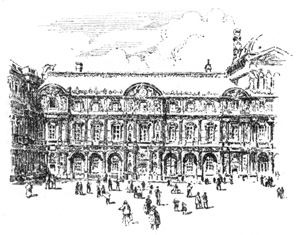
West Wing of Louvre by Pierre Lescot.
View larger image
Henry saw Lescot's admirable design for the reconstruction of the west
wing of the Louvre completed. The architect had associated a famous
sculptor, Jean Goujon, with him, who executed the beautiful figures in
low relief which still adorn the quadrangle front between the Pavilion
de l'Horloge and the south-west angle, and the noble Caryatides, which
support the musicians' gallery in the Salle Basse, or Grande Salle of
Charles V.'s Louvre, now known as the Salle des Caryatides. The
agreement, dated 5th September 1550, awards forty-six livres each for
the four plaster models and eighty crowns each for the four carved
figures. Lescot preserved the external wall of the old château as the
kernel of his new wing, and the enormous strength of the original
building of Philip Augustus may be estimated by the fact that the
embrasures of each of the five casements of the first floor looking
westwards now serve as offices. So grandement satisfait was Henry
with the perfection of Lescot's work, that he determined to continue
it along the remaining three wings, that the court of the Louvre might
be a cour non-pareille. The south wing was, however, only begun when
his tragic death occurred, and the present inconsequent and huge
fabric is the work of a whole tribe of architects, whose intermittent
activities extended over the reigns of nine French sovereigns.
Lescot and Goujon were also associated in the construction of the most
beautiful Renaissance fountain in Paris, the Fontaine des Innocents,
which formerly stood against the old church of the Innocents at the
corner of the Rue aux Fers. It was while working on one of the figures
of this fountain that Jean Goujon is traditionally said to have been
shot as a Huguenot during the massacre of St. Bartholomew.[111]
Tritons and Nereids from the Old Fontaine des
Innocents.
Jean Goujon.
View larger image
Europe was now in travail of a new era, and unhappy France reeled
under the tempest of the Reformation. A daring spirit of enquiry and
of revolt challenged every principle on which the social fabric had
been based, and the only refuge in the coming storm in France was the
Monarchy. Never had its power been more absolute. The king's will was
law—a harbour of safety, indeed, if he were strong and wise and
virtuous: a veritable quicksand, if feeble and vicious. And to
pilot the state of France in these stormy times, Henry II. left a
sickly progeny of four princes, miserable puppets, whose favours were
disputed for thirty years by ambitious and fanatical nobles, queens
and courtesans.
Francis II., a poor creature of sixteen years, the slave of his wife
Marie Stuart and of the Guises, was called king of France for
seventeen months. He it was who sat daily by Mary in the royal garden,
on the terrace at Amboise overlooking the Loire, and, surrounded by
his brothers and the ladies of the court, gazed at the revolting and
merciless executions of the Protestant conspirators,[112] who, under
the Prince of Condé, had plotted to destroy the Guises and to free the
king from their influence. It was the first act in a horrible drama, a
dread pursuivant of the civil and religious wars which were to
culminate in the massacre of St. Bartholomew at Paris. The stake was a
high one, for the victory of the reformers would sound the death-knell
of the Catholic cause in Europe. There is little reason to doubt that
the queen-mother, Catherine de' Medici, who now emerges into
prominence, was genuinely sincere in her disapproval of the horrors of
Amboise, and in her efforts to bring milder counsels to bear in
dealing with the Huguenots whom she feared less than the Guises; but
the fierce passions roused by civil and religious hatred were
uncontrollable. When the Huguenot noble, Villemongis, was led to the
scaffold at Amboise, he dipped his hands in the blood of his
slaughtered comrades, and, lifting them to heaven, cried: "Lord,
behold the blood of Thy children; Thou wilt avenge them." It has been
truly said that the grass soon grows over blood, shed on the
battle-field; never over blood shed on the scaffold. Treachery and
assassination were the interludes of plots and battles, and the
thirst for vengeance during thirty years was never slaked. In 1563 the
Duke of Guise was shot in the back by a fanatical Huguenot, and as the
wounded Prince of Condé was surrendering his sword to the Duke of
Anjou after the defeat of 1569, the Baron de Montesquieu, brave et
vaillant gentilhomme, says Brantôme, rode up, exclaiming: "Mort Dieu!
kill him! kill him!" and blew out the wounded captive's brains with a
pistol shot.
The treaty of St. Germain, which has so often been charged on
Catherine as an act of perfidy, was rather an imperative necessity, if
respite were to be had from the misery into which the land had fallen.
Its conditions were honourably carried out, and Catholic excesses were
impartially and severely repressed. Charles IX., who was now twenty
years of age and strongly attached to Coligny, began to assert his
independence of the queen-mother and of the Guises,[113] and his first
movement was in the direction of conciliation. The young king offered
the hand of his fair sister, Princess Marguerite, to Henry of Navarre,
and received the Admiral and Jeanne of Navarre with much honour at
court. Pressure was brought to bear upon him, but, pope or no pope,
said Charles, he was determined to conclude the marriage and himself
would take Margot by the hand in open church and give her away. The
party of the Guises, and especially Paris, were furious. The capital,
with the provost, the Parlement, the university, the prelates, the
religious orders, had always been hostile to the Huguenots. The people
could with difficulty be restrained at times from assuming the office
of executioners as Protestants were led to the stake. Any one who did
not uncover as he passed the image of the Virgin at the street
corners, or who omitted to bend the knee as the Host was carried by,
was attacked as a Lutheran. When the heralds published the peace with
the Huguenots at the crossways of Paris, filth and mud were thrown at
them, and they went in danger of their lives: now Coligny and his
Huguenots were holding their heads high in Paris, proud and insolent
and a heretic prince of Navarre was to wed the king's sister.
Jeanne of Navarre died soon after her arrival at court,[114] but the
alliance was hurried on. The betrothal took place in the Louvre, and
on Sunday, 17th August 1572, a high dais was erected outside Notre
Dame for the celebration of the marriage. When the ceremony had been
performed by the Cardinal de Bourbon, Henry conducted his bride to the
choir of the cathedral, and went walking in the bishop's garden while
mass was sung. The office ended, he returned and led his wife to the
bishop's palace to dinner, and a magnificent state supper at the
Louvre concluded this momentous day. Three days of balls, masquerades
and tourneys followed, amid the murmuring of a sullen populace. These
were the noces vermeilles—the red nuptials—of Marguerite of France
and Henry of Navarre.
Meanwhile Catherine and Charles had differed on a matter of foreign
policy. Her support of the Prince of Orange against Spain in the
Netherlands was conditional on an alliance with England and the
marriage of her son the Duke of Alençon with Elizabeth. But the
English Queen's habitual duplicity made any reliance on her word
impossible and when Marie learned that Elizabeth, while professing her
inclination for the Duke and her desire to aid the Protestant cause
in Flanders, was protesting to her Council that she would never marry
a boy with a pock-spoiled face, and was in secret communication with
Alva, to turn the situation to her own profit, she flung herself into
Guise's arms and abandoned Coligny and the Huguenots: for the
disastrous defeat of the Protestants at Mons and the growing fury of
the Catholic fanatics at Paris, threatened to wreck the throne, and
while Elizabeth was toying with these tremendous issues the furies
were let loose. Charles still chivalrously determined to stand by
Coligny. Catherine, terrified at the result of her own work, and
resolved to regain her ascendency, conspired with her third son, the
Prince of Anjou, the future Henry III., to destroy and have done with
the Protestants. Coligny had often been warned of the danger he would
run in Paris, but the stout old soldier knew no fear, and came to take
part in the festivities of the wedding. The sounds of revelry had
barely died away when Coligny, who was returning from the Louvre, by
the east gate, the Porte Bourbon, to his hôtel, walking slowly and
reading a petition, was fired at from a window as he passed the
cloister of St. Germain l'Auxerrois, and wounded in the arm. He
stopped and noted the house whence the smoke came: it was the house of
the preceptor of the Duke of Guise. The king was playing at tennis
when the news reached him: he flung down his racquet, exclaiming,
"What! shall I never be in peace? must I suffer new trouble every
day?" and went moody and pensive to his chamber. In a few moments the
Prince of Condé and Henry of Navarre burst in, uttering indignant
protests, and begged permission to leave Paris. Charles assured them
he would do justice, and that they might safely remain: in the
afternoon he went with his mother and the princes to visit the
admiral. The king asked to be left alone in the wounded man's chamber,
remained a long time with him, and protesting that though the wound
was his friend's, the grief was his own, swore to avenge him.
Coligny once again was warned by his friends to beware of the court,
but he refused to distrust Charles. Many and conflicting are the
reports of what followed. We shall not be accused of any Protestant
bias if we base our story mainly on that of the two learned
Benedictine priests[115] who are responsible for five solid tomes of
the Histoire de la Ville de Paris. On the morrow of the attempt on
Coligny's life, the queen-mother invited Charles and his brother of
Anjou to walk, after dinner, in the garden of her new palace in the
Tuileries:[116] they were joined by the chief Catholic leaders, and a
grand council was held. The queen dwelt on the perilous situation of
the monarchy and the Catholic cause, and urged that now was the time
to act: Coligny lay wounded; Navarre and Condé were in their power at
the Louvre; for ten Huguenots in Paris the Catholics could oppose a
thousand armed men; rid France of the Huguenot chiefs and a formidable
evil were averted. Her course was approved, but the leaders shrank
from including the two princes of Navarre and Condé: they were to be
given their choice—recantation or death. By order of the king 12,000
arquebusiers were placed along the river and the streets, and arms
were carried into the Louvre. The admiral's friends, alarmed at the
sinister preparations, protested to Charles but were reassured and
told to take Cosseins and fifty arquebusiers to guard his house. The
provost of Paris was then summoned by the Duke of Guise and ordered to
arm and organise the citizens and proceed to the Hôtel de Ville at
midnight. The king, Guise said, would not lose so fair an opportunity
of exterminating the Huguenots. The Catholic citizens were to tie a
piece of white linen on their left arm and place a white cross in
their caps that they might be recognised by their friends. At midnight
the windows of their houses were to be illuminated by torches, and at
the first sound of the great bell at the Palais de Justice the bloody
work was to begin. Meanwhile Catherine, doubtful of Charles, repaired
to his chamber with Anjou and her councillors to fix his wavering
purpose; she heaped bitter reproaches upon him, worked on his fears
with stories of a vast Huguenot conspiracy and hinted that cowardice
prevented him from seizing the fairest opportunity that God had ever
offered, to free himself from his enemies. She repeated an Italian
prelate's vicious epigram: "Che pietà lor ser crudel, che crudeltà
lor ser pietosa,"[117] and concluded by threatening to leave the
court with the Duke of Anjou rather than witness the destruction of
the Catholic cause. Charles, who had listened sullenly, and, if we may
believe Anjou, for a long while angrily refused to sacrifice Coligny,
was at length stung by the taunt of cowardice and broke into a
delirium of passion; he swore by la mort dieu to compass the death
of every Huguenot in France, that none might be left to reproach him
afterwards.
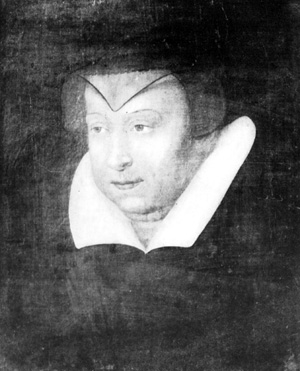
Catherine de' Medici.
French School, 16th Century.
View larger image
Catherine gave him no time for farther vacillation. The great bell of
St. Germain l'Auxerrois was rung, and at two in the morning of Sunday,
St. Bartholomew's Day, 24th August 1572, the Duke of Guise and his
followers issued forth to do their Sabbath morning's work. Cosseins
saw his leader coming and knew what was expected of him. Guise, who
believed the blood of his murdered father lay on Coligny's head,
made sure of his vengeance. The admiral's door was forced, his
servants were poignarded, and Besme, a German in the service of Guise,
followed by others, burst into his room. The old man stood erect in
his robe de chambre, facing his murderers. "Art thou the admiral?"
demanded Besme. "I am he," answered Coligny with unfaltering voice
and, gazing steadily at the naked sword pointed at his breast, added,
"Young man, thou shouldst show more respect to my white hairs; yet
canst thou shorten but little my brief life." For answer he was
pierced by Besme's sword and stabbed to death by his companions. Guise
stood waiting in the street below and the body was flung down to him
from the window. He wiped the blood from the old man's face, looked at
it, and said, "It is he!" Spurning the body with his foot he cried,
"Courage, soldiers! we have begun well; now for the others, the king
commands it." Meanwhile the bell of the Palais de Justice, answering
that of St. Germain, was booming forth its awful summons, and the
citizens hastened to perform their part.
All the Huguenot nobles dwelling near the admiral were pitilessly
murdered, and a similar carnage took place at the Louvre. Marguerite,
the young bride of Navarre, in her Memoirs, tells of the horrors of
that morning, how, when half-asleep, a wounded Huguenot nobleman
rushed into her chamber, pursued by four archers, and flung himself on
her bed imploring protection, followed by a captain of the guard from
whom she gained his life. She entreated the captain to lead her to her
sister's room, and as she fled thither, more dead than alive, another
fugitive was hewn down by a hallebardier only three paces from her;
she fell fainting in the captain's arms. Meanwhile Charles, the
queen-mother, and Anjou, after the violent scene in the king's
chamber, had lain down for two hours' rest and then went to a window
which overlooked the basse-cour of the Louvre, to see the "beginning
of the executions." If we may believe Henry's story, they had not been
there long before the sound of a pistol shot filled them with dread
and remorse, and a messenger was sent to bid Guise spare the admiral
and stay the whole undertaking; but the nobleman who had been sent
returned saying that Guise had told him it was too late: the admiral
was dead, and the executions had begun all over the city. A dozen
Protestant nobles of the suites of Condé and Navarre, who at the
king's invitation had taken up their quarters in the Louvre, were
seized; one was even dragged from a sick-bed: all were taken to the
courtyard and hewn in pieces by the Swiss guards under the eyes of
Charles, who cried: "Let none escape." Meantime the Catholic leaders
had been scouring the streets on horseback, shouting to the people
that a Huguenot conspiracy to murder the king had been discovered, and
that it was the king's wish that all the Huguenots should be
destroyed.
A list of the Huguenots in Paris had been prepared and all their
houses marked. None was spared. Old and young, women and children,
were pitilessly butchered. All that awful Sunday the orgy of slaughter
and pillage went on; every gate of the city had been closed and the
keys brought to the king. Night fell and the carnage was not stayed.
Two days yet and two nights the city was a prey to the ministers of
death, and some Catholics, denounced by personal enemies, were
involved in the massacre. The resplendent August sun, the fair sky and
serene atmosphere were held to be a divine augury, and a white thorn
in the cemetery of the Innocents blooming out of season was hailed as
a miracle and a visible token from God that the Catholic religion was
to blossom again by the destruction of the Huguenots. The murders did
not wholly cease until September. Various were the estimates of the
slain—20,000, 5,000, 2,000. A goldsmith named Cruce went about
displaying his robust arm and boasting that he had accounted for 400
Huguenots. The streets, the front of the Louvre, the public places
were blocked by dead bodies; tumbrils[118] were hired to throw them
into the Seine, which literally for days ran red with blood.
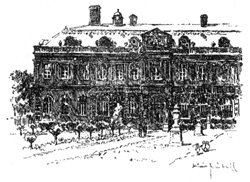
Petite Galerie of the Louvre.
View larger image
The princes of Navarre and Condé saw the privacy of their chambers
violated by a posse of archers on St. Bartholomew's morning; they were
forced to dress and were haled before the king, who with a fierce look
and glaring eyes, swore at them, reproached them for waging war upon
him, and ordered them to change their religion. On their refusal he
grew furious with rage, and by dint of threats wrung from them a
promise to go to mass.
Charles is said to have stood at a window in the Petite Galerie of the
Louvre and to have fired across the river with a long arquebus on some
Huguenots who, being lodged on the southern side, in the Huguenot
quarter, known as la petite Genève, had escaped massacre, and were
riding up to learn what was passing. The statement is much canvassed
by authorities. It is at least permissible to doubt the assertion,
since the first floor[119] of the Petite Galerie, where the king is
traditionally believed to have placed himself, was not in existence
before the time of Henry IV. If the ground floor be meant, a further
difficulty arises from the fact that the southern end was not
furnished with a window in Charles IX.'s time.
On the 26th of August the king was forced to avow responsibility
before the Parlement for measures which he alleged had been necessary
to suppress a Huguenot insurrection aiming at the assassination of
himself and the royal family and the destruction of the Catholic
religion in France. The ears of the Catholic princes of Europe and of
the pope were abused by this specious lie; they believed that the
Catholic cause had been saved from ruin; the so-called victory was
hailed with transports of joy, and a medal was struck in Rome to
celebrate the defeat of the Huguenots.[120]
Such was the massacre of St. Bartholomew in Paris. The death-roll of
the victims is known to the Recording Angel alone. It was a tremendous
folly no less than an indelible crime, for it steeled the heart of
every Protestant to avenge his slaughtered brethren. To "take Paris
justice" became synonymous with assassination all over Protestant
Europe.
Many of the Huguenot leaders escaped from Paris while the soldiers
sent to despatch them were pillaging, and the flames of civil strife
burst forth fiercer than ever. The court had prepared for massacre,
not for war; and while the king was receiving the felicitations of the
courts of Spain and Rome, he was forced by the Peace of La Rochelle to
concede liberty of conscience to the Protestants and to restore their
sequestered estates and offices. After two years of agony of mind and
remorse, Charles IX. lay dying of consumption, abandoned by all save
his faithful Huguenot nurse. The blood flowing from his nostrils
seemed a token of God's wrath; and moaning "Ah! ma mie, what
bloodshed! what murders! I am lost! I am lost!" the poor crowned
wretch passed to his account. He had not yet reached his twenty-fourth
year.
Henry III.—The League—Siege of Paris by Henry IV.—His
Conversion, Reign and Assassination
When the third of Catherine's sons, having resigned the sovereignty of
Poland, was being consecrated at Rheims, the crown is said to have
twice slipped from his head, the insentient diadem itself shrinking in
horror from the brow of a prince destined to pollute it with deeper
shame. Treacherous and bloody, Henry mingled grovelling piety with
debauchery, and made of the court at Paris a veritable Alsatia, where
paid assassins who stabbed from behind and mignons who struck to the
face, were part of the train of every prince. The king's minions with
their insolent bearing, their extravagant and effeminate dress, their
hair powdered and curled, their neck-ruffles so broad that their heads
resembled the head of John the Baptist on a charger,—gambling,
blaspheming swashbucklers—were hateful alike to Huguenot and
Catholic. On 29th April 1578 three of them fought out a famous quarrel
with three of the Guises' bullies at the horse market subsequently
converted into the Place Royale. The duel began at five o'clock in the
morning and was fought so furiously that three of the combatants lost
their lives. Quélus, the king's favourite minion, with fifteen wounds,
lingered for thirty-three days, Henry constantly at his bedside and
offering in vain large sums of money to the surgeons to save him.
Less than four years after St. Bartholomew the Peace of 1576 gave the
Huguenots all they had ever demanded or hoped for. In 1582 died the
Duke of Alençon, Catherine's last surviving son and heir to the
throne; Henry, in spite of a pilgrimage on foot by himself and his
queen to Notre Dame de Cléry from which they returned with blistered
feet, gave no hope of posterity and the Catholic party were confronted
by the possibility of the sceptre of St. Louis descending to a
relapsed heretic. A tremendous wave of feeling ran through France, and
a Holy League was formed to meet the danger, with the Duke of Guise as
leader. The king tried in vain to win some of the Huguenot and League
partisans by the solemn institution of the Order of the Holy
Ghost,[121] in the church of the Augustinians, to commemorate his
elevation to the thrones of Poland and France on the day of Pentecost.
The people were equally recalcitrant. When Henry entered Paris after
the campaign of 1587, they shouted for their idol, the Balafré,[122]
crying, "Saul has slain his thousands but David his tens of
thousands." The king in his jealousy and disgust forbade Guise to
enter Paris; Guise coolly ignored the command, and a few months later
arrived at the head of a formidable train of nobles, amid the joyous
acclamation of the people, who greeted him with chants of "Hosannah,
Filio David!" Angry scenes followed. The duke sternly called his
master to duty, and warned him to take vigorous measures against the
Huguenots or lose his crown; the king, pale with anger, dismissed him
and prepared to strike.
On the night of the 11th May a force of Royal Guards and 4,000 Swiss
mercenaries entered Paris, but the Parisians, with that genius for
insurrection which has always characterised them, were equal to the
occasion. The sixteen sections into which the communal government of
the city was divided met; in the morning the people were under arms;
and barricades and chains blocked the streets. The St. Antoine
section, ever to the front, stood up to the king's Guards and to the
Swiss advancing to occupy their quarter, defeated them, and with
exultant cries rushed to threaten the Louvre itself. Henry was forced
to send his mother to treat with the duke; she returned with terms
that meant a virtual abdication. Henry took horse and fled, vowing he
would come back only through a breach in the walls. But Guise was
supreme in Paris, and the pitiful monarch was soon forced to yield; he
signed the terms of his own humiliation, and went to Blois to meet
Guise and the States-General with bitterness in his heart, brooding
over his revenge. Visitors to the château of Blois, which has the same
thrilling interest for the traveller as the palace of Holyrood, will
recall the scene of the tragic end of Guise, the incidents of which
the official guardians are wont to recite with dramatic gesture.
Fearless and impatient of warnings, the great captain fell into the
trap prepared for him and was done to death in the king's chamber,
like a lion caught in the toils. Henry, who had heard mass and prayed
that God would be gracious to him and permit the success of his
enterprise, hastened to his mother, now aged and dying. "Madame," said
he, "I have killed the king of Paris and am become once more king of
France." The Cardinal of Lorraine, separated from the king's chamber
only by a partition, paled as he heard his nephew's struggles. "Ne
bougez pas," said the Marshal of Aumont putting his hand to his
sword, "the king has some accounts to settle with you too." Next
morning the old cardinal was led out and hewn in pieces. The two
bodies were burnt and the ashes scattered to the winds to prevent
their being worshipped as relics: it was Christmas Eve of 1588.
The stupid crime brought its inevitable consequences —
"Revenge and hate bring forth their kind,
Like the foul cubs their parents are."
The Commune of Paris and the Leaguers were stung to fury; the Sorbonne
declared the king deposed; the pope banned him and a popular preacher
called for another blood-letting. Henry, in a final act of shame and
despair, flung himself into the king of Navarre's arms, and on the
31st July 1589, the two Henrys encamped at St. Cloud and threatened
Paris with an army of 40,000 men. On the morrow Jacques Clément, a
young Dominican friar, after preparing himself by fasting, prayer and
holy communion, left Paris with a forged letter for the king, reached
the camp and asked for a private interview. While Henry was reading
the letter the friar snatched a knife from his sleeve and mortally
stabbed him.[123] He lingered until 2nd August, and after pronouncing
Henry of Navarre his lawful successor and bidding his Council swear
allegiance to the new dynasty, the last of the thirteen Valois kings
passed to his doom. Catherine de' Medici had already preceded him,
burdened with the anathemas of the Cardinal of Bourbon. The people of
Paris swore that if her body were brought to St. Denis they would
fling it to the shambles or into the Seine, and a famous theologian,
preaching at St. Bartholomew's church, declared to the faithful that
he knew not if it were right to pray God for her soul, but that if
they cared to give her in charity a Pater or an Ave they might do so
for what it was worth. This was the reward of her thirty years of
devoted toil, of vigils and of plots to further the Catholic cause.
Not until a quarter of a century had passed were her ashes laid beside
those of her husband in the rich Renaissance tomb, which still exists,
in the royal church of St. Denis. Jacques Clément, who had been cut to
pieces by the king's Guards, was worshipped as a martyr, and his
mother rewarded for having given birth to the saviour of France.
Henry of Navarre, unable to carry on the siege with a divided army,
directed his course for Normandy. The exultant Parisians proclaimed
the Cardinal of Bourbon king, under the title of Charles X., and the
Duke of Mayenne, with a large army, marched forth to give battle to
Henry. So confident were the Leaguers of victory, that their leaders
hired windows along the Rue St. Antoine to witness the return of the
duke bringing the "Béarnais"[124] dead or a prisoner. Henry did indeed
return, but it was after a victorious campaign. He captured the
Faubourg St. Jacques, and fell upon the abbey of St. Germain des Prés
while the astonished monks were preparing to sing mass, climbed the
steeple of the church and gazed on Paris. Having refreshed his troops,
the Béarnais suffered them to pillage the city south of the Seine, and
turned to the west to fix his capital at Tours. In 1590 he won the
brilliant victory at Ivry over the armies of the League and of Spain
which Macaulay has popularised in a stirring poem: the road to Paris
was open and Henry sat down to besiege the city.
The Leaguers fought and suffered with the utmost constancy;
reliquaries were melted down for money, church bells for cannon, and
the clergy and religious orders were caught by the military
enthusiasm. The bishop of Senlis and the prior of the Carthusians, two
valiant Maccabees, were seen, crucifix in one hand, a pike in the
other, leading a procession of armed priests, monks and scholars
through the streets. Friars from the mendicant orders were among them,
their habits tucked up, hoods thrown back, casques on their heads and
cuirasses on their breasts. All marched sword by side, dagger in
girdle, musket on shoulder, the strangest army of the church militant
ever seen. As they passed the Pont Notre Dame the papal legate was
crossing in his carriage, and was asked to stop and give his blessing.
After this benediction a salvo of musketry was called for, and some of
the host of the Lord, forgetting that their guns were loaded with
ball, killed a papal officer and wounded a servant of the ambassador
of Spain.
Four months the Parisians endured starvation and all the attendant
horrors of a siege, the incidents of which, as described by
contemporaries, are so ghastly that the pen recoils from transcribing
them. At length, when they were at the last extremity, the Duke of
Parma arrived with a Spanish army, forced Henry to raise the siege,
and revictualled the city. After war, anarchy. In November 1591 it was
discovered that secret letters were passing between Brizard, an
officer in the service of the Duke of Mayenne in Paris, and a royalist
at St. Denis. The sections demanded Brizard's instant execution, and
on his discharge by the Parlement the curé of St. Jacques fulminated
against that body and declared that cold steel must be tried (faut
jouer des couteaux). A secret revolutionary committee of ten was
appointed, and a papier rouge or lists of suspects in all the
districts of Paris was drawn up under three categories: P. (pendus),
those to be hanged; D. (dagués), those to be poignarded; C.
(chassés), those to be expelled. On the night of the 15th November a
meeting was held at the house of the curé of St. Jacques, and in the
morning the president of the Parlement, Brisson, was seized and
dragged to the Petit Châtelet, where a revolutionary tribunal, in
black cloaks, on which were sewn large red crosses, condemned him to
death. Meanwhile two councillors of the Parlement, Larcher and Tardif,
had been seized, the latter by the curé of St. Cosme, and haled to
the Châtelet. All three were dragged to a room, and the executioner
was forced to hang them from a beam; the bodies were then stripped, an
inscription was hung about their necks, and they were suspended from
the gallows in the Place de Grève. The sections believed that Paris
would rise: they only shocked the more orderly citizens. The Duke of
Mayenne, who was at Lyons, on the receipt of the news hastened to
Paris, temporised a while and, when sure of support, seized four of
the most dangerous leaders of the sections and hanged them without
trial in the Salle basse of the Louvre. All save the more violent
partisans were now weary of the strife and the Leaguers themselves
were divided. The sections aimed at a theocratic democracy; another
party favoured the Duke of Mayenne; a third, the Duke of Guise; a
fourth, the Infanta of Spain. It was decided to convoke the
States-General at Paris in 1593, and a conference was arranged with
Henry's supporters at Suresnes. Crowds flocked there, crying, "Peace,
peace; blessed be they who bring it; cursed they who prevent it."
Henry knew the supreme moment was come. France was still profoundly
Catholic: he must choose between his religion and France. He chose to
heal his country's wounds and perhaps to save her very existence.
Learned theologians were deputed to confer with him at Paris, whom he
astonished and confounded by his knowledge of Scripture; they declared
that they had never met a heretic better able to defend his cause. But
on 23rd July 1573, he professed himself convinced, and the same
evening wrote to his mistress, Gabrielle d'Estrées, that he had spoken
with the bishops, and that a hundred anxieties were making St. Denis
hateful to him. "On Sunday," he adds, "I am to take the perilous leap.
Bonjour, my heart; come to me early to-morrow. It seems a year since
I saw you. A million times I kiss the fair hands of my angel and the
mouth of my dear mistress."
On Sunday, under the great portal of St. Denis, the archbishop of
Bourges sat enthroned in a chair covered with white damask and
embroidered with the arms of France and of Navarre. He was attended by
many prelates and the prior and monks of St. Denis: the cross and the
book of the Gospels were held before him. Henry drew nigh. "Who are
you?" demanded the archbishop. "I am the king." "What do you ask?" "I
wish to be received in the bosom of the Catholic, Apostolic and Roman
Church." "Is it your will?" "Yes, I will and desire it." Henry then
knelt and made profession of his faith, kissed the prelate's ring,
received his blessing and was led to the choir, where he knelt before
the high altar and repeated his profession of faith on the holy
Gospels amid cries of "Vive le roi!"
The clerical extremists in Paris anathematised all concerned. Violent
curés again donned their armour, children were baptised and mass was
sung by cuirassed priests. The curé of St. Cosme seized a partisan,
and with other fanatics of the League hastened to the Latin Quarter to
raise the university. But the people were heartsick of the whole
business; and when Henry entered Paris after his coronation at
Chartres, resplendent in velvet robes embroidered with gold and seated
on his dapple grey charger, his famous helmet with its white plumes
ever in his hand saluting the ladies at the windows, he was hailed
with shouts of joy. Shops were reopened, the artisan took up his tools
and the merchant went to his counter with a sigh of relief. A general
amnesty was proclaimed, and the Spanish garrison were allowed to
depart with their arms. As they filed out of the Porte St. Denis in
heavy rain, three thousand strong, the king was sitting at a window
above the gates. "Remember me to your master," he cried, "but do not
return." On the morrow the provost and sheriffs and chief citizens
came to the Louvre bearing presents of sweetmeats, sugar-plums and
malmsey wine. "Yesterday I received your hearts, to-day I receive your
sweets," the king remarked; all were charmed by his wit, his
forbearance and generosity. The stubborn university was last to give
way, but when the doctors of theology learnt that Henry had touched
for the king's evil and that many had been cured, they too were
convinced. Paris, "well worth a mass," was wooed and won. The
memorable Edict of Nantes established liberty of worship and political
equality for the Protestants. The war with Spain was brought to a
successful issue, and Henry, with his minister the Duke of Sully,
probably the greatest financial genius France has ever known, by wise
and firm statesmanship lifted the country from bankruptcy to
prosperity and contentment.
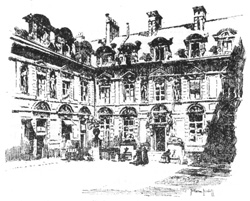
Hôtel de Sully.
View larger image
Henry, like one of his predecessors, had of bastards et bastardes une
moult belle compagnie, but as yet no legitimate heir. A divorce from
Marguerite of Valois and a politic marriage with the pope's niece,
Marie de' Medici,[125] gave him a magnificent dowry (600,000 golden
crowns and a yearly income of 20,000), an additional bond to the
papacy, and several children. Margot, once convinced that the divorce
was not to enable Henry to marry that bagasse Gabrielle, made small
objection and soon consoled herself. In 1606 one of her discarded
lovers was executed in front of her dwelling in the palace of the
archbishop of Sens for having shot his rival in her affections, a
young page of twenty, as he was handing her into her carriage.
Like all his race, Henry was susceptible to the charms of the
daughters of Eve, but, unlike his descendants, he never sacrificed
France to their tears and wiles. When the question of the succession
was urgent and he thought of marrying Gabrielle d'Estrées, Sully
opposed the union. The impatient Gabrielle used all her powers of
fascination to compass the dismissal of the great minister, who was
present at the interview in her room at the cloister of St. Germain,
and who has left us a vivid description of the scene. Gabrielle burst
into passionate reproaches and employed in turn all the arts of
feminine guile. Her eyes streaming with tears, sobbing and wailing,
she seized her royal lover's hand and smothered it with kisses; she
called for a poignard that by plunging it into her heart he might
behold his image graven there; she appealed to his love for their
children and flung herself hysterically on the bed, protesting she
could live no longer seeing herself disgraced, and a servant whom so
many complained of, preferred to a mistress whom all praised. It was
of no avail. "Let me tell you," answered Henry, calmly, "if I must
choose between you and Sully, I would sooner part with ten mistresses
such as you than one faithful servant such as he."
In 1610 the king was making great preparations for a war with Austria,
and, on the 14th May, desiring to consult Sully, who was unwell in his
rooms at the Arsenal, he determined to spare him the fatigue of
travelling to the Louvre, and to drive to the Arsenal. With much
foreboding the king had agreed to the coronation of Marie de' Medici,
which had been celebrated at St. Denis with great pomp. The ceremony
was attended by two sinister incidents: the Gospel for the day, taken
from Mark x., included the answer of Jesus to the Pharisees who
tempted Him by asking—"Is it lawful for a man to put away his
wife?"—the Gospel was hurriedly changed; and when the usual largesse
of gold and silver pieces was thrown to the crowd not a voice cried,
"Vive le roi," or "Vive la reine." That night the king tossed
restless on his bed, pursued by evil dreams. On the morrow his
counsellors begged him to defer his journey, but nineteen plots to
assassinate him had already failed: he gently put aside their
warnings, and repeated his favourite maxim that fear had no place in a
generous heart. It was a warm day, and the king entered his open
carriage, attended by the Dukes of Epernon and Montbazon and five
other courtiers; a number of valets de pied followed him. In the
narrow Rue de la Ferronnerie the carriage was stopped by a block in
the traffic, and the servants were sent round by the cemetery of the
Innocents. While the king was listening to the reading of a letter by
the Duke of Epernon, one Francis Ravaillac, who had been watching his
opportunity for twelve months, placed his foot on a wheel of the
coach, leaned forward, and plunged a knife into the king's breast.
Before he could be seized he pulled out the fatal steel and doubled
his thrust, piercing him to the heart. "Je suis blessé," cried
Henry, and never spoke again. Ravaillac was seized, and all the
refined cruelties inflicted on regicides were practised upon him. He
was dragged to the Place de Grève, his right hand cut off, and, with
the fatal knife, flung into the flames; the flesh was torn from his
arms, breast and legs; melted lead and boiling oil were poured into
the wounds. Horses were then tied to each of his four limbs, the body
was torn to pieces and burnt to ashes.[126] Some writers have
inculpated the Jesuits for the murder, but it may more reasonably be
attributed to the fury of a crazy fanatic. Certain it is that Henry's
heart was given to the Jesuits for the church of their college of la
Flèche, which was founded by him.
The first Bourbon king has left his impress on the architecture of
Paris. "Soon as he was master of Paris," says a contemporary, "one saw
naught but masons at work." Small progress had been made during the
reign of Henry II.'s three sons with their father's plans for the
rebuilding of the Louvre. The work had been continued along the river
front after Lescot's death in 1578 by Baptiste du Cerceau, and
Catherine de' Medici had erected a gallery on the south, known as the
Petite Galerie—a ground-floor building with a terrace on top,
intended for a meeting-place and promenade but not for residence. She
had also begun in 1564 the palace of the Tuileries, which, like the
Louvre, was designed to be a quadrangular building and of which the
west wing alone was ever constructed, but abandoned it on being warned
by her astrologer, Ruggieri, that she should die under the ruins of a
house near St Germain.[127] Henry, soon after he had entered Paris,
elaborated a vast scheme for finishing the Tuileries, demolishing the
churches of St. Thomas and St. Nicholas, quadrupling the size of the
old Louvre, and joining the two palaces by continuing the Grande
Galerie, already begun by Catherine, to the west, to afford a means of
escape in the event of an attack on the Louvre. Towards the east the
hôtels d'Alençon, de Bourbon and the church of St. Germain l'Auxerrois
were to be demolished, and a great open space was to be levelled
between the new east front of the Louvre and the Pont Neuf. At Henry's
accession Catherine's architects, Philibert de l'Orme and Jean
Bullant, had completed the superb domed central pavilion of the
Tuileries, with its two contiguous galleries, and begun the end
pavilions, the former using the Ionic order as a delicate flattery of
Catherine, "since among the ancients that order was employed in
temples dedicated to a goddess." The gardens, with the famous maze and
Palissy's beautiful grotto or fountain, had been completed in 1476,
and for some years were a favourite promenade for Catherine and her
court. Henry's plans were so far carried out that on New Year's day,
1606, he could lead the Dauphin along the Grande Galerie to the
Pavilion de Flore at the extreme west of the river front, and enter
the south wing of the Tuileries which had been extended to meet it.
The Pavilion de Flore thus became the angle of junction between the
two palaces. An upper floor was imposed on the Petite Galerie, and
adorned with paintings representing the kings of France. Unhappily the
fire of 1661 destroyed all the portraits save that of Marie de' Medici
by Porbus, and all the subsequent decorations by Poussin. Henry
intended the ground floor of the Grande Galerie for the accommodation
of his best craftsmen—painters, sculptors, goldsmiths, tapestry
weavers, smiths, and others. The quadrangle, however, remained as the
last Valois had left it—half Renaissance, half Gothic—and the
north-east and south-east towers of the original château were still
standing to be drawn by Sylvestre towards the middle of the
seventeenth century.
The unfinished Hôtel de Ville was taken in hand after more than
half-a-century and practically completed.[128] The larger, north
portion of the Pont Neuf was built, the two islets west of the Cité
were incorporated with the island to form the Place Dauphine and the
ground that now divides the two sections of the bridge—a new street,
the Rue Dauphine, being cut through the garden of the Augustins and
the ruins of the college of St. Denis. The Place Royale (now des
Vosges) was designed and partly built—that charming relic of
seventeenth and eighteenth century fashionable Paris, where Molière's
Précieuses lived.
Henry also partly rebuilt the Hôtel Dieu, created new streets, and
widened others.[129] New fountains and quays were built; the Porte du
Temple was reopened, and the Porte des Tournelles constructed.
Unhappily, some of the old wooden bridges remained, and on Sunday,
22nd December 1596, the Pont aux Meuniers (Miller's Bridge), just
below the Pont au Change, suddenly collapsed, with all its shops and
houses, and sixty persons perished. They were not much regretted, for
most of them had enriched themselves by the plunder of Huguenots, and
during the troubles of the League. The bridge was rebuilt of wood, at
the cost of the captain of the corps of archers, and as the houses
were painted each with the figure of a bird, the new bridge was known
as the Pont aux Oiseaux (Bridge of Birds). It spanned the river from
the end of the Rue St. Denis and the arch of the Grand Châtelet to the
Tour de l'Horloge of the Palais de Justice. In 1621, however, it and
the Pont au Change were consumed by fire in a few hours and, in 1639,
the two wooden bridges were replaced by a bridge of stone, the Pont au
Change, which stood until rebuilt in 1858.
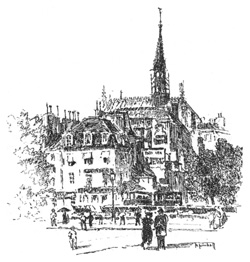
Old houses near Pont St. Michel, showing spire of the
Ste. Chapelle.
View larger image
We are able to give the impression which the Paris of Henri Quatre
made on an English traveller, a friend of Ben Jonson and author of
Coryat's Crudities, hastily gobbled up in five months' Travell. The
first objects that met Coryat's eye are characteristic. As he
travelled along the St. Denis road he passed "seven[130] faire
pillars of freestone at equal distances, each with an image of St.
Denis and his two companions, and a little this side of Paris was the
fairest gallows I ever saw, built on Montfaucon, which consisted of
fourteene fair pillars of freestone." He notes "the fourteene gates of
Paris, the goodly buildings, mostly of fair, white stone and"—a
detail always unpleasantly impressed on travellers—"the evil-smelling
streets, which are the dirtiest and the most stinking I ever saw in
any city in my life. Lutetia! well dothe it brooke being so called
from the Latin word lutum, which signifieth dirt." Coryat was
impressed by the bridges—"the goodly bridge of white freestone nearly
finished (the Pont Neuf); a famous bridge that far exceedeth this,
having one of the fairest streets in Paris called our Ladies street;
the bridge of Exchange where the goldsmiths live; St. Michael's
bridge, and the bridge of Birds." He admires the "Via Jacobea, full of
booke-sellers' faire shoppes, most plentifully furnished with bookes,
and the fair building, very spacious and broad, where the Judges sit
in the Palais de Justice, the roofs sumptuously gilt and embossed,
with an exceeding multitude of great, long bosses hanging downward."
Coryat next visited the fine quadrangle of the Louvre, whose outside
was exquisitely wrought with festoons, and decked with many stately
pillars and images. From Queen Mary's bedroom he went to a room[131]
"which excelleth not only all that are now in the world but also all
that were since the creation thereof, even a gallery, a perfect
description whereof would require a large volume, with a roofe of most
glittering and admirable beauty. Yea, so unspeakably fair is it that a
man can hardly comprehend it in his mind that hath not seen it with
his bodily eyes." The Tuileries gardens were the finest he ever beheld
for length of delectable walks.
Next day Coryat saw the one thing above all he desired to see, "that
most rare ornament of learning Isaac Casaubon," who told him to
observe "a certain profane, superstitious ceremony of the papists—a
bedde carried after a very ethnicall manner, or rather a canopy in the
form of a bedde, under which the Bishop of the city, with certain
priests, carry the Sacrament. The procession of Corpus Christi," he
adds, "though the papists esteemed it very holy, was methinks very
pitiful. The streets were sumptuously adorned with paintings and rich
cloth of arras, the costliest they could provide, the shews of Our
Lady street being so hyperbolical in pomp that it exceedeth all the
rest by many degrees. Upon public tables in the streets they exposed
rich plate as ever I saw in my life, exceeding costly goblets and what
not tending to pomp; and on the middest of the tables stood a golden
crucifix and divers other gorgeous images. Following the clergy, in
capes exceeding rich, came many couples of little singing choristers,
which, pretty innocent punies, were so egregiously deformed that moved
great pity in any relenting spectator, being so clean shaved round
about their heads that a man could perceive no more than the very
rootes of their hair."
At the royal suburb Coryat saw "St. Denis, his head enclosed in a
wonderful, rich helmet, beset with exceeding abundant pretious
stones," but the skull itself he "beheld not plainly, only the
forepart through a pretty, crystall glass, and by light of a wax
candle."
Paris under Richelieu and Mazarin
Before Coryat left Paris he rode a sorry jade to Fontainebleau which,
"though I did excarnificate his sides," would not stir until a
gentleman of the court drew his rapier and ran him to the "buttock."
At the palace he saw the "Dolphin whose face was full and fat-cheeked,
his hair black, his look vigorous and courageous." The Dolphin that
Coryat saw came to the throne, at nine years of age, in 1610, as Louis
XIII. For a time the regent, Marie de' Medici, was content to suffer
the great Sully to hold office, but soon favouritism and the greed of
princes, to the ill-hap of France, drove him in the prime of life from
Paris into the retirement of his château of Villebon, and a feeble and
venal Florentine, Concini, who came to Paris in the time of Marie,
took his place. The Prince of Condé, now a Catholic, the Duke of
Mayenne, and a pack of nobles fell upon the royal treasury like hounds
on their quarry. In 1614, so critical was the financial situation,
that the States-General were called to meet in the Salle Bourbon,[132]
but to little purpose. Recriminations were bandied between the
noblesse and the Tiers État. The insolence of the former was
intolerable. One member of the Tiers was thrashed by a noble and could
obtain no redress. The clergy refused to bear any of the public
burdens. The orator of the Tiers, speaking on his knees according to
usage, warned the court that despair might make the people conscious
that a soldier was none other than a peasant bearing arms, and that
when the vine-dresser took up the arquebus he might one day cease to
be the anvil and become the hammer. But there was no thought for the
common weal; each order wrangled for its own privileges, and their
meeting-place was closed on the pretext that the hall was wanted for a
royal ballet. No protest was raised, and the States-General never met
again until the fateful meeting at Versailles, in 1789, when a similar
pretext was tried, with very different consequences. Among the clergy,
however, sat a young priest of twenty-nine years of age, chosen for
their orator, Armand Duplessis de Richelieu, who made rapid strides to
fame.
In 1616 the nobles were once more in arms, and Condé was again bought
off. The helpless court was in pitiful straits and the country
drifting to civil war, when Richelieu, who, meanwhile, had been made a
royal councillor and minister for foreign affairs, took the Condé
business in hand. He had the prince arrested in the Louvre itself and
flung into the Bastille; the noble blackmailers were declared guilty
of treason, and three armies marched against them. The triumph of the
court seemed assured, when Louis XIII., now sixteen years of age,
suddenly freed himself from tutelage, and with the help of the
favourite companion of his pastimes, Albert de Luynes, son of a
soldier of fortune, determined to rid himself of Concini. The
all-powerful Florentine, on 24th April 1617, was crossing the bridge
that spanned the eastern fosse of the Louvre, when the captain of the
royal Guards, who was accompanied by a score of gentlemen, touched him
on the shoulder and told him he was the king's prisoner. "I, a
prisoner!" exclaimed Concini, moving his hand towards his sword.
Before he could utter another word he fell dead, riddled with pistol
shots; Louis appeared at a window, and all the Louvre resounded with
cries of "Vive le roi!" Concini's wife, to whom he owed his
ascendency over the queen-mother, was accused of sorcery, beheaded and
burnt on the Place de Grève; Marie was packed off to Blois and
Richelieu exiled to his bishopric of Luçon. De Luynes, enriched by the
confiscated wealth of the Concini, now became supreme at Paris only to
demonstrate a pitiful incapacity. The nobles had risen and were
rallying round Marie; the Protestants were defying the state; but
Luynes was impotent, and soon went to a dishonoured grave, leaving
chaos behind him.
Richelieu's star was now in the ascendant. The king drew near to his
mother, and both turned to the one man who seemed able to knit
together the distracted state. A cardinal's hat was obtained for him
from Rome, and the illustrious churchman ruled in Paris for eighteen
years. Everything went down before his commanding genius, his iron
will and his indefatigable industry. "I reflect long," said he,
"before making a decision, but once my mind is made up, I go straight
to the goal. I mow down all before me, and cover all with my scarlet
robe." The Huguenots, backed by the English, aimed at founding an
independent republic: Richelieu captured La Rochelle[133] and wiped
them out as a political party. The great nobles sought to divide power
with the crown: he demolished their fortresses, made them bow their
necks to the royal yoke or chopped off their heads. They defied the
king's edict against duelling: the Count of Bouteville, the most
notorious duellist of his time, and the Count of Les Chapelles were
sent to the scaffold for having defiantly fought duels in the Place
Royale in open noonday, at which the Marquis of Buffy was killed. The
execution made a profound impression, for the Count was a Montmorency,
and the Condés, the Orleans, the Montmorencys and all the most
powerful nobles brought pressure to bear on the king and swore that
the sentence should never be carried out. But Richelieu was firm as a
tower. "It is an infamous thing," he told Louis, "to punish the weak
alone; they cast no baleful shade: we must keep discipline by striking
down the mighty." Richelieu crushed the Parlement and revolutionised
the provincial administrations. He maintained seven armies in the
field, and two navies on the seas at one and the same time. He added
four provinces to France—Alsace, Lorraine, Artois and Rousillon,
humiliated Austria and exalted his country to the proud position of
dominant factor in European politics. He foiled plot after plot and
crushed rebellion. The queen-mother, Gaston Duke of Orleans her second
son and heir to the throne, the Marquis of Cinq-Mars the king's own
favourite—each tried a fall with the great minister, but was thrown
and punished with pitiless severity. Marie herself was driven to
exile—almost poverty—at Brussels, and died a miserable death at
Cologne. The despicable Gaston, who twice betrayed his friends to save
his own skin, was watched, and when the queen, Anne of Austria, gave
birth to a son after twenty years of marriage, he was deprived of his
dignities and possessions and interned at Blois. The Marquis of
Cinq-Mars, and the last Duke of Montmorency, son and grandson of two
High Constables of France, felt the stroke of the headsman's axe.
In 1642, when the mighty cardinal had attained the highest pinnacle
of success and fame, a mortal disease declared itself. His physicians
talked the usual platitudes of hope, but he would have none of them,
and sent for the curé of St. Eustache. "Do you pardon your enemies?"
the priest asked. "I have none, save those of the state," replied the
dying cardinal, and, pointing to the Host, exclaimed, "There is my
judge." Louis heard of his death without emotion, and simply
remarked—"Well, a great politician has gone." In six months his royal
master was gone too.
Paris, under Marie de' Medici and Richelieu, saw many and important
changes. In 1612 a new Jacobin monastery was founded in the Rue St.
Honoré for the reformed Dominicans, destined later to be the theatre
of Robespierre's triumphs and to house the great Jacobin revolutionary
club.[134] In the same year the queen-regent bought a château and
garden from the Duke of Piney-Luxembourg, and commissioned her
architect, Solomon Debrosse, to build a new palace in the style of the
Pitti at Florence. The work was begun in 1615, and resulted in the
picturesque but somewhat Gallicised Italian palace which, after
descending to Gaston of Orleans and his daughter the Grande
Mademoiselle, ends a chequered career as palace, revolutionary prison,
house of peers, and socialist meeting-place by becoming the
respectable and dull Senate-house of the third Republic. The beautiful
Renaissance gardens have suffered but few changes; adorned with
Debrosse's picturesque fountain, they form one of the most charming
parks in Paris. The same architect was employed to restore the old
Roman aqueduct of Arcueil and finished his work in 1624. In 1614 the
equestrian statue in bronze of Henry IV., designed by Giovanni da
Bologna, and presented to Marie by Cosimo II. of Tuscany, reached
Paris after many vicissitudes and was set up on the Pont Neuf by
Pierre de Fouqueville, who carved for it a beautiful pedestal of
marble, whereon were inscribed the most signal events and victories of
Henry's reign. This priceless statue was melted down for cannon during
the Revolution, and for years its site was occupied by a café. In
1818, during the Restoration, another statue of Henry IV., by Lemot,
cast from the melted figure of Napoleon I. on the top of the Vendôme
column, was erected where it now stands. The founder, who was an
imperialist, is said to have avenged the emperor by placing pamphlets
attacking the Restoration in the horse's belly.
In the seventeenth century the Pont Neuf was one of the busiest
centres of Parisian life. Streams of coaches and multitudes of
foot-passengers passed by. Booths of all kinds displayed their wares;
quacks, mountebanks, ballad-singers and puppet-shows, drew crowds of
listeners. Evelyn describes the footway as being three to four feet
higher than the road; and at the foot of the bridge, says the
traveller, is a water-house, "whereon, at a great height is the story
of our Saviour and the Woman of Samaria pouring water out of a bucket.
Above is a very rare dyall of several motions with a chime. The water
is conveyed by huge wheels, pumps and other engines, from the river
beneath." This was the famous Château d'Eau, or La Samaritaine,
erected in 1608 and rebuilt in 1712 to pump water from the Seine and
distribute it to the Louvre and the Tuileries palaces. The timepiece
was an industrieuse horloge, which told the hours, days, and months.
The present baths of La Samaritaine mark its site and retain its name.
In 1624, Henry the Fourth's great scheme for enlarging and completing
the Louvre was committed by Richelieu to his architect, Jacques
Lemercier, and the first stone of the Pavilion de l'Horloge was laid
on 28th June by Louis. Lemercier was great enough and modest enough to
adopt his predecessor's design and having erected the pavilion,
continued Lescot's west wing northwards, turned the north-west angle
and carried the north wing to about a fourth of its designed extent.
The Pavilion de l'Horloge thus became the central feature of the west
wing, which was exactly doubled in extent. The south-east and
north-east towers of the eastern wing of the old Gothic Louvre,
however, remained intact, and even as late as 1650 Sylvestre's drawing
shows us the south-east tower still standing and the east wing only
partly demolished. Lemercier also designed a grand new palace for the
cardinal, north of the Rue St. Honoré, including in the plans two
theatres: a small one to hold about six hundred spectators, and a
larger one, which subsequently became the opera-house, capacious
enough to seat three thousand. Magnificent galleries, painted by
Philippe de Champaigne and other artists, represented the chief events
in the cardinal's reign, and were hung with the portraits of the great
men of France, each with a Latin distich in letters of gold. The
courts were adorned with carvings of ships' prows and anchors,
symbolising the cardinal's function as Grand Master of Navigation;
spacious gardens, with an avenue of chestnut trees, which cost 300,000
francs to train, added to its splendours.
In this palace the great minister, busy with a yet vaster scheme for
building an immense Place Ducale to the north, passed away leaving its
stately magnificence to the king, whose widow, Anne of Austria,
inhabited it during the regency with her sons, Louis XIV. and Philip,
Duke of Orleans, the founder of the Bourbon-Orleans family. The famous
architect, François Mansard, was employed by her to extend the Palais
Royal as it was then called, which in 1652 was occupied by Henrietta
Maria, Charles I.'s widow, whose court ill repaid the hospitality of
France by acts of Vandalism. In 1661, on the marriage of Henrietta
Anne, her daughter, to the Duke of Orleans it was assigned to the
Orleans princes, a portion being reserved for Louis XIV. where he
lodged his mistress Mme. de la Vallière. The palace subsequently
became infamous as the scene of almost incredible orgies during the
regency. In 1730 Philip II.'s austere and pious son, Prince Louis,
after having made an auto-da-fé of forty pictures of the nude from
the Orleans collection, permitted the destruction of Richelieu's
superb avenue of trees. The buildings were further extended by Philip
Egalité, who erected shops along the sides of the gardens, which as
cafés and gambling-saloons became a haunt of fashionable vice and
dissipation in the late eighteenth century. The gardens of the royal
palaces had always been open to well-dressed citizens, but notices
forbade entrance to beggars, servants, and all ill-clad persons under
pain of imprisonment, the carcan, and other graver penalties. Egalité,
however, to win popularity, opened his gardens without restriction,
and they soon became the forum of the revolutionary agitation. Here
Camille Desmoulins declaimed his impassioned orations and called Paris
to arms. The gambling-hells, of which there were over three hundred,
survived the Revolution, and Blücher and many an officer of the allied
armies lost immense sums there. The Palais Royal became subsequently
the residence of Louis Philippe, and now serves as the meeting-place
of the Conseil d'État.
In the early seventeenth century nine lovers of literature associated
themselves for the purpose of holding a friendly symposium, where they
discoursed of books, and read and criticised each other's
compositions; the meetings were followed by a modest repast and a
peripatetic discussion. The masterful cardinal, who would rule the
French language as well as the state, called the nine together, and in
1635 organised them into an Académie Française, whose function should
be to perfect and watch over the purity of the French tongue. The
Parlement granted letters-patent, limited the number of academicians
to forty, and required them to take cognisance of French authors and
the French language alone. The original nine, however, were far from
gratified, and always regretted the "golden age" of early days.
Richelieu established the Jardin des Plantes for the use of medical
students, where demonstrations in botany were given; he rebuilt the
college and church of the Sorbonne where his monument,[135] by
Girardon from Lebrun's designs, may still be seen. He cheapened the
postal service,[136] established the Royal Press at the Louvre which
in twenty years published seventy Greek, Latin, Italian and French
classics. He issued the first political weekly gazette in France, was
a liberal patron of men of letters and of artists, and saw the birth
and fostered the growth of the great period of French literary and
artistic supremacy.
Another of Henry the Fourth's plans for the aggrandisement of Paris
was carried out by the indefatigable minister. As early as 867 the
bishops of Paris had been confirmed by royal charter, in their
possession of the two islands east of the Cité, the Isle Notre Dame
and Isle aux Vaches. From time immemorial these had been used as
timber-yards, and in 1616 the chapter of the cathedral was induced to
treat with Christophe Marie, contractor for the bridges of France, and
others, who agreed to fill in the channel[137] which separated the
islands; to cover them with broad streets of houses and quays, and to
build certain bridges; but expressly contracted never to fill up the
arm of the Seine between the Isle Notre Dame, and the Cité. The first
stone of the new bridge which was to connect the islands with the
north bank was laid by Louis XIII. in 1614 and named Pont Marie, after
the contractor. In 1664 a church, dedicated to St. Louis, was begun
on the site of an earlier chapel by Levau, but not completed until
1726 by Donat.
The new quarter soon attracted the attention of rich financiers, civic
officers, merchants and lawyers, some of whose hôtels were designed by
Levau, and decorated by Lebrun and Lesueur. Madame Pompadour's brother
lived there; the Duke of Lauzan, husband of the Grande Mademoiselle,
lived in his hôtel on the Quai d'Anjou (No. 17); Voltaire lived with
Madame du Châtelet in the Hôtel Lambert (No. 1 Quai d'Anjou). To the
précieuses of Molière's time the Isle St. Louis (for so it was
called) became the Isle de Delos, around whose quays the gallants and
ladies of the period were wont to promenade at nightfall. The Isle,
as it is now familiarly known, is one of the most peaceful quarters of
Paris, and has a strangely provincial aspect to the traveller who
paces its quiet streets.
In 1622 Paris was raised from its subjection to the Metropolitan of
Sens, and became for the first time the seat of an archbishopric; the
diocese was made to correspond to the old territories of the Parisii.
Among the many evils attendant on a monarchy, which Samuel recited to
the children of Israel, that of the possibility of a regency might
well have found place. Louis XIV. was less than five years of age when
his father died, and once again the great nobles turned the
difficulties of the situation to their own profit. By a curious
anomaly, while women were excluded from succession to the throne of
France, the queen-mother was invariably preferred to all other
claimants for the Regency, and Anne of Austria became regent in
accordance with old custom. She retained in office Cardinal Mazarin,
Richelieu's faithful disciple, chosen by him to continue the
traditions of his policy. The new cardinal-minister, scion of an old
Sicilian family, was a typical Italian; he had none of his
predecessor's virile energy and directness of purpose, but ruled by
his subtle wit and cool, calculating patience. "Time and I," was his
device. He was an excellent judge of men, and profoundly distrusted
"the unlucky," always satisfying himself that a man was "lucky,"
before he employed him. Conscious of his foreign origin, Mazarin
hesitated to take strong measures, and advised a policy of
conciliation with the disaffected nobles. Anne filled their pockets,
and for a time the whole language of the court is said to have
consisted of the five little words "La reine est si bonne." But the
ambitious courtiers soon aimed at higher game, and a plot was
discovered to assassinate the foreign cardinal; the Duke of Beaufort,
chief conspirator, a son of the Duke of Vendôme, and grandson of Henry
IV., by Gabrielle d'Estrées, was imprisoned in the keep at Vincennes,
and his associates interned at their châteaux.
The finances which Richelieu had left in so flourishing a condition
were soon exhausted by the lavish benevolence of the court, and were
unhappily in the hands of Emery (a clever but cynical official, who
had formerly been a fraudulent bankrupt), whose rigorous exactions and
indifference to public feeling aroused the indignation of the whole
nation. In 1646, 23,800 defaulters lay rotting in the jails, and an
attempt to enforce an odious tax on all merchandise entering Paris led
to an explosion of popular wrath. The Parlement, by the re-assertion
of its claims to refuse the registration of an obnoxious decree of the
crown, made itself the champion of public justice; the four sovereign
courts met in the hall of St. Louis, and refused to register the tax.
Anne was furious and made the boy-king hold a "bed[138] of justice"
to enforce the registration of the decree. But the Parlement stood
firm, declared itself the guardian of the public and private weal,
claiming even to reform abuses and to discuss and vote on schemes of
taxation. So critical was the situation that the court was forced to
bend, and to postpone the humiliation of the Parlement to a more
convenient season. The glorious issue of the campaigns of Condé
against the Houses of Spain and Austria seemed to offer the desired
opportunity. On 26th August 1648, while a Te Deum was being sung at
Notre Dame for the victory of Lens, and a grand trophy of
seventy-three captured flags was displayed to the people, three of the
most stubborn members of the Parlement were arrested. One escaped, but
while the venerable Councillor Broussel was being hustled into a
carriage, a cry was raised, which stirred the whole of Paris to
insurrection. In the excitement a street porter was shot by a captain
of the Guards, the Marquis of Meilleraye, and the next morning the
court, aroused by cries of "Liberty and Broussel," found the streets
of Paris barricaded and the citizens in arms. De Retz, the suffragan
archbishop of Paris, came in his robes to entreat Anne to appease the
people, but was snubbed for his pains. "It is a revolt," she cried,
"to imagine a revolt possible; these are silly tales of those who
desire it: the king will enforce order." De Retz, angry and insulted,
left to join the insurrection and to become its leader. The venerable
president of the Parlement, Molé, and the whole body of members next
repaired to the Palais Royal with no better success: Anne's only
answer was a gibe. As they returned crestfallen from the Palais Royal
they were driven back by the infuriated people, who threatened them
with death, and clamoured for Broussel's release or Mazarin as a
hostage. Nearly all the councillors fled, but the president, with
exalted courage, faced them and, answering gravely, as if in his
judgment-seat, said, "If you kill me, all my needs will be six feet of
earth": he strode on with calm self-possession, amid a shower of
missiles and threats, to the hall of St. Louis. The echo of Cromwell's
triumph in England, however, seemed to have reached the Palais Royal,
and the queen-regent was at length induced to treat. The demands of
the people were granted and Broussel was liberated, amid scenes of
tumultuous joy.
In February of the next year the regency made an effort to reassert
its authority. The queen and the royal princes left Paris for the
palace of St. Germain and gathered an army under Condé: the Parlement
taxed themselves heavily, tried their hands at organising a citizen
militia, and allied themselves with the popular Duke of Beaufort, now
at liberty, and leader of a troop of brilliant but giddy young nobles.
The Bastille was captured by the Parlement, and the university
promised its support and a subsidy. Thus arose the civil war of the
Fronde, one of the most extraordinary contests in history, whose name
is derived from the puerile street fights with slings, of the
printers' devils and schoolboys of Paris. The incidents of the war
read like scenes in a comic opera. A hundred thousand armed citizens
were besieged by eight thousand soldiers. The evolution of a burlesque
form of cavalry, called the corps of the Portes Cochères, formed by
a conscription of one horseman for every house with a carriage gate,
became the derision of the royal army. They issued forth, beplumed and
beribboned, and fled back to the city, amid the execrations of the
people, at the sight of a handful of troops. Every defeat—and the
Parisians were always defeated—formed a subject for songs and
mockery. Councils of war were held in taverns, and De Retz was seen
at a sitting of the Parlement in the hall of St. Louis with a poignard
sticking out of his pocket: "There is the archbishop's prayer-book,"
said the people. The more public-spirited members of the Parlement
soon, however, tired of the folly; Mazarin won over De Retz by the
offer of a cardinal's hat, and a compromise was effected with the
court, which returned to Paris in April 1649. The People were still
bitter against Mazarin, and invaded the Palais de Justice, demanding
the cardinal's signature to the treaty, that it might be burned by the
common hangman.
Successful generals are bad masters, and the jackboot was now supreme
at court. Soon Condé's insolent bearing and the vanity of his
entourage of young nobles, dubbed petits maîtres, became
intolerable: he was arrested at the Louvre, and sent to the keep at
Vincennes. But Mazarin, thinking himself secure, delayed the promised
reward to De Retz, who joined the disaffected friends of Condé: the
court, again foiled, was forced to release Condé, surrender the two
princes, and exile the hated Mazarin, who, none the less, ruled the
storm by his subtle policy from Cologne. Condé, disgusted alike with
queen and Parlement, now fled to the south, and raised the standard of
rebellion.
The second phase of the wars of the Fronde became a more serious
matter. Turenne, won over by the court, was given command of the royal
forces, and moved against Condé. The two armies, after indecisive
battles, raced to Paris and fought for its possession outside the
Porte St. Antoine. The Frondeurs occupied what is now the Faubourg St.
Antoine: the royalists the heights of Charonne. It was a stubborn and
bloody contest. The armies were led by the two greatest captains of
the age, and fought under the eyes of their king, who with the
queen-mother watched the struggle from the eminence now crowned by
the cemetery of Père la Chaise. "I have seen not one Condé to-day, but
a dozen," cried Turenne, as victory inclined to the Royalists. The
last word was, however, with the Duke of Orleans: while he sat
hesitating in the Luxembourg, the Grande Mademoiselle ordered the guns
of the Bastille to be turned against Turenne, and the citizens opened
the gates to Condé. Again his incorrigible insolence and brutality
made Paris too hot for him, and with the disaffected princes he
returned to Flanders to seek help from his country's enemies—a fatal
mistake, which Mazarin was not slow to turn to advantage. He prudently
retired while public feeling was won over to the young king, who was
soon entreated by the Parlement and citizens to return to Paris. When
the time was ripe, Mazarin had the Duke of Orleans interned at Blois,
Condé was condemned to death in contumacio: De Retz was sent to
Vincennes. Ten councillors of the Parlement were imprisoned or
degraded, and in three months Mazarin returned to Paris with the pomp
and equipage of a sovereign. It was the end of the Fronde, and of the
attempt of the Parlement of Paris, a venal body[139] devoid of
representative basis, to imitate the functions of the English House of
Commons. The crown emerged from the contest more absolute than before,
and Louis never forgot the days when he was a fugitive with his
mother, and driven to lie on a hard mattress at the palace of St.
Germain. In 1655 the Parlement of Paris met to prepare remonstrances
against a royal edict: the young king heard of it while hunting at
Vincennes, made his way to the hall
of St. Louis booted[140] and
spurred, rated the councillors and dissolved the sitting.
The years following on the internal peace were a period of triumphant
foreign war and diplomacy. Mazarin achieved his purpose of marrying
the Infanta of Spain to his royal master; he added to and confirmed
Richelieu's territorial gains and guided France at last to triumph
over the Imperial House of Austria. On 9th March 1661, after a
pathetic scene in his sumptuous palace, where the stricken old
cardinal dragged his tottering steps along its vast galleries, casting
a despairing look on the marvellous treasures of art he had collected
and sorrowing like a child at the idea of separating from them for
ever, the great Italian, "whose heart was French if his tongue were
not," confronted death at Vincennes with firmness and courage. Mazarin
was, however, a costly servant, who bled his adopted country to
satisfy his love for the arts and splendours of life, to furnish
dowries to his nieces, and to exalt his family. His vast palace (now
the Bibliothèque Nationale), with its library of 35,000 volumes,
freely open to scholars, was furnished with princely splendour. He
left 2,000,000 livres to found a college for the gratuitous education
of sixty sons of gentlemen from the four provinces—Spanish, Italian,
German and Flemish—recently added to the crown, in order that French
culture and grace might be diffused among them; they were to be taught
the use of arms, horsemanship, dancing, Christian piety, and
belles-lettres. A vast domed edifice was raised on the site of the
Tour de Nesle, and became famous as the College of the Four Nations.
It was subsequently expropriated and given by the Convention to the
five learned academies of France, and is now known as the Institut de
France.
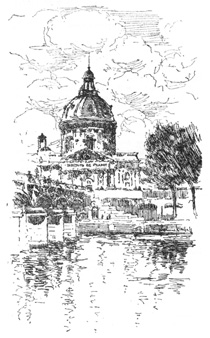
The Institut de France.
View larger image
The Grand Monarque—Versailles and Paris
The century of Louis XIV., whose triumphs have been so extravagantly
celebrated by Voltaire, saw the culmination and declension of military
glory and literary splendour at Paris, and of regal magnificence at
Versailles. Gone were the times of cardinal dictators. When the
ministers came after Mazarin's death to ask the king whom they should
now address themselves to, the answer came like a thunderbolt: "To
me!"
What brilliant constellations of great men cast their influences over
the beginning of Louis XIV.'s reign! "Sire," said Mazarin, when dying,
"I owe you all, but I can partially acquit myself by leaving you
Colbert:"—austere Colbert, whose Atlantean shoulders bore the burden
of five modern ministries; whose vehement industry, admirable science
and sterling honesty created order out of financial chaos and found
the sinews of war for an army of 300,000 men before the Peace of
Ryswick and 450,000 for the war of the Spanish succession; who
initiated, nurtured and perfected French industries; who created a
navy that crushed the combined English and Dutch fleets off Beachy
Head, swept the Channel for weeks, burnt English ports, carried terror
into English homes, and for a time paralysed English commerce.
Louvois, his colleague, organised an army that made his master the
arbiter of Europe; Condé and Turenne were its victorious captains.
Vauban, greatest of military engineers, captured towns in war and made
them impregnable in peace, and shared with Louvois the invention of
the combined musket and bayonet, the deadliest weapon of war as yet
contrived. De Lionne, by masterly diplomacy, prepared and cemented the
conquests of victorious generals. Supreme in arts of peace were
Corneille, Molière, Racine, La Fontaine, Lebrun, Claude Lorrain,
Puget, Mansard, and Perrault. We shall learn in the sequel what the
Grand Monarque did with this unparalleled inheritance.
None of the great ones of the earth is so intimately known to us as
the magnificent histrion, whose tinselled grandeur and pompous egoism
have been laid bare by the Duke of St. Simon, prince of memoirists.
Never has the frippery of a court been shrivelled by such fierce and
consuming light, glaring like a fiery sun on its meretricious
splendours. And what a court it is! What a gilded crowd of princes and
paramours, harlots and bastards, struts, fumes and intrigues through
these Memoirs! By a few strokes of his pen, in words that bite like
acid, he etches for us the fools and knaves, the wife-beaters and
adulterers, the cardsharpers and gamesters, the grovelling sycophants
with their petty struggles for precedence or favour, their slang,
their gluttony and drunkenness, their moral and physical corruption.
External grandeur and regal presence,[141] a profound belief in his
divinely-appointed despotism, and in earlier years a rare capacity for
work, the lord of France certainly possessed. "He had a grand mien,"
says St. Simon, "and looked a veritable king of the bees." Much has
been made of Louis' incomparable grace and respectful courtesy to
women; but the courtesy of a king who doffs his hat to every serving
wench yet contrives a staircase to facilitate the debauching of his
queen's maids-of-honour, and exacts of his mistresses and the ladies
of his court submission to his will and pleasure, even under the most
trying of physical disabilities, is at least wanting in consistency.
Louis' mental equipment was less than mediocre; he was ignorant of the
commonest facts of history, and fell into the grossest blunders in
public. Like all small-minded men, he was jealous of superior merit
and preferred mediocrity rather than genius in his ministers. Small
wonder that his reign ended in shame and disaster.
On the 6th of June 1662, the young Louis, notwithstanding much public
misery consequent on two years of bad harvests, organised a
magnificent carrousel (tilting) in the garden that fronted the
Tuileries. Five companies of nobles, each led by the king or one of
the princes, were apparelled in gorgeous costumes as Romans, Persians,
Turks, Armenians and Indians. Louis, who arrayed as emperor, led the
Romans, was followed by a superb train of many squires, twenty-four
pages, fifty horses each led by two grooms, and fifty footmen dressed
as lictors, carrying gilded fasces. The royal princes headed similar
processions. So great was the display of jewels that all the precious
stones in the world seemed brought together; so richly were the
costumes of the knights and the trappings of the horses embroidered
with gold and silver that the cloth beneath could barely be seen. An
immense amphitheatre afforded seats for a multitude of spectators, and
in a smaller pavilion, richly gilded, sat the two queens of France,
the queen of England, and the royal princesses. The first day was
spent in tilting at Medusa heads and heads of Moors: the second at
rings. The king is
said to have greatly distinguished himself by his
skill. Maria Theresa, his young queen, distributed the prizes, and the
garden was afterwards named the Place du Carrousel.
Louis, however, hated Paris, for his forced exile and the humiliations
of the Fronde rankled in his memory. Nor were the associations of St.
Germain any more pleasant. A lover of the chase and all too prone to
fall into the snares of "fair, fallacious looks and venerial trains,"
the retirement of his father's hunting lodge at Versailles, away from
the prying eyes and mocking tongues of the Parisians, early attracted
him. There he was wont to meet his mistress, Madame de la Vallière,
and there he determined to erect a vast pleasure-palace and gardens.
The small château, built by Lemercier in the early half of the
seventeenth century, was handed over to Levau in 1668, who, carefully
respecting his predecessor's work in the Cour de Marbre, constructed
two immense wings, which were added to by J.H. Mansard, as the
requirements of the court grew. The palace stood in the midst of a
barren, sandy plain, but Louis' pride demanded that Nature herself
should bend to his will, and an army of artists, engineers and
gardeners was concentrated there, who at the sacrifice of incredible
wealth and energy, had so far advanced the work that the king was able
to come into residence in 1682.
In spite of seas of reservoirs fed by costly hydraulic machinery at
Marly, which lifted the waters of the Seine to an aqueduct that led to
Versailles, the supply was deemed inadequate, and orders were given to
divert the river Eure between Chartres and Maintenon to the gardens of
the palace. For years an army of thirty thousand men was employed in
this one task, at a cost of money and human life greater than that of
many a campaign. So heavy was the mortality in the camp that it was
forbidden to speak of the sick, and above all of the dead, who were
carried away in cartloads by night for burial. All that remains of
this cruel folly are a few ruins at Maintenon.
After the failure of this scheme, subterranean water-courses were
contrived. The plaisir du roi must be sated at any cost, and at
length a magnificent garden was created, filled with a population of
statues and adorned with gigantic fountains. Soon however, the king
tired of the bustle and noise of Versailles, and a miserable and
swampy site at Marly, the haunt of toads and serpents and creeping
things, was transformed into a splendid hermitage. Hills were
levelled, great trees brought from Compiègne, most of which soon died
and were as quickly replaced; fish-ponds, adorned by exquisite
paintings, were made and unmade; woods were metamorphosed into lakes,
where the king and a select company of courtiers disported themselves
in gondolas and where cascades refreshed their ears in summer heat;
precious paintings, statues and costly furniture charmed the eye
inside the hermitage—and all to receive the king and his intimates
from Wednesday to Saturday on a few occasions in the year. St. Simon
with passionate exaggeration declares that Marly cost more than
Versailles.[142]
Nothing remains to-day of all this splendour: it was
neglected by Louis' successors and sold in lots during the Revolution.
After a life of wanton licentiousness, Louis, at the age of forty, was
captivated by the mature charms of a widow of forty-three, a colonial
adventuress of noble descent, who after the death of her husband, the
crippled comic poet Scarron, became governess to the king's children
by Madame de Montespan. Soon after the death of Maria Theresa, the
widow Scarron, known to history as Madame de Maintenon, was secretly
married to her royal lover, who for the remainder of his life remained
her docile slave.
A narrow bigot in matters of religion and completely under the
influence of fanatics, Madame de Maintenon persuaded Louis that a
crusade against heresy would be a fitting atonement for his past sins.
By the revocation of the Edict of Nantes, 22nd October 1685, the
charter of Protestant liberties was destroyed, and those who had given
five out of ten marshals to France, including the great Turenne, were
denied the right of civil existence. Whole cities were depopulated;
tens of thousands (for the Huguenots had long ceased to exist as a
political force) of law-abiding citizens expatriated themselves and
carried their industries to enrich foreign lands.[143] Many pastors
were martyred, and drummers stationed at the foot of the scaffold
drowned their exhortations. Let us not say persecution is ineffective;
the Huguenots who at one time threatened to turn the scale in favour
of the Protestant powers and to wreck the Catholic cause in Europe,
practically disappear from history. On the whole, the measure was
approved by Paris; Racine, La Fontaine, the great Jansenist Arnault,
as well as Bossuet and Massillon, applauded. Louis was hailed a second
Constantine, and believed he had revived the times of the apostles.
But the consequences were far-reaching and disastrous. In less than
two months the Catholic James II. of England was a discrowned
fugitive, and the Calvinist William of Orange, the inveterate enemy of
France, sat in his place; England's pensioned neutrality was turned to
bitter hostility, and every Protestant power in Europe stirred to
fierce resentment. Seven years of war ensued, which exhausted the
immense resources of France; seven years,[144] rich in glory perhaps,
but lean years indeed to the dumb millions who paid the cost in blood
and money.
After three short years of peace and recuperation, the acceptance of
the crown of Spain by Louis' grandson, Philip of Anjou, in spite of
Maria Theresa's solemn renunciation for herself and her posterity of
all claim to the Spanish succession, roused all the old jealousy of
France and brought her secular enemy, the House of Austria, to a new
coalition against her.
Woe to the nation whose king is thrall to women. The manner in which
this momentous step was taken is characteristic of Louis. Two councils
were held in Madame de Maintenon's room at Versailles; her advice was
asked by the king, and apparently turned the scale in favour of
acceptance. "For a hundred years," says Taine, "from 1672 to 1774,
every time a king of France made war it was by pique or vanity, by
family or private interest, or by condescension to a woman." Still
more amazing is the fact that, for years, the court of Madrid was
ruled by a Frenchwoman, Madame des Ursins, the camarera mayor of
Philip's queen, who made and unmade ministers, controlled all public
appointments, and even persuaded the French ambassador to submit all
despatches to her before sending them to France. Madame de Maintenon
was equally omnipotent at Versailles; she decided what letters should
or should not be shown to the king, kept back disagreeable news, and
held everybody in the hollow of her hand, from humblest subject to
most exalted minister. This was the atmosphere from which men were
sent to
meet the new and more potent combination of States that
opposed the Spanish succession. Chamillart, a pitiful creature of
Madame de Maintenon's, sat in Colbert's place; gone were Turenne and
Condé and Luxembourg; the armies of the descendant of St. Louis were
led by the Duke of Vendôme, a foul lecher, whose inhuman vices went
far to justify the gibe of Mephistopheles that men use their reason
"um thierischer als jedes Thier zu sein."
The victories of the Duke of Marlborough and of Prince Eugene spread
consternation at Versailles. When, in 1704, the news of Blenheim oozed
out, the king's grief was piteous to see. Scarce a noble family but
had one of its members killed, wounded, or a prisoner. Two years later
came the defeat of Ramillies, to be followed in three months by the
disaster at Turin. The balls and masquerades and play at Marly went
merrily on; but at news of the defeat of Oudenarde and the fall of
Lille, even the reckless courtiers were subdued, and for a month
gambling and even conversation ceased. At the sound of an approaching
horseman they ran hither and thither, with fear painted on their
cheeks. Wildest schemes for raising money were tried; taxes were
levied on baptisms and marriages; sums raised for the relief of the
poor and the maintenance of highways were expropriated, and the
wretched peasants were forced to repair the roads without payment,
some dying of starvation at their work. King and courtiers, with
ill-grace, sent their plate to the mint and a plan for the recapture
of Lille was mooted, in which Louis was to take part, but, for lack of
money, the king's ladies were not to accompany him to the seat of war
as they had hitherto done.[145] The expedition was to remain a
secret; but the infatuated Louis could withhold nothing from Madame de
Maintenon, who never rested until she had foiled the whole scheme and
disgraced Chamillart, for having concealed the preparations from her.
Versailles had now grown so accustomed to defeats that Malplaquet was
hailed as half a victory; but, in 1710, so desperate was the condition
of the treasury, that a financial and social débâcle was imminent.
The Dauphin, on leaving the opera at Paris, had been assailed by
crowds of women shouting, "Bread! bread!" and only escaped by throwing
them money and promises. To appease the people, the poor were set to
level the boulevard near St. Denis, and were paid in doles of
bread—bad bread. Even this failed them one morning, and a woman who
made some disturbance was dragged to the pillory by the archers of the
watch. An angry mob released her, and proceeded to raid the bakers'
shops. The ugly situation was saved only by the firmness and sagacity
of the popular Marshal Boufflers. Another turn of the financial screw
was now meditated, and, as the taxes had already "drawn all the blood
from his subjects, and squeezed out their very marrow," the conscience
of the lord of France was troubled. His Jesuit confessor, Le Tellier,
promised to consult the Sorbonne, whose learned doctors decided that,
since all the wealth of his subjects rightly belonged to the king, he
only took what was his own.
Towards the end of the seventeenth century, the quarrel between
Jansenists and Jesuits concerning subtle doctrinal differences had
grown acute through the publication of Pascal's immortal Lettres
Provinciales, and by Quesnel's Réflexions Morales which the Jesuits
had succeeded in subjecting to papal condemnation. In 1709, Le Tellier
induced his royal penitent to decree the destruction of one of the
two Jansenist establishments, and Port Royal des Champs, between
Versailles and Chevreuse, rendered famous by the piety and learning of
Arnault, Pascal and Nicolle, was doomed. On the night of 28th October
1709, the convent was surrounded by Gardes Françaises and Suisses, and
on the following morning the chief of the police, with a posse of
archers of the watch entered, produced a lettre de cachet, and gave
the nuns a quarter of an hour to prepare for deportation. The whole of
the sisters were then brutally expelled, "comme on enlève les
créatures prostituées d'un lieu infâme," says St. Simon, and
scattered among other religious houses in all directions. The friends
of the buried were bidden to exhume their dead, and all unclaimed
bodies were flung into a neighbouring cemetery, where dogs fought for
them as for carrion. The church was profaned, all the conventual
buildings were razed and sold in lots, not one stone being left on
another; the very ground was ploughed up and sown, "not, it is true
with salt," adds St. Simon, and that was the only favour shown.
Two years after the scene at Port Royal, amid the heartless gaiety of
the court, the Angel of Death was busy in Louis' household. On 14th
April 1711, the old king's only lawful son, the Grand Dauphin,
expired; on 12th February 1712, the second Dauphiness, the sweet and
gentle Adelaide of Savoy, Louis' darling, died of a malignant fever;
six days later the Duke of Burgundy, her husband, was struck down; on
8th March, the Duke of Brittany, their eldest child, followed them.
Three Dauphins had gone to the vaults of St. Denis in less than a
year; mother, father, son, had died in twenty-four days—a sweep of
Death's scythe, enough to touch even the hearts of courtiers. In a few
days the king gave orders for the usual play to begin at Marly, and
the dice rattled while the bodies of the Dauphin and Dauphiness lay
yet unburied.
In May 1714, the Duke of Berri, son of the Grand Dauphin, died, and
the sole direct heir to the throne was now the king's great-grandson,
the Duke of Anjou, a sickly child of five years. On September 1715,
the Grand Monarque made a calm and an edifying end to his long reign
of seventy-two years, declaring that he owed no man restitution, and
trusted in God's mercy for what he owed to the realm. He called the
young child, who was soon to be Louis XV., to his bedside, and
apparently without any sense of irony, exhorted him to remember his
God, to cherish peace, to avoid extravagance, and study the welfare of
his people. After receiving the last sacraments he repeated the
prayers for the dying in a firm voice and, calling on God's aid,
passed peacefully away. None but his official attendants, his priest
and physicians, saw the end: two days before, Madame de Maintenon had
retired to St. Cyr.
The demolition of what remained of mediæval Paris proceeded apace
during Louis XIV.'s lifetime, and, at his death, the architectural
features of its streets were substantially those of the older Paris of
to-day. Colbert had taken up the costly legacy of the unfinished
Louvre before the petrified banalities of Versailles and Marly had
engulfed their millions, and, in 1660, the Hôtel de Bourbon was given
over to the housebreakers to make room for the new east wing of the
palace. So vigorously did they set to work that when Molière, whose
company performed there three days a week in alternation with the
Italian opera, came for the usual rehearsal, he found the theatre half
demolished. He applied to the king, who granted him the temporary use
of Richelieu's theatre in the Palais Royal, and his first performance
there was given on 20th January 1661.
Levau was employed to carry on Lemercier's work on the Louvre, and had
succeeded in completing the north wing and the river front in harmony
with Lescot's design, when in 1664 Colbert stayed further progress and
ordered him to prepare a model in wood of his proposed east wing.
Levau was stupefied, for he had elaborated with infinite study a
design for this portion of the palace, which he regarded as of supreme
importance, and which he hoped would crown his work. He had already
laid the foundations and erected the scaffolding when the order came.
Levau made his model, and a number of architects were invited to
criticise it: they did, and unanimously condemned it. Competitive
designs were then exhibited with the model and submitted to Colbert,
who took advantage of Poussin's residence at Rome to send them to the
great Italian architects for their judgment. The Italians delivered a
sweeping and general condemnation, and Poussin advised that Bernini
should be employed to design a really noble edifice. Louis was
delighted by the suggestion, and the loan of the architect of the
great Colonnade of St. Peter's was entreated of the pope by the king's
own hand in a letter dated 11th April 1665.
Bernini, in spite of his sixty-eight years, came to Paris, accompanied
by his son, where he was treated like a prince, and drew up a scheme
of classic grandeur. Levau's work on the east front was destroyed, and
in October 1665, Bernini's foundations were begun. The majestic new
design, however, ignored the exigencies of existing work and of
internal convenience, and gave opportunities for criticisms and
intrigue, which Colbert and the French architects,[146] forgetting
for the moment all domestic rivalry, were not slow to make the most
of. The offended Italian, three days after the ceremony of laying the
foundation stone by the king on the 17th October 1665, left to winter
in Rome, promising to return with his wife in the following February.
He carried with him a munificent gift of 3000 gold louis and a pension
of 12,000 livres for himself and of 1,200 for his son. The pension was
paid regularly up to 1674, but the great Bernini was never seen in
Paris again.
Among the designs originally submitted to Colbert, and approved by him
and Lebrun, was one which had not been sent to Rome. It was the work
of an amateur, Claude Perrault, a physician, whose brother, Charles
Perrault, was chief clerk in the Office of Works. This was brought
forth early in 1667, and a commission, consisting of Levau, Lebrun,
Claude Perrault and others, appointed to report on its practicability.
Levau promptly produced his own discarded designs, and both were
submitted to the king for a final decision on 13th May. Louis was
fascinated by the stately classicism of Perrault's design, and this
was adopted. "Architecture must be in a bad state," said his rivals,
"since it is put in the hands of a physician." Colbert seems, however,
to have distrusted Claude's technical powers and on his brother
Charles' advice a council of specialists, consisting of Levau, Lebrun,
and Claude was appointed under the presidency of Colbert. Charles was
made secretary and many were the quarrels between the rival architects
over practical details. Perrault's new wing was found to be
seventy-two feet too long, but the sovereign fiat had gone forth, the
new east façade was raised and the whole of Levau's river front was
masked by a new façade, rendered necessary by the excessive length of
Perrault's design. The whole south wing[147] is in consequence much
wider than any of the others which enclose the great quadrangle. Poor
Levau's end was hastened by vexation and grief. Even to this day the
north-east wing of Perrault's façade projects unsymmetrically beyond
the line of the north front. The work has been much criticised and
much praised. It evoked Fergusson's ecstatic admiration, was extolled
by Reynolds and eulogised by another critic as one of the finest
pieces of architecture in any age. Strangely enough, neither of these
ever saw, nor has anyone yet seen, more than a partial and stunted
realisation of Perrault's design, for, as the accompanying
reproduction of a drawing by Blondel demonstrates, the famous east
front of the Louvre is like a giant buried up to the knees, and the
present first-floor windows were an afterthought, their places having
been designed as niches to hold statues. The exactitude of Blondel's
elevations was finally proved in 1903 by the admirable insight of the
present architect of the Louvre, Monsieur G. Redon, who was led to
undertake the excavations which brought to light a section of
Perrault's decorated basement, by noticing that the windows of the
ground floor evidently implied a lower order beneath. This basement,
seven and a half metres in depth, now buried, was in Perrault's scheme
designed to be exposed by a fosse of some fifteen to twenty metres in
width, and the whole elevation and symmetry of the wing would have
immensely gained by the carrying out of his plans.
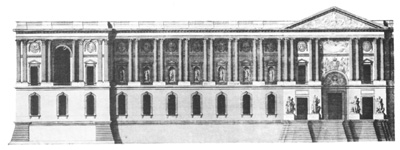
Portion of the East Façade of the Louvre from Blondel's
drawing, showing Perrault's base.
View larger image
The construction was, however, interrupted in 1676, owing to the
king's abandonment of Paris. Colbert strenuously protested against the
neglect of the Louvre, and warned his master not to squander his
millions away from Paris and suffer posterity to measure his grandeur
by the ell of Versailles. It availed nothing. In 1670, 1,627,293
livres were allotted to the Louvre; in 1672 the sum had fallen to
58,000 livres; in 1676 to 42,082; in 1680 the subsidies practically
ceased, and the great palace was utterly neglected until 1754 when
Perrault's work was feebly continued by Gabriel and Soufflot.
Two domed churches in the south of Paris—the Val de Grâce and St.
Louis of the Invalides—were also erected during Louis XIV.'s
lifetime. Among the many vows made by Anne of Austria during her
twenty-two years' unfruitful marriage was one made in the sanctuary of
the nunnery of the Val de Grâce, to build there a magnificent church
to God's glory if she were vouchsafed a Dauphin. At length, on 18th
April 1645, the proud queen was able to lead the future king, a boy of
seven years, to lay the first stone. The church was designed by F.
Mansard on the model of St. Peter's at Rome, and was finished by
Lemercier and others.
A refuge had been founded as early as Henry IV.'s reign in an old
abbey in the Faubourg St. Marcel, for old and disabled soldiers. Louis
XIV., the greatest creator of invalides France had seen, determined
in 1670 to extend the foundation, and erect a vast hospital, capable
of accommodating his aged, crippled or infirm soldiers. Bruant and
J.H. Mansard[148] among other architects were employed to raise the
vast pile of buildings which, when completed, are said to have been
capable of housing 7,000 men. A church dedicated to St. Louis was
comprehended in the scheme, and, in 1680, a second Église Royale was
erected, whose gilded dome is so conspicuous an object in south Paris;
the Église Royale, which Mansard designed, was subsequently added to
the church of St. Louis, and became its choir. Louis XIV.,
anticipating Napoleon's maxim that war must support war, raised the
funds needed for the foundation by ingeniously requiring all ordinary
and extraordinary treasurers of war to retain two deniers[149] on
every livre that passed through their hands.
The old city gates of the Tournelle, Poissonnière (or St. Anne), St.
Martin, St. Denis, the Temple, St. Jacques, St. Victor, were
demolished, and triumphal arches, which still remain, erected to mark
the sites of the Portes St. Denis and St. Martin. Another arch, of St.
Antoine, was designed to surpass all existing or ancient monuments of
the kind, and many volumes were written concerning the language in
which the inscription should be composed, but the devouring maw of
Versailles had to be filled, and the arch was never completed. The
king for whose glory the monument was to be raised, cared so little
for it, that he suffered it to be pulled down.
Many new streets[150] were made, and others widened, among them the
ill-omened Rue de la Ferronnerie. The northern ramparts were levelled
and planted with trees from the Porte St. Antoine in the east to the
Porte St. Honoré in the west, and in 1704 it was decided to continue
the planting in the south round the
Faubourg St. Germain. The Place
Louis le Grand (now Vendôme), and the Place des Victoires were
created; the river embankments were renewed and extended, and a fine
stone Pont Royal by J.H. Mansard, the most beautiful of the existing
bridges of Paris, was built to replace the old wooden structure that
led from the St. Germain quarter to the Tuileries. This in its turn
had replaced a ferry (bac) established by the Guild of Ferrymen, to
transport the stone needed for the construction of the Tuileries, and
the street which leads to the bridge still bears the name of the Rue
du Bac. The Isle Louviers was acquired by the Ville, and the
evil-smelling tanneries and dye-houses that disfigured the banks of
the Seine between the Grève and the Châtelet were cleared away; many
new fountains embellished the city, and ten new pumps increased the
supply of water. The poorer quarters were, however, little changed
from their old insanitary condition. A few years later Rousseau, fresh
from Turin, was profoundly disappointed by the streets of Paris as he
entered the city by the Faubourg St. Marceau. "I had imagined," he
writes, "a city as fair as it was great, and of a most imposing
aspect, whose superb streets were lined with palaces of marble and of
gold. I beheld filthy, evil-smelling, mean streets, ugly houses black
with dirt, a general air of uncleanness and of poverty, beggars and
carters, old clothes shop and tisane sellers."
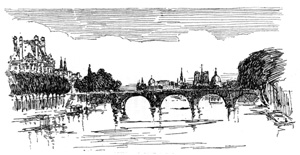
River and Pont Royal.
View larger image
It is now time to ask what had been done with the magnificent
inheritance which the fourteenth Louis had entered upon at the opening
of his reign: he left to his successor, a France crushed by an
appalling debt of 2,400,000,000 livres; a noblesse and an army in
bondage to money-lenders; public officials and fund-holders unpaid,
trade paralysed, and the peasants in some provinces so poor that even
straw was lacking for them to lie upon, many crossing the frontiers
in search of a less miserable lot. Scarcity of bread made disease
rampant at Paris, and as many as 4,500 sick poor were counted at one
time in the Hôtel Dieu alone. Louis left a court that "sweated
hypocrisy through every pore," and an example of licentious and
unclean living and cynical disregard of every moral obligation, which
ate like a cancer into the vitals of the aristocracy.
Paris under the Regency and Louis XV.—The brooding Storm
Under the regency of the profligate Philip of Orleans, a profounder
depth was sounded. The vices of Louis' court were at least veiled by a
certain regal dignity, and the Grand Monarque was always keenly
sensitive, and at times nobly responsive, to any attack upon the
honour of France; but under the regent, libertinage and indifference
to national honour were flagrant and shameless. The Abbé Dubois, a
minister worthy of his prince, was, says St. Simon, "a mean-looking,
thin little man, with the face of a ferret, in whom every vice fought
for mastery." This creature profaned the seat of Richelieu and
Colbert, and rose to fill a cardinal's chair. The revenues of seven
abbeys fed his pride and luxury, and his annual income was estimated
at 1,534,000 livres, including his bribe from the English Government.
Visitors to Venice whose curiosity may have led them into the church
of S. Moisè, will remember to have seen there a monument to a famous
Scotchman—John Law. This is the last home of an outlaw, a gambler,
and an adventurer, who, by his amazing skill and effrontery, plunged
the regency into a vortex of speculation, and for a time controlled
the finances of France. He persuaded the regent that by a liberal
issue of paper money he might wipe out the accumulated national
deficit of 100,000,000 livres, revive trade and industry, and
inaugurate a financial millennium. In 1718 Law's Bank at Paris after
a short and brilliant career as a private venture, was converted into
the Banque Royale, and by the artful flotation of a gigantic trading
speculation called the Mississippi Company, the bank-notes and company
shares were so manipulated that the latter were inflated to twenty
times their nominal value. The whole city seethed in a ferment of
speculation. The offices of the Bank in the Rue Quincampoix were daily
besieged by a motley crowd of princes, nobles, fine ladies,
courtesans, generals, prelates, priests, bourgeois and servants. A
hunchback made a fortune by lending his back as a desk; lacqueys
became masters in a day, and a parvenu foot-man, by force of habit,
jumped up behind his own carriage in a fit of abstraction. The
inevitable catastrophe came at the end of 1719. The Prince of Conti
was observed taking away three cartloads of silver in exchange for his
paper; a panic ensued, every holder sought to realise, and the
colossal fabric came down with a crash, involving thousands of
families in ruin and despair. Law, after bravely trying to save the
situation and narrowly escaping being torn in pieces, fled to poverty
and death at Venice, and the financial state of France was worse than
before. Law was not, however, absolutely a quack; there was a seed of
good in his famous system of mobilising credit, and the temporary
stimulus it gave to trade permanently influenced mercantile practice
in Europe.
In 1723, Louis XV. reached his legal majority. The regent became chief
minister, and soon paid the penalty of his career of debauchery,
leaving as his successor the Duke of Bourbon, degenerate scion of the
great Condé and one of the chief speculators in the Mississippi
bubble. A perilous lesson had two years before been instilled into the
mind of the young Louis. After his recovery from an illness, an
immense concourse of people had assembled at a fête given in the
gardens of the Tuileries palace; enormous crowds filled every inch of
the Place du Carrousel and the gardens; the windows and even the roofs
of the houses were alive with people crying "Vive le roi!" Marshal
Villeroi led the little lad of eleven to a window, showed him the sea
of exultant faces turned towards him, and exclaimed, "Sire, all this
people is yours; all belongs to you. Show yourself to them, and
satisfy them; you are the master of all."
The Infanta of Spain, at four years of age, had been betrothed to the
young king, and in 1723 was sent to Paris to be educated for her
exalted future. She was lodged in the Petite Galerie of the Louvre,
over the garden still known as the Garden of the Infanta,[151] and
after three years of exile the homesick little maid was returned to
Madrid; for Louis' weak health made it imperative that a speedy
marriage should be contracted if the succession to the throne were to
be assured. The choice finally fell on the daughter of Stanislaus
Leczynski, a deposed king of Poland and a pensioner of France.
Voltaire relates that the poor discrowned queen was sitting with her
daughter Marie in their little room at Wissembourg when the father,
bursting in, fell on his knees, crying, "Let us thank God, my child!"
"Are you then recalled to Poland?" asked Marie. "Nay, daughter, far
better," answered Stanislaus, "you are the queen of France." A
magnificent wedding at Fontainebleau exalted gentle, pious Marie from
poverty to the richest queendom in Europe; to a life of cruel neglect
and almost intolerable insult.
The immoral Duke of Bourbon was followed by Cardinal Fleury, and at
length France experienced a period of honest administration, which
enabled the sorely-tried land to recover some of its wonted
elasticity. The Cardinal was, however, dominated by the Jesuits, and
both Protestants and Jansenists felt their cruel hand. During the
persecution of the Jansenists in 1782 a deacon, named Pâris, died and
was canonised by the popular voice. Miracles were said to have been
wrought at his sepulchre in the cemetery of St. Médard; fanatics flung
themselves down on the tomb and writhed in horrible convulsions. So
great was the excitement and disorder that the Archbishop of Paris
denounced the miracles as the work of Satan, and the Government
ordered the cemetery to be closed. The next morning a profane
inscription was found over the entrance to the cemetery: —
"De par le roi défense à Dieu
De faire miracle en ce lieu."[152]
Before Louis sank irrevocably into the slothful indulgence that
stained his later years, he was stirred to essay a kingly rôle by
Madame de Chateauroux, the youngest of four sisters who had
successively been his mistresses. She fired his indolent imagination
by appeals to the memory of his glorious ancestors, and the war of the
Austrian succession being in progress, Louis set forth with the army
of the great Marshal Saxe for Metz, where in August 1744 he was
stricken down by a violent fever, and in an access of piety was
induced to promise to dismiss his mistress and return to his abused
queen. As he lay on the brink of death, given up by his physicians
and prepared for the end by the administration of the last sacraments,
a royal phrase admirably adapted to capture the imagination of a
gallant people came from his lips. "Remember," he said to Marshal
Noailles, "remember that when Louis XIII. was being carried to the
grave, the Prince of Condé won a battle for France." The agitation of
the Parisians as the king hovered between life and death was
indescribable. The churches were thronged with sobbing people praying
for his recovery; when the courtiers came with news that he was out of
danger they were borne shoulder high in triumph through the streets,
and fervent thanksgiving followed in all the churches. People hailed
him as Louis le Bien-Aimé; even the callous heart of the king was
pierced by their loyalty and he cried, "What have I done to deserve
such love?" So easy was it to win the affection of this warm-hearted
people.
The brilliant victories of Marshal Saxe, and the consequent Peace of
Aix-la-Chapelle, brought some years of prosperity. Wealth increased;
Paris became more than ever a centre of intellectual splendour and
social refinement, where the arts administered to luxurious ease and
to the fair frailties of passion. But it was a period of riotous pride
and regal licentiousness unparalleled even in the history of France.
Louis XIV. at least exacted good breeding and wit in his mistresses:
his descendant enslaved himself to the commonest and most abandoned of
women. For twenty years the destinies of the people, and the whole
patronage of the Government, the right to succeed to the most sacred
and exalted offices in the Church, were bartered and intrigued for in
the chamber of a harlot and procuress, and under the influence of the
Pompadours and the Du Barrys a crowned roué allowed the state to
drift into financial, military and civil[153] disaster.
"Authentic proofs exist," says Taine, "demonstrating that Madame de
Pompadour cost Louis XV. a sum equal to about seventy-two millions of
present value (£2,880,000)." She would examine the plans of campaign
of her marshals in her boudoir, and mark with patches (mouches) the
places to be defended or attacked. Such was the mad extravagance of
the court that to raise money recourse was had to taxation of the
clergy, which the prelates successfully resisted; the old quarrel with
the Jansenists was revived, and soon Church and Crown were convulsed
by an agitation that shook society to its very base. During the
popular ferment the king was attacked in 1757 by a crack-brained
fanatic named Damiens, who scratched him with a penknife as he was
entering his coach at Versailles. The poor crazy wretch, who at most
deserved detention in an asylum, was first subjected to a cruel
judicial torture, then taken to the Place de Grève, where he was
lacerated with red-hot pincers and, after boiling lead had been poured
into the wounds, his quivering body was torn to pieces by four horses,
and the fragments burned to ashes.
A few years later the long-suffering Jansenists were avenged with
startling severity. The Jesuits, to their honour be it said, shocked
by the infamies of the royal seraglio in the Parc aux Cerfs, made use
of their ascendency at Court to awaken in the king's mind some sense
of decency: they did but add the bitter animosity of Madame de
Pompadour to the existing hostility of the Parlement of Paris. Louis,
urged by his minister the Duke of Choiseul, and by the arts of his
mistress, abandoned the Jesuits to their enemies: the Parlement
suppressed the Society, secularised its members and confiscated its
property.
The closing years of the Well-Beloved's reign were years of
unmitigated ignominy and disaster. Indian conquests were muddled away,
and the gallant Dupleix died broken-hearted and in misery at Paris.
Canada was lost. During the Seven Years' War the incapacity and
administrative corruption of Madame de Pompadour's favourites made
them the laughing-stock of Paris. In 1770 the Duke of Choiseul refused
to tolerate the vile Du Barry, whom we may see in Madame Campan's
Memoirs sitting on the arm of Louis' chair at a council of state,
playing her monkey tricks to amuse the old sultan, snatching sealed
orders from his hand and making the royal dotard chase her round the
council chamber. She swore to ruin the duke and, aided by a cabal of
Jesuit sympathisers and noble intriguers, succeeded in compassing his
dismissal. The Parlement of Paris paid for its temerity: it and the
whole of the parlements in France were suppressed, and seven hundred
magistrates exiled by lettres de cachet. Every patriotic Frenchman
now felt the gathering storm. Madame Campan writes that twenty years
before the crash came it was common talk in her father's house (he was
employed in the Foreign Office) that the old monarchy was rapidly
sinking and a great change at hand. Indeed, the writing on the wall
was not difficult to read. The learned and virtuous Malesherbes and
many another distinguished member of the suppressed parlements warned
the king of the dangers menacing the crown, but so sunk was its wearer
in sensual stupefaction that he only murmured: "Well, it will last my
time," and with his flatterers and strumpets uttered the famous
words—"Après nous le déluge." So lost to all sense of honour was
Louis, that he defiled his hands with bribes from tax-farmers who
ground the faces of the poor, and became a large shareholder in an
infamous syndicate of capitalists that bought up the corn of France in
order to export and then import it at enormous profit. This abominable
Pacte de Famine created two artificial famines in France; its
authors battened on the misery of the people, and for any who lifted
their voices against it the Bastille yawned.
In 1768 the poor abused and neglected queen, Marie Leczinska died. The
court sank from bad to worse: void now of all dignity, all gaiety, all
wit and all elegance, it drifted to its doom. Six years passed, when
Louis was smitten by confluent small-pox and a few poor women were
left to perform the last offices on the mass of pestiferous corruption
that once was the fifteenth Louis of France.[154] None could be found
to embalm the corpse, and spirits of wine were poured into the coffin
which was carried to St. Denis without pomp and amid the
half-suppressed curses of the people. Before the breath had left the
body, a noise as of thunder was heard approaching the chamber of the
Dauphin and Marie Antoinette: it was the sound of the courtiers
hastening to grovel before the new king and queen. Warned that they
had now inherited the awful legacy of the French monarchy, they flung
themselves in tears on their knees, and exclaimed—"O God, guide and
protect us! We are too young to govern."
The degradation of the monarchy during the reign is reflected in the
condition of the Louvre. Henry IV.'s great scheme, which Louis XIII.
had inherited and furthered, included a colossal equestrian statue,
which was to stand on a rocky pedestal in the centre of a new Place,
before the east front of the Louvre, but the regency revoked the
scheme, and for thirty years nothing was done. It had even been
proposed under the ministry of Cardinal Fleury to pull the whole
structure down and sell the site. The neglect of the palace during
these years is almost incredible. Perrault's fine façade was hidden by
the half-demolished walls of the Hôtels de Longueville, de Villequier,
and de Bourbon. The east wing itself was unroofed on the quadrangle
side and covered with rotting boarding. Perrault's columns on the
outer façade were unchannelled, the capitals unfinished, the portal
unsculptured, and the post-office stabled its horses along the whole
of the wing from the middle entrance to the north angle. The royal
apartments of Anne of Austria in the Petite Galerie were used as
stables; so, too, were the halls where now is housed the collection of
Renaissance sculpture. The Infanta's garden was a yard where grooms
exercised their horses; a colony of poor artists and court attendants
were lodged in the upper floors, and over most of the great halls
entresols were constructed to increase this kind of accommodation. The
building was described as a huge caravanserai, where each one lodged
and worked as he chose, and over which might have been placed the
legend, "Ici on loge à pied et à cheval." Worse still, an army of
squatters, ne'er-do-wells, bankrupts and defaulting debtors took
refuge in the wooden sheds left by the contractors, or built others—a
miserable gangrene of hovels—against the east façade. Perrault's base
had been concealed by rubbish and apparently forgotten. Stove-pipes
issued from the broken windows of the upper floors, the beautiful
stone-work was blackened by smoke, cracked by frost and soiled by
rusting iron clamps; the quadrangle was a chaos of uncut stone,
rubbish and filth, in the centre of which, where the king's statue was
designed to stand, the royal architect had built himself a large
mansion; a mass of mean houses encumbered the Carrousel, and the
almost ruined church of St. Nicholas was a haunt of beggars. Such a
grievous eyesore was the building that the provost in 1751 offered, in
the name of the citizens, to repair and complete the palace if a part
were assigned to them as an Hôtel de Ville. In 1754 Madame de
Pompadour's brother, M. de Marigny, had been appointed Commissioner of
Works, and Louis was persuaded to authorise the repair and completion
of the Louvre. Gabriel being made architect set about his work in 1758
by clearing out the squatters and the accumulated rubbish in the
quadrangle, and evicting the occupants of the stables. The ruins of
the Hôtels de Longueville, de Villequier, and de Bourbon were
demolished and grass plots laid before Perrault's east front, which
was restored and for the first time made visible. The west front,
giving on the quadrangle, was then repaired and the third floor nearly
completed, when funds were exhausted and it was left unroofed. An
epigram, put into the mouth of the king of Denmark, who visited Paris
in 1768, tersely describes the condition of the palace at this time: —
"J'ai vu le Louvre et son enceinte immense,
Vaste palais qui depuis deux cent ans,
Toujours s'achève et toujours se commence.
356
Deux ouvriers, manœuvres fainéants,
Hâtent très lentement ces riches bâtiments
Et sont payés quand on y pense."[155]
During Louis XVI.'s reign little or nothing was done. Soufflot was
making feeble efforts to complete Perrault's north front when the
Revolution came to arrest his work. So lost to reverence and devoid of
artistic sentiment were the official architects of this period, that a
sacrilege worse than any wrought by revolutionists was perpetrated at
the instance of the canons of Notre Dame. Louis XIV. had begun the
vandalism by demolishing the beautiful old Gothic high altar and
replacing it by a huge, ponderous anachronism in marble, on whose
foundation stone, laid in 1699, was placed an inscription to the
effect that Louis the Great, son of Louis the Just, having subdued
heresy, established the true religion in his realm and ended wars
gloriously by land and sea, built the altar to fulfil the vow of his
father, and dedicated it to the God of Arms and Master of Peace and
Victory under the invocation of the Holy Virgin, patroness and
protector of his States. The beautiful fifteenth-century stalls, the
choir screen, and many of the fine old Gothic tombs of marble and
bronze in the church, the monuments of six centuries, were destroyed.
But to the reign of Louis the Well-Beloved was reserved the crowning
infamy: in 1741 the glorious old stained-glass windows, rivalling
those of Chartres in richness, were destroyed by Levreil and replaced
by grisaille with yellow fleur-de-lys ornamentation. Happily the
destruction of the rose windows was deemed too expensive, and they
escaped. The famous colossal statue of St. Christopher, the equestrian
monument of Philip le Bel, and a popular statue of the Virgin, were
broken down by these clerical iconoclasts. In 1771 the canons
instructed Soufflot to throw down the pillar of the central porch,
with its beautiful statue of Christ, to make room for their
processions to enter. The priceless sculpture of the tympanum was cut
through to make a loftier and wider entrance, and the whole symmetry
of the west front was
grievously destroyed.[156] This hideous
architectural deformity remained until a son of the Revolution,
Viollet le Duc, restored the portal to its original form. After the
havoc wrought at Notre Dame, Soufflot's energies were diverted to the
holy mount of St. Genevieve. Louis XV. had attributed his recovery at
Metz to the intercession of the saint, and in 1754, when the abbot
complained to the king of the almost ruined condition of the abbey
church, he found a sympathetic listener. Soufflot and the chapter, who
shared the prevalent contempt of Gothic, decided to abandon the
venerable old pile, with its millennial associations of the patron
saint of Paris, and to build a grand domed classic temple on the abbey
lands to the west. Funds for the sacred work were raised by levying a
tax on public lotteries. The old church, with the exception of the
tower, was finally demolished in 1802, when the rude stone coffin
which had held the body of St. Genevieve until it was burnt by
revolutionary fanatics, was transferred to St. Étienne du Mont.
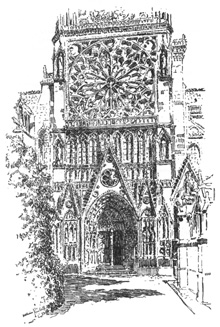
South door of Notre Dame.
View larger image
On 6th September 1764, the crypt of the new St. Genevieve being
completed, the Well-Beloved laid the first stone of the church.
Scarcely was the scaffolding removed after thirteen years of
constructive labour, and the expenditure of sixteen millions of
livres, when it became necessary to call in Soufflot's pupil Rondelet,
to shore up the walls and strengthen the columns which had proved too
weak to sustain the weight of the huge cupola. But before the temple
was consecrated, the Revolutionists came, and noting its monumental
aspect used it with admirable fitness as a Panthéon Français for the
remains of their heroes; the dome designed to cover the relics of St.
Genevieve soared over the ashes of Voltaire, Mirabeau, Rousseau and
Marat. Thrice has this unlucky fane been the prize of Catholic and
Revolutionary reactionaries. In 1806 Napoleon I. restored it to
Christian worship; in 1822 the famous inscription—"Aux grands Hommes
la Patrie reconnaissante" was removed by Louis XVIII., and replaced by
a dedication to God and St. Genevieve; in 1830 Louis Philippe, the
citizen king, transferred it to secular and monumental uses, and
restored the former inscription; in 1851 the perjured Prince-President
Napoleon, while the streets of Paris were yet red with the blood of
his victims, again surrendered it to the Catholic Church; in 1885 it
was reconverted to a national Walhalla for the reception of Victor
Hugo's remains.
The pseudo-classic church of St. Sulpice, begun in 1665 and not
completed until 1777, is a monument of the degraded taste of this
unhappy time. At least three architects, Gamart, Levau and the Italian
Servandoni, are responsible for this monstrous pile, whose towers have
been aptly compared by Victor Hugo to two huge clarionets. The
building has, however, a certain puissante laideur, as Michelet said
of Danton, and is imposing from its very mass, but it is dull and
heavy and devoid of all charm and imagination. Nothing exemplifies
more strikingly the mutation of taste that has taken place since the
eighteenth century than the fact that this church is the only one
mentioned by Gibbon in the portion of his autobiography which refers
to his first visit to Paris, where it is distinguished as "one of the
noblest structures in Paris."
Louis XVI.—The Great Revolution—Fall of the Monarchy
Crowned vice was now succeeded by crowned folly. The grandson of Louis
XV., a well-meaning but weak and foolish youth, and his thoughtless,
pleasure-loving queen, were confronted by state problems that would
have taxed the genius of a Richelieu in the maturity of his powers.
Injustice, misery, oppression, discontent, were clamant and almost
universal; taxes had doubled since the death of Louis XIV.; there were
30,000 beggars in Paris alone, and from 720,000 in 1700 the population
had in 1784 decreased to 620,000. The penal code was of inhuman
ferocity; law was complicated, ruinous and partial, and national
credit so low that loans could be obtained only against material
pledges and at interest five times as great as that paid by England.
Wealthy bishops and abbots[157] and clergy, noblesse and royal
officials, were wholly exempt from the main incidents of taxation; for
personal and land taxes, tithes and forced labour, were exacted from
the common people alone. No liberty of worship, nor of thought:
Protestants were condemned to the galleys by hundreds; booksellers met
the same fate. Authors and books were arbitrarily sent by lettres de
cachet to the Bastille or Vincennes. Yet in spite of all repression,
a generation of daring, witty, emancipated thinkers in Paris was
elaborating a weapon of scientific, rationalistic and liberal doctrine
that cut at the very roots of the old régime. "I care not whether a
man is good or bad," says the Deity in Blake's prophetic books, "all I
care, is whether he is a wise man or a fool." While France was in
travail of the palingenesis of the modern world, the futile king was
trifling with his locks and keys and colouring maps, the queen playing
at shepherdesses at Trianon or performing before courtiers, officers
and equerries the rôles of Rosina in the Barbier de Seville and of
Colette in the Devin du Village, the latter composed by the
democratic philosopher, whose Contrat Social was to prove the Gospel
of the Revolution.[158] Jean Jacques Rousseau, the solitary,
self-centred Swiss engraver and musician, has described for us in
words that will bear translation how an ineffaceable impression of the
sufferings of the people was burnt into his memory, and the fire of an
unquenchable hatred of their oppressors was kindled in his breast.
Journeying on foot between Paris and Lyons, he was one day diverted
from his path by the beauty of the landscape, and wandered about,
seeking in vain to discover his way. "At length," he writes, "weary,
and dying of thirst and hunger, I entered a peasant's house, not a
very attractive one, but the only one I could see. I imagined that
here as in Switzerland every inhabitant of easy means would be able to
offer hospitality. I entered and begged that I might have dinner by
paying for it. The peasant handed me some skim milk and coarse barley
bread, saying that was all he had. The milk seemed delicious and I ate
the bread, straw and all, but it was not very satisfying to one
exhausted by fatigue. The man scrutinised me and judged by my
appetite the truth of the story I had told. Suddenly, after saying
that he perceived I was a good, honest youth and not there to spy upon
him, he opened a trap door, descended and returned speedily with some
good wheaten bread, a ham appetising but rather high, and a bottle of
wine which rejoiced my heart more than all the rest. He added a good
thick omelette and I enjoyed a dinner such as those alone who travel
on foot can know. When it came to paying, his anxiety and fears again
seized him; he would have none of my money and pushed it aside,
exceedingly troubled, nor could I imagine what he was afraid of. At
last he uttered with a shudder the terrible words, commis, rats de
cave" ("assessors, cellar rats"). He made me understand that he hid
the wine because of the aides,[159] and the bread because of the
tailles,[160] and that he would be a ruined man if it were supposed
that he was not dying of hunger. That man, although fairly well-off,
dared not eat the bread earned by the sweat of his brow, and could
only escape ruin by pretending to be as miserable as those he saw
around him. I issued forth from that house indignant as well as
affected, deploring the lot of that fair land where nature had
lavished all her gifts only to become the spoil of barbarous
tax-farmers (publicans)." And Voltaire, that implacable avenger of
injustice, in verse that rends the heart, has in les Finances,
(1775), pictured a peaceful home ruined; its inmates evicted to
misery, to the galleys and to death, by the cruel exactions of the
royal director of the aides and gabelles, with his sergents de la
finance habillés en guerriers. The elder Mirabeau too has told how he
saw a bailiff cut off the hand of a peasant woman who had clung to her
kitchen utensils when distraint was made on her poor possessions for
dues exacted by the tax-farmers. In 1776 two poor starving wretches
were hanged on the gallows of the Place de Grève at Paris for having
stolen some bread from a baker's shop.
"But though the gods see clearly, they are slow
In marking when a man, despising them,
Turns from their worship to the scorn of fools."
Half a century had elapsed since that meal in the peasant's house when
the Nemesis that holds sleepless vigil over the affairs of men stirred
her pinions and, like a strong angel with glittering sword, prepared
to avenge the wrongs of a people whose rulers had outraged every law,
human and divine, by which human society is held together. King,
nobles, and prelates had a supreme and an awful choice. They might
have led and controlled the Revolution; they chose to oppose it, and
were broken into shivers as a potter's vessel.
After the memorable cannonade at Valmy, a knot of defeated German
officers gathered in rain and wind moodily around the circle where
they durst not kindle the usual camp-fire. In the morning the army had
talked of nothing but spitting and devouring the whole French nation:
in the evening everyone went about alone; nobody looked at his
neighbour, or if he did, it was but to curse and swear. "At last,"
says Goethe, "I was called upon to speak, for I had been wont to
enliven and amuse the troop with short sayings. This time I said,
'From this day forth, and from this place, a new era begins in the
history of the world and you can all say that you were present at its
birth.'" This is not the place to write the story of the French
Revolution. Those who would read the tremendous drama may be referred
to the pages of Carlyle. As a formal history, that work of
transcendent genius is open to criticism, especially on the score of
accuracy in detail. Indeed to the present writer the magnificent and
solemn prosody seems to partake of the nature of a Greek chorus—the
comment of an idealised spectator, assuming that the hearer has the
drama unfolding before his eyes. Recent researches have supplemented
and modified our knowledge. It is no longer possible to accept the
more revolting representations of the misery[161] of the French
peasantry as true of the whole of France, for France before the
Revolution was an assemblage of many provinces of varying social
conditions, subjected to varying administrative laws. Nor can we
accept Carlyle's portraiture of Robespierre as history, after Louis
Blanc's great work. So far from Robespierre having been the
bloodthirsty protagonist of the later Terror, it was precisely his
determination to make an end of the more savage excesses of the
extreme Terrorists and to chastise their more furious pro-consuls,
such as Carrier and Fouché, that brought about his ruin. It was men
like Collot d'Herbois, Billaud Varenne and Barrère, the bloodiest of
the Terrorists, who, to save their own heads, united to cast the odium
of the later excesses on Robespierre, and to overthrow him.[162] The
Thermidorians had no intention of staying the Terror and the actual
consequences of their success were wholly unexpected by them. But
whatever defects there be in Carlyle, his readers will at least
understand the significance of the Revolution, and why it is that the
terrible, but temporary excesses which stained its progress have been
so unduly magnified by reactionary politicians, while the cruelties of
the White Terror[163] are passed by.
Camille Desmoulins has described in his Memoirs how on 11th July he
was lifted on the famous table, known as the tripod of the Revolution,
in front of the Café Foy, in the garden of the Palais Royal, and
delivered that short but pregnant oration which preceded the capture
of the Bastille on the 14th, warning the people that a St. Bartholomew
of patriots was contemplated, and that the Swiss and German troops in
the Champ de Mars were ready for the butchery. As the crowd rushed to
the Hôtel de Ville, shouting "To arms!" they were charged by the
Prince de Lambesc at the head of a German regiment, and the first
blood of the Revolution in Paris was shed.
The Bastille, like the monarchy, was the victim of its past sins. That
grisly fortress, long useless as a defence of Paris, with the jaws of
its rusty cannon opening on the most populous quarter of the city to
overawe sedition, and its sinister memories of the Man in the Iron
Mask,[164] symbolised in the popular mind all that was hateful in the
old régime, though it had long ceased to be more than occasionally
used as a state prison. If we would restore its aspect we must imagine
the houses at the ends of the Rue St. Antoine and the Boulevard Henri
IV. away and the huge mass erect on their site and on the lines
marked in white stone on the present Place de la Bastille. A great
portal, always open by day, yawned on the Rue St. Antoine opposite the
Rue des Tournelles and gave access to the first quadrangle which was
lined with shops and the houses of the personnel of the prison: then
came a second gate, with entrances for carriages and for foot
passengers, each with its drawbridge. Beyond these a second quadrangle
was entered, to the right of which stood the Governor's house and an
armoury. Another double portal to the left gave entrance across the
old fosse once fed by the waters of the Seine, to the prison fortress
itself, with its eight tall blackened towers, each divided into five
floors, and its crenelated ramparts.
The Bastille, which in the time of the English rule, had seen as its
captains the Duke of Exeter, Falstaff, and invincible Talbot, was
first used in Richelieu's time as a permanent state prison, and filled
under Louis XIV. with Jansenists and Protestants, who were thus
separated from the prisoners of the common jails; and, later, under
Louis XV. by a whole population of obnoxious pamphleteers and
champions of philosophy. Books as well as their authors were
incarcerated, and released when considered no longer dangerous; the
tomes of famous Encyclopédie spent some years there. From the middle
of the eighteenth century the horrible, dark and damp dungeons, half
underground and sometimes flooded, formerly inhabited by the lowest
type of criminals, were reserved as temporary cells for insubordinate
prisoners, and since the accession of Louis XIV. they were no more
used. The Bastille during the reigns of the three later Louis was the
most comfortable prison in Paris, and detention there rather than in
the other prisons was often sought for and granted as a favour; the
prisoners might furnish their rooms, and have their own libraries and
food. In the middle of the seventeenth century, certain rooms were
furnished at the king's expense for those who were without means. The
rooms were warmed, the prisoners well fed, and sums varying from three
to thirty-five francs per day, according to condition,[165] were
allotted for their maintenance. A considerable amount of personal
liberty was allowed to many and indemnities were in later years paid
to those who had been unjustly detained. But a prison where men are
confined indefinitely without trial and at a king's arbitrary pleasure
is none the less intolerable, however its horrors be mitigated.
Prisoners were sometimes forgotten, and letters are extant from
Louvois and other ministers, asking the governor to report how many
years certain prisoners had been detained, and if he remembered what
they were charged with. In Louis XIV.'s reign 2228 persons were
incarcerated there; in Louis XV.'s, 2567. From the accession of Louis
XVI. to the destruction of the prison the number had fallen to 289.
Seven were found there when the fortress was captured, the remainder
having been transferred to Vincennes and other prisons by the governor
who had some fears of treachery within but none of danger from
without. Four were accused of forgery, two insane; one, the Count of
Solages, accused of a monstrous crime, was detained there to spare the
feelings of his family. So unexpected was the attack, that although
well furnished with means of defence, the governor had less than
twenty-four hours' provisions in hand when the assault began.
The Bastille, some time before its fall, was already under sentence of
demolition, and various schemes for its disposal were before the
court. One project was to destroy seven of the towers, leaving the
eighth standing in a dilapidated state. On the site of the seven, a
pedestal formed of chains and bolts from the dungeons and gates was to
bear a statue of Louis XVI. in the attitude of a liberator, pointing
with outstretched hand towards the remaining tower in ruins. But Louis
XVI. was always too late, and the Place de la Bastille, with its
column raised to those who fell in the Revolution of July, 1830, now
recalls the second and final triumph of the people over the Bourbon
kings. Some stones of the Bastille were, however, "in order that they
might be trodden under foot by the people for ever," built into the
new Pont Louis Seize, subsequently called Pont de la Révolution and
now known as Pont de la Concorde; others were sold to speculators and
were retailed at prices so high that people complained that Bastille
stones were as dear as the best butcher's meat. Models of the
Bastille, dominoes, inkstands, boxes and toys of all kinds were made
of the material and had a ready sale all over France.
Far to the west and on the opposite side of the Seine is the immense
area of the Champ de Mars, where, on the anniversary of the fall of
the Bastille, was enacted the fairest scene of the Revolution. The
whole population of Paris, with their marvellous instinct of order and
co-operation, spontaneously set to work to dig the vast amphitheatre
which was to accommodate the 100,000 representatives of France, and
400,000 spectators, all united in an outburst of fraternal love and
hope to swear allegiance to the new Constitution before the altar of
the Fatherland. The king had not yet lost the affection of his people.
As he came to view the marvellous scene an improvised bodyguard of
excavators, bearing spades, escorted him about. When he was swearing
the oath to the Constitution, the queen, standing on a balcony of the
École militaire, lifted up the dauphin as if to associate him in his
father's pledge. Suddenly the rain which had marred the great festival
ceased, the sun burst forth and flooded in a splendour of light, the
altar, Bishop Talleyrand, his four hundred clergy, and the king with
upraised hand. The solemn music of the Te Deum mingled with the wild
pæan of joy and enthusiasm that burst from half a million throats.
The unconscionable folly, the feeble-minded vacillation and miserable
trickery by which this magnificent popularity was muddled away is one
of the saddest tragedies in the stories of kings. It is clear from Sir
S. Romilly's letters that after the acceptance of the Constitution,
Louis was popular among all classes. But the people, with unerring
instinct, had fixed on the queen as one of the chief obstacles to what
might have been a peaceful revolution. Neither Marie Antoinette nor
Louis Capet comprehended the tremendous significance of the forces
they were playing with—the resolute and invincible determination of a
people of twenty-six millions to emancipate itself from the
accumulated wrongs of centuries. "Eh bien! factieux," said Marie to
the Commissioners from the Assembly after the return from Varennes,
"vous triomphez encore!" The despatches and opinions of American
ambassadors during this period are of much value. The democratic
Thomas Jefferson, reviewing in later years the course of events,
declared that had there been no queen there would have been no
revolution. Governor Morris, whose anti-revolutionary and conservative
leanings made him the friend and confidant of the royal family, writes
to Washington on January 1790: "If only the reigning prince were not
the small-beer character he is, and even only tolerably watchful of
events, he would regain his authority," but "what would you have," he
continues scornfully "from a creature who, in his situation, eats,
drinks, and sleeps well, and laughs, and is as merry a grig as lives.
He must float along on the current of events and is absolutely a
cypher." Nor would the court forego its crooked ways. "The queen is
even more imprudent," Morris writes in 1791, "and the whole court is
given up to petty intrigues worthy only of footmen and chambermaids."
Moreover, in its amazing ineptitude, the monarchy had already toyed
with republicanism by lending active military support to the
revolutionists in America, at a cost to the already over-burdened
treasury of 1,200,000,000 livres.
The American ambassador, Benjamin Franklin, was crowned at court with
laurel as the apostle of liberty, and in the very palace of
Versailles, medallions of Franklin were sold, bearing the inscription:
"Eripui coelo fulmen sceptrumque tyrannis" ("I have snatched the
lightning from heaven and the sceptre from tyrants"). The
revolutionary song, Ça ira, owes its origin to Franklin's invariable
response to inquiries as to the progress of the American revolutionary
movement.[166] There was explosive material enough in France to make
playing with celestial fire perilous, and while the political
atmosphere was heavy with the threatening storm, thousands of French
soldiers returned saturated with enthusiasm and sympathy for the
American revolution. Already before the Feast of the Federation the
queen had been in secret correspondence with the émigrés at Turin
and at Coblenz who were conspiring to throttle the nascent liberty of
France. Madame Campan relates that the queen made her read a
confidential letter from the Empress Catherine of Russia, concluding
with these words: "Kings ought to proceed in their career undisturbed
by the cries of the people as the moon pursues her course unimpeded by
the howling of dogs." Mirabeau was already in the pay of the monarchy;
and attempts were made to buy over Robespierre, who up to 10th August
was an avowed defender of the Constitution, by an offer of the
emoluments and the nominal post of tutor to the dauphin in return for
his support of the royal cause.
As early as December 1790 the court had been in secret communication
with the foreigner. Louis' brother, the Count of Artois (afterwards
Charles X.), with the queen's and king's approval, had made a secret
treaty with the House of Hapsburg, the hereditary enemy of France, by
which the sovereigns of Austria, Prussia and Spain agreed to cross the
frontier at a given signal, and close on France with an army a hundred
thousand strong. It was an act of impious treachery, and the beginning
of the doom of the French Monarchy. Yet if but some glimmer of
intelligence and courage had characterised the preparations for the
flight of the royal family to join the armed forces waiting to receive
them near the frontier, their lives at least had been saved.
The incidents of the four months' "secret" preparations to leave the
Tuileries as described by Madame Campan—the disguised purchases of
elaborate wardrobes of underlinen and gowns; the making of a
dressing-case of enormous size, fitted with many and various articles
from a warming-pan to a silver porringer; the packing of the
diamonds—read like scenes in a comedy. The story of the pretended
flight of the Russian baroness and her family; the start delayed by
the queen losing her way in the slums of the Carrousel; the colossal
folly of the whole business has been told by Carlyle in one of the
most dramatic chapters in history.
The Assembly declared on hearing of Louis' flight, that the government
of the country was unaffected and that the executive power remained in
the hands of the ministers. After voting a levy of three hundred
thousand National Guards to meet the threatened invasion, they passed
calmly to the discussion of the new Penal Code.
The king returned to Paris through an immense and silent multitude.
"Whoever applauds the king," said placards in the street, "shall be
thrashed; whoever insults him, hung." The idea of a republic as a
practical issue of the situation was now for the first time put
forward by the extremists, but met with little sympathy, and a
Republican demonstration in the Champ de Mars was suppressed by the
Assembly by martial law at the cost of many lives. Owing to the
aversion felt by Marie Antoinette to Lafayette, who with affectionate
loyalty more than once had risked his popularity and life to serve the
crown, the court made the fatal mistake of opposing his election to
the mayoralty of Paris and paved the way for the triumph of Pétion and
of the Dantonists.
At the news of the first victories of the invading Prussians and
émigrés, Louis added to his amazing tale of follies by vetoing the
formation of a camp near Paris and by turning a deaf ear to the
earnest entreaties of the brave and sagacious Dumouriez and accepting
his resignation. He sent a secret agent with confidential instructions
to the émigrés and the coalesced foreign armies: the ill-starred
proclamation[167] of the Duke of Brunswick completed the destruction
of the monarchy. While the French were smarting under defeat and stung
by the knowledge that their natural defender, the king, was leagued
with their enemies, this foreign soldier warned a high-spirited and
gallant nation that he was come to restore Louis XVI. to his
authority, and threatened to treat as rebellious any town that opposed
his march, to shoot all persons taken with arms in their hands, and in
the event of any insult being offered to the royal family to take
exemplary and memorable vengeance by delivering up the city of Paris
to military execution and complete demolition. When the proclamation
reached Paris at the end of July 1792, it sounded the death knell of
the king and the triumph of the Republicans. Paris was now to become,
in Goethe's phrase, the centre of the "world whirlwind"—a storm
centre launching forth thunderbolts of terror. After the Assembly had
twice refused to bring the king to trial, the extremists were able to
organise and direct an irresistible wave of popular indignation
towards the Tuileries, and on 10th August the palace was stormed.
While a band of brave and devoted Swiss guards was being cut to pieces
in hundreds, the feeble and futile king had fled to the Assembly and
was sitting safely with his wife and children in a box behind the
president's chair.
No room for compromise now. The printed trial of Charles I. was
everywhere sold and read. "This," people said, "was how the English
dealt with an impossible king and became a free nation." Old and new
were in death-grapple, and the lives of many victims, for the people
lost heavily,[168] had sealed the cause of the Revolution with a
bloody consecration. Unhappily, the city of Paris, like all great
towns in times of scarcity (and since 1780 scarcity had become almost
permanent), had been invaded by numbers of starving vagabonds—the
dregs that always rise to the surface in periods of political
convulsion, ready for any villainy. When news came of the capture of
Verdun, of the indecent joy of the courtiers, and that the road to
Paris was open to the avenging army of Prussians, the horrors of the
Armagnac massacres were renewed during four September days at the
prisons of Paris, while the revolutionary ministry and the Assembly
averted their gaze and, to their everlasting shame, abdicated their
powers. The September massacres were the application by a minority of
desperate and savage revolutionists of the ultima ratio of kings to
a desperate situation: the tragedy of King Louis is the tragedy of a
feeble prince called to rule in a tremendous crisis, where weakness
and well-meaning folly are the fatalest of crimes.
On 21st September 1792 royalty was formally abolished, and on the
22nd, when "the equinoctional sun marked the equality of day and night
in the heavens," civil equality was proclaimed at Paris.
Execution of the King—Paris under the First Republic—the
Terror—Napoleon—Revolutionary and Modern Paris
An inscription opposite No. 230 Rue de Rivoli indicates the site of
the old Salle du Manége, or Riding School,[169] of the Tuileries,
where the destinies of modern France were debated. Three
Assemblies—the Constituent, the Legislative and the prodigious
National Convention—filled its long, poorly-furnished amphitheatre,
decorated with the tattered flags captured from the Prussians and
Austrians, from 7th November 1789 to 9th May 1793.
There, on Wednesday, 16th January 1793, began the solemn judgment of
Louis XVI. by 721 representatives of the people of France. The sitting
opened at ten o'clock in the morning, but not till eight in the
evening did the procession of deputies begin, as the roll was called,
to ascend the tribune, and utter their word of doom. All that long
winter's night, and all the ensuing short winter's day, the fate of a
king trembled in the balance, as the judgment: death—banishment:
banishment—death, with awful alternation echoed through the hall.
Amid the speeches of the deputies was heard the chatter of fashionable
women in the boxes, pricking with pins on cards the votes for and
against death, and eating ices and oranges brought to them by friendly
deputies. Above, in the public tribunes, sat women of the people,
greeting the words of the deputies with coarse gibes. Betting went on
outside. At every entrance, cries, hoarse and shrill, were heard of
hawkers selling "The Trial of Charles I." Time-serving Philip Egalité,
Duke of Orleans, voted la mort, but failed to save his skin. An
Englishman was there—Thomas Paine, author of the Rights of Man and
deputy for Calais. His voice was raised for clemency, for temporary
detention, and banishment after the peace. "My vote is that of Paine,"
cried a member, "his authority is final for me." One deputy was
carried from a sick-bed to cast his vote in the scale of mercy; others
slumbering on the benches were awakened and gave their votes of death
between two yawns. At length, by eight o'clock on the evening of the
17th, exactly twenty-four hours after the voting began, the President
rose to read the result. A most august and terrible silence reigned in
the Assembly as President Vergniaud rose and pronounced the sentence
"Death" in the name of the French nation. The details of the voting as
given in the Journal de Perlet, 18th January 1793, are as follows:
"Of the 745 members one had died, six were sick, two absent without
cause, eleven absent on commission, four abstained from voting. The
absolute majority was therefore 361. Three hundred and sixty-six voted
for death, three hundred and nineteen for detention and banishment,
two for the galleys, twenty-four for death with various reservations,
eight for death with stay of execution until after the peace, two for
delay with power of commutation." Three Protestant ministers and
eighteen Catholic priests voted for death. Louis' defenders were there
and asked to be heard; they were admitted to the honours of the
sitting. At eleven o'clock the weary business of thirty-seven hours
was ended, only, however, to be resumed the next morning, for yet
another vote must decide between delay or summary execution. Again the
voice of Paine was heard pleading for mercy, but without avail. At
three o'clock on Sunday morning the final voting was over. Six hundred
and ninety members were present, of whom three hundred and eighty
voted for death within twenty-four hours.
To the guillotine on the fatal Place de la Révolution, formerly Place
Louis XV., the very scene of a terrible panic at his wedding
festivities which cost the lives of hundreds of sightseers, the
sixteenth Louis of France was led on the morning of 21st January 1793.
As he turned to address the people, Santerre ordered the drums to
beat—it was the echo of the drums reverberating through history which
had smothered the cries of the Protestant martyrs sent to the scaffold
by the fourteenth Louis a century before. This was the beginning of
that année terrible, into which was crowded the most stupendous
struggle in modern history. Threatened by the monarchies of Europe,
united to crush the Revolution, France, in the tremendous words of
Danton, flung to the coalesced kings, the head of a king as a gage of
battle. A colossal energy, an unquenchable devotion were evoked by the
supreme crisis, and directed by a committee of nine inexperienced
young civilians, sitting in a room of the Tuileries at Paris, to whom
later Carnot, an engineer officer, was added. "The whole Republic,"
they proclaimed, "is a great besieged city: let France be a vast camp.
Every age is called to defend the liberty of the Fatherland. The
young men will fight: the married will forge arms. Women will make
clothes and tents: children will tear old linen for lint. Old men
shall be carried to the market-place to inflame the courage of all."
In twenty-four hours, 60,000 men were enrolled; in two months,
fourteen armies organised. Saltpetre for powder failed; it was torn
from the bowels of the earth. Steel, too, and bronze were lacking:
iron railings were transmuted into swords, and church bells and royal
statues into cannon. Paris became a vast armourer's shop. Smithy fires
in hundreds roared and anvils clanged in the open places—one hundred
and forty at the Invalides, fifty-four at the Luxembourg. The women
sang as they worked: —
"Cousons, filons, cousons bien,
V'là des habits de notre fabrique
Pour l'hiver qui vient.
Soldats de la Patrie
Vous ne manquerez de rien."[170]
The smiths chanted to the rhythm of their strokes: —
"Forgeons, forgeons, forgeons bien!
On the new standards waving in the breeze ran the legend: "The French
people risen against Tyrants." Toulon was in the hands of the English;
Lyons in revolt. With enemies in her camp, with one arm tied by the
insurrection in La Vendée, the Revolution hurled her ragged and
despised sans-culottes,[171] against her enemies. How vain is the
wisdom of the great! Burke thought that the Revolution had expunged
France in a political sense out of the system of Europe, and his
opinion was shared by every European statesman; but before the year
closed, the proud and magnificently accoutred armies of kings were
scattered over the borders, civil war was crushed, the Revolution
triumphant. Soon the "dwarfish, ragged sans-culottes, the small
black-looking Marseillaises dressed in rags of every colour," whom
Goethe saw tramping out of Mayence "as if the goblin king had opened
his mountains and sent forth his lively host of dwarfs," had forced
Prussia, the arch-champion of monarchy, to make peace and leave its
Rhine provinces in the hands of regicides. Meanwhile terror reigned in
Paris. In the frenzy of mortal strife the Revolution struck out
blindly and cut down friend as well as foe; the innocent with the
guilty. At least the guillotine fell swiftly and mercifully. Gone were
the days of the wheel, the rack, the boiling lead and the stake. Under
the ancien régime the torture of accused persons was one of the
sights shown to foreigners in Paris. Evelyn, when visiting the city in
1651, was taken to see the torture of an alleged thief in the
Châtelet, who was "wracked in an extraordinary manner, so that they
severed the fellow's joints in miserable sort." Failing to extort a
confession, "they increased the extension and torture, and then
placing a horne in his mouth, such as they drench horses with, poured
two buckets of water down, so that it prodigiously swelled him." There
was another "malefactor" to be dealt with, but the traveller had seen
enough, and he leaves, reflecting that it represented to him "the
intolerable sufferings which our Blessed Saviour must needs undergo
when His body was hanging with all its weight upon the nailes of the
Crosse."
Too much prominence has been given by historians to the dramatic and
violent activities of the men of '93 to the exclusion of acts of
peaceful and constructive statesmanship. The 11,210 decrees issued by
the National Convention in Paris from September '92 to October '95,
included a comprehensive and admirable scheme for national education,
with provision for free meals in elementary schools and the moral and
physical training of the young. It fulminated against the degradation
of public monuments, ordered an inventory to be made of all
collections of works of art, and decided that the Republic be charged
with the maintenance of artists sent to Rome.
It decreed the adoption, began the discussion, and voted the most
important articles of the civil code. It inaugurated the telegraph and
the decimal system, established the uniformity of weights and
measures, the bureau of longitudes, reformed the calendar, instituted
the Grand Livre, increased and completed the Museum of Natural
History, opened the Museum of the Louvre, created the Conservatoire of
the Arts and Crafts, the Conservatoire of Music, the Polytechnic
School and the Institute.
The Convention abolished negro slavery in the French colonies, and
Wilberforce reminded a hostile House of Commons that infidel and
anarchic France had given example to Christian England in the work of
emancipation. In 1793 it was reported that the aged Goldoni had been
in receipt of a pension from the ancien régime and was now dependent
on the slender resources of a compassionate nephew: the Convention at
once decreed as an act of justice and beneficence that the pension of
4000 livres should be renewed, and all arrears paid up. This is but
one of many acts of grace and succour among its records.
The closing months of '95 were sped with those whiffs of grape-shot
from the Pont Royal and the Rue St. Honoré, that shattered the last
attempt, this time by the Royalists, at government by insurrection.
The Convention closed its stupendous career, and five Directors of
the Republic met in a room furnished with an old table, a sheet of
paper and an ink-bottle, and set about organising France for a normal
and progressive national life. But Europe had by her fatuous
interference with the internal affairs of France sown dragons' teeth
indeed and a nation of armed men had sprung forth, nursing hatred of
monarchy and habituated to victory. "Eh, bien, mes enfants," cried a
French general before an engagement when provisions were wanting to
afford a meal for his troops, "we will breakfast after the victory."
But militarism invariably ends in autocracy. The author of those
whiffs of grape-shot was appointed in 1796 Commander-in-Chief of the
army of Italy, and a new and sinister complexion was given to the
policy of the Republic. "Soldiers," cries Napoleon, "you are
half-starved and almost naked; the Government owes you much but can do
nothing for you. Your patience, your courage do you honour, but win
for you neither glory nor profit. I am about to lead you into the most
fertile plains of the world; you will find there great cities and rich
provinces; there you will reap honour, glory and riches. Soldiers of
Italy, will you lack courage?" This frank appeal to the baser motives
that sway men's minds, this open avowal of a personal ambition, was
the beginning of the end of Jacobinism in France. Soon the wealth of
Italy streamed into the bare coffers of the Directory at
Paris:—20,000,000 of francs from Lombardy, 12,000,000 from Parma and
Modena, 35,000,000 from the Papal States, an equally large sum from
Tuscany; one hundred finest horses of Lombardy to the five Directors,
"to replace the sorry nags that now draw your carriages"; convoys of
priceless manuscripts and sculpture and pictures to adorn Parisian
galleries. So persistent were these raids on the collections of art in
Italy that Napoleon is known there to this day as il gran ladrone
and the chief duty of the new French officials in Italy, said Lucien
Bonaparte, was to supervise the packing of pictures and statues for
Paris. No less than 5233 of these works of art were confiscated by the
Allies in 1815, and returned to their former owners.
In less than a decade the rusty old stage properties and the baubles
of monarchy were furbished anew, sacred oil from the little phial of
Rheims anointed the brow of a new dynast, and a Roman Pontiff blessed
the diadem with which a once poor, pensioned, disaffected Corsican
patriot crowned himself lord of France in Notre Dame. The old
pomposities of a court came strutting back to their places:—Arch
Chancellors, Grand Electors, Constables, Grand Almoners, Grand
Chamberlains, Grand Marshals of the Palace, Masters of the Horse,
Masters of the Hounds, Madame Mère and a bevy of Imperial Highnesses
with their ladies-in-waiting. One thing only was wanting, as a Jacobin
bitterly remarked—the million of men who were slain to end all that
mummery. The fascinating story of how this amazing transformation was
effected cannot be told here. The magician who wrought it was
possessed of a soaring imagination, of a mental instrument of
incomparable force and efficiency, of an iron will, a prodigious
intellectual activity, and a piercing insight into the conditions of
material success, rarely, if ever before, united in the same degree in
one man. Napoleon Bonaparte was of ancient, patrician Florentine
blood, and perchance the descendant of one of those of Fiesole —
"In cui riviva la sementa santa
Di quei Romani che vi rimaser quando
Fu fatto il nido di malizia tanta."[172]
He cherished a particular affection for Italy, and, so far as his
personal aims allowed, treated her generously. His descent into
Lombardy awakened the slumbering sense of Italian nationality. In more
senses than one, says Mr. Bolton King the historian of Italian unity,
Napoleon was the founder of modern Italy.
The reason of Napoleon's success in France is not far to seek. Two
streams of effort are clearly traceable through the Revolution. The
earlier thinkers, such as Montesquieu, Voltaire, D'Alembert, Diderot
and the Encyclopedists, whose admiration for England was unbounded,
aimed at reforming the rotten state of France on the basis of the
English parliamentary and monarchical system: it was a middle-class
movement for the assertion of its interests in the state and for
political freedom. The aim of the Jacobin minority, inspired by the
doctrines of the Contrat Social of Rousseau, was to found a
democratic state based on the principle of the sovereignty of the
people. If the French crown and the monarchies of Europe had allowed
the peaceful evolution of national tendencies, the Constitutional
reformers would have triumphed, but in their folly they tried to sweep
back the tide, with the result we have seen. For when everything is
put to the touch, when victory is the price of self-sacrifice, it is
the idealist who comes to the front, and as the nineteenth-century
prophet Mazzini taught, men will lay down their lives for principles
but not for interests.
Let us not forget that it was the Jacobin minority who in the heat and
glow of their convictions saved the people of France. Led astray by
their old guides, abandoned in a dark and trackless waste, their heads
girt with horror, menaced by destruction on every side, the people
groped, wandering hither and thither seeking an outlet in vain. At
length a voice was heard, confidant, thrilling as a trumpet call; "Lo
this is the way! follow, and ye shall emerge and conquer!" It may not
have been the best way, but it was a way and they followed.
It is easy enough to pour scorn on the Contrat Social as a political
philosophy, but an ideal, a faith, a dogma are necessary to evoke
enthusiasm, the contempt of material things and of death itself. These
the Contrat Social gave. It defined with absolute precision the
principles latent in the movement of reform that broke up mediævalism.
Does power descend from God, its primeval source; or does it ascend,
delegated from the people? Once stated, the French mind with its
intense lucidity and logicality saw the line of cleavage between old
and new—divine right: or sovereignty of the people—and bade all men
choose where they would stand. The Contrat Social with its consuming
passion for social justice, its ideal of a state founded on the
sovereignty of the people, became the gospel of the time. Men and
women conned its pages by heart and slept with the book under their
pillows. Napoleon himself in his early Jacobin days was saturated with
its doctrines, and in later times astutely used its phrases as
shibboleths to cloak his acts of despotism. But in that terrible
revolutionary decade the Jacobins had spent their lives and their
energies. A profound weariness of the long and severe tension, and a
yearning for a return to orderly civil life came over men's minds. The
masses were still sincerely attached to the Catholic faith: the
middle-classes hailed with relief the advent of the strong man who
proved himself able to crush faction; the peasants were won by a
champion of the Revolution who made impossible the return of the
aides, the tailles, the gabelles, and all the iniquitous
oppressions of the ancien régime and guaranteed them the possession
of the confiscated émigré and ecclesiastical lands; the army
idolised the great captain who promised them glory and profit; the
Church rallied to an autocrat who restored the hierarchy. Moreover,
the brilliancy of Napoleon's military genius was balanced by an
all-embracing political sagacity. The chief administrative decrees of
the Convention, especially those relating to education and the civil
and penal codes, were welded into form by ceaseless energy. Everything
he touched was indeed degraded from the Republican ideal, but he drove
things through, imposed his own superhuman activity into his
subordinates, and became one of the chief builders of modern France.
"The gigantic entered into our very habits of thought," said one of
his ministers. But his efforts to maintain the stupendous twenty
years' duel with the combined forces of England and the continental
monarchies, and his own overweening ambition, broke him at length, and
he fell, to fret away his life caged in a lonely island in
mid-Atlantic.
The new ideas were none the less revolutionary of social life. The
salon, that eminently French institution, soon felt their power. The
charming irresponsible gaiety and frivolity of the old régime gave
place to more serious preoccupation with political movements. The
fusing power of Rousseau's genius had melted all hearts; the solvent
wit of Voltaire and the precise science of the Encyclopedists were a
potent force even among the courtiers themselves. The centre of social
life shifted from Versailles to Paris and the salons gained what the
court lost. Fine ladies had the latest pamphlet of Siéyès read to them
at their toilette, and maids caught up the new phrases from their
mistresses' lips. Did a young gallant enter a salon excusing himself
for being late by saying, "I have just been proposing a motion at the
club," every fair eye sparkled with interest. A deputy was a social
lion, and a box for the National Assembly exchanged for one at the
opera at a premium of six livres. Speeches were rehearsed at the
salons and action determined. Chief of the hostesses was Madame[173]
Necker: at her crowded receptions might be seen Abbé Siéyès, the
architect of Constitutions; Condorcet, the philosopher; Talleyrand,
the patriotic bishop; Madame de Staël, with her strong, coarse face
and masculine voice and gestures. More intimate were the Tuesday
suppers at which a dozen chosen guests held earnest communion. Madame
de Beauharnais was noted for her excellent table, and her Tuesday and
Thursday dinners: at her rooms the masters of literature and music had
been wont to meet. Now came Buffon the naturalist; Bailly of Tennis
Court oath fame; Clootz, the friend of humanity. The widow of
Helvetius, with her many memories of Franklin, welcomed Volney, author
of the Ruins of Empires, and Chamfort, the candid critic of
Academicians. At the salon of Madame Pancroute, Barrère, the glib
orator of the Revolution, was the chief figure.
Julie Talma was famed for her literary and artistic circle. Here Marie
Joseph Chenier, the revolutionary dramatic poet of the Comédie
Française, declaimed his couplets. Here came Vergniaud, the eloquent
chief of the ill-fated Gironde; Greuze, the painter; Roland, the stern
and minatory minister, who spoke bitter words, composed by his wife,
to the king; Lavoisier, the chemist, who is said to have begged that
the axe might be stayed while he completed some experiments, and was
told that the Republic had no lack of chemists. Madame du Deffand,
whose hôtel in the Rue des Quatre Fils still exists, welcomed
Voltaire, D'Alembert, Montesquieu and the Encyclopedists.
In the street, the great open-air salon of the people, was a feverish
going to and fro. Here were the tub-thumpers of the Revolution holding
forth at every public place; the strident voices of ballad-singers at
the street corners; hawkers of the latest pamphlets hot from the Quai
des Augustins; the sellers of journals crying the Père Duchesne,
L'Ami du Peuple, the Jean Bart, the Vieux Cordelier. Crowds
gathered round Bassett's famous shop for caricature at the corner of
the Rue St. Jacques and the Rue des Mathurins. The walls of Paris were
a mass of variegated placards and proclamations. The charming signs of
the old régime, the Pomme rouge, the Rose Blanche, the Ami du
Cœur, the Gracieuse, the Trois Fleurs-de-lys Couronnées gave place
to the "Necker," the "National Assembly," the "Tiers," the
"Constitution"—these, too, soon to be effaced by more Republican
appellations. For on the abolition of the monarchy and the
inauguration of the Religion of Nature, the words "royal" and "saint"
disappear from the revolutionary vocabulary. A new calendar is
promulgated: streets and squares are renamed: Rues des Droits de
l'Homme, de la Révolution, des Piques, de la Loi, efface the old
landmarks. We must now say Rue Honoré, not St. Honoré, and Mont Marat
for Montmartre. Naturalists had written of the queen bee: away with
the hated word! She is now named of all good patriots the abeille
pondeuse, the egg-laying bee. In the Punch and Judy shows the gallows
gives place to the guillotine. No more emblems on playing cards of
king, queen, and knave: allegorical figures of Genius, Liberty and
Equality take their places, and since Law alone is above them all,
Patriotism, as it flings down its biggest card, shall cry no longer,
"Ace of trumps," but "Law of trumps," and "Genius of trumps." Chess
terms too were republicanised. Furniture becomes of Spartan
simplicity. The people lie down on patriotic beds and eat and drink
from patriotic mugs and platters. Lotteries are abolished, regulations
launched against the sale of indecent literature, drawings or
paintings; the open following of the profession of Rahab prohibited;
bull fights suppressed. Silver buckles are needed by the national war
chest: shoes shall now be clasped by patriotic buckles of copper. The
monarchial "vous" (you) shall give place to "toi" (thou); and
"monsieur" and "madame" to "citoyen" and "citoyenne." The formal
subscriptions to letters, "Your humble servant," "Your obedient
servant," shall no more recall the old days of class subjection; we
write now "Your fellow citizen," "Your friend," "Your equal." Every
house bears an inscription, giving the names and ages of the
occupants, decorated with patriotic colours of red, white and blue,
with figures of the Gallic cock and the bonnet rouge. Over every
public building runs the legend, "Liberty, Equality, Fraternity or
Death"[174]—it is even seen over the cages of the wild beasts at the
Jardin des Plantes.
Nowhere did the revolutionary ploughshare cut deeper than among the
clergy and the religious orders. Nearly forty monasteries and convents
were suppressed in Paris, and strange scenes were those when the
troops of monks and friars issued forth to secular life, some crying
"Vive Jésus le Roi, et la Révolution," for the new ideas had
penetrated even the cloister. The barbers' shops were invaded, and
strange figures were seen smoking their pipes along the Boulevards.
Some went to the wars; others, especially the Benedictines, appealed
for teaching appointments; many faithful to their vows, went forth to
poverty, misery, and death.
The nuns and sisters gave more trouble, and the scenes that attended
their expulsion and that of the non-juring clergy burned into the
memories of the pious. "What do they take from me?" cried the curé
of St. Marguerite in his farewell sermon. "My cure? All that I have is
yours, and it is you they despoil. My life? I am eighty-four years of
age, and what of life remains to me is not worth the sacrifice of my
principles." Descending the pulpit the venerable priest passed through
a sobbing congregation to a garret in one of the Faubourgs. There were
but few, however, who imitated the dignified protest of the curé of
St. Marguerite. Many a pulpit rang with fiery denunciations, which
recalled the savage fanaticism of the League. Some of the younger
clergy and a few of the bishops were on the side of the early
Revolutionists. The Abbé Fouchet was the Peter the Hermit of the
crusade for Liberty, and so popular were his sermons in Notre Dame
that a seat there fetched twenty-four sous. But the corruption and
apostasy of the hierarchy as a whole, and their betrayal of the
people, had borne its acrid fruit of popular contempt and hostility,
and the fanaticism of the worship of Reason answered the fanaticism of
the Cross. In Notre Dame and other churches, which became Temples of
Reason, statues of Liberty replaced those of the ci-devant Holy
Virgin and every Décadi services were held in honour of Liberty or
of the Supreme Being. The Rights of Man, the Constitution,
despatches from the armies and new laws were read. Prayers were made
to the Supreme Being and Liberty was invoked. Patriotic hymns were
sung, virtuous acts in the sections recited and addresses on morality,
the domestic virtues and other ethical subjects were given. In some,
an orator of morality was appointed. Births, marriages and deaths were
announced and—an essential detail—collections were made in aid of
suffering Humanity. A Décadi Ritual[175] was printed with a
selection of hymns and prayers to be used in the Temples of Reason.
The services were crowded, famous preachers often evoked tears, tracts
were published and saints of Liberty were in course of evolution. But
less than eight years after Robespierre's solemn Festival of the Être
Suprème all the hierarchy of the old religion returned, sixty
archbishops and bishops, and an army of priests, and a gorgeous Easter
Mass in Notre Dame celebrated the reestablishment of the Catholic
faith by Napoleon, the heir of the Revolution.
It is not within the scope of the present work to deal with the later
annals of Paris. Superficial students of her modern history have
freely charged her with political irresponsibility and fickleness; no
charge could be less warranted by facts. For a thousand years her
citizens were loyal and faithful subjects of a monarchy, and endured
for a century and a half an infliction of misgovernment, oppression
and grinding taxation such as probably no other European people would
have tolerated. With touching fidelity and indomitable steadfastness
they have cherished the principles of the Great Revolution, in whose
name they swept the shams and wrongs of the ancien régime away.
There is a profounder truth than perhaps Alphonse Karr imagined in his
famous epigram, Plus ça change, plus c'est la même chose. Every
political upheaval of the nineteenth century in Paris has been at
bottom an effort to realise the revolutionary ideals of political
freedom and social equality in the face of external violence or
internal corruption and treachery. Twice the hated Bourbons were
reimposed on the people of Paris by the bayonets of the foreigner:
twice they rose and chased them away. A compromise followed—that of a
citizen king, Louis Philippe of Orleans, once a Jacobin doorkeeper and
a soldier of the Revolution, who had fought valiantly at Valmy and
Jemappes—but he too identified himself with reactionary ministers,
and became a fugitive to England, the bourne of deposed kings. The
Second Republic which followed grew distrustful of the people and
disfranchised at one stroke 3,000,000 citizens: one of the causes of
the success of the coup d'état of Napoleon III. was an astute edict
which restored universal suffrage.
During the negation of political rectitude and decency which
characterised the period of the Second Empire, a little band of
Republicans refused to bow the knee to the new pinchbeck Cæsar, "the
man," says Freeman, "whose lips uttered the words je le jure and
kept the oath by a December massacre." Inspired by Victor Hugo, their
fiery poet and seer, whose Châtiments have the passionate intensity
of an Isaiah, they braved exile, poverty, calumny and flattery; they
"stooped into a dark, tremendous sea of doubt, pressed God's lamp to
their breasts and emerged" to witness a sad and bitter day of
reckoning, when the corruption and vice of the Second Empire were
swallowed up in shame and disaster at Sedan.[176] The Third Republic,
with admirable energy and patriotism, rose to save the self-respect of
France. The first and Imperial war, up to Sedan, was over in a month;
the second national and popular war endured for five months.
Dynastic and ecclesiastical ambition die hard, and the new Republic
has had to weather many a storm in her career of a third of a
century. Carducci in a fine poem has imagined Letizia, mother of the
Bonapartes, a wandering shade haunting the desolate house at Ajaccio,
recalling the tragic fate of her children, and, like a Corsican Niobe,
standing on her threshold, fiercely stretching forth her arms to the
savage Ocean, calling from America, from Britain, from burning Africa,
some one of her hapless progeny to find a haven in her breast. But the
assegais of South African savages laid low the last hope of the
Imperialists, and it may reasonably be predicted that neither the
shades nor the living descendants of Bonaparte or Bourbon will ever
trouble again the internal peace of France nor her people be ruled by
one "regnant by right divine and luck o' the pillow." Throughout the
whole land a profound desire of peace possesses men's minds[177] and a
firm determination to effect a material and moral recuperation from
the disasters of the Empire.
The beneficent results of the Great Revolution have leavened the whole
world. In no small degree may it be said of France that by her stripes
we have been healed. With true insight the Revolutionists perceived
that national liberty is the one essential element of national
progress: —
"When liberty goes out of a place it is not the first to go,
Nor the second or third to go,
It waits for all the rest to go, it is the last."
But the great work is yet incomplete. Political liberty and equality
have been won. A more tremendous task awaits the peoples of the old
and new worlds alike—to achieve industrial emancipation and
inaugurate a reign of social justice. And we know that Paris will
have no small part in the solution of this problem.
It now remains to consider the impress which this stormy period left
on the architecture of Paris. We have seen that the Convention
assigned the royal Palace of the Louvre for the home of a national
museum. The neglect of the fabric, however, continued. Already Marat
had appropriated four of the royal presses and their accessories for
the Ami du Peuple and the types founded for Louis XIV. were used to
print the diatribes of the fiercest advocate of the Terror. All along
the south façade, print and cook shops were seen, and small
huckstering went on unheeded. In 1794 the ground floor of the Petite
Galerie was used as a Bourse. On the Place du Carrousel, and the site
of the Squares du Louvre were a mass of mean houses which remained
even to comparatively recent times. In 1805 the masterful will and
all-embracing activity of Napoleon were directed to the improvement of
Paris, which he determined to make the most beautiful capital in the
world. His architects, Percier and Fontaine, were set to work on the
Louvre, and yet another vast plan was elaborated for completing the
Palace. A northern wing, corresponding to Henry's IV.'s south wing,
was to be built eastwards along the new Rue de Rivoli, from the
Pavilion de Marsan at the north end of the Tuileries; the Carrousel
was to be traversed by a building, separating the two palaces,
designed to house the National Library, the learned Societies and
other bodies. The work was begun in 1812, the Emperor commanding that
the grand apartments were to be prepared for the sovereigns who would
come, à lui faire cortège, after the success of the Russian
campaign! Of this ambitious plan, however, all that was carried out
was a portion of the Rue de Rivoli façade, from the Pavilion de
Marsan to the Pavilion de Rohan, which latter was finished under the
Restoration. Some external decorative work was done on the south
façade. Perrault's Colonnade was restored, the four façades of the
quadrangle were completed, and a new bridge to lead to the "Palace of
the Arts" was built. Little or nothing was done to further Napoleon's
plan until the Republic of 1848 decreed the completion of the north
façade, which was actually achieved under the Second Empire by
Visconti in 1857, who built other structures, each with three courts,
inside the great space enclosed by the north and south wings to
correct their want of parallelism. Later (1862-1868), Henry the
Fourth's long gallery and the Pavilions de Flore and Lesdiguières were
rebuilt, and smaller galleries were added to those giving on the Cour
des Tuileries: after the disastrous fire which destroyed the Tuileries
in 1871, the Third Republic restored the Pavilions de Flore and de
Marsan.
But the vicissitudes of this wonderful pile of architecture are not
yet ended. The discovery of Perrault's base at the east and of
Lemercier's at the north, will inevitably lead to their proximate
disclosure. Ample space remains at the east for the excavation of a
wide and deep fosse, which would expose the wing to view as Perrault
intended it; but on the Rue de Rivoli side the problem is more
difficult, and probably a narrow fosse, or saut de loup, will be all
that space will allow there.
Napoleon I.'s new streets near the Tuileries and the Louvre soon
became the fashionable quarter of Paris. The Italian arcades and every
street name recalled a former victory of the Consulate in Italy and
Egypt. The military glories of a revolutionary empire, which at one
time transcended the limits of that of Charlemagne; which crashed
through the shams of the old world and toppled in the dust their
imposing but hollow state, were wrought in bronze on the Vendôme
Column, cast from the cannon captured from every nation in Europe. The
Triumphal Arch of the Carrousel, crowned by the bronze horses from St.
Mark's at Venice; the majestic Triumphal Arch of the Etoile—a
partially achieved project—all paraded the Emperor's fame. Of more
practical utility were the quays built along the south bank of the
Seine and the bridges of Austerlitz and Jena, which latter Blücher
would have blown up had Wellington permitted it.
The erection of the new church of the Madeleine, begun in 1764, had
been interrupted by the Revolution, and in 1806, Napoleon ordered that
it should be completed as a Temple of Glory. The Restoration
transformed it to a Catholic church, which was finally completed under
Louis Philippe in 1842, and it soon became the most fashionable place
of worship in Paris. Napoleon drove sixty new streets through the
city, cleared away the posts that marked off the footways, began the
raised pavements and kerbs, and ordered the drainage to be diverted
from the gutters in the centre of the roadway.
The Restoration erected two basilicas—Notre Dame de Lorette and St.
Vincent de Paul. The Expiatory Chapel raised to the memory of Louis
XVI. and Marie Antoinette on the site of the old cemetery of the
Madeleine—where they lay, until transferred to St. Denis, in one red
burial with the brave Swiss Guards who vainly spent their lives for
them—is now threatened with demolition. Three new bridges—of the
Invalides, the Archevêché and Arcole—were added, and fifty-five new
streets.
Under the citizen king, Napoleon's Arch of Triumph of the Etoile was
completed, and the Columns of Luxor, on the Place de la Concorde, and
of July on the Place de la Bastille, were raised. It was the period of
the admirable architectural restorations of Viollet le Duc. The great
architect has described how his passion for Gothic was stirred when,
taken as a boy to Notre Dame, the rose window of the south transept
seized on his imagination. While gazing at it the organ began to play,
and he thought that the music came from the window—the shrill, high
notes from the light colours, the solemn, bass notes from the dark and
more subdued hues. It was a reverent and admiring spirit such as this
which inspired the famous architect's loving treatment of the Gothic
restoration in Paris and all over France. To him more than to any
other artist we owe the preservation of such masterpieces as Notre
Dame and the Sainte Chapelle.
But the great changes which have made modern Paris were effected under
the Second Empire. In 1854, when the Haussmannisation of the city
began, the Paris of the First Empire and of the Restoration remained
essentially unaltered. It was a city of a few grand streets and of
many mean ones. Pavements were still rare, and drainage was imperfect.
In a few years the whole aspect was changed. Twenty-two new boulevards
and avenues were created. Streets of appalling uniformity and
directness were ploughed through Paris in all directions. "Nothing is
more brutal than a straight line," says Victor Hugo, and there is
little of interest in the monotonous miles of dreary coincidence which
constitute the architectural legacy of the Second Empire.
The sad task of the Third Republic has been to heal the wounds and
cover up the destruction wrought by the Civil War of 1871. The chief
architectural creations of the Third Republic are the Hôtel de Ville,
the new Sorbonne, the Trocadero, and the completion of the magnificent
and colossal temple, rich with precious marble and stone of every
kind, which, at a cost of £10,000,000 sterling, has been raised to
the Muses at the end of the Avenue de l'Opéra. The Church, too, has
lavished her millions on the mighty basilica of the Sacré Cœur,
which towers over Paris from the heights of Montmartre.
Hôtel de Ville from River.
View larger image
But some of the glory of past ages remains hidden away in corners of
the city; some has been recovered from the vandalism of iconoclastic
eighteenth-century architects, canons, revolutionists and
nineteenth-century prefects. Let us now wander awhile about the great
city and refresh our memories of her dramatic past by beholding
somewhat of the interest and beauty which have been preserved to us;
for "to be in Paris itself, amid the full, delightful fragrance of
those dainty visible things which Huguenots despised—that, surely,
were the sum of good fortune!"
"I see ... long ranks of the new oppressors who have risen
on the destruction of the old, perishing.... I see a
beautiful city and a brilliant people rising from this
abyss, and in their struggles to be truly free, in their
triumphs and defeats, through long, long years to come, I
see the evil of this time and of the previous time, of which
this is the natural birth, gradually making expiation for
itself and wearing out."—Dickens.