The history of our flag from its inception, in fact, the inception
itself, has been a source of much argument and great
diversity of opinion. Many theories and mystifications have gone
forth, mingled with a few facts, giving just enough color of truth
to make them seem plausible. It is for the purpose of clearing
away the veil of doubt that hangs around the origin of the Stars
and Stripes that this book has been written.
The Continental Congress in 1775 was very much disturbed
over the embarrassing situation of the colonies, and after Washington
was appointed Commander-in-Chief of the Army, it
showed its independence by appointing a committee composed of
Benjamin Franklin, Benjamin Harrison and Mr. Lynch to create
a colonial flag that would be national in its tendency. They finally
decided on one with thirteen bars, alternate red and white, the
“King’s Colors” with the crosses of St. Andrew and St. George
in a field of blue. The cross of St. Andrew then, as now, was of
white, while the cross of St. George was of red. The colonies
still acknowledged the sovereignty of England—as this flag attested—but
united against her tyranny. This was known as the
“flag of our union”—that is, the union of the colonies, and was
not created until after the committee had been to the camp at
Cambridge and consulted with Washington. It was probably
made either at the camp at Cambridge or in Boston, as it was
unfurled by Washington under the Charter Oak on January 2,
1776. It received thirteen cheers and a salute of thirteen guns.
It is not known whether Samuel Adams, the “Father of Liberty,”
was consulted in regard to this flag, but it is a well known
fact that he was looking forward, even then, to the independence
of the colonies, while Washington, Franklin and the others still
looked for justice,—tardy though it might be,—from England.
Two days later, on the 4th of January, 1776, Washington
received the King’s speech, and as it happened to come so near
to the time of the adoption of the new flag, with the English
crosses of St. Andrew and St. George, many of the regulars
thought it meant submission, and the English seemed for the
time to so understand it; but our army showed great indignation
over the King’s speech to parliament, and burned all of the copies.
In a letter of General Washington to Joseph Reed, written
January 4, he says: “We are at length favored with the sight of
his majesty’s most gracious speech, breathing sentiments of tenderness
and compassion for his deluded American subjects. The
speech I send you (a volume of them were sent out by the Boston
gentry) was farcical enough and gave great joy to them without
knowing or intending it, for on that day (the 2nd) which gave
being to our new army, but before the proclamation came to
hand, we hoisted the Union flag, in compliment to the United
Colonies, but behold it was received at Boston as a token of the
deep impression the speech had made upon us and as a signal of
submission. By this time I presume they begin to think it
strange that we have not made a formal surrender of our lines.”
At this time the number and kinds of flags that were in use
on land and sea, were only limited to the ingenuity of the state
and military officials. This was very embarrassing. On May
20, 1776, Washington was requested to appear before Congress
on important secret military business. Major-General Putnam,
according to Washington’s letters, was left in command at New
York during his absence. It was in the latter part of May, 1776,
that Washington, accompanied by Colonel George Ross, a member
of his staff, and by the Honorable Robert Morris, the great
financier of the revolution, called upon Mrs. Betsy Ross, a niece
of Colonel Ross. She was a young and beautiful widow, only
twenty-four years of age, and known to be expert at needle work.
They called to engage her services in preparing our first starry
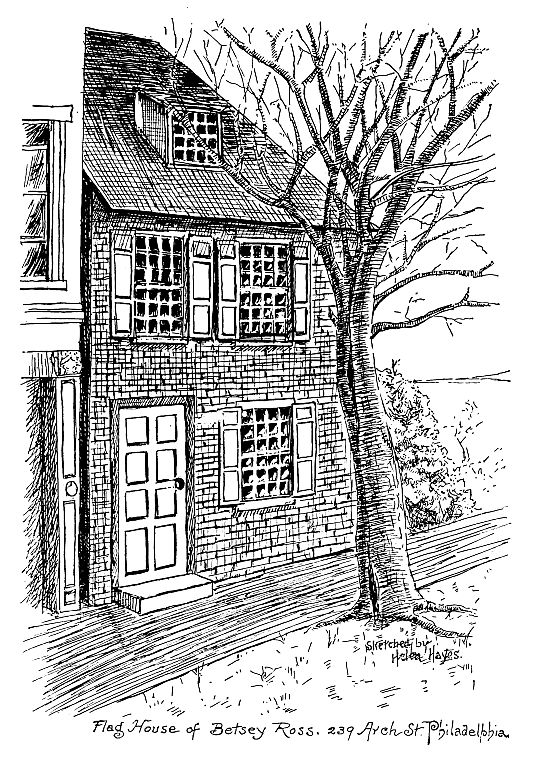
flag. She lived in a little house in Arch street, Philadelphia,
which stands to-day unchanged, with the exception of one large
window, which has been placed in the front. It was here, in
this house, that Washington unfolded a paper on which had been
rudely sketched a plan of a flag of thirteen stripes, with a blue
field dotted with thirteen stars. They talked over the plan of
this flag in detail, and Mrs. Ross noticed that the stars which
were sketched were six-pointed, and suggested that they should
have five points. Washington admitted that she was correct, but
he preferred a star that would not be an exact copy of that on
his coat of arms, and he also thought that a six-pointed star
would be easier to cut. Mrs. Ross liked the five-pointed star, and
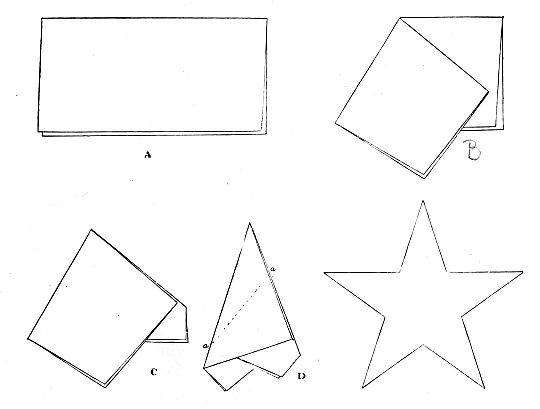
to show that they were easily cut she deftly folded a piece of
paper and with one clip of her scissors unfolded a perfect star
with five points. (See illustration showing the way Betsy Ross
folded the paper giving the five-pointed star which has ever since
graced our country’s banner. A, first fold of a square piece of
paper; B, second; C, third, and D, fourth fold. The dotted line
AA is the clip of the scissors.)
There is no record that Congress took any action on the national
colors at this session,—but this first flag was made by
Betsy Ross at this time, and in this way, and we find in Washington’s
letter of May 28, 1776, to General Putnam at New York,
positive instructions “to the several colonels to hurry to get their
colors done.” In the orderly book, May 31, 1776, are these
words: “General Washington has written to General Putnam
desiring him in the most pressing terms, to give positive orders to
all the colonels to have colors immediately completed for their
respective regiments.” The proof is positive that the committee
approved the finished flag of Betsy Ross, and she was instructed
to procure all the bunting possible in Philadelphia and make flags
for the use of congress, Colonel Ross furnishing the money.
It is easily understood how on account of the meager resources
of Congress and the unsettled condition of affairs generally,
together with the fact that legislative action was extremely
slow and tedious, that Colonel Ross should expedite matters by
defraying the expense of this first order for our national colors.
There is little, if any, doubt but that Washington on December
24th, Christmas Eve, in 1776, carried the starry flag in making
that perilous trip through ice and snow across the Delaware,
leading his sturdy, but poorly equipped troops. How inspiring to
look back to that night when the Massachusetts fishermen so
skilfully managed the boats that the whole army was safely landed
and in line of march at four o’clock on Christmas morning. The
story of how they plodded on through ice and snow, surprising
and defeating the Hessians and capturing a thousand men and
their ammunition and equipments, is well known. This was the
battle of Trenton, which changed the whole aspect of the war,
even causing Lord Cornwallis to disembark and again start in
pursuit of Washington, whose cause he had so lately declared
lost. It is fitting here to speak of that friend of Washington,
Robert Morris, one of the committee that originated our national
colors, the great patriot who after the battle of Trenton went
from house to house, soliciting money from his friends to clothe
and feed this glorious army, which had fought so well.
Congress was very slow to act, and did not seem able to
command even the meager resources of the different colonies.
It lacked the centralized government which gives it such strength
to-day. Considering the grave questions affecting the life and
liberty of the people, it is not strange that the flag or any definite
action regarding it, was not given prompt consideration. To
indicate how slow Congress was to act in regard to the flag,
we have only to refer to the Congressional records, which show
that the resolution for its adoption was dated over one year after
it was actually created, by the committee of which Washington
was chief; that is on June 14, 1777. However, a month previous
to this, Congress sent Betsy Ross an order on the treasury for
£14, 12s. 2d., for flags for the fleet in the Delaware River, and
she soon received an order to make all the government flags.
The first flag was made of English bunting, exactly the same as
those of to-day, excepting that our bunting now is of home manufacture.
There seems to be no question but that these colors, the
stars and stripes, were unofficially adopted immediately after the
completion of the first flag, the latter part of May, 1776, and that
they went into general use at once, so far as it was practicable
under the conditions then existing. Washington had the first
flag created at this time. It was satisfactory, and he immediately
instructed General Putnam to have the colonels prepare their
colors—the colors that had just been approved, and which we
know to be our flag of to-day.
The first reference we have of an English description of our
flag is at the surrender of General Burgoyne, October 17, 1777,
when one of the officers said: “The stars of the new flag represent
a constellation of states.”
Mr. George Canby, an estimable gentleman of the old
school, and a grandson of Betsy Ross, has been tireless and indefatigable
in his researches on the subject of our flag, and he
claims, as did his brother, Mr. William J. Canby, before him, that
the first flag with stars and stripes went into immediate use after
its inception in the latter part of May, 1776.
The Declaration of Independence was passed by Congress on
July 4, 1776, and some authorities, of whom Admiral Preble is
the best, seem to infer that the Cambridge flag, with its English
crosses, which was unfurled by Washington under the Charter
Oak, was still carried by our armies until Congress took action
in 1777. That Washington or Congress would sanction the carrying
of this flag after the Declaration of Independence seems absurd,
and it is certainly against all proof, as well as against the
records of the family whose ancestor made the first flag.
Peak’s portrait of Washington at the battle of Trenton, December
26 and 27, 1776, shows the Union Jack with the thirteen
stars in the field of blue. Admiral Preble says, this is “only
presumptive proof” that the stars were at that time in use on
our flag, but Titian R. Peale, son of the painter, says: “I visited
the Smithsonian Institute to see the portrait of Washington
painted by my father after the battle of Trenton. The flag represented
has a blue field with white stars arranged in a circle. I
don’t know that I ever heard my father speak of that flag, but the
trophies at Washington’s feet I know he painted from the flags
then captured, and which were left with him for the purpose.”
He further says: “He was always very particular in the matters
of historic record in his pictures.”
This Preble admits in his book, but evidently thought that the
artist, Peale, took the flag as it was then (1779), and not the
flag of 1776, which the writer claims was identically the same.
Through persistent research many facts have come to light that
would doubtless have changed the opinion of the late Admiral
Preble—facts that were unknown to him.
On Saturday, June 14, 1777, Congress finally officially
adopted the flag of our Union and independence, to-wit:
Resolved, “That the flag of the thirteen United States be thirteen
stripes, alternate red and white; that the Union be thirteen
stars, white in the blue field, representing a new constellation.”
There is not the slightest record in any of the mss. journals in
the library of Congress, or in the original files or in the drafts in
motions made in the continental Congress of any previous legislative
action for the establishment of a national flag for the United
States of America, whose independence was declared nearly a
year previous. Even after the official adoption of the flag it was
not thoroughly brought before the people for many months. All
of this adds to the proof that Congress was simply adopting and
legalizing a flag that was in general use. That there was no recorded
discussion in Congress regarding the adoption of our flag,
was perfectly natural, because the star spangled banner came in
with our independence, and at this time (June 14, 1777) was simply
being officially acknowledged.
There is some diversity of opinion as to how the red, white
and blue arranged in the stars and stripes came to be thought of
as our flag.
The flag of the Netherlands, which is of red, white and blue
stripes, had been familiar to the pilgrims while they lived in Holland,
and its three stripes of red, white and blue were doubtless
not forgotten. But it seems most probable that the coat of arms
of the Washington family furnished more than a suggestion. The
coat of arms of his ancestors, that had been adopted by him,
comprised the red, white and blue and the stars; and was familiar
to all who were associated with Washington. He it was who
brought the pencil drawing, when, with the others, he called upon
Mrs. Ross to have a suitable flag made, and as we find no mention
in history, records or diaries as to who made the drawing, it seems
conclusive that he himself designed and drew the plan from his
own coat of arms, which was entirely different from England’s
colors which had become necessarily distasteful.
It seems fitting in this place to write a little history in regard
to the Washington coat of arms, the earliest mention of which
was by Lawrence Washington, worshipful mayor of Northampton,
England, in 1532. In 1540 he placed it upon the porch of his
manor house, and on the tomb of Ann, his wife, in 1564. At
the old church at Brighton, England, the tombs of Washington’s
ancestors are marked by memorial plates of brass bearing the
arms of the family, which consisted of a shield that bore the
stars and stripes. The Archeological Society of England, the
highest authority on ancient churches and heraldic matters, states
that from the red and white bars, and stars of this shield, and the
raven issuant from its crest (borne later by General Washington),
the framers of the constitution took their idea of the flag.
When General Washington’s great-grandfather, Sir John
Washington, came to this country in 1657, the family shield was
brought with him. Sir John settled in Virginia, and established
the American line of Washingtons. George Washington afterwards
had it emblazoned upon the panels of his carriages, on his
watch seals, book marks, and his dishes also bore the same
emblem.
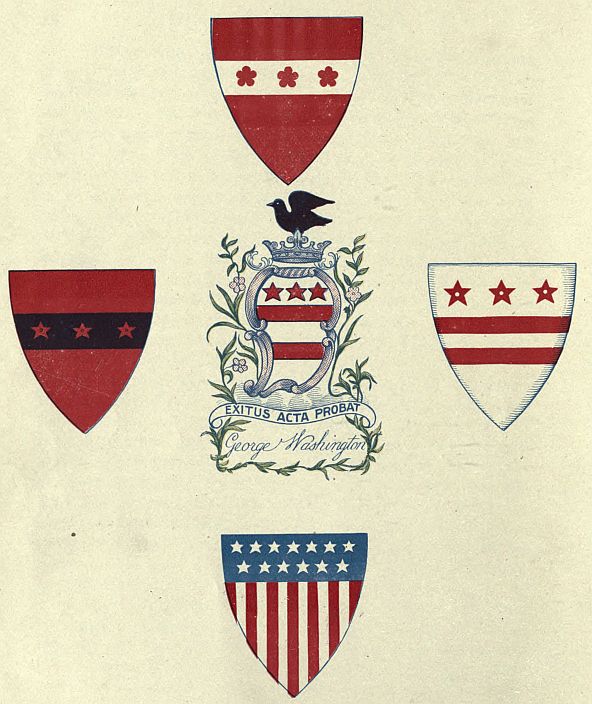
COPYRIGHT 1898, BY ADDIE G. WEAVER.
WASHINGTON COAT OF ARMS.
The accompanying plate shows the form and colors of the Coat of
Arms of the Washington family, back as early as 1300.
The name first appeared as De Wessynton; then Weshyngton, and,
finally, Washington.
How appropriately our own beautiful shield of the United States
comes in here, and why not? was he not the “Father of Our Country”?
and what more natural than that he should have left the imprint of his
life and characteristics in symbol?
The central figure is a fac-simile of his book plate.
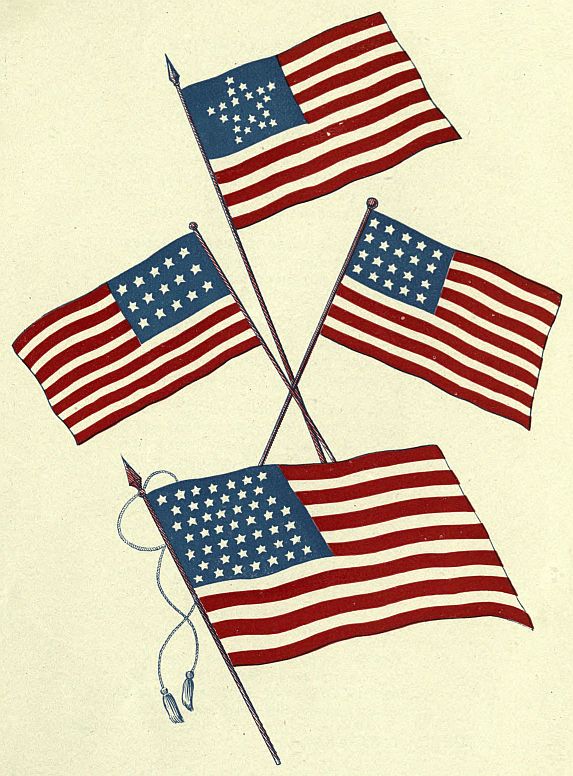
After the admission of Vermont and Kentucky into the Union,
Congress passed an act in 1794, increasing both the stars and
stripes from thirteen to fifteen, to take effect May, 1795. It was
as follows:
“An act making alterations in the flag of the United States.
Be it enacted, etc., That from and after the first day of May,
one thousand, seven hundred and ninety-five, the flag of the
United States be fifteen stripes, alternate red and white, and that
the union be fifteen stars, white in a blue field.
“Approved January 13, 1794.”
This flag was used for several years. It flew at the mastheads
of our gallant ships and was carried by our little army in the war
with England in 1812. A few years later Tennessee, Ohio, Louisiana
and Indiana, now won to civilization by hardy pioneers,
clamored for admittance into the Union. When they were finally
admitted as states, another change in the flag became necessary.
The sturdy young republic was advancing by leaps and bounds in
civilization and wealth; its hardy sons pushing further west and
south constantly, reclaiming from wild savages, to the uses of
their own race, greater and larger areas, which were bound to
be erected into states and take their places in the family of the
original thirteen. It became manifest that legislation was necessary,
permanently defining the national flag, and providing for
such changes as the future development of the country would require.
Congress rose to the occasion. A committee, with Hon.
Peter Wendover of New York as chairman, was appointed to
frame a law, and with very little delay the committee reported
a measure fulfilling every requirement then existing, and providing
for all the future. The measure was passed by congress and
went on the statute books as the law establishing the flag as our
great-grandfathers of that day knew it, and as we know it to-day.
The law has never been changed, and here it is:
“An act to establish the flag of the United States.
“Section 1. Be it enacted, etc., That from and after the fourth
day of July next, the flag of the United States be thirteen horizontal
stripes, alternate red and white; that the Union have
twenty stars, white in the blue field.
“Sec. 2. And be it further enacted, That on the admission of
every new state into the Union, one star be added to the union of
the flag, and that such addition shall take effect on the fourth of
July next succeeding such admission. Approved April 4, 1818.”
The thirteen stripes will always represent the number of the
“old thirteen” whose patriotism and love of justice brought about
the independence of America. The stars that come into the blue
sky of the flag will mark or indicate the increase of the states
since the adoption of the Constitution. It is interesting to note
that under the stars and stripes Washington, in 1793, laid the
corner stone of the capitol of the United States, first having personally
selected the site of the building. It is also interesting to
know that Washington did not live to see the capitol completed,
but died before the seat of government was moved to Washington
in 1800. The main capitol building was not completed till
1811. It is also a matter of historical interest that the president’s
home, now called the White House, was completed during the
life of Washington, and it is an authenticated fact that he and
his wife inspected the house in all its parts only a few days before
his death. The president’s house was practically destroyed
by the British in 1814; the walls alone remained intact, but the
stone was so discolored that when the building was reconstructed,
it had to be painted, and from this came the name of the “White
House.”
The large picture of Washington, by Stewart, which is now in
the east room, at the time of the bombardment by the British,
was taken out of its frame by Mrs. Dolly Madison, wife of the
president, and sent to a secure place across the river.
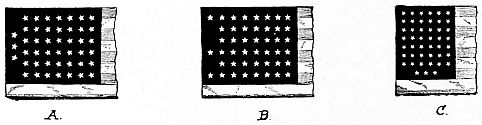
This flag of forty-five stars, this flag of our country, is our
inspiration. It kindles in our hearts patriotic feelings, it carries
our thoughts and our minds forward in the cause of liberty and
right. On sea and on land, wherever the star spangled banner
waves, it thrills the heart of every true American with pride. It
recalls the memories of battles bravely fought. It recalls the victories
of Trenton and Princeton, it recalls the victories of Gettysburg
and Appomattox. We see the flag as first carried by Paul
Jones across the sea; we see the flag as carried by Commodore
Perry on Lake Erie; we see the flag as carried by Farragut at
New Orleans; we see Admiral Dewey through smoke and fire
hoisting the flag in the Philippines. This same flag was carried
to victory by Admirals Sampson and Schley in Cuba. This flag
recalls the many battles bravely fought and grandly won. It
symbolizes the principles of human progress and human liberty.
The stars represent the unity and harmony of our states. They
are the constellation of our country. Their luster reflects to
every nation of the world. The flag of 1776, the old thirteen,
has grown to be one of the great flags of the earth. Its stars
reach from ocean to ocean. We see it leading the armies of
Washington and Greene, of Grant and Sherman and Sheridan,
and of Miles, Shafter and Merritt.
This is the flag of the “dawn’s early light” that was immortalized
by Francis Scott Key—“The Star Spangled Banner.”
General Grant once said, “No one is great enough to write his
name on the flag.”
A century under the stars and stripes has been the greatest
century of progress in the history of the world. No other nation
that has ever existed has carried forward such a banner. Its
colors were taken from various sources and brought into one
harmonious combination, and it “waves over a country which
unites all nationalities and all races, and in the end brings about
a homogeneous population, representing the highest type of
civilization.” It is not strange that this flag of Washington, of
Hamilton, of Adams, of Jefferson; this flag of Jackson, of Webster,
of Clay, this flag of Lincoln, of Grant and of McKinley
should exert such world-wide influence. It holds a unique place
in the nations of the world. It has spread knowledge and faith
and hope among all classes. It means liberty with justice. Its
international influence places it in the first rank. It twines itself
among the flags of other nations, not for destruction or war,
but for friendship and progress in the cause of humanity. In
the councils of peace; in the conquests of war; in everything
that pertains to government, in everything that pertains to the
advancement of humanity, it calls forth the admiration of mankind.
Under its influence the arts and sciences have been fostered,
commerce has expanded and education has been made
universal. It waves for the right and the harbors of the globe
will salute this banner as a harbinger of progress and peace.
The youngest nation has the oldest flag.
It is of historical interest that our flag is older than the present
flag of Great Britain, which was adopted in 1801, and it is
nine years older than the flag of Spain, which was adopted in
1785. The French tricolor was decreed in 1794; then comes the
flag of Portugal in 1830; then the Italian tricolor in 1848; then
the flags of the old empires of China and Japan, and of the
empire of Germany, which represents the sovereignty of fourteen
distinct states established in 1870.
Prior to the Revolution, and indeed during the evolution of
a nation through the crucible of war, separate and distinct flags
were popular with the colonists. Nearly every colony had at
least one. They were not abandoned until it became apparent the
colonies were never again to be colonies, but to form a nation
with one flag, one set of institutions and laws, a fact which inspired
the visit of Washington to Betsy Ross as told in the
foregoing papers. Many of the colonial flags were interesting.
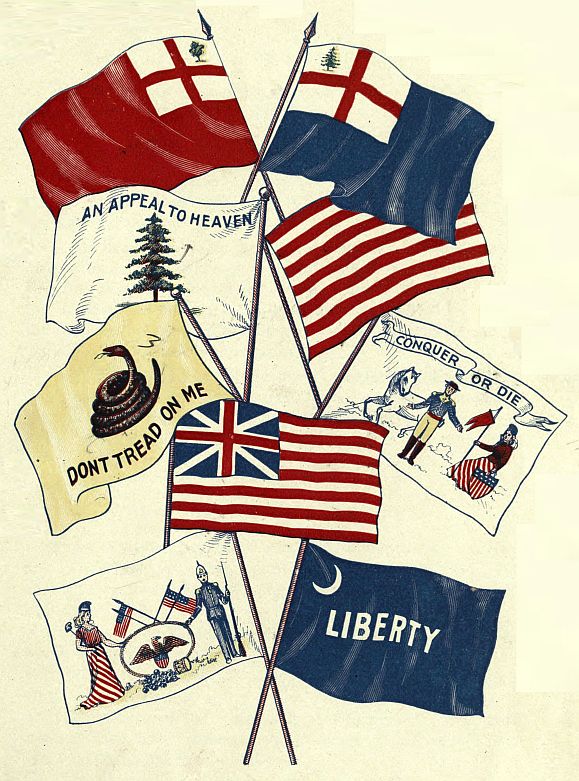
The two upper flags of this group represent those used at
Bunker Hill July 18, 1775, and bore these inscriptions: On one
side, “An Appeal to Heaven,” and on the other, “Qui Transtulit
Sustinet”—He who transported will sustain.
These were beautiful flags, and research shows that both
colors were used.
Trumbull gives the red in his celebrated painting in the capitol
at Washington, and other authentic accounts show that the blue
flag was carried also—the color being the only difference in the
two.
The pine tree flag which was a favorite with the officers of the
American privateers, had a white field with a green pine tree in
the middle and bore the motto, “An appeal to heaven.”
This flag was officially endorsed by the Massachusetts council,
which in April, 1776, passed a series of resolutions providing
for the regulation of the sea service, among which was the following:
Resolved, That the uniform of the officers be green and
white, and that they furnish themselves accordingly, and that the
colors be a white flag with a green pine tree and the inscription,
“An appeal to heaven.”—Harper’s Round Table.
COPYRIGHT 1898, BY ADDIE G. WEAVER.
The striped Continental flag opposite the pine tree flag was of
red and white stripes without a field.
The device of a rattlesnake was popular among the colonists,
and its origin as an American emblem is a curious feature in
our national history.
It has been stated, that its use grew out of a humorous suggestion
made by a writer in Franklin’s paper—the Pennsylvania
Gazette—that, in return for the wrongs which England was forcing
upon the colonists, a cargo of rattlesnakes should be sent to
the mother country and “distributed in St. James’ Park, Spring
Garden and other places of pleasure.”
Colonel Gadsden, one of the marine committee, presented to
Congress, on the 8th of February, 1776, “an elegant standard,
such as is to be used by the commander-in-chief of the American
navy; being a yellow flag with a representation of a rattlesnake
coiled for attack.”
There is probably no more interesting revolutionary flag than
this. The Washington Life Guard was organized in 1776, soon
after the siege of Boston, while the American army was encamped
near New York.
It was said to have been in the museum at Alexandria, Va.,
which was burned soon after the war of the rebellion, and nearly
everything lost. It was of white silk with the design painted
on it.
The uniform of the guard was as follows: blue coat with
white facings, white waistcoat and breeches, with blue half gaiters,
a cocked hat and white plume.
These were the colors selected by Franklin, Harrison and
Lynch, and unfurled by Washington under the Charter Oak,
January 2, 1776, and hereafter described.
The flag of the Richmond Rifles follows with the one used at
Moultrie.
The latter was of blue with white crescent in the dexter corner
and was used by Colonel Moultrie, September 13, 1775, when he
received orders from the Council of Safety for taking Fort Johnson
on James Island, South Carolina.
In the early years of the Revolution, a number of emblems
were in use which became famous. The standard on the southeast
bastion of Fort Sullivan (or Moultrie, as it was afterward named),
on June 28, 1776, by Colonel Moultrie, was a blue flag with a
white crescent in the upper left hand corner, and the word “Liberty”
in white letters emblazoned upon it.
This was the flag that fell outside the fort and was secured by
Sergeant Jasper, who leaped the parapet, walked the whole length
of the fort, seized the flag, fastened it to a sponge staff and in
sight of the whole British fleet and in the midst of a perfect hail
of bullets planted it firmly upon the bastion. The next day
Governor Rutledge visited the fort and rewarded him by giving
him his sword.
Then comes the flag of White Plains, October 28, 1776, with
little historical importance.
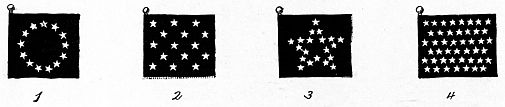
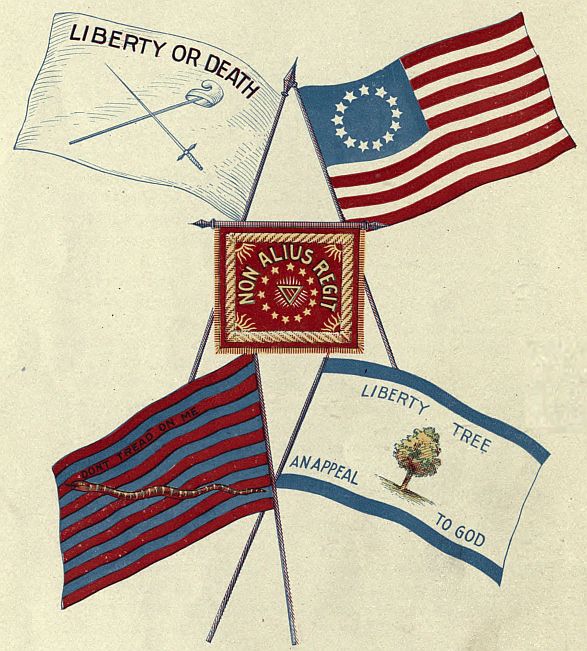
The flag made by Betsy Ross, under the direction of General
Washington, Robert Morris, and Colonel George Ross, consisted
of thirteen bars, alternate red and white, with a circle of thirteen
stars in the field of blue.
COPYRIGHT 1898, BY ADDIE G. WEAVER.
The Moravian sisters of Bethlehem, Pennsylvania, gave to
Count Pulaski’s corps, which he had previously organized at
Baltimore and which was called “Pulaski’s Legion,” a beautiful
crimson silk banner, embroidered in yellow silk and sent it with
their blessing. Pulaski was at this time suffering from a wound,
and was on a visit to Lafayette, whose headquarters were at
Bethlehem. Count Pulaski was a Polish patriot, born March 4,
1747. After having bravely fought for Poland with his father
and brothers until the Polish cause became hopeless, he came to
America, arriving in Philadelphia in 1777. He entered the army
as a volunteer, but performing such brave service at Brandywine,
he was promoted to the command of cavalry with rank of brigadier-general.
In 1778 Congress gave him leave to raise a body of
men under his own command. Longfellow has most beautifully
described the presentation of the flag in verse. Pulaski bore
this flag to victory through many battles until he fell mortally
wounded at Savannah, October 14, 1779. The banner was saved
by his first lieutenant, who received fourteen wounds, and delivered
it to Captain Bentalon, who on retiring from the army, took
it home to Baltimore. It was carried in the procession which
welcomed Lafayette in 1824, and was then deposited in the Peale
Museum. In 1844 Mr. Edmund Peale presented it to the Historical
Society of Maryland, where it is now preserved in a glass
case. These are interesting historical facts.
Flag of red and blue bars with serpent stretched across and
words, “Don’t Tread on Me.”
Another flag of white, with blue bands top and bottom and a
pine tree in center, with the inscriptions: Liberty Tree and An
Appeal to Heaven.
Another use of the rattlesnake was upon a ground of thirteen
horizontal bars alternate red and white, the snake extending
diagonally across the stripes, and the lower white stripes
bearing the motto—“Don’t Tread on Me.” The snake was
always represented as having thirteen rattles, and the number
thirteen seems constantly to have been kept in mind. Thus,
thirteen vessels are ordered to be built; thirteen stripes are
placed on the flag; in one design thirteen arrows are grasped
in a mailed hand; and in a later one thirteen arrows are in the
talons of an eagle.
One of the favorite flags also was of white with a pine tree
in the center. The words at the top were “An Appeal to God,”
and underneath the snake were the words, “Don’t Tread on Me.”
Several of the companies of minute men adopted a similar flag,
giving the name of their company with the motto “Liberty or
Death.” This flag is familiar to the public as the annual celebrations
bring out descriptions of it in the press.
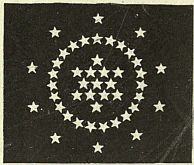
Within the last few years special flags have been designed for
the President, the Secretary of the Navy and Secretary of War.
The President’s flag is a very beautiful blue banner, in the center
of which is a spread eagle bearing the United States shield
on its breast, with the thirteen stars in a half circle overhead.
It is flown at the main mast-head of naval vessels while the
President remains on board, and on being hoisted it is the signal
for the firing of the President’s salute.