Der Kirchen act sind in dem Ort
Darin man predigt Gottes Wort.
—Hans Sachs.
NUREMBERG is rich in churches, those sermons in stones so much more
eloquent than any words that ever fell from the lips of the preachers.
The Gothic style has been finely called the true architectural
expression of Christianity. In her churches Nuremberg possesses some of
the finest specimens of the pure German Gothic style. They exhibit, it
is true, the common failing of German architecture. Exquisite, though
sometimes extravagant, in detail, they fall far below the masterpieces
of the French architects in the proportionment of the whole.
St. Sebald, the patron saint of Nuremberg, affords one more proof of the
fact that a prophet is not without honour save in his own country. It
is, indeed, not even known what his country was. His history and even
his name are so unfamiliar to any but Nurembergers that it will be of
interest if I add here the record of his life from the account written
by an eleventh-century (?) monk.[52]
Born at the beginning of the eighth (?) century, Sebald was the son of a
Christian king: but as to whether his father was King of the Danes,
Britons or Irish or a petty chief on the Danube biographers differ.
Sebald’s parents had long been childless, but at last when all hope
seemed gone, God heard the prayers of his servants and gave them a son.
Sebald was born. The boy grew up waxing in years and virtue, learning
the lesson of the love and fear of the Lord, obedience to his parents
and charity to all men. At the age of fifteen he was sent to Paris to
study theology, in which he quickly eclipsed all the scholars of his own
age and many of riper years. He returned to his home full of wisdom and
honours and was betrothed to a beautiful and virtuous maiden. But before
the marriage was consummated he fled from the things of this world, and,
leaving his wife, his father and mother and his inheritance, he chose
the chaste and solitary life of a hermit. Within the lonely recesses of
a dense wood he passed his days in prayer and fasting and his nights in
self-inflicted chastisement. Fifteen years passed and then the hermit
made his way to Rome, whence Pope Gregory the Second despatched him in
company with SS. Willibald and Wunibald to go forth and preach the
gospel, succour the feeble, confirm the good, and correct errors of
doctrine. Together the holy men pursued their way, praising the Lord
with cheerful heart, until at length it came to pass that weary with
journeying and exhausted by storm and wind, they grew faint with hunger,
and his two companions called upon Sebald to provide them with food.
Then, having comforted them with doctrine, he departed from them a
little way, and when he had poured out his soul in prayer, lo! there
came an angel from heaven bringing to them bread that had been baked
under the ashes. And when they were now come to the parts about
Vincentia (Vicenza) Sebald, moved by the Holy Spirit, would go no
further, but abode as a hermit in the wood. His fame spread abroad. From
far and near, even from Milan and Pavia, people flocked to hear from
his lips the wonderful works of God. But, amongst those who came, came
also an unbeliever who scoffed and blasphemed at the prophet and his
message. Then Sebald prayed to God that a sign might be given, and
immediately in the sight of all, the earth opened and the scoffer sank
up to his neck. Then the hermit prayed with a loud voice and interceded
for him, so that he was delivered,[53] and he and many of the
unbelievers embraced the true faith.
Sebald now left Italy and came to Ratisbon (Regensburg), bringing the
gospel into the wilds of Germany. At Ratisbon, after crossing the Danube
in a miraculous manner, he stayed for a short time and mended, by the
power of prayer, a vessel which his host had borrowed and broken.
At last he came to Nuremberg and settled there in the forest, in the
heart of the Franconian people, teaching them the word of God and
working miracles. On one occasion, we are told, he sought shelter in the
house of a poor but churlish mechanic. It was winter: the snow lay on
the ground and the wind howled over the frozen marshes of the Pegnitz.
But the signs of charity did not shine brightly in the host. Sebald
called upon the man’s wife to bring more wood for the fire so that he
might warm his body: for he was chilled to the bone. But though he
repeated his request the niggard host forbade his wife to obey. At
length the Saint cried out to her to bring the cluster of icicles which
hung from the roof and to put them on the fire if she could not or would
not bring the faggots. The woman, pitying him, obeyed, and in answer to
the prayer of Sebald, a flame shot up from the ice and the whole bundle
was quickly ablaze. When he saw this miracle the chilly host gave the
hermit a warmer welcome (frigidus hospes ad ipsum factus est
liberalis). Perhaps, it has been suggested, we may see in this pretty
story an allegory of how Sebald quickened the flame of divine love
within the icy Franconian natures, which it seemed as impossible to warm
with grace as the winter’s ice. Sebald’s host now, to make amends,
sallied forth and bought some fish in the market, contrary to the
regulations of the authorities, and, being caught, was blinded. But the
holy hermit restored to him the light of his eyes.
Sebald clearly foretold the date of his death: the place of his burial
was appointed by a miracle. At length, says the chronicler Lambert
Schagnaburgensis, full of good works, he fell on sleep in the town of
Nuremberg. The bier of the Saint was drawn by untamed oxen. And they,
when they had reached the spot chosen for his resting-place, refused
though goaded to the utmost to move any further. Thus was the site of
the church afterwards built to the patron saint of Nuremberg determined.
Those who ministered to him swung incense over the dead body of the old
hermit and lit candles above it. Now there was a woman, a sinner, whom
Sebald had turned to the love of the true God. In memory of her sins and
in expiation she wore about her arm a hoop of iron. And she came to see
the dead hermit. It chanced that one of the candles above his head was
crooked, and she stretched forth her arm and set it straight. At that
moment the iron band burst. So she knew that the saint, when he entered
into the presence of God, had not forgotten the poor woman whom he had
converted on earth and that God had heard her prayer, and that her sins,
which were many, were forgiven, as the broken ring signified.
Many other miracles were attributed to the ashes and relics of the saint
which lie in the beautiful shrine in St. Sebalduskirche.[54] We have
spoken at length of this exquisite work of art (p. 208), to which, says
Eobanus Hessus in his poem on Nuremberg, no words can do justice and
with which not even the greatest artists of past ages could have found
fault.
“Musa nec ulla queat tanto satis esse labori
Nec verbis æquare opus immortale futurum;
Quod neque Praxiteles, nec Myron, nec Polycletus,
Nemo Cares, nemo Scopas reprehendere posset.”
The east end of St. Sebalduskirche faces the Rathaus: but the western
is the oldest portion of it. Here the St. Peter’s or Löffelholz Chapel,
as it was called later, after the Nuremberg family of that name, with
its crypt and choir (Engelschörlein), and the lower part of the two
towers[55] date from the beginning of the thirteenth century. They
belong, in their original state, to the Romanesque style of
architecture; whilst the nave affords a beautiful example of the
transition to Gothic forms and the magnificent east choir is in the
purest German Gothic. We may conjecture that the church was originally a
basilica with a Romanesque east choir, flanked by two small adjoining
aisles, corresponding to the west choir which is still preserved, and
with a nave in the shape of a cross. Then, about 1309, they began to
build broader and higher aisles in place of the low and narrow ones,
and, in so doing, half concealed the old round-arched windows. But the
most important alteration must have been when they pulled down the old
east choir and began to build (1361) the Gothic choir, which together
with the rest of the church has been recently and carefully restored.
Twenty-two pillars 80 feet high support the vaulting. The two simple,
slender towers at the west end, some 260 feet high, were apparently
completed towards the end of the fifteenth century. According to
tradition, the southernmost of these is built on piles—a tradition that
reminds us of the swamps and marshes that once stood here, in the days
when the narrow circumference of the first town wall did not cross if
indeed it reached the river (see Ch. V.). In the base of each tower is a
Romanesque doorway: over the southern one, in the tympanum, a high
relief in stone represents the Trial of St. Helena. On the north side of
the north tower is a low relief of the Crucifixion, a memorial to
Burkhard Semler, 1463. Beneath the towers is the crypt in which was once
the tomb of Konrad von Neumarkt, the founder of the Convent of St.
Catherine. This, the oldest Nuremberg tomb, is now in the German Museum.
The colossal bronze crucifix outside the west end, against the middle
window of the St. Peter Chapel, was presented by the Starck family in
1482. It is attributed to H. Vischer, father of Peter Vischer, and has
some merits as a work of art, though the figure is that of a Hercules
rather than of a Christ. It was repaired in 1625, on which occasion the
Nurembergers incurred the nickname of Herrgottschwärzer, or Blackeners
of God. For, the story runs, the Cross was made of silver, and the
Council ordered it to be coloured black in order to protect it from the
roving bands of soldiers who passed through the town in the Thirty Years
War.

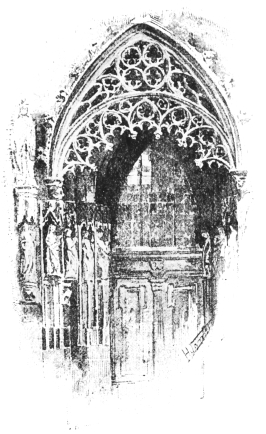 BRAUTTHÜRE, ST. SEBALDUSKIRCHE
On the north side of the church the beautiful Brautthüre (1380?) or
Bride’s Door (see p. 154) is especially worthy of attention. Very richly
and daintily carved, the outer and inner arches form a porch which was
meant to protect the bridal pair from the inclemency of the weather when
they stood here for the first part of the marriage service. On either
side of the pointed arch are the figures of the Madonna and Child and of
St. Sebald with his pilgrim’s staff and a model of the Sebalduskirche in
his hands. The ten intercolumniated statues on the inside walls of the
porch represent the five wise and the five foolish virgins (at present
being restored). Within the entrance appear Adam and Eve with a
half-length Christ above them, and the snake and apple-tree of Eden.
On the buttresses of the east choir are some sculptures in half-relief,
representing the Passion, and at the east end, facing the Rathaus, is
the Schreyer Monument (Schreyer’s Begräbnuss), a high relief by Adam
Krafft (1492). Nobly conceived and nobly executed, these representations
of the Passion and Burial of Christ are among the most noteworthy of the
master’s works. Especially beautiful in grouping and in feeling is the
Grablegung—the Laying in the Grave. Sebald Schreyer, who died in 1520,
was a keen patron of art and, as churchwarden of St. Sebald’s, devoted
to the interests of his church. In recognition of his services, and as
he was the last of his family, the rule which had lately come into force
that all citizens except the clergy must be buried in St. John’s
Churchyard, was set aside in his case, and he was buried in the east
choir of the church to which he had devoted his life and fortune. For
the Begräbnuss of Adam Krafft and Vischer’s Sebaldusgrab owed their
existence chiefly to Schreyer’s care and encouragement.
The animals on the capitals of the door of the south aisle are full of
characteristic humour. One may trace here some of that mockery of the
monks in which the mediæval masons not infrequently indulged, and of
which there is a famous example at Strasburg. St. Peter with his key and
a crowned Saint with a sword are on either side of the door itself. A
partly gilded Last Judgment occupies the space above the arch. It will
be found interesting to compare the numerous figures of it with those on
the main entrance of the Lorenzkirche, to which they are strikingly
akin.
Above the door called the Schautthüre (show-door) on the S.E. side of
the church, near the guard-house, is a Last Judgment (1485), probably by
Adam Krafft (see p. 200). It is a fine and interesting work. At the
top, beneath four hovering angels and between twelve Apostles, Christ
sits on a rainbow to judge the world. The earth is his footstool. Mary
and John Baptist (the figures remind us of those in the Rosenkranztafel
in the Museum) intercede for the poor souls who are rising from their
graves. On one side they are conducted (with crowns of glory on their
heads) by an Angel to the gates of Paradise, over which waves the
triumphant banner of Christ. On the other side the Devil, who is also
similar to the Devil in the Rosenkranz, with the head of a cock, drags
his prey into the jaws of hell. The figures are all strong and full of
animation. In the midst of the group of those rising from the dead,
between the kneeling figure of the founder, Hartmann Schedel, and his
arms, is a Latin inscription which gives us to understand that Hartmann
Schedel, to whose memory this relief was erected, died Dec. 4, 1485.
For admittance to the church we must knock at the Anschreibethüre, the
portal on the N.W. side.[56]
This Anschreibethüre—so called because it was customary to enter the
names of the dead on a register kept here for that purpose—was renewed
in 1345. It is adorned on either side with the figures of Gabriel and
Mary (Annunciation), and above with a relief of the Death, Burial (the
unbelieving Jews falling prostrate before the coffin) and Crowning of
Mary. Note the figures of female saints on the capitals.
On entering, our first impression is one of disappointment. A vile
whitewash disfigures the walls, whilst the fact that the church has not
been designed by one hand as a complete whole deprives us of that
satisfied sense of perfect proportion for which we are forever hoping
but so often in vain. But as we grow more familiar with the details of
this church the feeling of disappointment vanishes and we are left
grateful if not completely satisfied.
On our right is the St. Peter’s or Löffelholz Chapel, and we notice that
this, which forms the western end of the church, has been altered from a
Romanesque into a polygonal apse. The pointed cells of the vaulting make
up five-eighths of an octopartite compartment. Thus the old double-apse
arrangement of Romanesque buildings is retained at St. Sebald’s; but the
west end is in the transitional, the east in the pure German Gothic
style. By introducing this pointed vaulting into the older Romanesque
shell of the St. Peter’s Chapel, the Engelschor above it, or Angels’
Choir as it is called, has been concealed from view. But we can easily
see where it springs from the apex of the great arch which forms the
entrance to the Chapel.
The lofty central nave is, as we have already said, a good example of
the transition to Gothic architecture in German churches, when the
horizontal lines of the Romanesque style were giving place to the
upright and upward tendency of the Gothic. The sexpartite vaulting, the
broad but pointed arches, the substitution of rolls for the flat and
square-edged vaulting ribs, the clustering of the shafts and the
flanking by shafts of pointed windows are all eloquent of this tendency.
The pillars, too, begin to be prolonged in extent and diminished in
thickness, and the line is no longer interrupted by the rectangular
effect of square capitals. The varied patterns (flowers, pearl strings,
etc.) of the capitals here should be noted.
The walls beneath the clerestory are relieved by a triforium, which had
no place in the conceptions of the original Romanesque architects. There
is here no gallery set apart for the young men, as there frequently is
in the triforium of an early German church. This triforium consists
only of a row of low, pointed openings supported by short pillars,
variously ornamented.
The east choir (1361-1377) is a building of the same period as the
Frauenkirche. Compared with the rest of the church its dimensions are a
good deal exaggerated. Nor is it placed symmetrically as regards the
axis of the older part; for it inclines considerably to the north.
Regarded in itself, however, it must be admitted to be a splendid
building, the lofty and airy effect of which is greatly enhanced by the
single row of tall windows. The light streams in through beautiful
stained glass. The windows, however, are really too tall in proportion
to their breadth (50 feet by 8). The mullions, too, nearly 40 feet in
height, are more interesting as triumphs of masonic skill than admirable
as features of architectural design.
Contenting ourselves with these general observations as to the building
itself, we will here add a list of the principal objects of art which
will catch the attention of the visitor to the church.
In the Löffelholz Chapel stands conspicuous the highly decorated bronze
font wherein the Emperor Wenzel was baptized (1361, see p. 42). At the
base are statuettes of the four Evangelists. It is said to be the oldest
existing product of the Nuremberg foundries.
The altar-piece in memory of Kunigunde Wilhelm Löffelholz (1453) is by
an unknown painter. Scenes from the life of St. Catherine are depicted
on a plain gold background. It is the earliest Nuremberg work to show
any trace of the Netherland influence: but, unfortunately, it has been
painted over at least once. There are three other pictures in this
chapel, of an earlier date, by unknown artists.
The two-winged Haller Altar-piece (N. near the Anschreibethüre) may very
likely be an early work of the Master of the High Altar-piece in the
Frauenkirche. The background is of gold: the subject is Christ on the
Cross between Mary and John; on the wings, the Mount of Olives and SS.
Catherine and Barbara.
In this picture the cramping of the figures and the crude drawing of the
hands and feet are noticeable, but in the modelling of the heads there
is much that is very noble and very beautiful.
On the pillar next to (S.) the Haller Altar is a relief, “Carrying the
Cross,” by Adam Krafft, 1496.
Later and more vigorous works by the same master are the Last Supper,
Mount of Olives and Betrayal (1501), reliefs 5 feet high by 5 feet broad
on the E. wall of the Choir. The Betrayal is distinctly the best
composed and most telling of the three. The Last Supper, the arrangement
of which is somewhat crowded and confused, has the interest of
exhibiting in the Apostles portraits of some members of the Council. The
Apostle with the goblet is said to be Paul Volkamer (the founder) and he
with the small cap Adam Krafft himself, or, it may be, Veit Stoss, to
whom the sculptures, on the strength of the monogram V.S. on them, are
now usually attributed.
We need not stay long over the Tucher Altar with its ever-burning lamp,
founded by the first baron Tucher, 1326, and its seventeenth-century
altar-piece, or the painting by Joh. Franz Ermel (1663) of the
Resurrection, over the Muffels Altar next the Schauthüre, or the new
pulpit (1859) by Heideloff and Rotermundt. The choir-stalls and the Pix
(N.), with its old sculptures, dating from the second half of the
fourteenth century, are worth examining, as also are the numerous
reliefs on the pillars of the choir. The Crowning of Mary on the first
choir pillar on the north side is attributed to V. Stoss. On a column to
the right of the pulpit hangs a copy of Durer’s Interment of Christ,
with the armorial bearings of the Holzschuhers, and opposite, beneath a
copy of Rubens’ Day of Judgment, is another painting by Durer, little
worthy of him, in which figure the Imhoff family, Willibald Pirkheimer
and the artist himself (on the right).
The Carrying of the Cross (Tucherische Kreuztragung), on the column next
to the Sebaldusgrab, can only doubtfully be attributed to Wolgemut
(1485).
The Madonna and Child on the next column was cast by Peter Vischer’s
son.
The great Crucifix, with SS. Mary and John, of the High Altar was
executed by Veit Stoss in 1526, when he was now in his eightieth year.
The head of the Christ is a masterpiece of expression. The lower part of
the High Altar is modern, and was carved by Rotermundt after the designs
of C. Heideloff (1821).
In the choir also (N. wall), we find a good example of the work of Hans
von Kulmbach, who passed from the school of Jacopo dei Barbari (Jakob
Walch) to that of Durer. The Tucherische Tafel (1513) shows the
influence of the latter in a very marked manner: Durer may, in fact,
have supplied the designs for it. In the centre of the triptych is Mary
enthroned, crowned by two angels. The holy Child on her knee is trying
to seize an apple from the Mother’s left hand: but both Mother and Child
are looking out of the picture. The five Bellinesque angels, who, clad
in brightly coloured garments, and playing various musical instruments,
stand at Mary’s feet, are altogether charming. On either side of the
throne are SS. Catherine and Barbara, whilst on the right wing are SS.
Peter and Lawrence, presenting the founder, Provost Lorenz Tucher, to
Mary, and on the left are St. John Baptist and St. Jerome. A mountain
scene forms the background of the picture, which for all that it owes
much to Durer owes much also to the individuality of Kulmbach.
Near this is a commemorative escutcheon of the Tucher family, by
Holbein, and below it a small wood carving, said to be by Albert Durer.
The Adam and Eve in Paradise over the Schauthüre is by Joh. Creuzfelder
(1603), and was placed there by members of the Behaim family.
One of the chief features of interest in the Sebalduskirche is the
stained glass. The Tucher and Schürstab windows, according to Rettberg,
contain some late fourteenth-century glass, but would seem to have been
much restored. The Fürer window was first set up in 1325 (Christ before
Pilate). In the Bishop of Bamberg window (Wolf Katzheimer, 1493?) are
the portraits of Kaiser Heinrich, Kunigunde, Otto, Peter, Paul and
Georg, and in the corners four Bishops, and over all four Gothic
canopies.
The Maximilian window is by Veit Hirschvogel (1514). The Emperors
Maximilian and Charles V. stand on a ground of white tracery, with their
consorts, patron saints, and arms.
The Margrave’s Window is by the same artist, after the designs of Hans
von Kulmbach. It was only completed after Hirschvogel’s death (1527),
and has quite recently been restored. The single figures of the Margrave
Friedrich von Ansbach and Baireuth, and of his wife and eight sons, are
on a white ground. SS. Mary and John the Evangelist above, and the
Margrave’s arms on the sides. In the foreground, an inscription and an
architectural substructure in the shape of a temple, according to the
fashion of stained glass at this period.
Finer, better designed and considerably larger than St. Sebald’s is the
Church of St. Lawrence. It is one of the best examples of pure German
Gothic. Outside and inside, in form and in detail, it exhibits both the
beauties and the defects of the German style when pointed architecture
was developed according to the taste and feelings of the Germans,
uninfluenced by French inspiration.
With regard to detail, amid so much that is admirable, now and again the
besetting sin of German art makes itself felt—that lack of
self-restraint, that prodigality and extravagance, one may almost call
it, of ornament, by which the effect of gorgeous richness is obtained
indeed, but at the sacrifice of distinctness. Even in the beautiful
windows this is the case. The multiplicity and intersection of the lines
tend to blur the “dry light” of the dry beauty of a perfect design.
With regard to form, viewed from the exterior, two features strike the
eye and remain in the memory. On the one hand, the enormously high and
grossly ugly roof of the choir which overwhelms the building produces
the ludicrous effect of a camel’s hump. It is unrelieved by pinnacles or
even by the flying buttresses which seem to lift the soaring Gothic
naves of France into a world beyond our ken. Once again, as in St.
Sebald’s, the notes of symmetry and proportion are lacking. Some flying
buttresses do indeed figure in the nave where the side-aisles are not,
as in the choir, of the same height as the central nave. These
buttresses, however, are decidedly clumsy. On the other hand, the richly
decorated western front, with its towers, rose window, open parapet and
light gallery connecting the towers, is a pure and pleasing specimen of
German art.
According to tradition the St. Lorenzkirche stands on the site of an
older, Romanesque chapel which bore the name of “zum heiligen Grab”
(Holy Sepulchre) and was erected for the spiritual needs of the
inhabitants when houses first began to be built on this side of the
Pegnitz.
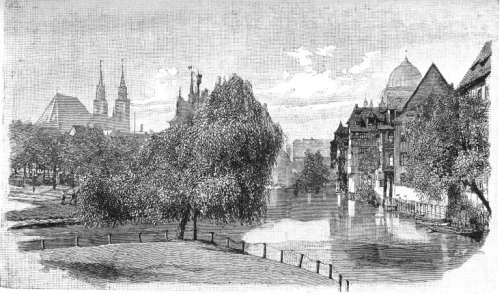
ST. LORENZKIRCHE, FROM THE RIVER
As it now stands the church dates almost entirely from the latter part
of the middle ages. Begun in 1278 it was not completed till 1477. Of the
two towers (250 feet in height) that to the north was built in 1283, the
other about 1400. The square portion of each and the elevation of the
gable between them are crowned by a light and beautiful open parapet.
The north tower, with its roof of gilded metal, was burned down some
thirty years ago, but has been carefully rebuilt. The towers terminate
in octagonal storeys and spires. At the top of the square portions are
wide openings, divided by many mullions, suggesting the gridiron on
which St. Lawrence was broiled. Why the church was dedicated to this
Spanish saint I have not been able to discover. The stately portal (25
feet wide and 42 feet high), and the rose window (33 feet in diameter),
recently much restored, belong to the fourteenth century. During the
fifteenth century the church was repeatedly enlarged, and, in 1439, the
foundation-stone of the lofty choir was laid. The plans were designed by
Konrad Roritzer, who came here from Rothenburg.
At the laying of the foundation-stone a miracle occurred. The pulley
which was to raise the stone broke. The workmen then broke the stone, so
heavy was it and impossible to raise. And when they had done so, they
found inside a hewn cross. Probably, says the sceptical German
historian, this was all arranged in order to stir the enthusiasm and to
promote the generosity of the people on behalf of the new church.
The figures of Adam and Eve and of the prophets, etc. on the
Hauptthor, the Grand Portal, are the earliest specimens we have of
Nuremberg sculpture. They date from the fourteenth century. The reliefs
of the scenes from the Life of Christ and the Last Judgment are later,
like the reliefs on St. Sebald’s and the Bride’s Door.
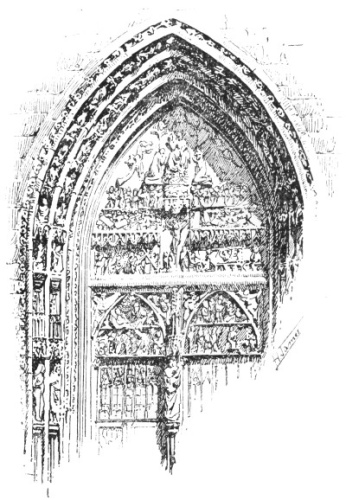
HAUPTTHOR (ST. LORENZKIRCHE)
A central pillar divides the Hauptthor into two halves, and bears a
Madonna and Child. The arches above the two doors, which are separated
by this pillar, contain high reliefs of the Birth of the Saviour and
Adoration of the Magi (left), and The Slaughter of the Innocents and
Flight into Egypt, and the Presentation in the Temple (right). In the
spandrels of these arches are four prophets.
In the upper half of the great arch are represented the Crucifixion, and
on the right side Christ before Pilate and Christ bearing the Cross; on
the left the Burial and Resurrection of Christ. These scenes correspond
to those depicted on the sides of the entrance hall.
The remaining space in the tympanum of the arch deals with the Last
Judgment. Two angels blowing the last trump, and two others (restored)
holding the instruments of the passion, surround the Judge, whose feet
are set upon the Sun and Moon, and He judges the just and the unjust. At
His side SS. Mary and John kneel and intercede. The inner curve of the
arch contains the twelve Apostles and the outer the twelve Prophets.
Below are the above-mentioned life-size statues of Adam and Eve, next to
whom two other figures stand, the Scripture in their hands, expounding,
one may fancy, to the parents of mankind the story of the Redemption,
which the reliefs of the gateway have thus told in stone.
Similar in workmanship to the figures of this portal is the statue of
Christ, with flowing beard and folded hands, which is near the door on
the south-west side. This in its turn will remind us of a statue of
Christ, with hands pointing to the wound in His side, in the St.
Jakobskirche. The Brautthüre or Bridal Door on the north side of the
church was built in 1520, but it shows little trace of the Renaissance
spirit. (Recently restored.)
Of the fine though crumbling old piece of sculpture—Gethsemane—near
this door, I can find no history at all.
High up on the roof of the choir outside rises a pole with a hat upon
it. Two choir-boys (the story runs) who were playing marbles in the
church fell to quarrelling, and one of them who held the two marbles in
his hand, maintained his rights with the exclamation, “Devil take me!”
Thereupon the Devil immediately appeared and wrung the boy’s neck. At
the corner of the St. Lawrence schoolhouse, on the pedestal of St.
Lawrence, you may see carved in the stone the head as it was twisted on
the trunk. The hat on the pole on the choir is that of the unfortunate
chorister.
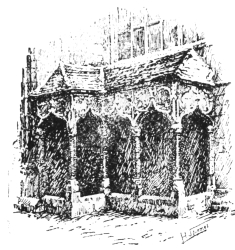 ST. LORENZKIRCHE (N.)
Entering the church by the north-west door, near the Tugendbrunnen (see
Ch. X.), we notice that the nave is twice as high and broad as the
aisles which are thus subordinated to it. But, as in St. Sebald’s, the
three aisles of the choir are of equal height. Here there are two
stories of windows, instead of a single row of tall ones. Two visits
should be paid to St. Lawrence’s in order to see the full effects of
this church—one in the morning when the sun is shining through the
windows of the polygonal east end, and one in the afternoon when the
light streams through the glorious rose window in the west.
Plain, slender pillars carry the vaulting of the choir with its flat
spidery network. A gallery which runs round the whole choir is reached
by a staircase next the sacristy (s). The sacristy should be looked
into both for the sake of its own beauty and for the sake of the choral
books, illuminated by Jakob Elssner(?) (d. 1546), and a baptismal basin
by Endterlein (d. 1633).[57]
The east end of the choir contains splendid windows (see p. 213). The
subject of the first, on the north side, behind the altar of St. John,
is the wanderings of the children of Israel; of the second the Passion,
of the third the Transfiguration, of the fourth the donor, Emperor
Frederic III. and his consort, of the fifth, Saints and Fathers of the
Church.
But far the finest and most famous of the windows is the sixth, the
Volkamer window. It is a “Jesse” window, displaying the genealogical
tree of Christ, and, below, the founder and his family. The seventh, or
Schlüssfelder window, represents the holy mill and the four Evangelists
with the four Apostles, after Durer, beneath. All these belong to the
last half of the fifteenth century; but the eighth is a modern one
(1881), commemorating the re-establishment of the German Empire. The
Tucher window next the sacristy was painted by Springlin, 1451, and
contains beautiful red glass in the early Renaissance style.
Another noticeable window is that on the south side, exhibiting the arms
of the Schmidmayer family. The designs are attributed to Durer.
Near this stands one of the old carved chairs, in which the Masters of
the Guilds once sat in turn to receive alms.
Of the chief treasures of the St. Lorenzkirche we have already dealt
sufficiently with two—the Pix or Ciborium, the Weihbrodgehäuse or
Sacramentshaüslein or whatever name we choose to give to Adam Krafft’s
masterpiece[58]—
“A piece of sculpture rare,
Like a foamy sheet of fountains rising thro’ the painted air,”
and the Angels’ Greeting, and the still finer wood-gilt crucifix of the
High Altar, by Veit Stoss.[59] The six angels in bronze bearing the
candles are by Burgschmiet (b. 1796). Anton Tucher dedicated the Angels’
Greeting and also the great bronze chandelier, which may contain the
handiwork of both Veit Stoss and Peter Vischer. The handsome modern
pulpit is by Rotermundt and Heideloff (1839). There is also in the choir
some beautiful tapestry (1375?) with figures of the twelve apostles who
stand in a scroll-work of wise sayings for our instruction, such as Pis.
maister. deiner. zung. dez. ist. dir. not. oder. si. werdint. dir. den.
ewigen. dot., and so forth.
The Church of St. Lawrence is rich in examples of the memorial tablets
or epitaphs on which the skill of the early painters was chiefly
exercised. The altar-pieces and epitaphs founded in memory of some
member or another of the great burgher families form a complete gallery
of early Nuremberg art and provide moreover a perfect feast for the
enthusiastic herald.
We have already spoken of the general tendencies of the Nuremberg
artists in the seventh chapter of this little book. Perhaps, therefore,
the most interesting way to treat of the pictures in St. Lawrence’s will
be to mention them in chronological order.
1. Epitaph of Paul Stromer, 1406—next the Rochus Altar, on west wall of
the Sacristy. The Redeemer throned on the clouds, surrounded by angels
bearing the instruments of the Passion. SS. Mary and John kneel in
intercession before Him, and underneath is the family of the founder.
The drawing throughout is strong but severe, and there is considerable
harshness in the contours.
2. Epitaph of Frau Kunigunde Kunz Rymensnyderin, 1409. Body of Christ
supported by SS. Mary and John. Figures of the founders on either side
of the napkin.
3. Wolfgang’s Altar (1416?). Resurrection of Christ. SS. Conrad and
Wolfgang on the inside of the wings (No. 17, north wall).
4. The celebrated Imhoff Altar-piece in the Imhoff Gallery (north
transept). This picture, dedicated by Kunz Imhoff, was painted 1418-22,
and is counted the finest achievement of mediæval painting in Nuremberg.
In the centre Christ is crowning Mary; on the wings two apostles, at
whose feet kneel the founder and his three first wives.
The burial of Christ, with SS. Mary and John, which formed originally
the reverse of this altar-piece, is now in the German Museum (No. 87).
A deep love of nature, which reveals itself in the vigorous, homely
conception of the forms, is here combined with that spiritual reverence
of treatment which inspired the first works of Christian art. In the
earnest faces of SS. Peter and Paul we see not merely a reproduction of
the traditional types, but faces full of character and originality. They
have been carefully thought out as well as carefully carried out. There
is individuality again in the sympathetic, the winsome beauty of the
countenance of Mary; whilst the countenance of Christ seems to tell us
both of the thoughtful earnestness and the gentle dignity of the
Saviour.
Notwithstanding their slimness, the figures in the picture are somewhat
crowded. The shoulders and necks are powerful, and the hands evince
remarkable carefulness in execution. The folds of the drapery, in spite
of the simplicity and clearness of them, are by no means monotonous in
design. The harmony of colours (green, red, and blue, on a gold
background) is strong and happily attuned.
The artist is unknown, but, whoever he was, he had looked upon Nature
with loving eyes and worshipped her; and this love of Nature, purified
by his deep religious feeling, he had brought to the service of his
living faith. Frequently we shall observe in the old Nuremberg artists
that this mixture of naivete and reverence in the conception of
religious subjects produces too commonplace a representation of them.
But here the result is not commonplace, only just towards Nature. The
picture, says Dr Janitschek,[60] is like the most beautiful bloom of a
period just drawing to a close and already bearing in itself flowers of
a more dazzling development.
The Imhoff picture (see below, No. 9) shows similar handling and similar
freedom from Flemish influence in the full, soft beauty of the forms.
And yet the mastery of Nature displayed in the portraits of the founders
reveals to us an artist who was following the same paths as those of the
Flemish painters.
5. Epitaph of Agnes Hans Glockengiesserin, 1433. The death of Mary as
she knelt in prayer, and portrait of founder. A picture full of tender
feeling (No. 11, south side).
6. Theokars Altar (Deocarus Altar, No. 19, north side) 1437, founded by
Andreas Volkamer. Christ between six apostles, and below, St. Deocarus
between the other six apostles, carved in wood. Below a life-sized
painting of the saint.
The wings of the picture, which represent the Transfiguration, the
Miraculous Draught of Fishes, the Last Supper, and the Resurrection, and
four scenes from the life of St. Deocarus (kneeling before a chapel,
healing a blind man, confessing Charlemagne, and on his death-bed),
should be compared with the Haller altar-piece of St. Sebald’s and the
High altar-piece of the Frauenkirche. Though very nearly contemporary
with the latter works, this painting is representative of the old
school. It exhibits, indeed, great dramatic spirit, though the movements
are often awkward, and the
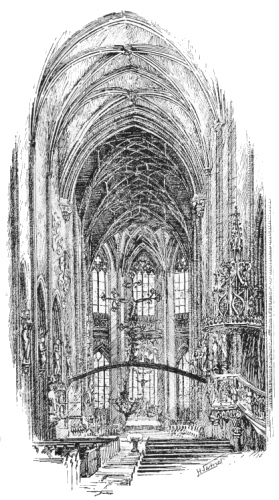
ST. LORENZKIRCHE (INTERIOR)
colouring lacks the strength and brilliancy of the Frauenkirche picture.
7 and 8. A saint in armour, and a suffering Christ with gold background
and the Saints Henry, Kunigunde, and Lawrence (with the gridiron), are
also probably of the same date.
9. Margaret and Anton Imhoff memorial (1446) (numbered 16, on the north
wall of the church). Madonna and Child and four angels, and the
founder’s family—the father with eight sons, and the mother with four
daughters.
The further development of the Nuremberg school of painting, as I have
sketched it above (pp. 181-4), may be observed in the following memorial
pictures in this church:—
H. Gärtner epitaph, 1462, Madonna and Child, SS. Bartholomew and
Barbara (south, near doorway).
Erhard Schon epitaph, 1464, St. Wolfgang and other saints.
Friedrich Schon epitaph, 1464, Birth of Christ, Aaron, Moses, etc.
Hans Lechner epitaph, 1466, Death of Mary (south).
Hans Meyer epitaph, 1473, St. Gregory (No. 13, north side).
Berthold Kraft epitaph, 1475, St. Dionisius (opposite Rochus Altar,
south).
Hans Schmidmayer epitaph, 1476, Adoration of the Magi (over stairs
leading to Schmidmayer oratory, south).
Leonhard Spengler epitaph, 1488, Christ between SS. Philip and
James (No. 15, north side).
Stör Family epitaph, 1479, Christ treading Blood, and Four
Evangelists, etc. (north-west).
The Rochus Altar, triptych with scenes from the life of St. Rochus,
dedicated by six Imhoff brothers, 1499 (No. 7, west of Sacristy),
and the Krellsche Altar, 1483, which may perhaps be by Wolgemut. It is
beneath the Frederick window in the choir, and contains a Madonna and
Child and various saints, apostles, etc. The background of this picture
represents the town of Nuremberg as it was before the last extension of
the walls. (Chap. V.)
By Wolgemut and his school there are several characteristic pictures, of
which I may mention here the Burial of Christ (No. 2), the Ascension
(No. 3), and the Praying Priests (No. 4). The right wing of the St.
Catherine altar-piece (No. 8) is by Wolgemut, and the two pictures of
St. Vitus, with his parents and denouncing the idol, are signed by R.
F., a painter whose touch is visible in part of the Peringsdörffer
masterpiece (see p. 287). The Adoration of the Magi (No. 20) is a fine
picture: the Angels bringing the child Jesus to the Virgin (No. 1) bears
Durer’s monogram.
Lastly, the wings of the Nikolaus (No. 6) and of the Annen—or
Marien—Altar are by Hans von Kulmbach, 1520(?) (next to the Passion
window in the choir).
Frauenkirche
(Marienkirche, Marienhall)
The Frauenkirche, which occupies the east end of the Haupt Markt, was
built, as we have seen (p. 37), under somewhat discreditable
circumstances on the site of the old Jewish Synagogue (1355-1361).
The brothers Georg and Friedrich Ruprecht are mentioned as the
architects, and the sculptor, Sebald Schonhofer, is responsible for the
rich ornamentation of the vestibule. This vestibule (restored with the
rest of the church some twenty years ago) is unique of its kind. It is
conjectured that this part of the church was intended to serve as a
kind of treasure-house for the Imperial Crown jewels and relics, which
in the year 1361 were certainly shown, as an object of veneration, from
the gallery above the main entrance of the church.
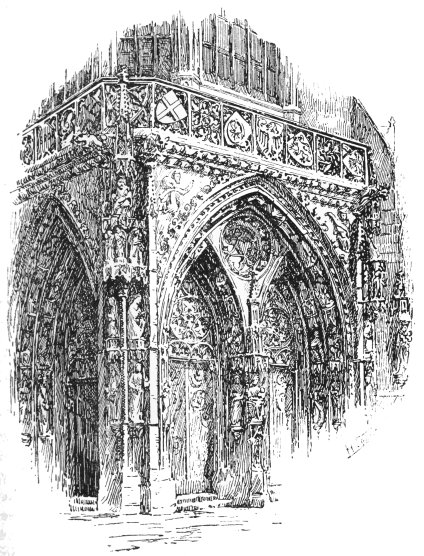
WEST DOOR,
FRAUENKIRCHE
The plan of the west gate is borrowed in the main from the St. Lorenz
portal. There the life and work of Christ, here the life and work of
Mary are set forth. Many of the figures strongly recall those of the St.
Lorenz statues. At the corners of the vestibule are statues of Karl IV.
and his consort, and SS. Lorenz and Sebald.
Above the rich and massive portal with its fine iron railings is the
Chapel of St. Michael, whereon is to be seen an extraordinary old clock
known to young and old in Nuremberg by the name of “Männleinlaufen.” The
chronicles relate that Karl IV., in memory of the “Golden Bull” (p. 39),
which was drawn up in Nuremberg in 1356, and recorded what honours and
reverences the electors of the Empire were to pay to the Emperor, caused
an ingenious clockwork to be mounted over the portal of the church. The
mechanism was so contrived that the seven electors passed at noon before
the Emperor, who sat upon a throne and received their reverent homage as
they passed. The clock was renewed in 1509 by Georg Heuss (even since
then it has twice been restored), and the figures were cast by the
coppersmith, Sebastian Lindenast. Still, at the stroke of noon, much as
in the old mediæval days, the heralds blow their trumpets, the Emperor
raises his sceptre, and out from their gloomy chamber the electors file
forth and bow low in reverence to the dead representative of an empire
which has ceased to exist. And they revive in our hearts something of
the child-like pleasure which the Middle Ages took in these elaborate
toys.[61]
But a sturdy English Protestant who lived in Nuremberg some forty years
ago, took another view of the matter.
“It is generally said to represent the Pope,” he writes, “who,
seated in a comfortable sort of arm-chair, was formerly accustomed
at a certain hour to raise his sceptre and summon the
representative figures of the twelve apostles, who accordingly used
to make their appearance and do obeisance. That time, however,
seems to be gone by. The latter after a while became tired of the
ceremony, refused their mechanical homage, and St. Peter himself,
it is said, setting the irreverent example, they began to reject
the uniformity required in their evolutions.” The clock was at that
time out of repair.
The subject of clocks leads me to mention what is perhaps not generally
known, that as Nuremberg was the inventor of the watch (Nuremberg Eggs,
shown in the Museum and the Castle), so also she invented a system of
time peculiar to herself. To-day we have the Central Europe system (our
12-hour system), and the Italian or 24-hour system. But at the close of
the Middle Ages the Nurembergers, the great clockmakers, had a third
plan of dividing the day, called the Nuremberg great hour (Grosse Uhr),
for which Regiomontanus drew out elaborate tables. Briefly the plan was
this. At the equinox the night was assumed to begin directly after
sunset, and day began twelve hours after sunset. This arbitrary “dawn”
(Garaus) was sounded by the clock. To this day it is announced by
ringing of bells from the principal churches. With the progress of the
year, as the days after the equinox lengthened or decreased, time was
added to or subtracted from the night or day. For instance, on the
shortest day there would be 16 hours night and 8 hours day, and on the
longest day 16 hours day and 8 hours night. Again, when the sun set at
6, the “Great Clock would strike 8 at 2 A.M., because 8 hours had passed
since sunset. Seasons of the year were, in common parlance, denoted in
accordance with this system. “At the time of year when the day strikes
13” would fix a date. The system, it will be seen, was almost as
involved as the sentences of a modern German historian. But with all its
drawbacks it lasted on, along with the Central Europe system, till 1806.
Owing to the great elaboration of machinery required, the hours were
usually struck by bell-ringers. But the clock of the Frauenkirche, owing
to the additional mechanism needed for its toy-work, probably had to be
fitted with the “little hour” from the first.
Besides some old painted glass in the nave (coats of arms of Nuremberg
patricians) and some carvings by Veit Stoss, the only works of art in
the Frauenkirche that need detain us are the Pergenstorfer tomb (1499),
at the end of the north wall of the nave, by Adam Krafft, and close to
it the side altar-piece[62] (1440), which was originally the Tuchersche
High Altar in the Church of the Carthusian Monastery. We have already
had occasion to note more than once how the early Nuremberg painters,
before Wolgemut, were struggling to achieve the simple portrayal of
Nature and to combine it with the expression of their deep religious
emotion. The picture before us is a very good example of this simple and
yet sympathetic realism. Let us add that this quality, or combination of
qualities, is not borrowed. For the Nuremberg School of Painting remains
distinct and peculiar, with very little trace of foreign influence, long
after the school of Van Eyck had made itself felt in the regions of the
Lower and the Upper Rhine.
In the centre of the picture are the Crucifixion (SS. Mary and John by
the Cross, and at the feet of Mary a skull), the Annunciation and
Resurrection; on the wings the Birth of Christ and Apostles.
There is a rare conjunction of dignity and life and truth to Nature in
these pieces—an individuality too. The Mary is portrayed in the same
spiritual mood as that of the Imhoff Altar-piece, but generally the
figures are more full of vigour and the countenances more full of
expression than in that picture. In depicting the body of Christ, which
is carefully proportioned and in which the muscle-play is planned with
evident care, the artist, we can see, has wrestled with Nature, and not
failed altogether in his attempt to gain the mastery over her. The
figures of the Apostles are sturdy, thick-set, and in their faces is an
expression of concentrated power. The drapery falls in broad,
well-arranged masses. The colouring is deep and clear, and the rich
harmony of strong red, blue and yellow (gold background) is happily
supplemented by a luscious green.
St. Ægidienkirche
The Church of St. Ægidius, or St. Giles[63] (Ægidienplatz) was founded
originally by Conrad III., it is said, for some Scotch benedictine
monks. But, with the exception of the side chapels, which still remain
and are in the highest degree interesting, it was burnt down in 1696,
and rebuilt 1711-18 in the debased, and to Nuremberg utterly
inappropriate, style of that period. The High Altar-piece is a Pietà
by Vandyck (nineteenth-century angels above). Behind this are two bronze
reliefs, one, the beautiful “Entombment,” is by Peter Vischer the
younger, the other by his brother Hans. The eighteenth-century
paintings on the ceiling are by J. D. Preisler.
But apart from the Vandyck, the Ægidien Church is well worth a visit for
the sake of the Eucharius, the Tetzel and the Wolfgang’s Chapels. The
first of these is much the oldest (1140), and is in the late romanesque
or transitional style. The Roman vaulting, such as we have seen in the
chapels at the Castle, is combined with a mixture of round and pointed
arches. The pillars are slender, with broad capitals. The capitals of
the centre pillars distinctly suggest Byzantine influence. The two
altars here are by Veit Stoss.
The St. Wolfgang’s Chapel dates from the end of the fourteenth century.
There are here two pictures (1462 and 1463) and a piece of sculpture
(1446), Grablegung Christi, by Hans Decker, which cannot by any stretch
of the imagination be called a spirited work. The chapel is disfigured
by a hideous gallery which has been run round it, but the roof is, as
they say, sehr interessant.
The Tetzel Chapel (1345) contains a Coronation of Mary, by Adam Krafft,
unfortunately much damaged. In the centre Mary is being crowned by two
angels. On either side of her are noble figures of God the Father and
Christ. Beneath Mary is a group of angels, and beneath God and Christ
stand many suppliants. An older and very interesting stone-relief is to
be seen on the south-west wall. Some old glass and over seventy coats of
arms of the Tetzel family are also placed in this chapel.
There are many other churches in Nuremberg, and several of them have a
distinctive charm of their own. But I must content myself with a bare
sketch of the chief treasures they possess. Only let me add that any
lover of Nuremberg who has time to spare will be rewarded by the
discovery of many characteristic details in the minor churches. The
richest in works of art is the
St. Jakobskirche.
Chief among these is a Pietà, by the unknown master of the Madonna in
the Museum (see p. 278), and the old glass of the windows. The high
altarpiece has the distinction of being the earliest specimen of
Nuremberg painting. There are, besides, various early reliefs and
carvings by Veit Stoss.
The church itself, which was restored in 1824, belongs in its present
form to the beginning of the fifteenth century. It was, however, in
existence in the twelfth century, for the Emperor Otto presented it and
all its property in 1209 to the “Hospital der heiligen Maria der
Deutschherrren zu Jerusalem,” an order which had long had a firm
foothold in Nuremberg, and came, there is evidence to show, continually
into conflict with the Council. After the Jakobskirche was handed over
to the Protestants in 1634 by Gustavus Adolphus, the Deutschherren held
their Roman Catholic services in the Elizabethkapelle, which was
completed in its present shape, as the
Elizabethkirche
with its mighty Italian dome in 1885.
The Marthakirche (1365),
right of the Königstrasse as you come from the Frauen Thor, contains
little of interest. Like the chapel “Zum Heiligen Kreuz,” north-west of
the town on the road to St. John’s Churchyard, it was founded as the
chapel of a pilgrims’ hospital, wherein “all poor strange persons,
whencesoever they come, are to be harboured for one or two days and
provided with food and drink free of charge.” Almost facing it is the
Klarakirche (1430).
Here there are some good windows and an altar by Veit Stoss (?), also an
Œlberg, an early Mount of Olives by Adam Krafft. Opposite St.
Sebald’s, on the north side, lies the
St. Moritzkapelle.
Built originally on the present Hauptmarkt, it was removed in 1313 to a
site upon what was then St. Sebald’s Churchyard. It was restored by
Heideloff in 1829 and used, till 1882, as a gallery for some of the
pictures now in the German Museum. In the Spital Platz is
The Hospital and Spital Kirche (Heiliggeist
Kirche),
founded by Konrad Gross, which we have already mentioned (p. 30). In the
courtyard of the hospital may be seen the chapel founded by Georg Ketzel
after the great epidemic in 1437. It is built in imitation of the chapel
of the Holy Sepulchre at Jerusalem. East of the Spital Kirche stands the
handsome
Moorish Synagogue
by Wolf.
Since Nuremberg was from early days both pious and comparatively secure,
she was naturally one of the first places in Germany where the mendicant
friars settled and founded monasteries. The earliest of these was the
Augustiner Kloster (beginning of the thirteenth century). The Franciscan
Monastery, or Barfüsser Kloster, was built somewhere about 1210, where
now the house of the Museum Club and the buildings of the Industrial
Museum stand. The Dominican Monastery, built a little later, is now used
as the Public Library and Record Office (No. 4 Burgstrasse, Mon. Wed.
Fri., 9-12 A.M.). Thanks chiefly to the efforts of Hieronymus
Paumgärtner and Erasmus Ebner the Council formed a fine collection from
the treasures—mainly manuscript—of the libraries of the various
monasteries. This was placed together with the library, which the
Council had itself been founding for over a hundred years, first of all
in the Monastery of St. Giles, and then in 1538 in its present home.
Among the MSS. are a fragment of Durer’s work on the “Proportions of the
Human Figure,” some poems of Hans Sachs, and autograph letters of
Gustavus Adolphus, Melanchthon, Luther, Lazarus Spengler, Regiomontanus,
etc., besides an amusing one from Ulrich von Hutten, the Knight and
Reformer, who herein congratulates an abbot on having renounced celibacy
and taken unto himself a wife.
But the most valuable MS. is the almost unique Hebrew Machsor (1331)
written on vellum. Its 1100 pages comprise a full collection of Jewish
prayers, hymns, and ceremonies up to the thirteenth century.
Amongst other drawings, portraits, prints, and curiosities in the
library are a black silk cap worn by Luther and a drinking cup given by
him to his friend Dr Justus Jonas. The portraits of the two friends
adorn the cup, together with the following inscription:—
Dat vitrum vitreo Jonæ vitrum ipse Lutherus
Ut vitro fragili similem se noscat uterque.
Then, beautifully written and illuminated, there is a breviary (1350?)
of an English Queen with the inscription:—
La Liver du Roy de France Charles
Done a Madame la Roigne D’engleterre.
Among the early printed books is a copy of the “Rationale Durandi”
(1459, Mainz), of “Boccaccio” (1472, Mantoni), and of the “Florentine
Homer” (1488).
Matthäus Landauer’s Almshouse—Landauer’sche Zwölfbrüderhaus (east end
of Ægidien Platz) has frequently been mentioned. The almshouse has now
been turned into a school of technical design, but the chapel (1502)
will repay a visit. The roof, supported by two spiral columns, has the
cone-shaped pendants of the contemporary English style, very exceptional
in Germany. It was for this church that Durer painted his All Saints’
picture, now at Vienna.
There were many foundations, in the old days, for the relief of the sick
and needy. Amongst others were two houses for waifs and strays, founded
no one knows by whom. They were transferred later to the Barfüsser
Kloster. In connection with this institution a charming annual
procession takes place. One charitable lady, Elizabetha Krauss, left in
1639 a sum of money to provide the children with a good dinner on St.
John’s Day. In grateful memory the children always go on that occasion
to the St. Rochus Churchyard. On their way they must pass the corner
house near the Karlsbrücke. On that house is the statue of a youth,
busily engaged in pounding with pestle and mortar. People say this
figure represents the apprentice of an apothecary who once lived there.
And because the apprentice ran away from his work to gaze at the
procession of children, who clad in red and white, and, roses
themselves, crowned with garlands of roses were wending their way hand
in hand to the tomb of their benefactress, his master grew so angry that
he killed the lad.
It is in the churchyard of
St. Rochus
that Peter Vischer (90) lies buried (Rothenburger Strasse). In the
church itself are some paintings after Durer, some altar-pieces by Veit
Stoss (?), and some glass by Veit Hirschvogel. But the chief
burial-place of Nuremberg from the sixteenth century, and one of the
most peculiar and impressive spots of the town, is the Churchyard of
St. John. For this has been the burial-place of the Nuremberg
patricians from generation unto generation, ever since in 1517 the
Council decreed that everybody, with the exception of the clergy, must
be buried in St. John’s Churchyard, and no longer in the churches within
the town. Such a wise measure of compulsory extramural interment must
have been almost without parallel at that time.
The route to this churchyard the reader already knows, for it lies along
Burgschmietstrasse, along that road to Calvary marked by Ketzel’s pious
Stations of the Cross (see p. 200).
A low walk and pillared gateway, over whose broken pediment the willow
bends mournfully, mark this place of tombs. The churchyard is sprinkled
with trees: to the south, the shadows of a thicker fringe of branches
deepen the natural solemnity of the place. It is here that the mighty
dead of the White City are sleeping the sleep that knows no waking; but,
as we seek the graves of Durer, Sachs, or Pirkheimer, we pass along the
rows of flat tombstones quietly, with hushed voices and reverent steps,
as if dreading to disturb even the silence of their inviolable
repose.[64] On every side of us are emblems of the past glory and pride
of Nuremberg. There are no headstones to the tombs, but every slab, in
high relief of imperishable bronze fashioned by the skill of the most
distinguished artists,[65] bears the coats-of-arms and devices of the
civic noble who moulders beneath. What pomp of funeral processions must
have ascended the steep from the city, year by year, through that
gateway, to convey another, and yet another, wealthy burgher from the
busy scenes of commerce and office, to the silent abodes of the dead!
Poets and artists, too, as well as patricians, lie here; and the
indistinguishable dust of the famous and infamous, of rich and poor,
known and unknown, old and young mingles in this still churchyard of St.
John.
“Golden lads and girls all must,
As chimney-sweepers, come to dust.”
We feel the pathos, the pity of it, as we stand here and read the
message of the tombstones; but even more clearly does St. John’s
Churchyard suggest that other mood:—
“Hark! how the sacred calm that breathes around
Bids ev’ry fierce tumultuous passion cease;
In still small accents whispering from the ground
A grateful earnest of eternal peace.”




 (200kb)
 (612kb)